THE village of Tipuani is composed of about eight or ten ranches, and
one store, which is Perez’ rubber trading quarters. Perez’ place is the
first house in the village as you come in from Gritado, and consists of
a store, a dwelling house, and a very large shed, where the pickers
bring their rubber and rest for a few days before going back to pick. I
gave Perez his father’s letter, and thanked him for offering to put me
up, but told him I was going to the hut of Noboa, whom Sanches at La Paz
had recommended me to see, as he was a kind of agent for the Challana
people.
Perez offered me a drink, but I refused it, as I seldom take one on the
march, but always wait till the stopping place. When I got to Noboa’s
hut I accepted a glass of very good rum, distilled by old Noboa
himself, and bought some off him at 2/-a bottle. The old man, who had an
Indian wife very much younger than himself and not at all bad looking,
called to her to make ready a clean hut for me and a shed for Miguel and
the cooking, and we made ourselves at home. After things had been
unloaded and straightened out, I paid off the Indians and Antonio, and
two days later they started back for La Paz, with cargoes of rubber from
Perez. While Miguel was putting the camp to rights, and preparing an
Irish stew from challona, yams and eschalots, I went over to see young
Perez. He had been educated at the best college in Madrid, and was going
to join the cavalry, but asked his father to let him go and see the
famous Tipuani River, where so much gold and rubber came from. Not being
heavy, he was able to ride most of the way. Unluckily for him, he got
the fever at Tipuani, and had been there now for two years and a half,
and could not get out. Every time he tried to get away, as soon as he
got to higher altitudes, days before he could even reach the Andine
Range, the fever came back and he was forced to return. He meant to try
again in a few weeks’ time. He was not the only one served in this way
by the fever.
Another fellow called Bartelot, whom I met a few leagues from here,
told me he had come down to wash for gold sixteen years ago, and had got
stuck ever since then, owing to periodical attacks of fever. He found
gold frequently, but only worked occasionally, and did not trouble much
about it. He lived in a big bamboo and palm shed, partitioned off into
rooms, with a young Indian wife.
The saying down there is: “If you get a real good dose of Tipuani fever,
you will have to stop here.”
Old Noboa told me that he had been one of two hundred slaves brought
over by Count Noboa from Brazil up the Amazon, and through the Acre and
Challana districts to this famous gold river. The Count was here for
four years and a half, and got a lot of gold. He was a very good master,
and told all his men that those who wanted to return with him could do
so and each one would receive his small holding and some stock, and
those who wished to remain on the river could stay behind. Most of them
went back to Brazil, but a few remained, and with his assistance fixed
up their chacras and planted sugar, coffee, corn, fruit and other
things. The old black man Noboa was one of them, and he christened
himself after the Count, his benefactor. As far as I could learn he was
the only one left; the rest had either died or gone away.
He told me that some men from Challana would probably arrive in a few
days and he would send them over to me that I might arrange to return to
Paroma with them.
The day after we arrived, a tall, wiry man appeared while we were at
lunch, and introduced himself as “Mr. Robert A. Mackenzie, at your
service”; he joined us in our lunch, which we washed down with good
water and old Noboa’s rum. He told me he had been here sixteen years;
six years ago his father had left him a nice property at Epsom, and ever
since then he had been trying to get back to England, but the fever had
prevented him. Whenever he got a little stronger he would start off on
his old mule, but as soon as ever he got up into the cooler atmosphere
the fever recurred and he found it impossible to continue, and had to
come down again to the forest. He proposed that I should shift camp to
his place, where there was plenty of room; he was in the house where the
late Colonel Villamil used to live when he was working on the big placer
mine below. I promised to come and bring my own food with me.
Next day Miguel and the two West Indians who were digging for gold with
Mackenzie helped me to get all my provisions and gear pulled across by a
long steel cable, affixed to a high platform on each side, which had
been placed there by old Villamil and was kept in good repair by his
heirs and by Perez for his rubber business. After all the goods had been
hauled over, Miguel was pulled across and then myself. The river was
quite wide just here, and the rope cable was fully fifty feet above the
water. Mackenzie was on the other side, waiting to welcome me, and we
walked together up a neat gravel path, with tropical flowers, creepers
and palms growing in wild profusion on either side. Soon we passed a
tunnel under the hill, which had been built and dug out by Villamil, and
which Mackenzie was now working with his two West Indians; and a big
artificial pond five feet deep and about twenty yards by fifteen, all
stoned up at the sides with a canal running into it at one end; and a
heavy movable shutter of iron and wood at the other; all this had also
been built by Colonel Villamil and his men. Then there were sheds,
houses, a kitchen, and, further on, a four-room house and a very large
carpenter’s shed, a smithy and some other sheds, all put up by him.
Mackenzie lived in the principal house, and his two men and an Indian
cook near the kitchen. It was a beautiful spot for a camp, a green
patch surrounded on all sides by the forest, which was a mass of wild
flowers, begonias and anthurciums, with red, white and purple creepers,
parasites and orchids growing on the trees. Big butterflies of all
colours were flying about, light blue, dark blue, purple, red and white
and yellow; all kinds of parrots were chattering and flying over in
flocks, and now and then a gorgeous macaw would perch on the top of a
high tree close by.
Villamil had grub-staked Mackenzie and his brother and two or three
more, but somehow or other it was not a success. His brother had gone
home six years ago, and all the rest had drifted off except Mac and an
old Indian and his family. All they did was to send gold into La Paz, in
return for which they received provisions; if they sent no gold they got
no food. There was plenty of gold about, and whenever they washed up
they always got some, but as they only worked two or three days a week
they could not expect to get much; also it was really far too hot to be
a white man’s country, and the natives will only work enough to satisfy
their immediate wants. The two West Indians only worked on Monday,
Tuesday and Wednesday. Mac paid them at the rate of 4/-each a day, and
they paid 1/-a day each for food, and did their own cooking. They did
not appear to want to return to the West Indies, and were quite
satisfied to put in only three days’ digging. These two men were part of
a gang brought from the West Indian Islands by an American who tried to
molest an Indian girl on the way down. Her people went to La Paz to
complain, and when he found out that the authorities were taking up the
matter he cleared out through the forest, and was last heard of in
Paraguay. These two stayed on with Mac; the others had drifted away on
their own.
While I was here Mac showed me an old cutting from a La Paz paper,
giving an account of the late Colonel Villamil’s Tipuani concession. He
had as many as five hundred Indians working for two years; then he went
to Paris for three years, and came back for another two years, taking
out altogether in that time 356,586ozs. of gold. When he died he left
his family a million of money and this rich concession. His eldest son,
the present Colonel Villamil, is now the head of the business; he has
never been down here, but lives partly in France, partly in La Paz. He
still keeps up the payment of the yearly licence to Bolivia, and wants
to turn over the concession to a rich Company who will work it properly.
Besides other improvements, the old Colonel made a narrow open drain
two feet deep and three feet wide, which wound down in long curves for
three miles from a stream at the top of the hill, tapping two or three
small streams on the way, and so diverting the water into the big
artificial pond near his camp, whence it could flow down whenever
required to the washings below. The whole thing formed a ready-made
placer working for any big company. It may be taken up now for all I
know, but it was still unworked in 1904. Mac told me that the richest
part of the working lay between the village of Tipuani and a point
beyond Gritado. Old Colonel Villamil was Commander-in-Chief in
Melgarejo’s time, and I was given to understand by several people that
he and Melgarejo were partners in the gold business, and used to make
the prisoners work in it, feeding them all well, and putting by a part
of the profits for them, according to the gold each gang found.
Next day, after breakfast, while Mac and I were in the carpenter’s shed,
helping to make some sleepers out of hard wood for the mine trolly, the
cook brought us a native with a finger tip of his left hand chopped off.
Mac was a vet by profession, and after fixing the finger up and giving
him some lint and bandages, to take with him and cut up as he needed
them, we asked him how the accident happened. He told us that while he
was in the forest picking guavas, he was bitten on his finger by a large
“tucandera” ant. He said these ants were deadly poisonous, and that it
was usual for the natives, if bitten on the finger, to cut it off at
once; so he had chopped his finger tip off. If they were bitten on the
head it was probably fatal. The male ant is black and the female brown,
and they are about 1½ inches long. Luckily for the natives living on
the Tipuani there are very few of these pests about. Mackenzie had never
seen one, although he had often heard of them, and he told me this was
the fifth Indian that had come to him to be treated for chopped fingers
in seventeen years.
In the afternoon Mac and I took our guns and walked up the path
alongside the stone canal the late Colonel Villamil had made for a
distance of a league and more to shoot some bush chickens for the
larder. There are plenty of these birds about and it is easy enough to
get them; all you have to do is to wait about near the big trees where
they go to roost every evening an hour or so before sunset, and simply
take a pot shot at them. After we had got seven in three shots we
hurried off down the path again, as the sun had just set, and it is soon
dark in these parts. Mac told me he had once been benighted on this
path and did not want to experience it again. On the way back a flight
of about fifty pigeons passed us in three lots; they were all one
colour, a chocolate brown, and the size of the ordinary wood-pigeon. We
neither of us fired at them; Mac said he had seen them often before,
always about the same hour, and always flying in the same direction. We
called them “the lost tribe.”
The next day old Noboa sent us word that he had finished distilling his
rum, that it was very good, and that he was selling what he did not want
to keep at 2/-a quart. So I went over with the West Indians, Charlie and
Rayo, to bring back half a dozen bottles, or a dozen if I could get
them. We got the dozen, Mac taking one half and I the other. Charlie and
Rayo bought themselves two bottles each. Rayo was a very steady, sober
chap, and never by any chance took more than one or two small tots a
day. Charlie, on the other hand, never did any work at all until his rum
was finished, which did not take long; consequently he never had any
money, as he seldom worked more than three days a week. Gold digging is
usually paid according to the amount found, but Mackenzie paid his two
or three men differently, giving them 4/-a day of 10 hours, and
deducting 2/-a day for their grub, which was given out in weekly rations
every Saturday for the next week, and then deducted from their pay the
following Saturday. Noboa’s place was on the other side of the big
river, and we always crossed over by the steel cable originally fixed by
the late Colonel Villamil and now kept in order by his heirs. We crossed
over all right, but on the return journey, when I was about three parts
of the way over, the rope snapped, leaving me sitting on the swinging
board about forty feet above the river. Mac had a small sack brought,
and in it a stone. Round the stone he tied a good stout rope and then
tried to chuck it gently into my lap. It took some time, as he always
missed me, and of course I could not render any assistance by trying to
catch it for fear of overbalancing and toppling over into the river
below. At last it dropped into my lap and I made it fast and was pulled
across. A few days after this an Indian who was crossing overbalanced
and fell into the river near the bank, hurting his back rather badly. I
suggested we had better rub in a sweating blister and then let him
remain quiet until the effects were over. So we had him carried on a
stretcher to his hut, let his wife rub the blister in, and left him.
Next day he and his wife came over and brought presents of eggs, fowl,
bananas, pines and oranges. When I returned from Challana and Paroma
Mac told me the cure had fixed him up well.
Next day I went over again to see Noboa, who told me no Challana men had
come yet; it was the rainy season and the big Challana river was
probably up and they could not cross. I bought a bottle of rum from him
for 2/-, and a big bunch of plantains for 1/-, and gathered a lot of
fine, pipless oranges, which his son, a boy of twelve, carried to the
cable for me. I looked in to see Perez on the way back, and found he had
another attack of fever coming on. I was hauled over by Miguel, and then
went into the tunnel which had been started by Villamil and his men, and
was now being worked and continued underneath the hill by Mac and his
West Indians, Charlie and Rayo. It was very damp, and had to be well
boarded up all the way, with good heavy iron wood logs, and roofed up
all over with the same hard wood. They were working as far down as the
false bed rock in a layer of black gravel; Charlie and Rayo by
themselves, and Mackenzie mostly up at the house and carpenter’s shed.
There was no doubt this was a rich place.
Next day I made a lot of bread and caught a good many very beautiful
butterflies for my collection. The best way to carry them is to squeeze
them behind the head and then put them in a piece of paper and fold it
up in a V shape. To make their wings open out again when you wish to set
them up, place them on some hot sand, and the wings will expand.
That evening, while Mac and I were smoking after dinner, an old Indian
came to tell us that near his sugar-cane field, some six leagues down
the river, a big man-eating tiger, as he called it, had tried to attack
his sixteen-year-old boy, and had also killed a small mule belonging to
a rubber picker. As a matter of fact, these animals are of the jaguar
species, only much larger. It seemed his boy was cutting sugar cane, and
before going home went into the bush near the banks of the river, to get
guavas, when he suddenly came across the animal eating a mule he had
just killed; the beast, on seeing the boy, growled, and the boy jumped
into the river just as the animal made his spring. Fortunately, he did
not follow him into the water, although it is well known that these
beasts swim well, and Indians have told me they have seen them in the
water crossing over.
Mackenzie could not join in the hunt, as he had only just got over a
bout of fever, and Perez, too, was down with fever; so it was decided
that the
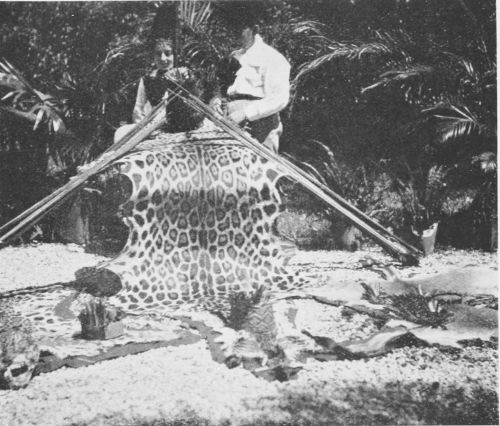
JAGUAR AND PUMA SKINS, BOWS AND ARROWS AND WOODEN SPEARS
BROUGHT BACK BY ME FROM BOLIVIA
Indian should take me next day to the dead mule, where I would sit up
for the night on the chance of the jaguar or tiger returning to his
prey.
The Indian, Miguel and I started off next morning after breakfast at 7
a.m., and crossed the river by the wire cable. We took a cooking pot, a
kettle and provisions for three days, including a bottle of rum. The
first part of the journey was by a path through the forest, close to the
river. Some six miles from the village we saw some beautiful birds
sitting on a big wild cotton tree, of a kind I had never seen before.
They were about the size of doves, light green in body, with purple
wings, scarlet breasts, yellow heads and black beaks, but they were not
of the parrot species. This was the only spot in the forest where I
noticed these pretty birds, and I saw them at the same place coming
back. The path here took a turn to the right for about a league, amongst
beautiful flowers and creepers, and some very large trees, of which
several were rubber trees. It was fairly easy going, but we had to use
the cutlass every now and then, and it was up and down hill all the
time, though not nearly so steep as what we had been used to. Soon the
path turned to the left again, and led down to the River Tipuani, just
opposite the Texas Gold Mining Company; there was a small settlement
here, where two Indian families lived; one of the men was away picking
rubber for Perez, the other was working with the women and children in
their sugar and maize plantation.
We rested here for a little, and made some tea, while one of the boys
went across in his father’s balsa to Charest, the Manager of the Texas
Gold Company, with a message from me, asking him to come along and join
the jaguar hunt, but he sent back word that he could not come as he had
a touch of fever just then.
From here we followed down the banks of the Tipuani for a mile to a spot
where the river took a bend to the left, and another small stream came
down from the hills on the right and joined it. This spot was, to my
mind, one of the prettiest I had come across. On the left was the
powerful and swiftly flowing Tipuani, on the right the stream, and all
around was the forest, and the high hills crowned with patches of green
grass with valleys between them. There were high palms everywhere, and
big green heart trees in flower, which stood out prominently against the
dark green of the forest. Beautiful flowers and creepers were growing on
the banks of the rivers, and gorgeous blue butterflies, seven or eight
inches from tip to tip, and green and yellow, and green and blue
parrots were continually flying from one side of the river to the other.
Overhead the sky was a clear blue; here and there were a few big
vultures, flying high up, and waiting to swoop down on some dead animal
which they would pick clean to the bones. I thought to myself how
strange it was that this beautiful spot should be a haunt of malaria,
where only the forest Indians could live without constant attacks of
deadly fever. I took some views here with the kodak I carried.
Up the stream to the right was the place where the man-eating tiger had
killed the mule. On the way we stopped for a few minutes at the home of
my Indian guide, and saw the sugar plantation where his son was engaged
cutting cane. This man owned a few head of cattle, which he had driven
originally from the forest; there are a good many wild cattle to be
found in the forest, though not nearly so many down here as in other
parts. About two miles from his place we came to the dead mule, and
found that the loins and part of one flank had been eaten away, and the
throat torn open. I asked the man whether the animal had been poisoned,
and he told me “not yet.” Jaguars and pumas always seem to find out if a
beast is poisoned and, if so, often leave it and kill a fresh beast; I
have seen this happen more than once. Nevertheless, these beasts have
very often been poisoned, and I think what happens is this. If a horse,
mule or a bullock has been killed, and the jaguar or puma, when
returning to his prey, sees other animals near, he will kill a fresh one
for the sake of the warm blood, which he will suck from the gullet of
the newly-killed beast, but if the others have been driven away then he
will go for the original kill. The dead mule had been dragged just
inside the bush from a small green spot where it had been killed. The
water in the stream here was about four feet deep, and the stream about
fifteen yards wide. Miguel and I crossed over to the other bank six feet
above the stream at the foot of the forest, where I decided to wait for
the jaguar. It was then 5.30 p.m., and the Indian returned to his home,
promising to bring back fresh milk and eggs for us in the morning. After
a good dinner of challona stew, we sat down to await developments; I had
my big Winchester rifle and the magazine was full. The night was fine,
the moon almost at full, and fireflies everywhere. Nothing happened
until 9 p.m., when a big tapir walked slowly across the green into the
forest on the other side. A little later there was a distant peal of
thunder, a sign that a storm was coming, and a cloud passed over the
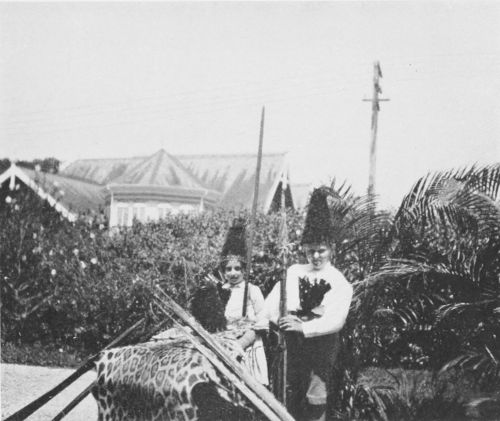
MY CHILDREN IN INDIAN HEADGEAR, WITH JAGUAR SKINS AND
INDIAN WEAPONS BROUGHT BACK BY ME FROM BOLIVIA
moon for a few minutes, but it was soon clear again. I looked at my
watch, and it was a few minutes before ten. A minute or two after, we
heard a movement in the bush opposite, and a long animal the size of a
small donkey walked out on to the green patch in front. He noticed us at
once, stood still broadside on, and turned his head and looked at us. It
was the man-eater and mule-killer, and a splendid chance to get him. The
moon was clear of clouds, and he could be seen quite distinctly. I took
steady aim, with the muzzle pointing dead behind the shoulder, and
pulled the trigger, only to find that the cartridge missed fire. I
quickly slipped it out again, and pushed in another, but the same thing
happened. In went a third, to no purpose, and then without turning round
I said to Miguel, who was a few feet behind me, “Something has gone
wrong with my rifle; if he comes across to us, you take the cutlass, and
I will take the axe, and we will club him if we can while he climbs up
the bank.” Fortunately, he never came, but after looking at us for a
minute or two he turned round quietly and went back into the forest, and
we saw no more of him that night.
The misfiring of the rifle was most unfortunate, but entirely my own
fault, as I discovered a few days later. I had kept it well cleaned and
oiled, both inside and out, but had forgotten to fire a trial shot
before leaving Mackenzie’s place, and on taking the trigger off I found
a small bit of gravel grit jamming it, with the result that, although
the trigger worked well enough, it failed to touch the cap. As soon as I
put it on again, it fired as usual, and here was I abusing the
cartridges, when it was my fault all the time for not trying a shot
first. It just shows that you can’t be too careful.
A little after 11 p.m. began a regular tropical downpour of rain which
never ceased till about 6 a.m., when the sun came out in all its warmth.
The air was delightfully fresh, the birds began to fly, and everything
looked bright again, but we were both soaking wet, and the stream had
turned into a torrent. The water had risen about five feet, nearly to
the top of the bank on the side we had camped, and the green patch on
the other side where the tiger and tapir had appeared was entirely
submerged. It had been an uncomfortable night, and for a few minutes we
had been in a real funk. I stripped naked and put all my things out to
dry in the sun, and after drying some wood we soon got a fire going.
Although the matches were carried in a tin, and that again in another
tin, they still had to be sundried first. We had filled our kettle, pot
and water-flasks with water after dinner the night before, and it came
in very useful now. It is always advisable to procure water overnight
for the next morning, especially in the rainy season; I always did this
and got my firewood as well. We soon had a wholesome challona stew and
some hot coffee ready, which made a welcome breakfast.
Miguel had now a severe dose of fever coming on; in fact, this was the
start of his Tipuani terciana, and from this time on he had it
constantly for the rest of the journey. It was partly owing to his own
perverseness, as instead of keeping pace with Manuel, myself and the
llamas, he would often walk off quickly up the hills, and sit down on
the top grinning and waiting for me; and he did not take his wet clothes
off and hang them out to dry, as I did. My clothes soon dried in the
sun, and Miguel thought better of it, and began to dry his. The river
began to go down again, and at three in the afternoon the Indian came
walking up the stream, with the water up to his middle nearly, probing
the bottom with a long, thick stick. He sympathized with us very much
over our bad luck the night before. I told him I would not like to go
back without another try for the man-eater, and he said there was a
rubber-picker living not far from his place who had a rifle, though not
as big a one as mine, and he would send his boy with a note from me for
the loan of it. As I had not yet discovered what was wrong with my
rifle, I was glad to accept his offer, and so we walked, or rather
waded, along the edge of the stream to his place, I carrying my pants
and boots, and wearing alpagatas to shield my feet from stones.
When we got to the bend, we found that the river was full of a good
volume of water running down at nine or ten knots. I could see by the
banks that it had risen fifteen feet as a result of the storm, and the
Indian said more than that. It had been my intention to go over to
Charest’s place, but no balsa could have lived in that turbulent stream.
So I put up at the Indian’s place. His wife had just killed and plucked
a fine fat fowl, which she gave me with some maize tortillas, and a
pineapple, refusing all payment. Her husband told her I had walked
twenty miles to his place to try and rid them of the man-eater.
The rubber-picker soon came over with his rifle and mauser and five
cartridges. He looked pretty sick with fever, and was out of quinine and
coca leaves. I told him I would be very glad to give him a little of
each, as I had a good supply, and a bottle of Noboa’s rum as well, if he
would send some one with me to bring them back; he was very thankful
for the offer, and I was also grateful for the use of his boy, who could
carry back my rifle and gear for me. Miguel was sick and, although the
two days’ rest would probably freshen him up a bit, he would have quite
enough to do to walk back the twenty miles with nothing to carry.
Next morning, after an early breakfast, I started off again along the
stream to the dead mule, with the Indian, his son, and three other
Indians, and six mongrel dogs. I went first, about an hour ahead of
them, to the spot opposite the green patch, and waited there while they
walked through the bush on the other side, beating the trees with
sticks, and making a good noise.
The first thing that came out and crossed the long narrow gully at the
back of the green patch in front of me was a small bush buck, then soon
afterwards a good-sized tapir, and finally a young swamp deer, but no
jaguar; I could have got each of these easily, but wanted to keep my
shot for the man-eater. When the Indians came out and had had a rest, I
sent them up the stream on my side, and told them to walk on for an hour
or two, and then beat down the other side. I promised them to get a deer
for fresh meat if another was driven out. After another two hours, a
second tapir crossed the narrow gully further up, about two hundred
yards from the green patch; I did not see him until he was just entering
the bush on the other side, so did not fire. Half an hour later came
another small bush deer, and at the same time I heard a rustling in the
bushes on the other side, close to the stream, and out came a fine swamp
deer, which I secured for our lunch.
The yelping of the dogs now announced the approach of the beaters. They
said they had seen the tracks of the jaguar, evidently made quite
freshly that morning or the night before, and had gone on over the hill
on the way to Challana. If we had beaten this side first, instead of the
other, we might possibly have caught him, though he might have gone on
quite early in the morning. Anyway, he had not touched the mule, which
was now beginning to smell, and to attract a dozen or more vultures,
which were hovering round about waiting to finish it off, as soon as the
coast was clear.
In the morning we went back to Tipuani village. Miguel was better, and
the rubber-picker lent me his rifle to take on to Challana with me in
case I could not repair mine. I eventually found out what was wrong, as
has already been explained. On the way back we saw the same pretty
green, purple and scarlet birds as we saw coming; they were in exactly
the same place, and were flying to and fro near the same cotton tree.
On the way back I looked in at Noboa’s, and he told me no Challana men
had come yet, so I asked him to try and get me five or six men from the
neighbourhood to go on with me. He said he would, and promised to come
over and let me know the result in a couple of days’ time. Perez was
still down with fever, and during my absence three men had come in with
rubber; one of them, a half-caste, was pretty sick with fever. I noticed
that many of the rubber balls were sliced down the middle, and was told
this was done now and then to see that there was not a good round heavy
water stone put in the middle to make weight, as some Indian pickers are
very crafty.
When I got back I found Mackenzie was going to wash up next day, so I
asked him to lend me a pan, and let me help him. I was anxious to see
how much gold came out of the heap of dirt and gravel, dug out of the
mine tunnel by the two men in three days. Mac and I panned it out next
day, and it gave 3ozs. 6dr. 1scr. of beautiful straw-coloured Tipuani
gold. There were no nuggets of any size, and no rough gold, which showed
that it had travelled far, and, in my opinion, that there was no reef
near at hand. They said on the Saturday that they were not going to work
again until Tuesday, and as a matter of fact they did not start till
Wednesday.
A curious incident occurred one day about this time. Some Indians
returning to the Beni district had met some women belonging to the
Tipuani district and wanted to marry two of them and take them to the
Beni district, but the women were unwilling and this led to a quarrel
among the men. The relations of the women attacked the ten men from the
Beni; they chopped one another about a bit with cutlasses and fought
with hard wood sticks, while the two women and their friends tried to
pacify them. Finally it was suggested that they should all go over to
see the two Englishmen across the river. Mac and I were in the
carpenter’s shop making sleepers when they arrived in a body. There were
twenty-seven of them in all, several of the men with their heads
bandaged. They told us the cause of the row, and we told them that if
the women were of age they should be allowed to please themselves. If
they wished to marry the two men from the Beni then they should be
allowed to do so, and leave with them; if not, the Beni men had no right
to make trouble over it and should cease to molest them, and continue
their return journey in peace. After some talking this was agreed to,
and the women were asked their wishes. They both said they did not wish
to leave their own district and cared nothing at all for the two men
that wanted them. Mac and I then told the men from the Beni that they
were to blame for the quarrel, and we also told the others they were
wrong in coming in as they did and attacking the Beni men, whose wounds
were chiefly on the back of their heads which showed they had been
attacked from behind. Eventually they came to an understanding, and
after we had mixed up a big bottle of water with a little lysol and a
little lint and dressed their heads they left with many thanks to us,
and much shaking of hands among themselves. The Beni men crossed the
river in the canoes belonging to the Tipuani men and took the path back
to the Beni, while the others and the two women over whom the dispute
had arisen returned to their homes.
A few days after this Bert Morton, an American miner, passed through the
Tipuani village. I met him walking behind his three large mules on the
way back to La Paz, he had been prospecting for rubber for a house in
Lima, and about a month before he had blown off the half of two fingers
of his right hand in doing what I call the silly trick of throwing
dynamite in the river pools to get a supply of fish. One cartridge had
exploded and caused the injury. Fish got this way are never much good;
they don’t have the same flavour.
On the next Monday Noboa came over and told me that no natives had come
yet from Challana; and that nobody from the neighbourhood cared to go in
with him, as they said the Indians and half-castes in Challana were
hostile, that they had guards with rifles all along the river Challana
wherever you could cross by balsa, and that the river was deep and the
current strong, and there was no balsa ever kept on this side. He
strongly advised me not to continue the journey; and thought they would
not let me cross, and if they did they might not allow me to return. Mac
was of the same opinion, and said he had been here sixteen years and had
never ventured into their country, but if I still insisted on going he
would lend me his old mule, which I accepted with thanks. I told them
that if my way was barred when I got to the river I would turn back.
The following day I got together provisions and gear for a
fortnight—bread, half a challona, some plantain, eschalot, coffee, tea,
salt, six tins of corned beef, three bottles of Noboa’s rum, a
water-flask, my rifle and fifty cartridges, my six-shooter, cutlass and
bedding—a good load for Mac’s mule.
Next day I started, with Miguel leading the mule. We crossed the river
by the cable, Miguel going first with the help of the two Barbadians
living opposite, then all the provisions and myself; the mule swam
across behind the balsa which was paddled and propelled by the Indian.
Noboa met me on the other side, and took me along to a small trail,
which led to a stream; by following it he said I would come out in full
view of the big River Challana. There was a nearer way, by a better
trail, which I thought it better not to take, as I wanted to get to the
banks of the river without meeting anyone. I felt sure that when I got
there I should find an order from Villarde to let me cross over.
The path was a narrow one, overgrown below with bushes and creepers, and
overhead with branches of trees which often had to be cut off to make
room for the mule to pass. I was using the machete most of the time,
while Miguel was resting; he had only just got over his first attack of
fever. Often we took off our trousers and walked for a long way in the
stream itself; it saved cutlassing, and was easier going. The forest
was alive with birds of all sorts and butterflies of all colours. I got
a big martinette with a pistol shot on the ground at a few yards’ range,
and we saw the spoor of deer and the tracks of wild pigs. The first day
we did ten miles, which was pretty good, but the first four were easy
going. That night we made camp on the banks of the stream near a
beautiful cool pool over five feet deep in the middle. Growing low down
on some trees close to the pool were two lovely orchids of a brilliant
scarlet colour, with yellow centre. One had three blossoms and the other
four; they were growing together as one plant, and had five more
blossoms ready to burst in a day or so. I should say this was a scarlet
cattleya; in any case, it must have been a very rare specimen of orchid,
because, although I saw many varieties on my journey, and often the same
specimens repeated, I never came across this particular specimen again.
The next day we made six miles and camped near the stream on a stony
beach, where there was plenty of grass in patches for the mule; the
previous night the grass had been rather scanty. While I was bathing in
a pool near, a fine swamp deer came out of the forest to the waterside;
he did not seem at all scared, but stood and looked at me for quite a
few minutes, which showed that human beings were scarce in these parts.
I have frequently noticed vicuñas doing the same thing in some of the
fastnesses of the Andes near the snow line, when I have been
prospecting.
The next day was a failure, for after it had taken us about three hours
to go the same number of miles, I doing all the cutlass work, we came to
an enormous tree across the path with such thick, heavy-looking
undergrowth on one side, and so little clear space on the other, that I
decided to go back to the scarlet orchids of the night before, which we
did. The next morning, while bathing, I had another look at them. Three
more beautiful petals had burst, and there were now ten opened out.
After breakfast I started to open up another dim trail that could be
seen nearer the river, a much narrower one than the path of the day
before. It was rough hot work, hewing and chopping down bush and small
trees to make way for the mule; all these paths made by the forest
Indians are low and narrow. Amongst other things I saw that day were
forty or fifty big coffee-coloured monkeys, which were very tame, and
seemed to follow us along the trees from branch to branch. I have seen
some monkeys in different parts of the world in my time, but I never
came across such climbers as these. They simply walked up and down big
high trees and jumped from one to the other with the most perfect ease,
chattering and talking all the time till late in the afternoon, when
they would disappear.
We made camp by the stream that night, and I hung up the remains of the
challona on a tree a few yards away from the camp, together with about
six or eight plantains that were still green. In the morning when Miguel
went to look for them, after he had put the kettle and stewpot on, he
found them gone. I examined the ground, and came to the conclusion that
one of the big dark brown bears that inhabit the hills must have come
down the valley and taken them off. We had to put up with corned beef
for breakfast, but there were always plenty of guavas as well; the guava
trees were all round, and the mule seemed to enjoy eating them: he was
always munching them off the trees.
Once we had started, the trail was fairly easy going, in comparison,
that is, to what it had been, for about five miles. Then we came across
a hardwood tree; it was not a very big one, but it took me an hour and a
half’s sweating work to chop it through.
A little way further on, the mule absolutely refused to move. I went on
a few yards to see what the ground was like, and found a lot of bush cut
down and lying across the path. I probed it with my long stick, and
found it quite hollow underneath, and could not touch the bottom. It
turned out to be one of the “tiger” traps made by the Indians. They dig
a hole with perpendicular sides, about twelve feet deep, four or five
feet wide, and eight or ten feet long, and then cover it over lightly
with branches and bush. The tiger falling into one of these cannot get
out, and is easily despatched; sometimes two or three stakes are driven
in at the bottom. My mule had evidently smelt the earth that had been
thrown up, which we had not noticed. I opened out another path on the
right, and about half a mile further on we came to a clearing and a
well-kept bamboo and palm shelter, with a good stream of water running
down in the hollow below, and some big blue and mauve cattleyas growing
on some branches near. Near the shelter was a large cairn of stones with
a flat piece of iron sticking up. I was told that this spot marks the
commencement of Challana, according to the Indian claim. The River
Challana is fifteen miles from here.
The next day when I was half-way up a hill, I heard the tap tap of a
rubber-picker, and shouted to him. A few minutes afterwards, an Indian
came out of the forest by a narrow path on the left; he proved to be
from Challana, and lived on the other side of the river. He was picking
rubber with another man, and said there were not so many rubber trees on
this side, but on the other side there were a good many, and further on
many more. He told me I was expected and that Villarde had notified his
lieutenant, Cortez, to put me across at a place called Anhuaqui, about
eight leagues from here. He said I could not cross before reaching
there, as the river was wide and deep and the current swift. Evidently,
no Indians lived on this side at all, they just came over the river to
pick rubber. The Indian said that Thomas Cortez was the head man at
Anhuaqui, and nobody could cross the river without his permission. He
took his orders from Villarde, and Villarde did nothing before getting
the consent of the old Cacique of Challana, who lived at Paroma on the
hills, twenty leagues from Anhuaqui.
He told me I would not be able to reach Anhuaqui that day, as the next
hill was a very hard one, but when I got to the top I would see the big
river way down on the left, and was to take a path to the right, at a
fork where there were two big shelters of poles and palm-leaf roofs. I
asked him about the “tiger” trap we passed the day before, and he said
there was another one not far from that one down a little path to the
left. When a jaguar or tiger, as they call them, is known to be about,
they tie up a mule or calf overnight close to the pit, and come back in
the morning to see what has happened. The Government pay 25 bols (about
£2 10s.) for the skull and jaws of every jaguar of the larger size, and
of course the hide can be sold as well. This man talked Spanish, as he
was not a pure Indian. His father, he said, came from Sorata, and was
now living at Anhuaqui, and his mother was a pure Indian woman. He asked
me for a little coca, which I gave him: he said they were short of coca
just then, as they had only brought a supply for two or three days, and
expected a companion next day from Anhuaqui with two mules and
provisions for a fortnight.
Just after crossing the stream, I heard the movement of an animal in the
forest, took my rifle, and had a lucky shot. It was a small swamp deer,
for which I was thankful, and we looked forward to our venison stew that
night. We got to the top of the hill mentioned by the rubber-picker at
three in the afternoon, and made camp in the two shelters. The view was
like a park—long grass and clumps of trees for miles around, and high
forest as far as the eye could see. On the left the stream we had just
crossed continued its course to the river below, and near it stood the
ruined walls of a stone building. Nobody was in sight, and no dwellings
could be seen. Parrots large and small screeched overhead, and macaws
could be heard on the trees close by. I went to look at one, of a
beautiful heliotrope colour, which was sitting on a high palm at the
edge of the forest; I stood below the tree for ten or fifteen minutes
admiring it, and it never moved.
That evening Miguel had another attack of malaria, and so we had to
remain here the next two days, and I had to cut firewood, cook, look
after the mule, and do everything. The first day the man referred to by
the Indian rubber-picker passed the camp with his two mules. I got
another bush turkey at close range with the six-shooter in the evening
at sundown. On the third morning at 7 a.m. we left: the first eight or
nine miles took us up and down hill through the beautiful park-like
scenery, then came dense forest again, downhill all the way for seven
miles, to the big River Challana. The road was pretty good, and I had no
cutlass work to do. At the bottom of the hill, a couple of hundred yards
along the bank, there was a clearing and a fair-sized shed, open at the
two ends; it was closed up on the forest side with palm leaves and
bamboo and open on the river side.
As soon as we got to the river, I fired off two cartridges in the air,
as a signal to the inhabitants on the other side. A few minutes
afterwards three men came over in a balsa; by poling for three hundred
yards close to the bank on their side, and then crossing over with the
long poles as fast as they could, they brought up the balsa to within a
few yards of the hut. One of the men, who was a half-caste, a
middle-aged man, and spoke Spanish, had a rifle, and took a letter from
his buckskin bag, and handed it to me. It was from Villarde, and read:
“I am glad to welcome you in our country and have ordered my lieutenant,
Thomas Cortez, to prepare a house for you at his place, where you had
better stop for ten days and rest after your long rough journey; in the
meantime, I shall call a meeting of the chiefs and principal Indians, to
receive you at the Court House in Paroma in fourteen days from the day
you get this letter. You must cross over and come by yourself, and not
bring any followers with you. Cortez has orders to provide you with a
servant. With salutations, I remain, your attentive servant, Lorenzo
Villarde.”
In any case Miguel, with his continual breakdowns of fever, was not of
much use as far as serving me was concerned; and I decided it would be
best for him, on the whole, to go slowly back to Tipuani by the regular
path, which the rubber-pickers would direct him to, at the place where
we had met them.
The man with the note, whose name was José, said he would now return to
tell Cortez, who would despatch a messenger to Paroma. I asked them to
return again next day for me, and he said he would bring over a big
balsa of five stout poles for me, and a platform with seat attached next
morning after breakfast. All that night the mule was very restive and
kept on coming into the shelter, which made me think that some jaguar
was about, so we put plenty of wood on the fire, and made a big blaze
and kept the lamp burning in the shed; I always carry a horn lantern for
a candle. I sat up near the fire with my rifle till close on eleven. No
animal appeared, but I distinctly heard movements in the forest, and the
mule fed very close to the shed. In the morning I had a good bathe,
being careful to keep my eyes on the bottom most of the time, as in most
of these tropical rivers there are man-eating fish, called piranhas,
only eighteen inches long, but very ferocious, with teeth like a saw,
which attack you and bite lumps out of you on the slightest provocation.
In some rivers in these parts, when a balsa has been capsized and its
occupants have been thrown out and got cut about on the sunken rocks,
these little monsters seem to come from all around, attracted by the
sight of blood. They will often snap a finger or a toe off, and have
been known to strip a dead body of every particle of flesh, leaving the
bones bare. Another of the dangers to beware of in bathing in tropical
rivers or streams of South or Central America is a kind of slimy leech,
three or four inches long, called Kandiros, which get up the rectum.
They are as thick as a worm, and have a small dorsal fin that acts as a
barb. The only way to get rid of them is to have them cut out.
The Rivers Tipuani, Challana and Beni contain a good many fish, most of
them good to eat, and some very large, but, like most of the fish in
tropical rivers, too full of bones.
After my bath, while Miguel was preparing breakfast, I found tracks of a
big jaguar, evidently the disturber of the mule the night before. The
marks showed that the beast had made for the pampas we had passed the
day before.
After breakfast the men came over with a big five-pole balsa, and took
me across. They told me that the river at this crossing was seventeen
feet deep in parts. There were several settlements on the bank,
inhabited by Indians; Thomas Cortez’s place consisted of five sheds made
of poles and roofed with palm branches and wild banana leaves. He gave
me a good big one with a bamboo bed almost three feet high and three
feet broad and seven feet long. There were some fowls, turkeys and pigs
and two cows tied up close by. I told Cortez that I was not tired, and
could easily continue the journey, but he replied that we could not
proceed for ten days, as those were his orders. He had been told to look
well after me, and every day his wife brought me good food, eggs, milk
and coffee in the morning, stewed fowl and rice and fruit and bread at 1
p.m., and a good meal again at night. She also washed my clothes. They
had guns and rifles there, and shot a good deal of game, especially
poujil (pronounced pooheel), which are birds about the size of a big
fowl, and very good to eat; they shoot them as they are roosting on the
trees. They never fire unless they are quite close to the bird, as
powder and shot are too scarce in this out-of-the-way place to be wasted
on fancy shots. All the natives here sleep either on the floor or on a
bamboo bed, and very few of them have hammocks, unlike the natives of
Guiana and Venezuela, where every one carried his bed, a light net made
from fibre or strong cotton, which is hung up between poles on branches
of trees. While I was here, I shot a big swamp deer on the run, as he
was crossing one of the narrow Indian trails; to the great satisfaction
of Cortez, who said that the meat would be good roasted. Every night
Cortez slept in my hut, at the further end, and there was always a man
on sentry duty all night. When I went for my bath each morning at 6
a.m., two armed men always stood a little distance off, though the
stream I bathed in was only a few yards from my hut, as I used to go
down in my nightshirt and dress by the river. After breakfast I
generally took a net and went down to the banks of the Challana to catch
butterflies. I was always escorted by two armed men with rifles, who
followed a short distance behind. They took every precaution never to
let me out of their sight; later on Villarde told me the reason why.
Cortez told me that they had a great quantity of rubber for sale both
here and at Paroma, and that the price was regulated by the Cacique at
Paroma, nobody being allowed to sell for more than one hundred bolivians
a quintal; this worked out at 1/10 per lb., and the market price in La
Paz was then 4/6. Out of every 100 bols, ten bols was paid to the
Cacique, and all rubber collected by the Indians in this district and
Paroma paid ten bols per 100lbs. to Villarde as well. On the Tongo side
where Villavicencia, Villarde’s brother-in-law, was in charge, the same
payment was made. Villarde was a rich man, for out of his share he kept
half, the balance going to his various lieutenants in the different
districts. Each district paid separately, so that some were better off
than others. By this system the pickers got 80 bols clear per 100lbs.
(£7 6s. 8d.).
No trader was allowed to pay more than 100 bols per quintal, nor to
charge more for his goods than they would fetch at the biggest and most
important stores in La Paz. The year before last a trader from La Paz
had come down to the river with twenty little mules loaded up with goods
to exchange for rubber, and paid the Indians in goods and money at the
rate of 105 bols instead of 100. He thought himself very smart, but it
soon got to the ears of Villarde, who told the Cacique. It was decided
when this man, Hernandez, returned, to confiscate the whole of his stock
and all his mules, and to order him never to return to the Republic of
Challana again. Last year Hernandez turned up with thirty-five mules and
goods; the Cacique’s orders were carried out, and all his mules and
goods were taken to Paroma. Cortez said the reason this order was made
was that if the natives were given permission by the Chief to make their
own prices they would get out of hand. There were watchmen always
guarding the river at every available ford, and it was quite impossible
to cross except in balsas, which were never left on the Tipuani side.
Cortez told me that you could travel by balsa down the river without any
difficulty to Port San Antonio, that this river joined another big
river, probably the Gy Parana, which in turn joined the Madero and then
the Amazon; the River Beni flows into the Mamore, then into the Amazon.
My opinion is that the Tipuani and Challana have their source from the
stream just above Tiquiripaga, but of course I am not sure, as I have
never myself tried to trace the source of any of these large tropical
rivers.
The scenery about here was very grand. The river ran between two high
cliffs of red sandstone and red clayish soil. Large trees came right
down to the water’s edge in some places, and in other places the banks
were perpendicular precipices of deep red coloured soil and rock without
any trees. All round was dense forest land, except at the Anhuaqui
Settlement, where there was a wide stretch of prairie reaching to the
foot of a very steep and densely wooded high hill with a red path
leading up to the top. This hill was some nine miles from here, and
Cortez pointed out this particular path to me as our way to Paroma. It
did not look at all pleasant to have to walk up there, but it had got to
be done the next week.
There were many beautiful birds in these parts, mostly gorgeously
coloured macaws, parrots, snake birds, toucans, bell birds and tropials,
and plenty of good game birds as well, especially wild turkey, poujil,
martinette and long-billed snipe. The lovely cattleya superba grew in
clumps on the trunks or branches of trees, wherever the ground was of a
rocky nature, and parasites and smaller orchids grew everywhere.
Butterflies of brilliant colours abounded, but there was also the
loathsome berni fly, that lays its eggs and breeds maggots in animals
and human beings. If it is not treated at once, this fly works nearly
into the bone; my mule was troubled with it, but, fortunately, I noticed
it in time.
One night I asked Cortez what wild animals there were about, and he told
me, wild cattle, bear, many kinds of monkeys, pumas, panthers, tiger
cats, jaguars and tigers. The two last are very plentiful and very
troublesome and dangerous, and pits are dug for them everywhere.
Besides these, there are tapirs, antas, wild pigs and many sorts of
deer. I myself got three sorts of deer while in Challana, swamp deer,
pampas deer, which are something like fallow deer and the little peti
buck. One day in England I was talking with Bostock of menagerie fame,
and he asked me whether I had ever come across what they call a tiger,
when I was in the forests of Bolivia. I told him I had, and had got
three skins of these beasts, but I thought they ought rather to be
called a large specimen of jaguar. He said I was wrong and the natives
were right: it was quite a different animal from a jaguar, and up to now
no museum or zoological garden had a specimen; it would be very
interesting and quite easy to secure a live one.
The weather was beautiful while we were here, but on the day we had
fixed for leaving for the Challana headquarters at Paroma the rain fell
in a tropical downpour for six hours. It cleared up in the afternoon,
but the path was slippery, and the hill very steep on the other side. At
the bottom there was another settlement consisting of one fair-sized
building and six or eight smaller ones; the proprietor had gone to
Paroma by Villarde’s orders, to attend the conference which was going to
receive me. We camped here that day; the scenery was very fine, with
large tracks of pasture land, abundance of grass, a few head of cattle
in good condition grazing, several small streams of clear water and one
small river called the Mula Muerta, which Cortez told me was a good
river for gold washing, and had produced several good nuggets. At this
place I saw the coca bush growing, for the first time. The leaf is a
small green one and contains five per cent of cocaine; the habit of
chewing it grows on the natives until eventually they find they cannot
do without it. They claim to be able to travel through the dense forest
or over the high passes all day long for weeks at a time as long as they
have coca leaves in their pouches to give them endurance. Personally, on
the many long journeys I have undertaken while prospecting and exploring
in this fascinating country during five years, I never yet took to the
habit. The natives also claim that the cinchona bark in Challona gives
five per cent of quinine, and they are often seen trotting along with
big loads of 50 and 60lbs. weight and even more, a bottle of water with
two or three bits of cinchona bark in it, and a buckskin pouch filled
with coca leaves.
The men here dress in shorts of drill or cotton, and over these they
wear a shirt of the same material. They also carry a poncho, or vicuña
rug, with a slit in it for the head to go through, and a short jacket of
drill on the top of their loads. The loads are not made to weigh up on
the shoulders or the forehead, but are tied across the chest, leaving
the shoulders free. Frequently, these carriers have such a heavy load
that a friend has to help them on their feet to get started.
At 4 p.m. on the third day after leaving Anhuaqui we reached the famous
Indian village of Paroma. It is situated on the top of a green hill,
with a river running through it, and houses and huts scattered
everywhere about and the large trees that grew singly or in clumps of
eight or ten or more made the spot very beautiful. The view was
splendid, and you could see for a long distance for miles around. The
first thing to catch the eye was a long high shed, built of poles and
roofed with big palm branches; this was the Court House, and not far off
stood a nice little church. I stopped and went inside and found fresh
flowers in all the vases and empty bottles, and the whole building swept
clean and kept in perfect order, though there was no priest and had been
none for a long while.
I was taken to Villarde’s house, not far from the Court House and
church, which stood high up on the banks of the river amongst enormous
boulders and deep pools that reminded me of bonnie Scotland. That
evening Villarde and I had a long talk. He told me that since he had
received his sister’s letter about me and had sent word to her that the
Cacique and his people would receive me at their capital village Paroma,
some Challana men had returned from La Paz with the story that it was
not to facilitate the trading of rubber for the good of their country
and its inhabitants that I had undertaken this trip, but quite the
contrary was the case. They said that I had come as a spy from the
Bolivian Government, to find out what sort of paths they were between
the River Challana and Paroma, the depth of the river, the number of
Indians as near as could be judged from observation and information, how
they were armed, and if there were many rifles and a good supply of
cartridges, and that when I had returned to La Paz with all the details
they required I was to be despatched again with Captain Cusiquanqui with
mules, mountain artillery, and 200 men. This, he said, was the story
that the Indians were being told by their countrymen just back from La
Paz. I told him of the message that was delivered to me on my way to the
Tipuani, and showed him the note of warning,
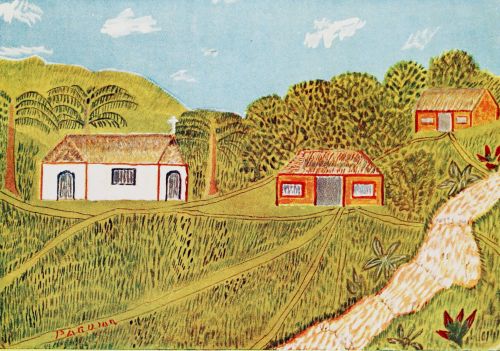
PAROMA VILLAGE, SHOWING THE CHURCH, THE CHIEFS’ HOUSES
AND COCA PLANTATION
which he said was sent to try and get me to turn back; but when they
heard through Cortez that I had got to the River Tipuani the Indians
under their Cacique had been consulted, and had told him to let me cross
over, into their territory. Villarde said that a meeting of the three
hundred head men had been called by the old Cacique Mamani; the first
sitting was to take place next morning at 8 a.m., and he would have to
put to me all the questions the old Chief told him to ask me, and
interpret my reply to him. He told me I would have to prove to their
entire satisfaction that the story circulated about me by the Indians
recently back from La Paz was untrue. He assured me that Villavicencia,
Portugol, the two Fernandez and himself knew quite well I was not a spy
for the Government, but he said it would be difficult to convince the
Indians, many of whom were ready to condemn me without a hearing; but in
the last resort they were absolutely under the control of the Cacique
Mamani and his head men, and he had ordered this meeting.
After dinner we discussed the situation till nearly midnight, and both
came to the conclusion that this malicious story had been circulated by
some of the traders who periodically came down to the river since they
knew that, as soon as the Government and the Challana people had
settled their difficulties, they would not be able to buy rubber for 100
bolivians, and sell it in La Paz for 228 bolivians; the Company that
took over the concession from the Government would soon stop that.
Villarde, of course, knew all about the country, and he told me he had
sold a lot of rubber and gold in the sixteen years that he had been
here, and showed me a shed near his house that was full of rubber. It
appeared that every time he wanted to get away, the Indians themselves
stopped him; they would let him go a certain distance, but then he had
to turn back. Besides, he could not go to La Paz by the Tongo, as the
Government would catch him, and at that time there was a reward of
£2,000 for his capture. The way for him to go if the Indians would let
him, was down the Challana to the Gy Parana and out at Para. He told me
he had made over £40,000.
In the morning I had a pleasant bathe in a lovely cool clear pool in the
river just below Villarde’s house, and after a good breakfast we went
off at 8.30 to the Court House, escorted by some of the head men.
The Court House was a very long shed, with logs of whole trees placed
all round for seats, and a raised platform of logs at one end, where
the old Cacique Mamani sat. Villarde sat on one side of him, and
another man, named Portugol, on the other; beside these were Villarde’s
other lieutenants, the two Fernandez, two more whose names I have
forgotten, and an old man called Jones, who told me he had been in
Challana for forty-two years and had quite forgotten his own language;
he never said why he had come to this out-of-the-way place, nor why he
had remained so long, and of course I never asked him.
There were three hundred Indians congregated in the building; thirty
armed head men kept walking round between the logs and in the centre of
the house to keep order, and there were others keeping order outside.
The sitting lasted until five in the afternoon, when they all dispersed
until eight the next morning. Many questions were put and answered, and
there was a good deal of talking in their language; Villarde
interpreting to me in Spanish, and I answering him in the same language.
When I got back, I had another bathe in the deep pool before dinner.
Next day the conversation was renewed till finally Portugol said to
Villarde in Spanish, “What can we do, Don Lorenzo? We shan’t be able to
contain them much longer.” Villarde then asked me to get up and speak
to them myself. I told him I could only speak Spanish, but he said that
would do very well, as he was there to translate what I said, and if he
did not translate correctly there were forty Indians there who
understood Spanish and would correct him. So I got up and talked to them
for two hours, telling them I was their friend and had come there to do
what I could for them with the Government for their own benefit. I asked
them what good it would do them to kill me, and told them that although
I had heard that they intended to keep me there as a prisoner I came on
alone, because wherever I had been I had heard the Challana Indians
always spoken of as Christians, and I was quite sure they would do me no
harm. I said I had come quite unarmed to see their country and visit
their Chief, having left my revolver, rifle and cartridges with Cortez
at Anhuaqui, and assured them that there was no truth whatever in the
story of my being a spy; the Government of La Paz never sent me or
anybody else there for that purpose. The Cacique then got up and
embraced me, saying I was to consider myself their friend, and could
come and go when I pleased. He told me I was a brave man, because I had
come there alone, in spite of what I had heard about them; that they
respected me and welcomed me, and were ready to listen to the Company’s
proposals, and to tell them, through me, what they thought of them.
I then explained the Challana Company and Government’s suggestions,
which were that five hundred of the inhabitants should pick rubber for
the new Company at the rate of 100 bolivians a quintal placed on the
Tipuani side of the River Challana, or on the other side of the River
Tongo, the payment to be made half in cash and half in goods. Further, I
was to see General Pardo, the President of Bolivia, with a view to his
granting the settlers in Challana their holdings free. The Cacique told
me through Villarde this proposal was approved by him and the settlers
in Challana, and he said that, out of the nine hundred inhabitants of
his country, certainly five hundred at least would pick rubber.
Villarde told me later on that at one time he and the other white men
feared that the situation would become really serious. “I thought,” he
said, “we might be able to save your life, but we were afraid they would
not let you leave the country again. However, the yarn you told them
about your hearing of the Challanas in London and New York as brave
Christians and not savages, and all that, saved you; by keeping your
head, you saved it, and if it had not been for the way you spoke and
the impression you made they would undoubtedly have kept you their
prisoner.”
Once they had decided in my favour, the Indians treated me very well,
and old Mamani presented me with a valuable silver necklace, the buckle
of which showed it to be the work of the Incas.
I subsequently took it home to give to my mother with a few other
things.
Challana is a beautiful country, full of dense forests, wide savannahs
(grass land) covered with long nutritious grass, undulating hills and
valleys, and many rivers and streams. Besides the yams, ochres, ucas and
other vegetables and fruit indigenous to the tropics, rice is
cultivated, as well as more coffee, sugar and coca than is consumed in
the country. The rice grown here is of the very best quality, and the
coffee as good as yungas. Coca yields five per cent of cocaine, and
cinchona bark five per cent of quinine. Maize is grown by every one. The
only things required from the outside world are hardware, drills,
cottons and prints, salt, soap and flour. The Indians make their own
rum, grow their own cattle for beef, and keep pigs, fowls and turkeys;
several have cows and mules. Before I left, I got orders from them
through Villarde and other head men to bring them back goods to the
value of £5,000, to be paid for in rubber, at 100 bols the quintal, and,
besides transporting the rubber to the Challana River free, they even
offered to carry it on from there to Lake Titicaca or La Paz, for 17
bols a quintal. This same rubber easily fetched in La Paz 228 bols per
quintal. Many of them told me that when I came back they would show me
good places for gold washing, and would work for the Company if I was
manager.
Not only is this country surprisingly rich and beautiful, but there is
also plenty of shooting and fishing. The Indians are friendly, and
travelling is not bad after reaching the top of the first steep hill.
The climate on the hill-top at Paroma is not a bad one for the tropics,
and Europeans with energy and capital could make good money and do well
there; but it is not at all suitable for the manual labourer, as the
climate will prevent him from doing as much work in a day as an ordinary
Indian can; besides which, plenty of Indians will work for 2/-a day and
find themselves, or 1/-and be found. This applies really to all the
tropical parts of South America. Many a time I have been asked by
English, French, German and other Europeans what sort of pay is obtained
in these rubber and gold districts, and I have always advised them not
to expect more pay than the Indian worker, unless they are mechanics or
practised electrical drillers, in which case they would have no
difficulty in getting jobs and pay accordingly. The reason one meets so
many English and other Europeans down on their luck in the tropics of
South America, walking from one district to another or one republic to
another with half their clothes worn out, and little or no money in
their pockets, is that they will not realize that the sugar planter,
coffee grower, farmer or owner of rubber or mining concessions will not
pay more than Indian labour will cost them.
The day I left Paroma the Cacique Mamani came to Villarde’s to say
good-bye, and told off Cortez and three men all armed with rifles to
take me back to Challana, calling them up in front of Villarde’s house,
and making them the following speech: “Thomas Cortez, I have decided to
send you with the three armed men to escort our friend to the Tipuani
side of the River Challana. You are to be careful to look after his
welfare in every way: it matters not whether he chooses to take one
week, one month or one year on his way to the Challana, you will be held
responsible by me if he is hurt in any way.”
Before I left Paroma, Villarde gave me a document, stating that I had
visited the Indians at their headquarters, and conferred with them: he
signed it himself and it was witnessed by all the other Chiefs and head
men. Near the River Challana I helped to get one fine specimen of a
man-eating jaguar or tiger while he was chasing wild pig; the skin
measured 8ft. 11ins. in the green, which I afterwards gave to the friend
I trained horses for, M. M. Penny. The Indians gave me two other skins,
and some snake skins, feathered caps, bows and arrows from the Beni and
San Antonio.
Next day I started back with my escort, taking with me a collection of
butterflies, and a little black monkey I had got at Paroma. We did the
sixty miles to Cortez’s place at Anhuaqui in two days. I gave them some
quinine and a few other things, and we parted the best of friends.
Before leaving, Cortez said he had been asked to tell me that when I
returned the settlers on the river were going to present me with a big
nine pole balsa, so that I could go back down the Challana to the big
river, meaning, I expect, the Gy Parana. By the order of the Cacique,
Cortez told off an Indian boy to go with me as far as Tipuani, and look
to the mule and fag for me. Next day they put me across the Challana,
and I stayed for the night with Bartelot, who was down with another bout
of fever.
On the third day we got to Tipuani; on the way back I saw some more of
the pretty yellow-headed birds, with green body, purple wings and
scarlet breasts. I was sorry I had not my gun, or a small bore pea rifle
with me, so that I could get a couple of specimens, for this was the
only place in which they were to be found. Before the boy returned next
day, I made him a present of some tins of sardines and packets of
matches, and a cutlass to take back with him for himself and friends;
money would not have been much use to him, and I did not want to risk
his running amok, as Villarde had told me that drinking to excess was
not permitted in Challana. In fact, while I was there I never saw a
drunken man, nor yet an immoral woman.
Perez still had the fever, Mac was just getting over his attack, and my
man Miguel was still so weak that I had to wait for another two weeks
before he could travel. So I amused myself by bathing in the Tipuani,
shooting a few birds and catching a lot of butterflies. One day when Mac
and I were shooting birds for the pot, we saw a big flock of dark brown
pigeons, which Mac called “the lost tribe.” Sometimes Mac and I panned
out a little gold, and we got nearly four ounces from pay dirt dug out
by Rayo and Charlie in three days’ digging. A few days after I got back
to Tipuani, two half-castes and a boy came to me, and suggested that as
they were going to Sorata or La Paz with rubber for the house of Perez
and Co. it would be safer if they could travel with me, as I was armed
and had two men with me; by travelling all together we were less likely
to be marauded by cut-throats or brigands on the way. I agreed, but said
that I could not start for another week, owing to Miguel’s fever. Rather
than travel alone, they waited for me, but unfortunately, just as Miguel
began to get fit, Richardo, who was with the three small cargo mules,
said he had fever, which meant a few more days’ delay. The half-castes
said they could not wait any longer, for fear Perez might find fault, so
they started off with Perez’ old grey mare and five small mules and
ponies, each carrying a quintal of rubber. Three days after they left, I
said good-bye to Mac and began the return journey to La Paz. As the
rainy season was now over, walking through the forest and admiring the
beautiful tropical plants and ferns was very pleasant. On the second day
after leaving Gritado, the path on the edge of the forest gave way, and
one of my small cargo mules fell and rolled down through tree-ferns and
trees, right into a stream of water below. Unluckily for me, he was the
mule carrying all my photographic plates, sixty fine views, as well as
ten biscuit tins full of butterflies. The mule was not hurt, but many of
the butterflies were spoilt, and when I took the plates to be developed
at Lima later on only three came out a success, the rest were hopelessly
blurred. This is why there are so few photographs in this book.
Some days later we reached the Quillapatuni Pass, which I found much
easier walking up than down. We had, of course, to unload the mules, and
pass everything over the cable at the River Toro, and then let the mules
climb the pass with half loads, which took us two days. We stopped at
the same places as on the way in. At the top of the pass, Miguel had
another attack of fever, and I was delayed three days, during which I
shot two poujil. The shelters there had evidently been occupied within
the last day or so, probably by the two men and boy who had wanted to
travel with me.
A few days later, when we had just reached the foot of the Illyapo
Range, we were astonished to see Perez’ old white mare walking quietly
towards the Tipuani, and behind her in single file the two ponies and
the mules. Nobody was with them, and there was no cargo or pack saddles
on their backs. Three hours afterwards, as we were ascending the high
mountain on the way to Tiquiripaga, we saw frozen blood on the path, and
about half a mile further on just this side of Tiquiripaga we met four
mounted infantry men on mules, who told us that the little boy had met
them the day before and said that his two companions had been murdered
by three bad Indians who persisted in accompanying them for two days.
They had killed the two men and taken the animals that were carrying the
rubber. The boy had gone on to Sorata and given the alarm, and the
criminals were being pursued. Eventually two of them were found with all
the rubber at a small Indian settlement off the road near the foot of
the mountain: they were recognized by the boy and brought to Sorata,
where they were imprisoned and convicted. The third man escaped.
I stayed at Manuel’s place that night, and two days later reached
Sorata. To my surprise, Gunther told me that word had been brought that
I had been killed by the Challana Indians, and that the Government was
about to send Captain Cusicanque with some soldiers from La Paz to see
what had happened. Word was at once sent to General Pardo that I had
arrived and was on my way back to La Paz next day; however, I could not
continue for two days, as Miguel and Ricardo required a rest. Before
leaving I called on Mrs. Villavicencia to give her letters from her
brother and husband, and thanked her for writing them. I told her how
well I had been received by the Cacique and the Challanas. I picked up
my good black mule which I had left here, and rode the rest of the way
to La Paz by easy stages, so as to keep with my men and cargo, getting
there on the third day after leaving Sorata. I was met by Captain
Cusicanque, and taken down at once to see General Pardo, the President,
at his private house. He was very pleasant, and congratulated me, saying
he was very glad I had succeeded in getting to Paroma and back. He told
me I had managed to do what nobody else had been able to do, and said he
would certainly give all the Challana Indians their farms and holdings
free, but would not recognize the others, many of whom had escaped from
justice. He added that if one of his own countrymen had succeeded in
doing what I had done, they would have paid him well, and that I had
fully earned my commission, and he hoped I would get it. When I had
thanked him for his kind remarks, and shown him the paper given me by
Villarde, I weighed myself at the President’s house, and found that
YUNGAS POTTERY RECENTLY DISCOVERED IN BOLIVIA. SAID TO BE
6000 YEARS OLD
after walking 857 miles by the register of the speedometer, besides many
more miles when I did not carry it, riding 210 miles on a mule, and
leading a fairly rough life, I was just 10lbs. less than when I left
Peru, which goes to show that a trip of this sort hurts nobody, so long
as you don’t get the fever. I had enjoyed the journey there and back
very much, although I was not in too happy a frame of mind before the
meeting of the Indians after what Villarde had told me. However, after I
began to talk with them, that feeling soon wore off.
Before returning to Lima, I stayed a few days at La Paz. Miguel was
still having attacks of malaria, so I sent him back to Chili, via Oruro
and Antofogasta. I gave the big tiger skin to Mariano Penny at Oruro:
the length was measured green, not pegged out, 8ft. 11ins. After
crossing Lake Titicaca, I took the Puno Arequipa train and got out at
Jura to spend a week at the baths on the way down. I went on to Arequipa
and Mollendo, and there caught the steamer to Callao, where I arrived on
August 4th, 1904, just about a year after starting. Mr. Beauclerk, the
British Minister, told me I was supposed to have been murdered, and
showed me Lima and Valparaiso papers. I was pleased to see how kindly
they spoke about me, and I shall always be proud of those notices, and
the many kind letters of congratulation from merchants, bank managers,
and editors of newspapers in Chili and Peru which I received. I showed
Villarde’s paper to Mr. A. B. Leguia, the Minister of Hacienda Lima
Peru, afterwards one of the best Presidents Peru ever had, who paid me
his share of the expenses agreed to in the arrangement I had made with
reference to the Challana concession, and wrote to the New Company,
asking them to take over the concession on the terms originally
stipulated.
I then went home, and did not return to Lima until March of the next
year.
When I got there, I found to my disgust that the Company which was to
have bought over the concession from the Challana Rubber Company seemed
to want to back out of it now. I was asked if I would take their
representative from the States to the rubber district of Challana, and
at once said I certainly would, provided we took in at the same time the
goods ordered by the natives to exchange for rubber; otherwise I would
not go. I was not going to go back on my word to Villarde, the Cacique,
and the settlers, and I told them the rubber was there, balled up and
ready for immediate transport, and if they did not see their way to
taking the whole £5,000 worth ordered until they had seen the country
and inhabitants and formed their own opinion we might take £1,000 worth
of things for a start. But nothing came of it, and the whole deal fell
through.
Some few years after my return, a Company was registered called the
Tongo River Rubber Company. It is a simple matter for others to follow
after somebody else has shown the way. The pioneer of any such
undertaking, or the prospector for minerals, seldom derives much benefit
for the hard times he nearly always has to go through, and the reward is
generally reaped by others who would never think of making such ventures
until the ways and means were made clear and easy.