BUNCH-GRASS BILL
Although I had often met him on
the streets of Dawson in '98, I had
not come into hand-shaking contact
with Bunch-grass Bill until my first week at
Nome. Of all the social orders whose members
gathered together in clubs for humane
work during the epidemic of typhoid fever,
the first to organize, besides being the
strongest and most active, was the Odd
Fellows' Club. It was already organized
when I arrived and, as I belonged to the
order, I was present at the second meeting.
The young lawyer who was president of the
Club, taking me around the little circle of
earnest men, brought me to a black-haired,
black-eyed, sturdily-built and singularly
handsome young Irishman by the name of
Billy Murtagh.
"Billy owns and runs the 'Beach Saloon,'
and goes by the name of Bunch-grass Bill,"
introduced our president. "I don't know
how he got into the Odd Fellows, under
rules which bar saloon-keepers and bad
men. But he's in, and we'll not turn him
out of the Club, at least so long as this
distress continues."
Bill made no reply to this rather uncomplimentary
introduction, but shook hands
with Irish heartiness and looked at me with
level gaze. "I've seen you in my saloon at
Dawson," he said.
The others laughed, and the president
chided, "You oughtn't to give a preacher
away like that, Bill."
Taking a closer look at the young man, a
scene at Dawson a year earlier flashed upon
me. I was collecting money to pay the
passage on the steamboat bound down the
Yukon of some poor fellows who were
broken and sick, and who must go "outside"
or die. I made the round of the saloons
and gambling halls, and going into one of
these places was curtly refused by one of the
partners. The other, who was this young
man, came up and quietly said to the cashier,
"Weigh him out two ounces ($32.00)."
"Oh, I remember you now, and your two
ounces," I said to Bill; and to the others,
"I can vouch for his knowing the Second
Degree of the order, at least."
I was made chairman of the Relief Committee
of the Club, and found work a-plenty
cut out for me. Although the members of
the Club did not look with indifference upon
any case of distress, yet its prime object was
to look up and help the sick Odd Fellows.
I prepared a bulletin and tacked it up in the
stores and saloons, directing that any cases
of distress among the members of the order
should be reported to the Committee. As
the typhoid epidemic increased in virulence,
the Club found its hands full.
A day or two after this first meeting, I
was passing Bill's saloon when he called
me in.
"I've just heard of a sick man," he reported,
"and I think he's an Odd Fellow."
Then, after a pause, he added, "But if he
isn't that doesn't make a —— bit of difference."
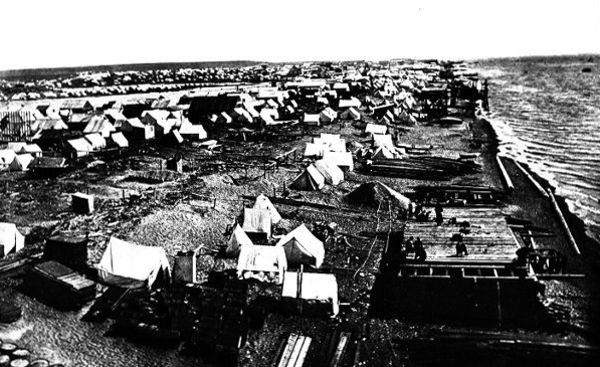
He led the way along the beach for half
a mile or more, to an isolated tent, where
we found the typhoid case. Billy stayed until
he made sure that the man was well cared
for in the charge of friends and a good
physician. Then he took me aside and
slipped a twenty-dollar gold piece into my
hand. "Use that for him," he directed.
The next day I had to raise a hundred and
fifty dollars to send an old miner who was
poor and crippled "outside." I marched at
once to the "Beach Saloon." "Billy," I
said, "this old-timer has blown in all his
dust for booze; and it's up to you who
have got it from him to take care of him
now."
"That's right," he promptly answered.
"There's ten saloons; what would be my
share?"
"An ounce," I replied, passing him the
paper.
He weighed out the gold dust. "Wait a
while before going on. I'll pass the word
down the line," he said.
Half an hour afterwards I stopped again
at his door. "They're all ready," reported
Bill. "If any of them guys don't come
across, just tell me."
They all "came across," and thereafter,
until I left Nome, all the saloon-keepers met
every demand I made upon them without
question. When a man had been impoverished
or made sick through drink I went to
the saloons, only, for his relief. In
other cases I made a general canvass.
When collecting money for church purposes
I went to everybody, except the saloon-keepers
and their following.
The day before my second meeting with
the Odd Fellows' Club—a rainy, blustering
day—I came to Bunch-grass Bill with a
greater demand.
"It is you I want this time, Billy, not just
your money," I said. "There is a sick Odd
Fellow in a tent almost a mile from here.
He is alone and lying in a puddle of water.
Get your gum-boots and find three or four
other stout men and come with me."
Bill agreed at once, found a man to tend
his bar, secured a squad of strong and willing
men, a stretcher from the army post and
a good physician and went with me on the
errand of mercy. He worked all day in the
mud and rain. He carried the sick man to
the warehouse which we had turned into a
temporary hospital, visited all the stores in
an attempt to find mattresses, and, failing
in that, bought eight large reindeer skins
and piled them on the floor for a bed, bought
underwear, dry blankets and other comforts
for the sick man, and laid in a supply of
delicacies for the use of the hospital. In all,
he spent over fifty dollars and a whole day
of strenuous work upon the case.
When I asked him at dusk if he were not
tired he laughed: "Never had a better time
in all my life."
That night was the regular weekly meeting
of the Club. I made my report, which
was quite long, and mentioned many distressing
cases, showing an alarming increase
of the typhoid. Then I asked for a rotary
relief committee of three to be chosen at
every other meeting, and a permanent relief
committee of two.
"I've found the biggest-hearted man in all
Alaska," I said. "His business and mine
are not quite the same. In fact I have been
all my life fighting saloons and saloon-keepers,
and I expect to keep on fighting
them until I die. But this man's heart of
love for his fellow-men fights his business
harder than I can."
Then I related some of the things Billy
had done during the past week, and ended
my speech by asking that he be put on the
permanent relief committee with me. "We
two will find the sick and cut out the work
for the rest of you," I promised.
The Club applauded, much to the confusion
of Bill, who tried his best to shrink out
of sight. One of the boys reported next
morning.
"Say, Doctor," he began, "you sure
scared Bunch-grass Bill near to death last
night. Tickled, too. He asked us all to
come in and have one on him. He doesn't
know anything else to do when he feels
good. 'That's a new one on me,' he said.
'I never had anything to do with a preacher
in my life. Didn't like 'em. Kept shy of
'em. But if Father Young sees fit to come
into my saloon—and he's in it every day—I'll
go with him wherever he wants me to
go—even if it's to his church.'"
That touched me, for I could sense something
of the sacrifice it would involve. It
would be far easier for Bill to start on a
three-thousand-mile winter mush on snow-shoes,
over unbroken trails, than to step inside
of a Protestant meeting-house.
From that time on, Bill was my right
hand. As the number of typhoid victims increased,
he made his saloon an intelligence
office, finding and reporting to me all new
cases. The example of the Odd Fellows
stimulated the various social orders represented
in the camp—the Masons, Knights
of Pythias, Elks, Eagles, and others—to a
like humane work; and Bill looked up their
sick members and reported to their committees.
He saw that all the sick had medical
attention, and guaranteed the payment
of scores of doctor's bills. Each steamboat
that left Nome for the "outside" carried a
number of convalescents and broken-down
and moneyless men, and funds had to be
raised for their passage. Bill headed nearly
all of these subscription lists, as well as those
for fitting up the four temporary hospitals
we opened and filled with sick men.
Being for over six weeks the only clergyman
in that whole region, I conducted all
the funerals. One week I had eleven—all
typhoid cases. Bill attended them all, looking
after the digging of the graves and making
coffins, and often acting as undertaker.
Now, I am not setting up my saloon friend
as a saint. Quite the contrary. I suppose
he had been guilty of every crime mentioned
in the Decalogue. He had never known
any home life, but had knocked about from
camp to camp of the western frontiers ever
since boyhood. His ideas of morality, therefore,
were very vague. He was said to have
been "run out" of several towns in Montana
and Idaho. He had a violent temper
and, as the phrase went, was "quick on the
trigger." Rumor said that he had the blood
of more than one man on his hands; although
it was claimed, in every case, that he
had not sought the quarrel. He sold whiskey
and drank it, gambled and swore habitually
without a thought of any of these things
being wrong. He was simply an uncultured,
ignorant, rough-and-ready, Irish-American
backwoodsman.
But to those of us in the raw camp of
Nome who witnessed Bill's untiring kindness
and self-sacrifice during those weeks of
distress, his faults faded into the background
behind the light of his many good deeds.
St. Peter says, "Charity covers a multitude
of sins," and surely Bill's charity
"abounded" overwhelmingly, putting out
of sight much of the evil in his life.
As for me, I shall always think of him as
one of the most loyal, devoted friends I ever
had, and the saver of my life. For after
seven weeks of most strenuous and wearing
work, I was suddenly stricken down with
the typhoid myself. The blow came when
I was fairly drowned in the multitude of my
duties. I was raising the money to send
out on the steamboat four or five men who
must leave the country or die—poor fellows
whose vitality was so low that they
could not combat the cold and storms of a
Nome winter. I was also preparing another
warehouse-hospital. So great was the
demand for space for the care of the sick
that I had felt compelled to take into my own
ten-by-twelve tent three men sick with the
disease. So crowded was the tent that I
had to sleep under the bed of one of them.
Billy Murtagh and others of the Odd Fellows'
Club warned me against thus exposing
myself to the infection, but there seemed
to be no other way. Billy brought me all
his remaining Apollinaris water that I might
not have to drink the impure seepage of the
tundra. Some of the brothers carried me
pails of water from the one well which had
been recently put down.
While I was in the midst of the canvass
for funds, and in the bustle of preparation
for the departure of the last steamboats, I
had a terrific headache for several days. I
was besieged day and night by friends of
sick men for places to put the stricken ones
where they could be cared for. The life of
a number of these men seemed to depend
on my keeping on my feet. I had no time
to be sick. I kept away from Billy and my
other friends, for fear they might forcibly
interfere.
But one of the Odd Fellows saw me as I
was coming out of a store with a subscription
paper in my hand. He looked at me
for a moment and hurried to the "Beach
Saloon."
"Bill," he shouted, "get a doctor, quick,
and go to the parson. I saw him just now
staggering along with his face as red as fire
and his hand to his head. He's got the
fever, sure."
Billy came running down the beach with
Dr. Davy at his heels and caught me as I
was entering my tent. Without ceremony
they picked up the sick man who was in my
cot and carried him to another tent near by.
Then, in spite of my protests, they undressed
me and laid me in my blankets. I was half
delirious and stubborn. I fought them.
"This is all nonsense, Doctor," I protested.
"I have only a headache. There
is no time to fool away. These men must
go out on this steamboat, and the money is
not raised. Let me alone."
Dr. Davy finished his examination and
turned to Bunch-grass Bill. "He has a
bad case of typhoid," was his verdict, "and
ought to have been in bed three or four days
ago. Find a house to put him in and a
woman to nurse him."
Bill had one of the softest and sweetest
voices I ever heard. He came to me and
laid his cool hand on my forehead. "Don't
you worry about those men, Father," he said
gently. "I'll attend to that. Now who do
you want to nurse you?"
"Mrs. Perrigo," I replied. "She has just
built a new cabin. I helped her with it.
Her husband is recovering from the fever."
Soon the good woman was in my tent,
eager to serve. I was carried through a
driving snow-storm to her cabin. It was a
rude affair built of rough boards set upright
and battened with narrow, half-inch strips.
A single thickness of building-paper poorly
supplemented the inch boards. But cold
and uncomfortable as it was, it was the only
available shelter. I had them bring my tent
and make a storm-shed of it in front of the
door. There, for more than two months, I
was to lie helpless.
My friends told me afterwards of the
consternation that my illness caused. I was
chairman of all the general relief committees—those
of the town council, the citizens,
the mission, the Odd Fellows. That
the leader should thus be laid aside seemed a
greater calamity than was actually the case.
For Mr. Wirt of the Congregational Church
arrived with lumber to erect a hospital, and
Raymond Robins, a young man of great
earnestness and talent, who has since arisen
to national prominence, came with him to
help in Christian work.
The night after I was taken to the Perrigo
cabin, there was a meeting of the Odd Fellows'
Club. Billy Murtagh was present and
made his first public speech. As my illness
and the general situation was discussed he
rose to his feet, the tears streaming down
his face. He seemed unconscious of them—or,
at least, unashamed.
"Fellers," he faltered, "I'm hard hit.
This gets me where I live. Now I'll tell you
this: you fellers can look after the other sick
folks, and call on me when you need any
money. But I want you to leave Father
Young to me. I've adopted him. He's my
father. All I've got is his. If there's anything
in this camp he needs, he's goin' to
have it."
Ah, that long, desperate fight for life!
The stunning pain in my head, the high
fever, the delirium, the nervous terror, the
deadly weakness, the emaciation, the chills
and nausea! I was badly handicapped in
my fight. The two months of wearing work
and strain which preceded my illness had
exhausted me, body and mind—there was
no vital reserve to draw upon.
I was in a little, cold shanty, twelve feet
square, crowded and unhealthy. Two people
besides myself must live in that tiny
room—sleep there, cook there. The savage
arctic winter raged against us, howling his
vengeance upon our impudence in thus
braving him, unprepared. He made every
nail-head inside the house a knob of frost.
When my blankets, damp with the steam of
cooking, touched the wall, he clamped them
so tight one must tear the fabric in pulling
it free. He made my clothing, stowed under
the cot, a solid lump of ice. He asphyxiated
us with foul gases when the door was
closed, and filled the room instantly with
fine snow from the condensation of the
moisture when it was opened. He charged
constantly upon the thin shell of the house
with his high October and November winds,
shaking it wildly and threatening to bowl it
over. He drove, in horizontal sheets, the
fine, flour-like snow, shooting it through
batten-crevice, door-crack and keyhole;
and, finding myriad small apertures in the
shake roof, sifted it down upon my face.
He piled it in fantastic whirls around the
house, selecting the side on which our one
small window was, to bank it highest, so that
he might shut out our light. He sent the
red spirit in the thermometer tube down,
down, down—ten below zero, twenty, thirty
when it stormed, and forty, fifty, sixty below
when it was still, and the black death-mist
brooded over the icy wastes and men
breathed ice-splinters instead of air.
The fuel supply for the Nome camp was
very poor and scanty. Men were digging
old, sodden logs of driftwood out of the
snow, and hauling this sorry fire-wood
twenty miles by hand. Coal was scarce and
sold by the ton for $150.00, or by the bucket
for ten cents a pound.
Having had experience with typhoid
epidemics and other sicknesses in the Klondike
Stampede, I had laid in a good supply
of nice foods for the sick, such as malted
milk, the best brands of condensed milk,
tapioca, farina, and other delicacies; but all
of these had been given away before my own
illness, and there was a scarcity of such
articles in the stores.
But my friends, women and men,—indeed,
everybody in the camp seemed interested
in me and anxious to do something for me—arose
to meet all these emergencies and
"ministered to mine infirmities." The Odd
Fellows supplemented the efforts of the
convalescent, but still shaky Perrigo, and cut
the wind-packed snow into bricks and built
it around the house, until it looked like a
veritable Eskimo igloo. It was much
warmer after this was done.
The doctors at Nome all prescribed a diet
of milk and whiskey for their fever patients.
Upon the news of my illness circulating in
the camp a dozen bottles of different brands
were at once sent to me. Billy came, examined,
smelled at, and tasted these liquors,
with the air of an expert. Then he bundled
all the bottles into a gunny sack and carried
them away, saying, "He's not going to have
any of this dope. I've got some of the pure
stuff, made in Ireland." And he brought
me an ample supply for all my needs, and a
gallon of pure alcohol for sponge-baths.
The Odd Fellows organized wood-cutting
"bees" for my benefit, and daily carried
water from the well for Mrs. Perrigo's use.
The women collected food and milk from
their own stores and those of others, and
brought them to me. The fellowship of
the wilderness, the finest in the world, had
its full exercise for my benefit there at
Nome. I doubt if there was a person in all
that great camp who would not have given
me cheerfully his last can of milk.
As the fever progressed and my condition
grew more serious, the daily visitors
were restricted to two—Mrs. Strong and
Bunch-grass Bill. The lady looked after
matters of business, my letters, and information
about other sick people. Billy, with
his soft, low voice and gentle manner,
hovered over me, sitting for hours at my
bedside, lifting me in his two big hands with
infinite care and deftness. Never did son
care for father with more tender solicitude
and fuller devotion than did this Irish
Catholic saloon-keeper, this "bad man" of
the western frontier, for me—a Protestant
preacher.
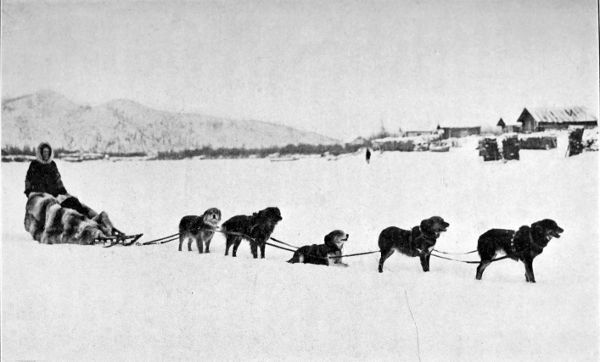
There were many malamute dogs at
Nome, great, beautiful, wolf-like beasts, and
the "malamute chorus" was much in evidence
in the late hours of the night. One,
in particular, which was tied up not far from
Perrigo's cabin, tuned up regularly every
morning at three o'clock with his high-pitched
tremolo, waking every dog within
a mile, until all were howling, and keeping
it up till daylight. There was no sleep possible
for me while this concert was in progress,
and I used to lie awake for hours, waiting
fearfully for the leader to begin, and to
cower in my robes with nervous chills
coursing down my spine at every renewal
of the long-drawn cadence, "Oo-o-o-o-o,
oo-o-o-o-o, ow, ow, ow, ow."
My fever would always rise with the
commencement of this discordant chorus and
increase as long as it continued, and the
doctor on his morning visit would find me
exhausted and trembling. The words of
Clarence would chase each other through
my brain:
"With that, methought, a legion of foul fiends
Environ'd me, and howled in mine ears
Such hideous cries, that, with the very noise
I trembling wak'd, and, for a season after
Could not believe but what I was in hell."
Mrs. Perrigo told Billy of the nuisance.
He stayed up that night until the leading
canine musician shrieked his solo to the
moon. He followed up the sound until he
found the dog, roused the grumbling owner,
paid the high price asked for the animal, led
him down the beach half a mile, and shot
him.
An errand of an opposite character also
fell to Billy's lot. The barracks which
housed a squadron of United States soldiers
was less than a block from the cabin in
which I lay. Every night at eleven o'clock
a bugle of remarkable sweetness and
expression would blow "Taps." I would
listen for the soothing melody, and when it
would sound I would turn over in my robe
and obey its command, "Go-o-o to sle-e-ep."
Lieutenant Craig, the commander of the
post, ordered the discontinuance of "Taps,"
thinking it would disturb me and the other
sick people. That night I waited, as usual,
for the "good-night" bugle, and when it did
not sound I grew anxious and distraught.
I thought my watch was wrong or the bugler
must be sick. I grew excited, restless and
feverish, and passed a sleepless night, missing
my accustomed lullaby. We told Billy;
he went to see the Lieutenant, and the next
night the lovely, soothing phrase sounded
forth on the still night air, and I slept.
Taps.
Listen
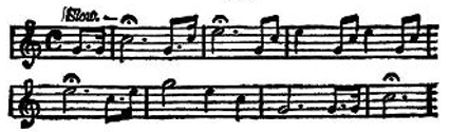
Another cause of nervousness and anxiety
arose, requiring the efforts of both Mrs.
Strong and Billy Murtagh to solve the difficulty.
I was paying my nurse, Mrs. Perrigo,
five dollars a day, which was almost
all she and her husband had to live on.
They had been eating for a year and a half
a food outfit designed for only a single
season, and there was but little of it left.
Mr. Perrigo, who was a Yankee tintype-picture
peddler and knew no other trade,
had tried his best to be a gold-miner; but,
in common with the rest of the forlorn
"Kobuckers," had made nothing at all.
His wife, who had been a bookkeeper in
Boston, valiantly took up the trades of waitress,
washerwoman and cook in the Arctic
wilderness, but there was but little money in
that disappointed crowd. Almost immediately
after landing on the "golden sands"
of Nome in August Mr. Perrigo was stricken
with the fever. With the fearful prices that
prevailed, my five dollars a day was little
enough to feed them and meet the monthly
payments on their house.
I had accumulated $125.00—mostly wedding
fees—when I was taken sick. It
melted away like a spoonful of sugar in a
cup of hot coffee. Every Monday I must
have thirty-five dollars for my faithful nurse.
I placed in Mrs. Strong's hands for sale my
Parker shotgun, my typewriter, my gold-scales,
my extra overcoat, all gifts from
friends. She got good prices for them, and
for the few articles I could spare from my
food supply—but still the phantom weekly
payment menaced me. When I closed my
eyes the figures—$35.00—big and lurid—stared
at me, and in my delirious dreams became
red goblins, mocking me.
A splendid woman, member of the church
which assumed my salary, had given me two
beautiful wolf robes. I was lying in the
heavier one. I delivered the other to Mrs.
Strong. "Sell it for me," I requested.
"You ought to get fifty or sixty dollars
for it."
A week passed—then another. Mrs.
Strong reported she "was holding the robe
for a higher price." The crisis I had dreaded
had arrived. My money was gone. I
had none to meet next Monday's payment.
"Sell the robe for what it will bring," I
directed Mrs. Strong. "I must have the
money."
"I'll sell it on Saturday," she promised.
Monday morning Mrs. Strong marched in
with a large canvas money-bag in her hand.
With Mrs. Perrigo's assistance she counted
out the money, which was mostly in silver
coins. Then she wrote in large figures,
"$158.50," and pinned the paper on the wall
by my head.
"Where on earth did you get that
money?" I cried.
"Why, for the robe, of course."
"You never got all that for it."
"Yes, I did," she affirmed.
Then the truth dawned upon me. "Mrs.
Strong!" I exclaimed, "you raffled the
robe!"
"Yes," she laughed. "What are you going
to do about it?"
Then she explained. Finding it impossible
to get a fair price for the fur blanket
she and Bunch-grass Bill had laid their
heads together. They knew that I would
not consent to a raffle, so they kept the
matter quiet. Bill displayed the robe in
front of his saloon. Shares were offered at
fifty cents each. My lady friends of the
mission sold tickets. Bill bought fifty and
others of my friends did almost as well.
Their purpose if they won the robe was to
give it back to me.
What could I do? To rebuke their kindly
deception would be ungracious indeed.
With brimming eyes I thanked my friends,
and Mrs. Perrigo got her money.
But the greatest of Bunch-grass Bill's
many acts of kindness towards me remains
to be told. As Dr. Davy had said from the
first, mine was "a bad case." I had seven
and a half weeks of high fever before it
broke, whereas the usual limit of fever was
three weeks. I reached the extreme of
emaciation and weakness. I could hardly
lift my hand. When they bundled me in a
blanket like a baby and hung me on the hook
of a big steelyard I weighed sixty pounds!
I was long in the Valley of the Shadow of
Death and reached its utmost boundary,
until the very waters of the dark river
lapped my feet.
"Well, Bill," said Dr. Davy with a sigh,
as he was returning one morning from his
call upon me, and stopped, as was his custom,
to report to the "Beach Saloon," "I'm
afraid it's about over. I don't think Dr.
Young can last much longer. He can retain
nothing on his stomach. We've tried all the
brands of condensed milk in the camp to no
avail. Everything comes up the instant it
is swallowed. There are many internal
complications, and he may go off any hour in
one of those deathly convulsive chills."
"Big Wilbur," who reported the scene
to me afterwards, said that Bill's face "went
white as chalk, and then flushed red as fire."
He jumped at the doctor as though he were
going to assault him.
"By God," he cried, "he's not goin' to
die. We'll not let him, Doc. See here:
When I had the fever at Dawson, what
saved me was cow's milk. Now, there's a
cow here. You come with me, and we'll go
see her."
"That cow," explained Wilbur, "was a
wonderful animal. Her owner sold twenty
gallons of milk a day from her, and she
didn't look as if she gave one. Bill knew the
owner was doping the milk with condensed
milk and corn-starch and water and other
stuff. So he strapped on his two big guns.
He's great for bluff, is Bill. Doc. and I
went along to see the fun. We found the
owner in the stable 'tending to his cow.
Bill didn't beat around the bush any.
"'You look here' he said. 'Your cow's
givin' too darned much milk. Now this
man I want it for is my father, an' he's got
enough microbes in him already. Doc. here,
analyzed your milk; didn't you, Doc?' (Doc.
Davy was game, and nodded.) 'He says
you put tundra water and all kinds of dope
in it. I'm goin' to keep tab on you, an' if
you dope my milk—well, you know me! It
don't make no difference what you charge—a
dollar a bottle or five dollars a bottle—my
father's got to have pure milk. Understand?'"
For three months Billy went to the stable
every day and superintended the milking.
At a cost to him, sometimes, of three dollars
for a pint bottle, and never less than a
dollar a bottle, the "bad man" brought me
every day, with his own hands, a bottle of
fresh milk. When Bill and the doctor
came in with that first bottle Mrs. Perrigo
carefully raised my head and gave me a
brimming glass of the rich milk. I drank it
all and dropped off to sleep. I needed no
more whiskey. The turning point of my
illness was that glass of cow's milk. Bill's
big bluff saved my life!
To show the rough, yet fine sentiment of
the man, let me tell one last word about the
lone cow. She went dry before spring, and,
as the camp was crazy for fresh meat, the
owner butchered her. One of the Odd Fellows
told me. Said he, "Bill just went wild
when he heard of it, and we had all we could
do to keep him from going gunning for the
man who killed the cow that saved your life.
Why, that man would lay down his life for
you, and laugh while he was doin' it."
I would I could tell of Bunch-grass Bill's
conversion and entire reformation, but this
is a true story, and I never heard that he
ever got so far as that. This much, however,
I am proud to tell. One day in the
spring of 1900, when the army of gold-seekers
was beginning to land on the
"Golden Beach," I was standing with Bill
near his saloon. On a sudden impulse I
spoke to him.
"Billy," I said, "I love you, but I don't
like your business. It's a bad business.
See what it has done to lots of good fellows
around here. You are too big for that
game. I wish you'd drop it and do something
that's clean—that doesn't hurt anybody."
Bill made no reply, and I supposed my
words had been fruitless. But in a few weeks
one of my friends informed me that Bill had
sold out and had gone to gold-mining.
"That's good!" I exclaimed. "Did he
give any reason?"
"Yes," the man replied, "Bill said you
told him to."
When I was returning to Alaska in 1901,
I bought a nice buffalo smoking-set at the
Pan-American Exposition and took it to
Alaska for Bunch-grass Bill. I did not see
him, as he was mining at a distance, but I
heard of his pride and pleasure as he displayed
the gift and talked affectionately of
"Father Young." He left Alaska that
summer, and I have heard vaguely of his
presence in the Nevada gold-fields. But
wherever he is, I pray that God may bless
and save the Irish saloon-keeper, who loved
me and saved my life.