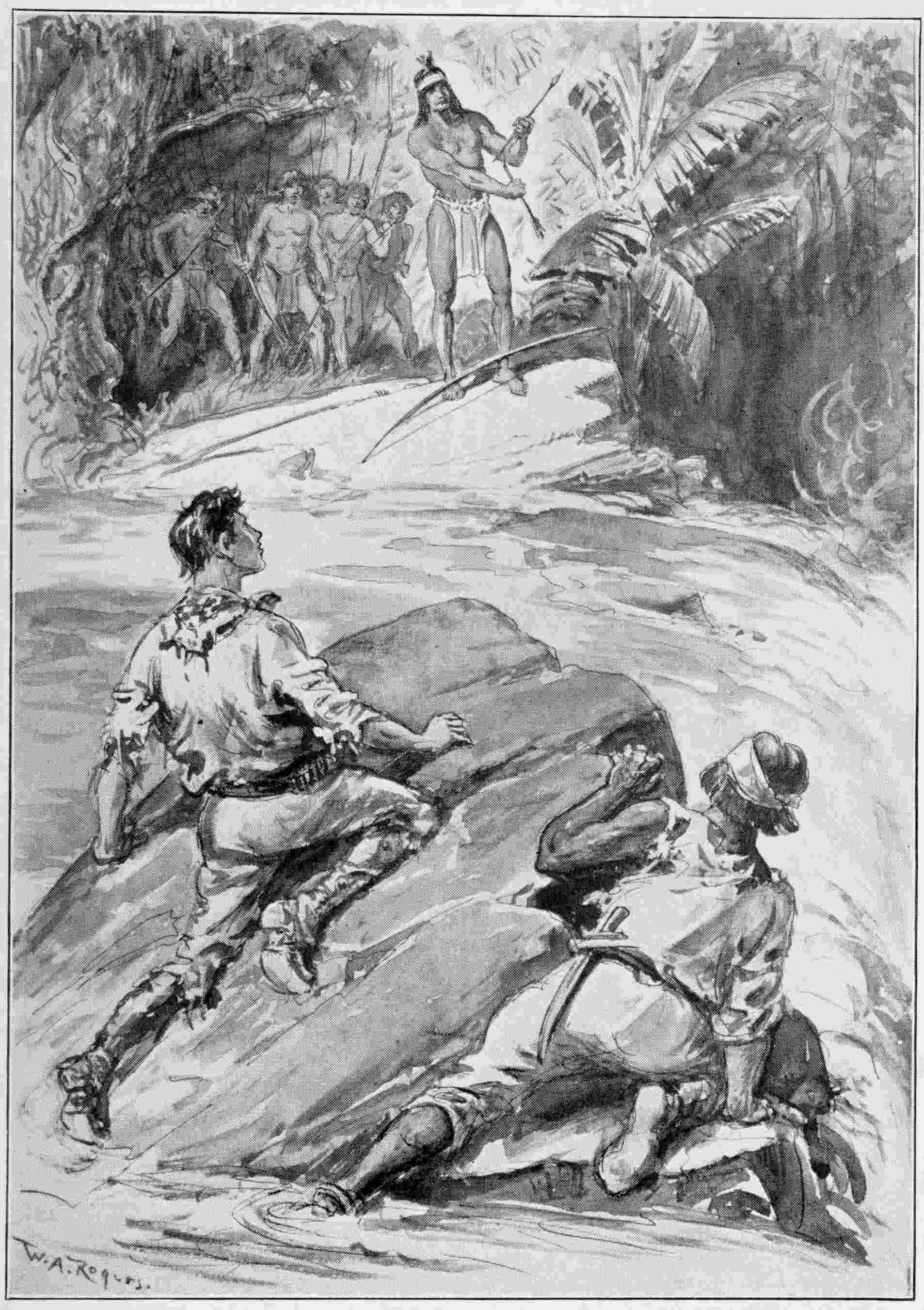
Most surprised of all to see the large party of visitors was Dom Carlos.
At first he was at a loss as to how to express his feelings. The weeks
that had elapsed since David’s disappearance had brought him no end of
worry, for there was no doubt but that he would be held responsible. He
had delayed sending word of the disappearance to Las Palmas in the hope
that the missing man would show up. And now that he had arrived and was
safely in their midst, the old feeling of tyranny came back with
increased intensity.
“So you are back at last!” he said gruffly. “What excuse have you for
going away and staying so long without my permission? Don’t you know
that the collecting season is almost over and you have wasted your time?
You have accomplished nothing.”
David was taken aback by this reception.
“I was lost,” he returned. “I was never so eager to get anywhere as to
this place, but I couldn’t find the way.”
“And you, Miguel? You were lost, too, I suppose?” sarcastically.
“Yes, I was lost, too. The fever is to blame,” Miguel replied, while his
eyes snapped.
“You can tell that to the patron when we get to the ranch. And what do
these savages want?”
“They asked for nothing. They saved us from the river and brought us
home. They are our friends and I invited them to come,” David said.
“Well, I’ll invite them to go now. I don’t want them here. Tell them to
go and to be quick about it.”
“No, they are not going until I can prove to them that there is at least
one white man in the world,” David snapped with determination. “I’m
going to the storehouse for some presents for them.”
“You are?” The foreman feigned surprise. “And who is going to be
responsible? Your account is overdrawn now.”
“I’ll take care of that part, so don’t you worry. Rice said I could draw
anything I need and I am going to do it.”
“Look here,” and the burly foreman stepped forward to block his path.
“I’m the boss. You will give nothing to these savages and I will chase
them away.”
This speech angered David.
“They are my friends and they will be yours, too, if you let them. Think
of what it will mean to have them on your side instead of fighting
against you. It is the chance of a lifetime to make peace and you ought
to jump at it. Now, I am going to make good my promise to them.”
The foreman leaped toward David with a shout of rage. The latter was no
match for the big Brazilian, but he stood still waiting for the onrush
until a giant form stepped in front of him. It was the leader of the
Indians who stood like a statue between David and Dom Carlos.
This interference was too much for the foreman.
“I see he is your friend,” he panted, “and I will have nothing to do
with a savage. Go ahead, get the things. But remember, you will have to
account to the boss for this whole thing.”
David said nothing, but some of the men who were watching the encounter,
whispered among themselves. They had noted how ready their leader was to
attack a man smaller than himself and how quickly he stopped when the
giant Indian intervened.
“Come,” David said to the brown man. “Come with me. The others can wait
here.”
Together they went to the supply hut where the chief was invited to take
his choice of the articles in stock. He selected a number of knives,
hatchets and a few other objects he desired, after which David presented
him with several pounds of tobacco, which he appreciated more than the
other gifts.
The Indians prepared to take their departure soon after, but not until
the whole party had exchanged pledges of friendship with the Brazilians.
Instead of shaking hands upon leaving they patted one another on the
back, but when the chief came to Dom Carlos he walked haughtily past and
as he did so he placed an arrow, point up, in the ground at his feet.
That meant that he was an enemy of the Indians who would thereafter
attack him on sight.
Then the column formed and vanished in the forest.
That night David and Miguel had little time for sleep. The men crowded
about them and urged them to repeat again and again the story of their
adventures. It was all so strange, so seemingly impossible they could
not comprehend it fully, but they at no time doubted the narrative of
their companions.
“You got here just in time,” one of them said finally. “We start back in
a week or less.”
“To the ranch?” David asked eagerly.
“Yes. The rains are overdue. When they begin they will come hard. We’re
getting ready to leave now.”
“That sounds too good to be true. We can’t start too soon to suit me.”
The next day he saw what the preparations consisted of. The large balls
of rubber were being carried to the riverbank. Thick ropes were passed
through the holes in the center of the balls which had been left by the
poles on which the latex was poured while being smoked. The number on
the different strings varied, but when sufficient had been threaded the
ends of the rope were tied together, forming a huge “necklace.” These,
in turn, were pushed into the water, one within the other, so they
formed groups of concentric rings known as rubber rafts.
It required a number of days to complete all the arrangements. The men
packed their belongings and the utensils used by them in their work and
placed them aboard the launch. The Indians who had been engaged at the
camp had already taken their departure in canoes for their homes far up
the river. The camp began to take on a deserted appearance and it was
not difficult to picture what the place would look like a few weeks
hence, when the rising water would cover the site and sweep away the
huts and every vestige of human occupancy.
Not all of the men were to return to the ranch in the launch. About half
their number had been selected to follow the rubber rafts as they
floated down the river. When the start was made two men were sent in
each canoe; their duty was to drift with the raft by day and by night,
to guide it with poles into the proper channels, and to tie it up when
it reached its destination.
During the hours of daylight a flag was placed in the center ball; at
night a lantern took its place, making it easy for the men to follow the
raft in the darkness.
This work required experienced men, so David was not chosen to be one of
them. He went on the launch on the day following the departure of the
rubber fleet.
The first rain of the season was falling when the craft nosed her way
into the stream and the men were glad to leave the now gloomy
hinterland, for it would be many weeks before the sodden skies cleared,
except for brief intervals, and the place once more became habitable.
The trip down the river was without incident of note. Each day the rain
fell for longer periods until there were but infrequent lulls in the
heavy downpours. The nights, however, were almost invariably clear, but
within another month there would be no respite either day or night from
the roaring deluge.
The river rose rapidly, covering rocks and encroaching upon the forest;
soon it would assume the aspect of a vast, muddy lake and the picture of
heartrending desolation would be complete.
* * * * *
Rice was at the landing when the launch drew up and was made fast. David
had looked forward to a word of greeting, or at least a friendly glance,
and his disappointment was keen when he found himself treated with the
same indifference that characterized the owner’s attitude toward all the
men. His one concern seemed to be with the rubber crop and after asking
a few questions of Dom Carlos the two went into the office structure,
leaving the men to unload the launch.
David saw nothing more of his employer until several days later, when
the rubber rafts began to arrive. Then he remained at the waterfront
almost constantly, appraising and commenting on the season’s catch.
The cattle had to be brought from the outlying feeding-grounds with the
coming of the rains; a great part of the range would soon become
inundated. Also, there were numerous other things to be done, such as
branding the calves and counting and segregating the animals of
different ages and intended for different purposes.
David, of course, confidently expected that he would be permitted to
participate in this work. It was the thing for which he had come to the
ranch and in anticipation of which he had endured all the hardships and
discouragements that had been thrust into his path. But once again he
was disappointed.
One by one the men were selected for the round-up and sent on their
various missions. And when the last place had been filled, those who
remained were put to work weighing the rubber and marking it for
shipment.
David awaited a favorable opportunity to protest against this treatment
to Dom Carlos. The latter gave him a look of contempt.
“You’re lucky to be doing anything,” he said in reply. “When I told the
patron all the things you are guilty of he came near sending you down
the river under guard. But he decided to let you work out your debt;
after that you’re going on the first launch that leaves.”
“If that’s the case I might as well leave right now,” David replied
hotly.
“Not until you’ve squared your account. You’ll work that out first, and
it will take a long time, too.”
David said nothing more, but quickly formed a plan of action. He would
venture to speak to Rice if there was a possible chance of doing so; if
not, he simply had to make the best of a very bad situation.
Soon the cattle began to arrive, in small groups and in droves that
numbered hundreds. They were a wild lot and David was surprised that
there were so many of them. As he watched the mounted herders, wielding
their ropes, riding frantically and shouting, he longed to be among
them. Instead, he carried the heavy balls of rubber to the weighing shed
and back again to the storehouse, after they had been weighed and
checked.
However, in the evenings, when the day’s hard labor was over, he visited
the corrals accompanied by Miguel and eagerly talked about the things he
would like to do and would do—elsewhere, if the opportunity did not
come at Las Palmas.
The more he thought of the matter, the more impatient he became. And
finally, unable longer to endure in silence, he decided to go to Rice to
settle the issue. Scarcely had he determined on this course than the
ranchman sent for him. He hastened to the office in response to the
summons, breathless with eagerness and anticipation.
A gruff “Enter” came in answer to his knock. He went in. Rice was at the
table, his back turned toward the door and he continued writing fully
five minutes longer before turning around. In the meantime, David’s
enthusiasm and ardor cooled considerably. He doubted now that he had
been called for a good purpose.
“Don’t say a word,” Rice greeted him swinging suddenly in his chair.
“Listen to what I say. I’ve heard all about everything, and I know just
where everybody stands.”
David had no idea what the man was talking about, but kept his mouth
shut. After a moment the ranchman continued:
“Somebody is going to have a surprise coming to him soon and it won’t
be a pleasant one either. What I mean is this. Cattle have been
disappearing. Two hundred yearlings are gone. They were stolen. Now,
that ought to be enough. Be mighty careful because we’ll find out the
guilty one and then——. That’s all. Get out.”
David was stunned by this information. At first he could not fully
comprehend the meaning of the words he had just heard. Cattle had been
stolen! Two hundred of them! What was the man driving at? Surely, he did
not suspect him of being guilty of the deed. Why should he do such a
thing? What could he do with the cattle even if he had taken them? These
and similar thoughts raced through his mind in a bewildering stream,
followed by bitter resentment that the subject had been mentioned to him
at all. He had not been accused directly, it is true; but there was the
insinuation of guilt or suspicion of it. His first impulse was to return
to Rice instantly and to tell him what he thought of the whole outfit
and then to leave, regardless of the consequences. He had succeeded in
getting there alone and unaided; he could go away in the same manner.
But after a moment’s consideration he decided to do nothing of the kind;
a better plan had suggested itself. He would catch the thief and thereby
clear his own name. Not until then would he be justified in leaving. To
go now might be interpreted as an admission of guilt.
That night he conversed long and seriously with Miguel. And the next day
the latter, who was supposed to be in the thick of the round-up but
whose absence was not missed in the excitement of the work, was far
away, engaged in another enterprise.
He reported fully to David that night, as they made their customary
visit to the corrals.
“I found it,” he said, so soon as they were out of hearing of the men in
the huts. “I know it’s the trail made by the missing cattle, because the
tracks are all the same size.”
David was inclined to be skeptical.
“If you could find it, why couldn’t the boss?” he asked. “He has been
looking all day for some clue that would lead him to the recovery of his
property.”
“He didn’t look in the right place. First, the cattle were driven
through the marsh so as to cover their trail. Then they went through
that wide patch of forest over there,” pointing to a black clump of
trees far in the distance, “and when they had passed through that they
were several kilometers away—far enough to make picking up their tracks
a difficult matter.”
“That’s great! What else did you find out?” David said.
“There was a strange man in the corrals this evening when I got back. He
was talking to Dom Carlos.”
“I wonder if he is still here!”
“No! He left a short while after I came and he rode through the marsh
and into the woods.”
“Good! That’s all we need to know.”
It was two days later that Miguel stole into the hut where David was
perspiring over his task in the middle of the afternoon. A new lot of
cattle had been driven into the corrals that morning.
“The stranger is here again,” he said, “and Dom Carlos is showing him
the pen of two-year-olds.”
“We’ll see tonight,” David returned; it was hard for him to restrain his
excitement. “Have two horses ready. Get them any way you can, but be
sure to have them. I’ll have the other things.”
Miguel returned to his work and David continued with his task; the hours
seemed like days.
It was dark when Miguel came to announce that the horses were waiting,
and the two lost no time in going to the place where they had been tied.
Soon the moon would rise and that would mean their discovery and the
spoiling of their plan, so there was need of haste.
The two rode slowly through the marsh, so as to make as little noise as
possible. A half hour later they emerged from the mire and entered the
clump of trees. By this time the moon had risen above the horizon and a
faint light penetrated through the treetops.
They had not gone far when a pair of dark forms appeared out of the
shadows and came toward them. The riders stopped and awaited the
approach of the two.
“Is everything all right?” the foremost asked. “Where are the animals?”
“They’re coming,” Miguel answered, as they dismounted leisurely. They
led their horses to a tree and tied them. Then they walked carelessly to
where the strangers were standing.
The next thing the latter knew they were facing two revolvers, the
muzzles of which were thrust against their chests.
“Put up your hands!” David commanded, and the order was obeyed in an
instant, so completely had the men been taken by surprise.
“Thanks!” David continued. “We’re not going to hurt you in the least,
that is, so long as you do what we say. But be careful; these guns are
so easy on the trigger they can’t stand the least little pull. Don’t
make me nervous or there might be an accident.”
As he spoke, Miguel and he had relieved the two astonished men of their
weapons.
“What do you want?” one of them asked in a trembling voice.
“You’re waiting for the cattle. They’re coming. One of you must go
through with the deal, as if nothing had happened. My companion will
guard the other of you while I substitute in his place to watch the
deal. That isn’t much to ask, is it?”
“This is the man I saw at the corral,” Miguel volunteered. “Let him meet
Carlos.”
“All right,” David returned. “Take the other one away, Miguel. Make him
turn around and keep your gun against his back. If he makes one
suspicious move—you know what to do; or, if I give the signal, shoot
him anyway. I’ll keep my eyes on this one.”
Miguel marched his prisoner into the shadows a short distance away.
“You may cross your arms now,” David addressed the man before him. “They
must be getting tired; but keep them crossed. What shall I call you?”
“Ramón.”
“All right, Ramón, when Carlos comes, conduct your business with him
just as if I were not here. Take the cattle and pay for them. But don’t
forget for one second that I am right here by your side. This gun in my
hand shoots quicker and straighter than any I ever saw; I can’t miss
with it.”
“I haven’t any money,” Ramón said in a surly voice.
“How do you pay for the cattle?”
“I just give a receipt for them. Then when I sell them down river, we
divide the money.”
“That’s a good system. It’s better than carrying a lot of money, because
somebody might rob you. Give Carlos the receipt.”
“What shall I say if he asks about you? He knows Lucas who was with me.”
“Tell him Lucas can’t be with you this evening, and that I am taking his
place. I’ll tie a handkerchief over my face so he won’t know me.”
“What are you going to do with us?” the man next asked.
“Well, that depends.” David was thoughtful. “If you don’t do everything
just as I told you to I’ll just let you lie here where you fall. If you
carry out your part, we’ll let you go. That will give you a whole
night’s start in the event anyone should want to go after you in the
morning. I’d advise you not to stop until you are out of the country and
never to come back again.”
Ramón seemed relieved.
“I’ll do just as you ordered,” he said. “Don’t worry.”
“I’m not worrying. That’s for you to do.”
It seemed but a few minutes before they heard the trampling of many feet
and soon the cattle began to drift into the forest. They moved slowly
and were a long time in passing, for their number was great.
At the end of the lines came Dom Carlos. David recognized him on sight,
even in the semi-darkness.
“Here they are,” he said, without dismounting. “Give me the receipt, and
see that you get a better price for these or you can’t have any more.
Hurry up. I’ve got to get back before I’m missed.”
The man handed Carlos a slip of paper which the latter scanned and then
carefully concealed in a little pocket under the holster of his
revolver.
He seemed about to depart. Then he looked up suddenly.
“Who’s that?” he asked sharply, pointing to David. “Where’s Lucas?”
David trembled in fear of what might happen, but Ramón played his part
well.
“Oh,” he said easily, “Lucas can’t be here tonight so this man is taking
his place. He’s all right, though.”
Carlos said no more but turned and galloped away.
Miguel brought out his prisoner after a short wait and then they told
the men to get on their horses and leave as fast as they could, which
order they were not long in carrying out.
“Here, Miguel,” David said, when the clatter of the hoofs of the two
fleeing horses had died in the distance, “you can take this gun, too.
That makes two for you. I thought it best not to give them back to the
thieves and as I have one of my own I don’t need another.” Then he added
with a chuckle, “that will make up for your having to use a pill bottle
tonight. Honestly, I tried hard to borrow or steal one for you to use,
but I couldn’t.”
“Thanks,” Miguel said with beaming eyes. “I was scared to death the man
would see I had a bottle and not a gun.”
“That’s why I told him to turn his back—so he couldn’t see.”
In accordance with their plan, Miguel remained to watch the cattle while
David mounted and rode to camp.
The place was in a fever of activity when he arrived. Several of the men
ran out to meet him and from their excited chatter he gathered several
things.
Rice had suspected trouble and had made a personal inspection of the
corrals soon after dark. The pens of the two-year-olds had been found
empty. Worst of all, there were no tracks to tell in which direction the
animals had gone.
“He thinks you took them,” one of the men ventured, half-fearfully, “you
and Miguel, because you had taken horses and were missing.”
David said nothing, but rode to the office structure and, without
knocking, entered. Rice was alone, at the table as usual, his head
propped up in his hands. Several kerosene lamps lighted up the room.
David waited a moment, but as the man did not look up he strode quickly
to his side.
“Mr. Rice,” he said quietly, “I know you don’t like me and you don’t
want me here, and I’m not going to bother you much longer. But what you
said to me the last time was too much. I can’t stand that. I couldn’t go
after you had all but called me a thief until I could prove the facts. I
can do that now and I’m leaving tomorrow morning. I got here alone and I
can get back the same way.”
Rice had jumped to his feet at the first words and stood looking at
David. He had undergone a remarkable change. His face was drawn and
there was a pathetic expression in his eyes. When he spoke his voice was
almost plaintive.
“What do you mean?” he asked. “Sit down and let’s talk things over.”
“No, thank you,” David replied. “I’ve become used to standing on my
feet. You saw to it that I did. But what I came to see you about was
that cattle proposition. More have been stolen tonight. The mozos met me
with the information that Miguel and I are suspected of their theft
because we could not be located in the ranch. Were we the only ones away
at the time?”
“Please.” Rice’s voice was pleading now. “You don’t understand; but you
will soon.”
“Yes, and if I may say it, you too will understand very soon.”
“Yes,” Rice continued, “Carlos was gone also. They said he had gone to
chase the thieves.”
“And do you believe that?”
The subject of the conversation entered at that moment.
“I chased them many kilometers,” he said, wiping the perspiration from
his face, “but they escaped. I must have killed or at least wounded some
of them, because I shot at them each time I got near enough.”
David appeared elated.
“I would consider it an honor to clean the revolver of such a brave
man,” he said quickly. “The barrel must be all fouled. Please, may I?”
Dom Carlos scowled as he hesitated.
“Let him do it.” It was Rice who spoke, as if indulgently. “A man with
courage such as yours should have a servant.”
The foreman smiled at this compliment. And, besides, here was another
opportunity to humiliate David.
He carelessly removed the revolver from the holster and laid it on the
table. David had it in an instant.
“Now take off the belt and give it to the boss,” he commanded, levelling
the weapon at the foreman, “and do it right away.”
The latter flew into a rage.
“Are you going to let this mozo insult and threaten me like that?” he
asked.
“Go on, Carlos. Take it off.” It was Rice who spoke. “Better humor him;
he has us at a disadvantage.”
At this the foreman was too startled to make a reply. He began to
understand the turn affairs were taking. His arms hung limply. He was
about to collapse.
“I’ll take it off for you, then,” David said.
He handed the belt to Rice.
“Look into the little pocket under the holster and you will know who
stole your cattle.”
Rice obeyed mechanically, with trembling fingers, and found not one but
two pieces of paper.
“I see,” he said; “receipts for both lots of cattle that disappeared.
Carlos, what have you to say?”
But the man was incapable of speech. He had slumped, moaning, to the
floor. Several of the men, coming at Rice’s call, removed him to an
inner room and remained to guard him.
David now told the whole story of what had occurred, ending with,
“Miguel is staying with the cattle until you send someone to help him
round them up and bring them back. I’m going to pack my things now, so I
can start early in the morning.”
He turned to go, but Rice grasped his arm and held him fast.
“No!” he said in a strained voice. “I don’t blame you for wanting to get
away from here, and after what you’ve gone through I have no right to
ask you to stay to endure more of it. But don’t leave—tomorrow morning.
Wait a few days longer. There will be a launch then.”
“I can go alone, as I came. The one comforting thought I can take with
me from Las Palmas is that I didn’t trouble anyone, and I can’t start
doing that now.”
“I want to see you in the morning.” Again Rice was pleading. “Promise
that you’ll stay just one more day. I have something to say to you.”
And David promptly showed his fine character by agreeing to the request.
“I am expecting the launch from Manaos any hour now,” Rice said the next
morning, after warmly greeting David. “It will bring a surprise for
you.”
“Mail!” David exclaimed enthusiastically. “It has been so long since I
had a letter from home.”
“There may be letters, but I was thinking of something else. It will
bring something—someone, I should say——”
“You don’t mean that my—my—” David gasped.
“Yes, your father is coming.”
The listener was so overcome at this news that he was speechless. He
grasped a chair for support.
“And now I am going to tell you the whole story,” Rice continued. “Your
father wrote me before you came that he wanted this to be your last
change. He asked me to make things so bad, so trying, so disagreeable,
that only the strongest faith in yourself could carry you through. I was
either to make or break you. I did what I considered was proper and the
men were given their instructions. Some things went too far; I know
that, because I have questioned each one and I learned the truth. Carlos
abused my confidence and you because in you he saw a possible rival. I
was misled by him or I should not have entrusted you to his care.”
“How about accusing me of stealing the cattle?” David was on the point
of tears.
“If you will think back you will remember that I did not accuse you. I
simply wanted to put you on your mettle. I firmly believed you could
catch the thief; I couldn’t, and you don’t know how hard I tried. I
never even suspected Carlos. That was the last test and I had to make it
so strong that when you came through it there would be no further
possible question in my mind as to your character and ability. Boy, boy,
you’ve made good a million times over and I wish I could keep you here
always. I would trust you with anything; you would find a way out of
every difficulty.”
“Do you want me to stay?” David asked, as in a dream.
“Yes, because then I could honestly feel that there was one person on
the place worthy of my confidence.”
“Let me see.” David was bewildered. “I must have time to think.”
He rose to go.
“Have your things moved over here,” Rice said as he started away. “You
are to live with me hereafter.”
David, however, preferred to remain with the men until he knew
definitely what the future held in store for him. He went back to his
quarters and there he found Miguel.
“You are going?” the latter asked anxiously.
“I don’t know,” David replied. “But I know now what you wanted to tell
me. I suspected it at times, but then things got so bad I thought I
must be mistaken. Dom Carlos was to blame.”
“I’m glad you know. Carlos was always urging me to cause you trouble.
And then, after you knocked me down in front of the others, I became
angry and was in earnest. I’m sorry.”
“Never mind. It’s all over. You’re my best friend and I want you to keep
that place.”
The launch came the next afternoon, and after the lengthy, joyous
greetings were over, Rice, father and son settled down to a serious
discussion of the future.
“You know,” the elder David said with great animation, “you have
converted me entirely. You have opened my eyes. I am not asking you to
come back to the city to live. On the contrary, I discovered that there
are thousands of acres of the best land on earth lying idle right in our
own country. I did not know it before, because living in the cramped
city made me blind and narrow to the beauty and possibilities of the
great outdoors. We are all going away from the dust and the grime of the
crowded metropolis. We, too, want to see the blue sky overhead and feel
the green grass under our feet. What do you say? I will get as much land
as you want and put you in full control.”
“That’s too wonderful to be true.” David spoke softly. “We can talk it
over and decide just how much we need and where it must be. But Mr. Rice
has asked me to stay, and to tell the truth I haven’t even started yet
to learn. You can get the land and hold it, because so far I’m not
capable of taking charge of anything. I’ve been drifting from one thing
to another, neither
doing nor learning anything of consequence. So I
must stay until the purpose for which I came is accomplished. When I am
sure enough of myself to drop my anchor I’ll come back to you, and then
we can begin the real life and the only one that’s worth while.”
THE END
Typographical errors corrected by the etext transcriber:
I am sorrry, but Wellman=> I am sorry, but Wellman {pg 5}
Para=> Pará {pg 30 x 3}
He approached cautionsly=> He approached cautiously {pg 211}