CHAPTER I THE GYPSY MARE
Thrusting his tousled head through the
trap-door, Miles made his third and last inspection
for the night. Fierce yellow light
flooded the glass cage; against the panes,
like restless, irritated snowflakes, a few belated
moths fluttered in vain. The circular
base of the lamp cast downward a shadow
so black as almost to appear a solid supporting
cone. At the edge of this Miles reared
his shoulders higher. Under the blue flannel
shirt their weary movement was that of a
sleepy boy; but his thin, dark face shone
grave as a man’s. He sniffed the familiar
smell of oil and hot brass, and glanced perfunctorily;
the lamp burned as bright as it
had three hours ago, at midnight, or as it
would burn three hours hence, at sunrise,—with
the same provoking virtue that made
his nocturnal rounds a waste of labor and
sleep.
“Some one has to,” he said aloud. “Burn
away, Beast!” With this customary good-night,
he clattered downstairs, locked the
lighthouse door, caught up his lantern, and
went whistling along the narrow path by the
river. From below, to the left, stole the salt
coolness of seaweed bared at low tide,—a
sharp aroma that set him wide awake. From
above, over a black phantom hill, peered
Orion’s red shoulder-star. Hurtling shadows
of undergrowth before his lantern rose magnified,
parted in rout, wheeled slowly, fell
prostrate and infinitely prolonged. The grass
fringe of his smooth-beaten trail gleamed
with a pearly rime of autumnal dew. “Nearly
frost to-night,” thought the boy.
He raced down into a steep gully, drummed
across a little foot-bridge, took by scrambling
assault the other bank, and on the crest, suddenly,
as their black wall yawned to engulf
him, entered a low grove of pines and cedars.
The cold wet bristles bedewed his hands, as
he skipped along, now scuffing loudly on a
worn ledge, now over a stretch of wet touch-wood,
the full, fern-bordered length of a vanished
log, that made him advance silent as a
ghost.
A ghost—he often thought of that, for now
came the one mild excitement. Three times
every night, his grandfather’s unofficial deputy,
he tramped this triangular beat, downhill,
along the shore between the two fixed
lights, uphill again to the farmhouse. At
first a lark, this tramp had in the last year
become dull monotony; his score, penciled
in the back of his beloved atlas, showed over
a thousand tours, on which nothing ever happened;
and yet now and then, as he neared
the Admiral’s deck, he felt the childhood
presentiment that just ahead something would
appear. Usually a nameless emotion, faint
and swiftly obliterated, it came now, in the
early morning darkness, almost as the pristine
thrill.
At the place which had helped to name the
whole shore, his path widened into a clearing
beside a low bluff. The lantern twirled its
shadow-ribs across a floor of rotten wood,—old
ship’s planking, the few solid remnants auger-bored.
Here, beside a stout rail which now
tottered over the dark gulf, Admiral Bissant,
the boy’s great-uncle, had walked the quarter-deck
in his dotage. Miles’s grandfather never
mentioned the tradition; but old Fisherman
Bull had often told how, dropping down river
in the Mystic Tie, he had seen an aged figure
pacing the verge above, in faced uniform
and cocked hat. “Givin’ orders he was,” said
the fisher, “to nobody—trompin’ an’ mumblin’
amongst the trees, bossin’ hemlocks fer
men.” To prove the story there remained
uniform, cocked hat, and sword as well, rescued
by Uncle Christopher when the old Bissant
house burned, and now hung in the “front
hall” of their cottage. And these mouldering
planks still outlined the landfast quarter-deck.
A ghost there must be, Ella said.
Of course that was her nonsense. Only a
faint breeze of dawn sighed through the
drooping needles.
“Nothing ever happens,” thought Miles.
He dived into a dark billow of firs, brushed
along with now and then a gossamer damp
across his cheeks, and following the outward
curve of the shore, emerged on a tiny promontory,
down which a ragged wall of Norway
pines sloped to the second lighthouse,—another
stunted white obelisk tipped with
radiance. Here again his inspection was needless;
and soon he climbed the homeward field,
where fast encroaching fir-trees squatted like
a thinned regiment of dwarfs.
At the farmhouse door he blew out his lantern;
and tiptoeing from the stair-head past
his grandfather’s room, undressed in the dark,
and was soon abed and asleep.
Full flood of autumn sunshine woke him;
and from a late breakfast alone, he went, as
usual, straight to the “library.” Before a
snapping beech-wood fire, his grandfather,
a tall, spare man, whose ruddy, clean-shaven
face was marked with severe wrinkles, paced
in uncertain fidgets, both hands clasping a
Bible at his back.
“Get your Testament, sir,” he commanded
querulously, without turning his hook-nosed
profile. Ella, the “girl” who had served their
family these thirty years, looked up and
nodded furtive encouragement, then bent to
as furtive a study of the long words. Sitting
beside her, Miles could see the fat fingers,
white and puckered from hot water, faltering
across the narrow columns, balking beneath
Urbane, Stachys, Tryphena and Tryphosa.
When her turn came to read aloud, she
omitted them one and all, glibly, but with the
air of a nervous knitter dropping stitches.
The old man, standing braced before the
fire, affected not to notice. It was one of his
few compromises. He read on sonorously,
his head uplifted before the portrait of his
brother, the Admiral, who stared down from
the canvas with the same ruddy face and
close white curls, the same beaked severity
and intolerant poise.
Their devotions ended, Ella went bustling
to her kitchen, and the head of the Bissant
family turned to its youngest survivor.
“Good-morning, sir! Are you any better
prepared to-day?” With eyes of a confused,
smoky brightness, he surveyed his grandson,
then searched the few old books on
the shelves. “Hmm! Sallust—yes, just so.
Come, begin—where’s the lesson, eh?—No,
not there, either, take it all!—Hmm!—Ah,
here ’tis, boy: Volturcius interrogatus
de itinere—”
“Please, sir,” said Miles humbly, “we
don’t—it’s Saturday, grandfather.”
“Eh, what the devil?” complained the
old man. “So ’tis, boy, so ’tis. Always Saturday.”
Frowning vaguely, he thumped the
book on the table. “Well, and how d’ye
propose to waste your time to-day?”
“Shooting, sir, if you don’t mind,” ventured
Miles. “The law’s off on patri—”
“Don’t let me hear that barbarism!” cried
his grandfather bitterly. “Must we talk like
rustics? If you will miscall the ruffed grouse,
sir, call it p-a-r-t—partridge! Say it!”
“Partridge, sir,” mumbled the boy sheepishly.
“Louder!”
“Partridge.”
“Again!”
“Partridge, sir.”
“Now go,” commanded his grandfather,
“and write out that word fifty times, before
Monday’s lesson!—Come back here; who
said I’d finished? Write it with a capital R!”
“Yes, sir,” said Miles, and slipped from
the room. The door closed, and the rebuke
vanished; for there stood the shotgun ready
in the corner, and Ella packing his basket.
As he stepped out into autumn sunshine, he
repaid her with a promise,—
“I’ll bring home some good pat—partridges.”
“Fat ones?” she jeered, her freckled face
again in the doorway. “Then you’ll have to
feed ’em first. A high old hunter are you!
They’re still in the lowlands a-stuffin’ alder-berries,
thin as Macfarlane’s geese.”
“I didn’t say fat partridges, Ella,” he
called back. A shrill protest pursued him:
“O-o-h, Master Miles, you did, because I
heard you!”
Behind their house the hillside rose, abrupt,
and slippery with ripe yellow grass.
After a brief climb Miles could look back
over the warped roof and see the convex field
plunge toward the river. Pausing again for
breath, he could see the trunks of the two
tall hackmatacks which stood before the door,
green pillars of an imaginary gate. From
between them two brown paths forked wide,—sides
of the triangle described by his nightly
tour. Pines and underbrush of solemn evergreen
hid the distant base, but the twin lighthouses
marked each extremity by a fat white
column, low and red-capped. Beyond these,
in the crisp air, the river shone steel-blue,
streaked with tides, blackened with light
squalls, and throughout the two miles of its
width, empty, except for the dotted penciling
of weirs, and for one dark fir knoll, the
little midway island. Yellow birches, scarlet
maples, flamed like bale-fires along the evergreen
headlands on the other shore; but hay-fields
of the American borderers, over there,
still remained verdant squares, dressed in
the living green of second crops.
He gained the crest, and shifting his gun,
struck across a decrepit orchard toward the
green wall of the woods. Suddenly a white
fleck, through the pattern of gnarled boughs,
stirred in the adjoining field. A horse whinnied.
The boy stopped in astonishment.
What were men and horses doing by the
ruins of the old house? He changed his
course.
Where the Admiral’s house, last sign of
family prosperity, had long ago burned to the
ground, the cellar yawned like a grassy crater
in a pasture knoll. Hawthorns, a hedge
grown high and wild, screened the mound on
its river side; and framed in glossy leaves
and scarlet clusters, a little man scrubbed
vigorously the back of a tethered pony. The
beast was curiously piebald, blotched with
snow white and dingy gray.
Miles and the pony stared at each other.
The man, without pausing, turned a swarthy
face, scowled, and then grinned.
“Hello, Squair,” he called slyly, “don’t
give a poor chap away now, will ye?”
“Give what away?” said Miles, wondering.
“Pipe-clay,” replied the stranger. He
dangled a rag aloft, stirred it in a bucket on
the grass, and smeared another snow-white
patch down the pony’s flank. “How’s that,
huh? Look a-here,”—his crafty black eyes
twinkled,—“I’ll tell you what, Squair. If
you won’t give me away, I’ll let ye finish
the rest of him.”
Miles joyfully vaulted the rails. Horses,
in his life, had been rare. Hardly had he
begun this new, odd, and delectable employment,
before the little man was seated on
the mound of ruin, a luxurious critic.
“Don’t rub so hard.” He stuffed tobacco
into a black pipe. “Ye ain’t curryin’. Coat
her smooth and even.”
Pleasure gave way, at last, to curiosity.
“What’s it for?” asked the boy.
“Well, now, ’tain’t my fault,” rejoined
the stranger candidly. “But our paterons do
like to see a white horse. No use o’ talkin’,
they do. Now Terry’s smart as the Old Sarpint,
but he ain’t altogether a thorough white.
Not thorough and complete, he ain’t.”
“Why, he’s a gray!” cried Miles, patting
the inquisitive muzzle.
“I give ye credit for that!” approved the
man. “To them that didn’t know him well,
Terry would seem grayish. I don’t deny
they’s mottles, suspicion o’ gray, in places,
as you say.”
Behind the speaker, a black shape bounced
up out of the ground. A large Newfoundland
dog, leaping from the cellar, raced down the
bank, frisked about Miles with wide-flung
paws, made a kind of salmon leap into the
air, turned an amazing somersault, and, rebounding
from the grass, perched on the
pony’s back. Next moment he sprang down
again, and with forepaws on the boy’s shoulders,
barked riotously in his face.
“Oh!” cried Miles, dazed and deafened.
“So that’s it. You keep a show!”
The little man blew upward a cloud of
smoke in the sunlight, and nodded lazily.
“Other side the hawthorn,” he grunted.
“Go look.”
Spread to dry across the sheep-sorrel, long
strips of canvas bore inscriptions red and
blue: “Gypsy Fair,” “Abram the Magician,”
“Performing Quadrupeds,” “Madge the
Egyptian Seeress tells your Future,”
“Equine Theatre,” “Terry the Horseflesh
Wonder,” “Ride the Gypsy Mare.” The boy
returned with round eyes alight. Here was
the Romany Rye, not in grandfather’s book,
but in real life.
“Do you—do you keep a seeress?” he
cried. “And a real magician?”
“Come here,” said the man mysteriously.
“What’s wrong with your nose?” He tweaked
that organ viciously three times, and produced
in swift succession a whittled square
of black tobacco, a stag-horn knife, a blue
cotton handkerchief. “Beats all,” he marveled.
“Beats me, Squair, why ye ever
stowed those up there! Gettin’ hunchback,
too, ain’t ye? Bend over.” Miles felt the
man’s hand slip beneath his collar, then
something cold between the shoulder-blades.
“Well, no wonder,” said the magician.
There in his hand was a bell-mouthed
flageolet, with tarnished German-silver
keys.
“Are you Abram?” asked the boy, laughing,
but a little daunted.
The other nodded. “Onhitch Terry. Now
ye watch.” Putting the flageolet to his lips,
he squealed forth a sprightly air. At the
first notes the pipe-clayed pony reared on
his little hind-legs, and, keeping rude time,
staggered through a precarious pirouette.
“He can choose colors, too,” said his master,
when Terry had dropped to all fours,
“and add sums, and fire me a pistol, and
play me a toon on bells.”
“And carry me on his back, standing up,”
called a treble voice above them. A barefoot
girl with strange light-colored hair, and a
woman in gray calico, stood on the edge of
the grassy crater.
“We’re campin’ in the cellar,” explained
Abram,—“my little girl and my wife; she’s
Madge the Seeress.”
“Are you—are you,” faltered Miles, fearing
to give offense—“are you—Egyptians,
please?”
“A descendant o’ Pharaoh,” said Abram
gravely. “Born on the banks o’ the Nile.
The Seeress’ll tell your fortune. Got any
money?”
Miles grew cautious, remembering dark
tales.
“No,” he said. “That is, hardly any. One
twenty-cent piece and a lucky penny.”
“Heard some jingle when ye clumb the
fence,” objected the wizard.
“That was cat—cartridges,” retorted Miles,
drawing back uneasily.
“For shame, Abe!” interposed the woman.
“For shame! We’re not in the tent now:
no need lyin’ to innocents like that.—Come
here, my boy,” she said kindly.
Miles climbed toward the Seeress, embarrassed
and deeply disappointed. Her neat
calico, her tired, honest face, smooth gray
hair, and friendly eyes were a sore disillusion.
Where were elf-locks and eldritch voice? He
had hoped for Meg Merrilies.
“Did you ever hear tell of a Pharaoh
named Tucker?” she asked, taking his hand.
“Me neither, and that’s my husband’s name.
And if the Nile ever flowed in Sagadahoc
County, it run dry ’fore my day.” She
smoothed his open palm. “No one can tell
fortunes, sonny, but I can tell characters.
This palm’s an honest palm; so take your
time, go careful, and you’ll grow to be an
honest man. And a clever palm. There’s
gentle blood in the veins. That always speaks
out. A good head, but the heart’ll run away
with it. Master power o’ friendship, few
friends. I guess there’s danger ahead o’ you,
but else I’m much mistaken you come o’
people fond o’ danger. You’ll do better by
others than yourself—”
“Are you coming to our show?” interrupted
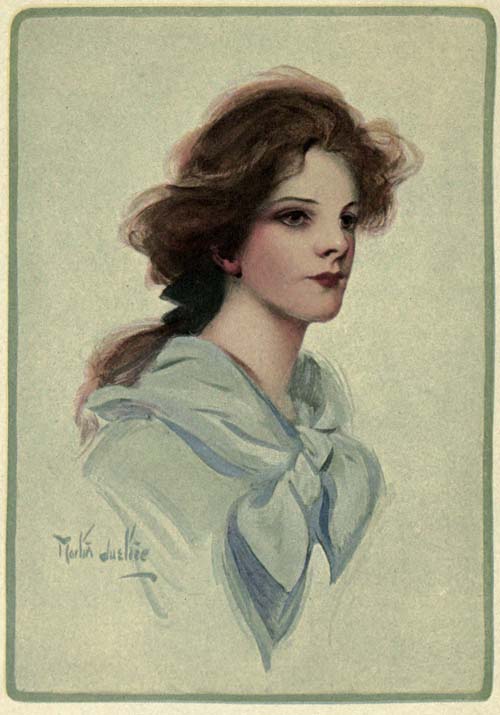
the girl. Miles turned shyly. Girls, at Admiral’s
Light, were rare as horses. And
though of about his own age, this was a
strange little creature. Her luminous brown
eyes seemed at once frank and shy; thoughtfulness
in the tanned oval face was changed,
by a circumflex arch of eyebrows, to a mischievous,
almost elfin gravity; and her hair
reminded him of oak leaves in winter, except
that they were dead and dull, and this color
shone exceedingly alive.
“Coming to our show?” she repeated:
“this afternoon, uptown?”
“I can’t,” he stammered. “We’re too—We
don’t go to many—many entertainments.”
Madge the Seeress gave him an odd,
shrewd glance of approval.
“Never mind,” she said. “Most of our
show you’ve seen already. Would you like
to ride the Gypsy Mare, though?” The
look on the boy’s face answered. “Abe,
let him.”
The man rose, grumbling, “A free ride,
when he’s got twenty cents?” but nevertheless
disappeared behind the mound, and
returned leading a beautiful sleek white mare,
already saddled. “No pipe-clay there!” He
tightened girth and shortened stirrups. “Up
ye go, Squair!”
Miles had ridden Hab Belden’s plough-horse
once or twice, but never a mount like
this. The mare footed among the sorrel,
swift and gentle as the fairy charger that
cantered over eggs. He pulled up reluctantly,
with face glowing.
“A born trooper,” said Abram. “Straight
back, close seat, flat thigh, soople. Ye rode
her like a gen’ral! Now would ye believe
me, Squair, if I spoke but the two words,
she’d throw ye like a rocket. Five dollars
I offer in open tent for the man or boy that
sticks her—and only two ever done it.
Want to try? Shall I speak to her?”
“Why, I don’t know,” began Miles.
“Fraid-cat!” laughed the girl.
“Speak to her,” he ordered tartly.
“Throw him, Jubilee!” cried the conjurer.
Miles felt the white body tremble under
him, as in terror. With a snort and a swoop,
the mare plunged uncontrollably along the
brow of the hill, head down, switching herself
double from side to side, as a fish fights
in a net. Losing his seat, Miles caught it again
by blind miracle, just as she spun dizzily and
reared in lightning estrapades. Hereditary
instinct, the spirit of the cavalry captain, his
father, served him well. Sick with fear—not
of a broken neck, but of humiliation before
that girl—he clung as in a desperate dream.
He felt the back hump like a dromedary’s,
the close-bunched hoofs pound the earth with
quick, disintegrating jars. Some one shouted.
He ducked. A hawthorn bough furiously
swept his back. The bole of an elm flashed
past, and he was conscious of powdered bark
smeared on a smarting leg. Then they fought
it out, raging mare and raging rider, till
with a balk that nearly shot him over her
neck, Jubilee stopped dead, and, trembling
as when she began, seemed gradually to sink
beneath him. He kicked out of stirrups,
swung over, fell with a crushing pain in one
ankle, and, through an interminable leisure
in which he tasted sour sorrel, rolled clear
from the flourishing hoofs.
Roaring blasphemy, the showman had
snatched the bridle, and as the white mare
rose, was beating her over the head with a
cudgel.
“Stop that!” cried Miles, from the ground.
“Roll, will ye?” screamed Abram, showering
blows insanely. “Roll, God nourish ye!
Never learnt that trick o’ me! Roll, ye—Begin
that once, an’ my theayter’s ruined!
Roll, ye—”
The woman raised Miles to his feet. “Not
hurt, are you? Poor boy! Much hurt?”
“No. Make him stop that!” he whimpered.
A white-hot cord tied tighter round
his ankle. He limped forward, but the woman
seized and carried him toward the fence.
“Go home quick!” she whispered. “I
know him. He’ll come at you or me next,
if you vex him now. Can you walk? Quick,
then, go home.—Here, Anna, see he gets
back safe.”
Miles found himself in the orchard, dragging
painfully, easing his weight by the gun.
At each halt the girl eyed him strangely. On
the slope above the house he suddenly lay
down.
“Rest a minute,” he explained through
clinched teeth. “I live down there—you
needn’t come.” The tawny hillside swam.
His foot seemed to shrink and swell, with
alternating torture.
“A thorn’s in your cheek,” said the girl.
“No, the other side.” He pulled the sharp
point out mechanically. “Didn’t that hurt?
What’s your name?”
“Miles Bissant,” he said indifferently. In
a long stillness sounded the dry, faint click of
grasshoppers, snapping upward in short arcs
roundabout.
“Mine’s Anna Hilliard,” she volunteered;
and after another silence, “I’m sorry I said—that.
Good-by.”
By her voice, she was crying. Through
half-opening eyes, he saw her hair glimmer.
Something warm touched his cheek.
He sat up, indignant, rubbing the spot with
more energy than if the thorn had stung. A
hard patter of bare feet fled up the path.
“What a silly girl!” thought Miles, in
disgust. “Glad nobody was round.”