Sir John Jellicoe hoisted his flag as Vice-Admiral commanding the
Atlantic Fleet, in succession to His Serene Highness, Prince Louis of
Battenberg, on December 27th, 1911, and on the tenth of January, 1912,
the Fleet assembled at Dover for the first time under its new
Commander-in-Chief.
There was a suggestion about this time that the Atlantic Fleet and the
Home Fleet were to be amalgamated. The change that had already been
made in the Atlantic Fleet in linking it to the Home Fleet for
purposes of combined training did not mean that either command was to
be absorbed in the other. The Atlantic Fleet was henceforth to be
under the command of a Junior instead of a Senior Admiral, and it
would cruise in Home waters.
Both Fleets would have their war training together and the policy of
concentration in Home waters was thus carried out.
How fully this policy was justified events have fully proved. The
Atlantic Fleet continued to use Gibraltar as its repairing base.
Admiral Jellicoe’s first cruise with the Fleets was to Vigo, on the
Spanish coast, where manœuvres were carried out in conjunction with
a portion of the Mediterranean Fleet.
These manœuvres were carried out on a large scale. There was a
Naval Review of the Fleets, at which King Alfonso was present.
Afterwards a mimic warfare was waged, the Home Fleet, under Admiral
Sir W. H. May, representing the “Red,” the Mediterranean and Atlantic
Fleets under Admiral Sir E. S. Poe and Vice-Admiral Jellicoe,
respectively, being the “Blue.”
The principal “action” took place at night, and Jellicoe manœuvred
his ships so cleverly that they almost escaped a vastly superior
force.
After the “battle” was over Admiral May signalled to Jellicoe that he
had put up a fine fight, and given the superior forces against him a
very hard job.
Just at this time Sir John Jellicoe suffered a sad bereavement, losing
his little daughter, Betty, at the age of five and a half years. She
was the second child, and was born on May 21st, 1905.
Sir John and Lady Jellicoe have four daughters, the eldest in her
ninth year. They are delightful children, and all bear a strong family
likeness to the “Little Admiral”; they possess many of their father’s
characteristics, too: overwhelming good spirits and a keen sense of
humour.
The author’s first introduction to them was when he was waiting in the
hall of Sir John’s town house.
They were just going out for their morning constitutional, but as they
were about to start, the eldest suddenly discovered that “some one”
was missing who should have been present. A hurried search was
instituted. Upstairs and downstairs the young Jellicoes raced, peering
here and peering there, and continually calling for “Nanna!”
Believing that the nurse was the object of their search, the author
told Miss Jellicoe that he had just seen her go upstairs. She shook
her head:
“Oh, no she hasn’t. She came down with me just now and I know she
hasn’t gone back. She does run away sometimes.”
It seemed a strange thing for a nurse to do, and while the author was
debating in his mind whether he ought not to inform Lady Jellicoe, one
of the little girls gave a cry of triumph and pointed to the sideboard
standing against the wall in a dark corner of the hall.
“There she is. Isn’t she naughty!”
A sideboard did not seem the right place for the nurse—even the nurse
of a Naval family—to choose as a hiding place; but though the author
searched he could not see the culprit.
Little Miss Jellicoe grew impatient: “Oh, do try and get her out!” she
begged. “Don’t you see, she’s crawled underneath!”
Down on his hands and knees went the author of this book—and there,
tucked away under the sideboard, crouched the missing nurse.
“Please pull her out, we can’t go for our walk without her.”
Obediently the author seized the nurse by the scruff of the neck and
dragged her from her hiding place.
“Nanna,”—on this occasion—was a Scotch terrier!
Undoubtedly the Admiral’s daughters have their father’s sense of
humour.
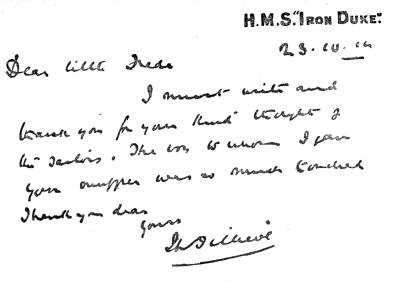
Dear little Freda
I must write and thank you for your kind thought of the sailors. The
one seaman to whom I gave your muffler was so much touched
Thank you dear
Yours
John Jellicoe
Admiral Jellicoe’s affection and consideration for children is shown
in a variety of ways. The letter to a schoolgirl, reproduced on page
83, thanking her for a gift of a muffler for one of the sailors on the
flagship, is a striking example of his thoughtfulness and the personal
interest he takes in everything, and everyone, connected with the
welfare of his men and with his fleet.
Another letter to his wife, which Lady Jellicoe kindly allowed the
author to read and reproduce, was written on board the Iron Duke
early in November. Though it was sent to Lady Jellicoe it was intended
for all the wives, mothers, sisters, sweethearts and children of the
British sailors at sea throughout the Empire, for Sir John wished them
to know how gallantly his men (which are their men) were behaving
and how proud he was to command them.
It is a brave letter, containing a brave message for the women and
children.
I know you will be meeting the wives and families of the men,
and I hope you will tell them of the magnificent spirit which
prevails. Our troops have covered themselves with glory during
this war. The Navy has not yet, as a whole, had the opportunity
of showing that the old spirit which carried us to victory in
the past is with us now, but when our men have had the
opportunity of fighting a foe above the water, they have shown
that they possess the same pluck and endurance as our comrades
ashore. Nothing can ever have been finer than the coolness and
courage shown in every case where ships have been sunk by mines
or torpedoes. The discipline has been perfect, and men have
gone to their death not only most gallantly, but most
unselfishly. One hears on all sides of numerous instances of
men giving up, on these occasions, the plank that has supported
them, to some more feeble comrade, and I feel prouder with
every day that passes that I command such men.
And during the period of waiting and watching they are
cheerful and contented in spite of the grey dulness of their
lives. I am sure you will tell the wives and children, and the
sisters and mothers, of our men, of the spirit that prevails,
and I know that it will make them too desire to show in their
own lives that they are animated by the same desire to do the
best they can for their country, so that they will be worthy of
their men-kind, of whom it is difficult to say too much.
JN. JELLICOE.
When the Atlantic Fleet visited Gibraltar, Lady Jellicoe and her
family joined Sir John at the Rock, staying at the Villa Victoria.
Jellicoe’s flagship was the Prince of Wales, and while she was in
dock, many delightful entertainments were given on board, the
Admiral’s daughters doing their share—even Miss Norah, “the baby of
the fleet,” inviting equally small craft (of the human kind) to tea on
the flagship with the request that they would “bring their own
bottles.”
The Rock benefited considerably by the three months’ visit of the
Fleet, under Vice-Admiral Sir John Jellicoe, and by the presence of
Lady Jellicoe and her family.
All work and no play make Jack a dull boy, but Lady Jellicoe saw to it
that Jack got his fair share of amusement. At the Annual Rifle
Meeting, the Vice-Admiral’s Cup, presented by Vice-Admiral Sir John
Jellicoe, was won by the Vice-Admiral’s B Team from his flagship, with
A team, also from the flagship, second.
In the individual competitions the Five Hundred Yards was won by Sir
John himself with the Commander of his flagship—Commander
Dryer—second. The Prince of Wales took many other firsts and
seconds, and to just show that he still kept hand and eye in practice,
Sir John Jellicoe and Naval Instructor Holt, representing the Navy,
won the Garrison Racquet Tournament against the Army, by four games to
one. Sir John also won the Racquet Handicap of the Atlantic Fleet,
defeating Mr. Wardlaw in the final by three games to love.
Sir John’s handicap was minus eight.
These meetings took place during the first anniversary of King
George’s accession; the celebrations lasted a week, and the Kaiser’s
yacht, Hohenzollern, and the German cruisers Konigsberg and
Sleepner were both in port and took part in the festivities; the
Emperor’s Imperial Band from the Hohenzollern played at the Victoria
Villa before Sir John and Lady Jellicoe and their guests.
It is rather interesting to note that the Musikfolge on this
occasion commenced with a selection from Wagner and ended with the
“British Grenadiers” March.
Vice-Admiral Sir John Jellicoe returned from Gibraltar to England in
time to take part in the great Naval Review at Spithead on June 24th.
H.M. King George, on board the Royal yacht, received a splendid
welcome from the hundred and sixty-seven British ships anchored off
Spithead and the eighteen foreign warships which were also present.
Our boats included twelve Dreadnoughts, thirty cruisers and
seventy-two destroyers.
Among the foreign ships present were the Danton (France), Rossiza
(Russia), Kurama (Japan), Radetzky (Austria), Von der Tann
(German) and Hamídich (Turkey), all of which afterwards became
involved in the world war.
After the Review the Naval Manœuvres took place, in which Jellicoe
commanded the Atlantic Fleet. It was at the conclusion of these
manœuvres that vague rumours of a crisis with Germany over the
Moroccan affair appeared in certain newspapers. The “scare” was
short-lived, and there was no real ground for the rumours of war
between England, France and Germany that were circulated.
At this time a German training ship, with several young officers on
board, was cruising in Home waters, doubtless picking up much valuable
information. The commander of this ship is reported to have said that
war between England and Germany was unthinkable.
Late in July the Atlantic Fleet went to Cromarty for general
exercises, and afterwards the Atlantic Fleet Regatta was held at
Berehaven. On this occasion Jellicoe’s flagship, the Prince of Wales, again distinguished herself in a remarkable manner.
Out of thirty events on the programme for the first two days’ racing,
her boats were first, second or third in twenty-eight events, taking
fourteen “firsts.” In the Veteran Officers’ Skiffs Race Vice-Admiral
Jellicoe stroked the winning boat. Of course the Prince of Wales was
first on the list of points in the regatta, getting fifty-and-a-half
to the Argyll’s forty, and won the silver trophy—a figure of a
giant cock.
One amusing incident occurred at the conclusion of the regatta, when
bands from the various ships went down the course in their big barges
playing a selection of tunes. When they passed the London, last but
one in the “race” for points, they played “When London Sleeps”—a sly
dig at that boat’s poor performance.
On passing Jellicoe’s flagship each band played “Cock of the Walk” to
the accompaniment of deafening cheers.
Sir John, as every man in the Senior Service knows, is a keen
temperance man; it was he who was credited with the phrase “the grog
curve.” He believes that a sailor should have his glass of grog so
long as he never takes more than he can carry, and he does not “carry”
even that amount when on duty.
Jellicoe delivered an epoch-making speech on this very important
question at a great temperance meeting held at Gibraltar in November,
1911. On this occasion he said that everyone responsible must
recognize the value of temperance in fighting efficiency.
In the Navy there are three qualities upon which efficiency mainly
depends—discipline, shooting, and endurance, and temperance
unquestionably tends greatly to the promotion of these qualities. In
regard to discipline one has only to look at the punishment returns to
realize how many of the disciplinary offences are at the outset due to
intemperance.
As for endurance, medical research has amply proved the fact that
temperance is a great asset in improving the physical qualities, and
therefore the endurance, of the human race. As regards straight
shooting, which is so largely a question of eye, it is everyone’s
experience that abstinence is necessary for the highest efficiency.
“If I am going to a rifle meeting in the afternoon,” Vice-Admiral
Jellicoe said, “I don’t take a whisky and soda after lunch. If I did,
I know I should have no chance of making a possible.”
It was the late Captain Ogilvy who pointed out that efficiency in
shooting was thirty per cent. better before the issue of grog than
after.
In the Honours’ List at the time of the Coronation celebrations a
K.C.B. was bestowed on Vice-Admiral Sir John Jellicoe, and on November
28th he was given the command of the Second Division of the Home
Fleet. There were numerous changes now made at the Admiralty, Admiral
Sir Francis Bridgeman becoming First Sea Lord in place of Sir Arthur
Wilson. With him were H.S.H. Prince Louis of Battenberg and Captain
William Pakenham, all men of the new school.
At the time the changes made were considered to be startling. Mr.
Winston Churchill, the new broom, practically made a clean sweep of
the old Board. It was a case of putting youth (as youth is counted in
the Senior Service) at the helm—and youth had the courage to give
youth, allied with experience, a chance—for Mr. Churchill himself was
at the time only thirty-seven years of age. Sir Francis Bridgeman was
sixty-two, Prince Louis of Battenberg fifty-seven and Captain Pakenham
fifty. Jellicoe’s age was fifty-two.
Mr. Churchill in his speech in the House of Commons explained that the
changes on the Board were necessary, and said it would lead to a more
effective working in the interest of administrative efficiency. All
former precedents had been observed. As to the question whether the
Sea Lords had resigned or been removed he had to say that when he
apprised them of the fact that His Majesty had given his assent to
certain changes on the Board they accepted those changes in the true
spirit of the Naval Service.