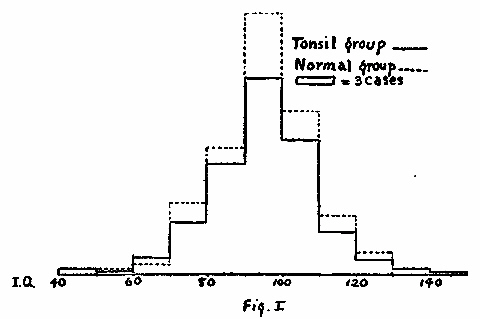
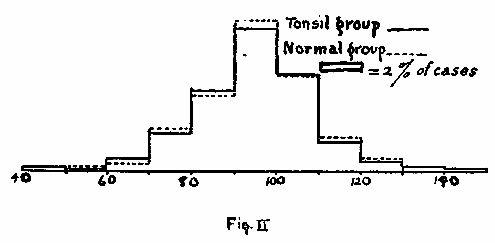
There are very few experimental studies of the relation
between intelligence and the two defects considered here.
There are a few statistical studies, and among earlier writers
especially many statements of opinion on the matter. Characteristic
of the latter is the following extract from an article
in the Boston Medical and Surgical Journal, March, 1886.[1]
"... it is a fact that their intelligence may become weakened
and their characters changed. They do not progress in
their studies at school, are generally at the bottom of the class
and remain in it longer than the prescribed time.... That the
impairment of intellect and want of energy manifested by
these children is real, and not merely in the expression of
countenance, is made evident by watching these same children
after the growths have been removed. To the gratification
and astonishment of the parents and teachers, the children
hitherto sluggish and dull of comprehension, now make rapid
progress, and their comrades soon cease to make a laughing
stock of them."
The following quotation from an article by Irving Townsend,
M. D., is in the same vein:[2]
"Aprosexia is the rather imposing term applied to the imperfect
or arrested mental development attributed to this
condition. This is denied by some authors, who claim that
the dullness of comprehension and inattention are only apparent,
and due only to defective hearing. A strong evidence
of its reality lies in the fact that these children show most
marvelous intellectual development after the removal of the
growth, even in cases where deafness is not markedly improved."
A most enthusiastic denouncer of adenoids and abnormal
tonsils is H. Addington Bruce. Concerning their direful effects
upon the intelligence, and the magical results of their
removal, he is continually reiterating:[3]
"Often a surprising development of both mental and
physical power follows the removal of adenoids. In one case
reported by Professor Swift, a girl of fourteen grew three
inches within six months after an operation for adenoids,
and at the same time showed an improvement in her
school work that contrasted strikingly with the dullness that
preceded it. Another, three years younger, grew six inches in
about five months, and from being a sad idler was transformed
into an unexpectedly attractive and bright pupil. A boy of
twelve, backward both mentally and physically, likewise lost
his dullness and laziness within an astonishingly short time
after the impediment had been removed."
And again:
"The boy or girl suffering from adenoids[4] is usually a
mouth-breather because of the difficulty experienced in
breathing through the nose. But mouth-breathing means difficult
breathing, and this in turn means deficient oxidation
of the tissues, with a resultant lowering of vital activities
generally and of the activity of the brain in particular. Accordingly,
the psychologist of today insists that every adenoid-afflicted
child should be given prompt medical attention, with
a view to correcting the vicious mouth-breathing habit, and
thus aiding the child to gain a fair start in the development
of mental and physical health."
The following extracts are quoted from Burgerstein's
"Handbuch der Schulhygiene":
"Bresgen und Heymann machen endlich darauf aufmerksam,
dass die Ursache der Kephalalgie haufig in der Behinderung
der Nasenatmung zu suchen ist, als Folgerscheinung
von Verengerung der Nase bei ingen Baue des Knochengerustes,
Knochenkaries und Geschwulsten, Schwelungen der
Scheimhaute, akuten Schnupfen, Verstofungen der Highmorshöhle,
Vergrosserung der Mandeln u. s. w."...
"Viele Kinder erscheinen schwachbegabt, ohne os zu sein,
da bei denselben entweder nach behebung von Ohrenkrankheiten,
nach Herstellung der freien atmung oder Gebrauch
einer entsprechenden Brille die scheinbare Geistesschwache
schwindet."[5]
Quotations like these, and equally unsupported by experimental
evidence, might be multiplied indefinitely, especially
if we look into the literature of a dozen years ago. Since they
can have little authoritative value, I shall limit myself to two
more specimens, one taken from the Psychological Clinic,
1916.[6]
"But when these physical defects (poor eyesight, defective
hearing, adenoids, bad tonsils, etc.) are corrected so that the
mind can function without any outcry from the physical body,
these children recuperate mentally and often make greater
progress than the so-called normal children in the regular
grades."
The second is a quotation from Jelliffe and White, "Diseases
of the Nervous System." Lee and Ferbiger, 1917, p. 903.
"An important group (of mental defects) is due to adenoid
vegetations in the posterior pharynx. Under such conditions
of ill health, development is impaired and does not proceed
at a normal rate. With ... infected tonsils, which
produce a constant toxemia, the child cannot be expected to
proceed in his development with normal rapidity."
In the medical and psychological literature of the last few
years, along with the growth of general discussion into the
various phases of the operation itself, we find a general disinclination
to take on faith the magic effect of adenectomy
and tonsillectomy. This growth of critical spirit has shown
itself in statistical investigations, and in studies of pedagogical
and mental improvement after operation.
The statistical studies of physical defects in the schools
reveal almost universally a positive relationship between
school retardation and possession of adenoids and diseased
tonsils. One of these was conducted by Ayres for the Backward
Children Investigation of the Russell Sage Foundation
in New York City.[7] The investigators examined the school
records of 20,000 children from fifteen schools in Manhattan.
Eight thousand of these had been examined by school physicians.
The records of the physical examinations showed that
80 per cent of the children who were normal for their grade
had physical defects while only about 75 per cent of the retarded
children were physically defective.
This astonishing result was found upon re tabulation of
the data by ages, to be due to the fact that for each defect
there is a gradual falling off in frequency from the age of six
up to fifteen—eye-defect, only, excepted. Since the retarded
children in each grade will be the older children in that grade,
and since older children have fewer defects, the retarded children
will show a smaller proportion of defect.
To overcome this difficulty, Ayres used an age basis instead
of a grade basis in interpreting his results. Records of
all the children at the ages of 10, 12, 13, and 14 were re tabulated,
a group of 3304 children, and rated as dull, normal or
bright according to the grade in which they were found. The
results were worked out in percentages of a group, and are
shown in the following tables:
| Dull | Normal | Bright |
| Number of children examined | 407 | 2588 | 309 |
| Defects per child | 1·65 | 1·30 | 1·07 |
| Enlarged glands | 20 | 13 | 6 |
| Defective vision | 24 | 25 | 29 |
| Defective breathing | 15 | 11 | 9 |
| Defective teeth | 42 | 40 | 34 |
| Hypertrophied tonsils | 26 | 19 | 12 |
| Adenoids | 15 | 10 | 6 |
| Other Defects | 21 | 11 | 11 |
| | | |
| Defective | 75 | 73 | 68 |
| Not defective | 25 | 27 | 32 |
Average number of grades completed by pupils having no
physical defects, compared with the number completed by
those suffering from different defects:
| Average grades completed | % lost |
| Children having no physical defects | 4·94 |
| Children having enlarged glands | 4·20 | 14·9 |
| Children having defective vision | 4·94 | 0 |
| Children having defective breathing | 4·58 | 7·2 |
| Children having defective teeth | 4·65 | 5·9 |
| Children having hypertrophied tonsils | 4·50 | 8·9 |
| Children having adenoids | 4·24 | 14·1 |
| Children having other defects | 4·52 | 8·5 |
|
Cornell reports several investigations in the Psychological
Clinic, January and May, 1908. Three of these, in which
children were rated on the basis of grades received in school
work, are here combined to show the grades of normal children,
"average" children, generally defective children, those
possessing adenoids and tonsils, and the deaf.
| No. of cases | Normal | Average | General
Defective | Adenoids
& Tonsils | Adenoids | Deaf |
| Allison | | 219 |
| 9th St. | 64 | 84 | 21 | | 8 |
| Claghorn | 179 | 252 | 13 |
| Grade in language |
| 9th St. | 72·9 | 70·5 | 63·3 | | 60 |
| Claghorn | 74·4 | 72·7 | 71·4 |
| Grade in Arith. |
| 9th St. | 75·5 | 74 | 70 | | 66·7 |
| Claghorn | 72 | 70 | 65·1 |
| Grade in spelling |
| 9th St. | 75·4 | 72·8 | 64·8 | | 65 |
| Grade in geography |
| Claghorn | 76·6 | 76·5 | 76·2 |
| Average of grades |
| Allison | 75 | 74 | 72·6 | 72 | | 67 |
| 9th St. | 74·6 | 72·4 | 66 | | 63·9 |
| Claghorn | 74·3 | 73·1 | 70·8 |
An additional investigation of four classes in the same
grammar grade of the Claghorn School gives the following
results:
| Class 1 Bright | Class 15 Children | Class 9 Dull | Class 11 Dullest |
| Number of children | 50 | 39 | 32 | 29 |
| Normal | 36 | 32 | 20 | 13 |
| Defective | 14 | 7 | 12 | 16 |
| Percentage of normal | 72 | 82 | 62·5 | 44·8 |
In the same article, Dr. Cornell gives the results of another
study of Philadelphia schools, made in 1906. The study comprised
a comparison of children exempt from examinations
on account of high standing, with those not exempt. The results
follow:
| Exempt Normal | | Children Defective | Non-exempt Normal | | Children Defective |
| 9th St. Primary | 56 | | 28 | 39 | | 38 |
| Rutledge School | 87 | | 35 | 75 | | 34 |
| Allison School | 128 | | 65 | 81 | | 49 |
| Camac School | 183 | | 71 | 103 | | 75 |
| Claghorn School | 193 | | 61 | 127 | | 66 |
| 647 | | 260 | 425 | | 262 |
| Percentage Defective | | 28·8 | | | 38·1 |
When the four classes of bright and dull children were examined
again, and the different sorts of defects compared for
the groups, enlarged tonsils, adenoids, deafness, and nasal
catarrh, were found to occur much more frequently among
the two classes of duller children.
| Class 1 Bright | Class 15 Children | Class 9 Dull | Class 11 Dullest |
| Number of children | 50 | 39 | 32 | 29 |
| Nose and throat conditions, number defective | 6 | 4 | 9 | 9 |
| Tonsils | 3 | 4 | 3 | 3 |
| Adenoids | 2 | 1 | 5 | 6 |
| Deaf | 2 | | 5 | 1 |
| Catarrh | | | 2 | 3 |
| Percentage of children, nose and throat defects | 12 | 10·2 | 28·1 | 31 |
During the same year, another examination along the
same lines was conducted in the William McKinley Primary
School,[8] where a large number of dull children had been
grouped in special classes.
None of these children were mentally defective, says Dr.
Cornell, and only a few were really backward. The proportion
of physical defect was found to be very large,—in 174 pupils,
188 physical defects (68 eye-strain, 40 nasal obstruction, 80
miscellaneous, 11 hypertrophied tonsils.) In a special class at
the Wharton school, numbering 22 children, 14 of the children
suffered from adenoids, associated in 3 cases with enlarged
tonsils. Since no comparison is made with normal classes,
this survey cannot be regarded as conclusive.
Wallin, in his book, "Mental Health of the School Child,"
discusses several other investigations of the relation of intelligence
to physical defect. Only those studies in which were
included adenoids and tonsil conditions will be reviewed here.
Those by Ayres and Cornell have been described above.
In Elmira, New York, says Wallin, "an investigation of
repeaters in the second grade showed that 21 per cent of
those who required three years and 40 per cent of those who
required four years to complete the grade had adenoids, as
against only 19 per cent of those who required only two years
to do the grade."
Another study described by Dr. Wallin was made by Heilman
in 1907 of 1000 Camden repeaters. The correlation between
pedagogical retardation and percentage of defect in
each group was as follows:
| Defects | Retardation |
| 1 yr. | 2 yr. | 3 yr. | 4 yr. | 5 yr. |
| Per Cent |
| Health | 16·5 | 21·3 | 28·0 | 19·0 | 37·5 |
| Nutrition | 13·4 | 8·9 | 17·2 | 20·2 | 17·5 |
| Adenoids | 6·2 | 7·3 | 8·1 | 9·6 | 7·5 |
| Speech | 5·2 | 5·1 | 4·2 | 10·5 | 20·0 |
| Visual defects | 15·5 | 15·9 | 18·2 | 22·8 | 22·8 |
| Auditory | 8·2 | 6·7 | 4·9 | 6·1 | 10·0 |
Burpitt[9] describes an investigation of 400 children, 200
male and 200 female, considered by their teachers to be "dull
and backward, but not to fall within the meaning of feeble-mindedness
as given in the Mental Deficiency Act of 1913."
The children were examined for physical defects and other abnormal
conditions. The author says that in 36 per cent of
the cases, the cause for backwardness was found to be "inherent
dullness." (The basis for judgment of inherent dullness
is not given.) Adenoids and tonsillar tissue were found in
18·75 per cent of the cases, and were "more prevalent than
among the children of the area as a whole."
The degree of retardation, based upon the number of
school standards below normal, was ascertained for pupils
who suffered from various defects. The relative retardation
was expressed by the fraction n/(A-5) where n = number of
years retarded, and A = age. Eighteen per cent of the children
were so retarded that the fraction was greater than 3-9.
These were divided into two groups,—3-9 to 4-9 and 4-9 to
5-9. The results are given in the following table:
| Causes | 46 children
3-9 to 4-9 | 24 children
4-9 to 5-9 |
| | |
| Inherent dullness only | 8 | 3 |
| Inherent dullness and one or more physical defects | 7 | 2 |
| Irregular attendance with one or more physical defects | 9 | 6 |
| Irregular attendance | 2 | 3 |
| Adenoids only | 2 | 0 |
Turning to what the author calls single causes,—present
in 170 cases out of the 400,—
| Causes | 151 children
1-9 to 3-9 | 19 children
3-9 to 6-9 |
| | |
| Irregular attendance | 51 | 6 |
| Adenoids | 24 | 2 |
| Inherent dullness | 59 | 11 |
The term "cause" seems to be rather loosely used in this
study. The author says concerning this,
"Dealing with physical defects first, although they amount
in the aggregate to 53 per cent (omitting defective speech,
which is a secondary condition), in 10 percent only do they
represent the whole cause. This is made up of those cases
where the defect is of such intensity as to produce retardation
in otherwise ordinary children, and of other cases of less intensity,
but sufficient to weigh down the balance against those
near the level of what we may call for convenience the lower
limit of normal intelligence." How he determines, without
removing a defect, what the child's intelligence would be without
it he does not explain.
The following table compares the physical condition of two
groups, one comprised of children examined in the regular
routine examinations during the year 1912,—the other a
group of retarded school children, given a special examination:—[10]
| Group I | Group II |
| No. of children examined | 287,456 | 1,541 |
| No. with physical defects | 206,720—71·9% | 1,383—89·8% |
| No. of defects found | 226,639 | 2,986 |
| Defect | No. | | % | | No. | | % |
| Anaemia | | | | | 335 | | 23·0 |
| Malnutrition | 8,303 | | 2·9 | | 557 | | 36·1 |
| Defective vision | 21,078 | | 9·3 | | 536 | | 34·7 |
| Defective hearing | 1,206 | | 0·5 | | 47 | | 3·0 |
| Defective nasal breathing | 21,931 | | 7·6 | | 316 | | 20·4 |
| Hypertrophied tonsils | 30,021 | | 10·4 | | 297 | | 19·2 |
| Defective teeth | 142,168 | | 49·4 | | 796 | | 51·6 |
| Pulmonary disease | 335 | | 0·1 | | 47 | | 3·0 |
| Cardiac disease | 1,597 | | 0·5 | | 35 | | 2·3 |
| Average No. of defects per child | 1·1 | | | | 2·5 |
In an investigation of 3,587 exempt and 1,418 non-exempt
children in the Philadelphia schools,[11] Dr. Newmayer found
the following percentages of defect:
| Exempt Children | Non-exempt Children |
| Defect | No. Examined | % | No. Examined | % |
| Defective vision | 371 | 10·0 | 171 | 12·0 |
| Defective hearing | 49 | 1·4 | 29 | 2·0 |
| Defects of nose | 54 | 1·5 | 21 | 1·5 |
| Defects of throat | 137 | 3·8 | 53 | 3·7 |
| Orthopedic defects | 25 | ·7 | 25 | 1·8 |
| Mentally defective | 6 | ·1 | 80 | 5·6 |
| Skin diseases | 918 | 26·0 | 423 | 30·0 |
| Miscellaneous | 214 | 6·0 | 128 | 9·0 |
| Total | 1,774 | 49·0 | 930 | 65·0 |
It is evident from the majority of these investigations
that there is some relationship between physical defects and
pedagogical retardation. But whether or not the relationship
is a causal one, they do not indicate. Simple co-existence of
two characteristics is not necessarily significant that one is
cause of the other. Plainly, though, if the removal of a physical
defect is followed by improvement in the school progress,
it may be argued that the presence of the defect was a causal
factor in the previous retardation. The method in the few following
studies, which seems to be employed to a greater degree
than formerly, consists of measurement of such improvement.
The Journal of Psycho-Asthenics, March and June, 1918,
contains a paper on the "Results obtained from the Removal
of Tonsils and Adenoids in the Feeble-minded," by Wm. J. G.
Dawson, M. D. The author starts out rather discouragingly
by regarding his hypothesis as an axiom. He says,
"It is a well-known fact that hypertrophy of the tonsils
and presence of adenoids may produce more or less dullness
of the intellect in normal children. This is a result of the imperfect
aeration of the blood which supplies the brain, on account
of obstruction to respiration. In the Feeble-minded,
conditions are more or less similar."
One hundred and twelve cases in the Sonoma State Home,
Eldridge, California, were operated on. Of these 6 are recorded
as borderline, 39 as morons, 50 as imbeciles, and 17 as
idiots. Adenoids were always removed when they were present.
The results of the operation are as follows:
| Number
before
Operation | Number
after
Operation |
| Mouth breathing | 43 | 31 |
| Eneuresis | 33 | 32 |
| Sore throats | 70 | 2 |
| Ear trouble | 19 | 2 |
| Change in voice | | 38 | improved |
| Tonsillar tissue recurred in | | 5 |
| General physical health | | 90 | improved |
| | 6 | borderlines |
| | 33 | morons |
| | 42 | imbeciles |
| | 9 | idiots |
| Mental improvement from observation | | 27 | improved |
| | 4 | borderlines |
| | 15 | morons |
| | 7 | imbeciles |
| | 1 | idiot |
The inaccuracy of this investigation is evident. The mental
improvement was measured by "observation," which is at best
inexact, and susceptible to the influence of any expectation of
improvement on the part of the observer. The degree of improvement
is not mentioned, nor is the time interval allowed
for the appearance of such improvement. There is no control
group, and consequently, no way of knowing whether the
improvement was due to the removal of the defect.
A similar, though rather more careful study is reported by
Dr. Charles James Bloom in the New Orleans Medical and
Surgical Journal for April, 1917. Dr. Bloom's experiment
consisted of eighteen months' observation on the mental and
physical state following the removal of adenoids and tonsils
from one hundred and fourteen children. This number was
later reduced to fifty-seven, because of the fact that a number
failed to return. There was no selection, all the patients being
taken as admitted.
The patient's physical and mental state was recorded at
the time of admission. School reports were used as an index
of intelligence. From this time on the patients were examined,
weighed and measured at monthly intervals.
The ages of the children ranged from four to fourteen
years, inclusive. Thirty-five per cent were under six years,
and sixty-five per cent, therefore, over six. Twenty-nine were
boys, twenty-eight girls.
Omitting a part of the study which though interesting has
no bearing upon our problem, we turn to results in the way of
mental status. There were fifty-seven cases, ten of whom
were under the school limit. Of the remaining forty-seven,
seven sent in no report. In four, or ten percent of the
forty remaining, there was no progress. In thirty-six, or
ninety per cent, appreciable progress was reported. One of
the four unimproved cases was syphilitic, the other, the author
says was a moron.
Quotation of the teachers' reports will be of interest.
"'Some improvement.' 'Better work than previous year.'
'More effort displayed.' 'Improved wonderfully.' 'Improvement
first term, not so much second.' 'Before removal, not
transferred; after removal transferred.' 'Very much improved,
both mentally and physically.' 'Has made progress.'
'Remarkable improvement.' 'Not transferred before removal,
but after.' 'More attentive.' 'A very small but gradual improvement.'
'Am happy to tell you that he is studying more
since tonsils and adenoids were removed.' 'Greatly improved.'
'Attention better.' 'More concentration.'"
In this experiment like the preceding, the judges are liable
to the effect of expectation of improvement. Although the reports
are more explicit, they are still couched in general terms,
and not commensurable. Some reports refer to intelligence
and some to pedagogical standing. There is no control group.
On the basis of these results, the author concludes:
"Children exhibiting some alternatives in the normal histology
of tonsils and adenoids, give marked evidences of mental
impairment." This seems to be a rather sweeping statement
in consideration of the number of intellectually superior
children who suffer from adenoids and diseased tonsils.
Another investigation was made by Dr. Cornell in the Philadelphia
schools,[12] where seventy more or less retarded pupils
in grades one to four were operated on for adenoids. According
to the teachers' reports—
30 per cent improved considerably.
40 per cent improved.
25 per cent did not improve.
1·6 per cent deteriorated.
3·0 per cent deteriorated considerably.
Of those who had two chances of promotion,
6·3 per cent were promoted twice.
16·0 per cent failed twice.
33·3 per cent were promoted once.
33·3 per cent failed once.
With one opportunity,
11·0 per cent were promoted.
31·7 per cent failed.
"The promotion record was thus decidedly poor. It is
possible, however, that the time for promotion came before
the orthogenic effects of the operations had become effective."
The same criticisms may be brought against this investigation
as were mentioned in connection with the preceding
ones. Teachers' estimates of improvement, especially when
such improvement is expected, and without means of measuring
it objectively, are necessarily inaccurate. Again there
is no control group. Of even less value are the results of an
investigation in New York City by Cronin, where, out of
eighty-seven cases operated on for enlarged tonsils and adenoids,
"many advanced three grades during the rest of the
school year, and only three lost time."
An interesting study is one that is described by John C.
Simpson, M. D., in the Journal of the American Medical Association,
April 1, 1916.
Dr. Simpson's results are based on a study of 571 boys of
Girard College who had been operated on for adenoids and tonsils.
Improvement was studied along several different lines,
among them scholastic ability. For this part of the study, 45
were chosen alphabetically, 3 from each section. The only selection
was for boys who were operated on long enough after coming
to school to give an idea of scholastic ability; and long
enough before the present study to permit a judgment as to
their improvement. Monthly averages were taken of each boy
up to the time of the operation and from then to the time of
this study. They were based on an average of 100 per cent. As a
control group, there were chosen 45 boys who had had no
operation, and who lived and worked under the same conditions.
They also were taken alphabetically, 3 from each
section.
The general average of the operative cases at the first
measurement was 74·04. Of these 25, or 55·5 per cent gave an
average increase in monthly standing of 4·45 after operation,
while the remaining 20, or 44·5 per cent suffered a decrease
of 6·09.
The average of the boys in the control group was 74·21 and
for the first group after operation 74·06. "It is interesting to
note," says the author, "that the standing of slightly more
than half of those operated on was improved, but when compared
with those not operated on, no difference is seen."
In a similar study of younger boys who had undergone the
operation on entering college, and who had since had a year's
study (again a group of 45), the general average was 76·61.
Compared to 45 in the same classes not operated on, who had
an average of 74·56, the operative group is very slightly superior,
2·05 points.
Another study of pedagogical improvement, and a valuable
contribution, is that reported by A. H. MacPhail in Pedagogical
Seminary for June, 1920, entitled "Adenoids and
Tonsils; a Study showing how the Removal of Enlarged or
Diseased Tonsils affects a Child's Work in School."
"The children studied were pupils in the Adams and
Cranch Schools. Only cases were considered where there was
a record of ten school months before the date of the operation,
and where there was a record for at least ten month after the
operation. There were thirty-one cases in all.
"School records were looked up for the ten school months
preceding operation, and for each school month subsequent—up
to the date of leaving school, or in the case of children still
in school, up to the date of the study. There were thus longer
school records for some than for others.
"The history of each case was divided into periods of ten
school months each. Eighteen cases had a record of twenty
months after operation and eleven cases of thirty months.
"Comparing the first period after the operation with the
period before, it is found that only about one-third showed improvement,
and a little over half were doing poorer work. By
comparing an average of all work done subsequent to the operation
with what was done before, it became evident that improvement
in school work is not often observed until after a
year from the date of the operation."
In the cases that had records for twenty months, 16 show
that better work was done in the second period after the operation
than in the period before.
| Per Cent of cases showing improvement |
| Period 1 | Period 2 | Period 3 |
| Based on 31 cases | 32·2 |
| Based on 18 cases | 33·3 | 66·6 |
| Based on 11 cases | 36·3 | 63·5 | 100 |
| Based on all groups | 33·9 | 65·0 | 100 |
These cases were compared with a control group chosen at
random. They comprised a total of 100 children who had
records for four consecutive school years.
| Period 1 | Period 2 | Period 3 |
| A—Per cent of 31 cases (operated upon) | 32·2 |
| Per cent of 100 children at random | 42 |
| B—Per cent of 18 children— 20 months (operated upon) | 33·3 | 66·6 |
| Per cent of 100 children at random | 42 | 41 |
| C—Per cent of 11 cases for 30 months (operated upon) | 36·3 | 63·5 | 100 |
| Per cent of 100 children at random | 42 | 41 | 41 |
"... Immediately after operation, there seems to
be a dropping off in the quality of school work done," but
thereafter a marked improvement while the random group
shows a comparatively static percentage of improvement
from year to year. The conclusion of the author is:
"Here seems good reason to believe that the removal of
diseased tonsils and adenoids is a factor in beneficially influencing
the mental life of the school child. Not only is the
health impaired by failure to remove these diseased parts but
the mental life and activity of the child as well."
It is conceivable that pedagogical retardation might exist
without any defect of intelligence. The physical effects of
adenoids and tonsils might produce a tendency to fatigue, an
emotional instability and consequent lack in attention, which
would seriously influence the quality of school work, even
though the child were of normal or superior intelligence. The
relation of physical defects to intelligence has been investigated
experimentally by a method which will be employed to some
extent in the present investigation. In the two studies to
which I refer psychological tests, rather than school standings
were used as a basis for judging the intelligence. In each the
effects of treatment were measured, and in one, a control
group makes possible a more accurate interpretation of results.
The first of these investigations is described by Wallin.[13]
It was "an attempt to determine by controlled, objective, mental
measures the influence of hygiene and operative dental
treatment upon the intellectual efficiency and working capacity
of a squad of twenty-seven public school children in Marion
School, Cleveland, Ohio (ten boys and seventeen girls),
all of whom were handicapped to a considerable degree with
diseased dentures or gums, and an insanitary oral cavity."
The experiment extended over one year, from May, 1910, to
May, 1911. The treatment included corrective work upon
the teeth and mouth, and also instruction in oral hygiene, and
follow-up work by an employed nurse. Five series of psychological
tests were given at stated intervals during the course of
the experiment. They included tests of immediate recall,
spontaneous and controlled association (opposites), adding,
and attention-perception (cancellation). There were six sets
of each test, numbered from one to six, of equal difficulty, and
given under uniform conditions. Tests 1 and 2 were given
before the treatment began, and the average was taken as the
"initial efficiency." The last four, or the last two, were averaged
to represent the pupils' "terminal efficiency."
The results show the following influence of dental treatment
upon the working efficiency of the pupils.
1. The indices of improvement are about the same for boys
and girls.
2. Improvement was about the same for older and younger
pupils.
3. There were great individual differences in initial proficiency
and in improvement.
4. Improvement in one test does not presuppose improvement
in another.
5. There is a decided gain in every test, "and not only are
the gains decidedly more frequent than the losses but the largest
gains are invariably emphatically larger than the largest
losses."
6. The average gains in the tests were:
Memory, 19 per cent with 8 losses and 19 gains.
Spontaneous association, 42 per cent with 2 losses and 25 gains,
Addition, 35 per cent with 1 loss and 26 gains.
Controlled association, 29 per cent with 0 losses.
Perception-attention, 69 per cent with 0 losses.
Average gain for all tests, 57 per cent.
Unfortunately, Wallin was unable to form a control
group, so that it is impossible to estimate accurately how much
of this gain is due to the treatment of the defect, and how
much to other causes, such as growth, etc. "But," the writer
adds, "if we concede that one-half of the gain—and that is, I
believe, a sufficiently liberal concession—is due to a number of
extrinsic factors, such as familiarity, practice and increased
maturity, the gain solely attributable to the heightened mentation
resulting from the physical improvement of the pupils
would still be very considerable. There is corroborative evidence
to show that there was a general improvement in the
mental functioning of these pupils. This evidence is supplied
by the examination of the pedagogical record of scholarship,
attendance and deportment. Most of the members of this
experiment squad were laggards, and repeaters, pedagogically
retarded in their school work from one to four years, but
during the experiment year only one pupil failed of promotion,
while six did thirty-eight weeks of work in twenty-four weeks,
and one boy finished two years of work within the experimental
year."
The second investigation was equally careful in its method.
It was pursued by the Rockefeller Foundation, under the direction
of E. K. Strong, with the purpose of examining the
"Effects of Hookworm Disease on the Mental and Physical Development
of Children."
The children were divided into five groups and tested at
intervals of three and one-half months. The tests used were
opposites, calculation, logical memory, memory span, hand-writing,
form-board, and Binet-Simon. After the first test-series
was given, the five groups were divided into sub-groups
on the basis of this initial performance, so that the improvement
was compared only for those sub-groups in which this
was equal.
The improvement of Group A—uninfected children—proved
to be greatest, and was taken as 100 per cent. On this
basis, Group B—infected children not treated—showed the
least improvement,—only 34 per cent. Group C—children
completely cured of infection—improved 60 per cent. Group
D—severely infected children, treated but not completely cured—improved
38 per cent, and Group Du—an older sub-group of
D—improved 9 per cent as much as the normal children, and
much less than the untreated younger children. Dr. Strong
reaches the following conclusion:
"The figures show, then, that hookworm disease unmistakably
affects mental development. Treatment alleviates
this condition to some extent but it does not, immediately, at
least, permit the child to gain as he would if he had not had
the disease. And the figures apparently further show that
prolonged infection may produce prolonged effects upon mentality,—effects
from which the individual may never recover."