Additional mounds of Duval and of Clay counties, Florida
Whole book · 10 sections
ADDITIONAL MOUNDS OF DUVAL AND OF CLAY COUNTIES, FLORIDA
INDIAN NOTES
AND MONOGRAPHS
Edited by F. W. Hodge
A SERIES OF PUBLICATIONS
RELATING TO THE
AMERICAN ABORIGINES
MOUND INVESTIGATION ON THE EAST
COAST OF FLORIDA
CERTAIN FLORIDA COAST MOUNDS
NORTH OF THE ST. JOHNS RIVER
BY CLARENCE B. MOORE
1896
NEW YORK
MUSEUM OF THE AMERICAN INDIAN
HEYE FOUNDATION
1922
This series of Indian Notes and Monographs
is devoted primarily to the publication
of the result of studies by members of
the staff of the Museum of the American
Indian, Heye Foundation, and is uniform
with Hispanic Notes and Monographs,
published by the Hispanic Society of
America, with which organization this
Museum is in cordial coöperation.
Only the first ten volumes of Indian
Notes and Monographs are numbered.
The unnumbered parts may readily be determined
by consulting the List of Publications
issued as one of the series.
INDIAN NOTES
AND MONOGRAPHS
Edited by F. W. Hodge
A SERIES OF PUBLICATIONS
RELATING TO THE
AMERICAN ABORIGINES
ADDITIONAL MOUNDS OF DUVAL
AND OF CLAY COUNTIES,
FLORIDA
MOUND INVESTIGATION ON THE EAST
COAST OF FLORIDA
CERTAIN FLORIDA COAST MOUNDS
NORTH OF THE ST. JOHNS RIVER
BY
CLARENCE B. MOORE
1896
NEW YORK
MUSEUM OF THE AMERICAN INDIAN
HEYE FOUNDATION
1922
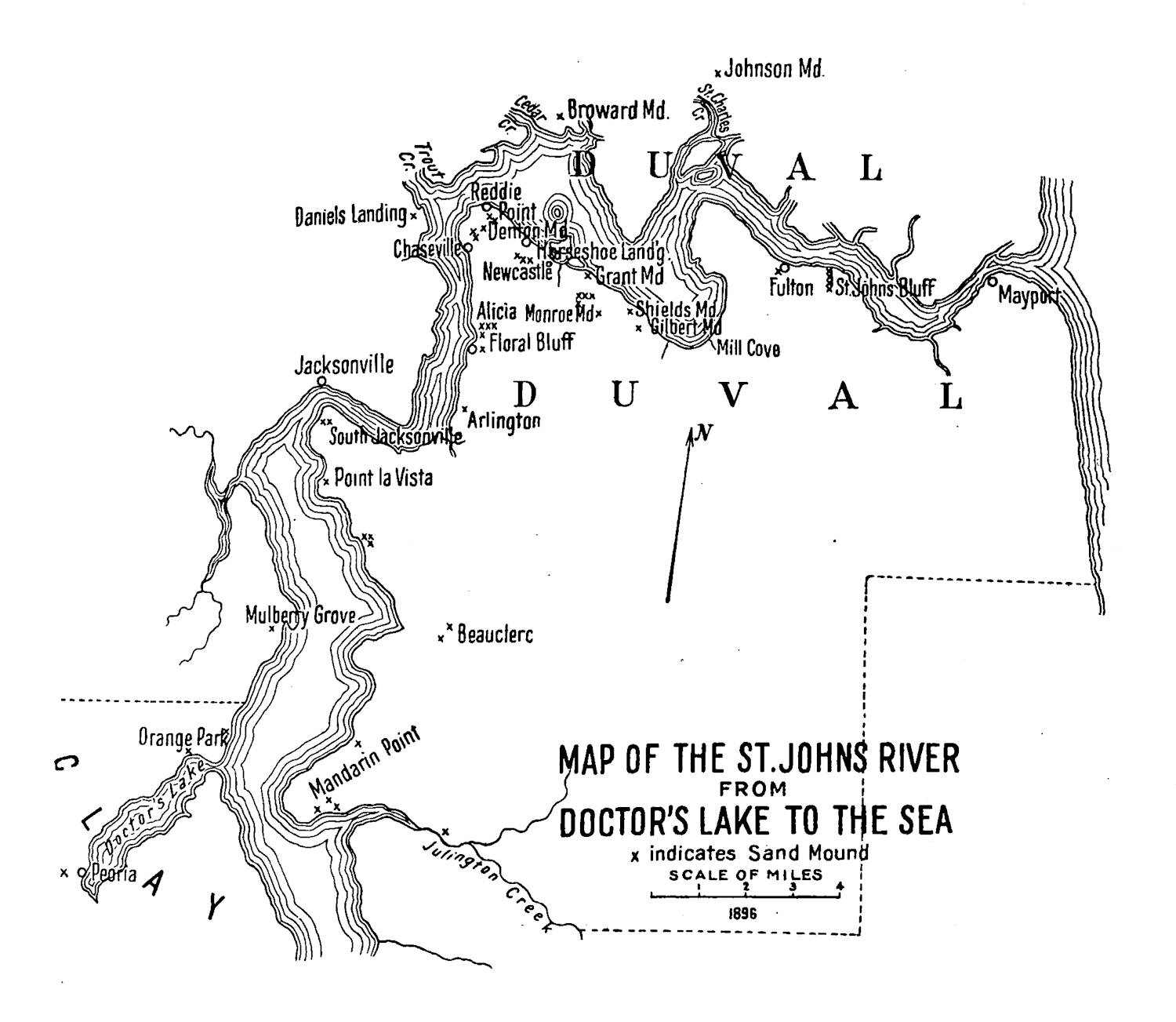
MAP OF THE ST. JOHNS RIVER FROM
DOCTOR’S LAKE TO THE SEA
During five months of the Fall of 1895
and of the Winter of 1895-1896, mound investigation
was carried on by us in Florida
with cumulative results in some cases, with
negative results in others.
Nothing new or of special interest rewarded
our labors.
Nevertheless, as our researches were
made with great care and considerable
thoroughness, it has seemed well to embody
the results in a brief report. To our mind,
it is the duty of one destroying an aboriginal
landmark to see to it that the results, be
they ever so meagre, go on permanent
record.
C. B. M.
June, 1896.
ADDITIONAL MOUNDS OF DUVAL AND OF CLAY COUNTIES, FLORIDA — Low Mound at Arlington, Duval County — HUMAN REMAINS — EARTHENWARE — STONE — SHELL — REMARKS — Two Low Mounds at South Jacksonville, Duval County — Low Mound at Point La Vista, Duval County — Low Mounds near Point La Vista, Duval County — Mound A. — Mound B. — Mound C. — Low Mound at Mulberry Grove, Duval County — Mound at Peoria, Clay County
Mound at Arlington.
Mounds at South Jacksonville (2).
Mound at Point La Vista.
Mounds South of Point La Vista (3).
Mound at Mulberry Grove.
Mound at Peoria.
About three miles below Jacksonville,
on the opposite side of the St. Johns, at
Arlington, on the property of William
G. Matthews, Esq., of Philadelphia, was a
low mound in pine woods. We are indebted
to W. H. Wilson, Esq., in whose
charge the estate is, for permission to
investigate.
This mound was not considered of aboriginal
origin by the inhabitants of the
neighborhood and had sustained no previous
investigation though it gave evidence of
cultivation in former times; its height
of two feet, at the time of our investigation,
was probably considerably less than its
original altitude. Its shape was irregular,
its major and minor axes being respectively
57 feet and 36 feet.
It was totally demolished.
It was composed of yellow sand with
the usual admixture of charcoal.
Human remains were encountered at
twenty-five points, some as deep as
3 feet from the surface, beginning at the
very margin of one portion of the mound.
Bones were in the last stage of decay,
but minimum portions of the skeleton
being represented—at times parts of the
cranium alone and again small pieces of
bone almost too fragmentary for
identification.
Sherds were present in great quantities,
the majority undecorated, though some bore
the complicated stamps found in Georgia
and in Carolina. Two had the stamp
familiar in Florida, consisting of small
diamonds.
The material of all the ware present in
the mound, with the exception of certain
fragments, was very inferior.
There were present numerous sherds
showing separation from the vessel, not
by a clean break but by the aid of a pointed
implement, and a number of vessels had
pieces removed from the margin by the
agency of pointed tools. We have before
referred to this peculiar custom as occurring
in Duval County mounds and occasionally
in other parts of Florida.
At several points in the mound were
nests of fragments of earthenware.
In the northwestern margin of the mound,
together, just below the surface, with a
deposit of charcoal but apparently with
no human remains, were two tobacco pipes
of earthenware, of the usual type found
in the mounds of Duval County, where
the orifice for the stem often equals in
size the aperture of the bowl.
This type, probably in vogue before
White contact, is present in the stone
graves of Tennessee. We have elsewhere
found tobacco pipes of much more modern
appearance in mounds containing objects
essentially European.
In loose sand was another tobacco pipe
in appearance similar to the foregoing.
In the northeastern margin, 15 feet
down, with fragmentary human remains
1 foot below, was a small undecorated
bowl with a perforation in the base, made
previous to baking. This was the only
occurrence in the mound of ready-made
mortuary ware. For the benefit of those
not familiar with our previous Reports on
the Florida mounds, we may say that it
was the custom in that State, often to
knock out the bottom, or to make a hole
through the bottom, of earthenware vessels,
previous to inhumation with the dead and
that this custom is believed to have been
practised with the idea that the mutilation
“killed” the vessel, freeing its soul to
accompany that of its owner into the next
world. Apparently, however, it entered
the minds of the more thrifty among the
aborigines that vessels of value might
serve a better purpose, and hence there
arose a class of ceremonial ware, usually
small in size, often of fantastic design and
always of flimsy material, with bases perforated
during the process of manufacture.
This cheap ware was probably kept on hand
and did duty for vessels more valuable and
less readily spared.
One and one-half feet below the surface,
about 4 feet in from the northwestern
margin, was a small globular vessel of
ordinary type, undecorated, intact as to
the base, with perforations for suspension
below the margin on either side.
No human remains were found in the
neighborhood.
About 5 feet in from the western margin,
and 2 feet below the surface, with no human
remains in proximity, were two undecorated
bowls, each with a maximum diameter
of about 6 inches. Both showed perforation
of the base made after manufacture.
A globular vessel of somewhat over
one quart capacity lay about 9 feet in
from the northeastern margin and 1.5
feet below the surface. It was undecorated
save for a raised band around the inverted
rim. With it were the greater part of a
small undecorated vessel of ordinary type
and various artifacts. Human remains
were in association. Within the vessel
were two pebbles; fragments of marine
univalves; decaying portions of mussel
shells; a worked object of shell resembling
an imperforate cylindrical bead; and a
bit of coquina.
At a number of other points were vessels,
some of about one gallon capacity, all
undecorated and of most inferior ware.
In nearly every case was perforation of the
base made after the completion of the vessel.
Nearly all were to a certain extent imperfect,
some being crushed to numerous
fragments.
Five hatchets of the usual type, some
showing considerable breakage, came from
various points in the mound, none deeper
than three feet.
In sand dyed red with Hematite, near
human remains, were several mussel shells;
one small bit of sandstone; a pentangular
slab of red sandstone with a maximum
length of 7.5 inches, a maximum width of
7 inches, a thickness of 3 inches; a “celt”
8 inches in length.
Four arrowheads came from different
depths. With one was a pebble hammer
of quartz.
About 2.5 feet from the surface, together,
were fragments of lower animal bones;
pebbles; a bit of quartz; fragments of
marine shell; and several bits of chert
rudely worked to resemble the arrowhead
but too imperfect to be of service for any
but sepulchral purposes.
Variously associated throughout the
mound were a number of sheets of mica;
pebble hammers; pebbles; several bits of
chert and hones of sandstone.
Upon several occasions fragments of
mussel shells, probably whole at the time
of interment, lay with human remains
and with artifacts.
In one instance, with human remains
and other objects, was the columella of
a marine univalve neatly worked to a
blunt point at either end.
This mound closely resembles many
other low mounds of Duval County in the
presence of abundant earthenware, of
tobacco pipes of prehistoric pattern, of
mica and of pebbles.
Nothing in the mound indicated acquaintance
with the products of Europe.
These two mounds, almost contiguous,
were on property belonging to the Hendricks
estate. The ground, destined for building
purposes, has been cleared and has evidently
been under cultivation.
The smaller mound, circular in shape,
had a height of 1 foot 8 inches, a base
diameter of 52 feet. The mound had
evidently been greatly spread out and a
good portion of its contents doubtless
scattered. The central portion was dug
through, resulting in the discovery of a
few sherds and here and there fragments
of human remains.
The larger mound was irregular in shape;
its major and minor axes being respectively
72 feet and 50 feet. Its height was 3
feet 3 inches. Its general appearance
called to mind the low mound at Floral
Bluff, Duval County, and the largest of
the low mounds south of the great Grant
mound, where our investigation was so
richly rewarded. Our hopes in respect to
this mound, however, were doomed to
disappointment, for mound work is a
lottery where blanks largely predominate.
The central portion of the mound was
entirely dug through, yielding one interment
badly decayed and apparently previously
disturbed. A few sherds with
complicated stamped decoration were met
with.
Point La Vista, on the eastern bank of
the St. Johns, is about four miles above
Jacksonville.
In a cultivated field about one-half
mile in a northerly direction from the
landing was a mound much reduced in
height by the plow. Its diameter of base,
at the time of its total demolition by us,
was 55 feet; its height, 2 feet 4 inches.
The mound at the central portion had a
thickness of 5 feet between the surface
and where the sand ceased to show an
admixture of charcoal, that is to say about
2.5 feet above the level of the surrounding
territory and an equal distance below it.
Yellow sand with no traces of charcoal
or sherds, marked the bottom of the mound
and into this again certain small pits had
been dug, as was shown by the darker
color of the sand employed to fill them.
Somewhat below the level of the surrounding
territory was a stratum over
one foot in thickness of sand blackened
by fire, containing abundant particles of
charcoal. Above this layer were brown
sand and white sand intermingled at places,
surmounted by a stratum of cherry-colored
sand owing its tint to the use of Hematite,
of irregular thickness—averaging, perhaps,
1 foot. This bright colored stratum lay
beneath a superficial layer of brownish
sand about 1 foot in thickness.
Interments were in considerable numbers—between
thirty and forty—and in the
last stage of decay, some in fact so far gone
that the method of burial was not determined,
but in all cases where sufficient evidence
remained the burial in anatomical
order was indicated.
Quantities of sherds were in every portion
of the mound; some plain, others with
punctate decoration, and others again
bearing the square or the diamond-shaped
stamp common to Florida ware. Intricate
stamped decoration, prevalent in Georgia
and present in many mounds of Duval
County, was not met with.
About 3 feet from the surface was a
bowl of approximately one gallon capacity,
of ordinary type, bearing the square stamped
decoration. The bottom had been intentionally
knocked out. No human remains
were discovered in the immediate neighborhood.
In a pocket of brownish sand, extending
into the untouched sand below the mound,
seemingly a small grave, over 5 feet from
the surface, in the central portion of the
base, with human remains, was an undecorated
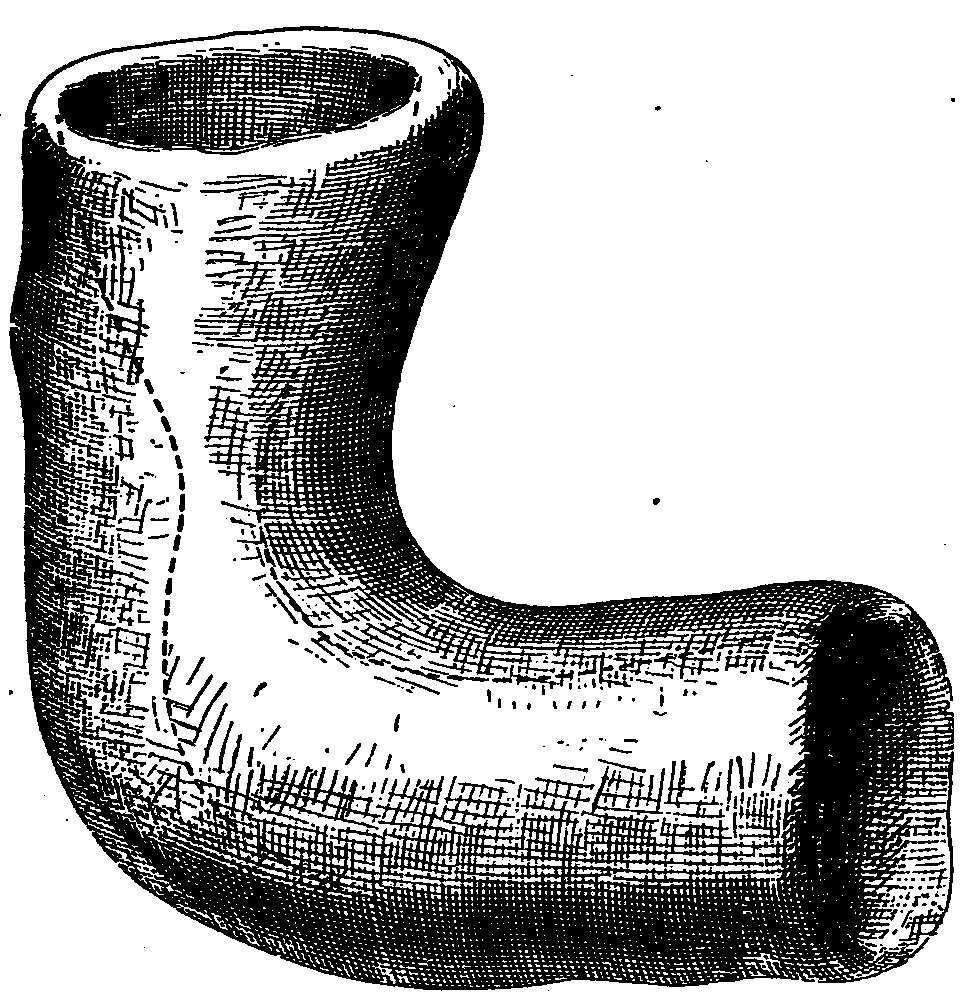
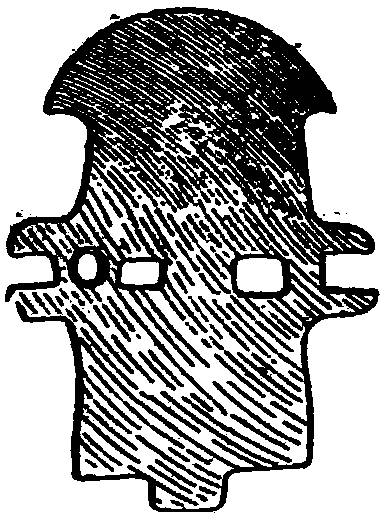
earthenware pipe (Fig. 1) of the
usual type of the mounds of Duval County.
A curious earthenware knob, evidently
broken from some vessel, lay in the sand.
Two polished hatchets were met with,
one with human remains, 6 inches from
the surface, the other in caved sand.
On a fireplace 5 feet from the surface
were certain bones of the deer.
Several chips of chert, a rude implement
of chert, a hone of sandstone and two
chert arrowheads, were found separately
in the sand.
Fig. 1.—Tobacco pipe of earthenware. Low Mound at
Point La Vista. (Length over curve, 5⅞ in.)
Loose in the sand were several conchs,
a number of oyster-shells and the columella
of a large marine univalve worked to a
point.
As this portion of Florida has been long
under cultivation, it is impossible to say
what artifacts may have been removed by
the plow in previous years.
Partly on the property of Mr. Shad,
resident near by, and of Mrs. J. R. Hunter,
of Albany, N. Y., about one mile in a
southerly direction from Point La Vista,
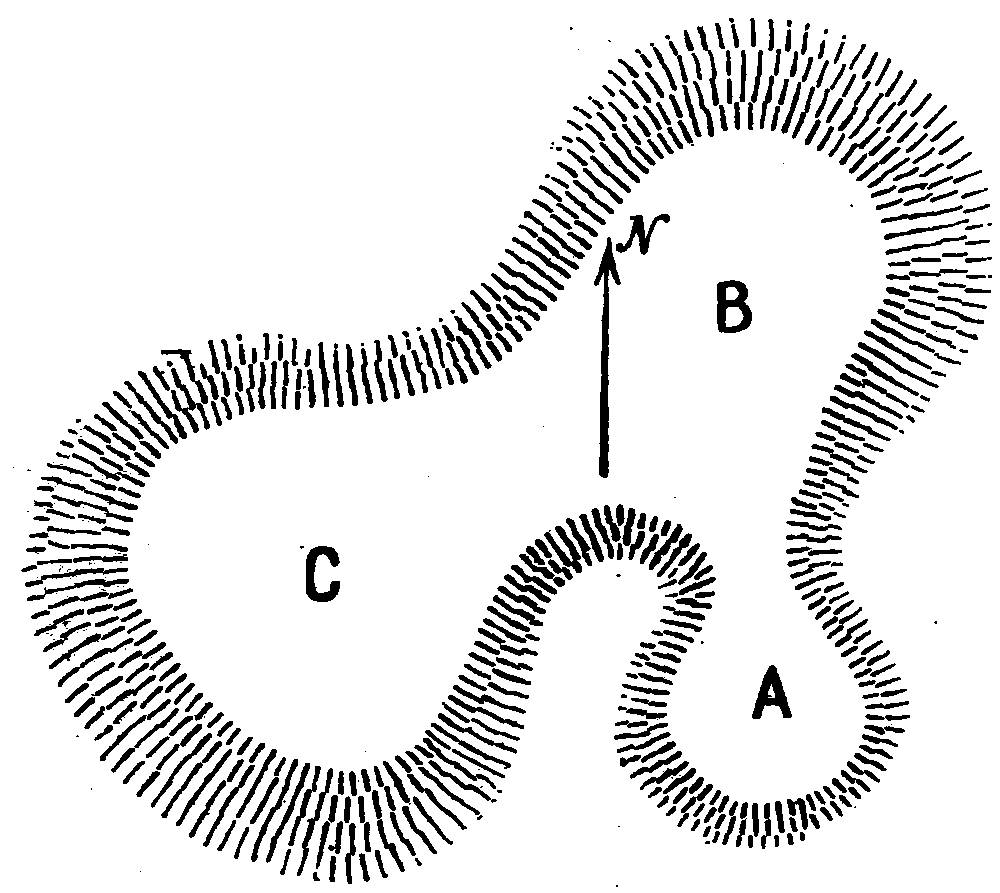
were three low intersecting mounds (Fig. 2)
all showing signs of former cultivation.
By arrangement with Mr. Shad, and with
kind consent of George M. Wyeth, M. D.,
of Jacksonville, in charge of the Hunter
property, these mounds were totally dug
through at a depth of three to four feet
below the level of the surrounding territory.
They contained the usual charcoal and
many fireplaces and were composed of
yellowish-brown sand unstratified.
Diameter of base, 29 feet;
height, 2 feet 5 inches.
No skeletal remains were encountered
until the central portion of the mound was
reached when small fragments of mouldering
human bones were met with at four
different points, from one foot to three
feet nine inches from the surface. No
artifacts were in association save in one
instance when a small stone “celt” lay
near bones.
Fig. 2.—Plan of mounds south of Point La Vista.
With the exception of a nest of many
fragments of earthenware, in the southern
margin, sherds were infrequent. Certain
fragments of earthenware were undecorated,
while others bore a complicated stamped
decoration, several of these being additionally
decorated with crimson pigment—the
first occurrence in our experience of
the combined ornamentation.
Four small arrowheads, too rude for
aught save mortuary deposits, were found
separately. A bit of chert came from a
depth of 5 feet.
Singly were: one pebble-hammer; one
rude piercing implement of chipped chert
and one pebble about 2 by 2.5 inches by
one inch in thickness, worked into an
oblong shape with rounded corners.
Diameter of base, 52 feet;
height, 2 feet 1 inch. In this mound interments,
consisting, as in the other, of mouldering
fragments, were met with at six
different points.
Three and one-half feet from the surface,
with human remains, were: one bit of
chipped chert; a few marine mussel shells;
a piece of sandstone; part of a columella
of a marine univalve; and a small Fulgur
carica with a hole knocked through one
side. These all lay in a pocket of sand dyed
scarlet with red oxide of iron.
Also in the scarlet sand, 4.5 feet from
the surface, with a few bits of human
bone, were: a small sheet of mica; a smoothing
stone of chert; a perforated Fulgur
and several molars and incisors and one
canine of some carnivore.
A streak of red sand beneath a seam of
charcoal led to a large cockle shell (Cardium)
badly decayed, and a small vessel of earthenware
with two compartments and a
handle on either end, very similar in type
to one taken by us from the Hopson mound,
Lake County, and figured by us (pl.
LXXXV, fig. 2) in our Report on the
mounds of the Ocklawaha river. Apparently
no human remains were with these
objects.
A small imperforate undecorated bowl
of ordinary type lay one foot from the
surface with fragments of parts of a large
undecorated clay vessel, near human
remains.
Three feet from the surface, apparently
unassociated with skeletal remains, were
portions of a vessel of about six quarts
capacity, with complicated stamped decoration.
The base showed perforation
after manufacture.
Several pebble-hammers lay singly loose
in the sand.
Diameter of base, 58 feet;
height, 2 feet 2 inches. Human remains,
mere fractional parts of the skeleton, present
at ten different points, were confined
to the southern portion and the eastern
margin of the mound.
Three feet, eight inches from the surface,
in the southern margin, with several large
shell beads and one small shell (Marginella)
longitudinally pierced, were portions of a cranium
of a child about nine years of age;
also several molars and one vertebra.
In the vicinity lay a hatchet of polished
stone.
Together were: three pebble-hammers,
one pitted on one side and neatly rounded;
one small pebble; a cutting implement of
chipped chert, 6 inches in length, possibly
incomplete; several conchs (Fulgur carica)
badly decayed, perforated in the body
whorl opposite the aperture; bits of columella
of large marine univalves; several
mussel shells, fragmentary through decay;
and what decay had spared of one piercing
implement of bone. All these lay with
human remains in the eastern margin of
the mound, about 3 feet from the surface.
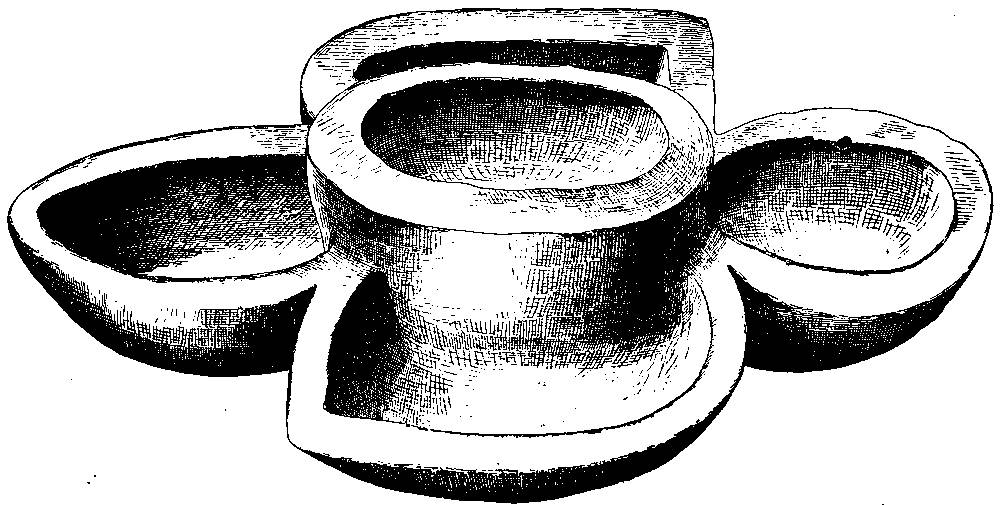
PLATE I
EARTHENWARE VESSEL WITH FIVE COMPARTMENTS. MOUND SOUTH OF POINT LA VISTA
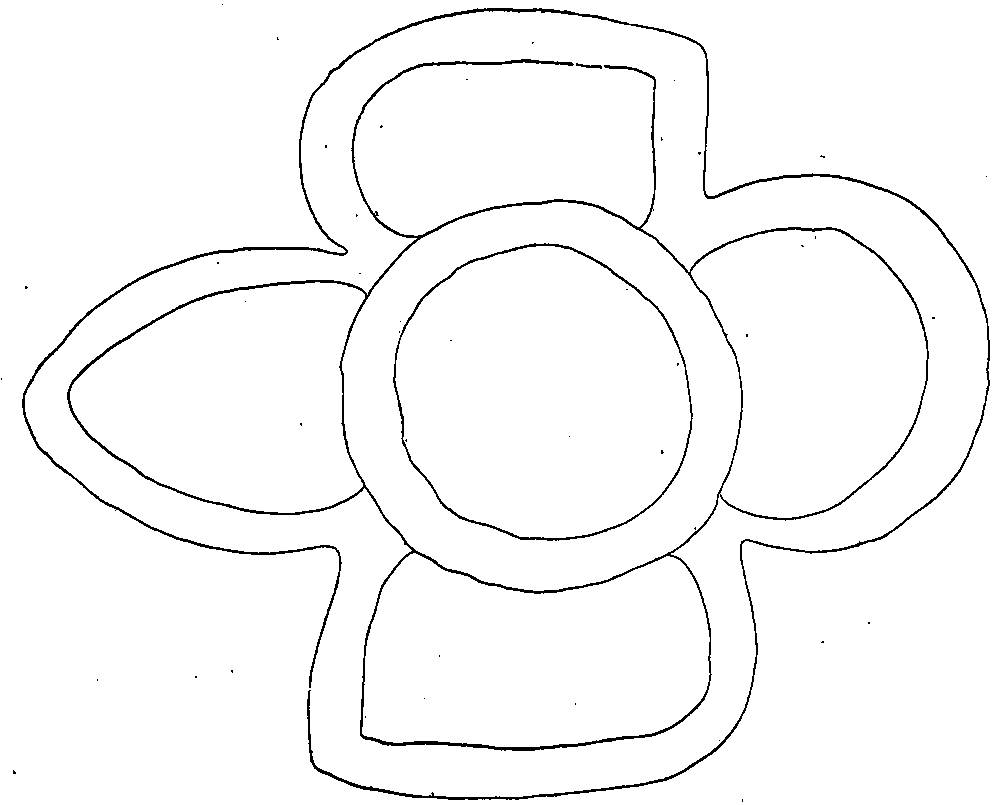
PLATE II
OUTLINE VIEW FROM ABOVE OF VESSEL SHOWN IN PLATE I
In close proximity to the deposit just
described were human remains at about
the same depth. With them were one
lance head, two arrowheads and eleven
chips, all of chert.
In various parts of the mound were nests
of many fragments of various vessels,
buried in close contact, as we have described
elsewhere as present in numbers of low
mounds of Duval County.
Three and one-half feet from the surface,
beginning almost at the southern
margin and extending in for about 6 feet,
was a large log or several smaller ones
pressed together with lines of separation
no longer distinguishable, in the last stage
of decay. The upper surface was considerably
charred.
About 5 feet in from the southern margin
and 1 foot, 8 inches from the surface, unassociated
with human remains, was a
vessel of heavy earthenware, unique so
far as our experience extends. This interesting
vessel, entirely intact, consists
of four irregular compartments joined
together on the same plane. From their
point of union a fifth compartment rises
as shown in Plates I and II.
We are indebted to Professor Holmes
for a sketch of a five-chambered vessel
about 5.25 inches square, from a mound
in Franklin County, Florida. The central
compartment is not raised above the other
four, as is the case in our specimen, but is
on the same plane and surrounded by
them. Various high authorities consulted
by us express ignorance of the discovery
within the limits of the United States of
five-chambered vessels other than the two
here recorded.
Nothing in these mounds gave any evidence
of intercourse with the Whites.
About ten miles south of Jacksonville, on
the west bank of the St. Johns, is the estate
of A. M. Reed, Esq., known as Mulberry
Grove. We are particularly indebted to
Mr. Reed for permission to investigate
his mound inasmuch as it was under cultivation
at the time of our visit. The mound
is reported to have been ploughed down
for thirty years and materially reduced
in height. Its diameter of base was 46
feet; its height, 2 feet.
A central excavation, 32 feet in diameter
(and this, we think, included the original
mound) was carried through at a depth of
about 5 feet. The mound was of brown
sand, unstratified, and contained great
numbers of fireplaces with charcoal. The
form of burial, with one exception, was
in anatomical order, about two dozen
skeletons being met with, all much decayed.
The crania were also badly crushed. About
2.5 feet from the surface was a heap of
calcined human bones with charcoal.
Some of the crumbling skeletons lay
at a depth of 5 feet from the surface.
Sherds were infrequent and probably of
accidental introduction.
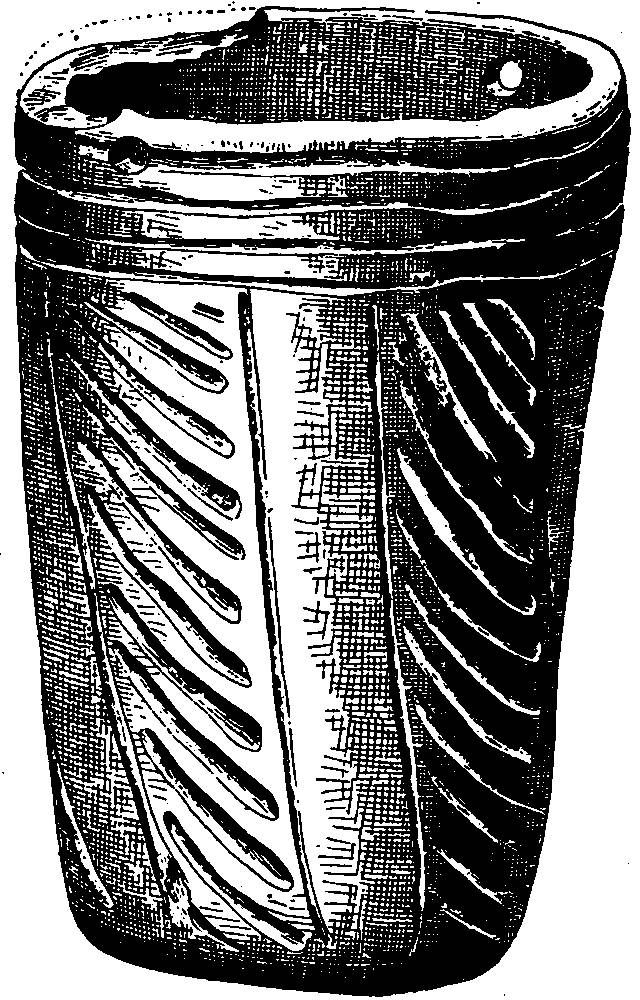
Fig. 3.—Earthenware vessel with incised decoration.
Mound at Mulberry Grove. (½ size.)
With a skeleton, 3.5 feet from the surface,
were two vessels of earthenware and
a pipe of the same material. The larger
vessel lay on its side across the right forearm;
the smaller vessel, on its base, with
the tobacco pipe, was on the right hand
side of the cranium. Beneath the skull,
were two piercing implements of bone.
Both vessels are virtually intact and imperforate
as to their bases. Each has a
small hole on either side beneath the margin,
for suspension. The larger has two incised
parallel lines beneath the margin of the
opening. Its dimensions are approximately:
height, 4.5 inches; maximum diameter,
3.25 inches; across mouth, 2.5 inches.
The smaller vessel, almost cylindrical
(Fig. 3), has an interesting incised decoration.
Approximate measurements: height,
4.25 inches; maximum diameter, at mouth,
2.75 inches; at base, or minimum diameter,
2.25 inches.
Five feet down, near a fragmentary
skull, were one arrowhead and twenty-six
small fragments of chert. We have before
made reference in our paper on certain
mounds in Duval County to the placing
of numbers of such fragments together
in the mounds.
In another portion of the mound, at
about the same depth as the previously
mentioned deposit, with human remains,
were eleven small bits of chert and one
shell gouge.
Near the surface as it was at the period
of excavation, lay a small “celt” with
human remains.
Loose in the sand were several bits of
chert and a portion of a polished stone
hatchet, found separately.
What this mound may have contained
at the period of its abandonment, it is,
of course, impossible to say. Nothing
discovered by us pointed to intercourse
with the Whites.
Doctor’s Lake has its union with the St.
Johns at Orange Park about sixteen miles
south of Jacksonville, on the west side of
the river. About six miles in from the
mouth of the lake, almost at its extremity,
is the settlement of Peoria. In the outskirts
of Peoria, on the property of Mr.
J. A. Silcox, was a mound 4 feet 2 inches
high, and 75 feet across the base. It had
sustained very little previous examination,
but its height had been greatly diminished
by washing down of sand and trampling
of cattle, which, at the same time, had
increased its diameter.
At the time of our previous mound work
on the St. Johns we were unable to come
to terms with the owner of this mound,
the location of which, however, is noticed
in our Report.
The mound was totally demolished.
It was composed of brownish sand, with
the usual intermingling of charcoal.
About 5 feet down from the level of
the summit a thin, irregular layer of dark
sand and charcoal ran through the mound.
Less than one dozen interments were
encountered, and these were represented
by mouldering fragments.
Sherds were very infrequent, all coming
under our notice being undecorated save
one having the ordinary square stamp.
Throughout the mound were several
whole and fragmentary arrow points,
three pebbles, a bit of chert and a piece
of mica.
Four and one-half feet from the surface,
with very fragmentary human remains,
lay fourteen arrow points.
Almost in the immediate center of the
mound, 2.5 feet from the surface, was a
concavo-convex ornament of sheet copper,
1.4 inches by 1.2 inches, having a narrow
margin beaded in the fashion so common
in the mound ornaments of copper.
Nothing further of interest was encountered.
MOUND INVESTIGATION ON THE EAST COAST OF FLORIDA — Stone House Mound, Volusia County — Mound at Courtenay, Brevard County — Low Mound at Courtenay, Brevard County — Mound at De Soto, Brevard County — Mound at Tropic, Brevard County — Gleason Mound, Brevard County — Mounds near Mouth of Banana River, Brevard County — Mounds near St. Lucie River, Dade County
Our investigation of aboriginal mounds
on the east coast of Florida, south of St.
Johns County, occupying three months of
the Winter of 1895-1896, included such
territory as borders the Halifax river;
the Hillsboro’ river, including the Mosquito
lagoon; the Indian river and Lake Worth;
as well as the tributary streams, Tomoka
creek, Spruce creek, Banana river and St.
Lucie river.
In addition, certain mounds in the neighborhood
of the town of Fernandina were
examined and the St. Mary’s river, separating
portions of Florida and of Georgia,
was gone over so far as the head of navigation.
To this work additional time was
devoted.
The Halifax, Hillsboro’ and Indian rivers,
so-called, are not rivers strictly speaking,
but long and comparatively narrow stretches
of salt water, connected with the Atlantic
Ocean by various inlets and separated
from the sea by a comparatively narrow
strip of sand, at no place five miles in
breadth. They extend north and south
and their total length in a direct line is
about 187 miles.
The Banana river is simply a portion of the
Indian river, lying east of Merritt’s Island.
Tomoka and Spruce creeks and St.
Lucie river, at a certain distance above
their outlets, are fresh water streams.
The aboriginal mounds bordering the
Halifax, Hillsboro’ and Indian rivers, while
examined with considerable care, were by
no means so exhaustively investigated by
us as have been the mounds of the St. Johns
river and of other parts of Florida, and our
conclusions must not be regarded as final
but rather taken as indications.
It would seem that the mounds of this
region, considerable in number and some
of great size, were mostly erected for other
than sepulchral purposes, inasmuch as
human remains appear to be absent from
the bodies of the mounds though in some
cases numerous interments were present
near the surface, sometimes associated with
art relics of European manufacture, such
as glass beads, silver beads and the like.[1]
These burials we look upon as intrusive,
made by Indians coming later than the
makers of the mounds.
In certain cases smaller mounds contained
human remains down to the base, but
in every case these remains, where any
other objects were found at all, were associated
only with bits of shell or of coquina.
Mr. Andrew E. Douglass, of the Museum
of Natural History, New York, who has
spent a number of seasons on the east
coast and has published various valuable
papers descriptive of his work,[2] reached
virtually the same conclusions as ourselves,
and we are strongly of opinion that
a more thorough investigation of these
mounds, though earnestly to be desired,
will not be fruitful of results.
Another point strongly impressing itself
upon us was the almost entire absence of
stone (unless coquina[3] may be so termed)
in the territory bordering the Halifax,
the Hillsboro’ and the Indian rivers, the
mounds being entirely free from chips,
cores, and other refuse material of chert so
abundant in mounds of the St. Johns river.
Large fields of shell, denoting aboriginal
dwelling sites, are numerous, yet upon
them we found not a single arrowhead
or fragment of hard stone, while persons
cultivating these fields invariably expressed
ignorance as to the discovery of stone upon
them. Upon similar fields and shell heaps
of the St. Johns arrowheads and flint chips
are abundant; this absence of stone on
the east coast is certainly worthy of remark
considering its comparative abundance on
a river not over thirty, and at one point
only five, miles away.
Mr. Douglass has remarked the absence
on the east coast of the polished stone
hatchet, or “celt,” from mounds south of
St. John County, or about where the Halifax
river begins, and we have not in our
experience learned of the occurrence of
this implement on the east coast south
of the point referred to by him, though on
the St. Johns river a number were taken
by us from Thursby Mound, about twenty-seven
miles farther south, while one small
hatchet was found on the surface not far
north of Lake Monroe. Beyond this
point, even on the St. Johns, the stone
“celt” seemed to be absent with the exception
of one rude cutting implement of
the polished “celt” type[4] taken by us from
the island shell heap known as Mulberry
Mound, situate where the St. Johns river
leaves Lake Poinsett, about six miles west
of Cocoa on the Indian river.
As we have said, exhaustive work was
not done by us on the east coast and as
various lists of the earthworks of that
section have already appeared, we shall
not go into a detailed account but shall
give results obtained in certain of the
mounds examined by us which, so far as
our investigation has extended, were typical
of the whole.
Stone House Mound.
Mounds at Courtenay (2).
Mound at De Soto.
Mound at Tropic.
Gleason Mound.
Low Mounds near mouth of Banana river (2).
Mound near St. Lucie river.
Spruce Creek enters the Halifax river
opposite the town of Ponce Park. About
1 mile up Spruce Creek, turning into Murray’s
Creek and following the stream
about 1 mile, the Murray dwelling is reached,
from which the mound is distant about
1.5 miles inland, in a southwesterly direction.
The mound, in thick “hammock,” and
covered with palmetto and other trees, has
a height of 20 feet, a diameter at base of
144 feet. The trench made by Mr. Andrew
E. Douglass,[5] was the only previous investigation
apparent on the mound.
Parts of two days, with nine men to
dig, were devoted to investigation. Neither
burial nor artifact rewarded our labors—a
result similar to that attained by Mr.
Douglass.
Two feet beneath the surface, such parts
of the mound as were dug into by us, were
encased in heavy slabs of coquina. This
curious feature was noted also by Mr.
Douglass in the portion investigated by him.
The settlement of Courtenay, on Merritt’s
Island, which here forms the eastern
shore of the Indian River, is about eight
miles north of the town of Cocoa.
On the property of Mr. John H. Sams,
at Courtenay, is a mound which was cordially
placed at our disposal for investigation
by the owner. The mound, entirely
surrounded by a trench, presents a striking
appearance, giving the impression of greater
altitude than it really possesses. Its height
is 11 feet; its diameter at base about 100
feet, making allowance for a certain amount
of sand evidently washed from the mound.
An excavation 28 feet in diameter and
from 5 to 6 feet deep, was made in the central
portion of the mound. A few scattered
human bones were present immediately
below the surface. At a depth of 5 feet
was a sherd of considerable size. Loose in
the sand was one fragment of chipped chert.
Beyond these, nothing was encountered
and the sand, coarse and yellow, had the
raw look peculiar to mounds containing
no organic remains.
In the southern extremity of the settlement
of Courtenay, in thick “hammock”
land, on the property of Mr. H. J. Tiffin,
of Montreal, Canada, was a mound about
2 feet in height and 35 feet in diameter.
The central portion of this mound was
completely dug through at the courteous
invitation of the owner. At two points
were fragmentary human remains which,
with one small sherd, were the entire yield
of the mound.
The Banana river, as we have stated, is
simply a portion of the Indian river
separated from the main body by Merritt’s
Island. On the east side of the river,
about 7 miles south of its northern extremity,
at or near De Soto, is the estate of Mr.
F. Y. Hanna, an unoccupied house with a
landing. About one-half mile in a northeasterly
direction from the landing, on
Mr. Hanna’s property, is an irregular mass
of sand 6 feet 4 inches in height and 75
feet across the base. An excavation made
in the center, 18 feet by 24 feet by 4 feet
deep, yielded four burials in anatomical
order, none over 18 inches from the surface.
With one skeleton were two bits of looking-glass,
with another was a fragment of
conch-shell. About one foot from the
surface were parts of an undecorated bowl.
This mound, at a short distance below the
superficial portion, was composed of that
raw-looking bright yellow sand, in which,
as we have stated, we have never yet met
with interments.
Near the southern extremity of Merritt’s
Island is the settlement of Tropic. On
the property of Mr. M. F. Dwyer, of New
York, in a cultivated pineapple patch, was
a symmetrical mound of white sand, 3 feet
8 inches in height and 48 feet across the base.
It was practically demolished. No stratification
was noticed. A considerable number
of fragmentary human remains, very badly
decayed, including a number of isolated
crania, were present at all depths. A number
of bits of plain earthenware and several
stamped in squares, were loose in the sand.
Eight small shells (Dosinia discus) were
found together, while masses of coquina and
smaller bits were present in the mound.
An occasional fragment of Fulgur was
met with. Beyond this, greatly to our
disappointment, for the mound had a
very promising appearance, nothing was
discovered.
On the eastern bank of the Banana river,
a short distance above its union with
the Indian river, in full view from the water,
is a great shell-heap mainly composed of
the shells of marine bivalves (Dosinia
discus), a section of which has been laid
bare by the river. In the “scrub,” about
one-eighth of one mile in a northerly direction
from this heap, is a mound on the
property of ex-Governor Gleason, of Eau
Gallie, who courteously placed it at our
disposal.
The mound, which is not symmetrical
and had suffered from much superficial
investigation, has a height of about 10
feet and a diameter at base of about 150
feet.
The mound, which was thickly covered
with undergrowth, was cleared by us near
the center of the summit plateau, giving
a space about 32 feet in diameter, which
was dug through to a depth of from 5 to 7
feet. In addition to this, considerable
work was done on the northern and eastern
slopes.
The sand, whitish in color, was unstratified.
Burials—all superficial and all in anatomical
order—were numerous, about thirty
being met with.
With the majority of the bodies no relics
were found. With others were flat
bits of coquina; portions of clam shells,
showing wear, and occasionally a mass of
coquina.
Near human remains were three large
glass beads and a round bead of silver, apparently
of European make.
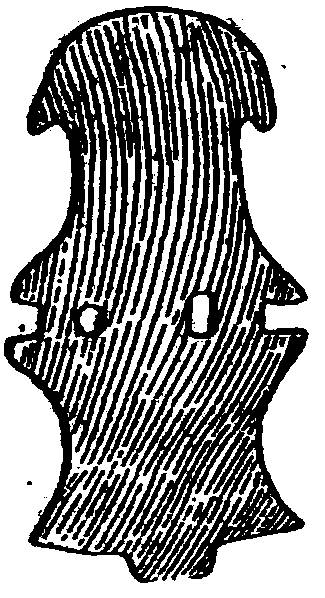
Fig. 4.—Ornament of
silver. Gleason mound.
(½ size.)
Fig. 5.—Ornament of
brass. Gleason mound.
(½ size.)
With a burial about two feet from the
surface was a small gorget of silver, oxidized,
having three perforations, two apparently
made with a sharp cutting tool, the other
bored from one side and countersunk
(Fig. 4), representing the head of a duck.
With another superficial burial, lying
near the lower jaw, was a somewhat similar
ornament of brass (Fig. 5).
Ornaments of this type are not uncommon
in Florida, though we have met with none
on the St. Johns.[6]
Loose in the sand throughout the mound
were a few bits of ornamented earthenware;
one Fulgur carica, much worn at the beak,
but without the usual perforation; and one
large marine shell (Fasciolaria). A considerable
number of these shells, all more
or less broken as to the body whorl, lay
near previous excavations.
Five feet from the surface were the
remains of an undecorated bowl of considerable
size, which had been interred whole
or nearly so. No human remains were
found in the neighborhood of this bowl, and
it lay at a much greater depth than any
other discovered by us. It had probably
been lost or broken during the construction
of the mound.
From the eastern slope, with human
remains, were taken two imperforate
drinking cups of shell, one within the other;
another alone; and two beads of silver seemingly
of European workmanship.
As no burials or indications of interment
(and discoloration of sand usually shows
where bones have been) were met with in
the Gleason mound at a depth of over
2 feet, we are of opinion that later Indians
utilized for burial a pre-existing mound.
On the property of Mr. John Aspinwall,
of New York, about one-half mile south
of the Gleason mound, 50 yards apart
approximately, were two mounds in thick
“scrub.”
The smaller mound, about 4 feet in
height, was dug through as to the central
portion, yielding a number of superficial
burials of the bunched variety. With
some of these were small bits of coquina
and of shell.
The larger mound, about 7 feet in height,
yielded nothing to an investigation conducted
through the central portion.
About one and one-half miles above
the railroad bridge, or six and one-half
miles, approximately, from the river’s
mouth, near the southern bank of the
south fork of the St. Lucie River, is a
mound in the pine woods in full view
from the stream.
Its height is about 6 feet above the
general level on the south and west, while
on the other two sides deep depressions,
made by the removal of sand for the mound,
give it the appearance of much greater
altitude.
The diameter of its base is about 80
feet.
A considerable section was dug out
from near the margin to the center and
the base of the central portion was carefully
explored.
Several superficial burials were met with
toward the center and two at different
points about 3 feet from the surface.
With the remains were no artifacts
whatsoever.
Loose in the sand, separately, were two
fragments of undecorated earthenware,
two bits of Hematite and a number of
pieces of charcoal.
At Spruce Bluff, up the north fork of
the St. Lucie river, is a large mound which
we did not investigate. Considerable digging
had been attempted in the central
upper portions. Residents reported no
discoveries during these investigations.
FLORIDA COAST MOUNDS NORTH OF THE ST. JOHNS RIVER — Low Mound at the Sawpit, Duval County — Low Mound at Dr. Harrison’s, Amelia Island — Mound South of Suarez Bluff, Amelia Island — Mound Northeast of Suarez Bluff, Amelia Island — Light-house Mound, Fernandina, Nassau County — COMPOSITION OF MOUND — HUMAN REMAINS — CANINE REMAINS — EARTHENWARE — STONE — SHELL — MISCELLANEOUS — COPPER — REMARKS
By turning into Sisters creek near the
mouth of the St. Johns river, an inland
passage by water can be made to Fernandina.
This inland route has been carefully
searched by us for mounds upon two
occasions.
Low mound at the Sawpit, Duval County.
Low mound at Dr. Harrison’s, Amelia Island, Nassau County.
Mound south of Suarez Bluff, Amelia Island, Nassau County.
Mound northeast of Suarez Bluff, Amelia Island, Nassau County.
Light-house mound, Fernandina, Nassau County.
A small mound at the Sawpit, about
10 miles north of the St. Johns river, 4
feet in height and 35 feet across the base,
was completely dug through by us as to
its central portion. A few crumbling skeletons
in anatomical order were discovered
unassociated with any art relics whatsoever.
On the southern end of Talbot Island,
Duval County, on the property of Mr.
Spicer Houston, of Mayport, are two
symmetrical sand mounds about one-half
mile apart. This gentleman values the
right to investigate at one thousand dollars
and is still owner of undisturbed aboriginal
earthworks.
On the property of Dr. Robert Harrison,
about one-half mile in an easterly direction
from his house, which overlooks the Amelia
river at a point about one mile, in a southerly
direction, from Suarez Bluff (Amelia City,
Nassau County) was a mound 1.5 feet
high and 30 feet across the base. It had
sustained little if any previous investigation
and was totally demolished by us.
It was composed of yellowish sand with
pockets of white sand, and through the
central portion a layer of white sand several
inches in thickness ran considerably below
the level of the surrounding territory.
Interments, probably a dozen in all,
were, curiously enough, marginal and
beneath the slope, no remains being met
with in or near the central portion of the
mound. Both forms of burial, the bunched
and that in anatomical order, were present.
In one case the remains were in part calcined,
while other portions of the skeleton
were charred in places only. No charcoal
or fire-whitened sand lay with these bones
which consequently must have been exposed
to flames elsewhere.
A number of the burials lay beneath
deposits of oyster shells.
The remains were in much better state
of preservation than is usually the case
in the mounds. One skull, almost intact,
was preserved.[7]
With two crania, at different points,
were numbers of longitudinally perforated
shells (Olivella).
With human remains was found a portion
of the shaft of a large pin of shell, showing
recent fracture. The remaining part doubtless
escaped us.
But two sherds were brought to our
attention.
In a large shell field about three-quarters
of one mile in a southeasterly direction
from Suarez Bluff, on property belonging
to Mr. Scott of that place, was a mound
6.5 feet high and 44 feet across the base.
It had probably lost about 2 feet in height
through previous investigation.
The mound was built on a shell heap of
irregular surface. A thickness of 6 feet of
solid sand was at certain portions of the
mound and scarcely 2 feet at others.
About two-thirds of the mound was dug
down.
Nineteen burials, from 1 to 6 feet from
the surface, all in anatomical order, were
discovered.
Occasional pockets of sand colored with
Hematite were near the base. A few bits
of pottery lay loose in the sand and at one
point were fifteen marine univalves (Fulgur
carica, Fulgur perversum, Fasciolaria). A
few shell beads, lying with a skeleton,
were the only artifacts discovered.
About 1.5 miles from Suarez Bluff was
a mound 5 feet 2 inches in height with a
diameter at base of 68 feet. About one-half
of this mound, which was kindly
placed at our disposal by Mr. Jonathan
Buzzell of Suarez Bluff, or Amelia City,
as it is now called, was demolished by us.
It was composed of yellowish sand with
little, if any, intermingling of charcoal.
A layer of oyster shells and midden refuse,
such as fragments of bones of the turtle
and of the deer, but apparently with no
sherds, occupied a central position in the
mound. This deposit began about 18
feet from the margin and was then a little
over 2 feet from the surface, and apparently
so throughout. Its thickness was about
2 feet (see diagram), increasing toward
the center. There were no oyster shells
in the marginal portion of the mound.
At one point in the marginal, or sandy
portion, 1.5 feet from the surface, was a
deposit of calcined fragments of bone,
some belonging to the turtle. This mound
was evidently not a shell heap covered with
sand, since the mass of shells, when encountered,
did not present a sloping surface
but showed an abruptly vertical surface
2 feet in height, very much as though
the shells had been thrown
into an excavation.
No human remains or art
relics, with the exception of
one arrow head, were met
with.
The Light-house[8] mound, in
a shell field and in the neighborhood
of others, about 150
yards south of the light-house,
probably one mile east of the
town of Fernandina, was
kindly placed at our disposal
by Mr. E. D. Lukenbill of
the Fernandina Development
Company. Our thanks are
tendered for numerous courtesies
also to Mr. H. L. Linville,
port warden of Fernandina.
Fig. 6.—Section of mound northeast of Suarez Bluff.
The height of the mound,
which was totally demolished
by us, was 12 feet; the
diameter of its base, 75 feet. It presented
a very symmetrical appearance when stripped
of the dense growth of vegetation which
covered it, the ascent at some points being
at an angle of 44°. Excavations 3 to 4
feet deep to the west and northwest of
the base showed whence the material was
derived. There had been some previous
investigation on the immediate summit.
Structurally the mound was of considerable
interest, the strata well defined. Immediately
in a central position was a cone
of white sand, surrounded and surmounted
by the regular strata of the mound.
The stratification of the mound from
the top downward, a little north of the
center, was as follows:
2 feet 6 inches—dirty brown sand.
1 foot—dark sand with oyster shells.
1 foot—pink sand mingled with oyster
shells and with white sand.
5 feet 8 inches—yellow sand.
7 inches—dark sand and oyster shells.
2 feet—light sand to yellow sand of the
base.
At various points in the mound were
pockets of sand artificially colored with
Hematite.
The distance between the summit of
the mound at the center to the yellow sand
at the base, where charcoal and human
remains were wanting, was 15 feet.
Exclusive of loose bits of bone, doubtless
thrown from the previous excavation,
seventy-four skeletons, all seemingly in
anatomical order, were met with, and one
deposit of charred and calcined human remains.
We are, of course, unable to estimate
the number of skeletons thrown out
or carried away prior to our visit. The
first interment was encountered 10 feet in
from the southwestern margin of the base.
With very few exceptions no art relics
lay with human remains, and if we except
a stone hatchet found with a skeleton 8
feet from the surface and some beads of
shell with another interment, no art relics
were associated with burials in the body
or on the base of the mound.
In no previous mound work have we
found so great a percentage of pathological
specimens as in this mound, and, as has
not been the case in other mounds, entire
skeletons seemed affected, and not one or
possibly two bones belonging to a skeleton.
The pathological conditions were so marked
and cranial nodes so apparent that, in
view of the fact that no objects positively
indicating White contact were discovered
in the mound, though the utmost care was
exercised by a trained corps of assistants,
we are compelled to regard the bones with
the greatest interest since evidence of
contact with the whites being wanting
we must look upon these bones as of pre-Columbian
origin. We may state here
that all bones preserved by us came from
depths in the mound which insure their
derivation from original burials. These
bones, found 8 to 12 feet from the surface,
and lying beneath numerous undisturbed
layers are as unmistakably of an early origin
as any yet described and much more reliable
than most.
Dr. Washington Matthews, whose memoir
on the human bones of the Hemenway
collection is so well known, has kindly consented
to study and to report upon these
bones from the Light-house mound.
Perforation of the humerus
Left
Right
Male
Perforated
3
3
Not Perforated
7
14
Female
Perforated
6
4
Not Perforated
2
3
Uncertain
Perforated
3
4
Not Perforated
2
3
Professor Wyman, as we have stated in
a former paper, found no remains of dog
during his researches among the shell
heaps of the St. Johns river. In point
of fact no practical work was done among
the sand mounds by this pioneer of the
archæology of Florida.
In a shell-heap near the bank of the
Econlockhatchee creek, Orange County,
we discovered a canine lower jaw which
Professor Cope minutely examined, giving
his results, with figures, in the American
Naturalist.[9]
Professor Cope concluded that the jaw
under examination belonged to an unknown
kind.
A canine jaw from another shell-heap
examined subsequently, presented features
with which Professor Cope was unfamiliar.
On the base of the large sand mound at
Tick Island, Volusia County,[10] the skeleton
of a dog was found by us, the skull and certain
other bones of which, forwarded to
Professor Cope, were passed upon as follows
by that eminent authority: “The bones you
send are those of a dog but of what species
I am not sure. It is no wolf or coyote
but differs from ordinary breeds of domestic
dogs. Nevertheless, it may be some form
domesticated by the Indians, with which
I am not familiar.”
Fifteen feet from the surface of the Light-house
mound, or 3 feet below the level of
the surrounding territory, was discovered
the skeleton of a dog.
The cranium has been submitted to
Dr. C. Hart Merriam, who was, unfortunately,
unable to spare time for an exhaustive
examination, being about to leave
town for the summer. According to Dr.
Merriam the skull is not that of a coyote,
nor does it belong to any type of domestic
dog with which he is familiar.
Professor Cope is of opinion, after an
examination of the skull, that it belongs
to neither wolf nor coyote, but is probably
that of a domestic dog, though by no means
of necessity one obtained from Europeans.
There are, however, according to Professor
Cope, certain domestic dogs whose crania
cannot be distinguished from those of wolves.
Professor Cope also made an examination
of a canine skull from the great shell deposit
at Damariscotta, Maine, in which no articles
of European origin have ever been met
with at a depth greater than a few inches
from the surface. The Damariscotta skull,
according to Professor Cope, strongly resembles
that from the Light-house mound.
Professor Putnam, who has made a
careful study of the skull from the Light-house
mound, writes as follows:
“I have lately secured for comparison
several dog skulls, among which is that of a
mongrel greyhound. This skull resembles
that of the coyote more than it does the gray
wolf. It differs from the coyote, however, in
being slightly more convex. In the coyote
the frontals are flatter than in the gray wolf.
“I have a skull of an Irish setter which agrees
with that of a gray wolf, except that it is
slightly higher over the orbits, and there is more
of a concavity along the union of the frontal
bones. The jaws are also shorter, but the teeth
are of about the same size.
“I have the skull of an English collie which
differs from the gray wolf in the same way as
does the setter’s skull; that is, the frontal bones
are slightly more concave in the center and
a little higher. The jaws are proportionately
shorter than the jaws of the setter, and of course
shorter than those of the wolf, and the molar
teeth are proportionately smaller.
“The skull of the collie agrees in size and
height and convexity of the frontals with the
nearly perfect skull I have from the Damariscotta
shell-heap; it also agrees with the teeth
with the exception that in my Damariscotta
skull the second and third molars are slightly
stouter and approach more nearly to the corresponding
teeth of the setter.
“Thus, I should say that the Damariscotta
shell-heap skull is very close to the English
collie, and also very close to the gray wolf. This
Damariscotta skull was found very low down in
the great shell-heap, and it is unquestionably of
prehistoric time, probably centuries before any
white man reached this continent. There is,
therefore, no possibility of its being a domestic
dog brought over by the Whites. The close
affinities, in its shape, with the setter, and thus
with the gray wolf, lead me to regard it as a
domestic dog of the people whose refuse formed
that ancient shell-heap; probably a domesticated
gray wolf, unless there was some now
extinct species of the genus Canis from which
this dog was derived, the only prominent
difference being in the shorter jaws of the dog.
“I have also three skulls from the ‘ash-pits’
of the ancient cemetery near Madisonville,
Ohio. In the contents of about 1,500 of these
ash-pits, which we have carefully examined,
not a sign of White contact was found; and they
are unquestionably of prehistoric time. These
three skulls from the ash-pits are slightly smaller
than the Damariscotta skull, but agree with it
in every other particular.
“I have examined two skulls (in the American
Museum of Natural History) found with an
Indian skeleton on Staten Island, New York.
This burial-place is also of unquestionably prehistoric
time. These two dog skulls are of
about the same size as those from the Madisonville
cemetery, and are of the same character.
“I have two skulls of dogs from the Lake
Dwellings, at St. Aubin and Neufchatel, Switzerland,
which agree in size with the three above-mentioned
from the ash-pits at Madisonville,
but differ from them in having the frontals
slightly flatter and in having the interparietal
crest nearly obliterated. A fourth skull from
the Madisonville ash-pits, smaller than the
other three, agrees with these Swiss Lake
skulls in the latter character.
“I cannot distinguish any important difference
between the dog skull you found in the
Florida mound and those from the Madisonville
ash-pits.
“Thus your Florida skull, while it agrees
very closely with the English collie, also agrees,
as well, with the other dog skulls which are of
unquestionably prehistoric time. The condition
of the bones indicates considerable antiquity
and unless objects belonging to the Whites
were found associated with the bones of the
dog, or the bones themselves were found near
the surface, and you have evidence that they
belong to an intrusive burial, I should have
no hesitation whatever in considering your
Florida skull as that of a domestic dog of the
people who built the mound.”
Three varieties of dog are found with the
dead in the Necropolis of Ancon, Peru, one
of which strongly resembles the collie.[11]
Sherds were infrequently met with,
the majority being undecorated, though
several from marginal parts of the mound
bore cord-marked and stamped decorations.
One bowl of about one pint capacity,
with incised marginal decoration,
lay apparently unassociated on the base.
It unfortunately received a blow from a
spade.
In all, eight stone hatchets, or “celts,”
were met with, as a rule, in caved sand
and probably from upper strata. One
lay with a skeleton 3 feet from the surface.
With it were two large barrel-shaped beads
of shell.
No arrow heads, whole or fragmentary,
were met with, nor were any fragments of
chert, so numerous in many mounds, apparently
present in this one.
Loose in the sand, separately, were
two fine large marine shells (Fasciolaria),
while at various depths were several heavy
conchs (Fulgur carica) worn and chipped
down at the beak and with a round or
oblong perforation opposite the aperture
in the body-whorl between the shoulder
and suture.
It has been customary to regard such
shells as having served as war clubs. We
have elsewhere pointed out that in the
great majority of cases they must have
been put to other uses, and give here some
of our reasons:
1. The beak shows wear as by constant
use.
2. The margin of the perforation is
frequently smoothed as by continued motion
against a handle, which would not be
so in the case of a club.
3. Some specimens are entirely too small
to have been of any avail as weapons of
offense.
4. The hole is usually so placed that the
handle would not be at right angles to the
shell as would be the case with a war club.
5. The perforation is frequently too small
to admit a handle of sufficient size to deliver
a heavy blow without danger of breaking.
Moreover, Mr. Frank Hamilton Cushing,
who has recently explored certain shell
deposits of the southwestern coast of Florida,
and who was fortunate enough to find
a number of these implements with handles
in place, informs us that in his opinion our
position in this matter is the correct one.
These perforated Fulgurs were probably
in use as picks, hoes, chisels, and the like.
With a skeleton were three gouges of
shell, and a similar implement was found
loose in the sand.
A drinking cup of shell (Fulgur perversum)
lay loose in the sand.
Two shell pins were met with separately,
and so far as could be determined, unassociated,
though, in our opinion, they must
have rolled from the neighborhood of
some skeleton.
Three feet from the surface, with human
remains and a bone implement, was a
marine shell (Murex spinicostata).[12]
A bone piercing implement, with a length
of 6.5 inches, closely resembling the one
to which reference has been made, was
taken from a different portion of the mound.
A canine tooth of a large carnivore lay
loose in the sand.
Two very minute fragments of sheet
copper, found separately, showed the
former presence of this metal in the mound.
As we have stated, nothing that was
necessarily the product of Europeans came
from the Light-house mound, and when
a mound of this size, containing so many
skeletons, shows no contact with the Whites,
it is justly regarded by archæologists as
having a pre-Columbian origin.
ST. MARY’S RIVER
St. Mary’s river, having its source in the
Okefenokee swamp, enters Cumberland
sound near the town of Fernandina, and
serves as boundary between portions of
Georgia and of Florida.
The stream, which hardly averages over
75 yards in breadth, a few miles distant
from the sea, is navigable for other than
small boats to the second railroad bridge,
a distance of about 30 miles by land, though
probably double that distance by the river.
At first the river runs through marsh
land, though farther up it is bordered by
firm and at times high ground, mainly
wooded with a thick growth of pine. The
river is famous for the excellent quality of
its water, and one would believe its banks
to have been a chosen dwelling site for the
aborigines.
The river was carefully searched by us
on either side, all landings and settlements
being visited, and diligent inquiry made,
resulting in the conclusion that no mounds
of importance, and an extremely limited
number of any size, were present.
One small mound, partly dug through,
was found on the Florida side on the
property of Mr. Haddock, and another,
about 2 feet in height, was seen at the
“Brick Yard” a few miles east of King’s
Ferry. So well known along the river was
this insignificant earthwork that it was
evident that no mound of importance is
likely to have escaped our inquiries, made
as they were at all points where habitations
were apparent.
No shell-heaps were noticed on the banks.
Numbers of stones and fragments of
rock proved to be ballast from timber
schooners, and not indigenous to the
territory.
NOTES — Transcriber’s Notes
[1] Mr. Douglass informs us that in his exploration
of more than forty sand mounds on
the east Florida coast, from the St. Johns
river to Miami—a distance of 375 miles
by water—he has never found an article of
European manufacture.
[2] “Some Characteristics of the Indian Earth
and Shell Mounds on the Atlantic Coast
of Florida,” The American Antiquarian,
March, 1885.
“Earth and Shell Mounds on the Atlantic
Coast of Florida,” same journal, May,
1885.
“A Find of Ceremonial Weapons in a
Florida Mound, with Brief Notice of Other
Mounds in that State.” From the
Proceedings of the American Association
for the Advancement of Science, Vol. XXI.
[3] Coquina, a formation of sand and minute
shells and fragments of shells.
[4] For figure and description see American
Naturalist, August, 1893, page 716.
“Certain shell heaps of the St. Johns
River, Fla., 4th paper.”
[5] There are two mounds on Spruce Creek.
The one not referred to here is described
by Mr. Douglass in the first part of his
article, “Earth and Shell Mounds on the
Atlantic Coast of Florida,” American Antiquarian,
May, 1885. Details of the Stone
House, or Rock House mound, as it is
variously called, are given in the same
paper.
[6] The reader is referred to “A Gold Ornament
from Florida,” by A. E. Douglass, American
Antiquarian, January, 1890.
[7] Sent to the United States Army Medical
Museum, Washington, D. C.
[8] This mound must not be confounded with
the remains of a mound near the water
works in the suburbs of the town.