“You seemed to be most tremendously in earnest yesterday, when we were
talking about that book,” observed Brook on the following afternoon.
“Of course I was,” answered Clare. “I said just what I thought.”
They were walking together along the high road which leads from Amalfi
towards Salerno. It is certainly one of the most beautiful roads in
Europe, and in the whole world. The chain of rocky heights dashes with
wild abruptness from its five thousand feet straight to the dark-blue
sea, bristling with sharp needles and spikes of stone, rough with a
chaos of brown boulders, cracked from peak to foot with deep torn
gorges. In each gorge nestles a garden of orange and lemons and
pomegranates, and out of the stones there blows a perfume of southern
blossom through all the month of May. The sea lies dark and clear below,
ever tideless, often still as a woodland pool; then, sometimes, it rises
suddenly in deep-toned wrath, smiting the face of the cliff, booming
through the low-mouthed
caves, curling its great green curls and
combing them out to frothing ringlets along the strips of beach, winding
itself about the rock of Conca in a heavily gleaming sheet and whirling
its wraith of foam to heaven, the very ghost of storm.
And in the face of those rough rocks, high above the water, is hewn a
way that leads round the mountain’s base, many miles along it, over the
sharp-jutting spurs, and in between the boulders and the needles, down
into the gardens of the gorges and past the dark towers whence watchmen
once descried the Saracen’s ill-boding sail and sent up their warning
beacon of smoke by day and fire by night.
It is the most beautiful road in the world, in its infinite variety, in
the grandeur above and the breadth below, and the marvellous rich
sweetness of the deep gardens—passing as it does out of wilderness into
splendour, out of splendour into wealth of colour and light and odour,
and again out to the rugged strength of the loneliness beyond.
Clare and Johnstone had exchanged idle phrases for a while, until they
had passed Atrani and the turn where the new way leads up to Ravello,
and were fairly out on the road. They were both glad to be out together
and walking, for Clare had grown stronger, and was weary of always
sitting on the terrace, and
Johnstone was tired of taking long walks
alone, merely for the sake of being hungry afterwards, and of late had
given it up altogether. Mrs. Bowring herself was glad to be alone for
once, and made little or no objection, and so the two had started in the
early afternoon.
Johnstone’s remark had been premeditated, for his curiosity had been
aroused on the preceding day by Clare’s words and manner. But after she
had given him her brief answer she said no more, and they walked on in
silence for a few moments.
“Yes,” said Johnstone at last, as though he had been reflecting, “you
generally say what you think. I didn’t doubt it at the time. But you
seem rather hard on the men. Women are all angels, of course—”
“Not at all!” interrupted Clare. “Some of us are quite the contrary.”
“Well, it’s a generally accepted thing, you know. That’s what I mean.
But it isn’t generally accepted that men are. If you take men into
consideration at all, you must make some allowances.”
“I don’t see why. You are much stronger than we are. You all think that
you have much more pride. You always say that you have a sense of honour
which we can’t understand. I should think that with all those advantages
you would be much too proud to insist upon our making allowances for
you.”
“That’s rather keen, you know,” answered Brook, with a laugh. “All the
same, it’s a woman’s occupation to be good, and a man has a lot of other
things to do besides. That’s the plain English of it. When a woman isn’t
good she falls. When a man is bad, he doesn’t—it’s his nature.”
“Oh—if you begin by saying that all men are bad! That’s an odd way out
of it.”
“Not at all. Good men and bad women are the exceptions, that’s all—in
the way you mean goodness and badness.”
“And how do you think I mean goodness and badness? It seems to me that
you are taking a great deal for granted, aren’t you?”
“Oh, I don’t know,” said Brook, growing vague on a sudden. “Those are
rather hard things to talk about.”
“I like to talk about them. How do you think I understand those two
words?”
“I don’t know,” repeated Johnstone, still more vaguely. “I suppose your
theory is that men and women are exactly equal, and that a man shouldn’t
do what a woman ought not to do—and all that, you know. I don’t exactly
know how to put it.”
“I don’t see why what is wrong for a woman
should be right for a man,”
said Clare. “The law doesn’t make any difference, does it? A man goes to
prison for stealing or forging, and so does a woman. I don’t see why
society should make any distinction about other things. If there were a
law against flirting, it would send the men to prison just like the
women, wouldn’t it?”
“What an awful idea!” laughed Brook.
“Yes, but in theory—”
“Oh, in theory it’s all right. But in practice we men are not wrapped in
cotton and tied up with pink ribbons from the day we are born to the day
we are married. I—I don’t exactly know how to explain what I mean, but
that’s the general idea. Among poor people—I believe one mustn’t say
the lower classes any more—well, with them it isn’t quite the same. The
women don’t get so much care and looking after, when they are young, you
know—that sort of thing. The consequence is, that there’s much more
equality between men and women. I believe the women are worse, and the
men are better—it’s my opinion, at all events. I dare say it isn’t
worth much. It’s only what I see at home, you know.”
“But the working people don’t flirt!” exclaimed Clare. “They drink, and
that sort of thing
—”
“Yes, lots of them drink, men and women. And as for flirting—they
don’t call it flirting, but in their way I dare say it’s very much the
same thing. Only, in our part of the country, a man who flirts, if you
call it so, gets just as bad a name as a woman. You see, they have all
had about the same bringing up. But with us it’s quite different. A girl
is brought up in a cage, like a turtle dove, with nothing to do except
to be good, while a boy is sent to a public school when he is eleven or
twelve, which is exactly the same as sending him to hell, except that he
has the certainty of getting away.”
“But boys don’t learn to flirt at Eton,” observed the young girl.
“Well—no,” answered Johnstone. “But they learn everything else, except
Latin and Greek, and they go to a private tutor to learn those things
before they go to the university.”
“You mean that they learn to drink and gamble, and all that?” asked
Clare.
“Oh—more or less—a little of everything that does no good—and then
you expect us afterwards to be the same as you are, who have been
brought up by your mothers at home. It isn’t fair, you know.”
“No,” answered Clare, yielding. “It isn’t fair. That strikes me as the
best argument you
have used yet. But it doesn’t make it right, for all
that. And why shouldn’t men be brought up to be good, just as women
are?”
Brook laughed.
“That’s quite another matter. Only a paternal government could do
that—or a maternal government. We haven’t got either, so we have to do
the best we can. I only state the fact, and you are obliged to admit it.
I can’t go back to the reason. The fact remains. In certain ways, at a
certain age, all men as a rule are bad, and all women, on the whole, are
good. Most of you know it, and you judge us accordingly and make
allowances. But you yourself don’t seem inclined to be merciful. Perhaps
you’ll be less hard-hearted when you are older.”
“I’m not hard-hearted!” exclaimed Clare, indignantly. “I’m only just.
And I shall always be the same, I’m sure.”
“If I were a Frenchman,” said Brook, “I should be polite, and say that I
hoped so. As I’m not, and as it would be rude to say that I didn’t
believe it, I’ll say nothing. Only to be what you call just, isn’t the
way to be liked, you know.”
“I don’t want to be liked,” Clare answered, rather sharply. “I hate what
are called popular people!
”
“So do I. They are generally awful bores, don’t you know? They want to
keep the thing up and be liked all the time.”
“Well—if one likes people at all, one ought to like them all the time,”
objected Clare, with unnecessary contrariety.
“That was the original point,” observed Brook. “That was your objection
to the man in the book—that he loved first one sister and then the
other. Poor chap! The first one loved him, and the second one prayed for
him! He had no luck!”
“A man who will do that sort of thing is past praying for!” retorted the
young girl. “It seems to me that when a man makes a woman believe that
he loves her, the best thing he can do is to be faithful to her
afterwards.”
“Yes—but supposing that he is quite sure that he can’t make her
happy—”
“Then he had no right to make love to her at all.”
“But he didn’t know it at first. He didn’t find out until he had known
her a long time.”
“That makes it all the worse,” exclaimed Clare with conviction, but
without logic.
“And while he was trying to find out, she fell in love with him,”
continued Brook. “That was unlucky, but it wasn’t his fault, you know
—”
“Oh yes, it was—in that book at least. He asked her to marry him
before he had half made up his mind. Really, Mr. Johnstone,” she
continued, almost losing her temper, “you defend the man almost as
though you were defending yourself!”
“That’s rather a hard thing to say to a man, isn’t it?”
Johnstone was young enough to be annoyed, though he was amused.
“Then why do you defend the man?” asked Clare, standing still at a turn
of the road and facing him.
“I won’t, if we are going to quarrel about a ridiculous book,” he
answered, looking at her. “My opinion’s not worth enough for that.”
“If you have an opinion at all, it’s worth fighting for.”
“I don’t want to fight, and I won’t fight with you,” he answered,
beginning to laugh.
“With me or with any one else—”
“No—not with you,” he said with sudden emphasis.
“Why not with me?”
“Because I like you very much,” he answered boldly, and they stood
looking at each other in the middle of the road.
Clare had started in surprise, and the colour rose slowly to her face,
but she would not take
her eyes from his. For the first time it seemed
to her that he had no power over her.
“I’m sorry,” she answered. “For I don’t like you.”
“Are you in earnest?” He could not help laughing.
“Yes.” There was no mistaking her tone.
Johnstone’s face changed, and for the first time in their acquaintance
he was the one to turn his eyes away.
“I’m sorry too,” he said quietly. “Shall we turn back?” he asked after a
moment’s pause.
“No, I want to walk,” answered Clare.
She turned from him, and began to walk on in silence. For some time
neither spoke. Johnstone was puzzled, surprised, and a little hurt, but
he attributed what she had said to his own roughness in telling her that
he liked her, though he could not see that he had done anything so very
terrible. He had spoken spontaneously, too, without the least thought of
producing an impression, or of beginning to make love to her. Perhaps he
owed her an apology. If she thought so, he did, and it could do no harm
to try.
“I’m very sorry, if I have offended you just now,” he said gently. “I
didn’t mean to.”
“You didn’t offend me,” answered Clare. “It isn’t rude to say that one
likes a person.
”
“Oh—I beg your pardon—I thought perhaps—”
He hesitated, surprised by her very unexpected answer. He could not
imagine what she wanted.
“Because I said that I didn’t like you?” she asked.
“Well—yes.”
“Then it was I who offended you,” answered the young girl. “I didn’t
mean to, either. Only, when you said that you liked me, I thought you
were in earnest, you know, and so I wanted to be quite honest, because I
thought it was fairer. You see, if I had let you think that I liked you,
you might have thought we were going to drift into being friends, and
that’s impossible, you know—because I never did like you, and I never
shall. But that needn’t prevent our walking together, and talking, and
all that. At least, I don’t mean that it should. That’s the reason why I
won’t turn back just yet—”
“But how in the world can you enjoy walking and talking with a man you
don’t like?” asked Johnstone, who was completely at sea, and began to
think that he must be dreaming.
“Well—you are awfully good company, you know, and I can’t always be
sitting with my mother on the terrace, though we love each other
dearly.
”
“You are the most extraordinary person!” exclaimed Johnstone, in
genuine bewilderment. “And of course your mother dislikes me too,
doesn’t she?”
“Not at all,” answered Clare. “You asked me that before, and I told you
the truth. Since then, she likes you better and better. She is always
saying how nice you are.”
“Then I had better always talk to her,” suggested Brook, feeling for a
clue.
“Oh, I shouldn’t like that at all!” cried the young girl, laughing.
“And yet you don’t like me. This is like twenty questions. You must have
some very particular reason for it,” he added thoughtfully. “I suppose I
must have done some awful thing without knowing it. I wish you would
tell me. Won’t you, please? Then I’ll go away.”
“No,” Clare answered. “I won’t tell you. But I have a reason. I’m not
capricious. I don’t take violent dislikes to people for nothing. Let it
alone. We can talk very pleasantly about other things. Since you are
good enough to like me, it might be amusing to tell me why. If you have
any good reason, you know, you won’t stop liking me just because I don’t
like you, will you?”
She glanced sideways at him as she spoke, and he was watching her and
trying to understand
her, for the revelation of her dislike had come
upon him very suddenly. She was on the right as they walked, and he saw
her against the light sky, above the line of the low parapet. Perhaps
the light behind her dazzled him; at all events, he had a strange
impression for a moment. She seemed to have the better of him, and to be
stronger and more determined than he. She seemed taller than she was,
too, for she was on the higher part of the road, in the middle of it.
For an instant he felt precisely what she so often felt with him, that
she had power over him. But he did not resent the sensation as she did,
though it was quite as new to him.
Nevertheless, he did not answer her, for she had spoken only half in
earnest, and he himself was not just then inclined to joke for the mere
sake of joking. He looked down at the road under his feet, and he knew
all at once that Clare attracted him much more than he had imagined. The
sidelong glance she had bestowed upon him had fascination in it. There
was an odd charm about her girlish contrariety and in her frank avowal
that she did not like him. Her dislike roused him. He did not choose to
be disliked by her, especially for some absurd trifle in his behaviour,
which he had not even noticed when he had made the mistake, whatever it
might be.
He walked along in silence, and he was aware of her light tread and the
soft sound of her serge skirt as she moved. He wished her to like him,
and wished that he knew what to do to change her mind. But that would
not be easy, since he did not know the cause of her dislike. Presently
she spoke again, and more gravely.
“I should not have said that. I’m sorry. But of course you knew that I
wasn’t in earnest.”
“I don’t know why you should not have said it,” he answered. “As a
matter of fact, you are quite right. I don’t like you any the less
because you don’t like me. Liking isn’t a bargain with cash on delivery.
I think I like you all the more for being so honest. Do you mind?”
“Not in the least. It’s a very good reason.” Clare smiled, and then
suddenly looked grave again, wondering whether it would not be really
honest to tell him then and there that she had overheard his last
interview with Lady Fan.
But she reflected that it could only make him feel uncomfortable.
“And another reason why I like you is because you are combative,” he
said thoughtfully. “I’m not, you know. One always admires the qualities
one hasn’t oneself.”
“And you are not combative? You don’t like to be in the opposition?
”
“Not a bit! I’m not fond of fighting. I systematically avoid a row.”
“I shouldn’t have thought that,” said Clare, looking at him again. “Do
you know? I think most people would take you for a soldier.”
“Do I look as though I would seek the bubble reputation at the cannon’s
mouth?” Brook laughed. “Am I full of strange oaths?”
“Oh, that’s ridiculous, you know!” exclaimed Clare. “I mean, you look as
though you would fight.”
“I never would if I could help it. And so far I have managed ‘to help
it’ very well. I’m naturally mild, I think. You are not, you know. I
don’t mean to be rude, but I think you are pugnacious—‘combative’ is
prettier.”
“My father was a soldier,” said the girl, with some pride.
“And mine is a brewer. There’s a lot of inheritable difference between
handling gunpowder and brewing mild ale. Like father, like son. I shall
brew mild ale too. If you could have charged at Balaclava, you would. By
the way, it isn’t the beer that you object to? Please tell me. I
shouldn’t mind at all, and I’d much rather know that it was only that.”
“How absurd!” cried Clare with scorn. “As though it made any
difference!”
“Well—what is it, then?” asked Brook with
sudden impatience. “You have
no right to hate me without telling me why.”
“No right?” The young girl turned on him half fiercely, and then
laughed. “You haven’t a standing order from Heaven to be liked by the
whole human race, you know!”
“And if I had, you would be the solitary exception, I suppose,”
suggested Johnstone with a rather discontented smile.
“Perhaps.”
“Is there anything I could do to make you change your mind? Because, if
it were anything in reason, I’d do it.”
“It’s rather a pity that you should put in the condition of its being in
reason,” answered Clare, as her lip curled. “But there isn’t anything.
You may just as well give it up at once.”
“I won’t.”
“It’s a waste of time, I assure you. Besides, it’s mere vanity. It’s
only because everybody likes you—so you think that I should too.”
“Between us, we are getting at my character at last,” observed Brook
with some asperity. “You’ve discovered my vanity, now. By-and-by we
shall find out some more good qualities.”
“Perhaps. Each one will be a step in our acquaintance, you know. Steps
may lead down, as well as up. We are walking down hill on
this road
just now, and it’s steep. Look at that unfortunate mule dragging that
cart up hill towards us! That’s like trying to be friends, against odds.
I wish the man would not beat the beast like that, though! What brutes
these people are!”
Her dark blue eyes fixed themselves keenly on the sight, and the pupils
grew wide and angry. The cart was a hundred yards away, coming up the
road, piled high with sacks of potatoes, and drawn by one wretched mule.
The huge carter was sprawling on the front sacks, yelling a tuneless
chant at the top of his voice. He was a black-haired man, with a hideous
mouth, and his face was red with wine. As he yelled his song he flogged
his miserable beast with a heavy whip, accenting his howls with cruel
blows. Clare grew pale with anger as she came nearer and saw it all more
distinctly. The mule’s knees bent nearly double at every violent step,
its wide eyes were bright red all round, its white tongue hung out, and
it gasped for breath. The road was stony, too, besides being steep, for
it had been lately mended and not rolled.
“Brute!” exclaimed Clare, in a low voice, and her face grew paler.
Johnstone said nothing, and his face did not change as they advanced.
“Don’t you see?” cried the young girl. “Can’t you do anything? Can’t
you stop him?”
“Oh yes. I think I can do that,” answered Brook indifferently. “It is
rather rough on the mule.”
“Rough! It’s brutal, it’s beastly, it’s cowardly, it’s perfectly
inhuman!”
At that moment the unfortunate animal stumbled, struggled to recover
itself as the lash descended pitilessly upon its thin flanks, and then
fell headlong and tumbled upon its side. The heavy cart pulled back,
half turning, so that the shafts were dragged sideways across the mule,
whose weight prevented the load from rolling down hill. The carrier
stopped singing and swore, beating the beast with all his might, as it
lay still gasping for breath.
“Ah, assassin! Ah, carrion! I will teach thee! Curses on the dead of thy
house!” he roared.
Brook and Clare were coming nearer.
“That’s not very intelligent of the fellow,” observed Johnstone
indifferently. “He had much better get down.”
“Oh, stop it, stop it!” cried the young girl, suffering acutely for the
helpless creature.
But the man had apparently recognised the impossibility of producing any
impression unless he descended from his perch. He threw the whip to the
ground and slid off the sacks. He
stood looking at the mule for a
moment, and then kicked it in the back with all his might. Then, just as
Johnstone and Clare came up, he went round to the back of the cart,
walking unsteadily, for he was evidently drunk. The two stopped by the
parapet and looked on.
“He’s going to unload,” said Johnstone. “That’s sensible, at all
events.”
The sacks, as usual in Italy, were bound to the cart by cords, which
were fast in front, but which wound upon a heavy spindle at the back.
The spindle had three holes in it, in which staves were thrust as
levers, to turn it and hold the ropes taut. Two of the staves were
tightly pressed against the load, while the third stood nearly upright
in its hole.
The man took the third stave, a bar of elm four feet long and as thick
as a man’s wrist, and came round to the mule again on the side away from
Clare and Johnstone. He lifted the weapon high in air, and almost before
they realised what horror he was perpetrating he had struck three or
four tremendous blows upon the creature’s back, making as many bleeding
wounds. The mule kicked and shivered violently, and its eyes were almost
starting from its head.
Johnstone came up first, caught the stave in air as it was about to
descend again, wrenched
it out of the man’s hands, and hurled it over
Clare’s head, across the parapet and into the sea. The man fell back a
step, and his face grew purple with rage. He roared out a volley of
horrible oaths, in a dialect perfectly incomprehensible even to Clare,
who knew Italian well.
“You needn’t yell like that, my good man,” said Johnstone, smiling at
him.
The man was big and strong, and drunk. He clenched his fists, and made
for his adversary, head down, in the futile Italian fashion. The
Englishman stepped aside, landed a left-handed blow behind his ear, and
followed it up with a tremendous kick, which sent the fellow upon his
face in the ditch under the rocks. Clare looked on, and her eyes
brightened singularly, for she had fighting blood in her veins. The man
seemed stunned, and lay still where he had fallen. Johnstone turned to
the fallen mule, which lay bleeding and gasping under the shafts, and he
began to unbuckle the harness.
“Could you put a big stone behind the wheel?” he asked, as Clare tried
to help him.
He knew that the cart must roll back if it were not blocked, for he had
noticed how it stood. Clare looked about for a stone, picked one up by
the roadside, and went to the back of the cart, while Johnstone patted
the mule’s head, and busied himself with the buckles of the harness,
bending low as he did so. Clare also bent down, trying to force the
stone under the wheel, and did not notice that the carter was sitting up
by the roadside, feeling for something in his pocket.
An instant later he was on his feet. When Clare stood up, he was
stepping softly up behind Johnstone. As he moved, she saw that he had an
open clasp-knife in his right hand. Johnstone was still bending down
unconscious of his danger. The young girl was light on her feet and
quick, and not cowardly. The man was before her, halfway between her and
Brook. She sprang with all her might, threw her arms round the drunken
man’s neck from behind, and dragged him backward. He struck wildly
behind him with the knife, and roared out curses.
“Quick!” cried Clare, in her high, clear voice. “He’s got a knife!
Quick!”
But Johnstone had heard their steps, and was already upon him from
before, while the young girl’s arms tightened round his neck from
behind. The fellow struck about him wildly with his blade, staggering
backwards as Clare dragged upon him.
“Let go, or you’ll fall!” Brook shouted to her.
As he spoke, dodging the knife, he struck the man twice in the face,
left and right, in an earnest, business-like way. Clare caught herself
by the wheel of the cart as she sprang aside, almost falling under the
man’s weight. A moment later, Brook was kneeling on his chest, having
the knife in his hand and holding it near the carter’s throat.
“Lie still!” he said rather quietly, in English. “Give me the halter,
please!” he said to Clare, without looking up. “It’s hanging to the
shaft there in a coil.”
Kneeling on the man’s chest—to tell the truth, he was badly stunned,
though not unconscious—Brook took two half-hitches with the halter
round one wrist, passed the line under his neck as he lay, and hauled on
it till the arm came under his side, then hitched the other wrist,
passed the line back, hauled on it, and finally took two turns round the
throat. Clare watched the operation, very pale and breathing hard.
“He’s drunk,” observed Johnstone. “Otherwise I wouldn’t tie him up, you
know. Now, if you move,” he said in English to his prisoner, “you’ll
strangle yourself.”
Thereupon he rose, forced the fellow to roll over, and hitched the fall
of the line round both wrists again, and made it fast, so that the man
lay, with his head drawn back by his own hands, which he could not move
without tightening the rope round his neck.
“He’s frightened now,” said Brook. “Let’s get the poor mule out of
that.”
In a few minutes he got the wretched beast free. It was ready enough to
rise as soon as it felt that it could do so, and it struggled to its
feet, badly hurt by the beating and bleeding in many places, but not
seriously injured. The carter watched them as he lay on the road, half
strangled, and cursed them in a choking voice.
“And now, what in the world are we going to do with them?” asked Brook,
rubbing the mule’s nose. “It’s a pretty bad case,” he continued,
thoughtfully. “The mule can’t draw the load, the carter can’t be allowed
to beat the mule, and we can’t afford to let the carter have his head.
What the dickens are we to do?”
He laughed a little. Then he suddenly looked hard at Clare, as though
remembering something.
“It was awfully plucky of you to jump on him in that way,” he said.
“Just at the right moment, too, by Jove! That devil would have got at me
if you hadn’t stopped him. Awfully plucky, upon my word! And I’m
tremendously obliged, Miss Bowring, indeed I am!”
“It’s nothing to be grateful for, it seems to me,” Clare answered. “I
suppose there’s nothing to be done but to sit down and wait until
somebody comes. It’s a lonely road, of course, and we may wait a long
time.”
“I say,” exclaimed Johnstone, “you’ve torn your frock rather badly! Look
at it!”
She drew her skirt round with her hand. There were long, clean rents in
the skirt, on her right side.
“It was his knife,” she said, thoughtfully surveying the damage. “He
kept trying to get at me with it. I’m sorry, for I haven’t another serge
skirt with me.”
Then she felt herself blushing, and turned away.
“I’ll just pin it up,” she said, and she disappeared behind the cart
rather precipitately.
“By Jove! You have pretty good nerves!” observed Johnstone, more to
himself than to her. “Shut up!” he cried to the carter, who was swearing
again. “Stop that noise, will you?”
He made a step angrily towards the man, for the sight of the slit frock
had roused him again, when he thought what the knife might have done.
The fellow was silent instantly, and lay quite still, for he knew that
he should strangle himself if he moved.
“I’ll have you in prison before night,” continued Johnstone, speaking
English to him. “Oh yes! the carabinieri will come, and you will go to
galera—do you understand that?”
He had picked up the words somewhere. The man began to moan and pray.
“Stop that noise!” cried Brook, with slow emphasis.
He was not far wrong in saying that the carabineers would come. They
patrol the roads day and night, in pairs, as they patrol every high road
and every mountain path in Italy, all the year round. And just then, far
up the road down which Johnstone and Clare had come, two of them
appeared in sight, recognisable a mile away by their snow-white
crossbelts and gleaming accoutrements. There are twelve or fourteen
thousand of them in the country, trained soldiers and picked men, by all
odds the finest corps in the army. Until lately no man could serve in
the carabineers who could not show documentary evidence that neither he
nor his father nor his mother had ever been in prison even for the
smallest offence. They are feared and respected, and it is they who have
so greatly reduced brigandage throughout the country.
Clare came back to Johnstone’s side, having done what she could to pin
the rents together.
“It’s all right now,” she cried. “Here come the carabineers. They will
take the man and his cart to the next village. Let me talk to them—I
can speak Italian, you know.”
She was pale again, and very quiet. She had
noticed that her hands
trembled violently when she was pinning her frock, though they had been
steady enough when they had gone round the man’s throat.
When the patrol men came up, she stepped forward and explained what had
happened, clearly and briefly. There was the bleeding mule, Johnstone
standing before it and rubbing its dusty nose; there was the knife;
there was the man. With a modest gesture she showed them where her frock
had been cut to shreds. Johnstone made remarks in English, reflecting
upon the Italian character, which she did not think fit to translate.
The carabineers were silent fellows with big moustaches—the one very
dark, the other as fair as a Swede—they were clean, strong, sober men,
with frank eyes, and they said very little. They asked the strangers’
names, and Johnstone, at Clare’s request, wrote her name on his card,
and the address in Amalfi. One of them knew the carter for a bad
character.
“We will take care of him and his cart,” said the dark man, who was the
superior. “The signori may go in quiet.”
They untied the rope that bound the man. He rose trembling, and stood on
his feet, for he knew that he was in their power. But they showed no
intention of putting him in handcuffs.
“Turn the cart round!” said the dark man.
They helped the carter to do it, and blocked it with stones.
“Put in the mule!” was the next order, and the carabineers held up the
shafts while the man obeyed.
Then both saluted Johnstone and Clare, and shouldered their short
carbines, which had stood against the parapet.
“Forward!” said the dark man, quietly.
The carter took the mule by the head and started it gently enough. The
creature understood, and was glad to go down hill; the wheels creaked,
the cart moved, and the party went off, one of the carabineers marching
on either side.
Clare drew a long breath as she stood looking after them for a moment.
“Let us go home,” she said at last, and turned up the road.
For some minutes they walked on in silence.
“I think you probably saved my life at the risk of yours, Miss Bowring,”
said Johnstone, at last, looking up. “Thank you very much.”
“Nonsense!” exclaimed the young girl, and she tried to laugh.
“But you were telling me that you were not combative—that you always
avoided a fight, you know, and that you were so mild, and all that. For
a very mild man, Mr. Johnstone, who
hates fighting, you are a good ‘man
of your hands,’ as they say in the Morte d’Arthur.”
“Oh, I don’t call that a fight!” answered Johnstone, contemptuously.
“Why, my collar isn’t even crumpled. As for my hands, if I could find a
spring I would wash them, after touching that fellow.”
“That’s the advantage of wearing gloves,” observed Clare, looking at her
own.
They were both very young, and though they knew that they had been in
great danger they affected perfect indifference about it to each other,
after the manner of true Britons. But each admired the other, and Brook
was suddenly conscious that he had never known a woman whom, in some
ways, he thought so admirable as Clare Bowring, but both felt a singular
constraint as they walked homeward.
“Do you know?” Clare began, when they were near Amalfi, “I think we had
better say nothing about it to my mother—that is, if you don’t mind.”
“By all means,” answered Brook. “I’m sure I don’t want to talk about
it.”
“No, and my mother is very nervous—you know—about my going off to walk
without her. Oh, not about you—with anybody. You see, I’d been very ill
before I came here.”
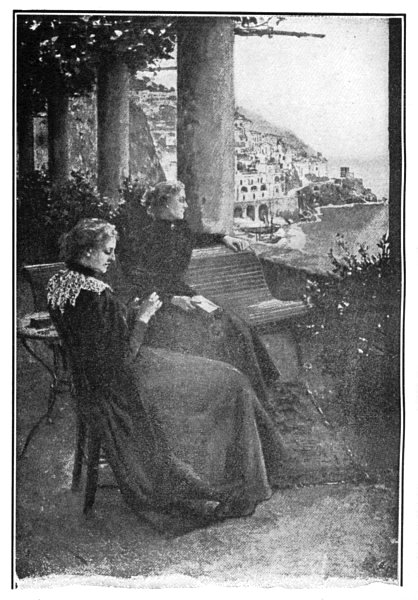 “I SOMETIMES THINK THAT ONE’S PAST LIFE IS WRITTEN IN A FOREIGN LANGUAGE,” SAID MRS. BOWRING, SHUTTING THE BOOK SHE HELD.