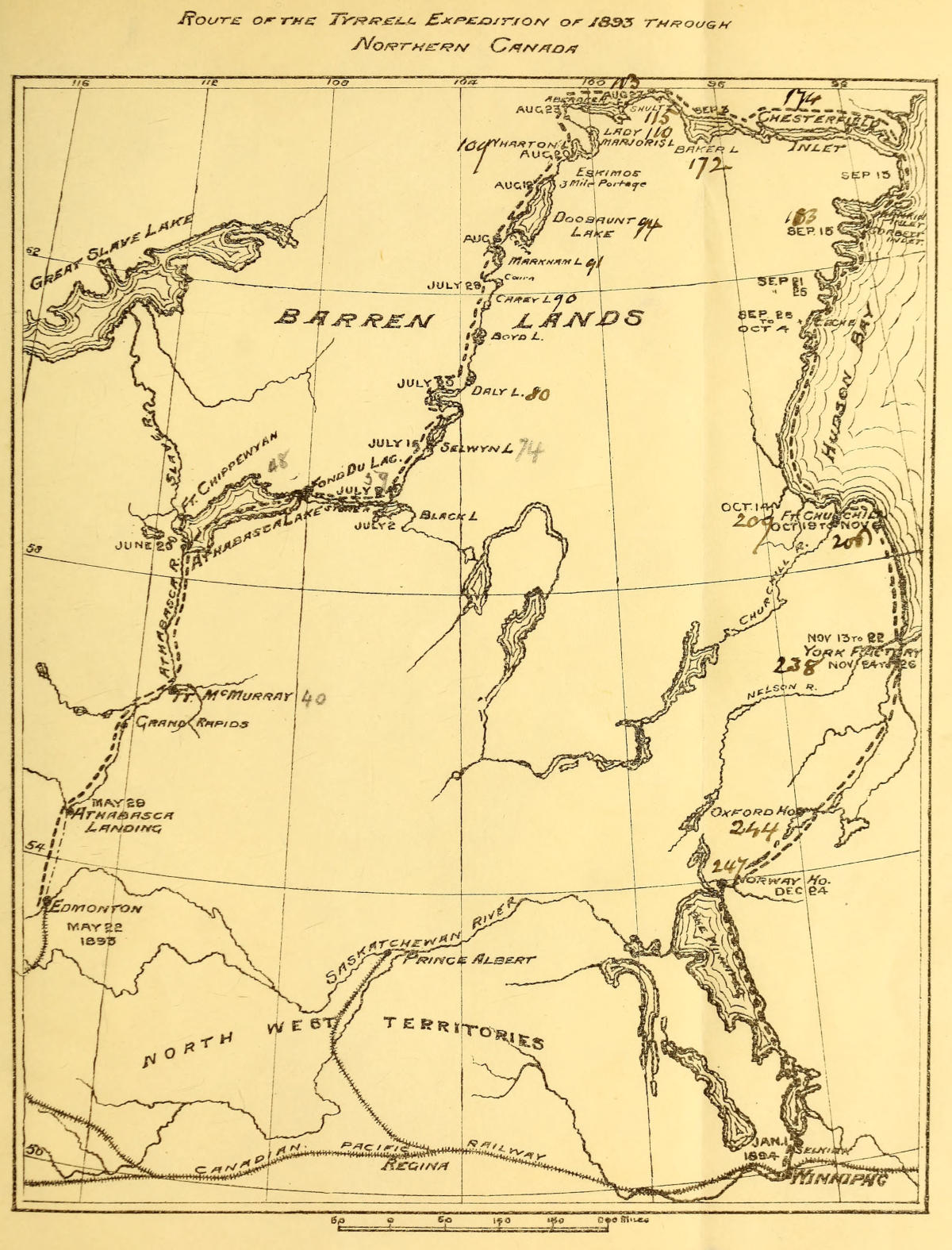
Route of the
Tyrrell Expedition of 1893 through Northern Canada
ACROSS THE SUB-ARCTICS OF CANADA. — CHAPTER I. TORONTO TO ATHABASCA LANDING.
On the morning of the 10th of May, 1893, in response
to a telegram from Ottawa, I took train at Hamilton for
Toronto, to meet my brother, J. Burr Tyrrell, of the
Canadian Geological Survey, and make final arrangements
for a trip to the North.
He had been authorized by the Director of that most
important department of the Canadian Government to
conduct, in company with myself, an exploration survey
through the great mysterious region of terra incognita
commonly known as the Barren Lands, more than two
hundred thousand square miles in extent, lying north of
the 59th parallel of latitude, between Great Slave Lake
and Hudson Bay. Of almost this entire territory less
was known than of the remotest districts of “Darkest
Africa,” and, with but few exceptions, its vast and dreary
plains had never been trodden by the foot of man, save
that of the dusky savage.
During the summer of 1892 my brother had obtained
some information concerning it from the Chippewyan
Indians in the vicinity of Athabasca and Black Lakes,
but even these native tribes were found to have only the
vaguest ideas of the character of the country that lay
beyond a few days’ journey inland.
In addition to this meagre information, he had
procured sketch maps of several canoe routes leading
northward toward the Barren Lands. The most
easterly of these routes commenced at a point on the
north shore of Black Lake, and the description obtained
of it was as follows: “Beginning at Black Lake,
you make a long portage northward to a little lake, then
across five or six more small ones and a corresponding
number of portages, and a large body of water called
Wolverine Lake will be reached. Pass through this,
and ascend a river flowing into it from the northward,
until Active Man Lake is reached. This lake will take
two days to cross, and at its northern extremity the
Height of Land will be reached. Over this make a
portage until another large lake of about equal size is
entered. From the north end of this second large lake,
a great river flows to the northward through a treeless
country unknown to the Indians, but inhabited by savage
Eskimos. Where the river empties into the sea we
cannot tell, but it flows a great way to the northward.”
From the description given, it appeared that this
river must flow through the centre of the unexplored
territory, and thence find its way either into the waters
of Hudson Bay or into the Arctic Ocean. It was by
this route we resolved to carry on the exploration, and,
if possible, make our way through the Barren Lands.
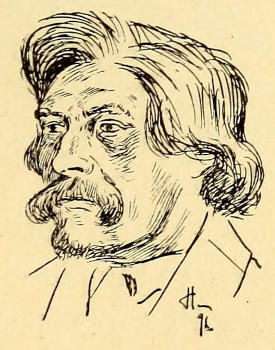
J. BURR TYRRELL.
(Leaving Fort Churchill.)
One of the first and most important preparations for
the journey was the procuring of suitable boats, inasmuch
as portability, strength and carrying capacity
were all essential qualities. These were obtained from
the Peterboro’ Canoe Company, who furnished us with
two beautiful varnished cedar canoes, eighteen feet in
length, and capable of carrying two thousand pounds
each, while weighing only one hundred and twenty
pounds. Arrangements had also been made to have a
nineteen foot basswood canoe, used during the previous
summer, and two men in readiness at Fort McMurray on
the Athabasca River.
Four other canoemen were chosen to complete the
party, three of them being Iroquois experts from
Caughnawaga, Quebec. These three were brothers, named
Pierre, Louis and Michel French. Pierre was a veteran
canoeman, being as much at home in a boiling rapid as
on the calmest water. For some years he had acted as
ferryman at Caughnawaga, and only recently had made
a reputation for himself by running the Lachine Rapids
on Christmas day, out of sheer bravado. His brother
Louis had won some distinction also through having
accompanied Lord Wolseley as a voyageur on his
Egyptian campaigns; while Michel, the youngest and
smallest of the three, was known to be a good steady
fellow, boasting of the same distinction as his brother
Louis.
The other man, a half-breed named John Flett, was
engaged at Prince Albert, in the North-West. He was
highly recommended, not so much as a canoeman, but as
being an expert portager of great experience in northern
travel, and also an Eskimo linguist.
The two men, James Corrigal and François Maurice,
who through the kindness of Mr. Moberly, the officer
of the Hudson’s Bay Company at Isle-à-la-Crosse, were
engaged to meet us with a third canoe at Fort McMurray,
were also western half-breeds, trained in the use of
the pack-straps as well as the paddle, and were a pair
of fine strong fellows. Thus it was arranged to combine
in our party the best skill both of canoemen and
portagers.
Our reasons for not employing the Indians from Lake
Athabasca were, that these natives had on nearly all
previous expeditions proved to be unreliable. Such
men as we had engaged, unlike these Indians, were free
from any dread of the Eskimos, and as we advanced
soon became entirely dependent on us as their guides.
Besides, they were more accustomed to vigorous exertion
at the paddle and on the portage than the local
Indians, who are rather noted for their proficiency in
taking life easy.
Next in importance to procuring good boats and
canoemen was the acquisition of a complete set of portable
mathematical instruments, but after some difficulty
these, too, were obtained. The following is a list of
them: One sextant with folding mercurial horizon, one
solar compass, two pocket compasses, two prismatic compasses,
one fluid compass, two boat logs, two clinometers,
one aneroid barometer, a pair of maximum and minimum
thermometers, one pocket chronometer, three good
watches, a pair of field-glasses, an aluminum binocular,
and a small camera. These, though numerous, were not
bulky, but they comprised a part of our outfit over
which much care had to be exercised throughout the
journey. A bill of necessary supplies was also carefully
made out, and the order for them forwarded to the
Hudson’s Bay Company’s store at Edmonton, with
instructions to have them freighted down the Athabasca
River to Fort Chippewyan, on Lake Athabasca, as
early as possible.
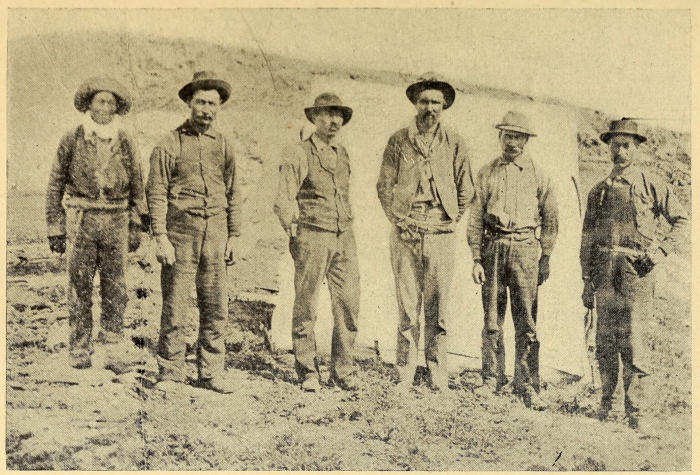
OUR CANOEMEN.
François Maurice. Pierre French. John Flett. Jim Corrigal.
Michel French. Louis French.
The above and a hundred and one other preparations
having been completed, my brother and I bade
farewell to our homes, and on the 16th of May boarded
the North Bay evening express at Toronto. The journey
was not begun without the stirring of tender emotions,
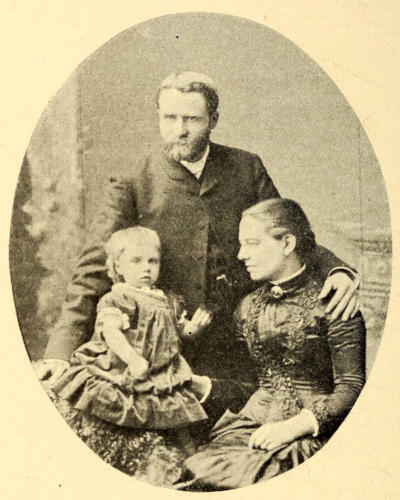
for to me it meant separation, how long I knew
not, from my young wife and baby boy five months
old, and to my brother it meant separation from one
too sacred in his eyes to mention here.
Once aboard the train we made ourselves as comfortable
as possible for a five days’ ride. I do not propose
to weary my readers with a detailed account of the long
run across continent by rail, as it is not reckoned a part
of our real journey; in passing I will merely make the
briefest reference to a few of the incidents by the way.
It was not until after many delays between North
Bay and Fort William on the Canadian Pacific Railway,
owing chiefly to the disastrous floods of that year, which
inundated the track for long distances, washed it out at
several points and broke one of the railway bridges,
that we arrived at Winnipeg, the capital of the Province
of Manitoba. Upon reaching the city it was found that
our canoes, which had been shipped to Edmonton some
time previously, had not yet passed through. After
considerable telegraphing they were located, and it was
found that they would arrive on the following day. In
consequence of this and other business to be transacted
with the Commissioner of the Hudson’s Bay Company,
we were obliged to remain here for a day. During our
brief stay we were warmly greeted by many friends, and
were most kindly entertained at Government House by
the late Lieutenant-Governor, Sir John Schultz, and
Lady Schultz, to whom we were indebted for the contribution
to our equipment of several articles of comfort.
HUDSON’S BAY COMPANY’S TRADERS.
The next day we bade our Winnipeg friends good-bye
and took the C. P. R. train for the West. The route lay
through vast areas of the most magnificent agricultural
country, as a rule level and unbroken, save by the innumerable
and ancient but still deep trails of the buffalo.
Little timber was observed, excepting in isolated patches
and along the river valleys, and for the most part the
land was ready for the plough. Passing through many
new but thriving towns and settlements by the way, we
arrived early on the morning of the 22nd at the busy
town of Calgary, pleasantly situated in the beautiful
valley of the South Branch of the Saskatchewan River,
and just within view of the snow-clad peaks of the
Rocky Mountains. From Calgary our way lay toward
the north, via the Edmonton Branch of the C. P. R.,
and after a stay of only a few hours we were again
hurrying onward. On the evening of the same day, in
a teeming rain, we reached Edmonton, the northern
terminus of the railway.
Edmonton is a town situated on both banks of the
North Branch of the Saskatchewan, and at this time
was in a “booming” condition, particularly upon the
southern bank. Many large business houses were being
erected, and property was selling at stiff prices. Edmonton
is chiefly noted for its lignite mines, which are
worked to a considerable extent, and produce coal of very
fair quality. The seams are practically of unlimited
extent, and are easily accessible in many places along
the river banks. Gold is also washed from the sands in
paying quantities, while the town is surrounded by a fair
agricultural and grazing country. Petroleum, too, has
been discovered in the vicinity, and indications are that
in the near future Edmonton will be a flourishing city.
The older part of the town is situated on the north
side of the river, and communication is maintained
by means of an old-fashioned ferry, operated by cables
and windlass. As the Hudson’s Bay Company’s stores
and offices from which our supplies were to be forwarded
are situated on the north side, we crossed over on the
ferry, and engaged rooms at the Jasper House. Upon
enquiry we were gratified to find that the supplies and
men, excepting the two who were to meet us later, had
all arrived in safety. Our provisions, which were to be
freighted down as far as Lake Athabasca by the Hudson’s
Bay Company, had not yet gone, but were already
being baled up for shipment. The completion of this
work, which was done under the supervision of my
brother and myself, together with the making up of
accounts and transaction of other business, occupied
several days. But by the morning of the 27th of May
our entire outfit, loaded upon waggons, set off on the
northward trail leading to Athabasca
Landing, a small trading-post
situated one hundred miles
distant on the banks of the
great Athabasca River.
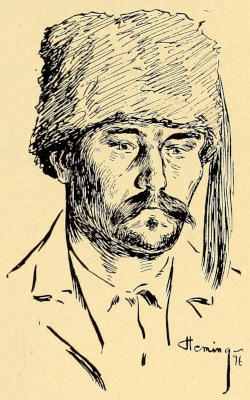
A H. B. C. INTERPRETER.
Two days later, being Monday
morning, my brother and I,
accompanied by a driver only,
started out in a light vehicle in
rear of the outfit. The weather
was showery, and the trail in
many places very soft. Occasionally
deep mud-holes were
encountered, bearing evidence
of the recent struggles of the
teams of our advance party, but
as we were travelling “light,” we had little difficulty
in making good progress. Later in the day the weather
cleared, permitting us to enjoy a view of the beautiful
country through which we were passing. As to the
soil, it was chiefly a rich black loam, well covered,
even at this early season, between the clumps of poplar
scrub, by rich prairie grass. A few settlers were
already in the field, and had just built or were building
log cabins for themselves on one side or other of the
trail. A little farther on our way the country became
more hilly, the soil more sandy, and covered by the
most beautiful park-like forests of jack-pine. Many of
the trees were as much as fifteen inches in diameter, but
the average size was about eight.
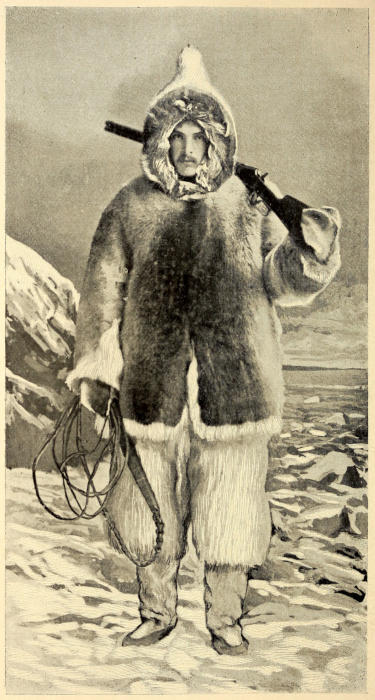
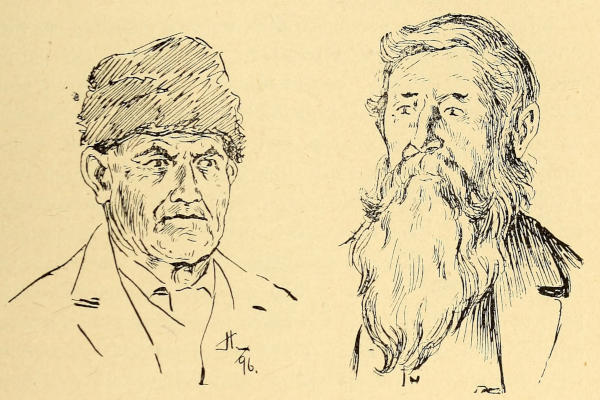
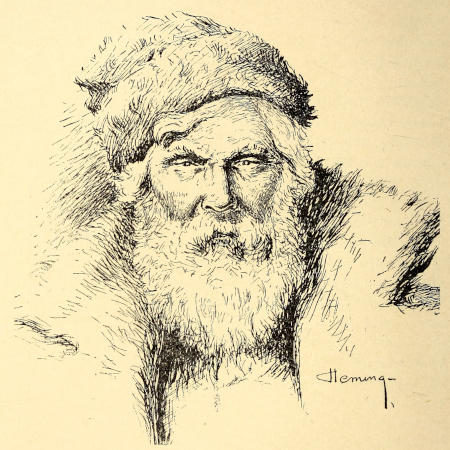
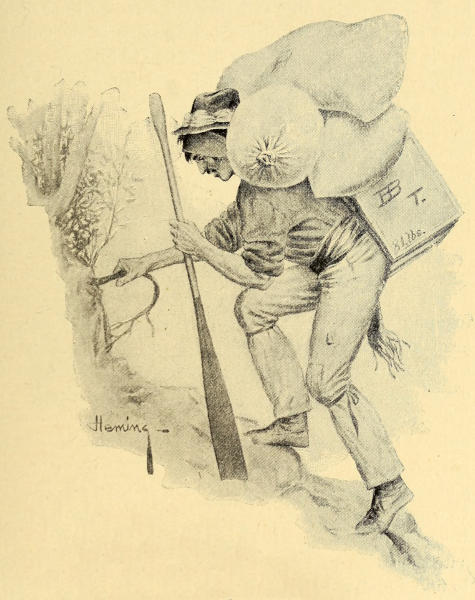
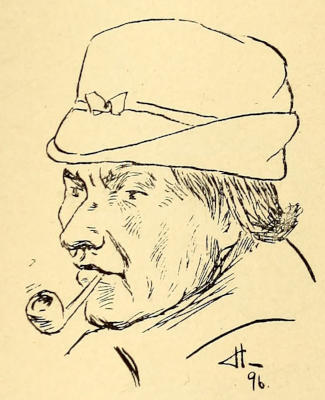
A PIONEER OF THE NORTH.
(Drawn from life by Arthur Heming.)
After passing through some miles of these woods
we again emerged into more open country, wooded
alternately in places by poplar, spruce and jack-pine.
About nine o’clock that evening, when half-way to the
Landing, we reached the Height of Land between the
two great valleys of the Saskatchewan and Athabasca
rivers. Here, upon a grassy spot, we pitched our first
camp. As the night was clear no tents were put up,
but, after partaking of some refreshment, each man
rolled up in his blanket and lay down to sleep beneath
the starry sky. We rested well, although our slumbers
were somewhat broken by the fiendish yells of prairie
wolves from the surrounding scrub, and the scarcely
less diabolical screams of loons sporting on a pond close
by. An effort was made to have the latter nuisance
removed, but any one who has ever tried to shoot loons
at night will better understand than I can describe the
immensity of the undertaking.
About nine o’clock on the evening of the 30th of May
we arrived at Athabasca Landing, only a few hours
after the loads of supplies, which we were glad to find
had all come through safely.
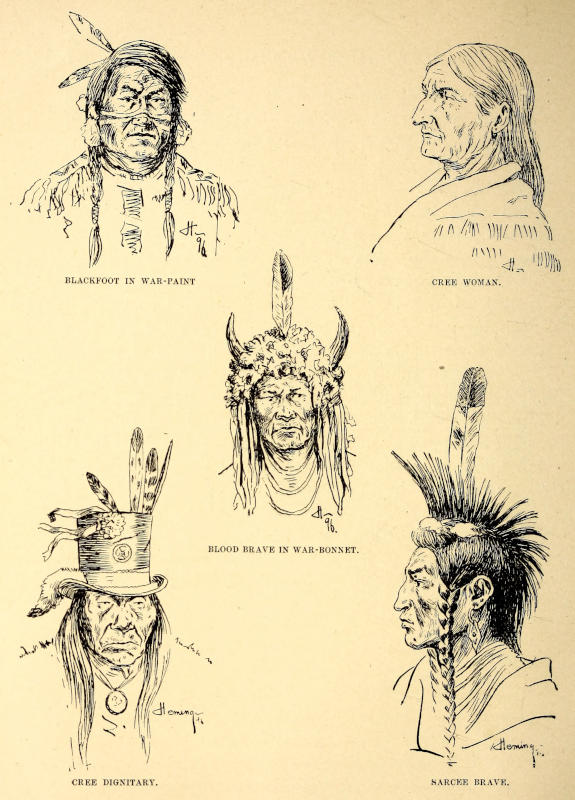
INDIANS OF THE CANADIAN NORTH-WEST.
BLACKFOOT IN WAR-PAINT. CREE WOMAN. BLOOD BRAVE IN WAR-BONNET.
CREE DIGNITARY. SARCEE BRAVE.
(Drawn from life by Arthur Heming.)
CHAPTER II. DOWN THE ATHABASCA.
The town of Athabasca Landing consists in all of six
log buildings, picturesquely set in the deep and beautiful
valley of one of the greatest rivers of America.
Though not of imposing size, it is nevertheless an important
station of the Hudson’s Bay Company, being
the point from which all supplies for the many northern
trading-posts along the Athabasca and Mackenzie rivers
are shipped, and the point at which the furs from these
places are received. In order to provide for this shipping
business, the Company has a large warehouse and
wharf.
It is a fact I think not very well known, that from
this place up stream for about one hundred miles and
down for fifteen hundred miles to the Arctic Ocean,
this great waterway, excepting at two rapids, is
regularly navigated by large river steamers, owned by
the Hudson’s Bay Company and employed in carrying
supplies for their posts and the furs which are secured
in trade. Because of these two impassable rapids the
river is divided into three sections, necessitating the
use of three steamers, one for each section. Goods are
transported from one boat to the other over the greater
part of the rapids by means of scows, but for a short
distance, at the Grand Rapid, by means of a tramway
built for the purpose.
As we had previously ascertained, the steamer Athabasca
was due to leave the Landing on her down-stream
trip on or about the 1st of June, so, taking advantage
of the opportunity, we shipped the bulk of our stuff to
Fort Chippewyan, situated about three hundred and
fifty miles down the river on Lake Athabasca. Everything
excepting the canoes and provisions sufficient to
take us to Chippewyan was loaded upon the steamer.
Letters were written and sent back to Edmonton by the
drivers, and on the evening of the last day of May we
launched our handsome “Peterboroughs” in the great
stream, and commenced our long canoe voyage.
The arrangement of the party was as follows: My
brother occupied a central position in one canoe, and I
a corresponding place in the other. As steersman he
chose the eldest of the Iroquois, Pierre, with Michel
as bowman. The remaining Iroquois, Louis, took the
steering paddle of my canoe, and John, the western
man, occupied the bow. Thus were our little crafts
manned, each person, including my brother and myself,
being provided with a broad maple paddle. Our loads
being light, we were in good speeding condition. Just
after launching we met some native Indians in their
bark canoes, and by way of amusement and exhibition
of speed paddled completely around them in the current,
much to their amazement. Then with farewell salute,
and the stroke of our paddles timed to the song of the
canoemen, we glided swiftly down the stream.
As the start had been made late in the afternoon, not
many miles were passed before it became necessary to
look for a camping place. The banks of the river,
formed of boulder clay, were very high, and good landings
were scarce. In places the mud on the shore was
soft and deep, but about seven o’clock a landing was
effected and camp pitched for the night. At this time
only two small tents were used, an “A” tent for the
canoemen and a wall tent, affording a little more head
room, for ourselves. The banks being well wooded with
white and black poplar, spruce and birch, plenty of fuel
was available. A fire was soon kindled and our evening
meal prepared, in the cooking of which John was
given the first opportunity of distinguishing himself.
He was assisted by little Michel, who proved to be a
very good hand. Having some bread and biscuits in
stock, baking was not yet a necessity.
The weather now being fair and cool, and the great
pest of camp life, the mosquito, not having yet arrived,
our experience at this time was most enjoyable. It was
the season of spring, and the sweet perfume of the Balm
of Gilead, so abundant in the valley of the Athabasca,
permeated the air. The leaves on many of the trees
were just opening, so that everywhere the woods presented
a remarkable freshness and brilliancy of foliage.
These were our environments at the commencement of
the canoe voyage, and at our first camp on the banks of
the Athabasca. How different were they to be at the
other end of the journey!
On the morning of the 1st of June camp was called
early, and we continued on our way. As we glided down
stream a succession of grand views passed, panorama-like,
before us. The banks were high, towering in some
places three, four or five hundred feet above the river;
here abrupt and precipitous, consisting of cut banks of
stratified clay; in other places more receding, but by a
gradual slope rising, beneath dense foliage, to an equal
elevation.
At this season of the year the water being high and
the current swift, we made good time, covering a distance
of sixty miles for the first full day’s travel. About
noon on the 2nd, having reached a narrow part of the
river, very remarkable massive walls of ice were found
upon either bank, some distance above the water’s edge.
These walls were of irregular thickness, and from eight
to ten feet in height; but the most striking feature about
them was that they presented smooth vertical faces to
the river, although built of blocks of every shape and
shade from clear crystal to opaque mud. They extended
thus more or less continuously for miles down the river,
and had the appearance of great masonry dykes. The
explanation of their existence is doubtless as follows:
Earlier in the season the narrowness of the channel had
caused the river ice to jam and greatly raised the water
level. After a time, when the water had reached a
certain height and much ice had been crowded up on the
shores, the jam had given way and caused the water to
rapidly lower to a considerable extent, leaving the ice
grounded above a certain line. Thus the material for
the wall was deposited, and the work of constructing
and finishing the smooth vertical face was doubtless performed
by the subsequent grinding of the passing jam,
which continued to flow in the deeper channel. After
the passing of the first freshet, and the formation of
these great ice walls, the water had gradually lowered
to the level at which we found it.
Late in the afternoon the first rapid of the trip was
sighted, but the water being high we had no difficulty
in running it. In the evening camp was made on a
beautiful sandy beach. During supper-time we had
a visit from an old Cree Indian, who came paddling up
the river in a little bark canoe. Of course he landed at
our camp, for it is a principle strictly observed by every
Indian to lose no opportunity of receiving hospitalities,
and in accordance with his ideas of propriety, refreshments
were given him. He received them as those of his
race usually receive all favors, as no more than his right,
and without a smile or the least visible expression of
pleasure, seated himself by the fire to enjoy them.
On the following morning the great walls of ice, which
we had been passing for miles, began to disappear as the
channel of the river became wider. At about 9.30 we
reached a place known as the Rapid of the Jolly Fool.
It is said to have received its name from the fact that at
one time an awkward canoeman lost his life by allowing
his canoe to be smashed upon the most conspicuous rock
in the rapid. We wasted no time examining it, as it was
reported to be an easy one, but keeping near the left
bank, headed our little crafts into the rushing waters.
We had descended only a short distance, and were turning
a bend in the stream, when, a little ahead of us, my
brother noticed moving objects on the shore. One of the
men said they were wolves, while others maintained they
were bears, but my brother getting his rifle in readiness,
cut the discussion short by demanding silence. As we
swept swiftly down with the current, the objects were
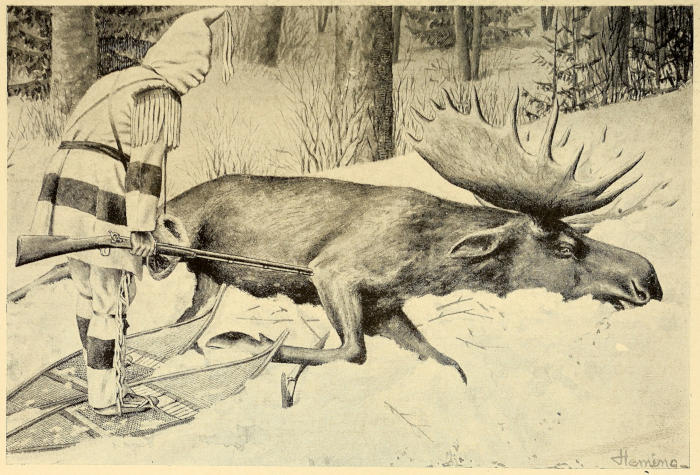
seen to be a moose deer and her calf. Having no fresh
meat on hand, these new-found acquaintances were hailed
as “well met.” Not until our canoes had approached
within about one hundred and fifty yards did the old
moose, standing in the shallow water near the river
bank, appear to notice us. Then, apparently apprehending
danger, but without alarm, she turned toward the
shore, and, followed by her calf, walked up the bank
towards the woods. As she did so my brother fired
from his canoe, wounding her in the hind-quarters. I
then fired, but struck the clay bank above the animal’s
head, and in attempting to fire again the shell stuck in
my rifle, making it impossible for me to reload. Just
as the moose was disappearing into the woods my
brother fired again, and inflicted a body wound; but in
spite of all away went the deer.
As our canoes were thrust ashore I succeeded in
extracting the shell from my rifle, and leaving some of
the men in charge of the canoes, my brother and I gave
chase. The trail of blood was discovered on the leaves,
but it led into such a jungle of fallen timber and thicket
that it was no easy matter to follow. Scouts were sent
out on either side, while with our rifles we followed the
trail, running when we were permitted, jumping logs
that came in the way, and clambering over or through
windfalls that the moose had cleared at a bound.
Presently through the leafy thicket we had a glimpse of
our prey. Bang went both rifles and away bounded
the moose with two more slugs in her body.
We were now pretty badly winded, but being anxious
to complete the work we had undertaken, the chase was
kept up. We knew from the wounds already inflicted
that the capture was only a matter of physical endurance
on our part, and we were prepared to do our best. More
than once the trail was lost in the windfalls and jungle,
but at length, getting another side view, I shot her
through the heart, bringing the noble beast with a thud
to the ground. Nothing had been seen of the calf since
the beginning of the hunt, but going back to the shore to
get assistance, I found that the men had captured and
made it a prisoner beside the canoes. Taking charge of
the captive myself, I sent the men into the woods to skin
the deer and “pack” the meat out to shore. The little
calf, which I held by the ear, was very young, and not
at all wild. Indeed, though I let go my hold, the little
creature did not care to go away, but kept on calling for
its mother in such a pitiful way that it made me
heartily sorry for having bereft it. After the space of
an hour or so my brother and the men returned, well
loaded with fresh meat and a fine moose-hide. The meat
was placed in sacks and stowed away in the canoes, but
the hide being heavy and of little value to us, was placed
on a big stone in the sun to dry and await the ownership
of the first Indian who should pass that way.
As it was now nearly noon, it was decided to take
dinner before re-embarking, and while the cooks were
devoting their attention to bannocks and moose-steaks
my brother and I were debating as to what we should do
with the calf. We had not the heart to deliberately
shoot it, but were unable to take it with us alive, as we
would like to have done. Through a suggestion of one
of the men a happy alternative was decided on. Other
moose were doubtless in the vicinity, so that the calling
of the calf would likely attract some of them, and in the
event of this taking place it was said that the little moose
would attach itself to another female. With the hope
that such kind fortune would befall it, my brother, after
having taken its photograph, led it away by the ear
into the shelter of the woods, and there left the little
creature to its fate.
During the afternoon of the same day, the head of
the Grand Rapid of the Athabasca, situated just
165 miles below the Landing, was reached. Here
we met a detachment of the Mounted Police, in
charge of Inspector Howard; and as it was late in the
day, and Saturday evening, it was decided to pitch camp.
The police camp was the only other one in the neighborhood,
so the first question which suggested itself was:
What possible duty could policemen find to perform in
such a wild, uninhabited place? The answer, however,
was simple. The place, though without any settled
habitation, is the scene of the transhipment of considerable
freight on its way to the various trading-posts and
mission stations of the great Mackenzie River District.
The river steamer Athabasca, belonging to the Hudson’s
Bay Company, was now daily looked for with its load
from the Landing. Mission scows, loaded with freight for
Fort Chippewyan and other points, were expected, and
free-traders’ outfits were liable to arrive at any time. It
was for the purpose of inspecting these cargoes and preventing
liquor from being carried down and sold for furs
to the Indians, that Inspector Howard and his detachment
were stationed here.
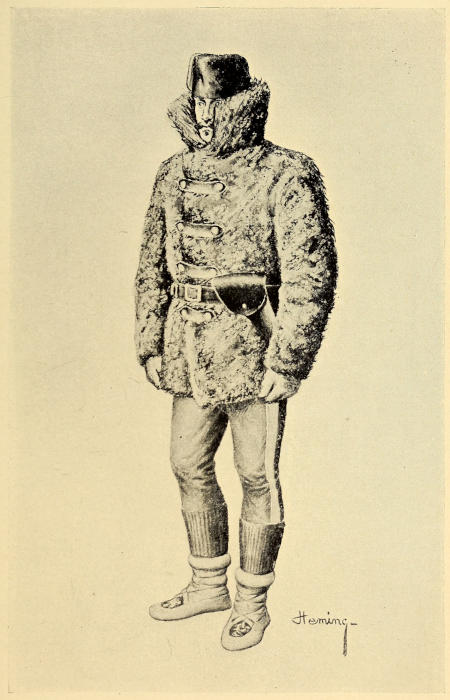
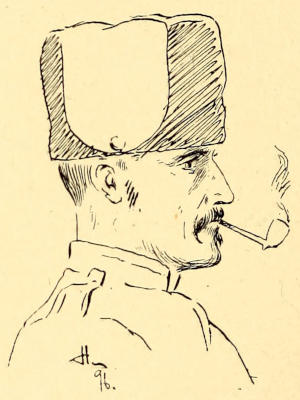
TROOPER, N.-W. MOUNTED POLICE, IN WINTER
UNIFORM.
From the Grand Rapid, down stream for about eighty
miles to Fort McMurray, the river is not navigable for
steamers, and so all goods have to be transported over
this distance by scows built for the purpose. The head
of the Grand Rapid is thus the northern steamboat
terminus for the southern section of the river. The
whole distance of eighty miles is not a continuous rapid,
but eleven or twelve more or less impracticable sections
occur in it, so that no great length of navigable water is
found at any place. As its name suggests, the Grand
Rapid is the main rapid of the river, and has a fall of
seventy or eighty feet. This fall occurs mostly within
a distance of half a mile, though the total length of
the rapid is about four times that. The upper part is
divided by a long narrow island into two channels, and
it is through these comparatively narrow spaces that
the cataract rushes so wildly. Above and below the
island, the river may with great care be navigated by
the loaded scows, but the water upon either side is so
rough that goods cannot be passed down or up in safety.
The method of transportation adopted is as follows:
About a mile above the island, at the head of the rapid,
the steamer Athabasca ties up to the shore. There she
is met by a number of flat-bottomed boats or scows
capable of carrying about ten tons each, and to these
the boat’s cargo is transferred. When loaded the scows
are piloted one by one to the head of the island in
the middle of the river, where a rough wharf is built,
and to it all goods are again transferred, whence they
are carried to the lower end of the island by means of
a tramway. The unloaded scows, securely held with
ropes by a force of men on the shore, and guided with
poles by a crew on board, are then carefully lowered
down stream to the foot of the island, where they again
receive their loads. Accidents frequently happen in
passing down the unloaded scows, for the channel
(the eastern one always being chosen) is very rough and
rocky. From the foot of the island in the Grand Rapid
the scows are then floated down the river, with more
or less difficulty, according to the height of water,
through the long succession of rapids to Fort McMurray,
where they are met by the second steamer, the
Grahame, which receives their freight and carries it
down the river to Fort Chippewyan on Lake Athabasca,
and thence onward to Fort Smith, on Great Slave River,
where a second transhipment has to be made over
about sixteen miles of rapids. From the lower end of
these rapids the steamer Wrigley, under the command
of Captain Mills, takes charge of the cargo and delivers
it at the various trading-posts along the banks of the
Mackenzie River, for a distance of about twelve hundred
miles, to the Arctic Ocean.
But to return to our camp at the head of the Grand
Rapid. Inspector Howard and his men proved to be interesting
companions. I soon discovered, to my surprise,
that the Inspector was a cousin of my wife’s, and that I
had met him in former years in Toronto. Meeting with
even so slight an acquaintance in such a place was indeed
a pleasure; and in justice to the occasion a banquet,
shall I call it, was given us, at which moose-steak and
bear-chops cut a conspicuous figure. In conversation
with the Inspector some information was obtained regarding
the character of the rapids now before us, and
all such was carefully noted, since none of our party
had ever run the Athabasca. We had with us the reports
of William Ogilvie, D.L.S., and Mr. McConnell, who
had descended the river and published much valuable
information regarding it, but even they could not altogether
supply the place of a guide. We were putting
great confidence in the skill of our Iroquois men at
navigating rapids, and now in the succeeding eighty
miles of the trip there would be ample opportunity of
testing it.
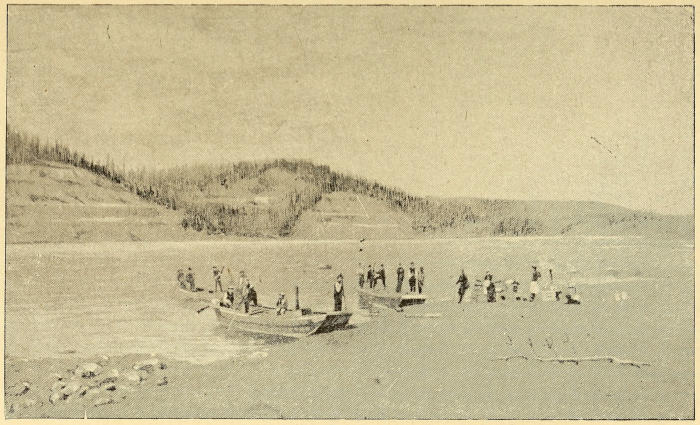
LANDING OF SCOWS ABOVE GRAND RAPID.
On the morning following our arrival at the Grand
Rapid, being the 4th of June, a number of mission
scows, loaded with goods for Chippewyan and other
mission stations, arrived. As they appeared, following
each other in quick succession around a bend in the
river, each boat manned by its wild-looking crew of
half-naked Indians, all under the command of Schott,
the big well-known river pilot, who is credited by Mr.
Ogilvie with being the fastest dancer he has ever seen,
they drew in towards the east bank, and one after the
other made fast to the shore. The boats were at once
boarded by Inspector Howard and his men, and a careful
search made for any illegal consignments of “firewater.”
Liquor in limited quantities is allowed to be
taken into the country when accompanied by an official
permit from the Lieut.-Governor of the Territories, but
without this it is at once confiscated when found. Out
of deference to those for whom these cargoes were consigned,
I had better not say whether a discovery was
made on this occasion or not. When confiscations are
made, however, the find is, of course, always destroyed.
The news of the arrival of the scows was welcomed by
us, not because of anything they brought with them,
but because we expected to obtain directions from
Schott regarding the running of the many rapids in the
river ahead, and the transport of the bulk of our canoe
loads to Fort McMurray, below the rapids. After some
consideration, rather less than most Indians require to
take, these matters were arranged with Schott, and all
but our instruments, tents, blankets and three or four
days’ provisions were handed over to him.
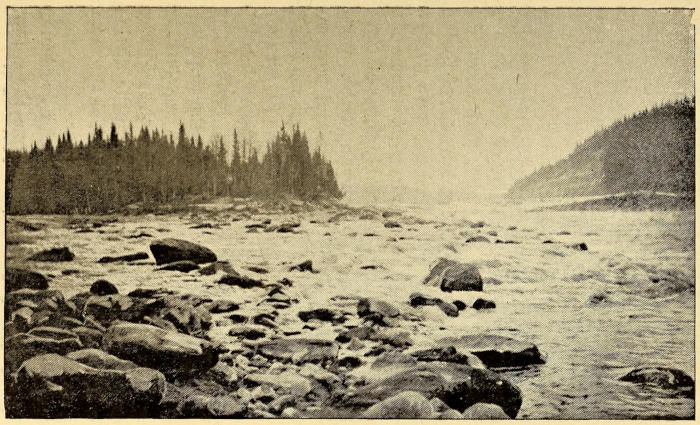
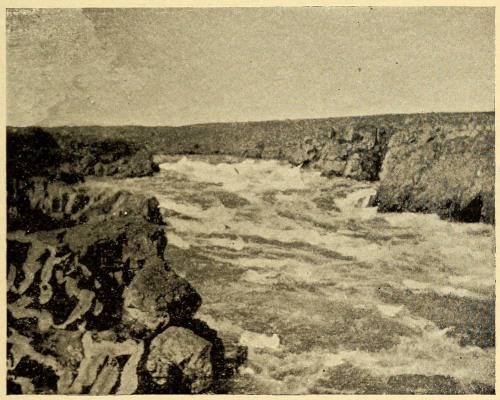
GRAND RAPID, ATHABASCA RIVER.
On the evening of the 4th, the steamer Athabasca
also put in an appearance, and made fast to the shore a
little above the scows. Grand Rapid was no longer an
uninhabited wilderness, but had now become transformed
into a scene of strange wild life. Large dark,
savage-looking figures,
many of them bare to the
waist, and adorned with
head-dresses of fox-tails or
feathers, were everywhere
to be seen. Some of them,
notably those of the Chippewyan
tribe, were the
blackest and most savage-looking
Indians I had ever
seen. As it was already
nearly night when the last
of them arrived by the
steamer, the work of transhipping
was left for the
morning. In the dark woods the light of camp-fires
began soon to appear, and around them the whole night
long the Indians danced and gambled, at the same time
keeping up their execrable drum music.
ENGLISH-CHIPPEWYAN HALF-BREED.
At daylight the next morning the overhauling of
cargoes was commenced. One by one the scows were
loosened and piloted down the middle of the rapid to
the wharf at the head of the island. Here they were
unloaded, and after being lightened, were lowered down
through the boiling waters by means of lines from the
shore and the assistance of poles on board, to again receive
their loads at the foot of the island. Two or three
scows were also similarly engaged in transporting the
cargo of the steamer, of which our supplies formed part,
and, much to our annoyance, there was considerable delay
on account of having to repair the tramway across
the island. We were informed that the Grahame could
not now reach Chippewyan before the 20th of June,
which would be ten days later than we had expected to
be able to leave that place. However, we could only
accept the inevitable, and try to make the best use of
the time.
While Schott and his crews were thus engaged with
their transport, our own men were not idle. They had
been told that the rapid would have to be portaged, as
no canoeman would venture to run it; but having walked
down the shore and themselves examined the river, the
Iroquois asked and obtained permission to run it by
taking one canoe down at a time. Schott and his
Indians thought them mad to try such a venture, but
seeming to have every confidence in their own abilities,
we determined to see what they could do. John gladly
chose the work of portaging along the rough boulder
shore and over precipitous rocks in preference to taking
a paddle, but the three Iroquois took their places, Louis
in the bow, Michel in the middle, and old Pierre in the
stern. As the three daring fellows pushed off from the
shore into the surging stream, those of us who gazed
upon them did so with grave forebodings. They had
started, and now there was nothing to do but go through
or be smashed upon the rocks. Their speed soon attained
that of an express train, while all about them the boiling
waters were dashed into foam by the great rocks
in the channel. Presently it appeared as if they were
doomed to be dashed upon a long ugly breaker nearly
in mid-stream; but no! with two or three lightning
strokes of their paddles the collision was averted. But in
a moment they were in worse danger, for right ahead
were two great rocks, over and around which the tumbling
waters wildly rushed. Would they try the right
side or the left? Only an instant was afforded for
thought, but in that instant Pierre saw his only chance
and took it—heading his canoe straight for the shoot
between the rocks. Should they swerve a foot to one
side or the other the result would be fatal, but with
unerring judgment and unflinching nerve they shot
straight through the notch, and disappeared in the trough
below. Rising buoyantly from the billows of foam and
flying spray, they swept on with the rushing waters
until, in a little eddy half-way down the rapid, they
pulled in to the shore in safety. They were all well
soaked by the spray and foam, but without concern or
excitement returned for the second canoe. In taking
this down a valise of stationery and photographic
supplies, inadvertently allowed to remain in the canoe,
got a rather serious wetting, but as soon as possible its
contents were spread out upon the smooth clean rocks
to dry. Past the remainder of the rapid a portage
was made and camp pitched at the foot. While our
Iroquois were thus occupied, Schott and his men had
been hard at work running down their scows and had
been unfortunate enough to get one of them stranded
on a big flat rock in the middle of the rapid. Had it
not been for the timely assistance of our party and the
generalship of old Pierre, he would probably never have
gotten it off. As it was, the accomplishment of the task
occupied our united energies for several hours.
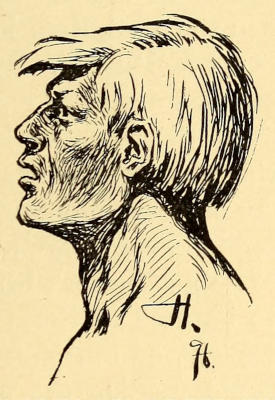
NECK DEVELOPED BY THE TUMP-LINE.
CHAPTER III. RUNNING THE RAPIDS.
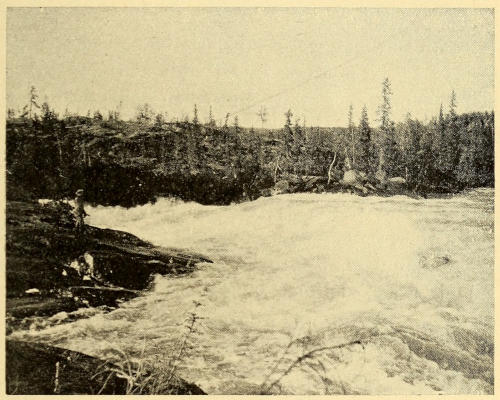
Before leaving the Grand Rapid several good photographs
of it were obtained, and then on the morning of
the 7th of June, bidding adieu to Inspector Howard, and
leaving our supplies in the freighters’ hands, we started
down the river for Fort McMurray. The first object of
special interest passed was a natural gas flow, occurring
on the left bank about fifteen miles below the Rapid.
At this place a considerable volume of gas is continually
discharging, and may be seen bubbling up through the
water over a considerable area, as well as escaping from
rifts in the bank. The gas burns with a hot pale blue
flame, and is said to be used at times by boatmen for
cooking purposes. Eight or ten miles farther down
stream came the Brûle Rapids, the first of the long
series, and though they might easily have been run, we
did not try it, as my brother wished to remain on shore
for some time to collect fossils. Meanwhile our stuff
was portaged, and without difficulty the empty canoes
run down to the foot of the rapids, where camp was
made. Just at this place commence the wonderful tar
sand-beds of the Athabasca, extending over an enormous
area. These certainly present a very striking appearance.
During warm weather, in many places, the faces
of the river banks, from three to five hundred feet in
height, presents the appearance of running tar, and here
and there tar wells are found, having been formed by
the accumulation of the viscid tar in natural receptacles
of the rock. Thus collected it has been commonly made
use of by workmen in the calking of the scows on the
river.[1]
Sixteen miles farther down, the Boiler Rapid, so called
from the fact that in 1882 a boiler intended for the
steamer Wrigley was lost in it, was successfully run on
the following day, and early in the afternoon the third
rapid was reached. In attempting to run it on the left
side, we found, after descending perhaps half-way, that
there were too many rocks in the channel ahead, and
therefore an effort was made to cross to the right side,
which looked to be clearer. My brother’s canoe, steered
by old Pierre, avoided all rocks and was taken successfully
across, but mine was not so fortunate. In
attempting to follow, we struck a large rock in mid-channel,
but happily the collision occurred in such a way
that my canoe was not seriously damaged. It was
merely whirled end for end in the current and almost
filled with water, though not quite sufficiently to sink
us. Leaving the two Indians to pull for the shore, I
seized a tin kettle and lost no time in dashing out some
of the water. After a sharp struggle we managed to
land. Of course all we had in the canoe—instruments,
blankets, provisions and clothing—was soaked, and it was
therefore necessary to unload and turn everything out.
My brother, seeing that something had happened, went
ashore also, and with his men returned to assist us. The
weather was fine, and our goods soon became sufficiently
dry to allow us to re-embark.
An examination having been made of the rapid below,
a short run was made down and then across to the
opposite side, where we landed, and, because of the extreme
shallowness of the channel and the many rocks
that showed ominously above the surface, the canoes
were lowered for the remaining half mile with the lines.
The whole length of this rapid is perhaps a mile and a
half, and it is sometimes designated as two, the Drowned
and Middle Rapids. Following these in quick succession,
at intervals of from two to ten miles, we passed
through the Long Rapids, which occasioned no difficulty;
then the Crooked Rapids, well named from the fact that
they occur at a very sharp U shaped bend in the river,
around which the current sweeps with great velocity.
Just below this the Stony Rapid was passed, and then in
turn the Little and Big Cascades, both of which are
formed by ledges of limestone rock, about three feet
high, extending in more or less unbroken lines completely
across the river.
At the Big Cascade a portage of a few yards had to be
made, and below this, smooth water was found for a distance
of eight or nine miles, until the head of the
Mountain Rapid was reached. Judging from the name
that this would be a large one, we decided to go
ashore to reconnoitre. For a considerable distance the
rapid was inspected, but no unusual difficulty appearing,
we resolved to go ahead. About a mile farther on,
a bend occurred in the rapid, and so high and steep
were the banks that only with great difficulty could we
see the river beyond. As far as the bend, though the
current was swift, there appeared to be but few rocks
near the left bank, and plenty of water. We therefore
decided to go ashore at that point, if necessary, and
examine the stream beyond.
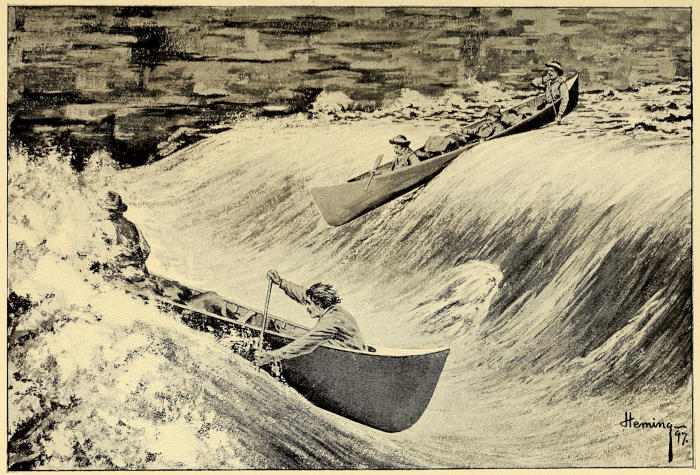
As we proceeded the stream became fearfully swift
and the waves increasingly heavy. At the speed we
were making the bend was soon reached, but just beyond
it another bluff point came in view. We would have
gone ashore to make a further inspection, but this was
impossible, as the banks were of perpendicular or even
overhanging walls of limestone. So alarmingly swift
was the current now becoming that we eagerly looked
for some place on the bank where a landing might be
made, but none could be seen. Retreat was equally
impossible against the enormous strength of the river;
all we could do was to keep straight in the current.
My brother’s canoe, steered by old Pierre, being a little
in advance of my own, gave me a good opportunity of
seeing the fearful race we were running. Suspicions of
danger were already aroused, and the outcome was not
long deferred. As we were rounding the bluff, old Pierre
suddenly stood up from his seat in the stern, and in
another instant we likewise were gazing at what looked
like the end of the river. Right before us there extended
a perpendicular fall. We had no time for reflection, but
keeping straight with the current, and throwing ourselves
back in the canoes in order to lighten the bows
we braced ourselves for the plunge, and in a moment were
lost to sight in the foaming waters below. But only for
an instant. Our light cedars, though partly filled by the
foam and spray, rose buoyantly on the waves, and
again we breathed freely. It was a lucky thing for us
that the canoes were not loaded, for had they been they
never would have floated after that plunge, but would
have disappeared like lead in the billows. We afterwards
found we had taken the rapid in the very worst
spot, and that near the right side of the river we might
have made the descent free of danger. Without a guide,
however, such mistakes will sometimes occur in spite
of every precaution.
Poor John, my bowman, was badly unstrung as a
result of this adventure, and declared that he did not
want to shoot any more waterfalls; and for that matter,
others of us were of much the same mind. One more
small rapid, the Moberly, completed the series, and then
for a few miles we enjoyed calm water until, toward
evening, we reached Fort McMurray.
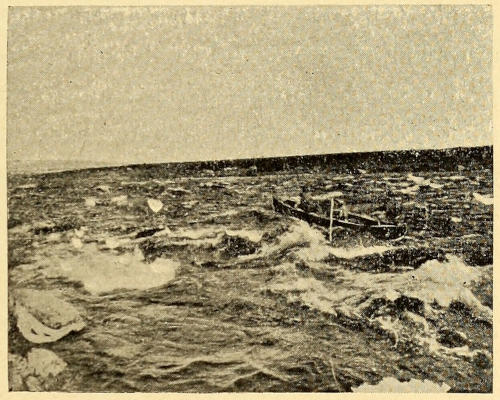
SHOOTING THE MOUNTAIN RAPID,
ATHABASCA RIVER.
This settlement, containing in all five small log buildings—a
warehouse, a store, the traders’ dwelling and
two Indian houses—is situated on a cleared tongue of
land formed by the junction of the Clear Water River
with the Athabasca, and is about two hundred and fifty
miles below the Landing. The site of the post is at an
elevation of forty or fifty feet above the water, but in
the immediate background, and on both banks of the
river, the ground rises abruptly, and is covered by a
thick growth of poplar, spruce and birch trees. At the
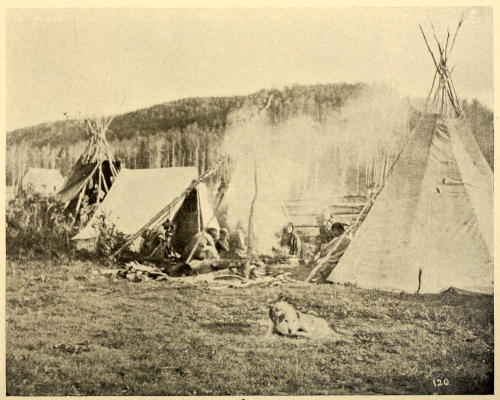
time of our arrival two parties of Indians, one Cree and
the other Chippewyan, occupying in all a dozen or more
lodges, were encamped at the place, and were to be seen
in groups here and there idly putting in the time, while
everywhere their mangy canines skulked and prowled
about, seeking what they might devour—old moccasins,
pack straps, etc., apparently being their favorite dainties.
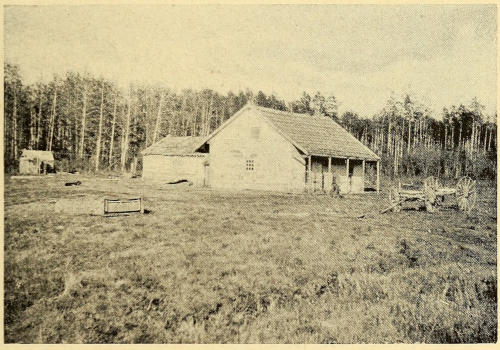
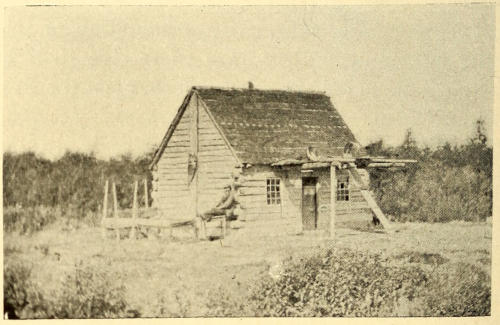
STORE, FORT McMURRAY.
Naturally, our first inquiry upon arriving at the Fort
was whether or not our two men and canoe from Isle-à-la-Crosse
had arrived; but the appearance of an upturned
“Peterborough” on the shore soon answered the
question, and a few minutes later two stout half-breeds
made their appearance, and informed us they were
the men who had been sent by Mr. Moberly to meet us.
My brother had expected the two men who had accompanied
him on his trip of the previous year, but they
having been unable to come, these two, Jim Corrigal
and François Maurice, had been engaged in their stead.
Jim was a man of middle age, tall and of muscular
frame; while his companion was probably not more
than twenty years of age, and in appearance rather
short and of heavy build. Jim spoke English fairly
well, though Cree was his tongue; but François, while
speaking only very broken English, could converse in
French, Cree and Chippewyan, his knowledge of the
last making him subsequently very useful as an interpreter.
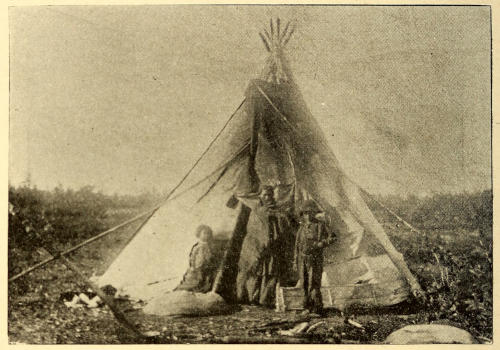
CHIPPEWYAN CAMP.
Our party, consisting of eight men, with three canoes,
was now complete, and thus assembled, the cleanest
available ground remote from Indian lodges was chosen,
and camp pitched to await the arrival of the four
hundred pounds of supplies left with Schott at Grand
Rapid. We soon found we were not the only ones
waiting, and that anxiously, for the arrival of the scows
from the south. The entire population then at Fort
McMurray was in a state of famine. Supplies at the
post, having been insufficient for the demand, had become
exhausted, and the Indians who had come in to
barter their furs were thus far unable to obtain food in
exchange, and were obliged, with their families, to subsist
upon the few rabbits that might be caught in the woods.
We were also out of supplies, but now the scows were
hourly expected. Expectations, however, afforded poor
satisfaction to hungry stomachs, and no less than five
days passed before these materialized. In the meantime,
though we were not entirely without food ourselves,
some of the natives suffered much distress. At
one Cree camp visited I witnessed a most pitiable sight.
There was the whole family of seven or eight persons
seated on the ground about their smoking camp-fire, but
without one morsel of food, while children, three or four
years old, were trying to satisfy their cravings at the
mother’s breast. We had no food to give them, but
gladdened their hearts by handing around some pieces
of tobacco, of which all Indians, if not all savages, are
passionately fond.
In addition to the unpleasantness created by lack of
provisions, our stay at Fort McMurray was attended
with extremely wet weather, which made it necessary
to remain in camp most of the time, and to wade
through no end of mud whenever we ventured out.
On the evening of the 14th the long-looked-for scows
with the supplies arrived. It will readily be imagined
we were not long in getting out the provisions and
making ready a supper more in keeping with our appetites
than the meagre meals with which we had for
several days been forced to content ourselves. The cause
of delay, as Schott informed us, was the grounding of
some of the boats in one of the rapids, in consequence of
which the cargoes had to be removed by his men, and
carried on their shoulders to the shore, the boats then
freed, lowered past the obstruction, and reloaded. Such
work necessarily entails considerable delay, and is of a
slavish character, as all hands have to work in the ice-cold
water for hours together.
STARVING CREE CAMP, FORT McMURRAY.
Receiving again our four hundred pounds of supplies
from Schott, we lost no more time at Fort McMurray,
but at seven o’clock next morning the little expedition,
consisting now of eight men and three canoes, pushed out
into the river, and with a parting salute sped away with
the current, which being swift, and our canoemen fresh,
enabled us in a short time to place many miles between
us and the Fort. At five o’clock in the evening, having
then descended the river a distance of about sixty miles
we were delighted to meet the steamer Grahame on
her up-stream trip from Fort Chippewyan to McMurray
to receive the goods brought down the rapids by the
scows. The steamer, being in charge of Dr. McKay,
the Hudson’s Bay Company’s officer from Chippewyan,
who had been informed of our expedition, was at once
brought to a stand in the river, and we were kindly
invited on board. When I commenced to clamber up
the steamer’s deck, whose hand should be offered to
assist me but that of an old friend and fellow-shipmate
for two years in Hudson Straits, Mr. J. W. Mills. The
acquaintance of Dr. McKay and of the Bishop of Athabasca,
who happened to be on board, was also made,
and with right genial companions an hour quickly and
very pleasantly passed. Mr. Mills, who was attired in
the uniform of a steamboat captain, had lately been
appointed to the command of the steamer Wrigley,
plying on the lower section of the river below Fort
Smith, to which place he was to be taken by the
Grahame on her return trip from Fort McMurray.
Before parting company, the Doctor promised to meet us
again at Chippewyan on the 19th inst., and after this
short meeting, and many parting good wishes, as well
as blessings from the Bishop, we resumed our separate
ways.
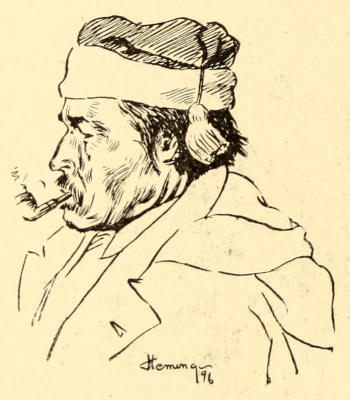
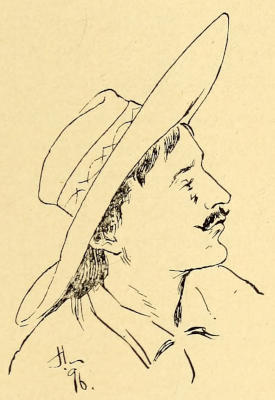
A DANDY OF THE NORTH.
A VOYAGEUR.
Notwithstanding the hour’s delay, and the fact that
rain fell all day, we made the very good run of seventy-two
miles. As we swept along with the winding river,
the most beautiful and varied scenes were continually
presented. The banks, though not so high as above
Fort McMurray, were bold and thickly draped with
spruce and poplar woods. Taking advantage of the
discovery of some straight spruce saplings, we landed
as night approached, and a number of our men were
sent to select a few for the purpose of making good
tent-poles, to take the place of the rough ones we had
been using. Besides spruce and other varieties of
timber, balsam trees, the last seen on the northward
journey, were found at this camp.
On the morning of the 16th, though the weather continued
showery and a strong head wind had set in, we
were early on our way, for we were anxious to reach
Chippewyan a day or two before the return of the
Grahame, that we might rate our chronometer and
make all necessary preparations for a good-bye to the
outermost borders of civilization. In descending the
Athabasca we were making no survey of the course, nor
any continuous examination of the geological features
of the district, but were chiefly concerned in getting
down to Chippewyan, where we were to receive our full
loads of supplies, and from which place our work was
really to begin. Despite the unpleasantness of the
weather, therefore, our canoes were kept in the stream
and all hands at the paddles, and by nightfall another
stretch of about sixty miles was covered. We had now
reached the low flat country at the delta of the river,
where its waters break into many channels, but still a
strong current was running, and this we were glad to
find continued until within a distance of six or eight
miles from the lake. Some parts of the river were much
obstructed by drift-wood grounded upon shoals; the
banks, too, were low and marshy, and landing-places
difficult to find. Several flocks of wild geese were seen,
but none secured.
During the morning of the 17th some gun-shots were
heard not far distant across the grassy marsh, and turning
our canoes in that direction we soon met several
bark canoes manned by Chippewyan Indian hunters.
François, being the only man in our party who could
understand or talk with them, was much in demand,
and he was instructed to ask them the shortest way
through the delta towards Chippewyan. Indian like,
he entered into conversation with the strangers for ten
minutes or so, doubtless chiefly about their wives and
daughters, and then with a
wave of the hand said, “We
go dis way.” So that way
we went, and by three o’clock
in the afternoon found ourselves
in the open waters of
Lake Athabasca. Two hours
later we had crossed the end
of the Lake and drawn up
our canoes on the rocky shore
in front of Fort Chippewyan.
It was Saturday evening, and
the distance travelled thus far
since launching the canoes, was, according to Mr. Ogilvie,
430 miles. As we were already aware, Dr. McKay, the
Hudson’s Bay Company’s agent, was not at the Fort, but
we were received by the assistant trader, Pierre Mercredie,
a half-breed, and shown to a camping-ground in
front of the Fort, or otherwise on Main Street of the
town. During the evening we had the pleasure of meeting
Mrs. McKay and her children, and also Mr. Russell,
an American naturalist, who was sojourning at this place
on his way down the Mackenzie River.
AN ENGLISH-CREE TRAPPER.
CHAPTER IV. CHIPPEWYAN TO BLACK LAKE.
Fort Chippewyan is an old and important trading-post
of the Hudson’s Bay Company. Before many
of our Canadian and American cities came into existence,
Chippewyan was a noted fur-trading centre.
From here—or rather from a former site of the post, a
few miles distant—Alexander Mackenzie (afterwards
Sir Alexander) started, in 1789, on his famous journey
down the great river which now bears his name. About
the beginning of the present century the post was
moved to the position it now occupies on the rocky
northern shore of the west end of the Lake.
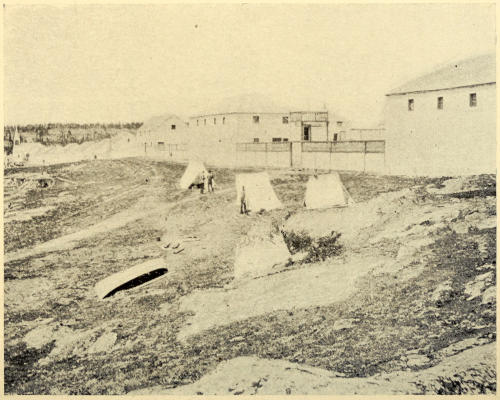
The Fort consists of a long row of eighteen or twenty
detached log buildings, chiefly servants’ houses, connected
by a high strong wooden fence or wall, so as to
present an unbroken front to the water, behind which,
in a sort of court, are situated the Factor’s dwelling and
two or three other good-sized log buildings. At the
west end of the row stands an Episcopal Mission church
and the Mission house, which at the time of our visit
was occupied by Bishop Young, the see of whose diocese
was formerly here, but since removed to Fort Vermilion,
some 270 miles distant on the Peace River. Within
easy sight, a short distance farther west, across a little
bay, the Roman Catholic Mission church, and various
buildings connected therewith, are situated. This mission
is a large and flourishing one, and is the see of the
Roman Catholic Diocese of Athabasca. All the buildings
of Chippewyan are neatly whitewashed, so that,
particularly from the front, it presents a most striking
appearance. At the back of the Fort, between the
rocky hills, plenty of small timber for house-building
and firewood is found, and over at the Catholic Mission
a little farm is cultivated, and many luxuries in the way
of root vegetables obtained from it.
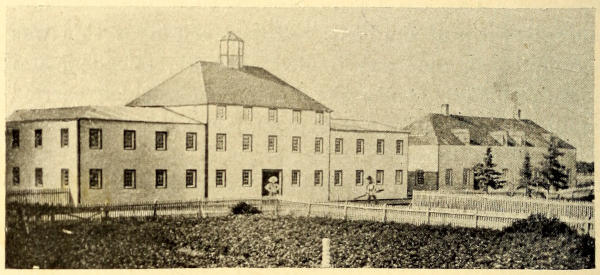
FORT CHIPPEWYAN.
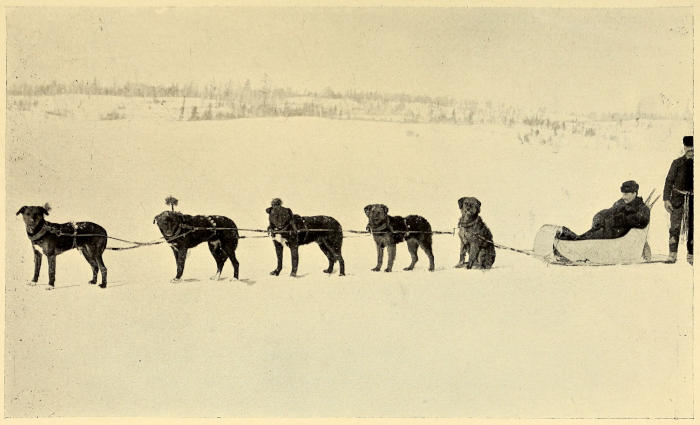
The staple food, however, for both man and dogs
(which latter are important members of the community)
is fish, several varieties of which are caught in abundance
in the lake close at hand. One or two whitefish,
according to size, is the usual daily allowance for a dog.
In the north the dog takes the place which the horse
occupies in the south, and it is a very interesting sight
to see the canine population of the town, perhaps thirty
or forty in all, receiving their daily meal. They are
called together by the ringing of a large bell, erected for
the purpose at all Hudson’s Bay Company posts. At
the first stroke all dogs within reach of the sound spring
to their feet and scamper off to the feeding place, where
they find a man in charge of their rations. Forming
round in a circle, each dog waits for the portion thrown
to him, which he at once trots away with to enjoy in
some quiet retreat. Occasional snarls and fights take
place, but it is astonishing to see how orderly Chippewyan
dogs are able to conduct themselves at a common
mess.
The day after our arrival at the Fort being Sunday, we
had our last opportunity for several months of attending
Divine service, and were privileged to listen to an excellent
sermon preached by His Lordship Bishop Young.
Some of our men, being Roman Catholics, were able to
avail themselves of the opportunity of attending mass as
well, and of receiving a parting blessing from the priest.
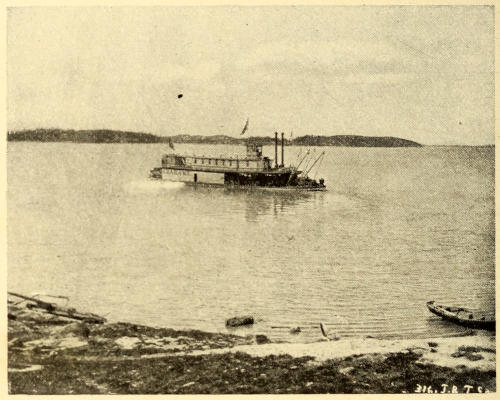
STEAMER “GRAHAME.”
The next day being the 19th, the date on which Dr.
McKay had promised to rejoin us at the Fort, his return
with the Grahame was eagerly looked for. We had
made all the preparations for departure that could be
made until he and our supplies should arrive. During
the afternoon a strong breeze sprang up from the east,
raising a heavy sea, and it was not until sunset that
the belated steamer tied up to the wharf. She had had
a rough passage, so rough that the Doctor declared it
was the last time he would ever be a passenger on her in
such water, a not unwise resolution, for the steamer,
top-heavy and drawing only about three feet of water,
was not unlikely to roll over in rough weather.
With the return of the Doctor, Captain Mills and the
Captain of the Grahame, we now formed a merry
party, and spent a pleasant evening at the Doctor’s
house. Captain Mills and I talked over old-time adventures
in Hudson Straits, and recalled many incidents
from our mutual experiences in the north in bygone
days. But as the Doctor had determined to leave again
with the steamer on the following day for the Great
Slave Lake river posts, there was no time to be lost in
social pleasures. In compliance with my brother’s request,
sent by letter some months previously, Dr. McKay
had engaged the best available Indian guide to
accompany us from this place through Lake Athabasca
and as far beyond as he knew the country. With the
success of this arrangement we were greatly pleased,
as it was desirable that as little time as possible
should be lost in seeking trails and river routes. The
guide’s name was Moberly—a Christian name, though
borne by a full-blooded Chippewyan Indian, who, before
we were through with him, proved himself to be anything
but a Christian. He was acquainted with our
route for about one hundred miles to the northward
from Black Lake, and even in this distance his services,
we thought, would likely save us several days.
The next morning the Fort was a scene of hurry and
bustle. Goods were landed from the steamer, cordwood
taken on board, and much other business attended to.
I took charge of our own supplies, and checked each
piece as it was brought ashore. Our chest of tea was
the only article that had suffered from the effects of frequent
transhipment. It had been broken open and a
few pounds lost, but the balance—about sixty pounds—had
been gathered up and put in a flour bag. Before
noon everything was safely landed on the shore, and it
formed a miscellaneous pile of no small extent. Following
is a list of the articles: “Bacon, axes, flour,
matches, oatmeal, alcohol, tin kettles, evaporated apples,
apricots, salt, sugar, frying-pans, dutch oven, rice, pepper,
mustard, files, jam, tobacco, hard tack, candles,
geological hammers, baking powder, pain killer, knives,
forks, canned beef—fresh and corned—tin dishes, tarpaulins
and waterproof sacks.” Besides the above, there
were our tents, bags of dunnage, mathematical instruments,
rifles and a box of ammunition. The total
weight of all this outfit amounted at the time to about
four thousand pounds.
A sail-boat which my brother had used in 1892, and
which was in good condition, rode at anchor before the
Fort, and for a time it was thought we would have to
make use of this as far as the east end of the lake to
carry all our stuff. Moberly, the guide, particularly
urged the necessity of taking the big boat, for his home
was at the east end of the lake, and he had a lot of
stuff for which he wished to arrange a transport, but
as we were not on a freighting tour for Moberly, and
as we found by trial that everything could be carried
nicely in the canoes, we decided to take them only. At
this the guide became sulky, and thought he would not
go. His wife and two daughters, who were to accompany
him as far as their home, tried to persuade him,
but Indian-like he would not promise to do one thing
or the other. At last we told him to go where he chose,
as we were in no way dependent on him, but knew our
own way well enough.
As arranged, the Grahame steamed away during the
afternoon, for the Great Slave River, with Dr. McKay,
Captain Mills and Bishop Young on board, but our own
start was deferred until the next morning, and in the
meantime home letters were written, for a packet was
to go south from here about the 16th of July.
On the morning of the 21st of June, the whole outfit
being snugly stowed in the three canoes, our party set
out on the eastward course. Old Moberly, the guide,
was also on hand with his family and big bark canoe.
The morning was beautifully fair and calm; all nature
seemed to be smiling. But soon the smile became a
frown. The east wind, as if aroused by our paddles,
began to stir himself, and before long made things
unpleasant enough, coming not alone but with clouds of
mist and rain. Though we could make but slow progress,
we persisted in travelling until 9.30 p.m., when,
having made about twenty-four knots, we pitched camp
in a little sandy bay, worthy to be remembered
because of the swarms of mosquitos which greeted us
on landing. We had been reminded of the existence of
these creatures at Chippewyan and at former camps,
but here it was a question of the survival of the fittest.
Mosquito nets, already fixed to our hats, had to be
drawn down and tightly closed, and mosquito oil or
grease smeared over the hands.
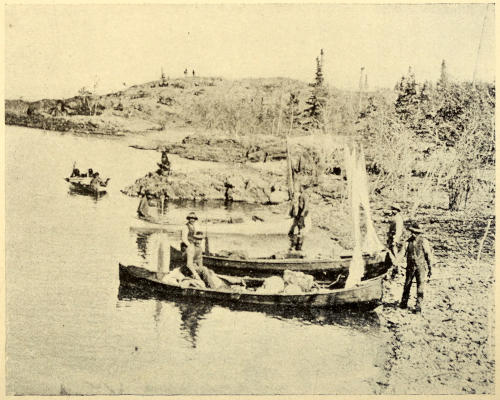
LANDING ON NORTH SHORE, LAKE ATHABASCA.
The whole north shore of the lake, being bold and
rocky, and consisting chiefly of Laurentian gneiss, is of
little geological interest except at a few points, which
will be spoken of as they are reached. The south shore,
which was examined by my brother in 1892, was found
to be of entirely different character, low and flat, and
its rocks cretaceous sandstones. The chief varieties of
timber observed as we passed along were spruce, white
poplar and birch, and with these, though of small size,
the country was fairly well covered.
Our second day on the lake was even less successful
than the first, for though we made a start in the morning,
we were soon obliged to put to shore by reason of
the roughness of the water and a strong head-wind. At
noon we succeeded in getting our latitude, which was
59° 6′ 32″ N.
About six o’clock that evening, shortly after our
second launch, we met a party of Indians in their bark
canoes, sailing with hoisted blankets before the wind.
There were quite a number of them, and as they bore
down towards us they presented a picturesque and
animated scene. Moberly was some distance in the rear,
but François was on hand to interpret, and as we met a
halt was made. The first and most natural question
asked by the Indians was, “Where are you going?”
“To h—,” was François’ prompt but rather startling
reply. In order that we might have an opportunity of
securing information about the country (not that to
which François had alluded, however), it was decided
that we should all go ashore and have some tea; so
our course was shaped for the nearest beach, a mile or
so away. Upon landing we found that some of these
Indians were men of whom Dr. McKay had spoken as
being shrewd, intelligent fellows. From one old hunter
in particular, named Sharlo, we obtained interesting
sketch-maps of canoe routes leading northward from
Lake Athabasca. Of course tea and tobacco had been
served out before such information was sought, for no
man of any experience would think of approaching an
Indian for the purpose of obtaining a favor without first
having conferred one. Our object accomplished, canoes
were again launched, and the struggle with the east
wind was renewed. Though we travelled until 10.30 at
night we made only 16.4 knots during the day, as indicated
by the boat’s log; and then in the mouth of the
Fishing River we found a sheltered nook in the thick
woods for a camping-ground.
The next day, the high wind continuing and rain
falling freely, the lake was too rough for us to venture
out. A collection of all the many varieties of plants
occurring in the vicinity was carefully made. Nets
were set out, and some fine fish taken; trolls were also
used with fair success, and with my revolver, much to
the amusement of the party, I shot and killed some
distance under water a fine large pike. A few geese
were seen also, but none could be secured.
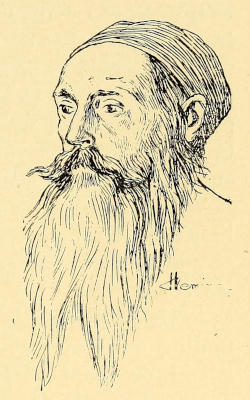
A TYPICAL NORTHLAND FATHER.
On the following morning, though it was still raining,
the wind had fallen, and we were able to go ahead.
Because of the wet we had great difficulty in using our
surveying instruments and in making notes. During
the forenoon while ashore at Cypress Point, a long
sand-beach timbered with jack-pine woods, and extending
a mile or more out into the lake, we observed a sail
not far ahead. A sail-boat in these waters was an unusual
sight, but on this occasion we were able to guess
its meaning. It was Mr. Reed with his party returning
from Fort Fond du Lac (now a small winter post
only) to Chippewyan with the last winter’s trade. We
had been told we would likely meet him on the lake,
and here he came before the breeze in his big York
boat. As he approached and sighted us he made in to
where we were, and ran his boat on the sand beach.
Besides Mr. Reed, the young
trader, there were with him two
French priests returning from
their season’s labor among the
Indians. One of them, now an
old man, had spent the greater
part of his life in mission work
in this district, and was about
laying down his commission, to
be succeeded by his younger
companion. As it was nearly
noon, our men were instructed,
though it was raining heavily,
to kindle a fire and prepare
lunch for the party. Beneath
some thick fir-trees a shelter
was found, and the tea being
made and lunch laid out on
the ground, we all seated ourselves about, and spent
a delightful half-hour together. But to us every hour
was precious, and without further delay we wished each
other God-speed, and continued our courses. By nightfall
the log-reading showed our day’s travel to be thirty-two
knots, equivalent to about thirty-seven miles. So
far we had been fortunate in finding comfortable camping
grounds. With a guide who knew the shore we
should be expected to do so, but with a guide such
as ours, who was commonly several miles behind, his
connection with the party made little difference, excepting
in the consumption of “grub.”
Three more days passed, and despite the unfavorable
weather, seventy miles of shore-line were surveyed.
Then a discovery of some interest was made. Just east
of the Beaver Hills we found a veritable mountain of
iron ore, and that of the most valuable kind, hæmatite.
Coal to smelt it is not found in the vicinity, though
there is plenty of wood in the forest. The shore of this
part of the lake was very much obscured by islands,
upon the slopes of which the remains of the last winter’s
snow banks could still be seen.
We made an early start on the morning of the 18th,
breaking camp at five o’clock, but before we had made
any distance a fog settled over the lake so dense that
we could not see ten yards from the canoes. For some
time we groped along in the darkness, every little while
finding our way obstructed by the rocky wall of some
island or point of land, and finally, meeting with a
seemingly endless shore, we were obliged to wait for the
weather to clear. All hands landed and climbed the
precipitous bank, with a view to discovering something
about the locality, but all was obscurity. Toward noon
the fog lifted, and we were able to make out our position,
which was on the mainland and north of Old Man
Island. On this point we observed a solitary grave,
and near by the remains of an old log house. As to
who had been the occupant of this solitary hut, or whose
remains rested in the lonely grave, we knew not, but
their appearance on this uninhabited shore made a
realistic picture of desolation and sadness.
On the morning of the 29th of June, high west winds
and heavy rain were again the order of the day, but
venturing out, we made a fast run before the wind and
reached the Fort in a heavy sea. Fond-du-Lac is a fort
only in name, and consists in all of two or three small
log shanties and a little log mission church, situated
on a bare, exposed sandy shore, without any shelter from
the fierce winter storms which hold high carnival in
this country six or seven months of the year. Having
already met the white residents of Fond-du-Lac on the
lake, most of their houses, few though they were, were
locked up or deserted. Two or three Indians and their
families were living at the place, and with one of them
letters were left with a hope that they might be taken
safely to Chippewyan, and thence forwarded by the
Hudson’s Bay Company’s autumn packet to Edmonton.
This was undoubtedly the last chance, though only a
chance, of sending any news to our friends until we
should return to civilization.
From Fond-du-Lac eastward the lake is quite narrow,
having much the appearance of a broad river. It is
only five miles in width, but extends a distance of fifty
miles. On the south shore could be seen a large
group of Indian lodges, and at this camp was the home
of our guide. It was here that his family were to be
left, so we all went across to the Indians’ encampment.
Moberly now appeared to be very indifferent as to
whether or not he should go any farther with us.
Indeed he seemed more inclined to remain with his
friends, for to accompany us meant more exertion for
him than he was fond of. Various reasons were given
why he must remain at this place; but after much parleying,
and the offer of liberal inducements, he promised
to secure a companion canoeman, and follow our track
in the morning. With this understanding we parted,
and proceeded along the south shore until evening,
when, finding an inviting camping-ground in the open
jack-pine wood, we went ashore, while the cooks soon
prepared supper, with us the principal meal of the day.
So far our fare had been exceedingly good, for it had
been the policy to dispose of luxuries as soon as possible,
in order to reduce the weight of the loads on the portages.
Our limited stock of canned fruits was, therefore,
used with a free hand at first.
June closed with a bright, clear and unusually calm
day, which was also marked by the absence of mosquitos
and black flies. Under these unusual circumstances,
at noon-hour, an event transpired which was seldom
repeated during the remaining part of our journey, viz.,
the taking of a bath.
Just as lunch was ready we were again joined by
Moberly and his companion, an old Indian named Bovia.
We were glad, if not a little surprised, to see them, for
we had a suspicion that the guide had no serious intention
of keeping his promise. During the afternoon,
however, as before, his canoe lagged far behind, not so
much because of his inability to keep up with us, as
because of his serene indifference and laziness. The
paddles used by him and his comrade were like spoons as
compared with our broad blades, and the position of old
Bovia, as he pulled with one elbow resting on the gunwale
of his canoe, was most amusing. By this way of
travelling it was very evident that the guides were going
to be a drag rather than a help to us, so it was resolved
that before proceeding farther a definite understanding
must be arrived at.
Beside the evening camp-fire, accordingly, the matter
was broached to the Indians. They were told plainly
that if they were to continue with us they would be
required to go in advance and show us the way as far as
they knew the route, and further, that they would be
expected to assist in portaging our stuff whenever that
might become necessary. In consideration of this, as
already agreed upon, they were to receive their board
and eighty skins ($40.00) per month, upon their return
to Chippewyan. This arrangement was accepted as
being satisfactory to them, and it was hoped that it
might result satisfactorily to ourselves.
During the morning of the 1st of July, with a little
Union Jack flying at the bow of my canoe, we arrived
at the east end of the lake, and concluded a traverse,
since leaving Chippewyan, of 210 miles. Here at the
extremity of the lake we found several Indian families
living, not as is usual, in their “tepees” or skin-covered
lodges, but in substantial log huts. One of these, we
learned, was the property of our brave Moberly, and in
front of it he and old Bovia deliberately went ashore,
drew up their canoe, and seated themselves upon the
ground beside some friends.
Their action at once struck us as suspicious, but
presently they made an open demand for a division of
our bacon, flour, tea and tobacco. Some pieces of tobacco
and a small quantity of tea had already been
given, but any further distribution of the supplies was
declined. At this Moberly became very angry, and said
he would go with us no farther, and not another foot
would he go. From the first his quibbling, unreliable
manner, characteristic of the tribe to which he belonged,
had been most unsatisfactory, and now having received
board for himself and his family in journeying homeward,
besides a month’s pay in advance, he had resolved
to desert us. There was no use in trying to force him
to continue with us against his inclinations, nor could
we gain anything by punishing him for his deception,
though punishment he richly deserved. He was given
one last opportunity of deciding to go with us, but still
refusing, we parted company with him without wasting
strong language, which he could not have understood.
INDIAN LOG HOUSE.
With our three canoes only we thereupon commenced
the ascent of what had been named the Stone River,
the outlet of Black Lake. We had gone only a short
distance when we were met by a canoe and four Indians
coming down with the current. They appeared to be
delighted to see us, and turning back accompanied us to
the first rapid, where a short portage had to be made.
The natives willingly assisted us, and for their labor
were liberally rewarded with tea, tobacco and a few
lumps of sugar. With this they volunteered to return
on the following day and assist us in crossing some
longer portages, the first of which we would meet before
nightfall. Of this offer we were quite glad, and promised
good pay for the work as inducement for them to
keep the engagement, but in the meantime they went
down to the log houses where we had left our guides,
and we continued our course up the river.
CATARACT, STONE RIVER.
The next day, Sunday, we spent in camp at the foot
of a wild and beautiful cataract. The weather was
warm, and the black flies and mosquitos swarmed in
the woods and about camp so thickly that we could nowhere
escape from their ceaseless hum and dreaded bite.
In this neighborhood they did not appear to have the
customary respect for the smudge. Dense smoke was
made about camp, but the flies only appeared to revel
in it.
At camp the men were variously employed. A fishing
net had been put out in an eddy at the foot of the
rapids the previous night, and when taken up in the
morning some of the finest fish I have ever seen
were found in it. Two salmon trout measured three
feet one inch and three feet two inches in length respectively,
and the white fish, of which there were a
large number, ranged in weight from six to ten pounds.
I may add, in deference to a suspicion which statements
of this nature sometimes give rise to, that these facts
can be amply verified. Towards evening we looked for
the return of the four natives who had promised us
their assistance, but they came not.
Following this day of rest came one of most laborious,
exhausting work. Our camp was not only at the
foot of a beautiful fall, but in consequence was at the
lower end of a rough, rocky portage, found to be three
miles in length, and the canoes were all heavily loaded,
containing some four thousand pounds of cargo to be
transported. One of our men, Corrigal, was unfortunately
laid up for the time with an ugly gash in the
knee, so we had only five packers; but being fresh and
in high spirits they went at their work with a rush,
notwithstanding a rocky hill of two hundred feet which
had to be climbed, and a deep muskeg which obliged
them to wade. Long before night, however, their
spirits had dropped many degrees, and
it became evident that the task was
telling heavily on the men. Before evening their feet
were fearfully blistered, and all complained of pains in
one place or another. They had each carried six loads
to the upper end of the portage, which represented a
walk of thirty-three miles, eighteen of which were
travelled with one-hundred pound loads upon their
backs, over rocky hills and through swamps knee-deep
with mire. This was disheartening work at the outset,
but it was good training for what was to follow.
A DIFFICULT PORTAGE.
The next morning the weather was hot and the flies
were out in swarms, as on the day before. The men
were all foot-sore and stiff, but without a grumble resumed
their work. They were obliged to make two
more trips before everything was across, and by that
time it was nearly noon; still, without a pause for rest,
they loaded the canoes, pushed out into the lake—a
small expansion of the river—and headed for the
opposite shore, where we soon discovered the mouth.
When yet far out on the lake we could see the river’s
foaming water, and as we drew nearer could plainly
hear the unmistakable roar of a cataract. Some distance
to the right, on a sand-beach, we went ashore, and found
ourselves at the foot of a second long portage.
Because of the condition of our men, camp was now
ordered to be pitched, so as to give them some chance to
recruit. My brother and I walked across the portage,
and found it to be three and one-half miles in length.
It was, however, much less difficult than the former one,
being more level and less rocky. Its upper end terminated
on the shore of Black Lake, where we hoped
to find Indians who would help us across. But in this
we were disappointed, and, instead of Indians, found
only old forsaken “tepee” poles and blackened fireplaces.
We tried to rest for a while upon the shore of
Black Lake, but the flies swarmed about us with such
frightful fury that we were compelled to beat a retreat,
and seek rest where alone it could be found, beneath
our mosquito awnings at camp.
By the way, there is an Indian tradition which says
that it was on these very portages that the Great Spirit
first made these black flies, and our experience, we
thought, would tend to bear out that belief.
INDIAN RAFTS LOADED WITH VENISON.
On the afternoon of the 7th we started out in a north-easterly
direction, following the shore of Black Lake
(explored by my brother in 1892) for a distance of about
sixteen miles, until we reached the hunting trail, of which
he had been informed by the Indians, leading away to
the northward. This place until now had been our
objective point, and the way to it was known; but
beyond this point we knew nothing of the road, or of the
country through which it would lead us, excepting for
the first few days’ travel, to which the Indians’ description,
quoted at the beginning of this narrative, would
apply. From this point northward, for a distance of
one hundred miles, or thereabouts, we had expected to
be guided by that old humbug Moberly, but he having
deserted us we were now dependent on our own resources.
CHAPTER V. INTO THE UNKNOWN WILDERNESS.
On Saturday morning, the 8th of July, without guide
or map, we commenced our journey into the great
untravelled wilderness. The trail commenced with a
portage two miles in length, leading through thickets,
swamps, and over rocky hills, but by this time the men
were accustomed to their work, and went about it in
a steadier and more methodical manner. My brother’s
time was chiefly devoted to the general direction of the
party, and an examination of the geology of the
country.[2] My own time was largely taken up in making
the survey and topographical notes of the route, and in
collecting the flora of the country; but when our duties
permitted and occasion required we both took a turn
at the pack-straps, as we did on this portage.
In order to make an easier trail than the existing
circuitous one, which led over sharp angular stones and
precipitous rocks, we were obliged to cut our way
through a thicket for a distance of half a mile. Having
done this, the work of portaging through the forest was
begun. During the remainder of the day, and indeed
until ten o’clock at night, we continued our labor.
Corrigal, who had been crippled, was now at work
again, and proved to be a capital hand. All hands
worked well, but it was amusing to note the craftiness
of the Iroquois, who invariably tried to secure such
articles to carry as biscuits, tents or dunnage bags.
With immense loads of comparatively little weight they
would then stagger off like old Atlas himself.
When the last loads for the week were laid down at
camp, we were a thoroughly tired party. For the past
six days we had been laboring on long portages, and
during that time had carried the entire outfit for a
distance of about eight miles, over the roughest kind of
country, representing a total transport of fifty-six miles,
or a walk of 104 miles for each man. Sunday was
spent, therefore, by all in enjoying complete rest. The
weather continued fine and warm, as it had been all
week.
During the succeeding day and a half six little lakes
and as many short portages, leading in a northerly
direction, were crossed, and then at noon on the 11th
inst. Wolverine Lake was discovered and its position in
latitude determined. This lake, only about three miles
in width by six in length, is by no means a large body
of water, but because of its many deep shore indentations
and consequent coast-line of forty or fifty miles,
it was thought by us to be large enough before we discovered
our road out of it, which we knew to be by the
ascent of a large river from the north. The shores of
the lake were heavily and beautifully wooded with
spruce and birch timber, and its surface was studded
with islands. At nightfall, after exploring the uttermost
recesses of several deep bays, without discovering
any trace of the river, we pitched camp, and obtained
shelter from a cold drizzling rain.
The next morning being cool, and flies scarce, a plunge
bath was the first item on the programme. After disposing
of our usual breakfast of bacon and bannocks,
the search for the route was resumed. After much careful
search, occupying nearly the whole day, the mouth
of the river was found, close to where we had first
entered the lake. It was much obscured by islands, and
owing to the depth of the channel had an almost imperceptible
current; but beyond all doubt it was the road
described by the Indians, and though rain was again
falling, no time was lost in commencing the ascent.
About seven miles up stream we were obliged to seek
camp, but a suitable one was not to be found, as the
shores were low and flooded with water. A place none
too dry was finally selected, and in a drenched condition
we scrambled or waded ashore.
As I was enjoying a mug of tea, my brother came
into our tent and reported having heard a cariboo calf
in the swamp close by. Though it was already nearly
dark, I picked up my rifle and started out in the direction
from which he had heard the noise, in quest of
venison. The dense spruce swamp was literally alive
with mosquitos, which at every step rose up from the
wet grass in swarms, and beat into my face. A runway
was soon found, and I hurried noiselessly along
through the gloom of the forest, hoping soon to hear
something of the calf. Many other runways were
crossed, and after travelling some distance without any
signs of success, I was about to return, for fear of
being overtaken by darkness, when a little distance
ahead I heard the cracking of a stick. It was, no doubt,
caused by the foot of the fawn. Quickly but silently I
proceeded. Again and again the noise was heard, and
each time nearer than the last. My advance was continued
cautiously, until very soon, in a thicket of scrub,
only a few yards ahead, I noticed the moving of some
branches. Still no deer could I see, but in creeping up
closer, at a distance of not over twenty yards, I suddenly
came within full view of an immense black bear, seated
on his haunches and occupied in rubbing the mosquitos
off his nose. Although taken by surprise at the proportions
of the supposed calf, I dropped on one knee,
and, levelling my rifle, fired at the back of bruin’s head,
whereat he also exhibited considerable surprise by leaping
into the air, making several delirious revolutions,
and bolting away into the gloom of the swamp. Though
in all probability badly wounded, it was too dark to
follow him. The gloom had already spoiled my aim, so
without further pursuit I groped my way back to camp.
During the following day the ascent of Wolverine
River was continued, and three short portages, the longest
one being half a mile, were made. As we proceeded
northward the banks of the river became more rocky.
In many places bald hill-tops were visible, rising two or
three hundred feet above the level of the river. Such
timber as there was consisted of spruce, birch and jack-pine.
On the 14th, Birch Lake, a small body of water about
nine miles long by two wide, was discovered and surveyed,
and near its northern extremity a large rapid
stream was found emptying into it its foaming waters.
Judging the course of this stream to be our route, a
portage of half a mile was made past it. This brought
us to the southern extremity of another larger lake,
which we assumed to be the Indians’ so-called “Big
Lake,” and which in honor of the then Director of the
Geological Survey we have named Selwyn Lake. Being
too wide to admit of both shores being sketched from
our line of survey, this lake was traversed on the east
side only.
A. R. C. SELWYN, C. M. G., F. R. S., Director Geological Survey, 1869-1895.
In the evening camp was pitched on an island a
little distance off shore. On this island a lonely grave
was discovered, at the head of which stood a plain
wooden cross. It was, doubtless, the grave of some
Christian Indian who had been taught by the priests
at Fond-du-Lac, and who, when out on a hunting
expedition, had been stricken down by the great reaper,
and by his companions had been laid here to rest.
This island camp recalls an incident connected with
John, our baker. For some time past, notwithstanding
the appetites of the men, his bread had not been giving
satisfaction. Some of the party were afraid to eat it on
account of the possibilities of canoeing accidents, which
would be almost certain to result fatally, for with John’s
bread in one’s stomach there could be little hope of
remaining afloat. At first John had confined his baking
to the making of grease bannocks, which, after being
formed in a pan, were removed and cooked before
the fire on a stick; and so long as he baked in his
accustomed way he was fairly successful, but as soon as
he undertook the use of baking powder, and the production
of bread from a reflector (a camp oven) he grievously
failed. Being anxious to uphold the dignity of his profession
at this camp, he sat up all night endeavoring
to improve on his methods, but with little success. Two
days later he again undertook the prosecution of his calling,
and after cleaning his hands, brought out his dutch-oven,
bake-pans, sack of flour, baking powder, etc. My
brother, noticing these preparations, strolled over to
a convenient log and there seated himself to watch
John’s modus operandi. The sack was opened and the
top of it rolled down until it formed a ring over the
flour, in which a hollow was then made with the hands.
Into this basin a quart or more of water was poured, and
into the water the prescribed quantity of baking powder
was stirred and allowed to effervesce. We now understood
the secret of John’s failures, and gave him instructions
on the use of baking powder. After this we
enjoyed better bread.
A week had now passed since leaving the end of the
long portage out of Black Lake, and during that time
we had made only about eighty miles. This was a slow
rate of travel, and if possible would have to be improved
on. One day had been lost in discovering the outlet
from Wolverine Lake, another spent in ascending the
river, and considerable time had been occupied on the
several portages.
Sunday, the 16th of July, was spent quietly and profitably
at camp after the six days of hard travel, and,
strange to say, the flies which had filled the air and made
our lives a burden the previous evening had now almost
entirely disappeared. The day was bright and warm,
affording a good opportunity for lake bathing. This
pleasure was highly prized. After one has been subjected
to the continual lacerations and stings of flies
and mosquitos, and the liberal application of tar-oil for a
week or two, a bath is not only a luxury, but a necessity.
On Monday morning the exploration of Selwyn Lake
was continued. The shore-line was still found to be
irregular and indented by deep bays. Some of these
were passed by, but those toward the north end of the
lake were carefully examined to their extremities, in
our search for the portage, of which we had been
informed, leading over the Height of Land.
Towards evening our party was surprised by the appearance
of a canoe some distance away, and not far
from it, on a little island, an Indian camp. Shaping our
course for the camp, a salute was fired, and was promptly
answered by the Indians. Reaching the camp we were
not a little astonished to find that some of the Indians
were the very same men who had agreed to assist us
over the portages out of Athabasca and Black Lakes.
They had, no doubt, after meeting old Moberly, been
prompted to leave us to shift for ourselves, and had
returned in such a way as to avoid meeting us again.
From them we now inquired for the Height of Land
portage, and were pleased to learn that it was near at
hand. Having obtained as much information from
these fellows as we could, and arranged once more for
three or four of them to assist us over in the morning,
we pitched our own camp on a neighboring island.
During the evening most of the Indians paddled across
to where we were, and from some of them sketch-maps
and useful information were obtained; but their attention
was chiefly devoted to filling the men with stories
of the fearful dangers and certain disasters which we
would encounter should we attempt to descend the
Telzoa River. They said we would meet with great
impassable canyons, and that the country through which
it flowed was inhabited by savage tribes of Eskimos,
who would undoubtedly eat us. These and similar
stories produced a deep impression on the minds of
some of our men, and might have given rise to serious
trouble or even the disorganizing of the whole party.
Jim went to my brother, and with a sad face unbosomed
his trouble. He said that if he were a single
man he would not feel so badly, but having a family dependent
on him he could not run into such destruction
as he now learned awaited us. Most of the men, excepting,
perhaps, François, who cared for nothing, were
equally affected, and it was with some difficulty we
managed to reassure them. We told them that these
Indians were a set of miserable liars, and were only trying
to prevent us from going into their hunting grounds;
that I had lived with the Eskimos for nearly two years,
and had found them to be far better people than these
Indians who were trying to deceive them. We referred
them to Moberly, the untrustworthy and false, as a
sample of their tribe, and at length persuaded them into
disbelieving the stories.
On the morning of the 18th, accompanied by five
native Indians, we arrived at our portage near the
northern extremity of the lake, and about fifty miles
from the rapids where we had entered it. The portage
led, as we had been informed by the Indians, over the
Height of Land to the northward. It was found to be a
mile and a quarter long. Its northern end terminated on
the shore of another large lake, the level of which was
ascertained to be about fifty feet lower than Selwyn
Lake. Separating the two lakes, rocky hills rose to
elevations of two or three hundred feet (fourteen or
fifteen hundred feet above sea level), and between them
wound the trail, which was comparatively level and
easy. With the help of the natives, our stuff, already
considerably reduced, was soon portaged, and the canoes
again launched and loaded. Before these operations
were completed, realizing the fact that we had now
reached a summit of the continent, it seemed to me a
most suitable place to leave the emblem of our country.
Selecting, therefore, a tall, straight tamarack, and providing
myself with bunting and hatchet, I climbed to
the top of the tree and there nailed securely the flag of
Canada. As I descended, I lopped off the branches and
thus made of the tree an excellent flag-pole.
SCOTCH-CREE HALF-BREED.
CHAPTER VI. THE HOME OF THE REINDEER.
From Lake Athabasca to the Height of Land our
course had constantly been up stream, but from this
point to the sea the way must ever be with the current.
Having launched our little fleet in the lake on the north
side of the watershed, the new stage of the journey was
begun with a strong, fair breeze.
The lake is a large one, and has been named Daly
Lake—after the Hon. T. M. Daly, then Minister of the
Interior for Canada. Towards the centre of it was discovered
a peninsula, which is connected with the west
shore only by a very narrow neck of land, across which
a portage was made. For a day and a half we were delayed
here by a gale, the most severe we had so far
encountered. So wild was the lake during this storm
that water-spouts were whirled up from its billows and
carried along in great vertical columns for considerable
distances.
Certain remarkable physical features in the shape of
great sand “Kames,” or high ridges, were also observed
at this locality. They were composed of clear sand
and gravel, were sixty or seventy feet in height, trended
in a north-easterly and south-westerly direction, were
quite narrow on top, and so level and uniform that they
might well be taken to be the remains of the embankments
of ancient railways. Geologists, however, have
another theory accounting for their origin, namely, that
they were formed by fissures or splits in the ancient
glaciers.
On the sheltered southerly slopes of these ridges
many new varieties of plants were found, and some
others which had been collected farther south were
here seen for the last time on the journey. Notable
among the latter was the aspen, of which several stunted,
gnarled specimens were observed. When the storm had
abated sufficiently the traverse of the lake shore was
resumed, when other notable features appeared.
A large part of the country was now composed of
frozen mossy bogs, sloping gently down towards the
lake. In the higher portions of the bogs the moss was
still growing, but elsewhere it was dead, and excepting
a few inches, was imbedded in solid glaciers. In many
instances these frozen bogs or glaciers were found to be
breaking off into the lake, and in such places they presented
brown mossy vertical faces, from ten to twenty
feet above the water. In examining these vertical sections
they were observed, as on top, to consist of frozen
moss to within about a foot of the surface. The first
of the moss glaciers, if I may call them such, were observed
near the Height of Land, but towards the north
end of Daly Lake they composed a large part of the
country, and timber occurred only in scattered, isolated
patches.
TELZOA RIVER.
According to our Indian information we should now
be near the outlet of the lake. During the morning of
the 22nd, after a good deal of searching in many deep
bays, the entrance to the Telzoa (broad shallow river)
was discovered. It was indeed a great, broad and rapid
river, broken up into many shallow channels, whose
waters seemed to have been, as it were, spilled over the
edge of the lake in the lowest places. This was the
river we had set out to explore, and with nothing more
than conjectures as to where it would lead us, we pushed
our canoes into the stream, and sped away to the northward.
Landings were made when necessary to carry on
the survey and examination of the country, but at other
times the canoes were kept in the stream, and the men
at the paddles. Many rapids were run, but our veteran
steersman Pierre, with his skill, judgment and unflinching
nerve, was usually able to map out his course and
steer it successfully, sometimes between rocks and
through channels little wider than his canoe.
Upon one occasion, which I well recollect, Pierre led
the way for the centre of a wild, rocky rapid. We soon
saw that he was making for a heavy shoot between two
great boulders, where the channel was barely wide
enough to allow us to pass. I determined to follow, but
our third canoe sought a channel nearer shore. Pierre,
by keeping straight in the centre of the current, was
shot through the
notch like a rocket,
but my steersman,
less skilful,
allowed our canoe
to be caught by
an eddy. Like
a flash it was
whirled end for
end, and happily
for us struck the
shoot stern first
instead of sideways
and was
carried through safely—no thanks to the steersman.
The third canoe fared worst of the three, for it was
dashed upon a great flat rock and broken in the bottom.
Its occupants, by jumping out upon the rock, managed
to hold it until assistance could be given them. The
load of the disabled canoe was safely landed by one of
the others, and the damage soon repaired.
RAPIDS, TELZOA RIVER.
We were now fairly beyond the limit of woods, which
for some time past had been gradually becoming thinner
more scattered, and of more stunted growth. On this
account it is impossible to lay down any definite line as
the limit of the forest. Outlying patches of spruce and
tamarack might still be found here and there in the
most favored localities, but as a whole the country was
now a vast, rolling, treeless wilderness.
On the evening of the 28th of July we reached the
north end of an expansion of the river, named Barlow
Lake. Our supply of meat was already running low.
Being quite unable to carry provisions with us for the
whole trip, we had, in starting, taken only a limited
quantity of this kind of food, trusting to our ability to
replenish the supply from time to time by the way. Up
to this time, however, we had seen nothing in the shape
of game since leaving Lake Athabasca, excepting the
one black bear, and he made good his escape. Plenty of
old deer-tracks were to be seen, but not a single deer,
and in consequence we were beginning to feel some
anxiety. If game should not be found within a week
or ten days, we would have to return, or proceed with
the probability before us of starvation.
We had only begun to think seriously on this question
when on the evening above-mentioned, just as we had
gone ashore to camp, a moving object was noticed on a
little island out in the lake. By means of our field-glasses
we could tell it was a deer, and I need hardly
say that no time was lost in manning a canoe and pulling
for the island. As we approached the deer watched
us closely, and soon satisfied of danger, bounded into the
air, galloped to the farther side of the island, plunged
into the water, and struck out for the nearest shore.
The rate at which the frightened animal tore its way
through the water was really marvellous, and for a time
it looked as if we would not be able to overtake it with
our light canoe and four paddles. Every muscle was
strained, both of deer and men, so that the hunt resolved
itself into a veritable race for life. Unfortunately for
the poor animal, though, the course was too long, and
before it could reach the shore we had overhauled and
shot it. That night we enjoyed our first meal of venison.
HERD OF REINDEER.
The next day, after descending the river a distance of
five or six miles, and getting into a body of water named
Carey Lake, through which we were steering a central
course, one of the party called attention to something
moving on the distant shore to our right. It turned out
to be not one but a band of deer. Our canoes were
headed to leeward of the band, that they might not
scent us as we approached the shore. Drawing nearer
we found there was not only one band, but that there
were many great bands, literally covering the country
over wide areas. The valleys and hillsides for miles
appeared to be moving masses of reindeer. To estimate
their numbers would be impossible. They could only be
reckoned in acres or square miles.
After a short consultation a place for landing, near a
small grove of tamarack—one of the last we saw—was
chosen. Rifles were examined, and an ample supply
of cartridges provided. Shot-guns and revolvers were
furnished to four of the men, and thus prepared we
landed and drew up the canoes. So far the deer had
apparently not seen us, but to prevent a general stampede,
it was arranged that I should go around to the rear
of a large detachment of the herd, near by, while my
brother should approach them from the shore. Accordingly
I was given fifteen minutes to run around, a mile
or so, behind some rising ground. Meanwhile the rest
of the party scattered themselves about in different
places, and at the given time my brother, having
approached within easy range, opened the fray by
bringing down a noble buck. At this first shot the
whole band—a solid mass of several thousands of
deer—was thrown into confusion, and they rushed to
and fro, not knowing which way to flee. Simultaneously
with my brother’s shot, I opened fire on them from the
rear, and our armed men charged from the sides, while
the other two were obliged to take refuge upon a great
boulder to avoid being trampled to death. The band
was speedily scattered, but not before a woful slaughter
had been made, and an abundant supply of fine fresh
meat secured, for which we were sincerely thankful. It
was fortunate that there was wood at hand to make a
fire with and dry the meat. Having slain as many
animals as we required, the men were set to work to
prepare dried meat for the rest of the trip.
This stroke of good fortune gave us much encouragement,
as we thought we had now nothing to fear from
lack of provisions. Several days were spent in drying the
eighteen or twenty carcases, which were preserved, and
while this work was progressing my brother and I
had ample time to roam over the hills and view and
photograph the bands of deer which were still everywhere
about us. After the slaughter of the first day we
carried no rifles with us, but armed only with a camera
walked to and fro through the herd, causing little more
alarm than one would by walking through a herd of
cattle in a field. The experience was delightful, one
never to be forgotten. The reindeer, which is the same
as the Barren Ground caribou, is an animal of exceptional
interest. To those whose imaginations dwell on
visions of St. Nicholas and his coursers it is the ideal
steed; while to the hardy native of the frigid zone it
is a faithful and efficient servant, and is undoubtedly
the most useful and valuable of the fifty or more
known varieties of deer.
In different localities, and at different seasons of the
year, reindeer vary in appearance; they range in weight
from one hundred to four hundred pounds. During the
months of June and July they present their poorest
appearance, being then lean and scrawny, and their
half-shed coats ragged and frowsy. By the month of
August they have discarded their tattered last-winter
garments, and have assumed sleek glossy brown summer
coats, which give them a smaller but much more
comely appearance. From this time, both because of
increasing flesh and length of hair, they become gradually
larger and more handsome, until, by the month of
November, when they don their winter suits of white
and grey, they are transformed in appearance into the
noblest animals of the chase.
Then it is that the enormous antlers of the male deer
have attained their full, hard growth, and he is thus
armed for the many battles habitually fought during
the months of November and December for the possession
of favored members of the fair sex. During the
month of January these antlers of the male deer, having
served their purpose as weapons of warfare, are annually
cast. Within a few weeks of the falling of the old
horns, soft new ones begin to form beneath the skin, and
gradually they increase in size until they reach maturity
the following autumn. During growth the antlers
remain comparatively soft, and are covered with skin
and fine short hair, known as the “velvet.” At maturity
a circular burr is formed at the base of the horn. This
has the effect of cutting off the blood-vessels, and causing
the velvet to dry and shrivel and ultimately peel off.
The peeling of the velvet is also hastened by the deer
rubbing its antlers upon rocks and trees. With each
successive year the antlers are supplemented by one
additional prong, so that the number of prongs or tines
is a positive indication of the age of the deer. I have
counted as many as twenty-two prongs on one horn, or
twice that number on the pair. Unlike every other
variety of deer, the caribou is antlered in both sexes, the
only difference being that in the case of the females the
horns are rather smaller, and are more slender and
delicate in their formation than those of the males.
The hoofs of the reindeer are very large in proportion
to other parts of the body, and, being cloven, they
spread greatly in walking. This characteristic peculiarly
fits them for travelling upon the crusted snow, through
which other deer would break and flounder in a hopeless
manner.
Concerning the habits of the reindeer, they are both
gregarious and migratory. During the summer season
their resort is the open plain or the sea-coast, where, to
some extent, they escape from their tormentors, the
mosquitos and black flies, and find abundance of food
in the tender grasses, the ground birch, or the willow
buds. In the autumn they turn their steps toward the
woodlands or more sheltered districts, where they spend
the long, severe winter, subsisting on tree-buds, moss or
lichens.
The breeding season occurs in the early spring, before
winter quarters are vacated; and the number of fawns
borne by a doe at one time ranges from one to three.
From an economic or commercial point of view, the
reindeer is highly prized. By the Laplanders and other
people it is domesticated, and takes the place of the
horse, the dog, the cow or the goat of other countries.
As a traveller it is swift and enduring, being capable of
hauling from two to three hundred pounds upon a sled,
as much as one hundred miles per day; and as compared
with the dog, it possesses the great advantage of being
able to obtain its food by the way.
As a source of venison it cannot be excelled, especially
in the autumn season, when it is in prime condition.
During September and October the males are rolling fat;
and as food their flesh is then equal to the finest beef.
Of all meats I have ever tasted, certainly reindeer
tongues take the first place for daintiness and delicacy
of flavor.
From the skins of the reindeer the natives of the
Arctic regions make almost every article of winter clothing.
For this purpose it is most admirably suited, both
because of its great warmth and its remarkable lightness.
Through different methods of tanning and dressing it is
made adaptable to a great variety of other uses. Sewing
thread, lashing twine and other strong lines are also
made from sinew obtained from along the spine of this
animal.
What the buffalo was to the North American Indian
in days gone by, the reindeer is now to the Eskimos
and other natives of the north country.
CHAPTER VII. A GREAT FROZEN LAKE.
Before leaving “Reindeer Camp” a cairn of rocks
was built on the top of an immense boulder, conspicuously
situated on the summit of a point reaching out
into the waters of Carey Lake. A record of our journey
to date was placed in it, and the “flag that for a thousand
years has braved the battle and the breeze,” left
floating overhead.
On the 2nd of August the journey was resumed, and
during the day a remarkable grove was found on the
north shore of the lake, in latitude 62° 15′ north. As a
whole the country was now a treeless, rocky wilderness,
but here by a little brook grew a clump of white spruce
trees, perhaps thirty in all, of which the largest measured
eight feet in circumference at two feet above
ground. Such a trunk would be considered unusually
large in a forest a thousand miles to the south, but here
it and its fellows stood far out in the Barren Grounds
with their gnarly, storm-beaten tops, like veritable
Druids of old.
In this grove many varieties of plants were found—among
others wood violets, which were here seen for
the last time on the trip. Not the least enjoyable feature
of this little oasis was that it afforded us an opportunity
of having a good noon-day fire, which of late had
been a rare luxury.
Pushing out our canoes, we continued the traverse of
the coast to the westward in search of the Telzoa, but it
could not be found that day.
ICE ON THE SHORE OF MARKHAM LAKE.
On the morning of the following day, at the north-western
extremity of the lake, our course was again
discovered. It commenced with a wild rapid of about
thirty feet fall, and this we found to be followed within
a distance of twenty miles by seven others, all of which
together aggregated a fall of about 120 feet, which took
us to the level of Markham Lake, named in honor of
Admiral A. H. Markham, R.N.
While traversing this lake a decided change in the
climate was observed. For the first time since the early
part of the season snow-banks were seen on the hillsides,
and the weather, which had been as a rule wet
and cold since leaving the woods, became decidedly
colder. Toward the north end of the lake we passed
great piles of rafted ice on the shore. Such conditions
during the month of August were highly suggestive of
the character of climate which must exist here in the
winter season.
Near the outlet of Markham Lake was found an exceptionally
interesting little island. For weeks we had
seen nothing but Laurentian or Huronian hills, but here
was a solitary out-lier of white Cambrio-Silurian limestone.
The size of the island was perhaps not more
than ten acres, but its whole composition was quite
different from anything in the district, and growing on
it were found many entirely new varieties of plants.
Several hours were spent here with fruitful results, and
then as the shadows of evening were stealing from the
rocky hills far across the lonely plains, we discovered,
at the north end of the lake, our river, upon the bare
high rocky bank of which we pitched camp.
It is worthy of note that at this point some very old
moss-grown “tepee” poles and fragments of birch bark
were found, indicating clearly that in days gone by the
spot had been visited by Indians, though it was now
known to them only in legends. We had seen no recent
traces of Indians since entering the Telzoa, but at some
time they had descended thus far, and had camped on the
same bald hill which we now occupied. There was more
than sentiment to us in the fact, for from the old rotten
poles, few and small though they were, we built a fire
that gave us not a little comfort and cheer.
On the 5th of August, after partaking of a hurried
breakfast of venison—of which, by the way, our supplies
now almost entirely consisted—the canoes were again
launched in the swift stream, in which during the day
rapid after rapid was run, until six were successfully
passed and a descent of over a hundred feet had been
made.
At about six o’clock in the evening, having made
twenty miles, a fortunate incident occurred. As we
were approaching a seventh rapid we suddenly found
ourselves enveloped in a dense chilling mist, which so
obstructed the view that we were unable to proceed.
As we went ashore at the head of the rapid we discovered,
much to our delight, a little patch of stunted black
spruce trees. They were twisted and gnarled, and not
more than four or five feet in height, but as fuel they
were the source of much comfort, and beside them we
decided to camp. It was Saturday night. During the
day’s run we had been soaked by the spray of the
rapids, and were therefore in good condition to again
enjoy the warm, cheerful blaze of a fire, around which
we all huddled and sat far into the night, drying our
clothing, rehearsing adventures of the day and discussing
the prospects of the future.
The morrow being Sunday we had a further opportunity
of enjoying the camp-fire, cooked provisions, and
dry clothing, all which are rare luxuries in the Barren
Lands. Our fishing nets, which had been set in the
river the night before, were taken up loaded with magnificent
whitefish and trout, the former ranging from
six to ten pounds in weight, and the latter up to twenty-five
pounds.
During the afternoon, as my brother was tramping in
the interior he reached the summit of an adjacent hill,
where a most dreary and chilling scene opened to his
vision. To the east and northward not many miles
away, and extending as far as the eye could reach, there
appeared a vast white plain shrouded in drifting clouds
of mist. It was evidently a great lake, still covered in
the month of August with a field of ice, and was probably
the Doobaunt or Tobaunt Lake, known in a legendary
way to the Athabasca Indians, and sighted over
one hundred years ago by Samuel Hearne when on his
journey to the Copper Mine River. Its re-discovery was
now a matter of the deepest interest to us. Was it to
form an insurmountable obstacle in our path was the
question at once suggested, and judging from appearances,
most of the men were of opinion that it would.
TOBAUNT LAKE.
On Monday morning, the 7th of August, all undismayed,
we broke camp early, and bidding good-bye to
the last vestige of growing timber to be seen, continued
down the river toward the frozen lake. Four more
rapids were passed, and about 10 a.m., retarded by a
strong east wind, we went ashore on a little island in
the broad mouth of the river. Here we built another
cairn of rocks, upon which was painted, with red enamel,
the latitude of the spot and the date and name of the
expedition.
In the afternoon, the wind having moderated, we
started out for the mainland to the north. We followed
it for some miles to the eastward, and then struck across
to a long point, which appeared to be the outermost
point of the river shore. Up to this time we had seen
nothing of the ice-field, but here it was, tight in against
the shore and defying farther advance by canoe. Towards
the edge of the pack the ice was much broken
and honey-combed, but it was far too heavy to be tackled
by canoes or even stout boats. It was decided, therefore,
to turn into what we supposed was a bay just
passed, and from the shore get a view of the pack. We
had no sooner altered our course than a deer was sighted
close by, shot, and taken on board for fresh meat. It
was found that the point was that of a long island, and
that the supposed bay was a channel through which we
might pass unobstructed by ice.
By this time, however, the wind was again blowing
strongly, and a cold heavy rain setting in drove us to
camp. During the night the wind increased to a gale,
accompanied by torrents of rain, which flooded the
tents and saturated our clothing and blankets. Not
a vestige of fuel was to be found in the country, but
with a spirit lamp we made hot tea and appeased
our sharp appetites with some remnants of boiled
venison. For three days the storm continued. On the
fourth it turned to snow and the temperature went
down to freezing—rather inhospitable weather for the
10th of August.
Next morning, the gale having sufficiently subsided,
camp was called about four o’clock, and we continued
on our way through the channel we had entered, and
along the west shore of the lake in open water until 8
a.m., when we again found ourselves hemmed in by
heavy floating ice, which in several places was measured
and found to be seven feet in thickness. To advance
here in the canoes was impossible, so a favorable spot
for landing was selected, at the base of the point where
the ice was hard ashore.
Just as we were landing, a small band of deer was
seen feeding on a grassy plain not far away, and as our
supply of fresh venison was nearly gone, we made plans
for a hunt. It was arranged that my brother and I
should take up our positions in concealment on a low
neck of land between the shore and a small lake, and
that the men should so place themselves as to drive the
band within range of us. We managed to reach our
vantage ground unobserved, but one of the canoemen
in attempting to carry out his instructions awkwardly
exposed himself and alarmed the deer, causing them to
speedily scatter. Some of them, however, bounded past
within range of our rifles, and three were brought down,
which were sufficient to replenish the larder.
Not far from the landing place was a high hill, so providing
ourselves with field-glasses we set out for its
summit. As we proceeded across the country we found
the ground frozen and all the little ponds covered by
new ice. Such a condition of things was not the most
enlivening, and it was a point of discussion with us
whether the season of this land was spring or autumn.
Upon reaching the hill-top we were well repaid for our
labor. Away to the south and the east, as far as we
could see, the ice-field extended, but to the north there
lay much open water, and near the base of the hill
there was a comparatively narrow neck of land across
which we might portage our outfit and get to the open
water. This we decided to do.
Having accomplished this task we were once more
free, but before nightfall were again blocked by the
pack. In a deep bay by the mouth of a small river we
went into camp, feeling somewhat disheartened by our
ill fortunes. Neither wood nor moss could here be
found with which to make a fire, but with alcohol some
hot tea was made, and from it as much comfort was
extracted as possible, for there was little elsewhere to
be found. Meeting with so much ice at this season of
the year made the prospects of farther advance northward
anything but encouraging, but we were resolved,
if it were possible, to push on and see the end of the
great river we had thus far descended.
The morning of the 12th broke cold and dreary.
New ice everywhere covered the ponds, but camp was
astir early, and it was with much pleasure we discovered
that the ice-pack, which had forbidden our advance the
night before, had now moved off the shore and left in
its stead a channel of open water. Into this we gladly
made our way, and once more the paddles were plied
lustily. During the day we encountered much ice, solid
fields of which extended out from the land, but we were
able to get along without much obstruction. Several
white wolves were seen on the shore as we passed, and
at some places, where landings were made, numerous
little ermines were observed darting about among the
rocks. The formation of the coast was found to consist
largely of a remarkable looking ferruginous conglomerate,
and despite the extremely barren and dreary aspect
of the country, a large variety of beautiful little flowers
were collected.
At nightfall, after a long day’s struggle with the
opposing elements, as we were hauling the canoes
ashore towards the shelter of some rocky cliffs, we were
suddenly set upon by a pack of huge grey wolves. A
great gaunt, hungry-looking brute with dilated eyeballs
led the attack. He was the largest wolf in the
pack and a daring brute, but for once, at least, he met
with a surprise, as he was promptly bored from end to
end with a slug from my brother’s rifle. The leader of
the pack having been thus treated, the others fled, but
revenged themselves by howling at us all night long
from the surrounding hills.
With the pack several little wolves had been noticed,
and when the old ones beat their retreat an effort was
made to capture some of them, but unsuccessfully, for
just as young partridges suddenly and mysteriously disappear
in the leafy woods when danger threatens, so
did these young wolves disappear among the rocks, and
though we searched carefully and must have been within
a few yards of them, we could not get sight of one.
I have said the wolves here encountered were grey.
This seemed a little peculiar, since any that we had seen
for some time had been of the white Arctic variety,
which do not travel together in packs, like those of the
timber country.
At this locality, which was close to the north-west
extremity of Tobaunt Lake, the country was more than
ordinarily broken, and was distinctively marked by
the existence of several great hills of sand. The highest
of these sand mountains I became ambitious to climb, in
order to obtain a view of the surrounding country and
have a look for the outlet of the lake. In the open
country one can often, in an hour or two, obtain more
information in this way from a prominent elevation than
would otherwise be possible in two or three days’ travel.
So it was on this occasion, when in company with two
canoemen I obtained a variety of information.
From the summit one could get a grand view of the
whole surrounding country, and thus an opportunity
was afforded of gaining much interesting topographical
information. In the performance of this work my
binoculars were of invaluable assistance, enabling me to
trace the natural features of the country for a considerable
distance.
While thus scanning the broad dreary plains from
my vantage point, scattered bands of deer could be seen
here and there, also two or three wolves and a wolverine.
This latter animal, also known as the glutton, being
not very far distant, afforded us some amusement.
We had no rifles with us, but I had my revolver, and
seeing that François was keen for a chase, I offered him
the use of it.
Opportunities for excitement were seldom neglected
by our dare-devil young Westerner, and on this occasion,
quickly availing himself of my offer, he started down
the steep hill at a break-neck pace, followed by John,
in a bee-line for the wolverine.
No sagacious Indian cunning, of which we so often
read, was brought to play in the hunt. It was merely
a question of which could run the faster and keep it up
the longer. The wolverine is not a swift animal, nature
having provided him with only short limbs, but on this
occasion he used such as he had to the very best possible
advantage, and with a rolling gait made his way off
across the rough stony plains at a record-breaking pace.
His pursuers were, however, soon observed to be gaining
on him, and as the distance between the runners
gradually lessened, the race became exciting, even to
me, looking on from the hill-top.
Once or twice in their wild chase the men had bad
tumbles, but recovering themselves, continued to gain
on the wolverine until they had almost overhauled him.
Then “bang” went the revolver, and the glutton, unhurt,
dodging around some rocks, was almost run upon
by François, who in his excitement fired again, and at
the same time took a header. It appeared as if he had
shot himself instead of the wolverine, but he had done
neither; he had only experienced another bad tumble
on the rough, rocky ground. Gathering himself up
again, François followed in hot pursuit, making a most
determined chase, but just as he was about to do the
tragic act, Mr. Wolverine disappeared among the broken
rocks, and could not any more be found.
Thus ended the hunt, and the men, greatly disgusted,
wearily recrossed the plain and climbed the hill.
Finding great quantities of moss in the neighborhood,
several large piles of it were collected, tied up into
bundles and taken back with us to camp for fuel. Two
varieties of this moss fuel were commonly found growing
upon the stony hill-tops, the one, reindeer moss (lichen
rangiferinus), being almost white, and the other, black
and wiry looking, and the better fuel of the two. Either
variety, of course, had to be dry in order to burn, and
that was a condition in which we seldom found it, as
incessant wet weather had been experienced since
entering the Barren Grounds.
When dry moss was found, therefore, it was our
custom to keep the kettles boiling all or most of the
night, in order to cook enough meat to supply camp for
several days.
FRENCH-CREE HALF-BREED.
CHAPTER VIII. ON THE LOWER TELZOA.
Until the evening of the 15th of August, we paddled
on through varied scenes of ice and open water, following
the barren shore-line in search of the outlet of
Tobaunt Lake.
In addition to game already mentioned, two young
broods of wild geese, not yet able to fly, were seen. It
is commonly said that the breeding place of the wild
goose has never been discovered, but here, at any rate,
was the breeding place of these.
On the morning of the 16th we were early aroused
by the voice of a howling gale and the pelting rain,
which was freely beating through our flapping tents.
Of these, our meagre shelters, some of the guys were
broken, and the tent occupied by my brother and myself
was only prevented from being blown away by the
unpleasant performance of scrambling out in the darkness,
exposing ourselves to the piercing wind and driving
rain, and securing it with new ropes and piles of stones.
Upon this occasion, also, blankets and clothing not
yet dry since the last wetting were again saturated.
Everything in the way of instruments, photographic
supplies, note books, etc., were piled together at one
side of the tent and well covered by a rubber sheet, and
at the other side we made ourselves as comfortable as
possible, which was in truth pretty miserable.
RAPIDS ON THE LOWER TELZOA.
This storm continued with fury for two days, and
during this time, wet and shivering in the tents, we
found our only spark of comfort in the brewing and
imbibing of hot chocolate prepared over the spirit lamp.
On the afternoon of the second day, the rain ceased and
the wind fell sufficiently to enable us to faintly hear
to the north the roar of heavy rapids. Stimulated
by the sound, we struck camp at seven o’clock in the
evening and started out for what we hoped might prove
to be the Telzoa flowing out of the lake, and after a
long and late pull we were gratified to find our hopes
realized. On account of the lateness of the hour we
had no opportunity that night of examining the river,
further than to observe that it was unobstructed by ice,
which observation afforded us great satisfaction.
On the morning of the 18th we launched in the clear,
strong stream of the Lower Telzoa, and very soon found
ourselves at the head of the rapids we had heard. At
the second rapid the first unmistakable signs of the
recent habitations of Eskimos were discovered. They
consisted of rings of camp stones, an old bow, several
broken arrows, a whip-stock and numerous broken or
partly formed willow ribs of a “kyack” or canoe.
About six miles or so down from Tobaunt Lake we
arrived at the head of a wild rapid, where the broad
river rushes down through a narrow, rocky gorge, not
more than fifty yards in width, and about two and
a half miles in length. Over this entire distance the
river forms one continuous boiling, tumbling stream of
foaming water, which at every rock in its course is
dashed high in air into myriad particles of spray. At
the foot of the rapid the river again widens out beyond
its usual width into a little lake, which was still more
than half covered by the last winter’s ice.
Past the entire length of this rapid a portage of
everything had, of course, to be made. Camp was
pitched at the foot, and near it were found bones of
musk oxen. Later, on the opposite side of the rapid,
two of these animals were seen.
MUSK OXEN.
On the morning of the 19th we started across the
little ice-bound lake in a northerly direction, and within
a distance of about four miles discovered to the left the
mouth of another small river flowing in from the westward,
and, much to our delight, upon its sandy beaches
found dead willow drift-wood in such quantities that
we were able to load the canoes with it. Signs of
Eskimos were also observed here. Three miles farther
north, just west of a remarkable white sand-hill or
moraine, three hundred feet in height, the Telzoa, now
a broad swift stream, was again entered.
Towards evening we sighted upon the right bank,
some distance ahead of us, the solitary lodge of an
Eskimo. In front of the doorway stood a man gazing
toward us, and behind and around him excited women
and children were gathered. These were all quickly
placed inside the “topick” or lodge, and the doorway
laced up securely. But he, remaining outside, continued
to watch us intently. Our canoes were no doubt taken
to be those of the “Ik-kil-lin” (the Indians) from the
south—their hereditary enemies—so they expected no
good thing from us.
Our own men, recalling to mind the stories of the
“savage Eskimos who would undoubtedly eat them,”
were scarcely less fearful than the solitary native, who,
as we drew nearer, was observed through our glasses
to be nervous and trembling. As soon as we had approached
to within calling distance, I stood up in my
canoe and shouted, “Chimo! chimo! cudloona uvagut
peeaweunga tacko Enuit” (Halloo! halloo! we are
white men, glad to see the Eskimos). Before my words
were finished the doorway of the topick was torn open,
and with great rejoicing and excited gestures all the
inmates scrambled out to meet us at the shore as we
landed.
The Eskimo himself was a tall, well-built, stalwart
man, with a shrewd, intelligent face, and wore the pleasant
characteristic grin of his race. With him were his
two wives and six children, and all joined in extending
to us a hearty welcome.
ESKIMO “TOPICK,” TELZOA RIVER.
Their lodge was a large well-formed, clean-looking
one, made of deer-skin parchment, and supported by
stout spruce poles, which must have been brought from
some distant place. Into this dwelling we were cordially
invited and most hospitably received. Seats of
deer-skin were offered by the hostesses and venison was
placed before us, while we in return handed around
presents of beads, tobacco, matches, and such things.
About us were to be seen evidences of communication
with traders, such as a large tin kettle, two old guns,
and a pair of moleskin trousers. Upon inquiry I was
told they had received them in trade from other
“Enuits” (Eskimos). We satisfied ourselves that this
family were accustomed to meet with the Eskimos from
Hudson Bay who trade at Fort Churchill or Marble
Island, and for that reason the Telzoa must in all probability
flow into the bay. We were, moreover, soon convinced
of this by getting the Eskimo to draw us a sketch
of the river’s course.
From the natives we also secured several articles, such
as horn spoons, personal ornaments, and two or three
deer-skin coats, to do us service, if necessary, later in
the season. In exchange for these we were asked for
powder, bullets and gun-caps, all of which they were
badly in need of. About camp there appeared to be
an abundance of venison for the present support of the
family, but the hunt for musk oxen was what had
brought this venturesome hunter far up the river in
advance of his tribe.
As Eskimo interpreter I had little difficulty in conversing
with the natives, though I found that many of
my words as used by the Eskimos on the east coast of
Hudson Bay and the north shore of the Straits were
not understood. It was not so surprising that many of
their words were not understood by me. In the main,
however, I found the language to be the same as that
spoken by the Eskimos of various other districts formerly
visited.
Among those of us who for the time shared the hospitality
of this native family was our worthy cook,
John, who also laid claim to the distinction of being an
Eskimo linguist. It was noticeable, however, at this
time that John was unusually silent and backward,
more so indeed than anyone in the party. After leaving
the lodge I asked him if he had understood what
the natives were saying, and was not a little amused
when he replied, “Y-e-s, but,—b-u-t, t-h-e,—the trouble
was I couldn’t get them to talk.” After a pleasant
but brief visit of less than one hour, during which time
we received some valuable information about our route,
as well as much assurance and encouragement, with
many hearty “tabowetings” (good-byes), we parted.
As we did so Louis, my steersman, with an expression
of pleasant disappointment on his face, exclaimed, “They
are not savage, but real decent people.”
The current being strong, our friends at the topick
were soon far behind. They had told us that from
there to the sea (Hudson Bay) was about a twenty
days’ journey, and though we thought we could likely
make it in half that time, we were impressed and
spurred on by the knowledge of the fact that we were
now far into the interior of the country, and at the
least eight hundred miles by our road from the nearest
Hudson’s Bay Company’s post, Fort Churchill. This
day and the next after visiting the Eskimos we had
beautifully bright weather, but the enjoyment of it
was marred by our encountering swarms of black flies.
As we glided down the river several white wolves
were seen upon the shore, gnawing at the carcass of a
deer, and at a distance of about ten miles below the
topick we entered another lake.
While traversing the shores of this body of water,
which is about twenty miles in length, and which has
been christened Wharton Lake, a number of magnificent
specimens of reindeer in prime condition were seen, and
several of them shot at ranges of from two to four
hundred yards. By this time—the 22nd of August—the
skins as well as the carcases of the deer were at
their best, and the centres of several of the hides were
saved and dried for use as sleeping mats, while all of
the fine fat meat secured was applied to the replenishing
of our severely taxed larder.
After describing nearly the entire circumference of
this lake, the outlet, much obscured by a labyrinth of
islands, was discovered on the east side, close to a conspicuous
hill of white quartzite, 230 feet in height.
At the foot of this hill an Eskimo cache, consisting of a
“kometic” (sled), snow-shovels, musk-ox horns, etc., was
discovered, and here on the night of the 22nd camp was
pitched. As no moss or other description of fuel could
be found in the vicinity, some of the men considered
they had “struck a bonanza” in finding the “kometic,”
and carried it to camp, intending to utilize it for boiling
the kettle. A slat or two had already been knocked off
when, happily, I arrived on the scene just in time to
prevent its destruction and preserve our good name
with the natives.
To the Eskimo who owned the sled it was an invaluable
possession, and for us to have destroyed it for one “mess
of pottage” would have been a flagrant shame. It was
therefore repaired, and carried back to where it had been
found; and for a peace-offering a plug of tobacco was
left upon it.[3]
From our camp at White Mountain, on the morning of
the 23rd, we again entered the river, which for ten or
twelve miles carried us off to the eastward; then turning
sharply to the northward and flowing swiftly between
high, steep banks of sand, it widened out into
what has been named Lady Marjorine Lake, a body of
water about ten miles long by three or four wide.
Through this we passed and at its north-western extremity
regained the river.
It began with a rough, rocky rapid, in running which
my canoe struck a smooth rock, was smashed in the
bottom, and nearly filled with water; but though in a
sinking condition we managed to get it ashore. Though
the contents were soaked, everything was landed without
serious damage. After a delay of two hours we
were again in the stream, and being borne away to the
westward—the direction opposite to that we were now
anxious to follow.
The river was here a noble stream, deep and swift,
with a well-defined channel and high banks of rock or
sand. Near the north bank there extended for some
miles a high range of dark but snow-capped trappean
hills, of about five hundred feet in height.
On the night of the 24th we camped at the base of
two conspicuous conical peaks of trap, named by us the
Twin Mountains.
During the whole of the 25th our course continued to
be westerly and north-westerly, and because of this we
began to feel anxious. We had now passed the latitude
of Baker Lake, where, according to information obtained
from the Eskimos, we were expecting the river to take
us. Instead of drawing nearer to it, we were heading
away toward the Back or Great Fish River, which discharges
its waters into the Arctic Ocean, and was, on
our present course, distant only two days’ journey.
Towards evening, however, a marked change was observed
in the character of the river. The banks grew
lower and consisted of soft, coarse-grained sandstone.
The water became shallow and the channel broadened
out into a little lake, containing numerous shoals and
low islands of sand. Just beyond this, much to our
surprise and pleasure, we suddenly came upon abundance
of drift-wood—not little sticks of willow or
ground birch, but the trunks of trees six or eight inches
in diameter, as heavy as two men could carry. No
growing trees were to be seen in the district, nor had
we seen any during the previous three or four hundred
miles of our journey. At first, therefore, the occurrence
of the wood seemed unaccountable, but the theory soon
suggested itself that we must be close to the confluence
of some other stream flowing through a wooded country.
No other could account for its existence in this remote
region, and accordingly this theory was borne out by the
discovery, within a short distance, of a river as large as
the Telzoa, flowing in from the westward and with it
mingling its dark-colored waters.
The abundance and condition of the drift-wood, which
was not badly battered, would indicate that upon the
west branch few rapids and no lakes exist between the
confluence and the woodland district, which is perhaps
in the vicinity of Great Slave or Clinton Golden Lake.
Lakes occurring on the course of a river act as catch-basins
to prevent the further passage of drift-wood.
According to information obtained from the Eskimo,
some distance up this river there were great numbers of
his people engaged in the building of kyacks. We
would have been pleased to visit them, but deeming it
unwise at this late season to go out of our way, we
pulled on with the stream, which was now double its
former strength and flowing again to the northward.
Many geese were seen about the low grassy shores
and islands, upon one of which latter camp was pitched
on the evening of the 25th, and a great blazing, roaring
fire of drift-wood kindled.
It was hoped that henceforward for some time this
supply of fuel might continue, for of late we had been
entirely without fire for warming purposes. The miserable
smudges made of moss or ground birch mixed with
deer tallow or sprinkled with alcohol were useful for
the purpose of cooking our venison, but for nothing else.
From camp on the morning of the 26th, for a distance
of four or five miles, the river still flowed toward the
Arctic, but in latitude 64° 41′ north it swerved around
to the east, and then the south-east, and bore us down
to the western extremity of a magnificent body of
water, which has been named Aberdeen Lake, in honor
of their Excellencies Lord and Lady Aberdeen. It was
a lovely calm evening when the track of our canoes first
rippled the waters of this lake, and as we landed at a
bluff point on the north shore and from it gazed to the
eastward over the solitary but beautiful scene, a feeling
of awe crept over us. We were undoubtedly the first
white men who had ever viewed it, and in the knowledge
of the fact there was inspiration.
For two days following we enjoyed fine weather—something
unusual in the Barren Land districts—and
this enabled us to carry on the exploration of the large
lake with very little delay. We found the total length
to be about fifty miles. Portions of the shore toward
the west end were low and sandy, and at one point of
landing the remains of an old Eskimo camp, and beside
it parts of a human skeleton, were found.
Towards the east end other remarkable traces of
Eskimos were seen in the shape of stone pillars, well and
uniformly built, but for what purpose I confess I cannot
tell. If they had been located at conspicuous points, or
upon hill-tops, I would say they were intended for landmarks.
Several were found on the shore of the bay
forming the eastern extremity of the lake, and others
in more or less obscure places. I am inclined to think
the object in building these stone pillars has been in
some way connected with the hunting of musk oxen
or deer, but they were evidently not intended merely
for shelters or hiding places.
CHAPTER IX. MEETING WITH NATIVES.
Borne down by the river we had launched on the
bosom of Aberdeen Lake without effort, but not so easy
a matter was it to find our way out. With the hope of
saving unnecessary search, it was resolved to climb to
the top of a hill not far back from shore, and view the
country with our field-glasses.
From the summit, which was found by the aneroid
to be four hundred feet above the lake, we obtained a
magnificent view of the surrounding country, and from
the base of the hill could clearly trace the course of
the river, winding away to the northward. While my
brother and I were thus engaged in viewing and sketching
the country, hammering the rocks, tracing the lines
of ancient sea-beaches, etc., which were here clearly
defined at no less than seven different elevations, varying
from 60 to 290 feet above the surface of the lake,
the men were usefully employed in collecting black moss,
which in this neighborhood was found in abundance.
Since entering the lake nothing more had been seen
of the drift-wood, but on our return from the hill in the
evening we found camp already pitched, and near it a
big kettle of venison simmering over a fire of moss.
More than this, some flour, a little of which still remained,
had been baked into grease cakes by John, and with
these, the venison and hot tea, we enjoyed one of the
heartiest meals of our lives.
On the morning of the 29th, enshrouded by a dense
fog, we entered the river, and though for a time we
could see neither bank, we knew our course from my
sketch made on the hill-top. Later in the day the
weather, clearing, enabled us at noon, as we entered
the west end of Schultz Lake (so called in honor of the
late Lieutenant-Governor of Manitoba), to ascertain our
latitude, which was 64° 43′ north. Along the north
shore of this lake extended a high range of rocky, snow-clad
hills, from four to five hundred feet in height. The
south shore was also bold and rocky, but of considerably
less elevation.
The next day the old story of looking for the “hole”
out of the lake was repeated. At noon, while lunch was
being prepared, my brother climbed a hill on the south
shore, and from its summit discovered the outlet, four or
five miles distant on the opposite side.
As soon as possible after my brother’s descent we
started straight across on our course for the river. Light
wolfy clouds were already scudding across the sky, and
after them dark masses began to roll up from the
horizon and soon overshadowed us. We were evidently
in for a blow, and in order to avoid being overtaken on
the open lake, every man exerted himself to the utmost.
No sooner had we reached shore than the storm burst
upon us, but once in the river channel we were able to
obtain shelter from the force of the gale if not from the
pelting rain.
We had now reached the second of two points of
highest latitude attained on our journey, namely 64° 48′
north. This as a high latitude does not, of course,
amount to anything, but the attainment of a high
latitude was not an object of our expedition, though
scores of times the question has been asked of me,
“How far north did you get?”
At this entrance to the river a large area of highly
glaciated granitic rocks was observed, and the channel
was well formed and deep. Both banks were high and
rocky, and the current swift. Notwithstanding the
weather our canoes were kept in the stream, though it
was with difficulty I was able to carry on the survey
and keep my notes.
About seven miles down stream a very rocky rapid
was discovered. On examination we found it could be
run for a considerable distance, and that for the remaining
distance only a short portage would have to be
made.
The contents of the canoes being all safely landed
below the rapids, they themselves were run down by the
Iroquois through the foaming waters. Had it not been
for our good steersman Pierre many and many a rapid
through which our little crafts were guided in safety
would have caused us much laborious portaging. If a
rapid could be run at all in safety, Pierre had the skill
and nerve to do it. During the scores of times that he
piloted our little fleet through foaming waters, I believe
I am correct in saying that his canoe never once touched
a rock; but that is more than can be said of those who
followed him.
After reloading the canoes we sped down with the
current at a rate of about eight miles an hour, with
the wind beating the cold rain and the spray from
the crest of the waves in our faces, our only consolation
was that we were making miles on the journey. The
shores continued to be bare steep walls of rock; not
a shrub was anywhere to be seen. About twelve
miles below Schultz Lake we decided to camp. Tents
were pitched, and within them our soaked and shivering
party sought comfort. Little, however, was to be found,
for the wind, which continued to increase in violence,
drove the rain through our shelters, saturating the
blankets and making us generally miserable. The
morning brought no improvement, for the storm still
continued.
It was impossible to make a fire, supposing moss or
other fuel could have been found, for they would have
been saturated with water. A little alcohol still remaining,
tea was boiled with it, and dried venison completed
our menu. As those who have used it well know, this
description of meat is not the most palatable. It is
good strong, portable food, but may be better compared
to sole leather than any article of diet.
By the morning of the first of September the rain had
ceased and the clouds partially cleared away. The gale,
however, still continued to blow so fiercely as to frequently
whip clouds of spray off the surface of the
river, so that we were quite unable to travel in canoes.
On the following morning, the wind having fallen
sufficiently, the canoes were again pushed into the current,
and we glided down stream, in a south-easterly
direction, at the rate of seven miles an hour. The
channel was deep and about three hundred yards in
width, while the banks, continuing to be bold and high,
were formed of dark Huronian schists and clay. The
schists were chiefly micaceous and hornblendic, such as
those occurring about the Lake of the Woods, and were
found dipping at high angles.
Four or five miles to the east was a conspicuous
range of snow-covered hills, probably six hundred feet
in height, while between them and the river appeared a
broad plateau, or a high level lake—which of the two we
could not determine from the river bank. Time would
not permit of our making side investigations when it
was possible to be travelling, so on we sped, pulling at
the paddles as well as being hurried along by the
current. Thus for a time we made good progress, and
as the long miles were quickly passed the spirits of our
little party were cheered.
Late in the forenoon, as we were rounding a bend in
the river, an Eskimo in his kyack was sighted ahead,
and much to our amusement he was soon much farther
ahead. The poor fellow, seeing our fleet of canoes, and
being himself alone, evidently thought his safest move
was to get out of the way, and this he did, leaving us
farther behind at every stroke, though we were doing
our best to catch him.
I shouted to him in his native tongue, but it was of
no use; he did not slacken his pace until, some distance
down the river, he reached an Eskimo encampment
of several topicks. Here he landed, hauled up his
kyack, and informed the other natives of our approach.
All eyes keenly watched us. As we drew nearer they
soon observed by our canoes and personal appearance
that we were not Indians, as they had supposed, but
were “Kudloonahs” (white men), the friends of the Eskimos.
I shouted to them, “Chimo! Kudloonah uvagut
peeaweeunga tacko Enuit.” To this they responded
with cheers and wild gesticulations, and as we landed
we were received with hand-shaking and great rejoicing.
None showed the least sign of hostility. Indeed the
ladies exhibited an embarrassing amount of cordiality, so
much so that it was thought wise to make our visit as
brief as possible. Having “greeted all the brethren,” I
proceeded to obtain what information I could from them
regarding our road to the sea, and was much pleased to
learn that we were close to the mouth of the river. I
also obtained a sketch map of our course thence to the
“sea” or Hudson Bay. There was now no doubt as to
the route. We were to reach the Bay through Chesterfield
Inlet, which was now not far distant, and at this
certain knowledge we felt much encouraged. Besides
this information, several skins were obtained from the
natives, some skin clothing and a few trinkets. One
very old man of the camp asked to be given a passage
down the river a few miles to another native village.
Placing him in our third or freighting canoe, and accompanied
by an escort of three kyacks, we departed, amid
a generous exchange of salutes.
We were pleased to learn from the natives that there
were no more rapids or obstructions to be encountered.
As we proceeded, however, we found the current both
strong and swift, and quite rough in some places, but
the Eskimos in their kyacks shot ahead from time
to time and showed us the best channels. Sometimes
they fell behind, evidently for the sake of having
the opportunity of showing how quickly they could
repass. Just as we had been able to paddle around the
Indians in their bark canoes, so were these little fellows
able to paddle around us. Soon after leaving the
Eskimo camp we went ashore. The river bank here
was abrupt and high, in the neighborhood of one hundred
feet, and on the side of this steep bank several new
species of plants were collected. Marine shells and marl
were also found thirty feet above the river, while on
the top of the bank some Eskimo graves were discovered.
Out of consideration for our native escorts, the
graves, already broken by bears or wolves, were not
molested. When lunch was announced, and we, seating
ourselves, proceeded to work with the customary
plates, knives and forks, the Eskimos were very much
amused, and stood watching our operations with great
interest. Some refreshments were offered them, but to
our surprise they declined, informing us that they had
plenty of meat. For their own lunch they each took
a lump of raw venison and a drink of water from the
river, a very simple but no doubt wholesome meal.
Before re-embarking I secured several good photographs
of the Eskimos. At first they were not prepared
to be “shot” by the camera, but after explaining what
I wished to do, they were pleased and amused to have
their pictures taken, and changed their positions when
I asked them to do so. By the time we had descended
eight or ten miles farther down the river, our native
escorts commenced cheering, hallooing and acting in a
most hilarious manner. At first we wondered what had
possessed them, but the cause of their strange actions
was soon disclosed as we switched around a bend in the
river and found ourselves close upon a large Eskimo
village. As we pulled ashore this time there was no
need of introducing ourselves. Our coming and our
character had already been lustily proclaimed from half
a mile or so up the river until the time of landing, so
that we were received with great demonstrations.
ESKIMO HUNTERS.
GROUP OF ESKIMOS.
Upon going ashore one of the first objects which
attracted my attention was a small topick, or lodge,
constructed of beautiful musk-ox robes. I felt inclined
to doubt my own eyes, for it seemed such a strange
waste of luxury. I proceeded to this princely dwelling,
and finding the owners—three young brothers—entered
into negotiations with them for its purchase.
The value asked in exchange for the robes being very
moderate, they were secured and made into a snug
little bale. Next my attention was drawn to a pile
of skins lying on the rocks. As I approached these
skins, several Eskimos sat upon them, telling me as
they did so that the owner of them was away hunting,
and therefore I could not buy them. I assented,
but asked to be allowed to look at them. Even this,
however, was stoutly refused, as the owner was not
present. I could not help admiring these fellows for
their fidelity to one of their number. Some time was
then spent in collecting information about the country,
and in purchasing nicknacks of one kind and another,
and while doing so the owner of the skins returned.
He at once proceeded to open up his furs, which, with
the exception of one wolf skin, were all musk-ox robes,
but of inferior quality. The four best skins were picked
out and reserved, and the frowsy remnant then offered
to us. The poor skins, I told him, were not the ones
we wanted, but for a time he positively refused to sell
the good ones. After a little discussion, however, the
crafty hunter came to the conclusion that he wanted a
small kettle and some gun-caps (for he had an old gun),
and so offered me one of the skins for these articles.
We happened to have a kettle in which we had carried
our butter, but which had now become only an article
of extra baggage, so after some “serious consideration,”
I concluded to let him have the kettle and some caps
for the skin.
It was then my turn to make him an offer. I produced
a telescope, a jack-knife, and an old shirt, and
offered them for the three remaining robes. The temptation
proved too great; the skins were handed over,
and the telescope, knife and shirt accepted with great
delight and many thanks. Although it was now time
to camp, and many pressing invitations were extended
to us to spend the night at the village, it was thought
wisest for the moral well-being of our party not to do
so. Besides this, the surface of the country in the
neighborhood of the village was exceedingly rough,
being formed entirely of boulders. The Eskimo topicks
were pitched upon the rocky shore, and it was thought
we might find smoother ground. Before leaving the
village one old Eskimo surprised us very much by
making a remark in English. I said to him, “Oh!
you understand English,” whereat he made the amusing
reply, “No, me no understand English.” I tried then
to find out from the old man where he had learned to
speak our language, but the only reply I could get
from him was that he had always been able to speak it.
It may be that he had accompanied Sir George Back,
Sir John Richardson, or Dr. Ray, on one of their Franklin
search expeditions, or perhaps he had come from
Hudson Bay, where he had been associated with some of
the American whalers who frequent its waters.
Followed by many hearty cheers and “tabowetees”
(farewells), we parted from our new but warm-hearted
friends. As before, we were accompanied by an escort
of kyacks, but after a time they fell behind and returned
to the village.
As we had been informed by the natives, so we soon
found, we were at last at the mouth of the great Telzoa,
and gradually as we passed out into the broad shallow
delta and gazed over the deep blue limitless waters beyond,
the gratifying fact forced itself upon us that we
had accomplished what we had started out to do, viz., to
explore a route through the heart of the Barren Lands,
where certainly no other white men, if indeed Indians
or Eskimos, had ever passed. We were still, of course,
a long way from being out of the Barren Land country,
but once on the waters of Baker Lake, as we now were,
the remainder of the road was to some extent known
to us.
Before proceeding further with my narrative, I shall
digress a little, believing that the reader will be interested
by some particulars concerning the Eskimos.
Having in former expeditions spent nearly two years
among these people, I had abundant opportunity for
studying their habits and customs of life. Some of the
observations thus made I shall record in the next two
chapters.
ICELANDIC SETTLER.
AN ESKIMO.
ESKIMO WOMAN.
CHAPTER X. THE ESKIMOS.
The Eskimos, the most northerly inhabitants of the
globe, are in many respects a strange and interesting
people. In appearance they are short and well-built,
with fat, round faces, usually almost entirely devoid of
hair; the eyebrows and eyelashes are so scanty as to be
scarcely discernible, giving to their brown, oily faces a
singularly bare and homely appearance. Their hair,
like that of the Indians, is black and straight. By the
women it is worn plaited, and twisted up into three
knots, one at either side of the head and one at the back.
The men wear theirs short, and well down over their
forehead, for protection from the cold in winter and
from the sun in summer.
While the Eskimos as a rule are short and homely in
appearance, still I have met with some very handsome,
stalwart men, quite up to the standard height of Canadians,
and a few pretty, charming women. Most of
them have bright soft brown eyes, which of themselves
are features of beauty; but they serve these savages a
better and more useful purpose, furnishing marvellous
powers of vision and enabling their owners to see objects
clearly at great distances. The eyes of the Anglo-Saxon,
even when aided by the telescope, are not a match for
the bright brown orbs of these “children of the cold.”
The clothing of the Eskimo is made entirely of the
skins of animals, chiefly of the seal and reindeer, the
former being used for summer and the latter for the
winter. They are nicely softened and dressed, and are
neatly made up by the women, whose chief duty it is to
provide clothing for their husbands and children.
The cut of the native garb, both for the men and
the women, is somewhat peculiar. A man’s suit may
briefly be described as follows: Commencing at the
foundation, it consists of a pair of fur stockings or
duffles, covered by long waterproof moccasins which
reach to the knees and are just met by short seal or
deer-skin trousers. The suit is completed by a jacket
or jumper, made of the same material as the trousers,
which is pulled on over the head, there being no
opening in front to admit of its being put on like a
coat. This jacket is provided with a hood, which takes
the place of a cap, and may either be worn over the
head or pushed back when not required.
In the summer season, a single suit of seal-skin,
made as above, constitutes a man’s entire clothing, but
in the winter time he wears two such suits, the inner
one having the hair on the inside, and the outer one
reversed.
The female costume is rather more complex in make-up
than the above. The foot-wear is the same with
both sexes, but in place of the trousers worn by the
men, the women wear leggings and trunks, and in place
of the jacket a peculiarly constructed over-skirt, having
a short flap in front, and a long train, in shape something
like a beaver’s tail, just reaching to the ground
behind. The back of the over-skirt is made very full,
so as to form a sort of bag, in which the mothers carry
their children. Like a man’s jacket, it is provided
with a hood, but of much larger size, so as to afford
shelter for both mother and child. The women are very
fond of decorating their dresses with beads or other
ornaments, and all their garments are made with great
neatness.
Like many other savage people, the Eskimos, and
especially the women, tattoo extensively. They do not
all thus adorn themselves, but many of them have their
faces, necks, arms or hands all figured over in such a
way as to give them a wild and savage appearance.
Many of the ladies, when in full dress, wear head-bands,
usually made of polished brass or iron, over their
foreheads. These are held in position by being tied
with a cord behind the head.
A stranger custom still is that of wearing stones in
the cheeks, upon each side of the mouth. This practice
is not universal with the Eskimos, but, as far as my
knowledge extends, it is limited to those inhabiting the
Mackenzie River district. The natives of this region
have the reputation of being a bad lot, and it is said
that when they are heard to rattle their cheek-stones
against their teeth it is time to be on the look-out. The
stones are cut in the shape of large shirt-studs, and are
let through the cheeks by cutting holes for them.
As to the origin of the Eskimo people, very little is
known, but the most probable theory accounting for their
existence on this continent is that they were originally
Mongolians, and at some very early date crossed over the
Behring Straits and landed in Alaska. This theory is
based upon the fact that a similarity is traced between
the Eskimo language and the dialects of some of the
Mongolian tribes of northern Asia. A certain Eskimo
tradition would rather tend to bear out this theory. It
is something like this: A very long time ago there were
two brothers made by the beaver and placed on an
island in the Western Sea. There they lived and fed
upon birds which they caught with their hands, but at
length food grew scarce, and the brothers, being hungry,
fought for the birds they had taken. This quarrel led
to a separation, and one brother went to live in the
western portion of our “Great North Land,” and became
the father of the Eskimos in that region; while the other
went still farther east, and became the father of the
natives of Hudson Bay and Straits.
The range of the Eskimos is very large, extending
completely across the northern part of North America—toward
the south, to about the sixtieth parallel of
latitude, west of Hudson Bay, but east of the bay, to
about the fifty-fifth parallel; while toward the north
their range is almost unlimited. They are a very thinly
scattered race, roving in small bands over great treeless
wildernesses.
My first meeting with the Eskimos led me to think
them a wild people. There were thirty-six of them, all
women and children, piled into one of their “oomiacks,”
or skin boats, and all were whooping and yelling at the
top of their voices, while those not paddling were swinging
their arms (and legs, too) in the wildest manner.
They were natives of Prince of Wales Sound, Hudson
Straits, coming out from shore to meet the steamship
Alert, which to them was a fiery monster of mystery.
Accompanying them was a party of men in kyacks,
and all were preparing to board the ship without invitation;
but the first officer, by brandishing a cordwood
stick, and threatening to hurl it at them if they came
too near—backing up the menace with the liberal use
of some strong English which they did not understand—induced
them to await his convenience to receive them.
When the ship was past the shoals near which she
was steaming, and safely into harbor, the natives were
allowed to come on board. They were an odd-looking
crowd, some of them curiously dressed. One old grey-haired
chief had apparently reached a stage of civilization
in his attire not common among the Eskimos, for
outside of his seal-skin clothing he wore a long white
cotton nightshirt, of which he was evidently very proud.
The Eskimos are always pleased with the acquisition of
white men’s garments, but their ideas as to how and
when they should be worn do not always agree with ours.
Early navigators have described the Eskimos as being
savage tribes, greatly to be feared, and it is true that
unfortunate crews have fallen into their hands and been
murdered by them; but often in such cases the fault has
been as much with the whites as with the poor savages.
They really possess very simple, childish natures, but at
the same time are characterized by a quiet determination
and deep jealousy, which, when aroused, is likely to lead
to acts of violence. From my own observation, I do not
think that the Eskimos would, without considerable
provocation or great temptation, harm any one falling
into their hands.
Though not usually quarrelsome or vicious, they do
fight with each other, but only at appointed times, when
all old grudges and differences of opinion are cleared up
at once. On the appointed day, all the disagreeing parties
of the camp pair off, and standing at arm’s length
from each other, strike turn about, and in this deliberate,
systematic way take satisfaction out of each other, until
one of the combatants cries, “Ta-bah” (enough).
The food of the Eskimo, as his name implies, is
chiefly raw flesh; so the preparation of his meals is an
extremely simple operation. The culinary department
of civilization has no place in his life. Reindeer, seals,
white whales and walruses are to the Eskimo the staple
articles of food; but polar bears, Arctic hares and other
animals, besides most of the Arctic birds, are considered
equally good.
It is rather a novel, if not a repulsive sight, to witness
an Eskimo feast. The occasion of the feast is the
capture of a seal, or perhaps a reindeer, which, according
to custom during the winter season, becomes common
property, so that all are invited to the lodge of the
fortunate hunter to share in the festivities.
The animal’s carcase is trailed into the middle of the
lodge, and when all the guests are assembled, they seat
themselves on the floor about it. The carcase is then
skinned by the host, and the pelt laid down to form a
dish or receptacle for the blood.
All things being ready, the party, armed with knives,
are invited to help themselves, and this they do with
great dexterity, and continue to do—not until they have
had sufficient, but until the supply is exhausted and absolutely
nothing remains but the skin and skeleton. The
blood, being considered very fine, is dipped up with skin
cups or horn spoons, and consumed with the flesh.
The blubber, or outer layer of fat, which is found on
most Arctic animals, is separated from the skin and cut
into long strips about an inch square. Thus prepared
it is swallowed, though not eaten. It is simply lowered
down the throat as one might lower a rope into a well.
During the summer season the blubber is not used as
food, but is saved for oil, to be used for lighting purposes
during the long dark nights of the succeeding winter.
An Eskimo appears to have no idea of a limited capacity
for food, but usually eats until the supply fails. I
knew of one exception, however, where an old woman,
after doing heroically, was forced to yield.
A party of Eskimos were having a big feast on the
carcase of a whale, which they consider very good food,
when this woman, in her ambition, overestimated her
capabilities and ate until she became quite torpid. Her
friends, supposing her to be dead, trailed her out and
buried her in the snow, but a day or two afterwards she
kicked off the snow that covered her and rejoined her
astonished companions.
Next to stowing capacity, an Eskimo’s stomach is
noted for its powers of digestion. For instance, both
the flesh and hide of the walrus are common articles of
food with them, and yet these are so hard and gritty
that when skinning or cutting up the animal one has
to be continually sharpening his knife.
The skin of a walrus is a good deal like that of an
elephant, and is from half an inch to an inch and a half
in thickness; but, notwithstanding this, and the hardness
of its structure, the little Eskimo children may
often be seen running about gnawing pieces of walrus
hide as if they were apples. Sometimes, however, they
have no walrus hide or meat of any kind to gnaw, for
occasionally in the spring season the condition of the
snow and ice is such as to render hunting impossible,
and though they store up meat in the fall for winter
use, it is often exhausted
before spring.
When this state of things
occurs the condition of
the Eskimos is deplorable
in the extreme. They are
forced to kill and eat
their wretched dogs, which
are even more nearly
starved than themselves,
and next they resort to
their skin clothing and
moccasins, which they
soak in water until they
become soft, though perhaps
not altogether palatable.
HALF-BREED HUNTER WITH WOODEN SNOW-GOGGLES.
Next to starvation, perhaps
the most severe
affliction the Eskimo has to endure is that of snow
blindness. This trouble is very prevalent in the spring
season, and is caused by the exposure to the strong
glare of the sun upon the glistening fields of snow and
ice. Snow blindness is thus in reality acute inflammation
of the eyes, and the pain caused by it is excruciating,
being like what one would expect to suffer if his
eyes were filled with hot salt. I speak from experience.
In order to guard against the occurrence of snow-blindness,
the Eskimos wear a very ingenious contrivance,
in the form of wooden goggles. These are neatly
carved so as to fit over the nose, and close in to the
sockets of the eyes. Instead of colored glasses, which
the Eskimos have no means of getting, these goggles are
made with narrow horizontal slits, just wide enough to
allow the wearer to see through. Thus the excess of light
is excluded, while the sight is not entirely obstructed.
Like many people in southern Canada, the native of
the frozen zone possesses a summer and winter residence,
and occupies each in turn as regularly as the seasons
change. His winter dwelling is built of snow; his summer
lodge is made of oil-tanned seal or deer-skins, neatly
sewn together, and supported by poles, if such can be
procured, or pieces of drift-wood spliced together. A
flap is left for the door, but there is no opening at the
top, as in the Indian wigwam or tepee, for, having no
fire, they have no need of a chimney.
The atmosphere of these tents or “topicks,” as they
are called, is usually very sickening to one not accustomed
to them, for the skins of which they are made are
dressed in their natural oil in order to make them
waterproof, which has the effect of making them rank
and odorous to a degree.
Topicks vary in size, according to the wealth or requirements
of the occupants. Sometimes they are
scarcely large enough to allow two or three little people
to huddle into them, while others are quite commodious,
capable of seating twenty persons. The commonest form
of topick is that of a cone, very similar to an Indian
tepee, but it is sometimes rectangular and built with
vertical walls about four feet high.
The furniture of these summer dwellings is simple,
consisting usually of a few skins lying about the rocky
floor, to serve as seats in the daytime and bedding at
night; two or three seal-skin sacks of oil, two shallow
stone vessels used as lamps, a few hunting implements,
some little deer-skin bags, used as ladies’ work-baskets;
several coils of seal-skin line, a few pairs of moccasins
scattered about, and at one side of the door the somewhat
repulsive remains of a carcass consumed at the
last meal. Such is the Eskimo summer house.
His winter dwelling in the snow is more interesting
and curious. It is called an “igloe,” and is built in the
form of a dome with large blocks of snow. The common
size of the dwelling apartment of an igloe is
twelve feet in diameter, and eight feet in height. This
is approached by a succession of three or four smaller
domes, connected by low archways, through which one
has to crouch in order to pass.
SECTION THROUGH IGLOE.
The innermost archway opening into the dwelling
apartment is about three feet high, and as one enters he
steps down a foot or more to the level of the floor of
the front portion of the dwelling. The back part, about
two-thirds of the apartment, is three feet higher than
the entrance.
The front or lower section of the igloe corresponds
to a front hall, and it is in it that the occupants, as they
enter, beat the snow off their clothing, or remove their
outer garments, when they wish to step up into the
higher living apartment.
The floor of the entire igloe consists simply of snow,
but in this upper apartment it is well covered with
deer-skin robes, so that it is not melted by the warmth
of those who sit or lie upon it.
Above the doorway of the igloe is placed a window
to admit light into the dwelling. This is formed of a
large square slab of ice, neatly inserted into the wall of
the dome, and it serves well the purpose for which it is
intended, admitting a pleasant soft light. Above the
window a much-needed ventilating hole is usually made.
This, because of the passing current of warm air, becomes
rapidly enlarged, and requires to be frequently plastered
up with snow.
Sometimes one of the long approaches or corridors is
made to serve for two or three dwellings, each of which
is connected by low archways with the innermost of the
smaller domes. Usually, opening out of the inner dome,
each family has one or two small pantries, where they
keep a supply of meat sufficient for a week or two.
The furniture of the snow-house is much the same as
that of the skin topick already described, but the
stone lamps come more into prominence, contributing
light to the dwelling during the long dark winter nights.
These lamps are simply stone vessels, usually half
moon shaped, and formed neatly of some description of
soft rock. The rounding side of the vessel is made
much deeper than the other, which shoals up gradually
to the edge. The wick of the lamp consists of dried
decomposed moss, pressed and formed by the fingers
into a narrow ridge across the shallow or straight edge
of the dish. In this position it absorbs the seal oil
which is placed in the vessel, and when lit, burns with
a clear bright flame, free from smoke. The lamp is
then made self-feeding by suspending a lump of seal
blubber above it, at a height varying according to the
amount of light and consequent supply of oil required.
This melts with the heat of the flame and drips into
the vessel of the lamp. One lump keeps up the supply
for a considerable length of time, the intensity of light
being increased or diminished at will by lowering or
raising the lump of blubber suspended above the flame.
A lamp is usually placed at either side of the entrance
in the upper apartment. Both are kept burning
brightly the greater part of the long cold, dark days of
winter, but during the hours of sleep they are “turned
down,” that is, the lumps of blubber are raised; or
sometimes one lamp is extinguished and the other made
to burn dimly. These lamps, though chiefly designed
to furnish light, also contribute a considerable amount
of heat to the igloes. It is often necessary to turn
them down, to prevent the snow walls from being
melted by the heat, though the temperature outside may
be 40 or 50 degrees below zero.
Towards spring the snow-houses become very damp,
and to prevent the roofs from being melted away fresh
snow has to be added to the outside. Before they are
abandoned for the skin tents they sometimes become so
soft that they cave in upon the occupants, causing
much sickness in the form of colds and pneumonia.
In their workmanship the Eskimos are always neat.
Wood is used for manufacturing purposes when it is
available, but all they are able to procure is of a
fragmentary nature, such as has drifted from some distant
shore, or from the wreck of an unfortunate vessel.
It is from this rough and scanty material they frame
their kyacks, make their sleds, tent-poles, and the
handles of their spears and harpoons; from it they
fashion their bows and many other useful or ornamental
things, and by exercise of untiring perseverance
and skill they manage to produce marvellous results.
For example, a paddle is often made of two or three
pieces of wood, but these are joined together so neatly
that if it were not for the seal thong lashings the joints
would not be noticeable.
The lashings are put on green, or after having been
softened in water, and are drawn tightly, so that when
they become dry and shrink they produce strong and
rigid joints.
The process by which these lashing-thongs and heavy
lines for hunting purposes, as well as the small thread
for sewing, are manufactured is very interesting. A
heavy harpoon line, used in the hunt for securing walruses,
is made from the skin of the “square flipper” seal,
a large species about eight feet long. For such use the
skin is not removed from the carcase in the usual way,
but is pulled off without cutting it, as one might pull off
a wet stocking. The whole hide is thus preserved in
the form of a sack. It is then placed in water, and
allowed to remain there for several days, until the thin
outer black skin becomes decomposed. This, together
with the hair, is readily peeled off, and a clean white
pelt remains.
Two men then take the pelt in hand, and with a
sharp knife cut it into one long even white line,
by commencing at one end and cutting around and
around until at length the other end is reached. One
skin in this way will make three hundred feet of line.
In this condition it is allowed to partially dry, after
which it is tightly stretched and dried thoroughly in
the sun. The result obtained is a hard even white line
three-eighths of an inch in diameter, but equal in
strength to a three-inch manilla rope.
I have seen such a line, when imbedded in the flesh
of a walrus at one end, and spiked to the hard ice at
the other by a stout iron pin, as well as being held by
six men, plough a furrow six inches deep through the
ice, bend the spike and drag the six men to the edge of
the ice, where the tug of war ended, the walrus, victorious,
taking the unbreakable line with him into the deep.
Smaller seal thongs, such as are extensively used
as lashings for komiticks, kyacks, handles, etc., are
made in much the same way as I have described, except
that the hide of smaller seals is used, and often the process
of removing the outer black skin is omitted, the hair
being simply scraped off with a sharp knife or scraper.
Finer lines, such as those used for fishing or for winding
whip-stocks, and thread for sewing purposes, are
manufactured from reindeer sinew. The best is that
obtained from along the spine, which is always saved
from the carcase. It is prepared for use by first drying
and then rubbing till it becomes quite soft, when it is
readily frayed out into fine fibres, in which condition it
is used for fine needle-work; but when coarser thread
or stout cord is required, these individual fibres are
plaited together, with wonderful neatness and rapidity.
One woman can make fifty or sixty yards of this cord
or thread in a day.
With the Eskimos all joints, of whatever kind, are
secured by these thongs, they having no nails or screws
to supply their place. In making a komitick, the cross
slats are all secured to the runners by seal thongs. In
framing a kyack the numerous pieces are lashed together,
usually with seal or deer-skin, though sometimes, and
preferably, with whalebone.
ESKIMO KYACK.
The Eskimo kyack or canoe consists of a light frame
neatly made from all sorts of scrap-wood, and strongly
jointed together in the way just described. The frame
having been completed, it is then covered with green
skins, either of seal or deer, dressed, with the hair
removed. The skins are joined to each other as they
are put on by double water-tight seams, and are drawn
tightly over the frame, so that when they dry they
become very hard and as tight as a drum-head.
A full-sized kyack thus made is about twenty-two
feet long, a foot and a half wide, and a foot deep. It is
completely covered over on the top, excepting the small
hole where the paddler sits, so that though an extremely
cranky craft in the hands of a novice, it is used in perfect
safety, even in very rough water, by an expert. Indeed
the Eskimos have an arrangement by which they can
travel while almost submerged in the water. They have
a thin waterproof parchment coat which they pull on
over their heads in rough weather. This they place on
the outside of the rim at the opening of the kyack, and
tie securely, so that if the boat were to turn upside down
the water could not rush in.
An Eskimo in his kyack can travel much faster
than two men can paddle an ordinary canoe. I have
known them to make six miles an hour in dead water,
whereas four miles
would be good going
for a canoe.
ESKIMO OOMIACK.
The “oomiack,” or
woman’s boat, is a
flat-bottomed affair
of large carrying
capacity. Like the kyack it is a skin-covered frame,
the many pieces of which are lashed together with
thongs of skin or whalebone; but instead of being
covered on top it is open, and is of a much broader
model, and not so sharp at the ends. It is chiefly
used by the women for moving camp from place to
place, but is never used in the hunt. It is essentially
a freighting craft, whereas the kyack is used only for
hunting or speedy travel. Oomiacks are often made
large enough to carry thirty or forty people. They are
propelled by ordinary paddles, not by the long double-bladed
ones used with the kyacks.
The komitick is a sled of rather peculiar design,
consisting simply of two parallel runners, twelve or fourteen
feet long, built of wood and placed about eighteen
inches apart, upon the top of which are lashed a number
of cross bars or slats. The runners are shod either with
ivory or with mud, the latter answering the purpose
exceedingly well. The mud covering is, of course, put on
in a soft state, when it can be easily worked and formed
into proper shape. When the mud is on, and the surface
nicely smoothed off, it is allowed to freeze, and speedily
becomes as hard as stone. In order to complete the
vehicle, and put it in good running order, there is one
thing to be done. The shoeing, whether of mud or
ivory, must be covered with a thin coating of ice, in
order to do which the Eskimo overturns the komitick,
fills his spacious mouth with water from some convenient
source, and then from his lips deposits a fine stream
along the runner, where, quietly freezing, it forms a
smooth glassy surface.
During the winter season the komitick forms an
important factor in the Eskimo’s life. It is drawn by a
team, not of horses, nor even reindeer, but of dogs. The
number of animals forming a team varies greatly, sometimes
consisting of not more than three good dogs, but
at other times fifteen or more are attached to a single
sled. Each dog is attached by a single line, the length
of which varies according to the merits of its owner.
Thus the best dog in the team acts as leader, and has a
line twenty or twenty-five feet in length.
In order to control the team the driver carries a whip
of somewhat startling dimensions. This instrument of
torture has a short wooden handle only about eighteen
inches long, but what is lacking in stock is more than
made up in lash, for this latter, made of the hide of
the square flipper seal, is nearly thirty feet in length.
An Eskimo can handle his whip with great dexterity,
being able not only to reach any particular dog in the
pack, but to strike any part of its body, and with as
much force as the occasion may require.
Another curious Eskimo practice, observed by the
women, is that of daily chewing the boots of the household.
As already intimated, these boots or moccasins
are made of oil-tanned seal or deer-skins. The hair is
always removed from the skin of which the foot of the
moccasin is made, but not always from that part forming
the leg. However, the point is this, that these moccasins,
after having been wet and dried again, become very
hard, and the most convenient or effective—or possibly
the most agreeable—way of softening them seems to
be by mastication. Whatever may be the reason for
adopting this method, the fact is that nearly every
morning the native women soften the shoes of the
family most beautifully by chewing them. What to us
would seem the disagreeable part of this operation
cannot be thoroughly understood by one who has not
some idea of the flavor of a genuine old Eskimo shoe.
In one of my trips in the land of the Eskimo I had an
escort composed not only of men and women, old and
young, but also of little children, several of whom could
not have been more than five or six years old, and it was
marvellous to see the powers of endurance of these little
creatures, for they travelled along with the rest of the
party, a distance of twenty-five miles, having no other
object in view than that of seeing the white stranger.
The “shin-ig-bee,” or Eskimo sleeping bag, is an
article essential to the comfort of the traveller when
making long overland journeys during the cold winter
season. It consists of a long oval waterproof skin bag,
lined with another of similar shape, made of soft but
heavy winter deer-skins. The opening is not at the top,
but near it, across one side, and is made with flap and
buttons, so that it can be closed up as closely as desired.
When the traveller is provided with this kind of a bed
he does not trouble himself to make a snow lodge for the
night, as without it he would have to do, but he simply
crawls into his “shin-ig-bee,” buttons up the opening
on the windward side, and goes to sleep, no matter what
the weather or temperature may be. With the mercury
at 40 below zero a man may in this way sleep warm and
comfortable, without any fire, out upon the bleak frozen
plains.
DOG-WHIP, WALRUS TUSKS AND BOWS AND ARROWS.
CHAPTER XI. CUSTOMS OF THE ESKIMOS.
Deer-hunting is perhaps the most favored and remunerative
occupation of the Eskimos. In some districts
seal and other animals are extensively sought, but the
reindeer is the universal stand-by. It is hunted with
the bow and arrow or spear, and with guns as well,
when these can be obtained.
Having already stated that the only wood obtainable
by the Eskimos is broken fragments of drift-wood, the
inquiry may arise, Where do they get material from
which to make bows? The answer is, that lacking
material for making such bows as are ordinarily used,
their ingenuity comes to the rescue and designs a composite
bow, which answers the purpose equally well.
This implement of the chase is, in the first place, made
either of pieces of wood or of horn, neatly joined
together. In order to give it strength and elasticity, a
stout plaited sinew cord is stretched from end to end,
around the convexity of the bow, and then twisted
until it is brought to the required tension. By this
mode of construction, when the bow is drawn the wood
or horn is only subjected to a compressive strain, while
the sinew thong takes up the tension.
Thus very powerful bows are made, though of rough
materials; but in order to use them with effect in killing
deer, the sagacity of the hunter is often severely tested,
for with the Eskimo there is no cover behind which to
hide or creep upon his prey. The hunter’s first precaution
is, of course, to keep the deer to windward, for the
moment they catch the scent of an enemy they are off,
and to get within range of the wary animals upon the
open plains or rocky barrens is often a difficult matter.
A common way of working, when several hunters are
together, is for some to take up positions in concealment,
while the others drive the deer their way, causing them
to pass within range of the deadly shafts. At a moderate
distance an Eskimo with his ingeniously constructed
bow can drive an arrow its full length into a deer.
Occasionally vast herds of deer, numbering many
thousands, are met with, and at such times their
numbers appear to give them confidence. The hunter
then has no trouble in approaching them, but may go up
and kill as many as he desires, either with bow and
arrow or with spear.
The spear, however, is chiefly used for killing deer in
the water. At certain seasons of the year, when travelling
north or south, the deer cross streams, rivers, or
lakes in great numbers, and these crossings are commonly
effected year after year in the same place. The
hunter, knowing their habits, lies in wait at the crossings,
and often from his kyack spears large numbers as
they are swimming past.
When more deer are killed than are required for
immediate use, the carcases are “cached,” that is, they
are covered over by piles of stones to preserve them
from the wolves and foxes, and the place of their burial
is marked, so that during the next winter and spring, if
food becomes scarce, these meat stores may be resorted
to. When required, the meat thus stored is often quite
blue or decomposed, but it has to be pretty bad when a
hungry Eskimo will not eat it.
Seal hunting is a most curious and interesting form of
sport. The seals are hunted in entirely different ways
at different times of the year.
During the entire winter season they keep holes open
through the shore ice, but because of the depth of snow
are not seen until the warm spring sun exposes their
hiding places. The Eskimo hunter has, however, a way
of finding them out before this. He harnesses a dog
that has been trained for the work, and, armed with
his seal harpoon, leads him out to the snow-covered field,
where the two walk in a zig-zag course, until the sagacious
animal catches the scent of the seal and takes his
master straight to its secret abode.
Here, under the hard crusted snow, it has formed for
itself quite a commodious dwelling, but, unlike the
Eskimo snow-house, its doorway opens into the water
instead of into the air. This doorway, which is in the
form of a round hole, just large enough to admit the
seal, is kept from freezing up by the wary animal,
which ever keeps itself in readiness, upon the slightest
suspicion of danger, to plunge into it.
Usually upon the arrival of the hunter, the seal, if at
home, hearing the footsteps above, quickly vacates the
premises. The Eskimo then, taking advantage of its
absence, ascertains the exact locality of the hole in the
ice, by thrusting his long slender spear down through
the snow. When the exact position of the hole is found,
its centre is marked by erecting a little pinnacle of snow
directly above it.
This done, a long and tedious wait follows, during
which time the patient hunter often suffers much from
the cold, for he is obliged to remain quite still, not uncommonly
from early morning until evening. In order
to keep the feet from freezing, while thus remaining for
hours upon the snow, a deer-skin bag is commonly used
to stand in.
During the interval of the seal’s absence from home
the doorway becomes frozen over, and it is on account
of this fact that the hunter is made aware of its return,
for when the seal comes back to its hole and finds it
crusted over, it at once commences to blow upon the
ice to melt it. This is the hunter’s long-desired signal,
and the moment he hears it he places the point of his
harpoon at the mark on the snow, and thrusts the
weapon vertically down into the hole, almost invariably
with deadly effect. The seal, thus harpooned in the
head, is instantly killed, and is then hauled out by the
line attached to the spear.
Some seasons, when the ice is covered by a great
depth of snow, the dogs are not able to scent the seals’
houses, and then the Eskimo has to depend upon other
sources for food, or else go on short rations.
In the spring, as the snow disappears, the seals’ winter
quarters are demolished, and they themselves are
exposed to view. Then the Eskimo is obliged to resort
to other methods of getting at them. When one is
observed, the direction of the wind is first noted, then
the hunter, keeping himself to leeward of the seal, walks
to within about a quarter of a mile of it; but beyond
this he begins to crouch, and advances only when the
seal’s head is down. The seal is one of the most wide-awake
of all animals, and has the habit of throwing up
its head quickly every few seconds to guard against
danger. When its head is down upon the ice, its eyes
are shut, and it is said that in these brief intervals it
takes its sleep. However this may be, the hunter, by
carefully watching the seal’s movements, is able, without
much difficulty, to get within about two hundred
yards of it, but at closer quarters he is obliged to pursue
other tactics. He now lies down at full length upon
the ice, and here the real sport begins.
The seal takes the Eskimo, who is able to talk seal
perfectly, to be one of its kinsmen; and indeed there is
a great deal of resemblance between the genera, for both
are similarly clothed, and the Eskimo, living largely
upon the flesh and oil of the seal, is similarly odorous.
As the two lie there upon the ice, a most amusing sort
of conversation is kept up between them. Seal makes
a remark and flips his tail. Eskimo replies in a similar
manner, making the gesture with his foot, and at the
same time throws himself a little forward. Seal soon
has something further to say, and again flips his tail.
Eskimo replies as before, and closes up slightly farther
the distance between them.
When the seal’s head is down, the hunter, who ever
keeps his eye on his prey, is able to approach still nearer
by dragging himself forward upon his elbows. This
manœuvring goes on for some time, until the distance
between the performers has been reduced to a few yards,
or sometimes to a very few feet.
When near enough to make a sure shot, the Eskimo
takes his bow and arrow from his side and sends a
swift shaft through the head of his outwitted companion.
Sometimes, instead of the bow and arrow, a
harpoon is used with equal effect.
I knew an Eskimo who was so expert at this kind of
sport that he was able to catch seals with his teeth.
In order to secure one by shooting it, as just described,
it is necessary to kill it instantly, for if only shot through
the body, or even through the heart, it will throw itself
into its hole and thus be lost.
During the season of open water still another method
of seal-hunting has to be adopted. There is now no ice
to perform upon, so the kyack has to take its place, and
in this light craft the Eskimo pursues his prey in the
open sea, or in the channels of water among the ice.
The weapon now used is not the bow, but a specially
designed style of harpoon, which may be thrown long
distances from the hand. The bow and arrow are useless,
because of the difficulty of instantly killing the seal
by a shaft aimed from a kyack. This harpoon is a
light form of spear, having an adjustable ivory head to
which is attached a long plaited sinew line. This line
is wound on the handle of the harpoon, and attached to
the end of it is a small float.
When a seal makes its appearance within twenty or
thirty yards of the hunter the harpoon, thus arranged,
is thrown, and if the seal is struck, the ivory head, which
becomes buried in the flesh, is detached from the shank,
and as the seal plunges about, or dives, the line is
quickly unwound from the floating handle.
Unless killed outright, the seal quickly disappears
with line and float; but as it can remain under water
only a few minutes at a time, it must soon reappear,
and as it again nears the surface, the little float comes
to the top and shows the hunter where to prepare for
the next charge. Thus the poor wounded animal’s
chances of escape are small.
Perhaps the most exciting and dangerous sport of
the Eskimo is that of hunting the walrus.
This animal, sometimes called the sea-horse, is large,
powerful, and often vicious. It is considered valuable
both as food and for the supply of ivory which its immense
tusks yield. The walrus is hunted chiefly from
the kyack, either in open water, in the neighborhood
of sandy shores, or about the edge of floating ice, upon
which it delights to lie and bask in the sunshine.
A special equipment is required for this kind of hunting.
It comprises, besides the kyack and paddle, a
large harpoon, a heavy line and box in which to coil it,
a large inflated seal-skin float, and a long lance. This
walrus harpoon is an ingeniously devised weapon, consisting
of an ivory shank fitted to a block of the same
material by a ball-and-socket joint. These are stiffly
hinged together by stout seal-skin thongs, and the block
is then permanently attached to a wooden handle about
four feet in length. The ivory shank, which is about
fifteen inches long, is slightly curved, and tapers to a
rounded point at the end remote from the handle. To
this point is again fitted an ivory head, about four
inches long, let into which is an iron or steel blade.
Through the centre of the ivory head a heavy line is
passed and strongly looped. Then, the shank and head
being in position, the line is drawn tightly, and fastened
to the wooden handle by an ivory pin and socket catch.
The remaining portion of the line is neatly coiled, and
is provided at the end with a small loop.
1. Walrus Harpoon; 2. Walrus Lance; 3. Seal
Harpoon; 4. Seal Spear; 5. Bird Spear; 6. Small Seal Harpoon.
The line used is that made from the skin of the square-flipper
seal, as already described, and may be two or
three hundred feet in length, though sometimes not so
long. The line box is simply a small round parchment-covered
frame, about the size of the lid of a cheese-box,
and is fastened to the top of the kyack, behind the
paddler.
The seal-skin float is a peculiar-looking object, consisting
of the entire skin of a seal, removed from the carcase,
as before described, without cutting it. The hair is removed
from the pelt, which is then dressed as black
parchment. The natural opening at the mouth of the
skin sack is provided with an ivory nozzle and plug.
By blowing into the nozzle the skin is inflated, and may
be kept in that condition by inserting the plug. At
the tail-end of the float is an ivory cross-head, to which
the loop at the end of the harpoon line may be readily
attached.
The lance completes the walrus hunter’s equipment.
This instrument is formed of a long iron or ivory bar
having a steel blade point. The bar is fitted to a wooden
handle by a ball-and-socket joint, and stiffly hinged with
thongs as in the case of the harpoon. The object of the
joint is to prevent the lance from being broken when
thrust into a walrus, as otherwise it would be, by the
animal plunging about.
Equipped as above, the Eskimo hunters go out during
the season of open water in pursuit of walruses, which,
feeding upon clams, are usually found about sandy
shores or islands. Single animals are sometimes found,
but more commonly they are in small herds. When
feeding they remain in about the same place, but can
stay under water for only about three minutes at a time.
They come to the surface to breathe, sport about for a
short time, then go down to the bottom and dig clams
from the sand for some three minutes, and then rise
again to the surface. The Eskimo, taking advantage
of their necessity, advances on them only when they
are busily occupied at the bottom of the sea. When a
walrus reappears at the surface, the hunter, who, with
harpoon in hand and line attached to float, awaits its
return, hurls his harpoon with great force and precision,
burying it deeply in the walrus’s flesh.
The wounded monster, maddened by pain, plunges
into the water, dives to the bottom, and endeavors to
escape. The plunging readily causes the ball-and-socket
joint of the harpoon to give, and this allows the head of
the harpoon, which is buried in the animal, to become
detached and form a button on the end of the harpoon
line.
The detached handle floats upon the water, but the
line is securely fastened to the body of the walrus, which,
in trying to escape, takes with him the line and attached
inflated seal-skin; but though he may take this buoy
under, and keep it down for a short time, he cannot do
so long.
Soon it reappears at the surface, and the hunter seeing
it, makes for the spot, and awaits the returning walrus.
The moment his head appears, harpoon or lance are
hurled at it as before, and unless with fatal results, the
same manœuvres are repeated. In this way often two
or three harpoon lines and floats are attached to one
walrus, but when so hampered it is considered well
secured, and is finally despatched by the long keen lance.
When, however, the attack is made in the neighborhood
of heavy ice, as it frequently is, the hunt is much
less likely to result successfully. Because of the floating
crystal, the hunter often finds it difficult to follow the
movements of his game, and even if successful in this
and in placing a harpoon or two, he is often defeated in
the end by the line being torn from the float, which has
become fast in the broken ice. Thus once freed, the
wounded animal usually makes good his escape.
Occasionally these walrus contests result disastrously
to the hunter, for the sea-horse is by no means a passive,
harmless creature, submitting without resistance to the
attacks of its enemies. Frequently one—or a number of
them together—will make a charge upon the assailants,
attacking them viciously with their huge tusks, which, if
brought in contact with an Eskimo, are likely to make
a sorry-looking object of him. Of course, through long
experience and practice in the chase, the Eskimo hunters
become very expert in dodging and foiling a charge, but
sometimes they are caught and roughly handled by these
uncouth monsters of the sea.
Upon one occasion an old hunter whom I knew,
named Coto, met with a bad accident while hunting
walruses in his kyack. A number of them charged
upon him suddenly, and being unable to get out of their
way quickly enough, his frail craft was broken and torn
to shreds, and his body was frightfully bruised and
lacerated. The poor fellow recovered, however, but only
after months of sore suffering.
For a short time during the autumn season the sea-horse
is hunted without the assistance of the kyack.
The new ice being thin, the walruses break up through
it at any place, and sport about in the water-holes which
they make. Then the hunters—for several of them
usually go together—march out upon the ice and attack
them from the edge of the water-holes. This method of
hunting is, however, rather dangerous, as the animals
have an ugly habit of noting the position of their assailants,
then disappearing below the water, and in a moment
presenting themselves below the ice at the spot where
the men stand.
The Eskimos, who are familiar with this manœuvre,
always change their position the moment one of the
crafty brutes goes down, and stand, harpoons in hand,
ready to receive him when he returns crashing through
the ice with deadly designs upon his craftier adversaries.
It is an easier matter to harpoon a walrus thus in the
ice than it is to secure him, for here the “oweta” or
float cannot be used to advantage, and it is no easy
matter to hold a three thousand pounder of the sea.
However, this is attempted, and when one or more
harpoons are made fast to the walrus the ends of the
lines are spiked down to the ice by stout spikes, and in
this way the brute is very powerfully anchored; but, as
I have before stated, in spite of all that can be done, he
often breaks away and takes the lines with him into the
deep.
Polar bear hunting is an extremely dangerous and
exciting sport. An Eskimo rarely ever cares to tackle a
bear single-handed, but two men, armed with lances, do
not hesitate to attack this monarch of the north.
The method adopted in hunting a polar is as follows:
Two men, armed only with lances, approach it from
opposite sides at the same time. Then, as they close
upon it, and the bear charges either man, the other
rushes forward with his lance. Thus they let out its
life-blood. It requires cool heads and steady nerves to
be able to cope successfully with a polar in this way,
but both of these characteristics the Eskimos possess in
a marked degree, and it is comparatively seldom that
accidents happen while thus engaged.
These bears, which live almost entirely upon seals, are
usually found near the sea-shore, and often out some
distance, swimming in the water, where they can live
for a considerable length of time. The Eskimos attack
them here as well as upon the land, but in the water
they are treacherous enemies to deal with, as they
are expert swimmers and divers. They are very liable
to surprise one by suddenly disappearing and reappearing
at embarrassingly close quarters.
The Eskimo custom in bear-hunting is, that whoever
first sees a bear is the owner of the carcase, no matter
who kills it, but the skin is divided up among the
several hunters.
A bear-skin is so heavy that the Eskimo has no
special object in preserving it whole, but he finds the
greatest use for it when it is cut up into small pieces.
In this condition it is commonly used by hunters as
mats, which they tie under them when crawling over
the ice after seals, or across the wet plains after deer.
The pieces of bear-skin act as skates, upon which they
can easily drag themselves along.
The Eskimo method of hunting birds is chiefly with a
spear of somewhat peculiar design. It is in all about
five feet long, and consists of a wooden handle terminated
at one end by a slender barbed ivory or iron rod,
sharply pointed. About half way up the handle, three
pointed barbed ivory fingers are securely fastened. The
handle is then fitted into a wooden socket, which is held
in the hand, and from which the spear is thrown. It is
claimed that by means of the wooden socket the spear
can be thrown with greater precision than by the bare
hand, to which it would adhere more or less. However
that may be, an Eskimo can hurl his bird-spear a
marvellously long distance, and with deadly effect.
If the point of the spear misses the bird, one of the
side fingers is almost sure to pierce it, or catch it
between the fingers and the spear handle.
In this way, ptarmigan, ducks, and other land and sea
fowls are obtained in considerable numbers. They are
usually speared while sitting in flocks upon the snow or
in the water, but they are also frequently killed in this
way when on the wing. Sometimes the bow and arrow
is used for bringing down the feathered game, but the
spear is the instrument chiefly employed.
Fish are caught both by spearing and with the hook.
The latter is of the crudest design, and is used in
trolling. A troll consists of a heavy iron hook, fastened
to the face of a small ivory disk, to which is attached
a fine, strong line, made from plaited deer-skin sinews.
Fish are not, however, caught so much with the hook
as they are by the spear. Indeed, it is chiefly by means
of the harpoon and spear that the Eskimo larder is
supplied. The fish-spear is a kind of three-pronged
barbed fork, fastened to a handle. It is used chiefly for
spearing fish through the ice, and with good results if
in the hands of an expert.
I tried fish spearing in the north, but lacked the
patience necessary for success. Many times, however,
I purchased from the Eskimos the magnificent trout and
whitefish by which their efforts were rewarded.
The way in which they spear is this: First, the most
favorable spot of the lake or river is selected, and then
a hole cut through the ice. With some kind of a bait,
which they lower into the water by means of a string,
they endeavor to attract the fish to the hole; when
they appear they are thrust through by the spear and
hauled out upon the ice. Great numbers of beautiful
fish are caught by the Eskimos in this way during the
fall and winter seasons.
Trapping is not extensively followed, unless it is
by the Eskimos living within reach of the Hudson’s
Bay Company’s posts, perhaps because of the inefficiency
of the native traps, but also owing to
the comparatively slight value to the Eskimos of the
animals which may be caught. For instance, the
wolf is an animal little sought for, because his flesh is
not considered good food, and his skin is no better for
clothing than the skin of the deer, which is much more
easily procured. So also with the fox. Both wolves
and foxes are, however, caught to some extent by “dead
fall” traps, built of stones, or of snow, and so arranged
that when the animal enters the trap and touches the
bait, a heavy stone is caused to fall and kill or imprison
him.
The Eskimo, or “Enuit,” as he calls himself, being of
a jovial, merry disposition, has various forms of amusement.
A common one among the men is that of competing
with each other in throwing the harpoon at a
mark on the snow. With such practice they become
powerful and expert throwers.
A rather amusing incident happened in this connection
at one time during my Eskimo experiences. I, too,
had been diligently exercising myself in the art of
harpoon throwing, and one day, having become somewhat
expert, was thus amusing myself when a party of
natives came along. One of their number, doubtless
supposing me to be a novice, stood up at what he
thought a safe distance, and cried, “Attay me-loo-e-ak
took” (Go ahead, throw). Promptly accepting the challenge,
I hurled my harpoon, which made so straight for
the astonished man’s breast that he did not know which
way to jump, and barely got out of the way in time to
save himself. As the shaft passed him and went crashing
through a flour barrel behind where he had stood,
his companions had a great laugh at his expense.
Another source of much amusement is the game of
foot-ball, which they play with the bladder of a walrus.
Their game is played neither according to Rugby nor
Association rules, but wholly without rule or system.
Men and women, old and young, join in the chase after
the ball, with equal delight. “Here a woman, carrying
her child on her back, may be seen running at full
speed after the ball, and the next moment lying at full
length with her naked child floundering in the snow, a
few feet beyond her. A minute later, the child is in its
place, and the mother, nearly choking with laughter, is
seen elbowing her way after the ball again.”
A popular kind of indoor sport, played much during
the long days of winter, is a game something like our
old game of cup and ball. It is played with a block of
ivory, cut so as to somewhat resemble the form of a
bear, which it is supposed to be. The ivory is drilled
full of holes in a regular and systematic way, and to the
neck of the block an ivory pin four or five inches in
length is attached by means of a sinew cord about a foot
long. To prevent twisting of this cord, a little ivory
swivel is inserted in the middle of it, and the game is
played by swinging up the ivory block and catching it
upon the pin. The various holes in the block count
differently, so that there is really a good deal of skill in
the game.
ESKIMO GAMES AND TOYS.
Running and wrestling are sometimes indulged in,
though not often continued with interest.
The children play among themselves much as they do
in the civilized south. Their favorite amusement is that
of playing house, at which they may be seen busily
engaged almost any pleasant summer day about an
Eskimo village. The play-houses consist simply of rings of
stones, and for dolls the Eskimo children are content
with pretty pebbles or chips of wood or ivory. The
actors, with their families, go visiting from one house
to another, and have their imaginary feasts and all the
rest just as our children have.
At Cape Prince of Wales, Hudson Straits, the Eskimos
have been observed to play at a game of tilting. For
this sport a very large igloe is built, having a great
pillar in the centre of it. Ivory rings are hung from
the roof, and the players, armed with spears, walk
rapidly round the pillar, and vie with each other in
catching the rings on their spears.
The people are not noted for being musical, though
they have some songs.
The home or family circle is, as a rule, a happy
one. It is not broken up by the brawling sot, nor
is it often the scene of poverty and want—never is
this the case while the rest of the community have
plenty. All families share alike in times of famine, and
in seasons of plenty all rejoice together. Thus there is
no such thing as class distinction among them, but all
are upon an equal footing; every man provides for the
wants of his own family by hunting. They have therefore
no need for workmen’s unions, nor for protective
associations, but all live together in peace and unity.
Of course, I am here speaking in a general way, for I
have already spoken of the occasional fights which take
place.
The Eskimo marriage is an exceedingly simple institution,
and is not performed in any ceremonious way.
It is purely a love union, requiring only the sanction of
the parents of the bride. When a young man and young
woman come to the conclusion that they were made for
each other, and desire to become one, having the consent
of the girl’s parents they simply take each other and
start up an igloe of their own. Eskimo brides are
usually very young, and often very bonnie creatures.
They lose much of their beauty, however, in early life,
and at about forty mature into ugly old dames.
An Eskimo family rarely consists of more than three
children, and these, in turn, for about two years are
carried in the hood upon their mother’s back. During
this time they have no clothing apart from their mother’s.
New-born infants are licked by their mother’s tongue,
and are sometimes kept in a rabbit-skin or bag of
feathers for a time before being carried upon the
mother’s back.
It is usual for a man to have only one wife, though
it is not uncommon for him to have two, or even three,
if he can provide for them. The first Eskimo encountered
on our recent visit to the north, as I have
related, had two wives, each having three children. As
a rule the men are faithful to their wives, although
sometimes they trade with each other for a few weeks
or months, and afterwards receive again their first loves.
If any member of the family is seriously ill, a peculiar
kind of prayer is repeated over the afflicted one by the
father or mother of the family. The prayer—for it can
hardly be called anything else—is loaded with superstition.
The parent prepares for the ceremony by
placing a “poalo,” or mit, upon the left hand. Then,
bending over the afflicted one, he or she mutters, wails
and gesticulates in the strangest manner, also blowing
with the mouth and motioning the departure of the evil
spirit. This kind of audible supplication is often carried
on for a considerable length of time.
The Eskimo, like almost every other people under the
sun, possesses some form of worship, and believes in a
spirit world. He believes in the existence somewhere of
good and evil spirits, which govern and control this
world. The Great Good Spirit (Cood-la-pom-e-o), they
believe, dwells in an upper world, of which the sky is
the floor; but the evil spirits, governed by their chief,
“Tornarsuk,” dwell in a world beneath ours, which forms
a kind of great roof over the world below. The earth
and this under-world are connected with each other by
certain mountain clefts, and by various entrances from
the sea. The spirits of those who meet with violent
deaths go to dwell with Cood-la-pom-e-o, in the upper
world; but for those who die from other causes there
is a place prepared below in the land of plenty, with the
evil spirits.
These latter deities are supposed to have the greater
power of the two upon earth, and consequently their
favor is sought, and to them supplication is usually made,
though over certain forces, events and circumstances
the Great Good Spirit is supposed to have control. For
example, he is believed to be the deity governing the
frosts, so that in the fall of the year, when the ice is
insufficiently strong for hunting purposes, his favor is
invoked.
Communication with the spirits is usually held through
wizards or “angokokes,” who are looked upon as wise
men by the people, and are appointed to fulfil this function.
They are ordained for their sacred calling when
youths, and as a distinguishing mark of their profession
wear upon their backs a string of ornaments, mostly
made of seal or deer-skin. These are given them at the
various places visited by them in recognition of their
office. The angokokes are appointed because of their
qualifications. There may be a number of them in the
same community, but some rise to much greater distinction
than others.
These wizards are said to be taught from youth by one
of the deputy chief friends, named “Tornat,” and some
of them are supposed to have great power with the spirits.
At times, when the people are threatened with famine, or
are in distress of any kind, the angokoke is requested
to intercede for them. Supposing it is food that is
wanted, he arranges for an interview with Tornarsuk,
the chief of the devils. In order to do this, the angokoke,
accompanied by one other man, goes down to the
water’s edge in the early morning at the hour of low
tide. Here his companion binds him in a doubled-up
position, so that his knees meet his face, and lashes him
up with stout thongs so tightly that he is unable to
move hand or foot. In this helpless condition his companion
leaves him, with his walrus harpoon lying by his
side and the rising waters lapping at his feet. What
immediately follows only the angokoke knows, but I
have been informed by the wizards themselves—and
it is fully believed by the Eskimo people—that the
devil comes to his rescue and releases him from his
bonds, but at the same time seizes the harpoon found on
the ground and thrusts it through the angokoke’s
breast. The point projecting through his coat behind,
and blood trickling down in front, the excited wizard
rushes up from the shore to the village, trailing behind
him the harpoon line. He bursts into the first igloe in a
frenzied condition, snorting and blowing like a walrus.
As he enters all sharp tools are quickly put out of sight,
so that the angokoke may not harm himself with
them, and at the same time water is sprinkled on his
feet. This done he bounds out of the igloe, and as
he does so the occupants seize the harpoon line trailing
behind, but are not able to hold him, for he is as strong
as a walrus.
The magician then enters the next igloe, where a
like performance is repeated, and in the same manner
the round of the village is made, but none is able to
hold the excited man. Having completed the round of
the dwellings in the village, he returns to the sea-shore,
where it is said he is again met by Tornarsuk, who
extracts the harpoon from his breast and assures him
that the prayers of the people shall be heard, and that
plenty of walruses shall be sent to satisfy their hunger.
Whether or not Tornarsuk is as good as his word I
can only conjecture, but the poor Eskimo pagans have
great faith in the intercessory powers of their angokoke.
Intercession is sometimes made to the Good Spirit,
and as before, the angokoke acts as intercessor; but
instead of going to the shore, he is bound in an igloe
and left there by his people. While still in this bound
condition he is said to ascend through the roof of the
igloe, and to meet and hold communication with Cood-la-pom-e-o,
and having arranged matters with him he
returns to earth, re-enters the igloe through the door,
and reports the result of this interview.
The following are some of the laws of the Eskimos:
“1. No man shall after sunset do any work requiring
the use of tools. The women may sew, make garments,
or chew boots.” (Thus the hours of each day after sunset
form the Eskimo’s Sabbath.)
“2. No person shall eat walrus and deer meat on the
same day.
“3. The carcases of all large animals slain during the
winter season shall be equally divided among all members
of the community.
“4. All kinds of rare game are common property
during all seasons.
“5. Any person finding drift-wood secures ownership
by placing stones upon it.
“6. Any other kind of goods found remains the property
of the original owner.
“7. When a seal is harpooned and gets off with the
harpoon, the first harpooner loses all claim to it when
the float becomes detached.
“8. If two hunters strike a bird at the same time, it
shall be equally divided between them.
“9. Whoever is first to see a bear has first ownership,
no matter who slays it.
“10. After slaying a bear, the man who kills it shall
hang up his hunting implements, together with the
bladder of the beast, in some high conspicuous place, for
at least three days, and for four days shall be separated
from his wife.
“11. When a walrus is slain, the successful hunter
shall be separated from his wife for at least one day.
“12. The borrower of tools shall not be bound to give
compensation for damages.
“13. No person shall ‘muckchucto’ (sew) while any
member of the family is ill.
“14. If any man from any cause whatsoever slays his
neighbor, the wife and family of the deceased shall
become the family of the slayer, and shall be taken care
of by him as if they were his own.”
One Eskimo legend regarding the origin of the people
has already been related. Another of special interest,
regarding the occurrence of a flood, runs something like
this: A very long time ago there was a great rain, which
was so terrible that it flooded the earth and destroyed all
people, with the exception of a few Eskimos who constructed
a raft by lashing together a number of kyacks
and took refuge upon it. Upon this raft they drifted
for a long time, until they were much reduced by cold
and starvation. Then at length in their distress their
angokoke stood up and cast his harpoon and all their
ornaments into the flood of waters. This act sufficed
to appease the angry spirits, and the flood subsided.
This legend is particularly interesting since it adds
one to the large number of similar legends belonging to
other savage tribes and nations.
Another romantic Eskimo legend explains the origin
of the sun and moon.
As a rule the aged and feeble members of the Eskimo
community are treated with respect and kindness, but
during times of distress and famine they are often forgotten
in the general struggle for existence. For
instance, when the supply of food at any particular place
becomes exhausted, and through starvation the people are
forced to go elsewhere in search of the necessaries of
life, the aged or feeble, or those who have become too
weak to travel, are left behind to perish. If, however,
food is soon found, a portion is at once taken back, and
after all, what more could be done, even by white
people?
When an Eskimo dies at home in the igloe, his
body is never taken away for burial by carrying it out
through the doorway, but an opening must be made in
the rear for its removal. The place chosen for the burial
of the dead is some almost isolated point of land, a hill-top
difficult of access, or some remote island where there
is the least danger of the bodies being disturbed by wild
beasts.
The deceased are first wrapped in their skin robes,
then laid to rest and covered over with piles of stones.
At times these graves are made very large, while in
other cases the bodies are barely covered over. Usually
some kind of a memorial is raised over the grave: frequently
a long stone, but more often a topick pole or
paddle, to the top of which a flag or streamer is fixed to
mark the last lonely resting-place of the departed.
Beside the lonely grave are placed the hunting implements
of its occupant, and there, upon the dreary waste,
imprisoned in his rocky tomb beneath the snows of many
a winter storm, the poor Eskimo lies awaiting the sound
of the last trumpet.
CHAPTER XII. DOWN TO THE SEA.
Baker Lake, about seventy miles in length and perhaps
half that in breadth, was originally discovered and
rudely mapped by one Captain Christopher, about the
year 1770. In searching for the North-West Passage
he sailed into it with two small vessels from Hudson
Bay, passing en route through Chesterfield Inlet and the
two rivers flowing into it from Baker Lake. Having
with us a copy of Captain Christopher’s map, though of
a very sketchy character, it afforded us some information
as to our future course.
Since leaving the shores of Black Lake we had traversed
to this point a distance of just eight hundred and
ten miles, through an entirely unknown country. We
had occupied more time in doing so than we had expected,
on account of the extraordinary character of the
weather, but, however, on this evening of the 2nd of
September we found ourselves at the mouth of “the
great river flowing to the northward,” as described by
the Black Lake Indians.
From our astronomical observations and survey it
was found that the extremity of the lake as determined
by Christopher, and as located on the existing maps of
Canada, was nine miles too far south and about fifty
miles too far west. At the mouth of the river the
water was found to be shallow—in some places not
more than three or four feet in depth—and for some
distance out into the lake shoals were observed. Small
sailing vessels or York boats would, however, have no
difficulty in getting in, but it would be difficult to take
the former any great distance up the river on account
of the rapids. Large properly constructed river boats
might be taken up stream without difficulty for a distance
of 150 miles to the confluence of the west branch,
and how far they might be able to ascend that large
stream it is impossible for me to say. With the exception
of perhaps one spot—the canyon rapid north of
Tobaunt Lake—I believe the whole river from the
Height of Land to Baker Lake might be navigated by
river or York boats with comparative ease. At the
rapid a portage could be made or possibly a navigable
channel might be discovered.
I think it important to mention the above possibilities
of access to this country, on account of the fact that
from Tobaunt Lake to Baker Lake there stretches an
extended area of promising mineral-bearing Huronian
schists and trappean rocks, a series precisely similar to
the silver, copper and gold bearing rocks of the north
shore of Lake Superior and Lake of the Woods districts.
The time must come—it may not be far distant—when
the prospector and the miner will occupy all this vast
field of mineral wealth.[4]
From the head of Baker Lake we were now to commence
a new stage of the journey. The rough maps we
had enabled us to form a fair idea of what lay ahead.
From our camp to the mouth of Chesterfield Inlet on the
coast of Hudson Bay measured about 250 miles, and
thence down the coast of the Bay to Fort Churchill, a
Hudson’s Bay Company’s post and the nearest habitation
of white men, measured 500 more; so that 750 miles
was the least distance we had to figure on travelling
in canoes before the close of navigation.
It was now the month of September, and as winter is
known to set in in the vicinity of Hudson Bay during
October, my brother and I felt that our time must be
employed to the very best advantage. The weather had
been extremely adverse all summer, but it was now
liable to be more so. Within the course of two or three
weeks the equinoctial gales might be expected. The
tides also would be a new feature of difficulty.
In consideration of these prospects, and in order to
stimulate the men to greater exertions, it was thought
best to explain our position to them, for up to this time
they had little idea as to where they were, whether in
the vicinity of the North Pole or within a few days’
travel of civilization. The effect produced by thus informing
the canoemen was as desired. They resolved
as one man to make longer days and put forth greater
exertion.
Before daylight on the morning of the 3rd, camp was
aroused by the sound of many voices, and a few minutes
later, before we had turned out from our blankets, the
door of the tent was pulled half open and two or three
black burly heads with grinning faces were poked in.
They were those of some of our friends from the Eskimo
village who had come over to pay us an early morning
call, before we should finally leave their shores. They
all held in their hands nicknacks of one kind or another
which they were anxious to trade, chiefly for needles,
and some would have come in and made themselves at
home had I not dismissed them until we were dressed
and ready to do business at a little greater distance from
our blankets, which we were desirous should be inhabited
only by ourselves. Later, a few fishing-lines, spoons and
such trifles were purchased.
As soon as possible, the wind happily being fair, our
canoes were loaded, and with many “tabowetings” to the
natives and a hurrah for Baker Lake, we started out to
the eastward along the north shore. But soon the wind
grew strong and caused such a high sea to run that
we were forced to seek shelter, which we found in the
mouth of a small river. We had then made fourteen miles.
Here we waited, hoping that toward evening the wind
might moderate, but on the contrary it grew worse,
so on the lee-side of a bluff point camp was pitched to
afford us shelter from the cold piercing blast. A high
wind continued all night and during the following
day, when it was accompanied by snow and sleet. The
temperature was so low that the fresh-water ponds
were frozen over. Such a condition of climate, together
with a small and rapidly diminishing stock of provisions,
made us chafe at the delay; but on the morning
of the 5th we were enabled to launch, and during the
day made a good run of about forty miles. The shore
of the lake consisted chiefly of Laurentian rock, from
150 to 300 feet in height, but at some places broad low
flats and long points of sand and boulders separated the
hills from the water.
During the afternoon of the 6th, the northerly of the
two rivers discharging the waters of Baker Lake was
discovered. The approach to it is well marked on the
north bank by a round bluff some two hundred feet in
height. At first no current could be observed in the
river, which, in reality, was a deep narrow fiord, but
when we had advanced a distance of about two miles a
stiff current, almost approaching a rapid, was met; but
instead of moving with us, as would naturally be expected,
it was flowing to the westward. At first sight
it caused some doubts as to whether we were on the
right road. The canoemen were all persuaded that we
were ascending some big river and would have at once
turned back, but concluding that we had already reached
tide water, though sooner than we had expected, we
pulled on, and before long witnessed the seemingly
strange phenomenon of a river changing its direction
of flow.
So smooth and bare were its glaciated shores that we
had some difficulty in effecting a landing. One night
was spent on this rocky bank, and the day following
being fair and bright, saw us on the waters of Chesterfield
Inlet. The magnetic compasses were now found to
work very unsatisfactorily, but for one day the sunlight
enabled me to make liberal use of my solar instrument.
During the next and several succeeding days the
weather was dark and gloomy, and we encountered
such tide rips in the Inlet that my survey was much
interfered with.
On the 10th of September, as we were pulling down
the Inlet under a strong side wind, through extremely
rough water, we were glad to find about noon a sheltered
cove on the north side of a large island near the
south shore. Here we landed to await an improvement
in the weather. While the cooks were preparing our
mid-day meal, my brother and I set out for the summit
of the island, a mile or more to the south, for the purpose
of taking observations. In due time the breezy
elevation was reached. While sighting to a prominent
point to the southward, there suddenly appeared from
behind it what seemed a phantom ship. For a moment
I gazed upon it in amazement, but then realizing that
the appearance was a real, not an imaginary one, I
called my brother’s attention to it.
The object, which was several miles distant, was
clearly made out to be a two-masted sail-boat, and it
was heading to the westward. By whom could it be
manned? We could not imagine, but there it was, with
two square sails set to the wind and tearing up the
inlet. By the aid of our field-glasses we could make
out many moving figures on the boat, but as to whether
they were whalers, Hudson’s Bay Company’s traders
from Churchill, or who else, we could not conceive. If,
however, they were to be more to us than a vision it
was necessary to bestir ourselves, for they were rapidly
passing. From my pocket I drew an immense red
handkerchief and waved it most energetically, while my
brother discharged several shots from his revolver. We
soon saw from the boat’s movements that we were observed,
but instead of coming in towards us they only
bore away more to the southward. Still I vigorously
waved the red handkerchief, and finally, much to our
delight, the sails flapped loosely in the wind, then in a
moment were refilled by the strong breeze and the boat
swept in toward us.
The appearance of a sail-boat in Chesterfield Inlet,
and especially at this late season of the year, puzzled us
much, and as it drew nearer we watched it intently. It
had the appearance of being a large whale-boat, and was
evidently well manned, but by whom we could not tell.
Whoever they might be, perhaps they could be hired to
take us down the coast of the Bay to Churchill, and if
so we might be saved weeks of hard travel on a very
exposed and dangerous coast. We sincerely hoped that
the strange mariners, or at least their boat, might be
available for the voyage. When they had approached
sufficiently near we could see that there were Eskimos
on board, and a moment later their anchor was cast out,
and several of them, making a sort of raft out of three
kyacks they had in tow, paddled in to the rocky shore
where we stood. In vain did we look for the face of a
white man. They were all natives, and as we gazed at
each other in mutual amazement, I broke the silence
with the question, “Kudloonah petehungetoo?” (Is
there no white man?) “Petehungetoo” (There is none),
was the reply, so the whole party, which consisted of
several families, men, women and children, were Eskimos,
and with them in their boat they had their dogs
and other necessary hunting and camping equipments.
They informed us they were moving up into the interior
from the coast to spend the winter, and so it was not
surprising that nothing we could offer would induce
them to consider the question of taking us down to
Churchill or of selling their boat to us. We offered
what to them would have been fabulous wealth, but to
no purpose. There they were with all their belongings
on their way to the westward, and westward they were
determined to go.
The Eskimos in turn expressed surprise at finding
two solitary white men upon such a lonely, barren
island, and not unnaturally asked, “Nowtimee ibbee
kyette?” (Where do you come from?) I replied, “Uvagut
kyette tellipea washigtooeloo towmonee koog-du-ak” (We
come from the west very far, down a great river). We
were then asked if we had seen any more of their
people, and replied, “Uvagut tacko-namee hipunga
Enuit coonetookeloo manee tacko Enuit amasuit washigtoo
tellipea iglooanne attowsha sissell ungayo.” (We
have seen no other Eskimos near here, but saw plenty
far to the westward beyond the first big lake). They
informed us that another large boat-load of their people
had gone up from the coast on the previous day, and
were surprised that we had not seen them. Though we
were not able to purchase or charter the boat from the
natives, we obtained much valuable information and a
sketch-map of the coast of the Bay from the mouth of
the Inlet down to Fort Churchill. After a brief stay
they returned to their boat and we to the rocky hills,
upon the other side of which our party awaited our return.
The wind still continued to blow too strongly to
admit of travelling by canoe, so we went back again
and spent the rest of the day on the hills.
Next morning we were up early. The wind had
fallen somewhat and the canoes were soon launched. We
managed to travel until after eleven o’clock, when, because
of the high wind and rough water, we were again
obliged to make for the shore, and in order to do so had
to pull through a heavy surf breaking over the low
sandy beach. During the afternoon at this point observations
for longitude were obtained, and close by
upon a prominent hill a large cairn of rocks was erected
to mark the spot for the benefit of future explorers.
The two following days were marked by rough
weather and little progress, but finally we reached the
mouth of the great Inlet through which for several days
we had been paddling.
For having completed another stage of the journey
we were exceedingly glad, but coupled with this fact
there was another, viz., that before us was a five-hundred-mile
voyage to be made in open canoes down
an exposed sea-coast. Here we would be surrounded
by entirely new conditions and confronted with new
difficulties.
HALF-BREED BOY.
CHAPTER XIII. ADVENTURES BY LAND AND SEA.
Starting southward down the coast of Hudson Bay
on the 13th of September, with the weather beautifully
calm, we made a capital run past a rocky coast, skirted
by a succession of shoals and reefs, and at night camped
upon the shore about twelve miles north of Marble
Island, whose snow-white hills of quartzite could be
distinctly seen on the horizon.
Marble Island—so called because of the resemblance
its rounded glaciated rocky hills bear to white marble—is
well-known as a wintering station for New England
whalers. Its geographical position was determined
in 1885 and 1886 by Commander Gordon, of the Dominion
Government Hudson Bay Expedition, of which the
writer was a member, so we were glad to avail ourselves
of the opportunity of connecting our survey with
so well-fixed a landmark.
We had been informed by the Eskimos that there
were no whalers now at the island, and we satisfied ourselves
of the truth of their report by the use of our
long-range binoculars. Had there been we would have
endeavored to arrange with one of them to take us down
to Churchill, but in their absence we could only stick to
the canoes. Near camp, on the shore, we found part of
the skeleton of an immense whale, but unfortunately
not the part that is of commercial value. This doubtless
had been carried away by the Eskimos or by some
whaling crew.
During the following day the weather continued fair,
and feeling that nature was favoring us we made good
use of our time. As we followed the coast in a south-westerly
direction the outline of Marble Island could
be seen against the southern sky; while to the north
extended the bold, dark coast-line of rock, unbroken
in appearance excepting where here and there lay great
banks of snow.
About noon we discovered, on landing, what must
very recently have been a large Eskimo encampment.
Several kometics (sleds) and other articles were found.
The wreck of a large whale-boat lay on the shore,
and several dogs were seen lurking about. This camping-place
was the summer home of the Eskimos we had
met sailing up Chesterfield Inlet, and from a sanitary
point of view was no credit to them, for filth and putrefaction
everywhere abounded.
The rocks of this locality were of an interesting
character, being dark green hornblendic schists of the
Huronian formation.
Following these two days of exceptionally fair weather
we enjoyed still another, and were permitted to traverse
the mouth of Rankin Inlet, which would have
required two or three days to coast had the weather
been anything but calm. During these three days we
had made a distance of just one hundred miles, which,
upon such an exposed coast, we considered good progress.
Though we saw little game we still had some dried
meat left, and at this rate of travel two weeks would
take us to Churchill. By carefully rationing ourselves
we had meat enough to last for five or six days, and the
balance of the time could, if necessary, be spent without
provisions.
On the night of the 15th, however, being camped upon
a little sand island in the mouth of Corbet’s Inlet, our
hopes were blighted by the approach of a gale, and all
the next day we lay imprisoned upon the sand-bar
without any fresh water to drink. Toward evening the
wind was accompanied by a chilling rain, which continued
all night and the greater part of the next morning. On
the following afternoon the wind suddenly fell, and
though a heavy sea continued to roll in from the east,
the waves ceased to break.
Fearing to lose one hour when it was possible to
travel, we launched our canoes upon the heaving bosom
of the deep and started across the mouth of the inlet on
an eight-mile traverse. As we passed out beyond the
shelter of the island we found the seas running fearfully
high, but so long as they did not break upon us we had
little to fear, and this would not likely occur unless the
wind should spring up again; but when we were well out
in the middle of the inlet that is just what did occur.
The wind began to rise from exactly the opposite quarter,
and speedily increased in force, whipping the crests off
the waves in such a way as to make things appear anything
but reassuring. Our situation was indeed perilous.
Every effort was made to guide the canoes so as to brook
least danger, but in spite of all we could do the seas
dashed in upon us, and it looked as if we would never
reach the shore.
My brother and I laid down our paddles, and with
tin kettles applied ourselves vigorously to bailing out the
water. Many times the great tumbling billows seemed
as if they would surely roll over us, but our light cedars,
though sometimes half-filled with water, were borne up
on the crest of the waves. At length we neared the
rocky shore toward which for several hours we had been
struggling, but, to our dismay, only to find it skirted by
a long line of rocks and shoals, upon which the full fury
of the wild sea was breaking. What were we to do?
Without a harbor we would be dashed to pieces upon the
rocks—and it was impossible to retreat against the
storm. On we were borne by the force of the gale, but,
thanks to a kind Providence, just as the crisis appeared
to have come, a way of escape was discerned. One
rock could be seen standing out in advance of the others,
and behind this we managed with a supreme effort to
guide the canoes. Then in shallow water, with the force
of the seas broken, we all sprang out, and with great
exertion succeeded in landing the boats in safety.
The country here was entirely barren and rocky, comparatively
level, and of a most dreary aspect, without a
sign of vegetation. The storm continued for two days
longer, during which time we were obliged to remain on
shore. As our provisions were now about exhausted,
attention was chiefly devoted to hunting, but all that
could be found was a small duck and two gulls. The
broken remains of an Eskimo kyack were found upon
the shore, and these were carefully gathered up so that
a kettle of water might be boiled and our gulls cooked
for supper.
On the morning of the 20th, the wind having fallen,
camp was called at four o’clock and without breakfast
our journey resumed. Later in the day each man had a
small piece of dried meat, quite insufficient to satisfy
his appetite; but, hungry though we were, the motto
plainly written on every man’s face was, “Speed the
paddle.” Thus we pressed on for two days, making
good progress, but having scarcely anything to eat the
work began to tell on us.
On the 22nd we were again storm-bound by a heavy
gale with snow, which lasted four days. During this
time we suffered considerably from the violence of the
storm as well as from want of food. As soon as it had
abated sufficiently, which was not until the morning of
the 25th, two of the men, Pierre and Louis, were sent out
with the shot-guns to hunt for food, and with our rifles
my brother and I set out for an all-day tramp into the
interior. We found our camp was situated near the
end of a long narrow point at the back of which was
Neville Bay. The point consisted in places of extended
fields of water-washed boulders, and in order to reach
the mainland we had to cross these. The necessity of
doing this, together with the fact that we were walking
with weakened limbs into the teeth of a gale, made
travelling extremely difficult.
Shortly after leaving camp a hare jumped out from
among the rocks, and coming to a fatal stand, was perforated
by a slug from my “Marlin.” Not wishing to
carry it all day, it was left with Pierre and Louis to
be taken to camp. By three o’clock, after a long and
laborious march and securing nothing but a solitary
ptarmigan, my brother and I reached the bottom of the
bay and there discovered the mouth of a large river
which flowed into it. We would gladly have stayed
some time in this vicinity, but as the day was already
far spent, and we were pretty well used up, we dare
not. Finding a little dry moss we made a fire, roasted
and ate the ptarmigan, and then started back to
camp. In some localities the fresh snow was deep and
soft, and this added greatly to the fatigue of the trip.
But before we had proceeded far we met with encouragement
in the discovery of deer-tracks. They were a day
or so old, for they were frozen, but they led away nearly
in the direction of camp, so we eagerly followed them,
and from every hill-top keenly scanned the country.
The shades of evening were gathering and we were
tired and hungry. Nothing could we see of the deer,
and fearing to lie out all night without blankets in
the rough, cold weather, we pushed on towards camp
as fast as our weary limbs would carry us. We were
frequently obliged to sit down to rest, and consequently
when still several miles from camp we found ourselves
enveloped in darkness and groping our way laboriously
through a field of boulders. For a considerable distance
we had to feel the way with hands and feet, between
and over the rocks. After about two hours of this
sort of experience we gained the more level country,
and shortly afterwards, guided by the light of a candle
in one of the tents, we reached camp thoroughly used
up. We were not, however, obliged to go to bed hungry,
for Pierre and Louis, having been more successful than
ourselves, had secured several ptarmigan and rabbits.
From these a bouillon had been prepared, and part of
it saved for our supper. It was a most thoroughly
appreciated meal, and after partaking of it we were
soon rolled up in our blankets, all unconscious of the
storm that howled without or of the fact that we had
not another meal in camp. On the morning of the 26th
we were glad to find that the wind had fallen sufficiently
to allow us to launch. Without delay the canoes were
loaded and a fair run made. Several sea-ducks were
shot during the day, and thus supper was secured.
The next day, again storm-bound by a gale from the
south-west, the whole party started out to hunt for
food. We were not altogether unsuccessful, assembling
in the evening with five marmots (little animals about
the size of squirrels).
The following morning, though a strong breeze was
blowing, we determined to make a start, for to remain
where we were meant that we must soon starve to
death. We were already much reduced and weakened
from the effects of cold and hunger, and the condition
of the weather had of late been most disheartening.
Churchill, the nearest habitation of man, was still fully
three hundred miles distant. We had not one bite of
food. The country was covered with snow, the climate
piercingly cold. No fuel was to be had, and worst of all,
the weather was such, the greater part of the time, that
we were unable to travel. It was difficult to be cheerful
under such circumstances, but we kept up courage and
pushed on.
While we were bending to our paddles, after making
perhaps seven or eight miles south-westerly along the
coast, a band of deer was seen upon the shore. Our
course was quickly altered and a landing effected,
though with some difficulty, as the tide was falling and
the water rapidly receding. The men were left to keep
the canoes afloat while my brother and I, with our
rifles, went in pursuit of the deer, which were at this
time much more difficult to hunt than earlier in the
season, when they run in great herds. The country
here was a vast and dreary plain, affording no cover
for the hunter save that of a few scattered boulders.
Concealed by some of these we crept for long
distances, but finding it impossible to get within any
kind of medium range, we opened fire at a distance of
four or five hundred yards. At first the deer trotted
about in confusion, but soon locating their enemies they
fled straight away across the plains. For several hours
we followed, vainly seeking for opportunity of nearer
approach, but being unsuccessful, retraced our weary
steps to the shore, where we arrived faint and exhausted.
We found the men had been unable to keep
the canoes afloat because of the ebbing tide. They
were now high and dry, and the water of the Bay
barely visible in the distance—such was the extremely
low and flat character of the coast.
BLACKFOOT BOY.
CHAPTER XIV. POLAR BEARS.
As it was impossible to launch until the return of the
tide, Pierre and Louis were given our rifles and sent off
to try their fortunes. As they departed and left us
lying in the shelter of a rock we sincerely wished them
success. We had done our utmost and had failed; if
they also should fail it was too apparent what must
soon be the result. Two of the other men were sent off
with shot-guns; then anxious hours of waiting followed.
No shots were heard, but towards evening Pierre and
Louis, and afterwards the other men, could be seen
returning in the distance. None of them appeared to
be bringing any game, as we had hoped they might, and
at the sight I confess my heart grew sick. As they
came nearer, however, Louis, holding up something in
his hand, exclaimed, “I got him.” It was the claw of
a polar bear, and we soon learned with joy that, sure
enough, he had killed a bear, which he had unexpectedly
come upon at the edge of a lake while following
the deer.
The encounter had taken place about six miles
inland, and Louis was alone at the time, his brother
having gone off on a diverging track. The meeting was
a mutual surprise, for the bear, which was lying on the
snow near the ice, being very white himself, was unobserved
until the hunter’s approaching footsteps aroused
him. There was then a distance of not more than fifty
yards between them, and no time for consideration.
The bear, springing to his feet, made straight for
Louis, who met his charge with a slug and brought
him to his knees. He was up in an instant, though,
and followed the Indian, who had taken to the ice,
thinking that in a conflict he would there have the
advantage. But in this he found he was mistaken. The
bear was quickly overtaking him, being at home on the
ice, so he turned and with a second shot again knocked
the animal down.
As Louis made for the shore the bear regained his feet,
and with blood streaming from his wounds, and a roar
of fury, made one more desperate charge. He was now
within a few feet of Louis. The intrepid hunter,
realizing his situation as critical, turned quickly and
by a well-aimed shot laid his savage pursuer dead at his
feet.
It was a most fortunate shot for our whole party, as
well as for the Indian, who, being unable to handle the
carcase himself, had returned for assistance, meeting his
brother by the way. We all gladly followed him to the
scene of the combat, where, judging from the tracks and
blood, there was abundant proof of the veracity of his
story.
On a hill near the carcase some dry moss was discovered,
and with this, even before the skinning had
been completed, some of the flesh was toasted and
greedily devoured. The reviving effect produced upon
the spirits of our party was marked. Though the flesh
of the polar bear is famed for its rankness, we would
not have exchanged it at that time for its weight in
silver.
The carcase was found to be extremely poor, the only
food found in the stomach being the droppings of reindeer.
At the first meeting, therefore, Louis must have
been considered a very desirable prize. It was merely a
question of which should eat up the other in order to
prolong existence. Fortunately for our party the Indian
proved to be the fittest survivor. No part of the carcase
was wasted, but every scrap, amounting to between
three and four hundred pounds, including the hide, was
placed in bags and carried to the canoes, which we
reached with much difficulty long after dark.
Next morning a strong east wind, driving a wild surf
in upon the shore, made it impossible to launch, but we
were thankful during the delay to have a supply of
meat on hand with which to satisfy the cravings of
hunger. Advantage was also taken of the opportunity
afforded for obtaining moss. Though five or six miles
distant, a quantity of this fuel was gathered, and several
large kettles of meat boiled—almost sufficient, it was
hoped, to take us to Churchill. But alas for our hopes!
The gale which had arisen increased in fury until it
became a terrific storm, accompanied by sleet and snow.
This continued for five long days.
One night the tent occupied by my brother and I was
ripped up the back by the force of the gale, and with
difficulty kept from being carried away. So piercingly
cold was the wind that without shelter we must soon
have perished. We were already numb with cold, but
in the midst of snow and darkness I managed to find in
my bag a sail needle and some twine, and then having
lowered the tent to the ground while my brother held
it, I stitched up the rent. When the tent was again
raised our bedding was buried in snow, but the blankets
being our only comfort, the drifts were shaken off, and
in a half-perished condition we again crept beneath
them.
Besides the discomforts occasioned by the storm at
this camp, I suffered a serious experience of poisoning.
Our cook, thinking to give my brother and me a treat,
provided for our dinner a dish of fried liver. Perhaps
because of its rank flavor, my brother partook sparingly
and so partially escaped, but I ate of it freely and at once
became fearfully ill. For a whole day I lay in the tent,
retching and straining, though throwing off nothing but
froth, until I thought I should have died. My brother
urged me to take some brandy, a little of which still
remained in a flask we had brought with us, but for
some time I declined. Towards evening, however, finding
that I would have to take something or give up the
ghost, I yielded to his advice, and soon began to recover.
I have since learned that polar bear’s liver is considered
to be poisonous, both by the Eskimos and by the north-sea
whalers.
While on the subject of bears, it may be of interest to
relate here a rather exciting personal experience I once
had, which took place several years before on the barren
ice-bound shores of Hudson Straits.
We were a small detachment of explorers, travelling
at the time in the little steam launch of a scientific
expedition, and occupied in the geographical determination
of a group of hitherto unknown islands. The
personnel of our party, without giving full names, was
as follows: The Doctor, who occupied a position in the
stern of the boat and acted as steersman; Mac., who,
contrary to orders, had smuggled a small rifle on board
and come with us for sport; Con., an able seaman from
Newfoundland, and myself.
The reason for orders having been given by our commander
to take no rifles with us was doubtless that we
might not allow sport to interfere with the object of our
commission. Besides Mac.’s single-shot rifle, I had in my
belt a 38-calibre S. & W. revolver, and these two arms,
a knife and an axe constituted our defences; but no
special thought was given to these things as at six
o’clock on that summer morning, in the shadow of the
Arctics, our little expedition steamed away on its mission,
following and mapping the various points and bays
of the rocky shore, and giving all attention to our work
as we ploughed through the cold blue waters.
Before we had proceeded many miles it became necessary
to go ashore in order to obtain fresh water for
the boiler of the launch. Accordingly, observing what
appeared to be a little cascade falling over broken cliffs
into the sea, our course was shaped towards it; but before
we could gain the shore our purpose was for the
time forgotten, because of the sudden appearance, only a
few yards ahead, of two polar bears—a large one and
her cub—swimming in the water.
Mac. and I quickly took our position in the bow and
opened hostilities, but on account of the roughness of the
sea and the tossing of the boat the shots were ineffective,
and so far as the old bear was concerned an opportunity
was not afforded for repeating them. Quick as a flash
she disappeared, leaving her fleecy cub paddling about
on the surface.
Though the engine of our boat had been stopped, the
momentum carried us on rapidly past the little swimmer,
which was about the size of a half-grown sheep. As we
passed, Con. seized master bruin and endeavored to
land him on board, but in this he, perhaps fortunately,
failed, and was prevented from pursuing his ambition by
the sudden appearance from the deep of the enraged
mother, who, with a roar, made a plunge for the stern of
the boat, where the doctor was seated, and seized the
gunwale in what were afterwards described as her
“devilish-looking jaws.”
To say that this sudden turn of events was a surprise
to us all but feebly describes the expressions depicted
upon the faces of our party. With the other occupants
and the engines between us and the bear, Mac. and I
were unable to fire a shot. Con. came to the rescue, and
with several desperate thrusts of the iron-pointed gaff
he persuaded the bear to release her hold, when with the
engine again running, a separation was effected, but not
before we had learned an interesting lesson regarding the
habits of the polar bear.
As a matter of discretion, the lesson of experience,
the boat was now kept at a safe distance from the bears.
Several shots were fired, one or two slight wounds
being inflicted on the mother, but as fast as the little
one could travel, though no faster, they maintained a
steady course for the nearest point of land. Apparently
nothing would induce the mother bear to forsake her
little one, and though wounded herself, her whole
anxiety seemed to be for her offspring. Sometimes she
would swim a short distance in advance, but only to
return in a moment, as if to urge on the little creature
to greater exertion.
The shore was soon gained by the swimmers, who then
beat a rapid retreat up the rocky cliffs and disappeared
among the distant hills. As they fled, the exhibition of
motherly affection shown by the old bear was very
remarkable and pleasing. She would never allow the
cub to be separated more than a few feet from her,
and would govern her own pace to suit that of her
“bairn.”
As the bears made good their escape, self-reproach and
disappointment filled our souls, and more than one emphasized
denunciation was heaped upon our commander’s
head because we had been prevented from having our
rifles with us.
After a few moments of bitter reflection as to what
“might have been,” our thoughts reverted to surveying
and the obtaining of fresh water, but before thought
could be followed by action, strange to say, two other
large bears were sighted ahead. They were near the
shore, and not very far from the foot of the falls for
which we had been steering.
A brief consultation was held, and it was decided to
advance cautiously upon the game. Mac. with his rifle
and but a half-dozen remaining cartridges, again took
his position in the bow of the boat, but prompted by
recent experience I remained at the stern with my revolver,
while Con. stood amidships armed with the gaff.
The bears, observing us, landed upon a high point of
broken cliffs close by, and as they did so, Mac. gave them
a couple of slugs, which evidently took effect, but caused
them no particular inconvenience. A moment later they
were lost to sight among the rocks. Resolved upon preventing
their escape if we possibly could, Mac. and Con.—the
latter armed with the axe—were allowed to go
ashore and head off the retreat, while we in the boat
skirted along the shore where the bears might be most
likely to take to the water. Our land party had no sooner
reached the summit of the first ridge of rock than “bang”
went Mac.’s rifle, and a moment later, as he crammed in
another cartridge, there appeared over the ridge, not
more than five yards from his feet, the blood-bespattered
heads of the two furies.
It was a critical moment for our two sportsmen, and
one of breathless suspense for those of us who looked
on. Con. stood with uplifted axe ready to strike as
Mac., again levelling, fired into the face of the foremost
bear, now almost at his feet, and sent a slug boring
through his head. To ordinary bears this would have
been received as sufficient intimation to drop dead, but
it seemed only to “rattle” this polar, so that instead of
proceeding to demolish Mac. and Con., he plunged over
the steep cliff into the sea and there terminated his
career.
The other bear, seeing the fate of his comrade, retreated
and took to the water, and as he did so, leaving
a trail of blood upon the rocks, Mac. sent his last slug
after him. He and Con. then, descending to the shore,
came on board, and with us gave chase to the wounded
animal, who was swimming off at a rapid pace. Our
launch, however, soon overtook him, and as we passed I
gave him a volley from my revolver, which appeared to
have little more effect than to increase his rage.
“Con. stood with uplifted axe ...
as Mac. ... fired into the face of the foremost
bear.”—p. 196.
As I was about to fire again he disappeared, and a
moment later reappeared at the side of the boat, threw
one paw over the gunwale, and with open blood-thirsty
jaws, made a lunge for my leg. Fortunately for me his
reach was a little too short, and the result was he got
the worst of the scuffle. Putting my revolver up to the
side of his head, I gave him the contents of the five
chambers before he could retire. These shots, however,
did not penetrate the skull, and beyond causing a withdrawal,
only had the effect of further enraging him.
Hostilities having been commenced at close quarters,
we continued the fight until I had fired my last cartridge
and bruin’s scalp was riddled with lead. But the
wounded fury still swam powerfully, and with ammunition
now exhausted it appeared as if we would not be
able to complete the task we had undertaken. For a
short time we watched his movements, and observing
that he seemed inclined to go ashore, we decided upon a
new plan of action. Steaming away around the point
we beached the boat, and armed with axe, ice-gaff and
knife, we climbed the farther side of the cliff, and there
concealed ourselves in such a position that we were able
to watch the enemy’s movements.
We had not long to wait, for, thinking himself unobserved,
he swam ashore at the foot of the bluff and hid
among the broken rocks. Feeling that our opportunity
had now arrived, we descended stealthily from ledge to
ledge and from rock to rock, taking care that we should
not be scented or observed. Step by step we drew
nearer, until close to the foot of the cliff, and almost at
our feet, we came upon the wounded bear. He was
much out of humor, and feeling sore enough from his
many wounds, but before he had time to demonstrate
his displeasure, Mac. had thrust the gaff through his
skull, Con. had cleft his head with the axe, and my
knife had spilled his heart’s blood upon the rocks.
In the animal world the polar bear is admittedly the
monarch of the north. He is the bear of bears, being
described by all Arctic travellers as possessing enormous
strength and great voracity. Of the score of
polars whose more or less intimate acquaintance I have
had occasion to make, I have seen at least two whose
tracks in the snow measured fifteen by eighteen inches,
whose length measured over nine feet, and whose slain
carcases tipped the steelyard at from fifteen to sixteen
hundred pounds.
Consequently I have always had great respect for
the sentiments expressed in the following lines by an
author whose name I regret being unable to recall:—
“Of the black bear you need not be afraid,
But killing white ones is a dangerous trade.
In this be cool, and well direct your lead,
And take your aim at either heart or head;
For struck elsewhere, your piece not level’d true,
Not long you’ll live your erring hand to rue.”
THE LAST OF OUR PROVISIONS—A GLOOMY OUTLOOK.
CHAPTER XV. LIFE OR DEATH?
After the great five days’ storm, which lasted until
the 4th of October, the whole country was buried in
snow, and every possibility of finding even a little moss
for fuel was excluded. Winter indeed had overtaken
us. Ice was forming all along the shore of the Bay,
and it was evident that within a very few days travel
by canoe must be at an end.
On the above date, though light snow continued to
fall, the wind had gone down sufficiently to admit of
launching the canoes after a long portage out to meet
the tide. In spite of the most vigorous exertion, all we
were able to make during the day was ten miles, and
that through a chilling spray which froze upon us and
encased canoes and men in an armor of ice. We had
great difficulty in getting ashore at night, having again
to portage a long distance over the low-tide boulder
flats.
On the following morning the water of the Bay was
out of sight, and it was not until about noon, when the
tide flowed in, that we were able to float the canoes.
We were so obstructed by the new ice and a strong
head-wind, that we were not able to make more than a
mile or two before being again forced to struggle to the
shore. At this rate we would be a long time in reaching
Churchill. We had now been more than three
weeks on the coast, and were still at least two hundred
and fifty miles from our haven.
Some different mode of travel must be adopted or
we should never get in. The shore ice was forming
rapidly and might now block us at any time. We had
not more than enough meat for another day or two, and
the game had all left the country. What was to be
done? My brother and I talked the matter over during
the night. The plan suggested itself of abandoning
everything but rifles and blankets, and starting down
the shore on foot. But then, how could the numerous
large rivers, which were still open, be crossed? Again,
to this plan there was the objection that having been
in canoes all summer, our party, though still strong
enough to paddle, was in very poor condition to walk.
The only other feasible plan was then suggested. It
was to abandon dunnage, instruments, rock collection,
etc., everything except note-books, photographs, plant
collection, rifles, blankets, and two small tents, and with
these to start out in only two light canoes, and with
the increased force in them to travel for our lives.
This plan was decided on, and in the morning the
men were set to work to cache all our stuff excepting
the articles above mentioned. This occupied the whole
morning, and to us it was a sad and lonely task, but as
it seemed to be the only way by which we might hope
to escape from this dreary ice-bound coast, it was felt
to be a necessary one. As secure a cache as we could
build was made, and then with heavy hearts we turned
our steps toward the shore.
After launching the two canoes it was with great
danger and difficulty we were able to force a way
through the broken but heavy shore-ice to the open
water beyond. Having once gotten clear, we were
able to make good progress, and even at great risk of
being smashed upon some of the many rocks, we paddled
far into the night; but at a late hour, being sheathed in
ice from the freezing spray we landed, and, without
supper, lay down to sleep upon the snow.
Eight more dreary days passed, six of which were
spent in battling with the elements and two in lying
storm-stayed in our tents. During this interval our
party suffered much from cold and lack of food, and to
make matters worse, dysentery attacked us, and it appeared
as if one of our men would die.
The ice had been all the while forming, rendering it
more and more difficult to launch or get ashore. Our
frail crafts were being badly battered, and often were
broken through by the ice, and the low character of
the coast had not improved. Still with hollow cheeks
and enfeebled strength we struggled on, sometimes
making fair progress and at others very little, until on
October the 14th, as we advanced, the ice became so
heavy, and extended so far out to sea, that in order to
clear it we had to go quite out of sight of land.
Towards evening we began to look about for some
opportunity of going ashore, but nothing could be seen
before us but a vast field of ice with occasional protruding
boulders. We pushed on, hoping to find some
bluff point or channel of water by which we might
reach the shore, but the appearance of things did not
change in the slightest. We stood up in the canoes or
climbed upon boulders, vainly hoping to at least get a
glimpse of the land. Of course, we knew the direction
in which the shore lay, but it was so low, and we were
so far out, that it was beyond our view.
Soon the shades of night began to fall about us, our
canoes were leaking badly and the weather was bitterly
cold. Failing to reach the shore, we resolved to wait
for high tide, about ten o’clock, hoping we might with
it do better. The tide came, but left us still in the same
condition, no more able to penetrate the ice or gain the
shore than before. It had become intensely dark, and
we were in great danger of being smashed on the ice or
rocks. We were utterly helpless and could do nothing
but remain where we were, or go where the tide chose
to carry us, until the return of daylight.
The hours of that night were the longest I have ever
experienced, and the odds seemed to be against us surviving
until morning; but at last the day returned and
found us still alive. My brother was nearly frozen,
having been obliged to sit or lie in icy water all night.
Poor little Michel had both of his feet frozen, and the
rest of us were badly used up. Still we were in the
same position as on the night before. We could not
hold out much longer; we must gain the shore or
perish. At the time of high tide, the ice being somewhat
loosened, our canoes were thrust into the pack, and
by great exertion as well as much care we succeeded
about one o’clock in reaching solid ice, upon which we
were able to land and, for the last time, haul out our
noble little crafts. We had been in them just thirty
hours, battling with the ice, exposed to a chilling winter
blast, our clothing saturated and frozen, and our bodies
faint and numb with starvation and cold. But we were
now within reach of the land, and all of us who were
able gladly scrambled out upon the ice to stretch our
cramped and stiffened limbs. My brother was in a perishing
condition from the exposure of the night. He
had been barely able to keep his canoe afloat by bailing,
and had sat in the icy water for seventeen hours. I
wrapped him up as warmly as I could and administered
half a bottle of Jamaica ginger, the last of our stock.
We then set about hauling the canoes over the ice to
the shore, which we soon reached, and where we were
so fortunate as to find drift-wood. A fire was quickly
made, camp pitched, and better still, a meal prepared.
On the previous day a seal, the only one secured on the
trip, had been shot, and we were now in a position
to appreciate it. The three western men were still
fairly strong, but the remaining five of us were very
weak and badly used up. We knew now, however, that
we could be no great distance from Churchill, for we
had again reached the wooded country, and two or three
miles back from the shore could be seen dark clumps of
spruce trees. This was a most consoling fact, for besides
having meat for several days, we felt that we would
have shelter and fire.
As to launching our canoes again, that was entirely
out of the question. If we would reach Churchill at all
it must be by land.
As most of us were unable to walk, the only course
open appeared to be to send on some of the stronger
men to, if possible, reach the fort and bring back a relief
party. This plan was proposed, and two of the western
men, “Jim” and John, volunteered to undertake the
walk. We thought the distance could not be more than
fifty miles, and it might be considerably less. On the
morning of the 16th the two men set out on their
journey, while those of us remaining proceeded to move
our tents back from the shore about two miles to the
nearest woods, where we might make ourselves more
comfortable, to await the success or failure of the relief
party.
A sheltered spot was selected for camp, in a thick
grove of spruce trees, and after clearing away about two
feet of snow which covered the ground, tents were
pitched, then well carpeted with spruce boughs, and a
big camp-fire made. This was indeed a happy change
from lying in canoes in the ice-pack. Clothing and
blankets were now dried, and with the seal meat, and
some ptarmigan which we shot in the grove, we were
soon comparatively comfortable, with the exception
perhaps of poor Michel, who suffered much from his
frozen feet.
The reviving effect of the camp-fire upon our numb
and half-frozen bodies was soon felt, though with the
exception of François, the western half-breed, all of us
at the camp were still very weak. Our veteran Pierre,
who had done such good service with the paddle, now
staggered in his walk, and as we were moving the tents
from the shore back to the woods, he fell from sheer
exhaustion and had difficulty in regaining his feet.
Now in camp, however, and with meat enough to last
us for a day or two, we were in a position to take a rest
from our labors. Poor Michel’s feet were in a bad state,
and having no proper means of treating them, they
caused us much anxiety. His brother Louis was also
in a wretched condition from the effects of severe
dysentery caused by exposure and starvation, and was
unable to walk.
On the morning of the 17th, feeling somewhat revived
after a long night’s rest, I undertook to go hunting
ptarmigan, which we were glad to find were plentiful
in the woods about us. Had it not been for the fact
that our ammunition was almost exhausted, the occurrence
of these birds in abundance would have afforded
us greater consolation, but being, as we were, reduced
to a dozen or two charges, the opportunity for living
on feathered game seemed limited to a short period.
We were hoping that Jim and John might be successful
in reaching Churchill. Before I had walked a hundred
yards from camp, I was forced to realize how weak I
had become, and after making a circuit of about half a
mile and shooting only two or three birds, I was
scarcely able to crawl back to the tent. On my return,
François, taking the shot-gun, went out and returned in
the evening with a fine bag of game.
On waking the next morning, my brother amused us
by relating an extraordinary dream, in which he imagined
he was luxuriating in good things, and particularly sweet
currant cakes, for which he was exhibiting a wonderful
capacity. But alas! with the visions of the night the
cakes had vanished, and for breakfast he was forced to
be content with unseasoned boiled ptarmigan.
At about one o’clock in the day, as we were seated
within the tent partaking of our second meal, we were
suddenly startled by hearing the exclamation, “Hullo,
Jim!” The eagerness with which we scrambled over
dinner and dishes to the tent-door can better be imagined
than described, and on looking out, sure enough there
was Jim returning. Was he alone? No, thank the
Lord! Behind him, a moment later, emerged from the
woods a number of men, followed by teams of dogs and
sleds. One after the other there came scampering along
no less than four teams, hauling long empty sleds
capable of furnishing accommodation for our whole
outfit.
After a hard two days’ tramp, Jim and John had
reached the Fort, where they had found kind friends
ready to send us prompt assistance. Dog teams had
been placed at their disposal, provisions supplied, and
early on the morning of the same day on which they
had found us, the train had set out for our relief. With
light sleds they had travelled at a rapid pace over the
thirty miles of snowy plains which separated us from
Churchill. Another day of good travel in the canoes
would have taken us in, had this been afforded us.
As the relief party drew up at our camp, Jim advanced
and handed letters to my brother and myself
expressing kind wishes and sympathy from Mr. and Mrs.
Lofthouse, the Church of England missionary and his
wife at the Fort, whose friendship I had the privilege of
making on two former visits to Churchill. Along with
the letters was handed a box, which when opened was
found to contain the very good things of my brother’s
dream, even to the sweet currant cakes. Staple provisions
were also produced, and it is scarcely necessary
to say that they were joyfully welcomed. It would be
impossible to describe our feelings upon this occasion,
the termination of so many hardships and sufferings.
During the afternoon preparations were made for the
journey to the Fort on the following day. The canoes
were hauled up from the shore, where we had been
obliged to leave them, and loaded upon two of the dog-sleds.
Camp outfit and provisions were loaded upon the
others, and as far as possible everything was put in
readiness for an early start in the morning.
A change in the weather was already forecast, the
wind shifting around to the south, and towards evening
it became decidedly milder. During the night a rain
set in, and between it and the warm wind a wonderful
change was wrought before dawn. It began to look
very much as if the fates were against us, and that now
with the sleds and dog-teams we should have no snow
to travel on. But before daylight camp was astir, and
finding that enough yet remained, breakfast was partaken
of by the light of the camp-fire and at the first
streaks of dawn the journey on sleds to Churchill was
begun.
Out of the woods there was comparatively little of
the snow left. Under cover of the trees it was still
deep, but too soft and heavy for the teams, so we kept
along on the open plains between the woods and the
shore, and made fair progress.
The arrangement of our party was as follows: As
guide an Indian named James Westasecot led the way
some distance ahead of the train. Next after him came
a team of six big Eskimo dogs hitched two and two
abreast to a long sled carrying the big canoe, in which
Michel was given a passage. Following this team was
another hauling the smaller canoe, in which I was rolled
up in my blankets. The third team consisted of only
four dogs and, in a carryall, hauled my brother and some
of the baggage; and at the rear of the train trotted
another full team of six dogs with Louis, the sick
Iroquois, and the camp outfit. The rest of our men
walked behind or beside the various sleds, resting themselves
by jumping on when the travelling was easy, as
it often was when crossing level plains or frozen ponds—of
which latter there were very many.
The day was beautifully bright and pleasant for one
travelling as I was, but for the drivers and dogs it was
much too warm for comfort. In many places the higher
ground was bare, and progress consequently slow.
About noon a halt was made for lunch, and during
this time the opinion was expressed by the drivers that
we would not be able to reach the Fort until the next
day; but upon being promised that if they would take
us in without having to spend another night in camp
they should have whatever remained of the supplies
they had brought us, they were induced to change their
minds, and acting upon the new inspiration we were
soon again on our way. In many places the low flat
plains we traversed were overgrown by clumps of swamp
willow, and around these many large flocks of ptarmigan
were seen. About three o’clock in the afternoon we
reached Grassy Island, at the bottom of Button’s Bay,
and two hours later gained the base of a long range of
rocky hills. We skirted the foot of these for some time,
until we reached a low place in the ridge, where, dismounting
to lighten the loads, we turned up the steep
pass, and after a short climb to the crest found ourselves
within full view of Fort Churchill. It was not
an imposing place, but even though consisting of only
four or five old frame buildings, the sight to us was one
of deep satisfaction. For a moment we paused on the
summit of the ridge, then at the crack of the driver’s
whip the teams bounded forward, galloped down the
steep slope, sped across the plains below, and in a few
minutes landed us at the house of the Hudson’s Bay
Company’s traders. Here, after extricating ourselves
from the various conveyances, we were presently
received by a tall young Scotchman, who announced
himself as Mr. Matheson, Master of the Fort.
FRENCH-SALTEAUX GIRL.
CHAPTER XVI. FORT CHURCHILL.
With our arrival at Fort Churchill, with its well-filled
storehouses, the successful termination of the long
journey seemed pretty well assured. Here was abundance
of provisions to feed our small party for an indefinite
length of time, so that we could either spend the
winter at the post, and go south by canoes in the spring,
or else remain long enough to recruit, and then continue
the journey on foot.
Adjoining the Master’s house, and ranged in two
irregular, detached rows on the rocky bank of the
Churchill River, were four or five old frame buildings,
used as storehouses and servants’ lodges. Two or three
hundred yards down the shore was a neat little church
and mission-house.
Drawn up on the beach near the church were several
large open coast-boats, used during the summer by the
Hudson’s Bay Company in carrying on trade with the
Eskimos, and beside these was a small landing and
warehouse, while down at the mouth of the river, five
miles distant, could be seen the ruins of old Fort Prince
of Wales, once a massive cut-stone fortification.
The buildings of the traders were very old, some of
them being in a half-wrecked condition, but those of the
mission were new and trim, having been only recently
erected by the Rev. Jos. Lofthouse, who, with his family,
occupied the dwelling. In this ideal little home, from
the hour of our arrival at the Fort, we were given a
most hearty and hospitable welcome.
One of the first duties requiring attention, after
arranging for rations and shelter, was the treatment of
poor Michel’s frozen feet, which upon examination were
found to be in a shocking condition. Fortunately in a
pocket medicine-case the proper remedies for treating
him were found, and with attention and care his condition
from the first began to improve, though it was
evident that at best it would be many weeks, if not
months, before he would again be able to walk.
Having arranged almost immediately upon our arrival
at Churchill that we should proceed southward on foot
as soon as the condition of the party (and that of the
Churchill River, now running full of ice) would admit,
we lost no time in getting into training for the tramp,
which would amount to nearly one thousand miles.
Daily walks were prescribed for all but Michel, and the
stronger of the men were sent out to shoot ptarmigan,
so that they might not only exercise their limbs, but, at
the same time, supplement their daily rations, in which
endeavors they were quite successful.
As regards my brother and myself, our short constitutionals
almost invariably ended at the Mission House,
where many pleasant hours were spent with Mr. and
Mrs. Lofthouse and their little daughter Marjorie.
From the time of the establishment of the Churchill
Mission—the history of which would of itself form an
interesting chapter—to the time of our visit, Mr. and
Mrs. Lofthouse had been devoting their lives to the
noble work of teaching and helping the natives, both
Indians and Eskimos, wherever they found them, and
already the fruits of their labors were apparent.
REV. JOSEPH LOFTHOUSE AND FAMILY.
Fort Churchill, Hudson Bay.
Close to their home stood a neat substantial church,
capable of seating three hundred people, and every nail
in the structure—which would be a credit to many a
village in Ontario—was driven by the missionary’s own
hand. Part of the year, during the absence of the moving
population of the district, such a seating capacity is
unnecessarily great, but at other seasons, when the natives
come in with the produce of the hunt, the little building
is usually crowded.
Mr. Lofthouse preaches in the Cree, Chippewyan and
Eskimo languages, and having won the esteem and affection
of his people, he has a powerful influence over
them, and is teaching them with much success. He and
Mrs. Lofthouse together conduct a day-school for the
benefit of the children of the permanent residents.
These number twenty-one, and the total population of
Churchill is only fifty-one. On visiting the school
I was much pleased with the advancement of the
children, even the smallest of whom could read from the
Bible. The girls were being taught by Mrs. Lofthouse
to do various kinds of needle-work, and by way of
encouragement were being supplied with materials.
At the trading station, besides Mr. Matheson, Capt.
Hawes and his family were staying at the time, he in
an unofficial capacity. He was shortly to succeed Mr.
Matheson, who was to be removed to some other post.
Although not so well acquainted with the Captain as
with Mr. and Mrs. Lofthouse, his face was also a familiar
one to me, as we had met at Churchill in former
years, when he was master of the Hudson’s Bay Company’s
ship, Cam Owen, since wrecked on the coast.
For nearly two hundred years it had been the practice
of the Hudson’s Bay Company to send out from
England every year one or two small sailing vessels
with supplies to their trading stations on Hudson Bay.
Almost without exception these little crafts were able
to make their passages successfully, deliver their cargo,
and return to England with a wealth of furs, oil, and
other goods obtained in trade from the natives.
Now this practice is all changed. Instead of the
small sailing vessels, one large steamship is employed
for the trade, and Churchill, possessing the only safe
harbor on the west coast, is made the shipping port for
the Bay, all goods being distributed from this centre by
schooners to the other posts, and the furs here collected
for shipment. Over this work of distributing and collecting
goods the Captain was to have charge.
During the stay at Churchill every day brought
noticeable improvement in the condition of our party.
On several occasions, the weather being favorable, snowshoeing
expeditions were formed and much enjoyed,
though usually accompanied by great fatigue. Knowing,
however, that by means of such travel we must
return home in a short time, we realized the necessity
of gaining strength for the long journey.
In the course of one of our outings we reached a place
called Sloops Cove, about half way to Prince of Wales
Fort, and there made some interesting observations.
This cove owes its name to the fact that in the year
1741 the two sloops, Furnace and Discovery, sent out
from England in command of Captain Middleton to
search for the long-looked-for North-West Passage,
spent the winter there. How two vessels could have
been forced into this cove is a question which has given
rise to much speculation on the part of Canadian scientists,
for the cove does not now contain more than
sufficient depth of water, at high tide, to float a small
boat, and it is doubtful if even such a boat could get in
through the rocky entrance. The historical fact remains,
however, that this cove was the winter quarters of these
two sloops, and as proof of the fact a number of ring-bolts
to which the vessels were secured may still be seen
leaded into the smooth glaciated granite shores. Besides
the ring-bolts, many interesting carvings are to be seen
cut on the surface of the smooth rocks. Amongst them
are the following:—“Furnace and Discovery 1741,”
“J. Horner 1746,” “J. Morley 1748,” “James Walker
May yᵉ 25 1753,” “Guillford Long May yᵉ 27 1753,”
“J. Wood 1757,” “Sl. Hearne July yᵉ 1 1767.” In
addition to many other names are several picture carvings,
and notably one of a man suspended from a
gallows, over which is the inscription, “John Kelley
from the Isle of Wight.” According to local tradition
Mr. Kelley is said to have been hanged for the theft of
a salt goose.
As yet during our stay at Churchill we had not been
successful in reaching the ruins of old Fort Prince of
Wales, but on the 3rd of November, the weather being
cold and good for snowshoeing, we started off, and after
an enjoyable five-mile tramp reached the memorable
spot, now a scene of utter desolation. Not a tree or
other sign of life could be seen on the long, low snow-driven
point of rock, but there in all its solitary, massive
grandeur stood the remains of what had more than
one hundred years ago been a noble fortress.
The construction of this fortification—which appears
to have been planned by the English engineer, Joseph
Robson—was commenced in the year 1743 by the Hudson’s
Bay Company, which was then, as now, carrying
on fur-trading business in northern Canada. So large
and expensive a fortification was built probably not so
much for the protection of the Company’s interests as
for the purpose of complying with a provision of its
Royal Charter, which required that the country should
be fortified.
The building of the fort appears to have been carried
on for many years under the direction of the famous
Samuel Hearne, already referred to as having traversed
the Barren Lands to the mouth of the Copper Mine
River. In a stone barrack within the Fort, Hearne
lived and carried on business for the Company for
many years.
RUINS OF FORT PRINCE OF WALES.
The fortress was in the form of a square, with sides
three hundred feet long; at the corners were bastions,
and on top of the massive stone walls, twenty feet in
height by thirty feet in thickness at the base, were
mounted forty-two guns. With such a defence one
would suppose that Churchill should have been safe
from attacking foes, but this does not seem to have
been the case, for history informs us that on the 8th of
August, 1782, the gallant La Perouse and his three
vessels of war, with, it is said, naught but scurvy-smitten
crews, made their appearance before the much-amazed
garrison of thirty-nine men, and demanded an
unconditional surrender, which was granted without
resistance, and the gates of the great stone fort thrown
open to the invaders. Taking possession, they spiked
and dismounted the guns, in places broke down the
walls, burned the barracks, and sailed away to France
with Hearne, his men, and all their valuable furs.
As La Perouse left the Fort so did we find it. For
the most part the walls were still solid, though from
between their great blocks of granite the mortar was
crumbling. The guns, spiked and dismounted, were
still to be seen lying about on the ramparts and among
the fallen masonry. In the bastions, all of which were
still standing, were to be seen the remains of wells and
magazines, and in the centre of the Fort stood the
walls of the old building in which Hearne and his men
had lived. The charred ends of roof-beams were still
attached to its walls, where, undecayed, they had rested
for the past one hundred and eleven years.
With a continuous low temperature, such as now
existed at Churchill, the ice in the river, much to our
satisfaction, began to set fast. This was necessary to
enable us to continue the journey. On Saturday,
November 4th, the thermometer registered 14½° below
zero (Fahr.), and with that temperature the movement
of floating ice ceased and the river was bridged from
shore to shore. Being anxious to get away as early
as possible, arrangements were made with the Company’s
agent for a start for York Factory on Monday
morning. The assistance of one dog-team, with
driver and guide, was with some difficulty secured, but
three other teams were to accompany us a great part of
the way, viz., to Stony River, where in the month of
September the Company’s servants had been obliged to
abandon a boat-load
of supplies
because of severe
weather,
the month in
which we had
been canoeing
on the coast five
hundred miles
farther north.
ICE-BLOCK GROUNDED AT LOW TIDE.
A bill of necessary
supplies
was prepared,
and these were weighed out and put into sacks.
Men and teams were sent off to obtain a supply of dog-meat—an
indispensable commodity—from a shanty on
the south side of the river. When they reached the
place they found it in possession of five polar bears—three
large ones and two cubs. Along with the dog-meat
were brought back the skins of one old bear and
the two cubs. During Sunday the thermometer fell to
21° below zero, making the river-ice strong and perfectly
safe.
CHAPTER XVII. ON SNOWSHOES AND DOG-SLEDS.
On the morning of the 6th of November, after a
stay of seventeen days at Fort Churchill, we were
again ready to set out for the south. Our team consisted
of six Eskimo dogs, attached tandem fashion to a
sled twelve feet long and a foot and a half wide. This
sled was of the regular Eskimo type, the runners being
formed of sticks hewn down to the dimensions of about
two inches by six inches, and slightly curved up in front.
Upon the sled was loaded about six hundred pounds
of provisions, dog-meat, blankets and other dunnage,
all securely lashed on within a canvas wrapper. The
driver who had charge of the team was a tall young
half-breed, named Arthur Omen. Our guide, whose
name was “Jimmie” Westasecot, was a large fine-looking
Cree Indian, of about middle age, who bore
the distinction of being the most famous hunter and
traveller in all that country.
The party consisted of ten. My brother and I were
warmly dressed in deer-skin garbs of the Eskimo, while
the rest of the party wore the white blanket suits of the
traders, and with the exception of poor Michel, whose
feet were still too sore to allow him to walk, each man
was provided with a pair of snowshoes. As one dog-team
was unable to draw all the freight, the men were
obliged to haul their own dunnage, and for this purpose
three flat sleds or toboggans were procured and loaded
with sixty or seventy pounds each.
Thus provision was made for the transport of all
necessary supplies, but what was to be done with
Michel? Mr. Matheson kindly assisted us out of the
difficulty by offering to take the crippled Indian on one
of his sleds. Thus arrangements were completed, and,
with nine days’ provisions, we bade our kind friends
farewell, and early on the morning of the date mentioned
marched from the Fort in single file, forming into
a long serpentine train, winding our way to the southward
across the broad frozen river. As we departed
farewell salutes were waved from the doorway of the
little mission-house, and we felt that with them were
wafted the most sincere and hearty good wishes.
At the outset, though we had greatly improved physically
during the stay at Churchill, we were still far
from being strong, and it was thought best not to
attempt forced marches at the outset. The wisdom of
this resolve was clearly proven before the first day’s
tramp was ended. That afternoon one of my knees gave
out, and soon became so badly crippled that within an
hour or so every step caused me excruciating pain, and
it was with the greatest effort I managed to hobble
along after the train until evening. We travelled about
twenty-one miles during the day, on an easterly course,
across open plains and snow-covered lakes. There was
little timber on the route until we reached the Eastern
Woods, where it was decided to camp. Upon the open
plains we found the snow hard and in good condition
for travelling, so that the teams trotted along easily
with their heavy loads.
Snowshoe travel was also comparatively easy for
those whose legs were sound, but the moment we entered
the woods down sank shoes and dogs into the
soft, light snow. In soft snow it is necessary for
the guide or track-breaker to wear very large shoes,
that he may not sink too deeply, but those who follow
in his trail get along with the more ordinary size.
The snowshoes used by Jimmie, the guide, were
about five feet long and eighteen inches wide, whereas
those used by the rest of us varied from three to three
and a half feet in length and from ten to twelve inches
in breadth. The guide’s large shoes were made somewhat
after the Montreal model, symmetrical on either
side, framed of one stick and slightly bent up at the
toe, but those used by the rest were of very different
make, and more peculiar design. Though we purchased
them from the Hudson’s Bay Company at Churchill,
they were made by the Chippewyan Indians. Their
shoes are not made symmetrically, but are constructed
with great bulges upon their outer sides, and are formed
of two pieces of wood, tied together at both ends and
held apart in the middle by cross-bars, while the toes
are turned up with a sharp curve.
Having reached the shelter of the Eastern Woods,
and concluded the first day’s march, a camping-place
was chosen. The drivers of the teams at once proceeded
to unharness the dogs, make beds for them of spruce
boughs, and give them their daily meal of seal-blubber
or fish. The other members of the party busied themselves
in clearing away the snow, cutting down brush
and firewood, and building the camp. This latter did
not consist of a tent, shanty, or indeed covering of any
kind, but simply of a wall of brush built crescent shaped,
to a height of three or four feet, and in such a position
as to best afford shelter from the cutting wind. The
two main elements of a good winter camp-ground are
shelter and dry wood, both of which are indispensable.
The snow was cleared away from the inside of the
wind-break, and in its stead spruce boughs were strewn
to a depth of several inches, and in front of this a big
fire kindled—and camp was complete.
These tasks ended, the preparation of supper was
commenced. Bacon and biscuits were hauled out, while
frying-pans and tea-kettles were brought and placed
with their contents upon the fire. Fresh water had
been found by cutting through the ice of a creek close
by, so nothing was lacking.
Tin plates and cups, knives and forks were provided,
but as we took hold of them they froze to our fingers,
and before we could use them they had to be heated.
After supper preparations were made for the night and
for the morrow’s tramp. Socks, duffles and moccasins,
wet with perspiration from the day’s march, were hung
up before the fire to dry; robes and blankets were
spread about the camp, and upon them our tired party
assembled to enjoy a rest and smoke beside the fire
before turning in for the night. Though cold, the night
was beautifully calm and clear, and when from time to
time the big dry sticks of wood were thrown upon the
fire, showers of sparks ascended until they found hiding-places
among the dark branches of the overhanging
spruce trees.
Camp-fire stories and gossip were indulged in for an
hour, then several logs were thrown upon the fire,
and each man, rolled up in his blanket and with feet
toward the fire, lay down to sleep. There was little
sleep for me, however, because of my knee, which gave
me great pain during the night.
The next morning camp was called at five o’clock, and
under the still star-lit sky all hands rolled out into the
keen frosty morning air. At the first streak of dawn,
after breakfast and other preliminaries, our march was
resumed.
It was yet dark in the woods, and to most of us there
was no more indication of a trail in one place than in
another, but our veteran guide, who possessed all the
sagacity of the ideal red-man, led the way, and all the
rest of us had to do was merely to follow his tracks.
Soon we merged from the Eastern Woods, and getting
into more open country, turned our course toward the
south, crossing broad plains, diversified here and there
by stunted, scattered trees, ice-covered ponds, and occasionally
the thickly wooded valley of a winding stream.
As we travelled on my leg caused me intense pain, so
that it became impossible to keep up with the train. I
hobbled along as well as I could for a time, but finding
that I was seriously retarding the progress of the march,
arrangements were made to give me a lift on one of the
sleds. Pierre and Louis were also becoming lame from
the use of their snowshoes, to which they were not yet
hardened, but were not seriously crippled.[5]
During the second day from Churchill a band of
twenty or thirty deer was seen. Some of us were in
no mood or condition to hunt, but Jimmie, the guide,
our own man, Jim, and Mr. Matheson, went off in
pursuit of the band. Several times during the afternoon
we crossed the tracks of both deer and hunters, but
when we came upon the big tracks of our guide we saw
the first signs of success. He had evidently wounded a
deer and was giving him a hot chase, for the Indian’s
strides were right upon those of a caribou, and to one
side of the trail spatters of blood could be seen on the
snow. Toward evening our train came up with Mr.
Matheson and Jim, who had a long but fruitless run
after the deer, but nothing could be seen of the guide.
Some time after camp had been made for the night
Jimmie walked in with a haunch of venison on his
shoulder. He had wounded his deer early in the afternoon,
but had been obliged to run him many miles before
he could again come up with him. Lest the carcase,
which was lying some distance from camp, should be
devoured by wolves in the night, a team was harnessed
and Jimmie himself, with another man, started off
for the meat, which, a few hours later, they brought
into camp. As we had had very little fresh meat for
some time past, supper of venison steak was gratefully
appreciated.
During the day’s march numerous wolf and polar bear
tracks had been crossed, but the caribou were the only
animals seen.
The next day’s tramp was a short one, not in actual
miles travelled by some of us, but in distance made upon
the course. We had, however, a good day’s sport, for at
different times during the day no less than eight deer
were shot. My brother and I were not able to take
part in the chase, for by this time, though I was beginning
to recover, my brother was as badly crippled as I
had been, and for a time had to be drawn on a sled. I
should not, perhaps, say we took no part in the chase,
for my brother made one remarkable shot.
At about the close of day, a small deer which Mr.
Matheson had been following, and at which he had been
practising for some time with my brother’s rifle, stood
still and looked at him with innocent amazement, at a
distance of about three hundred yards from our train.
Probably the cause of Mr. Matheson’s bad shooting was
the cross wind which was blowing strongly at the time,
but, however, he gave up in disgust and returned the
rifle to my brother, asking him to try a shot. My
brother said it was useless for him to try, as the deer
had now run still farther away, and he himself had
only one leg to stand on. But, dropping on his knee,
he fired a shot, and down dropped the deer.
Several of the best haunches of venison secured were
loaded upon the sleds, but it was not thought wise to
overload the teams by trying to carry too much. The
bulk of the meat was “cached” where it was killed, to
be picked up by the Company’s teams on their return
trip and taken to Churchill to replenish the larder.
Our third camp was made in a strip of wood upon the
bank of Salmon Creek, and to our Indians it will be
memorable as being the place at which they had the
“big feed,” for it took three suppers to satisfy them
that night. With my brother and myself the hours of
darkness had ceased to bring repose. Our knees were
so painful we did not sleep, but only turned restlessly
from side to side until the return of dawn. Happily
for us all the weather had continued to be fair, with no
extreme cold since the commencement of the journey,
which was particularly fortunate on account of poor
Michel, who would doubtless have suffered had he been
obliged to ride upon a sled all day during severe weather.
As it was, we were able to keep him fairly comfortable,
bundled up in deer-skin robes and blankets.
On the fourth day, meeting with no deer, we made
about twenty-seven miles, a good march under the circumstances.
This brought us to the banks of Owl
River, a stream two or three hundred yards in width,
situated in a straight line about midway between York
and Churchill.
At dawn the next morning we were again marching
southward, with the expectation of that day reaching
Stony River, where William Westasecot, a brother of
the guide, was encamped, and where our parties were to
separate.
Three more deer were shot during the day, making a
total of twelve for the trip, most of them victims of the
Indian guide. About four o’clock in the afternoon we
arrived at Stony River, but there was no Indian camp
to be seen, and for a time we saw no signs of any human
presence. We turned down the river, and ere long came
upon the tracks of a solitary hunter. These Jimmie
knew to be the tracks of his brother, and by following
them a mile or two into a dense evergreen wood, we
came upon the camp. It was a solitary tepee, situated
in the heart of a snow-clad thicket of spruce trees and
scrub, so dense that a bird could scarcely fly through it.
The Indian lodge or tepee was built of poles placed
closely together, and arranged in the shape of a cone.
The cracks between the poles were chinked tightly with
moss, with which the tepee was then covered, excepting
a foot or so at the top, where a hole was left for the
chimney. An opening made in the wall to serve as a
doorway was closed by a heavy curtain of deer-skin,
and as we lifted it we saw in the centre of the lodge,
upon a square mud-covered hearth, a smouldering wood
fire burning, from which the circling smoke ascended
to find its way through the chimney, while huddled
around it by the wall were the old Indian, his squaw
and their children. Deerskin cushions were offered us,
and as we seated ourselves more wood was piled on the
fire.
William, the Indian, was a much older man than his
brother, for his long flowing locks were already whitened
with age, though he still appeared strong and athletic.
Presents of tobacco were passed around; pipes were then
lighted, and information sought and obtained, both by
ourselves and the Indian. We found that William had
seen and killed only one deer for some weeks past, and
was now almost out of food, and entirely out of ammunition.
We supplied him with the latter, and told him
where, within a day’s travel, he might supply himself
with the former.
From him we learned that the great Nelson River,
which we expected to reach within two or three days,
was still quite open, and that we should find a large
boat, in which we might cross, some miles up the river.
It was arranged, also, that William’s elder son should
accompany us to York, and assist by hauling a flat sled.
N.-W. M. P. “OFF DUTY.”
HALF-BREED DOG-DRIVER.
(Drawn from life by Arthur Heming.)
CHAPTER XVIII. CROSSING THE NELSON.
On the morning of the 11th of November our parties
arranged to separate. The route of Mr. Matheson’s
party henceforth lay away to the eastward, while our
path still led to the south, toward the banks of the
Nelson River. A place was prepared on our own dog-sled
for crippled Michel; the team of six dogs was
harnessed, and the flat sleds, including one for Eli, the
son of old William the Indian, were loaded with all that
the dogs were unable to haul. Our supplies by this
time were diminished to the extent of about two hundred
and fifty pounds, so that, even with the additional weight
of a man, the loads were lighter than at the outset of the
journey.
Loads being thus readjusted, and our feet harnessed
to snowshoes, we bade farewell to our friends from the
Fort, as well as to those of the forest, and made a new
start.
The weather was now unusually mild for the month
of November, making the snow soft, and even wet in
some places. This made travelling hard for the team, as
it caused the ice glazing to melt from the sled, and the
mud shoeing to wear and drag heavily upon the track.
My brother and I still suffered much from our crippled
limbs, but with considerable difficulty managed to keep
up with the rest. After making a small day’s march we
camped for the night on the bank of a stream called by
the Indians White Bear Creek. The weather having
turned colder during the night, making the prospects for
travel more favorable, we started down stream the next
morning upon the ice of the creek, and then across
country to Duck Creek, where we found a second Indian
camp, occupied by two Crees and their families.
From one of these Indians, named Morrison, we purchased
an additional dog with which to supplement our
team. The price asked was a new dress for one of the
squaws, but as we had no dress-goods with us, the best
we could offer was that the dress should be ordered at
the Hudson’s Bay Company’s store at York, and
delivered when the first opportunity afforded. After
some consideration, and several pipes of tobacco, the
offer was accepted and with seven dogs in our team the
journey resumed. We followed the creek till it led us
out to the low, dreary coast at the mouth of the Nelson,
where, having left the woods several miles inland, we
were exposed to the full sweep of a piercingly cold, raw,
south-west wind.
We are accustomed to thinking of a coast as a definite,
narrow shore-line; but to the inhabitants of the Hudson
Bay region the word conveys a very different meaning.
There the coast is a broad mud and boulder flat,
several miles in width, always wet, and twice during the
day flooded by the tide. At this time of the year the
mud flats were covered by rough broken ice and drifted
snow, but above high-tide mark the surface of the
country was level and the walking good. For several
hours we tramped southward down the coast, with the
cutting wind in our faces. During the afternoon we
sought shelter, but finding none our course was altered
and shaped for the nearest wood, several miles inland.
The great advantage of travelling on the open plain
is that there the snow is driven hard, and hence the
walking is much better than in the woods, where the
snow is soft and deep. Nevertheless, when the weather
is rough, as it was on this occasion, the heavy walking
is preferable to travelling in the open country in the
teeth of the storm.
For the remainder of the day we bore southward,
and about sunset made camp on the south bank of a
stream known as Sam’s Creek, in a lovely snow-laden,
evergreen forest—an ideal Canadian winter woodland
picture. From this beautiful but chilling scene our
tramp was continued next morning at daylight. The
low shore of the Nelson was again reached and followed,
until about noon a decided change in the character
of the land was observed. A boulder clay bank commenced
to make its appearance, and this as we advanced
rapidly reached an elevation of twenty-five or thirty
feet, and as we proceeded up the river became higher
and more thickly wooded. The change was a great
relief from the level, treeless coast.
We were now well within the mouth of the great
Nelson River, and could already, through the rising
vapor, dimly see the outline of the opposite shore.
Considerable ice was coming down the river, and on
this account we felt some anxiety as to crossing, but we
were now within a few miles of the boat of which we
had been informed, and it seemed possible that we might
yet cross the stream before nightfall. In the middle of
the afternoon we found the boat drawn up at the mouth
of Heart Creek, where the old Indian hunter had left
it. It was a large heavily built sail-boat, capable of
carrying our whole outfit in one load, but unfortunately
the keel was deeply imbedded in the sand and there
securely frozen. The only way to free it was to chop it
out, and at this task as many hands were set as could
find room to work. Long pries were cut and vigorously
applied, but even with our united efforts we only
managed to get the boat loosened by nightfall. We
were obliged, therefore, to leave it until morning, and
seek a place to camp.
During the night the wind, which had been blowing
pretty strongly for two days past, increased to a gale
from the north-west. This unwelcome guest did not
come by himself, but brought with him his friend the
snow-storm, and they two held high carnival all night,
vying with each other as to which should cause the
strange intruders in the grove the more discomfort.
The gale shrieked through the trees and threatened to
level our shelter, nor was he contented with this, but
also entered the camp and played pranks with our fire
and blankets. The more stealthy snow-storm, making
less noise than his blustering friend, before daylight
had filled the ravine with white drifts and almost
buried us.
Such was our condition on the morning of the 14th.
As this was the ninth day from Churchill, our supply of
provisions was about exhausted, but we were now only
one day’s march from York. After breakfast, despite
the condition of the weather, all hands proceeded to
the boat, and by a united effort managed to drag it out
to the edge of the shore-ice, but the tide being low there
was no water to float it. We therefore had to await the
flood-tide, which would not be up till about noon. Meanwhile
the boat was loaded where it rested upon the
sand, and at twelve o’clock, being lifted by the water, a
canvas was hoisted, and through a dense fog which rose
from the river we sailed up the shore to find a narrow
part of the stream and avoid the broad shoals which
extended out from the opposite shore.
Having proceeded some three miles up, to the vicinity
of Flamboro’ Head, a bold headland, our course was
altered and we steered into the fog for the south shore—about
two miles distant. The wind was piercingly
cold, instantly freezing every splash as it fell, and still
blowing fresh, so that our ice-laden craft sped swiftly
away on her course. Some floating ice was met, but
successfully passed, and for a time it seemed as if the
crossing would soon be effected; but suddenly there
loomed out of the mist right ahead a dense field of ice,
broken and rafted and hurrying down with the current.
By putting the helm hard to starboard, and quickly
dropping our canvas, we managed to keep clear of the
mass; but what was now to be done?
The south shore was still hidden by dense volumes of
vapor, and nothing could be seen in that direction but
the adjacent fields of ice. On the north shore the dark
outline of Flamboro’ Head could still be discerned, and
it was resolved thence to beat our retreat. We were,
however, unable to sail against the wind, but taking to
the oars we managed, after a prolonged and difficult
struggle, to regain the place whence we had started.
Once more on land, a camp was made, and a fire
kindled to thaw out our stiffened limbs, while we
awaited an opportunity to cross. The mist continued
the rest of the day, preventing us from making a second
attempt, and so we lay up for the night.
Next morning the fog had cleared away, revealing a
dismal sight. On the south side the river was frozen
over, and the ice firmly set for a mile or more from shore,
while the channel of open water to the north was running
full of heavy ice, making it quite impossible to use the
boat, and equally impossible to effect a crossing on foot.
We had no alternative but to remain where we were,
and hope for a change in the condition of the river.
Not the least unpleasant feature of this waiting was
that our provisions were now gone.
The men were at once sent out to hunt, and returned
in the evening with nine ptarmigan, with which a good
bouillon was made for supper. Besides this, Eli, the
Indian boy, gave us some comforting information as to
the existence of a fish cache of his father’s, not far distant.
With this consoling knowledge we rolled up in
our blankets and were soon dreaming of better times.
The next morning, there being no change in the river,
two men and the dogs were sent after William’s fish
cache, and four others went off hunting, while the rest
remained at camp, collected wood, and kept the fire
burning.
We had nothing to eat this day until evening, when
the sledding party returned with a little bag and can of
pounded dried fish, two or three gallons of seal oil, and
some seal blubber for the dogs, all of which, though not
exactly luxurious, we were heartily glad to receive.
Later two of the hunters returned with several ptarmigan
and one or two rabbits, and last of all, some time
after dark, the remaining two—Jim and our noble
guide—walked into camp carrying the carcase of a deer.
With careful use we had meat enough now to keep
us from suffering for several days, and in order to
guard against greed or waste my brother and I took
possession of the stock and divided it up equally among
the party, each man receiving in all about ten pounds.
Without narrating in detail the incidents following
it will be sufficient to state that for ten long days our
weary wait on the bleak banks of the Nelson was continued.
From time to time the men were sent out to
hunt, but except in the above instance were obliged to
return empty-handed.
On the morning of the 19th, the guide and Jim,
provided with rifles, blankets, axes and snowshoes,
started up the river, determined to find deer if there
were any in the neighborhood, and also to investigate
the possibilities of crossing the river higher up.
Four days of bitterly cold weather passed, the thermometer
varying from 12 to 15 degrees below zero, and
back came our discouraged hunters without having fired
a shot. Food was becoming alarmingly scarce. A fox
which happened in our way was trapped and eagerly
devoured.
On the evening of the 22nd, though the mercury indicated
22° below zero, the channel of the river above us
was noticed to be less thickly blocked with ice than
where we were encamped. It was resolved, if possible,
to haul the boat a mile or two farther up stream, and
there to launch and measure our strength with the floe.
All hands excepting Michel, who was still unable to
walk, engaged in the work. The boat was launched,
and by means of a long line we managed to tow it
about half a mile up shore, but there the ice became
so thick that we had to haul it out to prevent its being
crushed. Our objective point was about a mile farther
up, so an effort was made to haul the boat along the
shore. It was all the ten of us could manage, but by
about nightfall we had succeeded. The night being
clear and light, we moved camp to the boat, that we
might be prepared to cross in the morning if it were
possible.
The next morning was bitterly cold and a fog was
rising from the river. We towed the boat half a mile
still farther up, until the Seal Islands were reached.
Here we pushed out into the stream and commenced the
struggle.
Every man was armed with an oar, a pole or an axe,
and all of these were vigorously applied in forcing our
way through the ice and the current. For a time we
made fair progress, but before long were caught in the
grip of the ice-pack and hurried down with the stream
toward the sea.
We pushed and we pulled, we pounded and hacked,
and at length got into a channel of open water. Again
we were beset, but again got free, and so after much
exertion we crossed the channel and landed upon the
stationary ice. We had taken this for shore-ice, but
were sorely disappointed to find it was only a jam in
the middle of the channel.
What was now to be done? It was impossible to tow
the boat around the upper end of the jam; and to allow
it to drift down past the lower end would mean that
we would be carried with the current out to sea and be
irrevocably lost.
After carefully considering the situation, we concluded
to portage across the island of ice and launch on the
other side. Accordingly the boat was unloaded and
piece by piece everything was carried safely across, but
when we attempted to portage the boat it and we
continually broke through the surface. We were therefore
obliged to cut a channel right through the island,
the full width of the boat. After much labor this was
accomplished, the boat hauled through, reloaded, and
again pushed out into the flowing pack, which carried
us, in spite of all our endeavors, far down toward the
mouth of the river.
At length we had succeeded in getting within thirty
feet of the solid south-shore ice, but even then, when the
shore seemed almost within reach, we were nipped in
the floe and again carried helplessly downward, until it
seemed as if, after all, we were going to be carried out
to sea.
We used every effort to free the boat, but all of no
avail. At last, however, civil war among the floes
caused a split and brought deliverance. A few rapid
strokes and our old craft bumped against the solid ice.
The bowman, François, quick as a flash, sprang out
with the end of the tow-line, while the rushing ice
again caught the boat and bore it downward. François
held on to the tow-line with all his might, but the tug-of-war
was going against him; he yielded, fell, and
for a short distance was dragged over the broken hummocks
of ice, but bracing his feet against one of these, he
formed himself into a veritable ice-anchor, and with
Herculean strength held us fast until others sprang out
to his assistance.
All hands quickly disembarked, but as there was still
between us and the shore a full mile of rough ice, liable
to break adrift at any moment, no time was lost in exultation.
The boat was unloaded, hauled up and the
tramp commenced for the shore. After much exertion
we reached land, and every man felt a thrill of exultation
that the Nelson was at last to the north of us.
HUDSON’S BAY COMPANY’S STORE, YORK
FACTORY.
We were all much chilled from exposure, so a fire was
made in the edge of the woods. Spruce boughs were
strewn about it to keep our feet from the snow, and
the cheerful warmth was most gratefully enjoyed.
A little of the pounded dried-fish still remaining was
fried on a pan with seal oil, the combination forming a
dish that might be described as fish-flavored chips
steeped in oil, but with appetites such as ours it could
be eaten—though I will not say relished.
After this “refreshment” had been partaken of, and
the stiffness thawed from our limbs, snowshoes were
adjusted, and with a “Hurrah for York” the march
was resumed.
One more camp was made, and on the following day,
the 24th of November, and the nineteenth day since
leaving Churchill, we reached York Factory.
RED DEER COWBOY.
CHAPTER XIX. THROUGH THE FOREST AND HOME AGAIN.
Upon arriving at York we were kindly received by
the officer of the Hudson’s Bay Company, Dr. Milne.
Our men were given lodgings and rations in one of the
many vacant houses in the Fort, while my brother and
I were shown into the Doctor’s bachelor quarters and
allowed to occupy the room of Mr. Mowat, the assistant
trader, who was absent at the time.
The first articles essential to comfort were tubs and
warm water. With travellers in the north, particularly
during the winter season, the practice of performing
daily ablutions is quite unheard of. This is not due to
neglect, but is rather an enforced custom due to the
painful effects produced by the application of ice-cold
water to the skin. During the previous summer and
autumn my brother and I adhered to the habit of daily
washing our hands and face, until our skin became so
cracked and sore that we were forced to discontinue.
Besides Dr. Milne and an old-time servant, Macpherson,
Mr. Mowat, now temporarily absent, was the only
other white resident in York. He had, only a few
days before our arrival, been sent off with two Indians
as a relief party to look for the Company’s autumn mail,
which was now more than six weeks overdue. The
mail should have come down the Hays River from
Oxford House, 250 miles distant, before the close of
navigation, but as nothing had yet been heard of it
or the party, fears were entertained as to their safety.
It was thought they must have been lost in the river.
DOG-TRAIN AND CARRYALL.
As to York Factory, it is one of those places of which
it may be said “the light of other days has faded.” In
the earlier days of the Hudson’s Bay Company it was
an important centre of trade, the port at which all
goods for the interior posts were received, and from
which the enormous harvests of valuable furs were
annually shipped. Such business naturally necessitated
the building of large storehouses and many dwellings
to shelter the goods and provide accommodation for the
large staff of necessary servants. As late as the summer
of 1886, when I visited York, there was a white population
of about thirty, besides a number of Indians and
half-breeds in the employ of the Company; but things
had now changed. Less expensive ways of transporting
goods into the interior than freighting them hundreds
of miles up the rivers in York boats now existed, and
as the local supply of furs had become scarce serious
results necessarily followed. Gradually the staff of
servants had been dismissed or removed, and one by one
the dwellings vacated, until York was now almost a
deserted village. The Indians also had nearly all gone
to other parts of the country.
One of the first duties receiving our attention upon
reaching York was the placing of poor crippled Michel
in the doctor’s hands. His frozen feet, still dreadfully
sore, were carefully attended to, and it was thought
that in the course of a few weeks they might be sufficiently
recovered to allow him to walk. As to taking
him any farther with us, that was unadvisable, for he
was now in the care of a physician, and in a place
where he would receive all necessary attention. Besides,
we would have no means of carrying him, unless upon a
sled drawn by our own men, and such an additional
burden would seriously retard progress. It was therefore
admitted by all that the best plan was to leave
Michel in Dr. Milne’s care, to be forwarded as soon as
he was well enough to walk. This was promptly
arranged, and with as little delay as possible preparations
were made for departure.
Two dogs from our Churchill team were purchased
outright from Jimmie, who happened to be the owner
of them, and a third having been secured from Morrison,
the Indian, we only required one more to make up a
fair team, and this was procured from the Doctor.
Another team was hired from the Company, and it was
at first thought, with the aid of these two, we might
comfortably make the twelve days’ trip to Oxford
House. But when supply bills were made out it was
found that with the assistance of only two teams for so
long a trip, each man would have to haul a heavily-loaded
toboggan. The Doctor therefore, with some difficulty,
raised a third team to accompany us for two
days on the journey.
The next necessary preparation was the procuring of
a guide and drivers for the teams. As the mail-carriers
and two other Indians, Mr. Mowat’s companions, had
already gone to Oxford House, few men were left at
the Fort who knew the route; but happily a man was
found who turned out to be another brother of our
guide from Churchill. He was a very dark Indian,
younger than Jimmie, and of much less noble appearance,
and was known by the name of Charlie. He
was said to be well fitted for the purpose, and we
felt that a brother of our guide could not be a very
poor man. Our party, including Arthur Omen, the
driver from Churchill, who had determined to accompany
us out of the country, was now complete. Twelve
days’ rations, consisting of bacon, flour, sugar and tea,
were served out to each man, with a warning to make
them last through the trip or suffer the consequences.
The flour was then baked up into the more convenient
form of cakes. Dog-fish was also provided, and all
being loaded upon the three sleds and two toboggans,
the second stage of our sledding journey was begun on
Tuesday morning, the 28th of November. The dog-sleds
were not the same as those we had used in traversing
the hard driven snow of the plains, but were what are
known as “flat sleds” or large toboggans, they being
better suited to woodland travel.
The condition of our party on leaving York was
vastly different from what it had been on leaving
Churchill. The two hundred mile tramp, although
crippling some of us and causing all plenty of exertion,
had hardened our muscles so much that, with the ten
days’ “lie up” on the bank of the Nelson River, and a
four days’ rest at York, we were now in first-class
walking trim, and started up the Hays River at a brisk
pace.
The first day’s march was upon the river ice, and our
first camp was made on the bank, in two feet of snow,
beneath the shelter of the evergreens. Beyond this our
course led through the woods to the north of the river,
and by many winding ways we journeyed on.
On the morning of the third day the assisting team
from York, leaving its load with us, returned to the
Factory. A readjustment of loads was then made, and
with the two remaining teams we pushed on, though
now more slowly, for Oxford House.
At about noon on the 1st of December we were
pleased to meet Mr. Mowat, returning with the long-looked
for mail and party, all safe. The delay in
the arrival of the mail had been caused by one of the
Indians becoming ill soon after leaving Norway House,
and having to return to that post. After a brief halt,
each party now having the advantage of the other’s
track, we started on, pursuing opposite ways, they to
their solitary home on the ice-bound coast of Hudson
Bay, and we towards ours in the more genial south.
At this time the temperature remained pretty steady
at about 25 degrees below zero, but with the exertion of
the march during the day, and the shelter of blankets
and the warmth of the camp-fire at night, we managed
to keep fairly comfortable.
About sixteen miles beyond a large stream known as
Fox River we came upon an ancient track. This in
earlier days had been travelled by oxen and Red River
carts, and over it hundreds of tons of freight had annually
been hauled; but now it was so grown up with
trees that it often required the skill of the guide to keep
it. The track led directly to Oxford, so that from this
forward it was to be our road.
Since leaving the banks of the Hays River no timber
of any value had been seen. The wood had all been
black spruce of a very scrubby character, but now poplar,
birch and jack-pine were occasionally met with.
On December the 4th the temperature ran down to
34 degrees below zero, but on the following day this
record was beaten, and 40 degrees below was registered.
In this low temperature we naturally found some
difficulty in keeping warm. When the day’s tramp was
over, and our position taken for the night beside the
camp-fire, it was found necessary either to slowly revolve
or frequently reverse our position. It was a
question of roasting or freezing, or rather doing both
at the same time. While one’s face was turned to the
fire and enduring a roasting heat, his back was freezing,
and as the position was reversed the roasting and
freezing process was also reversed. Our meals, after
being prepared, were served up on the hot pan to keep
them warm while eating, but even so they were sometimes
frozen to the frying pan before they could be
disposed of.
During the afternoon of the 4th and the morning
of the 5th of December we crossed Deer Lake, twenty-seven
miles in length, and at either end of the lake
found camps of Indians. From one of them we purchased
some fine whitefish, which they were catching
through the ice.
By this time our guide Charlie had become pretty
badly used up by the march. He was no longer able
to hold the lead, but our own men managed to keep
the track and Charlie hobbled along behind.
During the evening of the 6th and the morning of
the 7th of December we crossed a succession of thirteen
small lakes and some flat open plains, but the
afternoon of the latter day saw a marked change
in the character of the country. With the exception
of two or three isolated patches, we had seen nothing
in the shape of timber of any value since leaving York—indeed,
I might say since leaving Churchill, or even a
thousand miles or so farther back on the road. But
now we had reached a heavy forest of white spruce,
jack-pine, poplar and birch trees, and the change was a
pleasing one.
For a distance of six or eight miles we trudged
through this heavy forest, and then, just at nightfall,
reached the shore of Back Lake, really an extension of
Oxford Lake. One of my brother’s feet had become so
sore during the day that he had been obliged to walk
with only one snowshoe. On this account we had
fallen several miles behind the leaders of the party, and
when we arrived at the shore of the lake above described,
nothing could we see of the outfit, and both
because of darkness and the hard surface of the snow, it
was with great difficulty we were able to follow the track.
It led away across the lake, and for a time we managed
to follow it. While doing so we carefully noted its
bearing, but soon the faint tracks could no longer be
followed, for the night was becoming dark. We feared
to lose them, as there might be a change in their course
and then our bearing would not lead us aright. For
a time, upon hands and knees, we tried to follow the
trail, but could not keep upon it continuously.
Keeping as straight a course as we could, we pressed
on through the darkness toward the distant shore, the
dark outline of which could just be discerned against
the lighter sky. At length we reached the shore, when,
after passing through a narrow strip of woods, to our
joy there suddenly flashed out before us, a few yards
ahead, the lights of Oxford House. A few minutes later
we were the guests of Mr. and Mrs. Isbister, one of the
most hospitable old couples it has ever been my good
fortune to meet. Mr. Isbister was the local agent of the
Hudson’s Bay Company, and was a thorough old-time
Canadian, one of those men filled with reminiscences of
early Canadian life in the north and whose many stories
were a delight to hear.
Having reached Oxford in safety, preparations were
at once commenced for our journey to the next post—Norway
House—150 miles farther west. Some delay
was occasioned in getting dogs, but at length three
miserable half-starved teams were secured, and with a
new guide and drivers we set out on the third stage
of our winter journey. Without narrating the many
incidents by the way, I need only say that after a six
days’ tramp, with the thermometer in the neighborhood
of 40 degrees below zero, we arrived safely at Norway
House, an important Hudson’s Bay Company’s post, situated
at the northern extremity of Lake Winnipeg. Two
of the dog-teams procured at Oxford had been intended
to haul my brother and myself, and for a time they did
so, but the poor animals were in such a wretched condition
from the effects of former hard work that we
preferred to walk most of the time, and before we
reached our destination considered ourselves fortunate
that we escaped without having to haul the dogs.
At Norway House the difficulties of the journey, so
far as my brother and I were concerned, were practically
ended. Enough strong, capable dogs were here
secured to admit of our travelling in carry-alls for the
remaining four hundred miles still separating us from
West Selkirk, the northern terminus of the railway;
but of course the Indians had to stick to their snowshoes.
It was here decided to divide our party, and
send the three western men home, assisted by the team
of Eskimo dogs which had accompanied us the whole
six hundred miles from Churchill. The valley of the
Saskatchewan River would be their most direct course,
in taking which route they would reach their several
homes by travelling about the same distance as ourselves.
Arthur Omen, the driver from Churchill, chose
to go up the Saskatchewan with the western men, so
that of the original party there only remained the two
Iroquois, Pierre and Louis, to accompany my brother
and myself. With the least possible delay four good
dog-teams, as many drivers, and a guide were procured
from Mr. J. K. Macdonald, the Hudson’s Bay Company’s
Factor, who showed us much kindness, and two days
before Christmas the last and longest division of our
journey was begun.
My brother and I were now warmly rolled up in robes
and blankets and lying in our carry-alls. Supplies and
baggage were all loaded upon the two remaining sleds,
and with a driver trotting along beside or behind each
team, the guide running before, and the two Iroquois
sometimes before and sometimes behind, we travelled on
an almost due south course over the ice along the shore
of Lake Winnipeg. About the same time that we
started for the south, the other section set out across
the lake to the westward for the mouth of the Saskatchewan
River.
Our teams, of four dogs each, were for the most part
fine powerful animals, and we soon found there was
no necessity for my brother or myself exerting ourselves
more than we desired. The teams travelled all
day, and, indeed, day after day, at a rapid trot, sometimes
breaking into a run, so that it gave the Indians
all they could do to keep up with them.
Taking smooth and rough together we made an average
of about forty miles per day, and some days
as much as forty-six or forty-seven miles. When we
had made about half the distance to Selkirk, and were
in the neighborhood of a fishing station at the mouth of
Berens River, poor Pierre played out; but, most opportunely,
we met a man teaming fish to Selkirk and
secured a passage for him, while we ourselves pushed
on. When we had made another hundred miles Louis,
the remaining Iroquois, also became crippled. Arrangements
were made to have him, too, driven in with a
horse and sleigh, and without delay we pursued our
journey.
At length, after along and rapid trip, which occupied
ten days, on the evening of the 1st of January, 1894,
under the light of the street lamps of the little town,
our teams trotted up the streets of West Selkirk, and
thus was completed a canoe and snowshoe journey of
three thousand two hundred miles.
I need hardly say that the telegraph office was soon
found, and messages despatched to anxious friends, who,
having heard nothing from us for some months, had
begun to entertain grave fears for our safety. Thirteen
hundred miles more of travel by rail and we were home
again, after an absence of just eight months.
CREE HUNTER’S PRIZE.
FOOTNOTES
[1] For further particulars regarding this most interesting locality,
see the report of Mr. McConnell, published in 1893 by the Geological
Survey of Canada.
[2] For a full description of geological features, etc., see J. B. Tyrrell’s
Report for 1893-94, Geological Survey.
[3] My brother in revisiting the Barren Lands during the summer of
1894 was hailed by the natives many miles south of the scene of this
incident as the “Kudloonah Peayouk” (good white man) who had
regard for the goods of an Eskimo, and left on his “kometic” a
piece of tobacco.
[4] For full geological and mineralogical details regarding this district,
see J. B. Tyrrell’s report for 1893, published by the Geological Survey
Department of Canada.
[5] For the benefit of anyone who may be not aware of the fact, I will
explain that there are various kinds of lameness commonly produced
by the prolonged use of snowshoes. In thus travelling, certain leg
muscles which are only accustomed to perform light service are brought
into vigorous use, and are very liable to become strained and cause
much discomfort and suffering.
APPENDIX I. CLASSIFIED LIST OF PLANTS. — I. RANUNCULACEÆ. — II. PAPAVERACEÆ. — III. FUMARIACEÆ. — IV. CRUCIFERÆ. — V. VIOLACEÆ. — VI. CARYOPHYLLACEÆ. — VII. GERANIACEÆ. — VIII. SAPINDACEÆ. — IX. LEGUMINOSÆ. — X. ROSACEÆ. — XI. SAXIFRAGACEÆ. — XII. HALORAGEÆ. — XIII. ONAGRACEÆ. — XIV. CORNACEÆ. — XV. CAPRIFOLIACEÆ. — XVI. RUBIACEÆ. — XVII. COMPOSITÆ. — XVIII. CAMPANULACEÆ. — XIX. VACCINIACEÆ. — XX. ERICACEÆ. — XXI. PLUMBAGINACEÆ. — XXII. PRIMULACEÆ. — XXIII. GENTIANACEÆ. — XXIV. HYDROPHYLLACEÆ. — XXV. SCROPHULARIACEÆ. — XXVI. LENTIBULARIACEÆ. — XXVII. POLYGONACEÆ. — XXVIII. MYRICACEÆ. — XXIX. CUPULIFERÆ. — XXX. SALICACEÆ. — XXXI. EMPETRACEÆ. — XXXII. CONIFERÆ. — XXXIII. LILIACEÆ. — XXXIV. ORCHIDACEÆ. — XXXV. JUNCACEÆ. — XXXVI. CYPERACEÆ. — XXXVII. GRAMINEÆ. — XXXVIII. EQUISETACEÆ. — XL. FILICES. — XLI. LYCOPODIACEÆ. — XLII. MUSCI. — XLIII. HEPATICÆ. — XLIV. LICHENES.
Collected by J. W. Tyrrell, C.E., D.L.S.,
in 1893, along the line of route between Lake Athabasca and the
west coast of Hudson Bay; with which is incorporated a small
collection made in 1885 at Ashe Inlet, on the north shore of
Hudson Strait, and a collection made by Miss Marjorie Lofthouse
at Fort Churchill.
The species collected from the Barren Lands are marked B;
those from the forest country south of the Barren Lands, or in
isolated groves of timber on the banks of the river, north of the
general limit of the forest, are marked W. Any species collected
both from the woods and from the Barren Lands are marked
W.B., or B.W., according to whether they are woodland species
extending into the Barren Lands, or Arctic species extending
south into the forest.
Determined by Professor John Macoun, M.A.
1. Anemone patens, L., var. Nuttalliana, Gray.—W.
Fort Chippewyan, Lake Athabasca, June 19.
2. Anemone parviflora, Michx.—W.B.
North shore of Lake Athabasca. Limestone Island in Nicholson
Lake, and the west shore of Hudson Bay at Fort Churchill.
3. Anemone Richardsonii, Hook.—W.
Telzoa River, just below Daly Lake.
4. Anemone multifida, Poir.—W.
Woodcock Portage, on Stone River.
5. Ranunculus affinis, R. Br.—B.
Barlow Lake, Telzoa River. Telzoa River, between Schultz
and Baker Lakes. South shore of Chesterfield Inlet, near its
mouth. Fort Churchill.
6. Ranunculus Lapponicus, L.—B.
West shore of Tobaunt Lake, near the mouth of Telzoa River.
7. Ranunculus hyperboreus, Rottb.—W.
Telzoa River, just below Daly Lake.
8. Papaver nudicaule, L.—B.
Telzoa River, between Schultz and Baker Lakes. This species
was also collected at Ashe Inlet, on the north shore of Hudson
Straits, in 1885.
9. Corydalis glauca, Pursh.—W.
North-west and north shores of Lake Athabasca. Esker, near
the Narrows of Daly Lake.
10. Corydalis aurea, Willd.—W.
Rocky Island, on the north side of Lake Athabasca, west of
Fond du Lac.
11. Cardamine pratensis, L., var. angustifolia.—B.
Island near the centre of Boyd Lake. Limestone Island, in
Nicholson Lake. Fort Churchill.
12. Arabis lyrata, L.—W.
North shore of Lake Athabasca.
13. Arabis humifusa, var. pubescens, Wat.—W.
North-west angle of Lake Athabasca. Esker, near the Narrows
of Daly Lake. This species had not previously been found
west of Hudson Bay.
14. Barbarea vulgaris, R. Br.—W.
Cracking Stone Point, north shore of Lake Athabasca. Red
Hill, on the west shore of Hinde Lake.
15. Sisymbrium humile, C. A. Meyer.—W.
Fort Chippewyan, Lake Athabasca.
16. Cardamine digitata, Rich.—B.
Loudon Rapid, above Forks of Telzoa River. Mouth of
Chesterfield Inlet. Not found elsewhere since it was collected
by Sir John Richardson near the mouth of the Coppermine
River.
17. Draba hirta, L.—B.
Limestone Island, Nicholson Lake. Loudon Rapids, above the
Forks of Telzoa River. Also at Ashe Inlet, on the north
shore of Hudson Strait.
18. Draba incana, L.—B.
Loudon Rapids, above the Forks of Telzoa River. Fort
Churchill, on the west coast of Hudson Bay.
19. Draba nemorosa, L., var. leiocarpa, Lindb.—W.
Fond du Lac, Lake Athabasca.
20. Draba stellata, Jacq.—B.
North-west shore of Tobaunt Lake.
21. Cochlearia officinalis, L.—B.
Mouth of Chesterfield Inlet.
22. Eutrema Edwardsii, R. Br.—B.
North-west shore of Tobaunt Lake.
23. Nasturtium palustre, D. C.—W.
Fond du Lac, Lake Athabasca.
24. Viola palustris, L.—W.
East and north shores of Carey Lake. These are the most
northern localities in Canada where this species has been
found.
25. Viola canina, L., var. Sylvestris, Regel.—W.
Fond du Lac, Lake Athabasca. South end of Daly Lake.
26. Silene acaulis, L.—B.
Tobaunt Lake, west shore. North end of Wharton Lake.
Also at Ashe Inlet, on Hudson Strait.
27. Lychnis apetala, L.—B.
Mouth of Chesterfield Inlet.
28. Lychnis affinis, Vahl.—B.
Tobaunt Lake, north-west shore.
29. Arenaria lateriflora, L.—W.
Near the south end of Daly Lake.
30. Arenaria peploides, L.—B.
Ashe Inlet, on the north side of Hudson Strait.
31. Stellaria longipes, Goldie.—B.W.
Barlow Lake. Carey Lake. Wharton Lake. Tobaunt Lake,
west shore. Loudon Rapids, above the Forks of Telzoa River.
Fort Churchill.
32. Stellaria longipes, Goldie, var læta, Wats.—B.
Barlow Lake and Limestone Island, in Nicholson Lake.
33. Stellaria borealis, Bigel,—W.
Red Hill, on the west shore of Hinde Lake.
34. Cerastium alpinum, L.—B.
Limestone Island, in Nicholson Lake. Wharton Lake. Loudon
Rapids, above the Forks of Telzoa River. Telzoa River,
between Schultz and Baker lakes. Mouth of Chesterfield
Inlet. Fort Churchill. Ashe Inlet, on the north side of
Hudson Strait.
35. Geranium Carolineanum, L.—W.
North shore of Lake Athabasca, a short distance west of Fond
du Lac.
36. Acer spicatum, Lam.—W.
Fort Chippewyan, Lake Athabasca. This is the most northerly
locality in Canada from which this species has been recorded.
37. Astragalus alpinus, L.—W.
North shore of Lake Athabasca at Fond du Lac, and near Big
Fowl Island. Esker, near the Narrows of Daly Lake.
38. Spiesia (Oxytropis) Belli, Britt.—B.
Loudon Rapids, above the Forks of Telzoa River. Mouth of
Chesterfield Inlet.
The only other locality from which this species has been collected
is Digges Island, Hudson Bay, where it was found by Dr. Bell
in 1884. It was described by Mr. Britton in 1894 from the
specimens collected at the second and third of the above
localities.
39. Oxytropis campestris, L., var. cærulea, Koch.—B.
Ashe Inlet, on the north shore of Hudson Strait.
40. Oxytropis leucantha, Pers.—B.
Telzoa River, between Schultz and Baker lakes. Mouth of
Chesterfield Inlet. Fort Churchill.
41. Hedysarum boreale, Nutt.—B.
Loudon Rapids, above the Forks of Telzoa River.
42. Hedysarum Mackenzii, Richard, L.—B.W.
Fort Churchill. Ashe Inlet, on the north side of Hudson Strait.
43. Prunus Pennsylvanica, L.—W.
North-west angle of Lake Athabasca. Esker, near Narrows of
Daly Lake.
44. Rubus chamæmorus, L.—W.B.
Fort Churchill. Common in swampy places from Lake Athabasca
northward to the edge of the woods. Grove on the
north shore of Carey Lake, and at Loudon Rapids, near the
Forks of Telzoa River. It was also found at Ashe Inlet, on the
north side of Hudson Strait.
45. Rubus articus, L., var. grandiflorus, Lebeb.—W.
North shore of Lake Athabasca. Barlow Lake. North shore of
Carey Lake. Fort Churchill.
46. Rubus strigosus, Michx.—W.
Banks of Stone River. In an isolated grove of white spruce on
the north shore of Carey Lake. This would seem to have
been an isolated locality, at some considerable distance north
of its general northern limit.
47. Dryas integrifolia, Vahl.—B.
Carey Lake. Limestone Island, in Nicholson Lake. West shore
of Tobaunt Lake. Loudon Rapids, above the Forks of Telzoa
River. Fort Churchill. Ashe Inlet, on the north shore of
Hudson Strait.
48. Fragaria Canadensis, Michx.—W.
North shore of Lake Athabasca and Woodcock Portage, on Stone
River.
This species, which has usually been confounded with F.
Virginiana, was also collected in the same year by Miss
Taylor at Fort Smith, on Slave River.
49. Potentilla Norvegica, L.—W.
Woodcock Portage, on Stone River. Red Hill, on the west
shore of Hinde Lake.
50. Potentilla nivea, L.—B.
Telzoa River, between Schultz and Baker lakes. Mouth of
Chesterfield Inlet. Fort Churchill.
51. Potentilla palustris, Scop.—W.
Stony flats on the banks of Telzoa River, just below Daly Lake.
52. Potentilla fruticosa, L.—W.
North shore of Lake Athabasca, a little distance west of Fond
du Lac.
53. Potentilla nana, Willd.—B.
Shore of Hudson Bay, north of Marble Island. Ashe Inlet, on
the north shore of Hudson Strait.
54. Potentilla tridentata, Solander.—W.
Woodcock Portage, Stone River.
55. Amelanchier alnifolia, Nutt.—W.
North-west angle, Lake Athabasca.
56. Saxifraga oppositifolia, L.—B.
Telzoa River, between Schultz and Baker lakes. Mouth of
Chesterfield Inlet. Ashe Inlet, on the north shore of Hudson
Strait.
57. Saxifraga cæspitosa, L.—B.
Telzoa River, between Schultz and Baker lakes. Mouth of
Chesterfield Inlet. Ashe Inlet.
58. Saxifraga rivularis, L.—B.
Loudon Rapids, above the Forks of Telzoa River. Ashe Inlet.
59. Saxifraga cernua, L.—B.
North-west shore of Tobaunt Lake. Loudon Rapids, above the
Forks of Telzoa River. Telzoa River, between Schultz and
Baker lakes. Mouth of Chesterfield Inlet. Fort Churchill.
60. Saxifraga nivalis, L.—B.
Mouth of Chesterfield Inlet.
61. Saxifraga hieracifolia, Waldst and Kit.—B.
North shore of Tobaunt Lake.
62. Saxifraga punctata, L.—B.
North-west shore of Tobaunt Lake.
This species had not previously been recorded east of the Rocky
Mountains.
63. Saxifraga Hirculus, L.—B.
North-west shore of Tobaunt Lake.
64. Saxifraga tricuspidata, Retz.—B.W.
Fort Chippewyan, Lake Athabasca. North shore of Carey Lake.
Wharton Lake. Loudon Rapids, above the Forks of Telzoa
River. Mouth of Chesterfield Inlet. Ashe Inlet.
65. Chrysosplenium alternifolium, L.—B.
Limestone Island, Nicholson Lake.
66. Parnassia Kotzebuei, Cham. and Schl.—W.
South end of Daly Lake.
67. Parnassia palustris, L.—W.
Fort Churchill.
68. Ribes oxydcanthoides, L.—W.
North shore of Lake Athabasca, near Fond du Lac.
69. Ribes rubrum, L.—W.
Fort Chippewyan, Lake Athabasca.
70. Ribes Hudsonianum, Richards.—W.
Fort Chippewyan, Lake Athabasca.
71. Ribes prostratum, L’Her.—W.
North shore of Lake Athabasca. Esker, near the Narrows of
Daly Lake. East and north shores of Carey Lake.
72. Hippuris vulgaris, L.—B.
Mouth of Chesterfield Inlet.
73. Hippuris maritima, L.—B.W.
Red Hill, on the shore of Hinde Lake. Mouth of Chesterfield
Inlet.
74. Epilobium angustifolium, L.—W.B.
Esker, near the Narrows of Daly Lake. Ashe Inlet, Hudson
Strait.
These localities probably mark the northern range of this
species.
75. Epilobium latifolium, L.—B.
West shore of Tobaunt Lake. Loudon Rapids, above the
Forks of Telzoa River, where the flowers were just appearing
on August 25. Fort Churchill. Ashe Inlet.
76. Epilobium lineare, Gray.—B.
Red Hill, on the shore of Hinde Lake. Mouth of Chesterfield
Inlet.
77. Cornus Canadensis, L.—W.
North shore of Lake Athabasca. South end of Daly Lake.
78. Viburnum pauciflorum, Pylaie.—W.
North shore of Lake Athabasca. Esker, near the Narrows of
Daly Lake.
79. Linnæa borealis, Gronov.—W.
Elizabeth Rapids, Stone River. Esker, near the Narrows of
Daly Lake. North shore of Carey Lake. Fort Churchill.
80. Galium trifidum, L.—W.
Red Hill, on the shore of Hinde Lake.
81. Erigeron uniflorus, L.—B.
Loudon Rapids, above the Forks of Telzoa River.
82. Erigeron eriocephalus, J. Vahl.—B.
North end of Wharton Lake.
83. Antennaria alpina, Gærtn.—B.
West shore of Tobaunt Lake.
84. Achillæa millefolium, L., var. nigrescens, L.—W.B.
Woodcock portage, Stone River, Fort Churchill. Ashe Inlet.
85. Matricaria inodora, L., var. nana, Hook.—W.
Fort Churchill.
86. Artemisia borealis, Pall., var. Wormskioldii, Bess.—B.W.
Telzoa River, just below Daly Lake, and east end of Aberdeen
Lake.
87. Petasites palmata, Gray.—W.
Fond du Lac, Lake Athabasca.
88. Petasites sagittata, Gray.—B.
Limestone Island, Nicholson Lake. Ashe Inlet, Hudson
Strait.
89. Arnica alpina, Olin.—B.W.
North shore of Lake Athabasca. Esker, near Narrows of Daly
Lake. West shore of Tobaunt Lake. Loudon Rapids,
above the Forks of Telzoa River. Fort Churchill. Ashe
Inlet.
90. Senecio palustris, Hook., var. congesta, Hook.—B.
West shore of Tobaunt Lake. Fort Churchill. Ashe Inlet.
91. Senecio aureus, L., var. borealis, Tor. and Gr.—B.
Limestone Island in Nicholson Lake.
92. Senecio aureus, L., var. balsamitæ, Tor. and Gr.—W.
Fort Churchill.
93. Saussurea alpina, Hook.—B.
North end of Wharton Lake.
94. Taraxacum officinale, Weber, var. alpinum, Koch.—B.
Loudon Rapids, above the Forks of Telzoa River. Mouth of
Chesterfield Inlet. Fort Churchill.
95. Campanula uniflora, L.—B.
Loudon Rapids, above the Forks of Telzoa River.
96. Vaccinium Canadense, Kalm.—W.
South end of Daly Lake.
97. Vaccinium uliginosum, L.—W.B.
North shore of Lake Athabasca. Telzoa River, just below
Daly Lake. Carey Lake. Tobaunt Lake. Loudon Rapids,
above Forks of Telzoa River. Fort Churchill.
98. Vaccinium Vitis-Idæa, L.—W.B.
North shore of Lake Athabasca. Daly Lake. Tobaunt
Lake. Loudon Rapids, above the Forks of Telzoa River.
Fort Churchill.
While both this and the preceding species extend for a considerable
distance into the Barren Lands, the bushes are
small and bear very little fruit.
99. Oxycoccus vulgaris, Pursh.—W.
Esker, near the middle of Daly Lake, and stony banks of
Telzoa River, just below the lake.
100. Arctostaphylos alpina, Spreng.—B.W.
Island near the middle of Boyd Lake. Telzoa River, between
Schultz and Baker Lakes. Mouth of Chesterfield Inlet.
Fort Churchill Ashe Inlet, Hudson Strait.
(In 1894 the most southern locality at which this species was observed
was on the hill south of Kasba Lake. In 1896 it
was seen in the swamp at Cross Portage, north of Seepiwisk
Lake. In 1896, Nelson River.—J. B. T.)
101. Arctostaphylos Uva-ursi, Spreng.—W.
North to the edge of Barren Lands.
102. Cassandra calyculata, Don.—W.
North-west shore, Lake Athabasca. South end of Selwyn
Lake.
103. Cassiope tetragona, Don.—B.
Shores of Tobaunt Lake. Telzoa River, between Schultz and
Baker Lakes. Mouth of Chesterfield Inlet. This is one of
the plants most commonly used for fuel by those travelling
in the Barren Lands.
104. Andromeda polifolia, L.—W.B.
North shore of Athabasca Lake. South end of Selwyn Lake.
Esker, near the middle of Daly Lake. West shore of Tobaunt
Lake. Fort Churchill.
105. Loiseleuria proccumbens, Desv.—B.
Boyd Lake.
106. Bryanthus taxifolius, Gray.—B.
Loudon Rapids, above forks of Telzoa River.
107. Kalmia glauca, Ait.—W.
Fond du Lac, Lake Athabasca. Esker, near middle of Daly
Lake.
108. Ledum latifolium, Ait.—W.
North shore of Lake Athabasca. Daly Lake. Farther north it
is replaced by the next following species.
109. Ledum palustre, L.—B.W.
South end of Daly Lake. Carey Lake. Shores of Tobaunt
Lake. Wharton Lake. Loudon Rapids, above Forks of
Telzoa River. Mouth of Chesterfield Inlet. Fort Churchill.
110. Rhododendron Lapponicum, Wahl.—B.
Limestone Island, Nicholson Lake. Shores of Tobaunt Lake.
Fort Churchill.
111. Pyrola minor, L.—W.
Red Hill, on the shore of Hinde Lake.
112. Pyrola secunda, L., var. pumila, Gray.—W.B.
North shore of Carey Lake. Loudon Rapids, above the Forks
of Telzoa River. This is the most northerly point at which
this species was observed.
113. Pyrola rotundifolia, L., var. pumila, Hook.—B.W.
North shore of Lake Athabasca. Carey Lake. Wharton Lake.
Loudon Rapids, on Telzoa River. Fort Churchill. Ashe
Inlet.
114. Armeria vulgaris, Willd.—B.
West shore of Tobaunt Lake. Loudon Rapids, above the Forks
of Telzoa River. Mouth of Chesterfield Inlet.
115. Primula Mistassinica, Michx.—W.
North shore of Lake Athabasca. Fort Churchill.
116. Trientalis Americana, Pursh.—W.
Elizabeth Falls, Stone River.
117. Androsace sepentrionalis, L.—W.
Fort Churchill.
118. Menyanthes trifoliata, L.—W.
Woodcock Portage, Stone River.
119. Phacelia Franklinii, Gray.—W.
North shore of Lake Athabasca. Woodcock Portage on Stone
River.
120. Castillea pallida, Kunth.—B.
Limestone Island, in Nicholson Lake. Shore of Tobaunt Lake.
Loudon Rapids, above the Forks of Telzoa River.
121. Pedicularis Lapponica, L.—B.
Mouth of Chesterfield Inlet. Ashe Inlet, on Hudson Strait.
122. Pedicularis euphrasioides, Stephan,—B.W.
Esker, near the middle of Daly Lake. North shore of Carey
Lake. Loudon Rapids, above the Forks of Telzoa River.
Fort Churchill.
123. Pedicularis hirsuta, L.—B.
Limestone Island, in Nicholson Lake. West shore of Tobaunt
Lake. Loudon Rapids.
124. Pedicularis flammea.—B.
Limestone Island, in Nicholson Lake.
125. Pedicularis capitata, Adams.—B.
East shore of Carey Lake.
126. Bartsia alpina, L.—W.
Fort Churchill.
127. Pinguicula villosa, L.—W.
Daly Lake. Boyd Lake.
128. Pinguicula vulgaris, L.—W.
Carey Lake. Fort Churchill.
129. Polygonum viviparum, L.—B.
Limestone Island, in Nicholson Lake. West shore of Tobaunt
Lake. Loudon Rapids, above the Forks of Telzoa River.
These are among the most northerly localities at which these
species have been found in Canada.
130. Oxyria digyna, Campdera.—B.
Mouth of Chesterfield Inlet.
Ashe Inlet, on the north shore of Hudson Strait.
131. Myrica Gale, L.—W.
North-west angle of Lake Athabasca.
132. Betula papyrifera, Michx.—W.
North shore of Lake Athabasca.
Daly Lake.
The Indians make their canoes from the bark of this tree. Trees
sufficiently large for canoes were seen as far north as the
north end of Selwyn Lake and the northern bend of Cochrane
River. From these places northward it gradually decreases
in size, until it disappears at about the northern limit of the
forest.
133. Betula pumila, L.
Red Hill, on the west shore of Hinde Lake.
Boyd Lake.
134. Betula glandulosa, Michx.
Daly Lake.
Loudon Rapids, above the Forks of Telzoa River.
Tobaunt River, between Schultz and Baker Lakes.
Fairly common, is a small shrub on the Barren Lands as far
north as Ferguson River.—J. B. T.
135. Alnus viridis, D.C.—W.
Carey Lake. Quartzite Lake, on Ferguson River.
136. Salix petiolaris, Smith.—W.
North-west shore, Lake Athabasca.
137. Salix desertorum.—W.
North shore of Lake Athabasca.
138. Salix Brownii, Bebb.—W.B.
North Shore of Lake Athabasca.
North-West shore of Tobaunt Lake.
Ashe Inlet, Hudson Straits.
139. Salix Richardsonii, Hook.—B.
Mouth of Chesterfield Inlet.
Not previously recorded from the vicinity of Hudson Bay.
140. Salix reticulata, L.—B.
Limestone Island, in Nicholson Lake.
Loudon Rapids, above the Forks of Telzoa River.
141. Salix herbacea, L.—W.B.
Esker, near the middle of Daly Lake.
Mouth of Chesterfield Inlet.
Ashe Inlet, on the north side of Hudson Strait.
142. Salix rostrata, Rich.—W.
North shore of Lake Athabasca.
Elizabeth Rapids, Stone River.
143. Salix speciosa, Hook and Arn.—B.
Mouth of Chesterfield Inlet.
144. Salix glauca, L., var. villosa, And.—B.
Tobaunt River, between Schultz and Baker lakes.
145. Salix phyllicifolia, L.—B.
Shore of Tobaunt Lake.
Tobaunt River, between Schultz and Baker lakes.
Mouth of Chesterfield Inlet.
146. Salix balsamifera, Barratt.—W.
West shore of Daly Lake.
This species was not before known to occur north of the Saskatchewan
River.
147. Populus balsamifera, L.—W.
North shore of Lake Athabasca.
Limbs, believed to be of this species, were found lying on the
sand at the Forks of the Telzoa River, having drifted down
the West Branch to that place.
148. Populus tremuloides, Michx.—W.
North shore of Lake Athabasca.
Esker, near the narrows of Daly Lake.
The latter locality is the northern limit of the tree in this
longitude. On the head-waters of the Thlewiaza River it
was found to range as far north as latitude 60°. A few
small trees were also observed on the raised beaches near
Fort Churchill.—J. B. T.
149. Empetrum nigrum, L.—W.B.
Daly Lake.
Hinde Lake.
Carey Lake.
Loudon Rapids, on Tobaunt River.
Mouth of Chesterfield Inlet.
Ashe Inlet, on Hudson Strait.
Very little fruit was found on the bushes north of the edge of
the Barren Lands.
150. Juniperus communis, L.—W.
Fort Chippewyan, Lake Athabasca.
Esker, near the middle of Daly Lake.
North shore of Carey Lake.
151. Juniperus Sabina, L., var. procumbens, Pursh.—W.
Fort Chippewyan, Lake Athabasca.
152. Pinus Banksiana, Lambert.—W.
On dry sandy or rocky slopes as far north as the north end of
Selwyn Lake.
153. Picea nigra, Link.—W.B.
North shore of Lake Athabasca.
Telzoa River, just below Daly Lake.
This species occurs in scattered groves down the Telzoa River
to Tobaunt Lake. On the shore of Hudson Bay it
reaches its northern limit at the mouth of Nelson River.
The most northern examples are spreading shrubs, in the
middle of which may be found a small upright stem four
or five feet high.—J. B. T.
154. Picea alba, Link.—W.B.
North shore of Lake Athabasca.
The sandy eskers near Hinde and Boyd lakes were thinly
covered with fine large trees of this species. Groves of large
trees were also growing on the wet but well drained flats
or slopes beside the Telzoa River down to within a short
distance of Tobaunt Lake. Many large drifted trunks
were also found at the Forks below this lake. Its northern
limit on the shore of Hudson Bay is at Little Seal River,
north of Fort Churchill, where it replaces the preceding
species in the wet swamps near the shore.—J. B. T.
155. Larix Americana, Michx.—W.B.
Telzoa River, as far north as Tobaunt Lake.
On the shore of Hudson Bay as far north as the mouth of Little
Seal River, associated with white spruce.—J. B. T.
156. Smilacina trifolia, Desf.—W.
Esker, near middle of Daly Lake.
157. Maianthemum Canadense, Desf.—W.
North shore of Lake Athabasca.
158. Allium Schœnoprasum, L.—W.
North shore of Lake Athabasca.
159. Tofieldia borealis, Wahl.—W.B.
Barlow Lake.
Loudon Rapids, above the Forks of Telzoa River.
Fort Churchill.
160. Orchis rotundifolia, Pursh.—W.
Fort Churchill.
161. Luzula spadicea, D.C., var. melanocarpa, Meyer.—B.
Island near the middle of Boyd Lake.
162. Luzula campestris, Desv.—B.
Island near the middle of Boyd Lake.
163. Luzula campestris, Desv., var. vulgaris. Hook.—B.
West shore of Tobaunt Lake.
164. Scirpus cæspitosus, L.—B.
Island near the middle of Boyd Lake.
165. Eriophorum polystachyon, L.—W.B.
West shore of Hinde Lake.
Island near the middle of Boyd Lake.
Limestone Island, in Nicholson Lake.
West shore of Tobaunt Lake.
Ashe Inlet, on Hudson Strait.
166. Eriophorum vaginatum.—W.B.
Esker near the middle of Daly Lake.
167. Eriophorum capitatum, Host.—B.
Ashe Inlet, on Hudson Strait.
168. Carex rariflora, Smith.—B.
Loudon Rapids, above the Forks of Telzoa River.
169. Carex canescens, L., var. alpicola, Wahl.—W.
Telzoa River, just below Daly Lake.
Boyd Lake.
170. Carex misandra, R. Br.—W.B.
West shore of Hinde Lake.
Mouth of Chesterfield Inlet.
171. Carex aquatilis, Wahl.—W.
West shore of Hinde Lake.
172. Carex vulgaris, Fries., var. hyperborea, Boott.—W.
Daly Lake. Hinde Lake.
Boyd Lake.
173. Carex Magellanica, Lam.—W.
Esker, near the middle of Daly Lake.
174. Carex saxatalis, L.—W.
Hinde Lake. Barlow Lake.
175. Carex rotundata, Wahl.—B.
Mouth of Chesterfield Inlet.
176. Hierochloa alpina, R. & S.—B.
West shore of Tobaunt Lake.
Loudon Rapids, above the Forks of Telzoa River.
Mouth of Chesterfield Inlet.
177. Arctagrostis latifolia, Griseb.—W.B.
West shore of Hinde Lake.
Loudon Rapids, above the Forks of Telzoa River.
178. Arctophila Laestadii, Rupt.—W.
West shore of Hinde Lake.
179. Elymus arenarius, L.—W.
Black Lake, on Stone River.
180. Elymus mollis, Trin.—B.
Tobaunt River, between Schultz and Baker lakes.
Mouth of Chesterfield Inlet.
181. Calamagrostis Langsdorffii, Kunth.—W.
Black Lake on Stone River.
Esker, near the middle of Daly Lake.
Telzoa River, just below Daly Lake.
182. Calamagrostis Canadensis, Hook.—B.
Limestone Island in Nicholson Lake.
183. Poa alpina, L.—B.
Loudon Rapids, above the Forks of Telzoa River.
184. Poa angustata, R. Br.—B.
Boyd Lake.
185. Poa cenisia, All.—B.
Limestone Island, in Nicholson Lake.
Loudon Rapids, above the forks of Telzoa River.
186. Trisetum subspicatum, Beauv.—W.
Esker, near the middle of Daly Lake.
187. Equisetum Sylvaticum, L.—W.
Esker, near the middle of Daly Lake.
[Transcriber’s Note: The heading XXXIX appears to have been skipped
by printer error.]
188. Polypodium vulgare, L.—W.
North shore of Lake Athabasca.
189. Phegopteris Dryopteris, Fee.—B.
Island near the middle of Boyd Lake.
190. Aspidium fragrans, Swartz.—W.B.
Daly Lake. Carey Lake.
Tobaunt River, between Schultz and Baker lakes.
Mouth of Chesterfield Inlet.
191. Cystopteris fragilis, Bernh.—B.
Limestone Island, in Nicholson Lake.
Mouth of Chesterfield Inlet.
192. Woodsia Ilvensis, R. B.—W.
North shore of Lake Athabasca.
Grove of white spruce on the north shore of Carey Lake
193. Lycopodium annotinum, L.—W.
Cracking-stone Point, Lake Athabasca.
North shore of Carey Lake.
194. Lycopodium annotinum, L. var. alpestre, Hartm.—W.
Telzoa River, below Daly Lake.
195. Lycopodium complanatum, L.—W.
West shore of Hinde Lake.
196. Lycopodium Selago, L.—B.
West shore of Tobaunt Lake.
Ashe Inlet, on Hudson Strait.
197. Sphagnum fuscum, var. pallescens, Warnst.—W.
In swamp on the banks of Telzoa River, just below Daly Lake.
198. Sphagnum tenellum, var. rubellum, Warnst.—W.
Telzoa River, just below Daly Lake.
199. Sphagnum acutifolium, Russ & Warnst.—W.
Telzoa River, just below Daly Lake.
200. Dicranum elongatum, Schwaegr.—W.
North end of Barlow Lake.
201. Dicranum congestum, Bird—B.
West shore of Tobaunt Lake, at the mouth of Telzoa River.
202. Dicranum fuscescens, Turn.—B.
West shore of Tobaunt Lake, at the mouth of Telzoa River.
203. Dicranum Bergeri, Bland.—W.
West shore of Hinde Lake.
204. Aulacomnium palustre, Schwaegr.—B.
West shore of Tobaunt Lake, at the mouth of Telzoa River.
Ashe Inlet, on Hudson Strait.
205. Polytrichum strictum, Banks.—B.
West shore of Tobaunt Lake, at the mouth of Telzoa River.
206. Webera nutans, Hedw.—B.
West shore of Tobaunt Lake, at the mouth of Telzoa River.
Asher Inlet, on Hudson Strait.
207. Hypnum exannulatum, Guemb.—B.
West shore of Tobaunt Lake, at the mouth of Telzoa River.
208. Hylocomium Schreberi, Willd.—W.
Telzoa River, just below Daly Lake.
209. Hylocomium splendens, Schimp River.—B.
West shore of Tobaunt Lake, at the mouth of Telzoa River.
210. Ptilidum ciliare, Dum.—B.
West shore of Tobaunt Lake.
211. Cetraria aculeata, Fr.—B.
West shore of Tobaunt Lake.
212. Cetraria arctica, Hook.—B.
River bank between Nicholson and Tobaunt Lakes.
213. Cetraria Islandica, Arch.—W.B.
Daly Lake. Hill at the north end of Barlow Lake.
214. Cetraria Islandica, Ach., var. Delisæi, Bor.—W.
Telzoa River, just below Daly Lake.
215. Cetraria Richardsonii, Hook.—B.
West shore of Tobaunt Lake.
216. Cetraria cucullata, Ach.—B.
North-west angle of Tobaunt Lake.
217. Cetraria juniperina, Ach., var. Pinastii, Ach.—W.
Telzoa River, just below Daly Lake.
218. Cetraria nivalis, Ach.—W.B.
Telzoa River, just below Daly Lake.
North end of Barlow Lake.
Ashe Inlet, on Hudson Strait.
219. Alectoria jubata, L., var. implexa, Fr.—W.
West shore of Hinde Lake.
220. Alectoria divergens, Nyl.—W.
Telzoa River, just below Daly Lake.
221. Alectoria ochrolenca, Nyl., var. (a) rigida, Fr.—B.
North end of Barlow Lake.
West shore of Tobaunt Lake.
222. Parmelia physodes, Ach.—W.
Telzoa River, just below Daly Lake.
223. Parmelia conspersa, Ach.—W.
Telzoa River, just below Daly Lake.
224. Umbilicaria Muhlenbergii, Tucherm.—W.
Telzoa River, just below Daly Lake.
225. Nephroma arcticum, Fr.—W.
West shore of Hinde Lake.
226. Lecanora tartarea, Ach.—W.
Telzoa River, just below Daly Lake.
227. Stereocaulon Despreauxii, Nyl.—W.
Telzoa River, just below Daly Lake.
228. Cladonia decorticata, Floerk.—W.
North end of Barlow Lake.
229. Cladonia gracilis, Fr., var. elongata, Fr.—W.B.
Telzoa River, just below Daly Lake.
West shore of Tobaunt Lake.
230. Cladonia rangiferina, Hoffm.—W.
Telzoa River, just below Daly Lake.
North shore of Barlow Lake.
231. Cladonia rangiferina, Hoffm., var. sylvatica, L.—W.
Telzoa River, just below Daly Lake.
232. Cladonia cornucopioides, Fr.—W.
Telzoa River, just below Daly Lake.
233. Bomyces aeruginosus, D.C.—W.
Telzoa River, just below Daly Lake.
APPENDIX II. ESKIMO VOCABULARY OF WORDS AND PHRASES. (ORIGINAL).
All
Ter-mok-er-mingk.
All night
Knee-en-nah.
Always
E-luk-o-she-a.
Alone
In-nu-tu-ak.
A game
Nu-glee-ta.
A herd
Ah-mik-took-too.
Another
Hi-punga.
All gone
Pet-a-hung-e-too.
Angry
Mar-ne-an-nah.
Afraid
Kay-pe-en-nah.
A while ago
Tatch-e-munny.
Ark
O-kow-te-vah-vor.
Antlers
Nug-le-yow.
Arm
Tel-oo.
Arrow
Kok-yoke.
All right
Co-id-na.
Are you sleepy
Chin-e-gin.
Autumn
Mow-yah.
Axe
Ooley-moon.
Bad
Pee-ung-e-to.
Bald
Ked-juk-yow.
Barren Lands
Nappartu-itok.
Bear
Nah-nook.
Big
Ung-a-yow-aloo.
Brother (big)
Ung-a-yowk-a-loong-a.
Brother (small)
Nung-a-yowk-a-loong-a.
Black lead
Ming-oon-nah.
Boot
Kamming.
Black
Kunnictah.
Bring
I-chuc-to.
Bullet
Uchie.
Bow
Pet-e-chee.
Blood
Owk.
Bones
Sow-ner.
Blubber
Owk-zook.
Beard
Oo-mik.
Beads
Shoong-ow-yoh.
Blankets
Kep-ig.
Bite
Kee-wah.
Big River
Koog-oark.
Black Moss
Kee-now-yak.
Cap
Nich-shaw.
Cap (for gun)
Shee-uck-tow.
Child
Noo-ta-an.
Cod-fish
Oo-wat.
Come here
Ki-yeet.
Cold
Ick-kee.
Coal
Kee-youk-cha.
Clouds
Ne-boo-yah.
Clothing
An-no-wak.
Canoe
Kyack.
Coat
Koo-lee-ta.
Day
Ood-loo-me.
Day before yesterday
Ick-puck sha-nee.
Dark
Ta-koo-nee.
Deer
Took-too.
Deer sinew
Took-too-Ib-a-loo.
Dead
Tuck-o-boo.
Down
Town-na-ney.
Dog
King-me.
Don’t want to
Uggone.
Don’t lie
Shag-lo-naw-me.
Don’t understand
Cow-you-mung-a-to.
Don’t know
Ah-chew.
Do you wish to go out?
Annie-low?
Die
Tuck-o-boo.
Drink (give me)
Emmie-ray.
Duck
Me-ah-tuck.
Ear
See-yow-tee.
East
Ka-ning-nah.
Early
Oo-blah.
Eat
Tun-wah-wa.
Egg
Mun-nee.
Empty
E-mah-ik-took.
End for end
Ig-loo-ahnee.
Eye
Egee.
Ermine
Ter-re-ak.
Enough
Ta-bah.
Far away
Wash-ig-too-aloo.
Fat
Owk-shaw.
Farewell
Ta-bow-e-tee.
Faster
Ook-shoot.
Father
At-at-a.
Father (my)
At-at-a-ga.
Female
Ungna.
Fire
Ick-o-ma.
Fish
Ick-kal-luck.
Fox
Tar hed ne-ah.
Fur
Mit kote.
Game (deer, etc.)
O-ko-ko.
Go
Owd-luck-too.
Give me
Kidj-you.
Gone
Pete-hung-e-too.
Good
Pee-a-uke.
Glad (I am)
Pee-a-wee-unga.
Glove
Po-a-low.
Glad (it will make me)
Pee-a-yow-appy.
Good morning
Ah-shu-id-lee.
Good-bye
Ta-bow-a-ting.
Gun
Kook-e-you.
Goose
Ne-uck-a-luck.
Grave
E-le-wah.
Hair of the head
Noo-yah.
Hair of the face
Oo-ming.
Here (take it)
Awk.
Here (this place)
Man-nee.
Hat
Uck-che-wa-loo.
Hills
Kak-ka.
How many
Katch-ening.
House
Igloe.
How do you do (salute)?
Ashow-you-didlee?
Well thank you (reply)
Ta-bow-you-adlo.
Halloo
Chimo.
Hot
Oo-co.
Hungry
Ka-pa.
Hungry (they are)
Kak-too.
Hard-tack
Shee-va.
Ice (salt water)
Se-co.
Ice (fresh water)
Nee-lug.
Ice (to cut with chisel)
Too-y-lako.
Iceberg
Pick-a-lulial.
Ice chisel
Too-woke.
I, me, mine
Oo-wunga.
I did not see it
Tacko-naumee.
I want it
Oo-wung-aloo.
It is good
Pee-a-uke.
Island
Kig-yuck-ta.
Island (large)
Kack-ec-tuck-dua.
Iron
Sev-wick.
Ivory
Too-wak.
Indian
Ik-kil-lin.
Jack-knife
Pook-ta-you.
Jump
Ob-look-too.
Just right
Nah-muck-too.
Kick
Ish-ec-ma-ac-too.
King’s Cape
Telle-pin.
Knife
Chub-beck.
Kill
To-ko-pah-hah.
Kiss
Coon-e-glee.
Laugh
Ig-luck-too.
Land
Noo-na.
Land (main)
Eel-a-wee-yun.
Lake
Siscell.
Large
Unga-you.
Last year
Uck-kaw-nee.
Lead
Uck-e-chu.
Live (reside)
Noona-gin.
Look at it
Tack-o-wack.
Line
Ud-le-ung.
Little
Mick-a-you.
Little River
Koog-ah-la.
Long ago
Tap-shoo-mann-nee.
Loon
Kok-saw.
Man
Ung-oon.
Make
Sen-a-you.
Me
Oo-wunga.
Meat
Pak-too.
Matches
Icko-ma.
Medicine man
Ang-e-koke.
Mine
Pie-ga.
Mica
Ked-luck-e-yack.
Moon
Tuck-ee.
Morning
Ood-la.
Mouse
Ah-ving-ea.
Musk-ox
Oo-ming-munk.
Much
Am-e-suit.
Mountain
King-yi.
Narwhal
Ud-lee-ung.
Near (very)
Koon-e-took-aloo.
Near (rather)
Koon-e-took-e-makea
Next year
Uck-kak-go.
Needle
Mit cone.
No
Au-guy, Nowk.
North
Wungna.
North Star
Nicky-chew-e-too.
Now
Man-nah.
Night
Oo-din-nook.
Oar
E-poot.
Old man
Ick-too-aloo.
Old woman
Ning-e-wah-loo.
One
Attowsha.
One more
At-ta-loo.
On the other side
Igloe-annie.
Out of doors
Seel-a-me.
Open the door
Mat-a-wa-goo.
Only one
Ta-but-tua.
Over there
Ti-ma.
Paper
Al-le-lay-yook.
Perhaps
Shug-a me.
Pork
Ook-e-mara.
Powder
Uck-dua.
Presently
Wet-chow.
Pretty
Mah-muk-poo.
Quick
Tu-quilee.
Rain
See-la-loo.
Rabbit
Ook-quil-la.
Rat
Tithea.
Rapids
E-tem-na-zuck.
Raven
Too-loo-ah.
Reindeer
Took-too.
Reindeer horns
Nug-dew.
Reindeer (fawn)
No-kak.
Reindeer (young buck)
Nu-ka-tu-a.
Red
Owg.
River
Koog.
Rock
We-a-gook.
Run
Ood-luk-too.
Remember
Kow-ye-mee-yow-a.
Rope
Ook-so-noya.
Red-head
Ky-yow-aloo.
Resolution Island
Too-jung.
Reside
Noo-naggin.
River (big)
Koog-o-ak.
Resemble
Ti-ma-too.
Same
Ti-ma-too.
Seal (small)
Poe-see.
Seal
Net-chuck.
Seal (fresh water)
Kaus-e-gea.
Seal (square flipper)
Ug-jook.
Seal (jumping)
Ky-aug-lee.
Ship
Oo-may-ac-due.
Steamship
Ick-o-ma-ling.
South
Neeg-yill.
Stars
Ud-loo-a-ah.
Sun
Suc-e-nok.
Summer
Oak-e-youk.
Spear (seal)
Oo-nah.
Shut the door
Oo-may-glee.
Something to eat
I-pa-pa.
Sick
Ah-ah.
See
Tacko.
Small
Micky-you.
Small (very)
Micky-uck-aloo.
Spots
Mee-luck.
Scars
Kidley.
Steal
Tidley-poo.
Speak
Wah-poo.
Shot
Uck-e-la.
Spear (to kill with)
Now-lick-ta.
Sew
Muck-chuck-too.
Shoot
Kook-o-ak-too.
Short time ago
Tick-e-cove.
Six
Uck-bin-e-gin.
Seven
Uck-bin-e-mok-o-nik.
Sleep
Shin-ig-poo.
Smell
Tee-pe.
Sister
Ne-yowk-a-loong-a.
Sleeping bag
Shin-ig-bee.
Spy glass
King-noot.
Swap (trade)
Ok-ke-lay-yook.
Strong
Shung-e-yook.
Spring
Oo-ping-yak.
Snow
Con-nee.
Snow-house
Igloe.
Sinew
Ib-a-loo.
Smoke
E-shik.
Smoke (verb)
Pay-u-let-ee.
Smoke (give me)
Pay-u-let-ee-de-lung-a.
Snow stick
An-owt er.
Take
Pe-e ock-i-re.
Tent
To-pick.
Teeth
Kee you.
Thimble
Teck-kin.
Thunder
Kud-loo.
Tide rising
Ill-e-pook.
Tide falling
Tine-e-pook.
To-day
Ood-loome.
To-night
Ood-la.
To-morrow
Kow pung.
The other day
Tatch-e-munny.
Tongue
Ook-ah.
Trade
Ok-ke-lay-loo.
Tracks
Too-me.
Trousers
Kod-ling.
Thank you
Koo-id-na-mik.
Thread
Ib-e-loo.
Tell
Kow-yow-ya.
That will do
Ta-ba.
Throw
Me-loo-e-ak-took.
Ugly
Pe-ne-took.
Understand
Kow-e-me-yow.
Up
Ta-pau-ney.
Warm
Oo-ko.
Water
Emmick.
Warmth (personal)
Oo-ko-ning ah.
Walrus
I-byl.
Walrus hide
Kow.
Wait
Watch-ow.
Walk
Pe-shook-too.
Wake up
Too-pook-poo.
What is that?
Kiss-yowa?
What do you want for it?
Kiss-yow-ok-a-la-loo?
What are you making?
Kiss-yow-livie?
What?
Shua?
Where
Now-te-mee.
When
Kunga.
When do you go?
Kunga aud-luck-too.
We
U-va-gnt.
Who
Kee-a.
Who owns it?
Kee-a-pinga?
Winter
Ook-e-yook.
Wind
An-a-way.
White man
Kud-loo-nah.
White
Kak-owk-tah.
Why
Kun-we-mun?
Whale
Ook-bik.
Whip
Ip-e-row-ter.
Will you?
E-ben-loo?
Wife
Nell-e-aug-na.
Wood
Kee-yow.
Woman
Koo-nee.
Wolverine
Cow-bik.
Woman’s boat
Oo-me-ack.
Wolf
Am-miow.
Work
Sen-a-yow.
White gull
Now-yah.
Yes
Ah-me-lah.
Year
Ok-ah-ney.
Yesterday
Ick-puck-shall.
Yesterday evening
Ick-puck-shall-ood la.
You
Ib-bee (or Ich-bin).
You and I
Oo-bah-gook.
Young boy
Un-nick-e-loo-ga.
Young girl
Pen-nick-e-loo-ga.
Youngster
Neu-ta-a.
NUMERALS.
One
At-tow-sha.
Two
Mok-oo.
Three
Ping-ah-suet.
Four
Seet-a-mut.
Five
Ted-le-mut.
Six
Uck-bin-e-gin.
Seven
Uck-bin-e Mok-o-nik.
Eight
Uck bin-e-Mok-o-suet.
Nine
Uck-bin-e-seet-a-mut.
Ten
Ko-ling.
Twenty
Mok-ko ling.
PHRASES.
Come in
Ki-low-it.
Go ahead
At-tay.
Give me a light
Ik-ke de-lung-a.
Give me a drink
Im-mil-bah.
Give me a smoke
Pay-u-let-e-delung-a.
It is good
Pee-a-uke.
I don’t know
Shu-ga-mee.
I don’t understand
Cow-you-mung-e-too.
What is the name of?
I-ting-er?
What are you making?
Shu-la-vik?
Which way?
Nel-le ung-nook?
Where from?
Nuck-ke-nu-nah?
Where do you come from?
Nuck-ke-pe-wict?
Who is it?
Kee-now-yah?
CLASSIFIED INDEX. — NAMES OF PERSONS. — WILD GAME, FISH, ETC. — TIMBER, MINERALS, ETC. — RIVERS, LAKES AND LOCALITIES. — MISCELLANEOUS.