Larger versions of most illustrations may be seen by right-clicking them
and selecting an option to view them separately, or by double-tapping and/or
stretching them.
UNIVERSITY OF ILLINOIS BULLETIN
Issued Weekly
Vol. XI MARCH 16, 1914No. 29
Entered as second-class matter Dec. 11, 1912, at the Post Office at Urbana, Ill., under the Act of Aug. 24, 1912.
BY F. R. WATSON
BULLETIN No. 73
ENGINEERING EXPERIMENT STATION
Published by the University of Illinois, Urbana
Price: Twenty Cents
European Agent
Chapman and Hall, Ltd., London
The Engineering Experiment Station was established by act of the
Board of Trustees, December 8, 1903. It is the purpose of the
Station to carry on investigations along various lines of engineering
and to study problems of importance to professional engineers and
to the manufacturing, railway, mining, constructional, and industrial
interests of the State.
The control of the Engineering Experiment Station is vested in the
heads of the several departments of the College of Engineering. These
constitute the Station Staff and, with the Director, determine the character
of the investigations to be undertaken. The work is carried on
under the supervision of the Staff, sometimes by research fellows as
graduate work, sometimes by members of the instructional staff of the
College of Engineering, but more frequently by investigators belonging
to the Station corps.
The results of these investigations are published in the form of
bulletins, which record mostly the experiments of the Station’s own staff
of investigators. There will also be issued from time to time in the
form of circulars, compilations giving the results of the experiments of
engineers, industrial works, technical institutions, and governmental
testing departments.
The volume and number at the top of the title page of the cover
are merely arbitrary numbers and refer to the general publications of
the University of Illinois; either above the title or below the seal is given
the number of Engineering Experiment Station bulletin or circular,
which should be used in referring to these publications.
For copies of bulletins, circulars, or other information address the
Engineering Experiment Station, Urbana, Illinois.
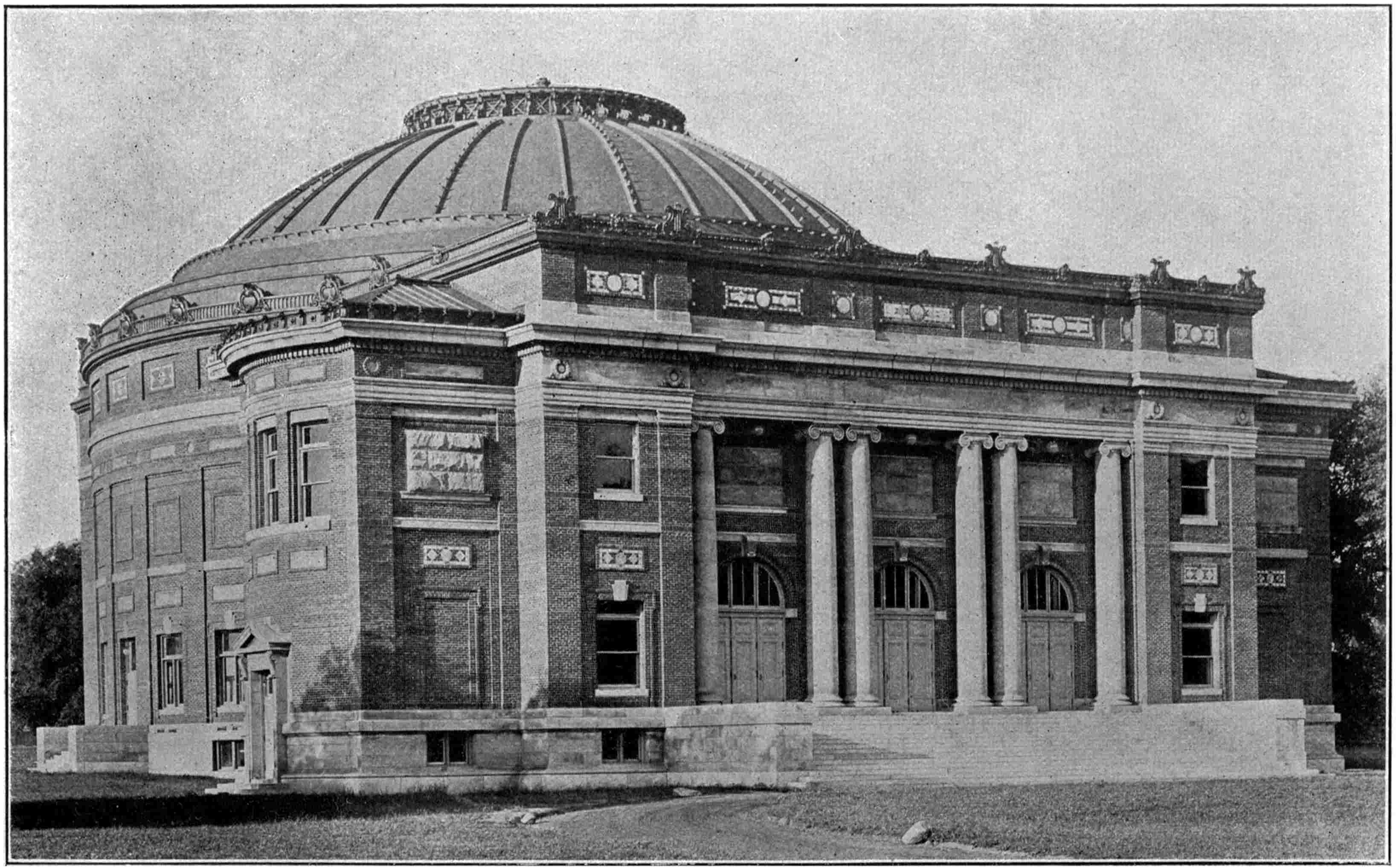
Fig. 1. Auditorium, University of Illinois.
ACOUSTICS OF AUDITORIUMS An Investigation of the Acoustical Properties of the Auditorium at the University of Illinois. — I. Introduction.
Much concern has arisen in late years in the minds of architects
because of the faulty acoustics that exist in many auditoriums. The
prevalence of echoes and reverberations with the consequent difficulty
in hearing and understanding on the part of the auditor defeats the
purpose of the auditorium and diminishes its value.
The Auditorium at the University of Illinois presents such a case.
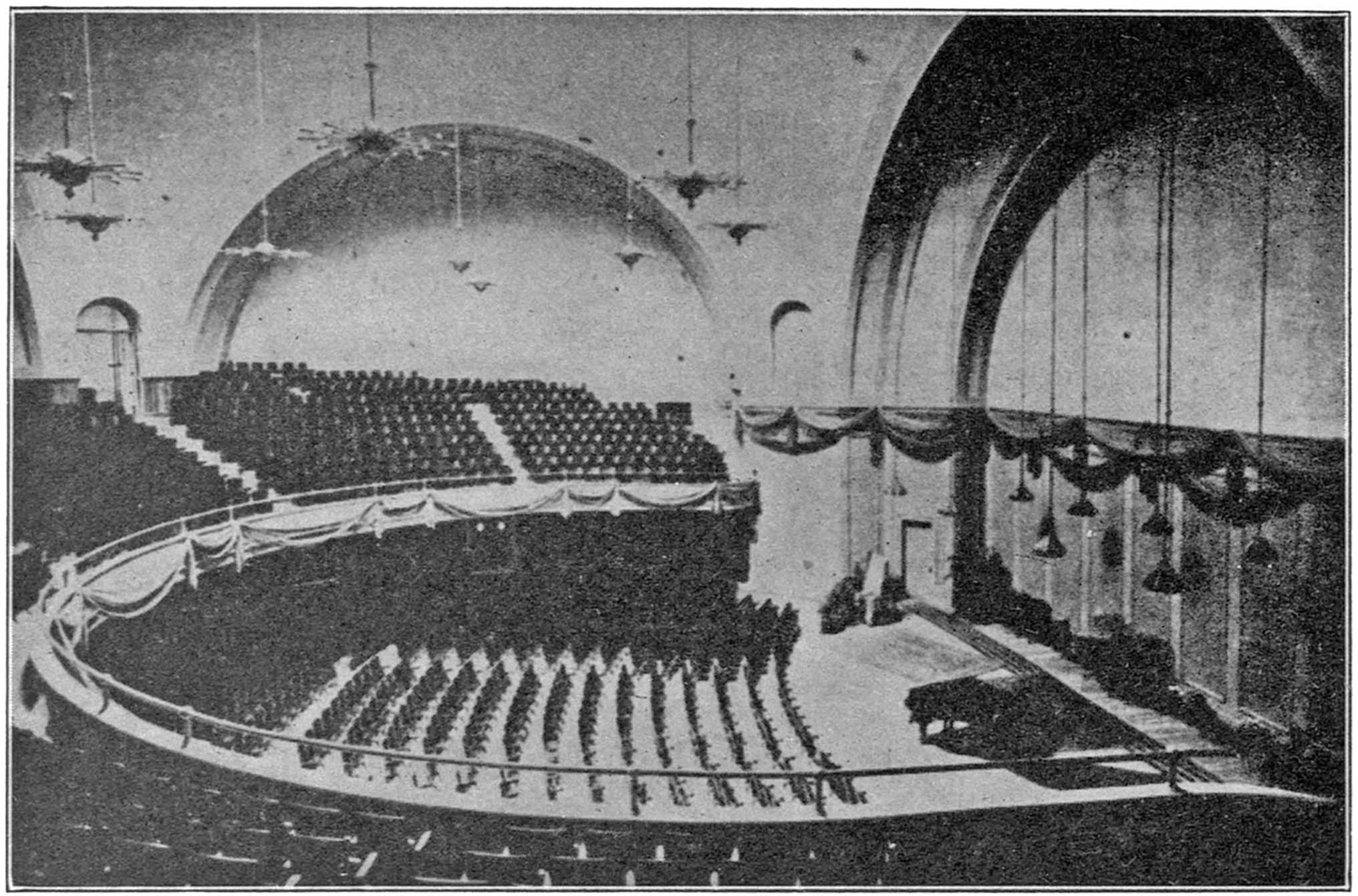
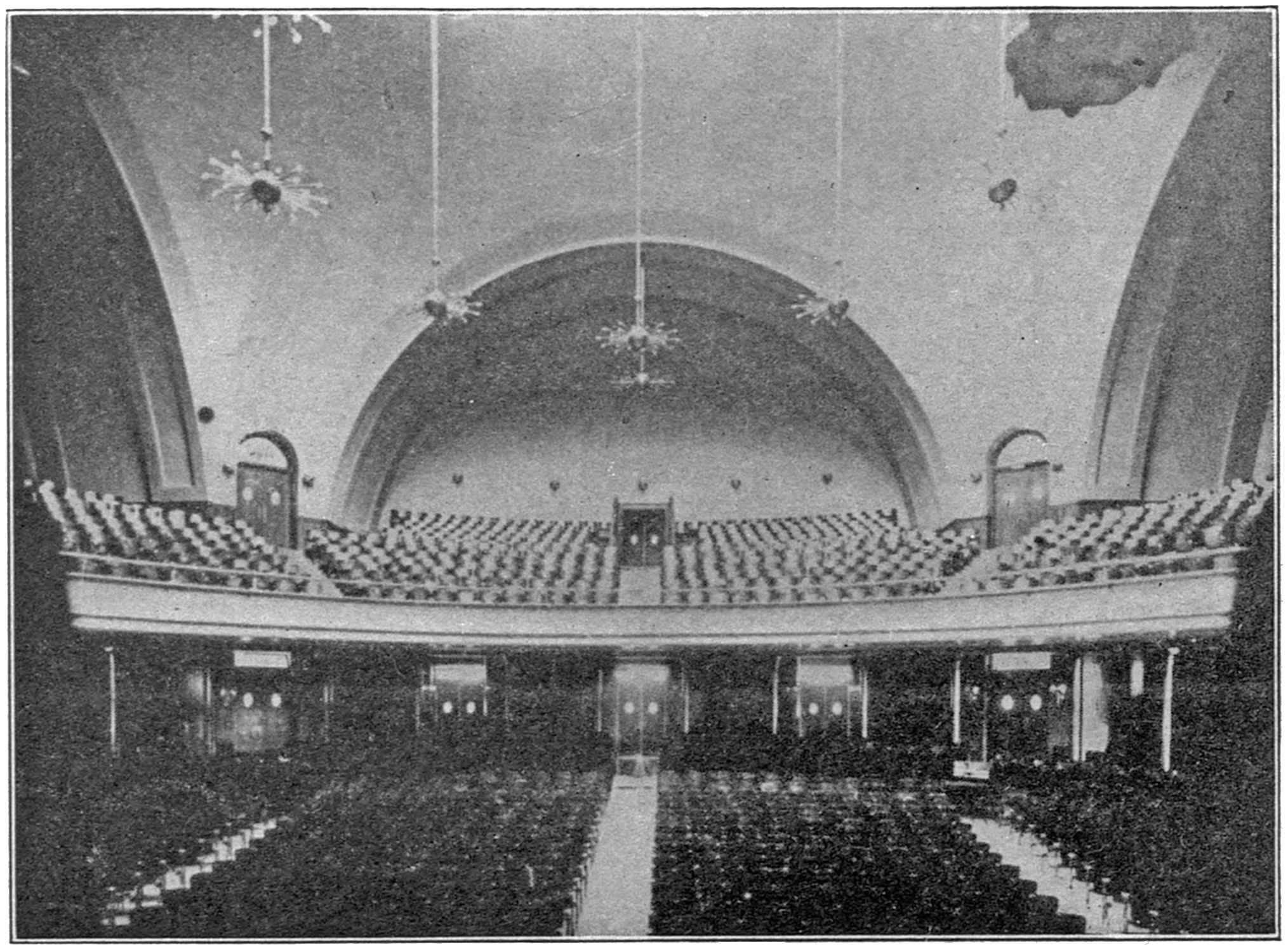
The building is shaped nearly like a hemisphere, with several large
arches and recesses to break up the regularity of its inner surface. The
original plans of the architect were curtailed because of insufficient
money appropriated for the construction. The interior of the hall, therefore,
was built absolutely plain with almost no breaking up of the large,
smooth wall surfaces; and, at first, there were no furnishings except the
seats and the cocoa matting in the aisles. The acoustical properties
proved to be very unsatisfactory. A reverberation or undue prolongation
of the sound existed, and in addition, because of the large size of
the room and the form and position of the walls, echoes were set up.
If an observer stood on the platform and clapped his hands, a
veritable chaos of sound resulted. Echoes were heard from every direction
and reverberations continued for a number of seconds before all
was still again. Speakers found their utterances thrown back at them,
and auditors all over the house experienced difficulty in understanding
what was said. On one occasion the University band played a piece
which featured a xylophone solo with accompaniment by the other instruments.
It so happened that the leader heard the echo more strongly
than the direct sound and beat time with it. Players near the xylophone
kept time to the direct sound, while those farther away followed the
echo. The confusion may well be imagined.
Thus it seemed that the Auditorium was doomed to be an acoustical
horror; that speakers and singers would avoid it, and that auditors would
attend entertainments in it only under protest. But the apparent misfortune
was in one way a benefit since it provided an opportunity to
study defective acoustics under exceptionally good conditions and led
to conclusions that not only allowed the Auditorium to be improved but
also indicate some of the pitfalls to be avoided in future construction of
other halls.
Fig. 2. Photograph of Interior. View of Stage.Fig. 3. Photograph of Interior. View toward Balcony.
An investigation of the acoustical properties of the Auditorium was
begun in 1908 and has continued for six years. It was decided at the
outset not to use “cut and try” methods of cure, but to attack the problem
systematically so that general principles could be found, if possible,
that would apply not only to the case being investigated but to auditoriums
in general. This plan of procedure delayed the solution of the
problem, since it became necessary to study the theory of sound and
carry out laboratory investigations at the same time that the complex
conditions in the Auditorium were being considered. The author spent
one year of the six abroad studying the theory of acoustics and inspecting
various auditoriums.
The main echoes in the Auditorium were located by means of a new
method for tracing the path of sound, the time of reverberation was
determined by Sabine’s method, and a general diagnosis of the acoustical
defects was made. Hangings and curtains were installed in accordance
with the results of the study so that finally the acoustical properties were
improved.
Acknowledgment.—The author desires to express his great appreciation
of the advice and encouragement given by President E. J.
James, Supervising Architect J. M. White, and Professor A. P. Carman
of the Physics Department. He desires also to acknowledge the material
assistance cheerfully rendered by the workmen at the University, which
contributed in no small degree to the successful solution of the problem.
II. Behavior of Sound Waves in a Room.
When a speaker addresses an audience, the sounds he utters
proceed in ever widening spherical waves until they strike the
boundaries of the room. Here the sound is partly reflected, partly transmitted,
and the rest absorbed. The amounts of reflection, absorption
and transmission depend on the character of the walls. A hard, smooth
wall reflects most of the sound so that but little is transmitted or
absorbed. In the case of a porous wall or a yielding wall, the absorption
and transmission are greater, and the reflection is less. After
striking a number of reflecting surfaces, the energy is used up and the
sound dies out.
The reflection of sound produces certain advantages and disadvantages
for the acoustics. When it is considered that sound travels about
1100 feet a second it may be seen that a room of ordinary size is almost
immediately filled with sound because of the many reflections. In a
room 40 feet square, for instance, the number of reflections per second
between opposite walls is 1100 ÷ 40, or approximately 27. The number
is really greater than this, since the sound that goes into the
corners is reflected much more frequently than out in the middle
where the distances between walls are greater. The result is that the
sound mixes thoroughly in all parts of the room so as to give the same
average intensity; that is, the sound is of the same average loudness
for all auditors, even for those in the remotest corners.
Though the reflection of sound has the advantage of fulfilling the
conditions for loudness, it introduces at the same time possibilities for
setting up defective acoustics. For instance, when the walls of the room
are hard and smooth very little energy is lost at each impact of the
sound and many reflections take place before it finally dies out. This
slow decadence of the sound, or reverberation as it is called, is the most
common defect in auditoriums.
If a speaker talks in such a hall the auditors have difficulty in
understanding. Each sound, instead of dying out quickly, persists for
some time so that the succeeding words blend with their predecessors
and set up a mixture of sounds which produces confusion. The cure for
the trouble is brought about by the introduction of materials such as
carpets, tapestries, and the like, which act as absorbers of sound and
reduce the time of reverberation.
When music is played in an auditorium with a prolonged reverberation,
the tones following one another blend and produce the same effect
as that of a piano when played with the loud pedal in use. A reverberation
is more advantageous for music than for speech, since the prolongation
and blending of the musical tones is desired, but the mixing
of the words in a speech is a distinct disadvantage. When curing this
defect for halls used for both music and speaking, a middle course must
be steered, so that the reverberation is made somewhat long for speaking
and somewhat short for music, yet fairly satisfactory for both.
Going back to the consideration of the reflection of sound, it is found
that another defect may be produced, namely, an echo. This is the case
when a wall at some distance reflects the sound to the position of the
auditor. He hears the sound first from the speaker, then later by reflection
from the wall. The time interval between the direct and reflected
sound must be great enough to allow two distinct impressions to be
made. This time is about 1/15 of a second, but varies with the acuteness
of the observer. The farther off the wall is, the greater is the time
interval and the more pronounced is the echo. If the wall is not very
distant, the time interval is too short to allow two distinct impressions
to be made, and the effect on the auditor is then much the same as if
his neighbor at his side speaks the words of the discourse in his ear at
the same time that he gets them directly from the speaker. In case the
reflecting wall is curved so as to focus the sound the echoes are much
more pronounced. A curved wall wherever it may be placed in an auditorium
is thus always a menace to good acoustics.
There are other actions of the sound that may result in acoustical
defects. The phenomena of resonance, for instance, may cause trouble.
Suppose that the waves of sound impinge on an elastic wall, not too
rigid. If these waves are timed right they set the wall in vibration in
the same way that the bell ringer causes a bell to ring by a succession
of properly timed pulls on the bell rope. The wall of the room will then
vibrate under the action of this sound with which it is in tune and will
reinforce it. Now suppose a band is playing in a room. Certain tones
are reinforced, while the others are not affected. The original sound is
then distorted. The action is the same on the voice of the speaker. The
sounds he utters are complex and as they reach the walls certain components
are reinforced and the quality of the sound is changed. This
action of resonance may also be caused by the air in a room. Each
room has a definite pitch to which it responds, the smaller the volume
of the room the higher being the pitch. A large auditorium would
respond to the very low pitch of the bass drum. In small rooms and
alcoves the response is made to higher pitched tones, as may be observed
by singing the different notes of the scale until a resonance is obtained.
Another action of sound causes the interference of waves. Thus
the reflected waves may meet the oncoming ones and set up concentrations
of sound in certain positions and a dearth of sound in others.
Summing up, it is seen that the effects of sound which may exist
in a room are loudness, reverberation, echoes, resonance, and interference,
and that the most common defects are reverberation and echoes. We
now turn to the discussion of the methods of cure.
III. Methods of Improving Faulty Acoustics. — A. REVERBERATION AND ITS CURE. — B. ECHOES AND THEIR REMEDY. — C. POPULAR CONCEPTION OF CURES.—USE OF WIRES AND SOUNDING BOARDS. — D. THE EFFECT OF THE VENTILATION SYSTEM ON THE ACOUSTICS.
Everyone has doubtless observed that the hollow reverberations in
an empty house disappear when the house is furnished. So, in an
auditorium, the reverberation is lessened when curtains, tapestries, and
the like are installed in sufficient numbers. The reason for this action
is found when we inquire what ultimately becomes of the sound.
Sound is a form of energy and energy can not be destroyed. When
it finally dies out, the sound must be changed to some other form of
energy. In the case of the walls of a room, for instance, it has been
shown in a preceding paragraph that the sound may be changed into
mechanical energy in setting these walls in vibration. Again, some of
the sound may pass out through open windows and thus disappear. The
rest of the sound, according to Lord Rayleigh, is transformed by friction
into heat. Thus1 a high pitched sound, such as a hiss, before it travels
any great distance is killed out by the friction of the air. Lower pitched
sounds, on reaching a wall, set up a friction in the process of reflection
between the air particles and the wall so that some of the energy is converted
into heat.2 The amount of sound energy thus lost is small if the
walls are hard and smooth. The case is much different, however, if the
walls are rough and porous, since it appears that the friction in the
pores dissipates the sound energy into heat. In this connection, Lamb3
writes: “In a sufficiently narrow tube the waves are rapidly stifled, the
mechanical energy lost being of course converted into heat. * * * *
When a sound wave impinges on a slab which is permeated by a large
number of very minute channels, part of the energy is lost, so far as
the sound is concerned, by dissipation within these channels in the way
just explained. The interstices in hangings and carpets act in a similar
manner, and it is to this cause that the effect of such appliances in
deadening echoes in a room is to be ascribed, a certain proportion of the
energy being lost at each reflection. It is to be observed that it is only
through the action of true dissipative forces, such as viscosity and thermal
conduction, that sound can die out in an enclosed space, no mere modifications
of the waves by irregularities being of any avail.”
It should be pointed out in this connection that any mechanical
breaking up of the sound by relief work on the walls or by obstacles in
the room will not primarily diminish the energy of the sound. These
may break up the regular reflection and eliminate echoes, but the sound
energy as such disappears only when friction is set up.
The following quotation from Rayleigh4 emphasizes these conclusions:
“In large spaces, bounded by non-porous walls, roof, and floor,
and with few windows, a prolonged resonance seems inevitable. The
mitigating influence of thick carpets in such cases is well known. The
application of similar material to the walls and roof appears to offer the
best chance of further improvement.”
Experimental Work on Cure of Reverberation.—The most important
experimental work in applying this principle of the absorbing power
of carpets, curtains, etc., has been done by Professor Wallace C. Sabine
of Harvard University.5 In a set of interesting experiments lasting
over a period of four years, he was able to deduce a general relation
between t, the time of reverberation, V, the volume of the room, and a,
the absorbing power of the different materials present. Thus:
t = 0.164 V ÷ a(1)
For good acoustical conditions, that is, for a short time of reverberation,
the volume V should be small and the absorbing materials, represented
by a, large. This is the case in a small room with plenty of
curtains and rugs and furniture. If, however, the volume of the room
is great, as in the case of an auditorium, and the amount of absorbing
materials small, a troublesome reverberation will result.
Professor Sabine determined the absorbing powers of a number of
different materials. Calling an open window a perfect absorber of sound,
the results obtained may be written approximately as follows:
One square meter of open window space
1.000
One square meter of glass, plaster, or brick
.025
One square meter of heavy rugs, curtains, etc.
.25
One square meter of hair felt, 1 inch thick
.75
One square meter of audience
.96
These values, together with the formula, allow a calculation to be
made in advance of construction for the time of reverberation. This
pioneer work cleared the subject of architectural acoustics from the fog
of mystery that hung over it and allowed the essential principles to be
seen in the light of scientific experiment.
In a later investigation6 Sabine showed that the reverberation depended
also on the pitch of sound. As a concrete example, the high
notes of a violin might be less reverberant with a large audience than
the lower tones of the bass viol, although both might have the same
reverberation in the room with no audience. Again, the voice of a man
with notes of low pitch might give satisfactory results in an auditorium
while the voice of a woman with higher pitched notes would be unsatisfactory.
These considerations show that the acoustics in an auditorium vary
with other factors than the volume of the room and the amount of
absorbing material present. The audience may be large or small, the
speaker’s voice high or low, the entertainment a musical number or an
address. The best arrangement for good acoustics is then a compromise
where the average conditions are satisfied. The solution offered by
Professor Sabine is such an average one, and has proved satisfactory in
practice.
The problem of architectural acoustics has been attacked experimentally
by other workers. Stewart7 proposed a cure for the poor
acoustical conditions in the Sibley Auditorium at Cornell University.
His experiments confirmed the work of Sabine. Marage8, after investigating
the properties of six halls in Paris, approved Sabine’s results and
advocated a time of reverberation of from ½ to 1 second for the case of
speech.
Formulae for Reverberation of Sound in a Room.—On the theoretical
side, Sabine’s formula has been developed by Franklin,9 who
obtained the relation t = 0.1625 V ÷ a, an interesting confirmation,
since Sabine’s experimental value for the constant was 0.164.
A later development has been given by Jäger,10 who assumes for a
room whose dimensions are not greater than about 60 feet, that the
sound, after filling the room, passes equally in all directions through
any point, and that the average energy is the same in different parts of
the room. By using the theory of probability and considering that a
beam of sound in any direction may be likened to a particle with a
definite velocity, he was able to deduce Sabine’s formula and write down
the factors that enter into the constants. Applying his results to the
case of reflection of sound from a wall, he showed that sound would be
reflected in greater volume when the mass of the wall was increased and
the pitch of the sound made higher. He showed also that when sound
impinges on a porous wall, more energy is absorbed when the pitch of
the sound is high than when it is low, since the vibrations of the air
are more frequent, and more friction is introduced in the interstices
of the material.
An echo is set up by a reflecting wall. If an observer stands some
distance from the front of a cliff and claps his hands, or shouts, he
finds that the sound is returned to him from the cliff as an echo.
So, in an auditorium, an auditor near the speaker gets the sound first
directly from the speaker, then, an instant later, a strong repetition of
the sound by reflection from a distant wall. This echo is more pronounced
if the wall is curved and the auditor is at the point where the
sound is focused.
To cure such an echo, two methods may be considered. One method
consists in changing the form of the wall so that the reflected sound no
longer sets up the echo. That is, either change the angle of the wall,
so that the reflected sound is sent in a new direction where it may be
absorbed or where it may reinforce the direct sound without producing
any echoes, or else modify the surface of the wall by relief work or by
panels of absorbing material, so that the strong reflected wave is broken
up and the sound is scattered. The second method is to make the
reflecting wall a “perfect” absorber, so that the incident sound is swallowed
up and little or none reflected. These methods have been designated
as “surgical” and “medicinal” respectively. Each method has its
disadvantages. Changing the form of the walls in an auditorium is
likely to do violence to the architectural design. On the other hand, there
are no perfect absorbers, except open windows, and these can seldom be
applied. The cure in each case is, then, a matter of study of the special
conditions of the auditorium. Usually a combination of the surgical and
the medicinal cures is adopted. For instance, coffering a wall so that
panels of absorbing material may be introduced has been found to work
well in bettering the acoustics, and also, in many cases, it fits in with
the architectural features.
A few words should be written concerning the popular notion that
wires and sounding boards are effective in curing faulty acoustics.
Experiments and observations show that wires are of practically no
benefit, and sounding boards can be used only in special cases. Wires
stretched in a room scarcely affect the sound, since they present too small
a surface to disturb the waves. They have much the same effect on
sound waves that a fish line in the water has on water waves. The idea
has, perhaps, grown into prominence because of the action of a piano
in responding to the notes of a singer. The piano has every advantage
over a wire in an auditorium. It has a large number of strings tuned
to different pitches so that it responds to any note sung. It also has a
sounding board that reinforces strongly the sound of the strings. Finally,
the singer is usually near the piano. The wire in the auditorium responds
to only one tone of the many likely to be present, it has no sounding
board, and the singer is some distance away. But little effect, therefore,
is to be expected.
The author has visited a number of halls where wires have been
installed, and has yet to find a case where pronounced improvement has
resulted.11 Sabine12 cites a case where five miles of wire were stretched
in a hall without helping the acoustical conditions. It is curious that
so erroneous a conception has grown up in the public mind with so little
experimental basis to support it.
Sounding Boards.—Sounding boards or, more properly, reflecting
boards, have value in special cases. Some experiments are described
later where pronounced effects were obtained. The sounding board
should be of special design to fit the conditions under which it is to
be used.
Modeling New Auditoriums after Old Ones with Good Acoustics.—Another
suggestion often made is for architects to model auditoriums
after those already built that have good acoustical properties. It does
not follow that halls so modeled will be successful, since the materials
used in construction are not the same year after year. For instance,
a few years ago it was the usual custom to put lime plaster on wooden
lath; now it is frequently the practice to put gypsum plaster on metal
lath, which forms an entirely different kind of a surface. This latter
arrangement makes hard, non-porous walls which absorb but little
sound, and thus aggravate the reverberation. Further, a new hall
usually is changed somewhat in form from the old one, to suit the
ideas of the architect, and it is very likely that the changes will affect
the acoustics.
At first thought it might seem that the ventilation system in a room
would affect the acoustical properties. The air is the medium that
transmits the sound. It has been shown that the wind has an action in
changing the direction of propagation of sound.13 Sound is also reflected
and refracted at the boundary of gases that differ in density and temperature.14
It is found, however, that the effect of the usual ventilation
currents on the acoustics in an auditorium is small. The temperature
difference between the heated current and the air in the room is not
great enough to affect the sound appreciably, and the motion of the
current is too slow and over too short a distance to change the action
of the sound to any marked extent.15
Under special circumstances, the heating and ventilating systems
may prove disadvantageous.16 A hot stove or a current of hot air in the
center of the room will seriously disturb the action of sound. Any
irregularity in the air currents so that sheets of cold and heated air
fluctuate about the room will also modify the regular action of the sound
and produce confusion. The object to be striven for is to keep the air
in the room as homogeneous and steady as possible. Hot stoves, radiators,
and currents of heated air should be kept near the walls and out
of the center of the room. It is of some small advantage to have the
ventilation current go in the same direction that the sound is to go,
since a wind tends to carry the sound with it.
IV. The Investigation in the Auditorium at the University of Illinois. — A. PRELIMINARY WORK. — B. DETAILS OF THE ACOUSTICAL SURVEY IN THE AUDITORIUM. — C. CONCLUSION DRAWN FROM THE ACOUSTICAL SURVEY. — D. METHODS EMPLOYED TO IMPROVE THE ACOUSTICS.
As already stated, a chaos of sound was set up when an observer
in the Auditorium spoke or shouted or clapped his hands. Both echoes
and reverberations were present and could be heard in all parts of the
room, though the echoes seemed to be strongest on the stage and in the
balcony. The prospects for bettering the acoustics were not very
encouraging. Luckily, the cure for the reverberation was fairly simple,
since Sabine’s method gave a definite procedure that could be applied
to this case. The cure for the echo, however, was yet to be found. It
was first necessary to find out which walls set up the defect.
The attempt to locate echoes by generating a sound and listening
with the ear met with only partial success. The ear is sensitive enough
but becomes confused when many echoes are present, coming apparently
from every direction, so that the evidence thus obtained is not altogether
conclusive. It became apparent that the successful solution lay in fixing
the attention on the sound going in a particular direction and finding
out where it went after reflection; then tracing out the path in another
particular direction, and so on until the evidence obtained gave some
hint of the general action of the sound.
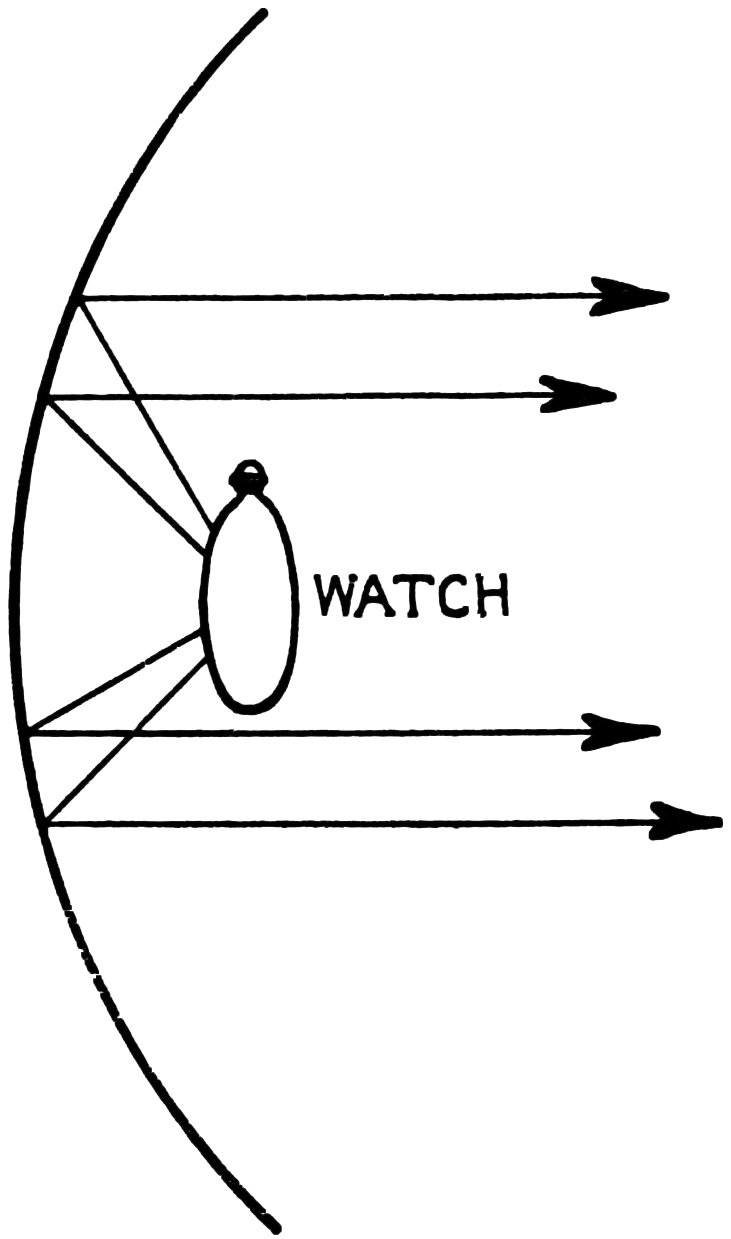
Fig. 4. Watch as Source of Sound, Backed by a Concave Reflector.
The first step in the application of this principle was to use a
faint sound which could not be heard at any great distance unless
reinforced in some way. The ticks of a watch were directed, by means
of a reflector (Fig. 4) to certain walls suspected of giving echoes. Using
the relation that the angle of incidence equals the angle of reflection,
the reflected sound was readily located, and the watch ticks heard distinctly
after they had traveled a total distance as great as 70 to 80 feet
from the source.
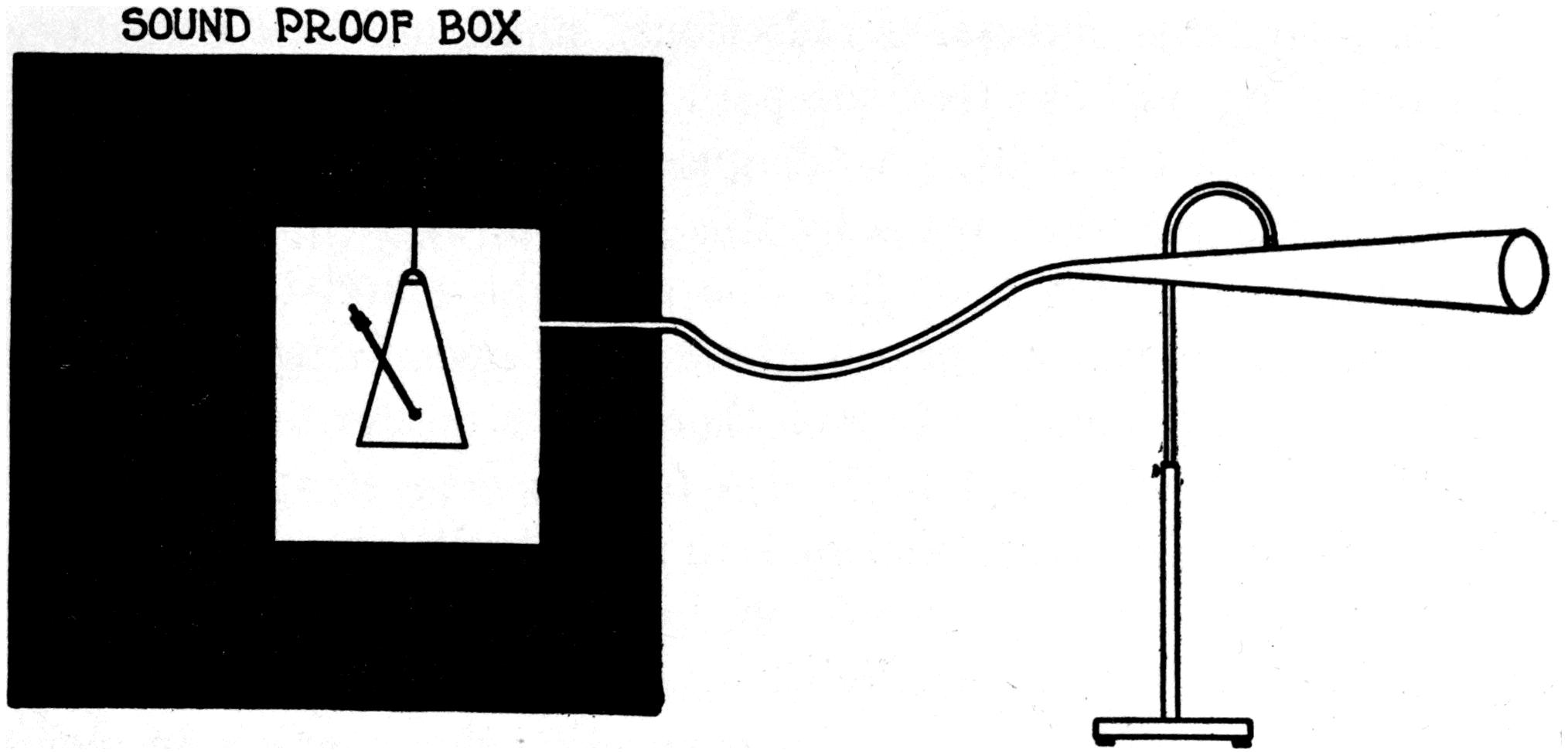
In a later experiment, a metronome was used which gave a louder
sound. It was enclosed in a sound-proof structure (Fig. 5) with only
one opening, so that the sound could be directed by means of a horn.
This method was suggested by the work of Gustav Lyon in the Hall of
the Trocadero at Paris,17 where a somewhat similar arrangement was
used. The method was successful and verified the observations taken
previously.
Fig. 5. Metronome as Source of Sound.Fig. 6. Arc-light as Source of Sound.
Though the results obtained with the watch and metronome seemed
conclusive, yet the observer was not always confident of the results.
A further method was sought, and a more satisfactory one found
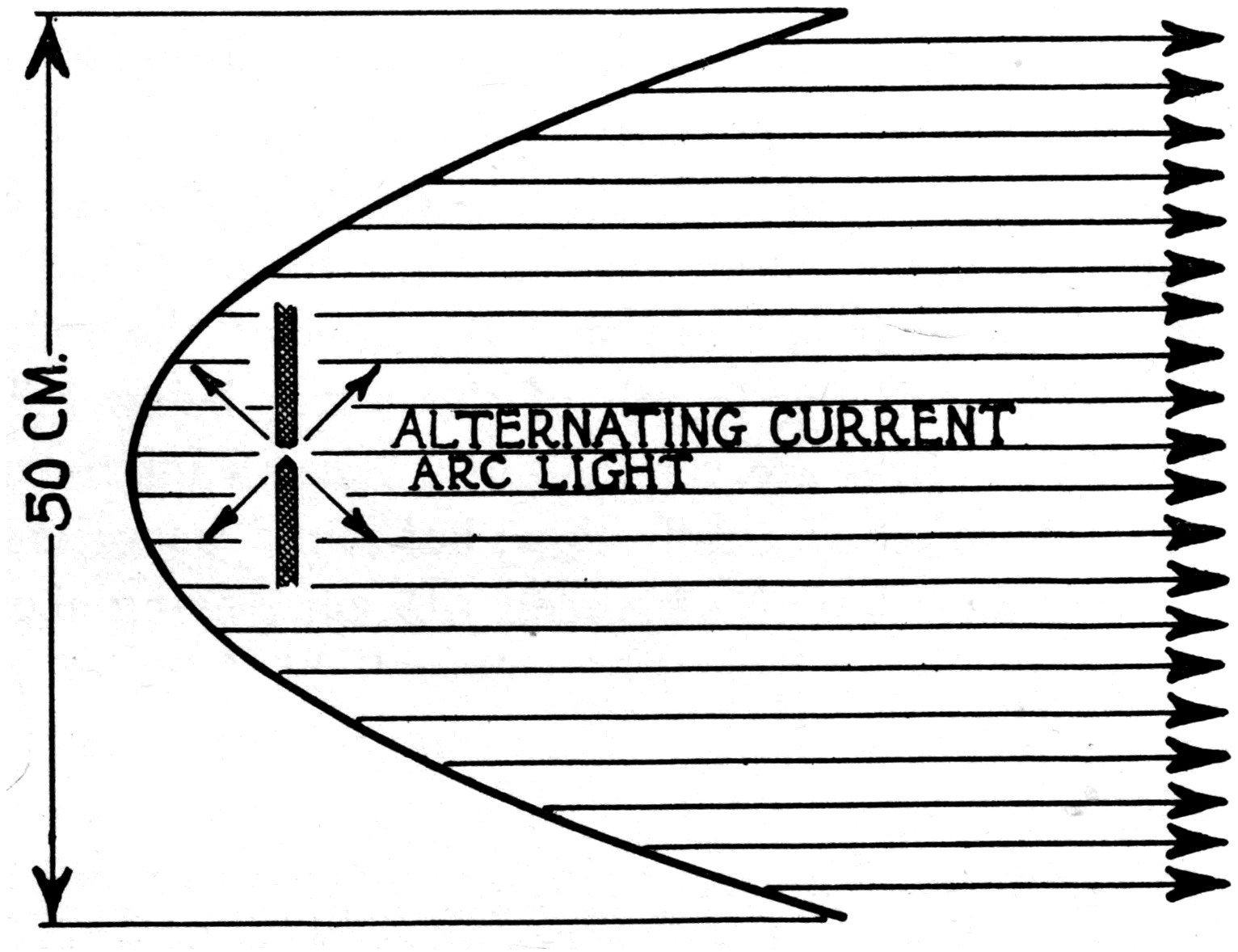
by using an alternating current arc-light at the focus of a parabolic
reflector (Fig. 6). In addition to the light, the arc gave forth a
hissing sound, which was of short wave length and therefore experienced
but little diffraction. The bundle of light rays was, therefore, accompanied
by a bundle of sound, both coming from the same source and
subject to the same law of reflection. The path of the sound was easily
found by noting the position of the spot of light on the wall. The reflected
sound was located by applying the relation that the angles of
incidence and reflection are equal. The arc-light sound was intense and
gave the observer confidence in results that was lacking in the other
methods. To trace successive reflections, small mirrors were fastened
to the reflecting walls so that the path of the reflected sound was indicated
by the reflected light. A “diagnosis” of the acoustical troubles of
the Auditorium was then made by this method.
It should be noted here that the arc-light sound is not the same
as the sounds of music or speech, these latter ones being of lower pitch
and of longer wave length. It was, therefore, a matter of doubt whether
the results obtained would hold also for the case of speech or music.
Tests made by observers stationed in the Auditorium when musical
numbers and speeches were rendered, however, verified the general conclusions
obtained with the arc-light.
It should be pointed out in this connection that there is an objection
to applying the “ray” method of geometrical optics to the case of sound.
It is much more difficult to get a ray of sound than it is to get a ray of
light.18 This is due to the difference in the wave lengths in the two
cases. It appears that the waves are diffracted, or spread out, in proportion
to their length, the longer waves being spread out to a greater
extent. The short waves of light from the sun, for instance, as they
come through a window mark out a sharp pattern on the floor, which
shows that the waves proceed in straight lines with but little diffraction
or spreading. Far different is it with the longer waves of sound. If
the window is open, we are able to hear practically all the sounds from
outdoors, even that of a wagon around the corner, although we may be
at the other end of the room away from the window. The longer sound
waves spread out and bend at right angles around corners, so that it is
almost impossible to get a sound shadow with them. Furthermore, in
the matter of reflection, it appears that the area of the reflecting wall
must be comparable with the length of the waves being reflected. In
the case of light, the waves are very minute, hence a mirror can be very
small and yet be able to set up a reflection; but sound waves are of greater
length, the average wave length of speech (45 cm.) being about 700 000
times longer than the wave length of yellow light (.00006 cm.), hence
the reflecting surface must be correspondingly larger. An illustration
will perhaps make this clearer. Suppose a post one foot square projects
through a water surface. The small ripples on the water will be reflected
easily from the post, but the large water waves pass by almost as if the
post were not there. The reflecting surface must have an area comparable
with the size of the wave if it is to cause an effective reflection.
Relief work in auditoriums, if of small dimensions, will affect only the
high pitched sounds, i. e., those of short wave length, while the low
pitched sounds of long wave length are reflected much the same as from
a rather rough wall. It is also shown that the area of the reflecting
surface is dependent on its distance from the source of sound and from
the observer; the greater these distances are the larger must be the
reflecting surface.19
These considerations all show that the reflection of sound is a
complicated matter. The dimensions of a wall to reflect sound, or of
relief work to scatter it, are determined by the wave length and by the
various other factors mentioned. It should be said with caution that a
“ray” of sound is reflected in a definite way from a small bit of relief
work. We must deal with bundles of sound, not too sharply bounded,
and have them strike surfaces of considerable area in order to produce
reflections with any completeness.
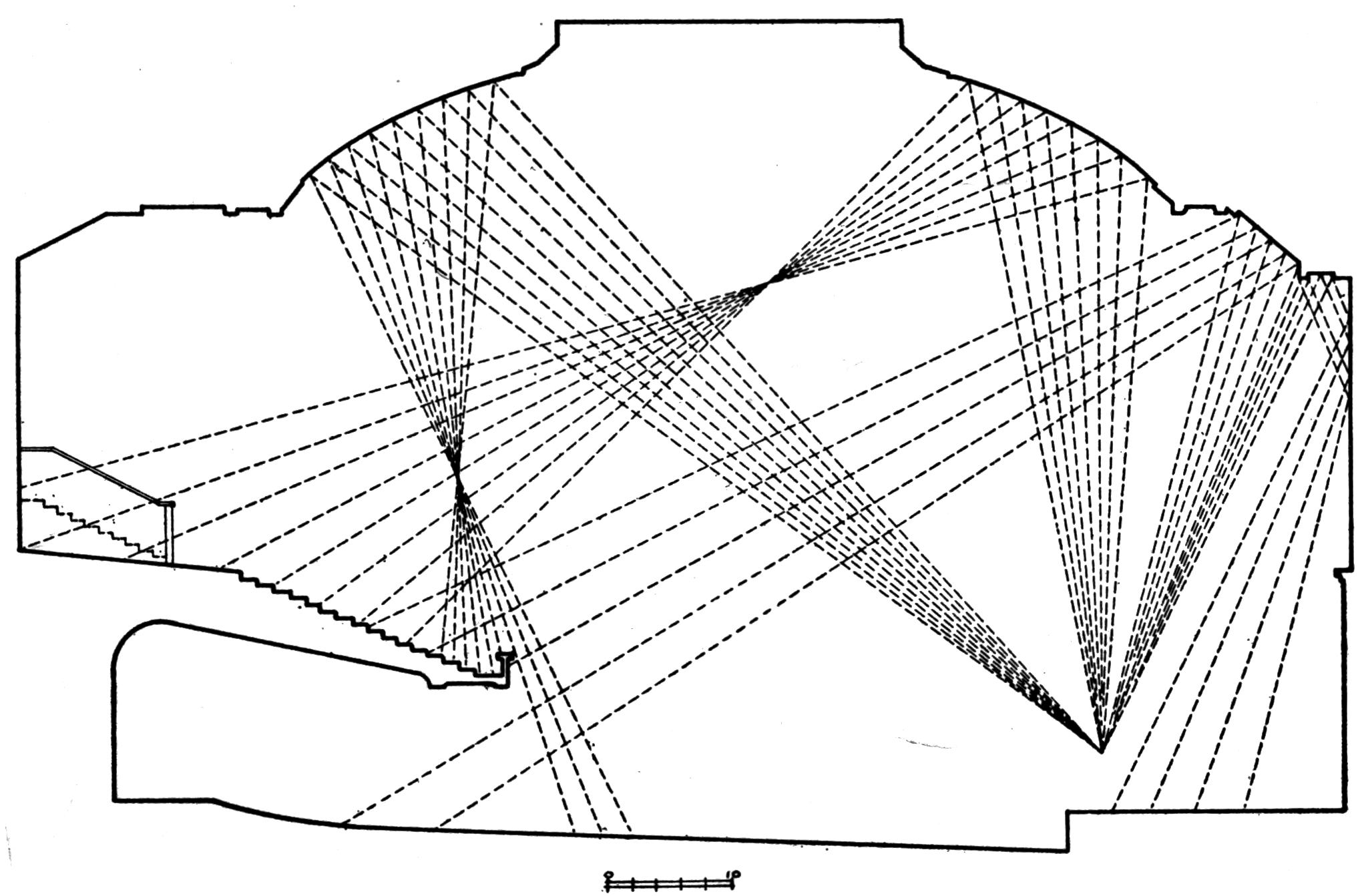
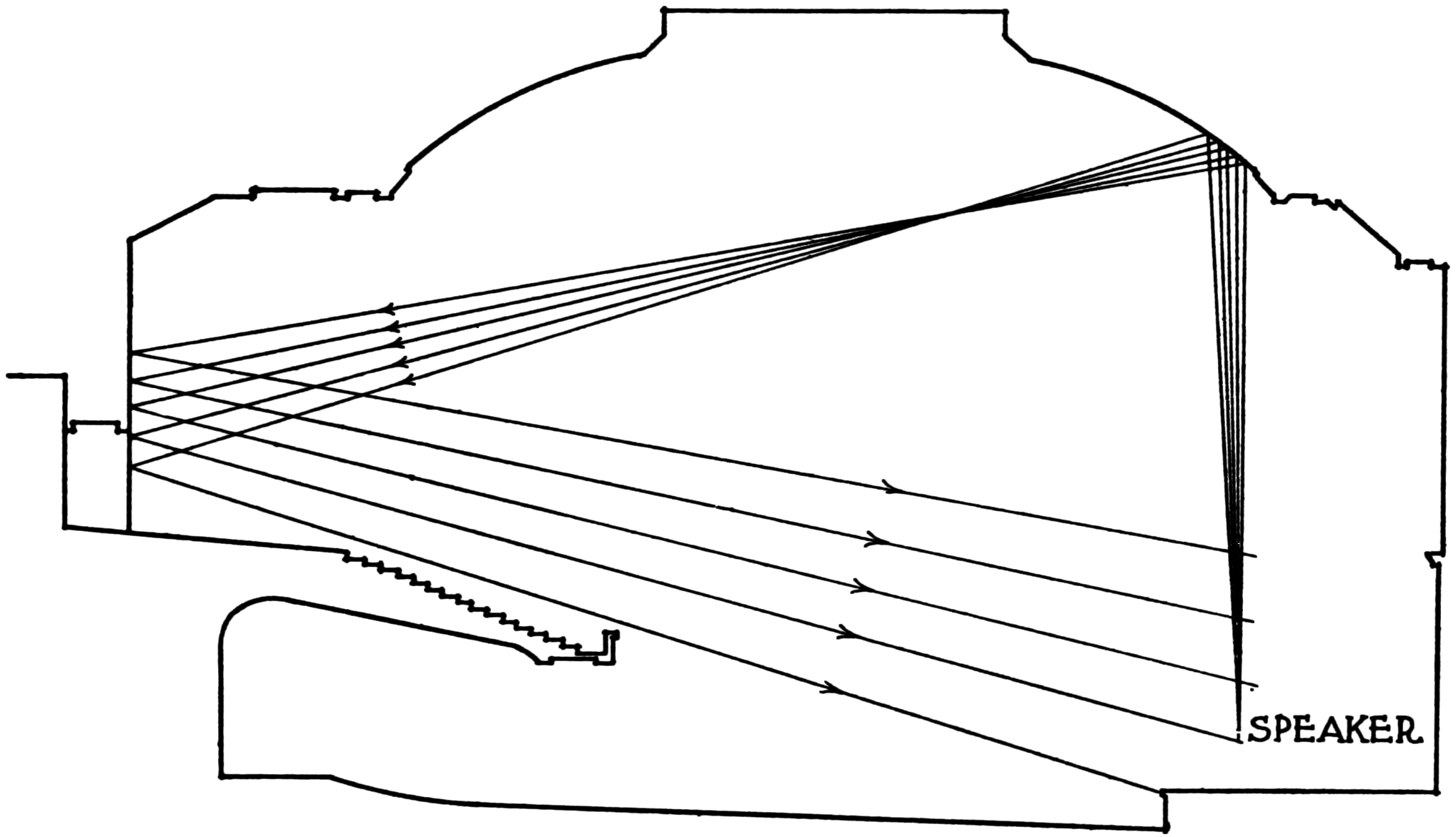
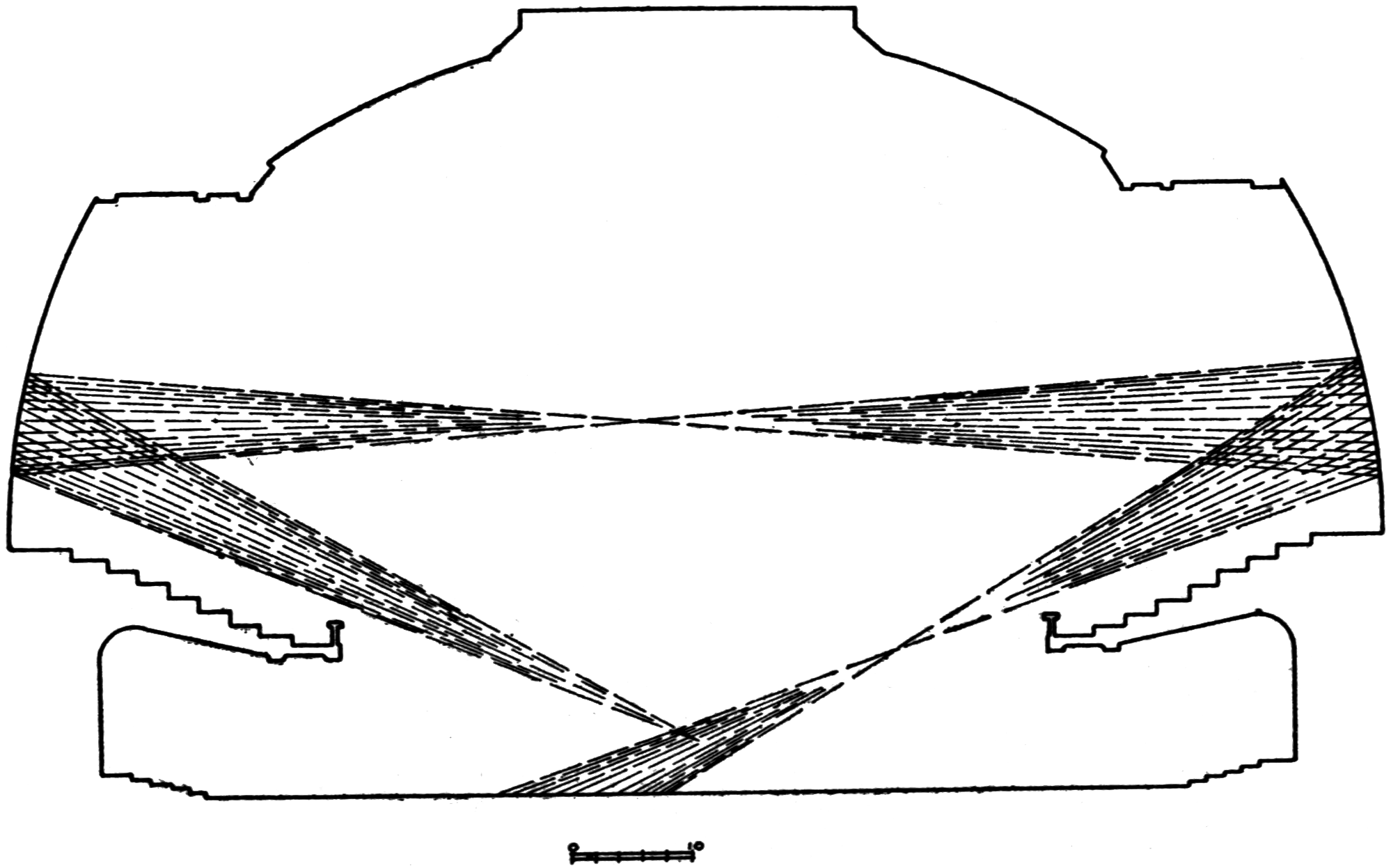
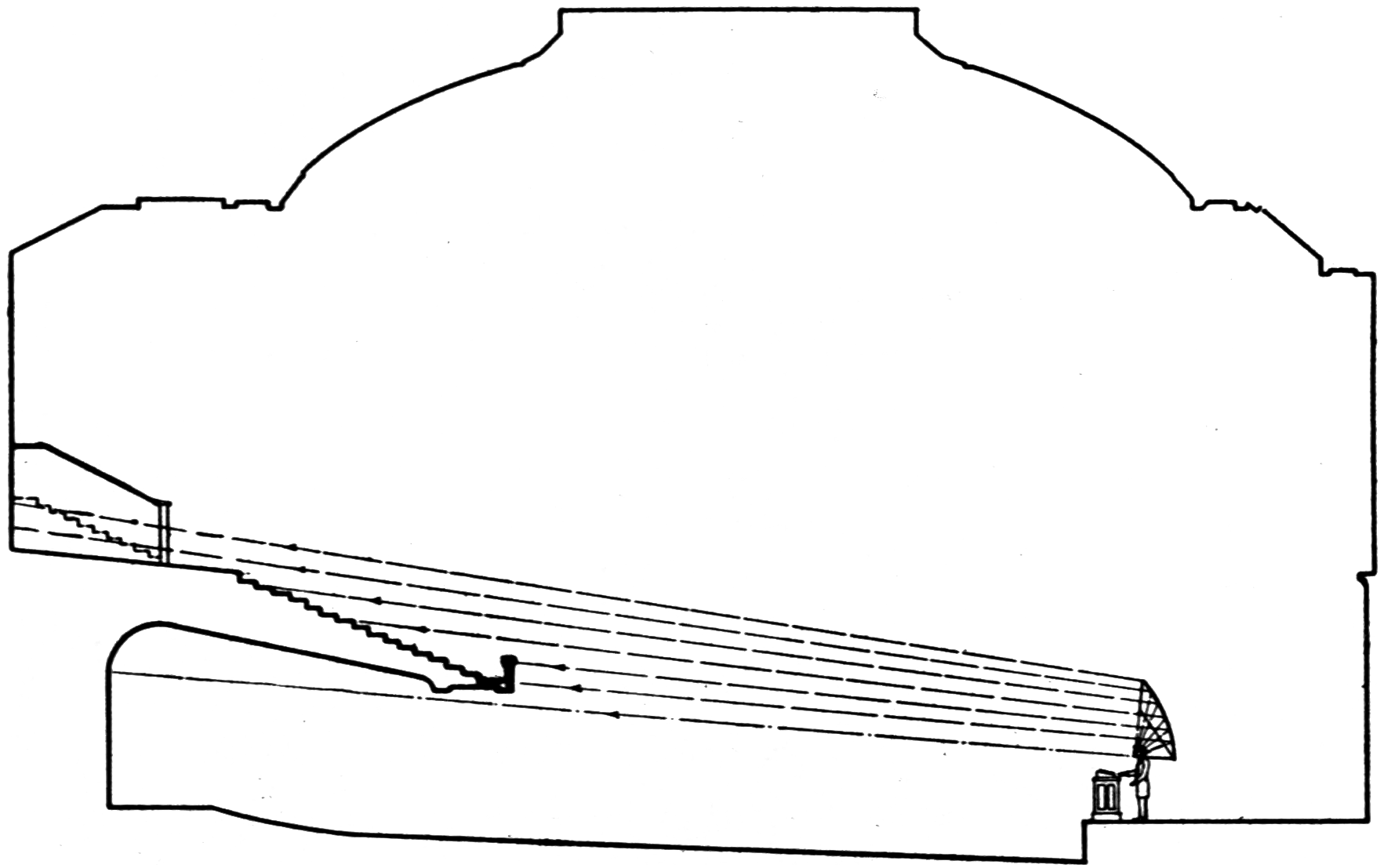
Fig. 7. Longitudinal Section Showing the Chief Concentrations of Sound,
the Diffraction Effects Being Disregarded.
The general effect of the walls of the Auditorium on the sound may
be anticipated by considering analogous cases in geometrical optics, but
with the restrictions on “rays” described in the preceding paragraph.
The sound does not actually confine itself to the sharp boundaries shown.
The diagrams are intended to indicate the main effect of the sound in
the region so bounded. Fig. 7 gives such an idea for the concentration
of sound in the longitudinal section of the Auditorium.
The plan followed in the experimental work was to anticipate the
path of the sound as indicated in Fig. 7, then to verify the results with
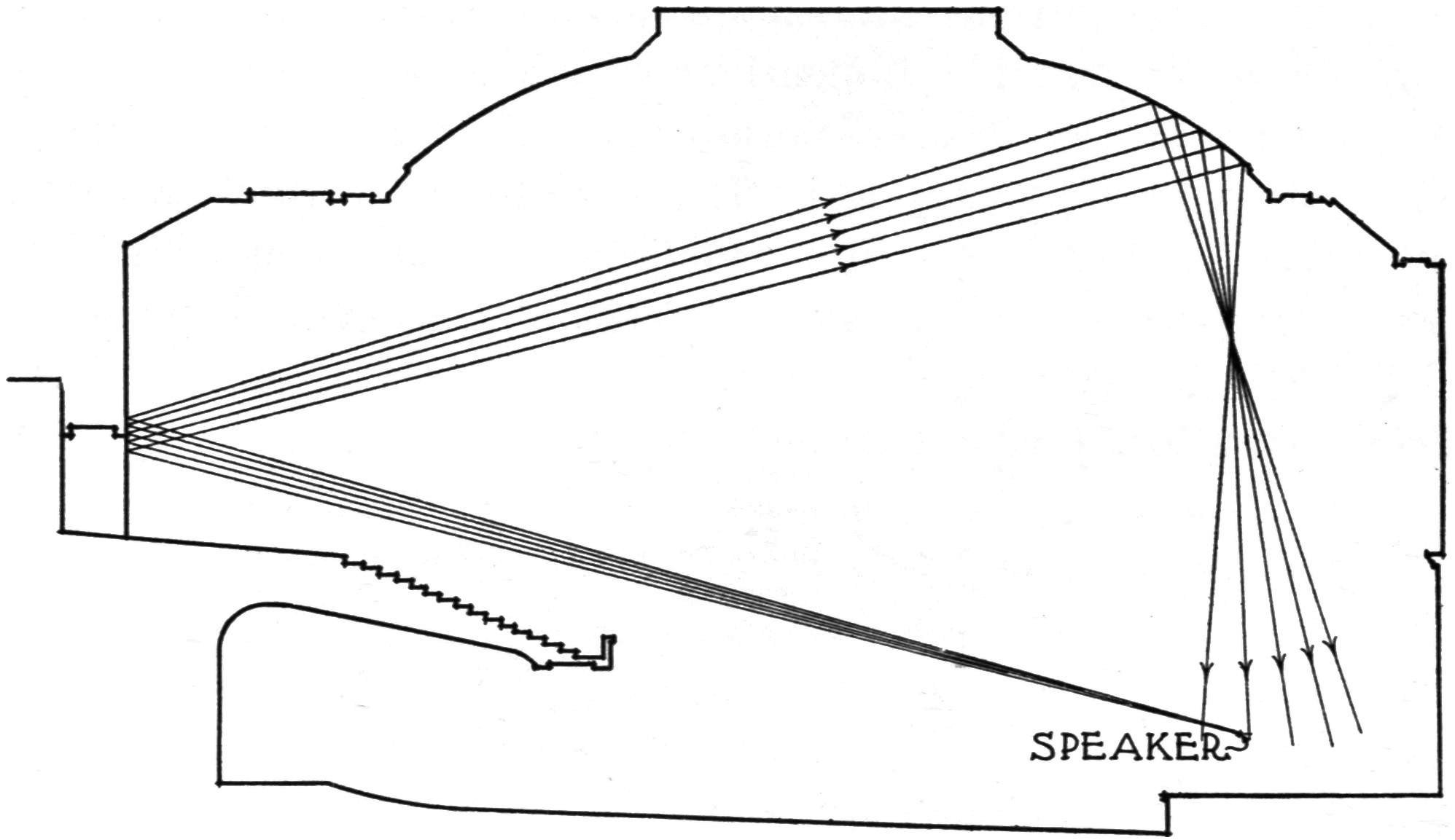
the arc-light reflector. Figs. 8 and 9 show the effect of the rear wall
in the balcony in forming echoes on the stage. The speaker was particularly
unfortunate, being afflicted with no less than ten echoes.
Fig. 8. Longitudinal Section Showing how Sound Is Returned to the
Stage to Form an Echo.Fig. 9. Longitudinal Section Showing Formation of Echo on the Stage.
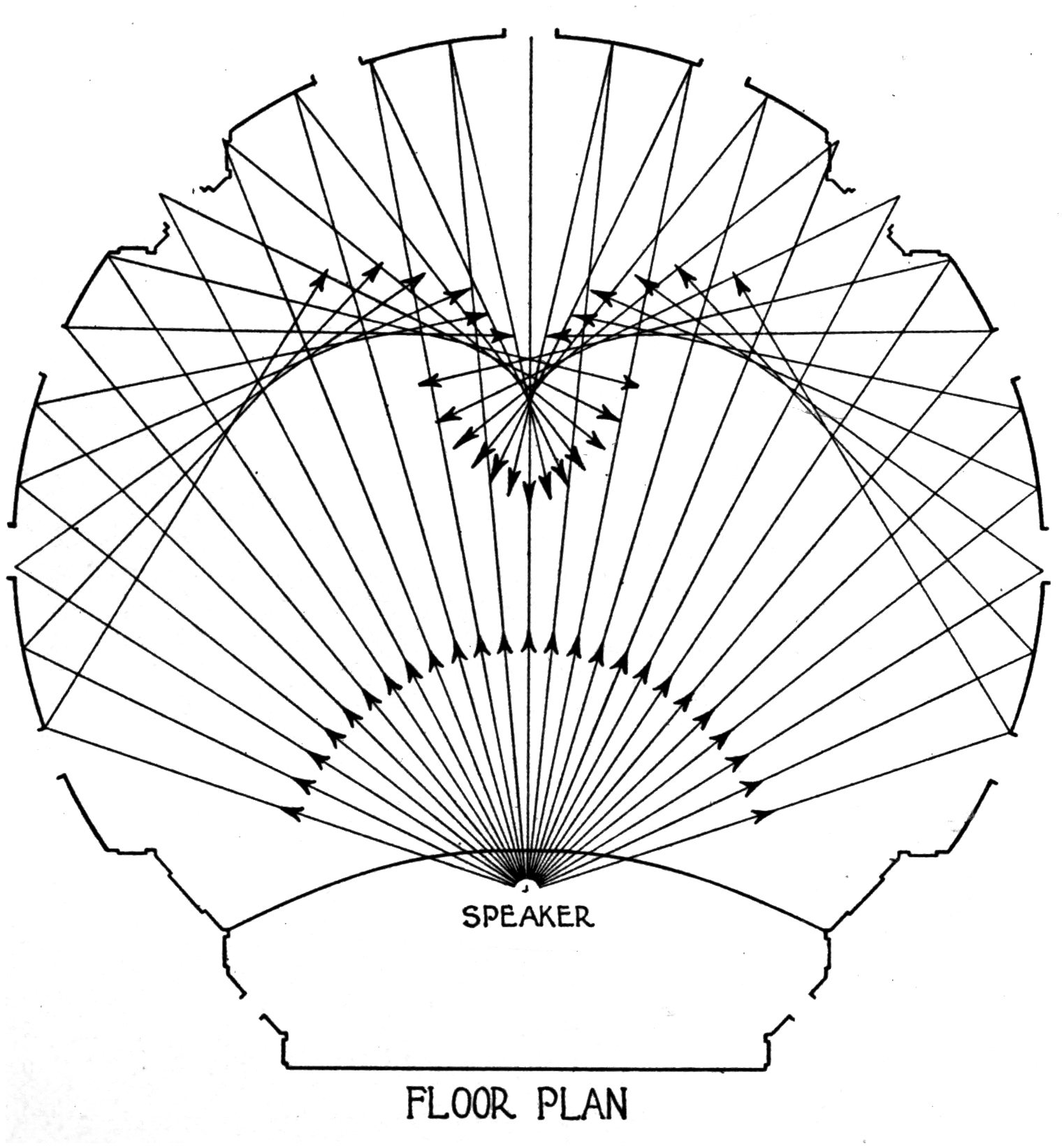
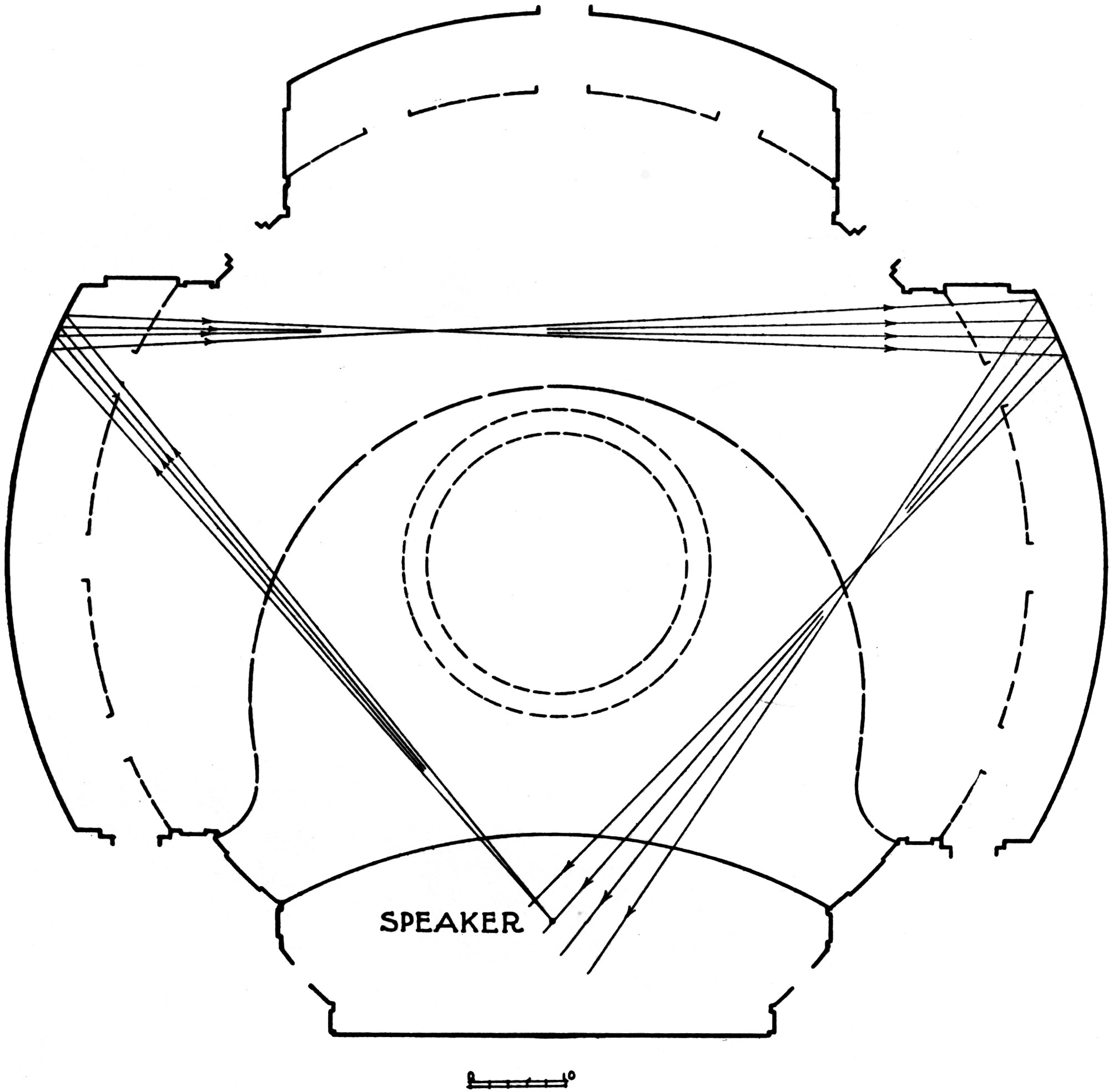
The hard, smooth, circular wall bounding the main floor under the
balcony gave echoes as shown in Fig. 10, the sound going also in the
reverse direction of the arrows.
Fig. 10. Plan of Auditorium Showing Action of Rear Wall on the Sound.Fig. 11. Plan of Auditorium Showing Concentration of Sound by the
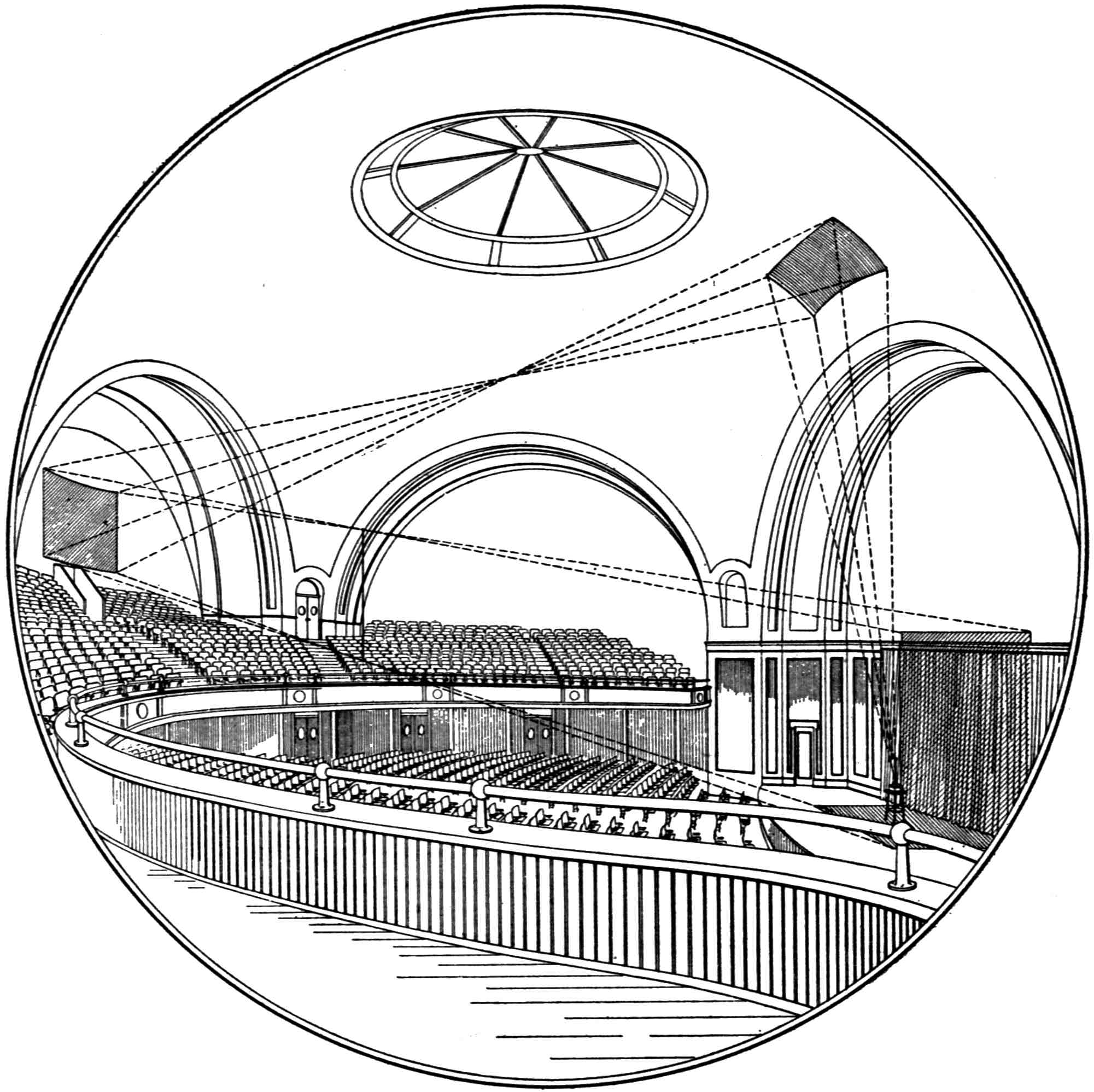
Rear Wall.Fig. 12. This Figure Taken with Fig. 9 Shows How an Echo is Set Up on
the Stage.
A more comprehensive idea of the action of this wall is shown in
Fig. 11. This reflected sound was small in amount and therefore not
a serious disadvantage.
The cases cited were fairly easy to determine since the bundles of
sound considered were confined closely to either a vertical or a horizontal
plane for which the plans of the building gave some idea of the
probable path of the sound. For other planes, the paths followed could
be anticipated by analogy from the results already found. Fig. 12 shows
in perspective the development of the result expressed in Fig. 9.
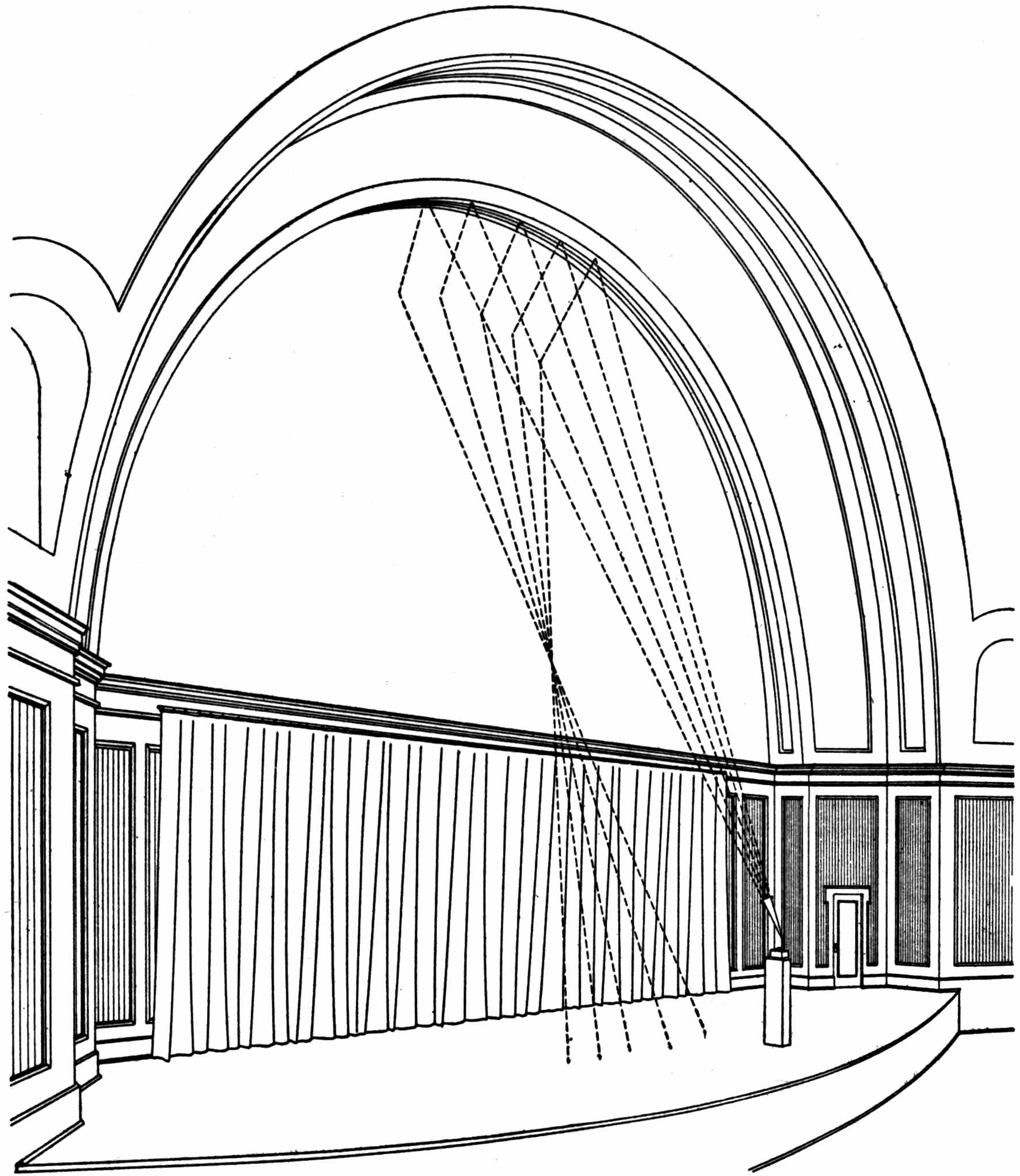
A square bundle of sound starts from the stage and strikes the
spherical surface of the dome. After reflection, it is brought to a point
focus, as shown, and spreads out until it strikes the vertical cylindrical
wall in the rear of the balcony. This wall reflects it to a line focus,
after which it proceeds to the stage. Auditors on all parts of the stage
complained of hearing echoes.
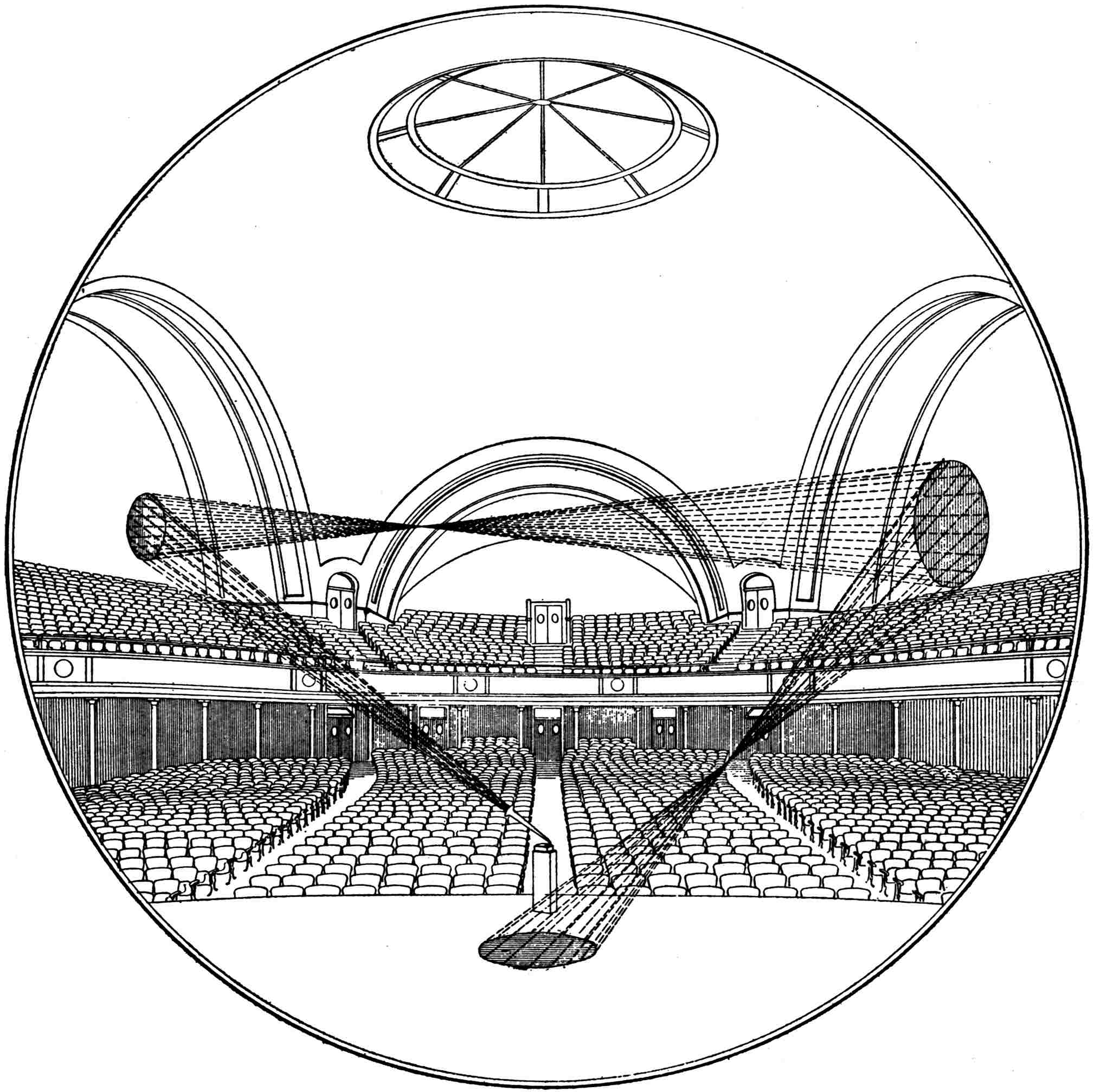
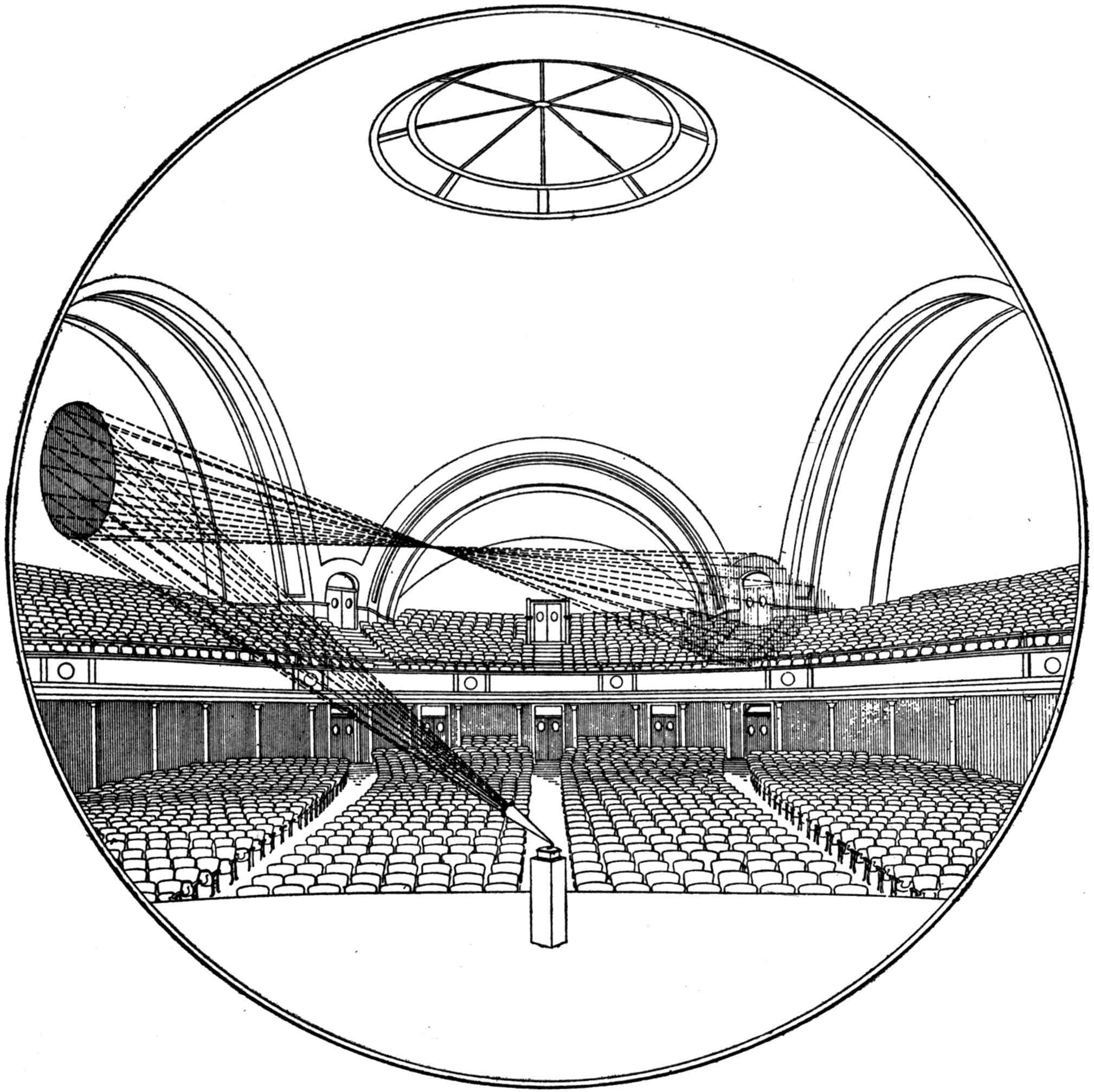
Referring to Fig. 7, it is seen that the arch over the stage reflects
sound back to the stage. Fig. 13 shows in perspective the focusing
action of this overhead arch. Fig. 14 shows the effect of the second arch.
Some of this sound is reflected to the stage and to the seats in front of
the stage; other portions, striking more nearly horizontally, are reflected
to the side balconies. The echoes are not strong except for high pitched
notes with short wave lengths, since the width of the arch is small.
Fig. 13. Perspective of Stage Showing Focusing Action of Arch on Sound.Fig. 14. Perspective of Stage Showing Focusing Action of Second Arch.Fig. 15. Transverse Section Showing how Most Pronounced Echoes Are
Set Up by the Two Concave Surfaces.
Passing now to the transverse section, Fig. 15, we find the most
pronounced echoes in the Auditorium. If an observer generates a sound
in the middle of the room directly under the center of the skylight,
distinct echoes are set up. A bundle of sound passes to the concave surface
which converges the sound to a focus, after which it spreads out
again to the other concave surface and is again converged to a focus
nearly at the starting point. The distance traveled is about 225 feet,
taking about ¼ second, so that the conditions are right for setting up
a strong echo. This echo is duplicated by the sound which goes in the
reverse of the path just described. Another echo, somewhat less strong,
is formed by the sound that goes to the dome overhead and which is
reflected almost straight back, since the observer is nearly at the center
of the sphere of which the dome is a part. These echoes repeat themselves,
for the sound does not stop on reaching the starting point but
is reflected from the floor and repeats the action just described. As
many as ten distinct echoes have been generated by a single impulse
of sound.
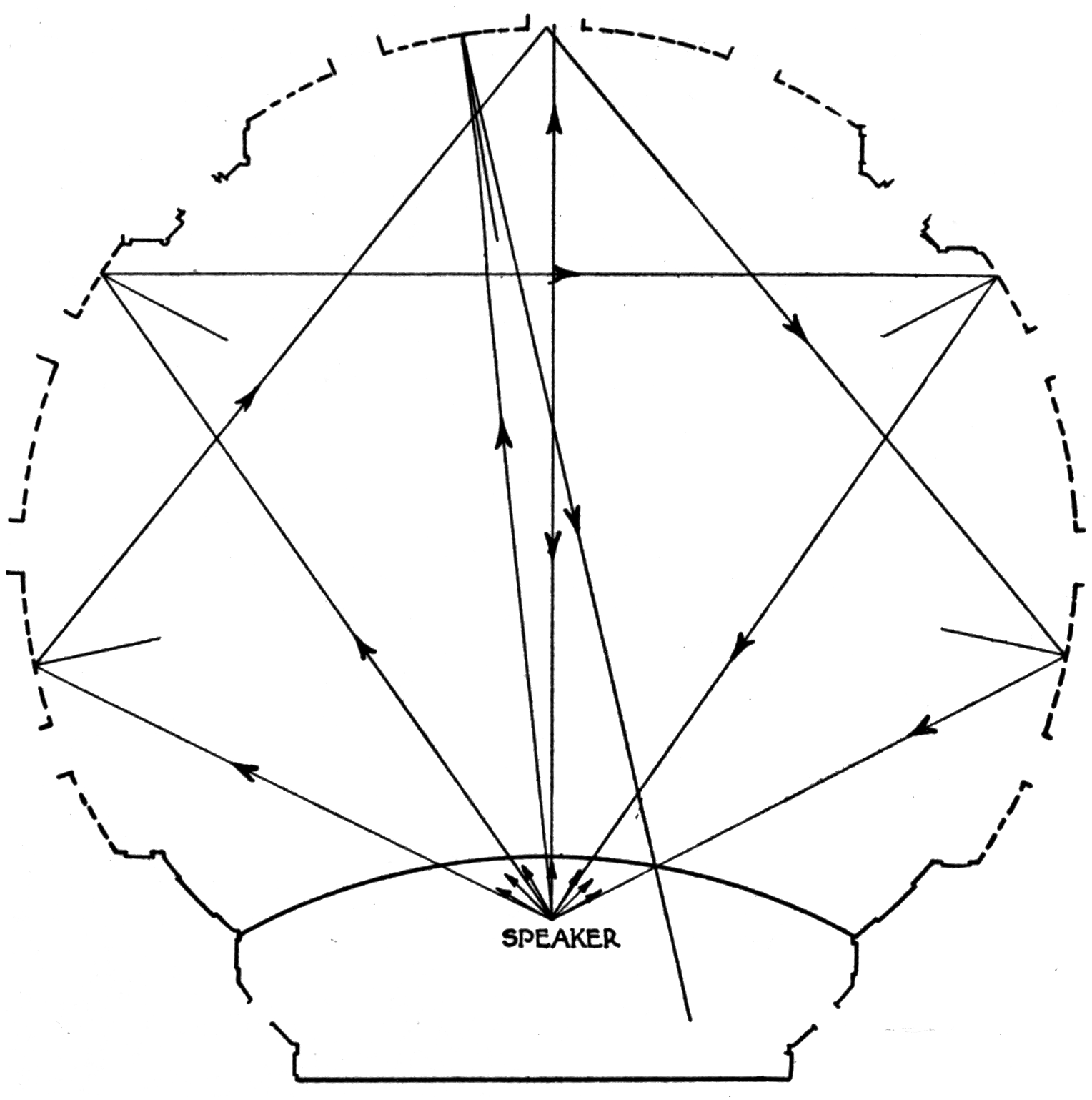
Fig. 16. Action of Sound in Causing Echo on the Stage.
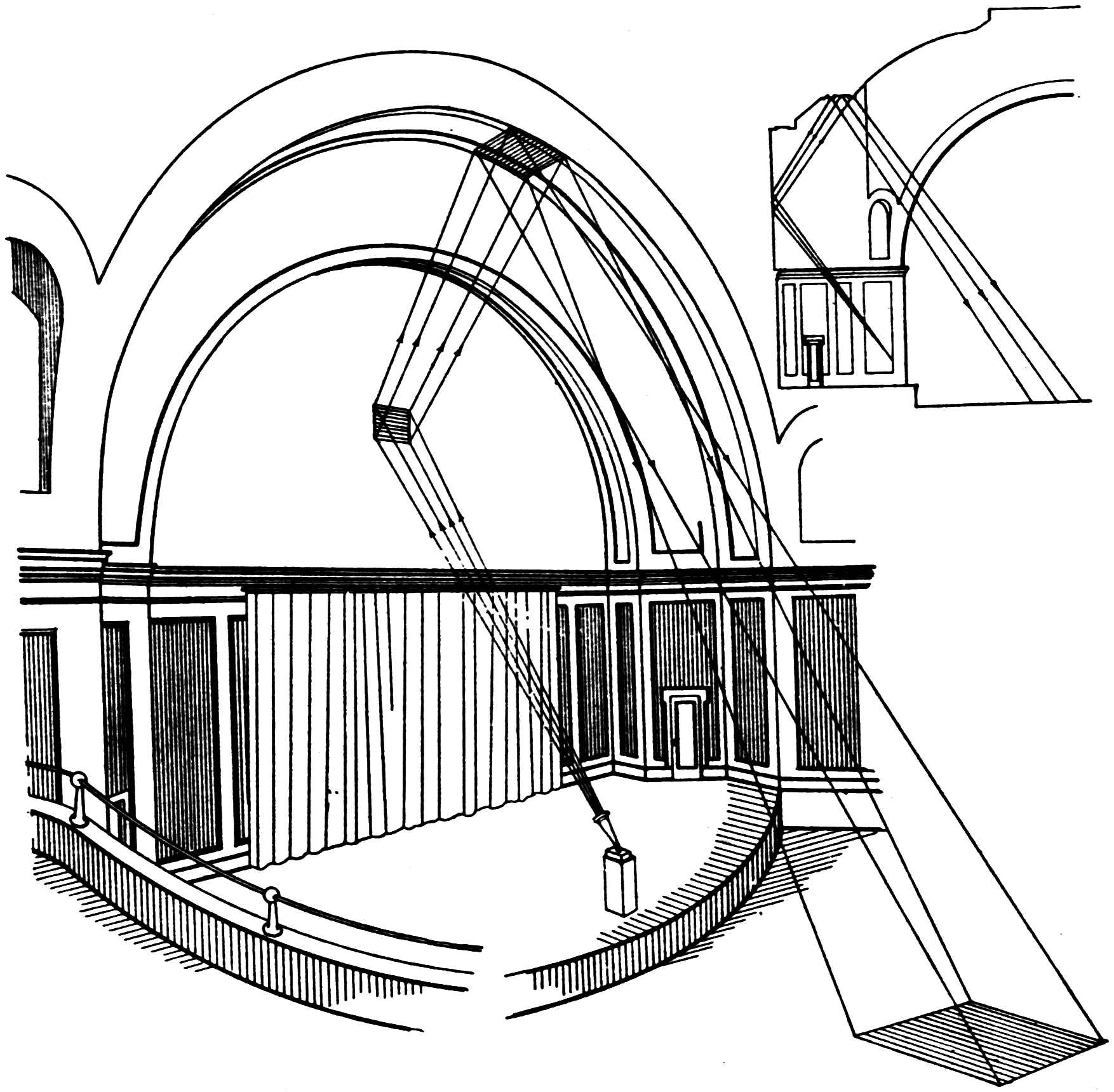
The echo shown in Fig. 15 is repeated in a somewhat modified form
for a sound generated on the stage by a speaker. Fig. 16 shows the
path taken by the sound. This echo is duplicated by the sound that
goes in the reverse direction of the arrows, so the speaker is greeted from
both sides. Fig. 17 is a perspective showing the path. The sound does
not confine itself closely to a geometrical pattern, as shown in the picture,
but spreads out by diffraction. The main effect is shown by the figure.
Fig. 17. Perspective Showing how an Echo Is Formed on the Stage by
Two Reflections. Diffraction Effects Are Not Considered
in this Drawing.
Thus far only the echoes that reached the stage have been described.
Other echoes were found in other parts of the hall, and it seemed that
few places were free from them. The side walls in the balcony, for
instance, were instrumental in causing strong echoes in the rear of the
balcony. Fig. 18 shows in perspective the action of one of these walls.
These two surfaces were similar in shape and symmetrically placed.
Each was the upper portion of a concave surface with its center of
curvature in the center of the building under the dome. The general
effect of the left hand wall was to concentrate the sound falling on it
in the right hand seats in the balcony. Some of the sound struck the
opposite wall and was reflected to the stage, as shown in Fig. 17.
Auditors who sought the furthermost rear seats in the balcony to escape
echoes were thus caught by this unexpected action of the sound. The
right hand wall acted in a similar way to send the sound to the upper
left balcony.
Fig. 18. Perspective Showing Sound Reflected from Concave Wall in
Balcony. Diffraction Not Considered.
The dome surface concentrates most of its sound near the front
of the central portion of the balcony and the ground floor in front of
the balcony in the form of a caustic cone. Figs. 7, 9 and 11 give some
conception of how a concentration of sound is caused by this spherical
surface. The echo in the front portion of the balcony was especially
distinct. On one occasion, in this place, the author was able to hear the
speaker more clearly from the echo than by listening to the direct sound.
Minor echoes were set up by the horizontal arch surfaces in the
balcony. The sound from the stage was concentrated by reflection from
these surfaces and then passed to a second reflection from the concave
surfaces back of them. Auditors in the side balcony were thus disagreeably
startled by having sound come from overhead from the rear.
The results of the survey show that curved walls are largely responsible
for the formation of echoes because they concentrate the reflected
sound. It seems desirable, therefore, to emphasize the danger of using
such walls unless their action is annulled by absorbing materials or relief
work. Large halls with curved walls are almost sure to have acoustical
defects.
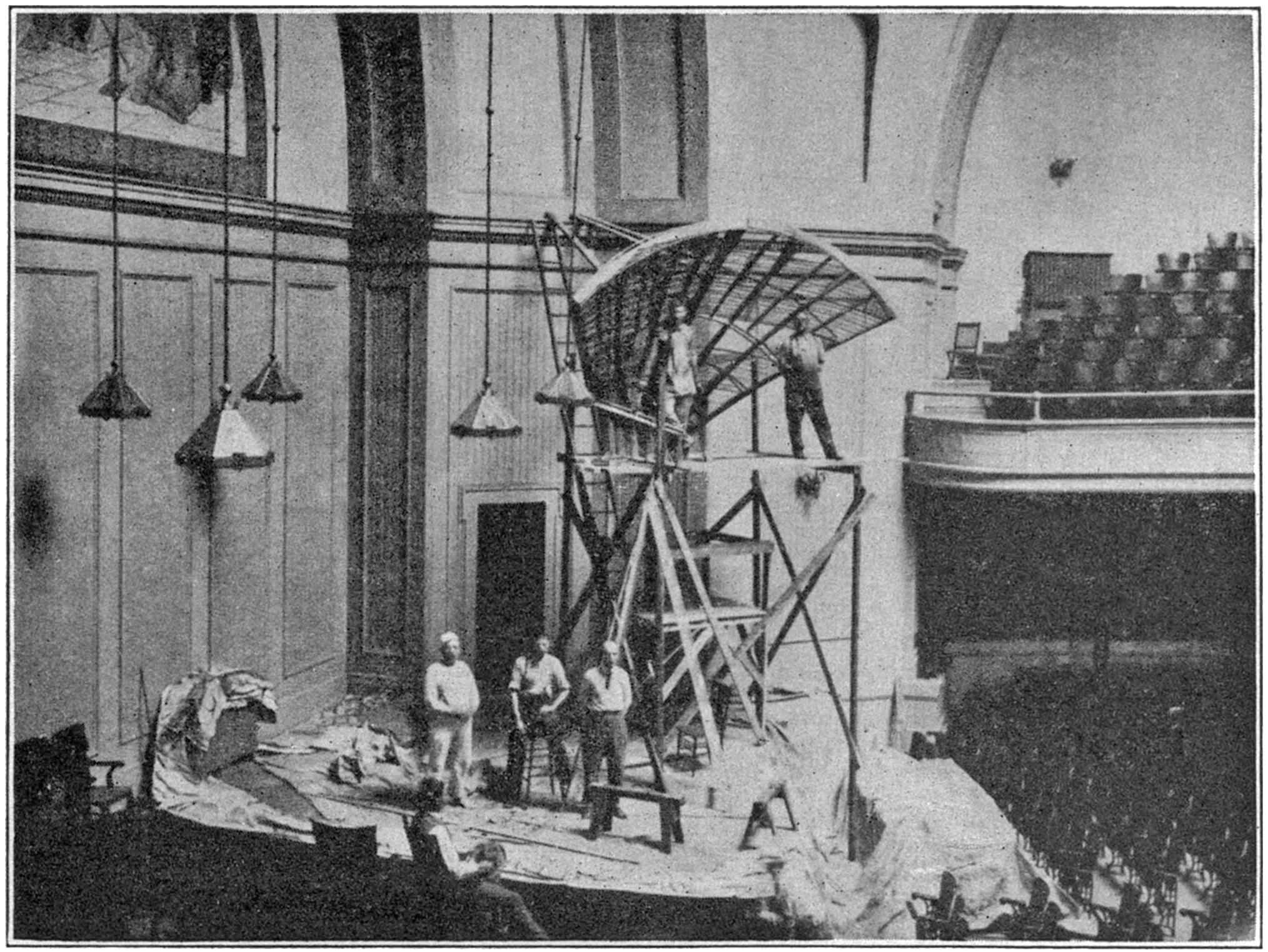
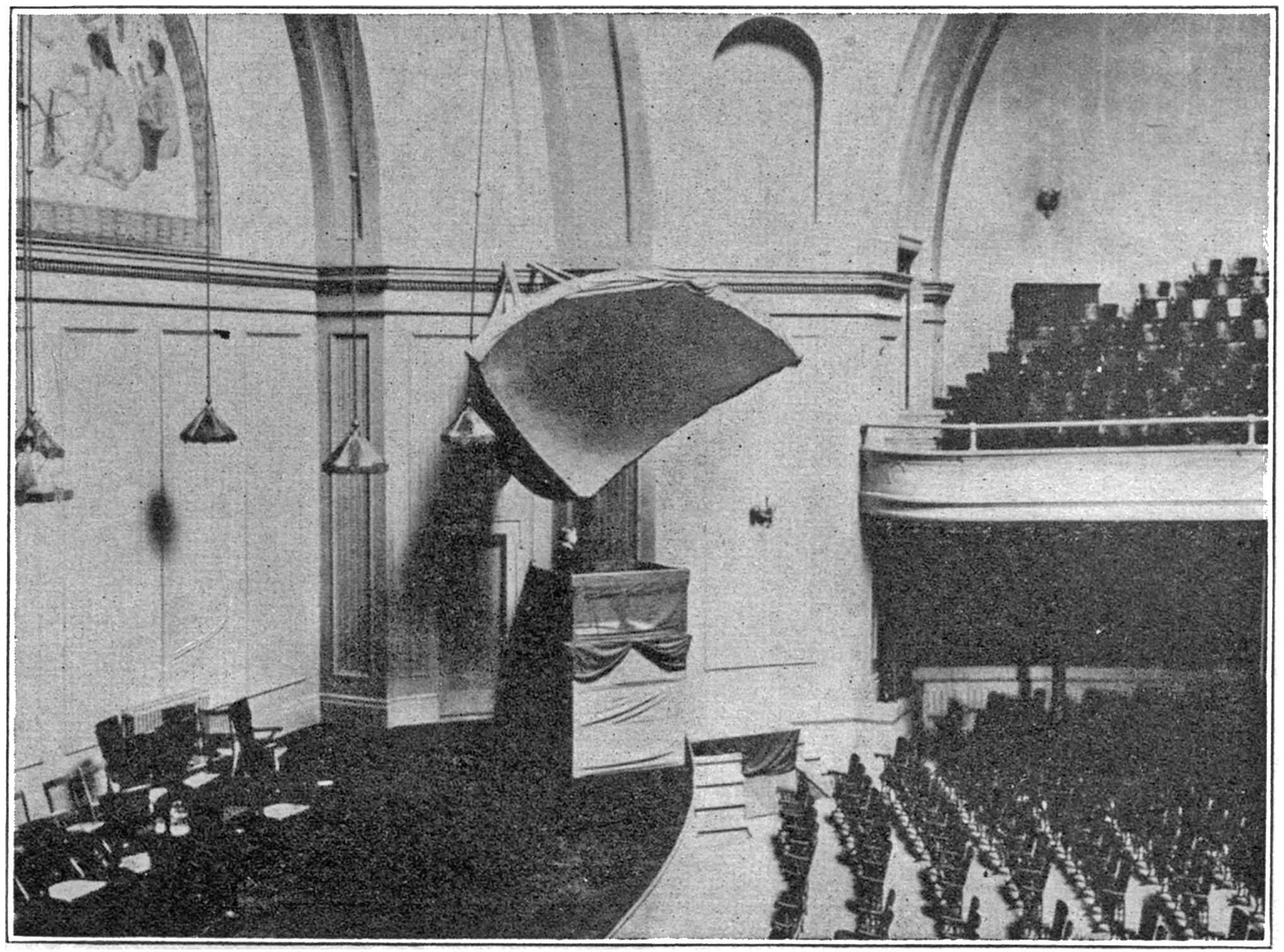
Reflecting Boards.—The provisional cure was brought about gradually
by trying different devices suggested by the diagnosis. In one set
of experiments sounding boards of various shapes and sizes were used.
A flat board about five feet square placed at an incline over the position
of the speaker produced little effect. A larger canvas surface, about
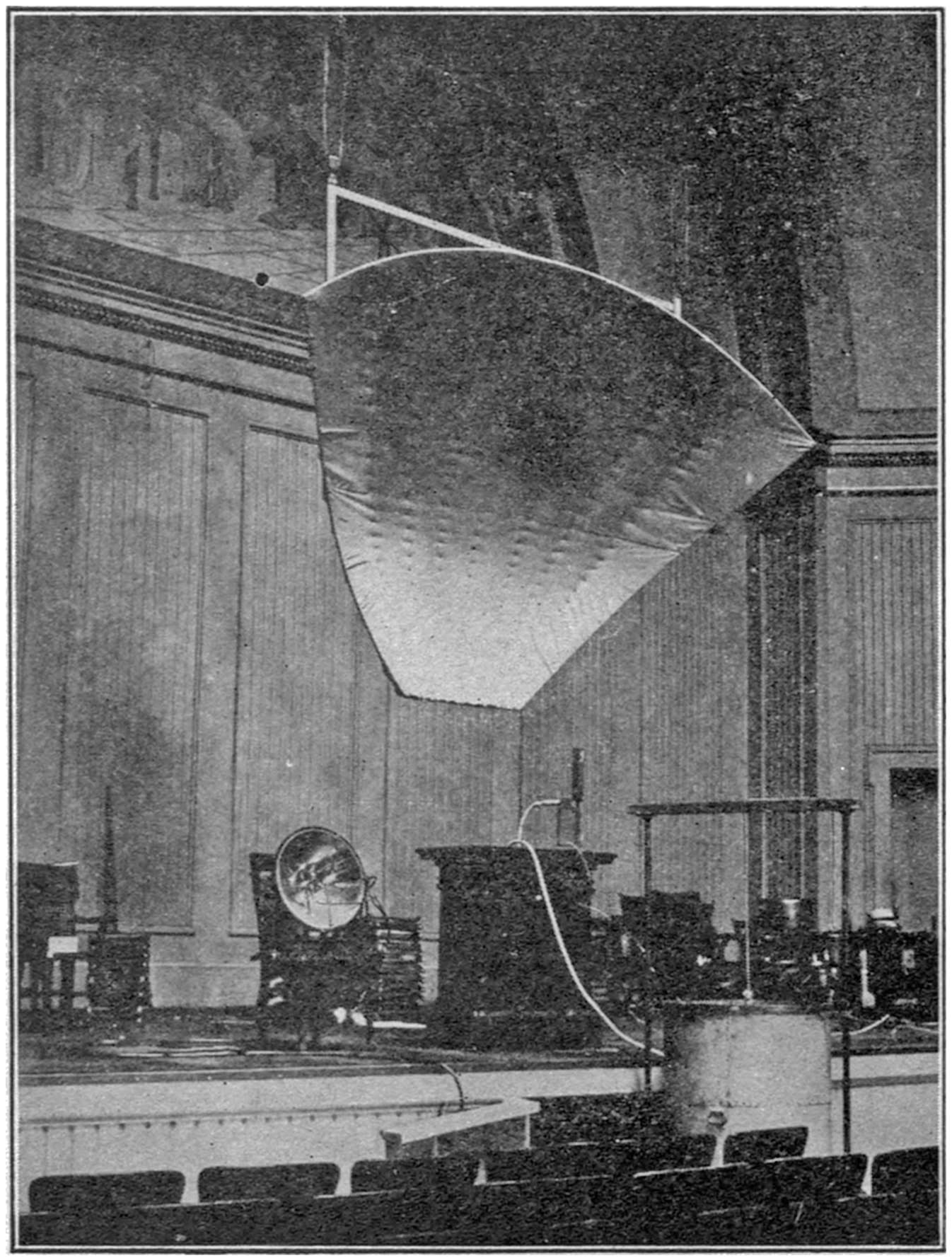
12 by 20 feet, was not much better. A parabolic reflector, however,
gave a pronounced effect. This reflector was mounted over a pulpit at
one end of the stage and served to intercept much of the sound that
otherwise would have gone to the dome and produced echoes. The
path of the reflected sound was parallel to the axis of the paraboloid of
which the reflector was a quarter section. There was no difficulty in
tracing out the reflected sound. Auditors in the path of the reflected
rays reported an echo, but auditors in other parts of the Auditorium
were remarkably free from the usual troubles. The device was not used
permanently, since many speakers objected to the raised platform. Moreover,
it was not a complete cure, since it was not suited for band concerts
and other events, where the entire stage was used. Another reflector
similar in shape to the one just described is shown in Figs. 21 and 22.
Fig. 19. Reflecting Board in Process of Construction.Fig. 20. Finished Reflector. Hard Plaster on Wire Lath.
Sabine’s Method.—The time of reverberation was determined by
Sabine’s method. An organ pipe making approximately 526 vibrations
a second was blown for about three seconds and then stopped. An
auditor listened to the decreasing sound, and when it died out made
a record electrically on a chronograph drum. The time of reverberation
was found to be 5.90 seconds, this being the mean of 19 sets of measurements,
each of about 20 observations. The reverberation was found also
by calculation from Sabine’s equation (see Section III), taking the
volume of the Auditorium as 11,800 cubic meters and calculating the
absorbing power of all the surfaces in the room. This calculation gave
6.4 seconds. The agreement between the two results is as close as
could be expected, since neither the intensity of the sound nor the
pitch used by the author was the same as those used by Professor Sabine,
and both of these factors affect the time of reverberation.
Fig. 21. Parabolic Reflector Showing Its Action on Sound.Fig. 22. Photograph of Parabolic Reflector.
Several years later the time of reverberation was again determined
after certain changes had been made. A thick carpet had been placed
on the stage, heavy velour curtains 18 by 32 feet in area hung on the
wall at the rear of the stage, a large canvas painting 400 square feet in
area was installed, and the glass removed from the skylight in the ceiling.
The time of reverberation was reduced to 4.8 seconds. With an audience
present this value was reduced still more, and when the hall was
crowded at commencement time the reverberation was not troublesome.
Method of Eliminating Echoes.—Although the time of reverberation
was reduced to be fairly satisfactory, as just explained, the echoes still
persisted, and were very annoying. Attempts were made to reduce
individual echoes by hanging cotton flannel on the walls at critical
points. Thus the shaded areas in Fig. 17 were covered and also the
entire rear wall in the balcony. Pronounced echoes still remained, and
it was evident that some drastic action was necessary to alleviate this
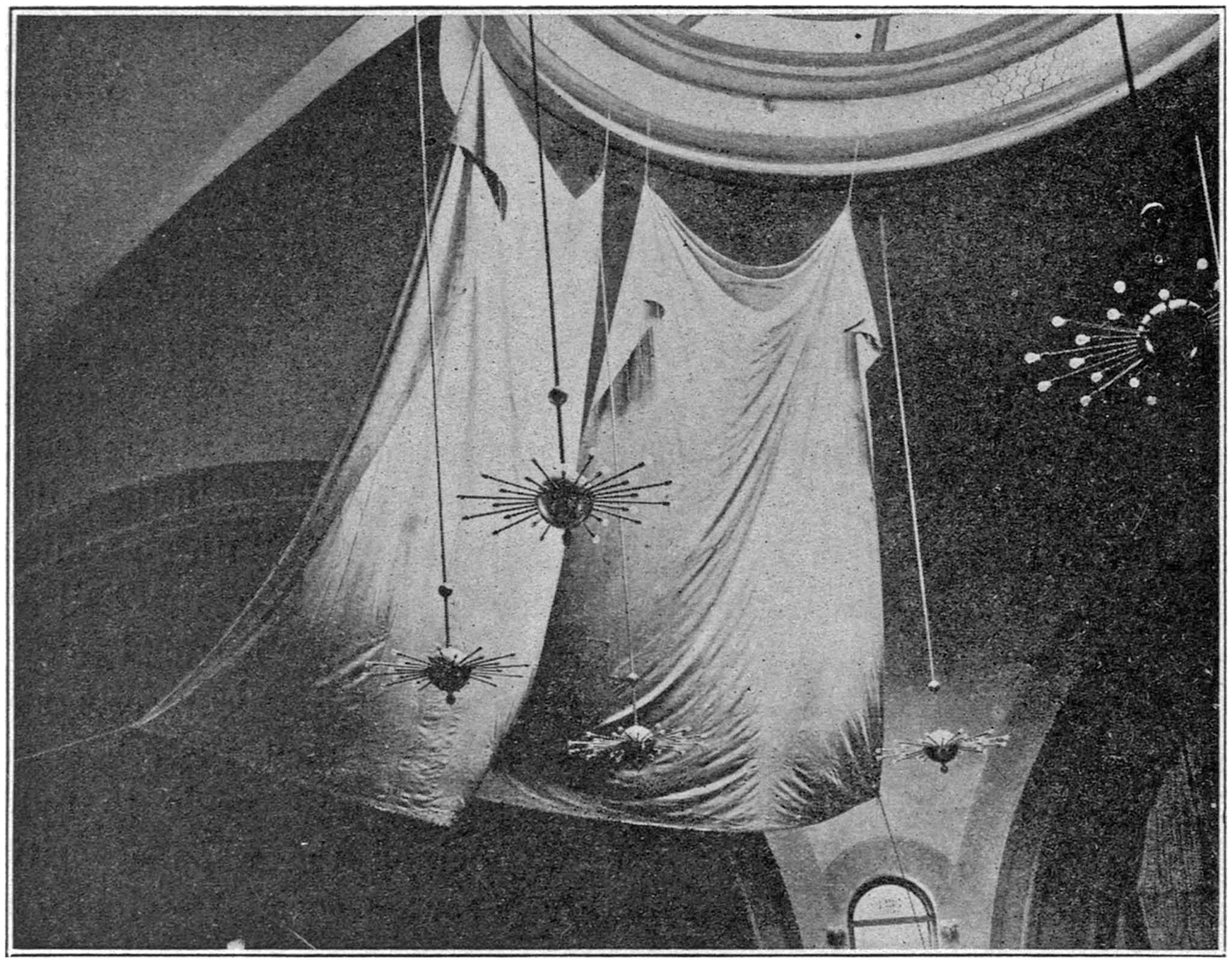
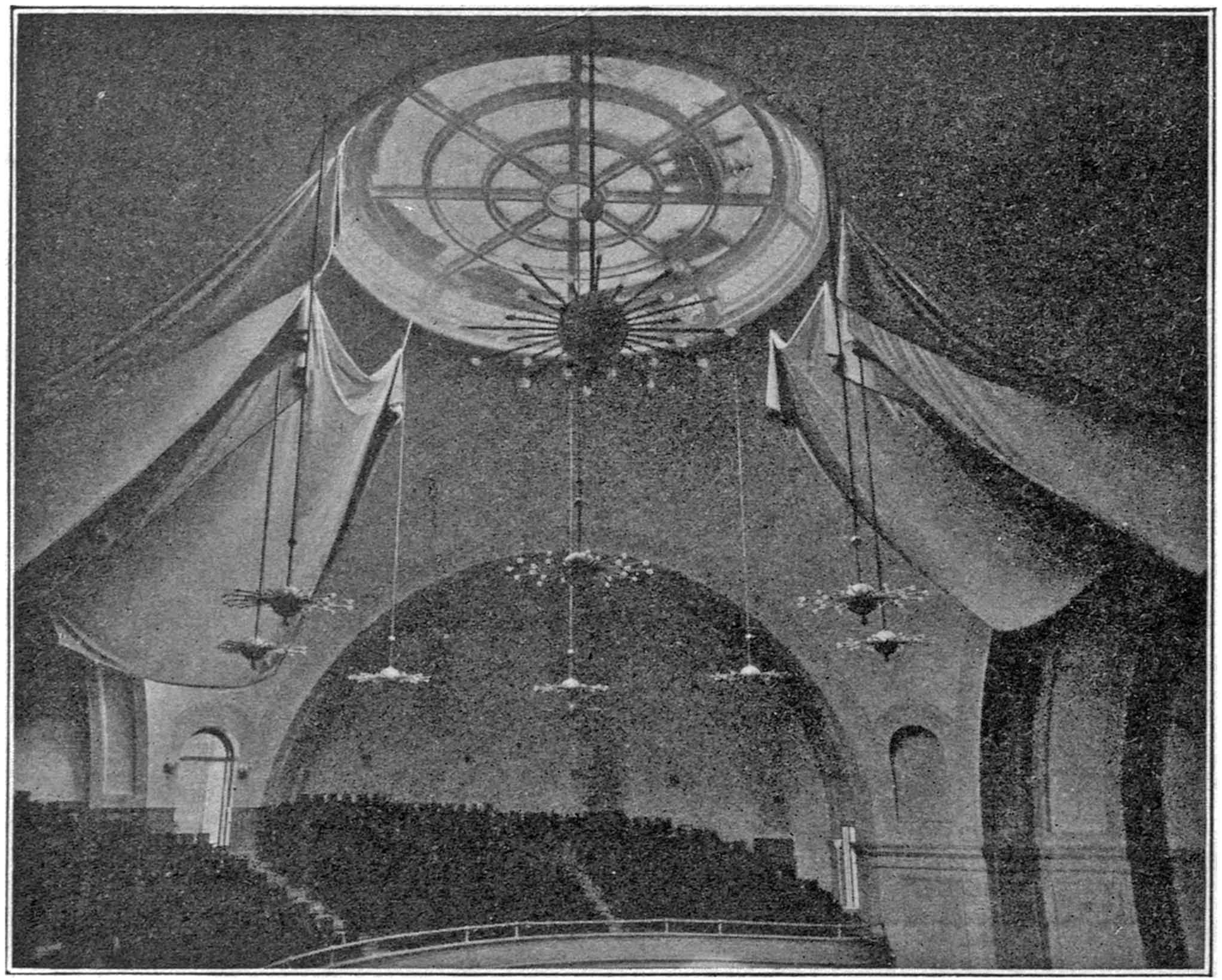
condition. Four large canvases, shown in Figs. 23 and 24, were then
hung in the dome in position suggested by the results of the diagnosis.
A very decided improvement followed. For the first time the echoes
were reduced to a marked degree and speakers on the stage could talk
without the usual annoyance. This arrangement eliminated the echoes
not only on the stage, but generally all over the house. A number of
minor echoes were still left, but the conditions were much improved,
especially when a large audience was present to reduce the reverberation.
Proposed Final Cure.—The state of affairs just described is the
condition at the time of writing. Two propositions were considered in
planning the final cure. One proposition involved a complete remodeling
of the interior of the Auditorium. Plans of an interior were drawn in
accordance with the results of the experimental work that would probably
give satisfactory acoustics. This proposition was not carried out because
of the expense and because it was thought desirable to attempt a cure
without changing the shape of the room. The latter plan is the one
now being followed. It is proposed to replace the present unsightly
curtains with materials which will conform to the architectural features
of the Auditorium and which will have a pleasing color scheme. At
the same time, it will be necessary to hold to the features which have
improved the acoustics.
Fig. 23. Photograph of Two of the Canvas Curtains in the Dome of the
Auditorium. Note also the Absorbing Materials under the Arches.Fig. 24. Photograph of Dome of Auditorium Showing the Canvases Installed
to Eliminate Echoes.
V. Bibliography of Publications on Acoustics of Auditoriums.
Auerbach, F. “Akustik.” Winkelmann’s Handbuch der Physik, Vol. II, 1909. An
encyclopædia of acoustics, the following topics applying to the subject in hand: “Akustik
der Gebäude,” pp. 580–584, with references. “Nachhall und Echo,” pp. 565–569, with references.
Blackall, C. H. “Acoustics of Audience Halls,” Engineering Record, Vol. 45, pp. 541–542,
1902. A paper recording the opinions of the author with many references to acoustical
properties of particular audience halls.
Cornelison, R. W. “The Acoustical Properties of Rooms Particularly as Affected by
Wall Coverings,” 1905. A pamphlet describing the merits of “Fabrikona” burlap as a sound
absorber. H. B. Wiggin’s Sons Company, Bloomfield, N. J.
Eichhorn, A. “Die Akustik Grosser Raüme nach Altgriechischer Theorie.” Ernst and
Korn, Publishers, Berlin, 1888. A discussion of Greek buildings and acoustics, with applications
to modern conditions.
Eichhorn, A. “Der Akustische Masstab für die Projectbearbeitung Grosser Innen
Raüme.” Published by Schuster and Bufleb, Berlin, 1899. A continuation of the previous
work.
Exner, S. “Uber die Akustik von Hörsälen und ein Instrument, sie zu bestimmen.”
Zeitschrift des Osterreichischen Ingenieur und Architekten-Vereines, Vol. LVII, p. 141,
March, 1905. Indicates his opinion of good acoustical properties in a hall. Gives experimental
determination of reverberation.
Fournier, Lucien. “The Suppression of Echoes.” La Nature (Paris), April 24, 1909.
English translation given in “The Literary Digest,” New York, May 29, 1909, p. 924. An
account of the experiments of Gustav Lyon in investigating the echoes in Trocadero Hall
in Paris.
Franklin, W. S. “Derivation of Equation of Decaying Sound in a Room and Definition
of Open Window Equivalent of Absorbing Power.” Physical Review, Vol. 16, pp.
372–374, 1903. A theoretical development of the formula found experimentally by Sabine.
Haege. “Bemerkungen über Akustik.” Zeitschrift für Baumesen, Vol. IX, pp. 582–594,
1859.
Henry, Joseph. “Acoustics Applied to Public Buildings,” Smithsonian Report, 1856,
p. 221.
Hoyt, J. T. N. “The Acoustics of the Hill Memorial Hall,” American Architect, Vol.
CIV, pp. 50–53, August 6, 1913. Discusses the design of the hall and indicates how it fulfills
his ideas of good acoustics.
Hutton, W. R. “Architectural Acoustics; Hall of Representatives, U. S. Capitol, 1853.”
Engineering Record, Vol. 42, p. 377, 1900. A discussion of the cure of the faulty acoustics
in the U. S. Hall of Representatives.
Jacques, W. W. “Effect of the Motion of the Air Within an Auditorium Upon Its
Acoustical Qualities.” Philosophical Magazine (5), Vol. 7, p. III, 1879. A record of
experiments in the Baltimore Academy of Music showing that the ventilating current had a
marked action on the acoustics.
Jager, S. “Zur Theorie des Nachhals,” Sitzungsberichten der Kaiserl. Akademie der
Wissenschaften in Wien. Matem.-naturw. Klasse; Bd. CXX, Abt. Ha, Mai, 1911. An
important paper giving a theoretical development of Sabine’s formula showing the factors
that enter into the constants. Considers also the case of the reflection of sound from a
thin wall and also the case when it encounters a porous material such as a curtain.
Lamb, Horace. “The Dynamical Theory of Sound.” Published by Edward Arnold,
London, 1910. A more elementary treatment than Rayleigh’s “Theory of Sound.”
Marage. “Qualites acoustiques de certaines sailes pour la voix parlée.” Comptes
Rendus, Vol. 142, p. 878, 1906. An investigation of the acoustical properties of six halls
in Paris.
Norton, C. L. “Soundproof Partitions.” Insurance Engineering, Vol. 4, p. 180, 1902.
An account of experimental tests of the soundproof qualities of materials that are also
fireproof.
Orth, A. “Die Akustik Grosser Raüme mit Speciallem Bezug auf Kirchen.” Zeitschrift
für Bauwesen. Also reprint by Ernst and Korn, Berlin, 1872. Assumes that sound
waves behave like light waves. Discusses, with detailed drawings, the paths of sound in
the Zion Church in Berlin and the Nicolai Church in Potsdam. Also gives his opinion of the
effect of surfaces and materials on sound.
Rayleigh, Lord. “Theory of Sound.” Two volumes, Macmillan, 1896. The unsurpassed
classic in the subject of acoustics. References to architectural acoustics as follows:
“Whispering Galleries,” Vol. II, § 287. “Passage of Sound Through Fabrics,” Vol. II,
p. 311. “Resonance in Buildings,” Vol. II, § 252.
Sabine, Wallace C. “Architectural Acoustics.” Engineering Record, 1900, Vol. 1, pp.
349, 376, 400, 426, 450, 477, 503. Published also in book form and in American Architect,
Vol. 68, 1900, pp. 3, 19, 35, 43, 59, 75, 83. An important series of articles giving the
relation between the time of reverberation in a room, the volume of the room, and absorbing
materials present. Gives table of absorbing powers of substances, so that an architect
can calculate in advance of construction what the time of reverberation will be.
Sabine, W. C. “Architectural Acoustics,” Proc. of the Amer. Acad. of Arts and
Sciences, Vol. XLII, No. 2, June, 1906. A continuation of the previous work, showing the
accuracy of musical taste in regard to architectural acoustics and also the variation in
reverberation with variation in pitch.
Sabine, W. C. “Architectural Acoustics,” Engineering Record, Vol. 61, pp. 779–781, June
18, 1910. Discusses the case of flow of air in a room and its effect on the acoustics. Concludes
that the usual ventilation system in a hall has very little effect.
Sabine, W. C. “Architectural Acoustics: The Correction of Acoustical Difficulties.”
The Architectural Quarterly of Harvard University, March, 1912, pp. 3–23. An account
of the cures of the acoustical difficulties of a number of audience rooms, also a description
of further experiments on the absorbing power of different materials.
Sabine, W. C. “Theater Acoustics.” American Architect, Vol. CIV, pp. 257–279, December
31, 1913. Describes theater with model acoustics. Discusses behavior of sound in a
room and shows photographs of sound waves in miniature rooms.
Sabine, W. C. “Architectural Acoustics. Building Material and Musical Pitch.” The
Brickbuilder, Vol. 23, pp. 1–6, January, 1914. A continuation of previous work, describing
absorbing powers of different materials.
Sharpe, H. J. “Reflection of Sound at a Paraboloid.” Camb. Phil. Soc. Proc., Vol.
15, pp. 190–197, 1909.
Stewart, G. W. “Architectural Acoustics.” Sibley Journal of Engineering, May, 1903.
Published by Cornell University, Ithaca, N. Y. An account of an investigation leading to
the cure of the acoustics of Sibley Auditorium.
Sturmhöfel, A. “Akustik des Baumeisters.” Published by Schuster and Bufleb, Berlin,
1894. An 87-page pamphlet on the acoustics of rooms. Discusses effects of relief work
in rooms on sound. Account of experimental work. References to auditoriums.
Tallant, Hugh. “Hints on Architectural Acoustics.” The Brickbuilder, Vol. 19, 1910,
pp. 111, 155, 199, 243, 265. A series of articles giving an exposition of the principles of
the subject with practical applications.
Tallant, Hugh. “Acoustical Design in the Hill Memorial Auditorium, University of
Michigan.” The Brickbuilder, Vol. XXII, p. 169, August, 1913. See also plates 113, 114,
115. A discussion of the acoustical results obtained in this auditorium, a special feature
being the action of a huge parabolic reflecting wall surface over the stage.
Tallant, Hugh. “Architectural Acoustics. The Effect of a Speaker’s Voice in Different
Directions.” The Brickbuilder, Vol. 22, p. 225, October, 1913.
Taylor, H. O. “A Direct Method of Finding the Value of Materials as Sound Absorbers.”
Physical Review, Vol. 2 (2), p. 270, October, 1913.
Tufts, F. L. “Transmission of Sound Through Porous Materials.” Amer. Journal
of Science, Vol. II, p. 357, 1901. Experimental work leading to the conclusion that sound
is transmitted through porous materials in the same proportion that a current of air is.
Watson, F. R. “Echoes in an Auditorium.” Physical Review, Vol. 32, p. 231, 1911.
An abstract giving an account of the experiments in the auditorium at the University of
Illinois.
Watson, F. R. “Inefficiency of Wires as a Means of Curing Defective Acoustics of
Auditoriums.” Science, Vol. 35, p. 833, 1912.
Watson, F. R. “The Use of Sounding Boards in an Auditorium.” Physical Review,
Vol. 1 (2), p. 241, 1913. Also a more complete article in The Brickbuilder, June, 1913.
Watson, F. R. “Air Currents and the Acoustics of Auditoriums.” Engineering Record,
Vol. 67, p. 265, 1913. A detailed account giving theory and experimental work, with
application to ventilating systems in auditoriums.
Watson, F. R. “Acoustical Effect of Fireproofed Cotton-Flannel Sound Absorbers.”
Engineering News, Vol. 71, p. 261, January 29, 1914. Results of experiments showing
that cotton-flannel has practically the same absorbing power after fireproofing as before.
Weisbach, F. “Versuche über Schalldurchlassigkeit, Schallreflexion und Schallabsorbtion.”
Annalen der Physik, Vol. 33, p. 763, 1910.
Williams, W. M. “Echo in Albert Hall.” Nature, Vol. 3, p. 469, 1870–71. Observations
on the shape of Albert Hall in London and the echoes set up.
Editorial Notice. “The Dresden Laboratory for Architectural Acoustics.” American
Architect, Vol. 102, p. 137, October 16, 1912. States that a laboratory of applied acoustics
is authorized in the Dresden (Germany) Technische Hochschule, and that expert advice
will be furnished architects and others regarding problems of acoustics of auditoriums.
THE UNIVERSITY OF ILLINOIS THE STATE UNIVERSITY
Urbana
Edmund J. James, Ph. D., LL. D., President
The University includes the following departments:
The Graduate School
The College of Liberal Arts and Sciences (Ancient and Modern Languages
and Literatures; History, Economics and Accountancy,
Political Science, Sociology; Philosophy, Psychology, Education;
Mathematics; Astronomy; Geology; Physics; Chemistry; Botany,
Zoology, Entomology; Physiology; Art and Design; Ceramics)
The College of Engineering (Architecture; Architectural, Civil, Electrical,
Mechanical, Mining, Municipal and Sanitary, and Railway
Engineering)
The College of Agriculture (Agronomy; Animal Husbandry; Dairy
Husbandry; Horticulture and Landscape Gardening; Veterinary
Science; Agricultural Extension; Teachers’ Course; Household
Science)
The College of Law (Three years’ course)
The School of Education
The Courses in Business (General Business; Banking; Accountancy;
Railway Administration; Insurance)
The Course in Journalism
The Courses in Chemistry and Chemical Engineering
The Courses in Ceramics and Ceramic Engineering
The School of Railway Engineering and Administration
The School of Music (four years’ course)
The School of Library Science (two years’ course)
The College of Medicine (in Chicago)
The College of Dentistry (in Chicago)
The School of Pharmacy (in Chicago; Ph. G. and Ph. C. courses)
The Summer Session (eight weeks)
Experiment Stations: U. S. Agricultural Experiment Station; Engineering
Experiment Station; State Laboratory of Natural History;
State Entomologist’s Office; Biological Experiment Station
on Illinois River; State Water Survey; State Geological Survey;
Mine Rescue Station
The library collections contain (May 1, 1914), 295,000 volumes, including
the library of the State Laboratory of Natural History,
the Quine Medical Library and the library of the School of
Pharmacy.
5“Architectural Acoustics.” A series of articles in the Engineering Record, 1900; also
the American Architect, 1900.
6“Architectural Acoustics,” Proc. of Amer. Acad. of Arts and Sciences. Vol. 42, pp.
49–84, 1906.
7G. W. Stewart. “Architectural Acoustics,” Sibley Journal of Engineering, May,
1903. Published by Cornell University, Ithaca, N. Y.
8“Qualités acoustiques de certaines salles pour la voix parlée.” Comptes Rendus, 142,
878, 1906.
9W. S. Franklin. “Derivation of Equation of Decaying Sound in a Room and Definition
of Open Window Equivalent of Absorbing Power.” Physical Review, Vol. 16, pp.
372–374, 1903.
10G. Jäger. “Zur Theorie des Nachhalls.” Sitzungsberichte der Kaiserliche Akad.
der Wissenschaften in Wien, Math-naturw. Klasse; Bd. CXX. Abt. 11 a. Mai, 1911.
Punctuation, hyphenation, and spelling of English
words were made
consistent when a predominant preference was found
in the original book; otherwise they were not changed.
The spellings of non-English words were not changed.
Simple typographical errors were corrected; unbalanced
quotation marks were remedied when the change was
obvious, and otherwise left unbalanced.
Illustrations in this eBook have been positioned
between paragraphs and outside quotations. In versions
of this eBook that support hyperlinks, the page
references in the List of Illustrations lead to the
corresponding illustrations.
Footnotes have been sequentially numbered and placed
together at the end of the book.