PRINTED AT THE HARVARD UNIVERSITY PRESS
CAMBRIDGE, MASS., U. S. A.
IN GRATEFUL AND LOVING MEMORY OF Mrs. CHARLES ELIOT GUILD AND ELEANOR GUILD
But yet I treasure in my memory
Your gift of charity, your mellow ease,
And the dear honour of your amity,
For these once mine, my life is rich with these.
Because of your strong faith I kept the track
Whose sharp-set stones my strength had well-nigh spent.
I could not meet your eyes if I turned back,
So on I went.
PREFACE
The attempt is here made to bring together, and
put into a form for the general reader, the story of
that pueblo of the Keres people known as Ácoma,
so far as yet discovered in the records of Spanish
diarists and in those of more recent historical writers.
It was one of the places visited by the first white explorers
of the region we know to-day as New Mexico.
From the very outset Ácoma excited the curiosity and
even the fear of the pioneers because of the strangeness
of its position and the reputation of its inhabitants
for ferocity.
The early Spaniards made no prolonged stay there,
but to “the marvellous Crag” there are constant brief
allusions from the time of Coronado’s chronicler in
1540 onward to that of its conversion to Christianity
after 1629.
Nor are there more vivid and thrilling tales told of
any Southwestern pueblo people than can be veraciously
set forth of Ácoma, the City in the Sky, built
more than 6500 feet above sea-level.
The student of aboriginal legends and customs,
after reading the many monographs that have been
printed about other Pueblo Indians, notably the Hopi
and Zuñi, is inclined at first to think himself fortunate
to find a field so little worked as Ácoma. Even Cochití
and Laguna have opened windows of understanding
to the white investigator. One soon finds that
Ácoma has not been neglected, but that every one attempting
to go beyond the most superficial glance arrives
at a wall as blank of entrance as the ancient
lower story of its own fortress dwellings. The ladders
of admission to its hatchways hardly give the stranger
more than uncertain glimpses here and there within
the obscure interior, and these are so fragmentary and
elusive, often contradictory, that he can affirm little
about their ritual life—which is the core of tribal
existence. Of all Indians the Ácomas seem most resentful
of intrusive questioning and most unwilling to
impart, even for purposes of record, any real knowledge
of themselves. Certain clans and rituals are
already extinct. It has, however, seemed worth while,
before the old life has become something less than a
memory, overspun by all the vagueness of tradition,
to bring together into one small volume the substance
of everything already written about Ácoma. Such
historical data as have come to light are followed by
a few legends and folk-tales—fairy tales perchance
some of them are—and then by the researches of
scholars like Bandelier, Fewkes, Parsons and Hodge.
It may be thought that the legitimate bounds of
the subject as given in the title have been too far
exceeded. In explanation it is but fair to state that
since Ácoma is still well-nigh impenetrable to any
foreigner, the only way to apprehend its mental and
spiritual development is to use inferentially whatever
seems permissible from related tribes. In justification
of this method I am happily supported by no less an
authority than the distinguished anthropologist, Dr.
Kroeber, who writes: “That the pueblo civilization
was substantially the same in every town has always
been assumed; it begins to be evident that a great
part of it has been borrowed back and forth in the
most outright and traceable manner. The history of
the cults and institutions of any one of these people
simply cannot be understood without a knowledge of
the others. The problem in its very nature is a comparative
one, and until the pueblo languages are more
thoroughly understood there is no solution.”
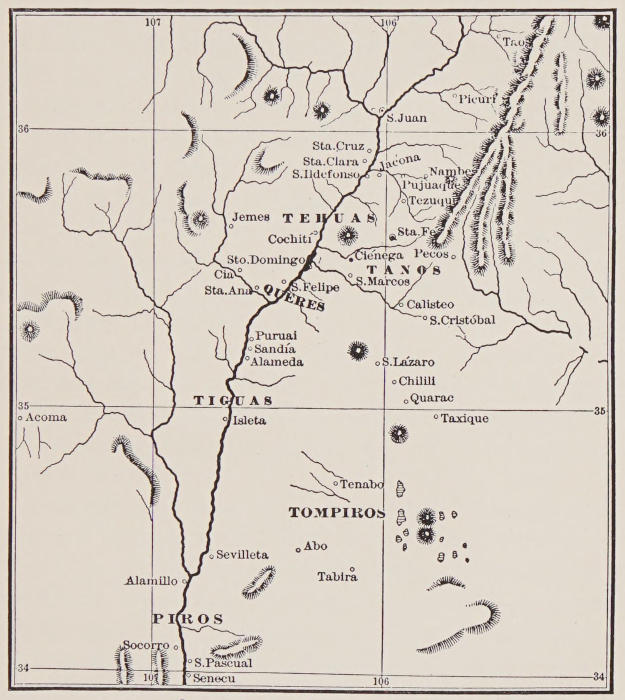
Ácoma belongs to the most numerous of the six linguistic
groups of the Pueblo Indians, called the Keresan
(Queresan), and shares with Laguna a dialect differing
somewhat from the rest of that “Nation.”
Standing aloof as these two do from the other Keresan
villages, they nevertheless own kinship with Sía,
Santa Ana, Santo Domingo, San Felipe, and Cochití,
who all claim the famous Rito de los Frijoles for their
ancestral home. The researches of the best scholars
find in the Ácoma ritual considerable affiliation with
the Zuñi, and rather less with that of the Tusayán
tribes of Arizona.
The writer makes no claim to be more than a compiler,
but she has endeavored not to include in the
following pages the customs and beliefs of any group
of Indians which the scholars have not shown to be
more or less interwoven with those of Ácoma. In assembling
these fugitive accounts of the Sky City from
diaries and archaeological notes, as well as from appreciations
of sympathetic visitors, she has hoped to
lay a foundation for some scholar of the future to
build upon. The writer has followed in the footsteps
of genuine research, and she desires to offer these
pages to be used, like the toe and finger holes of the
mesa, chiefly as a guide to others to go further and to
do the real work that must be done soon if it is not
to be forever lost.
The opportunity to collect and study these materials
in the Bancroft Research Library at Berkeley has
been most cordially given to the writer by Professor
Herbert E. Bolton of the University of California.
My thanks are due also to Dr. Leslie Spier for much
helpful suggestion and criticism on the chapters dealing
with the anthropology and native customs of the
Southwest. To Professor Bolton, the master-mind,
whose scholarship and insight are joined to a rare
power of kindling in others something of his own enthusiasm
for historical research, and of setting before
them ideals of work which have broadened and deepened
the world’s knowledge of early American history,
I wish to express my deep gratitude for his never-failing
encouragement and guidance.
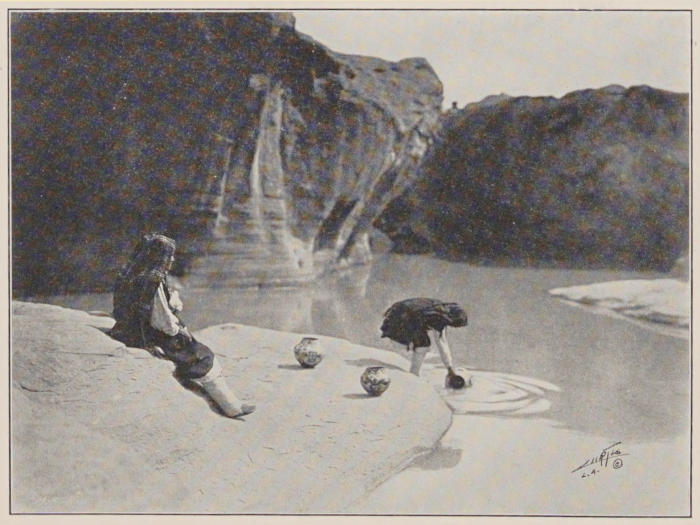
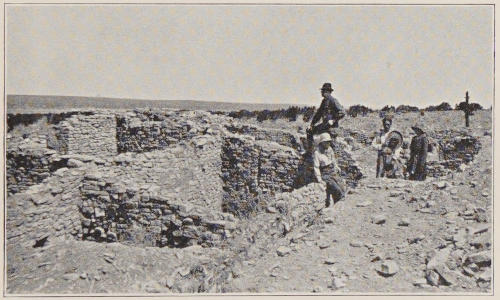
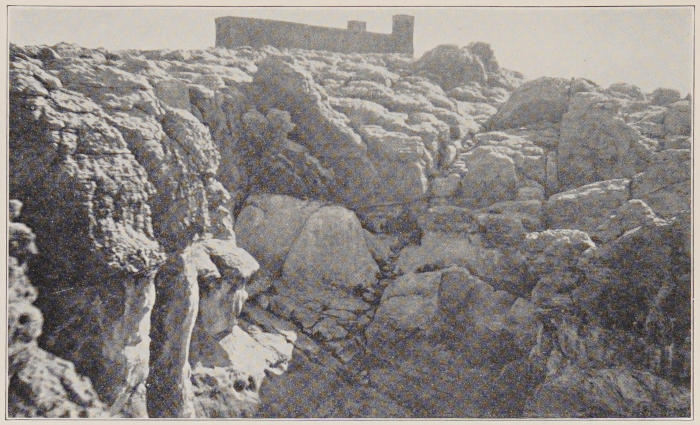
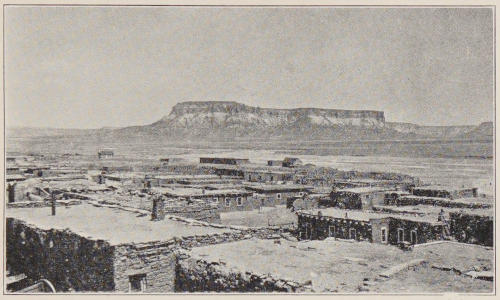
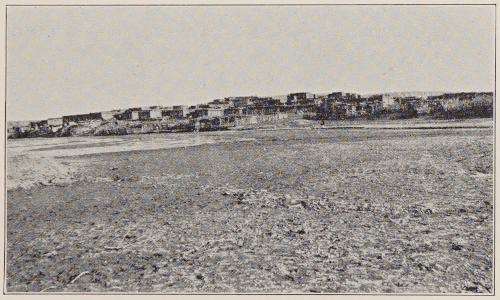
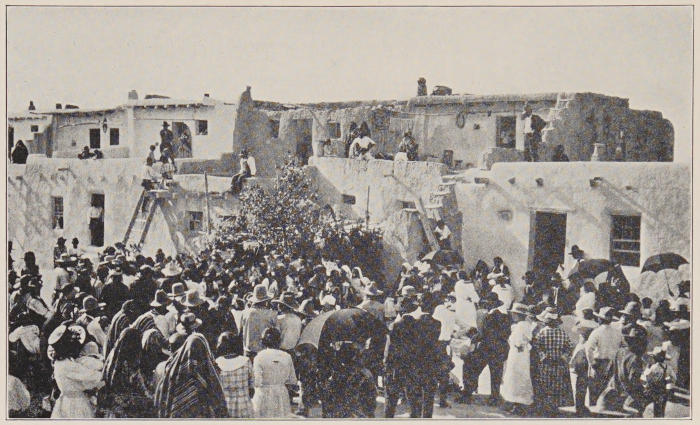
All the illustrations but two are from photographs not hitherto published.
For the frontispiece, I am indebted to the well-known photographer
of Indian life, Mr. Edward S. Curtis. For the difficult trail up
Katzímo, to the courtesy of the Century Company of New York.
All the others were taken for this book by Professor Herbert E.
Bolton of the University of California, or were given him for my use
by the Reverend St. John O’Sullivan of San Juan Capistrano, California.
To these gentlemen the author extends her thanks for making
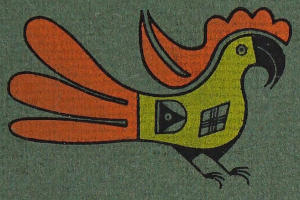
the text more vivid. The cover design is from a water-color done by
Mr. Kenneth M. Chapman of the Art Museum of Santa Fé, from an
ancient jar of Ácoma potters, for which the writer feels especial gratitude.
And at night the wondrous glory of the everlasting stars.
The first effect of the desert upon any human being
must be one of surprise—surprise at the contrast between
the preconceived idea which the word suggests
and its variety of beauty—a beauty which becomes
for many an irresistible fascination, a magnet that allures
and brings its lovers back again and again.
The simplicity of great spaces and great masses is
one of the supreme influences of life. Together with
limitless vistas of possibility, there is in them a serenity
that brings calm and meditative repose.
However far the eye is carried in the desert of the
Southwest, one is never wearied by monotony. Everywhere
the undulating sands, hardly held in place by
scanty vegetation when the winds blow their wildest,
are driven into long rippling waves, or into hillocks,
by the Spaniards called lomas. Even while you watch,
this shifting, drifting sand takes on many hues. Sometimes
it is grey, or pale buff, or almost white, more
rarely golden. Out of it grows, here and there, the
pungent greasewood, the stunted cedar and the
thorny, freakish cacti unfurling gay flags of color to
catch the wandering bee.
Cutting the horizon, barrier mountain ranges appear,
whose long, restful lines lend a new note of titanic
power to the harmony; and every now and again,
rock-islands, solitary, abrupt, imposing, tell of other
forces silently working through untold ages and leaving
behind forms beautiful or merely fantastic. Of
all the magnetic elements of the landscape these are
the most manifest. But the supreme thing, the over-powering
glory, is the majesty of light and the splendor
of color that is so all-pervading, all-enfolding in
the desert that, before we are aware of it, we become
sympathetic with the belief of the indigenous race in
sorcery.
MESA-LAND
Bolton
In some far foretime the whole of this vast area was
an inland sea. Sand and wind in the long interval
since the waters receded have done their part in the
task of erosion as effectually as do ocean waves beating
upon coast-wise cliffs.[1] The work of these elemental
forces is uneven. The softer rock has given
way. That which is harder is left sculptured into
forms that everywhere invite the imagination. To
many of them descriptive names have become permanently
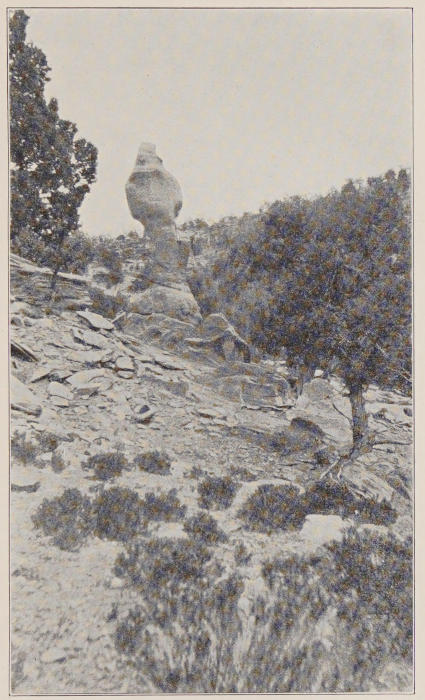
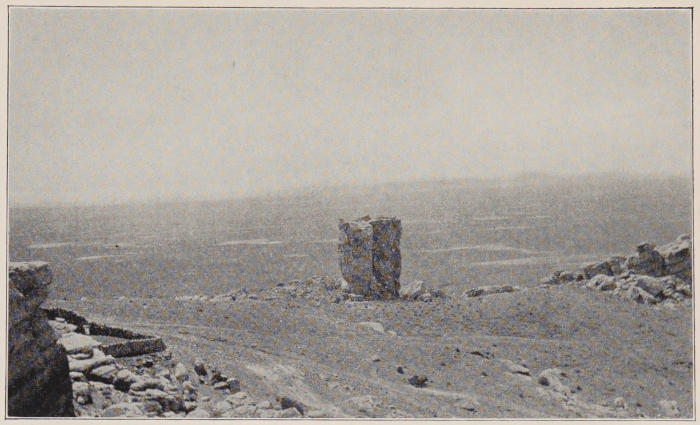
attached. Such is Locomotive Rock, lifted
high above the road between Casa Blanca and Ácoma
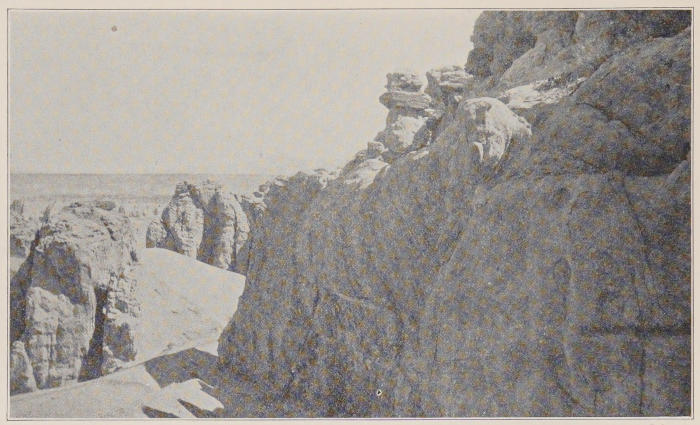
in astonishing realism. Most extraordinary is the line
of heads and trunks of eleven colossal elephants that
may be seen two miles away from Ácoma toward its
farm-lands. By wind and sand-blast they have been
eroded from the oyster-grey stone to such lifelikeness
that fancy grows almost into conviction that here we
have the work of forgotten sculptors such as once
were bred in Egypt or Chaldæa. Forms like these,
in solitudes like these, lead to quick recognition of
the source of anthropomorphic worship by the sensitively
alert mind of primeval man. Such a portentous
figure as that called the Kit Carson monument
near Fort Defiance arrests the gaze, bizarre and unlovely
though it is. Carved by no human hands, it
must have seemed to untutored minds a thing supernatural.
In these high altitudes the clear, thin air brings exhilaration
of spirit and an unwonted sense of physical
well-being that “scorns laborious days” and banishes
fatigue. True, at times one may be almost blinded by
the shimmering brilliance of “the colored air.” But
because the vast stretch of almost treeless earth acts
everywhere as a reflector, it is indirect radiation and
the lack of shade, rather than direct heat, from which
one occasionally needs to seek shelter.
With night there comes an indescribably awesome
silence—an isolation, an infinity of separation from
all one has ever known; but soon the eyes, uplifted to
“the floor of heaven thick inlaid with patines of
bright gold,” are soothed and quieted out of all alarm,
and blessed sleep brings unconsciousness to human
spirits which may not too long hold converse with
divinity.
THE CARSON MONUMENT
Near Fort Defiance
Bolton
Three of us had spent days of incomparable interest
and pleasure visiting the chief monuments of Mesa
Land, Zuñi and Tusayán; Inscription Rock[2] with its
autograph record of heroic adventurers; the Cañon de
Chelly and the Cañon del Muerto, where prehistoric
pueblos are built, on rocky shelves or in natural caves,
so high above the wet floor of the river that they look
like toy villages. From the limitless champaign we
had seen solitary mesas lifted up like no other mountain
architecture on earth. They varied in size from
little islands to great table lands ten miles long and
more. To the traveller’s surprise some of these “islands”
prove to be peninsulas. This was the case at
Hopi. A raised topographic map disclosed the fact
that the three mesas (table lands) whereon were
built the Seven Cities of Tusayán (Hopi) in the dateless
centuries before the coming of Columbus, are
really long, irregular fingers pushing out from a single
enormous plateau. They are separated from one another
by miles of sage-grown plain through which run
deep washes, torn by violent streams in periodic seasons
of storm, but now as dry and empty of life as extinct
craters. The highest point, from which these
fabled cities rise in picturesque dignity, is only seven
or eight hundred feet above the plain; but we are told
that on its farthest rim to the north, this plateau
drops a sheer three thousand feet. Long rocky
tongues such as these, high and rugged, difficult of access
and therefore easily defended, and, moreover, commanding
far views of the deep, wide valleys stretching
between the highlands, offered to the agricultural
Indian a natural fortress of defense from his hereditary
foe, who roamed the plains whithersoever the
hunting of the buffalo willed that he should go.
Like all the semi-desert country, the valley land
seems level until you begin to traverse it. Then the
roughness and the strange uplifts and hollows suggest
a world still in the making, an emergence from chaos,
left but never conquered. But not all is desert. Much
beautiful wooded country lies scattered through the
Navajo reservation on the way to Hopi Land. On the
high plateaus, tall pines and cedars, interspersed with
a lower growth of oaks, give the nomad Navajo ample
room for his wandering flocks and a hidden shelter
for his solitary hogan (hut) whether it be of adobe or
of brushwood. No undergrowth obscures the long
vistas through the forest, but a carpet of luxuriant
grass dotted with brilliant flowers gives pasturage for
the woolly flock that provides both clothing and food
for the Navajo. One of our keenest memories will always
be of the deliciously aromatic scent of cedar
burning in these hogans. Rising like incense through
the limpid air, it suggested ancient smokes from
primeval altars, kindled by the torch snatched from
the Fire-God by Coyote.
More pervading and far more magical than the
spicy odor of the cedars, was our consciousness of
color throughout the land. Color, translucent, evanescent,
mysteriously light-irradiated color, everywhere!
From the high vault of heaven it came flooding
down over the soft greys and buffs of the sandstone
mesas, broken by every tone of red, beautiful
and varied, running the whole gamut of salmon-pink,
rust-red, and vermilion to deep mahogany and royal
porphyry. The tones blend, contrast, or are thrown
into sharp relief, against backgrounds of dark fir, or
foregrounds of that elusive silver of the sage, which is
neither grey nor green. Such tapestry of silver-green,
covering as it does long rolling valleys and low foothills
of the plains, makes a restful foil to the more
brilliant and more solemn elements of the earth-picture.
The supreme effect upon the eye of such a palette is
dependent, after all, upon the crystalline quality of
the light and the ever-changeful and mysterious movement
of cloud-shadows. Here one rediscovers for
himself the truth the artists taught us long ago, that
purple is the complement of yellow. The gold and
buff of the soil and the ranges are suffused by the
lavenders, violets and deep purples in every shaded
cavern, through the wizardry of the over-arching
heavens.
Thinking backward through the historic years, it is
no surprise to find how unlike each other are the types
of Indians in this country. Those tribes who, since an
immemorial age, have roved and fought and won their
way through alertness of eye and limb, must have
acquired physical and mental variations, even if once
they were evolved from the same stock as the Indian
of fixed dwellings and sedentary habits.[3]
To us the Navajo embodied our preconceived idea
of the Indian. He is tall, powerfully built, often handsome,
with high cheek bones and an impassive face—mask-like
in its haughty, sometimes brutal, stillness.
Even in a dance that we watched, nothing stirred his
expression. The Navajo is to-day, just as in the elder
time, a roamer, pre-eminently the herdsman, so that
it is rare to find even as many as two or three of his
hogans clustered near a watering place.[4]
The dweller in the pueblos seems almost like a being
of a different race from the man of the plains.
Shorter of stature, he is more delicate of frame. His
hands and feet are noticeably small, as if adapted to
the prehensile method of scaling his precipitous cliffs
by toe and finger holes. Likewise he is gentler mannered,
and his dignified reception of the stranger suggests
a hospitable response that at first raises hopes of
some genuine mutual confidence. But alas for hopes
like these! All too soon one realizes that he will impart
no slightest inkling of the meaning to him of his inherited
tradition, his religious beliefs or his present-day
customs. One wonders whether, even if one could
speak his language, there would be any great gain, for
the Indian is past-master in adroit and civil dissembling,
in the use of words and gestures that beguile, but
do not reveal the inner workings of his mind. Under
“the bitter lessons of contact with exploiting white”
civilization, he has become more secretive, so that his
legends, his traditional ritual, and his ancestral customs
are fast disappearing. Swift must be the salvage
if all is not to be forever lost.
WALPI IS UNIQUE. IT MUST BE PRESERVED
Bolton
An impressive example of such inevitable change
may be seen at Walpi, where there is in process of
construction in the valley a new system of irrigation
and water supply which will abolish the painfully
toilsome task of carrying water from the foot of the
mesa to the dwellings on its summit. Inevitably the
younger generation will abandon the no longer needed
rock of safety for a comfortable and easy existence in
the valley near their crops and herds.
Walpi must become a National Monument under
federal protection. It is unique. In situation it reminds
the traveller of Castrogiovanni above the Vale
of Enna in Sicily or of Segovia in Spain, and it is no
less worthy of admiration.
Such is the strong and abiding contrast between the
Indian of fixed settlements, and the wanderer of the
plains who at any day and hour may strike his tent
and silently take his way far afield leading his flocks
to greener pastures. A homeless gipsying life? Yet
he sets up as easily as if it were for always his little
forge on which he beats out the silver bracelets he
knows the white man covets, or his loom whereon he
weaves the blankets that often bring large sums.
One thing the two types of Indian have in common.
It is their belief that after all these generations the
white man has never proved that he has a remedy for
the ills of life half so good as that which their forbears
practised and have handed on for use to-day. They
are unconvinced that a rule of conduct more honest or
more wise has been shown them even by the religious
teachers of the ruling people. Whether in medicine or
in morals, their ancients still are their guides and
resolutely do they keep inviolate the old prescription.
Sometimes our way crossed or followed ancient
trails marked out by the invading Spanish pioneers,
who must have been amazed at the similarity of this
country to their mother land of Spain, and more particularly
of Aragón. Between Zuñi and Ácoma we
were actually on the first path ever trodden by the
feet of white men in this Southwestern country. Then
were brought forth from the master’s brief-case
precious, and as yet unpublished, translations of old
diaries.
Great was our excitement to learn that on these
trails may still be found the water holes so accurately
described three centuries ago for the guidance of those
who should come after. Distances were so carefully
measured and noted that to-day they are affirmed
to be correct by men living in the region. Experiences
such as these kept us all in an enchanted atmosphere.
We seemed like actors in an ancient story of exploration
rather than people surrounded by present-day
events. As we read these diaries upon the very route
they detail, there seemed to pass before our eyes in its
integrity that strange company of soldiers and priests,
well armed and well mounted, followed by the crowd
of half-hypnotized, half-terrified natives. Little the
Spaniards recked of the hardships of the way; what
they saw was Opportunity, Fortune, denied them in
the old world they had left. We felt again how, in the
virginal wilderness, lured forward by a vision of that
“Beyond” where lay a treasure of unstinted gold—gold
of the field, gold of the unplumbed rock, gold of
souls saved from everlasting death—each man had
been led by his individual imagination and by the
great general Hope, on and on, undaunted, “to seek,
to strive, to find, and not to yield.” Caught by the
glamour of the buoyant air, we, far-away inheritors of
those “dreamers, dreaming greatly,” realized how
much our country owes to them, men of an alien race
and breed, in that along with their pursuit of material
gain, great ideals were held aloft. Lines of Kipling’s
verse were borne hauntingly on the breeze: “came the
whisper, came the vision, came the Power with the
Need”.... “It’s God’s present to our nation. Anybody
might have found it, but His whisper came to”—Spain.
Chapter II THE CITADEL OF ÁCOMA
Ácoma is in point of site not only the most remarkable but the most
ancient of New Mexico pueblos to-day ... a formidable cliff in an exceptional
situation, a site isolated and impregnable to Indian warfare.—Bandelier.
The citadel rock of Ácoma has always been one of
the most conspicuous points in New Mexico. For
this reason it was mentioned with particular definiteness
by every one of the early Spanish chroniclers—Castañeda,
Espéjo, Oñate, Vetancur. Always aloof
geographically and spiritually from other pueblos,
even its own “nation,” and likewise apart to-day from
the usual routes of travel, Ácoma lends a piquant interest
to the visitor. One wishes to know how much
more of ancient tradition and usage have been perpetuated
here than in other settlements more accessible
and in which scholars have made extensive
studies of native customs.[5]
The approach to Ácoma is quite unlike that toward
either Zuñi or Hopi. The Peñol, as the great rock is
often designated, is situated about sixty miles west
of the Rio Grande and fifty miles almost directly east
of Zuñi. Laguna, nineteen miles to the northeast, is
to-day the nearest station on the railroad. From Laguna
there is a choice of roads. One of them passes
through Casa Blanca, a farming village, by a winding
and well travelled way from which one sees the tufa
rock eroded in many wildly grotesque forms that invite
the imagination. By another, hardly more than
a cart track, one goes across bare, rough country and
drifting sands, above which formidable mountain
walls lift a barrier against the sky of intense ultramarine
blue. Here, where rabbit brush is more abundant
than anything else, is scant pasturage for the
sheep and cattle that look up wistfully at the traveller.
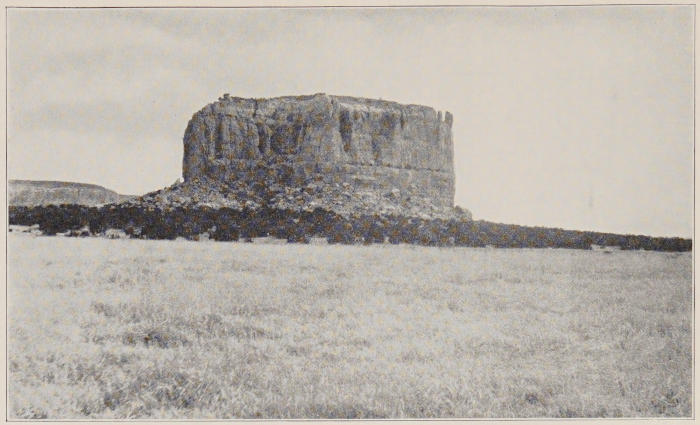
A turn of this road brings rather suddenly into
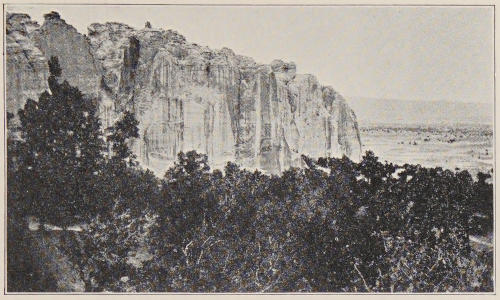
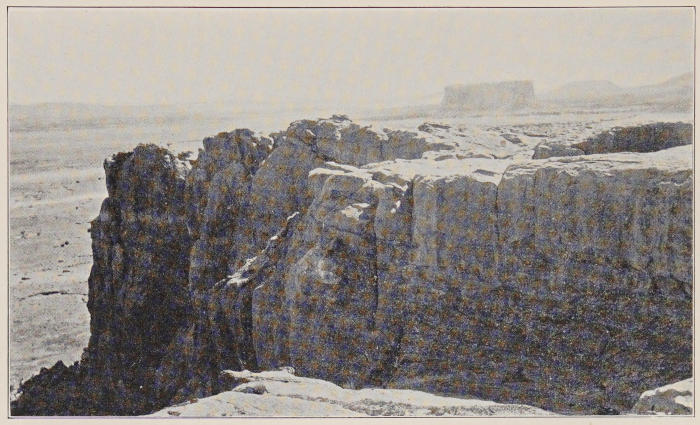
view the mighty circular butte of Katzímo, popularly
called the Enchanted Mesa, rising out of the
sunburned waste.
Under a late afternoon sun its precipitous walls and
its sharply turreted pinnacles stand forth in vivid
tones of yellow and rose. It looks quite inaccessible,
in spite of great heaps of talus at its base. These do,
in fact, lend little aid toward any ascent, and no
kindly zig-zag “toe-and-finger trail” exists. On the
southwest may be seen a cleft, as vertical and glassy
as the rest. Yet up this apparently unassailable
wall occasional ascents have been made by means of
ropes—one, within a few weeks of our visit, by two
women and two men. Of the latter, one was an Indian
who declared to me that nothing would tempt
him to venture again, though it is much more likely
that his reason was connected with the sacredness of
the place rather than with the difficulties of ascent.
From near this point we had our first sight of
Ácoma. The rock island rises from the austere plain
almost as isolated to-day in all essentials as when
Alvarado first saw it in 1540 and regretted the effort
it cost his men to ascend the cliff—“well fortified,
the best there is in Christendom.”
Halfway between Katzímo and Ácoma one June
afternoon we came upon a picturesque group of Indians
from Ácoma, both men and women, with many
horses and burros. It was a lucky circumstance for
us that a watering tank was in process of construction
near the pueblo, since otherwise almost all the
populace would have been at the summer villages a
dozen miles away. The women, who had cooked the
food for the men at noon, were sitting about upon
hillocks of fresh earth, adding color to the landscape
with their gay shawls. Our Laguna chauffeur was
known to them and spoke their language (Keresan).
He vouched for our friendly interest, and brought to
us the governor, who spoke a little English, and the
war captain (hócheni), who spoke none. The latter
was an older man, not in working clothes, but wearing
more ornamental paraphernalia. Friendly enough
they all seemed, and after payment of a fee for entrance
to the pueblo and for the privilege of taking
photographs (according to a printed formula that was
shown us) we went on, confident that we should get
what we had come for. A gift of candy and “smokes”
had brought smiles to all their faces, and we parted
hoping for further conversation in the evening, when
the workers returned to the pueblo.
KATZÍMO, OR THE ENCHANTED MESA
Bolton
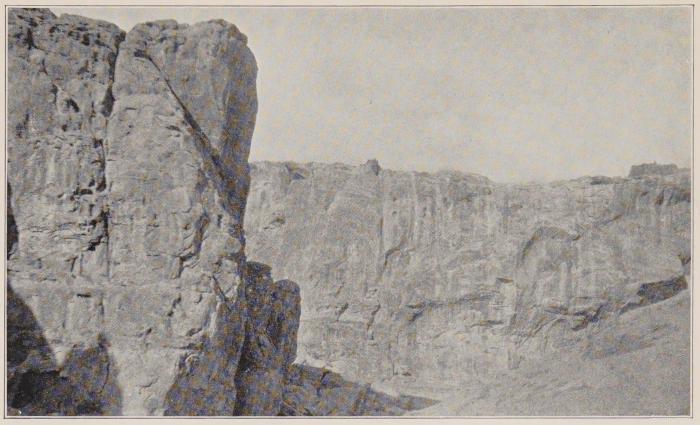
The nearer we drew to the great Crag, the more
extraordinary was the impression it made—a marvelous
agglomeration of abrupt escarpments, mighty
pillars, and rugged cavernous clefts. You enter as it
were upon the precincts of an astonishing stronghold
through a half-ruined gateway of outstanding columns,
broken by erosion but magnificent still in their
strength and dignity. Looking up, you are aware
that the grey sandstone walls above are not merely
perpendicular but actually overhanging, and are
gashed and splintered into scores of crags of an indescribable
grandeur. Absorbed in the general picture,
you think little at first of the long, even line on the
summit. It does of course indicate the blocks of
houses, which are so intimately a part of the cliff itself
that an approaching enemy must often have been deceived.
Nursing the illusion that this strangely carven
rock is in truth some battlemented stronghold of mediaeval
time, we made our ascent over a long stretch
of sand, and then up the ancient “toe-and-finger-hole”
trail in the rocks. At the top we were met by
women gracefully balancing on their heads trays of
fragile pottery. Quickly finding the one whom we
sought, we asked if she would be able to keep us over
a night. With a grave inclination of her head, but no
word, she turned, and we followed till she paused
before ascending by a ladder to the third storey of the
terraced house where she lived. Leaving our small
impedimenta for her to dispose of, we made our first
circuit of the pueblo. The quiet dignity and grave
courtesy of our hostess never forsook her, but they
did not chill us; and while we were with her we felt
welcome to make ourselves as comfortable as we
could.
Vetancur, the seventeenth-century chronicler, describes
the mesa as “a league in circuit and thirty
estados in height.”[6] Modern writers estimate its height
at 357 feet, and its irregular but practically level top
as seventy acres in extent.[7] The great rock is almost
cut in two by a savage cleft “like a pair of eye-glasses,
a small saddle representing the bridge.”[8]
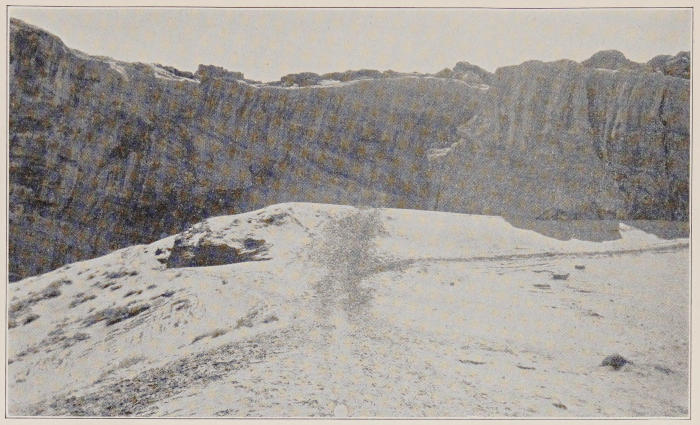
Sand in the course of time has drifted over this dangerous
bridge, and with disintegrated stone fallen in
from either side, there has been formed a narrow but
treacherous passage, which we were told the boys
dare one another to cross, but where no man will risk
his neck. It will be convenient therefore to designate
the two parts hereafter by the terms “north” and
“south” mesa. Although there are no signs of human
dwellings on the south mesa and no known tradition
that it was ever inhabited, Lummis writes of “a perfect
cliff-house” perched there on a dizzy eyrie.
THE SAND-RAMP, OR “NEW TRAIL”
Bolton
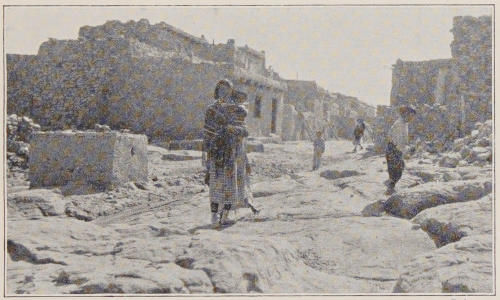
When seen from below, the outer walls of the dwellings
seem to be part of the mesa itself, merely hewn
from the solid rock. Closely approached, they are
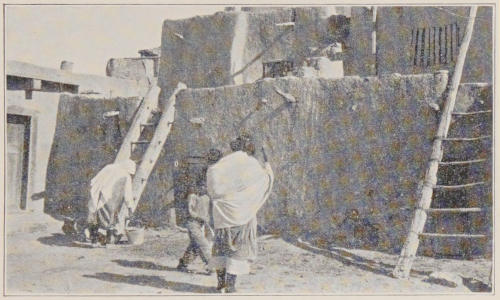
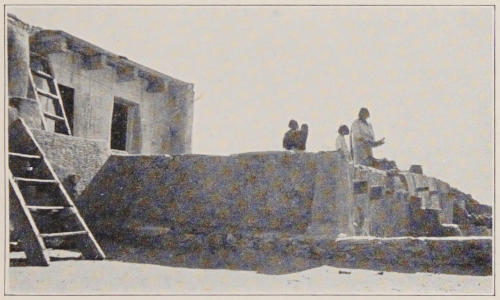
found to be as much fortress as house. Three parallel
lines of stone and adobe, a thousand feet long
and forty feet high, running east and west, are separated
from one another by calles or streets of moderate
width—the calle between the middle row and
the south row being left wider than the others, to
provide a plaza for open-air ceremonials.
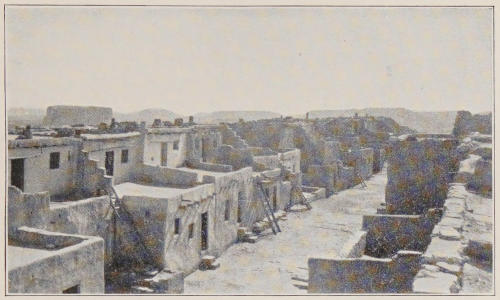
Each of these structures consists of three storeys
built in terraces, after a fashion common enough in the
pueblo country. The lowest storey is between twelve
and fifteen feet high, and had originally no openings
save trap doors on its top. It was used exclusively for
the storage of supplies, enough of which could be kept
there to withstand a long siege. The Ácomas therefore
enter their houses by ladders from the ground to the
second storey, but the third storey and the roofs are
reached by steep and narrow steps on the division
walls.[9] In all terraced pueblos, economy of construction
was one feature of this type of house. A far more
important consideration was necessity for mutual defense,
felt by every small community exposed to raids.
No one could foresee when would appear a roving
band of hostile Navajos, Apaches or Comanches, but
their forced tribute upon the crops at some time was
as certain as the dawning of the day.
Though in appearance these long blocks of apartments
are community houses, they are in no sense
communal if that term be used to define a socialistic
form of life. Each family or clan is a unit completely
separated from every other by very solid division
walls. Independence of all but the immediate family
or clan can hardly be carried to a greater extreme than
with the Indian. Injury or insult, even if sometimes
imaginary, may provoke tragic results. Silent and
wary by nature, and made suspicious by experience,
the Indian is indifferent to the well-being of his neighbor
across streets as narrow as those that separate the
house-blocks of Ácoma, and he asks an equal privacy
for himself.
May this not explain, at least in part, certain contradictory
information gathered from different sources
in the same pueblo, of which all investigators complain?
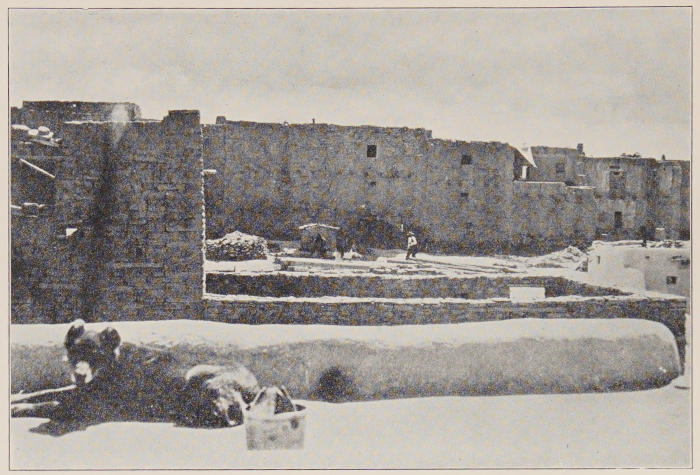
ÁCOMA NORTH ROW
Bolton
ÁCOMA MIDDLE ROW
Bolton
The old town shows signs of decay. The western
end of Middle Row is now broken down, displaying
the construction of the three storeys and the method
by which wooden vigas (beams) are mortised into the
adobe walls. One of the vigas was quite beautifully
carved with the same design we afterwards saw in
another house, where it was partly hidden by white-wash.
We were told that these two decorated beams
were taken from the first church when it was destroyed,
and that in earlier days the half-ruined house
had been the residence of the priest. Since at present
a priest comes from Laguna but twice in a year, it is
evident that he needs no permanent abode. Apartment-like
as they look from without, they are never
connected inside. Within the houses you will find an
open hearth for warmth and cooking. In most houses
there will be at one end three corn-grinding troughs
(metates) sloping like a washboard in a tub. Kneeling
behind them, a woman will use a small bevelled slab
of stone or lava, of the same material as the trough,
with which she crushes the grain, which then falls over
the edge between the slabs, each trough making the
meal finer than the one before. It has been noted
ever since Castañeda’s day, that, if not observed by
strangers, the women always sing at their grinding.
For several tribes the music for the Corn-Grinding
Songs has been written down.[10]
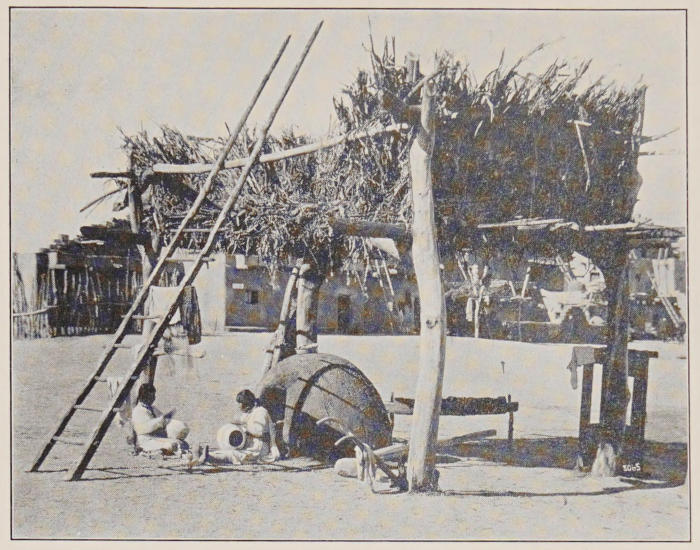
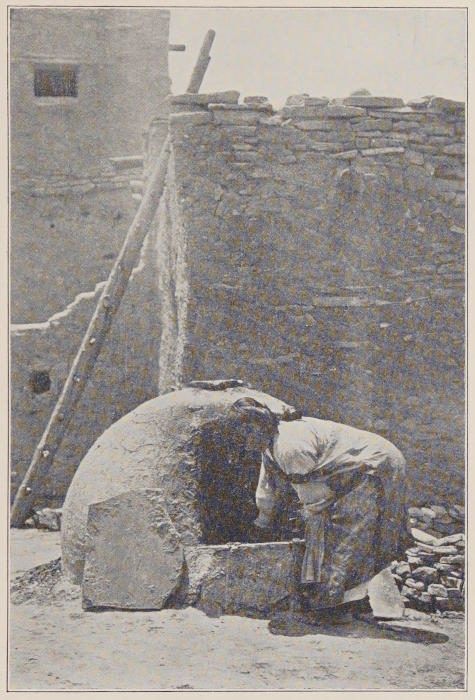
Outside the house, at fairly frequent intervals, are
beehive-shaped ovens where all the baking is done,
except that of the “paper bread” (guayave)[11] made
from blue corn, which must be baked on very highly
polished flat stones. These stones, which receive an
extraordinary degree of care from the women, are
placed upon a projecting part of the fireplace directly
over the blaze. The guayave we saw was about the
color and texture of a hornet’s nest and tasted rather
like popped corn.
It used to be true, in almost all the tribes, that men
did all the weaving and women made the baskets and
the pottery, but to-day one hears of women working
at the loom. Though the men do all the heavy
part of house construction, including the carpentering,
it is the women who build the adobe walls, and
do all the plaster work. The women make a game of
it, apparently, and show more gayety than at almost
any other time, whereas if a man were to be seen
helping them in the very least, he would be such a
butt of ridicule to all his comrades chat it would
amount to a disgrace.
Once a year before the great festival, on September
second, the inside walls of the houses are freshly
whitewashed. Against them are hung buckskins and
other garments, as well as guns, trinkets and the silver
necklaces made by their own artisans. Here, too,
adding high color to the motley array, are the dried
fruits, the chilis, and jerked meats, all hung from the
beams, as a food supply for winter. At night wool
mattresses (colchones) are spread on the floors. By
day they make comfortable seats against the walls
and are covered with gay blankets.
Few are the industries practised to-day by the
Ácomas. Apparently they get all cotton and wool
material for their garments by barter. A system of
exchange has been reduced to specialization among
many tribes, so that, if the Navajos now make most
of the blankets and silver trinkets, this is no proof
that other tribes are ignorant of these arts.
As a rule the Pueblo Indians can lay small claim to
physical beauty, though many photographs and modelled
heads bear witness to the austere and finely chiselled
comeliness of individuals. The Indian of the
pueblo, though strongly built, is apt to be smaller in
frame and shorter than his kinsfolk of the nomad race.
The coarse black hair is either worn loose by the men,
or is plaited in one or two queues and fastened with
bright-colored stuff of some kind. Those locks which
fall over the forehead are cut in a fringe even with the
line of the eyes, and a red banda is worn fillet-wise,
leaving the crown of the head uncovered.
The men as well as the women are extravagantly
fond of ornament, bedecking themselves with strings
of wampum or of bright glass beads. We found no
surer way to gain their friendliness than to give them
strings of small shells, or the more prized abalones
that were not too large to be worn on the breast in
time of festival. While the women also wear bead
chains, they are especially proud of their heavy silver
necklaces ornamented with pendants of the squash
blossom (emblem of fruitfulness) which are universally
and significantly a part of the costume for feast-days.
One is reminded of a similar custom in Greece,
where the girls wear their dowry in embroidery, and
necklaces made of gold chains, at the Easter dances,
often described as the “marriage market.”
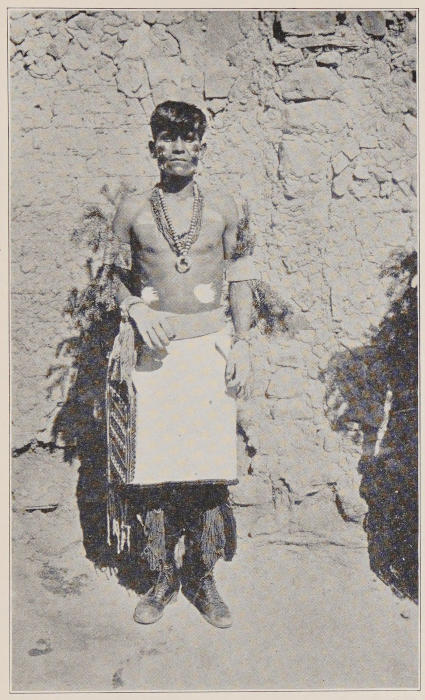
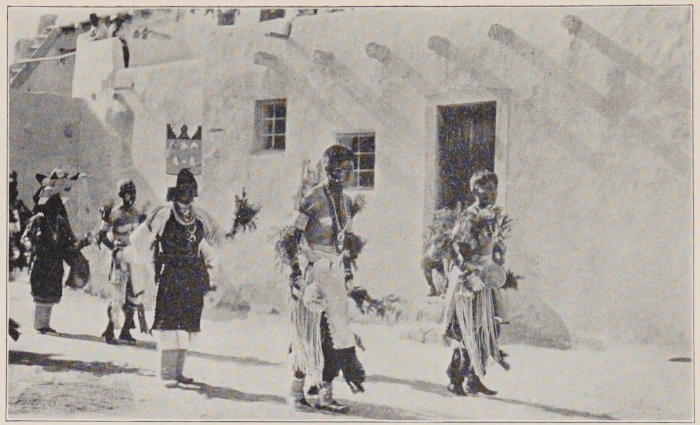
The fiesta dress of Ácoma has been so often described
that it need not be repeated here. We are
told that from the eagle feathers on their hair to the
rabbit-fur anklets, and turtle-shell rattles below the
knee, all is still as it used to be. These picturesque
costumes, costly and elaborate, are hoarded and
handed down for generations. After one has witnessed
a Corn Dance in an open plaza, one cannot
restrain a sigh of regret that so much of color and of
harmony with the environing scene has been lost to
the daily life of a world grown drab and over-conventionalized.
In the matter of dress the Indian is going through
a transition period. His native costume is fast disappearing,
since the children, after being put into
American schools and given dreary American clothing,
are apt to feel conspicuous and uncomfortable if
they return to the dress of the pueblo. No one who
has seen the blue and white checked uniform of a
reservation school can but regret this change. On
ordinary days there is little of the ancient dress to be
seen at Ácoma. The women all wear on the head a
shawl or kerchief that falls in soft flowing lines to the
shoulder. From the shoulders hangs down the back
a gay-colored square of silk (called utinat) generally
made still more lively by a contrasting border. The
dress may be of wool or of cotton in one piece worn
over a blouse with rather full sleeves. A belt embroidered
in red and white completes the costume.
The older women wear the footless stocking or the
heavy white legging, tucked into buckskin moccasins.
The half-grown girls usually prefer American shoes
and stockings and cotton gowns of the simplest lines.
The little children go barefoot, and are lightly clad in
one garment. Generally speaking, the men wear a
nondescript medley of blue overalls and a loose shirt
open at the throat, supplemented by a gay neckerchief.
When to this is added some jewelled ornament
like a precious shell amulet, or the insignia of office,
an embroidered belt, and a red banda filleted about
the head, there is still something delightfully quaint
and picturesque about their appearance, though so
much has vanished.
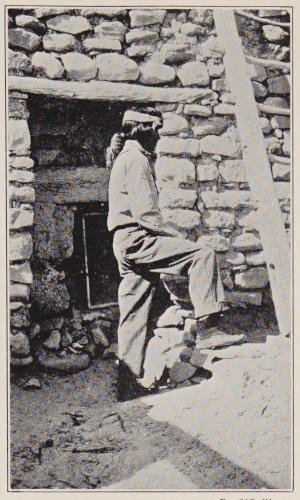
ÁCOMA MAN IN EVERYDAY DRESS
Fr. O’Sullivan
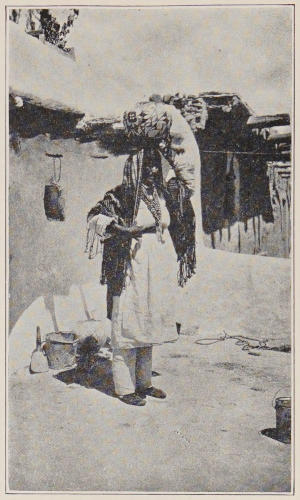
ÁCOMA WOMAN ON HER HOUSE TERRACE
Fr. O’Sullivan
The first necessity of life to the Pueblos, after
security from their enemies was assured, was a sufficient
water supply. No modern ideas of sanitation
have penetrated this community, and only the wonderful
quality of the air, so high and powerful in
desiccation, can account for their escape from epidemic
disease. After the dwellings, the most striking
objects here are moderate-sized tanks placed at intervals
along the streets, filled with water for household
use. On asking the source of the water upon this
arid and wind-beaten rock, one is told of two great
natural reservoirs[12] on the northern side of the mesa
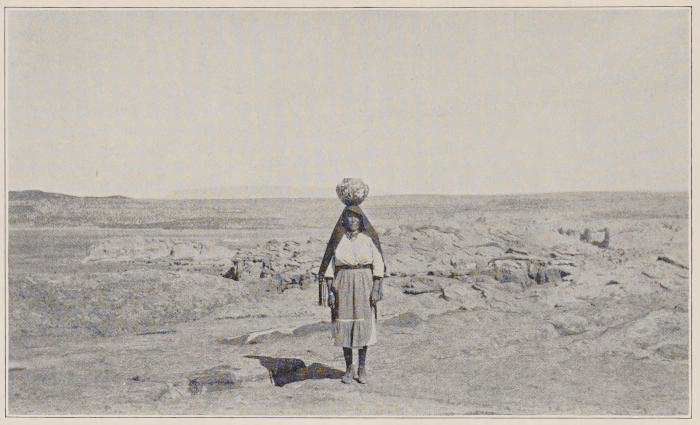
from which the women bring upon their heads, in
three-to five-gallon tinajas, all the water needed for
every purpose. Toward the close of day a beautiful
picture is made by women bearing aloft with perfect
poise these great ollas, or water jars. The reservoirs
are large, and so dry is the air at this great height that
the water is always cool. I have been told of the
children skating on them in March. The larger of the
two on the northern side of the precipice we found
emptied and scrubbed out, waiting for the longed-for
rains to fill it afresh. To our surprise we found the
grey rock was ruddy-hearted. The basin-floor was of
a warm tone patterned by nature like a mosaic, with
a design oddly suggestive of a colossal frog pinned
out under a microscope.
Lieutenant Simpson, in his famous report of 1850,
scouts the idea that these reservoirs were sufficient
for village use and quotes Lieutenant Abert, who
three years earlier wrote of water holes near which
his men encamped. “Between our camp and the city
[Ácoma] there was some water that ran along the bed
of the stream for a few yards when it disappeared
beneath the sand. This furnished the inhabitants
with drinking water.” It is true that, the night we
spent at the foot of the Crag, we were supplied with
water brought by our chauffeur and an Indian from a
spring a mile or more distant.
Not far below and a little east of the emptied reservoir
was a pathetic attempt at a garden on a fairly
level shelf of the rock, to which some soil had been
brought from the far-down valley. Here were one
good-sized peach tree and two tiny ones guarded by
an ungainly scarecrow. Of any other green or growing
thing there was no trace anywhere upon the northern
mesa.
A vast plain surrounds Ácoma, and the far horizon
to the south is ringed with barrier walls of forbidding
strength. Natural fortresses they are, with weird castellated
bastions and watch towers. Toward the
north, rises the gracious blue Sierra de San Mateo,[13]
an extinct volcano regarded with deep reverence by
all these native people. Thence came their timber
vigas or whatever other wood might be needed by the
pueblo, all to be brought by human labor across
thirty miles of desert.[14] On the slopes of San Mateo,
we are told, are the most holy and hidden places of
prayer and ritual, which the uninitiated may never
find or penetrate. Well-worn trails run from Laguna
and Zuñi as well as from Ácoma to the summit, and
I have been told by a resident of Albuquerque of an
altar and prayer sticks found there in recent days.
Leading from the top of the Crag to the plain below
there are, according to Lummis,[15] seven trails. Of that
number we identified six. We found one on the north,
one on the northeast, one on the southwest, and three
on the west. The seventh, which Lummis calls the
“Split Trail,” we did not see. We more than suspect
that there are, besides, trails to the south mesa.
Although Hodge thinks there were always several
trails, all difficult and more or less dangerous, the
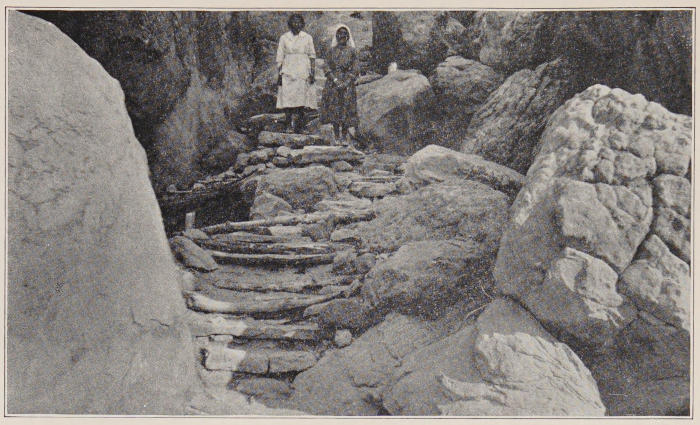
only one ordinarily accepted as existing before 1629
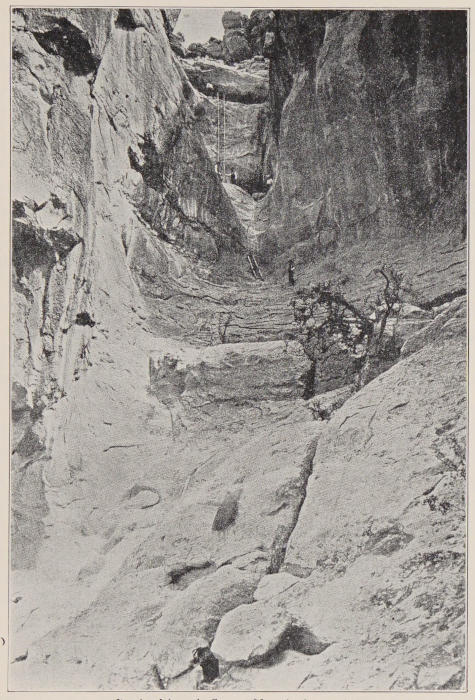
was that on the northwest side, called the “Ladder
Trail.” It was formed by toe and finger holes cut in
the solid rock and worn deeper by the moccasined
feet of the dwellers on the summit. This is the trail
that came to be known as the “Camino del Padre,”
after Fray Juan Ramírez made his famous ascent to
the rock in that year. Up such a staircase as this in
the early days every ounce of adobe for their houses,
and the wooden beams for their buildings, had to be
brought on their backs by the patient dwellers seeking
safety from the hostile roving tribes.
Not far to the east of the Camino del Padre, the
most often used of all the seven, is the dangerous and
now abandoned north trail, where Zaldívar made his
feint in the most audacious storming known to military
history. The Indians call it either the “Runner’s
Trail” or “Deadman’s Trail,” but they say it
has not been in use for many years. It seems as if
the trail described by the earliest explorers must be
that at the northeast end of the pueblo, for the much-used
toe-and-finger trail is neither long enough nor
hazardous enough to correspond to their descriptions.
One day when we were standing above the northeast
trail, an Indian with a sense of humor called to us,
when halfway up, asking for a rope to be let down,
and declaring for quite a while that he could never
arrive unassisted. Our host said, quite frankly, that
he often went down that way, but never came up by
it, because “It’s too hard work.”
THE LADDER TRAIL
Bolton
No trails over the sheer precipices to the east are
mentioned by any writer, and none on the south
except the one far round toward the southwest, sometimes
called the “Staircase Trail.” Over the upper
part of this trail are carefully built well-cut steps of
wood and stone, but the lower part is chiefly of the
toe-and-finger type. Near the top, in a small natural
cavern, we found little bundles of twigs and remnants
of feathers carefully hidden away, no doubt a
shrine of prayer.
Then there is the “Burro Trail,” which we concluded
is the one built under the inspiration of Father
Ramírez, so that a more comfortable pathway from
the plain might be possible for man and beast. At
its head is a good-sized wooden cross which still on
Cross Day, in May, is decorated with flowers and
before which the people used to kneel to receive a
blessing from the bishop during his annual visit.
Here daily come and go the burros upon their arduous
toil below. This trail debouches not far from the
wide sand ramp, which we heard called the “New
Trail,” a sort of dyke, formed in part by the wind in
recent years, and now the easiest footpath up the
Crag. The “Split Trail,” which we did not see, lies
on the west, between the Staircase and the Burro
Trail. It has three forks below, and its main stem,
above, is described as a very stiff scramble. I had
hoped to see the lower end of every one of these trails,
but we were told it was impossible to follow with the
car around the base of the rock, on account of the
sand, and though I was promised an escort on foot,
the man refused to go, when the time came, saying
he couldn’t understand why I wished to see where the
trails came out upon the plain. Did it seem to him
an idle fancy, or was he a little suspicious that we were
spying upon the pueblo for some mysterious reason,
which he resented?
Near the southern rim of the plateau, quite isolated
from the house-blocks, is the great church, still in
good repair. Later on during that first afternoon we
sat facing the western sky beyond its precincts, and
within sight, as we believed, of the famous cleft over
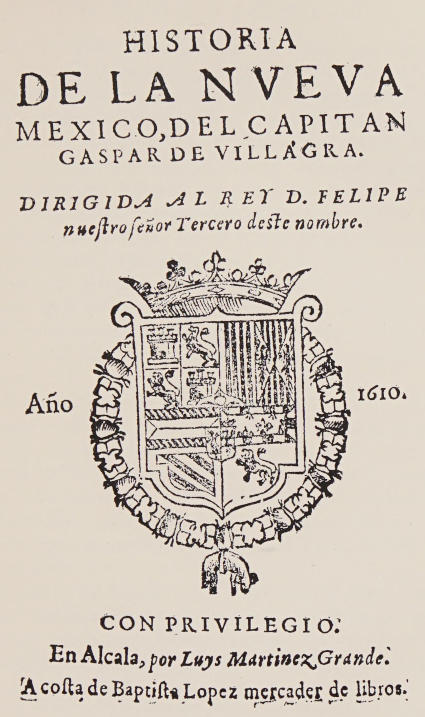
which Villagrá made his epoch-making leap in the
fight of 1598. Directly in front of us rose two colossal
pillars of eroded rock forming a portal through which
our eyes were led across the plain to where, over the
riven mountain walls, sunlight and an indescribable
depth of purple shadow were blending into amethystine
haze as the Sun God sank to his rest, just as one
has seen it over a boundless ocean. Who can do less
at such a moment than join in reverent worship of the
Sun? Soon came the men, one by one, from their
toil up the steep finger-and-toe trail to home and
supper, followed upon the Burro Trail by a great
company of those patient little beasts driven by boys
into a corral directly behind the church. All was
deserted, peaceful, so we also strolled toward our
house of friendly hospitality, climbing by its ladder
over the first storey and then by shallow steps in the
adobe to the next terrace. There our hostess met us
in the open door and signified that all our belongings
were to the left, beyond a low parapet, on the terrace
of a friend, now absent, and therefore available for
our use.
ÁCOMA “DOORWAYS”
Entrance from the Ground
Bolton
THE TWO UPPER STOREYS, ÁCOMA
Bolton
To our dismay our host and our Laguna guide were
just leaving “for a meeting of great importance,” and
with them all our cherished hopes of evening talk and
tales of the long ago (hamaha) and the far away.
Rather apologetically a man was pointed out to us,
sitting by the door, “Mr. Miller, who will talk with
you.” I found him to be one who had known several
students of Zuñi folk-lore, and who confirmed various
things about which we asked, but we learned nothing
new. Our disappointment was the old experience.
The self-respect of the Indians admits no curious
inquiry into their private life, and why should it?
How can they discriminate between the truly interested
and friendly student of their poetry, and the
selfish and unscrupulous exploiter of their sacred inheritance?
They have so long been made the target
of the unsympathetic white man who treats them as
fair game, that they have every justification for suspicion.
Trying as it was to us, who merely longed to
preserve and record their swiftly vanishing traditions,
we could not find it in our hearts to murmur. How
many of us would disclose to a casual stranger to
whom we had generously accorded a night’s hospitality,
the treasures of our ancestral heritage?
When we had spoken our good-nights, the mystery
of everything about us grew more profound, enfolding
all the world in the eloquent silences of moonlit
heaven above and dim floating space below. In such
a scene, as we lay upon an adobe terrace, which was
of course the roof of a house below, sleep seemed not
worth the courting. That may be had in the boisterous
town. This was for once only.
At midnight, at three in the morning, and again at
six, the Kahera or town-crier—an annually elected
official—went the rounds of all the streets, clad in
a scarlet blanket and jingling bells like those on the
sleigh-reins of children, chanting the while a monotonous
invocation. It proved to us the truth of an
observation that contrary to the usual pueblo custom
of a town-crier shouting out his news from the highest
roof-top, Ácoma has always pursued a fashion of her
own, sending the man through street after street just
as we heard him. When asked in the morning the
meaning thereof, our host said it was the announcement
of important work at the watering place and a
warning to all to bestir themselves. That might be
reasonable for the six-o’clock round, but it hardly
seemed so for the others in dead of night. We wondered
if perhaps it had aught to do with the invasion
of the Crag by three Americans.
Almost all visitors speak of the Ácomas as unusually
cleanly, and certainly our experience bears this
out. But since they lie down at night in their clothes
on their fur rugs or thin colchones, one wonders when
they get the refreshment of baths or of changed attire.
Morning toilets are consequently brief, and we, like
our Indian friends, were early astir. Except where
the household has adopted American ways, meals are
served on the floor in the ancient fashion. There the
family will seat itself in a circle around the bowls of
chili and coffee and bread. We were therefore interested
to observe that this household had assembled
about an ordinary rectangular deal table. Here also
had come for his breakfast the governor of the pueblo,
because he belonged, like our hostess, to the Eagle
Clan and had the right to be considered temporarily
a member of her family. His own people were already
gone to the farm-lands at Acomita and we were told
that many others would join the colony there upon
the arrival of the children next day from the schools
at Albuquerque or Santa Fé.
The whole policy of the community is rapidly
changing, for instead of the age-long custom of the
men going to Acomita only for the seasons of planting
and of harvest, more and more the bulk of the people
live there the year round. Why, say the younger generation,
should we climb those weary heights when
there are no Apaches to fear? Hence many of them
return to the pueblo on the Crag only for ceremonies
at stated intervals. This makes the atmosphere more
sacrosanct than ever, and consequently more difficult
for white students to study and record the life story
of the Peñol. Although James, rightly enough, calls
the people who now live in the lofty eyrie “pleasant
faced, soft voiced, gentle and hospitable,” the visitor
is never likely to be unaware of an impenetrable
aloofness of mind and manner, which holds him far
from intimacy. Our hostess soon made evident that
she was eager for us to leave early and she more than
sped the parting guest, with inviolable dignity but
also with very evident relief.
We had, however, an appointment to keep with the
governor, who had himself agreed to show us the interior
of the great church which brave Fray Juan
Ramírez had toiled to create in the early seventeenth
century. Surely there are few memorials of the Spanish
epoch in the Southwest that present such a picture
of dauntless faith in spiritual ideals as does this fortress
church silhouetted high against the sky above
the bleak mesa.
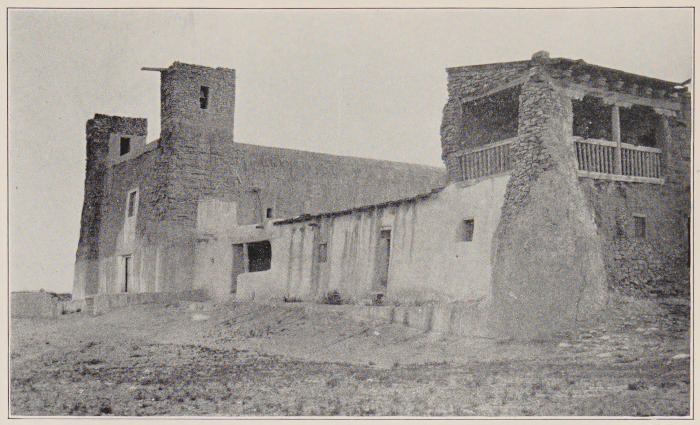
An impression prevails that the present edifice is
not in any part the original one of Ramírez, but one
built after the reconquest in 1699 or 1700.[17] In the
letters of Vargas he tells of paying a visit to the
church of St. Stephen in 1693, after he had received
the submission of its inhabitants. In his own words,
“the walls are a yard and a half thick and able to
withstand the heavy rains that break windows and
skylights.”
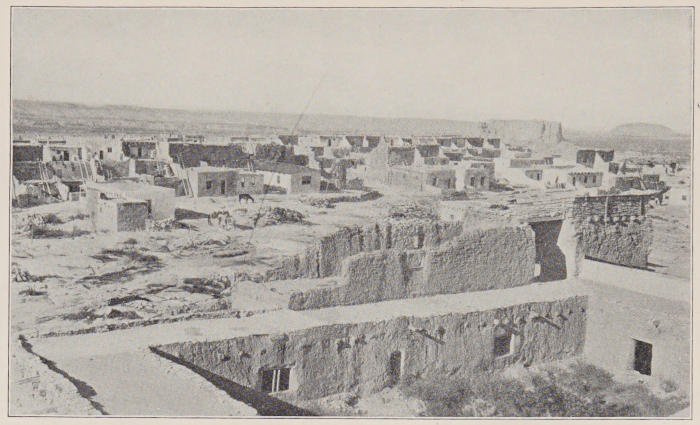
GENERAL VIEW OF ÁCOMA PUEBLO
Cloister in Foreground
Bolton
The interval of six years between this letter and the
date (1699) usually given as that of the present church
was so patently only the final struggle of the spent
force of enmity that it hardly seems probable the
Ácomas would take the trouble to demolish their
neglected church, especially to the extent of changing
its site “a few feet to the south.”[18] We may, therefore,
assume that by 1699 the shrine needed extensive
repairs, but that in substance we can visit to-day the
basilica of Ramírez. It measures 150 feet in length
and has walls that are 60 feet high and 10 feet thick.
Timbers 40 feet long and 14 inches through support
the roof and make a handsome ceiling, for between
them, laid in herringbone design, are the stalks of the
yucca, colored blue, yellow or red, making a close
rush mat visible between the beams. The entrance is
by a wooden door at the east, and a gallery just inside
is reached by a plain flight of steps close to the north
wall. There are of course no seats, and the only decoration
of the nave is a crude red dado of paint reaching
perhaps three feet from the floor. This and the bare
white wall above are freshly done each year before
the great fiesta of St. Stephen on September second.
At the western end the chancel is raised by three
shallow steps. Behind the altar is a gaudily painted
Mexican screen done in 1802. To the left hangs the
miracle-working painting of San José sent to the
Mission by Charles II of Spain, it is said. On the
opposite wall is another holy picture painted on buffalo
hide by some Mexican craftsmen. The San José
painting was for years a serious cause of dissension
and almost of war between Ácoma and Laguna, so
that it was amusing to have my host pull me by the
sleeve and say, sotto voce, pointing to our chauffeur,
“Don’t speak of it, he’s Laguna.” To one who has
seen the very beautiful decoration of walls and chancel
in the Laguna church, it seems unlikely that any
envy of Ácoma now exists in that village.
In the autumn of 1924, the Committee for the Reconstruction
and Preservation of New Mexico Mission
Churches received a gift from a generous citizen
of Denver, Colorado, that enabled them to repair the
roof of Ácoma church. Their report repeats graphically
the ancient story of the toilful work involved.
Once again might be seen the laboring procession of
heavy-laden Indians and patient burros carrying all
the material needed up the steep trail three hundred
and fifty-seven feet to the top of the mesa. Once
there, it must yet be hoisted sixty feet higher to
the roof of the shrine itself. So low was the water
in the reservoirs that that also had to be brought
from springs in the plain below. The statistics are:
50,000 pounds of water, 24,000 pounds of cement,
72,000 pounds of sand, 5,000 pounds of felt-roofing,
5,000 pounds of asphalt, and 35,000 feet of boards for
scaffolding.[19]
Perhaps no other modern task in the pueblo country
has so impressed upon the minds of present-day
workers the enormous labor or the devotion to a humanistic
ideal such as Fray Juan Ramírez inaugurated
at Ácoma more than three hundred years ago.
There were cloisters and conventual rooms adjacent
to this church which tell of its having been the centre
of religious work, and altogether it is one of the most
remarkable of the ancient missions; but of it we have
few genuine records. That, at one time, the patron
saint was changed to San Pedro, the bell in the northeast
tower bears witness by its inscription, “San
Pedro, 1710.” Subsequently St. Stephen resumed his
sway.
To-day the cloister is only a bare promenade of
three sides enclosed by walls on the ground level into
which a few unglazed windows admit scant light.
Upon the dirt floor more or less littered with outcast
odds and ends you are shown the hugest of beams,
lying prone, which it is claimed came from the early
church, and the marvel is how anything so gigantic
and unwieldy was ever got up the steep crag, even
after it had been brought across the desert from San
Mateo. Someone tried to tell us that the Indians
waited till rains had filled the arroyos of the mountain
slopes so that these heavy timbers could be floated at
least part way down the long journey; but my Albuquerque
informant, who owns great cattle ranches in
the vicinity of San Mateo, assured me that this was
impossible, since there are never streams sufficient for
any such purpose. He felt sure of the veracity of the
Indians, who say that after a viga for a church has
been cut and smoothed, it would be sacrilege to let
it touch the ground; it must somehow be carried
all the way by men. He knew that the vigas for the
houses were borne upon the shoulders of men. A
pleasanter walk than that within the cloister may be
taken upon its flat and unsheltered roof. From there
one looks down into the tiny and now very pathetic
garden patio in which one moribund peach tree alone
stands upright. From there too, he may lift his eyes
in rapt admiration to the splendid panorama of the
great plain and the encircling mountains.
Above the cloister and built upon its corner, there
is a charming loggia with a hand-carved wooden railing
of simple but attractive design. Here again the
view is inspiring, and one likes to fancy those self-sacrificing
priests refreshing themselves at the quiet
end of day by resting there and taking into their
wearied spirits the peace of so healing an aspect of
nature.
THE CHURCH, ÁCOMA
Bolton
It remains to speak of the great graveyard directly
in front of the church, “where the dead of centuries
sleep unmindful.” It is an enclosure nearly two hundred
feet square, surrounded by a stone wall, plastered
with adobe. This has been recently disfigured
by ill-moulded knob-like heads perhaps a foot high,
that stand at regular intervals on its top. We were
told they were done during the Great War, and are
called the “soldier guard.” Burial must take place
within twenty-four hours after death and there is at
Ácoma no separation of the sexes in that resting place
under the protection of the church. Either the father’s
clan or the mother’s clan takes part in the ceremony
and the company is made up entirely of men, save
that the water jar, which is to be broken over the
grave, may be borne by a woman. When the dead
body has been tenderly wrapped in its handsomest
blanket, it is lowered with the head toward the east,
and above the covering earth is broken the symbolic
jar of water.
Early one afternoon, we saw a sad little procession
coming up the long sand ramp bringing the body of
a woman of the pueblo wrapped in a glorious scarlet
blanket[20] for burial. The six bearers were carefully
dressed; two followed with bulky burdens on their
shoulders and one more behind had pick and spade.
As they slowly went through the widest street on the
summit, a bitter keening was taken up by all the
women, house after house, but all from within doors.
This lasted until the funeral group were within their
own shelter, when the women we were with returned
to their work without any evidence of emotion.
Naturally we could not intrude upon the burial itself,
of which, later in the afternoon, a dull and distant
drumming, followed by three or four strokes of the
church bell, gave warning. From a distance we saw
the censer swung while the earth was being removed,
and that only the nine men took part in the last ceremony.
Lummis tells us that during the actual interment,
the shamans in the desolated house are “blinding
the eyes of the ghosts that they may not find the
trail of the vanished soul on its journey to Si-pa-pu.”
The spirit of the deceased is believed to hover about
his earthly home for four days,[21] when a Cheani[22]
brings in the feather prayer-sticks,[23] which he has
made at home, and puts them where the deceased has
lain. Then he offers a prayer and bids him “begone.”
After this the Cheani carry these same feather sticks
to the gate of Si-pa-pu, a place a mile west of the
town where the rocky conformation opens to the
north. Meanwhile the household drinks a cedar brew,
and vomits. This is an essential part of all purification
rituals by which within and without the entire body
is made clean. There follows a general head-washing
of the kindred, or, as some have said, of all the clans-people.
Re-marriage may not occur till the end of a
full twelvemonth, and meantime the children have
been cared for by the kinsfolk of their mother, with
whom the father may also remain, if he is the one left;
or he may live with his own people.
A KISI IN A RIO GRANDE PUEBLO
An unmarried girl who had died in childbirth on
the day of the arrival of Dr. Parsons (from whose
monograph this account is taken) was buried without
the usual water jar of oblation and hence no broken
potsherds were left upon the mound. A feast, however,
was prepared, for which a sheep was killed and its
pelt offered for sale by her mother. Wafer bread was
baked, and a brew of cedar twigs was made on the
stove, of which the mother must have partaken, for
she was seen going through the usual after-vomiting.
It happened to be the first day of the hoinawe[24] dance,
but none of this household went out to watch it.
During the day the girl’s father had brought in a load
of wood, and in the evening he took supper with the
American guest and invited her to go with him to see
the cacique;[25] that being over, she was taken by the
father of the dead girl into two houses to see other
dances, an evident proof that the period of mourning
was at an end. The next day, being the fifth after the
death, all the household had their hair washed and
they now watched the dances. One of the women
who watched had earlier thrown bread to the dancers.
A decoction of the tansy-mustard[26] is drunk “to
make them forget the dead,” although it was once
described to Dr. Parsons at Ácoma as poisonous.
A second visit to Ácoma brought some new impressions
and confirmed or corrected others. To be where
the sun is the only time-piece by day and the Dipper
by night, and where no form of trade is nearer than
nineteen miles, unless one undertakes to transport
the delicate pottery of the women, is certainly a
unique experience. Through the day we watched at
intervals the marvelously deft and steady fingers of
our hostess as she outlined elaborate designs upon
some large jars, no two being the same, never hesitating
for an instant whether it were the hair-line in
parallels on the lip, or the curve of a bird’s wing on the
rounded surface, of the jar. A younger woman with
her yucca-fibre brush filled in the solid spaces, such,
for example, as a lozenge or the wing of a bird, all the
colors being previously ground and prepared in shallow
dishes from minerals collected by the women
themselves. During the day ten such jars were decorated.
That night we made our beds on the ground at the
foot of the Crag under “crumbling columns grand
against the moon” with such protection as we could
find from the sand flying before a high wind that
blew continuously even after there was no longer any
threatening of rain. Dark and heavy clouds threw
dramatic shadows on the outstanding towers that
rose all about us, taking on grotesque totemic forms,
rugged, massive, sculpturesque. If by day the houses
seem part of the Crag, by night the entire Peñol takes
on even more the aspect of a fortress with outstanding
escarpments.
When at last all grew clear, I sat through the hours
of darkness under a vast and vaulted sky in a silence
so enfolding that it was awesome. Only once the
whinny of a horse from a not distant corral broke the
stillness; only once some four-footed creature trotted
across the middle distance, stopped to watch me
curiously, but, because I was motionless, went on its
way, thinking, perhaps, I too was no more than an
outcropping figure of those walls and bastions that
seemed veritably the temple precincts of a more
heroic age and race than ours.
Then came the dawn, grey and pearly. As it
warmed to rose, we bestirred ourselves, sobered by
the solemnity of surroundings and of effects that
baffle words—scarcely even to be named beauty because
of overtones of a strange and wondrous majesty.
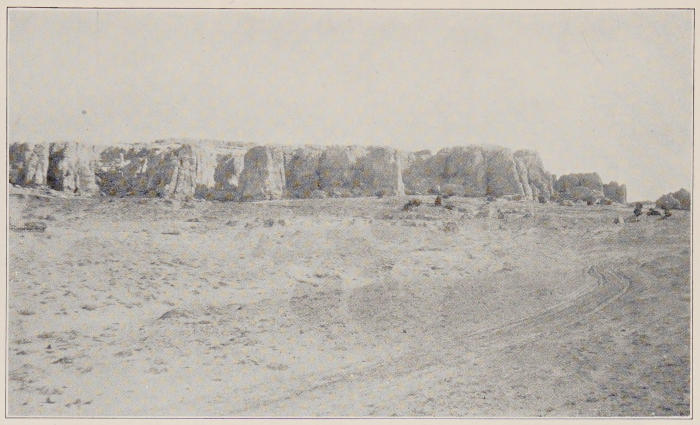
Before saying a final farewell to the Sky City, we
followed a road for nearly two miles, a little west of
north, out to a point from which may be had the
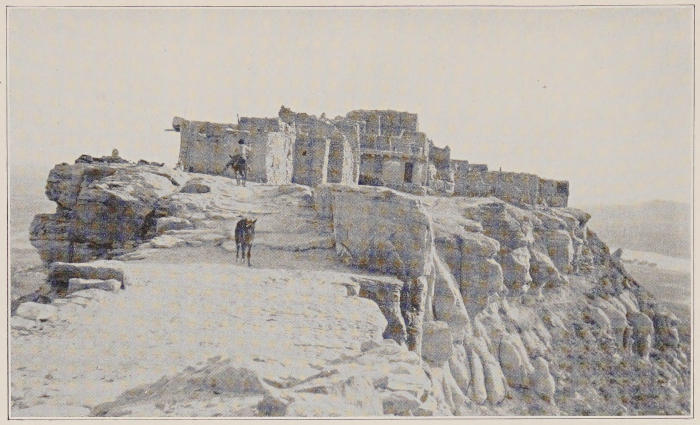
finest of all the general views of the Crag, with its
many vertical pinnacles and shadowy coves. From
there the length of the mesa-top is better comprehended,
as well as the perfect adaptation of the long,
low lines of the houses to the natural situation, while
the great church with its two very solid towers is
silhouetted against the sky as a separate and individual
element of the composition. Nowhere can be
better understood the keynote of pueblo culture,
which is the astonishing harmony attained by the
Indians with all the elemental forces surrounding him,
especially evidenced in the building of his houses as
a part of the natural setting. Five centuries ago the
Spaniard found the Indian and his dwelling probably
as they had been, it may well be, for thousands of
years. To-day, of all existing pueblos, Ácoma has surrendered
itself least to the changes which the invader
endeavored to introduce and called “improvement.”
THE LONG LINE OF ÁCOMA
Two Miles Away
Bolton
The age-long mistrust of the white men at Ácoma
had apparently reached a critical moment at the
time of our second visit. The hócheni (war captain)
was in full authority and the kindly host of our first
visit was helpless to make our stay rewardful. Apparently
they were the only men still on the Crag and
they were not in agreement about the reception to be
given visitors. Consequently we could see nothing
new, and I was even warned not to make notes within
sight of the hócheni. The number and position of the
kivas (ceremonial chambers)[27] were details about which
we were especially keen to learn, but, alas, we were
entirely baffled. I must therefore resort to a statement
of Dr. Elsie Clews Parsons that at Ácoma there
are two estufas (Spanish for stoves), which she calls,
“A, east end, north side of Middle Row, and B, west
end of North Row.” It is altogether probable that
Ácoma does not greatly differ from other pueblos,
either in its arrangement or its use of ceremonial chambers.
Hence I venture to describe them as given
elsewhere, and apply this knowledge inferentially to
Ácoma.
The number of kivas in the pueblos is very variable,
and because at Ácoma they are almost necessarily
embodied in the community house-block, instead of
being isolated structures as is true of most villages,
we have no visible token of their positions. Bandelier
says[28] that in his time there were six at Ácoma, but
Dr. Parsons found no one willing to tell her either the
names or number of them in her visits there in 1917
and 1918.
Though we never discovered the Ácoma kivas, at
Walpi, where no ceremonial was in progress, we were
allowed freely to enter those of the Antelope and of
the Snake Clan. The sacred chamber was in each
case a simple, unadorned room, with a bare hearth,
its entrance ladder resting on a low platform. There
were niches in the walls for ceremonial objects, and
hanging from nails or poles were some undistinguishable
small ornaments and a few masks.
A stringent requirement of the kiva form is that it
should be at least partly subterranean, so it is of necessity
entered only by a ladder thrust down from
the top through a hatchway. The more primitive
form of the kiva is circular, but at Ácoma it is described
as rectangular, because, owing to the conditions
enforced by a rocky table land, the kiva here
became a part of the lowest storey of the house-block,
hollowed somewhat deeper into the rock to
meet the religious requirement. The curious orifice
in the kiva, called Si-pa-pu, represents the place from
which human beings originally emerged, and the peculiar
arrangement of the floor within the kiva suggested
to Mr. Mindeleff that it perhaps typified the
four worlds of the genesis-myth, and the “four
houses” of the creation myths. The Si-pa-pu with its
cavity beneath the floor indicates the lowest house
under the earth—the abode of the Creator, Myuinga.
The main or lower floor represents the second
stage where Light came; the elevated section of the
floor, the third stage where animals were created.
Upon this platform animal-fetiches are set in groups
at New Year festivals. It is also to be noted that the
ladder to the surface is always of pine and always
rests on the platform, never on the lower floor. In
their traditional genesis, the people climbed from the
third house by means of a tree or a ladder of pine
through such an opening as the kiva hatchway to the
outer air, or the fourth world.[29]
The kiva has also been called the nearest approach
that the Indian had to a school-house for the boys of
the tribe. There, during the long winter evenings, the
old men—tellers of tales—would sit wrapped in
their many-colored blankets and recite their legends;
it might be the story of their origin and their wanderings,
or the blood-curdling relation of how their peaceful
life was broken in upon by the dreaded Comanches
or the Navajos; and then, again, by the invading
white men, who came on strange four-footed beasts,
filling the souls of the Ancients with terror and awe.
Out of such long-spun tales, from the poetry of
nature to the massacre of their “nations,” the wondering
boys would gradually learn the tribal lore of
their people and the mystery of their religious traditions,
which could be transmitted only word by word
from the elders to the growing generation. Morgan
tells us that, at Taos, the special duty of this all-important
instruction was given to three old men.
Regarding Ácoma, we have no definite information.
At Isleta, in conversation with an educated and
very reliable Indian, now federal judge of the
pueblo, I was told it is still a regular thing through
the winter evenings to assemble the boys, to whom
the older men “tell the stories of our origin and our
beliefs. We begin about nine o’clock every night and
talk till three in the morning, and it takes two weeks
of such talks to complete the story.” This suggests
that in Isleta, at any rate, there still exists the ancient
custom of the boys sleeping in the estufa, going home
only for their meals, just as Spartan boys were taken
from the homes of their parents to receive the arduous
Spartan training.
Not only were the estufas or kivas used for clan and
pueblo councils and for the education of the boys,
but nearly all the early Spanish chroniclers write as
if the men used them also as a sort of club-house
where they could keep warm on cold winter days.
Coronado speaks of “very good rooms underground
and paved at Granada (or Háwikuh) which are made
for winter and are something like hot baths,” and
again “places where the men gather for consultation.
The young men live in the estufas, which are underground,
square or round.” Father Escobar writes,
“There are many good estufas in each pueblo, which,
with little fire, are very warm and wherein they pass
the snow and cold of winter.”[30] In some tribes there
was certainly a discrimination made between kivas,
or purely ceremonial chambers, and estufas for more
commonplace purposes, where even the sweat baths[31]
were sometimes given. It is said that Keresan tribes
always have two kivas. We have no reason to think
that more than a single form existed at Ácoma.
The kiva was reserved for the business of the clan,
which included the training for the rituals, to be announced
to the pueblo in due season by the town
crier. Here also are celebrated the secret rites of the
fraternities and priesthoods, in many of which there
are grades of promotion through which only may an
individual slowly attain the goal of his ambition and
become a power in his tribe.
In times of council meeting, not even the Indian
women may approach the kivas save to place food
within reach of the entrance.[32] If need arises to summon
forth a member, prearranged signals are used.
The fire on the hearth may sometimes point out the
position of a hidden kiva to a wise-eyed stranger,
such as the one who wrote that at Ácoma “far into
the night the watcher is aware of a spiral of smoke
curling above the dark hatchway from the sacred fire
that never dies nor ever shall.”[33] It is desirable to
correct a popular misconception that the kiva was
ever in any sense a temple. The only temple the
Indian knew, or would think worthy, was the great
outdoors. Forest aisles or mountain shrines alone
served for the place of communion with Divinity.[34]
For appointed ceremonials small conical structures
called kisi are built in the open plaza for the necessary
offices of the ritual. These are made of cotton-wood
boughs covered with leaves and supported by
poles, each about fifteen feet long, driven into the
ground and strapped together at the apex. The orifice
for the Si-pa-pu is on the ground in front of an opening
facing the south.
Since prayer-smoke is the most nearly universal
symbol of the Indian’s yearning toward the Unseen,
I venture to quote here a song used in the ceremony
of the Hako, by a tribe so remote from Ácoma as the
Pawnee:[35]
See the smoke ascend!
Now the odor mounts, follows where his voice
Sped, intent to reach
Where the gods abide. There the odor pleads,
Pleads to gain us help.
Such are the most striking features of an Indian
pueblo. At Ácoma certainly they have been but little
altered since the sixteenth century. The political
organization of the pueblos seems to have changed
more, for, in respect to nomenclature, at any rate, it
is an interesting mixture of Indian and Spanish.
Chapter III FIRST EXPEDITIONS FROM NEW SPAIN
In the beginning of the sixteenth century, Spain occupied perhaps
the most prominent position on the theatre of Europe.... The Spaniard
came over to the New World in the true spirit of a knight errant, courting
adventure however perilous, wooing danger, as it would seem, for its
own sake. With sword and lance, he was ever ready to do battle for the
Faith, and as he raised his old war-cry of “Santiago,” he fancied himself
fighting under the banner of the military apostle. It was the expiring
age of chivalry and Spain, romantic Spain, was the land where its light
lingered longest above the horizon. Arms ... was the only career which
the high-mettled cavalier could tread with honor. The New World,
with its strange and mysterious perils, afforded a noble theatre for the
exercise of his calling, and the Spaniard entered on it with all the enthusiasm
of a paladin.—W. H. Prescott, The Conquest of Mexico.
The tradition is no longer credited that Cabeza de
Vaca in his marvellous journey of eight years from
the Florida coast across perilous lands to New Spain
actually saw any part of what is now New Mexico.
Nevertheless, it was the tales he had gathered on the
way, of the Northern Mystery and the Seven Cities,
that eventually brought both these localities into history.
Vaca reached Culiacán (Mexico) in the late
spring of 1536. Men stared to hear of Narváez’ ill-fated
attempt to “explore, conquer and colonize the
country between Florida and the Rio Grande.” They
were staggered at the story of all that had befallen
in the intervening years, by way of hardship, imprisonment,
and slavery, the four survivors of the gallant
three hundred who had entered the continent eight
years earlier. When Vaca arrived in the capital he
related his story to the viceroy, Antonio de Mendoza.
Here was great news for the silk-stockinged official.
Eager to gain for himself and his king the glory of
new discoveries of territory and of unlimited riches
that were said to be buried in the northern regions,
he made immediate preparations for exploration.[36]
First a preliminary reconnaissance was undertaken.
To lead it the viceroy chose Marcos de Niza,
a Franciscan friar, who had served a difficult apprenticeship
in Peru under Pizarro. Mendoza directed him
to go north with one lay-brother, Onorato, and a
small number of Indians. Coronado, Governor of
New Galicia, accompanied them as far as Culiacán.
The instructions with which Mendoza outfitted them
were “a model of careful and explicit directions.”
Estévan, a negro servant who had come with Vaca,
was interpreter, and varying bodies of native Indians
made up the party. They left Culiacán on March 7,
1539. At Petatlán, Fray Onorato became ill and was
left behind, after which Fray Marcos was the only
white man in the expedition. In the Sonora valley
they halted while Estévan was sent ahead to reconnoiter.
Estévan was to send back Indian messengers with
crosses, whose size would indicate the value of the
country found. After four days, a runner appeared
bearing “a cross as tall as a man.” This assured
Fray Marcos that Estévan had news of cities equal
to those from which they had started in New Spain.
The runner confirmed the impression by telling of
a province ahead with large cities built up with
houses of stone and lime, and all under one lord.
New Mexico in
the Seventeenth Century.
FROM BANCROFT. ARIZONA AND NEW MEXICO
Eager now, Fray Marcos started ahead. Soon he
met with Indians wearing fine turquoises in their ears
and noses, or on their waist belts. These folk, eager
to see the strangers pass on, told of houses farther
north that had their doorways studded with gold and
turquoises. To the infinite embarrassment of the
friar, gifts of this stone and of skins, such as served
the natives for raiment, were pressed upon him.
Other Indians that were met wandering inland from
the seacoast, talked of pearls that could be gathered
in quantity.
Estévan had been told to wait for Fray Marcos.
Instead he pressed on down the San Pedro valley. In
Cíbola he excited the anger of the native population,
probably by posing as a great medicine man and
using, very likely, the gourds or rattles of a hostile
tribe. According to the Zuñi legend, he was taken
beyond the pueblo precincts and there given “a
powerful kick which sped him through the air back
to the south whence he came.”[37]
When the friar arrived late in May (1539) within
sight of the first of the Seven Cities of Cíbola he
found the inhabitants in no mood to receive another
alien visitor, and, like Moses, forbidden to enter the
promised land, he could but look into it from a near-by
eminence on the south. Alone, and unarmed, he
had no other choice than to turn back, thankful, no
doubt, to escape from death himself, since he was
known to be the responsible chief of Estévan. By
hasty marches, “with far more fright than food,” the
friar reached New Spain once more. There he reported
to the viceroy all that he had seen. What
is more valuable, he scrupulously differentiated between
this and what he had been told of treasures in
the region beyond.
The Zuñis still talk of the “Black Mexican” and
point out K’iakima, a ruin on a bluff at the southwest
angle of To-yo-ál-a-na (Thunder Mountain) as the
place of his murder. Hodge, who has followed Cushing[38]
in very careful and important work at Zuñi, is
satisfied that Háwikuh was the village first seen by
Estévan and that there he met his death; also that
it “was the city of Cíbola rising from the plains which
Niza and his Piman guides viewed from the southern
heights in 1539; moreover that it was the pueblo
which Coronado stormed in the summer of the following
year, seems indisputable.”[39]
Háwikuh, to-day a ruin of great interest, lies fifteen
miles southwest of modern Zuñi. On our way thither
we overtook and passed an Indian pointed out as the
prize man in the foot-race that is of special ritual
significance to this tribe. A hardy, compact figure,
he was no longer young, but never failed to do his
daily stint of dog-trot practice which would keep him
in condition for the annual competition. Háwikuh
was built on the slopes of a round and not very
elevated hill. The most noticeable of the many excavations
are those of the kiva and mission church, not
far separated from each other, thus perfectly exemplifying
the dual religious allegiance that has prevailed
from the first baptism of an Indian by Spanish padres
until the present day. A great plain stretches out on
every side, sparsely dotted with the familiar stunted
herbage of the desert. Standing on the summit of
the mound, the middle distance is broken toward the
south by a range of moderate height and steepness.
On some one of its projecting cliffs the friar might
well have stood to look upon the coveted goal to
which he might not win. Vast horizons encompass
the plain and far off the twin peaks of the Zuñi buttes
pierce the sky. It is a lonely scene but the more easy
for that reason to re-people with the figures of a
vanished past.
Fray Marcos not only saw Háwikuh, but he also
heard of Ácoma. The Indian with whom Estévan
had talked told the friar that, besides these Seven
Cities, there were other territories which they called
Marata, Acus, and Totonteac. Acus was described as
an independent kingdom and province. Its people
went encaconados: that is, with turquoises hanging
from their noses and ears. The turquoise they called
“Cacona.” The village called “Ácuco” or “Tutahaco”
lay between Cíbola and the streams running
to the southwest, entering the “Sea of the North.”
Ácuco was Ácoma,[40] which therefore came into history
only twenty years after Cortés entered the City
of Mexico.
When Fray Marcos returned to Culiacán in the
late summer of 1539, his accounts of what he had seen,
and what he had heard, were sufficient to inflame the
imagination of the Spaniards there, who were longing
for conquest, for wealth, and for fame. It did not take
long to raise a volunteer army, nor to excite the
viceroy to do all in his power to further an expedition
that might be expected to bring much renown to
himself, to the King of Spain, and to Holy Church.
For it is never to be forgotten that the soldier armies
of Spain were always supplemented by smaller armies
of priests.
HÁWIKUH TO-DAY
First of the Seven Cities of Cíbola
Bolton
THE RUINED CHURCH OF HÁWIKUH
Bolton
The Royal Council of the Indies decreed that a
new attempt to explore the north should be made
both by sea and by land (1540). Hernando de Alarcón
was given command of two vessels, and he was
ordered to keep near the coast so as to be able easily
to coöperate with the land force. As a matter of fact
the two divisions never did meet or communicate.
Don Francisco Vásquez Coronado was chosen
captain-general of the overland expedition to the
north. He was accompanied by a gallant troop of
four hundred Spaniards and eight hundred Indians.
It must have been a brilliant spectacle when this
cavalcade, with its gaily caparisoned horses, its mule
train, and its herds of cattle and sheep for food supply,
finally set forth from Compostela on Shrove Tuesday,
February 23, 1540. The chief of the religious was
Fray Juan de Padilla, once a soldier but now a Franciscan,
destined to become the proto-martyr of the
North. Among others who bore distinguished names
three are of especial interest to us, since they have
left tangible evidence of their exploits. The standard-bearer
of the army, Don Pedro de Tobar, discovered
the Tusayán settlements (Hopi) and heard “of a
giant People and a mighty river.” Don García López
de Cárdenas first saw the great gorge known to-day
as the “Grand Cañon” of the Colorado. Hernando
de Alvarado, first of white men, saw Ácoma and
talked with its inhabitants.
While encamped at Zuñi the white strangers were
naturally objects of the utmost curiosity to the native
peoples. Among others who came to observe them
were some from Cicuyé (Pecos) seventy leagues eastward.
They were led by their cacique. He was
handsome and well formed, and because of his great
mustaches the Spaniards called him “Bigotes.” On
the body of one of his Indians was painted a picture
of a humpbacked cow (the buffalo).[41] Coronado was
told that great herds of these animals roamed the
plains. To test the story Coronado sent Alvarado
and twenty other Spaniards with the Indians charged
to report again at Zuñi in eighty days. For five days
they marched eastward. They then “arrived at a
town called Ácuco, a very strange place built upon a
solid rock, the inhabitants of which were great brigands
and much dreaded by all the province.”
It was Ácoma, now first seen by white men. The
Crag was described as very high, and on three sides
the ascent was perpendicular. The only way to reach
the top was by a trail cut in the solid rock. The first
flight was of two hundred steps, “which could be
ascended without much difficulty, when a second
flight of one hundred more commenced. These steps
were narrower and more difficult than the first, and
when surmounted, there remained twelve feet to the
top which could only be ascended by putting hands
and feet in the holes cut in the rocks.” It was evidently
the difficult trail near the eastern limit of the
village. On the top great piles of stones were kept,
to hurl upon an approaching enemy. No better proof
is needed of the importance to the sedentary Indians
of self-defense against the roving tribes than such a
fortress pueblo, difficult to reach and easily defended.
In warlike mood the Indians came down to the
plain to meet the Spaniards. Drawing a line in the
sand, just as those at Tusayán had done, they forbade
the strangers to cross it. Persuasion was first tried.
This failing, Alvarado decided to attack. Seeing such
preparations, the Indians showed willingness to make
peace by “approaching the horses to take their
perspiration and rub the whole body with it, and then
to make a cross with the fingers.”[42] They also crossed
their hands, an act considered inviolable. Castañeda
mentions a cross at Ácuco, “near a fountain, two
palms high and a finger in thickness. The wood was
squared and around it were dried flowers, and little
staves ornamented with feathers.” Alvarado reported
to Coronado that, on his way eastward to the
villages of Tiguex, he passed Ácuco. “It is one of the
strongest places we have seen, because the city is on
a very high rock with a rough ascent, so that we repented
having gone up the place.”
There is a curious conflict between the description
by Castañeda of this first encounter with the Ácomas
and that of another contemporary writer who apparently
formed a different impression of the dwellers
on the Peñol. In the anonymous “Relación del
Suceso”[43] we read, that Alvarado “found a rock with
a village on top, the strongest position that ever was
seen in the world, which was called Ácuco in their
language. They came out to meet us peacefully
though it would have been easy to decline to do this
and to have stayed on their rock, where we would not
have been able to trouble them. They gave us cloaks
of cotton, skins of deer and of cows, and turquoises,
and fowls and other food which is the same as in
Cíbola.”
THE STAIRCASE TRAIL AND THE CHURCH
Bolton
Such is the story of the first sight by Europeans of
the Sky City of the desert. In December, when the
ground was covered with three feet of snow, Coronado’s
main army marched from Cíbola to Tiguex, and
so passed Ácuco, as Alvarado had done. The inhabitants
furnished them with provisions in friendly
fashion. The Spaniards gazed at the settlement on
its summit with much interest, but could not ascend
(or they said they could not—it is not stated that
they tried) without helping one another, while the
Indians went up and down easily, and even their
women would do so carrying heavy burdens. From
this we infer that the Spaniards ascended the Peñol,
for after describing as before the “toe-and-finger
trail,” the chronicler continues, “there was a wall of
large and small stones at the top, which they could
roll down without showing themselves, so that no
army could possibly be strong enough to capture the
village. On the top they had room to sow and store
a large amount of corn and cisterns to collect snow
and water. They made a present of a large number
of (turkey) cocks with very big wattles, much bread,
tanned deerskins, piñon nuts, flour and corn.”[44]
There was undoubtedly room enough to “store” provisions,
but then as now there was never a particle
of garden soil in which to “sow” even a little corn
unless carried from the valley.
Epoch-making were the results that came from the
Coronado expedition, in the discovery of Cíbola,[45] of
the Grand Cañon, and of the buffalo on the Plains.
The discovery of the Colorado River was recognized
as of the first importance. This is shown by a map
made by one of Alarcón’s pilots, for the Ulpius globe
of 1542 and the map of Sebastian Cabot of 1544 were
changed by reason of this discovery. Yet Coronado
took back to Spain no material wealth, and no promise
of any except such as might be gained from the
cultivation of a good soil by permanent settlers,
and by some means, at that time undiscoverable, of
transportation for its products. Hence Coronado
was regarded not only as an unsuccessful explorer,
but almost as a disgraced man, who had wasted the
wealth of the realm.
So great was the disappointment over this result
and so absorbed were the men of New Spain by the
new mineral discoveries in Nueva Vizcaya, as well as
by the confusion produced by the Mixton War, that
forty years passed before there was another successful
attempt to penetrate the northern country. Such
sporadic raids as took place in this interval were
either personal adventures of individual Spaniards or
slave-hunting forays to fill the shortage of laborers at
the mines. These adventurers had little interest in
true exploration of the country they crossed while
the slave-catching aroused fear in the native mind
and made further entradas more difficult. A new generation
of Spanish explorers and settlers had arisen,
to whom Cíbola and Ácuco and Quivira were practically
myths, before any fresh interest was aroused to
explore the wilderness beyond.
Four decades after Coronado’s exploration, a party
of adventurous spirits made a fresh attempt to penetrate
the northern wilderness. They were only
twenty-eight in number, counting soldiers, three
friars and Indian servants. They were organized by
a lay brother of St. Francis, Fray Augustin Rodríguez.
Francisco Sanchez Chamuscado commanded the soldiers.
On the whole, they met little opposition from
the native peoples and on their side appear also to
have dealt considerately with them.
Curiosity concerning these strange white invaders
was mingled with fear born of the earlier forays
made to capture slaves who were taken back to the
mines. So soon as Fray Rodríguez made evident that
he asked no more than fish and maize in exchange for
such merchandise as had been brought along for this
purpose, the people showed a child-like interest and
pointed out the way to the north. In the Tigua
country, more hostility was encountered. One of the
priests, Fray Santa María, determined, against the
protests of soldiers and padres, to return to beg additional
help from the viceroy. “Children of the Sun,”
the Spaniards had called themselves to these worshippers
of the great Sun-Deity, and Santa María
seems to have relied on the belief they had engendered
hitherto in their invulnerability to attack. His departure
excited the suspicion of the natives and, as
he was entirely alone, he was easily killed within two
days “while sleeping, by having a large stone placed
upon him and left to die of suffocation.” Thus did
the savages learn that Spaniards could be put to
death like other men, and this knowledge proved a
serious obstacle to the future progress of the invaders.
Constantly forced after this to be on their guard
against plots and ambush, the explorers settled
themselves for a time at Puaray (a little above the
present city of Albuquerque), from which place excursions
were made in various directions. On one of
these, going westward, hoping to find Zuñi, they
reached “a well-fortified pueblo named Ácoma, the
best there is in Christendom.” It is described by their
diarist as having five hundred houses of three and
four storeys. This, then, is the next definite mention
of the Peñol. Here they were told that with two
days’ further march inland they would reach many
pueblos and mines; consequently they did not linger
at Ácoma or make any close examination of its people
or their civilization.
With the remainder of this expedition[46] we have no
further connection beyond the fact that, when they
had returned to San Bartolomé and reported that
they had reluctantly left behind their two friars, the
order of St. Francis at once bestirred itself to attempt
their rescue. On the tenth of December, 1582,
the endeavor was inaugurated under the leadership of
Antonio de Espéjo, who offered to finance the whole
undertaking. One of the soldiers in Espéjo’s company,
Miguel Sanchez Valenciano, took with him his
wife, Doña Casilda de Amaya, and their two young
children, an astonishing example of courage on her
part. She was in consequence the first white woman
to enter New Mexico, the heart of the continent, a
third of a century before the Puritans brought their
families to Massachusetts.
Espéjo knew full well about the death of Fray
Santa María, for Bustamente and Gallegos, the two
chroniclers, had already gone to Mexico City to report
the whole story of their experiences.[47] There
were rumors, too, that the other friars had been massacred
since the soldiers left. But the uncertainty
must be removed. It was, however, a full year later
that Espéjo confirmed the truth of the massacres,
when he reached Puaray. The avowed purpose of
the entrada was now accomplished. Espéjo, however,
was not without other ambitions, and finding that
his religious adviser, Padre Beltrán, was in sympathy
with him, he decided to make further advances into
adjacent lands. One of the routes took them as far
as Jémez and thence to Ácoma.
Espéjo’s narrative describes the fortress of Ácoma
as follows:
We set out from this province, Emexes [now known as Jémez],
toward the west, and after going three days, or about fifteen
leagues, we found a pueblo called Ácoma, which it appeared to
us must be more than fifty estados in height. In the very rock,
stairs are built by which they ascend and descend from the
town, which is very strong. They have cisterns of water at the
top and many provisions stored within the pueblo. Here they
gave us many mantas, deerskins and strips of buffalo-hide,
tanned as they tan them in Flanders, and many provisions, consisting
of maize and turkeys. These people have their fields two
leagues from the pueblo on a river of medium size whose waters
they intercept for irrigating purposes, as they water their fields
with many partitions of the water near this river, in a marsh.
Near the fields we found many bushes of Castilian roses. We
also found Castilian onions, which grow in this country by themselves,
without planting or cultivation. The mountains thereabouts
apparently give promise of mines and other riches, but
we did not go to see them as the people from there were many
and warlike. The mountain people come to aid those of the
settlements, who call the mountain people Querechos.[48] They
carry on trade with those of the settlements, taking to them salt,
game, such as deer, rabbits, and hares, tanned deerskins, and
other things with which the government pays them.
In other respects they are like those of the other provinces.
In our honor they performed a very ceremonious mitote and
dance, the people coming out in fine array. They performed
many juggling feats, some of them very clever with live snakes.[49]
Both of these things were well worth seeing. They gave us liberally
of food and of all else of which they had. And thus, after
three days, we left this province.[50]
Four days’ march from Ácoma to the westward
brought the party as far as Cíbola (Zuñi), where they
halted at the village of Hálona, the present pueblo of
the tribe.[51]
The great achievement by Espéjo was the new approach,
making the third pathway from Mexico to
the north, and to this re-discovered province which
he called Nueva Andalucía. Soon afterward it was
permanently christened Nuevo Mexico.
The golden dream of the earlier explorers had been
of a land bursting with riches and glorious in opportunities
for lasting renown, in short, another “Peru”
or another “Mexico.” Assuredly it had led them
through dangers and hardships which to modern ears
sound as much like fairy tales as the treasures these
gallant men hoped to secure. If the reality was far
from the dream, it was, nevertheless, a land of promise.
There continued also a belief in the Strait of
Anian, the long-hoped-for northwest passage between
the Atlantic and the Pacific, and some of the claimants
for the right to govern the northern territory,
while speaking scornfully to the viceroy of the sterile
deserts of Cíbola and Quivira, affirmed that the true
wealth was beyond, and that by reaching that “beyond”
there would also be discovered the shorter
route between the two great seas.
TO-YA-LA-NE
From Modern Zuñi
Bolton
MODERN ZUÑI, ON SITE OF ANCIENT HÁLONA
River in Foreground
Bolton
Enough had been discovered by Espéjo and his
men to stir the imagination and the cupidity of all
New Spain. Quite naturally Espéjo felt himself entitled
to the first chance. But there were many other
aspirants, and Espéjo’s recommendation that the new
province should be subject directly to the King of
Spain and not to the viceroy of New Spain, was
probably no help to the fulfillment of his ambition.
In 1595 it was decided to make a fresh attempt to
conquer and colonize on a much more complex and
thoroughgoing scale than any of the others, and,
beyond New Mexico, to reach the much-talked-of
Quivira. The command was entrusted to the greatest
of all those who went into the north, Juan de Oñate,
who became the true founder of New Mexico. Bolton
in commenting upon it says, “This was then the
great epoch-making step toward both the Strait of
Anian and the Sea; no less than the pushing forward
of a frontier whose interstices it would take a hundred
years to fill, even with military outposts.”
Chapter IV THE BATTLE IN THE SKY CITY — As told by an Eye Witness
Hand to hand and foot to foot
Nothing there save death, was mute.
Strike, and thrust, and flash, and cry
For quarter or for victory
Mingle there with the volleying thunder.
—Byron, Siege of Corinth.
There are few figures in the early history of this
country so gallant or so picturesque as that of Juan
de Oñate, son of Cristóbal Oñate, the man who discovered
the rich mines of Nueva Galicia, thereby
laying the foundation of one of the first fortunes of
North America. The son, Juan, added lustre to the
name by his marriage with the houses both of Montezuma
and of Cortés, so it is scarcely to be wondered
at that the viceroy Velasco chose him from the crowd
of hungry applicants to be the leader of a fresh expedition
to the new province.
Oñate was accompanied by three others whose
names and fortunes are fitted to thrill those to whom
the real human hero is a figure more full of true romance
than the characters of fiction. These were the
two nephews of Oñate, Juan de Zaldívar, maestro de
Campo; Vicente Zaldívar, sarjento-mayor; and Captain
Gaspar de Villagrá, procurador-general.
Villagrá proved himself not only valiant in arms
but a poet of no mean rank. Eleven years after the
event, Villagrá published in Seville a rhymed account
of the whole of the first Oñate expedition. When
Bancroft consulted it in 1877, as a mere literary curiosity,
he found instead “A complete narrative of remarkable
historic accuracy ...” and he adds, “Of
all the territories of America, New Mexico alone may
point to a poem as the original authority for its early
annals.”
FACSIMILE OF TITLE-PAGE OF VILLAGRÁ’S
RHYMED HISTORY OF NEW MEXICO
Don Gaspar begins his epic in true Virgilian manner:
Bancroft regrets that the petition and contract
granted to Oñate by the viceroy Velasco were unattainable.[53]
Since his writing they have been
discovered.[54] His contract to colonize New Mexico was made
in 1595. Oñate agreed to supply at his own cost not
only two hundred men, but all their equipment, and
the live-stock, merchandise, and provisions for the
support of the colony for a year. They started forth
with eighty-three wagons, seven thousand head of
stock, and one hundred and thirty persons. In return
for this, besides emoluments of land and titles, free
from crown taxation, Oñate was to be governor, adelantado,
and captain-general of the province. He
asked the government also for the support of six
friars with proper church furnishings, and likewise
full instructions concerning the conversion of the Indians,
and the tributes he had the right to exact from
them.
A change of viceroys brought about most annoying
delays—even a leisurely investigation into Oñate’s
fitness for the task. There seem to have been no
limits to the official obstacles put in his path, including
false calumnies whose refutation was not easily
established. But, according to Villagrá,[55] the general
never for one moment dreamed of relinquishing his
enterprise.
Finally, on January 26, 1598, nearly three years
after the first award of the contract, Oñate actually
started north from Santa Barbara. In four days he
reached the Conchos River. Here the unwelcome
visitador[56] was finally got rid of, and Fray Alonso
Martínez with ten Franciscans was assigned as the
religious aid of the pioneers. Oñate’s own equipment
almost staggers the imagination in its elaborate and
complete detail.
“The lucky-starred Vicente” Zaldívar opened up
a new and shorter highway from Mexico to the Rio
Grande, straight to “El Paso,”[57] and here on the last
day of April, 1598, Oñate took formal possession of
New Mexico and “all the adjoining provinces” for
God, the King of Spain, and himself, with even more
than the usual grandiloquent ceremonial deemed essential
for such an event. In addition to the customary
religious service, a comic drama written by Captain
Farfán was enacted. The theme chosen depicted
a conflict between Christians and Moors, in which,
through the aid of Santiago, the Christians were victorious.
El Paso is therefore the original home of
European drama in the Southwest.
One of the duties given Oñate was to capture any
wanderers he might find of the unauthorized exploring
ventures that had left New Spain during the preceding
years, and by good fortune he did secure two
men, left by Castaño, who understood three languages—Aztec,
Spanish, and one of the New Mexican
tongues. Later, a more valuable aid was the Indian
Jusephe, who had been with Humaña and whom
Oñate found with the Picuris tribe. With these men
as interpreters he could proceed more successfully.
The next thing was to force the submission and obedience
of the natives.
Beyond El Paso short excursions were made, to explore
or to secure maize for food. Crossing the river,
Oñate went ahead of the lumbering caravan to “pacify
the land”—taking sixty of his men with him.
By the twenty-fifth of June the company reached
Puaray, where the friars were given lodgings in a
newly painted room. Imagine their astonishment
next morning when they faced upon the walls sketches
which fresh paint had failed to obliterate and which
they recognized as portraits of Friars López and Rodríguez,
martyred seventeen years before.
In a kiva ceremony at Santo Domingo, the chiefs of
thirty-five tribes knelt to kiss the hands of Oñate and
of Padre Martínez. Thus an “erstwhile free and
sovereign people” became subjects of Philip III of
Spain and converts to Holy Roman Church.
They reached the pueblo of Caypa on July 11th,
and here Oñate made his headquarters until the
spring of 1599, but changed the name to San Juan de
los Caballeros, to celebrate the knightly company who
had successfully achieved their task. In the words
of Villagrá,
... at the end of all our toils,
And labors with alternate weal and woe,
We were at length approaching full of joy
A graceful pueblo beautifully laid
Out, and to which the name was given of
“San Juan,” by many “de los Caballe-
Ros,” to recall the mem’ry of those who
First hoisted high, in these new lands
And regions vast, the bloody Ensign on
Which Christ was, for the weal of all Mankind, upraised.[58]
At San Juan, in the province of New Mexico, there
was founded therefore the second permanent colony
in what is now the United States, nine years before
Jamestown and more than twenty years before Plymouth.
Not all was made serene and easy for the conquerors,
and because the ground was not paved with
silver, many of the frontiersmen became turbulent;
others deserted, making their escape on stolen horses.
To capture such, Captain Marquéz and Villagrá were
sent in hot pursuit. While they were absent, Oñate,
accompanied by Father Martínez and a suitable escort,
went forth to visit the more western pueblos in
order to receive their formal submission. As his representative
at San Juan, Don Juan Zaldívar was appointed
commandant of the troops and governor of
the colony, but with orders to hand over this control
to his brother Vicente so soon as the latter should
return from the buffalo plains.
Meanwhile Oñate himself visited, among other
places, the Peñol of Ácoma, where he was received
with much apparent cordiality, and was given
“maize, water and turkeys.” According to the usual
custom, surrender and fealty to the rule of the lieutenants
of the Spanish monarch was demanded of the
natives. Although up to this time few hints are given
of any hostility from the Indians, Oñate was far too
wary to risk surprise, and forbade his men to separate
from each other while on the mesa. The cacique,
Zutucapán, whom we may picture to ourselves a man
of intelligence, crafty enough to mask his intent behind
keen, penetrating eyes, came forward to offer
the white lord the supreme honor within his gift:
Would the señor descend to their holy of holies, the
subterranean Kiva in the rock? There he would receive
signal proofs of the desire of the Ácomas to
become worthy subjects of this all-great sovereign.
Oñate, closely surrounded by his men, very probably
looked down the hatchway from which tall, mast-like
poles of the entrance ladder protruded. Was it the
silent darkness of the great hole, or did some prophetic
warning of danger hold him back? At all
events, with courteous disclaimers he refused the
honor and went his way, all unaware, it would appear,
how narrowly he had escaped death from savages
waiting at the ladder’s foot to give him short shrift.
Villagrá, upon reaching San Juan, found Oñate
gone to Zuñi, there to await Zaldívar and the thirty
soldiers with whom he hoped to realize his dream of
reaching the western sea. Consequently he hastened
on unattended to report to the general his success in
bringing back the deserters from the army. Like his
chief, Villagrá was met at Ácoma with friendly entreaty
by Zutucapán, who, however, was something
too persistent in his questioning, so that the Spanish
captain took alarm and apparently did not leave his
mount. Assuring the cacique that he was merely the
avant-courier of a very large Spanish force hastening
to join the general, he managed, though pursued, to
escape.
Toward nightfall, man and beast faltered with exhaustion.
Throwing himself on the bare ground,
Villagrá slept, but awakened while it still was dark
to find himself covered by a blanket of snow. The
day must not betray him. Mounting his tired horse,
he started forward. Only a short distance farther
on both fell into a deep pit prepared by the Ácomas
for unwary strangers, well screened by brush and now
also hidden by the falling snow. Half stunned, Villagrá
crawled out, but his horse was dead. For four
days thereafter Villagrá tells us he staggered on, with
a favorite dog for sole companion, foodless and waterless,
since the snow had ceased and only the arid earth
was visible. At length he laid himself down to die,
when by rare good fortune he was discovered by some
of Oñate’s men searching for lost horses. Carried to
camp, and nursed to health again, he played his heroic
part only a little later in the assault and capture
of the great Sky City. By so narrow a margin has
posterity inherited his priceless history of the great
adventure.
Don Vicente de Zaldívar, having arrived at San
Juan, took over the command of the colony as ordered.
On the 18th of November, his brother Don
Juan started for his western journey, with thirty soldiers,
to join Oñate at Zuñi. Meanwhile the bitter
disappointment of Zutucapán, foiled by Oñate and
again by Villagrá, had had time to ferment into more
diabolical designs against the next coming of white
usurpers of the land. As Zaldívar approached Ácoma,
he was met by the cacique and his confederates in
friendliest guise. They seem not only to have urged
the Spaniards to visit their sky city but to have
promised ample provisions for the further journey.
Quite unsuspicious of the evil in their hearts, Don
Juan with sixteen companions went up the steep
footway in the rocks. The others remained below
with the horses. Still off-guard, Don Juan allowed
his men to separate on the mesa-top, beguiled by
plausible invitations to one or another point of interest.
And now we see the stage set for the tragic sequel.
Bare rocky floor. Grim eyeless blocks of building.
An illimitable sky, grey and pitiless. On one side a
horde of fierce barbarians consumed by primeval passion
to resist the entry of an alien force. On the other,
a handful of white soldiers, who though armed can
make no concerted defence because they have foolishly
drawn apart from one another. There is no path
of escape, no possible signal for help to those below.
Suddenly a hideous war-cry rends the air, and every
Spaniard is assailed by mad savages with war-clubs
or is pierced with arrows. From house-tops huge stones
are hurled. Brave and alert, the Spaniards sell their
lives dearly in a terrible hand-to-hand struggle. Don
Juan and Zutucapán meet in mortal combat and the
valiant officer falls beneath the blow of a massive
war-club. Swift and short we may believe the onset,
till, breathless, the few Spaniards still alive succeed
in getting together. Wounded, but not beyond effort,
Captain Tobar and four of the soldiers, pushing and
being pushed, finally reach the edge of the abrupt
cliffs at the same moment. With a last desperate
effort, and we may think by common though unspoken
consent, they determine to die by throwing
themselves over the precipice, since to die seems all
that is left them. By what even then was deemed a
miracle, only one of the five was killed in that fearful
jump of one hundred and fifty feet. It is supposed
that they must have landed on the sand that is
heaped at certain places against the base of the cliffs.
At all events, the other four were rescued by their
companions below, and, probably because of the fear
still felt by the Indians for horses, the camp was left
unmolested by the victorious savages long enough for
the Spaniards to regain some strength; being under
the overhanging rocks they were safe from missiles
thrown from above.
THE FORTRESS HOUSE OF ÁCOMA
Fr. O’Sullivan
But fear lest this treachery of the Ácomas was only
the prelude to a general uprising of all the pueblos
made the Spaniards decide to break camp at once.
Separating into small bands of three or four men,
they went by different routes, some to warn Oñate
of his peril, and others over the arid miles to San
Juan, to provide such defence as was possible there
for the women and children.
The scheme succeeded, and by the end of the
year 1598 all the Spaniards in New Mexico were assembled
at San Juan. Oñate, waiting at Zuñi for
Zaldívar, had become anxious, and had retraced his
path so far as a camp called El Agua de la Peña.
There he was met by Bernabé de las Casas,[59] “who
with six companions had come with the sad news of
the occurrence at Ácoma, and of the death of Don
Juan de Zaldívar with other captains and soldiers.”[60]
A serious problem now faced Oñate. The Indians
could not go unpunished, nor must the plan of punishment
fail—for should it do so, New Mexico would
have to be abandoned. Other pueblos, watching to
see the result of the revolt of what was considered by
them an impregnable fortress of their race, would certainly
rise in unison, and there would result a war,
possibly one of extermination. There were available
but two hundred white men—whereas in Ácoma
there were not less than three hundred warriors, and
some additional Navajos. Moreover, Oñate could use
only a fraction of his own force, because the other
pueblos would assuredly rise if the settlements of
Spaniards should be left unprotected.
But war was inevitable, and Oñate showed shrewdness
in first getting opinions from the padres as to
what constitutes a justifiable war, so that he would
be supported against all censure of viceroy and monarch
should his desperate case prove also a ruined one.
The reply of the comisario and other priests is set
forth in long detail and is of eminent worth.[61] It
seemed but just and fair that the brother of the slain
Zaldívar should lead the avengers of the massacre—and
to Vicente de Zaldívar therefore was given the
command. With him was Farfán, and another was
the soldier-poet Villagrá, whose rhymed history of the
siege and capture of the redoubtable rock is the basis
of our information.[62] Oñate made the men a moving
address of farewell, cautioning them against an over-zealous
spirit of revenge, and recommending that they
should all be confessed and receive the Communion
before they started on their perilous task. Only one
man, not named, refused, and so did not go.
Vicente and the dauntless comisario, Father Alonso
Martínez, with a band of seven captains and seventy
soldiers, left San Juan January 12, 1599, and on the
twenty-first arrived at Ácoma. They were greeted
from afar by the exultant savages, dancing stark
naked on their cliff, while their medicine men, hideously
painted, beat the drums and hurled curses and
incantations upon the besiegers, and all the inhabitants
joined in shrieking insults.
Zaldívar came as near as he dared, and the notary
through an interpreter named Tomás, according to
a prescribed and usual formula, thrice summoned the
Ácomas to surrender. Instead of meek obedience
came a shower of stones and arrows. The savages,
certain of their own security, had even rejected the
counsel of some of their own men to remove the
women and children, and now howled defiance at the
Spaniards.
As horses, nervous and high-spirited
Champ foaming bits, pawing the air and shattering hard rocks
Into a thousand pieces beneath their stamping hoofs,
So these proud savages all eager for the fray
Begin the dance at once. Gaily at first,
Then their blood inflamed by beat and rhythm
With feverish spirit, most swift movements made,
Tearing out gray hairs in frenzy of excitement,
While with a thousand lightning leaps
They crushed the rocks with their strong feet
And spurred themselves to greater heat with cries
So loud and terrifying that the hellish clamor
Seemed like the lamentations of the souls
Of all the injured ones of earth,—
Not till the dawn did their wild dancing cease.[63]
While the hideous din of a war dance filled the night
with sound, the little band of courageous men encamped
below the mesa and planned their coming
fight for supremacy.
Next morning, January 22, 1599, just two months
after the massacre, with their war-cry of “Santiago!
Santiago!” the small force of only sixty soldiers began
the assault upon the fortress. They were met
from above by a rain of arrows and stones that did
their deadly work. But this was only a feint on the
part of the Spaniards. During the previous night,
under protection of the darkness and the clamor of
the war dance on the mesa, the Spaniards had sent
twelve men, chosen for their skill, with the one and
only cannon in their possession, to make their way
up the southern mesa. These men had crept stealthily
around under the precipices and, though hampered by
heavy armor, had successfully reached a great outlying
ledge of rock on the uninhabited cliff of Ácoma,
from which the other was separated by a narrow but
fearful chasm. This they determined to bridge, and
it took heroic effort.
Small pines which grew above the great precipices
on the south had been cut. With superhuman effort
they were dragged down, and across a troughlike
valley, and then again up the perpendicular ledges to
where the twelve men were perched with their cannon.
All this was done in the night of the twenty-second.
When the grey dawn came over the silent landscape
on the twenty-third, all but a dozen, left to guard the
horses, had joined their comrades, who were screened
by pinnacles of rock from the sight of the Indians.
Here, according to Villagrá,[64] Father Martínez offered
the Holy Sacrifice of the Mass. Engelhardt[65] adds,
“It was the first time that the holy Mysteries were
celebrated on the lofty peñol of Ácoma. During this
Holy Mass, all the Spaniards received Holy Communion:
doubtless many supposed it was their Viaticum.”
Then the comisario addressed the little band,
adjuring them, while defending Church and King, to
be chary of wantonness in killing.
At a given moment the Spaniards chosen for casting
a log to bridge the chasm rushed forth, and luckily for
them lodged its further end beyond the gulf. To keep
a footing on that crazy log in the face of stones and
arrows was no ordinary test of poise and daring. Unhappily,
one man caught the rope and pulled the log
after him. With yells of triumph the Indians fell
upon the forlornly stranded group, when instantly an
officer (who was Villagrá himself) flew out from the
crowd of his fellows on the other side of the abyss
and from its edge sprang into the air, clearing the
space, and landing, seized the log and thrust it back,
so that it was securely caught. Over it came pouring
the Spanish soldiers.
Now the mesa top was again the scene of awful
struggle and carnage—a hand-to-hand, merciless
fight with knives and clubs and arrows of the savages,
against the sword blades and gunstocks of the trained
Spaniards.[66] Neither side gave way though bleeding
and trampled and stunned, they fell to rise, or fell to
die. But after a time the Indians seem to have
thought these were perhaps no mortal foes, and they
retreated into their fortress-like houses.
Having caught their breath, the besiegers at once
began a fresh attack, house by house. Into the narrow
calles they dragged the cannon, and the adobe walls
crumbled as the stone balls fell upon them. Soon fire
ran from house to house and the pueblo was doomed.
But not until noontime of January 24 did the Indians
yield. Then their old men sued for mercy, and Zaldívar
at once ordered his men to cease. In fact, the
Indians were persuaded they had been defeated by
supernatural power, and after the surrender “they
inquired for that valiant rider with the grey beard
who on a brisk white steed and accompanied by a
handsome queen was helping the Spaniards.”[67] The
Spaniards, themselves hardly less given to superstition,
now believed that their patron, Santiago, assisted
by the Virgin, must have hovered, unseen,
above them and brought them victory.
Thus ended the breathless, savage fight of a brave
race for home and children, a fight accompanied by
a heroism and a disregard of personal danger and injury
such as few men have ever shown. Five hundred
Indians lay dead, and not a living Spaniard but carried
his scars of that fateful time to his death. According
to Villagrá, the aged chieftain, Chumpo, who
had counselled before the battle that the women
and children should be removed from the Crag, was
permitted to descend and settle in the plain.
The pity of it! Treachery had met its master, but
we can hardly wonder that bitter hatred was engendered
between the races, for in addition to death and
fire and desolation, Zaldívar carried away eight of the
Ácoma girls to be educated by the nuns in Mexico.
Was his idea that of hostages to peace, or did he
delude himself with the plea of Christian “civilization”?[68]
Dr. Bolton has generously given permission to include
here his own translation, as yet unpublished,
taken from the “Itinerary from the Mines of Caxco,”
by an anonymous diarist of the Oñate expedition to
New Mexico, 1596 to 1598. This diary wonderfully
confirms the accuracy of Villagrá’s rhymed history,
and supplements it in various details, the most valuable
of which is the list, not given elsewhere, of names
of those men killed or wounded in the affray. The
diarist’s account is as follows:
November 4th.—Captain Marquéz came from the Land of
Peace (Mexico), and from Puaray he followed the Governor
toward Ácoma.
November 18th.—On Wednesday, at midday, November 18,
the Maestro de Campo (Juan de Zaldívar) set out from the South
Sea, following the Governor.
December 4th.—On December 4th he was killed at Ácoma by
the Indians of that fortress which is the best stronghold in all
the conquered country. With him were killed Captain Diego
Nuñez, Captain Felipe Escalante, Ensign Pereyra, Arauxo, Joan
Camacho, Martín Ramírez, Juan de Legura, Pedro Robledo,
Martín de Riveras, Sebastian Rodríguez, and two servants: a
mulatto of Damiero and an Indian. They wounded León Zapata,
Juan de Olague, and Cavanillas, and twice stoned the royal
alguacil.
December 5th.—On the 5th the alguacil set out with three
companions to report the matter to the Governor, who was in
the province Zuñi and Mohoqui. He lost his way and returned
on the 6th.
7th.—On the 7th, Bernabé de las Casas set out with six
companions to make the same report and deliver it to him ten
leagues beyond Ácoma. This alone saved the men whom his
Lordship had with him and who were returning to Ácoma with
full confidence in them, and ignorant of the atrocities which had
been committed by the Indians.
21st.—On the 21st, after having received this information,
the Señor Governor returned to this pueblo of San Juan, where
the main body of his camp and our Father Commissary now are.
January 12th.—On the 12th the Sergeant Major, with title
of Lieutenant Governor and Commander of the companies, set
out with seventy companions to punish the natives of Ácoma.
21st.—On the 21st, the feast of Señora Santa Ynez, the said
Sergeant Major arrived with his soldiers, and with the carts and
artillery, to besiege Ácoma, whose inhabitants they found prepared
for war. They received our men by shooting arrows and
other missiles at them, and with many insults. They appeared
with some arms of the Christians whom they had killed there;
and they would not consent to the demands made by them according
to the instructions of his Lordship (Oñate).
22d.—Therefore, on Friday, the feast of Señor San Vicente,
at four in the afternoon, all having confessed and made their
peace with God, a feigned assault was made on one side of the
rocks of Ácoma. When the people of the rock ran thither, the
Spaniards went up on the other side. With brave efforts they
captured the first small crag and other rocks and boulders, and
finally came face to face with the enemy. They held their ground
that day and night with great diligence and watchfulness.
23d.—On the next day, which was the feast of Señor San
Ildefonso, as soon as it was daybreak, they began a pitched battle
which lasted until after four in the afternoon. It was miraculous
that so great a number of the enemy were killed without the loss
of any of ours; and that the air was extremely favorable, for it
was so cold that the arquebuses did not become heated, although
the firing was continuous throughout the entire time. It was all
the more miraculous considering the small number—less than
fifty—who were on top of the rock, for the balance who made
up the total of the seventy who went to this war, guarded the
base of the rock on horseback, so that on the top of the rock
there were ten of the enemy to each Spaniard. On this day the
Indians of Ácoma saw an apparition of Santiago or of San Pablo.
Lorenzo Salado met with an accident because of his carelessness
in making the ascent.
24th.—On this day the 23d they surrendered, although the
Spaniards did not enter the pueblo until Sunday the 24th,
when they established a camp in one of the plazas. Then they
began to capture the Indians, some of whom entrenched themselves
in the estufas (kivas) and underground passages of the
rock, which was all undermined in every direction. Most of
them were punished and killed by fire and bloodshed, and the
pueblo was completely laid waste and burned.[69]
Chapter V ÁCOMA REBUILT
The missions were agencies of the state as well as of the Church. If
the Indian were to become either a worthy Christian or a desirable
subject, he must be disciplined in the rudiments of civilized life. The
task of giving the discipline was likewise turned over to the missionary.
Hence, the missions were designed to be not only Christian seminaries,
but in addition were outposts for the control and training schools for
the civilizing of the frontier.—Bolton.
Ácoma, ruined and desolated, had now to be toilfully
and painfully rebuilt. It was indeed a desperate
spectacle of crumbled rock, and adobe—all
that was left of what had been for untold years the
habitation and fortress of this Keres tribe. But the
homing instinct of every created being forbade its
people to dream of anything else than a reincarnation
of what was to them their only refuge and dwelling
place. Saddened that their castle-crag was no longer
so safe from violation as they had always believed,
these men and women took up their weary task of
reclamation. They were, indeed, all too familiar with
the devastation by Apaches of many a pueblo. These
new foes were only men of another color, centaur-like
and made more invincible, it is true, by horrible fire-breathing
sticks that dealt deadly stings. But this
was Fate.
ÁCOMA, LOOKING NORTHWARD
Bolton
Once again we may watch in fancy the long procession
of patient men and women bringing on their
backs adobes from the plain below, and timber from
far-distant San Mateo. Each heavy burden must be
carried up the steep, crooked trail. Yet by slow degrees
the long adobe blocks of houses did become
habitable again, and life resumed its ancient sway.
Little wonder that for long thereafter the Ácomas
felt deadly enmity for the Spaniards.
In reconstructing a new life upon the ruins of the
old one, we have to take into account a new element—one
so alien to all the Ácomas had hitherto known
that we shall do well to pause for some understanding
of the régime under which Spain adapted these primitive
people to civilization. High officials were aware
that no soldier guard would suffice. Here and now,
as everywhere in the years to come, it was the tireless
persistence of fighting and teaching Franciscan friars
that proved the most successful means of keeping
relations friendly with the Indians.
The lesson taught the Indians at Ácoma was so
thorough that the Spanish rule was accepted by the
other pueblos without further resistance. From San
Juan, Oñate moved his headquarters to San Gabriel
in 1601. Some eight years later Santa Fé was founded
and made the permanent capital. Colonists and friars
now settled into a contented routine. Before Oñate
went off east in search of Quivira, he and the Father
Commissary distributed the friars among the pueblos
in seven districts. In the pueblos churches were built,
monasteries founded, and schools established. In
temporal affairs the natives were put under a hybrid
system, part Indian, part Spanish.
The more one reads of Spain’s efforts in establishing
her rule over a new continent, the more impressed one
must be by the use made of the mission as a frontier
agency. No one else has treated this subject with
such illumination as Bolton, to whose vivid essay I
wish to acknowledge my debt.[70]
Spain not only aimed at dominion, but conceived
as well a broadly humane policy toward the Indian.
It was in Spanish America chiefly that the Indians
were preserved. Elsewhere they have mostly disappeared.
Spain aimed to convert, protect, civilize, and
exploit the natives. In the early days of the conquest
their welfare was entrusted largely to encomenderos
(trustees), who were charged with the care and exploitation
of the natives within large areas. The
grants were called encomiendas. But Mexico was a
long distance from Spain. The encomenderos, beyond
the reach of the royal arm, fixed their attention too
much on profit and too little on their obligations to
convert, protect, and civilize the natives. Having
abused their power, they became discredited. As the
frontier advanced to distant outposts, more and more
the encomendero was supplanted by the missionary.
By this means more emphasis was placed on conversion
and civilization, and less on exploitation. The
missions therefore became agencies of both State and
Church. Since they served the State, they received
State support. Each mission became not only a
church and monastery, but a school of discipline in
which the rudiments of European civilization were
taught.
The missions were usually provided with great enclosures,
well defended by high walls against forays
of hostile Indians, and the discipline therein enforced
was an essential element in the Spanish policy. Even
on a barren mesa-top like Ácoma there is evidence of
a monastic settlement of considerable extent connected
with the church, where the inhabitants of that
pueblo received daily instruction of some kind from
the padres.
Not merely as teachers and preachers were the
missionaries useful. They served also as diplomats to
win the Indians to Spain, as explorers to spy out the
land, and as reporters to make known the needs of
the frontiers.
There are no more heroic annals in the world than
those which tell of the experience many brave and
ardent priests underwent. The Conquistadores were
brilliant soldiers, but their story would be incomplete
if beside them had not walked these brown-habited
Franciscans, who burned with zeal to save the souls
of the invaded country, and stayed on after the soldiers
had departed, to pursue their selfless task, coveting
martyrdom as their only personal reward.
A widespread impression exists that the Spanish
conquerors were brutal, and Spain’s further rule of
this continent needlessly oppressive. What are the
facts? With any gift of imagination we have only to
picture to ourselves the problem confronting the Spaniards,
in order to recognize the enormous difficulties
which practically offered but two alternatives: either
complete annihilation of the aboriginal race, or its
gradual training and absorption into a more coherent
and civilized nation. “The Spaniard, to his lasting
honor, accepted the alternative of assimilation, and
although he sometimes faltered in his high purpose
and was often guilty of cruelty, oppression and the
rankest injustice,” yet we have the keynote of the
Spanish system in the last will of Queen Isabella,
signed by her the day before her death, in 1504.[71] This
will was quoted by Charles V when he founded schools
for the instruction of the natives as early as 1550.
To close and summarize this sketch of the early
Spanish régime, I quote from Bolton:
As their first and primary task the missionaries spread the
Faith. But in addition, designedly or incidentally, they explored
the frontiers, promoted their occupation, defended them and the
interior settlements, taught the Indians the Spanish language,
and disciplined them in good manners, in the rudiments of
European crafts, of agriculture, and even of self-government.
In spite of the general unity of the aims of Church
and State, the friars and secular officials did not always
agree. Royal agents on the frontier were not
altogether perfect. There were conflicts of jurisdiction
and many manifestations of the ordinary weaknesses
of human nature. Such differences arose in
New Mexico at the very outset, between Oñate and
the missionaries. They marred harmony and impeded
progress toward desirable ends. But quarrels assume
an exaggerated proportion in the early annals, because
they produced and left behind more voluminous documentary
evidence than times of peace.
So to the conquered pueblos Oñate and the Commissioners
sent the missionaries. Fray Andres Corchado
was assigned to Ácoma, together with Sía,
Zuñi, Moqui and other towns. It was an enormous
district for one man to cover. Very little is known of
Fray Corchado’s work in Ácoma. Hodge concludes
that no mission churches were built at this time. If
that be true, it is probable that no more than a
temporary adobe was dedicated to Fray Corchado’s
use for lodgings and for church services in the Sky
City.
For a time Ácoma was associated with no less a
figure than the celebrated Father Zárate Salmerón,
historian of his own epoch in New Mexico. For eight
years Zárate writes that he “sacrificed himself to the
pagans” (1618-1626). Others call him “a great orator
and an indefatigable worker, who instilled fresh
energy into his mission work.” Jémez was his principal
scene of labor; but he also served the Keres.
Once at least he visited Ácoma during a period of
great hostility and it is recorded that he succeeded
in pacifying them for a season.
One of the interesting items in Father Zárate’s
“Relación” is his attempt to verify the current belief
that there were Indians in New Mexico who talked
in the Nahautl language—that is, the language of
the Aztecs. He had been told, he said, by Captain
Gerónimo Marquéz long before,
how the first time he was on the great cliff of Ácoma he entered
an estufa and saw in it some Indians painted on the wall. As he
recognized them for Mexicans (Aztecs) by their dress, he asked
the Ácoma Indians who these might be that were thus portrayed.
They replied that a few years earlier some Indians dressed in this
fashion came there from the direction of the sea coast (the
Pacific); and because such a thing had not hitherto been seen
among them, they had painted them; also that from there the
strangers had gone toward the pueblo of Sía of the Queres
nation,
and thence to Jémez and so back to their own land.
This must have occurred in the time of Oñate, whom
Marquéz accompanied. No modern writer has ever
mentioned even a tradition of such a decoration of
the estufa. Did it perish in the time of the great
fight? Who can say? So far as written, no white man
has ever penetrated the interior of an Ácoma kiva.
The New Mexico missions now flourished. On
Father Zárate’s recommendation, in 1621 the province
was made a custodio and named San Pablo.
Father Benavides, an even more illustrious historian
than Zárate, was San Pablo’s first superior. At the
end of five years he reported sixteen friars in New
Mexico and the astonishing number of 34,000 Indians
baptized. This would be an average of a thousand
each for thirty-four towns.
Benavides, when he returned to Spain, wrote his
precious “Memorial” on the affairs of New Mexico.
Like his predecessors and successors, he notes the
aloofness of Ácoma from the rest of the Keres, their
kinsmen. He writes that the Keres neophytes “are
dextrous in reading, writing, and playing on all instruments,
and craftsmen in all the crafts, thanks to the
great industry of the Religious who converted them.”
He does not mention Ácoma by name in this connection.
But if what he says applied to them, we must
assume that one or more padres had spent many a
month of patient labor on the top of the great rock.
Benavides was succeeded by Father Estévan
Perea.[72] With twelve soldiers and twenty-nine priests,
in September, 1628, the new custodian sallied forth
from Mexico City for his charge. At San Bartolomé,
Perea writes, fifteen of their mules fled to join the
wild herd; and were not recaptured. But four extra
carts were added here to the thirty-two with which
they had started.
On Palm Saturday, April 7, 1629, they reached the
Rio del Norte, where they gratefully lingered, since
for three days they had suffered from lack of water.
The natives were friendly, bartering fish in exchange
for meat and maize. The party probably crossed the
Rio Grande near the present El Paso, and entered on
the famous and much dreaded Jornado del Muerto,[73]
described as “the terror of all travellers; many a life
has gone out in an effort to cross the inhospitable
stretch of eighty miles.” According to Vetancur, the
whole journey was made almost entirely on foot.
On their way up the Rio Grande one of the brethren
died and was buried at Robledo.[74] Further delay was
inevitable to give the Father suitable burial.
By Pentecost[75] (Whitsunday) the rest of the weary
travellers had reached Santa Fé. The friars celebrated
their safe arrival by holding a Chapter or
business council. No doubt many important things
were done in that meeting. But one transaction,
which alone would make the gathering immortal, was
the selection of the man who was destined to become
the Apostle of Ácoma—Fray Juan Ramírez.
Chapter VI FATHER RAMÍREZ AT ÁCOMA
Though an host of men are laid against
me, yet shall not my heart be afraid;
and though there rose up war against
me yet will I put my trust in Him.—Psalm 27.
Having first escorted Father Romero and Muñoz
to the “bellicose and warlike Apaches” to the east,
Governor Silva prepared to conduct the friars assigned
to Ácoma, Zuñi, and Moqui. This, too, was
enemy country, and soldiers were taken along. Governor
Silva was evidently proud of his part in the re-establishment
of the faith in the west, for on his way
both to and from Zuñi, he carved his name on Inscription
Rock (July 29 and August 9, 1629), where it is
still plainly to be seen. Silva’s zeal for the faith is
shown likewise by his deeds in Zuñi. There he issued
an edict that no soldier should enter any house of the
pueblo, nor transgress by ill-using the Indians, under
forfeit of his life. “Moreover, to make these people
understand the veneration due to the priests, wherever
they met with Indians, the governor and soldiers
knelt to kiss the feet of the fathers, admonishing them
to do likewise, which the Indians did; so much as this
the example of a Superior can achieve.”
From Santa Fé a cavalcade of thirty soldiers filled
with a spirit of high adventure, fully armed, and
mounted on good horses gay with the trappings of
that period, set forth on June the twenty-third, 1629.
Perea writes that the soldiers were well armed in body,
but the eight friars were “much better armed in
spirit.” Four hundred extra cavalry horses followed
close. Behind came ten wagons on which were loaded
all the essentials of food, munitions, and church
equipment for such a journey. They took the desert
trail, marked out through the ages by the unshod
feet of the Indian himself—a trail we of to-day must
likewise follow almost as blindly since everywhere its
course is blurred by drifting sand. Watchful and wary
of ambush, but stirring up great clouds of dust, the
cavalcade crossed the Rio Grande, and continued its
way southwest. In due time the weary hundred miles
or more were covered, and the Peñol was reached.
To their relief the Spaniards were given a friendly
welcome. Probably the spectacle of such a force, and
a still potent memory of the tragedy of the Crag in
Oñate’s time caused the Ácomas to reflect, and to
conclude that, for the moment at least, discretion was
the better part of valor. The friendly reception was
gratifying, for as Perea wrote, “by force or by siege it
would appear to be impossible to enter the place because
of its impregnable site. It is a cliff as high as
Mt. Amar in Abasia or the insuperable steep which
Alexander won from the Scythians.”[76]
Governor Silva and his party continued west. At
the Crag Father Ramírez “remained at the avowed
peril of his life—though this had been already surrendered
in sacrifice unto God—among these so-valiant
Barbarians who had on other occasions fought
so well that the Spaniards knew to their sorrow the
courage and skill of their opponents.”
Born at Oaxaca, in the valley of Antequera, Juan
Ramírez had taken holy orders in the famous convent
of Mexico. There his zeal in religious teaching had
brought him distinction, so “that he shed lustre upon
the Province” and was chosen to go with others of
his Order to New Mexico in 1628. Vetancur expressly
says that the march was made on foot over the greater
part of the six hundred leagues of the wild country,
and that because the supplies for their maintenance,
furnished by the Crown, were insufficient, “he and the
other Religious lived upon what was given them in
charity along the way.”
When Father Ramírez heard that the fiercest and
most rebellious of all the tribes were those upon the
Peñol at Ácoma, he besought the custodian to be sent
thither. This intrepid priest believed himself so endowed
with grace of heaven that he could succeed
where during forty years Spanish arms had failed.
The legend is that he ascended the cliff, though with
great difficulty, having no other defence than his
breviary and his cross, and that so soon as he was
seen by the savages, they pelted him with enough
arrows to destroy a dozen men, but not one even
pierced his habit—a thing so strange that even his
would-be murderers thought it a miracle and were
sore afraid. Moreover, it happened that a little girl
of eight years was accidentally pushed over the brink
in the tumult of the riotous savages on the summit,
and fell among the cruel rocks sixty feet below.
Ramírez went to her, knelt beside her, and prayed
over her, and soon led her quite unharmed up to her
amazed kinsfolk, who received her with fond caresses.
Now they looked upon the Father as one more than
human and soon became his disciples. History does
not always sustain the poetic overlay of fact, for in
this case the records say positively that Ramírez was
escorted to the Peñol by Governor Silva.
A second quaint story of a “Religious” who can be
no other than Ramírez is told by Benavides. The
Father, after recounting his own success among the
Indians of Taos, writes as follows of the Crag of
Ácoma, at that time apparently hostile to the invading
Spaniards:
Returning, then, [once more] to the location of the Queres
nation,—[after] proceeding twelve leagues to the westward of
its last pueblo, Santa Ana, one arrives at the Peñol of Ácoma
which has occasioned the loss of so many lives of Spaniards and
Indian friends, both on account of its being a sheer impregnable
rock cliff, and because of the valor of its inhabitants, who
probably number two thousand souls. Last year, 1629, God
granted that we should convert them to peace, so that to-day
they have a Religious who is instructing them in the Christian
faith and baptizing them. And the Lord has confirmed with a
miracle the virtue of this holy Sacrament of Baptism. It was
thus: A year-old infant was already breathing its last in the
arms of its mother, who was even now mourning it for dead.
The Religious who was there teaching them, said to her that
if she loved her daughter so much she should let her be baptized
so that if she were to die she would enjoy eternal glory in
Heaven. And even though the mother was a heathen, she believed
the Father and begged him to baptize her child. To this
the Religious assured her, “Then have faith, daughter, since this
baptismal water is quite able to revive your daughter.” And
sprinkling it upon her and repeating the words, a marvellous
thing happened, for the child immediately sat up well and
sound, and took to her mother’s breasts. She turned very
smilingly and cooingly toward the Father, showing by her actions
her gratitude for the good he had done her since she was
too young to talk. Thereupon all those Indians were confirmed
to the Faith, and by devotion soon learned to pray in order that
they might be baptized. May God be praised for everything.[77]
Some may discredit the two miracles of the children
as treasured by the Church; but others feel it to be
equally miraculous that the personality and ingenuity
of one solitary human being could disarm the ferocity
and suspicion of barbarians such as these, win their
confidence, make them obedient to his teachings and
induce them to adopt a better mode of life. For in
these things we have every reason to believe he succeeded
so long as he lived among them.
One wishes there were some vivid personal picture
of this courageous priest. The quaint phrase of the
old chroniclers is too apt to convey an idea of an
elderly, grave, and wholly pious padre. But I suspect
that any man daring enough to undertake and carry
through so hazardous an adventure as this of Fray
Juan was certainly in the prime of life. I see him a
lithe, muscular, forceful figure, resourceful in emergencies
and always fearless. We need not question
nor minimize his zeal to save souls if we also believe
him gifted with a large share of practical common
sense, alertness to seize upon and adapt unusual
incidents as they offered, and a firm will that would
impress and even awe the Indians. A man in such
circumstances must know a great deal besides the
liturgy and the confessional. Most of the Spanish
priests were men of affairs in one sense or another.
They knew how to wield tools and guns as well as
the censer and the bell. They were adepts in a score
of ingenious useful ways of making life tolerable in
the wilderness. How else could they have endured
the life there or taught their neophytes new methods
of carrying on improved horticulture, church building,
and the like? Father Ramírez, like other missionaries
in this wild land, thought no danger too
great, no labor too mean or too arduous, no sacrifice
too momentous, if only the high purpose of civilizing
and converting those entrusted to his charge was
achieved. All of them understood well that the first
step toward winning the confidence of these children
of the forest and the desert was to provide for their
bodily welfare; and we may take for granted that
Father Ramírez was solicitous to give them more food
and to teach them how to use their natural resources
to better advantage, even while he was learning their
language. Then would they in gratitude repay him
by repeating the prayers taught them and allow themselves
to be “catechized and baptized” as the chronicler
tells us was the case. After a time, he went
down from the Crag, attended by his flock, apparently
to visit some of the other fathers at their posts.
They, thinking he must long since have met his
death, were amazed to see these ferocious Ácomas
changed from “lions to meek sheep.”
We are next told that Father Ramírez built a great
church on the top of the mesa and enriched it with
many decorations. Can we not visualize the slow and
laboring procession of moccasined men and boys coming
painfully up those difficult paths with loads of
heavy adobe, and with huge timbers from San Mateo
Mountain to build their wonderful church? Fortunately
the Spanish padres allowed these new-found
neophytes to combine in the mission churches their
own form of house-building with motifs brought from
Spain. Consequently we find complete harmony in
the simple lines of the massive structures with their
natural environment.
Dedicated as was the shrine on this bleak rock-island
to St. Stephen, we should like to think it had
been consecrated in memory of the early martyr
whose stoning is described in the sixth and seventh
chapters of the Acts of the Apostles. Surely it would
have been a fitting memorial; but it is definitely
stated that the patron saint of Ácoma was that King
of Hungary named for Stephen the Martyr, and canonized
by Benedict the Ninth because he had converted
the Magyars from paganism to Christianity.
A monument which bears Ramírez’s name to-day
is the roadway that he caused to be constructed for
easier access to the plain below. Down the “Camino
del padre” the visitor to-day may watch the burros
go every morning, to return at nightfall after a long
day’s patient labor.
So the years wore on, twenty or more, years which
we may picture among the Ácomas as perhaps the
most peaceful in their whole history since the Discovery.
Then, because of enfeebled age, the wise and
good father was carried back to Old Mexico and put
into an infirmary to end his days, as it was thought,
in ease. But the old man yearned after his children
and could not be comforted. “Rivulets of tears
coursed over his cheeks” as he thought on the days
of his active service among them. With prayer and
the Mass he filled his time as best he could, until,
“full of years and virtues he died in the year 1664
on the 24th of July, and was buried in the Convent
of Mexico.”[78]
In so many of the lonely places of service given by
men like Fray Juan a daily record was kept of what
went on about them and of their own progress with
the Indians in their charge. None such has ever come
to light written of Ácoma. Is it possible that Fray
Juan did not beguile his infrequent leisure with any
such jotting down of events? Will not some one in
some fortunate future day make the longed-for discovery
of the record of Ramírez’s life upon the Crag
of Ácoma?
Chapter VII ÁCOMA IN THE PUEBLO REVOLT
Souls made of fire and children of the Sun
With whom Revenge is Virtue.
—Dr. Edward Young, Night Thoughts.
Between Fray Juan’s departure for New Spain
and the great Pueblo Revolt of 1680, we have such
unsatisfying scraps of information about Ácoma that
the hope is ever present of making some discovery of
additional manuscripts in the archives.
The same scarcity of detail applies as well to the
whole Province of New Mexico for the period between
1598 and 1680. Everywhere in this part of New Spain
the work of a whole century was blotted out by the
uprising of the latter year. All records in local archives,
civil or religious, were publicly burned and
every symbol of the Christian Faith obliterated. The
visible token of this was exemplified by the cleansing
in the Santa Fé River of all Indians in the vicinity
ever baptized by Christian padres.
The story of the Revolt, one of the most bloody
and thoroughgoing this country has ever seen, had
important consequences not only upon the Indians,
but also upon the expansion of European civilization
in this country. The researches of Hackett have
changed in some details the accepted essentials of the
uprising and therefore I have followed his narrative.
The reader is referred as well to the more easily attainable
books.[79]
The Spaniards had attempted to suppress not only
the religious beliefs and practices of the Indians, but
also their ancient customs of daily life so as to make
something like Europeans out of these aborigines, a
custom we have heard not a little about in recent
years among other conquering nations. This resulted
in New Mexico, as might have been expected, in a
steadily cumulative discontent which broke out in
rebellion several times between 1645 and 1675. All
these abortive attempts were quickly, and harshly,
overcome. No punishment, however, availed to make
the Indians amenable to rule, and in 1675 Governor
Treviño determined to stamp out their evil practices
for all time. Taking prisoner forty-seven medicine
men alleged to be guilty of sorcery, three were hanged
as an example to the rest, and the remainder were
imprisoned. After a time these latter were released.
Among them was one from San Juan, Popé by name.
Embittered still further by what he considered persecution
in his own pueblo, he betook himself to Taos,
northernmost of all the villages on the Rio Grande.
According to Bandelier the rebellion was more easily
incited because of the disappointment the Indians
felt in the failure of the new magic, Christianity, to do
better for them than their old creed had wrought. No
greater protection from their enemies, no more rain
for their crops, no less wind and blight for their fruits
had resulted from the new religion. Consequently
Popé found it no difficult matter to make the men of
Taos believe him one given supernatural knowledge
by three infernal spirits in one of their kivas. In the
kiva Popé plotted the wholesale destruction of every
Spaniard in New Mexico, and afterward of every
symbol of their rule, so that the Indians might return
to their own methods of life and rituals of religion.
Popé was no ordinary Indian malcontent. He must
have been a character of unusual force, with keen
understanding of his fellows, and with a real gift for
leadership. Let us even admit in him a sincere patriotism
for his ancestral heritage. Thus he imposed his
supernatural claims no less easily than his practical
plans for the elimination of the conquering people.
At the time of the outbreak the Christianized Indians
were estimated at about sixteen thousand. To these
Popé proposed to add a large number of tribes occupying
districts lying more than a hundred leagues to the
westward. This would include Zuñi and Hopi. By
means of secret council meetings Popé stirred up a
general sentiment of revolt over this great area and
even succeeded in winning to his support the Apaches,[80]
up to now age-long enemies of all pueblos. The Indians
had learned through experience the necessity
and the strength of unity, through which, indeed,
their success was accomplished. Only the chosen
leaders were allowed to know any details of the carefully
systematized plot until all was ripe for its
operation. Popé’s chief assistants were Jaca of Taos,
Catití of Santa Domingo and Don Luís Tupatú of
the Picuris tribe, men speaking the same language
and wholly in each other’s confidence. Popé took
such precautions not to be betrayed that when he
suspected his son-in-law, the Governor of the pueblo
of San Juan, of friendliness to the Spaniards, he killed
him there in his own house.
At last all seemed to be ready. The Piros nation,
being the only one that refused to join the movement,
was left in ignorance of its arrangements. All the
other tribes were informed of the day for the uprising
by the clever device of knotted cords carried from
pueblo to pueblo by relays of the swiftest runners.
There has been some confusion about the full significance
of these knots but Hackett is convinced that
each knot merely signified a day. At each pueblo one
knot would be untied[81] and the number of intervening
days indicated by those still in place.[82] When the last
knot should be straightened out, the Indians, wherever
situated, were to rise as one man, and descend upon
their unsuspecting prey, with the absolute order that
no one—woman or child, priest or soldier—should
be spared. All the pueblos were to be surrounded by
their warriors, the mountain paths guarded and defended
by Apaches, and if a few Spaniards should
escape, the Mansos, living near El Paso, were to finish
the slaughter as the Spaniards fled toward Mexico.
The moment chosen was particularly auspicious
because the greater part of the Spanish soldiery had
been sent to El Paso to meet there the supply train
coming from Mexico under the leadership of Father
Ayeta, with the result that the colony was comparatively
undefended.
The Spanish population was distributed in two districts—Rio
Arriba and Rio Abajo. The governor of
the whole province, Don Antonio de Otermín, lived at
Santa Fé, the capital, situated in Rio Arriba, but the
larger number of the colonists were living at this period
in the southern district where the second in command,
Alonso García, served as lieutenant-governor.
Popé’s runners had met with a refusal, though the
penalty was death, from certain chiefs of San Marcos,
La Ciéñaga and Tanos, three towns a little south of
Santa Fé. Two messengers, Catua and Omtua, were
arrested and brought to the governor. They confessed
the fact of the general uprising, but said they
knew nothing of its causes, having taken no part in
the councils of the leaders of the northern pueblos.
Enraged by this treachery, the news of which
spread like wildfire, the Indian leaders were nothing
daunted, and showed astonishing resourcefulness in
bringing about the attack prematurely. Those who
travel to-day over this wide, rough land by modern
conveyance can hardly credit the truth that the scattered
pueblos were so quickly informed of the nearly
defeated conspiracy that they were able to rise almost
simultaneously by daybreak on August 9, two days
earlier than was planned.
Those colonists living near the Taos and Picuris
settlements were the first victims; only two escaped
and they eventually fought their way to where
García’s band of refugees were halted below Isleta.
From tribe to tribe, from settlement to settlement,
the hideous slaughter was carried forward according
to program.
The very day of the outbreak General Otermín
heard from three different sources that a revolt of the
tribes was under way, but he did not try until the
twelfth to “roll back the tide of rebellion,” being up
to that time unaware of the magnitude of the plot.
By the thirteenth he and his comrades realized how
critical was their situation. Many of the Indians
were equipped with the guns of Spaniards whom they
had already slain. Completely cut off from the outside
world, a fight was inevitable. The Indians had
successfully divided the Spaniards of Rio Arriba and
Rio Abajo and each of these divisions had been assured
that their friends were already dead.
All the Spaniards within the environs of Santa Fé,
numbering about one thousand persons, were collected
within the precincts of the Palacio Real. Otermín
now told the religious adviser Father Gómez, to
“consummate the Holy Sacrament,” and bring to
the governor’s house all church vessels and adornments.
For five days, between the fifteenth and the
twentieth, the Spanish colony was besieged within
the royal precincts. There were only about a hundred
men capable of bearing arms, whereas the warriors
amounted to at least two thousand. At daybreak on
August 20, the small Spanish force rushed out from
the Palacio Real, taking the Indians by surprise. A
few hours’ struggle accomplished their conquest.
Three hundred were killed, forty-seven captured, and
the rest escaped by flight.
García, unable to reach his chief, rescued a large
number of colonists in Rio Abajo, very few of whom,
however, were able to bear arms. Just as Otermín was
assured that none of those in the other division had
survived, so was García deceived about the true fate
of his friends, and after consultation with his subordinate
officers he had decided that a retreat to Mexico
was the wisest course. His colony of refugees started
in that direction on August 14. By the twentieth he
learned that he had been duped concerning the fate
of Otermín’s contingent, and called a halt.
Meanwhile, by August 21st Otermín learned from
captured Indians, not only that the whole region
from Taos to Isleta, fifty-one leagues, was devastated,
but what was more cheerful, that García’s colony had
not been sacrificed.
By this time Otermín also realized that the condition
of his survivors was hardly less critical than when
they were besieged, and gave the order to march
toward Isleta, where he hoped to find García, who, as
we know, had already moved on. It was not until
September 13 that they joined forces at Fray Cristóbal,
and after some further marching and conferring
a place called La Toma del Rio del Norte[83] was agreed
upon for a temporary settlement from which tidings
of their terrible reverses might be sent to the viceroy
in New Spain.
Father Ayeta, custodian and procurador-general,
was one of the great figures of the place and period.
For a long time priest at the famous church in Cholula,
he had been transferred to the New Mexican
diocese. At this time he had been absent from the
missionary field for nearly two years, having gone
back to get help for the priests in the province. They
were in sore need of men and horses, food and ammunition,
to defend themselves against constant raids by
the Apaches. Father Ayeta left Mexico City, September
20, 1679, with twenty-eight wagon loads of
supplies and a goodly contingent of men and horses.
Almost exactly eleven months later he arrived at El
Paso (August 25, 1680), to be met by the disastrous
tidings of the revolt and of the supposed fate of all
the Spanish colonists.
Otermín had sent, some weeks earlier, a troop of
thirty men under Pedro de Leiva to meet Ayeta at
El Paso and give him necessary convoy for his supply
train up river. Under the changed condition of
affairs Ayeta hurried Leiva off with a part of the
train to succor such fugitives as might be yet alive.
Also an Indian runner was sent ahead with a letter to
García informing him of the coming of the relief train.
García was found at Fray Cristóbal on September 4,
and sent the runners back the same day with messages
for Father Ayeta. While these men were resting on
a mountain off the main road they espied Leiva coming
up the river. After signalling to him that the
lower camp was but nine leagues farther on, the messengers
went on their way and carried to Ayeta his
first news that not all the settlers in the north were
dead. Ayeta was the real savior of the refugee colonists.
As soon as he had despatched the messengers to
Otermín, he busied himself “at El Paso in making
meal, hardtack, cocinas and bullets.”[84] In response
to further requests from Otermín he, a little later, attempted
to go to El Paso. The river was in flood and
to cross it at “the ford” was impossible. The slow
progress of the mule wagons on the west shore of the
river was a discouragement, and on the morning of
September 18, Ayeta determined to risk the supplies
by fording the swollen tide. But the water was deeper
and more dangerous than was foreseen and in mid-stream
the wagon stuck fast. Ayeta, whose very life
was in danger, cut loose the mules, and they gained
the shore. Otermín’s men, by now arrived upon the
east bank, saw the desperate plight of the heroic
Father, swam out to the wagon and bore him on their
shoulders to safety. This was at a halting-place
named La Salineta.
Hackett says Ácoma at this period was the largest
of all the Keresan pueblos, having a population of
about fifteen hundred Indians, but “too far removed
from the sphere of activity of the valley pueblos to
exert much, if any, influence upon them,” and, according
to the Spanish documents of 1680, it was also too
far to coöperate successfully in the revolt. However,
“Otermín learned from the Indian besiegers of Santa
Fé that all the Spaniards there were dead.”[85]
We may be sure that although the Ácomas, because
of their remoteness from the centre of the great revolt,
played no very conspicuous part in it, they were
in full sympathy with the movement, for we are told
that they burned all the emblems of Christianity,
putting to death in some nameless fashion, their
priest, a Franciscan padre, Lucas Maldonado.[86]
During one of Otermín’s unsuccessful attempts to
win back the territory of Spain he was told that
Ácoma and Jémez were in arms and organizing an
attack upon the granaries of Isleta, with the further
purpose of killing the Indians there because they were
friendly to the white men. Mendoza, maestro de
Campo, had arrested Catití, one of Popé’s associates,
and endeavored in public assembly to win his surrender
to the pacific terms offered by the governor.
But the listening throng of Indians, in which every
tribe but Moqui was represented, made such warlike
protest that it was futile. A few days later, however,
pacts of peace were formulated and messengers were
sent to Ácoma with this news.
Many of the Rio Grande pueblos were utterly destroyed
while others were weakened beyond any recovery
of their early strength. Bandelier says that of
the forty pueblos in the eastern part of the Rio
Grande valley, the only ruins that can be identified
are Ako, Galisteo and Gran Quivira; and of sixty
pueblos of the southern section, not one is in existence,
though there are a few of later date. Because of his
failure to reorganize the province Otermín lost his
post as governor. Others who followed him had no
better fortune, or did not attempt the task, with the
result that the ancient pueblo rule held its supremacy
for the following twelve years. No doubt the Indians
believed themselves forever freed from foreign domination,
but they did not long keep peace with each
other, and inter-tribal wars broke out almost immediately.
After the débâcle, Popé assumed powers and
demanded honors almost identical with those the
Spanish governor had employed, with the inevitable
result that his rule became in its turn oppressive and
was resented by his whilom followers.[87] Deposed, then
re-elected, Popé soon died.
From all these occurrences we may be sure that the
firm intention of at some time permanently conquering
and ruling New Mexico was never abandoned.
At length there arose the man ambitious, capable,
dauntless and resourceful, a soldier and a leader of
men, Diego de Vargas, who carried to victory the
thorny task of establishing the over-lordship of Spain
in the disrupted province. It was in 1692 that Vargas,
with a small force of eighty-nine men, entered the
country. If he met on the whole no very serious resistance
from the pueblos, to whom the result of their
great struggle for independence had been well-nigh as
disastrous as to the invader, he likewise found it no
pastime, for it was not until late in 1696 that Vargas
could really say he had attained his goal. Hence we
see that the Pueblo Revolt was actually a matter not
of one year, 1680, but of continuous hostility and
struggle for sixteen years.
As the general approached Santa Fé it was Tupatú,
the third firebrand of 1680, who, dressed in Spanish
clothes, rode to meet Vargas upon a Spanish horse.
The chieftain brought promise of submission from his
own tribe, the Tewas, but warned the General that
the Keres, Pecos, Jémez and Taos people were rebellious
and prepared to resist. From Santa Fé, Vargas
proceeded westward to Isleta. On the third of November,
1692, he and his little army marched along
a “bad bit of road” from a watering place called El
Pozo (The Well) where they had camped, to a spot
from which the hill of Ácoma was pointed out to him.
Shortly afterward he writes, “We descried the smoke
made by those traitors, enemies, treacherous rebels
and apostates of the Queres tribe.” These epithets
suggest that Ácoma had given evidence once more of
peculiarly recalcitrant behavior. From this time on
the Peñol appears to be the hotbed of sedition until
its complete subjugation was achieved.
Five squadrons of soldiers were called up while
Vargas halted “in view of the other great Rock, on
the right side of the road and slope which appears
to be higher.” Could this be Katzímo? Arrived
within musket-shot of the Crag, the cry of “Hail”
was exchanged between the Spaniards and the Indians
on the mesa. Through an interpreter Vargas
endeavored to persuade the Ácomas that he had
come for no other purpose than to pardon them for
past offences. But they were unconvinced, though
friendly Indians were sent to tell the Keres how genuinely
their forgiveness had already been granted to
other pueblos. At length the Spaniards were permitted
to mount the sandy slope, only to find at the top
that the entrance to the village was barricaded and
made impassable.
EL MORRO, OR INSCRIPTION ROCK
South Side, Looking East
Bolton
THE INSCRIPTION OF DE VARGAS ON EL MORRO
Aquí estaba el Genl Dn. Do. de Vargas quien conquisto
a nuestra Santa Fé y la real corona todo el Nuevo, Mexico, a su costa
de año de 1692
“Here was the General Don Diego de Vargas who
conquered for our Holy Faith and for the Royal Crown all New Mexico at
his own expense [in the] year of 1692.”
Courtesy of the A. T. and Santa Fé Railroad
After long delay the messengers of peace returned
to the point where the Spaniards were impatiently
awaiting news. One of them, a Zuñi, named Ventura,
and called “the Wolf,” brought as gifts watermelon,
cooked pumpkin and cakes, but also the unwelcome
message that the Ácomas would hold council that
night and send their answer next morning. In vain
Vargas used arguments to hasten affairs. The Ácomas
warned him that the Apaches were lying in wait to
kill him and all his force. There was nothing for it
but to camp that night at the watering place, a league
distant.
Next morning, the 4th, the Wolf was despatched
with fresh offers of peace and the Holy Cross, only
to return about ten o’clock with the verbal reply that
the Ácomas would talk with the general on his way
back from Zuñi! Exasperated by this subterfuge, Vargas
reconnoitred to see whether there was enough
available water near by “to subdue the enemy on
said Great Rock, the strength of which is unassailable.”
Finding no water, Vargas made the ascent of
the sand-ramp a second time, only to find the face and
trenches of the mesa crowded by a multitude of its
inhabitants. Again the Ácomas were assured of the
peaceful intent of the visitors. Their chief, Matthew,
an educated Indian, made answer that his people had
been warned of quite different designs. Vargas now
dismounted, followed by his secretary and the military
chiefs. They seated themselves upon flat stones
near the fortified entrance. Rising to his full height
he proposed that Matthew should swing himself
down over the barricade, while Vargas and his few
attendants would go on foot up the “impossible part
of the approach.” The Indians seem to have agreed
to this and there was general embracing when the
two companies came together. Vargas then describes
the flat top of Ácoma as divided into three sections,
and along “the side of the Square a large race-track.”
Here was enacted one more of those picturesque
ceremonies that we should like to visualize. Vargas
stood upon the arena of that sanguinary struggle for
possession of the Rock in Oñate’s time, almost a hundred
years before, the memory of which we may be
sure had been transmitted in fadeless colors through
the generations. Only half convinced as yet that
more disaster was not in store for them, tremulous
and all unknowing what such forced submission
might entail, the dusky throng of primitive folk knelt
before the royal standard of Spain and watched the
captain of the post of El Paso as he planted the Christian
Cross in their midst.
Chief Matthew, acting as interpreter for these invading
strangers, told them, as he was bidden, of the
great sovereign so far away that they would never
see him, yet so all-powerful that he claimed their
land, their allegiance, their very lives for his own,
while at the same time professing to advance their
own best welfare.
Bewildered, supine before their leader, they made
no protest when Matthew raised aloft the standard
and pledged their fealty to this unknown Spanish
king. Here, too, where only twelve years before the
last Franciscan father had met his martyrdom in
some unconfessed horror of revengeful hate, these
native people, some of whom were doubtless participants
in that crime, saw two other padres, garbed
even as the one they had foully done to death, bidding
them repent and promising them absolution of
all their misdeeds. By a rite they understood somewhat
better, the little children were next given baptism.
No doubt the general in his handsome accoutrements
was an awesome figure as he stood godfather
to Matthew’s child and later to various other infants.
Strange and moving scene, fraught with pregnant
possibilities!
This business finished, De Vargas once again became
the practical director, and in haste to make up
for the delay these suspicious people had occasioned
him, he wheeled about with a brief command that
crosses should be erected at the pass and that prayers
be said by the people before the cross now in the
square, each day at sunrise and at sunset. Before he
might descend to the plain a visit must be paid to
the church and the titular saint of the pueblo.
Vargas describes St. Stephen’s shrine as of great extent
with walls “almost a yard and a half in thickness
which stand firm in spite of the heavy rains that
break the windows and skylights.” This controverts
the ordinary statement that the church had
been entirely destroyed in the Revolt of 1680, and
makes it probable that in 1699 the ancient edifice was
only restored and did not have to be entirely built
anew.
De Vargas gives hearty thanks to God that he
with “barely fifteen men,”[88] including his secretary
and officers, had succeeded in the conquest of this
most difficult of all pueblos. He mentions the cisterns
on the summit, from which Ácoma is supplied with
water. He was evidently impressed by the contrast
of their abundance with the plight of his own force,
for he says that as he made his way back to camp
he felt no little anxiety as to how he should find them.
When he arrived he found that his men during his
absence had cleared out a nearly dry spring sufficiently
to give their animals some water. Next day
Vargas went on towards Zuñi. All through 1693,
though some Keres villages aided Vargas, Ácoma was
insubordinate, and early in 1694 made an alliance with
Moqui, Zuñi, and certain Apaches.
By the end of 1694 New Mexico was believed to be
once more pacified. The Franciscans busied themselves
with the erection of new churches and other
needful buildings. The Indians, however, continued
restless and mutinous—a condition according to the
padres due to Vargas, who had created hostility by
appropriating for the use of the Spaniards fertile
lands belonging to the natives.
At the beginning of 1696 the missionaries were
once more appointed to their several charges, but in
a rather long list the name of Ácoma does not appear.
Everywhere in the region the Indians were growing
sullen and hostile because of a famine that was decimating
their population. As early as March the
priests became aware of serious danger, through outrages
perpetrated in the churches. Though appealed
to for help Vargas would do no more than grant them
permission to go to Santa Fé, if afraid to stay at their
posts. Some went, but more of the missionaries, resenting
the thinly veiled implication of cowardice in
the curt refusal, stayed where they were and paid
the price with their lives. On June 4, came the crisis.
Five pueblos of the Rio Grande rose, killed the padres
in residence and twenty-one other Spaniards. Abandoning
their homes the Indians fled to the mountains.
Ácoma was deeply implicated. Neither baptism nor
kneeling at the cross morning and night had much
availed to change the nature of this wily and treacherous
tribe. Four days later the general received a
letter from the senior captain of the Keres, governor
of the village of Santa Ana, in which he described a
meeting held at Ácoma where the warriors were
waiting reinforcements from Moqui, Zuñi and the
Utes. A little later Fernando de Chaves, senior
judge of Bernalillo, sends the confirmatory intelligence
that “a multitude of people and the trail of
women are seen going toward Ácoma, wherefore we
are taking every precaution.” Rebel smokes were
watched by the Spaniards to see from what points
the attack would come. On the twelfth Vargas heard
from Don Felipe, governor of the Pecos, and certain
friendly Indians, that throughout all the previous
winter emissaries had gone from village to village,
“not omitting the remote friendliness of Ácoma, the
provinces of Zuñi and Moqui, to instigate a general
revolt.” Two informants, men taken at Pecos,
though one was from Nambé, were made prisoners
and put through a grilling examination. In course of
their confession it developed that “the Zuñis, Moquis
and Ácomas were expected in their village of the
Pecos to join the others and march upon Santa Fé.
Furthermore, these three backed by the Apaches had
advised the killing of all grown Spaniards, sparing
only little children.” The priest of Jémez, Fray
Francisco de Jesús, some Spaniards at San Juan and
Nambé and certain friendly Indians, had already
been massacred. The Indians from Ácoma and other
villages had now fortified themselves at Chimayo,
where a steep mountain ridge made approach on
horseback impossible. As soon as the fields should
be sowed all the nations were to unite, led by the
Apaches, whose first task was to get possession of all
the Spanish horses. Hunger had driven the Indians
from San Cristóbal (one of the villages taken by
Vargas from the natives) and they had sought refuge
at Ácoma and at Zuñi.
On June 13 the second Indian prisoner, in course
of a searching examination, confessed that the Keres
of all the villages, and Ácoma, were already joined
on the ridge of Sandía to attack the Spaniards who
lived at Bernalillo, and from there were to go to Los
Cerrillos. “They said to the young bucks, this day
is already dawned and all must fight like men.”
When asked how often he had been to Ácoma, the
prisoner denied ever being there more than once, and
then not for the purpose of any discussion.
Apparently the attack upon Santa Fé was halted
by the rise of the river; but the General had further
information that although “the Moquiños, Zuñians
and Ácomas had now returned to their pueblos, in
one hundred days they would come back,” when all
the nations would unite in the uprising. A few days
later Vargas learned from a woman of the Keres
village of Sía that the Indians were trembling with
fear because of the discovery of their plots. Consequently
no renewal of this concerted action seems to
have been undertaken. A fierce fight partly in San
Diego Cañon and partly near San Juan, in which
eight Ácoma warriors were killed, no doubt daunted
their confidence in their own immunity, for the alliance
between Ácoma, Jémez, and Zuñi was soon
after dissolved. Ácoma still unsubdued, Vargas
marched once more against the fortress city, but
being unable to storm it, retreated, after taking
prisoner five warriors, and destroying the crops.[89]
Just as happened after the great revolt of 1680, the
Ácomas, because of their remoteness and inaccessibility,
were treated with less severity than was the
case with most tribes, so again no further punishment
appears to have been meted out to the Peñol.
Throughout the year there was need of constant
watchfulness and active defence by the Spaniards,
but this revolt of the summer of 1696 was the last
serious one that occurred. Henceforth the more
peaceful occupations of colonization were resumed
with but little interference. The mutinous Keres of
the Sky City, seeing all the other pueblos submitting
to white rule, could do no otherwise, and on July 6,
1699, they yielded to General Cubero. Thereafter
peace reigned in Ácoma, although in 1702 Captain
Juan de Uríbarri and L’Archeveque[90] were sent there
to investigate a rumored conspiracy.
Chapter VIII THE WONDER-WORKING SAN JOSÉ
I choose the glorious St. Joseph for my patron, and I commend
myself in all things singularly to his intercession. I do not remember
ever to have asked of God anything by him which I did not obtain.
I never knew anyone who, by invoking him, did not advance in virtue;
for he assists in a wonderful manner all who address themselves to him.—The
Life of Santa Teresa.
Eighteenth-century items about the mission of
Ácoma so far available are brief and laconic. In
1703, General Cubero was having a difficult experience
with the Moquis, who were trying to incite the
Zuñis to revolt, with the result that both pueblos
were eventually abandoned to the aborigines. Padre
Miranda wrote from Ácoma that the Indians of that
pueblo and of Sía wished to go to the rescue of the
priest, but that he would not allow it, fearing immediate
death for the padre if the Zuñis heard of an
approaching force.[91]
In 1713 both Ácoma and Laguna threatened their
resident priest with death because of his interference
with their native rituals. In a report made by Father
Menchero in 1744 we are told that
The Ácoma mission is thirty-four leagues from the capital
toward the west. It has one hundred and ten families. It is
situated upon a large rock on which they have made reservoirs
for water which they carry to the top. A priest ministers to them
and applies himself to the catechizing of the Indians who come
peaceably to the mission.
Ten years later, from a letter by Father Trigo,[92] we
glean a few more scraps of information.
Five leagues from the mission of the Laguna in the same
western direction is situated the mission of San Estévan, upon
a large rock whose height is more than 300 varas, and on the top,
which is very flat, is the church, the convent, and all the houses.
They give the priest all the mutton which is needed, a bell
ringer, a porter, two boys for the cell; the cook, and two millers
for the wheat, of which they sow ... three fanegas[93] for the Padre
and an almud[94] of maize at a distance of four leagues from the
mission on ground belonging to temporal authority, because
they have neither irrigation nor other land for this work. So
with these labors and not having any tithes (ovenciones) the
Minister always lives in want.[95]
The church was more or less neglected through the
years, but in 1710 it was restored and the mission was
again opened, with the patron saint changed from
San Estévan to San Pedro.[96] In 1776 Father Garces,
on his journey from Mojave to Moqui wrote from
Oraibí that there was “a padre at Ácoma and one at
Laguna.”[97]
Ácoma mission had a daughter. And, as sometimes
happens, mother and daughter did not always
agree. This daughter was Laguna. The pueblo of
Laguna did not exist in Oñate’s time, nor for nearly
a century thereafter. It was founded in 1699 near
a lagoon which has since dried up; hence its name.
Unlike almost every other pueblo settlement, it was
not a homogeneous colony, but was compounded of
people from Ácoma and Sía, who were Keres, others
from Zuñi, and still others from pueblos of different
languages. It became, nevertheless, a daughter mission
or visita of Ácoma. The boundaries of the two
pueblos were defined after a fierce battle at Sía between
the Indians and the Spaniards in 1699 in
which the Keres were conspicuous. After the smallpox
epidemic of 1780-81, the headship of the mission
was transferred to Laguna, since which date Ácoma
has been the visita or branch.
The battered and almost indiscernible painting of
San José that now hangs near the high altar of the
Ácoma church became a bone of discord between
these neighbor towns.[98] The picture is said to have
been presented to the Ácomas by Charles II of Spain.
It gradually acquired a supernatural fame, and came
to be a talisman against misfortune of every kind.
With it Ácoma prospered. The people of Laguna,
who had thrived by no means so well, grew envious,
and believed their poor crops and their childless
women would be bettered if they also had a miraculous
painting.
A solemn meeting of the head men (principales) of
Laguna was held. It was decided that they should
ask the older colony for a loan of the miracle-working
San José. The Ácoma principales held an equally
solemn council. They at last agreed to loan the precious
canvas for one month, but were explicit about
its return at that time. With much rejoicing and the
utmost care, the holy “foster-father of Jesus” was
carried over the long, rough trail. As Laguna came
in sight, out trooped the whole population with hope
and reverence, to meet the saint. Duly installed in
the Laguna church, day after day, the picture received
the humble devotion of the people. When
Holy Week came it was carried in procession throughout
the pueblo, followed by the devout inhabitants.
As the story goes, from this moment the fortunes
of Laguna changed. The sick became well, the crops
were good, and a wholly different atmosphere prevailed.
But now no one was willing to part with the
blessed talisman. The Ácomas, weary of waiting for
the return of the picture, sent messengers to ask the
reason for the delay. They got no satisfaction. Angered
by such bad faith, there was talk of an immediate
raid upon Laguna. The parish priest, Fray
Mariano de Jesús López, the last Franciscan ever to
be in charge of the Ácoma mission, averted war. He
counselled that a conclave be held of the principales
of both pueblos and the cause of the trouble discussed.
The conference met. After a solemn mass
it was agreed that they should draw lots for the picture.
No one suggested that St. Joseph might not approve
of gambling. Twelve ballots were prepared,
eleven of which were blank, and on the twelfth was
a rude sketch of San José. All twelve were shaken
up in a jar, and one little girl from each of the two
pueblos was chosen to do the drawing. On the fifth
drawing the Ácoma maiden drew the saint. “So,” said
the Father, “God has decided in favor of Ácoma.”
Ácoma was happy, but Laguna was not, and one
morning when the people went to pray before their
saint in the great Ácoma church, lo! he was not there.
Terror, dismay, and wrathful vengeance filled the
hearts of all Ácoma. By some ruse Laguna had
stolen the patron saint. War assuredly would have
resulted had not Fray Mariano once more found a
way out. Ácoma ere this had passed from Spain to
Mexico and from Mexico to Uncle Sam. Father
López counselled that the whole matter should be
taken to the United States court at Santa Fé. His
advice was followed. The first decision was made in
favor of Ácoma. Laguna appealed the case to the
Supreme Court. In 1857 Judge Benedict affirmed the
original decision in the following words:
The history of this painting, its obscure origin, its age, and
the fierce contest which these two Indian pueblos have carried
on, bespeak the inappreciable value which is placed upon it.
The intrinsic value of the oil, paint and cloth of which San José
is represented to the senses, it had been admitted in argument,
probably would not exceed twenty-five cents; but this seemingly
worthless painting has well-nigh cost these two pueblos a
bloody and cruel struggle, and had it not been for weakness on
the part of one of the pueblos, its history might have been
written in blood.[99]
Rejoiced at this victory, the men of Ácoma started
for Laguna to recover their picture. Even to-day,
says James, when they can be induced to tell the
tale, they affirm that halfway “they met San José
with his face turned homeward.” He had already
heard of the decision and started alone, but being
weary he had stopped beneath a tree to rest, and
there was met “by his happy people going to fetch
him home.”
Although the Indians have voluntarily accepted
much of the Christian practice of religion, their ancient
paganism has never been uprooted. A concrete illustration
of their reluctance to accept the faith of their
conquerors is found in an Entrada of Moqui by Mariano
Rodríguez de la Torre, 1755, entitled:
I have told the series of events and will not omit one which
happened in Ácoma, with an old Indian of another pueblo, who
told me this:—The Moqui have set the time when they may
be Christians, which will be when they have finished making
a board upon which they put a mark each year. This board was
started with a mark the year of the uprising [1680]. While it
is not filled up with marks they will not submit.
May the Holy Will of His Majesty be fulfilled. Amen.
Santa Domingo Mission.
11th July, 1770.
Chapter IX ÁCOMA AND THE FEDERAL GOVERNMENT
Once only Indians lived in this land. Then came strangers from
across the Great Water. No land had they. We gave them of our land.
No food had they; we gave them of our corn. The strangers are become
many and they fill all the country. They dig gold—from my mountains;
they build houses—of the trees of my forests; they rear cities—of
my stones and rocks; they make fine garments—from the hides and
wool of animals that eat my grass. None of the things that make their
riches did they bring with them from beyond the Great Water; all
comes from my land, the land the Great Mystery gave unto the Indian.—It
was meant by the Great Mystery that the Indian should give to
all peoples. But the white man has never known the Indian.—Hiamovi,
Chief among Cheyennes and Dakotas.[101]
In 1863 seven of the pueblo governors went to
Washington to see the Great Father and to settle
with him the question as to the boundaries of their
land grants, and very probably other Indian problems.
After their conference, Lincoln presented each
governor with a silver-headed cane, upon which was
engraved as below, varying only as to the name of
the pueblo:
A. Lincoln
Prst. U.S.A.
Ácoma
1863.
The cane is passed to each succeeding governor upon
his election in January, and constitutes his badge of
office. When he is absent it is given to the man who
represents him. On our second visit to Ácoma in
1922 we saw it hanging on the wall of our host’s living-room,
since the governor was temporarily away from
the pueblo. In a sense, therefore, the government of
the United States is represented in the election ceremony
each year at seven of the New Mexico pueblos,
of which I have learned the names of only four, besides
Ácoma—Isleta, Tesuque, Taos, and Zuñi.
In an attempt to learn wherein the laws and courts
of the United States government coincide or conflict
with such a local pueblo organization as has been outlined
in Chapter XI, I have read the annual reports
of the Commissioner for Indian affairs from 1854 to
1920, but with no very satisfactory result. Up to
1875, apparently, the only resource the Indian agents
had, when crimes and disorders occurred, was military
force. In 1915, murder, assault with intention to
kill, arson, and burglary were under the jurisdiction
of American courts, but the commissioner stated that
our citizens were not thus safeguarded against many
other misdemeanors, some of a serious nature. This
dual control results in a divided allegiance in government
as in religion among the pueblo peoples and
must induce infinite difficulties on the one hand and
deceptions that are truly deplorable on the other.
Throughout these Reports, however, it is interesting
and gratifying to find that praise of the Pueblo Indians
is almost universal. They are described by
commissioner after commissioner as being as “different
from the Indians of the Plains as light from darkness,”
or “as men of a wholly different race.” The
adjectives “loyal,” “generous,” “honest,” “industrious,”
“amiable,” “eminently self-supporting,” are
constantly used to describe the village peoples.
In 1867 the commissioner regrets that since the
“marauding Indians” have to be placated so often,
“these very friendly and deserving people” have become
“ill at ease” and distrustful of our government
agents because our promises to them are not kept.
In 1874, the commissioner protests that the failure
to produce order among the Indians is “largely attributable
to the fundamental failure to treat the
Indian as a man capable of civilization and therefore a
proper subject of the Government and amenable to its
laws. At the same time tribal government has virtually
broken down by contact with the United States” and
he specifically recommends “qualified citizenship.”
In 1915 Cato Sells, the commissioner, writes: “The
Indian has demonstrated his capacity for intellectual
and moral progress amid conditions not always propitious,”
and in 1917 he declares that the time has
come “for discontinuing guardianship of all competent
Indians and giving closer attention to the incompetent
so as to fit them to transact their own
affairs and control their property.” Such a procedure
would leave the Indian assured of full personal rights,
quite free to work out his own destiny, while relieving
the government of a large number of wards and placing
at the same time, before those Indians left under
guardianship, an incentive for progress and true ideals
of citizenship.
A NAVAJO HOGAN
Bolton
The World War did much toward impressing the
Indian with the truth that his welfare can only be
advanced through opportunity to share the benefits
accruing to our free and self-governing nation. “The
Indians signally honored themselves” by the part
they took in war activities, but the commissioner
dissented from the proposition to make of them separate
units in the army. “I want the Indian to go
into this conflict as the equal and comrade of every
man who assails autocracy and ancient might, and to
come home with a new light in his face and a clean
conception of the democracy in which he may prosper
and participate.” In 1920 he adds that the recent
attitude of our government has been “sympathetic,
humane and definitely practical,” and recognizes the
Indian as “the first and hyphenless American, with
quick intellect, glowing spirituality, ardent love for his
children, and faithful to his promises”—until betrayed.
In his tribal state, all his training was individualistic;
the good of the whole was not definitely
sought for. “In our policy of absorbing the Indian
into the body politic,” we must educate him to care
for the welfare of society, but we “must take into
account his peculiar endowment which is his social
heritage,—religion, art, deftness of hand and sensitive
esthetic temperament.” A most interesting piece
of information in the Report is that “Indian soldiers
and sailors honorably discharged from service in the
World War may be granted citizenship by Federal
courts without affecting their individual or tribal
property rights.”
But, immediately the question arises, have the
educational privileges offered the Indians since the
United States took them over as its wards been such
as would fit them for citizenship? Everyone knows
that under Spanish rule the mission schools directed
by the padres did excellent civilizing work and that
under Mexican independence these schools were less
well supported. The United States assumed control
in 1846, twenty-two years later. In 1868 the commissioner
reports that “there is not a single school
nor mechanical shop” in existence, that parish priests
who formerly resided in the pueblos have “long since
given up any such ideas,” and that there are no government
farmers: in short, that the Indians “have
been steadily retrograding” since they became the
wards of the United States—a melancholy statement
indeed! In 1872 the report states that the Indians
have been granted 439,664 acres of land, and
that there are five schools conducted to teach the
children the English language. In 1920, three fourths
of all Indian children are said to be in school where
their studies are “pre-vocational and vocational with
an elimination of needless studies.” “The increased
attendance of Indian children in state and in public
schools will eventually take them out of Government
Indian day and boarding schools.”
In following up this matter more specifically as
pertaining to Ácoma, we find the Indian agent reporting
in 1897 that there were fifty-five children on
the mesa, but no school. The building formerly used
by Catholic missionaries for a school-house was used
by the United States in some other way. In 1917 the
agent again reports “no school at Ácoma but one at
Acomita. If the mesa is still to be inhabited” he
recommends that a school should be installed there,
but admits that “because the people are most unprogressive,
the situation demands the utmost tact and
ability.” In 1919, the agent says that “of 150 children
of school age but 19 were in attendance at
Acomita and that the Ácoma people are very backward,
almost resentful of anything being done to assist
them. So long as there is opportunity for them
to remain in isolation at the peñol of Ácoma, where
almost anyone can be safely hidden in the cliffs and
escape from the influence of law and authority, there
is an opportunity for them to evade their duties and
responsibilities. Much as Ácoma appeals to me, as it
must to anyone having the least regard for history
and sentiment, I believe that to minimize its importance
is an important step in the progress of these
people.” This agent’s remedy would be to increase
permanent school facilities at Acomita and exert
“proper pressure” to make the children attend.[102]
I was told in 1922 that all children not at Acomita
are sent to Albuquerque or Santa Fé, but it was fairly
obvious that a good many of the younger ones can
get no regular teaching whatever, since their parents
migrate too frequently between the mesa and the
farm villages.
The long procession of the years has produced but
little material change in Ácoma. Very few references
to this pueblo occur in government reports and such
alteration as one notes is in the increased hostility of
the mental attitude of its people toward the white
man. Its geographic isolation from other pueblos is
matched by its aloofness in every other respect. No
matter at what point of mental or spiritual contact
we attempt some rapprochement, we are now met by
closed doors and our knocking gains no entrance.
Yet it was not always so at Ácoma.
Lieutenant Abert, who was, in 1847, a member of
the Advanced Guard of the Army of the West, says,
in his “Examination of New Mexico,” that when he
had gone to Ácoma from Laguna,
we entered some of the houses and the people received us with
great gladness. They brought out circular baskets, nearly flat,
filled with a kind of corn bread or guayave. It bears a striking
resemblance to a hornet’s nest and is as thin as a wafer. [After
describing the rock and the houses he goes on to say], these
people appear to be well provided with all the necessaries and
luxuries that New Mexico affords. They are quiet and seem to
be happy and generous.
THE PUEBLO OVEN
On their way to the rock his party overtook or passed
many Indians going thither with burros heavy-laden
with peaches, and on the summit the men urged the
Americans to eat all they wished of this delicious
fruit. It was carried to their azoteas, or roofs, where,
cut in halves, it was spread to be dried in the sun.
Compare such cordial friendliness and the spirit shown
in the Indian agent’s report in 1919, and ask yourself,
why this change?
How ardently one wishes the Ácomas might believe
in our sincere sympathy and would respond as the
Zuñis and Hopis have done, who say they wish us to
know about their beliefs and their rich legacy of
tribal lore, if only we will record it “straight and
true”; or, as the High Chief among the Cheyennes
and the Dakotas is quoted in that delightful book by
Natalie Curtis Burlin:[103]
I want all Indians and white men to read and learn how the
Indians lived and thought in the olden time. A little while and
the old Indians will no longer be, and the young will be even as
white men. When I think, I know it is the mind of the Great
Mystery that white men and Indians who fought together should
now be one people.
Or, as Short Bull, a Dakota medicine man, phrased it
(when the Federal government forbade the Ghost
Dance movement and, in order to enforce this mandate,
massacred three hundred men and women of
that tribe),
who would have thought that dancing could make such trouble.
For the message I brought was peace. We went unarmed to the
dance. We are glad to live with white men as brothers. But
we ask that they expect not the brotherhood and the love to
come from the Indian alone.
I should like to incorporate here entire the splendid
appeal of Commissioner Francis E. Leupp, for the
development of the Indian along the lines of his own
genius. His protest against the idea of the white
philanthropist, that the Navajos should be supplied
with power-looms to advance their particular industry
of blanket-weaving, contains more irony than
is often found in official reports. Mr. Leupp sums
up the situation in the following words:
The Indian is a natural warrior, a natural logician, a natural
artist. We have room for all three in our highly organized social
system. Let us not make the mistake in the process of absorbing
them, of washing out of them whatever is distinctly Indian.
Our aboriginal brother brings, as his contribution to the common
store of character, a great deal which is admirable and which
needs only to be developed along the right line. Our proper
work with him is improvement, not transformation.[104]
After one has learned from very varied sources how
tragic is the gulf of misunderstanding that has yawned
between the races, one asks perforce, was it necessary,
and if not, why did it happen? Even in the days of
their early and difficult adjustment to the new rulers
who came and took their lands, their corn, their freedom,
there was much of kindliness and receptivity
among the Pueblo Indians which the centuries of
white over-lordship has turned to bitterness and hostility.
One cause of their distrust has been, besides
our bad faith in smaller matters, the encroachment of
our race upon the lands assured them by the Spaniards,
grants long ago confirmed by the United
States. But the more vital hurt has come from the
total misapprehension by white men of the significance
of their “dances” and their withdrawals to the
wilderness for fasting and prayer. The contempt
shown for their rich heritage of poetic ceremony has
wounded the Indian in his deepest and holiest susceptibilities,
especially when this criticism is accompanied
by a Federal ban upon their periodic festivals,
upon their native costume, and limitations upon
their freedom in pursuing their crafts and their whole
manner of life. One is forced to conclude that we
have not yet, as the governing race, really understood
the task or the responsibility that we assumed in
taking over as wards human beings with an individuality
highly sensitive and highly developed. If
the two paths so long travelled at cross purposes by
the two races shall ever converge and become but
one, we may be sure the gain will not all be to the
Indian. His poetry, his art, his music, his religion,
are all fraught with infinite suggestions from which
the white man may well learn to his profit.
Yet in spite of so much expert testimony through
the years, the United States Senate in the autumn of
1922 passed a bill that is the most injurious to the
Indian of all that the Federal government has ever
been besought to make the law of the land. Unless
there can be substituted for the Bursum Bill[105] something
permanently protecting and effective, it would
be more humane to make brief work of the complete
annihilation of the Indian race by standing up the
tribes, one after another, to face a firing squad of the
army.
The writer has been told by well-informed men
in the East that, unless some thorough and honest
remedy for the present situation is carried out, an
explosion is bound to come. That the Indians themselves
will choose to die fighting, after the tradition
of their race, rather than by slow starvation, is hardly
to be wondered at or condemned.[106] The Paiute uprising
in 1923 is only the first torch of what we may
expect to hear of here, there, anywhere, like the signal
fires of the ancients, till all the Indian country is
aflame.
And when the beacons are all put out, and there
remain only silence and ashes, we, the ruling race,
proud of our superior intelligence, will have deliberately
and completely killed the only original contribution
by America to the art of the world.
This chapter may be fitly closed with
The Appeal of the Ácomas
The Ácomas held here, this 13th of November, at Acomita,
in the year 1922, a meeting; there met the Chief of Ácoma and
all of his principal men and his officers. Willingly we will stand
to fight against the Bursum bill, which by this time we have
discovered and understood.
Our white brothers and sisters: This bill is against us, to
break our customs, which we have enjoyed, living on in our
happy life.
It is very much sad, indeed, to bear, and to know, and to
lose our every custom of the Indians in this world of men.
Therefore we are willing fully to join to the others our
Pueblo, where we may beat out the Bursum bill for the benefit
of our children and of our old people and of all our future.
We have held a meeting, assembling yesterday in the school
house all day long. The meeting was very good. Every person
was sworn and each did say that he is willing to help right along
from now on.
Yes, sir, we are all glad to do so to help through the name of
our great God and to help those who are trying to stand for us,
our American honorable people.
This is all very much appreciated, and thanks for the help,
and signed with all our names: we the chiefs of said Ácomas.
Signed:
Lorenao Watshm Pino
Chief Ácoma (thumb print)
Santiago Sanches
Chief Ácoma (thumb print)
Santiago Juancisco
Chief Ácoma (thumb print)
Diego Antonio Valle
1st Principale (thumb print)
Fraustin Salbador
2nd Principale (thumb print)
Santiago Watshm Pino
Principale (thumb print)
Francisco Marino
Principale (thumb print)
Antonio García
Principale (thumb print)
Lorenzo Routizin
Principale (thumb print)
James D. Valle
Principale (thumb print)
John Brown
Principale (thumb print)
Diego Anotonio Showety
Principale (thumb print)
Elected Officers
Lucieino Peyetemo
Rules (thumb print)
Juan L. Sanchez
Rules (thumb print)
Santiago Hawey
Rules (thumb print)
Officers of the Pueblo
Juan Pablo García
(thumb print)
José Louis Valle
(thumb print)
James Brown
(thumb print)
San Juan Shurtewa
(thumb print)
Thomas Lucio
(thumb print)
Henry C. Routzin
Governor (thumb print)
John C. García
Interpreter
James H. Miller
Frank Ortiz
Chapter X ORIGINS AND MIGRATIONS
The aboriginal migrations of man in the Southwest may be roughly
likened to the spread of vegetation or to the stocking of regions by
animals from a center of distribution. Two great movements can be
detached, one setting from the Rio Grande toward the west and south,
and the other from the Gila toward the north and east. An objective
region for both was the valley of the Little Colorado which offered an
attractive home for all the tribes.—Fewkes.
From primeval times there were in the Southwest
four geographic regions to which the aborigines naturally
gravitated, because of their favorable river systems.
These were the basins of the Rio Grande, the
San Juan, the Little Colorado, and the Gila. “Here
the ancient ruins are most numerous, and life seems
to have been more active and intense than elsewhere.”[107]
The ancient pueblo region extends from
Great Salt Lake southward into Mexico, and from
the Grand Canyon eastward to the Pecos River.
This region comprises 150,000 square miles. In certain
portions of it ruins are to be found by the
thousands. Usually they are clustered together in
villages, but there are, besides, scattered ruins that
probably indicate outlying settlements on the farm
lands of the community.
Prehistoric migrations were due to various causes.
Preëminent among them was the search for water,
that primal necessity of existence. The need of salt
for men and animals was another factor in the choice
of settlement of aborigines as well as of the later frontiersmen.[108]
New Mexico, Arizona, and the Great
Basin are peculiarly rich in saline deposits, which no
doubt had their part in attracting population.[109] Salt
might also be a cause of emigration. Fewkes shows
that land long irrigated may become so saline as to
be useless for agriculture, and he says, “This cause was
perhaps more effectual than human enemies or increased
aridity in breaking up the prehistoric culture.”[110]
The hostility of neighbor clans or neighbor
tribes often drove tribes to positions that could be
more easily defended.
The routes of migration can be traced by the ruins
of the more or less temporary settlements which were
constructed on the way. These ruins, too, give us a
clue to origins. They are of two types, compounds
and pueblos. “Compounds are clusters of houses (or
their ruins) each arranged on a platform bounded by
a surrounding wall ... while compact blocks or rooms,
each without a surrounding wall, are clan houses,”
or pueblos.[111] From the differences in architecture of
these two forms of habitations, and still more from
the differences in pottery in the village mounds,
Fewkes deduces two sources of aboriginal immigration
into the valley of the Little Colorado, with a
resulting mixed culture. One stream of these home-seekers
went westward down the San Juan; the other
moved northward up the Salt.[112] The southern culture
came later than that from the east, but was effectual
over a wide area. Its northern boundary is near Hopi.
Eastward it extended to Ácoma, which, says Fewkes,
is “regarded as the Eastern limit of southern Gila
influence, and marks one point on a line of demarcation
of the dual influence which merged at Hopi and
Zuñi.”[113]
The careful research of one of the latest students
of pueblo pottery, Dr. Leslie Spier, brings out the
fact that
migration records are but little more than suggestive indications
of former inter-tribal relations. Simply to state the sequence of
their occupation is to tell in the lowest terms of the migrations
of their erstwhile occupants. If we know the history of the
pottery art, though only in its barest outline, we know at once
the time relations between the ruins.
To illustrate, Spier found, in the ruins of the vicinity
of modern Zuñi, two general types of pottery. Since
the sherds of any particular ruin belonged to only one
class he was able to establish the historical fact that
the Hálona of Coronado was the present Zuñi, and
that the settlement across the river, where are now
the trading stores, had been abandoned long before
that period.[114]
The sequence of the many ruins near Zuñi bears the
same relation to that pueblo that those of the Galisteo
Basin do to Ácoma. There is, in fact, a Zuñi tradition
that, shortly before Fray Marcos discovered Cíbola,
its people had conquered some small Keres villages
toward the south and southeast, had adopted some of
the survivors and incorporated some of their ritual
dances with its own, which are still performed. Was
it from these that Zuñi sent colonists in 1699 to found—with
other tribes—the new pueblo of Laguna?
Wherever they have studied early civilizations,
scholars have been wont to consider that the nature
of the country finally settled upon had no inconsiderable
influence upon the forms of buildings there
erected. Fewkes believes that “the cliffs in which are
the ruins of the Navajo Monument favored the construction
of cliff dwellings rather than of open
pueblos.”[115] Caverns large and small, trees for beams and
rafters, in short, all the conditions for cliff communities
are there. It is incredible that the same conditions
would not have had an effect as well upon the
arts and crafts. The fantastic shapes into which the
summits are eroded, and the great columnar forms of
awesome size, cannot have failed to impress the primitive
mind, developing conceptions of supernatural
forms and agencies.
Priority of origin between cliff dwellings and those
on the level soil is an interesting question. The earliest
villages were probably in river valleys or near
small streams at the foothills of the many mesas.
Later the Pueblo Indians removed to the more inaccessible
sites on the summits of the mesas for protection
from the nomad tribes who constantly harassed
them by predatory raids upon their flocks and crops.
The aboriginal Indians probably lived in detached
houses, grouped more or less according to clans, or to
the neighborhood of their planting fields. Gradually
a more compact village or pueblo existence was found
essential to protect the agricultural Indians from the
nomad tribes. There are writers who believe, in accordance
with the fond tradition of the native peoples,
that the oldest villages on low ground were evolved
from cave and cliff dwellings. Santa Clara, for example,
in a flat region close to the Rio Grande, claims
the cliffs of Puyé for its ancestral home as well as its
temporary refuge in times of danger in later eras. On
the other hand, Dr. Hewett[116] writes that he has indubitable
proof that this claim is only one of many
ruses employed by the Indians to secure their hold
upon increased territory. No doubt in times of emergency
Puyé was used by Santa Clara, but the “nation”
never originated in these lofty cliff dwellings.
In the case of Walpi the removal from the lower levels
to the mesa top occurred within the historic period;
Ácoma, we know, had been on its cliff summit long
before the first white man saw it, nor has any record
yet been found that does not connect it with the top of
the great crag. At whatever period this change occurred
from life on the arable ground-level to these
easily defended cliffs, there must have resulted a fundamental
change in the organization of existence. Permanent
houses would be built only on the high stone
table-lands, while the farms would be supplied with
merely temporary dwellings. In some cases these
farms would be actually overlooked, as at Walpi, by
the mesa pueblo, or, as at Acomita, be a dozen miles
distant from Ácoma.
Since most Pueblo Indian ceremonial exists to implore
help for the increase of the fertility of all created
things, including the increase of human beings, all important
rites and dances take place either before the
time of planting or after the harvest is gathered;
consequently the summer settlements rarely, perhaps
never, had kivas or ceremonial chambers; this fact is
an aid in determining the temporary or permanent
character of the ruins scattered over the plains.[117]
Various were the causes for the abandonment of
these prehistoric dwellings. Some of the houses found
were evidently of only temporary usefulness—way-stations
in a pathless wilderness. Some settlements
perhaps were near water sources long since overwhelmed
by drifting sand. Prolonged drought often
was the primary reason for moving. The hostilities of
other tribes would drive a people from a location not
easily defended. The failure of grain crops or of other
nutritive or medicinal plants would generally be considered
a sign from the gods that the place was accursed.
Any prolonged disaster, whether it were
drought, or flood or disease, was usually attributed
by the Pueblos to witchcraft. Many secret crimes
committed in retaliation have contributed slowly but
surely to the depopulation of whole villages. The
pueblo of Sía is said to owe its decline in comparatively
recent time to constant “inter-killing going on
for supposed evil practices of witchcraft.”[118] Originally,
it is believed by some writers, the two divisions of
the race known as those of the Plains and those of
the Pueblos were one and the same, the Pueblo Indians
being merely “fragments” of wandering tribes
left behind on both banks of the rivers that coursed
through the plains. Differing environments effected
great contrasts in the lives of the two peoples. The
hunting of the buffalo largely determined the habits
of the Plains Indians. That animal furnished a steady
supply of meat in contrast with what could be got by
the Pueblos from the occasional hunt of small game;
his skin dried in the sun made an excellent tent, in
place of the brush or adobe shelter; his fur made
warm and durable clothing, whereas the Pueblos had
to depend upon wool and cotton garments. From the
horns drinking-cups were fashioned.[119]
Since moving on from point to point in early times
was so much the habit of all Indians, the marvel is
that these migrating bands stopped in a region so unpromising
and infertile as the Great Basin, where the
human struggle for existence is of such incalculable
proportion that the imagination grows weary; but
stop they did, as innumerable pueblo ruins bear tangible
witness. By its very aridity the sedentary Indians
were assured of a certain protection from their
enemies, who would not be so much attracted to the
desert as to more luxuriant regions.[120] True, this land
of sage and sand, of greasewood and the burning sun,
can be made to flower like a garden, with sufficient
water, but the infinite labor required daunts the mind.
Since the outcome of migration is more or less permanent
settlement, some allusion to the adaptation
of the Indian to the natural environment in which he
elected to remain is pertinent here. If upon the flat
plain, his adobe of pinkish yellow or brown sinks into
the sandy background and seems a mere outcropping
of the rounded hills close by; if upon the mesa-top,
the houses look as if carved from the cliff itself
and defy all approach. The lack of all domestic
animals among the Pueblos, a notable fact, was of
course a very serious handicap to them. Until the
Spaniards brought the horse and the sheep into the
country in the sixteenth century, the infrequent dog
left behind by the nomad tribes and used by the
Pueblos as an accompaniment of the chase was their
only four-footed domestic animal. Castañeda notes
as an uncommon sight the wolfish dog which the
Plains Indians harnessed to carry heavy burdens of
transport.[121] He also wrote that the pueblo people assured
him they kept the turkey only for its eggs and its
feathers, but he could not believe it, since the Spaniards
found that bird such good eating.
Other points of contrast between the sedentary and
nomad Indians are full of interesting suggestion. But
we can here indicate only in a superficial way the
most patent of them all. The Pueblo Indians, having
established themselves in a latitude and at an altitude
highly favorable to civilization, made more rapid progress
in agriculture and the arts than their kindred
“nations” farther north. But on the other hand,
wandering over great distances trained the nomad
Indian to much greater quickness of eye and other
sense perceptions, and also developed a more sinewy
and alert body. Change of scene increased his knowledge
of other parts of the continent and taught him
how to cope with innumerable difficulties on the way,
of which the Pueblo Indian knew nothing.
The Spaniards coming north from Mexico found
the Pueblos a backward people relatively to the Nahuas
and the Mayas, but leading a peaceful, agricultural
existence just as they had done for hundreds,
possibly thousands, of years, and having developed at
the same time a culture of many sorts that suited
their needs and satisfied their hearts. This culture
included an architecture ranking high among “Pueblo
Arts” and characteristic of the mesa country which
produced it, where building-material was to be had
for the taking.
One form of expression of their art is found in the
pictographs on the cliffs and kiva walls intended to
communicate a kinship of ideas between tribes who
could not understand each other’s speech. It is not
believed that these pictographs were at all like the
ideographs of the Central American peoples. They
generally delineate natural objects, most often animals,
and while they may sometimes record events,
like a victory in war, or indicate the special shrine of
the antelope or the serpent, they are for the most
part thought to be merely the beginnings of pictorial
art characteristic of all children and of races in their
childhood. The archaeologists and ethnologists have
thus far gathered so few positive data about the
Ácomas that their racial origin is still wrapped in
mysterious and romantic legend. But so much as
this is agreed upon: the Ácomas are a people of one
race, the Keresan,[122] composed of many clans, some of
them related to those who settled in the Tusayán
region.[123] They entered this great valley from the
Gila, and form the most eastern group of its influence
and seem from the very first to have been in continual
conflict with other peoples. They were apparently
at once attacked and forced to defend themselves,
and forthwith chose the most inaccessible rock
they could find, whereon to build an impregnable
fortress-city from which other tribes could not dislodge
them.
Cosmos Mindeleff considers Ácoma’s position on
a mesa summit unusual, and thinks it due to the
fact that, “like the wilder tribes, its people were
predatory upon their neighbors.”[124] The actual date
when the Pueblo of Ácoma began its life upon its
fortress-rock we shall probably never know, but all
are agreed that it was very ancient in Coronado’s
time (1540).
Lummis asserts that Isleta and Ácoma are the only
pueblos on sites occupied in Coronado’s time; but in
another place he says that he was told by the Ácomas
that “a generation ago” drought forced their inhabitants
to form a colony at Isleta. Bandelier says:
“With the exception of Ácoma there is not a single
pueblo standing where it was at the time of Coronado,
or even sixty years later, when Juan de Oñate
accomplished the peaceable reduction of the New
Mexican village Indians.”[125] Again he writes that
such fragments of Ácoma tradition as could be gathered
pointed “to the north as the direction whence
that branch of the Queres originally came, and of
the Pueblo of Sía on the Jémez River as the place
where they separated from the other Queres.” Since
it is true that much Ácoma tradition assigns their
origin to a separation from the main Keres nation
at Sía, it is rather curious that Mrs. Stevenson[126]
makes not the slightest allusion, in her exhaustive
memoir, to Ácoma or to any tribal connection between
Sía and Ácoma. After this separation they
drifted “to the Southwest across the bleak valley of
the Rio Puerco, and dividing into two bands, established
themselves in small pueblos to the right and
left of Cañada de la Cruz and on the mesa above
Acomita, twelve miles north of their present village.”
On both sides of the Cañada de la Cruz toward
Laguna there are mesas with ruins which Ácoma
claims for its ancestors. This supports their tradition
of having drifted hither in several small bands, which
settled separately and then consolidated—on Katzímo,
or on Ácoma. This would be the place and
time for their use of the Mesa Encantada.
Acomita is still part of the cultivated land belonging
to the Ácomas. Thither nearly the whole population
has migrated every summer for generations, and
some of them now live there the year round. It is
twelve miles in a straight line north of the peñol and
occupies fertile bottomlands of Blue Water Creek.
Pueblito and McCarty’s are other stretches of adjacent
farming country occupied in the same way by
the Ácomas. Here they raise enough wheat, corn,
chili, beans, peaches, and melons for their use, and
have some to barter for other necessities. Bandelier
considers it uncertain whether these fields were cultivated
when Espéjo came there in 1583, because the
distance of “two leagues” that Espéjo gives does not
agree with the present position. May it not rather
be an incorrect measurement?
Other associations of the Ácoma tribe with the surrounding
countryside are more definite. At Cebollita[127]
the ruins are believed to be Spanish, but with an
Indian origin. They belong to a series of ruins scattered
at irregular intervals along an ancient trail of
seventy miles leading from Ácoma to Zuñi in regular
use in the seventeenth century. There are indications
that it began to be used after Ácoma had been founded,
or at least after the Ácoma tribe established itself in
the vicinity,[128] a proof that there was regular communication
between the pueblos to the far west and those
more centrally located. This is the trail described by
Hernando de Alvarado and Fray Juan de Padilla.
As Castañeda does not mention that these men suffered
from any lack of water, it seems certain that
they passed no inhabited villages, but only a desert
waste which the nomad raided at pleasure. From
Ácoma onward, pueblos were seen at short distances
from one another, thus requiring of the traveler more
caution and a slower progress.
ON THE OLD TRAIL TO ZUÑI
Bolton
The Ácomas call Cebollita, Ka-uni-a, but strenuously
deny all knowledge of its builders. This trail
after passing Cebollita passes another “rancho,” Cebolla,
and thence to the south of El Morro (Inscription
Rock), and the headwaters of Zuñi River in an
almost straight line to Zuñi hot springs, where is
Ahacus or Háwikuh, which by some early students of
the tradition was confused with one of the many ways
of spelling the aboriginal name of Ácoma.[129]
Bandelier examined an isolated cliff-house two
miles due south of Ácoma, with walls of yellow clay
in perfect condition. The rocks showed caves and
partition walls, and there were rock-paintings and rude
carvings on large detached blocks not far from the
ruins. The Indians denied all knowledge of them save
that they were older than their ancestors, but a boy
guide told Bandelier that the painting was the work
of the Koshare (delight-makers) of Ácoma. Here
they also found plume-sticks, which showed it to be a
sacrificial place in actual use.[130]
Fewkes[131] believes that in the early migrations there
was some close relation between the ancestors of the
tribes now at Hopi, who are Shoshonean, and those
at Ácoma, who are Keresan, and who do not to-day
acknowledge such a connection, since they speak two
different languages.
The Antelope Chief at Walpi is the authority from
whom Fewkes learned that in the Hopi Snake legends
the Tcá-ma-hia[132] (a Keresan term), or ancestral hero
of the Puma or Snake clan, left the Snake people at
Wukoki on the Little Colorado, to seek other clans
emerging from the underworld. He was told by a
war god at So-tcap-tu-twi to go westward. He did
so and met those clans at Ácoma, where he joined
them and where their descendants live. The relations
between Tcá-ma-hia at Ácoma and the Snake clan at
Walpi seem never to have been broken.[133] At the
biennial dance there are placed around the border
of the sand mosaic of the Antelope altar eighteen
smooth, light-brown stones called Tcá-ma-hia, which
are looked upon as ancient weapons representing the
warriors of the Puma clan of the Snake phratry. During
the altar-songs one of the priests of the Sand clan,
who are said to have lived at Wukoki with the Snake
clan, beats on the floor with one of these stones,
keeping rhythm with the song and the rattles. It is
a telegram to Ácoma for the Tcá-ma-hia to join them
in the Snake ceremony. He arrives on the evening
of the eighth day at the subterranean Moñ-Kiva.
Tcá-ma-hia is then present at Walpi next day to act
as Asperger (Nahiapüma) at the kisi (brush shelter).
While throwing out the charm liquid to the six cardinal
points, he calls out the Keres invocation to warrior
gods: Awahia, Tcá-ma-hia, yomaihiye, teimahaiye.
His dress and speech are not Hopi but of an older
stock, and the whole impersonation undoubtedly is
meant to recall the ancestral wanderer of Keresan
blood who left the Snake people to be joined at
Ácoma by other clans.
There is said to be a ruin on the now uninhabited
mesa of Awátobi called A-Ko-Kai-Obi (place of the
ladle) which is also the Hopi name for Ácoma. At all
events, there is every indication of former association
of the Puma and the Snake clans of Hopi and Ácoma.
There is so much that seems to connect Hopi (Tusayán)
and Ácoma (Keresan) in prehistoric times
that it is difficult to resist the temptation to quote
the whole creation story as told to Fewkes at Walpi,
because of its innate poetry; but so varying are the
details in the several Tusayán pueblos that we dare
not assume the identity of any one of them with a
place as far away as Ácoma. We must be content
with referring the reader to the legend as related by
Fewkes, quoting here from it only the Ácoma detail.[134]
While we were living at Wu-ko-ki (Great house) one of the
Tcá-ma-hia dwelt with us, and then he left us, and traveled far
to the southwest, looking for other people that he knew were
coming up from the under world. When he reached So-tcap-tu-kui
(near Santa Fé), he met Pu-u-kon-ho-ya (one of the mythic
twins, grandsons of the Spider Woman) to whom he told his
object. Pu-hu-kon-ho-ya said he could find those people, and
fitting in his bow the arrow, fletched with wings of the bluebird,
he shot it into the sky, and it came down far to the northeast,
at Si-pa-pu, which people were climbing. The arrow told
them its message; and they said, “We will travel to the southwest
and may Tcá-ma-hia come to meet us.” On this the
arrow flew back to its sender and told of these people and Tcá-ma-hia
traveled westward to meet them. When he went to the
great rock where Ácoma now is, he climbed up and found the
great ladle-shaped Cavities on its summit, filled with rain water,
and he named it the place of the ladle (A-ko-ky-obi). Here he
rested and the people he was working for joined him there and
at this place they have ever since remained.
Sand mosaics, or “dry-paintings,” made with elaborate
care by skilled artists of the tribe with sands of
many colors, are so usual a part of the ritual celebrations
of Indian people that it has been no little surprise
and perplexity to find not a single allusion to
such altar-pictures at Ácoma. It is true that they
are always within a kiva, and since we have no description
of any kiva interior at Ácoma, the conclusion
can be only that sand mosaics are regarded as too
sacred for alien eyes to behold.[135]
To-day there is a colony of about five hundred
Indians resident upon the lofty peñol. The rich heritage
of migration tradition, of folk-lore concerning
the adventures of their prehistoric ancestors, no less
than the more tangible evidence of a hardy and adventurous
tribe within the period of historic record,
furnishes plenty of material for the interested student.
From the shadowy north by way of legendary halting-places
to Wukoki on the Little Colorado and so to
the very solid, glowing mass of Katzímo and on to
Ácoma itself we have followed their pilgrimage. Long
labor would be sweet if only some one might gain the
coöperation of their own wise men to put within our
grasp this history of a vanishing culture.
Chapter XI THE TRADITION OF KATZÍMO AND ÁCOMA
Katzímo—a towering isolated mesa with vertical sides several
hundred feet in height and utterly inaccessible. It is one of the most
imposing cliffs in that portion of the Southwest and it is claimed by
the Ácoma Indians that while the top of the mesa is to-day utterly
beyond reach, it was accessible many centuries ago by an easy trail,
and that their forefathers had built a pueblo on it after the manner of
their present village.—Bandelier.
Of all the features of the great lonely stretches of
country that one passes under the burning sky of the
Southwest, most characteristic are the mesas, those
level-topped tables that rise abruptly from the sandy
plains, many-colored, and of irregular outline, catching
the late afternoon sunlight in such fashion as to
bring into view mysterious caverns that often were
the early homes of cliff-dwellers. None, of all the
mesas, is more striking than Katzímo, rising isolated
and abrupt four hundred and thirty feet from a waste
of sand. Here, says the long-revered tradition of the
Ácomas, their ancestors dwelt after their slow progress
from the north[136] until driven forth by disaster,
whence comes the appellation of the “Enchanted”
Mesa, to build a final home upon the great white
rock where we find them to-day.
THE CLIFFS OF ÁCOMA
Katzímo in Distance; Small Reservoir on Right
Bolton
The first impression of Katzímo as one approaches
it by the sandy road is of its extraordinary beauty of
color. Buff blended with rose is delicately veiled by
the haze which almost everywhere softens severe outlines
in the desert, so that the gazer from afar finds
one more reason for its baptism of the Enchanted.
Nearly circular in form, Katzímo seems to be composed
of sheer perpendicular walls fantastically pinnacled
and turreted, but on nearer scrutiny a sort of
amphitheatre or cave hollowed out by long erosion is
found both on the northern and on the western sides;
yet so glassy are the walls that there is little encouragement
to attempt their conquest.
The legend of Katzímo relates that then as now the
inhabitants were an agricultural people, cultivating
their crops in the plain below. Once, in the timeless
yesterday of their race when the season of planting
had arrived, the Sun Priest issued a proclamation
that all the people must descend the mesa to their
fields.[137] There were left on the top only three women,
too ill for the work, and one boy to care for them.
At night he was directed to stand watch, lest the
dreaded Apaches might raid the pueblo in the absence
of its warriors. A fearful storm of rain and thunder
such as had never been known made his task dangerous
the second night, but he stayed at his post till
called by his mother, upon whom a portion of her
house had fallen. She told him to go down and bring
back some of the men to help.... The boy with infinite
peril reached the plain and started for the fields.
Suddenly [says Lummis] he felt the ground quiver beneath
his feet. A strange rushing sound filled his ears; and whirling
about, he saw the great Ladder Rock rear, throw its head out
from the cliff, reel there an instant in mid-air, and then go toppling
out into the plain like some wounded Titan. As thousands
of tons of rock smote upon the solid earth with a hideous roar, a
great cloud went up, and the valley seemed to rock to and fro.
From the face of the cliff three miles away, great rocks came
leaping and thundering down, and the tall pines swayed and
bowed as before a hurricane. A-chi-te was thrown headlong by
the shock, and lay stunned. The Ladder Rock had fallen—the
unprecedented flood had undermined its sandy bed.[138]
Thus are we led to think that some portentous convulsion
of nature had toppled off the pueblo, destroyed
the ladder trail, and left the colony homeless.
No effort is recorded of any attempt to save the hapless
women, and the chapter is abruptly closed. It
was apparently after this terrible disaster that the
mesa was called Katzímo, the “accursed” or “enchanted,”
and many is the spot that has earned such
title for less cause. How the mesa top looked before
it was accursed we can never know, but a few piñons
and cedars on its top suggest the probability of its
having been sparsely wooded. This is a land of tempestuous
thunder-storms and heavy rains, when the
water falls in cataracts over the mesa summit, carrying
fresh detritus to the heaps of talus below. Since
this has been going on for centuries, it is of course
almost hopeless to find much genuine record on the
cliff itself of the origin and development of its people.
Nevertheless a few faint traces do exist, and because
the legends and the folk-lore of Katzímo and of
Ácoma are so closely intertwined, we cannot envisage
the story of Ácoma without including Katzímo, however
slight the hope of disentangling solid fact from
poetic legend.
We have good reason to believe that there are still
shrines in the recesses of Katzímo, and that in all
probability there takes place either in these clefts or
on the summit periodic performance of rituals by the
Ácoma people. One clue to such use of the mesa is
given by Miss McLain of the Indian Service. She
reported that an Indian family told her that, when an
Ácoma youth is being instructed in the kiva into the
mysteries of the faith, the last step in his initiatory
discipline before giving him full freedom as a man,
is to blindfold him and send him to the top of the
Mesa Encantada for a night’s lonely vigil, bearing a
jar of water as oblation to the spirits. It was explained
to her that a boy could climb blindfolded
where he could not go open-eyed, “a fact all mountain
engineers will substantiate.”[139] There is also
reason to think that these novices as well as the worshippers
at other ceremonies on Katzímo have their
own undivulged means of reaching the summit.
The desire to solve the mystery of Katzímo has
impelled several students of ethnology to scale its
fearful cliffs and to gather whatever fragmentary tales
the Indians of the tribe can be induced to impart.
Here it may be well to note certain things that it is
necessary to have in mind when questioning an Indian.
He is more likely to tell you the facts or the
legends of some other tribe than of his own, and even
when he does not exactly prevaricate, he is willing
to embroider upon the truth in the hope that he may
mislead the foreign visitor, whose questions seem to
him an unwarranted intrusion upon his own particular
preserves. Very little from any source is to be
learned of Katzímo. Bandelier, the distinguished
student of the history of the Southwest, has only this
to say:
It is certain that its appearance and the amount of detritus
accumulated around its base give some color to the legend.
Together with other tales it indicates that the Ácomas successively
occupied several villages between San Mateo and their
present location.
The men who have written the most about Ácoma
and Katzímo are Bandelier, Lummis, Hodge, and
James. They all lived for considerable periods among
the Indians of this region, winning their friendship
and confidence, so that if any Indian traditions are
trustworthy it would seem that this must be so. But
the fact is that the Ácomas are more secretive to-day,
probably, than any other Indian tribe.
Although the mesa is called inaccessible, Lummis
made its ascent in 1883, the earliest by a white man
in our time. He published his account in 1885. A
decade later (1895) Hodge, then of the Bureau of
Ethnology in Washington, attempted the ascent but
was stopped sixty feet below the actual top by a sheer
wall of rock. He did, however, examine the talus,
piled high at the southwestern corner, and found
many fragments of very ancient pottery, which it is
easy to distinguish from the modern ware because
decorated with a vitreous glaze, an art no longer practised
by the pueblo potters. Hodge also found unmistakable
toe and finger holes in the walls of the
cliffs by which he climbed, which apparently justified
the tradition that it was up this part of the mesa that
the ancient trail had gone. A verbal account of the
tradition was given Hodge at this time by Tsiki, a
chief and famous medicine man, of Ácoma.
In July, 1897, Professor William Libbey, of Princeton
University, made the ascent of the mesa with
what he describes as almost superhuman effort. He
remained for two hours on the summit and was of
the opinion that there was “not the slightest indication
that the top of the Mesa had ever been the prehistoric
home of the Ácomas or had ever been inhabited
at all,” since no bits of pottery or traces of
construction of any sort were visible. Consequently
he named it “The Disenchanted Mesa.”[140] Libbey
admitted, however, that he made no exploration of
the southwest cove up which the ancient trail was
reputed to have passed, nor of the talus at its foot.
As soon as Libbey published his account a new interest
was aroused in its history, and the Bureau of
Ethnology requested Hodge, who was at work in
Arizona, to go to Katzímo and see what he could
find. Accordingly, in September of that year Hodge
made his second ascent, and since then George Wharton
James has made further explorations. Setting
aside, then, the slight allusions of Bandelier and Libbey,
let us look at the experiences of the other three,
who, on the whole, agree in their deductions, though
with some inevitable minor variations of detail.
James says very reasonably that, if the whole Katzímo
tradition is discredited, all Indian tradition is
discredited and more obstacles added to the unravelling
of the obscurities of prehistoric Indian life. But
he also makes the good point that evidences of
human presence and of human occupation of any
place are quite separate and diverse things.
THE ASCENT OF THE GREAT CLEFT OF KATZÍMO
1897
Reprinted from the Century Magazine by permission of the Century Co.
Hodge’s first experience had taught him that light
extension ladders and some half-inch rope would
suffice to enable him to scale the sixty feet of cliff
which unaided he had been obliged to forego in 1895.
Accordingly, when he reached Laguna, he secured as
companions a United States surveyor of long residence
in the region, Major G. H. Pradt, A. C. Vroman, a
well-known photographer of Pasadena, Mr. H. C.
Hayt of Chicago, and two Laguna Indian boys. They
made their camp in some cedars at the base of the
cleft on the southwest, and while the ladder and other
equipment were got into position for the climb,
Major Pradt determined “that the elevation of the
foot of the talus is 33 feet above the plain; the apex
of the talus 224 feet, and the top of the highest pinnacle
on the summit of the mesa overlooking the great
cleft is 431 feet above the same level.” [141]
Their climb, achieved with heroic effort and some
danger, convinced them that the toe and finger holes,
without question originally chipped out by human
hands, had lost their first form by reason of the erosion
during the long lapse of years. Near the place
where Hodge had been stopped two years before was
a great boulder in the corner of a terrace, to which
their ropes were now secured. Just below it ran a long
crack through the thirty-foot wall, and while resting
on the boulder Hodge suddenly saw four oak sticks
about two and a half feet long and one inch thick,
pointed at both ends by some sharp tool. Soon afterward
a potsherd of modern make and an unfeathered
prayer-stick were discovered, and by digging in the
sand the rest of the broken jar was found—evident
proof of some recent sacrificial offering. A few moments’
search on the summit revealed a potsherd of
very ancient type. A rude stone “monument” was
examined which Libbey had dismissed as being a
natural phenomenon, but which Hodge regards as indubitably
a work of man. A slab thirty inches long
of vertical stratification is held erect by smaller slabs
or boulders of horizontal stratification—a variation
that could hardly be fantastic erosion.
Next morning the party was surprised by the appearance
of three Ácoma Indians, who had seen the
fire built by the explorers for warmth on the summit,
and who were at first in no friendly mood. These
men were two principales and a medicine man of
their tribe. They had threatened the Laguna Indians
left in the camp below with cutting the ladder-rope
and compelling the descent of the invading white man.
They were soon pacified when told the visitors were
only searching for curios and not prospecting for territory.
Luciano, the lieutenant-governor, said their
“Ancients” had once occupied the mesa, but that the
destructive storms, to which the region is subject,
would prevent any relics of their time ever being
found. Then the ancient potsherd was produced and
the Indians showed excitement about it, as well as
great “surprise” at the cairn, which they did not explain.
Whether or not their attitude might have come
from a desire to conceal their sacred treasures, Hodge
does not intimate. At all events, they helped in the
search for more potsherds, and a number were found
in the scattered débris, as well as portions of a shell
bracelet and a blade-end of a white stone axe. This
seemed important, as the upper side was bleached by
exposure, while the lower was soiled and damp.
After they had all descended the mesa, one of these
Indians showed Hodge another axe-blade notched
similarly to the one they had found on top, and admitted
it had come from the ledge just below the
summit and that he was keeping it for ceremonial
purposes. Thus the proofs of human occupation of
Katzímo seem well established, but whether permanent
or only periodic may perhaps never be known.
In a personal letter to the writer in February, 1922,
Dr. J. W. Fewkes says:
I have always had more or less doubt as to the use of the
name Enchanted Mesa for Katzímo and was glad to see that
you use the Indian word for it.... I have come to the conclusion
that those who hold that the Pueblo once existed on its top have
not made their point, archaeologically speaking. That they
visited the top goes without saying, but to my mind the evidence
is more mythical than scientific, that any considerable number
lived on Katzímo in prehistoric times. The same story is also
told by the Navajo of the settlement upon the top of Ship Rock
and I believe is one of those legends which are not based wholly
upon facts, or at any rate cannot be proven.
Chapter XII SOCIAL ORGANIZATION
That the present town-building tribes are the descendants of the
ancient peoples is indicated by tradition, by skeletal evidence, and
by material culture. The past connects with the present without perceptible
break and the implements and utensils of to-day are, save for
the intrusive elements of white civilization, those of the past.—W.
H. Holmes.
The Southwest is more remarkable for its puzzles than for its positive
data. The problems presented by its social organization are of
supreme interest but our knowledge of the data is exceedingly imperfect.—Goldenweiser.
By reason of their geographic position, the pueblos
were the natural channel through which passed the
culture from the south to more northern areas. This
culture, of whatever sort, they transmuted by their
own endowment into something distinctive and characteristic
of themselves. Kroeber puts it happily:
Throughout, it was a flow of things of the mind, not a drift
of the bodies of men: of culture, not of populations. The radiation
was ever northward, counter to the drifts of the migrations
which had begun thousands of years before and which, in part,
seem to have continued to crowd southward even during the
period of northward spread of civilization.[142]
If we must feel that the Southwest learned from
Mexico “how to grow and weave cotton, to irrigate,
to build in stone, to obey priests,” we are at the same
time impressed by an intrinsic difference in its development
and practice from that of Mexico, as we
see it in the Pueblo civilization.
THE ILLIMITABLE DESERT
Bolton
Each pueblo is a tribal unit formed of few or many
clans, as the case may be, always matrilinear in descent.
Each is wholly independent of every other and
all have had a republican form of government from
the earliest times. Under very great stress of emergency,
tribes have been known to combine for a brief
period, but ordinarily they crossed one another’s path
in peaceful times only for purposes of trade, or as
Bandelier puts it, “It may be said that no two tribes
were ever so hostile as never to trade, or so intimate
as never to fight each other.” The designation of
titles and of official duties in these self-governing villages
varies more or less from tribe to tribe, but in
essentials the recent investigations of scholars incline
them to believe in a fundamental similarity.
There has been much discussion as to the priority
of clan or of kinship in the up-building of the economic
fabric of pueblo society. The position of Kroeber
seems the most simple and natural. He contends that
clan functions are too vague and remote to allow
them precedence over the normal and inherent relations
of every created being. Quoting him: “To
blood ties they are blindly loyal and instinctively affectionate.
Outside all are but associates.” If further
intercourse cements esteem, any one, of whatever race,
“even a Navajo,” may be held more dear and less
hostile than one of their own tribe. Again Kroeber
says,
What is clear is, that there is in the Pueblo mind and has
been for centuries past, a concept of a definite and characteristic
scheme of clan organization which belongs to no one nation but
is common to all. The whole nature of the existing clans in the
Southwest is that of an organ in a body.[143]
One remarkable and characteristic feature that prevails
in the clan system is the grouping of clans in
pairs. It is very prominent in Hopi, and though not
directly established for Keresan Pueblos, it appears
probable because the same pairs frequently occur in
that nation.
Kroeber differentiates the family and clan as follows.
The clan is a ceremonial institution, whereas
the family is the foundation of society and is centred
in the house as a basic concept. The house belongs
to the women of the family, not merely as they are
living to-day, but from the long past in successive
generations. “There they have come into the world,
pass their lives, and within its walls they die.” True,
the clan is maternal and totemically named, and also
the same terms of relationship are applied to its
members as to those of blood kindred. While this is
an undoubted source of confusion to strangers and
to the student of its culture, there never is the slightest
ambiguity in the native mind between the two.
Clans give color, variety, and interest to the life of the tribe,
[but are] not thought of in ordinary personal relations. They are
only an ornamental excrescence upon society, whose warp is
the family of actual blood relations and whose woof is the
house.... House-life, house-ownership, economic status, matrilinear
reckoning, clan-organization and functions, the type of
marriage and divorce, are all in direct conflict with both theory
and practice of corresponding Spanish, Mexican, English and
Catholic institutions, and yet maintain themselves to-day,
from which he concludes that European contact had
no important influence upon Zuñi kinship, or, by inference,
upon any other Pueblo community.
The children belong to the mother’s clan, and marriage
within that clan is forbidden. Though permitted
within the clan of the father, it is disapproved. A
reason for this as given to Dr. Parsons was that the
children born of such union are never as strong as
when diverse clans are mingled. The family organization
among all Pueblos tends toward a compound
type, consisting of as many as three generations. The
young children are much in the care of the old people,
especially of grandparents, by which division of
labor the parents are released for their active toil in
the fields or at their crafts. One sees in such a village
as Ácoma quite little girls carrying far too heavy
babies in a blanket on their backs, but one is told
that there the men frequently carry the little children,
which is not a usual pueblo custom.
There are no terms in Keresan for son or daughter,
the words child, boy, girl, being used instead. Ácoma
distinguishes according to sex but not according to
age in expressing relationships between brother and
sister. There is no specific terminology for relatives
by marriage, but such exists for “cross-cousins,”
that is, the children of a blood brother and sister.
Dr. Parsons says that “Ácoma kinship terms correspond
closely to Laguna,” but that brother-and-sister
terms are applied in Ácoma to all cousins, which is
not the common usage, though it is done at Zuñi.
She has compiled elaborate tables for kin- and clanship
at Laguna, in which Ácoma is frequently alluded
to, and has included one long table of Ácoma terms.[144]
Kroeber likewise gives a table of Ácoma-Laguna kinship-terms,
compiled by himself, some of which he
considers “not only not European, but far more extreme
than Zuñi,” although the “generic resemblance
of Keres to Hano and Zuñi is preserved.”
The next important question is the relation of the
clan to the fraternities. Kroeber says that the one is
social, and the other religious. Certain fraternities
are widely distributed, and he has established for
Zuñi, as Mrs. Stevenson did for Sía, that membership
is voluntary, not clan-controlled, but follows blood or
marriage connection. It is apparently true that in
“certain cases succession to office in fraternities does
depend on clanship.”[145] This is rather different from
the situation in the Hopi pueblos, where the fraternities
are at least definitely associated in the native
mind with the clans of the same name. The function
of the fraternities consists mainly in medicine-giving
and in jugglery; though they take part in some of the
communal ceremonies, they have no masked representations
of deities, nor do they exercise their powers
primarily for the bringing of rain. They have no right
to the kivas, their meeting-place being in the front
rooms of houses; they have official heads, but no
priests.
At Sía and presumably at Ácoma, the Koshare and
the Cuiranná form one fraternity whose duty it is to
guide and attend the K’at’sina in their masked dances.
At Zuñi the clan is then a body of
mildly social type, with prevailing if not important ritualistic
functions,—those being exercised by individuals in virtue of
their clan-membership, and never by the clan as a body....
Clans, fraternities, priesthoods, kivas, gaming-parties, are all dividing
agencies, but by countering each other they cause segmentations
which produce marvellous complexity, but never
break national entity apart.[146]
Certain other complexities of strain have arisen
through the coming in to the pueblo of women from
other nations. One Zuñi governor married a woman
from the Cherokee Wolf clan, and as a matter of
course she was received into their Coyote clan. In
two or three generations it will be forgotten that her
descendants were ever anything but Zuñi. Our author
admits that the social fabric of Zuñi may be
more closely knit than some others, but is of the
opinion that all Southwestern tribes are so intimate
that what is true of one may be predicated of the rest.
At bottom, all Pueblo government is theocratic.
Civil officers are chosen and may be deposed by certain
priesthoods which are clan-associated. However
great the divergence of opinion during the choice of
candidates, no decision may be announced until a
complete unanimity is agreed upon. The civil government
is chiefly concerned with property, and equities
in material things, individual or communal. The
governor and lieutenant-governor must be of different
clans, and, theoretically at any rate, so also are their
aids. Certain officials serve only one year at a time,
and as there is a general disposition to give equal
representation in public affairs to each clan, such diffusion
of power tends toward a community thoroughly
welded together.
According to Kroeber,
The source of all Zuñi authority, sacred or profane [and of all
other Pueblos as well?] lies in certain priesthoods, and since
these receive their origin, venerability, permanence, and even
name from the ettowe (fetishes) with which they are associated,
the depth to which these fetishes underlie all Zuñi life becomes
apparent.
The fetishes are preserved in certain houses and are
normally kept in jars of special design, fed at appointed
times, but handled and exposed only on occasions
of extreme ritualistic importance. The true
understanding of Zuñi life other than its purely
practical operations can be had only as we centre it
about the ettowe.
When a family abandons a house, the room where
the ettowe usually lies is kept in repair, and its priests
continue to go in watto (to pray) there.[147] Each clan
possesses its ettowe, and probably each set of priests
is more or less clan-associated.
Around these priesthoods, fraternities, clan-organization, as
well as most esoteric thinking and sacred tradition, group themselves,
while in turn kivas, dances, and acts of public worship
can be construed as but the outward means of expression of inward
activities that radiate around the nucleus of the physical
fetishes and the ideas attached to them.[148]
The visitor to any particular pueblo, if forearmed
with some such general ideas of its policy, will assuredly
gain a little better understanding of even the
superficial occupations that he may chance to observe.
We were consequently keen to learn how many of the
old customs survive in this conservative community
of Ácoma. It was not difficult to realize the deeply
intimate family relationship of three generations of
women of the Eagle clan with whom we associated.
We also visited a more modern house of the Sun clan
and we got some confirmatory impressions of many of
the civil functions of its male population. In Ácoma,
then, as in most Pueblo settlements, the family life
is a mutually supporting partnership. Everything
within the house belongs to the woman, even if
brought there by her husband. Although the man
goes forth to the hunt, once he has laid within the
threshold a rabbit or a deer, he may not thereafter
touch it if his wife objects, and all domestic animals,
like sheep and chickens, belong to her and may not
be sold without her permission. However, the man
has his own prerogatives. To the man belong his
blankets and his weapons, his horses and burros, his
farm implements and all other tools. The right to
hold office in the pueblo, to attain to priesthood in
the fraternities, and to frequent the kivas (ceremonial
chambers) are alone open to the men. From this fact
it is evident that in spite of this semblance of a
matriarchate the women have no voice in government.
Further, it is true that so long as a man is a
legitimate member of a household he is ruler of its
affairs. The curious anomaly is seen (at Zuñi) in the
contrasting fact that if a man divorces his wife even
for the most flagrant immorality, it is he who leaves
the house to her use, though, as sometimes happens,
he has rebuilt it, and he does this without the faintest
feeling of any injustice done to himself.
The Ácomas use the Catholic form of sponsorship
at marriage, and no divorce is permitted. The parents
of either one of the bridal pair choose a man and his
wife to be the “best man” and “best woman,” and
these two take the couple directly home from the
ceremony to their house, wash their heads, and give
them advice. The man speaks first and gives a
present to the groom; then his wife does likewise
with the bride. The bridegroom also gives his bride
a present, perhaps a dress.
Although at Ácoma divorce is said to be unknown,
it is very likely that here, as in most pueblos, the
simple device of putting beyond the doorway all the
man’s personal belongings is all the information he
needs that his wife no longer wishes him to live with
her. Similarly, if a man throws his blanket over his
shoulder in a certain way and departs, his wife is
notified of his intention to separate from her.
A definite idea was certainly given us at Ácoma in
1922 that the government there is fundamentally
theocratic. I am, however, indebted to Dr. Parsons
for the details of its organization as she understood
it in 1918.
The officials of Ácoma are a cacique (ti-á-moni,
arch-ruler), a governor with purely administrative
functions, two lieutenant-governors (tenientes), three
war chiefs (tsatichucha), and their two cooks (cocineros).
There are besides, ten principales, who, like
the cacique, are chosen for life, whereas all other
officials serve but one year at a time.
A chief duty of the cacique[149] is to act as penitent
for the sins of his tribe; and when he goes out into
the wilderness by untrodden paths to fast for an uncertain
length of days, the whole pueblo is in solemn
mood, and the chance visitor is not made welcome.[150]
Contrary to the custom in most pueblos, at Ácoma
the cacique has no subordinates; neither does he have
to be a cheani (medicine man) himself, although he is
always appointed by the cheani. The true character
of the cacique’s position has never been clearly defined
for us, since he will not reveal the secrets of his
office to anyone, unless to the man he looks upon as
his successor. Although his title is that of “Arch-ruler,”
he is evidently not all-powerful, for the war
captain (hócheni)[151] is his warden, with power to punish
him if he becomes arrogant or remiss in his duties.
Upon every important occasion the cacique must
fast, either having only one meagre meal in a day, or
sometimes none for four days; consequently the office
is not a very popular honor. It demands a long,
severe tutelage in physical endurance as well as in the
deeper mysteries of the esoteric orders. During all
fasts and ceremonies, unbroken continence is exacted,
for the cacique is Watcher of the Sun. Moreover, he
has to help the war captains to look after the Katsina,
or masked impersonators of the gods which “function
for rain, crops, animals, and the sick.” In times of war
he is both surgeon and nurse for the wounded. Nevertheless
the cacique has certain perquisites; for, although
the people do not plant for him they do bring
in to him his harvests. Also, each year they hold
four rabbit hunts for him, one in each of the cardinal
directions. This hunt comes “after the war chiefs say
they have been fasting for four days and it is time to
have a hunt.” A little later comes a general hunt in
which women may join.[152]
The ten principales, who are always of the Antelope
clan, and who enjoy a life tenure, seem to act as a
higher court. They may be quite young, and they
instruct the cacique if he is old, as to what is going
on, and what he must do. The principales control the
land distributions, agricultural land being allotted to
individuals and grazing fields being held in common.
“The war chiefs[153] have undoubtedly sacerdotal as
well as military functions. They are said to pray
morning and night and at ceremonials for the people,
for their animals, for crops and for rain.” But of these
rites Dr. Parsons[154] learned nothing definite. The
present writer saw three of the war chiefs going forth
about six in the morning, gorgeously blanketed and
bedecked with many and various pendant ornaments,
but too far away to be distinguished.
Bandelier[155] says that the war captain occupies among
the Keres a position of peculiar distinction. He is the
military leader and sheriff. His supremacy over both
governor and cacique arises from an old belief that he
is representative of Ma-se-ua, one of the two sons of
the Sun Father and Moon Mother. The other son,
Oyo-ya-ya, is represented by the war captain’s lieutenant,
who bears his name.
These two brothers, equivalent no doubt to the
Twins in Zuñi myths, are held in almost greater reverence
than the sun and moon, and one of the chief
public dances of the Keres is given in their honor,
whereas formerly it was addressed to the sun.
Although different informants gave Dr. Parsons no
clear statement as to whether or not there is definite
ranking of the clans, she concluded that it is the Antelope
clan (Kuüts Hanoch) that governs, and that it
has undoubtedly ceremonial prerogatives.[156] Its members
choose the Kasik, who is the spiritual, and nominally
the temporal, head of the pueblo, and is almost
invariably a man distinguished for uprightness and
wisdom.
On the first of the two brief visits made to Ácoma
in the summer of 1922, I was told by a man who
spoke English readily that the cacique is “always
Antelope,” and that, though his duties are chiefly
sacerdotal, it is he who names the officers for the ensuing
year at the election in December. On the
second visit the same informant referred for the first
time to the cacique as his “uncle,” adding, “He is
very old and nearly blind.” There was no question
that the man with most authority in 1922 was the
hócheni or war captain, a situation due very possibly
to the physical disability of the cacique.
The annual election of officers forms an important
part of the winter solstice ceremonies. After a week of
commingled pagan and Christian festivities, the installation
takes place either on December 30 or January
1, which is known as “King Day.” To inform
the pueblo when and where this function will take
place, the town crier (kahera) makes the circuit of the
several roadways (as is the custom at Ácoma) calling
out his instructions. When the men have assembled
in the long-house (Komanira) near the church, the
nominations made by the cacique are announced by
the outgoing war chiefs; after this a general vote is
taken, though a pure formality, for even if a nominee
demurs he cannot help himself. We are told of cases
when men ran away to avoid office, but were forced
to return and serve as chosen. In installing officers,
says Dr. Parsons, those going out “kneel on both
knees, make the sign of the Cross, say the prayer
beginning, ‘Padre santo-spirito. Amen,’ and pass the
cane of office to their successors. All present kneel,
of course removing their hats. Bandas are not removed.”[157]
The election festivities continue through
January 10, dances being performed in different
houses in honor of the newly elected officers. The
governor told Dr. Parsons that the people would stay
on for ten days or so: “They have to, we have not
given them the rules yet,” he said.[158]
One writer[159] describes a ceremony at Ácoma that
I have found mentioned nowhere else. He witnessed
it on a spring morning in 1864. He describes the
“single steep, narrow, winding path” from the plain
to the top of the mesa, which “near the top narrows
and is flanked on each side by a tall much-worn pillar
of the sandstone-rock formation of the mesa, requiring
no very vivid imagination to portray them as sentinels
keeping watch over the approaches to this citadel.”
A dance of purification for a recent victory over
the Navajos was to be celebrated that day. The
visitors noticed that one of these two stone pillars
“appeared to be an object of especial regard; ribbons
were hung on it; heads of corn and pieces of cake
were flung up with an effort to lodge them on its
flattened or concave summit.” The Alcalde of the
pueblo joined the Americans and told the story of
the pillar, in substance as follows:
Many long years ago the peace of the Indian country
was threatened by a great force of Spaniards
coming from Mexico. Warning was given by runners
from pueblo to pueblo in order that a concerted resistance
might be made to stop the “ruin and desolation
that marked the Spaniard’s path in this cruel
warfare. Soon these warnings ceased.” But because
there was plenty of evidence that the invaders were
still despoiling the land, the young men of Ácoma
agreed among themselves to keep a vigilant watch
from the summits of one of these stone pillars. Many
days passed and all was quiet. The pillar top was well
stocked with provisions for the watcher. And then
one night, after rain and wind had made the darkness
unwontedly thick, he was startled as the dawn came,
to see the Spaniards actually scaling the steep. They
were, in fact, so close that he could not leave his post
to give the alarm. All he could do was to blow his
“loud-sounding horn-note of imminent danger to his
friends” and try as best he could to keep the enemy
at bay for the few precious moments before help
could reach him. He was well equipped “with bow
and arrows, shield and spear. Without descending
from his post, the narrow path, whose width only admitted
of one person passing at a time, was soon
blocked with the disabled foe.” Wounded, the sentinel
hero fell back on his lofty perch, but not till the
village men had hurried to his aid, and these, fresh
and strong, were more than a match for those Spaniards
who gained the top of the cliff. A short, impetuous
fight brought victory to the Ácomas, and the
long dread was vanquished, but the hero of the pillar
was dead at his post. “And for this,” said the Alcalde,
“we every year have our rejoicings near the
foot of the pillar and by our joy and praises thank the
spirit of the hero who so bravely sacrificed himself to
save his people.”
This story was confirmed during my second visit
to the mesa. Although we saw no such weather-worn
pillars on the summit of Ácoma, I hazard the guess
that they may have stood at the top of the so-called
“Runners,” or “Deadman’s trail,” which our informant
told me had been out of use for many years
but which once had served to preserve the pueblo
from the Spaniards. At that time I thought he was
trying to persuade me that the Ácomas won the
famous fight of Zaldívar, but he probably knew the
tradition of this other invasion by the Spaniards, for
he was very positive in his statement that the white
men were all killed or driven off in a fierce encounter
at that point, and that the second name was given
to that particular trail because of this event.
Another noteworthy remark of Gwyther’s is that
the Ácomas were somewhat surly until they found
that the visitors were all Americans; it was only
toward Mexicans that they cherished any ill-will, and
thereafter the visitors were treated with entire cordiality.
Who will go to Ácoma and become by slow degrees
a familiar and trusted dweller among the people, even
as Cushing did at Zuñi? That person alone, I am convinced,
talking their language, eating their food, observing
quietly their customs, will avail to penetrate
the heart of the Ácoma secret.
Chapter XIII FOLK-TALES OF ÁCOMA — Borrowed Feathers: Don’t Look Up: Back to Life — Forgetting the Song: Inside the Lizard — Borrowed Feathers — The Serpent, the Man, the Ox, the Horse, and the Coyote (From Acomita) [167] — San Pascual — Short Folk-Tales and Anecdotes — A Story of Long Time Ago at Ácoma [172] or, The Melons of Discord
What does the name imply? The ‘lore of the Folk.’ But the ‘folk’
are the backward people among ourselves, and from their unwritten
sagas and stories, their customs and beliefs, we find an unmistakable
record of the clash of opposing races, but of a time long antecedent to
history.—Alfred Cort Haddon.
Three types of the survivals of inherited traditions
regarding the supernatural, and its relation to human
beings, are the religious beliefs, the great myths, and
the folk-tales, which may be regarded as myths in
their infancy. Folk-tales are the happenings of more
recent times than those that are concerned with the
origin of the race and the heroic demi-gods.
Story-telling by the old men of any semi-civilized
society is the pastime of their leisure hours, and is all
the literature of the tribe. With the American Indian
there were songs and tales for every adventure in
their tribal history. Imagination is so vital an element
of all that the Indian believes, entering into all
he says and does in daily life, that it must never be
out of mind in any study of his culture.
All unexplained phenomena belong to the world of
necromancy, and every Indian language has its own
name for this magic power residing in such phenomena.
Throughout the Indian world the song of birds
is deemed a magic spell. When, therefore, human
beings sing, they too are weaving magic, over the
grinding, over the planting, over the painting of jars,
to bring the favor of those above upon that especial
occupation. Hence, singing is a universal accompaniment
of Indian life and Indian worship.
In the book of Indian music by Natalie Curtis
Burlin[160] there are three songs given from Ácoma, belonging
to the Corn-people, Gátsina (K’at’sina), those
mythological beings impersonated by masked dancers
in the ceremonials. Only two words appear in these
songs, shiwanna, meaning cloud, and hawilana, meaning
growing corn. For the remainder, vocables only are
used. It is further stated that these songs are sung in
other villages, such as Laguna and Zuñi, and therefore
they may not be distinctively native to Ácoma. In
folk-tales, just as in the myths, we are warned against
too much reliance upon explanatory significances. A
single tale may involve ten or a dozen interpretations.
Waterman points out that a most interesting fact in
American folk-lore is the enormous distance, sometimes
thousands of miles, to which a tale can travel
from what it is fair to consider as its original home.
Naturally the explanation will vary with local conditions,
for primitive man is even more interested in
and occupied by his immediate environment than are
we of a later age, and we are by no means emancipated
from that limited outlook upon the world about us.
Waterman says very happily that
if any one fact becomes clear from an acquaintance with Indian
society, it is this, that the satisfaction which Indian audiences
get out of the recital of a tale is not an intellectual but an emotional
one. He genuinely loves to listen to a good story. The
absorbing interest which primitive people take in stories as
stories is one of the picturesque features of primitive life....
Explanations are decidedly less important than the novelistic
elements of the plot.[161]
Ácoma on its craggy height, haughtily indifferent
or inimical to its neighbors, has imparted little of
itself to outsiders even in the way of folk-lore or of
music. Espinosa considers that the “Pueblo Indians
have given very little to the great traditional treasure
of Spanish folk-lore of New Mexico.... But some of
them have absorbed a considerable amount of Spanish
folk-lore material.” He contributes two tales and
about fifty short anecdotes or fables, collected at the
farm colony of Acomita by one of his students, all of
which show European ancestry.
I wish here to express my thanks to Mrs. N. V.
Sanchez for her translation of the following selection
from this group of tales. That called “San Pascual”
is apparently a satire upon the Christian ritual. To
the ignorant lad the figure of the Lord on the cross
means only that he must be a criminal; when later
He creates a feast from nothing tangible it could only
be through sorcery. The Indian everywhere attributed
diseases that followed the coming of the Spaniards
to their sprinkling of the neophytes with holy
water. Only with these three things in mind does the
story of San Pascual become intelligible.
The same student collected fifty fables, from
which I have chosen four, one of which bears a certain
likeness to that of Æsop called “The Fox and the
Crow.”[162]
Two stories given below were told to Dr. Parsons by
the cacique of Ácoma and written down by her in
English. In one of these, for the first time we gain
faint hints of a tradition of an earlier settlement at
the foot of the rock which, if confirmed, would seem
to ally the movements of this Keresan tribe more
closely to those of other mesa pueblos than has heretofore
been evident.
The brief form of “Borrowed Feathers” is added
because of its allusion to Katzímo, and also because
there is little question that in it we have a tale of
purely Indian origin.
One significant allusion to Ácoma may be read in
a volume of tales collected by Cushing at Zuñi.[163] In
the one called “The Maiden and the Sun,” an Ácoma
spectator takes part at a Zuñi festival, and runs away
with the body of the maiden’s mother. Later the
scene moves to Ácoma itself in an attempt to get
from the dance-priestess there the magic-working
bones of the deceased woman. Here we have a striking
proof of certain inter-relationships of tradition
and of custom between Ácoma and Zuñi, about which
ordinarily we hear emphatic denial rather than confirmation.
Informant, cacique (hócheni) of Ácoma, about 75 years of age
Long ago at Hanishoku[164] the pigeons (houk) were flying
about. They gave Coyote some of their feathers to fly with.
Coyote (chuski) was heavy and lagged behind. The pigeons
said, “Let us fly up to the water-hole on top of the mesa! Let
us fly on ahead of Coyote. He has a dirty mouth.” They flew
on to the water-hole, Coyote after them. When they had finished
drinking, they took their feathers away from Coyote and left
him there crying. As he was crying, the spider below heard him.
Spider said, “Somebody is crying.” Spider went up, and saw
that it was Coyote. Coyote said, “Will you take me down?”
Spider said, “Yes. Wait here until I get my basket. I will
lower you down in it.” Spider went down and got his basket.
He said to Coyote, “Get in, but as you descend do not look up.
If you look up, I shall drop you.” When the basket was half way
down Coyote began to say to himself, “I wonder why Spider
does not want me to look up!” Then he looked up. Spider let
go of the basket, and Coyote dashed down into pieces.
Another coyote passed by, and saw the pieces. “I wonder
who died here!” said he. “I had better see.” He gathered together
the bones, and covered them over with a cloth. On the
north side he began to sing,
“Tsaiu tsaiu akuhato
Nia ako nia ako.”
On the west side he sang,
“Tsaiu tsaiu akuhato
Nia ako nia ako.”
On the south side he sang,
“Tsaiu tsaiu akuhato
Nia ako nia ako.”
On the east side he sang,
“Tsaiu tsaiu akuhato
Nia ako nia ako.”
The coyote said, “I wish to see who is underneath. Arise!”
Out came Coyote. “Is it you?” “Yes.” “Who killed you?”
“I was on top of the mesa, and Spider threw me down.”
“Where do you live?” “I live far over on the south side.”
“Well, go home.” That is all (tomesau).—Pp. 220, 221.
Informant, cacique of Ácoma
A long time ago (tsikinomaha) at Kaiaushitsa there was a
lizard (?) (tapinosk) singing. He sang,
“Heto uma tima
matiu ti mu.”
There came up a coyote (chuski) and listened. Lizard sang
again,
“Heto uma tima
matiu ti mu.”
Coyote said, “I think it was over there to the west.” He came
closer. He said, “Friend (saukin), are you here?” Lizard said,
“Yes.” Coyote said, “You have fine sound. I want you to sing
for me. I want to learn it.” Lizard said, “Very well.” He sang,
“Heto uma tima
matiu ti mu.”
“Did you learn it, my sound?” asked Lizard. “Yes.” “Sing
it.” Coyote sang (in a lower key and ponderously),
“Heto uma tima
matiu ti mu.”
“I see you have learned my sound,” said Lizard. Coyote said,
“I am going.” He went to the east. As he approached a cedar
tree, singing his song, a rabbit sitting under the tree heard him.
The rabbit jumped up and ran into a prairie-dog hole. Coyote
ran after the rabbit, and began to dig in the hole. He dug, dug,
dug, until his nails were worn off. Then he tried to sing his
song, and could only say, “Mati, mati.” The rest he had forgotten.
He said, “I had better go back and ask my friend.”
He went back to Lizard, and said, “Friend, sing for me.”
Lizard only looked at him, saying nothing. “Friend, sing your
song for me. I am going to ask you four times. Then, if you
don’t sing, I shall swallow you down. Now, sing for me.”
Lizard said nothing. “Sing for me.” Lizard said nothing.
“Sing for me.” Lizard said nothing. Then he swallowed him
down. Inside of Coyote, Lizard sang,
“Heto uma tiuma
matiu ti mu.”
Coyote said, “Where are you?” “I am inside.” “Very well,
friend; but don’t cut my throat or my stomach. Just sing.”
But Lizard did cut his throat and his stomach, and Coyote fell
down dead.[165]
Informant, Getsitsa of Laguna, about 60 years of age
Long ago (hamaha), the bluebirds (?) (kaihadanish) were
grinding. Coyote (chuski) began to grind too. The bluebirds
said, “Let us all go get a drink on top of Katzímo! But what
shall we do with our friend (saukin) here? He has no feathers.
We must give him some of our feathers.” So they gave him of
their feathers. They flew to the top of the mesa. They drank.
Then they said, “Let us take back our feathers! Let us leave
Coyote here!” They took all their feathers away from him.
He roamed about looking for a way down. He began to jump.
It was steep. He fell and killed himself. The bluebirds wondered
what had become of him.[166]
Once a man, while going through a meadow, found a serpent
trapped under a stone. The man had compassion for it and
took away the stone.
At that time the animals spoke the same as we, and the serpent
said to the man: “Now I am going to eat you: I am very
hungry.” “Why do you wish to eat me after I did you such a
great benefit?” But the serpent insisted on eating him and at
last the man said to him: “Wait a little while. Wait until that
ox gets here and then you may eat me.” “Good,” the serpent
replied.
And as soon as the ox arrived the man said to him: “Where
has it been seen that a good deed is repaid with evil?” “In me,”
replied the ox. “After I served my master for many years he
unkindly turned me out here to get fat so that he can kill me.”
And then the serpent said to the man: “So you see it is right
that I should eat you.”
“Wait a little until that old horse comes, and then you may
eat me,” the man said to him. Good; so they waited, and as
soon as he came the man said to him, “Where has it been seen
that a good deed is repaid with an evil one?” “In me,” said the
horse, “for after serving my master for many years they left
me here for the wild beasts to eat me.” “Now you see how
right it is that I should eat you,” the serpent said to the man.
“Wait a bit until that coyote comes and then you may eat
me.”
Good; so the coyote came and the man said to him: “Where
has it been seen that good is repaid by evil? This serpent was
trapped under a stone, and because I did him the benefit of
taking away the stone he now wishes to eat me.” “It is quite
right that he should eat you,” said the coyote, “but first I
wish to see how the serpent was trapped.”
The serpent then consented that they should roll back the
stone so that they might see how he was trapped. And as soon
as he was well trapped, the coyote said: “Was it like this that
he was trapped?” “Yes, it was like this,” they all replied.
“Good,” the coyote said to them, “if that is the way it was, let
him remain so, so that the devil may not cause him to eat me
also.”
A poor man who lived in a city had no family but his disconsolate
wife.
In the course of time they had a little child. And as they were
so poor there was no one they could ask to be godfathers. Near
the city lived a rich man who had many sheep, and they determined
to ask this rich man to be the godfather.
The rich man consented with much pleasure, and they took
the child to the chapel of the same city and baptized him. They
named him “Pascual the destitute.”
Not long afterwards, in three months, death came and carried
away the mother of the child, and the father then decided to go
and deliver the orphan to the godfather. And as at the same time
the farm foreman arrived with his party, the godfather gave the
child to him and said: “See here, man, take this child with you,
so that you may rear him with a goat, in order that he may be
of some service to you when he is a man.”
Good; so they took him to the steward and told him what his
name was and that the patron had said that they were to rear
him. And then they took him.
The steward was a very religious man and whenever he
could he went to divine services, but he never took the child.
When Pascual was ten years old and was now very useful, the
steward ordered the farm foreman to go to the house of the
patron, for he did not need him any longer.[168]
One day the steward went to mass, and left Pascual alone
taking care of the cattle. Pascual began to think, and said to
himself: “But what can mass be?” Finally he decided that if
he left him alone again he would follow him to find out what
mass was.
He did so. The steward went away and Pascual followed
him. When he lacked only a mile to arrive in the city he saw
a man coming in a cart for wood. As the poor little fellow had
never seen carts, he said, “Now I know what mass is. This is it.”
As soon as the woodman came up he said to him, “May God
give you good days, kind sir.” “Good days to you, good boy.”
Then Pascual asked him: “Where is mass?” Said the woodman,
“Go straight along this road until you come to the plaza, there
where it is seen to coloriar, and the great house which is in the
little square in the middle is the church, and inside of it they
say mass.”
“And what does one do in mass?” asked Pascual. “Everything
that you see done, you do,” the woodman told him.
Good; he then went straight to the plaza and soon found the
chapel. Outside was an old woman, and he took her shawl from
her and covered himself. And he took off his breeches and covered
them up. Then he entered the church. And when they all
prostrated themselves they saw him without breeches, and some
of the mischievous ones pricked him behind. And then Pascual
pricked the old woman, who was in front of him, saying: “Prick,
prick, for they are pricking behind.”[169]
When everybody went out he remained alone, much frightened,
and when he saw the Lord nailed on a timber he said,
“This poor man killed or robbed.” The sacristan did not see
him and locked all the doors, leaving him shut in.
Then Pascual went to where the Lord was and said to him:
“Friend, do not be sad. I am going to work and I will bring
you food to fatten you. Where can I find work?” “Look,” said
the Lord, “go along the main street until you find a great house.
Ask for work there.”
The door opened and Pascual went out and came to the
great house, which was where the curate lived, and the sacristan
came out and asked him what he wanted. “I am looking for
work.” The curate then came out and said to him: “What kind
of work do you want?” “I do not know how to do anything but
take care of sheep,” replied Pascual. “Then come here. How
much pay do you want?” “Nothing but food for myself and
a friend of mine.” “Good, then take this hoe and weed the
garden.” “How weed?” “Level it all,” said the curate.
And Pascual weeded the garden, leveling it all, chili, onions,
and everything, he cut down level. The sacristan saw the destruction
and went to tell the curate. But when the curate
came he saw that all the pulled-up plants were flowering and
giving fruit. And the curate said to him: “Surely this is a
servant of God, who comes to test my gratitude.”
And he called Pascual to come and eat with him. “No, I
only want food for myself and for my friend.” They gave it to
him and he went away. When he returned the curate said to
him: “To-morrow I am going to make a great feast, and I wish
you and your friend to come and eat at my table.” They went,
and the curate made a very great feast.
And the Lord said to Pascual: “Tell the father to invite
to-morrow all the people to a feast except your godfather, because
he was ungrateful.”
The next day the gentleman made the feast, and when the
people were coming Pascual was much ashamed because he saw
that nothing was ready, and he said to the Lord: “But, men,
nothing is ready. That is why they have you a prisoner, because
you are a deceiver.” “Go bring a barrel of water,” the
Lord said to him. “And where shall I go to bring water?” “Go,
Pascual, on one side of the street and you will find it.” And
Pascual went out and returned with a barrel of water.
When he returned there was a large table well set out and
full of all kinds of viands. And Pascual said to the Lord: “With
reason they regard you as a witch.” “Be silent, Pascual; take
this barrel and follow me.” And Pascual followed him, and
when he turned around he saw dead persons lying on all sides,
and he said to the Lord: “With reason they held you prisoner,
for you are a regular murderer.” “Be silent, Pascual; follow
me.” And they went on, scattering water on all sides until
everybody was dead.
And when Pascual died he was raised to the celestial mansions.
And his godfather went to the eternal abyss for his ingratitude.
If it is true
He is over there;
If it is a lie
Then he is fooled.
(From Acomita)
22. A man who was very poor and had a very large family
was once talking with his children, and he said to them: “When
I have money I am going to build a house with balustrades.”
One of his sons came to him and said: “I am going to climb on
the balustrade.” Another said: “And I also.” And still another
said: “And I am going to sit on the balustrade.” The man became
angry and told them: “This disorderly family will wear
out the balustrade.” And he gave them all a good beating.
27. A man was riding horseback one day. It was raining, and
he wished to smoke his pipe. He had no matches, so he waited
till there was a lightning flash, when he put spurs to his horse
and went to light his pipe by the light of the flash.
29. A little coyote was going along with a chicken in his mouth,
and on the way the chicken said to him: “Why don’t you say
‘cheese’?” And the coyote said ‘cheese’ and away goes the
chicken to the top of a tree. “Come down,” said the coyote to
her. “A command has come for all the animals to assemble.”
“Good,” said the chicken. “There are some hounds coming
now.” “That is not in the command,” said the coyote, and ran
off.
36. They say that a Mexican of Alameda went to Albuquerque
to sell eggs. The American of the store said to him: “Sit down.”
“No sir, they are not to be given away (no se dan), they are for
sale,”[170] he said to this. Then the American, who did not understand
him, said: “Are you crazy?” And he replied: “No sir, they
do not grow, the hens lay them.”[171]
30. Un pastor le diju al cura que quería pagar por una misa
tutanada con alaridos (cantada) en el palo gueco (pulpito), con
regaños en el tapanco (sermon) y con jumaderas en l’oyit’ el cuajo
(incensario).
A shepherd told the curate that he wished to pay for a mass
(tutanada) with shouts (sung) in the hollow stick (pulpit) with
scoldings in the stall (sermon) and with smokes in the little hole
of the bladder (censer).
42. A woman had a neighbor who everybody said was a witch.
One night when she went to sleep with her she could not sleep
because she was so frightened.
About midnight the witch got up, took out her eyes and put
them on a plate, took off her arms and legs and hung them up
carefully, and then herself turned into a wolf and went out by
the chimney.
(In another version the woman goes away, unchanged, riding
on a broomstick. Collected by Miss Matilda Allen.)
(Ácoma Pueblo)
A long time ago, the people of Ácoma used to live on the
mesa below the present village. One day during that time the
governor announced to his people that there would be a rabbit
hunt on the following day and advised them to get their shoes,
clubs, bows, and arrows ready. So early the next morning the
whole village, except the governor’s daughter, whom he commanded
to stay at home, set out for the hunt.
But the daughter did not like to remain behind alone, so
shortly after the others had gone, and contrary to her father’s
wishes, she followed the party. That afternoon as the villagers
were cleaning rabbits for their evening meal, she overtook them
and hid behind a rock. A young man coming in late to join the
others passed near by and startled her so that she made a movement
that betrayed her.
“What are you doing?” he asked.
“I am trying to get a rabbit out from under this rock,” she
answered.
Then the young man, who had many rabbits strung around
his belt, gave a number of them to the girl and they went together
to join the rest of the party. The people were surprised
to see that the girl had killed so many rabbits; but her father,
the governor, was angry.
The hunt lasted four days. After they returned the governor,
together with all of the villagers, scolded the daughter for her
disobedience and ostracized her.
On the following day when everyone was busy preparing to
dance a kachina dance in celebration of the success of the hunt,
the governor’s daughter ran over to the Zuñi village, four miles
to the west of Ácoma, and told the Zuñis that her people were
having a dance. She invited them to come and dance too.
The Zuñis accepted the invitation and went to Ácoma loaded
with melons, colored corn, and some of all of the fruits of their
harvest. The Ácomas did not have any real melons. They
danced with the melons made of dyed buckskin; and so when
the first relay of their dance was over and the Zuñis danced in
with their melons, the Ácomas were jealous. They demanded
to know why the Zuñis were intruding themselves into their
fiesta. Angry words followed and the Zuñis returned home
enraged.
Then the Ácomas urged their governor to prepare for war,
but he refused to do so; and the villagers, remembering the
spirit in which the Zuñi Indians had left them, hastily removed
their possessions to the top of the high mesa, and built the
present village of Ácoma, leaving the governor alone on the
mesa below.
Shortly thereafter the Zuñis came in their war paint and,
finding only the governor in a deserted village, they slew him
and returned home again.
Six days later the governor’s daughter went back to Ácoma
and perhaps lived happily ever after. Because a governor mistreated
his daughter and she avenged herself is the reason that
Ácoma occupies its present inaccessible position.
Chapter XIV KERESAN MYTHS
Curiosity and credulity are the characteristics of the savage intellect.
When a phenomenon presents itself, the savage requires an explanation
and that explanation he makes for himself or receives from
tradition in the shape of a myth.—Andrew Lang.
Although it is possible to regard the current beliefs
of the Indian concerning his origin, his migrations,
and his religion, as largely mythical, all such
events are of a grandiose and serious character. Besides
these major beliefs, there exists a vast number of
lesser myths and superstitions, as well as familiar
folk-tales, which are not to be overlooked, since they
have almost as much power over the primitive mind
as the more essential matters in his history and his
faith. Careful inquiry has proved that a myth is
rarely or never confined to a single tribe, and that
certain myths can be traced from the Atlantic to the
Pacific. It is common knowledge also that as a myth
travels its poetic factor tends to predominate. We
should expect to find, as we do, that myth forms are
most nearly alike in contiguous tribes, and most unlike
in those separated by great distances. Hence the
myths of Ácoma are part of the general lore of the
Southwest. One group of scholars considers that
myths should be restricted to such tales as have an
explanatory tendency (which is easily overestimated),
and would differentiate between mythical tales on the
one hand, and mythical ideas or concepts on the other,
for they say we can gain much information about the
first of these but very little about the second. Of
“explanatory myths,” moreover, there are two forms,—inclusive
and particularistic. The first is well exemplified
by a culture-hero who “taught the people
all the arts,” and the second by a culture-hero who
taught the people merely one art, hitherto unknown,
such as basket making. Another illustration is the
myth of the Thunder Bird, so widely believed in that
it is used by some authorities as a typical mythical
concept. The conventionalized figure is found in
many silver ornaments, upon the pottery, and upon
scores of baskets. At Ácoma the best of her potters
make a fine design of it upon plaques and vessels of
various sorts. Apparently the underlying idea of this
myth is of a bird flying through the heavens, so huge
that he darkens the skies. The flapping of his wings
is the thunder, the winking of his eyes causes the
lightning, and so forth.
Fair weather signifies that the bird is in good humor; bad
weather that he is displeased. A big black bird therefore seems
to answer fairly well the inquiries of the native mind regarding
the phenomena of storms.[173]
All myths have at least one universal feature, animals and
heavenly bodies are endowed with human qualities, and associate
indiscriminately with man. [Powell tells us that whatever
challenges attention, gives rise to a myth.[174]]
If, then, the “tawny patch on the shoulder of a rabbit,”
the antlers of a deer, the crest of a bird, are full
of meaning to the Indian mind, we can understand
that there must be an inexhaustible store of tales,
varying from tribe to tribe with the living creatures
and the local conditions that obtain in each. Though
we to-day after the long sophistication of the years
may regard this phase as childish, ignorant, and superstitious,
and resent its tyrannous fettering of the
human mind, we must remember that it was the only
view of life possible at the period of its sway—a life
of Nature, speaking with many voices, sensitive to
every changing facet of the created world—and that
from such rude beginnings all primitive religion and
poetry have arisen. We cannot afford to ignore or lose
the only contribution thereto made on the western
continent.
Myths represent incidents long past and not to be
repeated, those which occurred in the morning of the
world when man had few or none of his present customs
and arts. Folk-tales, on the other hand, are
busied with more recent events and may even be
woven about present-day occurrences. The myth
therefore appeals especially to the imagination and the
emotions, and to that deep-seated belief of the Indian
that the world of sense and the world of spirit
are so intimately linked that the former is ruled in
minutest detail by the latter.[175]
The “ritualization of myths”[176] takes place when
an attempt is made to weave together these far-away
happenings into a consistent tribal, clan, or fraternity
story, the telling of which is frequently accompanied
by ceremonies. Since there is usually a desire shown
to arrange these chronologically, they may become
an historical record of the tribe’s beginnings. At the
same time, it must never be forgotten that these
myths are handed down verbally by the older men
of the tribe through successive generations, and must
suffer certain alterations and embellishments as time
passes.
Strong resemblances exist between the origin-legends
of all the different Pueblo tribes, though each
has its own variants. There is almost total absence
of intimate studies of the Ácoma tradition, such as
have been made with elaborate care and detail for
both the Hopi and the Zuñi. It is not possible to set
forth any origin or religious myths as positively or
exclusively those of the Ácomas, yet since they, like
the people of Sía, only seventy miles away, both
belong to the Keresan nation, we feel something like
assurance in assuming that the Ácoma legends must
be closely similar[177] to those described in the distinguished
researches of Sía.
To all Pueblo Indians the world was flat and round,
like a great disk. Before there was any life, the All-Father
existed alone in the Somewhere, and immemorial
darkness covered all space. This primal All-Father
“thought outward into space” until mists
finally penetrated the thick and universal blackness,
and the Middle Place appeared, guarded by Six Warriors.
In some legends, a god named Po-shai-an-ki-a
is identical with the All-Father, whereas in others he
is only an early culture hero, giver of domestic animals
and of wealth. In the larger number of legends
the Spider—Sussistinnaka[178]—is the All-Father,
sometimes spoken of as a male, and in other tribes as
a female, deity. In Sía myths, however, the spider is
the first living creature of the underworld, dominating
the actions of all other beings.
The creation of light follows that of the Middle
Place, and the sun becomes not only an emanation
from the All-Father, but the Supreme Being himself,[179]
and Mother Earth is his complement. The
Pueblo world is divided into six regions, each having
its centre in a spring somewhere in the heart of a
great mountain, on whose summit is a gigantic tree.
I combine the phrasing of the myths of two Keresan
pueblos to make more clear these six “points of the
compass,” as we call them.[180] Each of them has its
especial color-symbol, which, however, is not uniformly
assigned by all tribes.
Tree
Region
Guardian Warrior
1.
Mountain of the North
Spruce
Barren Plains
Long Tail (Mountain Lion)
2.
Mountain of the West
Pine
Home of Waters
Clumsy Foot (Bear)
3.
Mountain of the South
Oak
Place of Beautiful Red
Blackmark-Face (Badger)
4.
Mountain of the East
Aspen
Home of the Day
Hangtail (Wolf)
5.
Mountain of the Zenith
Cedar
Home of the High
Whitecap (Eagle)
6.
Mountain of the Nadir
Oak
Home of the Low
Mole
In Sía legends, those presumably most closely akin
to Ácoma, the creation was performed by the Spider,
who drew two lines of meal upon the lighted ground,
which, by crossing each other, made four equal
squares. He then seated himself close to two parcels
placed in the two upper spaces, and chanted a low,
sweet song, to which the parcels “rattled” an accompaniment,
and presently out of each walked a
woman. One, named Utset, was the mother of all
Indians; the other, Nowutset, the progenitress of all
other people upon earth. Two male heroes called
The Twins, with names varying in different tribes,
are universally described as Dark and Light, having
been born of a mother sometimes called The Dawn,
who died in giving them birth. These mythical heroes
live in the east, and the Twin called Light is always
white—the “fixed emblem of peace, friendship, happiness,
propriety, purity, and holiness.”[181] Light and
Life, Darkness and Death, have been synonymous in
all systems of religion.
At first the earth was very hot, so that it melted,
but later the people lacked fire. In all the tribes we
find a universal folk-tale of the Theft of Fire, and
generally it is Coyote who is commissioned to bring
it from beyond the Kingdom of Sussistinnako—a
difficult and delicate task, for there were three doors
to pass, guarded first by the Snake, then by the
Cougar, and lastly by the Bear. When, finally, human
beings began to people the earth and had to disperse,
their place of egress from the underworld, in which
all men and animals were born, was Si-pa-pu, and it
is to Si-pa-pu again that the spirits of those who die
must return. The road to and from Si-pa-pu is always
spoken of as crowded by the two lines of spirits
passing each other, the ghostly forms of the dead
crossing those who are yet to be born into life.[182]
We find also the idea of death in life associated
with the dying day, and perhaps this is the origin of
the expression of the soldier lads in the World War
who spoke of their comrades as “going west.” Rest
from labor with the setting sun led naturally to the
search for some place of repose for the weary soul in
that region where the sun had sunk from sight of
mortal eyes.
One myth that Pueblo Indians possess in common
with each other and with almost all primitive peoples
is that of a culture-hero, regarded as the ancestor of
a tribe, sometimes even as the creator of the universe.[184]
This half-divine being appeared on earth
while all was still chaos, taught the people their arts,
and, having established their social and religious order,
vanished, not by death but in some mysterious manner,
promising to return to earth when the appointed
time should arrive.[185]
Among the Pueblos, this many-sided culture-hero
is known as Montezuma,[186] and “is the centre of some
of the most poetic myths found in ancient American
mythology.” Many places in New Mexico claim to
be his birthplace, and the variety of aspects under
which Montezuma is presented is due to the fact
that each tribe jealously guards its individual legends
concerning his achievements. Emory wrote in 1847:
The Pueblos speak of every event preceding the Spanish Conquest
as of the days of Montezuma. Among the Pueblos, the
Navajos, and the Apaches, the name of Montezuma is as familiar
as is Washington to us. This is the more curious as none of these
tribes are related in any way to the Aztec race by language.[187]
An old tradition given as common to all Pueblo
Indians is to the effect that they had no kinship with
nomad tribes but were “a people seated on the soil,”
and that they were “Children of Montezuma;[188] when
he and his subjects were hard pressed by the Spaniards,
they were summoned south to help in the succor
of the City of Mexico, from whence none of them
ever returned.” There is no foundation in fact for
this legend, but a reasonable explanation for the picturesque
tale is given by Bandelier, who says: “The
Mexican Nahautl language has left positive traces,
through the Indians from Central Mexico and the
Spaniards themselves, who brought them to New
Mexico as their servants.”[189]
One is surprised and impressed by so often coming
across analogies, in the tales of these so-called barbarians,
with those which have all the charm and
authority of classic antiquity. For example, there are
everywhere among the Indians legends of a great
flood and of mountains of refuge which correspond to
Ararat, though the actual locality varies with the
different tribes, just as is true of Si-pa-pu, their place
of emergence from the underworld. This was in
truth so continuously heard by the Spanish padres
when first they came upon North American soil that
they were wont to affirm the Indian religion to be a
pervert from their own sacred theology.
In some of the tribes we find the belief that when
the waters covered the earth, all living things perished
save Montezuma and his friend Coyote. They
had built a boat and moored it high on the summit of
Santa Rosa (their Ararat) in case of need. Montezuma
in some of the tales thus became the founder
of the Indian pueblos, of which Ácoma was the first
and Pecos the second.
He entrusted to their guardianship the sacred fire, [and it was
at Pecos, before disappearing from their sight, that] he planted
a tree upside down and bade them watch it well, for when that
tree should fall and the fire die out, then he would return from
the far East, and lead his royal people to victory and power.
When the present generations saw their land glide, mile by mile,
into the rapacious hands of the Yankee, when new and strange
diseases desolated their homes, finally when in 1846 the sacred
tree was prostrated, and the guardian of the holy fire was found
dead on its ashes, then they thought the hour of deliverance had
come, and every morning at earliest dawn a watcher mounted
to the house-tops, and gazed long and anxiously in the lightening
east, hoping to descry the noble form of Montezuma advancing
through the morning beams at the head of a conquering army.[190]
A variation of the deluge myth was told me at
Isleta. The people there believe that this continent
was never overtaken by the great flood, and that consequently
the American Indian is in descent from
the oldest race that has had a continuous existence
upon earth. In the summer of 1922 some fragments
of this myth were told me by my host at the Rito de
los Frijoles, who had been shown “a very ancient
manuscript by an aged Indian, who had spent two
days” in relating to him the Montezuma legend,
which the Indian affirmed had no connection with the
Aztec king of the same name.
We also meet among these American aborigines a
world-wide myth which is probably most familiar in
the Minotaur, or in the legend of St. George, who
rescued the Libyan princess when she was chosen by
lot to feed the terrible dragon outside her father’s
city, and who remained to convert that heathen
people to Christianity.
Professor Espinosa[191] found among the Pueblos a
myth of the Monster Viper which he is inclined to
believe is purely Indian in origin—probably derived
from the Aztec. He says that the Indians were very
vague about it, or wished to deny it; but the legend
is that in each pueblo is hidden a monster viper to
which several children are fed every year.
In New Mexico the belief is said to be widespread
that the gradual extinction of the Pueblo tribes there
is due to the fact that child-sacrifice no longer exists.
Professor Espinosa has reason to believe that it was
at some time a common practice.[192] Mrs. Stevenson
no later than 1886 believed that she discovered that
in at least two Tewa pueblos the rattlesnake was
propitiated by human sacrifice, either of the youngest
female, or failing this, of an adult woman who had
neither husband nor children—if such could be found.
We have very little to contribute about myths
peculiar to Ácoma, but Dr. Parsons[193] has discovered
much concerning those that relate to maternity-beliefs
and practices there and at Laguna, and to her articles
the interested reader is referred. It must
suffice here to mention only a bare outline of the
birth myth about which undoubtedly clusters, as is
true at Sía, much that is especially sacred and secret.
All Ácoma clans are maternal and exogamous, and
many are the “beliefs of sympathetic magic in connection
with conception, pregnancy, and growth.” At
Ácoma the ritual for the increase of children is especially
associated with the Santu cult,[194] which, contrary
to the case in most tribes, is both at Ácoma and
Laguna a male deity. “The Santu is regarded as a
source of light, in the same sense of life, and also a
specific for rain,” and therefore a power directly able
to further fertility, whether in plants or in animals.
As such his favor is besought at the winter solstice
ceremonial by particular offerings at his altar. To it
women desiring children bring clay figures of a baby
(wiha), and other prenatal practices are arranged.
The Santu then is supposed to lie in for four days
after the winter solstice, and all about him are placed
images of domestic animals, rings, bracelets, and so
forth. When the birth is close at hand, the human
mother is carefully watched by her grandmother, and
for four days after the child has come into the world
she also lies in, with an ear of corn close beside her
baby. “On the fourth morning the ‘Medicine Man’
and his wife arrive sometime before dawn. He prays
and sings four or five songs, after which he takes the
child out to the east side of the mesa to show it at
sunrise to the Sun God. The child’s mother goes
along, and during the ceremonial sprinkles sacred
meal.” The child’s forehead, body, and legs are
anointed with ashes in the form of a cross, “because
witches do not like ashes.”
The christening does not take place for seven or
eight months because, if the baby does not live, it is
better not to have to remember it with a name. When
the time for this ceremony is decided upon, it is held
in the church, in the presence of its godparents, who
make the child a gift and then carry it to their own
house, where its head is washed, “an interesting instance
of the way the Catholic rite may be combined
with native practice.” Presents must be exchanged
between godparents and the child on every following
Christmas. What Indian name is given we may
never know; for more common is the nickname, given
later to describe some characteristic trait, or act,
when a child’s personality becomes apparent. A
happy little girl may be called “Laughs in the Morning,”
or a fleet-footed boy who has shot his coyote
will thereafter be known as “Flying Wolf.”[195] Then,
usually, the Roman priest administers Christian baptism
and bestows a Spanish name. If the child goes
to an American school, he or she is sure to receive
an American name, and by the last, to us as visitors
from the outside, is most likely to be introduced.
Thus we have another complex to add to all the others,
none of which appears to confuse or disturb the
serenity of the Indian.
Many writers about Indian life in the pueblos emphasize
the obedience of the children and speak of
punishment by parents as being so little merited that
it is an almost unheard-of event. The fact appears to
be that parents terrify their children at a very early
age with tales of supernatural beings and their evil
powers, so that to utter a single talismanic word, like
el coco, or d’agüelo, suffices to subdue the naughtiest
infant. They obey from fear, not of their parents,
but of the unseen powers. The Agüelo (Spanish
abuelo, for grandfather)[196] is a very old man who goes
about the pueblos during Christmas week to see if
all the children have learned their prayers properly.
He is feared more than anything else, and the children
always give him sweets and cakes to put in
the bag he carries, but it is quite large enough to
hold naughty children also. At each home he makes
himself known by a loud knock on the door, and by
the cry, El Agüelo, El Agüelo! Aquí viene el Agüelo![197]
The children must at once appear and recite their
prayers, after which he forms a circle with them and
they dance from right to left, and then from left to
right, singing at the same time some verses. Children
who are frightened into good behavior all the year
through by a mythical bugaboo cannot be expected to
differentiate him from the one they actually see and
propitiate at Christmas time.[198]
The deeper our study of Indian inheritances, the
stronger grows the conviction that, while the white
conqueror has imposed upon the race the outward
observance of conventions in daily conduct, in morals
and religion, the mental attitude toward most of these
things has not changed in the slightest degree.
The conclusion of the whole matter is therefore that
all Indians divide the phenomena of nature, including
man, into human and superhuman, and to him almost
every natural phenomenon is a mystery. As the
Reverend J. Owen Dorsey, a first authority on the
subject, puts it: “Even man himself may become
mysterious by fasting, prayer, and vision,” and this
was indeed the chief function of the cacique, who by
acts such as these expiated vicariously the sins of his
clan.
If the dictum of a wise man be justified, that “every
man is to a greater or less extent a dual personality,”
the American Indian should rank as the most evenly
developed of all human creatures, since duality is the
essence of his being.
Chapter XV RELIGIOUS BELIEFS
The theatre of the world is the theatre of necromancy: and the gods
are the primaeval wonder-workers. The primitive religion of every
American Indian tribe is an organized system of inducing the ancients
to take part in the affairs of men and the worship of the gods is a system
designed to please the gods, that they may be induced to act particularly
for the tribe of men who are the worshippers.—J. W. Powell.
If we are to attempt to understand the Pueblo Indian
it becomes necessary to preface our inquiry by a brief
outline, however superficial, of those general aspects
of his religious belief and practice which scholars have
agreed to consider as part of the common heritage of
the race. In this Ácoma must inevitably share.
There is no manifestation of the Indian character
more extraordinary than his elaborate religious and
ritual organization. Fundamental to any real interpretation
of Indian life, it is so bewilderingly intricate
and so elusive that we can here touch upon only a
few of the more definite aspects. No one not a master
of this subject can treat it briefly without doing it a
certain violence. It is impossible to say that the
Indian in general believes this or that, for while there
are a few essential deities in his hierarchy that are
almost universally accepted, though varying somewhat
in nomenclature through the tribes, the differences
are legion.[199] Each nation presents its own galaxy
of gods who must be separately described to give a
just impression of the whole. Wissler says there is
“nothing like the supreme over-ruling and personal
being” such as we name God, but that the Indian
“seems rather to have formed complex and abstract
notions of a controlling power or series of powers
pervading the universe.”[200] Thrust into life, man finds
himself surrounded by potencies wholly beyond his
control. These powers, supernal or infernal, must
therefore be propitiated, and if man in his ignorance
has offended, expiation must be offered and endured.
The commonest form of address used in prayers and
sacrifices is to “Those Above.” On the authority of
a full-blooded Dakota Indian (Ohiyesa),[201] well known
by his American name of Charles Alexander Eastman,
we are told that the religion of his race is the
last thing a white man can hope to understand, for
it is something no Indian, still firm in his own faith,
will ever talk about, since he is convinced that neither
it nor the ceremonies of its celebration will be rightly
interpreted.
Where all is so vague as to escape true analysis,
the question arises, why separate myth and religion?
Are they not practically one and inclusive? Alexander
discusses this briefly and ably, and concludes that
with the Indian, as with all other peoples, it is impossible
to
identify religion with mythology. The two are intimately related;
every mythology is an effort to define a religion; and yet
there is no profound parallelism between god and hero, no immutable
relation between religious ceremony and mythic tale.
[To illustrate his meaning he affirms that] the greatest of Indian
mythic heroes, the Trickster-Transformer, is nowhere important
in ritual, while Father-Sky and Mother-Earth are of rare appearance
in tales.[202]
The race as a whole has been classed among the
“sun worshippers”[203] from their conviction that the
sun is the highest manifestation of nature, without
which no living thing can thrive. As their forefathers
faced in silent adoration the golden globe
coming out of the nebulous dawn, or, from that high-placed
kiva in the cliffs of the Rito de los Frijoles,
stood mute and motionless till it sank from sight
beyond the farthest reach of the eye, it was the omnipresent
spirit within the sun, but never the orb itself,
to which they paid reverence. Such a contemplative
worship, with its touch of orientalism, permits us to
accept the appellation of “The Great Mystery” as
their idea of deity. In most tribes the spirits of the
earth, the sky, and water are nearly or quite equal
to the sun. Below these, whom we may call the
Great Gods, who cannot descend to earth in visible
form, there is an infinite number of lesser deities—the
half-gods, and still further to complicate such
a system every deity possesses many attributes, and
may at any time manifest himself under any one of
a great variety of forms. Among the lesser gods are
the thunder and lightning, the serpent, and the
bird. Each of these has his especial power and his
appointed mission to perform. He must therefore be
individually appealed to in prayer, propitiated by
offerings at secret shrines of earth, or thanked at
appropriate seasons for benefits conferred upon weak
humans, watchers of “this ominous and treacherous
world.”[204]
From such a composite hierarchy it is apparent
that the popular idea of “one Great Spirit” worshipped
by the Indian race is a romantic fancy, unless
by it is meant Nature—Nature in all of her manifestations
of plants and animals, and rocks, and
heavenly bodies. The Indian belief, in fact, belongs
to the system called hecastotheism, the opposite extreme
from monotheism, in which, to quote Cushing,
all beings, whether deistic and supernatural, or animistic and
mortal, are regarded as belonging to one system; and that they
are believed to be related by blood seems to be indicated by the
fact that human beings are spoken of as “the children of men,”
while all other beings are referred to as “the Fathers,” and “All-Fathers”
and “Our Fathers.”[205]
It is the eternal contest between the material and
the spiritual that was to the Indian an omnipresent
prepossession. Through the powerful theocratic organization
of the community in its social as well as
in its hieratic aspects, and by the songs and prayers
of a hoary antiquity, the whole year is a complex of
ceremonies. This is more especially the case in the
maize-growing countries. From birth to death the
Indians were aware of mysterious environing forces,
some beautiful and fortune-bringing, others inimical
and disastrous. To the end that life should be made
endurable, a large number of esoteric organizations
was everywhere established, each of which employed
a special ritual at an appointed time. Among the
Keres, there were originally four such priesthoods,[206]
but the march of modern ideas has gradually eliminated
some of these in certain of the villages. Highest
of these groups were the Ya-Ya (mothers) to which
the caciques belonged; then came the medicine men,
the warriors, and the hunters.
Frazer points out that in the most primitive societies
the practice of magic was for individual gain,
but that, as community life evolved, it was employed
for the benefit of the tribe. Sacrifice and prayer were
the means by which the gods, the personal agents of
elemental forces, were induced to bestow favors upon
the whole people. Consequently it signified a great
advance in social progress when a class of magic-practising
men was set apart to bring prosperity to
their tribe, whether this was for the control of the
weather, and so indirectly for the increase of foods, or
for the healing of diseases.
Although everywhere these priests were given terrible
power, often ruthlessly exercised, they were,
take it all in all, productive of incalculable good to humanity.
They were the direct predecessors of our physicians and surgeons,
of our investigators and discoverers in every branch of natural
science.[207]
The entire highly complicated program as practised
by the Pueblo Indian may be summed up as a
system of religious ideas which have as their objective
counterparts bundles of fetishes, which help to serve
the good of the clan, or fraternity, or community at
large. According to Kroeber, “Among the Pueblos
each priest is the curator of a sacred object or fetish,
carefully bundled and preserved.” The mere display
of these objects upon an altar made of meal or sand is
a prayer to “those above.” The fetishes may not
themselves be thought of as divine, but they do represent
something of the same concept as does the
crucifix above the High Altar of the Roman church.
And they have the direct quality, as medicine-objects,
of bringing succor to those in distress. To quote
Kroeber once more:
It looks therefore as if the American priesthood had originated
in association with these two ceremonial traits of the fetish
bundle and the painted altar—both conspicuously unknown in
the Eastern hemisphere.[208]
There is scarcely any limit to the fetishes that exist,
for they are mediators between men and the deified
animal or object which each particular fetish represents,
and they are therefore an essential accompaniment
of all dances, or other rites, also of all the
supreme events of life, such as birth, adolescence, and
death. In the most unlikely clefts of the mountain
or in hidden spots of earth curious little bundles are
found that betoken the shrine of some fetish.[209]
Probably the oldest of all religious cults is the worship
of the serpent, so often curiously mingled with
that of the sun, as, for instance, in the pantheon of
the Aztecs. In his “Origin of Civilization,” Sir John
Lubbock says that, “as an object of worship the
serpent is preëminent among ancients.”[210] Do we not
also know that in that period which the historian
Gibbon calls the happiest and most prosperous of the
human race—the era of Marcus Aurelius—the Romans
sent every year a troop of young girls to feed
a great serpent asleep within a sacred cave, and that
if any of the maidens were impure the serpent did not
eat and the harvest of that year was a failure? How
many visitors to the pueblos of the American Indian
comprehend the profound reason for the awe that
underlies the worship there of what is to the average
white man an object of repulsion if not of fear—the
rattlesnake? Yet it is easy to understand when explained.
It has long been observed that the mysterious
force by which all things move, whether on earth,
in the sky, or under the sea, is regarded by the savage
as so inexplicable that he believes it to be controlled
by unseen beings of superhuman power. Consequently,
the continuous movement of a serpent,
whether slow or swift, without any visible aid to locomotion,
would strike the primitive man as especially
mysterious; add to this its power of hypnosis,
its immortality achieved through the annual shedding
of its skin, and lastly, a death-dealing sting, and we
see reason enough why savages should regard a creature,
thus endowed with gifts he has not, with such
awe and fear as would lead to an intense desire to
propitiate the occult power. Given desire of sufficient
intensity, it may in itself become worship.
Various scholars have pointed out that not only is
the zig-zag form of lightning the natural sky symbol
of the serpent, but that since both may kill instantaneously
when they strike, there is another logical
association of ideas between them.[211] The plumed serpent,[212]
Awanyu, was guardian of the waters, and had
for his sky emblem the rippling course of the Milky
Way. Although the snake ceremonial is thought of
as chiefly a prayer for rain, it had an equally intimate
connection with the bestowal of health, reminding us
of the classic myth in which the symbol of Esculapius
was a serpent.
If white visitors to the communal dances of any of
the tribes, but let us say particularly to the snake
dances of Hopi-land, would only recognize that this
whole performance is an incantation or invocation to
the gods, giving thanks for the harvests of the year,
and would refrain from laughter and other unseemly
expressions that are sacrilege to the Indian, they
would greatly help toward the mutual good-will and
understanding of the two races.
From the plumed serpent to the adoration of the
bird is an easy transition for the Indian mind. Do
we not read in the wisdom of Solomon: “There be
three things which are too wonderful for me; and the
chief of these were the way of an eagle in the air, the
way of a serpent on a rock”? And in truth what is
more enviable than a bird, that, spurning the earth,
may overtop the clouds, pouring out his melody as
he soars; or, like the eagle, proud, swift, and sudden,
may swoop to clutch his prey and be aloft again in
the flash of a moment.[213]
The Keres to which the Ácomas belong regard
Sky Father—synonymous with Sun Father—and
Earth Mother as the great deities. Haeberlein tells
us the common Southwest concept is that the Earth
Mother while lying down is impregnated either by a
sunbeam or a drop of water. In either case rain must
effect the union and the fertilization. He calls the
specific psychologic characteristic of Pueblo culture
the “idea of fertilization,” because all their ceremonies
are focused upon the production of fertility for
the fields. He further maintains that this psychologic
aspect cannot be disposed of as an independent element,
nor as a mere accessory, but that “it is at every
point in time, and space, inherently associated with
the historical side”;[214] that is, it has entered materially
into every new idea or form of worship that developed
in their midst.
Lakes and springs are more or less consciously identified
by the Keres with Si-pa-pu, the place of exit
from the underworld, where the Earth Goddess gave
birth to the clans of men. Hence such water is the
most direct path of communication with the gods of
fertilization, of which a water monster is the symbol.
The Keres believe that the Twin war gods received
from the Sun Father bows, arrows, and lightning-bolts
as weapons; in the ceremony the lightning is not a
death-dealing weapon of war, but only a bringer of
rain. Here we have a concrete illustration of that
duality which is so characteristic of the Indian and
often so puzzling to the white observer. Kroeber considers
it in part, at any rate, a deliberate repetition
connected with a tendency toward exacting elaboration
of ceremonial. The idea here is that when the
Twins meet, the clouds cause rain to fall. Hence the
war captain and his lieutenant always impersonate
the Twins. There are significant secondary psychologic
associations illustrated by these dual concepts,
for these gods are at the same time deities of war and
of fertilization. In one game we find netted wheels
to symbolize the war shields of the Twins, which
were spun from clouds. The Hopi women, on the
other hand, play the Dart and Wheel game as the
magic of fertilization. Here is another illustration of
the universal belief in magic power, which human
activity of the right sort may influence in order that
the life of man may be safeguarded and led forward
to a desired goal.
The K’at’sina, who impersonate the gods in the
masked dances, were, according to Keres ideas, created
in the underworld by Utset, an earth goddess.
She sent them to live in the west, which is therefore
their traditional home. They are variously described
as rain-makers, as deified spirits of ancestors, or, as
one writer calls them, as “a heterogeneous crowd.”
Goddard says of the K’at’sina that in them we have
one of the most outstanding features of the ceremonial
and religious life of the Southwest:
They are a logical and almost necessary adjunct to any serious
attempt at dramatization by a people who are accustomed to
think and to represent feelings and concepts by means of symbols.
To the initiated they vicariously represent gods, and are
for the time being endowed with the supernatural nature and
power of the gods. To uninitiated children, and to many women,
these masked men are the actual gods.[215]
Enough has been said to show that symbolism
plays a large rôle in Indian beliefs and in daily life.
Among the most sacred symbols of the Indians was
the number four, undoubtedly derived from the four
cardinal points, which, like most of the primitives, the
aborigine in his wanderings identified with the daily
journey of the heavenly bodies; and with the winds,
which were the spirits of the cardinal points that
brought about changes of weather and of seasons.
The amazing extent of the application of this sacred
four is beyond the scope of this work, but a few
examples will illustrate the astonishing variety of its
use:
1. There are four houses, or stages of emergence,
for all living things from nothingness into the world
of sense.
2. There are four primordial creators of life.
3. Four festivals are annually celebrated, at each
of which four priests officiate.
4. Four times each day are prayers offered to the
gods.
5. After a birth, the mother lies in for four days.
6. To each of the four cardinal points an arrow is
shot at baptism.
7. For four days after a death, food is placed upon
the graves.
8. Mourning lasts from four days to four weeks or
even four years.[216]
All the first missionaries who came out to New
Mexico with the Conquistadores were of the Franciscan
order. Very keen were these ardent apostles to watch
the native mind, and to make use of every point of
approach or community of idea that would help the
savage to grasp the new religion they offered him.
One of the first aids undoubtedly toward this end
was their recognition of certain emblems or totems
that they found in Indian villages, which bore some
resemblance to Christian symbols. In this they were
but following the example set them by the earliest of
their faith, who took over as far as possible pagan
characters, such as we may see in the Roman catacombs.
May we not believe that, as they found among
the barbarians symbols such as the cross, or a ritual
of sprinkling and of head-washing somewhat akin
to Christian baptism, through which initial links of
understanding could be established between them and
the Indians, so they must soon have perceived that
in the Canticle of the Sun, given them by their
founder, Saint Francis, there was another possibility
of mental approach, deeper and more embracing than
any other? The Canticle does not indeed proclaim
the “worship of all creatures,” but its communion
with all elemental life surely forged a bond between
them and the aborigine, which made the Indian more
willing to listen to this new religion, and which aided
the priests in forcing upon them its acceptance:
Praised be my Lord with all his creatures and specially Our
brother, the Sun, who brings us the day. He signifies to us Thee!
and—for our sister the Moon ... for our brother the Wind, and
for Air and Cloud. And for our sister Water who is very serviceable
unto us, and precious and clear.... And for our brother
Fire. And for our Mother, the Earth, the which doth sustain
us and keep us and bringeth forth divers fruits and flowers of
many colours, and grass.
Mrs. Nuttall, after long years of study, concludes that
the constellations of Ursa Major and Ursa Minor were
a guiding principle of the Aztec calendar and furnished
the archetype of the varied forms of the swastika
and of the cross symbol.[217] She gives 4000 B.C. as
an approximate date for the first use of this symbol.
Certainly the swastika forms a favorite design for
amulets, and for the decoration of baskets and pottery,
among the Pueblo artists, and since it is agreed that
nearly every ornament has its symbolic purpose, have
we not here perhaps one more point of contact? At
all events, the cross unquestionably existed in America
for a very long time before the coming of the
“men with faces white like snow who came in wooden
houses with wings.” Did not Castañeda write, upon
finding some cross-shaped prayer-sticks, “in some way
the Indians must have received light from our Redeemer
Christ”? In fact the padres found the cross
below our Rock of Ácoma as well as elsewhere, and
questioned whether it could be due to “the pious
labors of St. Thomas or to the sacrilegious subtlety of
Satan.” However they settled so obscure a problem,
the Indian familiarity with the cross symbol—something
both races held in reverence—undoubtedly
helped the Franciscans to spread their gospel of the
cross of Christ.
It is interesting to recall that the rosary and the
double cross date in the Indian country from Espéjo’s
time (1582) when he forced the natives to wear it as
a token of allegiance to Spain and to the Roman
church.
John G. Bourke says in 1884 that at Santo Domingo
the Indians were chanting the rosary in a manner so strange and
so thoroughly Indian that he was convinced he was listening to
original music antedating the introduction of Christianity, which
the Spanish padres had quietly allowed to be fused with their
own ritual, simply changing the application.
Another example of such “application” is the rule
that everyone must be signed with a cross of ashes
on Ash Wednesday, according to the practice of the
Roman church.
So interwoven with real religion are fear and superstition
in the mind of aboriginal man that we find
everywhere in primitive society a belief in witchcraft.
It is then a safe clue toward an understanding of many
unusual things which the observant visitor sees in
New Mexico.
Witches are mischievous beings, doing ill to their
neighbors in pure wantonness of mood, for little or no
reason. Since this is so, there is no outward characteristic
that distinguishes a witch, and we are told that
part of the aloofness and also of the courtesy shown
strangers is because anyone may prove capable of
doing the household an injury. Father Dumarest
writes:
To understand the fear Indians have of witches we must realize
that they believe witches to be a race apart, men like themselves,
but endowed with evil power, power to kill when insulted.... If
there is a great drought after the dance of Shiwanna,[218] witches
are at the bottom of it. Witches then there always will be in
the world, and incessant conflicts between witches and Cheani.
Many join the witch society every year. Whoever consents to
become a member, may choose the especial powers he wishes to
exert, but on the sole condition that he sacrifices the being
dearest to him.[219] Once a member of the witch society, always a
member. The very word Kanakiaia (witch) is the terror of all
women and children, and of the majority of the men. In 1896
a terrible epidemic ravaged the pueblos of the Rio Grande, and
the West. At Cochití they attributed the epidemic to witchcraft.
Spies watched day and night about the cemetery and the
churches. One of the men pursued a monster he discovered
prowling about, and when they came to grips the witch was
found to be a Koshare; both died the next day, and the people
said the Koshare confessed he was dying of the harm he had
done. [Father Dumarest affirms only this:] I buried them both
the same day; the next day the Kasik made a search of the house
of the Koshare and found in a pot a stone image with owl eyes,
feathers of owl and crow; so the Kasik was convinced that the
Koshare had been a witch, and of his numerous family only two
children survived.[220]
The most frequent metamorphoses of human beings
into animals for the purpose of practising witchcraft
are into the owl (tecolete) or the fox. The hoot of the
owl is therefore a portent of evil, and brings a shudder
to every Indian. In New Mexico one of many
ways of discovering a witch is to plant a broom at the
door surmounted by a small cross made from straws
of the same broom; or the broom may be put behind a
door with a cross formed of two needles. “If a woman
is a witch she will not leave the house till broom and
cross are removed.”[221] Witches are the cause of all
illness. For instance, all skin diseases are attributed
to the “angry ants,” and toothache is especially
dreaded as a sign of the displeasure of the gods. To
counteract these malevolent powers, the Shamans or
medicine men are sought in times of distress because
they are the workers in “good magic,” and hence
are healers. Consequently the materia medica of the
Indian is fetishistic, and even when ‘real medicine’ is
taken by a sick person, magic and fetish medicine
are invariably added. Mrs. Stevenson[222] says that
only upon acquaintance with secret cult societies can one glean
something of the Indian’s conception of disease, its cause and
cure. Sometimes the Shamans inherit their office but usually
it was because of their having acquired supernatural powers
after a long process of self isolation till a supreme gift was bestowed
in a vision of greater import than that vouchsafed to
ordinary mortals. Training in use of medicine or surgery is no
part of their novitiate. The distinction between religion and
magic is a very subtle one, and one not always easy to determine,
because there may be wide divergence between the common belief
of the “lay Indian” and that of the Shaman who is “possessed”
by his conviction of supernatural experience and
powers.[223]
While animism, in the broadest sense of that term,
was universal in the beliefs of the New World, and
to this day the greater part of their religious culture
bequeathed to them from dim prehistoric time is
preserved and accepted as the rule of daily life, there
is nevertheless something so abstract, so lofty and
poetic in the Indian absorption in pure spirit that his
religion becomes elusive and must be sympathetically
felt by us rather than arbitrarily expressed.
Religion has never been separated in primitive civilizations
from the
corporate life of the community, and the most essential and uninterrupted
element in life values is the association of those
values with spirits. Hence the religion of such a primitive people
as the North American Indian has sprung from the relation of
the spirits to the life values of man, and not from man’s relation
to the outer world.[224]
A deeply ingrained tenderness for children, the
poetry of a race sensitive to all natural phenomena,
the awe born of a consciousness of the mystery and
the sorrows of every human life, and the need of
something not ourselves, something higher and more
helpful than anything earth can give, is the essence
of Indian religion, as it is of all our humanity. The
Indian worship of spirit is silent and solitary, in
temples not made with hands, where all-embracing
Nature herself dwells in forest silences, or on heights
where sun and wind alone abide. How mistaken
and purblind was the assumption of the European
that, because these primitive people had not his particular
belief, the religion that served them as its
substitute was worse than none at all, whereas actually
there was within it the elements of the most developed
faith—that awe of which Henry Dwight
Sedgwick in his “Life of Marcus Aurelius” writes:
“Among the qualities that go to make up character
a sensitiveness to the feeling of awe is the surest sign
of the higher life. It lies deeper than other susceptibilities,
sensuous or spiritual.”
While allowing that the Indian always was and is
to-day a pagan, and that his worship of the countless
manifestations of nature must be called superstition,
let us admit that this worship is, nevertheless, the
honest faith of men who “look not beyond the evidence
of the senses,” of which its unquenched and
never-to-be quenched altar fire is the eternal symbol,
to many a serious student a holier thing than priest-made
creeds.
Chapter XVI CEREMONIALS AND RITUALS
The Pueblo peoples, ancient and modern, grew up under a hard environment;
shadowed ever by the specters of famine and thirst, they
were exceptionally impressed by the potencies of pitiless nature and
the impotency of their own puny power; and, like other risk-haunted
folk generally, they developed an elaborate system of ceremonies and
symbols designed to placate the mysterious powers.—J. W. Powell.
The three motives which lie at the bottom of
Pueblo Indian ceremonies (quite wrongly miscalled
dances by American onlookers) are: the desire for
rain, which brings fertility and hence abundant
crops; for the cure of illnesses, more often in case of
epidemic disease; for success in war. How natural
are these desires may be judged from the first of them,
by anyone who has travelled even a little in Arizona
or New Mexico, and who will certainly reëcho in
his own heart the prayer for rain. To drive along a
shadeless road and notice on the one side green
stretches of corn or of alfalfa, while on the other are
nothing but desert wastes in which cactus and sage
alone can live, is the most graphic object lesson of
what a moderate supply of water achieves. I recall
a region near Bernalillo (the Tiguex of Coronado)
where a pitiful bunch of cattle was staggering over
a great area, on which not even a blade of parched
grass could be seen, while a dry arroyo tantalized them
with a suggestion of where water ought to be. On
the other side of that sterile ditch were other cattle
and horses, plump and glossy, wading deep in
luscious herbage. Such an experience gives one sympathy
for a people who recognize in water the nourisher
of all life, and who adore the spirits that live
in fountains, lakes, and rivers. But much sympathy
will hardly help us to interpret the ordered form of
any ceremonial we may be allowed to watch. If it
is borne in mind, however, that every Pueblo ritual,
however named, is fundamentally a prayer for rain,
since without water there can be no increase of life,
all observation and study will be simplified.
The staple food of the Indians, in this infertile
land, is maize, which, because it was so preëminently
their staff of life, is universally known as “Indian
corn.” It does not suffer from the long, dry summers,
and requires almost no care. Bancroft writes
of it:
The maize springs luxuriantly from a warm, new field, and in
the rich soil, with little aid from culture, outstrips the weeds;
bears, not thirty, not fifty, but a thousand fold; if once dry, is
hurt neither by heat nor cold; may be preserved in a pit or a
cave for years, and for centuries; is gathered from the field by
the hand, without knife or reaping hook; and becomes nutritious
food by a simple roasting before a fire.[225]
No wonder, then, that corn dances figured equally
with the snake dances as prayers for rain, throughout
the Indian country.[226] This cult was further developed
by a selection of colors to harmonize with the six
regions of the world. Since the colors for direction
as given by Mrs. Stevenson for Zuñi agree with the
names of the original Corn clans of Ácoma, I venture
to use her designation:
yellow for the north, blue for the west, red for the south, white
for the east, variegated for the zenith, and black for the nadir.
White corn is intensely white and there are remarkable varieties
of the variegated as well as several shades of purple and of black
corn. The same colors are found in the beans, which are grown
in the cornfield.[227]
The visitor will see in every home neat piles of the
corn in all these colors.
All authorities are agreed that North American
ceremonialism reached its apogee in the southwestern
Indian, and that the hopelessness of getting any one
of them to unravel for the American its inner significance
is profound. Yet the rites, far more than traditions
or myths, will, if ever fathomed, probably be
found to hold the key to their beliefs and to the secret
of their daily life.
Alexander classifies the rites as follows:
1. The smoke offering, constituting a kind of ritualistic
definition of the Indian’s cosmos.
2. The sweat-bath or purification, which is likewise
the spiritual aspect of a healing rite.
3. Fasts and vigils for inducing visions.
4. Shamanistic rites that may inspire and possess
the human agent of divinity.
5. Communal ceremonies or “dances,” of which
the white visitor never sees the sacred and probably
most significant part, but only their dramatic expression.
For example: eight days of most secret and
exhausting ceremony precede the snake dance, which
the white man may witness as a spectacle, just as in
a theatre, on the ninth day.
6. The ceremonial rites in honor of the ancestral
dead, or of those more recently departed whose good-will
and active help are desired.[228]
This custom suggests to the student of comparative
rituals the Parentalia of the Roman religion, not of
course a conscious correlation, but the common instinct
of very unlike races to honor or appease their
forefathers. It may add interest to state also Kroeber’s
conviction that the so-called ancestor worship
among the Pueblos bears not the slightest relation to
that of the eastern Asiatic belief. If we translate the
K’at’sina cult as of the “ancients,” we must understand
by that word the dead of all time, including
those of last year.
It is the dead as a generality that are prayed to by the tribe
rather than the individual departed. If there are two systems of
beliefs and feelings about the ancestral dead that in some respects
are as far asunder as the poles it is those of the Chinese
and the Pueblo dead.
He who can sympathetically understand the import
of an Indian ceremonial will alone solve the
mystery of what has been bequeathed by immemorial
ancestors and of what reigns supreme to-day. To
guard their ritual is the jealous care of the older
generation. Not only is secrecy imposed by the ruler
of their fraternities, but it is in fact their last weapon,
whether of defence or of revenge, against the unwarrantable
abuse of power and privilege which white
over-lordship has wielded over its so-called “wards.”
It is as if the Indian said:
You have taken our lands and our freedom of self-government;
you have forced upon us gods we neither understand nor
love, and an education that teaches us we may deceive and later
be absolved. Nothing is left us but our antique heritage of
ritual and that we will keep inviolate though we lose our lives.
One who has lived long among them told the writer
that he had learned most from watching and listening
to some old men who had come to look at a symbolic
design made by a young Indian artist. For a while
there was silence; then one man began to point out
certain things, then another and another spoke, adding
details, forgetful of their white friend silent in the
background, till a long and complex tale had been
quite unconsciously revealed to the listener. A familiarity
born of years of sympathetic study of their
traditions and folk-lore must be acquired before anyone
can dare say he sees the deeper significance of
their ceremonials. Like the dances of all primitive
races, those of the Pueblos are essentially religio-sociologic
in character, and present very subtle intricacies.
Nothing “happens.” Everything is started
by some personal agency, and everything has sex, and
all is dramaturgic.[229] Dr. Fewkes is unquestionably
right in saying that “the explanation of these observances,
while the most fascinating and most valuable
study, is most liable to error.”[230] “Back of every Indian
ceremony is a story, and for every possible adventure
of tribal life” there are tales and songs which
are a part of daily existence, but which are especially
celebrated by the festal “dances.” It follows that
the Indian religion is a dramatic one, full of action
and color that express to the lay mind hidden truths,
just as in early Christian days the painted story on
church walls was a picture Bible for those who could
not read.
THE INHERITED DANCE COSTUME
Fr. O’Sullivan
Mary Austin says that most songs are for “occasions,”
and that so blended are movement, melody,
and the muffled beat of the tombé that “the Indian
will say indifferently, ‘I cannot sing that dance,’ or ‘I
cannot dance that song.’ They are as much mingled
as the water of a river with its own ripples and its
rate of flowing.”[231]
There are various aids to all ceremonies, such as
the sprinkling of the sacred meal, and the use of
pollen in prescribed ways. The ceremonial pollen is
gathered from hundreds of plants according to very
rigid rules. But the chief method of bringing man
into harmonious relations with “those above” is
through fasting,[232] self-castigation, and prayer, a discipline
followed by bodily purification. The well-being
of man is so dependent upon water that its use,
both actual and emblematic, was apparently made in
very early days an established part of all religious
ceremonies. Perhaps nothing more amazed the Christian
missionaries than to find the Indian, in order to
free himself from sin and make himself fit to appeal
to his gods, using the rite of sprinkling the face
and head with medicine water, very closely akin to
“holy baptism.” The weekly sweat-bath, the frequent
head-washing with soapsuds made from yucca
roots, and the purging induced by emetics are strictly
enforced before or after almost every ritual, and have
probably been a prime source of physical healthfulness
in the pueblos.[233]
It follows that the lustration of snakes at Hopi before
the snake dance is a logical part of that ceremony,
for the snakes are the “elder brothers” of their clan,
and since they are brought in from the field, covered
with dust, their cleansing is an essential preliminary
to their totemistic share in the dance. After taking
the snakes back to the fields, the men on their return
to the pueblo go through the vomiting, or inward
purification, before sharing the feast that ends the
ceremony of several days.
There are ceremonial hunts, as well as those for the
gaining of essential food, and the races at their fiestas
were not merely an expression of athletic prowess or
primarily a struggle for individual supremacy. Indeed,
the adult Indian seems to do nothing purely for
fun.
Since Ácoma has succeeded better than most of the
pueblos in preserving her ancient way of life, it is far
more difficult to penetrate her ritual than that of any
other. We are told by Lummis of the impression, at
the time of the great festival, of a mystery in the surrounding
air—of an alert anticipation or watchfulness
for magic, good or evil—and how in hidden crannies
of her most inaccessible cliff one may find plume
sticks, because “the feathers of the eagle’s breast
symbolize to the natives that, as the eagle soars by
means of these feathers into the very eye of the sun,
so may their prayers ascend to the sacred precincts
of ‘Those Above.’”
We know of three important ritual celebrations at
Ácoma: namely, the Fiesta of San Estévan, patron
saint of the mission and now of the pueblo, on September
2; that of All Souls’ Day; and the winter
solstice rites, commingled with Christmas. A fourth
that occurs at the time of the summer solstice, on
San Juan’s Day, June 24, is in most pueblos an
occasion of serious and elaborate ritual, but at Ácoma
it is so much more like a madcap race and game that
it is described in the chapter on games. All festivities
are announced by the town crier some days in advance.
It is worth noting that, though the days for
both of the solstice ceremonials are appointed by the
head cheani, called together by the war captains, it is
evident that they are determined by the observation
of the sun’s “turning back” in June, from which
moment six moons are counted. In fact, the only
reckoning of time is by the moons from solstice to
solstice. In some tribes each month has its poetic
name, derived from the appearance of the moon.
Of all investigators, the one who has best succeeded
in giving us some hints about their present ritual customs
and beliefs is Dr. Parsons.[234] All who are interested
in making more than the most superficial acquaintance
with Ácoma rituals should consult her
printed articles.[235] Professor Espinosa has also collected
a valuable number of folk-tales and anthropological
data. To these two sources the writer
acknowledges her great indebtedness for the facts
given in this section of the study. Dr. Parsons went
to Ácoma in January, 1917, accompanied by a native
Zuñi who knew her well and who had relatives at
Ácoma. Even with such an introduction, and though
she was hospitably entertained by an Ácoma household,
she had “to contend against extreme distrust
of the whites,” and with much difficulty finally differentiated
herself from “the ordinary picture-taking
tourist.” But their special aversion was to any representative
of the national government “from whom
every ceremonial or detail of life is to be hidden.”
So that even after they had begun to trust Dr.
Parsons, the story-teller of the moment would break
off suddenly at a critical point to be reassured that
none of what he had said would be forwarded to
Washington. Of a second visit in 1918, Dr. Parsons
says, by way of preface, that “information is so difficult
to get that, fragmentary as it is, it should be
presented,” both for its own value and because the
only way to learn something from the Pueblo Indian
is to know something beforehand.
Before mentioning the public ceremonials, it is well
to note in passing certain individual rites, classed as
“crisis ceremonialism,”[236] by which is understood the
transition from one stage of life to another. Birth,
adolescence, the initiation into fraternities, marriage,
funeral and mourning, each has its ordered recognition
by definite rituals. One not shared by white
people, called “ceremonial friendship,” is a beautiful
relation between two persons who have become fast
friends but have no kinship of blood. Always a voluntary
choice, it may begin in very early childhood,
or at any later period; it is most frequently seen between
two men, much more rarely between two
women, and not seldom between a man and a woman.
In the last case, it constitutes a relation of brother and
sister with no possibility of marriage, nor would either
dream of marrying into the clan of the other. Saukin
is the Ácoma word for friend. In Zuñi these friends
are called kihe, and there is a solemn ceremony performed
to consummate it. Dr. Parsons could not be
sure of the same custom at Ácoma, but she saw a
woman make a present of a bowl to a Zuñi visitor to
whom she had previously given a meal. “We are
now friends,” said the Ácoma woman—although
Zuñi claims never to make kihe with other pueblos.
Espéjo in 1580 mentioned the snake dance at
Ácoma, but did not say anything about the snakes
being carried in the mouth as at Walpi, which is so
extraordinary a sight that he could hardly have overlooked
it; and Mrs. M. C. Stevenson[237] in her vivid and
important account of the snake ceremony of the
Queres pueblo at Sía, expressly says that the Sía
priests held the snakes in their hands. The Hopi, in
fact, assert that the Queres never have put the serpents
in their mouths, as they themselves do. In
1895 several Snake and Antelope priests at Hopi told
Fewkes that portions of the snake ceremonial still
survived at Ácoma, but he could not confirm this
from anyone acquainted with Ácoma rituals.[238] In
1918, according to Dr. Parsons, there was but one
Snake clansman left at Ácoma, and I was told in 1922
that he had since died. On September 2, the feast
day of the patron saint of Ácoma, a dramatic representation
is given of the coming of St. Stephen to
New Mexico.[239] Visitors are apparently made more
welcome at this time than at any other during the
year. The church is wide open for prayers in early
morning, and then there follows a religious service.
After this comes the drama, and then a long programme
of dances, foot races, and other games.[240] The
ceremony is chiefly pagan but here, as everywhere in
the Indian country, the name of the saint is given
whose day coincides in the Christian calendar with
that of the ancient fiesta—another adroit adaptation
of the early padres.
ÁCOMA ON FEAST-DAY OF ST. STEPHEN
September 2
Fr. O’Sullivan
The celebration of All Souls’ Day at Ácoma and
Laguna is unquestionably an inheritance of early
Catholic training, albeit at Zuñi Dr. Parsons was
told that it was a ritual of their own race, and not
one engrafted from any other. At nightfall in Ácoma
on November 1 or 2[241] the informant of Dr. Parsons
“guessed” that parties of possibly as many as ten boys
go about the streets calling out “Tsalemo, Salemo,”
at the same time ringing a bell. This custom, according
to Professor Espinosa, is a purely Spanish
one, and the words used as they beg for food are an
Indian corruption of the first words of an “invocation
undoubtedly taught their ancestors by Spanish
padres: ‘Tsalemo, Saremo, Oremo, Soremo.’”[242] The
boys are given food, and other food is taken to the
cemetery and placed at the foot of the wooden cross
standing there, near which the war chiefs are on guard.
By next morning all the food has disappeared. Dr.
Parsons[243] speaks of the “Mexican prayer: Padre
Spirito Santo, Amen” as part of the celebration, but,
according to Professor Espinosa, “these Indian vocables
are regular phonetic developments of the first
three words of the Catholic ceremony: por la señal.”
The current familiar pronunciation is pol la seña.
Professor Espinosa gives the whole prayer as the
Indian mumbles it, with the Spanish words below, as
follows:
Polasenyá
ela Santa
kulusi
lenuishta
Por la señal
de la santa
Cruz
de nuestros
inimiku
liplansiniola
ios
inimipali
enemigos
libranos señor
Dios
en nombre el padre
eleho
eleshpintu
Santu
amikiasusi
del hijo
y el espirítu
Santo
Amén Jesús
The celebration in December is longer, and in certain
respects more elaborate, than either of the others,
though it is less like a pageant than the fiesta of St.
Stephen, and, as has been said elsewhere, it is a curious
complex of pagan and Christian customs. The whole
celebration is known in Mexican as fiesta del Re, but
in Keresan it is Koachansiwatsask. It is preceded by
the warrior dance called hoinawe. Dr. Parsons was
not allowed to witness the preparation of the songs
composed for the occasion, which took place in the
estufas. The men were summoned to the dance by
officers, who walked through the three avenues, crying
out their summons.
Four Circuits are made, one officer following another through
“North Row”; “Middle Row”; and “Last Row,” for the custom
characteristic of other pueblos of calling out the orders
from the house-top is not found in Ácoma.
Beginning on December 16, the church bell is rung
every morning at nine o’clock, and mass is said by
the sextana. Everyone counts the days until the
22nd when there is a grand rehearsal of the dances at
night in the clan house of the Sun. From then until
the 30th there are continual dances and exchanges of
gifts. On Christmas day the so-called “Comanche
dance,” in which costumes like those of that once-dreaded
enemy are worn, takes place in the church
at the foot of the altar. This dance must be of Spanish
origin, for a similar ceremony takes place in
Seville cathedral before the altar on December 8 for
the celebration of the Immaculate Conception, and
again at the Feast of Corpus Christi. The open plaza
called Kakati, where a cross-street runs from North
Row to Middle Row, supplies the stage for all outdoor
dances. No whites are allowed to see the masked
dances at Ácoma or Laguna, although these take
place in the open plaza. The dance Dr. Parsons did
see was maskless, to celebrate the installation of
officers, and was called “unfinished.”[244]
From the 26th to the 29th, Comanche dances
in which children may take part are frequent in the
plaza. The Kachale come out, and there is the pasku,
or butterfly dance. Meanwhile, the Kasik and his
“brothers” and “uncles,” that is, the younger and
older members of the Antelope clan, meet in their
house a group of ten, probably the principales. (This
house was back of the estufas, and Dr. Parsons did
not ascertain whether it was the clan house or a ceremonial
house.) Here was held the discussion about
the men eligible for election on the following day, when
all the men meet in the Komanina (a long house near
the church, where the officers hold court).[245] So anxious
was Dr. Parsons’s host to have her leave town at a
certain time, before the dances were finished, that
she felt sure there was some ritual too sacred for her
profane eyes.
This merely suggestive sketch of the ceremonials
which are to the Indian the most intimately important
occupation of his life may be closed with a summary
by Mrs. Stevenson, who says:
Their sociology and religion are so intricately woven together
that the study of one can not be pursued without the other, the
ritual beginning at birth and closing at death. Their religion is
not one mainly of propitiation but rather of supplication for
favor and payment of the same, and to do the will of the beings
to whom they pray. This is the paramount occupation of their
life. All other desirable things come through its practice.[246]
PROCESSION OF THE DANCERS, ÁCOMA
Fr. O’Sullivan
When, therefore, the Christian missionaries made the
astounding and appalling announcement to the native
dwellers that they were under the awful doom of
eternal punishment, they aroused, by adding a supernatural
terror, a superhuman determination in the
breast of the Indian to rid his land forever of the
blasphemous invaders. When this proved impossible
to effect by force of arms, they apparently yielded to
“conversion,” but only to cherish the more sacredly
their old rites and beliefs, so that, gradually fusing
the two more or less, they have to-day an inextricable
complex of ritual.
What does the American government think it is
likely to gain by a suppression of these moral and
social laws, with their ancestry of centuries?
Note.—While this chapter was in proof, there came to hand
Manito Masks, by Hartley Alexander. This small volume gives
a subtle and illuminating epitome of “the three key-forms of
Indian aesthetic—Rhythm, Song and Spectacle.” From these,
in combination with subordinate motifs, the Indian weaves his
symbolic and dramatic ritual wherein is depicted all the mystery
of man’s life and death.
Chapter XVII INDIAN GAMES
While the common and secular object of the games of the North
American Indians appears to be purely a manifestation of the desire for
amusement or gain, they are performed also as religious ceremonies, as
rites pleasing to the gods to secure their favor, or as processes of sympathetic
magic to drive away sickness, avert evil, or to produce rain and
the fertilization and reproduction of plants and animals.—Culin.
The subject of games will be treated here only as
one aspect of the sociologic interpretation of Indian
life. Not to mention games would be to ignore an
important element of youthful training and of adult
life in every pueblo. Yet the subject is difficult to
make vivid, unless one has watched the special sport
described. Mr. Stewart Culin, to whom we owe
most of our knowledge of Indian games, and to whose
work I wish here to acknowledge great indebtedness,
has given us a monograph profusely illustrated. To
it,[247] and to the many museum collections of the implements
employed in Indian sports, the especially interested
reader must go for more than a superficial
acquaintance with them.
All Indians are so devoted to games and gaming
that the familiar sobriquet of “inveterate gambler”
is well deserved. But the sport to which they are
most addicted is not, as is popularly supposed, the
playing of cards. That is a vice which the Indian has
learned from his white conquerors and which has
proved so baneful that it is now forbidden under rather
heavy penalties by the agents on all the reservations.
It so happens that cards and “nine-men’s morris” are
two of the very few games the Indian ever borrowed
from the white man. These are well balanced by
lacrosse and racket, which are the gifts of the Indian
to the white man. Games of all kinds, often quite
trivial in appearance, are played persistently by both
men and women, apparently as a mere pastime, regardless
of the wager involved; but one can be pretty
certain that there is hardly any daily pursuit whose
enjoyment for the Indian is not enhanced by some
stake. Also it is not to be forgotten that to every
individual of the race, the underlying religious significance
of almost all the games he plays constitutes
an important factor in his development, and practically
all of them, when carefully studied, are found to
be so intimately interwoven with religious beliefs and
practices that Indian games may be said generally to
possess a devotional significance. It is probable that
some of the games have a divinatory meaning. Consequently,
though betting is the commonest detail of
every day, the Indian’s real absorption is usually in
the game itself rather than in the stake involved.
Since, in general, the great games are played ceremonially
to secure fertility, to give life and prolong it,
to expel demons, or to cure sickness, these are all sure
to come at the seasonal periods of planting and of
harvest, or in especial times of disaster to individuals
or communities.
Such races as those still run at Ácoma and at Zuñi
are visible proof that the physical vigor characteristic
of the Pueblo tribes in days of old has not vanished.
The invading Spaniards were not seldom
amazed by the indomitable courage of the Indians in
facing hardships and their endurance of cruel suffering
without blenching. The stoicism with which they
bear wounds with no outcry is not achieved without
much discipline, and the Indian from his childhood is
no stranger to pain. The early morning programme of
an Indian of one of the northern tribes may be taken
as typical of all:
He would bathe, rub himself down with hemlock branches
till the skin tingled with pain, pray to the sky chief and, most
important of all, carry out secret magical performances.
Games to develop the muscles, to strengthen the
whole frame, and inure it to arrow wounds are the
constant occupation of the growing lad, and when he
kills his first rabbit or catches a woodpecker with his
hands, his father will proudly celebrate the event by
a “smoke” or a feast. Until a boy is admitted to the
hunt, and later to the rank of warrior, there is no
cessation to the disciplinary training, even though
much of it is given under the guise of play.
The normal routine of a youth, in the process of
hardening himself to become even as skilful and as
strong as the average of his companions, seems to us
an extraordinary procedure. Withdrawal to the silences
of the woods or the cliffs for a more or less
variable length of time was, and still may be, exacted
at the age of puberty, with fasting and continence
also rigidly enjoined. Fasting, learned by degrees,
makes the long fasts required later for ritual purposes
more easy, and it has developed the capacity of
the desert tribes to live for long periods upon an incredibly
meagre diet in seasons of drought and the
failure of crops. Young men who seek to gain power
and to win the highest reward within the gift of their
tribe, office in the esoteric priesthoods, add to the ordinary
discipline rigors of which we can have little
comprehension. They whip themselves into states of
ecstasy, seeing visions in consequence, and receiving
aid from supernatural powers to counteract the mischief-working
beings who live, as they believe, in plants
or beasts, or even in certain men and women. Then
they return to the pueblo with the far-away gaze in
their eyes of those who see not as other men see, and
it is understood by all that they have been favored
of the gods and are “not as other men are.”
Culin divides all Indian games, including racing,
into the two classes of games of chance and games of
dexterity. Games requiring the kind of intellectual
calculation and skill that chess demands seem never
to occur. The aboriginal legend tells us that Iyatiko,
the Mother, invented all games, and that many of
them, such as the one called “chuck-away-grains,”
were brought from Si-pa-pu, in the first migration.
Culin also believes that all Indian games are native
to these people and contain no modifications due to
white influence other than the common degeneration
which characterizes all Indian institutions tainted
from the same source. Again, he emphasizes
a well-marked affinity between the same games [played by] the
most widely separated tribes, [their variations being] due to the
materials employed rather than in the object or method of play.
In general the variations do not follow difference in language.
Culin says that the implements used in games are
almost universally derived from the symbolic weapons
of the mythic Twins: for example, the various sticks
used in stick games are either miniature bows, or
arrows, and the painted tubes used in guessing games
are arrow shafts. Racket may be referred to the
netted shield of the war gods, and is played only by
men.
The games of chance are of two sorts: those in
which the implements are either something in the
nature of disks thrown at random to determine a
number or numbers, with the count kept either by
pebbles, or by sticks, or upon a counting board, the
gain or loss depending upon the priority in which the
players arrived at a definite goal; and those where the
players guess in which of two or more places a particularly
marked lot is concealed, success or failure
resulting in the loss or gain of counters.
Games of dexterity include many modifications of
archery, sliding javelins or darts upon the hard
ground or ice, shooting at a moving target formed of
a netted wheel or ring; ball, in several highly complicated
forms, and racing games more or less related
to and complicated with ball games.
A game known as the ball race appears only among
the Indians of the Southwest, including Mexico and
California, and is in season only from March until
May, as an appeal for rain. In this sport the ball
may be of stone or of wood. At Ácoma it is a game
between the war captains, and, as among other Keres
tribes, it is not played with balls but with two billets
of wood.[248] The winning stick is buried in a cornfield.
At Zuñi[249] the ball race is the great tribal game, which,
since it comes when the men have finished the planting,
has also the ceremonial character of a prayer for
rain to fertilize the freshly sown fields. There is no
more exciting event in the whole year at Zuñi. Starting
upon the pueblo, the men race across to To-a-ya-lana
(Thunder Mountain), their holiest shrine, then
for two miles or more along its base and back to the
pueblo. Often the racers are followed by as many as
two or three hundred persons on horseback closely
watching to see whether they are losing or gaining
the stakes they have ventured. These wagers have
been known to include all the possessions of a man,
even his wife; for that matter, the women become as
excited as the men and their betting is quite as heavy.
Shinny, which may be played only in the autumn, is
commonly played by women only, and this is also
true of double-ball. The writer saw the girls of Taos
playing at this latter game most gracefully and tirelessly
upon the upper terraces of the north pueblo.
Every writer speaks of the Indian as the most graceful
loser in the world, so he at once enlists our sympathetic
attention. Ácoma’s great spectacular game
is the Gallo Race on San Juan’s Day, June 24. Some
form of this game is found everywhere in New Mexico,
among the people of Spanish descent, as well as among
the Indians, but the two races play it with a difference.
Lummis,[250] who makes a picturesque story of it as
seen at Ácoma, says that he has
never known a Pueblo Indian to lose his temper in that wild
fight. He gives and takes like a man, strains every fibre of his
being to win but never thinks of harboring a vindictive thought.
In temper as in endurance and skill he is the model player. The
Mexicans rarely finish without bad blood or even bloodshed.
At Ácoma, the starting-point is at the foot of the
great mesa. Two old men go out to a level spot at
the foot of one of the buttes and plant a cock in the
sand so that only his head and perhaps two inches of
neck can be seen. In 1922, I was told that an unusual
number of entries were made, and that men started
on the top of the Rock in a foot-race and mounted
the horses at the bottom, while running full speed,
to catch the fowl and carry it off—“a great race,”
said my Indian informant, laughing immoderately at
the recollection. The victor is pursued by all the
others, who tear off bits of feathers and claws or
whatever they can secure. The struggle often lasts
as much as four hours, the tireless horses and riders,
of surpassing agility and endurance, tearing over
“the broad plain, hither and yon through rock-walled
passes, up and over steep ridges of knee-deep sand,
rider and horse alike unrecognizable for foam and
dust in their wild career.”
Among the games of dexterity played at Ácoma,
Culin mentions the shooting of arrows at bundles of
tied-up grass as the only variety of archery pursued.
A specialty of the Ácomas which they regard as
their original possession, though it is also played at
Zuñi, is a game called bish-i. The tradition is that
the greatest of all legendary gamblers, Gau-pot,
played this game against the sun, was defeated, and
became blind. The implements are four pieces of hollow
cane split longitudinally, each five or six inches
long. Before the canes are thrown, the players breathe
upon them, and so great is the sacredness of the game
that no women may ever touch the canes. The playing
of this game is confined to the winter season in
the kivas, where a society called Bish-i is devoted to
its cult.
As has been said in another connection, the adult
Indian appears seldom to do anything purely for fun.
Almost the only games indulged in for mere amusement,
as we play them, are the simple ones of the
children, who, like children everywhere, play at the
occupations of their elders. Imitative warfare, however,
is not confined to these men of smaller growth,
with their bows and arrows.[251] Cat’s cradle, which we
think of as a childish amusement but which is played
by adults the world around, is regarded by most
authorities as being without religious significance.
But, as Culin says,[252] it is known by “every tribe of
whom direct enquiry was made,” and the Zuñis believe
that this string-game was taught by the Spider
Woman to the war gods for their netted shields.
The distinguished English anthropologist, Dr. Alfred
Haddon, and his daughter collected several hundred
forms of cat’s cradle among the South Sea Islanders,
and on their way back to England lingered in Arizona,
where, with Dr. Alfred Tozzer’s help, they identified
more than a dozen varieties of the game among the
Navajos, some of which appeared to have a ritualistic
significance. Mr. Culin was told by Dr. Bernard
Haile of St. Michael, Arizona, that the Navajos have
a legend to the effect that the holy spiders taught
them how to make the numerous figures of stars,
bears, coyotes, snakes, and so forth, on the solemn condition
that the game should be played in winter only,
because then snakes and spiders are asleep and cannot
see them. Certain death was sure to overtake anyone
playing at any other season. But Dr. Haile could not
discover any deeper religious use or meaning.
To conclude: games, like every other aspect and
detail of the Indian community, are socio-religious in
essence, and hark back in many tribes to their origin
myths. Here we find the description of a
series of contests in which the demiurge—first man, culture
hero—overcomes some foe of the human race by exercise of
superior cunning, skill or magic. [The primal gamblers seem
always to have been] the divine Twins, miraculous offspring of
the Sun, who live in the East and West, who rule night and day;
summer and winter. They are the morning and evening stars.
Their virgin mother, who appears also as sister and wife, is
constantly spoken of as their grandmother, and is the Moon or
the Earth, or the Spider Woman, the embodiment of the feminine
principle in Nature. Always contending, they are the principal
patrons of play and their games are the games now played
by men.[253] [Such a condition of mind almost justifies Bandelier’s
strong statement that] the Indian with all his democratic institutions,
in society as in religion is the merest slave. His life is
the best exemplification of what a many-headed tyranny can
achieve. Every step is controlled by religious fear.[254]
Chapter XVIII POTTERY
At the period of discovery, art, at a number of places on the American
Continent, seems to have been developing surely and steadily
through the force of the innate genius of the race, and the more advanced
nations were already approaching the threshold of Civilization.
Their methods were characterized by great simplicity and their art
products are, as a consequence, exceptionally homogeneous. The advent
of European civilization checked the current of growth, and new
and conflicting elements were introduced necessarily disastrous to the
native development. By supplementing the study of the prehistoric by
that of historic art, we may hope to penetrate deeply into the secrets
of the past.—William H. Holmes.
Since the Ácoma potters are justly famous, a brief
discussion of the ceramic art as practised by the
Pueblo peoples is here introduced. In the determination
of areas of material culture on the western
continent, the cultivation of maize is particularly
significant and widespread. Coextensive with maize
growing is found some form of pottery. Since botanical
evidence makes certain that the art of maize cultivation
arose south of the Rio Grande,[255] we are safe
in assuming that the art of pottery also originated
beyond that region.
ÁCOMA GIRL RETURNING FROM THE RESERVOIR
The plain stretches immeasurably far to the mountain horizon
Bolton
No account of Indian civilization can be attempted
without some mention, however brief, of an art
through which much of the development and kinship
of the tribes may be traced. The sketch which I shall
attempt to make here is largely based on the laborious
and distinguished researches of Mr. F. H. Cushing
and Dr. W. H. Holmes, which are to be found for the
most part in the “Annual Reports” of the Bureau
of Ethnology. It is regrettable that such valuable
aids to study are not accessible in other form. The
study of the pottery of the prehistoric pueblos, as I
have said, furnishes one of the best clues to their
inter-relationships, and the first idea of students was
that it must also throw much light upon their racial
origins. Further investigation, however, taught that
the laws which govern the migration of races do not regulate the
distribution of the arts. Not only do the arts follow a pathway
of their own, but one which often conflicts with that of race-migration.
They pass from place to place or from people to
people by a process of acculturation, so that peoples of unlike
origin practise like arts, while those of like origin, are found
practising unlike arts.[256]
At the period of their discovery by Spain the Village
Indians were living in the stone age, and they used,
for the most part, stone tools; their religious symbols
are therefore found on axes and knives as well as
on pottery, or interwoven in baskets and blankets.
There are three groups of pottery accepted as existing
in North America in the pre-Columbian era.
These are the crude stone implements of the nomadic
tribes of the Atlantic coast, the earthenware vessels
found in the mounds of the Mississippi Valley, and
the advanced ceramics of the Pueblo peoples in the
Southwest. Though we cannot here discuss the first
two varieties, it is worth while, in passing, to note
that the Mound Builders left behind them a vast
number of pipes for smoking. These were made from
a single piece of the hardest procurable stone carved
to represent certain birds and animals. Moreover,
their pipe sculpture betrays an art so superior to all
else that they did that it makes evident how great
an importance was probably attached to these pipes.
Smoking is an essential preliminary to, and element
of, every ritual. Hence it follows, naturally enough,
that
no one institution, for so it may be called, was more firmly fixed
by long usage among the North American Indians, or more
characteristic of them than the pipe in all its varied uses and
significances.[257]
In the arid regions of the Southwest, water was so
precious a commodity that the Pueblo peoples very
early acquired skill in making receptacles for its
transport and conservation and became, as Powell
says, “the potters par excellence of aboriginal America.”
Just as the first incentive toward the art of pottery
grew out of the need of utensils for the preparation
of foods, so to-day it is the most general and
important motive for its creation. Profoundly influenced
by the earlier art of basketry, pottery is always
found in close relationship with its sister art wherever
the two industries occur together. The nomad tribes
would naturally prefer the basket because so much
more easily transported from place to place, and they
showed extraordinary skill in making cooking vessels
of wicker that are not only water-tight but are of
such beauty that they are to-day accounted almost
priceless by collectors.
Of the more advanced pottery, Dr. Boas says, that
of the Rio Grande pueblos was “a good deal behind
the Peruvians artistically but second to none mechanically.”
The Pueblo people have always dwelt in a
land of cañons and high plateaus, rising from great
stretches of sand that touch at last the far blue
horizon. Here they were provided by nature with
an inexhaustible supply of material suitable for pottery.
Clay of a consistency perfectly adapted for
this purpose is left by the sudden storms that wash
through the deep arroyos and deposit therein a valuable
sediment. The self-taught potters were not long
in learning through experience just what admixture
of sand would make this clay malleable and more
durable. The colors of the stratified sandstone and
clay taught them harmony as well as contrast, and
the ochres and other mineral deposits provided them
with the pigments they desired for the varied decoration
of their jars. Thus was built up an art and a
culture which deserves our admiration and should
forever set at rest the careless assumption that the
original Americans were a savage people at the time
of the white invasion.
Gradually certain vessels came to be set aside for
purposes of religious or Shamanistic ceremonials.
Mortuary jars for a long time were apparently no
other than those used by the departed one in life, but
eventually, like those dedicated to other ritualistic
necessities, funeral and grave jars were differentiated
and set aside as something to be especially reverenced
and never otherwise employed. Imperfect tinajas, or
the still larger jars intended for storage, are much
used for the chimneys of pueblo houses, being built
up one upon another till the requisite height is attained,
when a coating of adobe-mortar fills in all
chinks and makes a smooth outer surface; but it is
believed that this occurred only after Spanish influence
was introduced. Before this innovation the
smoke escaped through the hatchway. At first, all
vessels were probably moulded by the fingers of the
potter from a lump of material; then, copying the
wicker coils of the basket-maker, the potter rolled in
the hands long ropes of clay, mobile and easy to
build up spirally into any desired form. Nothing resembling
a potter’s wheel has ever been employed in
the pueblos, but a shallow foot of wicker, or a piece
of a gourd often serves as a temporary support in
order that the jar may be revolved by a touch of the
artist’s fingers, without injury to the clay coil. We
find, of course, that most enviable characteristic of
all hand-work—the slight variations in modelling
and in decoration that are lost when more mechanical
processes are employed. The quality of the material
varied somewhat according to the use to be made of
the jars. Those for storage, either of grain or of
water, or those for dyeing wool where weaving is a
local industry, are of coarse clay and are plainer and
heavier than the small receptacles made for daily use.
After the modelling would come the question whether
the irregularities of surface were to be left ribbed or
made smooth by scraping with the sharp edge of a bit
of gourd, or of a broken shard, or fragment of obsidian.
Jars are found with the roughnesses of the coils
inside, and the outer surface carefully smoothed, but
the commoner practice was the reverse of this, and
indeed the Pueblo people showed at a very early
stage their love of ornament by using a great variety
of devices in the spiral coils. Thumb-nail indentations
in regular patterns probably made one of the first of
such decorative adjuncts. Sometimes the coil is
crimped throughout the whole surface, and again the
body of the vessel will be smoothed and the coils left
only upon the shoulder and collar. More and more
elaborate patterns, wave-like or of incised lines, or
overlapping in scale design, were invented and varied
in a multitude of ways. The next innovation was
modelling in relief, and this was soon followed by
painting. Black appears to have been the first pigment
discovered, and the black-and-white pottery is
considered the oldest; but it could not be long before
an artist living in a land of color would wish
to use color on the light surface of jars, and would
begin to reproduce designs familiar in natural objects.
Such ornament followed closely in the footsteps
of basketry and textiles. Meander patterns and
geometric adaptations of rectilinear outlines were employed
in both arts in an infinite variety of designs.[258]
Dr. Holmes thinks that very little decoration was invented
outright and that, like the forms of pottery,
it originated in copying natural objects such as the
exquisite shells, whose surfaces are “embellished with
ribs, spines, nodes and colors.” “Clay,” he says, “is
so mobile it can be made to record or echo a vast deal
of nature and of co-existent art.”[259] The conch-shell
may have suggested, to the imaginative mind of the
native artist, spiral forms of vessels, as well as the
convenient addition of handles, and also must have
helped the painter to adapt rectilinear lines to the
curved surfaces of the jars.
Colors were always used symbolically as well as
decoratively on every kind of vessel, whatever its
material. While watching a potter at Ácoma I was
interested to notice that the first delicate hair-lines
around the lip of a jar were never quite closed together.
The space left was so tiny it would not be
noticed as an imperfection, and it was most illuminating
afterward to read that Cushing was told by
a Zuñi woman that this little unfilled space was “the
exit trail of life and being.” Cushing goes on to say
that when at length a pot is dried, polished, and decorated,
the potter will tell you with an air of relief that it is a “made
being,” and her statement is confirmed as a sort of article of
faith when you observe that as she places the vessel in the kiln
she also places in and beside it food.[260]
This vague feeling that any and all jars have some
sort of personality is further illustrated by the belief
that the noise made when a pot is struck is the voice
of the spirit within, and the louder note of a pot
when broken is similarly the cry of the spirit escaping
from the imprisoning clay.
The superstition that to close completely an ornament
is unlucky must be as widely diffused as any
primitive belief, for it is a well-known fact that, among
the weavers and embroiderers and painters of Greece
and the Balkans, no design is ever quite joined. A
tiny bit that does not mar the effect is always left
unfinished.
The extent and variety of ways in which the Indian
depicts his idea of the source or breath of life is
vividly illustrated by Cushing in his “Decorative
Symbolism.”[261] For example, clouds or many another
“phenomenon of nature held sacred and mysterious”
by the Indian are conventionalized by the potter for
decorative purposes. Thus the terraced or stepped
rim of a round bowl is the symbol of the horizon
whence rise the clouds. The painted decoration on
jars conveys the same idea, and the pendant drops
from many an ornament represent the falling rain.
The art of ornament is everywhere a conservative
one and depends greatly upon the general development
of culture in the nation practising it; or, as
Dr. Holmes puts it: “The character of ornamentation
does not depend so much upon the age of the art,
as upon the acquirements of the potter and his people
in other arts.”
Though the work of all pueblo potters is free-hand,
it is never haphazard. The Indian friend whom we
watched through a long day of work at Ácoma had
no pattern, no visible rule, nor did she measure out
any spaces for her most elaborate designs. Though
she did not tell us how many more she knew than the
ten designs we saw, she did say that she knew exactly
from the starting of each what the whole would
become. The brush used is very limber, being made
from two or three strands of yucca fibre about three
inches in length. With this flexible tool she adapted
her pattern to the curved surfaces, without embarrassment
or erasures, and with as little difficulty as
one might have in tracing a flat drawing in a book.
It is no doubt a convenience to restrict the preparation
of colors for any one particular time, and on that
day she used only black, yellow, and brown colors.
After the decoration is completed there is the process
of firing. The chalk-white clay acquires a mellow
tint, varied according to the fuel used. Age, and especially
daily use over the fire, deepen and beautify
this surface tone so that the older a jar, the more
delightful is it to possess. In the museum at Santa
Fé a large case of jars, all marked as coming from
Ácoma, shows that the modern potters are using old
designs, often mingled with those believed to have
originated at Sía. In earlier days many kinds of fuel
were used for the firing process, such as very dry
greasewood, sagebrush, or piñon, though wherever
cannel coal was found it was given preference. The
worst method ever employed was burying the green
pot under hot ashes and encircling it with a blazing
fire. The better and more usual practice is to dig a
little kiln in the ground, or, as is perforce the only
way at Ácoma, to hollow out a space in the rock.
This is lined with dried cakes of sheep dung—now
the universal and almost exclusive fuel in all pueblos.
The jars are fitted into this shallow kiln and a dome-like
structure of dung is built above, after which the
whole is slowly fired. The dung is thought by the
Indians to bake the ware more evenly than the resinous
woods, but Cushing thinks this fuel so inferior
that to its use in great measure can be attributed the
deterioration of modern ceramics in the pueblos. Resinous
woods cannot be used where the color is the
important thing, but the
black ware while still hot from a first firing, if coated both outside
and in with some of the easily obtained mucilaginous gums,
and then burned a second or third time with resinous wood-fuel,
is rendered absolutely fireproof, semi-glazed with a black gloss
and wonderfully durable.
No principle of true glaze is now known to the pueblo
potters, but in early days a genuine glaze was used
purely for decoration. Being spread over only a part
of the surface, it added nothing toward making a jar
water-tight.
I have found no indication that the Ácomas ever
followed any other art than that of pottery, but it is
quite possible this may be only their share of the
partitioning of the industries agreed upon by the
pueblos in comparatively recent time. However,
since to-day the sole artistic occupation of the Ácomas
appears to be in ceramics, I have omitted, in the
consideration of Pueblo arts, both textiles and basketry.
With regard to the pottery, Dr. Fewkes says
that, in the absence of more definite insight,
Ácoma pottery bears little resemblance to that peculiar to
southern clans; it is distinctly Queresan, and resembles more
closely the pottery of ancient Hopi than that of ancient Zuñi, or
of Little Colorado ware—by which it does not seem to have
been affected.[262]
Though the pottery of the Ácomas is less durable
than that of the Zuñis, its designs have much more
variety—trees and leaves, birds and flowers, being
introduced along with geometrical patterns. There
are specific reds and grays used in the Ácoma and
Zuñi pottery; and a bright green pigment applied in
circular blotches before firing, that gives something
approaching a glaze afterwards, is found at both
Ácoma and Laguna.
Among those pueblos where pottery and earthenware
utensils form a conspicuous feature of their civilization,
Mr. James Stevenson[263] mentions Ácoma and
the great similarity of its pottery to that of Laguna,
though the Laguna potters use more colors. He calls
some of the designs at Ácoma “very spirited.” Many
of the jars in the Santa Fé museum have combinations
of Ácoma and Sía designs—the bird of each
pueblo being quite distinct.
We may briefly summarize here the value of our
knowledge concerning ceramics to the other forms of
cultural development of any people and find it applicable
to the inter-relationships of those American
Indians who practised the art. Since it can never be
known when the modelling of clay was first practised,
there is fascination in the suggestion that it came in
some long-past day when a man walking on clay
softened by rain noticed his own footprints. The
rudest savage may well have discovered with what
ease he could fashion a crude but useful vessel from
moist earth, but the first baking of such a utensil
probably occurred through some happy accident.
We know that sun-dried bricks were used in early
building, but no clay cups thus treated would have
served to hold liquids.
The student searching for some standard by which
to measure the creative attainment of a semi-civilized
race has chosen as most universal the work of the
early potters, and the interesting fact is disclosed that
the first attempts in ceramics of all peoples are curiously
alike in processes, in modes of decoration, and
in adaptation to practical needs. There is in the
decorative addition of painting to pottery something
much more valuable than mere ornament, namely,
a conventionalized representation, graphically expressed,
of the mythology and the social habits of a
race, so that even without written records it becomes
possible for us to form a fairly clear idea of its cultural
development. In short, the study of pottery
has disclosed so much of race origins that it is now
regarded as essential to an understanding of the history
and mythology, and, in many countries, of the
industries no less than of the arts, of ancient peoples.
The student of American ceramics accepts the
theory prevailing to-day to the effect that the aborigines
of this continent came from Asia, not all at
once but in successive migrations, bringing with them
customs and arts from many different sources at
many different times; and our hope to-day is that
the modifications brought about by the meeting
and mingling of these various migratory streams will
be finally made clear through the patient work of
the experts as new ceramic “finds” are unearthed
throughout the continent.
THE GUARDIAN CLIFFS OF ÁCOMA
Bolton
L’ENVOI
In taking our leave of the Republic of Ácoma, seated
haughtily aloof upon her stony citadel, certain reflections
grow imperious. Emerging from the shadows
of legendary origins to the historic past, already
a dim and distant background, we may please our
fancy with poetic and picturesque, or heroic episodes,
while recognizing that the flowing tide of
civilization has inevitably swept away some that was
admirable, along with more that was brutal and
savagely impossible to retain.
The sources of Ácoma’s life story, as of other Indian
communities, are three. First, we have all that has been
carefully garnered and interpreted for us by the anthropologists.
This is chiefly concerned with pre-Columbian
or pre-Spanish days. Since the American
domination, government officials and visitors to all
the pueblos have added much of value and interest.
There remains an almost untouched treasure in the
vast number of records kept through nearly three
centuries by Spanish priests and chroniclers. The
padres in particular saw the Indian as he is in his
daily occupations, in his mind, in his traditional worship,
as well as in his warrior adventuring. When
these shall have received due recognition from students
of the Southwest, we may begin to hope that
we shall understand the First Americans.
Looking at Ácoma as symbolic of all Indian “city-states,”
are we not forced to admit that the white invader
has pretty completely blotted out one type of
the human family? So altered are the fragmentary
remains of its religious and its social organization that
they appear to be hardly more significant to the white
onlooker than is any picturesque pageant; while to
the Indian himself they must be rather a poor imitation
of his traditional ceremonial.
It is too late to ask whether or not white conquest
could have been less cruel, but surely our reconstruction
might have been less ruthless.
It is asserted by those who know that “nearly a
thousand languages have given way before the Anglo-Saxon
speech.” When the American succeeded to the
Spanish over-lordship of the aborigine, why did he
not heed the example of his English forbears in their
rule of subject races? Tolerant of all that was most
sacred and inherent to the conquered, recent English
colonial policy has had for a fundamental principle
the fostering of native genius, and a respect for the
faith and ritual, essential to those brought under
subjection.
This served as well the useful end of making conquest
less offensive and obedience more willing. It
makes one envious of what Sir Valentine Chirol
writes of his rulers when they mastered India. “They
respected the customs of the people, tried to understand
their needs, and gave the humblest folk a new
sense of security from arbitrary oppression, and a new
conception of justice as a boon that was neither to be
bought nor sold.”
The Spaniard was the pioneer invader and conqueror.
The American should have grasped his opportunity
as trustee of a rich and original element in
the land. Trustees accept a duty and responsibility
along with new power, the success or failure of which
lies within their own hands. But the white man began
by imposing upon the Indian a religion so unlike
his own that it soon became a weapon of deceit, and a
dangerous impediment to their mutual understanding.
The system under which these wards of the nation
are ruled to-day would doubtless protest against the
old phrase that “the only good Indian is a dead Indian,”
but in practice it does not materially improve
on that unhappy formula.
In justice to a great inheritance of art and of primitive
literature (for the chant and the folk-lore are the
germ of written tales), can we not now arouse a public
pride for the appreciation of this legacy, which constitutes,
as has been said earlier in these pages, the
only original contribution of the western world to
either form of creative genius.
The healthy association of the races should promote
an education that pays heed to the needs and
mentality of the Indian, fostering his deft fingers in
his native crafts instead of teaching him that machine-made
and artificially dyed rugs are superior; that
would help him to develop his innate agricultural
talent by better implements and a more generous use
of soils and of irrigation. At least let him be protected
from political exploitation and even from the selfishness
of too ardent exploring students.
It does not fall within this writer’s province to suggest
solutions for one of the most urgent and complex
of national problems. She only desires to bring before
the bar of public opinion the tangle of difficulties
largely created by an indifference to Indian philosophy
and sensitiveness and to a misuse of power
which has bred a deep sense of racial injustice.
APPENDIX
APPENDIX — I. The Name Ácoma — Population — II. Ha-Chamoni — III. Salt — IV. Towers and Great Houses — V. Keres (Queres) — VI. Language — VII. Katzímo, A Disenchanted Mesa — VIII. Medicine — IX. Smoke — X. Shaman — XI. Serpent — XII. Lightning — XIII. The Swastika and Primitive Cross-Symbols — XIV. Religious Import of the Dance
Ako (of obscure ethnology). They call their own people Ákomi (mi =
people). It is translated as People of the White Rock.
Hacus of Fray Marcos of Niza.
Ácuco of Coronado.
Hakukue in Zuñi language, meaning “drinkers of the dew.”
A-ko-kai-obi in Hopi language, meaning “the place of the ladle,” and
referring to the two great natural reservoirs upon the summit.
Dr. Elsie Clews Parsons, in 1918, adds to the clans: Chaparral,
Cock, Tansy-Mustard, and Lizard (this last may be identical with
Rattlesnake). She omits Road-runner and Ant. In 1922 we were told
that the Snake was extinct.
Other pueblos occupied by Ácoma clans at various early periods
were Heash-Koa, two miles southwest, by the Red-corn clan; and
Kowina, fifteen miles west, by the Calabash clan. This was a mesa at
the head of the Cebollita Valley.
Castañeda (1541) wrote that “Ácoma could place on foot about
200 warriors and that there was not room on the Rock for much more
than 1000 people.”
Espéjo (1581) speaks of more than 6000; Oñate (1595) estimated
them at 3000; Villagrá says that there were 6000 at the time of the siege.
In 1680 Ácoma was credited with 1500 inhabitants.
In 1760 there were said to be 1052 inhabitants.
In 1780-81 a smallpox epidemic prevailed, so that ten years later
there were but 820 persons.
In 1910 there were but 691 inhabitants; while Laguna had, in 1910,
as many as 1441.
Ha-chamoni (prayer-sticks) are deposited by the oracle of the cult
of the hunt to convey the messages of the people. The hunt may or
may not take place directly after these offerings, its time being at the
pleasure of the Ho-aanite (theurgist or oracle), who does not himself
inform the pueblo but communicates with the war chief.—Mrs. M. C.
Stevenson (of Sía Pueblo).
Early chroniclers mention the “salt-kernels” of the Cíbolans, and
Cushing found “a trail brokenly traceable for hundreds of miles from
the cliff-town to the inexhaustible Lake of Salt in central New Mexico.”
This salt is superior to any other found in the Southwest and commanded
such a price that Cushing found it often adulterated with other varieties.
He goes on to say that the influence of such a salt supply upon the
movements of large tribes is not confined to those of America, for “all
the great historic trade-routes across Asia were first established along
salt trails.”—Thirteenth Annual Report, Bureau of Ethnology and
Anthropology, pp. 352-355.
Shrine of Salt Woman. Near, or in, the Grand Cañon, Cárdenas in
1540 used the same trail which the Hopi use to-day when they visit the
Havasupai in Cataract Cañon, or part of the old route of the Hopi to
get salt. The trail apparently crosses the Little Colorado not far from
Moenkopi trail at Tanner Crossing, a few miles below Black Falls.
Before gathering the salt, which hung from the cliffs in “icicles,” the
Hopi laid one prayer-stick before the image of the salt goddess and the
other before the god of war. The gatherer must be suspended over the
edge of the cliff by ropes to reach the icicles.—Cushing, Bureau of
Ethnology and Anthropology, Vol. VIII, pp. 352-358.
Salt Place (Zuñi Salt Lake) belongs to the Parrot clan. The substance
of a folk-tale collected by Dr. Boas explaining how this happened
is given in “Laguna Genealogies.” When Salt Woman and the Twin
War Gods were on their wanderings they were hospitably entertained
by the Parrot people, when everyone else had refused them admittance.
Going farther southward, Salt Woman met Zuñi Parrot people, to whom
she gave her house; but Laguna informants assert that until her people
showed them how, neither Hopi nor Zuñi folk were able to get the salt
out of the Place. The journey to Salt Place is made in September, and
in company with collectors from Ácoma, a rare case of inter-pueblo
coöperation. Parrot men lead the expedition, while those of the clan
who remain at home are praying in their house. The salt-collector
desires to get omens at the Place; hence he must offer prayer-sticks and
then pray. Before putting the sticks and cigarettes and shell-meal into
the water, he must rub himself with salt. Having taken off his clothes,
and standing in the water, he feels for the salt with his feet and treads it
out; then gathers it with his hands, using neither pick nor shovel. If you
are to have good harvests of wheat or watermelon, or if you are going
to kill a deer, you will see in the water the wheat or watermelon or
deer. If you are going to die you will see yourself lying dead there.
Besides the salt, medicine-water is brought back from Salt Place. On
the return journey, the accompanying war captain sends forward one
day before arrival a messenger to procure two donkeys from the Parrot
people. As the expedition approaches, all the clans-women with the
kurena-cheani come out to meet it, and they all sing together for the
Salt Woman. Later these same women distribute the salt. “If an individual
wants to go salt-collecting on his own account he will go to
the Parrot clansman to ask him to make prayer-sticks. If your salt
gives out you may ask the Parrot clan-mother to give you some.”—Elsie
Clews Parsons, Laguna Genealogies.
Were they observation points or granaries or ceremonial places? Or,
did they combine all these with defence? No satisfactory answer yet
found, nor the epoch in which they were constructed. Some have great
trees growing in them, but none has a roof; their walls are so good that
they do not suggest very great age; yet the builders of cliff-dwellings,
and by inference their kindred, the Tower Builders, were far superior
in their art to modern pueblos.
Concerning the origin of the word Keres (Castañeda’s Quirix)
nothing can be learned from any of these people, who pronounce it in
every conceivable way. But they all agree that “they have no ethnic
name in Keresan language which sounds anything like it.” We have,
therefore, a confusion of designations for Ácoma.
Sía (Tsía) is linguistically a part of the western branch of the Keres
nation. According to fragments of Keres tradition this is the place on
the Jémez River where the Ácomas separated from the other Keres.
The name Temá is applied to the Cochití and to all who talk like
them. Among these are Sía, Ácoma, and Laguna. The two latter are
so isolated from the rest of the Keres nation that frequently they are
not listed with the other pueblos of their stock; when they are, they
invariably are made a separate group by themselves.
The culture of the Keresan tribes is fundamentally similar to that
of the others in the Southwestern area; namely, a dependence upon
maize and other cultivated foods; the use of the metate instead of a
mortar for grinding the maize; terraced houses of stone and adobe;
tailored textile clothing, which involves cultivation of cotton and weaving
on a loom; a pottery decorated in color; much less use of basketry
than in non-Pueblo tribes; the domestication of the turkey; matrilinear
descent; a mythology characterized by migration traditions; each
pueblo a “republic” with governor and war chief elected annually,
but the religious head, cacique, must give his sanction; very complex
ritualism; numerous shrines before which sacred meal and pollen are
constantly offered; purification rites by emetics and head washing;
Kachina, or K’at’sina, ceremonies by masked impersonators; different
priests for summer and for winter.
In most pueblos there are made extensive sand paintings for religious
festivals. No writer mentions them at Ácoma. Is this because no
strangers have seen their most sacred celebrations?[265]
The Queres Indians, to which nation Ácoma belongs, have always
claimed the range of the Tanos Mountains and the valleys of the upper
Rio Grande and the Jémez Rivers as their ancestral heritage. The prehistoric
remains in the romantic gorge of the Rito de los Frijoles are
said by the Queres to belong to their people and especially to those who
later settled permanently at Cochití. The medicine men of Cochití
paid frequent visits to holy shrines there as recently as 1890.
The ethnologists agree that there is no reason to suppose that only
one language existed among the earliest dwellers in America. Certainly
the Spaniards found the different languages, or dialects, a great
source of confusion in their early expeditions from Mexico into the
North. To know one well was no password to the next or to those
beyond.
Dr. Franz Boas says that “at any rate when man began to increase,
the number of languages was legion though sprung from the same root.”
As some tribes grew more powerful and as inter-tribal wars did their
fatal work, “many older stocks were eliminated, to be replaced by the
dialects of a few groups.”[266]
The four pueblo linguistic stocks distinguishable to-day are:
(1) Shoshonean, to which belong all Hopi pueblos, except Hano;
(2) Zuñian; (3) Tanoan; (4) Keresan or Queresan.
Professor Libbey, of Princeton University, describes in Harper’s
Weekly, August 28, 1897, the way in which he went, with two assistants
and two heavily laden wagons which contained “among other things
a small cannon, and miles and miles of rope.” After the cannon had
been charged, a large shot was fired to which had been attached a projecting
shaft and ring in the gun. By throwing the shot to the far side
of the mesa, it was possible to construct a kind of bo’sun’s chair which,
with pulleys, lifted Libbey to a point on the smaller end of the rock. A
ladder was now sent up to him, on which the explorer climbed down
the face of the cliff to a point from which he could jump across to the
other side of the chasm. “A few grasses and plants common on the
plains below, and these with one grey rat and some lizards were all the
evidences of life to be seen.”
Libbey admits that “a small cairn-like structure of stones” might
have been the work of human hands; but he was convinced not only
that the mesa had never been a human habitation, but that no fragment
of pottery or of implements of any sort could be found.
According to Alexander, medicine has come to be applied to objects
and practices controlling the animistic powers of Nature as the Indian
conceives them. Medicine is, therefore, private magic and may “exist
in the form of a song or spell known to the owner,” in some symbol
upon his body or in some object that he carries in his “medicine bag.”
It may appear in a ceremony or in a system of rites and practices known
to the “medicine lodge.” “The essential idea varies from fetichism to
symbolism.” When fetichistic, the objects are regarded as talismans.
Disease comes from occult powers of wizards or from the anger of certain
animals. Death is the result of necromancy practised by bad men
or angry gods. Medicine ceremonials are quite unlike rain ceremonials.—H. B.
Alexander, North American Mythology, p. 269.
Cigars and cigarettes are used by Navajo and Pueblo peoples even
for ritualistic purposes. Smoke is an invocation to “those above” and,
being always a preliminary to councils, came to be known to the white
man as the Pipe of Peace. All Southwestern and California tribes used
the straight tubular pipe of clay or stone. Elaborate pipes are found
in prehistoric mounds, most often among the more northern tribes.
However, in 1922 Dr. J. Walter Fewkes and his corps of archaeological
assistants found on the Mesa Verde National Park a central
Kiva unique there so far as we yet know. Among the objects found
in it “were a full dozen decorated tobacco pipes made of clay, some
blackened by use, others showing no signs that they had ever been
smoked.... For many years it had been suspected that the ancient
inhabitants of the Mesa Verde cliff dwellings were smokers, but these
pipes are the first objective evidence to prove it, and the fact that these
objects were found in the shrine of a sacred room would indicate that
they were smoked ceremonially, as is customary in modern pueblo
rites.” The Kiva is known as Pipe Shrine House.
A word corrupted from the Sanskrit, meaning “ascetic.” A term
more or less interchangeable with “medicine man,” “doctor,” or even
“priest.” Many tribes give Shaman and priest not merely distinct, but
antagonistic functions. The priest is keeper and demonstrator of
rituals. The Shaman mystifies by jugglery, pretends to foretell events
and control them by incantations, and by fetish-practice prevents the
evil spirits to whom all mishaps are attributed from working harm.
Since disease is mischief done by evil spirits, Shamans treat the sick.
They are the workers of “good magic,” and preside over ceremonies
peculiar to their healing powers. When they fail they become wizards
and practisers of “bad magic,” and are feared and if possible are put
out of the way.
The great mythic serpent is as much a sky-being as one of earth.
The lightning and the Milky Way are his sky attributes. He is the
emblem of healing and of fertility in our Southwest.
“Any element or phenomenon in nature which is believed to possess
a personal existence is endowed with a personality analogous to that of
the animal whose operations most resemble its manifestations; e.g.,
lightning is given the form of a serpent, with or without the arrow-pointed
tongue because its course through the sky is serpentine, its
stroke instantaneous and destructive; yet it is named Wi-lo-lo-a-ne, a
word derived not from the name of the serpent itself but from its most
obvious trait, its gliding zig-zag motion. For this reason the serpent is
supposed to be more nearly related to lightning than to man, but more
nearly related to man than is lightning, because mortal and destructive.”—Cushing,
Zuñi Fetiches, Second Annual Report, Bureau of Ethnology
and Anthropology, p. 9.
The writer is indebted to a California friend for the following examples
of hypnosis by rattlesnakes.
“When I was a young girl visiting on a ranch in Napa County,
California, I had the following interesting experience, which was unusual,
in fact, unique. Napa County is infested with rattlesnakes;
subconsciously we were never unaware of the danger and, as children,
killed many of them. The country was a particularly well-favored spot
for the raising of turkeys and as we often drove them into the stubble
fields where the grasshoppers were to be found we became accustomed
to the ways of these very sensitive domesticated birds. Their usual
mournful whine would give way to an alert cry if a hawk or buzzard
began to circle over us in the sky and we also noticed a very peculiar
and distinct cry when a rattlesnake was seen by them: Brrrup, Brrrup,
in a very high piercing key.
“One day we were in the house when we heard this peculiar snake
cry from the throats of about one hundred young birds. They were
only about four weeks old and were in a small, well-protected snake-proof
enclosure. Two of us ran out to see what could have happened,
and this is what we saw—a rattlesnake the size of a lead pencil coiled
in one corner and surrounding him all the turkeys in a semi-circle with
heads stretched to the fullest, slowly but surely hypnotized and moving
towards the swaying head of the snake. So absorbed were they that
neither the snake nor the turkeys heard us. We watched the performance
long enough to be sure of what was happening and then, with the
never forgotten stick, killed the snake. The little turkeys, released from
the spell, shook themselves, blinked, yawned and stood around confused
until their little brains registered safety.
“I was talking with a friend of mine about Lower California one
day and he was telling me of the fascinating beauty of it. ‘However,’
he said, ‘it has one great drawback and that is the size and number of
the rattlesnakes.’ He said that it was not at all unusual to see them five
feet long with bodies the size of a quart bottle and heads that would
cover the palm of his hand.
“One day while hunting he saw a thrush behaving in a most peculiar
manner under a bush. It was jumping up and down in one spot,
feathers ruffled and fairly crying in a terrified manner. He crawled
under the bush and there he saw one of these huge rattlers hypnotizing
the bird. As soon as the snake saw him and turned his head towards
him the bird flew away unharmed. He had his gun and shot from the
hip, killing the snake.
“Another experience he had that was interesting. A boy jumped
down on to a ledge and failed to see a huge snake almost red in color that
was coiled on rocks of the same color. A companion, afraid that he
might hurt the boy, shot the snake near the tail. The snake writhed for
some time and then, apparently realizing it could not move, turned
and stung itself, dying within a few minutes.”
Mrs. Stevenson records of the Queres people that the “lightning-people
shoot their arrows to make it rain harder, the smaller flashes
coming from the bows of the children. Thunder-people by making a
great noise frighten the lightning and cloud-peoples to work harder.”
The rainbow people were created to make the sky more beautiful for
the earth people.
The swastika, a symbol in the form of a Greek Cross with the end
of the arms bent at right angles all in the same direction, and each prolonged
to the height of the parallel arm of the cross. Full discussion
of the swastika is found in Mrs. Zelia Nuttall’s “Old and New World
Civilizations.” She finds these symbols universally accompanied by
vestiges of a certain set of cosmical concepts and a scheme of organization
which can be traced back to an original pole-star worship. The
calendar swastika or cross of ancient Mexico gives absolute proof of
native association with ideas of rotary motion and progress of time,
and furnishes an indication that it may have been used by primitive
races as a sign for a year or a cycle. Cushing found almost precisely the
same thing among the Zuñi priesthood.
“Not the epic song, but the dance, accompanied by a monotonous
and often meaningless song constitutes everywhere the most primitive,
and in spite of that primitiveness, the most highly developed art.
Whether as a ritual dance, or as a purely emotional expression of the
joy in rhythmic bodily movement, it rules the life of primitive man to
such a degree that all other forms of art are subordinate to it.”—Wundt,
Völker Psychologie, 3rd ed. Bd. 1 Teil 1, p. 277.
FOOTNOTES
[1] “Mesas appear to furnish the most direct and convincing testimony
we have of the tremendous power of the wind in effecting general erosion
under conditions of aridity. That water could not possibly produce
such effects is shown in a number of ways. On the continental divide
the streams are smallest. Drainage features are necessarily insignificant.
Rainfall is the scantiest. These summit plains of the continent
are a region of continual high wind and constant sand-storm. By wind
action alone there appears to be incontestable testimony that from the
entire area of the vast arid region there has been lifted and exported in
very recent geologic times a prodigious layer of rock not less than 5000
feet in thickness. Thus it is that arid regions have introduced us to an
erosive agent more potent than stream-corrosion, more constant than
the washing of rains, more extensive and persistent than the encroachments
of the sea.”—Charles R. Keyes, Wind-Graved Mesas and
their Message.
[2] Coronado did not pass Inscription Rock on his way from Zuñi to
Ácoma, but went a little south of it. The earliest inscription on El
Morro with a date is that of Oñate, 1606, but we found an undated autograph
of Luxan, a member of Espéjo’s force. It was easily identified by
comparing it with his characteristic signature in an as yet unpublished
manuscript. E. H. Vogt, describing some recently explored ice-caves
near Ramah, N. M., mentions “two old Indian trails six or eight miles
south of the road. One of these enters the lava bed and crosses it in line
with El Morro and Ácoma. This was perhaps the way Coronado
travelled with his Zuñi guides in 1540.”—El Palacio, February 1, 1924.
[3] Bandelier maintains that no tribe so influenced the fate of the
Southwest as did the Apache. Twitchell affirms that “the word ‘Indian’
in all the laws whether Spanish or Mexican, and the treaty of Guadalupe
Hidalgo, was not intended to cover, nor to refer to any ‘Indians’
other than those living in villages ... who are invariably referred to
and described as naturales and pueblos and as indios de pueblos. For the
other Indians, such as the Apaches, Comanches, Utes or Navajos, the
term savages—Salvajes or Indios barbaros—was always the descriptive
and differentiating form of expression.”—R. E. Twitchell, Leading
Facts in New Mexican History.
[4] Espéjo called those Indians Navajos who haunted the mountains
near Ácoma. Castañeda describes the “Querechas and Teyas” (of the
eastern plains) “as being better warriors, having better figures and are
more feared. They travel like the Arabs with their tents and troops of
dogs loaded with poles and having Moorish pack-saddles with girths.”
[5] “They” (the Sedentary Indians of New Mexico) “live some of
them in the identical houses their forefathers occupied at the time of
Coronado’s expedition (1541-2) as at Ácoma, Jémez and Taos, and although
their plan and mode of life have changed in some respects in the
interval, it is not unlikely that they remain to this day a fair example
of the life of the Village Indians from Zuñi to Cuzco as it existed in the
16th century.”—Lewis H. Morgan, Houses and House-life of the American
Aborigines, in Vol. IV, U. S. Geological Survey, Contributions to
American Ethnology.
[6] An estado is 5 feet, 7 inches—about the height of an average man.
[7] W. W. H. Davis, in his history of New Mexico, says ten acres in
area—which must be either a slip or a misprint.
[8] George Wharton James, Land of the Delight Makers.
[9] Descriptions of Ácoma are in Bancroft, Native Races, Vol. IV,
pp. 365, 366; Lummis, The California Magazine, January, 1892. Other
references may be found in the bibliography, under Engelhardt, Hodge,
Lummis, James, and Prince.
[10] For Ácoma,—George Wharton James, The Land of the Delight
Makers.
[12] According to Lummis, another reservoir on the southern mesa is
reached by a toilful path up and down the craggy slope. We did not
see this.
[13] Mt. Taylor, 11,389 feet high. At Ácoma it is called Spi-nat.
[14] Or else from twenty miles to the west from “the great frowning
pine-fringed Mesa Prieta at whose feet lies the beautiful Vale of Cebollita.”—Hodge,
Land of Sunshine, November, 1897.
[15]Land of Sunshine, Vol. 15, 1901, p. 320. The article is supplied
with illustrations.
[17] Hodge, Handbook of American Indians; also, Notes to Benavides
Memorial. Lummis, Poco Tiempo; Spanish Pioneers.
[18] Goddard says Coronado’s Ácoma was partly burned in 1599 but
that the village was not destroyed in the revolt of 1680, and therefore
the walls now in use may be the same as those seen in 1540, partly rebuilt
and repaired from time to time. Handbook—Indians of the Southwest,
p. 73.
A writer in El Palacio for August, 1918, mentions a tradition that
Ácoma has the only church that survived the rebellion of 1680, but
says that authorities do not agree upon this and that Hodge declares no
trace of the old edifice remains except the carved beams found in one of
the houses of Middle Row. It would seem as if the letter of the commanding
Spanish officer should clear away all confusion about this
building.
[19] A fuller account may be read in El Palacio for January 1, 1925.
[20] An interesting article, Painting the Town Red, by Professor C. F.
Crane, showing the relation of the color scarlet or some shade of red to
burial wrappings and ceremonials, may be found in the Scientific
Monthly for June, 1924. On pp. 612, 613, the author cites instances
among the Sioux tribes in the eighteenth century.
[22] The Cheani are the medicine men or curative shamans, who are
officers also of weather control.
[23] The Indian word is ha-chamoni, meaning “they take the breath.”
It is invariably a notched stick with plumes attached, and is illustrated
in Eleventh Annual Report, Bureau of American Ethnology, p. 78. See
Appendix II.
[34] Charles Alexander Eastman (Ohiyesa), The Soul of an Indian.
An Interpretation.
[35] Translated by Alice Fletcher, in the Path on the Rainbow, edited
by George Cronyn.
[36]The Coronado Expedition by Castañeda, Fourteenth Annual Report,
Bureau of American Ethnology, translated by G. P. Winship; The Journey
of Coronado, Trail Makers’ Series, 1904, translated by Winship; The
Narrative of the Expedition of Coronado by Pedro de Castañeda, Spanish
Explorers in the Southern United States, edited by F. W. Hodge.
[37]Doc. Inéd. de Indios, Vol. III, Relación du Voyage de Cíbola, translated
by Ternaux Compans; abstract in English by Fewkes in Journal
of American Ethnology and Archaeology, Vol. III, 1892.
[38] Very exhaustive studies and excavations were made of Háwikuh
by Frank Hamilton Cushing, between 1879 and 1888. His reports can be
consulted in the Thirteenth Annual Report, Bureau of American Ethnology,
and in separate monographs. There are later studies by Fewkes
and Stevenson.
[39] Hodge affirms that Jaramillo and Zárate-Salmerón say it was
Háwikuh. American Anthropologist, April, 1895.
[40] There are many spellings of this name. According to Hodge,
“Ako” is the Indian form. See Appendix I.
[41] Winship, Coronado Expeditions, Chapter XII, p. 490. “They
described some cows, which from a picture that one of them had
painted on his skin seemed to be cows, although from the hides this
seemed not to be possible, because the hair was woolly and snarled, so
that we could not tell what sort of skins they had.”
Best brief account in Bolton, Spanish Borderlands.
[46] Three reliable records exist of this entrada. The translations of
Pedro de Bustamente, and another by Barrado and Escalante, may be
read in Bolton, Spanish Exploration in the Southwest. A third by
Gallegos, “The Scrivener,” is translated by Mecham: MS. thesis in the
Bolton Collection.
[47] Two manuscripts recently discovered prove beyond question that
the Father had been put to death by the Indians of the Sierra Morena
or Sandía mountains before the soldiers returned to Mexico. The viceroy,
we now know, had incorporated this information in his report to
the Spanish King. Bolton was the first person to make use of this
material. It was further elaborated by J. Lloyd Mecham in a thesis
for the Master’s degree at the University of California. See also the
article by Mecham on the “Death of Fray Santa María” in Catholic
Historical Review, October, 1920.
[48] Querecho was a pueblo name for the buffalo-hunting Apache
Indians east of New Mexico (Hodge, Handbook, II, 338).
[49] The snake dance is now characteristically a Hopi ceremony, where
it is primarily a prayer for rain. It was formerly widespread among the
pueblo tribes and traces of it are still found at Ácoma and other places.—Walter
Hough, in Hodge, Handbook, II, 605, 606.
[50] Bolton, Spanish Exploration in the Southwest, 182, 183.
[51] Bureau of American Ethnology, Thirteenth Annual Report, 327.
[52]Historia de la Nuevo Mejico del Capitán Gaspar de Villagrá, Año
1610, Con privilegio. En Alcala por Luys Martínez Grande. Translated
in part in Bancroft and in Read.
[57] The Crossing. Here the trail crossed the river and threaded the
pass through the mountains. It was a crossing in a double sense.
[58] Canto XVI, translated in Read, History of New Mexico, p. 213.
[59] It may not be entirely beside the point to note here that this same
Bernabé de las Casas, a few years after this event, projected an expedition
across the country from the Rio Grande to drive the English out of
Jamestown.
[60]Ytinerario de las Minas del Caxco. Translated by Bolton, in
Spanish Exploration in the Southwest.
[66] Villagrá, Historia, Canto XVIII, gives the weapons used by the
Ácomas as shields of buckskin, bows and flint-tipped arrows, war-clubs,
and a helmet of buffalo hide.
[68] No satisfactory translation of Villagrá’s narrative has yet appeared,
and the writer is indebted for the material used in this paraphrase
to Lummis, The Spanish Pioneers.
[69] This is, so far as known, the only mention of subterranean passages
cut in the Rock. Do they still exist and are they used?
[71] A translation of this remarkable account may be found in the article
by Bourke, American Anthropologist, Vol. VIII, April, 1894.
[72] Perea served as custodian until 1633 or 1636, and during that
period founded the church and monastery at Sandía, where he was
buried.
[73] A graphic description of the discomforts of the “Jornado del
Muerto” in 1888 may be read in The Land of the Pueblos, by Mrs. Lew
Wallace.
[74] The name Robledo is still on the map, sixty miles above El Paso.
[75] The text gives the celebration as the “Pascua del Espiritú Santo.”
Hodge and Lummis translate this as Easter, which would make the
march from Robledo to Santa Fé, including the delay of four days, only
a week in passing. In the Roman church the Feast of the Holy Spirit is
Pentecost, the celebration of the descent of the Holy Ghost upon the
disciples of Christ, and comes fifty days after Easter. We need not infer
that the party did not reach Santa Fé somewhat earlier than Pentecost,
but only that it was this Holy Day they celebrated there.
[76] The Encyclopaedia Britannica gives no such places as Abasia or
Mount Amar. It does speak of Amasia with an acropolis on a lofty
cliff overhanging the town. This is a town in Anatolia (Turkey), splendidly
situated in a narrow gorge on both sides of a river and eighty
miles from its mouth. It contains remarkable antiquities such as the
tombs of the kings of Pontus, described by Strabo. (Illustrated in the
National Geographic Magazine, July, 1918, in article “Under the Heel
of the Turk.”)
[77] Translated by Mrs. E. E. Ayer in Land of Sunshine, Vol. XIII.
[78] Vetancur, Menológio Seráfico, IV, pp. 246-248.
[79] C. W. Hackett, Revolt of the Pueblo Indians in New Mexico in 1680;
(The Quarterly of Texas State Historical Association, October, 1911).
Prince, A Concise History of New Mexico; Read, History of New Mexico;
W. H. H. Davis, The Spanish Conquest of New Mexico.
[81] This method of reckoning time has been observed in many countries
and in all ages. Herodotus describes it as a device of Darius for
the Ionian chiefs: Boturini found it among the relics of ancient Mexico,
and in the Polynesian islands it has not yet altogether disappeared.
According to Fiske, the Spaniards were “astonished at seeing how many
things the Peruvians could record with their quipus (knotted cords).”
Discovery of America, Vol. II, pp. 298-300.
[82] The Navajo, Havasupai and Walapai use knotted cords to-day in
just this way to keep account of time, but not for other purposes.
[83] La Toma is within the present limits of Texas near the monastery
of Guadalupe.
[86] Vetancur gives a list of all the missions as they existed just before
the Revolt with valuable details about some of them. Of Ácoma he
says it was dedicated to S. Estévan on a peñol east of Sía. It was one
league in circumference and had fifteen hundred inhabitants who had
been converted by Fray Juan Ramírez. “In 1680 they put to death
their padre, Fray Lucas Maldonado, native of Tribujona of the same
province.” Vetancur, Crónica, III.
[87] Escalante, Carta, 122, 123, translated in Bancroft, Arizona and
New Mexico, Vol. XVII, footnote to p. 185.
[88] Between 1680-1692 we have the record of Don Carlos de Siguënza
y Góngora, Mercurio Volante, Mexico, 1693. In this the number of
soldiers is given as nine. Translated by Read, History of New Mexico,
p. 288.
[89] From the Journals of De Vargas printed in translation in Ola
Santa Fé, January, 1914, and October, 1916; Bandelier, Final Report,
Part II, pp. 215, 216, also gives some details. Also in Twitchell, Some
Leading Facts in New Mexico History.
[90] The same L’Archeveque who, when a younger man, traitorously
helped to assassinate his leader La Salle in 1687. Now in middle age,
he was serving Spain, and in the Franco-Hispanic War of 1720 he was
sent on an errand to the junction of the North and South Platte rivers,
where he met his death in a surprise attack on the Pawnee Indians just
as he was breaking camp to return to Santa Fé.
[92] A letter to the Procurador-General, Fray José Miguel de los Ríos,
from Father Trigo, July 23, 1754, concerning the Christian and political
government of the mission of San Pedro and San Pablo in New Mexico.
[95] For this and the preceding items the writer is indebted to Miss
E. M. Healey (MS. thesis), University of California, Department of
History.
[96] Good accounts are in James, Land of Delight Makers, and Prince,
Spanish Mission Churches of New Mexico. It is this building upon
which were based the designs for the exhibition house of New Mexico
at the San Diego exposition in 1915-16, as well as part of the new art
museum in Santa Fé.
[97] Elliott Coues, On the Trail of a Spanish Pioneer.
[98] Lummis, Some Strange Corners of our Country, Chapter XXII, and
Mesa, Cañon and Pueblo, Chapter XXIX; Twitchell, Spanish Archives
of New Mexico, pp. 458-462.
[99] The Judge was Hon. Kirby Benedict, in early manhood a personal
friend of Abraham Lincoln, who was in 1858 appointed Chief Justice of
New Mexico. A second judgment of his given in favor of Ácoma was a
case of some celebrity. Several citizens of New Mexico sought to recover
a sum of money on account of there having been delivered to the
pueblo one hundred and sixty-six years previously the title deeds to
its lands in New Mexico, for which these New Mexicans claimed the
Indians of Ácoma had agreed to pay. The verdict of the Justice is a
delicious piece of irony and satire, qualities for which he was renowned.
Old Santa Fé, July, 1913, pp. 75-81.
[100] MS. as yet unpublished in English, in the Bolton Collection.
[101] In The Indian’s Book, recorded and edited by Natalie Curtis Burlin.
[102] W. H. Ketcham, 1919, Indian agent for the Rio Grande Pueblos.
[104]Report, Department of the Interior, September 30, 1905.
[105] Senate Bill 3855—commonly known as the Bursum Indian Land
Bill.
[106] It is but the obverse of the shield of 1680, when “Otermín called
a council of war at which it was decided that it would be better to die
fighting than of starvation and hunger.”—Hackett.
[107] Fynn, The American Indian as a Product of Environment, p. 62.
[108] F. J. Turner, The Frontier in American History. Elsie Clews Parsons,
Laguna Genealogies. Anthropological Papers of the American Museum
of Natural History, Vol. VIII, 1923. See Appendix III.
[109] Cushing, Thirteenth Annual Report, Bureau of American Ethnology,
pp. 352-358. A “parallel example of the influence of salt sources
on the movements of primitive peoples may be found in that all the
great historic trade routes across Asia were first established along salt
trails of prehistoric times.”
[110] Fewkes, Twenty-eighth Annual Report, Bureau of American Ethnology,
p. 160.
[111] The Spanish word “pueblo,” meaning village, was given by the
early explorers to any group of habitations, but it has to-day a derived
and technical significance, restricted to a communal village, with separated
but adjacent apartments in house-blocks, which, while providing
privacy, are more easily defended than are isolated houses.
[112] Fewkes, Twenty-eighth Annual Report, Bureau of American Ethnology,
pp. 158, 159.
[114] Leslie Spier, Anthropological Papers of The American Museum of
Natural History, Vol. XVIII.
[115] Fewkes, Preliminary Report on Navajo National Monument, Arizona,
1911.
[116] Edgar L. Hewett, Communautés Anciennes dans le Désert Americain.
See Appendix IV.
[117] Cosmos Mindeleff, Localization of Tusayán Clans. Nineteenth Annual
Report, Bureau of American Ethnology, Pt. II.
[118] Stevenson, The Sía. Eleventh Annual Report, Bureau of American
Ethnology.
[119] Bolton, De Mézières, Vol. II, pp. 279, 280, contains a vivid description
of the use of the buffalo. A valuable sketch of migrations appears
in Kroeber, Introduction to American Indian Life, edited by Elsie
Clews Parsons.
[120] Fewkes, Twenty-second Annual Report, Bureau of American Ethnology,
p. 194.
[121] Winship, Fourteenth Annual Report, Bureau of American Ethnology.
[122] The other pueblos of the Keresan nation are San Felipe, Santo
Domingo, Santa Ana, Cochití, Sía, and to the west, near Ácoma, is
Laguna, her daughter colony. “The Keresans are referred to in the
creation legend of Zuñi, as ‘The Drinkers of the Dew,’ because their
houses were scattered abroad on hills remote from water” “Cushing.”
[123] According to Hopi legend, clans called the Tcá-ma-hia left Snake
clans at Wukoki, a ruin on the Little Colorado, still visible fifty miles
west of the East mesa of Hopi. From here they made their way east
to Ácoma, where they met other clans from the east, which were in all
probability also Keresan. See Appendix V.
[124]Nineteenth Annual Report, Bureau of American Ethnology, Pt. II.
[125]Investigations Among American Indians, Pt. I, p. 34. But in
Pt. II, p. 31, he refers to Taos, apparently a contradiction to the foregoing
statement: “Taos, built on both sides of the swift and cool Rio
de Taos, is the only village in New Mexico, ancient or modern, the
situation of which corresponds with Castañeda’s description and location.”
[126] Mrs. Matilda Cox Stevenson, Eleventh Annual Report, Bureau of
American Ethnology.
[127] Cebollita, a large stone pueblo surrounded by a noble stone wall
already deserted and forgotten in Coronado’s days. The Keres Pueblos
still tell the legend of their “Año de la Lumbre,” the year of fire, when
their forbears were driven out of this valley by the river of lava that
flowed over the region (Lummis).
[129] From the Relación of Fray Marcos, Bandelier quotes, after describing
Marata and Totonteac: “There is also another very large
province and kingdom, named Acus. There is also Ahacus, and that
word, with aspiration, is one of the Seven Cities, the largest of them
all; and Acus, without aspiration, is a province by itself.”
[130] The Indians conceal information of all sorts about the various ruins,
near and far, for knowledge of these ruins is often sacred and the prerogative
of special branches of their ritual organization. Moreover,
enquiring students are sometimes further baffled by the faking of ceremonial
celebrations at unusual seasons for their special benefit.
[131] Fewkes, American Journal of Art and Archaeology, Vol. IV.
See Appendix VI.
[132] Mrs. Stevenson also says that Sía has an Oraibí legend of a time
when its tribe did not live as now upon the third mesa of Hopi.
[133]American Anthropologist, April, 1895, Vol. VIII.
[134]Journal of American Ethnology and Art, Vol. IV. More briefly
given in Annual Report, Bureau of American Ethnology, Vol. XIX,
Pt. II.
[135] A great variety of models of Hopi sand pictures may be seen at
the Field Museum in Chicago.
[136] After leaving Si-pa-pu, the mythical place of origin in the north,
the Ácomas traditionally occupied: 1. Kashkachuti; 2. Washpashuka;
3. Kuchtya; 4. Tsiama; 5. Tapitsíama; 6. Katzímo (the Enchanted
Mesa) three miles northward from the Crag of Ácoma.
According to certain legends collected by Dr. E. L. Hewett from
San Juan, the Keresans did not originate, as most of the others did, at
Si-pa-pu, but at Cueva (the hole or cave) in Taos country. Dr. Parsons
was once told at Ácoma that Si-pa-pu was “north of Taos” and at
another time that it was at “Los Vegas.” Dr. Hewett also visited a
brackish lake in the sand dunes north of Alamosa, Colorado, which the
greater mass of legend identifies with Si-pa-pu. The road was treacherous
from quicksands, and so fast did the dunes shift that they were
hardly recognizable from week to week. Though this is not a volcanic
region, the small lake of very black, forbidding-looking water was much
like crater lakes. It measured about 300 feet across and emitted an offensive
odor. There was a continuous line of dead cattle on its shores and
no settlements within many miles. See Haeberlein for Si-pa-pu, in
Memoirs of the Anthropological Association, Vol. III, 1916.
[137] Lummis puts this into a charming form in his collection of stories,
A New Mexico David.
[144] Elsie Clews Parsons, Laguna Genealogies, American Museum Anthropological
Papers, Vol. XIX, Pt. V, 1923. Kroeber, Zuñi Kin and
Clan, American Museum Anthropological Papers, Vol. XVIII, Pt. II.
[145] Mrs. M. C. Stevenson, The Zuñi Indian (Bureau of American
Ethnology, Twenty-third Annual Report). See also Bureau of American
Ethnology, Ninth Annual Report, p. 116. Kroeber, Zuñi Kin and Clan.
[147] Part of the feeling about the ettowe-iyatik type of fetish is the
extreme reluctance to disturb it, or to remove it; so that as long as
there is a woman who can be trusted to safeguard the fetish properly
in its house, i.e., to feed it, and to preclude intrusion, the fetish will be
left in the house it is associated with. On the other hand, it is the men
who are supposed to know the songs and prayers associated with the
fetish. Elsie Clews Parsons, Laguna Genealogies, American Museum
Anthropological Papers, Vol. VIII, 1923. See Appendix VIII.
[148] A. L. Kroeber, “Thoughts on Zuñi Religion,” Holmes Memorial
Volume.
[149] Full discussions of his functions in Bandelier, Final Report, Pt. I,
278 et seq.
[150] There is a good account of this ceremony and duty in a story
called The Flute of the Gods, by Marah Ellis Ryan, which gives a vivid
impression of what is probably true of many of the tribes.
[151] A word meaning “person in authority.” One informant told the
writer that any officer may be called hócheni.
[152] Because of the scarcity of game all through the pueblo region,
save only in the mountains behind Taos, the rabbit hunt is now the
only one pursued.
[153] A very holy shrine of the war captains of Laguna is southeast of
Ácoma, an entirely detached mound, and Dr. Parsons was told by the
sister of the Osach cheani (Sun medicine man) that it would be visited
by men of Ácoma, Zuñi, and other towns. This is described in figures
in American Anthropologist, Vol. XX, No. 4, p. 382. There are also
beautiful illustrations of war feather-sticks.
[156] “Antelope Clan in Keresan Customs and Myths,” Man, December,
1917.
[157]Notes on Ácoma and Laguna, American Anthropologist, Vol. XX.
[158] This sketch outlines only the barest essentials of the winter festival.
Anyone interested in more detail should read the careful description
by Dr. Parsons.
[159] George Gwyther, M.D., in the Overland Monthly, March, 1871,
p. 265.
[161] T. T. Waterman, The Explanatory Element in the Folk-Tales of the
North American Indians, Journal of American Folk-Lore, Vol. XVII.
Folk-tales are the art of fiction, in its varied “forms of satire and
humor, romance, adventure” (Alexander).
[162] A. M. Espinosa. Collected by Miss Matilda Allen, Journal of
American Folk-Lore, Vol. XXVII, 1914.
[164] A ruin at the foot of the mesa on which Ácoma is built. It lies
on the eastern side. It is where their ancestors lived, the people say,
before they built on the mesa.—E. C. Parsons, in Journal of American
Folk-Lore, Vol. XXXI, No. 120, April-June, 1918.
[165] “Pueblo-Indian Folk-Tales, Probably of Spanish Provenience,”
by Elsie Clews Parsons. No. 7, “Forgetting the Song; Inside the Lizard”
(Ácoma). The Journal of American Folk-Lore, April-June, 1918
(Vol. XXXI, No. 120), pp. 225, 226.
[166] Elsie Clews Parsons, op. cit., pp. 219, 220.
[167] Collected by Miss Matilda Allen for Professor Espinosa.
[168] Presumably because Pascual did all the work.
[169] Because he had been told to do everything that others did.
[171] “No señor, no cresen, las gaïnas los ponen.”
[172]El Palacio (Paul A. F. Walter, Editor), Vol. XI, No. 11 (December
1, 1921), pp. 141, 142.
[173] Fynn, The American Indian as a Product of Environment.
[174] J. W. Powell, Introduction to F. W. Cushing, Zuñi Folk-Tales.
[175] Franz Boas, Mythology and Folk-Tales of North American Indians,
Journal of American Folk-Lore, Vol. XXVII (1914).
[176] John R. Swanton, Journal of American Folk-Lore, Vol. XXIII,
1910.
[177] Matilda Coxe Stevenson, “The Sía,” Eleventh Annual Report,
Bureau of American Ethnology.
[178] Alexander suggests that the uncannily large earth-nesting spiders
which abound in this region may have caused the spider to be called the
Earth Goddess wherever it is considered a female.
[179] There is a charming folk-tale of the sun myth in Katharine B.
Judson, Myths and Legends of California and the Old Southwest.
[180] Here is no doubt the origin of an Indian custom in many tribes.
When old men part, you see each take the other’s hand to his mouth
and breathe upon it; and when they smoke they blow the first six
puffs to the six different directions of the universe. See Appendix IX.
[181]Eleventh Annual Report, Bureau of American Ethnology.
[182] Death meant the end of life on this earth and of certain kinds
of intercourse between the dead and living individuals, “but not by
any means a cessation of all kinds of intercourse” (Boas, Mythology and
Folk-Tales of the North American Indians).
[184] John T. Short, North Americans of Antiquity, pp. 333, et seq. See
also Sir J. G. Frazer, The Golden Bough, Chapter II of the abridged
edition, 1922.
[185] The best-known of all such tales is that of “Quetzlcoatl” of the
Mexicans, familiarized by Lew Wallace under the title, The Fair God.
An interesting theory of the origin of this culture-hero is by Dominick
Daly, in Popular Science Monthly, Vol. XXXIX, 1891.
[186] Readers are very naturally bewildered by the name, which is the
same as that of the monarch whom Cortés overcame and destroyed.
The two were not the same, since, according to the Pueblos, their god
Montezuma was among them before ever they had known of Mexico,
but, after the Roman Church crushed the native religions of Peru and
Mexico, Montezuma the king and Montezuma the mythical high priest
became somewhat confused in their legendary history.
[187] Emory, Notes of a Military Reconnaissance of New Mexico, 1846-47,
p. 64.
[188] Morgan, Contributions to North American Ethnology, Vol. IV, pp.
151-153. Good account of “Montezuma of the Pueblos” in Bancroft
Native Races, Vol. III, p. 171, et seq.
“All [the Pueblos] held Montezuma to be their perpetual Sovereign.”—Josiah
Gregg, Commerce of the Prairies, 1831-39.
[189] Bandelier, Final Report, Pt. I, p. 262, and “The Montezuma
of the Pueblo Indians,” American Anthropologist, October, 1892, where
the matter of the Mexican servants is treated.
[191] See Journal of American Folk-Lore, Vol. XXIII; also Bandelier,
Final Report, Pt. I, p. 306.
[192] Bourke says that in November, 1881, when he was at Zuñi, an
old chief who talked Spanish told him that “in the day of long ago
all the Pueblos, Moqui, Zuñi, Ácoma, Laguna, Jémez and others had
the religion of human sacrifice, at the time of the Feast of Fire when the
days were shortest. The victim had his throat cut and blood was
allowed to flow freely but he generally recovered. Although the Mexicans
undertook to prevent this ceremony, a modified form persisted
for a long time thereafter.” Snake Dance of the Moquis, p. 164. Hodge,
on the contrary, rejects emphatically the idea that human sacrifice
ever existed among the Pueblos. He says, “It is just the kind of
thing the Indian loves to pour into the eager ears of too gullible
whites when they had the effrontery to pry too familiarly into their
beliefs; but what fun they had the next moment among themselves.
Give a Pueblo Indian a hint of the kind of answer you are seeking and
he will accommodate you to the fullest extent.”
[193] Elsie Clews Parsons, Journal of American Folk-Lore, Vol. XXXI,
pp. 260, 261; “Mothers and Children at Laguna,” Man, March, 1919;
Full description of maternity myths in American Anthropologist, Vol.
XX; “Mother and Children at Zuñi,” Man, November, 1919; “Zuñi
Conception and Pregnancy Beliefs” (19th International Cong. Americanists,
1915).
[194] Undoubtedly corrupted Spanish for Santo (Saint).
[195] Cushing gives a long list of these charming names never used by
white visitors.
[196] A wild, ugly-looking man, or animal, that frightens bad boys;
hence any terrible-looking person who frightens others is “el coco.” It
is in general use in Spanish literature, “meterle el coco a una persona”
(Espinosa, in Journal of American Folk-Lore, Vols. XXIII and XXIX).
[197] In Zuñi an exactly similar character is A’Doshle, though Harrington
refers to him as Tsabije or t’ete (grandfather) (Elsie Clews
Parsons, Zuñi A’Doshle and Suüke, in American Anthropologist, Vol.
XVIII, 1916).
[198] In Holland on St. Nicholas Day, December 5, there is a tradition
and a ceremony performed very similar to the Agüelo. In Brittany
also there is the same curious custom.
[199] Paul Radin, Religion of North American Indians, Anthropology in
North America.
[201] Charles Alexander Eastman, The Soul of an Indian, An Interpretation.
[202] H. B. Alexander, Introduction to North American, in Mythology
of all Races, Vol. I, p. xvi.
[203] One of the most careful and interesting accounts of the dual
worship of the sun and of the Christian God is in U. S. Geological Survey,
Contributions to Ethnology, Vol. IV, pp. 151, 152, by Lewis H.
Morgan, who had all his information from native men.
[204] “The conception of deities is quite clearly due to shamanistic systematization....
It is very rare to find any belief in a single supreme
deity; when it does occur it is a thoroughly shamanistic construction
out of some popular belief.”—Franz Boas, Mythology and Folk-Lore of
North American Indians, Journal of American Folk-Lore, Vol. XVII,
1914. See Appendix X.
[205]Second Annual Report, Bureau of American Ethnology, p. 11.
[206] “The most highly developed priesthood north of Mexico is among
the Pueblos of New Mexico and Arizona where it controls the civil and
military branches of the tribe, transforming it into a theocratic oligarchy.”—Swanton,
Handbook of American Indians, Pt. II, p. 523.
[207] Frazer, The Golden Bough (abridged edition, 1922), pp. 61-80.
[209] The placing of “symbolic objects so that they convey the wishes
of the worshipper to the Powers,” is found only among the Pueblos
(Franz Boas, Mythology and Folk-Tales, Journal of American Folk-Lore,
Vol. XVII).
[211] Cushing, Fewkes, et al., Second Annual Report, Bureau of American
Ethnology. See Appendix XII.
[212] One of the finest petroglyphs as yet found is at Tscherige, on the
north side of the Pajarito Plateau. It is the plumed serpent, seven feet
long, etched on the rock by a stone tool.
[213] Brinton has an interesting passage on this subject in his Myths of
the New World.
[214] H. K. Haeberlein, The Idea of Fertilization in Pueblos, Memoirs of
the Anthropological Association.
[215] Pliny E. Goddard, The Masked Dancers of the Apache.
[216] Brinton, Myths of the New World, Chapter V; Fynn, The American
Indian as a Product of Environment, pp. 186-188.
[217] Mrs. Zelia Nuttall, Old and New World Civilizations. See Appendix
XIII.
[218] The Shiwanna are masked dancers representing cloud spirits or
rain-makers. The oldest of all esoteric fraternities.
[219] Father Noël Dumarest, Notes on Cochití, translated and edited by
Elsie Clews Parsons in Memoirs of the American Anthropological Association,
Vol. VI, 1920.
[221] A. M. Espinosa, articles on Witchcraft in New Mexican Spanish
Folk-Lore, Journal of American Folk-Lore, Vol. XXIII, 1910, and Vol.
XXIX, 1916.
[222]Eleventh Annual Report, Bureau of American Ethnology, p. 73.
[223] In North America the shamanistic theory is purely animistic;
whether or not anthropomorphic seems to be relatively of small consequence
(Franz Boas, Mythology and Folk-Tales, Journal of American
Folk-Lore, Vol. VII).
[224] Paul Radin, The Religion of the North American Indian, Journal
of American Folk-Lore, Vol. XXVII, 1914.
[225] Bancroft, History of the United States, Vol. II, p. 423.
[226] In southeastern Europe ceremonies are observed to-day for the
purpose of making rain (Frazer, The Golden Bough, abridged edition,
p. 69).
[227] Mrs. Matilda Coxe Stevenson, Monograph on the Religious Life of
the Zuñi Child, Fifth Annual Report, Bureau of American Ethnology.
[228] H. B. Alexander, Introduction to North American, in Mythology
of all Races, Vol. I, p. xvi.
[229] See Cushing, Creation of Corn, Annual Report, Bureau of American
Ethnology, Vol. XIII, pp. 376, 377.
[230]Journal of Ethnology and Archaeology, Vol. II, p. 5.
[231] Introduction, The Path on the Rainbow, edited by G. W. Cronyn.
[232] Fasting is par excellence the characteristic method of superinducing
religious feeling in order to bring about a state of mind in which
the world of sense-impressions was shut out and in which auto-suggestion
or hallucinations were predominant (Boas).
For one ceremony at Taos eighteen months of self-isolation is exacted
of the priests, when no message from family or home is permitted,
whatever the emergency.
[233] “Whenever anyone is being named anew, or assuming a new personality
or office he is invariably sprinkled or washed that he be cleanly
revealed and the better recommended in his new guise and character
to the gods and spirits invoked for the occasion.”—Cushing, Thirteenth
Annual Report, Bureau of American Ethnology, p. 335.
Hair-washing is an indispensable preliminary of almost all Pueblo
ceremonials. Hair-clipping of boys has been almost unknown. When,
for any reason it was done, the cuttings were burned; if thrown out, it
was thought that health and fortune had been scattered to the four
winds. But now that the Indian children are sent to American schools
in distant cities, one sees many boys and young men with the familiar
“military cut.”
[234] Elsie Clews Parsons, Anthropological Papers, American Museum of
Natural History, Vol. XIX, Pt. 4, 1920.
[235]American Anthropologist, Elsie Clews Parsons, Vols. XVII, XVIII,
XIX, XX; Man, December, 1917, March, November, 1919; Anthropological
Papers, American Museum of Natural History, Vol. XIX, Pt. V;
Memoirs of American Anthropological Association, Vol. VI, No. 3, 1920;
Journal of American Folk-Lore, Vol. XXXI.
[237]Eleventh Annual Report, Bureau of American Ethnology.
[238] Fewkes says that, while it is as yet impossible to determine the priority
of Tusayán or Keresan snake dances, he is positive that the songs
and incantations are more ancient than other elements of that ceremonial.
“Legends say that the Snake dance is the Cult of the oldest
people of Tusayán”; which means, among other things, “that the
original Tusayán Cult has kinship with that of the Keresan, the oldest
of the linguistic stocks of the pueblos.”—Comparison of Sía and
Tusayán Ceremonials, American Anthropologist, Vol. VIII, April, 1892,
p. 132.
[239] Best description in G. W. James, New Mexico, Land of Delight
Makers.
[240] The officiating priest lives at Laguna, and goes to Ácoma only for
the Feast of St. Stephen and on All Souls’ Day; but he is at the farm-colony
of Acomita twice every month.
[241]Journal of American Folk-Lore, Vol. XXXI. Apparently a somewhat
movable fiesta, always announced four days in advance by the Saint’s
Crier. He also calls out that now it is time to bring in the wood. A
portion of whatever is cooked that day is thrown on the house fire for
ahappa awan tewa (“the dead their day”). These words, by the way,
are Zuñi in origin.
[249] Hodge, American Anthropologist, Vol. III, 1890. Owens, Popular
Science Monthly, Vol. XXXIX, 1891. Stevenson, American Anthropologist,
n.s., Vol. V, 1903.
[250]The Gallo Race, in Lummis, A New Mexican David.
[251] John G. Owens writes that on the banks of the Zuñi River “you
will behold a sight which for genuine mirth and romp will surpass any
Eastern park for children. The stream less than ten feet wide winds
through a sandy river-bed, which is the chief playground of the Zuñi
child.” This spirit of play stays with the boys in later life but the girls
age very rapidly—“the transition is from joyous frolicsome girlhood
to sedate sober womanhood” after they are 13 to 14 years old. (Popular
Science Monthly, Vol. XXXIX, 1891.)
[256] W. H. Holmes, Fourth Annual Report, Bureau of American Ethnology,
1882-83.
[257] H. W. Henshaw, Second Annual Report, Bureau of American Ethnology,
p. 124.
[258] Boas thinks representative decorative art, and geometric decoration
are indications of two different sources of artistic activity which
tend to merge into a development of graphic and plastic arts.
[259]Fourth Annual Report, Bureau of American Ethnology, p. 445.
[260]Fourth Annual Report, Bureau of American Ethnology, p. 510
(section on Decorative Symbolism).
[262] Fewkes, Twenty-second Annual Report, and Thirty-third Annual
Report, Bureau of American Ethnology.
[263]Second Annual Report, Bureau of American Ethnology, 1880-81.
[264] See Hodge, Handbook of American Indians, 1902.
[265] See Wissler, The American Indian, pp. 239-241.
[266] President’s address, 1911, New York Academy of Sciences.
BIBLIOGRAPHY
BIBLIOGRAPHY
Abert, James W. Notes of a Military Reconnaissance, made in 1846-47
with the “Army of the West,” 30th Congress, 1st Session, House
Ex. Document 41.
Adair, James. History of the American Indian, 1775.
Alexander, Hartley. Manito Masks, 1925.
⸺ Introduction, and the section on the Pueblo Dwellers, in Vol. X,
Mythology of All Races, North American, 1920.
Bancroft, H. H. Arizona and New Mexico, 1888.
⸺ Native Races, Vol. IV, 1875-76.
Bandelier, A. F. Historical Introduction to Studies among the Sedentary
Indians of New Mexico, 1881.
⸺ Investigations among the Indians of the Southwestern United
States carried on from 1880 to 1885.
⸺ Montezuma of the Pueblo-Indians, in American Anthropologist,
1892.
Benavides, Fray Alonzo. The Memorial on New Mexico. Annotated
by F. W. Hodge and C. F. Lummis. Translated by Mrs. E. E.
Ayer in Land of Sunshine, Vols. XIII and XIV, 1916.
Boas, Franz. Mythology and Folk-Tales of the North American Indian,
in Journal of American Folk-Lore, Vol. XXVII, 1914.
⸺ A History of the American Race, being the president’s address to
Academy of Sciences, New York, 1911.
⸺ Mythology and Folk-Tales of North American Indians, in Journal
of American Folk-Lore, Vol. XVII, 1914.
Bolton, Herbert Eugene. Spanish Explorations in the Southwest,
1916.
⸺ Spanish Borderlands, 1921.
⸺ Father Escobar’s Relation of the Oñate Expedition to California,
in Catholic Historical Review, Vol. V, 1919.
⸺ The Mission as a Frontier Institution in the Spanish American
Colonies, in American Historical Review, October, 1917.
⸺ Athanase De Mézières and the Louisiana Frontier, 1914.
Bourke, J. G. The Laws of Spain in their application to the American
Indian, in American Anthropologist, Vol. VII, 1894.
⸺ The Snake-Dance of the Moquis, 1884.
Brinton, Daniel A. Myths of the New World, 1865.
⸺ The American Race, 1901.
Burlin, Natalie Curtis. The Indian’s Book, 1922.
Coues, Elliott. On the Trail of a Spanish Pioneer, 1900.
Crane, C. E. Painting the Town Red, in Scientific Monthly, June, 1924.
Cronyn, George W. The Path on the Rainbow, 1918.
Culin, Stewart. Games of the North American Indians, in 24th
Annual Report, Bureau of American Ethnology, 1902-03.
Cushing, F. H.
Annual Reports, Bureau of American Ethnology
Vol. XIII, Historical Résumé of Creation Myths, 1891-92.
Vol. IV, Study of Pueblo Pottery, especially Decorative Symbolism,
1882-83.
Vol. II, Zuñi Fetishes, 1880-81.
⸺ Zuñi Folk Tales, 1901.
Davis, W. W. H. The Spanish Conquest of New Mexico, 1869.
Downing, Margaret B. San José de Ácoma, in Catholic World,
Vol. CVIII, 1919.
Dumarest, Father Noël. Cochití, Memoirs of American Anthropological
Association, Vol. VI, No. 3, 1920. Translated and edited by
E. C. Parsons, with preface by Stewart Culin.
Eastman, Charles A. (Ohiyesa). The Soul of an Indian, 1911.
⸺ From the Deep Woods to Civilization, 1916.
Ellis, Rev. Myron. The Thunder Bird, in American Anthropologist,
October, 1889.
Emerson, Ellen Russell. Book of the Dead, and Rain Ceremonials,
in American Anthropologist, Vol. VII, 1894.
Emory, William Helmsley. Military Reconnaissance in New Mexico,
1846-47. 30th Congress House Documents, 7, 41.
Escalante, Fray Silvestre Velezde. Letter of April, 1778, concerning
the Pueblo Revolt of 1680. Translated in Land of Sunshine,
Vol. XII, March, 1900.
Espinosa, A. M. Witchcraft in New Mexico Spanish Folk-Lore, in
Journal of American Folk-Lore, Vols. XXIII, 1910, and XXIX,
1916.
⸺ Two Folk-tales, and Fifty-two Short Anecdotes or Fables, collected
at Acomita by Miss Matilda Allen, New Mexico Spanish
Folk-lore, in Journal of American Folk-Lore, Vol. XXVII, 1914.
Engelhardt, Father. Missions and Missionaries in California.
Zephyrin Franciscan Herald, February, 1920.
Fewkes, J. Walter.
Annual Reports, Bureau of American Ethnology
Vol. XIII, Zuñi Creation Myths, 1891-92.
Vol. XV, Tusayán Katchinas, 1893-94.
Vol. XVI, Tusayán Snake Ceremonies (note at end on Ácoma),
1894-95.
Vol. XVII, Archaeological Expedition to Arizona in 1895. Pt. I,
1895-96.
Vol. XIX, Tusayán Migration Traditions. Pt. I, 1897-98.
Vol. XIX, Flute and Snake Ceremonies. Pt. I, 1897-98.
Vol. XXII, Two Summers’ Work in Pueblo Ruins. Pt. I,
1900-01.
Vol. XXVIII, Casa Grande, Arizona, 1906-07.
⸺ Prehistoric Ruins of the Gila Valley, in Smithsonian Miscellaneous
Collection, Vol. LII, 1909.
⸺ Preliminary Report on Navajo National Monument, in Bulletin
No. 50, Bureau of American Ethnology, 1911.
Journal of American Ethnology and Archaeology
Vol. I, Ceremonials at Zuñi Pueblo.
Vol. II, Ceremonials at Tusayán Pueblos, 1892.
Vol. III, Documentary History of the Zuñi Tribe, 1892.
⸺ American Anthropologist, Vol. VIII, Comparison of Sía and
Tusayán Snake Ceremonials, 1895.
Frazer, Sir J. G. The Golden Bough. Abridged edition, 1 vol., 1922.
Fiske, John. The Discovery of America, 1892.
Fynn, A. J. The American Indian as Product of Environment, 1907.
Goddard, Pliny E. Handbook of Indians of the Southwest, 1921.
⸺ Masked Dancers of the Apache, in the Holmes Memorial Volume,
1916.
Goldenweiser, A. A. Social Organization of the North American Indians,
in Journal of American Folk-Lore, Vols. XXVI-XXVIII,
1914.
Gwyther, George M. D. Ceremony at Ácoma, in Overland Monthly,
March, 1871.
Hackett, C. W. Historical Documents Relating to New Mexico.
Carnegie Institution, 1923.
⸺ Revolt of the Pueblo Indians in New Mexico in 1680, in Southwestern
Quarterly, October, 1911.
⸺ Otermín’s Attempt to Reconquer New Mexico, 1681-82, in Old
Santa Fé, Vol. III, January, 1916.
Haeberlein, H. K. The Idea of Fertilization in Pueblos, in Memoirs
of Anthropological Association, Vol. III, 1916.
Henshaw, H. W. Animal Carvings from Mounds in the Mississippi
Valley, in 2d Annual Report, Bureau of American Ethnology, 1880-81.
Hewitt, E. L. Physiography of Rio Grande Valley in relation to
Pueblo Culture, 1913.
⸺ Les Communautés Anciennes dans le Désert Americain, 1908.
⸺ Antiquities of Jémez Plateau, in Smithsonian Bulletin No. 32,
1906.
Hodge, F. W. Handbook of American Indians, 1907-10.
⸺ Administrative Report, in 33d Annual Report, Bureau of American
Ethnology.
⸺ Katzímo the Enchanted, in Land of Sunshine, November, 1897.
⸺ The Ascent of the Enchanted Mesa, in Century Magazine, May,
1898.
American Anthropologist
Vol. VI, Prehistoric Irrigation in Arizona, 1893.
Vol. VIII, The Early Navajo and Apache, 1895; First Discovered
City of Cibalu, April, 1895.
Vol. IX, No. 4, Pueblo Snake Ceremonies, 1896.
⸺ Spanish Explorers in Southern United States. (Narrative of
Coronado Expedition by Castañeda.) 1907.
Holmes, W. H.
Annual Reports, Bureau of American Ethnology
Vol. IV, Origin and Development of Form and Ornament in
Ceramic Art, 1882.
Vol. VI, Textile Art, 1884-85.
Vol. XIII, Prehistoric Textile Art of East United States, 1891-92.
Vol. XX, Pottery of East United States, 1898-99.
Indian Affairs. Annual Report of Commissioner, 1854-1920.
James, George Wharton. New Mexico, Land of Delight Makers, 1920.
Judson, Katherine B. Myths and Legends of California and the Old
Southwest, 1916.
Keyes, Charles R. Wind-graved Mesas and Their Message, in Popular
Science Monthly, Vol. LXXXI, September, 1912.
Kroeber, A. L. Anthropology, 1923.
⸺ Zuñi Kin and Clan, Anthropological Papers, in American Museum
of Natural History, Vol. XVIII, Pt. 2, 1917.
⸺ Thoughts on Zuñi Religion, in Holmes Memorial Volume, 1916.
⸺ Introduction to American Indian Life, 1922.
Laut, Agnes C. Through our Unknown Southwest, 1913.
Libbey, William. A Disenchanted Mesa, in Harper’s Weekly, August
28, 1897.
⸺ The Enchanted Mesa, Princeton Press, August 21, 1897. Reviewed
by Lummis in Land of Sunshine; note by Hodge in Land
of Sunshine, October and November, 1897.
Lowie, R. H. Ceremonialism in North America, in American Anthropologist,
Vol. XVI, 1914.
Lummis, C. L. A New Mexican David.
⸺ El Poco Tiempo, 1921.
⸺ Spanish Pioneers, 1920.
⸺ Translation of Perea, in Land of Sunshine, November and December,
1901.
⸺ Translation of Zárate Salmerón, in Land of Sunshine, Vols. XI
and XII.
⸺ Mesa, Cañon, and Pueblo, 1925.
Lundgren, Fernand. Notes on Old Mesa Life, in Century Magazine,
May, 1898.
Mecham, J. Lloyd. The Martyrdom of Father Juan de Santa María,
in Catholic Historical Review, October, 1920.
⸺ Translation of Gallegos from MS, in Bolton Collection.
Mindeleff, Cosmos. Dwellings of North American Indians, in 17th
Annual Report, Bureau of American Ethnology, Pt. 2, 1894-95.
⸺ Localization of Tusayán Clans, in 19th Annual Report, Bureau
of American Ethnology, Pt. 2, 1897-98.
Mindeleff, H. Victor. Pueblo Architecture, in 8th Annual Report,
Bureau of American Ethnology, 1886-87.
Morgan, Lewis H. Indian Migrations.
⸺ Houses and House-Life of American Aborigines, 1881.
⸺ Ancient Society, 1912.
Müller, Max. Chips from a German Workshop, Vol. I (de Shaman),
pp. 233-234.
Nordenskiöld, Gustav E. A. Cliff-Dwellers of the Mesa Verde.
Southwestern Colorado, translated by D. L. Morgan, 1895.
Nuttall, Mrs. Zelia. The Swastika, in Old and New World Civilizations,
1901.
Owens, John G. Some Zuñi Games, in Popular Science Monthly, Vol.
XXXIX, 1891.
Parsons, Elsie Clews.
American Anthropologist
Vol. XVII, Links Between Morality and Religion in Early Culture,
1915.
Vol. XVIII, Holding Back in Crisis Ceremonialism. The Zuñi,
A’Doshle and Suüke, 1916.
Vol. XIX, Ceremonial Friendship at Zuñi. War God Shrines
at Laguna and Zuñi, 1917.
Vol. XX, Notes on Ácoma and Laguna, 1918.
Journal of American Folk-Lore
Vol. XXX, All Souls’ Day at Zuñi, Ácoma and Laguna, 1917.
Vol. XXXI, Nativity Myth at Laguna and Zuñi, Pueblo-Indian
Folk-Tales, probably of Spanish Provenience, 1918.
Man
Vol. XVII, The Antelope Clan in Keresan Custom and Myth,
1917.
Vol. XIX, Mothers and Children at Laguna; Mothers and
Children at Zuñi, 1919.
⸺ Laguna Genealogies, Anthropological Memoirs of The American
Museum of Natural History, Vol. XIX, Pt. V, 1923.
⸺ Editor, American Indian Life.
⸺ Editor and Translator, Notes on Cochití, New Mexico, by
Father Noël Dumarest, Memoirs of the American Anthropological
Association, Vol. VI, 1920.
Perea, Padre Fray Estévan de.Verdedera Relación of the Magnifical
Conversion of New Mexico, 1632-33. Translated by Lummis, in
Land of Sunshine, November and December, 1901.
Powell, J. W. Annual Report, Bureau of American Ethnology.
⸺ Mythology of North American Indians.
⸺ Foreword to Cushing’s Zuñi Folk-Tales, 1901.
⸺ American Anthropologist, Vol. II. United States, 1900.
Prince, J. Bradford. Concise History of New Mexico, 1912.
⸺ The Mission Churches of New Mexico, 1915.
Radin, Paul. Religion of the North American Indians, in Journal of
American Folk-Lore, Vol. XXVII, 1914.
Read, Benjamin W. Illustrated History of New Mexico, 1912.
Ruskin, John. Queen of the Air. (For serpent worship.)
Ryan, Marah Ellis. The Flute of the Gods, 1909.
Short, John T. North Americans of Antiquity, 1882.
Spier, Leslie. An Outline for Chronology of Zuñi Ruins, in Anthropological
Papers, American Museum of Natural History, Vol. XVIII,
Pt. III, 1917.
⸺ Havasupai Days, in American Indian Life, 1922. Edited by
Elsie Clews Parsons.
Stevenson, Mrs. M. C. The Sía, in 11th Annual Report, Bureau of
American Ethnology, 1892.
⸺ The Zuñi, in 23d Annual Report, Bureau of American Ethnology,
1901-02.
Swanton, J. R. Some Practical Aspects of the Study of Myths, in
Journal of American Folk-Lore, Vol. XXIII, 1910.
⸺ Handbook of American Indians. Pt. II.
Turner, F. J. The Frontier in American History, 1920.
Twitchell, R. E. Leading Facts in New Mexican History, 1911.
⸺ Spanish Archives of New Mexico, Library of Congress, Washington,
D. C., 1914.
Vargas, Don Diego de. Extracts from Journal, in Old Santa Fé,
1914.
Vetancur.Crónica y Menológio Seráfico, Vol. IV.
Villagrá, Don Gaspar de.Historia de la Nueva Mexico, 1610. Republished,
1900; fragmentary translations in Read and Bancroft.
Wallace, Mrs. Lew. The Land of the Pueblos, 1889.
Waring, J. B. The Ceramic Art in Remote Ages, 1874.
Waterman, T. T. The Explanatory Element in the Folk-Tales of the
North American Indians, in Journal of American Folk-Lore, Vol.
XVII, 1917.
Winship, G. P. The Coronado Expedition, 1540-42, in 14th Annual
Report, Bureau of American Ethnology, Pt. I, 1895.
⸺ Journey of Coronado, Trail-Maker’s Series, 1904.
Wissler, Clark. The American Indian, 1922.
Zárate-Salmerón, Fray Gerónimo.Relación of events in New
Mexico, 1538-1626. Translated by Lummis, in Land of Sunshine,
Vols. XI and XII.
INDEX
INDEX
Abert, Lieutenant, cited on friendly attitude of Ácomas, 140.