Larger versions of most illustrations may be seen by right-clicking them
and selecting an option to view them separately, or by double-tapping and/or
stretching them.
MACMILLAN AND CO., Limited
LONDON · BOMBAY · CALCUTTA
MELBOURNE
THE MACMILLAN COMPANY
NEW YORK · BOSTON · CHICAGO
ATLANTA · SAN FRANCISCO
THE MACMILLAN CO. OF CANADA, Ltd.
TORONTO
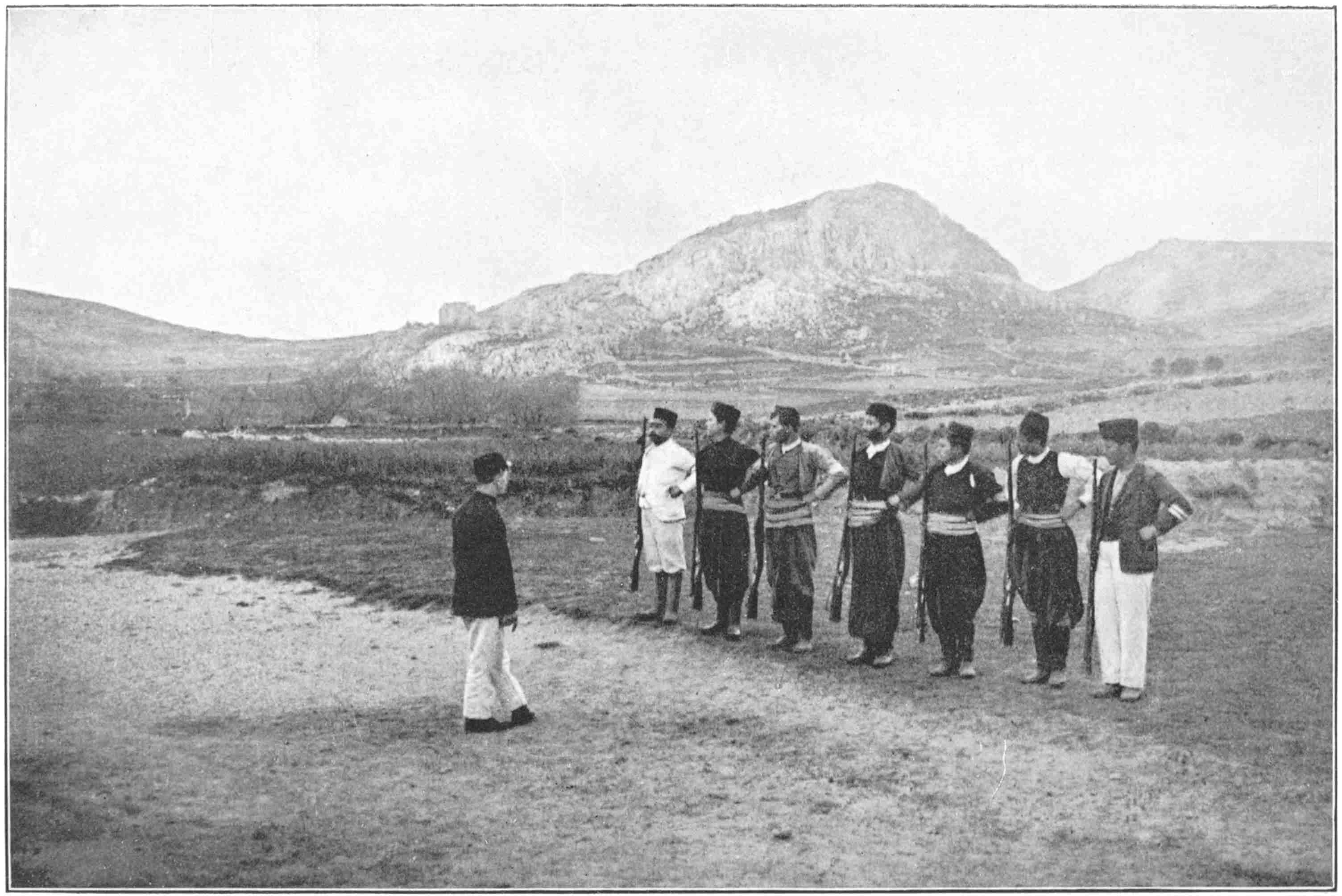
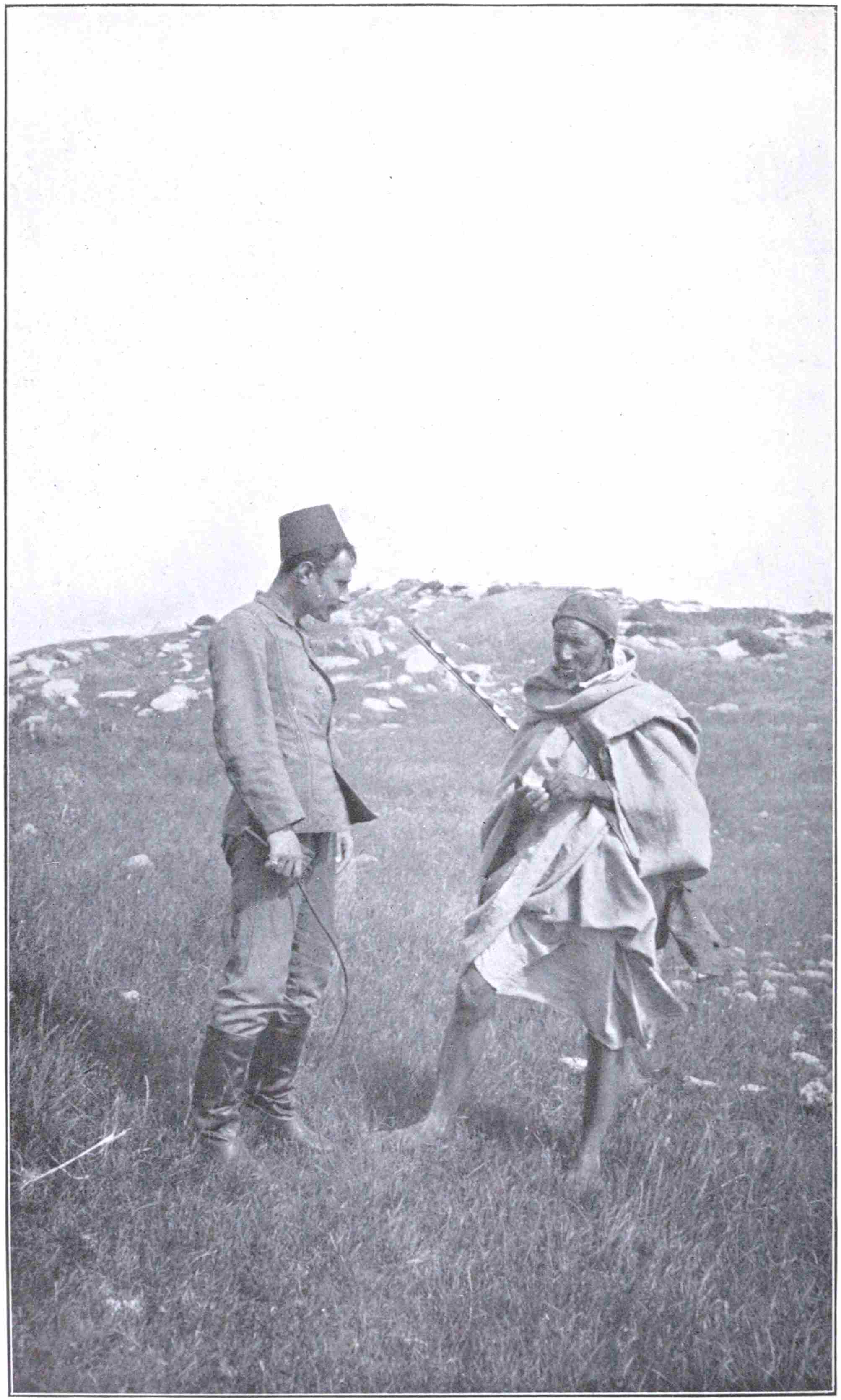
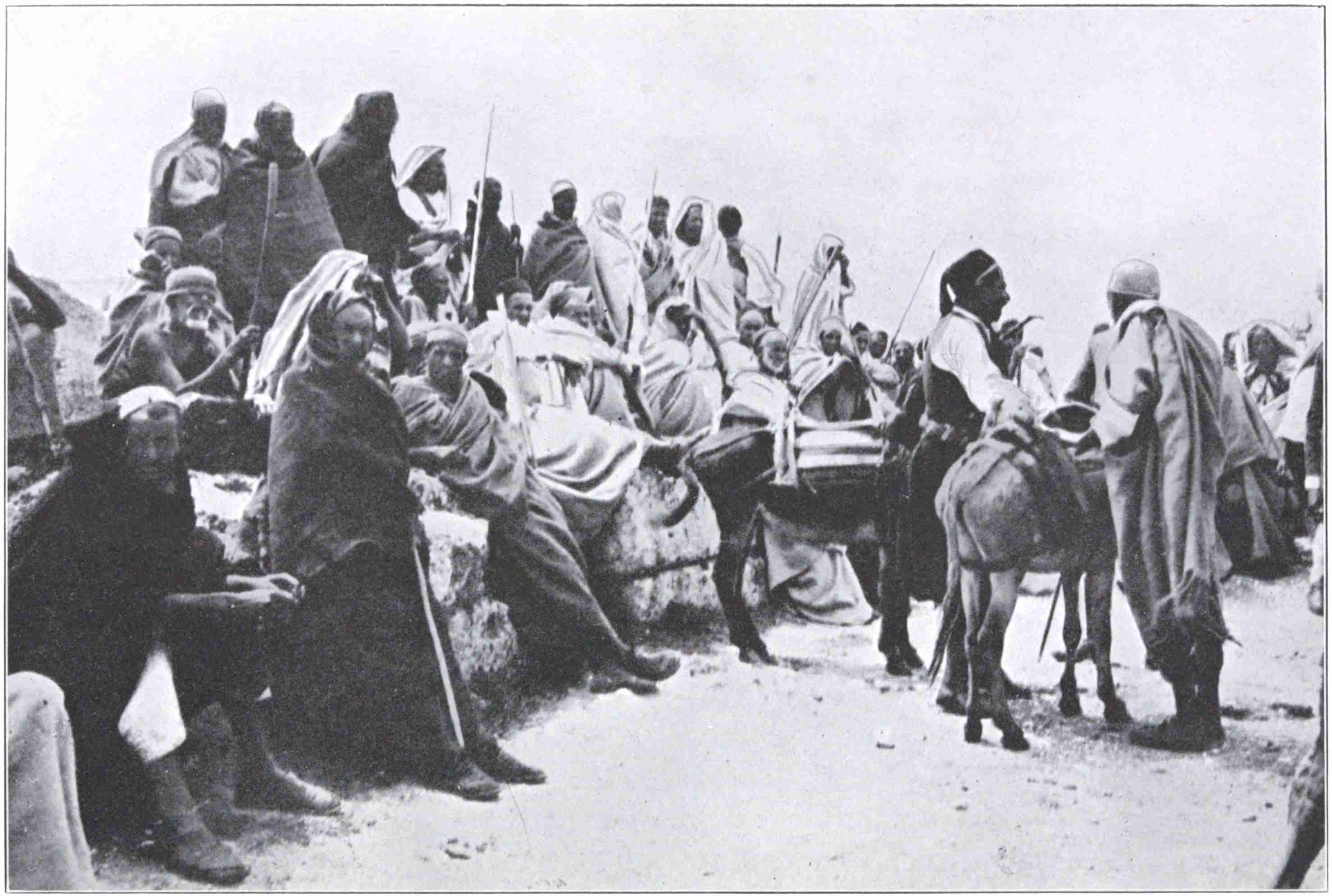
FRENCH CORPORAL DRILLING CRETAN VILLAGE GUARDS (1898).
Frontispiece.
ACCIDENTS OF AN
ANTIQUARY’S LIFE
BY D. G. HOGARTH AUTHOR OF ‘A WANDERING SCHOLAR,’ ETC.
WITH FORTY ILLUSTRATIONS
FROM PHOTOGRAPHS TAKEN BY THE AUTHOR
AND HIS COMPANIONS
MACMILLAN AND CO., LIMITED
ST. MARTIN’S STREET, LONDON 1910
GLASGOW: PRINTED AT THE UNIVERSITY PRESS
BY ROBERT MACLEHOSE AND CO. LTD.
PREFACE
Among many companions in these accidents who are
not named in the text, lest the book should become
a string of names, I have to thank five especially
because they have allowed me to use photographs
taken when we were together. These are Mr. Alison
V. Armour, owner of the “Utowana,” Mr. Richard
Norton, a comrade during the cruise of that yacht and
at Siut and in Syria, Messrs. A. W. Van Buren and
C. D. Curtis, members of the yachting party, and Mr.
J. A. R. Munro, who endured many things with me
in Asia Minor in 1891. Four others, Dr. A. C.
Headlam, who was the third of Sir W. M. Ramsay’s
party in 1890, Mr. B. Christian, my companion in
Thessaly before the Graeco-Turkish war broke out,
Mr. J. G. C. Anderson, who cruised with me to
Lycia in 1897, and Mr. A. E. Henderson, who did
loyal service at Ephesus, I cannot forbear to name.
I have also to express thanks to the proprietors and
editors of three magazines, the Monthly, Cornhill, and
Macmillan’s, for their kind consent to my using, in
five chapters of this book, the second to the sixth,
parts of articles which appeared in their issues prior
to 1905. Finally, my friend and critic, Charles Robert
Leslie Fletcher, who read this book in proof, knows
how greatly I am beholden to him.
I will not take the name of Antiquary without apology,
and hereby, liberandi animam meam causa, make it in
an Introductory, to be passed over if the reader pleases.
Your true Antiquary is born, not made. Sometimes
an infirmity or awkwardness of body, which has disposed
a boy to shun the pursuits of his fellows, may
help to detach the man for the study of forgotten far
off things; but it is essential that there be inborn
in him the type of mind which is more curious of the
past than the present, loves detail for its own sake,
and cares less for ends than means.
Nevertheless, accident may make an Antiquary, as
good as another, out of anybody whose boyish education
has given him, willy nilly, some knowledge of the elder
world. Let him be thrown, for example, in early manhood,
much into lands whose ancient monuments conspicuously
exalt the past at the expense of the present.
The necessary curiosity can grow within him, disposing
his mind to study antiquarian detail as a duty, and, in
time, a pleasure; and through apprenticeship he may
learn and love the trade to which he was not born.
I claim to be no better than this Antiquary made, and
made none too soon. Nothing disposed me to the
trade in early years. If I was taken as a child to minsters
and abbeys, I endured their chill aisles in lively hope of
a pastrycook to come, and at our oldest Public School
had no feeling for the grey Gothic austerities among
which live the Foundationers, of whose number I was
not. Nor was it until half my Oxford course had been
run that I discovered curiosity about any ancient thing,
and that curiosity was far from antiquarian. Scholar of
my College though I was, I had been better known
as a freshman for a gamester in a small way than
for anything else; but some study was forced upon
me, and in the course of it I happened on Mommsen’s
panegyric of Caesar. The charm of guessing ancient
motives from the records of ancient deeds fascinated
me—there is much in the pursuit to appeal to a gambler—and
I resolved to attempt a speculative biography of
some great man. Looking about me for another imperial
figure, I fixed, greatly daring, on Alexander the
Great, foreswore cards and the course, and stepped out
of the strict lists of the schools into the field of Macedonian
history. The spacious world over which Alexander
moved fired my imagination and stirred a lust for
discovery. As a child my keenest joy was to announce
the finding of an untrodden way in the outskirts of a
Lincolnshire townlet, and my best remembered grief
was to learn that it was already known and named.
I could write a good deal about Macedonians when I
went into the Schools, but barely enough on other matters
to win salvation; and if I was made presently a tutor
and fellow of my College, it was less for my actual
scholarship than for hope of its future. I found academic
life not greatly to my liking at that age, and when an
endowment for scholarly travel abroad was set for competition,
I entered in forlorn hope of escape. To the
equal surprise of others, I was chosen among better
scholars, and found myself in a quandary. If I was to
research abroad as a classical scholar, I wished to explore
Alexander’s steps; but to go up alone into Asia
was beyond my means. A friend, who knew my
difficulty, told me that William Martin Ramsay, the
well-known traveller in Asia Minor, needed an apprentice.
Asia Minor was not Persia, but it was Asia, and
fair field for a pioneer. I offered myself, and was
accepted, but on the sole condition, that I made some
preliminary study at the newly-founded Archaeological
School in Athens. I knew nothing of Greek archaeology,
having never during six years entered the Museum
of my own Oxford; and thus, at an age when most
archaeologists are past masters of some branch of their
trade, I had to begin apprenticeship. Perhaps it may
interest some to hear by what accidents an antiquary of
a sort was made out of a wandering scholar.
* * * * *
I went to Athens early in 1887, as raw a neophyte as
ever entered Academe. The British School, then in its
first youth, was not yet assured of its place in the local
republic of science, and held little converse with other
Schools. The famous Antiquary who directed it could
have guided better, though not more gladly, a student
of Attic architecture than a would-be explorer of Asia,
and the library held few books, though, heaven knows,
enough that I had not read. My one fellow-student
helped me much, and would have helped me more,
had I been in the temper to learn. But I had come
to Athens as a man should not, if he is to love
her—come without trained taste for the ancient art,
which is her only wealth, and without instinctive
reverence for her soil. I gaped at her monuments like
any other tourist, though with less than the common
understanding, fled from German lectures on her topography,
and took refuge in studying her inscriptions
as students of history will who are brought unworthy
into the presence of her art. For pastime, beside visiting
a few neighbouring spots of which I knew not
enough to find them interesting, I roamed mean streets
and dusty suburbs, regretting the world I had left, and
longing for another in the east, with a prospect of Asiatic
travel for my sole comfort.
Two months passed drearily, and I escaped to Macedonia.
The rickety vessel broke down for the third
time at the second sunrise, and, wakened by the stoppage,
I climbed sleepily on deck to find myself in a
world of fog. A sudden gleam pierced the mist: I
turned to see a patch of heaven, and in it, immeasurably
high, one hard rose-red cloud. “Olympe!” said a deck
hand. The peak stood revealed a moment only; but
I had seen the seat of the Gods.
Salonica, sale unique, as the skipper punned, received
me for ten days, and, with its camel-trains and Jews,
black-bearded and cruel-eyed as men that kill prophets
offered a foretaste of the East. It was in days before the
railway had come down the Vardar valley and before the
Great Fire, and the town, packed more close than now into
its frame of white wall, was more odorous, less Italianized,
less passable. Under the aegis of a Turk-loving
Consul I hunted inscriptions in alleys and courts and
stone-cutters’ yards and the purlieus of an unreformed
konak, and, beginning to feel the explorer’s itch, would
go up to Vodhena to find what might be left of Aegae;
but Consul and Pasha forbade lest another Briton be
captured by the bands that had taken Synge and Souttar.
I was too innocent then to discount official fears, still
believing, indeed, that one should walk, revolver on
hip, even in Salonica streets; and in the end I proposed
no more than to drive to the site of Pella. I went off
with a young consular assistant and a guard, rumbling
along, gensdarmes to right and gensdarmes to left, as
I should never journey again in Turkey. There were
soldiers at the coffee-halts, soldiers at the khans, soldiers
guarding the bridge which crossed the slow-turning
eddies of the Vardar, and soldiers holding Yenije, where
astute bugs, who found saucers of water barring their
usual access, painfully climbed the leprous walls and
dropped from ceiling to pillow. The Yenije gravestones
are mostly blocks brought from Pella, and on the site of
the ancient city itself lie others, with two fragments of
fluted Doric shafts, near a fountain still called Pel. For
the rest, Pella has vanished as though it had never
been. Out of dusty undulating fields; out of half a
dozen barrows; out of a low marshy plain to west and
south; out of a glorious horseshoe of hills with the
snowy saddle of Olympus at one horn—out of these you
must conjure your vision of Philip’s home.
It was the middle of May when I was free of Athens,
and, passing over to Smyrna, found Ramsay about to
start. A third member of the party arrived two days
later, an adventurous fellow who had spent part of his
youth in Albania and Montenegro, and, knowing little
of ancient things, cared less, so he had a good horse
to ride and an unknown track to follow. The apparatus
of travel, which we gathered at Smyrna, was of the
simplest,—a single tent and a few pots and pans, but
no canned stores; and two simple villagers were hired
to serve us. The qualifications of the one chosen to
cook became manifest on the second night in camp.
We had left railhead at Seraikeuy, and ridden up the
Lycus valley to the foot of the white cliffs of Hierapolis.
Mehmet bought a turkey of the peasants of Pambuk
Kalessi, and was bidden to have it ready for the next
night’s supper. Early on the morrow we went up to the
site, and all that day, under a broiling sun and among
some of the best preserved Roman tombs in Asia Minor,
I entered on an arduous apprenticeship to the best
epigraphist in Europe. Sharpset at nightfall we hurried
down expectant of our turkey. Mehmet sat placid, the
bird at his feet. It was a corpse, indeed, but no more,
not even a plucked one. “What am I to do with this?”
said Mehmet.
He learned better as time went on; but throughout
that journey we had little except sodden messes to eat,
faring worse than any traveller need fare. It was partly
because our leader cared little what he ate, but more
because, like his followers, he journeyed on a slender
purse. Ramsay had made to himself a European reputation
as an explorer of Asia Minor at a cost which
another man would think scarcely sufficient for the tour
of Germany; and it had become his principle, as, for
similar reasons it has become Petrie’s, to suffer none
but the barest means to his end. If both have pushed
their practice to exceeding discomfort, both have taught
several young Britons how little is necessity and how
much superfluity: and it is not the least of my many
debts to Ramsay that I gained in my first tour of
exploration the will and the capacity to go farther at
less cost than perhaps anyone but my master.
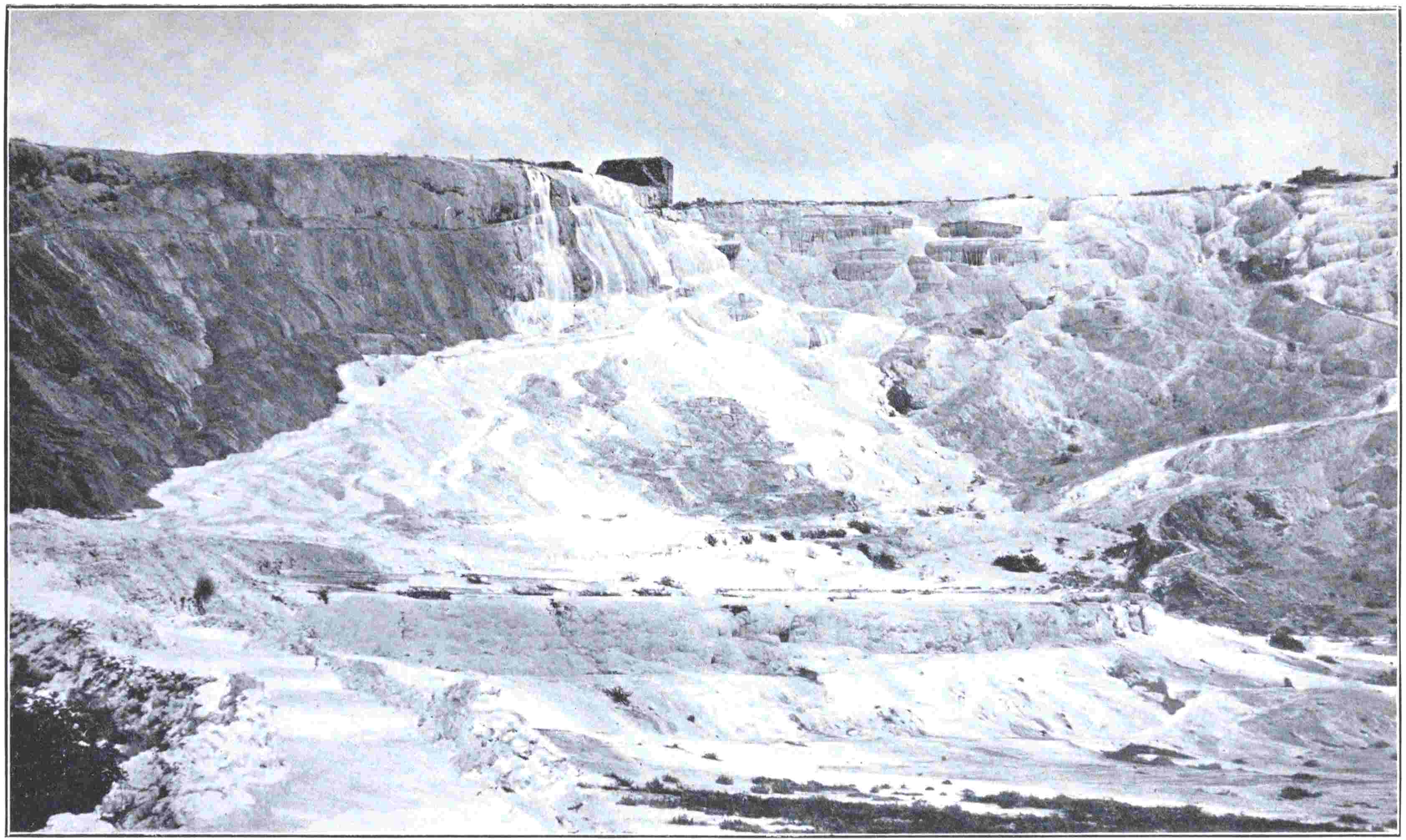
THE WHITE CLIFFS OF HIERAPOLIS.
This part of my education had begun at once:
for while we were still in Smyrna, Ramsay, wanting
information about two sites lying north of the Aidin
railway, had suggested that I should visit them alone, all
raw as I was, and rejoin him at railhead. Feeling like
a boy packed off to his first school, I agreed, and took
the train to Nazli. I knew very little Greek, and less
Turkish, but the Nazli stationmaster, christened
Achilles, was reported to speak my tongue. He so
far justified his fame as to greet me, stranded forlorn
on the tracks, with “How you do, my boy?” When
my Oxford manner had readjusted itself, we conversed
sufficiently in French; and he found me a dancing stallion
and sent me off astride a deep and angular military
saddle with my knees level with my hips, the centre of
a curvetting escort of the youth of Nazli. My first
site proved to be a large hillock once surrounded by
walls, and still bearing ruins of Roman baths, towards
which an aqueduct straggled across the valley. It
certainly looked like the ancient Mastaura which I had
come out to see; and all doubt was soon settled by an
inscription of that town which, on my return, I found
built into a church wall at Nazli, and copied as best I
might. After a sleepless night, stiff, sore, and with
less skin than had left Smyrna, I went to the second
site, and thence, proud but thankful, took train to
railhead.
When our modest caravan had left Hierapolis, it
wandered awhile on either bank of the upper Maeander,
sometimes dropping a thousand feet to the stream, but
for the most part keeping the high ground. The land
flowed with milk and honey if not much else, and I
learned the grave courtesy of the Anatolian peasant.
Twice we were called to shelter from the noonday sun
in the portico of a mosque, and whatever the ayan,
patron of strangers in that ordered village society, could
procure of the best, was set before us. Our main
purpose was to find inscriptions, and I was taught by
precept and example how a villager may be induced
to guide an inquisitive giaur into the recesses of his
haremlik, or grub up the headstone of his forefather,
or even saw away the floor of his mosque. But it was
not always plain sailing; and how we used the wisdom
of the serpent, and what reward was ours at one
Maeander village, Badinlar, I have told already in
another book.
I soon became interested in the simple arts of
antiquarian travel, the seeking, the copying, the noting,
the measuring, and the mapping, but it was some
time before I could practise them in any comfort. The
food or the climate, or both, caused at the first severe
saddle-boils, for whose easing there were no long halts.
To a rider in such plight it means much if his horse
trip on stony tracks, lash out at his fellow, plunge and
burst his girths in a bog, incontinently roll on a chance
sandpatch, or calmly sit down in a ford to cool his
haunches. A sorry steed, bought in my innocence
at eight pounds English, and dear at two, introduced
me to each and all of these packhorse tricks. But the
spacious landscapes, the dry warm airs, the novelty of
man, beast, bird and flower, kept me going; and was
I not in the land where I would be?
A chance visit to Sandukli brought me into my earliest
collision with Ottoman authority. It was in the hungry
month of Ramazan, and two of us had ridden in from
camp to buy what supplies we might in the early hours
of morning. As we were about remounting, the police
accosted us, and roughly bade us wait on the governor.
Led to the konak, we were told his beyship was abed,
and we must stay till he had eaten at sundown. To
spend a whole day in dusty Sandukli was bad, but worse
to spend it waiting on a Bey’s pleasure. We sent word
that we gave him half an hour to appear, and, admired
by all the loafers of the bazar, stalked up and down,
watch in hand, in all the insolence of Britain abroad.
The governor came not, but on the call of time sent
a deputy, nervously offering excuse, and begging us go
in peace. Ours is not a gracious race, but it usually
gets what it wants.
Passing north-eastward through Afium Kara Hissar
in mid June, we went up to our goal in the Phrygian
Monument country, and for all the rest of the month
were busied in exploring its pleasant shaggy valleys and
carven cliffs. I have seen since no region so thickly
set with strange memorials of the past, and none to
which I would more joyfully return. Some day when
diggers uncover the relics of that Midaean monarchy
which seemed to the early Greeks of Asia the eldest
and most god-like of powers, may I be there to see!
The haunted valley of Ayazin, where we grubbed
mole-like under the face of a fallen tomb, and, prone
in the shallow pit we had made, sketched the most
curious of Phrygian reliefs: the sheer acropolis of
Kumbet, where we planned a mysterious rock-house
which may be of any antiquity; the gorges of Bakshish
and Yapuldak, whose sculptured tombs, fashioned like
houses of the living, are seen suddenly through the
pines: that stupendous curtain of carved and written
stone hung before the gate of death by which Midas
the King passed to the Great Mother; all his desolate,
impregnable city above it, with inscribed altars
and rock-reliefs—of these is woven my “féerie du
premier voyage.” I was the photographer of the expedition,
equipped with a camera which I had borrowed
of an amateur in Smyrna and manipulated for the space
of one afternoon under his patient eye—so unready was
I for my trade; and I was an assistant surveyor, who
having plotted painfully and with many lapses my half
of the fortifications of the Midas City, was well enough
satisfied with my botched work to question my master’s
survey of the other half. He has long forgiven me.
A strenuous and somewhat nervous week we spent
there under the Midaean crags. Unwarned of modern
tenants, we found a new settlement of Circassians,
who in those days had a bad name all over Asia Minor
for a certain lawless truculence, born of pride of race,
and fostered by the official perfidy with which they were
often treated. But Mehmet Bey, the chief, received
us cordially with samovar and smooth words. On the
morrow he followed our operations among the monuments
with very lively interest, and at evening came
down to the camp and roundly proposed to share profits.
We told him once and again there was no gold in our
hopes; but we talked to deaf ears, and at last, to be
rid of him, said we would halve such treasure as we
might find. This, we well knew, was to sow trouble for
early reaping, in a land where all believe that the Frank
spirits bullion out of earth and rocks, though one see
it ever so little; and we were not comforted by our
muleteers’ tales of a recent killing, for which the Ottoman
government was holding Mehmet Bey to account.
But the local police, who had kept track of us, summoned
the Bey to Karahissar on the third day, and thus
nothing worse befell than a cooling of cordiality between
camp and village as the days went by without our doing
anything but draw lines on paper and squint through
sights.
When, at last, we had done what we came to do,
we thought it well to ride fast and far, almost to
Karahissar again. Thereafter we became two bands,
Ramsay making for home, and his two scholars setting
forth for the Cilician shore with no more baggage than
might be carried on their saddle-horses and a third
bestridden by a single servant. How first one of us
and then the other fell ill, but neither so ill as he
thought; what in our ignorance and inexperience we
did and saw; how we came over Taurus in a waggon
and took ship, I have already told elsewhere.
I did not return to Asia for three years, though
within a twelvemonth I was wandering within sight of
her snows. I had gone to Cyprus as one of four to dig,
and I stayed alone to travel during the torrid summer
of 1888, visiting almost every village of the island,
and trying to do, with not half his science, what I had
seen my master do on my prentice journey. What
indeed I did do I wrote in a book, little known and less
read, whose title, Devia Cypria, has deceived more than
once, I am told, sanguine buyers of Erotica. Of the
part I bore in the excavation of Paphos I will say little.
I knew nothing of the digger’s art at the beginning,
and very little at the end. Our leader had studied in
the Egyptian school of Petrie, but the rest of us were
so raw as not to know if there were any science of the
spade at all. We had for mentor Gregori of Larnaca,
who has become more famous since, and I doubt if
we did much harm. But I doubt too if we found nearly
all we ought to have found on that immemorial site.
Some experience in handling unskilled Greeks, a fluent
use of their rustic tongue, an inkling of how much I
had to learn—this, however, I took away from Paphos.
Less than two years later I was with Ramsay in Asia
again. The railhead of the Aidin line had been pushed
in the meantime to Dineir, and we could make our
start from far inland. It is often disputed which of
two courses be best, to buy transport or to hire. The
hirer must wrangle morning and night with muleteers,
who use every trick of their trade to shorten and ease
the day’s work. The buyer will be cheated when he
buys, cheated when he feeds, cheated when he sells
again, and he takes all risk of horse thieves. Our
lot on this journey was rare and happy. The animals
we had were none of ours; but their owner, unwilling
to take the road, sent a Greek hireling in his stead.
A month later, after many bickerings and a final fight
with his Moslem fellows, the Christian took to his
heels, leaving his master’s horses on our hands. Quit
of responsibility we rode them another three months
from one end of Asia Minor to the other, and
though the two best were lifted by Circassians at a
late stage of the journey, the owner, advised long ago
of his hireling’s flight, was so amazed to see any beasts
of his again, that, as we told their hire into his hand,
he refrained himself from cursing and blessed us for
honest men.
We rode off into the hills of Pisidia to pick up
inscriptions here and there, but more often to revise
texts that Ramsay had seen in earlier years. There
were few or no adventures to vary the daily round of
a copyist, cynosure of an adhesive crowd in graveyards,
or desired of raging dogs in the houses and
courts. One noon the sun was eclipsed, and, at the
moment of deepest shadow, we rode nervously into a
remote village to find ourselves neither incensed for
gods nor stoned for devils, but wholly neglected for the
heavenly phenomenon, which was being calmly observed
through smoked glass.
By the lovely lake of Egerdir came a fever-fiend to
try the first of many bouts with me. It was a malign
freak of fortune. Our waggon, with all baggage and
medical comforts, had been sent by ferry across the lake
to a point where, by riding round the southern bight, we
might meet it on the second day; but failing to pass a
rocky ridge, it fetched a wide compass to the north and
made for another goal beyond the mountains. My fever
began on the first afternoon, and sitting like a sack on
a tired horse, with a sense of dull blows falling on the
nape of my neck, I followed the pack-train till dusk up
a wild valley where was said to be a hamlet. It proved
ruinous and void, and almost supperless we had to
pass the chill night in the open, lying on the soil with
saddles under our heads. It sounds a romantic bivouac;
but in sober fact a saddle that has clung to a hot and
ill-groomed horse for a summer’s day makes a very
sorry pillow: and lift stones as you may from the bosom
of mother earth, she will privily thrust up as many more
against your salient parts all the uneasy night.
Next morning we were away betimes, but doomed to
wander for many hours behind ignorant or knavish guides
in tangles of the Pisidian hills, I slaking an insatiate thirst
at every torrent and spring. It was nightfall when we
reached the bourne of our journey, the site of Adada
at Kara Baulo, whose modern name must survive from
some church of Paul the Apostle, built perhaps in commemoration
of a halt made by the first mission to the
Gentiles on its way from Perga of Pamphylia to Pisidian
Antioch. There I slept once more on mother earth
under the stars, having supped, loathing, on broth in
which floated shell-less unborn eggs. On the morrow
I could do little but lie in the shade, while the rest
explored the forest-girt ruins: but by noon their
work was done, and I had to mount and follow to a
hamlet in a low pass above the Eurymedon gorge. We
lodged in a shed, and I read in my diary “cold and
very lumpy lying.” The fourth stage, over nine hours
long, took us across Eurymedon and up towards the
snow-streaked crest of Anamás Dagh; for on we had
to press for fear our waggoners should give us up for lost
and trundle back to Dineir. Night found us lying on
naked rock within a low circle of rough stones near an
Alpine yaila or summer camp. We had been fed by
the hospitable shepherds and given screens of felt
against the bitter wind; but fever and its ague pains
shooting through loins and legs banished sleep, and I
sat up or paced till dawn.
At sunrise a peasant offered to show a painted cave, and
hearing it was but a step along the hillside I offered to
visit it. On we trudged; farther fled the cave; and not
until the best part of an hour had passed were we halted
before the mouth of a mean little Byzantine shrine. The
sun was already high, and the morning windless. Bathed
in sweat I scarcely dragged myself back over the rough
path, and reached camp with a livid face. My companions
lifted me into the saddle and hurried me across the
pass, doubting, as they told me later, if I should live
to taste quinine again. But as the day wore on, the fever
began to abate. The sweat under the early sun had
broken it, and I was in a fair way to be cured, not killed,
when we found the waggon awaiting us at the edge of
the eastern plain.
I remained weak, however, and altogether indifferent
to the work I had to do. Two years before, while
alone in Cyprus, I had thought myself an antiquary,
who explored ancient things for the love of science.
Now I found them infinitely tedious, and moodily
confessed I was no antiquary yet, not even a wandering
scholar, but just a hunter at hazard. I did what my
master wished of me: but my interest was in matters
outside his work, in the incidents of the camp, in
the means of travel, in the wildness of nature and
man about us, in the beauty of the Beysheher lake seen
through mist from a hill-top one morning, in the old
boar, whom I flushed, as I was scrambling down again,
and blessed that he did not charge. We went down
from Konia into Cilicia, and in the hot valley of the
Calycadnus and hotter coastlands near the Corycian
Cave, where we were fain to sit in the pungent smoke
of dung to escape worse torture of mosquitoes, my ill
humour grew and I hated life until we doubled back to
the heights, and the last memory of fever left me on
the table-land of Kaisariyeh.
One of the party tarried with the American missionaries
at Talas to recover of a worse Job’s plague
than had vexed me three years before, while Ramsay
took me over Anti-Taurus to copy the Hittite inscriptions
of Gurun. Some of the incidents of this
journey I have told already, especially the buying of
the Bor Stone and its sequel; and other incidents
must remain untold here if I am to make an end of
these early wanderings. Sufficient to say that after
we had recrossed Anti-Taurus, where boars came
grunting one night almost to the camp-fires, which
shone on their watering-place, and after we had discovered
the Hittite relief of Fraktin, I left Ramsay to
go home with the waggon, and, joined by the sick man
from Kaisariyeh half cured but wholly undeterred,
passed beneath the mighty wall of Ala Dagh to the foothills
of Taurus. With the Hittite inscription of Bulgar
Maden (how ill I copied it!) and the lower half of the
Bor Stone to our credit, we set our faces homeward
over the great Plains. On Dindymus I took a second
fever of the kind that swells the limbs, and was brought
by my comrade very sick to the railway and Dineir
again.
This was to be the end of my apprenticeship in
archaeological travel to the man who has made it a
science. I was to have met Ramsay again in Cilicia
the following year; but it was late in June before,
scarcely recovered from another fever caught in Salonica,
I landed at Mersina to find he had fled the coming heat.
So I had to organize my own train and go up across the
steaming Aleian plain to the Taurus with one companion,
a traveller of infinite patience, as he had need
to be that year. For little but mishap and delay was
in store for us.
The first fortnight went well enough. We passed the
mountains by way of the robber town of Hajin, where
we spent a pleasant evening with two American mission
ladies, who were to be caught by Kurds a week
later, robbed, stripped, and lashed to trees: and near
Comana we set ourselves to our first serious task, the
tracing of the great military road which Severus made
under the northward face of Taurus from Caesarea
Mazaca to the standing camp of the “Thundering”
Legion at Melitene. By the ruin of its embankment
lie milestones of some ten Emperors, in groups of five
or six, which Gregori, whom I had picked up in Cyprus,
taught the peasants to lever over so we might read their
inscriptions. Missing at every mile Ramsay’s skill in decipherment
and his knowledge of things Roman, we did
what we could to unravel the tangled epigraphs—a rude
week’s work which left us little to learn about Roman
milestones, and able to write a report which would win
the heart of Mommsen.
The task was done at last at Arabissus, and we
could turn off to Albistan to see a Hittite obelisk,
and thence strike southward through Taurus, by way
of stubborn Zeitun, to Marash in Commagene, where
misfortune lay in wait. The Hittite stones which we
had come down to see had been spirited away (I was not
to see them till many years later in New York),
and before we could fly the July heat of Syria, I was
badly hurt by a fall, and laid on my back in a kindly
missionary’s house for two long weeks—a martyrdom
of idleness for my luckless comrade. Then came
cholera, raiding north from Aleppo, and thinking we
might yet escape the quarantine cordon on the northern
frontier of the province, we bolted through Taurus
again, though I was still unable to walk. I had a nightmare
ride up and down the rock ladders of the Pyramus
gorge, my throbbing ankle supported on an improvised
crutch; nor did time pass more gratefully for the companionship
of an ill-looking Armenian doctor, whom we
had been begged to take under our wing. Accused
(falsely, we were told) of illicit commerce with a
patient, he went in fear of his life from two Circassian
bravos set by her brothers on his track, and we
could not refuse to shield him; but I have heard since
that he deserved whatever fate he escaped. And after
all the cordon caught us and bade us camp on a bare
hillside a few miles south of Derendeh for six torrid
days till our captors’ eyes could be opened (or closed)
by practical but gentle methods of suasion. Not that
the delay was time all lost; we passed on with my ankle
almost sound, and another Hittite inscription added to
our bag.
In Sivas it was my companion’s turn to fall sick,
and summer was far gone before we could enter
on the last stage. We rode up the Halys valley
to Zara and the scene of Pompey’s victory at
Nicopolis, and having turned thence down the course
of the Pontic Lycus, through a pleasant Swiss region
of pine forests and pine huts, inhabited by Shiahs,
kindly to the giaur because despised by Sunnis
for “red-head” heretics, came to the Black Sea by
way of Neocaesarea and Comana Pontica and the Iris
valley and Amasia and the baths of Phazemon. By
the way we picked up some unconsidered trifles of
Roman milestones and landmarks of Imperial Estates
and the like, which we put on record long ago in a
publication of the Royal Geographical Society; and
from first to last, when not on the track of Hittites, we
seemed to be following the footsteps of Rome. What
has happened to the records of Persian and Greek
dominion in Cappadocia? The Hittite and the Roman
alone have set their marks on the rocks.
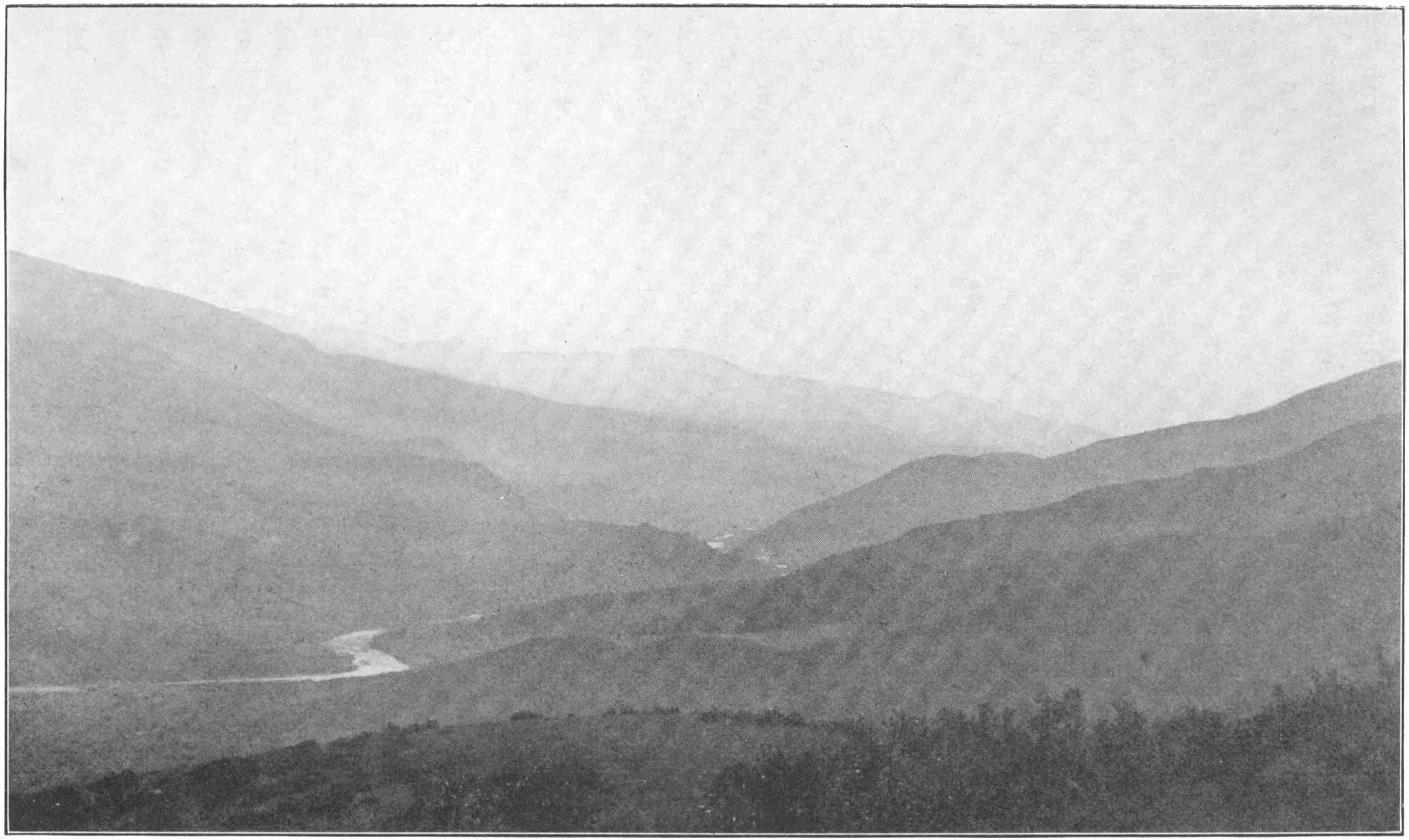
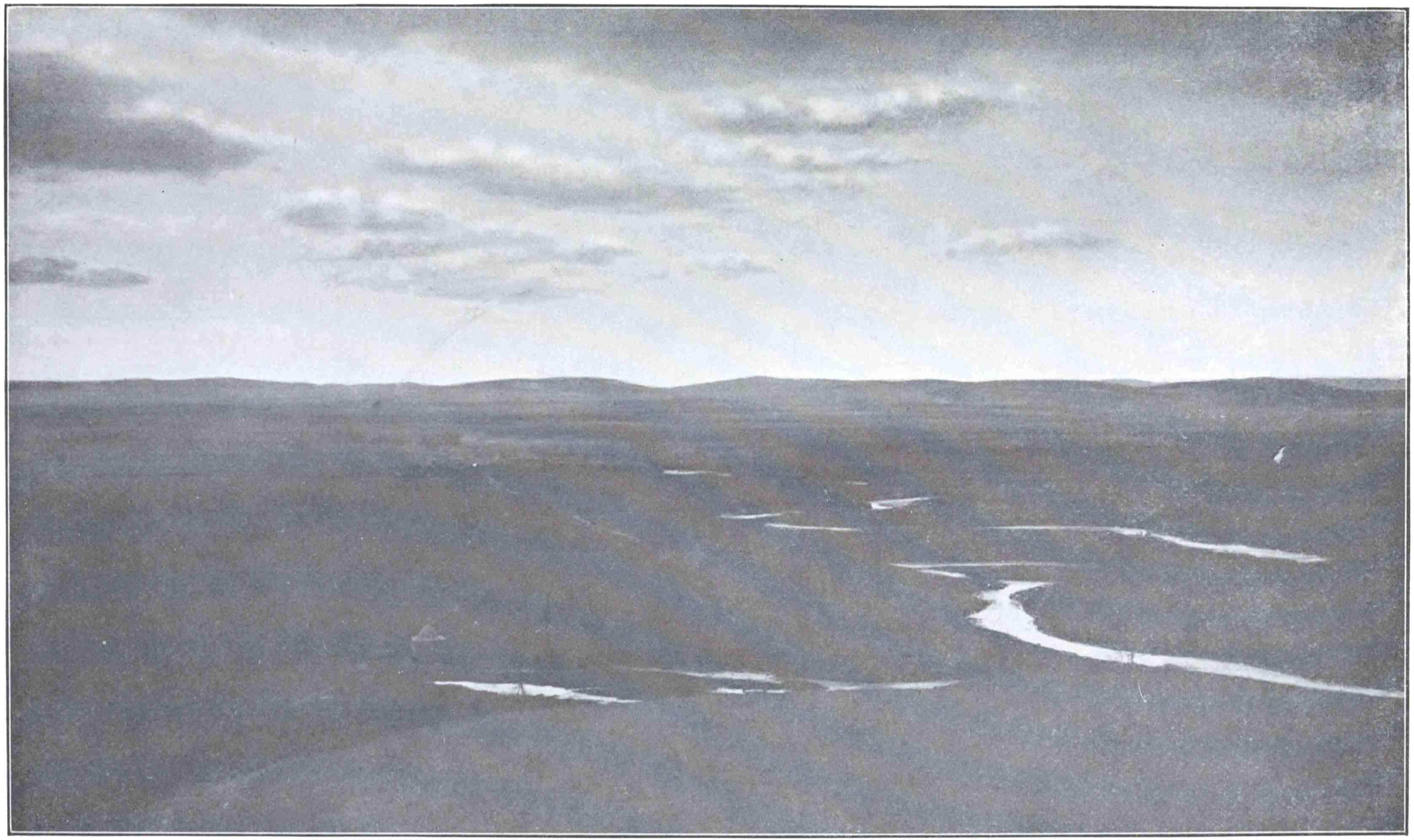
THE VALLEY OF THE PONTIC LYCUS AT SUNRISE.
When I went back to Oxford I had some claim to
be a wandering scholar, but less to be an archaeological
digger than was credited by those who asked me two
years later to take charge of excavations promoted by
the Egypt Exploration Fund. I ought not to have
agreed, but, having so agreed, because the call of the
East compelled me, I should have begun humbly at
the bottom of the long ladder of Egyptology. But I
was a young man in a great hurry, unwilling to enter
fresh indentures, and finding myself not needed on
the confused site of Hatshepsut’s temple at Der el-Bahri,
I evaded the obligation by making work among
such Greek things as are in Egypt. I had no great
success, and it was the best result of my Egyptian years
that two Oxford scholars, who searched with me for
papyrus scraps in the Fayûm desert one winter, were
encouraged thereafter by my patrons to embark on a
course which has led them to European fame. Clinging
still to my old love Asia, I diverted my interest from
Nile to Euphrates by making between seasons a journey
which I have related in my Wandering Scholar; and,
sure at last that my heart would never be in Egyptian
work, I broke with my patrons after three years.
If, however, I had done little for them, I had done
much for myself. In those three seasons, largely
through becoming known to Petrie, and living with
men who had served apprenticeship to him, I had learned
to dig. When I set foot first in Egypt, I had no
method in such search, nor any understanding that the
common labourer’s eyes and hands and purpose must
be extensions of one’s own. If an excavator, deaf to
the first and greatest commandment of his calling, take
no care to make his labourers better than unskilled
navvies, what should he find except the things that a
navvy could not miss in the dark? No strengthening
of his European staff, no unwearied watching of native
fools and knaves, will secure to the excavator the half
of the precious things which lie in his soil. If the
labourer, who is a fool, cannot see what is being turned
over under his eyes, you at his side will see it no better,
because you are not turning it over. The labourer
who is a knave will see, but take good care you do not.
Unless your men be seeking consciously and with intelligence
in an interest which is theirs as well as yours, better
leave the hiding places of ancient things alone. For
every digger, who turns over a site without finding what
is in it, destroys great part of what he should have
found.
Moreover, in handling remains of imperishable
antiquity in the Nile land, I learned to observe
as an antiquary must. And some of his spirit was
breathed into me; for when I went back to Egypt for
a few weeks in 1897, I found myself regarding her
ancient life more than her modern. But I was not
to be won to Egyptian studies at the eleventh hour.
Already designated Director, where I had been an
unworthy student ten years before, I sailed for Athens,
intending to take stock of the duties which were to
be mine in the coming autumn, and to follow my
proper trade by exploring a coast of Greek Asia.
But temptation met me, and turned me out of the
Antiquary’s path.
CHAPTER I. AN INTERLUDE.
I found the representative of a great British journal in
a difficulty. It was his hard task to gather news of
several Balkan states, which one and all seemed determined
to set about making history at the same moment.
Crete was already ablaze; a Macedonian war was promised
by Greece, and Bulgaria moved restlessly behind
her frontier. Who knew what the others would hazard
on flank and rear? I could speak fair Greek. Would
I help him by undertaking Crete? It need not be
for long. The Powers would soon make its peace,
and deport the Greek soldiers who had just landed
under the very guns of our ships. His actual correspondent,
a Greek, was colouring his despatches to
London white and blue. Would I replace him awhile?
My temptation was brief. I had never been in Crete,
and a scholar may rarely watch war.
I had not long to wait for it. As we drew to our
anchorage inside the warships off Canea there were
houses to be seen afire two miles inshore and rifles
spitting up and down the slopes behind the town.
The Turks had thought to revictual their threatened
lines in peace during the hour of the Sunday office; but
priests and people came out of church to fight. It was
a small and desultory affair, from which less than a score
of killed and wounded men were borne back at evening
to the gates—patient Anatolian peasants for the most
part, who had long served out their due time and fought
without heat or reasoning why. Along with them
came the corpses of two or three bashibazuk Cretans,
Greek in feature and Greek in speech, Moslems by
chance and all but ignorant of the faith which they had
died to uphold. They were the first men slain in anger
that I had seen.
I was to know Canea well in coming years; but that
morning it looked very strange, with its mediaeval ways
darkly shuttered and patrolled by smart marines of half
a dozen nations and by slouching, thick-set Turks. The
day might have been the morrow of a sack, so silent
and desolate were the shops and houses about the quays,
and so ruinous the inner streets. The great incendiary
fires in the Christian quarter had been subdued only a
day or two before, and the oil vats in the basements
still smoked and stank. To this day, when I smell burning
oil, I see Canea as I saw it first. As we ran up the
harbour, the blackened shell of the Ottoman Konak on
the heights to the left prepared us for what we were to
see in the town. Our bluejackets and marines, we
were told, had saved a part of the block, less with than
despite the help of the frenzied Turks, among whom a
certain grey-bearded Pasha had showed such erratic
energy with a leaky hose, that it became necessary for
our drenched marines to stay his zeal. Their commander
called up his most respectable sergeant, and,
pointing out the old gentleman as a person of consequence,
bade his man wait a chance to withdraw the
hose without offence. The sergeant saluted, wheeled,
marched straight on the offender, and tapping him on
the shoulder, remarked, with a genial but unprintable
term of endearment and an even less printable counsel,
that none of his sort was wanted there, and left him
agape with empty dripping hands.
Canea was no pleasant abode at that moment. All
inns, cookshops and coffee-houses, except the meanest,
were burned or barred, and no cook or body-servant
was for hire. The consuls, smoked out of Halépa a
few days before, had broken into a deserted inn on the
quayside, where their wives were setting before them
such victuals as could be begged from the fleet. The
journalists, who landed from every passing boat, lodged
where and how men might in a ravished town, and a
famous limner of battles kept life in him for the
first few days with little but cauliflowers, oranges, and
Greek brandy. Mine was a better fate. An old acquaintance
of Cyprus days was commanding the Albanian
police, and I found lodgment with him in the only
tenanted house outside the walls, except one. In
this last Chermside was living, who, like my host,
sustained the British name for cool courage and quiet
discharge of duty in those unquiet weeks. He showed
me the lie of the land, talking of things Turkish as
few men may talk, and franked me through the inner
lines, where we found shoeless gunners with rags bound
on feet and legs, stedfastly serving antique field-pieces
with the slouch of woodmen who handle ox-carts on
Anatolian hills.
The outposts lay fiercely beleaguered on a ridge
further south, under the Sphakian summits—that
dazzling background to the Venetian quadrilateral of
Canea, which one sees from the sea like an embastioned
city in a mediaeval illumination. Hapless outposts!
They were the cause of all the bickerings between
admirals and insurgents which it was to be my lot for
three weeks to record. The Turks, too few to hold
the outer lines in force, were not suffered by the Admirals
to withdraw their pickets, lest the rebels, once on the
crests, should shell the ships and the town. Yet no
admiral would land his own men to support the defence
and so lessen his fighting strength in the face of a faithful
ally anchored alongside. So together and singly the
leaders of the Powers held endless converse with bearded
giants in broidered coats, and black-hatted men in sponge-bag
suitings, who dubbed themselves captains and chiefs,
and answered in halting French for the respect of the
line; and Admirals vowed, in even less intelligible
French, to shoot if the promises were broken. And
broken they ever were, and once and again the Admirals
shot, and Attic journals with inflammatory headlines,
“Anti-Navarino,” or “England massacres Christendom,”
egged on mobs to hoot the nameboard on the
Grande Bretagne Hotel, and demand that the sanctuary
of Hellenism on the Acropolis be closed for ever
to the Barbarians of the West. Nor was Athens less
than right according to her lights. True enough, it was
we who led the shooting, and we who did almost all the
blockading in Crete, for no other reason than that our
gunners could shoot the best and our coal bunkers
were kept full, and our crews did not mutiny for shore-leave
where it could not be granted, and we alone
had on the spot many war-craft of light draught and
high speed.
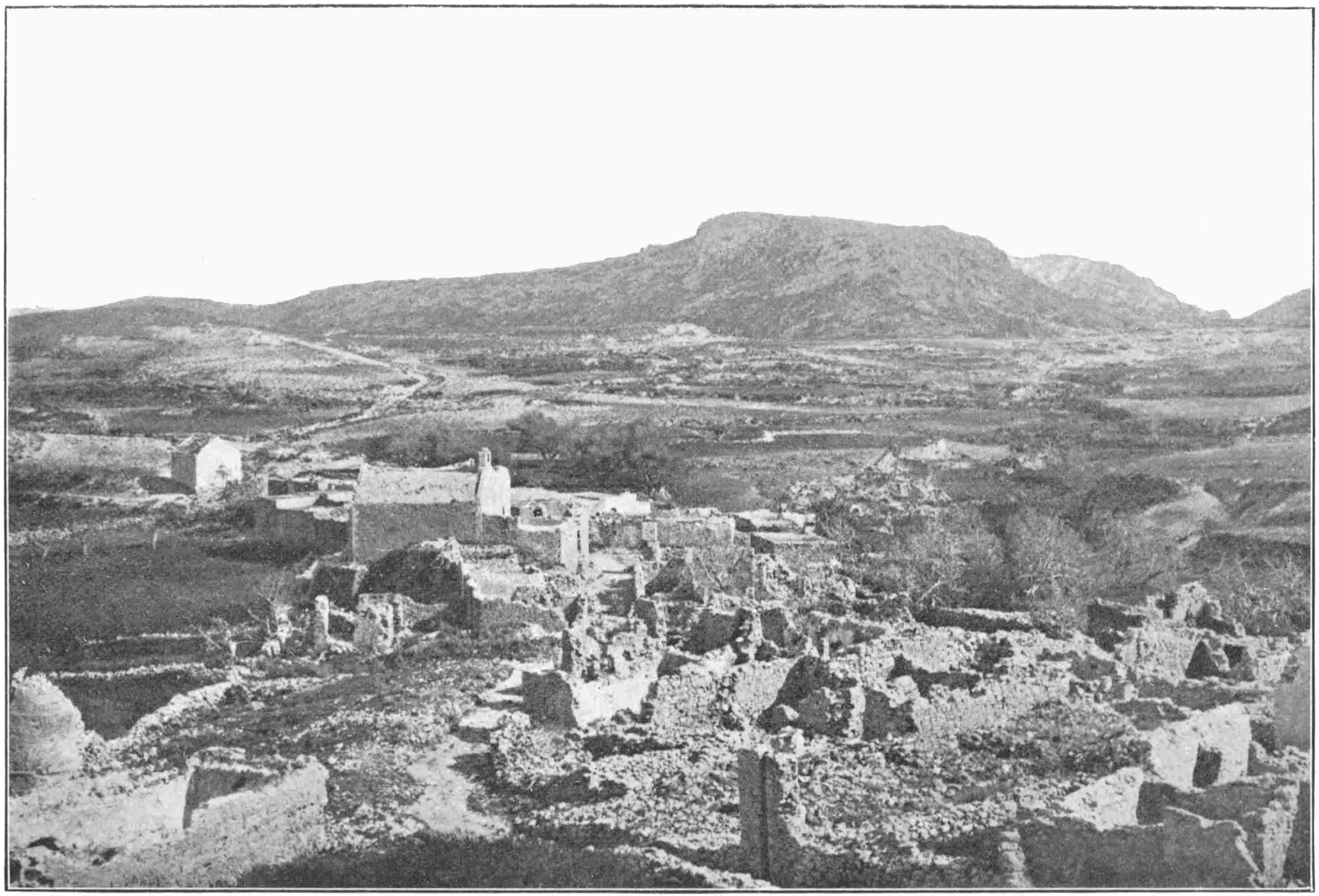
A WRECKED MOSLEM VILLAGE OF CRETE.
But those bombardments ought never to have been
necessary. With a few European bluejackets on guard
at each blockhouse, the lines would never have been
molested at all. The Admirals should have known
Greeks better than to trust them on such vicarious parole
as was given by caps and black hats, whether on the heads
of chiefs or no. No Greek may answer surely for any
other Greek, since individualism and intolerance of discipline
are in the blood of the race. In the stormy history
of Levantine religious warfare you may note one unvaried
law of consequence. Where the Moslem has prevailed,
the votaries of the two creeds have resumed peaceful life
as of old, the Christian knowing that Moslems act under
orders as one man, and that when Islam is triumphant its
Gibeonites are secure of their lives. But if Christians
gain their freedom, the Moslem leaves the land of
his birth. For whatever pledges the new authorities
may give, he knows for his part that, since Eastern
Christianity supplies no social discipline, each Christian
will act on occasion as seems best in his own eyes.
I had been in Canea three days when trouble arose in
the town itself. Bairam was near, and the hundred and
a half armed Albanian policemen, who were commanded
for the nonce by my messmate and an Arnaut
colonel, had been begging during some days, as their
yearly custom was, an instalment of ready money for
the feast. But the Turkish Treasury was empty, and
the Powers supplied no funds. Put off, therefore, with
vague answers to a demand which was no worse than
fair, seeing they had touched no pay for months, some
of the Albanians left their duty, and, rifles in hand,
beset their commander with ever louder clamour for
arrears. It is no British way to yield to threats.
Weapons, they were told, must first be laid down, and
then that should be done which could be. But Albanians
part hardly with their arms, and these had often
been deceived. Force must be used.
With another journalist I was warned privily that at a
certain hour the Albanians would be surrounded in their
barrack by European marines, who, however, were not to
shoot. Should the Albanians still refuse to be disarmed,
they would be charged with the bayonet. So to the barracks
a little before the appointed time we two went, and
posted ourselves on the stairway at the end of the large
entrance hall behind the squatting Albanians, who
watched curiously one squad of marines after another
deploy into the courtyard, as for some review. Presently
all was ready. The officers appeared from the
guardroom, and once more bade the Albanians give up
their arms. The men jumped to their feet, and a voice
shouted in Turkish, Verma!—“Give not!” A squad
of marines with fixed bayonets advanced to the door—nervous
Italians, to whom the seniority of their Admiral
secured pride of place. Two or three Albanians fired
at sight, and hit an Italian with two balls. Instantly,
its orders to charge forgotten, the whole Italian squad
blazed point blank into the hall. We were standing
two or three steps above the mass of the mutineers, and
the rifles threw high. I was conscious all in a moment
of jets of puffed flame, of shimmering blue blades,
of a bullet humming by my ear, of a long scar ripped
suddenly in the wall plaster at my side, of a big
Albanian writhing at the stairfoot; and then we two non-combatants
were skipping up the steps, taking three at
a stride.
On the upper floor, where the temporary offices
of government were, we found Armenian clerks frantically
upsetting tables and bureaus, and thrusting them
against doors. The rifles still barked below, and we
thought for an instant of dropping from a window;
but suddenly all firing ceased. Forcing a way back to
the stairhead through a distracted crowd, which prayed
us to say what was coming, we listened a moment,
and then gingerly stepped down, I for one sore afraid
of seeming afraid. In the hall all was very still. The
cowed Albanians were flattening themselves against
the walls, as though they would pass through the
solid stones; a sound of groaning came from a barrack-room
on the left, and two figures lay motionless in
the middle of the floor. The Italians still fidgetted
outside, with rifles levelled through windows and
doorways, ready to fire. I walked out as slowly as
I thought decent, and turning the flank of the Italian
squad, went across to our own Marines, who were in
fighting formation, the front rank on the knee. “Better
out o’ that, old man,” called out a private. “What’s
their bag?” said a boy with a sword. I told him as well
as I knew. “Pretty poor!” he grumbled. “Those
fellows can’t shoot for nuts!”
The leading squad got the word, entered at the
charge, and met no resistance. I followed, and found
that the loyal Albanian colonel had been shot twice, and,
it was said, by his own men. He held out only a few
minutes more. The Albanians’ arms were passed outside;
the mutineers, if mutineers they should be called,
were marshalled into one room, and, as all seemed over
except the caring for the wounded, the laying out of
dead, and the arresting of ringleaders, I went off to the
telegraph office, meeting belated and raging colleagues at
every few yards, and wrote a despatch for London with
not too firm a hand.
A wrangle ensued over the disposal of the prisoners.
My messmate, who held his temporary commission from
the Sultan, stood out long for a word from Constantinople
before he would hand them over to the Powers;
but the Admirals overruled him. I went to see the
men tied up and marched to the boats. Some of them,
who knew me by sight as one who understood a little of
their speech, appealed to me, asking what their crime
had been. Indeed, I could not exactly say. They
had asked, after their customary manner, for the
bread due to them, and been given lead. I liked
the business little, and I knew my messmate, who held
by his men as they held by him, liked it less. He
had stipulated there should be no shooting by the marines
(nor would there have been had the leading squad been
men of our own corps), and the death of a friend, the
Albanian colonel, lay heavy on his soul.
The Turkish soldiery and the bashibazuk Cretans
were reported enraged by the killing of the Sultan’s
men, and a vendetta was feared from the Albanian
remnant. My messmate thought it better to stay at
his post in the town, and I had to pass the night of the
mutiny without him in the lonely house without the
walls. A howling storm dashed rain on the windows.
The Greek cook, forecasting a dismal fate for himself
and all his kind on the morrow, lifted up his voice and
wept. I lay in my clothes, listening for shots, and hearing
them now and then, probably in the hills. Once
and again I braved the rain and looked out from the
roof to the dark town, and the wheeling beams of
searchlights darting from Suda Bay to the crests of the
hills; and the dismal dawn came none too soon.
Little else would break the monotony of life in Canea.
The rescue of the beleagured Moslems of Kandanos by a
landing party of all tongues had been worth seeing, if one
could have got there. But the ships slipped away round
the island by night, leaving journalists in the lurch and
nothing in the harbour that steamed, except a little
Greek tug. We all bargained for her; but one rose in
the night, while his colleagues slept, and embarked on
her alone. Savage was the joy on the quay when some
hours later she was espied steaming back, having
failed to make headway against a south-west gale, and
succeeded in making her passenger sorely sick. Only one
consul saw the affair. Like all the rest Biliotti was given
at dead of night two hours’ warning of the sailing of
the ships. His colleagues went sleepily to the telegraph
office and blocked the wires with demands for instruction
from ambassadors, who were snug abed in Pera;
but Biliotti, asking no man’s leave, stepped into
his consular boat, and had the conduct of all negotiations
at Kandanos. The action was of a piece with
everything he did. No more fearless or self-reliant
servant of Britain has ever lived than this son of the
Levant, who has no drop of British blood in his veins.
For the rest the daily round was full of rather
common tasks—of eternal quid nunc? of lobbying, of
begging crumbs from official tables. The fame of the
great newspaper which I served gained me the best consideration
that consuls and commanders afloat and
ashore will show to a journalist, and I was also so fortunate
as to be known privately to more than one of
those in power. But they grew almost as weary of my
constant calls as I, and if they were often irritable and
always reticent, who can blame them? Least of all would
I blame the commanders at sea, who had to rock at anchor
month in and month out, with nothing to do ashore, and
crews cramped, confined, and murmuring for lack of
leave. The Cretan Moslems were too jealous of their
women for bluejackets to be let loose, and more
than one French crew went to the verge of mutiny.
Later on, when Latin troops came to be quartered
in Canea, things reached such a pass that it was
thought well to send oversea for a bunch of less forbidden
fruit. It came in charge of a portly dame.
But the Turk, who was still in nominal command of the
port, refused in the name of Islam to admit these earthy
houris; and the Great Christian Powers, by their
representatives assembled, invoked the Concert of
Europe to secure the landing of four Levantine light o’
loves.
My fellow-journalists were for the most part a genial
crew, which looked on the wine when it was red, or
indeed of any other hue, and took life as it came. A
few were tiros like myself; the others had seen many
campaigns and much of the habitable world, where they
had learned a little of most men and tongues by the way.
But I found that almost all had tried other callings, and
taken at the last to their actual trade, less in love of it
than in disgust of all others. Our common talk was
of warriors and war, when it was not of our despatches
and their effect on the civilised world. In this company
one was taken at the value one set upon oneself, and all
was held fair that might serve the interest of a master
at the other end of a wire.
When all the Moslems were collected under the guns
of the ships, and the Christians held willy nilly to truce,
there was less than ever for us all to do. The eyes of
Europe had already turned from Crete to Thessaly, and
before March was half spent almost all my colleagues
were gone to Greece. I followed them late in the month,
and, halting at Athens again, was over-persuaded to
resume my service on the Greek frontier. But it
could not be for long. I had laid plans with a fellow
antiquary to go to Lycia, and the fair season for a
southerly coast would soon be on the wane.
I took to myself, therefore, a helper, whom I had met
at Athens eager for the front, and we went up together
to Thessaly with all speed. At Volo we found good
cheer and great clamour for war, and in every open space
Reservists marshalled, who, if ever they had known
soldier craft, had forgotten it. At Velestino, too,
all was fair, and men gathered thick about us with
cheers for England, who, as report said, had just checkmated
a German plan to block Piraeus. But before we
sighted the minarets of Larissa (it is the one Greek
town whose mean outline is still ennobled by their
slender dignity), a northerly gale swept down, and
rain began. Chilled to the bone and spattered with
filth of unpaved streets, we came to the only hotel to
find no lying room, even in a passage way. Our
servant went out to seek some decent lodging, but in
vain; and just at dark we took refuge in a wretched
peasants’ inn, where two soldiers were bribed to set free
a single room for the three of us. Bugs were making
their laboured but hopeful way over the floor towards
the beds, and, lifting the coverlets, we found myriads
already gathered in clusters on the mattresses. But if
they waited there, they were cheated: for we spread
sheets of rubber, knowing their distaste of its smell,
and veiling our faces and hands, lay on the floor in our
clothes. In the morning a Larissean, fearful who might
be billeted on him, was glad to offer us a house far from
soldiers’ quarters, and we made ourselves comfortable
enough in two empty but wholesome rooms.
There were some sixteen thousand soldiers in Larissa
at that time, and during a fortnight I saw no man
drunk and no common woman ply for hire. It was the
Greek warrior’s simple joy to stroll the streets, his little
finger locked in a comrade’s, and to sing in not unmusical
harmony. Yet if he was a peaceable soldier,
he was a lawless one. Once I heard a colonel reprove
a strolling group which would have passed him without
any gesture of salute. “Who are we that we are bidden
to do such things?” said one, as the group moved on.
When a battalion was being inspected before marching
to the front, I watched man after man break rank to
chat at ease with the bystanders, while the general was
passing down the lines, and heard them laugh at his
reproof. Peitharcheia, discipline,—what is that to a free-born
Greek, whose birthright is to think for himself,
and for you? It is said that the officer who, some weeks
later, was ordered to blow up the Peneius bridge behind
the retreating army exclaimed, “Am I a Vandal?” and
the Turks found the bridge unhurt.
All here cried, “To Constantinople!” and mingled
mutiny with their prayers. The King, they said,
would not declare war because his Russian Queen had
been forbidden by the Tsar. But if he would not,
the voluntaries would. All southern Macedonia was
waiting a sign to fall on the Turks, and in the space of a
night the way would be clear to Salonica and beyond.
If we went up to the outposts we should see in what
heart were the Greeks and in what fear the Turks.
So on the second day we set out for the Malúna pass
above Elassóna. At Tirnovo the carriage seemed already
to have passed out of Greece, so Turkish looked the little
town with its shaded bazar and mosques and baths.
At Ligária, where some two hundred kilted men were
dancing before their tents in the morning sun and chanting
war-songs, we were set on Hungarian cavalry horses,
and escorted up the pass, with Olympus swelling grandly
on the right. Two blockhouses and two batteries faced
each other on the summit, and far below lay Turkish
Elassóna, a dark patch within a white ring of tents.
The officers (one red bearded, unlike a Greek), who
had been watching this ring grow wider day by day,
held more sober talk than we had heard in Larissa.
“They are many more than we,” said they, “and our
beginning will perhaps be hard.” “But,” added the
younger of the two, who was sweeping the Haliacmon
valley with his glass, “all there wait to join us, and the
end will be easy.”
I asked safe conduct to the Turkish blockhouse,
and was passed over the line. Two colleagues, or rivals,
of whom we had heard nothing since their better-horsed
carriage had overtaken us before Tírnovo, proved to be
already seated in the little room, and plying the Albanian
major with questions through a Greek interpreter.
The latest come is ever most honoured by Turkish
courtesy, and at sight of me the major made room on
the divan at his side. I seated myself, and greeted him
in my sorry Turkish. Overjoyed to be done with the
Greek, the Albanian lapsed into his proper military
speech, and sent for coffee. But the others took
it ill, growled that we were now too many, swung
out of the hut, and, when my visit was over, took
me to task for having come between them and their
news. Meanwhile the major had fenced with my
inquiries about the Elassóna troops, and I had parried
his about the muzzling of Moslems in Crete, and we
parted as good friends as we had met, and about as wise.
The officers of the kilted men at Ligária invited us to
their midday meal, where was not overmuch to eat, but
plenty of rough wine and the cheerful company of some
French journalists, halting on their way to the crest.
King George’s health was drunk “if he allows us to
make war,” and then that of “all Powers who love
Greece.” Great Britain was the favourite of the hour,
and the proposer of the toast breathed a fervent hope
that “English guns were hungering for Russian meat.”
As a Briton who spoke Greek I was put up to reply, and
I trust I bore the French love of Russia in mind; but
I cannot say now what exactly may have passed, and
have only a confused memory of driving away amid
cheers, and becoming very drowsy on the Larissa road.
It remained to see how the case stood at the western
end of the Cambunian lines; and on the following day
we were trundling over the road to Tríkkala, with
blockhouses, now Greek, now Turkish, always in sight
on the crests to north. Except for a tedious ferry over
Peneius and a noontide halt at the khan of Zarkos,
near the scene of the only stout stand the Greeks would
make on the frontier in the weeks to come, there was
nothing to vary the monotony of a long drive between
low hills and marshy plain. But the prospect of Pindus,
one unbroken wall of snow, relieved the last hours.
Tríkkala, with its spacious square and imposing
houses, promised better quarters than eventually we
found in a tiny, dubious chamber, and we chose to pass
much of our night in talking to one Greek officer or
another. The five thousand men who were waiting
here showed less rawness in their mien than the army of
Larissa, and seemed better equipped for a coming war:
but an officer anticipated all criticism by saying that
Greece had no use for regulars. She was freed by
guerilla fighters of the hills, and would conquer by the
same. Forbearing to object that the campaign might
take place chiefly in the open Thessalian plain, I asked
an artilleryman if there were many of his service who
could speak Turkish? “Not I, for one,” he answered
scornfully, “but our guns there can say what a Turk
will understand.” I hope they could, for probably they
are in Turkey now.
From Kalabaka five kilted men were sent next day to
escort us on a long march to the outposts above Diskáta.
They were true soldiers of the hillman kind, lean, long-stepping,
untiring, to whom the admirable Greek schools
had given intelligence and interests little like those of
our Highlanders. We talked, for example, as we strode
together, about the Emperor Hadrian. The way lay
under the Metéora rocks, and halting below the chief
monastery, we summoned with loud shouts the “fishers
of men.” But their windlass remained still, and the
kilted men, growing impatient, began to fire upwards.
One or two bullets skimmed the prior’s tiles, and a
monk appeared at an opening to ask our pleasure.
We called to him to let down the net, but pleading that
his fellows were all at meat, he offered us no more than
the cranky ladders of a perilous chain, which swayed
in the wind against the overhanging cliff. We had
neither stomach nor head for such escalade; but two
of the soldiers dared it, and, once aloft, soon had the
windlass manned and the net lowered. The rope had
plainly seen many and better days, but up we must go.
We lay down together in the meshes, which were
gathered and hooked above; the rope strained, the net
tightened, and we slowly rose, locked in an inextricable
embrace, like a pair of bagged ferrets, spun, bumped the
cliff, spun again for an eternity, till gaffed and drawn
into the entry, we realised that we yet breathed.
The monks bade us coldly welcome, though we gave
them time to finish meat while we looked at the dark
church, whose only interest lies in its age, and climbed
to the rounded summit of the rock, where fed eleven
snow-white sheep and one coal-black, in memory, I
suppose, of the apostolic Twelve. The keys of the
Treasury were said to be with the Bishop elsewhere;
but I suspect we might have been shown the precious
things had it not been for the presence of our kilted
guards, who treated the fathers with scant respect, and
were evidently feared. The Prior bemoaned the coming
war, complaining that no one would turn kaloyer now;
he had but five monks all told. But the Bursar was a
better patriot, who would breathe fire and slaughter,
if the men of Athens did not make war. Where was
Constantine tarrying who should lead the Greeks? Ah!
who knew? he asked darkly.
The day was far spent when we saw the blockhouses
at last, Greek to right, and Turk to left, on a low
ridge. The way had lain through a wild and ill-tracked
country, where were a few Vlach villages,
of evil fame for past raiding and present brigandage;
and from the frontier we looked north over
a yet more savage prospect. Diskáta lay hidden by a
shoulder of the hill, and nothing but a rough mule path
came up from it. There were no such proofs of
Turkish assembly visible from this point, as we had
seen from Malúna, and the half dozen infantrymen who
squatted on the Turkish side of the line were tatterdemalions.
The Haliacmon basin lay in deep purple
shadow, and beyond it a tumbled sea of mountain waves,
swelling to west and north, broke here and there in
snows: on the other hand the bastions of Pindus rose
against the sunset out of a blue-grey mist, which hid their
roots and all the plain. But such beauties had lost any
charm they may ever have had for our hosts, the two
Greek officers in charge of the blockhouse. It was very
lonely, they said, and how long would they be left
there? One who had been on the hills fourteen months
showed himself a more doubtful prophet even than the
men of Malúna. Would Macedonia indeed rise? If
not, could the thin Greek line hold the Malakás pass, and
how should he alone stem the unknown flood which
might well up from Diskáta? Small blame to him for
his doubts, with that five hour march over rough paths
and unbridged streams to his nearest support!
The two were as lavish of good cheer as glad of our
coming, and one kept the caraffe of raki replenished
and the wine flowing free, while the other took his turn
to patrol. After which surfeit, fevered already by our
long tramp, we had broken sleep in a clean, cold
soldier’s room, and were up and about in good time to
watch the first blush of day on the Pindus snows, and
begin the tramp to Kalabáka again. We went back
to Larissa by railway, and at the junction of Velestino
I spied, to my surprise, a banker of my former acquaintance
in Alexandria. I asked him what he did in this
far province? “Business,” he said, “in Kalabáka—some
men to see there.” The men, though I knew it
not, were those voluntaries who would raid over the
frontier some weeks later and compel war; and it was
this banker, as kindly and brave a man as I have known,
who financed that fatal venture of fanatic Hellenism.
The following evils broke his heart, it was said, and he
died not many months later.
In Larissa once more I had news both of the purpose
of the Powers to prevent war, and of the exceeding
unwillingness of the Greek court to yield to the desire
of the mob. Prince Constantine was to come in a few
days, but I was warned his mission was to hinder, not
hasten outbreak. I resolved to await at least his coming,
and busied myself with one more visit to the
outposts, this time at the eastern end, by Rapsáni near
Tempe; but we got little thereby except a sight of the
Vale, and a deeper sense of the unfitness of the trailing
conscripts met upon the road. It was strange to see
Thessalian Turks peaceably tilling their fields, as the
soldiers passed; and, maybe, they looked for war as
little as I. The Prince came at last, to be met with
salvoes of artillery and a solemn assurance “in the
name of the Church of Larissa and the great martyrs of
Crete” that all the hope of Greece was in him; but
when he paraded the garrison, it was said he liked it
ill. In any event weeks must yet pass before war
would be declared (if ever), and my time was up. I
yielded my place to my companion, and shipped at Volo
with a heady pack of Greek patriots, each of whom,
finding at dinner a Briton who understood his speech,
exhorted the rest to be calm, and forthwith fell into
frenzy. Let all Europe come on! Greece in her
turn would blockade Europe. “Ah! what you really
fear is Hellenism, the Great Power to be! England
covets Crete—that is the secret cause of all!” I had
heard more than enough by coffee time, and sought
peace on deck watching the hills darken behind Thermopylae,
where once upon a time Greeks died in silence.
* * * * *
I was to play the journalist once more about a
month later, when returned from Lycia to find the
war begun and, indeed, all but over. Faithful news
was wanted from Crete concerning both the plans of the
rebels in that day of Greek despair and the state of
the Moslem islanders, now almost all gathered into
Candia within a fence of British and Italian tents. I
was bound for home, but agreed to take Crete on the
way; and landing at Canea, I was allowed to go out to
the rebel outposts on Akrotíri, with an Italian bugler
and a stalwart Highlander of our Seaforths, whose
native brae was Wapping. The rebels swarmed out of
their shelters at the bugle’s note, and, after brief parley,
let me pass in. Except for black Cretan kerchiefs bound
about their heads, they were all in serge clothing of
sailor fashion, got I know not how or whence, and
all had Belgian arms. They led me to a shady spot, set
chairs, and began to talk in Greek. But presently the
chief, a man of consequence who had been in the Island
Council under the Pact of Halépa, came up in haste,
and finding all speaking at once, proposed French.
Thus question and answer passed in quiet, and babel
arose only when my words were summarised in the
common speech from time to time with more rhetoric
than I had used. The sum of an hour’s converse was
this. The rebels were more set than ever on rebellion.
If one army of the Greeks had run, another would
stand, and the fleet was undefeated still. Had the
Cretans ships, they would send fifteen thousand men to
defend their Mother; for how could they desert her
in her sorrow? They did not wish to stand alone
in insular freedom, for there was none in Crete fit to
govern, and they feared treachery of one to another. If
the Powers occupied the island, the British would fall
out presently with the Russians and call the Turks back.
“Vassos and his Greeks may stay or go—we care not.
We shall fight on. We have food enough here, though
little corn, but in the western parts there is some dearth.
Still the blockade can be cheated. What have we to
lose now by holding out or to gain by giving in?
Most of us have lost long ago all we had. The Moslem
Cretans must leave the island, for their hate is too fierce
for peace.” It came to this—they defied us, well knowing
that no one Power would be suffered by the rest to
land enough men to sweep their hills: and I rose convinced
that union with the Hellenic kingdom is the inborn
hope of a Cretan. He sucks it in with his mother’s
milk, and breathes it at her knee; reason is powerless
against his sentiment, and to use it worse than vain. We
parted in peace, and my Wapping Scot, though apparently
he had kept his eyes front all the hour with the
wooden rigour of a snuff-seller’s ensign, remarked on
every detail of each rebel’s dress and arms as we trudged
back over the rocks.
I went on to Candia, and could find no clean lodging.
The Christian houses were shut and barred, and, as the
whole town was unquiet and every native Moslem a
bashibazuk armed to his teeth, it seemed wise to live near
the harbour. I applied to our vice-consul, a Cretan
Greek, who was to perish in the massacre of the following
year. He had a house, he replied, of his own, hard
by the quay, and very clean. It was let to a Corfiote,
who was not very well; but he and his wife kept to one
room, and doubtless would gladly hire me the others. I
asked nothing better, and went off to view. The house
seemed both clean and convenient and I passed from room
to room, till I reached a closed door in the upper storey.
A woman, who answered my knock, said her husband
would be glad to arrange the matter. He was in bed,
and not very well; but would I be pleased to enter and
talk to him? I stepped in, and sat some minutes by
his bed-head in the close air. He looked wasted, and
at last I asked if it were fever of the country he
had? “No,” said he. “Smallpox. This is the
twelfth day.” I fled, and expecting the deadly rash to
break out any day, found another house, wherein I tried
to make shift. But the windows looked on the
Cathedral yard, in which an Italian regiment of very
young soldiers bivouacked each night, drinking, singing,
and fighting from dusk to dawn: and in the end
I pitched a tent on the ramparts, near the camp of a
Mountain Battery of ours. The days were spent in
watching the route-marching of our troops, listening to
all that commandants would tell me, and riding out
towards the rebel lines. On these excursions I visited
Cnossus for the first time, and dreamed of digging in
the Palace of Minos, some of whose lettered stones
already stood revealed. Indeed I was offered a squad
of sappers, who might begin the search there and then;
but I refused it for lack of time and in distrust of soldier
diggers, whom I had known in Alexandria for the best
navvies but the worst finders of antiques in the world.
The lesser Bairam, the feast of Abraham’s sacrifice, was
at hand, and I waited only for it. If ever the town was
to rise and hurl itself on the exultant cordon of rebels,
it would be then. But in the end the feast passed
without any worse incident than the firing of many
bullets from the town over our camp, perhaps at
hazard, but, perhaps, also in our despite; and by the
middle of May I could bid farewell for ever, as I thought,
to the island of Crete.
CHAPTER II. LYCIA.
The war, for which I had waited in vain, broke out
when I was far from its alarms. It had long been
arranged that I should report on ancient sites in Lycia,
for whose excavation certain scholars, jealous for the
fame of Fellows, proposed to found a fund. Three cities
offered the best hope of success, Xanthus, Pátara, and
Myra, and to survey these I left Athens with one companion
as soon as I was free of Thessaly. We reembarked
at Smyrna on a Greek coaster, hoping to find
a small sailing vessel for hire in the first Lycian port
of call; but deceived in this, we had to keep on with
the Greek, and try our luck in the busier harbour of
Castellórizo.
Of all the Greek isles Castellórizo lies most apart,
outside the Archipelago, and nearly a hundred miles east
of Rhodes, its motherland. The main coast over
against it is the wildest of Anatolia, piled ridge on
ridge from surf to snow-line, and inhabited by few
except wandering shepherds. Descendants of sturdy
Rhodians, who would not abide under the Hospitallers,
hold the barren rock, and live by exploiting the sea.
The Turk is overlord; but we found his representatives,
a mudir and half dozen excisemen, who were dependent
on Greek keels for all their communication with
the mainland, chastened in demeanour and quick to defer
to quayside opinion. This set strongly in our favour;
and forbearing to demand our papers, they offered
weak propitiatory coffee, and withdrew to inactivity.
Heavily sparred brigs and two-masted caiques were
packed that morning so close into the basin that a
man might cross it dryshod; but the magazines and
counting-houses round the port bore witness that these
ships plied a gentler trade than that which once made a
Castellóriziote sail a terror in the Levant. In fact,
they traffic between the smaller Anatolian ports and
Alexandria, where you may often see their antique
high-pooped hulls lying under the Breakwater, and
what they carry is chiefly firewood and charcoal, cut
and burned on the Lycian hills. “The mainland, then,
is yours?” we asked. “Ours, as much as anyone’s,”
replied sons of corsairs. “We take what we want.
Whom should we pay?”
Just ten years before I had had a passing vision of
the isle from the deck of a rusty tramp steamer, which
called in vain for freight, and sheered off again ere I
was well awake; and one thing especially I had not
forgotten, the beauty of the fisher-folk whom we had
passed drifting on a windless bay under the sunrise,
“dark faces pale against a rosy flame.” The type in
Castellórizo is the finest among latter-day Hellenes.
There you will find Praxitelean heads in the flesh—find
the oval face, with brows spread broad and low
beneath clustering hazel hair. Grey-brown almond eyes
lie wide, deep, long and liquid; noses stand forth
straight and faultless; upper lips and chins are short,
and mouths mobile and fine. But the straight fall of the
skull behind should warn you that the race is old, if
a certain meagreness of tissue and over-refinement of
feature have not already betrayed its age. Women,
who had three-year babes at their knees, showed too
much bone, and little softness of outline in their faces;
but none the less we thought them very beautiful,
gazing about us with as little discretion as may be used
in an Eastern society, and marvelling that painters and
sculptors had not happened on this dream of fair women.
The men, when they had shown us their pretentious
marble church, garish with gilt carvings and Russian
icons, led on to the schools, and first to that of the girls.
It should have been holiday; but I suspect the classes were
warned as soon as we were seen to land, for no Greek
can deny himself the pleasure of showing his scholars
to a western stranger. As we came within the door the
serried ranks arose, and the eyes of fifty maidens, each
fit to bear Athena’s peplus, looked into our own.
Miserably we heard a hymn, miserably stammered
incoherent thanks, and miserably fled. Who were we
that we should patronise a choir of goddesses?
The town, more regularly laid out than most of its
kind, rises in a horseshoe, tier on tier, from the port,
whence radiate steep stone ladders dividing the wedges
of habitation, as in the cavea of an ancient theatre. We
strolled from one horn of the bay to the other, admiring
such nice cleanliness of streets and houses as you may
see in the richer Cyclad isles, in Santorin, for example,
and here and there on the Turkish coast, but seldom or
never on the Greek mainland. In Castellórizo to be
dirty is to confess social failure. The housewife of the
most speckless floor holds her head highest, and her
husband’s prodigality in whitewash and paint would
delight a London landlord. Blue balconies overhanging
the roadway, and shutters and doors of startling
hue seemed fewer than in other Greek towns of like
pretension; and glimpses of interiors assured us that
more than the outside is here made clean. The
windows look for the most part not on the street, but
on high-walled courts, in the secretive Moslem manner,
having been set thus perhaps in darker days, when the
island was still a pirate’s nest. But many a heavy street
door was thrown wide that morning to reveal the
garden-fringes of orange and lemon and almond trees
which framed geometric patterns of many-coloured
pebbles; and we had to parry laughing invitations from
women-folk, standing in holiday velvet and lace by their
entrance-ways.
At length we climbed out on to the saddle of
the twin-peaked rock, which is all the island. The
southward slopes looked too naked for even a goat’s
subsistence, and our self-appointed guides said they had
but one precious spring of running water. To northward
the Lycian seaboard, rising to points and bars
of snow, filled the distance. In the nearer view lay
the burnished strait of Antiphellus, with a fishing
fleet becalmed, and at our feet the white crescent of
the town. Pointing to the mainland, we asked what
concern the islanders had there? They pastured their
few flocks, was the reply, cut wood, burned charcoal,
and owned orange and olive gardens or small
farms. There were, indeed, several little colonies of
Castellóriziote squatters, and one large village of their
folk, Dembré, on the coast eastwards; but no one went
there “since the measuring.” The last words were
said quickly and low, and when we sought an interpretation
of them, each man looked at his neighbour, as the
habit is on Ottoman soil when talk has chanced on some
public sore. Even we might be spies. We asked no
more, knowing we should learn presently whatever was
to be learned; for Dembré lies near ancient Myra,
whither we were bound.
We found a fishing boat waiting approval at the quay,
and the bargain was soon struck. One-eyed Antóni,
his son, and his nephew bound themselves to do our
pleasure for ten days at least, if they might bring back
a load of Fíneka oranges, should they chance to meet
with it. It sounded a pleasant cargo, and we agreed.
In the early afternoon we pushed off, the light breeze
being reported fair; but in the open the deceitful airs
died away, and we fell to rocking on a sullen oily swell,
which was rolling up from south-west to hurl itself on
the iron coast, with a distant murmur of surf. There
was nothing to do for hours but to follow the shadow of
the sail. Our Greek cook (the same who had shared
my vigil on the night of the mutiny at Canea) dived
under the half-deck, and was presently very sick. He
had been engaged on his word that he had served
the Messageries Maritimes of France; but he now
explained between paroxysms that his service had
been done in an engineer’s house ashore. I doubt if
even so much was true, for later on I was to hear him
through the thin wall of a hut brag to gaping peasants
that he was the bastard of a French general, and had
known me from my childhood! The one thing sure
in his past was that he had sung in cafés on the Galata
quay, and the one thing certain in his future that, except
in the near neighbourhood of quays, he would prove
useless throughout the cruise.
In the waning day the sails filled, and the boat
began to slip fast and faster eastward before a whistling
breeze, which had caught up the swell. Cliffs loomed
near, and in the last of the light a surf-washed wall
sheered up right ahead. Antóni smiled at my doubts,
and held on his course till it seemed we must crash
ashore. Then the rock parted this way and that: we
twisted to left, to right, and to left again, and lo!
a great water and the long unruffled track of the
moon on the land-locked bosom of Kékova. We ran
to a berth under a shaggy hillock crowned with dim
fantastic outlines of Lycian rock-tombs—the forgotten
cemetery of Aperlae—and spying a single light
ashore, landed to try the house for supplies. The
Greek fishermen who inhabited it, Castellóriziote
colonists known to Antóni, sold us eggs and a fowl;
but they were strangely disturbed at sight of us, and
dumbfoundered when told we were bound for Dembré.
I bethought me they might be smugglers on occasion,
and asked no questions, but feeling that something
was not well with Dembré, planned to avoid the village
on the morrow by running to the mouth of the Myra
river and walking thence to the ruins. But next morning
the south-wester, which sped us merrily on an even
keel down the Kékova strait, was beating up so rough a
sea in the open that Antóni would not risk the longer
run, and beaching us on the nearest sand, sent his boat
back to shelter.
LYCIAN TOMBS.THE THEATRE OF MYRA.
We had to make our way, therefore, towards the
village by an unfrequented path through the gardens,
and we met no man. The streets were very silent, and
reaching a coffee-house we turned into it to seek a
guide. A group of Greeks stared at us open-mouthed,
and scarcely replying to our salutations, slunk one
by one away; nor was the obsequious host less perturbed.
In less than a minute a heavy footfall
sounded without, and first one police-trooper and then
another strode in. Who were we? We told our
nationality. Had we papers? Yes, and in order for
the coast so far as Adalia. What might be our business
here? To see the ruins of Myra. How had we come?
By boat, we said. Where was that boat? It had
run to Kékova. Then back you go to it at once,
said they. I replied that we were come to see Myra,
would certainly see it, and must, moreover, sleep the
night here, for it would be too long a tramp back to the
boat, which was lying we knew not exactly where.
Olmáz? Yasák! they said in one breath. Impossible!
It is forbidden! Where, then, was their superior
officer? Up country, they answered. Well, I said,
rising, you will send our papers up to him, and meanwhile
we walk on to Myra. And so we did, none
hindering us, but none agreeing to guide; and unmobbed
for once, we roamed about the vaults and
horseshoe of the great Theatre, and climbed unwatched
the rock-cut stairway which leads to the great carved cliff
of tombs. Thus some hours passed pleasantly before
we saw a trooper and an unmounted man coming across
the fields. The trooper brought word that since we
were here and said we would not go away, we might
stay the night, and his companion, a Greek, would house
us. Whereafter both settled down to stay beside us;
but the trooper, tired by his gallop inland, soon fell
asleep in the shade, and the Greek, following me out of
earshot, unfolded at last the mystery of the Measuring
of Myra.
Dembré, it appeared, has two titles to fame, over and
above the fact that it once was Myra. It is the nearest
considerable village to the great Kékova harbour, and
it possesses, in the half-buried church of the martyr
Nicholas, a shrine to which the Orthodox communities
of the world pay no small reverence. Now, from time
to time European warships find their way into the
Kékova pool, and more than one has chanced to make
some stay. Their visits have passed not unremarked
by the Ottoman government. If Russia, or Austria,
or England should seek a Levantine harbour, what
better than Kékova? When Russia holds out the
Gospel in front, Turks look for a sword at her back, and
therefore uneasiness became panic when it was reported
that a Russian consul had bought of a Greek farmer the
shell of the church of Saint Nicholas and the land
about it. It was said he was proceeding to excavate the
shrine, to set it in order, and to arrange for the resumption
of the holy office, and already was in treaty for
the sites of two other churches which stand amid the
ruins of Andráki, close to the eastern mouth of Kékova.
The Porte resolved to act. A commission of three
officials appeared in Dembré, proclaiming a mandate to
“measure” the village, its houses and its lands, with a
view to readjusting its contribution to the Imperial
Exchequer; and measure they did with admirable
deliberation, living the while at the charges of the
farmers. Here be it observed that the Ottoman Law,
as it was then, warned all men to leave buildings, lands,
or other real estate untouched during such interval,
usually short enough, as must elapse between the making
of a survey and the final notification of assessment.
Neither might any kind of property be bought or sold,
nor could a barn, a house, a fence be built or even
repaired. Two years ago the measurers had vanished
from Dembré, and from that day to the hour of our
arrival the village had heard no word of its assessment.
Imagine those years. The village was frozen as by
a spell. A special police-post was established landwards,
and all neighbours were searched as they approached
or left the suspect community. The weekly
market ceased, and all commerce of men whatsoever.
Houses gaped to wind and rain, but they might not
be made good; and lands went out of cultivation for
lack of seed. This state of things endured weeks,
months, a year, till, sick with hope deferred, some householders,
abandoning all they had, slipped away of dark
nights aboard Castellóriziote caiques, and passed on
to free Greek soil, fearful of being retrieved from their
mother-isle. Round the remainder in Dembré the
cordon was drawn closer; but a few others managed to
flee as time went on, leaving their houses tenantless and
their gardens to the riot of weeds. Outsiders, even
kinsmen, shunned the banned village, and were shunned
in turn, if bold enough to enter, lest suspicion attach
of trafficking or plotting escape. No formal taxes were
levied, but the police had to live, which came to the
same thing, or to more, in the end; and currency grew
rarer and rarer in the village, little or none coming from
without. It was the survivors of a lately prosperous
community that we had seen hanging about the streets,
fearful to act or speak, watching for a release that never
came. My informant supposed nothing could be done
to help them. He himself would suffer, of course, as
soon as we were gone, for his entertainment of us
to-night, forced though it was. His plaint was uttered
less in anger than with a certain air of apology, as a man,
conscious of futility, might complain of the weather or
any other act of God. The idea that the Common Law
had been shamefully abused to his undoing, had probably
never occurred to him, his view of Law being
that of most poor folk, that it is wholly external,
the voice of an irresponsible will to be endured or
evaded like any other tyranny. And his Padishah had
only acted as Kings have ever acted in the East, from
the Great King, the King of Assyria, to the latest
Sultan or Shah.
Afterwards we visited that fatal church. It is claimed
for it (perhaps extravagantly) that it is the same in
which the great Bishop of Myra, who is become the
patron saint of fishermen, and inspires the Christmas
dreams of children over half the world, ministered and
was buried. St. Nicholas lies at Bari now; but the
violated place of his first rest is shown at Dembré in a
recess fenced from the northern aisle of the basilica by
a low screen of varied marbles somewhat more recent in
date than the saint’s day. The apse retains the form
of the original Tribunal, with the stone throne set in a
semicircle of seats, moss-grown and stained with green
slime; and taken for all in all, this church is the most
interesting memorial of the early days of Christianity,
in the land where Paul conducted the first Christian
mission.
THE REPUTED TOMB OF ST. NICHOLAS AT MYRA.
Our host entertained us as well as his poor means
allowed, and spread long rugs on his low divans. In the
morning light I was struck with the beauty of their hues,
and asked their age, which seemed to be some seventy
years. The owner whispered to my servant, Would I
buy? He wished to sell all he had, gather a little privy
cash, and make his escape, and he asked no more than
a fair price. He was willing to carry the load five or six
rugged miles, and I have those rugs still. We found
the boat in a sheltered cove of Kékova, and tacking
down the strait, brought up under the shore of deserted
Dóliché, where we fished and ate our catch under the
moon, and cradled on the gentle swell, slept careless
of cockroaches and fleas.
On the morrow Antóni set sail westward, but we
made slow way, for the wind was contrary, and it was
not till three days later that, after revisiting Castellórizo,
we stood in to Kalamáki bay about the third hour.
With difficulty horses were hired for the road to Pátara
and Xanthus, and we stumbled out of the little scala
early in the afternoon; but ill mounted on a rough
road, we did not sight the vale of Pátara till the sun
was low. Patches of stagnant water, catching the level
rays, glistened here and there like gold foil on the
poisonous greenness of the hollow; while other patches,
grey in shadow and golden-brown in light, gradually
resolved themselves into ruins standing in deep marsh.
A tethered horse grazing on the rim of the slough, a
faint tinkling of goat bells, and three black tents near
a pine-log shelter alone betrayed the presence of man
on the holiest site of Lycia.
Certain of swampy ground ahead, we dismounted;
for most Anatolian horses, whether from heredity or
from early experience of bogland, will fall into a
paroxysm of terror at the sight of water in the path,
and I have known the most battered pack-jade rear
and prance like Job’s war-horse rather than pass a
gutter. So afoot we went down to see Pátara. These
cumbered sites of dead cities may refresh the soul, but
surely they vex the body. The curse of Lost Paradise
seems to brood over them, bidding the longest
thorns and the stoutest thistles grow and multiply
between their stones. Snakes and scorpions wait for
the unwary hand in every cranny, and all blocks seem
to have fallen edge uppermost or to be ready to turn
under a hasty foot.
The ruins of Pátara lie round its silted harbour, which
is become a reedy morass. A fortress of the Byzantine
age has been the last permanent habitation; and along
the broken crenellations of its walls we followed clumsily
the soft-shod feet of an agile Yuruk boy. It was no
holiday ramble. The wall was a mere arête between
inky depths to left and a slimy jungle to right; it was
often broken and always unsafe, and over its rottenest
parts passage had to be forced through clumps of rank
vegetation. We made slow progress, marked by the
splashing of loose stones into the pool and the scurrying
of its myriad gruesome tenants, and when we had
struggled to dry land, near the sand-choked ruin of the
Theatre, it was high time to seek some lodging for the
night.
THE SAND-CHOKED THEATRE OF PATARA.
Far up the marsh the cry of a goatherd driving his
flock to higher ground sounded faintly amid a responsive
jangle of gathering bells; and loud in our ears
sang the first mosquitoes of sundown. What pests
must rise from that rotting slough of a summer night,
making a camp intolerable, even on the heights above!
But in chill April weather one might hope to pass the
dark hours well enough. We made for the pine-log
shelter and the three black booths, and finding the first
full of dung, wherein fleas and ticks unnumbered lay in
wait, sent our Greek ahead to parley with the Yuruks.
This was a tactical mistake. Hospitality, even in the
East, is more often enforced by public opinion than
offered out of the fulness of the heart. Therefore, you
should meet your possible host half-way without the
hesitancy which the polite code of the West prescribes:
appeal boldly to his tribal conscience; identify yourself
with his dwelling or his kin; touch his beard, his knees,
his head, his salt, his tent-rope. All nomads are encased
in tribal selfishness, and among the most exclusive are
the Yuruks, who wander under the shadow of a government
wholly external to them, that takes all it can and
gives nothing in exchange. What do they want with the
apparatus of official Ottoman civilisation, with police,
only seen at the heels of the publican, with the local
mairie, only entered at the heels of the police, with
new roads and spidery bridges which their sagacious
asses avoid? All these things they curse in one breath
with the provinces of Yemen and Hasa, to which
their sons are spirited as conscripts. Such men offer
no spontaneous welcome to the casual stranger—a tax-gatherer
as likely as not, or a spy of the local assessor—who
knows?; and a party like ours, not strange
enough in gait or guise to rouse that curiosity which
overmasters suspicion, will fare ill if it waits an
invitation.
The Greek came back to say we were among bad
men, and had best go back to Kalamáki, night though
it was. But we had no mind to remount our jaded
beasts and stumble for four hours over that execrable
path, and the Yuruks looked honest folk enough. So
doing last what we should have done first, we walked
straightway into the largest tent and sat down by the
ashes of its hearth. No one showed surprise. We
were within our social right by the code, and the owner
had no choice but to follow and speak the customary
words of welcome. But suspicion clouded his simple
mind, and we had to go through that exasperating
Ollendorfian dialogue, which, in one language or another,
must be held on arrival wherever men have been taught
by long experience to conceal their wealth.
“Have you barley for our beasts?”
“We have no barley.”
“But we give money.” (Chins jerked and tongues
clicked to imply incredulity and denial.)
“Well—have you chopped straw?”
“There is none, Wallah!”
“Good—nor eggs?”
“We have no eggs.” (Abundance in the next camp.)
“Nor milk?”
“To-day, none.” (Yesterday and to-morrow, never to-day.)
“Nor butter, nor bread, nor anything?”
“Not anything, by the head of God!”
“But these fowls, they are barren?”
“Ai-i! they lay eggs, God be praised!”
“And those nanny-goats, they are all dry?”
“Wallah! They make milk.”
“Then, by God’s will, we stay. Quick! barley, milk,
eggs! We stay.”
And in nine cases out of ten your simple wants will be
supplied; and although sooner or later you must parry
the inevitable prayer for those rejuvenating philtres, of
which all Franks are understood to hold the secret, you
will part best of friends at dawn from unwilling hosts
of the evening before.
Should an Eastern depart from his indifferent reserve
and greet you cordially at first sight, beware of him.
He meditates some particular motive of self-interest.
A few years ago certain official assessors of land-tax
on their way up the left bank of the Nile suddenly
found the obstruction, which had embittered their
earlier progress, yield to a spirit of frank hospitality.
Sheikhs and notables came forth to greet them. The
best of the village was at their service, and the fullest
revelation was made at once of the wealth of each
community, and especially the high value of its lands.
Meanwhile another Commission, advancing pari passu
up the contrary bank, was equally surprised by a like
change in the peasants’ demeanour. Its business was
to purchase ground for the track of a State Railway,
and lo! field after field along the proposed line was hardly
worth an old song. Thus for awhile were both Commissions
in clover. Then weeping and wailing broke
out behind them, and obstruction became more dogged
than ever in front. The assessors had been mistaken
for the railway surveyors, the surveyors for the assessors.
With us, however, all would now go well. Neither
our clothes nor, truth to tell, our halting Turkish
reminded the old Yuruk of any publican he had ever
known. Pine-logs were heaped on the embers, tobacco-boxes
offered and accepted, buttermilk and unleavened
dampers brought in by the wrinkled dame. The
patriarch, readily unbosoming his griefs after the
manner of his kind, told how he had broken up and
sowed a bit of Noman’s land, and promptly found it
assessed as a field under irrigation; how his last plough-ox
had been taken to discharge a debt not half its value,
and his son, the support of his age, was gone to the
Yemen—never, God be witness, to return. Wallah! he
knew the Government! The tale sounded pathetic to
our ears, and we tried awkwardly to sympathise with
the teller; but we got no help from our Greek, reassured
by this time, and well aware how light such woes lie
on the bird-like souls of wanderers who are here to-day,
dispersed to-morrow, and fatalist above the settled folk.
He chimed in with ribald pleasantries, reminiscent of
his Gálata days, to the delight of the patriarch and his
son, little used to urban wit.
His indecencies, but half understood, seemed no
affair of mine, and thankful to be discharged from
the talk, I ceased to listen. The night had fallen
luminous, with a rising moon, and profoundly still.
Not a needle stirred in the pine fronds. Only the flat
note of a bell sounded now and again from the fold
as a beast turned in his lair; and in the pauses of talk
one might hear even the faint intermittent crepitation
of stones, trees, and earth, respiring the heat of the
past day. But whenever, to the relief of unaccustomed
eyes, the smoky fire died down, a strident column of
mosquitoes would sail in by the door to dispute our
persons with the fleas.
Such tent-dwellers seem lighter of heart than the men
of Turkish towns and villages, merrier perhaps for
having less between them and the sky. There is this
to be said for tent-life in a warm clime—it exhilarates,
like the casting off of clothing; and perhaps for this
reason civilised men of other climes have so much
hankering for it, despite its insecurity and its plague of
blowing dust, and the noonday heat and the cold in the
dawn. But the canvas booth is not meant for house-dwellers
who carry with them much furniture and many
scattered possessions, and would sit high and stand
upright. It should be low to cheat the wind, and empty
of all that may gather dust—a mere canvas burrow,
such a shelter from draught and sun and dew as suits
the simplicity and the poverty of minds in which want
of occupation and variety in life leaves no void to be
filled by the morbid introspection dear to civilised
solitaries.
The woman took no part in the discourse, nor did
she share the meal with her husband after his guests
were satisfied. But having tendered him the bowl with
the gentlest motion of one palm towards her breast, in
obedience to an immemorial instinct of reverence for
the male, she sank on her heels to coax the fire and
croon over the ashes, throwing now and again a question
at us, till some pastoral duty called her outside the
tent. It was perfect domestic accord. Man and woman
without friction, question or strife, evidently sufficed
together for all the necessary functions of existence.
She, in her constant performance of physical labours,
had probably never known the woes of either her toiling
or her idle Western sisters: for her no sexual cravings
unappeased, no assumption of the manly part, no fear
of loneliness in middle life or age. If she must be
obedient in all things, even to stripes, the inexorable
opinion of a simple society would protect her from
physical tyranny. For in the nomad’s tent the rod is
held a fool’s weapon, and shame is on him who can rule
his household with no other, or fails to pay in a multitude
of punctilious ways due honour to his wife.
* * * * *
I must have fallen into uneasy sleep, for, when roused
by the cold, as much as by insect legions, I found the talk
ceased and the talkers slumbering, feet to fire. A sea-wind,
rising gustily, fanned an intermittent glow in the
heart of the embers, and their dusky gleam revealed
the old Yuruk a moment, lying supine, with his head
on the lap of his dame, who sat stark asleep against
the tent-pole. Seen thus, the two looked less like human
beings than gnomes, or survivors of some primaeval
race which worshipped other gods. And so, in a sense,
they were. Though the Yuruks profess Islam, Allah
has not the best of their private allegiance; and under
his name they revere, without ritual or articulate
creed, some private tribal god, with whom they feel
the possibility of more intimate communion. The All-Father
of the Arabs has no more chased the petty gods
of place and tribe out of the Nearer East than He of
the Hebrews. He has been accepted, indeed, as a
strictly constitutional monarch, or rather, perhaps, as a
Judge of Appeal who may resolve now and then those
age-long feuds in which tribal gods involve their human
kin; but, for the rest, accepted only in so far as he prescribes
no duty but towards himself. He is an immaterial
Allah, without parts or earthly semblance, not because he
is a spirit, but because he is a shadow. Nothing of that
real sense of the omnipresence and omnipotence of a
Divine Being, which seems to possess the most stolid
of settled Moslems and elevates their creed at its best
into one of the purest forms of monotheism conceivable,
is present to the wanderers. They are as careless of
Allah as, they take it, he is careless of them. When
he first made the world, say Bedawis, he ordered Creation
during six days, and, very weary on the seventh, was
composing himself to sleep, when a man stood before
him and said: “Thou hast apportioned the world, but
to us given nothing. Behold us still in the desert!”
And the Creator looked and saw the Bedawis indeed
forgotten in the Waste; but he would not disturb what
he had done. “This I give you,” he replied; “since
ye dwell in what is no man’s, ye may take what is
any man’s. Go your way.” And his way from that
hour has the Bedawi gone, careless of Creation and
Creator.
It was deep night still, and the moon, sinking to the
sea-rim, threw an image of the tent-door across the fire,
bleaching the glow of the wood embers. Little by
little the pale light crept up the old dame’s face. She
opened her eyes suddenly as a waking animal, shuffled
her knees sideways from under the man’s shoulders,
gently lowered his head to a saddlebag, and yawning,
left the tent. I heard her gathering fuel without, with
which presently she made up the fire. Then she went
down towards the fold, where a continuous jangle told
of uneasy udders and prescience of coming day.
The fresh warmth to my feet made me drowsy again,
and when I woke once more, the dusk of dawn was in
the tent, but the dame had not returned. Still milking
and tending the herd, she at least showed little enough
of that indolent habit with which we credit the East.
I scrambled to my feet, stiff with cramp and cold,
and stood in the tent-door. The great wolf-dogs, who
had bayed me over night, recognised a temporary adoption
into the family by sidling silently out of range,
and settling watchful again on the gossamers. During
the chill hours a false impalpable sea had streamed inland,
and, filling the hollow where Pátara lay, had submerged
all but the higher dunes; but above its smoky limit,
the true sea could be seen swelling to the horizon in palest
tints of mauve and green. The profile of a shaggy
range, beyond the Xanthus river, grew harder and harder
against the brightening sky, rib after rib detaching itself
on the ample slopes; and led upwards along its crest
towards the parent chain of Taurus, my eyes caught
the first flush of day on a pinnacle of snow. The old
Yuruk stretched himself once or twice, rose, spat, pushed
through the door, and, leaving his dame to set milk and
cheese before us, strode off without a word of farewell.
* * * * *
The Yuruk guide of yesterday led us out northward
through a triple Roman archway, and along a street of
tombs. The Xanthus river rushed a mile or two to
our left, red with the melted snows of Ak Dagh, and
the rudely paved path wound over spongy swards and
across soft reedy channels towards the neck of the plain.
One would have known it for a poisonous place, even
had it not earned ill-fame by killing two of Fellows’
men. After an hour or two we reached a bridge, and
beyond the outlet of the eastern swamp, entered a
region of scattered fields, gnarled olives, and solitary
farms, holdings of the “Turks” of Gunuk, who are
sons of the old Lycians, county gentlemen in a small
way, sportsmen always, and brigands now and then.
Every man we met went armed, and the Bey, at whose
house we dismounted under the steep of Xanthus, kept
a guard of three.
THE DESPOILED HARPY TOMB.
The ruins, far seen on a sunlit slope since the first
hour of our ride, lie on the first shelf of the mountains,
high above the river at the point where it issues into
the plain. Little seemed changed since Fellows’ day,
and the stakes, with which he propped the roof of the
“Harpy Tomb” after stripping the frieze, still uphold
it. If you feel a momentary pang of shame before the
mutilated pillar, look round at the poisonous marsh and
the wild hills and wilder men and you will not blame
Fellows. How many artists of two generations would
have seen the Harpy reliefs in their place? The
Theatre, whose curve is so oddly broken to avoid a
pillar-tomb, is one tangle of brushwood; but the
great four-square stela, inscribed in the strange Lycian
character, on all its marble faces, stands yet clear
and unhurt; and you may walk eastwards from it
all the length of the main street to a wide paved
area, from which lesser flagged ways run right and
left. The whole ground-plan of the city is there, and
more of it evidently survives from the earliest days
than on any other Anatolian site. Some day a digger
will get a rich booty at Xanthus, and gather his first-fruits,
I dare wager, on that jutting shelf shored up
by cyclopean walling behind the Theatre, where a
temple of the Xanthian Apollo or of Sarpedon stood
as an outpost towards the sea, and struggling barley
reveals, by the variety of its growth, the outline of a
great oblong building. But the day of digging Xanthus
seems no nearer. First Crete, and then Sparta have
drawn off our explorers, and Lycia must still wait.
The ride round the eastern side of the swamp to
Kalamáki I have endured twice since that day, and I
know it for one of the most painful in Anatolia, so
rough and broken is the paved path, and so dank the
air. I shall not revive its memory. No sumptuous
yacht was ever a more welcome sight than Antóni’s
little craft rocking in the evening light under the
cliffs of Kalamáki. The south-wester had lulled at last,
and we ran out before a light land breeze. We had
no mind to go back to Castellórizo, unless we could do
no better; for what with blockade-running in Crete,
and waiting on the chance of a Turkish war, the Greek
coasters could no longer be trusted to call. A week or
so even in that fortunate isle would hang too heavy on
our hands. So we lay to off the western point, Antóni
promising to run to Rhodes, for the first time in his
little boat’s history, should a fair wind spring up by the
next noon. As luck would have it, a north-easter began
to blow at dawn, and he kept his word, as always. We
woke to find the boat heeling over at racing pace with
the mouth of the Xanthus astern and the bluffs of the
Seven Capes sliding forward one behind another. As
we hissed through the white-caps of the open gulf, I
liked Antóni better than ever. He cuddled the tiller
of his little boat like a lover, talking of the fame which
should be hers in Castellórizo if she could run the eighty
miles to Rhodes before sundown. And she did her best.
The harbour was well in sight when the wind died away,
leaving a light night-air to waft us, after some hours
of calm, to the windmills, which have stood on the mole
of Rhodes since the Hospitallers came.
In the first of the morning we heard the news—the
Greeks had crossed the Thessalian border, and it was
war. Some Jewish loafer on the quay must have
reported that we were speaking Greek aboard; for the
port authority roundly refused to accept our British
passports, and set a watch over us at our inn. At the
same time Antóni and his boat found themselves under
arrest. It mattered little, however; for our acting
consul knew me, and the Governor General of the Isles,
who when vali of Adana had furthered my party some
years before, was then in Rhodes, and had not forgotten.
The embargo was lifted with a genial counsel
to us not to run about the sea with Greeks till better
times; and Antóni, paid as we loved him, which was
well, picked up a cargo, and spread his sail for Castellórizo
to tell the tale of the cruise.
CHAPTER III. CRETE.
I returned to Athens towards the end of the same
year to take up the direction of the British School of
Archaeology, but that task can hardly be counted among
the accidents of an antiquary’s life. Nor will I describe
the uneventful excavation, which it fell to me to conduct
in Melos, while waiting the day to put spade into a
richer Aegean soil, the soil of Crete. The day came
with the year 1900. The massacre of Candia forced
a Great Power to rid the island for ever of the
Turk; and in the spring of 1899 I accompanied the
future explorer of Cnossus on my fourth visit to Crete.
Arthur Evans had long laid his plans, and, with the
forethought of genius, cast his bread on troubled waters
by buying a Bey’s part share of the site of the Palace
of Minos. He seemed to waste labour and money;
for under the Ottoman law his title could not be made
secure, and in the end his ownership lapsed to a
partner. But when others, who coveted Cnossus, put
forward moral rights, he alone could urge the convincing
claim of sacrifice, and the Cretans, for whom
he had done much in their hour of danger, upheld his
cause in the hour of freedom. We journeyed, that
spring, all round the eastern half of the island, pegging
out claims for future digging. Known to the
islanders as we both were (though I the less), we were
made welcome everywhere. The land still showed
ghastly wounds of its late long fight. Many villages
lay gaunt skeletons of ruin; and where olive groves
had been, blackened stumps and pits bore witness to the
ethnicidal fury of religious war in the Near East, which
ever uproots the staple of a foeman’s life, after it has
killed the mother and her babe.
BLACKENED STUMPS AND PITS.
In the East of the island the French were still guiding
the new rulers with the ready sympathy of Latin for
Latin, and nearer to Candia the government had been
committed for the moment to the honest but ruder hands
of British subalterns. I spent a day or so with one of
these. He knew no word of Greek, and it was told of
him that when he arrived on a polo pony to be a father
to some twenty villages, the local Bishop called in state,
bringing, as the ingratiating custom is, a turkey or two
and a clutch of eggs. Our young law-giver, nosing a
bribe, put him into the street, eggs, turkey, and all.
I sat one morning in his court-house to hear justice
done to the people. The judge presided in knickerbockers
and a cricket shirt—for the day was warm—and
smoked his best loved briar. A peasant, whose
sheep had been driven off, had heard, after many days,
a tinkling by night on a distant hillside, and claimed
he knew his bells again. Did then one sheep-bell so
differ from another? Solomon put it to the test. He
sent his soldier servant to collect bells from the village
shepherds, and on his return locked him in an inner room,
while they waited in court. After a jangle behind the
door, the judge asked whose bell had tinkled, and, on
the witness of the servant, the shepherds were right
every time. The peasant got back his sheep. Then a
woman stood forth to accuse a man of trying her door
by night with foul intent; but since he had neither prevailed
nor spoken with her, and it was black dark, how
had she known what man he was? It came out in
evidence that this had not been his first visit, nor had
he been used to find the door barred and the lady all
unkind. Promptly he was fined a few piastres for disturbing
the village peace, while the coy accuser was sent
to hoe the Bishop’s potato-field for a fortnight of working
days. “Ah! this is Justice,” said the delighted Headman
to me. “We have not known it before in
Crete!”
For us, then, and no others, in the following year
Minos was waiting when we rode out from Candia.
Over the very site of his buried Throne a desolate
donkey drooped, the one living thing in view. He was
driven off, and the digging of Cnossus began. All
men who care for these things know by now what was
revealed in the next few weeks; and it is another’s
right to retell the tale. I did something to help my
colleague to start, for in digging, as in most ventures,
the first steps are most difficult: and I did more in
the following months to define the limits of his vast
field, of which much still waits the spade. But it
grew clearer every day that the central hillock, which
in all reason was his peculiar preserve, held the key
of the town’s early history, and almost all its riches,
and that exploration were better left undone in the outskirts
until the centre had all been laid bare. Therefore
I quitted Cnossus in early May, and with Gregóri of
Cyprus, who was still following my fortunes after a
dozen years, set out eastwards for the second of our
claims, a Cave which was suspected to be the mythic
birthplace of the Father God of Crete.
In our theology He, who shall be to all time, from
all time has been; but the Greek, conceiving Immortality
more easily than Eternity, branded the Cretans
the liars of antiquity for showing on one hill the tomb
of Zeus, while he believed devoutly in the divine birthplace,
which was pointed out on another. Other lands,
indeed, claimed the honour; but the beautiful peaks,
which rose in pale mornings and opalescent evenings
out of the southern sea, prevailed with the Faithful.
If, however, the Greek was sure of the island to
which he owed his God, he was not, in his latter
days at least, so sure which precise spot had been
hallowed by the divine birth. The God was certainly
cradled in a cave; but there were two caves, the one
in the central peak of Ida, the other in the lower but
still majestic easterly mountain group of Dicte. Some,
like the Sicilian Diodorus, who knew these rival claims,
tried to reconcile them by telling that the babe, born
on Dicte, was reared on Ida. But more voted for one
or the other hill, and those of the best authority for
Dicte. There the birth was placed by Hesiod, the
eldest poet who relates the story; there, too, by the
great Romans, Lucretius and Virgil, to say nothing of
lesser lights.
This Greek tale, become more familiar to the West
than many myths of its own primitive creeds, varies
little in the authorities. Cronus, King of Heaven,
warned that a son shall cast him from his realm, determines
to devour his male issue as soon as born. But
Queen Rhea, wrathful and feeling her hour nigh, flees
to Crete, and on Dicte is delivered of a boy, whom she
hides in a cave, while the blind old god swallows a stone
in place of his child (and ever since stones have been
mansions of godhead in the Near East). The baby’s
whimpering is drowned by the clashing shields of faithful
servants or, as one story has it, by the grunting of a
fostering sow. In Hesiod’s narrative all this story concerns
the city of Lyttus. Thither the pregnant queen
was sent by the kindly Earth Mother to wait her time,
and thence she set forth by night to bear in a cave of the
neighbouring mountain a babe who would find the same
cave convenient in later days. For thither, as Lucian
tells us in his best manner, he led the maiden Europa,
flushed and half suspecting; and there too the son, whom
she conceived that day, would seek his Father when,
another Moses, he wished to be the Lawgiver of his
people. While the Cretans waited above (so runs the
story), Minos descended into this Holy Grot, and when
he reappeared with the Code, gave out he had it of
Zeus himself.
A primitive sanctuary was to be looked for, therefore,
in some grot on Dicte, and by preference near Lyttus,
whose scattered ruin lies on a spur of the north-western
Lasithi peak, which is still climbed by a yearly pilgrimage
and called the Lord’s Mountain. In so well defined
an area such a cave, if any there were, must have been
identified long ago, had the upland fastnesses of Crete
been any place for the scholarly explorer these many
centuries past. But the Lasithi region, which excluded
the Venetians and only once admitted the Turks in
arms, long remained less known than even the rest
of the island, and nothing was heard by the outer
world of any cavern in Dicte till less than thirty years
ago.
At last reports reached Candia touching a large
double grot which is seen as a black spot on the hillside
above Psychró, a village of the inner Lasithi
plain. It was said that shepherds, folding their flocks
in it at night or in storm, had grubbed up strange
objects of bronze and terra-cotta from the black bottom
mould. Their finding continued, and three years later
the first archaeologists came to Psychró and recovered
divers antiques from peasant hands—figurines of men
and beasts, miniature battle axes, knives and other
weapons. They climbed, moreover, to the Cave itself,
and scraped away the earth from its mouth in vain hope
of uncovering such an altar as had existed without the
Zeus grot on Ida; but inside they found little to do,
so heavy was the cumber of fallen rocks in the upper
hall. What they had recovered, however, was plainly
part of a votive deposit, and the cave was marked holy
and a prize for explorers to come.
To Psychró, therefore, I betook myself with a few
trained men, some stone-hammers, mining-bars, blasting
powder, and the rest of a cave-digger’s plant. The
villagers proved willing, nay eager, belying my fear that
a cold reception awaited anyone who came to poach
this preserve of illicit searchers. Just then Lasithi, like
all Crete, was anxious before all things to justify its
new won freedom in European eyes, and Psychró was
not less alive than any other Greek village would have
been, to the glory to be shed on its little self by notable
discoveries in its Cave. Furthermore, from week to
week the Prince High Commissioner was expected in
Lasithi. He had announced he would visit the Cave,
and here in the nick of time was an Englishman offering
to make, at his own charges, the needful path for the
royal mules. Therefore, on a stormy morning, while
the hillside was swept by clammy mists and half-frozen
showers, I found no lack of hands to make me a zig-zag
mule-track up five hundred feet of rock. Knowing
that the path would serve them thereafter to bring down
the black cave mould, which the farmers of the plain
prize above all top-dressings, the Psychró men finished
it in less than a day; and while a camping ground was
being levelled and embanked before the yawning mouth,
we began to blast a way into the cave itself.
Let it be understood that this great cavern is double,
having a shallow hall to right, and an abysmal chasm
to left, which is not unworthy to rank among the famous
limestone grottoes of the world. The rock falls sheer
at first, but, as the light grows dim, you find your
feet on an easier slope, and can clamber down safely
into deeper darkness. Having groped thus far, stand
and burn a flare. In front an icy pool spreads from
your feet far into the hill about the bases of fantastic
stalactite columns, and hall opens out of hall, each with
fretted roof and black unruffled floor, while behind and
far above a spot of luminous haze shows the way you
have come from the upper world. It is a fit scene for
Minos’ colloquy with his father Zeus, and for the cult
of a chthonian God. To-day the hill-girt plain of
Lasithi, laid level as a sand beach, drains to a stream
which is sucked into darkness below an overhanging
cliff, and reappears, perhaps, in certain large springs
which rise among the northern roots of the hills; but its
floor, which is seen now from above as a huge chequerboard,
has not always been dry. A lake, lapping the
mountain flanks five hundred feet above, once poured
its overflow into the hill through the Cave of Psychró,
and made it such a natural marvel as would appeal to
the superstition of primitive peasants.
Blasting powder made short work of the boulders in
the upper hall, whose threatening roof held good to the
end, and crowbars and stone-hammers finished the work.
In four strenuous days we had not only hewn a path
into the upper hall, but cleared a large area of black
mould, and the real search could begin. But preparations
for further blasts had still to go on, with an incessant
ringing of mining bars; and what with their
metallic din, reverberating from roof to walls, what
with the heavy hanging fumes of powder and the
mingled reek of hot, unwashed men and chill, newly
turned earth, we had not too pleasant a task in that
dim, dripping cave. All soil was carried out of the
dark up the steep incline, and to sifting it and washing
the blackened potsherds it contained was set a gang
of women, who are always more patient in minute search
than men, and less apt to steal. It is always well to have
a few women among your diggers. The men labour
better in their company, and with a vivacity which is
of no small value where boredom spells failure. The
day, which else might drag its slow length along, goes
merrily in chatter and laughter, and the task is sought
cheerfully at dawn, and not willingly left at eve. As
a master of labour, I have met with least reluctance
from women in Moslem lands. The Bedawi wives of the
northern half tribe of Walad Ali, which has settled about
the mounds of Gaif in the Nile Delta during the last
fifty years, came without the least demur to help their
husbands and brothers dig Naukratis. They even
brought their sucklings; and on the first day more than
one mother tried to carry her basket of earth on one
shoulder, while a brown babe nestled at her breast. As
the poor mite received a deluge of sand in mouth and
eyes whenever the load was tipped unhandily, I forbade
babies in arms for the morrow; but no one seemed to
understand why. In Cyprus, too, Turkish mothers
flocked to our work, and their little girls, enlisted more
for the pleasure of the sight of them than anything else,
used to turn the Paphian Temple into a riotous playground.
But Eastern Christians are usually more
prudish or more fearful, and I had expected that no
Lasithi woman would work. Sure enough they proved
coy, and at first would only watch from afar two
trained girls brought up from Cnossus as lures; but
on the third morning a cosmopolitan villager, who
had fought—or looted—in France in 1870, sent up his
wife and a daughter to help his son, and the ice was
broken. A laughing mob ran up the hill tossing sieves
and clamouring to be listed, and with their sisters,
cousins and aunts, who brought up the midday meals,
made the terrace before our cave the gayest spot in
Lasithi.
Above a thick bed of yellow clay, laid long ago by
water, and productive only of bones and scraps of very
primitive pottery, lay black earth five to seven feet
deep at the back of the Upper Hall. It proved to hold
countless burned things, and, also, many unburned
offerings, which had been laid or dropped at all periods,
from about the early classical age back to a dim
antiquity, roughly coeval with the Twelfth Dynasty of
Pharaohs. Bronzes from many moulds were hidden
there, a little chariot, for example, drawn by an ox and
a ram, unequally yoked; many miniature effigies of
bulls and sheep; knives, pins, lance-heads, needles, and
little necessaries of the toilet; and also hundreds of
clay cups, and some finely painted potter’s work, and
rough libation tables of stone. These lay thickest
about a rude structure, bedded on the yellow clay, which
was doubtless an altar of burnt sacrifice. The dark
innermost recess, shut off by a rough and ruinous wall,
was long shunned; for the rock-roof was unsound
above it, and great fragments overhung perilously.
But when we ventured into it at the last, nothing worse
happened than sudden thunderous slides of rock and earth,
which at first sent the scared diggers scampering for their
lives, but soon came to be held harmless. This sacrosanct
area was soil untouched by the modern searcher,
and it proved extraordinarily prolific in broken vases,
mostly of painted ware, but less rich in metal things.
To clear the whole Upper Hall took no more than a
fortnight; and I was well enough pleased on the whole
when I gave it back to its fluttered bats and owls. The
altar and temenos wall had proved the place holy, and
nothing less, in all likelihood, than the Birth Cave itself.
It remained, however, to search the Lower Hall for
objects that might have slipped down during the secret
digging of the past fifteen years; but I did not expect
much spoil, since I was told that no native had ever
found anything among these dim stalactite pillars except
a few scraps of water-borne pottery. Unwilling and not
hopeful, the men clambered down into the abyss, and
the women especially, who had been working hitherto in
sunshine at the Cave’s mouth, moaned at sight of the
clammy mud in which they must now stand and search
by the smoky light of petroleum flares. But complaints
soon ceased, as first one and then another picked
a bronze out of the soil which had lodged on the upper
rock slopes. Two objects among the handfuls which I
was called to collect from time to time were especially
welcome, one a little statuette of the god of Egyptian
Thebes, Amen Ra (how came he there? in the hand of an
Egyptian or a Cretan devotee?); the other a miniature
battle-axe, earnest of more to come.
There was not room, however, for all hands on the
steep slope, and I bade a few of the best workers rake
out the little pockets of lime-encrusted mud, which
had been laid in cups and hollows on the lower stalagmitic
floors. There, too, blades and pins were found;
and, working down and down into the darkness, till
their distant lights shone no brighter than glow-worm
lamps to the men above, the pioneers reached the
margin of the subterranean pool, and began to scrape
the mud-slides left by the water as it shrinks in summer
time into the hill. So much did this slime yield that
some went on unbidden to dredge the shallows of the
chill pool itself, and find there many rude bronze
statuettes, male and female, nude and draped, vicarious
deputies of worshippers who had wished to be specially
remembered of the God, and also signet gems and rings,
pins, needles by the score.
By this time more than half the workfolk were splashing
in the nether pool, eager for the special rewards
promised to lucky finders; and the tale of bronzes
had already been doubled. But Chance had reserved
her crowning grace. A zealous groper, wishful to put
both hands to his work, happened to wedge his guttering
candle in the fluting of a stalactite column, and
by its light espied in the slit the green edge of a
bronze blade. I passed the word to leave mud-larking
in the pool and search the colonnades. Men and girls
dispersed themselves along the dark aisles, and perching
above the black waters on natural crockets of the pillars,
peered into the flutings. They found at once—found
blades, pins, tweezers, brooches, and here and there a
votive axe, and in some niches as many as ten votive
things together. Most were picked out easily enough
by the slim fingers of the girls; but to possess ourselves
of others, which the lights revealed, it was necessary to
smash stalactite lips that had almost closed in long ages.
For about four hours we discovered at least an object
a minute, chiefly on the columns at the head of the pool:
but above the stature of a man nothing was anywhere
found.
When nothing more could be seen in the crevices,
which had been scrutinised twice and thrice, and we had
dredged the pool’s bed as far as wading men could
reach, I called off the workers, who were falling sick
of the damp and chill; and two days later we left silent
and solitary the violated shrine of the God of Dicte.
The digger’s life is a surfeit of surprises, but his imagination
has seldom been provoked so sharply as in that
dim chasm. One seemed to come very near indeed to
men who lived before history. As we saw those pillared
isles, so with little change had the last worshipper,
who offered a token to Zeus, seen them three thousand
years ago. No later life had obliterated his tracks; and
we could follow them back into the primaeval world
with such stirring of fancy as one feels in the Desert,
which is the same to-day as it was yesterday, and has
been since the beginning of things.
I have never struck tents with sharper regret, for
there could be no pleasanter abode than a camp on
that rocky shelf of Dicte. All day handsome folk
went and came, who dealt as honourably with the
stranger as he wished to deal with them, showing
neither distrust nor presumption, but a frank highland
gentility; and as evening fell, they would turn merrily
down the hill, only lingering to exchange a word or
to load a mule with soil for the gardens below. By
night we were alone, free and irresponsible as Bedawis,
and far safer; for in that distressful isle of Crete,
where every peasant had his tale of rapine and murder
in his own or his father’s time, there was no suspicion
of fear. Sometimes the scourge of the Cretan
spring, a hot Libyan gust, would swoop unheralded
from the higher gullies, and set the cook’s coals scurrying
towards the big powder canister and himself in
frantic chase, calling on the Virgin Mother; and half a
dozen times it seemed our tents must go by the sheer
way to the village, whose lights twinkled five hundred
feet below. But poles and ropes held out against the
worst of the wind, and soon the moon rode in cloudless
heaven once more, and the flags drooped motionless on
their standards. So the night would pass, and with the
dawn the chatter be heard again, coming round the
shoulder of the hill.
* * * * *
SPONGE BOATS IN ZAKRO BAY.
A year later I was camped still further east on the
uttermost Cretan coast which looks towards the Levant
sea. Broken pieces of painted vases had been found
some time before about the mouth of a large pit
near a little natural harbour, now known as the Bay
of Zakro; and the vineyards of a little hamlet on
the lower slopes were embanked with walls of
primaeval masonry. The bay was much frequented.
Often one waked to find a dozen or so of small craft
at anchor, whose sailors would land in the morning to
draw water, seek the blessing of a priest, and be gone
after noon. Some came to talk with me, and declared
themselves strangers, sponge-divers, gathered from
many coasts, but chiefly from the Isle of Symi. They
were men of swarthy skin, somewhat boisterous and
given to drinking and dicing,—bent on a merry life,
because in their trade it is short. Zakro, said they, was
their last customary port of call before they adventured
over the broad strait to the Libyan fishing grounds.
As they do now, so Cretans must have done in the days
of Minos; and by trade Zakro grew so rich nearly four
thousand years ago that it possessed some of the finest
vases in the Aegean, and became cosmopolitan enough
to use the products of Syria and inner Asia.
I began to search my ground and reached the fourteenth
of May by our reckoning, the second in the older
style. The weather had been boisterous for a fortnight
past, and under some unseasonable influence shifting
gales, lowering skies, and frequent rains had succeeded
the serenity of April. A heavier fall than usual began
in the afternoon, and during the windless early hours
of night grew to a tropical deluge. I was encamped
in front of a large magazine, the only building upon
the beach, about a quarter of a mile from the mouth
of a river which comes down from the upland shelves
of Sitía. The noble gorge of its middle course, cleft
sheer as a Pacific cañon, was set so thick with old trees
and tangled undergrowth, when I saw it first, that a
man could scarcely pass along its floor; in the broad
upper valley above high-water mark, complots, orchards,
and terraced gardens flourished abundantly, and the
deltaic plain about the mouth was even more fertile still.
Presently I had to abandon the tent, though it had
been proof against former rains, and seek sleep in the
rat-ridden magazine. Its mud roof was leaking apace,
and the four dripping walls dismally reflected the lamplight;
but, thankful for even such shelter, I fell asleep.
I woke to hear fierce hissing of wind and rain driven
on the sea-front of the building, and by the roaring of
breakers knew that an onshore gale had risen during
the night. It was grey-dark, and, striking a light to
see how long it might still be to sunrise, I wondered to
find the hour past already, and day dismally come.
For lack of anything better to do, I tried to sleep
again; but my Greek servants, moving restlessly about
the building, infected me with their uneasiness. Though
the magazine was built on shingle and sand, it lay so
far out of the course in which the river had flowed for
centuries, that there could hardly be danger where we
were, however damp our discomfort. But that untimely
gloom, riven by the fitful shimmer of lightning, that
steady splash of rain, reinforced by cascades of driven
sea-spray, and that intermittent thunder, which could be
heard even above the ceaseless roar of breakers rolling
to my threshold, were not heartening. Water stood
deep on the plain behind; but it was finding its own
outlets to the sea, and I took more heed of the deluge
overhead, which so thoroughly penetrated the mud roof,
that there was nothing for it but to disturb the careful
order of stores and baggage, and the results of my
digging, and collect all under waterproof sheets in the
middle of the magazine.
I was making a cold and sodden breakfast, when I
heard suddenly a shout, “The river! The river!” I
splashed outside, and, wading to the south end of the
long windowless building, saw that the flooded surface
of the plain behind had begun to flow as one stream.
Torrents, growing momentarily stronger and deeper,
swept round each end of the magazine, under-cutting
its shallow foundations; and even as I looked, a crack
ran like a lightning fork down the masonry of the
north end. It opened ever so little, and I watched my
kitchen slide into the flood noiselessly; for nothing
was to be heard above the roaring of sky and sea.
It was high time to be gone. In the farther chamber
of the magazine a mare was standing, but mad with
terror of the lightning and the water, she would not
budge, even when one wall of her stable followed the
kitchen, and after a frantic struggle she had to be left
to her fate. I plunged with the stable boy into the
northern mill-race and staggered through; but the overseer
and the cook, who lingered a moment to search
for a much-loved pinfire gun under the ruins of the
kitchen, found the water already too deep and strong,
and had to wait for a life-line; whereof the cook lost
his hold, and was all but swept to the sea. Fortunately,
the higher ground was not far distant, and to it we all
fled.
For the next two hours, wet to the skin—and feeling,
too, as if wet from skin to skin—we had to crouch in
what shelter we might, and watch the ruin of the valley.
The deluge from the skies never abated a moment,
and the solid earth seemed to melt. Where yesterday
a foot-fall had rung on the flinty hillside, one now
sank ankle-deep. The very heart of the storm was
hanging over us. Lightnings forked ceaselessly on one
hand or the other, and each thunder-peal confused the
echo of the last. The gale, a full-bodied “Levanter,”
was still freshening; and under its awful lash the seas,
stained red with the ruin of the fields, reared higher
and higher against the boiling race which the land was
pouring in. The river now filled the whole valley from
hill to hill, here sliding with swift, malignant smoothness,
there, broken by some obstacle or penned in
a sunken gully, heaving, shouldering, writhing and
tossing turbid waves one across the other. Gnarled
planes and centenarian holm-oaks from the river gorge,
with olives and charubs, which told the fate of the
higher gardens and orchards, rode past us in an endless
tumult—all horribly tangled with horned carcasses,
which were sucked spinning below, to be spewed up
again and swept to the sea. It was a Homeric combat
between two floods. Great trees, hurled into the jaws
of the breakers, reared, plunged, and broke back like
hunted monsters of the deep; till at last, where the
forces of propulsion and resistance neutralised each other
offshore, they gathered in an ever-broadening vortex
and still found no peace.
During the last hour of the storm the gale seemed
to master all the other cataclysmal forces. The southern
point of the bay, where a reef sheers up in
jagged iron cliffs, provoked the most horrid turmoil;
and, above all rival sounds of land and sky, came
down wind a ceaseless roar of riotous seas, leaping to
the summit of the rocks. Two misty trails streamed
far inland like smoke from chimney stacks on the
summit of the cliff. They were, of course, two storm-cataracts
caught in their leap and whirled to spray; but
the Cretans, who watched with me, finding any wonder
credible in that convulsion of all nature, would have it
the central fires of earth had broken out, and I doubt
not they still add that crowning portent to their tales of
an unforgotten day.
While the tremendous spectacle continued, none of
us gave much thought to his own miserable state. We
cowered watching how primaeval earth was carved.
When the veil of rain was withdrawn at last, I saw
the whole face of the landscape changed. The old
estuary of the river existed no more; and a broad and
shallow mouth had been opened far to the north. The
bay, which since Spratt’s visit in the ’fifties had afforded
deep anchorage close inshore, now shoaled gradually
for a mile, and was studded with the toppling crests of
grounded trees; and the mile-long strand of pebbles
and grassy dunes had been replaced by a stretch of mud
at a level some six feet lower. Over two-thirds of the
plain, where fertile fields and olive gardens had been,
lay sand and stones; and such trees as had held their
ground were buried to mid-trunk. Looking up the
river gorge, I saw nothing but naked rock, where terraced
vineyards had clothed the cliff face; while all the
ancient tangle of forest below had vanished to the last
shrub, and the sinuous valley-floor, as far as the eye
could follow it, glistened clean as a city pavement after
rain.
When the flood had subsided, a part of the shell of
my magazine was found standing, saved by the yielding
of the beach to right and left; and the mare,
quite unhurt, shivered still in the only remaining corner
of her roofless stable. My personal loss was not so very
great. I had to find new quarters, repair much that
was broken, and put up with the loss of many stores
and utensils, but of nothing absolutely indispensable to
the camp. But if I had come off lightly on the whole,
not so had the natives of the valley. Its single village,
when the Headman came to make his official report, was
found to have lost thousands of fruit-trees, many score
head of live stock, and a number of houses and farm
buildings. Communication with the rest of the island
was cut by the washing out of paths, made with the
labour of years; and the best springs of drinking water
were smothered under a landslip. Since all irrigated
fields and gardens whatsoever, which had been terraced
along the stream, had been swept away, the villagers had
lost not only the crops of the year, nor only the fruit of
their trees for several years to come, nor only the trees
themselves, but also the precious, irretrievable soil on
which there could be growth again. The sum of
their disaster came to this. Almost all members of a
community of poor husbandmen, who had nothing but
their lands to look to, had lost in a few hours all that they
possessed over and above the barest means of subsistence.
For many years to come they would have no
more than the scanty produce of their higher and thinner
fields to live upon. If none would starve, thanks to
the communism of Eastern society, none would be able
to grow for himself, or have the means to procure, a
seasoning of his daily bread. The slow increase of many
generations past was lost to a generation to come. The
village, as it seemed to me, was ruined.
Cut off all that day by the river, we could only guess
what had happened in the upper valley; but on the
morrow two or three of the villagers, who had held
lands in the lower plain, forded the falling stream at
their peril, and came down to us. Their tale set one’s
imagination playing over the dull hopelessness of their
outlook, over this state of men, yesterday prosperous
to-day face to face with the prospect of a bitter, inevitable
struggle for mere bread, their hope of joy in life
abandoned, and their local pride, so keenly felt in
Greek village society, for ever abased. To my Western
thinking such a fate seemed worse than death. Could
nothing be done? I was the single individual in the
valley with any superfluity, and I represented a foreign
Society, whose duty and right it was to help. If I could
not recover their trees or put back their soil, I could
still do what the Briton always does in such emergencies—write
a cheque. So word was sent up to the Headman
that I proposed to offer a certain sum to the village,
if he would tell me how it would be spent.
Next day the lower ford was just passable, and I rode
across country—for the path was gone—to see what I
might. Every glimpse into the gorge from above
showed how completely vanished was its ancient forest,
the most valuable and rare possession of a Cretan
village. As the valley opened out and our way lay
through the wrecked olive gardens, now dreary stretches
of drying mud, on whose caked surface sand was
beginning to swirl in the breeze, I saw that the tree-stumps
were banked up on their higher side with a
matted scum of broken boughs, of corn uprooted in the
green ear and of other ruin of the valley lands; while
stranded boulders and stones were strewn so thick on
once fertile fields as to make all seem one broad riverbed.
In the village I found several houses destroyed, and
men still labouring to clear others of the mud left by
the collapse of their roofs. I was invited to go on to
the Mill and see what evil work the flood had done
there. The coffee-house emptied itself behind me of
some twenty men, to whom were added presently half
the women and children of the village, all surprisingly
cheerful, and vying with one another to be first in
pointing out this or that result of the disaster. God
had willed it! So each murmured piously at the end
of a tale, which lost nothing in the manner of its telling.
The principal sufferers were brought forward, and were
plainly proud to be so distinguished. They, too, said
modestly that God had willed it. The mill proved to
be no more; and the miller pointed out its situation
with so manifest a pleasure that I almost suspected,
absurdly enough, that the blessing of excessive insurance
was not unknown in remote Cretan villages.
Returned to the coffee-house, I found still less to
feed a pitiful mood. Seven men in ten of the company
were there, because they had no longer any lands to till;
but the outward demeanour of each and all was not that
which one looked for in despairing men. Nor, if I am
any judge of behaviour (and these were very simple
folk), was the heart of the Zakriotes heavy within them,
while they talked so cheerfully. The story of the day
before yesterday was told again and again, with fresh
effects added to taste, and always with that pious refrain
about the will of God—a story of something past and
done with, no longer taken into account for the present
or the future.
I rose with emotion not a little chastened, and went
to the Headman. He was writing out his report to
the local prefecture, and laid down his pen to relate
with sparkling eyes the narrow escape of his own family
from a torrent which had come right through a house
higher up the hillside. But when I referred to my
proposed gift, he showed less interest. If I had looked
to play Lord Bountiful in Zakro, I had missed my
mark. The man was evidently as much embarrassed as
grateful. It was not easy, he said, to spend such a sum
on the village as a whole. None was worse off than
another. All were poor men. What did I wish to do
myself? The church would be the better for a belfry.
I was taken aback, having proposed to myself something
of more eleemosynary sort. Or should the water of a
certain spring be brought down in pipes? Neither was
this just what I had expected; but caring more to add
to fountains in a thirsty land than to ecclesiastical
luxuries, I voted for the pipes, and handed over my
dole, not so much, after all, in pity for stricken men as
dislike to be worse than my word.
Those peasants had, perhaps, feigned a little, as a
Greek will, half unconsciously, if there be a chance to
plume himself, even on misery. But I saw and heard
much of them after their excitement had long passed
and they were grown both familiar with me and fully
aware of the measure of their loss; yet still undismayed,
they held on their simple way after, as before
a disaster which would have crushed or maddened
northern husbandmen. Nor was their mood either
callous or light. The peasant Greek is neither brute
nor butterfly; but this he is—a man who is essentially
inert, a man born physically outworn. The whole race,
as it seems to me, is suffering from over-weariness. It
lived fast in the forefront of mankind very long ago,
and now is far gone in years; and in its home you feel
that you have passed into the shadow of what has been,
into an air in which men would rather be than do.
No doubt, also, the passivity common to most tillers of
the earth reinforced the inborn nature of the Zakriotes.
The husbandman is of all men the most apt to surrender
to the discretion of Heaven and take its blows without
thought whether they be deserved. Slave of the soil
which he turns, to it he looks for all his being. What
it gives him from year to year may vary in degree but
not in kind. Much or little, it is always food. To be
poor or rich is to have his belly better filled or worse;
and, eating to live, he lives to eat only on a rare day of
festival. So his customary toil, than which he knows no
other business of his day, give him enough food, the
shortening of it, or the loss of its variety will affect
him less than a being of less simple life would think
possible. Actual starvation he has not felt, and knows
he will never feel, so long as his neighbour has food.
His joys are found, not outside his day’s work, but in
its course—in the satisfaction of bodily appetite, in
drinking when he is athirst, in sleeping when he is
weary, in warming himself in God’s sun, in cooling
himself in the shade, in communing with his fellows, his
wife and his babes. What should such a man know of
the superfluity which we call wealth?
Simple though the Zakriotes were, they showed often
in their talk that they knew themselves well enough to be
preoccupied with this very question of their racial decay.
Why, they were for ever asking me, had the Greeks
fallen out of that front rank in which the schoolmaster
told them they once marched? How came the “barbarians”
of Europe to be now, nation for nation and
man for man, so superior to the once Chosen Race?
The processes of generation and birth, processes
which, whether in man or beast, are never out of the
thoughts or the talk of southern folk, were canvassed
to show cause. Their maidens, they said, were betrothed
as children, wedded at fourteen, and mothers
in the course of months. They had heard we discouraged
wedlock before the age of sixteen. Had they
not better do so too? There was talk of a League
of Hellenic Ladies to promote mature marriage, and the
Headman’s wife, who twirled her spindle and bore her
waterpot aloft among the rest, but with a statelier grace,
wished to join it. Zakro had long been famous among
Cretan villages for the easy delivery of mothers. A
woman was not held to have done herself credit there
if she let the midwife be in time. But what did I
think? Did such easy bearing mean weak babes? I
told the Headman’s lady how hardly it went with the
delicate mothers of my own land, and she scarcely
believed. Like Bedawis, who will halt but an hour on
the march while a wife is delivered behind a spear-propped
screen of cloaks, so too the sedentary mothers
of the Near East make little trouble of bringing to birth.
John Barker, consul in Aleppo, tells how once he halted
with his wife for the night among the Syrian hills at a
hut, whose mistress was plainly very near her time. In
the morning the housewife gathered the family linen to
wash it at the stream a thousand feet below, and, deaf
to the English lady’s protests, went off down the hill.
At sunset her figure was seen coming slowly up the path
again, the new-washed linen on her head, the new-born
babe in the crook of her arm.
I keep a very kindly memory of Zakro, despite
its water fouled by the flood, despite the stenches
which came up from the lightly sanded carcasses,
despite the myriad mosquitoes of its shore. There
was a tepid sea to bathe in morn and eve; there were
fair slopes, unpeopled but not too wild, to ride over
on Sabbaths and holidays; there was peace from the
post and the political Greek; and there were half a
score of buried brick houses of Minoan time to be
explored, with all their contents, as well as pits and tombs
and caves, which yielded me their secrets. I stayed till
it was high summer, and what were left of barley fields
were ripe already to harvest.
CHAPTER IV. NILE FENS.
The Delta is unvisited by the thousands who seek their
pleasure winter by winter on the Nile, although a glimpse
of the fringe of its fens is everyone’s earliest and most
vivid impression of Egypt. As the train speeds south
from Alexandria, a vista slips past of level mere and
copper-green fields and ant-hill villages breaking the line
of an amber sky; or, more at leisure, between Port Said
and Ismailia, you may look from the hurricane-deck over
a silent lagoon, with flocks of waders standing at gaze, or
trailing like far-blown smoke across the setting sun.
Twice I have gone for a sojourn of some weeks into
the western fens, to glean, after another’s harvesting, on
the mounds of Gaif, where King Amasis once made
the Greeks build a very naughty city. It is a water-logged,
ill-smelling spot, whose every detail is ugly or
mean; but the large sunlit spaces around made one
careless of the foreground, and even in this the eye was
content with the shapely Walad Ali thieves who roam the
mounds, and, if one lodged at the sheikh’s of the northern
hamlet, with his daughter, Ayesha. She was as wild a
maid as ever scoured pans for a Coptic cook and served
two dusty diggers at their meat. Hers were the features
of a Scopas head, the eyes of a frightened hare, and the
wrists, hands, ankles, and feet of the purest breed of
man. She was tattooed on brow and cheek and chin; the
hue of her only robe was a smear of all the cakes in a
paintbox; and she would rarely speak. When she did
break silence, it was to ask for something in coin or kind
towards the dowry, for lack of which she was aging at
eighteen. The last time I visited Gaif, I heard she had
been lifted at length to a bridal bower on camel-back,
and had followed a Bedawi lord to the desert, as a
sheikh’s daughter should. All luck and love be with
her!
I had visited the fens, however, before I saw Gaif,
having once ridden into them from Alexandria, when I
was ranging the neighbourhood for buried Greek cities.
Much was being said then of a mound lying beyond the
swamps of Mariut, in a district almost without villages—a
desolate doubtful tract of sour desert fringe, through
which a pioneer canal had lately been dug. Some kind
of farm was said to exist near this tell, tenanted by
a party of Frenchmen; and no sooner had the good
offices of an Alexandrian friend made me known to one
of them, than I was bade cordially to come as I was
and stay as long as I pleased. The farm-hands should
attend me, cook for me and dig, and camels and Arab
steeds were waiting my pleasure. But I caught the
accent of Tarascon, and when I left Alexandria a few
days later, it was with both horses and a servant of my
own.
A BRIDAL BOWER AT GAIF.
A dislocated omnibus train put me down at a shed in
the marsh-land, whence a path led westward through
cultivated lands, and among hamlets, standing high on
their proper ruin. After a halt at noon beneath a
stunted palm, we passed into a region where man still
fought a drawn battle with sand and water. Here he
has won a long stretch, embanked it, washed it, and
raised clover and cotton in triumph; but there the salt
flood has slopped into his canal, and ridge and furrow
are once more barren sand.
After a while, flakes of mud began to appear among
the green. The ditches, fringed with salt growths and
clogged with weed, spread themselves out more frequently
in muddy sloughs, and at last the main canal
died away in a chain of rank reedy hollows. Fellahin
yielded place to rare Bedawi goat-herds, and mud hovels
to their black tents, pitched sparsely on sand-spits or
dusty tells. The Frenchmen’s house soon loomed in
sight, set high above the vast level on one of these
mounds; but not far short of it the path broke off at
a black and unbridged drain, and when we had found a
crossing, and floundered through the slime to the gate
of the compound, it wanted but two hours to sunset.
My friend’s mares, mules, and camels were evidently
out at pasture, for through the frequent gaps in the
mud wall I could see no more than a rotting cart,
some hens standing forlorn on greasy islets, and a
few ducks more at their ease. The farm-house cried
aloud for repair. Its roof gaped; in the windows was
more paper than glass; and the balcony would not have
borne up a dog. The gate of a shaggy garden swung
wide on one hinge, and we clattered in unremarked by
so much as a cat. No human being was visible, and
as none answered to knock or call, I pushed the door,
and found myself in a room of all work. The table
showed that here, as in Wonderland, there was no time
to wash teacups between meals; nor, apparently, had a
figure, sitting somnolent beside it, with bandaged head
and eye, and a torn shirt and ragged breeches for all
its clothing, had more time to wash itself. The
strange being blinked a single bloodshot eye, staggered
to its feet, and regarded me unsteadily. Then intelligence
dawned, and yelling, “Jules! Jules!” it
seized me by hand and waist, and asked with affectionate
solicitude what I would take—wine, beer, cognac, or
champagne? A glance at the bottle on the table suggested
a more local liquor. My host was hurt. Why
not beer or champagne? Well, if it must be mastica,
there it was of Scio, the best. And in his own cloudy
glass he presented me with sheer unabashed potato spirit,
which, taken unwarily, grips the gullet and deprives one
of speech or breath.
A clatter of loose heels on the stairs heralded Jules.
It was my little friend of Alexandria, evidently just out
of bed. As I shook his hand I heard a gurgling sound
behind, and was conscious that the common glass had
been filled and emptied again. Jules placed his bed at
my disposal, sheets and all, as they were, and apparently
as they had been for many nights. Victor passed the
raki repeatedly, and drank a glass for every one I refused.
Both upbraided me in chorus for having brought
horses, where those animals were as the sand of the sea
in multitude. But none the less, on visiting the compound
at sundown to seek a standing for my animals,
I found a single weedy mare in the one shed, and
various windy proposals resulted in my stallion being
tethered to the decadent cart in the open. Presently
he freed himself, and, being foiled in a gallant effort
to reach the mare through the roof of her shed,
took incontinently to the marsh, and amused four
Bedawi catchers until the moon rose. Two days later,
when I wanted an extra baggage animal, I moved
heaven and earth, and hardly obtained one mangy
camel.
In the meanwhile, if only to stem the tide of alcohol,
I had proposed to Jules that he should show me the
tell, which rose hard by the farm. He replied that it
stretched as far as the eye could see, and that to
enumerate the marvellous things upon it would take the
night; but, if I wished it, we might go as far as the
foot. The path led through a group of Bedawi hovels,
backed against the wall of the compound. There, said
Jules, dwelt his men; but the manner of the retainers’
salute did not savour of feudal respect. A hurried step
sounded behind us, and I turned to see a third European.
He offered a cordial but hasty hand, and passed on
ahead, shouldering a heavy staff. Halting as we
halted, and moving when we moved, he kept his distance;
and ever and anon tufts of herbage caught his
eye, and, with curses in French, Italian, or Arabic, or
all three tongues at once, he battered them furiously
with the staff. I turned wondering towards Jules, who
whispered, “Serpents!” Few tufts escaped, and while
I walked about the Mound, this Patrick was accounting
for reptiles innumerable; but alas! they lived again
hydra-like as fast as he slew.
The whole tell was seen in half an hour. It was quite
featureless, rotten with salt and of no promise to a digger.
Granite blocks crumbled to shingle, and brick walls to
powder at a touch. The aspect of the site was as melancholy
as all the landscape about it—as the sour grey
herbage, the brackish flood-waters, and the plough-lands
relapsed to waste. No creak of water-wheels or plash of
sluices broke the evening silence; but rotting frames
stood gaunt against the sky, adding surcease of sadness
to the desolation of nature.
The sun was down when we returned to the farm,
but no food was set out, nor to all appearance was any
being made ready. But there was more than enough
raki. Victor made merriment for the party. He
had cost in his time 30,000 francs to the Egyptian
Government—moneys paid for his higher education
at Paris in the glorious days of Ismail. “There you
are!” cried Jules. “There’s 30,000 francs—a bargain!”
and the failure seemed to enjoy the inexhaustible
jest as much as anyone else. I began to glean something
of the past of the queer crew. The four—for
yet another lurked in the house, invisible and suffering,
they said, from coup de soleil—seemed to have held
posts of profit, if not honour, on Khedivial backstairs.
The farm had come to Jules from his father; but there
was a long tale of water-wars with neighbouring owners
and trouble with the Bedawis, of mortgages, encroachments,
domiciliary visits from irrigation officials, and
difficulties with tax-gatherers—all these being main
incidents in the history of the surrender of three parts
of the land to water and salt. The fourth part was let
out to Bedawis, on whose camels or buffaloes violent
hands had to be laid whenever any rent was due. The
dykes and bridges had gone the way of the farmhouse,
and the day seemed near when barbarism would resume
an undisputed sway.
Rakí is, if anything, an appetiser, and always a most
unsatisfactory substitute for supper; but as the latter
was not forthcoming, I was obliged to ask when and by
what the pangs of hunger were to be stayed. Jules
was astonished that he had not thought of supper
earlier, but what could he do? Victor was cook, and
Victor, it was not to be denied, was drunk. I called
up my own servant, and told him to cook what he could
find. Jules pronounced the idea original and admirable,
and sup we did at last on potatoes and milk and bread
and a tin or so of conserves from my saddle-bags.
Vague associations of the past made Victor clutch now
and then at my fork and spoon, only to forget them
again and return to nature’s tools. With raki once
more on the board, I waived ceremony, and sought
upstairs the sleep in which two of the party were sunk
already where they sat. But it was long in coming.
Like a traveller in an eighteenth century inn, I had
better say I ‘lay’ that night with myriads of companions
as sleepless as myself. But at some late hour
I did lose consciousness only to regain it as the level
beams of the sun shot through the open window. The
first object of my waking vision was the unkempt Victor,
whose lying down and uprising evidently were carried
out with as little ceremony as his dog’s. He sat with
an eye to a battered telescope, and in reply to my salutation
murmured an apology for being in the room, but
did not avert his gaze.
Little loth to leave the bed, I stood behind him and
tried to discover what he spied; but nothing did my
field-glass show, except swamp and sand. Begging a
sight at his spyhole, I saw more clearly the same
sand and swamp, with here and there a ditch—land,
once drained and probably cultivated, now glistening
salt and wet in the early sun—but no stock, not even a
grazing camel, and no human life. Evidently Victor
had watched his labourers from afar in better days, and
now could not pass his fuddled hours otherwise than
by gazing where the labourers had been. It was a
cheerless spectacle in the first glory of morning—that
ragged figure in an unswept room with cobwebbed walls,
spying phantom harvests on a salt-marsh, and the ghosts
of departed hinds.
The succeeding day proved less irksome, for I spent
it mostly in the sun and air, riding to various mounds,
large and small. Returning at sunset, I found all as the
night before, and I suppose, day in and day out, Victor
sits still at his spyglass, or sleeps off raki upstairs; the
Serpent-slayer fights his elusive foes; and the Invisible
Man remains invisible. At the dawn of the third day
Jules embraced me: the man with the staff went before,
beating the bushes to the boundary of the farm: and
Victor, who had pledged himself, as one granting a dying
man’s request, to keep the telescope trained upon us, till
we should dip below the horizon, no doubt kept his word.
We rode back to Alexandria in one long day by a
rarely travelled track round the western end of the
Mariut lagoon. It is the road by which Napoleon’s
legions, marching on Damanhur, nearly perished of
thirst; but we were to fall into no such peril, for, as the
afternoon wore on, rain came up from the sea and soaked
the very bones of us. Through the mist of driving
storm I could see little of the desolate land, which used
to be set so thick with the Mareotic vines, and nothing
of the lake, except turbid wavelets chasing each other
to the shallow marge. The dour Arabs of the district,
who have often given trouble, had all gone to ground,
and we hardly passed a house, except one or two outposts
of the Slavery Prevention Service. Slithering
and stumbling, the horses climbed at sunset on to the
Mariut causeway, and it was the third hour of night
before we sighted the flares in the noisome bazars of
Gabbári.
AN OLD FEN VILLAGE.
* * * * *
I went back for the last time to the Delta some
eighteen months after I had done with Crete, wishing to
visit the most remote part of it, that stretch of fen and
lagoon which divides Nile from Nile along the Mediterranean
seaboard. This is a region apart from the rest
of Egypt, and difficult to penetrate even by boat.
More than the half is inundated by stagnant waters of
the great river, which is dammed by a broad belt of
dunes, and the land is fouled by the drainage of salt soils
and by the inflowing sea. Along the shore-line itself lies
an almost continuous chain of great lagoons; and for
a long day’s journey south of these the land will still be
found deep marsh, rotten with the overflow of forgotten
canals and lost arms of Nile, almost trackless, and only
beginning to undergo here and there the first process of
reclamation.
In their present state, as might be expected, these
fens have very few inhabitants; and perhaps none of
the sparse hamlets, now found on the southern fringe,
is much older than the nineteenth century. Such as
these are, they seem to have grown up round lonely farmsteads,
and still bear the names of gentry, who, not
above a generation or two ago, were living far to southward.
When the Egyptian people numbered not half
its present strength, under the rule of the last Mameluke
Beys, there was no reason to attempt the conquest of
saline and water-logged soils; and tradition remembers
a not distant day—not more distant than Mehemet
Ali’s reign—when these fens still offered a sure, if
uncomfortable, refuge to broken men who would escape
the Pasha’s levies, or had deserted from the battalions
that were ever being sent to die in Arabia, the Sudan
or Syria. The repute of the northern marshes remained
indeed what it had been in the fifth century after Christ,
when Heliodorus, in the opening scene of his Aethiopic
Romance, described an amphibious outlawed folk
living there by fishing and raiding. For persecuted
Christians at least the marshes were a safer refuge even
than the Desert: and the lone convent of Gemiana was
an Egyptian Ely. I saw a poor Moslem woman bowing
and muttering before the icon of Our Lady in its church,
and asked what she did there. “They all come,” said
the monk with a shrug. “Why should she not? Her
son is sick.”
To some memory of this old order of things must
be due the timid and surly manner which even now the
inhabitants of the few older hamlets maintain. Here
alone in modern Egypt fellàhi women will bar their
doors at sight of a stranger, while the children run to
hide among the reeds or scrub. Even grown men,
met in the way, hold aloof like Bedawis, till assured of
your character and purpose. Although the wild boar
is certainly not to be found there now, many natives
assert that they have seen it in past years; and twice I
have come on stories even of the hippopotamus, stories
told by men too savage to have learned them from
foreign mouths. And why should they not have the
fact from their fathers? There is good warrant for a
hippopotamus having been killed in the Northern Delta
in 1818.
THE LONE CONVENT OF GEMIANA.
To visit this region you quit the Berari train, which
crosses mid-Delta from Dessuk on the one Nile to
Sherbin on the other, at any of its halts, but best at
Kafr es-Sheikh or Belkas; for thence roads have been
made northward towards the limit of settled life. This
is soon reached except along the banks of the old Nile
arms, where clusters of huts succeed each other till
almost within sight of the Lagoons. These tiny hamlets
are built of mud into such fantastic pepper-pot forms
as will throw off the frequent rains, and, seen afar, seem
the work of gigantic building insects. Thereafter nothing
appears ahead but the great saline flats, and vision is
limited only by the curve of the globe. The monotonous
surface is varied by many pools, which shrink
slowly as the spring advances, leaving broad plains
cracked like a crocodile’s hide, and always treacherous
where seeming dry; for under the thin crusts, white with
efflorescent salts, lie depths of black saturated sand.
Elsewhere the level is broken by soapy sand-hummocks,
heaped upon shrubs or clumps of reeds, slough succeeds
to slough, and the going for many miles is worse, at the
best, than on loose chalk-land at the breaking of a long
frost. There broods a sense of death over all this spongy
salt tract, which melts into water under your heel.
Nothing breaks the spell—not the many birds shocking in
their tameness; not the myriad mosquitoes which pursue
a traveller luckless enough to ride down wind; not the
teeming life of the ditches; not the half-wild buffaloes,
strayed from southern farmsteads, which you startle from
their wallows, and send soughing knee-deep through the
slime; not even the tireless north wind which lashes the
huddled reeds. Yet with all its sameness and deadness
one likes the land. The breeze blows hard and clear off
sea and lagoon—hard and clear, as through the bolt
ropes about a mast—, and the flats have the mysterious
charm of all large and free horizons.
To the soapy bogs and salt lagoons fall drains and
canals, which have sprung far up the Delta to die at last
unregarded under the face of the dunes; and there is
also a network of forgotten waterways of Ptolemaic and
Roman days which now wander unguided. A day will
often be half spent in seeking a ford from one of their
crumbling banks to the other. Sometimes you must
strip under a noonday sun among the ever wakeful
mosquitoes; at other times, but rarely, you may be
ferried in the log-boat of a marshman, son of former
outlaws, who spends his days afishing and his nights
prone under just such a bee-hive shelter of reeds and
mud as a lake-dweller built in the age of stone. Heliodorus,
who wrote of boats “rudely hewed out of the
rough tree,” which crept about these channels in 400
A.D., saw the fenland much as it all was till lately and
as it still is in the remote parts of Menzaleh. Thus
he wrote as Underdowne rendered him.
The whole place is called the Pasture of the Egyptians,
about the which is a lowe valley, which receiveth certaine
exundations of Nylus, by means whereof it becometh a poole,
and is in the midst very deepe, about the brimmes whereof are
marishes or fennes. For looke, as the shore is to the Sea, such
is the Fennes to every great Poole. In that place have the
theeves of Egypt, how many soever they bee, their common
wealth. And for as much as there is a little land without the
water, some live in small cottages, others in boates which they
use as wel for their house as for passage over the poole. In
these doe their women serve them, and if need require, be also
brought to bedde. When a child is borne first, they let him
suck his mother’s milk a while, but after they feede him with
fishes taken in the lake and roasted in the hot sunne. And
when they perceive that he beginnes to goe, they tie a cord
about his legs, and suffer him but onely to goe about the
boate.... Moreover the great plenty of reede that groweth
there in the moozy ground is in a manner as good as a
bulwark to them. For by devising many crooked and
cumbrous wayes, through which the passage to them by oft
use is very easie, but to others hard, they have made it as
a sure defence, that by no sudden invasion they may be
endammaged.
A FEN FISHERMAN.
Yet once there were towns in this sodden land, which
raised not only corn to stay the hunger of Rome, but
vines and olives. Some two score mounds, covering as
many towns, rise out of the maze of irrigation channels
and choked drains, and you may see still the bed-stones
of oil-presses and faint traces of ridge and furrow on
higher lying patches. It is a mystery how men ever
lived and tilled in a land, whither one would surely
say
no man comes
Nor hath come since the making of the world.
For they had no pumps, those husbandmen of the
Roman time, and their drainage must have been by
natural flow. Has all the Delta sunk slowly since their
day, even as its shore has plainly been sinking at Alexandria
ever since those Ptolemaic buildings, which are
now awash in the eastern bay, were built high and dry
on Lechaeum?
Even on the margin of the great northern lagoons,
where Heliodorus’ ichthyophagi still survive, you can
ride nowhere far without happening on ancient tracks
of civilised man. Basins hollowed for flat-bottomed
shipping, and silted canals with broken dykes, mock
again and again your sanguine essay of a bee-line to
some far seen Tell. Arrived at last, after many a false
turn and lure of cheating mirage, you will find no
imposing ruin; for in this region builders used little
except brick, and the most of it adobe. But the surface
will be seen strewn with vitreous slags, left by Arabs,
who have burnt what stone there was for lime; with
fragments of iridescent glass, that vies with the green
hues of copper scraps and coins; with sherds of crumbling
blue faience and red earthenware. It is meagre
loot after so much toil through bog and soapy sand; nor
is much more to be got by digging at a venture. The
mounds are made mostly of little adobe houses, piled
one on another, and rotted through and through with
salt; and below these, if you are hopeful enough to
dig, you will pass through some feet of empty sand, compressed
to the consistency of asphalt, only to find at the
bottom a core of black Nile mud, heaped by the first
builders to raise their town above the damp of the surrounding
flats. Now and again the newly come natives,
who dig in these mounds for the nitrous earth, which
exists on all ancient sites by the Nile, or for ready-made
bricks, have turned up drums or capitals of small
columns, an inscription or two, or even a Roman sculpture—trophies
all of an Empire, under whose rule
Egypt was more widely tilled than even at this day.
But these are rare rewards.
The lagoons lie farther yet, and, if you would see
them well, you must sail before the summer heats down
one of the greater canals of the Delta in a boat of the
lightest draught. The last lock is left far behind, and
you pass beyond all hamlets into an amphibious Limbo
where no life of man abides. The canal has no longer
dykes on either hand, and its rims sink below your gunwale.
Drop down a mile or two more. The flood brims
bank high, and slops on to the flats, and, before you are
well aware, the Nile land has slid under its own waters.
You are out on a Lagoon, boundless and bottomless to
all appearance, so low are its shores, and so turbid its
harassed waves. Yet, in fact, when a tall man lets himself
down in mid-lake, the ripples hardly wash his breast.
THE NORTHERNMOST HAMLET.
Holding on your course, you find that you have
passed out of the dead world of the fens into one of
teeming life. Of this the aspect of the northernmost
hamlet on the canal may have forewarned you, for
scores of fishing nets were spread there to wind and
sun, beside a little fleet of keelless craft, and a Copt
was selling to all comers the last night’s draught of fish.
The catch of each crew is offered in gross. A salesman,
squatting on a mat, stirs the throbbing pile, working
the larger fish to the top. A fat one he puts by in a
palm-leaf pannier for the Copt, a second for his
writer, a third for himself, and the residue is bid for at
ten, twenty, forty piastres, sold, packed on asses, and
driven off to be marshmen’s food for many miles around.
The fishy wealth of the Lagoon is amazing. Silvery
shapes leap in air by tens and twenties, and passing
shoals leave wakes in every direction. Boats at anchor,
boats adrift, boats under full sail, multiply as one
runs northward; and out of the horizon spring groves
of poles crossed by poles aslant, masts and yards of
invisible hulls moored by invisible islets, whose sandy
levels are all but awash. There must be hundreds of
craft plying on Lake Burullos, and its fisher-folk are
legion—men of blond colouring, active and somewhat
silent, with the refined facial type common to old inbred
races. Their women often recalled to me pictures that
I had seen on the Pharaonic monuments.
The farther shore does not begin to rise on the north-eastern
horizon till a dozen barren islets have slipped
astern. The higher dunes emerge first, uplifted in a
shimmering mirage, roseate and yellow like cumulus lit
by sunset. One into another they run, till they become
a continuous range, spotted with black tufts, which are
the plumes of half-buried palms. A cluster of huts to
the left, with square upstanding blocks, is the village of
Borg, whose dismantled fort and coastguard station
mark the shrunken Sebennytic estuary of Nile. Rank
odours of curing come down the wind from its drying
grounds which supply half the poor of Lower Egypt.
On the starboard bow, as you wear round the last
island and set a course due east, a large dark stain
resolves itself into a little town distinguished by a
minaret or two, which is set on a hillock backed by
golden dunes and palms. A forest of naked masts
and yards bristles on the lake before it—the fleet of
Baltim, chief settlement of the fisher-folk, and the old
see, Parallos.
CAMELS LOADING AT BALTIM.
The lake floor here has so slight a slope that a mile
from its marge the water is still only inches deep, and the
grounded feluccas must discharge their freights on to
camels, which are trained against nature to receive their
loads standing and wade unconcerned to the shore.
Naked children splash all day in the shoal-water, plying
tiny javelins and little casting-nets, so far out as to
seem no bigger than gulls; and there could be no
healthier or happier babes than this amphibious brood,
whose playground is the Lagoon. Their fathers and
mothers seem to pass the day on the vast stretch of
sandy beach, coopering boats, buying and selling fish,
chattering, sleeping in the sun. It is astonishing to see
so clean a life in Egypt, a life unfouled by the viscous
ink of the Nile mud. Even the huts are not built of clay,
but of ancient Roman bricks dug out of mounds south
of the Lagoon, and long ago mellowed to a dusky red
that tones to admiration with the yellow dunes and the
dark greenery of the palms. Bee-hive shelters, byres
and fences are wattled of dry palm-fronds.
HALF BURIED PALM-FOREST, BALTIM.
Coming out of the great southern flats to this long
sand-belt, which fences the northern sea, one has an
illusion of upland, and, climbing over the sliding dunes,
credits with difficulty that the land falls to the Nile
level in every deeper hollow. Here palms, planted
deep, are bearing abundantly, though the dunes in
their constant eastward progression bury them to the
spring of their plumes. Potatoes, too, and tomatoes
are grown behind long alignments of sheltering wattles;
nor even on the dunes is there lacking a wild, waxy
pasture whose roots trail fifty or sixty feet to find a
moister soil. A region not dissimilar may be seen
from the Rosetta railway, and Edku, by its lake, is a
village somewhat like Baltim. But there is no view
west of the Nile to rival that from the higher dunes of
Baltim; nothing like its forest of sand-choked palms
stretched ribandwise between the low lake-dunes and the
golden seaward hillocks; nothing like the ample prospect
of its lake, fringed with fisher hamlets, alive with
splashing children, and bearing a distant burden of
myriad amber sails.
CHAPTER V. THE SATALIAN GULF.
In the early spring of 1904 the owner of the beautiful
yacht, Utowana, invited me to a cruise in Levant waters.
We coasted Crete, revisiting familiar spots, and then
headed for Anatolia, where the long Carian fiords offer
perfect shelter and much of present beauty and former
fame, which you may not see easily except from a private
ship. Didymi and Iassus, Bargylia and Budrum,
Cnidus, Loryma, Rhodes and the Lycian cities, which
I had visited seven years before, drew us to land day
after day, and it was full April when we made Cape
Chelidonia, and bore up into the Satalian Gulf.
The sky had cleared after some days of south-westerly
weather, and morning broke in that rare splendour which
persuaded the Hebrew poets, that perfect bliss will
be perfect light. A long creaming swell heaved like
opalescent satin, set with dusky pearls of islets; and
the Norse deck-hands vented their joy of life in
signalling ecstatically to the astonished crew of a
caique, which was rocking on the fairy sea. The lust
of movement grew in us also till we found the yacht
too small. Where could we go ashore on that lovely
land? One bethought him of the famous undying fire
of Chimaera which few have seen in the Lycian forest,
and begged that we might put into Deliklitash and
range afield. The Owner was willing; a new course
was set, and we slanted towards the shore.
THE UTOWANA AT CNIDUS.
For an hour we hugged the crags, then, as a broad
bay opened below wooded steeps, wore round till the
glittering pyramid of Takhtaly was on our starboard
bow. A shelving bank of shingle appeared ahead, and
behind it, a narrow ribbon of fields and garden grounds,
divided by a stream, which issued from a black cleft
in the horseshoe of cliffs. Half a dozen roofs peeped
out of the trees, and presently, as a red ensign shook
itself out on the single flagstaff to welcome the rare
visit of what was thought a ship of war, we descried
a little knot of eager figures gathering to the beach.
Anchor was dropped far out (for soundings were none
too frequent on the charts), and the whale-boat’s men
had to pull long and strong before our bow grated on
the shingle, and was hauled high and dry by willing
hands. The Stars and Stripes had probably never flown
before off Deliklitash. Our latest predecessor seems to
have been the Crown Prince of Italy, now King, who
called some years ago, and left a pleasant memory, which
went for something in our reception. At any rate all
ashore seemed glad of our coming, and emulously
offered guidance to Yanár, the Fire, assuming without
further question that, like our royal forerunner, we were
come to see Chimaera.
The path led northward at first, across the shallow
stream, into gardens where we threaded our way among
irrigation ditches, in defiance of protesting hounds,
and through and under a various vegetation rioting for
room. The little plain, which faces south-east below
gigantic firebricks of red rock, must grill in summer
noons in the climate of a hot-house; and even on an
April morning, after a spell of storm, it seemed a valley
where snow could never come nor any wind blow coldly.
Certainly none was blowing then, and our gait of
emulous exhilaration sobered gradually as the sun rose
higher, and the path sloped upwards over the short turf
of a ravine where camels were browsing. Once through
the gardens, we were to see no human being except a
herd-boy, feeding his kine near the sea, and little sign
of the hand or foot of man. The forest straggled to
meet us in clumps of holm-oak and plane on the floor
of the ravine, but spread a thicker mantle of pine and
fir up the steepening slopes, till checked by cornices of
angry volcanic crag. It is not often that one walks in
Turkey so free of police or fear of land-lopers, among
unfamiliar flowers and birds and butterflies. The guide
talked of the chase as a Lycian farmer, sportsman in
grain, will always talk, telling tales of bears which
come down into the little plain to forage on winter
nights; of boars which rout in the garden grounds; of
myriad partridges and francolins, of which, however, we
saw and shot but one; of leopards, and also of lions,
which he believed might yet be found in the wilder
hills. No European has ever shot in Lycia, or so much
as seen, alive or dead, the royal beast whose effigy is so
often carved on Lycian tombs; and maybe, this arslán
of Deliklitash was no more than the panther, which
ranges other Anatolian mountains, less unknown than
the Lycian Alps.
Arrived abreast of a ruddy patch on the northern side
of the ravine, which he said was the dump-heap of an
ancient copper mine, the guide bore away to the
left, and led us up the steep slope among pines.
There was no track but such as goats make, and the
rock-steps made long striding for booted and gaitered
men; but our Lycian, who was shod with close-bound
layers of hide and wool, the most suitable gear in the
world for rocks, light as a mocassin and pliable as a sock,
bounded up them like his goats. Some of us would
not be beaten by him; others frankly refused to keep
his pace; and in very open order we came up at last,
breathless and crimson, into a little dell, about a
thousand feet above the ravine, bare of trees, and floored
with an ashen crust. A huddle of mean ruins lay in
the desolate clearing, which looked like the tailing of
a furnace, and smelt of leaking coal gas. “Ishté”! said
the guide, “There you are! Yanár!”
What disillusion! Where were those eternal fires of
Chimaera? The sun beat pitilessly on the little hollow,
which seemed burned out, blanched, dead. Was this
what we had come up to see? The last arrived of us, the
least cool and most disgusted, made a bee-line for the
ruins, cried out, and jumped aside. We followed
with more wariness, and, behold, the Fire was at our
feet. Tongues of flame, spirituous, colourless, well
nigh invisible in that white glare, were licking the
mouths of a dozen vents—flames inextinguishable,
inexhaustible, fed by nothing seen or felt. The guide
said other fires would break out wherever water was
poured, and drawing from a mountain rivulet hard
by, we found it so. The largest vent opens almost
beneath the main group of ruin, which has evidently
once been a church, raised with the stones of
some older building. A Greek inscription is encrusted
in the blistered wall, and surely some pagan temple has
stood here to the Spirit of the Fire. On the edge of
the clearing, half hidden in thorn scrub, rise ruins of
another building of many chambers, to whose crumbling
walls mouldering frescoes of saints still cling.
Here, doubtless, dwelt the monks who served the
church. Trees and bushes on all hands were hung with
rags, vicarious vouchers for former wearers. That
was all. A second patch like this and similar ruins,
said the guide, were to be found higher up the mountain;
but we did not go to the place, and thus saw no
more of Chimaera than that half-acre of pallid slag,
with its lambent elusive flames, scorched ruins, and
beggarly memorials of modern pagans rotting on leafless
boughs.
Nevertheless, when we turned to go down the hill
we were well content. We had found no wonder, for,
except by night, when the burning patch is a far-seen
beacon at sea, the spectacle is no great matter. But we
had been on holy ground, where man has communed
with the Earth Spirit since first he broke into the Lycian
wilds. Those piacular rags, those temple stones, bore
sufficient witness that so he believed and still believes.
There is no record of the name by which he called the
Spirit; but in all likelihood, when Christianity had won
him, he raised his church here to the Panaghía, the All
Holy, the Virgin Mother, whose honour nine out of ten
churches in Western Asia Minor commemorate. There
are many Christian shrines, of course, in the Nearer
East which bear other names than hers, dedicated to
obscure saints who never lived; and there are tombs
enough, honoured as resting-places of other saints who
never died, cenotaphs as vain as those barrows which
are supposed by Islamic piety to cover in double and
triple the giant bones of Patriarchs drowned in the
Flood, or as the turbé’s of early Moslem champions,
who, in fact, died decently in far Arabian oases, or were
eaten of birds and dogs in passes of Syria. But most
of these shrines and tombs are peculiar sanctuaries,
holy places of particular tribal groups, whose ghostly
tenants passed through many metempsychoses, before
they found their final peace as Saint This or Abu That;
whereas the Panaghía enjoys universal honour in all
this region, having inherited from the one great Nature
Goddess, who was worshipped of old under so many
names—Leto and Artemis, Kybele and Mylitta, Baalit
and Ashtoreth, and others still earlier, which are not
known to us.
PHASELIS AND TAKHTALY.
* * * * *
Anchor was up by early afternoon, and we dropped
down the coast northwards to Tekir Ova, once Phaselis,
the most easterly city which paid the Athenian tribute.
Right over us hung a mountain whose eight thousand
feet rise from the sea-line to the snow. Takhtaly is the
proudest peak on the exquisite Anatolian coast, perhaps
on any coast at all of the Mediterranean sea, and, seen
from south, east, or north, will be remembered when
many a loftier mountain has been forgotten. It is the
great glory of Phaselis; but even were it away, the site
of the city would be one of the most beautiful in the
Greek lands, whether for its prospect over the purple
gulf to the Tauric Alps, or for its nearer setting. The
main group of habitations lay on a peninsula of jutting
rock, which falls sheer to the sea on three sides, and
probably was once an island, though not in historic times;
for an ancient aqueduct straddles the sandy isthmus.
The lie of the land gave the city two harbours, of which
the southern is large, shallow, and silted up, while the
northern is the most pellucid rock-bay imaginable, still
fringed with broken quays and fenced by a broken mole.
All eastern Lycia is now become wilderness; but Tekir
Ova is a wilder spot than most. The site seems to
have been little worth anyone’s while to quarry, and
the Greek, Roman, and Byzantine ruins have been left
for Nature to appropriate as best she may. On the high
part of the peninsula the sturdy cistus shrubs, which have
found root in every corner and cranny, have helped
wind and weather to break down the buildings bit by
bit into such vast hummocks as a terrific earthquake
might leave; and sprouting thickest in all hollows, the
thorns, which fence each great heap, let no man through
without taking toll of his garments and skin. The main
street, flanked by the theatre and other public buildings,
which ran across the isthmus from one harbour to the
other, is now become one long grove of evergreen and
deciduous trees, which have thrust down many a wall, and
trail their fingers over carved and inscribed stones; and
the fortuitous avenue frames some very pretty effects,
the best being a glimpse of the northern harbour, seen
in vignette down a green tunnel. But none of human
kind passes to and fro in this street any more. Fauns
and hamadryads are all you will see in the longest
vigil.
There is no monument worth a pilgrimage. The
theatre is small and collapsed; the temples are buried
beneath their own ruin, and become shaggy hillocks;
the buildings about the market place are choked, and
hardly more visible in the brake than the Castle in the
Sleeping Wood. A file of white marble gravestones,
which lines the northward road, alone makes a show.
But it is worth going all the way to Phaselis to see only
the gracious revenge which Nature takes on those who
were once her lords.
Tekir Ova is a type of what one may see so often
along these coasts of Asia Minor—at every few miles
an ancient seaport, its moles abandoned to the waves and
its streets to the fox and the jackal. The busy modern
centres of life in Asia Minor lie out of sight of the sea, the
few exceptions being towns whose spring of life resides
in an alien people, and not in the masters of the land.
The Turk is in fault, of course, both because he ever
withdraws his land, like his house, from the sight of
alien men, and also because, in his distaste of the sea, he
formerly allowed corsairs to scare the villages into the hills.
But if that fault has been his, a like fault was committed
also by others long before him. Not only are modern
settlements lacking on the Anatolian shores, but, it
seems, very ancient ones as well. The coastal sites
have yet to show evidence of primaeval times, and all
the native Anatolian cities of the remoter age, thus far
known, except Hissarlik, lie inland, and the traces of the
earliest civilisation have been found out of sight of the
sea. Ephesus has yielded no prehistoric things, nor
have any Ionian or Carian sites, which have been explored,
given us more. The Turk has but done what
all eastern rulers of Asia Minor, from the Hittite to the
Persian, did before him.
* * * * *
At Phaselis we saw the last of Lycia, except her
higher snows, which open out, peak behind peak, in the
backward view from the northern shore of the Gulf; and
we passed on to Pamphylia, the land of All Tribes in
antiquity and still a home for the scrapings and leavings
of peoples. Whenever the Ottoman Government wants
place for refugees, it plants them in Pamphylia. Thither
have come Moslems from Greece during the war of
independence, and Moslems from Crete since the Liberation;
Circassians and Bulgars, at any time during the
past generation; and gypsies at all times since the
Ottoman conquest. All alike live as though halting for
no more than the day, and waiting the word to go farther
and fare better—or worse. There are very few villages,
and those that exist seem not of the country. Even
as progress is reckoned in Asiatic Turkey, Pamphylia
is an unprogressive land, where no one appears to
think it worth his while to do more than mark time.
Why residence there should be so little desired, I know
not. Perhaps it is undesirable. With their southward
aspect, and great mountain screen to the north, the
coastal plains must be intensely hot in the summer
months; and since they are largely alluvial and in many
parts marshy, mosquitoes and fever are probably all too
rife. But just because it is so desolate now, Pamphylia
keeps the most wonderful memorials of her past. Termessus
and Perga, Aspendus and Sidé were not very
great or famous cities in their day, and were it not for
Paul the Apostle, had hardly been known by name to the
modern world at large. But their remote ruins have
survived as have hardly any others of their epoch, and
all are famous cities now.
About the third hour of the day we were off the
mouth of the Eurymedon river, cruising above the
Persian wrecks, which were sunk by Cimon the Athenian.
Balkis Kalé—for Aspendus has so appealed to
oriental imagination as to be renamed, with other magic
“castles,” after Solomon’s Arabian Queen—lies some
miles up stream, and the Owner proposed, if his petrol
launch could pass the bar, to take us by water to the
site. The deep discolour of the sea a mile offshore
warned us that the river was running high, and a Greek
fisherman, brought from Adalia to be pilot, prophesied
we should pass easily into the mouth, but soon meet
too fierce a current. He was to prove right; but
for awhile we discredited him, finding not only water
enough and to spare on the bar, but the launch making
easy way up a placid flood, which glided almost bank
high between earthy flats, not unlike the lower Delta
lands of Egypt in vegetation and colour. There seemed
at first few men or beasts on either hand, and such
as there were stared astonished beyond measure at
sight of a bark breasting the stream without oar or sail
or smoke. But soon a large village of Cretan refugees
rose into view on a mound some distance from the right
bank, and as the channel curved eastward, two caiques
at anchor appeared ahead. Pointing to them our pilot
said we could float so far but no farther, and before
we were well abreast of them he was justified. The
current, which had run thus far three miles an hour
against the launch, quickened to five and six, and our
keel began to touch ground from one moment to
another. There was nothing for it but to make fast,
walk to the nearest hamlet, and seek horses.
These proved hard to find. There were few houses,
and those widely spaced among fields and gardens.
Most had but a single upper chamber built over a cow-byre
(as men build in marshy plains), and half were
empty and locked. The rest sheltered rather taciturn
peasants, who seemed to live lonely lives, each man for
himself. None bade us welcome, and none, till forced
by the men of our escort, would fetch his beast from
pasture and take a double hire. It was near noon,
therefore, before we were mounted and away, and even
by hustling unwilling horses, we could hope for no more
than a very short stay at Balkís. The path ran among
untilled hillocks, and now and again opened a view of
some foaming reach of the river. So long as we kept
the left bank, there was little to look at except the same
Tauric snows which had closed our northward view for
a week past. At one point we passed out of the scrub
into a grassy clearing dappled with the shadows of old
cedars, where half a dozen brood mares pastured, each
with her foal, under the sole guard of four huge dogs;
but even there no man appeared, nor were we to see
one till we struck the river again at its single bridge,
a decayed and dangerous relic of a better age, built
bowwise to meet the stream. Here on the right bank
stood a caravanserai, whence a knot of gypsies ran out
to stare as we crossed. Their winter camp lay beside
our farther road, a huddle of black tents and bamboo
huts, of yapping puppy-dogs, squalling babies, elfin
women and sooty kettles, among which we drew rein
to gaze a moment on the distant bulk of the Theatre of
Aspendus—to gaze from the ephemeral dwellings of a
society which defies Time towards the imperishable
monument of a society which Time has long ago
destroyed.
THE THEATRE OF ASPENDUS.IN THE THEATRE OF ASPENDUS.
You may have seen amphitheatres in Italy, France, Dalmatia
and Africa; temples in Egypt and Greece; palaces
in Crete; you may be sated with antiquity, or scornful
of it. But you have not seen the Theatre of Aspendus.
It has at once the grandeur of scale which excites fancy,
and that perfection in survival which, lulling the sense
of strangeness, allows fancy to leap unastonished across
the centuries. In every other Roman theatre, which I
have seen, some part of the cavea is perished, the uppermost
tiers at any rate being merged so irregularly into
the hillside that one may hardly know where seats end
and naked rock begins; or else jungle intrudes on the
auditorium, and the scena wall, even if so perfect as at
Orange, stands a dreary skeleton, with not only its
marble statues lost, but all marble mouldings and casing
whatsoever. Thus, whether one look up or down, all
illusion that the building might still serve its first purpose,
is cheated. But at Aspendus, not only is every
bench in its place and perfect, but the cavea is still
crowned with the original arcade which served as a
finish and coping to the whole. Vegetation has hardly
been able to take root in the close joints of the masonry,
and the ancient drains and gutters, which are still
serviceable, have suffered little silt to settle in the
orchestra. From the stage buildings little is missing,
and from the scena wall nothing, except the contents of
the niches. All stones are still square and sharp, and
the courses are true as if laid yesterday. The whole
building, moreover, is of gigantic size, erected not at
divers epochs by the city, but all at once by the pious
munificence of one wealthy individual, desirous to outdo
all other citizens of the Empire in gratitude for the
victorious return of Lucius Verus from the East; and
under the inscription by which this his act is recorded
for all time to come, one enters the main portal to right
of the stage. A taciturn officer of the Adalia police,
who had ridden up with us, stood stock still a moment
under this great doorway, and then went off by himself,
looking curiously at every part of the corridors, stage
and seats. At last he came back, accepted a cigarette,
and stared slowly round the great horseshoe. “What
sort of men,” he asked, “were here before us? No
Osmanli built this.”
Taken all in all, the Theatre of Aspendus is perhaps
the most splendid of all the great Roman buildings that
time has spared. Certainly it is the first and greatest
of the surviving theatres, and the one which fancy may
most easily repeople with its ancient audience and dead
players. You can imagine yourself strayed into it on
an off-day, and look for the slaves to come and set it
in order for a performance on the morrow; and, as in
the Temple of Edfu, you tread softly, as a stranger
doubtful of his right of entry.
It is hard to leave this Theatre; but when you do,
follow the line of the city wall up to the table-land
behind, where was the market-place, not to see only
its ruined porticoes nor yet the shell of a great Basilica,
which rises out of the brushwood, nor yet again the two
marble statues lying near it, which perhaps were passed
over by Verres when he robbed Aspendus to enrich his
gallery; but to see also the northward view. The site lies
on the rocky roots of Taurus, just where the Eurymedon
escapes from a gorge whose fringing scarps lead the eye
step by step into the farthest blue of the hills. The
mountain screen, which shuts off the central Anatolian
lakes, is more boldly carved into peak and buttress
behind Aspendus than I have seen it elsewhere, and
is more nobly wooded to the verge of the spring snows.
Few palaces have so fair a prospect as the Castle of
Queen Balkís.
* * * * *
TURKS IN THE CORRIDOR AT ASPENDUS.THE THEATRE OF SIDÉ.
The next morning found the Utowana a few miles
further east, at Old Adalia, settled, within the last year
or two, by some two hundred Cretan families, who have
made themselves dwellings within the shell of Sidé.
Here is the wreck of a theatre only less enormous than
that at Aspendus. Since there was no convenient hillside
to be hollowed, the auditorium has been raised on
arches like a half Coliseum, and it survives almost whole;
but the scena wall has collapsed upon the stage in a
mighty cataract of stones. One part of the ancient city
is still a labyrinth of ruin; the other has been cleared
and built upon by the Cretans. The exiles seemed
ill at ease in their refuge. The Sultan had given them
land and houses; but their fields, they said, were stony,
and they lacked cattle for the plough; the water was
bad, and they found they could talk little with their
Greek tongues to the surrounding folk. It was hard,
they thought, to have to begin life afresh, and for what
fault? None the less, they seemed to be setting brave
faces towards the future, and making the best of their
fortune; and though they knew well enough that men
of English speech had weighted the scale against their
creed in Crete, they showed no rancour towards us, but
were glad to trade in ancient coins and scarcely younger
eggs. They bethought them, too, of other antiques in
marble and terra-cotta, which they had found while
collecting stones from Sidé, or turning its soil with their
spades; and in the event, we spent some exhilarating
hours in unashamed quest of forbidden things.
It were easy enough now to justify our looting, for,
else, those marbles had gone long ago into the limekiln.
But I doubt if any one of us thought a moment about
justification, as we were loading the whale-boat once
and again with spoils of Sidé. We were filled full of
the lust of loot, possessing ourselves of treasure ready-made,
reaping that we had not sown, tasting a joy which
recks as little of justification as any on earth. It is the
joy which has made pirates and filibusters and mercenary
adventurers of all sorts and conditions of men, and kept
them so till death. It recruited Greeks to fight for
Persia, and Germans to fight for Rome, Norsemen to
fight for Constantinople, and anyone and everyone to
fight in Grand Companies, and Knightly Orders, and
Janissary and Mameluke battalions; and it will recruit
their like to the end of time. It has no rivals among
motives of human action, but Love and Fear, and it has
so often conquered both, that who will say, the greatest
of these three is not the Lust of Loot?
CHAPTER VI. CYRENE.
After coasting Cilicia and Cyprus for an idle week,
the Utowana headed out to sea once more. We were
bound for Cyrene, or so near at least as we might go
to that long forbidden city. Had the party not been
all of American nationality but one, we should never
perhaps have put our luck to the test at all. But the
Youngest Race sees no reason why it should not go
anywhere on earth, and so it came about that the
Utowana made the African shore late on a misty afternoon,
and anchored off Ras el-Tin.
Under a red bar of sunset, Cyrenaica looked a grim
land. Shelving up in low desert planes, treeless, houseless,
tentless, it put us in mind more of present danger
from Bedawi landlopers and Senussi fanatics than of
the past glory of Cyrene. The latest news of the
inner country, which had been current in Europe,
reported it closed to Christians by a Government
conscious that it could not guarantee them against
the Senussi Order, which it was unwilling to offend.
This mysterious Brotherhood was a bugbear of which
we, like most people, knew very little. Widely
spread and greatly respected through all north Africa,
powerful in Mecca, and at one time, at any rate, not
less powerful in Stambul, it had long been credited with
a fanatic hatred of Christians, and indeed of all such
Moslems as will make terms with Christendom, even
the Caliph himself. Two generations ago it fixed its
chief seat on Jebel Akhdar in Cyrenaica, attracted by
the loneliness of the well-watered highlands; and although,
since 1876, its leaders have been withdrawing
by stages into the heart of Africa, we knew that two
score Senussi convents flourished still about Cyrene, and
had drawn the local Bedawis to them. In the early
eighties, when Abdul Hamid was hoping to push his
Islamic policy by means of the Brotherhood, the real
power in Tripolitan Turkey was given into its hands;
and Duveyrier, who set himself to study its aims and
work in the oases behind French Africa, charged it with
the constant endeavour to stay by robbery and murder all
Frank advance. Others took up his cry, and pointed
in proof to the killing of the Marquis de Morés by
men of Ghadámes, as he was feeling his way towards
Kufra. Our latest forerunner in Cyrene had found the
Bedawis still as hostile to his presence as Murdoch
Smith and James Hamilton had found them to theirs;
and nothing, to our knowledge, had happened since to
make the outlook more hopeful.
But, in fact, a certain change of good omen
had taken place, as we were to learn next day in
Derna. Well received in that pleasant half-Moorish
town, whose coral beach and deep palm groves make
it an outpost of tropic Africa, while its clean alleys,
fair gardens, and grave, well-seeming Arabs, suggest
an oasis town of Nejd, we heard that Cretan colonists
were newly come to Cyrenaica. A hundred refugee
families, it was said, had settled at Marsa Susa, and
sixty about Ain Shahát, as Arabs name the Apollo
fountain at Cyrene; and beside each colony a handful
of Ottoman troops was encamped. True, Christians
were still forbidden to travel in the inner country;
but with credentials from Derna, said the Italian who
flies our flag there on high days and holidays, we
might drop anchor at Marsa Susa, and ask an escort
to Ain Shahát. He himself had been there lately with
a friend, and had found the mudir a most liberal
Turk, who would rejoice to see us. So there was a
mudir? Yes, a civilian officer who was gripping the
Bedawis tighter every day. And the Senussis, what of
them? He replied that, with the mudir on the spot
and an escort to show that the Government was for us,
there would be no trouble. Indeed, in these days, he
added, the convents showed no ill-will to Europeans.
He took us presently to call on the Governor, a fat
little Candiote of an inordinate garrulity and a tremulous
anxiety to please, who gave us the needful letter
on the spot and then, after his kind, repented him
bitterly, and asked for it again. But we held firm and,
as we rowed out again to the yacht, on a night too warm
for the season, over waters which doubled every star
and the full globe of the moon, our minds were easy.
There was no telegraph then in Cyrenaica, and the
yacht could drop down to Marsa Susa many hours ahead
of any mounted messenger from Derna.
Within five hours she was anchored there off the old
city of Apollonia, which is become an heap; and in two
more half her passengers, with an escort of seven soldiers
and our Derniote friend’s kavass for guide, were mounted
on two spavined white mares, two donkeys, and a camel.
The yacht was left to rock on the treacherous roadstead
outside the reefs, and the Owner, turning his back on his
beautiful ship, put up a prayer that the land-wind which
had followed the fair but fickle southerly breeze of
the day before, might hold till the morrow. We had
yet to learn that in Cyrenaica the Khamsin of Egypt
is apt to pass into the dread Gharbís, a gale veering
between south-west and north, from whose wrath there
is no safe shelter at Marsa Susa, or indeed anywhere else
on the coast for some hundreds of miles; so we kicked
up our beasts and jogged merrily inland past plots
of red tillage, and feeding flocks, and Cretan shepherds
leaning on old Belgian rifles, towards the foot of the
scarp up which a rock road of the ancients leads to
Cyrene.
Forgotten highways always seem to me haunted
places: and, since even second sight can be sharpened by
realities, the better preserved a highway is, the better
you see its ghosts. Therefore, if you would be fey, ride
alone and by night from Apollonia to Cyrene through
tangled forests and across deserted glades, treading
pavements which dead men have worn. This strange
way in the wilderness is not heaped up like a Roman
road, but chiselled squarely out of living rock. Its
raised side-walks still align it on either hand, and the
tracks of Greek chariots and Libyan carts are cut deep
on its face. For twenty centuries it has borne its witness
to the grandeur that was once Cyrene, and it will bear
it still for unnumbered centuries to come.
THE ROCK ROAD FROM APOLLONIA TO CYRENE.TOMBS OF CYRENE.
Except for the stirring sight of it, we found our ride
to Cyrene an irksome exercise. The sky was clouded
with coming scirocco, the air hung heavy, and there
was no water by the way for our flagging beasts or the
marching escort of Syrian soldiers. But here a ruined
fort guarding a pass, there a group of sarcophagi, and
everywhere the curves and cuttings of the road fed
imagination, and shortened the hours, till, at an elbow
of the climbing track, we came suddenly in sight of the
tombs of Cyrene. There was yet a mile to go through
the suburb of the dead, and with every step our
wonder grew. Fresh from the carved cliffs of Lycia, we
were not prepared for a finer spectacle in Africa. Terraced
from top to bottom of the mountain buttresses,
the pillared rock-graves of Cyrene rise in Doric, Ionic,
and hybrid styles. Yet the more splendid fronts amaze
one less than the endless tiers of commoner graves, mere
rock-pits with gabled lids, which are cut out by thousands,
with hardly a foot’s breadth between them, on the
hill sides. When later on we entered a larger tomb
here and there, we often found behind one narrow
façade a catacomb parcelled out in niches for half a
hundred dead, whose beds have been used again and
again. In modern days we set our cemeteries apart
within walls and in remote spots, fearing the corpse as
we might a vampire, and rarely make the houses of the
dead an embellishment of cities. But the Greek, and
the Roman after him, who held serried graves to be
the noblest civic avenue, lavished art on the last
homes of hero-spirits to make them the chief glories
of their towns; and Death must have lost half its sting
for those who knew they would lie beside the main road
in tombs seen of all wayfaring men and praised in
distant lands.
Among the myriad mansions of the dead we heard
the first sounds of men. Voices cried to us from tombs
opening high on a hillside below a thin crown of
pines; but the two or three troglodytes, who came out
to view, went back at sight of our soldiers. Unmet
and unsaluted, we followed the splendid curves and
counter-curves of the road, till at last it ran out on a
level stretch; and there near a single hut of rough stones,
under the bloody flag of Turkey, we came on the booted
mudir himself in council with four spearmen of the
Haasa. He looked up in some astonishment and
trouble, for few and far between are European visitors
to Cyrene. But the breeding of a Turk, the custom
of Islam, and the sight of our Iradé, secured us hospitality
in his bullet-proof room, built above a Roman
sepulchre.
We were not minded, however, to sit long over a
mudir’s coffee, and presently went forth again to see
something of the city before dark fell. The scirocco
had not yet veiled, though it dimmed, the distance, and
we could understand, if not echo, the rapture of lucky
travellers, who in clear weather have looked across the
cemeteries to the cornlands of the lower plateau. The
sea swelled grey to the horizon, confounded with the
dun northward sky; and in the nearer view stretched the
broad belt of ruddy soil, now not half ploughed, which
was once the pride of Cyrene. A green ribband, spreading
fanwise as it sloped, marked the course of the Apollo
waters, captured and distributed by the Senussis; and
a sinuous line of scarps and tree-tops, winding westward,
was, we were told, the vaunted Wady bil-Ghadir,
the Happy Valley, where are other tombs as splendid as
any which we had seen. The greater monuments, such
as the Theatre and the Apollo Temple itself, of which
last little is visible except the platform on which the
main building once stood, lie along the higher course
of the Apollo stream. Southward, also, the view from
the crest of the plateau is amazing, not for ruins of the
city, of which little enough stands up now out of the
corn, but for the immensity of the site. Cyrene was
built at the summit of a slope which falls steeply to the
sea but gently inland, melting southward into steppe
at the limit of vision, and for miles and miles is dotted
with fragments of grey ruin. The Bedawis say that
it is six camel-hours from one end to another of
“Grené,” as the name “Kyrene” has been softened
in their mouths. No site of antiquity so well suggests
how a large city of our own day will seem when at last
deserted by man.
THE MUDIR OF CYRENE.
All that we saw then in fast fading light we should
see better on the morrow, and it was not worth while
to do more than climb the height above the Apollo
Fountain, which was surely the acropolis of the city.
A Cretan came out of a tomb, and showed us this and
that bit of moulding or sculpture, betraying a Greek’s
brain below his turban; but such Bedawis as we crossed
in the way saluted the mudir only. The latter, obviously
careful on the return to guide us into a bypath
out of sight of the Senussi convent, walked quickly and
nervously; but, once returned to his windowless room,
became at ease, showing the keepsakes and trinkets
with which he kept Stambuline life in mind in this wild
place. He was a young Cypriote, mild-eyed, and,
naturally, I should judge, of good parts and disposition;
but full of wistful envy of Frankish culture, of which
he had had a taste in boyhood at Nicosia, and in later
youth at the French lycée of Galata. This kind of
Turk makes rather a melancholy figure. Latin Europe
does little for him beyond bringing cafés chantants and
lewd photographs within his ken; and by robbing him of
his implicit reliance on the law and custom of Islam, it
throws him upon his own individuality, unsupported by
the social code to which he was born. How, then, shall
he keep his hands clean in some solitary seat of petty
power? He may endure for a while; but, lacking
pride of self and all faith, why should he refrain from
picking and stealing and grinding the face of the poor?
Hoping and approving the best way, he is bound sooner
or later to follow the worst; and probably from his type
develop the most evil of governors, those who are cruel
for no other reason than that they feel weak and alone.
He was kind to us, however, putting all and sundry of
his possessions at our service, even his single bedstead.
But as the three of us would have filled a Great Bed
of Ware, we settled precedence by stretching ourselves
cheek by jowl on the floor; and so passed an unquiet
night in the close air of the barred room. I slipped the
bolts in the small hours of morning, and looked out
over Cyrene. A pallid moon was sailing high within an
iridescent ring, and mirk and scud were blowing up
fast and faster from the west. We might count ourselves
in luck if there were still some southing in the
gale by the time we could reach the ship; but come
what might, we must give a morning to Cyrene.
We began with the eastern cemetery, and were guided
to the few painted tombs which earlier explorers have
left unspoiled. The outer hall of the best shows a
curious frieze of agonistic pictures in a very dim light.
The funeral feasts and games, the foot races, chariot
races, wrestling, and so forth, are rudely done in a late
and coarse style; but they have this of interest, that
many, indeed most, of the figures are painted of black
complexion, while clad in gay Athenian garments.
There you have hybrid Cyrene, that colony which
earliest made a practice of mixing Hellenic and barbarian
blood, and had a history more Libyan than Greek.
For the rest, we could do little more than visit a few
larger tombs, and photograph the more curious of the
pillared façades, which stand above the barley on the
terraces; and though there was little light in the olive
sky, we were able to get some pictures of the carved
hillsides.
During three succeeding hours spent in rambling
over the plateau above—hours which the poor mudir
found slow-footed indeed—we learned how little of
the great city is left above ground, and how much
the excavators of 1861 left to be done. Murdoch
Smith and Porcher, with the five blacks employed in
their first season, and the thirty whom they considered
a full gang in their second, did no more than scratch
the skin of Cyrene. All that is most precious there,
the spoil of the true Hellenic age, is still to seek.
But the digger of the future, while enjoying greater
security, will not have the free hand of the pioneers,
for the Cretans are ploughing what the Senussi Arabs
left fallow, and almost the whole site, when we saw it,
stood thick with corn. So masked is it, at least in the
spring-time, that the outline of the Stadium, the low
ridge of the southern city wall, a few heaped up columns
and other architectonic members of Byzantine churches,
and the vast vaulted reservoirs of late Roman date are
about all the ruins of whose character one can be sure in
the eastern half of the city. Beyond the hollow, up
which ran the main road from the Great Theatre and the
Temple of Apollo, the western half of the site contains
the Odeum or Smaller Theatre and a fine wreck of a
Hellenic tower, placed on the brink of the deep Wady
Buhayat, at the point where the inward wall of the acropolis
dips to join the outer wall of the city. The Roman
castle stood at the north-western angle of Cyrene, which
is the only point within the walls where the ground
swells from the general level of the plateau into something
like a hill. West, north, and east this angle
breaks away in low cliffs, from whose foot the three
main fountains of Cyrene spring, among them that of
Apollo high up on the north-eastward face. With
running streams on three sides, this commanding knoll
seems alone to answer to that “place among waters”
promised to the first colonists by the oracle; and if
ever it be my fortune to search for the earliest Cyrene,
I shall dig on that knoll, and not in the eastern city,
where slopes are easy, and the spoil-heaps of former
diggers alone break the level.
But here, as elsewhere, we scanned the few bare
spaces in vain for potsherds of early style. Thick
layers of late ruin and silt lie over them, and the
three-foot corn-stalks stand above all. Only one noteworthy
marble appeared on the surface, a pedestal
with four reliefs, described by James Hamilton and
other travellers. It is of fair workmanship, and inscribed
with a greatly perished dedication not earlier
than the age of the later Ptolemies. In the hollow
between the two halves of the city, and over a wide area
outside the walls, both south and north, innumerable
dressed blocks stand upright, one behind another. With
a field-glass one may see these puzzling files radiating
from the city far out over the lower plain, ranged seemingly
at random, as a baby might set toy bricks on end.
I guessed at first they might be unwritten head-stones
of poor graves; but, seeing they occurred within the
walls, and mostly in the lower lying places—for instance,
about the upper part of the central hollow, below the
vaulted reservoirs—I came to suspect they had once
carried wooden pipes, which distributed the Apollo waters
over the lower plain and the contents of the reservoirs
to a part of the upper city; and I still can find no better
reading of their riddle.
THE APOLLO FOUNTAIN.
Our walk brought us at last to the Apollo fountain,
the cause and centre of Cyrenian life. The cliff, from
whose foot its stream flows forth, has been cut back and
scarped. A gable-mark some twenty feet up its face
bears witness that a portico once shadowed the basin,
and a rock-inscription on the short returning face records
its restoration in the early Imperial age. The
stream can be followed upwards for some distance into
the rock, if one cares to crawl among stalagmites; but
the tunnel has narrowed since former days. The
Bedawis say the water is each year less. As we drank
of it and bathed our tired feet, we found it cool, not
cold, and even on an April morning, in scirocco weather,
only a few degrees below the air. Two or three Bedawis,
who were washing their cotton garments, withdrew at
our approach, and no women were visible. Other
Bedawis, armed with long guns or spears and driving
laden beasts, were passing to and fro on the path of the
Senussi convent, the focus of modern Cyrene, which
has created a broad belt of garden ground, frayed out
over the lower plain.
Whatever may be dark regarding this Brotherhood,
one thing at least is clear, that it has made the waste
places of Cyrenaica bloom again, and fostered trade and
settled life among the Bedawis. The Senussis “spare
no effort,” said James Hamilton in 1851, “to turn the
property they have acquired (partly by purchase, but
more largely by donation) to good account.” Their
convents are as much hostels as retreats, mansions where
the Moslem wayfarer finds safety for his person and
wares during at least three days. If the Arabs whom
we met in Cyrene were dour and silent, so are almost
all nomads at first sight of a stranger. They offered no
sign of active hostility to us, who, for our part, were
careful to keep outside the fence of the convent. We
could see that the mudir hoped we would not transgress
it; but in his frankest moments he spoke of Senussis
not only without fear, but without any apparent sense
that they mattered greatly. They were pious men, he
said, the best of the local Muslamin, learned and peaceful.
This particular convent of Ain Shahat got an evil
name from the writings of Hamilton and Murdoch
Smith, both of whom found the notorious long-living
fanatic, Sidi Mustafa, in command; but when an
Italian commercial mission reached Cyrene in 1884, it
was received courteously by his successor.
BEDAWIS OF THE BENI HAASA.
On the whole, when one weighs what European
travellers on the one hand, and educated Arabs on the
other, have said about the Senussi Order, and also the
known facts of its history since the founder, Sidi Muhammad,
settled in Cyrenaica, one cannot but think that it has
been taken too seriously in the West. The Order is not a
sect, much less does it profess a religion of its own, for its
members are of the Malekite school of Sunni believers.
Only one confraternity among many in the world of
Islam, it is sworn to practise a certain rigour of life—as
an Arab understands rigour—in conformity with the
letter of the Earliest Law; and, like most confraternities,
it has assumed and paraded a certain secrecy. The
founder had, however, this distinguishing idea, that the
perfect life can best be led in temporal independence;
and, therefore, he chose deserted Cyrenaica for the first
home of his Order. As the Osmanli’s grip tightened
on the coast, and his braided officers became ubiquitous,
Muhammad’s successor, pursuing the same idea, withdrew
from the district, first to the oasis of Jarabub in the
southern waste, and then to Kufra. There he and his
Order led a free and quiet life in the practice of pious
exercises and the enjoyment of all pleasures which are not
banned by the gospel of Gabriel—a life not too ascetic.
Wine, tobacco, and coffee Senussis may not taste, but tea—what
Word has forbidden it? That blessed drink,
sings a poet of the sheikhly Senussi family, makes food
sweet in the belly, and prolongs amorous passion;
and what good things, he asks, need a man ensue more
than these? It is credible that the Order, whether
bidden from headquarters or inspired by local zeal, has
kicked against the pricks now and then, and in doing
what it could to stay the inroad of Christians, has set
its face especially against Frenchmen in the Tunisian
hinterland, and Britons in the Libyan oases and the
western Sudan; but the painful withdrawals of the
Senussi chiefs from the fair uplands of the coast farther
and yet farther into torrid Africa have apparently been
inspired only by a desire for a quiet Arabian life where
Turks and Franks are not; and who shall blame them
for that desire?
The local saints held themselves aloof, but a group
of some forty armed Bedawis gathered to see us go.
Squatting, eagle-beaked and narrow-eyed, like so many
vultures on a rocky ledge, they set us thinking whether
they could have found a use for their long guns and spears
in some gully of the downward road, had we given them
a little longer time for thought. As it was, we felt no
fear, and gave back their stare. The Beni Haasa must
be very pure Arab. I have noticed no finer type, even
among the Bedawis who have come from Nejd itself
within short historic memory. A few of their gipsy-like
wives, seen not then but next day in the plain of
Apollonia, showed the same high breeding in their
unveiled faces.
The mudir added himself and his orderly to our
cavalcade, and led us back briskly down the rock road
towards the sea, the Syrian soldiers swinging alongside
without any sign of tiring. Near the brink of the lower
shelf we got glimpses right and left into the great gorges
hewn in it, which have been for any number of ages
haunts of cave-dwelling men; but their grandeur
seemed to us somewhat below the enthusiasm of earlier
travellers. Perhaps the thick, sunless air of that afternoon
robbed them of their due effect. Perhaps we
had come too lately from the splendid Lycian valleys
and peaks to find the Cyrenaica all that those have found
it whose eyes had first been blistered and blinded by the
sun and sands of the Syrtis.
Our only fear was for the yacht. As we left the
shelter of the forest and drew rein on the edge of the
last steep, we knew how fierce a gale drove across the
path. White wrinkles of surf alone betrayed the sea,
for the mirk of the scirocco lay on the plain; and half
an hour later, when we came to the Cretan huts, we
could see no farther than the reefs, and had to be assured
by the soldiers on the beach that the yacht was really
gone. She had put out to sea the night before, they
said, and appeared again with the sun; but since noon
she had sheered off, and Allah knew where she might
be now. If He willed, she had found peace behind Ras
Hilal.
It was Wednesday at four of the afternoon, and
not till Saturday, a little after midday, should we see
her again. But for the doubt of her safety, which
weighed most heavily on the Owner, and the certainty,
to which we were all alive, that, should the gale haul
to north or east of north, she must run from the
Cyrenaic shore altogether, leaving us marooned for
many days, we found ourselves in no very evil plight.
True, we had slender baggage chosen for the needs of
one night, not five; but how soon one forgets to change
raiment even for sleep, and finds happiness far from a
bath! The captain of the little post made over to us
his guest-room, a roofed recess in a quarry, and thither
his woman folk sent cushions and quilts, and trays of
meat and rice and sticky pastry seasoned with curdled
milk and garnished with herbs from the garden, which
our host and the mudir helped us to clear with finger and
thumb. There was good water; for the source a few
miles inland, which used to keep Apollonia alive, has
been led into an aqueduct again by the Cretans; and
we found tobacco, which would at least burn, and rahat,
peace, all the day long. What more, said the genial old
soldier, do your hearts desire?
More, however, they did desire. We were Western
men, with an itch to be doing, and we tried to fulfil our
souls a little among the fallen churches and rock-tombs
of Apollonia. But, with all our leisure, we made no
great discovery there; and I doubt if the best thing we
found were not wild watercress growing thickly in the
conduit, which we taught the Cretans and the soldiers
to relish. What is left of Apollonia is only a long
landward slice of the city, which in Christian times
outstripped dying Cyrene. All the seaward face of it,
with the harbour-wall and gate and port, has been eaten
by the waves. There is no doubt the coast has sunk
here since Roman times, and is probably sinking still,
and that the shallow bay, all rocks and shoals, in which
we had made a difficult landing, is not any part of the
old harbour of Apollonia, but was dry land when that
harbour was sought by shipping. The reefs and islets,
out at sea, over which the surf was now breaking so
wildly, remain perhaps from the old foreshore. Further
westward we found tombs into whose doors the waves
flowed freely, and, had it been fairer weather, we might
have espied others altogether submerged; for the calm
sea on this coast is of such a wonderful clearness that when
our leadsman was dipping for an anchorage on the first
evening off Ras el-Tin, he could see a bottom of rock
and sand, which, nevertheless, his plummet could not
reach.
The ruins of two fine Apollonian churches are marked
by magnificent monoliths of cipollino, which it would pay
some marble merchant to ship away; but lack of moulded
fragments and inscriptions shows that almost everything
on the surface, except bits of black glazed pottery
and stamped Samian ware, is of a very base age. Without
powerful tackle one could not hope to get below
that mass of fallen blocks, honeycombed by the blown
sea salts. The landward wall, however, is in great part
of the Greek time, remaining probably from the first
foundation of the city, and seen from the hollow plain,
it stands up finely. Somewhat, but not much later are
the remains of an Ionic temple and of a theatre, which
faces seawards without the wall. Here the work of
the waves may be well admired, for the stage buildings
are now awash and the surf runs up into the horseshoe
of the seats.
APOLLONIA IN STORM.
The daily life of the little garrison was good to watch.
The old commander had turned farmer. With the water-conduit
under his control and thirty of the sturdiest
knaves in the Levant at his orders, he was making
more out of the red plain than any of the Cretans
whom he had come to guard. The full privates hoed
his garden: the corporal drove up his ewes at nightfall;
and under the moon the old man himself would tuck his
braided cuffs, tie half a dozen milky mothers head to
tail, and tug at their teats. The soldiers, peasant conscripts
born to such a life, seemed only too happy to go
back to it, and the field-work filled their time and
thoughts, and kept them in the rude health of shepherds.
Most of our time, however, we spent in watching sea
and sky and uttering hopeful prophecies, which were slow
to be fulfilled. All the scirocco died out of the weather
by the first midnight, and a hard north-wester brought a
livelier air, with rain and thunder and an ever-rising sea.
By the third morning a surf was running both within
and without the reefs, in which only a well-manned lifeboat
could have lived; and at last, unwillingly resigning
hope that the yacht would return to take us off, we
did what should have been done at least a day earlier—we
found a trusty Bedawi, and sent him eastward down
the coast to Ras Hilal. He came back at evening with
a scrawl from our skipper, and the Owner ate a heartier
meal than he had made yet in Marsa Susa.
With the fourth dawn the wind was falling, but the
sea ran very high still. The old Turk spoke of rahat for
yet another day, but we would have no more of it; and,
yielding to our entreaty, he called out an escort, and led
us eastward to find the ship. There proved to be a
fair path, used by the Cretans when they go to Derna.
One of the refugees went ahead of us on a huge bull-camel,
which could pick his way among rocks, and stride
up the sides of gorges like a camel of Anatolia. When
the track entered a wood, the rider would swing himself
off by the first overhanging bough, and get back to the
saddle again from the last, while his great beast never
paused, feeling the burden of him hardly so much as to
know if he were off or on. Much of the path led over
red soil and under wild charubs and conifers, but thrice
it was cut by sheer gullies, whose glassy limestone sides
were bossed as if glaciers had passed. Two Bedawi tents
were all the habitations we saw, and neither man nor
woman was met; but once the path turned sharply to
avoid a cluster of many graves, of which one was
fresh mould. The tenting folk seem to bury in one
spot, and not at hazard, as one might expect; and,
indeed, they carry their dead many days’ journey to
particular wayside cemeteries. Would they spare the
Awakening Angel the labour of collecting stragglers on
the Last Day, or do the dead Bedawis love council and
coffee-fellowship as much as the living?
On the cliffs of Ras Hilal we bade good-bye to
the clean-living fellows who had escorted us and
quietly refused our rewards. Gladly would the Owner
have done them the honours of his ship, but this their
old captain would not allow. In the latter’s debt, too,
we remained; for after he had been got aboard the
swinging, pitching yacht at risk of a broken leg or a
cracked skull, he pleaded to be let go again at once, and
was put with difficulty back on shore. The western current
which sweeps this iron-bound coast, was holding the
ship broadside to the seas, and with wind and wave
coming hour by hour more directly from the north, the
open bay of Marsa Hilal was no place to ride in longer.
Steam was got up, a course was set for Sicily, and by
sunset the mountain of Cyrene lay on the horizon like
a low cloud.
CHAPTER VII. DIGGING.
The search for ancient things below ground appeals to
most minds, but especially to those of women, who are
moved even more than men by curiosity and the passion
of hazard. But few whose interest it excites seem to
understand how rare are the high lights of success and
how many the low lights of failure in a faithful picture of
a digger’s life. When I have been presented by a
vague hostess as a “digger in the Levant,” and we are
between fish and flesh, my neighbour, glancing at my
hands, will usually ask if my calling is a painful one in
those climes. I reply that I dig per alios, and (with
some shame) that, myself, I could not ply pick or spade
anywhere for half a day. Incontinently she protests she
could wish for nothing better than to lead such a life as
mine. Whereupon, as best I may, I change the subject,
not in fear she be as good as her word, but despair
of giving her or any other inexpert person in that
company and amid dinner table talk an understanding
of the real nature of the digger’s trade.
Indeed it is of such infinite variety, according to
where, when, and why it happens to be followed, that
generalities, even hedged about by all the caution of
a leisured writer, are vanity: and the best I can do for
you, my dinner partner, and for others who have
felicitated me on the fascinating holidays which I spend
in the Near East, is to describe briefly and, if I can, faithfully,
the course of my two latest excavations. They
were both typical of the digger’s life, the first carried out
among the foundations of a great Hellenic shrine, the
second in a cemetery of Egypt; and both were fortunate
and fruitful beyond common measure. The one began
in the summer during whose early days I had been at
Cyrene (brief respite I had that year!), the other fell
eighteen months later, and to each I was commissioned
by the British Museum.
* * * * *
Wood, the discoverer of the site of the great
Artemisium at Ephesus, achieved the all but impossible
in lighting on its pavement, which had been buried
under twenty feet of silt, and performed a feat not less
to his credit in opening out thereafter an area as large
as the floor-space of a great cathedral. But when he
left the site in 1874, he had manifestly not found all that
remained of the most famous of ancient temples; nor
of what he did indeed find would he ever compose a
sufficient record. For thirty years doubts remained
which the first Museum in the world, owner of the site,
could not well refuse to resolve; and to resolve them I
was sent to Ephesus in the last days of September, 1904.
The site looked then as hopeless as an ancient site
can look—an immense water-logged pit choked with a
tangled brake of thorns and reeds; and when axe and
billhook and fire had cleared the jungle, it looked, if
possible, more hopeless still. The shallow surface
waters, however, when no longer sheltered by leafy
canopies, dried quickly under the early October sun, and
I got to work with little delay on the platform of the
temple which King Croesus had helped to build. A
hundred men were enrolled, and every local means
of carriage was pressed into their service. I got mule-carts
and horse-carts, asses with panniers and asses with
sacks, barrows and close-woven country baskets to be
borne by boys. A central way was cut through the
hillocks of marble, and from right and left of it broken
stuff was sent up the ramps to dumping-grounds on
the plain. But we were only reopening an earlier
explorer’s clearance, and could hope for little strange or
new among his leavings. Not twice in a ten hour day
did a scrap of carved or written stone, unseen or unsaved
by Wood, reward our painful levering of tumbled blocks
and sifting of stony soil. A common ganger with a
hundred unskilled navvies could have served science as
well as we.
As the polyglot labourers—half a dozen races chattered
in the gangs—learned the ways of their taskmaster and
became handy with their tools, the daily round grew
ever more same, and each hour longer and emptier than
the last. The beginning of an ambitious excavation is
inspirited by an interest independent of results achieved
or hoped. There are the local nature of the soil and
the local peculiarities of the ancient remains to be
learned: you have new and unhandy human instruments
to temper, sharpen, and set: confidence must be gained
and community of hope engendered. The days will go
briskly for a week, two weeks, three weeks, according
to the difficulties to be overcome. Then, if the instinct
of the gamester be your mainstay in the digging trade,
you will begin to crave winnings or, at least, the fair
chance of them. Should there be some well-guarded
kernel of the site, some presumed lode of antiquarian
ore, you will endure still, performing hopefully the
monotonous tasks of the digger’s duty, while pick
and shovel and knife are cutting onwards or downwards
towards the hidden treasure; and if you can
make your men comprehend and share your hope, the
work will go forward well enough, with a fillip now and
again from trifling loot found by the way. But if hope
is deferred overlong, yet more if you have never held it
confidently or never held it at all, your lot will insensibly
become one of the dreariest that can fall to man. The
germ of your hopelessness, infecting your labourers,
will be developed more virulently in them. Their
toil will lack life, and their tasks be scamped and
vamped; their eyes will see not or their hands will not
spare the evanescent relics of the past, while tired voices
of their taskmasters rise and fall over their listless
labour.
Many excavations I have seen—most indeed—go
forward thus for a longer or a shorter time: and, since
sometimes they cannot go forward otherwise, I have
almost envied that sort of scientific excavator, generally
Teuton, who seems to feel little or nothing of the
gamester’s goad, and plods on content to all appearance
with his maps or his plans or his notes or nothing in
particular, that might not be done better in his German
study; while his labourers, clearing monuments that
could not be missed in the dark by the worst trained
observer in the world, shovel earth and stones like
machines day in and day out for months together, and
send them down a tramway under an overseer’s eye. I
say I have almost envied his content; but I always
remember in time that, in digging, you only find if you
care to find, and according to the measure of your caring;
or, as a famous and fortunate explorer once put it, you
find what you go out to find; and reckoning the
momentary joy of success against the slow sorrow of
failure, I rate the quality of the first so immeasurably
more worth than the quantity of the last, that I am
consoled. If lack of luck vexes the gamester’s soul, it
is to him that the rare prizes of hazard most often fall.
October passed away thus, and November was on
the wane; but no prize had appeared to lighten our
weary days. Already we had pierced the platform
at several points to meet with nothing better below
it than sand and water. What, in reason, was to be
hoped above it, where diggers from Justinian’s day
to Wood’s had rummaged and robbed? We cajoled
despair with the most insignificant discoveries—with
patches of bare pavement, with scraps of Roman
inscriptions chipped out of masses of Byzantine concrete,
with a few sherds of Greek vases and broken
terra-cottas sifted out of the bedding of the temple-steps
built in Alexander’s day. In a world where the
absolute is never attained, the relative, thank heaven!
can always please, and Nature, of her pity, with a little
of your contributory good will, will blind you to
relativity.
No other antiquarian work could be done elsewhere to
fill the days. The rest of the site of Ephesus, city,
suburbs, and district, had been conceded to an Austrian
Mission which was even then present in full force,
exploring the great market-place and its southern approach,
as well as the famous double Church of Mary
Mother of God. Its distinguished leaders, greatly
though they had desired the Artemisium site for their
own, treated me from the first with all sympathy and
courtesy, and the least return I could make was to respect
all their wide preserves. Now and then I visited their
work, which was proceeding almost as uneventfully as
my own, and rode an aimless round on the Cayster plain
and the dusty hills. Rarely I received visitors who
were politely contemptuous of my sodden pit, and every
day I watched the slow fall of the leaf in the fig orchards
of Ayassolúk.
The last days of November came. The platform of
Wood’s “earliest temple” was almost cleared, and
several shafts had been sunk fruitlessly through its
massive foundations. To go on with such work in a
second season would be to waste time and money,
and it seemed best to make an end in one campaign
by keeping the men through December into January.
The gang, which was clearing the central sanctuary,
had reached its midway point and begun to lay open
the meagre remains of a small oblong structure,
which Wood had named the “Great Altar,” and left
undisturbed. I noted that it had only an outer skin
of marble, and was filled in solid with small limestone
slabs. So far we had sunk no pits through the pavement
of the sanctuary itself, though many in the peristyle;
and where better might we probe than in the
heart of this “Altar,” where no massive foundations
would have to be broken through? Moreover, we
might hope to learn whether the structure were indeed
a “Great Altar” or not rather the pedestal of the divine
image which was set up in the Holy of Holies.
The topmost slabs were lifted easily out of their beds:
and not less easily those of a second layer. Gazing dully
at their prints on the mud-mortar I noticed some bright
specks, and stooping, picked out two or three. They
were flakes of leaf-gold, fallen from some gilded object
which had perished, whatever it was. But no sooner
was the first slab of a third layer raised than something
better than a flake of foil shone on its bed, namely a
little plate of impure gold, stamped with a geometric
Ionian pattern, and pierced at the corners. I thought
of the goddess who had stood in effigy on this pedestal,
of her plated diadem and gold-encrusted robe, and sent
for sieves.
For the rest of that day hours passed as minutes.
Every handful of mud mortar washed through the
meshes left treasure behind—women’s gauds for the
most part, earrings of all patterns and weights, beads
of sundered necklace-strings, pins for the hair, and
brooches for the shoulder or throat, some of these
last fashioned after the likeness of hawks in the finest
granular work of Ionian smiths. With them appeared
primitive electrum coins, fresh from the mint. I was
as puzzled as pleased. How had delicate jewels come
to lurk there, fresh and unspoiled? When the first
specimens appeared, I thought them accidents of ruin—precious
trappings of the statue carried down by water
through chinks of its pedestal, or, perhaps, contents of
some perished casket. But such possibilities became
impossible as the jewels continued to be found in each
successive bed of mortar. It grew clear that we had
chanced on some sort of foundation deposit—on objects
hidden with a purpose when the first builders were laying
course on course of the pedestal, and that we had the
most desired of treasures, fine work of the Ionian spring-time
of Greece. Perhaps also we had solved at last the
mystery of Greek foundation-deposits. Under Egyptian
temples Petrie has found many such deposits, whether
beneath corner stones, or the main threshold, or in the
central axis of a building; but under Greek shrines the
hiding place of foundation records had never yet been
divined. Yet what spot more fitting than the pedestal
of the most sacred statue at the very heart of the sacred
plan?
We had dug out only a small part of our vein of
treasure when dark came down with a rising gale, whose
fierce squalls brought up the long expected rains. On
and off, at some hour of every day and night, it would
rain for a week and more, sometimes with lightning and
cyclonic winds, sometimes in sodden calm. The storms
which had begun in unnatural warmth continued, after
the third day, in cruel cold, which coated the pools with
ice, and froze the very marrow of the men who had to
grope for jewels waist-deep in water and slime; but
we dared not pause for even a day. The fame of our
find had gone abroad, and others would have dredged
had we not. The blue fingers of the men cracked and
swelled with washing sharp shingle in the sieves till they
could hardly pick out jewels, and I knew what it was to
be wet through and chilled through for a week on end.
During a momentary brightening of the sky we sank
pits outside the pedestal, and there too found foundations
of walls earlier than our predecessors had found,
and fragments of fine Ionian things lying among
them. Then down again came the deluge to flood the
pits. For eight days we fought the weather, replacing
the worn-out and sick with eager volunteers. Each
morning the water had risen above its morning level
of the day before, and at last it began to well up faster
than we could bale. The rains of winter had come in
earnest, and we must await spring. The hole which we
had made in the pedestal was choked again with blocks
too heavy for furtive marauders to drag out, so long
as water lay deep around, and before the middle of
December I had gone to Constantinople carrying more
than half a thousand jewels. Whatsoever of the goddess’s
treasure might be buried still was left to the
keeping of watchmen and the flood.
The waters guarded their trust. That winter is yet
remembered in Anatolia for its rains and the fevers
which followed. When I returned to the site near the
end of March, I looked out over a lake below whose
unruffled surface the pedestal lay drowned too deep
for anyone but a diver to rob its core, and its upper
stones, said the Ephesians, would not emerge till late
summer. What was to be done? The water could
not be drained out of that great hollow, which lies many
feet below the general level of the plain and hardly
higher than the surface of the distant sea, except by
the help of a very powerful steam pump. I left a
contractor to clear away the upper part of Wood’s great
rubbish heaps, which still blocked the two ends of the
site, and went back to Smyrna.
RIGGING THE GREAT PUMP AT EPHESUS.THE TREASURE SPOT AND PUMPS.
To make a long story short, an engine and pump
were lent by the Ottoman Railway Company and
dragged to the edge of our pit three weeks later; and
after we had cut a passage seaward for the strong
stream which its twelve-inch pipe would disgorge, it
was set to work to lower the lake. But we were only
at the beginning of difficulties. The upper waters were
sucked up in a few hours; but the drainage of the lower
levels, which were dammed by deep and massive foundation
walls, could not be collected fast enough to keep
the great pipe free of air, and unchoked by mud. If
the engine stopped, the waters ceased to flow towards
it, and in the lapse of a night the pond would rise nearly
as high again as at the first. There was nothing for
it but to spend many days in cutting a network of
channels through the foundations and in deepening
the pool below the pipe by hauling out great rubble
blocks which had been bedded down by the builders
of the latest temple. The men, who had to wade to
their middles under a hot sun, fell sick of fevers, and
I myself began to feel none too well. On the last day
of April I took to my bed, and after fighting my malady
for a week, went down to Smyrna in high fever and was
put to bed in the Seamen’s Hospital for other ten days.
Thus it was not till May was half gone that, with
drainage channels dug, the central area of the temple
fenced against inflow, and a second and smaller pump
rigged over the treasure-spot, we could hunt again for
jewels.
They appeared one after another in the sieves just as
they had done five months before; and when the clean
bottom sand had been scraped out of the four corners of
the pedestal, we had added nearly five hundred trinkets.
But now I cared for none of these things. The fever
had left me unstrung, and I longed for nothing but the
moment when I might scrape Diana’s mud off my feet
for the last time. Every evening I hoped against hope
that the lode would be exhausted next day. I have never
struck such a vein of luck, and never liked my luck less.
The site, it must be allowed, was no place for a hardly
convalescent man. The end of May approached. Each
noon the sun beat more fiercely into our windless hollow,
and the flood, which was sucked out by the great
pump each morning, left tracts of slowly drying slime
and stranded water-beasts withering and stinking among
rotten weeds. One could not watch the workmen
without wading and mud-larking and groping in that
fetid ooze. Every page of my diary breathes utter
disgust of it and yearning for a cleaner, sweeter life.
For all I cared, Science and Duty might go to the wall;
and thither I had sent them and myself as well but for
shame of old Gregóri and his cold, unsleeping eye. He
had dug a dozen sites with me, and never yet stopped
short of the bottom or refused to follow a likely lead.
Was I going to tempt him now?
I did not. I held out, even to the dog days. Before
the pedestal was exhausted we had begun to probe the
mud about it, and there find ruins of three small shrines,
one below the other, and many precious broken things
in the slimy bottom of the lowest and earliest. These
were rarely jewels and articles of personal wear like
those that made up the Pedestal Treasure, but chiefly
things used in worship, and fragments of votive offerings.
These had not been hidden of set purpose where
we found them, but were lost and forgotten things, sucked
into the bottom ooze, or trodden under foot in some
wild hour of ruin or sack. Since the earliest shrine on
the site must be supposed founded not later than 700
B.C., it may well be we dredged from its nether slime
treasures unseen since the sanctuary was violated by
a rude Cimmerian horde in the reign of Ardys II.
of Lydia. That these objects belonged to much the
same period as the Pedestal Treasure, the artistic character
of many bore witness: that, like that Treasure,
they were of earlier date than the second of the three
primitive shrines was proved by our finding certain of
them bedded under its surviving foundations. In one
case only did we seem to light on anything buried with
intention. This was a little jar, set upright in an angle
of the lowest foundations and once sealed with a covering,
whose binding-cord still clung to the clay. My
men were no longer in their first innocence, and dealers
in contraband waited at noon and night to tempt
them. He who first sighted this jar, as he was scraping
slime into his basket, looked stealthily about him; but
I was at his back, poor fellow, ready to lift his prize
myself, and I see his sad eyes still as nineteen electrum
coins of the earliest mintage of Lydia fell out of his
pot.
We got statuettes, whole or broken, by the score,
whether in ivory—priceless treasures these of early
Ionian art—or in bronze, or in terra-cotta, or even in
wood. We got vessels in ivory and vessels in clay.
We got much gold and electrum, which had been
used for casing or adorning things decayed: we got
some silver, and, best prize of all, a plate engraved on
both faces, in the oldest Ionic character, with a record
of contributions towards a rebuilding of the shrine.
We got many another object, broken or imperfect,
but not less precious, in crystal and paste and amber
and bronze. In sum, when all the ground had been
searched, we had recovered from the treasures of the
first House of Artemis in the Ephesian plain hard on
three thousand objects, one with another and greater
with less. I took them all to Constantinople, as in
honour bound, for we had subscribed to the Ottoman
Law and made no bargain with the Turk. But in
return for our good faith, all the objects were suffered
to go for a season to England to be ordered and studied.
I wanted nothing less than to see them again when I
left Stambul, and nothing more than to keep them for
ever in London, when, a year later, they had to return.
* * * * *
The other excavation to be described was of that
body-snatching sort, which Science approves and will
doubtless justify to the Angel of the Resurrection by
pleading a statute of limitations. To rob a tomb appears,
in fact, to be held dastardly or laudable according as
the tenancy of the corpse has been long or short. I once
explored a Graeco-Roman cemetery near Alexandria with
as willing a Moslem gang as heart could desire. But
one of my men ate apart from his companions and had no
fellowship with them. He was by far the best digger
of them all; none so light of hand as he, so deft to
extricate fragile objects from one grave, and to find his
way into another. I foresaw a useful reis, and said so
to the overseer. He listened in silence, and at evening
asked leave to speak. The rest, he said, would leave
me sooner than take orders from this man. He was a
good tomb-digger; but where had he learned his trade?
In the modern cemeteries of the town. He stole grave-clothes.
I did not make him a reis, but paid him off
next day—why or with what right I hardly know.
A SEALED GRAVE-DOOR.
I was bidden to search the tombs in part of the hill
behind Siut, whose soft calcareous cliffs are honeycombed
with graves of every age. The vast cemetery,
lying near a large town, has been ransacked over
and over again, chiefly for wooden statuettes and
models, which seem to have been carved more often
and more cleverly at the Wolf Town than anywhere
else in old Egypt; and I was warned I must hope for
no untouched burials, but content myself with raking
over the leavings of hastier robbers. The event belied
the warning. First and last we had the fortune to
find nearly thirty sealed graves, many poor enough,
and some re-used for second and humble burials, but
a few of the Old Empire period, whose furniture
adorns even the rich collections in Bloomsbury. But
it was with all the pain in the world, amid recurring
failures, and after weeks of fruitless toil, that we found
those. For every profitable tomb at least twenty
profitless had to be opened and, moreover, examined
scrupulously, since it was hardly ever possible to be
sure if the dead man had been wholly robbed till we
reached his chamber itself, ten to thirty feet below the
surface. The deep shaft of entry would often seem
as the masons had left it in the distant days of the
Twelfth Dynasty, filled to its brim with their clean
limestone chips; but none the less the coffins would be
found at the last smashed or removed, the best of the
furniture withdrawn, and the rest heaped pell-mell in
utter ruin, after the chamber had been entered from
below by a passage rudely hewn from a neighbour grot.
Yet even then it could not be abandoned unsearched;
and for other and many days the men must turn over the
piles of earth and bones and scraps in faint hope that
something of value had been overlooked or despised by
earlier robbers. Doing this slow, blind work, they
must needs be watched by the dim light of smoky
candles in the choking dust-laden air of a narrow cell,
which reeked of mummy clothes and the foul rags of
fellahin. Had I been an annual digger in Egypt, able
to call a trained and trusted crew to Siut, and had the
scene not lain so near a large town notorious for its
illicit traffic in antiques, that penance might have been
avoided. And even in performing it one was robbed.
Dealers waited for my men at sunset below the hill
and beset them all the way to the town, and one digger,
a youth of brighter wit and face than most—he was half a
Bedawi—gained so much in the few weeks before I
turned him off that he bought him a camel, a donkey
and a wife. The order of his purchases was always
stated thus, whoever told the tale.
The most bitter disappointment was caused by a great
collapsed grotto through whose choked portal we had
quarried our way to find the central grave-pit still
covered with its lid of ancient palm-trunks. We lifted
these and dug into the clean chips below with ever
brighter hopes; for the shaft was so virgin that the white
dust made by the original chiselling hung still on its
walls. Down and down the men delved, keen as their
masters, and for five-and-twenty feet into the depths of
the hill the filling was pure of all sign of disturbance.
Then at last the chamber appeared, doorless, pure and
empty as the shaft. The tomb had never been used
for burial at all.
So success seemed to flee before us, and to pursue it
was dangerous, where rock was rotten and screes of loose
chips, thrown out from plundered tombs above, might
slip at any moment over the only channels of air and
escape, and condemn us to the death of trapped rats in
a most unworthy cause and most unpleasant company.
Crawling on all fours in the dark, one often found the
passage barred by a heap of dim swaddled mummies
turned out of their coffins by some earlier snatcher of
bodies; and over these one had to go, feeling their
breast-bones crack under one’s knees and their swathed
heads shift horribly this way or that under one’s hands.
And having found nothing to loot in a thrice plundered
charnel-house, one crawled back by the same grisly path
to the sunlight, choked with mummy dust and redolent
of more rotten grave-clothes than the balms of Arabia
could sweeten. Partner of the scented dinner-table, is
that the trade you desire?
And how would our evening hours have seemed to
you? They were spent in a huge grotto with storied
walls, because the lower Nile valley is a thoroughfare of
furious winds all the winter long, and tent life, a constant
misery in Egypt, would have been most miserable on
the face of the Siut bluff, which stands out into the winds’
track, and is buffeted by all their storms. Not that our
wide-mouthed grotto, however, proved much better than
a tent. The north wind struck its farther wall, and was
sucked round the other two in an unceasing, unsparing
draught which dropped dust by the way on everything
we ate or drank or kept. Warmth after the day’s toil
we never felt from December to February, even when
sitting closest to the fire which we kindled nightly
with unpainted slats of ancient coffins on a hearth of
Old Empire bricks. The dead wood, seasoned by four
thousand years of drought, threw off an ancient and
corpse-like smell, which left its faint savour on the toast
which we scorched at the embers; and a clear smokeless light
fell fitfully on serried coffins, each hiding a gaunt tenant
swathed and bound, to whose quiet presence we grew
so little sensitive that we ranged our stores and bottles,
our pans and our spare garments on his convenient lid.
None the less—I will avow it, dear lady, even if I
wake after all your desire to dig—I used to put all
these ills, the disappointments and discomforts of the
work and life, to the account of things that matter
not at all every time that I watched the clearance
of a sealed tomb-door. I have dug for twenty years
and set next foot after the sexton’s in very many ancient
sepulchres; but I still feel, as at first, the flutter of
poignant hope that the tomb may be virgin, and an
indescribable thrill at the sight of grave furniture
undisturbed since thousands of years. There lie the
dead man’s bow and arrows in their place on his coffin-lid,
string snapped and plumes in dust, and there his
stout staff and his boomerang: the little Nile boats are
propped fully manned by his side; the wooden servants
who answer his call in the underworld are at their several
businesses: and his effigy, with his wife’s, stands at his
head. I know well that, in Egypt at least, one hardly
ever opens a perfectly virgin sepulchre. Someone robbed
it on the night of the burial ere the door was sealed.
Some malign intruder has rumpled those grave clothes
down to the waist in quest of the jewels on neck and
breast, and has trampled or overturned in his guilty
haste the furniture beside the coffin. But since he withdrew
with his accomplices and sealed the door, all has
been silence and fine rain of dust from the roof, until,
after four thousand years, you come. You may talk
of science and think of loot, while the chattering diggers
are working like fiends to lift the last of the filling from
the shaft; but the first look into the dimness of the
sepulchre itself will silence them, hardened robbers
though they be, and will silence you. Science and your
own glory and the lust of loot are all forgotten in the awe
which falls as in fairy tales on adventurers in underground
chambers where kings of old time sit asleep.
Yet next day, or maybe the day after, when that coffin
has been packed with twenty others in the magazine,
you will play cards of an evening on its head, if it
happens to be handy.
MODELS OF SERVANTS AT THEIR WORK BESIDE A COFFIN.
Not too nice a trade, you see, dear lady. Best let
it be!
CHAPTER VIII. THE SAJUR.
It rained in the Syrian March of 1908 when it did not
snow, and wet or fair it blew a gale. We came to
Aleppo in a deluge, wallowed in mud at Mumbij, found
Euphrates swinging in full flood round his mighty
curves, crossed him before a wet gale, recrossed and
rode all the way to Aintab head down to the same laden
blast. Sleet and snow, rain and hail spent themselves
in turn on that highland town during four miserable
days. But on the fifth morning the sky was clear. The
tracks had hardened in one fair night, and bush and
tree were eager for spring. When we wheeled on the
crest of a low pass for a last look into the sunlit valley,
a far-away frame of dazzling peaks had risen where
clouds were hanging yesterday. Life was sweet once
more, and the world seemed good.
The hope of hunters beckoned us ahead. A fortnight
ago, while we lay in camp by Carchemish, a
friendly Syrian had promised two things, first, “black
written stones” near a village two hours to the north;
second, “writing like nails,” to be seen on the farther
bank of Euphrates over against the outfall of the Sajur.
The first promise had been fulfilled, and the black stones
of Kellekli were put to our credit. The second promise
we were now on our way to prove. A mound called
Tell Ahmar was marked on our maps opposite the
mouth of the Sajur, and there we would look for the
Syrian’s “nail-like” writing, which could hardly mean
other than the wedge-shaped script of the Assyrians.
Cuneiform records would be worth the finding on the
frontier of the Hatti land.
EUPHRATES FROM THE MOUND OF CARCHEMISH.
Moreover, there might be quarry on the road. On
this first night we should camp under Tell Bashar,
known to historians of the Crusades as a great mound
by the Sajur, whither the Frank lords of Edessa betook
themselves when driven back across Euphrates. When
I passed through Aintab for the first time, fifteen
years ago, I found in its bazars and khans sundry
Hittite seals and trinkets, which were said by their
vendors to have been found, one and all, on Tell
Bashar. I doubted their story then, knowing how
natives will combine to say that small antiquities come
from the most notable ruin in their district, whatever
its age; but with wider knowledge of Syria I began to
believe. Few or no mounds so large as this was reported
to be, have ever been built up from the level by Franks.
Rather as at Aleppo and Hamah and a score of other
places the Crusaders, like the Moslems before and after
them, set their towers on old mounds of the Hittites.
It was worth while, at least, to spend a night in some
hamlet near the Tell, and enquire diligently if such
trinkets had indeed been found there by husbandmen
and shepherds, or were hanging yet on the neck-strings
of their wives.
I had met with no record of any antiquary’s visit to
Tell Bashar, and the place was reported to us in Birejik
and Aintab to be a spot where a stranger would not be
well received. The nearest village was a home of outlaws
with whom the Pasha meant to deal faithfully, bukra,
to-morrow, or may be next day, or may be next year.
But the outlaw in Turkey is more often a friend than a
foe to wandering sahibs who may make his peace for him
some day, and we rode on. Many laden camels were in
the road—we were still on the bridle path which leads to
Aleppo—and their drivers greeted us in friendly fashion,
as glad as we of the unaccustomed sunlight and new-washed
air: but each man carried his ready gun. Presently
our way parted from the main track, and bore south by
east over a deep hill-girt plain to the banks of a little
canal, unwonted sight in Turkey of Asia. Here at
least men live who take thought for the morrow,
and in a land of ancient violence, hold something
better than to rob and kill. We sighted a few women,
bent over the wet earth in their daily quest for
liquorice root, but no near villages; and when we
halted at noon by a double spring, no one came near
us except two curious herd-boys. The traveller in
Turkey, who must eat most of his bread at noon and
night amid the odours of villages and under the unflinching
regard of scornful eyes, remembers with blessing
his rare meals by wayside fountains. There he has
no questions to answer and none to ask. The sunshine
is his, and his the best of the shade. Lolling at his
western ease, with no eastern punctilio to bear in mind,
he forgets for a moment those twin spoilsports of the
Levant, suspicion and bakshish.
We had remounted and ridden forward for less than
an hour, when the low eastern range ran out into a
second plain and a great mound sprang out of the flats
ahead. Needless to ask if it were Tell Bashar. Longer,
broader, and higher than the acropolis of Carchemish,
it had the same abrupt flat-topped form, and even at
our distance could be seen to rise between the horns
of a low crescent of mounds, which kept the line of some
city’s buried wall. We rode over the Sajur by the high-pitched
bridge of Sarambol which has carried the mule-track
from Aleppo to Birejik for centuries; and, having cut
across an elbow of the meandering stream, we recrossed
to the village of Bashar, and chose a camping ground
on sodden grass beyond its huts. The sheikh called us
to his upper chamber, and we took coffee amid a gathering
throng of peasants who seemed willing enough to
further our desires, but could muster only a defaced
coin or two after a two-hour sitting, and tell us nothing
of Hittite seals. Our hopes sank low. But the evening
and the morning, when shepherds and women are
home from the fields, often bring forth that which
the afternoon knows not; and we thought it well
to leave the village to talk us over, while we went on
to the site.
Huge the Tell loomed near at hand, as we rode
through a green gap in the outer crescent of mounds,
and the climb to its flat summit proved very steep. All
that was to be seen thereon was work of the Franks—foundation
lines of their halls and ramparts, choked
cisterns of their making, and two fragments of towers
that had kept their main entrance on the south side—with
nothing of an earlier day unless it were certain
black blocks of basalt, worked here and there into their
masonry. From this height the outer mounds could be
seen to enclose west, south and east a site larger than
Carchemish, but alas! ploughed from end to end, and
cleared of all stones, modern or ancient. On the north
the ground falls steeply from the foot of the mound and
stretches flat a hundred yards to the Sajur, whose sinuous
reaches gleamed in the sinking sunlight. The river
passes Tell Bashar in loops and counter-loops, fetching
a wide compass to the east before finding its southward
way again, and probably it has shifted its course continually
in the soft, stoneless plain. The little fall of the
land at the northern foot of Tell Bashar may well,
therefore, be a forgotten bank, and the mound have risen,
like other early fortresses, from the water’s very edge.
It was an hour after sunset when the first-fruits of
the harvest we sought appeared at our tent-door. They
were two seals of steatite, gable-shaped and engraved,
which had been strung on a woman’s necklace in the
company of modern charms to avert the ‘eye.’ No
price was asked, but what we chose to give. We paid
well, and had not time to finish supper before spoil
of the Hittites—their cylinders, their beads, their seals,
gable-shaped, conical, scarabaeoid—flowed in from all
sides, and the source of the Aintab objects was beyond
all doubt. So thick became the throng of vendors at
last that the sheikh, attended by armed satellites, came
up to close the market. He was nervous, and begged
we would not sleep. His village, he protested, was bad,
and some months before had fought a pitched battle
for its lands, and killed some Aintablis. The Pasha’s
police had come to arrest the slayers, but been driven
off, and the ringleaders, yet at large, had nothing to
lose by an attack on our camp. He, the sheikh, would
suffer if a hair of our heads was touched. We promised
to be wary, and he went off, leaving his guards by the
tents.
THE SAJUR VALLEY AT SUNSET FROM TELL BASHAR.
The night was bitterly cold. The north wind, which
had so cheered our morning hours, did not die at
sunset as is its wont, but blew on through the dark
in token that the weather was not yet firm, and the
sodden grass grew crisp under its breath. It was
too chill for stripping, and almost too chill for
sleep, and had robbers come at any hour of that
night they would have found one or the other of us
awake. But they came not, and I doubt if any had
ever a mind to come. The peasants shewed us, first
and last, as good hospitality as their poverty allowed,
offering again and again their little cups of bitter coffee
half filled in the Arab fashion, and at sunrise they came
to the tents once more asking no higher prices than
overnight. Collecting was too easy a business here to
be a sport at all; but the bag consoled us. When we
rode off to the south we had gathered in nearly sixty
Hittite things. Few women in that little village had
not hung a cylinder or a seal on their necklaces to win
ease in childbed, and make the milk sweet in their
breasts, and I trust they have found others of equal
virtue to replace those for which two Franks were so
ready to pay their silver.
Records of Shalmaneser II. mention a notable fenced
place, situated on the river Sagura and taken once and
again by the Great King on his forays across Euphrates.
He names it, in his long-winded Ninevite way, Ashur-utir-asbat;
but, he says, “the Hatti call it Pitru.” By
the latter name the Pharaohs of the Eighteenth Dynasty
also knew a strong city of northern Syria, which lay
on their way to Carchemish. The site of Pitru on the
Sagura has never been fixed; but no one before us with
Pitru in his mind had seen Tell Bashar, which is by far
the largest ancient site on the Sajur. If Til-Barsip, where
Shalmaneser crossed Euphrates, was indeed at modern
Birejik, as Assyriologists believe, be it noted that Tell
Bashar lies on the straightest road from this point to
Halman, or Aleppo, whither the King marched from
Pitru in the year before Christ, 854. That diggers will
prove some day that Pitru and Bashar are one, I make
small doubt; but I feel less sure that, as some of those
who study the geography of the old Hebrew world
think, Pitru was also the same town as that Pethor
“in Aram in the mountains of the east”; whence Balak
the Moabite called Balaam to curse Israel. Pethor is
said elsewhere to have been of Aram Naharaim, or
Mesopotamia; but the Hebrew scribes were not scientific
geographers, and I will leave another dark saying
of theirs concerning Pethor, that it was “by the river
of the land of the children of Balak’s people,” to the
Higher Critics. Nevertheless, if ever there be a plan
afoot to dig Tell Bashar, one might invoke reasonably
enough the name of the son of Beor to open purses
which are usually closed to diggers unashamed to beg.
Our second day by the Sajur passed cloudless as the
first, and the land still kept the festival of yesterday.
The ride over the treeless rolling downs would be dreary
enough in mirky weather; but on that day the shallow
dales rejoiced in the sun, the brooks laughed as we forded
them, the sheep flecked emerald slopes, and wherever
there was tilth, the young wheat showed an even brighter
green. So crystal clear was the air that the freshly
powdered peaks of Amánus stood up boldly in the west
as though ten, instead of sixty miles away, and from every
higher swell of the downs we got a backward view to
yet more distant snows on Taurus. The very packhorses,
sorry jades that they were, felt the spur of spring:
they hinnied, squealed, headed off the track to gallantry
and combat, till at last they broke into a frenzy of kicking
and galloping which brought their packs about their heels
and their panting drivers’ fists about their heads. A
packhorse, who fancies himself Pegasus, is the most
laughable beast on earth till he begins to scatter your
bedding, your instruments, your garments and your
food over a mile of rock or bog.
Low bluffs of basalt ran for a long distance on our
left, in which quarries of the Hittites will be found
some day; for tooled blocks of their black stone were
scattered over both a small mound passed on the way, and
a much larger acropolis which we spied at noon in the
trough of a tributary valley. Tell Khalid is the second
site on the Sajur for size, and must survive from some
town known to Assyrian history. In a hamlet on the
farther bank of the stream, which was reached by
plunging through almost too swollen a flood, we were
bidden rest and eat by the Bey, a friendly Mussulman,
rich in beautiful brood mares, which were browsing
unshackled with their young on lawn-like pastures; and
during this short stay, the peasants had time to bethink
them of three or four trifles picked up at one time or
another on their mound—of a scarabaeus in paste, two
engraved seals, some haematite beads, and, more welcome
than these, a terra-cotta figurine of the Goddess
of Syria, pressing her breasts in the manner of Ishtar.
Well pleased we rode on in the early afternoon to
the bridge of the Sajur at Akjé, where rumour had it
we might lodge in a khan. But the khan proved
ruinous, like the bridge, and empty of all but dung
and fleas, since the waggons bound from Aleppo to
Mesopotamia have ceased to pass this way; and we had
no choice but to keep on, parted by the stream from a
chain of villages on the left bank, each built on or by an
ancient mound. After an hour and a half we reached
a spot marked on the maps a hamlet, Kubbeh, but in
reality a large farmstead with attendant hovels and a
water-mill, owned by a wealthy Aleppine who lives away
till the summer-time. His bailiff, a grave, black-bearded
man, bade us welcome with respectful eyes, and
abased himself even to draw off our shoes. We
lay comfortably in the Bey’s chamber, and on the
morrow went our way his debtors. The old feudal
families may be extinct or reduced to shadows in
Turkey; but the spirit of feudal dependence is as strong
as ever in the country folk. Instinctively the peasants
gather about a rich man’s dwelling, be he only a tax-farmer—as
indeed were most of the “Deré Beys”;
and they would rather be his vassals than small proprietors
on their own lands. Traditions of ancient lawlessness
and present fear of strong men, armed by the
law, do something to keep this habit alive: but its roots
lie deeper—deep down in that immemorial respect of
persons which goes in the East with a fixed belief that
they are respected by the Most High.
The third morning broke grey, with a chill wind
off the Mesopotamian desert and a threat of rain; but
the weather held fair till we halted in the village of
Dadat at noon. We had kept to the more mountainous
right bank, though, for more than one long stretch, we
found no beaten way. Most villages were seen, to-day
as yesterday, on the farther side, and it would have been
easier to have crossed the stream and journeyed on their
linking paths. But the map showed an earlier traveller’s
track on the left bank, while it left the right blank, both
of roads and villages (although we lighted on two as
considerable as the largest of those opposite), and it
seemed better to strike out a new route. The river
kept us company, tumbling down a long and gently
inclined ladder of rock, with short reaches of stiller
water, in which herons waded, careless of our passing
by: but beyond Dadat we saw it bear away to north,
hugging the hills, and were warned that sheer bluffs
would bar any farther riding by its bank.
It had begun to rain when we struck off over the
downs, in hopes to reach shelter at the village of Chat ere
the storm should become heavy. Two Turkman camps
lay on our way, and the elders of the tents, as soon as persuaded
we were no robbers, gave us guidance through a
maze of tortuous sheep-tracks. Cold looked the black
booths flapping in the searching easter, colder the rolling
treeless down on which the wanderers’ lives were led,
coldest the scudding wrack in the sky. All joy of yesterday
had forsaken the world, and we hailed the hovels of
Chat as a sailor hails a port. But Chat did not hail us.
We were many men and more horses, and the best
shelter was already over-full of wives and children and
cattle, among whom a narrow space was not very willingly
cleared for us. While he burned an armful of
thorns in the chimney, the Headman pointed to the
thinning clouds, and protested another village lay just
beyond the hill.
Ready to be persuaded, we went farther to fare worse.
Once on the downs again we met the full fury of the
soaking, freezing gale. There was no pretence of a path,
and the dusty hillsides were already become bog and
slime. A horse slid, plunged, and broke his girths, then
another and another; and the dusk came down so fast
that only the very last of the light served us into
Avshariyeh, as mean a knot of cabins as one may see even
in Syria. The one guest-house was packed with travellers,
Circassian, Arab and Turk, who had been ferried
over Euphrates in the afternoon; and no man had so
much as an empty stable to offer. It was idle, however,
to plead there would be better lodging in some farther
village, for, less than a mile ahead, the Great River barred
our way in the night; and there was but one course open—boldly
to enter the sheikh’s dwelling and occupy till he
came in the sacred name of hospitality, and the more
potent name of the Frank. It was a large stone-built barn,
three parts stable, with a small living space raised and
railed, which we took for ourselves without more ado.
The women and children scurried into the dark of the
stable end: their old lord followed us, and accepting the
inevitable, began forthwith, Arabwise, to revolve in his
slow mind how the chance might be turned to profit.
He too, it appeared, was a stranger in the land, going
in fear of the Circassian farmers on the royal estate of
Mumbij, and he had a likely son. Here were Ingliz
by his hearth, Ingliz who, their escort said, stood very
near to the great Consul in Aleppo. If they spoke for
his boy, would he not be made kavass, and, by the
custom of generations, a rock of defence for all his kin
in evil-doing as in well?
TELL AHMAR ACROSS EUPHRATES.
The old man said nothing of this till the morning;
but, as his purpose grew, he waxed more kind, sending
one for firewood and another for milk, and a third to find
lodging for our beasts. The air was pungent with wood-smoke,
and so laden with the ammoniac reek of the
Augean stable, that the fumes from the drying garments
of a dozen unwashed men could scarcely offend. A
sudden blaze from a fresh tuft of waxy thorn would light
up the depths of the lower barn, and show us for a moment
our room-mates, a steaming throng of buffaloes, oxen,
sheep and goats: but it was not till we wished to sleep
in the small hours that we began to hear the intermittent
ruckling of a camel. In the dawn there he loomed,
nearest of all the menagerie, chawing and blowing forth
his froth. Poor prisoned beast! We looked at the
single low door. Nothing of stature within many
inches of his could pass that way. How had he got in,
and how could he go out? The old sheikh threw no
light on a problem which he seemed unable to appreciate,
and we were left to suppose his camel had led a cloistered
existence ever since he was found on some fine morning
to have grown in the night the little more that would
mean so much.
The morning broke fair, if not fine. Our host, who
had opened his heart at last, took shadowy promises
and solid silver with equal zest, and sent his blessing with
us as we rode towards a white bluff honeycombed with
ancient tombs, beyond whose butt a great water
gleamed. Hollow echoes awoke in the cliff, half a
dozen eagles flapped from their eyries, and we beheld
Euphrates once more. Three or four mounds broke
the eastern line of horizon, of which the nearest, rising
from the river’s edge, was that Tell Ahmar, where we
were to seek the “writing like nails.”
Euphrates is not passed, however, in one hour or in
two. For all our shouting and firing of guns the two
ferry boats lay motionless specks under the farther bank
till almost noonday, and we had ample time to gaze at
the promised land from far. Gradually a little company
formed about us, made up in part of Aleppine passengers,
who had come down in two waggons to the
ferry, in part of roamers from the neighbouring hills,
who spied unfamiliar tents. A swarthy Bedawi sauntered
up, seated himself, saluted and said, “I have
nothing. With two hundred piastres I shall buy
cattle.” “God give you!” I remarked, “why say you
so to me?” “You have them, and I have not,” he
replied simply. He gave place to the strange figure of a
very old man, almost blind, who wore a silken coat of
polychrome patchwork and a green turban, and had the
delicate face and soft beard that one often sees among
dervishes. The company murmured he was mad, but
received him reverently, and one who was sick bowed
while the thin lips muttered a prayer or charm over his
head. This patriarch, also, wanted piastres. Allah had
shown him in sleep the hiding-place of a great treasure,
and for a little money the rich pashas might share the
secret. Two days later we passed him digging beside a
great boulder a mile down stream, but we had bought no
right to share the gold he should find.
At last we descried twin high-pooped arks crawling
upstream under the farther bank, each towed by a dozen
straining men. In an hour they would cast off, and by
grace of bare poles, unwieldy rudders, currents and
eddies, cunningly used, hit our point on the shore or miss
it by a hundred yards, by a quarter of a mile, by more
or by less, as Allah should will. Eight times I have
crossed Euphrates in flood, and eight times failed to
see earthly cause why the ferry-boat should ever attain
the farther shore. Once cast off, I have lost all sense
of headway, and seemed to slide down a boiling race,
which had the boat at its mercy, keeping pace at its
sides; and thus I have drifted into mid-stream. Then
suddenly there is great shouting and working of the
huge tiller to and fro, and behold the shore itself,
rushing to the rescue, crashes on the keel and the boat
heels over with a groan. When I find my feet again
in the swaying bilge, I perceive, amazed, that I have
crossed Euphrates.
A EUPHRATEAN FERRY.
We landed at the foot of the Tell itself, and climbed
it forthwith. Its flat top proved small and bare of
ancient stones; but a few basalt blocks lay pell-mell at
the bottom of a deep cut in its flank, and on the plain
below a faintly outlined horseshoe of walls could be
descried, whose horns touched the river some distance
to west and east of the Tell. Within the western horn
lay a few struggling huts, among which we entered the
ferry-master’s, to eat bread and learn what we might:
but for a long while we learned nothing. Those who
sat gravely round the low divan were, in the main,
wayfarers like ourselves, come to take the ferry
to-night or to-morrow, and the two or three natives,
who came and went in the house, professed ignorance
of all written or sculptured stones. At last I sent our
Syrian servant outside to talk, for it was plain the
peasants would not know what we wanted till they
knew who we were. He went no farther, I believe,
than the shady side of the hut, but in half an hour he
re-entered with a man who would show a stone. We
rose and followed scarcely twenty paces, and there, full
in the open, lay a black slab, worn and polished by use
as a seat or stand, but still faintly relieved by two sculptured
figures shod with the peculiar Hittite boot.
Bakshish changed hands; whispers passed round; and
the guide remembered another stone, which he said was
“written.”
He led us north-westward out of the village, towards
a gap in the long low mounds which hide the silted
ruin of the city wall, and went on for a hundred yards
more to the crown of a low rise. There he stayed, and,
coming up with him, we saw half a dozen fragments of
black basalt, which bore raised Hittite pictographs, and
some part of a sculptured scene in which figured a great
gross bull. The finders had broken the stone, the guide
said, but found no gold within. There used to be
another fragment, but where it might be now he knew
not. We saw that the well-preserved pictographs were
in the fine style of Carchemish, and more in number
than on any one Hittite monument yet discovered, and
knew that we had not come in vain to Tell Ahmar. To
get due record of the monument, however, would be
the work of hours. The sun was westering, and idlers,
who had followed our tracks, spoke of yet other stones,
and especially of “lions, written not thus, but otherwise—like
nailmarks.” To-morrow the camp could come
over, but we must see those lions to-night.
HITTITE INSCRIPTION AT TELL AHMAR.
The men led us back by the corner of the hamlet,
and stopped near the river bank at a heavy block, on
whose upturned face were carved two winged horses supporting
the sacred palm-tree. We did what we could
with camera and pencil, and then followed the guides
inland across the ancient site towards a conspicuous
gap in the northern wall-mounds. Through this, we
were told, passed the waggon-track to Urfa, and a
group of tumbled stones half seen beyond the gate
raised our hopes. Nor were they to be disappointed.
There lay two great winged lions of heavy Assyrian
style, each inscribed with a long cuneiform text on
his inner flank. The one was complete in all his parts but
broken in two, the other was in one piece, but without his
head: when erect, each had stood nearly ten feet high
from claw to crest, looking up the road towards Nineveh.
Their inscriptions are of Shalmaneser the Second, the
Great King of the ninth century B.C. who crossed
Euphrates from Til-Barsip to Carchemish and Pitru.
FALLEN LION OF SHALMANESER II. AT TELL AHMAR.
Yet another monument was shown to us that evening—a
broken stela, representing a king or god, some nine
feet high, accepting the homage of a puny adorer; and
three more, beside a score of little objects, cylinders and
seals, both Hittite and Assyrian, we were to see on the
morrow.
We tramped a mile up stream, and were poled across
Euphrates again under the sunset, prize-winners in the
lottery of antiquarian discovery. For we had lighted on
no mean city, forgotten by Euphrates. Though passed
seventy years ago by the British navigators of the river,
it had been visited by no western scholar till our lucky
star led us down the Sajur. What city it was and how
named, its own cuneiform inscriptions do not say. Was
it that Til Barsip, chief stronghold of “Ahuni, son of
Adini,” which Shalmaneser renamed Kar-Shalman-asharid,
and made a royal residence for himself? Or,
if this be placed rightly by scholars at Birejik, was one
of Ahuni’s lesser cities built at Tell Ahmar? This much
is sure—that in Shalmaneser’s day there was a city of
Mesopotamia, facing the Sajur mouth, larger in area than
Carchemish, where both the Hittite and the cuneiform
characters were known and used; and that diggers will
search there some day for the bilingual text which shall
unlock the last secrets of the Hittite script.
Dark fell starlit and still by the river. The curious
loungers of the daytime withdrew presently to their caves
and huts on the western hills, and left us to solitary vigil.
Even our muleteers, fearful for their beasts, returned
at nightfall to the doubtful shelter of Avshariyeh, and
the heavy silence about us was broken by nothing but
the thunderous splashes, which told of Euphrates at his
age-long Sisyphean task, taking from that bank to
add to this. I lay uneasy with a slight fever caught
yesternight, and the strong murmur of the river
troubled my dreams. I seemed to drift helpless by
shores that came no nearer, in a strange company
of mitred men with square, curled beards, and stunt,
long-nosed folk with tiptilted shoes. Then, without
landing, I would find myself ashore between winged
lions scanning elusive shifting symbols; but ever,
before I read them, I was spirited back to the stream,
and struggling among trousered bowmen to reach a
bank piled with battlements and high, square towers.
Suddenly the waters shrank below the boat, and the
archer host rushed past me; and through a confused
noise of battle and stamping hoofs, there rang in my
ears a cry, “And the sixth angel poured out his vial
upon the great river Euphrates; and the water thereof
was dried up that the way of the Kings of the East
might be prepared.” Whereupon I woke to find our
mules trampling about the tents in the dawn, while their
drivers bandied loud words with a knot of Turcomans,
who were claiming the grass by the river bank; and the
sun rose on the mean mud walls of Tell Ahmar out of
an empty stream.
GLASGOW: PRINTED AT THE UNIVERSITY PRESS BY ROBERT MACLEHOSE AND CO. LTD.
Transcriber’s Notes
Punctuation, hyphenation, and spelling were made
consistent when a predominant preference was found
in the original book; otherwise they were not changed.
Simple typographical errors were corrected; unbalanced
quotation marks were remedied when the change was
obvious, and otherwise left unbalanced.
Illustrations in this eBook have been positioned
between paragraphs and outside quotations. In versions
of this eBook that support hyperlinks, the page
references in the List of Illustrations lead to the
corresponding illustrations.
The original scans of many illustrations
contain diagonal streaks that could not be
removed.