Of the third species of patriarchal temples, form’d in the
resemblance of a circle and wings. A description of one of this
sort on the banks of the Humber in Lincolnshire.
A very remarkable sort of barrows there, like to beds. This
figure of the alate circle, the Egyptians call’d by the
name of CNEPH; authors mistake in telling us it was
the name of God. ’Tis indeed the symbol of the third divine
emanation from the supreme, call’d the anima mundi. CNEPH
is an oriental word, from canaph, to fly, עוף.
The entire symbol, circle, snake and wings, was call’d
CNEPHPTHA. Ptha more particularly meant the serpent, or
symbol of the second divine person. The supreme, they held to
be ineffable, as well as invisible, therefore symboliz’d him by
the circle. The Neptune of the Greeks deriv’d from
CNEPH, דניא dunia, a circle added to Cneph, is
circulus alatus. He was president of the waters, from
Gen. i. 2. and the divine spirit moved upon the face of the
waters. Hence this temple set on the edge of the Humber.
Of the Egyptian Canopus. Another of these alate
temples on Navestock-common in Essex. The word
ganaph preserv’d in the name of the town. Knave, gnavus
and knap, a teutonic word, all from the hebrew.
Mr. Toland mentions an alate temple of the Druids in
the hebrid islands, but does not altogether understand
it. Of Abaris the hyperborean Druid, a friend of
Pythagoras’s. That the directive virtue of the magnetic
needle was known anciently. The bed barrows on the Humber
banks explain’d. A metaphysical disquisition concerning the
Druids’ knowledge of a third emanation or divine person, from the
supreme; a truth agreeable to reason. This was the Mercury
of the ancients, as well as Neptune. The names which
the Druids gave to the three divine persons. Conclusion. They
were in effect Christians.
WHEN I wrote my Itinerary, I travelled a good deal of the
Hermen-street road, and the Foss road, having Mr.
Samuel Buck in my company. At that time I engag’d him to
take in hand the work, which he has so laudably pursued, and sav’d
the remembrance of innumerable antiquities in our island, by that
collection of elegant prints which he has publish’d. When we were on
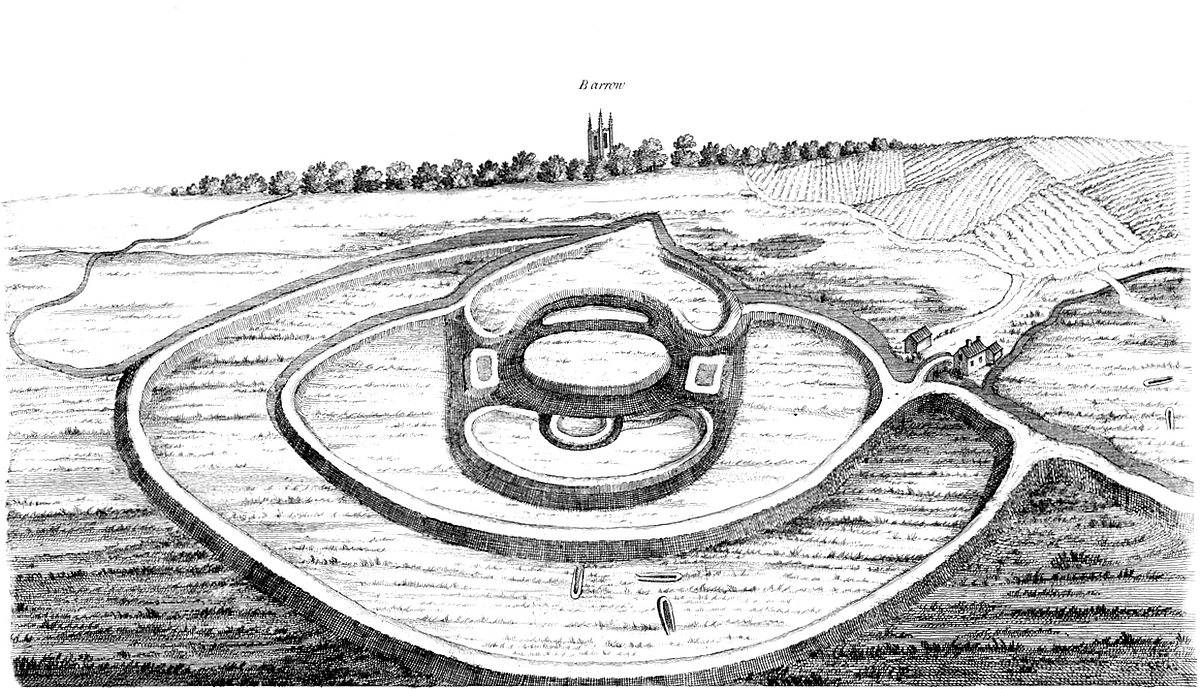
the banks of the Humber, the name of Barrow invited
my curiosity, and it was fully answer’d, by finding that most noble
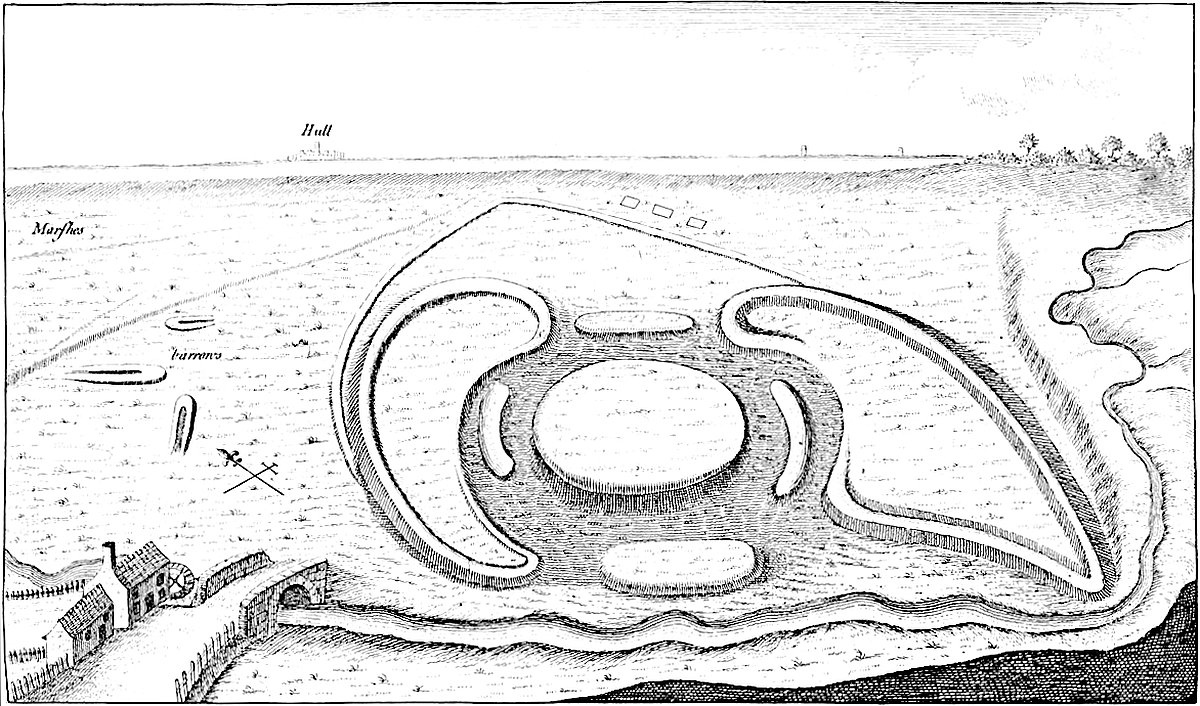
antiquity there of the old Druids, upon the marsh, call’d
Humbers castle.
A rivulet rises near the town of Barrow, and when it falls off
the high ground, and enters on the level marshes on the Humber
shore, it turns a mill. Just there, upon the edge of the marsh, upon a
gentle eminence, nearly overflow’d by high spring-tides, and between
the salt and fresh water, is the work we are to speak of, made of
great banks of earth thrown up, in an odd manner, which gives it the
denomination of castle. I observ’d all about it, and in the adjacent
marshes, many long tumuli of different sizes, but all of a
particular shape, such as I had never seen elsewhere, being form’d like
a bed. I immediately set to work in digging into several of them, and
we found burnt bones, ashes, bits of urns, and such kind of matters,
all extremely rotten and decay’d; and the very same appearances as I
had so often seen, in digging the barrows about Stonehenge and
Abury.
This satisfied me that the work must belong to the most ancient
inhabitants of the island, notwithstanding its unusual form. And when I
attentively consider’d those banks, and made a plan of them, I was very
agreeably surpriz’d in discovering the purport and meaning, which was
to represent the circulus alatus or winged circle, an ancient
hieroglyphic well known to those more particularly conversant with
Egyptian monuments; and what they rightly call the symbol of the
anima mundi, or spirit pervading the universe; in truth,
the divine spirit.
I had no hesitation in adjudging this to be a temple of our Druids. All
reasons imaginable concurr’d. Tho’ instead of stones, they have made
this work with mounds of earth; I suppose for want of stones, lying on
the surface of the ground. It makes the third kind of the Druid temples
which I proposed to describe. The vertical line of it is north-east and
south-west, the upper part being directly north-east; and the barrows
generally conform to this line, being either upon it, or at right
angles with it; the head of the barrow sometimes one way, sometimes the
other.
The circle was 120 cubits in diameter. The wings 100 cubits broad, 150
long; but the eastern wing was more extended than the other. For the
design of it is somewhat in perspective, as ’tis sometimes seen on
Egyptian antiquities.
This very extraordinary work, which I could not sufficiently admire,
has very often entertain’d my thoughts. We see an uniformity in
human nature throughout all ages. We build our churches, especially
cathedrals, in a cross, the symbol or cognizance of Christianity; the
first builders of churches did it in the symbol of the deity, which
was pictur’d out with great judgment, and that (most likely) from the
beginning of the world.
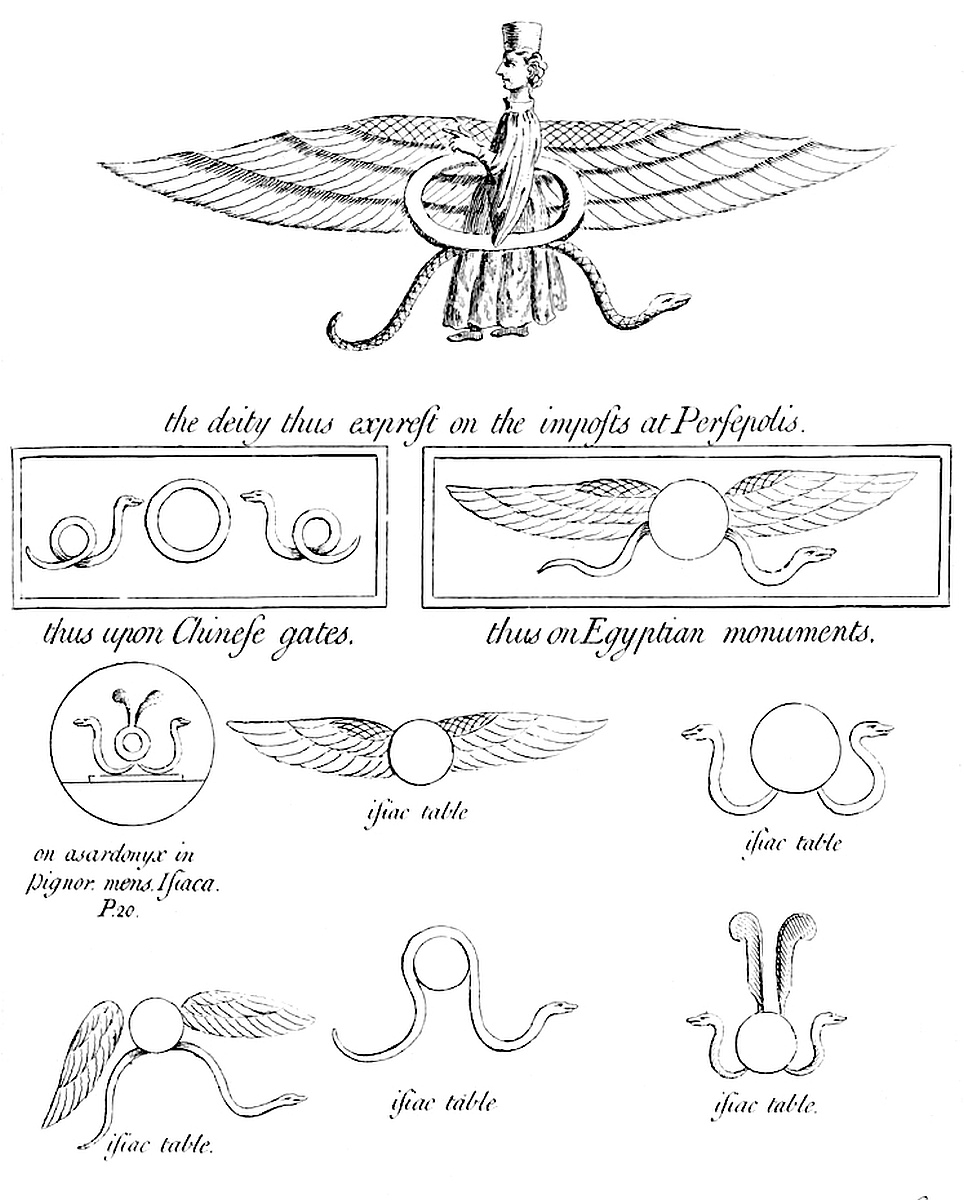
The circle and wings was the picture of the deity, which the old
Egyptian hierophants call’d CNEPH. As there were three
varieties in this figure, so they had more names than one for it, I
mean the whole figure, the circle, serpent, and wings. And sometimes
they used one word, sometimes another, and sometimes conjoin’d
them. Eusebius in pr. ev. III. 3. writes, “that the
Egyptians painted God, whom they call’d Kneph, like a
man in a blue garment, holding a circle and serpent (not scepter, for
no such
figure ever appears) and on his head, feathers or wings.” Now
this very figure is seen on the portals of the Persian temple
of Chilminar. Authors are not sufficiently accurate in these
matters, for want of a more perfect knowledge of them. Cneph is
properly the alate circle; yet sometimes they call the whole figure by
that name. So a feather or two, or wings, are often plac’d on the heads
of the Egyptian deities; but the picture above-mention’d at
Chilminar has the wings, as more commonly, annexed to the circle.
Phtha was another name of one of these figures, which they
sometimes join’d to the preceding, and made the word Cnephtha.
Kircher erroneously calls it Hemptha; for before him
Iamblichus err’d in calling Cneph, Emeph.
Strabo calls Cneph, Cnuphis, and says his temple
was at Syene, XVII. Undoubtedly a temple some way of this form.
Athenagoras in Eroticis VI. calls him Κνεφαιος, Cnepheus;
and says, “he can’t be seen by our eyes, nor comprehended by our mind.”
Hesychius, and the etymologist Suidas, voce
κνεφυς, interpret the word, obscure, hidden, not to be
seen or understood. Iamblichus and Proclus the like,
who make Amûn and Phtha the same, Prov. viii. 30.
The truth is, the word Cneph comes from the hebrew ענף
ganaph volare, to fly, קנף a wing, Psal.
xviii. 11. He rode upon the cherubim, and did fly.
Phtha, in Suidas called φθάς, is deriv’d, on the
authority of Kircher and Huetius, from the hebrew
פתה the same as the greek word πειθω, to persuade,
suada in latin. It regards more particularly the serpent,
the emblem of eloquence, and the divine WORD. In Arabic it
signifies the son. So that Cnephtha means the entire
figure, the circle, snake and wings. The supreme had no name. They
held him ineffable, as well as invisible. Whence they call’d the
Jehovah of the jews an uncertain or unknown deity, or the
deity without a name. Herodotus in Euterpe writes, “he heard
from the priests of Dodona, that the ancient Pelasgians
made their prayers and sacrifices to the deity without any name
or sirname, for at that time they knew none.” Iamblichus’s
interpretation of Phtha is very little different. He says, “It
signifies him that performs all things in truth, and without lying.”
The Egyptians called this Phtha Vulcan, and say, he was
the son of the supreme God; whom Cicero makes the guardian
god of Egypt, who was the author of all the philosophy of the
Egyptians, according to Diogenes Laertius in proem.
And this is that most ancient deity of the Egyptians who was
particularly design’d by the serpent. And hence the fables of the
greeks make Vulcan the only son of Juno, without
the help of her husband. Again, they make Pallas produc’d out of
Jupiter’s brain, who wore the Ægis or snaky breast-plate,
which originally was no other than our great prophylactic hierogramma,
the circle and snake, us’d by the most ancient warriors as a sacred
preservative. Medusa’s head is the very same, a circle, wings,
and snakes. But the delicate greeks new drest it, and made the
circle into a beautiful face, more agreeable to their taste of things.
And its turning men into stones means, at the bottom, nothing but the
making our serpentine temples in that form by the first heroes, who
bore this cognizance in their shields.
But to return to CNEPH, the deity to whom these winged temples
are dedicate. It became the chief and more famous name. Whence
Porphyry in Eusebius’s pr. ev. III. 11. calls this
Cneph the creator, Plutarch, de Is. & Os. testifies, “the
inhabitants in Thebais, or the remotest part of Egypt,
worshipped only the eternal God Cneph, and paid nothing toward
the charge of idolatrous worship in the other parts of that kingdom.”
Thus we see, those countries farthest separated from the busy part of
the world, such as Thebais and Britain, retain’d the
pure and ancient religion: which bishop Cumberland too asserts,
Sanchon. p. 15. of Thebais, before Abraham’s time.
Strabo says, “there was a temple of Cnuphis (as he writes
it) at Syene, the farther part of Thebais:” which must
be understood of one of our winged temples originally, tho’ probably
afterwards built upon, cover’d, and become idolatrous. “Hence the
Ethiopians, neighbours to those of Thebais, living still
in the upper regions of Egypt,” says Strabo, “worship
two gods, the one the immortal creator, the other mortal, who has
no name, nor is easily to be apprehended.” Here we find they have a
notion of the supreme and his son. Their opposite neighbours across the
red sea, worshipped only two gods, τον Διον καὶ τον Διονυσον,
Jovem & Jovem Nysæum, God, and the God of Nysa. This is
what is meant by the two principles of Pythagoras, mention’d
by Plutarch de plac. philos. unity and indefinite duality, the
sacred Dyas of Plato. Whence Diodorus in his
I. writes, “that the Egyptians declar’d there were two first
eternal Gods.” These they express’d by the names of unity and
duality. I do not believe that they found this out by their own
understanding and reasoning, but had it from patriarchal tradition.
And then their own reasoning would confirm it. For it is altogether
agreeable to reason, arguing from the fecundity of the first cause.
The Greeks turned Cneph into their Neptune, the
sovereign of the waters, from what the hebrew legislator writes
in the beginning of his cosmogony; “and the spirit of God moved
upon the face of the waters.” The word Neptune comes from
Cneph and דניא Dunia, orbis, circulus,
the winged circle. And this probably will give us some light
into the reason, why we find our winged temple of Barrow upon
the banks of that noble æstuary, the Humber. I wonder’d indeed
how it should come about, that the Druids should so studiously place
this work under the verge of the high land, and upon the brink of the
salt marsh; so that every high tide washes or overflows the skirts
of it, whilst the freshwater brook runs close under it. At this time
it must have presented them with the agreeable picture of the sacred
hieroglyphic, hovering over both fresh and salt-water.
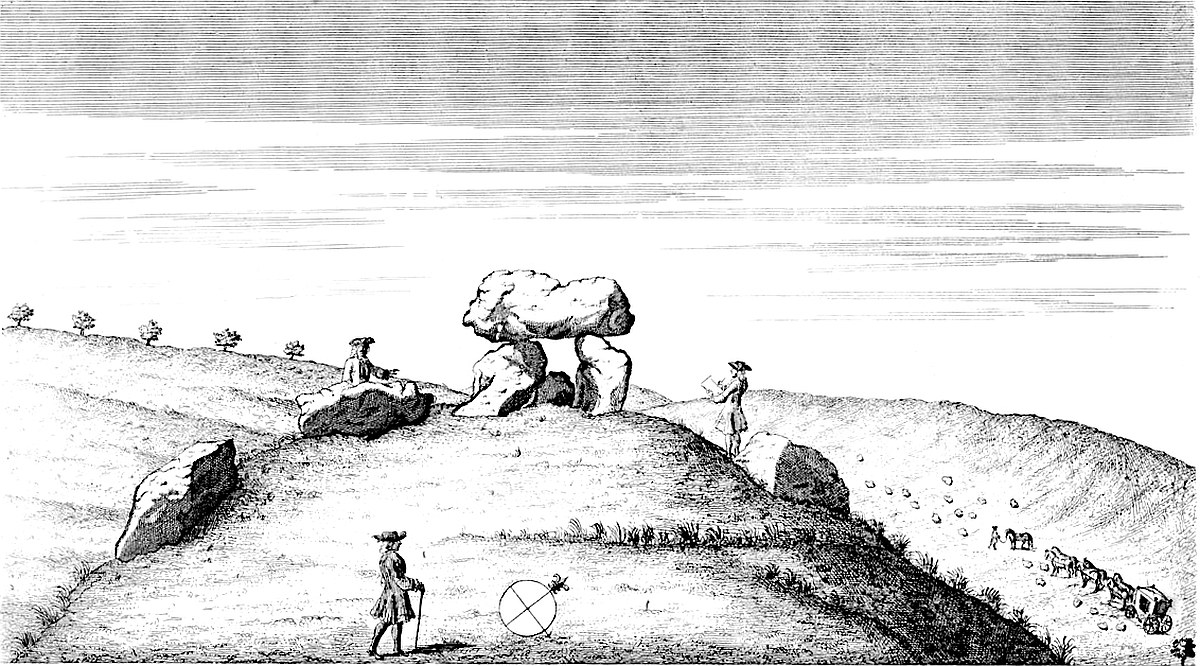
I observ’d a line, or little bank and ditch, cast up above our figure,
which I judg’d to be done with an intent to keep off the inundation of
the ocean at the times of sacrifice, which seems to have been perform’d
within that inclos’d area, where I have set the figure of the compass
in the engraven view. Likewise just without that line, eastward, I
remarked three little square plots, which perhaps were habitations of
the Druids who were keepers of the temple.
’Tis not from the purpose to take notice of one of the greatest fix’d
stars of the heavens, at the bottom of the constellation call’d the
ship, having the name of Canopus, which is no other
than our word Cneph. This star had this name given it by the
Egyptians, as appearing to them just above the edge of the
southern horizon. And in their spheres, we may very well presume,
they painted it as a winged circle, and because it always appear’d as
hovering over the horizon or great ocean.
————O numen aquarum
Proxima cui cœlo cessit, Neptune, potestas. Ov. Met. IV.
So that originally the ancients understood the spirit or soul of
the universe, or more properly the divine spirit, by this figure
which they call’d KNEPH, which the European nations call’d
Neptune, sovereign of the waters. So often by the poets call’d
Ενοσιχθων, Ενοσιγαιων, the shaker of the earth; for the waters
in Moses means the Hyle, or moist matter of chaos whence
the universe was made.
Two of the quarterly solemnities or general sacrifices of the Druids
were on the two equinoxes, when are the highest tides. A curious
observer being upon the spot, for some years together, at these times,
might possibly make some notable discovery concerning the difference
of the surface of the sea, since the current of 5 or 6000 years: for
I persuade myself this temple was made by the very first inhabitants
of the isle, and not long after the flood, on account of the interment
here of some great hero, that advanc’d so far in peopling the country.
And if our reasonings and testimonies hitherto be any whit agreeable
to truth, we may point out the species of many of these most ancient
temples built at the place of sepulture of heroes, spoken of in
writings of those times. For instance, we infer a serpentine temple
was made by the tumulus of Orpheus, from the fable of
a serpent offering to devour his head, which serpent was turn’d into
stone.
Hic ferus expositum peregrinis anguis arenis
Os petit, & sparsos stillanti rore capillos
Lambit, & hymniferos inhiat divellere vultus.
Tandem Phœbus adest, morsusque inferre parentem
Congelat, & patulos, ut erant, indurat hiatus.
Again, we may reasonably suppose that an alate temple was built by the
tomb of Memnon, said to be buried in Phrygia, who was
turn’d into a bird on the funeral pile, at the request of his mother
Aurora. We see some hints of it even from Ovid’s telling
the story. This was done at the request of his mother Aurora,
who petitions Jupiter for this favour to her son, for herself
she desires none. Thus she begins:
Omnibus inferior, quas sustinet aureus æther
(Nam mihi sunt totum rarissima templa per orbem,)
Diva tamen venio: non ut delubra, diesque
Des mihi sacrificos, caliturasque ignibus aras, &c.
He was turn’d into a bird, and a flock of the same birds,
call’d Aves Memnoniæ, arose from the same funeral pile, which
immediately divided into two companies, and fought till they destroy’d
each other. And that a like flight of the same birds came on the same
day every year from Ethiopia, went thrice round his monument,
and then divided and fought in honour of their ancestor.
What can we understand by this, but an assembly of his people and
descendants to celebrate his anniversary, as was the custom of
antiquity toward great men. The story is entirely of a piece with that
told of Cadmus, and must be interpreted in the same way.
In this sense we are treating of, are we to understand authors when
they tell us, that Cadmus built a temple to Neptune in
the island of Rhodes. This was not a cover’d temple with elegant
pillars, nor an idolatrous one, which were matters of after-times; but
one of our alate temples. Phut had built a Dracontium
there before.
Antoninus Liberalis XII. speaks of the lake Canopus,
which I suppose had its name from a Cneph or alate temple near
it, built by a hero, Cygnus, son of Phut, “who, the fable
says, was turn’d into a bird there,” and Phylius his sepulchral
monument was by it.
In this sense, Strabo II. speaks of Hercules being
call’d Canopeus, from building such a temple. And we may now
understand that hitherto abstruse Egyptian antiquity called
Canopus, a vase which they us’d for preserving of water in their
temples and in their families, with a cover to it. In order to insure
the blessing of heaven to this most necessary element, they frequently
consign’d it with the sacred prophylactic character of the Kneph
or circulus alatus, which is the greek Neptune, the
dominator aquarum. Many of these vases are still remaining in
the cabinets of antiquarians. Such a one pictur’d in Kircher.
And, by the by, I may mention that some of these vases are adorn’d with
a scarabeus with expanded wings, and this is entirely of the
same meaning as the alate circle. But this is not a place to discourse
larger on these matters.
I suspect Geneva and Geneffa have their names from such
temples. As Gnaphalus a bird mention’d by Aristotle.
Simias the Rhodian celebrates our Cneph, in
his poem compos’d in the form of wings: as the author of motion
and creation: hence the word Nebula, νεφέλη and perhaps
Nebulo.
In the year 1725, the next year after I found out this Humber
temple, and the last year of my travels, I found another of these alate
temples, on Navestock-common in Essex, which seems to be
of a later date than the other, and when perhaps the original doctrine
concerning these theological speculations was somewhat forgotten;
Because this temple is situate on a dry common, not near water; but the
figure is the very same.
What is exceedingly remarkable as to this noble antiquity on
Navestock-common, is, that the name should remain to this time,
and which confirms all that we said before concerning them, as to
their name and meaning: for Navestock must have been so call’d
from some old and remarkable tree, probably an oak, upon or by the
CNEPH, or winged temple; Navestock. Our English word
Knave, which had no ill meaning at first, signifies the same
thing, alatus, impiger; the latin word Gnavus the
very same: and Knap a Teutonick word the like: all from
the hebrew original.
I doubt not, but there are more such temples in the Britannick
isles, called Knaves-castles or the like. One I remember to have
seen, on a great heathy common, by the Roman Watling-street
in Staffordshire. And Mr. Toland takes notice of a
winged temple of our Druids in the Hebrid or Hyperborean
islands, Shetland. Abaris a Druid of this country,
fir’d with a desire of knowledge, travell’d into Greece
where philosophy flourish’d; after that to Pythagoras in
Italy, and became his favourite disciple. Pythagoras
imparted to him his best notions in philosophy, which perhaps, in the
enigmatick way of those times, they call the shewing to him his golden
thigh. Abaris on the other hand, presented to Pythagoras
Apollo’s arrow, which he brought out of his own country, where it
had been deposited in a winged temple. They tell you further, that
Abaris rode on this arrow in the air to Greece. This
undoubtedly would proceed from the notion they entertain’d of the
Druids practising magick.
I cannot help thinking, after what I have said in Stonehenge,
concerning the magnetick needle, that this arrow of Apollo’s
which Abaris made use of in his journey from Shetland
to Greece, was an instrument of this sort, which the
Hyperborean sage gave to Pythagoras. And the Druids
possessing such a secret as this, would reciprocally create, and favour
that notion of their practising magick. Calling it Apollo’s
arrow seems to throw the possession of it up to Phut the most
famous navigator, we before treated of: nay it seems that we may trace
it still higher, even to Noah himself. Sanchoniathon
the Phœnician writer tells us, among other remarkable things
concerning Ouranus, who is certainly Noah, “that he
devised Bætulia, or contriv’d stones that mov’d as having life.”
Besides the interpretation, we may very naturally affix to this
account, of anointed stones or main ambres: we may well judge that
the knowledge of the magnet is here understood; which at first they
placed in a little boat, in a vessel of water, and then it would move
itself, ’till directed to the quarters of the heavens. Atheneus
Deipnosoph. affirms, that Hercules borrow’d his golden cup
wherewith he sail’d over the ocean, of Nereus. Nereus
is Japhet eldest son of Noah, and the golden cup was a
compass box in all probability.
Among the ancient constellations pictur’d on the celestial globe, is an
arrow; said by Eratosthenes the most ancient writer we have on
the Catasterisms, (as called,) to be the arrow of Apollo,
which was laid up in the winged temple among the Hyperboreans.
Diodorus Siculus from Hecateus and other older writers,
shews, the Hyperborean island was in the ocean, and beyond
Gaul, to the north, under the bear; where the people liv’d
a most simple and happy life. Orpheus places them near the
Cronian sea; a word purely Irish, as Mr. Toland
shews, Croin signifying frozen. He shews further and that very
largely, that the Hebrid islands, Skie, Lewis,
Harries, Shetland, are the true Hyperborean
islands of the ancients. Among them therefore was the winged temple;
whether made of mounds of earth, like those two on the Humber,
and on Navestock-common; or made of stones like other Druid
temples.
There are other Druid temples in those islands, made of stones, I shall
give a print of one, in my next volume. Further there is a famous one
in Cornwall call’d vulgarly the Hurlers, which I take to
have been one of our alate temples, made of stones set upright.
The learned Bayer in his fine designs of the celestial
constellations, represents the arrow of Apollo beforemention’d,
as a magnetick needle; and he took his designs chiefly from a very
ancient book of drawings. I observe likewise that the isle of
Skie, in the language of the natives, is call’d Scianach,
which signifies winged. And in that probably, was the winged temple we
speak of; which gave name to the isle.
We mention’d before that Phut married Rhode, whence the
isle of Rhodes had its name. Rod in the Psalms
and the Prophets signifies a snake. Nay Pliny in vii.
and 56, of his natural history asserts, that Rhodes was
originally call’d Ophiusa, a word equivalent. Most likely they
built a serpentine temple there, which gave the name. So the isle
of Tenos, which Bochart shews, means a serpent in the
oriental language, was call’d Hydrusa and Ophiusa. The
isle of Cyprus was call’d Ophiodia by Nicœnetus.
So Hydra an isle just before Carthage, which was first
built by Cadmus. Ophiades insulæ on the Arabian
coast of the Red-sea. Pausanias mentions a place
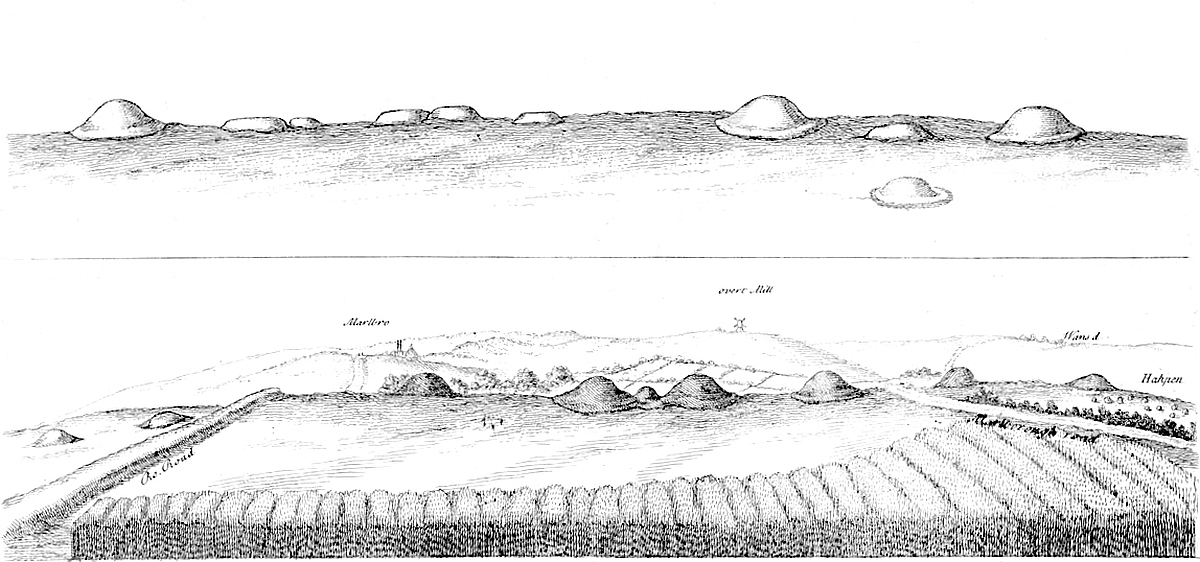
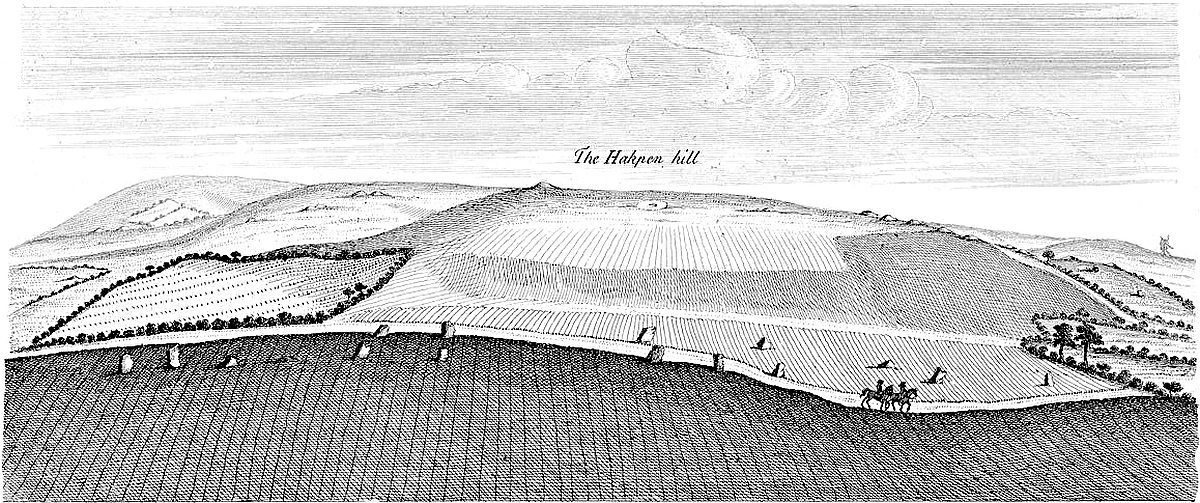
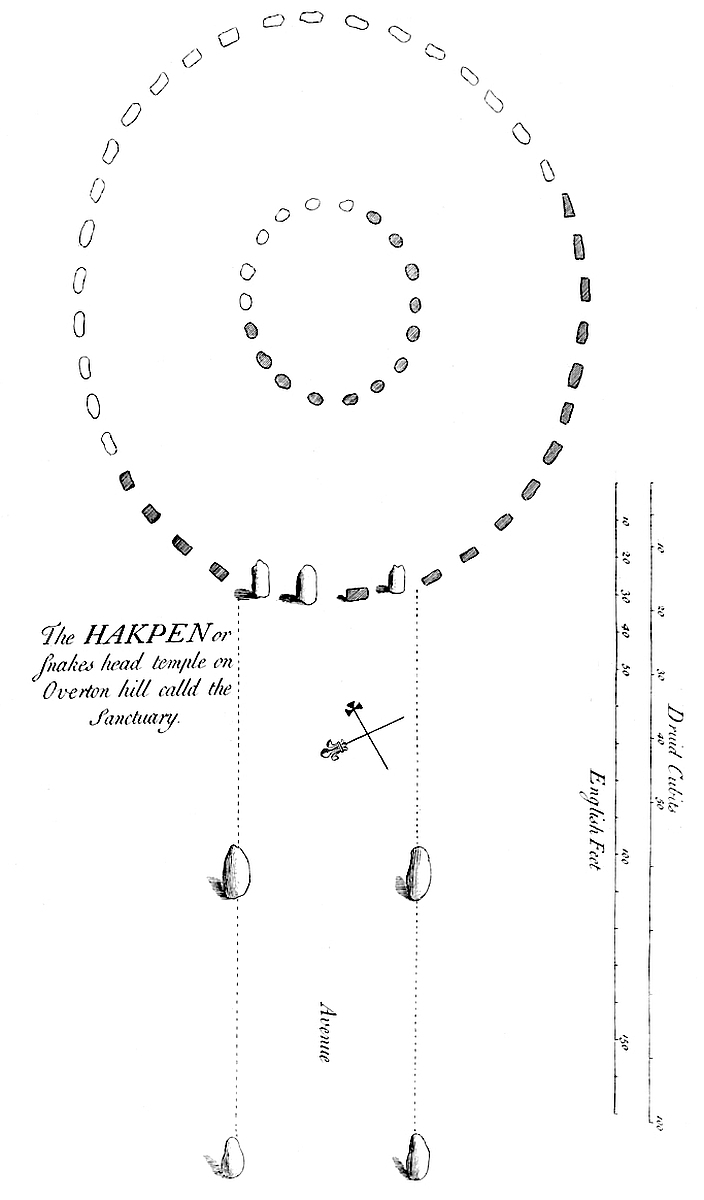
called Opheos Cephale, the serpent’s head; the same as our
Hakpen on Overton-hill in Abury.
In the isle of Chios is a famous mountain higher than the
rest, called Pelineus, which had undoubtedly one of our great
Dracontian temples.
The learned Bochart I. 9. shews its
name signifies the prodigious serpent: a story of the sort is annex’d
to it. Nay this famous temple gave name to the whole island, for he
shews that ’tis a Syrian word חויא Chivia a serpent,
so that Chios isle is the serpent’s isle: the word is the
same as Hivite: probably Cadmus or some of his people
built it. Hesychius and Phavorinus mentions Jupiter
Pelineus, the name of the deity worshiped.
Virgil in Æneid II. describes the two serpents that
destroy’d Laocoon coming from the isle of Tenedos.
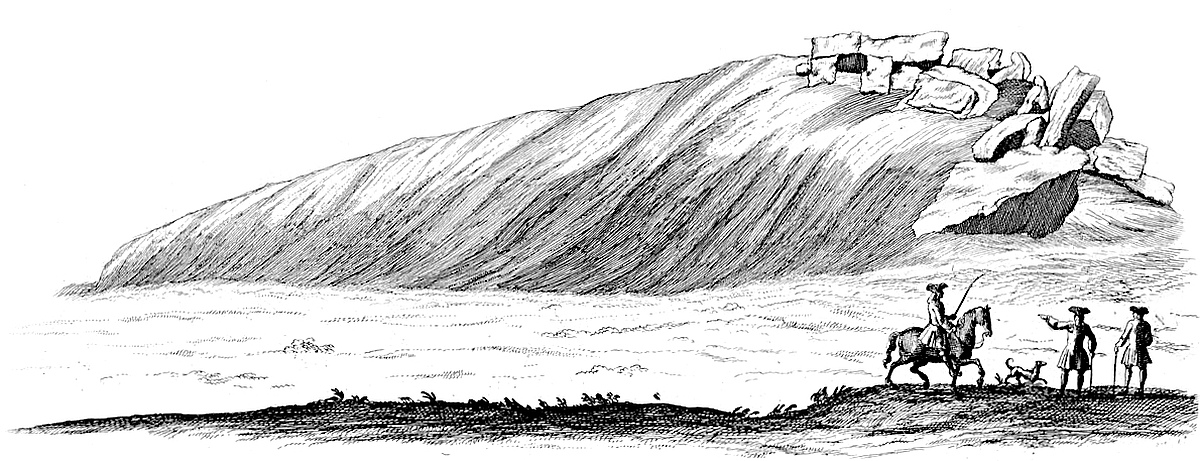
I described the barrows about Humbers castle, to be like beds.
They are all long barrows, of very different lengths, higher at the
head than the feet, (if we may so express it) and with a cavity the
whole length of them, drawn off at the feet, to the turf: So that
they represent the impression of a person that has lain on a very
soft, downy couch. One which I dug into near the temple was 60 cubits
long: the other two near it 40 each, plate xxxix. The sight of them
necessarily intruded into my mind, the ευνη or couch of Typhon
or Phut, which Homer says, was in Arimis. ’Tis
natural for us to imagine, he means exactly such a tumulus of
the hero, as these we are speaking of.
Phut was a great arch druid or patriarchal high-priest, as
being the head of his family. And according to my notion of the
matter, these long barrows all belong to some of the higher order of
the Druids. Eustathius interprets Homer’s word by that
of ταφος, tomb. Stephanus the scholiast on Hesiod’s
Theogon, makes Arima a mountain in Cilicia
or Lydia, where is Tiphon’s κοιτη. V. Oppian.
Alexand. ver. 599. Lucan ver. 191. Apollon. II.
Strabo XVI. Mela I. 13. Pausanias in Atticis tells
us of Hippolita the Amazons’ tumulus, that ’twas made in
shape of an Amazonian pelta or shield; perhaps somewhat like our
tumulus.
In the beginning of the idolatrous times, they likewise consecrated
Hermes the Egyptian into Mercury, but the
Egyptians took Mercury in a different light from the
Canaanites: they made him the god of divine wisdom, the
Canaanites who were immers’d in trade and traffick, made him
the god of profit and gain; and that in the person of their ancestor
Canaan. Nevertheless they knew the holy spirit prior to
idolatry: for many think that Mercury was no mortal man, S.
Augustin, C. D. viii. 26. and Orpheus in his hymn
to him, pronounces him to be of the race of Dionysus, by whom
Jehovah is understood.
I suppose Canaan when he died, had an alate temple built about
his place of sepulture, which in after times occasion’d posterity to
deify him under the name of Mercury. Again I suppose the like
done over the tumulus of the patriarch TARSIS; which gave a
handle in idolatrous times, to consecrate him into the Neptune
of the heathen; who in effect is the same as Mercury, saving
that being done by people of a different genius and disposition, they
divided one god into two.
Thus we have sail’d thro’ a wide ocean of antiquities, and that not
without a compass. We set old things transmitted to us in writing, in
parallelism with these we may now see at home, in such a manner, as I
think evidently shews them to be the same.
Nec sum animi dubius, verbis ea vincere magnum
Quàm sit, & antiquis hunc addere rebus honorem.
Sed me Parnassi deserta per ardua dulcis
Raptat amor—————— Virg.
I shall conclude, with 1. what we may very well imagine to have been
the ratiocination of the Druids among one another, in their theological
contemplations, concerning this last kind of their works, these winged
temples. Of such sort would be their speculations thereon, in their
serious scrutiny into the nature of the deity.
We observ’d, the Druids in their theological studies must, with the
other eastern sages, find out two ways of the supreme being exerting
his almighty power, multiplying himself, as the Zoroastrians,
the Pythagoreans and the Platonists call it, or divine
geniture: and creation. The first necessary, therefore done before
time; the second arbitrary, therefore done in time. Nevertheless this
second was fit and proper to be done, therefore necessarily to be
perform’d. For whatever becomes the allperfect being, we may pronounce
necessary with him.
The Druids would advance still further in their contemplations this
way, and conclude, that it became the supreme, and was therefore
necessary, for him to exert his power in all possible ways and modes of
acting; that he was not content in producing a single divine person or
emanation from himself, from the infinite fund of his own fecundity;
that he was pleas’d to proceed to that other mode of acting, which we
call divine procession; or a third divine person to proceed from the
first and second. This person the ancients had knowledge of, and styled
him anima mundi, “that spirit of the LORD which filleth the
world,” Wisdom i. 7. and made him a distinct person from God, or
the supreme: but, more immediately, he was the author of life to all
living things. And this he disseminated throughout the whole macrocosm.
I need only quote Virgil, for many more, in his fine poem,
Georg. IV.
Esse apibus partem divinæ mentis & haustus
Æthereos dixere. Deum namque ire per omnes
Terrasque tractusque maris, cælumque profundum.
Hinc pecudes, armenta, viros, genus omne ferarum,
Quemque sibi tenues nascentem arcessere vitas;
Scilicet huc reddi deinde & resoluta referri,
Omnia.——————
This divine mind, or anima mundi, the ancients pictur’d out by
the circle and wings, meaning the holy spirit in symbolical language,
or the spirit proceeding from the fountain of divinity. And we see it
innumerable times on Egyptian, and other ancient monuments.
Plutarch, in his platonic questions, asks, “Why should
Plato in his Phædro say, the nature of a wing, which
mounts heavy things upward, is chiefly participant of those that are
about the body of the deity?”
But thus the Druids would reason. There are three modes of divine
origin and existence, quite different from creation: they are these:
the self-existent, unoriginated first cause; divine generation; and
divine procession: all equal in nature, self-origination excepted, and
equally necessarily existent. When the supreme produces his likeness,
it must be divine filiation; or the son of God is produc’d. Divine
procession must be from them two: but it cannot possibly be filiation:
for besides that, in these acts of the divinity, we must separate all
ideas like that of human production, it would be absurd to call this
generation; because, as it is done prior to all notion of time, or
eternity itself; it is making the son to be son and
father in the same
act. Therefore there remains no other word for this, than procession
from the father and son.
Whether these abstract and metaphysical notions would occur to a mind
wholly unacquainted with any doctrine of this sort, may be matter
of doubt; but when propos’d to a serious and contemplative genius,
they would be embraced and improved, as agreeable to reason; and as
an advance towards the most sublime and most useful knowledge of all
others, that of the nature of the deity.
2. The very learned Schedius, in his treatise de mor.
germ. XXIV. speaking of the Druids, confirms exceedingly all that
we have said on this head. He writes, “that they seek studiously
for an oak-tree, large and handsome, growing up with two principal
arms, in form of a cross, beside the main stem upright. If the two
horizontal arms are not sufficiently adapted to the figure, they fasten
a cross-beam to it. This tree they consecrate in this manner. Upon the
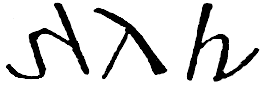
right branch they cut in the bark, in fair characters, the word HESUS:
upon the middle or upright stem, the word TARAMIS: upon the left branch
BELENUS: over this, above the going off of the arms, they cut the name
of God, THAU: under all the same repeated, THAU.”
We cannot possibly understand otherwise, than that by this they
intended to show the unity in the divine nature; for every word
signifies God emphatically, and in their general acceptation,
Thau especially. The other three words have each particularly a
more restrained sense, regarding the oeconomy of the deity or godhead.
And this is Schedius his opinion.
This tree, so inscribed, they make their kebla in the grove,
cathedral, or summer-church, toward which they direct their faces in
the offices of religion, as to the ambre stone or the cove in the above
described temples of Abury. Like as the Christians to any symbol
or picture over the altar. And hence the writers got a notion of their
worshipping trees; and of these names belonging to so many gods: which
serves the poets to descant upon. But if we examine them to their
origin, they are easily to be reduc’d to orthodoxy.
The word Hesus means the supreme God in the celtic
language, as ESAR among the Hetruscans. Sueton. in Aug. It was
pronounced Eisar, as the germans pronounce Cæsar,
Keisar. It comes from the hebrew ה Ei, and סר
Lord, שר Prince. ה is emphatically the name of the
divinity, as השם το ονομα, the NAME Jehovah, Levit.
xxiv. 11. 16. Hence ה or EI, inscribed over the door of the temple
at Delphos, of which Plutarch has wrote. It was the
way of the babylonish monarchs to assume divine names, as
Esar-adon, signifying no less than God the Lord. Esi
is God, says Hesychius. In the arabic it signifies the
Creator, says Dickenson delph. phœnic. But these authors
do not go to the bottom, for it comes from AS or AT, signifying God
the father. Ἄτα or Ἄττα, with the Greeks is pater.
The Armenians call it Αδς, the Egyptians Ὠτ, those of
Sarmatia and Slavonia Ος: says the learned Baxter,
v. Ascania, gloss. ant. Rom. where he has much of ancient
learning upon it. This is the Atys of the Phrygians.
Belenus is the Baal in scripture, us’d originally to be
spoken of the true God Jehovah, ’till adopted into idolatry.
Belus of the Assyrians. If we examine the word to the
bottom, it means God the son. Βηλ, in the babylonic language is
the son, Βηλτις the daughter. He is the Apollo of
the Latins.
Tharamis is the same as Tat, Thoth of the
Egyptians, Thor of the northern nations, call’d more
particularly the spirit: lord of the air, from the wings
being symbolical of him; and hence made the thunderer, from the
Phœnician and celtick Tarem. He was sometimes call’d
Theutates, the Mercury of the Latins, who was
particularly worshipped by the Germans, says Tacitus de
mor. germ. Cæsar the same, VI. bell. gall. Hence the
Greeks dress’d their Mercury with a winged cap, and
winged heels, which was no other than the circulus alatus we
have been speaking of. He bears a staff in his hand, with a globe on
the end of it with wings and snakes. The Phœnicians call’d him
Taautus. Sanchoniathon, Varro IV. de ling. lat.
So in the temple of Belus or the sun, at Edessa
in Mesopotamia, in idolatrous times, by his statue was
another of Ezizus, who is our Hesus, and another of
Mercury, whom they call Monimus. Julian, in his
hymn to the sun, mentions the same. And so generally the true
theology communicated to mankind from the beginning, was perverted into
polytheism and idolatry.
3. So by the tree came death, by the tree came life, which the Druids
seem to have had some knowledge of. Ruffinus II. 29. affirms
the cross among the Egyptians was an hieroglyphic importing the
life that is to come. Sozomen the same, hist. eccl. VII.
15. and Suidas. Isidore tells, “it was the method of the
muster-masters in the roman army, in giving in the lists of the
soldiers, to mark with a cross the name of the man that was alive; with
a Θ him that was dead.”
The ancient inhabitants of America honour’d the form of the
cross. So the conjurers in Lapland use it. Which intimate this
hieroglyphic to be most ancient, probably antediluvian.
But concerning the knowledge of the cross which the Druids had, and
of their religion more at large, I shall discourse fully in the next
volume, which will conclude what I have to say concerning them and
their works.
4. From what has been delivered in the speculative part of this
treatise, the springs of idolatry appear sufficiently. For the race of
heroes that built these patriarchal temples in the eastern part of the
world especially, and propagated true religion, were some ages after
deify’d by their idolatrous posterity; and had names of consecration
taken from the divine attributes, and the just notions delivered to
them concerning the nature of the deity.
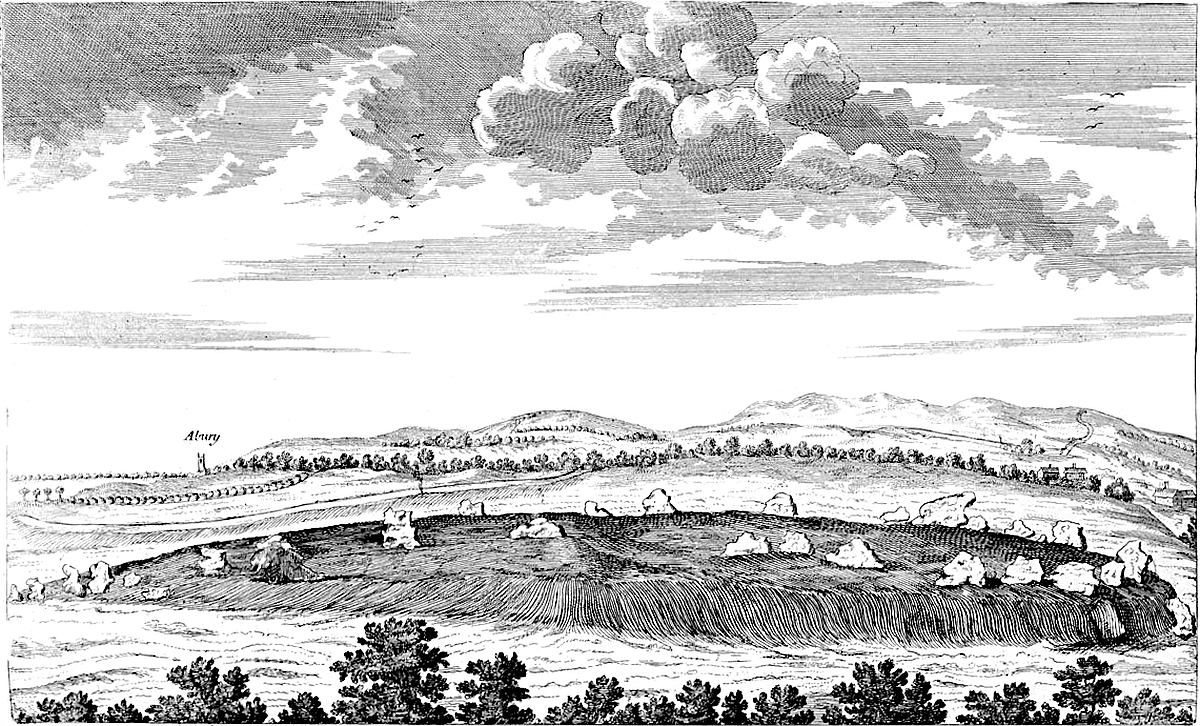
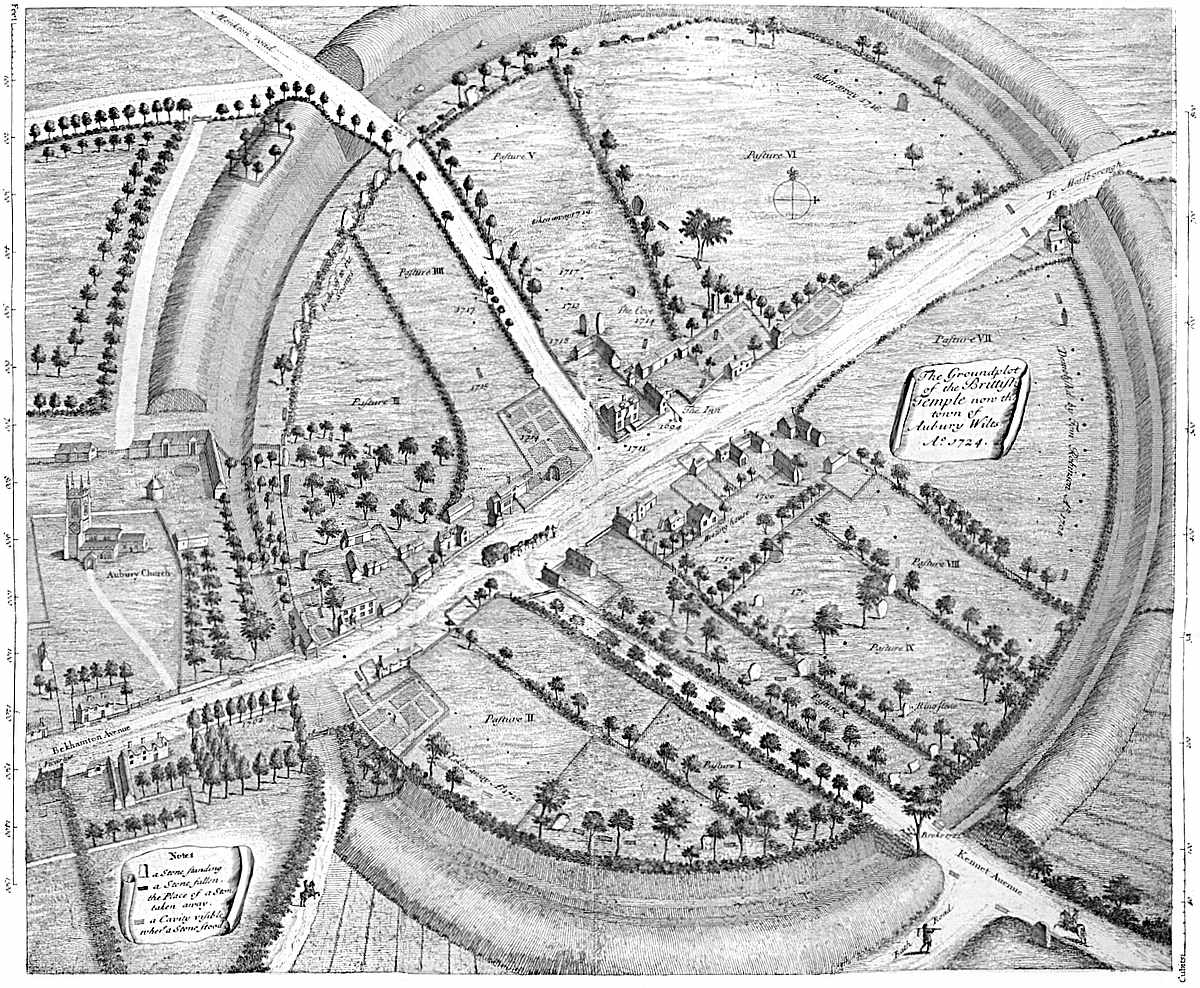
5. If then we reflect on the foregoing description of the work of
Abury, whether we consider the figure it is built upon, the
antiquity or the grandeur of it, we must needs admire it, as deservedly
to be rank’d among the greatest wonders on the face of the earth. The
ancients indeed did make huge temples of immense pillars in colonnades,
like a small forest; or vast concaves of cupolas to represent the
heavens; they made gigantick colosses to figure out their gods; but to
our British Druids was reserv’d the honour of a more extensive
idea, and of executing it. They have made plains and hills, valleys,
springs and rivers contribute to form a temple of three miles in
length. They have stamp’d a whole country with the impress of this
sacred character, and that of the most permanent nature. The golden
temple of Solomon is vanish’d, the proud structure of the
Babylonian Belus, the temple of Diana at Ephesus,
that of Vulcan in Egypt, that of the Capitoline
Jupiter are perish’d and obliterated, whilst Abury, I
dare say, older than any of them, within a very few years ago, in
the beginning of this century, was intire; and even now, there are
sufficient traces left, whereby to learn a perfect notion of the whole.
Since I frequented the place, I fear it has suffer’d: but at that time,
there was scarce a single stone in the original
ground-plot wanting,
but I could trace it to the person then living who demolish’d it, and
to what use and where.
This I verily believe to have been a truly patriarchal temple, as the
rest likewise, which we have here described; and where the worship of
the true God was perform’d. And I conclude with what Epiphanius
writes, speaking of the old religion from the beginning of the world.
Non erat judaismus aut secta quæpiam alia: sed ut ita dicam, ea quæ
nunc in præsenti sancta Dei catholica ecclesia obtinet, fides erat; quæ
cum ab initio extiterit, postea rursum est manifestata. He affirms
Adam and all the patriarchs from him to Abraham, were no
other than christians; and this is the doctrine of the apostle of the
Gentiles, 1 Cor. ix. 21.
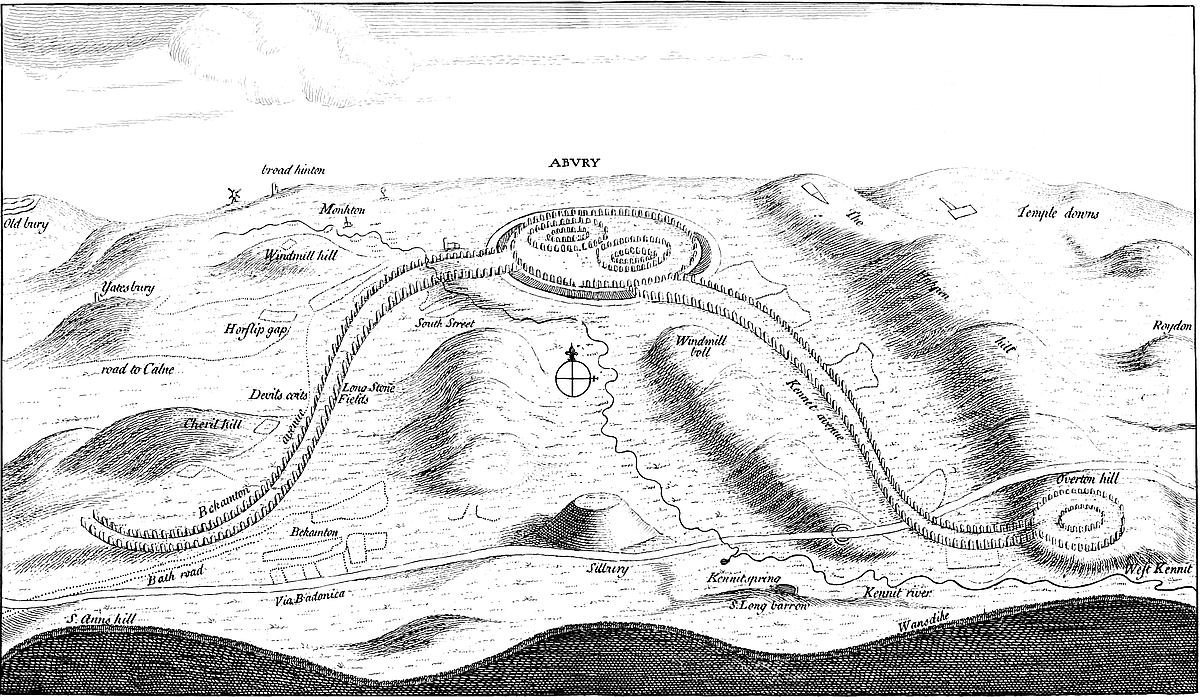
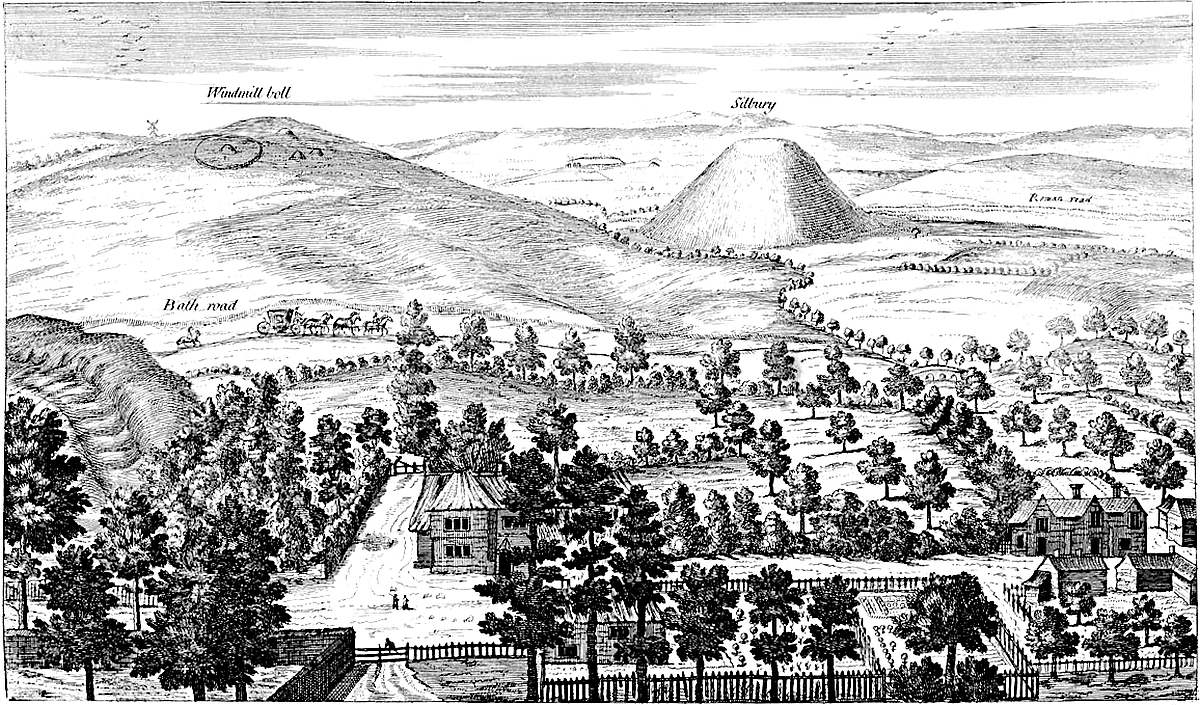
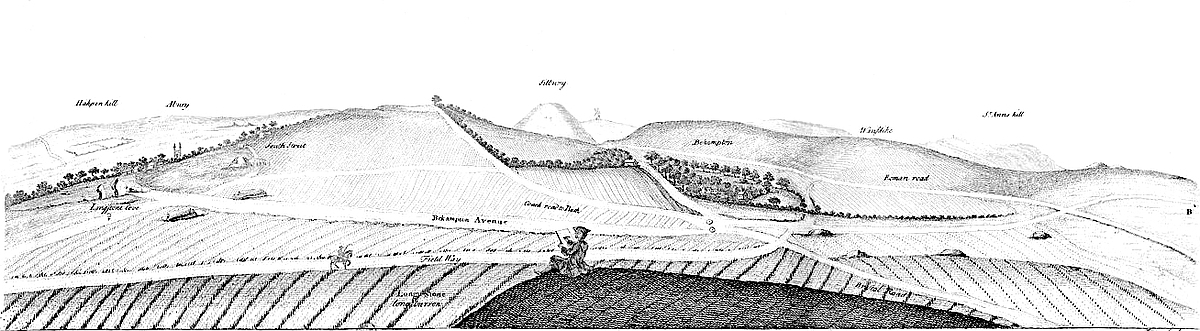
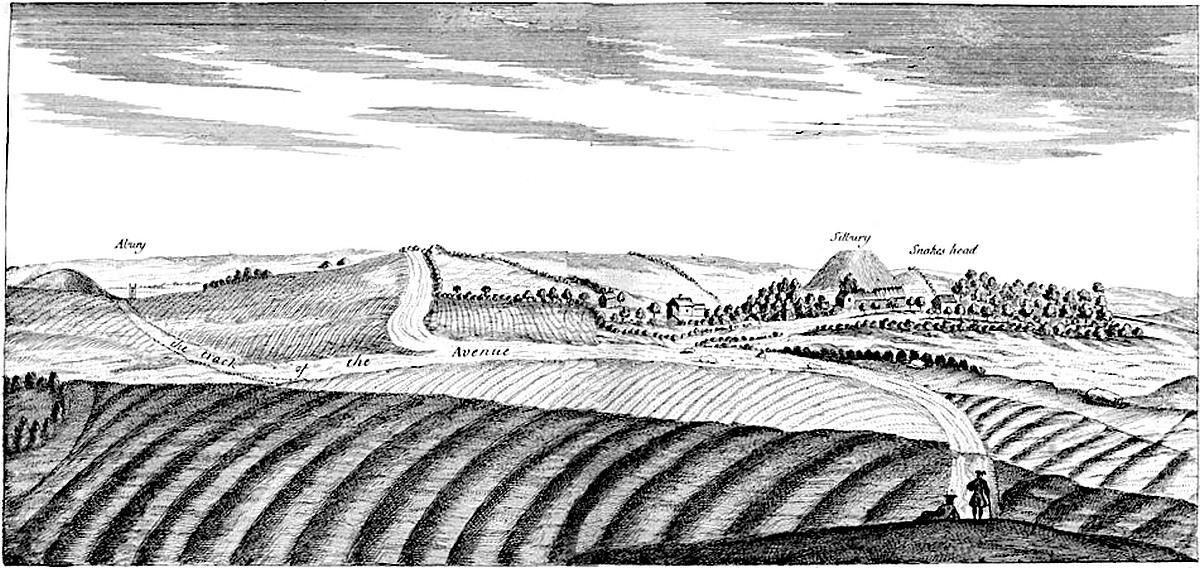
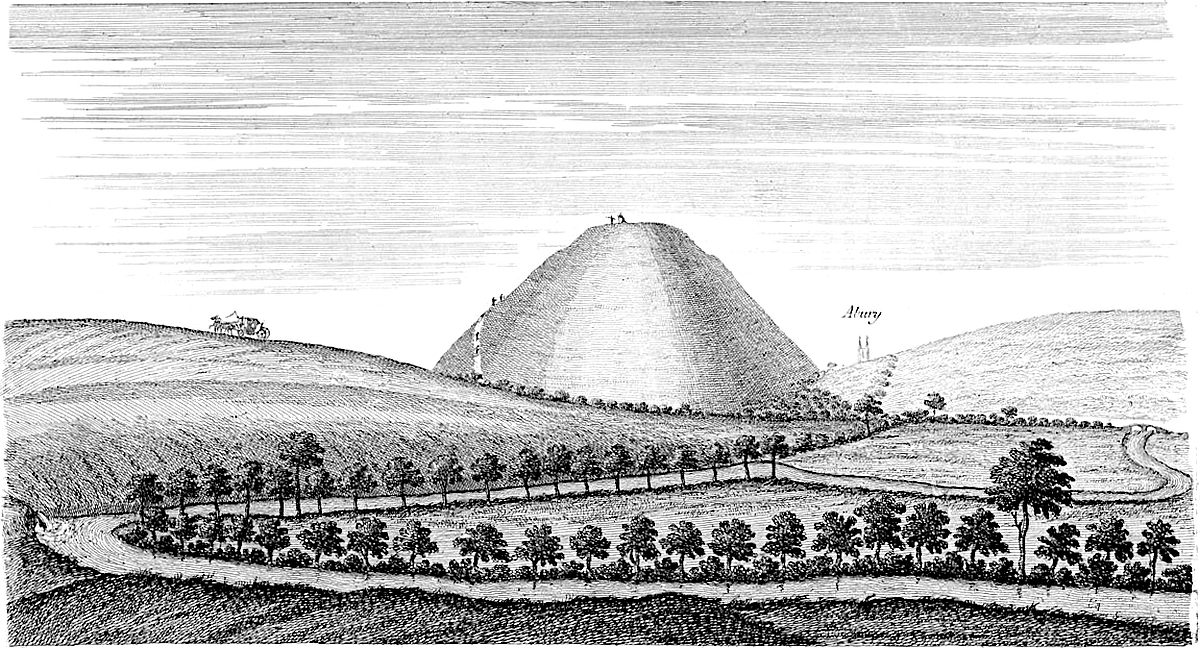
 a temple or great building. There
are two heads of the river Kennet rising near it: one from a
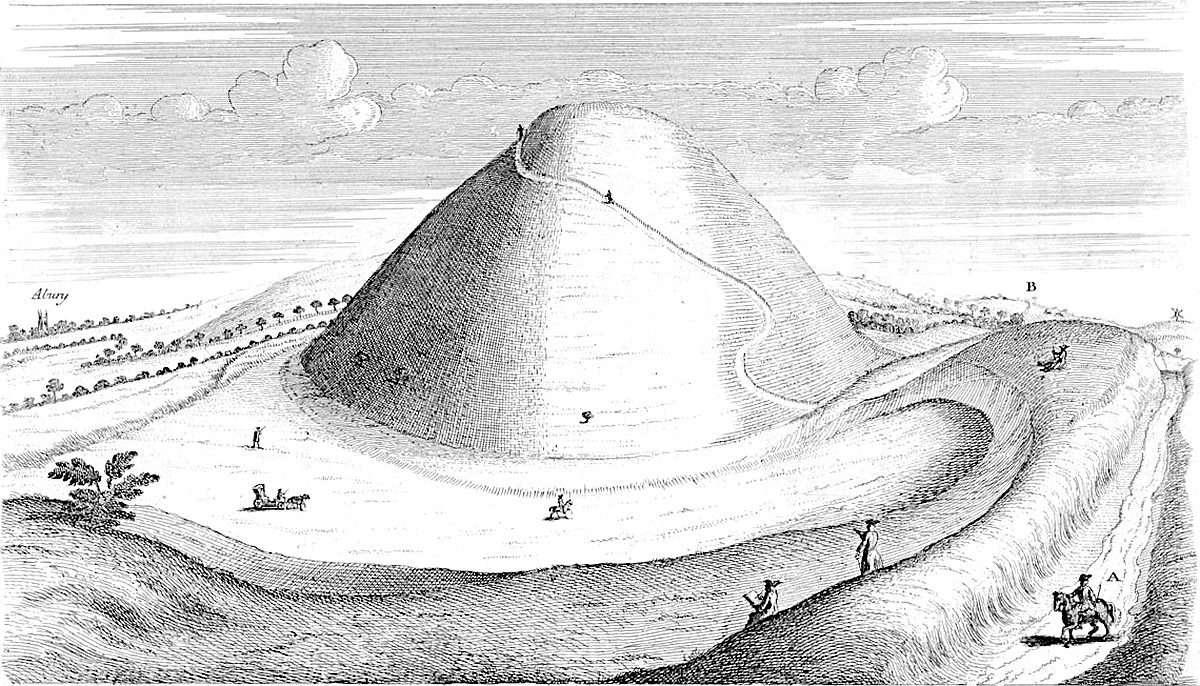
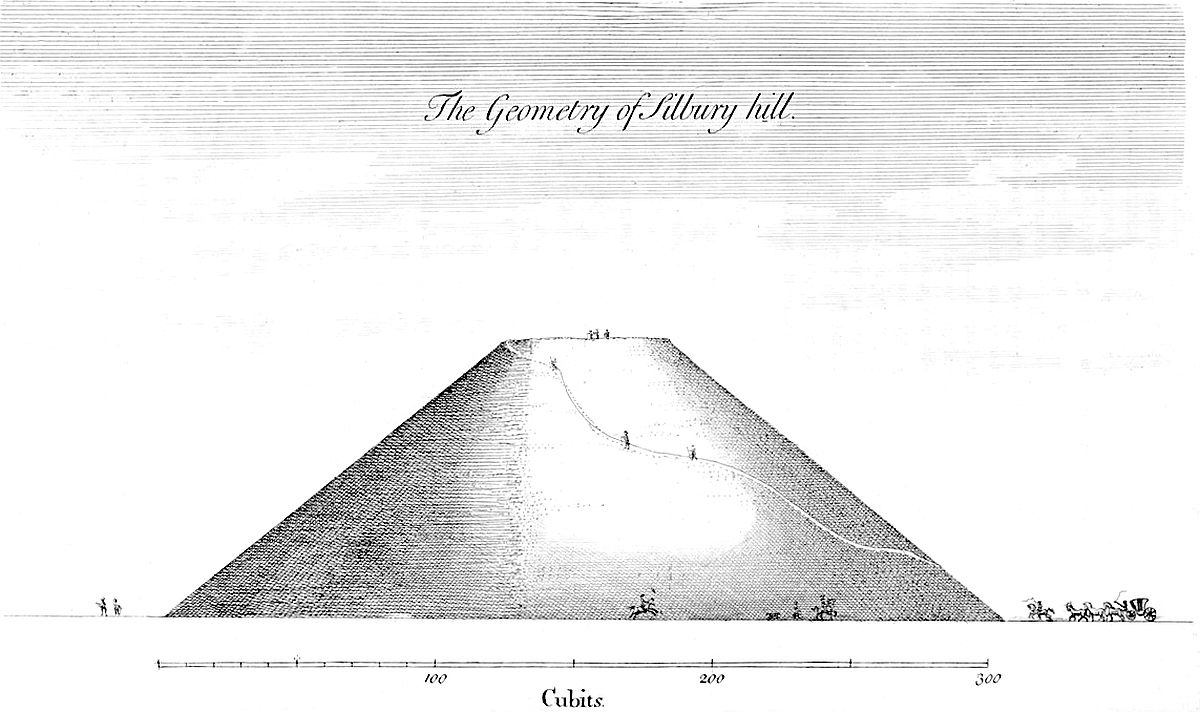
little north-west of Abury, at Monkton, runs southward
to Silbury-hill; this affords but little water, except in wet
seasons. At Silbury-hill it joins the Swallow head, or
true fountain of the Kennet, which the country people call
by the old name, Cunnit; and it is not a little famous among
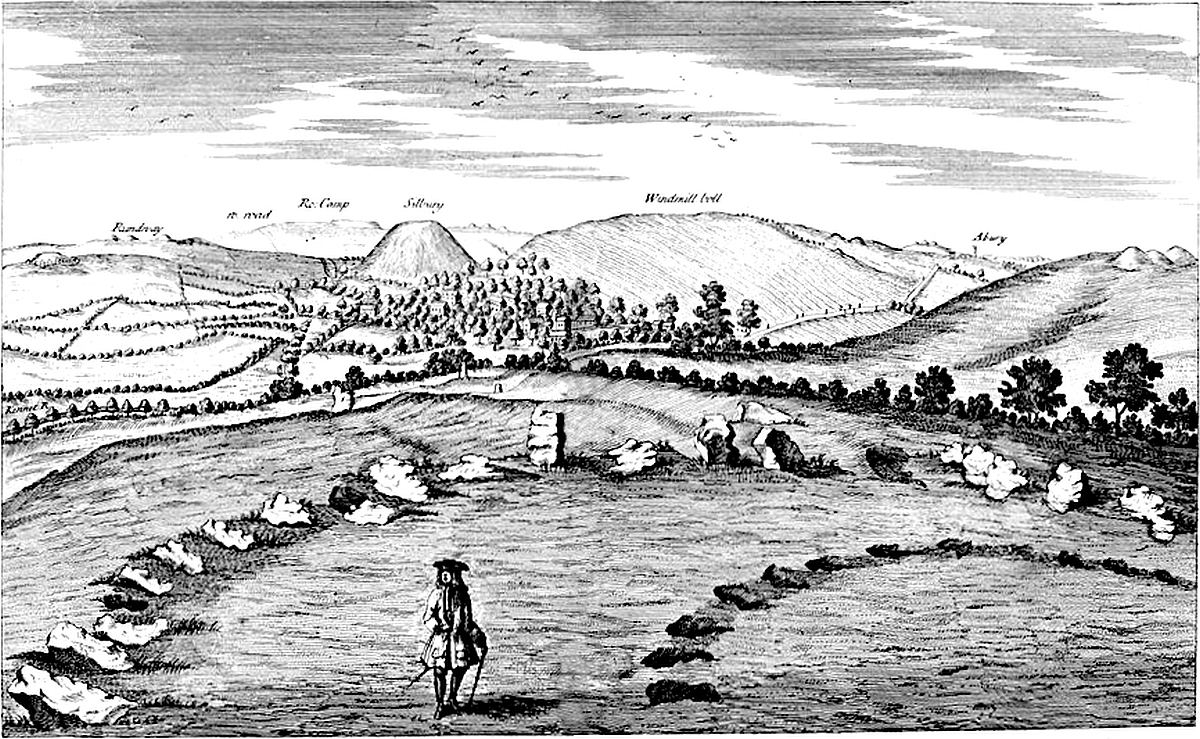
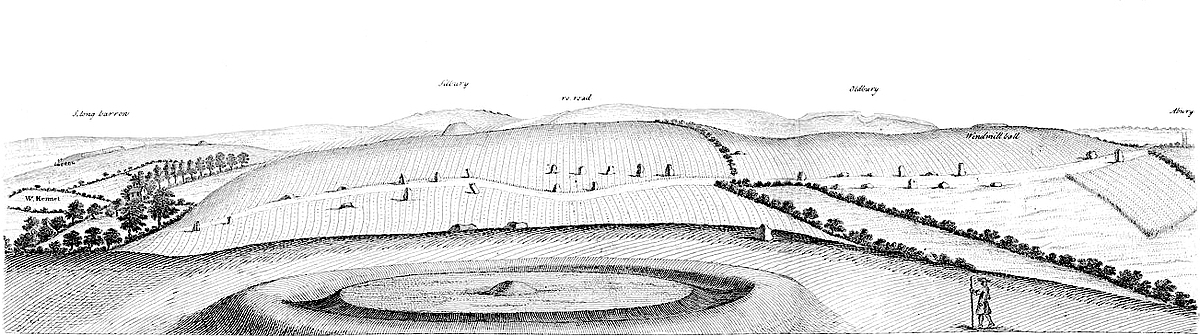
them. This is a plentiful spring. It descends between east and
west Kennet, by the temple on Overton-hill, which is
properly the head of the snake: it passes by Overton, and so to
Marlborough, the roman Cunetio, which has its name
from the river.
 And Kircher, in his third tome, affirms the
like of the Brachmans of the East-Indies.