When Abraham Lincoln was twenty-two years old
and a clerk in Denton Offutt's store he offered himself
to the voters of New Salem and vicinity as a candidate
for the Illinois Legislature. It was the year that the
Whigs held their first National Convention and nominated
Henry Clay as their candidate for President; and
from that time, as has been seen, Lincoln made politics
as well as law a profession, and participated actively in
every campaign until he was elected President.
In those days nominations for office were made by
announcement and not by conventions, and, according
to custom, with thirteen other citizens fired with similar
ambition, Lincoln issued a circular or "handbill," as it
was familiarly called, setting forth in quaint and characteristic
candor his "sentiments with regard to local
affairs." It was his platform, and no utterance of his
entire life is more interesting than the few personal
remarks which he addressed to his neighbors:
"Every man is said to have his peculiar ambition.
Whether it be true or not, I can say, for one, that I have
no other so great as that of being truly esteemed of my
fellow-men by rendering myself worthy of their esteem.
How far I shall succeed in gratifying this ambition is
yet to be developed. I am young, and unknown to many
of you. I was born, and have ever remained, in the
most humble walks of life. I have no wealthy or popular
relations or friends to recommend me. My case is
thrown exclusively upon the independent voters of the
county, and if elected they will have conferred a favor
upon me for which I shall be unremitting in my labors
to compensate. But if the good people in their wisdom
shall see fit to keep me in the background, I have been
too familiar with disappointments to be very much
chagrined."
It was an audacious act for a young man who had
been in the county only about nine months to aspire to
the honor and responsibility of a law-maker, but, compared
with his neighbors, Lincoln's qualifications were
conspicuous. He could read and write, had a fair
knowledge of literature, had read two or three law-books,
was a practical surveyor, and by reason of his
two journeys to New Orleans had seen a good deal more
of the world than any one in that neighborhood. But
these qualifications did not count for much in comparison
with his ability as a public speaker and his faculty
of doing things which had already made him a
reputation throughout the county. Although his advantages
had been limited, they were superior to those enjoyed
by three-fourths of the young men in Sangamon
County, and for education, experience, and other qualifications
he surpassed a majority of the members of the
Legislature. There were only a few men of culture and
education in that body. It was chiefly made up of illiterate
pioneers who mixed politics with farming and
carried on their campaigns at camp-meetings, horseraces,
country stores, and taverns, and resorted to every
subterfuge that their shrewd minds could invent to
secure votes. At the same time they were generally
honest, patriotic, and earnest for the welfare of their
constituents and their personal characters commanded
the esteem and confidence of the public. Among such
men Lincoln's talent for talking and writing, his knowledge
of poetry and literature, and, more than all, his
genius as a story-teller excited admiration and respect,
and he was regarded as the most promising young man
in the neighborhood. His announcement "handbill" discussed
the several topics which at that time were being
agitated, such as the improvement of the Sangamon
River. He related his experience with flat-boats, and
declared that by straightening the channel and clearing
away the drift-wood the stream could be made navigable.
"The improvement of the Sangamon River," he
sagely remarked, "is an object much better suited to our
infant resources" than the construction of a railway,
and, indeed, it was fifteen years later that the first whistle
of a locomotive was heard in Illinois. He took broad
grounds in favor of internal improvements, advocated a
law prohibiting money-loaners from charging exorbitant
rates of interest, and favored liberal appropriations for
education.
"For my part," he said, "I desire to see the time
when education, and by its means morality, sobriety,
enterprise, and industry, shall become much more general
than at present, and should be gratified to have it
in my power to contribute something to the advancement
of any measure which might have a tendency to accelerate
that happy period."
Perhaps, if he could have made a thorough campaign
and extended his acquaintance and popularity throughout
the county, he might have been elected, but just a
month after his announcement was published he went
off to the Black Hawk War (as is told in Chapter VI.)
and did not return until a few days before the election,
so that his canvass was limited. It was long enough,
however, for him to make a record as a man of moral
courage and ability. Although the great majority of
the population were Democrats, he boldly declared himself
a Whig, which must have cost him many votes.
National issues were not usually brought into local politics,
but the contest between Clay and Jackson was animated
and bitter; the Democrats were despotic and
intolerant towards the opposition, and were so much in
the majority that a Whig had very little consideration.
Lincoln has left us a brief account of the campaign, in
which he says that he ran as "an avowed Clay man,"
and in his speeches advocated the principles and policy
of Henry Clay's platform. "I am in favor of a national
bank; I am in favor of an internal improvement system
and a high protective tariff," he announced boldly, and it
must have cost him a severe struggle with his ambition
to have placed himself upon the unpopular side and to
have joined a hopeless minority at the beginning of his
political career; but he obeyed his convictions, and
nothing better illustrates the stuff of which the man was
made.
The returns show that out of 2168 votes Lincoln received
only 657, less than one-third of the whole. In
New Salem, where he lived, he received all but three of
the votes cast, although a few months later Andrew
Jackson carried the same precinct with 185 votes against
70 for Henry Clay.
This was the only time that Abraham Lincoln was
defeated on a direct vote of the people. He was greatly
gratified by the evidence of his popularity, and was confident
that if he could extend his acquaintance through the
county he would be successful at the next election; but
how was he to get a living in the mean time? Offutt's
store had failed and he was out of employment. He describes
the situation himself as follows: "He was now
without means and out of business, but was anxious to
remain with his friends, who had treated him with so
much generosity, especially as he had nothing elsewhere
to go to. He studied what he should do; thought of
learning the blacksmith trade, thought of trying to study
law, rather thought he could not succeed at that without
a better education."
It was a crisis in his life, but he was conscious of his
own ability and his faith in himself was strong. If his
judgment had been equally accurate, he would have been
saved great anxiety and trouble, for it was at this time
that he was induced to go into the mercantile speculation
which turned out so badly. He managed to make
a living, however, and pull through, and when the campaign
of 1834 came it was a matter of course that he
should again be a candidate for the Legislature. He
spent almost the entire summer electioneering, most of
the time in those parts of the county where he was least
acquainted, appealing for votes in his own peculiar way.
It was a rough-and-tumble canvass, often in company
with other candidates. "Wherever he saw a crowd of
men, he joined them, and he never failed to adapt himself
to their point of view in asking for votes," says one
of his friends. "If the degree of physical strength was
their test for a candidate, he was ready to lift a weight
or wrestle with any countryside champion. If the
amount of grain a man could cut would recommend him,
he seized the cradle and showed the swath he could cut."
One of the farmers of the neighborhood tells this story:
"He [Lincoln] came to my house, near Island Grove,
during harvest. There were some thirty men in the
field. He got his dinner and went out in the field where
the men were at work. I gave him an introduction, and
the boys said that they could not vote for a man unless
he could make a hand. 'Well, boys,' said he, 'if that is
all, I am sure of your votes.' He took hold of the cradle,
and led the way all the round with perfect ease. The
boys were satisfied, and I don't think he lost a vote in
the crowd."
Thirteen candidates were contesting for the four seats
in the Legislature and all were engaged in the campaign,
besides candidates for Governor, for Congress, and for
the State Senate. When the votes were counted, Lincoln's
name headed the list. He received 1376, considerably
more than a majority, and more than double the
total he had received at the election two years before.
At this point Lincoln's political career actually begins,
and although during his first session in the Legislature
he showed no particular talent and took a modest position
in the background, he secured the respect of his
colleagues both for his abilities and his character, and
among them were several men who afterwards became
almost as prominent as himself. They included future
governors, generals, senators, judges, and cabinet ministers.
In this and future sessions of the Legislature he
sat beside Stephen A. Douglas, afterwards United States
Senator and Democratic candidate for the Presidency
against Lincoln; Edward D. Baker, Senator from both
Illinois and Oregon, who was killed at the battle of
Ball's Bluff; Orville H. Browning, afterwards United
States Senator and Secretary of the Interior; John A.
McClernand, for several years a member of the House
of Representatives and a major-general in the Civil
War; John Logan, father of the late General John A.
Logan; Robert M. Cullom, father of Senator Shelby
M. Cullom, and others of comparative distinction. These
were new associates for the poor young man, and more
to his taste as well as his advantage. From this time he
cultivated men from whom he could learn, but never lost
his affection for those who had shared his humble hardships.
He was re-elected to the Legislature four successive
terms, in 1836, 1838, and 1840, and spent eight
years in the service of his State, making many mistakes
and enjoying several triumphs, growing in the esteem
and confidence of the people, extending his usefulness
and influence, and gradually advancing to a high place
among the leaders of the Whig party, which was rapidly
gaining in strength.
Among the interesting features of Lincoln's legislative
career is a declaration in favor of a limited woman
suffrage which appeared in his "handbill" in the campaign
of 1836, when he was twenty-seven years old and
unmarried.
"I go for all sharing the privileges of the government
who assist in bearing its burdens," he said; "consequently
I go for admitting all whites to the right of
suffrage who pay taxes or bear arms, by no means excluding
females."
The Legislature of 1836 and 1837 was responsible for
many "wild-cat" schemes which brought disaster upon
the people of the young State, and Lincoln was guilty
of the same folly and lack of judgment which characterized
his associates. It should be said, however, that he
was enthusiastically supported by his constituents and
public opinion generally, and believed that he was doing
the best that could be done for the community.
His greatest triumph was won as the leader of the
movement to remove the State capital from Vandalia to
Springfield. Being given the management of the bill, he
applied all his energy and ability to the task, here showing
the same strategic genius which was afterwards
demonstrated in the management of the war. His plan
of campaign was simple but shrewd. He first persuaded
the Legislature to pass a bill removing the capital from
Vandalia, then he secured a succession of votes upon
other locations, and finally succeeded in carrying a direct
vote in favor of Springfield, which was accomplished by
his personal influence. Jesse K. Dubois, who represented
another part of the State, says, "We gave the
vote to Lincoln because we liked him, because we wanted
to oblige him, our friend, and because we wanted to
recognize him as our leader," which is a great tribute
considering the fact that the delegation from Sangamon
County was an unusually strong one. It was famous
for the stature of its nine members, which, combined,
was fifty-five feet. The delegation was known as "the
Long Nine."
When the law was signed the citizens of Springfield
tendered a banquet to their representatives, and among
the toasts was this:
"Abraham Lincoln: one of Nature's noblemen; he
has fulfilled the expectations of his friends and disappointed
the hopes of his enemies."
In 1838 and again in 1840 Lincoln was the Whig candidate
for Speaker of the House of Representatives,
which was the highest tribute his colleagues could pay
him and illustrates his rapid advancement in influence.
Nor did he take this leading position without rivalry.
There were strong men among the Whigs of Illinois
even at that date. That party represented the wealth,
education, and culture of the State, as the Republican
party does to-day, while the masses of the people were
Democrats. Notwithstanding this rivalry, he pushed
rapidly forward, and the qualities which he had shown
from the beginning of his political career were strengthened
by experience, knowledge, and self-confidence.
His kindly disposition and good-nature, his wit and his
stories, his willingness to accept any responsibility that
might be thrust upon him or undertake any duty, no
matter how laborious or disagreeable, and his determination
to succeed in everything he attempted made
him a leader; while his skill in debate, in parliamentary
tactics, and political organization made his co-operation
necessary to the success of any movement.
Lincoln organized the Whig party in Illinois. Up to
1832 the convention system was unknown. In that year
it was introduced by the Democrats and was denounced
with great vigor by the Whigs, who declared it an invention
"intended to abridge the liberties of the people by
depriving individuals of the privilege of becoming candidates
for office, and depriving them of the right to
vote for candidates of their own choice;" nevertheless,
all good Whigs, and Lincoln among them, immediately
recognized the advantages of the new plan. It concentrated
the strength of a party upon single candidates for
offices instead of allowing it to be scattered and wasted
upon several who voluntarily offered themselves. The
"machine" organized by Jackson's supporters worked
well; Lincoln watched it closely, and although he was
reluctant to accept the principle, he was compelled to
admit the advantage of the practice, and prepared, at
the request of his fellow-Whigs, a confidential circular
which formed the basis of a remarkably complete and
effective organization of the Whig party in the State.
In 1841, the year previous to his marriage, Lincoln
was offered the Whig nomination for Governor, but declined
it. He also declined renomination for the Legislature
the following year, and became a candidate for
Congress. He did not wait to be invited, but sought the
nomination and managed his own canvass. He never
believed in concealing his ambition; he was never guilty
of false modesty; he held that it was an honorable
aspiration, and acted accordingly; but, to his disappointment,
Sangamon County was instructed for his
friend and colleague, Edward D. Baker. He was the
more sensitive because he, "a stranger, friendless, uneducated,
penniless boy, working on a flat-boat at ten
dollars a month," he wrote a friend, had "been put
down here as the candidate of pride, wealth, and aristocratic
family distinction. Yet so, chiefly, it was. There
was, too, the strangest combination of church influence
against me. Baker is a Campbellite, and therefore, as I
suppose, with few exceptions, got all that church. My
wife has some relations in the Presbyterian churches and
some with the Episcopal churches; and therefore,
wherever it would tell, I was set down as either the one
or the other, while it was everywhere contended that no
Christian ought to go for me, because I belonged to
no church, was suspected of being a deist, and had
talked about fighting a duel. With all these things
Baker, of course, had nothing to do. Nor do I complain
of them. As to his own church going for him, I think
that was right enough, and as to the influences I have
spoken of in the other, though they were very strong, it
would be grossly untrue and unjust to charge that they
acted upon them in a body, or were very near so. I only
mean that those influences levied a tax of a considerable
per cent. upon my strength throughout the religious
community."
Lincoln was appointed a delegate to the Convention
and instructed to look after Baker's interests. This, he
said, "was a good deal like acting as bridegroom for a
man who has cut you out;" but he was loyal and energetic
and as skilful as usual, although unsuccessful.
J. M. Ruggles, one of the delegates, says, "The ayes
and noes had been taken and there were fifteen votes
apiece, and one in doubt that had not arrived. That was
myself. I was known to be a warm friend of Baker,
representing people who were partial to Hardin. As
soon as I arrived Baker hurried to me, saying, 'How is
it? It all depends on you.' On being told that, notwithstanding
my partiality for him, the people I represented
expected me to vote for Hardin, and that I would
have to do so, Baker at once replied, 'You are right—there
is no other way.' The Convention was organized,
and I was elected secretary. Baker immediately arose
and made a most thrilling address, thoroughly arousing
the sympathies of the Convention, and ended by declining
his candidacy. Hardin was nominated by acclamation
and then came the episode.
"Immediately after the nomination, Mr. Lincoln
walked across the room to my table and asked if I would
favor a resolution recommending Baker for the next
term. On being answered in the affirmative, he said,
'You prepare the resolution, I will support it, and I
think we can pass it.' The resolution created a profound
sensation, especially with the friends of Hardin. After
an excited and angry discussion, the resolution passed
by a majority of one."
Thus Lincoln defeated his own prospects for a Congressional
nomination for four years. Baker was elected
in 1844, and then his turn came in 1846, when the Democrats
gave him for a competitor the famous Methodist
circuit rider, Peter Cartwright, one of the best-known
and beloved men of that period on the frontier. He was
the highest type of the itinerant preacher. For sixty
years he travelled on horseback throughout the Western
country, marrying the young people, baptizing their children,
burying the dead, preaching by the wayside and
in the forests, and when he died in 1872, at eighty-seven
years of age, the record of his ministry showed that he
had admitted to the church twelve thousand persons,
had preached fifteen thousand sermons, and a procession
of one hundred and twenty-nine children, grandchildren,
and great-grandchildren followed him to his grave. With
all his piety and devotion to the Methodist Church, Peter
Cartwright was an ardent admirer of Andrew Jackson
and a Democrat of the most intolerant pro-slavery type.
He probably had a larger acquaintance than any other
man in the State, was an exhorter of magnetic intensity,
and his energy was unsurpassed; but, nevertheless, Lincoln
defeated him by 1511 majority when Henry Clay
carried the district by only 914.
When the Thirtieth Congress was called to order on
December 6, 1847, Abraham Lincoln answered to his
name. The rolls also bore the name of Stephen A.
Douglas, but before the House of Representatives met
he had been elected to the United States Senate. Lincoln
was the only Whig member from Illinois. In those
days the House met in the old Hall of Representatives,
now used for statuary, and he was so unfortunate as to
draw one of the most undesirable seats far in the background.
He was assigned to the Committee on Post-Offices
and Post-Roads, at the foot of the list, attended
its meetings regularly, and occasionally took part in the
debates on the bills appropriating money for the support
of the postal service and other matters pertaining to that
committee. He also was a member of the Committee on
Expenditures in the War Department, which, however,
never met. He devoted a good deal of time trying to
secure amendments to the laws relating to bounty lands
for soldiers, a subject of which he had some personal
knowledge, having himself received a patent for some
wild land in Iowa. He looked after certain grants of
land made to railroads in Illinois, and endeavored to
protect actual settlers who might possibly have been
interfered with. During his first session he made the
personal acquaintance of but few members, and lived at
a quiet Congressional boarding-house kept by a Mrs.
Sprigg, on Capitol Hill, where his messmates were
Joshua R. Giddings, of Ohio, and several other Whigs.
His favorite place of resort was the post-office of the
House of Representatives, where he was in the habit of
meeting and exchanging stories with several congenial
spirits. Among them were Robert Toombs and Alexander
H. Stephens, who, like himself, were destined to
become conspicuous figures in the great impending
drama. Several writers have described encounters between
Lincoln and Jefferson Davis at this period, but
they were imaginary. Although Mr. Davis was appointed
to the Senate the same year, it is not probable
that he ever met the obscure member of the Lower
House from Illinois.
From the recollections of his colleagues we have many
incidents and anecdotes of more or less interest, which
show that he retained the same unassuming, simple
habits that characterized him as a member of the Legislature.
Daniel Webster, who was then in the Senate, used
occasionally to have Lincoln at one of his pleasant Saturday
breakfasts, where the Western Congressman's
humorous illustrations of the events of the day, sparkling
with spontaneous and unpremeditated wit, would give
great delight to "the solid men of Boston" assembled
around the festive board. At one time Lincoln had
transacted some legal business for Mr. Webster connected
with an embryo city laid out where Rock River
empties into the Mississippi. Mr. Fletcher Webster had
gone there for a while; but Rock Island City was not
a pecuniary success, and much of the land on which but
one payment had been made reverted to the original
owners. Lincoln had charged Mr. Webster for his legal
services ten dollars, which the great expounder of the
Constitution regarded as too small a fee, and he would
frequently declare that he was still Lincoln's debtor.
The librarian of the United States Supreme Court
remembers that Lincoln came to the library one day
for the purpose of procuring some law-books which he
wanted to take to his room for examination. He placed
them in a pile on the table, tied them up with a large
bandanna handkerchief from his pocket, and, putting a
stick which he had brought with him through a knot in
the handkerchief, shouldered his burden and marched
off to his room. In a few days he returned the books in
the same way.
He saw very little of the social life of the capital,
although Mrs. Lincoln was with him during the long
session. His experience was similar to that of the average
green Congressman who comes to Washington unheralded
and who is compelled to live on his salary.
The only social adventure of which we have any knowledge
was in attending the inaugural ball, March 4, 1849,
of which Mr. E. B. Washburne writes,—
"A small number of mutual friends, including Mr.
Lincoln, made up a party to attend Taylor's inauguration
ball together. It was by far the most brilliant inauguration
ball ever given. Of course Mr. Lincoln had never
seen anything of the kind before. One of the most
modest and unpretending persons present, he could not
have dreamed that like honors were to come to him
almost within a little more than a decade. He was
greatly interested in all that was to be seen, and we did
not take our departure until three or four o'clock in the
morning. When we went to the cloak and hat room, Mr.
Lincoln had no trouble in finding his short coat, which
little more than covered his shoulders, but after a long
search was unable to find his hat. After an hour he
gave up all idea of finding it. Taking his cloak on his
arm, he walked out into Judiciary Square, deliberately
adjusted it on his shoulders, and started off bareheaded
for his lodgings. It would be hard to forget the sight
of that tall and slim man, with his short cloak thrown
over his shoulders, starting for his long walk home on
Capitol Hill, at four o'clock in the morning, without
any hat on."
After the election of President Taylor, in 1848, Lincoln,
being the only Whig member of Congress from
Illinois, was required to recommend candidates for office
and practically controlled the patronage of the State.
He was not a civil service reformer. Even while he was
President he adhered to the time-honored doctrine that
the victors in politics, as in war, were entitled to the
spoils, while at the same time he endeavored to get the
most efficient men available for the public offices and
recognized merit as the first claim for promotion. While
in Congress he performed his duty with absolute fairness
to his political foes and with loyalty to his political
friends so far as he was able to control appointments.
Some of his recommendations are unique, for example:
"I recommend that William Butler be appointed Pension
Agent for the Illinois agency when the place shall
be vacant. Mr. Hurst, the present incumbent, I believe
has performed his duties very well. He is a decided
partisan, and I believe expects to be removed. Whether
he shall be, I submit to the Department. This office is
not confined to my district, but pertains to the whole
State; so that Colonel Baker has an equal right with
myself to be heard concerning it. However, the office is
located here (at Springfield), and I think it is not probable
that any one would desire to remove from a distance
to take it."
In another instance he writes the Secretary of Interior,
"I recommend that Walter Davis be appointed
Receiver of the Land Office at this place, whenever
there shall be a vacancy. I cannot say that Mr. Herndon,
the present incumbent, has failed in the proper
discharge of any of the duties of the office. He is a
warm partisan, and openly and actively opposed to the
election of General Taylor. I also understand that
since General Taylor's election he has received a reappointment
from Mr. Polk, his old commission not having
expired. Whether this is true the records of the Department
will show. I may add that the Whigs here
almost universally desire his removal."
In another case he forwards the recommendations of
the man whom he does not prefer, with an endorsement
calling attention to the importance of the writers, and
adding, "From personal knowledge I consider Mr. Bond
every way worthy of the office and qualified to fill it.
Holding the individual opinion that the appointment of
a different gentleman would be better, I ask especial
attention and consideration of his claims, and for the
opinions expressed in his favor by those over whom I
can claim no superiority."
In all his communications to the Executive Department
concerning appointments to office, he never claims
a place because of his position and influence; nor does
he demand patronage on behalf of his party or his State;
nor does he ask for the removal of an incumbent,
although in several cases he says that it is desired by
the public and the patrons of the office. He always puts
himself in the position of an adviser to the government,
and modestly expresses his opinion as to the best man for
appointment. If there are two candidates, he describes
their qualifications with evident candor and fairness.
Lincoln was tendered the Governorship of Oregon,
and might have been Commissioner of the General Land
Office under President Taylor, but, fortunately, resisted
the temptation.
Amos Tuck, of New Hampshire, in his memoirs, says,
"In December, 1847, I made my first visit to Washington,
and at the same time took my seat as a member of
the House of Representatives. The representation of
New Hampshire was equally divided, or rather was
half Democratic, Messrs. Peaslee and Johnson, and half
opposition, Mr. Wilson, Whig, and myself, Independent
Democrat. It was the second Congress in Mr. Polk's
administration, and the Mexican War was at its height.
Robert C. Winthrop was Speaker.
"The most distinguished man by far, member of the
House, was John Quincy Adams. By general consent
he had for years occupied the seat of his choice, one
of the two largest on the floor, in the second row of
seats, the first fronting the Speaker at the left. New
members were anxious to see Mr. Adams, the honored
ex-President, politically the most distinguished man of
the country. He was old and feeble, but clear in mind
and decided in all his views as he had been in the days
of his vigor. He made one short speech early in the
session, but could be heard only by a few near him,
and in the month of February following died in the
Speaker's room at the Capitol.
"I was late in arriving.... In the fourth seat at my
left sat a new member from Illinois, the only Whig
from that State, a tall, awkward, genial, good fellow,
the future President of the United States, Abraham
Lincoln. He was then thirty-nine years old, bore all
the signs of scanty preparation for influential position,
and excited attention only as the lone star of Illinois
Whigs and as an agreeable specimen of frontier character.
He was not regarded as a man of mark, nor
did the thought seem to have entered his own mind of
ever taking a high position in the country. Mr. Lincoln
had no opportunity, if he had then had the ability,
which I do not think he possessed at that time, of
distinguishing himself. I remember that the good-will
of his acquaintances was strong in his favor. He made
one set speech, near the close of the session, wherein
he made sundry telling points against the Democrats,
delivering it in the open area in front of the clerk's
desk, and created much amusement by the aptness of
his illustrations, walking around in front of the Democratic
members, singling out individuals specially responsible
for unsound and inconsistent doctrines. He was
good-natured, enjoyed his own wit, heartily joined in
the amusement he excited in others, and sat down amid
the cheers of his friends. The friendship formed between
Mr. Lincoln and myself in that Congress continued
through his life. Alexander H. Stephens and
Robert Toombs, of Georgia, were likewise members of
the Thirtieth Congress, as they had been of the previous
Congress. They were both Whigs, the leading men in
the House of their party in the South, but more wedded
to slave interests than to their political party."
His term in Congress ended on March 4, 1849, and
he was not a candidate for re-election. A year before
he had contemplated the possibility of entering the
field again. He then wrote to his friend and partner,
Herndon, "It is very pleasant for me to learn from you
that there are some who desire that I should be re-elected.
I made the declaration that I would not be a
candidate again, more from a wish to deal fairly with
others, to keep peace among our friends, and keep the
district from going to the enemy, than for any cause
personal to myself, so that, if it should so happen that
nobody else wishes to be elected, I could not refuse the
people the right of sending me again. But to enter
myself as a competitor of others, or to authorize any one
so to enter me, is what my word and honor forbid."
Upon returning from Congress in the spring of 1849,
Lincoln renewed his law practice and devoted himself
exclusively to it, taking no part in politics and having
all that he could do in court until there was a great upheaval
in the political situation caused by the repeal
of the Missouri Compromise. This so aroused his patriotism
and indignation against the Democratic party
that he went back to the stump and the committee-room
and again became the recognized leader of the Whig
party in Illinois. All through Illinois and other States
in the neighborhood the Whig politicians turned to him
for counsel, which was due to his reputation for wisdom
and sagacity. It has been said that Lincoln intended
to retire from politics, and he wrote a friend that he
"had lost interest until the repeal of the Missouri Compromise;"
but his ambition as well as his interest soon
revived, for we find him in 1854 the most prominent
candidate of the Whig party for the United States
Senate.
There was an exciting canvass of the State. He entered
into it with great enthusiasm, spoke in nearly every
county, and it was agreed by all concerned that if the
Republican and Anti-Nebraska Democrats should carry
the Legislature, Lincoln would be elected to succeed
General Shields. He expected it himself, and his defeat
brought him more disappointment and chagrin than any
other event in his life. It was a painful experience, but
he accepted the result with his usual good-nature and
philosophy, and his conduct under the most trying circumstances
added lustre to his reputation as a patriotic,
honorable, unselfish man, and he never forgot his obligation
to those who stood by him in the contest.
With his usual candor, he had addressed letters
to the Whigs and Anti-Nebraska men who had been
elected to the Legislature, asking their support. The
replies were almost without exception favorable and in
some cases enthusiastic. He was personally known to
almost every member, and by his voice and advice had
assisted all the Whig candidates during the campaign.
But, unfortunately, a complication arose which embarrassed
them and him. He had been elected as one of
the members from Sangamon County, and the Constitution
of the State contained a clause making members of
the Legislature and other officials ineligible to the United
States Senate. The highest authorities pronounced this
provision unconstitutional because the Senate alone was
authorized to decide the qualifications of its own members
and a State Legislature had no jurisdiction over
the subject; but, rather than run the risk of taking the
election into the courts, Lincoln decided to resign, relying
upon the majority of 650 votes, which had been
cast for him, to elect another Whig in his place. Very
little interest was taken in the canvass. The Democrats
appeared inclined to let the contest go by default. That
disarmed the leaders of the Whig party and made the
rank and file indifferent. For the first and only time
in his political career Lincoln was caught napping. The
Democrats nominated a candidate at the very last moment,
plunged into a hasty but energetic canvass, got
out a full vote, and elected his successor by 60 majority,
which lost the Legislature to the Whigs and left them
dependant upon their Free-Soil Democratic allies. The
members of that party in other parts of the State were
very indignant and blamed Lincoln for this unlooked-for
result.
He was still further embarrassed by the unauthorized
and impertinent act of a small group of abolitionists
who met in Springfield before the session of the Legislature,
passed resolutions endorsing Lincoln as their
candidate for the Senate, and, without consulting him,
appointed him a member of their State Central Committee.
There were only twenty-six in the assembly,—earnest,
eager men, and radical in their views,—and
although Lincoln's policy of recognizing the constitutional
authority for slavery was well known to
them, they admired his ability and the able fight he was
making against the extension of the system in the
Territories. He was not aware that his name appeared
in the list of the abolitionist committee until several
weeks after the Convention had adjourned. In fact,
very little notice was taken of its meetings, and its action
was discovered by the Democrats before it was known
to the Whigs. Lincoln immediately wrote a letter declining
to serve and saying that he was perplexed to
understand why his name was used, because he supposed
that his position on the slavery question was not
at all satisfactory to their party. But, notwithstanding
his disavowal, five Anti-Nebraska Democrats refused
under any circumstances to support him for Senator, but
cast their votes for Lyman Trumbull. Lincoln was
voted for by the other Free-Soilers and Shields by the
Democrats. In a letter to Mr. Washburne, written on
the evening after the election, Lincoln gives this description
of the close of the fight:
"In the mean time our friends, with a view of detaining
our expected bolters, had been turning from me
to Trumbull until he had risen to 35 and I had been reduced
to 15. These would never desert me except by my
direction; but I became satisfied that if we could prevent
Matteson's election one or two ballots more, we could
possibly not do so a single ballot after my friends should
begin to return to me from Trumbull. So I determined
to strike at once; and accordingly advised my remaining
friends to go for him, which they did, and elected
him on that, the tenth ballot. Such is the way the thing
was done. I think you would have done the same under
the circumstances, though Judge Davis, who came down
this morning, declares he never would have consented
to the 47 (opposition) men being controlled by the 5.
I regret my defeat moderately, but am not nervous about
it. Perhaps it is well for our grand cause that Trumbull
is elected."
And it turned out well for Lincoln, too, because if
he had been elected Senator at that time he would never
have taken the part he did in the organization of the
Republican party, he would never have had the joint
debate with Senator Douglas, and in all probability
would not have been elected President. Lincoln resumed
the practice of his profession, but did not retire from
politics again. He took an active interest in every
campaign, devoting much of his time to committee work
and to the preparation of political literature, extending
his acquaintance and increasing his popularity. In the
winter of 1855 he attended a meeting of Free-Soil editors
at Decatur, who decided upon organizing a Republican
party in Illinois and called a convention of all
who believed in resisting the extension of slavery to
meet at Bloomington in May.
Lincoln was present, made a remarkable speech, which
is described in Chapter III., was sent as a delegate to
the First National Republican Convention at Philadelphia,
and, much to his surprise, received 110 votes for
Vice-President on the ticket with Frémont. He was
made an elector, canvassed the State thoroughly, making
more than fifty set speeches during the campaign, and
served as a member of the State Committee.
Mr. Horace White, editor of the New York Evening
Post, then connected with the Chicago Tribune, gives
his recollections of Lincoln in the campaign: "I was
Secretary of the Republican State Committee of Illinois
during some years when he was in active campaign
work. He was often present at meetings of the committee,
and took part in the committee work. His judgment
was very much deferred to in such matters. He
was one of the shrewdest politicians in the State. Nobody
had more experience in that way, nobody knew
better than he what was passing in the minds of the
people. Nobody knew better how to turn things to
advantage politically, and nobody was readier to take
such advantage, provided it did not involve dishonorable
means. He could not cheat people out of their votes any
more than he could out of their money. Mr. Lincoln
never gave his assent, so far as my knowledge goes,
to any plan or project for getting votes that would not
have borne the full light of day.
"I never heard him express contempt for any man's
honest errors, although he would sometimes make a
droll remark or tell a funny story about them. Deference
to other people's opinions was habitual to him.
There was no calculation, no politics in it. It was part
and parcel of his sense of equal rights. His democracy
was of the unconscious kind—he did not know anything
different from it."
In the fall of 1858 there was an election of the
Illinois Legislature which would choose a successor to
Senator Douglas, whose term of service was to expire
March 3, 1859. The Republican party at that time was
thoroughly organized and presented a united and enthusiastic
front, with encouraging prospects of victory, and
Lincoln was again its candidate for the United States
Senate. The sympathy of his associates and the people
generally over his defeat three years before, their appreciation
of his services, their admiration for his ability,
and their confidence in his integrity and judgment made
him the unanimous choice, and for the first time in history
the State Republican Convention passed a resolution
to that effect. Then followed the most extraordinary
canvass that has ever taken place in any of the States
of the Union,—the joint debate between Lincoln and
Douglas which is described in Chapter III., followed by
Lincoln's second defeat for the Senate. Many of Lincoln's
friends believed that he might have been elected
but for the interference of Horace Greeley, Seward,
Colfax, Burlingame, and other earnest Republicans and
antislavery men of national prominence, who urged the
people of Illinois to support Douglas because he had
opposed the Buchanan administration and had been denounced
by the slave-holders of the South. But, while
Lincoln was deeply wounded by this betrayal of what
he considered a vital political principle, he realized that
the existing apportionment of the State made his election
improbable because it had been based upon the
census of 1850 and gave the southern and Democratic
counties an excessive representation over the northern
Republican counties, which had more rapidly increased
in population. The Republican State officers were
chosen by a considerable majority, but the Democrats
had eight majority in the Legislature, and Mr. Douglas
was elected.
Lincoln had passed through an intense canvass,
equally trying to his physical and mental endurance, and
his strength as well as his temper were sorely tried;
but he was never more composed, patient, and philosophical,
and to his friends he wrote hopeful and cheerful
letters, taking greater satisfaction in the reputation
he had made and the results he had accomplished than
he would have felt in a commission as United States
Senator. As he told many people, he was not trying
to defeat Douglas for Senator so much as to prevent his
election to the Presidency, and he succeeded in doing so.
The attention of the entire country had been drawn to
the canvass in Illinois, Lincoln's name had become
known everywhere throughout the country, and, as a
Chicago editor wrote him, "You have at once sprung
from the position of a capital fellow and a leading
lawyer of Illinois to a national reputation."
Another friend wrote him, "You have made a noble
canvass, which, if unavailing in this State, has earned
you a national reputation and made you friends everywhere."
Lincoln's own view of the case is expressed in a letter
to a friend as follows: "I wished, but I did not much
expect, a better result.... I am glad I made the late
race. It gave me a hearing on the great and durable
question of the age, which I could have had in no
other way; and though I now sink out of view, and
shall be forgotten, I believe I have made some marks
which will tell for the cause of civil liberty long after
I am gone."
The folly of the Eastern Republicans in encouraging
the election of Douglas was demonstrated immediately
after the election, when that gentleman started upon a
tour through the South and made a series of speeches in
which he endeavored to convince the slave-holders that
he was their best friend and should be their candidate
for the Presidency. At the same time Lincoln was
invited to speak in the Eastern States, and, after his
address in Cooper Institute, New York City, made a
tour through New England, creating great interest and
making many friends. He became a national character,
and his advice was sought by national leaders, to whom
his sagacity was immediately apparent. He spent a
great deal of time and wrote many letters during the
winter of 1858-59, harmonizing the Republican party,
concentrating its efforts, and reconciling local prejudices
and preferences which conflicted and imperilled its success
at the next election. He seemed gifted with foresight
that was almost prophetic, for he pointed out with
extraordinary accuracy the probable policy which would
be pursued by the Democrats, and his suggestions as
to the best means for the Republicans to adopt were
broad, wise, and statesmanlike. For example, referring
to a provision adopted by Massachusetts to restrict
naturalization, he wrote, "Massachusetts is a sovereign
and independent State, and it is no privilege of mine to
scold her for what she does. Still, if from what she
has done an inference is sought to be drawn as to what
I would do, I may, without impropriety, speak out. I
say, then, that, as I understand the Massachusetts provision,
I am against its adoption in Illinois, or in any
other place where I have a right to oppose it. Understanding
the spirit of our institutions to aid at the
elevation of men, I am opposed to whatever tends to
degrade them. I have some little notoriety for commiserating
the oppressed condition of the negro; and
I should be strangely inconsistent if I could favor any
project for curtailing the existing rights of white men,
even though born in different lands and speaking different
languages from myself."
He wrote from Springfield to Schuyler Colfax (afterwards
Vice-President of the United States), July 6,
1859, "Besides a strong desire to make your personal
acquaintance, I was anxious to speak with you on politics
a little more fully than I can well do in a letter.
My main object in such conversation would be to hedge
against divisions in the Republican ranks generally, and
particularly for the contest of 1860. The point of
danger is the temptation in different localities to 'platform'
for something which will be popular just there,
but which, nevertheless, will be a firebrand elsewhere,
and especially in a national convention. As instances,
the movement against foreigners in Massachusetts; in
New Hampshire, to make obedience to the fugitive-slave
law punishable as a crime; in Ohio, to repeal the
fugitive-slave law; and squatter sovereignty in Kansas.
In these things there is explosive matter enough to blow
up half a dozen national conventions, if it gets into them;
and what gets very rife outside of conventions is very
likely to find its way into them."
The idea of making Lincoln a Presidential candidate
seems to have occurred to a great many people at about
the same time, and shortly after his inauguration a regiment
might have been organized of the friends who first
named him. There are, however, some letters preserved
which show that the suggestion had been made to him
early in 1859, long before the Cooper Institute address;
indeed, immediately after the close of the Senatorial
fight in 1858 an editorial friend in Illinois wrote him
as follows: "I would like to have a talk with you on political
matters, as to the policy of announcing your name for
the Presidency, while you are in our city. My partner
and myself are about addressing the Republican editors
of the State on the subject of a simultaneous announcement
of your name for the Presidency."
To this Lincoln replied, "As to the other matter you
kindly mention, I must in candor say that I do not think
myself fit for the Presidency. I certainly am flattered
and gratified that some partial friends think of me in
that connection; but I really think it best for our cause
that no concerted effort, such as you suggest, should be
made."
It would seem from other remarks made at the time
that he was planning another fight with Douglas and
had the patience to wait six years to renew the contest.
He wrote several friends that he intended to fight in
the ranks, and declined to be a candidate for the Senate
against Trumbull; but while he was writing those letters,
about January 1, 1860, there was a conference at
Springfield of the Republican leaders of the State, said
to have been called by Mr. Norman B. Judd, at which a
serious and organized effort was begun to secure his
nomination. One of the gentlemen present says, "We
asked him if his name might be used in connection
with the nomination. With characteristic modesty, he
doubted whether he could get the nomination even if
he wished it, and asked until the next morning to answer
us whether his name might be announced. The next
day he authorized us, if we thought proper to do so,
'to place him in the field.' In answer to a question
whether he would accept a nomination for Vice-President
if he could not be put on the first place on the
ticket, he replied that if his name were used for the
office of President he would not permit it to be used for
any other office, no matter how honorable it might be."
From this time Lincoln exerted every proper means
to secure success. He did not repose idly in his Springfield
office and allow his friends to do the work, but
was quite as active and vigilant in his own behalf as any
of his supporters, and managed the campaign himself.
He had no funds, however, no literary bureau, no head-quarters
or personal organization; nearly every letter
he sent out on the subject was written with his own
hand, and he used plain and characteristic language
asking for the support of his friends in Illinois and other
States. Whether his intention was to disarm jealousy,
or whether he actually believed that his nomination was
impossible, he intimated to several of his correspondents
that he desired to make a brave show at the Chicago
Convention because of the prestige it would give him in
his future fight for the Senate. And to another he
wrote, "I am not in a position where it would hurt
much for me not to be nominated on the national ticket,
but I am where it would hurt some for me not to get
the Illinois delegates."
He even sent money from his own small means to pay
the expenses of friends who were working in his interest.
On March 10, 1860, he wrote to a gentleman in
Kansas, "Allow me to say that I cannot enter the ring
on the money basis,—first, because in the main it is
wrong; and secondly, I have not and cannot get the
money. I say in the main the use of money is wrong,
but for certain objects in a political contest is both right
and indispensable. With me, as with yourself, this long
struggle has been one of great pecuniary loss. I now
distinctly say this; if you shall be appointed a delegate
to Chicago I will furnish one hundred dollars to bear
the expense of the trip."
Nevertheless, Kansas instructed her delegation for
Seward, whereupon Lincoln wrote a consoling letter to
his friends and said, "Don't stir them up to anger, but
come along to the Convention and I will do as I said
about expenses." There is nothing to show whether the
offer was accepted, but, with his usual gratitude for
favors received or intended, he appointed his Kansas
friend to a lucrative office within ten days after his
inauguration, and frequently consulted him about the
patronage in that State.
The Illinois State Convention gave Lincoln a hearty
endorsement and sent an enthusiastic delegation to Chicago
composed of personal friends of great ability, political
experience, and personal influence, and by a combination
with Chase from Ohio, Cameron from Pennsylvania,
Bates from Missouri, and other anti-Seward candidates,
he was nominated for the office of President of the
United States. The credit of his success was claimed
by many; several accounts of bargains have passed into
history, and other fictitious explanations for his nomination
have been printed from time to time, but we have
the authority of David Davis, Norman B. Judd, and
other friends who were authorized to speak for him, as
well as his own testimony, that after the Convention
adjourned he was free from all obligations except the
gratitude he was glad to offer to his supporters.
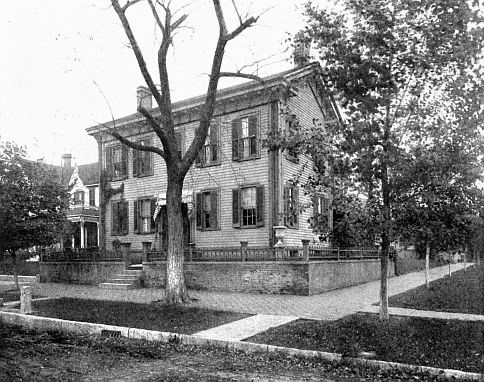
ABRAHAM LINCOLN'S HOUSE AT SPRINGFIELD, ILLINOIS
The tree in front of the house was planted by Lincoln
The evening of the second day after the nomination
brought to Springfield a committee of notification composed
of some of the most distinguished men of that
day and others who were destined to play a conspicuous
part in national affairs. George Ashmun, of Massachusetts,
was the chairman; Governor Boutwell, afterwards
United States Senator and Secretary of the Treasury;
Samuel Bowles, editor of the Springfield Republican;
Carl Schurz, of Wisconsin; Gideon Welles, of Connecticut;
Amos Tuck, of New Hampshire; William
M. Evarts and Governor Edwin D. Morgan, of New
York; "Pig-Iron" Kelley, of Pennsylvania; Francis
P. Blair, of Missouri; and others were of the party.
Most of them were disappointed at the result of the
Convention and distrustful of the strength and ability of
the prairie lawyer as a candidate. He received them,
however, with simple dignity. They were invited to
deliver their message at his modest home, and appeared
there a few moments after their arrival in Springfield,
to find him surrounded by his family and a few intimate
friends. They saw a man of unprepossessing appearance,
with long limbs, large hands and feet, stooping
shoulders, coarse features, and a shock of rebellious hair.
He was the last man in the world, perhaps, to judge by
appearances, that this committee would have chosen as
a Presidential candidate; but when he began to speak
in reply to Mr. Ashmun, a change seemed to come over
him. The rugged face and awkward figure were transformed,
and the members of the committee recognized
at once that they were in the presence of a man who was
master of himself and possessed a strength they had not
suspected. And when they left Springfield, almost without
exception, they were convinced of the wisdom of
his nomination.
The opposing candidates prepared long letters of acceptance
explanatory of their views and defining their
purposes, but Lincoln had already recognized the wisdom
of reticence, and the night of his nomination, standing
in his own doorway, he told his neighbors and
friends who called to congratulate him and demanded a
speech that "the time comes upon every man when it
is best to keep his lips closed. That time has come to
me." Hence his letter of acceptance was the briefest
ever written by a Presidential candidate. After one
formal introductory phrase, it reads:
"The declaration of principles which accompanies
your letter meets my approval, and it shall be my care
not to violate it or disregard it in any way or part. Imploring
the assistance of Divine Providence, and with
due regard for the views and feelings of all who were
represented in the Convention, to the rights of all the
States and Territories and people of the nation, to the
inviolability of the Constitution, and the perpetual union
of prosperity, and harmony of all, I am most happy to
co-operate for the practical success of the principles declared
by the convention. Your obliged friend and
fellow-citizen,
"A. Lincoln."
This letter was not shown to any one of Lincoln's
friends, with the exception of Dr. Newton Bateman,
State Superintendent of Education and an intimate
friend, to whom Lincoln said,—
"Mr. School-master, here is my letter of acceptance.
And I wouldn't like to have any mistakes in it. I am
not very strong on grammar and I wish you would see
if it is all right."
Mr. Bateman suggested one change, so that it would
read "it shall be my care not to violate," instead of "it
shall be my care to not violate."
"So you think I better put those two little fellows
end to end, do you?" replied Lincoln, taking his pen and
making the change suggested.
Lincoln's nomination made very little difference in his
daily life. He turned his law practice over to his partner,
employed John G. Nicolay, a clerk in the office of
the Secretary of State, as his private secretary, was
given the use of the Governor's room at the State-House
for an office, and devoted his entire time to the reception
of visitors and correspondence concerning the campaign.
His door stood always open. There was not even an
usher. Everybody came and went as freely as when he
was a candidate for the Legislature or engaged in his
practice. He was the same Abraham Lincoln he had
always been, except a little more serious because of
increasing responsibilities, and a little more dignified
because he was sensible of the honor that had been conferred
upon him; but his old friends detected no change
in the man, and dropped in to exchange gossip whenever
they came to town. Distinguished visitors came from
a distance,—statesmen, politicians, wire-pullers, newspaper
correspondents, men with great purposes and ambitions,
adventurers, lion-hunters, and representatives of
all classes and conditions, who usually seek the acquaintance
of influential and prominent men and worship a
rising sun. He told each a story and sent him away,
pleased with his person and impressed with his character.
His correspondence had increased enormously and every
letter received a polite reply, but he maintained his policy
of reticence and gave no indication of his plans or purposes.
One day, while a group of distinguished politicians
from a distance were sitting in the Governor's room,
chatting with Lincoln, the door opened and an old lady
in a big sunbonnet and the garb of a farmer's wife
came in.
"I wanted to give you something to take to Washington,
Mr. Lincoln," she said, "and these are all I had.
I spun the yarn and knit them socks myself." And
with an air of pride she handed him a pair of blue
woollen stockings.
Lincoln thanked her cordially for her thoughtfulness,
inquired after the folks at home, and escorted her to the
door as politely as if she had been Queen of England.
Then, when he returned to the room, he picked up the
socks, held them by the toes, one in each hand, and with
a queer smile upon his face remarked to the statesmen
around him,—
"The old lady got my latitude and longitude about
right, didn't she?"
Such incidents occurred nearly every day and were
a source of great pleasure to the President, who was
never happier than when in the company of "the plain
people," as he called them.
No one man of honest intentions visited him without
feeling the better for it and being impressed with his
ability, his courage, and his confidence. From the beginning
he never doubted his own success. He realized that
the Democratic party was hopelessly split and that, while
the factions, if combined, might embrace a majority of
the voters of the country, the Republicans would have a
plurality, and his reasoning was so plausible that he
convinced his visitors of the truth of his convictions.
He never showed the slightest annoyance at the attacks
that were continually made upon his reputation and
record, and demonstrated his coolness, self-poise, and
wisdom by declining to defend himself or offer explanations.
His theory was expressed to a friend who wrote
him with great concern about a charge that had been
made against his integrity.
"I have made this explanation to you as a friend,"
he wrote, "but I wish no explanation made to our
enemies. What they want is a squabble and a fuss, and
that they can have if we explain, and they cannot have
it if we don't."
The greater number of inquiries related to his position
and intentions towards slavery, and to every one he
gave a similar answer, that he had defined his position
again and again in his speeches before his nomination,
and "Those who will not read or heed what I have
already publicly said would not read or heed a repetition
of it. 'If they hear not Moses and the prophets, neither
will they be persuaded, though one rose from the dead.'"
He kept his finger upon the pulse of the country, and
none of the managers of either party was so well informed
as to the situation and sentiment in different
sections as he. The Republican politicians soon discovered
this fact and came to him more and more for
advice and instruction. Even Thurlow Weed, who was
supposed to be the shrewdest politician in the country,
recognized a master and sought counsel from him regarding
the management of the campaign in New York.
Wherever he detected a weak spot, he sent a word of
warning and advice: wherever there were local dissensions,
he restored harmony with his tact and good-nature.
Thus was Lincoln the manager of his own
campaign; more so, perhaps, than any man who was
ever elected President. But at the same time he made
one great mistake. He had heard the threat of secession
so long that he had grown indifferent to it, and he told
everybody that "The people of the South have too much
sense to attempt the ruin of the government."
The election occurred on November 6, 1860, and the
result was what he had expected since his nomination.
The Republican electors did not receive a majority by
nearly a million votes, but the division of the Democrats
left them a plurality.
The city of Springfield had never cast so large a vote
for any candidate for office up to that time, and it celebrated
its triumph with a jubilee of rejoicing. The
people called Lincoln from his house and demanded a
speech, but he asked to be excused. He thanked them
for their support and congratulations, and remarked,
"In all our rejoicing let us neither express nor cherish
any hard feeling towards any citizen who has differed
from us. Let us at all times remember that all American
citizens are brothers of a common country and should
dwell together in the bonds of fraternal feeling."
After the excitement had quieted down, Lincoln resumed
his former habits and daily routine. Springfield
was crowded with politicians those days,—office-seekers
and advisers, men who came to ask favors and to offer
them. The announcement of his election had been the
signal for the conspirators in the South to throw off
their masks. During long years of controversy, the pro-slavery
party had a hope of ultimate triumph, but until
the actual election of Lincoln there was no actual treason
or revolutionary act. Four days after the Senators
from South Carolina resigned, six weeks later that State
declared its separation from the Union and organized
an independent government, and, while he was still waiting
at Springfield, Lincoln read the newspaper reports
of conventions in all the Gulf States, at which they also
declared their independence. But he was obliged to sit
inactive and helpless; unable to do anything to check
the dissolution of the Union, although appeals came
from every quarter. He described his situation to an
old friend who came to see him at Springfield.
"Joe," he said, sadly, "I suppose you have forgotten
the trial down in Montgomery County where your partner
gave away your case in his opening speech. I saw
you motioning to him and how uneasy you were, but you
couldn't stop him, and that's just the way with Buchanan
and me. He is giving away the case and I can't stop
him."
It was not the Republicans of the North alone that
appealed to Lincoln. Unionists of the South came to
him for pledges that he would do nothing, for assurances
that there was nothing to fear from his election, and he
went so far as to make an exception in their case to
gratify them. In December he wrote a letter to Alexander
H. Stephens, whom he had known and admired
in Congress, marked "For your eye only," in which he
stated his position in the most positive and unmistakable
language, and asked, "Do the people of the South really
entertain fears that a Republican administration would
directly or indirectly interfere with the slaves? If they
do, I wish to assure you as once a friend, and still, I
hope, not an enemy, that there is no cause for such fears.
The South would be in no more danger in this respect
than it was in the days of Washington. I suppose, however,
that this does not meet the case. You think slavery
is right and ought to be extended, while we think it is
wrong and ought to be restricted. That, I suppose, is
the rub. It is certainly the only substantial difference
between us."
General Duff Green came to Springfield in December,
1860, as an emissary from President Buchanan to invite
the President-elect to Washington for a conference upon
the situation, with the hope that his presence there might
prevent civil war, and General Green was bold enough
to tell him that, if he did not go, "upon his conscience
must rest the blood that would be shed." Here Lincoln's
political shrewdness and diplomacy were demonstrated
in as conspicuous a manner, perhaps, as at any other
crisis in his life. He detected at once the intention to
unload upon him the responsibility for disunion and war,
and met it with a counter-proposition which must have
excited the admiration of the conspirators who were
trying to entrap him. He received General Green with
great courtesy, heard him with respectful attention, and
gave him a letter in which he said that he did not desire
any amendment to the Constitution, although he recognized
the right of the American people to adopt one;
that he believed in maintaining inviolate the rights of
each State to control its own domestic institutions; and
that he considered the lawless invasion by armed force
of the soil of any State or Territory as the gravest of
crimes. While those were his sentiments, and while they
indicated the policy he should pursue as President, he
would not consent to their publication unless the Senators
from Georgia, Alabama, Mississippi, Florida, Louisiana,
and Texas would sign a pledge which he had
written below his signature to this letter and upon the
same piece of paper. It was a pledge "to suspend all
action for the dismemberment of the Union until some
act deemed to be violative of our rights shall be done
by the incoming administration." Thus the responsibility
was thrown back upon the representatives of the
seceding States, and it is unnecessary to say that Duff
Green's mission to Springfield was not considered a
success by the rebel leaders. In order to protect himself,
Lincoln sent a copy of his letter to Senator Trumbull,
calling his attention to the fact that part of its text and
all of its sentiment were copied from the Chicago platform.
By this time Lincoln had become thoroughly convinced
that the Southern leaders were in earnest and that
nothing could prevent the secession of their States,
although he continued his efforts to reassure them and
to apply every means his ingenuity could suggest to
reconcile them to the situation. Notwithstanding all his
anxiety, his sense of humor remained, and, as was his
habit, he illustrated the situation with a story about a
pious man named Brown who was on a committee to
erect a bridge over a very dangerous river. They called
in an engineer named Jones, who had great confidence
in himself, and, after the difficulties had been explained,
asked him whether he was able to build the bridge.
Jones was a profane man, and replied that he would
build a bridge to hell if he could get a contract, or words
to that effect. The churchmen were horrified, and when
the contractor retired, Brown attempted to allay their
indignation by saying all the good things he could remember
or invent about Jones. At the same time he
was a very cautious man and would not commit himself
to any doubtful proposition.
"I know Jones," he said, "and he is a man who will
keep his promises. If he agrees to build a bridge to
Hades he will do it, although I have my doubts about
the 'butments on the infernal side."
The infinite patience exhibited by Lincoln during this
period of anxious helplessness, amidst the clamors of
office-seekers, the importunities of sincere but timid men
who besought him to yield to the South and avoid trouble
and bloodshed, the threats of his enemies, the
intrigues of the politicians, the conspiracies of the disunionists,
showed his strength of character and sense
of discretion, and did much to establish him in the
confidence of the public. He indulged neither in hope
nor fear, he made no boasts, he showed no alarm, he
answered neither yea nor nay, but maintained complete
self-control and waited for his time to come. To intimate
friends who possessed his confidence he never
failed to assert his determination to maintain the Union,
no matter what it cost, and to resist to the end every
proposition for dissolution or dismemberment, but his
words were as gentle and as kindly as they were firm.
"The right of a State to secede is not an open or
debatable question," he said. "That was fully discussed
in Jackson's time and denied not only by him but by the
vote of Congress. It is the duty of a President to execute
the laws and maintain the existing government.
He cannot entertain any proposition for dissolution or
dismemberment. He was not elected for any such purpose.
As a matter of theoretical speculation it is probably
true that if the people, with whom the whole question
rests, should become tired of the present government
they might change it in the manner prescribed by the
Constitution."
At the same time, without being dictatorial, he kept
the Republican leaders inspired with his own confidence
and determination and endeavored to prevent them from
the mistake of yielding to compromise or making concessions.
He wrote Representative Washburne with
emphasis, "Prevent our friends from demoralizing
themselves and their cause by entertaining propositions
for compromise of any sort on slavery extensions.
There is no possible compromise upon it but what puts
us under again, and all our work to do over again. On
that point hold firm as a chain of steel."
To Seward he wrote, "I say now, as I have all the
while said, that on the question of extending slavery I
am inflexible. I am for no compromise which assists
or permits the extension of the institution on soil owned
by the nation."
He knew what was going on under the direction of
the disloyal members of Buchanan's Cabinet. He was
aware that the Northern States were being stripped of
arms and ammunition and that large quantities of military
stores were being sent South where they could
easily be seized when the time came. He knew also that
disloyal officers of the army were being placed in command
of the forts and military posts in the South, and
other strategical points, and he asked Washburne to
present his respects to General Scott, "and tell him
confidentially that I should be obliged to him to be as
well prepared as he can either to hold or retake the forts
as the case may require after the inauguration."
Mr. Seward and other Republican leaders were apprehensive
lest an attempt be made to prevent the counting
of the electoral vote and the inauguration of Lincoln.
The secessionists controlled both Houses and could have
prevented constitutional proceeding if they had chosen
to do so, but offered no interference. Mr. Seward
always claimed—and he had an excessive degree of admiration
for his own acts—that a speech which he made
at the Astor House in January deceived the secession
leaders into permitting the vote to be canvassed and
Lincoln inaugurated. "When I made that speech the
electoral vote was not counted," said Mr. Seward with
pride, "and I knew it never would be if Jeff Davis
believed there would be war. I had to deceive Davis
and I did it. That's why I said it would all be settled
in sixty days."
The will of the people to make Abraham Lincoln
President was carried into effect upon February 13,
1861, when the Congress of the United States met in
joint session and declared him duly elected.
Mr. Seward and other Republican leaders had urged
Lincoln to come to Washington early in February, but
the latter, with his usual judgment and common sense,
declined to depart from ordinary usage, and politely
explained his own feeling that he ought not to appear in
Washington until he had been formally declared President.
When that formality had been completed, he bade
his old friends good-by and began a memorable journey,
taking a circuitous route in order to gratify the people
of the Northern States, who wished to see the President-elect,
and gathered at every station through which he
passed, hoping to hear his voice or catch a glimpse of
his face. He made about thirty speeches on the journey,
and every time he spoke it was to stimulate the patriotism
and the determination of the people to preserve the
Union. The address delivered in Independence Hall,
Philadelphia, was perhaps the most notable, as it was
the longest, because he was deeply moved by the date
and the place, for it was Washington's birthday.
Among other things, he said,—
"All the political sentiments I entertain have been
drawn, so far as I have been able to draw them, from
the sentiments which originated in and were given to
the world from this hall. I have never had a feeling,
politically, that did not spring from the sentiments embodied
in the Declaration of Independence. It was that
which gave promise that in due time the weight would
be lifted from the shoulders of all men and that all
should have an equal chance. Now, my friends, can this
country be saved on that basis? If it can, I will consider
myself one of the happiest men in the world if I can
help to save it. If it cannot be saved upon that principle,
it will be truly awful. But if this country cannot be
saved without giving up that principle, I was about to
say I would rather be assassinated on this spot than surrender
it. Now, in my view of the present aspect of
affairs, there is no need of bloodshed and war. There is
no necessity for it. I am not in favor of such a course;
and I may say in advance that there will be no bloodshed
unless it be forced upon the government. The government
will not use force unless force is used against it.
"My friends, this is wholly an unprepared speech. I
did not expect to be called upon to say a word when I
came here. I supposed it was merely to do something
towards raising a flag—I may, therefore, have said something
indiscreet. [Cries of 'No! no!'] But I have
said nothing but what I am willing to live by, and, if it
be the pleasure of Almighty God, to die by."
The manner in which Lincoln came into Washington
has been the subject of abundant discussion and criticism,
but long ago the public mind settled down to a
mature opinion that he did exactly right, and that a
President-elect of the United States, particularly at such
a critical juncture, should not take any risks or omit
any precautions for his personal safety. Lincoln himself,
long after, declared that he did not then and never
did believe that he would have been assassinated, but
always thought it wise to run no risk when no risk was
necessary. Wisdom justifies such a rule, while the tragic
experience of the American people has left no doubt of
it. The facts were that an Italian barber named Ferrandini,
an outspoken secessionist working at a Baltimore
hotel, had submitted to an organization of Southern
sympathizers a wild plan for intimidating the Union
people of Maryland and the North, which included the
blowing up of all the bridges around Washington, the
kidnapping of several prominent Republicans, and the
assassination of Lincoln, General Scott, and Hamlin, the
President and Vice-President elect. This would leave
the capital open to the Southern leaders, throw the entire
government into confusion, and prevent interference
from the North with any revolutionary plans which
Jefferson Davis might be contemplating.
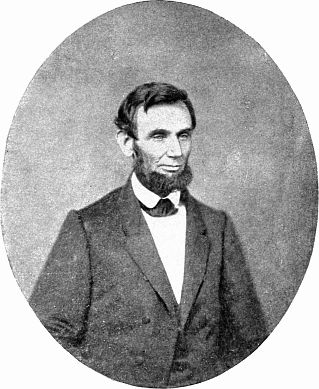
Copyright, 1900, by McClure, Phillips & Co.

From a photograph by Klauber, Louisville, Kentucky. Reproduced
by special permission of James B. Speed, Esq.
Just how much encouragement Ferrandini received
from the Southern sympathizers in Baltimore and Washington
is not known, but he was the captain of a military
company whose members were pledged to prevent the
inauguration of Lincoln or any abolitionist President.
When Allan Pinkerton learned of his suggestions, he
reported the matter at once to Mr. Felton, President of
the railroad that connected Baltimore with Philadelphia.
Mr. Pinkerton's disclosures were confirmed by detectives
employed by Governor Hicks, of Maryland, and the
military authorities at Washington, although neither
knew that the others were at work on the case. After
consultation with his friends, Lincoln decided not to
take any chances, and it was arranged that, after the
ceremonies at Harrisburg were concluded, he should
return to Philadelphia with a single companion and take
the regular midnight train to Washington, leaving the
rest of his party to continue in the special train according
to the original itinerary. Lincoln wore no disguise,
no deception was practised upon any one, and the only
unusual occurrence that night was the disconnection of
the telegraph wires just outside of Philadelphia and
Harrisburg, so that, in case the change of plan was discovered,
the news could not reach Baltimore until Lincoln
had passed through that city. Mr. Seward and
Mr. Washburne were the only persons to meet the President-elect
at the station, and they had been advised of
his coming only a few hours before by Mr. Seward's
son, who had come by a previous train from Harrisburg.
The week before the inauguration was a busy one for
the President-elect. A great deal of his time was occupied
by visits of ceremony and consultations with Republican
leaders about the composition of his Cabinet,
the terms of his inaugural, and the policy to be pursued
by the new administration. March 4 Mr. Buchanan
escorted him from the Executive Mansion to the Capitol,
where the oath was administered to him by Chief-Justice
Taney, and, standing upon a platform at the east portico
of the unfinished Capitol, he was introduced to the
multitude by his old friend, Edward D. Baker, while
Stephen A. Douglas, his opponent for the Presidency,
stood at his left hand and held his hat. The public
curiosity to see the President-elect reached its climax
as he made his appearance. All sorts of stories had been
told and believed about his personal appearance. His
character had been grossly misrepresented and maligned
in both sections of the Union, and the hysterical condition
of the country naturally whetted the appetite of
men of all parties to see and hear the man who was
now the central figure of the republic. The tone of
moderation, tenderness, and good-will which breathed
through his inaugural speech made a profound impression
in his favor, while his voice rang out over the acres
of people before him with surprising distinctness, and
was heard in the remotest parts of his audience.
No inaugural address before or since has been
awaited with so much anxiety and interest. It was expected
that in this, his first official utterance, the new
President would outline the policy of his administration
and determine whether the country should have war or
peace. Thousands of men were eager for an intimation
of what he intended to say, and an accurate forecast was
worth millions of dollars to the stock market; but not
a word nor a thought leaked out. The document was
written with Lincoln's own hand upon the backs of
envelopes and other scraps of paper from time to time
as ideas suggested themselves and he determined what
to say, and finally, as the time of his departure from
Springfield approached, he put them together in a little
bare room in a business block over the store of his
brother-in-law, where he was accustomed to retire when
he wanted to be alone or had to do writing of importance.
Only two persons knew of this retreat.
When the manuscript was finished it was intrusted
to Mr. William H. Bailhache, editor of the Illinois State
Journal, who put it in type himself, assisted by a veteran
compositor, also an old friend of Lincoln. After taking
a dozen proof-slips, the type was distributed. Judge
David Davis and one or two other friends read it in
Springfield. Orville H. Browning read it on the journey
to Washington, and upon the morning of his arrival at
the capital, a copy was handed to Mr. Seward, who
spent an entire Sunday revising it. His amendments
and suggestions were almost as voluminous as the original
document. Lincoln adopted either in whole or in
part nearly all of them, except where they affected the
style or changed the policy indicated. The most important
changes made were to modify the declaration of
his intentions to recover and hold the fortifications and
property which had been seized by the secessionists and
to speak of the exercise of power in that direction with
some ambiguity and a hint at forbearance.
During all his life at the White House Lincoln took
an active part in political affairs. He never forgot that
he was the President of the whole country; but at the
same time he considered it necessary to its salvation to
establish the Republican party upon a firm and permanent
basis, and for that purpose a more complete and
thorough organization was necessary. He knew the
value of an organization of trained politicians and of
political discipline as well as any man in public life. He
was thoroughly a practical politician and as skilful in
execution as he was in planning. He knew how to
manipulate men and direct movements as well as Thurlow
Weed, and no man in the Cabinet or in either House
of Congress was more adroit in accomplishing his purposes.
He never failed to carry through Congress any
measure that he considered important; he never failed
to obtain the confirmation of a nominee. He used the
patronage of his office to strengthen the Republican
party because he believed it essential to the salvation of
his country. He possessed a political tact so subtle and
masterful that it enabled him to reconcile rivalries and
enemies, to unite conflicting purposes, and to bring to
his support men of implacable hostility, who never
realized his purpose until his object was accomplished,
and then it was such as they almost invariably approved.
He was candid when candor was necessary, he was
mysterious when he believed it wise to excite curiosity,
and he was determined and often arbitrary with men
whom he thought would be most impressed that way.
His greatest quality, the most valuable talent he possessed,
was his ability to fathom the human heart, to
understand its weakness and its strength, so that he
could measure the influence that must be exerted and
the methods by which it could be induced to assist him
in his direction of affairs.
His lowly birth and early experience were of great
advantage to him in understanding human nature, and
he looked to the great masses of "the plain people" as
well as to the Almighty for guidance, and had full faith
in their honesty and capacity. Before he acted upon any
important question he felt the public pulse, and when
he thought the people were ready he acted, and not
before. While he was a great leader, a shrewd and
deep manipulator of public opinion, he often said, in his
quaint way, that it was possible to fool a part of the
people all the time, and all of the people part of the
time; but no man could fool all the people all the time.
With his great common sense, he endeavored to discover
what was in the public mind and how the public conscience
would regard certain measures proposed, and
waited for it to point out his path of duty. The atmosphere
of Washington never affected him; he was self-contained
and indifferent to social and other influences
that usually exercise much force upon public men.
His sympathies were tender, and his desire to contribute
to the happiness of every one made it difficult for
him to say "No;" but this, his greatest weakness, was
never shown in the direction of the military or political
policy of the government. On the contrary, the man
who would violate the laws of war and imperil the discipline
of an army by pardoning a deserter or commuting
the sentence of some poor wretch who was
sentenced to be shot would not permit delegations of
United States Senators to move him one atom from
what he deemed best to be done. He carried this principle
into his appointments to office also. During the
Presidential canvass of 1864, when a quarrel between
the Weed and Fenton factions of the Republican party
endangered the ticket in New York, Lincoln sent for the
Senator. What occurred we do not know; but Mr.
Fenton started immediately for New York with Mr.
Nicolay, and the latter returned to Washington with
the resignation of Rufus F. Andrews, a friend of Mr.
Fenton, who had been surveyor of the port, and Abram
Wakeman, Mr. Weed's choice for the office, was appointed
at once. From that time forward Mr. Weed
was earnest in his support of the Republican ticket.
Senator Fenton, in his reminiscences, says, "The small
majority in New York in November, less than 7000 for
the Republican ticket, served to illustrate Mr. Lincoln's
political sagacity and tact. He was always a politician
as well as a statesman, and but for his intervention
at that time the electoral vote of New York might have
been cast for the Democratic candidate, and no one dare
measure the effect of such an event upon the war."
President Lincoln never hesitated to use the patronage
of the government for political purposes. He held that
the government of the United States is a political organization,
and that the political opinions of those intrusted
with its administration in those critical days were of as
much consequence as their integrity or intelligence. As
a consequence, he made his appointments first from among
those whom he believed would give him the most
efficient support in his efforts to save the Union, and
second to those who believed in the principles and the
measures of the party with which he was identified. He
would have rejected with scorn the demands of the
civil service reformers of the present day. Public
opinion was not then educated up to the existing standard
of political morality. At the same time, his keen
sense of justice required him to recognize and reward
merit and efficiency even among his political opponents.
He had a sly way of stating his intentions, and he
often expressed great truths in an odd way. Soon after
his arrival in Washington the Massachusetts delegation
in the Peace Congress called upon him to recommend
Salmon P. Chase for Secretary of the Treasury. Lincoln
heard them respectfully, and then, with a twinkle
in his eye, remarked,—
"Gentlemen, of course, you would not expect me to
tell you who is going to be in the Cabinet; but, from
what I hear, I think Mr. Chase's chances are about one
hundred and fifty for any other man's hundred for that
place."
One day, at Cabinet meeting, Mr. Chase was reproaching
himself for failing to write a letter that he had
intended to send that day, when Lincoln observed,—
"Never be sorry for what you don't write; it is the
things you do write that you are usually sorry for."
The President enforced political discipline among the
subordinates of the government. Representative George
W. Julian, of Indiana, relates this incident:
"After my nomination for re-election in the year
1864, Mr. Holloway, who was holding the position of
Commissioner of Patents, and was one of the editors of
a Republican newspaper in my district, refused to
recognize me as the party candidate, and kept the name
of my defeated competitor standing in his paper. It
threatened discord and mischief, and I went to the President
with these facts, and on the strength of them asked
for Mr. Holloway's removal from office.
"'Your nomination,' said Mr. Lincoln, 'is as binding
on Republicans as mine, and you can rest assured that
Mr. Holloway shall support you, openly and unconditionally,
or lose his head.'
"This was entirely satisfactory; but after waiting
a week or two for the announcement of my name, I
returned to the President with the information that
Mr. Holloway was still keeping up his fight, and that
I had come to ask of him decisive measures. I saw in
an instant that his ire was roused. He rang the bell for
his messenger, and said to him in a very excited and
emphatic way,—
"'Tell Mr. Holloway to come to me!'
"The messenger hesitated, looking somewhat surprised
and bewildered, when Mr. Lincoln said in a tone
still more emphatic,—
"'Tell Mr. Holloway to come to me!'
"It was perfectly evident that the business would
now be attended to, and in a few days my name was
duly announced and the work of party insubordination
ceased."
The late Chief-Justice Cartter, of the District of
Columbia, once called upon Lincoln with a party of politicians
to secure the appointment of a gentleman who
was opposed by the Senators from his State. Lincoln
suggested that they ought to get the Senators on their
side. They replied that, owing to local complications,
such a thing was impossible. Lincoln retorted that
nothing was impossible in politics; that the peculiarities
of the Senator referred to were well known, and that
by the use of a little tact and diplomacy he might be
brought around, in which case there would be no doubt
about the appointment. To clinch his argument Lincoln
told a story of James Quarles, a distinguished
lawyer of Tennessee. Quarles, he said, was trying a
case, and after producing his evidence rested; whereupon
the defence produced a witness who swore Quarles
completely out of court, and a verdict was rendered
accordingly. After the trial one of his friends came
to him and said,—
"Why didn't you get that feller to swar on your side?"
"I didn't know anything about him," replied Quarles.
"I might have told you about him," said the friend,
"for he would swar for you jest as hard as he'd swar
for the other side. That's his business. Judge, that
feller takes in swarrin' for a living."
Representative John B. Alley, of Massachusetts, who
was himself famous as a politician, said, "Mr. Lincoln
was a thorough and most adroit politician as well as
statesman, and in politics always adopted the means to
the end, fully believing that in vital issues 'success was
a duty.' In illustration of this feeling and sentiment,
I need only refer to his action and conduct in procuring
the passage of the constitutional amendment abolishing
slavery. It required a two-thirds vote of Congress to
enable the amendments to the Constitution to be sent to
the Legislatures for ratification, and there were two
votes lacking to make two-thirds, which Lincoln said
'must be procured.' Two members of the House were
sent for and Lincoln said that those two votes must be
procured. When asked 'How?' he remarked,—
"'I am President of the United States, clothed with
great power. The abolition of slavery by constitutional
provision settles the fate, for all coming time, not only
of the millions now in bondage, but of unborn millions
to come—a measure of such importance that those two
votes must be procured. I leave it to you to determine
how it shall be done; but remember that I am President
of the United States, clothed with immense power, and
I expect you to procure those votes.'"
These gentlemen understood the significance of the
remark. The votes were procured, the constitutional
amendment was passed, and slavery was abolished forever.
"Senator Sumner and myself," continued Mr. Alley,
"called upon him one morning to urge the appointment
of a Massachusetts man to be a secretary of legation,
chiefly upon the ground of his superior qualifications.
But Mr. Lincoln said, emphatically, 'No;' that he
should give the place to an applicant from another State
who was backed by strong influence, although he
acknowledged that he did not think him fit for the position.
"We were naturally indignant, and wished to know
if one of acknowledged fitness was to be rejected because
he was a Massachusetts man, and one whom he
was willing to say was not fit was to be appointed.
'Yes,' said the President, 'that is just the reason,' and
facetiously added, 'I suppose you two Massachusetts
gentlemen think that your State could furnish suitable
men for every diplomatic and consulate station the
government has to fill.' We replied that we thought it
could. He appeased our displeasure by saying he
thought so too, and that he considered Massachusetts
the banner State of the Union, and admired its institutions
and people so much that he sent his 'Bob,' meaning
his son Robert, to Harvard for an education."
The Presidential campaign of 1864 was fought on
one issue only, and that was the success of the war,
although Lincoln, in his annual message to Congress in
the December following, declared that "No candidate
for any office whatever, high or low, has ventured to
seek votes on the avowal that he was for giving up the
Union." Nevertheless, the Democrats nominated McClellan
and attempted to discredit the patriotism and
the ability of Lincoln. Similar attempts were made in
his own party by the radical antislavery element and the
friends of Secretary Chase and numerous disappointed
contractors and politicians, but they made hardly a ripple
upon the great current of public opinion which swept
on irresistible to the Convention. Lincoln did nothing
to promote his candidacy, but made no secret of his
desire for a re-election, and himself suggested the most
effective argument in his own support when he recalled
the homely proverb of his youth that "It is bad policy
to swap horses while crossing a stream." He placed no
obstacles in the way of Mr. Chase, and when warned
that General Grant might aspire to the Presidency, replied,
"If he takes Richmond, let him have it." He
admonished the officials of the administration against
too much activity and rebuked them for opposing his
enemies. He made no speeches of importance during
the campaign, but on several occasions addressed delegations
which visited Washington, appeared at sanitary
fairs for the benefit of sick soldiers, responded to serenades,
and whenever custom or courtesy required him
to appear in public he did so without reference to political
results.
In August, 1864, the political horizon was very dark,
and the President himself, who was always the most
hopeful and confident of men, almost entirely lost heart.
Having convinced himself that the campaign was going
against him, he deliberately laid down a line of duty
for himself, and at the Cabinet meeting on August 23 he
requested each one of his ministers to write their names
upon a folded sheet of paper in such a way that the
seal could not be broken without mutilating their autographs.
He made no explanation of its contents or of
his reason for desiring them to attest it, but after the
election it was disclosed that the mysterious paper contained
a pledge from himself and his administration
loyally to accept any verdict which the people of the
country might pronounce upon their efforts to save the
Union, and to continue their labors with zealous loyalty
until relieved by their successors. The pledge closed as
follows:
"This morning, as for some days past, it seems exceedingly
probable that this administration will not be
re-elected. Then it will be my duty to so co-operate
with the President-elect as to save the Union between
the election and the inauguration, as he will have secured
the election on such ground that he cannot possibly save
it afterwards."