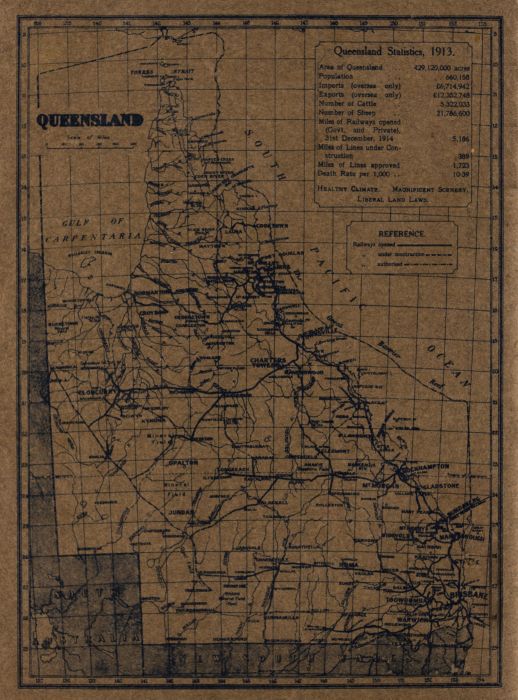
The State of Queensland is situated in the
northeast of the island-continent of Australia, between latitude 29
deg. and 10 deg. south; longitude 153-1/2 and 138 deg. east.
The richest State of the Commonwealth of
Australia, with an area of 429,120,000 acres, over 3,000 miles of
coast line, and the healthiest climate in the world.
By any of the great steamship companies’
boats that call at Brisbane (the capital), or by any vessel sailing
for Australian ports.
At the Queensland
Agent-General’s Office, Marble Hall, 409 and 410 Strand, London, W.C.,
and Immigration Depôt, Kangaroo Point, Brisbane.
These are granted from the United Kingdom to any port
of Queensland to agricultural labourers introduced under contract.
The employer must pay a fee of £7 for
each labourer introduced, provide him with suitable accommodation, and
guarantee him a year’s work at wages approved by the Government.
Approved immigrants can obtain a passage to
any port in Queensland at the following rates:—Males, 12 years and
upwards, £7; females, 12 years and upwards, £3; immigrants’ children
(1 year and under 12 years), £1 10s. Maximum age: Males, married
women, and widows, 45 years; single women, 35 years.
The sum of £1 must be deposited with the
Agent-General, in addition to the prescribed fees. This sum is
refunded to the immigrant on arrival. In the case of families applying
for passages as assisted immigrants, one deposit only covers the whole
family.
Residents of Queensland with a qualification
of at least six months’ permanent residence therein can obtain
passages for their friends and relatives in Great Britain and Europe
only at the rates already stated.
Approved females (between the ages of 18 and 35
years), prepared to accept domestic service for twelve months, may
obtain passages to Queensland on payment of £1 before sailing, the
balance of the fare (£2) to be paid by monthly instalments within six
months after their arrival in Queensland. Passages may also be granted
to farm lads (between 16 and 20 years of age) on payment of £1 before
sailing, the balance of the passage money (£6) to be paid by monthly
instalments within six months after their arrival in Queensland.
Employment is guaranteed in every case, and the lads must consent to
work on a farm for, at least, twelve months.
An easy living to any industrious man or woman
in the healthiest climate in the world.
Thousands of able-bodied men and women to fill
up her empty spaces and develop her resources.
Agricultural labourers and domestic servants are in great
demand at good rates of wages. (See wages list at pages 3 to 5.)
At the office of the
Agent-General, Marble Hall, 409 and 410 Strand, London, W.C.
Queensland could easily carry
a population of 50,000,000. At present she has only about 680,000
people.
At the Government Labour
Bureau, Edward street, Brisbane, or any of its branches throughout the
State.
At the Land Settlement
Inquiry Office, Lands Department, Executive Buildings, George street,
Brisbane, or any local Government Land Agent throughout the State.
At the Agricultural
Department, William street, Brisbane.
At the Government Intelligence and Tourist Bureau,
corner of Queen and George streets, Brisbane.
All information re tourists’ trips—especially the
Great Northern coastal trip and magnificent scenery—can be obtained at
the Government Intelligence and Tourist Bureau.
With her immense area and variety of
soils and climates Queensland can produce every crop that is found in
the markets of the world, from barley to cocoa. Her mineral wealth is
very great and scarcely tapped.
Sugar-cane, wheat, oats, barley, rye, maize, lucerne, rape,
cotton, tobacco (cigar and pipe), coffee, potatoes, fibres, rubber,
ramie, pumpkins, sisal hemp, mangolds, sorghums, millet, rice,
turnips, cowpea, canary seed, cassava, peanuts, arrowroot, and others.
Grapes, pineapples, bananas, oranges, lemons, mangoes, apples,
pears, peaches, plums, apricots, cherries, figs, nectarines, quinces,
strawberries, persimmons, passion fruit, almonds, blackberries,
rosellas, custard apples, papaws, cocoanuts, Cape gooseberries,
melons, guavas, loquats, and others.
Cabbages, cauliflowers, cucumbers, tomatoes, potatoes
(English and sweet), lettuce, cress, mustard, turnips, carrots,
parsnips, beetroot, asparagus, borecole, leeks, rhubarb, beans,
chicory, squashes, onions, capsicums, eschalots, peas, seakale,
salsify, yams, artichokes, choko, chillies, celery, and others,
including herbs of all sorts.
Wool, leather, hides and skins, tallow, frozen meat,
pork, sugar, molasses, malt, butter, cheese, flour, bran, pollard,
cornflour, wine, condensed milk, jams and preserved fruits,
manufactured timber, biscuits, confectionery, clothing of all kinds,
mineral and aerated waters, &c.
Gold, silver, copper, lead, tin, iron, coal, wolfram,
bitumen, antimony, manganese, bismuth, molybdenite, limestone,
ironstone, scheelite, graphite, &c.
Opal, topaz, sapphires, rubies, diamonds, agates, emeralds,
zircon, oriental chrysoberyl, olivines, rock crystal, tourmaline,
cornelian, amethyst, spinel, pleonaste, pyrope, cairngorm, white and
yellow jargoon, carbonado.
429,120,000 acres, or 670,500 square miles.
920,010 acres.
| Grain—Wheat |
132,655 |
acres. |
| 〃 Barley |
8,826 |
〃 |
| 〃 Maize |
156,775 |
〃 |
| English Potatoes |
10,085 |
〃 |
| Sweet Potatoes |
3,224 |
〃 |
| Sugarcane |
147,743 |
〃 |
| Hay |
76,469 |
〃 |
And various acreages in miscellaneous crops. Total area under crops,
747,814 acres.
Both tropical, sub-tropical, and deciduous fruits do well.
Thirty years ago out of every 100 cases of oranges imported into
Queensland 95 came from New South Wales. Now the citrus fruit industry
has grown to such an extent that Queensland does not import 5 per
cent., but has become a big exporter to Southern centres.
Pineapples grow all the year round in Queensland.
Deciduous fruits principally at Stanthorpe. Bananas, oranges,
mangoes, citrus fruits, tomatoes, &c., in the North.
Pineapples, oranges, and citrus fruit (in large quantities),
peaches, bananas, passion fruit, melons, custard apples, &c.,
in the South. The Blackall Range and Cleveland have also become
great strawberry-producing districts.
Cereals, root crops, fodder
plants, tobacco, cotton, English and sub-tropical fruits in the South.
Sugar-cane, bananas, coffee, tobacco, cotton, and tropical products in
the North. Wool on the Darling Downs and the great grazing districts
west of the Main Range.
It varies considerably. Along the
Pacific slope it runs approximately from 48 inches at Brisbane to
150 inches in the Far North. West of the Great Dividing Range the
rainfall diminishes from 30 inches to about 10 inches, according to
the distance from the Main Range.
The climate of Queensland is the most perfect winter season in the
world.
Although there are occasional
hot days, the summer season is not unpleasant. The mean summer
temperatures are:—South Queensland, from 66.5 to 76.7; Central, 80.5;
South-western, 80.8; North, 81.2; North-western, 84.3.
The death-rate in Queensland in 1913 was only 10.39 per 1,000.
Yes. They live to a great age in the genial atmosphere of
Queensland.
Scotch, Irish,
English, Welsh, Germans, Danes, Italians, Swedes, Russians, and other
people of White nationalities. Russians, Swedes, and Danes make
splendid colonists, and are warmly welcomed.
Yes. Men who go home
with the intention of spending the rest of their lives in England are
constantly returning to Queensland.
There are
numerous avenues of investment in sheep and cattle stations, farming
and dairying on a large scale, city and country properties, mines and
timber, in the development of secondary industries, and in the growing
of rubber.
With £150 to £200 a
man can start dairying in a small way, and gradually increase his herd
and operations. A good deal, of course, depends on the man.
He could make a good start with that.
With about £100 he could make a start.
He could grow vegetables and minor crops until his trees grew old
enough to bear, which would be in about three years from planting.
He could work for a station-owner
or farmer until he had made enough to pay his deposit on the land he
eventually selects.
There is a great demand for this class.
Inexperienced men should take some employment and
learn the methods of work in Queensland before sinking their capital
in land or stock.
Domestic servants, especially cooks, are in urgent
demand at wages ranging from 10s. to 30s. per week.
There are fifty-eight Land
Agents’ Districts in Queensland, in all of which vacant Crown lands
are still obtainable.
Agricultural farms vary from 10s. per acre upwards.
Over the age of 16 years.
Yes. If he pays the first
deposit, the Crown may defer payment of the next three years’ rent.
It is divided over the fifth to the thirteenth year with interest
at 4 per cent. per annum.
Yes; with the exception of a homestead area, if she is over 16
years.
Yes; if she is over 21 years.
She may hold any selection not subject to personal residence
conditions.
A married woman is not competent to select an agricultural
homestead, a grazing homestead, free homestead, perpetual lease
selection, agricultural farm, or prickly-pear selection, subject to
the conditions of personal residence, unless she has obtained an
order for judicial separation, or an order protecting her separate
property.
Under “The Married Women’s Property Act, 1890,” she can hold
any land, which she purchases absolutely, as if she were a man.
-
(1) Agricultural selection—i.e., agricultural farms, agricultural
homesteads, perpetual lease selections, and free homesteads.
-
(2) Grazing selections—i.e., grazing farms and grazing homesteads.
-
(3) Unconditional selections.
-
(4) Prickly-pear selections.
Twenty years are allowed in
which to pay for an agricultural farm. No interest is charged.
The annual instalment is 6d. in the £1—that is,
2-1/2 per cent., or 3d. per acre on 10s. land; 6d. per acre on £1
land; 1s. per acre on £2 land. The whole of this goes to principal.
At above rate, in twenty years the farm is
half paid for, and during that time the farmer has had the use of the
farm for much less than a fair rental. At the end of the twenty-first
year, he is expected to pay the remaining half. Taking money as worth
5 per cent., this is equivalent to selling the land at half the
proclaimed price.
On an agricultural farm, agricultural homestead,
perpetual lease selection, grazing selection, and unconditional
selection —one year’s rent, and 1/5th of survey fee; on free
homestead—fee of £1, and 1/5th of survey fee; on prickly-pear
selection—full amount of survey fee.
£3 16s., taking the price of the land at 10s. per acre.
In five years.
Queensland offers an unencumbered freehold title. The
deeds for an agricultural farm may be obtained at any time after five
years by paying the outstanding balance.
If such balance is paid off before it is due, a discount of
2-1/2 per cent. per annum is allowed.
Maximum area, 2,560 acres (this,
however, is allowed only in remote districts); price, from 10s. per
acre upwards. The land must be fenced within five years, or other
improvements effected equal in value to the cost of fencing. Five
years’ personal residence or occupation as the case may require;
thereafter, until made freehold, the condition of occupation must be
performed.
The lease may be obtained as soon as the
improvements are completed, and can be mortgaged, or, with the
permission of the Minister, the land may be subdivided, transferred,
or sublet.
Agricultural homesteads and free homesteads cannot be
mortgaged. Agricultural selections and prickly-pear selections
obtained under five years’ residence priority cannot be mortgaged
during the first five years.
The price for a homestead is 2s. 6d. per
acre, the annual rent 3d. per acre, the terms ten years’ personal
residence, and the maximum area 320 acres.
Land must be fenced within five
years, or improvements made equal to value of such fence. When five
years of residence have been performed and improvements effected,
the selector may pay up the remaining rent, so as to make his total
payments equal to 2s. 6d. per acre, and obtain deed of grant.
The total area held by one person must not exceed
60,000 acres, but when the area exceeds 20,000 acres the annual rental
at the notified rental must not exceed £200.
Rental from nil per
acre per annum. Term up to twenty-eight years. The holding must be
continuously occupied by the selector or manager or agent. Within
three years the land must be fenced. In cases where no rental is
charged, the land is more or less infested with prickly pear or
noxious weeds.
As soon as the holding is fenced the lease is
issued, which may be mortgaged or transferred, as stated in the case
of agricultural farms.
If it is proved to the satisfaction of the
Commissioner that two or more selections, each of which is at a
distance not exceeding five miles from each of the others, are held by
members of one family, bonâ fide in their own separate interests,
the Commissioner may issue a special license enabling the conditions
of personal residence or the conditions of occupation required to be
performed by them in respect of their selections to be performed by
their residence on one of the selections which is itself held subject
to the conditions of personal residence or conditions of occupation.
Similar conditions to grazing farms, except that—
-
(1) Selector must personally reside on the land for five years.
-
(2) Before the expiration of five years from the commencement of the
term, or the death of the original lessee, whichever first happens,
the land cannot be assigned or transferred, but may be mortgaged with
the consent of the Minister.
Up to 1,280 acres may be obtained under
this tenure, at from 13s. 4d. per acre, payable in twenty annual
instalments without interest. No other conditions.
A deed of grant may be
obtained at any time on payment of the balance of the purchase price.
Two and a-half per cent. per annum is allowed if the amount is paid
before due.
Maximum area, 2,560 acres. This applies to
land infested with prickly-pear. Term, twenty-five years, with a
peppercorn rental for the first period, and an annual rent during the
second period equal to the amount of the purchasing price divided by
the number of years in the second period.
The land must be absolutely cleared of pear during the
first period as notified in the notification opening the land for
selection, and kept clear during the second period.
The freehold may be obtained at
any time after the expiration of two years from the beginning of the
second period by the payment of the balance of the purchase money,
provided he has obtained a certificate from the Commissioner that the
conditions have been fulfilled.
The price varies according to the
state of infestation from nil upwards, and in some cases where the
land is badly infested a bonus is given. The purchasing price or bonus
is stated in the opening notification.
Pastoral holdings may be obtained on long leases,
with practically no restriction as to area. Terms up to thirty years.
Large areas may be rented from the Government
from year to year under an occupation license. No limitation to area.
Under special conditions families from the same
community are allowed to settle in groups so as to permit of their
retaining their social relations.
Groups of from six families to as many as seventy
families have already been successfully formed.
It is a good plan for friends to club together to pay the
expenses of one of their number to go to Queensland to find land for a
“group” to accommodate them all.
Under the provisions of “The Miners’ Homestead Leases Act of
1913,” homestead leases can be acquired by
application, or by tender or public auction by residents of any mining
field throughout the State, in areas not exceeding 640 acres. During
the first period of thirty years the annual rental on areas up to 40
acres is 1s. per acre, and 6d. for any additional acreage in excess
of this area. This rental does not, of course, apply to homesteads
acquired by tender or sale. After the expiration of the thirty years’
lease a nominal rental of 1s. only can be demanded. The minimum annual
rental for any homestead is 5s.
Yes, provided he obtains a
certificate to the effect that he can read and write words in such
language as the Minister for Lands may direct; also provided that
he becomes a naturalised British subject within five years of his
selecting the land, failing which he will forfeit all his right,
title, and interest in the land selected.
Any person who is not a British subject. For
instance, Americans, Frenchmen, Swedes, Italians, Russians, &c.
After he has been at least
two years in the Commonwealth of Australia, he may take the oath
of allegiance, become a Britisher, and enjoy all the freedom and
privileges appertaining thereto.
At the local Land Office.
Most of the land is
not far from existing lines. The policy of the Government, however,
is to build light railway lines (as feeders to the main lines) to tap
agricultural districts, and to anticipate settlement.
Some of these short lines which it is proposed to build will open
up an immense area of good land.
Crown lands may be acquired in fee-simple by
auction purchase in limited areas as town and suburban lots.
The minimum purchasing price for land bought at auction is 10s.
per acre.
Terms of Purchase. Terms up to ten years may be allowed, with interest
at 5 per cent. per annum.
The
Government issues a railway ticket at half the ordinary fare to the
intending settler desirous of inspecting Crown land with a view of
selecting an area not exceeding 5,120 acres. If the intending settler
subsequently takes up a selection, subject to personal residence
conditions, not exceeding 5,120 acres in area, the half-fare paid by
him is refunded, and his family, self, ordinary household furniture
and effects, agricultural implements, seed, one dray, and one set
of harness are carried free to the railway station nearest to his
selection.
Special reduced rates are granted for the
carriage of building material, fencing wire, and two truckloads of
live stock. Wire netting is also supplied on twenty years’ terms at 5
per cent. per annum.
If desired, the State will also sink wells
on waterless country, spreading the cost over the total purchase price
of the land over the term of lease.
A Government Bank institution
established, primarily, for the purpose of assisting new settlers
and also agriculturists and graziers, to whom it makes advances on
the security of freeholds, licenses, and leases from the Crown, for
the purpose of making improvements on the land or for paying off
liabilities, at 5 per cent. per annum, repayable in twenty-five years
or at any time at the option of the borrower.
The applicant for an advance must give a
first mortgage on his holding. The bank advances 12s. in the £1 on the
total value of the land and improvements.
For the first five years only simple interest is
charged at 5 per cent. per annum. After five years the borrower must
begin to redeem his advance at the rate of £4 0s. 3d. half-yearly for
each £100 borrowed, inclusive of interest, until the whole has been
paid.
Yes. The Agricultural
Bank will advance 12s. in the £1 of the total value of the land and
improvements for the purpose of purchasing stock, machinery, or
implements the selector desires to purchase, or for relieving the
liability on the holding. Advances at the rate of 13s. 4d. in the £1
on the value of the land and improvements thereon up to £200 can also
be obtained for unspecified purposes.
Yes, provided he obtains a certificate
to the effect that he can read and write words in such language as the
Minister for Lands may direct; also provided he becomes a naturalised
British subject within five years of his selecting the land.
Under the provisions of this Act the
Government make advances, on easy terms of repayment, for the purpose
of enabling persons of small incomes to erect dwelling-houses as homes
for themselves and their families. The applicant must show that his
income does not exceed £200 per annum, and that he is not the owner of
a dwelling-house in Queensland or elsewhere.
Plenty of good freehold farms change hands from
time to time in Queensland at from £3 to £20 per acre. Settlers not
desirous of taking up Government land can easily be suited privately.
It varies with the locality. All
of the Northern and Eastern scrub lands are intensely fertile with
vegetable mould. The Darling Downs contains 4,000,000 acres of
magnificent black soil, principally decomposed basalt. The soil in
the Maranoa district is lighter and more suited to wheat-growing and
vines. These descriptions apply pretty generally to the whole of
Queensland, particularly the Central Districts.
Those who carry on mixed farming,
such as dairying, agriculture, sheep, pig and poultry raising,
horticulture and bee-farming, &c.
Yes; many of them now go in for
lamb-raising on lucerne. There are also a number of selectors who have
sheep on areas of from 640 to 4,000 acres.
Yes, every day; and nearly all the dairy farmers are independent men.
90,545,516 gallons. Quantity
utilised for making butter, 73,582,041 gallons; for cheese, 5,268,447
gallons; for condensed milk, 2,131,382 gallons; sold for domestic
purposes, 4,178,758 gallons; and 5,384,888 gallons used on farms.
Most of them began in a very small way,
buying a cow now and again as they could afford it.
Yes, for the most part. The larger
farmers have also taken up dairying in addition to wheat, maize,
barley, lucerne, and oat growing.
35,199,387 lb., valued at £1,613,305.
5,395,050 lb., valued at £141,400.
8,059,051 lb., valued at £187,536.
From 15s. to 30s. per month.
From £5 to £8. Of course some well-bred cows fetch a much higher
figure.
Dairy stock have
been imported to Queensland from the principal herds of the world,
and a splendid class of cow is now in use, comprising the following
breeds:—Milking Shorthorn, Ayrshire, Holstein, Guernsey, and Jersey.
It all depends on the size
of the holding. There are many large properties in Queensland milking
several hundred cows daily throughout the year. The average herd is
about 20, but many farmers milk from 80 to 150 daily.
With good land, mixed
farming, and by growing crops and conserving fodder, you could carry
30 to 40 at a low estimate. Some 160 acres cleared scrub farms carry
70 to 80 cows.
Suppliers to the factories are paid monthly by
cheque, and some draw £100 and over per month for milk and cream.
Pig-raising is now considered to be a part of dairying, and is
very profitable. The climate is particularly suited to pigs, and no
housing is required.
On some holdings large mobs of young pigs are grazed on
barley or alfalfa (lucerne), and topped up in batches in large sties.
There is a certain market for pigs in Brisbane,
Toowoomba, &c., where there are bacon-curing establishments.
Wheat is sown (late maturing varieties) in March and April, and
(quick maturing varieties) in May, June, and July. Harvesting extends
from October to early in December.
In Southern Queensland. It can also
be grown in the Central-western districts of Queensland.
Crops of 20 to 30 bushels to the acre are commonly reaped
in the best wheat-growing districts of Queensland. Forty bushels per
acre have often been obtained in individual instances.
Maize is planted in July and August right up to January, and is
fit for harvesting in 120 days. It can be grown all over Queensland,
where the rainfall is sufficient. Two crops a year are possible in
sub-tropical scrub and coastal country.
Immense yields of maize, from 40 to 80 bushels per acre,
are frequently obtained on the rich scrub lands. Yields of 120 bushels
per acre have also been obtained.
Barley does particularly well on the Darling Downs, where the
quality of the crop for malting purposes is held by English experts to
equal the best Hungarian. Crops of from 30 to 40 bushels are frequent
in a good season.
Sugarcane growing is carried on along the coastal area from
Brisbane northwards. It is planted from January to June; 2,085,588
tons of sugarcane were produced in 1913.
Prices for cane vary according to its
sugar-producing properties and the locality in which it is grown.
These, however, range from 20s. to 27s. per ton. Crops of from 40 to
even 70 tons per acre have been obtained in the North.
Hay averaged about 1-3/4 tons to the acre for the last twenty
years. Individual crops yield much heavier results.
Both English and sweet potatoes give heavy yields.
| Wool (in grease) |
154,183,114 |
lb. |
| Frozen and preserved meats |
265,481,423 |
〃 |
| Meat Extract |
520,748 |
〃 |
| Butter |
35,199,387 |
〃 |
| Cheese |
5,395,050 |
〃 |
| Bacon and Hams |
13,709,716 |
〃 |
| Maize |
3,915,376 |
bush. |
| Wheat |
1,769,432 |
〃 |
| Barley |
115,975 |
〃 |
| Sugarcane |
2,085,588 |
tons. |
| Sugar manufactured |
242,837 |
〃 |
| English potatoes |
16,548 |
〃 |
| Sweet potatoes |
14,425 |
〃 |
| Hay |
103,935 |
〃 |
| Oranges |
375,544 |
bush. |
| Grapes |
4,092,531 |
lb. |
| Wine |
58,897 |
gals. |
| Bananas |
1,037,936 |
bunches. |
| Pineapples |
744,906 |
doz. |
| Mangoes |
156,349 |
bush. |
| Strawberries |
152,608 |
quarts |
| Apples |
49,423 |
bush. |
| Papaws |
32,287 |
doz. |
| Peaches |
53,579 |
bush. |
This is one of the best crops a farmer can grow in
Southern Queensland. Once planted, it lasts from seven to ten years.
The roots of lucerne have been known to penetrate the
soil for a depth of 30 ft. In a good year five to six cuttings can be
obtained. Ten cuttings per annum are often obtained around Laidley,
Southern Queensland.
Yes. Wheat or Maize.
The method is to fell the
scrub, and, after it has dried, put a fire through it. Maize is then
put in with a hoe between the stumps. Some crops up to 85 bushels per
acre have been garnered in this way.
There is a State Agricultural College at
Gatton, South Queensland, where students can undergo a three years’
training at a cost of under £30 per annum.
Yes. At Hermitage, near
Warwick; Roma, South-western Queensland; Warren, near Rockhampton;
Gindie, near Emerald; Kairi, Atherton district (North Queensland); and
at Kamerunga, near Cairns (North Queensland); Sugar Experiment Station
and Laboratory, Mackay (North Queensland); and experimental plots in
all the principal sugar districts.
At first a farmer generally erects a rough, cheap
building of materials cut on the place at a cost of a few pounds, and
when matters improve puts up a more suitable dwelling.
Iron and wood can be
obtained in any part of Queensland. Competition among the timber
merchants is so keen that timber can be procured at a small cost. A
small comfortable cottage can be built for about £100 upwards.
The last drought was in 1902, and even
then there were parts of Queensland not affected by it. Droughts do
not, as a rule, affect the whole country, and with extended railway
communication relief country will be available.
The recuperative power of the land is
marvellous. A fortnight after summer rain (following a dry spell) the
country is waving with grasses. Owing to the mild climate, the growth
is phenomenal.
Farmers can readily dispose of all they can grow in the
local markets, where competition amongst buyers is keen.
There is a certain market in the South for all
Queensland produce.
A certain market for wool, hides, butter, cheese,
frozen meat, and other products exists in Great Britain and Europe.
Trade with the United States and Canada is developing. There are
splendid openings for trade with Java, China, Japan, and the East
generally.
Cattle, horses, bones,
hoofs, leather, butter, cheese, fodder, fruits, glue pieces and
sinews, barley, oats, wheat, bran, pollard, flour, hay, chaff, honey,
refined animal fats, manures, bacon and hams, beef, mutton, pork,
other meat, milk concentrated and preserved, potatoes, skins and
hides, tallow, wool.
There were 707,265 horses in Queensland in 1913. A large
remount trade is now done with India, Java, and the East.
Cattle do well all over Queensland, and especially on the Eastern
coast lands and the North.
5,322,033 for 1913.
On the great central plains of Western
Queensland, and in the country west of the Dividing Range.
Number of Sheep in Queensland. 21,786,600 for 1913.
13,394,556.
£6,296,000.
Imports
(oversea only), £6,714,942; Exports (oversea only), £12,352,748;
total, £19,067,690. The above figures do not, of course, include
interstate transactions. It is reasonable to assume that the total
value of the imports and exports would be, at least, doubled.
On a grazing farm of
20,000 acres, with a capital of £4,000, he could make a net income of
£600 to £1,000 a year.
Some of the stations carry from
100,000 to 200,000 sheep, and are over 1,000 square miles in area. One
is 5,000 square miles in area.
There are 12,393 men employed in and around mines in
Queensland.
From 8s. 3d. to 13s. per shift of eight hours.
Between 20 and 40 years.
He could get work in a mine or prospect the country in search of
minerals.
78,073 square miles.
17,973,674 fine oz.
£76,347,265.
£31,419,755. Grand total, all minerals, £107,767,020.
On payment of 5s. a year any man can obtain a miner’s
right authorising him to mine for minerals on any Crown lands.
On certain conditions,
rewards, not exceeding £500 in one instance, and not exceeding £1,000
in another, are given by the Government for the discovery of new
goldfields.
Prospectors for tin in the North—chiefly about Herberton—do fairly well.
The holder of a miner’s right may by himself or his agent take
up and hold any number of claims or shares in such claims, provided
that such claims or shares are duly worked and represented by the
prescribed number of men.
The spring commences in September, and the summer ends in
February. The winter climate is perfect.
There is no State church in Queensland. All
religious denominations are on an equality, and complete religious
liberty prevails.
Education is free and compulsory.
£657,613 were spent by the State on education in 1913.
There are 1,338 State Schools in Queensland, with a
total enrolment of 119,006 scholars, and 3,269 teachers.
1,518 schools, with an average daily attendance of 97,852 scholars.
There are excellent State schools situated throughout
the country districts of Queensland.
Provisional schools are established wherever
necessary.
Six High Schools (free), 16 Technical
Colleges, 10 Grammar Schools (boys and girls), a School of Mines at
Charters Towers (North Queensland), and a University.
Travelling Government
teachers periodically visit the more sparsely settled districts to
arrange for the education of the children so circumstanced. Half-time
Schools are also established on many sheep and cattle stations.
Every man and woman in Queensland over the age of
twenty-one years is entitled to a vote.
Queensland is one of the most law-abiding countries in the world.
The orderliness of large crowds is a remarkable
feature of Australian life, and one which generally causes surprise
on the part of the visitor. This orderliness is characteristic of
Queenslanders.
The morning after the assemblage of a crowd of nearly
60,000 people on the opening day of the Brisbane Show in 1914 showed a
complete absence of wrongdoing on the police charge-sheet.
There is no rowdy conduct during elections in
Queensland. Women visit the polls and record their votes as easily as
attending church.
The Queensland Railways are the property of the State.
4,856 miles to 31st December, 1914.
| Receipts |
£3,660,022 |
| Expenditure |
£2,371,261 |
|
————— |
| Net profit |
£1,288,761 |
Only 330 miles.
£1,128,768 for 265,735 fine oz.
Silver, 604,979 oz. (£68,438); copper, 23,655 tons
(£1,660,178); tin, 3,197 tons (£343,669); coal, 1,037,944 tons
(£403,767); gems and opals, £46,292; other minerals, £206,769.
£2,729,113.
£6,973,258.
£6,962,515.
176,961 depositors had £9,350,999 to
credit in the Government Savings Bank on 30th June, 1914—an average of
£52 16s. 10d. per head.
Eleven banks held assets to the amount of £22,845,949 in 1913.
There were in 1913 1,838 factories in Queensland employing
42,363 hands. The value of the plant and machinery was £5,877,387,
and the value of the land and premises £3,923,584. Value of output,
£23,688,789.
There are eighty-five public hospitals in Queensland,
besides numerous private ones.
2,247,434 tons entered.
2,251,503 tons cleared.
Softwoods, 98,620,299 superficial feet, valued
at the mill, £778,084; cedar, 882,092 superficial feet, valued at the
mill, £15,964; hardwoods, 57,131,224 superficial feet, valued at the
mill, £510,967; mouldings, &c., £61,872; 1,101,271 sleepers, £92,906.
In addition, at least an equal quantity was used for bridges, wharves,
fencing, &c. Total value of output of sawmills only, £1,459,793. The
247 sawmills employed 4,621 hands.
In 1913 there were fourteen meatworks (exclusive
of seven bacon factories), which employed 4,225 hands during the
season. Total value of all meat products (including bacon and hams),
£8,576,754.
(From America, Canada, South Africa, and India.)
Union Steamship Company of New Zealand, Limited.
From San Francisco to Brisbane (Single):—
| First Saloon |
$232.08 |
(£48 |
7s. |
0d.) |
| Second Saloon |
$152.40 |
(£31 |
15s. |
0d.) |
| Third Class |
$94.80 |
(£19 |
15s. |
0d.) |
From Chicago to Brisbane (Single):—
| First Saloon |
$291.84 |
(£60 |
16s. |
0d.) |
| Second Saloon |
$202.16 |
(£42 |
2s. |
4d.) |
| Third Class |
$144.56 |
(£30 |
2s. |
4d.) |
From New York to Brisbane (Single):—
| First Saloon |
$309.84 |
(£64 |
11s. |
0d.) |
| Second Saloon |
$218.16 |
(£45 |
9s. |
0d.) |
| Third Class |
$160.56 |
(£33 |
9s. |
0d.) |
The above fares are subject to alteration without notice.
Canadian-Australian Royal Mail Line.
From Vancouver to Brisbane (Single):—
| First Saloon |
$232.08 |
(£48 |
7s. |
0d.) |
| Second Saloon |
$152.40 |
(£31 |
15s. |
0d.) |
| Third Class |
$94.80 |
(£19 |
15s. |
0d.) |
From Chicago to Brisbane (Single):—
| First Saloon |
$288.96 |
(£60 |
4s. |
0d.) |
| Second Saloon |
$200.40 |
(£41 |
15s. |
0d.) |
| Third Class |
$142.80 |
(£29 |
15s. |
0d.) |
From New York to Brisbane (Single):—
| First Saloon |
$309.96 |
(£63 |
19s. |
0d.) |
| Second Saloon |
$213.36 |
(£44 |
9s. |
0d.) |
| Third Class |
$155.76 |
(£32 |
9s. |
0d.) |
From St. Louis to Brisbane (Single):—
| First Saloon |
$286.44 |
(£59 |
13s. |
6d.) |
| Second Saloon |
$197.88 |
(£41 |
4s. |
6d.) |
| Third Class |
$140.28 |
(£29 |
4s. |
6d.) |
From Montreal to Brisbane (Single):—
| First Saloon |
$303.96 |
(£63 |
6s. |
6d.) |
| Second Saloon |
$211.68 |
(£44 |
2s. |
0d.) |
| Third Class |
$154.08 |
(£32 |
2s. |
0d.) |
All above rates are subject to alteration without notice.
Children (Canadian steamer).—Under 12 and over 5 years, half rate;
under 3 years and over 2 years, quarter rate; one child, 2 years,
free; others, quarter rate.
Baggage.—First Class passengers allowed 40 cubic feet, or 350 lb.
free each adult; Second Class passengers allowed 20 cubic feet, or 175
lb. free each adult; Third Class passengers allowed 20 cubic feet or
175 lb. free each adult. On coastal steamer (First Class), 40 cubic
feet; (steerage), 20 cubic feet. Excess baggage charged at the rate
of 2s. 6d. (60 cents) per cubic foot Vancouver to Sydney; and 10s.
($2.40) per ton of 40 cubic feet Sydney to Brisbane.
Oceanic Steamship Company.
From Boston to Brisbane (Single):—
| First Saloon |
$310.95 |
(£64 |
15s. |
8d.) |
| Second Saloon |
$219.15 |
(£45 |
13s. |
2d.) |
| Third Class |
$161.15 |
(£33 |
13s. |
2d.) |
From San Francisco to Brisbane (Single):—
| First Saloon |
$232.20 |
(£48 |
7s. |
6d.) |
| Second Saloon |
$152.40 |
(£31 |
15s. |
0d.) |
| Third Class |
$94.80 |
(£19 |
15s. |
0d.) |
From Chicago to Brisbane (Single):—
| First Saloon |
$291.95 |
(£60 |
17s. |
3d.) |
| Second Saloon |
$202.15 |
(£42 |
2s. |
4d.) |
| Third Class |
$144.55 |
(£30 |
2s. |
4d.) |
From New York to Brisbane (Single):—
| First Saloon |
$308.80 |
(£64 |
6s. |
8d.) |
| Second Saloon |
$217.00 |
(£45 |
4s. |
2d.) |
| Third Class |
$159.40 |
(£33 |
4s. |
2d.) |
From Vancouver to Brisbane (Single):—
| First Saloon |
$262.20 |
(£54 |
12s. |
6d.) |
| Second Saloon |
$177.40 |
(£36 |
19s. |
2d.) |
| Third Class |
$104.80 |
(£21 |
16s. |
8d.) |
From St. Louis to Brisbane (Single):—
| First Saloon |
$287.80 |
(£59 |
19s. |
2d.) |
| Second Saloon |
$198.00 |
(£41 |
5s. |
0d.) |
| Third Class |
$140.40 |
(£29 |
5s. |
0d.) |
From Montreal to Brisbane (Single):—
| First Saloon |
$307.75 |
(£64 |
2s. |
4d.) |
| Second Saloon |
$217.00 |
(£45 |
4s. |
2d.) |
| Third Class |
$159.40 |
(£33 |
4s. |
2d.) |
Family Concessions.—Families consisting of parents and children only
(equal to three adult fares), 10 per cent. off single rates; (equal to
four adult fares or over), 15 per cent. off single rates; one child,
under 2 years of age, free if no separate berth required; children, 2
years and under 6 years of age, quarter fare; children, 6 years and
under 12 years of age, half fare.
Men only carried in Third Class from San Francisco to Brisbane.
Passengers can travel by train between Sydney and Brisbane. A
reduction of 15s. ($3.60) will be made on the above First Saloon rates
for a first-class railway ticket from Sydney to Brisbane.
Luggage Allowance on Oceanic Steamers.—First-class, 350 lb., or
40 cubic feet; second and third classes, 175 lb., or 20 cubic feet.
Excess baggage, 1-1/2d. (3 cents) per lb., or 1s. 6d. (36 cents) per
cubic foot.
Aberdeen Line—
From Capetown to Brisbane:—
| Saloon (Single) |
From £32 upwards |
| Third Class (Single) |
From £11 11s. |
White Star Line—
From Capetown to Brisbane (all one class):—
Single fares from £17 15s.
The Blue Funnel Line—
From Capetown to Brisbane:—Fares (Single),
saloon only, £32.
P. and O. Branch Service—
From Capetown to Brisbane:—Fares (Single):—
Third Class only, £11 11s.
P. and O. Line—
From Bombay and Calcutta to Brisbane (Single):—
| First Saloon |
£41 |
16s. |
0d. |
(Rupees 627) |
| Second Saloon |
£34 |
2s. |
0d. |
(Rupees 512) |
From Colombo to Brisbane (Single):—
| First Saloon |
£38 |
10s. |
0d. |
(Rupees 578) |
| Second Saloon |
£31 |
18s. |
0d. |
(Rupees 479) |
B.I.S.N. Company, Limited—
From Calcutta to Brisbane (Single):—
| First Class |
Rupees 473 |
| Second Class |
Rupees 289 |
(Allow rate of exchange 1s. 4d. for each rupee.)
Passengers maintain themselves awaiting train or steamer at Sydney.
Note.—All the above fares include the cost of travelling from Sydney
to Brisbane by one of the Queensland-bound coastal steamers.