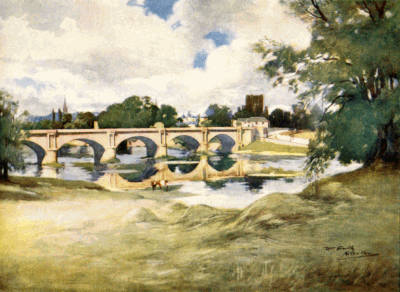
THE TREASURES OF ABBOTSFORD
Towards the close of his life, at the suggestion of
Cadell (to keep him from more serious tasks), Scott
commenced the writing of a descriptive catalogue
of the most curious articles in his library and
museum—his 'gabions' he called them. This,
which he entitled 'Reliquiæ Trottcosianæ—or the
Gabions of the late Jonathan Oldbuck, Esq.,'—thus
assuming to himself some claim to be the
original of the inimitable Laird of Monkbarns—was,
unfortunately, never finished. The MS. is at
Abbotsford, and has been partly printed in Harper's
Magazine for April, 1889. As the writing shows,
it is first in Scott's own hand, sadly cramped and
shaky; then Laidlaw takes up the pen, but the
work was soon abandoned for 'Count Robert,' the
romance that was simmering in his brain. It is a
thousand pities that Scott preferred 'Count Robert'
to the gabions history. His mind, impaired by
repeated shocks of paralysis, was quite unfitted for
serious imaginative composition. Even the 'Reliquiæ'
fragment is not without proof of waning
power. Still, 'Count Robert' could well have been
spared for the completion of the latter project, and
none but the Wizard himself, with his rare wealth
of anecdote and story, could have done it justice.
Of the many haunts of genius in this and other
countries, Abbotsford is unique in that it was the
first (and likely to be the last) great estate won by
the pen of an author. Created practically within a
dozen years—a marvellously brief period—it remains
(the Hope Scott extension excepted) very much as
in Sir Walter's lifetime. His own house has undergone
no change beyond slight and necessary rearrangement
of the furnishings. The visitor of
to-day may rest assured that he sees the place
almost identically as Scott saw it. The apartments
open to the public were planned by him to the
minutest particular. His eyes fell on these same
pictures, with very few exceptions. And of its
antiquarian treasures—the most remarkable private
collection in existence—almost all have personal
association with Scott.
There are two methods of reaching Abbotsford—by
rail to Galashiels, thence to Abbotsford Ferry
Station on the Selkirk line, alighting at which and
crossing the Tweed, a delightful tree-shaded walk of
about a mile brings us to the house. But the more
popular method is to make the journey from Melrose,
three miles distant. The way lies between delicious
green fields and bits of woodland—a pleasant
country road, exposed somewhat, despite smiling
hedgerows on either side. Seldom in summer is it
without being dust-blown. For in a more than local
sense, this is one of the world's highways, with a constant
stream of pilgrims from every land passing to
and fro. No better proof, surely, of Scott's abiding
popularity. The road teems with reminiscences of
the Romancist. Out from the grey town, with its
orchards and picturesque gardens, the Waverley
Hydropathic is passed on the right. In the grounds
a handsome seated statue of Scott may be noticed.
Further on, to the left, tree-ensconced, lie Chiefswood
and Huntlyburn on the Abbotsford estate.
Then comes Darnick, with its fine peel, now open
to the public, and well worth a visit. At the fork
of the roads (that to the right leading by Melrose
Bridge to Gattonside and Galashiels) we turn leftwards,
and are soon at the visitors' entrance (a
modest wicket-gate) to the great Scottish Mecca.
But nothing is to be seen yet. Mr. Hope Scott's
plantations and 'ingenious tourist arrangement'
screen the pile with wonderful completeness. And
it is only when within a few paces of the building,
at a turn in the lane leading from the highway, that
all at once one emerges upon it. The public
waiting-room is in the basement, whence parties of
ten or twelve are conducted through the house.
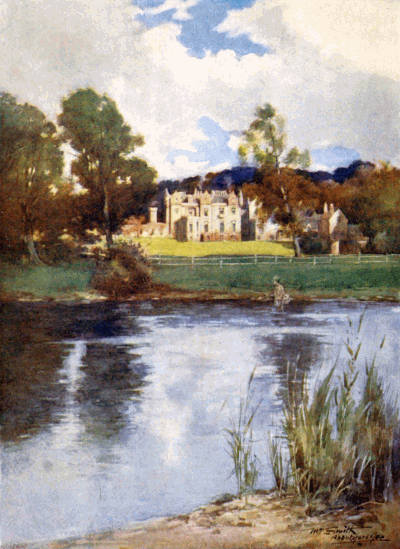
In point of picturesqueness, Abbotsford is, of
course, best seen from the Tweed—the north bank—or
the hillside, whereon the Galashiels manufacturers
have reared their own princely residences—unknown
to Scott's day. But we are then looking, let us
remember, at the back of the edifice. Nearly all
the photographs present this view, however, for the
sake of the river. The situation is low—poor,
indeed, except for the Tweed. At first not unfrequently
is there a sense of disappointment,
especially if one's ideas have been founded on
Turner's somewhat fanciful sketches. These, it
need scarcely be said, though beautiful, and art
at its highest, are yet far removed (like his Sandyknowe
and Chiefswood) from the real Abbotsford.
In his lifetime Scott's friends had no end of praise
and flattery for the place: 'A perfect picture of the
wonderful owner's mind'; 'a romance in stone
and lime'; 'a poem in stone'; 'a mosaic of Scottish
history'; 'like places that we dream about'; 'exactly
what one ought to have had wit enough to
dream,' etc. It is surprising, therefore, to have the
more modern descriptions of such men as Dr. John
Brown, who actually calls it the 'ugly Abbotsford';
Ruskin, albeit a true Scott-lover, who describes it
as 'perhaps the most incongruous pile that gentlemanly
modernism ever designed'; Hugh Miller,
who characterizes it as a 'supremely melancholy
place'; Dean Stanley, who (curiously) speaks of it
as 'a place to see once but never again'; George
Gilfillan, who compares it to a 'Castle Folly';
Robert Chambers, to whom it was chiefly a 'sad
piece of patchwork'; and Carlyle (never friendly to
Scott), who simply refers to it as 'a stone house in
Selkirkshire.' [It is not in Selkirkshire, however.]
Granting it to be in many respects bewildering,
heterogeneous, irregular, fantastic, odd, a revelry of
false Gothic, reared on no set plan, and so forth,
the general effect does not seem to be at all displeasing.
Ruskin and the others saw Abbotsford
perhaps only once at the most. But it is not a
place to be exhausted in an hour, or a day, and
hundreds (among modern trippers) in their hurry
can hardly carry away a correct impression.
Abbotsford is a place to be seen often, and the
oftener it is seen and studied, the more fascinating
will it become, and the less prominent will its
defects appear.
243
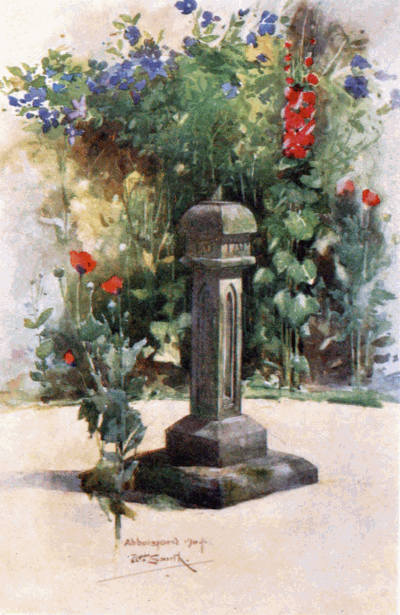
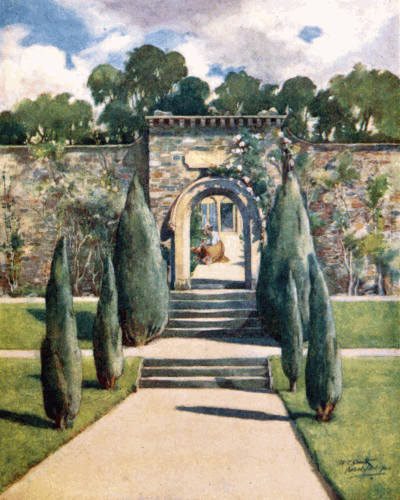
SIR WALTER'S DIAL, ABBOTSFORD
'Thou gav'st him solemn thoughts at twilight dim,
And now to us dost bear remembrance sweet of him.'
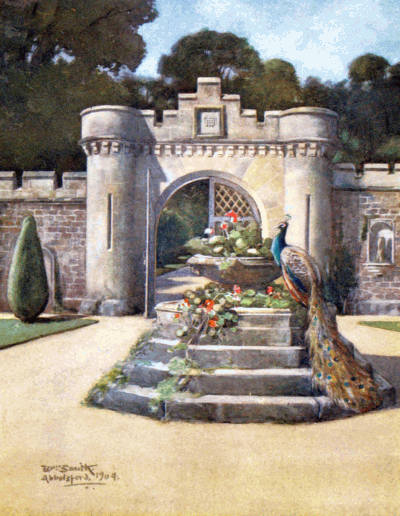
Abbotsford proper is enclosed by an embattled
wall and a fine castellated gateway, surmounted
by a sculptured portcullis with Scott's motto,
'Clausus tutus ero,' an anagram of his name
in Latin. The 'jougs' (stocks for the neck) of
Threave Castle dangle to the left of the handsome
iron-clenched door. Entering, we are in the courtyard,
half an acre or so in extent, nicely turfed
and parterred. It is walled on two sides, and on
the third, facing the entrance, an elegant stone
screen of sixteen elliptic arches, set with iron
lattice-work, separates from the gardens. The
fourth side is the house-front, 150 feet in length.
All the grounds are kept in the pink of perfection.
The antiquarian character of the place is at once
apparent. Medallions, tablets, altars, etc., from the
Roman station at Petreia (Penrith) and elsewhere,
fill numerous niches in the courtyard wall, against
which runs a trellised arbour covered with creepers.
The centre of the courtyard is occupied by a
fountain, which is said to have stood in former
days at the foot of the Cross of Edinburgh (see
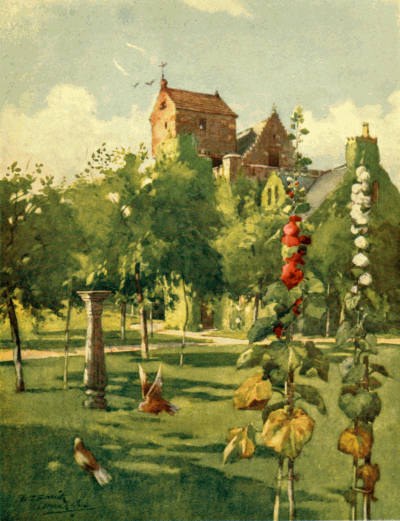
Lockhart, vol. v., p. 261). The dial-stone in the
flower-garden, inscribed (like Johnson's watch) with
the motto 'ΓΑΡ ΝΥΞ ΕΡΧΕΤΑΙ' ('For the night
cometh'), is an object of suggestive interest.
'Turn-Again' is in the corner, recalling Scott's
first introduction to Abbotsford. Across the archway
leading into the fruit-garden there is the
appropriate text:
'Et audiverunt Vocem Domini deambulantis
in horto.'
Within, and guarded with jealous care, is the last
survivor of the fruit-trees planted by Sir Walter
himself.
The exterior of Abbotsford abounds in relics and
inscriptions, woven here and there throughout the
masonry. At the western side of the main entrance,
and high up in the wall, is the door of the old
'Heart of Midlothian' (see p. 37), with the words:
'The Lord of Armis is my protector:
Blissit ar thay that trust in the Lord,
1575.'
The arched entrance-porch was copied from
Linlithgow Palace. The arms of the family with
the legends—
'REPARABIT CORNUA PHŒBE; WATCH WEEL'
are conspicuous above it. Near by are the grave
and stone effigy (cut by Smith of Darnick) of
Maida, Scott's favourite deerhound, with Lockhart's
famous 'false-quantity' lines:
'Maidæ Marmoreâ dormis sub imagine Maida
ad januam domini sit tibi terra levis,'
thus Englished by Sir Walter:
'Beneath the sculptured form which late you wore,
Sleep soundly, Maida, at your master's door."
(See Lockhart, vol. vii., pp. 275-281.)
There is apparently only one date, 1822, on the
south front, on a stone below the staircase window.
Eastward is the Study, with Scott's bedroom above,
and the tower from which he looked out on the
Eildons. A long stone near the visitors' entrance
carries the inscription:
'By Night by Day Remember ay the goodness of ye Lord:
And thank His name whos glorious fam is spred Throughout ye world';
whilst another, showing a rudely-carved sword,
has the words:
'Up with ye Sutors of Selkyrke.'
Over the great bay-window of the Library, the
first of the principal rooms facing the Tweed, is a
lintel from the Common Hall of the old Edinburgh
College, with a quotation from Seneca:
'Virtus Rectorem Ducemque
Desiderat; Vitia—sine—Magistro
Discuntur.' Anno 1616.
Next the Library is the Drawing-Room, then the
Armoury, and Dining-Room, with the motto:
'SO
LI DEO
GLORIA.'
And, lastly, the Breakfast Parlour, once Scott's
sanctum, in which Lockhart died.
Now turn we to the interior. Be it at once said
that Mrs. Maxwell Scott's excellent little 'Catalogue
of the Armour and Antiquities at Abbotsford'
is absolutely indispensable. A previous study
of its pages will enable the visitor to know exactly
how he is to be piloted, and the whereabouts of
the 'gabions' he is most bent on seeing. The
attendants are always ready to point out objects
of special interest to individuals, and there need be
no hesitancy to ask questions. For the sake of
convenience, we follow the order which has been
in force for years. All we plead for in the public
interest is a little more leisure, if that be possible,
for seeing what is to be seen.
Visitors are admitted first into what is surely the
sanctum sanctorum of the place—
The Study.
This is a fair-sized apartment, 20 feet long, 14 feet
broad, and 16 feet high, lighted by a large window
which looks out to the courtyard. Everything is
practically as Scott left it. Oaken bookcases line
the walls, and hardly a volume (it is chiefly a
reference library) has been altered. A light gallery,
graced with ample book-shelves, runs round three
sides of the room, opening out on a private staircase,
by which the 'inhabitant of the study,' as the
'Reliquiæ' puts it, 'if unwilling to be surprised by
visitors, may make his retreat, a facility which he
has sometimes found extremely convenient.' The
Desk is, of course, the chief object of interest.
Modelled from one at Rokeby (see 'Letters,' vol. i.,
p. 180), it is thus described by Lockhart as he first
saw it in the 'den' at Castle Street in 1818:
'The only table was a massive piece of furniture
with a desk and all its appurtenances on either
side, that an amanuensis might work opposite to
him when he chose, and with small tiers of drawers
reaching all round to the floor. The top displayed
a goodly array of session papers, and on the desk
below were, besides the MS. at which he was
working, sundry parcels of letters, proof-sheets, and
so forth, all neatly done up in red tape. His own
writing apparatus was a very handsome old box,
richly covered, lined with crimson velvet, and containing
ink-bottles, taper-stand, etc., in silver, the
whole in such order that it might have come from
the silversmith's window half an hour before.' At
the desk most of the novels were written, we may
suppose, though not all at Abbotsford, as is not
unfrequently imagined. It is, however, impossible
to collate with exactness the dates and occasions
of their composition. The fact remains, that in all
probability each of the Waverleys was penned at
this desk. Hence its unreckonable value to the
literary pilgrim, and the unqualified reverence with
which tens of thousands have gazed upon it. Certainly
no article of furniture has been so intimately
associated with Scott. Fourteen years from the
time that he first saw it, it fell to Lockhart himself
to open Scott's desk under the mournfullest circumstances.
'Perhaps the most touching evidence
of the lasting tenderness of Sir Walter's early
domestic feelings was exhibited to his executors
when they opened his repositories in search of his
testament the evening after his burial. On lifting
up his desk we found, arranged in careful order,
a series of little objects which had obviously been
so placed there that his eye might rest on them
every morning before he began his tasks. These
were the old-fashioned boxes that had garnished
his mother's toilette when he, a sickly child, slept
in her dressing-room—the silver taper-stand, which
the young advocate had bought for her with his
first five-guinea fee; a row of small packets, inscribed
with her hand, and containing the hair of
those of her offspring who had died before her;
his father's snuff-box and etui case, and more
things of the like sort, recalling "the old familiar
faces."'
Scott's desk is seldom seen open. The present
writer counts it one of the memories of his life to
have had that pleasure, and to have sat in Sir
Walter's 'own huge elbow-chair,' and to have
handled—an act almost too sacred after all those
years—relics so touching and pathetic in their
associations. The little locks of hair are still there,
with the quills used by Scott, and his spectacles,
pocket-knife, paper-knife, and a large number of
account-books and other private documents. Here,
too, is Mrs. Lockhart's Bible 'From J. G. L.,
1825,' her Prayer-Book, and a host of articles with
which both Scott and Lockhart must have been
long familiar.
253
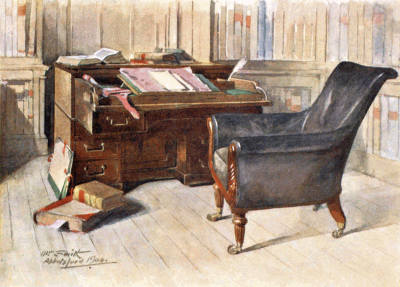
SIR WALTER SCOTT'S DESK AND 'ELBOW
CHAIR' IN THE STUDY, ABBOTSFORD
'Thou, who with tireless hand didst sweep
Away the damps of ages deep
And fire with wild, baronial strain
The harp of chivalry again,
And bid its long-forgotten swell
Thrill through the soul, farewell! farewell!'
Other objects of interest may be briefly noted:
Sir Walter's chair.
Of green morocco; in the Empire style, which
prevailed early in the last century.
The Wallace chair.
Presented by Joseph Train in 1822. Made of
wood from Robroyston, near Kirkintilloch, the
scene of Wallace's betrayal. A MS. volume in
Train's handwriting, contained in a drawer under
the seat, tells the story of the chair (see Lockhart,
vol. vii., p. 223; note inscription).
Lockhart's chair.
Of plain horse-hair.
Scott's card-plate.
Carries the simple address: 'Sir Walter Scott,
Castle Street.'
A small folding box-writing-desk.
Made from wood of the Spanish Armada, and
inscribed: 'Afflavit Deus et dissipantur.'
Print of Stothard's 'Canterbury Pilgrims' (over the
mantelpiece).
The best-known of Stothard's paintings. Engraved
in 1817. 'Sir Walter made the characteristic
criticism upon it that, if the procession were to
move, the young squire who is prancing in the
foreground would in another minute be off his
horse's head' (Adolphus's 'Memoranda').
Portrait of Claverhouse.
Painter unknown.
Portrait of Queen Elizabeth.
Painter unknown.
Portrait of Rob Roy.
Painter unknown.
'The eagle, he was lord above,
And Rob was lord below.'
Bust of Lord Chief Commissioner Adam.
Sculptor probably Samuel Joseph, R.S.A. Founder
of the Blair-Adam Club (see Lockhart, vol. viii.,
p. 200). 'I have lived much with him, and taken
kindly to him as one of the most pleasant, kind-hearted,
benevolent men I have ever known.'
Scott's walking-sticks, pipes, etc.
In cabinet to the right.
A small turret-room off the study is of peculiar
interest. Sir Walter styled it his 'Speak-a-bit.'
Here he enjoyed many a happy tête-à-tête. It is said
to be panelled with the oak of the bedstead on which
Queen Mary slept at Jedburgh in 1566. Scott's
death-mask is the only article the room contains.
The dead face is so tired that nobody can look
upon it without a gush of pity, and a feeling of
thankfulness that at last the man is in his grave.
We are not moved by the grandeur of its modelling;
the appeal it makes is to a larger humanity
than that. It is the face of a brother man,
stretched out too long upon the rack of this tough
world. The majesty of the forehead, and the dour
earnestness of the features, tell of Walter Scott,
the genius; but it is in the corners of the mouth
that all the pathos lies. In them there is the
droop of an infinite weariness, and it makes the
heart ache (see Temple Bar, 1904).
Library.
Adjoining is the Library, the largest and finest
apartment in the house—40 feet long by 18 feet
broad and 16 feet high—with an immense bay-window,
commanding a lovely view of the Tweed.
The book-presses, wired and locked, rise to a height
of 11 feet, leaving a space of 5 feet accordingly
between the top of the shelves and the magnificent
cedar ceiling, whose rich Gothic ornamentation
(of plaster, however) is modelled from Melrose
and Rosslyn. Notice the familiar 'curly green'
of the Melrose Abbots. Close on 20,000 volumes
line the walls.[34] Many are presentation copies, and
not a few contain MS. criticisms and jottings
by Scott. The furniture of this room is very
valuable. Two very richly-carved chairs, said to
have come from the Borghese Palace, in Rome,
were presented by Constable (see letter to Terry
in Lockhart, vol. vii., p. 104). An ebony
writing-cabinet, gorgeously figured, and once the
property of George III., was presented by his
successor. Note should be taken of Sir Walter's
four-sloped reading-desk, movable at the will of the
writer, thus enabling him to consult a number of
works at one time. This was in constant use
when 'Napoleon' was on the stocks. The great
centre-table was the work of Joseph Shillinglaw,
Darnick, 'the Sheriff planning and studying every
turn as zealously as ever an old lady pondered
the development of an embroidered cushion.' The
hangings and curtains (not in use) were chiefly
the work of a little hunch-backed tailor, William
Goodfellow, who occupied a cottage on Scott's
farm of the Broomielees. 'Not long after he
had completed his work at Abbotsford,' says
Lockhart, 'little Goodfellow fell sick, and as his
cabin was near Chiefswood, I had many opportunities
of observing the Sheriff's kind attention to
him in his affliction. I can never forget the evening
on which the poor tailor died. When Scott
entered he found everyone silent, and inferred from
the looks of the good women in attendance that
their patient had fallen asleep, and that they feared
his sleep was the final one. He murmured some
syllables of kind regret. At the sound of his voice
the dying tailor unclosed his eyes, and eagerly and
wistfully sat up, clasping his hands with an expression
of rapturous gratefulness and devotion
that, in the midst of deformity, disease, pain and
wretchedness, was at once beautiful and sublime.
He cried with a loud voice, "The Lord bless and
reward you!" and expired with the effort.' One
painting only has place in the Library—a full-length
of the second Sir Walter, by Sir William
Allan (1822), in the uniform of the 15th Hussars,
his horse by his side. 'A handsomer fellow never
put foot into stirrup,' said Scott. The celebrated
Chantrey Bust, of which Lockhart said that it
'alone preserved for posterity the cast of expression
most fondly remembered by all who mingled in his
domestic circle,' was placed in its present niche (at
the end of the room) by young Sir Walter the day
after his father's funeral. Scott sat to Sir Francis
Chantrey in 1820, and it is this original bust which
is at Abbotsford. Only one duplicate was made
(for Apsley House). Chantrey sculptured a second
bust in 1828 (acquired by Sir Robert Peel), having
in the meantime presented Scott with the bust of
1820, which bears an inscription to that effect on
the back.
A large octagonal glass table in the fine bay
contains the following gabions:
Napoleon's blotter and gold bee-clasps.
Found in his carriage after Waterloo. The blotter
contains a small packet of Napoleon's hair.
Napoleon's pen-case and sealing-wax.
Left on the writing-table at the Palace of the
Elysée Bourbon, in his flight from Paris, 1815
Presented by Lady Hampden, 1829.
A tricoloured cockade.
Brought from France in 1815.
Soldier's Memorandum-book.
Found at Waterloo. See 'Paul's Letters,' p. 199.
Piece of oat-cake.
Found in a dead Highlander's pocket on the field
of Culloden the day of the battle. Given to Scott
by Robert Chambers.
Queen Mary's seal.
Base engraved with a crowned shield, bearing the
Scottish lion and initials 'M.R.'
A piece of Queen Mary's dress.
Prince Charlie's quaigh.
With mirror bottom, 'that he who quaffed might
keep his eye on the dirk hand of his companion.'
Often used by Scott. Presented, in 1825, by
Mrs. Stewart of Stenton.
Lock of Prince Charlie's hair.
Rob Roy's purse.
Of brown leather; much worn. Presented by
Joseph Train, 1818, a few days after the publication
of 'Rob Roy.'
Helen MacGregor's brooch.
A six-pointed star, with a thistle and two leaves
between. 'I confess, for my own part,' says Scott,
'that I looked long and curiously upon the brooch
that belonged to Rob Roy's wife. I was thinking
more of the wife than of the dauntless outlaw; of
the woman who reproached her husband upon his
deathbed for exhibiting some signs of contrition
for his past misdeeds, exhorting him to die as he
had lived, "like a man."'
Flora MacDonald's pocket-book.
Presented by Alexander Campbell, Leith, 1825.
Flora, it would appear, had intended this as a
present to the Rev. Martin Martin, a minister in
the Isle of Skye, but he having died, it never
reached its destination. The initials 'M. M.' have
been wrought on the outside.
Lock of Nelson's hair.
Lock of Wellington's hair.
'As to the Duke of Wellington, my faith is
constant that there is no other man living who
can work out the salvation of this country. He is
such a man as Europe has not seen since Julius
Caesar,'—Scott to Lockhart.
Robert Burns's tumbler.
With some verses scratched thereon. Scott and
Burns met only once, in 1786.
Toadstone amulet.
'It was sovereign for protecting new-born children
and their mothers from the power of the fairies,'
says Scott.
Joanna Baillie's purse.
Netted in thick red silk by the poetess, and presented
to Scott in 1812 (see Lockhart, vol. iii.,
p. 387).
Box made of the pulley of the 'Maiden.'
An instrument of execution, of the guillotine
order, introduced into Scotland by the Regent
Morton, who himself suffered death by its means.
Balfour of Burley's snuff-box.
Immortalized in 'Old Mortality.'
Gold snuff-box set in brilliants.
Presented, in 1815, by George IV., then Prince
Regent, Scott's friend and patron.
Bog-oak snuff-box.
Presented by Maria Edgeworth.
Silver snuff-box.
Presented by City of Cork, 1825.
Robert Scott's (of Sandyknowe) snuff-box.
Tom Purdie's snuff-box.
Peter Mathieson's snuff-box.
Tom Purdie's wood-knife.
Sir Walter's knife.
Small knife and fork used by Scott as a child.
'Beardie's' quaigh.
Wallace-oak quaigh.
Presented by Joseph Train.
Quaigh made from Queen Mary's yew at Craigmillar.
Quaigh made from Duke of Wellington's tree at Waterloo.
'Such a multifarious collection of ancient quaighs
(little cups of curiously dove-tailed wood inlaid
with silver) as no Lowland sideboard but his was
ever equipped with' (see Lockhart, vol. v., p. 339).
Cardinal Mezzofanti's skull-cap.
Brought from Rome by Scott. The Cardinal was
one of the greatest linguists of his day.
A Russian icon.
Silver medal of Charles I.
Miniature of Charles II.
Miniature of James VIII., the Chevalier de St. George.
Medallion of George IV.
Bronze medallion of Scott.
Miniature of Scott at the age of six.
Painted at Bath in 1777; painter unknown. A
copy from the original in the Scottish National
Portrait Gallery. A second copy is in the possession
of Mr. John Murray, London.
Miniature of Scott, 1797.
As an officer in the Edinburgh Light Dragoons.
According to the fashion of the day, his hair is
powdered. A lock of light brown hair is fastened,
under glass, at the back of the frame. This is the
second authentic likeness of Scott.
Miniature of Lady Scott, 1797.
When Miss Carpenter—'a brunette as dark as a
blackberry, but her person and face very engaging.'
Miniature of M. Jean Carpenter.
Father of Lady Scott.
Drawing-room.
Next we pass to the drawing-room, a deeply
interesting apartment, 24 feet by 18 feet, and in
height the same as the others. The walls are
hung with Chinese paper (wonderfully fresh still),
evidence of that Chinese fashion which the skill of
Sir William Chambers succeeded in foisting upon
fashionable people during the reign of George IV.
The windows, doors, and other woodwork, are of
Jamaica cedar, and have a rich and beautiful
appearance, and the furnishings are of great value.
Notice some very pretty china specimens. The
paintings, both numerous and valuable, include:
Full-length portrait of Scott, by Sir Henry Raeburn,
R.A.
Painted in 1809. A replica, with variations, of
the picture done for Constable the year before
(now at Bowhill). In the Abbotsford copy the
background gives the valley of the Yarrow instead
of Liddesdale. Camp is the dog at Scott's feet,
and Douglas the greyhound.
Lady Scott, by James Saxon, 1805.
A companion portrait to that of Sir Walter, painted
in 1805.
Scott's mother, by Sir John Watson Gordon,
P.R.S.A., R.A.
Anne Scott, by William Nicholson, R.S.A.
In fancy dress; a water-colour sketch. 'An
honest, downright good Scots lass, in whom I
would only wish to correct a spirit of satire.'
Anne Scott, by John Graham.
In Spanish dress.
Sophia Scott (Mrs. Lockhart), by William Nicholson,
R.S.A.
In Norwegian peasant dress.
The Hon. Mrs. Maxwell Scott, by Miller.
Presented by Mr. Maxwell Scott's cricketing
friends, 1887.
James VI. of Scotland.
Painter unknown.
Anne, Duchess of Buccleuch and Monmouth.
Painter unknown. To her the 'Lay' was chanted:
'In pride of power, in beauty's bloom,
She wept o'er Monmouth's bloody tomb.'
Henrietta, Queen of Charles I.
Painter unknown.
Sir Thomas Hervey, Knight Marshal to Queen Mary.
Painter unknown.
Nell Gwynne, by Sir Peter Lely.
John Dryden, by Sir Peter Lely.
William Hogarth, by himself.
Oliver Cromwell.
Painter unknown.
Head of Mary Queen of Scots, by Amyas Cawood
(not Camwood, or Canwood, as the guidebooks
say).
Presented by a Prussian nobleman. This picture
represents the head of the Queen after decapitation,
and bears the signature of the painter, with
the inscription and date, 'Maria Scotiæ Regina,
Feb. 9, 1587,' the day after the execution. 'It
is known that leave was granted for such a picture,
and in the painter's name we may probably recognize
a brother of Mary's faithful attendant, Margaret
Cawood,' Cawood, or, as now, Carwood, near
Biggar, was the seat of this family.
Fast Castle.
By Thomson of Duddingston. Presented by the
artist. Fast Castle, Berwickshire, is the supposed
'Wolf's Crag' of the 'Bride of Lammermoor.'
Jedburgh Abbey.
A water-colour drawing by Bennet. Presented
by the artist.
Bust of Shakespeare.
Somewhat youthful-looking. Presented by George
Bullock, along with the finely-carved oak cabinet
on which it stands (see Lockhart, vol. v., p. 167).
Armoury.
'Stepping westwards,' we enter the Armoury,
a long, narrow apartment, running right across
the house, with emblazoned windows at either end
(heads of the Scottish Kings), and forming a sort
of ante-room to the drawing-room on one side
and the dining-room on the other. It consists of
two parts, that to the south being 10 feet in
length, the other 25 feet. Both portions communicate
by a Gothic archway, with carved oaken
wicket. Scarcely a nation on earth, savage or
civilized, but has contributed something in the
shape of a warlike weapon to the stores of the
Abbotsford armoury. Of its many remarkable
and valuable objects—the mere enumeration of
which would, of themselves, form a goodly catalogue—the
following may be specially noted:
Sword of Montrose.
'I have a relic of a more heroic character; it
is a sword which was given to the great Marquis
of Montrose by Charles I., and appears to have
belonged to his father, our gentle King Jamie.
It had been preserved for a long time at Gartmore,
but the present proprietor was selling his
library, and John Ballantyne, the purchaser, wishing
to oblige me, would not conclude a bargain
till he flung the sword into the scale' (letter
to Joanna Baillie, Lockhart, vol. iii., p. 390).
The sword bears on both sides the royal arms of
Great Britain, with the following inscription on
the blade:
'Jacobe alumne pacis atk pallæ
Serene cultor et decus Britannici
Clarrissimum regni tuis regalib
Sceptris subest de stirpe quond martia.'
Scott had the sheath remounted in 1822.
Rob Roy's gun.
An immensely long-barrelled weapon of Spanish
manufacture, bearing the initials of the freebooter,
'R. M. C.'—Robert Macgregor Campbell (see Introduction
to 'Rob Roy,' p. 87). 'A dialogue between
Montrose's sword and Rob Roy's gun might be
composed with good effect' (Scott to Joanna
Baillie).
Rob Roy's sword.
'A fine old Highland broadsword with Andrea
Ferrara blade and basket hilt.'
Rob Roy's dirk.
Of Andrea Ferrara make.
Rob Roy's sporran.
Presented by Joseph Train, 1817. A plain leather
spleuchan likely to have been used by 'Rob' in
his honest drover days.
Claverhouse's pistol.
A fine old Highland flint-lock. Not known how
it came into Scott's possession.
Napoleon's pistols.
Taken from his carriage after Waterloo, and presented
by the Duke of Wellington.
Andreas Hofer's rifle.
The patriot leader of the Tyrolese in 1809. Presented
by Sir Humphry Davy, who obtained it
from Hofer's lieutenant in reward for having cured
him of a fever.
James VI.'s hunting-bottle.
In an old tooled and gilt leathern case. Presented
by George Huntly Gordon.
Prince Charlie's hunting-knives.
Of French make, time of Louis XIV.
Canadian cow-horn.
With a map of Canada and its lakes most ingeniously
and not incorrectly carved upon it by a
native Indian.
Keys of Loch Leven Castle.
Three in number, on an old iron padlock.
The 'thumbikins' or thumbscrews.
An instrument of torture used in Covenant times.
Presented by Gabriel Alexander.
Small iron box.
Found in the Chapel of Mary of Guise at Edinburgh
Castle.
Model of Bruce's candlestick.
Mary Queen of Scots' crucifix.
Of mother-of-pearl.
Russian Prayer-Book.
Russian cross (brass).
Tamul Book.
Necklaces of human hair and bones.
From the Sandwich Islands.
Celtic mask.
Found at Torrs, Kelton parish, Galloway. Presented
by Joseph Train, 1820.
White tail-duster.
Used by Scott for dusting his books.
Highland broadsword.
Presented to Scott by the Celtic Society; a
gorgeous article, with a sheath of elaborately-chased
silver (see Diary, January, 1826).
Scott's blunderbuss.
Round the muzzle are the words: 'When rogues
appear, my voice you'll hear.'
Scott's pistols and sabre.
Used when Quarter—Master of the Edinburgh
Light Dragoons.
Scott's sword.
'A Highland broadsword, with engraved basket
hilt and Andrea Ferrara blade.'
Scott's own gun.
An old Spanish double-barrelled flint-lock.
Officer's sword.
Worn by the second Sir Walter when in the
15th Hussars.
Pair of gilt dress spurs.
Worn by the second Sir Walter when in the
15th Hussars.
The Armoury paintings consist chiefly of Scott's
servants and friends:
John Swanston.
Gamekeeper. 'A fine fellow, who did all he
could to replace Tom Purdie.' Painter uncertain;
initialled 'G. D.'; date 1851.
Peter Mathieson, with 'Donald,' the pony.
Coachman. 'I cannot forget how his eyes sparkled
when he first pointed out to me Peter Mathieson
guiding the plough on the haugh. "Egad," said
he, "auld Pepe" (this was the children's name
for their good friend)—"auld Pepe's whistling at
his darg. The honest fellow said a yoking in a
deep field would do baith him and the blackies
good. If things get round with me, easy shall be
Pepe's cushion"' (Lockhart, vol. ix.). Painter
uncertain; initialled 'G. D.'; date 1851.
Tom Purdie.
Described in 'Redgauntlet' (see Lockhart, vol. vi.,
p. 121). Painted by Sir Edwin Landseer, R.A.
James Ballantyne.
Painter unknown. 'James was a short, stout, well-made
man, and would have been considered a
handsome one but for those grotesque frowns,
starts, and twistings of his features, set off by a
certain mock majesty of walk and gesture, which
he had perhaps contracted from his usual companions,
the emperors and tyrants of the stage.'
Miniature of Claverhouse.
Painter unknown.
Charles Mackay, as 'Bailie Nicol Jarvie.'
'The man who played the Bailie made a piece of
acting equal to whatever has been seen in the
profession. For my own part, I was actually
electrified by the truth, spirit, and humour which
he threw into the part. It was the living Nicol
Jarvie' (Scott to Terry, April, 1829).
Miniature of Prince Charlie.
James IV. (contemporary portrait, 1507).
Portrait of Allan Ramsay.
By Allan Ramsay, junior.
The Scotts of Raeburn.
By Sir John Watson Gordon.
Scott in his study.
By Sir William Allan.
Medallion of Scott.
Medallion of Christopher North.
By Andrew Currie.
Hinse of Hinsfeldt.
Scott's cat. See description of the Castle Street
'den.'
'Ginger.'
Scott's dog. Painted by Landseer.
Drawing of Queen Elizabeth dancing.
By Charles Kirkpatrick Sharpe. 'This production
of Mr. Sharpe's pencil, and the delight with which
Scott used to expatiate on its merits, must be well
remembered by everyone that ever visited the poet
at Abbotsford.'
'The Dish of Spurs.'
By Sharpe. 'When the larders of our ancestors
were bare, and fresh meat was desired, the housewife
placed a pair of spurs on a dish to remind the
men-folk that the moment was come for a raid on
their neighbour's cattle.'
'The Reiver's Wedding.'
By Sharpe. See Lockhart, vol. ii., for unfinished
ballad of 'The Reiver's Wedding'; also letter to
Miss Seward, June 29, 1802, same vol.
'Gibbie wi' the Gowden Gairters.'
By Sharpe. Sir Gilbert Elliot paying his addresses
to Auld Wat of Harden's daughter.
An (not The) Ettrick shepherd.
The Paschal Lamb.
From the High Altar at Dryburgh.
Dead partridge.
The above three wood-carvings are by Andrew
Currie.
Statuette of Sir Walter.
From John Greenshields' seated figure, carved in
freestone, now in the Advocates' Library—'Sic
Sedebat.'
Entrance Hall.
In this order of going round the Entrance Hall
comes last—a spacious apartment, 40 feet by
20 feet, panelled to the height of 7 feet with dark
oak from Dunfermline Abbey. The roof is of
stucco-work in imitation of the wainscotting, and
comprehends a series of arches with dependent
points, modelled from Melrose Abbey. The effect
of this room is grand and impressive. A sort of
rich and red twilight, even at noonday, from the
emblazoned 'Bellenden'[35] windows, pervades the
place, which is literally laden with relics and
trophies. The cornice displays a double line of
escutcheons, with the heraldic bearings of the
Scotts, Kers, Elliots, Douglases, Homes, Pringles,
Maxwells, Johnstones, Chisholms, and other Border
families, and the inscription in black letter:
'These be the Coat Armouris of ye Clannis
and men of name quha keepit the Scottish
Marches in ye days of auld. They were worthie
in thair tyme and in thair defens God thaim
defendid.'
The arms of Scott's own ancestors occupy
sixteen shields running along the centre of the
roof, being the complete quarterings of a man of
'gentle blood.' On his father's side—running west—are
the names of Scott, Haliburton, Campbell,
M'Dougal, Murray, Scott (Dryhope), Ker, Riddel;
and on his mother's side—running east—Rutherford,
Swinton, Shaw, Ker, Ainslie. Three shields
on this side are blanks,—Scott not being able to
trace out his pedigree to the full length of his
spaces,—and are painted over with blue clouds,
and the motto, Alta—Nox—Premit ('Oblivion has
covered them'). The floor is a mosaic of black
and white Hebridean marble. Of a singularly rich
assortment of curiosities in the shape of cuirasses
and suits of armour, helmets, shields, swords, lances,
and other arms of all sorts and ages, flags, cannonballs,
and numberless other articles from apparently
every country under the sun, all of them interesting
in their antiquity or associations, the following are
some of the more notable:
Suit of fluted armour.
Early sixteenth century.
Suit of polished steel tilting armour.
Middle of the sixteenth century. Believed to
have come from Bosworth Field, and, as Scott
suggests, to have belonged to Sir John Cheney,
the biggest man of both armies on that memorable
day. An enormous two-handed sword, nearly the
length of a man, is held by this figure (see also
the celebrated Calendar-sword, close by, and tilting-lance,
about 12 feet long).
279
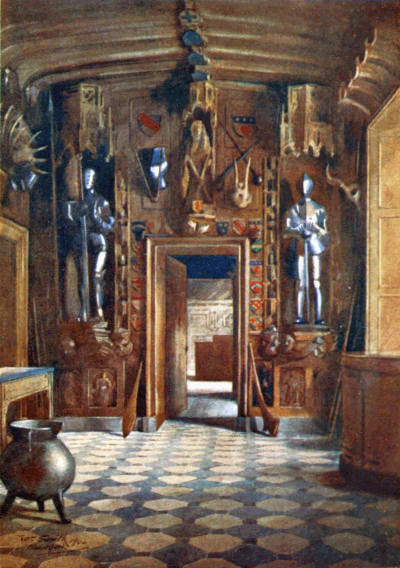
THE ENTRANCE HALL, ABBOTSFORD
'And stranger lips, unmoved and cold,
The legends of thy mansion told—
Thy lauded, glittering brand and spear,
And costly gift from prince and peer,
And broad claymore, with silver dight
And hunting-horn of Border knight,
What were such gauds to me?
More dear had been one single word
From those whose veins thy blood had stirred.'
Relics from Waterloo.
Pistols, cuirasses, swords, sabres, etc. (see Lockhart,
vol. v.).
Relics from Culloden.
Highland back-swords.
Relics from Roxburgh Castle.
Two cannonballs.
Archbishop Sharp's grate.
See letter to Terry, January 9, 1823. The fireplace
is modelled from the Abbot's Stall at Melrose.
Head of elk.
Found in Abbotsrule Moss, twelve miles from
Abbotsford.
Ralph Erskine's pulpit.
The two semicircular presses between the windows,
forming a sort of wine-cellar, were made from the
wood of this pulpit, with the precentor's desk and
King's seat of Dunfermline Abbey Church.
Keys of the old Tolbooth of Edinburgh.
Presented by the magistrates of Edinburgh, 1816.
Lock and key of Selkirk Gaol.
A Jeddart axe.
Time of James V.
Hermitage touting-horn.
'How great he was when he was made master o'
that! Sir Walter carried it home all the way from
Liddesdale to Jedburgh, slung about his neck like
Johnny Gilpin's bottle, and muckle and sair we
routed on't, and hotched and blew wi' micht and
main' (Shortreed's 'Memoranda').
Burgess hat of Stow.
Model of the Scottish branks.
For scolding wives.
Model of skull of Robert the Bruce.
On the mantelpiece.
Model of skull of Shaw, the Waterloo Lifeguards-man.
On the mantelpiece (see Lockhart, vol. v., p. 71).
Marie Antoinette's clock.
On the mantelpiece.
Bronze pot from Riddell, Roxburghshire.
'The mistletoe chest where Ginevra lay.'
Sent from Italy to Scott as the identical chest in
which the beautiful young bride hid herself on her
marriage-day, in a frolicsome wish to baffle the
search of her newly-wedded lord, and out of which
chest she never came, until the lapse of many
years had converted her beautiful frame into a
mouldering skeleton. A spring-lock had shut her
in, and all search for her proved vain. Sir Walter
was led to doubt the authenticity of the relic from
the fact that Italy has a box with similar claims in
several of her principal cities. Besides, the chest
at Abbotsford has not the spring lock.
Sir Walter's clothes.
The last suit worn by him—drab trousers, striped
waistcoat, dark-green coat with white metal
buttons, and light fawn beaver hat. 'When I was at
Abbotsford I saw in a glass case the last clothes
Scott wore. Among them an old white hat,
which seemed to be tumbled and bent and broken
by the uneasy, purposeless wandering hither and
thither of his heavy head. It so embodied Lockhart's
pathetic description of him when he tried to
write and laid down his pen and cried, that it
associated itself in my mind with broken power
and mental weakness from that hour' (Charles
Dickens, 1851).
Bust of Wordsworth.
'So didst thou travel on life's common way,
In cheerful godliness.'
Dining-room.
The Dining-room—'his own great parlour'—is
not open to the public. It was the first room of
any pretensions that Scott built at Abbotsford (it is
30 feet in length, including a considerable bow,
17 feet in breadth and 12 feet high), and much
care was expended on its design and decoration.
He adorned the walls with portraits of his
ancestors, and, says Lockhart, 'he seemed never
to weary of perusing them.' It was here, too, as
has been already said, that the final tragedy was
played out.
Walter Scott.
Sir Walter's great-grandfather, known as 'Beardie,'
from a vow which he made never to shave his
beard till the Stuarts were restored.
'With amber beard and flaxen hair,
And reverend apostolic air,
Small thought was his, in after time,
E'er to be hitch'd into a rhyme.
The simple sire could only boast
That he was loyal to his cost;
The banish'd race of kings revered,
And lost his land—but kept his beard.'
Painter unknown.
Robert Scott, of Sandyknowe.
Sir Walter's grandfather.
'The thatch'd mansion's grey-hair'd sire,
Wise without learning, plain and good,
And sprung of Scotland's gentle blood.'
Painter unknown.
Professor Rutherford.
Sir Walter's maternal grandfather, Professor of
Medicine in the University of Edinburgh, 'one to
whom the school of medicine in our northern
metropolis owes its rise, and a man distinguished
for professional talent, for lively wit, and for literary
acquirements.' Painter unknown.
287
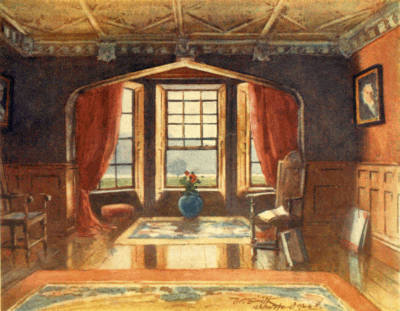
THE DINING-ROOM, ABBOTSFORD
'Forth went a shadowy hand
And touched him on the brow;
Calmly he laid his wand
Aside, and shook the sand—
Death, is it thou?
Slow o'er his reverend head
The darkness crept,
While nations round his bed
Stood still, and wept!'
Walter Scott, W.S.
Sir Walter's father, 'a most just, honourable, and
conscientious man. He passed from the cradle to
the grave without making an enemy or losing a
friend.' Painter unknown.
Mrs. Scott.
Anne Rutherford, Sir Walter's mother, 'short of
stature and by no means comely.' Painter unknown.
Thomas Scott.
Sir Walter's uncle. 'The most venerable figure I
had ever set my eyes on—tall and erect, with long
flowing tresses of the most silvery whiteness. He
sat reading his Bible without spectacles, and did
not, for a moment, perceive that anyone had entered
his room; but, on recognizing his nephew, he rose
with cordial alacrity, kissing him on both cheeks,
and exclaiming: "God bless thee, Walter, my
man! thou hast risen to be great, but thou wast
always good."' Painter unknown.
Thomas Scott, W.S.
Sir Walter's third brother, 'a man of infinite
humour and excellent parts.' Painter unknown.
AROUND ABBOTSFORD