Once upon a time there lived on a large plantation
in Middle Georgia a boy who was known
as Little Crotchet. It was a very queer name,
to be sure, but it seemed to fit the lad to a T.
When he was a wee bit of a chap he fell seriously
ill, and when, many weeks afterwards, the
doctors said the worst was over, it was found that
he had lost the use of his legs, and that he would
never be able to run about and play as other
children do. When he was told about this he
laughed, and said he had known all along that
he would never be able to run about on his feet
again; but he had plans of his own, and he told
his father that he wanted a pair of crutches made.
"But you can't use them, my son," said his
father.
"Anyhow, I can try," insisted the lad.
The doctors were told of his desire, and these
wise men put their heads together.
"It is a crotchet," they declared, "but it will
be no harm for him to try."
"It is a little crotchet," said his mother, "and
he shall have the crutches."
Thus it came about that the lad got both his
name and his crutches, for his father insisted on
calling him Little Crotchet after that, and he also
insisted on sending all the way to Philadelphia
for the crutches. They seemed to be a long time
in coming, for in those days they had to be
brought to Charleston in a sailing vessel, and
then sent by way of Augusta in a stage-coach;
but when they came they were very welcome, for
Little Crotchet had been inquiring for them
every day in the week, and Sunday too. And
yet when they came, strange to say, he seemed
to have lost his interest in them. His mother
brought them in joyously, but there was not even
a glad smile on the lad's face. He looked at
them gravely, weighed them in his hands, laid
them across the foot of the bed, and then turned
his head on his pillow, as if he wanted to go
to sleep. His mother was surprised, and not a
little hurt, as mothers will be when they do not
understand their children; but she respected his
wishes, darkened the room, kissed her boy, and
closed the door gently.
When everything was still, Little Crotchet sat
up in bed, seized his crutches, and proceeded to
try them. He did this every day for a week, and
at the end of that time surprised everybody in
the house, and on the place as well, by marching
out on his crutches, and going from room to
room without so much as touching his feet to the
floor. It seemed to be a most wonderful feat to
perform, and so it was; but Providence, in depriving
the lad of the use of his legs, had correspondingly
strengthened the muscles of his chest
and arms, so that within a month he could use
his crutches almost as nimbly and quite as safely
as other boys use their feet. He could go upstairs
and downstairs and walk about the place
with as much ease, apparently, as those not afflicted,
and it was not strange that the negroes
regarded the performance with wonder akin to
awe, declaring among themselves that their young
master was upheld and supported by "de sperits."
And indeed it was a queer sight to see the
frail lad going boldly about on crutches, his feet
not touching the ground. The sight seemed to
make the pet name of Little Crotchet more appropriate
than ever. So his name stuck to him,
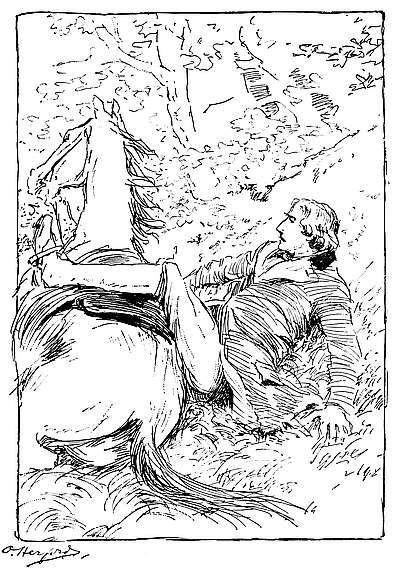
even after he got his Gray Pony, and became a
familiar figure in town and in country, as he
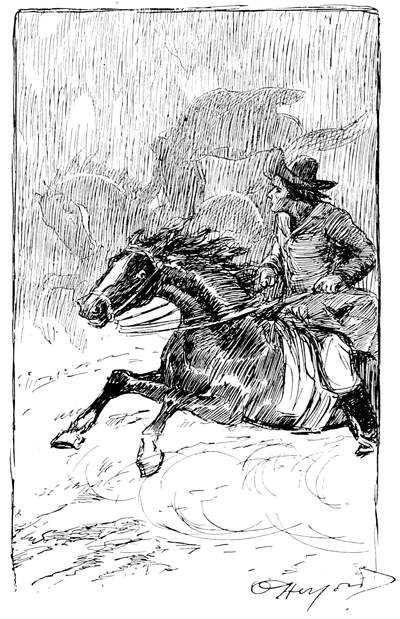
went galloping about, his crutches strapped to
the saddle, and dangling as gayly as the sword
of some fine general. Thus it came to pass that
no one was surprised when Little Crotchet went
cantering along, his Gray Pony snorting fiercely,
and seeming never to tire. Early or late, whenever
the neighbors heard the short, sharp snort of
the Gray Pony and the rattling of the crutches,
they would turn to one another and say, "Little
Crotchet!" and that would be explanation
enough. There seemed to be some sort of understanding
between him and his Gray Pony.
Anybody could ride the Gray Pony in the pasture
or in the grove around the house, but when
it came to going out by the big gate, that was
another matter. He could neither be led nor
driven beyond that boundary by any one except
Little Crotchet. It was the same when it came
to crossing water. The Gray Pony would not
cross over the smallest running brook for any
one but Little Crotchet; but with the lad on his
back he would plunge into the deepest stream,
and, if need be, swim across it. All this deepened
and confirmed in the minds of the negroes
the idea that Little Crotchet was upheld and protected
by "de sperits." They had heard him
talking to the Gray Pony, and they had heard
the Gray Pony whinny in reply. They had seen
the Gray Pony with their little master on his
back go gladly out at the big gate and rush with
a snort through the plantation creek,—a bold
and at times a dangerous stream. Seeing these
things, and knowing the temper of the pony, they
had no trouble in coming to the conclusion that
something supernatural was behind it all.
II.
Thus it happened that Little Crotchet and his
Gray Pony were pretty well known through all
the country-side, for it seemed that he was never
tired of riding, and that the pony was never tired
of going. What was the rider's errand? Nobody
knew. Why should he go skimming along
the red road at day dawn? And why should he
come whirling back at dusk,—a red cloud of
dust rising beneath the Gray Pony's feet? Nobody
could tell.
This was almost as much of a puzzle to some
of the whites as it was to the negroes; but this
mystery, if it could be called such, was soon
eclipsed by a phenomenon that worried some of
the wisest dwellers in that region. This phenomenon,
apparently very simple, began to manifest
itself in early fall, and continued all through
that season and during the winter and on through
the spring, until warm weather set in. It was in
the shape of a thin column of blue smoke that
could be seen on any clear morning or late afternoon
rising from the centre of Spivey's Canebrake.
This place was called a canebrake because
a thick, almost impenetrable, growth of
canes fringed the edge of a mile-wide basin lying
between the bluffs of the Oconee River and the
uplands beyond. Instead of being a canebrake
it was a vast swamp, the site of cool but apparently
stagnant ponds and of treacherous quagmires,
in which cows, and even horses, had been
known to disappear and perish. The cowitch
grew there, and the yellow plumes of the poison-oak
vine glittered like small torches. There, too,
the thunder-wood tree exuded its poisonous milk,
and long serpent-like vines wound themselves
around and through the trees, and helped to shut
out the sunlight. It was a swamp, and a very
dismal one. The night birds gathered there to
sleep during the day, and all sorts of creatures
that shunned the sunlight or hated man found
a refuge there. If the negroes had made paths
through its recesses to enable them to avoid the
patrol, nobody knew it but themselves.
Why, then, should a thin but steady stream of
blue smoke be constantly rising upwards from the
centre of Spivey's Canebrake? It was a mystery
to those who first discovered it, and it soon grew
to be a neighborhood mystery. During the
summer the smoke could not be seen, but in the
fall and winter its small thin volume went curling
upward continually. Little Crotchet often
watched it from the brow of Turner's Hill, the
highest part of the uplands. Early in the morning
or late in the afternoon the vapor would rise
from the Oconee; but the vapor was white and
heavy, and was blown about by the wind, while
the smoke in the swamp was blue and thin, and
rose straight in the air above the tops of the trees
in spite of the wayward winds.
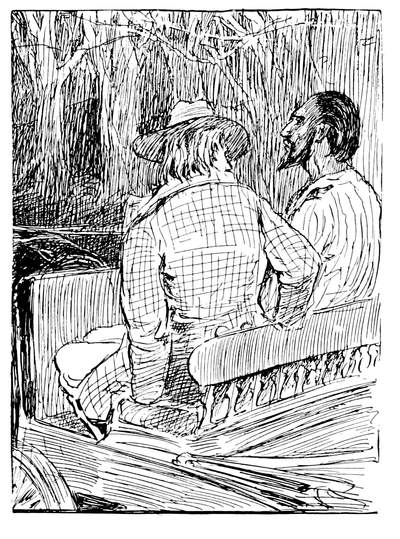
Once when Little Crotchet was sitting on his
pony watching the blue smoke rise from the
swamp he saw two of the neighbor farmers coming
along the highway. They stopped and
shook hands with the lad, and then turned to
watch the thin stream of blue smoke. The
morning was clear and still, and the smoke rose
straight in the air, until it seemed to mingle with
the upper blue. The two farmers were father
and son,—Jonathan Gadsby and his son Ben.
They were both very well acquainted with Little
Crotchet,—as, indeed, everybody in the county
was,—and he was so bright and queer that they
stood somewhat in awe of him.
"I reckin if I had a pony that wasn't afeard
of nothin' I'd go right straight and find out
where that fire is, and what it is," remarked Ben
Gadsby.
This stirred his father's ire apparently. "Why,
Benjamin! Why, what on the face of the earth
do you mean? Ride into that swamp! Why,
you must have lost what little sense you had
when you was born! I remember, jest as well
as if it was day before yesterday, when Uncle
Jimmy Cosby's red steer got in that swamp, and
we couldn't git him out. Git him out, did I
say? We couldn't even git nigh him. We
could hear him beller, but we never got where
we could see ha'r nor hide of him. If I was
thirty year younger I'd take my foot in my
hand and wade in there and see where the smoke
comes from."
IT WAS A SWAMP
Little Crotchet laughed. "If I had two good
legs," said he, "I'd soon see what the trouble
is."
This awoke Ben Gadsby's ambition. "I believe
I'll go in there and see where the fire is."
"Fire!" exclaimed old Mr. Gadsby, with some
irritation. "Who said anything about fire?
What living and moving creetur could build a
fire in that thicket? I'd like mighty well to lay
my eyes on him."
"Well," said Ben Gadsby, "where you see
smoke there's obliged to be fire. I've heard
you say that yourself."
"Me?" exclaimed Mr. Jonathan Gadsby, with
a show of alarm in the midst of his indignation.
"Did I say that? Well, it was when I wasn't so
much as thinking that my two eyes were my own.
What about foxfire? Suppose that some quagmire
or other in that there swamp has gone and
got up a ruction on its own hook? Smoke without
fire? Why, I've seed it many a time. And
maybe that smoke comes from an eruption in the
ground. What then? Who's going to know
where the fire is?"
Little Crotchet laughed, but Ben Gadsby put
on a very bold front. "Well," said he, "I can
find bee-trees, and I'll find where that fire is."
"Well, sir," remarked Mr. Jonathan Gadsby,
looking at his son with an air of pride, "find out
where the smoke comes from, and we'll not expect
you to see the fire."
"I wish I could go with you," said Little
Crotchet.
"I don't need any company," replied Ben
Gadsby. "I've done made up my mind, and I
a-going to show the folks around here that where
there's so much smoke there's obliged to be some
fire."
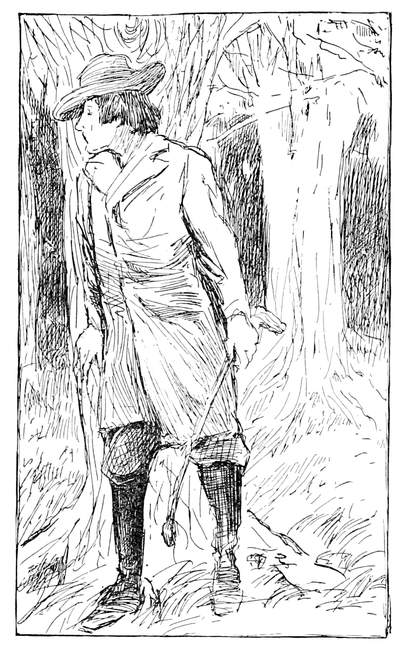
The young man, knowing that he had some
warm work before him, pulled off his coat, and
tied the sleeves over his shoulder, sash fashion.
Then he waved his hand to his father and to
Little Crotchet, and went rapidly down the hill.
He had undertaken the adventure in a spirit of
bravado. He knew that a number of the neighbors
had tried to solve the mystery of the smoke
in the swamp and had failed. He thought, too,
that he would fail; and yet he was urged on by
the belief that if he should happen to succeed, all
the boys and all the girls in the neighborhood
would regard him as a wonderful young man.
He had the same ambition that animated the
knight of old, but on a smaller scale.
III.
Now it chanced that Little Crotchet himself
was on his way to the smoke in the swamp. He
had been watching it, and wondering whether he
should go to it by the path he knew, or whether
he should go by the road that Aaron, the runaway,
had told him of. Ben Gadsby interfered
with his plans somewhat; for quite by accident,
young Gadsby as he went down the hill struck
into the path that Little Crotchet knew. There
was a chance to gallop along the brow of the hill,
turn to the left, plunge through a shallow lagoon,
and strike into the path ahead of Gadsby, and
this chance Little Crotchet took. He waved his
hand to Mr. Jonathan Gadsby, gave the Gray
Pony the rein, and went galloping through the
underbrush, his crutches rattling, and the rings
of the bridle-bit jingling. To Mr. Jonathan
Gadsby it seemed that the lad was riding recklessly,
and he groaned and shook his head as he
turned and went on his way.
But Little Crotchet rode on. Turning sharply
to the left as soon as he got out of sight, he went
plunging through the lagoon, and was soon going
along the blind path a quarter of a mile ahead of
Ben Gadsby. This is why young Gadsby was so
much disturbed that he lost his way. He was
bold enough when he started out, but by the time
he had descended the hill and struck into what
he thought was a cattle-path his courage began to
fail him. The tall canes seemed to bend above
him in a threatening manner. The silence oppressed
him. Everything was so still that the
echo of his own movements as he brushed along
the narrow path seemed to develop into ominous
whispers, as if all the goblins he had ever heard
of had congregated in front of him to bar his
way.
The silence, with its strange echoes, was bad
enough, but when he heard the snorting of Little
Crotchet's Gray Pony as it plunged through the
lagoon, the rattle of the crutches and the jingling
of the bridle-bit, he fell into a panic. What
great beast could it be that went helter-skelter
through this dark and silent swamp, swimming
through the water and tearing through the quagmires?
And yet, when Ben Gadsby would have
turned back, the rank undergrowth and the trailing
vines had quite obscured the track. The fear
that impelled him to retrace his steps was equally
powerful in impelling him to go forward. And
this seemed the easiest plan. He felt that it
would be just as safe to go on, having once made
the venture, as to turn back. He had a presentiment
that he would never find his way out anyhow,
and the panic he was in nerved him to the
point of desperation.
So on he went, not always trying to follow the
path, but plunging forward aimlessly. In half
an hour he was calmer, and pretty soon he found
the ground firm under his feet. His instincts as
a bee-hunter came back to him. He had started
in from the east side, and he paused to take his
bearings. But it was hard to see the sun, and in
the recesses of the swamp the mosses grew on all
sides of the trees. And yet there was a difference,
which Ben Gadsby did not fail to discover and
take account of. They grew thicker and larger
on the north side, and remembering this, he went
forward with more confidence.
He found that the middle of the swamp was
comparatively dry. Huge poplar-trees stood
ranged about, the largest he had ever seen. In
the midst of a group of trees he found one that
was hollow, and in this hollow he found the
smouldering embers of a fire. But for the strange
silence that surrounded him he would have given
a whoop of triumph; but he restrained himself.
Bee-hunter that he was, he took his coat from his
shoulders and tied it around a small slim sapling
standing near the big poplar where he had found
the fire. It was his way when he found a bee-tree.
It was a sort of guide. In returning he
would take the general direction, and then hunt
about until he found his coat; and it was much
easier to find a tree tagged with a coat than it
was to find one not similarly marked.
Thus, instead of whooping triumphantly, Ben
Gadsby simply tied his coat about the nearest
sapling, nodding his head significantly as he did
so. He had unearthed the secret and unraveled
the mystery, and now he would go and call in
such of the neighbors as were near at hand and
show them what a simple thing the great mystery
was. He knew that he had found the hiding-place
of Aaron, the runaway. So he fixed his
"landmark," and started out of the swamp with
a lighter heart than he had when he came in.
To make sure of his latitude and longitude, he
turned in his tracks when he had gone a little
distance and looked for the tree on which he had
tied his coat. But it was not to be seen. He re-traced
his steps, trying to find his coat. Looking
about him cautiously, he saw the garment after a
while, but it was in an entirely different direction
from what he supposed it would be. It was tied
to a sapling, and the sapling was near a big poplar.
To satisfy himself, he returned to make a
closer examination. Sure enough, there was the
coat, but the poplar close by was not a hollow
poplar, nor was it as large as the tree in which
Ben Gadsby had found the smouldering embers
of a fire.
He sat on the trunk of a fallen tree and
scratched his head, and discussed the matter in
his mind the best he could. Finally he concluded
that it would be a very easy matter, after he
found his coat again, to find the hollow poplar.
So he started home again. But he had not gone
far when he turned around to take another view
of his coat.
It had disappeared. Ben Gadsby looked carefully
around, and then a feeling of terror crept
over his whole body—a feeling that nearly paralyzed
his limbs. He tried to overcome this feeling,
and did so to a certain degree. He plucked
up sufficient courage to return and try to find his
coat; but the task was indeed bewildering. He
thought he had never seen so many large poplars
with small slim saplings standing near them, and
then he began to wander around almost aimlessly.
IV.
Suddenly he heard a scream that almost paralyzed
him—a scream that was followed by the
sound of a struggle going on in the thick undergrowth
close at hand. He could see the muddy
water splash above the bushes, and he could hear
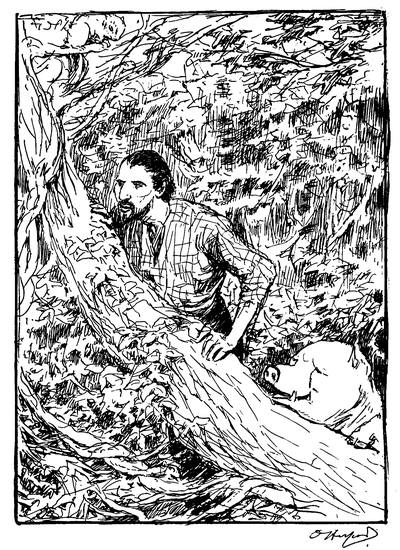
fierce growlings and gruntings. Before he could
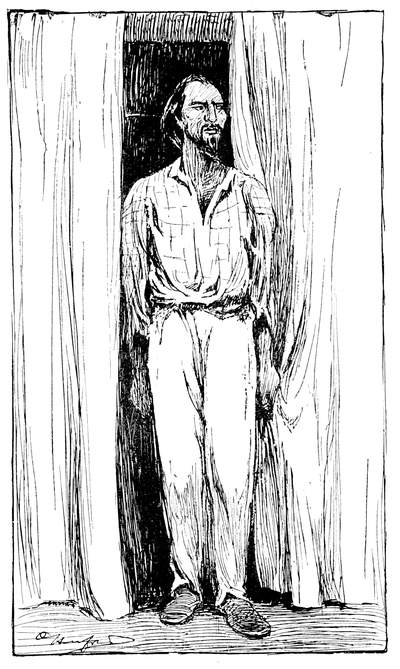
make up his mind what to do, a gigantic mulatto,
with torn clothes and staring eyes, rushed out of
the swamp and came rushing by, closely pursued
by a big white boar with open mouth and fierce
cries. The white boar was right at the mulatto's
heels, and his yellow tusks gleamed viciously as
he ran with open mouth. Pursuer and pursued
disappeared in the bushes with a splash and a
crash, and then all was as still as before. In fact,
the silence seemed profounder for this uncanny
and appalling disturbance. It was so unnatural
that half a minute after it happened Ben Gadsby
was not certain whether it had occurred at all.
He was a pretty bold youth, having been used to
the woods and fields all his life, but he had now
beheld a spectacle so out of the ordinary, and of
so startling a character, that he made haste to get
out of the swamp as fast as his legs, weakened by
fear, would carry him.
More than once, as he made his way out of the
swamp, he paused to listen; and it seemed that
each time he paused an owl, or some other bird
of noiseless wing, made a sudden swoop at his
head. Beyond the exclamation he made when
this happened the silence was unbroken. This
experience was unusual enough to hasten his steps,
even if he had had no other motive for haste.
When nearly out of the swamp, he came upon
a large poplar, by the side of which a small slim
sapling was growing. Tied around this sapling
was his coat, which he thought he had left in
the middle of the swamp. The sight almost took
his breath away.
He examined the coat carefully, and found that
the sleeves were tied around the tree just as he
had tied them. He felt in the pockets. Everything
was just as he had left it. He examined
the poplar; it was hollow, and in the hollow was
a pile of ashes.
"Well!" exclaimed Ben Gadsby. "I'm the
biggest fool that ever walked the earth. If I
ain't been asleep and dreamed all this, I'm crazy;
and if I've been asleep, I'm a fool."
His experience had been so queer and so confusing
that he promised himself he'd never tell
it where any of the older people could hear it, for
he knew that they would not only treat his tale
with scorn and contempt, but would make him
the butt of ridicule among the younger folks. "I
know exactly what they'd say," he remarked to
himself. "They'd declare that a skeer'd hog run
across my path, and that I was skeer'der than the
hog."
So Ben Gadsby took his coat from the sapling,
and went trudging along his way toward the big
road. When he reached that point he turned
and looked toward the swamp. Much to his surprise,
the stream of blue smoke was still flowing
upward. He rubbed his eyes and looked again,
but there was the smoke. His surprise was still
greater when he saw Little Crotchet and the Gray
Pony come ambling up the hill in the path he
had just come over.
"What did you find?" asked Little Crotchet,
as he reined in the Gray Pony.
"Nothing—nothing at all," replied Ben
Gadsby, determined not to commit himself.
"Nothing?" cried Little Crotchet. "Well,
you ought to have been with me! Why, I saw
sights! The birds flew in my face, and when I
got in the middle of the swamp a big white hog
came rushing out, and if this Gray Pony hadn't
been the nimblest of his kind, you'd never have
seen me any more."
"Is that so?" asked Ben Gadsby, in a dazed
way. "Well, I declare! 'Twas all quiet with me.
I just went in and come out again, and that's all
there is to it."
"I wish I'd been with you," said Little
Crotchet, with a curious laugh. "Good-by!"
With that he wheeled the Gray Pony and rode
off home. Ben Gadsby watched Little Crotchet
out of sight, and then, with a gesture of despair,
surprise, or indignation, flung his coat on the
ground, crying, "Well, by jing!"
V.
That night there was so much laughter in the
top story of the Abercrombie house that the Colonel
himself came to the foot of the stairs and called
out to know what the matter was.
"It's nobody but me," replied Little Crotchet.
"I was just laughing."
Colonel Abercrombie paused, as if waiting for
some further explanation, but hearing none, said,
"Good-night, my son, and God bless you!"
"Good-night, father dear," exclaimed the lad,
flinging a kiss at the shadow his father's candle
flung on the wall. Then he turned again into
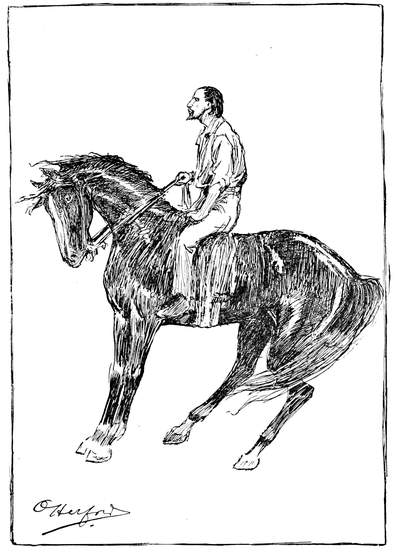
his own room, where Aaron the Arab (son of Ben
Ali) sat leaning against the wall, as silent and as
impassive as a block of tawny marble.
Little Crotchet lay back in his bed, and the two
were silent for a time. Finally Aaron said:—
"The White Grunter carried his play too far.
He nipped a piece from my leg."
"I never saw anything like it," remarked little
Crotchet. "I thought the White Pig was angry.
You did that to frighten Ben Gadsby."
"Yes, Little Master," responded Aaron, "and
I'm thinking the young man will never hunt for
the smoke in the swamp any more."
Little Crotchet laughed again, as he remembered
how Ben Gadsby looked as Aaron and the
White Pig went careening across the dry place in
the swamp. There was a silence again, and then
Aaron said he must be going.
"And when are you going home to your master?"
Little Crotchet asked.
"Never!" replied Aaron the runaway, with
emphasis. "Never! He is no master of mine.
He is a bad man."
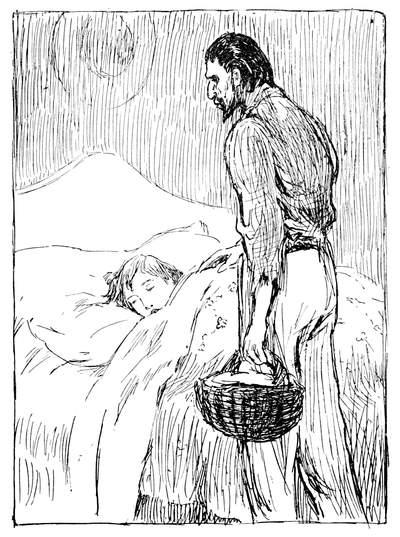
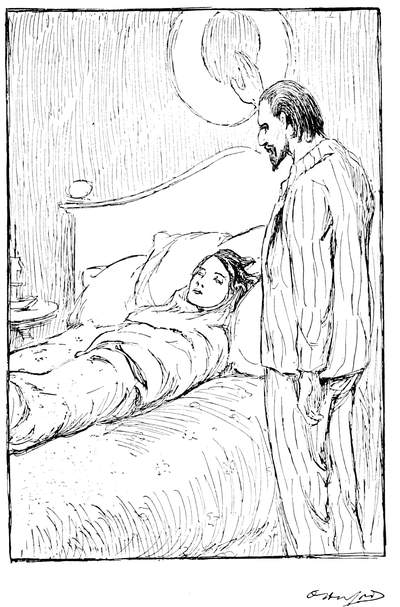
Then he undressed Little Crotchet, tucked the
cover about him,—for the nights were growing
chill,—whispered good-night, and slipped from
the window, letting down the sash gently as he
went out. If any one had been watching, he
would have seen the tall Arab steal along the
roof until he came to the limb of an oak that
touched the eaves. Along this he went nimbly,
glided down the trunk to the ground, and disappeared
in the darkness.
I.
THE LITTLE MASTER.
If you imagine that the book called "The
Story of Aaron (so-named), the Son of Ben Ali"
tells all the adventures of the Arab while he was
a fugitive in the wildwoods, you are very much
mistaken. If you will go back to that book you
will see that Timoleon the black stallion, Grunter
the white pig, Gristle the gray pony, and Rambler
the track dog, told only what they were asked to
tell. And they were not anxious to tell even
that. They would much rather have been left
alone. What they did tell they told without
any flourishes whatever, for they wanted to get
through and be done with it. Story-telling was
not in their line, and they knew it very well; so
they said what they had to say and that was the
end of it so far as they were concerned: setting
a worthy example to men and women, and to
children, too.
It is natural, therefore, that a man such as
Aaron was, full of courage and valuable to the
man who had bought him from the speculator,
should have many adventures that the animals
knew nothing of, or, if they knew, had no occasion
to relate. In the book you will find that
Buster John and Sweetest Susan asked only about
such things as they heard of incidentally. But
some of the most interesting things were never
mentioned by Aaron at all; consequently the
children never asked about them.
Little Crotchet, it will be remembered, who
knew more about the matter than anybody except
Aaron, was dead, and so there was nobody to
give the children any hint or cue as to the questions
they were to ask. You will say they had
Aaron close at hand. That is true, but Aaron
was busy, and besides that he was not fond of
talking, especially about himself.
And yet, the most of the adventures Aaron
had in the wildwoods were no secret. They were
well known to the people in the neighborhood,
and for miles around. In fact, they were made
the subject of a great deal of talk in Little
Crotchet's day, and many men (and women too)
who were old enough to be wise shook their
heads over some of the events and declared that
they had never heard of anything more mysterious.
And it so happened that this idea of mystery
deepened and grew until it made a very
romantic figure of Aaron, and was a great help
to him, not only when he was a fugitive in the
wildwoods, but afterwards when he "settled
down," as the saying is, and turned his attention
to looking after affairs on the Abercrombie plantation.
All this happened before Buster John and
Sweetest Susan were born, while their mother was
a girl in her teens. When Little Crotchet was
alive things on the Abercrombie plantation were
very different from what they were before or
afterward. It is true the lad was a cripple and
had to go on crutches, except when he was riding
Gristle, the Gray Pony. But he was very active
and nimble, and very restless, too, for he was
here, there, and everywhere. More than that, he
was always in a good humor, always cheerful, and
most of the time laughing at his own thoughts
or at something he had heard. For it was well
understood on that plantation, and, indeed, wherever
little Crotchet was familiarly known, that,
as he was something of an invalid, and such a
little bit of a fellow to boot, nothing unpleasant
was to come to his ears. If he found out about
trouble anywhere he was to find it out for himself,
and without help from anybody else.
But although little Crotchet was small and
crippled, he had a very wise head on his shoulders.
One of the first things he found out was that
everybody was in a conspiracy to prevent unpleasant
things from coming to his ears, and the
idea that he was to be humbugged in this way
made him laugh, it was so funny. He said to himself
that if he could have troubles while everybody
was trying to help him along and make
life pleasant for him, surely other people who had
nobody to look out for them must have much
larger troubles. And he found it to be true,
although he never said much about it.
The truth is that while people thought they
were humbugging little Crotchet, he was humbugging
everybody except a few who knew what
a shrewd little chap he was. These few had found
out that little Crotchet knew a great deal more
about the troubles that visit the unfortunate in
this world than anybody knew about his troubles—and
he had many.
It was very peculiar. He would go galloping
about the plantation on the Gray Pony, and no
matter where he stopped there was always a negro
ready to let down the bars or the fence. How
could this be? Why, it was the simplest matter
in the world. It made no difference where the
field hands were working, nor what they were
doing, they were always watching for their Little
Master, as they called him. They were sure to
know when he was coming—sure to see him;
and no matter how high the fence was, down it
would come whenever the Gray Pony was brought
to a standstill.
It was a sight to see the hoe hands or the plow
hands when their Little Master went riding among
them. It was hats off and "howdy, honey," with
all, and that was something the White-Haired
Master never saw unless he was riding with Little
Crotchet, which sometimes happened. Once the
White-Haired Master said to Little Crotchet,
"They all love you because you are good, my
son." But Little Crotchet was quick to reply:—
"Oh, no, father; it isn't that. It's because
I am fond of them!"
Now, wasn't he wise for his age? He had
stumbled upon the great secret that makes all the
happiness there is in this world. The negroes
loved him because he was fond of them. He used
to sit on the Gray Pony and watch the hands
hoeing and plowing; and although they did their
best when he was around, he never failed to find
out the tired ones and send them on little errands
that would rest them. To one it was "Get me a
keen switch." To another, "See if you can find
me any flowers."
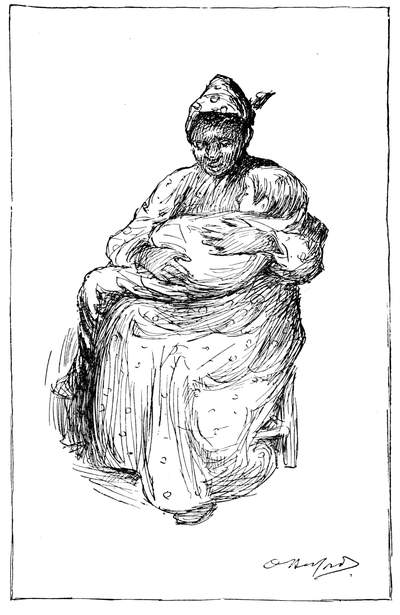
One of the worst negroes on the plantation
was Big Sal, a mulatto woman. She had a tongue
and a temper that nothing could conquer. Once
Little Crotchet, sitting on the Gray Pony, saw
her hoeing away with a rag tied around her forehead
under her head handkerchief. So he called
her out of the gang, and she came with no very
good grace, and only then because some of the
other negroes shamed her into it. No doubt
Little Crotchet heard her disputing with them,
but he paid no attention to it. When Big Sal
came up, he simply said:—
"Help me off the horse. I have a headache
sometimes, and I feel it coming on now. I want
you to sit here and rub my head for me if you
are not too tired."
"What wid?" cried big Sal. "My han's too
dirty."
"You get the headache out, and I'll get the
dirt off," said Little Crotchet, laughing.
Big Sal laughed too, cleaned her hands the
best she could, and rubbed the youngster's head
for him, while the Gray Pony nibbled the crabgrass
growing near. But presently, when Little
Crotchet opened his eyes, he found that Big Sal
was crying. She was making no fuss about it,
but as she sat with the child's head in her lap the
tears were streaming down her face like water.
"What are you crying about?" Little Crotchet
asked.
"God A'mighty knows, honey. I'm des
a-cryin', an' ef de angels fum heav'm wuz ter
come down an' ax me, I couldn't tell um no mo'
dan dat."
This was true enough. The lonely heart had
been touched without knowing why. But Little
Crotchet knew.
"I reckon it's because you had the headache,"
he said.
"I speck so," answered Big Sal. "It looked
like my head'd bust when you hollered at me,
but de pain all done gone now."
"I'm glad," replied Little Crotchet. "I hope
my head will quit aching presently. Sometimes
it aches all night long."
"Well, suh!" exclaimed Big Sal. It was all
she could say.
Finally, when she had lifted Little Crotchet to
his saddle (which was easy enough to do, he was
so small and frail) and returned, Uncle Turin,
foreman of the hoe hands, remarked:—
"You'll be feelin' mighty biggity now, I
speck."
"Who? Me?" cried Big Sal. "God knows,
I feel so little an' mean I could t'ar my ha'r out
by de han'ful."
Uncle Turin, simple and kindly old soul, never
knew then nor later what Big Sal meant, but ever
afterwards, whenever the woman had one of her
tantrums, she went straight to her Little Master,
and if she sometimes came away from him crying
it was not his fault. If she was crying it was
because she was comforted, and it all seemed so
simple and natural to her that she never failed to
express a deep desire to tear her hair out if anybody
asked her where she had been or where she
was going.
It was not such an easy matter to reach the
plow hands. The fields were wide and the furrows
were long on that plantation, and some of
the mules were nimbler than the others, and some
of the hands were quicker. So that it rarely
happened that they all came down the furrows
abreast. But what difference did that make?
Let them come one by one, or two by two, or
twenty abreast, it was all the same when the
Little Master was in sight. It was hats off and
"howdy," with "Gee, Beck!" and "Haw,
Rhody!" and "Whar you been, Little Marster,
dat we ain't seed you sence day 'fo' yistiddy?"
And so until they had all saluted the child on the
Gray Pony.
And why did Susy's Sam hang back and want
to turn his mule around before he had finished
the furrow? It was easy to see. Susy's Sam,
though he was the most expert plowman in the
gang, had only one good hand, the other being a
mere stump, and he disliked to be singled out
from the rest on that account. But it was useless
for him to hang back. Little Crotchet always
called for Susy's Sam. Sometimes Sam
would say that his mule was frisky and wouldn't
stand. But the word would come, "Well, drive
the mule out in the bushes," and then Susy's
Sam would have a long resting spell that did him
good, and there would be nobody to complain.
And so it was with the rest. Whoever was sick
or tired was sure to catch the Little Master's eye.
How did he know? Well, don't ask too many
questions about that. You might ask how the
Gray Pony knew the poison vines and grasses.
It was a case of just knowing, without knowing
where the knowledge came from.
But it was not only the plow hands and the
hoe hands that Little Crotchet knew about. At
the close of summer there were the cotton pickers
and the reapers to be looked after. In fact, this
was Little Crotchet's busiest time, for many of
the negro children were set to picking cotton, and
the lad felt called on to look after these more
carefully than he looked after the grown hands.
Many a time he had half a dozen holding the
Gray Pony at once. This made the older negroes
shake their heads, and say that the Little
Master was spoiling the children, but you may be
sure that they thought none the less of him on
that account.
THAT'S RANDALL'S SONG
And then there were the reapers, the men who
cut the oats and the wheat, and the binders that
followed after. At the head of the reapers was
Randall, tall, black, and powerful. It was fun to
see the blade of his cradle flashing in the sun,
and hear it swing with a swish through the golden
grain. He led the reapers always by many yards,
but when he was making the pace too hot for
them he had a way of stopping to sharpen his
scythe and starting up a song which spread from
mouth to mouth until it could be heard for miles.
Aaron, hiding in the wildwoods, could hear it,
and at such times he would turn to one of his
companions—the White Pig, or Rambler, or
that gay joker, the Fox Squirrel—and say:
"That's Randall's song. He sees the Little
Master coming."
The White Pig would grunt, and Rambler
would say he'd rather hear a horn; but the Red
Squirrel would chatter like mad and declare that
he lost one of his ears by sitting on a limb of the
live oak and singing when he saw a man coming.
But the reapers knew nothing about the experience
of the Fox Squirrel, and so they went
on singing whenever Randall gave the word.
And Little Crotchet was glad to hear them, for
he used to sit on the Gray Pony and listen, sometimes
feeling happy, and at other times feeling
lonely indeed. It may have been the quaint
melody that gave him a lonely feeling, or it may
have been his sympathy for those who suffer the
pains of disease or the pangs of trouble. The
negroes used to watch him as they sang and
worked, and say in the pauses of their song:—
"Little marster mighty funny!"
That was the word,—"funny,"—and yet it
had a deeper meaning for the negroes than the
white people ever gave it. Funny!—when the
lad leaned his pale cheek on the frail hand, and
allowed his thoughts (were they thoughts or
fleeting aspirations or momentary longings?) to
follow the swift, sweet echoes of the song. For
the echoes had a thousand nimble feet, and with
these they fled away, away,—away beyond the
river and its bordering hills; for the echoes had
twangling wings, like those of a turtle-dove, and
on these they lifted themselves heavenward, and
floated above the world, and above the toil and
trouble and sorrow and pain that dwell therein.
Funny!—when the voice of some singer,
sweeter and more powerful than the rest, rose
suddenly from the pauses of the song, and gave
words, as it seemed, to all the suffering that the
Little Master had ever known. Aye! so funny
that at such times Little Crotchet would suddenly
wave his hand to the singing reapers, and turn
the Gray Pony's head toward the river. Was he
following the rolling echoes? He could never
hope to overtake them.
Once when this happened Uncle Fountain
stopped singing to say:—
"I wish I wuz a runaway nigger!"
"No, you don't!" exclaimed Randall.
"Yes, I does," Uncle Fountain insisted.
"How come?"
"Kaze den I'd have little Marster runnin'
atter me ev'y chance he got."
"Go 'way, nigger man! You'd have Jim
Simmons's nigger dogs atter you, an' den what'd
you do?"
"Dat ar Aaron had um atter 'im, an' what'd
he do?"
"De Lord, He knows,—I don't! But don't
you git de consate in yo' min' dat you kin do
what Aaron done done, kaze you'll fool yo'se'f,
sho!"
"What Aaron done done?" Fountain was
persistent.
"He done fool dem ar nigger dogs; dat what
he done done."
"Den how come I can't fool dem ar dogs?"
"How come? Well, you des try um one time,
mo' speshully dat ar col'-nose dog, which he name
Soun'."
"Well, I ain't bleege ter try it when de white
folks treat me right," remarked Uncle Fountain,
after thinking the matter over.
"Dat what make I say what I does," asserted
Randall. "When you know 'zactly what you
got, an' when you got mighty nigh what you
want, dat's de time ter lay low an' say nothin'.
Hit's some trouble ter git de corn off'n de cob,
but spozen dey want no corn on de cob, what
den?"
"Honey, ain't it de trufe?" exclaimed Uncle
Fountain.
Thus the negroes talked. They knew a great
deal more about Aaron than the white people
did, but even the negroes didn't know as much
as the Little Master, and for a very good reason.
They had no time to find out things, except at
night, and at night—well, you may believe it
or not, just as you please, but at night the door
of the Swamp was closed and locked—locked
hard and fast. The owls, the night hawks, the
whippoorwills, and the chuck-will's widows could
fly over. Yes, and the Willis Whistlers could
creep through or crawl under when they returned
home from their wild serenades. But
everything else—even that red joker, the Fox
Squirrel—must have a key. Aaron had one,
and the White Grunter, and Rambler, and all the
four-footed creatures that walk on horn sandals
or in velvet slippers each had a key. The Little
Master might have had one for the asking, but
always when night came he was glad to lie on
his sofa and read, or, better still, go to bed and
sleep, so that he never had the need of a key to
open the door of the Swamp after it was closed
and locked at night.
II.
THE SECRETS OF THE SWAMP.
However hard and fast the door of the Swamp
may be locked at night, however tightly it may
be shut, it opens quickly enough to whomsoever
carries the key. There is no creaking of its vast
and heavy hinges; there is not the faintest flutter
of a leaf, nor the softest whisper of a blade of
grass. That is the bargain the bearer of the key
must make:—
That which sleeps, disturb not its slumber.
That which moves, let it swiftly pass.
Else the Swamp will never reveal itself. The
sound of one alien footfall is enough. It is
the signal for each secret to hide itself, and for
all the mysteries to vanish into mystery. The
Swamp calls them all in, covers them as with a
mantle, and puts on its every-day disguise,—the
disguise that the eyes of few mortals have ever
penetrated. But those who stand by the bargain
that all key-bearers must make—whether they
go on two legs or on four, whether they fly or
crawl or creep or swim—find the Swamp more
friendly. There is no disguise anywhere. The
secrets come swarming forth from all possible or
impossible places; and the mysteries, led by their
torch-bearer Jack-o'-the-Lantern, glide through
the tall canes and move about among the tall trees.
The unfathomable blackness of night never
sets foot here. It is an alien and is shut out.
And this is one of the mysteries. If, when the
door of the Swamp is opened to a key-bearer the
black night seems to have crept in, wait a moment,—have
patience. It is a delusion. Underneath
this leafy covering, in the midst of this
dense growth of vines and saw-grass and reeds
and canes, there is always a wonderful hint of
dawn—a shadowy, shimmering hint, elusive and
indescribable, but yet sufficient to give dim shape
to that which is near at hand.
Not far away the frightened squeak of some
small bird breaks sharply on the ear of the
Swamp. This is no alien note, and Jack-o'-the-Lantern
dances up and down, and all the mysteries
whisper in concert:—
"We wish you well, Mr. Fox. Don't choke
yourself with the feathers. Good-night, Mr. Fox,
good-night!"
Two minute globules of incandescent light
come into sight and disappear, and the mysteries
whisper:—
"Too late, Mr. Mink, too late! Better luck
next time. Good-night!"
A rippling sound is heard in the lagoon as
the Leander of the Swamp slips into the water.
Jack-o'-the-Lantern flits to the level shore of the
pool, and the mysteries come sweeping after,
sighing:—
"Farewell, Mr. Muskrat! Good luck and
good-night!"
Surely there is an alien sound on the knoll
yonder,—snapping, growling, and fighting.
Have stray dogs crept under the door? Oh, no!
The Swamp smiles, and all the mysteries go
trooping thither to see the fun. It is a wonderful
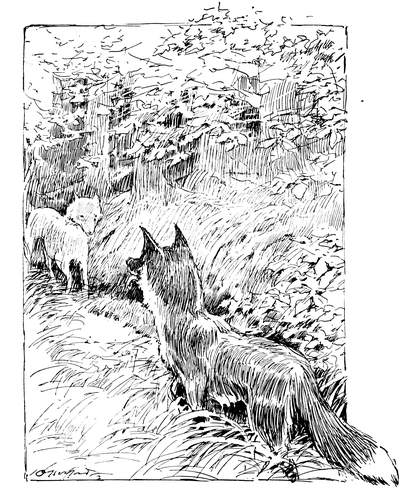
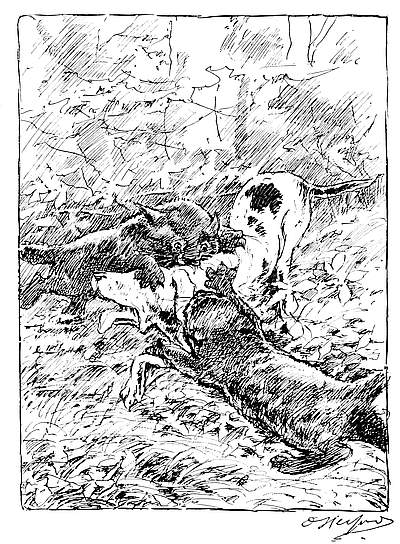
frolic! Mr. Red Fox has met Mr. Gray Fox
face to face. Something tells Mr. Red Fox
"Here's your father's enemy." Something
whispers to Mr. Gray, "Here's your mother's
murderer." And so they fall to, screaming and
gnawing and panting and snarling. Mr. Gray
Fox is the strongest, but his heart is the weakest.
Without warning he turns tail and flies, with
Mr. Red Fox after him, and with all the mysteries
keeping them company. They run until they
are past the boundary line,—the place where the
trumpet flower tried to marry the black-jack tree,—and
then, of course, the Swamp has no further
concern with them. And the mysteries and their
torch-bearers come trooping home.
MR. RED FOX MEETS MR. GRAY FOX
It is fun when Mr. Red Fox and Mr. Gray Fox
meet on the knoll, but the Swamp will never
have such a frolic as it had one night when a
strange bird came flying in over the door. It is
known that the birds that sleep while the Swamp
is awake have been taught to hide their heads
under their wings. It is not intended that they
should see what is going on. Even the Buzzard,
that sleeps in the loblolly pine, and the wild turkey,
that sleeps in the live oak, conform to this
custom. They are only on the edge of the
Swamp, but they feel that it would be rude not
to put their heads under their wings while the
Swamp is awake. But this strange bird—of a
family of night birds not hitherto known to that
region—was amazed when he beheld the spectacle.
"Oho!" he cried; "what queer country is
this, where all the birds are headless? If I'm to
live here in peace, I must do as the brethren do."
So he went off in search of advice. As he
went along he saw the Bull-Frog near the lagoon.
"Queerer still," exclaimed the stranger. "Here
is a bird that has no head, and he can sing."
This satisfied him, and he went farther until
he saw Mr. Wildcat trying to catch little Mr.
Flying-Squirrel.
"Good-evening, sir," said the stranger. "I
see that the birds in this country have no heads."
Mr. Wildcat smiled and bowed and licked his
mouth.
"I presume, sir, that I ought to get rid of my
head if I am to stay here, and I have nowhere
else to go. How am I to do it?"
"Easy enough," responded Mr. Wildcat, smiling
and bowing and licking his mouth. "Birds
that are so unfortunate as to have heads frequently
come to me for relief. May I examine
your neck to see what can be done?"
The strange bird fully intended to say, "Why,
certainly, sir!" He had the words all made up,
but his head was off before he could speak.
Being a large bird, he fluttered and shook his
wings and jumped about a good deal. As the
noise was not alien, the Swamp and all its mysteries
came forth to investigate, and oh, what a
frolic there was when Mr. Wildcat related the
facts! The torch-bearers danced up and down
with glee, and the mysteries waltzed to the quick
piping of the Willis-Whistlers.
Although the Swamp was not a day older when
Aaron, the Son of Ben Ali, became a key-bearer,
the frolic over the headless bird was far back of
Aaron's time. Older! The Swamp was even
younger, for it was not a Swamp until old age
had overtaken it—until centuries had made it
fresh and green and strong. The Indians had
camped round about, had tried to run its mysteries
down, and had failed. Then came a band of
wandering Spaniards, with ragged clothes, and
tarnished helmets, and rusty shields, and neighing
horses—the first the Swamp had ever seen.
The Spaniards floundered in at one side—where
the trumpet vine tried to marry the black-jack
tree—and floundered out on the other side more
bedraggled than ever. This was a great victory
for the Swamp, and about that time it came to
know and understand itself. For centuries it had
been "organizing," and when it pulled De Soto's
company of Spaniards in at one side and flung
them out at the other, considerably the worse for
wear, it felt that the "organization" was complete.
And so it was and had been for years and
years, and so it remained thereafter—a quiet
place when the sun was above the trees, but wonderfully
alert and alive when night had fallen.
The Swamp that Aaron knew was the same
that the Indians and Spaniards had known. The
loblolly pine had grown, and the big poplars on
the knoll had expanded a trifle with the passing
centuries, but otherwise the Swamp was the same.
And yet how different! The Indians had not
found it friendly, and the Spaniards regarded it
as an enemy; but to Aaron it gave shelter, and
sometimes food, and its mysteries were his companions.
Jack-o'-the-Lantern showed him the
hidden paths when the mists of night fell darker
than usual. He became as much a part of the
Swamp as the mysteries were, entering into its
life, and becoming native to all its moods and
conditions. And his presence there seemed to
give the Swamp new responsibilities. Its thousand
eyes were always watching for his enemies,
and its thousand tongues were always ready to
whisper the news of the coming of an alien. The
turkey buzzard, soaring thousands of feet above
the top of the great pine, the blue falcon, suspended
in the air a mile away, the crow, flapping
lazily across the fields, stood sentinel during the
day, and the Swamp understood the messages
they sent. At night the Willis-Whistlers were on
guard, and their lines extended for miles in all
directions, and the Swamp itself was awake, and
needed no warning message. Sometimes at night
the sound of Randall's trumpet fell on the ear of
the Swamp, or the voice of Uncle Fountain was
heard lifted up in song, as he went over the hills
to his fish-baskets in the river; and these were
restful and pleasing sounds. Sometimes the trailing
cry of hounds was heard. If in the day,
Rambler, the track dog, would listen until he
knew whether the cry came from Jim Simmons's
"nigger dogs," from the Gossett hounds,
or from some other pack. If at night, the Swamp
cared little about it, for it was used to these
things after the sun went down.
Mr. Coon insisted on gadding about, and it
served him right, the Swamp insisted, when the
hounds picked up his drag—as the huntsmen
say—and brought him home with a whirl. He
was safe when he got there, for let the hounds
bay at the door of his house as long as they
might, no hunter with torch and axe would venture
into the Swamp. They had tried it—oh,
many times.
But the door was locked, and the key
Was safely kid in a hollow tree.
If it was merely Cousin Coon who lived up the
river, well and good. It would teach the incurable
vagrant a lesson, and the Swamp enjoyed
the fun. The Willis-Whistlers stopped to listen,
the mysteries hid behind the trees, and Jack-o'-the-Lantern
extinguished his torch as the hounds
came nearer with their quavering cries. Was it
Mr. Coon or Cousin Coon? Why, Cousin Coon,
of course. How did the Swamp know? It was
the simplest thing in the world. Wasn't there a
splash and a splutter as he ran into the quagmire?
Wasn't there a snap and a snarl when the partridge-pea
vine caught his foot? Did he know the
paths? Didn't he double and turn and go back
the way he came, to be caught and killed on dry
land? Would Mr. Coon of the Swamp ever be
caught on dry land? Don't you believe it! If
cut off from home, he would run to the nearest
pond and plunge in. Once there, was there a
hound that would venture to take a bath with
him? The Swamp laughed at the thought of
such a thing. Aaron smiled, the White Pig
grunted, and Rambler grinned. Cousin Coon is
no more, but Mr. Coon is safe at home and the
Swamp knows it.
Good luck to all who know the way,
By crooked path and clinging vine!
For them Night's messengers shall stay,
For them the laggard moon shall shine.
But it was not always that aliens and strangers
were unwelcome. Occasionally in the still hours
between midnight and dawn the Swamp would
open its doors to Gossett's Riley. He had no
key and he had never come to know and feel
that the Swamp was something more than a mixture
of mud and water, trees, canes, vines, and
all manner of flying, creeping, and crawling
things. To him the Swamp was merely a place
and not a Thing, but this was ignorance, and the
Swamp forgave it for various reasons, forgave
it and pitied him as he deserved to be pitied.
And yet he had qualities out of the common,
and for these the Swamp admired him. He was
little more than a dwarf, being "bow-legged and
chuckle-headed," as Susy's Sam used to say, and
was called Chunky Riley, but he was very much
of a man for all that. At a log-rolling there was
not a negro for miles around who could pull
him down with the handstick. Aaron could do
it, but Aaron was not a negro, but an Arab, and
that is different. Chunky Riley was even stronger
in limb and body than Aaron, but Aaron used
his head, as well as body and limb—and that
also is different. Riley was not swift of foot, but
he could run far, as Gossett's hounds well knew.
More than that, he could go on all-fours almost
as fast as he could run on two legs, and that was
something difficult to do.
The Swamp found Chunky Riley out in a very
curious way. The first time he came to bring a
message to Aaron he waited for no introduction
whatever. The Willis-Whistlers warned him, but
he paid no attention to their warning; the mysteries
whispered to him, but his ears were closed. He
searched for no path, and was blind to all the signals.
He blundered into the Swamp and floundered
toward the knoll as the Spaniards did. He
floundered out of the quagmire near where the
White Pig lay. He had the scent and all the
signs of an alien, and the White Grunter rushed
at him with open mouth. The Swamp was now
angry from centre to circumference, and poor
Chunky Riley's ending would have been swift
and sudden but for the fact that he bore some
undeveloped kinship to the elements that surrounded
him.
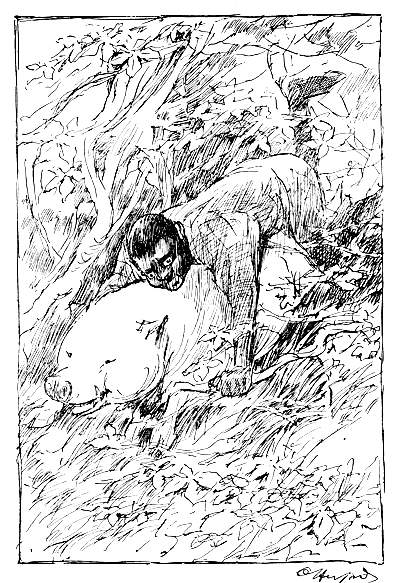
A-STRADDLE OF THE GRUNTER'S BACK
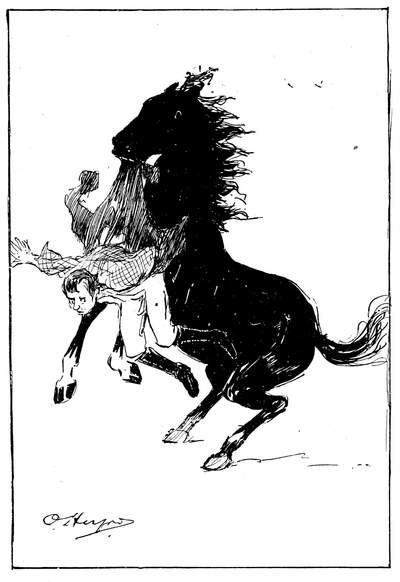
As the White Pig rushed forward with open
mouth, Chunky Riley caught a vague glimpse of
him in the darkness, gave one wild yell, leaped
into the air, and came down a-straddle of the
Grunter's back. This was more than the White
Pig had bargained for. He answered Riley's yell
with a loud squeal, and went tearing through the
swamp to the place where Aaron dwelt. The big
owl hooted, Rambler howled, and Jack-o'-the-Lantern
threw down his torch and fled. The
Swamp that had been angry was amazed and
frightened. What demon was this that had
seized the White Grunter and was carrying him
off? What could the rest hope for if so fierce a
creature as the White Pig could be disposed of
in this fashion? Even Aaron was alarmed at the
uproar, for Chunky Riley continued to yell, and
the White Pig kept up its squealing.
It was well that the Grunter, when he came to
Aaron's place, ran close enough to a tree to rub
Chunky Riley off his back, otherwise there is no
telling what would have happened. It was well,
too, that Chunky Riley called loudly for Aaron
when he fell, otherwise he would have been made
mincemeat of; for as soon as the White Pig was
relieved of his strange burden, his anger rose
fiercer than ever, and he came charging at
Chunky Riley, who was lying prone on the
ground, too frightened to do anything more than
try to run to a tree on all-fours. Aaron spoke
sharply to the White Pig.
"Shall I use a club on you, White Grunter?
Shall I make bacon of you? You heard him call
my name."
The White Pig paused. His small eyes glittered
in the dark, and Chunky Riley heard his
tusks grate ominously. He knew the creature
was foaming with rage.
"Ooft! Your name, Son of Ben Ali?" said
the White Pig in language that Chunky Riley
thought was merely a series of angry grunts and
snorts. "Ooft! I heard him call for Aaron,
and how long has it been since I heard you say
to the Red Chatterer in the hickory-tree that
there were a thousand Aarons, but only one Son
of Ben Ali? Ooft-Gooft! Am I a horse to be
ridden? Humph! No man could ride me—it
is what you call a Thing. Umph! let it ride you
and then talk about clubs. Ooft!"
"Is dat Aaron?" Chunky Riley ventured to
inquire. "Ef 't is, I wish you'd be good enough
ter run dat ar creetur 'way fum here, kaze I ain't
got no knack fer bein' chaw'd up an' spit out, an'
trompled on, an' teetotally ruint right 'fo' my
own face."
"What's your name?" inquired Aaron.
"You ought ter know me, but I dunner whedder
you does er not. I'm name Riley—dey calls
me Chunky Riley fer short."
Aaron was silent for a moment, as if trying to
remember the name. Presently he laughed and
said: "Why, yes; I know you pretty well.
Come, we'll kindle a fire."
"No suh—not me! Not less'n you'll run
dat ar wil' hog off. He mo' servigrous dan a
pant'er. Ef I hadn't er straddled 'im des now
he'd 'a' e't me bodaciously up an' dey wouldn't
'a' been nothin' lef' but de buttons on my cloze,
an' nobody in de roun' worl' would 'a' know'd
dey wuz buttons."
Aaron laughed while speaking to the White
Pig: "Get to bed, Grunter. It is the Lifter—the
man that is as strong in the back as a
horse."
"Gooft-ooft! Let him ride you out as he rode
me in—ooft! He's no man! Gooft! No bed
for me. When a horse is ridden, he must eat,
as I've heard you say, Son of Ben Ali. Gooft-ooft!"
The White Pig, still grinding his tusks together,
turned and trotted off into the darkness,
and presently Aaron and Chunky Riley heard
him crashing through the canes and reeds. Then
Aaron kindled his fire.
"Why did you come?" inquired the Son of
Ben Ali when the two had made themselves comfortable.
"Des ter fetch word dat Marster wuz layin'
off ter git atter you wid Simmons's nigger-dogs
'fo' long."
"All the way through the dark for that?
When did you come to like me so well?"
"Oh, 't ain't 'zackly dat," replied Chunky Riley
frankly. "I hear um talkin' 'bout it when marster
an' dat ar Mr. Simmons wuz walkin' out in
de hoss lot. I wuz in de corn crib, an' dey didn't
know it, an' I des sot dar an' lis'n at um. An'
den dis mornin' I seed dat ar little Marse Abercrombie,
an' he say, 'Go tell Aaron quick ez you
kin.'"
"The child with the crutches?" queried
Aaron.
"De ve'y same," replied Chunky Riley. He
paused awhile and then added: "I'd walk many
a long mile fer dat white chil', day er night, rain
er shine."
He gazed in the flickering fire a long time,
waiting for Aaron to make some comment. Hearing
none, he finally turned his eyes on his companion.
Aaron was looking skyward, where one
small star could be seen twinkling through the
ascending smoke from the fire, and his lips were
moving, though they framed no words that
Chunky Riley could hear. Something in the
attitude of the Son of Ben Ali disturbed the
negro.
"Well, I done what I come ter do," he said,
making a pretense of stretching himself and
yawning, "an' I speck I'd better be gwine."
The Son of Ben Ali still kept his eye fixed on
the twinkling star. "What pesters me," Chunky
Riley went on, "is de idee dat dat ar wil' hog
went 'zackly de way I got ter go. I don't want
ter hatter ride 'im no mo' less'n I got a saddle
an' bridle."
"Come!" exclaimed Aaron suddenly, "I'll
go with you. I want to see the Little Master."
"De dogs'll fin' yo' track sho, ef dey start
out to-morrer," suggested Chunky Riley.
The only response the Son of Ben Ali made to
this suggestion was to say: "Take the end of
my cane in your hand and follow it. We'll take
a short cut."
Chunky Riley had queer thoughts as he followed
his tall conductor, being led as if he were
a blind man; but he said nothing. Presently (it
seemed but a few minutes to Chunky Riley) they
stood on the top of a hill.
"Look yonder!" said Aaron. Away to the
left a red light glimmered faintly.
"What dat?" asked the superstitious negro.
"The light in the Little Master's window."
"How came it so red, den?" inquired Chunky
Riley.
"Red curtain," replied Aaron curtly.
"Well, de Lord he'p us! Is we dat close?"
cried Chunky Riley.
"Your way is there," said the Son of Ben Ali;
"this is mine."
The negro stood watching Aaron until his tall
form was lost in the darkness.
III.
WHAT CHUNKY RILEY SAW AND HEARD
Left alone, Chunky Riley stood still and tried
to trace in his mind the route he and Aaron had
followed in coming from the Swamp. But he
could make no mental map—and he knew
every "nigh-cut" and by-path for miles around—that
would fit in with the time it had taken
them to reach the spot where he now stood. He
looked back toward the Swamp, but the night
covered it, and he could see nothing. Then he
looked around him, to see if he knew his present
whereabouts. Oh, yes, that was easy; every foot
of ground was familiar.
The hill on which he had stood had been given
over to scrub pines. The hill itself sloped away
to the Turner old fields. But still he was puzzled,
and still he scratched his head, for he knew that
the Swamp was a good four miles away—nearly
five—and it seemed to him that he and Aaron
had been only a few minutes in making the journey.
So he scratched his head and wondered to
himself whether Aaron was really a "conjur' man."
It was perhaps very lucky for Chunky Riley
that he stopped when he did. If he had kept on
he would have run into the arms of three men
who were going along the plantation path that led
from Gossett's negro quarters to the Abercrombie
Place. The delay that Chunky Riley made prevented
him from meeting them, but it did not
prevent him from hearing the murmur of their
voices as he struck into the path. They were too
far off for Chunky Riley to know whether they
were white or black, but just as he turned into
the path to go to Gossett's the scent of a cigar
floated to his nostrils. He paused and scratched
his head again. He knew by the scent of the
cigar that the voices he heard belonged to
white men: but who were they? If they were
the "patterollers" they'd catch Aaron beyond
all question; it would be impossible for him to
escape.
So thought Chunky Riley, and so thinking, he
turned and followed the path towards the Abercrombie
Place. He moved rapidly but cautiously.
The scent of the cigar grew stronger, the sound
of men's voices fell more distinctly on his ear.
Chunky Riley left the path and skirted through
the low pines until he came to the fence that
inclosed the spring lot. He knew that if he was
heard, the men would think he was a calf, or,
mayhap, a mule; for the hill on which Aaron
had left him was now a part of a great pasture,
in which the calves and dry cattle and (between
seasons) the mules were allowed to roam at will.
Coming to the fence, Chunky Riley would have
crossed it, but the voices were louder now, and he
caught a glimpse of the red sparks of lighted
cigars. Creeping closer and closer, but ever
ready to drop on the ground and run away on all-fours,
Chunky Riley was soon able to hear what
the men were saying. He knew the voices of
his master and young master, Mr. Gossett—Old
Grizzle, as he was called—and George, and he
rightly judged that the strange voice mingling
with theirs belonged to Mr. Jim Simmons, who,
with a trained pack of hounds,—"nigger dogs"
they were called,—held himself at the service of
owners of runaway negroes.
Mr. Simmons's average fee was $15—that is
to say when he was "called in time." But in
special cases his charge was $30. When Chunky
Riley arrived within earshot of the group, Mr.
Gossett was just concluding a protest that he had
made against the charge of $30, which he had
reluctantly agreed to pay for the capture of
Aaron.
"You stayed at my house to-day, you'll stay
there to-night, and maybe you'll come back to
dinner to-morrow. There's the feeding of you
and your dogs. You don't take any account of
that at all."
Mr. Gossett's voice was sharp and emphatic.
His stinginess was notorious in that region, and
gave rise to the saying that Gossett loved a dollar
better than he did his wife. But he was no
more ashamed of his stinginess than he was of
the shabbiness of his hat.
"But, Colonel," remonstrated Mr. Jim Simmons,
"didn't you send for me? Didn't you
say, 'Glad to see you, Simmons; walk right in
and make yourself at home'? You did, fer a
fact." He spoke with a drawl that irritated the
snappy and emphatic Mr. Gossett.
"Why, certainly, Simmons; certainly I did. I
mentioned the matter to show you that your
charges are out of all reason in this case. All
you have to do is to come here with your dogs in
the morning, skirt around the place, pick up his
trail, and there you are."
"But, Colonel!" insisted Mr. Jim Simmons
with his careless, irritating drawl, "ain't it a plum'
fact that this nigger's been in the woods a month
or sech a matter? Ain't it a plum' fact that
you've tracked him and trailed him with your
own dogs?—and good dogs they are, and I'll
tell anybody so. Now what do you pay me fer?
Fer catching the nigger? No, sirree! The nigger's
as good as caught now—when it comes to
that. You pay me fer knowing how to catch
him—that's what you pay me fer. You send
fer the doctor. He comes and fumbles around
a little, and you have to pay the bill whether he
kills or cures. You don't pay him fer killing or
curing; you pay him fer knowing how to fumble
around. It's some different with me. If I don't
catch your nigger, you button up your pocket. If
I do catch him you pay me $30 down, not fer
catching him, but fer knowing how to fumble
around and catch him."
The logic of this argument, which was altogether
lost on Chunky Riley, silenced Mr. Gossett,
but did not convince him. There was a long
pause, as if all three of the men were wrestling
with peculiar thoughts. Finally Mr. Gossett
spoke:—
"It ain't so much the nigger I'm after, but I
want to show Abercrombie that I can't be outdone.
He's laughing in his sleeve because I
can't keep the nigger at home, and I'll be
blamed"—here his voice sank to a confidential
tone—"I'll be blamed if I don't believe that,
between him and that son of his, they are harboring
the nigger. Yes, sir, harboring is the
word."
Mr. Jim Simmons threw down his lighted cigar
with such energy as to cause the sparks to fly in
all directions. A cigar was an unfamiliar luxury
to Mr. Simmons, and he had had enough of it.
"Addison Abercrombie harboring a nigger!"
exclaimed Mr. Simmons. "Why, Colonel, if
every man, woman, and child in the United States
was to tell me that I wouldn't believe it. Addison
Abercrombie! Why, Colonel, though you're
his next-door neighbor, as you may say, you don't
know him half as well as I do. You ought to
get acquainted with that man."
"Humph! I know him well enough, I reckon,"
responded Mr. Gossett. "I went to school with
him. Folks get to know one another at school.
He was always stuck up, trying to hold his head
higher than anybody else because his daddy had
money and a big plantation. I made my prop'ty
myself; I earned every dollar; and I know how
it came."
"But, Colonel!" Mr. Jim Simmons insisted,
"Addison Abercrombie would hold his head high
if he never seen a dollar, and he'd have the right
to do it. Him harbor niggers? Shucks, Colonel!
You might as well tell me that the moon ain't
nothing but a tater pudding."
"What do you see in the man?" Mr. Gossett
asked with some irritation in the tones of his
voice.
There was a pause, as though Mr. Simmons
was engaged in getting his thoughts together.
Finally he said:—
"Well, Colonel, I don't reckon I can make it
plain to you, because when I come to talk about
it I can't grab the identical idee that would fit
what I've got in my mind. But I'll tell you
what's the honest truth, in my opinion—and
I'm not by myself, by a long shot—Addison
Abercrombie is as fine a man as ever trod shoe
leather. That's what."
"Humph!" grunted Mr. Gossett.
"Yes, sirree!" persisted Mr. Simmons, warming
up a little. "It makes no difference where
you see him, nor when you see him, nor how you
see him, you can up and say: 'The Lord has
made many men of many minds, and many men
of many kinds, but not sence Adam has he made
a better man than Addison Abercrombie.' That's
the way I look at it, Colonel. I may be wrong,
but if I am I'll never find it out in this world."
Plainly, Mr. Gossett was not prepared to hear
such a tribute as this paid to Addison Abercrombie,
and he winced under it. He hemmed and
hawed, as the saying is, and changed his position
on the fence. He was thoroughly disgusted.
Now there was no disagreement between Mr.
Gossett and Mr. Abercrombie,—no quarrel, that
is to say,—but Gossett knew that Abercrombie
regarded him with a feeling akin to contempt.
He treasured in his mind a remark that Abercrombie
had made about him the day he bought
Aaron from the negro speculator. He never forgot
nor forgave it, for it was an insinuation that
Mr. Gossett, in spite of his money and his thrifty
ways, was not much of a gentleman.
On this particular subject Mr. Gossett was
somewhat sensitive, as men are who have doubts
in their own minds as to their standing. Mr.
Gossett had an idea that money and "prop'ty,"
as he called it, made a gentleman; but it was a
very vague idea, and queer doubts sometimes
pestered him. It was these doubts that made
him "touchy" on this subject.
"What has this great man ever done for you,
Simmons?" Mr. Gossett asked, with a contemptuous
snort.
"Not anything, Colonel, on the top of the
green globe. I went to him once to borrow some
money, and he wanted to lend it to me without
taking my note and without charging me any
interest. I says to him, says I, 'You'll have to
excuse me.'"
"That was right; you did perfectly right,
Simmons. The man was trying to insult you."
"But, Colonel, he didn't go about it that way.
Don't you reckon you could tell when anybody
was trying to insult you? That was the time I
come to you."
"I charged you interest, didn't I, Simmons?"
"You did, Colonel, fer a fact."
"I'm this kind of a man, Simmons," remarked
Mr. Gossett, with a touch of sincere pride and
gratification in his voice. "When I do business
with a man I do business. When I do him a
favor it must be outside of business. It's mixing
the two things up that keeps so many people
poor."
"What two things, Colonel?" gravely inquired
Simmons.
"Why the doing of business and—er—the
doing of favors."
"Oh, I see," said Mr. Simmons, as if a great
light had been turned on the matter. Then he
laughed and continued: "Yes, Colonel, I borrowed
the money from you and just about that
time the fever taken me down, and if it hadn't
'a' been fer Addison Abercrombie the note I give
you would have swallowed my house and land."
"Is that so?" inquired Mr. Gossett.
"Ask my wife," replied Mr. Simmons. "One
day while I was out of my head with the fever,
Addison Abercrombie, he rid by and saw my
wife setting on the front steps, jest a-boohooing,—you
know how wimmen will do, Colonel; if
they ain't a-jawing they're a-cryin'. So Addison
Abercrombie, he ups and asks her what's the
matter, and Jennie, she tells him. He got right
off his hoss and come in, and set by my bed the
better part of the morning. And all that time
there I was a-running on about notes and a-firing
off my troubles in the air. So the upshot of the
business was that Addison Abercrombie left the
money there to pay the note and left word for
me to pay him back when I got good and ready;
and Jennie hadn't hardly dried her eyes before
here come a nigger on horseback with a basket
on his arm, and in the basket was four bottles of
wine. Wine! Why, Colonel, it was worse'n
wine. Jennie says that if arry one of the bottles
had 'a' had a load of buckshot in it, the roof
would 'a' been blow'd off when the stopper flew
out. And, Colonel! if ever you feel like taking
a right smart of exercise, jest pass my house some
day and stick your head over the palings and tell
Jennie that Addison Abercrombie's got a streak
of meanness in him."
"Have you ever paid Abercrombie?" Mr. Gossett
inquired. His voice was harsh and businesslike.
"I was laying off to catch this nigger of yours
and pay him some on account," replied Mr. Simmons.
"Why, it has been three years since you paid
me," suggested Mr. Gossett.
"Two years or sech a matter," remarked Mr.
Simmons complacently.
"Then that's the reason you think Abercrombie
ain't harboring my nigger?" inquired Mr.
Gossett scornfully.
"But, Colonel," drawled Mr. Simmons, "what
under the sun ever got the idee in your head
that Addison Abercrombie is harboring your
nigger?"
"It's as simple as a-b ab," Mr. Gossett replied
with energy. "He tried to buy the nigger off
the block and couldn't, and now he thinks I'll
sell if the nigger'll stay in the woods long
enough. That's the reason he's harboring the
nigger. And more than that: don't I know
from my own niggers that the yaller rapscallion
comes here every chance he gets? He comes,
but he don't go in the nigger quarters. Now,
where does he go?"
"Yes, where?" said Mr. Gossett's son George,
who up to that moment had taken no part in
the conversation. "Three times this month I've
dealt out an extra rasher of bacon to two of our
hands, and they tell the same tale."
"It looks quare," Mr. Simmons admitted, "but
as sure as you're born Addison Abercrombie
ain't the man to harbor a runaway nigger. If
he's ever had a nigger in the woods, it's more'n
I know, and when that's the case you may set it
down fer a fact that he don't believe in runaway
niggers." This was a lame argument, but it was
the best that Mr. Simmons could muster at the
moment.
"No," remarked Mr. Gossett sarcastically,
"his niggers don't take to the woods because
they do as they blamed please at home. It sets
my teeth on edge to see the way things are run
on this plantation. Why, I could take the stuff
that's flung away here and get rich on it in five
years. It's a scandal."
"I believe you!" assented his son George
dutifully.
Chunky Riley heard this conversation by
snatches, but he caught the drift of it. What
he remembered of it was that some of his fellow
servants were ready to tell all they knew for an
extra "rasher" of meat, and that the hunt for
Aaron would begin the next morning,—and it
was now getting along toward dawn. He wanted
to warn Aaron again. He wanted especially to
tell Aaron that three men were sitting on the
fence waiting for him. But this was impossible.
The hour was approaching when Chunky Riley
must be in his cabin on the Gossett plantation
ready to go to work with the rest of the hands.
He had slept soundly the first half of the night,
and he would be as fresh in the field when the
sun rose as those who had slept the night
through. As he turned away from the fence a
dog in the path leading from the spring to the
stile suddenly began to bay. The men tried to
drive him away, and one of them threw a stick at
him, but the dog refused to be intimidated. He
bayed them more fiercely, but finally retreated
toward the spring, stopping occasionally to bark
at the men on the fence.
"If I'm not mistaken," remarked Mr. Gossett,
"that's my dog Rambler. I know his voice,
and he's been missing ever since that nigger
went to the woods. I wonder if he's taken up
over here? George, I wish you'd make it convenient
to come over here as soon as you can, and
find out whether Rambler is here. Now, there's
a dog, Simmons, that's away ahead of anything
you've got in the shape of a nigger dog,—nose
as cold as ice, and as much sense as the common
run of folks."
"He ain't doing you much good," responded
Mr. Simmons.
"That's a fact," said Mr. Gossett. "Till I
heard that dog barking I thought Rambler had
been killed by that nigger."
Chunky Riley struck into the plantation path
leading to Gossett's, at the point where the three
men had tied their horses. They had ridden as
far as they thought prudent, considering the
errand they were on, and then they dismounted
and made their horses fast to the overhanging
limbs of a clump of oaks, which, for some reason
or other, had been left standing in the field.
One of the horses whinnied when Chunky Riley
came near, and the negro paused. Aaron would
have known that the horse said, "Please take
me home, and be quick about it; I'm hungry;"
but Chunky Riley could only guess. And as he
guessed a thought struck him—a thought that
made him scratch his head and chuckle. He
turned in his tracks, went back along the path a
little way, and listened. Then he returned, and
the horse whinnied again. The creature was
growing impatient.
Once more Chunky Riley indulged in a hearty
laugh, slapping himself softly on the leg. Then
he went to the horses one by one, pulled down
the swinging limbs to which their bridle reins
were fastened, and untied them. This done, he
proceeded to make himself "mighty skace," as
he expressed it. He started toward home at a
rapid trot, without pausing to listen. But even
without listening, he could hear the horses coming
after him, Mr. Simmons's horse with the
others.
The faster he trotted the faster the horses trotted;
and when Chunky Riley began to run the
horses broke into a gallop, and came clattering
along the path after him, their stirrups flying
wildly about and making a clamor that Chunky
Riley had not bargained for. The faster he ran
the faster the horses galloped, until at last it
seemed to him that the creatures were trying to
run him down. This idea took possession of his
mind, and at once his fears magnified the situation.
He imagined the horses were right at his
heels. He could feel the hot breath of one of
them on the back of his neck.
Fortunately for Chunky Riley there was a fence
at the point where the path developed into a lane.
Over this he climbed and fell exhausted, fully expecting
the horses to climb over or break through
and trample him under their feet. But his expectations
were not realized; the horses galloped
along the lane, and presently he could hear
them clattering along the big road toward Gossett's.
Chunky Riley was exhausted as well as terror-stricken.
The perspiration rolled from his face,
and he could hear his heart beat. He lay in the
soft grass in the fence corner until he had recovered
somewhat from his exertions and his fright.
Finally he rose, looked back along the way he
had come, then toward the big road, and shook
his head.
THE HORSES WERE RIGHT AT HIS HEELS
"Is anybody ever see de beat er dat?" he
exclaimed.
Whereupon he went through the woods instead
of going by the road, and was soon in his cabin
frying his ration of bacon.
IV.
BETWEEN MIDNIGHT AND DAWN.
When Aaron parted from Chunky Riley on the
hill after they had come from the Swamp, he
went along the path to the spring, stooped on
his hands and knees and took a long draught of
the cool water. Then he went to the rear of the
negro quarters, crossed the orchard fence, and
passed thence to the flower garden in front of
the great house. At one corner of the house a
large oak reared its head above the second story.
Some of its limbs when swayed by the wind swept
the dormer window that jutted out from Little
Crotchet's room. Behind the red curtain of this
dormer window a light shone, although it was
now past midnight. It shone there at night
whenever Little Crotchet was restless and sleepless
and wanted to see Aaron. And this was
often, for the youngster, with all his activity,
rarely knew what it was to be free from pain.
But for his journeys hither and yonder on the
Gray Pony he would have been very unhappy
indeed. All day long he could make some excuse
for putting his aches aside; he could even forget
them. But at night when everything was quiet,
Pain would rap at the door and insist on coming
in and getting in bed with him.
Little Crotchet had many quaint thoughts and
queer imaginings, and one of these was that
Pain was a sure-enough something or other that
could come in at the door and go out when it
chose—a little goblin dressed in red flannel,
with a green hat running to a sharp peak at the
top, and a yellow tassel dangling from the peak—a
red flannel goblin always smelling of camphor
and spirits of turpentine. Sometimes—and
those were rare nights—the red goblin remained
away, and then Little Crotchet could sleep and
dream the most beautiful dreams.
But usually, as soon as night had fallen on the
plantation and there was no longer any noise in
the house, the little red goblin, with his peaked
green hat, would open the door gently and peep
in to see whether the lad was asleep—and he
knew at a glance whether Little Crotchet was
sleeping or only feigning sleep. Sometimes the
youngster would shut his eyes ever so tight, and
lie as still as a mouse, hoping that the red goblin
would go away. But the trick never succeeded.
The red goblin was too smart for that. If there
was a blaze in the fireplace he would wink at it
very solemnly; if not, he'd wink at the candle.
And he never was in any hurry. He'd sit squat
on the floor for many long moments. Sometimes
he'd run and jump in the bed with Little Crotchet
and then jump out again. Sometimes he'd pretend
he was going to jump in the bed, when suddenly
another notion would strike him, and he'd
turn and run out at the door, and not come back
again for days.
But this was unusual. Night in and night out,
the year round, the red goblin rarely failed to
show himself in little Crotchet's room, and crawl
under the cover with the lad. There was but one
person in all that region whom the red goblin
was afraid of, and that was Aaron. But he was
an obstinate goblin. Frequently he'd stay after
Aaron came, and try his best to fight it out with
the Son of Ben Ali; but in the end he would
have to go. There were times, however, when
Aaron could not respond to Little Crotchet's signal
of distress,—the light in the dormer window,—and
at such times the red goblin would have
everything his own way. He would stay till all
the world was awake, and then sneak off to his
hiding-place, leaving Little Crotchet weak and
exhausted.
THE GOBLIN PAIN
Thus it happened that, while Chunky Riley
was taking an unexpected ride on the White Pig,
and afterward while the three men were sitting
on the pasture fence beyond the spring, the red
goblin was giving Little Crotchet a good deal of
trouble. No matter which way he turned in bed,
the red goblin was there. He was there when
Aaron came into the flower garden. He was there
when Aaron stood at the foot of the great oak
at the corner of the house. He was there when
Aaron put forth his hand, felt for and found one
of the iron spikes that had been driven into the
body of the oak. The red goblin was in bed with
Little Crotchet and tugging at his back and legs
when Aaron pulled himself upward by means of
the iron spike; when he found another iron spike;
when, standing on and holding to these spikes, he
walked up the trunk of the tree as if it were a
ladder; and when he went into Little Crotchet's
room by way of the dormer window. The real
name of the red goblin with the green hat was
Pain, as we know, and he was very busy with
Little Crotchet this night; and though the lad
had fallen into a doze, he was moving restlessly
about when Aaron entered the room. The Son
of Ben Ali stepped to the low bed, and knelt by
it, placing his hand that the night winds had
cooled on Little Crotchet's brow, touching it with
firm but gentle strokes. The lad awoke with a
start, saw that Aaron was near, and then closed
his eyes again.
"It's a long way for you to come," he said.
"There's a lot of things for you in the basket
there."
"If twice as long, it would be short for
me," replied Aaron. Then, still stroking Little
Crotchet's brow with one hand, and gently rubbing
his body with the other, the Son of Ben Ali
told of Chunky Riley's ride on the White Pig.
With his eyes closed, the lad could see the whole
performance, and he laughed with so much heartiness
that Aaron laughed in sympathy. This was
such a rare event that Little Crotchet opened his
eyes to see it, but soon closed them again, for now
he felt that the red goblin was preparing to go.
"I sent Chunky Riley," said Little Crotchet,
after a while. "They're after you to-morrow—Jim
Simmons and his hounds. And he has his
catch-dog with him. I saw the dog to-day.
He's named Pluto. He's big and black, and
bob-tailed, and his ears have been cropped. Oh,
I'm afraid they'll get you this time, Aaron.
Why not stay here with me to-morrow, and the
next day?"
"Here?" There was a note of surprise in
Aaron's voice.
"Yes. What's to hinder you? I can keep
everybody out of the room, except"—
"Except somebody," said Aaron, smiling.
"No, no! The White-Haired Master is a good
man. Good to all. He'd shake his head and
say, 'Runaway hiding in my house! That's
bad, bad!' No, Little Master, they'll not get
Aaron. You sleep. To-morrow night I'll come.
My clothes will be ripped and snagged. Have
me a big needle and some coarse thread. I'll
mend 'em here and while I'm mending I may tell
a tale. I don't know. Maybe. You sleep."
Aaron was no mesmerist, but somehow, the red
goblin being gone, Little Crotchet was soon in
the land of dreams. Aaron remained by the bed
to make sure the sleep was sound, then he rose,
tucked the cover about the lad's shoulders (for
the morning air was cool), blew out the candle,
went out on the roof, closing the window sash
after him, and in a moment was standing in the
flower garden. There he found Rambler, the
track dog, awaiting him, and together they passed
out into the lot and went by the spring, where
Aaron stooped and took another draught of the
cool, refreshing water.
All this time the three men had been sitting on
the pasture fence at the point where it intersected
the path leading from the spring, and they were
sitting there still. As Aaron started along this
path, after leaving the spring, Rambler trotted
on before, and his keen nose soon detected the
presence of strangers. With a whine that was
more than half a whistle, Rambler gave Aaron
the signal to stop, and then went toward the
fence. The situation became clear to him at
once, and it was then that Chunky Riley and the
three men had heard him bark. They called it
barking, but it was a message to Aaron saying:—
"Lookout! lookout! Son of Ben Ali, look
sharp! I see three—Grizzlies two, and another."
THE SPRING OF COOL REFRESHING WATER
There was nothing alarming in the situation.
In fact, Aaron might have gone within hailing
distance of the three men without discovery, for
the spring lot was well wooded. If Mr. Addison
Abercrombie had any peculiarity it was his
fondness for trees. He could find something to
admire in the crookedest scrub oak and in the
scraggiest elm. He not only allowed the trees
in the spring lot to stand, but planted others.
Where Aaron stood a clump of black-jacks, covering
a quarter of an acre, had sprung up some
years before. They were now well-grown saplings
and stood as close together, according to
the saying of the negroes, as hairs on a hog's
back. Through these Aaron slowly edged his
way, moving very carefully, until he reached a
point close enough to the three men to see and
hear what was going on.
Standing in the black shadow of these saplings
he made an important discovery. Chunky Riley,
it will be remembered, suspected that the two
Gossetts and Mr. Simmons were intent on capturing
Aaron; but this was far from their purpose.
They had no such idea. While Aaron stood
listening, watching, he saw a tall shadow steal
along the path. He heard the swish of a dress
and knew it was a woman. The shadow stole
along the path until it came to the three men on
the fence and then it stopped.
"Well?" said Mr. Gossett sharply. "What
did you see? Where did the nigger go? Don't
stand there like you are deaf and dumb. Talk
out!"
"I seed him come fum de spring, Marster, an'
go up by de nigger cabins. But atter dat I ain't
lay eyes on 'im."
"Did he go into the cabins?"
"I lis'n at eve'y one, Marster, an' I ain't hear
no talkin' in but one."
"Was he in that one?"
"Ef he wuz, Marster, he wa'n't sayin' nothin'.
Big Sal was talkin' wid Randall, suh."
"What were they talking about?"
"All de words I hear um say wuz 'bout der
Little Marster—how good he is an' how he all
de time thinkin' mo' 'bout yuther folks dan he do
'bout his own se'f."
"Humph!" snorted Mr. Gossett. Mr. Simmons
moved about uneasily.
"Whyn't you go in an' see whether Aaron
was in there?" asked George Gossett.
"Bekaze, Marse George, dey'd 'a' know'd
right pine-blank what I come fer. 'Sides dat,
Big Sal is a mighty bad nigger 'oman when she
git mad."
"You're as big as she is," suggested Mr.
Gossett.
"Yes, suh; but I ain't got de ambition what
Big Sal got," replied the woman humbly.
"I'll tell you, Simmons, that runaway nigger
is the imp of Satan," remarked Mr. Gossett.
"But, Colonel, if he's that, what do you want
him caught for?" inquired Mr. Simmons humorously.
"Why, so much the more need for catching
him. I want to get my hands on him. If I
don't convert him, why, then you may go about
among your friends and say that Gossett is a
poor missionary. You may say that and welcome."
"I believe you!" echoed George.
"You may go home now," said Mr. Gossett to
the woman.
"Thanky, Marster." She paused a moment to
wipe her face with her apron, and then climbed
over the fence and went toward the Gossett plantation.
Aaron slipped away from the neighborhood of
the three men, crossed the fence near where
Chunky Riley had been standing, went swiftly
through the pasture for half a mile, struck into
the plantation path some distance ahead of the
woman, and then came back along the path to
meet her. When he saw her coming he stopped,
turned his back to her and stood motionless in the
path. The woman was talking to herself as she
came up; but when she saw Aaron she hesitated,
advanced a step, and then stood still, breathing
hard. All her superstitious fears were aroused.
"Who is you? Who is dat? Name er de Lord!
Can't you talk? Don't be foolin' wid me! Man,
who is you?"
"One!" replied Aaron. The sound of a human
voice reassured her somewhat, but her knees shook
so she could hardly stand.
"What yo' name?" she asked again.
"Too long a name to tell you."
"What you doin'?"
"Watching a child—looking hard at it."
"Wuz you, sho nuff?" She came a step
nearer. "How come any chil' out dis time er
night?"
"A black child," Aaron went on. "Its dress
was afire. It went up and down the path here.
It went across the hill. Crying and calling—calling
and crying, 'Aaron! Aaron! Mammy's
hunting for you! Aaron! Aaron! Mammy's
telling on you.'"
"My Lord fum heaven!" moaned the woman;
"dat wuz my chil'—de one what got burnt up
kaze I wuz off in de fiel'." She threw her apron
over her head, fell on her knees, and moaned and
shuddered.
"Well, I'm Aaron. You hunted for me in
the nigger cabins; you slipped to the fence yonder;
you told three men you couldn't find me."
"O Lord! I wuz bleege ter do it. It wuz dat
er take ter de woods, an' dey ain't no place fer
me in de woods. What'd I do out dar by myse'f
at night? I know'd dey couldn't ketch you. Oh,
dat wuz my chil'!"
"Stand up!" Aaron commanded.
"What you gwine ter do?" the woman asked,
slowly rising to her feet, and holding herself
ready to dodge an expected blow—for, as she
herself said, she was not at all "ambitious."
"Your breakfast is ready, and I've been waiting
here to give it to you. Hold your apron."
The woman did as she was told, and Aaron
took from the basket which Little Crotchet had
given him four biscuits and as many slices of
ham.
"I'll take um, an' thanky, too," said the
woman; "but hongry as I is, I don't b'lieve I
kin eat a mou'ful un um atter what I done. I'm
too mean to live!"
"Get home! get home and forget it," Aaron
replied.
"Oh, I can't go thoo dem woods atter what
you tol' me!" cried the woman.
"I'll go with you," said Aaron. "Come!"
"You!" The woman lifted her voice until it
sounded shrill on the moist air of the morning.
"You gwine dar to Gossett's? Don't you know
dey er gwine ter hunt you in de mornin'? Don't
you know dey got de dogs dar? Don't you know
some er de niggers'll see you—an' maybe de
overseer? Don't you know you can't git away
fum dem dogs fer ter save yo' life?"
"Come!" said Aaron sharply. "It's late."
"Min', now! ef dey ketch you, 't ain't me dat
done it," the woman insisted.
"Come!—I must be getting along," was
Aaron's reply.
He went forward along the path, and though
he seemed to be walking easily, the woman had
as much as she could do to keep near him.
Though his body swayed slightly from side to
side, he seemed to be gliding along rather than
walking. Ahead of him, sometimes near, sometimes
far, and frequently out of sight, a dark
shadow moved and flitted. It was Rambler going
in a canter. A hare jumped from behind a tussock
and went skipping away. It was a tempting
challenge. But Rambler hardly glanced at him.
"Good-by, Mr. Rabbit! I'll see you another
day!"
Thus Aaron, the woman, and Rambler went to
Gossett's.
"Man, ain't you tired?" the woman asked
when they came in sight of the negro quarters.
"Me? I'll go twenty miles before sun-up,"
replied Aaron.
"I'll never tell on you no mo'," said the
woman; "not ef dey kills me." She turned to
go to her cabin, when Aaron touched her on the
shoulder.
"Wait!" he whispered. "If it brings more
meat for your young ones, tell! Fetch the men
here; show 'em where I stood,—if it brings
you more meat for your babies."
"Sho nuff?" asked the woman, amazed.
Aaron nodded his head. "What kind er folks
is you?" she cried. "You ain't no nigger.
Dey ain't no nigger on top er de groun' dat'd
stan' up dar an' talk dat away. Will dey ketch
you ef I tell?" The woman was thinking about
the meat.
Aaron lifted his right hand in the air, turned,
and disappeared in the darkness, which was now
changing to the gray of dawn. The woman remained
where she was standing for some moments
as if considering some serious problem.
Then she shook her head.
"I'd git de meat—but dey mout ketch 'im,
an' den what'd I look like?"
This remark seemed to please her, for she repeated
it more than once before moving out of
her tracks. When she did move, she went to her
cabin, kindled a fire, cooked something for her
children,—she had three,—placed a biscuit and
a piece of ham for each, and, although she had
not slept a wink, prepared to go to the field. It
was almost time, too, for she heard the hog feeder
in the horse lot talking angrily to the mules, as
he parceled out their corn and forage. Presently
she heard him calling the hogs to get a bite of
corn,—the fattening hogs that were running
about in the horse lot.
Soon, too, she heard the sharp voice of Mr.
Gossett, her master, calling to the hog feeder.
And you may be sure the man went as fast as his
legs could carry him. Get out of the way, dogs,
chickens, wheelbarrows, woodpile, everything, and
let the negro run to his master! Had he seen
the horses? Oh, yes, Marster, that he had!
They were standing at the lot gate, and they
whickered and whinnied so that he was obliged
to go and see what the trouble was. And there
were the horses, Mr. Simmons's among the rest.
Yes, Marster, and the hog feeder was just on
the point of alarming the neighborhood, thinking
something serious had happened, when the
thought came to his mind that the horses had
grown tired of waiting and had broken loose
from their fastenings. Oh, yes, Marster, they
would do that way sometimes, because horses
have a heap of sense, especially Marster's horses.
When one broke loose the others wanted to follow
him, and then they broke loose too. And
they were fed,—eating right now, and all fixed
up. Saddle 'em by sun-up? Yes, Marster, and
before that if you want 'em, for they've already
had a right smart snack of corn and good clean fodder.
As for Aaron, he had far to go. He had no
fear of Mr. Gossett's hounds, but he knew that
he would have some difficulty in getting away
from those that Mr. Simmons had trained. If
he could outmanœuvre them, that would be the
best plan. If not,—well, he would make a
stand in the swamp. But there was the crop-eared,
bob-tailed cur—the catch dog—that
was the trouble. Aaron knew, too, that Mr. Simmons
was a professional negro hunter, and that
he naturally took some degree of pride in it.
Being a professional, with a keen desire to be regarded
as an expert, it was to be supposed that
Mr. Simmons had made a study of the tactics of
fugitive negroes.
As a matter of fact, Mr. Simmons was a very
shrewd man; he was also, in spite of his calling, a
very kind-hearted man. In his soul he despised
Mr. Gossett, whose negroes were constantly in the
woods, and loved and admired Addison Abercrombie,
whose negroes never ran away, and who, if
every slave on his plantation were a fugitive,
would never call on Mr. Simmons to catch them.
Aaron was far afield when, as the sun rose, Mr.
Gossett's hog feeder called the house girl and
asked her to tell Mr. Gossett that the horses were
saddled and ready at the front gate. Then Mr.
Simmons's dogs, which had been shut up in the
carriage house, were turned out and fed. The
hounds were given half-cooked corn meal, but the
catch dog, Pluto, must needs have a piece of raw
meat, which he swallowed at one gulp. This
done, Mr. Simmons blew one short, sharp note
on his horn, and the hunt for Aaron began.
V.
THE HUNT BEGINS.
When Aaron left the negro woman at Gossett's
he went rapidly through the woods until he
came to the old fields that had once been cultivated,
but were now neglected for newer and
better soil. These deserted fields had been dismally
naked of vegetation for years, and where
they undulated into hills the storms had cut deep
red gashes. But these wounds were now gradually
healing. A few years before a company
of travelers had camped out one night at Curtwright's
factory, not many miles away, and where
they fed their horses a grass new to that region—new,
in fact, to this country—made its appearance.
It grew and spread for miles around and
covered the red hills with the most beautiful
mantle that the southern summers had ever seen.
It refused to wither and parch under the hot
sun, but flourished instead.
It had crept from Curtwright's factory, and
had already begun to carpet the discarded lands
through which Aaron was now passing, and the
turf felt as soft as velvet under his feet. The
touch of it seemed to inspire his movements, for
he began to trot; and he trotted until, at the end
of half an hour, he struck into the plantation
road leading to the Oconee. Aaron was making
for the river. Having received fair warning,
and guessing something of the character of Mr.
Simmons, he had made up his mind that the
best plan would be to get away from the dogs if
possible.
He hoped to find one of the Ward negroes at
the river landing, and in this he was not disappointed.
Old Uncle Andy, who was almost on
the retired list, on account of his age and faithfulness,
although he was still strong and vigorous,
was just preparing to visit his set-hooks
which were down the river. He was about to
shove the boat into deep water and jump in when
Aaron called him.
"Ah-yi," he answered in a tone almost gay,
for he had a good master, and he had no troubles
except the few that old age had brought on him.
"Up or down?" inquired Aaron.
"Down, honey; down. All de time down.
Den I'll lef' um down dar an' let Rowan Ward"
(this was his master whom he talked about so
familiarly) "sen' one er his triflin' no 'count nigners
atter um wid de waggin'."
"I want to go up," said Aaron.
"I ain't henderin' you," replied old Uncle
Andy. "Whar yo' huffs? Walk. I ain't gwine
pull you in dis boat. No. I won't pull Rowan
Ward yit, en he know it. I won't pull nobody
up stream in his boat less'n it's Sally Ward"
(his mistress), "en she'd do ez much fer me.
What yo' name, honey?"
"Aaron, I'm called."
"Ah-yi!" exclaimed Old Uncle Andy, under
his breath. "Dey are atter you. Oh, yes! En
what's mo' dey'll git you. En mo' dan dat, dey
oughter git you! Dem Gossetts is rank pizen,
en der niggers is pizen. A nigger what ain't got
no better sense dan ter b'long ter po' white trash
ain't got no business ter git good treatment.
Look at me! Dey ain't nobody dast ter lay de
weight er der han' on me. Ef dey do, dey got
ter whip Sally Ward en Rowan Ward. You ain't
bad ez dem yuther Gossett niggers, kaze you
been in de woods en you er dar yit. Kensecontly
you got one chance, en it's de onliest
chance. Cross dis river en go up dar ter de
house, en wake up Sally Ward en tell 'er dat ole
Andy say she mus' buy you. Ef she hum en
haw, des put yo' foot down en tell her dat ole
Andy say she des got ter buy you. She'll do it!
She'll know better'n not ter do it. Ah-h-h-h!"
Aaron would have laughed at this display of
self-importance, but he knew that to laugh would
be to defeat the object he had in view. So his
reply was very serious.
"She's good!" cried old Uncle Andy. "Dey's
er heap er good wimmen, but dey ain't no 'oman
like Sally Ward,—I don't keer ef she is got a
temper. Ef folks is made out'n dus' dey wuz des
nuff er de kin' she wuz made out'n fer ter make
her. Dey wuz de greates' plenty fer ter make
her, but dey wan't a pinch lef' over. How come
you got ter go up de river?"
"Wait a little while, and Simmons's dog'll tell
you," replied Aaron.
"Jim Simmons? I wish I had Rowan Ward
here ter do my cussin'!" exclaimed old Uncle
Andy, striking the edge of the bateau viciously.
"Kin you handle dish yer paddle? Git in dis
boat, den! Jim Simmons! Much he look like
ketchin' anybody. Git in dis boat, I tell you!
En take dis paddle en he'p me pull ef you want
to go up de river."
Aaron lost no time in getting in the bateau.
Instead of sitting down he remained standing,
and braced himself by placing one foot in advance
of the other. In this position he leaned
first on one side and then on the other as he
swept the long, wide oar through the water. A
few strokes carried him into the middle of the
Oconee and nearly across. Then, out of the current
and in the still water, Aaron headed the
boat up stream. It was a long, heavy, unwieldy
affair, built for carrying the field hands and the
fruits of the harvest across the river, for the
Ward plantation lay on both sides of the Oconee.
The bateau was unwieldy, but propelled by
Aaron's strong arms it moved swiftly and steadily
up the stream. Old Uncle Andy had intended
to help row the boat, but when he saw how easily
Aaron managed it he made himself comfortable
by holding his oar across his lap and talking.
"I done year tell er you," he said. "Some
folks say you er nigger, en some say you ain't no
nigger. I'm wid dem what say you ain't no nigger,
kaze you don't do like a nigger, en dey ain't
no nigger in de roun' worl' what kin stan' up in
dis boat an' shove it 'long like you doin'. Dey
all weak-kneed en wobbly when dey git on de
water. I wish Sally Ward could see you now.
She'd buy you terreckly. Don't you want ter
b'long ter Sally Ward?"
"No,—Abercrombie," replied Aaron.
"Yo' sho fly high," remarked old Uncle Andy.
"Dey er good folks, dem Abercrombies. Ef
dey's anybody anywheres 'roun' dat's mos' ez
good ez Sally Ward en Rowan Ward it's de
Abercrombies. I'll say dat much an' not begrudge
it. Speshally dat ar cripple boy. Dey
tells me dat dat chil' don't never git tired er doin'
good. En dat's a mighty bad sign; it's de wust
kinder sign. You watch. De Lord done put his
han' on dat chil', en he gwine take 'im back up
dar whar he b'longs at. When folks git good
like dey say dat chil' is, dey are done ripe."
To this Aaron made no reply. He had had
the same or similar thoughts for some time. He
simply gave the waters of the river a stronger
backward sweep with the oar. The shadows were
still heavy on the water, and the overhanging
trees helped to make them heavier, but the reflection
of dawn caught and became entangled in
the ripples made by the boat, and far away in
the east the red signal lights of the morning gave
forth a dull glow.
The fact that Aaron made no comment on his
remarks had no effect on Uncle Andy. He continued
to talk incessantly, and when he paused
for a moment it was to take breath and not to
hear what his companion had to say.
"Jim Simmons. Huh. I wish Sally Ward
could git de chance fer ter lay de law down ter
dat man." (Uncle Andy had his wish later in the
day). "She'd tell 'im de news. She'd make
'im 'shamed er hisse'f—gwine trollopin' roun'
de country huntin' niggers en dem what ain't
niggers, en all b'longin' ter Gossett. How come
dey ain't no niggers but de Gossett niggers in de
woods? Tell me dat. You may go all 'roun'
here for forty mile, en holler at eve'y plantation
gate en ax 'em how many niggers dey got in de
woods, en dey'll tell you na'er one. Dey'll tell
you ids twel you holler at de Gossett gate an'
dar dey'll holler back: Forty-'leven in de woods
an' spectin' mo' ter foller. Now, how come dat?
When you stoop in de road fer ter git a drink er
water you kin allers tell when dey's sump'n dead
up de creek."
Still Aaron swept the water back with his oar,
and still the bateau went up stream. One mile—two
miles—two miles and a half. At last
Aaron headed the boat toward the shore.
"What you gwine ter lan' on the same side
wid Jim Simmons fer?" Uncle Andy inquired
indignantly. "Ain't you got no sense? Don't
you know he'll ketch you ef you do dat? You
reckon he gwine ter foller you ter de landin' en
den turn right 'roun' in his tracks en go back?"
"I'll hide in the big swamp," replied Aaron.
"Hide!" exclaimed Uncle Andy. "Don't you
know dey done foun' out whar you stays at? A'er
one er dem Gossett niggers'll swap der soul's
salvation fer a bellyful er vittles. Ef dey wuz ter
ketch you des dry so, I'd be sorry fer you, but
ef you gwine ter run right in de trap, you'll
hatter fin' some un else fer ter cry atter you. You
put me in min' er de rabbit. Man come 'long
wid his dogs, en jump de rabbit out er his warm
bed, en he done gone. Dogs take atter him, but
dey ain't nowhar. He done out er sight. Den
dey trail 'im en trail 'im, but dat ain't do no
good. Rabbit done gone. De man, he let de
dogs trail. He take his stan' right at de place
whar rabbit jump fum. He prime he gun, en wink
he eye. De dogs trail, en trail, en trail, en it seem
like dey gwine out er hearin'. Man stan' right
still en wink de t'er eye. En, bless gracious! 'fo'
you know it, bang go de gun en down drap de
rabbit. Stidder gwine on 'bout his business, he
done come back en de man bag 'im. Dat 'zackly
de way you gwine do—but go on, go on! De
speckled pullet hollered shoo ter hawk, but what
good did dat do?"
By this time the bateau had floated under a
tree that leaned from the river bank over the
water. Aaron laid his oar in the boat and steadied
it by holding to a limb. Then he turned to
Uncle Andy.
"Maybe some day I can help you. So long!"
He lifted himself into the tree. As he did so
a dog ran down the bank whining. "Wait!"
cried Uncle Andy. "Wait, en look out! I hear
a dog in de bushes dar. Ef it's a Simmons dog
drap back in de boat en I'll take you right
straight to Sally Ward."
"It's my dog," said Aaron. "He's been
waiting for me." It was Rambler.
"Desso! I wish you mighty well, honey."
With that Uncle Andy backed the boat out into
the river, headed it down stream, and aided the
current by an occasional stroke of his oar, which
he knew well how to use.
Standing on the hill above the river, Aaron
saw that the red signal lights in the east had been
put out, and it was now broad day. In the top
of a pine a quarter of a mile away a faint shimmer
of sunlight glowed a moment and then disappeared.
Again it appeared and this time to
stay. He stood listening, and it seemed to him
that he could hear in the far-off distance the faint
musical cry of hounds. Perhaps he was mistaken;
perhaps it was a fox-hunting pack, or,
perhaps—
He turned and moved rapidly to the Swamp,
which he found wide awake and ready to receive
him. So vigorous was the Swamp, and so jealous
of its possessions, that it rarely permitted the
summer sun to shine upon its secrets. If a stray
beam came through, very well, but the Swamp
never had a fair glimpse of the sun except in
winter, when the glare was shorn of its heat, all
the shadows pointing to the north, where the cold
winds come from. At midday, in the season
when the Swamp was ready for business, the
shade was dense—dense enough to give the
effect of twilight. At sunrise dawn had hardly
made its way to the places where the mysteries
wandered back and forth, led by Jack-o'-the-Lantern.
But the Willis-Whistlers knew when
dawn came in the outer world, and they hid
their shrill pipes in the canes and disappeared;
but the mysteries still had an hour to frolic—an
hour in which they might dispense with the services
of Jack-o'-the-Lantern. So Aaron found
them there—all his old friends and a new one,
the old brindle steer to whom he sometimes gave
a handful of salt. The brindle steer was supposed
to be superannuated, but he was not. He
had the hollow horn, as the negroes called it,
and this had made him thin and weak for a time,
but he was now in fair trim, the Swamp proving
to be a well-conducted hospital, stocked with an
abundance of pleasant medicine. He was not of
the Swamp, but he had been taken in out of
charity, and he was the more welcome on that
account. Moreover, he had introduced himself to
the White Pig in a sugarcane patch, and they got
on famously together—one making luscious cuds
of the green blades and the other smacking his
mouth over the sweets to be found in the stalks.
Aaron was glad to see the Brindle Steer, and
Brindle was so glad to see Aaron that he must
needs hoist his tail in the air and lower his horns,
which were remarkably long and sharp, and pretend
that he was on the point of charging, pawing
the ground and making a noise with his
mouth that was something between a bleat and a
bellow. It was such a queer sound that Aaron
laughed, seeing which Brindle shook his head
and capered around the Son of Ben Ali as if
trying to find some vulnerable point in his body
that would offer small resistance to the long
horns.
"You are well, Brindle," said Aaron.
"No, Son of Ben Ali, not well—only a great
deal better," replied Brindle.
"That is something, Brindle; be glad, as I
am," remarked Aaron. "You may have work to
do to-day—with your horns."
Brindle drew a long breath that sounded like
a tremendous sigh. "It is well you say with my
horns, Son of Ben Ali. No cart for me. When
the time comes for the cart I shall have—what
do you call it?"
"The hollow horn," suggested Aaron.
"Yes, two hollow horns, Son of Ben Ali. No
cart for me. Though there is nothing the matter
with my horns, the people shall believe that both
are hollow. When I was sick, Son of Ben Ali,
something was the matter with all nine of my
stomachs."
"Nine! You have but three, Brindle," said
Aaron.
"Only three, Son of Ben Ali? Well, when I
was sick I thought there were nine of them.
What am I to do to-day?"
"Go not too far, Brindle. When you hear
hounds running through the fields from the river
come to the big poplar. There you will find me
and the White Grunter."
"I'm here, Son of Ben Ali, and here I stay.
All night I have fed on the sprouts of the young
cane, and once I waded too far in the quagmire.
I'm tired. I'll lie here and chew my cud. But
no yoke, Son of Ben Ali, and no cart." Whereupon
old Brindle made himself comfortable by
lying down and chewing his cud between short
pauses.
BRINDLE AND AARON
Meanwhile Mr. Jim Simmons, accompanied only
by George Gossett (the father had turned back in
disgust soon after the chase began), was galloping
across the country in a somewhat puzzled frame
of mind.
When Mr. Simmons had given one short blast
on his horn to warn his dogs that a hunt was
on the programme, the three men rode along the
plantation path toward the Abercrombie place.
"Now, Colonel," remarked Mr. Simmons as
they started out, "I want you to keep your eyes
on that red dog. It'll be worth your while."
"Is that Sound?" George Gossett asked.
"Well, sometimes I call him Sound on account
of his voice, and sometimes I call him Sandy on
account of his color, but just you watch his motions."
Pride was in the tone of Mr. Simmons's
voice.
The dog was trotting in the path ahead of the
horse. Suddenly he put his nose to the ground
and seemed to be so delighted at what he found
there that his tail began to wag. He lifted his
head, and ran along the path for fifty yards or
more. Then he put his nose to the ground again,
and kept it there as he cantered along the narrow
trail. Then he began to trot, and finally, with
something of a snort, turned and ran back the
way he had come. He had not given voice to so
much as a whimper.
"Don't he open on track?" asked George
Gossett.
"He'll cry loud enough and long enough
when he gets down to business," Mr. Simmons
explained. "Just you keep your eyes on him."
"Fiddlesticks. He's tracking us," exclaimed
Mr. Gossett contemptuously.
"But, Colonel, if he is, I'm willing to take
him out and kill him, and, as he stands, I would
take no man's hundred dollars for him. I'll see
what he's up to."
Suiting the action to the word, Mr. Simmons
turned his horse's head and galloped after Sound,
who was now moving rapidly, followed by all the
expectant dogs. Nothing was left for the two
Gossetts to do but to follow Mr. Simmons, though
the elder plainly showed his indignation, not only
by his actions, but by the use of a few words that
are either too choice or too emphatic to be found
in a school dictionary.
Sound ran to the point where Aaron and the
woman had stopped. He followed the woman's
scent to her cabin; but this not proving satisfactory,
he turned and came back to where the two
had stood. There he picked up Aaron's scent,
ran around in a small circle, and then, with a
loud, wailing cry, as if he had been hit with a
cudgel, he was off, the rest of the dogs joining
in, their cries making a musical chorus that fell
on the ear with a lusty, pleasant twang as it
echoed through the woods.
"Wait," said Mr. Gossett, as Mr. Simmons
made a movement to follow the dogs. "This is
a fool's errand you are starting on. The nigger
we're after wouldn't come in a mile of this place.
It's one of the Spivey niggers the dogs are tracking.
Or one of the Ward niggers. I'm too old
to go galloping about the country just to see the
dogs run. George, you can go if you want to,
but I'd advise you to go in the house and go to
bed. That's what I'll do. Simmons, if you
catch the right nigger, well and good. If I
thought the dogs were on his track, I'd ride behind
them the balance of the week. But it's out
of reason. We know where the nigger goes, and
the dogs haven't been there."
"I'll risk all that, Colonel. If we don't come
up with the nigger, why, it costs nobody nothing,"
remarked Mr. Simmons.
"I'll go along and see the fun, pap," said
George.
"Well, be back by dinner time. I want you
to do something for me."
Mr. Gossett called a negro and had his horse
taken, while George and Mr. Simmons galloped
after the hounds, which were now going out of
the woods into the old, worn-out fields beyond.
As Mr. Simmons put it, they were "running
pretty smooth." They were not going as swiftly
as the modern hounds go, but they were going
rapidly enough to give the horses as much work
as they wanted to do.
The hounds were really after Aaron. Mr.
Simmons suspected it, but he didn't know it.
He was simply taking the chances. But his
hopes fell as the dogs struck into the plantation
road leading to the river. "If they were after
the runaway, what on earth did he mean by going
in this direction?" Mr. Simmons asked himself.
He knew the dogs were following the scent
of a negro, and he knew the negro had been to
the Abercrombie place, but more than this he did
not know.
Then it occurred to him that a runaway with
some sense and judgment might be expected to
go to the river, steal a bateau, and float down
stream to avoid the hounds. He had heard of
such tricks in his day and time, and his hopes
began to rise. But they fell again, for he suddenly
remembered that the negro who left the
scent which the hounds were following could not
possibly have known that he was to be hunted
with dogs, consequently he would not be going
to the river to steal a boat. But wait! Another
thought struck Mr. Simmons. Didn't the Colonel
send one of his nigger women to the quarters
on the Abercrombie plantation? He surely did.
Didn't the woman say she had seen the runaway?
Of course she did. Weren't the chances
ten to one that when she saw him she told him
that Simmons would be after him in the morning?
Exactly so! The result of this rapid summing
up of the situation was so satisfactory to
Mr. Simmons that he slapped the pommel of his
saddle and cried:—
"By jing, I've got him!"
"Got who?" inquired George Gossett, who
was riding close up.
"Wait and see!" replied Mr. Simmons.
"Oh, I'll wait," said young Gossett, "and so
will you."
VI.
THE HUNT ENDS.
It will be seen that Mr. Jim Simmons, in his
crude way, was a very shrewd reasoner. He
didn't "guess;" he "reckoned," and it cannot
be denied that he came very near the truth. You
will remember that when we children play hide-the-switch
the one that hides it guides those who
are hunting for it by making certain remarks.
When they are near where the switch is hid, the
hider says, "You burn; you are afire," but when
they get further away from the hiding-place the
word is, "You are cold; you are freezing."
In hunting for Aaron, Mr. Jim Simmons was
burning, for he had come very close to solving
the problem that the fugitive had set for him.
Mr. Simmons was so sure he was right in his
reasoning that he cheered his dogs on lustily and
touched up his horse. George Gossett did the
same, and dogs, horses, and men went careering
along the plantation road to the river landing.
The sun was now above the treetops, and the
chill air of the morning was beginning to surrender
to its influence. The course of the river
was marked out in mid-air by a thin line of white
mist that hung wavering above the stream.
The dogs ran crying to the landing, and there
they stopped. One of the younger hounds was
for wading across; but Sound, the leader, knew
better than that. He ran down the river bank a
hundred yards and then circled back across the
field until he reached a point some distance above
the landing. Then he returned, his keen nose
always to the ground. At the landing he looked
across the river and whined eagerly.
Mr. Simmons seemed to be very lucky that
morning, for just as he and George Gossett galloped
to the landing a boatload of field hands
started across from the other side, old Uncle
Andy coming with it to row it back. On the
other side, too, Mr. Simmons saw a lady standing,—a
trim figure dressed in black,—and near her
a negro boy was holding a horse that she had
evidently ridden to the landing. This was the
lady to whom Uncle Andy sometimes referred as
Sally Ward, and for whom he had a sincere affection.
The river was not wide at the landing, and
the boatload of field hands, propelled by four
muscular arms, was not long in crossing. As
the negroes jumped ashore Sound went among
them and examined each one with his nose, but
he returned to the landing and looked across and
whined. They saluted Mr. Simmons and George
Gossett politely, and then went on their way,
whistling, singing, and cracking jokes, and laughing
loudly.
"Was a bateau missing from this side this
morning?" Mr. Simmons asked Uncle Andy.
"Suh?" Uncle Andy put his hand to his ear,
affecting to be very anxious to hear what Mr.
Simmons had said.
The question was repeated, whereat Uncle
Andy laughed loudly.
"You sho is a witch fer guessin', suh! How
come you ter know 'bout de missin' boat?"
Mr. Simmons smiled under this flattery. "I
thought maybe a boat would be missing from
this side this morning," he said.
"Dey sho wuz, suh; but I dunner how de
name er goodness you come ter know 'bout it,
kaze I wuz on de bank cross dar 'fo' 't wuz light,
en I ain't see you on dis side. Yes, suh! De
boat wuz gone. Dey foun' it 'bout a mile down
de river, en on account er de shoals down dar,
dey had ter take it out'n de water en fetch it
back yer in de waggin. Yes, suh! dish yer de
very boat."
"Where's the ford?" Mr. Simmons inquired.
"I used to know, but I've forgotten."
"Right below yer, suh!" replied Uncle Andy.
"You'll see de paff whar de stock cross at.
B'ar down stream, suh, twel you halfway cross,
den b'ar up. Ef you do dat you won't git yo'
stirrup wet."
The ford was easily found, but the crossing
was not at all comfortable. In fact, Uncle Andy
had maliciously given Mr. Simmons the wrong
directions. The two men rode into the water,
bore down the stream, and their horses were soon
floundering in deep water. They soon touched
bottom again, and in a few moments they were
safe on the opposite bank,—safe, but dripping
wet and in no very good humor. Mr. Simmons's
dogs, obedient to his call, followed his horse into
the water and swam across.
Sound clambered out, shook himself, and ran
back to the landing where the lady was waiting
for the boat to return. It had been Mr. Simmons's
intention to proceed at once down the
river to the point where the boat had been found,
and where he was sure the dogs would pick up
the scent of the runaway; but he found that the
way was impossible for horses. He must needs
go to the landing and inquire the way.
Uncle Andy had just made the middle seat in
the bateau more comfortable for his mistress by
placing his coat, neatly folded, on the hard plank,
and Mrs. Ward was preparing to accept the old
negro's invitation to "git aboard, mistiss," when
Mr. Simmons and George Gossett rode up. Both
raised their hats as the lady glanced toward them.
They were hardly in a condition to present themselves,
Mr. Simmons explained, and then he inquired,
with as much politeness as he could command,
how to reach the place where the missing
boat had been found.
"The missing boat? Why, I never heard of
it till now. Was one of the bateaux missing this
morning?" the lady asked Uncle Andy.
"Yessum. When de fishin' good en de niggers
put out der set-hooks, dey ain't many mornin's
in de week dat one er de yuther er deze boats
ain't missin'!"
"I never heard of it before."
"No, mistiss; de boys 'low you wouldn't keer
nohow. Dey runs um over de shoals, en dar dey
leaves um."
"But both bateaux are here."
"Yessum. We fetches um back 'roun' by de
road in de waggin."
"Who carried the bateau over the shoals this
morning?"
"Me, ma'am. Nobody ain't know nuttin' 'bout
it but de two Elliks, en when dat ar gemmun dar
ax me des now if dey wa'n't a boat missin' fum
'roun' yer dis mornin' hit sorter flung me back
on myse'f. I 'low 'Yes, suh,' but he sho flung
me back on myse'f."
Uncle Andy began to chuckle so heartily that
his mistress asked him what he was laughing at,
though she well knew.
"I hit myse'f on de funny bone, mistiss, en
when dat's de case I bleege ter laugh."
At this the lady laughed, and it was a genial,
merry, and musical laugh. Mr. Simmons smiled,
but so grimly that it had the appearance of a
threat.
"And so this is Mr. Simmons, the famous
negro hunter?" said Mrs. Ward. "Well, Mr.
Simmons, I'm glad to see you. I've long had
something to say to you. Whenever you are
sent for to catch one of my negroes I want you
to come straight to the house on the hill yonder
and set your dogs on me. When one of my
negroes goes to the woods, you may know it's my
fault."
"Trufe, too!" remarked Uncle Andy, under
his breath, but loud enough for all to hear.
"That may be so, ma'am," replied Mr. Simmons;
"but among a passel of niggers you'll
find some bad ones. What little pleasure I get
out of this business is in seeing and hearing my
dogs run. Somebody's got to catch the runaways,
and it might as well be me as anybody."
"Why, certainly, Mr. Simmons. You have become
celebrated. Your name is trumpeted about
in all the counties round. You are better known
than a great many of our rising young politicians."
The lady's manner was very gracious, but there
was a gleam of humor in her eye. Mr. Simmons
didn't know whether she was laughing at him
or paying him a compliment; but he thought it
would be safe to change the subject.
"May I ask the old man there a few questions?"
he inquired.
"Why, certainly," Mrs. Ward responded.
"Cross-examine him to your heart's content. But
be careful about it, Mr. Simmons. He's old and
feeble, and his mind is not as good as it used to be.
I heard him telling the house girl last night that
he was losing his senses."
"De lawsy massy, mistiss! You know I wuz
des projickin' wid dat gal. Dey ain't any na'er
nigger in de country got any mo' sense dan what
I got. You know dat yo'se'f."
"Was anybody with you in the bateau when
you went down the river this morning?"
"Yes, suh, dey wuz," replied Uncle Andy
solemnly.
"Who was it?"
"Well, suh"—
"Don't get excited, now, Andrew," his mistress
interrupted. "Tell Mr. Simmons the truth. You
know your weakness."
If Uncle Andy's skin had been white or even
brown, Mr. Simmons would have seen him blushing
violently. He knew his mistress was making
fun of him, but he was not less embarrassed on
that account. He looked at Mrs. Ward and
laughed.
"Speak right out," said the lady. "Who was
with you in the bateau?"
"Little Essek, ma'm,—my gran-chil'. I'm
bleedge ter have some un long fer ter hol' de boat
steady when I go ter look at my set-hooks. Little
Essek wuz de fust one I see, en I holler'd at 'im."
"Did anybody cross from the other side this
morning?" asked Mr. Simmons.
"Not dat I knows un, less'n it wuz Criddle's
Jerry. He's got a wife at de Abercrombie place.
He fotch Marse Criddle's buggy to be worked on
at our blacksmif shop, en he rid de mule home dis
mornin'. Little Essek had 'er down yer 'bout daylight
waitin' fer Jerry, kaze he say he got ter be
home soon ef not befo'."
Uncle Andy had an imagination. Jerry had
brought the buggy and had ridden the mule home.
He also had a wife at the Abercrombie place, but
his master had given him no "pass" to visit her,
thinking it might delay his return. For that
reason Jerry did not cross the river the night
before.
"And here we've been chasing Criddle's Jerry
all the morning," remarked George Gossett to
Mr. Simmons. "Pap was right."
"But what was the nigger doing at your place?"
Mr. Simmons was still arguing the matter in his
mind.
"Don't ask me," replied George Gossett.
"Dey ain't no 'countin' fer a nigger, suh,"
remarked Uncle Andy affably. "Dey ain't no
'countin' fer 'em when dey ol' ez I is, much less
when dey young en soople like Criddle's Jerry."
Under the circumstances there was nothing for
Mr. Simmons and young Gossett to do but to
turn short about and recross the river. It was
fortunate for them that a negro boy was waiting
to take Mrs. Ward's horse across the river. They
followed him into the ford, and made the crossing
without difficulty. Then the two men held a
council of war. Uncle Andy had another name
for it. "I wish you'd look at um jugglin'," he
said to his mistress, as he helped her from the
bateau.
George Gossett was wet, tired, and disgusted,
and he would not hear to Mr. Simmons's proposition
to "beat about the bushes" in the hope that
the dogs would strike Aaron's trail. "We started
wrong," he said. "Let's go home, and when we
try for the nigger again, let's start right."
"Well, tell your father I'll be back the day
after to-morrow if I don't catch his nigger. I'm
obliged to go home now and change my duds if
I don't strike a trail. It's a true saying that
there's more mud than water in the Oconee. I'll
take a short cut. I'll go up the river a mile or
such a matter and ride across to Dawson's old mill
road. That will take me home by dinner time."
As it happened, Mr. Simmons didn't take dinner
at home that day, nor did he return to Gossett's
at the time he appointed.
He called his dogs and turned his horse's head
up stream. He followed the course of the river
for a mile or more, and then bore away from it.
While he was riding along, lost in his reflections,
he suddenly heard Sound giving tongue far ahead.
That sagacious dog had unexpectedly hit on
Aaron's trail, and he lost no time in announcing
the fact as loudly as he could. Mr. Simmons was
very much surprised.
"If that blamed dog is fooling me this time I'll
feel like killing him," he remarked to himself.
The rest of the dogs joined in, and they were all
soon footing it merrily in the direction of the big
swamp.
The blue falcon, circling high in the air,
suddenly closed her wings and dropped into the
leafy bosom of the Swamp. This was the first
messenger. That red joker, the Fox Squirrel, had
heard the wailing cry of the hounds, and scampered
down the big pine. Halfway down he made a
flying leap into the live oak, and then from tree to
tree he went running, scrambling, jumping.
But let him go never so fast, the blue falcon
was before him, and let the blue falcon swoop
never so swiftly, the message was before her. For
the White Grunter had ears. Ooft! he had heard
the same wailing sound when the hounds were
after him before he was old enough to know what
his tusks were for. And Rambler had ears. In
fact, the Swamp itself had ears, and for a few
moments it held its breath (as the saying is) and
listened. Listened intently,—and then quietly,
cautiously, and serenely began to dispose of its
forces. Near the big poplar Aaron had a pile of
stones. They had been selected to fit his hand;
they were not too large nor too small; they were
not too light nor too heavy. This pile of stones
was Aaron's ammunition, and he took his stand
by it.
The White Pig rose slowly from his bed of
mud, where he had been wallowing, and shook
himself. Then he scratched himself by rubbing
his side against a beech-tree. The Brindle Steer
slowly dragged himself through the canes and
tall grass, and came to Aaron's tree, where he
paused with such a loud sigh that Rambler
jumped away.
"It is the track dogs," he said.
"Yes; I'm sorry," replied Aaron. "When
the big black dog comes stand aside and leave
him to me."
"Gooft! not if it's the one that chewed my
ear," remarked the White Pig.
"I came this morning by the thunder-wood tree,"
said Aaron. "Hide in the grass near there, and
when they pass come charging after them."
The dogs came nearer and nearer, and the
Swamp could hear Mr. Simmons cheering them on.
As for Mr. Simmons, he was sure of one thing—the
dogs were trailing either a wildcat or a runaway.
He had never trained them not to follow
the scent of a wildcat, and he now regretted it;
for his keen ear, alive to differences that would
not attract the attention of those who had never
made a study of the temperament of dogs, detected
a more savage note in their cry than he
was accustomed to hear. Nor did his ear deceive
him. Sound was following the scent of Aaron,
but his companions were trailing Rambler, who
had accompanied Aaron, and this fact gave a
fiercer twang to their cry.
When Aaron was going from Gossett's to the
river landing, Rambler was not trotting at his
heels, but scenting ahead, sometimes far to the
right and at other times far to the left. But in
going from the river to the Swamp it was otherwise.
Rambler had to hold his head high to prevent
Aaron's heel from striking him on the under
jaw. His scent lay with that of the Son of Ben
Ali.
For that reason Mr. Simmons was puzzled by
the peculiar cry of the dogs. He had trained
them not to follow the scent of hares, coons, and
foxes, and if they were not trailing a runaway he
knew, or thought he knew, that they must be
chasing a wildcat. Pluto, the crop-eared catch
dog, galloped by his master's horse. He was a
fierce-looking brute, but Mr. Simmons knew that
he would be no match for a wildcat.
IN THE SWAMP
When the dogs entered the Swamp Mr. Simmons
tried to follow, but he soon found his way
barred by the undergrowth, by the trailing vines,
the bending trees, the rank canes. He must needs
leave his horse or lead it when he entered the
Swamp. He chose to do neither, but sat in his
saddle and waited, Pluto waiting with him, ready
to go in when the word was given.
When the hounds entered the Swamp they were
in full cry. They struggled through the vines,
the briers, and the canes, and splashed through
the spreading arms of the lagoon. Suddenly they
ceased to cry. Then Mr. Simmons heard a strange
snarling and snapping, an ominous crashing,
fierce snorting, and then howls and screams of
pain from his hounds.
"A cat, by jing!" he exclaimed aloud. Intent
on saving his hounds if possible, he gave Pluto
the word, and that savage brute plunged into the
Swamp with gleaming red jaws and eager eyes.
Mr. Simmons never really knew what happened
to his hounds, but the Swamp knew. When they
splashed past the White Pig that fierce guardian
of the Swamp sprang from his lair and rushed
after them. They tried hard to escape, but the
hindmost was caught. The White Pig ran by his
side for the space of three full seconds, then,
lowering his head, he raised it again with a toss
sidewise, and the hound was done for—ripped
from flank to backbone as neatly as a butcher
could have done it. Another was caught on the
horn of the red steer and flung sheer into the
lagoon. Sound, the leader, fell into Rambler's
jaws, and some old scores were settled there and
then. Pluto came charging blindly in. He saw
the White Pig and made for him, experience telling
him that a hog will run when a dog is after it;
but experience did him small service here. The
White Pig charged to meet him, seeing which
Pluto swerved to one side, but he was not nimble
enough. With a downward swoop and an upward
sweep of his snout the White Pig caught Pluto
under the shoulder with his tusk and gave him
a taste of warfare in the Swamp. Another dog
would have left the field, but Pluto had a temper.
He turned and rushed at the White Pig, and the
Swamp prepared to witness a battle royal. But
just then there was a whizzing, zooning sound in
the air, a thud, and Pluto tumbled over and fell
in a heap. Aaron had ended the cur's career as
suddenly as if he had been blown to pieces by a
cannon. There was one stone missing from the
store of ammunition at the foot of the big poplar.
Meanwhile, Rambler was worrying Sound, and
the White Pig, seeing no other enemy in sight,
went running to the scene of that fray. His onslaught
was so furious that Rambler thought it
good manners to get out of Grunter's way. So
he loosed his hold on Sound, and jumped aside.
Sound was still able to do some jumping on his
own account, and he turned tail and ran, just as
the White Pig was about to trample him under
foot. But he was not quick enough to escape
with a whole skin. The tusk of the White Pig
touched him on the hind leg, and where it touched
it tore.
Mr. Simmons had five dogs when he came to
the Swamp. Sound came out to him after the
morning's adventure, but had to be carried home
across the saddle bow. Two days later another of
the dogs went limping home. Three dogs were
left in the Swamp. Mr. Simmons blew his horn,
and called for some time, and then he slowly went
his way.
He had a great tale to tell when he got home.
His dogs had jumped a wildcat at the river, chased
him to the Swamp, and there they found a den of
wildcats. There was a great fight, but three of
the dogs were killed, and the cats were so fierce
that it was as much as Mr. Simmons could do to
escape with his life. Indeed, according to his tale,
the biggest cat followed him to the edge of the
Swamp. And he told this moving tale so often
that he really believed it, and felt that he was a
sort of hero.
As for the Swamp, it had a rare frolic that
night. All the mysteries came forth and danced,
and the Willis-Whistlers piped as they had never
piped before, and old Mr. Bullfrog joined in with
his fine bass voice. And the next morning Mr.
Buzzard, who roosted in the loblolly pine, called
his sanitary committee together, and soon there
was nothing left of Pluto and his companions to
pester the Swamp.
VII.
AARON SEES THE SIGNAL.
The Swamp had a fine frolic on the night of
the day that it routed Mr. Simmons's dogs, but
Aaron was not there to see it. He knew that, for
some days at least, he would be free from active
pursuit. The only danger he would have to encounter
would come from the patrollers,—the
negroes called them "patterollers,"—who visited
the various plantations at uncertain intervals. If
he began to go about with too much confidence
it was entirely possible he would run into the
arms of the patrollers, and he would have small
opportunity to escape. Therefore, while he knew
that he would not be hunted by dogs for some
time to come, he also knew he must be constantly
on the alert to guard against surprises. The
most active member of the patrol was George
Gossett himself; and after he and his companions
had visited Mr. Fullalove's distillery, which they
never failed to do when they went patrolling,
they were not in a condition to be entirely responsible
for their actions. They had nothing to
restrain them on such occasions except the knowledge
that some of the owners of the negroes
would jump at an excuse to hold them to personal
account. And this was not a pleasant result
to contemplate, especially after a night's spree.
For these reasons Aaron was much more anxious
to elude George Gossett and the patrollers
than he was to escape from Mr. Jim Simmons's
hounds. He knew he must avoid the negro
cabins, which were traps for the unwary when
the patrollers were around, and he knew he must
keep off the public road—the "big road," as it
was called—and not venture too often on the
frequently traveled plantation paths.
Young Gossett and his companions had a way
of dismounting from their horses out of sight and
hearing of the negro quarters on the plantations
that lay on their "beat." Leaving the animals
in charge of one man, they would cautiously post
themselves at the various fence crossings and
paths frequented by the negroes, and in this way
capture all who were going to the negro quarters
or coming away. If a negro had a "pass" or a
permit from his master, well and good. If he
had none—well, it would be a sorry night's
frolic for him.
But Aaron had one great advantage over all
the slaves who went to and fro between the plantations
after nightfall. He had Rambler to warn
him; and yet, after an experience that he had on
one occasion, he felt that he must be more cautious
than ever.
It happened not many weeks before he was
hunted by Mr. Simmons's hounds. In trying to
kill a moccasin, Rambler had the misfortune to
be bitten by the serpent. The wound was on his
jowl, and in spite of all that Aaron could do the
poor dog's head and neck swelled fearfully. When
night came the Son of Ben Ali made Rambler as
comfortable as possible, bruising herbs and barks
and binding them to the wound, and making him
a soft bed.
On that particular night Aaron felt that he
ought to visit the Little Master, and yet he was
doubtful about it. He finally concluded to wait
until late, and then go to the hill where, a few
weeks later, he parted from Chunky Riley. If a
light was shining behind the Little Master's curtain
he would go and drive the red goblin, Pain,
from the room.
He went to the hill, and the light was shining.
The little red goblin was up to his old tricks. As
he went along Aaron fell to thinking about the
Little Master, and wondering why the child should
be constantly given over to suffering. He forgot
all about himself in trying to solve this problem,
forgot to be cautious, forgot that he was a fugitive,
and went blindly along the path to the fence
above the spring lot. There, without warning, he
found himself face to face with George Gossett.
The rest of the patrollers were posted about at
various points.
Perhaps George Gossett was as much surprised
as Aaron. At any rate, he said nothing. He
took a half-consumed cigar from his lips, and
flipped the ashes from it. No doubt he intended
to say something, yet he was in no hurry. His
pistol was in his coat pocket, his hand grasped
the handle, and his finger was on the trigger. He
felt that he was prepared for any emergency—and
so he was, except for the particular emergency
that Aaron then and there invented.
RAMBLER'S FIGHT WITH THE MOCCASIN
The Son of Ben Ali took off his hat, to show
how polite he was in the dark, advanced a step,
and then suddenly plunged at young Gossett
headforemost. Struck fairly in the pit of the
stomach by this battering ram, the young man,
who was not too sober to begin with, went down
like a log, and Aaron ran away like a deer.
The worst of it was that when George Gossett
recovered consciousness and was able to call his
nearest companion to his assistance, that individual
simply laughed at the amazing story.
"Why, it don't stand to reason," he said.
"There ain't a living nigger that'd dast to do
sech a thing, and the dead ones couldn't."
"Didn't you hear him when he butted me?"
inquired young Gossett feebly.
"I heard you when you fell off the fence," replied
the other. "I allowed that you had jumped
down to let the blood git in your feet."
"I tell you," insisted the young man, "he
come up so close I could 'a' put my hand on him.
He took off his hat as polite as you please, and
the next thing I know'd I didn't know nothing."
"Shucks!" exclaimed his companion as loudly
as he dared to talk; "you jest about set up on
the fence there and went to sleep, and fell off. I
told you about them low-wines at the still; I told
you when you was a-swilling 'em, same as a fattening
hog, that if you didn't look out you'd
have to be toted home. And here you are!"
Young Gossett had to go home, and as he was
the leading spirit the rest had to go with him.
He managed to sit his horse after a fashion, but
it was as much as he could do. Once in the big
road, his companions made many rough jokes at
his expense, and they advised him never to tell
such another tale as that if he didn't want the
public at large to "hoot at him."
The adventure taught Aaron a new lesson in
caution; and even now, after Mr. Simmons's
famous pack of "nigger-dogs" had been all but
destroyed, he felt that it was necessary to be more
cautious than ever, even when Rambler accompanied
him. He had no idea that Mr. Simmons
thought his dogs had been attacked by wildcats.
In fact, he thought that Mr. Simmons had full
knowledge of his movements, and he was prepared
any day to see Mr. Gossett gather his
neighbors together, especially the young men,
surround the swamp armed with shotguns, and
try in that way to capture him.
But when night fell on the day of his experience
with Mr. Simmons's dogs, he resolved to
visit Little Crotchet. He was tired; he had
traveled many miles, and had had little sleep, but
sleep could be called at any time, and would come
at the call. Only at night could he visit the
Little Master. In the daytime he could stretch
himself on a bed of fragrant pine-needles, with
odorous heart-leaves for his pillow, and take his
ease. So now, after all the turmoil and confusion
he had experienced in field and wood, he went
to the hill from which he could see the light in
Little Crotchet's window.
Usually it was late before Aaron would venture
to climb to the window, but there was one signal
that made it urgent for him to go. When the
light was suddenly extinguished and as suddenly
relit, it was a signal that Aaron must come as
soon as he could. This was Little Crotchet's invention
and he thought a great deal of it. And
it must be admitted that it was very simple and
complete. Sitting on the hill, Aaron saw the
light shining through the red curtain. Then it
disappeared and the window remained dark for
a minute. Then the light suddenly shone
out again. The Arab glanced at the two stars
that revolve around the north star, and judged
it was not more than nine o'clock. What could
the Little Master want at this early hour?
No need to ask that question; Little Crotchet
had a great deal of business on hand. In the
first place, while Mr. Simmons's hounds were
hunting Aaron, Timoleon, the Black Stallion, had
escaped from his stable, and he created a great
uproar on the place. When the negro who
usually fed and groomed him went into the lot
to catch the horse, he found that the catcher is
sometimes caught. For Timoleon, made furious
by his freedom from the confinement of the halter
and the four walls of the stable, seized the man
by the shoulder and came near inflicting a fatal
injury. Nothing saved the unfortunate negro
but the fact that Randall, who chanced to be
walking about the lot, made a pretense of attacking
the horse with a wagon whip. Timoleon
dropped the negro and made a furious rush at
Randall; but Randall was in reach of the fence,
and so made his escape, while the wounded negro
took advantage of the opportunity to stagger,
stumble, and crawl to a place of safety. This
done, he lay as one dead. He was carried to his
cabin, and a messenger was sent, hot-foot, for the
doctor, who lived in the neighborhood not far
away.
Little Crotchet witnessed a part of the scene,
and, oh! he was angry. It was outrageous,
wicked, horrible, that a horse should be so cruel.
He sat on the Gray Pony and shook his fist impotently
at the Black Stallion.
"Oh, if I had you where I could put the lash
on you, I'd make you pay for this, you mean,
cruel creature!"
Singular to say, Timoleon whinnied when he
heard the Little Master's voice, and came galloping
to the fence where the Gray Pony stood, and
put his head over the top rail.
"Blest ef I don't b'lieve he know you, honey,"
said Randall.
This somewhat mollified Little Crotchet, but
he was still angry. "Why are you so mean and
cruel! Oh, I'll make somebody lash you well
for this!"
The Black Stallion whinnied again in the
friendliest way. "Is anybody ever see de beat
er dat!" exclaimed Randall.
Nothing could be done, and so the Black Stallion
roamed about the lot at will, and that night
when the mules came in from the field they had
to be fed and housed under the ginhouse shelter.
The White-Haired Master was away from home
on business, but the whole plantation knew that
he prized Timoleon above all the other horses
on the place, and so neither Turin nor Randall
would take harsh measures to recapture the
horse. They were careful enough, however, to
have the high fence strengthened where they
found it weak.
This was one of the reasons why Little Crotchet
wanted to see Aaron. But there was also another
reason. The lad wanted to introduce the
runaway to a new friend of his, Mr. Richard
Hudspeth, his tutor, who had been employed to
come all the way from Massachusetts to take
charge of the lad's education, which was already
fair for his age. In fact, what Little Crotchet
knew about books was astonishing when it is remembered
that he never went to school. He had
been taught to read and write and cipher by his
mother, and this opened the door of his father's
library, which was as large as it was well selected.
Mr. Hudspeth had been recommended by an
old friend who had served two years in Congress
with Mr. Abercrombie, and there was no trouble
in coming to an agreement, for Mr. Hudspeth had
reasons of his own for desiring to visit the South.
He belonged to the anti-slavery society, and was
an aggressive abolitionist. He was a fair-skinned
young man, with a silk-like yellow beard, active
in his movements, and had a voice singularly
sweet and well modulated. He talked with great
nicety of expression, and had a certain daintiness
of manner which, in so far as it suggested femininity,
was calculated to give the casual observer
a wrong idea of Mr. Hudspeth's disposition and
temperament.
He had been installed as Little Crotchet's tutor
for more than a week. The lad did not like
him at first. His preciseness seemed to smack
too much of method and discipline,—the terror
of childhood and youth. And there was a queer
inflection to his sentences, and his pronunciation
had a strange and an unfamiliar twang. But
these things soon became familiar to the lad, as
Mr. Hudspeth, little by little, won his attention
and commanded his interest. The Teacher (for
he was emphatically a Teacher in the best sense,
and not a Tutor in any sense) saw at the beginning
that the dull routine of the text-books would
be disastrous here, both to health and spirits.
And so he fell back on his own experience, and
became himself the mouthpiece of all good books
he had ever read, and of all great thoughts that
had ever planted themselves in his mind. And
he entered with real enthusiasm into all Little
Crotchet's thoughts, and drew him out until the
soul of the lad would have been no more clearly
defined had every detail been painted on canvas
and hung on the wall before the Teacher's eyes.
It was this Teacher that Little Crotchet wanted
Aaron to see, a fact which, taken by itself, was
sufficient evidence that the lad had grown fond of
Mr. Hudspeth. Little Crotchet was very cunning
about it, too. He invited the Teacher to come
to his room after tea, and when Mr. Hudspeth
came the lad, lying upon his bed, put the question
plumply:—
"Do you want to see my runaway?"
"Your runaway? I don't understand you."
"Don't you know what a runaway is? Why,
of course you do. A runaway negro."
"Ah! a fugitive slave. Yes; I have seen a
few."
"But you've never seen my runaway at all.
He isn't a negro. He's an Arab. I'll let you
see him if you promise never to tell. It's a great
secret. I'm so small, and—and so crippled,
you know, nobody would ever think I had a runaway?"
"Never fear me. Do you keep him in a box
and permit only your best friends to peep at him
occasionally?"
"Oh, no," said Little Crotchet, laughing at
the idea. "He's a sure-enough runaway. He's
been advertised in the newspapers. And they had
the funniest picture of him you ever saw. They
made him look like all the rest of the runaways
that have their pictures in the Milledgeville papers,—a
little bit of a man, bare-headed and
stooped over, carrying a cane on his shoulder with
a bundle hanging on the end of it. Sister cut it
out for me. I'll show it to you to-morrow."
Mr. Hudspeth was very much interested in the
runaway, and said he would be glad to see him.
"Well, you must do as I tell you. If I could
jump up and jump about I wouldn't ask you, you
know. Take the candle in your hand, go out on
the stair landing, close the door after you, and
stand there until you hear me call."
Mr. Hudspeth couldn't understand what all
this meant, but he concluded to humor the joke.
So he did as he was bid. He carried the candle
from the room, closed the door, and stood on the
landing until he heard Little Crotchet calling.
When he reëntered the room he held the candle
above his head and looked about him. He evidently
expected to see the runaway.
"This is equal to joining a secret society," he
said. "Where is your runaway? Has he escaped?"
"I just wanted to make the window dark a
moment and then bright again. That is my signal.
If he sees it, he'll come. Don't you think
it's cunning?"
"I shall certainly think so if the runaway
comes," replied Mr. Hudspeth somewhat doubtfully.
"He has never failed yet," said Little Crotchet.
"If he fails now, it will be because Jim Simmons's
hounds have caught him, or else he is too
tired to come out on the hill and watch for the
signal."
"Were the bloodhounds after him?" inquired
Mr. Hudspeth, with a frown.
"Bloodhounds!" exclaimed Little Crotchet.
"I never saw a bloodhound, and I never heard
of one around here. If my runaway is caught,
the dog that did it could be put in the pocket
of that big overcoat you had strapped on your
trunk."
The lad paused and held up his finger. His
ear had caught the sound of Aaron's feet on the
shingles. There was a faint grating sound, as
the window sash was softly raised and lowered,
and then the Son of Ben Ali stepped from behind
the curtain. He stood still as a statue when his
eye fell on the stranger, and his attitude was one
of simple dignity when he turned to the Little
Master. He saw the lad laughing and he smiled
in sympathy.
"He's one of us," said Little Crotchet, "and
I wanted him to see you. He's my teacher. Mr.
Hudspeth, this is Aaron."
Mr. Hudspeth grasped Aaron's hand and shook
it warmly, and they talked for some time, the
Son of Ben Ali sitting on the side of Little
Crotchet's bed, holding the lad's hand in one of
his. Aaron told of his day's experiences, and
his description of the affair in the Swamp was
so vivid and realistic that Mr. Hudspeth exclaimed:—
"If that were put in print, the world would
declare it to be pure fiction."
"Fiction," said Little Crotchet to Aaron, with
an air of great solemnity, "fiction is a story put
in a book. A story is sometimes called a fib, but
when it is printed it is called fiction."
Mr. Hudspeth laughed and so did Aaron, but
Aaron's laugh had a good deal of pride in it.
"He's crippled here," remarked Aaron, touching
Little Crotchet's legs, "but not here,"—touching
the boy's head.
"But all this is not what I called you for,"
said Little Crotchet after a while. "Timoleon
tore his stable door down to-day and came near
killing one of the hands. He is out now.
Father will be angry when he comes home and
hears about it. Can't you put him in his stable?"
"Me? I can lead the grandson of Abdallah
all around the plantation by a yarn string,"
Aaron declared.
HE STOOD AS STILL AS A STATUE
"Well, if you had been here to-day you'd have
found out different. You don't know that horse,"
Little Crotchet insisted.
"He is certainly as vicious a creature as I ever
saw," remarked the Teacher, who had been an
amazed witness of the horse's performances.
"I'll show you," Aaron declared.
"Oh, no!" protested Little Crotchet. "Don't
try any tricks on that horse. He's too mean and
cruel. If you can get him in his stable, and
fasten him in, I'll be glad. But don't go near
him; he'll bite your head off."
Aaron laughed and then he seemed to be considering
something. "I wish"—He paused and
looked at Little Crotchet.
"You wish what?" asked the lad.
"I wish you might go with me. But it is
dark. The moon is a day moon. I could tote
you to the fence."
"And then what?" asked Little Crotchet.
"You could see a tame horse—the grandson
of Abdallah."
"I'll go to the fence if you'll carry me," said
Little Crotchet. "The air is not cold—no wind
is blowing."
"Shall I go too?" asked Mr. Hudspeth.
"I'd be glad," said Aaron.
So, although the night was not cold, Aaron
took a shawl from the bed and wrapped it about
Little Crotchet, lifted the lad in his arms, and
went softly down the stairway, Mr. Hudspeth
following. The night was not so dark after all.
Once away from the light, various familiar objects
began to materialize. The oaks ceased to
be huge shadows. There was a thin, milk-white
haze in the sky that seemed to shed a reflection
of light on the earth below.
A negro passed along the beaten way leading
to the cabins, whistling a tune. It was Randall.
He heard the others and paused.
"It's your turn to tote," said Aaron.
"Who?" exclaimed Randall.
"The Little Master," replied Aaron.
Randall laughed. Who talked of turns where
the Little Master was concerned? When it came
to carrying that kind of burden, Randall was the
man to do it, and it was "Don't le' me hurt you,
honey. Ef I squeeze too tight, des say de word;"
and then, "Whar we gwine, honey? A'on gwine
in dar en put dat ar hoss up? Well, 'fo' he go
in dar less all shake han's wid 'im, kaze when we
nex' lay eyes on 'im he won't hear us, not ef we
stoop down and holler good-by in his year."
But following Aaron, they went toward the
lot where the Black Stallion had shown his savage
temper during the day.
VIII.
THE HAPPENINGS OF A NIGHT.
When Aaron and those who were with him
reached the lot fence, which had been made high
and strong to keep old Jule, the jumping mule,
within bounds, not a sound was heard on the
other side.
"You er takin' yo' life in yo' han', mon," said
Randall in a warning tone, as Aaron placed one
foot on the third rail and vaulted over. The
warning would have come too late in any event,
for by the time the words were off Randall's
tongue Aaron was over the fence. Those who
were left behind waited in breathless suspense
for some sound—some movement—from Timoleon,
or some word from the Arab, to guide them.
But for a little while (and it seemed to be a long,
long while to Little Crotchet) nothing could be
heard. Then suddenly there fell on their strained
ears the noise that is made by a rushing horse,
followed by a sharp exclamation from Aaron.
"What a pity if he is hurt!" exclaimed the
Teacher.
Before anything else could be said, there came
a whinnying sound from Timoleon, such as horses
make when they greet those they are fond of, or
when they are hungry and see some one bringing
their food. But Timoleon's whinnying was
more prolonged, and in the midst of it they could
hear Aaron talking.
"Ef horses could talk," remarked Randall,
"I'd up 'n' say dey wuz ca'n on a big confab in
dar."
Little Crotchet said nothing. He had often
heard Aaron say that he knew the language of
animals, but the matter had never been pressed
on the lad's attention as it was years afterwards
on the attention of Buster John and Sweetest
Susan.
Finally Aaron came to the fence, closely followed
by the Black Stallion.
"Man, what you think?" said the Son of Ben
Ali to Randall; "no water, no corn, no fodder
since night before last."
"De Lord 'a' mercy!" exclaimed Randall. "Is
anybody ever hear de beat er dat? No wonder
he kotch dat ar nigger an' bit 'im! When de
rascal git well I'm gwine ter ax Marster ter le'
me take 'im out an' gi' 'im a paddlin'—an' I'll
do it right, mon."
Mr. Hudspeth made a mental note of this
speech, and resolved to find out if Randall meant
what he said, or was merely joking.
"Man, give me the Little Master," said Aaron
from the top of the fence, "and run and fetch
two buckets of water from the spring."
"Dey's water in de lot dar," Randall explained.
"It is dirty," replied Aaron. "The grandson
of Abdallah would die before he would drink
it."
He leaned down and took Little Crotchet in
his arms. The muzzle of Timoleon was so near
that the lad could feel the hot breath from his
nostrils. Involuntarily the Little Master shuddered
and shrank closer to Aaron.
"He'll not hurt you," said Aaron. He made
a queer sound with his lips, and the horse whinnied.
"Now you may put your hand on him—so."
The Arab took the Little Master's hand
and placed it gently on the smooth, sensitive
muzzle of the horse. The lad could feel the
nervous working of Timoleon's strong upper lip.
Then he stroked the horse's head and rubbed the
velvety ears, and in less time than it takes to
write it down he felt very much at home with the
Black Stallion, and had no fear of him then or
afterwards.
Randall soon returned with cool, fresh water
from the spring. The Black Stallion drank all
that was brought and wanted more, but Aaron
said no. He had placed the Little Master on
Randall's shoulder, and Timoleon, when he finished
drinking, was taken to his stable and fed,
and the broken door propped in such a manner
that it could not be forced open from the inside.
This done, Aaron returned to the others,
relieved Randall of Little Crotchet, though the
frail body was not much of a burden, and the
three started back to the big house.
"You are still anxious to punish the poor man
who was hurt by the horse?" asked the Teacher,
as Randall bade them good-night.
"I is dat, suh. I'm des ez sho ter raise welks
on his hide ez de sun is ter shine—leas'ways ef
breff stay in his body. Ef I'd 'a' been dat ar
hoss an' he'd done me dat away, I'd 'a' trompled
de gizzard out 'n 'im. Ef dey's anything dat I
do 'spise, suh, it's a low-down, triflin', good-fer-nothin'
nigger."
Mr. Hudspeth knew enough about human nature
to be able to catch the tone of downright
sincerity in the negro's voice, and the fact not
only amazed him at the time, but worried him no
little when he recalled it afterward; for his memory
seized upon it and made it more important
than it really was. And he saw and noted other
things on that plantation that puzzled him no
little, and destroyed in his own mind the efficiency
of some of his strongest anti-slavery arguments;
but it did not, for it could not, reach the
essence of the matter as he had conceived it, that
human slavery, let it be national or sectional, or
paternal and patriarchal, was an infliction on the
master as well as an injustice to the negro.
So far so good. But Mr. Hudspeth could not
see then what he saw and acknowledged when
American slavery was happily a thing of the past,
namely: That in the beginning, the slaves who
were brought here were redeemed from a slavery
in their own country worse than the bondage of
death; that though they came here as savages,
they were brought in close and stimulating contact
with Christian civilization, and so lifted up
that in two centuries they were able to bear the
promotion to citizenship which awaited them;
and that, although this end was reached in the
midst of confusion and doubt, tumult and bloodshed,
it was given to human intelligence to perceive
in slavery, as well as in the freedom of the
slaves, the hand of an All-wise Providence, and
to behold in their bondage here the scheme of a
vast university in which they were prepared to
enjoy the full benefits of all the blessings which
have been conferred on them, and which, though
they seem to have been long delayed, have come
to them earlier than to any other branch of the
human race.
The Teacher who played his little part in the
adventures of Aaron played a large part in national
affairs at a later day. He saw slavery pass
away, and he lived long enough after that event
to put on record this declaration: "Looking back
on the history of the human race, let us hasten
to acknowledge, while the acknowledgment may
be worth making, that two hundred and odd
years of slavery, as it existed in the American
republic, is a small price to pay for participation
in the inestimable blessings and benefits of American
freedom and American citizenship." And
as he spoke, the great audience he was addressing
seemed to fade before his eyes, and he found
himself wandering again on the old plantation
with Little Crotchet, or walking under the starlit
skies talking to Aaron. And he heard again
the genial voice of the gentleman whose guest he
was, and lived again through the pleasures and
perils of that wonderful year on the Abercrombie
place.
But all this was twenty-five years in the future,
and Mr. Hudspeth had not even a dream of what
that future was to bring forth. Indeed, as he
followed Aaron and Little Crotchet from the
horse lot to the house he was less interested in
what the years might hold for him than he was
in one incident that occurred while Aaron was
preparing to take the Black Stallion back to his
stall. He was puzzled and wanted information.
How did Aaron know that the horse had gone
without water and food? He observed that neither
Little Crotchet nor Randall questioned the
statement when it was made, but treated it as a
declaration beyond dispute. And yet the runaway
had been in the woods, and a part of the
time was pursued by hounds. He had no means
of knowing whether or not the Black Stallion had
been attended to.
The matter weighed on the Teacher's mind to
such an extent that when he and his companions
were safe in Little Crotchet's room he put a question
to Aaron.
"By what means did you know that the horse
had been left without food and water?"
Aaron glanced at Little Crotchet and smiled.
"Well, sir, to tell you would be not to tell you.
You wouldn't believe me."
"Oh, you go too far,—indeed you do. Why
should I doubt your word?"
"It don't fit in with things you know."
"Try me."
"The grandson of Abdallah told me," replied
Aaron simply.
The Teacher looked from Aaron to Little
Crotchet. "You must be joking," he remarked.
"Oh, no, he isn't," protested Little Crotchet.
"I know he can talk with the animals. He has
promised to teach me, but I always forget it
when I go to the Swamp; there are so many
other things to think about."
"Would you teach me?" Mr. Hudspeth
asked. His face was solemn, and yet there was
doubt in the tone of his voice.
Aaron shook his head. "Too old," he explained.
"Too old, and know too much."
"It's another case of having a child's faith,"
suggested the Teacher.
"Most, but not quite," answered Aaron. "It
is like this: The why must be very big, or you
must be touched."
The Teacher pondered over this reply for some
moments, and then said: "There must be some
real reason why I should desire to learn the language
of animals. Is that it?"
"Most, but not quite," Aaron responded.
"You must have the sure-enough feeling."
"I see. But what is it to be touched? What
does that mean?"
"You must be touched by the people who live
next door to the world."
The Teacher shook his head slowly and stroked
his beard thoughtfully. He tried to treat the
whole matter with due solemnity, so as to keep
his footing, and he succeeded.
"Where is this country that is next door to
the world?" he asked, turning to Little Crotchet.
"Under the spring," the lad replied promptly.
"Have you ever visited that country?" the
Teacher asked. His tone was serious enough
now.
"No," replied Little Crotchet, with a wistful
sigh. "I'm crippled, you know, and walk only
on my crutches. It is far to go, and I can't take
my pony. But Aaron has told me about it, and
I have seen Little Mr. Thimblefinger—once—and
he told me about Mrs. Meadows and the rest
and brought me a message from old Mr. Rabbit.
They all live in the country next door to the
world."
For several minutes the Teacher sat and gazed
into the pale flame of the candle. The wax or
tallow had run down on one side, and formed a
figure in the semblance of a wee man hanging
to the brass mouth of the candlestick with both
hands. Glazing thus, queer thoughts came to the
Teacher's mind. He tugged at his beard to see
whether he was awake or dreaming. Could it be
that by some noiseless shifting of the scenery he
was even now in the country next door to the
world? He rose suddenly, shook hands with
Aaron, and, swayed by some sudden impulse,
stooped and pressed his lips to the pale brow of
the patient lad. Then he went to his room,
threw open the window, and sat for an hour,
wondering what influence his strange experiences
would have on his life.
And his reflections were not amiss, for years
afterwards his experiences of this night were
responsible for his intimacy with the greatest
American of our time,—Abraham Lincoln. It
was in the early part of the war that Mr. Hudspeth,
one of a group of congressmen in consultation
with the President, let fall some chance
remarks about the country next door to the
world. Mr. Lincoln had been telling a humorous
story, and was on the point of telling another,
when Mr. Hudspeth's chance remark struck
his ear.
"Whereabouts is that country?" he asked.
"Not far from Georgia," replied Mr. Hudspeth.
"Who lives there?"
"Little Crotchet, Aaron the Arab, Little Mr.
Thimblefinger, Mrs. Meadows, and old Mr. Rabbit."
Mr. Hudspeth counted them off on his
fingers in a humorous manner.
Mr. Lincoln, who had been laughing before,
suddenly grew serious—melancholy, indeed.
He talked with the congressmen awhile longer,
but they knew by his manner that they were dismissed.
As they were leaving, the President
remarked:—
"Wait till your hurry's over, Hudspeth; I
want to talk to you."
And sitting before the fire in his private office,
Mr. Lincoln recalled Mr. Hudspeth's chance remark,
and questioned him with great particularity
about Aaron and Little Crotchet and all the rest.
"Of course you believed in the country next
door to the world?" Mr. Lincoln suggested.
"To tell you the truth, Mr. President, I felt
queerly that night. It seemed as real to me as
anything I ever heard of and never saw."
"Get the feeling back, Hudspeth; get it back.
I can believe everything you told me about it."
And after that, when Mr. Hudspeth called on
the President, and found him in a mood between
extreme mirth and downright melancholy, he
would say: "I was with Aaron last night," or
"I'm just from the country next door to the
world," or "I hope Sherman won't get lost in
the country that is next door to the world."
But all this was in the future, and, as we all
know, Mr. Hudspeth, sitting at his window and
gazing at the stars that hung sparkling over the
Abercrombie place, could not read the future.
If it was too late for him to learn the language
of the animals, how could he hope to interpret
the prophecies of the constellations?
Aaron sat with Little Crotchet until there was
no danger that the red goblin, Pain, would put
in an appearance, and then he slipped through
the window, and was soon at the foot of the oak,
where Rambler was taking a nap. He gave the
dog some of the food that Little Crotchet had put
by for him, ate heartily himself, and then went
toward the Swamp.
On the hill he turned and looked back in the direction of Little
Crotchet's window. As he paused he heard a voice cry "Hello!" Aaron
was not startled, for the sound came from a distance, and fell but
faintly on his ears. He listened and heard it again:—
IT WAS THE WHITE-HAIRED MASTER
"Hello! Hello!"
It seemed to come from the road, half a mile
away, and Aaron knew that there was no house
in that direction for a traveler or a passer-by to
hail. There was something in the tone that suggested
distress.
Without waiting to listen again, the Arab
started for the road in a rapid trot. He thought
he heard it again as he ran, and this caused him
to run the faster. He climbed the fence that
marked the line of the road, and sat there a moment;
but all was silence, save the soft clamor of
insects and frogs that is a feature of the first half
of the night.
Aaron had now come to a point from which he
could reach the Swamp more conveniently by following
the road for half a mile, though he would
have another hill to climb. As he jumped from
the fence into the road the cry came to his ears
again, and this time with startling distinctness:
"Hello! Hello! Oh, isn't there some one to
hear me?"
It was so plainly the call of some one in distress
that Aaron shouted an answer of encouragement,
and ran as fast as he could in the direction from
which the sound came. The situation was so
new to Rambler that, instead of making ahead to
investigate and report, he stuck to Aaron, whining
uneasily. As the Son of Ben Ali ran he saw
dimly outlined at the foot of the hill a short distance
beyond him a huge something that refused
to take a recognizable shape until he stood beside
it, and even then it was startling enough. It was
the Gray Mare, Timoleon's sister, lying at full
length by the side of the road, and underneath
her the Son of Ben Ali knew he would find the
White-Haired Master. But it was not as bad as
it might have been.
"Hurt much, Master?" said Aaron, leaning
over Mr. Abercrombie and touching him on the
shoulder.
"Not seriously," replied the White-Haired
Master. "But the leg that is under the mare is
numb."
The Gray Mare, after falling, had done nothing
more than whinny. If she had struggled to rise,
the White-Haired Master's leg would have needed
a doctor: and if she had risen to her feet and
started home the doctor would have been unnecessary,
for the imprisoned foot was caught in the
stirrup.
Well for Mr. Abercrombie that Aaron knew
the Gray Mare, and that the Gray Mare knew
Aaron. She whinnied when the runaway spoke
to her. She raised her head and gathered her
forefeet under her, and then suddenly, at a word
from Aaron, lifted her weight from the leg, while
the foot was taken from the stirrup. Again the
word was given and the Gray Mare rose easily to
her feet and shook herself.
"Can you walk, Master?" Aaron asked.
"I think so—certainly."
Yet it was not an easy thing to do. Though
the limb was not broken, owing to the fact that
the ground was damp and soft where the Gray
Mare fell, yet it had been imprisoned for some
time, and it was both numb and bruised. The
numbness was in evidence now, as the White-Haired
Master rose to his feet and tried to walk;
the bruises would speak for themselves to-morrow.
"What is your name?" Mr. Abercrombie
asked.
"I am called Aaron, Master."
"I thought so, and I'm glad of it. Some day
I'll thank you; but now—pins and needles!"
The blood was beginning to circulate in the numb
leg, and this was not by any means a pleasant
experience. Aaron shortened it somewhat by
rubbing the limb vigorously.
"Are you still in the woods, Aaron?"
"Yes, Master."
"Well, I'm sorry. I wish you belonged to me."
"I'm wishing harder than you, Master."
"What a pity—what a pity!"
"Don't get too sorry, Master."
"No; it would do no good."
"And don't blame the Gray Mare for stumbling,
Master. The saddle too high on her shoulders,
the belly-band too tight, and her shoes nailed on
in the dark."
Aaron helped Mr. Abercrombie to mount.
"Good-night, Master!"
"Good-night, Aaron!"
The Arab watched the Gray Mare and her rider
until the darkness hid them from view. And no
wonder! He was the only man, living or dead,
that the Son of Ben Ali had ever called "Master."
Why? Aaron tried to make the matter clear to
his own mind, and while he was doing his best to
unravel the problem he heard buggy wheels rattle
on the hilltop. The horse must have shied at
something just then, for a harsh voice cried out,
followed by the sound of a whip falling cruelly on
the creature's back. The wheels rattled louder
as the creature leaped frantically from under the
whip. The harsh voice cried "Whoa!" three
times, twice in anger, and the third time in mortal
fear. And then Aaron knew that he had another
adventure on his hands.
IX.
THE UPSETTING OF MR. GOSSETT.
If Aaron had known it was Mr. Gossett's voice
he heard and Mr. Gossett's hand that brought
the buggy whip down on the poor horse's back
with such cruel energy, the probability is that he
would have taken to his heels; and yet it is impossible
to say with certainty. The Son of Ben
Ali was such a curious compound that his actions
depended entirely on the mood he chanced to be
in. He was full of courage, and yet was terribly
afraid at times. He was dignified and proud,
and yet no stranger to humility. His whole nature
resented the idea of serving as a slave, yet he
would have asked nothing better than to be Little
Crotchet's slave: and he was glad to call Mr.
Abercrombie master. So that, after all, it may
be that he would have stood his ground, knowing
that the voice and hand were Mr. Gossett's when
his ears told him, as they now did, that the horse,
made furious by the cruel stroke of the whip, was
running away, coming down the hill at breakneck
speed.
Mr. Gossett had been on a fruitless errand.
When his son George reached home that morning
and told him that Mr. Jim Simmons's dogs had
followed the trail to the river and there lost it, Mr.
Gossett remarked that he was glad he did not go
on a fool's errand, and he made various statements
about Mr. Simmons and his dogs that were not at
all polite. Later in the day, however (though the
hour was still early), when Mr. Gossett was making
the customary round of his plantation, he fell in
with a negro who had been hunting for some stray
sheep. The negro, after giving an account of
his movements, made this further remark:—
"I sholy 'spected you'd be over yander wid
Mr. Jim Simmons, Marster. His dogs done struck
a track leadin' inter de swamp, an' dey sho went
a callyhootin'."
"When was that?" Mr. Gossett inquired.
"Not mo' dan two hours ago, ef dat," responded
the negro. "I lis'n at um, I did, an' dey went
right spang tor'ds de Swamp. I know'd de dogs,
kaze I done hear um soon' dis mornin'."
Giving the negro some instructions that would
keep him busy the rest of the day if he carried
them out, Mr. Gossett turned his horse's head
in the direction of the Swamp, and rode slowly
thither. The blue falcon soared high in the air
and paid no attention to Mr. Gossett. For various
reasons that the Swamp knew about the Turkey
Buzzard was not in sight. The Swamp itself was
full of the reposeful silence that daylight usually
brought to it. Mr. Gossett rode about and listened;
but if all the dogs in the world had suddenly
disappeared, the region round about could
not have been freer of their barking and baying
than it was at that moment.
All that Mr. Gossett could do was to turn about
and ride back home. But he was very much
puzzled. If Mr. Simmons had trailed a runaway
into the Swamp and caught him, or if he had
made two failures in one morning, Mr. Gossett
would like very much to know it. In point of
fact, he was such a practical business man that
he felt it was Mr. Simmons's duty to make some
sort of report to him. In matters of this kind
Mr. Gossett was very precise.
But after dinner he felt in a more jocular mood.
He informed his son George that he thought he
would go over and worry Mr. Simmons a little
over his failure to catch Aaron, and he had his
horse put to the buggy, and rode six or seven
miles to Mr. Simmons's home, smiling grimly as
he went along.
Mr. Simmons was at home, but was not feeling
very well, as his wife informed Mr. Gossett. Mrs.
Simmons herself was in no very amiable mood, as
Mr. Gossett very soon observed. But she asked
him in politely enough, and said she'd go and tell
Jimmy that company had come. She went to the
garden gate not very far from the house and called
out to her husband in a shrill voice:—
"Jimmy! Oh, Jimmy! That old buzzard of a
Gossett is in the house. Come see what he wants.
And do put on your coat before you come in the
house. And wash your hands. They're dirtier
than sin. And hit that shock of yours one lick
with the comb and brush. Come right on now.
If I have to sit in there and talk to the old rascal
long I'll have a fit. Ain't you coming? I'll run
back before he ransacks the whole house."
Mr. Simmons came sauntering in after a while,
and his wife made that the excuse for disappearing,
though she went no further than the other
side of the door, where she listened with all her
ears, being filled with a consuming curiosity to
know what business brought Mr. Gossett to that
house. She had not long to wait, for the visitor
plunged into the subject at once.
"You may know I was anxious about you,
Simmons, or I wouldn't be here." ("The old
hypocrite!" remarked Mrs. Simmons, on the other
side of the door.) "You didn't come by when
your hunt ended, and I allowed maybe that you
had caught the nigger and either killed or crippled
him, and—ahem!—felt a sort of backwardness
in telling me about it. So I thought I
would come over and see you, if only to say that
whether you caught the nigger or killed him,
he's responsible for it and not you."
"No, Colonel, I'm not in the practice of killing
niggers nor crippling 'em. I've caught a
many of 'em, but I've never hurt one yet. But,
Colonel! If you'd 'a' gone through with what
I've been through this day, you'd 'a' done exactly
what I done. You'd 'a' went right straight
home without stopping to ask questions or to
answer 'em—much less tell tales."
Thereupon Mr. Simmons told the story of his
adventure in the Swamp, varnishing up the facts
as he thought he knew them, and adding some
details calculated to make the episode much more
interesting from his point of view. It will be
remembered that Mr. Simmons was in total ignorance
of what really happened in the Swamp. He
had conceived the theory that his dogs had hit
upon the trail of a wildcat going from the river
to its den in the Swamp, and that, when the dogs
had followed it there, they had been attacked,
not by one wildcat, but by the whole "caboodle"
of wildcats, to use Mr. Simmons's expression.
Having conceived this theory, Mr. Simmons
not only stuck to it, but added various incidents
that did credit to his imagination. For instance,
he made this statement in reply to a question
from Mr. Gossett:—
"What did I think when I heard all the racket
and saw Sound come out mangled? Well, I'll
tell you, Colonel, I didn't know what to think.
I never heard such a terrible racket in all my born
days. I says to myself, 'I'll just ride in and see
what the trouble is, and if there ain't but one
wildcat, why, I'll soon put an end to him.' So I
spurred my hoss up, and started in; but before
we went anyways, hardly, the hoss give a snort
and tried to whirl around and run out.
"It made me mad at the time," Mr. Simmons
went on, his inventive faculty rising to the emergency,
"but, Colonel, it's a mighty good thing
that hoss had more sense than I did, because if
he hadn't I'd 'a' never been setting here telling
you about it. I tried to make the hoss stand,
but he wouldn't, and, just then, what should I
see but two great big wildcats trying to sneak up
on me? And all the time, Colonel, the racket in
the Swamp was getting louder and louder. Pluto
was in there somewheres, and I know'd he was
attending to his business, so I just give the hoss
the reins and he went like he was shot out of a
gun.
"I pulled him in, and turned him around, and
then I saw Pluto trying to come out. Now, Colonel,
you may know if it was too hot for him it
was lots too warm for me. Pluto tried to come,
and he was a-fighting like fury; but it was no go.
The two cats that had been sneaking up on me
lit on him, and right then and there they tore
him all to flinders! Colonel, they didn't leave a
piece of that dog's hide big enough to make a
woman's glove if it had been tanned. And as if
that wouldn't do 'em, they made another sally
and come at me, tush and claw. And I just
clapped spurs to the hoss and cleaned up from
there. Do you blame me, Colonel?"
THEY TORE HIM ALL TO FLINDERS
"As I understand it, Simmons," remarked Mr.
Gossett, after pulling his beard and reflecting a
while, "you didn't catch the nigger."
("The nasty old buzzard!" remarked Mrs. Simmons,
on the other side of the door. "If I was
Jimmy I'd hit him with a cheer.")
"Do you think you'd 'a' caught him, Colonel,
taking into account all the circumstances and
things?" inquired Mr. Simmons, with his irritating
drawl.
"I didn't say I was going to catch him, did
I?" replied Mr. Gossett. "I didn't say he
couldn't get away from my dogs, did I?"
"Supposing you had," suggested Mr. Simmons,
"would you 'a' done it? I ain't never heard of
you walking in amongst a drove of wildcats to
catch a nigger."
"And so you didn't catch him; and your fine
dogs are finer now than they ever were?" Mr.
Gossett remarked.
("My goodness! If Jimmy don't hit him, I'll
go in and do it myself," said Mrs. Simmons, on
the other side of the door.)
"Well, Colonel, it's just like I tell you." Mr.
Simmons would have said something else, but just
then the door opened and Mrs. Simmons walked
in, fire in her eye.
"You've saved your $30, hain't you?" she
said to Mr. Gossett.
"Why—er—yes'm—but"—
"No buts about it," she snapped. "If you
ain't changed mightily, you think a heap more
of $30 in your pocket than you do of a nigger
in the bushes. Jimmy don't owe you nothin',
does he?"
"Well—er—no'm." Mr. Gossett had been
taken completely by surprise.
"No, he don't, and if he did I'd quit him
right now—this very minute," Mrs. Simmons
declared, gesticulating ominously with her forefinger.
"And what Jimmy wants to go trolloping
about the country trying to catch the niggers
you drive to the woods is more'n I can tell to
save my life. Why, if he was to catch your runaway
niggers they wouldn't stay at home no
longer than the minute you took the ropes off
'em."
Mr. Simmons cleared his throat, as if to say
something, but his wife anticipated him.
"Oh, hush up, Jimmy!" she cried. "You
know I'm telling nothing but the truth. There
ain't a living soul in this country that don't
know a Gossett nigger as far as they can see
him."
"What are the ear-marks, ma'am?" inquired
Mr. Gossett, trying hard to be jocular. In a
moment he was heartily sorry he had asked the
question.
"Ear-marks? Ear-marks? Hide-marks, you
better say. Why, they've been abused and half
fed till they are ashamed to look folks in the
face, and I don't blame 'em. They go sneaking
and shambling along and look meaner than sin.
And 't ain't their own meanness that shows in 'em.
No! Not by a long sight. I'll say that much
for the poor creeturs."
There was something of a pause here, and Mr.
Gossett promptly took advantage of it. He rose,
bowed to Mrs. Simmons, who turned her back on
him, and started for the door, saying:—
"Well, Simmons, I just called to see what
luck you'd had this morning. My time's up. I
must be going."
Mr. Simmons followed him to the door and out
to the gate. Before Mr. Gossett got in his buggy
he turned and looked toward the house, remarking
to Mr. Simmons in a confidential tone:—
"I say, Simmons! She's a scorcher, ain't
she?"
"A right warm one, Colonel, if I do say it
myself," replied Mr. Simmons, with a touch of
pride. "But, Colonel, before you get clean away,
let's have a kind of understanding about this
matter."
"About what matter?" Mr. Gossett stood
with one foot on his buggy step, ready to get
in.
"About this talk of Jenny's," said Mr. Simmons,
nodding his head toward the house. "I'll
go this far—I'll say that I'm mighty sorry
it wasn't somebody else that done the talkin',
and in somebody else's house. But sence it
was Jenny, it can't be holp. If what she said
makes you feel tired—sort of weary like—when
you begin to think about it, jest bear in mind,
Colonel, that I hold myself both personally and
individually responsible for everything Jenny
has said to-day, and everything she may say
hereafter."
Mr. Gossett lowered his eyebrows and looked
through them at Mr. Simmons.
"Why, of course, Simmons," he said a little
stiffly, "we all have to stand by the women folks.
I understand that. But blamed if I'd like to be
in your shoes."
"Well, Colonel, they fit me like a glove."
Mr. Gossett seated himself in his buggy and
drove away. Mrs. Simmons was standing in the
door, her arms akimbo, when her husband returned
to the house.
"Jimmy, you didn't go and apologize to that
old buzzard for what I said, did you?"
Mr. Simmons laughed heartily at the idea, and
when he repeated what he had said to Mr. Gossett
his wife jumped at him, and kissed him, and
then ran into the next room and cried a little.
It's the one way that all women have of "cooling
down," as Mr. Simmons would have expressed
it.
But it need not be supposed that Mr. Gossett
was in a good humor. He felt that Mrs. Simmons,
in speaking as she did, was merely the
mouthpiece of public opinion, and the idea galled
him. He called on a neighbor, on his way back
home, to discuss a business matter; and he was in
such a bad humor, so entirely out of sorts, as he
described it, that the neighbor hastened to get a
jug of dram out of the cupboard, and, soothed
and stimulated by the contents of the jug, Mr.
Gossett thawed out. By degrees his good humor,
such as it was, returned, and by degrees he
took more of the dram than was good for him.
So that when he started home, which was not
until after sundown, his toddies had begun to tell
on him. His eyes informed him that his horse
had two heads, and he realized that he was not
in a condition to present himself at home, where
his son George could see him. The example
would be too much for George, who had already
on various occasions shown a fondness for the
bottle.
What, then, was to be done? A very brilliant
idea struck Mr. Gossett. He would not drive
straight home; that would never do in the
world. He'd go up the road that led to town
until he came to Wesley Chapel, and there he'd
take the other road that led by the Aikin plantation.
This was a drive of about ten miles, and
by that time the effects of the dram would be
worn off.
Mr. Gossett carried out this programme faithfully,
and that was why the buggy was coming
over the hill as Aaron was going along the road
on his way to the Swamp.
Contrary to Mr. Gossett's expectations the
dram did not exhaust itself. He still felt its influences,
but he was no longer good-humored.
Instead, he was nervous and irritable. He began
to brood over the unexpected tongue-lashing that
Mrs. Simmons had given him, and succeeded in
working himself into a very ugly frame of mind.
When his horse came to the top of the hill,
something the animal saw—a stray pig, or
maybe a cow lying in the fence corner—caused
it to swerve to one side. This was entirely too
much for Mr. Gossett's unstrung nerves. He
seized the whip and brought it down upon the
animal's back with all his might. Maddened by
the sudden and undeserved blow, the horse made
a terrific lunge forward, causing Mr. Gossett to
drop the reins and nearly throwing him from the
buggy. Finding itself free, the excited horse
plunged along the road. The grade of the hill
was so heavy that the animal could not run at top
speed, but made long jumps, flirting the buggy
about as though it had been made of cork.
The swinging and lurching of the buggy added
to the animal's excitement, and the climax of its
terror was reached when Aaron loomed up in the
dark before it. The horse made one wild swerve
to the side of the road, but failed to elude Aaron.
The sudden swerve, however, threw Mr. Gossett
out. He fell on the soft earth, and lay there
limp, stunned, and frightened. Aaron, holding
to the horse, ran by its side a little way, and soon
had the animal under control. He soothed it a
moment, talked to it until it whinnied, fastened
the lines to a fence corner, and then went back
to see about the man who had fallen from the
buggy, little dreaming that it was his owner, Mr.
Gossett. But just as he leaned over the man,
Rambler told him the news; the keen nose of the
dog had discovered it, though he stood some distance
away.
This caused Aaron to straighten himself again,
and as he did so he saw something gleam in the
starlight. It was Mr. Gossett's pistol, which had
fallen from his pocket as he fell. Aaron picked
up the weapon, handling it very gingerly, for he
was unused to firearms, and placed it under the
buggy seat. Then he returned with an easier
mind and gave his attention to Mr. Gossett.
THE EXCITED HORSE PLUNGED ALONG
"Hurt much?" he asked curtly, shaking the
prostrate man by the shoulder.
"More scared than hurt, I reckon," replied
Mr. Gossett. "What was that dog barking at
just now?"
"He ain't used to seeing white folks in the
dirt," Aaron explained.
"Who are you?" Mr. Gossett inquired.
"One," answered Aaron.
"Well, if I'd seen you a half hour ago I'd
'a' sworn you were Two." Mr. Gossett made
this joke at his own expense, but Aaron did not
understand it, and therefore could not appreciate
it. So he said nothing.
"Put your hand under my shoulder here, and
help me to sit up. I want to see if any bones are
broken."
Aided by Aaron Mr. Gossett assumed a sitting
posture. While he was feeling of himself,
searching for wounds and broken bones, he heard
his horse snort. This reminded him (for he was
still somewhat dazed) that he had started out
with a horse and buggy.
"That's your horse, I reckon. Mine's at
home by this time with two buggy shafts swinging
to him. Lord! what a fool a man can be!"
"That's your horse," said Aaron.
"Mine? Who stopped him?"
"Me," Aaron answered.
"You? Why, as near as I can remember, he
was coming down this hill like the dogs were
after him. Who are you, anyhow?"
"One."
"Well, you are worth a dozen common men.
Give me your hand."
Mr. Gossett slowly raised himself to his feet,
shook first one leg and then the other, and appeared
to be much relieved to find that his body
and all of its members were intact. He walked
about a little, and then went close to Aaron and
peered in his face.
"Blamed if I don't believe you are my runaway
nigger!" Mr. Gossett exclaimed.
"I smell whiskey," said Aaron.
"Confound the stuff! I never will get rid of
it."
Mr. Gossett put his hands in his pocket and
walked around again.
"Your name is Aaron," he suggested. Receiving
no reply, he said: "If your name is
Aaron you belong to me; if you belong to me
get in the buggy and let's go home. You've
been in the woods long enough."
"Too long," replied Aaron.
"That's a fact," Mr. Gossett assented. "Come
on and go home with me. If you're afeard of
me you can put that idea out of your mind. I
swear you shan't be hit a lick. You are the only
nigger I ever had any respect for, and I'll be
blamed if I know how I came to have any for you
after the way you've treated me. But if you'll
promise not to run off any more I'll treat you
right. You're a good hand and a good man."
Mr. Gossett paused and felt in his pockets, evidently
searching for something. "Have you seen
a pistol lying loose anywhere around here?" he
asked.
"It's all safe," replied Aaron.
"You've got it. Very well. I was just going
to pull it out and hand it to you. Come on;
it's getting late." Seeing that Aaron made no
movement, Mr. Gossett tried another scheme.
"Well, if you won't go home," he said, "and I
think I can promise that you'll be sorry if you
don't, get in the buggy and drive part of the way
for me. I'm afraid of that horse after his caper
to-night."
"Well, I'll do that," remarked Aaron.
He helped Mr. Gossett into the buggy, untied
the lines, took his seat by his owner, and the two
were soon on their way home.
X.
CHUNKY RILEY SEES A QUEER SIGHT.
There is no doubt that Mr. Gossett was sincere
in what he said to Aaron. There is no
doubt that he fully intended to carry out the
promises he had made in the hope of inducing
the runaway to return home with him. Nor can
it be doubted that he had some sort of respect
for a slave who, although a fugitive with a reward
offered for his capture, was willing to go to the
rescue of his owner at a very critical moment.
Mr. Gossett was indeed a harsh, hard, calculating
man, whose whole mind was bent on accumulating
"prop'ty," as he called it, to the end that he
might be looked up to as Addison Abercrombie
and other planters were. But after all, he was
a human being, and he admired strength, courage,
audacity, and the suggestion of craftiness
that he thought he discovered in Aaron.
Moreover, he was not without a lurking fear
of the runaway, for, at bottom, Mr. Gossett's was
essentially a weak nature. This weakness constantly
displayed itself in his hectoring, blustering,
overbearing manner toward those over whom
he had any authority. It was natural, therefore,
that Mr. Gossett should have a secret dread of
Aaron, as well as a lively desire to conciliate him
up to a certain point. More than this, Mr. Gossett
had been impressed by the neighborhood talk
about the queer runaway. As long as such talk
was confined to the negroes he paid no attention
to it; but when such a sage as Mr. Jonathan
Gadsby, a man of large experience and likewise
a justice of the peace, was ready to agree to some
of the most marvelous tales told about the agencies
that Aaron was able to call to his aid, the
superstitious fears of Mr. Gossett began to give
him an uneasy feeling.
The first proposition that Mr. Gadsby laid
down was that Aaron was "not by no means a
nigger, as anybody with eyes in their head could
see." That fact was first to be considered. Admit
it, and everything else that was said would
follow as a matter of course. Mr. Gadsby's
argument, judicially delivered to whomsoever
wanted to hear it, was this: It was plain to be
seen that the runaway was no more like a nigger
than a donkey is like a race-horse. Now, if he
wasn't a nigger what was he trying to play nigger
for? What was he up to? Why couldn't
the track dogs catch him? When some one said
Mr. Simmons's dogs hadn't tried, Mr. Gadsby
would answer that when Mr. Simmons's dogs did
try they'd make a worse muddle of it than ever.
Why? Because the runaway had on him the
marks of the men that called the elements to help
them. Mr. Gadsby knew it, because he had seen
their pictures in the books, and the runaway
looked just like them. Mr. Gadsby's memory
was exact. The pictures he had seen were in a
book called the "Arabian Nights."
Mr. Gossett thought of what Mr. Gadsby had
said, as he sat with Aaron in the buggy, and cold
chills began to creep up his spine. He edged
away as far as he could, but Aaron paid no attention
to his movement. Once the horse turned its
head sidewise and whinnied. Aaron made some
sort of reply that was unintelligible to Mr. Gossett.
The horse stopped still, Aaron jumped
from the buggy, went to the animal's head, and
presently came back with a part of the harness in
his hand, which he threw on the bottom of the
buggy.
"What's that?" Mr. Gossett asked.
"Bridle. Bit hurt horse's mouth." He then
coolly pulled the reins in and placed them with
the bridle.
"Why, confound it, don't you know this horse
is as wild as a buck? Are you fixing to have
me killed? What are you doing now?"
Aaron had taken the whip from its thimble,
laid the lash gently on the horse's back, and held
it there. In response to his chirrup the horse
whinnied gratefully and shook its head playfully.
When Mr. Gossett saw that the horse was going
easily and that it seemed to be completely
under Aaron's control, he remembered again what
Mr. Gadsby had said about people who were able
to call the elements to their aid, and it caused a
big lump to rise in his throat. What was this
going on right before his eyes? A runaway sitting
by his side and driving a fractious and easily
frightened horse without bit or bridle? And
then another thought crossed Mr. Gossett's mind—a
thought so direful that it caused a cold sweat
to stand on his forehead. Was it the runaway's
intention to jump suddenly from the buggy and
strike the horse with the whip? But Aaron
showed no such purpose or desire. Once he
leaned forward, peering into the darkness, and
said something to the horse.
HE EDGED AWAY AS FAR AS HE COULD
"What is it?" Mr. Gossett asked nervously.
"Some buggies coming along," replied Aaron.
"Can you pass them here?"
"If they give your wheels one inch to spare,"
replied Aaron. "Tell 'em to bear to the right."
"Hello, there!" cried Mr. Gossett.
"Hello, yourself!" answered a voice.
"That you, Terrell?"
"Yes, ain't that Gossett?"
"The same. Bear to the right. Where've
you been?"
"Been to the lodge at Harmony." The attic
of the schoolhouse at Harmony was used as a
Masonic lodge.
"Who's behind you?" Mr. Gossett inquired.
"Denham, Aiken, Griffin, and Gatewood."
There were, in fact, four buggies, Mr. Griffin
being on horseback, and they were all close together.
Mr. Gossett had but to seize Aaron, yell
for help, and his neighbors would soon have the
runaway tied hard and fast with the reins in the
bottom of the buggy. That is, if Aaron couldn't
call the elements to his aid—but suppose he
could? What then? These thoughts passed
through Mr. Gossett's mind, and he was strongly
tempted to try the experiment; but he refrained.
He said good-night, but Mr. Aiken hailed him.
"You know that new school teacher at Abercrombie's?"
"I haven't seen him," said Mr. Gossett.
"Well, he's there. Keep an eye on him.
He's a rank abolitionist."
"Is that so?" exclaimed Mr. Gossett in a tone
of amazement.
"So I've heard. He'll bear watching."
"Well, well, well!" Mr. Gossett ejaculated.
"What's that?" Aaron asked in a low tone,
as they passed the last of the four buggies.
"What's what?"
"Abolitioner."
"Oh, that's one of these blamed new-fangled
parties. You wouldn't know if I were to tell
you."
In a little while they began to draw near Mr.
Gossett's home, and he renewed his efforts to
prevail on Aaron to go to the cabin that had been
assigned to him, and to remain as one of the
hands. Finally as they came within hailing distance
of the house, Mr. Gossett said:—
"If you've made up your mind to stay, you
may take the horse and put it up. If you won't
stay, don't let the other niggers see you. Stop
the horse if you can."
Aaron pressed the whip on the horse's flank,
and instantly the buggy came to a standstill.
The runaway jumped from the buggy, placed the
whip in its thimble, and stood a moment as if reflecting.
Then he raised his right arm in the
air—a gesture that Mr. Gossett could not see,
however—and said good-night.
"Wait!" exclaimed Mr. Gossett. "Where's
my pistol?"
"Inside the buggy seat," replied Aaron, and
disappeared in the darkness.
Mr. Gossett called a negro to take the horse,
and it seemed as if one sprang from the ground
to answer the call, with "Yes, Marster!" on the
end of his tongue. It was Chunky Riley.
"How long have you been standing here?"
asked Mr. Gossett suspiciously.
"No time, Marster. Des come a-runnin' when
I hear de buggy wheels scrunchin' on de gravel.
I hear you talkin' to de hoss whiles I comin' froo
de big gate down yander by de barn."
"You're a mighty swift runner, then," remarked
Mr. Gossett doubtfully.
"Yasser, I'm a right peart nigger. I'm short,
but soon." Thereupon Chunky Riley pretended
to laugh. Then he made a discovery, and became
very serious. "Marster, dey ain't no sign er no
bridle on dish yer hoss. An' whar de lines? Is
anybody ever see de beat er dat? Marster, how
in de name er goodness kin you drive dish yer
hoss widout bridle er lines?"
"It's easy enough when you know how," replied
Mr. Gossett complacently. He was flattered
and soothed by the idea that Chunky Riley would
believe him to be a greater man than ever.
"Give the horse a good feed," commanded Mr.
Gossett. "He has traveled far to-night, and he
and I have seen some queer sights."
"Well, suh!" exclaimed Chunky Riley, with
well-affected amazement. He caught the horse
by the forelock and led it carefully through the
gate into the lot, thence to the buggy-shelter,
where he proceeded to take off the harness.
He shook his head and muttered to himself all
the while, for he was wrestling with the most
mysterious problem that had ever been presented
to his mind. He had seen Aaron in the buggy
with his master; he had heard his master begging
Aaron not to stay in the woods; he had
seen and heard these things with his own eyes
and ears, and they were too mysterious for his
simple mind to explain. Didn't Aaron belong
to Chunky Riley's master? Wasn't he a runaway?
Didn't his master try to catch him?
Didn't he have the Simmons nigger-dogs after
him that very day? Well, then, why didn't his
master keep Aaron while he had him in the
buggy? Why did he sit still and allow the runaway
to go back to the woods?
This was much more mysterious to Chunky
Riley than anything he had ever heard of. He
could make neither head nor tail of it. He knew
that Aaron had some mysterious influence over
the animals, both wild and tame. That could
be accounted for on grounds that were entirely
plausible and satisfactory to the suggestions of
Chunky Riley's superstition. But did Aaron
have the same power over his own master? It
certainly seemed so, for he rode in the buggy
with him, and went off into the woods again
right before Mr. Gossett's eyes.
But wait a minute! If Aaron really had any
influence over his own master, why didn't he
stay at home instead of going into the woods?
This was a problem too complicated for Chunky
Riley to work out. But it worried him so that
he whispered it among the other negroes on the
place, and so it spread through all that region.
A fortnight afterwards it was nothing uncommon
for negroes to come at night from plantations
miles away so that they might hear from
Chunky Riley's own lips what he had seen.
The tale that Chunky Riley told was beyond
belief, but it was all the more impressive on that
account. And it was very fortunate for Aaron,
too, in one respect. After the story that Chunky
Riley told became bruited about, there was not a
negro to be found who could be bribed or frightened
into spying on Aaron's movements, or who
could be induced to say that he had seen him.
It was observed, too, by all the negroes, as well
as by many of the white people, that Mr. Gossett
seemed to lose interest in his fugitive slave. He
made no more efforts to capture Aaron, and,
when twitted about it by some of his near neighbors,
his invariable remark was, "Oh, the nigger'll
come home soon enough when cold weather
sets in. A nigger can stand everything except
cold weather." Yet Mr. Gossett's neighbors all
knew that nothing was easier than for a runaway
to make a fire in the woods and keep himself
fairly comfortable. They wondered, therefore,
why the well-known energy of Mr. Gossett in
capturing his runaway negroes—and he had a
remarkable experience in the matter of runaways—should
suddenly cool down with respect to
Aaron.
But it must not be supposed that this made
any real difference. On the contrary, as soon as
George Gossett found that his father was willing
to allow matters to take their course as far as
Aaron was concerned, he took upon himself the
task of capturing the fugitive, and in this business
he was able to enlist the interest of the
young men of the neighborhood, who, without
asking anybody's advice, constituted themselves
the patrol. George Gossett's explanation to his
companions, in engaging their assistance, was,
"Pap is getting old, and he ain't got time to be
setting up late at night and galloping about all
day trying to catch a runaway nigger."
These young fellows were quite willing to
pledge themselves to George Gossett's plans.
They had arrived at the age when the vigor of
youth seeks an outlet, and it was merely in the
nature of a frolic for them to ride half the night
patrolling, and sit out the other half watching for
Aaron.
But there was one peculiarity about the vigils
that were kept on account of Aaron. They were
carried on, for the most part, within tasting distance
of the stillhouse run by Mr. Fullalove,
which was on a small watercourse not far from
the Abercrombie place. Mr. Fullalove was employed
simply to superintend the distilling of
peach and apple brandy and corn whiskey; and
although it was his duty to taste of the low wines
as they trickled from the spout of the "worm,"
he could truthfully boast, as he frequently did,
that not a drop of liquor had gone down his
throat for "forty year." Being a temperance
man, and feeling himself responsible for the
"stuff" at the still, he was inclined to resent the
freedom with which the young men conducted
themselves. Sometimes they paid for what they
drank, but more often they didn't, and at such
times Mr. Fullalove would limp about attending
to his business (he had what he called a "game
leg") with tight-shut lips, refusing to respond
to the most civil question.
But usually the young men were very good
company, and, occasionally, when Mr. Fullalove
was suffering from pains in his "game leg," they
would keep up his fires for him. And that was
no light task, for the still was of large capacity.
Take it all in all, however, one night with another,
Mr. Fullalove was perfectly willing to dispense
with both the services and the presence of
the roystering young men.
But one night when they came the old man
had something interesting to tell them.
"You fellers ought to 'a' been here awhile
ago," he said. "I reckon you'd 'a' seed somethin'
that'd 'a' made you open your eyes. I was settin'
in my cheer over thar, some'rs betwixt a nod
an' a dream, when it seems like I heard a dog
a-whinin' in the bushes. Then I heard a stick
crack, an' when I opened my eyes who should I
see but the biggest, strappin'est buck nigger that
ever trod shoe leather. I say 'Nigger,'" Mr.
Fullalove explained, "bekaze I dunner what else
to say, but ef that man's a nigger I'm mighty
much mistaken. He's dark enough for to be a
nigger, but he ain't got the right color, an' he
ain't got the right countenance, an' he ain't got
the right kind of ha'r, an' he ain't got the right
king of twang to his tongue."
Mr. Fullalove paused a moment to see what
effect this would have on the young men. Then
he went on:—
"I heard a dog whinin' out thar in the bushes,
but I didn't pay no attention to it. Then I
stoops down for to git a splinter for to light my
pipe, an' when I look up thar was this big, tall—well,
you can call him 'nigger' ef you want
to. I come mighty nigh jumpin' out'n my skin.
I drapt splinter, pipe, hat, an' eve'ything else
you can think of, an' ef the man hadn't 'a'
retched down an' picked 'em up I dunno as I'd
'a' found 'em by now. I ain't had sech a turn,—well,
not sence that night when the 'worm' got
chugged up an' the cap of the still blow'd off.
"'Hello,' says I, 'when did you git in? You
might 'a' knocked at the door,' says I. I tried
for to make out I wern't skeer'd, but 't wa'n't no
go. The man—nigger or ha'nt, whichsomever
it might 'a' been—know'd e'en about as well as
I did that he 'd skeered me. Says he, 'Will you
please, sir, give me as much as a spoonful of low-wines
for to rub on my legs?' says he. 'I've
been on my feet so long that my limbs are sore,'
says he.
"'Why, tooby shore I will,' says I, 'ef you'll
make affydavy that you'll not creep up on me an'
skeer me out'n two years' growth,' says I. You
may not believe me," Mr. Fullalove continued
solemnly, "but that man stood up thar an' never
cracked a smile. I got one of them half-pint
ticklers an' let the low-wines run in it hot from
the worm. He taken it an' set right on that log
thar an' poured it in his han' an' rubbed it on his
legs. Now, ef that'd 'a' been one of you boys,
you'd 'a' swaller'd the low-wines an' rubbed your
legs wi' the bottle."
George Gossett knew that the man Mr. Fullalove
had seen was no other than Aaron, the runaway.
"Which way did he go, Uncle Jake?" George
inquired.
"Make inquirements of the wind, child! The
wind knows lot more about it than me. The
man bowed, raised his right han' in the a'r, taken
a couple of steps, an'—fwiff—he was gone!
Whether he floated or flew, I'll never tell you,
but he done uther one er t' other, maybe both."
"I'd give a twenty-dollar bill if I could have
been here!" exclaimed George Gossett.
"On what bank, Gossett?" asked one of his
companions.
"On a sandbank," remarked Mr. Fullalove
sarcastically.
"And I'll give a five-dollar bill to know which
way he went," said young Gossett, paying no
attention to gibe or sarcasm.
"Plank down your money!" exclaimed Mr.
Fullalove.
The young man pulled a bill from his pocket,
unrolled it, and held it in his hand.
"He went the way the wind blow'd! Gi' me
the money," said Mr. Fullalove solemnly.
Whereat the young men laughed loudly, but
not louder than Mr. Fullalove.
"Some of your low-wines must have slipped
down your goozle," remarked George Gossett
somewhat resentfully.
Later, when the young men were patrolling
the plantations in a vain search for Aaron, their
leader remarked:—
"The nigger that old Fullalove saw was pap's
runaway."
"But," said one, "the old man says he wasn't
a nigger."
"Shucks! Fallalove's so old he couldn't tell
a mulatto from a white man at night. You
needn't tell me; that nigger hangs around the
Abercrombie place, and if we'll hang around
there we'll catch him."
So they agreed then and there to lay siege, at
it were, to the Abercrombie place every night,
until they succeeded either in capturing Aaron
or in finding out something definite about his
movements. This siege was to go on in all sorts
of weather and under all sorts of conditions.
XI.
THE PROBLEM THAT TIMOLEON PRESENTED.
When Mr. Abercrombie heard of the capers of
the Black Stallion, he determined to place the
horse in quarters that were more secure. But
where? There was but one building on the place
that could be regarded as perfectly secure—the
crib in the five-acre lot. This crib was built of
logs hewn square and mortised together at the
ends. It had been built to hold corn and other
grain, and logs were used instead of planks because
the nearest sawmill was some distance away,
and the logs were cheaper and handier. Moreover,
as they were hewn from the hearts of the
pines they would last longer than sawn lumber.
This building was therefore selected as the
Black Stallion's stable, and it was made ready. A
trough was fitted up and the edges trimmed with
hoop iron to prevent the horse from gnawing it to
pieces. The floor was taken away and a new door
made, a thick, heavy affair. To guard against
all accidents a hole, which could be opened or
closed from the outside, was cut through the logs
over the trough, so that when the Black Stallion
was in one of his tantrums he could be fed and
watered without risk to life or limb.
When everything was ready, the question arose,
how was the horse to be removed to his new quarters?
Mr. Abercrombie considered the matter an
entire afternoon, and then decided to postpone it
until the next day. He said something about it
at supper, and this caused Mrs. Abercrombie to
remark that she hoped he would get rid of such a
savage creature. She said she should never feel
safe while the horse remained on the place. But
Mr. Abercrombie laughed at this excess of fear,
and so did Little Crotchet, who made bold to say
that if his father would permit him, he would
have Timoleon put in his stable that very night,
and it would be done so quietly that nobody on
the place would know how or when it happened.
Mr. Abercrombie regarded his son with tender
and smiling eyes.
"And what wonderful person will do this for
you, my boy?"
"A friend of mine," replied Little Crotchet
seriously.
"Well, you have so many friends that I'll never
guess the name," remarked his father.
"Oh, but this is one of the most particular, particularest
of my friends," the lad explained.
"I suppose you know he is getting up a great
reputation among the servants," said Mrs. Abercrombie
to her husband, half in jest and half in
earnest.
"I know they are all very fond of him, my
dear."
"Of course they are—how can they help themselves?"
the lad's mother cried. "But this is 'a
most particular, particularest' reputation." She
quizzically quoted Little Crotchet's phrase, and he
laughed when he heard it fall from her lips. "It
is something quite wonderful. Since the time
that he issued orders for no one to bother him
after nine o'clock at night, the servants say that
he talks with 'ha'nts.' They say he has become
so familiar with bogies and such things that he can
be heard talking with them at all hours of the
night."
"Your mother has been counting the candles
on you, my boy" remarked Mr. Abercrombie
jokingly.
"Why, father! how can you put such an idea
in the child's mind?" protested Mrs. Abercrombie.
"He's only teasing you, mama," said Little
Crotchet.
"I heard him talking to a bogie the other
night," remarked Mr. Hudspeth, the Teacher.
"Oh, I don't think you're a bogie," cried Little
Crotchet. "You would have been one, though,
if you had kept me in those awful books."
The Teacher had mischievously thrown out this
hint about Aaron to see what effect it would have.
He was amazed at the lad's self-possession, and at
the deft manner in which he had turned the hint
aside.
"Oh, have you been admitted to the sanctum?"
inquired the lad's mother, laughing.
"I paused at the door to say good-night and
remained until I learned a lesson I never shall
forget," said Mr. Hudspeth.
"Ah, you're finding our boy out, eh?" exclaimed
Mr. Abercrombie with a show of pride.
"He possesses already the highest culture the
mind of man is capable of," Mr. Hudspeth declared.
His tone was so solemn and his manner
so earnest that Little Crotchet blushed. "He is
cultured in the humanities. That is apart from
scholarship," the Teacher explained, "but without
it all knowledge is cold and dark and unfruitful."
"I know he is very humane," suggested Mr.
Abercrombie.
"Oh, it is more than that," said Mr. Hudspeth;
"far more than that. All sensitive people are tender-hearted.
One may read a book and yet not
catch the message it conveys. But this lad"—He
paused and suddenly changed the subject.
"He said he could have Timoleon carried to the
new stable, and you are inclined to be doubtful.
But he can do more than that: he can have the
horse removed without bridle or halter."
"Then you know our boy better than we do!"
Mrs. Abercrombie's tone was almost reproachful.
"I found him out quite by accident," replied
Mr. Hudspeth.
Little Crotchet in his quaint way called attention
to the fact that he was blushing again.
"You've made me blush twice," he said, "and I
can't stay after that."
At a sign, Jemimy, the house girl, who was
waiting on the table—the same Jemimy who
afterward had a daughter named Drusilla—turned
the lad's chair about. He balanced himself
on his crutches, and without touching his feet
to the floor walked across the room to the hall,
and so up the stairway. On the landing he
paused.
"Shall I have Timoleon put in the new stable
to-night?" he asked.
"By all means, my boy—if you can," answered
Mr. Abercrombie. "If you succeed I'll give you
a handsome present."
Little Crotchet always paused on the stair landing
to say something, but never to say good-night.
After a while his mother would go up and sit with
him a few minutes, by way of kissing him good-night,
and, later, his father would make the same
little journey for the same purpose.
On this particular night, those whom Little
Crotchet had left at the table remained conversing
longer than usual. Mr. Hudspeth had something
more to say about humanity-culture; and although
he employed "the Concord dialect," as Mr. Abercrombie
called it, his discourse was both interesting
and stimulating. In the midst of it Jemimy
dropped a plate and broke it. The crash of the
piece of china put a temporary end to the conversation,
and the silence that ensued had its humorous
side. Jemimy's eyes, big as saucers and as
white, were turned toward a door that led to the
sitting-room. The door softly opened, and a
portly negro woman, with a bunch of keys hanging
at her waist, came into the dining-room.
This was Mammy Lucy, the housekeeper. She
never once glanced toward her master and mistress.
"White er blue?" she inquired in a low voice.
"Blue," replied Jemimy.
"Dat counts fer two," Mammy Lucy remarked.
"You've done broke five. One mo', en you'll
go whar you b'long. I done say mo' dan once
you ain't got no business in dis house. De fiel' 's
whar you b'long at."
Jemimy couldn't help that. She couldn't help
anything. She knew how the Little Master would
have the Black Stallion moved from one stable
to the other. She knew, and she never would
tell. They might send her to the field, they
might drown her or strangle her, they might cut
off her ears or gouge her eyes out, they might
send her to town to the calaboose, they might do
anything they pleased, but she never would tell.
Not while her name was Jemimy, and she'd
be named that until after she was put under
the ground and covered up; and even then she
wouldn't tell.
Later when Mr. Abercrombie went upstairs to
say good-night to Little Crotchet, the lad asked
if he might have Timoleon trained. He had
heard his father talking of getting a trainer from
Mobile, and so he made the suggestion that, instead
of going to that expense, it might be well
to have the horse trained by his "friend," as he
called Aaron.
Mr. Abercrombie guessed who Little Crotchet's
friend was, but, to please the lad, feigned ignorance.
He told his son that the training of such
a horse as Timoleon was a very delicate piece of
business, and should be undertaken by no one but
an expert. Now, if Little Crotchet's "friend"
was an expert, which was not likely, well and
good; if not, he might ruin a good horse. Still,
if Little Crotchet was sure that everything would
be all right, why, there would be no objection.
At any rate, the horse was now old enough to
be broken to the saddle, and Little Crotchet's
"friend" could do that if no more.
So it was settled, and the lad was very happy.
He made his signal for Aaron early and often,
but, somehow, the Son of Ben Ali was long in
coming that night. The reason was plain enough
when he did come, but Little Crotchet was very
impatient. The moon was shining, and as George
Gossett and his companions had refused to raise
the siege a single night since Mr. Fullalove had
seen the runaway at the stillhouse, Aaron found it
difficult to respond promptly when the Little Master
signaled him to come. It is not an easy matter
to pass a picket line of patrollers when the moon is
shining as it shines in Georgia at the beginning
of autumn, and as it shone on the Abercrombie
place the night that Little Crotchet was so anxious
to see Aaron.
Rambler was very busy that night trying to
find a place where Aaron might pass the patrollers
without attracting attention, but he had to
give it up for a time. At last, however, three of
them, George Gossett among the number, concluded
to pay another visit to Mr. Fullalove, and
this left the way clear. Aaron was prompt to
take advantage of it. Going half bent, he kept
in the shadow of the fence, slipped through the
small jungle of black-jacks, ran swiftly across an
open space to the negro cabins, flitted to the garden
fence, and in the shadow of that fled to the
front yard, and so up the friendly oak.
Oh, but Little Crotchet was impatient! He
was almost ready to frown when Aaron made his
appearance; but when the runaway told him of
the big moon and the patrollers, he grew uneasy;
and after telling Aaron about the Black
Stallion, how the horse must be removed to the
new stable, and how he must be broken to saddle
and bridle, Little Crotchet declared that he was
sorry he had signaled to Aaron.
"They'll catch you to-night, sure," he said.
But Aaron shook his head. "No, Little Master,
not to-night. Not while I'm with the grandson
of Abdallah."
"Oh, I see!" laughed Little Crotchet; "you'll
stay in his stable. Good! I'll bring you your
breakfast in the morning."
Aaron smiled, shaking his head and looking
at the basket of victuals that Little Crotchet always
had ready for him when he came.
"No, Little Master! This will do. I'll not
take the basket to-night. I'll put the victuals in
my wallet." This was a bag suspended from his
shoulder by a strap, being made after the manner
of the satchels in which the children used to
carry their books to school.
Aaron had another idea in his head, but he
gave no hint of it to little Crotchet, for he didn't
know how it would succeed. So he sat by the
lad's bedside and drove away the red goblin,
Pain, and waited until George Gossett and his
companions had time to make another visit to
the stillhouse. Then he took the big key of the
new stable from the mantel, slipped it on his belt,—a
leathern thong that he always wore around
his body,—placed in his wallet the substantial
lunch that the Little Master had saved for him,
and prepared to take his leave. This time he did
not snuff out the light, but placed the candlestick
on the hearth.
When Aaron went out at the window, Little
Crotchet was sound asleep, and seemed to be
smiling. The Son of Ben Ali was smiling too,
and continued to smile even as he descended the
oak.
AARON AND LITTLE CROTCHET
Rambler was waiting for him, and, instead of
being asleep, was wide awake and very much disturbed.
One of the patrollers, no less a person
than George Gossett,—young Grizzly, as Rambler
named him,—had been to the spring for water.
This was what disturbed the dog, and it was
somewhat disturbing to Aaron; for the high wines
or low wines, or whatever it was that was dealt
out to them at the stillhouse, might make young
Gossett and his companions bold enough to search
the premises, even though Mr. Abercrombie had
warned them that he could take care of his own
place and wanted none of their interference in
any way, shape, or form.
If Aaron could get to the stable, where the
Black Stallion had his temporary quarters, all
would be well. He could then proceed to carry
out the idea he had in his mind, which was a
very bold one, so bold that it might be said to
depend on accident for its success.
The moon was shining brightly, even brilliantly,
as Aaron stood at the corner of the great
house and looked toward the horse lot. He could
easily reach the negro quarters, he could even
reach the black-jack thicket beyond, but he would
be farther from the lot than ever, and still have
an acre of moonlight to wade through. What he
did was both bold and simple, and its very boldness
made it successful.
He stepped back to the garden gate, threw it
wide open, and slammed it to again. The noise
was loud enough to be heard all over the place.
George Gossett heard it and was sure the noise
was made by Mr. Abercrombie. Aaron walked
from the house straight toward the horse lot,
whistling loudly and melodiously some catchy air
he had heard the negroes sing. Rambler was
whistling too, but the sound came through his
nose, and it was not a tune, but a complaint and
a warning.
Aaron paid no heed to the warning and cared
nothing for the complaint. He went through the
moonlight, whistling, and there was a swagger
about his gait such as the negroes assume when
they are feeling particularly happy. Behind a
tree, not twenty-five yards away, George Gossett
stood. Rambler caught his scent in the air and
announced the fact by a low growl. But this
announcement only made Aaron whistle the
louder.
There was no need for him to whistle, if he had
but known it; for when young Gossett heard the
garden gate slammed to and saw what seemed to
be a negro come away from the house whistling,
he at once decided that some one of the hands
had been receiving his orders from Mr. Abercrombie.
Thus deciding, George Gossett paid
no further attention to Aaron, but kept himself
more closely concealed behind the tree that sheltered
him. He looked at Aaron, and that more
than once; but though the moonlight was brilliant,
it was only moonlight after all.
Aaron disappeared in the deep shadows that
fell about the horse lot, and George Gossett forgot
in a few minutes that any one had waded
through the pond of moonlight that lay shimmering
between the garden gate and the lot where
Timoleon held sway. Indeed, there was nothing
about the incident to attract attention. As he
stood leaning against the tree, young Gossett
could see the negroes constantly passing to and
fro about their cabins. There was no lack of
movement. Some of the negroes carried torches
of "fat" pine in spite of the fact that the moon
was shining, and so made themselves more conspicuous.
But this peculiarity was so familiar
to the young man's experience that it never occurred
to him to remark it.
He could even hear parts of their conversation,
for they made not the slightest effort to suppress
their voices or subdue their laughter, which was
loud and long and frequent. It was especially
vociferous when Turin came to the door of one
of the cabins and cried to Uncle Fountain, who
had just gone out:—
"Nigger man! You better not try to slip off
to Spivey's dis night."
"How come, I like ter know?" said Uncle
Fountain.
"Patterollers on de hill yander," replied Turin.
"How you know?" Uncle Fountain asked.
"I done seed um."
"What dey doin' out dar?"
"Ketchin' grasshoppers, I speck!"
From every cabin came a roar of laughter, and
the whole plantation seemed to enjoy the joke.
The calves in the ginhouse lot bleated, the dogs
barked, the geese cackled, and the guinea hens
shrieked "Potrack! run here! go back!" as
loud as they could, and a peafowl, roosting on
the pinnacle of the roof of the great house,
joined in with a wailing cry that could be heard
for miles.
BEHIND A TREE STOOD GEORGE GOSSETT
The lack of respect shown by the Abercrombie
negroes for the patrollers irritated George Gossett,
but it was a relief to him to know that if the
negroes on his "pap's" place were to make any
reference to the patrollers they would bow their
heads and speak in subdued whispers.
From one of the cabins came the sound of
"patting" and dancing, and the noise made by
the feet of the dancer was so responsive to that
made by the hands of the man who was patting
that only an expert ear could distinguish the difference.
The dance was followed by a friendly
tussle, and a negro suddenly ran out at the door,
pursued by another. The pursuer halted, however,
and cried out:—
"Ef you fool wid me, nigger, I'll make Marster
sen' you in de lot dar an' move dat ar' wil'
hoss to his new stable."
"Marster was made 'fo' you wuz de maker,"
answered the pursued, who had now stopped running.
"Ding 'em!" said young Gossett in a low tone
to himself, "they're always and eternally frolicking
on this place. No wonder they ain't able to
do no more work in the daytime!"
Fretting inwardly, the young man changed his
position, and continued to watch for the runaway.
How long he stood there young Gossett could
not say. Whether the spirits he had swallowed
at the stillhouse benumbed his faculties so that
he fell into a doze, he did not know. He could
only remember that he was aroused from apparent
unconsciousness by a tremendous clamor that
seemed to come from the hill where he had left
the most of his companions. It was a noise of
rushing and running, squealing horses, and the
exclamations of frightened men.
Young Gossett did not pause to interpret the
clamor that came to his ears, but ran back toward
the hill as hard as he could go.
XII.
WHAT THE PATROLLERS SAW AND HEARD.
The scheme which Aaron had conceived, and
which he proposed to carry out without delay,
was bold, and yet very simple,—simple, that is
to say, from his point of view. It came into his
mind while he was in Little Crotchet's room, and
fashioned itself as he went whistling to the horse
lot in full view of George Gossett.
He swung himself over the fence, and made
directly for Timoleon's stable. The Black Stallion
heard some one fumbling about the door,
and breathed hard through his nostrils, making a
low, fluttering sound, as high-spirited horses do
when they are suspicious or angry. It was a fair
warning to any and all who might dare to open
the door and enter that stable.
"So!" said Aaron; "that is the welcome you
give to all who may come to make you comfortable."
At the sound of that voice, Timoleon snorted
cheerfully and whinnied, saying: "Change places
with me, Son of Ben Ali, and then see who will
warn all comers. Why, the ox has better treatment,
and the plow mule is pampered. What am
I that my food should be thrown at me through
the cracks? The man that fed me comes no
more."
"He is where your teeth and your temper put
him, Grandson of Abdallah. But there is to be
a change. This night you go to your new house,
where everything is fresh and clean and comfortable.
And you are to learn to hold a bit in your
mouth and a man on your back, as Abdallah
before you did."
"That is nothing, Son of Ben Ali. Then I
can gallop, and smell the fresh air from the fields.
What man am I to carry, Son of Ben Ali?"
"Let the White-Haired Master settle that,
Grandson of Abdallah. This night, before you
go to your new house, you are to have a run
with me."
Timoleon snorted with delight. He was ready,
and more than ready. He was stiff and sore from
standing in the stable.
"But before we start, Grandson of Abdallah,
this must be said: No noise before I give the
word; none of the loud screaming that men call
whickering. You know my hand. You are to
have a frolic, and a fine one, but before you
begin it, wait for the word. Now, then, we will
go."
With his hand on the horse's withers, Aaron
guided Timoleon to the gate. They went
through the lot in which the Black Stallion's
new stable stood, out at the gate through which
Buster John and Sweetest Susan rode years afterward,
and into the lane that led to the public
road. But instead of going toward the road,
they followed the lane back into the plantation,
until they came to what was called "the double
gates." Going through these, they found themselves
in the pasture that sloped gradually upward
to the hill from which Aaron was in the
habit of watching the light in Little Crotchet's
window.
The hoofs of the Black Stallion hardly made a
sound on the soft turf. Guided by Aaron, he
ascended the hill until they were on a level with
and not far from the fence on which Mr. Gossett,
his son George, and Jim Simmons had carried on
their controversy about Addison Abercrombie.
Here Aaron brought Timoleon to a halt, while
Rambler went forward to see what discovery he
could make.
He soon found where the horses of the patrollers
were stationed. There were five. Three had
evidently been trained to "stand without tying,"
as the saying is, while one of the patrollers was
sitting against a tree, holding the other two. All
this Rambler knew, for he went so near that the
patroller saw him, and hurled a pine burr at him.
It was a harmless enough missile, but it had not
left Rambler in a good humor. Then it was that
Aaron spoke to the horse, and gave him the
word.
"Grandson of Abdallah, the horses and the
man are yonder. Give them a taste of your playfulness.
Show them what a frolic is, but cover
your teeth with your lips,—no blood to-night.
Spare the horses. They have gone hungry for
hours, but they must obey the bit. Spare the
man, too, but if you can strip him of his coat as
he flees, well and good. You will see other men
come running. They will be filled with fear.
Give them also a taste of your playfulness. Let
them see the grandson of Abdallah when he is
frolicsome. But mind! No blood to-night,—no
broken bones!"
The situation promised to be so exciting that
Timoleon snorted loudly and fiercely, whereupon
one of the horses held by the patroller answered
with a questioning neigh, which was cut short by
a cruel jerk of the bridle rein by the man who
held it. The man was dozing under the influence
of Mr. Fullalove's low-wines, and the sudden
neighing of the horse startled and irritated him.
But in the twinkling of an eye terror took the
place of irritation, for the Black Stallion, pretending
to himself that the neigh was a challenge,
screamed fiercely in reply and went charging
upon the group with open mouth and eyes
that glowed in the dark. The horses knew well
what that scream meant. Those that were not
held by the patroller ran away panic-stricken,
snorting, and whickering. The two that were
held by the patroller cared nothing for bits now,
but broke away from the man, after dragging
him several yards (for he had the reins wrapped
about his wrist) and joined the others.
They dragged the man right in the Black Stallion's
path, and there left him straggling to his
hands and knees, with his right arm so severely
wrenched that he could hardly use it. But, fortunately
for the patroller, Timoleon's eyes were
keen, and he saw the man in time to leap over
him, screaming wildly as he did so. The man
fell over on his side at that instant. Glancing
upward he saw the huge hulk of the horse flying
over him, and his reason nearly left him. Was
it really a horse, or was it that arch-fiend Beelzebub
that he had read about in the books, and
whose name he had heard thundered from the
pulpit at the camp meeting? "Beelzebub is
abroad in the land to-day!" the preacher had
cried. Was it indeed true?
The Black Stallion drove the crazed horses
before him hither and yonder, but always turning
them back to the point where they had been
standing. The stampede was presently joined
by three or four mules that had been turned in
the pasture. The patrollers, who had been
watching and guarding the approaches to the
Abercrombie place, came running to see what
the trouble was. George Gossett, being farther
away from the pasture than the rest, was the last
to reach the scene, but he arrived soon enough
to see the Black Stallion seize one of his companions
by the coat-tails and literally strip him of the
garment.
THE BLACK STALLION
The terror-stricken horses, when they found an
opportunity, ran toward the double gates where
they had entered the pasture. Aaron, expecting
this, had opened the gates, and the five horses,
crowding on one another's heels, went through
like a whirlwind, having left the mules far behind.
Aaron closed the gates again, and went
running to where he heard the Black Stallion
still plunging about. By this time the mules
were huddled together in a far corner of the
field; but Timoleon had paid no attention to
them. He could have caught and killed them
over and over again. He was now in pursuit of
the patrollers. George Gossett, running toward
the fence, tripped and fell, and narrowly escaped
the Black Stallion's hoofs. He was not far
from the fence when he fell, and he rolled and
scrambled and crawled fast enough to elude Timoleon,
who turned and ran at him again. In one
way and another all the patrollers escaped with
their lives, and, once the fence was between them
and the snorting demon, they made haste to visit
Mr. Fullalove's stillhouse, and relate to him the
story of their marvelous adventure, consoling
themselves, meanwhile, with copious draughts of
the warm low-wines.
"I believe the thing had wings," said one of
the patrollers, "and if I didn't see smoke coming
out of his mouth when he ran at me, I'm mighty
much mistaken. I never shall believe it wasn't
Beelzebub." This was the man who had been
set upon so suddenly while watching the horses
and dozing.
Some of the others were inclined to agree with
this view of the case; but George Gossett was
sure it was a horse.
"I was right at him," he said, "when he pulled
off Monk's coat, and it was a horse, even to the
mane and tail. I was looking at him when he
turned and made for me. Then I tripped and
fell, and just did get to the fence in time to save
my neck."
"You hear that, don't you, Mr. Fullalove?"
remarked the man who had been holding the
horses. "It pulled Monk's coat off, and then
Gossett just had time to get to the fence to save
his neck! Why, it's as natchul as pig-tracks.
Every hoss you meet tries to pull your coat off,
and you have to run for a fence if you want to
save your neck. That's Gossett's idee. If that
thing was a hoss, I don't want to see no more
hosses. I'll tell you that."
"Well," said Mr. Fullalove, "there are times
and occasions-more espeshually occasions, as
you may say—when a hoss mought take a notion
for to cut up some such rippit as that. You take
that black hoss of Colonel Abercrombie's—not a
fortnight ago he got out of his pen and ketched
a nigger and like to 'a' killed him."
"Maybe it's that same hoss in the field yonder,"
suggested George Gossett.
"No," replied Mr. Fullalove. "That hoss is
penned up so he can't git out of his stable—much
less the lot—if so be some un ain't took
and gone and turned him out and led him to the
field. And if that had 'a' been done you could
'a' heard him squealin' every foot of the way."
"If anybody wants to call the Old Boy a hoss,"
said the man who had been first attacked, "they
are more than welcome."
"Boys," remarked Mr. Fullalove, "if any of
you have got the idee that the Old Boy was
after you, you'd better stay as fur from this stillhouse
as you can, and try to act as if you had
souls for to save. What have you done with
your hosses?"
"We couldn't tote 'em, and so we had to leave
'em," Gossett answered, making a poor effort to
laugh. "What I hate about it is that I took a
fool notion and rode pap's horse to-night. He'll
be hot as pepper."
"Ain't you going for to make some sorter effort
to git your hosses out of the field?" inquired
Mr. Fullalove.
"He can have my hoss and welcome," said the
man who insisted on the Beelzebub theory.
"I wouldn't go in that field, not for forty
horses," another patroller protested.
"I might go there for forty horses," said
George Gossett, "but I'll not go back for one,
even though it's pap's."
"Well, it's mighty quiet and serene up there
now," suggested Mr. Fullalove, listening with his
hand to his ear.
"He's caught 'em and now he's skinning 'em,"
said the man who believed Beelzebub was abroad
that night.
The patrollers stayed at the stillhouse until
the low-wines gave them courage, and then they
went home with George Gossett. They were bold
enough to go by the double gates, to see if
they had been opened, but the gates were closed
tight. They listened a few moments, but not a
sound could be heard, save the loud, wailing cry
of the peafowl that rested on the Abercrombie
house. As they went along the road they found
and caught four of the horses. The horse that
George Gossett had ridden was safe at home.
The young men agreed on one thing, namely:
That they would give the Abercrombie place the
go-by for some time to come; while the man that
thought he had seen Beelzebub said that he was
sick of the whole business and would have no
more of it, being more firmly convinced than
ever that the scenes they had witnessed were supernatural.
Even George Gossett declared that
he intended to advise "pap" to sell the runaway,
"if he could find anybody fool enough to buy
him."
It must not be forgotten that though Gossett
and his companions were the only ones that witnessed
the terrifying spectacle presented by the
Black Stallion as he ran screaming about the pasture,
they were not the only ones that heard the
uproar that accompanied it. The negroes heard
it, and every ear was bent to listen. Randall had
his hand raised over his head and held it there,
as he paused to catch the drift and meaning of
the fuss. Big Sal was reaching in a corner for
her frying-pan. She paused, half bent, her arm
reaching out, while she listened. Turin was singing,
but the song was suddenly cut short.
Mr. Abercrombie heard it, but his thoughts
were far afield, and so he paid little attention to
it. The geese, the guinea hens, and the peafowl
heard it and joined heartily in with a loud and
lusty chorus. Mammy Lucy heard it and came
noiselessly to the library door and looked in inquiringly.
"What is the noise about, Lucy?" inquired
Mr. Abercrombie.
"Dat what I wanter know, Marster. It soun'
ter me like dat ar hoss done got loose agin."
Then the White-Haired Master, remembering
that he had consented for Little Crotchet's
"friend" to remove the Black Stallion to his new
quarters, regretted that he had been so heedless.
It was all his own fault, he thought, as he rose
hastily and went out into the moonlight bare-headed.
He called Randall and Turin, and both
came running.
"Go out to the pasture there, and see what the
trouble is."
"Yasser, yasser!" they cried, and both went
rapidly toward the field. They ran until they
got out of sight of their master, and then they
paused to listen. They started again, but not so
swiftly as before.
"I know mighty well dat Marster don't want
us ter run up dar where we might git hurted,"
said Turin.
"Dat he don't!" exclaimed Randall.
Consoled by this view of the case, which was
indeed the correct one, they moved slower and
slower as they came close to the pasture fence.
There they stopped and listened, and while they
listened the uproar came to a sudden end—to
such a sudden end that Randall remarked under
his breath that it was like putting out a candle.
For a few brief seconds not a sound fell on the
ears of the two negroes. Then they heard a
faint noise of some one running through the
bushes in the direction of the stillhouse.
"Ef I could git de notion in my head dat
Marster don't keer whedder we gits hurted er
no," suggested Turin, "I'd mount dis fence an'
go in dar an' see who been kilt an' who done got
away."
"I speck we better not go," remarked Randall,
"kaze ef we wuz ter rush in dar an' git mangled,
Marster'd sholy feel mighty bad, an' fer one, I
don't want ter be de 'casion er makin' 'im feel
bad."
By this time Mr. Abercrombie had become impatient,
and concluded to find out the cause of
the uproar for himself. Randall and Turin heard
him coming, and they could see that he was accompanied
by some of the negroes. The two
cautiously climbed the fence and went over into
the field, moving slowly and holding themselves
in readiness for instant flight. A cow bug, flying
blindly, struck Turin on the head. He jumped
as if he had heard the report of a gun, and cried
out in a tone of alarm:—
"Who flung dat rock? You better watch
out. Marster comin', an' he got his hoss pistol
'long wid 'im."
"'Twa'n't nothing but a bug," said Randall.
"It de fust bug what ever raised a knot on my
head," Turin declared.
"What was the trouble, Randall?" inquired
Mr. Abercrombie from the fence. His cool, decisive
voice restored the courage of the negroes
at once.
"We des tryin' fer ter fin' out, suh. Whatsomever
de racket wuz, it stop, suh, time we got
here—an' it seem like we kin hear sump'n er
somebody runnin' to'rds de branch over yander,"
replied Randall heartily.
"Some of the mules were in the pasture to-day.
See if they are safe."
"Yasser!" responded Randall, but his tone
was not so hearty. Nevertheless, he and Turin
cautiously followed the line of the fence until
they found the mules in the corner in which they
had taken refuge. And the mules showed they
were very glad to see the negroes, following them
back to the point where the path crossed the
fence.
"De mules all safe an' soun', suh," explained
Randall when they came to where the master was.
"Dey er safe an' soun', but dey er swyeatin'
mightily, suh."
"What do you suppose the trouble was?" inquired
Mr. Abercrombie.
Turin and Randall had not the least idea, but
Susy's Sam declared that he heard "dat ar hoss
a-squealin'!"
"What horse?" inquired Mr. Abercrombie.
"Dat ar Sir Moleon hoss, suh," replied Susy's
Sam.
"That's what Lucy said," remarked Mr. Abercrombie.
"Marster, ef dat ar hoss had er been in dar,
me an' Turin wouldn't er stayed in dar long, an'
dese yer mules wouldn't er been stan'in' in de
fence corner up yander."
But Mr. Abercrombie shook his head. He remembered
that he had given Little Crotchet permission
to have the horse removed to his new
quarters.
"Some of you boys see if he is in his stable,"
he said.
They all went running, and before Mr. Abercrombie
could get there, though he walked fast,
he met them all coming back. "He ain't dar,
Marster!" they exclaimed in chorus.
"See if he is in his new stable," said Mr. Abercrombie.
Again they all went running, Mr. Abercrombie
following more leisurely, but somewhat disturbed,
nevertheless. And again they came running to
meet him, crying out, "Yasser! yasser! He in
dar, Marster; he sho is. He in dar an' eatin'
away same like he been dar dis long time."
"See if the key is in the lock," said Mr. Abercrombie
to Randall.
Randall ran back to the stable and presently
called out:—
"Dey ain't no key in de lock, Marster."
Mr. Abercrombie paused as if to consider the
matter, and during that pause he and Randall
and Turin and Susy's Sam heard a voice saying:
"Look on the little Master's mantelpiece!"
The voice sounded faint and far away, but
every word was clear and distinct.
"Where did the voice come from?" asked Mr.
Abercrombie.
The negroes shook their heads. They didn't
know. It might have come from the air above,
or the earth beneath, or from any point of the
compass.
"Ask where the key is," said Mr. Abercrombie
to Turin. His curiosity was aroused.
Turin cried out: "Heyo, dar! Whar you say
de key is?" But no reply came, not even so
much as a whisper. The negroes looked at one
another, and shook their heads.
When Mr. Abercrombie went back to the
house he put on his slippers and crept to Little
Crotchet's room. Shading the candle he carried,
the father saw that his son was fast asleep.
And on the mantel was the key of the stable.
XIII.
THE APPARITION THE FOX HUNTERS SAW.
As the fall came on, the young men (and some
of the older ones, too) began to indulge in the
sport of fox hunting. They used no guns, but
pursued Reynard with horse and hound in the
English fashion. The foxes in that region were
mostly gray, but the red ones had begun to come
in, and as they came the grays began to pack up
their belongings (as the saying is) and seek homes
elsewhere.
The Turner old fields, not far from the Abercrombie
place, and still closer to the Swamp, were
famous for their foxes—first for the grays and
afterward for the reds. There seemed to be some
attraction for them in these old fields. The scrub
pines, growing thickly together, and not higher
than a man's waist, and the brier patches scattered
about, afforded a fine covert for Mr. Fox,
gray or red, being shady and cool in summer
time, and sheltered from the cold winter winds.
And if it was fine for Mr. Fox, it was finer for
the birds; for here Mrs. Partridge could lead her
brood in safety out of sight of Man, and here the
sparrows and smaller birds were safe from the
Blue Falcon, she of the keen eye and swift wing.
And Mr. Fox was as cunning as his nose was
sharp. He knew that the bird that made its
home in the Turner old fields must roost low;
and what could be more convenient for Mr. Fox
than that—especially at the dead hours of night
when he went creeping around as noiselessly as a
shadow, pretending that he wanted to whisper a
secret in their ears? Indeed, that was the main
reason why Mr. Fox lived in the Turner old
fields, or went there at night, for he was no tree
climber. And so it came to pass that when those
who were fond of fox hunting wanted to indulge
in that sport, they rose before dawn and went
straight to the Turner old fields.
Now, when George Gossett and his patrolling
companions ceased for a time to go frolicking
about the country at night, on the plea that they
were looking after the safety of the plantations,
they concluded that it would be good for their
health and spirits to go fox hunting occasionally.
Each had two or three hounds to brag on, so that
when all the dogs were brought together they
made a pack of more than respectable size.
IT WAS FINE FOR MR. FOX
One Sunday, when the fall was fairly advanced,
the air being crisp and bracing and the mornings
frosty, these young men met at a church and arranged
to inaugurate the fox hunting season the
next morning. They were to go home, get their
dogs, and meet at Gossett's, his plantation lying
nearest to the Turner old fields. This programme
was duly carried out. The young men stayed all
night with George Gossett, ate breakfast before
daybreak, and started for the Turner old fields.
As they set out, a question arose whether they
should go through the Abercrombie place—the
nearest way—or whether they should go around
by the road. The darkness of night was still
over wood and field, but there was a suggestion of
gray in the east. If the hunting party had been
composed only of those who had been in the
habit of patrolling with George Gossett, prompt
choice would have been made of the public road;
but young Gossett had invited an acquaintance
from another settlement to join them—a gentleman
who had reached the years of maturity, but
who was vigorous enough to enjoy a cross-country
ride to hounds.
This gentleman had been told of the strange
experience of the patrollers in Mr. Abercrombie's
pasture lot. Some of the details had been suppressed.
For one thing, the young men had not
confessed to him how badly they had been frightened.
They simply told him enough to arouse
his curiosity. When, therefore, the choice of
routes lay between the public road and the short
cut through the Abercrombie pasture, the gentleman
was eager to go by way of the pasture where
his young friends had beheld the wonderful vision
that had already been described. When they
displayed some hesitation in the matter, he rallied
them smartly on their lack of nerve, and in this
way shamed them into going the nearest way.
George Gossett, who had no lack of mere physical
courage, consented to lead the way if the
others would "keep close behind him." But none
of them except the gentleman who was moved by
curiosity, and who attributed the mystery of the
affair to frequent visits to Mr. Fullalove's still
house, had any stomach for the journey through
the pasture, for not even George Gossett desired
to invite a repetition of the paralyzing scenes
through which they had passed on that memorable
night.
As they came to the double gates, the young
man who had insisted that Timoleon was Beelzebub
concluded to leave an avenue by which to
escape if the necessity arose. So he rode forward,
dismounted, and opened the gates. Then he made
a great pretense of shutting them, but allowed
them to remain open instead. This operation left
him somewhat behind his companions, as he intended
it should, for he had made up his mind to
wheel his horse and run for it if he heard any commotion
ahead of him. In that event the delay he
purposely made would leave him nearest the gates.
Seeing that the young man did not come up as
quickly as he should have done, George Gossett,
in whom the spirit of mischief had no long periods
of repose, suggested that they touch up their
horses and give their companion a scare. This
suggestion was promptly acted on. The commotion
his companions made caused the young man
to pause a moment before putting spur to his
horses to rejoin them. This delay placed several
hundred yards between him and the party with
Gossett. He realized this as he rode after them,
but was consoled by the fact that, in the event of
any trouble, he had a better opportunity to escape
than they did.
But he had hardly gone fifty yards from the
double gates before he heard some sort of noise
in that direction. He half turned in his saddle
and looked behind him. The vague gray of the
morning had become so inextricably mixed and
mingled with the darkness of the night that such
light as there was seemed to blur the vision rather
than aid it. But when the young man turned in
his saddle he saw enough to convince him that he
was likely to have company in his ride after his
companions.
He hesitated a moment before urging his horse
into a more rapid gait. He wanted to see what
it might be that was now so vaguely outlined.
He strained his eyes, but could see nothing but a
black and shapeless mass, which seemed to be following
him. He could see that it was moving
rapidly, whatever it was, but the gray light was
so dim, and gave such shadowy shape even to
objects close at hand, that he found it impossible
either to gratify his curiosity or satisfy his fears.
So he settled himself firmly in the saddle, clapped
spurs to his horse, and rode headlong after his
companions. He looked around occasionally, but
the black mass was always nearer. The faster
his horse went, the faster came the Thing.
THE PHANTOM HORSEMAN
Each time he looked back his alarm rose higher,
for the Thing was closer whenever he looked. At
last his alarm grew to such proportions that he
ceased to look back, but addressed himself entirely
to the work of urging his horse to higher
speed. Presently he heard quick, fierce snorts on
his right, and his eye caught sight of the Thing.
Its course was parallel with his own, and it was
not more than twenty yards away.
He saw enough for his alarm to rise to the
height of terror. He saw something that had the
head and feet of a black horse, but the body was
wanting. No! There was a body, and a rider,
but the rider wore a long, pale gray robe, and
he was headless! If this was the Black Demon
that the young man had seen in this pasture on a
former occasion, he was now more terrible than
ever, for he was guided by a headless rider!
The young man would have checked his horse,
but the effort was in vain. The horse had eyes.
He also had seen the Thing, and had swerved
away from it, but he was too frightened to pay
any attention to bit or rein. The Black Thing
was going faster than the frightened horse, and
it soon drew away, the pale gray robe of the
rider fluttering about like a fierce signal of warning.
The young man's horse was soon under
control, and in a few minutes he came up with
his companions. He found them huddled together
like so many sheep, this manœuvre having
been instinctively made by the horses. The dogs,
too, were acting queerly.
The men appeared to be somewhat surprised to
see their companion come galloping up to them.
After riding away from the young man who had
taken it upon himself to leave the double gates
open, the huntsmen had concluded to wait for
him when they came to the bars that opened on
the public road. But the gallop of their horses
had subsided into a walk when they were still
some distance from that point. They were conversing
about the merits of their favorite dogs
when suddenly they heard from behind them the
sound of a galloping horse. They saw, as the
young man had seen, a dark, moving mass gradually
assume the shape of a black horse, with a
headless rider wearing a long, pale gray robe.
The apparition was somewhat farther from them
when it passed than it had been from their companion,
whom, in a spirit of mischief, they had
deserted; but the Black Thing threatened to come
closer, for when it had gone beyond them it
changed its course, described a half circle, and
vanished from sight on the side of the pasture
opposite to that on which it had first appeared.
"What do you think now?" said George
Gossett, speaking in a low tone to the gentleman
who had been inclined to grow merry when
the former experience of the patrollers was mentioned.
"What do I think? Why, I think it's right
queer if the chap we left at the double gates isn't
trying to get even with us by riding around like
a wild Indian and waving his saddle blanket," replied
the doubting gentleman.
"Why, man, he's riding a gray horse!" one
of the others explained.
This put another face on the matter, and the
gentleman made no further remark. In fact, before
anything else could be said, the young man
in question came galloping up.
"Did you fellows see It?" he inquired. But
he had no need to inquire. Their attitude and
the uneasy movements of their horses showed unmistakably
that they had seen It. "Which way
did It go?" was the next question. There was
no need to make reply. The direction in which
the huntsmen glanced every second showed unmistakably
which way It went.
"Let's get out of here," said the young man
in the next breath. And there was no need to
make even this simple proposition, for by common
consent, and as by one impulse, horses and
men started for the bars at a rapid trot. When
the bars were taken down they were not left
down. Each one was put carefully back in its
proper place, for though this was but a slight
barrier to interpose between themselves and the
terrible Black Thing, yet it was something.
Once in the road they felt more at ease—not
because they were safer there, but because it
seemed that the night had suddenly trailed its
dark mantle westward.
"Did you notice," said the young man who
was first to see the apparition, "that the Thing
that was riding the Thing had no head?"
"It certainly had that appearance," replied the
doubtful gentleman, "but"—
"No 'buts' nor 'ifs' about it," insisted the
young man. "It came so close to me that I
could 'a' put my hand on it, and I noticed particular
that the Thing on the back of the Thing
didn't have no sign of head, no more than my
big toe has got a head."
The exaggeration of the young man was unblushing.
If the Thing had come within ten yards
of him he would have fallen from his horse in a
fit.
"And what was you doing all that time?"
George Gossett inquired. His tone implied a
grave doubt.
"Trying to get away from that part of the
country," replied the other frankly. "It was the
same hoss that got after us that night," the young
man continued. "I knowed it by the blaze in
his eyes and the red on the inside of his nose.
Why, it looked to me like you could 'a' lit a
cigar by holding it close to his eyes."
"I know how skeery you are," said George
Gossett disdainfully, "and I don't believe you
took time to notice all these things."
"Skeer'd!" exclaimed the other; "why, that
ain't no name for it—no name at all. But it
was my mind that was skeered and not my eyes.
You can't help seeing what's right at you, can
you?"
This frankness took the edge off any criticism
that George Gossett might have made, seeing
which the young man gave loose reins to his invention,
which was happy enough in this instance
to fit the suggestions that fear had made a place
for in the minds of his companions.
But it was all the simplest thing in the world.
The apparition the fox hunters saw was Aaron
and the Black Stallion. The Son of Ben Ali had
decided that the interval between the first faint
glimpse of dawn and daylight was the most convenient
time to give Timoleon his exercise, and
to fit him in some sort for the vigorous work he
was expected to do some day on the race track.
Aaron had hit upon that particular morning to
begin the training of the Black Stallion, and had
selected the pasture as the training-ground. It
was purely a coincidence that he rode in at the
double gates behind the fox hunters, but it was
such a queer one that Little Crotchet laughed
until the tears came into his eyes when he heard
about it.
Aaron's version of the incident was so entirely
different from that of the fox hunters that those
who heard both would be unable to recognize in
them an account of the same affair from different
points of view. As Aaron saw it and knew it,
the incident was as simple as it could be. As he
was riding the horse along the lane leading to the
double gates (having left Rambler behind at the
stable), Timoleon gave a snort and lifted his head
higher than usual.
"Son of Ben Ali," he said, "I smell strange
men and strange horses. Their scent is hot on
the air. Some of them are the men that went
tumbling about the pasture the night you bade
me play with them."
"Not at this hour, Grandson of Abdallah,"
replied Aaron.
"I am not smelling the hour, Son of Ben Ali,
but the men. If we find them, shall I use my
teeth?"
"We'll not see the men, Grandson of Abdallah.
This is not their hour."
"But if we find them, Son of Ben Ali?" persisted
the Black Stallion.
"Save your teeth for your corn, Grandson of
Abdallah," was the response.
As they entered the double gates, which Aaron
was surprised to find open, Timoleon gave a series
of fierce snorts, which was the same as saying,
"What did I tell you, Son of Ben Ali? Look
yonder! There is one; the others are galloping
farther on."
"I am wrong and you are right, Grandson of
Abdallah."
As much for the horse's comfort as his own,
Aaron had folded a large blanket he found hanging
in the stable, and was using it in place of a
saddle. He lifted himself back toward Timoleon's
croup, seized the blanket with his left hand, and,
holding it by one corner, shook out the folds.
He had no intention whatever of frightening any
one, his sole idea being to use the blanket to
screen himself from observation. He would have
turned back, but in the event of pursuit he would
be compelled to lead his pursuers into the Abercrombie
place, or along the public road, and either
course would have been embarrassing. If he was
to be pursued at all, he preferred to take the risk
of capture in the wide pasture. As a last resort
he could slip from Timoleon's back and give the
horse the word to use both teeth and heels.
AARON AND TIMOLEON
And this was why the fox hunters saw the apparition
of a black horse and a headless rider.
"Shall I ride him down, Son of Ben Ali?"
snorted the Black Stallion.
"Bear to the right, bear to the right, Grandson
of Abdallah," was the reply.
And so the apparition flitted past the young
man who had left the double-gates open, and past
his companions who were waiting for him near the
bars that opened on the big road; flitted past
them and disappeared.
Finding that there was no effort made to pursue
him, Aaron checked the Black Stallion and listened.
He heard the men let down the bars and
put them up again, and by that sign he knew
they were not patrollers.
Later on in the day, the doubting gentleman,
returning from the fox hunt, called by the Abercrombie
place and stopped long enough to tell
the White-Haired Master of the queer sight he
saw in the pasture at dawn.
"The boys were badly scared," he explained to
Mr. Abercrombie, "and I tell you it gave me a
strange feeling—a feeling that I can best describe
by saying that if the earth had opened at
my feet and a red flame shot up, it wouldn't
have added one whit to my amazement. That's
the honest truth."
Mr. Abercrombie could give him no satisfaction,
though he might have made a shrewd guess, and
Little Crotchet, who could have solved the mystery,
had to make an excuse to get out of the
way, so that he might have a hearty laugh.
And Aaron, when he came to see the Little
Master that night, knew for the first time that he
had scared the fox hunters nearly out of their
wits.
XIV.
THE LITTLE MASTER SAYS GOOD-NIGHT.
After George Gossett's two experiences in the
pasture, he came to the conclusion that it would
not be profitable to do any more patrolling on the
Abercrombie place, but this did not add to his
good humor. He had his father's surly temper,
and, with it, a vindictive spirit that was entirely
lacking in the elder Gossett. Moreover, age had
not moderated nor impaired his energies, as it had
his father's.
The fact that he had failed to capture Aaron
struck him as a personal affront. He was stung
by it. He felt that he and his father had been
wronged by some one, he couldn't say who, but
not by the runaway, for what was a "nigger,"
anyhow? After a while the idea was borne in
upon him that somehow he and his family had
been "insulted" by the Abercrombies. He arrived
at this conclusion by a very circuitous route.
The Abercrombies were harboring a Yankee in
their house; and if they had the stomach to do
that, why wasn't it just as easy for them to harbor
"pap's" runaway nigger, especially when
they were so keen to buy him?
Another thing that stung him, though he never
mentioned it, was the sudden and unexplainable
attitude of his father toward Aaron. Young
Gossett had observed that his father appeared to
lose interest in the runaway after Mr. Jim Simmons
failed to catch him, but the fact was not
impressed upon the young man's mind until the
day he told the elder Gossett about the queer
sight he saw in Abercrombie's pasture.
"Were you hunting the runaway?" his father
asked, with some impatience.
"Why, no, pap. We weren't doing a thing
in the world, but crossing the pasture on our way
to the Turner old fields."
"Very well, then. Do as I do; let him alone.
If you don't you'll get hurt. I know what I'm
talking about."
This fairly took George's breath away. "Why,
pap!" he cried; "ain't he your nigger? Didn't
you buy him and pay your money down for him?
Don't you want him out of the woods? And
who's going to hurt me, pap?"
"You mind what I tell you," snapped the elder
Gossett. "I'm older than you, and when I know
a thing I know it. Let the runaway alone."
"If I'm going to be hurt," responded George
doggedly, "I'd like to know who'll do it."
It would have been better for both if Mr. Gossett
had told his son of his experience with Aaron.
As it was, George was in danger of losing the little
respect he had for his father. When he was
warned that he would be hurt if he kept on trying
to capture Aaron, he suspected at once that the
warning related to Mr. Abercrombie. Who else
would dare to hurt him, or even threaten to hurt
him? Certainly not the runaway. Who, then,
but Abercrombie?
The suggestion was enough. It made George
Gossett so furious that he never thought to reflect
that he himself had invented it. Once invented,
however, every circumstance seemed to fit it.
His father had suddenly lost interest in the runaway,
though he had paid out money for him,
and had hardly received a week's work in return.
Why? Because Mr. Abercrombie had overawed
his father in a crowd, just as he did the day
Aaron was sold from the block. The young man
had not forgotten that episode, and his resentment
was rekindled and grew hotter than ever, for it
was now reinforced by inward shame and disgust
at the way his father had allowed himself to be
overcome—and that, too, in regard to his own
property.
The first result of George Gossett's resentment
was his nearly successful effort to make the
Teacher, Richard Hudspeth, the victim of the violent
and natural prejudice that existed at that
time against abolitionists; an event that has been
related in "The Story of Aaron." The rescue of
the Teacher by Mr. Abercrombie, and the fact
that George Gossett was knocked flat by the
Black Stallion, caused his resentment to rise to a
white heat. He brooded over the matter until, at
last, a desire to injure Mr. Abercrombie became
an uncontrollable mania, and it went so far that
one night, inflamed by whiskey, he set fire to the
dwelling-house of the man he believed to be his
father's enemy.
Then it was that Aaron rescued Little Crotchet
and Free Polly, and fell fainting to the ground.
And then it was that Mr. Gossett seized the first
plausible opportunity that had presented itself to
sell Aaron to Mr. Abercrombie. It is true, he drove
a sharp bargain, suspecting that the runaway had
seriously injured himself; but he would have sold
Aaron in any event, being anxious to get rid
of him.
George Gossett disappeared that night and was
seen no more in that region. Years afterward, a
homesick Georgian returning from Texas brought
word that George Gossett had made a name for
himself in that State, being known as a tough and
a terror.
It's an ill wind that blows no good to any one.
George Gossett little knew, when he applied the
torch to the Abercrombie dwelling, that the light
of it would call Aaron from the wildwoods and
show him the way to a home where he was to
live, happy in the love of Little Crotchet and of
children as yet unborn, and happy in the respect
and confidence of those whose interest he served.
Perhaps if George Gossett could have looked
into the future, the blaze that produced these results
would never have been kindled, and in that
event the story of Aaron in the Wildwoods could
have been spun out at greater length, but the
conclusion would not have been different.
Richard Hudspeth remained long enough to see
Aaron duly installed in his new home, for the
Abercrombie mansion was at once rebuilt on a
larger scale than ever, and to see him serve as the
major-domo of the establishment. But the departure
of the Teacher was not delayed for many
months after his experience with the reckless
and irresponsible young men who had placed
themselves under the leadership of George Gossett.
Duties more pressing and more important than
those he had assumed in Georgia called him to his
Northern home, where a larger career awaited him—a
career that made him famous.
He became the most intimate adviser of Abraham
Lincoln, and that great man found in him
what, at the outset, he found in few New England
men, the deepest sympathy and highest appreciation.
It was characteristic of Richard Hudspeth that
the treatment he received at the hands of George
Gossett and his night riders bred no resentment
against the Southern people, and the trait of character
that shut the door of his mind against all
petty prejudices and rancorous judgments was
precisely the trait that attracted first the notice
and finally the friendship of Mr. Lincoln.
Aaron was as much of a mystery to the negroes
on the Abercrombie place when he came to move
about among them as he was when he roamed in
the wildwoods. He was as much of a mystery to
them years afterwards, when Buster John and
Sweetest Susan came upon the scene, as he was
when he first made his appearance on the place,
but by that time the mystery he presented was a
familiar one. The negroes had not solved it, but
they were used to it.
At first it seemed that they would never cease
to wonder. They watched his every movement,
and always with increasing awe and respect. He
went about among them freely, but not familiarly.
He was not of them, and they knew it. He was
kind and considerate, especially where the women
and children were concerned, but always reserved,
always dignified, always serious. Yet he never
lost his temper, never frowned, and was never
known to utter an angry word or make a gesture
of irritation. He had the remarkable gift of
patience, that seemed to be so highly developed
in some animals. It was Uncle Fountain who
drew the parallel between the patience displayed
by Aaron and that of the animals, and added
this, after turning the matter over in his mind:
"Mo' speshually de creeturs what kin see in de
dark."
On rare occasions Aaron would go into one of
the cabins where the negroes were enjoying themselves,
and there would be a mighty hustling
around in that cabin until he had the most comfortable
chair, or stool, or bench, or tub turned
bottom-side up. At such times he would say,
"Sing!" And then, after some display of shyness,
Randall or Turin would strike into a quaint
plantation melody, and carry it along; and as
their voices died away the powerful and thrilling
tenor of Susy's Sam, and Jemimy's quavering
soprano would take up the refrain, all the singers
joining in at the close. No matter what melody
was sung, or what words were employed, the instinct
and emotions of the negroes gave to their
performance the form and essence of true balladry,—the
burden, the refrain, the culmination,
and the farewell; or, as the writers of pretty verse
now call it, the envoi.
Often on such occasions Aaron would enter the
negro cabin bearing the Little Master in his
arms. And then the negroes were better pleased,
for the Little Master somehow seemed to stand
between them and the awesome being they knew
as Aaron. At such times the arms of Big Sal
ached to hold Little Crotchet, the lad seemed to
be so pale and frail. Once she made bold to say
to Aaron:—
"I kin hol' 'im some ef you tired."
"I won't be tired of that till I'm dead," responded
Aaron.
"I know mighty well how dat is," responded
Big Sal humbly. "I des wanted ter hol' 'im. I
has helt him."
"She wants to hold you," said Aaron to the
Little Master.
And the reply was, "Well, why not?"
Whereupon Big Sal took the lad in her arms,
and when the rest began to sing she swayed her
strong body back and forth, and joined in the
song with a voice so low and soft and sweet that
it seemed to be the undertone of melody itself;
and the effect of it was so soothing that when
the song was ended the Little Master was fast
asleep and smiling, and Big Sal leaned over him
with such a yearning at her heart that only a
word or a look would have been necessary to set
her to weeping. Neither then nor ever afterwards
did she know the reason why or seek to
discover it. Enough for her that it was so.
Something in her attitude told the rest of the
negroes that the Little Master was asleep, and so
when they sang another song they pitched their
voices low,—so low that the melody seemed to
come drifting through the air and in at the door
from far away. When it was ended nothing
would do but each negro must come forward on
tiptoe and take a look at the Little Master, who
was still asleep and smiling.
When Aaron rose to go Big Sal was somewhat
embarrassed. She didn't want the Little Master
awakened, and yet she didn't know how he could
be transferred to Aaron's arms without arousing
him. But the Son of Ben Ali solved that problem.
He nodded to Big Sal and motioned toward
the door, and she, carrying the Little Master in
her strong arms, went out into the dark. Aaron
paused at the threshold, raised his right hand
above his head, and followed Big Sal. This gesture
he always made by way of salutation and
farewell on the threshold of every door he entered
or went out of, whether the room was full
of people or empty. Whether it was the door of
his master's house or of Timoleon's stable, he
paused and raised his right hand.
BIG SAL HOLDS THE LITTLE MASTER
The negroes noted it, and, simple as it was, it
served to deepen the mystery in which Aaron
seemed to be enveloped; and among themselves
they shook their heads and whispered that he
must be a "cunjur" man.
But Aaron was not troubled by whisperings
that never reached his ears, nor by the strange
imaginings of the negroes. He had other things
to think of—one thing in particular that seemed
to him to be most serious. He could see that
Little Crotchet was gradually growing weaker
and weaker. It was some time before he discovered
this. We know that the trunks of trees
slowly expand, but we do not see the process
going on.
Little Crotchet seemed to be growing weaker
day by day, and yet the process was so gradual
that only the most careful observation could detect
it. The burning of the house was something
of a shock to him. He was not frightened by
that event, and never for a moment lost his self-possession;
but the spectacle of the fierce red
flames mounting high in the air, their red tongues
darting out and lapping about in space, and then,
having found nothing to feed on, curling back
and devouring the house, roaring and growling,
and snapping and hissing,—this spectacle was so
unexpected and so impossible in that place that
the energy Little Crotchet lost in trying to fit
the awful affair to his experience never came back
to him. He never lost the feeling of numbness
that came over him as he saw the house disappear
in smoke and flame.
But it was weeks—months—after that before
Aaron made his discovery, a discovery that could
only be confirmed by the keenest and most patient
watchfulness. For Little Crotchet was never
more cheerful. And he was restless, too; always
eager to be going. But Aaron soon saw that if
the lad went galloping about on the Gray Pony
as often as before, he did not go so far. Nor
did he use his crutches so freely,—the crutches
on which he had displayed such marvelous nimbleness.
And so from day to day Aaron saw that the
Little Master was slowly failing. The lad found
the nights longer, and Aaron had great trouble
to drive away the red goblin, Pain. Thus the
days slipped by, and the weeks ran into months,
and the months counted up a year lacking a fortnight.
This fortnight found the Little Master
in bed both day and night, still happy and cheerful,
but weak and pale. Always at night Aaron
was sitting by the bed, and sometimes the lad
would send for Big Sal. He was so cheerful that
he deceived everybody except the doctor and
Aaron as to his condition.
But one day the doctor came and sat by the
Little Master's bedside longer than usual. The
lad was cheerful as ever, but the doctor knew.
As he was going away he gave some information
to the father and mother that caused them to
turn pale. The mother, indeed, would have
rushed weeping to her son. Was it for this,—for
this,—her darling child had been born?
The doctor stayed her. It was indeed for this
her darling child had been born. Would she
hasten it? Why not let the mystery come to
him as a friend and comforter,—as the friend of
friends,—as a messenger from our dear Lord,
the Prince of Peace and Joy?
And so the poor mother dried her eyes as best
she could and took her place by the Little Master's
bedside. The lad was cheerful and his eyes
were as bright as a bird's. Doctors do not know
everything, the mother thought, and, taking heart
of hope, smiled as Little Crotchet prattled away.
Nothing would do but he must have a look at
the toys that used to amuse him when he was a
little bit of a boy; and in getting out the old
toys the mother found a shoe he had worn when
he first began to walk,—a little shoe out at the
toe and worn at the heel.
This interested the lad more than all the toys.
He held it in his hand and measured it with his
thumb. And was it truly true that he had ever
worn a shoe as small as that? The shoe reminded
him of something else he had been thinking of.
He had dreamed that when he got well he would
need his crutches no more, and he wondered how
it would feel to walk with his feet on the ground.
And there was the old popgun, too, still smelling
of chinaberries. If Aaron only but knew it,
that popgun had been a wonderful gun. Yes,
siree! the bird that didn't want to get hurt when
that popgun was in working order had to run
mighty fast or fly mighty high. But, heigh-ho!
he was too old and too large for popguns now,
and when he got well, which would be pretty soon,
he would have a sure-enough gun, and then he
would get a powder flask and a shot bag and
mount the Gray Pony and shoot—well, let's see
what he would shoot: not the gray squirrels, they
were too pretty; not the shy partridges, they
might have nests or young ones somewhere; not
the rabbits—they were too funny with their pop
eyes and big ears. Well, he could shoot at a
mark, and that's just what he would do.
And when night fell, the Little Master wanted
to hear the negroes sing. And he wanted mother
and father and sister to hear them too—not the
loud songs, but the soft and sweet ones. But the
negroes wouldn't feel like singing at all if everybody
was in the room with them, and mother and
father and sister could sit in the next room and
pretend they were not listening. And so it was
arranged.
When the negroes arrived and were ushered
into the room by Mammy Lucy, they were so embarrassed
and felt so much out of place they
hardly knew what to do, or say, or how to begin.
Aaron was carrying the Little Master in his arms,
walking up and down, up and down, and his long
strides and supple knees gave a swinging motion
to his body that was infinitely soothing and restful
to the Little Master. Swinging back and
forth, up and down, the Son of Ben Ali paid no
attention to the negroes, and they stood confused
for a moment, but only for a moment. Suddenly
there came streaming into the room the strain of
a heart-breaking melody, rising and falling, falling
and rising, as the leaves of a weeping willow
are blown by the wind; drifting away and floating
back, as the foam of the wave is swayed by
the sea.
Little Crotchet lay still in Aaron's arms for ever
so long. Was he listening? Who knows? He
was almost within hearing of the songs of the
angels. Suddenly he raised his head in the pause
of the song—
"Tell them all good-night. Tell mother"—
Aaron stopped his swinging walk and placed
the Little Master on the bed and stood beside it,
his right hand raised above his head. It might
have been a benediction, it might have been a
prayer. The negroes interpreted it as a signal of
dismissal. One by one they went softly to the
bedside and gazed on the Little Master. He might
have been asleep, for he was smiling. Each negro
looked inquiringly at Aaron, and to each he
nodded, his right hand still lifted above his head.
THE DEATH OF THE LITTLE MASTER
Big Sal had waited till the last, and she was
the only one that said a word.
"He look des like he did when he drapt asleep
in deze arms," she cried, sobbing as though her
heart would break, "an' I thank my God fer dat
much! But oh, man, what a pity! What a
pity!"
And she went out of the house into the yard,
and through the yard into the lot, and through
the lot to the negro cabins, crying, "Oh, what a
pity! what a pity!"
Not for the Little Master, for he was smiling
at the glorious vision of peace and rest that he saw
when he said good-night. Not pity for the lad,
but for those he had left behind him, for all who
loved him; for all who had depended on his
thoughtfulness; for all the weary and sorrowful
ones. Oh, what a pity! Over and over again,
what a pity! And the wind flowing softly about
the world took up the poor negro's wailing cry
and sent it over the hill and beyond, and the outlying
messengers of the Swamp took it up—What
a pity! And the Willis-Whistlers piped
low, and the mysteries, swaying and slipping
through the canes and tall grass, heard the whispered
echo and sighed, Oh, what a pity!
Transcriber's Notes
A number of words in this book had both hyphenated and non-hyphenated
variants; for those words the variant more frequently used was
retained. This book also contains dialect and vernacular conversation.
Obvious punctuation errors were fixed.
Other printing errors, which were not detected during the revision
of the printing process of the original book, have been corrected.
It was unclear if in the expression "simple as a-b ab"
the second "ab" should be hyphenated. It was decided to keep the text
unchanged.