Four years later Charidemus found the opportunity
of revenge for which he had longed in the bitterness
of his disappointment. It was the evening of the
day which had seen the fall of Thebes. He had
joined the army, and, though still full young to be
an officer, had received the command of a company
from Alexander, who had heard the story of his young
kinsman, and had been greatly impressed by his
extraordinary strength and agility. He had fought
with conspicuous courage in the battle before the
walls, and in the assault by which the town had been
carried. When the savage sentence[4] which Alexander
permitted his Greek allies to pass on the captured
city, had been pronounced, the king called the young
man to him. “Thebes,” he said, “is to be destroyed;
but there is one house which I should be a barbarian
indeed if I did not respect, that is the house of
Pindar the poet. Take this order to Perdiccas. It
directs him to supply you with a guard of ten men.
I charge you with the duty of keeping the house of
Pindar and all its inmates from harm.”
Charidemus saluted, and withdrew. He found no
great difficulty in performing his duty. The exception
made by the Macedonian king to the general order
of destruction was commonly known throughout the
army, and the most lawless plunderer in it knew that
it would be as much as his life was worth not to
respect the king’s command. Accordingly the flag,
which, with the word “Sacred” upon it, floated on
the roof of the house, was sufficient protection, and
the guard had nothing to do.
The young officer’s first care had been to ascertain
who were the inmates of the house that were to have
the benefit of the conqueror’s exemption. He found
that they were an old man, two women of middle
age who were his daughters, and a bright little boy
of some six years, the child of another daughter now
deceased. He assured them of their safety, and was
a little surprised to find that even after two or three
days had passed in absolute security, no one attempting
to enter the house, the women continued
to show lively signs of apprehension. Every sound
seemed to make them start and tremble; and their
terror seemed to come from some nearer cause than
the thought of the dreadful fate which had overtaken
their country.
On the fifth day the secret came out. For some
reason or other Charidemus was unusually wakeful
during the night. The weather was hot, more than
commonly so for the time of year, for it was now
about the middle of September, and, being unable to
sleep, he felt that a stroll in the garden would be
a pleasant way of beguiling the time. It wanted
still two hours of sunrise, and the moon, which was
some days past the full, had only just risen. He sat
down on a bench which had been conveniently placed
under a drooping plane, and began to meditate on
the future, a prospect full of interest, since it was
well known that the young king was preparing for
war against Persia. His thoughts had begun to
grow indistinct and unconnected, for the sleep which
had seemed impossible in the heated bed-chamber
began to steal over him in the cool of the garden,
when he was suddenly roused by the sound of a footstep.
Himself unseen, for he was entirely sheltered
from view by the boughs of the plane-tree, he commanded
a full view of the garden. It was not a little
to his surprise that in a figure which moved silently
and swiftly down one of the side paths he recognized
the elder of the two daughters of the house. She
had with her, he could perceive, an elderly woman,
belonging to the small establishment of slaves, who
carried a basket on her arm. The lower end of the
garden was bounded by a wall; beyond this wall the
ground rose abruptly, forming indeed part of one of
the lower slopes of the Acropolis. It puzzled him
entirely when he tried to conjecture whither the
women were going. That they should have left the
house at such an hour was a little strange, and there
was, he knew, no outlet at that end of the garden;
for, having, as may be supposed, plenty of time on
his hands, he had thoroughly explored the whole
place. Watching the two women as far as the dim
light permitted, he lost sight of them when they
reached the laurel hedge which served as an ornamental
shelter for the wall. His instincts as a
gentleman forbade him to follow them; nor did he
consider it part of his military duty to do so. Nevertheless,
he could not help feeling a strong curiosity
when about an hour afterwards the two women returned.
With the quick eye of a born soldier, he
observed that the basket which the attendant carried
swung lightly on her arm. It was evident that it
had been brought there full, and was being carried
back empty. He watched the two women into the
house, and then proceeded to investigate the mystery.
At first sight it seemed insoluble. Everything looked
absolutely undisturbed. That the women could have
clambered over the wall was manifestly impossible.
Yet where could they have been? If, as he supposed,
the basket had been emptied between their going
and their returning, what had been done with its
contents? They were certainly not above ground,
and they had not been buried—in itself an unlikely
idea—for the soil was undisturbed. He had walked
up and down the length of the wall some half-dozen
times, when he happened to stumble over the stump
of an old laurel tree which was hidden in the long
grass. In the effort to save himself from falling he
struck his hand against the brick wall with some
smartness, and fancied that a somewhat hollow
sound was returned. An idea struck him, and he
wondered that it had not occurred to him before.
Might there not be some hidden exit in the wall?
There was too little light for him to see anything of
the kind, but touch might reveal what the sight could
not discover. He felt the surface carefully, and after
about half-an-hour’s diligent search, his patience was
rewarded by finding a slight indentation which ran
perpendicularly from about a foot off the top to the
same distance from the bottom. Two similar
horizontal indentations were more easily discovered.
There was, it was evident, a door in the wall, but it
had been skilfully concealed by a thin layer of brickwork,
so that to the eye, and even to the touch,
unless very carefully used, it suggested no difference
from the rest of the surface. This discovery made,
another soon followed, though it was due more to accident
than to any other cause. The door opened with a
spring, the place of which was marked by a slight
hollow in the surface. Charidemus stumbled, so to
speak, upon it, and the door opened to his touch. It
led into an underground passage about five or six
yards long, and this passage ended in a chamber
which was closed by a door of the ordinary kind.
Opening this, the young soldier found himself in a
room that was about ten feet square. In the dim
light of a lamp that hung from the vaulted ceiling,
he could see a couch occupied by the figure of a
sleeper, a table on which stood a pitcher and some
provisions, a chair, and some apparatus for washing.
So deep were the slumbers of the occupant of the
room that the entrance of the stranger did not rouse
him from them, and it was only when Charidemus
laid his hand upon his shoulder that he woke. His
first impulse was to stretch out his hand for the
sword which lay under his pillow; but the young
Macedonian had been beforehand with him. Unarmed
himself, for he had not dreamt of any adventure
when his sleeplessness drove him into the garden,
he had promptly possessed himself of the weapon,
and was consequently master of the situation.
The next moment the two men recognized each
other. The occupant of this mysterious chamber
was Charondas, the Theban, and Charidemus saw
the lad who had, as he thought, filched away his
prize, lying unarmed and helpless before him.
The young Theban struggled into a sitting posture.
Charidemus saw at once that his left arm was disabled.
His face, too, was pale and bloodless, his
eyes dim and sunken, and his whole appearance
suggestive of weakness and depression.
“What are you doing here?” he asked, though
the question was needless; it was clear that the
young man had taken part in the recent fighting, and
was now in hiding.
“I scarcely know; but I suppose life is sweet
even to one who has lost everything; and I am too
young,” he added with a faint smile, “to relish the
idea of Charon and his ferry-boat.”
“Are you of the lineage of Pindar?”
“I cannot claim that honour. The husband of
old Eurytion’s sister, and father of the little Creon,
whom you have seen doubtless, was my kinsman;
but I am not related to the house of Pindar by blood.
No; I have no more claim to the clemency of
Alexander than the rest of my countrymen.”
The young Macedonian stood lost in thought.
He had often imagined the meeting that would take
place some day, he was sure, between Charondas and
himself. But he had never dreamt of it under such
circumstances as these. He was to encounter
him on the battle-field and vanquish him, perhaps
overtake him in the pursuit, and then, perhaps,
spare his life, perhaps kill him—he had never been
quite able to make up his mind which it should be.
But now killing him was out of the question; the
man could not defend himself. And yet to give him
up to death or slavery—how inexpressibly mean it
seemed to him!
“I have no right,” said the young Theban, “to
ask a favour of you. I wronged you once——”
“Stop,” interrupted Charidemus, “how came you
to think of doing such a thing? It was shameful to
win the prize in such a way.”
“It is true,” said the other; “but it was not of
my own will that I came forward to object. Another
urged me to it, and he is dead. You know that our
cities give a handsome reward in money to those
who win these prizes at the games; and we were
very poor. But I could have trampled the crown in
the dust, so hateful was it to win by craft what you
had won by speed.”
“Well, well,” said Charidemus, who now had
greater prizes than Olympia could give before his
eyes, “it was no such great matter after all;” and
he held out his hand to the wounded lad.
“Ah!” said the other, “I have no right to ask
you favours. Yet one thing I may venture on.
Kill me here. I could not bear to be a slave. Those
poor women, who have risked their lives to save me,
will be sorry when they hear of it, and little Creon
will cry; but a child’s tears are soon dried. But a
slave—that would be too dreadful. I remember a
poor Phocian my father had—sold to him after the
taking of Crissa, of which, I suppose, you have
heard—as well bred a man as any of us, and better
educated, for we Thebans, in spite of our Pindar, are
not very clever. What a life he led! I would die a
hundred times over sooner than bear it for a day!
No, kill me, I beseech you. So may the gods above
and below be good to you when your need comes!
Have you ever killed a man?” he went on. “Hardly,
I suppose, in cold blood. Well, then, I will show
you where to strike.” And he pointed to a place on
his breast, from which, at the same time, he withdrew
his tunic. “My old trainer,” he went on, “taught
me that. Or, if you would sooner have it so, give
me the sword, and I dare say that I can make shift
to deal as straight a blow as will suffice.”
The young Macedonian’s heart was fairly touched.
“Nay,” he said, after a brief time given to thought,
“I know something that will be better than that. If
it fail, I will do what you will. Meanwhile here is
your sword; but swear by Zeus and Dionysus, who
is, I think, your special god at Thebes, that you will
not lift it against yourself, till I give you leave. And
now, for three or four hours, farewell.”
That morning, as Alexander was sitting with his
intimate friend Hephaestion, at a frugal meal of
barley cakes and fruit, washed down with wine that
had been diluted, sweetened, and warmed, the guard
who kept the door of the chamber, a huge Illyrian,
who must have measured nearly seven feet in height,
announced that a young man, who gave the name of
Charidemus, craved a few minutes’ speech with the
king.
A more splendid specimen of humanity than the
Macedonian monarch has seldom, perhaps never,
been seen. In stature he did not much surpass the
middle height, but his limbs were admirably proportioned,
the very ideal of manly strength and beauty.
His face, with well-cut features and brilliantly clear
complexion, showed such a model as a sculptor would
choose for hero or demigod. In fact, he seemed a
very Achilles, born again in the later days, the
handsomest of men,[5] the strongest, the swiftest of foot.
“Ah!” said the king, “that is our young friend
to whom I gave the charge of Pindar’s house. I
hope no harm has happened to it or him. To tell
you the truth, this Theban affair has been a bad
business. I would give a thousand talents that it
had not happened. Show him in,” he cried out,
turning to the Illyrian.
“Hail, sire,” said Charidemus, saluting.
“Is all well?”
“All is well, sire. No one has offered to harm the
house or its inmates. But, if you will please to hear
me, I have a favour to ask.”
“What is it? Speak on.”
“I beg the life of a friend.”
“The life of a friend! What friend of yours can
be in danger of his life?”
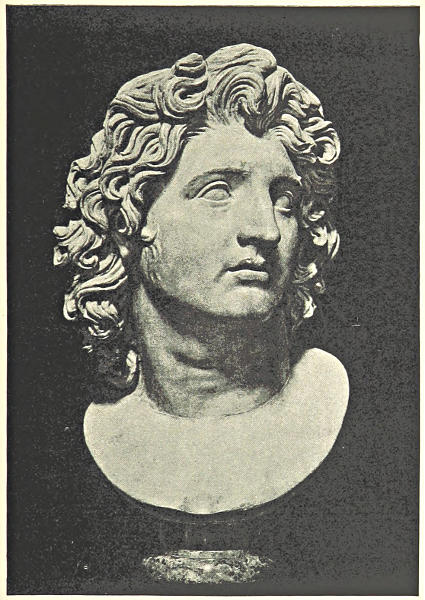
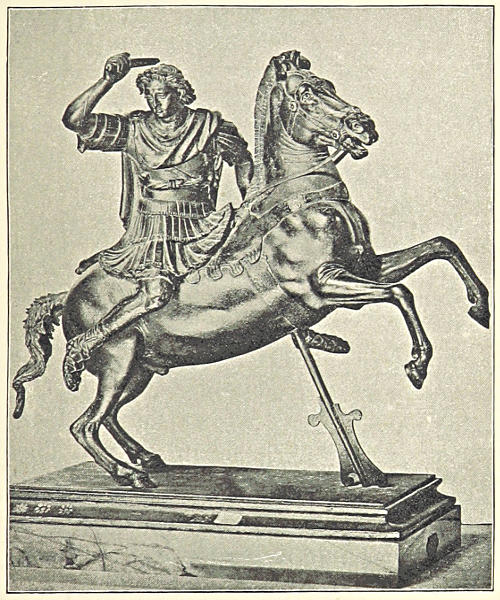
Alexander the Great.
Charidemus told his story. Alexander listened
with attention, and certainly without displeasure.
He had already, as has been seen, begun to feel
some repentance and even shame for the fate of
Thebes, and he was not sorry to show clemency in
a particular case.
“What,” he cried, when he heard the name of the
lad for whom Charidemus was making intercession.
“What? was it not Charondas of Thebes who
filched from you the crown at Olympia? And you
have forgiven him? What did the wise Aristotle,”
he went on, turning to Hephaestion, “say about
forgiveness?”
“Sire,” said Hephaestion, “you doubtless know
better than I. You profited by his teaching far more
than I—so the philosopher has told me a thousand
times.”
“Well,” rejoined the king, “as far as I remember,
he always seemed a little doubtful. To forgive
showed, he thought, a certain weakness of will; yet
it might be profitable, for it was an exercise of self-restraint.
Was it not so, my friend?”
“Just so,” said Hephaestion. “And did not the
wise man say that if one were ever in doubt which
to choose of two things, one should take the less
pleasant. I don’t know that I have ever had any
experiences of forgiveness, but I certainly know the
pleasure of revenge.”
“Admirably said,” cried the king. “Your request
is granted,” he went on, speaking to Charidemus.
“But what will you do with your friend?”
“He shall follow you, sire, when you go to conquer
the great enemy of Hellas.”
“So be it. Mind that I never repent this day’s
clemency. And now farewell!”
The young man again saluted, and withdrew.
But when he unfolded his plan to the Theban, he
found an obstacle which he might indeed have foreseen,
but on which, nevertheless, he had not reckoned.
Charondas was profoundly grateful to his deliverer,
and deeply touched by his generosity. But to follow
the man who had laid his country in the dust—that
seemed impossible.
“What!” he cried, “take service with the son of
Philip, the hereditary enemy of Hellas!”
“Listen!” said Charidemus; “there is but one
hereditary perpetual enemy of Hellas, and that is
the Persian. Since the days of Darius, the Great
King has never ceased to scheme against her liberty.
Do you know the story of the wrongs that these
Persians, the most insolent and cruel of barbarians,
have done to the children of Hellas?”
“Something of it,” replied Charondas; “but in
Thebes we are not great readers; and besides, that
is a part of history which we commonly pass over.”
“Well, it is a story of nearly two hundred years
of wrong. Since Salamis and Platæa, indeed, the
claws of the Persian have been clipped; but before
that—it makes my blood boil to think of the things
that they did to free-born men. You know they
passed through Macedonia, and left it a wilderness.
There are traditions in my family of their
misdeeds and cruelties which make me fairly grind
my teeth with rage. And then the way in which
they treated the islands! Swept them as men sweep
fish out of a pond! Their soldiers would join hand
to hand, and drag the place, as if they were dragging
with a net.”
“They suffered for it afterwards,” said Charondas.
“Yes, they suffered for it, but not in their own
country. Twice they have invaded Hellas itself;
and they hold in slavery some of the sons of Hellas
to this day. But they have never had any proper
punishment.”
“But what do you think would be proper punishment?”
asked the Theban.
“That Hellas should conquer Persia, as Persia
dreamt of conquering Hellas.”
“But the work is too vast.”
“Not so. Did you never hear how ten thousand
men marched from the Ægean to the Euxine without
meeting an enemy who could stand against
them? And these were mere mercenaries, who
thought of nothing but their pay. Yes, Persia
ought to have been conquered long ago, if your
cities had only been united; but you were too
busy quarrelling—first Sparta against Athens, and
then Thebes against Sparta, and Corinth and Argos
and the rest of them backing first one side, and then
the other.”
“It is too true.”
“And then, when there seemed to be a chance of
something being done, luck came in and helped the
Persians. Alexander of Pheræ had laid his plans
for a great expedition against the King, and just at
the moment when they were complete, the dagger
of an assassin—hired, some said, with Persian
gold—struck him down. Then Philip took up the
scheme, and worked it out with infinite patience
and skill; and lo! the knife again! Well, ‘all
these things lie upon the knees of the gods.’
Alexander of Pheræ was certainly not strong
enough for the work, nor, perhaps, Philip himself.
And besides, Philip had spent the best years
of life in preparing for it, and was scarcely young
enough. But now the time has come and the man.
You must see our glorious Alexander, best of
soldiers, best of generals. Before a year is over,
he will be well on his way to the Persians’ capital.
Come with me, and help him to do the work for
which Hellas has been waiting so long. Your true
country is not here, among these petty states worn
out with incessant strifes, but in the new empire
which this darling of the gods will establish in the
East.”
“Well,” said the Theban, with a melancholy
smile, “anyhow my country is not any longer here.
And what you tell me seems true enough. To you,
my friend, I can refuse nothing. The life which
you have saved is yours. I will follow you wherever
you go, and, perhaps, some day you will teach me
to love even this Alexander. At present, you must
allow, I have scarcely cause.”
Thus began a friendship which was only to be
dissolved by death.