Hekpoort,
September 5th, 1900.
We've stood to our nags (confound them!)
We've thought of our native land;
We have cussed our English brother,
(For he does not understand.)
We've cussed the whole of creation,
And the cross swings low for the morn,
Last straw (and by stern obligation)
To the Empire's load we've borne.
Monday, September 3rd. Reveillé at three o'clock, and coming after a
few days of welcome rest in the camp by the Pretoria Racecourse, a camp
resembling a vast rubbish field with the addition of open latrines, we
naturally felt more annoyed than when on the march, hence these idle
rhymes. On Sunday, after a short Divine Service, at which our major
presided, we had to fall in and draw remounts. Hence "Reveillé," "Saddle
up and stand to your horses!" I chose rather a good mount in the horse
corral, but as the sergeants had the privilege of choosing from those we
drew, I lost it, and so abandoned any intentions of trying to secure
another good one. There is no attempt on these occasions to see that the
right man has the right horse: it's "Hobson's choice." Even at Maitland
camp, where I drew my first mount, no such attempt was made, the
consequence being that I, scaling about 13-st. or more with my kit on,
and heaven only knows what with my loaded saddle, drew when my turn came
a weak little mare, which I had to stick to, to our mutual disadvantage,
while lighter men drew bigger and stronger horses. Only a few days ago I
received amongst my mails a letter from my sister, who inquired, "How is
your horse?" Which one? "Stumbles" is not, "Ponto" is not, "Juggernaut"
is not, "Diamond Jubilee" is not, "Bête Noire" is not. My present one,
which I have not named, is, and I sometimes wish he wasn't. When
I drew him at a venture, I vainly hoped he was not like other
horses, especially that Argentine. Well, apart from stumbling and
reverentially kneeling on most inopportune occasions, I have not much
fault to find with him. To-day is our first day on this fresh jaunt (we
are to join Clements), and already more than half the horses dished out
to us seem played out. You see they have all passed through the Sick
Horse Farm, and I presume are really convalescents. They dragged us
along at the commencement of the day, and we had to drag them along at
the end, which may sound like an equal division of labour, but which, in
my opinion, it is not. However, to be very serious, our lives might have
to depend upon these brutes at any moment, apart from the fact of our
necks being perpetually in danger on account of their stumbling
propensities. Still apart from the inconvenience of having to bury one,
I fancy there would not be much concern on that count. We have halted at
Rietfontein which is a mile or so from Commando Nek. Here is a large
A.S.C. depôt, from which columns working in the district can draw
supplies. It has been quite a treat to have tea by daylight.
Tuesday, September 4th. 'Nother three o'clock reveillé! Passing by
Commando Nek we were surprised at the difference since we were here
about a month ago. Then the trees were bare, nearly all the veldt burnt
and black, and the oat fields trodden down. Now the trees are wearing o'
the green, and the once blackened veldt has assumed a verdant and
youthful appearance, while the oat fields remind one of home, almost.
For this is the Krugersdorp District, which we like so well, though,
alas, the orange groves are on the other side (north) of the
Magaliesberg. A strange thing happened after passing our old camping
ground (of about a month ago) at Commando Nek. Instead of recognising
familiar landmarks and houses, everything seemed strange and new to me.
Said the man on my left in the ranks, "There's the farm where those
Tommies got the porkers." To which I remarked vacantly, "Oh!" Then,
further on, "Haven't the oats come on in that field?" Again, I
helplessly "Er—yes." Then, "I wonder if they've got any fowls left in
that shanty over there?" I, dissembling knowledge no longer, at last
observed, "Really I don't understand it. I can't remember this
place a bit." To which my neighbour replied, "Don't you remember coming
this way when we were leading those Argentine remounts?"
Those Argentine remounts! All was explained at last. Of course, I saw
and remembered naught save those awful brutes.
We caught Clements up at ten o'clock—encamped to our joy—so here we
are with "piled arms," "saddles off," and "horses picketed." As we came
into camp we heard once again the Mausers of the snipers afar off. We
have rigged up a sun shelter and have just dined, our "scoff" (Kaffir
for "grub") being bread and bully beef.
Apropos:
First Yeoman: "I say, is this bully beef American?"
Second Yeoman: "No, 'Orse-tralian, I believe."
Wednesday, September 5th.
"The peaches are a-blooming,
And the guns are a-booming,
And I want you, my honey,
Yus, I do."
We had reveillé at a more Christian-like time this morning (4.30), and
moved out as supports to our other troop (Devons), who were advance
party. We number eighteen Sussex men, all told, in our ranks, and are
led by Mr. Stanley, a Somerset I.Y. officer, who on our last trip was in
charge of the Ross Gun Section, which consisted of two quick-firing Colt
guns. After bare trees, dry veldt and dusty tracks, it is a real treat
for one's eyes to see this fine district assuming its spring garb.
Through the bright green patches of oats and barley we rode, past peach
trees and bushes in full bloom, sometimes through a hedge of them, the
pink blooms brushing against one's cheek. Then we came to a bend of the
Crocodile River, with its rugged banks covered with trees and
undergrowth, and the water rushing swiftly along between and over the
huge rocks in its bed. This we forded at the nearest drift, the water
reaching up to the horses' bellies. The general idea was for us mounted
troops to clear the valley, and the infantry the ridges of kopjes. We
were soon being sniped at from the right and the left, by, I presume,
numerous small parties of Boers, and after riding about a mile
were dismounted behind a farmhouse, and took up a position on the banks
of the Crocodile. The scene was truly idyllic. Below us the river in
this particular place was placidly flowing, the various trees on its
banks were bursting out in their spring foliage, and birds were
twittering amongst them: indeed, one cheeky little feathered thing came
and perched on a peach tree covered in pink blossom close by and piped a
matin to me, and there was I, lounging luxuriously in the deep grass, a
pipe in my mouth, a Lee-Enfield across my knees, and a keen eye on the
range of kopjes opposite. Truly, the spring poet's opportunity, but
alas, beyond the few lines with which I have dared to head to-day's
notes, I could do naught in that line. Soon our artillery began throwing
shrapnel on the top of the objectionable height, and, later, the Mausers
began to speak a little further on, and that has been the day's game. I
don't know our losses yet, but we have undoubtedly had some. Our crowd
had a horse killed, of course. We had a good deal of visiting to do,
calling at this farm and that, and inquiring if the "good man" was at
home. This is the usual scene:
Farmhouse of a humble order. A few timid Kaffirs loitering around, also
a few fowls and slack-looking mongrels. Gentleman in Khaki rides up, and
in the door appear two or more round-faced women wearing headgear of the
baby-bonnet mode, dirty-faced children in background.
G. in K.: "Where is your husband?"
Women: "Niet verstand."
G. in K.: "Where is your brother?"
Women: "Niet verstand."
G. in K.: "Is he on those kopjes, potting at us?"
Women: "Niet verstand."
G. in K.: "Have many Boers been past here?"
Women: "Niet verstand."
G, in K. (After more interrogatories and more "Niet
verstands"): "Oh, hang it, good-bye."
Women (in distance): "Niet verstand."
Verily, the "niet verstand" or "no savvee" game is a great one out here.
(Later.) Our casualties were three Northumberland Fusiliers
killed and eight wounded, one of our Fife comrades shot in the chest,
also three Roughriders hit, and a fair percentage of horses knocked.
Thursday, September 6th.—Reveillé at four o'clock, and off at
daybreak. We soon came into action, some of our fellows on the right
flank getting it particularly hot. Our little lot wheeled and dismounted
behind a farmhouse, and, wading through a field of waving green barley,
under fire, took up a position amongst the growth on the near bank of
the river, from which we let off at some sangars on the top of a kopje
in front. After a while we returned to our horses, mounted, rode away to
our right, crossed the river, dismounted behind a rise in the ground,
and proceeded to occupy some kopjes nearer the enemy, who had retired.
Some fine sangars were on the hill we occupied, and so we were saved the
trouble of building any. The one I found myself in was a very
comfortable and secure affair as regards rifle fire. As, of course, Mr.
Boer does not show himself over much, we had not much to pot at,
therefore I made myself as comfortable as possible on the shady side of
the sangar, and pulled out one of my numerous pocket editions of
Tennyson (recently acquired in Pretoria) and indulged in a good, though
occasionally interrupted, read. To a stranger at the game, I should
imagine that my behaviour at times would have appeared incongruous, for
while perusing the "Lotos-Eaters" and "Choric Song," the man on my right
would now and again interrupt me with, "There are some, have a shot at
'em!" Whereupon I would arise and fire a round or so at the distant
dots, and then sink down again and resume the sweet poesy, ignoring as
much as possible the constant bangings of villainous cordite in my ears,
right and left. Soon we moved on to another position, the
Northumberlands taking up our old one. The next one was in a stone
enclosure, which contained a large number of goats and kids. This was
not so pleasant, as the sun was high, and the place odoriferous.
At about three we were relieved by a Northumberland picket, and returned
under a sniping fire to where the camp had been pitched. Then the fun
commenced. A rather distant bang, whis-sh! over our heads;
and from amongst the infantry blanket shelters a cloud of earth spouted
up, and a small batch of men cleared off from the vicinity of the
explosion. It was amusing to see the niggers throw themselves into
trenches by the roads and fields. Then came another and yet another
shell, without any more effect than making a hole in a tent, and the men
of No. 8 Battery Field Artillery (and No. 8 is a deuced smart Battery,
by'r leave) dashed out from their lines, pushing and dragging their
guns, while the "4.7 gentleman" began moving his long beak in
the air as though sniffing for the foe. "Give 'em hell, boys!" we cried
to the busy gunners, as they dashed by us, working at the wheels and
drag-ropes, but the Naval man spoke first, "Snap—Bang!" and back the
gun jumped in a cloud of smoke; and presently, far away, from the crest
of the kopje under suspicion, a cloud of brown arose, and later came the
crack of the explosion. Meanwhile the Boers went on pitching shells into
our camp, and we got the order to retire behind a kopje with our horses
till it was decided what to do with us. Having done this, the shelling
soon ceased, and later we were taken back to camp, where we off-saddled,
picketed our horses, and settled down to tea. And then bang! whish!
crack!! bang! whish! towards us the enemy's shells came again. They had
got two guns in position, and were working them hard. We were getting
some of our own back, for the shells we picked up were 15-pounder ones,
of British make. Our Naval gun barked back viciously at them, and so did
the field guns, but the enemy were firing with the red and dazzling
setting sun, behind them, and shining directly in our fellows' eyes, who
were blazing apparently at poor old Sol, and cussing him and the wily
Boer in a manner by no means ambiguous. I know not whether we did them
any harm or not; certainly they shifted their positions once or twice.
As regards ourselves, it seems beyond belief, no damage was done. The
enemy could not even boast of the bag which the Americans achieved at
Santiago—that famous mule.[Back to Contents]
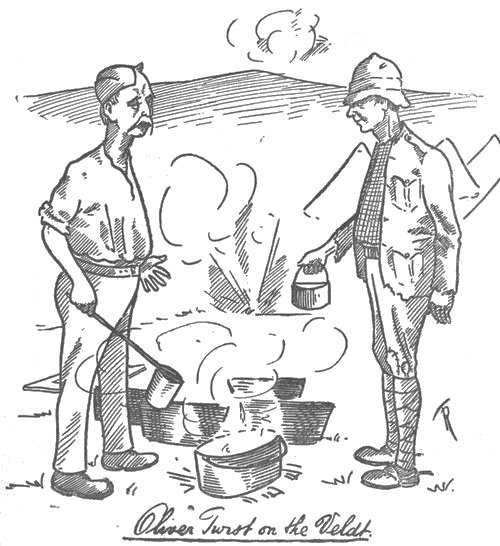
Pember, of the Sussex, asking for an extra allowance of tea, at the
cook-house, while the camp is being shelled by the Boers, at Hekpoort.
(Persuasively) "It may be your last chance, Cookie!"
Hekpoort.
Saturday, September 8th, 1900.
I fancy I stopped in my last near the end of a rather long-winded
account of the shelling we experienced at the hands of Brother Boer, on
Thursday evening last. To conclude that day's events, we finally shifted
our horse lines a bit and turned in, spending a night undisturbed by the
distant booming of the Boer guns or the ear-splitting cracking of our
4.7. The next day we returned to our old lines, and settled down for a
good day's rest, as we heard that Clements was waiting for Ridley to
come up.
I had hardly unsaddled, however, when the sergeant-major came
round and told half-a-dozen of us to saddle up and go out with the two
guides (civilians, British farmers, who are with this column and know
the locality). So we flung on our saddles, and slipping on our
bandoliers, mounted and set out in our shirt sleeves (mark that!) with
our guides in their civilian togs (mark that!). From these individuals
we gathered we were off cattle-lifting, the Boers having left some in a
kloof about a couple of miles south of the camp. With jocular allusions
to our last quest of a similar nature (the laager near Rustenburg) we
smoked and trotted along, comfortable in our shirt sleeves after so much
of the usual marching order. Following, came four "boys" to drive the
cattle home. We soon reached our objective. The "boys" were sent into
the kloof, while we dismounted a little way up the stone-covered kopje
on the right, and leaving a couple to look after the gees, the guides
and the remainder of us started to climb the heights and cover the
"boys" if necessary. Soon a rifle report was heard, and then another.
The guides said it was a picket of ours firing on us in mistake from the
kopje on the left, and suggested that one of us should work round and
let them know who we were. Most of us argued that the report was a
Mauser one. However, the guides prevailed, and I was deputed for the
job, when the "boys" came running in breathless and told us pantingly
that Boers had been sniping them. So seeing that it would be impossible
under the circumstances to lift the cattle, we retired on our horses,
mounted and moved off. And then the beggars, who had evidently moved up
closer, gave it to us fairly warm, and we had to open out and break into
a gallop in the direction of the camp. We were about clear of the
Mausers and riding through some bush, when, suddenly above a stone wall
not a hundred yards in front of us, helmets and heads appeared, also
glistening rifle barrels, which pointed, oh no, not on the kopje behind,
but on us. [This is where the civilian clothes and shirt sleeves came
in.] An officer shouted "Don't fire! Don't fire!!! Down with those
rifles." This order was obeyed reluctantly, then "Who are you?"
"Friends! Yeomanry!" "What Yeomanry?" "Sussex." "All right." They proved
to be a picket of the Northumberland Fusiliers. Then we crossed a drift,
our horses nearly having to swim, and finally reached camp.
This morning (Saturday, September 8th) our squadron and the Fifes had to
go back about half-a-dozen miles to meet Ridley. Our troop acted as
advance party. It was rather an interesting sight to see the two parties
meet; the advance of Ridley's force was Kitchener's Horse. When we met,
we halted and chatted, waiting for orders. As we did so, the merry
snipers started a desultory fire, which gradually became more rapid.
Several suspected houses in the vicinity, whose owners had, as usual,
taken the oath of neutrality and broken it—Punica Fides will have to
give way to a new phrase, Boer Faith—were then burnt down. War is not
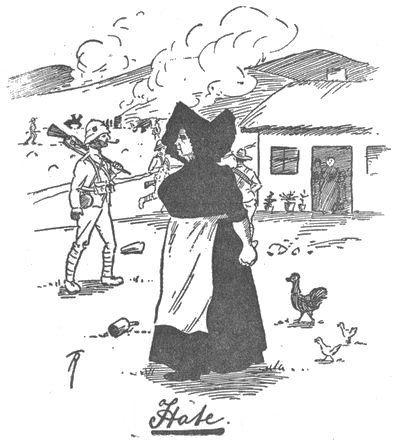
altogether a game, it has its stern aspect. The women and children were
loud in their lamentations as the red flames blazed and the dense smoke
rolled away on the fresh breeze which was blowing. They cursed
us and wept idle tears, but they had their own dear friends, husbands
and sons, to thank after all, as nearly all the sniping in this lovely
valley is being done by the farmers who live in it. We brought about 25
Boers in camp with us, either suspected or to save them from temptation.
To see them, with their roll of blankets, saying good-bye to their
weeping families would have touched anything but the hardened, homesick
heart of a "Gentleman in Khaki," for he knows full well that the simple
peasant in this, as in other localities, usually combines business with
pleasure by sniping you in the morning and selling you eggs in the
afternoon, as our troop leader puts it.
Sunday, September 9th. A late reveillé (6 o'clock). A lovely, lazy day
in camp, during which I have been stewing fruit, smoking, and, alas, my
bad habits still cling to me, perpetrated for my own amusement a little
rough-and-ready rhyme, which I have the temerity to enclose. We had a
short service, at which our O.C. Major Percy Browne, a real good man,
presided. Ridley, who works with Clements, the same as Mahon did with
Ian Hamilton, has with him Roberts' Horse, Kitchener's Horse, some
Australians, the 2nd and 6th M.I., some artillery and two pom-poms. We
advance to-morrow.
ANOTHER VERSION.
Into our camp, from far away,
Somebody's darling came one day—
Somebody's darling, full of grace,
Wearing yet on his youthful face,
Soon to be hid by a stubbly growth,
The fatted look of a life of sloth.
Thus to our camp, from far away,
Somebody's darling came one day.
Parted and oiled were the locks of gold,
Kissing the brow of patrician mould,
And pale as the Himalayan snows;
Spotlessly clean were his khaki clothes.
It was a cert', beyond any doubt,
Somebody's darling had just come out.
Wond'rous changes were quickly wrought.
Somebody's darling marched and fought.
Somebody's darling learned to shoot,
Somebody's darling loved to loot;
Somebody's darling learned to swear,
And neglected to part his hair.
After riding and marching weary leagues,
Somebody's darling was set on fatigues—
Set on fatigues for dreary hours,
Thinking of home, its fruits and flowers.
Somebody's darling's ideals were quashed;
Somebody's darling went unwashed.
Somebody's darling cussed sergeants big,
Somebody's darling killed a young pig:
Then dressed and trimmed it ready to eat,
First of many a butcherly feat;
Somebody's dear caring naught for looks,
Joined the army of amateur cooks.
Somebody's darling drank water muddy;
Somebody's darling saw men all bloody;
Somebody's darling heard bullets fly;
Somebody's darling saw comrades die;
Somebody's darling was playing the game,—
Thousands and thousands were doing the same.
Somebody's darling rose long before morn;
Somebody's darling went tattered and torn;
Somebody's darling longed for a bite,
Half-baked by day and frozen by night.
Somebody's darling received Mails sometimes,
And his joy was beyond my idle rhymes.
Somebody's darling was sniped one fierce day,
An ambulance jolted him far away;
Somebody's darling had got it bad,
Somebody at home would soon be sad.
Somebody's darling grew worse—then died.
And—that was the end of Somebody's Pride.[Back to Contents]
Monday, September 10th, 1900.
We had reveillé at 3.30, and moved off as advance party before dawn.
It was not long before we got into action. In less than a mile from our
camp we found frère Boer, who made his presence known to us in the
usual way, that is, with his Mauser, Express, Martini-Henry, or elephant
gun; of course, the first is his usual weapon. Not to be too
long-winded, we carried ridge after ridge of kopje for several miles. On
one occasion the enemy and ourselves rushed for the top of two different
kopjes, wherefrom to pepper one another. We only just had time to take
cover in a sangar as they opened fire from the opposite hill.
Their bullets buzzed and whistled over us, bringing down twigs from a
tree just by me, and striking the stones with a nasty sound. Later, the
infantry (Worcesters), advancing from behind, began firing over us at
the enemy; indeed, for a little time, we were very uncertain whether
they were not mistaking us for t'others. Anyhow, their bullets came most
infernally close, and necessitated our taking careful cover from the
missiles in rear as well as those in front. At last we came to the
enemy's main position, which was a fine natural one, and our artillery
came into play—we resting for a bit, and the infantry forming up to
advance under their fire. Then hell got loose. Bang, bang, bang went our
field guns; boom went the 4.7; pom-pom-pom-pom-pom went the
Vickers-Maxims; rap-rap-rap-rap-rap-rap went the Maxims; bang, bang went
their field guns; up-um, up-um, up-um went their Mausers; crack, crack
went our rifles. Imagine the above weapons and a few others, please, all
firing, not so much to make themselves heard at the same time (they did
that), but to destroy, kill and maim, and you can guess it was hard for
a poor tired beggar to sleep. I was fagged out, and when we rested while
our gunner friends had their innings, laid down in the blazing noon-day
sun, and, with a stone for a pillow, half-dozed for an hour or so. I was
roused by a comrade to look in front of me, it was a wonderful sight.
About a mile-and-a-half of the Boer position was a blackened line
fringed with flame and smoke, but they were still determinedly trying to
stop our infantry from occupying a long kopje in front of them, and
answering our guns with theirs. That night was almost a sleepless one,
for though dead fagged, we all had to do pickets on the ground we had
won. The next morning Delarey had disappeared, but we know we shall meet
him again.
It is a fine sight to see British infantry advance. With rolled blanket,
and mess-tin a-top, filled haversack, the accursed
"hundred-and-fifty"[5] pulling at his stomach, pipe in mouth, and rifle
sloped (butt up as a rule), Mr. Thomas Atkins of the Line goes leisurely
forward. I do not know yet what the casualties were. Of the Worcesters
who passed us, one poor fellow was shot through the head, and
about ten wounded; we had none, save a nag shot by Roberts' Horse in
mistake.[Back to Contents]
Hekpoort.
Thursday, Sept. 13th, 1900.
We returned to this, our old camp, yesterday, and are resting here for a
day or more, one never knows for certain how long these rests will last
when out on the war path. Yesterday (the 12th) we had a fairly late
reveillé, and then, acting as advance guard, returned hither by way of
a valley running parallel with this, and through which Ridley advanced
when we had our little scrap with Delarey at Boschfontein, on Monday
last. By-the-bye, I was yarning, while washing at a stream near here
this morning, with some Worcesters, who told me they had five killed and
fifteen wounded on that day. Two poor fellows were found burned out of
all recognition on the charred veldt the next day. They had been left
wounded and had been unable to crawl away from the blazing grass. The
valley we passed through yesterday was, in parts, more charming than
this. One little village, called Zeekooe, was a particularly pleasant
spot, the houses being half-hidden by the white pear blossoms, the pink
peach, and the various green foliages of the trees, for this is Spring,
when "the young man's fancy lightly turns to thoughts of love," and here
am I ——, well, well!! Even my old foe, the two-inch thorn bush, has
assumed a light-green muslin bridal veil. All this bursting into leaf is
most refreshing, to me at least, and I doubt not no less welcome to the
noble Boer sniper, who now gets more cover than was possible a month
ago. As we left camp, he was sniping away merrily, and about as
ineffectively as usual. When we crossed the kopjes to get to this valley
we came by way of a fine mountain road. Sheer down below us rushed the
river Magaliz, crystal clear, splashing and bubbling over the big rocks
in its bed, with weeping willows dipping down from amidst the thick
undergrowth on its banks, while now and again a garden from a farm near
ran to its edge, with vivid patches of young oats and lemon
trees. On arrival in camp, we heard that some Boers had been discovered
in some undergrowth, by a stream on our left flank, so we set off, and
beating it got six armed.
The barbed-wire curse is great in this Eden-like valley, and when you
consider that the advance mounted parties have to go straight ahead
through fields and back gardens, the garden walls of which are
invariably represented by barbed-wire fencing, you can comprehend that
our work is more often than not, no easy matter, especially as
wire-nippers are as rare as brandies and sodas, and even when possessed
are not much assistance in surmounting the wide and deep irrigation
cutting, which is often on the other side of the fence. Again, bogs are
not infrequently come across—across, by the way, is hardly the word
to use. Only a few days ago I was riding towards what I deemed to be a
passable ford, when I met a Rough Rider (72nd I.Y.) coming back from it.
I casually asked him if it was all right, to which he replied that it
was a bit boggy, and then incidentally added, "We've just shot one of
our fellows' horses that got stuck and we couldn't get out." Whereupon I
took a more circuitous route, a proceeding which I did not regret, when
later, I saw the poor, horseless Rough toiling in the broiling sun, his
huge saddle covering his head and shoulders, after the tail of the
convoy, in hopes of catching it and depositing his burden on a waggon.[Back to Contents]
I must apologise for the enclosed doggerel. Last night, round one of our
fires, we were alluding to the various uses we have made of that deadly
weapon, the bayonet, and it was suggested that I, as a Spring Poet,
should record them in verse, hence the enclosed:—
THE BALLAD OF THE BAYONET.
(Sussex Yeoman loq.)
Did I ever use the bay'nit, sir?
In the far off Transvaal War,
Where I fought for Queen and country, sir,
Against the wily Boer.
Aye, many a time and oft, sir,
I've bared the trusty blade,
And blessed the dear old Homeland, sir,
Where it was carefully made.
Chorus:
Then here's to the British bay'nit
Made of Sheffield steel,
And here's to the men who bore it—
Stalwart men and leal.
You notice the dents on the edge, sir,
At Bronkhurst Spruit they were done;
I was getting a door for a fire,
For out of wood we had run.
I was smiting hard at the door, sir,
Or rafter, I'm not sure which,
When I struck on an iron screw, sir,
And the bay'nit got this niche.
'Tis my mighty Excalibur, sir,
I've used it in joy and grief,
For digging up many a tater,
Or opening bully beef.
I have used it for breaking wire,
Making tents 'gainst rain and sun;
I have used it as a hoof-pick,
In a hundred ways and one.
Oh, how did the point get blunted, sir?
I was driving it home
As a picketing peg for my horse,
So that he should not roam.
I drove it in a little, sir,
And then in my haste, alas,
I stubbed the point on a rock, sir,
Some inches below the grass.
You ask if it e'er took a life, sir?
Aye, I mind the time full well;
I had spotted him by a farm, sir,
And went for him with a yell.
He tried to escape me hard, sir,
But I plunged it in his side,
And there by his own backyard, sir,
A healthy porker died.
But did I draw it in action?
You ask me roughly now.
Yes, we were taking a kopje,
The foe were on the brow.
We drew and fixed our bay'nits,
The sun shone on the steel;
Death to the sniping beggars
We were about to deal.
Then, sweating and a-puffing,
We scaled the rocky height,
But when we reached the top, sir.
The foe was out of sight.
Has it e'er drawn human blood?
Yes, once, I grieve to say;
It was not in a battle,
Or any bloody fray;
'Twas just outside Pretoria.
The deed was never meant,
I slipped and fell on the point, sir,
'Twas quite by accident.
Chorus:
Then here's to the British bay'nit,
Made of Sheffield steel,
And here's to the men who bore it,
Stalwart men and leal.
And here's to the Millenium,
The time of peaceful peace,
When neighbours shall love each other,
And wicked wars shall cease.[Back to Contents]
Monday, September 17th. There is a funeral to-day—an officer's—and we
(the Composite Squadron) are stopping in camp for it, as it concerns us.
So I will tell you all about it. Yesterday was Sunday, seldom a day of
rest out here. We, the three squadrons of Yeomanry attached to Clements'
force, were sent out early on a reconnaissance. Without any opposition
we advanced in a westerly direction towards Boschfontein, almost the
same way as on Monday last, for about four miles, the Devon and Dorset
troops of our squadron being on the right, our Sussex troop on the left,
the Roughriders (72nd I.Y.) in reserve, and the Fife Light Horse
scouting ahead. The Fifes had reached the foot of a high grass-covered
kopje, and were about to ascend it, when the enemy opened a hot fire on
them, causing them to scoot for their lives, which they managed to do
successfully. We then galloped up, dismounted, and opened fire on the
hill-top, the Devons and Dorsets doing the same on our right, and the
Fifes falling back on our left. Where the Roughs were we never knew,
probably their officers did. Taking into account the absence of the Nos.
3, with the led horses, and one group of our troop being sent some
distance to the left, we only numbered six and our officer,
Mr. Stanley, well-known in the cricket world as a Somerset county man.
Our led horses were in a donga in the rear. The position we occupied, I
should mention, was at the base of a kopje opposite to that held by the
Boers. We were sighting at 2,000, when our captain, Sir Elliot Lees,
rode up and said he could not make out where the Devons and Dorsets who
should have been on our right, were. As a matter of fact they had
retired unknown to us. This the wily Boers had seen and quickly taken
advantage of, for Sergeant-Major Cave, of the Dorsets, rushing up to us
crouching down, told us to fire to our right front, where some trees
were about three or four hundred yards away, and from which a heavy fire
was being directed at us. Sir Elliot Lees then came up again from our
left. Mr. Stanley, seeing the hot corner we were in, retired us about a
dozen yards back to the deepest part of the donga, where our led horses
were, and ordered the fellows with the horses to retire, and later, gave
the command for us to do the same in rushes by threes. Meanwhile our
bandoliers were nearly empty, and the Boers were creeping round to our
right, which would enable them to enfilade our position. The first three
retired, and we were blazing away to cover them, with our heads just
showing as we fired over the top of the donga, when the man on my right
said, "Mr. Stanley is hit," and looking at him, for he was close to me
on my left, I saw he was shot through the head, the blood pouring down
his face. Sir Elliot, the other man, and myself were the only ones left
in the donga then, so the captain, taking hold of poor Stanley by his
shoulders, and I his legs, we started to carry him off. As we picked him
up, he insisted, in a voice like that of a drunken man, on somebody
bringing his carbine and hat. "Where's my rifle an' hat? Rifle an' hat!"
The third man took them and gat—I heard this later. You have no idea
what a weight a mortally-wounded man is, and the poor fellow was in
reality rather lightly built. On we went, stumbling over stones, a
ditch, and into little chasms in the earth. Once or twice he mumbled,
"Not so fast, not so fast!" The bullets buzzed, whistled, and hummed by
us, missing us by yards, feet, and inches, knocking up the dust and
hitting the stones and thorn bushes we staggered through. We, of course,
presented a big mark for the Boers, and were not under any
covering fire so far as I am aware. The captain, who is grit all
through, soon found it impossible to carry the poor fellow by the
shoulders, the weight being too much for him, so I offered, and we
changed places, Sir Elliot taking his legs and on we went, pausing,
exhausted, perspiring and breathless, now and again, for a rest. At
last, turning to our left, we reached a little bit of cover, thanks to a
friendly rise in the ground, and falling into a kind of deep rut with
Stanley's body on top of me, I waited while the captain went to see if
he could get any assistance. Presently he returned with a Somerset man;
and a minute or so later a Fife fellow, a medical student, came up. The
former and I then got him on a little farther. After a few minutes'
deliberation, the captain said, reluctantly, "we must leave him." We all
three asked permission to stay. To which Sir Elliot replied, "I don't
want to lose an officer and three men. Come away, men!" We then moved
the poor fellow into a cutting about two feet deep and three feet wide,
and arranged a haversack under his head. As we loitered, each unwilling
to leave him first, Sir Elliot thundered at us to come on, saying, "I
don't know why it is, but a Yeoman never will obey an order till you've
sworn at him." Then reluctantly we set off in single file, working our
way back by the bank of a stream, and still under cover of the rise in
the ground, a little way up which we found one of our Sussex men, with
his horse bogged to the neck. Further on we paused a moment, and the
Fife man, saying that he thought the wound was not mortal, suggested
that it would be well for somebody to be with Stanley so as to prevent
him from rolling on it, and then asked permission to return. My Fife
friend had not seen what I had. He had only seen where the bullet went
in, not where it came out. Seeing that the captain was about to give him
permission, I said "Mr. Stanley is my officer, sir, and I have the right
to go," and he let me. I gave one my almost-empty bandolier, and another
my haversack, telling him it contained three letters for the post,
and—if necessary, to post them. My rifle I had already thrown into a
ditch at Sir Elliot's command. Then I worked my way back, hoping that I
should not be shot before reaching him. I got there all right, and
evidently unseen; lying down by him, I arranged my hat so as to keep
the sun off his face, and cutting off part of my left
shirt-sleeve, with the water from my bottle, used half of it to bathe
his temples and wipe his bubbling, half-open mouth. The other I
moistened, and laid over the wound. He was quite unconscious, of course,
and his case hopeless. Once I thought he was gone, but was mistaken. The
second time, however, there was no mistake.
I waited by the brave man—who had been our troop leader for the last
fortnight, and who had, I am sure, never known fear—for some time
deliberating what to do. Shots were still being fired from somewhere in
my vicinity, while our firing I had gloomily noted had receded, and
finally ceased. By-and-bye, all was silent, then a bird came and chirped
near me and a butterfly flitted by. At length, as it appeared to me
useless to wait by a dead man, I determined to get back to camp, if
possible, instead of waiting to be either shot in cold blood, or made a
prisoner. After carefully going through all his pockets, from which I
took his purse, watch, whistle, pipe, pouch, and notebook, and,
attaching his glasses to my belt, having arranged him a little and laid
my bloody handkerchief over his face, I got up, and worked my way along
by the river bank till compelled to go into the open. I trusted to a
great extent to my khaki on the dry grass, and daresay it saved me from
making much of a mark; but spotted I was, and from the right and left
the bullets came very thick and unpleasantly close. For about a mile I
was hunted on the right and left like a rabbit. At first I ran a little,
but was done, and soon dropped into a staggering walk. After a while I
came on Dr. Welford and his orderly behind some rocks, just coming out,
but when he heard my news he turned back, and, as I refused to use his
horse, which he offered me, at my request rode off, and got potted at a
good deal. Further on, he waited for me. He is a brick, our doctor; and
when he learnt I was thirsty, and he saw my tired condition (the sun on
my bare head had been most unpleasant) he offered me a drop of whisky
and water, adding, "You'd better have it when we get round the bend of
the kopje ahead." I thanked him, and said I thought it would be more
enjoyable there. Enjoy it I did. Finally I reached the camp and told
the captain the sad news, at the same time handing in the gallant
officer's belongings. His watch was at 12.5 when I left him.
Sir Elliot was most kind to me, and said I had acted gallantly, and he
had told the major (commanding us). Then Major Browne came up, and he
was also very complimentary. Of course, there was nothing in what I had
done that any other man would not have done, and I told them so,
especially as the example set by the captain made it impossible for a
man to be other than cool. Lieutenant Stanley, who took command of us
when we left Pretoria a fortnight ago, had soon become very popular, for
he was a thorough sportsman, keen as mustard, quite unaffected and
absolutely fearless. I feel pleased with myself for taking everything
off the poor fellow before I left him; for when, late last night, the
ambulance came in with him, the doctor's orderly told me that they found
him stripped of his boots, gaiters, and spurs—which was all that were
left worth taking.[Back to Contents]
"And far and wide,
They have done and died,
By donga, and veldt, and kloof,
And the lonely grave
Of the honored brave,
Is a proof—if we need a proof."
E. Wallace.
Tuesday, September 18th. We buried Lieut. Stanley yesterday at mid-day,
the sergeants acting as bearers, we Sussex men (of the dozen of us, two
were with him at Eton and one at Oxford) composed the firing party,
while the whole squadron, officers and men followed. About
three-quarters of a mile from our present camp, in the garden of a
Scotchman, named Jennings, by a murmuring, running stream, and beneath
some willows, we laid him. By the side of the grave was a bush of
Transvaal may, covered in white blossom, at the end were roses to come,
and away back and front were the white-covered pear trees and
pink-covered peach, perfuming the clear, fresh air, while on the sides
of the babbling stream were ferns and a species of white iris. Sewn up
in his rough, brown, military blanket, he was lowered to his last
resting-place, the major reading the Burial Service.
"—— Is cut down like a flower."
He could not have been more than twenty-five. Then, "Fire three volleys
of blank ammunition in the air. Ready! Present! Fire!" Again and again,
and the obsequies of a brave officer and true English gentleman and
sportsman were over.
I am sorry to say that we have a Sussex sergeant missing—killed or
prisoner. We are most anxious to know his fate, poor fellow. So, out of
the seven of us in that hot corner, one is dead, one is not, and Heaven
only knows how the others escaped, myself in particular.
Wednesday, September 19th. This morning we advanced about half-a-dozen
miles, and pitched our camp here—Doornkloof is the name of the place, I
believe.
Thursday, September 20th. Ridley's column has gone back in the direction
of Pretoria to Rietfontein, as escort to a convoy, principally composed
of waggons loaded with oat hay. I hear, and hope it is true, that he has
our letters.
Friday, September 21st. Had to do a picket on an outlying kopje. The
stable guard, who should have reveilléed us at three forgot to do so,
and later, when we were aroused, we had to saddle up and clear off at
once. I had to go off sans café (which is breakfast), and worse still
in my hurry sans pipe. Oh, how that worried me, my pipe which I have
kept and smoked through all till now. Somebody might tread on it and
break it, or find it and not return it. On the kopje a friend lent me
his emergency pipe, over which a lot of quinine powder had been upset,
so I had a few smokes, in which the flavour of quinine prevailed
unpleasantly. Still, I have no doubt it was healthy. But, oh, where was
my pipe, should I ever see it again? "There is a Boer outpost over
there." "Yes, but I wonder what the deuce has become of my pipe," and
then I bored my vigilant fellow sentinel with the history of that pipe.
With the sun pouring down on us without shelter, without any grub, and
not a drop of water (my bottle I left by Stanley), we were stuck up on
that kopje till past sunset. Where was my pipe, should I get it all
right? At last we got back to camp, and, overjoyed, I received from a
friend my pipe, which he had picked up in the lines. Then, having
partaken of tea, I found myself in for a sleepless night as
stable picket. But it didn't matter, I had got my pipe.
Saturday, September 22nd.
"There is a foe who deals hard knocks,
In a combat scarce Homeric:
It's not the Boer, who snipes from rocks,
But fever known as Enteric."
The idea I have partly expressed in the above lines, is as you know,
correct. The Boer from behind his rock snipes you at a distance, but
Sister Enteric, though unseen, as Brother Boer, is nearer to us. She is
with us in our camps, when we eat and when we drink—often parched,
recklessly drink—and close, unseen and unheard, deals her blows. And
when they are dealt, the nervous ones amongst us think. For common
report hath it that the illness takes roughly about three weeks to
develop, and the nervous man thinks back what did he drink three weeks
ago, or thinking of what he ate or drank the day before, dreads the
developments three weeks may bring. When we came in last night we heard
that a poor fellow of our squadron had succumbed to it, and was to be
buried the next morning at 5.30. We bury soon out here. So once again
this week, I formed a unit of the firing party, and did the slow march
with reversed arms. We clicked the three volleys at the grave. Later, we
had two more funerals, the result of Brother Boer's handiwork. They were
two men of Kitchener's Horse, who had dropped behind Ridley's force at
Hekpoort, and had ridden to Mrs. Jennings' farm to buy some bread. These
two were shot by over half-a-dozen concealed Boers at about twenty yards
range. No attempt was made to make them prisoners, and they were
practically unarmed, having revolvers only. Their bodies were riddled.
Sunday, September 23rd.
"Oh, happy man in study quiet,
On data and statistics,
Making copy of our diet,
Please soften our biscuits!"
This afternoon having borrowed a magazine from a Rough, in exchange for
an old one I picked up in the Fife lines, I have in common with the
sharer of my blanket shelter derived infinite entertainment from an
article therein contained, entitled "Feeding the Fighting Man." Of
course, it is illustrated with photographs, the first one
depicting a sleek and stiff Yeomanic-looking, khaki-clad being standing
by the side of a swagger little drawing-table covered with a fringed
tablecloth, and obviously groaning under what we learn are the
gentleman's daily rations. Apart from the article, this picture alone is
calculated to make one's mouth water. The article opens with an extract
from that great book, "The Soldier's Pocket Book." Here it is, "It may
be taken as an accepted fact that the better the men are fed the more
you will get out of them, the better will be their health and strength,
the more contented will they be, and the better will be their
discipline," all of which is gospel truth. The article, as I have
already remarked, is very entertaining. Here is a little extract—"fresh
meat and bread have been issued daily, almost without a single
exception, to troops at the front." We know the fresh meat, good old
trek ox! Always delightfully fresh—and tough. And the bread, yes, the
bread, well-er-the bread, yes, the bread! If I had read this article at
home, being somewhat of a gourmand, I should certainly have rushed off
and enlisted directly after reading as far as the middle, where we learn
that every soldier is allowed daily—oh, the list is too long to give
you. There is one little thing the scribe overlooked, and that is the
waggon crowd, the quartermaster-sergeant and his satellites. It may also
be of interest to you to know that certain non-coms. and men of the
A.S.C. have made large sums of money out here. I have heard of one who
made three or four hundred pounds in a few months, hem! Of course, they
are exceptions in a corps which has, as everyone knows, done grand work.
Our running commentaries as I read the article through, would have made
excellent marginal reading, if such notes could have been added for a
future edition.
Yesterday, a fresh epidemic visited our camp—football. Some person,
evilly disposed I presume, produced a football which after a "good blow
out" (oh, happy football) was kicked in the midst of a crowd of wild
enthusiasts. We soon had a casualty, a sergeant stubbing his big toe
badly on a boulder; now he can hardly walk. I believe there were a few
other minor casualties. Thirty enteric cases were taken into Pretoria
with the last convoy. I am slowly but surely learning to spread jam very
thinly on biscuit, one of the most difficult accomplishments I
have had to learn out here. My jam spreading having hitherto been at
once the scandal and horror of my messmates.
On Monday morning one of Bethune's Horse came into our camp, he had been
a Boer prisoner, and had escaped from Rustenburg, which they are at
present occupying (I think it is their turn this month). He had been
wandering for fourteen days, or rather nights, for it was then he
travelled—a native chief had supplied him with a guide, who piloted him
about, and kept him going on berries and such like. He said to me, "I
was glad to see English faces again," and I, who in a small way know
what it is to be hunted, believed him, you bet.[Back to Contents]
Tuesday, September 25th. Yesterday we moved out to meet and escort
Ridley in with the convoy from Pretoria. About a couple of miles out we
heard guns, and I thought probably we should have a bit of scrapping,
but we did not beyond some half-hearted sniping. To my surprise and
delight Ridley brought mails, my portion being eleven letters. Some had
the home post mark of May 25th, and the others August 7th. I must leave
off for a space here, as I have to carve an epitaph for the poor fellow
who died a few days ago. You see one's occupations out here are many and
varied.
(Resumed.)
Yesterday evening the orderly sergeant came down to my wigwam, and asked
for my regimental number, which I gave him without asking the reason
why. Soon he returned and congratulated me, saying I had been promoted
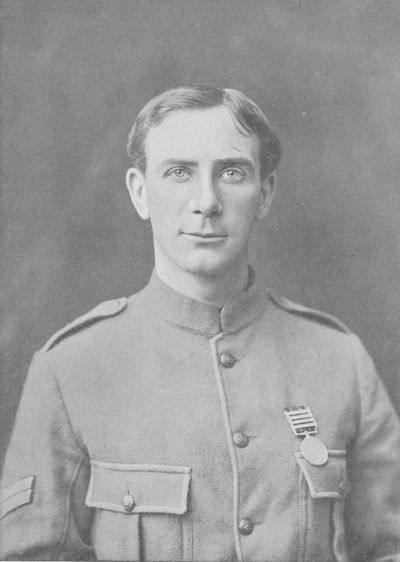
to full corporal over poor Stanley's affair. My many comrades also have
warmly congratulated me on my return to my former state, or rather above
it, for it is a case of wearing two stripes now.
Wednesday, September 26th. On this day we advanced. Our column did not
come in for the usual amount of attention from our friend the enemy, the
reason being that a gentleman friend of ours, General Broadwood, was
pounding away at them from one side, and Ridley from another.
All the same we had a very busy day, scouting and occupying kopjes. Our
guns fired at some Boer waggons, causing their escort to clear, and
leave them for us. Our infantry got them and had a good time. They are
fine fellows, are our infantry, and deserve all they can get in the loot
line. Late in the afternoon we surrounded a suspicious-looking kloof,
full of thick undergrowth, and captured a couple of the peaceful
peasants of the Arcadian dorp (fontein, kloof or spruit) we were then
occupying. A man in quest of loot found them, to his great surprise.
They were of the genus snipa. One had an elephant gun and the other a
Martini. We had had reveillé at 2.30, and breakfast a little later.
From then till about six in the evening I had only a few bits of
biscuit, and once a drop of water, but felt none the worse for my little
fast.
Thursday, September 27th. We got us up at 3.30. On going to saddle up I
found that my horse was gone. However, after a careful search, I found
him, though he had changed colour and size. When in the Yeomanry, do as
the Yeomen do. So having got a mount I was soon on parade. We then
ascended a big kopje and were placed at various observation posts till
such time as the convoy should move off. On the top of this kopje were
numerous tree-locusts, these are far more swagger in appearance than
their khaki-clad brethren, being green and yellow, with a crimson and
purple lining to their wings; but their whole appearance is so
artificial, that my first impression on seeing one was that it had flown
out of a Liberty Shop. From the various uncomplimentary remarks one
hears passed on the locust, I imagine the name must be derived from the
expression "low cuss." At 3.30 the tail of the beastly but necessary
convoy had succeeded in negotiating the usual non-progressive drift, and
we left our kopje to form its rear guard. My horse and I went a lovely
howler soon after starting—my first spill. I got up feeling all the
better for the experience, and soon had another. In this my rifle got
broken.
Friday, September 28th. We arrived at Olifant's Nek with the convoy at
3.30 a.m. a bit tired, found lukewarmed-up tea, bully and biscuits
awaiting us, and then turned in, and just and unjust slumbered soundly
till a late reveillé, 6 o'clock, bundled us out to feed our horses. My
latest acquisition I found had vamoosed or been vamoosed. In
searching for it, I found my old one. Then, having foraged around at our
waggon and secured a Lee-Metford, I was once again fully equipped. At
about 10, we advanced through the bush veldt as far as our present
camping ground, which is called Doornlaagte, I believe.
Saturday, September 29th. As we are resting here to-day I will continue
my diary-like letter.
(Resumed.)
My fell intentions of writing this morning were knocked on the head, as
we had to go out on a patrol. Our latest rôles being that of
resurrectionists, or grave desecrators. The reason was that certain
tombs had been regarded with grave suspicion (I beg your pardon) our
"intelligence" people imagining them to contain buried arms, ammunition,
or treasure. However, on our arrival at the spot, a close inspection
made it evident that they were bonâ-fide affairs, not Mauser-leums,
and by no means new as reported, so we left the rude forefathers of the
hamlet undisturbed.
Sunday, September 30th. We have just marched back from Doornlaagte
through Olifant's Nek, and are camped here, a mile beyond. To-day is a
regular Sunday-at-Home day. It has been quite a record day, especially
for a Sabbath, for we have not heard a single Mauser go off.
Monday, October 1st. Another month! Actually a year ago this month the
war commenced, and there are still corners on the slate unwiped, and we,
the poor wipers, are industriously wiping, and certainly cannot complain
of a lack of rags. We moved out from the Nek through Krondaal and camped
at Sterkstrom. Amongst the latest reports, false and true, we heard in
the evening that the C.I.V.'s were off—homeward bound.
Tuesday, October 2nd. The previous night we heard that the camp would
not be shifted, nor was it. But we, of the Yeomanry, were. At 3.30,
therefore, we had to arise and go out with the guns to co-operate with
Ridley and Broadwood. After manœuvring about, we were finally posted
on what at first appeared a kopje of no importance (in height and
composition), but kopjes were deceivers ever, and when we had
got half-way up, those that had sufficient breath and energy left to
express their opinions on kopjes in general, and this one in particular,
did so. However, once up aloft, we were left undisturbed for the
remainder of the day. On return to camp we found our missing sergeant
(of September 16th, at Hekpoort). He had been a prisoner in Rustenburg
and had got his liberty when Broadwood occupied or rather re-occupied
the town. Whenever we go out one way the Boers come in the other, and
vice versa. Though we had not played an active part in the day's
operations, the others had, and the outing was rather a success,
Ridley's men capturing fourteen waggons with ammunition and other stuff
and a few prisoners.
Thursday, October 4th. Once again our fond hopes of a day's loaf were
crushed, for it was "up in the morning early," and hie for Bethanie.
This little native town we reached and surrounded, and then destroyed a
mill. On the way there we came on a recently-deserted waggon (a pot of
coffee was boiling over a small fire). This and its contents we
destroyed; and back, which was by a different road, we came upon and
destroyed four or five waggons by burning them.
*******
The effect of Army, or rather Yeomanry life, its fatigues and worries,
big and small, on men hitherto unaccustomed to such things, has been
marvellous, and productive of a topsy-turvy dom of character, after Mr.
W. S. Gilbert's own heart. To commence with, it is curious to note that
in many cases men who claim to have roughed it in various parts of the
world have been amongst the worst to stand the roughing here, and while
weak-looking striplings have developed into fine hardy men; brawny,
massive-looking fellows have shrunk to thin and useless beings. As
regards character, after about four to six months out here one seems to
see his fellows in all the nakedness of truth. I have seen the genial
man turn irritable, the generous man mean, the good-tempered man
quarrelsome, the smart and particular man slovenly, the witty man dull,
the bow-and-arrow ideal (looking) sabreur anything but dashing in
action, the old-womanly man indifferent to danger, and the objectionable
man the best of comrades. These and other changes have I
noted, and often fearfully thought how have I changed, how has it
affected me, but
"There is no grace the giftie to gie me,
To see mysel' as ithers see me."
and perhaps it is as well.[Back to Contents]
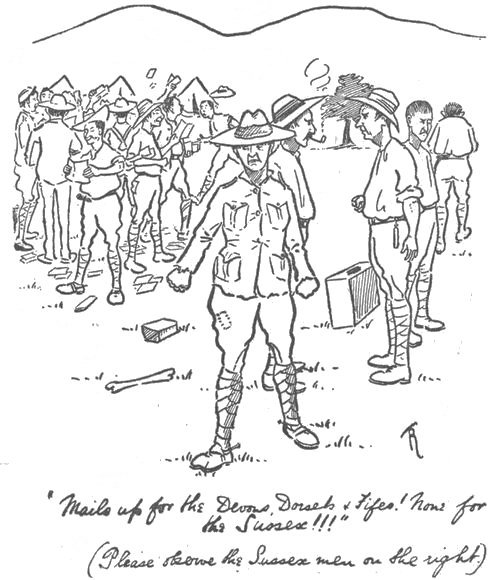
Friday, October 5th. We marched into Commando Nek this morning, and are
now camped here (when I use the word "camped," I hope you do not think I
mean tents and such-like luxurious paraphernalia, because I don't). Our
lines have by no means fallen in a pleasant place, being on dusty ground
by the side of the road which goes through the Nek, along which for the
last two hours about half-a dozen miles of convoy has been
proceeding en route for Rustenburg, and what with the yelling of the
black man and (a hundred-times-removed) brother—I allude to the
blooming niggers—the lowing of the oxen, and the dust—well, "it ain't
all lavender," neither is it conducive to letter-writing or good temper.
But to own up, the above would not trouble us a bit, if we had only
received our mails, which we have not. I had been looking forward to a
fine batch and relying on getting them with a faith which would have
removed kopjes, and now I am disappointed. The bitterness of the whole
thing is that some one has blundered, for the Fifes in front have
theirs, and the Rough Riders behind have theirs, but we, the Composite
Squadron, are without ours. Donnerwetter und Potztausand! There, I had
intended writing and telling you how much I am really enjoying myself,
of the beauties of the veldt, its pretty little flowers, the
multi-coloured butterflies and insects, the glorious open-air life we
are leading and a' that; and here I am like a bear with a sore head,
grumbling, grumbling, grumbling. And now the companion of my shelter and
sharer of my mealie pap—I call him Cœur de Lion (I don't mind him
having the heart of a lion, but I object to him having its appetite)—is
growling, and wanting to know "when the Yeomanry are going home. We came
out for a crisis, and if the authorities call this a crisis may he be—"
etc., etc., as he certainly will. I have tried to pacify him with the
following offering of the muse—but failed:—
"Great Bugs of State. Imperial Bugs,
The time grows heavy on our hands;
Are the recruiting sergeants dead?
Does khaki fail, or martial bands?
Oh, teach the vagrant how to ride,
The orphan boy to meet the foe;
May Heaven melt your stony hearts,
To let the foolish Yeoman go."
Being under the impression that I have not made any direct reference to
the nigger, of whom, of course, one sees a great deal, I will here give
you my condensed opinion of this being. Left in his true state, he is, I
believe, unobjectionable, but we have spoilt him. Our fellows have been
too familiar with him in camp and on the march, and you know what
familiarity breeds. He has sat or stood idle and watched with
indifference we white men in khaki doing work he should have been set to
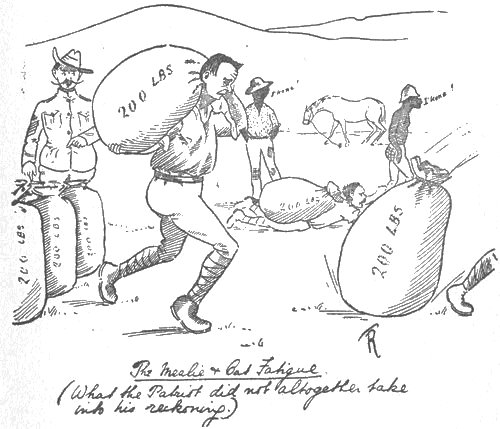
do (I have borne huge sacks and other burdens, and cursed the officers,
who have not made use of the niggers standing idly by). He has had the
satisfaction of knowing that while he is earning three or four shillings
a day, Thomas Atkins is earning thirteen pence. The general result is
that he has become deucedly independent and occasionally confoundedly
cheeky. As a remedy, I would suggest at the conclusion of this war—that
is, assuming it does conclude—97 per cent. of the niggers employed by
the British Government be jolly well kicked and then set in bondage for
half-a-dozen years, more if their case requires it.
Our horses are nearly all done. Mine is very lame in its hind legs. As
far as horseflesh goes, he is the least objectionable brute I have had,
though his ignorance and lack of appreciation of kindness is appalling.
We have drawn horseshoes for five weeks, so it does not look like
returning to Pretoria just yet. If we had drawn horses it would have
been more to the purpose. We are having tea now, and have just drawn our
biscuits for the next 24 hours. They number four thinnish ones, and
represent three-quarter rations. Even as regards biscuits, one learns a
good deal out here. I myself know four kinds of biscuits, all as like as
any of Spratt's gold medal ones in appearance, but varying greatly in
taste, and consequently, popularity.[Back to Contents]
Commando Nek,
Sunday, October 7th, 1900.
As you can see by the above, we are still here, but expect to move
to-morrow.
Yesterday was hot and windy, but, beyond one incident, uneventful. Late
in the day indigo, watery-looking clouds in the west caused some of us
to erect blanket shelters for the coming night, and when the evening
having come, a flash of lightning and a distant peal of thunder,
followed by a few spatters of rain, heralded what was to come,
we wise virgins (pardon the simile) huddled in our booby hutches
(unfortunately without lamps) and congratulated ourselves on our
astuteness. Soon it came, the lightning flashing, the thunder crashing,
the rain pouring, and lastly the wind blowing a perfect tornado. The
various jerry-built domiciles stood it well for some time, then the
hutch behind us was blown down, and we in ours roared with glee; then
another went, and finally the wind, not being able to get at us by a
frontal attack, took us on the flank, and up blew one blanket, and the
rifles at the ends wavered. Then, with cries of "Close the water-tight
compartments," "Man the pumps," "Launch the lifeboat," "Where's the
rocket apparatus?" and such-like remarks, as used by those in peril on
the sea, we came out and joined in the fun. The horses, seeing us all
about, thought it must be reveillé, and started neighing and pawing
the ground, expecting their grub. We were soon inside again under
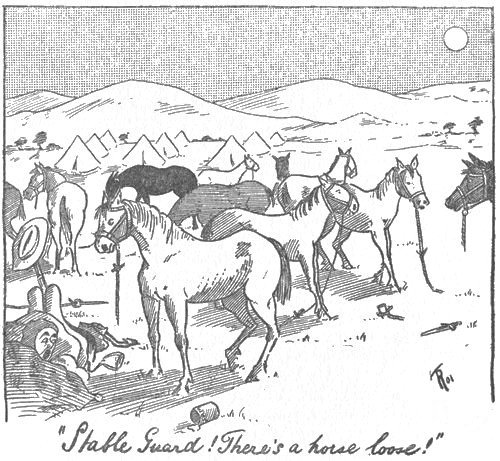
jury-rigging, and went off to sleep to the shouts of "Stable guard,
here's a horse loose!" "Stable guard, here are three horses walking over
us!" and the reply, "All right, I'm coming round in the captain's
dinghy," or some such rejoinder. I could not help smiling when one of
our fellows, in response to a cry of "Buck up, boys of the bull-dog
breed!" remarked, "Hang it, they don't even give us kennels." In the
small hours of the morning our hutch collapsed again, and with the
blanket on my side supported mainly on my nose, I heedlessly slumbered
on. At reveillé the greeting we gave one another was "Oh, what a
night!" The Roughs were in a particularly happy frame of mind, though
they had slept in the open, for their officers' tent had come down, also
their sergeants', and the remarks of the former, "Aw, Frisby, have you
got that wope?" "Where's that beastly peg?" "Heah, give me the hammah,"
"Isn't it awful?" had been most soothing to them. Although I did my best
to protect my few remaining envelopes, I have just discovered three of
them to be well gummed down. One thing must be said to the credit of the
rain, it has laid the dust, and that is no small matter.
Monday, October 8th. Having had no mails, we sallied forth with Mr.
Clements in the direction of Krugersdorp, with four days' rations. My
last charger being done, I've got another 'oss, and he seems
rather a good one, though not up to my weight. Last night it came to my
ears that the Border Regiment had got their dry canteen up from
Pretoria, and it would be open for an hour or so, and that chocolate,
jam, cocoa paste, tobacco and other coveted commodities would be on
sale. So I was soon mingling with the crowd of would-be purchasers;
several of our fellows also joined the crowd, but when it came to their
turn to buy were turned away because they belonged not to the Border
Regiment. I, however, had not my hat or tunic on, and as there was
nothing about my shirt or general appearance to distinguish me from Mr.
Thomas Atkins of the Border Regiment, I succeeded in buying four packets
of chocolate and several tins of potted meats and jams; then, handing my
purchases over to a friend, I again took up my position at the end of
the queue and bought some more stuff. The prices were what is commonly
known as popular prices, being extraordinarily low for this benighted
land. As our four days' rations simply consist of four of the least
popular brand of biscuits imaginable per diem and horrible stewed trek
ox, these little purchases are coming in very handy. We camped early in
the afternoon on the high veldt. The night was bitterly cold.[Back to Contents]
Wednesday, October 10th.
"When scouting and you must not tarry,
Of things you can borrow or beg,
The best, but the worst you can carry,
Is the excellent, succulent egg."
Extract from contemplated "Loot Lyrics."
To-day we have returned to Commando Nek, at least within a mile or so of
it. (A cart has just come in from Rietfontein, and they say there are
four bags of mails for the Composites, so we poor Sussex de'ils ought to
have a look in.) We were advance party to-day, and a friend and I had
the good luck to get a fine lot of eggs, of which I have not had any for
a long time. As you may imagine, eggs are not very easily carried by the
uninitiated, especially when he happens to be a horseman. The first time
I managed to get some I got a couple from a farm down the next valley,
and was debating how I should carry them, when the officer of our troop,
who was just ahead, turned round and sternly told me to mount
and get forward, and as he stopped for me to do so, I was rather
awkwardly situated, my rifle being in one hand and the two eggs in the
other. However, I seized the reins somehow or other, and did the great
egg trick successfully. Missing other feats in which I have never once
broken or cracked even one, to-day I eclipsed all previous
accomplishments, inasmuch as I carried in the only two tunic pockets I
have without holes, THREE DOZEN EGGS loose, and despite having to
dismount and mount twice, brought them into camp without breaking or
cracking one. Once or twice, when we had to do a trot, our
sergeant-major asked why I was riding so curiously, and I told him I was
feeling rather queer, but thought it would wear off when I reached
camp—it did. A friend and I got these eggs in rather an amusing manner.
We spotted a Kaffir village and riding to it, enquired at every kraal
for eggs, "Eggs for the general—for Lord Roberts!" but, alas, they had
none, "I'kona," signifying the negative. One enterprising youth,
however, called to me as I was riding off and brought me four, for which
I paid him sixpence. Then once again as we were going away, he called to
us—evidently the pay, pay, pay of the absent-minded foreign devil has
touched his savage heart—for lo and behold his neighbours had some for
sale, and came forward with a dozen in a tin, then their neighbours came
to the front with about a score, and yet another lot appeared with
more—in all, we got fifty eggs, of which I pocketed three dozen, and
carried the remainder in a handkerchief and surrendered them to our
major, saying I had got them for him (he was in want of some), and thus
appeased him. Had I carried them all in my mouchoir I might have lost
the lot, but we simple Yeomen "know a thing or three," as the ancient
ballad goes.
We have just drawn rations for fourteen days and been joined by some
more M.I., so it looks as if
"Troops may come and troops may go,
But we go on for ever."
"Go hon!" seems to be our call and counter cry.
Commando Nek, Friday, October 12th, 1900.
Excerpt from proposed Christmas Panto.
Place—The Transvaal. Period—Victorian.
Officers' Tent.
First Officer: "I heah the men are gwousing about their gwub."
Second Officer: "Er—I think they get their wations wegularly."
Third Officer: "Oh, dem! They're alwight. Anyhow, what do they want with
gwub? A little more turkey and peas, and—er pass the whisky, Fwed."
The Waggon.
Quartermaster-Sergeant (to kindred spirit): "Look 'ere; twelve tins of
bacon, sixteen of jam, biscuits, and a jar of rum. Lemme see; there's
twelve of us, and twenty of them. 'Umph, that's eight tins of bacon and
eleven of jam for us, and four of bacon and five of jam for them. Let
'em 'ave four biscuits a man; save the best for us—don't forget—"
Kindred Spirit: "And the rum?"
Quartermaster-Sergeant: "Confound it; I nearly forgot that.
Oh—er—er—take 'em a cupful, and—er—say we're on half rations."
Chorus from minor waggonites from round cook-house fire.
"We don't want to fight,
And, by Jingo, if—we—do,
We've got the rum, we've got the tea,
And we've got the sugar, too."
The Yeomen's Lines. Men just in from patrol.
Man with bullet hole in hat: "Is tea up?"
Enter orderly corporal with rations: "I say, you fellows, it's 'damall'
again to day."
Chorus: "!!!???***"
Of course it is evident to you that the above extracts are from a
burlesque written by a man in the ranks. Alas! there is a perpetual feud
existent between "the brave, silent men at the back," and ditto those at
the front, consequently any joke at the expense of the "waggon crowd" is
always appreciated beyond its value. Sergeant-Major Hunt, who had been
acting as quartermaster-sergeant for several weeks, did us remarkably
well; but, alas, he has been invalided into Pretoria, and another has
reigned in his stead, who has done evil in (or rather out of) our sight;
being either incompetent or too clever. By the foregoing, you can see
that I have not got much news to record. We expect some of the
time-expired Police to join us on Sunday or Monday, and so, I fancy, we
shall not move till they come up.[Back to Contents]
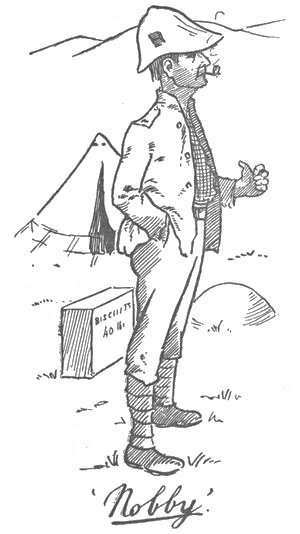
We often get some of the Border men in our lines, and, like all of the
Regulars, they are most entertaining, though their statements usually
require a few grains of salt before swallowing. One of these bold Border
men, known to us as "Nobby," is awfully disgusted at my bad habit of
letter writing. As a rule I am scribbling when he strolls up, and get
greeted with the jeering remark, "At it again." Some days
back, after reflectively expectorating, he delivered himself thus on
letter writing: "I don't often write. When I do, I sez 'I'm all right;
'ow's yerself?' A soldier's got too much to do to write blooming
letters." Then he retailed terrible stories of Spion Kop, Pieter's Hill,
and other affairs. Amongst his loot stories I know the following to be a
fact; its hero has since been court-martialled. One of the men in
Clements' Force, being en route, visited a house, and, producing his
emergency rations (these are contained in a curious little tin case),
threatened to blow the house and its occupants to kingdom-come unless
they complied with his request for eggs, bread, coffee, etc. They
complied, but, unfortunately for the man in question, a nigger belonging
to the place followed him into camp, and reported the case. Mr. Thomas
Atkins of the Line has curious notions about the distances he marches.
Of course, he is a grand marcher, and has done remarkable distances and
times in this campaign; still, occasionally he makes one smile, when it
is a known fact that the Force has just covered ten miles, by
emphatically swearing that his battalion has done twenty. For
cheeriness, the fellows I have met would take a lot of beating, and
their pride in their own particular regiments is a very pleasing trait,
though frequently it leads them to be rough on other by no means
unworthy corps.
From the dry canteen of the Border Regiment I was fortunate enough
yesterday to procure two dozen boxes of matches, a packet of six
candles, a quarter-of-a-pound of Navy Cut, notepaper and envelopes. The
latter I got none too soon, as my last gumless envelope I stuck down
with jam. Candles are a luxury I have been without for many months, and
matches have been worth sixpence a box. I bought them at a penny, and
the candles at 1/6 the packet. We have the Yorkshire Light Infantry with
us now in place of the Worcesters.
Saturday, October 13th.
The law which sways our generals' ways,
Is mystery to me;
Though we of course, both foot and horse
Fulfil each strange decree.
This morning we had reveillé at five and moved off up the
valley at about seven, the Infantry going on the Magaliesberg. This
being the case, of course our progress was slow, and the distance
covered at the most six miles. We are going to be joined in a few days'
time by detachments of our Police, who are coming out from the flesh
pots of Pretoria. Two Sussex officers are coming with them and we expect
about fifty men. To-day I had to go into a barn and pry about for arms
and ammunition on the off chance. I did not find anything in that line,
but got covered with fleas, a hundred or so—so I have been well
occupied since I have been in camp. We rode through some grand crops of
oats, wheat and barley; in one field the wheat was so high as to reach
to our horses' ears. Where I got my fleas, or rather they got me, there
was a grand garden with orange trees (no fruit), peaches coming on, figs
also, and pomegranates in blossom. In a corner of this deserted garden I
came across a real, old-fashioned English rose, of the kind usually and
irreverently called "cabbage." The occasion seemed to call for an
effort, so here it is:
An old-fashioned English rose
In the far-off Transvaal land;
Smelt by an English nose,
And plucked by an English hand.
This evening we had tents served out to us. Last night we had a deal of
thunder and lightning, but no rain. It was very close, and most of us
slept, or tried to sleep, in our shirt-sleeves. About four days before,
on the high veldt, we had frost on our blankets in the morning.
Monday, October 15th. Yesterday we only marched a few miles, and to-day
we have done even less. The Infantry marching along the Magaliesberg
searching the kloofs, farms at the base, and such-like, rendering
progress, of necessity, slow. Behind us, every day now, we leave burning
houses and waggons. Colonel Legge, who has taken over Ridley's command,
is doing the same a little ahead of us on our left front, and Broadwood
likewise on the other side of the Magaliesberg. Since leaving Commando
Nek our column has found and destroyed nearly three dozen good waggons
and numerous deserted farms. It seems rather rough, but leniency has
proved the stumbling block of the campaign, and now we are doing what
any other than a British Army would have done months ago. Our camp is
near a deserted farm. The house is, of course, now gutted out,
but around it are fields of bearded barley, golden wheat and oats, a
lovely grove of limes, and rows of ripening figs, peaches and red
blossoming pomegranates. This morning I had a fine bathe in a pool near
by, and was washing my one and only shirt, when I heard that honey was
being got near the lime grove, so jumped into my breeks and boots, and
tying my wet shirt round my neck, rushed up to have a look in. A lot of
silly, laughing niggers were the principal personæ in the little
comedy. There were two or three hives, and after a little smoking I went
and helped myself; at the next hive I did pretty well, but at the next,
after I had inserted my hand into it and taken several pieces of comb,
the bees went for us in style. I had put on my shirt by that time,
fortunately for me; as it was, I had them buzzing all round my head, and
got fairly well stung; two got into one of my boots and jobbed their
tails, which were hot, into my bare ankle, several stung my hands, arms
and forehead, and one got me exactly on the tip of my nose. However, I
have felt no inconvenience from any of the stings, in spite of being
without the blue-bag. Our reinforcements of ex-Police have not turned up
yet; we are looking forward to seeing them, because they are sure to
bring our mails. My horse has developed a bad off hock, now. Like the
poet:
"I never had a decent horse,
Which was a treat to ride,
But came the usual thing, of course,
It sickened or it died."
Tuesday, October 16th. The animal referred to above went a lovely purler
with me this morning, turning a somersault and finishing by laying
across my right leg. It was some time before I could get help, and then
only a man came and sat on the brute's head to keep him down. I was
grasping his two hind hoofs, which were within a few inches of my face,
and preventing them from "pushing it in." At length, the doctor and his
orderly galloped up, and the latter, dismounting, grasped the horse's
tail, and pulled him off far enough for me to free my leg. Apart from
rather a bad back, I am all serene.
Our friend, "Nobby of the Borders," visited us last night. I don't think
that is his real name, and am not anxious to know. To us he
is, and always will be, "Nobby." He was tired, having been on the kopjes
for the best part of the day, but interesting as ever.
"Art thou weary, art thou langwidge?"
he quoted after a reflective expectoration, which just missed my right
foot. "That's a hymn, ain't it?" he queried with the air of a man of
knowledge. We replied in the affirmative, and then, curious to hear his
religious convictions, asked him about them. "Yes, I believe in
religion," said Nobby, "I was confirmed and converted or whatever it is,
some time ago. And I tell you, since I've been out 'ere in this war I've
felt certain about Gawd. Spion Kop and Pieter's 'Ill made yer think, I
can tell yer." And then waxing wrath about certain of his comrades, he
inveighed thus: "And yet there's some —— —— fellers in the reg'ment
'oo will —— —— say there ain't a Gawd. But those —— ——
—— beggars are always —— —— arguing about every —— thing." If Mr.
Burdett-Coutts wants any corroboration in respect to his exposure of the
inner working of certain military hospitals, let him apply to Private
"Nobby" of the Borderers. He was an enteric patient at No. 1 Field
Hospital, Modderspruit, and the tales he tells of his own uncared-for
sufferings, and the even worse ones of comrades, show, alas, that the
hospital can, and does often contain, as well as kind, self-sacrificing,
skilful doctors, doctors and medical orderlies who are brutal, selfish,
and absolutely callous. He speaks well of the nurses, I am glad to say.[Back to Contents]
Nooitgedacht,
(A little beyond Hekpoort).
Wednesday, October 17th, 1900. Late last night our friends the Roughs
(72nd I.Y.) received the order to return to Pretoria at once. So they
left us this morning. And here are we, the Silly Sussex, still sticking
to it, like flies on treacled paper. As Nobby says, "Grouse all day and
you're happy. That's the way in the Army." He is quite right, and I am
sure most of us Yeomen, myself unexcepted, have the true military
spirit. For we really ought to be very good and contented in this
charming valley, where, "if it were not for the kopjes and the
snipers in between," we might lead a perfect Arcadian life. I shall miss
our Roughs. Some of them are rare good fellows, and always cheery. To
see a Rough come into camp after a good day's scouting on the farmhouse
side of the valley, was a sight never to be forgotten. Across his
saddle, à la open scissors, would be two large pieces of wood, usually
fence posts; oranges dropping from his nosebag; on one side of his
saddle a fowl and a duck on the other; a small porker from his
haversack; the ends of onions or such like vegetables would be
protruding, and his broad-brimmed hat or bashed-in helmet would be
garlanded with peach blossoms, resembling a joyous Bacchanalian, and the
unshaven, dirty face underneath wreathed in smiles. We have destroyed a
lot more waggons and houses, and lifted several hundred of cattle,
besides getting some prisoners. How the women must hate us! Their faces
are invariably concealed by the large sunbonnets which they wear, year
in and year out. These articles of headgear have huge flapping sides,
which their wearers apparently always use for wiping their eyes or noses
with. This custom or fashion saves them a deal of time and trouble in
fumbling for the usual inaccessible pocket. I daresay you have often
read that the veldt is burnt by the Boers, to make our khaki visible on
the black ground. More often than not a veldt fire is caused by
accident, not design, a carelessly-dropped match doing the trick. As
regards showing up our khaki, it is bad for dismounted fellows, but for
the mounted men preferable to the sun-dried grass, for as nearly all our
horses are bays, roans, chestnuts or blacks, they show up terribly on
unburnt stuff and are almost invisible on the burnt.
Thursday, October 18th. We are very up-to-date out here, as the
following will show you:
'Twas uttered in vast London city
By lion comiques without pity,
Provincial towns were not belated,
But showed they, too, were educated;
In many a rustic, quiet retreat,
Bucolics, too, would not be beat;
At last It crossed the mighty main,
Did Britain's latest great inane,
And we out here in deep despair,
Have been informed that There is 'air.
I am pleased to record that the beauty of this epoch-making
remark and the evident subtle charm underlying it, has not yet dawned
upon any of the troops with which I have come in contact, and so, apart
from being aware of its existence, it has molested me in no degree. Even
the Transvaal has its compensations. Look at the moral and intellectual
damages one escapes—occasionally. Whiteing managed to get some rather
good books at an untenanted house a few days ago. Byron's Complete
Works, two Art Journal Christmas numbers (Burne-Jones and Holman Hunt),
"Henry Esmond," and others. He gave me Henry George on "Progress and
Poverty," and two or three works of a devotional nature. The latter I
gave Nobby last night in the dark. Our conversations in the ranks are
very diversified. A few days back we were arguing as to which is the
better—a treacle pudding or a plain suet pudding with treacle. We were
interrupted in the middle by a few snipers potting at us. This morning
we stopped in the midst of a most interesting discussion on Aubrey
Beardsley as a decorative artist and the influence of Burne-Jones and
Japanese art on his earlier work, to kill fowls and loot eggs. Our bag
was eight cacklers and six eggs—which have just proved to be, as I
feared, addled. Lately we have had a really lazy time of it, the poor
Infantry scouring the hills and we leisurely riding a few miles along
the plain as advance or rearguard, and then camping by about mid-day.[Back to Contents]
Friday, October 19th. Yesterday evening the Devons and Dorsets were
rejoined by their ex-policemen, over a hundred in number. They looked
very fit, and appeared pleased to get on the column again. The Devons
have their popular officer, Captain Bolitho, with them again. The Sussex
did not turn up. However, they and the Somersets are expected to-morrow.
As regards mails, we were not wholly disappointed. I got one batch of
letters, bearing the home postmark of September 14th, also some
newspapers. In one of the latter was a very florid four-column account
by a famous "War Special," of the doings of Rundle's Starving Eighth. It
included a picturesque description of one of those common
occurrences, a veldt fire. "And now the flames roll onward with their
beautifully-rounded curves sweeping gracefully into the unknown, like
the rich, ripe lips of a wanton woman in the pride of her shameless
beauty," and so on, at much length. I read Nobby portions of this
article, but, alas! the hardy Parnassian mountaineer was too much for
him. "Wot's it all about?" he queried, "I can't rumble to the bloke." I
explained to a certain extent, for Nobby had been with the force in
question. "Well, 'e can sling the bat," observed my Border friend, and
we discussed and criticised various officers and the Army in general.
The freshly-joined men brought with them nice new iron picketing pegs,
which we who had long since lost or broken ours, eyed with covetous
optics, and determined to possess later, if possible. Their lines were
laid in a mealie field, and pulled-up pegs might well be expected. At
midnight a clanking noise near my recumbent form, strongly reminiscent
of our ancestral ghost, the dark Sir Jasper, dragging his clanking chain
after him at that hour, as is his wont, aroused me. Of course, it was a
horse which had pulled up his picketing peg and was searching for fresh
fields or fodder new. I quickly grasped the situation and the peg, and
now have no trouble when the pleasant words "'Smount. Pile arms. Off
saddle. Picket and feed!" greet my ear.
Saturday, October 20th. Yesterday we returned towards Hekpoort, and the
order for the day was "The Force will halt." Now this is one of the
finest of life's little ironies which the Imperial Yeomen experience out
here. "The Force will halt"—every time this cheerful intelligence is
conveyed to us, we know we are in for something extra in the way of
"moving on." To-day's "halt" has been a ten-mile halt, we having been
ordered to proceed down the valley and guard a small bridle path across
the Magaliesberg Range; Steyn, De Wet, or Delarey, being expected to try
and get through at this particular point. The last time the Force
halted, our halt was a 20 or 30 mile one to Bethanie. The time before a
big patrol; and another halt consisted of a ride out several miles to
open sundry graves which were suspected of being Mauser-leums, but were
not.[Back to Contents]
Blok Kloof,
(About half-way between Hekpoort
and Commando Nek).
Sunday, October 21st, 1900.
Can it be the Sabbath? Last night I was in charge of one of the pickets
on top of the already referred to kopje. The ascent of that kopje, oh
dear! This morning I was sent on to another kopje directly in front of
the one we had occupied during the night, to find out if an infantry
picket was holding it. The going was too awful. As usual, the distance
was greater than it looked, and only having had half-a-messtinful of
coffee and a biscuit for breakfast on the preceding day, and a mouthful
of half-boiled trek ox, which had to be gulped down before ascending the
iniquitous hill in the evening, minus tea and water, I did not half
appreciate the lovely sunrise and view which were to be seen gratis from
the various summits. It was a long time before I got back to our little
encampment (I slipped down on the rocks several times from sheer
exhaustion), and found to my delight that coffee had been kept for me. I
wolfed it all, the grounds not excepted, and, bar stiffness and,
paradoxical to remark, a general feeling of slackness, was soon myself
again. Our Sussex ex-Police, about fifty in number, are at another nek
about a mile off, under Messrs. McLean and Wynne. Of course, they have
not brought our mails; they managed to call for them when the office was
closed. I was sorry to hear that a friend in the Devons (Trooper
Middleton), who went into hospital the last time we were at Pretoria,
has since died of enteric.
Monday, October 22nd. It really seems absurd giving days names out here!
To-day, we Sussex men, who number about half-a-dozen, are being exempted
from duty, as we expect to join our fellows who are at the other little
pass. Once the various companies are re-formed, we shall be under a sort
of new old régime. We are wondering anxiously what our fresh cooks
will be like. The ones we have at present are not bad fellows; indeed, I
call them Sid and 'Arry, which means an extra half-pannikin of tea or
coffee. Yesterday afternoon we had a gorgeous thunderstorm, the
lightning being incessant. I laid under some trees with a
blanket and overcoat covering me, smoking, and with one hand slightly
protruding, holding a Tit-Bits paper, which I read till it became too
pulpy. A couple of our Sussex fellows have just ridden in; their lot
strike camp and return as far as Rietfontein this evening, and so this
letter goes with them.
Tuesday, October 23rd. Still at the same place. Yesterday, at about the
identical hour as on the preceding day, a big thunderstorm came on us,
but the comparison was as that of a curtain-raiser to a five-act drama,
for yesterday's storm lasted well into the night, and drenched most of
us thoroughly. When a few days ago we were ordered here, we were told to
take only one blanket, and I, like most other fellows, stupidly obeyed
and took a thin one, through which the rain comes as through a sieve. We
were under the impression that our kit waggon would be sent after us,
but oh dear no, that is eight miles back in Mr. Clements' camp. For
kopje work Thomas A. gets extra rations and a daily rum allowance; we
have been drawing less rations, and as for rum, ne'er a sniff o't. My
overcoat is simply invaluable, and keeps me drier than some of the
fellows. When you get wet out here, there is no one to come and worry
you to be sure and change all your clothes, especially your socks. It
would not do if there were, because, like the London cabbies, we never
have any change!
*******
Now the sun is shining, and our blankets and various raiment are drying,
but it's 10 to 1 that about four we shall have a repetition of
yesterday. Our present home is a veritable insect kingdom. Over, under
and around us and our meagre belongings, crawl ants small, medium and
big; bugs and beetles of all sects and denominations; all sorts and
conditions of flies from the small pest to the tsezee view us with
interest; as do also caterpillars and other centipedian and millipedian
crawlers; wood lice and the domestic shirt ones, which, like the poor,
we have always with us; spiders of all sizes, including tarantulas; and,
in addition, lizards and rats, while on the kopje, baboons walk about
chattering all sorts of unintelligible witticisms about us.
Wednesday, October 24th. As predicted, we got our thunderstorm
all right yesterday evening. For about half-an-hour the lightning never
seemed to cease flickering about and jagging through the clouds, but the
rain was not so bad. This morning the Fifes are sending into Rietfontein
for mails. I hope we shall get some. I am handing this in for the post.
As we only came here for twenty-four hours, we are not well off for
literature or writing paper, though I brought some of the latter in my
haversack: hence these lines. We shall soon have been here a week. The
last time we went out for three days we remained out six weeks. I am a
wonderful scavenger now. You should see me pitch like a hawk upon a
dirty and torn ancient paper or book. As a result of a morning's work in
that line, I am luxuriously reclining on my overcoat and reading a
Spectator, after which I shall regale myself on the lighter and less
solid contents of Tit-Bits; later, I shall go round and swap them for
other papers or magazines. A lot of us are dreadfully afraid of doing
strange things when we get back to civilised life, such as asking for
the "—— —— salt" at dinner, diving our hands or knives into the
dishes immediately on their appearance and securing the best pieces
after the manner of the Israelite priests with the hooks in the
flesh-pots, commandeering fruit, fowls, eggs, or vegetables from our
neighbours' gardens, wiping our knives and hands on our breeches or
putties after a course, or a hundred other habits which have become so
natural to us now. My greatest fear is that in a moment of
absent-mindedness I shall, if tired, throw myself down on some cab rank
where the horses are standing still and with my head pillowed on my arm
and a foot twisted in a rein take a forty winks, so accustomed have I
become to the close proximity of 'osses, waking and sleeping.
Thursday, October 25th. This time two months hence it will be Christmas,
and it looks as if, after all, I shall be spending it out here "far from
home," cheerfully grumbling like a true British soldier, while the
waggon crowd and sergeants' mess are enjoying most of our share of the
Christmas tucker and other luxuries which are sure to be sent out. And
you away in dear old Merrie England in be-hollyed and be-mistletoe'd
homes enjoying your turkeys, puddings, and all that goes to
make Christmas the festive season of goodwill, when families and friends
re-unite for a short while, and eat, drink, and gossip generally, will,
I am sure, amidst the festival, pause now and again to think of the
wanderers on the veldt, and more than likely toast them in champagne,
port, sherry, elder, or orange wine. That is if we are not home. If we
are, we shall show ourselves thoroughly capable of doing the above
ourselves; and as for gossip, heaven help ye, gentles! I suppose the
Christmas numbers are out already, with the usual richly-coloured
supplements of the cheerful order, such as a blood-stained khaki wreck
saying good-bye to his pard, or the troop Christmas pudding (I s'pose I
ought to say duff) dropped on the ground. But a truce to all such
thoughts, perhaps we shall get home after all, and again p'r'aps not.
Eleven thirty a.m. Have just had an awful shock to my nervous system. A
sergeant has been up and served us out with the first Yeomanry comforts
we have ever seen, much less had. Each of us has received a 1/4-lb. tin
of Sextant Navy Cut tobacco. For the present, I cannot write more, I am
too overcome.
(Resumed.)
I feel more composed now. We have just been told that two cases of
"comforts" were sent out to us, but have been rifled of their best
contents; so farewell to condensed milk, sardines, jam, etc.
Last night I was on the kopje again. Paget or somebody else being
reported as driving the Boers towards this range of hills (Magaliesberg)
we were told to be specially vigilant. The night was as dark as Erebus,
and my turn to post the relief came on at eleven, the post being about
forty yards away from where we were sleeping, and the intervening ground
a perfect rockery, the task of getting there was no particular fun. As I
relieved the post every hour-and-a-half, I had four or five stumbling,
ankle-twisting, shin-barking journeys. At about two we had the usual
storm, and the accompanying lightning was most useful in illuminating me
on my weary way. The descent of the kopje this morning was, I think,
more fagging than the previous evening's ascent, though quicker as you
can imagine. Then came the cause of my wrath. The Fifes, who went after
mails, had returned, and there were none for us—of course.
However,
"Hope springs eternal in the Yeoman's breast."
Some more fellows have gone into Rietfontein to-day, and there is just
the chance.
An hour ago I had a most necessary shave and wash. All the pieces of
looking-glass in the possession of the squadron having long since been
lost or reduced to the smallest of atoms, this operation has to be
performed without a mirror, though now and again Narcissus-like, I catch
a glimpse of my features in the soapy, dirty water.
Friday, October 26th. It rained all last night, and has hardly left off
yet. I have not a dry rag to my name. Even my martial cloak is sopping,
though the lining is what, considering all things, I might call dry. So
sitting on my upturned saddle beneath a weeping (not willow) tree, on
the branches of which my wet blanket is spread above my head, I am going
to amuse myself by writing letters. We have a few tents here, but as it
is fifteen to a tent, and asphyxiation is not a death we devoted band of
five Sussex men have an inclination for, we are continuing our out-door
life. Consequently, we are now sitting on our saturated haunches
awaiting sunshine above, smoking our pipes, and wondering when the war
will come to a genuine end. What a number of officers have gone home
sick—of it! Our friends the Fifes are awfully good fellows, and the
best managed Yeomanry Squadron I have seen out here. Yesterday evening
we were guests at a little sing-song round their fire, and partakers of
their hospitality in the way of hot cocoa. Alas, the rain speedily
brought what promised to be an enjoyable evening to an end, and it was
every man to his own tent, booby hutch, or cloak and blanket. I was
actually the recipient of two letters and a parcel yesterday evening,
thanks undoubtedly to a mistake somewhere or other. The making of a
correct declaration of the contents of a parcel and their approximate
value, as required by the postal authorities, and the sticking of the
same on the parcel which is to gladden the heart of the man in khaki far
away, is, I fear, a dangerous thing to do. Take, for example, a package,
the contents of which are veraciously announced on the affixed slip as
"Tobacco, cigarettes, chocolate, pipe, and shirt; value £1 10s."—your
friend's chances of getting it are about 50 to 1 against; but
the same parcel with the brief announcement "Shirt and socks; value 5s."
would probably reach him some day. A Fife friend tells me he now and
again gets a large medicine bottle of—well, what would it be for a
Scotchman? well-corked and marked "Developing Solution."
Saturday, October 27th. Still at the above address. Nothing of note to
record. Flies an awful nuisance on us and everything. Fellows would not
believe that the jam ration has been so reduced in bulk by flies. Some
people won't believe anything—fortunately I had my share first, and
perhaps I did take a leetle too much. No news of possibility of
getting home by Christmas or the New Year. I feel vicious, and somebody
must suffer, so here goes.
N.B.—I hold the late Alfred Lord Tennyson partly responsible.
THE YEOMAN.
(Dedicated to the Fife, Dorset, Devon, Somerset, and Sussex
Imperial Yeomanry Squadrons.)
"The War has grown flat, stale, and unprofitable as a topic for
conversation."—Extract from Editorial Notes in "Black and
White," September 20th.
We came from many a town and shire,
From road, and street, and alley,
And, filled with patriotic fire,
Around the flag did rally.
For many thousand miles we sailed,
Till reached was Afric's strand;
At Cape Town for some weeks we stayed,
Not yet on foeman's land.
At last we got the word to move,
To join the fighting army;
And so we left our peaceful groove,
With fighting lust half balmy.
Away we marched o'er dusty ways,
Through spruit and blooming donga,
For chilly nights and burning days,
With feelings ever stronger.
We passed Milishy on the road,
And heard their imprecations
Because they bore the Empire's load
Upon communications.
At last we joined Lord Roberts' force,
And later we did sever,
And got attached to bold Mahon's Horse,
For we go on for ever.
With Hamilton and Mahon we went
Due east to wet Balmoral;
Where oh! an awful night we spent.
What ho! the victor's laurel!
Then west we rode to catch De Wet—
We thought 'twas now or never;
But he, in his particular way,
And we, go on for ever.
To Rustenburg we went with Mahon
The wily Boers to scatter;
Burnt many a farm and useful barn,
And got—our clothes a-tatter.
Then later, we did join Clements,
From him to part, oh, never!
For wars may cease, and wars commence,
But we go on for ever.
We grumble, grumble, as we roam
Beside the hills or river,
For troops we hear are going home,
But we go on for ever.
We steal (we call it loot out here)
The foeman's fowls and tucker,
And now and then we come off well,
And now and then a mucker.
We've marched by night to catch the foe,
Yet spite each bold endeavour,
Crises may come and crises go,
But this goes on for ever.
At home, first China, then elections,
Have claimed their keen attention;
Now football, crimes, and other things—
The War they seldom mention.
Soon our nearest and our dearest
Won't think our generals clever,
If we and this confounded War
Keep going on for ever.
Sunday, October 28th. Last night we ascended Avernus again, and did the
usual guard on the summit. Of course, we had some rain and its
concomitants. Apart from that, and the circumstance of the
sergeant-major of the Dorsets, who is 6-ft. 3-ins., and scales 15 stone,
treading on my head in the dark in mistake for a rock, nothing of note
occurred. As regards the incident alluded to, it lends
significance to my being occasionally referred to as "Peter," thanks to
my suggestive initials, P.T.R. Hence it seems natural for me to be
mistaken for a rock. Still, I trust these mistakes will not often
happen.
On Monday (October 29th), Captain McLean, of rowing fame, and Lieutenant
Wynne marched up to Blok Kloof with the ex-Policemen of the Sussex
Squadron, and we, having first been paraded before Sir Elliot—who in a
few kind words severed his connection with us, to our regret, as
captain—rejoined our former comrades. The other squadron of the 7th
Battalion of West Somerset Yeomanry, under Captain Harris, was left for
duty at Rietfontein.
Colonel Browne (we were all pleased to hear of his promotion this month)
having received orders to withdraw from the Kloof and rejoin Clements at
Hekpoort, gave the order for us to be ready to march off at dusk. Soon
after sunset, rain, which had been threatening all day, commenced to
fall, and we had a rather uncomfortable night march to Hekpoort. We
reached there at midnight, turned-in on the wet veldt for a few hours
and were up again at four. That day we were rearguard and going in a
south-westerly direction marched through Hartley's Nek (in the
Witwatersberg) and encamped the other side.[Back to Contents]
On October the 31st we were right flank to Cyperfontein, and came in for
the inevitable sniping. Mushrooms, which were very abundant on the veldt
we were traversing, were collected by many of us, and on our arrival in
camp cooked in a stew or fried in Maconochie bacon fat. We also came
upon two Boer waggons under some trees, from which we obtained a huge
loaf of mealie bread and some useful enamelled tin ware—likewise a
basin of excellent custard. Several women thereupon came up from a house
not far off and protested against our pillaging the waggons, as they
only contained their property. "And their men?" we queried. They had
none, knew nothing about any. A cock crowed in the neighbourhood, was
located and promptly commandeered, and at the same moment, Boleno
(not his real name) triumphantly emerged from one of the
waggons with a fine pair of spurs and a quantity of tobacco; the simple
Boer women had to accept us as unbelievers.
Further afield and unknown to us, the Fifes were having a warm time. It
was only when we got into camp that we heard from our old friend,
Sergeant Pullar, that their gallant and popular Captain (Chapell-Hodge
of the 12th Lancers) had been severely wounded in retiring his men from
a kopje to which they had advanced in scouting. He died the following
night at Vlakfontein,[6] and was buried the next (Friday) morning.
As my horse had gone a bit lame, I was riding with the convoy that day,
and so was able to wait and attend the funeral. I doubt the Fifes will
ever forget that day.
With reveillé rain began to pour in torrents. The advance and flanking
parties moved out of camp, the Fifes had been told off for rearguard, on
account of the funeral. Presently the convoy began to get under way with
a lowing of oxen and cracking of whips, mingled with the bleating of
captured flocks of sheep and goats. Standing under a tree beside my
horse I waited; through the blinding rain I could see the ox teams by
our Yeomanry lines swinging round in response to the niggers' shouts and
whips, and with a gurring and creaking the waggons one by one took their
place in the lengthy procession, disappearing in the dense atmosphere.
One tent had been left standing, right and left of its entrance were
drawn up the firing party and the rest of the squadron; leaving my horse
I fell in with them. The sergeants presently emerged bearing on a
stretcher, sewn up in the ordinary brown military blanket, the mortal
remains of their captain. Then through the never-ceasing rain, splashing
through pools of muddy water sometimes ankle deep, we slowly made our
way to the back of a farm some fifty yards away, where at the
feet of some huge blue gum trees, a grave had been dug. Several of the
firing party who had no cloaks had their waterproof sheets over their
shoulders, I noticed one man with a corn sack. Colonel Browne read the
Service, the rain splashing on his little Prayer Book. The body was
reverently lowered by means of a couple of ammunition belts from a
machine gun, and the three rounds cracked strangely in the rain-laden
air, the water dripping from the rifles. After the firing, one of the
party, a dour-looking Scot, void of all sentiment I should have thought
(God forgive me!) stooped, and picking some objects out of the mud,
thrust them into a handy pocket. They were his three empty cartridge
cases. Then the Fifes sorrowfully marched away, leaving their beloved
captain behind them. Happy Fifes to have possessed so good an officer!
Unhappy Fifes to have lost him!
*******
Returning to where my poor saturated horse was miserably standing, I
mounted and slowly rode along with the convoy. After going some miles, I
was pleased to see the waggons turning off the slippery track on to the
veldt and outspanning. Seeing close by the road, lying on the site of a
former camp, sheets of corrugated iron from the roofs and other parts of
a few wrecked and deserted houses in the neighbourhood, I dismounted and
secured two large bent ones (these placed on the ground like an inverted
V form excellent shelters for tentless men), and proceeded to carry them
and drag my steed towards the camp. It was a long way and an awful fag.
At length through the pelting rain, there bore down upon the Sussex
Yeomanry lines two large bent sheets of galvanised iron, cursing
horribly and followed by a dripping horse. Suddenly the sheets fell
clattering to the wet ground and his comrades beheld the writer of these
immortal letters. Whiteing, Boleno, and the rest of our special clique
or mess, who had arrived before me had already commenced constructing
Mealie Villas (being the name given to our family residence wherever we
are). The ground was, of course, saturated by the rain, which continued
unceasing all day. Huddled together in the cribbed, cabined and confined
space of our "home, sweet home," half-naked, but fairly
cheerful, we passed the time in everlastingly patching up the leaks and
defects in the construction of the Villas. The next morning we had
reveillé at six, and turned out promptly to feed the wretched horses;
the poor, woe-begone looking creatures, hardly one of which was properly
picketed, were standing expectantly amid a perfect cobweb of muddy,
tangled picketing ropes in the quagmire, which represented their lines.
One of the fellows, who had passed the night under our ox waggon, on
lifting his rain-sodden blanket, found to his surprise and disgust a
fine iguana, about four feet long, nestling against his body. The sun
began to smile upon us, and we advanced to a better camping ground a few
miles further on at Leeuwfontein. Here we outspanned and soon had our
wet blankets, clothes, and other articles spread out on the veldt
drying. The Force remained halted on Sunday, though we Yeomanry were
sent out on a foraging patrol and returned with ducks and oranges
galore. Late in the day, "Nobby," sallow, and with a week's beard on
him, paid us a visit. He told us he had been bad and was dying, but
bucked up at the sight of our rifles, which he pronounced as being in a
disgustingly dirty state. "I'd like to be yer sergeant-major. I'd make
yer sit up," quoth he indignantly, and then proceeded to give us the
history of his own gun, and the godliness of its cleanliness. He also
related to us portions of the history of the Border Regiment. "We're the
Unknown Regiment," remarked Nobby, half bitterly, "but they ought ter
know us now, we was with ole 'Art's Irish Brigade in Natal," and then
came anecdotes of Pieter's Hill, and other places. Of course, he told us
of their great marching feats, and wound up thus: "The other day
Clements said to our ole man, 'Give the Borders a new pair of boots an'
a ration of rum, an' they'll march to h——." Then after a pause, "Of
course, that's a bit o' bunkum to keep us goin';" but his manner showed
he was proud to repeat it nevertheless. On the 5th, we advanced to
Doornkom, getting a fine herd of cattle from a kloof on our way, and
having sundry necessary bonfires, principally of oat hay.
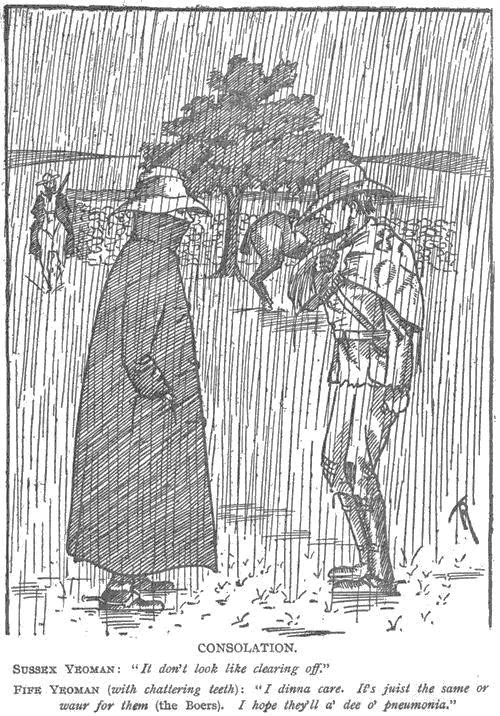
On Sunday (November 11th) we had some lively scrapping at the
commencement of our march, which was towards Krugersdorp.
During the day some of our Sussex fellows came upon an untenanted
shanty, containing scores of packets of magnificent candles. They
brought away all they possibly could, and were very generous to the rest
of us with them. That evening Mealie Villas was brilliantly illuminated,
and later I had the pleasure of presenting Dr. Welford and
Captain Cory with a packet of these unobtainable articles. Another man
who had been on a ration fatigue at the A.S.C. waggons in the afternoon
managed to take away a box of four dozen tins of apricot jam, not down
on our requisition. To "do" the A.S.C. is a virtuous deed. So we have
dined well lately, though at the present time of writing I am rather
tired of apricot preserve.
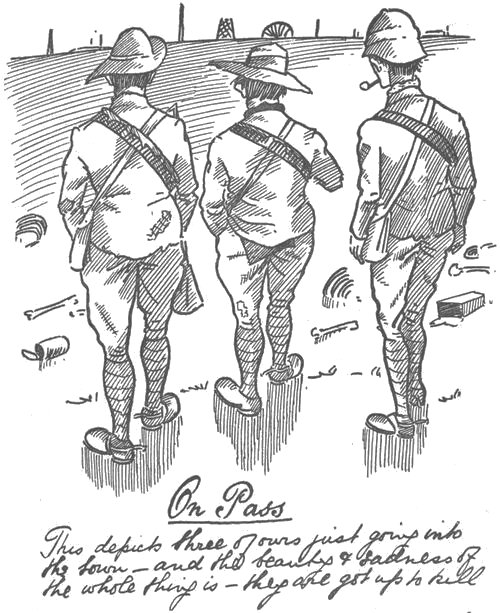
This day, Monday (November 12th), the column marched into Krugersdorp.
We were rearguard and just as we left the site of the camp, which had
been in a most picturesque spot, got bullets whistling by us and
knocking up the dust round our horses. Two of our men out of four, who
had relieved an infantry picket at reveillé are missing. The snipers
followed us about half the distance to the dorp and we had quite a warm
little rearguard action. I am just off to post this in the town.[Back to Contents]
Krugersdorp,
Saturday, Nov. 17th, 1900.
We are still camped within about three miles of this town, and expect to
remain here till Hart's Column returns. It went out yesterday after
having had a five weeks' rest. Amongst the mounted men were the Wilts,
Bucks, Yorks, and Suffolk Squadrons of Yeomanry. I think I told you in
my last we arrived here on Monday after a lively time as rearguard, the
Boers opening fire on us as soon as we had started to leave the place we
had camped at. That is the worst of pitching upon picturesque spots for
camps. We lost two men, who, however, eventually turned up safe and
sound, although some of their captors had shown a strong inclination to
shoot them, but, thanks to Delarey's brother, the bloody-minded minority
were disappointed. The snipers hung persistently on to our tail,
occupying each ridge and kopje as we retired from them. As soon as I had
picketed and fed my horse, I obtained leave and went into Krugersdorp,
passing on the way mines all the worse for want of wear, and the "Dubs"
and others under canvas. In the town I dined at what I should imagine
was a Bier Halle in the piping days of peace, but which in the
sniping days of war is an underground eating room run by Germans, who
charge a great deal for a very little, and find it far more profitable
than gold-mining.
I procured some tins of condensed milk, golden syrup, and jam for our
larder, and volumes by Ruskin, Meredith, Thackeray, and Kipling, for my
own somewhat small library. With these I proudly staggered back to camp,
aware of the royal and well-merited reception which awaited me, and
which I got. Whiteing was quite overcome at the sight of Ruskin and
Thackeray, while another friend implored permission to have a dip in
"The Seven Seas" (which seems a big request, I doubt not, to the
uninitiated).
I forgot to mention that on my return to camp I found mails awaiting me.
Thus passed a pleasant day. Tuesday I spent in camp, writing replies to
my kind correspondents, reading and re-reading my letters and papers. We
hear the C.I.V.'s are home, good luck to 'em, and though I have not read
the papers I can imagine to a slight extent the enthusiastic welcome
they were accorded. The knowledge that we have done our duty will be
enough for us; never mind the brazen bands, the free drinks, the
dyspeptical dinners, the cheers and jingo songs. Suffice it for us if
you will let us quietly alight from the train and get us home, to our
ain firesides. I fear I am rather bitter to-day; but, Christmas is
coming, and the date of our return no man knoweth! On Thursday we all
had to turn out to be inspected by "Bobs." If the turn out was to give
him an idea of our strength as a fighting force the whole thing was
"tommy-rot" for we paraded as strong as possible in numbers. The halt,
sick and the blind, so to speak, were in the ranks, every available
horse being used to mount them. Thus we turned out, our officers
anxiously making the centre guides prove, and issuing special orders to
us not to crowd when marching past in column of squadrons and all that
sort of thing. Then we marched to the parade ground, cow gun, field
guns, pom-poms, Infantry, Yeomanry, and Colonial mounted troops. After a
short wait a group of mounted beings appeared in the distance and
approached the force. We carried arms, and the infantry presented them.
The great little man and his staff passed along the front of
the force, and then cantered away, and the show was over, after having
in all occupied about five minutes. In the way of guards and pickets we
are not over-worked, the regiment having to supply a picket of one
officer and twenty men every night, which means each squadron comes on
every fourth night. The job is, also, what Tommy would call a distinctly
"cushey" one.
On Friday I went into the town and succeeded in securing a fine stock of
things for our larder, including a slab of Genoa cake, which I purchased
at the Field Force canteen, which has just been opened. In the evening
we entertained Sergeant Pullar, of the Fifes, at tea. This, though I
should be modest over it, was really a grand, indeed sumptuous repast.
Many a time has this gentleman given us biscuits on the veldt in our
hours of need, papers also to read, and so we meant to do the thing
well, and we did. In the morning a special invitation was sent from the
corporals of the Sussex Squadron residing at Nos. 1, 2 and 3, Mealie
Villas, requesting the pleasure of Sergeant Pullar's company to
afternoon tea, parade order optional. We formed a table of biscuit
boxes, which we covered with two recently-washed towels, and then I
managed to obtain a fine effect in the way of table decoration by taking
the spotted red handkerchief from my neck and laying it starwise as a
centre-piece. Then, having begged, borrowed and otherwise obtained all
the available tin plates, we covered the table with sardines, tinned
tongues, pickles, condensed milk, jams, butter, and cake. Sergeant
Pullar having arrived with his plate, knife, fork and spoon in a
haversack, we sat down on S.A.A. Cordite Mark IV. boxes, to a rattling
good feed, which guest and hosts did full justice to. Then it rained,
and we had to rig up our blanket hutches in record time, while our guest
sped to his tent. Thus ended an auspicious evening. The next morning we
had the deluge, for it poured in torrents, our wretched blanket shelters
proving far from rain-tight. But the real trouble was when we found we
were being swamped, the water flowing in and sopping us and our
belongings, the latter being by far the most important. Upon this I
turned out and found the whole camp was a swamp, and all the shovels
being used for digging trenches. Not to be done, I collared a
meat chopper from the Dorset cook-house, and started constructing
trenches for all I was worth, specially draining my part of the villa
where the library was in great danger. The rain ceasing after
a while, the other fellows emerged like so many slugs, and soon under my
supervision (was I not articled to an architect once?) an elaborate
system of drainage, consisting of trenches and dams, was constructed
around the villas. We had a bit of a row with our neighbours, who
complained that we had drained all our water on to them. A lot of
unnecessary damming was indulged in. However, from our point of view the
thing was a great success. Later the sun came out, and we dried all our
possessions. Great institution the sun! The next day being the Sabbath,
of course, we had to have a scrap, or at least try to have one. So we
had a reveillé at 2 a.m., in order to surround a house where about
forty Boers had been reported by some wretched being. On turning out,
several of us found our horses had disappeared during the night, mine
being among the number. So as not to be out of the fun, I took the first
wandering brute I found, and fell in. All this took place in the dark,
and later, when it became lighter, it was most amusing to see what some
of us had secured. Mine proved to be an officer's charger, but no goer.
When I got back to the lines, I found an infuriated officer's servant
marking time in front of me till we were dismissed, when he approached
and wrathfully spoke to me, stating that the horse had a sore back and
was lame in three legs. As he gave me no chance to offer an apology or
explanation, we slanged and abused one another for about ten minutes, to
the delight of the squadron, and then parted so as not to miss other
similar rows. The result of the morning's work was, I hear, two Boers
captured. For this we all laid on the wet ground behind anthills and
other cover for about two hours, waiting for them to come our way; while
Legge's crowd pom-pommed and field-gunned them for about an hour. The
Boers also used a good deal of ammunition, doing us no damage, but
getting away through the usual missing link in the chain. This afternoon
(Monday, 19th) we received mails, my share being three letters, and some
papers.
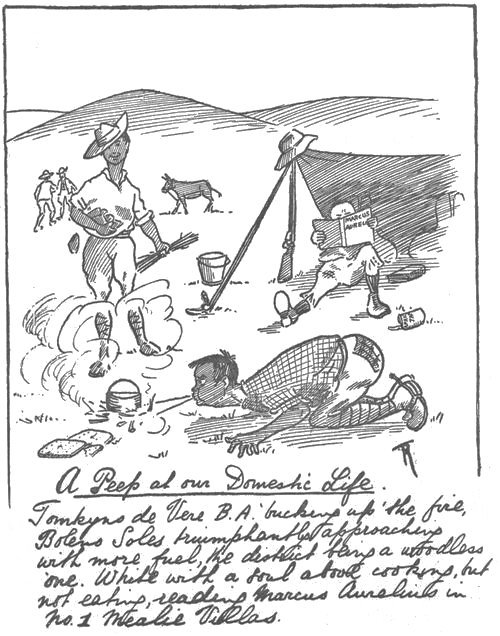
Tuesday, Nov. 20th. I have just heard that we are off for a ten weeks'
trek to-morrow, so I must bring this to a conclusion, and get into town
to post it, and also to procure some more stores. It may or may not
interest you to know that of all the jams we have had out here
(and we have been served out with at least a score of different brands)
the very best, made from the most genuine fruit, were the conserves of
two Australian firms. These two firms are head and shoulders above all
other makers bar none. "Advance, Australia" is right.
Well, here we are, and here we are going to remain, for how long the
Fates only know. Sometimes in my most optimistic moments I cheerfully
look forward to spending the golden autumn of my life in the land of my
birth. As I write this evening by candlelight, in our rude substitute
for a tent, I can hear the chorus of "The miner's (why not a yeoman's?)
dream of home," which comes wafted to us from the Fife lines. As you
will, I hope, receive this by Christmas, I take the opportunity to wish
you and all kind friends a right merrie Christmas and a prosperous new
year. For us no holly will prick nor mistletoe hang. If Santa Claus
comes it will probably be with a Mauser, and for some, alas! obituary
cards will take the place of the coloured productions of Bavarian firms.
But come weal, come woe, where'er we be on that day, I can guarantee you
our sentiments will be easily summed up by the following:
"Our heart's where they rocked our cradle,
Our love where we spent our toil;
And our faith and our hope and our honour,
We pledge to our native soil!"[Back to Contents]
Krugersdorp (again),
Wednesday, November 28th, 1900.
We returned here on Monday, after having been out for about a week's
cruise on the troubled veldt, and, in spite of the rumour that we were
to be treking again this morning, we are still here. I will endeavour to
give you the usual veracious account of our doings. I say "veracious"
advisedly, as oftentimes, after having seen something extra strong in
the Ananias-Sapphira-Munchausen-Gulliver-de-Rougemont epistolary line
from some gentleman in khaki to the old folks at home, in a London or
provincial paper, I feel that I must give up letter writing altogether,
as by now those at home must have discovered that such effusions are
often seven-eighths lies, and the remaining one-eighth truth,
simply because the scribe's powers of invention have failed him, owing
to the great strain. Only yesterday I saw in a certain local paper such
an epistle from one of our fellows, who, owing to various circumstances,
only joined us in September last, and has now joined the estimable
waggon crowd. From it I gathered that we had fought incessantly for
several days, on one occasion being without food or water for
thirty-nine hours, etc., and afterwards for our magnificent behaviour
had been called up to the general's tent, warmly congratulated by him,
and presented with a pot of jam each. So my diffidence about writing
will be easily understood, I am sure. And now for the celestial truth.
On Wednesday last (November 21st) we had an unexpected reveillé at
1.30 a.m., and set out with four days' supplies for Somewherefontein
(where, we did not know). A "revally" at such an hour is, as you may
imagine, by no means devoid of interest; I don't know whether you have
ever experienced one; if you have you know all about it; if not you have
a great experience lacking. There was I, collecting and packing our
larder in an oat sack, my miniature Bodleian and other various
possessions in another, dismantling our blanket shelter, and a hundred
other things, including feeding and saddling up my Rosinante, and
then—"Stan' to your 'osses!" We paraded smartly, and after a short
wait, moved off as right flank. A few hours after dawn there was
fighting in front of the column, but not our way, Legge's crowd working
on a parallel road and some way ahead of us. At about mid-day we reached
a wonderfully fertile village (Sterkfontein), and, imagining it to be
unoccupied, our Provost-Marshal and his satellites rode forward to
select a site for our camp, and got well sniped from some of the houses.
Thereupon Number Eight came up, and at comparatively speaking short
range, opened fire and 15-poundered them. To us, who were watching the
show, the sight was a most interesting one. Crash through a house would
go one shell, another would account for something else, and flames and
smoke soon announced burning thatches and oat-hay stacks. The Mausers
soon ceased from troubling, and eventually we entered the fontein. To
our surprise no snipers were captured, and it was asserted
that the firing had been done by the ladies, who, with children, were
the only persons found there. However, as no firearms or signs of their
having done so, were found, the matter, like most things where the wily
Boer is concerned, remains a mystery. It is a fact that lady snipers do
exist. For some time the Borders had in their guard-room, during our
last trip, amongst the various prisoners, a lady sniper they had bagged
while doing the Magaliesberg. There was not much of the Jeanne d'Arc
about her. I saw her once or twice. She was a regular barge, and of
great beam; her face was concealed by the usual kindly sun-bonnet.
(Note.—Our Regimental Sergeant-Major has just gone by, with
white canvas shoes and slacks on. This is most reassuring as
regards not moving off to-day).
Well, we camped near the village, which lay in a sort of saucer, being
surrounded by kopjes. On one of these our cow gun, yclept "Wearie
Willie," was hauled; it took fifty-six oxen to get him up there. The
Boers, whom we had surprised, were very sick at our unexpected visit,
and, had they only known, would undoubtedly have attempted to hold the
place a bit. As it was, they hung about far off. It rained a perfect
deluge that night, and my blanket roof collapsing I went to sleep with
it over me as it fell, lullabyed by the soft cursings of my neighbours
of 1 and 2 Mealie Villas, who were in like plight. The next morning we
were to have had reveillé at 5.30 and proceed to Rietfontein 12. (They
have to number these places out here. You probably have noticed the
innumerable Blandsfonteins, Hartebeestefonteins, Rietfonteins,
Bethanies, etc., in the Transvaal and Orange River Colony.) But Brother
Boer willed it otherwise, and about an hour before the fixed time I was
"revallyed" by the banging of guns distant and near. I arose to my feet
and the fact that Mr. Delarey was trying to shell us, as a not far
distant crack of an exploding shell testified. Near me, from under a
rain-soaked blanket a sun-bronzed face appeared and a sleepy voice
inquired "are the burchers (burghers) shelling us?" The seeker after
knowledge was informed they were. We soon got the order to turn out,
saddle up and escort the guns. This we quickly did. As we
moved out a few shells skimmed over the kopjes and lobbed themselves
where our lines had been. By this time our field guns and cow gun were
well at it, and the Boers were shifting a bit. We dismounted, lined the
kopje we had ridden up to, and watched the work of our gunners.
Presently from half up the hill in front of us, I saw a flickering white
flash and pom-pom-pom-pom-pom-pom went Delarey's gun of that name,
followed by a whistling over our heads and half-a-dozen cracks behind,
where, looking round, I saw the same number of puffs of smoke and earth
arise from the ground. This went on for a while, they were trying to get
on our led horses, I believe. I afterwards heard some went fairly close,
also that the general had one very near. Apropos of this pom-poming,
our colonel, who had had their missiles all round him and had quite
ignored them, as is his invariable custom, strolled up to one of our
officers and the conversation turning on to pom-poms, languidly
remarked: "Ye-es, I don't think they do much weel destwuction—er-er—it
is pwincipally their demowalising effect." The demoralising effect on
himself having been so very non-evident, this remark struck me as being
distinctly good. Our "Wearie Willie" snapped out a remark now and again,
and apparently always to the point. Later, Legge's men occupied the
ridge opposite and chivvied the enemy for several miles; we, returning
to camp, watered our horses and, twenty minutes later, set out on a
reconnaissance with the guns in hopes of finding some snipers in the
vicinity of Hekpoort. We returned bagless. That night it rained, as
usual, and as we had not had time to rig up any shelters, or even dry
our blankets, we came in for another good wetting. At two o'clock the
next (Saturday) morning we had to turn out and stand to our horses.
"Steady, boys, steady, we always are ready"—afterwards; you know our
good old British style. But Frater Boer had had a belly full the
preceding day, his losses in killed and wounded being considerable, I
hear. Legge's men swear to have buried eight, and Clements said one of
our shells hit a gun of their's. That night we had the fashionable and
seasonable rain again. (Please, in future, remember we have this every
night, and so I will refrain from too many references to it). On Sunday
we moved off for Rietfontein, No. 1001. We formed the
rearguard and expected a bit of harassing, the country being most
favourable for such operations on the part of the enemy. But they left
us alone, though they were undoubtedly about unseen. As several waggons
broke down, and had to be mended or burned, we had to grill on the
kopjes for hour upon hour, cursing the convoy with all our might.
Presently the inevitable question "What's the date?" elicited the fact
that it was the 25th. (You can imagine the chorus "A month to
Christmas!" and Sunday.) Sunday, and you probably in your frock coat and
patent boots, luxuriously reclining in an upholstered pew, listening to
promises of peace and rest, or standing up half thinking of the good
meal to follow, and singing
"I came to Jesus as I was,
Weary, and worn, and sad;
I found in Him a resting place,
And He hath made me glad."
And I, there on those hard rocks, with a perpendicular sun above me,
mechanically watching the distant hills, but seeing with strong mental
eyes a church porch with roses and creeper over it and noting the
Sabbath silence which presently would be broken softly by the voices of
the worshippers within:
"Come unto Me, ye weary,
And I will give you rest."
I think to stand outside a church and hear the worshippers within is to
get one of the most pleasant impressions possible; somehow it always
strikes me that one imagines the people within to be so much holier,
indeed more spiritual, than they really are. But all this looks either
like preaching or scoffing, and it is neither. It is really the result
of a desire to push myself into the home life you good people are still
leading, somehow or other. An excusable offence after all, my Masters!
Having re-cursed the tail of the convoy, it at last moved forward, and
we, having allowed it so much grace, did the same. At the outskirts of
the village, which the column had moved through, the last waggon—an
overloaded one—collapsed, and once again we manned the heights. I was
sent out with a couple of men to a post a little in advance of the rest
of our troop, and, after an hour, about a mile off saw four Boers
nonchalantly riding toward the other side of the dorp. These were
followed by two more. I sent in and reported this, and shortly
after we moved off, unsniped. Undoubtedly these beggars had been waiting
for the column to pass, so that they could return and have a Sunday
dinner and a quiet evening, having had rather a rough week, and it was
only owing to the above-mentioned waggon breaking down that we had a
glimpse into the ways of our enemy. Our camp was not far off, and we go
there at about six; some of the column were in by eleven in the morning.
The amount of burning done en route was almost appalling. The next day
we marched into Krugersdorp once again, passing several marshy spots
where arum lilies were blooming in rich profusion. We reached here at
noon; the Dorsets and Devons who formed the rearguard had a bit of
scrapping, and, thanks to a straggling convoy, did not get into camp
till close on midnight, and so, of course, got a rare soaking from the
usual rain. Here I have received a few belated mails, and live in hopes
of getting the latest. I have also read in some of the papers of the
welcome home of the C.I.V.'s.
"You've welcomed back the C.I.V.'s,
Back from their toil to home and ease;
The war is going pretty strong,
We've bade adieu to 'sha'n't be long';
And you at home across the seas,
Don't quite forget us, if you please."
The following poetic outburst requires a little explanation. We have had
the khaki this and the khaki that, and it has just occurred to me a
khaki Omar Khayyam would not be out of place, for of a truth one needs a
soupçon of philosophy out here occasionally. With this idea in my
head, and having a little leisured ease, I have set out to minister a
long-felt want. Not, however, having my Persian "Fitzgerald" by me, I
must ask your indulgence for any grave discrepancies in the text.
THE RUBAIYAT OF OMAR KHAYYAM.
(For the use of British Soldiers on the Veldt.)
The night has gone, the golden sun has riz,
The khaki men have all begun to friz,
Cleared is the mushroom camp of yesterday,
And forth they go upon the Empire's biz.
Oh! hopes of home that with each morning rise,
Oh! wondrous legends which wild minds devise;
One thing is certain, and the rest is lies,
The Yeoman, once enlisted, often sighs.
Oh! fool to cry "The Boer is on the run,"
He is, we know, and ain't forgot his gun;
And often from the rocky kopje side
He stops and pots—your mess is minus one.
I sometimes think that nought whiffs on the wind
As strong as where some dying steed reclined;
That any casual stranger passing by
The place, if asked, again could eas'ly find.
Alas! that Mausers are not turned to hoes,
That Christmas comes, and with the pudding goes;
And we stick here for ever and a day,
When we return (or if) who knows—WHO KNOWS?
Oh! Pard, could thou and I with Holmes conspire
To round De Wet up with his force entire;
Would we not smash it all to bits—and then
Get somewhere nearer to our heart's desire.
A pipe o' baccy 'neath a leafy tree,
A recent mail from far across the sea,
No one to worry for an hour or two,
And veldt, indeed, were Paradise to me.
And, lo, 'tis vain the generals to blame,
Keep boldly sticking at the ancient game;
And if to-day you are upon the veldt,
To-morrow it will also be the same.
Each morn's reveillé comes like some nightmare,
Sleepy you rise and pack your kit, and swear;
Then mount your saddled steed with gun in hand,
And hasten off, you know not why or where.
Some in the fighting let their hearts rejoice,
For some the waggons are the patriot's choice:
Oh! loot the farm, don't let the chickens go,
Nor heed the roaring of the sergeant's voice!
They say the gentlemen in khaki keep
The courts where Kruger once did plot so deep;
That great Oom Paul across the sea has trekked,
Before the Courts of Europe now to weep.
We are but pawns, first front, then flank, then rear,
Moved by the Master Players there and here
Upon the veldt and kopje (that's the board),
Sans tents, sans beds, sans pudding and sans BEER.
Yon broiling sun which smiles and is our bane,
Yon thunder-cloud which means a soaking rain,
Will both some day look down upon this veldt
For us, and let us hope 'twill be in vain.
The above extract will, I am sure, suffice to show the general tone of
the khaki Rubaiyat, and be more than enough to damn my poor but honest
reputation.[Back to Contents]
Krugersdorp,
December 5th, 1900.
As the English mail leaves this benighted place to-morrow at mid-day, I
am dropping you a few lines, though I feel in anything but a scribbling
humour. Clements moved out on Monday for about a week's jaunt, and left
us, the Sussex Squadron and sick men, behind in charge of about a
hundred remounts, mostly Argentines; and with the pleasant task of doing
pickets and such like, about two miles out from the town. As I write I
am very wet, it having been raining for the last two days. This morning
the other four occupants of Mealie Villas had to clear off at 3 o'clock
to do a picket, and so, as they naturally withdrew the support of their
rifles from their blankets, there was not much shelter for me. I wonder
what your opinion was on the statements of Mr. Burdett-Coutts, M.P., as
regards certain hospitals out here, and also what you think of the Army
doctor? It was my duty to parade the sick men before one of these august
beings this morning. I received the order at a quarter past nine from
our Squadron Sergeant-Major to parade before the doctor's tent, in the
lines of Marshall's Horse, at 9.30. So at that time, behold me with
fourteen sick men in the driving, drenching rain waiting in puddles of
water outside the well-closed tent of the disciple of Esculapius. There
we waited till at last an officer entering the tent, in response to my
inquiry, as to whether I was at the right place or not, replied in the
affirmative and informed an unseen being that there was a sick parade
outside. Apparently without even rising, the great unseen was heard to
remark shortly, "Sick parade is at seven o'clock every
morning," the tent was again closed, and the men with fever, dysentery,
colds and sores wended their ways through the rain and mud, back to the
damp interiors of their leaking blanket hovels. They were men of the
Fife, Devon, Dorset, and Sussex Yeomanry Squadrons, and that is how some
of your dear patriotic volunteers get treated occasionally by certain
doctors out here. Our Battalion doctor (the 7th) is a very good sort,
and if you are bad will see you at almost any time.
On Wednesday (November 29th) a friend and I went into the 'Dorp and got
a few stores (alas! the Field Force canteen is almost empty and the
prospects of its being replenished are drear). Afterwards we strolled up
to the station to see if there were any mails, and to see a train again.
The Johannesburg train came in while we were there, and a sergeant-major
of Kitchener's Horse shot an officer of the same corps soon after
alighting from the train. The officer had put him under arrest for
misbehaviour in Johannesburg. I had my choice of a dozen yarns as to the
real cause of the tragedy. The officer was buried the next day. The fate
of the sergeant-major I have not heard yet, though it is not difficult
to guess. Mr. Wynne, our troop leader left us this day for England,
having applied for leave on business. A statement of the losses among
our officers may not be uninteresting. All of the following, save the
last, are home or on their way: The Duke of Norfolk, injured thigh; the
Hon. T. A. Brassey, elections; Mr. Ashby, reasons unknown, but
undoubtedly excellent; Mr. Williams-Wynne, business reasons; Mr. Cory,
still out here but working with the transport—hard.
Which leaves us Mr. McLean, of rowing fame, as our captain and only
officer.
Saturday, apart from lifting us into December, was I believe,
uneventful.[Back to Contents]
On Sunday we had a Brigade Church Service—we had not had one for a long
time. We also had a real padre, who wore a surplice, cassock, and
helmet, and who preached an indifferent sermon. I don't
suppose we deserve a real good man.
The great event of Tuesday was the fate of my Christmas pudding, which I
had received from my Mater. Having handled and examined it carefully
for some time, I thought I could detect signs of decomposition about it.
I communicated my fears to my comrades, who shared them, and
said they didn't think it would last till Christmas. It didn't; for we
ate it that evening. It was good, and I suppose we ought to feel ashamed
of ourselves for eating it out of season, but really our excuses are
many, principal among them being it is not wise trying to keep edibles,
as they have a way of getting lost, and if the pudding managed to last
to Christmas it is just on the cards we might not.
To show you how civilised we are at the 'Dorp, we, when in standing
camp, occasionally have a chance of getting a drink of beer. This
afternoon a barrel was brought into our camp, and to-night we shall be
able to buy pots of it at sixpence a pint. You should see those pints!
We may be Imperial Yeomanry, but they don't give us Imperial Pints.
Teetotallers will be interested and pleased to hear that out of our
princely stipend of 1s. 3d. per diem (unpaid since July) we don't buy
much of the beverage.
I have drawn a fresh horse from the remounts we are in charge of; my
last gee-gee I called "Barkis," because he was willing, this brute I
shall have to dub "Smith," because he certainly is not—Willing.
N.B.—Our mounts are always known as "troop horses," those belonging to
the officers though, however Rosinante-like, are invariably, politely
and with dignity alluded to as "chargers."
Thursday morning. We had to turn out and stand to arms this morning at
three, an attack being expected on the railway. I, happening to have the
stable picket, had the pleasure of arousing the recumbent forms of the
sleepers with the joyous Christmas carol of "Christians, awake! come,
salute the happy morn." You ought to have seen the "Christians" awake;
to have heard them would have been too awful.
So from three till six we stood to arms, a thick fog enveloping us,
making it impossible to see more than fifty yards to our front or rear.
But they did not come. I understand that we may have "the stand to arms"
wheeze every morning now, so we have something to look forward to.[Back to Contents]
Krugersdorp.
Wednesday, December 12th, 1900.
As we are under orders to leave here and join Clements to-morrow, I am
writing so as to catch the mail which goes out on Thursday.
On Sunday we had a Church Service, and in the afternoon had a visit from
Nobby—the Border Regiment has been resting at Krugersdorp for a few
weeks—who entertained us till, what out here we should term a late
hour, about nine.
On Monday I heard that another of our Sussex fellows had died of enteric
at Pretoria.
Nobby has just looked in again, he is rather a swell, wearing one of our
new war hats we had served out, and which I gave him, preferring to keep
my old one; in his words, he looks as if he belonged to the "Yeomandry."
It is wonderful how all our fellows get on with our professional
brethren. Take for instance one of our men, a 'Varsity man, hight
Pember, he is a dry, self-contained beggar, and lives his own life. Into
this life has come a man of the Northumberland Fusiliers. They both hail
from the same county. After the day's march, when the Infantry not on
picket are in camp, a dark figure often slouches up our lines, and a
voice inquires, "Is Pem 'ere?" and Pember of ours, late of Trinity Hall,
calls out from the darkness, "Here you are, mate," and forthwith the man
of the Fighting Fifth and the Imperial Yeoman sit down together and chat
of Heaven knows what, and the latter gives the former half of his prized
hard tack ration (he wouldn't give me a biscuit for his soul's
salvation), for the Northumberlands do not fare well at their
quartermaster's hands, at least they did not the last time we were on
the trek. Then, at about the same time Nobby is leaving us, the Fusilier
also arises and disappears with a "Good night, chummy," into the
darkness.
The dry canteen, for the troops, in the town, is now quite empty.
Fortunately, we still have some of the Great Candle Loot left, otherwise
we should be very much in the dark after sunset. To save our candles
from draughts and get a good light, we always burn them in
biscuit tins, a practice I can recommended highly if ever you go out
campaigning and lack a lantern. A convoy going to Rustenburg from
Pretoria was attacked and part captured a few days ago by Delarey's
crowd. I had expected that to happen soon, the length of the convoy and
insufficiency of its guard, having frequently struck me as very tempting
for Brother Boer.
Well, I must conclude, as I have nothing of note to narrate, and must
begin to pack my possessions in a manner to circumvent our
quartermaster-sergeant when packing our kits on the waggon.

IN HOSPITAL. — The Story of Nooitgedacht. — Two Field Hospitals—A Contrast. — Christmas in Hospital. — The Career of an Untruth. — The Sisters' Albums. — "Long live the King!" — The Irish Fusilier's Ambition. — "War without End." — Invitations—and a Concert. — Our Orderly's Blighted Heart. — Southward Ho! — R.A.M.C. Experiences and Impressions. — The Mythical and Real Officer. [10] — The R.A.M.C. Sergeant-Major, and other annoyances. — At the Base. — Another Album!! — Home.
Imperial Yeomanry Hospital,
Pretoria.
Tuesday, December 18th, 1900.
Dulce et decorum 'tis to bleed for one's country, especially to a
small extent, and that is my case. So here I am taking my ease with a
slightly stiff leg, caused by a flesh wound acquired during a lively
rearguard action we had on the 14th, and my hand tied up in a manner to
render writing rather a slow and fumbling ceremony. I always find it
easier to write of the present than the past, so will get through the
events of last week as quickly as possible. On Thursday last we left
Krugersdorp for Rietfontein to join Clements, with the Borders, some
mounted details and useless remounts. Half of our fellows were leading
the latter. We, the remainder, formed the rearguard, and a long,
wearisome job it was. Oh, how those waggons broke down and stuck in
dongas and spruits! At last we got into camp, to my infinite relief, for
the sun had, for once, given me a vile head. All through the day we
heard guns firing, first near us and then distant. The next day we were
again rearguard, and had a rare harassing. The end of that beastly
convoy seemed to lag even more than on the preceding day! And we of the
rearguard, on the kopjes and ridges, watched the enemy galloping round
and up to the favourable positions, potting at them when we had a decent
chance. But they knew the lay of the land, of course, and the closer
they got the more invisible they became. They don't require khaki to
make them indiscernible. Then a single shot would inform us as it hummed
above our heads that one gentleman had got into position, and was
getting the range, then others, and we knew his friends were with him,
and hard at it. Once a few of us happened to be lying in front of a
ridge we were holding, and at which the Boers were potting from
another about 800 yards off. We got the order to retire over the crest
and get better cover and had a warm time doing it. One at a
time we crawled, then, crouching low, rushed back a few yards and
dropped behind a rock for breath and cover. Then back again we dragged
ourselves till the cover was better. Their firing was distinctly good,
and several fellows were hit. On one occasion I dropped behind a small
piece of rock, ostrich-like, covering my head, and almost simultaneously
with my action a bullet struck the side of the rock a few inches from my
face with a nasty phutt. That is what it is like on such occasions.
That's the sort of game we played all day, cursing Clements for not
sending out to meet us and give us a hand. We did not know what had
happened in the valley the preceding day. Later we got into an ambush,
some of the enemy being within a hundred yards of us; and had several
horses killed. We thought that the show was over, as Rietfontein was
close handy, and the last time we were there the locality was clear. It
was almost dark when we entered Clements' camp. But where were the
tents, the men and horses that used to be? Presently a figure with a
face rendered unrecognisable by bandages, came up to us. It was Sergeant
Pullar of the Fifes, and from him we had the story of the previous day's
disaster. Over half the Fifes are missing, most of the Devons also,
so-and-so killed, and so-and-so, and so-and-so. Kits lost, and tents
burnt. From various reliable sources I have compiled the best account I
can make of the affair, which we missed by the merest fluke, what men
call chance, and here it is.[Back to Contents]
Clements' camp was at Nooitgedacht, between Hekpoort and Olifant's Nek,
where he had been for three days. Nooitgedacht is at the base of the
Magaliesberg range of hills (the name means "Ne'er Forgotten"). We had
camped there about a couple of months back. It lies near a large kloof.
A little to the west of Clements were Colonel Legge's mounted troops,
composed of Kitchener's and Roberts' Horse, "P" Battery R.H.A., and two
companies of M.I., the whole force numbering, at the most, 1,400 men.
Knowing that Delarey was in the vicinity with a strong force, the
general had helio'ed for reinforcements, which, unfortunately, were not
forthcoming, so apparently he was sitting tight, with doubled
pickets, on the Magaliesberg and kopjes in the valley. Then came the
eventful Thursday (the 13th). During the night Beyers' Commando made a
wonderful trek from the north to reinforce and co-operate with Clements'
old foe, Delarey, and just before dawn the enemy, who had crept up
unseen or heard in the dark, rushed Legge's pickets on the west of the
camp, shooting the sentries and many of the men as they lay asleep in
their blankets, soon afterwards getting into the gallant Colonel's camp.
Poor Legge, who ran out in the direction of the pickets as soon as he
heard the firing, was one of the first killed. Then Clements' pickets on
the Magaliesberg, which were composed of four-and-a-half companies of
Northumberland Fusiliers, suddenly became aware of the close proximity
of the enemy, who were in great force, about 3,000, and had, undetected,
crept up the gradual sloping northern side of the range. The
Northumberlands soon exhausted their ammunition, volunteers of the
Yorkshire Light Infantry tried to take them a fresh supply, but were
allowed to toil up the steep hillside with their heavy loads, only to be
dropped, when near their goal, by their exultant foes. Probably never
before have the Boers fought with such boldness, standing up and firing
regardless of exposing themselves. Meanwhile, the Yeomanry, who had been
standing to their horses in the camp, received the order to reinforce
the Northumberlands on the Magaliesberg above them, and, with the Fifes
leading and Devons following, commenced to ascend the precipitous
hillside. Alas, the Boers were in possession of the summit, the
Fusiliers having surrendered, and the Yeomanry got it hot. Of the Fifes,
Lieutenant Campbell, who had only joined them a fortnight ago at
Krugersdorp, was the first to fall, struck by an explosive bullet in the
head. Out of less than fifty, fourteen were killed, and almost all the
survivors wounded more or less seriously. At last, without a ray of
hope, they were compelled to surrender, too. Many a good comrade's fate
is known to me, so far, by that direly comprehensive word, missing. I
have heard that the Boers threw many of the wounded over the precipitous
southern side of the Magaliesberg, but do not believe it. Then they
turned their full attention to the camp below; every officer
of the staff was hit, the brigade-major was killed, having many wounds.
Clements himself went unscathed; wherever there was a hot corner the
general was to be seen coolly giving orders and apparently unconcerned
amid a hail of bullets. "I'll be d——d if they shall have the cow-gun,"
he remarked, and, by gad, they didn't. With drag ropes it was moved down
the hill for some distance, and then an attempt was made to inspan the
oxen. As fast as one was inspanned it was shot, and quickly another and
another would share its fate. At last, by sheer desperate perseverance,
some sort of a team was inspanned and the gun moved forward, leaving
dead and wounded men and considerably over half of the ox-team behind,
but with the aid of the field artillery, who shelled the kopjes, was at
length got on to a comparatively safe road. Of a truth, were I another
Virgil and a scribe of verse, not unheroic prose, I might well have
started this little account with
"I sing of arms and of heroes."
The getting away of the transport was a desperate affair; the niggers
scooted, and amid the roar of the field guns, pom-poms, maxims and
rifles, which between the hills was terrific, the mules stampeded.
Officers, conductors and troopers rode after the runaways, and, under
threats of shooting if they didn't, compelled the niggers to return with
the mules. Chief amongst the Yeomanry who distinguished themselves that
day, was Sergeant Pullar, who rode after the retiring convoy, called
for, and returned with volunteers to the camp and helped with the guns
and ammunition, and in various other ways. At last the Boers swarmed
into the camp and our guns, turning on it, shelled it, containing as it
did, friend and foe alike, a regrettable but absolutely necessary
measure. Then our force retiring down the valley to Rietfontein fought a
fierce rearguard action, the Dorset Yeomanry under Sir Elliot Lees and
the remnants of the Fifes and Devons forming the rear screen, supported
by Kitchener's and Roberts' Horse, mostly dismounted, and the guns.
During this retirement, which I have heard wrongly ascribed to the M.I.,
Sir Elliot and his orderly, Ingram, of the Dorsets, on one occasion
finding that two dismounted Yeomen had been left behind on a recently
abandoned kopje, gallantly rode back and bore them away on
their horses into comparative safety.[7] The artillery were grand, as
ever, and in spite of killed and wounded gunners and great losses in the
teams, saved their guns and used them to effect. At six o'clock on
Friday morning the rearguard entered camp at Rietfontein. Our
casualties—killed, wounded and missing, are 640, while it is stated and
believed that the enemy's losses were even more severe. It seems a
strange coincidence that exactly this time a year ago at home in dear
old England we were going through the black Stormberg and Colenso week,
and Christmastide was coming to many a sorrowing home.
Since writing the above, I have heard vague tales that a good many of
the missing have turned up at Rustenburg, being either men who got
through or released prisoners. This I rather anticipated and hope to be
true. About the Yeomanry I have not heard any reassuring news yet; one
thing is certain—they had many casualties and fought desperately.
Nooitgedacht.
Thursday, December 13th, 1900.
Comrades of Fife and of Devon,
Dying as brave men die,
Under God's smiling blue heaven,
Now you peacefully lie
On the hills you died defending,
Or veldt where you nobly fell,
Your foemen before you sending;
Good comrades, fare thee well.
O comrades of Devon and Fife,
Memories flood me o'er;
Fierce mem'ries of many a strife
In days that are no more;
Full many a fast have we shared,
Of many treks could I tell;
Brave men who have done and dared,
Comrades of mine—farewell.
L'envoi.
And when in the great Valhalla
All of us meet again;
Norsemen in skins and armour
And men in khaki plain;
With a smile to erstwhile foemen
Who 'gainst us fought and fell,
I'll haste to my fellow Yeomen,
Till then, dear chums—farewell![Back to Contents]
On Friday I went before our Battalion doctor, who had lost everything,
save what he stood in. However, he fixed up my leg and hand and exempted
me from duty. On going before him the next day he said my leg wanted
resting, and in spite of protests sent me to the R.A.M.C. field
hospital. A word aside here. I suppose you have heard of this great
institution of the British Army—the d——d R.A.M.C. (I seldom, if ever,
have heard it alluded to without the big, big D's.) My experience of it,
I am pleased to say, has been, so far, severely limited, but, slight as
it is, I can quite understand why it is lacking in popularity. With
three other Yeomen and my kit, I accompanied the doctor's orderly to the
Brigade Hospital. The order for our admission was given in, and we were
told we should be attended to at nine. The sun was hot, shade there was
none, and outside the doctor's tent we waited. Nine came and went, a
doctor also rode up, chatted with someone inside, and rode away. The sun
was scorching, and we dare not go away to get in any friendly shade.
Three of us had game legs and one dysentery, but, of course, we grumbled
not, for the R.A.M.C. are all honourable men. Various squads of sick
Artillery, M.I. and other regiments marched up, and finally an R.A.M.C.
sergeant came to the entrance of the tent and began calling them up
before the doctor. Eleven o'clock came, and in the hot sun we waited
still, in spite of being half-determined to return to our lines, as it
was getting rather wearisome and confoundedly hot; but the R.A.M.C. are
all honourable men. A Canadian helped a chum down to the group of
impatient patients, and after a few words left him with the terribly
audible remark, "So long, ole man. I'd sooner blanked-well die on the
veldt than go there." Which showed how he failed to appreciate
the R.A.M.C., and also his bad taste, for those inside must have heard
him. But there, they know that they, the R.A.M.C., are all honourable
men. "Driver Neads!" calls the spic and span little dark-moustached
sergeant, reading from a list of names. A ragged dirty-looking
Artilleryman limps painfully up, two pills are given to him, he gazes
curiously at them, then at the back of the donor, who has turned away,
and then realising that nothing further is to be done for him, limps
heavily back, making room for the next patient. Once in the background,
he heels a small hole in the earth, turns the contents of his hand into
it, methodically fills the hole up, and hobbles back with his squad.
They were, of course, the celebrated "Number Nines," the great panacea
out here as, of course, you know. They (are supposed to) cure all
diseases, from dysentery and brain fever to broken legs and heads.
And still we, who were first, waited in the blazing sun, to be last.
Finally the smart sergeant smilingly recognised us, and cheerily told us
that there was an Imperial Yeomanry Field Hospital somewhere in the
vicinity, and we were to go there, and with that returned us our
admittance form. I pressed him for more accurate information, and had
the supposed direction given me, which proved correct. So off we
crawled, I, with my Bunyan's Pilgrim-like load, holding the position of
a scratch man in a race. I could not have done the distance had I not
procured the services of a nigger, who relieved me of my kit for a
shilling. So we shook the dust of the R.A.M.C. Field Hospital from our
boots, but let not an abusive word be levelled at them, for are they not
all honourable men?
The Imperial Yeomanry Field Hospital was about a mile off, and on
reaching it we were treated with every kindness. They had only come in
the previous night, and we were the first patients. Every consideration
was shown to us, and in a few minutes we were lying down in a fine tent
of the marquee brand and drinking excellent café au lait and eating
bully and biscuit. "The best we can do for you at present," as they
apologetically remarked to us. Fomentations were applied to our wounds,
and luxuriously reclining on my back, smoking a Turkish cigarette one of
the orderlies had just given me, I fervently swore that the
grandest institution in South Africa was the I.Y. Field Hospital. In the
afternoon some sick Inniskilling Fusiliers were admitted, and for some
time seemed dazed at the kind treatment they were receiving, and
appeared half under the impression they were in Heaven. "What's this
chummy?" queried one. "Imperial Yeomanry Hospital" was the reply. "Thank
Gawd 'taint the R.A.M.C." grunted the Tommy, turning over on his side
with a sigh of relief. At about ten that night we had to make room in
our tent for a dozen wounded men from Thursday's fight. Ninety were
being brought into Rietfontein and the I.Y. people were taking half.
Soon an ambulance was halted by our tent, and wounded men hobbled or
were carried in, heads, arms and legs tied up, with here and there blood
showing through the bandages. They were M.I., Kitchener's Horse,
Northumberlands and K.O.Y.L.I. (King's Own Yorkshire Light Infantry).
"Man," started a Yorkshire man before he had been in the tent a minute,
"they (the Boers) treated us real well." "Ay, they was all right,"
chimed in a M.I. man, "they gave us to eat as much as they 'ad." "One
bloke arsked my permission to take the boots orf one of our dead chaps,"
said a Northumberland Fusilier. And at it they went hammer and tongue,
especially the latter. To follow the various speakers one needed a dozen
pairs of ears at least. Several related that the Boers came up to them
and told them they had made a grand fight of it. They were quickly
supplied with beef tea and biscuits, and some of the necessary cases
were dressed again. "See that that man has a ground sheet down there,"
ordered Major Stonham, "he is on the bare earth." "I've laid on it for
three nights out there, sir," cheerfully vouchsafed the patient under
notice.
At last I got to sleep, awaking at four, and having had a small bowl of
porridge and milk, arose with the other fellows who had come in with me
and the sick Inniskillings, and getting our kits, got into an ambulance
waggon for the first time. The I.Y. people sent in two ambulances and
the R.A.M.C. three open mule waggons filled with sick soldiers. We
reached Pretoria at three, and we four Yeomen were sent to the Imperial
Yeomanry Hospital, where, after once again giving in our names,
regimental numbers, ranks, regiments, service, ailments,
religion, and a hundred other items of general information, I was
allotted a ward, bed, and suit of pyjamas, and after having had a bath,
got into bed and awaited the next person desirous for my name, number,
time of service, &c. It was not long before the sister in charge of our
ward appeared; she is Irish (Sister Strohan), and naturally very kind.
Our tent holds six men, and we were all new arrivals that evening. She
asked if we had had anything to eat, and we said we had had nothing
beyond a little porridge at four in the morning. Then she
commanded the orderlies to get "these poor men" bread, marmalade,
cocoa, beef tea, pillows and all sorts of things. And we "poor men" laid
comfortably in our beds and grinned at one another. She ordered us later
to go to sleep, but we could not. For myself, I had not been in a bed
for so long that I positively felt restless, and almost rolled out of
bed so as to have a comfortable "doss" on the ground (it seemed like a
case of the pig returning to its wallowing). At last I fell asleep, and
once in that state took a good deal of arousing—for night nurses and
orderlies tread more lightly than stable guards, and loose horses
grazing round one's head.
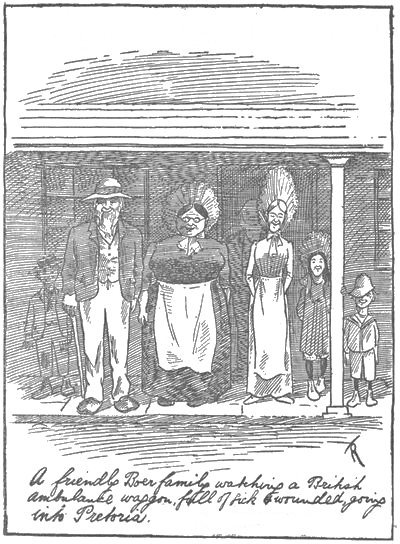
Thursday, December 20th. A friend, of the Fife Yeomanry, came in here
wounded last night. He went up with twenty other men of his crowd to
reinforce the Northumberlands on the hill. Out of these, six were killed
and nine wounded. I have already told you many of the dead and wounded
were left on the kopjes for several days. He tells me it was horrible to
see some of the poor fellows; the flies had got on their wounds. One
fellow with a wounded jaw had maggots inside as well as out, and they
were taken out of his mouth with little bits of stick. Another with a
wounded side was quite a heaving, moving mass of them where he had been
hit.[Back to Contents]
Imperial Yeomanry Hospital,
Pretoria.
Monday, December 24th, 1900.
Here's to the doc's an' the nusses,
The bloomin' ord'lies too,
Who tend to us poor worn cusses,
All of 'em good and true.
Fightin' with death unceasin',
With ne'er a word of brag,
Sorrow an' anguish easin',
Under the Red Cross flag.
Extract from forthcoming "Orspital Odes."
Christmas Eve! Forsooth! And it falls on a homesick British Army in
South Africa, home-yearning and longing for a sight of the sea (our
sea!) like the famous Grecian host of old. If you ask a
British soldier, "How goes it?" he promptly growls, "Feddup." I wonder
what the Grecian warrior's equivalent for "fed up" was. He had one I am
sure.
Christmas Eve, forsooth! Where is the prickly, red-berried holly? Where,
too, the mistletoe with its pearly berries? And where, most of all,
queries your enforced member of a Blue Ribbon Army—where is the Wassail
Bowl?
The weather is fine, and under our tents we don't feel the heat of the
sun. After the monotony of khaki here, there and everywhere, to which
one gets accustomed on the veldt, the colours one sees here are quite
enlivening. To begin with, place aux dames the nurses are arrayed in
grey, white and red, and the patients who arrive in torn, worn, dirty or
bloody khaki, surrender all their warlike habiliments to an orderly,
have a bath and then "blossom in purple and red"—pyjamas, or in pinks,
stripes or spots.
The food is very good here, and, as Tommy says, there is bags of it.
"Bags" is the great Army word for abundance. It is used apparently
without discrimination, and so one hears of bags of jam, bags of beer,
bags of bags, bags of fun, or anything else in or out of reason.
For a student of dialect this hospital opens a large field. It is a
regular Babel at times, our Sister speaking a superior Irish and the
orderly an inferior brogue. In our tent are a Scotch, two Welsh, a
Dorset and a Sussex Yeoman. In the next tent are some regulars of the
Northumberland Fusiliers and Yorkshire Light Infantry, and a true-bred
cockney Hussar, and their speech requires careful attention if the
listener wishes to understand it, I can assure you. A few Kaffirs
talking a bastard Dutch and an old Harrovian, who stutters like an
excited soda water syphon, completes the Babel in my immediate
neighbourhood.
The Irish orderly, Mick, by the way, is one of the most wonderful and
plausible fellows I have met out here. To say he could talk a donkey's
hind leg off would be a mild way of describing his excessive
volubility—he would chatter a centipede's legs off. Often when he comes
in, with another orderly's broom, to make a pretence of sweeping the
tent out, and leaning on the stick, starts retailing stories
of mystery and imagination, I lay down the book I am trying to read, and
closing my eyes, drift into the land of true romance.
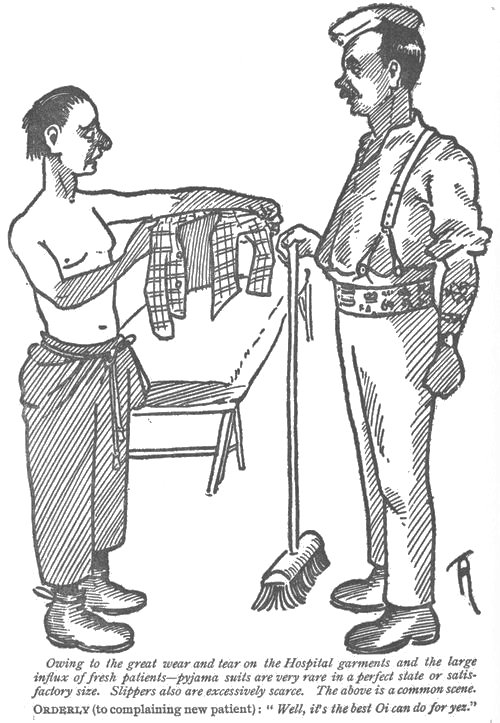
It is a land uninhabited by ladyes fayre in the general way, for the
dramatis personæ usually comprise "th' ortherly corp'ril"; "th'
sargint of th' gyard"; "th' qua'thermasther, an' a low blaygyard he
waz"; "th' gin'ril o' th' disthrict"; "a lif'tint in 'H' Company"; and
other military personages, with "th' ortherly room" or a "disthrict
coort-martial" thrown in. If I had only had a phonograph I would
preserve them, and when I get home, have them set up in type, tastily
bound, and announced as "Tales from the Ill, by R—. K—.," and then
live a life of opulent ease on the proceeds thereof.
"Th' sisther," as he calls her, says he is a dreadful man, and from her
point of view I don't think she is far away from the truth. He argues
about everything, and is always blaming his fellow orderlies. Still, it
is the dreadful men who are invariably so entertaining.
I have just heard that a friend, Trooper Bewes, a cheery fellow of the
Devons, has succumbed to his wound. Christmas Eve, forsooth! His chum
was shot through the stomach, and died on the veldt. Poor fellow, he
(the chum) was always swallowing with avidity any rumour about our going
home—perhaps he was too keen, and ironical fate stepped in. It's a hard
Christmas Box for his poor people, is it not?
We are debating whether to hang our socks up or not. If I do, and get
something inside, it will probably be a scorpion. I found one in my boot
a few days ago. The latest from our cheerful town pessimist, is "Don't
be surprised if you are out another twelve months." Our Harrovian friend
has summed up our feelings very aptly by stuttering, "If I had a bigger
handkerchief I'd weep."
A couple of orderlies have just passed our tent, bearing an inanimate
blanket-covered form on a stretcher—the last of my poor Devon friend,
beyond a doubt. Another was carried by about two hours ago, while we
were having tea. Christmas Eve, forsooth! Well, I will resume this
to-morrow, or on Boxing Day.
Christmas Day.
There are not many people who would do any letter-writing on the
afternoon of this day. But out here one does marvellous deeds, which one
would never dream of attempting at home. So here I am, my dinner
finished, adding a few lines to this letter, commenced yesterday.
Last night, in lieu of the festive carol singers, our waits (pickets)
entertained us nearly all the night with volleys and independent firing.
Whether the foe was real or imaginary I have not yet heard, but I
believe the former. At four this morning I was awakened to have a
fomentation on my leg, and drowsily realised it was Christmas Day. Then
I fell asleep again, and dreamed of horrible adventures with Brother
Boer. When we all awakened, we tried hard to convince one another it was
indeed Christmas Day; one man actually going to the length of looking in
his sock with a sneer, and all through the day "this time last year"
anecdotes have been going strong amongst us of the I.Y.
"And a sorrow's crown of sorrows
Is remembering happier things."
After breakfast I strolled up to the post-office tent on a forlorn hope
for letters. There were none for me, but one and a fine Scotch
shortbread for the wounded Fife man in the bed next to mine. The cake,
the beauty of which we quickly marred, was tastefully decorated with
sugared devices, and the inscription, "Ye'll a' be welcome hame!"
Another fomentation, a visit from the doctor, who put us all on stout,
and dinner was up. This consisted of the roast beef of Old—oh, no, it
didn't, it was roast old trek ox, and I was unable to damage it with my
well-worn teeth, so left it. The "duff" was not bad, and the quantity
being augmented by a cold tinned one, which our Harrovian friend
produced from his haversack, we fared very well, finishing up the repast
with shortbread and a small bottle of stout each, with a diminutive
pineapple for dessert.
Everybody I meet seems agreed on one point, and that is there has been
no Christmas this year. Well, let us hope we shall have a real
old-fashioned one next year.
New Year's Eve.
"The year is dying, let him die."
Them's my sentiments—"let him die." Despite the nil nisi bonum
sentiment, I can't find it in my heart to say (at this present time and
in my present humour) a good word for the dying year, his last days
having been ones to be remembered with—er—oblivion only, so to speak.
Since writing last, I have been flying high—that is to say, my
temperature has—having registered 104.4 (don't omit the point) for a
couple of days. I was rather proud of this, for, as you know, I didn't
swagger in here with a fever or anything like that. No, I simply and
quietly waited about a week, and then let them see what I could do
without any real effort. And that is the right way to do things.
Look at Kitchener. People out here have been saying: "Wait till
Kitchener is in command," and "Kitchener will do this and that." I
sincerely hope he will. Mick, our day orderly, has just told me that "to
hear people spake, ye'd think he cud brake eggs wid a hard
stick,"—which I believe is his sarcastic way of summing up hero
worship. I suggested most men could do that; whereupon Mick retorted:
"Ye don't know, they might miss 'em." You never catch Mick napping. I
only wish I could record the story of how he chucked the kits of "the
Hon. Goschen and a nephew of the Juke of Portland's" out of one of the
tents in 22 Ward, because they didn't choose the things which they
wanted kept out, and let him take the rest away to the store tent.
Needless to say, he was unaware at the time that he was entertaining
angels.
Kitchener visited the Hospital some time ago but I missed seeing him. I
was sleeping at the time, and was awakened by his voice inquiring how we
were, and turned round just in time to see a khaki mackintosh disappear
through the door. Of course, I had met him before. He turned me out of a
house at which the C.-in-C. and staff had luncheon the day we were
marching on Johannesburg. My luncheon on that occasion consisted of a
nibble at a small, raw potato.
PARODY 9800134.
(Only one verse.)
When you've said "the war is over," and "the end is now in sight,"
And you've welcomed home your valiant C.I.V.'s,
There are other absent beggars in the everlasting fight,
And not the least of these your Yeoman, please.
He's a casual sort of Johnnie, and his casualties are great,
And on the veldt and kopjes you will find him,
For he's still on active service, eating things without a plate,
And thinking of the things he's left behind him.
I'll spare you the chorus.
The accompanying sketch, perhaps, needs a little explanation. To be
brief, the British Army feels aggrieved at the praise bestowed on the
C.I.V. Regiment, and its early return to England. To hear a discussion
on our poor unoffending and former comrades is to have a sad exhibition
of envy, hatred, malice, and all uncharitableness.
Any amount of fellows have got bad teeth, and when one considers the
trek-ox and the army biscuit, one cannot be surprised. A lance-corporal
of ours went before the doctor last week on this score; he had
practically no teeth, and has been sent into Pretoria on a month's
furlough. It is generally circulated in the squadron that the
authorities expect fresh ones to grow in that time.
Tuesday, January 1st, 1901.
I saw the New Year in—in bed. There is little or no news, when we do
get some it is usually unsatisfactory. I suppose you know we have no
paper in Pretoria; the best they can do for us is to let us buy for a
tikkie the Bloemfontein Post, always four days old, and its contents!
The same brief, ancient and censored war news, the inspired leading
article, a column on a cricket match between two scratch Bloemfontein
teams, a treason trial, advertisements for I.L.H. and other recruits,
and that is about all. Well, here's "A Happy New Year to us all."
There are some terrible dunder-headed beings in this world of ours. I
saw one the day I came through Pretoria to this hospital. We were
acquaintances in London, and with the eye of a hawk he picked me out of
a load of dirty, khaki-clad wretches, and pounced on me with "What on
earth did you come out here for?" I told him "to play knuckle bones."
In the tent next to this is a quiet man with a gun-shot wound
in his knee. He is Vicary, V.C., of the Dorset Regiment. You may
remember he won it in the Tirah campaign for a deed immeasurably
superior to that of Findlater's; he saved an officer's life by killing
five Afridis, shooting two and bayoneting and butt-ending the rest—a
messy job. He is a small, quiet man, and wild horses could not induce
him to talk of the winning of his V.C. He won't say a "blooming" word on
the subject to anyone, not even an orderly.
We have a small library in the hospital (Mrs. Dick Chamberlain's). I got
Max O'Rell's "John Bull and Co." from it a few days ago. It concludes
with the author's reply to a question asked him the day before he left
South Africa.
"Well, after all these long travels what are you going to do now?"
"What am I going to do?" he replied; "I am going to Europe to look at an
old wall with a bit of ivy on it."
And, by the Lord Harry, that's just what I want to do myself.
*******
I'm getting rather tired of my prolonged loaf in Arcadia, for that is
the name of this part of Pretoria, and although it is really not my
fault, still I feel ashamed of myself for not being with the company.
Still, even if I were out of the hospital, I should merely be able to
join a number of details of Sussex, Devon, Dorset, Fife, and other
Yeomen who are waiting in Pretoria an indefinite time for remounts and
fresh equipment. I daresay my last letter, if it arrived at all arrived
later than usual, as the day the mails left here there was a biggish
fight a few miles down the line at the first station (Irene), and the
train had to return. It is also rumoured that the home mails due were
held up and collared, a hardy perennial this.
All last Friday we could hear big guns pounding away, and we heard on
Saturday that the enemy had pulled up a good deal of the line, but the
fort, or forts, at Irene had held their own. In addition to this, rumour
hath it that Delarey and eight hundred (or 500, or 1,000) have been
killed or captured, also that Clements has been killed. But
all this, as usual, needs confirmation. So inaccurate or vague is actual
news when we do get it, that a big fight might take place in the nearest
back-garden, and we should be absolutely ignorant of the real details of
the combat.
I have just heard that the news that General Clements is dead is
correct. He died of a wound received some days ago I am told. If it is
true, we have lost another good officer and brave man.
We certainly have made every use of our privilege as Englishmen to
grumble since we have been out here. A certain Bill Fletcher, erstwhile
a Cockney pot boy, now of Kitchener's Horse, has just taken a bed in our
tent, and has announced that he is tired of the "blooming" country,
where the "blooming" flowers don't smell, the "blooming" birds don't
sing, and the "blooming" fruit don't taste (this latter charge is not
quite correct), and he wants to get back to the "blooming" fog and smoke
of London; all this, and he has only been at it five months.[Back to Contents]
Clements is not dead, and Delarey and his friends are not captured.
I am telling you the latest rumours and anti-rumours, as this letter
progresses.
And yet the man I had the first version from had had it from an R.A.M.C.
Sergeant, who had it on the most reliable authority of the commandant's
orderly, who had heard the commandant tell it to the P.M.O. He had also
been corroborated by a man who had seen the man who took it down from
the heliograph. Also one of the hospital runners had heard Dr. —— tell
Dr. ——, and a friend of his had a friend who knew a man on the
officers' mess, who had seen it up in orders, distinctly.
A Tommy came in just now and said "Hullo, Corporal!" I shook his flipper
weakly and tried the dodge of pretending to recognise him. But I had to
give it up, and admit I could not for the moment recognise him, and
thought he had made a mistake. To which he replied he had not, and
didn't I remember the soap. I did.
About two months or more ago, having halted at mid-day at some
fontein or other en route for Rustenburg, Whiteing and I went down to
the nearest stream to have the usual wash. There we found heaps of
fellows washing; but, alas! there was a great dearth of soap. A
Northumberland man asked me if I could sell him some, and I gave him a
small chunk. The demand was great, and there was practically no supply.
When we got back to our lines, Whiteing, ever forgetful, discovered he
had left his precious brown Windsor behind. It was too late to go back
to try and find it, so he gave up all hopes of ever seeing it again. The
next day, as we were riding through the infantry advance guard of the
Border Regiment, one of the fellows shouted to me, asking if I had lost
any soap the day before. I replied "No," and then recollected Whiteing's
loss added that a friend of mine had. My infantry friend thereupon
promised to bring it round in the evening, which he did. In this manner
we became acquainted with him. I mention this incident just to show what
a really good sportsman the true Thomas is. Here was soap in great
request: we were strangers to him, having merely chatted with him and
the others as we washed in the mud and water, and yet, without our even
making enquiries for the precious lump, he went out of his way to return
it.
I asked him why he had come into the hospital, and he told me he and
several others had been sent in as unfit for the veldt, and so were to
act as hospital orderlies. When I inquired how he liked the idea, he
said it was all right, as he was clear of the horrible
"hundred-and-fifty," and he laid his hands significantly where the
pouches are wont to decorate the waist of the poor infantryman.
[Note.—I suppose you know the infantryman's cross is the hated
150 rounds in the two pouches, which after many miles marching
become most irksome, especially for the muscles of the stomach.]
I, of course, inquired after Nobby, but he could not tell me anything
about him, as Nobby is in "H" Company and his was "B."
To-day (the 16th) a large number of fellows are leaving here for the
base and, the rumour is—home.
The P.M.O. asked a Yeomanry friend yesterday if he would like
to go home or join his squadron, and the Yeoman's reply was he would
like to rejoin his squadron—at home. In explanation, he smilingly
stated that all of his squadron's officers, bar one, had gone home, and
nearly all the squadron, having been invalided or discharged. Well, I
think this is long enough for a letter written by a man who can hardly
claim to be "on active service" just at present.[Back to Contents]
Sunday, January 26th, 1901.
Still at the above address, but going strong, and almost losing the
Spartan habits engendered by my recent life on the veldt!
News is very scarce with us, and to dare to write you a long letter
would be the height of impudence, so I will let you off with a
moderately short one this week.
Last week an original burlesque (perhaps I ought to politely designate
it a musical comedy) was produced in a large marquee here, which is
called "the theatre." I don't know what the name of the piece was but it
dealt with a Hospital Commission, and the dramatis personæ consisted
of a Boer spy, posing as the Commissioner, the real Commissioner, as a
new nurse, nurses, orderlies, Kaffirs and doctors, amongst the latter
being a Scotch Doctor, who drank a deal of "whuskey" and whose diagnoses
were most entertaining. It was quite pathetic to watch the keen interest
with which the audience followed the diversions of "Dr. Sandy" with the
bottle.
I have been concerned in "doing something" in our day nurse's album
lately (I think I have already alluded to the presence of the album evil
out here). I have willingly volunteered to contribute to these volumes,
hoping to see their contents, but, alas, in most cases I have had to
start the tome; however, in the present case the album has been well
started by various patients. Most of the efforts are strikingly original
and all in verse, so I determined to do something for the honour of the
county of my birth, and, securing a pen and ink, perpetrated some
Michael Angelic-like sketches of "the-ministering-angel-thou," order.
Then, hearing that a poem (scratch a Tommy and you'll find a
poet) was expected, valiantly started off with something like this:
"She wore a cape of scarlet,
The eve when first we met;
A gown of grey was on her form
(I wore some flannelette!):
She was a sister to us all,
And yet no relation;
She stuck upon my dexter leg,
A hot fomentation."
But appearing suggestive of something else, I crossed it out and finally
produced the following ambitious ode:—
The Great Panacea.
Poets from time of yore have sung
In every clime and every tongue,
Of beauty and the pow'r of love,
Of things on earth and things above.
Sonnets to ladyes' eyes indited,
And for such stuff been killed or knighted.
They've raved on this and raved on that,
The dog or the domestic cat.
On blessëd peace and glorious war,
On deeds of daring dashed with gore,
And scores of other wondrous deeds,
Which History or Tradition heeds.
But I would humbly sing to praise
Something unhonoured in those lays—
The cure for broken legs and arms,
For suff'rers of rheumatic qualms.
For wounds by bullet or the knife,
Obtained in peace or deadly strife;
For broken heads or sprainëd toes,
And myriad other sorts of woes,
For that incurable disease
"Fed up" or "tired of C.I.V.'s."
For pom-pom fever, Mauseritis,
The toothache or the loafertitis.
For broken heart or broken nose,
For every sickness science knows.
All these and ev'ry other ill,
Are cured by that well-known Pill;
'Tis made on earth with pow'rs divine,
I sing in praise of Number Nine.
To expatiate further upon the famous "No. 9 Pill" would be absurd, as it
is as great an institution of the British Army out here as the 4.7 or
pom-pom.
We are still suffering (worse than ever) from a paucity of news
and a superabundance of rumours; indeed the supply of the latter far
exceeds the demand, and budding fictionists eclipse themselves daily.
Had the Psalmist lived in these days, I feel sure he would
hardly have contented himself with the gentle statement that "all men
are liars," but have indulged in language far more emphatic. Still as
far as we are concerned, the Boers can beat the most brilliant efforts
of our own fellows any day.
We have a lot of Regulars in this hospital, and it is amusing at times,
and at others rather irritating, to hear some of their criticisms of the
Yeomanry. I recently heard some of them (good fellows) chaffing merrily
over certain Yeomanry (a very small number), who were concerned in an
unfortunate affair some time ago, totally ignoring the fact that a
large number of Regular Infantry and Mounted Infantry were also
equally involved. Again the Cavalry may make a mistake, and they have
made a few, but we don't hear much about their incapacity, but let the
Yeomanry commit a similar error, and we hear about it, I can tell you. I
venture these few remarks in common fairness to the Yeomanry, my
temperature being quite normal, as I fancy they have often been used as
a butt where others would have done as well.
The explanation, it appears, is this. A corps of new Yeomanry is being
formed, who are to receive five shillings a day; we also, of the
original Yeomanry, are to receive the same at the expiration of a year's
service, having up till then been paid the regular cavalry pay, for
which we enlisted. Naturally, Thomas A. feels exceedingly wroth at
"blooming ammychewers" receiving such remuneration, and to use his own
metaphor, "chews the fat" accordingly. His position and feelings remind
me very strongly of the poor soldier in "The Tin Gee-Gee!"
Then that little tin soldier he sobbed and sighed,
So I patted his little tin head,
"What vexes your little tin soul?" said I,
And this is what he said:
"I've been on this stall a very long time,
And I'm marked '1/3' as you see,
While just above my head he's marked '5 bob,'
Is a bloke in the Yeoman-ree.
Now he hasn't any service and he hasn't got no drill,
And I'm better far than he,
Then why mark us at fifteen pence,
And five bob the Yeoman-ree?"
etc. etc. etc.
I am very sorry for poor friend Thomas.
On Wednesday (the 23rd) we heard the sad news that our Queen
was dead. It came as quite a blow to us, and even now seems hardly
credible; we had only heard the previous day of her serious condition.
All through the Hospital everyone seems to be experiencing a personal
bereavement. I overheard a Tommy remark, in a subdued tone full of
respect, when he was told the news, "Well she done her jewty." And I am
sure it summed up his and our feelings very accurately. A man has also
told me of the death of Captain McLean, at Krugersdorp, which is very
sad; he always looked so fit. Mr. Cory is now captain of our squadron
and the only Sussex Yeomanry officer in South Africa.[Back to Contents]
January 30th, 1901.
You will soon begin to think that I am a permanent boarder at this
place; indeed, I almost feel so myself now; though as a matter of fact I
am expecting to be marked out any hour—the sooner the better, for the
enforced inactivity is by no means free from monotony, not to mention
headaches, toothaches, and sleepless nights, from which one seldom
suffers on the veldt. I have found out a dodge for obtaining a better
night's sleep than is one's usual lot, and that is a good pitched pillow
fight before turning in. Of course, it is advisable not to be caught by
the night sister.
Last night we had a terrific storm, and had to stand by the poles and
tent walls for a long time. The wind, hail and rain were tremendous, and
in spite of our tents all being on sloping ground, with trenches a foot
deep around them, we got a bit of moisture in as it was.
On Monday, His Majesty King Edward VII., was proclaimed in Pretoria, a
salute of guns fired from the Artillery barracks, and all flags
temporarily mast-headed, and back to you good folks at home we sent
echoing our loyal sentiment, "God save the King."
On Saturday, Whiteing waltzed gaily up and paid me a visit, having got
leave into Pretoria from Rietfontein, where he had been left with other
men, all minus noble quadrupeds, and on Sunday another old comrade, the
Great Boleno, darkened the door of our tent and brightened me with the
light of his presence. He had been one of Clements' orderlies
for the last two months, and had accompanied the general into Pretoria,
and succeeded in securing a good civil berth in the town.
From these I learnt the fortunes of the battalion up to date. Briefly,
after I left them they were some time at Rietfontein; then at
Buffalspoort, where they did delightful guards, pickets, and early
morning standing to horses; after which those possessed of horses went
on to Rustenburg, I believe, where they now are, the horseless
ones going back into Rietfontein.
So now the Seventh Battalion of Imperial Yeomanry, like many others, is
spread well over the face of the land.[8] Some of the fellows are home;
some on their way thither; some in this hospital, some in others; some
are in the police; some in civil employment; some with sick horses at
Rietfontein; some in a detail camp at Elandsfontein (near Johannesburg);
some with the battalion, at Rustenburg; and some, alas, are not.
Whiteing gave me a vivid description of his journey into Pretoria on one
of the steam-sappers running between that town and Rietfontein; they are
known as the Pretoria-Rietfontein expresses. As he put it, they stop for
nothing, over rocks, through spruits and dongas, squelch over one of
French's milestones here and there, the ponderous iron horse snorted on
its wild career till its destination was reached.[Back to Contents]
Though I am well off for literature of all sorts (my locker is a
scandal), I don't seem to be able to settle down to anything like a
quiet, enjoyable read at all. Tommy Atkins never seems to realise that
one cannot carry on a conversation and read a book simultaneously, or
write a letter.
"Oh for a booke and a shadie nooke,
Eyther indoore or out;
With the grene leaves whysperynge overheade,
Or the streete cryes all about.
Where I maie reade all at mine ease,
Both of the newe and olde;
For a jollie goode booke whereon to looke,
Is better to me than golde."
Thus the olde songe. And the kopjes are gazing stonily at me through the
tent door; a man two beds off is squirming and ejaculating under the
massage treatment of a powerful khaki masseur; doctors, sisters,
orderlies, and runners come and go; a triangular duel between three
patients on the usual subject—the superior merits of their respective
regiments—is in full swing; and the realisation of the foregoing rhyme
seems afar off.
I, however, am not the only man with yearnings for a different
state of affairs. Private Patrick McLaughlan, of the Inniskilling
Fusiliers, occupying the bed on my right, has his. He often tells us his
ideal of happiness, a "pub" corner with half-a-dozen pint pots
containing ambrosial "four 'arf" before him, and a well-seasoned old
clay three inches long filled with black Irish twist.
The other day I ventured to Omarise his ideal of the earthly paradise
thus:
A pipe of blackish hue for smoking fit,
Some good ould Irish twist to put in it;
Six pints of beer in a hostel snug,
And there, a king in Paradise, I'd sit.
His only comment was a vast expectoration.
By-the-way, my friend, Patrick, relates a good loot tale which befell
his regiment in the Free State. They camped one day within easy distance
of a store, kept by the usual gentleman of Hebrew extraction. Pat and
his comrades made a rush for the place and collared all of the condensed
milk, for which the merchant charged (or attempted to) a shilling per
tin. About five men, early arrivals, paid; then in the scramble which
ensued the rest omitted to do likewise. On returning to camp and opening
the tins the milk appeared peculiar, and the regimental Æsculapius
hearing of it, inspected the tins, pronounced them bad, and told the men
to take them back to the store and get their money refunded, which
they did. Of course, the gentle Hebrew protested vehemently, but Tommy,
with the medical officer's word behind him, soon persuaded him to do
what he was told. Patrick was six shillings to the good over this
transaction. And I daresay the wily Israelite regretted having had such
a large stock of milk, though presumably he had hoped to rob the
Philistines, not, as the case proved, to be doubly done by them.[Back to Contents]
(An Interlude.)
He came up to me and handed me a photograph. I took it, and beheld a
being clad in a new khaki uniform and obviously conscious of the fact.
An empty bandolier crossed his extended chest diagonally. His
slouch hat was well tilted to the right, with the chin strap arranged
just under the lower lip. The putties were immaculately entwined around
his legs—in short the tout ensemble was decidedly smart and
soldier-like. His right hand rested lightly on a Sheraton table; in the
immediate background was a portion of a low ornamental garden wall, in
the distance was a ruin principally composed of Ionic columns in various
positions—presumably the devastating work of the warrior in the
foreground, "Look on that," he said bitterly, and as I returned it, "and
on this, the backbone of the British Army," smiting his manly breast.
I looked, and in the bronzed, unshaven face and raggedly-apparelled
figure before me, recognised a certain semblance to him of the
photograph. I smiled sympathetically. "As it was," quoth he, "now and
ever shall be, war without end." I turned to go, but was not fated to
escape so easily. He held me with his bloodshot eyes, and perforce I
stayed. With upraised voice he declaimed thus:
THE PSALM OF STRIFE.
(Being what the Yeoman said to the Psalmist.)
Tell me not in ceaseless rumours
That we soon are going home,
Just to cure our bitter humours,
While upon the veldt we roam.
War is real, and war is earnest,
And Pretoria warn't the goal,
Out thou cam'st, but when returnest
Is not known to any soul.
Forward, fighting, smoking, chewing,
With a heart for any fate,
Still achieving, still pursuing,
And arriving—just too late.
I fled.[Back to Contents]
Wednesday, February 6th, 1901.
Another week has rolled away; a week's march nearer home anyway, and
like the great MacMahon, I am here and here I sticks. The most thrilling
event of the past seven days has been the sudden and
unexpected reception of mails, after having abandoned all hope, and a
parcel which arrived in Pretoria for me during the first week in
September.
I was interested to read in an enclosed note that my aunt hoped I should
be home to spend Christmas with her. By-the-bye, people have been
awfully good in sending me invitations to weddings, funerals, and
christenings. In August last I was the recipient of a dainty invitation
to the wedding of a friend. The sad event was to take place in June. I
didn't go. The latest was a cream-laid affair, from another quarter, on
which I was requested in letters of gold to honour certain near and dear
relatives with my presence at the christening of their firstborn. As the
affair was to take place in December, and I received the pressing
invitation at the end of January—I was again unable to be present at
another interesting ceremony. I have also received several invitations
to Terpsichorean revels. My R.S.V.P. has been curtly to the effect that
"Mr. P.T.R. is not dancing this season."
As regards deaths and funerals, I have seen and attended more than
enough of them out here. At this present moment a friend, a New
Zealander, is in parlous plight. He was shot in the right shoulder, the
wound soon healed, but the arm was almost useless, so the massage fiend
here used to come and give him terrible gip. Then doctor No. 3 came
along, said he had been treated wrongly, that the artery was severed,
etc., and operated on him. The operation itself was successful, but as
regards other matters, it is touch and go with him, his arm is black up
to a little above the elbow, in places it is ebony, and, I understand,
amputation, if the worse comes to the worst, is almost out of the
question. So, with others, I go in to keep him cheered up, and chaff him
over the champagne and other luxuries he is on, suggesting what a lovely
black eye his ebony right mawler might give a fellow, and feeling all
the time a strong inclination to do a sob. He is such a rattling fine
fellow, indeed, all the Colonials I have met are.[9]
Last night we had an open-air concert; the best part of it, as
is often the case at such affairs, appeared to be the refreshments which
were provided for the officers and artists. The talent was really not of
a high order, being supplied from Pretoria.
The chairman, who introduced the performers and announced the items,
affording us most entertainment, usually, unconsciously, he being a
long-winded individual, and invariably commencing his remarks with
"Er-hem! Ladies and gentleman, a great Greek philosopher once said"—or
"There is an old proverb." He essayed to give us "The dear Homeland,"
but being interrupted in one of his most ambitious vocal flights by a
giddy young officer (and a gentleman) throwing a bundle of music and a
bunch of vegetables at him, hastily finished his song, and in a
dignified voice requested us to conclude the proceedings by singing "God
Save the Quing." This was the first time I had sung the National Anthem,
since the death of our Queen, and I felt, as no doubt everybody has
experienced, a most peculiar feeling on singing the words, "God Save the
King."
Then to bed, but not to sleep, for that is a difficult matter here—so I
laid and chatted with a trooper of Roberts' Horse, the latest occupant
of the next bed to me. He is, or rather was, a schoolmaster, wears
spectacles and is grey-headed; what induced him to join in this little
game heaven, and he, only know. In the midst of a discussion on the
Afrikander Bond and the South African League, the night sister came in
and imperiously bade us be silent and go to sleep. So the grey-headed
schoolmaster and my humble self, like guilty children, became silent,
and serenaded by the ubiquitous mosquito wooed sweet Morpheus.
Thursday, February 7th. Last night it rained steadily nearly all night;
and it has just recommenced. It is quite an agreeable change to see a
leaden sky and hear the rain softly pattering on the tent roof, after
many days of sweltering, dazzling heat, when one is in a comfortable
tent. But it makes me think of and wish for a comfortable room at home,
a good book, pipe, and an easy chair, the prospect outside beautifully
dreary and rainy, a fire in front of me and my slippered feet on the
library mantelpiece.
A rather amusing incident occurred just now. One of the Devon
Yeomanry who went up to the tent which is our post-office, on the
off-chance of getting a letter, to his great astonishment got one. He
came back eyeing the address suspiciously, and remarking, "It's tracts,
I'm thinkin." His conjecture turned out correct. It appears that a
certain thoughtful and religious society at home looks down the lists of
the wounded and, now and again, sends some of the worst cases tracts.
The title of one of the pamphlets was, "I've got my ticket," which
amused us immensely, for to get one's ticket means to be booked for
home. Another title was "The finger of God"—this to a man who has had
an explosive bullet through his forearm seems rather rough.
I fear my letters are becoming dreadfully reminiscent and anecdotal, but
adventures and wanderings are not for the man who loafs in hospital.
Wednesday, February 13th. I am all kiff (military for "right"). This
morning we had a mild joke with a new night orderly. As you may be
aware, it is this gentleman's duty to wash all the bad bed patients.
When he came in soon after reveillé and asked if there were any bed
patients to be washed, we all feebly replied, "Yes, all of us," and he
had ablutionised three before he discovered the deception, when he
anathematised us all.
News is more rigorously suppressed than ever, and undoubtedly it is the
right thing to do. Everybody is of this opinion, for the friendly
Dutch in Pretoria and elsewhere used to know far too much.[Back to Contents]
Friday. Yesterday was unfortunately the day of Valentine the Saint. I
say "unfortunately" for this reason: I was just about to continue this
letter, when our day orderly came in, and taking advantage of my
sympathetic and credulous nature, after boldly reminding me that it was
St. Valentine's Day, told me that he had only loved once and never would
again.
In this respect he differs considerably from the majority of orderlies.
He then comfortably arranged himself on a vacant bed, and unsolicited,
with a smiling face, told me the romantic story of his blighted
affection. As it may interest you, I will give you a condensed
version of the same. Would to Heaven he had so dealt with me. But I was
born to suffer, and was I not in hospital? As a coster lad he went with
a young woman who loved him. He also loved her. Her name was Olivia. She
went upon the "styge," and loved him still. Then an old nobleman (Sir
——) fell in love with her, followed her persistently, and wooed her
through her parents. He was rich but honest, and it was a case of
December and April, for she was all showers—of tears. At last, against
her heart's dictates, she married him and became an old man's
pet—nuisance, I should imagine, and my orderly friend became a soldier.
Alas for the trio, she could not forget her old, I mean young, love, and
eventually blew her brains out in Paris. They spattered the ceiling and
ruined the carpet—I forgot the rest, (there was a lovely account of it
in the People), for over-taxed nature could stand no more, and I fell
asleep dreaming of reporters wading ankle-deep in blood in a Louis
Quatorze drawing-room, taking notes of a terrible tragedy in high life,
and was horrified to hear a loud report, followed by a gurgling sound,
and, opening my eyes, beheld—Mr. Orderly holding one of my bottles of
stout upside down to his lips, and in his other hand my corkscrew with a
cork on the end of it.
Private McLaughlan, of the Inniskillings, having heard of this, informed
me that he "jined th' Army" because his father would not let him keep
five racehorses; and Private Hewitt, of the 12th M.I., gave his reason
as being his refusal to marry a heiress. After this our orderly ceased
from troubling—for a time.
Amongst the many sad cases I have come across, here is one which strikes
me as being particularly pitiable. A poor fellow of the 2nd Lincolns is
the patient I am thinking about. He is deaf, deaf as a stone wall, is
sickening for enteric, cannot read, and is at times delirious. The tent
the poor fellow is in is not a very good one, and he seems quite
friendless. There he lies in his bed, never uttering a word or hearing
one, and as helpless as a child. Some mornings back I saw him eating his
porridge with his fingers, the man who had handed it to him having
forgotten to give him a spoon. His utter loneliness seems too awful. I
wonder what his poor mind thinks about. When told that he
would probably be sent home, he said he did not want to go. Surely
somewhere in God's sweet world there is somebody who cares for and
thinks about him. I cannot half express to you the sadness of his
solitude.[Back to Contents]
No. 2 Hospital Train,
Monday, February 18th.
On Friday I had my sheet marked with those magic words "For base,"
paraded on Saturday morning before the P.M.O., and a few hours later was
told to go to the pack store, draw my kit, and be ready to entrain at
five. So I had to rush about.
It was soon time to parade for the station, and I had to rush through as
many leave-takings as possible. Good-bye to Sister Douglas, Sister
Mavius, Sister O'Connor; to an Australian Bushman friend with injured
toes, who hobbles about on his heels; to poor old Scotty, the New
Zealander, as game as they make them, who is to have his right arm off
on Monday (to-day); to a big, good-natured gunner of No. 10 Mountain
Battery, whose acquaintance I had only just made; to a Piccadilly
Yeoman; to our day orderly, and dozens of other good fellows, and I had
said farewell, or perhaps only au revoir, to the I.Y. Hospital
Arcadia, with the doctor of our ward, Dr. Douglas, one of the cleverest
and best, the Sisters with their albums, and all its tragedies and
comedies. Perjuring my soul beyond redemption by cordial promises to
write to all and sundry, so I left them.
****
Once aboard the lugger, I should say train, our berths were allotted to
us, and we soon settled down. The whole thing is very much like being on
shipboard, save that there the authorities are all for turning you out
of your hammocks ("turn out o' them 'ammicks!"), and here they are all
for keeping you in your bunk, the space being so limited. On each man's
bed was a well-filled white canvas bag, being a present from the Good
Hope and British Red Cross Societies. These were opened with no little
curiosity. Strange to say one of the first things an old toothless
Yorkshireman drew out was—a toothbrush. This caused general amusement.
There was nothing shoddy about the contents of these bags;
they contained a suit of pyjamas, shoes, a shirt, socks, towel, sponge
bag with sponge, soap, and toothbrush in it, a hairbrush, and
handkerchief. So could you but see me now, as I write, you would behold
a being clad in a swagger suit of Cambridge blue pyjamas.
Before daybreak a terrific bang aroused us to the fact that the engine
which was to bear us southward had come into action, and soon we were
under way. At Elandsfontein we beheld the mail train with our mails
going up. Farewell to mails! Kroonstad was reached at half-past two, and
we were shunted into a siding till this morning, when we resumed our
journey, passing through Bloemfontein, to our joy, and arriving at
Springfontein soon after dark.
What a gigantic affair this war has been, and is. To travel through
these countries, the Transvaal, Orange River Colony, and the Cape Colony
(Tuesday morning, we are now in the latter) by rail alone is to feel all
criticism silenced.
Already we have passed hundreds of miles of flat veldt, with now and
again big kopjes in the background. At every station, bridge, and small
culvert are bodies of regulars, militia, and volunteers, or colonial and
other mounted troops. And when one considers that the bigger towns are
being strongly held, also various posts all over these countries, and
columns are operating in various districts, the whole affair fills one
with wonder and admiration. We expect to reach Deelfontein this evening.
An R.A.M.C. man has just been discussing that ghastly failure,
inoculation, with another man. Said he: "Inoculation is bally
tommy-rot!" Quoth the other, "That be hanged for a yarn. Tommy rot,
indeed, it nearly killed me!" It's a fact, the unnecessary suffering
which was endured by the poor beggars who allowed this experiment to be
performed upon them, with the hope of spoofing the fever fiend, has been
great. And strange to say, in many cases they (the inoculated) have been
the first victims.
Once again we are amongst our old enemies, the kopjes, which, south of
the Orange River Colony, begin to assert themselves again. There has
been any amount of rain down this way, and muddy water is
flowing like the milk and honey of the promised land. From wet tents and
saturated blanket kennels bronzed ragamuffins appear at every halting
spot, and simultaneously they and we ask each other the old, old
question, "Any news?"
Sometimes they break the monotony of the negative by telling us that "De
Wet is mortally wounded," or "has got away again," and we tell them that
"Botha is surrounded." Some of the sanguine spirits aboard this train
are buoying themselves up with the idea of getting home. Alas! there's
many a slip 'twixt the land and the ship, as I fear they will find to
their bitter disappointment.
It is now Tuesday evening. We have just reached Naauwpoort, where we are
spending the night. The Cape mail train has been detained here all day,
the line ahead having been blown up, or some such thing, a train
derailed and fired on, a Yeoman and several niggers killed, and other
fellows injured. Brother Boer seems more in evidence down here than in
any other place we have passed between Pretoria and this place.
Imperial Yeomanry Hospital,
Deelfontein.
We arrived here on Thursday, February 21st. Between Naauwpoort and De
Aar we passed the derailed train. Mr. Boer had done his work well—from
his point of view. The engine (575) was lying on its side quite smashed,
as were also several broken and splintered trucks, while a few graves
completed the picture. But the line was intact once again. An officer of
Engineers and some men were standing by their completed task as we
slowly came up and passed the spot.
Line Clear: o'er blood and sweat, and pain, and sorrow's road I ran,
And every sleeper was a wound, and every rail a man.
The first person I beheld from the carriage window on arriving here was
one of our Sussex fellows. He seemed very pleased to see me, and I
certainly was to see him. He has been here a week or more, and in that
time had acquainted himself with the ropes. Having been given
accommodation in the emergency tent for the night, he took me by divers
ways to a bell tent in which I found two or three men of
Paget's Horse, acquaintances of the "Delphic" days, another Sussex man,
and a large washing basin containing beer—obtained no matter how. Into
the basin a broken cup and a tin mug were being constantly dipped. With
this, cigarettes, and chatter, the evening passed very agreeably. Of
course this is early to criticise the Hospital and its working, but the
general impression of we ex-Arcadians is that the Pretoria shop is far
superior.
As regards reaching Cape Town, one cannot say much. A good many of our
fellows have been sent back to Elandsfontein, which has been styled as
"the home for lost Yeomanry." In the station, a few hundred yards off,
is a fine khaki armoured train, with a pom-pom named "Edward VII."
mounted on the centre truck.[Back to Contents]
Wynberg Hospital,
Cape Colony.
Monday, February 25th, 1901.
The above address may appear to you like a day's march nearer home, but
it is more than likely nothing of the sort. Having once got the
convalescent gentlemen in khaki down south as far as Cape Town, and
raised the home yearning hearts of the aforementioned to an altitude
beyond the loftiest peak of the Himalayas—the medical officers here
return them as shuttlecocks from a battledore up country, and it's a
case of "gentlemen in khaki ordered North."
We arrived here this morning early, having left Deelfontein at daybreak
yesterday (Sunday). Ambulance carts conveyed us to the Wynberg Hospital,
where I now am.
Tuesday, 26th. Wherever I go I seem to fall fairly well on my feet and
meet old friends. In the next room (each ward is divided into rooms,
these are barracks in time of peace) are two fellows who were in my tent
at Pretoria; one was half-blinded by lightning. They are rattling good
fellows. My bed chum, the man next to me, is a man of the Rifle Brigade,
who has lost an eye, and, again, is a ripping fine chap. This is an
R.A.M.C. show, and everything is regimental, dem'd regimental. We have
the regulation barrack-room cots, which have to be limbered up
and dressed with the familiar brown blankets and sheets in apple-pie or,
rather, Swiss roll, order. Also, the locker has to be kept very neat and
symmetrical. To drop a piece of paper in the room would be almost
courting a court-martial. So, whenever I have a small piece of paper
to throw away, I roam about like a criminal anxious to conceal
a corpse, and am often nearly driven to chewing and swallowing it, after
the well-known method of famous heroes and criminals.
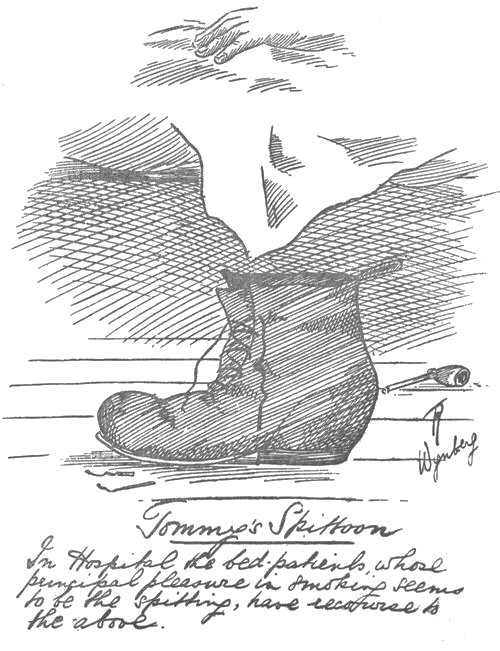
I have already referred to the confounded regimentality of this place.
The very red cross on our virgin white R.A.M.C. banner is made of red
tape, not bunting, I am positive. It almost goes without saying that we
have to don, and never leave off, in the daytime, the cobalt blue
uniform and huge red tie so dear to the controllers of these
establishments. The blue trousers are terrible things, being lined with
some thick material and kept up by a tape at the waist. A friend of mine
in Paget's Horse will not have them called trousers, but always alludes
to them as leg casings.
I am not quite so particular about my food as formerly, but the Imperial
Yeomanry Hospital at Pretoria must have spoiled me. Then, again, there
was the Deelfontein one, so I must set aside my own opinion and give you
that of others. The food (in our ward) is little and poor; being one
pound of bread and an ounce of butter per day for men on full rations,
accompanied at morn and eventide by a purply fluid called "tea." At
mid-day a tin of tough meat with a potato or two is served up, for which
we are truly thankful. Amen! As regards recreation we get plenty of
that—airing bedding, scrubbing lockers and floors, cleaning windows,
whitewashing, washing our plates and other tinware after our sumptuous
repasts, general tidying up, having rows with the sergeant-major, and a
myriad other little pastimes help to while the hours away. In full view
of our ward is the slate-coloured gun carriage which is used for
conveying the unfittest to their last long rest. It is kept outside of a
barn-like building, and its contemplation affords us much food (extra
ration) for reflection. It is often used.[Back to Contents]
As I pause, and ponder what else I can tell you in this letter, it
occurs to me that I have not yet told you of the one great
disillusion of this campaign for me and all other former civilians—I
mean "The British Officer." The few remarks which I am now going to make
are founded on the universal opinion of all the Regular soldiers and
Colonial and home-bred Volunteers I have met out here. I have hesitated
to give this verdict before, because it seemed like rank heresy or a
kind of sacrilege; but having asked every man I have come across,
especially the Regular soldier, his estimate of this person, and always
receiving the same emphatic reply, I feel I can now make my few remarks
without being regarded as too hasty or ill-informed.
There are officers who are real good fellows, and of these I will tell
presently; but there are others—heaps of others. These latter are
selfish, and frequently incompetent beings, without the slightest
consideration for their men, and with a terrible amount for their dear
selves. Talk about their roughing it! Most of these individuals have the
best of camp beds to rest on, servants to wait on them, good stuff to
eat, and, more often than not, whisky, or brandy to drink. And, oh, my
sisters, oh, my brothers, when they have to commence roughing it, it
is hard indeed for poor Tommy. Many a tale have I heard of thirsty tired
Tommies being refused their water cart in camp, as the officers required
the water out of it for their baths.
The beautiful stories, on the other hand, of the officer being troubled
because his men were in bad case, and sharing the contents of his
haversack or water bottle with a poor "done-up" Tommy, are generally
pure fiction. To hear of Tommy sharing with a chum or a stranger is
common enough. Out here one learns to appreciate the ranker more, and
the commissioned man less. And when one comes across a good officer, how
he is appreciated! Often when I have asked a regular what sort of
officers he had, and received the invariable emphatic reply, he has
stopped, and in quite a different voice, with a smile on his face, said,
"But there was Mr. ——; now he was a real gentleman." And then he has
waxed eloquent in this popular officer's praises, relating how "he used
to be like one of ourselves," insisted on taking his relief at digging
trenches, came and chatted to them round their fires at night, and in
scores of ways endeared himself to their hearts.
My Rifle friend has just been telling me of such an officer, a
young one they had, named Wilson (how he eulogised Mr. Wilson! "He was a
good 'un, he was. A real gentleman"). He died, poor fellow, up
Lydenburg way. Then he told me of another, a Mr. Baker-Carr; of him he
said, "And there isn't a man of us to-day who, if he was in danger,
wouldn't die for him."
As for the opinion of the Colonials of our officers, you surely know
that. This little anecdote expresses pretty well how they stand one with
the other:
Scene—Pretoria.
New Zealander, just in from trek, passing, pipe in mouth, by a
young officer just out.
Officer (stopping New Zealander): "Do you know who I am?"
N.Z. (removing pipe): "No."
Officer: "I am an officer!"
N.Z.: "Oh."
Officer: "I—am—an—officer!"
N.Z.: "Well, take an old soldier's advice and don't get drunk
and lose your commission."
Officer: "D—— you. Don't you salute an officer when you see
one?"
N.Z. (very calmly): "D—— and dot you! It's seldom we salute
our own officers, so it isn't likely we'd salute you."
Officer: "Confound it. If you couldn't stand discipline, what
did you come out here for?"
N.Z.: "To fight."
Officer (moving on): "I suppose you are one of those damned
Colonials."[Back to Contents]
That very great, august and omnipotent being, the Sergeant-Major of this
establishment, has just been round. His motto is, I fancy, "Veni, vidi,
vici." To him nothing is ever perfect, save himself. He entered,
"Shun!" and we stood at attention by our cots. A trembling sergeant and
orderly followed in his train. Upon us, one by one, he
pounced, this "brave, silent (?) man" at the back. My blue fal-de-lal
jacket he unbuttoned and revealed, horror of horrors, very crime of
crimes, the fact that I was not wearing the monstrous red scarf which,
according to the laws of the R.A.M.C., which alter not, must always be
worn by all patients at all times, in life, or even in death, I presume.
And further, a most perspiring bare chest revealed the heinous fact that
I had omitted to put on the thick flannel shirt which has to be worn
under the coarse white cotton one. Why wasn't I wearing this article? I
explained that I was too hot already. That did not matter a Continental.
Where was it? I produced it from under a bed near by and managed to
avoid putting it on in his presence, as that would have still further
revealed that I was wearing a belt containing money, which is contrary
to Rule No. something or other, in which it is emphatically laid down
that all jewels, money, and valuables are to be given in to the
staff-sergeant in charge of the pack store, who will give a receipt for
the same, &c., and so forth. Verily the backbone of the Army is the
non-commissioned man, but I must confess to frequently wishing to break,
or at least dislocate, that backbone.
The mosquitoes here seem rather more troublesome than their Pretoria
relatives. There are twenty men in the next room, and only three of us
here; and we three get a frightful lot of attention from these
skeeturs. They seem vicious as well as hungry. We fancy this is to be
explained by the fact that they had been marked down from up country for
the base and England, and are enraged at being kept here with the
prospect of being returned whence they came; their hunger in this
R.A.M.C. Hospital we can understand, and would sympathise with more if
they did not treat us as rations. Other patients have a theory that they
are the lost and much damned spirits of R.A.M.C. officers,
non-commissioned officers, and men, who have gone before and come back
to their old earthly billet. But of course these are all mere surmises,
and hardly to be regarded seriously. On Thursday I am to be sent to
Rondebosch, Tommy's oft and ever-repeated cry, "Roll on, dear old
Blighty" (England), seems vainer than ever as time spins out its endless
cocoon.[Back to Contents]
McKenzie's Farm,
Maitland (once again).
Sunday, March 3rd, 1901.
Of late my addresses have been many and varied. The above is the latest.
I have filtered through into Maitland, which has changed considerably
since last April. On Thursday last I left Wynberg for the convalescent
camp at Rondebosch without any regret, for, as a matter of fact, I was
getting hungry. On the afternoon of that day I found myself one of a
very unselect-looking band of khaki men, parading before the terrible
R.A.M.C. Sergt.-Major of the Wynberg Hospital.
Just before parading, I saw the gun carriage, alluded to in my last,
being used; going past our ward, in slow time, with reversed arms, went
the perspiring and, let us hope not, but I fear 'twas so, the angry
Tommies told off as the escort. Then came the gun carriage with its
flag-covered burden. Only another enteric, only another broken heart or
so at home, another vacant chair to look at and sigh, and the small but
strictly regimental and unsympathetic procession had passed; and the
half-interrupted conversation in the ward went gaily on. Having paraded
and answered to our names, a doctor strolled down the ranks questioning
us, "Are you all right?" All those who answered said "Yes." The question
was supposed to be put individually, but by the time he got to where I
was, the worthy man was slurring over about three or four at a time. I
didn't trouble to reply, it being obviously unnecessary. About
half-an-hour later, the ambulance carts came up, which were to bear us
to Rondebosch, and we were ordered to carry our kits down and get in. So
the halt and the broken picked up their kits—some of them were very
heavy—and staggered with them to the carts, a distance of about fifty
yards.
In particular, I noticed one poor fellow, a gunner of the 37th Battery,
R.F.A. A water cart had gone over him at Mafeking, and fractured three
ribs and affected his spine. The poor, emaciated, bent figure of what
had once been a smart soldier lifted a rather heavy kit and
tottered towards the carts. I felt disgusted at seeing such unnecessary
labour thrust on a man, who never should have left the hospital save to
go home. But he had been turned out by the powers which be, and—I was
going to say shouldn't, but the R.A.M.C. are all honourable men—when I
saw a sprightly, well-fed R.A.M.C. Lance-Corporal walking smartly after
him, and in a relieved voice I remarked to the man on my left: "The
Corporal is going to carry it for him," to which my neighbour remarked:
"He can't, he's got a stripe." And, begad, he didn't! He passed him,
apparently not having noticed him. I shall have a little more to tell
you of the gunner presently.
The drive to Rondebosch, through Wynberg, Kenilworth and Claremont, was
lovely beyond words. I had a box seat, and as we drove through the
avenues of trees, down the roads, with the gardens of the
comfortable-looking bungalows a mass of green foliage and tropical
blooms on either side of us, I felt like a gaol-bird escaped from his
cage. You may laugh at me if you like, but there I sat with dilating
nostrils and eyes, absorbing all I could. Often we passed English girls
in white costumes, and pretty, clean-looking children. It was a real
treat. Of course, they took no notice of us. We were a common and not
altogether pleasing looking lot, many among us being
"Poor fighting men, broke in her wars."
At last the pleasant drive came to its end, and we entered the
Rondebosch camp. I was told off with 25 others to a hut, drew bedding
and blankets—which included bugs—had some tea at a coffee bar, looked
about, and turned in for the night. Alas! that night and others.
Rondebosch boasts of a dry canteen and another, where Tommy can obtain
beer, oftentimes called "Glorious Beer," even as we allude to "Glorious
War." Over the sale of this to men, fresh from the hospitals recovering
from enteric, wounds, and so forth, there is no restriction. The result
needs no imagination—copious libations, songs, rows, and vomitings.
The next day I was put on as Orderly Sergeant. Now, if I was
Sergeant-Major and had among my subordinate "non-coms." a man I wished
to get into trouble, I should make him an Orderly Sergeant at
Rondebosch. About every half-hour the bugles went "Orderly Sergeants,"
and up I doubled. In all, I attended about a score of these summonses,
and even then omitted to report a man who had been absent since
reveillé.
This last sin of omission came about in this way. I was anxious to turn
in early and get a little sleep if possible, but could not do so, as I
had to report "all present and correct" at tattoo. Anyhow, I strolled
down to our hut at nine o'clock and found that the poor gunner alluded
to already was in great pain, writhing about and groaning horribly. One
of his chums who was with him told me he could not find a doctor, and
the chaplain, who had looked in, had said that he could not get him even
a drop of hot water.
The poor fellow was really bad, and thought he was going out, and I
should not have been surprised if he had. Soon a few more chums came in,
somewhat beery, and commenced to buck him up. The great method
apparently on such occasions is to grip the sufferer's hand very
tightly, pull him about a good deal, punch him now and again, and tell
him to bear up. "Stick it, mate! * * * it, you ain't going to * * * well
die! Stick it, mate!" And there he lay, with his pals, fresh from the
canteen, exhorting him to stick it, a poor broken Reserve man, with a
wife and children across the seas. At last I went and, after no little
bother, discovered an R.A.M.C. Sergeant, who found his Sergeant-Major,
and the two came with me to our hut. The result was a mustard leaf,
which was sent down to me to place on the sufferer. With this on the
left side of his stomach, bugs biting, mosquitoes worrying, and comrades
lurching in, singing and rowing, and beds collapsing, the night passed.
The next day the doctor saw him, and he was returned to Wynberg.[11]
In the afternoon we paraded and came on here. In the evening I slipped
off to Cape Town and met a friend, with whom I dined at the "Grand."
Having a decent dinner and amongst decently dressed people made me feel
quite a Christian, though as a matter of fact, most of the diners
appeared to be Jews. The sheenie man refugee is still very
much in evidence, and though he sells things at ruinous prices (for
himself, he says) seems to do well.
Tuesday, March 6th. After being kept outside the doctor's bureau from 9
till 12.30, the great man, the controller of fates, the donor of
tickets, the Maitland medicine man, has seen me, and, whatever he has
done, has not marked me for home.[Back to Contents]
March 9th.
To weary you with a further continuation of the experiences of a forlorn
Yeoman, who, having drifted from Pretoria, now finds himself on the
sands of Maitland, with a distant and tantalising view of the sea and
its ships, seems an unworthy thing to do. But, alas! I have acquired a
terrible habit of letter-writing. News or no news, given the
opportunity, I religiously once a week contribute to the English mail
bag; so here goes for a really short letter.
On Thursday, having endured as much toothache as I deemed expedient
without complaint, and goaded on by a sleepless night, I paraded before
the doctor, and having borne with him moderately and half satisfied his
credulity, obtained from him a note to a Cape Town dentist for the
following day. I am now in that being's hands, he has considerately
assured me that no man is a hero to his own dentist.
In Cape Town there are two topics—the town guard and the plague, known
as bubonic; owing to the latter, great is the stink of disinfectants.
I have already made allusions to the "Sisters' Albums" and the
contributions which they levied. Here at McKenzie's Farm, I have struck
another style of book. This is run by Sergeant-Major Fownes (10th
Hussars) who is in charge of all of the Yeomanry at the base. It is a
"Confession Book," containing reasons "Why I joined the Imperial
Yeomanry" and "Why I left." It has been contributed to by members of
nearly every I.Y. squadron in South Africa. Thanks to the courtesy of
its owner, I am able to give you a selection from its contents, omitting
the names and squadrons of the contributors only.[Back to Contents]
| WHY I JOINED THE YEOMANRY. |
WHY I LEFT. |
| |
| 1. |
To escape my creditors. |
1. |
The old man stumped up and I am in no danger of
receiving a blue paper. |
| 2. |
Patriotism. |
2. |
Captured at Lindley. Too much mealie porridge and rice. |
| 3. |
Because I was sick of England. |
3. |
Because I have changed my mind. |
| 4. |
Could always ride, could always shoot,
Thought of duty, thought of loot. |
4. |
Gammy leg, couldn't ride,
Sent to Cape Town, had to slide. |
| 5. |
"England Expects ——" (you know the rest). |
5. |
"Go not too often into thy neighbour's house, lest he be
weary of thee!" |
| Hospitals. |
| 1. Imperial Yeomanry Field. 2. Johannesburg Civil. 3. No. 6 General.
4. No. 9 General. 5. No. 8 General. 6. Deelfontein. 7. Maitland. |
| 6. |
To injure the Boers. |
6. |
Because they injured me. |
| 7. |
(All Excuses used up.) |
7. |
Love of my native land (England). |
| 8. |
I considered it was the right thing for an Englishman
to do. |
8. |
I did not get enough fighting, but too much messing
about. |
| 9. |
Because I thought it was my duty. |
9. |
"Fed Up!!!" |
| 10. |
A broken heart. |
10. |
A broken leg (more serious and imperative). |
| 11. |
Anxiety to get to South Africa. |
11. |
Anxiety to get away from it. |
| 12. |
For the sake of a little excitement, which I can't get at
home and didn't get out here. |
12. |
Joined B.P.'s Police Force to still search for the
impossible. |
| 13. |
Patriotic Fever!!! |
13. |
Enteric Fever!!! |
| 14. |
I did it during the Patriotic Mania, 1899-1900. Under
like circumstances believe I'd do it again. |
14. |
Ill health. |
| 15. |
Sudden splash of Patriotism upon visiting a Music Hall. |
15. |
Bathing one day, found varicose veins much to my
delight. Invalided. |
| 16. |
Poetry. |
16. |
Prose. |
| 17. |
"Married in haste." |
17. |
"Repented at leisure." |
| 18. |
Because I did not bring my aged and respected father
up properly. |
18. |
To see if he has improved. |
| 19. |
To kill Time and Boers. |
19. |
Because Time and Boers wait for no man. |
| 20. |
Because I am Irish and wanted to fight. |
20. |
Because I want to do more fighting and am joining the
S.A.C. |
| 21. |
Love of War. |
21. |
Love of Peace. |
| 22. |
For Sport. |
22. |
Time for close season. |
| 23. |
My Country's call my ardour fired. |
23. |
The "Crisis" o'er, I've now retired. |
| 24. |
Because I was tired of the Old Country. |
24. |
Because I was sick of the New. |
| 25. |
Old England's Honour, Glory, Fame,
Such thoughts were in my mind.
To die the last but not disgraced,
A V.C. perhaps to find.
To sound the charge, to meet the foe,
To win or wounded lie,
My firstborn son and I should fight
And, if the needs be, die. |
25. |
Alas, no Glory have I earned,
No Trumpet's Requiem found,
Altho' I've laid upon the veldt,
With scanty comfort round.
My son has seen more fights than I,
Tho' he is scarce fifteen,
Whilst I must sound my trumpet at
The Yeoman's Base-fontein. |
| Sergt.-Trumpeter (McKenzie's Farm). |
| 26. |
Hungry for a fight. |
26. |
Appetite appeased. |
| 27. |
Drink and Drink. |
27. |
Drink and Drink. |
| 28. |
Vanity. |
28. |
Vexation of Spirit. |
| 29. |
Because I thought:
- 'Twas a glorious life on the veldt,
So unrestrained and free. (Note. Read opposite page.)
- 'Twas grand to lie 'neath the star-lit sky
In a blanket warm and nice.
- 'Twas exciting to gallop over the plains
To the music of the Mausers.
- Bully beef and biscuits are all very well,
And so, for a time, is jam.
|
29. |
But I found:
- That after twelve months of the same I felt
It was not the life for me.
- That when you wanted to go to sleep,
You're scratching and hunting for l—ce.
- That 'twas very unpleasant to ride all day
When you'd lost the seat of your trousers.
- That to get nothing else for more than six months,
Would make any fellow say "D——!"
|
| 30. |
To have a lively time. |
30. |
What with Mausers by day and crawlers by night. I
had it. |
| 31. |
Wanted to see a little of South Africa. |
31. |
Have seen enough. |
| 32. |
Came out on Chance. |
32. |
Going home to a Certainty. |
| 33. |
To escape the Police at home. |
33. |
Same reason here. |
| 34. |
Had always preached Patriotism and thought it was the
time to put theory into practice. |
34. |
The Patriotic Fever has run its natural course. |
| 35. |
Because I had nothing to do at home
Bar drinking whiskies and sodas alone,
And shooting pheasants which is beastly slow,
So I thought I'd give the Bo-ahs a show. |
35. |
Because the Bo-ahs shot me instead,
And the papers (confound them) reported me "dead,"
That sort of game is rather too bad,
So the prodigal now returns to his dad. |
| 36. |
Thought I would get the V.C. |
36. |
Got C.B. instead! |
| 37. |
A soldier's son and a volunteer
Heaps of glory, bags of beer. |
37. |
Bags of biscuits hard as rocks,
Smashed my teeth and gave me sox! |
| 38. |
To become acquainted with Colonials before settling. |
38. |
To join the Bodyguard for same reason and—better pay. |
| 39. |
For adventure. |
39. |
To go back to a hum-drum life, which is better than a
Dum-Dum death. |
| 40. |
Northumbria's reply, "Duty." |
40. |
Novelty somewhat worn off, and military discipline not
being at all adapted to my temperament. |
In a few days all the men marked for home will be leaving, and
to those they will be leaving behind them the yearning to be on the sea
once again, seems stronger than ever,
"Can you hear the crash on her bows, dear lass,
And the drum of the racing screw.
As she ships it green on the old trail, our own trail, the home trail,
As she lifts and 'scends on the long trail—the trail that is always new?"[Back to Contents]
England-Fontein
April 22nd, 1901.
"We're goin' 'ome, we're goin' 'ome,
Our ship is at the shore,
An' you must pack your 'aversack,
For we won't come back no more."
So from going up to Elandsfontein, which is by Johannesburg, it came to
the above cheerful sentiment. And this is how it happened. An order came
from somewhere to our doctor, who had of late so hardened his heart, to
"invalid convalescents freely," and, to be brief, within a few days
nearly every man at Maitland was marked for home, wore a smiling face,
and drew warm clothes for the voyage.
The next burning questions were "What boat will it be and when does she
sail?" Needless to say, these interrogatories were answered at least
thrice a day, and were always wide of the mark. Still, we were booked
for home, and could afford to wait cheerfully. Our hut (No. 1),
inhabited by the thirty best men in the camp (any man of that hut will
tell you this assertion is correct), thereupon blossomed forth as the
publishing and editorial offices of a camp newspaper known as the
"Latest Developments Gazette,"
with which is incorporated
"The Cookhouse News."
In this journal shipping intelligence was a speciality, and topical
cartoons a great feature. We claimed the largest circulation in the
camp. The various articles, stop-press news, and cartoons, were stuck on
the walls of the hut and afforded much entertainment. Of
course, B.P. was very unpopular in Cape Town and with us, and had to be
dealt with severely. (Note.—Not the Mafeking man or the "worth a guinea
a box" lot, but the Bubonic Plague).
A few days before sailing I caught sight of a well-known name in the
dread casualty list: "69th Co. I.Y., 16,424, Trooper R. Blake, (severely
wounded, since dead). Hartebeestefontein." "Poor Blake!" He used to sing
at our concerts on the boat coming out, at our bivouac fire when we
indulged in an impromptu sing-song, and at Pretoria, when in the police,
he often appeared at the various musical entertainments held in the town
or hospitals. His mimicry of a growling or barking dog, big or small,
was marvellous and notorious. I remember once how a fellow on one
occasion, accustomed to Master Blake's games, on hearing a persistent
yapping at his heels, at length said "Oh, shut up, young Blake!" and
turned round to see a live terrier there. A verse in the last issue of
our paper, expressed, in a humble way, every man's feelings on such
matters.
We are leaving them behind us,
'Neath the veldt and by the town,
The men who joined and fought with us,
Who shared each up and down.
We are going home without them,
But our thoughts will on them dwell,
We shall often talk about them,
Good comrades all, farewell!
The day before we left, the sketches and other matter were sold by
auction, it having been previously decided to devote the proceeds of the
sale to the last No. 1 Hut annual ball. By way of explanation, it must
be noted that the hut had an annual ball once a week, "dancing
strictly prohibited." To be explicit, the annual ball was a weekly
dinner. The auction was a great success, a real auctioneer presiding,
well over £10 being realised.
The farewell dinner was a grand affair and very convivial. To my
surprise I was presented with a handsome silver cigarette case by the
so-called staff of the "L.D. News" as a token of good will and their
appreciation of my humble efforts to relieve the monotony of camp life.
The next day, Friday, March 29th, we embarked on the transport
"Aurania," and, as the sun was setting, bade a sarcastic good-bye to
Table Mountain.
As regards the voyage home, which was accomplished in three weeks, much
might be said, but probably little of particular interest. A transport
is not a very luxurious affair for the common soldier, though the
accommodation for the officers amply atones for what may be lacking for
the ninety-and-nine, as it were. But what on earth, or sea, did it
matter, we were going home.
Good Friday was not a success, an officer committed suicide, a sergeant
in the Royal Sussex died of dysentery, the engines broke down, and we
had no buns. At St. Vincent we stopped two-and-a-half days to coal, and
flew the yellow flag at the fore, being in quarantine on account of the
Bubonic outbreak at Cape Town. In the Bay of Biscay a Yeoman comrade
died of enteric, and was buried two days from home. Friday, the 18th, on
a lovely spring morning, the sea being as smooth as glass, we sighted
the cliffs of England once again.
"England, my England."
Then we commenced passing shipping; a man at the tiller of a Cornish
fishing boat waving his cap to us made it clear that we were getting
back to our real ain folk once more. At eight in the evening we were
lying off Netley Hospital, and taking in the proffered advice of a large
board in a field by the waterside to eat Quaker Oats, and by twelve
o'clock the following night I was home once again.
The treking, the fighting, the guards and pickets, the hospitals are
done with now. My small part in the game has been played, and, with a
slight and permissible alteration, the concluding lines of a favourite
poem must end these simple records.
"But to-day I leave the Army, shall I curse its service then?
God be thanked, whate'er comes after, I have lived and toiled with men!"[Back to Contents]
BURFIELD & PENNELLS, PRINTERS, HASTINGS.
Footnote 1: Otherwise known as the "Hatherly Distillery," owned by a
chameleon millionaire German-Jew, named Sammy Marks. Oh, that fine old
Scotch whisky! The labels announcing this un-fact are, I understand,
obtained from the Old Country and gummed on the bottles at Hatherly.[Back to Main Text]
Footnote 2: That we played a small part in the extensive operations,
culminating in what is known as the Battle of Diamond Hill, was only
known to most of us four or five months later.[Back to Main Text]
Footnote 3: From the first the mixture of cavalry and infantry terms
used in connection with the I.Y. has been most amusing. As our officers
from this date invariably referred to us in cavalry terms, the words
"squadron," "troop," etc., will be used to the end of the volume.[Back to Main Text]
Footnote 4: This fine squadron of Yeomanry, under Captain Hodge, had
also joined Mahon, at Pretoria, on July 16th.[Back to Main Text]
Footnote 5: The hundred-and-fifty rounds of ammunition which always
have to be carried by Thomas Atkins.[Back to Main Text]
Footnote 6: It was this Vlakfontein which was destined to become
notorious in the later history of the war. On the 29th of last May
(1901), the 7th Battalion I.Y. lost heavily in a desperate fight at this
place. Of the many gallant officers and men killed, all the members of
the Battalion, past and present, must specially deplore the death of
Surgeon-Captain Welford, one of the kindest and most self-sacrificing of
men. Also Captain Armstrong, who joined the Battalion from Strathcona's
Horse, as lieutenant, in November last. Lieutenant Pullar, writing to me
in reference to the above, recently remarked: "It is the same
Vlakfontein where the poor 7th Battalion lost so heavily in May, and I
fear there must be many other graves there now."[Back to Main Text]
Footnote 7: For his share in this gallant deed, Ingram was promoted by
the C.-in-C. to Corporal. Several of the Devons and Fifes were
subsequently mentioned in despatches. Sergeant Pullar was persuaded to
accept a commission, as also were Sergeant-Majors Gordon and Cave. All
three being excellent soldiers and popular with the men. A Yeoman told
me lately, "It was simply splendid the cool way in which Colonel Browne
and Sir Elliot Lees superintended the waggons being moved from camp."[Back to Main Text]
Footnote 8: The subsequent adventures of the battalion under General
Cunningham and later Dixon and Benson I am, of course, unable to
record.[Back to Main Text]
Footnote 9: Since my return I have heard from "Scotty," as we used to
call him. He wrote from his home in New Zealand, his right arm had been
successfully amputated, and he was getting accustomed to its loss.[Back to Main Text]
Footnote 10: An officer, for whom I have the highest esteem, whilst
kindly conveying to me his very favourable opinion of these "Letters,"
regretted the inclusion of the following "grouse" in these words: "When
I think of many cheery, dirty, ragged, half-starved youngsters I met out
there, weighted into an unaccustomed responsibility for men's lives and
the safety of their columns, and no more their own masters than you
were, bravely trying to do a duty which many of them really loathed, I
feel it is hard that a minority of 'rotters' should blacken the good
name of the majority."[Back to Main Text]
Footnote 11: I met him again looking much better and in the best of
spirits on the Aurania, being invalided home.[Back to Main Text]