The Legends, the Popes, and the Pasquinades.
The Manufacture
of St.
Philomena.
Before quitting the subject of the relics at Rome, I
must give my readers what Hare calls "the extraordinary
history of the manufacture of S. Filomena, now
one of the most popular saints in Italy, and one towards
whom idolatry is carried out with frantic
enthusiasm both at Domo d'Ossola and in
some of the Neapolitan States."
"In the year 1802, while some excavations were going
forward in the Catacombs of Priscilla, a sepulchre was
discovered containing the skeleton of a young female;
on the exterior were rudely painted some of the symbols
constantly recurring in these chambers of the dead—an
anchor, an olive branch (emblems of Hope and Peace),
a scourge, two arrows, and a javelin; above them the
following inscription, of which the beginning and end
were destroyed:
—"Lumena Pax Te Cum Fi"—
The remains, reasonably supposed to be those of one of
the early martyrs for the faith, were sealed up and deposited
in the treasury of relics in the Lateran; here they
remained for some years unthought of. On the return
of Pius VII. from France, a Neapolitan prelate was sent
to congratulate him. One of the priests in his train, who
wished to create a sensation in his district, where the long
residence of the French had probably caused some decay
of piety, begged for a few relics to carry home, and these
recently discovered remains were bestowed on him; the
inscription was translated somewhat freely to signify
Santa Philomena, rest in peace. Another priest, whose
name is suppressed, because of his great humility, was
favored by a vision in the broad noonday, in which he
beheld the glorious virgin Filomena, who was pleased to
reveal to him that she had suffered death for preferring
the Christian faith and her vow of chastity to the addresses
of the emperor, who wished to make her his wife.
This vision leaving much of her history obscure, a certain
young artist, whose name is also suppressed, perhaps because
of his great humility, was informed in a vision
that the emperor alluded to was Diocletian, and at the
same time the torments and persecutions suffered by the
Christian virgin Filomena, as well as her wonderful constancy,
were also revealed to him. There were some
difficulties in the way of the Emperor Diocletian, which
incline the writer of the historical account to incline to the
opinion that the young artist in his wisdom may have
made a mistake, and that the emperor may have been not
Diocletian, but Maximian. The facts, however, now admitted
of no doubt; the relics were carried by the priest
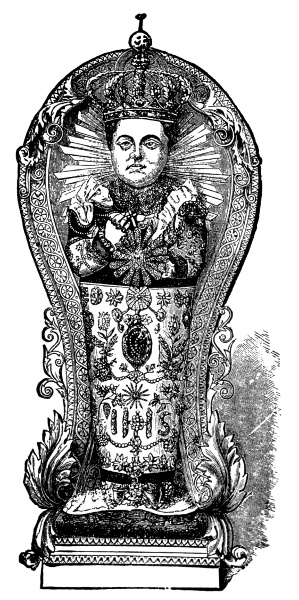
Francesco da Lucia to Naples; they were enclosed in a
case of wood resembling in form the human body; this
figure was habited in a petticoat of white satin, and over
it a crimson tunic after the Greek fashion; the face was
painted to represent nature, a garland of flowers was
placed on the head, and in the hands a lily and a javelin
with the point reversed, to express her purity and her
martyrdom; then she was laid in a half-sitting posture
in a sarcophagus, of which the sides were glass, and, after
lying for some time in state in the chapel of the Torres
family in the Church of Sant' Angiolo, she was carried in
grand procession to Mugnano, a little town about twenty
miles from Naples, amid the acclamations of the people,
working many and surprising miracles by the way....
Such is the legend of S. Filomena, and such the authority
on which she has become within the last twenty years
one of the most popular saints in Italy."—Mrs. Jameson's
Sacred and Legendary Art, p. 671.
But, after all, the most extraordinary case of saint-manufacture
is not that of Philomena, but that of
Buddha! I have not room for the story here, but if any
one wishes to know how the papacy made Buddha a
Christian saint, he will find the whole story, with the
proofs, in A History of the Warfare of Science and
Theology, by Andrew D. White, LL. D., late President
and Professor of History at Cornell University, and until
recently United States Ambassador to Germany.
"The Courteous
Spaniard."
A few days ago we visited the Church of
St. Laurence Without the Walls, where in
a silver shrine under the high altar, the remains of St.
Laurence and St. Stephen are said to rest. The walls
of the portico of the church are covered with a series
of frescoes, lately repainted. One series represents the
story of St. Stephen and that of the translation of his
relics to this church. "The relics of St. Stephen were
preserved at Constantinople, whither they had been transported
from Jerusalem by the Empress Eudoxia, wife of
Theodosius II. Hearing that her daughter, Eudoxia, wife
of Valentinian II., Emperor of the West, was afflicted
with a devil, she begged her to come to Constantinople,
that her demon might be driven out by the touch of the
relics. The younger Eudoxia wished to comply, but the
devil refused to leave her unless St. Stephen was brought
to Rome. An agreement was therefore made that the
relics of St. Stephen should be exchanged for those of
St. Laurence. St. Stephen arrived, and the Empress was
immediately relieved of her devil; but when the persons
who had brought the relics of St. Stephen from Constantinople
were about to take those of St. Laurence back
with them, they all fell down dead! Pope Pelagius
prayed for their restoration to life, which was granted
for a short time, to prove the efficacy of prayer, but they
all died again ten days later! Thus the Romans knew
that it would be criminal to fulfil their promise, and part
with the relics of St. Laurence, and the bodies of the two
martyrs were laid in the same sarcophagus." And thus
we know how much more the Romans think of relics
than of honor and truth. "It is related that when they
opened the sarcophagus, and lowered into it the body
of St. Stephen, St. Laurence moved on one side, giving
the place of honor on the right hand to St. Stephen;
hence, the common people of Rome have conferred on
St. Laurence the title of 'Il cortese Spagnuolo'—the
courteous Spaniard."
Another series of these pictures in the portico represents
the story of a sacristan who, coming to pray in this
church before day, found it filled with worshippers, and
was told by St. Laurence himself that they were the
Apostle Peter, the first martyr, Stephen, and other apostles,
martyrs and virgins from paradise, and was ordered
to go and tell the Pope what he had seen, and bid him
come and celebrate a solemn mass. The sacristan objected
that the Pope would not believe him, and asked
for some visible sign. Then St. Laurence ungirt his robe
and gave him his girdle. When the Pope was accompanying
him back to the basilica they met a funeral procession.
To test the powers of the girdle, the Pope laid it on the
bier, and at once the dead arose and walked.
The Miracles of
St. Dominic.
That is not the only miracle of resurrection
offered to our credulity by these ecclesiastical
legends. The three principal frescoes in the chapter
house of the church of St. Sisto, recently painted by the
Padre Besson, represent three miracles of St. Dominic—in
each case of raising from the dead—the subjects being
a mason who had fallen from a scaffold when building
this monastery, a child, and the young Lord Napoleone
Orsini, who had been thrown from his horse and instantly
killed, and who was brought to life by St. Dominic on
this spot, as is further commemorated by an inscription
on the wall. But miracles were nothing uncommon in
the history of the founder of the powerful Dominican
Order. In the refectory of St. Marco, at Florence, we
had seen the fine fresco which represents the miraculous
provision made for him and his forty friars at a time of
scarcity by two angels. The refectory in which this miracle
took place is at the Church of St. Sabina, on the
Aventine, in Rome; but there are three other things at
this church which interested us hardly less than the scene
of that miracle. One of them is the huge, pumpkin-shaped,
black stone, two or three times as big as a man's
head, which the devil is said to have hurled at St. Dominic
one day when he found him lying prostrate in prayer.
This stone is the most conspicuous object in the church,
being set up on a pillar about three feet high, right in
the middle of the nave. Not far away is the marble
slab on which the saint was lying at the time that the
formidable missile was thrown. The adversary's aim was
not good, and the saint was not harmed. The second
thing of chief interest here is the Chapel of the Rosary,
at the other end of the same aisle in which the marble slab
lies, built on the very spot where St. Dominic had the
vision in which he received the rosary from the hands of
the Virgin. The supernatural gift is commemorated in a
beautiful painting by Sassoferato. It is hardly necessary
to explain to any of my readers that a rosary is a string
of beads used by Roman Catholics to keep the count of
the number of Pater-nosters and Ave-Marias which they
repeat, and that this manner of "vain repetitions" was
first used by the Dominicans among Roman Catholics,
though the custom was really borrowed from the Mohammedans
and Brahmins, who still use rosaries. The third
object is the famous orange tree, now six hundred and
seventy years old, which is said to have been brought
from Spain and planted in the court here by St. Dominic
himself, orange trees having been unknown in Rome before
that time, and "which still lives, and is firmly believed
to flourish or fail with the fortunes of the Dominican
Order." Ladies are not allowed to approach this tree,
so, as there were ladies in our party, we all contented
ourselves with a look at it through a window. Hard by,
of course, there is a room where things are sold to pilgrims
and visitors. There we bought a rosary, the beads
of which are made of the fruit of the plant called the
Thorn of Christ, with the exception of the bead next to
the cross, which is a tiny dried orange from St. Dominic's
tree. Enclosed in the cross are a little piece of the wood
of the tree, and some earth from the catacombs where the
bodies of Sts. Peter and Paul, and of the holy virgin
martyrs, Sts. Agnes and Cecilia, reposed for some time.
The printed leaflet which accompanies our purchase tells
us that "these rosaries, when sold or ordered, are blessed
and enriched with the indulgences of the Rosary Confraternity
and the papal blessing. When blessed they may
be distributed; but if resold they lose all the indulgences."
(Italics ours.)
Still another relic of great interest in this convent of
St. Sabina is the crucifix of Michele Ghislieri (afterwards
Pope Pius V.). "One day, as Ghislieri was about to kiss
his crucifix, in the eagerness of prayer, the image of
Christ, says the legend, retired of its own accord from his
touch, for it had been poisoned by an enemy, and a kiss
would have been death."
Sundry
Miracles
by Other
Saints, and
Images.
In the Church of St. Gregory, on the Cœlian
Hill, the thing that interested us most was
the picture by Badalocchi, "commemorating
a miracle on this spot, when, at the moment
of elevation, the Host is said to have bled
in the hands of St. Gregory, to convince an unbeliever
of the truth of transubstantiation." This is the same
Gregory who presented certain foreign ambassadors with
a handful of earth from the arena of the Coliseum as a
relic for their sovereigns, so many martyrs having suffered
death there, and "upon their receiving the gift with
disrespect, he pressed it, when blood flowed from the
soil."
Not far from the Church of St. Gregory we were
shown the hermitage where St. Giovanni de Matha lived.
"Before he came to reside here he had been miraculously
brought from Tunis (whither he had gone on a mission)
to Ostia, in a boat without helm or sail, in which he
knelt without ceasing before the crucifix throughout the
whole of his voyage!"
Time would fail me to tell of the miraculous surgical
operation performed by Sts. Cosmo and Damian upon a
man who was praying in the church dedicated to them,
and who had a diseased leg amputated without pain by
the good saints while he slept; and not only so, but had
a sound leg, which they had taken from the body of a
man just buried, substituted for the diseased one. Nor
can I dwell on the miraculous blindness with which the
guard sent to seize Pope St. Martin I. was stricken the
moment he caught sight of the pontiff in St. Maria Maggiore,
or the miraculous tears shed by an image of the
Virgin attached to a neighboring wall when she saw a
cruel murder committed in the street below, or the madonnas
and crucifixes that spoke to saints on various occasions.
One of these, however, is too significant to be
omitted altogether. There is in the Church of St. Agostino
a sculptured image of the Madonna and child. "It
is not long since the report was spread that one day a
poor woman called upon this image of the Madonna for
help; it began to speak, and replied, 'If I had only something,
then I could help thee, but I myself am so poor!'
This story was circulated, and very soon throngs of credulous
people hastened hither to kiss the foot of the Madonna,
and to present her with all kinds of gifts." (Italics
mine.)
How the Papal
Treasury
was Filled,
and how it
was Emptied.
The evil methods employed at various times
to replenish the papal treasury are known
to all readers of history. The best known,
perhaps, is the shameless traffic in indulgences
by Tetzel, which helped to precipitate
the Reformation. Hare closes his account of the execution
of Beatrice Cenci for complicity in the murder of
her father with the statement that "sympathy will always
follow one who sinned under the most terrible of provocations,
and whose cruel death was due to the avarice of
Clement VIII. for the riches which the church acquired
by the confiscation of the Cenci property," and cites the
petition of Gaspare Guizza (1601), in which he claims a
reward from the Pope for his service in apprehending
one of the assassins of Francesco Cenci, on the ground
that thus "the other accomplices and their confessions
were secured, and so many thousands of crowns brought
into the papal treasury." The venality of Pope Alexander
VI., Rodrigo Borgia (1492-1503), "the wicked and
avaricious father of Cæsar and Lucretia, who is believed
to have died of the poison which he intended for one of
his cardinals," is thus hit off by Pasquino:
"Vendit Alexander claves, altaria, Christum;
Emerat ille prius, vendere jure potest."
Of Innocent X. (1644-'55), Pasquino says, "Magis amat
Olympiam quam Olympium," referring to the shameful
relations existing between this Pope and his avaricious
sister-in-law, Olympia Maidalchini, who made it her business
to secure the profits of the papacy in hard cash.
Trollope, in his Life of Olympia, says: "No appointment
to office of any kind was made except in consideration
of a proportionable sum paid down into her own coffers.
This often amounted to three or four years' revenue of
the place to be granted. Bishoprics and benefices were
sold as fast as they became vacant. One story is told
of an unlucky disciple of Simon, who in treating with the
Pope for a valuable see, just fallen vacant, and hearing
from her a price at which it might be his, far exceeding
all he could command, persuaded the members of his
family to sell all they had for the purpose of making this
profitable investment. The price was paid, and the
bishopric was given him, but, with a fearful resemblance
to the case of Ananias, he died within the year, and his
ruined family saw the see a second time sold by the insatiable
and incorrigible Olympia.... During the last
year of Innocent's life, Olympia literally hardly ever
quitted him. Once a week, we read, she left the Vatican,
secretly by night, accompanied by several porters carrying
sacks of coins, the proceeds of the week's extortions and
sales, to her own palace. And during these short absences
she used to lock the Pope into his chamber, and take the
key with her!" She finally "deserted him on his death-bed,
making off with the accumulated spoils of his ten
years' papacy, which enabled her son, Don Camillo, to
build the Palazzo Doria Pamfili, in the Corso, and the
beautiful Villa Doria Pamfili," west of the Janiculan Hill.
This villa, with its casino, garden, lake, fountain, pine-shaded
lawns and woods, and its fine view of St. Peter's
standing out against the green Campagna beyond, and the
blue Sabine mountains in the distance, is to this day one
of the loveliest villas in Italy, and the favorite resort of
the latter-day Romans and visitors to their city on the
two afternoons of the week on which it is open to pedestrians
and two-horse carriages.
The notorious Simony practiced by the popes, in
which, as we have just seen, Olympia became such an
adept, gave rise to the biting Latin couplet—
"An Petrus Romæ fuerit, sub judice lis est;
Simonem Romæ nemo fuisse negat."
Some of the modern methods of making use of the Pope
for purposes of gain are less objectionable than those of
Olympia. Dr. Alexander Robertson, in his Roman Catholic
Church in Italy, just published, says: "One of the
very latest novelties of the 'Pope's Shop' is a penny-in-the-slot
blessing machine. Specimens of this were lately
to be seen in the Corso, Rome, about half way between the
Piazza Colonna and the Piazza del Popolo. A penny is
dropped into it. The cinematograph, or wheel of life,
goes round, when, lo! there appears a long procession
of richly clothed cardinals and monsignori, and then the
Pope in a sedan chair, accompanied by his Swiss Guards.
As he is carried past the spectator, he turns towards the
window of his chair, a smile overspreads his face, he raises
his hands, and gives his blessing. On these machines
there is an inscription to the effect that the blessing thus
given and received is equivalent to that given by the Pope
in person in St. Peter's. Truly a novel way of turning an
honest penny!" We hear that a rash churchman, not
liking the facts just stated, undertook to deny them in the
public prints, when up spoke some English gentlemen,
who had been in Rome recently, and bowled the churchman
over with the statement that they had themselves
seen this blessing machine on the Corso.
One never touches this subject of the vast wealth of
the papacy without calling to mind the well-known rejoinder
of the great theologian, Thomas Aquinas, when
the Pope was showing him all his money and riches, and
said, "You see, Thomas, the church cannot now say what
it said in early times, 'Silver and gold have I none.'"
"No," answered Aquinas, "nor can it say, 'Rise up and
walk'" (Acts iii. 6). This loss of spiritual power, this
loss of ability to minister salvation to others, is one of
the most melancholy results of the corruption of the
papacy.
Some Ugly
Things in
the Lives of
the Popes.
Dr. Alexander Robertson, in his recent book
on The Roman Catholic Church in Italy,
which has received the hearty approval of
the King of Italy and his Prime Minister,
says: "There are few, I daresay, who have looked into
the history of the popes, no matter what their religious
faith may be, who will not agree with me when I say that
it does not afford pleasant reading. One's intellect rebels
against their preposterous claims and pretensions, and
one's moral sense against their character and lives.
Amongst them there were some good men, some learned
men, and some really able men; but, taking them all in
all, they were, beyond doubt, amongst the lowest class of
men to be found on the pages of history. To wade
through their lives is to cross a pestiferous moral swamp
of worldliness, simony, nepotism, concubinage, personal
animosities, sanguinary feuds, forged decretals, plunderings,
poisonings, assassinations, massacres, death."
[17]
One may smile at such papal peccadilloes as the vanity
of Paul II., who was chiefly remarkable for his personal
beauty, and was so vain of his appearance that, when he
was elected Pope, he wished to take the name of Formosus.
One may be amused at the intense self-esteem
of Urban VIII., of whose spoliation of ancient Rome
Pasquino says, "Quod non fecerunt barbari, fecerunt
Barberini," and who, in the Barberini palace, had the
Virgin and angels represented as bringing in the ornaments
of the papacy at his coronation, and in another
room a number of the Barberini bees (the family crest)
flocking against the sun, and eclipsing it—to symbolize
the splendor of the family. But our feeling changes when
we read that "he issued a bull by which the name, estates
and privileges of his house might pass to any living male
descendant, legitimate or illegitimate, whether child of
prince or priest," lest the family of Barberini might become
absorbed in that of Colonna. And we do not go
far in our reading about such popes before the feeling
of amusement yields to one of sadness, indignation and
horror. We need not insist upon the story of the female
Pope Joan, who is said to have secured her election to
the papal throne disguised as a man, and to have reigned
two years as John VIII., and then to have died a shameful
death; for, notwithstanding the indisputable fact that till
1600 her head was included among the terra cotta representations
of the other popes in the Cathedral of Sienna,
and was inscribed "Johannes VIII., Femina de Anglia,"
and that it was then changed into a head of Pope Zacharias
by the Grand Duke, at the request of Pope Clement
VIII., the story is now generally discredited. But there
are many other facts, established beyond controversy,
which explain fully the feeling of the great majority of
the Italian people and the verdict of the accredited historians
of the world. When the penitential Pope, Adrian
VI. (1522-'23), died of drinking too much beer, "the
house of his physician was hung with garlands by midnight
revellers, and decorated with the inscription, Liberatori
Patriæ, S. P. Q. R.'" The nepotism of the
learned, brilliant and witty Paul III. "induced him to
form Parma into a duchy for his natural son Pierluigui,
to build the Farnese Palace, and to marry his grandson
Ottavio to Marguerite, natural daughter of Charles V."
John XII., the first Pope who took a new name, "scandalized
Christendom by a life of murder, robbery, adultery
and incest." Of the tombs of the eighty-seven popes
who were buried in the old basilica of St. Peter's, only
two were replaced when the present building was erected,
those of the two popes who lived in the time and excited
the indignation of Savonarola—"Sixtus IV., with whose
cordial concurrence the assassination of Lorenzo de'
Medici was attempted, and Innocent VIII., the main
object of whose policy was to secure place and power
for his illegitimate children," sixteen in number, and who
is represented on his tomb as holding in his hand the
spear of "St. Longinus," which had pierced the side of
Christ. This spear was sent to Innocent VIII. by the
Sultan Bajazet, nearly fifteen hundred years after the
crucifixion, and, as we have already seen, is now preserved
in St. Peter's as one of its four chief relics.
Guicciardini says of the death of Alexander VI.: "All
Rome ran with indescribable gladness to visit the corpse.
Men could not satiate their eyes with feeding on the carcase
of the serpent who, by his unbounded ambition and
pestiferous perfidy, by every demonstration of horrible
cruelty, monstrous lust and unheard-of avarice, selling
without distinction things sacred and profane, had filled
the world with venom."
"Pope Paul V. granted dispensations and pensions to
any persons who would assassinate Fra Paolo Sarpi;
Pope Pius V. offered, as Mr. Froude tells us, 'remission
of sin to them and their heirs, with annuities, honors and
promotions, to any cook, brewer, baker, vintner, physician,
grocer, surgeon, or others,' who would make away with
Queen Elizabeth; and Pope Gregory XIII. offered a high
place in heaven to any one who would murder the Prince
of Orange; and the poor wretch, Balthazar Gerard, who
did the infamous deed, actually told his judges 'that he
would soon be a saint in heaven, and would have the first
place there next to God,' whilst his family received a
patent of nobility, and entered into the possession of the
estate of the Prince in the Franche Comté—rewards
promised for the commission of the crime by Cardinal
Granvelle." (Dr. Alexander Robertson's Roman Catholic
Church in Italy, p. 94.)
These are some of the things that help to explain not
only the tone of the pasquinades, not only the indictments
of the world's leading historians, which are to be presently
cited, but also the present attitude of something like
twenty millions of the thirty-odd millions of Italy's inhabitants,
who have forsaken the church altogether.
What idea the people have of the Jesuits in particular
is well shown by the legend connected with the Piazza
del Gesu, the great open space in front of the Jesuit
church, which is considered the windiest place in Rome.
The story is that the devil and the wind were one day
taking a walk together. "When they came to this square,
the devil, who seemed to be very devout, said to the
wind, 'Just wait a minute, mio caro, while I go into this
church.' So the wind promised, and the devil went into
the Gesu, and has never come out again—and the wind
is blowing about in the Piazza del Gesu to this day."
Pasquino's
View of
the Pope.
One of the interesting objects in Rome is
a mutilated statue called Pasquino, which
stands at the corner of the Orsini Palace,
one of the most central and public places in the city. The
reason for the interest attaching to this almost shapeless
piece of marble is that for centuries it was used for
placarding those satires upon the popes which, by their
exceeding cleverness and biting truth, have made the
name of pasquinade famous the world over. No squib
that was ever affixed to that column had a keener edge
than the one known as "The Antithesis of Christ," which
appeared at the beginning of the sixteenth century, and
runs as follows:
Christ said, "My kingdom is not of this world."
The Pope conquers cities by force.
Christ had a crown of thorns:
The Pope wears a triple diadem.
Christ washed the feet of his disciples:
The Pope has his kissed by kings.
Christ paid tribute:
The Pope takes it.
Christ fed the sheep:
The Pope wishes to be master of the world.
Christ carried on his shoulders the cross:
The Pope is carried on the shoulders of his servants in liveries of gold.
Christ despised riches:
The Pope has no other passion than for gold.
Christ drove out the merchants from the temple:
The Pope welcomes them.
Christ preached peace:
The Pope is the torch of war.
Christ was meekness:
The Pope is pride personified.
Christ promulgated the laws that the Pope tramples under foot.
What the
Italians
now Think
about it.
"But," some one may say, "the pasquinades
were written long ago, and, while they are
doubtless true descriptions of the papacy of
the past, surely no one would take the same
view now." For answer I may quote the statement of
Dr. Raffaelle Mariano, Professor of Philosophy in the
University of Naples, who is not a Protestant, but, as he
tells us, was "born in the Roman Catholic Church," and
was "a fervent Catholic from infancy." Speaking of the
vast difference which he found between the teachings of
the church and those of the New Testament as to what
is necessary to salvation, he says, "Therefore, Roman
Catholicism is not only not Christianity, but it is the very
antithesis of Christianity," a statement every whit as
strong as Pasquino's. Some American Protestants, especially
those who have personal friends in the Roman
Catholic Church whom they honor and love—and there
are many people in that church who are richly worthy
of honor and love, and who do not approve of the
evils we have been describing any more than we do—are
sometimes disposed to think that Protestant writers
are too severe in their condemnation of the Romish
Church as a system. A visit to Italy, the centre of Romanism,
would quickly disabuse these overcharitable
Protestants of that impression. We have all read of
such things as are described above in connection with
the relics and legends, but they seem far away and unreal,
and almost impossible, until we come to the home of
Romanism and find them all around us. Then it ceases
to surprise us that so large a proportion of the most
intelligent men in Italy occupy a position of indifference
and unbelief, or hostility and scorn, towards the Christian
religion, for Romanism is the only Christianity that most
of them know. Let it be remembered, too, that the King,
able, conscientious, patriotic, devoted to the welfare of
his people, and the Prime Minister, Zanardelli, like his
predecessor, Crispi, and the members of Parliament, and
the army and navy, and the whole government which has
given Italy such wonderful stability and prosperity since
the overthrow of the papal dominion and opened before
the nation a future of so much promise, are all standing
aloof from the Pope. Let any one see one of the great
pilgrimages from every part of the country to the tomb
of Victor Emmanuel, who freed Italy, as we saw it the
other day, and observe the immense popularity of the
great liberator and his successors of the house of
Savoy, and let him note the firm opposition of Italy's
leading men to the papacy, and he will see that the
view of the Pope which the secular newspapers so persistently
seek to force upon the people of the English-speaking
world simply cannot be that of the thoughtful
men of Italy.
By the way, I see plenty of women confessing to the
priests, but very, very few men. The textbook used in
the training of priests as father-confessors, and the
standard work of the church on that subject, approved
by Pope Leo XIII., is Liguori's Moral Philosophy. "On
July 14, 1901, the Asino, a daily newspaper published in
Rome, printed in its columns, and also in the form of large
bills, which it caused to be posted up in public places in
the chief cities of Italy, a challenge offering one thousand
francs to any Roman Catholic newspaper which would
have the courage to print the Latin text, with an Italian
translation, of two passages in Liguori's book, which it
specified. The challenge was never taken up, and it never
will be, for any one daring to publish the passages named
would certainly be prosecuted for outraging public decency"
(Dr. Alexander Robertson, Roman Catholic
Church in Italy, p. 149). Hare says, "It was a curious
characteristic of the laxity of morals in the time of
Julius II. (1503-'13), that her friends did not hesitate to
bury the famous Aspasia of that age in this church (St.
Gregorio), and to inscribe upon her tomb: 'Imperia, cortisana
Romana, quæ digna tanto nomine, raræ inter
homines formæ specimen dedit.'... But this monument
has now been removed."
[18]
Most of the facts above cited, especially those concerning
the legends and the Popes, except where specific
acknowledgment is made to other writers, have been
drawn from Hare's invaluable Walks in Rome. Let us
conclude the list with the testimonies of a few eminent
men of unimpeachable competence and veracity as to the
character and influence of the Roman Catholic Church as
a system.
Macaulay,
Dickens and
Gladstone on
the Influence
of Romanism.
In the first chapter of his History of England,
Lord Macaulay says: "From the time
when the barbarians overran the Western
Empire to the time of the revival of letters,
the influence of the Church of Rome had
been generally favorable to science, to civilization, to good
government. But during the last three centuries, to stunt
the growth of the human mind has been her chief object.
Throughout Christendom, whatever advance has been
made in knowledge, in freedom, in wealth, and in the arts
of life, has been made in spite of her, and has everywhere
been in inverse proportion to her power. The loveliest
and most fertile provinces of Europe have, under her rule,
been sunk in poverty, in political servitude, and in intellectual
torpor, while Protestant countries, once proverbial
for sterility and barbarism, have been turned by skill and
industry into gardens, and can boast of a long list of
heroes and statesmen, philosophers and poets. Whoever,
knowing what Italy and Scotland naturally are, and what,
four hundred years ago, they actually were, shall now
compare the country round Rome with the country round
Edinburgh, will be able to form some judgment as to the
tendency of papal domination. The descent of Spain,
once the first among the monarchies, to the lowest depths
of degradation, the elevation of Holland, in spite of many
natural disadvantages, to a position such as no commonwealth
so small has ever reached, teach the same lesson.
Whoever passes in Germany from a Roman Catholic to a
Protestant principality, in Switzerland from a Roman
Catholic to a Protestant canton, in Ireland from a Roman
Catholic to a Protestant county, finds that he has passed
from a lower to a higher grade of civilization. On the
other side of the Atlantic the same law prevails. The
Protestants of the United States have left far behind them
the Roman Catholics of Mexico, Peru and Brazil. The
Roman Catholics of Lower Canada remain inert, while
the whole continent round them is in a ferment with
Protestant activity and enterprise. The French have
doubtless shown an energy and intelligence which, even
when misdirected, have justly entitled them to be called a
great people. But this apparent exception, when examined,
will be found to confirm the rule, for in no country
that is called Roman Catholic has the Roman Catholic
Church, during several generations, possessed so little
authority as in France."
Charles Dickens, in a letter written from Switzerland,
in 1845, to his friend and biographer, Forster, says: "In
the Simplon, hard by here, where (at the bridge of St.
Maurice over the Rhone) the Protestant canton ends and
a Catholic canton begins, you might separate two perfectly
distinct and different conditions of humanity by
drawing a line with your stick in the dust on the ground.
On the Protestant side—neatness, cheerfulness, industry,
education, continued aspiration, at least, after better
things. On the Catholic side—dirt, disease, ignorance,
squalor and misery. I have so constantly observed the
like of this since I came abroad that I have a sad misgiving
that the religion of Ireland lies at the root of all
its sorrows." Writing from Genoa, in 1846, Dickens
says, "If I were a Swiss, with a hundred thousand pounds,
I would be as steady against the Catholic canons and the
propagation of Jesuitism as any Radical among them;
believing the dissemination of Catholicity to be the most
horrible means of political and social degradation left in
the world."
In connection with Dickens' remark about Ireland,
we may quote the remarkable statement of Mr. Michael
McCarthy, himself a Roman Catholic, in his book, Five
Years in Ireland, pp. 65 and 66, where, after describing
the welcome of the Belfast Corporation to Lord Cadogan
on his first visit, in 1895, to the Protestant North of
Ireland, and their glowing statements about the peaceful
and prosperous condition of their city and district, he
contrasts this happy condition with the unhappy state of
the "rest of Ireland," meaning by that the Roman Catholic
parts. "In the rest of Ireland there is no social or industrial
progress to record. The man who would say of it
that it was 'progressing and prospering,' or that 'its work
people were fully employed,' or that there existed 'a continued
development of its industries,' or that its towns
'had increased in value and population,' would be set
down as a madman. It is in this seven-eighths of Ireland
that the growing and great organization of the Catholic
Church has taken root."
Mr. Gladstone, in an article on "Italy and her Church,"
in the Church Quarterly Review for October, 1875, says:
"Profligacy, corruption and ambition, continued for ages,
unitedly and severally, their destructive work upon the
country, through the Curia and the papal chair; and in
doing it they of course have heavily tainted the faith of
which that chair was the guardian." Elsewhere he says,
"There has never been any more cunning blade devised
against the freedom, the virtue and the happiness of a
people than Romanism."
Nathaniel Hawthorne, in his Marble Faun, which, by
the way, contains the most charming of all the descriptive
writing about Rome, put the case none too strongly when
he spoke of being "disgusted with the pretense of holiness
and the reality of nastiness, each equally omnipresent"
in the city of the popes. The new government has
wrought a great change in this respect, and Rome is in
many parts of it now quite a clean city.
There, then, are the facts as to the influence of the
Roman Catholic Church. I am, of course, very far from
saying that there are no good people in that church. As
I have already stated, I believe that there are many good
people in it, but my own observation has satisfied me
that the verdict of history as to the baleful influence of
the system is absolutely correct.
"What, then," some one may ask, "do the good people
in that church think of all the immoralities and frauds
that it has condoned and fostered?" The answer is that
the really good people in that church must grieve over
them and deplore them just as the good people in other
churches do.
P. S.—It is generally believed, and apparently with
good reason, that the new Pope, Pius X., is a better man
than many of his predecessors, and that he cannot be
charged with the immoralities or the ambition and avarice
which characterized them. Let us hope that he will have
the courage to attempt some real reform in the lives of
many of his clergy.