What will Babbicombe Bay yield us this fine
February morning? One thing at least it yields, a
magnificent coast view; and this is scarcely affected
by the season. Let there be only a moderately clear
atmosphere, a sky chequered with blue spaces and
white wind-borne clouds, and snatches of sunshine
interchanging with shadows,—which last there will be,
of course, with such a sky,—and such a prospect cannot
fail to please.
And, indeed, this noble sweep of precipitous coast
can hardly be surpassed for beauty all round the sea-girt
shores of Britain. The forms of the cliffs are imposing:
their broad masses of vivid colour alternating,—the
white compact limestone, the bright red sandstone,
becoming almost scarlet as the sun shines out
full, yet prevented from being tawdry by its harmonies
with the various hues of green that crown it, by its
own breadth of light and shadow, by its dimming tints
as it softens and mellows into the purple of the distance;
the panorama of blue hills rising and fading far
inland, the Tors and heights of Dartmoor and Exmoor;
and the ever-changing sea, now laughing in its brightness,
now frowning and chafing in its wrath, filling so
vast an area as it does from this vantage height;—these
are the broader features of a scene which I will
pause a moment to depict in detail, before I descend to
the beach.
VIEW FROM BABBICOMBE CLIFF.
I take my stand on the margin of the cliff that overlooks
Oddicombe, my feet upon the short soft turf,
marked with fairy rings, the Dog’s Head just on my
left,—a remarkable projection of grey lichened limestone
from the very cliff-edge, which, seen from the
opposite side, bears a curious resemblance to the head
of a lop-eared, cross-grained cur; but from my point
of view far more forcibly presents the appearance of the
face of a night-capped old man, grinning with pain;—and
a fine vertical, and in some places overhanging,
precipice just on my right, in whose horizontal strata
scores of noisy jackdaws find resting ledges. I see
them as they sit in conscious security only a few yards
below the margin, their sleek grey polls wagging, and
their black eyes now and then upturned, as others of
the cawing tribe fly in, and seek sitting-room. Some of
the strata are strangely distorted at the western end;
and here a narrow and somewhat perilous track leads
down below the cliff to a grassy plateau at its foot. I
scramble down, and sit on a stony shelf, overhung with
sheets of ivy, and mark the bright green tufts of Sea-spleenwort
springing out of the clefts, unfortunately too
high to be reached.
The eye roams northward. At foot a rough broken
ground slopes steeply down, shaggy with thickets of
brake and bramble, and of furze which glows even now
with golden blossom, varied with great tracts of broken
fragments of limestone, blackened by the weather. At
length this merges into a broad beach of shingle, snowy
white, on which I see ladies reclining, with books and
parasols, as if ’twere July instead of February. The sea
bounds the beach with a line of still whiter surf, ever
renewing itself as it breaks, with a sweet whispering
sound. At the back is a series of most picturesque
cliffs of the reddest sandstone, on the top of which I
find in June the beautiful blossoms of the Purple
Gromwell, one of the rarest of British flowers. The
ground at the summit is very uneven; and so my
eye rests on the broad opposite slopes of Woodleigh
Vale, chequered with fields and hedgerows, among
which the ploughmen are busy, and the teams are
toiling up the steep furrows.
The formation suddenly changes again, and the limestone
is seen in the fine rounded projection of Petit
Tor, whose front of white marble has been laid bare by
the quarriers. Beyond this is the ruddy sandstone
once more rising into lofty headlands of noble shapes.
At the foot of one of these an isolated rock, called, from
its figure, the Bell, stands in the sea, where, even while
I am writing this paper, a mournful tragedy has occurred.
Two Babbicombe fishermen went out at midnight to
examine their crab-pots at this rock, and did not return.
The morning revealed the keel of the boat
bottom-up, moored by the pot-lines, and one poor
fellow entangled by his feet in the same lines, while
the sea washed his hair about the surface. The other
has not yet been found.
Farther on, the bluff Ness marks the harbour of Teignmouth,
and as the sunlight falls on the white villas that
stud the opposite side, the scene looks attractive. Then
the cliff-line rapidly diminishes in height as it recedes,
and the heads of Dawlish project, and we see no more
till at Exmouth the land trends to the eastward, and
from its white terraces faintly seen in the slanting sun
now, but to stand out full and clear in the afternoon,
we follow the bold, varying, beauteous coast, beauteous
in its outline, but dim in its detail, for some twenty
miles farther, till the straining eye finally fails to discern
it somewhere between Lyme and Bridport; though
Portland itself is sometimes to be seen, and I have myself
made it well out, stretching far forth upon the wide
eastern horizon of blue sea. Now, however, along that
shining line nothing is discernible but a white speck
or two, and yon ocean steamer that passes down the
Channel, with a long line of black smoke on the low
sky behind her.
I forsake my sheltered seat, and climb to the down,
making my way towards the left, in order to see the
prospect to the right. Here is a track winding down the
broken slope, leading through roods of the round leaves
of the fragrant Butterburr. A month ago the whole air
was loaded with the delicious perfume of its lilac blossom.
I make my way, slippery and tenacious enough
just now, along by the hedge of a field, till I come to
the edge of an abrupt perpendicular cliff. How beautiful
from hence is the sweet hamlet of Babbicombe the
Nether! The rugged masses of Black Wall project
from the foot of the slope into the sea, dividing Oddicombe
from Babbicombe beach. Beyond it is the
latter, a sweeping curve of pebbles and then of larger
boulders, backed by an amphitheatre of picturesque
fishing huts, and elegant villas, half hid in bowery
plantations and woods, with peeps of lawns and gardens,
all occupying the steep sides of the bay, up to the summit
of the downs.
Beyond the beach, fine dark rock masses again project;
and farther still, the prospect is abruptly shut in by a
magnificent vertical cliff of great height, the northern
boundary of that lovely spot of renown, Anstey’s Cove.
These features, which I feebly essay to paint with
many successive words, and multitudes of others which
I must fain leave untouched, the eye drinks in at once,
grasping the whole grand and beautiful picture at a
glance, steeped as it is in loveliness. Those who have
seen it may possibly find an aid to memory in recalling
it in these details of mine, for I write with the scene
before me; those who have not will probably find little
of interest in them.
BABBICOMBE BEACH.
It is at the farther end of yonder beach that we must
commence our marine explorings to-day; there, where
the pebbles at the lowest water-line merge into larger
dark stones, and a little on this side of the bounding
rocks. We might get down by this path to Oddicombe
beach, scramble over Black Wall, and so make our way
along Babbicombe beach to the spot; but the state of
the tenacious soil at this season makes such a descent
unpleasant. There is a better road to the eastward,
which winds among the villas, and descends direct to
the spot we seek. Let us therefore pursue our walk
over the downs, along the margin of the cliff, enjoying
fresh aspects of the coast view as we proceed, till we
reach the road.
We are among the olive-coated stones at the verge of
the far-receded tide, among which the springs from the
cliffs having broken out from various points in the
shingle beach, are making for themselves tortuous channels
on their way to the deserting sea. Their water,
originally fresh of course, has, by the time it arrives
here, become so brackish by washing the salt stones
and sea-weeds, that the sand-hoppers and worms which
inhabit the hollows under the stones are bathed in it
with impunity, though, in general, immersion in fresh
water is fatal to marine animals. Great tufts of bladder
wrack and other Fuci spring from the lower stones, and
now lie flaccid about, awaiting the returning tide to
erect them and wave their leathery leaves to and fro.
Broad fronds of Ulva, too, like tissue paper of the tenderest
green, irregularly crumpled and waved, and
nibbled and gnawed into thousands of holes, lie crisp
and tempting; and tufts of a darker, duller green, and
others of purple-brown, and others again of rosy crimson,
stud these rough stones, and vary their ruggedness
with elegance and beauty; a beauty, however, far more
appreciable, and far more worthy of admiration, if we
could look upon it when the flowing tide creeps up,
with its calm water clear as crystal, and covers the
many-hued parterre, softening and displaying the graceful
outlines and the brilliant colours. Then, too, those
tiny creatures would be seen agilely swimming from
weed to weed, or lithely twining among the fronds,
which now we have to search for in their recluse hiding-places
under these rocks.
Selecting a stone which experience teaches us is a
likely one—-and only experience can teach this, though in
general I may say that the heaviest and flattest beneath,
those which appear to have been long undisturbed, and
especially those which, instead of being imbedded in
the soil, rest on other stones in such a partial way that
there is room for free ingress and egress to minute
creatures beneath, and which have a broad surface to
which they may cling in congenial darkness, are the
most promising—-selecting, I say, such a stone, we place
both hands beneath one side, and heave with all our
might to turn it bodily over. We must be careful, for
many of these stones are so beset with the small shells
of Serpula triquetra, that they cannot be handled with
impunity. This is a worm which makes a tubular pipe
for its defence, of hard shell, adhering to the rock
throughout its length; the tube enlarges a little as it
grows, and its most recent extremity, which is brilliantly
white and clean, is defended by the projecting
extremity of a ridge which runs along the back of the
shell, the point of this ridge forming a very sharp
needle-like prickle, which, as we apply our hands beneath
the stone to lift, terribly cuts the fingers. On
some stones we find hundreds of these treacherous
shells, set as thickly as they can stand, and covering
large patches; on others they are scattered, and some
are quite free from them. In an aquarium the little
worms protrude their breathing fans very constantly,
and are pretty, though not conspicuous objects, being
varied with bright blue, grey, and white. Pretty as
they are, however, the collector wishes them further a
hundred times during his collecting, for, in such an expedition
as this, he is fortunate indeed if he come home
without half of his fingers gashed with deep incisions,
smarting from the sea-water, and all the slower to heal
from the skin of the finger-tips being worn to thinness
in handling the stones.
But these are trifles; the fortune of war; amply
compensated by the joy of victory, when we succeed
in capturing some rare or lovely creature, to be displayed
in triumph within the glass walls of a prison.
Such an one is this beauty, which is lurking in an
angle of the block we have just overturned. It needs
a sharp eye to detect it; for we see no beauty yet,
nothing but a little lump of whitish jelly, dappled with
orange-yellow, not bigger than the half of a split pea,
clinging close to the stone. It requires some care to
get it up without crushing; the end of a toothpick, or
a penknife, or a bit of stick cut to a point, must be inserted
under it; thus we lift it, and drop it into the
ready phial of clear water. It opens instantly, sprawling
even before it reaches the bottom, where it at once
begins to crawl, and we detect in our prize the lovely
little Triope.[16]
THE TRIOPE.
As it swiftly glides up the glass, we see that it has
an oblong body of a pellucid white hue, curiously beset
with finger-like appendages. There is a row of some
half-dozen or so fringing the front of the head; and
down a line on each side of the body, margining the
mantle, there is a row of larger ones, and all these are
tipped with the richest orange colour. Just behind the
frontal points there are two club-shaped organs, which
start up out of holes, the sides of which form sheaths
for them, into which they can be withdrawn at the will
of the animal. These organs carry a number of narrow
plates set parallel to each other, diagonally pointing
backwards and downwards. Doubtless, this structure
is intended to augment the sensitive powers of these
curious organs, which are understood to be the tentacles.
Then, in the middle line of the back, but placed a
little nearer the tail than the head, there is an orifice,
which is the vent; remarkable because the breathing
organs are arranged partly around it. There are three
tiny leaves cut like the fronds of a fern, which stand
up over the orifice, and are endowed with the power of
absorbing for the purposes of respiration the oxygen of
the air commingled in the water.
But here is an animal which possesses all these peculiarities
of structure, displayed on a much larger scale.
It is a fine specimen of the Sea Lemon,[17] which we
oftener find clinging to the sides of perpendicular rocks,
or beneath projecting ledges, than on the undersides of
stones. This fellow is two and a half inches long, and
an inch and a quarter or more broad; but I have met
with individuals much larger than he. Its back is
rounded, and its outline generally reminds one of the
half of a lemon cut longitudinally. The resemblance is
heightened, too, by the round warts with which the whole
surface is studded, and by the colour, a yellow more or
less pure, often, however, clouded, as in this instance,
with purple, by which its beauty is much enhanced.
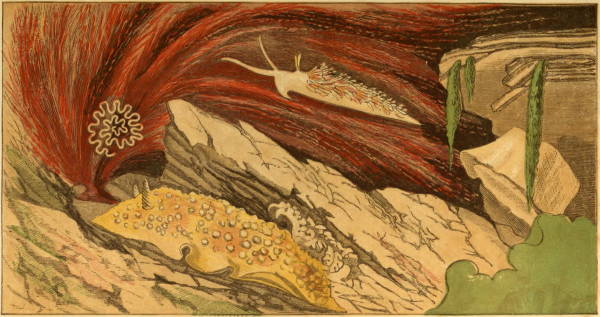
Plate 4.
P. H. GOSSE, del. LEIGHTON, BROS.
SEA LEMON. CROWNED EOLIS. SPAWN OF BOTH.
The mantle, in this Doris, reaches down to the foot
on all sides, and covers the head, and is not furnished
with any appendages. The tentacles, which are plated,
as in the Triope, pierce through the mantle, and are
sheathed; the gill plumes are large and ample feather-like
organs, eight in number, forming a complete circle
round the orifice, in the manner of a beautiful expanded
flower.
As the Doris crawls along, it now and then lifts and
puckers the edge of the mantle, and displays its under
surface and that of the foot, which are of a rich orange-scarlet
hue.
THE CROWNED EOLIS.
But we have turned a stone beneath which lurk
several specimens of a much lovelier creature yet. I
see by the gleams of crimson and azure which shine
out from it, that it must be the Crowned Eolis.[18] It
looked a little heap of fibrous semi-pellucid flesh when
out of water, and, like the Triope, must be immersed to
display its beauties. Now in the phial of water, how
elegant it is! Its body is long and slender, tapering
away to an almost imperceptible point behind, of a
clear translucent white. The head forms two long
smooth taper tentacles, which wave hither and thither
as the creature gracefully glides along; and besides
these it has two other tentacles, distinguished as the
dorsal pair, resembling, in their position and in their
structure, those of the Doris and Triope, but not
sheathed.
The chief glory of this exquisite animal, however, is
in its breathing organs. These consist of clusters of
finger-shaped papillæ, set transversely across the back,
in about six rows, with the middle line of the back free.
Each of these papillæ is pellucid, with a central core of
the richest crimson, while a very brilliant flush of steel
blue is reflected from the surface, and the tip is opaque
white. The combination of these hues has a most
charming effect.
You would scarcely suppose such lovely creatures
were fierce and carnivorous; but they are the most
determined enemies of the Sea Anemones. This beautiful
Eolis I have often seen assaulting an Anemone,
ferociously tearing away its tentacles, or gnawing great
holes in its side, and, when touched, stiffening and
erecting all its brilliant papillæ, as the porcupine does
its quills.
All these creatures are Mollusca very closely allied
to the Cowry and the Trochus which we lately examined,
but destitute of a shell. The exposure of the
breathing organs is a distinguishing character (these being
more commonly, in the order, concealed in a cavity),
whence they are called Nudibranchiata, or Naked-gilled
Mollusks.
At this season, wherever we find the animals themselves,
we may with confidence expect to find their
spawn. This is deposited in masses, which possess
characteristic forms. Thus this roll, which looks as if
you had made a thin ribbon of paste, half an inch wide,
and rolled it into a loose scroll of two or three turns,
and then affixed it by its edge to the under side of a
stone, is the spawn-mass of the Sea Lemon. And here
is a much more elegant scroll, of which the constituent
is a slender thread, twisted into a frilled or figure-8
form, as it goes on to make the spire.[19] This has been
laid by the beautiful Crowned Eolis. If you examine
either of these masses with a lens, you will see that it
is composed of a vast multitude of white eggs, suspended
in a clear jelly, in which they are arranged in
transverse rows, giving the opaque appearance to what
would else be colourless and transparent.
EGGS OF NUDIBRANCHS.
The eggs, watched day by day under a good microscopic
power, as they advance towards maturity, present
a most interesting object of study. The yolk, which at
first nearly fills the egg-shell, soon becomes a little
elongated, with one end diagonally truncated, or, as it
were, cut off obliquely; the truncated end then becomes
two-lobed, “each lobe exhibiting an imperfect spiral,
and having its margin ciliated. The now animated
being is seen to rotate within its prison. Shortly the
lobes enlarge, and a fleshy process, the rudimentary
foot, is observed to develop itself a little behind them,
on the medial line; a shell closely investing the inferior
portion of the embryo, the lobes and rudimentary
foot being uppermost. The shell rapidly increases, and
assumes a nautiloid form; afterwards the foot displays,
attached to its posterior surface, a circular operculum,
which is opposed to the mouth of the shell. The lobes
now expand into two large, flattened, ovate appendages,
with very long vibratile cilia around the margins; and
the larvæ are at length mature. The whole mass of
spawn now presents the utmost animation. Hundreds
of these busy atoms are seen, each within its transparent,
membranous cell, rotating with great agility
and ceaseless perseverance, the cilia all the while vigorously
vibrating on the margins of the outstretched
lobes. The membranous chorion [or transparent egg-shell],
which by this time has become enlarged, ultimately
gives way, no longer able to resist the perpetual
struggle within; and the liberated larva, wending its
way through the shattered shreds of the general envelope,
boldly trusts itself to the open trackless water, where,
doubtless, thousands and tens of thousands perish ere
they find a fitting resting-place, some being swept away
by resistless currents, others falling a prey to ever-watchful
and innumerable enemies.
“When the larva is at rest, the oral lobes are pulled
back into the shell, and the foot being drawn down,
brings along with it the operculum, which closes the
orifice. But when in action, the whole of these parts
project beyond the opening of the shell, the foot lying
back against the spire; and the oral lobes inclining
forward, their cilia commence to vibrate, and the larva,
with the mouth of the shell upwards, moves through
the water with lively action, sinking or rising, or advancing
onwards at its pleasure.”[20]
SPAWN OF EOLIS.
The fecundity of these mollusca is immense. An Eolis
papillosa of moderate size in one of my aquaria, deposited
successively nine strings of spawn between
March 20th and May 24th. The strings were exactly
alike in length and arrangement; each comprised
about 105 convolutions, and each convolution 200
eggs, while each egg contained on an average two
embryos. Thus the astonishing number of 378,000
embryos proceeded from this one animal in about
two months.
Step by step we have crept along the beach, turning
stones as we went, till we are come to the great masses
of sandstone rock. Here are the Purples[21] by hundreds,
with their strong massive shells, some of them pure
white, which, however, becomes dingy with age, some
banded with brown, and some, especially the young and
half-grown ones, painted with a dull but soft purplish
hue. The older specimens have the inner surface of
the lip tinged with a rich rosy purple. This tint on the
shell we may receive as the advertisement of the colorific
property that resides within, a sort of sign-board to tell
us that this is the “genuine” purple-shell. And there
is little doubt that it is one of those enumerated by
Pliny, as used by the ancients for obtaining the renowned
dye of Tyre: though the principal, and that which
yielded the richest hue, was probably the Murex trunculus,
a common Mediterranean shell, which does not
extend to our shores.
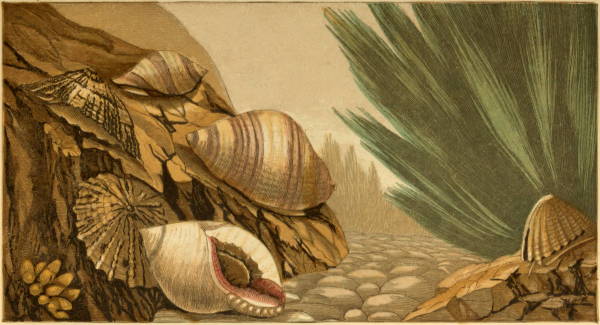
Plate 5.
P. H. GOSSE, del. LEIGHTON, BROS.
LIMPET. PURPLE. SLIT-LIMPET.
My readers are, I dare say, familiar with the pretty
myth which professes to embody the discovery of the
purple dye. The Tyrian Hercules was one day walking
with his sweetheart along the shore, followed by her
lap-dog, when the playful animal seized a shell that
had just been washed up on the beach. Its lips were
presently dyed with a gorgeous purple tint, which was
traceable to a juice that was pressed out of the shell-fish.
The lady was charmed with the colour, and longed
to have a dress of it; and, as wishes under such circumstances
are laws, the enamoured hero set himself to
gratify her, and soon succeeded in extracting and applying
the dye, which afterwards became so famous. I
have elsewhere[22] recorded my own experiments on the
stain yielded by the Purpura before us, with the
remarkable changes through which it passes before the
sunlight fully brings out the colour. The use of
cochineal makes us independent of molluscan dyes,
and the matter is merely one of antiquarian interest,
or a question of zoological chemistry.
EGGS OF DOG-WINKLE.
Perhaps you may be more interested in the development
of the Dog-winkle. Under the ledges of rocks
we find in abundance groups of little yellow bodies,
resembling ninepins in shape, set on their ends in close
contact with each other, and varying in numbers from
three or four to a hundred or upwards in a group.
Some of them are tinged with purple at the tips; and
while sometimes you find them closed, and full of a
yellow creamy substance, at others they are open at the
top, and empty.
These are the egg-capsules of this mollusk, and some
very unusual circumstances connected with the birth of
the progeny, and their development within these cases,
have been discovered by Dr. Carpenter.[23] Each capsule
contains 500 or 600 globules that cannot be distinguished
from each other at first; but only twelve to thirty of
these are developed into young animals, though their
united bulk ultimately equals that of the whole mass.
The greater number of these globules are not real eggs,
but only “yolk-spherules,” destined to afford nutriment
to the true embryos, which greedily swallow them,
after certain changes have taken place, and increase
rapidly in bulk. It is curious, however, that they do
not advance in development during this absorption of
nutriment, but are, so to speak, arrested until a great
augmentation of size is thus attained; then they quickly
acquire the form of little free-swimming nautiloids,
closely like those of the Doris and Eolis, a form which
indeed is common to the early stages of all the known
higher mollusca, however various may be their adult
conditions.
LIMPET.
Here are the familiar Limpets, too: let us look at
them awhile.[24] They are not generally very attractive
in appearance, the shell being coarse and rubbed,
especially in the larger specimens; and in an aquarium
they do not live long, and are so inert as to afford no
amusement even while they survive. Yet we occasionally
find examples prettily coloured; and there are facts
in their economy which make them worthy of a few
moments’ notice.
If you look carefully over the rocks, especially when
these are of a somewhat soft nature, as the slates and
shales, you will find oval depressions, sometimes but
just discernible, at other times sunk to the depth of an
eighth of an inch, corresponding in outline to the shell
of a Limpet; and in many instances you will actually
see a Limpet imbedded in such a pit, which it accurately
fills. Strange as it may seem, it has been ascertained
that these cavities are formed by the animals, which
make them their ordinary resting-places, wandering
away from them nightly to feed, and returning to them
to rest early in the morning.
The force with which a Limpet adheres to the rock
is very great, especially when it has had warning of
assault, and has had time to put out its muscular
strength. Réaumur found that a weight of twenty-eight
or thirty pounds was required to overcome this
adhesive force. His experiments seem to prove, however,
that its power is mainly owing, not to muscular
energy, nor to the production of a vacuum in the manner
of a sucker. If an adhering Limpet were cut quite
through perpendicularly, shell and animal, the two
parts maintained their hold with unabated force, although
of course a vacuum, if there had been one, would
have been destroyed by the incision. The power is
said to reside in a very strong glue, a very viscid secretion,
deposited at the will of the animal. “If, having
detached a Patella,” says Dr. Johnston, “the finger be
applied to the foot of the animal, or to the spot on
which it rested, the finger will be held there by a very
sensible resistance, although no glue is perceptible.
And it is remarkable that if the spot be now moistened
with a little water, or if the base of the animal be cut,
and the water contained in it allowed to flow over the
spot, no further adhesion will occur on the application
of the finger: the glue has been dissolved. It is
nature’s solvent, by which the animal loosens its own
connexion with the rock. When the storm rages, or
when an enemy is abroad, it glues itself firmly to its
rest; but when the danger has passed, to free itself
from this forced constraint, a little water is pressed from
the foot, the cement is weakened, and it is at liberty to
raise itself and be at large. The fluid of cementation,
as well as the watery solvent, is secreted in an infinity
of miliary glands with which the foot is, as it were,
shagreened; and as the Limpet cannot supply the
secretion as fast as this can be exhausted, you may
destroy the animal’s capacity of fixation by detaching
it forcibly two or three times in succession.”
THE GILLS.
If we remove one of these Limpets from his selected
area of rock,—which we may readily do, notwithstanding
the strength of his cement, if we take him at unawares,
and give him a smart sudden horizontal rap with a
piece of wood, or a moderated blow with a hammer,—we
shall obtain a view of a structure well worth looking
at. The animal is essentially like a Trochus or a Purple
inhabiting a conical shell; only in this case the cone
is low and simple, whereas in the others it is tall and
slender, and rolled into a spire. One of the most
curious peculiarities in the Limpet is its gill or breathing
organ. This, we perceive, completely encircles the
animal, forming a ring interrupted only at one point.
It lies in the fold between the mantle and the foot,
commencing on the left side of the neck, and passing
quite round the body, parallel with the edge of the
shell, in front of the head, till it terminates close to the
point where it began. It is a long cord closely beset
with tiny leaflets, and thus forming a continual plume.
Each leaflet, conical in outline, is permeated with blood-vessels,
and clothed with minute cilia, whose constant
vibrations cause the circumambient water ever to play
over the surface of these organs in ceaseless currents,
bringing fresh supplies of oxygen to be respired; and
this is absorbed by the blood through the thin membrane
by which they are protected.
There is a very pretty little shell, not uncommon in
deep water off these coasts, but rarely found by the
shore collector, though it does occasionally venture to
peep at daylight at the verge of extreme low-tide. It
is the Slit Limpet,[25] which by the older naturalists was
placed in close alliance with the Limpets proper, as if
a member of the same family. They were, however,
deceived by paying too exclusive attention to the form
of the shell, which is a cone, somewhat rounded, and
nearly simple, the summit being slightly turned over in
a backward direction. The margin of the shell is delicately
notched, the points being the extremities of the
radiating ridges; for the entire surface is covered with
reticulations, one series of alternate furrows and ridges
proceeding from the summit to the margin, and another
series crossing these at right angles, running round the
shell parallel with the margin. The animal has its sides
ornamented with short fleshy processes, and possesses
two symmetrical gill-plumes, one on each side. It is
rather attractive in appearance, but I cannot tell you
anything of its manners; for though I have kept specimens
in the aquarium, they are so habitually sluggish,
and so reluctant to allow one a peep beneath the edge
of the jealous shell, that I could learn nothing about
their ways;—if indeed they have any.
PHOLAS HOLES.
Another curious form closely related to this is the
Keyhole Limpet,[26] whose shell is of a long oval outline,
of a lower cone, reticulated, like the Slit Limpet, but
pierced at the summit with a double hole, or rather a
perforation apparently made of two holes broken into
one, something like a keyhole. This orifice, like the
slit in the former case, is for the discharge of the effete
water taken in in breathing.
See! here is the soft red sandstone lying in great
beds, pierced through and through with smooth round
holes, just as if bored with a carpenter’s auger, big
enough to admit a man’s thumb. What agency has
been in operation to effect these perforations? Let us
try to discover.
A few good blows with the stout hammer on the
chisel-head serve to split off a great slice of the coarse
red sandstone. The holes run through its substance,
but they are all empty, or filled only with the black
fœtid mud which the sea has deposited in their cavities.
Yes; these are too superficial; they are all deserted;
the stone lies too high above low-water mark: we must
seek a lower level. Try here; where the lowest spring-tide
only just leaves the rock bare. Ha! now we have
uncovered the operators. Here lie, snugly ensconced
within the tubular perforations, great mollusca, with
ample ivory-like shells, which yet cannot half contain
the whiter flesh of their ampler bodies, and the long
stout yellow siphons that project from one extremity,
reaching far up the hole towards the surface of the
rock.[27]
We lift one from its cavity, all helpless and unresisting,
yet manifesting its indignation at the untimely
disturbance by successive spasmodic contractions of
these rough yellow siphons, each accompanied with a
forcible jet d’eau, a polite squirt of sea-water into our
face; while, at each contraction in length, the base
swells out, till the compressed valves of the sharp shell
threaten to pierce through its substance.
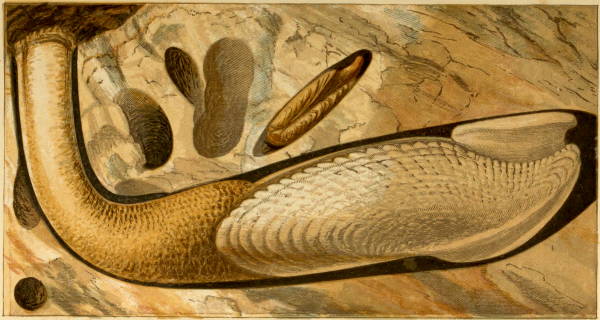
Plate 6.
P. H. GOSSE, del. LEIGHTON, BROS.
RED-NOSE. FINGER-PHOLAS.
HYPOTHESES OF THEIR FORMATION.
Strange as it seems, these animals have bored these
holes in the stone; and they are capable of boring in
far harder rock than this; even in compact limestone.
The actual mode in which this operation is performed
long puzzled philosophers. Some maintained that the
animal secreted an acid which had the power of dissolving
not only various kinds of stone, but also wood,
amber, wax, and other substances, in which the excavations
are occasionally made. But it was hard to imagine
a solvent of substances so various, and to know how
the animals’ own shells were preserved from its action;
while, confessedly, no such acid had ever been detected
by the most careful tests.
Others maintained that the rough points which stud
the shell enable it to serve as a rasp, which the animal,
by rotating on its axis, uses to wear away the stone or
other material; but it was difficult to understand how
it was that the shell itself was not worn away in the
abrasion.
Another zoologist, rejecting this hypothesis, maintained
that the edges of the mantle and the short thick
foot are the instruments employed; and that, though
these fleshy organs seem little fitted for such work,
they are really endowed with the requisite power in
the shape of crystals of flint which are deposited thickly
in their substance. Strange to say, however, other
accurate observers fail to detect these siliceous crystals,
and therefore reject the hypothesis.
Another suggested that the stone was removed in invisible
particles by the constant action of currents in
the water, produced by vibratile cilia seated on the soft
parts of the animal; but this supposition was found
untenable on examination.
Actual observation in the aquarium has proved that
the second hypothesis is the true one. M. Cailliaud in
France and Mr. Robertson in England have demonstrated
that the Pholas uses its shell as a rasp, wearing
away the stone with the asperities with which the anterior
parts of the valves are furnished. Between these
gentlemen a somewhat hot contention was maintained
for the honour of priority in this valuable discovery.
M. Cailliaud himself used the valves of the dead shell,
and imitating the natural conditions as well as he could,
actually bored an imitative hole, by making them rotate.
Mr. Robertson, at Brighton, exhibited to the public
living Pholades in the act of boring in masses of chalk.
He described it as “a living combination of three instruments,
viz., a hydraulic apparatus, a rasp, and a
syringe.” But the first and last of these powers can be
considered only as accessory to the removing of the detritus
out of the way, when once the hole was bored,
the rasp being the real power. If you examine these
living shells, you will see that the fore part, where the
foot protrudes, is set with stony points arranged in
transverse and longitudinal rows, the former being the
result of elevated ridges radiating from the hinge, the
latter that of the edges of successive growths of the
shell. These points have the most accurate resemblance
to those set on a steel rasp in a blacksmith’s
shop. It is interesting to know that the shell is preserved
from being itself prematurely worn away by the
fact, that it is composed of arragonite, a substance much
harder than those in which the Pholas burrows. Yet
we see by the specimens before us that such a destructive
action does in time take place, for some of these
have the rasping points much more worn than others,
many of the older ones being nearly smooth.
The animal turns in its burrow from side to side
when at work, adhering to the interior by the foot, and
therefore only partially rotating to and fro. The substance
is abraded in the form of fine powder, which is
periodically ejected from the mouth of the hole by the
contraction of the branchial siphon; a good deal of the
more impalpable portions being deposited by the current
as it proceeds, and lodging as a soft mud between
the valves and the stone. Mr. Hudson,[28] who watched
some Pholades at work in a tide-pool in the chalk,
observed the periodic ejection of the cloud of chalk-powder,
and noticed the heaps of the same material deposited
around the mouth of each burrow. The discharges
were made with no regularity as to time. Mrs.
Merrifield[29] records a curious fact. “A lady, watching
the operations of some Pholades which were at
work in a basin of sea-water, perceived that two of
them were boring at such an angle that their tunnels
would meet. Curious to ascertain what they would
do in this case, she continued her observations, and
found that the larger and stronger Pholas bored straight
through the weaker one, as if it had been merely a piece
of chalk rock.”
Mr. Ross, of Rhyl, having a Pholas in his aquarium,
prepared a piece of wood, by excavating a shallow cavity,
about a quarter of an inch deep, in which he set the
animal, whose shell was two inches long. “After a
short time the animal attached its foot to the bottom of
the hole and commenced swaying itself from side to
side, until the hole was of sufficient depth to allow it
to proceed in the following manner:—It inflated itself
with water, apparently to its fullest extent, raising its
shell upwards from the hole; then holding by its muscular
foot, it drew its shell gradually down. This
would have produced a perpendicular and very inefficient
action, but for a wise provision of nature. The
edges of the valves are not joined close together, but
are connected by a membrane (extension of the mantle),
and instead of being joined at the hinge (umbo) like
ordinary bivalves, they possess an extra plate, attached
to each valve of the shell, which is necessary for the
following operation:—In boring, this mollusk, having
dilated itself with water, draws down its shell within
the hole, gradually closing the lower anterior edges until
they almost touch. It then raises its shell upwards,
gradually opening the lower anterior edges, and closing
the upper, thus boring both upwards and downwards.
The spines are placed in rows, like the teeth of
a saw; those towards the lower part of the shell being
sharp and pointed, while those above, being now useless,
are not renewed.”[30]
RED-NOSES.
In this limestone cliff we shall find other borers, for
you may see even at a considerable distance how holed
and honeycombed its surface is; the cavities being so
numerous, so close, and so irregular in their direction,
that the whole face of the rock is fashioned into small
sharp-edged shapeless points. Nor need we be long in
finding the industrious masons who thus rough-point
acres upon acres, nay miles upon miles, of limestone
rock. Here in ten thousand orifices you discern little
double-tipped knobs of crimson flesh, which, as soon as
you disturb them, shoot at you a column of water and
then disappear within their fortress, having exhausted
their artillery. The fishermen know them well, and use
them for bait, applying to them the familiar but expressive
soubriquet of Red-noses.[31]
It is not so easy to get at these as at the Pholades,
because of the superior hardness of the stone which they
excavate. With the chisel, however, we need not fail
of uncovering a few, especially as their burrows are but
shallow. Here they are, half-a-dozen in a block as big
as your fist. Ugly, uncouth, bemired, the valves not
nearly containing the shapeless flesh, they are not particularly
attractive creatures, maugre the brilliant hue
of their blushing siphons. Like Mrs. Merrifield’s
Pholas, these Saxicavæ habitually break into one
another’s houses, as we see here, and even cut one
another’s shells and bodies through and through most
ruthlessly. They will live very well out of the rock,
and may be kept a considerable time in the aquarium.
There is no doubt that the burrowing Mollusca are
slowly but surely effecting changes in the configuration
of rocky coasts, by destroying the rock. It is true their
excavations extend but a few inches in depth; but then,
as the force of the elements readily breaks down the
thin partitions left standing, and discovers a new face,
so the borers are continually renewing their attacks on
this; and so in time the cliffs are worn away, while the
debris of impalpable mud is deposited upon the shallows,
entering into new combinations, and filling up estuaries
and harbours.


 , some thicker and more elliptical, others slender and
rounder,
, some thicker and more elliptical, others slender and
rounder,  . A few take the form of the letter
  , but
having one lobe much more developed than the other.
Some of the
, but
having one lobe much more developed than the other.
Some of the 