The matter contained in this volume is taken wholly
from “The Woods and By-Ways of New England,” omitting
all that is published in Volume I., and which has no
special reference to trees. This volume, beside the particular
description of species, treats of the value and beauty
of trees and forests, of their climatic influence as purifiers
of the atmosphere, of their relations to water, to electricity,
to temperature, to the soil, to shade and salubrity, to birds
and insects, to ornament, and to poetry and fable.
THE WOODS.
A YEAR AMONG THE TREES;
OR,
THE WOODS AND BY-WAYS OF NEW ENGLAND.
1
When the Pilgrim first landed on the coast of America,
the most remarkable feature of its scenery that drew his
attention, next to the absence of towns and villages, was
an almost universal forest. A few openings were to be
seen near the rivers,—immense peat-meadows covered
with wild bushes and gramineous plants, interspersed
with little wooded islets, and bordered on all sides by a
rugged, silent, and dreary desert of woods. Partial clearings
had likewise been made by the Indians for their
rude hamlets, and some spaces had been opened by fire.
But the greater part of the country was darkened by an
umbrageous mass of trees and shrubbery, in whose gloomy
shades were ever present dangers and bewilderment for
the traveller. In these solitudes the axe of the woodman
had never been heard, and the forest for thousands of years
had been subject only to the spontaneous action of natural
causes. To men who had been accustomed to the open
and cultivated plains of Europe, this waste of woods,
those hills without prospect, that pathless wilderness,
and its inhabitants as savage as the aspect of the country,
must have seemed equally sublime and terrible.
But when the colonists had cut roads through this
desert, planted landmarks over the country, built houses
2upon its clearings, opened the hill-tops to a view of the
surrounding prospect, and cheered the solitude by some
gleams of civilization, then came the naturalist and the
man of science to survey the aspect and productions of
this new world. And when they made their first excursions
over its rugged hills and through its wooded
vales, we can easily imagine their transports at the sight
of its peculiar scenery. How must the early botanist
have exulted over this grand assemblage of plants, that
bore resemblance to those of Europe only as the wild
Indian resembles the fair-haired Saxon! Everywhere
some rare herb put forth flowers at his feet, and trees of
magnificent height and slender proportions intercepted
his progress by their crowded numbers. The wood was
so generally uninterrupted, that it was difficult to find a
summit from which he could obtain a lookout of any
considerable extent; but occasional natural openings exposed
floral scenes that must have seemed like the work
of enchantment. In the wet meadows were deep beds
of moss of the finest verdure, which had seldom been
disturbed by man or brute. On the uplands were vast
fields of the checkerberry plant, social, like the European
heath, and loaded half the year with its spicy scarlet
fruit. Every valley presented some unknown vegetation
to his sight, and every tangled path led him into a new
scene of beauties and wonders. It must have seemed to
him, when traversing this strange wilderness, that he
had entered upon a new earth, in which nature had imitated,
without repeating, the productions of his native
East.
Along the level parts of New England and the adjacent
country, wherever the rivers were languid in their
course, and partially inundated their banks in the spring,
were frequent natural meadows, not covered by trees,—the
homes of the robin and the bobolink before the
3white man had opened to them new fields for their subsistence.
In the borders of these openings, the woods
in early summer were filled with a sweet and novel minstrelsy,
contrasting delightfully with the silence of the
deeper forest. The notes of the birds were wild variations
of those which were familiar to the Pilgrim in his
native land, and inspired him with delight amidst the
all-prevailing sadness of woods that presented on the
one hand scenes both grand and beautiful, and teemed on
the other with horrors which only the pioneer of the desert
could describe.
The whole continent, at the time of its discovery, from
the coast to the Great American Desert, was one vast
hunting-ground, where the nomadic inhabitants obtained
their subsistence from the chase of countless herds of
deer and buffalo. At this period the climate had not
been modified by the operations of man upon the forest.
It was less variable than now, and the temperature corresponded
more definitely with the degrees of latitude.
The winter was a season of more invariable cold, less interrupted
by thaws. In New England and the other
Northern States, snow fell in the early part of December,
and lay on the ground until April, when the
spring opened suddenly, and was not followed by those
vicissitudes that mark the season at the present era.
Such was the true forest climate. May-day came garlanded
with flowers, lighted with sunshine, and breathing
the odors of a true spring. It was then easy to foretell
what the next season would be from its character the preceding
years. Autumn was not then, as we have often
seen it, extended into winter. The limits of each season
were more precisely defined. The continent was annually
visited by the Indian summer, that came, without
fail, immediately after the fall of the leaf and the first
hard frosts of November. This short season of mild and
4serene weather, the halcyon period of autumn, has disappeared
with the primitive forest.
The original circumstances of the country have been
entirely revolutionized. The American climate is now in
that transition state which has been caused by opening
the space to the winds from all quarters by operations
which have not yet been carried to their extreme limit.
These changes of the surface have probably increased the
mean annual temperature of the whole country by permitting
the direct rays of the sun to act upon a wider
area, while they have multiplied those eccentricities of
climate that balk our weather calculations at all seasons.
There are still in many parts of the country large tracts
of wood which have not been greatly disturbed. From
the observation of these, and from descriptions by different
writers of the last century, we may form a pretty
fair estimate of the character and aspect of the forest before
it was invaded by civilized man.
During this primitive condition of the country, the
forest, having been left for centuries entirely to nature,
would have formed a very intelligible geological chart.
If we could have taken an extensive view of the New
England forest, before any considerable inroads had been
made by the early settlers, from an elevated stand on the
coast, we should have beheld a dense and almost universal
covering of trees. From this stand we might also
trace the geological character of the soil, and its different
degrees of fertility, dryness, and moisture, by the
predominance of certain species and the absence of others.
The undulations upon this vast ocean of foliage would
come from the elevations and depressions of the ground;
for the varying heights of the different assemblages of
species upon the same level could hardly be perceived
by a distant view. The lowest parts of this wooded
region were at that period covered very generally with a
5crowded growth of the northern cypress, or white cedar.
These evergreen swamps would constitute the darkest
ground of the picture. The deep alluvial tracts would
be known by the deciduous character of their woods
and their lighter and brighter verdure, and the dry,
sandy and diluvial plains and the gravelly hills and
eminences by their white birches and tremulous poplars,
their stunted pitch-pines and dwarfish junipers. For a
century past the woods have been cleared mostly from the
alluvial tracts; and the oaks, the hickories, the chestnuts,
and other hard-wood trees, the primitive occupants of the
rich and deep soils, have been succeeded in great measure
by trees of softer wood, that originally grew on inferior
land. The wooded aspect of the country cannot any
longer be considered, as formerly, a good geological chart,
except in some parts of Maine and the adjoining British
Provinces.
One of the conditions most remarkable in a primitive
forest is the universal dampness of the ground. The
second growth of timber, especially if the surface were
entirely cleared, stands upon a drier foundation. This
greater dryness is caused by the absence of those vast
accumulations of vegetable débris that rested on the
ground before it was disturbed. A greater evaporation
also takes place under the second growth, because the
trees are of inferior size and stand more widely apart.
Another character of a primitive forest is the crowded
assemblage of trees and their undergrowth, causing great
difficulty in traversing it. Innumerable straggling vines,
many of them covered with thorns, like the green-brier,
intercept our way. Immense trunks of trees, prostrated
by hurricanes, lie in our path, and beds of moss of extreme
thickness cover a great part of the surface, saturated
with moisture. The trees are also covered with
mosses, generated by the shade and dampness; and woody
6vines, like the climbing fern, the poison ivy, and the ampelopsis,
fastened upon their trunks and trailing from
their branches, make the wood in many places like the
interior of a grotto. Above all, the traveller would notice
the absence of those pleasant wood-paths that intersect
all our familiar woods, and would find his way only by
observing those natural appearances that serve as a compass
to the Indian and the forester.
In primitive woods there is but a small proportion of
perfectly formed trees; and these occur only in such
places as permit some individuals to stand in an isolated
position, and spread out their arms to their full capacity.
When rambling in a wood we take note of several conditions
which are favorable to this full expansion of their
forms. On the borders of a lake, a prairie, or an open
moor, or of an extensive quarry that projects above the
soil, the trees will extend their branches into the opening;
but as they are crowded on their inner side, they
are only half developed. This expansion, however, is on
the side that is exposed to view; hence the incomparable
beauty of a wood on the borders of a lake or pond,
on the banks of a river as viewed from the water, and
on the circumference of a densely wooded islet.
Fissures and cavities are frequent in large rocks not
covered with soil, allowing solitary trees which have
taken root in them to acquire their full proportions. In
such places, and on eminences that rise suddenly above
the forest level, with precipitous sides, overtopping the
surrounding woods, we find individual trees possessing the
character of standards, like those we see by roadsides and
in open fields. But perfectly formed trees can only be
produced in openings and on isolated elevations such as
I have described; and it is evident that these favorable
circumstances must be rare. The trees in a forest are like
those human beings who from their infancy have been
7confined in the workshops of a crowded manufacturing
town, and who become closely assimilated and lose those
marks of individual character by which they would be
distinguished if they had been reared in a state of freedom
and in the open country.
The primitive forest, in spite of its dampness, has always
been subject to fires in dry seasons, which have
sometimes extended over immense tracts of country.
These fires were the dread of the early settlers, and
countless lives have been destroyed by their flames
often overwhelming entire villages. At the present time
the causes of fire in the woods are very numerous;
but before they were exposed to artificial sources of ignition
it may have arisen from spontaneous combustion,
caused by large accumulations of fermenting substances,
or from lightning, or from the accidental friction of the
trunks of half-prostrated trees crossing each other, and
moved by a high wind. The forests in every part of the
world have been subject to conflagrations; and there
seems to be no other means that could be used by nature
for removing old and worn-out forests, which contain
more combustible materials than any young woods. The
burned tracts in America are called barrens by the inhabitants;
and as the vegetation on the surface is often
entirely destroyed, the spontaneous renewal of it would
display the gradual method of nature in restoring the
forest. The successions of plants, from the beautiful crimson
fireweed, through all the gradations of tender herbs,
prickly bushes, and brambles, to shrubs and trees of inferior
stature, until all, if the soil be deep and fertile, are
supplanted by oaks, chestnuts, hickories, and other hard-wood
trees, are as regular and determinable as the courses
of the planets or the orders of the seasons.
THE ASH.
8
It is interesting to note the changes that take place
from one season to another in the comparative beauty
of certain trees. The Ash, for example, during the early
part of October, is one of the most beautiful trees of the
forest, exceeded only by the maple in variety of tinting.
In summer, too, but few trees surpass it in quality of
foliage, disposed in flowing irregular masses, light and
airy, but not thin, though allowing the branches to be
traced through it, even to their extremities. It has a
well-rounded head, neither so regular as to be formal, nor
so broken as to detract from its peculiar grace. When
standing with other trees in midsummer, in the border
of a wood, or mingled with the standards by the roadside,
the Ash would be sure to attract admiration. But no
sooner have the leaves fallen from its branches than it
takes rank below almost all other trees, presenting a stiff,
blunt, and awkward spray, and an entire want of that
elegance it affects at other seasons.
The Ash is a favorite in Europe, though deficient there
in autumnal tints. It is a tree of the first magnitude,
and has been styled in classical poetry the Venus of the
forest, from the general beauty of its proportions and
flowing robes. The English, however, complain of the
Ash, on account of its tardy leafing in the spring and its
premature denudation in the autumn. “Its leaf,” says
Gilpin, “is much tenderer than that of the oak, and
sooner receives impression from the winds and frost. Instead
of contributing its tint, therefore, in the wane of
9the year, among the many colored offspring of the woods,
it shrinks from the blast, drops its leaf, and in each scene
where it predominates leaves wide blanks of desolate
boughs amid foliage yet fresh and verdant. Before its decay
we sometimes see its leaf tinged with a fine yellow,
well contrasted with the neighboring greens. But this
is one of nature’s casual beauties. Much oftener its leaf
decays in a dark, muddy, unpleasing tint.”
The Ash is remarkable for a certain trimness and regularity
of proportion, and it seldom displays any of those
breaks so conspicuous in the outlines of the hickory,
which in many points it resembles. The trunk rises to
more than an average height before it is subdivided; but
we do not see the central shaft above this subdivision, as
in the poplar and the fir. Lateral branches seldom
shoot from the trunk, save, as I have sometimes observed,
a sort of bushy growth, surrounding it a little below the
angles made by the lower branches. It is called in Europe
“the painters’ tree.” But George Barnard, alluding
to this fact, remarks: “Unlike the oak, the Ash does
not increase in picturesqueness with old age. The foliage
becomes rare and meagre, and its branches, instead of hanging
loosely, often start away in disagreeable forms.”
North America contains a greater number of species of
the genus Fraxinus than any other part of the globe.
But three of these only are common in New England,—the
white, the red, and the black Ash. The first is the
most frequent both in the forest and by the roadsides, the
most beautiful, and the most valuable for its timber. All
the species have pinnate and opposite leaves, and opposite
branches in all the recent growth; but as the tree increases
in size, one of the two invariably becomes abortive,
so that we perceive this opposite character only in the
spray. The leaflets are mostly in sevens, not so large
nor so unequal as in the similar foliage of the hickory.
10The white and the red Ash have so nearly the same
external characters, that it requires some study to distinguish
them. They do not differ in their ramification,
nor in their autumnal hues. The black Ash may be
readily identified by the leaves, which are sessile, and
like those of the elder; also by the dark bluish color of
the buds and newly formed branches, and the slenderness
of its proportions. It seldom attains a great height or
size, and is chiefly confined to swamps and muddy soils.
The wood of this species is remarkable for strength and
elasticity. The remarks of George Barnard respecting
the localities of the Ash in Europe will apply to the
American species: “Though seen everywhere, its favorite
haunt is the mountain stream, where its branches hang
gracefully over the water, adding much beauty to the
scene. It is to be met with in every romantic glen and
glade, now clinging with half-covered roots to a steep,
overhanging cliff, and breaking with its light, elegant
foliage the otherwise too abrupt line, or with its soft
warm green relieving the monotonous coloring of the
rocks or the sombre gray of some old ruin.”
There are some remarkable superstitions and traditionary
notions connected with the Ash-tree. The idea that
it is offensive, and even fatal, to serpents, is not of modern
origin, though not a rustic laborer can be found who
would not consider an Ash-tree planted before his house
as a charm against their intrusion. According to Pliny,
if a serpent be surrounded on one side by fire and on the
other by a barricade of the leaves and branches of the
Ash-tree, he will escape through the fire, rather than
through its fatal boughs. It is related in the Edda that
man was first created from the wood of this tree, and it is
not improbable that this superstition has some connection
with the fable of Adam and Eve, and through this with
the supposed antipathy of the serpent for the Ash-tree.
11There is a saying in Great Britain, that, if the Ash puts
forth its leaves before the oak, the following summer will
be wet; but if the leafing of the oak precedes that of the
Ash, it will be dry. I am not aware that any such maxim
has obtained credence in the United States.
ANIMALS OF THE PRIMITIVE FOREST.
12
European travellers in this country frequently allude
to the American forest as remarkable for its solitude
and deficiency of animal life. Captain Hardy
remarks that a foreigner is struck with surprise, when
rambling through the bush, at the scarcity of birds, rabbits,
and hares, and is astonished when in the deepest
recesses of the wild country he sees but little increase of
their numbers. When paddling his canoe through lake
and river, he will startle but few pairs of exceedingly
timid waterfowl where in Europe they swarm in multitudes.
This scarcity of animals, I would remark, is not
peculiar to the American wilderness. The same fact has
been observed in extensive forests both in Europe and
Asia; and in proportion as the traveller penetrates into
their interiors he finds a smaller number of animals of
almost every species. Birds, insects, and quadrupeds
will multiply, like human beings, in a certain ratio with
the progress of agriculture, so long as there remains a
sufficiency of wild wood to afford them a refuge and a
home. They use the forest chiefly for shelter, and the
open grounds for forage; the woods are their house, the
meadows their farm.
I had an opportunity for observing these facts very
early in life, when making a pedestrian tour through several
of the States. I commenced my journey in autumn,
and being alone, I was led to take note of many things
which, had any one accompanied me, would have escaped
my observation. After passing a few weeks of the winter
13in Nashville, I directed my course through Tennessee and
Virginia, and was often led through extensive ranges of
forest. I never saw birds in any part of the United
States so numerous as in the woods adjoining the city of
Nashville, which was surrounded with immense cornfields
and cotton plantations. But while walking through
the country I could not help observing the scarcity of
birds and small quadrupeds in the woods whenever I was
at a long distance from any village or habitation. Sometimes
night would draw near before I had reached a hamlet
or farm-house, where I might take lodging. On such
occasions the silence of the woods increased my anxiety,
which was immediately relieved upon hearing the cardinal
or the mocking-bird, whose cheerful notes always indicated
my approach to cultivated fields and farms.
That this scarcity of animal life is not peculiar to the
American forest we have the testimony of St. Pierre, who
says of the singing birds: “It is very remarkable that all
over the globe they discover an instinct which attracts
them to the habitations of man. If there be but a single
hut in the forest, all the singing birds of the vicinity
come and settle round it. Nay, they are not to be found
except in places which are inhabited. I have travelled
more than six hundred leagues through the forests of
Russia, but never met with small birds except in the
neighborhood of villages. On making the tour of fortified
places in Russian Finland with the general officers of the
corps of engineers with which I served, we travelled
sometimes at the rate of twenty leagues a day without
seeing on the road either village or bird. But when we
perceived the sparrows fluttering about, we concluded we
must be near some inhabited place. In this indication
we were never once deceived.”
It may be remarked, however, that birds and quadrupeds
do not seek the company of man when they congregate
14near his habitations. They are attracted by the
increased amount of all their means of subsistence that follows
the cultivation of the land. The granivorous birds,
no less than the insect-feeders, are benefited by the extension
of agriculture. Even if no cereal grains were raised,
the cultivated fields would supply them, in the product of
weeds alone, more sustenance than a hundred times the
same area in forest. Before there were any settlements
of white men in this country, birds and small quadrupeds
must have congregated chiefly about the wooded borders
of prairies, on the banks of rivers, in fens and cranberry
meadows, and around the villages of the red man. Their
numbers over the whole continent were probably much
smaller than at the present time, notwithstanding the
merciless destruction of them by gunners and trappers.
There are but few tribes of animals that may be supposed
to thrive only in the wild forest; and even these,
if unmolested by man, would always find a better subsistence
in a half-cultivated country abounding in woods
of sufficient extent to afford them shelter and a nursery
for their young, than in a continuous wilderness. Beasts
of prey, however, are destroyed by man in the vicinity of
all his settlements, to protect himself and his property
from their attacks, and game-birds and animals of the
chase are recklessly hunted both for profit and amusement.
In Europe the clearing of the original forest was
so gradual that the wild animals multiplied more rapidly
with the progress of agriculture. Civilization advanced
so slowly, and the arts made such tardy and gradual progress,
that all species enjoyed considerable immunity
from man. The game-birds and animals of the chase
were not only preserved in forests attached to princely
estates, but they were also protected by game-laws at
a time when such laws were less needful because so few
of the peasantry were accustomed to the use of the gun.
15While the royal forests yielded these creatures a shelter
and abode, the cultivated lands near their bounds afforded
them subsistence; and they must have multiplied more
rapidly in proportion to the increase of human population
than in America after its settlement, where very different
circumstances and events were witnessed.
America was colonized and occupied by civilized people,
and the forests were swept away with a rapidity unprecedented
in the history of man. Every pioneer was a
hunter provided with guns and ammunition; every male
member of his family over seven years of age was a gunner
and a trapper. The sparse inhabitants of the forest,
which if unmolested, as in the early period of European
civilization, would have multiplied in proportion to their
increased means of subsistence, have been, on the contrary,
shot by the gunner, insnared by the trapper, and
wantonly destroyed by boys for amusement, until some
species have been nearly exterminated. Instead of increasing
in a ratio with the supplies of their natural food,
many tribes of them are now more scarce than they were
in the primitive forest. The small birds alone, whose
prolific habits and diminutive size were their protection,
have greatly multiplied.
But even if birds and quadrupeds were unmolested by
man, there are some tribes that would prefer to reside in
the deep wood, while others would fix their abode in orchards
and gardens. The wild pigeon has not been favored
in any respect by the clearing of the forest. The food of
this species is abundantly supplied in the wilds of nature
in the product of beechen woods, hazel copses,
groves of the chinquapin oak, and of the shores of lakes
and arms of the sea covered with Canada rice and
the maritime pea-vine. Their immense powers of flight
enable them to transport themselves to new feeding-grounds
after any present stock is exhausted, and to wing
16their way over hundreds of miles between their different
repasts. This cannot be said of the grouse, the turkey,
and the partridge, whose feeble powers of flight confine
them to a narrow extent of territory; and these birds
must have been frequently robbed of their farinaceous
stores by flocks of wild pigeons during their itinerant
foraging.
There are many species of birds which we associate
with the wild wood because they breed and find shelter
there, but if we watched their habits we should learn
that even these solitary birds make the cultivated grounds
their principal feeding-places. Such are the quail, the
partridge, and very many of our game-birds. The quail
and the partridge are omnivorous, but, like our common
poultry, are more eager to seize a grub or an insect than
a grain of corn. A potato-field is hardly less valuable
to a flock of quails than a field of corn, and affords more
sustenance to the snipe and the woodcock than any
other grounds. But these birds, as well as others, have
diminished as those natural advantages have increased
that should promote their multiplication.
Even our sylvias and thrushes, the most timid of all
the winged tribe, birds hardly ever seen except in lonely
woods, multiply with the clearing of the country and
the increased abundance of their insect food. The vesper
thrushes, that shun the presence of man, and will become
silent in their musical evening if the rustling of the
bushes indicates the approach of a human footstep, are
more numerous in the woods of Cambridge than in any
other part of the country. These are chiefly of maple,
filled with underbrush, and afford the birds a harbor and
a shelter, while the adjoining fields, in a state of the highest
tillage, supply them plentifully with their natural
food, consisting of worms and the larvæ of insects.
THE AZALEA, OR SWAMP HONEYSUCKLE.
17
The Azaleas are favorite flowering shrubs in florists’
collections at the present day, and are remarkable for
the delicacy of their flowers and the purity of their
colors. In New England are only two species,—the
Swamp Honeysuckle and the colored Azalea, a prostrate
shrub bearing pink flowers. It cannot be doubted that
the interest attached to a flower is greatly increased by
finding it in the wild wood. I have frequently observed
this effect and the opposite upon suddenly meeting a
garden flower in a field or wood-path, or a wild flower in
the garden. When the Swamp Honeysuckle is seen growing
with the fairer Azaleas of the florists in cultivated
grounds, its inferiority is most painfully apparent; but
when I encounter it in some green solitary dell in the
forest, bending over the still waters, where all the scenes
remind me only of nature, I am affected with more
pleasure than by a display of the more beautiful species
in a garden or greenhouse.
18
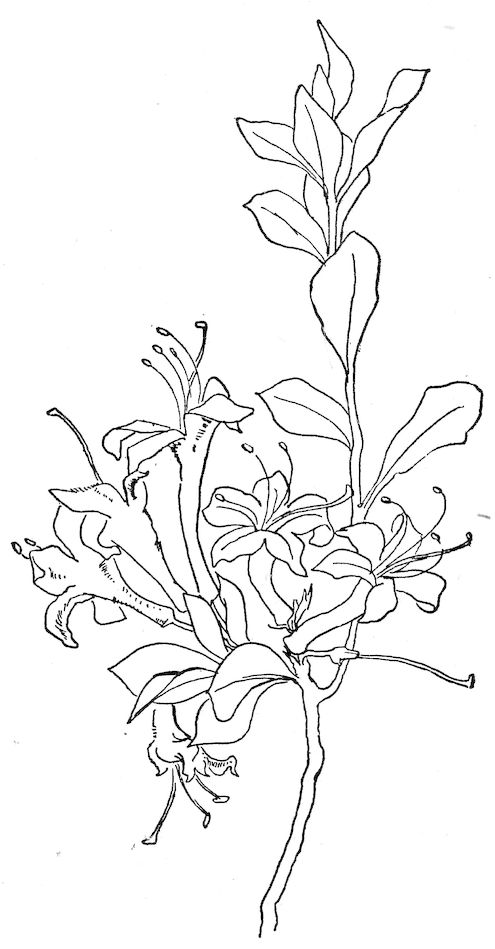
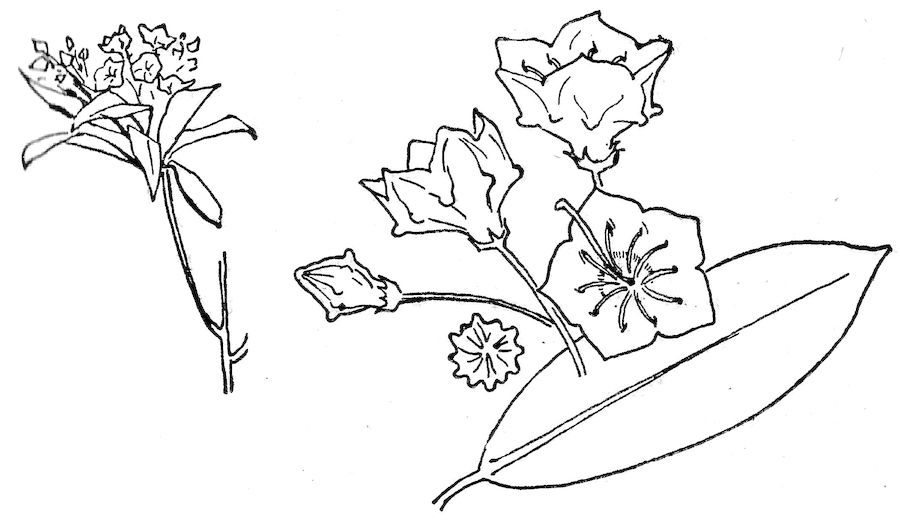
SWAMP AZALEA
19The Swamp Honeysuckle is one of the most interesting
of the New England flowering shrubs, and a very well
known species. It comes into flower about the first of
July, and is recognized by its fragrance,—resembling that
of the marvel of Peru,—by the similarity of its flowers to
those of the woodbine, and their glutinous surface. It
is found only in wet places, and delights in suspending
its flowers over a gently flowing stream, the brink of a
pool, or the margin of a pond, blending its odors with
those of water-lilies, and borrowing a charm from the reflection
of its own beauty on the surface of the still
water. Though it bears no fruit, every rambler in the
woods is grateful for the perfume it sheds around him
while wandering in quest of its flowers. These are extremely
delicate in texture and closely resemble those of
the common white honeysuckle or woodbine of our
gardens, not only in their general shape, but also in the
appearance of several wilted flowers in the same cluster
with perfect flowers and buds. A pulpy excrescence is
often attached to this plant, which is familiarly known
by the name of “swamp apple.” It is slightly acidulous
and sweet, and, though nearly insipid, is not disagreeable
in flavor.
A more beautiful but less common species, with pale
crimson flowers, is found in certain localities, that tends
to multiply into varieties. It is a smaller shrub than
the white Azalea, and does not show the same preference
for wet places. All the species are more remarkable
for their flowers than their foliage, which is of a
pale glaucous green and small in quantity.
THE CANADIAN RHODORA.
In the latter part of May, when the early spring
flowers are just beginning to fade, and when the leaves
of the forest trees are sufficiently expanded to display
all the tints attending the infancy of their growth,
no plant attracts more admiration than the Canadian
Rhodora. The flowers, of a purple crimson, are in umbels
on the ends of the branches, appearing before the
leaves. The corolla, consisting of long narrow petals,
very deeply cleft, the stamens on slender hairy filaments,
20and the projecting style, resemble tufts of colored
silken fringe. The Rhodora is from two to six feet
in height, and is one of the most conspicuous ornaments
of wet, bushy pastures in this part of the country.
It is the last in the train of the delicate flowers of
spring, and by its glowing hues indicates the coming of
a brighter vegetation. When other shrubs of different
species are only half covered with foliage, the Rhodora
spreads out its flowers upon the surface of the variegated
ground, in plats and clumps of irregular sizes, and sheds
a checkered glow of crimson over whole acres of moor.
The poets have said but little of this flower because it
wants individuality. We look upon the blossoms of the
Rhodora as we look upon the crimsoned clouds, admiring
their general glow, not the cast of single flowers. But
there is something very poetical in the rosy wreaths it
affixes to the brows of Nature, still pallid with the long
confinement of winter.
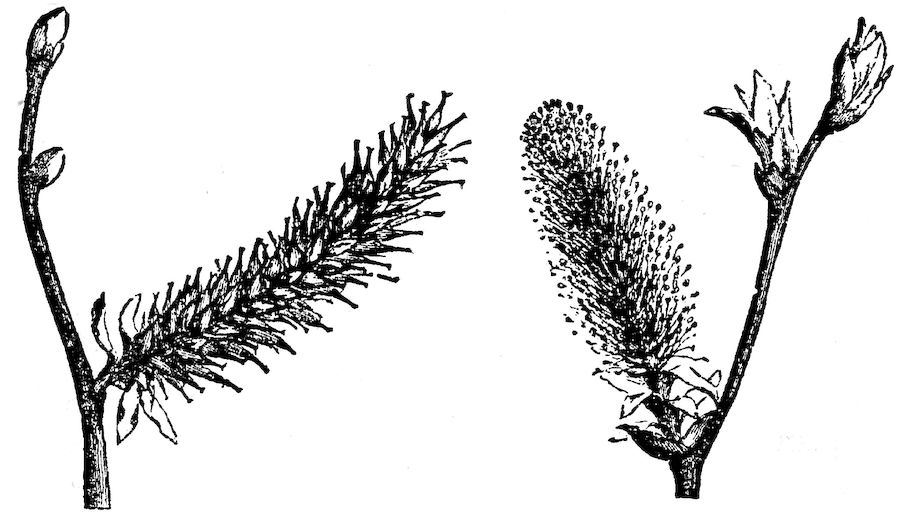
CATKINS OF WILLOW.
THE WILLOW.
21
The Willow is of all trees the most celebrated in
romance and romantic history. Its habit of growing
by the sides of lakes and rivers, and of spreading its
long branches over wells in solitary pastures, has given
it a peculiar significance in poetry as the accompaniment
of pastoral scenes, and renders it one of the most interesting
objects in landscape. Hence there is hardly a
song of nature, a rustic lay of shepherds, a Latin eclogue,
or any descriptive poem, that does not make frequent
mention of the Willow. The piping sounds from wet
places in the spring of the year, the songs of the earliest
birds, and the hum of bees when they first go abroad
after their winter’s rest, are all delightfully associated
with this tree. We breathe the perfume of its flowers
before the meadows are spangled with violets, and when
the crocus has just appeared in the gardens; and its early
bloom makes it a conspicuous object when it comes forth
under an April sky, gleaming with a drapery of golden
verdure among the still naked trees of the forest and
orchard.
When Spring has closed her delicate flowers, and the
multitudes that crowd around the footsteps of May have
yielded their places to the brighter host of June, the
Willow scatters the golden aments that adorned it,
and appears in the deeper garniture of its own green
foliage. The hum of insects is no longer heard among
the boughs in quest of honey, but the notes of the phebe
and the summer yellow-bird, that love to nestle in their
22spray, may be heard from their green shelter on all summer
noons. The fresh and peculiar incense of the peat-meadows,
with their purple beds of cranberry-vines and
wild strawberries, the glistening of still waters, and the
sight of little fishes that gambol in their clear depths, are
circumstances that accompany the Willow, and magnify
our pleasure on beholding it, either in a picture or real
landscape. We prize the Willow for its material qualities
no more than for its poetic relations; for it is not
only the beauty of a tree, but the scenes with which it is
allied, and the ideas and images it awakens in the mind,
that make up its attractions.
The very name of this tree brings to mind at once a
swarm of images, rural, poetical, and romantic. There is
a softness in the sound of Willow that accords with the
delicacy of its foliage and the flexibility of its slender
branches. The syllables of this word must have been
prompted by the mellow tones which are produced by
the wind when gliding through its airy spray. Writers
of romance have always assigned the Willow to youthful
lovers, as affording the most appropriate arbor for their
rustic vows, which would seem to acquire a peculiar
sacredness when spoken under the shade of the most
poetical of all trees.
The Willow, though tenacious of life, will not prosper
in dry places. Its presence is a sure indication of water,
either on the surface of the ground or a little beneath
it. The grass is green at all times under this tree,
and the herds that browse upon its foliage and young
branches find beneath them the most grateful pasture.
In the New England States it has long been customary
to plant Willows by the wayside, wherever the road
passes over wet grounds. Some of the most delightful
retreats of the pedestrian are found under their shady
boughs. When he is panting with heat and thirst, the
23sight of their green rows fills him with new animation,
as they indicate the presence of water as well as cooling
shade. The same comely rows are seen skirting the
pools and watercourses of our pastoral hills and arable
meadows. They are planted also by the sides of streams
and canals, where they serve, by their long and numerous
roots, to consolidate the banks, and by their
leaves and branches afford shelter to cattle. These Willows
are among the fairest ornaments of the landscape in
Massachusetts just after the elm and red maple have put
forth their flowers. And so lively is their appearance,
with their light green foliage, that when we meet with a
group of them in the turn of a road on a cloudy day, we
seem to be greeted with a sudden gleam of sunshine.
The Willow is one of the few trees which have been
transplanted from Europe to our own soil without being
either equalled or surpassed by some American tree of
kindred species. But there is no indigenous Willow in
any part of the American continent that will bear comparison
in size and in those general qualities which we
admire in trees, either with the Weeping Willow or the
common yellow Willow. The latter is as frequent in
our land as any one of our native trees, except in the
forest. It attains a considerable height and great dimensions,
seldom forming a single trunk, but sending upward
from the ground, or from a very short bole, three or four
diverging branches, so as to resemble an immense shrub.
This mode of growth is caused perhaps by our way of
planting it,—by inserting into the ground cuttings which
have no leading shoot. Indeed, all these Willows are pollards.
Not one of the species is found in our forest, except
where it has spread over land that has once been
cleared and cultivated. In that case, we find mixed with
the forest trees Willows, apple-trees, and lilacs, which
were planted there before the tract was restored to nature.
24I have seen trees of this species growing as standards
of immense size, with their branches always joining
the trunk very near the ground. On this account little
rustic seats and arbors are more frequently erected in the
crotch of a Willow than in that of any other tree.
The most of our indigenous Willows are mere shrubs.
Though there are above thirty American species, but few
of them rise to the stature of trees. Some of them are
creeping plants and prostrate shrubs, some are neat and
elegant trees in miniature. Their branches are also of
many colors, some of a fine golden hue, spreading a sort
of illumination over the swamps where they abound;
some are red; others with foliage so dark as to have
gained the name of Mourning Willow. Some, like our
common bog Willow, are called white, from their downy or
silken aments. One of the most beautiful of the small
species is the golden osier, or Basket Willow. The yellow
twigs of this shrub, coming up from the ground like grass
without subdivisions, but densely from one common root,
are very ornamental to low grounds. It would seem as
if Nature, who has given but little variety to the foliage
of this tree had made up for its deficiency by causing
the different species to display a charming variety in
their size. Thus, while the common yellow Willow equals
the oak in magnitude, there are many species which are
miniature shrubs, not larger than a heath plant. As one
of the beautiful gifts of nature, the Willow claims a large
share of our admiration. Though not a convenient ornament
of our enclosures, the absence of this tree from the
banks of quiet streams and glassy waterfalls, overhanging
rivers and shading the brink of fountains, would be most
painfully felt by every lover of nature.
ROTATION AND DISTRIBUTION.
25
It has been observed by foresters that there is a tendency
in any soil which has long been occupied by a
certain kind of timber, to produce, after the trees have
been felled, a very different kind, if it be left to its spontaneous
action. The laws affecting such rotations have
been very well ascertained, and a careful investigation
of the subject would undoubtedly reveal many curious
facts not yet known. If the stumps of the trees, consisting
of oak, ash, maple, and some other deciduous kinds,
remain after the wood is felled, they will throw up suckers,
and the succeeding timber will be an inferior growth
of the original wood. But if the stumps and roots of the
trees should be entirely removed, it would be more difficult
to determine what would be the character of the
next spontaneous growth. It would probably be planted
by the kinds that prevail in the neighboring forests, and
it would depend on the character of the soil whether the
hard or soft-wood trees would finally predominate.
There is an important chemical agency at work, that
originally determines the distribution of forests, and afterwards
their rotation. The hard-wood trees require more
potash and a deeper soil than the coniferous and soft-wood
trees. Hence they are found chiefly on alluvial
plains and the lower slopes of mountains, where the soil
is deep and abounds in all valuable ingredients for the
support of vegetation. Pines and firs, on the contrary,
though frequently discovered of an immense size on alluvial
soils, are generally crowded out of such grounds by
26the superior vigor of the hard-wood trees; and they can
only maintain their supremacy on barren and sandy
levels, and the thin soils of mountain declivities, too
meagre to support the growth of timber of superior kinds.
But a wood must stand a great many years, several centuries
perhaps, after its spontaneous restoration, before this
order of nature could be fully established. We must observe
the spontaneous growth and distribution of herbaceous
plants in different soils to ascertain these laws,
which are the same in a field as in a forest.
When any growth of hard wood has been felled and
the whole removed from the ground, the soil, having been
exhausted of its potash, cannot support a new and vigorous
growth of the same kind of timber. The succession
will consist of a meagre growth of the same species from
seeds already planted there; but the white birch and
poplar, especially the large American aspen, usually predominate
in clearings in this part of the country. When
a pine wood is felled, it is succeeded by an inferior growth
of conifers, and a species of dwarf or scrub oak. Seldom,
indeed, after any kind of wood has been cut down and carried
away from the spot, can the exhausted soil support
another that is not inferior in quality or species. Though
an oak wood may be succeeded by pines, a pine wood will
not be succeeded by oaks or any other hard timber, unless
the trees were burned and their ashes restored to the
soil. Hence we may account for the fact that poplars,
white birches, and wild-cherry-trees, occupy a larger proportion
of the ground that is now covered with wood
than they did a century ago, in all parts of the country.
I have already alluded to the well-known fact, that the
generic character of the timber, in the distribution of the
primitive forest, in any country, is determined in great
measure by the geological character of the soil. On
sandy plains in the primitive forest, the white birch, the
27poplar, the aspen, and the pitch pine were abundant,
as they are now on similar soils. The preference of the
red maple for wet and miry soils is well known; while
hard maple, oak, beech, and hickory do not prosper except
in strong alluvial tracts. A heavy growth of hard
timber indicates a superior soil; pine indicates an inferior
one, if it has been left to the spontaneous action of
nature. In the primitive forest we were sure of finding
such relations of soil and species. They are not so
invariable since the operations of agriculture have interrupted
the true method of nature.
When a wood has been burned, the process of renewal,
when left to nature, is much more tardy than if it had
been felled, since it can now be restored only by a regular
series of vegetable species, which must precede it, according
to certain inevitable laws. The soil, however, being
improved and fertilized by the ashes of the burnt timber,
is in a chemical condition to support a luxuriant forest
as soon as in the course of nature it can be planted
there. Trees will not immediately come up from this
burnt ground as in a clearing; and if they should appear,
they would mostly perish from the want of protection.
In the order of nature herbaceous plants are the first to
occupy the soil, and these are followed by a uniform succession
of different species. There is an epilobium, or
willow herb, with elegant spikes of purple flowers, conspicuous
in our meadows in August, which is one of the
earliest occupants of burnt ground, hence called fireweed
in Maine and Nova Scotia. The downy appendage to its
seeds causes it to be planted there by the winds immediately
after the burning. The trillium appears also in
great abundance upon the blackened surface of the
ground in all wet places. Plants like the ginseng, the
erythronium, and the like, whose bulbs or tubers lie
buried deep in the mould, escape destruction, and come up
28anew. These, along with several compound plants with
downy seeds, and a few ferns and equisetums, are the
first occupants of burnt lands.
But the plants mentioned above have no tendency to
foster the growth of young trees. They are, however,
succeeded by the thistles and thorny plants, which are
nature’s preparation of any tract, once entirely stripped
of vegetation, as a nursery for the seedlings. All the
phenomena of nature’s rotation are but the necessary
giving place of rapid-growing and short-lived plants to
others which are perennial and more capable of maintaining
their ground after being once planted. Thorns and
thistles soon appear on burnt lands, and protect the young
trees as they spring up, both from the winds and the
browsing of animals. Thus many an oak has been nursed
in a cradle of thorns and brambles, and many a lime-tree
growing in a bower of eglantine has been protected
by its thorns from the browsing of the goat.
We very early discover a variety of those woody plants
that bear an edible fruit, which is eaten by birds and scattered
by them over the land, including many species of
bramble. The fruit-bearing shrubs always precede the
fruit-bearing trees; but the burnt land is first occupied
by those kinds that bear a stone-fruit. Hence great numbers
of cherry-trees and wild-plum-trees are found there, as
the natural successors of the wild gooseberry and bramble-bushes.
These are soon mixed with poplars, limes, and
other trees with volatile seeds. But oaks, hickories, and
the nut-bearing trees must wait to be planted by squirrels
and field-mice and some species of birds. The nut-bearers,
therefore, will be the last to appear in a burnt
region, for the little quadrupeds that feed upon their
fruit will not frequent this spot until it is well covered
with shrubbery and other vegetation. If the soil be
adapted to the growth of heavy timber, the superior
29kinds, like the oak, the beech, and the hard maple, will
gradually starve out the inferior species, and in the
course of time predominate over the whole surface.
When I consider all these relations between plants and
animals, I feel assured, if the latter were destroyed that
plant their seeds, many species would perish and disappear
from the face of the earth. Nature has provided,
in all cases, against the destruction of plants, by endowing
the animals that consume their fruits with certain
habits that tend to perpetuate and preserve them. In
this way they make amends for the vast quantities they
consume. After the squirrels and jays have hoarded nuts
for future use, they do not find all their stores; and they
sow by these accidents more seeds than could have been
planted by other accidental means, if no living creature
fed upon them. Animals are not more dependent on
the fruit of these trees for their subsistence, than the
trees are upon them for the continuance of their species.
And it is pleasant to note that, while plants depend
on insects for the fertilization of their flowers, they are
equally indebted to a higher order of animals for planting
their seeds. The wasteful habits of animals are an
important means for promoting this end. The fruit of
the oak, the hickory, and the chestnut will soon decay
if it lies on the surface of the ground, exposed to alternate
dryness and moisture, and lose its power of germination.
Only those nuts which are buried under the surface
are in a condition to germinate. Many a hickory has
grown from a nut deposited in the burrow of a squirrel;
and it is not an extravagant supposition that whole forests
of oaks and hickories may have been planted in this
manner.
These facts are too much neglected in our studies of
nature. A knowledge of them, and a consideration of
their bearings in the economy of nature, might have saved
30many a once fertile country from being converted into a
barren waste, and may serve yet to restore such regions
to their former happy condition. But these little facts
are not of sufficient magnitude to excite our admiration,
and they involve a certain process of reasoning that is not
agreeable to common minds, or even to the more cultivated,
which have been confined chiefly to technology.
The few facts to which I have alluded in this essay are
such as lie at the vestibule of a vast temple that has
not yet been entered. I am not ready to say that no single
species of the animal creation may not be destroyed
without derangement of the method of nature; for thousands
have, in the course of time, become extinct by the
spontaneous action of natural agents. But there is reason
to believe that, if any species should be destroyed by artificial
means, certain evils of grievous magnitude might
follow their destruction.
The frugivorous birds are the victims of constant persecution
from the proprietors of fruit gardens. Their persecutors
do not consider that their feeding habits have
preserved the trees and shrubs that bear fruit from utter
annihilation. They are the agents of nature for distributing
vegetables of all kinds that bear a pulpy fruit
in places entirely inaccessible to their seeds by any other
means. Notwithstanding the strong digestive organs of
birds, which are capable of dissolving some of the hardest
substances, the stony seeds of almost all kinds of pulpy
fruit pass through them undigested. By this providence
of nature the whole earth is planted with fruit-bearing
trees, shrubs, and herbaceous plants, while without it these
would ultimately become extinct. This may seem an unwarrantable
assertion. It is admitted that birds alone could
distribute the seeds of this kind of plants upon the tops
of mountains and certain inaccessible declivities, which,
without their agency, must be entirely destitute of this
31description of vegetation. But these inaccessible places
are no more dependent on the birds than the plains and
the valleys. The difference in the two cases is simply
that the one is apparent, like a simple proposition in
geometry, and the other requires a course of philosophical
reasoning to be perfectly understood.
THE WEEPING WILLOW.
32
In the early part of my life, one of my favorite resorts
during my rambles was a green lane bordered by a
rude stone-wall, leading through a vista of overarching
trees, and redolent always with the peculiar odors of the
season. At the termination of this rustic by-road,—a
fit approach to the dwelling of the wood-nymphs,—there
was a gentle rising ground, forming a small tract of tableland,
on which a venerable Weeping Willow stood,—a
solitary tree overlooking a growth of humble shrubs,
once the tenants of an ancient garden. The sight of this
tree always affected me with sadness mingled with a
sensation of grandeur. This old solitary standard, with a
few rose-bushes and lilacs beneath its umbrage, was all
that remained on the premises of an old mansion-house
which had long ago disappeared from its enclosure. Thus
the Weeping Willow became associated in my memory,
not with the graveyard or the pleasure-ground, but with
these domestic ruins, the sites of old homesteads whose
grounds had partially reverted to their primitive state of
wildness.
Of all the drooping trees the Weeping Willow is the
most remarkable, from the perfect pendulous character of
its spray. It is also consecrated to the Muse by the part
which has been assigned to it in many a scene of romance,
and by its connection with pathetic incidents
recorded in Holy Writ. It is invested with a moral interest
by its symbolical representation of sorrow, in the
drooping of its terminal spray, by its fanciful use as a
33garland for disappointed lovers, and by the employment
of it in burial-grounds and in funereal paintings. We
remember it in sacred history, associating it with the
rivers of Babylon and with the tears of the children of
Israel, who sat down under the shade of this tree and
hung their harps upon its branches. It is distinguished
by the graceful beauty of its outlines, its light green
delicate foliage, its sorrowing attitude, and its flowing
drapery.
Hence the Weeping Willow never fails to please the
sight even of the most insensible observer. Whether we
see it waving its long branches over some pleasure-ground,
overshadowing the gravel walk and the flower garden,
or watching over a tomb in the graveyard, where the
warm hues of its foliage yield cheerfulness to the scenes
of mourning, or trailing its floating branches, like the
tresses of a Naiad, over some silvery lake or stream, it is
in all cases a beautiful object, always poetical, always picturesque,
and serves by its alliance with what is hallowed
in romance to bind us more closely to nature.
It is not easy to imagine anything of this character
more beautiful than the spray of the Weeping Willow.
Indeed, there is no other tree that is comparable with it
in this respect. The American elm displays a more
graceful bend of all the branches that form its hemispherical
head; and there are several weeping birches which
are very picturesque when standing by a natural fountain
on some green hillside. The river maple is also a
theme of constant admiration, from the graceful flow of
its long branches that droop perpendicularly when laden
with foliage, but partly resume their erect position in
winter, when denuded. But the style of all these trees
differs entirely from that of the Weeping Willow, which
in its peculiar form of beauty is unrivalled in the whole
vegetable kingdom.
34It is probable that the drooping trees acquired the
name of “weeping,” by assuming the attitude of a person
in tears, who bends over and seems to droop. This is the
general attitude of affliction in allegorical representations.
But this habit is far from giving them a melancholy
expression, which is more generally the effect of
dark sombre foliage. Hence the yew seems to be a more
appropriate tree for burial-grounds, if it be desirable to
select one of a sombre appearance. The bending forms
of vegetation are universally attractive, by emblemizing
humility and other qualities that excite our sympathy.
All the drooping plants, herbs, trees, and shrubs are poetical,
if not picturesque. Thus lilies, with less positive
beauty, are more interesting than tulips.
A peculiar type of the drooping tree is seen in the
fir, whose lower branches bend downwards, almost without
a curve, from their junction with the stem of the tree.
This drooping is caused by the weight of the snow that
rests upon the firs during the winter in their native
northern regions. There is a variety of the beech, and
another of the ash, which has received the appellation
of weeping, from an entire inversion of the branches, both
large and small. Such trees seem to me only a hideous
monstrosity, and I never behold them without some disagreeable
feelings, as when I look upon a deformed
animal.
VERNAL WOOD-SCENERY.
35
All the seasons display some peculiar beauty that
comes from the tints as well as the forms of vegetation.
Even the different months have their distinguishing
shades of light and color. Nature, after the repose
of winter, very slowly unfolds her beauties, and is not
lavish in the early months of any description of ornament.
Day by day she discloses the verdure of the plain,
the swelling buds with their lively and various colors,
and the pale hues of the early flowers. She brings along
her offerings one by one, leading from harmony to harmony,
as early twilight ushers in the ruddy tints of morn.
We perceive both on the earth and in the skies the forms
and tints that signalize the revival of Nature, and every
rosy-bosomed cloud gives promise of approaching gladness
and beauty.
By the frequent changes that mark the aspect of the
year we are preserved at all times in a condition to receive
pleasure from the outward forms of Nature. Her
tints are as various as the forms of her productions; and
though spring and autumn, when the hues of vegetation
are more widely spread and yield more character to the
landscape, are the most remarkable for their general
beauty, individual objects in summer are brighter and
more beautiful than any that can be found at other times.
In the early part of the year, Nature tips her productions
with softer hues, that gradually ripen into darker shades
of the same color, or into pure verdure. By pleasant
and slow degrees she mingles with the greenness of the
36plain the hues of the early flowers, and spreads a charming
variety of warm and mellow tints upon the surface
of the wood.
In treating of vernal tints, I shall refer chiefly to effects
produced, without the agency of flowers, by that
general coloring of the leaves and spray which may
be considered the counterpart of the splendor of autumn.
In the opening of the year many inconspicuous plants
are brought suddenly into notice by their lively contrast
with the dark and faded complexion of the ground. The
mosses, lichens, and liverworts perform, therefore, an important
part in the limning of the vernal landscape. On
the bald hills the surfaces of rocks that project above the
soil, and are covered with these plants, are brighter than
the turf that surrounds them, with its seared grasses
and herbage. They display circles of painted lichens,
varying from an olive-gray to red and yellow, and tufts
of green mosses which surpass the fairest artificial lawn
in the perfection of their verdure. Many of the flowerless
plants are evergreen, especially the ferns and lycopodiums,
and nearly all are earlier than the higher
forms of vegetation in ripening their peculiar hues.
The first remarkable vernal tinting of the forest is
manifest in the spray of different trees. As soon as the
sap begins to flow, every little twig becomes brightened
on the surface, as if it had been glossed by art. The
swelling of the bark occasioned by the flow of sap gives
the whole mass a livelier hue. This appearance is very
evident in the peach-tree, in willows and poplars, in the
snowy mespilus, and in all trees with a long and slender
spray. Hence the ashen green of the poplar, the golden
green of the willow, and the dark crimson of the peach-tree,
the wild rose, and the red osier, are perceptibly
heightened by the first warm days of spring. Nor is this
illumination confined to the species I have named; for
37even the dull sprays of the apple-tree, the cherry, the
birch, and the lime, are dimly flushed with the hue of
reviving life. As many of the forest trees display their
principal beauty of form while in their denuded state,
this seasonal polish invites our attention, particularly to
those with long and graceful branches.
The swelling buds, which are for the most part very
highly colored, whether they enclose a leaf or a flower,
add greatly to this luminous appearance of the trees.
These masses of innumerable buds, though mere colored
dots, produce in the aggregate a great amount of color.
This is apparent in all trees as soon as they are affected
by the warmth of the season. But as vegetation comes
forward, the flower-buds grow brighter and brighter, till
they are fully expanded, some in the form of fringes,
as in most of our forest trees, others, as in our orchard
trees, in clusters of perfect flowers. This drapery of
fringe, seldom highly colored, but containing a great
variety of pale shades, that hangs from the oak, the birch,
the willow, the alder, and the poplar, is sufficient to
characterize the whole forest, and forms one of the most
remarkable phenomena of vernal wood-scenery.
It is generally supposed that the beauties of tinted
foliage are peculiar to autumn. I do not recollect any
landscape painting in which the tints of spring are represented.
All the paintings of colored leaves are
sketches of autumnal scenes, or of the warm glow of
sunlight. Yet there is hardly a tree or a shrub that does
not display in its opening leaves a pale shade of the same
tints that distinguish the species or the individual tree
at the time of the fall of the leaf. The birch and the
poplar imitate in their half-developed leaves the yellow
tints of their autumnal dress, forming a yellow shade of
green. The tender leaves of the maple and of the different
oaks are all greenish purple of different shades.
38On the other hand, the foliage of trees that do not change
their color in the autumn displays only a diluted shade
of green, in its half-unfolded state. This remark, however,
is not universal in its application; for we see the
lilac, that appears in autumn without any change, coming
out in the spring with dark impurpled foliage.
Green cannot, therefore, be said to characterize a vernal
landscape. It belongs more especially to summer.
The prevailing color of the forest during the unfolding
of the leaf, when viewed from an elevated stand, is
a cinereous purple, mingled with an olivegreen. The
flowers of the elm, of a dark maroon, and the crimson
flowers of the red maple, coming before their leaves, are
an important element in the earliest hues of the wood.
The red maple, especially, which is the principal timber
of the swamps in all the southern parts of New England,
yields a warm and ruddy glow to the woods in spring,
hardly less to be admired than its own bright tints in
October. Green hues, which become, day by day, more
apparent in the foliage, do not predominate until summer
has arrived and is fully established.
It is only in the spring that the different species of the
forest can be identified by their colors at distances too
great for observing their botanical characters. A red-maple
wood is distinguished by the very tinge that pervades
the spray, when the trees are so far off that we
cannot see the forms of their branches and flowers, as if
the ruddy hues of morning illuminated the whole mass.
A grove of limes would be known by their dark-colored
spray, approaching to blackness; an assemblage of white
birches by that of a chocolate-color diverging from their
clean white shafts. A beechen grove would manifest
a light cinereous color throughout, mixed with a pale
green as the foliage appears.
THE HORSE-CHESTNUT.
39
The Horse-Chestnut I would compare with the locust
on account of their difference, not their resemblance.
Like the locust, it is remarkable for the beauty of its
flowers, though even in this respect the trees are of an
opposite character; the one bears them in upright pyramids,
the other in pendent racemes. Those of the locust
are half closed and modest in their colors of white
and brown; those of the Horse-Chestnut are wide open
and somewhat flaring, though of a delicate rose-color and
white. While in blossom the tree is unsurpassed in its
beautiful display of flowers, that “give it the appearance
of an immense chandelier covered with innumerable
girandoles.”
After all, we can bestow very little praise upon the
Horse-Chestnut, except for its flowers. The foliage of the
tree displays neither lightness, nor elegance, nor brilliancy
of verdure, nor autumnal tinting, nor any flowing
beauty of outline. On the contrary, it is homely and
heavy, though it affords a very deep shade. Indeed,
when we view a Horse-Chestnut from a moderate distance,
the arrangement of its leaves give it a very pleasing
tufted appearance, unlike what we see in any other species.
George Barnard says of it; “This cannot be called
a picturesque tree, its shape being very formal; but the
broad masses of foliage, although too defined and unbroken
to be agreeable to the painter, are grand and majestic when
seen in an avenue or in groups.”
40
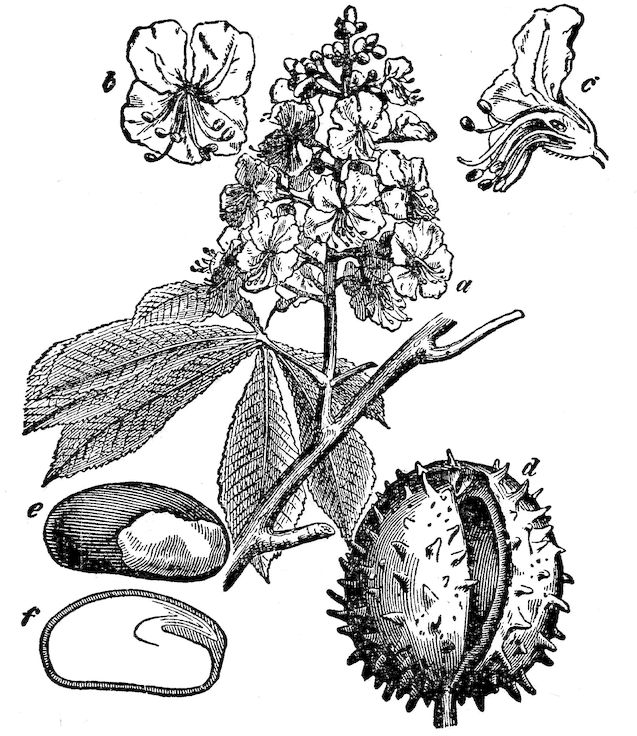
HORSE-CHESTNUT.
41As a shade-tree, or a tree for avenues and pleasure-grounds,
none would deny the merits of the Horse-Chestnut;
but when denuded it is a miserable-looking
object, with its terminal branches resembling drumsticks,
its primness without grace, and its amplitude without
grandeur. The birds seldom build their nests among its
branches, which are too wide apart to afford them protection
or accommodation; for this tree is absolutely
without any spray. Its fruit, which is borne in great
abundance, sustains neither bird nor quadruped, nor is it
profitable for man. Hence it has always been regarded
by poets and moralists as a symbol of extravagance and
waste.
THE CATALPA.
The Catalpa, though an American tree, is not indigenous
in New England, nor farther north than Philadelphia. It
is allied, in its botanical characters, to the bignonia, one
of the most magnificent of the American flowering vines,
which in Virginia and the Carolinas climbs the trunks of
the loftiest trees, and, rising to a hundred feet or more,
completely encompasses them with flowers of rare beauty
and foliage of the finest green. The Catalpa requires notice
here, because it is not uncommon in our gardens and
pleasure-grounds, and it is becoming more and more general
as a wayside tree. It is remarkable as a late bloomer,
putting forth its large panicles of white flowers late in
July, when those of other trees and shrubs have mostly
faded, and covering the tree so thickly as almost to conceal
its dense mass of foliage. The leaves are very large,
but flowing, heart-shaped, and of a light and somewhat
yellowish green. The Catalpa is not yet very common;
but it is one of those rare productions which is never
seen without being admired.
FORMS AND EXPRESSION OF TREES.
42
The different forms of trees, and their endless variety
of foliage and spray, have, from the earliest times, been
favorite studies of the painter and the naturalist. Not
only has each species certain distinguishing marks, but
their specific characters are greatly modified in individual
trees. The Psalmist compares a godly man to a tree
that is planted by rivers of water, whose leaf shall not
wither,—seeing in the stateliness and beauty of such a
tree an emblem of the noble virtues of the human heart.
Trees are distinguished by their grandeur or their elegance,
by their primness or their grace, by the stiffness of
their leaves and branches or by their waving and tremulous
motions. Some stand forth as if in defiance of
the wind and the tempest; others, with long drooping
branches, find security in bending to the gale, like the
slender herbs in the meadow.
Trees are generally classed as landscape ornaments,
according to their general outlines. “Some trees ascend
vertically,” says St. Pierre, “and having arrived at a
certain height, in an air perfectly unobstructed, fork
off in various tiers, and send out their branches horizontally,
like an apple-tree; or incline them towards the
earth, like a fir; or hollow them in the form of a cup,
like the sassafras; or round them into the shape of a
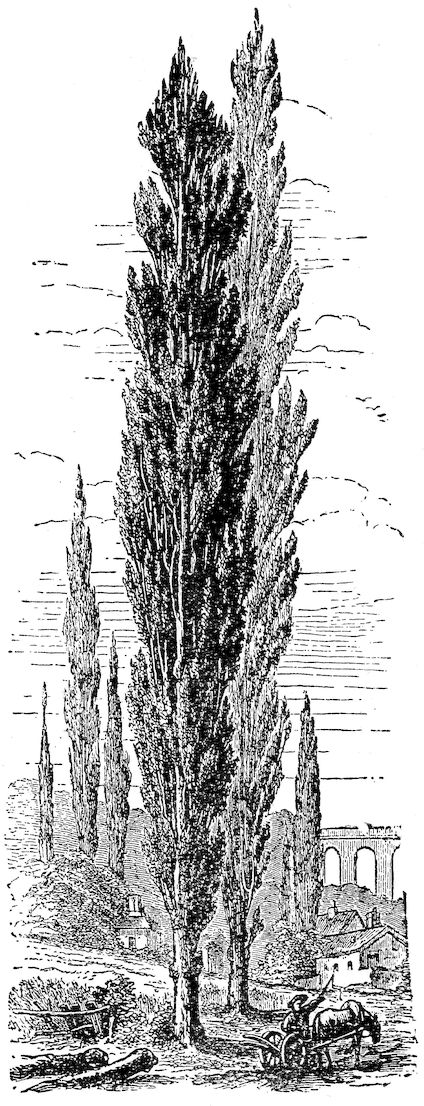
mushroom, like the pine; or straighten them into a pyramid,
like the poplar; or roll them as wool upon the
distaff, like the cypress; or suffer them to float at the
discretion of the winds, like the birch.” These are the
43normal varieties in the shape of trees. Others may be
termed accidental, like those of the tall and imperfectly
developed trees, which have been cramped by growing
in dense assemblages, and of the pollards that have issued
from the stumps and roots of other trees.
Trees are generally wanting in that kind of beauty
which we admire in a vase, or an elegant piece of
furniture. They have more of those qualities we look
for in a picture and in the ruder works of architecture.
Nature is neither geometrical nor precise in her delineations.
She betrays a design in all her works, but never
casts two objects in the same mould. She does not paint
by formulas, nor build by square and compass, nor plant
by a line and dibble; she takes no note of formal arrangements,
or of the “line of beauty,” or of direct adaptation
of means to ends. She shakes all things together, as in a
dice-box, and as they fall out there they remain, growing
crooked or straight, mean or magnificent, beautiful or
ugly, but adapted by the infinite variety of their forms
and dispositions to the wants and habits of all creatures.
The beauty of trees is something that exists chiefly in
our imagination. We admire them for their evident
adaptation to purposes of shade and shelter. Some of
them we regard as symbols or images of a fine poetic
sentiment. Such are the slender willows and poplars,
that remind us of grace and refinement, becoming the
emblems of some agreeable moral affection, or the embodiment
of some striking metaphor. Thus Coleridge personifies
the white birch as the “Lady of the Woods,” and
the oak by other poets is called the monarch, and the
ash the Venus of the forest. The weeping willow,
beautiful on account of its graceful spray, becomes still
more so when regarded as the emblem of sorrow. The
oak, in like manner, is interesting as the symbol of
strength and fortitude. A young fir-tree always reminds
44us of primness; hence the name of spruce, which is applied
to many of the species, is a word used to express formality.
The cedar of Lebanon would be viewed by all with
a certain romantic interest, on account of the frequent
mention of it in Holy Writ, as well as for its nobleness
of dimensions and stature.
It is with certain interesting scenes in the romance of
travel that we associate the palms of the tropics. They
have acquired singular attractions by appearing frequently
in scenes that represent the life and manners of the simple
inhabitants of the equatorial regions. We see them
in pictures bending their fan-like heads majestically over
the humble hut of the Indian, supplying him at once with
milk, bread, and fruit, and affording him the luxury of
their shade. They emblemize the beneficence of nature,
which, by means of their products, supplies the wants of
man before he has learned the arts of civilized life.
Writers in general apply the term “picturesque” to trees
which are devoid of symmetry and very irregular in their
outlines, either crooked from age or from some natural
eccentricity of growth. Thus the tupelo is so called, to
distinguish it from round-headed and symmetrical or
beautiful trees. This distinction is not very precise; but
it is sanctioned by general use, and answers very well for
common purposes of vague description. I shall use the
words in a similar manner, not adhering to the distinction
as philosophical. Indeed, it is impossible to find
words that will clearly express a complex idea. Words
are very much like tunes played on a jew’s-harp; the
notes intended to be given by the performer are accompanied
by the louder ring of the key-note of the instrument,
making it difficult to detect the notes of the tune,
except in the hands of an extraordinary performer.
Nature has provided against the disagreeable effects that
would result from the dismemberment of trees, by giving
45to those which are the most common a great irregularity
of outline, admitting of disproportion without deformity.
Symmetry in the forms of natural objects becomes wearisome
by making too great a demand upon the attention
required for observing the order and relations of the different
parts. But if the objects in the landscape be irregular,
both in their forms and their distribution, we make
no effort to attend to the relations of parts to the whole,
because no such harmony is indicated. Such a scene
has the beauty of repose. The opposite effect is observed
in works of architecture, in which irregularity puzzles
the mind to discover the mutual relations of parts,
and becomes disagreeable by disturbing our calculations
and disappointing our curiosity. The charm of art is
variety combined with uniformity; the charm of nature
is variety without uniformity. Nature speaks to us in
prose, art in verse.
Though we always admire a perfectly symmetrical oak
or elm, because such perfection is rare, it will be admitted
that the irregular forms of trees are more productive of
agreeable impressions on the mind. The oak, one of the
most interesting of all trees, is, in an important sense,
absolutely ugly, especially when old age has increased its
picturesque attractions. Indeed, if we could always reason
correctly on the subjects of our consciousness, we
should find that a very small part of that complex quality
which we call beauty yields any organic pleasure to the
sight. The charm of most of the objects in this category
exists only in our imaginations. In trees and the general
objects of the landscape we look neither for symmetry nor
proportion; the absence of these qualities is, therefore,
never disagreeable. It is the nonfulfilment of some
expectation, or the apparently imperfect supply of some
important want, that offends the sight, as when a conspicuous
gap occurs in some finely proportioned work of art.
46
LILAC.
THE LILAC.
47
The Lilac, though not one of our native trees, has become
so generally naturalized in our fields and gardens
as hardly to be distinguished from them except by its
absence from the forest. It is common in all waste lands
that were formerly the sites of ancient dwelling-houses,
marking the spot where the garden was situated by its
irregular clumps; for when neglected it does not assume
the shape of a tree, but forms an assemblage of long
stems from one spreading root, like the barberry and the
sumach. Under favorable conditions it is a very handsome
tree, seldom rising above twelve or fifteen feet, but
displaying a round head, and covered in its season with a
profusion of flowers, unfolding their beautiful pyramidal
clusters regularly on the last week in May. The color
of these flowers is perfectly unique, having given the
name by which painters distinguish one of their most
important tints. The foliage of this tree is not remarkable,
except for the regular heart shape of the leaves.
It displays no tints in the autumn, but falls from the tree
while its verdure remains untarnished.
The Lilac is still cultivated and prized in all our country
villages. But its praise is seldom spoken in these
days, for Fashion, who refuses to acknowledge any beauty
in what is common, discarded this tree as soon as it became
domesticated in humble cottage gardens. Even the
rose would long ago have been degraded from its ancient
honors by this vulgar arbiter of taste, if it had not been
multiplied into hundreds of varieties, permitting one
48after another to take its turn in monopolizing to itself
those praises which are due to the primitive rose.
THE BARBERRY.
All the inhabitants of New England are familiar with
the common Barberry, one of those humble objects of the
landscape that possess great merit with little celebrity.
It is allied in picturesque scenery with the whortleberry
and the bramble. We see it in hilly pastures, upon soils
less primitive than those occupied by the vaccinium,
though it is not uncommon as an under-shrub in many of
our half-wooded lands. I have not yet been able to obtain
a definite idea of the nature of those qualities that
entitle a plant to the praises of florists and landscape
gardeners, since we find them admiring the ugly mahonia
more than the common Barberry, and the glutinous
and awkward rose-acacia more than the common locust.
The praises of the Barberry have not been spoken;
but if our landscape were deprived of this shrub, half
the beauty of our scenery would be wanting in many
places. Its flowers hanging from every spray in golden
racemes, arranged all along in the axils of the leaves from
the junction of the small branches to their extremities,
always attract attention. But though elegant and graceful,
they are not so conspicuous as the scarlet fruit in
autumn. There is not in our fields a more beautiful
shrub in October, when our rude New England hills
gleam with frequent clumps of them, following the
courses of the loose stone walls and the borders of rustic
lanes. Even after it is stripped of its fruit, the pale red
tints of its foliage render it still an attractive object in
the landscape.
THE MISSOURI CURRANT.
49
Among the flowering shrubs which are universally admired
for the fragrance and beauty of their early blossoms,
the Missouri Currant deserves more than a passing
mention. Though introduced into New England since the
beginning of the present century, it has become a universal
favorite in our gardens, where it is cultivated chiefly
for the agreeable odor of its flowers, resembling that of
cloves, and penetrating the air on all still days in May.
This shrub has a small leaf with irregular pointed lobes,
turning to a pale crimson in autumn. The flowers are in
small racemes like those of the common garden currant,
but brighter in their hues, which are of a golden yellow,
and producing only a few large berries of a pure shining
black. This species is chiefly prized for its flowers, and is
not cultivated for its fruit.
THE CEANOTHUS, OR JERSEY TEA.
The Ceanothus was formerly well known to the people
of the United States under the name of Jersey Tea. Its
leaves were extensively used as an imitation tea during the
Revolution. They seem to possess no decided medicinal
qualities, being somewhat astringent, slightly bitter, but
not aromatic. It has been learned from experience that
the aromatic plants, by constant use as teas, will pall upon
the appetite, and injuriously affect digestion; while those
which are slightly bitter, but wanting in aroma, like the
China tea plant, may be used without seriously affecting
the health for an indefinite space of time. I believe it
may also be stated as a maxim, that those plants whose
50properties are sufficiently active to be used as medicines
have never been long employed by any people as substitutes
for tea.
The flowers of the Ceanothus are white, in full and
elegant clusters, without any formality of shape, having
a downy appearance, always attracting attention, not so
much by their beauty as by their delicacy and their profusion.
This plant is abundant in New England, flowering
in June on the borders of dry woods.
FOLIAGE.
51
Foliage is the most conspicuous of the minute productions
of nature. To the leaves of trees we look, not
only for the gratification of our sense of beauty, but as
the chief source of grateful shade and of the general
charms of summer. They are the pride of trees no less
than their flowers, and the cause of healthful freshness in
the atmosphere. They afford concealment to small birds
and quadrupeds, they give color to the woods, and yield
constant pleasure to the sight without any weariness. It
is remarkable that we always trace with delight the
forms of leaves in other objects of nature,—in the frostwork
on our windows, in the lichens that cover the rocks
in the forest, in the figures on a butterfly’s wing. Especially
in art do we admire the imitation of foliage. It is,
indeed, the source of half the beauty of this earth; for it
constitutes the verdure of field and lawn, as well as of
woods. Flowers are partial in their distribution, but foliage
is universal, and is the material with which nature
displays countless forms of beauty, from the small acicular
leaves of the delicate heath plant, to the broad pennons
of the banana, that float like banners over the hut of the
negro.
With the putting forth of leaves we associate the most
cheerful and delightful of seasons. In their plaited and
half-unfolded condition and in their lighter hues we behold
the revival of spring, and in their full development and
perfected verdure the wealth, the ripeness, and the joyful
fruition of summer. The different colors they assume
52are indeed the true dials of the year; pale shades of all
denote its vernal opening; dark and uniform shades of
green mark the summer; and those of gold, crimson and
russet the autumn; so that by the leaves alone we might
determine the month of the year. They form a delightful
groundwork both for fruit and for flowers, harmonizing
with each and making no discord with any hues of
vegetation. If we consider leaves only as individual
objects, they will not compare with flowers either in
beauty of form or color. A single leaf seldom attracts a
great deal of attention; but leaves in the aggregate are
so important a part of the beauty of Nature, that she
would not possess any great attraction for the sight
without them. A cactus, though admired as a curiosity,
and as the parent of magnificent flowers, is on account
of its leafless habit but a miserable object; and we can
imagine how forlorn must be the scenery of those Peruvian
regions where the different species of cactus are the
principal forms of vegetation.
It is very general to admire foliage in proportion as it
is dense and capable of affording an impenetrable shade;
but however desirable this may be to yield us a pleasant
retreat on a summer noon, the beauty of a tree is not
much improved by this quality. At a distance it presents
a lumpish and uniform mass, with but little character;
while a tree with moderately thin foliage, so thin as
to be penetrated by the flickering sunshine, often discovers
a great deal of character, by permitting the forms of
the branches to be traced through its shadows. When I
sit under a tree, I want to see the blue sky faintly glimmering
through the leaves, and to view their forms on its
clear surface when I look upwards. I would dispense
with a profusion of shade, if it could be obtained only by
shutting these things out from observation. Hence I always
feel a sensation of gladness when rambling in a
53birchen grove, in which the small thin foliage and airy
spray of the trees permit the sun and shade to meet and
mingle playfully around my path.
The lumpish character of the foliage of large-leaved
trees, like the tulip and magnolia, is perceptible at almost
any distance, causing them to appear like green
blots upon the landscape. The small-leaved trees, on the
contrary, exhibit a certain neatness of spray, which immediately
affects the eye with a sensation of beauty.
This appearance is beautifully exemplified in the beech.
Some of the large-leaved trees, however, possess a kind
of formality that renders them very attractive. Such is
the horse-chestnut, that spreads out its broad palmate
leaves with their tips slightly drooping, like so many
parasols held one above another. People have learned to
admire large and broad foliage from descriptions of the
immense size of tropical leaves, and by associating them
with the romance of a voluptuous climate. The long
pennon-like leaves of the banana and the wide fronds
of the fan palm naturally excite the imagination of the
inhabitant of the North.
The form of leaves, no less than their size, has a
great share in their general effects, even when viewed
from a distant point, where their outlines cannot be discriminated.
If they are deeply cleft, like those of the
river maple and the scarlet oak, or finely pinnate, like
those of the locust and the mountain ash, we perceive a
light, feathery appearance in the whole mass, before we are
near enough to distinguish the form of individual leaves.
This quality is apparent in the honey locust as far off as the
tree can be identified. Hence the forms of leaves do not
produce all their effect upon a near view; but in ornamental
designs in the fine arts the delineations of foliage
alone are considered. In the tracery of fenestral architecture,
leaves are a very general and favorite ornament;
54and in photographic pictures of single leaves, the
beauty of their outlines becomes more evident than in
nature.
The most remarkable quality of foliage is color; and
all will admit that green is the only color that would not
produce weariness and final disgust. Omitting what may
be said of autumn tints, the different shades of green in
the forest, both while the foliage is ripening and after its
maturity, constitute a very important distinction of individuals
and species. Pure green is rarely found in any
kind, except in its early stage of ripeness. The foliage
of trees, when fully matured, is slightly tinged with
brown or russet, and on the under side with white or blue.
Painters, therefore, seldom use unalloyed green in their
foliage; for even if they would represent its appearance
in early summer, when its verdure is nearly pure, the
effects of sunshine and shade upon the green forest can
be produced only by a liberal mixture of the warm tints
of orange and yellow when the sunshine falls upon it,
and of purple and violet when it is in shadow.
If I were to select an example of what seems to me
the purest green of vegetation, I should point to grass
when smoothly shorn, as in a well-dressed lawn, so that
the leaf only remains. By comparing the verdure of different
trees with this example, we shall find it generally
of a darker shade and inferior purity. The only trees of
our soil that seem to me lighter, when in leaf, than grass,
are the plane and the catalpa. We must observe trees on
a cloudy day to distinguish the different shades of their
foliage with precision. In such a state of the atmosphere
they are all equally favored by the light; while, if the
sun shines upon them, their verdure is modified according
to the direction in which it is viewed.
That kind of foliage to which the epithet “silver” is
usually applied is a very general favorite; but it is admired
55only because it is rare. I cannot believe, if the
two kinds were equally common, that the silver leaf
would be preferred to the green; for this is the color that
affords the most enduring satisfaction. The white poplar
is the most remarkable example of silver foliage. The
river maple has less of this quality, though it seems to be
one of the points for which it is admired. Nature displays
but very little variegated foliage among her wild
productions, except in the spring and autumn. It is
evidently an abnormal habit; hence we find this variegation
chiefly in those plants which have been modified by
the cultivator’s art, and it seldom constitutes a specific
mark of distinction.
In our studies of foliage we must not overlook the
grasses, which are composed almost entirely of leaves.
They contribute as much to the beauty of landscape as
the verdure of trees, and collectively more than flowers.
We need only a passing thought to convince us
how tame and lifeless the landscape would be, though
every hill were crowned with flowers, and every tree
blossomed with gay colors, if there were no grasses or
some kind of herbage to take their place. Hence the superior
beauty of Northern landscape compared with the
general scenery of tropical regions. There are more individual
objects in a Southern land which are curious and
beautiful, but its want of green fields soon renders its
scenery wearisome.
There is also an interest attached to hills and meadows
covered with green herbage, and pastured by flocks and
herds, that comes from our sympathies and imagination,
and causes the verdure of grass, when outspread upon their
surface, to possess a moral or relative beauty displayed
by few other natural objects. There is nothing else in
landscape to be compared with it, and nearly all outdoor
scenes would be cold and insipid without it. It
56expresses the fertility of the soil; it tells of gentle
showers that have not been wanting; and it becomes
thereby the symbol of providential care, the sign of pastoral
abundance and rural prosperity. We find the grasses
only where nature has made the greatest provision for the
comfort and happiness of man and animals. All the
beauties and bounties of springtime and harvest gather
round them; the dews of morning glisten upon them like
stars in the heavens; the flowers are sprinkled upon them
like gems in beautiful tapestry; the little brooks ripple
through them with sounds that are always cheerful, and
flash in the sunlight as they leap over their bending
blades. The merry multitudes of the insect race gain
from them shelter and subsistence, and send up an unceasing
chorus of merry voices from their verdure, which
is a beautiful counterpart of the blue of heaven.
It may be truly said that no splendor of flowers or of
the foliage of trees would make amends for the absence
of grass. Distant hills and plains may be made beautiful
by trees alone; but all near grounds require this velvety
covering to render them grateful to the sight or
interesting to the mind. This is the picturesque view
of the subject; but in the eyes of a botanist grass is
almost infinite in its attractions. In every field or pasture
that offers its tender blades to the grazing herds,
there are multitudes of species, beside the thousands
of herbs and flowers and ferns and mosses which are
always blended with them, and assist in composing their
verdure. What seems to the eyes of a child a mere
uniform mass of green is an assemblage of different
species that would afford study for a lifetime. Grasses,
though minute objects, are vast in their assemblages; but
if we reflect on the phenomena of nature, we shall not
consider the least thing any less admirable than the
greatest. The same amount of wonderful mechanism is
57indicated in a spear of herdsgrass as in the bamboo that
exceeds in height the trees of our forest; and the little
cascade that falls over the pebbles in our footpath is as
admirable to one who regards it as evincing the power of
nature, as the Falls of Niagara.
THE TUPELO.
58
The old town of Beverly, which was a part of Salem
during the era of witchcraft, abounds, like other townships
on the northern coast of Massachusetts Bay, in rugged
and romantic scenery. On one of the bald hills of this
town, a pond fed by a spring near the top of the hill
served as a watering-place for the flocks that were pastured
there. The only tree on this elevation of bare granite,
interspersed with little meadows of thin soil, covered
with sweet-fern and whortleberry-bushes, stood on the
brink of this pond. It was an ancient Tupelo, and attracted
the attention of every visitor by the singular manner
in which it spread its long branches in a crooked and
horizontal direction over this emerald pool. It became
the wonder of all that the tree should adopt such an
eccentricity of habit, hardly showing a single branch on
the land side, and bending over the water like an angler
sitting at his task. It was evident that it had never been
trimmed into this shape by artificial means. Many people,
therefore, believed that its grotesque appearance had
some connection with witchcraft, and that the witches
who were hanged upon it had caused all the branches to
wither and fall on the side that held the victims.
This tree has, I believe, no representative on the old
continent; and though there are several species in the
United States, only one is found in New England. Here
it is one of the most remarkable trees as a picturesque
object in landscape. Indeed, there is no other tree, not
excepting the oak, that will compare with it in certain
59eccentricities of habit. It has received a variety of names
in different parts of the country, being called “Swamp
Hornbeam,” from the toughness of its wood; “Umbrella
Tree,” from a peculiar habit of some individuals to become
flattened and slightly convex at the top. Among our
country people it is known as the “Wild Pear,” from a
fancied resemblance between its foliage and that of the
common pear-tree. The resemblance seems to consist
only in the size and gloss of its leaves. In the Middle
and Southern States it is called the “Sour Gum,” to
distinguish it from the “Sweet Gum,” or Liquidambar.
The name of Tupelo was given it by the aboriginal inhabitants.
The shapes assumed by the Tupelo are exceedingly
grotesque, though it is frequently as regular in its growth
as our most symmetrical trees. It is sometimes quite
erect, extending its branches horizontally and pretty
equally on all sides, but generally forming a more or
less flattened top. More frequently the Tupelo displays
no symmetry of any kind, extending its branches mostly
on one side, and often putting forth two or three branches
greatly beyond all the others. Many of these are considerably
twisted, inclining downward from a horizontal
position, not with a curve like those of the elm, but
straight, like those of the spruce, though without any of
its formality. The spray is very different from that of
other trees. Every important branch is covered all round,
at top, bottom, and sides, with short twigs, at right angles
with the branch. Some of the swamp oaks resemble the
Tupelo in fantastic shape, but they never have a flattened
top.
The Tupelo is the very opposite of the ash in its general
characters; the one is precisely regular in its habits,
the other eccentric and grotesque. The leaves and small
branches of the ash are opposite, those of the Tupelo alternate;
60the one has a coarse, the other a finely divided
spray: so that there are no two trees of the forest so entirely
unlike. It is remarkable that an isolated situation,
which is favorable to symmetry and good proportions in
other trees, increases the specific peculiarities of the Tupelo.
If it has stood alone and sent forth its branches
without restraint, it then displays the most grotesque
irregularity, showing that its normal habit of growth is
eccentric.
The foliage of the Tupelo is remarkable for its fine
glossy verdure. The leaves are oval, narrowing toward
the stem and rounded at the extremity. The flowers are
greenish and inconspicuous, borne in minute umbels on
the end of a long peduncle. They produce small berries
of a deep blue color, containing a hard stone. This tree
is one of the brightest ornaments of our forest in autumn;
the fine green color of its foliage attracts our attention in
summer, and in winter its grotesque forms, rising out of
the shallow meres, yield a romantic interest to these solitary
places. It is not well adapted to dressed grounds,
but harmonizes only with rude, desolate, and wild scenery.
THE HORNBEAM.
The Hornbeams, of which in New England there are
two species belonging to a different genus, are small trees,
rather elegant in their shape, and remarkable for the
toughness and hardness of their wood. The American
Hornbeam, or Blue Beech, is distinguished by its fluted
trunk, which, as Emerson describes it, “is a short irregular
pillar, not unlike the massive reeded columns of Egyptian
architecture, with projecting ridges, which run down from
each side of the lower branches. The branches are irregular,
61waving or crooked, going out at various but large
angles, and usually from a low point on its trunk.” Old
Gerard remarks concerning the English Hornbeam: “The
wood or timber is better for arrows and shafts, pulleys for
mills, and such like devices, than elm or witch-hazel; for
in time it waxeth so hard that the toughness and hardness
of it may rather be compared to horn than to wood;
and therefore it was called Hornbeam.”
The foliage of the American Hornbeam resembles that
of black birch, neatly corrugated, of a delicate verdure in
summer, and assuming a fine tint of varying crimson and
scarlet in the autumn. The name of Blue Beech was applied
to it from the similarity of its branches to the common
beech-tree, while their surface is bluish instead of
an ashen color. Though existing in every part of the
country, it is not abundant anywhere, and is not in any
tract of woodland the principal timber. It is most conspicuous
on the borders of woods, by the sides of roads
lately constructed. The scarcity of trees of this species
near old roadsides has been caused by the value of their
timber, which is cut for mechanical purposes wherever it
may be found. The wood of this tree is used for levers,
for the spokes of wheels, and for nearly all other purposes
which require extreme hardness of the material used.
THE HOP HORNBEAM.
The Hop Hornbeam is a very different tree from the
one just described, resembling it only in the toughness
of its wood, whence the name of Lever-Wood has been
very generally applied to it. This tree is rarely seen by
the wayside. Those only know it whose occupation has
led them to seek it for its service in the arts, or those
62who have examined it in their botanical rambles. It is a
small tree, that affects the habit of the elm in its general
appearance, of the birch in its inflorescence, and of the
beech in the upward tendency of its small branches. It
is so much like the elm in the style of its foliage, in the
fine division and length of its slender spray, and in the
color and appearance of its bark, that it might easily be
mistaken for a small elm, without any of its drooping
habit. It does not, like the elm, however, break into
any eccentric modes of growth. A striking peculiarity
of this tree is the multitude of hop-like capsular heads
that contain the seeds.
INSECURITY OF OUR FORESTS.
63
The American continent is so vast, and so large a part
of it is still covered with wood, that men are not ready to
believe there is any danger of exterminating its forests.
Supposing them to be inexhaustible, they are entirely
indiscriminate in their method of clearing them, and
treat them as if they were of no importance further than
they subserve the present wants of the community.
They are either reckless or ignorant of their indispensable
uses in the economy of nature, and seem purposely
to shut their eyes to facts and principles in relation to
them which are well known to men of science. Our
people look upon the forests as valuable only so far as
they supply material for the arts and for fuel, for the construction
of houses, ships, and public works; and as there
is not much danger of immediately exhausting the supplies
for these purposes, the public mind remains quiet,
while certain operations are going forward which, if not soon
checked by some very powerful restraint, will, before the
lapse of another century, reduce half this wide continent
to a desert. The science of vegetable meteorology deserves
more consideration than it has yet received from
our professors of learning. This, if fully explained, would
teach men some of the fearful consequences that would
ensue if a country were entirely disrobed of its forests,
and their relations to birds, insects, and quadrupeds would
explain the impossibility of ever restoring them. Man
has the power, which, if exercised without regard to the
laws of nature, may, at no very distant period, render this
64earth uninhabitable by man. In his eagerness to improve
his present condition, and his senseless grasp for
immediate advantages, he may disqualify the earth for a
human abode.
This matter has been strangely overlooked by legislators
in the several States, though frequently discussed by
naturalists and philosophical writers. In spite of the
warnings the people have received from learned men, very
little thought has been given to the subject. How few
persons suspect that in less than a century the greatest
affliction this country is doomed to suffer may be caused
by the destruction of its forests! Springs once full all
the year will be dry every summer and autumn; small
rivers will desert their channels; once profitable mill-privileges
will cease to be of any value; every shower
will produce inundations; every summer will be subject
to pernicious droughts. The preservation of the forests
in a certain ratio over our whole territory ought to be the
subject of immediate legislation in all the States. It is
not a part of the plan of this work, however, to treat of
woods as a subject of political economy, but rather to
prompt our wise men to protect them by statute, by showing
our dependence on them for our existence.
It has been said that the intelligence of an educated
and civilized community like our own ought to save the
country from this evil. But it is our civilization that
has created the very danger that threatens us. A country,
while it remains in the possession of barbarians, is
never disforested. It is a false assurance that the general
intelligence of the community will secure them from this
danger, unless they have studied the causes of it. A literary
and even a scientific education, as popularly conducted,
does not imply any great amount of this kind of
knowledge. The intelligence of our people would undoubtedly
prepare them to understand the subject when
65explained to them by some one who has made it his
special study; but reading does not acquaint a person
with facts contained only in books which he never
reads, though his habit of reading only for amusement
may keep him ignorant of many things which he would
otherwise learn from observation. The subject of this
essay is not sufficiently exciting to obtain a hearing from
the public in a lecture-room. Every avenue of popular
information is so greatly obstructed by objects designed
only to afford amusement, that science and philosophy,
save those branches which some eloquent work has rendered
fashionable, have but very little chance to be heard.
Even among our literary classes, if you speak of trees and
woods, there is only an occasional individual of eccentric
habits who seems capable of taking any other than an
æsthetic view of their relations to human wants.
But it will be said, if a liberal education does not supply
men with the right kind of knowledge on this point,
certainly our practical men will understand it. They,
I admit, would see at once how much money could be
made by cutting down all the trees in any given tract of
forest; but they are not the men to be consulted respecting
the advantage of any scheme that does not promise
to be a profitable investment of capital. Our practical
men are the very individuals from whose venal hands
it is necessary to protect our forests by legislation. In
France, where great evils have followed the destruction
of woods, laws have been enacted for restoring and preserving
them in certain situations. These laws, however,
originated, not with practical men, but with Napoleon
III., who obtained his views from men of science.
Our people have less knowledge of this subject than the
Europeans, who have been compelled to study it by the
presence of evils which the Americans are just beginning
to experience.
66The sentiment of the American public seems to have
been excited in favor of trees individually considered,
rather than forests. People look upon trees as their
friends; and more indignation is generally caused by the
felling of a single large tree standing in an open field or
by the roadside, than by the destruction of whole acres
of woods. Our love of trees is a sort of passion; but
we need yet to learn that a wood on a steep hillside is
of more importance than as many standards as there are
trees in the same wood, scattered upon a plain. This æsthetic
sentiment seems to be the only conservative principle
that has yet produced any considerable effect in preserving
trees and groves. It often extends to groups of
trees, and sometimes to large assemblages, especially on
estates which have remained through several generations
in the possession of one family. But generally the avarice
or the necessity of our farmers has been more powerful
to devastate, than the taste and sentiment of others
to preserve our woods.
I have long been persuaded that, unless the governments
of the several States should make this a subject of special
legislation, the security of our forests must depend on
men of large property in land. Men of wealth, if not
learned, are generally in communication with men of
learning, from whom they may obtain a knowledge of
vegetable meteorology, and not being obliged, by pecuniary
necessity, to cut down their woods, will, from a sense
of their importance in the economy of nature, become
their preservers. The wealth and taste of certain families
in every town and village will save a great many trees,
groves, and fragments of forest. But if our law-makers
neglect to legislate for this end, we must look to the possessors
of immense estates, the lords of whole townships,
for the preservation of any large tracts of forest.
ORCHARD TREES.
67
The orchard trees, though but few of them are indigenous,
constitute one of the most important groups,
considered as objects of beauty, to say nothing of their
utility. The most of this class of trees belong to the
natural order of rosaceous plants, among which are some
of the fairest ornaments of Northern climes. Such are
the cherry, the peach, the apple, the pear, also the mountain
ash and its allied species down to the mespilus and
hawthorn. These trees are suggestive of the farm and its
pleasant appurtenances, rather than of rude nature; but
so closely allied is Nature to the farm, when under the
care of a simple tiller of the soil, and unbedizened by
taste, that its accompaniments seem a rightful part of
her domain. The simplicity of the rustic farm is in consonance
with the fresh, glowing charms of Nature herself.
A row of apple-trees overshadowing the wayside
forms an arbor in which the rural deities might revel as
in their own sylvan retreats; and Nature wears a more
charming appearance, when to her own rude costume she
adds a wreath twined by the rosy fingers of Pomona.
68
THE APPLE.
69The flowers of the orchard trees are invariably white
or crimson, or different shades of these two colors combined.
Those of the cherry-tree and the plum-tree are
constantly white; those of the pear-tree are also white,
with brown or purple anthers; those of the peach and
apricot are crimson; those of the apple-tree and quince-tree,
when half expanded, are crimson, changing to white
or blush-color as they expand. The colors of the hawthorn
vary, according to their species, which are numerous,
from white to pure crimson. Only a few of the
orchard trees have been cultivated for their flowers alone;
among these we find a species of cherry with double
flowers, and a double-flowering almond, which are common
in flower-beds. The Virginia crab-apple is also
planted for the fragrance and beauty of its flowers; and
if the Siberian species had no material value, it would be
cultivated for the beauty of its fruit.
As I have frequently remarked, Nature is not lavish of
those forms and hues that constitute pure organic beauty.
She displays them very sparingly under ordinary circumstances,
that we may not be wearied by their stimulus,
and thereby lose our susceptibility to agreeable impressions
from homely objects. But at certain times and
during very short periods she seems to exert all her
powers to fascinate the senses. It is when in these moods
that she wreathes the trees with flowers for a short time
in the spring, and just before the coming of winter illumines
the forest with colors as beautiful as they are
evanescent.
The Apple-Tree was one of the first trees planted by
the original settlers of New England, who could not in
the wilderness raise those fruits that require the skill
of the gardener. This tree is indigenous in all parts of
Europe, Northern Asia, and North America. On this
continent are found two native species, of which the Virginia
Crab is the only important one. This tree bears a
small green fruit, agreeable, odoriferous, and intensely
acid; but our attention is chiefly attracted by its rose-colored
flowers, that perfume the whole atmosphere with
a sweetness not surpassed by that of the rose. Nothing
in the world can exceed the purity of this fragrance,
which, in connection with its beautiful flowers, borne in
large clusters, render it the admiration of all. The lover
of nature is delighted to find this species in a perfectly
unsophisticated state, and unimproved by culture, which
always tends to insipidity. The Druids paid great reverence
to the apple-tree, because the mistletoe grew upon
it. In our own fields it is free from this parasite, which
is not found on the western continent above the latitude
of Virginia.
70
THE PEAR.
71The apple-tree bears some resemblance to the oak in
its general outlines, displaying, though inferior in size,
more sturdiness than grace. A standard apple-tree commonly
resembles a hemisphere, often in diameter exceeding
its own height. This shape might be caused by
training; but the gardener, by cutting off certain branches,
does not change the tendency of the tree to assume its
normal shape. The foliage of the apple-tree is rather
coarse, stiff, and inelegant, and deficient in purity of
verdure, being after it is fully developed of a dusky
green, and without tints when ripened, save what may
be termed accidental. There is, nevertheless, a certain
kind of beauty in an old apple-tree which is seen in no
other of the orchard trees, rendering it a very picturesque
object in rustic scenery.
The Pear-Tree is taller than the apple-tree, assuming
an imperfectly pyramidal shape. Its branches have not
the horizontal tendency of the latter; but when growing
singly as a standard it greatly surpasses it in dimensions,
and many individuals of a former age, that have
escaped the axe of horticultural improvement, are noble
standards, and of no inferior merit as shade-trees. The
foliage of the pear-tree displays some of the tremulous
habit of the aspen, owing to the length and slenderness
of its leaf-stems. It has, moreover, a gloss that distinguishes
it from that of the apple-tree; it is also less
72stubborn in retaining its verdure, and partially tinted
in autumn. The pear-trees which have been raised
within the last thirty years are mostly dwarfed, and
seldom display their normal shape. They are small, with
straggling branches, and unworthy of consideration in a
treatise of this kind. The old standards, still, occasionally
seen in pastures and fallow lands, are the only ones
that affect the beauty of landscape. I have mentioned
several points in which the pear-tree surpasses the apple-tree
as a beautiful and stately object; but its fruit will
bear no comparison in beauty with that of the apple-tree,
which produces a greater variety of beautiful fruit than
any other tree that is known.
The Quince-Tree, though inferior in size, and not prospering
very well on the soil of New England, which is
rather too cold for it, deserves a passing remark. In
botanical characters it bears more resemblance to the pear
than to the apple. The fruit has the same tender and
mucilaginous core; the seeds are not enclosed in a dry hull,
like those of the apple; and the pulp of the quince, like
that of the pear, is granulated, while that of the apple
displays in its texture a finer and firmer organization. I
may add the well-known fact that the pear may be grafted
upon a quince stock, while no such union can be effected
between the apple and the quince, or the apple and the
pear. The quince-tree makes a very elegant appearance,
both when covered with its large white and crimson-stained
flowers, and when laden with its golden Hesperian
fruit.
The Plum-Tree, in connection with the orchard, hardly
deserves mention; but there are two indigenous species
which in some places are conspicuous objects in our fields.
The beach-plum requires no description. It is a low
73shrub, very common on many parts of the New England
coast and on the islands around it. There is nothing remarkable
in its appearance or in the beauty of its fruit,
which is of a dark-blue color and about the size of damsons.
The other species is a tree of considerable size,
which is very beautiful when covered with its ripe scarlet
berries. In the State of Maine they are called “plumgranates,”
and are very generally used for culinary purposes.
The Peach-Tree, of all the tenants of the garden and
orchard, is the most beautiful when in flower, varying in
the color of its bloom from a delicate blush to a light
crimson. As it puts forth its flowers before the leaves,
the tree presents to view the likeness of a magnificent
bouquet. When covering many acres of ground, nothing
in nature can surpass it in splendor, flowering, as it does,
sooner than almost any other tree. Even in New England,
where these trees are now seen only in occasional groups,
they constitute an important object in the landscape, when
in flower. Few persons are aware how much interest the
peach-tree adds to the landscape in early spring, by its
suggestions as well as its beauty. Since the changeableness
of our winter and the harshness of our spring weather
have been aggravated by the destruction of our Northern
forests, the peach-tree is so liable to perish that its cultivation
has been neglected, and trees of this species
are now very scarce in New England, except in the gardens
of wealthy men. We no longer meet them as formerly
in our journeyings through rustic farms, when
they were interspersed among apple-trees, adorning every
byway in the country.
THE AMERICAN ELM. — THE DOME. — THE VASE FORM. — THE PARASOL. — THE PLUME.
74
I will confess that I join in the admiration so generally
bestowed upon the American Elm. To me no other
tree seems so beautiful or so majestic. It does not
exhibit the sturdy ruggedness of the oak; it is not so
evidently defiant of wind and tempest. It seems, indeed,
to make no outward pretensions of strength. It bends to
the breeze which the oak defies, and is more seldom, therefore,
broken by the wind. The Elm is especially the wayside
tree of New England, and it forms the most remarkable
feature of our domestic landscape. If there be in
any other section of our land as many, they are individuals
mingled with the forest, and are not so frequent by the
roadsides. In this part of the country the Elm has been
planted and cherished from the earliest period of our history,
and the inhabitants have always looked upon it with
admiration, and valued it as a landscape ornament above
every other species. It is the most drooping of the drooping
trees, except the willow, which it surpasses in grandeur
and in the variety of its forms.
Though the Elm has never been consecrated by the
muse of classic song, or dignified by making a figure in
the paintings of the old masters, the native inhabitant
of New England associates the varied forms of this tree
with all that is delightful in the scenery or memorable in
the history of our land. All spacious avenues are bordered
with elms, and their magnificent rows are everywhere
familiar to his sight. He has seen them extending
their broad and benevolent arms over many a hospitable
75mansion and many a humble cottage, and equally harmonizing
with all. They meet his sight in the public grounds
of the city with their ample shade and flowing spray;
and he beholds them in the clearing, where they were left
by the woodman to stand as solitary landmarks of the
devastated space. Every year of his life he has seen the
beautiful hangbird weave his pensile nest upon the long
and flexible branches, secure from the reach of every foe.
From its vast dome of branches and foliage he has listened
to the songs of the late and early birds, and under
its canopy he has witnessed many a scene of rustic
amusement.
To a native of New England, therefore, the Elm has a
character more nearly approaching that of sacredness than
any other tree. Setting aside the pleasure derived from
it as an object of material beauty, it reminds him of
the familiar scenes of home and the events of his early
life. How many a happy assemblage of children and
young persons has been gathered under its shade in the
sultry noons of summer! How many a young May queen
has been crowned under its tasselled roof, when the greensward
was just daisied with the early flowers of spring!
And how often has the weary traveller rested from his
journey under its wide-spreading boughs, and from a
state of weariness and vexation, when o’erspent by heat
and length of way, subsided into quiet thankfulness and
content!
In my own mind the Elm is intimately allied with
those old dwelling-houses which were built in the early
part of the last century, and form one of the principal
remaining features of New England home architecture
during that period. They are known by their broad and
ample but low-studded rooms, their two stories in front,
their numerous windows with small panes, their single
chimney in the centre of the roof, that sloped down to
76one story in the rear, and their general homely appearance,
reminding us of the simplicity of life that characterized
our people before the Revolution. Their very
homeliness is attractive, by leaving the imagination free
to dwell upon their interesting suggestions. Not many
of these venerable houses are now extant; but whenever
we see one, it is almost invariably accompanied by its
Elm, standing upon the green open space that slopes
down from it in front, waving its long branches in melancholy
grandeur above the old homestead, and drooping,
as with sorrow, over the infirmities of its old companion
of a century.
Early in April the Elm puts forth its flowers, of a dark
maroon color, in numerous clusters, fringing the long terminal
spray, and filling up the whole space so effectually
that the branches can hardly be seen; they appear at
the same time with the crimson flowers of the red maple,
and give the tree a very sombre appearance. The seeds
ripen early, and being small and chaffy are wafted in all
directions and carried to great distances by the wind. In
the early part of June, soon after the leaves are expanded,
the Elm displays the most beauty. At this time only can
its verdure be considered brilliant: for the leaf soon fades
to a dull green, and displays no tints, except that of a
rusty yellow in the autumn. In perfectly healthy elms,
standing on a deep soil, the brightness of the foliage is
retained to a later period; but the trees near Boston
have suffered so much from the ravages of the cankerworm
that their health is injured, and their want of
vitality is shown by the premature fading and dropping
of their foliage.
Nothing can exceed the American Elm in a certain
harmonious combination of sturdiness and grace,—two
qualities which are seldom united. Along with its superior
magnitude, we observe a great length and slenderness
77of its branches, without anything in the combination that
indicates weakness. It is very agreeable to witness the
union, under any circumstances, of two interesting or
admirable traits of character which are supposed to be
incompatible. Hence the complacency we feel when we
meet a brave man who is amiable and polite, or a learned
man who is neither reserved nor pedantic. A slender vine,
supported by a sturdy tree, forms a very agreeable image;
not less delightful is that consonance we perceive in a
majestic Elm, formed by the union of grandeur with the
gracefulness of its own flowing drapery.
The Elm is generally subdivided into several equal
branches, diverging from a common centre at a small
distance above the ground. The height of this divergence
depends on the condition of the tree when it was a
seedling, whether it grew in a forest or in an open field;
and the angle made by these branches is much wider
when it obtained its growth in an isolated situation. The
shape of different elms varies more than that of any
other known species. It is indeed almost the only tree
which may be said to exhibit more than one normal
figure, setting aside those variations of form which are
the natural effects of youth and age. The American Elm
never displays one central shaft to which the branches are
subordinate, like the English Elm; or rather, I should
say, that when it has only a single shaft it is without
any limbs, and is surrounded only with short and slender
twigs. This leads me to speak of its normal diversities
of shape, which were originally described by Mr. Emerson
under several types.
This is the form which the Elm seems most prone to
assume when it stands from the time it was a seedling
78until it attains its full stature in an open space. It then
shows a broad hemispherical head, formed by branches of
nearly equal size, issuing chiefly from a common centre,
diverging first at a small angle, and gradually spreading
outward with a curve that may be traced throughout
their length. A considerable number of our roadside
elms are specimens more or less imperfect of this normal
type.
One of the most admirable of these different forms is
that of the vase. The base is represented by the roots of
the tree as they project above the ground, making a sort
of pedestal for the trunk. The neck of the vase is the
trunk before it is subdivided. The middle of the vase
consists of the lower part of the branches as they swell
outwards with a graceful curve, then gradually diverge,
until they bend over at their extremities and form the lip
of the vase by a circle of terminal spray. Perfect specimens
of this beautiful form are rare, but in a row or
a grove of elms there are always a few individuals that
approximate to this type.
The neatest and most beautiful of these forms is the
parasol. This variety is seen in those elms which have
grown to their full height in the forest, and were left
by the woodman in the clearing; for such is the general
admiration of this tree, that great numbers of them are
left in clearings in all parts of the country. The State
of Maine abounds in trees of this form, sending forth
almost perpendicularly a number of branches, that spread
out rather suddenly at a considerable height, in the shape
of an umbrella. Trees of this type have much of that
grandeur which is caused by great height and small dimensions,
79as observed in a palm-tree. A remarkable trait in
the character of the Elm is, that, unlike other trees, it
seldom loses its beauty, and is often improved in shape,
by growing while young in a dense assemblage. It is
simply modified into a more slender shape, usually subdivided
very near the ground into several branches that
diverge but little until they reach the summit of the wood.
Other trees, when they have grown in a dense wood, form
but a single shaft, without lateral branches.
The most singular of the forms assumed by the Elm,
and which cannot be regarded as of a normal character,
is the plume, caused by some peculiar conditions attending
its early growth. The shaft is sometimes double, but
usually not divided at all, except into two or three small
branches at its very summit. It is perpendicular to near
three fourths of its height, and then bends over, like one
of the outer branches of a normal-shaped Elm. This
whole tree, whether double or single, is covered from the
ground to its summit with a dense embroidery of vine-like
twigs that cluster round it in all ways, often inverted, as
if it were covered with a woody vine. The cause of this
form seems to be the removal of the tree into an uncongenial
soil, that is too scanty and innutritious to sustain
a healthy growth. Yet I have seen some trees of this
shape in clearings. They do not seem to be diseased,
yet they are evidently in a stunted condition. One of
the most remarkable of the plume elms which I have
seen stands in the northern part of Danvers, near the
point where the Essex Railroad crosses the Ipswich River.
I have observed a similar habit of growth in some English
elms, but their shaft is always perpendicular.
THE ENGLISH ELM.
80
The English Elm may be seen on Boston Common, and
in front of old mansions in Medford and other ancient
towns in Massachusetts. Very few trees of this species,
however, have been planted since the Revolution. This
royal Elm seems to have lost favor when republicanism
took the place of monarchy. Yet in many points the English
Elm is superior to the American species. It is not
a drooping tree; it resembles the oak in its general form,
but surpasses it in height. The trunk is not subdivided;
throughout its entire length, the branches are attached to
it by wide angles, sometimes spread out in an almost horizontal
direction. Selby remarks, that, “in point of magnitude,
grandeur of form, and majestic growth, the English
Elm has few competitors in the British sylva.” In the
form of the leaf and spray it closely resembles the American
tree; but the leaf is of a brighter green, it comes out
several days earlier in the spring, and continues green in
the fall a week or ten days after the American elm has
become entirely denuded. The same difference, in a less
degree, has been observed in the leafing and falling of the
leaf of all European trees, compared with their kindred
species in the American forest.
THE CHERRY-TREE. — THE BLACK CHERRY. — THE CHOKE CHERRY.
81
Among our fruit-trees the Cherry occupies the most
conspicuous place, considered with reference either to
shade or ornament, surpassing all the others in size and
in comeliness of growth. All the species are handsome
trees, and some of them are of great stature. They are natives
of all countries in the northern temperate zone, but
not of any region south of the equator. The three most
remarkable species of the family are the common garden
Cherry, or Mazard, which is believed to be a native of
Asia; the Great Northern Cherry, or Gean, of Europe;
and the Black Cherry of the United States.
The Black Cherry, which is a tree of the first magnitude
in favorable regions, is only a middle-sized tree in the New
England States. In the South and West, especially on
the banks of the Ohio River, it attains a very great size,
rising sometimes to one hundred feet, according to Michaux,
with a corresponding diameter. It is sensitive to
the extremes both of cold and heat, and to an excess
either of dryness or moisture. In Maine it is only a
small tree, being checked in its growth by the severe
Northern winters. Very far south it suffers from the hot
and dry summers, but prospers well in the mountainous
parts. It forms immense forests in many districts of
North America, in company with the honey locust, the
black walnut, the red elm, and the oak. It is sufficiently
82common in New England to constitute an important ingredient
of our wood scenery, and though indigenous, it
is most abundant in lands which have been modified by
cultivation.
This tree differs very obviously in its ramification from
the garden cherry, in which the branches are always subordinate
to the trunk, and arranged in irregular whorls
and stages, one above another, so that, if they were horizontal,
they would resemble those of a fir-tree. The Black
Cherry tree, on the contrary, is subdivided in such a manner
that the main stem cannot easily be traced above the
lower junction of the branches, except in those which
have grown in a forest. The branches are spread out
more loosely, without the least of any arrangement in
whorls, and their terminations are longer and smaller. The
leaves of the two trees are also widely different: those
of the garden cherry are broad, ovate, rough, and serrate;
those of the American tree are lanceolate and smooth,
and almost as slender as the leaves of the willow. The
one bears its flowers and fruit in racemes, the other in
round clusters or umbels. The trunk and bark of the
two species are similar, both resembling the black birch in
the properties of their wood and the outside appearance
of their bark. The branches of the Wild Cherry are
too straggling and sparse to make a beautiful tree, and
the leaves being small and narrow, the whole mass is
wanting in depth of shade.
When we are rambling in rustic lanes, that lead
through rudely cultivated grounds, we frequently meet
with groups of tall handsome shrubs, covered in May with
a profusion of white flowers, and in August heavily laden
with bright scarlet fruit. Such is the Choke Cherry, a
83small tree with which all are familiar from their frequent
disappointment on attempting to eat its fruit. Its promises
to the sight are not fulfilled to the taste. Though
of an agreeable flavor, it is exceedingly harsh and astringent.
This is a more beautiful tree when in flower
than the black cherry, though it is generally a mere shrub,
never rising above fifteen or twenty feet in height. The
racemes, when in flower, are not drooping, as they are
when laden with fruit, but stand out at right angles with
the branch, completely surrounding it, and giving to every
slender twig the appearance of a long white plume. In
the eastern part of Massachusetts I have found this species,
as well as the black cherry, in old graveyards,—so
frequently, indeed, that in my early days these trees were
associated with graves, as the Lombardy poplar is with
ancient avenues. I suppose their frequency in these
places to be caused by the birds dropping the seeds at
the foot of the gravestones, where they quickly germinate,
and are protected, when growing, by the stone beside
them.
The cultivation of the Gean, or Great Northern Cherry
of Europe, which was named by Linnæus the bird cherry,
is encouraged in Great Britain and on the Continent of
Europe for the benefit of the birds, which are regarded as
the most important checks to the over-multiplication of
insects. The fact, not yet understood in America, that
the birds which are the most mischievous as consumers
of fruit are the most useful as destroyers of insects, is
well known by all the farmers in Europe; and while
we destroy the birds to save the fruit, and sometimes cut
down the fruit-trees to starve the birds, the Europeans
more wisely plant them for their sustenance and accommodation.
THE SNOWY MESPILUS.
84
This tree, which is conspicuous in the early part of May
from its profusion of white flowers in the swamps, is very
little known except in Canada and some of the northern
provinces of this continent. Yet it is far from being rare,
and is one of the most elegant of the small trees in our
native forest; being allied to the mountain ash, branching
in a similar manner, but exhibiting a neater and more
beautiful spray. It is exclusively a Northern tree, and
one of the earliest to put forth flowers and leaves after the
elm and the red maple. This tree is spread over almost
all the northern part of the American continent and the
Alleghany Mountains. From its habit of flowering at the
time of the annual appearance of the shad in our waters,
it is very frequently called the Shad-bush.
The Snowy Mespilus is one of those trees which botanists
have described under so many different names
that I should shrink from the task, if the duty were
assigned me, of collecting all that have been applied to
it. But whenever there is much contrariety of opinion
among botanists respecting the generic rank and denomination
of any plant, I usually resort to its earliest botanical
title. Indeed, I feel assured that the nice distinctions
upon which later botanists have founded its claims
to a different generic position are very much of the same
nature as those which divide theologians, whose ecclesiastical
acuteness enables them to discern a palpable difference
in two doctrinal points, neither of which to an
unregenerate mind have any meaning at all. I therefore
85prefer to call this tree a Mespilus, after Linnæus and Michaux,
to save myself the trouble of those infinitesimal
investigations that might convince me of the propriety of
placing it in every one of a dozen other different genera.
The Shad-bush is a small tree inclining to grow in
clumps, instead of making a single stem from the root,
and is seldom quite so large or so tall as the mountain
ash. The leaves are small and alternate, resembling those
of a pear-tree, but more elegant, and covered with a soft
silken down on their first appearance; as the foliage
ripens, it becomes smooth and glossy. The flowers are
white, but without beauty, growing in loose panicles at
the ends of the branches. The product of these flowers
is a small fruit, about the size of the common wild gooseberry,
of a dark crimson color and a very agreeable flavor.
This fruit is used very generally in the northern provinces,
where the tree is larger and more productive than
in New England.
THE CHOKEBERRY.
A smaller species of mespilus, familiarly known as the
Chokeberry, is more interesting as a flowering plant. It
is a slender shrub, with beautiful finely toothed leaves,
bearing flowers in clusters very much like those of the
hawthorn, with white petals and purple or crimson anthers.
The flowers stand erect, but the berries, which are
very astringent and are often gathered carelessly with
whortleberries, hang from the branches in full pendent
clusters. The flowers of this plant are very conspicuous
in the latter part of May in all our meadows.
THE MOUNTAIN ASH.
86
The Mountain Ash, or Rowan-tree, is beautiful in all
its conditions and at all seasons. Its elegant pinnate foliage,
not flowing, like that of the locust, but neat, firm, and
finely serrate, and its flowers, in large clusters, like those
of the elder, render the tree very conspicuous when in
blossom. But its greatest ornament is the scarlet fruit
that hangs from every branch in the autumn. We could
hardly be persuaded to introduce the Mountain Ash into
a picture. The primness of its form injures it as a picturesque
object in landscape. Its beauty is such as children
admire, who are guided by a sense of its material
attractions, and do not generally prize a tree except for
its elegance and colors. The beauty, however, which attracts
the sensual eye in this case is deceitful, for its fruit
is of a bitter, sour flavor, and incapable of improvement.
European writers say that thrushes are very fond of this
fruit. In our land it remains untouched, at least until
late in the season, after the black cherries are gone, which
tempt all kinds of birds by their superior flavor. The
American Mountain Ash differs from the European tree
only by its smaller fruit.
I have said that the Mountain Ash is wanting in picturesque
qualities; but my remark applies only to its form
and habit of growth. On the other hand, it is peculiarly
the tree of romance, being remarkable for the many
superstitious customs connected with it. According to
Evelyn, “There is no churchyard in Wales without a
Mountain Ash-tree planted in it, as the yew-trees are in
the churchyards of England. So on a certain day of the
year everybody in Wales religiously wears a cross made
of the wood.” Gilpin says that in his time “a stump of
the Mountain Ash was generally found in some old burial-place,
87or near the circle of a Druid’s temple, the rites of
which were formerly performed under its shade.”
Many of the inhabitants of Great Britain still believe
that a branch of the Rowan-tree carried about with them
is a charm against the evil influences of witchcraft. It
is remarkable that similar superstitions connected with
this tree prevail among the North American Indians; and
it is not improbable that they were introduced by the
early Welsh colonists, before the discovery of America
by Columbus.
MOUNTAIN ASH.
RELATIONS OF TREES TO WATER.
88
There is a spot which I used to visit some years ago,
that seemed to me one of the most enchanting of natural
scenes. It was a level plain of about ten acres, surrounded
by a narrow stream that was fed by a steep ridge
forming a sort of amphitheatre round more than half its
circumference. The ridge was a declivity of near a hundred
feet in height, and so steep that you could climb it
only by taking hold of the trees and bushes that covered
it. The whole surface consisted of a thin stratum of soil
deposited upon a slaty rock; but the growth of trees
upon this slope was beautiful and immense, and the
water that was constantly trickling from a thousand fountains
kept the ground all the year green with mosses and
ferns, and gay with many varieties of flowers. The soil
was so rich in the meadow enclosed by this ridge, and
annually fertilized by the débris washed from the hills,
that the proprietor every summer filled his barns with hay,
which was obtained from it without any cultivation.
I revisited this spot a few years since, after a long
period of absence. A new owner, “a man of progress and
enterprise,” had felled the trees that grew so beautifully
on the steep sides of this elevation, and valley and hill
have become a dreary and unprofitable waste. The thin
soil that sustained the forest, no longer protected by
the trees and their undergrowth, has been washed down
into the valley, leaving nothing but a bald, rocky surface,
whose hideousness is scarcely relieved by a few straggling
vines. The valley is also ruined; for the inundations to
89which it is subject after any copious rain destroy every
crop that is planted upon it, and render it impracticable
for tillage. It is covered with sand heaps; the little
stream that glided round it, fringed with azaleas and wild
roses, has disappeared, and the land is reduced to a barren
pasture.
The general practice of the pioneers of civilization on
this continent was to cut down the wood chiefly from the
uplands and the lower slopes of the hills and mountains.
They cleared those tracts which were most valuable for
immediate use and cultivation. Necessity led them to
pursue the very course required by the laws of nature for
improving the soil and climate. The first clearings were
made chiefly for purposes of agriculture; and as every
farm was surrounded by a rampart of woods, it was sheltered
from the force of the winds and pleasantly open to
the sun. But when men began to fell the woods to supply
the demands of towns and cities for fuel and lumber,
these clearings were gradually deprived of their shelter,
by levelling the surrounding forest and opening the country
to the winds from every quarter. But the clearing of
the wood from the plains, while it has rendered the climate
more unstable, has not been the cause of inundations
or the diminution of streams. This evil has been
produced by clearing the mountains and lesser elevations
having steep or rocky sides; and if this destructive work
is not checked by legislation or by the wisdom of the people,
plains and valleys now green and fertile will become
profitless for tillage or pasture, and the advantages we
shall have sacrificed will be irretrievable in the lifetime
of a single generation. The same indiscriminate felling of
woods has rendered many a once fertile region in Europe
barren and uninhabitable, equally among the cold mountains
of Norway and the sunny plains of Brittany.
Our climate suffers more than formerly from summer
90droughts. Many ancient streams have entirely disappeared,
and a still greater number are dry in summer.
Boussingault mentions a fact that clearly illustrates the
condition to which we may be exposed in thousands of
locations on this continent. In the island of Ascension
there was a beautiful spring, situated at the foot of a
mountain which was covered with wood. By degrees the
spring became less copious, and at length failed. While
its waters were annually diminishing in bulk, the mountain
had been gradually cleared of its forest. The disappearance
of the spring was attributed to the clearing.
The mountain was again planted, and as the new growth
of wood increased, the spring reappeared, and finally attained
its original fulness. More to be dreaded than
drought, and produced by the same cause,—the clearing
of steep declivities of their wood,—are the excessive
inundations to which all parts of the country are
subject.
If it were in the power of man to dispose his woods
and tillage in the most advantageous manner, he might
not only produce an important amelioration of the general
climate, but he might diminish the frequency and severity
both of droughts and inundations, and preserve the general
fulness of streams. If every man were to pursue
that course which would protect his own grounds from
these evils, it would be sufficient to bring about this beneficent
result. If each owner of land would keep all his
hills and declivities, and all slopes that contain only a
thin deposit of soil or a quarry, covered with forest, he
would lessen his local inundations from vernal thaws and
summer rains. Such a covering of wood tends to equalize
the moisture that is distributed over the land, causing
it, when showered upon the hills, to be retained by the
mechanical action of the trees and their undergrowth of
shrubs and herbaceous plants, and by the spongy surface
91of the soil underneath them, made porous by mosses, decayed
leaves, and other débris, so that the plains and valleys
have a moderate oozing supply of moisture for a
long time after every shower. Without this covering, the
water when precipitated upon the slopes, would immediately
rush down over an unprotected surface in torrents
upon the space below.
Every one has witnessed the effects of clearing the
woods and other vegetation from moderate declivities in
his own neighborhood. He has observed how rapidly a
valley is inundated by heavy showers, if the rising
grounds that form its basin are bare of trees and planted
with the farmer’s crops. Even grass alone serves to check
the rapidity with which the water finds its way to the
bottom of the slope. Let it be covered with bushes and
vines, and the water flows with a speed still more diminished.
Let this shrubbery grow into a forest, and the
valley would never be inundated except by a long-continued
and flooding rain. Woods and their undergrowth
are indeed the only barriers against frequent and sudden
inundations, and the only means in the economy of nature
for preserving an equal fulness of streams during all
seasons of the year.
At first thought, it may seem strange that the clearing
of forests should be equally the cause both of drought
and inundations; but these apparently incompatible facts
are easily explained by considering the different effects
produced by woods standing in different situations. An
excess of moisture in the valleys comes from the drainage
of the hills, and the same conditions that will cause
them to be dried up at certain times will cause them to
be flooded at others. Nature’s design seems to be to preserve
a constant moderate fulness of streams and standing
water. This purpose she accomplishes by clothing
the general surface of the country with wood. When
92man disturbs this arrangement, he may produce evil consequences
which he had never anticipated. We are not,
however, to conclude that we may not improve the soil
and climate by changing the original condition of this
wooded surface. The clearing of the forest may be reduced
to a science whose laws are as sure and unexceptionable
as those of mechanics and hydraulics. Though it
has not gained much attention from the public mind, it is
well understood by the learned who have made this branch
of vegetable meteorology their special study. Our danger
lies in neglecting to apply these laws to operations in the
forest, and in preferring to obtain certain immediate commercial
advantages, at the risk of inflicting evils of incalculable
extent upon a coming generation.
THE LINDEN-TREE.
93
The Lime or Linden-tree is generally known among
our countrymen as the Bass, and was not, before the
present century, employed as a wayside tree. The old
standards seen in our ancient villages are European
Limes. During the past thirty years the American tree
has been very generally planted by roadsides, in avenues
and pleasure-grounds, and few trees are more highly
valued in these situations. But the American has less
beauty than the European tree, which is clothed with
softer foliage, has a smaller leaf, and a neater and more
elegant spray. Our native Lime bears larger and more
conspicuous flowers, in heavier clusters, but of inferior
sweetness. Both species are remarkable for their size
and longevity. The Lime in Great Britain is a tree of
first magnitude, frequently rising to the height of eighty
or ninety feet, with a trunk of proportional diameter.
The American species is not inferior to it in size or altitude.
Some of the largest trees in Western New York
are Limes.
The Lime has in all ages been celebrated for the fragrance
of its flowers and the excellence of the honey made
from them. The famous Mount Hybla was covered
with Lime-trees. The aroma from its flowers is like that
of mignonette; it perfumes the whole atmosphere, though
never disagreeable from excess, and is perceptible to the
inhabitants of all the beehives within the circuit of a
mile. The Lime is also remarkable for a general beauty
of proportion, a bright verdure contrasting finely with
94the dark-colored branches, and an outline regular and
symmetrical without formality. When covered with
leaves, it bears some resemblance in outward form to the
maple, but surpasses it, when leafless, in the beauty of its
ramification. The leaves are roundish heart-shaped, of a
clear and lively green in summer, but acquiring a spotted
and rusty look in autumn, and adding nothing to the
splendors of that season. In the spring, however, no tree
of our forest displays a more beautiful verdure before it
acquires the uniform dark green of the summer woods.
The branches of the Lime have a very dark-colored
surface, distinguishing it from other trees that agree
with it in size and general appearance. The bark of
the maple, for example, is light and of an ashen-gray
tint, and that of the poplars a sort of greenish clay-color.
This dark hue renders the spray of the Lime
very conspicuous, after a shower, and in spring, when all
the leaves are of a light and brilliant green; but these
incidental beauties are not very lasting. The branches,
being alternate, are very minutely subdivided, and their
extremities neatly drawn inwards, so that in a denuded
state it is one of our finest winter ornaments. The spray
of the beech is more airy, that of the elm more flowing,
and that of the oak more curiously netted and interwoven;
but the spray of the Lime is remarkable for its
freedom from all defect.
George Barnard, who, being a painter, looks upon trees
as they are more or less adapted to his own art, remarks:—
“When young, or indeed up to an age perhaps of sixty
or seventy years, the Lime has a formal appearance, with
little variation in its masses of foliage; but let some
accident occur, such as the breaking down of a large
branch, or the removal of a neighboring tree, it then
presents a charming picture.”
95One of the curiosities of the Lime-tree that deserves
notice is a certain winged appendage to the seed, which
is a round nut about the size of a pea. This is attached
to a long stem, from the end of which, joined to it obliquely,
descends a ribbon-like bract, causing it, when it
falls, to spin round and travel a long distance upon the
wind. If the tree stands on the borders of a pond, where
the seeds fall upon the surface, this winged appendage
performs the part of a sail, and causes the seeds to be
wafted to different points of the opposite shore.
THE KALMIA. — THE MOUNTAIN LAUREL. — THE LOW LAUREL, OR LAMBKILL.
96
The Kalmia, on account of its superficial resemblance
to the green bay-tree, often called the American laurel,
is more nearly allied to the heath. The name of Kalmia,
which is more musical than many others of similar derivation,
was given to this genus of evergreen shrubs by
Linnæus, in honor of Peter Kalm, a distinguished botanist
and one of his pupils. This is exclusively an
American family of plants, containing only five species,
three of which are natives of New England soil and
two of them among our most common shrubs.
Not one of our native shrubs is so generally admired
as the Mountain Laurel; no other equals it in glowing
and magnificent beauty. But the “patriots” who plunder
the fields of its branches and flowers for gracing the festivities
of the “glorious Fourth” will soon exterminate
this noble plant from our land. There are persons who
never behold a beautiful object, especially if it be a flower
or a bird, without wishing to destroy it for some selfish,
devout, or patriotic purpose. The Mountain Laurel is not
so showy as the rhododendron, with its deeper crimson
bloom; but nothing can exceed the minute beauty of its
individual flowers, the neatness of their structure, and
the delicacy of their shades as they pass from rose-color
to white on different bushes in the same group. The
flower is monopetalous, expanded to a cup with ten angles
97and scalloped edges. “At the circumference of the
disk on the inside,” says Darwin, “are ten depressions
or pits, accompanied with corresponding prominences on
the outside. In these depressions the anthers are found
lodged at the time when the flower expands. The stamens
grow from the base of the corolla, and bend outwardly, so
as to lodge the anthers in the cells of the corolla. From
this confinement they liberate themselves, during the
period of flowering, and strike against the sides of the
stigma.” This curious internal arrangement of parts
renders the flower very beautiful on close examination.
The flowers are arranged in flat circular clusters at the
terminations of the branches.
We seldom meet anything in the forest more attractive
than the groups of Mountain Laurel, which often cover
extensive slopes, generally appearing on the edge of a
wood, and becoming more scarce as they extend into the
interior or wander outwardly from the border. But if we
meet with an opening in the wood where the soil is favorable,—some
little sunny dell or declivity,—another
still more beautiful group opens on the sight, sometimes
occupying the whole space. The Mountain Laurel does
not constitute the undergrowth of any family of trees,
but avails itself of the protection of a wood where it
can flourish without being overshadowed by it. In the
groups on the outside of the wood, the flowers are usually
of a fine rose-color, fading as they are more shaded,
until in the deep forest we find them, and the buds likewise,
of a pure white. I am not acquainted with another
plant that is so sensitive to the action of light upon the
color of its flowers. The buds, except in the dark shade,
before they expand, are of a deeper red than the flowers,
and hardly less beautiful.
The Mountain Laurel delights in wet places, in
springy lands on rocky declivities where there is an accumulation
98of soil, and in openings surrounded by woods,
where the land is not a bog, but wet enough to abound
in ferns. In such places the Kalmia, with its bright
evergreen leaves, forms elegant masses of shrubbery, even
when it is not in flower. Indeed, its foliage is hardly
less conspicuous than its flowers. I believe the Kalmias
are not susceptible of modification by the arts of the
florist. Nature has endowed them with a perfection that
cannot be improved.
The low Laurel, or small Kalmia, is plainly one of nature’s
favorite productions; for, the wilder and ruder the
situation, the more luxuriant is this plant and the more
beautiful are its flowers. These are of a deep rose-color,
arranged in crowded whorls around the extremities of the
branches, with the recent shoot containing a tuft of newly
formed leaves surmounting each cluster of flowers. This
plant, though not celebrated in horticultural literature or
song, is one of the most exquisite productions of nature.
Many other shrubs which are more showy are not to be
compared with this in the delicate structure of its flowers
and in the beauty of their arrangement and colors. Of
this species the most beautiful individuals are found on
the outer edge of their groups.
There has been much speculation about the supposed
poisonous qualities of this plant and its allied species.
Nuttall thought its flowers the source of the deleterious
honey discovered in the nests of certain wild bees. There
is also a general belief that its leaves are poisonous to
cattle and flocks. But all positive evidence is wanting to
support any of these notions. The idea associated with
the name of this species is a vulgar error arising from
a corruption of the generic name, from which Lambkill
99may be thus derived,—Kalmia, Kallamia, Killamia,
Killam, Lambkill. There is no other way of explaining
the origin of its common English name. I have
never been able to discover an authentic account, and
have never known an instance of the death of a sheep
or a lamb from eating the leaves of this plant. It is an
error having its origin in a false etymology; and half the
notions that prevail in the world with regard to the
medical virtues and other properties of plants have a
similar foundation.
It is stated in an English manual of Medical Botany
that the brown powder that adheres to the petioles of the
different species of Kalmia, Andromeda, and Rhododendron
is used by the North American Indians as snuff.
KALMIA.
MOTIONS OF TREES.
100
While Nature, in the forms of trees, in the color of
their foliage and the gracefulness of their spray, has displayed
a great variety of outline and tinting, and provided
a constant entertainment for the sight, she has increased
their attractions by endowing them with a different
susceptibility to motion from the action of the winds.
In their motions we perceive no less variety than in their
forms. The different species differ like animals; some
being graceful and easy, others stiff and awkward; some
calm and intrepid, others nervous and easily agitated.
Perhaps with stricter analogy we might compare them to
human beings; for we find trees that represent the man
of quiet and dignified deportment, also the man of excited
manners and rapid gesticulations. Some trees, like
the fir, having stiff branches and foliage, move awkwardly
backward and forward in the wind, without any separate
motions of their leaves. While we admire the symmetrical
and stately forms of such trees, we are reminded
of men who present a noble personal appearance, accompanied
with ungainly manners.
Some trees, having stiff branches with flexible leaves,
do not bend to a moderate breeze, but their foliage readily
yields to the motion of the wind. This habit is observed
in the oak and the ash, in all trees that have a pendulous
foliage and upright or horizontal branches. The poplars
possess this habit in a remarkable degree, and it is proverbial
in the aspen. It is also conspicuous in the common
pear-tree and in the small white birch. Other trees,
101like the American elm, wave their branches gracefully,
with but little apparent motion of their leaves. We observe
the same habit in the weeping willow, and indeed
in all trees with a long and flexible spray. The wind
produces by its action on these a general sweeping movement
without any rustle. It is easy to observe, when
walking in a grove, that the only graceful motions come
from trees with drooping branches, because these alone
are long and slender.
The very rapid motion of the leaves of the aspen has
given origin to some remarkable superstitions. The
Highlanders of Scotland believe the wood of this tree to
be that of which the holy cross was made, and that its
leaves are consequently never allowed to rest. Impressed
with the awfulness of the tragedy of the crucifixion, they
are constantly indicating to the winds the terrors that
agitate them. The small white birch displays considerable
of the same motion of the leaves; but we take little
notice of it, because they are softer and produce less
of a rustling sound. The flickering lights and shadows
observed when walking under these trees, on a bright
noonday, have always been admired. All these habits
awaken our interest in trees and other plants by assimilating
them to animated things.
Much of the beauty of the silver poplar comes from
its glittering lights, when it presents the green upper
surface of its foliage, alternating rapidly with the white
silvery surface beneath. This we may readily perceive
even in cloudy weather, but in the bright sunshine the
contrasts are very brilliant. In all trees, however, we
observe this glittering beauty of motion in the sunshine.
The under part of leaves being less glossy than
the upper part, there is in the assemblage the same
tremulous lustre that appears on the rippled surface of a
lake by moonlight.
102We observe occasionally other motions which I have not
described, such as the uniform bending of the whole tree.
In a strong current of wind, tall and slender trees especially
attract our attention by bending over uniformly
like a plume. This habit is often seen in the white
birch, a tree that in its usual assemblages takes a plumelike
form. When a whole grove of white birches is
seen thus bending over in one direction from the action
of a brisk wind, they seem like a procession of living
forms. In a storm we watch with peculiar interest the
bending forms of certain tall elms, such as we often see
in clearings, with their heads bowed down almost to the
ground by the force of the tempest. It is only the waves
of the ocean and the tossing of its billows that can afford
us so vivid an impression of the sublimity of a tempest
as the violent swaying of a forest and the roaring of
the winds among the lofty tree-tops.
The motions of an assemblage of trees cannot be observed
except from a stand that permits us to look down
upon the surface formed by their summits. We should
then perceive that pines and firs, with all the stiffness of
their branches, display a great deal of undulating motion.
These undulations or wavy movements are particularly
graceful in a grove of hemlocks, when they are densely
assembled without being crowded. It is remarkable that
one of the most graceful of trees belongs to a family
which are distinguished by their stiffness and formality.
The hemlock, unlike other firs and spruces, has a very
flexible spray, with leaves also slightly movable, which
are constantly sparkling when agitated by the wind. If
we look down from an opposite point, considerably elevated,
upon a grove of hemlocks when they are exposed
to brisk currents of wind, they display a peculiar undulating
movement of the branches and foliage, made more
apparent by the glitter of their leaves.
103The surface of any assemblage of trees when in motion
bears a close resemblance to the waves of the sea. But
hemlocks represent its undulations when greatly agitated,
without any broken lines upon its surface. Other
firs display in their motions harsher angles and a somewhat
broken surface of the waves. We see the tops of
these trees and their extreme branches awkwardly swaying
backwards and forwards, and forming a surface like
that of the sea when it is broken by tumultuous waves
of a moderate height. The one suggests the idea of tumult
and contention; the other, that of life and motion
combined with serenity and peace.
THE TULIP-TREE.
104
The Tulip-tree is pronounced by Dr. Bigelow “one of
the noblest trees, both in size and beauty, of the American
forest.” It certainly displays the character of immensity,—a
quality not necessarily allied with those
features we most admire in landscape. It is not very
unlike the Canada poplar, and is designated by the name
of White Poplar in the Western States. The foliage
of this tree has been greatly extolled, but it has the
heaviness which is apparent in the foliage of the large-leaved
poplars, without its tremulous habit. The leaves,
somewhat palmate in their shape, are divided into four
pointed lobes, the middle rib ending abruptly, as if the
fifth lobe had been cut off. The flowers, which are beautiful,
but not showy, are striped with green, yellow, and
orange. They do not resemble tulips, however, so much
as the flowers of the abutilon and althea.
This tree is known in New England rather as an ornamental
tree than as a denizen of the forest. Its native
habitats are nearly the same with those of the magnolia,
belonging to an allied family. There is not much in the
proportions of this tree to attract our admiration, except
its size. But its leaves are glossy and of a fine dark
green, its branches smooth, and its form symmetrical. It
is a tree that agrees very well with dressed grounds, and
its general appearance harmonizes with the insipidity of
artificial landscape. It is wanting in the picturesque
characters of the oak and the tupelo, and inferior in this
respect to the common trees of our forest.
THE MAGNOLIA.
105
The Magnolia, though, excepting one species, a stranger
to New England soil, demands some notice. Any one
who has never seen the trees of this genus in their native
soil can form no correct idea of them. I would not
say, however, that they would fall short of his conceptions
of their splendor. When I first beheld one of the
large magnolias, though it answered to my previous ideas
of its magnificence, I thought it a less beautiful tree than
the Southern cypress, and less picturesque than the live-oak,
the black walnut, and some other trees I saw there.
The foliage of the Magnolia is very large and heavy, and
so dark as to look gloomy. It is altogether too sombre a
tree in the open landscape, and must add to the gloom of
any wood which it occupies, without yielding to it any
other striking character.
There are several species of Magnolia cultivated in
pleasure-grounds, the selection being made from those
bearing a profusion of flowers. The only one that grows
wild in New England is of small stature, sometimes
called the Beaver-tree. It inhabits a swamp near Gloucester,
about twenty miles from Boston. This place is its
northern boundary. The flowers are of a dull white,
without any beauty, but possessed of a very agreeable
fragrance, causing them to be in great demand. The
Magnolia wood is annually stripped both of flowers and
branches, and the trees will probably be extirpated before
many years by this sort of vandalism.
THE LOCUST. — THE HONEY LOCUST.
106
The waysides in the Middle States do not contain a
more beautiful tree than the Locust, with its profusion of
pinnate leaves and racemes of flowers that fill the air
with the most agreeable odors. In New England the
Locust is subject to the ravages of so many different
insects that it is commonly stinted in its growth, its
branches withered and broken, and its symmetry destroyed.
But the deformities produced by the decay of some of
its important limbs cannot efface the charm of its fine
pensile foliage. In winter it seems devoid of all those
proportions we admire in other trees. It rears its tall
form, withered, shapeless, and deprived of many valuable
parts, without proportional breadth, and wanting in any
definite character of outline. Through all the early
weeks of spring we might still suppose it would never
recover its beauty. But May hangs on those withered
boughs a green drapery that hides all their deformity;
she infuses into their foliage a perfection of verdure that
no other tree can rival, and a beauty in the forms of its
leaves that renders it one of the chief ornaments of
the groves and waysides. June weaves into this green
leafage pendent clusters of flowers of mingled brown and
white, filling the air with fragrance, and enticing the bee
with odors as sweet as from groves of citron and myrtle.
The finely cut and delicate foliage of the Locust and
its jewelled white flowers, hanging gracefully among its
dark green leaves, yield it a peculiar style of beauty, and
remind us of some of the finer vegetation of the tropics.
107The leaflets, varying in number from nine to twenty-five
on a common stem, have a singular habit of folding
over each other in wet and dull weather and in the night,
thus displaying a sensitiveness that is remarkable in all the
acacia family. The Locust is not highly prized by landscape
gardeners, who cannot reconcile its defects to their
serpentine walks and their velvety lawns. But I am not
sure that the accidental deformities of the Locust may
not contribute to its picturesque attractions, when, for example,
from its furrowed and knotted trunk a few imperfect
limbs project, and suspend over our heads a little
canopy of the finest verdure.
Phillips says of the Locust, that, when planted in shrubberies,
it becomes the favorite resort of the nightingale, to
avail itself of the protection afforded by its thorns. There
are many other small birds that seek the protection of
thorny bushes for their nests. On the borders of woods,
a barberry or hawthorn bush is more frequently selected
by the catbird and the yellow-throat than any other
shrub. I have observed that the indigo-bird shows a remarkable
attachment to the Locust, attracted, perhaps, by
some favorite insect that lives upon it. The only nests
of this bird I have ever discovered were in the branches
of the Locust. It is worthy of notice, that, notwithstanding
its rapid and thrifty growth in favorable situations,
this tree never occupies exclusively any large tracts of
country. It is found only in small groups, scattered
chiefly on the outside of woods containing different species.
The foliage of the Locust, like that of other leguminous
plants, is very fertilizing to the soil, causing the
grassy turf that is shaded by this tree to be always green
and luxuriant.
108
The Honey Locust is not an uncommon tree in the enclosures
of suburban dwellings, and by the waysides in
many parts of the country. Some of them have attained
a great height, overtopping all our shade-trees
except the elm and the oak. This tree in June bears
flowers without any beauty, hanging from the branches in
small greenish aments. The outer bark peels from the
trunk, like that of the shellbark hickory. The thorns investing
the trunk as well as the boughs are very singular,
consisting of one long spine with two and sometimes more
shorter ones projecting out of it, like two little branches,
near its base. Three is the prevailing number of these
compound thorns. Hence the name of Three-Thorned
Acacia applied to the Honey Locust.
This tree bears some resemblance to the common Locust;
but its leaflets are smaller, and of a lighter green. It is
not liable, however, to the attacks of insects, and is seen,
therefore, in all its normal and beautiful proportions.
It displays much of the elegance of the tropical acacias
in the minute division and symmetry of its compound
leaves. These are of a light and brilliant green, and lie
flat upon the branches, giving them a fan-like appearance,
such as we observe in the hemlock. Though its principal
branches are given out at an acute angle, many of
them are horizontal, extending outwards with frequent
contortions. The Honey Locust derives its name from
the sweetness of the pulp that envelops the seeds contained
in their large flat pods. This tree is not an uncommon
hedge plant in Massachusetts, but it is not found
in the New England forest. Its native region is the
wide valley between the Alleghanies and the Mississippi
River.
RELATIONS OF TREES TO THE ATMOSPHERE.
109
I have not much faith in the science of ignorant men;
for the foundations of all knowledge are laid in books;
and those only who have read and studied much can
possess any considerable store of wisdom. But there are
philosophers among laboring swains, whose quaint observations
and solutions of nature’s problems are sometimes
worthy of record. With these men of untutored genius
I have had considerable intercourse, and hence I oftener
quote them than the learned and distinguished, whom I
have rarely met. The ignorant, from want of knowledge,
are always theorists; but genius affords its possessor, how
small soever his acquisitions, some glimpses of truth which
may be entirely hidden from the mere pedant in science.
My philosophic friend, a man of genius born to the
plough, entertained a theory in regard to the atmosphere,
which, though not strictly philosophical, is so ingenious
and suggestive that I have thought an account of it a
good introduction to this essay.
My friend, when explaining his views, alluded to the
well-known fact that plants growing in an aquarium
keep the water supplied with atmospheric air—not with
simple oxygen, but with oxygen chemically combined
with nitrogen—by some vital process that takes place in
the leaves of plants. As the lungs of animals decompose
the air which they inspire, and breathe out carbonic-acid
gas, plants in their turn decompose this deleterious gas,
and breathe out pure atmospheric air. His theory is
that the atmosphere is entirely the product of vegetation,
110and that nature has no other means of composing it; that
it is not simply a chemical, but a vital product; and that
its production, like its preservation, depends entirely on
plants, and would be impossible without their agency.
But as all plants united are not equal in bulk to the
trees, it may be truly averred that any series of operations
or accidents that should deprive the earth entirely
of its forests would leave the atmosphere without a source
for its regeneration.
The use of the foliage of trees in renovating the atmosphere
is not, I believe, denied by any man of science.
This theory has been proved to be true by experiments in
vital chemistry. The same chemical appropriation of
gases and transpiration of oxygen is performed by all
classes of vegetables; but any work in the economy of
nature assigned to vegetation is the most effectually accomplished
by trees. The property of foliage that requires
carbonic-acid gas for its breathing purposes, and causes it
to give out oxygen, is of vital importance; and it is hardly
to be doubted that a close room well lighted by the sun
would sustain its healthful atmosphere a longer time, if
it were filled with plants in leaf, but not in flower, and
occupied by breathing animals, than if the animals occupied
it without the plants.
But there is another function performed by the foliage
of trees and herbs in which no chemical process is involved,—that
of exhaling moisture into the atmosphere
after it has been absorbed by the roots. Hence the
humidity of this element is greatly dependent on foliage.
A few simple experiments will show how much more
rapidly and abundantly this evaporation takes place when
the soil is covered with growing plants than when the
surface is bare. Take two teacups of equal size and fill
them with water. Place them on a table, and insert into
one of them cuttings of growing plants with their leaves,
111and let the other stand with water only. In a few hours
the water will disappear from the cup containing the
plants, while that in the other cup will not be sensibly
diminished. Indeed, there is reason to believe that gallons
of water might be evaporated into the air by keeping
the cup containing the cuttings always full, before
the single gill contained in the other cup would disappear.
If a few cuttings will evaporate a half-pint of
water in twelve hours, we can imagine the vast quantity
constantly exhaled into the atmosphere by a single tree.
The largest steam-boiler in use, kept constantly boiling,
would not probably evaporate more water than one large
elm in the same time.
We may judge, from our experiment with the cuttings,
that a vastly greater proportion of moisture would be exhaled
into the atmosphere from any given surface of ground
when covered with vegetation, than from the same amount
of uncovered surface, or even of standing water. Plants
are indeed the most important existing agents of nature
for conveying the moisture of the earth into the air. The
quantity of transpiring foliage from a dense assemblage
of trees must be immense. The evaporation of water
from the vast ocean itself is probably small compared
with that from the land which it surrounds. And there
is reason to believe that the water evaporated from the
ocean would not produce rain enough to sustain vegetation,
if by any accident every continent and island were
deprived of its trees. The whole earth would soon become
a desert. I would remark, in this place, that trees
are the agents by which the superfluous waters of the
ocean, as they are supplied by rivers emptying into it, are
restored to the atmosphere and thence again to the surface
of the earth. Trees pump up from great depths the
waters as they ooze into the soil from millions of subterranean
ducts ramifying in all directions from the bed
of the ocean.
112
LEAF OF HOLLY.
THE HOLLY.
113
As the hawthorn is consecrated to vernal festivities, the
Holly is sacred to those of winter, and the yew to those
attending the burial of the dead. In Europe, from the
earliest ages, the Holly has been employed for the decoration
of churches during Christmas. The poets have made
it a symbol of forethought, because its leaves are saved
from the browsing of animals by the thorns that surround
them; and the berries, concealed by its prickly foliage,
are preserved for the use of the winter birds. The Holly
is found only in the southern parts of New England. In
Connecticut it is common, and in the Middle and Southern
States it is a tree of third magnitude. The leaves of the
Holly are slightly sinuate or scalloped, and furnished at
each point with short spines. It not only retains its
foliage in the winter, but it loses none of that brilliancy
of verdure that distinguishes it at other seasons.
There seems to be no very notable difference between
the American and European Holly. Selby says of the
latter: “The size which the Holly frequently attains in
a state of nature, as well as when under cultivation, its
beauty and importance in forest and woodland scenery,
either as a secondary tree or merely as an underwood
shrub, justify our placing it among the British forest
trees of the second rank.” He adds: “As an ornamental
evergreen, whether in the form of a tree or as an undergrowth,
the Holly is one of the most beautiful we possess.
The deep green glittering foliage contrasts admirably
with the rich coral hue of its berries.”
THE SPIRÆA. — THE HARDHACK.
114
In the month of July the wooded pastures are variegated
with little groups of shrubbery full of delicate
white blossoms in compound pyramidal clusters, attracting
more attention from a certain downy softness in their
appearance than from their beauty. These plants have
received the name of Spiræa from the spiry arrangement
of their flowers. The larger species among our wild
plants, commonly known as the Meadow-Sweet, in some
places as Bridewort, is very frequent on little tussocks
and elevations rising out of wet soil. It is a slender
branching shrub, bearing a profusion of small, finely
serrate and elegant leaves, extending down almost to
the roots, and a compound panicle of white impurpled
flowers at the ends of the branches. It is well known
to all who are familiar with the wood-scenery of New
England, and is seen growing abundantly in whortleberry
pastures, in company with the small kalmia and
the swamp rose. It is a very free bloomer, lasting from
June till September, often blending a few solitary spikes
of delicate flowers with the tinted foliage of autumn.
The flowers of the purple Spiræa, or Hardhack, are conspicuous
by roadsides, especially where they pass over
wet grounds. It delights in the borders of rustic wood-paths,
in lanes that conduct from the enclosures of some
farm cottage to the pasture, growing all along under the
loose stone-wall, where its crimson spikes may be seen
waving in the wind with the nodding plumes of the
golden-rod and the blue spikes of the vervain, well
known as the “Simpler’s Joy.” The Hardhack affords no
115less pleasure to the simpler, who has used its flowers from
immemorial time as an astringent anodyne. There is
no beauty in any part of this plant, except its pale crimson
flowers, which are always partially faded at the extremity
or unopened at the base, so that a perfect cluster
cannot be found. The leaves are of a pale imperfect
green on the upper surface and almost white beneath,
and without any beauty. The uprightness of this plant,
and the spiry form of its floral clusters, has gained it the
name of “Steeplebush,” from our church-going ancestors.
THE HAWTHORN.
Few trees have received a greater tribute of praise
from poets and poetical writers than the Hawthorn,
which in England especially is consecrated to the pastoral
muse and to all lovers of rural life. The Hawthorn is
also a tree of classical celebrity. Its flowers and branches
were used by the ancient Greeks at wedding festivities,
and laid upon the altar of Hymen in the floral games of
May, with which from the earliest times it has been associated.
In England it is almost as celebrated as the
rose, and constitutes the most admired hedge plant of
that country. It is, indeed, the beauty of this shrub that
forms the chief attraction of the English hedge-rows,
which are not generally clipped, but allowed to run up
and bear flowers. These are the principal beauties of the
plant; for its leaves are neither luxuriant nor flowing.
The Hawthorn in this country is not associated with
hedge-rows, which with us are only matters of pride
and fancy, not of necessity, and their formal clipping
causes them to resemble nature only as a wooden post
resembles a tree. Our admiration of the Hawthorn,
116therefore, comes from a pleasant tradition derived from
England, through the literature of that country, where it
is known by the name of May-bush, from its connection
with the floral festivities of May. The May-pole of the
south of England is always garlanded with its flowers,
as crosses are with holly at Christmas. The Hawthorn
is well known in this country, though unassociated with
any of our rural customs. Many of its species are indigenous
in America, and surpass those of Europe in the
beauty of their flowers and fruit. They are considered
the most ornamental of the small trees in English gardens.
The flowers of the Hawthorn are mostly white, varying
in different species through all the shades of pink, from
a delicate blush-color to a pale crimson. The fruit varies
from yellow to scarlet. The leaves are slightly cleft, like
those of the oak and the holly. The flowers are produced
in great abundance, and emit an agreeable odor,
which is supposed by the peasants of Europe to be an
antidote to poison.
SUMMER WOOD-SCENERY.
117
I have alluded to a beneficent law of Nature, that
causes her to waste no displays of sublimity or beauty
by making them either lasting or common. Before the
light of morn is sufficient to make any objects distinctly
visible, it displays a beauty of its own, beginning with
a faint violet, and melting through a succession of hues
into the splendor of meridian day. It remains through the
day mere white transparent light, disclosing the infinite
forms and colors of the landscape, being itself only the
cause that renders everything visible. When at the
decline of day it fades, just in the same ratio as substantial
objects grow dim and undiscernible, this unsubstantial
light once more becomes beautiful, painting itself in soft,
tender, and glowing tints upon the clouds and the atmosphere.
Similar phenomena attend both the opening and
the decline of the year. Morning is the spring, with its
pale and delicate tints that gradually change into the
universal green that marks the landscape in summer,
when the characterless brilliancy of noonday is represented
on the face of the land. Autumn is emblemized
by the departing tints of sunset; and thus the day and
the year equally display the beneficence of Nature in the
gradual approach and decline of the beauty and the
splendor that distinguish them.
The flowering of the forest is the conclusion of the
beautiful phenomena of spring, and summer cannot be
said to begin until we witness the full expansion of its
foliage. In the early part of the season each tree displays
118modifications of verdure peculiar, not only to the
species, but to the individual and the situation, and
hardly two trees in the wood are shaded alike. As
the foliage ripens, the different shades of green become
more thoroughly blended into one universal hue; and
this uniformity, when perfected, distinguishes the true
summer phase of vegetation. As summer advances, this
monotony increases until near its close. The only trees
that variegate the prospect are the evergreens, by their
darker and more imperfect verdure, and one or two rare
species, like the catalpa and ailantus, which display a
lighter and more lively green, resembling the verdure of
early summer.
It may be said, however, in behalf of summer, that
no other season affords so good an opportunity to note the
different effects of sun and shade in the foliage of the
woods and fields. The leaves of the trees and grass are
never so beautiful in their summer dress as they appear
during the hour preceding sunset, when we view them
with the sun shining obliquely toward us. All foliage is
more or less transparent, and the rays of the sun, made
slightly golden by the refraction of the atmosphere, communicate
a brilliant yellow tinge to the leaves, as they
shine through them. The same effects are not produced
by reflection; for if we look away from the sun, the
foliage and grass present a much less attractive appearance.
A few hours after noonday, before the sunlight
is yellowed by refraction, we may study these phenomena
more minutely. When we look in the direction of
the light, as I have just remarked, we see the least
variety of light and shade; for as every leaf is an imperfect
mirror, the surface of the forest presents a glitter
that throws a glazed and whitish appearance over the
green of the foliage. The whole is a mere glare, so that
the landscape is almost without expression when viewed
119in this manner, and all the tiresome uniformity of summer
verdure is aggravated. The only relief for the eye
comes from the shadows of isolated trees and small forest
groups as they are cast upon the ground.
Now let us turn our eyes in an opposite direction. To
obtain the best view, we should look obliquely toward the
sun. Then do we behold a magnificent blending of light
and shade; for every mass of foliage has a dark shadow
beneath it, forming a more appreciable contrast on account
of the intense brilliancy, without glitter, caused
by the illumination of every leaf by the sunlight shining
through it. Under these circumstances we can once
more distinguish species, to some extent, by their colors.
We shall soon discover that trees which have a thin
corrugated leaf, without gloss, make the most brilliant
spectacle when viewed in this manner. Nothing can
surpass the foliage of the elm, the lime, the maple, and
the birch in this peculiar splendor. But trees like the
poplar, the tulip-tree, the oak, and the willow, having a
leaf of a firmer texture and less diaphanous, look comparatively
dull under the same circumstances.
I would repeat that the true summer phase of wood-scenery
is that which succeeds the flowering of the forest,
when all the different greens have faded into one dark
shade of verdure. There is no longer that marked and
beautiful variety which is displayed before the maturity
of the leaves. Summer is not, therefore, the painter’s season.
It is dull and tame compared even with winter,
when regarded as a subject for the brush or the pencil,
and especially when compared with spring and autumn.
Summer is the time for the observations of the botanist,
not for those of the picturesque rambler; for beneath this
sylvan mass of monotonous verdure the sods are covered
with an endless variety of herbs and flowers, surpassing
in beauty those of any other season.
120
CATKIN OF OAK.
OAK LEAVES.
THE OAK.
121
If the willow be the most poetical of trees, the Oak is
certainly the most useful; though, indeed, it is far from
being unattended with poetic interest, since the ancient
superstitions associated with it have given it an important
place in legendary lore. It is not surprising,
when we remember the numerous benefits conferred on
mankind by the Oak, that this tree has always been regarded
with veneration, that the ancients held it sacred
to Jupiter, and that divine honors were paid to it by
our Celtic ancestors. The Romans, who crowned their
heroes with green Oak leaves, entitled the “Civic Crown,”
and the Druids, who offered sacrifice under this tree,
were actuated by the same estimation of its pre-eminent
utility to the human race. When we consider the sturdy
form of the Oak, the wide spread of its lower branches,
that symbolize protection; the value of its fruit for the
sustenance of certain animals; and the many purposes
to which the bark, the wood, and even the excrescences
of this tree may be applied,—we can easily understand
why it is called the emblem of hospitality. The ancient
Romans planted it to overshadow the temple of
Jupiter; and in the adjoining grove of oaks,—the sacred
grove of Dodona,—they sought those oracular responses
which were prophetic of the result of any important
adventure.
To American eyes, the Oak is far less familiar than the
elm as a wayside tree; but in England, where many
“... a cottage chimney smokes
From betwixt two aged oaks,”
122this tree, formerly associated with the principal religious
ceremonies of that country, is now hardly less sacred in
the eyes of the inhabitants from their experience of its
shelter and its shade, and their ideas of its usefulness in
all the arts. The history of the British Isles is closely
interwoven with incidents connected with it, and the
poetry of Great Britain has derived from it many a
theme of inspiration.
The Oak surpasses all other trees, not only in actual
strength, but also in that outward appearance by which
this quality is manifested. This expression is owing to
the general horizontal tendency of its principal boughs,
the great angularity of the unions of its smaller
branches, the want of flexibility in its spray, and its
great size compared with its height, all manifesting power
to resist the wind and the storm. Hence it is called the
monarch of trees, surpassing all in the qualities of nobleness
and capacity. It is the embodiment of strength,
dignity, and grandeur. The severest hurricane cannot
overthrow it, and, by destroying some of its principal
branches, leaves it only with more wonderful proof of its
resistance. Like a rock in mid-ocean, it becomes in old
age a just symbol of fortitude, parting with its limbs one
by one, as they are withered by decay or broken by the
gale, but still retaining its many-centuried existence,
when, like an old patriarch, it has seen all its early
companions removed.
A remarkable habit of the Oak is that of putting forth
its lower branches at a wide angle from the central shaft,
which rapidly diminishes in size, but does not entirely
disappear above the lower junction. No other tree displays
more irregularities in its ramification. The beauty
of its spray depends on a certain crinkling of the small
branches; yet the Oak, which, on account of these angularities,
is especially adapted to rude situations, is equally
123attractive in an open cultivated plain. It forms a singularly
noble and majestic standard; and though surpassed
by the elm in grace, beauty, and variety of form, an
Oak of full size and just proportions would attract more
admiration.
The foliage of the Oak may be readily distinguished at
all seasons. It comes out in spring in neatly plaited
folds, displaying a variety of hues, combined with a general
cinereous tint. Hence it is very beautiful when only
half developed, having a silvery lustre, intershaded with
purple, crimson, and lilac. The leaves, when fully expanded
in all the typical oaks, are deeply scalloped in
a way which is peculiar to this genus of trees; their
verdure is of more than ordinary purity; they are of a
firm texture, and glossy upon their upper surface, like
evergreen leaves. In midsummer few forest trees surpass
the Oak in the beauty of their foliage, or in its persistence
after the arrival of frost.
Oak woods possess characters almost as strongly marked
as those of a pine wood. They emit a fragrance which
is agreeable, though not sweet, and unlike that of other
trees. They seldom grow as densely as pines, poplars, and
other trees that scatter a multitude of small seeds, and,
being soft-wooded, increase with greater rapidity. The
Oak is slow in its perpendicular growth, having an obstinate
inclination to spread. It has also a more abundant
undergrowth than many other woods, because it sends its
roots downward into the soil, instead of monopolizing the
surface, like the beech. One thing that is apparent on
entering an Oak wood is the absence of that uniformity
which we observe in other woods. The irregular and
contorted growth of individual trees, twisting in many
directions, and the want of precision in their forms, are
apparent at once. We do not see in a forest of Oaks
whole acres of tall slender trees sending upward a smooth
124perpendicular shaft, as we observe in a wood of beech and
poplar. Every tree has more or less of a gnarled growth,
and is seldom entirely clear of branches. If the branch
of an Oak in a dense assemblage meets an obstruction, it
bends itself around and upward until it obtains light and
space, or else ceases to grow without decaying, while that
of any soft-wooded tree would perish, leaving the trunk
smooth, or but slightly defaced.
TREES IN ASSEMBLAGES.
125
Open groves, fragments of forest, and inferior groups
alone are particularly interesting in landscape. An extensive
and unbroken wilderness of wood affords but a dreary
prospect and an unattractive journey. Its gloomy uniformity
tires and saddens the spectator, after some hours’
confinement to it. The primitive state of any densely
wooded continent, unmodified by the operations of civilized
man, is sadly wanting in those cheerful scenes which
are now so common in New England. Nature must be
combined with art, or rather with the works of man’s
labor, and associated with human life, to be deeply interesting.
It is not necessary, however, that the artificial
objects in a landscape should possess a grand historical
character to awaken our sympathies. Humble objects,
indeed, are the most consonant with nature’s aspects,
because they manifest no ludicrous endeavor to rival
them. A woodman’s hut in a clearing, a farmer’s cottage
on some half-cultivated slope, a saw-mill, or even a mere
sheepfold, awakens a sympathetic interest, and enlivens
the scene with pastoral and romantic images.
A great part of the territory of North America is still
a wilderness; but the forests have been so extensively
invaded that we see the original wood only in fragments,
seldom forming unique assemblages. Especially in the
Western States, the woods are chiefly sections of the
forest, scattered in and around the spacious clearings,
without many natural groups of trees to please the eye
with their spontaneous beauty. They surround the clearing
126with palisades of naked pillars, unrelieved by any
foliage below their summits. They remind me of city
houses which have been cut asunder to widen an avenue,
leaving their interior walls exposed to sight. These
fragments of forest, and the acres of stumps in the recent
clearings, are the grand picturesque deformity of the
newly settled parts of the country. But when a wall of
these forest palisades, a hundred feet in height, bounds
the plain for miles of prospect, it forms a scene of unexceptionable
grandeur.
It is chiefly in the old States that we see anything like
a picturesque grouping of trees. There the wood assumes
the character of both forest and grove, displaying
a beautiful intermixture of them, combined with groups
of coppice and shrubbery. Thickets generally occupy the
low grounds, and coppice the elevations. The New England
system of farming has been more favorable to the
picturesque grouping of wood, and other objects, than that
of any other part of the country. At the South, where
agriculture is carried on in large plantations, we see spacious
fields of tillage, and forest groups of corresponding
size. But the small, independent farming of New England
has produced a charming variety of wood, pasture,
and tillage, so agreeably intermixed that we are never
weary of looking upon it. The varied surface of the land
has increased these advantages, producing an endless
succession of those limited views which we call picturesque.
When a considerable space is covered with a dense
growth of tall trees, the assemblage represents overhead
an immense canopy of verdure, supported by innumerable
pillars. No man could enter one of these dark solitudes
without a deep impression of sublimity, especially during
a general stillness of the winds. The voices of solitary
birds, and other sounds peculiar to the woods, exalt this
127impression. Indeed, the grandeur and solemnity of a
magnificent wood are hardly surpassed by anything else
in nature. A very slight sound, during a calm, in one of
these deep woods, has a distinctness almost startling,
like the ticking of a clock in a vast hall. These feeble
sounds afford us a more vivid sense of the magnitude of
the place, and of its deep solemnity, than louder sounds,
which are attended with a confused reverberation. The
foliage, spread out in a continuous mass over our heads,
produces the effect of a ceiling, and represents the roof of
a vast temple.
In an open grove we experience different sensations.
Here pleasantness and cheerfulness are combined, though
a sense of grandeur may be excited by some noble trees.
In a grove, the trees in general are well developed, having
room enough to expand to their normal proportions. We
often see their shadows cast separately upon the ground,
which is green beneath them as in an orchard. If we
look upon this assemblage from an adjoining eminence,
we observe a variety of outlines by which we may identify
the different species. A wild wood is sometimes
converted into a grove by clearing it of its undergrowth
and removing the smaller trees. Such an assemblage
displays but few of the charms of a natural grove. A
cleared wild wood yields shade and coolness; but the
individual trees always retain their gaunt and imperfect
shapes.
Artificial plantations display the characters of a grove;
but all spontaneous growths are bordered and more or
less interspersed with underwood. Hence a limited
growth of forest, like a wooded island, surrounded by
water or by a meadow, surpasses any artificial plantation
as a picturesque and beautiful feature of landscape. The
painter finds in these spontaneous collections of wood an
endless variety of grouping and outline for the exercise
128of his art; and the botanist discovers, in their glens and
hollows, hundreds of species that would perish in an open
grove. Some woods are distinguished by a superfluity,
others, like fir and beech woods, by a deficiency of undergrowth,
and this differs in botanical characters as well as
in quantity, according to the predominant species in the
wood. In all woods, however, shrubbery is more abundant
on the borders than in the interior. This border-growth
contributes more than anything else to harmonize
wood and field. It is the outside finish and native embellishment
of every spontaneous assemblage of trees.
A wood in a valley between two open hills does not
darken the prospect as if it covered the hills, though, if
it be continuous, it hides the form of the ground. But
when it has come up in scattered groups on a wide plain,
without the interference of art, it surpasses every other
description of wood-scenery. An assemblage of trees on a
hillside is called a “hanging wood,” because it seems to
overhang the valley beneath it. Thus situated it forms
oppositions of a very striking sort, by lifting its summits
into the sunshine while it deepens the shadows that
rest upon the valley. Wood on steep declivities is an
interesting sight, especially if an occasional opening reveals
to us the precipitous character of the ground, and
shows the difficulties which the trees have overcome in
their struggle for life. Some of our pleasure comes from
the evident utility of such a wood. We see at once
that a rocky steep could not be occupied by any other
vegetation, except under the protection of the trees, and
that trees alone could resist the force of occasional torrents;
that without them the ground would be barren,
ugly, and profitless, and difficult and dangerous to those
who should attempt to climb it.
THE WHITE OAK AND OTHER SPECIES. — THE SWAMP OAK. — THE RED OAK. — THE SCARLET OAK. — THE BLACK OAK.
129
The most important, though not the largest, of the
American trees of the Oak family, and the one that is
most like the English tree, is the American White Oak.
It puts forth its branches at a comparatively small height,
not in a horizontal direction, like the white pine, but extending
to great length with many a crook, and presenting
the same knotted and gnarled appearance for which
the English oak is celebrated. Individual trees of this
species differ so widely in their ramification that it would
be difficult to select any one as the true type. Some
are without a central shaft, being subdivided at a small
height into numerous large branches, diverging at rather
a wide angle from a common point of junction, like the
elm. Others send up their trunk nearly straight to the
very summit of the tree, giving out lateral branches from
all points almost horizontally. There is a third form
that seems to have no central shaft, because it is so
greatly contorted that it can only be traced among its
subordinate branches by the most careful inspection.
The stature of the White Oak, when it has grown in an
isolated situation, is low, and it has a wider spread than
any other American tree.
The leaves of the White Oak are marked by several oblong,
rounded lobes, without deep sinuosities. They turn
to a pale chalky red in the autumn, remain on the tree
all winter, and fall as the new foliage comes out in the
spring. The tree may be readily distinguished from
other oaks by the light color and scaly surface of the
130bark, without any deep corrugations. In Massachusetts
very few standard White Oaks have escaped the axe
of the “timberer,” on account of the great demand for
the wood of this species. Were it not for the protection
afforded by men of wealth to oaks in their own
grounds, all the large standards would soon be utterly
destroyed. Democracy, though essential to republican
liberty, is fatal to all objects which are valuable for their
poetic or picturesque qualities. It has no foresight, and
no sentimental reverence for antiquity. It perceives the
value of an object for present use; but it disdains to look
forward to the interest of a coming generation. In regard
to nature, what is called progress in America is only another
name for devastation. How great soever the political
evil of large estates, it is evident that in proportion
to their multiplication will be the increased protection
afforded to our trees and forests, as well as to the birds
and quadrupeds that inhabit them.
The Swamp Oak bears resemblance in many points to
the White Oak; but it has less breadth, and abounds in
strangling branches growing from the trunk just below
the junction of the principal boughs. This gnarled and
contorted growth is one of the picturesque appendages
of the Swamp Oak, distinguishing it from all the other
species, and rendering it an important feature in a wild
and rugged landscape. This cluster does not, like the
vinery of the elm, clothe the whole extent of the bole,
but resembles an inferior whorl of branches below the
principal head. Above it, the tree forms rather a cylindrical
head, and the principal branches are short compared
with those of other oaks.
131The leaves of this tree bear some resemblance to those
of the chestnut. They are almost entire, and bluntly
serrated, rather than scalloped. They are of a slightly
reddish green when mature, and turn to a leather-color in
the autumn. Trees of this species are at the present
time very prominent objects of the landscape in Eastern
Massachusetts, where they are very frequent in half-cleared
lands that lie only a little above the sea level and
contain considerable clay. The Swamp Oak in some
favorable soils attains great size; but in New England,
though an interesting object in scenery, it is only a tree
of second magnitude. The Chestnut Oak is not uncommon
around New Bedford and many other parts of New
England, but it is not an inhabitant of the woods near
Boston.
The Red Oak is the largest of the genus belonging
to American woods, and the least useful for any purposes
except those of shade and ornament. It is very
regular and well proportioned, having a remarkably wide
spread, and branches comparatively but little contorted.
It is taller than the white oak, and does not branch
so near the ground; but it possesses in a high degree
that expression of majesty for which the oak is celebrated.
The scarcity of trees of this species by our roadsides
is remarkable, since they display the union of so
many of the qualities which are desirable in a shade-tree.
The Red Oak thrives well on a poor soil, and
grows with great rapidity; its foliage is very beautiful,
and deeply cleft, like that of the scarlet oak, though
larger, and its reddish-purple tints in the autumn are
hardly inferior. Perhaps the scarcity of oaks in general
132by the wayside is owing to the peculiar shape of
their roots, which extend to a great depth in the soil,
and render the trees very difficult to be transplanted.
Hence the wayside oaks are such as have come up spontaneously
in the places they occupy, and were there when
the road was laid out.
The Scarlet Oak in many points resembles the one I
have just described. Like the red oak, its branches are
regular and comparatively free from contortions, and the
quality of its timber is inferior. The leaves are distinguished
from those of all other species by their deep sinuosities,
being almost like the skeletons of a leaf, the
lobes terminating in narrow teeth with long sharp points.
This tree is greatly admired in landscape, and on large
estates it is constantly preserved as an ornament. Its
chief attraction is the bright color of its autumn foliage;
but the fine gloss and deep verdure of its leaves in summer
are very beautiful. It turns in autumn to a dark
crimson, not a scarlet, as the name would imply. It
could not justly be named scarlet, save when it is brightened
by sunshine, which adds to all crimson foliage a
little gold. But as the oaks are very late in assuming
their autumnal tints, and are not in their brightest
condition until the maples have faded, the Scarlet Oak,
when it has attained its full splendor, is the most beautiful
tree of the forest.
There are certain trees which we do not highly value
in landscape as single individuals, while they attract
our attention in assemblages. Our hills, for example, in
some parts of the country, are nearly covered with a
growth of Scrub Oak, or Bear Oak. They are not ornamental
133as single trees, and they are prone to usurp the
whole ground, excluding that charming variety of shrubs
which constitutes the beauty of our half-wooded hills.
It is not my intention to enumerate all the species of
this genus; but I must give a passing notice to the Black
Oak, because it is a common and very large tree in favorable
situations. It has been named Black Oak on account
of the very dark color of its outer bark; and Yellow
Oak,—a name quite as common as the other,—from the
yellow color of its inner bark, which produces the quercitron
used by dyers. It may also have been so called
from the yellowish leather-color of its leaves in the
autumn, resembling the color of a dry oak-leaf. Many
large trees of this species are found in the New England
States. In Kentucky it is named Black Jack, and constitutes
the principal timber of those extensive tracts
called Oak Barrens.
THE LAUREL. — THE SASSAFRAS. — THE BENZOIN.
134
Of the Laurel, so celebrated in the romance of classical
literature, there are only two species in the New England
States,—the Benzoin and the Sassafras. But those two
shrubs, being deciduous, are not associated in the minds
of the people with the true Laurel. They have given
this name to the Kalmia, which is evergreen and bears a
superficial resemblance to the Laurel of the poets. A
curious fact is related by Phillips, in his “Sylva Florifica,”
of the Laurel, which may not be out of place in these
pages. In the Middle Ages, favorite poets, who were
generally minstrels, were crowned with wreaths of Laurel
branches containing the berries; and this custom was imitated
in colleges, when they conferred a degree upon
graduating students. “Students,” says Phillips, “who
have taken their degrees at the Universities, are called
bachelors, from the French bachelier, which is derived from
the Latin baccalaureus,—a laurel-berry. These students
were not allowed to marry, lest the duties of husband and
father should take them from their literary pursuits; and
in time all single men were called bachelors.”
The Sassafras-tree is usually a shrub in this part of the
country, abounding in almost all woods, and very generally
sought for the pleasant aromatic savor of the bark.
Occasionally I have seen the Sassafras growing to the
height of a middle-sized tree in Massachusetts, but it
135rarely attains such dimensions except in the Middle
and Southern States. All the large trees in this region
have perished, and I have not seen one since my
boyhood, when there were many of them. I am therefore
led to believe that the changes in our climate consequent
upon the general clearing of the forest, whatever
their general effects may be, have not been favorable
to the Sassafras, which has become extinct as a tree
in this latitude.
The Sassafras often attains the height of sixty feet in
the Southern States, and nearly forty feet in the country
round Philadelphia. The leaves, when young, are downy,
very deeply lobed, mucilaginous, and aromatic. The
flowers are greenish, inconspicuous, and only slightly fragrant.
The berries are of a bright blue color, and are
the favorite food of some small birds. On account of
its agreeable aromatic properties, the Sassafras became
known to the Europeans at an early period, and was very
generally employed in medicine. At present it is simply
used as an aromatic stimulant. Gerard calls it the ague-tree,
and it was believed to be efficacious in the cure of
many diseases. There is a tradition that the odors of the
Sassafras, wafted from the American shore, led Columbus
to believe that land was near, and encouraged him and his
mutinous crew to persevere on their voyage.
The Benzoin is never more than a middle-sized shrub,
sometimes, though rarely, attaining the height of eight
or ten feet. It is not branching, but sends up its long
stems, like some of the dwarf willows, directly from the
root, without assuming a tree form. We often find these
long branches covered with foliage from the root to the
extremity. The leaves are of a handsome ovate form,
136and are highly aromatic, but differ essentially from the
Sassafras in their odor. The berries have been used as
spice for culinary purposes.
CLIPPED HEDGE-ROWS.
No art connected with gardening has been so generally
ridiculed in modern times as the topiary art, or that of
vegetable sculpture. It is certainly not worthy of defence;
and yet it seems to me quite as rational to cut
out a figure in box or yew, as to shear the branches of a
hedge-row to reduce it to architectural proportions. I
cannot see why vegetable architecture is any more rational
than vegetable sculpture. I cannot see why those persons
who admire a clipped hedge-row should object to an
“Adam and Eve in yew,” or a “Green Dragon in box,”
nor why those who are willing to torture a row of shrubbery
by this Procrustean operation should not be pleased
with a “Noah’s Ark in holly,” or an “old maid-of-honor
in wormwood,” as described in Pope’s satire. Of
the two operations, I consider the one that still maintains
its ground in popular taste the most senseless. “An
old maid-of-honor in wormwood” would at least have
the merit of being ridiculous; but a clipped hedge-row is
simply execrable, without affording any amusement.
TREES AS ELECTRIC AGENTS.
137
To a poetical mind there is no exercise more agreeable
than that of tracing in the economy of Nature certain
trains of causes and effects that seem to represent her as
a kind benefactor, aiming to promote the happiness of
all creatures. While we treat of the beauty of trees and
of their capacity to afford shelter, shade, and salubrity, it
is pleasant, while continuing our observations, to find no
end to the advantages that flow from them. We have
studied them as the beautifiers of landscape, as the sources
of vitality and salubrity in the atmosphere, as our shade
in summer and our shelter in winter; as the cause of
equability, both of temperature and of moisture. We
may also discover in them and their branches an infinite
number of lightning-rods, presenting millions of points
both for the discharge and the absorption of electricity.
Trees differ from other plants in this respect only by presenting
their points at a greater elevation, where they can
act more immediately upon the clouds.
Trees, especially in dense assemblages, may therefore,
in frequent instances, be the immediate occasion of showers,
by conducting to the earth the electric fluid of the
clouds, and inducing that non-electric state which precedes
the discharge of rain. This seems to be effected
by electric disorganization. An organized cloud is an
aggregation of vaporous particles, which are suspended
in the atmosphere and held in a state of union without
contact. Being in a similarly electrified condition,
they are kept separate by that law of electricity which
138causes two pith-balls, suspended by threads, when similarly
electrified, to repel each other at certain distances. All
those clouds that show a definite and organized arrangement,
and resemble feathers or lace, are charged with
electricity. As they accumulate they lose their symmetrical
arrangement, but do not mix, until some object,
charged with opposite electricity, comes near them and
draws from the mass its electric fluid, when the vaporous
particles, losing their mutual repulsion, immediately coalesce
and descend in rain.
To illustrate the action of trees in producing showers,
we will suppose a dense electric cloud to be passing over
a dry plain containing only a few trees. Not meeting
with any conducting objects of appreciable force on its
journey, it remains suspended in the heavens until it
reaches either a large collection of water, or encounters a
forest, over which, as over a lake, there rests always, in
calm weather, a stratum of invisible moisture, which is a
powerful conducting agent. The trees, with their numerous
vegetable points, and the vapor that overspreads them,
combine their force in drawing down the electric fluid
from the cloud passing over, causing the whole mass to
descend in showers. The damp stratum of air which, in
still weather, rests upon the surface of every large sheet
of water, being a powerful conductor, serves to explain a
phenomenon often observed in a dry season near the
coast. A dense electric cloud is seen to pass over our
heads, without shedding a drop of rain, until it reaches
the ocean, when the humid air above the waves, acting as
a conductor, causes the cloud to part with its electric fluid
and to fall in copious showers at the same moment.
Occasionally a similar cloud, after rising in the west
about thirty degrees, will be turned from its direct course,
and repelled by the dry, heated atmosphere resting on the
plain, and, attracted by the invisible cloud of moisture that
139hovers over the river valley, is seen to take the course of
the river in its journey toward the sea. Hence it is notorious
that in a very dry time the rivers obtain more showers
than the plains, and the wooded mountainous regions
more than the open and level country. And we may
regard it as a happy accident in the economy of nature,
that trees should be the most serviceable in nearly all
other respects, hardly less than as electric agents, upon
those situations which are of the least value for the purposes
of agriculture. Their branches on lofty ridges and
elevations, extending near the level of the lower clouds,
are like so many lightning-rods on the buildings of an
elevated city, and exert a powerful influence in conducting
the electric fluid from an overcharged atmospheric
stratum, and preventing, in some degree, those accumulations
that produce thunder-storms. Nature employs this
grand vegetable apparatus as one of the means of preserving
that equilibrium, both of moisture and electricity,
which cannot be greatly disturbed without dangerous
commotions.
I have said nothing of trees as a protection from lightning;
but there are many curious facts and superstitions
on record in relation to this point. “When a thunder-storm
threatened,” as Suetonius relates, “Tiberius
never failed to wear a crown of laurel-leaves, impressed
with the belief that lightning never touched the leaves of
this tree.” The general opinion that certain trees are exempt
from the stroke of lightning is very ancient. It
probably originated in some religious ideas of their sanctity,
and men in more enlightened times have endeavored to
explain it by philosophy, instead of rejecting it as fable.
It was affirmed by Hugh Maxwell, an American writer,
that lightning often strikes the elm, the chestnut, the oak,
the pine, and less frequently the ash; but it always
evades the beech, the birch, and the maple. Captain
140Dibdin remarks, in a letter to Alexander Wilson, that in
the forests of Virginia the pines, though taller than the
oaks, were less frequently injured by lightning, and considers
them pretty secure when growing among oaks.
These accounts by different writers are too various and
contradictory to be of much value in aiding us to discover
the truth. It is probable that the partial exemption
of certain trees from the stroke of lightning, if any
such accounts be true, depends on their size and shape.
A tall tree in an assemblage would be more exposed than
the others. It may also be supposed that if a tree has a
regular ramification, smooth and straight branches and
trunk, it is better formed for a conductor, and that it would
be more liable to receive a charge of the fluid. But all
these opinions are probably of the same character with
those respecting the antipathy of serpents for certain
trees,—traditionary notions which are hardly worthy of
investigation. The opinion of the ancients concerning
the immunity of the laurel was probably derived from
their idea of its sanctity as the tree which was dedicated
to Apollo. At the present day there exists in Italy a
similar notion concerning the white grapevine. Some
of the peasantry of that country are accustomed to twining
its branches around the head and waist as a protection
from a thunder-stroke.
Trees are generally believed to protect a house adjoining
them from lightning; on the contrary, it is known
that men and animals seeking refuge under a tree in an
open plain are in greater danger than outside of it. The
lightning is therefore probably conducted by the water
passing down on the surface of the branches and trunk;
for if the tree itself were the conductor, the lightning
would pass through the trunk into the ground, and,
like a lightning-rod, act as a protection to objects near,
but not in contact with it. Dr. Franklin thought the
141safest place a few yards distant from a tree, and a little
outside of its widest spread. It is unsafe to stand
under the drip of a tree, which might convey to the person
an electric charge. It was the opinion of M. Arago,
that trees overtopping houses at small distances cannot
be regarded as affording sure protection, like a properly
adjusted lightning-rod; but he admitted that when a
storm passes over a forest it is decidedly enfeebled. The
forest certainly diminishes the power of a thunderbolt.
The security derived from trees attaches principally to
large assemblages. Though a house may receive but
little protection from a few tall trees standing near it, it
is not to be denied that a village or hamlet is rendered
more secure by adjoining woods.
THE GROUND LAUREL.
142
There is only one Epigea in this country,—a very fragrant
and beautiful species, creeping close to the ground,
and bearing dense clusters of pearly flowers, edged with
crimson. The flowers are not unlike those of some of the
heaths, though of larger size. It grows abundantly in
many parts of New England, particularly around Plymouth,
and in various localities from Canada to Georgia.
It is a creeping shrub, occupying dry knolls in swampy
land, and growing along on the edges of the swamp upon
the upland soil. The leaves are almost round, evergreen,
light-colored and slightly russet, partially overlapping the
dense clusters of flowers, that possess a great deal of
beauty and emit an odor like that of hyacinths.
No plant has more celebrity among our people than
the Ground Laurel, the earliest of all our wild flowers.
I cannot consent to apply to it the common unmeaning
name of “Mayflower,” thus associating it with the fetid
Mayweed, and falsifying its character by an anachronism
that assigns to the month of May a flower belonging to
April. The name of Mayflower, as applied to the Epigea,
means nothing except what is false. Almost all our early
flowers belong especially to the month of May. This is
distinguished from them by appearing almost alone in
April. Its popular appellation is a plain misnomer; and
as an apology for it, the name is said to have been given
to it by the Pilgrims, in commemoration of the ship that
brought them to this country. I cannot believe the Pilgrims
ever took any notice of it. Mayflower is a name
143that originated with some ignorant people, who could not
think of any better name than the one it bears in common
with fifty other species.
THE BEARBERRY.
The Bearberry is a more common plant, and more elegant
in its foliage, with less conspicuous flowers, than the
ground laurel. This plant covers extensive tracts on the
borders of woods and partially under their protection.
The foliage, resembling that of the box, has always been
admired, and nothing makes a neater or more beautiful
covering of the turfs which it adorns. The Bearberry is a
native of both continents. It abounds in light sandy
soils, forming a frequent undergrowth of a pitch-pine
wood. The berries are eaten by quails and robins in
winter, when they can seldom find any animal food
except a few dormant insects.
THE CHECKERBERRY.
The Checkerberry is peculiarly an American plant, well
known by its pleasant aromatic flavor, its shining evergreen
leaves, its delicate white flowers, and its scarlet berries.
There are no wild fruits so attractive to young persons,
from the time they begin to redden in the autumn,
and all through the winter, when the ground is open,
until they are seen hanging on the vine with the blossoms
of spring. Indeed, this fruit is not perfected until it has
remained on the bush during the winter. The severest
cold has no effect upon it; and the berries increase in
144size, after the spring opens, until they become as large as
strawberries.
This plant is very abundant in all woods in New England,
and seems to be confined to no particular soil or
situation. Indeed, I doubt whether another woody plant
can be found so generally distributed throughout the New
England forest. If it has any preferences, they seem to
be the lower slopes of wooded hills and mountains. But
I have seen it in all locations where it can enjoy the protection
of trees, in evergreen as well as deciduous woods;
for though the leaves of the pine prevent the growth of
any considerable underwood, the Checkerberry is always
abundant in the openings of a pine forest.
THE BEECH.
145
The Beech is a common tree in all our woods, where it
is distinguished by the length and size of its smooth clean
shaft, which is often perceptibly ribbed or fluted. In
dense assemblages these columns, rising to the height of
sixty or seventy feet, are very striking, and the more so
when the land is covered entirely with Beech timber.
The suckering habit of this tree and its vigorous constitution
are the important cause of its predominance in
any tract that is occupied by it, and the close matting
of leaves that covers the ground under a beechen wood
prevents any abundance of undergrowth. The same inconvenient
habit is the cause of its rareness in dressed
grounds. George Barnard says of the English Beech:
“In no tree are the decaying hues of autumn more beautiful
than in the Golden Beech, its foliage changing from
green to the brightest orange, then to glowing red, and
eventually to a russet brown, in which state the leaves
remain on the tree through the winter.” The leaf of the
American Beech, on the contrary, is remarkably dull in its
autumnal tints. It turns to a rusty yellow in the autumn,
gradually fades to a leather-color, and drops from
the tree near midwinter.
The style and spray of the Beech, as observed in its denuded
state, are worthy of particular study. The lower
branches of the tree are generally very long and rather
slender. They take an almost horizontal direction when
they start from the tree, but soon make a curvature by
turning regularly upwards, and causing a peculiar primness
146in their general appearance. Every small twig also
turns upwards, pointed with elongated leaf-buds, resembling
so many little spears. The terminal branches, forming
the spray, are very numerous and slender, and remarkably
beautiful. The Beech, when in full leaf, is seen
to the best advantage where it skirts the edge of a wood,
if it has grown up there since the original clearing. In
that situation we perceive the elegant sweep of its
branches, and the upright character of its leaves, each
leaf pointing obliquely upwards in the direction of the
spray, instead of hanging loosely in all ways, like the
foliage of the large-leaved poplars. Deciduous trees have
generally a drooping foliage, and the want of this habit in
the Beech gives it a very lively appearance. The heaviness
attributed by Gilpin to the English tree is not
observed in the American Beech; on the contrary, it is
remarkable for a certain airiness, seldom putting forth
its branches in masses, but in such a manner that every
spray may be traced by the long upright rows of leaves.
I should hesitate in saying that on cultivated ground,
and as a standard, the Beech would display those qualities
which are most admired. It is chiefly interesting
by the woodside, or skirting the banks of a stream. The
stiffness of its foliage renders it ungraceful as a solitary
standard. It may be remarked, in its favor, that it differs
so widely in its ramification from other deciduous trees as
to add a pleasing variety to any miscellaneous assemblage
of species. I can easily believe that it is not a favorite
resort for birds; for its branches are too long and slender
for their convenience, and its foliage too thin to give
them a feeling of seclusion. If I were to plant a grove
of beeches, I would select the crumbling banks of watercourses,
where the trees would bind the fragile soil with
their roots and cover the banks and the hillside with a
beautiful wood and an agreeable shade.
147The tendency of the Beech to produce mosses and
lichens upon its trunk and branches has been observed
by the earliest writers. It is also a matter of common
observation among woodmen. No such growth, however,
is seen upon beeches that stand alone or in an open
grove. These parasites are generated by the dampness of
a thick forest; and they attach themselves equally to the
bark of other trees in the same damp situations, but cannot
adhere to it if it be rough or scaly. The smooth bark
of the Beech, and of the red maple while it is young, permits
such plants to foster themselves upon it, and adhere
to it without disturbance.
THE RUSTIC LANE AND WOODSIDE.
148
Nature is greatly indebted to Art for many of her
attractions, if it has not been exercised for the purpose
which is effected by it. We see this not only in wood-paths,
which all will agree are the most delightful parts
of a wood, but in many other operations of a rude agriculture,
more especially in the rustic lane. It is no matter
whether the lane be bordered by trees and shrubbery, or
only by a plain wooden fence or loose stone-wall, provided
for several seasons it has been entirely neglected.
It must have been long enough under nature’s spontaneous
action to restore that condition of the turf that precedes
cultivation, to green the borders with ferns and
mosses, and to gem their velvety heaps with anemones
and violets. The nice trimming and weeding which are
generally apparent in all the paths and avenues of a
country-seat or a model farm deprive them of the attractions
of the rustic lane. No matter how many flowers
are cultivated in the borders of one of these trim avenues,
it is, after all, only an exhibition of splendor and
luxury. It delights the eye, but it cannot win the heart.
It is only a conservatory of elegance; it is not a paradise.
If we follow the course of any rustic lane which has
not been improved, bounded by a rude fence of any
kind which will form a support for the plants that come
up beneath it, we see the climbing and creeping plants
in their unrestrained freedom and beauty. If in the
course of our walk we meet with a rude shed or any
building old enough to be overgrown with mosses and
149incrusted with lichens, its walls are sure to be covered
either with the climbing sumach or the Virginia creeper;
for these plants seem designed by nature as the native
embroidery of all neglected places and buildings. On
many accounts, the most interesting plants are the climbers
and creepers. Whether it be that we associate them
with the idea of dependence on their part and of protection
on the part of the tree of other object that supports
them, or whether their ascent may suggest the idea of
motion and progression, causing them to resemble a living
creature, they never fail to interest the spectator, and
to fill his mind with many poetic images.
The Virginia creeper possesses all the advantages of the
English ivy, save that it is not an evergreen. But its
deciduous character is not to be regarded as a defect, since
if it were an evergreen it would want its annual attractions
of scarlet and crimson that distinguish it in autumn.
In this particular it is not surpassed by any production
of the American forest, except the red maple. These
colors render it very conspicuous in October, when it surrounds
the trunks and branches of some of the tallest
trees with its garlands of crimson, hiding them under its
own splendid frondage. There is not a rustic lane where
it is not seen creeping over the fences and mixing its
glowing tints with other wayside plants. It is particularly
luxuriant by the woodside; for though it is common
in the deep forest it grows feebly and is deficient
in leaves until it gains the summits of the trees. It
needs the broad eye of day, and prospers only upon trees
that stand outside of a wood. No other climbing plant
is so generally used in New England as a drapery for
houses and fences, taking the place occupied in Europe
by the ivy. Many old houses are covered by it, and
many an old stone-wall is completely enveloped in its
foliage.
150The poison ivy, or climbing sumach, is the only rival
of the Virginia creeper in our woods. It is even more
common in open fields, and though less luxuriant, surpasses
it in the beauty of its leaf. It is a very pertinacious
parasite, adhering very closely to the object that supports
it, with its innumerable rootlets, but sustaining life only
by communication with the soil. The growth of this
plant is discouraged on account of the liability of many
persons to be injuriously affected by its poisonous properties.
Those who are not familiar with wild plants are
generally unable to distinguish the poison ivy from the
Virginia creeper. Their general appearance and habits
are nearly the same, but their leaves furnish a sure mark
of distinction. They are compound in each; but those
of the Virginia creeper are in fives, those of the poison
ivy in threes, without exception.
As we pass along the rustic lane, where it is involved
in deep shadow by a dense growth of shrubbery and vines
we see the woody nightshade adorning the mass with its
singular halberd-shaped leaves, its dark blue flowers with
a golden centre, and its pendent clusters of scarlet fruit.
I know but few plants of which so little has been said
that possess a greater share of beauty. There is a common
prejudice against the woody nightshade, from its
supposed poisonous qualities, and from our habit of identifying
it with the deadly nightshade of Europe. If our
plant has some poisonous qualities, they are not of a
dangerous character. All parts of it may be bruised
and handled with impunity, and its berries are so nauseous
to the taste and smell that they are not liable to be
eaten.
In the wild hedge-rows that skirt our fields and farms,
made up of viburnum, elder, cornel, hazel, and wild
rose-bushes, the woody nightshade, in company with the
glycine, contributes greatly to the interest attached to
151these flowering thickets. What excites my surprise is that
so few persons praise this modest little climber. How
would its varied foliage, interwoven with that of more
luxuriant plants, the deep but contrasted colors of its
flowers and fruit, and its constant presence in the borders
of all wet fallows, attract the admiration of a painter who,
imbued with a love of nature equal to his love of art,
should attempt to paint a New England stone-wall with
its many native accompaniments!
A more conspicuous climber, and more common by the
woodside than by the rustic lane, is the bitter-sweet.
It is seen climbing over trees, not attaching itself by
rootlets or tendrils, but twining round its supporter, like
the morning-glory. It is often fifteen or twenty feet in
height, covering some unfortunate tree with its own dense
foliage, and finally causing it to perish by excluding light
and air from it. This plant is well known to simplers,
who have named it bitter-sweet, from the mingled sweet
and bitter of the scarlet and orange-colored berries which
they collect for medical use. I cannot learn that they
contain any medicinal virtue; but it is well understood,
in these days, that the possession of decided efficiency
renders any medical substance unpopular. All popular
remedies are physic only to the faith; hence the incomparable
virtues of saffron and elder-flowers, whiteweed
and everlasting!
We are prone, when thinking of plants merely as ornaments
of nature, to forget that the fruit-bearing shrubs and
vines have in general anything to recommend them except
their fruit. It will be admitted that very many of these
plants are deficient in beauty; yet I will confess that I
have often admired the different species of bramble, which
are so common in the rustic lane and woodside, trailing
over fences and abrupt elevations, or hanging down from
projecting cliffs, and exposing their clusters of red, black,
152and purple fruit. Our common species are not remarkable
for elegance or beauty, but the country waysides would
look bald and cheerless without the simple decoration
afforded by these plants.
Among the trailing species of bramble, one of the most
important as a natural ornament of lanes and field-borders,
is the dewberry, or evergreen blackberry. It is very
abundant on the edges of woods, where the trees are
thin and scattered, and in pastures covered with low
shrubs, where it may be recognized by its small, elegant,
and shining leaves. These in protected situations remain
green all winter, becoming slightly impurpled as spring
advances. The dewberry covers with its close network
of trailing branches the virgin turf which has been left undisturbed
in the borders of lanes and wood-paths. When
the soil has been repeatedly turned by the plough, this
little inhabitant of the primitive sods gives place to a
larger species, that trails in a similar manner upon the
ground, and bears an excellent fruit.
The only native species of bramble which is admired
for the beauty of its flowers, but not so common in fields
and lanes as in old gardens, is the flowering raspberry.
It is so called from the size of its large crimson flowers
with a yellow disk, resembling a dark red single rose.
The leaves of this species are not pinnate, like the leaves
of other species of bramble, but palmate, resembling the
leaf of the striped maple. We sometimes find it in a
shady nook, concealing itself under a stone-wall, and seldom
in company with other shrubs. The delicacy of its
habit unfits it to contend with its more hardy congeners,
and it is soon driven away from its retreat by the ingress
of other species.
I have not yet spoken of the grapevine, which, if
not very ornamental in gardens, where its beauty is
marred by excessive pruning, cannot be surpassed in a
153certain kind of suggestive or relative beauty. Hence the
pleasure it affords us when we see it on the borders of
woods, hanging its purple clusters of fruit over some
placid stream from the summit of an alder, or hiding
the rudeness of a neglected building with its broad foliage.
There is hardly an old road or rustic byway in
the interior of the country which is not festooned by
wild grapevines, and some of the most delightful arbors
on old country roadsides are formed by these vines, trellised
upon an ancient apple-tree or drooping birch.
When a green by-road passes over a wet meadow and
crosses a brook under a natural arch formed by overhanging
alders fastened together by creeping vines, the shade
afforded by this arbor is greatly heightened by a twining
canopy of clematis, or virgin’s bower, climbing over
the trees and shrubs, always keeping on the outer surface,
and supporting itself by tendrils. We often pass
through copses of shrubbery completely overspread by
this vine, rendered conspicuous when in fruit by multitudes
of little silken and feathery tufts, which are far
more beautiful than its flowers. There is not much
beauty in this plant, and I attribute the interest attached
to it chiefly to its poetical name and the romantic history
of the European virgin’s bower.
THE CHESTNUT.
154
Many admirers of trees place the Chestnut before the
oak because it is a taller tree with a proportional spread
and denser foliage. A remarkable peculiarity in the style
of its foliage is its radiated tufts, giving it a similar appearance
to that which is so apparent in the horse-chestnut.
But we observe an important difference between
the two,—while the radiated tufts of the horse-chestnut
are distinctly separated by spaces, those of the Chestnut
seem to be involved in a general and more indistinct mass
of foliage. A notion prevails in some parts of Europe,
that this tree should not be planted near dwelling-houses,
“because the flowers emit a powerful and disagreeable
odor, which is offensive to most people.” I
have not observed any such odor from the American
Chestnut.
In general form and proportions there seems to be no
specific difference between the English and the American
chestnuts. On this continent it is a majestic tree, remarkable
for the breadth and depth of its shade; but it is
seldom cultivated by roadsides. It displays many of the
superficial characters of the red oak, so that in winter we
cannot readily distinguish them. The foliage bears some
resemblance to that of the beech, but displays more
variety. The leaves are long, lengthened to a tapering
point, and of a bright and nearly pure green. Though
arranged alternately, like those of the beech, on the recent
branches, they are clustered in stars, containing from five to
seven leaves, on the fruitful branches, that grow out from
155the perfected wood. When the tree is viewed from a
moderate distance, the whole mass seems to consist of
tufts, each containing several long pointed leaves, drooping
divergently from a common centre. From this centre
the aments of the male flowers come out in a similar
way; and their bright silvery green, glistening upon a
mass of darker foliage, always attracts attention at the
time of flowering.
The Chestnut is ranked among the largest of our forest
trees, sometimes in favorable situations attaining a height
of nearly eighty feet. When growing isolated on a plain,
its diameter is sometimes equal to its height. The Chestnut
has a rather loose ramification, being in this respect
inferior to the red oak, which it resembles. Its larger
branches are numerous, but the spray is coarse, the terminal
branches being fewer and more straggling than
those of the oak. This tree is therefore not comparable
in beauty with the oak when divested of its leaves.
The Chestnut is a classical tree, being mentioned very
frequently in the works of the Greek and Roman poets,
who were familiar with it.
THE HICKORY.
156
The Hickory, including several species, is very generally
distributed over this continent, but is found in no
other part of the world. It is distinguished from the
walnut by its foliage and general habit of growth, by the
smaller number of leaflets on the leaf-stem, and by their
darker color and firmer texture. The aments of the
Hickory are in threes, and the outer shell of the fruit
opens at four angles when it is ripe; the aments of the
walnut are single, and the outer shell of the nut is undivided.
The two trees differ also in their general appearance.
The Hickory rises to a greater proportional height,
with less length and spread of the branches, the lower
ones being higher from the root of the tree and smaller
than those of the walnut. Many of the trees are flattened
at the top, and take a cylindrical form, when they approach
to any regularity; but their outlines are more
frequently irregular, displaying frequent gaps, and presenting
several distinct masses of foliage.
The Hickory, therefore, when full-grown, has seldom
much elegance, and little of the beauty of grace and symmetry.
Its picturesque qualities are its sturdy habit, its
great height, its dense and dark green foliage, its approach
to a cylindrical shape, and its general eccentricity of growth.
I have never seen a Hickory with long spreading branches
like those of the butternut, nor with neat and prim foliage
like that of the ash. The different species are so common
in all the southern parts of New England as to form a
notable arboreal feature of our landscape. In Massachusetts
157we see them following the lines of the old stone-walls,
having come up from nuts planted by squirrels
on the strip of land around the borders of the fields. We
are indebted to this fortunate circumstance for thousands
of beautiful and valuable trees, which, but for this narrow
border of neglected land, would not have been allowed to
“cumber the ground.” The trees that originated in these
borders had ample room to expand, assume their normal
shape, and acquire their full dimensions; and as we see
them running upwards with but little width, we may
consider this to be their natural style of growth.
Hickories are abundant on fertile slopes, near brooksides,
and on rocky hills that abound in clay and yellow
loam. They do not prosper on light, sandy soils, and are
not found in bogs. They are even a better indication
of a fertile soil than the oak. The shellbark alone drops
its leaves before they are tinted in the autumn. The
most remarkable species in New England are the shellbark,
the fignut, the white hickory, and the bitternut.
These four have nearly the same outward characters.
They are, indeed, so much alike that the shellbark alone
is readily distinguished by the exfoliation of the outer
rind of its bark as soon as it has come to fruit-bearing.
The bark of the other three species is channelled or furrowed,
like that of the ash. The fruit of the fignut is
fig-shaped; and as the epithet ficiformis was very early
applied to this species, it is evident that the vulgar name
of pignut is a corruption of the true name, which ought to
be restored.
Had the old painters been acquainted with the Hickory,
they would have admired it beyond most other trees.
The peculiarities of its shape are remarkable. The breaks
in its foliage cause that variety and irregularity of outline
which are generally regarded as picturesque qualities. I
see, while I am writing, directly before my window, a
158tall Hickory, standing on an elevation that makes the
sky its only background. It is tall and narrow in its
shape, and its head is divided into five distinct masses
of foliage, separated by a considerable opening. Two
of these masses are on the right, and three on the left,
the highest making a flattened top, projecting over the
right side, and hanging down in a large flowing mass.
Yet this tree is perfectly normal in its proportions, for I
can discover no marks of mutilation in any part of it.
The spray of the Hickory, like other trees with pinnate
leaves that bear a large seed, is coarse; but its alternate
branching gives it variety, and takes away some
of that heaviness so disagreeable in the spray of the ash.
All its branches are liable to be twisted, because they
cannot be broken by the wind, and these contortions often
extend throughout the ramification of the tree. It puts
them forth from a central shaft, that usually extends
to the summit of the tree, and, being small, they are
often bent down very considerably by the weight of their
fruit. The geographical bounds of the Hickory are the
southern parts of New Hampshire on the north, Tennessee
and North Carolina on the south, and the shores of
Lake Erie on the west. The wood of the Hickory is exceedingly
hard, heavy, and tough, and is in America the
symbol of courage and firmness.
RELATIONS OF TREES TO TEMPERATURE.
159
Not long since, in one of my rambles in Essex County,
Massachusetts, which is one of the most open and cultivated
sections of the country, I entered a little valley near
the sea, comprising about fifty acres of well-cultivated
land, surrounded by a sort of amphitheatre of hills, which
were covered with a dense forest of pines and firs. It was
occupied by an intelligent farmer, whose careful observation
had taken note of many things which are overlooked
by the generality of his class. He remarked that his
seed-time and harvest were several days earlier than on
the farms in the open country, and that he had crocuses
and tulips in his garden, on the south side of the
surrounding wood, so early as to astonish his neighbors in
the outer world. In regard to the relative temperature
of the woods and of the open plain in summer, he remarked
that it varied according to the time of day or
night. The woods were cooler than the open country,
in clear, calm weather, from about nine o’clock in the
morning until near noonday; after this time the heat in
them increased more rapidly than in the open country,
and at the time of dew-fall it was greater in the woods,
and continued so during the early part of the night. If the
sky were cloudy, not much difference could be perceived
at any hour in the temperature of the two situations. In
cold and windy weather the woods afforded a comfortable
shelter, and this shelter made them apparently warmer,
even when the thermometer would indicate no difference.
The theory of my rustic friend contains the general results
160of all that science has yet discovered in relation to
the temperature of woods. But the effects of clearing the
forest are so different in different situations as to have
given origin to a multitude of theories. This diversity
of opinion, however, comes from a partial observation of
facts, without their qualifying circumstances. On a hot
summer’s day we sprinkle our floors with water, for the
purpose of cooling the air of the room. But how can it
produce this effect, when by evaporation it carries heat from
the floor into the very air that is cooled by it? The fact
is easily explained. The greater coolness felt when the
air of the room is saturated with the moisture evaporated
from the sprinkled floor might not be exactly indicated by
the thermometer. The sensation of coolness is caused by
the increased power of the air to conduct the heat rapidly
from our persons,—the effect of its greater humidity.
By the same law we may explain why, after a few
clear cold days in the winter, if a south-wind arises, we
feel as if the cold were greater, because this wind, while
it raises the temperature, charges the air with invisible
moisture.
The coldness of the atmosphere over grassy meadows
when the sky is clear, after the decline of the sun in
summer, is a matter of common observation. As this
phenomenon is most evident on the clearest nights, it has
given rise to the notion that the moon cools the night air.
In our rambles after sunset, we have all felt these constant
changes of temperature, which are remarkable when
walking over an uneven road, the degree of heat corresponding
nearly with our altitude. When we occupy
high ground, the air is warm and dry; as soon as we descend
into a valley, we feel a sudden chill. These differences
are not observed on a cloudy night, or when a clear
brisk wind is blowing. But in a calm state of the atmosphere,
as the lowest stratum of air contains the greatest
161amount of moisture, its capacity for retaining heat is
proportionally diminished. Consequently the heat from
the ground is radiated with great rapidity through this
damp stratum of air, while the higher strata remain unchanged
in their temperature. Indeed, it has been found
by experiment that while the greatest heat at noonday in
calm summer weather is very near the surface of the
ground, yet after dew-fall the highest temperature is
several feet above this surface, increasing in altitude for
some hours after sunset.
The action of a wood checks this radiation in the early
part of the night. Like clouds in the evening, the trees
form a canopy of foliage over the ground, and thereby
retain the heat many hours after it has escaped by radiation
in the open plain. According to these laws of
the radiation of heat, a longer time would be required to
cool a tract of forest than an equal area of open space,
down to a given point. But, on the other hand, a proportionally
longer time is required to raise the temperature
in the woods to a given point. Hence it is still a
question among meteorologists whether the mean annual
temperature of a large tract of country is higher or lower
when covered with forest than when generally open and
cleared. The sun acts with greater force upon an open
country; but the radiation of heat is greater in the same
ratio during the sun’s absence.
In considering the effects of clearing, travellers have
often overlooked the important advantages of protection
afforded by woods to agricultural crops. Even if the mean
annual temperature of a country be the same after it is
cleared as when it was covered, it may at the same time
be too cold for certain plants which were formerly its
common productions, because there are no woods to protect
them from the winds by day or from the cold caused
by excessive radiation at night. Palestine, two thousand
162years ago, was a well-wooded country, and all the fruits
of the sub-tropical climates were raised there to perfection
by its ancient inhabitants. The date-palm, the fig-tree,
and the olive grew there and bore fruit abundantly.
Palestine is now a treeless country, and the same fruits
are incapable of enduring its climate; yet recent observations
have demonstrated that its climate is not colder
than it was in the days of the kings of Israel. But as
the country has been despoiled of its forests, these sub-tropical
fruits are deprived of their natural conservatories,
and cannot be raised without great labor and expense in
preparing artificial protection for them. Let the forests
be restored to the hills and mountains of Palestine, and,
though the temperature of its summers were not increased,
the fields would be protected by these forests from the
winds, and the tender fruits, thriving under their protection,
would again become abundant.
The principles involved in these and similar facts form
a distinct branch of meteorological science, and would require
a volume for their illustration. I have only hinted
at some of the general conclusions. It is evident, indeed,
that the same objects that serve to protect us from
cold may in an equal degree protect us from heat. The
woodcutters will continue their labor in a deep forest
without discomfort on a winter’s day, when they could not
endure the intense cold of the open country. The earliest
flowers of spring, however, are found neither in a wood nor
in an open meadow, but under the protection of a wood
on its southern border, in little openings that are exposed
to the beams of the sun.
THE BUTTERNUT. — THE BLACK WALNUT.
163
The walnut includes two species in this country,
the Butternut and the black walnut, both trees of considerable
note and importance. The Butternut is a well-known
tree in the Northern States, cultivated to a great
extent in rural villages, but not very abundant in the
forest, from which it has probably been extirpated for the
beauty and value of its wood in cabinet-work. It is
everywhere seen in the enclosures of farm-houses, where
it is valued for its fruit and admired as a shade-tree. It
is not so tall as the hickory, and differs from it in general
shape, as I have already remarked, subdividing itself into
several large and equal branches, and seldom extending a
central shaft above the lowest point of subdivision. It is
a tree of wider spread but thinner foliage than that of
the hickory. Its pinnate leaves are long, with a great
number of leaflets, and of a light and rather mellow
green. It resembles the black walnut in its botanical
characters; but the fruit of the Butternut is more elongated,
that of the black walnut being nearly globular.
Every one is familiar with the Butternut-tree. Its
fruit being more easily obtained than that of the hickory,
and ripe at an earlier period, the tree is generally
plundered before the time for gathering it. The outer
rind is pulpy, and full of a bitter sap that blackens
the hands when pressed out by cracking the nuts in a
green state; for the kernel is ripe while the shell is still
green. This stain may be removed by any fresh vegetable
acid; and for this purpose boys generally procure
164the leaves of sheep-sorrel, with which they rub the stains
from their hands, and after washing in soft water it is
found to be entirely removed, if no soap has been used.
I am not sure that painters would see much to admire
in this tree; but to a native of New England it is so
pleasantly associated with juvenile feasts of nuts in the
early autumn, gratuitously strewed by the green wayside,
and with the simplicity of country life, that it is difficult
to see in the form of this tree anything we do not admire.
If its foliage is thin, its proportions are handsome and
symmetrical, and when in its prime there is no tree that
better adorns a rustic enclosure. The Butternut puts
forth its leaves about a week earlier than the hickory.
It is common in all the New England States, especially
on the Green Mountain range, from the northern parts of
New Hampshire to the Sound.
The Black Walnut is common in all the United States
below the latitude of Long Island. It is especially abundant
in Pennsylvania, and is also found singly and in small
scattered groups in New England. It is a larger and more
hardy and rapid-growing tree than the English walnut,
but it bears an inferior fruit. This tree does not differ
from the butternut in general characters, but it is of
greater height and more majestic in appearance. It has
very long pinnate leaves, of a pure untarnished green and
a warmer look than the darker foliage of the hickory.
Both trees produce an elegant wood for cabinet-work, but
that of the Black Walnut is preferred, though the wood
of the butternut is nearer the color of mahogany.
THE WHORTLEBERRY PASTURE. — WHORTLEBERRIES AND HUCKLEBERRIES.
165
Thoreau relates that he once thought of whortleberrying
as an occupation for a livelihood. This was said in a
quaint and paradoxical humor, but there are multitudes
who can sympathize with the feelings that prompted his
remark. As a quiet outdoor amusement, it is not surpassed
either by angling or botanizing; and I cannot see
why the whortleberry field should not have its Izaak
Walton as well as the lily-pond or the trout-stream. The
freedom enjoyed in the open pasture, the simple and
honest people whom we meet there, the tiresome, but
still agreeable and emulative task of picking the fruit, are
only a fraction of our enjoyments. The chirping of various
insects, and their constant sportiveness among the
bushes; the motions of birds and the plaintive melody of
the wood-sparrow, which is tuneful nearly the whole month
of August,—prepare us to be cheerful and delighted with
all things. The cattle feeding carelessly upon the hillsides,
the scattered groups of trees and the cool shadows
they cast upon the green turf, the sweetness of the air,
our unrestrained rambling, the precipitous rocks that intercept
our way only to disclose a bower of raspberries
protected by their walls, the mossy seats under umbrageous
pines, the countless wild flowers on every knoll, the pleasant
sensation of rest after weariness and of coolness after
the heat of exercise and weather, all combine to render
the whortleberry pasture a field of delight surpassing all
that is written of gardens of orange and myrtle.
The whortleberry is peculiarly an American fruit;
166though a few species are common in Middle and Northern
Europe, they are in no part of the world so abundant
as in North America. The whortleberry tribe of plants
form a conspicuous feature of New England landscape,
especially near the coast. No single species has been domesticated,
though any one of them would well reward
the labor of the cultivator if the fruit could not be
obtained from the fields. Their fruit is well known to
the inhabitants of the Eastern States. Very little has
been written upon it, and few persons are aware of its
importance to the inhabitants of North America. Botanists
make no generic distinction between the whortleberry
and the blueberry; but we may distinguish the two at
once by their different flavor, and not by their color. The
whortleberry is less acidulous, less mucilaginous, and contains
a harder seed than the blueberry. The flowers of
the two species differ as widely as their fruits: those of
the blueberry are large and white; those of the whortleberry
are greenish, tipped with red, smaller and more contracted
in the mouth. There is no family of plants that
runs into a greater number of varieties in a wild state;
but I have never seen one that seemed to possess the
characters of the blueberry and whortleberry combined.
With regard to their colors it may be remarked, that while
there are blueberries which are black, there is no whortleberry
which is purely blue.
It may truly be asserted that if the cherry and the
whortleberry, with all their varieties, were to become
extinct, the want of the latter would be most painfully
felt by the mass of our population. We were not taught
by the Europeans to appreciate the value of our wild
fruits. “In Scotland,” said one of a company of Scotch
girls whom I met in a whortleberry field, “we have no
wild fruits. All our fruits are in gardens.” In this country,
where whortleberries are so common as to be found
167in all wild lands that are not densely wooded, their fruit
constitutes one of our staple productions, of greater value
to us than even the cranberry, except as an article of export.
During about three months, from the first of July
to the last of September, millions of bushels of whortleberries
are consumed in this part of the country. People
are often deceived by measuring the importance of any
article according to its commercial value. Hence the
whortleberry pastures are called “waste lands.” But were
these lands deprived of their products of wild fruit, the
want of it would be a grievous affliction to the community.
How many poor families earn their livelihood
in summer by gathering whortleberries for the market!
How many delightful excursions does this fruit-gathering
annually afford to the children and youths of our land!
The robin, the waxwing, and other birds that consume our
cherries, would be diverted from the orchard and the garden
by a good supply of fruit from the bushes of an
adjoining field; and our cultivators might prevent their
depredations by planting the different species by the sides
of their fences and in all open situations which are not
adapted to tillage.
As an object in the landscape and a field for the botanist
and student of nature the whortleberry pasture is
worthy of study and full of attractions. This scenery,
with all the spontaneous mapping of its beds of shrubbery,
its groups of trees, its tussocks of mosses and ferns,
its little green hollows spangled with flowers, and its projecting
rocks covered with brambles, all intersected widely
by the smooth greensward, is peculiar to New England. In
the Southern States the whortleberry-bushes are more
promiscuously scattered, and are not seen in this delightful
grouping, forming with the trees, fruits, and flowers
a true symbol of the beneficence of nature. A genuine
whortleberry pasture is one of the most beautiful of gardens,—a
168modern Vale of Tempe, a true Eden,—inasmuch
as it is without culture; and abounds from early
spring till waning autumn in the most interesting shrubs
and flowers of our clime; in August and September sparkling
with clusters of shining black and azure berries, and
possessing a value which only a New-Englander knows
how to prize.
The whortleberry pasture consists chiefly of upland,
extending out occasionally into a level meadow, but generally
of a hilly and uneven surface, covered with groves
and coppice. The pasture must have been fed many
years by cattle to acquire its distinguishing features.
Without the grazing of these animals the ground would
be evenly covered with vines and bushes. The cattle,
while feeding upon the grass, consume many of the young
plants which have not become woody, and in their irregular
course gradually produce this grouping in a manner
which is entirely inimitable by art. Hence in an old
field the scattered beds of shrubbery, with greensward
between them, might be compared to a map of islands,
the grass being represented on the map by the water and
the bushes by the land; the greensward sometimes widening
into a broad expanse of verdure, and then beautifully
intersected by intricate masses of shrubbery.
In the lands surrounding the older townships only do
we see the whortleberry pasture in the perfection of this
picturesque grouping, laid out according to the geometry
of nature. In the new settlements the bushes are mixed
with trees and stumps in the clearings, and have not
acquired any arrangement. But if a whortleberry field
has long been pastured by cattle that seldom browse
upon the shrubs, the different kinds of vegetation stand
in beautiful groups of a thousand various forms, like the
figures on tapestry. The rocks that lift up their gray
heads, sometimes with smooth flat surfaces, sometimes in
169lofty protuberances, covered with liverworts and patches
of variegated lichens and mosses, and fringed on their
edges with diminutive shrubs, form no unimportant part
of this peculiar scenery. In every old pasture the different
kinds of shrubs are more or less distinctly arranged
into groups; some, for example, consisting chiefly of bayberry,
others of roses or perhaps of brambles. But in general
the plats consist of a promiscuous variety of species,
in which some one predominates. One of the most common
of these social plants is the sweet-fern, universally
prized for its fragrance, at the very name of which we are
inspired with pleasant recollections of youthful wanderings.
The lambkill is especially prone to form exclusive
assemblages, and the most beautiful individuals, when in
flower, are generally on the outside of the group.
But there is no end of the smaller plants that spring
up everywhere, some in the open space, others under the
protection of a tuft of sedge-grass or a broad-leaved fern.
The sweet-scented pyrola is abundant in all shady thickets,
and the cymbidium and arethusa decorate the low
grounds among the nodding panicles of quaking-grass and
the spreading flowers of meadow-rue. The loosestrife,
with its long pyramidal spikes of yellow flowers, is always
conspicuously grouped in the low grounds, side by side with
similar plats of low swamp-roses or crimson-spiked willow herb.
But the most attractive flower in the whortleberry
pasture is the red summer lily,—the cynosure of
the happy children who assemble there, the queen of the
meadow, and the delight of every rambler in the coppice.
The man who thinks of nature only as a field for the
display of magnificent art may sneer at these rustic scenes
and their native ornaments. But pride cannot make unadorned
nature contemptible, nor can the grandeur of a
princely estate deprive its occupants, if their culture
equals their wealth, of the interest with which they behold
170a field covered with spontaneous vegetation, or a
simple rustic farm. From the opening of spring until the
fall of the leaf, the whortleberry pasture is a garden full
of the fairest flowers and the most healthful fruits. And
if Great Britain’s isle had been covered with whortleberries,
like our New England hills, these fruits would
have been celebrated in English poetry, like the fruit of
the vine and the olive in the poetry of Greece and Rome.
We may vulgarize a word by associating it with the
market. The wild pastures abound in summer with well-known
fruits, some of jet and some of azure. We go out
with a few friends and gather them with flowers, for present
amusement. These fruits are Whortleberries. This
is their poetical and their botanical name, the one that is
associated with all the beautiful things that cluster in
the same field. These fruits are also gathered for the
market, and exposed for sale with cucumbers, new potatoes,
and squashes. They are now Huckleberries. Shelley
has defined poetry to be the art “that lifts the veil from
the hidden beauty of the world, and makes familiar objects
be as if they were not familiar.” This is done partly by
a choice selection of words; and whenever a common
thing is known by two names equally euphonious, we
should always select that which is not in commercial
use. We should say Whortleberries if we are writing an
essay or a poem about them, and Huckleberries if we are
going to buy a few of them in the market. The usages
of the market in other matters ought to be excluded
from literature. In commerce, for example, fishes are
fish; in natural history fish are fishes.
THE HAZEL.
171
“Now let us sit beneath the grateful shade
Which Hazels interlaced with elms have made.”
Virgil, Eclogue V.
The Hazel, under which Menalcas invites his brother-shepherd
to sit, is a tree of considerable size, while the
American hazels are mere shrubs, seldom overtopping a
rustic stone-wall. The Hazel among the Romans, like
the olive among the Jews, was regarded as the emblem
of peace; and this estimation of it was transmitted to the
people of a later period. Hence, in popular works of
fancy on the language of flowers, this is recorded as its
symbolic meaning; and in ancient times a Hazel rod was
supposed to have power of reconciling friends who had
been separated by disagreement. These superstitions connected
with the Hazel, and more particularly the one
relating to the Hazel rod, named the Caduceus, assigned
by the gods to Mercury as a means of restoring harmony
to the human race, probably gave origin to the divining-rod,
which was first made of Hazel and afterwards of the
witch-elm. It is remarkable that in America this use
was made of the hamamelis, a very different plant in its
botanical characters, and hence called the Witch-Hazel.
There are two New England species, both delighting in
the shelter of rude fences, and producing their flowers before
their leaves. They are distinguished chiefly by the
shape of their fruit. The common Hazel is the one most
generally known. In this the shells or husks that enclose
the nuts are of the same round shape, growing in a cluster,
172and each invested with a calyx like that of an ordinary
flower. The Beaked Hazel is a smaller bush and
frequents more solitary places than the other. “The
calyx enclosing the nut, densely hispid and round at base,
is contracted like a bottle into a long narrow neck, which
is cut and toothed at the extremity.” The whole nut
with its envelope resembles a bird’s head and beak. A
dry sandy loam is the soil generally occupied by the
Hazel. Along the old roads that pass over dry sandy
plains, that border many of the river-banks in the Northern
States, the Hazel, growing in frequent clumps, forms
in some of these locations the most common kind of
shrubbery. When we see a pitch-pine wood on one side
of a road, the cultivated land on the opposite side is
usually bordered with a growth of Hazels.
Both species are particularly worthy of protection and
preservation. They produce a valuable nut without our
care; they are ornamental to our fields and by-roads;
they feed the squirrels and shelter the birds, and they
add a lively interest to natural objects by their spontaneous
products. The Hazel is associated with many pleasant
adventures in our early days, with nut-gatherings
and squirrel-hunts, and with many pleasant incidents in
classical poetry. The Hazel has been a favorite theme of
poets, especially those of the Middle Ages. In the songs
of that period are constant allusions to the Hazel-bush,
probably from its frequency in natural hedge-rows, and its
valuable fruit.
THE BUTTON-BUSH.
Not much has been written of the Button-bush. We
hear but little of those shrubs that do not readily admit
of culture, and are not susceptible of modification by the
173arts of florists. The Button-bush is confined to wet, solitary
places; indeed, it may be considered a true aquatic,
as it grows in most cases directly out of the water. It is
associated with the complaining song of the blackbird,
whose nest is often placed in the forks of its branches,
and it accompanies the ruder aspects of nature. It is far
from being an elegant plant; and the little beauty it possesses
belongs to the perfectly globular shape of its heads
of flowers, which are nearly white. It is generally seen
bordering the sluggish streams that flow through the
level swamps, and often forms little islets of shrubbery
in the middle of a sheet of water.
THE CLETHRA.
After the flowers of the azalea have faded, we are
attracted in like situations by a similar fragrance from the
Clethra, or Spiked Alder, remarkable as one of the latest
bloomers of the American flowering shrubs. It bears its
white flowers in a long spike, or raceme, somewhat like
those of the black cherry-tree. The Clethra, when in
blossom, is not destitute of elegance, and it is valuable
for the lateness of its flowering. The foliage of this
plant is homely, and its autumnal tints are yellow,
while the prevailing tints of our wild shrubbery are different
shades of red and purple. It is found in wet and
boggy places, where it is very common, displaying its
floral clusters as late as the fourth week in August. This
shrub, when cut up for brushwood, is called the “Pepperbush”
by the fishermen of our coast, from the resemblance
of its roundish fruit to peppercorns. The picturesque
attractions of the Clethra are not to be despised,
when its long racemes of white flowers are seen projecting
from crowded masses of verdure on the edges of the
wooded swamps.
THE WESTERN PLANE.
174
When journeying through the older towns of New
England, the melancholy forms of the ill-fated Planes
attract our attention by their superior size, and still more
by the marks of decay which are stamped upon all.
This appearance is most remarkable in the early part of
summer; for the trees are not dead, but some hidden
malady caused the first crop of foliage to perish for several
successive years. The trees, after putting forth a new
crop of leaves from a second growth of buds, had not
time to ripen their wood before the frosts of winter came
and destroyed their recent branches. This disaster was
repeated annually for ten or fifteen years, causing an accumulation
of twigs at the extremities of the branches,
making a broom-like appendage, and greatly deforming
the spray of the tree.
The Western Plane, or Buttonwood, is a well-known
tree by the waysides in New England and in the forests
of the Middle and Western States. It belongs to a genus
of which there are only three known species, and this
genus constitutes a whole natural family. It may, therefore,
be something more than a fanciful hypothesis, that
all its noble kindred have perished and disappeared from
the face of the earth, with other plants of a distant geological
era, and that the three remaining species are destined
to share the same fate, as signalized by the mysterious
fatality which has attended both the Western and Oriental
Plane. The Buttonwood is remarkable for its great
height and magnitude, its large palmate leaves, and its
175globular fruit. The foliage is rather sparse, of a light,
rusty green, and resembles in many points that of the
common grapevine. Near the insertion of every leaf,
and a little above it, is a stipule forming a plaited ruff
that encircles the growing branch. These ruff-like appendages
are among its generic marks of distinction.
“The Buttonwood,” says Michaux, “astonishes the eye
by the size of its trunk and the amplitude of its head.
But the white elm has a more majestic appearance, which
is owing to its great elevation, to the disposition of its
principal limbs, and the extreme elegance of its summit.”
He considers the Buttonwood “the largest and
loftiest tree of the United States.” He mentions one
growing on a small island in the Ohio River, which at five
feet from the ground measured forty feet and four inches
in circumference; and he found another on the right bank
of the Ohio that measured, at four feet from the ground,
forty-seven feet in circumference, or nearly sixteen feet in
diameter, and showed no marks of decay. He states that
the Buttonwood is confined “to moist, wet grounds, where
the soil is loose, deep, and fertile, and it is never found
upon dry lands of irregular surface.”
It was probably the rapid growth and great size of the
Buttonwood that caused our ancestors to plant it so extensively
as a shade-tree. It rises also to a great height
before it sends out any branches, thereby affording the
inmates of houses the advantage of its shade, without
intercepting their prospect, and without interfering with
passing objects when planted by roadsides. But these
noble trees, so conspicuous and so thrifty thirty years
ago, have been slowly perishing from some mysterious
cause which no theory can satisfactorily explain. It is
generally supposed to be connected with a want of hardihood
in the constitution of the tree, that renders it unable
to endure all the vicissitudes of a Northern climate.
176In England the same misfortune has fallen upon both
the American and Oriental Plane. The late spring frosts
are mentioned as the probable cause of the phenomenon,
though there is but little resemblance between our climate
and that of England. This tendency of the two species
has prevented the general planting of them for shade and
ornament. English writers give their preference to the
American Plane, which they assert equals the other in
size, and surpasses it in beauty of foliage. In England
the American Plane has frequently attained a very great
magnitude. Selby mentions one which, at forty years
from the time it was planted, measured a hundred feet in
height. The specific differences between the two Planetrees
consist chiefly in the size and shape of their leaves,
those of the Oriental Plane being smaller, and more
deeply lobed or divided into segments. Both species have
the same habit of annually shedding their bark, leaving
the trunk with a smooth and whitish surface.
THE MYRTLE. — THE DUTCH MYRTLE, OR SWEET-GALE. — THE BAYBERRY. — THE SWEET-FERN.
177
Among the Greeks and Romans, the oak was dedicated
to Jupiter, the olive to Minerva, and the Myrtle, from the
delicacy and beauty of its foliage, to Venus; and the temple
of this goddess was surrounded by Myrtle groves.
Hence the Myrtle and the rose have always been twined
with garlands and prizes for beauty,—the one being admired
for its flowers, the other for its delicate and aromatic
leaves. A great deal of the romance of botany is
lost to us, the inhabitants of the New World, on account
of the absence from our woods of many of the plants most
celebrated in classic poetry and medieval romance. We
have not the heath, nor the olive, nor the ivy; and many
of the humble flowers of the meadow, familiar to the
reader of classical lore, are absent from our soil. Their
absence, notwithstanding the beauty and elegance of many
flowers and shrubs that seem to stand in the place of
them, can never cease to be felt. The sacredness which a
plant acquires by its association with ancient poetry and
romance and with Holy Writ cannot be transferred to
one of our indigenous plants of equal beauty. But there
is romance in our own lives, and there are plants never
mentioned in the literature of the romantic ages which
are associated with certain hallowed periods and events
in our youth that render them ever sacred to memory.
There are two or three plants in our own land that
bear the classical name of Myrtle, not from any botanical
resemblance or affinity to this plant, either in leaf or in
flower, but from the aromatic odor of the leaves, like that
178of the true Myrtle. These plants are the Sweet-Gale, the
bayberry, and the sweet-fern.
Along the low banks of rivers, and on the wooded
shores of ponds and lakes that do not rise above the
water-level, grows a slender and rather elegant bush, with
dark and dull green foliage, possessing a very agreeable
odor, which is perceived when the leaf is crushed. The
Sweet-Gale is indigenous both in Europe and America.
It is found only in wet places, where it forms knolls and
copses, excluding all other plants by the density and
vigor of its growth. This exclusive habit is owing to the
multitude and tenacity of its roots, that form a subterranean
network almost impenetrable. The Sweet-Gale is
about half aquatic; it grows out of the water like the
button-bush, and is, I believe, never found except in lands
which are annually inundated.
It is this shrub that regales the sight with fresh verdure,
rising out of the bosom of shallow waters in compact
masses and forming little islets of shrubbery, without
the mixture of any other plant. Through these
wooded islets, on angling excursions, we propel our boat,
while the surface of the lake is spangled with water-lilies,
which, intermingled with the long blue spikes of pickerelweed
and other aquatic flowers, while the notes of the
veery and the red mavis are heard from the shore, afford
the scene a kind of tropical splendor.
This species has an odor very similar to that of the
sweet-gale, and from its fragrance and its waxy fruit it
has obtained the name of the Candleberry Myrtle. It
179delights in dry pastures upon the hills and uplands, to
which it is a humble, but not insignificant ornament.
This plant can make no very evident pretensions to
beauty, having rough and crooked branches, and imperfect
flowers and fruit, without any elegance of form.
But its foliage is so regular, so dense, and of so bright
a verdure, that it never fails to attract attention. Indeed,
it displays some of the finest masses of pure green leafage
to be seen among our upland shrubbery. But seldom
does any tint except the green of summer appear in the
Bayberry. It takes no part in the grand pageant of autumn.
The fruit of this plant is a subject of great curiosity.
It consists of little greenish-gray berries, stemless,
and completely covering the branches like warts, thickly
coated with a waxy substance, which is soluble in boiling
water. This substance, when collected, makes a very
hard wax of a greenish color.
Another of those humble shrubs which, though wanting
in the beauty afforded by flowers, is very generally sought
and admired, is the Sweet-Fern, at the very name of which
we are inspired with pleasant remembrances of spring. The
Sweet-Fern is a common plant on all our hills, the close
companion of the bayberry, the wild rose, and the small
kalmia. It is bound into all the nosegays gathered in
May, and is a part of the garlands with which young girls
crown the head of their May-queen, before the eglantine
has put forth its leaves, and when the only flowers of
the meadow are a few violets and anemones. This little
shrub occupies a wide extent of territory, mingling its incense
with almost every breeze that is scented by the rose.
It is abundant in all the North-eastern States and the
British Provinces.
180The Sweet-Fern is a peculiar shrub, branching in such
a manner as to form a perfect miniature tree, beautifully
ramified with a neatly rounded head. The leaves are
agreeably aromatic, and shaped unlike those of any other
phenogamous plant, resembling a true fern-leaf, having
alternate indentations that extend not quite to the midrib.
It is a very grateful, not to say beautiful, ornament of our
dry hills and pastures, and is more admired than any
other equally homely shrub in our woods.
RELATION OF TREES TO THE SOIL.
181
I have spoken of trees as the purifiers and renovators
of the atmosphere, as regulators of its humidity, equalizers
of the electric fluid, and as safeguards against both drought
and inundations; but I have not yet alluded to the fact that
they are, in dense assemblages, the actual creators, in many
places, of the soil upon which they stand. The trees by
means of their foliage are direct fertilizers of the ground
they cover, causing it to increase in bulk as long as they
stand upon it. But the leaves of trees are not the only
source of this increase of bulk and fertility. The lichens
and mosses, and various incrustations upon their bark, and
the offal of birds, insects, and quadrupeds, all contribute to
the same end. Hence the most barren situations will produce
good crops for several years after the removal of
their wood; and from these facts we may learn why a
forest is still vigorous, though it has remained for centuries
upon the same ground. If it were fertilized only by the
decayed foliage of the trees, it would gradually lose its
fitness to promote the health and growth of the timber.
But the foreign matters I have enumerated, the decayed
cryptogamous plants, and the relics and deposits of animals
which have lived and died there, supply the soil
with nitrogenous ingredients in which decomposed leaves
are wanting.
But what are the sources of all the matters which are
furnished by the trees alone? They are chiefly the atmosphere
and the deeper strata of the soil. The roots of the
trees, penetrating to a considerable depth, draw up from
182the subsoil certain nutritive salts that enter into the substance
of all parts of the tree. This is restored to the surface
by every tree or branch that falls and moulders upon
it, and the leaves increase its bulk still more by their
annual decay. According to Vaupell, “the carbonic acid
given out by decaying leaves, when taken up by water,
serves to dissolve the mineral constituents of the soil, and
it is particularly active in disintegrating feldspar and the
clay derived from its decomposition.” These facts explain
why the surface soil in a forest may constantly
increase in bulk, without communication with any foreign
sources of supply.
If a wood be situated in a valley or on a level plain, it
retains all these substances for its own benefit. But if it
stand upon a declivity, a part of the débris will be washed
down by floods into the fields below. Hence, by preserving
a growth of wood upon all barren slopes and
elevations, the farmer derives benefit from it, both as a
fertilizer and as a source of irrigation to the lower part
of the slopes or the base of the hill. For some days after
a rain, thousands of little rills are constantly oozing from
the spongy bed of the wood, that cannot immediately become
dry like an open surface. Hills, when either very
barren or steep, are unprofitable alike for tillage or pasture.
They require more manure than other grounds, and
more labor in its distribution. Hence, if divested of wood,
as I have often repeated, they are almost useless; while,
if densely wooded, they fertilize and irrigate the lands below,
protect them from winds, and afford a certain annual
amount of fuel.
When I am journeying through the country and behold
the rocky hills, sometimes for miles in extent, entirely
bare of trees, and affording too little sustenance to support
even a crop of whortleberry-bushes, where an acre
would hardly pasture a single sheep, I am informed by
183the older inhabitants that these barren fields were since
their childhood covered with forest. This wood cannot
be restored, because the soil has been washed down from
the surface into the plains below, and nothing remains to
support a new growth of trees. And then I think, if our
predecessors, instead of wrangling about theology, had left
its mysteries to be explained by their pastors, and studied
some of the plain laws of meteorology, this devastation
had not taken place!
If these rising grounds, like most of the hills in New
England, have a granite foundation and a comparatively
barren surface soil, forests are the only means which can
be used by nature to render them productive or useful in
any way to the prosperity of agriculture. Were they
stripped of trees, they could not long maintain their
original fertility; for there is nothing to prevent the soil
from washing down their sides, nothing to prevent inundations
from copious rains, nothing to prevent their becoming
rapidly parched by drought during a great part
of every summer. Hence a mountain that is covered
with a dense forest, how thin and meagre soever the soil
may be from which the trees derive their support, is a
source of perpetual fertilization to the lands below.
Millions of living creatures, which are harbored in these
woods, annually perish, leaving their remains upon the
ground to fertilize it and increase its bulk. During their
lifetime also, besides various substances which they have
manipulated, they are constantly leaving deposits of many
kinds upon the surface; and if the quantity thus spread
upon a single acre of woodland could be measured, we
should be astonished at the amount.
By means of forests, therefore, in favorable situations,
a farmer obtains something apparently out of nothing,
and makes the barren rocks and hills the sources of a
part of the substances with which he fertilizes his grounds.
184But I have said nothing of the pasturage afforded to cattle
on the borders of woods. Out of every two or three
tons of leaves which are cast upon the ground, a hundredweight
at least is but a solidification of the gases of the
atmosphere. All this would be lost to the farmer, if the
upper parts of his barren elevations and the sides of his
steep declivities were despoiled of their wood and shrubbery.
Without this forest, tons of compost produced by
the annual decay of leaves would never have been created.
All that proceeds from living creatures would also
be lost, because they would either have never come into
existence, or they would have lived and died in another
place and benefited some other region.
THE VIBURNUM. — THE AMERICAN WAYFARING-TREE. — THE GUELDER ROSE. — THE HOBBLE-BUSH. — THE ARROW-WOOD.
185
Over all the land, save where excessive cultivation and
dressing of the grounds have stripped the earth of its
native garniture, the roadsides are adorned with the different
species of Viburnum. We detect them in winter
by their many colored branches and their finely divided
spray. May clothes them with a profusion of delicate
and sweet-scented flowers; lastly, autumn dyes their foliage
purple and crimson, and hangs from their branches
clusters of variegated fruit; so that as native ornaments
of the borders of old fields and roads they are surpassed
by no other shrubs. The Viburnum constitutes a great
part of the underwood of our forests, thriving and bearing
fruit under the deep shade of trees, but assuming a
handsome shape only outside of the wood. The flowers,
in circular clusters, or cymes, resemble those of the elder,
but have less fragrance.
The largest and most conspicuous of this genus, and
the one that seems to me to bear the most resemblance
to the English Wayfaring-tree, is the Sweet Viburnum.
It is a tall and wide-spreading shrub, with numerous
branches and dense and elegant foliage, making a compact
and well-rounded head. The leaves are single and opposite,
finely serrate, and with prominent veins. Many
of our shrubs produce more showy flowers, but few
surpass it in the beauty of its fruit. The berries are of
186the size of damsons, hanging profusely from the branches
like clusters of grapes. They are dark purple when ripe,
with a lustre that is not seen in the grape. Just before
they ripen they are crimson, and berries of this color are
often blended with the ripened fruit. Like the English
Wayfaring-tree, the office of this shrub seems to be to
overshadow the unfrequented byways, and afford coolness
and refreshment to the traveller.
This species is common to both continents. In Europe
it is cultivated under the name of Guelder Rose.
In America it is known as the Snowball-tree of our
gardens, and it seems to be identical with the Maple-leaved
Viburnum of our woods. In the garden variety
the clusters are nearly globular, consisting entirely
of barren flowers, and differing from those of the wild
plant in the enlargement of the florets. In the wild tree
some barren florets with enlarged petals may be seen mingled
with others in the cyme, chiefly encircling the disk.
The fruit of this species is of a bright scarlet, and bears a
superficial resemblance to cranberries, having also a similar
acid taste, but a different internal structure.
Why so elegant a plant as this species should bear the
disagreeable name of Hobble-Bush is apparent only when
we become entangled by walking over a bed of it. I have
seen it frequently in Maine, where it is called Moosewood,
but seldom in Massachusetts. It is never entirely erect;
its principal branches spread upon the ground, while the
smaller ones that bear the leaves and fruit are erect. The
leaves are very large, some lobed and others heart-shaped
187or nearly oval. Notwithstanding its procumbent growth,
it is not a homely shrub. The numerous small and erect
branches that spring from the creeping boughs resemble a
bed of dense low shrubbery. And when we see it in an
old, dark-shaded wood, crimsoned by the tinting of autumn,
and full of bright scarlet fruit, we cannot but admire it.
Among the several species which I shall not attempt
to describe, one of the most common and familiar is
the Arrow-Wood, so called from the general employment
of its long, straight, and slender branches by
the Indians for the manufacture of their arrows. This
tree seldom rises above eight or ten feet in height, and is
more common in the borders of fields which are low and
wet than any other species. Its fruit is of a bluish slate-color.
These peculiar shrubs are often seen in the damp
forest, and in the borders of wood-paths, bearing conspicuous
fruit and tempting us to gather and eat, while
we refrain on account of the suspicions we naturally feel
when we discover the fruit of a strange plant.
AUTUMN WOODS.
188
When the golden-rods in field and border have perceptibly
faded, and we are growing weary of the monotony
of summer landscape, autumn, the great limner of the
forest, spreads over the earth new and enchanting pictures.
Dim lights spring up daily among the shadows of
the trees, and grove, copse, and thicket suffer a gradual
metamorphosis. The woods are illuminated by such an
array of colors that their late dark recesses appear to
have the brightness of sunshine. Where a few days
since there was but a shady obscurity of faded green,
there gleams a luminous beauty from myriads of tinted
leaves. As the twilight of the year comes on, the trees
appear one after another in their new garniture, like the
clouds of evening, as sunset deepens into darkness.
There is no scene in nature more purely delightful than
the autumn woods when they have attained the fulness
of their splendor. The sentiment of melancholy which
is associated with the fall of the leaf increases our susceptibility
to be affected by these parting glories of the
year. So sweetly blended are the lights and colors in
this gorgeous array, that no sense is wearied. The very
imperfection of the hues gives a healthful zest to the
spectacle, causing it never to weary like the more brilliant
colors of a flower-bed. The hues of sunrise are more
ethereal and exhilarating; but there is a sober mellowness
in the tints of autumn that inspires the most healthful
temper of mind. Far and near, from the wooded hills
that display a variegated spectacle of gold, scarlet, and
189purple; from turrets of rocks embroidered with ferns and
sumach; from old winding roads and lanes, hedged with
a countless variety of gleaming shrubs, and rustic cottages
half covered with scarlet creeper, down to the crimson
patches of whortleberry-bushes, on the plains and in
the valleys,—all is serenity and beauty.
I have often observed that the autumn woods never
present that picture of gloom which is so manifest in
them on a cloudy day in summer. In one respect the
foliage itself is luminous, presenting warm colors that
reflect light, so that the interior of a wood is actually
brightened by the tinting of the leaves. I find but little
pleasure in an evergreen wood at this time, unless it
is illuminated by an occasional group of deciduous
trees. Autumn is a sad time of the year,—the season
of parting with all that was delightful in summer. The
darkness of the atmosphere is even greater than in winter,
when the earth is whitened by snow. We hail these
warm tints of the woods, therefore, as a beneficent offering
of nature for the refreshment of our spirits. All these
things are beautiful even in cloudy weather, but the sun
greatly enlivens the colors of the foliage, particularly
when it goes down in a clear atmosphere, and every object
is garnished with its beams, and mingles with golden
reflections from hundreds of cottage windows. We watch
their evanescent lights as they fade in the valleys and
linger on the hill-tops, until twilight veils the scene in
colorless shadow.
Though every one admires the beauty of autumn woods,
not many are aware how imperfect are the colors that
make up this gorgeous pageant. We speak of the scarlet
and crimson of the maple, the oak, and the tupelo, and of
many shrubs that equal them in brilliancy. But there is
very little pure scarlet, crimson, or purple among these
tints. If it were otherwise they would afford us less
190pleasure. In that case our senses would be intoxicated;
now they are healthfully as well as agreeably stimulated.
Pure colors spread over so wide an extent of surface
would be too intense for perfect enjoyment. All the
dyes of autumn foliage are sobered by the admixture of
some earthy hue, something that prevents their rivalling
the tints of heaven.
Green and yellow are often seen in their purity in the
leaves of trees; crimson and scarlet are seldom pure, except
in some parts of the brightest leaves. Even their green
is not perfect, save in that stage of their development
that precedes their full expansion. After this period, as
the landscape-painter well knows, all verdure is tarnished
and rusty. Indeed, the colors of leaves will not bear
comparison with those of flowers, either in purity or
variety; yet when viewed from a distance, and illuminated
by sunshine, they seem nearly pure. Red leaves of
different shades in sunshine produce at a distance the
effect of crimson or scarlet, chocolate hues that of purple,
and browns that of orange.
The hues of autumn are not very conspicuous before the
middle of September, and it is worthy of notice that the
brightest and purest colors are seen at the time when three
fourths of the trees still remain unchanged. As one after
another assumes its ruddy, golden and purple hues, the
earlier and more brilliant drop their leaves; and some are
entirely denuded, while others are fully covered with
foliage and verdure. Even different individuals of the
same species, of maples especially, manifest a great difference
of habit in this respect, caused in some cases by
the peculiarities of their situation. Trees in swamps
and low grounds lose their leaves earlier than the occupants
of a deep soil in the uplands.
Some species are perfectly uniform in their colors.
The poplar and birch, for example, are invariably yellow;
191the sumach and whortleberry are chiefly red; while
the maples display as many colors as if they were of different
species. But each individual tree shows nearly
the same every year, as apple-trees bear fruit of the
same tints from year to year. Two red maples growing
side by side are seldom alike, and in a group of them you
will see almost as many shades of color as trees. Some
are entirely yellow, others scarlet, some crimson, purple,
or orange, others variegated with several of these colors.
There is more uniformity in the tints of the sugar maple.
I have seen long rows of this species that were only yellow
and orange, though its colors generally vary from
orange to scarlet. Purple and crimson are confined
chiefly to the red maple; I have seen in different individuals
of this species all the hues that are ever displayed
in the autumn woods. The red maples, more than
all other trees combined, are the crowning glory of a
New England autumn. The sugar maple, though more
brilliant, has a narrower range of colors.
As early as the last week in August, we perceive the
tinting of a few red maples, which always exhibit the
earliest change. Sometimes a solitary branch is tinted,
while the remainder of the foliage is green, as if something
affecting its vitality had prematurely colored it.
Frequently the coloring process begins at the top; the
purple crown of autumn is placed upon the green brow of
summer, and we behold the two seasons represented at
once in the same tree.
The first coloration is usually seen at the veins of the
leaf, extending outwardly until the whole is tinted.
Sometimes it appears in spots, like drops of blood upon
the green surface; and in this case the leaf usually remains
spotted. In the foliage of trees that assume a
variety of colors, yellows generally predominate in the interior
of the mass, red and purple on the outside. In the
192red maple, and less frequently in the rock maple when in
a protected situation, the leaves are often formally variegated
with figures of yellow, red, green, and purple. Those
of the poison sumach, the cornel, and the snowy mespilus,
are sometimes beautifully striated with yellow or orange
upon a darker ground; but I have searched the woods in
vain to find any other than a maple-leaf configurated like
a butterfly’s wing.
In the foliage of the tupelo deep shades of purple first
appear, brightening into crimson or scarlet before it falls.
This tree more invariably shows a mass of unmixed crimson
than any other species. Even in the maple, if the general
presentation is red, you will find a considerable mixture
of yellow. The colors of the scarlet oak are seldom
pure or unmixed; but those of the tupelo are invariable,
except as they pass through the gradations from purple to
scarlet. If, therefore, the tupelo were as common in the
woods as the maple, it would contribute more splendor to
the scenery of autumn. There are many trees that never
produce a red leaf. I have never found one in the foliage
of the poplar, the birch, the tulip, the hickory, or the
chestnut, which are all of some shade of yellow; but there
are usually a few yellow leaves scattered among the
ruddy foliage of any tree that assumes this color.
When all the circumstances attending the season have
been favorable to the tints of autumn, there is no tree of
the forest that would attract more admiration from the
beautiful sobriety of its colors than the American ash.
But this tree is so easily affected by drought, that after a
dry summer its leaves fall prematurely and its tints are
imperfect. The colors of the ash are quite unique, and
distinguish it from all other trees. Under favorable circumstances
its coloring process is nearly uniform. It
begins with a general impurpling of the whole mass of
foliage nearly at the same time, and its gradual changes
193remind me of those observed in sea-mosses during the
process of bleaching. There is an invariable succession
in these tints, as in the brightening beams of morn. They
are first of a dark bronze, turning from this to a chocolate,
then to a violet brown, and finally to a salmon-color,
or yellow with a slight shade of lilac. When the leaves
are faded nearly yellow, they are ready to drop from the
tree. It is remarkable, that, with all this variety of
hues, neither crimson nor any shade of scarlet is ever seen
in the ash. It ought to be remembered that the gradations
of autumn tints in all cases are in the order of those of
sunrise, from dark to lighter hues, and never the reverse.
I make no reference to the browns of dead leaves, which
are darker than yellow or orange, from which they turn.
I speak only of the changes of leaves before they are
seared or dry.
After the middle of October, the oaks are the most
conspicuous ornaments of the forest; but they are seldom
brilliant. In their foliage there is a predominance
of what we call leather-colors, with a considerable mixture
of certain shades of red that are peculiar to the
oak. We rarely find pure yellow or scarlet leaves in the
foliage of any species of oak. The color of the scarlet
oak is nearer a purple or crimson than any other shade of
red. The white oak turns, with but little variation, to an
ashen-purple or impure violet. The black and red oaks
display varying and imperfect shades of drab and orange.
The oaks are remarkable for the persistence of their
foliage, and for the duration of their tints, which are
chiefly the brown and russet of dead leaves with a lively
polish. Long after other deciduous trees have become
leafless, the various sombre shades of the different oaks
cast a melancholy tinge over the waning beauty of the
forest.
We are wont to speak of trees as the principal objects
194of admiration in autumnal scenery, but the shrubs, though
less conspicuous on account of their inferior size, are not
less brilliant. It is also remarkable that reds predominate
in the shrubbery, and yellows in the trees. Reds and purples
distinguish the whortleberry, the cornel, the viburnum,
and the sumach, including all their species. There is
indeed so small a proportion of yellow in the shrubbery, that
it is hardly distinguishable in the general mass of scarlet,
crimson, and purple. Among trees, on the contrary, yellows
prevail in all miscellaneous woods. They distinguish
the poplar, the birch, the hickory, the tulip-tree,
the elm, and a good proportion of the maples. It ought
to be remarked, however, that there are more shrubs
than trees that do not change materially, but remain
green until the fall of their leaves. The alder remains
green; and as it covers a large proportion of our wet
grounds, it might seem to an observer in those situations
that the tints of autumn were confined to the trees.
Many persons still believe frost to be the great limner
of the foliage, as if it were a sort of dyeing material. On
the contrary, the slightest frost will destroy the tints of
every leaf that is touched by it. It is not uncommon to
witness a general tarnishing of the autumnal tints by
frost as early as September. In some years they are
spoiled by it before they have begun to be developed.
An autumn rarely passes when the colors of the foliage
are not half ruined before the time when they ought to
be in their brightest condition. But the injury they receive
from slight frosts is not apparent to careless observation.
In the meridian of their beauty, heat will
damage the tints as badly as frost. A very hot and sunny
day occurring the first or second week of October makes almost
as much havoc with the ash and the maple as a freezing
night, fading their leaves rapidly and loosening their
attachment to the branches, so that the slightest wind
195will scatter them to the ground. Yet the action of heat
differs materially from that of frost. Frost imbrowns and
crisps or sears the leaves, while heat only fades them to
lighter and more indefinite shades. Frost is destructive
of their colors, heat is only a bleaching agent. Cool
weather in autumn without frost is necessary for the preservation
of its seasonal beauty.
The most brilliant autumnal hues appear after a wet
summer, followed by a cool autumn, unattended with
frost. Cool weather preserves not only the purity of
the colors, but also the persistence of the foliage. If the
early frosts are delayed, the tints are brighter for this
delay while the weather remains cool. But a wet summer
is so generally followed by premature cold, that the
finest displays of autumn scenery are often suddenly
ruined by a hard frost. Seldom are all the favorable circumstances
for preserving the purity of the tints combined
in any one season. Not more than once in six or
eight years are both heat and frost kept away so as to
permit the leaves to pass, unseared and untarnished,
through all their beautiful gradations of color.
There are several herbaceous plants that display
tints similar to those of the woods; but they are not
very conspicuous. I must not fail to mention the samphire,
a plant of the salt marshes, possessing no beauty
of form, having neither leaves nor any very discernible
flowers, which every year contributes more beauty of color
to the grounds it occupies than any flower of summer.
Though I have seen no printed account of its magnificent
crimson spread interruptedly over miles of salt marsh,
my attention has often been called to it by ladies, who
are more sensitive than the other sex to such appearances,
and more careful observers of them.
The tints of the forest in America are said greatly to
surpass those of the European woods. Having never
196visited Europe, I cannot speak of the comparison from
my own observation. But from descriptions of them
by different authors who have treated the subject, I
have been led to believe that the difference is caused
by a larger admixture of scarlet and crimson among
the tints of our own trees. To aid the reader in drawing
a comparison between them, I have made a synopsis
of the tints of American woods during September and
October; and have copied a similar one, less full and
particular, by George Barnard, of English woods.
NOTE.
There are a few trees and shrubs, of which the alder and buckthorn
are examples, that so seldom show any kind of a tint that I have not
included them in my list; and there are several species of oak that display
such a motley combination of green and rust, with faint shades of
purple and yellow, that it is impossible to classify them. In my list I
have only named the genera, except when the species are distinguished
by important differences. The brown hues of the oak and the beech are
the tints only of their dead leaves or dead parts of leaves; but pure
browns are sometimes seen in the living leaf of the snowy mespilus, the
pear-tree, and the smoke-tree; in others they occur so seldom that they
may be classed as accidental hues. I ought to add that only a small
part of what may be said of the tints of trees is unqualifiedly correct.
They are greatly modified by circumstances which cannot always be
understood. I have seen maples that always remained green, apple-trees
dressed in scarlet and yellow, and lilacs in a deep violet; but I have
never seen a purple, crimson, or scarlet leaf on any of the trees of
Division I. of the Synopsis.
SYNOPSIS OF THE TINTS OF DIFFERENT TREES AND SHRUBS IN SEPTEMBER AND OCTOBER.
197
Division I.
Trees and Shrubs that display Yellow Tints alone, without ever a Purple or Red Leaf of any Shade.
Althæa.
Section 1.—Verdure of summer unchanged, or with a slight and sometimes a considerable mixture of yellow leaves, before they fall.
Bayberry.
Clethra.
Dutch Myrtle.
Elder.
Locust.
Privet.
Willow.
Black Walnut.
Section 2.—A general mixture of rusty green and yellow, sometimes pure yellow under favorable circumstances. The rust attaches only to dead leaves or to the dead parts of leaves.
Butternut.
Catalpa.
Chestnut.
Elm.
Grapevine.
Hickory.
Horse-Chestnut.
Lime.
Plane.
White Birch.
Beech.
Section 3.—Pure yellow, of different shades.
Birch.
Honey Locust.
Mulberry.
Poplar.
Tulip-tree.
Green-Brier.
198
Division II.
Trees and Shrubs that display all Shades of Purple, Red, and Yellow.
Apple-tree.
Section 1.—A predominance of green, with a slight and sometimes a considerable mixture of purple, red, and yellow, of different shades. All the rosaceous plants are included in this section or the following. Individuals of some of these species are occasionally brilliant.
Barberry.
Blackberry.
Cherry.
Hawthorn.
Lilac.
Missouri Currant.
Mountain Ash.
Pear-tree.
Peach-tree.
Plum-tree.
Quince-tree.
Raspberry.
River Maple.
Rose.
Spiræa.
Blueberry.
Section 2.—Purple, crimson, and scarlet, with only a small mixture of yellow, if any.
Cornel.
Hazel.
Poison Ivy.
Scarlet Oak.
Smooth Sumach.
Strawberry-tree.
Tupelo.
Velvet Sumach.
Viburnum.
Virginia Creeper.
White Oak.
Whortleberry.
Mountain Maple.
Section 3.—Variegated tints, comprising all shades of purple, crimson, scarlet, orange, and yellow on the same tree, or on different trees of the same species. Leaves often striated, and sometimes figured like a butterfly’s wing.
Red Maple.
Rock Maple.
Poison-Dogwood.
Smoke-tree.
Snowy Mespilus.
Striped Maple.
The Ash.
Passing through all shades from a dark chocolate to violet, brown, and salmon. The ash is perfectly unique in its tints, having no reds, and being the only tree that shows a clear brown as one of its regular series of tints in the living leaf.
199[From George Barnard’s “Drawings from Nature.”]
Calendar of the different Tints assumed by various Trees toward the End of September (in England).
English Maple. The leaves of the maple change first of all to an ochrey
yellow, then to a deeper tone.
Ash. Fine lemon yellow, soon falling and leaving bunches of seeds of
a brown hue.
Hornbeam. Bright yellow.
Elm. Generally orange, but with some irregular patches of bright
yellow.
Hawthorn. Tawny yellow, but greatly modified by tones of deep reddish-brown,
and brilliant clusters of berries.
Hazel. Pale ochrey yellow, with browner shades for the clusters of
nuts.
Sycamore. A dull brown.
Oak. Yellowish green.
Horse-Chestnut. A great variety of beautiful rich hues, from a pale
yellow to a bright crimson orange [?].
Beech. Also finely varied in color, but more of a maroon color than
the chestnut.
Cherry. Most diversified and charming, in tints of yellow, red, crimson,
maroon, and purple.
Note.—I perceive that the author does not distinguish between the tints of living and
seared or dead leaves.
200
THE CORNEL.
THE CORNEL.
201
The different species of Cornel abound in all places
occupied by the viburnum, to which they bear a superficial
resemblance, though the two genera are not allied.
They are graceful and rather prim-looking shrubs, having
a hard and close-grained wood, and containing in their
bark a large proportion of the bitter principle of the cinchona.
Their leaves and branches are opposite, which
increases their resemblance to the viburnum. They are
very abundant in the Northern States; and it is remarkable
that the different species might be distinguished by
the colors of their fruit. The Florida Cornel, called the
Flowering Dogwood, bears scarlet berries; there is also a
purple-fruited Cornel, a white-fruited and two blue-fruited
species, one leaden-colored, and in Canada a species with
dark brown berries.
It is seldom that the species of any genus of plants
differ in the opposite or alternate characters of the leaves
and branches. But the purple-fruited Cornel is called
alternate-leaved, to distinguish it from the other species.
It is not, however, a genuine exception; for the leaves
come out around the stem, not in a true alternate arrangement,
but in imperfect whorls, and mixed with some
that are opposite. The flowers are small, in irregular
cymes; the fruit of a dark purple. It is found in swamps
and low moist woods, and, with the other species, constitutes
a fair proportion of the underwood of our deciduous
forests.
The white-fruited Cornel is very frequent by waysides,
202rising a little above our loose stone-walls. This seems to
be the most abundant species outside of the woods in
the vicinity of Boston. Its flowers are white and rather
inconspicuous, and are succeeded by clusters of pearly
white berries. The blue-fruited Cornel, or red osier,
is remarkable for its colored branches and large round
leaves with an acuminate termination. The blue fruit
of this species is very ornamental, and it is distinguished
after the fall of the leaf by its bright red stems and
branches. The Cornel is hardly less important than the
viburnum in adding variety to our wood-scenery at all
seasons.
By far the most interesting and beautiful species of the
genus is the Florida Cornel, so called from its abundance
in the forests on the American side of the Gulf
of Mexico. In all that region, the woods in May are
white with its large conspicuous flowers, sometimes occupying
tracts of many acres exclusively, covering them
with an almost unvaried whiteness, before the leaves of
the trees are put forth. The flowers are borne in semiglobular
heads, enclosed in a large spreading involucre,
which is often mistaken for the corolla, the florets within
resembling superficially a collection of stamens. About
the first of June, in New England, these trees are very
attractive, seeming like masses of pure white inflorescence.
In the North it does not constitute the principal
growth of any wood; but it is admired by all when they
see it scattered among the greenery, and admired the
more from its infrequency in this region.
The small branches are greenish, striated with longitudinal
and irregular white lines. The leaves are two or
three inches long, oval, and of middle size. The flowers
appear on the ends of the branches, included in an involucre
consisting of four divisions. The head of florets
thus enclosed ripens into a bunch of bright scarlet
203berries, surrounded by a dark purple calyx. In the autumn
all the species turn to different shades of red and
purple.
The little dwarf Cornel, though an herbaceous plant,
deserves mention in connection with the other species.
It may be compared to a flower cut off with a single
whorl of leaves, and then inserted into the ground. You
might suppose that the large tree Cornel was buried, and
that these little whorls, with their flowers, were peeping
up through the ground from the branches beneath. At
some distance they are easily mistaken for wood-anemones,
though on examination no resemblance is apparent.
The flowers are very showy and attractive in the wild
pastures and woods, and produce in the autumn a round
and compact cluster of scarlet berries, which are said to
be pleasant and wholesome, but rather insipid. In winter
they are the food of many species of birds.
204
THE SUMACH.
THE SUMACH. — THE VELVET SUMACH. — THE POISON SUMACH, OR DOGWOOD.
205
The Sumachs are not the objects of any special admiration.
They are not the favorites of nature or of art,
neither adding dignity to the landscape nor expression to
the canvas of the painter. But they blend their fine pinnate
foliage with the wayside shrubbery, varying its appearance
by their original habit of growth; and they are
seen springing in little groups upon sandy plains, where
they relieve the eye that might otherwise be wearied with
the monotonous waste of sorrel and tufted andropogons.
They display many of the characters of the tropical
plants in their long compound leaves, and in the exuberant
growth of their recent branches. They are distinguished
by their milky, resinous, and in some cases
poisonous sap.
The most common and conspicuous species in New
England is the Staghorn, or Velvet Sumach, the largest
of the genus. Its name is derived from a certain likeness
of its crooked branches, when deprived of their leaves, to
a stag’s horn. This Sumach rises to the dignity of a tree
in favorable situations, and soon becomes a handsome
standard, if the suckers about the roots have no chance
to grow. Though its branches are crooked and irregular,
and form a spray that is absolutely ugly, the tree is very
comely when wearing its leafy garniture and decked with
conical bunches of crimson fruit.
206The Sumach is sometimes very ornamental in situations
that permit the whole ground to be occupied by it.
Its natural habit of growth is in clumps, gradually spreading
over a wide extent of surface. So prone is this tree
to throw up suckers from its long roots, that if it meets
with no opposition it is apt to monopolize the whole
ground. The most appropriate places for it are the banks
of railroads and other similar slopes, which are rendered
firm by the network of its numerous roots. There is no
other plant that would in so short a time cover a gravelly
bank with wood and foliage.
The Smooth Sumach is a smaller shrub, averaging only
three or four feet in height. It affects similar localities,
being common on the borders of dry fields and the sides
of old roads that pass over a sandy and gravelly plain.
It is not readily distinguished from the larger species;
but its fruit and flowers are borne in loose panicles, and
its bunches have none of that downy substance that characterizes
the Velvet Sumach.
I come now to speak of the Bohon Upas of our land,—the
Poison Sumach. This is confessedly a dangerous
plant, and is allied to the shrub from which the
celebrated Wourali poison is made by the natives of
Guiana. The poisonous properties of the sap are said to
be dissipated by boiling. Hence the varnish prepared
by the Chinese from the sap of this plant is free from
its injurious properties. Hence also the danger of being
exposed to its fumes, when its branches are burned with
other brush.
The Poison Sumach is a very elegant shrub. It is
prim and slender, and draws attention by its want of
resemblance to other trees and shrubs in our woods. The
207main stems and principal branches are of an ashen-gray
color, though the recent shoots, before they harden into
wood, and the leaf-stems are of a fine crimson or purple.
The leaves are beautifully pinnate, of a light green hue
with purple veins. The flowers and fruit are greenish,
inconspicuous, and without any beauty. This plant, unlike
the other species, is found only in low boggy situations.
There are some unaccountable facts connected with the
poisonous qualities of this tree. While some persons are
affected with dangerous swellings and inflammation on
the least exposure to it, others handle it, breathe its
burning fumes, and even chew its leaves and branches
with impunity. Some are rendered more susceptible by
having been once poisoned; others, who were often injuriously
affected by it in their youth, outgrow their susceptibility,
and may afterwards handle the plant without
danger. As certain persons are exempt from the malignant
effects of this plant, there is occasionally an instance
of similar effects suffered by individuals from other
plants. I am acquainted with a lady who has been frequently
poisoned by handling the branches of the black
wild cherry. Such isolated facts serve to increase the
mystery attending the subject.
A notion prevails in the country, that the recent shoots
of the pitch-pine, if frequently chewed, will render any
one safe from the effects of this poison. The forest undoubtedly
abounds in antidotes to the injurious action of
the Poison Sumach and other similar plants; and I have
often thought that the impunity with which the goat
browses upon narcotic herbs may be caused by the counteracting
effects of other plants among the many species
which he devours in the field and pasture. It is admitted
that persons who spend much of their time in the
woods are not liable to be affected by this poison. They
may, in some way or other, become inoculated with its
antidotes. I have never suffered in the least degree from
it, though I have passed a considerable part of my lifetime
in the forest. Catesby mentions a fact, which he
says was well attested, of an Indian who daubed himself
with the juice of the purple bindweed, and then handled
a rattlesnake with his naked hands with impunity. Some
high authority may be quoted to sustain any similar improbable
fact or absurd opinion.
208
THE ELDER.
THE ELDER.
209
Everybody is familiar with the Elder, with its large
corymbs of white flowers, hanging over ditches and watercourses,
rivalling the linden in sweetness and equalling
the balm in its healing virtues. It is common in all wet
fallows, flowering in the latter part of June. No shrub is
so generally known, both as a tenant of the fields and as
an ingredient in the packages of the simpler. We have
seen its dried flowers in nice paper bags, neatly done up
by some benevolent hands for the benefit of the sick,
and we breathed their odors as they were wafted from
the vessel in which they were steeped, before we ever
saw them in the fields. The Elder is one of the flowering
shrubs that first attracts our attention after the blossoms
of the orchard have faded. The bee is seen to
hunt for it before the vine is in blossom, leaving the
flowers of the garden for these abundant stores of native
sweets. In autumn we have seen the fences and brooksides
laden with its fruit, while the purple clusters were
stripped day after day by the robin and catbird, until not
one was left to fall to the ground. When the leaves are
gone, the branches are sought by children, who use its
hollow wood for making various juvenile implements.
210“The Elder,” says Barnard, speaking of the English
plant, “is common, almost universal, in cottage gardens,
hedge-rows, and ruins. It is in fact a thoroughly domesticated
tree, and seldom is it found in England far from
human habitation, although I have seen it in the wildest
valleys of the Pyrenees, when it appeared to have the
richest scarlet berries, instead of black.” The species seen
in the Pyrenees is probably identical with the American
panicled Elder, a rare species in New England, bearing
its flowers in spikes, and producing scarlet berries.
The Elder has not much beauty when unadorned either
with flowers or fruit. Its pinnate leaves are of a dull
green, and seldom add any tints to the glory of autumn.
Its flowers, borne in large flat cymes, are very showy, and
emit a peculiar though agreeable odor, and are used in
Europe to give to wine the flavor of Frontignac. The
berries of the European Elder, which is believed by Michaux
to be the same as the American common Elder,
differing only in its superior size, are said to be poisonous
to poultry. But the fruit of the American shrub
possesses no such properties. It is eagerly devoured by
the insectivorous birds, and is used in the manufacture
of a harmless dietetic wine, whose benefits have been
very generally appreciated by nostrum venders.
THE HEATH.
211
There are no heaths in New England, or on the American
Continent. We know them only as they are described
in books, or as they are displayed in greenhouses. We
are strangers to those immense assemblages that furnish
an uninterrupted vegetable covering to the earth’s surface,
from the plains of Germany to Lapland on the north, and
to the Ural Mountains on the east. These plains, called
heaths or heathlands, are a kind of sandy bogs, which are
favorable to the growth of the Heath, while other plants
with these disadvantages of soil cannot compete with them.
The tenacity with which they maintain their ground renders
them a great obstacle to agricultural improvement.
They overspread large districts to the almost entire exclusion
of other vegetation, rendering the lands unfit to be
pastured, and useless for any purpose except to furnish
bees with an ample repast but an inferior honey.
It is often lamented by the lovers of nature that the
Heath, the poetical favorite of the people, the humble
flower of solitude, the friend of the bird and the bee, affording
them a bower of foliage and a garden of sweets,
and furnishing a bulwark to larks and nightingales against
the progress of agriculture,—it is often lamented that this
plant should be unknown as an indigenous inhabitant of
the New World. But if its absence be a cause for regret
to those who have learned to admire it as the poetic symbol
of melancholy, and as a beautiful ornament of the
wilds, the husbandman may rejoice in its absence. We
have in America the whortleberry, whose numerous species
212and varieties occupy, like the heaths of Europe, those
lands which have not been reduced to tillage, without depriving
them of their usefulness to man. They become in
their beneficent products a source of profit to thousands
of indigent gleaners of the pastures, and of simple luxury
to all our inhabitants. Though Nature has denied us the
barren flower, and left the imagination unrequited, she
has given us, in the place of it, a simple fruit that furnishes
annual occasions for many a delightful excursion
to the youths and children of our land, and is a simple
blessing to the poor.
The farmers of Eastern Massachusetts, who have seen
the dyer’s broom spread itself over the hills, occupying
the whole ground, and entirely displacing all valuable
herbs and grasses, may form some idea of the mischiefs
attending the spread of the Heath in Europe. The
heaths might be described as tree-mosses, bearing a multitude
of minute campanulate flowers of various colors.
They are not exceeded by any other plants, except mosses,
in the uniform delicacy of their structure. Hence they
are admired by florists, who find among them those multitudinous
varieties which, in other plants, are produced
by culture.
THE ANDROMEDA.
The plants of New England which are most nearly
allied to the heath are the different species of Andromeda.
These plants vary in height from one foot to seven
or eight feet. They resemble the whortleberry in their
general appearance, and in their leaves and flowers, but
their fruit is a dry capsule, not a berry, and their foliage
is not tinted in the autumn. They are, I believe, without
213an English name. Several species are indigenous in
New England, but only two or three of them are common.
One of the most beautiful, though extremely rare, is
the Water Andromeda, which is found near the edges of
ponds. This is the species which suggested to Linnæus
the name given by him to the genus. He describes it
in his “Tour of Lapland” as “decorating the marshy
grounds in a most agreeable manner. The flowers are
quite blood-red before they expand; but when full-grown
the corolla is of a flesh-color. Scarcely any painter’s art
can so happily imitate the beauty of a fine female complexion;
still less could any artificial color upon the face
itself bear a comparison with this lovely blossom.” He
thought of Andromeda as described by the poets, and
traced a fancied resemblance between the virgin and the
plant, to which it seemed to him her name might be
appropriately given.
One of the most common of our small water shrubs,
very homely when viewed from a distance, but neat and
elegant under close inspection, is the Dwarf Andromeda.
It covers in some parts of the country wide tracts of
swampy land, after the manner of the heath, and is not
very unlike it in botanical characters, with its slender
branches and myrtle-like foliage. It opens its flowers
very early in spring, arranged in a long row, like those of
the great Solomon’s-seal, extending almost from the roots
to the extremities of the branches. The flowers all lean
one way, each flower proceeding from the axil of a small
leaf. Though an evergreen, the verdure of its foliage is so
dull and rusty that it is hardly distinguished in the meadows
which are occupied by it.
Another remarkable species is the panicled Andromeda,
a tall and very common shrub in Eastern Massachusetts,
distinguished from the whortleberry by its large compound
clusters of densely crowded white flowers of a
214nearly globular shape. These flowers are much neater and
more beautiful on examination than those of the blueberry,
and resemble clusters of white beads. They are
succeeded by a dry capsular fruit, bearing a superficial
resemblance to white peppercorns. The fishermen of our
coast have always employed the branches of this shrub,
with those of the clethra, on account of their firmness
and durability, as coverings to the “flakes” which are
used for the spreading and drying of codfish. These two
shrubs were formerly distinguished by them as the “black
and the white pepper-bush,” one having berries of a lighter
color than the other.
215
MAYFLOWER.
216
BRANCH OF THE RED ROSE.
THE ROSE. — THE EGLANTINE, OR SWEETBRIER. — THE SWAMP ROSE.
217
In my description of flowering trees and shrubs, I
must not omit the Rose, the most celebrated and the
most beautiful of flowers: the delight of mankind in all
ages and in every country; the pride of all gardens, and
the chief ornament of the field and woodside; the poetic
emblem of love and the symbol of truth, inasmuch as its
beauty is accompanied by the virtues of sweetness and
purity. In every language have its praises been sung,
and poets have bestowed upon it all the epithets that
could be applied to a direct gift from Heaven. From its
graces, too, they borrow those images they would bestow
upon the living objects of their idolatry. The modest
blush of innocence is but the tint of the Rose; its hues
are the flush of morning and the “purple light of love.”
The nightingale is supposed to have become the chief of
singing birds by warbling the praises of the Rose, inspired
by the beauty of this flower with that divine ecstasy
which characterizes his lay. In all ages the Rose has had
part in the principal festivities of the people, the offering
of love and the token of favor; the crown of the bride
at bridal feasts, and the emblem of all virtue and all
delight.
So important a shrub as the Rose cannot be an inconspicuous
feature either in our wild or our domestic scenery.
Every wood contains one or two species in their
wild state, and every enclosure in our villages some
beautiful foreign roses, which are equally familiar to our
sight. I have nothing to say of the multitude of improved
218varieties lately introduced by florists. There is a
point of perfection that cannot be surpassed in the improvement
of any species of plant. An additional number
of petals does not always increase the beauty of a
flower. In the scale of all kinds of perfection, both
physical and moral, there is a degree beyond which improvement
is only the addition of insipidity.
The Eglantine is the poetical name of one of the most
charming species of rose, generally known in this country
as the Sweetbrier, noted for its scented foliage and
its multitude of thorns. This species seems to occupy a
mean between the tree-roses and the climbers. It often
mounts to a considerable height, supporting its position
by its thorns. I have seen a Sweetbrier growing
wild upon a juniper to the height of fifteen feet, and
covering the whole tree. The flowers are small and of a
pale crimson, having less sweetness than the common
rose. The American Sweetbrier has paler flowers and a
smaller leaf; the English plant has larger flowers of a
deeper color, and more luxuriant foliage. The American
species, however, attains the greater height; it is more
fragrant, and more abundant in flowers.
There is not a sweeter or more beautiful plant, in its
native fields, than the common Wild Rose of our meadows.
It flowers early in June, clustering in all wild pastures
and in all neglected fields, forming beautiful spontaneous
hedge-rows by the sides of fences, and groups and
beds of shrubbery in all wild lands. The Swamp Rose
219varies in height, according to the quality of the soil it
occupies. I have seen it from four to five feet in height
on the alluvial borders of streams, while in uplands it
seldom exceeds two feet. This shrub has a fine glossy
pinnate foliage, and flowers of a deep crimson, somewhat
larger than those of the sweetbrier. Occasionally a variety
is seen with white flowers. The Wild Rose is very common
near footpaths through the fields, forming natural
clumps, often extending into the enclosures of some rustic
cottage. In winter it is easily recognized by the fine
purple hue of its smaller branches.
But this shrub finds no favor except from the lovers of
nature. I have seen men employed in “grubbing up”
the Wild Rose-bushes that skirted the lanes extending
from their enclosures to an adjoining wood. A similar
vandalism causes them to whitewash their stone-walls and
the trunks of shade-trees, as if beauty consisted in a gloss
of art spread over all the works of nature. If we were
to carry out the idea of these improvers, we should destroy
every wilding in the borders of our fields, and
plant florists’ flowers in spots of spaded earth cut out of
the turf. It is fashion alone that causes the florists’ roses
to be admired more than the wild roses of the fields and
brooksides. They are, it is true, more splendid and full.
But who would be pleased to find these petted favorites
of gardeners in the rustic lane or the solitary wood-path?
Let them continue to be admired in the parterre; but let
not our admiration of their artificial beauty cause us to
neglect or despise the simple denizens of the field and
forest.
THE MAPLE. — THE SUGAR MAPLE. — THE RIVER MAPLE.
220
In New England and the adjoining States, the maples
are among the most conspicuous and important families
of our indigenous trees. Their wood is used for various
purposes in the arts, and their product of sugar is of
incalculable value. Two of the European maples are
cultivated here, distinguished from the American species
by their larger leaves and flowers and their darker verdure.
I prefer the latter, because they have a smaller
leaf, and consequently a more lively and airy appearance,
and because they are more beautiful in autumn.
Besides the three most remarkable species in our native
woods, there are several smaller maples in New England,
not rising much above the height of shrubs, but distinguished
by their elegance and beauty. One of the most
common of these is the Striped Maple, sometimes called
Moosewood. It is a tree of singular grace and beauty,
and in Maine and New Hampshire it is abundant, intermixed
with the undergrowth of the forest. It is one of
the earliest trees in putting forth its flowers. The leaves
are large, broad, not deeply cleft, and finely variegated
in their tints in autumn. The protection of the forest
seems needful to this tree, for it is seldom found among
the border shrubbery of fields and waysides. Mr. Emerson
thinks it deserving of cultivation. “I have found it,”
he remarks, “growing naturally twenty-five feet high, and
nineteen or twenty inches in circumference; and Mr.
Brown, of Richmond, tells me he has known it to attain
the height of twenty-five feet. It well deserves careful
221cultivation. The striking, striated appearance of the
trunk at all times, the delicate rose-color of the buds and
leaves on opening, and the beauty of the ample foliage
afterwards, the graceful pendulous racemes of flowers,
succeeded by large showy keys not unlike a cluster of
insects, will sufficiently recommend it. In France, Michaux
says it has been increased to four times its natural
size by grafting on the sycamore.”
The Mountain Maple is another small and elegant
species of similar habits to those of the Moosewood,
being almost entirely confined to the forest, variegated
with red and purple tints in autumn. If it is ever seen
by the roadside, it is only when the road is bordered by
the forest.
The Rock Maple is distinguished from the red maple
by its larger leaves, which are entire at the margin, and
not serrate, having generally three lobes, sometimes five,
separated by a smooth sinus instead of a notch. The
flowers are greenish, and come out at the same time with
the foliage. This tree is larger than any of the other
species, it has a more vigorous growth, and affords a
denser shade, but it is difficult to distinguish them when
divested of their leaves. It is the most abundant species
in all the North-eastern States, including the British Provinces,
where it serves more than any other tree, except the
white pine, to give character to the wood-scenery. It is
rare in Eastern Massachusetts, and is not found below
this latitude, except among the Alleghanies.
Dr. Rush, speaking of this tree, remarks: “These trees
are generally found mixed with the beech, hemlock, ash,
linden, aspen, butternut, and wild cherry-trees. They
sometimes appear in groves, covering five or six acres in
a body; but they are more commonly interspersed with
222some or all of the forest trees above mentioned. From
thirty to fifty trees are generally found upon an acre of
land.” Major Strickland says of it: “The Sugar Maple
is probably the most common tree among the hard-wood
species of Canada West. It is found generally in groves
of from five to twenty acres; these are called by the
settlers sugar-bushes, and few farms are without them.”
Though I consider the red maple a more beautiful
tree, having more variety in its ramification, and a
greater range of hues in its autumnal dress, than the
Rock Maple, it must be confessed that the latter surpasses
it in some important qualities. The Rock Maple
has a deeper green foliage in summer, and is generally
more brilliant in its autumnal tints, which, on account of
the tenacity of its foliage, last from a week to ten days
after the red maple has dropped all its leaves.
By far the most graceful tree of this genus is the River
Maple, to which the cockneyish epithet of “silver” is
applied, from the whitish under surface of its leaves. It
is not found in the woods near Boston, but is a favorite
shade-tree in all parts of New England. It abounds in
the Connecticut Valley and on the banks of some of the
rivers in Maine. It is rather slender in its habit, with
very long branches, that droop considerably in old and
full-grown trees. The foliage of this tree is dull and
whitish, but it hangs so loosely as to add grace to the
flowing negligence of its long slender branches. The
leaves are very deeply cleft, like those of the scarlet oak,
so that at a considerable distance they resemble fringe;
but they are seldom very highly tinted in autumn.
THE DARK PLAINS CONTAINING MY FIRST IMPRESSIONS OF A FOREST.
223
In our early days, when all the scenes about us are full
of mysteries, and even the adjoining country is an unexplored
region, we feel the liveliest impressions from
nature and our own imagination. Those who pass their
childhood in the woods, and become acquainted with their
inconveniences and their dangers, learn to regard them as
something to be avoided. The Western pioneer destroys
immense tracts of forest to make room for agriculture
and space for his buildings. The inhabitant of the
town, on the contrary, sees the woods only on occasional
visits, for pleasure or recreation, and acquires a romantic
affection for them and their scenes, unfelt by the son of
the pioneer or the forester. The earliest period of my life
was passed in a village some miles distant from an extensive
wood, which was associated in my mind with many
interesting objects, from the infrequency of my visits.
It was at a very early age, and when I first began to
feel some interest in natural objects beyond my own
home, that I heard my mother describe the “Dark Plains,”
a spacious tract of sandy country, covered with a primitive
growth of pines and hemlocks, such as are now seen
only in the solitudes of Canada and the northern part of
Maine.
The very name of this wooded region is highly significant
and poetical, and far removed from the disagreeable
character of names vulgarly given to remarkable places.
What eccentric person, among the unpoetic society of
224Puritans and pedlers, could have felt sufficient reverence
for Nature to apply to one of her scenes a name that
should not either degrade it or make it ridiculous! The
very sound of this name sanctifies the place to our
imagination; and it is one of the very few applied to
natural objects, if the original Indian appellation has been
lost, that is not either vulgar or silly. Nothing can be
more solemn or suggestive, nothing more poetical or impressive,
than the name of this remarkable forest.
I attached a singular mystery to this region of Dark
Plains. When I first heard the words spoken, they
brought to mind all that I have since found so delightful
in the green solitudes of nature,—their twilight at noonday;
their dark sombre boughs and foliage, full of sweet
sounds from unknown birds, whose voices are never heard
in the garden and orchard; the indistinct moaning of
winds among their lofty branches, like a storm brewing
in the distant horizon, sublime from its seeming distance
and indistinctness, though not loud enough to disturb the
melody of thrushes and sylvias. All these things had
been described to me by her to whom I looked, in that
early time of life, for all knowledge and the solution of
all mysteries. I had never visited a wood of great extent,
and the Dark Plains presented to my imagination a
thousand indefinable ideas of beauty and grandeur.
It has often been said that the style of the interior
arches of a Gothic cathedral was indicated by the interlacing
and overarching boughs of the trees as they meet
over our heads in a path through the woods. I think
also that the solemnity of its dark halls and recesses,
caused by the multiplicity of arches and the pillars that
support them, closely resembles that of the interior of a
forest; and that the genius of the original architect must
have been inspired by the contemplation of those grand
woods that pervaded the greater part of Europe in the
225Middle Ages. The solemn services of the Roman Catholic
religion found a people whose imagination having
been stimulated by their druidical rites looked upon these
wonderful temples as transcending nature in grandeur;
and they bowed before the Cross with still greater devotion
than they had felt when they made sacrifices under
the oak.
There is an indefinable charm in a deep wood, even
before we have learned enough to people it with nymphs
and dryads and other mythical beings. Groups of trees
that invite us to their shade and shelter, in our childhood,
on a sultry summer noon, yield us a foretaste of their
sensible comfort; and a fragment of wild wood, if we see
nothing more spacious, with its cawing crows, its screaming
jays, and its few wild quadrupeds, gives us some
conception of the immensity of a pathless forest that
never yet resounded with the woodman’s axe. I was
already familiar with these vestiges of nature’s greatness,
enough to inspire me with feelings that do not become
very definite until the mind is matured.
The time had come at last when I was to visit one of
these solemn temples of the gods. I was between eight
and nine years of age, and was to accompany my parents
on a journey from Beverly to Concord, my mother’s native
town, in New Hampshire. I give this narrative of personal
experience, to prove that our love of nature is an
innate feeling, which is exalted, but not created, by the
imagination. Nothing ever occupied my mind so intensely
as the thought of visiting these Dark Plains.
Other objects seen on our journey were amusing and attractive;
but this wood was the only one that excited
in me a passionate interest. All my thoughts were obscure
and indefinite, associated with some dreary conceptions of
beauty and grandeur; for in our early years we aspire
after more exalted feelings than the common scenes of
Nature can awaken.
226When at length we entered upon the road that led through
this forest, the sweetest music had never held me so completely
entranced as when I looked up to these lofty trees,
extending their branches beyond my ken, with foliage
too dense for the sun to penetrate, and all the mysterious
accompaniments of the wood, its silence and darkness,
its moanings and its echoes. I watched the scenes as we
rode slowly by them,—the immense pillars that rose out
of a level plain, strewed with brown foliage, and interspersed
with a few bushes and straggling vines; the dark summits
of the white pines that rose above the round heads
of the other species which were the prevailing timber;
the twilight that pervaded these woods even at high noon;
and I thought of their seemingly boundless extent, of
their mysterious solitude, and their unspeakable beauty.
Certain religious enthusiasts speak of a precise moment
when they feel a certain change that places them in
communication with Heaven. If one is ever in a similar
manner baptized with the love of nature, it was at this
moment I felt that hidden influence which, like the first
emotion of love, binds the heart with an unceasing devotion.
I did not at this early age examine individual objects.
Yet now and then the note of some solitary bird, or the
motions of a squirrel on the outer trees of the wood, held
my attention while I was absorbed in a revery of delight.
An occasional clearing, containing a cottage with its
rustic appendages, opened the sunshine into our path,
and made the wood cheerful by this pleasant contrast.
When at length we emerged from this gloomy region into
the brightness and cheerfulness of the open country, I
still dwelt upon the quiet grandeur of its solitudes, and
have never forgotten the impressions I had received from
them, nor the passionate interest awakened in me before
my journey.
227About thirty years afterwards I revisited this wood,
and traversed the greater part of it, accompanied by an
old friend of the generation that had passed before
me. From him I learned that the original growth of
timber had been mostly felled, and a second growth of
inferior height and dimensions occupied its place. He
pointed out to me how the whole character of the wood
was changed by the simple act of felling the primitive
trees. The ground was not so wet as formerly; the
standing waters did not occupy so wide a space; the
forest contained more openings, the barren elevations not
having been supplied with a new growth of trees. In
the place of them were a few scrub oaks, some whortleberry-bushes,
and other native shrubs; the trees were
smaller, and there was a greater predominance of pitch-pine
in all the more sandy parts of the tract, and numerous
white birches had sprung up among them.
“Such is the change,” he remarked, “which is gradually
taking place over the whole continent.” He seemed to
regret this change, and thought the progress of the civilized
arts, though it rendered necessary the clearing of the
greater part of the wooded country, ought not to be attended
with such universal devastation. Some spacious
wood ought to remain, in every region, in which the wild
animals would be protected, and where we might view the
grounds as they appeared when the wild Indian was lord
of this continent. Even at that time I found some acres
of forest which had been unmolested still retaining those
grand, wild, and rugged features that entitled the region
to the poetic name of Dark Plains.
THE RED MAPLE.
228
Not dainty of its soil, but thriving equally well in a bog
or upon a fertile river-bank, by the side of a stream or
upon a dry eminence; coming forth in the spring, like
morning in the east, arrayed in crimson and purple;
bearing itself not proudly, but gracefully, in modest green,
among the more stately trees in summer; and, ere it bids
adieu to the season, stepping forth in robes of gold, vermilion,
crimson, and variegated scarlet, stands the queen
of the American forest, the pride of all eyes and the
delight of every picturesque observer of nature,—the
Red Maple. There are but few trees that surpass it
in general beauty of form and proportion, and in the
variety and splendor of its autumnal tints it is not
equalled by any known tree. Without this species, the
American forest would hardly be distinguished from that
of Europe by any superiority of tinting. It stands among
the occupants of the forest like Venus among the planets,
the brightest in the midst of brightness, and the most
beautiful in a constellation of beauty.
The Red Maple is a tree of second magnitude, very
comely at all periods of its growth, producing many
branches, forming a somewhat pyramidal top while
young, but expanding into a round head as it grows old.
It is very evenly subdivided, the central shaft seldom
being distinguished above the lower junction of its principal
branches. The leaves are palmate, of rather a pale
green, and the spray, though neat and elegant, does not
equal that of the lime or the birch. We associate this tree
229with the valleys and lowlands, but a wet soil is not
necessary for its prosperity. Some of the finest single
trees I have known were standing upon a dry soil; but a
forest of them is always located in a swamp.
The Red Maple is one of the most common trees in
the southern parts of New England, and it occupies a very
wide geographical range. In the North it first appears
in the latitude of Quebec. It seems to avoid the company
of the rock maple, and forms no large assemblages
above the northern boundary of Massachusetts, below
which the kindred species becomes rare in New England.
The Red Maple is abundant in all the Atlantic States, as
far as Florida, and there is no other tree that occupies so
large a proportion of the wet lands in the Middle States.
According to Michaux, it is the last tree which is found
in swamps, as we approach the boundary of vegetation.
Preference is generally given to the other two species
for planting by waysides and in pleasure-grounds in Massachusetts,
because they are more luxuriant in their growth.
Perhaps they are chosen for the sake of variety, being
less common in the woods of this State than the Red
Maple; and being planted from nurseries, and costly, they
are found chiefly in dressed grounds. But the Red Maple
is far more interesting and beautiful than any other
species, and its lighter foliage, more airy habit, and more
delicate spray bring it into better harmony with wild and
rude scenery, as the paler and less luxuriant wild flowers
better adorn a wood-path than the more showy denizens
of the garden. The Red Maple bears a profusion of crimson
flowers in the spring, and from them it derives its
name. When the flowers have dropped their petals, the
keys, or fruit-pods, that succeed them, retain the same
crimson hue for some days, gradually fading into brown
as they mature.
THE WHITE BIRCH. — THE CANOE BIRCH.
230
On the sandy plains of many parts of New England,
some of the most prominent objects are coppices of
slender White Birch trees, intermingled with pitch-pine.
These trees are seldom more than four or five inches in
diameter, rising to the height of about twenty feet, with
a grayish-white trunk, and, as may be observed in winter,
a dense and dark-colored spray. This species is
called Poplar Birch, from the tremulous habit of the
foliage, but is never assembled in large forest groups.
Like the alder, it is employed by Nature for the shading
of her living pictures, and for producing those gradations
which are the charm of spontaneous wood-scenery. In
all the Northern States, a pitch-pine wood is generally
fringed with White Birches, and outside of them is a still
more humble growth of hazels, cornels, and vacciniums,
uniting them imperceptibly with the herbage of the plain.
The White Birch is remarkable for its elegance. It
seldom divides the main stem, which extends to the summit
of the tree, giving out from all parts numerous slender
branches, forming a very neat and beautiful spray, of a
dark chocolate-color, contrasting finely with the whiteness
of the trunk. This tree, when growing as a standard,
has more of a pyramidal shape than in a wood; but it
does not attain in this country the magnitude of the
same species in Europe. The durability of the bark of
the White Birch is said to be unsurpassed by that of any
other vegetable substance. Selby records a fact related
by Du Hamel, which is remarkable. In the ruins of
231Dworotrkoi, in Siberia, a piece of birch wood was found
changed into stone, while the outer bark, white and shining,
remained in its natural state.
So many of the most delightful scenes of nature are
in my own mind allied with the different birches, that
there is not one that does not immediately call up some
charming scenery and impress my mind with pleasant
memories. He who in his early days was a rambler in
the woods is familiar with the White Birch trees. They
have shaded him in his sylvan researches and his solitary
musings, his social walks in quest of flowers with the sex
for whom the flowers seemed to be created, or with his
male companions in pursuit of game. When journeying,
these graceful trees, in company with the fragrant pitch-pines,
have offered him their flickering shade, and along
the sandy plains have defended him from the scorching
heat of the sun, and spread a leafy canopy over his rustic
path. In the sultry heat of summer noonday, I have
often followed the course of some humble cart-path
through their tangled undergrowth, gathering wild fruits
from bush and bramble, or watching the singing birds
that nestled in their boughs and blended their wild notes
with the sound of the green rustling leaves.
All the birches are graceful trees. Their branches are
finely divided, like those of the elm and the lime, and
many of them incline to a drooping habit. There is a
remarkable airiness in their slender feathery spray, rendered
still more lively in the White Birch by its small
tremulous leaves. This species is found in the highest
latitude in which any tree can live. It is the last deciduous
tree in the northern boundaries of vegetation in
America and Europe, before we reach the Arctic Circle,
and the last that appears when we ascend high mountains,
occupying the belt just below the line of perpetual
snow. It is worthy of notice that the small White Birch
232in this country, though considered identical with the White
Birch of Europe, is greatly inferior to it in size. In America,
however, the white canoe birch, a very similar species,
equally surpasses the European White Birch. It seems as
if the thrifty habit of the canoe birch had some mysterious
influence in dwarfing the other species in America.
Some of the most beautiful assemblages of wood in
high latitudes on this continent consist of the Canoe
Birch. It is seen in Massachusetts and Connecticut
only in occasional groups; but in the States of Maine
and New Hampshire, on the sandy river-banks and
diluvial plains, it forms woods of great extent and unrivalled
beauty. With their tall shafts resembling pillars
of polished marble, supporting a canopy of bright
green foliage, they form one of the picturesque attractions
of a Northern tour. Nature indicates the native habitat
of this noble tree by causing its exterior to display the
whiteness of snow. The foliage of the Canoe Birch is of
a very bright green, and exceeds that of all the family
in the depth of its golden tints in autumn. We never
see in the foliage of the birches any of that glaucous or
pea-green color so common in the maples. The leaves
of the Canoe Birch deviate from the ovate form and approach
the heart shape. Its bark is almost purely white,
and attracts the attention of every visitor of the woods.
The clean white shafts of a Canoe Birch wood, towering
upward among the other trees of the forest, present a
scene with which nothing else is comparable. The uses
which have been made of the bark of this tree are so
numerous and so familiar to all that it would be idle to
enumerate them. Indeed, it would be difficult to estimate
its importance to the aboriginal inhabitants of America.
RELATIONS OF TREES TO BIRDS AND INSECTS.
233
“My neighbors,” said my philosophic friend, “are the
cause of more than half the injury my crops receive from
caterpillars and other insects. They will not allow the
birds a harbor of wood and shrubbery upon their own
grounds, and they shoot those which I endeavor to
entice by offering them a shelter in my farm. It is
strange they cannot understand the mischievous character
of their operations of smoothing and grubbing.
That little rising ground you see before you, covered
with trees and shrubs, is hardly more than a bare rock.
It occupies about an eighth of an acre; but no other possible
use could be made of it, except as a quarry. The
little grove, or coppice, that stands upon it, is the most
beautiful object in sight from my house. I have never
allowed it to be disturbed or frequented by social assemblages.
I keep it sacred for the use of the birds, and
it is a perfect aviary. The birds that feed upon the destructive
insects that infest my grounds are raised in that
temple of the gods, which is watered by numerous little
springs that ooze from the crevices of the rock. While
they are rearing their young, all species, even if they live
exclusively upon seeds after they have left their nest,
feed their offspring upon larvæ, which they collect
from the nearest ground that affords them a supply.
Hence I consider that bare rock, with its trees and shrubbery,
the most profitable division of my farm, from the
shelter it affords the birds, which are in an important
sense my most profitable stock.”
234I have often thought of my neighbor’s remarks, especially
when I have observed the diligence of our farmers in
destroying upon their grounds every acceptable harbor for
the birds. When we are traversing a wood, if we discover
an apple-tree growing in a little clearing or open space,
we find it invariably exempt from the ravages of the
common apple-borer. The same exemption is observed
in those fruit-trees that stand very near a wild wood, or
any wood containing a spontaneous undergrowth. The
explanation of this fact is that the wood affords a harbor
to the birds that destroy these insects in all their forms.
Orchards and gardens, on the contrary, which are located
at any considerable distance from a wood, have not this
security. Robins, it is true, are very abundant in orchards,
which are their breeding-places; but robins, though
the most useful birds that are known to exist, take all
their food from the ground. They destroy vast quantities
of cutworms and chrysalids buried in the soil, but they
take no part of their insect food from the trees. The
birds that perform this work are the sylvias, woodpeckers,
creepers, and other species that live only in woods and
thickets. Hence an orchard that is nearly surrounded by
a wild wood of much extent is not badly infested by
borers and other injurious insects.
All species of insects multiply in cultivated grounds,
while the birds, with a few exceptions, that feed upon
them, can find a nursery and protection only in the woods.
“The locust,” says George P. Marsh, “which ravages the
East with its voracious armies, is bred in vast open
plains, which admit the full heat of the sun to hasten
the hatching of the eggs, gather no moisture to destroy
them, and harbor no bird to feed upon their larvæ. It is
only since the felling of the forests of Asia Minor and
Cyrene that the locust has become so fearfully destructive
in those countries; and the grasshopper, which now
235threatens to be almost as great a pest to the agriculture
of North American soils, breeds in seriously injurious
numbers only where a wide extent of surface is bare of
woods.”
Some men destroy trees and shrubbery in their borders,
because they are supposed to harbor insects. But if this
be true, it is because they are not sufficient in extent
to shelter the birds that feed upon them. The insects
that multiply upon our lands deposit their eggs some in
the soil, some on the branches of trees and upon fences
and buildings. They are nowise dependent on a wild
growth of wood and shrubbery. These pests of agriculture
need nothing better than the under edge of a clapboard
or a shingle whereon to suspend their cocoons or lay
their eggs. So minute are the objects that will afford
them all the conveniences they need, when hatching and
when passing through all their transformations, till they
become perfect insects, that no artifice or industry of man
can deprive them of their nurseries, or appreciably lessen
their numbers. All inventions and appliances used to
rid the trees and grounds of these pests never destroyed
more than one in a million of their whole number. It is
not in the power of man, with all his science, unassisted
by birds, to prevent the multiplication of insects from
being the cause of his own annihilation. But the farmer,
when he destroys the border shrubbery in his fields and
the coppice and wood on his hills, exterminates the birds
by hosts, while the mischievous boy with his gun destroys
only a few individuals. The clipped hedge-row, which is
often substituted for a border of wild shrubbery, may
assist in breeding insects; but the birds never build their
nests in a hedge-row, unless it be a long-neglected one.
I have in another essay spoken of the scarcity of birds
and other animals in the primitive forest. They are not
numerous there, because the forest would yield them only
236a scanty subsistence. The forest border is their nursery
and their shelter, but their best feeding-places are the
cultivated grounds. There is not a single species whose
means of subsistence are not increased by the clearing of
the forest and the cultivation of the land; but they require
a certain proportion of wild wood for their habitation.
Very few species build their nests in the trees and
shrubbery of our gardens, unless they are near a wood.
In that case the catbird often nestles in the garden,
that during the rearing of its young it may be near
the grounds that produce larvæ. Most of the woodpeckers,
the sylvias, and the small thrushes, including
some of our most valuable birds, cannot rear their young
except in a wild wood. Yet all these, solitary as they are
in their habits, increase under favorable circumstances
with the multiplication of insects consequent upon the
culture of the soil. It may be affirmed as an indisputable
truth, that if their increase were not checked by the sporting
habits of men and boys, and the clearing and grubbing
habits of “model farmers,” birds of every species
would increase in the same ratio with the multiplication
of their insect food, and proportionally diminish their
ravages.
THE BLACK OR CHERRY BIRCH. — THE YELLOW BIRCH. — THE RED BIRCH.
237
The epithets “black,” “white,” “red,” and “yellow,”
which are so commonly misapplied to certain trees for
specific distinction,—a misapplication very remarkable
with reference to the poplar,—are very well applied
to the different species of birch, and serve as intelligible
marks of identity. The Black Birch, for example,
is clothed with a dark-colored bark, which comes
nearer a pure black than any other color. No person
would dispute the color of the white birches; that of
the yellow birch, though not pure, would never be mistaken
for anything but yellow; and the bark of the red
birch, though nearly white, is so thoroughly stained with
red as to demonstrate the propriety of its name.
The Black Birch is also named the Cherry Birch, from
the resemblance of the tree to the American black cherry.
Its inner bark has the flavor of checkerberry, and its wood
some of the colors of mahogany; and it has received
names corresponding with these characters, such as Sweet
Birch and Mahogany Birch, and was formerly a favorite
material for cabinet furniture. The bark of this species
and of the yellow birch has very little of that leathery or
papyraceous quality which is so remarkable in that of the
white birches. This species does not extend so far north
as the others, but has a wider geographical range in and
below the latitude of New England.
The Black Birch puts forth its flowers very early in the
year, of a deep yellow and purple and sensibly fragrant.
The foliage also appears early. The leaves are finely serrate,
238oval, with conspicuous veins, turning yellow in the
autumn. Not one of the birches ever shows a tint approaching
to red or purple in its foliage. The Black
Birch delights in moist grounds, and commonly occupies
a stand on mountain slopes and on the banks of rivers.
When growing singly on a plain, or in an open space, it
takes a hemispherical shape, with its terminal and lower
branches drooping to some extent like those of the elm.
This tree is conspicuous on craggy precipices, among the
mountains, where it extends its roots into the crevices of
the rocks, and spreads its branches over chasms and hollows.
On these sites it displays a variety of picturesque
forms, corresponding with the rudeness and the wildness
of the scenery around it. Nature has furnished this tree
with a chaffy or winged seed, which is soon wafted and
sown by the winds upon mountain-sides and among inaccessible
rocks, where the soil collected in thin fissures
supplies it with sustenance.
The Yellow Birch, named excelsa by botanists, from its
superior height, is perhaps the most beautiful of the genus.
Its branches are extremely numerous, long and slender,
corresponding with the superior length of its trunk, and
they are prone, like those of the elm, to equality in
size, and to divergency from nearly a common centre.
Indeed, where this tree has grown as an isolated standard,
it commonly displays a very symmetrical head, differing
in form from a perfect elm only by less inclination to
droop. The leaves of this species have much of the same
quality which I have remarked as peculiar to the beech,
every leaf standing erect upon its stem. The flexible appearance
of the tree is derived entirely from its slender
flowing branches.
239The Yellow Birch is very abundant in Maine and New
Brunswick, and formerly constituted the greater part of
the wood which was brought into Massachusetts for
fuel. Many of the logs were of immense size before the
primitive forest was removed. At the present day we
seldom find one more than eighteen inches in diameter,
though many slender individuals still occupy our woods.
It delights in cold, damp soils, and I have seen the finest
standards near springs on an open hillside. The Yellow
Birch derives its name from the golden hue of the bark
that covers the trunk and larger limbs. This silken bark,
which is rolled into multitudes of soft ringlets, is peculiar
to this tree.
The Red Birch is a rare species, and but very little
known. By careless observers it might be mistaken for
a white birch, the redness of its bark seeming only a
departure from its usual type. The only trees of this
species I have seen in Massachusetts were in Andover,
in a swamp through which the Shawsheen River flows.
If you would behold this tree to the best advantage,
you must follow the streams that glide along the level
woodlands which are inundated a part of the year. There
it may be seen, like some pilgrim bending worshipfully
over the stream, by whose beneficent waters it is sustained
in beauty and health. Its picturesque attractions, arising
from the great variety of its outlines and the peculiar
wreathing of its foliage around the stem, are not surpassed
by those of the willow, that delights in similar places.
The reddish whiteness of the bark and wood has given
the name to this tree. It is a tall, bushy tree of rapid
growth, rolling up its bark in coarse ringlets, which are
whitish with a stain of crimson.
THE INDIAN SUMMER.
240
When November arrives, leading along with it the
short days and the darkness of winter, it opens the windows
of the deep woods, pervaded all summer by a sort of
artificial twilight. The general denuded state of the forest
admits the sunshine into its interior, and brightens it with
a cheerfulness exceeding that of any other season. Some
light-tinted leaves still remain upon the trees which have
been screened by their situation from the frost and the
wind, and many an interesting object is exposed to view
which was concealed by the foliage in summer. A few
asters and gentians still linger in some protected nook,
and the chickadees and hemp-birds make the wood lively
by their garrulity and their motions. The ground is covered
with red, brown, and yellow leaves, making a pleasant
carpet for our feet, and increasing all the pleasures
of a woodland ramble.
After the fall of the leaf is completed, then, according
to tradition, comes the Indian Summer,—a fruitful
theme both for poets and philosophical writers, but of
which no one knows anything from experience. It may,
after all, be only a myth, like the halcyon days of the
ancients, the offspring of a tradition that originated with
certain customs of the Indian, and which occasional days
of fine weather in the autumn have served to perpetuate.
It is certain that we have now in the Eastern States no
regular coming of this delightful term of mildness and
serenity, this smiling interruption of the melancholy
days of autumn. We are greeted occasionally by two or
241three days resembling it after the first cool weather of
October, and these short visits are in some years repeated
several times. But a true Indian Summer, attended with
all the peculiar phenomena described by some of our
early writers both in prose and verse, rarely accompanies
a modern autumn. It has fled from our land before the
progress of civilization; it has departed with the primitive
forest. I will, however, for the present, set aside all
my conjectures of its mythical character, and treat it as a
matter of fact.
The Indian Summer, if such a season was ever known,
was a phenomenon produced by some unexplained circumstances
attending the universal wooded state of the
country that existed for many years after its settlement.
According to the most apparently authentic accounts, it
did not arrive until November, nor until a series of hard
frosts had destroyed all the leaves of the forest. It then
appeared regularly every year. At the present time people
know so little about it that they cannot name the
period of the autumn when, if it were not a thing of the
past, it should be expected. Will the disappearance of
this phenomenon admit of a philosophic explanation?
Let us consider some of its probable causes, and the
effects of the changes which have taken place in our
land.
It has been observed that a meadow covered with luxuriant
grass and other herbage cools the atmosphere that
rests upon it much more rapidly than a similar meadow
covered with a scanty herbage. The moisture exhaled into
the air by vegetable perspiration is greater than from any
other natural surface; and as the radiation of heat is
rapid in proportion to the moist condition of the atmosphere,
the cooling process over a grassy meadow is vastly
greater than over a similar ground bare of vegetation. A
wood, in like manner, by exhaling through its foliage the
242moisture it draws from the earth, cools the atmosphere in
proportion to the amount of its foliage, while at the same
time it shades the ground from the sun. Anything that
should check this vegetable perspiration would in the
same ratio preserve the heat of the atmosphere by diminishing
the radiation of heat that takes place more
slowly in dry than in moist air.
This is precisely what happens soon after the first severe
frosts of November, when the whole extent of the forest
over thousands of miles is laid bare in the brief space of
two or three days. There is a sudden and universal
diminution of the moisture that was given out from the
leaves of trees and other plants before the frost had destroyed
them; for the evaporation caused by the drying
of fallen leaves and herbage is comparatively slight, and
ceases after a few hours’ exposure to the sun. The atmosphere
being dry, and the radiation of heat proportionally
small in quantity, all these circumstances, if no unusual
atmospheric disturbances occur from any other
hidden cause, unite in producing a sudden and universal
accumulation of heat. The warm period that follows is
the Indian Summer.
A writer in “Silliman’s Journal” of 1833, who advances
a very different theory to explain this phenomenon, makes
a statement that favors my view: “It appears to us that
the existence and duration of the Indian Summer in this
country has an important connection with the extensive
forests and uncultivated lands peculiar to America. And
it is worthy of remark, that, according to the recollection
of the oldest of our inhabitants, its former duration was
often three or four weeks; whereas its present continuance
is short and uncertain, seldom exceeding ten or fifteen
days. It appears also that this decline has been somewhat
regular, keeping pace with, and evidently influenced
by, the gradual uncovering of the country.”
243It is surprising that the writer, after making these
observations, should resort to some unintelligible reasoning
about the trade-winds, and certain assumed electric
phenomena, to account for the Indian Summer. I can
easily believe that before the encroachments upon the
American forest were very extensive, this halcyon period
of autumn may have occurred every year with great
regularity. But since the clearing is almost universal,
these conditions have been entirely changed. During the
primitive state of the forest, its sudden denudation produced
a more complete revolution on the face of the
country than could possibly happen at the present time.
The clearing of the woods has also cast down the barriers
that impeded the circulation of the winds; at present these
winds, sweeping freely over the continent, would counteract
any influences, whatever they might be, that would
produce an Indian Summer in any locality.
The true Indian Summer was a period of very mild
weather, lasting from ten to fifteen days, and accompanied
neither by wind nor rain. It has been incorrectly
described by certain writers as attended with fog. The
sky, though somewhat dim, was not obscured by vapor,
but by a sort of ruddy haze, that veiled the prospect, as
it often will during a series of warm, still days happening
at any season. I draw my inferences from what I
have reason to consider the most authentic accounts. The
air was dry; and it could not have been otherwise. If it
were moist, the increased radiation would soon dissipate
the heat and put an end to the Indian Summer, which
was never known to survive a copious and extensive fall
of rain. The atmosphere was described as being obscured
by smoke, rather than vapor, and this was most apparent
in the latter part of the day. This smoky atmosphere
has led some writers to suppose the whole phenomenon
to be caused by fires in the woods.
244According to tradition, no part of the year was more
delightful than this short period. Those accounts, however,
that extended its duration beyond the space of fourteen
or fifteen days were undoubtedly exaggerated. The
nearest approaches to an Indian Summer which I have
witnessed in its proper season have never lasted a week.
In our day, when a warm week occurs in the autumn, it
comes at no regular or expected time. This irregularity
of its occurrence proves that it is not to be identified as
the Indian Summer, which was regular in its happening
immediately after the entire denudation of the forest.
Similar but shorter periods of mild and serene weather
may happen, at the present epoch, in winter and spring
as well as in autumn. These irregularities of the weather
cannot be explained; nor can we make predictions of the
time when any of them may happen. But a warm period
in October or December or January is not an Indian Summer,
which belonged to November, and is only a relic of
the past.
The origin of the name is explained by Dr. Lyman
Foot, in the third volume of “Silliman’s Journal.” He
says: “If you ask an Indian in the fall when he is going
to his hunting-ground, he will tell you when the fall
summer comes, or when the Great Spirit sends our fall
summer; meaning the time in November which we call
the Indian Summer. And the Indians actually believe
that the Great Spirit sends this mild season in November
for their special benefit.”
THE POPLAR. — THE CANADA POPLAR. — THE BLACK POPLAR. — THE RIVER POPLAR.
245
In the latter part of April, some of the most conspicuous
groups in many of the wooded districts of
Northern New England are Poplar woods, full of olivegreen
aments, and giving the hue of their blossoms and
of their pale green spray to large portions of the forest
in scattered assemblages. At this period the poplars are
an important ingredient in our wood-scenery, especially
as their colors vary considerably from those of other trees
until all kinds are in full foliage. They have the merit
also of preceding a greater part of the forest in the development
of their flowers. The aments of a few species
are variegated with red and purple stamens; but the generality
do not vary from a pure olive. The Poplar has not
many of the qualities of a beautiful or picturesque tree.
It is marked by a coarse and straggling spray, without
any variety in its combination. It is deficient in beauty
and density of foliage, which is chiefly remarkable for its
fragrance and tremulous habit.
All the poplars are rapid in their growth, and will
prosper in almost all situations. They prefer a moist,
sandy soil, but shun the peat meadow. Their rapidity of
growth renders them valuable where a speedy plantation
is wanted. Hence they are very generally planted by the
sides of dusty thoroughfares, not being dainty in their
choice of soil and situation. The species generally employed
for such purposes is the Abele, or Silver Poplar,
which possesses these requisite properties in a higher degree
than our native trees. It displays also more beauty
246of foliage, and takes a rounder and handsomer shape than
most others. One of the defects which I have frequently
observed in the shape of the large poplars is a leaning of
the branches rather awkwardly toward the south-east,
caused by the prevalent north-west winds acting upon
branches of great proportional length, and possessing very
little elasticity. This inclination is observed more or less
in other soft-wooded deciduous trees.
The Canada or Balm of Gilead Poplar is more frequent
by our waysides than any other species. It is a tree of
the first magnitude, attaining a great size in the bole as
well as a superior height. It is distinguished by its large
leaves, of a bright glossy verdure, and its long branches,
always subordinate to the central shaft, which may be
traced nearly to the summit of the tree. Before the
leaves begin to expand, the buds are covered with a
yellow glutinous balsam, that diffuses a peculiar and
very penetrating but agreeable odor, unlike any other.
Sir John Franklin remarks that this tree constitutes “the
greatest part of the drift timber observed on the shores of
the Arctic Sea.” It has a very wide geographical range,
extending from Canada to the Missouri River, and is in
many places called the Ontario Poplar. It is abundant
in the northern woods, but is found in the southern parts
of New England only by the roadsides and in the enclosures
of dwelling-houses. The balsam is gathered in
all parts of the country as a healing anodyne, and for
many ailments it is a favorite remedy in domestic medicine;
but no place has yet been assigned to it in the
pharmacopœias. All the poplars produce more or less of
this substance. It is very different from turpentine, more
agreeable when perceived in the air, but pungent and disagreeable
to the taste.
247
There are several of the poplars that are not easily distinguished,
and the different and various accounts of them
by botanists have increased this confusion. Part of the
difficulty arises from the diœcious character of the poplar,
causing in some instances the male and female trees to
be mistaken for different species. This is particularly remarkable
in the Balm of Gilead poplar. The female tree
is smaller than the male, with larger leaves, and annoys us
by the abundance of cottony down that covers the ground
for a considerable space around it. The male tree is
taller and more spreading, and would hardly be recognized
as the same species.
The Black Poplar is often planted by roadsides with
the Canada poplar, and may be distinguished from it
by the greater elegance of its proportions, its smaller
foliage, and, when in flower, by its reddish and purple catkins.
It is preferred to other species on account of an
inferior tendency to that suckering habit which is so disagreeable
in the poplar tribe. It seems to me that no
persons who should see the Canada poplar and the
Black Poplar growing side by side, would hesitate in
giving preference to the latter, which is in almost every
point a more beautiful tree.
This species is called in Europe the Athenian Poplar.
According to Selby, “the classic appellation of Athenian
Poplar led to the supposition in England that this species
is indigenous to Greece, and that it derived its name
from the city of Minerva. Several learned botanists were
misled by this name; but it was finally ascertained that
North America is its native country, and from its abundance
in a particular township called Athens it received
the imposing title of Athenian Poplar.”
248
The River Poplar is not rare in the New England
forest, but it is little known as an ornamental tree.
Emerson says: “It is much the tallest and most graceful
of those which grow naturally in New England. Its
foliage is equal to that of the Balm of Gilead in size, and
superior to it in depth of color; and the abundance of its
aments in the spring, and the rich colors of its leaf-stalks
and young branches, when growing in somewhat dry
situations, make it a beautiful object.” The aments of
this tree are not olive-colored, like those of the two aspens,
but inclining to red, though not so bright as those of the
black and Lombardy poplars. It is very justly called
the River Poplar, being found chiefly in wet places, near
brooksides, on the banks of rivers, and in alluvial valleys
which are liable to be inundated in spring. This tree
displays the characteristic peculiarities of the family in
giving out its lateral branches at a sharp angle and
subordinate to the trunk.
SOUNDS FROM TREES.
249
“The earliest chant,” says Momsen, “in the view of
the Romans, was that which the trees sang to themselves,
in the green solitudes of the forest. The whisperings and
pipings of the favorable spirit in the grove were repeated
by the singer, with the accompaniment of the pipe.”
Certain trees belonging to the sacred groves gave oracular
sounds, which were interpreted by musicians, and received
by all men with faith and reverence. From the earliest
ages men have listened to sounds from trees as music and
as the voice of some deity, affording auguries of future
events; for, as they reasoned, if a deity speaks to us,
what sounds would be a more appropriate medium of
communication than those of the trees which formed their
temples and their altars? The sanctity attributed to certain
groves by the ancients was probably owing to some
peculiar sounds emitted by the trees, no less than to the
grandeur and impressiveness of their assemblages.
Every tree, when swept by the winds, gives a sound in
harmony with the character of its leaves and spray. The
sounds from the lofty branches of firs and pines remind
the listener of the murmuring of waters, and inspire
the most agreeable sensations. How often have I sat
under the shade of a pine wood, and listened to the
fancied roaring of the distant waves of the sea, as the
winds passed through their foliage. When the breeze
commences, we hear the first soft rippling of the waves;
as it increases, succeeding waves of fuller swell flow tremulously
upon the strand, and as the wind subsides melt
250into silence as they recede from the shore. Other trees
produce very different sounds. The colors of their leaves,
and the glittering lights from their more or less refractive
surfaces, do not differ more than the modifications of
sound drawn from them by the passing winds. Every
tree is a delicate musical instrument, that reminds us of
the character of the tree and the season of the year, from
the mellow soothing tones of willow leaves in summer to
the sharp rustling of the dry oak-leaf that tells of the
arrival of winter.
The sounds from trees are a very important part of the
music of nature; but their agreeableness comes rather
from certain emotions they awaken than from the melody
of their tones. Nature has accommodated her gifts to our
wants and sensibilities, so that her beneficence is never
so apparent as in the pleasures we derive from the most
common objects. If we are afflicted with grief or wearied
with care, we flee to the groves to be soothed by the quiet
of their solitudes, and by the sounds from their boughs
which are tuned to every healthful mood of the mind.
Among the thousand strings that are swept by the winds,
there is always a chord in unison with our feelings; and
while each strain comes to the ear with its accordant
vibration, the mind is healed of its disquietude by sounds
that seem like direct messages of peace from the guardian
deities of the wood.
We find in the works of Ossian frequent allusions to
the sounds from trees, to heighten the effect of his descriptions.
As the “Spirit of the Mountain,” he addresses the
wind that bends the oaks, and gives out that deep melancholy
sound that precedes a storm, “when Temora’s woods
shake with the blast of the inconstant winds.” He speaks
of the “sons of song” as having gone to rest, while his
own voice remains, like the feeble sounds of the forest,
when the winds are laid. When the aged oak of Morven
251bends over the stream, its sounds are mournful, like those
of a harp when swept by the wind. According to Ossian,
it is the oak that blends its music with the sounds
of lamentation, and sings the dirges of departed heroes.
And the bard declares that he will cease to mourn for
them only when the music of the oak shall no longer be
heard in the groves of echoing Cona.
When a strong wind prevails, the leaves of all trees
are put in motion, and their sounds cannot be distinguished;
and during a storm the roar of winds among
their branches is almost deafening. This is the grand chorus
of the elements; but the sounds that affect us most
agreeably are such as come from light movements of the
wind and harmonize with the warbling and chirping of
birds. It is the aspen that gives out those lulling melodies
that spring from the gentle gales of summer. When
we are sitting at an open window on a still evening, or
sauntering in a wood, or musing in the shade of a quiet
nook, when the wind is so calm that the hum of the invisible
insect-swarms, hovering in the air, is plainly audible,
then is the trembling motion of the aspen leaves
peculiarly significant of the serenity of the elements.
They produce a tranquillizing sound, associated with rest
in the languor of noonday, or with watching in the still
hours of a summer night.
When the quiet of the atmosphere begins to yield to
the movements of a rising tempest, the aspen, by its excessive
agitation, gives prophetic warning of its approach.
Often, in a sultry evening, the first notice I have received
of a rising thunder-storm came from the increased trepidation
of an aspen that stood before my window. So delicate
and sensitive is the foliage of this tree that it is excited
to action by atmospheric changes before that of any
other tree is moved. Thus, while the rustling of the aspen
leaf, when gentle, indicates the tranquillity of summer
252weather, there is likewise an expression of melancholy in
its tones when more severely agitated, that forebodes a
general stirring of the winds as they come up from the
gathering-place of the storm.
I have spoken only of those sounds from trees which
are caused by the action of the winds upon their leaves
and branches. But there are incidental sounds belonging
to the woods, which are modified so as to produce feelings
awakened by no other situation. It is in the deep stillness
of the forest, and over spacious and uninhabited plains,
that we feel most sensibly the peculiar effect of bells,
whether it be the solemn peal of a bell from a church
tower or the tinkle of a cow-bell that reminds us of
simple rural life. The ordinary toll of bells is much more
impressive than a chime in these solitudes, because the
artificial melody of the chime does not so agreeably harmonize
with natural sounds.
In winter the sounds from trees, except in a pine wood,
are greatly modified by the absence of foliage. It is at
this season, therefore, that we pay the most attention to
incidental sounds. When the snow upon the ground has
been hardened by repeated freezing and thawing, I have
often chosen this occasion for winter rambling in the woods.
The loneliness inspired by their seclusion is never so
keenly felt as at this season, when there are but few
sounds from birds and insects. Then does the stroke
of the woodman’s axe affect us with the most cheerful
emotions. It reminds us of the presence of other
human beings in the wood, and enlivens the solitude, as
the sight of a little cottage in a wilderness affords the
traveller a sensation of the joys of home.
THE LOMBARDY POPLAR.
253
There are not many trees that take the shape of a
long spire; but Nature, who presents to our eyes an ever-charming
variety of forms as well as colors, has given us
this figure in the arbor-vitæ, the juniper, and the Lombardy
Poplar. This was the species which was cultivated
by the Romans, the classic Poplar of Rome and Athens.
To this tree Ovid alludes when he describes the resinous
drops from the Poplar as the tears of Phæton’s
sisters, who were transformed into poplars. Smith says:
“Groves of poplar and willow exhibit this phenomenon,
even in England, in hot calm weather, when drops of
clear water trickle from their leaves like a slight shower
of rain.”
The Lombardy Poplar is interesting to thousands in
this country, who were familiar with it in their youth
as an ornament of roadsides, village lanes, and avenues.
It was once a favorite shade-tree, and still retains its
privileges in some ancient homesteads. A century ago,
great numbers of Lombardy Poplars were planted by
village waysides, in front of dwelling-houses, on the borders
of public grounds, and particularly in avenues leading
to houses that stand at some distance from the high
road. A row of these trees is even now suggestive of an
approach to some old mansion, that still retains its primitive
simplicity.
254
LOMBARDY POPLAR.
255Great numbers of Lombardy Poplars were destroyed at
the beginning of this century, from the notion that they
generated a poisonous worm or caterpillar. But some of
these ancient rows of poplars are occasionally seen in old
fields where almost all traces of the habitation they accompanied
are gone. There is a melancholy pleasure in surveying
these humble ruins, whose history would illustrate
many of the domestic habits of our ancestors. The cellar
of the old house is now a part of the pasture land;
and its form may be dimly traced by an angular depression
of the surface. Sumachs and cornel-bushes have
supplanted the exotic shrubbery in the old garden; and
the only ancient companions of the Poplar now remaining
are a few straggling lilacs, some tufts of houseleek,
and perhaps, under the shade of a dilapidated fence, the
white Star of Bethlehem is seen meekly glowing in the
rude society of the wild flowers.
But the Lombardy Poplar, once a favorite wayside ornament,
a sort of idol of the public, and, like many another
idol, exalted to honors beyond its merits, fell suddenly into
contempt and neglect. After having been admired by
every eye, it was spurned and ridiculed, and cut down in
many places as a cumberer of the ground. The faults
attributed to it were not specific defects of the tree, but
were caused by a climate uncongenial to its nature. It
was brought from the sunny clime of Italy, where it
had flourished by the side of the orange and myrtle,
and transplanted to the snowy plains of New England.
The tender habit of the tree made it incapable of enduring
our winters; and every spring witnessed the decay
of many of its small branches. It became prematurely
aged, and in its decline carried with it the marks
of its infirmities.
With all these imperfections, it was more worthy of
the honors it received from our predecessors than of its
present neglect. It is one of the fairest of trees in the
greenness of its youth, far surpassing any other poplar in
its shape and in the density and general beauty of its
256foliage; but nearly all these old trees are gone, and
few of the same species are coming up to supply their
places. While I am writing, I see from my window
the graceful spire of one solitary tree, towering above
the surrounding objects of the landscape. It stands
there, the symbol of decayed reputation; in its old
age still retaining the primness of its youth, neither
drooping under its infirmities nor losing in its decrepitude
the fine lustre of its foliage. In its disgrace, it still
bears itself proudly, as if conscious that its former honors
were deserved, and not forgetting the dignity that
becomes one who has fallen without dishonor.
There is no other tree that so pleasantly adorns the
sides of narrow lanes and avenues, or so neatly accommodates
itself to limited enclosures. Its foliage is dense
and of the liveliest verdure, making delicate music to the
soft touch of every breeze. Its terebinthine odors scent
the vernal gales that enter our open windows with the
morning sun. Its branches, always turning upwards
and closely gathered together, afford a harbor to the
singing birds, that make them a favorite resort; and
its long, tapering spire, that points to heaven, gives an
air of cheerfulness and religious tranquillity to village
scenery.
THE ASPEN. — THE GREAT AMERICAN ASPEN. — THE SMALL AMERICAN ASPEN.
257
All lovers of nature admire the Aspen on account of
its name, which, like that of the willow, is poetical, both
from its musical sound and from association. There is no
tree more celebrated in emblematical literature than the
Aspen. Its sensitiveness to the least movement of the
wind, its restless motions, as if some morbid occasion of
disquiet unceasingly attended it, have given it a place in
the poetry of all nations. But setting aside its symbolical
meanings, its suggestions of fickleness and caprice, of levity
and irresolution, of impatience and instability, and the
use that has been made of it in satirical writings to symbolize
the “inconstant temper of woman,” the beauty and
motion of its foliage alone would always attract admiration.
As the Aspen is the only tree whose leaf trembles
when the wind is apparently calm, its gentle rustling is
always associated with still summer weather.
The Great American Aspen is a remarkable tree. In
height it is unsurpassed by any of the poplars, though
there is little about it that is attractive except its
great height and its peculiar foliage. It is seldom of
large dimensions, and it is without symmetry or elegance
in its ramification. Its branches seem to have
a straggling growth, not extending so widely, nor at so
acute an angle, as those of the poplar. Its foliage is
its principal ornament. This would be very dense if it
258were not for the scarcity of small branches, which are so
far apart as to give the tree a meagre appearance, even
when full of leaves. The leaf is beautiful, being round
ovate, deeply serrate, and put in motion by the slightest
breeze. As a standard the Great Aspen is not highly
prized. It is easily broken by the wind, and is without
symmetry,—a necessary quality in a tree of the poplar
tribe, which possesses none of the properties of grandeur.
But when the trees of this species form a dense wood,
they are unsurpassed in the beauty of their perfectly
straight shafts, with their smooth, greenish bark extending
upward to an immense height without a branch.
The Great Aspen is very common in the woods of Maine
and New Hampshire, where the second growth of timber
predominates.
The specific name of this tree, grandidentata, always
affected me ludicrously, when I considered that it was
applied to it merely from the deep indentations on the
edge of its serrate leaves. Excelsa would be a more appropriate
name for the species, on account of its superior
height.
This tree resembles the great aspen in almost every
particular except size. It is a very common tree in our
woods, but is so little esteemed that it has received no
protection and is seldom planted by our roadsides. It is
found chiefly in copses on the sides of some gravelly
bank, growing almost alone, with a few cherry-trees
and white birches, and an undergrowth of brambles and
whortleberry-bushes. It is often abundant on little dry
elevations that rise above an oak wood standing on a
clay level. It is remarkable for its slenderness of habit
and the smoothness of its pale-green bark, which becomes
whitish and rough as the tree grows old. Its
259principal defect is the thinness of its foliage and spray;
its small branches are few and far apart, and its leaves
small and sparse. Yet the beauty of each individual leaf
is unrivalled. It is heart-shaped, finely serrate, and when
young is fringed with a soft, silky, and purple down. It
would be difficult to select a branch from any other
tree, when in leaf, so beautiful as a spray of the Small
Aspen.
I do not understand the botanical difference between
the Aspen and the poplar, except that the former includes
certain species that possess in an exaggerated degree the
family characteristic of a tremulous leaf. The Aspen,
however, is the proverbial tree, the tree of romance and
fable. Hence we regard it with more interest, though in
America the two aspens fall short of the poplars in
almost every point of elegance and beauty.
RELATIONS OF TREES TO POETRY AND FABLE.
260
From the earliest period of history, mankind have
looked upon trees and woods with veneration, regarding
them as special gifts of the gods to the human race.
The ancient priests and philosophers used them as their
places of retirement, both for the study of wisdom and
the services of religion. Hence arose that early custom
of planting trees in circles, forming a kind of amphitheatre,
for religious assemblies. The teachers of philosophy
used the same circular groves. These were held in
the greatest reverence; and no man dared to commit the
sacrilegious act of cutting down any part of them or defacing
any of the trees. By means of these circular
groves, wise and holy men obtained that seclusion and
quiet which it was not easy to find in towns and cities.
They were both schools and chapels, devoted to religion
and philosophy. Hence the often-quoted remark of Pliny
that “the groves were the first temples of the gods.”
It is not improbable that many of the ancient superstitions
relating to trees and groves originated with wise
men, who believed that such holy fears alone would restrain
the people from devastating the whole earth by
the destruction of trees. Science now supplies mankind
with rational motives for their preservation, in
place of the religious scruples of ancient communities.
I am inclined to believe that many a rational
principle has been advocated by wise men under the
guise of theology. The druidical priesthood foresaw
that the oak, from the superior value of its timber,
261could not be saved from the woodman’s axe except by
certain ceremonies on their part that should render it
sacred in the eyes of the people. To impress this idea
of its sanctity upon their minds, they made use of its
leaves and branches to consecrate all important private
or public transactions.
In still more ancient times, the priests adopted the
expedient of dedicating to some one of the gods, particularly
to Jupiter, certain woods and groves, which were
thenceforth held in veneration by all men, including even
invading armies, whose chiefs, while respecting neither
the lives nor the property of the enemy, held these consecrated
groves sacred and inviolable. Hunting was forbidden
within them by this superstition, and its injunctions
were in all cases religiously observed. It is even
asserted that the wild animals in these sacred groves had
become so tame, from the permanent security they enjoyed,
that they did not flee from the presence of man.
Many persons formerly believed that trees felt the stroke
of the woodman’s axe, which disturbed the repose of some
resident spirit. The ancient Greeks supposed certain trees
to be inhabited by wood-nymphs, and that these deities
uttered groans when the axe was laid upon the tree.
These sounds gave origin to the sacred oracle of Dodona.
There were two kinds of nymphs supposed to inhabit
trees,—an inferior class that lived during the life of the
tree, and died when it perished; and a superior class, like
the dryads, who could pass at will from one tree to another.
“One might fill a volume,” says Evelyn, “with the history
of groves that were violated by wicked men who came to
untimely ends; especially those upon which the mistletoe
grew, than which nothing was reputed more sacred.”
The custom of planting a tree at the birth of a child
has prevailed among certain nations from the earliest
times, and is still observed in some parts of Europe.
262Connected with this custom was the idea that the fate
of the child was mysteriously associated with that of
the natal tree, which created the strongest motives,
arising from parental affection, to preserve the tree,
and on the part of the child to protect it when he attained
his manhood. Nothing is more evident than the
beneficial tendency of all these superstitions, at an early
age of the world, when men were not wise enough to be
governed by the principles of reason and science.
The ancients placed the Naiad and her fountain
in the shady arbor of trees, whose foliage gathers the
waters of heaven into her fount and preserves them from
dissipation. From their dripping shades she distributed
the waters which she garnered from the skies over the
plain and the valley; and the husbandman, before he
learned the marvels of science, worshipped the beneficent
Naiad, who drew the waters of her fountain from heaven,
and from her sanctuary in the forest showered them upon
the arid glebe, and gave new verdure to the plain. After
science had explained to us the law by which these supplies
of moisture are preserved by the trees, the Naiad
still remained a sacred theme of poetry. We would not
remove the drapery of foliage that protects her fountain,
nor drive her into exile by the destruction of the trees,
through which she holds mysterious commerce with the
skies, and preserves our fields from drought.
Evelyn says: “Innumerable are the testimonies I might
produce concerning the inspiring and sacred influence
of groves from the ancient poets and historians. Here
the noblest raptures have been conceived; and in the
walks and shades of trees poets have composed verses
which have animated men to glorious and heroic actions.
Here orators have made their panegyrics, historians their
grave relations; and here profound philosophers have
loved to pass their lives in repose and contemplation.”
263As man is nomadic before he is agricultural, and a
maker of tents and wigwams before he is a builder of
houses and temples, in like manner he is an architect and
an idolater before he becomes a student of wisdom. He
is a sacrificer in temples and a priest at their altars before
he is a teacher of philosophy and an interpreter of nature.
After the perfection of mechanical science, a higher
state of mental culture succeeds, causing us to see all
nature invested with beauty, and fraught with imaginative
charms, adding new wonders to our views of creation
and new dignity to life. Man learns now to regard trees
in other relations beside their capacity to supply his
physical and mechanical wants. He looks upon them as
the principal ornaments of the landscape, and as the conservatories
in which nature preserves certain plants and
small animals and birds that will thrive only under their
protection, and those insect hosts that charm the student
with their beauty and excite his wonder by their mysterious
instincts. Science has built an altar under the
trees, and delivers thence new oracles of wisdom, teaching
men how they are mysteriously wedded to the clouds,
and are the instruments of their beneficence to the earth.
It is difficult to estimate how great a part of all that is
cheerful and delightful in the recollections of our life is
associated with trees. They are allied with the songs of
morn, with the quiet of noonday, with social gatherings
under the evening sky, and with the beauty and attractiveness
of every season. Nowhere does nature look
more lovely, or the sounds from birds and insects affect
us more deeply, than under their benevolent shade.
Never does the blue sky look more serene than when its
dappled azure glimmers through their green trembling
leaves. Their recesses, which in the early ages were the
temples of religion and science, are still the favorite resorts
of the studious, the scenes of sport for the active
264and adventurous, and the very sanctuary of peaceful
seclusion for the contemplative and sorrowful.
In our early years we are charmed with the solitude
of groves, with the flowers that dwell in their nooks, with
the living creatures that sport among their branches, and
with the birds that convey to us by their notes a share of
their own indefinable happiness. Nature has made use
of trees to wed our minds to the love of homely scenes,
and to make us satisfied with life. How many recollections
of village merry-makings, of rural sports and pastimes,
of the frolics of children and of studious recreation,
come to us when we sit down under some old familiar tree
that stands in the open field or by the wayside! Trees
are among the most poetic objects of creation. Every wood
teems with legends of mythology and romance; every
tree is vocal with music; and their flowers and fruits do
not afford more luxury to the sense than delight to the
mind. Trees have their roots in the ground; but they send
up their branches toward the skies, and are so many supplicants
to Heaven for blessings on the earth.
In whatever light we regard trees, they deserve attention
as the fairest ornaments of nature; and the more we
study them, the more do we think upon the dangers that
await them from the improvidence of man. He takes but
a narrow view of their importance who considers only
their economical value. The painter has always made
them a particular branch of his study; and the poet
understands their advantages in increasing the effect of
his descriptions, and considers them the blessed gifts of
nature to render the earth a beautiful abode and sanctify
it to our affections.
THE ALDER.
265
All persons, however ignorant of trees in general, are
familiar with the common Alder. It abounds everywhere
in wet places, skirting the banks of small rivers, bordering
the sides of old turnpike roads, where they pass over
wet grounds, filling up the basins of muddy canals, and
covering with its monotonous green foliage many an unsightly
tract of land, hiding and then revealing the glittering
surface of sluggish stream and lonely mere. The Alder
is a homely shrub, employed by Nature merely for the
groundwork of her living pictures, for covering stagnant
fens with verdure in company with the water-flag and the
bog-rush, and as a border growth to the fenny forest, graduating
its foliage by a pleasing slope down to the verdure
of the plain. The assemblages of Alder constitute the plain
embroidery of watercourses, and form the ground upon
which many a beautiful flowering shrub is represented
and rendered more interesting.
The Alder among shrubs takes the place which the
grasses occupy among herbs; having no beauty of its own,
but contributing to set off to advantage the beauty of other
plants that flourish in the same ground. Nature likewise
employs the roots of this tree as a subterranean network,
to strengthen the banks of streams and defend them from
the force of torrents. The Alder in New England is seldom
large enough to be called a tree; it rarely stands
alone, but almost invariably in clumps or larger assemblages,
the different individuals of the collection forming
each a single stem, almost without branches, making an
266outward curve a few feet from the ground, and bending
inwards toward their summit.
The foliage of the Alder is homely, but not meagre, and
its color is of a very agreeable tone. It is indeed a very
important feature of the landscape in summer; but in
autumn it remains unaffected by the general tinting of
the season, and retains its verdure till the leaves fall to
the ground. Nature seems to regard this tree as a plain
and useful servant, not to be decked with beautiful colors
or grand proportions for the admiration of the world.
But, homely as it is, it bears flowers of some beauty.
These consist of a profusion of purplish aments containing
a mixture of gold, and hanging tremulously from
their slender sprays. The extreme length and flexibility
of these clusters of flowers render them exceedingly
graceful, and permit them to be set in motion by the
slightest breeze. The buds are seen hanging from the
branches all winter, ready to burst into bloom when
vivified by the first breath of spring.
THE WITCH-HAZEL.
The Witch-Hazel, or American Hamamelis, has many
superficial points of resemblance to the common alder, beside
its attachment to wet, muddy soils. Its ramification
is peculiar; its side branches are very short, and, like the
alder, it sends from one root a number of branches diverging
outwards, but with an inward curvature of their extremities.
The leaves are alternate and ovate, narrowest toward
the stem and feather-veined. They turn to a sort of
buff-color just before the flowers appear, which are yellow,
having long linear petals, without beauty, growing in a
cluster of four or five in the axils of the leaves. This
267tree is worthy of attention chiefly as a curiosity. Like
the witch-elm of Great Britain, it was formerly used for
divining-rods. Its magic powers might have been suggested
by its remarkable habit of bearing flowers late in
the autumn, thereby reversing the general order of nature;
also by producing buds, flowers, and fruit in perfection at
the same time. All such phenomena might be supposed
to have some connection with witchcraft.
THE AILANTUS.
The Ailantus is a native of China, where it becomes
a very large tree, often attaining the height of seventy
feet. It was imported into Great Britain more than a
century ago, for the benefit of the silk manufacture. A
species of silkworm, which was known to be hardy and
capable of forming its cocoons in the English climate, is
attached to this tree and feeds upon its leaves. “The Bombyx
cynthia,” says Mongredien, “thrives well in the open
air (of England) in ordinary seasons, and requires no care
after being once placed on the tree. About August it
spins its cocoon on one of the leaflets, bending its edges
inwards, so as to form a partial envelope. As the tree is
deciduous, the leaf would drop and the cocoon with it,
were it not that, by an instinct, the insect, before spinning
its cocoon, attaches by its strongly adhesive threads the
stalk of the leaf to the woody twig that sustains it. Hence
the leaves that bear the cocoons are the only ones that do
not drop, and there remain persistent through the whole
of the winter.”
This experiment with the Ailantus proved a failure;
but the tree, being very stately and ornamental, continued
to be cultivated in pleasure-grounds. It was introduced
268into the United States in the early part of this century,
and is now very common in almost all the States as a
wayside tree. It possesses a great deal of beauty, being
surpassed by very few trees in the size and graceful sweep
of its large compound leaves, that retain their brightness
and their verdure after midsummer, when our native trees
have become dull and tarnished.
The leaves of the Ailantus are pinnate, containing from
nine to eleven leaflets, each of these being as large as the
leaf of the beech-tree. It has a great superficial resemblance
to the velvet sumach, both in its foliage and
ramification, so that on first sight one might easily be
mistaken for the other; for its branches, though more
elegant, have the same peculiar twist that gives the spray
of the sumach the appearance of a stag’s horn. The
flowers are greenish, inconspicuous, and in upright panicles,
resembling those of the poison sumach. They emit
a very disagreeable odor while the flowers are in perfection,
impregnating the air for a week or more.
BURNING-BUSHES.
269
There is a class of plants, not all belonging to the
same genus, which have received the name of Burning-Bushes
from the profusion of scarlet or crimson fruit
that covers their branches after the leaves have fallen.
The most beautiful of these are two species of euonymus,
cultivated in gardens and ornamental grounds, and bearing
the names of strawberry-tree, spindle-tree, and burning-bush.
The fruit is from three to five cleft, of a pale
crimson, and before the leaves have dropped, which in the
autumn are nearly of the same color, the tree might, at a
glance, be mistaken for a bush in flames. The euonymus,
though abundant in the forests of the Middle States, is
not wild in any part of New England. Here it is known
only as a beautiful occupant of gardens.
Another of the Burning-Bushes is the prinos, very
common in wet grounds, and known in the winter by
the scarlet berries, clinging, without any apparent stems,
to every twig and branch, and forming one of the most
attractive objects in a winter landscape. Every part
of the bush is closely covered with this fruit, which is
never tarnished by frost and remains upon it until the
spring. This plant has never received a good specific
name. It is sometimes called winter-berry,—a name
as indefinite as Mayflower to mark species, or human
being to distinguish persons. It is also called black
alder, because it has a dark rind, to distinguish it from
the true alder, which is also of the same color.
The evergreen species is a more elegant shrub, with
270bright green leaves of a fine lustre. It is abundant in
Plymouth County in Massachusetts, around New Bedford,
and in Connecticut. It it highly prized in ornamental
grounds and by florists, who bind it into their
bouquets and garlands of cut flowers. The leaves of
this plant have some pleasant bitter properties, and were
used by our predecessors as a substitute for the tea plant,
under the name of Appalachian tea.
THE BUCKTHORN.
The Buckthorn would hardly deserve mention in these
pages, except that it is very generally employed for clipped
hedge-rows, in the suburbs of our cities. It is a native
both of Europe and America, though as it is seen only
in grounds which have formerly been cultivated, or near
them, it was probably introduced. It attains the height
of a small tree. It is without any beauty, having a thin
foliage that falls early and is never tinted. Its black
shining berries are the only ornament it possesses, and its
only merit is that of patiently enduring the shears of the
gardener.
THE PRIVET.
The Privet is a much handsomer shrub of an allied
family. Its foliage is more delicate, both in hue and
texture, not so thin, and almost evergreen. It has become
extensively naturalized in our woods, and is distinguished
by its clusters of white flowers in summer and
its black, shining berries in autumn. It is abundant in
all lands once tilled which have become wild, in the vicinity
of our old towns, and was probably introduced at an
early period for an ornamental hedge plant.
WOOD-SCENERY IN WINTER.
271
Winter scenery has met with a remarkable share of
neglect both from authors and painters. Poets have sung
of winter festivals and holidays, of Christmas festivities,
of garlands of holly and trailing evergreens; but they
have said little in prose or verse of the beauty or the
sublimity of the season’s ordinary aspects. More effort
has been made to divert attention from winter, as entirely
disagreeable, except within doors, than to lure the mind
to its attractions. Its features have been described as
only waste and desolate, and what is really admirable in
them has been set aside as hardly worthy of thought. It
is true there is not much variety in the countenance of
winter. Its expressions are wild and rude, and partake
more of sublimity than beauty. It presents an insufficient
number of individual objects that can be brought to the
aid either of painting or poetry; so that the composition
must be made up in great degree by auxiliaries drawn
from the imagination.
Winter scenery is plainly monotonous. Instead of the
charming mosaic of agriculture, displayed by summer
and autumn in assemblages of fields, varying in color
with the native hue of their different crops, we see either
a dull universal waste of seared vegetation, or one broad
expanse of whiteness, relieved only by the dark slender
lines of fences and the broader stripes of roads and lanes
winding over the face of the snow, interspersed with
buildings and occasional woods and thickets. It is apparent,
however, that snow increases the variety of the
272landscape, when it is mapped out with groves and fragments
of forest, resembling wooded islets rising out of a
white sea.
The charm of winter scenery is greatly heightened by
the clearing of the forest, which hides the surface of the
snow and causes the scene to wear less of the aspect of
grandeur than of desolation. Grandeur characterizes the
view wherever an almost uninterrupted expanse of some
miles of surface is completely whitened with snow. The
buoyancy we feel when rambling over such a landscape
resembles that produced by great altitude. Our greater
physical vigor in clear winter weather prepares us to be
agreeably affected by surrounding views, because our
thoughts are not diverted by any sense of uncomfortable
exertion, as in the languid heat of summer. Our constant
transition from valley to open plain, from plain to
hill, and from hill to wood, keeps the mind constantly
amused with new views. We are also inspired by the
grandeur of the whole scene, and do not, as in summer,
give ourselves up to voluptuous sensations, but to enjoyments
more purely intellectual.
Our attention is not so often directed to the beauty of
trees in their denuded state, as when they are dressed in
foliage and adorned with flowers and fruit. But when we
consider that for six months of the year all the deciduous
trees, constituting the greater part of the woods, are leafless,
we cannot regard their appearance at this time as an
unimportant study. When trees are in leaf their primary
qualities as objects in landscape are apparent; but many
secondary points of beauty are almost entirely hidden
under this mass of foliage. In winter, when the whole
frame of the tree is exposed to view, the delicate sculpture,
the forms, the angles, and the divergences of their branches,
present to sight an infinite variety of picturesque appearances.
273There are certain trees, however, which are almost ugly
in winter, though very beautiful in their summer dress.
We see nothing attractive in the horse-chestnut, the sumach,
the catalpa, and the ash, in their denuded state, when
the coarseness and deformity of their spray become their
salient points. Of these the horse-chestnut and the
catalpa are not surpassed in beauty when they are in
flower, nor the sumach in its autumnal dress, nor the ash
either in summer or autumn. There is as great a variety
in the style of the frame and framework of different trees
as in the forms and colors of their leaves and flowers.
Indeed, in some respects, trees are a more interesting study
in their denuded state than when dressed in foliage. In
this condition single trees become more special objects of
attention than assemblages. Yet it is in winter that we
perceive to the best advantage the characters of a forest
vista. As we pass under the interlacing branches of the
trees, we observe that peculiar arch formed by the meeting
and contact of those on opposite sides of an avenue.
We see this appearance only in a wide avenue, where the
trees have grown since it was laid out. In the pathless
wood, or in a path made through the forest after the trees
have attained maturity, they have no well-formed lateral
branches, and display above our heads only a formless
canopy.
We may observe in the spray of different trees an invariable
correspondence with some of their other characters.
Nut-bearers, for example, have a coarser spray than
small seed-bearers; trees with large or compound leaves,
than those with small or simple foliage; and trees with
opposite, than those with alternate branches. Hence the
oak and the hickory have a coarser spray than the birch
and the elm, and the large-leaved poplar than the slender-leaved
willow; the ash, with compound leaves, than the
maple with simple leaves, though both have opposite
274branches. But if a tree bears a large nut, with leaves
compound and branches opposite, like the horse-chestnut,
it has no spray at all. The beech-tree, however, having a
very small nut, has a fine and elegant spray, not surpassed
by any tree of the forest. The opposite character
of the smaller branches of certain trees is never continued
in the larger divisions. But the angularity of the
boughs of the oak is repeated in its angular spray, and
the gracefulness of the principal branches of the elm, the
birch, and the lime is traced through all their minute
subdivisions.
All these phenomena are interesting subjects of observation
in winter wood-scenery. But the geometric beauty
of the spray of trees is hardly less remarkable than its
different colors. A maple wood, for example, is gray; a
poplar wood is greenish olive; a wood consisting chiefly
of limes, black birches, and cherry-trees has a dark shade.
These differences of coloring, as seen in masses, when
viewing the wood from an elevated stand, often excite
the surprise of spectators; for it is only the most careful
observers who have noticed this variety of shades. In
many assemblages of wood that consist of an evenly promiscuous
combination of species, we observe no such
picturesque marks of distinction. But in all unique assemblages,
of which our land affords very frequent examples,
the differences between a maple, a poplar, a willow,
and a lime grove are respectively very striking. The
study of these shades is of considerable importance to the
painter who should wish to give a true representation of
a winter landscape, with reference chiefly to its wood.
Some of my most delightful wood rambles have been
taken in the winter, which has always seemed to me less
a season of melancholy than autumn. The sadness we
feel while the leaves are falling around us and the light
of noon seems but an ominous twilight passes away after
275these changes are completed; we resume our cheerfulness,
and look forward in pleasant anticipation of spring. I have
never allowed the winter to interfere with my rambling,
save when the cold was intense, the weather wet or stormy,
or the snow too deep for pedestrian excursions. These difficulties
are seldom in the way for more than a fourth part
of the season. When the snow has been hardened by
repeated freezing and thawing so as to bear our footsteps,
or when the ground is bare, a winter walk affords positive
pleasure. At such times I have often passed a day in the
woods, not only to enjoy the physical pleasure of air and
exercise and the sweet odors of the pines, but also to note
the changes in the face of nature, and the manners and
habits of the few remaining birds and quadrupeds.
One of the most noted circumstances attending a winter
ramble in the woods is their silence. But this silence
is an aid to thought as well as observation, and gives importance
to every sound, as the white snow gives prominence
to visual objects. When the winter sun is bright
and the chilly atmosphere is calm, we may listen to
the distant village hum with a sensation of melody; and
we catch the gurgling sounds of streams under the glistening
ice, and the voices of jubilant echoes, that send back
in the general stillness every sound that penetrates their
secret shell. The crumpling of the hardened snow under
our feet produces a tone that silence alone could turn
to music; and the rustling of every zephyr seems like
a living note in this solitude. The occasional voices of
winter birds have a charm hardly less delightful than the
melodies of June, when every note is but the part of a
general chorus. In winter we listen to sounds because
they are few. Even the lowing of herds is musical, reminding
us that our present solitude is encompassed by
life and civilization.
The wood is no longer a green recess, a temple of leafy
276beauty, a sanctuary of shade, an orchestra of melodious
voices. There is perhaps less solemnity within it than
when it is darkened by overarching foliage. The sun
shines into it and renders some little nooks more cheerful
than at any other season. I have often lingered in one of
these sunny retreats to watch the chickadees and woodpeckers,
that never fail to appear in sight, diligently exploring
every branch of the neighboring trees. It is
pleasant to woo this solitude when thus enlivened by the
sun, to saunter along the turfy wood-paths, still green
with clumps of moss and lycopodium, to look up into
the lofty trees which have parted with their shade, observing
the sculptured elegance of their limbs and the
intricate beauty of their spray; pondering on the rare
carvings of their bark, broken into many geometrical
forms, and the curious devices of nature displayed in the
incrustations upon their surface.
Sometimes a solitary evergreen stands in our way, shedding
upon the hoary wood some of the greenness of summer.
We should know but half of what is open to
observation if we never visited the forest in the winter,
and we should miss one of the most remarkable features
of a winter landscape if the coniferous evergreens were
absent from it. Sad and sombre as they appear when the
deciduous trees are putting forth their light green leaves,
they are great heighteners of the beauty of a winter scene,
and are more valuable than any other woods as a protection
from wind and cold.
THE LARCH.
277
The Larch, though one of the coniferous trees, is not
an evergreen. It is generally known in this country as
the Hacmatack, a name given it by the Indians. In favorable
situations it attains a great height, though we are
familiar with it as a tree of but ordinary size and
stature. Its branches are very numerous, and irregularly
disposed at right angles with the main stem, and not in
very apparent whorls. The terminal branches are small
and numerous, making considerable spray, but without
much character. The American and the European Larch
do not differ in their manner of putting forth their larger
branches, nor in their botanical characters. They are
distinguished, however, by an important difference in
the style of their secondary branches. The European tree
has a graceful hanging spray, drooping perpendicularly
from its horizontal boughs, and swinging in the wind
like that of the Norway spruce. The American tree has
a shorter spray, not in the least pendent, with an appearance
of more sturdiness, and less formality of outline. It
displays, therefore, less of that beauty which is caused by
flowing lines; on the other hand, it exhibits more firmness
in its general aspect, and is a more stately tree. I prefer
the American Larch because it departs further from that
primness which distinguishes the coniferous trees. As it
increases in height, it loses its tapering summit, and forms
a head of flattened and irregular shape.
The Larch bears no part in romantic history. Neither
the ancient poets nor historians say much about it.
278Hence it is probable that it was not abundant in the forests
of the southern part of Europe in the days of Homer
and Virgil. Even its importance in furnishing the most
durable wood for naval purposes is a discovery of modern
times, and not until a very late period was it employed
as an ornamental tree. The Larch is reputed in Europe
to surpass all other trees as a fertilizer of the soil by the
decomposition of its foliage. Another of its advantages,
when used for plantations, is its thrifty habit on lofty
sites, having a more elevated range than any other tree
of equal importance. Gilpin remarks of the European
tree: “It claims the Alps and the Apennines for its native
country, where it thrives in higher regions of the air than
any other tree of its consequence is known to do, hanging
over rocks and precipices which have never been visited
by human feet. Often it is felled by some Alpine peasant
and thrown athwart some yawning chasm, where it affords
a tremendous passage from cliff to cliff, while the cataract,
roaring many fathoms below, is seen only in surges of rising
vapor.”
The American Larch tends to uniformity of shape when
young and to variety when old. Yet the fine pyramidal
forms of the young trees, and the fantastic and irregular
shapes of those of older growth, are equally characteristic.
The foliage is of a light green with a bluish
tinge, turning to a deep orange in November, just before it
falls. The bright crimson cones of the Larch, that appear
in June, may be reckoned among its minor beauties. This
tree is more abundant in Maine and New Hampshire than
in any other part of the United States, though even there
it is scarce compared with other conifers. Above the St.
Lawrence, however, as far as Hudson’s Bay, it forms assemblages
of several miles in extent.
THE HEMLOCK.
279
The Hemlock is confessedly one of the most beautiful
of the coniferous evergreens, though rather narrow in its
dimensions. The principal branches are small and short
with very slender terminations, in which it differs from all
the other spruces. The multitude of these slender sprays,
and their rows of soft delicate leaves, cause those beautiful
undulations that characterize the foliage of this tree
when moved by the wind. The leaves, of a light green on
their upper surface and of a silvery whiteness beneath,
are arranged in a row on each side of the branchlets.
But while those of the other spruces are sessile, those of the
Hemlock have slender footstalks, yielding them a slight
mobility. The spangled glitter of the foliage is caused by
a slightly tremulous motion of the terminal sprays.
In a deep wood the Hemlock shows some very important
defects. There it forms a shaft from fifty to
eighty feet in height without any diminution of its size,
until near the summit, where it tapers suddenly, forming a
head of foliage that projects considerably above the general
level of the forest. The trunk is covered with dead
branches projecting from it on all sides, causing it to wear
a very unsightly appearance; and when the tree is sawed
into boards, they are found to extend directly through the
sapwood of the tree, making a hole in it as round as if it
were bored with an auger. This is caused by the continued
growth of the trunk of the tree after the decay of
its branches, every year forming a new circle round the
branch, but not inosculating with it, as in other trees.
280The full beauty of the Hemlock is displayed on the
edge of a wood, or on a plain where it has grown without
impediment, feathering down to the ground. Here we
observe how much less formal it is in shape than other
conifers. When there are no gaps in its ramification,
the numerous branches are mostly in close contact at
their extremities, so that, when viewed from the outside
of the wood, it seems nearly one uninterrupted mass of
foliage, hiding the interior of the tree almost entirely
from sight. In its perfection, when it has enjoyed an
isolated growth, without any mechanical accident to mar
its symmetry, it presents a fine tapering form without
stiffness, and a mass of glittering foliage with which that
of but few other trees is comparable.
The branches of the Hemlock are very numerous, perfectly
horizontal, and remarkable for the absence of
those regular whorls that distinguish other trees of this
genus. They are put forth irregularly from all parts of
the trunk, turning from their horizontal position gracefully
upward, drooping a little at their termination, and
endowed with great flexibility. The branches are minutely
subdivided, forming with their leaves a flat surface,
somewhat like the compound pinnate leaves of the cicuta,
or poison hemlock. From this resemblance it undoubtedly
obtained its name. These branches lie one above another,
each bending over at its extremities upon the surface of
those below, like the feathers upon the wings of a bird.
The bark of the Hemlock is of a reddish brown, divided
by furrows that separate it into scales. The young
trees have a smooth bark, like that of the balsam fir.
The cones are very small, numerous, and pendent, of a
fine crimson color when they first appear, attached to the
ends of the branches, and arriving at maturity in the
autumn. The Hemlock occupies all kinds of soil, though
trees of a large size are found only where it is deep and
281fertile. It is fond of moisture, often extending its graceful
boughs from the summits of granitic rocks and declivities
wet with perpetual springs. “The Hemlock is
natural to the coldest regions of America, and begins to
appear about Hudson’s Bay, near Lake St. John; in
the neighborhood of Quebec it fills the forests, and in
Nova Scotia, New Brunswick, the States of Maine and
Vermont, and a considerable part of New Hampshire, it
constitutes three fourths of the evergreen woods. Further
south it is less common, and in the Middle and Southern
States it is seldom seen, except on the Alleghanies.”
PINE WOODS.
282
I have often thought of the pleasure I should feel on
entering a forest of tree-ferns, and observing their elegant
fronds spread out above my head, displaying a
form of vegetation never witnessed except in a tropical
country. Yet I doubt whether an assemblage of tree-ferns,
a grove of magnolias, or an island of palms could
equal a forest of pines in the expression of grandeur and
solemnity. A pine wood possesses characters entirely
unique, and affects us with sensations which nothing
else in nature seems capable of inspiring. Whether
this arises from the contrast between the light outside
and the darkness within,—a certain harmonious blending
of cheerfulness and gloom,—or from the novelty of the
whole scene, there comes up from every deep recess and
shadowy arbor, every dripping dell, every mossy fountain,
and every open glen throughout the wood, an indescribable
charm. Notwithstanding the darkness of its interior, and
the sombre character of its dense masses of evergreen foliage,
as seen from without,—whence the name of black
timber, which has been applied to it,—yet the shade and
shelter it affords, and the sentiment of grandeur it inspires,
cause it to be allied with the most profound and
agreeable sensations.
In a pine wood Nature presents one of her most remarkable
features; and there is so much that is healthful
and delightful in its emanations, and in the atmosphere
that is diffused around it, that she has not denied its benefits
to any clime. Pines are found in every latitude
283save the equatorial region, where the broad-leaved palms
supply the same enduring shade. Even there pines are
distributed over the mountains at a height corresponding
with the northern temperate zone. Nature has spread
these trees widely over the earth, that the inhabitants
of the sunny South and the inhospitable North may equally
derive benefit from their protection and their products.
There is not a region this side of the equator, where a
man may not kneel down under the fragrant shade of
a pine wood, and thank the Author of nature for this
beneficent gift.
In New England the white pine usually predominates
in our evergreen woods, mixed in greater or less degree
with pitch-pine and fir. In the gracefulness of its
foliage, in its lofty stature and the beautiful symmetry
of its wide-spread branches, the white pine exceeds all
other species. But the balsamic fragrance that is so
agreeable to travellers when journeying over the sandy
tracts of some parts of New England comes from the
more homely pitch-pine. These odors greet our senses
at all seasons, but chiefly during the prevalence of a still
south-wind, and are in a different manner almost as
charming as a beautiful prospect.
In a dense pine wood we observe certain peculiarities
of light and shade seldom seen in a deciduous wood.
The foliage that forms the canopy over our heads is
so closely woven, that, wherever an opening occurs, the
light pours into it with distinct outlines of shadow, very
much as it shines into a dark room through a half-opened
shutter. These sudden gleams of light, blending with
the all-pervading shadow in which we are involved, deepen
all our sensations, and cause us to feel a little of
that religious awe which is inspired when passing under
the interior arches of a cathedral. The presence of a
group of deciduous trees always becomes apparent at
284some distance before we reach it, by the flickering lights
among their loose foliage, and a general brightness and
cheerfulness in the space occupied by the group.
There are many other agreeable circumstances connected
with a pine wood. The foliage that drops from
the trees, after the new growth of leaves has been put
forth, covers the ground with a smooth brown matting,
as comfortable to the footsteps as a gravel walk, while it
savors only of nature. The acicular foliage of the pine
is so hard and durable, that in summer we always find
the last year’s crop lying upon the ground in a state of
perfect soundness, and under it that of the preceding year
only partially decayed. This bed of foliage is so compact
as to prevent the growth of underbrush; and it
keeps the space open under the trees, whose tall shafts
resemble pillars rising out of the floor of a magnificent
temple. Hence a pine wood is pleasantly accessible to
the rambler and the student of nature; and the absence
of a woody undergrowth permits many plants of a peculiar
character to thrive upon this carpeted ground. The
purple cypripedia is common here, pushing up its leaves
through this mass of decayed foliage, and displaying its
beautiful inflated blossoms like some bright flower of a
fairer clime. Mushrooms of various species and of divers
fantastic shapes are frequent as we pass, some spreading
out their hoods like a parasol, some with a dragon-like
aspect, others perfectly globular, all having a great diversity
of hues. In the deeper wood, where there is no sunshine
to green the sprouting herbs, appears that rare genus
of plants resembling the pale and sickly slaves of the
mine,—the grotesque and singular monotropa.
In an old pine wood our attention is diverted by the
great variety of lichens that incrust the bark of the trees
and hang from their boughs. Many rare species decorate
the trees with their tufts, circles, and protuberances, and
285their curiously painted dots and patches. All green herbs,
however, are checked in their growth by the darkness of
the wood. The verdure of a pine wood is chiefly over our
heads; there is but little under our feet. But the few
plants whose habits permit them to grow here are the
more conspicuous because they are not mingled with a
crowded assemblage of different species. Hence the
little creeping michella, with its checkered green leaves,
its twin flowers resembling heath-blossoms, and its scarlet
fruit, is very beautiful, clustering at the roots of some tall
pine, or garlanding some prostrate tree covered with
mosses that mark its decay.
In the Southern States, extensive regions called “pine
barrens” form a very conspicuous part of the scenery.
Their growth at the present time is seldom so dense as
that of a Northern pine wood. Whole forests are so
thinly set that you may drive some miles through them
on horseback. Still in these pine barrens there is the
same breathing of solemnity that makes a Northern pine
wood so impressive. The tall, gaunt, and grotesque forms
of the trees, the flat, interminable plains which they occupy,
the dark drapery of moss that hangs from their boughs,
their silence and solitude and their primitive wildness,
yield the scene an expression of melancholy grandeur that
cannot be described. Occasionally a log-hut varies the
prospect, as primitive in its appearance as the wood.
The pine barrens of the Southern States are celebrated
as healthful retreats for the inhabitants of the seaports,
whither they resort in summer to escape the prevailing
fevers. They are generally of a mixed character, consisting
of the Northern pitch-pine, the long-leaved pine, and a
few other species, intermixed with the Southern cypress,
occasional red maples, and a few other deciduous trees.
Pines, however, constitute the dominant growth; but the
trees are, for the most part, widely separated, so that the
286surface is green with herbs and grasses, and often covered
with flowers. The thinness of these woods may be attributed
to the practice, for two centuries past, of tapping the
trees for turpentine, causing their gradual decay. Their
tall forms and branchless trunks show that they obtained
their principal growth in a dense wood.
The first visit I made to the pine barrens was after a
long ride by railroad through the plains of North Carolina.
It was night; and I often looked from the car windows
into the darkness, made still more affecting by the sight
of the tall pines that raised their heads almost into the
clouds, like monsters watching the progress of our journey.
The prospect was rendered almost invisible by the
darkness that gave prominence to the dusky forms of the
trees as they were pictured against the half-luminous sky.
At length the day began to break, and the morning beams
revealed to my sight an immense wilderness of giant
spectres. The cars made a pause at this hour, allowing
the passengers to step outside; and while absorbed in the
contemplation of this desolate region, suddenly the loud
and mellow tones of the mocking-bird came to my ears,
and, as if by enchantment, reversed the character of my
thoughts. The desert, no longer a solitude, inspired me
with emotions of unspeakable delight. Morning never
seemed so lovely as when the rising sun, with his golden
beams and lengthened shadows, was greeted by this
warbling salutation, as from some messenger of light
who seemed to announce that Nature over all scenes has
extended her beneficence, and to all regions of the earth
dispenses her favors and her smiles.
At the end of my journey I took a stroll into the wood.
It was in the month of June, when vegetation was in its
prime, before it was seared by the summer drought.
Many beautiful shrubs were conspicuous with their
flowers, though the wood contained but a small proportion
287of shrubby undergrowth. During my botanical rambles
in this wood, I was struck with the multitude of flowers in
its shady arbors, seeming the more numerous to me as I
had previously confined my observations to Northern woods.
The phlox grew here in all its native delicacy, where it
had never known the fostering hand of man. Crimson
rhexias—called by the inhabitants deerweed—were distributed
among the grassy knolls, like clusters of picotees.
Variegated passion-flowers were conspicuous on the bare
white sand that checkered the green surface, displaying
their emblematic forms on their low repent vines, and
reminding the wanderer in these solitudes of that faith
which was founded on humility and crowned with martyrdom.
Here too the spiderwort of our gardens, in a
meeker form of beauty and a paler radiance, luxuriated
under the protection of the wood. I observed also the
predominance of luxuriant vines, indicating our near approach
to the tropics, rearing themselves upon the tall
and naked shafts of the trees, some, like the bignonia, in
a full blaze of crimson, others, like the climbing fern,
draping the trees in perennial verdure.
THE FIR. — THE BALSAM FIR.
288
The Fir and the spruce are readily distinguished from
the pine by their botanical characters and by those general
marks which are apparent to common observers.
They have shorter leaves than the pine, not arranged in
fascicles, but singly and in rows along the branch. The
cones of the American species are smaller than those of
the pine, and they ripen their seeds every year; their
lateral branches are smaller and more numerous, and are
given out more horizontally. They are taller in proportion
to their spread, and more regularly pyramidal in their
outlines. The principal generic distinction between the
Fir and the spruce is the manner in which they bear
their cones; those of the Fir stand erect upon their
branch, while those of the spruce are suspended from it.
Botanists have lately separated the spruce from the Fir,
which they describe under the generic name of Picea.
As my descriptions of trees are physiognomical rather
than botanical, I shall have no occasion to adopt or to
reject this innovation. The spruces, however, are always
described by travellers as firs. Whenever they speak of
Fir woods, they include in them both the Fir and the
spruce.
This tree is the American representative of the silver fir
of Europe, but is inferior to it in all respects. The silver
fir is one of the tallest trees on the continent of Europe,
remarkable for the beauty of its form and foliage, and for
289the value of its timber. The American tree is inferior to
it in height, in density of foliage, in longevity, and in the
durability of its wood. Both trees, however, display the
same general characters to observation, having a bluish-green
foliage, with a silvery under surface, closely arranged
upon the branches, that curve gracefully upward
at the extremities. The secondary branches have the
same upward curvature, never hanging down in the formal
manner of the Norway spruce. There is an airiness in its
appearance that is quite charming, and to a certain extent
makes amends for its evident imperfections. When the
Balsam Fir is young, it is very neat and pretty; but as
it advances in years it becomes bald, and displays but
little foliage except on the extremities of the branches.
This is a remarkable defect in many of this family of
trees. European writers complain of it in the silver fir.
It is observed in the hemlock, except in favorable situations,
and in the black spruce, but in a less degree in the
white and Norway spruces.
THE SPRUCE. — THE WHITE SPRUCE. — THE BLACK SPRUCE. — THE NORWAY SPRUCE.
290
The Spruce, which is indigenous in New England, comprehends
the White and the Black Spruce and the Hemlock.
The etymology of this word is worthy of notice.
Evelyn says, “For masts (speaking of firs), those from
Prussia, which we call Spruce, and Norway are the best.”
The word seems to be a corruption of “Pruse,” meaning
Prussian. I have formerly thought that the name was
applied to this tree to distinguish it from others of the
same family which display less of this formal symmetry;
but the fir proper is certainly more spruce in its shape
than the more flowing Spruce Fir.
The White Spruce is less common as an ornamental
tree than the Norway spruce, which is preferred as more
rapid growing and stately. But the points of difference
seem to me very much in favor of the White
Spruce. We may distinguish them by the following
marks. The White Spruce is not so tall as the European
tree, and its cones are very much smaller, though both
are pendent. But what is most remarkable is their
different mode of branching. The principal branches
of each are given out at right angles, with this apparent
difference only, that the whorls are more widely
separated in the Norway spruce, the distance seeming to
be proportional to the comparative length or height of the
trees. The leaves of the Norway spruce grow only on the
291top and two sides of the branch, those of the American
spruce cover its whole circumference, being almost cylindrical.
But the most remarkable difference is observed in the
disposition of the secondary branches. The Norway
spruce suspends them almost perpendicularly from its horizontal
boughs. Those of the American tree are tufted,
not pendulous, but merely drooping a little at their extremities.
This gives the whole mass a more sturdy appearance,
and takes away some of that formality which is so
tiresome in the Norway spruce. For we should bear in
mind, that, although hanging foliage is supposed to be less
formal than the opposite, it is not invariably so. The
drooping foliage of the elm and the hemlock is graceful,
but that of the Norway spruce resembles an artificial
arrangement, and reminds me of garments hanging upon
a patent clothes-line. I think the tufted mode of growth
of the American spruces would be generally preferred to
the formal drooping foliage of the Norway spruce and
European larch.
The Black Spruce is a taller and larger tree in its native
forest than the white spruce; but the latter, when
planted in pleasure-grounds, makes a more beautiful
standard than the other, which is apt to grow scraggy
and defective, like the balsam fir. There is some difficulty
in distinguishing the two American species, until
they have been repeatedly examined and compared, though
they do not differ from each other so obviously as they both
differ from the Norway spruce. In the white spruce the
trunk tapers more rapidly, the bark of the recent branches
is lighter colored, the cones are smaller and more elongated,
the leaves have more of a glaucous hue, they are also
292longer and less numerous, and do not form so perfect a
cylinder by closely surrounding the branch, as in the
Black Spruce.
Notwithstanding their similarity, it is the Black Spruce
alone that produces the essential oil for the manufacture
of beer. This species is also much more valuable for its
timber. Emerson remarks that the leaves and scales of
all the pine family, in which are included the spruce and
the fir, are so disposed as to form spirals in two directions.
The Norway Spruce is very favorably known in this
part of the country as an ornamental tree. It is described
by European writers as the tallest tree of the European
forest, except the silver fir. In this country no trees of
this species have attained any great altitude, having been
all planted within a space of fifty years. Occasionally we
behold a solitary individual that may have attained about
half of its possible height, but the most do not exceed
twenty or thirty feet. In certain situations no man could
help admiring the beauty and majesty of these trees,
when, for example, they border an extensive field, dividing
it, as it were, from the roadside, as may be seen on the
southern borders of the Observatory ground in Cambridge.
But as a boundary for a garden or enclosure the trees of
all this family are too gloomy. The Norway Spruce
would be more valuable to plant for its timber than our
native species, because it is more rapid in its growth
and would produce a greater length of shaft in a given
number of years. But the two American spruces
are more beautiful trees, as would be apparent to any one
who should compare them when growing together.
THE NORTHERN CYPRESS. — THE SOUTHERN CYPRESS.
293
The Northern Cypress, or White Cedar, is a more
stately tree than the juniper, but it is never seen by our
waysides; it will thrive only in swampy soils. This is
the tree that covers those extensive morasses known as
cedar swamps, which are, perhaps, the best examples extant
of the primitive forest. The White Cedar is not often
called the Cypress in New England, and in general appearance,
and especially in the style of its foliage, bears
but little resemblance to the Southern Cypress; but its
similarity to the juniper is very striking. It is a taller
tree than the European Cypress. By some botanists it is
classed with the arbor-vitæ.
This tree is not confined to inland moors, but is often
found upon marshes which are overflowed by the tide of
the ocean. Cedar swamps are common in all the maritime
parts of the country. In many of them in New
England the trees are so closely set that it is difficult
to traverse them. Their wetness presents another obstacle
to the traveller, except in winter, when the water
is frozen, or in the driest part of summer. In these
swamps there is a covering, in some parts, of bog-moss,
from six inches to a foot deep, always charged with
moisture, in which are embedded several half-parasitic
plants, such as the white orchis. The White Cedar constitutes
with the southern cypress the principal timber of
the Great Dismal Swamp, and is the last tree, except the
red maple, which is discovered when travelling through
an extensive morass.
294Michaux remarks that in the Southern swamps which
are occupied by the Northern and Southern Cypress, the
former “are observed to choose the centre of the swamps,
and the southern cypresses the circumference.” In the
region of the southern cypress the cedar swamps are
skirted by the tupelo and the red maple. There is but
little superficial resemblance between the two cypresses.
The foliage of the Northern tree is evergreen. “Each
leaf,” says Michaux, “is a little branch numerously
subdivided, and composed of small, acute, imbricated
scales, on the back of which a minute gland is discovered
with the lens. In the angle of these ramifications
grow the flowers, which are scarcely visible, and which
produce very small rugged cones of a greenish tint, that
change to bluish towards the fall, when they open to
release the fine seeds.”
We have read more perhaps of the Southern Cypress
than of any other American tree; but what we have read
relates to some of its peculiarities, such as the stumps
that grow up among the perfect trees, and of which, in
the economy of nature, it is difficult to discover the
advantages. We have read also of the immense gloomy
swamps that are shaded by trees of this species; of
the long mosses, called the “garlands of death,” that
hang from their branches, rendering the scene still more
gloomy. But from all our reading we should not discover
what is immediately apparent to our observation, when
we see this tree, that it is one of the most beautiful of the
forest.
The Southern Cypress is beginning to be prized here
as an ornamental tree, and the few standards in the
enclosures of suburban estates will convince any one that
295no species has been brought from the South that surpasses
it in elegance and beauty. The larch, which is a favorite
ornamental tree, will not compare with it, though there
is some superficial resemblance between it and the
American larch. They are both deciduous; and their
foliage is brighter in the summer than that of other conifers.
The leaves of the deciduous Cypress are of the most
delicate texture, of a light green, and arranged in neat
opposite rows, like those of the hemlock, on the slender
terminal branches.
Michaux remarks that the banks of the Indian River,
a small stream in Delaware, are the northern boundary
of the deciduous Cypress. He says it occupies an area
of more than fifteen hundred miles. The largest trees
are found in the swamps that contain a deep, miry soil,
with a surface of vegetable mould, renewed every year
by floods. Some of these trees are “one hundred and
twenty feet in height, and from twenty-five to forty feet
in circumference at the conical base, which, at the surface
of the earth, is always three or four times as large as the
continued diameter of the trunk. In felling them the
negroes are obliged to raise themselves upon scaffolds five
or six feet from the ground. The base is usually hollow
for three quarters of its bulk.” The conical protuberances
for which this tree is remarkable come from the roots
of the largest trees, particularly of those in very wet soils.
“They are,” says Michaux, “commonly from eighteen to
twenty-four inches in height, and sometimes from four to
five feet in thickness. They are always hollow, smooth on
the surface, and covered with a reddish bark like the roots,
which they resemble also in the softness of their wood.
They exhibit no signs of vegetation, and I have never
succeeded in obtaining shoots by wounding their surface
and covering them with earth. No cause can be assigned
for their existence. They are peculiar to the Cypress,
296and begin to appear when it is twenty or twenty-five feet
in height. They are made use of only by the negroes for
beehives.”
The leaves of the Cypress seem like pinnate leaves,
with two rows of leaflets. Their tint is of a light and very
bright green, which gives the tree a liveliness, when in
full foliage, that is displayed but by few other trees. But
as the foliage is deciduous, and as the branches in its native
swamps are covered by long tresses of black moss,
when it has shed its leaves nothing in nature can present
a more gloomy appearance. In a dense wood, the foliage
is very thin, giving rise to the name of the Bald Cypress,
so that it is only on the outside of the forest that the
tree can be considered beautiful. Its spray is of as fine
a texture as the leaves. When the tree is young it is
pyramidal, but the old trees are invariably flattened at
the top.
The wood of this tree, though soft, is very durable,
fine grained, and of a reddish color, and is extensively
used for the same purposes for which the wood of the
white pine is employed.
THE JUNIPER.
297
The Juniper is an historical tree, and has been the subject
of many interesting traditions,—supposed by the
ancients to yield a shade that was injurious to human
life; the emblem of faith, because its heart is always
sound; the bearer of fruit regarded as a panacea for all
diseases, and a magic charm which was thrown on the
funeral pile to protect the spirit of the dead from evil,
and bound with the leaves to propitiate the deities by
their incense. It is not improbable that the superstitious
notions respecting the power of its fruit to heal diseases
gave origin to the use of it in the manufacture of certain
alcoholic liquors; and it is a remarkable fact that universal
belief in its virtues as a panacea should have attached
to a plant which is now used for no important
medical purpose whatever save the flavoring of gin!
The Juniper, very generally called the Red Cedar, and
known in many places as the Savin, is well known to all
our people, and is associated with the most rugged
scenery of our coast. On all our rocky hills which have
been stripped of their original growth the Juniper springs
up as if it found there a soil congenial to its wants. On
the contrary, the soil is very poorly adapted to it, for the
tree never attains a good size in these situations. Its
presence there may be attributed to the birds that feed
in winter upon its fruit, and scatter its seeds while in
quest of dormant insects among the sods. As we journey
southward, we find this tree in perfection in New Jersey
and Maryland; and in all the Atlantic States south of
298Long Island Sound the Junipers are large and thrifty
trees.
On our barren hills, near the coast, where they are so
common as to be the most conspicuous feature of certain
regions, they display a great variety of shapes and grotesque
peculiarities of outline. Yet the normal shape of
this tree is a perfect spire. When it presents this form,
it is, in the true sense of the word, a beautiful object.
Even its rusty-green foliage gives variety to the hues of
the landscape, and heightens by contrast the verdure of
other trees. This effect is the more remarkable at midsummer,
when the green of the different trees has become
nearly uniform in its shades. At this time the mixture
of the duller tints of the Juniper is very agreeable.
The Juniper is very full of branches, irregularly disposed
at a small angle with the trunk, forming an exceedingly
dense mass of foliage. A singular habit of this
tree is that of producing tufts of branches with foliage resembling
that of the prostrate Juniper, as if a branch of
that shrub had been ingrafted upon it. The berries, which
are abundant in the fertile trees, are of a light bluish
color, and afford a winter repast to many species of birds,
particularly the waxwing. The branches, when their extremities
are brought into contact with the soil, readily
take root. Hence we sometimes find a clump of small
trees gathered like children around the parent tree.
The trunk of this tree diminishes so rapidly in size as
to lose its value for many purposes to which the wood
is adapted; but this rapid diminution in diameter is one
of its picturesque properties, and the cause in part of that
spiry form which is so much admired in this tree. The
lateral branches, always inserted obliquely, diminish in
size proportionally with the decrease of the trunk. The
Juniper is first discovered on Cedar Island in Lake Champlain,
and, south of this latitude, extends all along the
299coast to the Cape of Florida, and along the shores of the
Gulf of Mexico.
THE ARBOR-VITÆ.
The American Arbor-Vitæ is a small tree growing very
much in the spiry form of the juniper, but narrower in
the lower part. It is like the juniper also in its numerous
and irregularly disposed branches. It is not seen in
the woods near Boston; and it is rare even in cultivated
grounds, where the Siberian Arbor-Vitæ, on account of its
superior foliage, is preferred. The American tree grows
abundantly in high northern latitudes. It is remarkable,
with its kindred species, for the flattened shape of its
leaves; and in its native woods it is hardly ever without
a mixture of yellow and faded leaves interspersed with
the green and healthy foliage. The terminal branch invested
by the leaflets—resembling scales, and not a true
leaf—constitutes this fan-like appendage, resembling the
frond of a fern. The leaves have the flavor and odor of
tansy.
In Maine the Arbor-Vitæ, next to the black spruce
and hemlock, is more frequent than any other of the
evergreens. It delights in cold, damp soils, and abounds
on the rocky shores of streams and lakes. It sometimes
constitutes a forest of several acres, with but a slight intermixture
of other trees, predominating in proportion to
the wetness of the soil. In the driest parts of these bogs
we find the black spruce, the hemlock, the red birch, and,
rarely, a few white pines.
THE YEW.
300
In Great Britain the Yew is one of the most celebrated
of trees, the one that is generally consecrated to burial-grounds,
and that most frequently overshadows the graves
of the dead. It is a tree of second magnitude, and remarkable
for its longevity. The American Yew is seldom
anything more than a prostrate shrub, resembling branches
of fir spreading over the ground. It is said, however, that
although it is a creeping shrub on the Atlantic coast, it
becomes a tree on the coast of the Pacific; in like manner
the alder, which is a shrub here, becomes a tree in
Oregon and California.
In New England, the Yew is a solitary tree, growing
among deciduous trees as if it required their protection.
It never constitutes a forest either here or in Europe. It
seems to love the shade, and when it is not under the
protection of trees, it is found on the shady sides of hills,
and in moist, clayey soils, but never on sandy plains. I
shall not speak of the romantic customs associated with
the European Yew; but the absence of this tree deprives
us of a very romantic feature in landscape.
THE WHITE PINE.
301
The pines in general have not the formality that distinguishes
the fir and the spruce. They seldom display so
much of a pyramidal shape as we observe in a symmetrical
fir. Their leaves are longer, and their branches not
so regularly given out in whorls. They are also more
generally round-headed when old; their leaves are in
small fascicles, containing from two to five, while those
of the fir are arranged singly along the branch or round
it. The pine contains a greater quantity of turpentine
than any other family of resinous trees, and many of the
species are of the highest value in the mechanic arts.
In the New England States three species only are known,
and of these two only are common.
The most remarkable of this family of trees, and the one
that comes nearest the fir in symmetry and formality,
is the White Pine. But though like the fir in symmetry,
it resembles it the least in all other qualities, having
the most flexibility of foliage of all the pines, and bearing
its leaves in fives. The White Pine, according to Michaux,
“is the loftiest and most valuable of the productions of the
North American forest. Its summit is seen at an immense
distance, aspiring to heaven, far above the heads
of the surrounding trees.”
At first sight of a full-grown and well-proportioned
White Pine we are struck with its evident adaptedness
to all purposes of shade and shelter, in its wide-spread,
horizontal branches, and in its silken tufted foliage. It is
not impenetrable to sunshine, but admits it in constant
302flickering beams of light; and we perceive immediately
that there is no other tree in whose shade it would be
more agreeable to recline on a hot summer’s day, or under
whose protection we might obtain a greater amount of
comfort in winter. The uniform arrangement of its
branches in whorls, forming a series of stages one above
another, its tasselled foliage in long, silky tufts at the ends
of the branches, and its symmetrical outline, constitute
in the most obvious sense a beautiful tree. These tufts,
though not pendulous, have none of the stiff bristling appearance
of the other pines; and their verdure is of a
sober, not a sombre tint, though rather dull in lustre.
The symmetry or formality which some writers condemn
in the style of this tree is not of a disagreeable kind, like
that of the Norway spruce. It is combined both with
majesty and grace, and increases the grandeur of its
appearance, like the architectural proportions of a temple
in which grandeur could not be produced without
symmetry. This tree has much of the amplitude so remarkable
in the cedar of Lebanon. Hence the look of
primness, which the firs always retain, is counteracted
by its nobleness and altitude. It is combined also with a
certain negligent habit of its leafy robes, that softens its
dignity into grace, and causes it to wear its honors like
one who feels no constraint under their burden.
The White Pine has no legendary history. Being an
American tree, it is celebrated neither in poetry nor romance.
It is associated with no classical images, like the
oak, nor with sacred literature, like the cedar of Lebanon.
It has no poetic history and no reputation save what it
may have derived from the easy motion of its foliage, the
gentle sweep of its smaller branches, its terebinthine odors,
and its pleasant, romantic shade. It has no factitious
charms, but depends on its own intrinsic merits for the
pleasure it affords either the sight or the mind. In New
303England, the White Pine contributes more than any other
evergreen to give character to our scenery. It is seen
both in large and small assemblages and in clumps, but
not often as a solitary standard. We see it in our journeys
projecting over eminences that are encircled by old
roads, shading the traveller from the sun and protecting
him from the wind. We have sat under its fragrant
shade, in our pedestrian tours, when weary with heat and
exercise we sought its coolness, and blessed it as one of
the guardian deities of the wood. We are familiar with
it in all pleasant, solitary places; and in our evening rambles
we have listened underneath its boughs to the notes
of the green warbler, who selects it for his abode, and
has caught a plaintive tone from the winds that sweep
through its long sibilant leaves.
The White Pine is a tree that harmonizes with all situations,
rude or cultivated, level or abrupt. On the side
of a hill it adds grandeur to the declivity, and yields a
sweeter look of tranquillity to the green pastoral meadow.
It gives a darker frown to the projecting cliff, and a more
awful uncertainty to the mountain pass or the craggy
ravine. Over desolate scenery it spreads a cheerfulness
that detracts nothing from its power over the imagination,
while it relieves it of its terrors, by presenting a green
bulwark of defence against the wind and the storm.
Nothing can be more picturesque in scenery than the
occasional groups of White Pines on the bald hills of our
New England coast, elsewhere too often a dreary waste
of homely bush and brier.
Such are its picturesque characters. It may also be
regarded as a true symbol of benevolence. Under its
outspread roof, numerous small animals, nestling in the
bed of dry leaves that cover the ground, find shelter and
repose. The squirrel feeds upon the kernels obtained
from its cones; the hare browses upon the trefoil and the
304spicy foliage of the hypericum, which are protected in its
shade, and the fawn reposes on its brown couch of leaves,
unmolested by the outer tempest. From its green arbors
the quails are often roused in midwinter, where they feed
upon the berries of the michella and the spicy wintergreen.
Nature, indeed, seems to have designed this tree
to protect her living creatures both in summer and
winter.
The geographical limits of the White Pine are not very
extensive. It is confined to northern regions, but does
not extend so far north as the red pine or the fir. In the
Southern and Middle States it is seen only in the Alleghany
range; but it constitutes the principal timber of
the pine forests of Canada and the New England States,
which Loudon says are “the most extensive in the
world.” The débris of granite affords the best soil for
the coniferous trees, but the White Pine is seldom found
in marshes. The tree that bears the nearest resemblance
to it is the Lambert pine of California, to which our tree
approximates in size. Michaux measured two trunks near
the banks of the Kennebec, one of which was one hundred
and fifty-four feet in length, and fifty-four inches in diameter;
the other, one hundred and forty-two feet in
length, and forty-four inches in diameter.
THE PITCH PINE.
305
The Pitch Pine differs very widely in its style of
growth from the white pine, and displays fewer of those
points that excite our admiration. Its leaves form larger
and more diffusive tufts, and are more bristling and erect
from their superior rigidity. It is remarkable for its
rough and shaggy appearance; hence its Latin name,
rigida. Indeed there is not a tree in our forest that
equals it in the roughness that is manifest in every part
of it and in every stage of its growth. This is one
of the most common trees in the Southern “pine barrens”;
and some of the ancient pine woods in New
England were made up principally of this species. Such
was that extensive wood near Concord, N. H., known by
the poetic appellation of “Dark Plains,” and in the early
part of the century occupying a wide flat region in the
valley of the Merrimack River.
This species does not give out its branches horizontally,
nor in regular whorls. They run up at rather a wide angle
with the stem, forming a head that approaches more
nearly to a globular shape than that of any other of the
American conifers. The branches have frequently a tortuous
shape; for when crowded in a dense wood they
do not so easily perish as those of the white pine, but
turn in various directions to find light and space. They
are likewise often bent downwards at their terminations,
with a very apparent curvature. There is no conifer that
displays so few straight lines in its composition; and,
having no exact symmetry in its proportions, it may be
306mutilated to a considerable extent without losing its normal
characters of beauty.
In young trees of this species the whorls of branches
may be plainly distinguished; but as the tree increases in
size, so many members of the whorl become abortive that
all regularity of staging in their arrangement is destroyed.
As these branches are numerous, with but little space
between the original whorls, they seem to project from
every part of the trunk. This tree displays very little
primness in its shape, or of a spiry form, save when it
is a very young tree. A peculiar habit of the Pitch
Pine is that of producing little branchlets full of leaves
along the stem from the root upwards, completely enveloping
some of the principal boughs. These are rarely
anything more than tufts of leaves standing out as if
they had been grafted into the bark of the tree. It seems
to be stimulated to produce this anomalous growth by
the loss of its small branches. It then soon covers itself
with this embroidery, and thus garlanded presents a picturesque
appearance more interesting than that of the
perfect trees.
I have seen very beautiful Pitch Pine trees of an abnormal
shape, caused by the loss, when young, of the leading
shoot. The lateral branches next below this terminal
bud, being thus converted into leaders, produce two and
sometimes three leading branches, giving the tree some
of the characters of the deciduous species. The white
pine is not improved by a similar accident, as it loses
thereby the expression of grandeur that comes from the
length and size of its lateral branches, which are always
diminished by coming from two or more leading shafts.
Michaux remarks that when Pitch-Pines “grow in masses,
the cones are dispersed singly over the branches, and they
shed their seeds the first autumn after they mature. But
on solitary trees the cones are collected in groups of four
307or five, or even a larger number, and will remain on the
trees, closed, for several years.”
The Pitch Pine abounds all along the coast from Massachusetts
to the Carolinas; but it is rare in the northern
parts of Maine and New Hampshire and north of these
States. It is said to have been very abundant in the
southern part of New England before the eighteenth
century, but large forests of it were consumed in making
tar for exportation to Great Britain. The Pitch Pine
woods of the present day consist of small stunted trees,
showing by their inferior thrift that they stand upon
an exhausted soil.
The trees of this species, for the most part too homely
and rough to please the sight, are not generally admired as
objects in the landscape; but there is a variety in their
shapes that makes amends for their want of comeliness
and gives them a marked importance in scenery. We do
not in general sufficiently estimate the value of homely
objects among the scenes of nature, though they are indeed
the groundwork of all charming scenery, and set off
to advantage the beauty of more comely objects. They
give rest and relief to the eye, after it has felt the stimulus
of beautiful forms and colors, that would soon pall
upon the sense; and they leave imagination free to dress
the scene according to our own fancy.
Hence I am led to prize many a homely tree as possessing
a high value, by exalting our susceptibility to beauty,
and by relieving nature of that monotony which is so
apparent when all the objects in a scene are beautiful.
We see this monotony in all dressed grounds of considerable
extent. We soon become weary of their ever-flowing
lines of grace and elegance, and the harmonious blending
of forms and colors introduced by art. This principle
explains the difficulty of reading a whole volume written
in verse. We soon weary of luxuries; and after
308strolling in grounds laid out in gaudy flower-beds and
smooth shaven lawn, the tired eye rests with tranquil
delight upon rude pastures bounded by loose stone-walls,
and hills embroidered with ferns and covered with boulders.
The pines are not classed with deciduous trees, yet
they shed their leaves in autumn with constant regularity.
Late in October you may see the yellow or brown
foliage, then ready to fall, surrounding the branches of
the previous year’s growth, forming a whorl of brown
fringe, surmounted by a tuft of green leaves of the
present year’s growth. Their leaves always turn yellow
before they fall. In the arbor-vitæ there is a curious
intermixture of brown leaves with the green growth of
the past summer; but, before November arrives, all the
faded leaves drop, and the tree forms a mass of unmingled
verdure.
TRANSCRIBER’S NOTES
Silently corrected obvious typographical errors and variations in spelling.
Retained archaic, non-standard, and uncertain spellings as printed.