A Woman’s Wanderings and Trials During the Anglo-boer War
Whole book · 6 sections
A Woman’s Wanderings and Trials during the Anglo-Boer War — TWO GREAT SOUTH AFRICAN BOOKS
THE MEMOIRS OF PAUL KRUGER,
Four Times President of the South African
Republic. Told by Himself. Translated by
A. Teixeira de Mattos. With Portraits. Two
Volumes. Demy 8vo, cloth gilt, 32s.
THE ANGLO-BOER WAR. Edited by
Commandant Bresler. With Introductory
Chapters by Generals De Wet, Kritzinger,
Fouché, Jean Joubert, and the Rev. J. D.
Kestell. Demy 8vo, cloth. With 30 Maps. 21s.
London: T. FISHER UNWIN
The Wanderers.
A
WOMAN’S WANDERINGS
AND TRIALS
DURING THE
Anglo-Boer War
A Woman’s Wanderings and Trials during the Anglo-Boer War
On the 4th of October 1899 my husband left
for the western border. I wondered what
would be the outcome for me, and I thought
of the many now leaving, some of whom
might never come back. After a short time
my husband returned and spent one day at
home, then he left again on commando.
A few days later I went to pay him a visit.
I found that all was going well, and I met
many friends, for the laager was a very big
one.
I was in good spirits, but the same day
came the order to move to Kraaipan with
1200 men. This was not very pleasant news
for me.
All was soon ready for the start. It was a
lovely evening, the moon shone brightly, and
the 1200 horsemen rode out, the cannon
clattering as they went.
I had to spend the night in the laager.
Next morning I went home to wait there
anxiously for what was to happen. That day
I heard nothing. Next day there was a
report that some prisoners of war had been
brought by train to Kraaipan, and no one on
our side was hurt in this first fight. A day
or two later I returned to the laager, which
had been moved some distance farther back.
There I found all of good cheer and
courage. The same day an order came to
trek for Kimberley, and I went on for two
days with the laager, in which were many odd
sights. When I had to return I felt it hard
that all my people must go so far away. That
afternoon it had been warm near the waggon,
and my dear son had taken on himself to
prepare our dinner. We ate it there all
together, and Field-Cornet H. Coetzee, who
was with us, said he must learn from my son
how to make such good things to eat. My
son had done it very well, though it was the
first time that he had ever tried to act as cook.
We then took up our journey again. It
was curious to me to see so many horsemen.
That night I had to return; my husband
came a little way with me and the laager
trekked on.
I had now to take leave of my two sons,
who were going with the laager. My heart
was torn, for I did not know if I should see
them again.
But time was passing; they had to go on,
and I to go back; the waggons must be inspanned
and the horses saddled.
Then I said to my two sons, “Adrian
and Jacobus, let your ways be in the fear of
the Lord. If I do not see you again upon
earth, let me find you again in heaven.”
And my beloved Adrian, when I said these
words, looked at me.
We went to spend the night at Mr Du
Toit’s house, where we had a welcome rest.
Next morning my husband went back to the
laager and I returned home, where I found all
well. We kept hearing always of fighting.
The commando trekked to Freiburg, and from
there to Kimberley. I had a telegram saying
that my husband had gone to the Modder
River, and I thought of the dangerous work
that he had to do. Then he had to go
farther and farther away. News came of the
fight at Rooilaagte; it was terrible to
hear how many “khakis” had been there
and how hard our men had had to fight.
There were many from the Lichtenburg
district among them, so that everyone was
anxious.
Sunday, the 26th of December, was the
nineteenth birthday of my son Adrian
Johannes. When I went to the village in
the morning I met my sisters on their way to
church. Then we all began to speak of him
and of how he would fare on his birthday;
and we all grew heavy-hearted.
On Monday we were without news. On
Tuesday evening a telegram came that all
was well, which filled me with joy. Yet that
night I sat on my bed, and could not sleep for
anxiety and sorrow till I had earnestly
begged of the Lord to make me fit to bear
the burden He should lay upon me, and to
let me sleep.
Early next morning I was awake, but the
same feeling remained. I got out of bed
quickly and then saw it was going to rain.
On going out it felt pleasant after the rain.
Suddenly someone cried out, “There is
Juffrouw Martens.” She came from the
village, and my first words were, “What am
I going to hear?” She came through the
house and met me in the backyard with
these words, “Nonne,[1] I have sorrowful
tidings. Your husband has sent me a telegram
for you, and it says, ‘This morning our
dearly-beloved son Adrian passed away in
my arms from a wound received yesterday in
a heavy fight, and to-day we shall lay him in
the ground at Jacobsdaal.’”
[1]Nonne. A Dutch-Indian term meaning Mrs or
mistress.
It was heartrending for me, but there is
comfort to be found at the feet of Jesus. All
Lichtenburg knew him and loved him. I had
not only lost my son, but many had lost their
friend.
The Sunday after he died, Dominie Du
Toit of Lichtenburg chose as his text Revelations
xxi., verse 7:—“And I will be his
God, and he shall be my son”—and he
said that the Lord had more need of him
than we.
“I give him to the goodness of God.
Ransomed by the Saviour
He rises towards Heaven.
All shall contemplate him there
On the beautiful borders of Heaven
By the crystal waters.
“Yes, my son is gone away
Over the crystal waters.
Saviour, wilt thou receive him
At Thy side for evermore?
Take this son, unto Thee he is given,
Take him in Thy Father’s house;
Some day we shall find each other
Among the jubilant host.
“God said, This son is mine,
Zealous in the work of the Lord.
Barely the space of nineteen years
Did he spend as man upon earth.
Some day I also shall come there
To reign by my Saviour’s might
Unto the last generation.
Thou, my son, naught can harm thee,
Thou hadst to die for the right.
“The Lord is trusty and strong,
E’er long shall He in His might,
Watching the deeds of His people,
Teach them to understand.
Rest on thou Afrikander son;
We shall all one day stand before Jesus,
Zealous in the work of the Lord.”
A fortnight after my son’s death I went to
join his father and brother. After travelling
four days I came near the Vaal River. That
morning we heard a terrible roar of cannon;
a great fight was taking place at Maggersfontein.
I thought then, “Whose turn shall it
be to-day to give up his life?” When I
came to the laager they had already come out
to meet me, but we missed each other. Just
then I met my brother, Jan Greef, and as I
had heard nothing more about the death of
my son I asked him to tell me everything.
He told me what a great fight it had been all
day, and how my son had been all day in the
thick of the fighting and no hurt had come to
him. At sunset he was walking with his
father; suddenly a bomb burst between them.
He asked his father if the bomb had touched
him and his father answered “No.” He said
nothing more, but went on 150 steps farther
before he sat down, saying to his father,
“The bomb that burst over there struck
me.” Then they saw that a bullet had entered
his right side. They carried him a
little way, and placed him in a carriage to
bring him to the hospital. At four o’clock in
the morning they reached Jacobsdaal; they
bore him into the hospital, and the doctor
said he would come and take the bullet out
after breakfast.
All night he had tasted only a little water;
now they brought him some coffee. He told
his father that he must help him to take it; his
father raised him up in bed and he saw that
he was near death. He asked him if he did
not want to say anything. His answer was,
“Nay, father, only lay me down.” With
these words he drew his last breath. All was
over with our son. This I heard from my
brother.
Then my husband returned, and I heard
for the first time how he too had been
wounded in the arm, and how very ill he also
had been before I arrived.
From there we went to Maggersfontein and
then to the village of Jacobsdaal. I had so
longed to see my son’s grave, but when I
came there I found only a mound of earth.
Yet, knowing that his dust was resting there,
it did me good to see it.
Then I went to the hospital. I thought,
“If only I could find the clothes which he
was wearing the last day!” They brought
me to the room where the clothes of the dead
were lying. His father found the trousers.
We could tell them by the hole that the bullet
had made. I saw the nurse who had looked
after him; she said how patient and contented
he had been.
There were many of our wounded lying
there.
I went back to Maggersfontein. A little
way from it was an empty house; I went
into it as I did not wish to live in the laager.
Every morning we could hear the firing at
Maggersfontein.
Christmas was drawing near. From all
sides people sent us dainties and anything
that they thought would give us pleasure. I
used often to go to General Cronje’s laager.
In the beginning of the new year 1900
General De la Rey had to retire to Colesberg.
I went with him to Bloemfontein, and the
evening we arrived there he had to go on to
Colesberg. I went back home, where I found
our children safe and well.
Every day we kept hearing of battles. I
went on with my work on the farm, and that
made the time pass less slowly. Two months
later I went to Kroonstad and found my husband
there. All the week he had not been
well, but he got better quickly and started
anew on commando.
I went home again, and had not been
there long when General De la Rey was sent
to Mafeking; but while on his way the siege
of Mafeking was raised.
Then all the commandoes were ordered to
Pretoria. My husband came home on the
23rd of May, and on the 25th of May the
march to Pretoria began. That was a hurried
trek, for the enemy were in great force.
We did not know now what their next
movements would be, so the best thing for
me to do was to wait for the coming of the
enemy.
Five days after the Boers had left the
district the Kaffirs came in such numbers
that they stripped the whole border of cattle,
and acted abominably towards the women
and children.
A week after the Boers left Lichtenburg
the troops[2] entered the village. I was then
on my farm, which lies a quarter-of-an-hour’s
distance outside.
[2]Troops.—When an Afrikander speaks of “troops”
he always means those of the English, probably from
having heard so much about “troopers.”
Seven horsemen came to my house. I was
then in the garden, but on seeing them I
hastened to the house. Four armed men
stood outside; the other three had come in
and were turning everything upside down.
When I was at the door one of them came
towards me with the question, “Whose place
is this?”
I answered, “De la Rey’s.”
“The General’s?” he asked.
I said, “Yes.”
Then he told me that I must bring my
husband out of the house.
I answered, “You have been inside, why
don’t you bring him out yourself? I cannot
do so, because he is on commando.”
“When did he go from here?” he asked
me.
“A week since,” I answered.
After asking a few more questions and
taking whatever he wanted he went away.
I went to the village; I could not remain
on the farm alone with the children.
From that moment the troops did whatever
they liked. I had two horses; the Kaffirs
had taken all the cattle. I saw now that
they were taking the horses out of the stable
and were going to ride away on them. The
hardest thing was that one of the horses had
belonged to my dead son, and I could not
bear to part with it. I asked to see General
Hunter, and I told him about the farm and
about my horses. He said he knew nothing
about the horses, but would make inquiries.
The next day my two horses were brought
back, and I was told that no damage would
be done to the farm; but all the same they
did whatever they liked there, and I had to
put a good face upon everything.
Every day more troops came past, and the
only news I could get from them about my
people was that they had driven General De
la Rey into such a tight corner that he would
never be able to escape.
I used to say to them then, “Very well.
I hope that when you have got hold of him
you will treat him kindly. Remember, he is
only fighting for his lawful rights and property.”
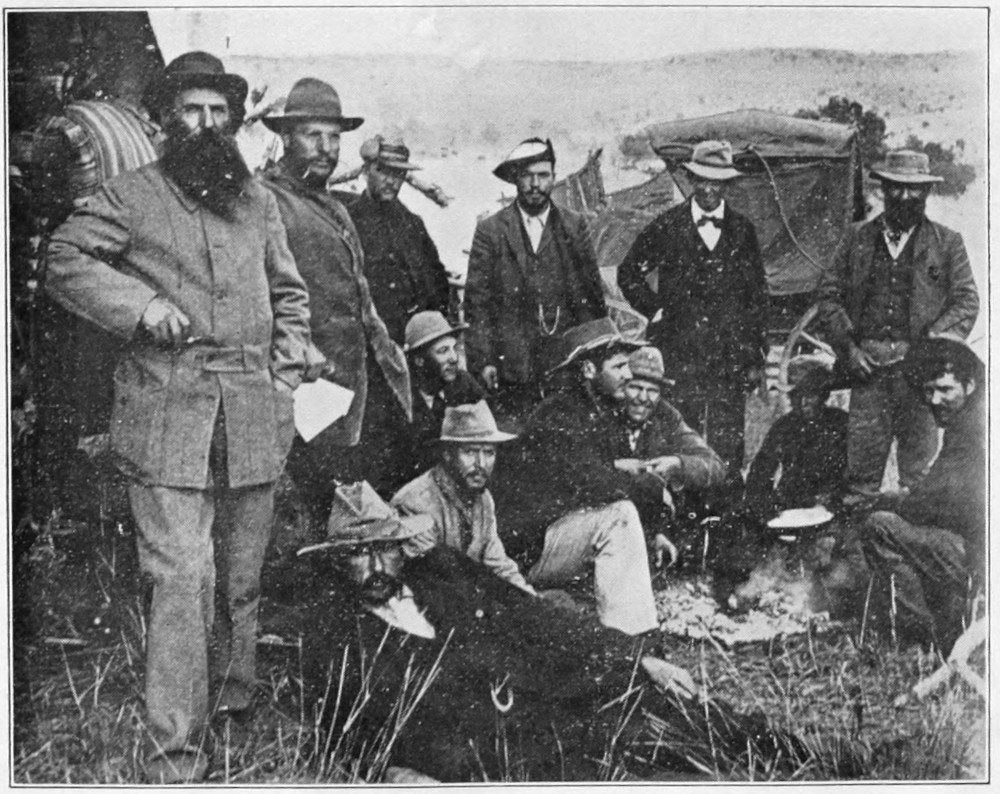
General De la Rey and his staff.
Then again I heard that no, he had not
been taken prisoner. (This was in June
1902.)
When General De la Rey and his staff were
in the east, after they had been driven out
of Pretoria by the superior numbers of the
enemy, the people in the west country had
a terrible time. The women were for the
greater part alone on their farms, and their
cattle were at the mercy of the cruel Kaffirs,
who used to come and steal them away, generally
at night. They would burst into the houses
and make their way to the women, and tell
them that they must have their money, using
such threats and such violence that many a
one fled in the night with her children, and
often wandered for hours before she could
find shelter. It was bitter enough for them
then; but little could they think that all this
was but a drop in the cup of their suffering.
Many of the burghers returned home on this
account to see what they could do to save
their families. Three burghers from this
neighbourhood were killed during the war—Adriaan
Mussman, Adrian De la Rey and
Petrus Biel. All three were still young, but
they fought like the bravest for freedom and
the right.
Adriaan Mussman was only twenty-two;
he did not know the name of fear. In the
thick of a fierce fight he saw that our guns
were in danger. He rushed forward with the
others who tried to save them. Bullets were
raining all round him, but nothing could keep
him back but death. He drew his last breath
like a brave hero.
“Rude storms may wage round me
And darkness prevail,
God’s grace shall surround me,
His help shall not fail.
How long I may suffer
His love still shines bright,
And leads me through darkness
To live in His light.”
“The darker the night may be, the more do we pant for the sunshine;
The denser the mist may close, the more do we yearn for brightness;
The deeper the chasm before me, the more do I sigh for the plains;
The darker the future may seem, the greater shall be my redemption.”
As each day drew to a close I was dreading
what should happen on the next.
One day one of my friends came to tell me
that the commandant wanted to have my
daughter and myself out of the place, but
that he could not find any pretext for sending
us away. I used sometimes to go to my farm
to see how things were getting on there, but
so many “khakis” were about that I never
knew how to come away quickly enough.
The village had been occupied for about
two months when one day I saw to my
dismay that the enemy were burning things
wholesale. That same evening they withdrew
from the village.
A few days after they had left, our people
came back with big commandoes.
A week after the “khakis” had gone out
of Lichtenburg General De la Rey came back
to the village, but after spending only a day
or two with us, he started again for the
Rustenburg district.
Then General Douglas returned and occupied
the village once more. He came to our
farm and took away all our sheep. When the
English had got all our cattle, they went off,
and we could again breathe freely.
I went to the place where the cattle used
to be kept, and there I found the shepherd
waiting for me.[3] He had been able to
recover one or two hundred of our sheep, so
that I and my children still had something
left to us to live upon.
[3] The shepherds are generally Kaffirs who live on the
place. The following statement shows strikingly in its
simplicity how their own Kaffirs remained attached to
the Boers in spite of all the so-called “barbarous treatment.”
Shortly afterwards General De la Rey
returned to Lichtenburg.
But General Douglas had not moved very
far off, and as soon as he heard that General
De la Rey was in the place he came back
with his troops at full speed. But General
De la Rey was already far away in the distance.
Just to show the “khakis” that we
were not as starving as they thought, I made
some bread out of the flour that my husband
had brought us and sent two fresh loaves to
Douglas. The English soon left to take up
the pursuit again; and now the talk was that
they were in their 20,000 after De la Rey,
and that this time he would never manage to
escape.
I said again, “Very well, you catch him if
you can, but be good to him.” A few days
later he was still free; the 20,000 had not
been able to get hold of him.
Shortly afterwards Lord Methuen entered
the village and took up his quarters. He
sent to fetch my two horses, but I would not
let them go. I said, “No, I will not give
them up to you; I shall go and see the
General himself about it.” “Very well,”
was the answer, “you can see him to-morrow
morning at nine o’clock; that will
be the best time.” The next morning I
started off, but when I got there Lord
Methuen could not see me; he was too
busy, they said. I felt very angry. I
turned to go back, when just as I had got
to my carriage, one of his orderlies brought
me the message that Lord Methuen was ready
to receive me, and they took me to him. He
asked what he could do for me.
I answered, “For me you cannot do much,
for as far as my cattle are concerned I have
lost nearly everything. But I have still two
horses left, and one of these belonged to my
son, who is dead, and I hope that you will
not take it away from me.” He gave me his
hand and he said, “It shall not be taken
away from you.” I thanked him and went
home again. Lord Methuen remained in
Lichtenburg for a week. When the place
was once more empty General De la Rey
came back to the village. He remained
with us for four days. The day he left Lord
Methuen returned.
There was a big fight that day not very
far from the village. Towards nightfall the
burghers beat a retreat under General Lemmer,
and next morning the troops came back to
Lichtenburg.
The following day the English commandant
came to see me. He had a hard task before
him, he told me; he had been ordered to burn
my house down. I asked him where I was to
go to with my children if my house were
burned down.
“I shall leave one of the buildings standing
for you.”
I thanked him, and I said to him, “Burn
them down, burn the others down if you
think it fit to do so. Even if you leave one
for me, there will still be four to burn.
However cruel you may seem to be, yet
God is always gracious.”
He answered that it was very hard indeed
for him; but that he had his orders and he
must obey.
All the same, he went away without
burning any of the buildings.
Then came another trial. One afternoon,
at about three o’clock, they suddenly came
to tell me that I must start for Mafeking
with my daughter in half-an-hour.
“And what about my other children
then?” I asked.
“Have you got more children still?”
asked the man.
I called all my children together.
“Very well,” he went on then, “you can
take all your children with you.”
“And for what reasons am I being sent
away in this fashion?”
“When General De la Rey was here you
took him in and sheltered him.”
“Yes,” I answered, “I did take him in and
shelter him; and I shall do it five hundred
times more if it please the Lord to spare him.
I am prepared to go away as a prisoner of war,
but I will not do it of my own free will. And
you say to Lord Methuen that he knows very
well that my husband is only fighting for his
rights and doing his best for his country. I
will tell you a parable for him. Instead of
doing harm to our cause, every step you take
against us makes it one hundredfold stronger.
Where only one now calls for vengeance,
hundreds shall come to be avenged. He can
send me wherever he likes, but it will not
do you any good. I never thought to be so
badly treated in the Queen’s name. I could
not have believed that because you cannot
get the better of our men you would set to
work against their women.”
“Well,” he said, “I must not talk too
much, for we have very little time.” With
that he left me and went to Lord Methuen;
but he soon came back again, and then said
that I had not been ordered to leave the
place, but that it would be better for me if
I were to do so.
“No, I do not think that it would be
better for me to go away from my own
land. I would choose far rather to stay
and suffer with my own people than go
away.”
“Very well, ask General De la Rey, then,
what you had better do.”
“No, I shall ask him nothing of the kind.
He has his own work, and I shall decide and
make shift for myself.”
“Very good; then I shall send and ask
Commandant Vermaas to take you away from
here.”
“I can send one of my boys if you will
only give him a pass through your troops.
Then he can go to Commandant Vermaas and
ask him to send me a span of oxen so that I
can get away from here.” This was agreed
to. Later on it was said that the officers had
decided to let me stay on in the village, but
that I had refused to do so, and had declared
that I was going away as soon as my oxen
arrived.
They kept coming to see me the whole
time, and were always talking about the war,
saying that the Boers had far better give it
up.
I used to reply, Yes, it would be a good
thing to see an end to the war; but it is no
small matter for a people to give up their
country, and that it would cost them a very
great deal before they could put an end
to it.
I asked them, “How strong are the forces
that the English have sent to South Africa to
fight us?”
“Nearly 300,000 strong,” was the officer’s
answer.
“We have about 60,000 Transvaalers and
Free Staters,” I said, “and we have been
fighting with you now for over fourteen
months; how can you possibly expect that
we are going to give up our arms of our own
free will? No! You will have a great deal
of trouble before you bring that about.”
I was waiting meanwhile in great anxiety
for the coming of my oxen, so that I should
be able to make a start. It was five days
more before they arrived, for the oxen were
kept far away from the village. I got everything
ready in the meantime to be able to go
off as soon as they came, for I dreaded every
moment that a fresh order would come and
that I should not be able to go. At last the
oxen arrived. When our friends saw that
they were there, they came hastening from
every side to wish us God-speed. It was a
hard thing for our friends to see us sent away
in this manner to wander without a home. I
said that no, I was beginning my travels willingly,
but all unknowing where they were
going to end or what the future had in store
for me. One thing I knew, and that was,
if all my friends were left behind, my
Heavenly Father would yet be with me.
I hastened to pack everything into the waggon,
and prepared to start on my pilgrimage.
On Friday, December 1, 1900, I drove out
of Lichtenburg after taking leave of my
friends. The oxen were put to the waggon;
the children got into it. I had still a couple
of milch cows that I could take with me. I
and my daughter followed behind in my carriage.
It was raining hard as I left my
village behind, not knowing whether ever I
should step foot in it again. Lord Methuen’s
order had been that I was to go ten miles
away from the village and not to come nearer.
Next day I came to the place where Commandant
Vermaas and his commando were
staying. He told me that I could go to his
farm and remain there as long as I liked; but
as my husband’s work then lay for the most
part in the Rustenburg district, I preferred to
go on, instead of staying at the commandant’s
farm. So I went from there to Kafferspan, a
place about eighteen miles from the village
of Lichtenburg. When General De la Rey
heard that I had been sent out of the village
he sent my son Coos to come to fetch me.
Then I heard that on the 3rd of December
1900 they had captured a convoy near
Magaliesberg and had struck a good blow at
the English. I said, “That is right! It is
not only I who have been in adversity; they
too” (the English) “have had their reverses.”
I went from there to Zuurfontein, a place
belonging to Mr Kritzinger, not far from
Rustenburg; he gave me a house to live
in. The people there were all kind and
friendly. After I had been staying with
Mr Kritzinger about a week, General De la
Rey arrived with his staff; it was a great
delight to see them all again. It was a
good thing for them, also, that I was out
of the village. But after having remained
a few days they had to go off again to
join the commando. Where I was living
was not very far from the English camp;
it was a mountainous district, and we could
hear the cannon shots distinctly every day.
On the 13th of December General De la
Rey took General Clement’s laager, at a
place called Nooitgedacht, behind the hills,
and for a short time after that there was
no more fighting. As Christmas was coming
nearer and nearer, I had been wondering
what sort of a Christmastide it would
be for me; but as the English still kept
quiet, General De la Rey and his staff came
back to us again. They arrived just the day
before Christmas, and once more I had the
great joy of having my own dear ones
round me. There were a great many people
on the farm where I was then staying,
and on Christmas Day many friends came
together there. As soon as Christmas was
over they all went away again to the commando;
but, as there was nothing to be
done that week, our people all returned
for the New Year, and, owing to this,
we were also able to spend a happy, though
quiet, New Year’s Day together. A little
while later they heard that many English
laagers were trekking up, and that the place
where I was staying lay right in their way,
so that I had to pack up everything in
the greatest haste ready for flight. The
day was just over when I got this news,
and we had to pack the waggon in the
dark. Very early the next morning we
left the farm behind us.
As I had some cattle and sheep this time
to take with me, and as we did not exactly
know which way the English were coming,
we could not think where to move to for
safety. After going some distance, we waited
to hear from which side the laagers were
coming. In a day or two we heard that
the English troops had gone back again,
and so I went back also to the farm belonging
to Mr Kritzinger, whose family
had accompanied me in my flight. I stayed
with them there for two months, and often
heard the booming of the cannon among
the mountains.
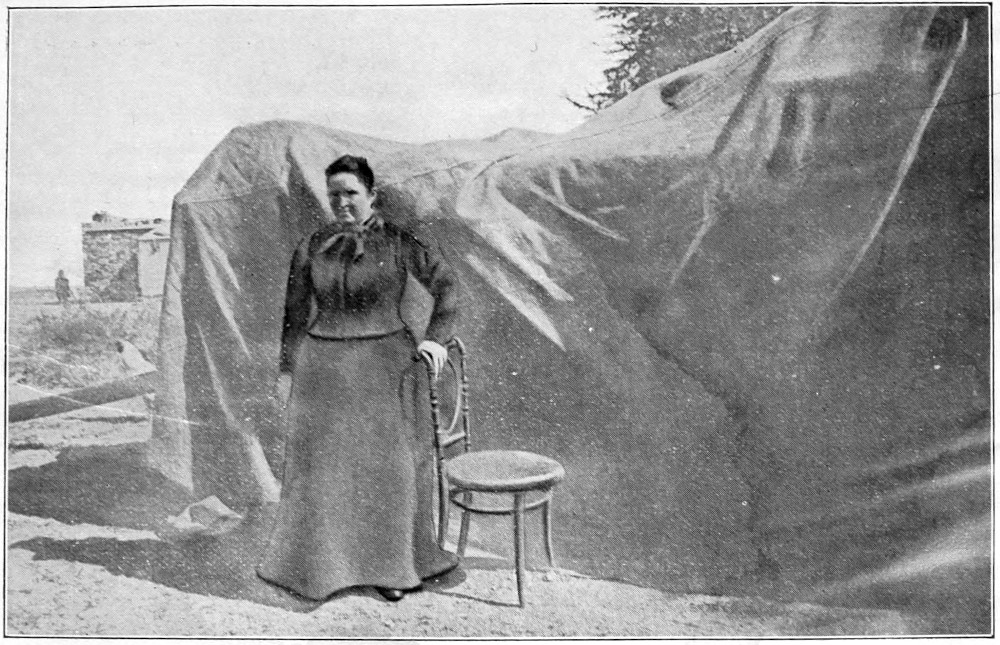
Mrs De la Rey beside her waggon.
For nineteen months after that I wandered
round in my waggon, and, just as
one gets attached to the room in which
one sleeps, so did I grow to love my waggon.
Many a stormy night, when it was blowing
and raining, have my Kaffirs had a
hard job to get the sailcloth covering firmly
fixed, so that the wind should not blow
it right away. Over many a hill and across
many a river this waggon has taken me
safely. For in my darkest and most
anxious nights never did I fail to put my
trust in the Lord, and never did His
guidance forsake me. Sometimes in my
journeyings I would come to houses which
had not been completely destroyed, and
where, perhaps, one room would still be
under shelter; then I would have it
cleaned quickly; we would stay there
during the heat of the day. Sometimes I
would come to a place where I had meant
to spend a few days, and then at once would
have to leave in all haste and continue
my flight. One day we came to Mr Basson’s
place (in the Lichtenburg district), and,
almost the same moment, General De la
Rey and his staff arrived from the Zwartruggen
(in the district of Rustenburg).
When he came up with my waggon he was
tired out, and, after having some dinner,
he got into the waggon to lie down a little
and rest. But he had hardly been there
half-an-hour when a man came hurrying
up, crying, “Why are you all so quiet
here? The “khakis” are upon us!” And
there were the “khakis,” just half-an-hour’s
distance on horseback from my waggon. There
was no commando that could have turned
them; General De la Rey and his staff flew
to saddle their horses, and jumped up and
rode out to see what the “khakis” were doing.
When they (General De la Rey and his staff)
had ridden up the rise they saw that the
English troops were drawing back. Then
I had to fly still farther. A bare country
lay before me to be crossed, and I thought
that this time I should never be able to
get away safely, but we found afterwards
that though the “khakis” had been so near
us they had had no idea of it, and we
managed to come away safe and sound.
The same thing often happened, and it
seemed wonderful that I was not taken
prisoner. As they had blocked up all the
roads with their blockhouses, it became so
difficult to get through that I had to go in the
direction of Harts River, a bare and unpleasant
tract of country. As we went on we found
thousands of dead sheep lying about, killed
by the English. They had not been able
to keep up with the march, and had been
driven together and slaughtered, and there
they were scattered, some shot, others cut
down, and others with their heads taken
off by a sabre cut. Many a time did I
repeat, “Ah, this is indeed a cruel war!
What bitter suffering has it not caused both
to man and beast!” Often I have thought,
“What is going to come out of all these
trials and troubles!” Even when I looked
at the comet I wondered what it could portend
that it should appear three mornings
running in the east, and then again every
evening in the west, during a whole month—this
was in the months of June and
July 1901. As I was journeying on the
open veldt I could see this star plainly
every evening; and when this sign was
no longer to be seen, then another
made its appearance. Every evening after
sunset this other token appeared in the
sky; a bright red radiance filled the air,
and would remain visible for about three-quarters
of an hour.
“Whither, pilgrim—whither art thou flying?
We are driven onward by the enemy’s sword.
A terrible sword are the guns and the cannon,
When man is standing on his defence;
But the cruel sword of fire and of hunger,
Cutting its way through the heart of a mother,
Is more terrible still than the booming of cannon.
The keen-edged sword of destruction and terror,
Piercing the hearts of Africa’s children,
Has taught them a lesson they shall not forget.”
I thought that the enemy were now so far
away that we should be able to spend some
time where we now found ourselves.
General De la Rey fell ill once more and
had to join me and take to his bed. Early
one morning I had just got up when suddenly
we heard the sound of firing. The
English were then only one hour’s distance
from us; they had covered a great deal of
ground in the night, and had been for five or
six hours in the saddle, hoping to catch the
burghers at Tafelkop. General De la Rey
sprung out of bed. The horses were saddled
in a moment, and off they rode. The firing
was coming nearer and nearer. I thought to
myself, “I am in for the fighting to-day,”
but all the same I began packing everything
into the cart as quickly as possible. Very
soon I was in flight once more. It looked as
if things were going very badly, for all
round me people were hurrying as hard as
they could. It began to rain. The waggons
and the mule carts came tearing past,
and it began to look as if I were going to
be left behind. It was raining heavily.
The booming of the cannon sounded closer
and closer, and the danger became greater
every moment. Then suddenly my waggon
stuck fast in the mud, and I could not go
on any farther. It kept on raining, and the
burghers kept coming on in greater numbers.
They stopped by my waggon and tried to
drag it out of the mud. The fighting kept
on, and I told them to go away and leave me
before they too were forced to share my fate.
“No,” they said; “that we will never do.
What would the General say if we were to
leave you here and the ‘khakis’ were to
take you?” The oxen would not pull any
more because they stood in so much water.
Then the people took hold of the wheels and
they managed to drag it out. After the
waggon had stuck fast I went on farther in
the spider. There were now so many waggons
and carriages all close together that it looked
like a big commando. In the afternoon we
stopped to rest; the rain cleared up for a
little and we had something to eat. Very
soon came the order to get ready to start
again. We had not gone very far when the
waggon in front remained leaning against a
steep bank, over which it had to climb. It
was raining heavily again. I thought, “How
will things go with us to-day, we have so
many hindrances, and the ‘khakis’ keep on
advancing?” However, there were a good
many burghers, and they helped to get the
waggons across. My spider also came to a
standstill against the rocks, so that they
(the burghers) had to drag it out. We
were in danger, and yet we really enjoyed
ourselves so much that time went quickly.
It took several hours before all the waggons had
got through. Then we drove on more quickly,
and by sunset we came to where we meant to
spend the night. I drove to a house to wait
till all the waggons had arrived. There was so
much water round the house that it was
impossible to tell where there were ditches or
hollows. When driving towards the waggons I
went into a deep ditch and my driver was
thrown off. I and my little son remained
sitting in the carriage; the horses started off.
They swerved towards the side of the house;
fortunately there were some burghers there
who ran in front and stopped them. It was
already dark. I suggested that they had
better be unharnessed; I would walk to the
waggon. Just then my husband came up
with his riding horse Bokkie for me to ride
to the waggon. However, Bokkie’s back was
too narrow; as sure as I climbed up, off I
would slip. Then his other saddle-horse came
up, and off we rode to the waggons. All
were there now, and very hungry; it was
dark and damp, but luckily, with some dry
wood, we soon had big fires going to prepare
food. The enemy had not come much nearer.
After a good meal we went to sleep, and
early next morning I went on again with the
waggons. The men folk joined the commando,
and at Rietfontein, where I had made
up my mind to spend some time, I went into
the school, then empty. There were a good
many people in the place, and one could get
vegetables and fruit. But I had been there
for only about a week when suddenly a large
number of English troops entered the Rustenburg
district where we were. Off I went
again in great haste, this time to the Lichtenburg
district. I had to drive hard to get
past. I was lucky, and came safely through.
Passing Lichtenburg, I came to Badenhorst,
and found a deserted shop in which I could
take up my abode. Here also we had kind
friends, who took care to keep us supplied
with vegetables. One evening, a fortnight
later, just as I had gone to bed, the report
was spread that the “khakis” were coming.
It was very dark and cold, but I was soon up
and dressed and had the waggons packed, and off
we went again on the road. Next morning it
seemed true that the “khakis” were behind
us; once again we drove past Lichtenburg.
Now there seemed nothing left for me but to
fly with all possible speed to the Zwartruggens.
When I got there Mr Joubert came on with
me and brought me far into the mountains.
“Here,” he said, “no ‘khakis’ had found their
way yet.” And there I had to stay. There
were many big trees growing, and the Marico
River looked lovely as it flowed along; it was
a pleasant spot to stay in. I made an oven
so as to be able to bake my bread. I set up
my hut in the cool shade of the trees, where
all looked so beautiful and green, and made a
stable for my horses with some trees and a
kraal for the sheep, just as if I were destined
to live here a long time.
My soap was all finished and I began much
to feel the need of it to keep my children
clean.
I was advised to burn some vogelsent[4] to
make soap out of the ashes. I gathered some
“vogels,” had them burned, and succeeded
in making some good soap. The children
wandered on the mountain side searching
for wild honey. I thought that if the
“khakis” did not worry me, I should
remain here for a long time. But after a
fortnight my husband turned up, and said
that it was too cold to live out on the veldt,
and we went back to the farm belonging to
Mrs Lombard. From there General De la
Rey and his staff went on to the Free State,
where they were to meet President Steyn
and General De Wet. I had been here only
twelve days when early one morning the
cannon suddenly began to make such a
threatening noise that I hastened to pack
up my belongings and fled away once more.
At Drinkfontein I thought that I would wait
and find out where the “khakis” were moving
to. But soon I heard again the roaring of
the cannon. At that moment I was making
some candles; water and fat were both hot. It
was high time to be on our way, and I said,
“Get ready and make a start; but I must
somehow or other finish my work.” The
oxen were not by the waggon, so that it was
some little time before everything was ready;
and I had finished my candles when the
waggon was prepared to start. Then we
were again flying as hard as we could through
the Lichtenburg district across the Harts
River. It is not a pleasant country to
wander in; there are no woods or shady
trees; and as soon as the “khakis” had gone
back, back I returned also, to try to find
better headquarters. And so the time passed
till General De la Rey returned. Then he
went away again, back to the Wolmaransstad
district. Meanwhile I kept wandering around.
Suddenly we heard that many of the enemy’s
laagers were advancing together towards
Klerksdorp. I went on some distance
farther, and then from all sides the people
began to hurry onwards, so that the flight
was now beginning in earnest. The troops
were advancing in great force. We fled in
the direction of Makouwenkop and then
were joined again by General De la Rey.
At last the Boer commandoes managed to
get through, so that they got behind the
English. Then we had to fly as hard as we
could so as to keep in front. Some people
went back that night, hoping to break
through the English troops. They said that
I ought to go with them; but I said, “No,
I shall go forward, and I shall see if I cannot
escape that way.”
[4]Vogelsent.—Lumps of resin that exude from certain
trees.
When we came to the Vaal River we were
forced to turn about. We took another way
back. After driving all day, we stopped for a
little. We had to get food ready as quickly as
possible. It was very dark; but later the
moon began to shine. We fled on in great
anxiety, knowing that at any moment the
“khakis” might be upon us. My husband said
that it would be too bad if they were to take
me prisoner when he was near the waggon, for
he would have to fight then, and to leave me
to myself. I said, “Nay, do not let
that disturb you; do what you can to escape
when they come; the Lord has always preserved
me until now, and He will continue
to do so.” At midnight we stopped for a
little to let the oxen take a rest; but after
an hour or two we pressed forward again
in good earnest. Bokkie was saddled and
marched behind the waggon, and all were
ready to meet the “khakis.” We hurried on;
it was near the break of day, and I thought
to myself how grateful I should be to the
Lord if it pleased Him to guide the course of
the night so that I might not be taken. It
grew light and the sun began to shine. All
was quiet and we stopped to rest. Then it was
reported that the “khakis” had gone past us.
We were all very happy, and after we had
had something to eat, and had taken a little
rest, we went once more on our way. It was
Saturday, and we hoped to be able to spend
Sunday in peace. When we had gone on
again, I sat in my waggon and felt very thankful
that this time I had again escaped with
my freedom. And then the words came into
my head, “Offer your thanks unto the Lord,
and call upon the name of the Almighty.”
“Yes,” I thought, “that is what I have
done in my need; praise be unto the Lord
that He has preserved me from falling into
the hands of mine enemy. The good God
has saved me now and many a time
before.”
On Sunday we found ourselves in Brakspruit,
and there we spent a peaceful Sabbath
day: on Monday we set out for Wolmaransstad,
there we found our houses in ruins. It
was dreary to return and find the place in
such a plight.
A little way from Wolmaransstad we went
to Mr Bezuidenhout’s farm and found that
his house was fortunately still intact. We
were able to bake bread there and make
preparations for our next flight. After remaining
there a week we went back to the
Lichtenburg district. At Malgasfontein I
found refuge in a house whose owners had
been taken by the “khakis.” As I had a
good number of oxen with me, and it was
raining just enough, I had a lot of mealies
sown there, for we were constantly doing
whatever we could to keep things going.
Everybody sowed and planted wherever possible.
The “khakis” might destroy as
much as they liked, the Boers were still full
of courage.
I had great difficulty at that time to keep
things straight; as I have many children it
grew extremely difficult to keep them all
clean. Soap was still very scarce; I could
not get more anywhere. As far as clothes
were concerned I was happy as long as they
were only clean. A man told me he had
scraped off some deposit of saltpetre from a
wall at Schoonspruit and had made good soap.
As soon as possible I got a bag of it and
also made some very good soap, so that I
had not to worry about that any longer.
After we had been here about three weeks
General De la Rey came back from the Zwartruggens
after the defeat of Colonel Van Donop,
which took place at Kleinfontein on the
24th of October 1901. It was on the 24th
of October 1901, the very day that we had
been married for twenty-five years, that a
terrible battle was fought, in which many
people were killed or wounded, and among
them one more good friend of ours, Commandant
Kritzinger, and his son, both of
whom were killed. So that we had on this
day, instead of a silver wedding feast, a
terrible shedding of blood. There were great
losses on both sides. But the burghers were
now, however, well supplied again with
clothes and other things which they had been
needing badly. We had made up our minds
to stay here, when suddenly came the report
that the troops were advancing. We made
a hurried start in the direction of Harts River,
and went on from there till past the Zoutspannen.
When the enemy had gone off in
another direction back we went again slowly all
along the Harts River. Whenever we thought
that we were going to be left in peace for a
little while, we would find that the English
troops were coming in such numbers that we
would have to go on trekking backwards and
forwards without any respite. With the
approach of Christmas things grew quieter.
I went to Doornfontein, Badenhorst’s place.
The houses had been injured but not quite
destroyed, so that I was able to make use of
one during the time that I remained.
My people were all with me; we spent a
pleasant Christmas. Still, we were not very
far from Klerksdorp, where there were so
many “khakis” that the day after Christmas
we had to begin our march again. A few
days later I got a message telling me to turn
back to Doornfontein; and there we all met
again and spent the New Year. That was
in 1901. The day after New Year’s Day
there were so many “khakis” about that I had
to fly past Lichtenburg and take refuge in
the Zwartruggens. Putfontein, where I next
found myself, was utterly destroyed and
burnt down. As I was greatly concerned
because my people had no bread with them,
I wandered round the desolate place hoping
to find an oven which had not been destroyed.
All the ovens had been broken down, but at
last I found an attempt at one that the poor
women had set up and used for preparing
bread. I said, “It does not look of much
use, still I shall try what I can do.” It was
late in the evening and rain was falling.
There was no wood to be got, but I went on
with my breadmaking, and the boy (a Kaffir)
had to try and make a fire somehow or other.
He was a very sharp boy, and he succeeded
in heating the oven.
General Kemps had his laager in the same
place. In the evening all the burghers came
together, and they asked me if I would join
in their worship. “With pleasure,” I said.
It was then quite dark. I went to the laager
and we had a short service, and after that
sang songs out of the “Kinderharp.” It was
so pleasant that I quite forgot to bake my
bread. We also sang beautiful hymns that
they themselves had composed, so that I had
a very pleasant evening. I hurried to the
oven, where I found that the biscuit had
risen. It seemed as if the oven were not hot
enough, and yet I could not get any more
fuel for it. I put all the bread in and
thought “let it bake itself as best it can.” I
waited till I thought that it was ready and
then I sent Sampson, the boy, to bring it out
of the oven. He came back with it and it
looked still as if it were quite raw. However,
it was always something to eat. I went to
sleep. Next morning I had hoped to be able
to spend a peaceful Sunday. A little way
from my waggon were some big trees, and as
many burghers were there, we all agreed to
meet under the trees to hold our service. I
and my children were there and many
burghers; but as all had not arrived we
waited a while until the leader said he would
go on with the service, and then the people
would come fast enough. After we had sung
he began to speak to us, but it did not look
as if any more people were coming. We
were some distance from the waggons and
could see that there everyone was hurrying
backwards and forwards. I thought that the
old man did not seem very much inclined to
put a stop to his service, but things looked
to me so grave that I said that we must
really go to see what was happening. We
hurried back to the waggons, and very soon
we could hear the firing. I started off as
quickly as possible. Very soon many people
in their waggons were keeping up with mine.
We fled for some distance and then sent out
scouts a little way back. General De la Rey
with his staff came up. It was he who had
been under that heavy firing; a mark was on
his back where a bullet had whizzed past.
They had all escaped unhurt and were very
hungry and tired. It was then that the
bread I had baked the night before served in
good stead. They ate some, and that same
evening they had to go back. I was thus able
still to supply them with bread. I went on
to the Zwartruggens this time; I did not
want to go so far into the mountains as it
was beginning to be very warm there. On
the slopes of the mountains large trees were
growing. I set up my tent in the shade.
There was fruit to be had: my children were
happy.
Then I heard that the enemy were coming
with their blockhouses towards Lichtenburg.
Then I knew I must go out of the mountains;
I did not want to get blocked up. And we
went away again, after having been a week
there.
At Duikfontein I found large numbers of
cattle and sheep that our people had brought
through the lines. General Kemp’s commando
had succeeded in doing this and in
bringing cattle to other districts also. I was
still waiting there when General De la Rey
arrived with his staff. By that time I felt
quite rested. He said that it was not necessary
for me to go at once to Rustenburg. So
we merely went to a place not very distant.
A day or two later there were again so many
“khakis” gathered in Lichtenburg that we
did not dare stay longer, as it was only three
hours’ distance from the village. We went
from there to some untilled ground belonging
to us, which we kept for the cattle, two and a
half hours away from Lichtenburg. It was a
good neighbourhood for fruit; there was
plenty of water, and not very distant was a
large fruit farm. We hoped thus to be able
to stay for a while. We sent the waggon to
get fruit, and we set up our tent under the
cool trees.
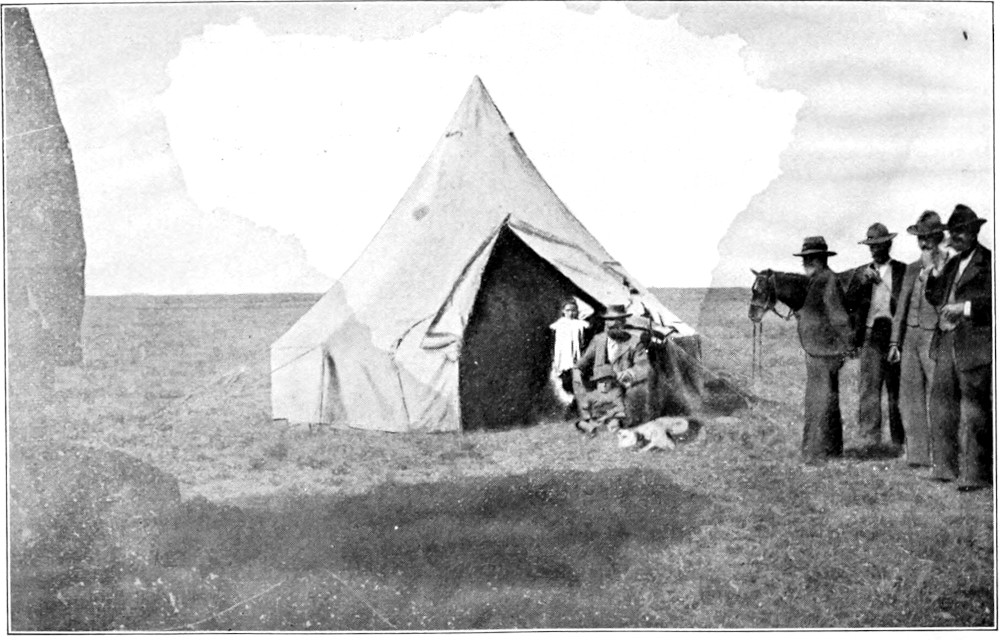
“The picture of my wandering life”.
And here you have the picture of my
wandering life. When I could set up the
tent under shady trees and cover the floor
with green grass, then I felt thoroughly
happy and content. Often when in such a
good place I thought to myself, “If only I
could stay here quietly for some time how
happy and pleasant it would be!” And
sometimes I had the good fortune to be able
to stay for two days or a week in such a
spot. But at other times it would happen
that just as I had got everything in good
order, then the “khakis” would be upon
us and everything would have to be
taken down quickly to make a fresh start.
Often we fled until the middle of the
night, and when we could stop to rest it
would be so dark that it was impossible to
see one’s hands before one’s eyes. Yet the
tent would have to be put up before we
could get to sleep.
When I saw the bright sun shining in the
morning, often I thought, “How much pleasanter
the sunlight is than the darkness; what
joy will it be for me when the sun of peace is
shining for me again!” Then again I would
come to a whole district where not a tree or
cool spot was to be found. The only cool
place would be just under the waggon, on the
ground, and that was so uncomfortable that I
could not help sometimes crying out, “Why
should I have to suffer so grievously?” but
the next moment I would think, “After the
bitter comes the sweet.” When I left my
house and went into Lichtenburg to live in
the village, because I felt so lonely on my
farm, I thought I was going to stay there
until the war should come to an end. I
never imagined that I should never set foot
in my house again. I was always particular
to keep my house neat and clean; it was the
greatest pleasure I had to keep my home in
good order. I used to think sometimes,
“Perhaps it is not right that I should think
so much of my house,” and yet I could not
help it. A pretty home on a farm, with
abundance of cattle and all that is needful,
always seemed to me the happiest life. When
I was wandering over the veldt with a tent,
and especially when I came to dusty and
sandy places, I kept thinking all the time
of my house, so clean and so cool. The day
they told me that it had been destroyed I
could not keep my tears back. It was so
hard out on the veldt and I had longed so
often for my house; now I had to hear that
it had been broken up and razed to the
ground.
But I told myself quickly that I must not
weep. “Why should I be better off than all
my fellow-sufferers whose houses had also
been broken up or burned down?”
I went back again, this time to Gestoptefontein.
That evening General De la
Rey was in the neighbourhood, but I knew
nothing of his movements nor he of mine.
But he arrived the next morning, for the
English were now closing up on every side.
I got breakfast ready, and after the men had
had something to eat, off they had to go
again, this time to trek up against Methuen.
I remained in Gestoptefontein so as to be
able to find out where the troops were moving;
and it was soon reported to me that they
were coming in my direction. These were
the troops from Klerksdorp, so there we were
again, exposed to the danger of being surrounded.
So many of us came trekking on
that we kept getting into one another’s path;
but we could only say, “The more the merrier,”
and go on without losing courage.
“Now we should have to go to Waagkraal,”
said everybody. I said, “Very well, the
place has a good name, and so we can venture
it.” It was a very dark night when we
reached there. We were all hungry, and had
first of all to get our food ready. After that
we went to sleep, and early the next morning
a couple of hundred of our burghers arrived
also.
They were all going nearer now to see what
they could do against the English forces, but
there were so many troops they could not tell
where to begin.
Most of them went on towards Methuen’s
laager to see what they could find to do there.
The enemy’s troops moved forward to meet
them. Our burghers were now in Pretorius’s
place, where I had been staying quite lately;
the English army was coming up along the
Harts River.
I was now so far from the Boer laager that
I began to fear that if the English drove them
away I should certainly fall into the hands of
the enemy. We waited in great anxiety to
hear what would be the result of the battle.
The country was very bare and exposed just
there, and as the troops had many guns with
them it was dreadful to think of the fighting.
Yet on the evening of the 1st of March there
came a report that the laager was taken and
that Lord Methuen had been wounded. I
could not believe that Lord Methuen was
really wounded. The following morning I
felt a great wish to pay a visit to the laager.
I had my horses harnessed and started. I
had to drive a good way—it seemed to me
for nearly four hours—and although I had
wanted to go back the same day to my
waggons, I found it would be too late to do
so. I arrived at the laager in the afternoon,
and there I found an enormous crowd of men
and animals. I asked my husband if really
Lord Methuen were here. “Yes,” he answered,
“it is the man who sent you out of Lichtenburg.”
“Then I shall go and see him,” I said.
I went with my daughter, and we found him,
quartered with a few tents and waggons,
a little distance from the laager. When
I got there, one of our people, a man called
Tom, said that he did not want to see any
visitors. Yes, that I could well understand,
that it was not pleasant for him to see the
Boers. All the same, when he heard that
I was there, he said that I might come in—that
he would like to see me. I went into
his tent; there lay the great, strong man
wounded above the knee, right through the
bone. When I had come in he begged me to
forgive him for all the annoyance he had
caused me, and he asked if I had suffered
much discomfort from all that running away.
“No,” I said, “it all went much better than I
had expected. I did not even have to do my
best to escape from falling into your hands.”
“Oh,” said he, “I have done my best to
catch you.” And so we “chaffed” each
other. As it was a difficult position for
both of us, I asked him if his leg were
hurting him very much. He said, “No,
not very much.”
“Then it won’t be a good thing for us,”
I said, “if your leg gets cured so quickly,
then you will come and shoot at us again.”
He laughed and said, “No, I am going
away, and I will not shoot at you any
more.”
Then he told me all about Lichtenburg,
and how things were going there, and he
said that my houses were still unharmed.
I said, “But my dwelling-house has been
destroyed.”
“Oh, yes,” he said, “that had to be
broken down. General De la Rey might
have been coming to it some fine morning
and firing at me out of it. That was why
it had to be broken down.”
Then he told me how glad he was to be
able to go back to Klerksdorp, and he
asked me to let the telegram to his wife
be sent off as quickly as possible.
Then, as I also wanted to send a telegram
to my children in Pretoria, I told him that
he must take good care of it and forward
it, so that they too should be sure to get
it. Yes, he said, he would not fail to
do so. And he was true to his word; for
when I met my children later they said
they had received it.
Then it grew late and it was time to
return. I wished him a speedy recovery.
When I came to the laager they gave me
one of the waggons which they had taken
from the enemy to sleep in. It was late
and I had to see to our dinner. But everything
seemed in such a muddle among all
these menfolk; I did not know where to
lay my hand upon what I wanted.
There were a few Kaffirs belonging to the
English there, and these had to help me
with my work that evening. It seemed
just as if these English Kaffirs were thinking,
“How aggravating it is to have to do
with the Boer women;” but that did not
help them a bit—they had to work.
Fortunately, there was a water dam near
the waggon, and we had an abundance of
water. I got dinner ready, but nobody
made his appearance; it was very late
when at last the men arrived. They had
been keeping the prayer hour. General De
la Key said, and I was very glad to hear
it; for does not everything depend on the
blessing of God? After dinner we went to
bed; and the next morning, as it was the
Sabbath, we went to the laager where
service was to be held by a missionary
who still remained with our commandoes.
We had hoped to take part in a pleasant
service, but there was a good deal of discontent
among the people because Lord
Methuen was to be set free, and the
preacher took for a text, “That it would
be displeasing unto the Lord did we allow
such a man, who had dealt so cruelly with
our women and children, to escape untried.”
I said, “How bitter is the lot of man!
We were all going to praise the Lord, and
now there is so much sin among us that
we should rather weep.” But it was true;
it seemed almost impossible to be charitable
when one thought of all that had happened
to so many women and children.
They made Methuen come back. General
De la Rey said to the burghers, “There
he is, what do you want me to do to
him?”
When they had all heard what General
De la Rey had to say about the matter, it
was agreed to leave it to the officers, and
these decided to let him go free.
General De la Rey came up to my waggon,
and just then Tom came straight from Lord
Methuen and told us how he was longing
to go back, and that he was quite ill from
dread at the thought of having to go on
again.
I had a fat chicken killed, and I took
some biscuits and sent them with the
chicken to the wounded lord.
However it may be, I could not bring
myself to think it right to be so cruel.
People kept asking me how it was possible
that I could be kind to such a man. I
said that so far I had never learned to
hate anyone, and that therefore I could
still do good to my adversary; especially
when God gave me the grace and the
strength to prove to my enemy that, in
spite of all the desolation and destruction
he had wrought, there still remained something
over for me.
We were camping here under some lovely
trees. All my people had got here now, and
many others kept coming for clothes and
tarpaulins and all kinds of necessaries, so
that fresh heart was put into them to push
forward with their task.
After a few days we heard that a large
number of “khakis” were coming on from
Klerksdorp.
“Yes,” I said, “now they will be after the
Boers again.” General De la Rey went to the
commando to see that all should be ready to
receive the “khakis” when they came. However,
they kept quiet for the moment in
Klerksdorp.
I had pitched my tent in a lovely little
wood. Everything was looking very well;
the veldt was in good condition; my cattle
were all doing very well when suddenly the
pest broke out among my animals. This
was very disappointing; however, it did not
go so very badly with them.
The week had come to an end, and I was
just going to sleep on Saturday night when
suddenly General De la Rey and Ferreira and
young Coos came up to my waggon.
“I was not to wait for them,” they said,
“there was such a large number of troops in
Klerksdorp, and we were not so very far from
them.” After they had had something to eat,
we went to sleep. On Sunday everything
was quiet. President Steyn had also joined
us. We all met in the morning at service,
and I asked President Steyn to come and
dine with us that day. We had a very
pleasant time, and heard nothing more of
the English.
Early on Monday morning, just as I had
got up, there came a man all red with blood
asking, “Where is the General?” “Here
he is,” I said. “General,” he cried, “there
are the English.” The horses were quickly
saddled. I did not know how to hurry
enough, to get all my things packed, the
“khakis” were now so near; however, we
had all learned to get ready quickly when
the enemy was coming. Very soon we had
finished everything and off we started again,
keeping a good look-out to see that the
troops were not closing upon us.
Very soon we had formed into a very large
“trek.”
We started off from Brakspruit. At one
o’clock in the afternoon we stopped to rest,
still not knowing what had happened in the
night. Later came a rumour that the troops
had taken a great many prisoners that night,
and among others all the members of General
De la Rey’s staff. “What a fortunate thing,”
I said, “that he had been in the waggon that
night; if it had not been for that he might
very well have been taken also. It was a
merciful ordinance of the Almighty that had
so guided his steps.” We did not know at the
time if all had been taken or killed.
I went to the place of Roodewal; there we
all waited, including President Steyn. We
kept a feast day there, Dominie Kestell holding
the service. We found a large community,
with many women and children. I was
surprised to see how well they were looking.
It was now Saturday. On Sunday we had
to fly once more, this time towards the Harts
River. From there we went on to Coetzee’s
place, where we arrived late in the evening.
Still later, General De la Rey arrived with his
men.
In the morning, after we had had breakfast,
the burghers all went back to the commando.
I got everything ready for our dinner and set
it to cook, and then went for a moment to
the waggon of one of my friends. We were
sitting there talking, when suddenly there
were the cannon reverberating again not
very far from us. Everyone tried to get
ready before everyone else; it was not very
long before we were all once more on the
“trek.” There was now a very large number
of waggons driving on together. Some went
towards the clumps of trees, others went
on over the veldt where there was no road.
“It will go hard with us to-day,” I thought,
“the whole country is so bare; they can see
us from a very long way off.” Little Coos
was close to my waggons. He dashed off
alone towards the commando. I felt very
nervous lest he might come suddenly upon
the troops. The battle went on; the people
in the waggons had to get away from it as
best they could. Later it began to rain. In
the afternoon things were quiet, so that we
were able to make a halt. The food that I
had half cooked in the morning had to go
once more over the fire. “It will soon be
ready now,” I said.
In the evening we went on again. We
heard that the camp of the “khakis” was in
Brakspruit, at no great distance from us.
Now we waited to hear in what direction
they were moving. The following day it
began to rain very hard. I had no wood
to make a fire. We were standing there on
a barren rise, looking out to see which way
we should have to go, and here and there I
saw an ant-heap burning. I said to the
boy,[5] “Set one on fire for us, and put on
the ‘kastrol’[6] and let us try to get something
ready to eat.” I had a large green sailcloth,
and out of this I made a screen, so that there
was lots of room to keep dry in, and very
soon I had plenty of company round me.
That helped to make the time pass, but as
for eating or drinking, we could do neither.
It took a very long time before the ant-hill
began to burn. I thought, “If only the
‘khakis’ would wait till our food could be
cooked!” We got on so slowly with the
ant-hill, the “pap” would not boil. Simson
was doing all he could to make the fire burn
up—we were all very hungry. At last
there was some good soup ready, and we
had friends with us to help us eat it, so
that we began to enjoy ourselves. We had
just finished when there came the order,
“inspan.” Very quickly we got ready, and
away we went once more. That evening we
had to drive on till very late. It grew so
dark that we could scarcely see anything,
and yet we could not make a halt. My
boy asked what he should do, as he could
not tell whether he were on the right path
or not. My oxen toiled on slowly, and I
said that we had better stick to the path
and go on. We could not outspan, as I had
no idea where we were, and we did not even
know now if we were still on the path that
the people in the waggons had taken. On
we went, and at last, late in the night, came
to the waggons. All was silent; everyone
was fast asleep. I had nothing that I could
give the children to eat; and the first thing
I wanted to do was to milk the cows. We
waited a little, but no cows came up. We
had gone one way and they the other; we
could not get to them that night. I told
the boy to take an ox-yoke and chop it up
for firewood, so as to be able to get some
water boiled and make tea. After we had
had tea I went to sleep. The Kaffirs started
out very early in the morning to look for
the cows. The boy had been very good; he
had looked after them the whole night, and
he now came up to us with all the animals.
The calves were close to the waggons, and
the Kaffirs set to work at once to milk the
cows. How glad the children were to be
able to come to the pailful of milk!
[6]Kastrol, from the French casserole = pot or deep pan.
It was a finer day; it had left off raining.
We were now in the neighbourhood of
Schweizer-Renecke.
Then came General De la Rey to my
waggons with the news that all the Generals
were to go the following week to Klerksdorp.
I had a great many people with me just then—General
De Wet and many others.
On Monday, after we had spent a peaceful
Sunday all together, the Generals started for
Klerksdorp. I went to a place not very far
from Schweizer-Renecke, for the troops were
stationed in great force at Rooiwal, and were
also scattered about at many other places.
Here were a great many “treks” of women
and children, who were also very much afraid
of the troops. Our commandoes were not
very far away, so that I could easily hear if
the “khakis” were coming. I thought that
if only they would let me stay quietly
till the Generals had left them I should be
happy. But we kept on hearing of more and
more troops advancing. I said, “How can
that be? I thought that while the Generals
were with them there would be peace for the
time.” But no; it grew worse. I had a
great many people and cattle with me, so
that we kept ourselves well informed as to
what the “khakis” were doing.
We hardly knew now where next to go:
the blockhouses were hemming us in on every
side—we had to be on the watch the whole
time. Suddenly we saw some horsemen come
dashing on, and they called out to us, “Here
are the ‘khakis.’”
It was a dreadful commotion. Everyone
was saddling and harnessing. My oxen were
not there, and I had no man with me to help.
There were many people, but they had to see
to their own safety. “Ah!” I thought, “if
only my oxen would come!”
I did not want to be taken prisoner now
after having escaped so many times, especially
when we were, perhaps, nearly at the
end of the terrible war. If only I could get
off this time!
As people passed me they cried out, “Take
your spider, and leave your waggons and
everything behind you.” I replied, “You
go on.” And the children began to cry, and
to say, “What is going to become of us?
Everyone is hurrying on!”
“Let them go on,” I said. “All their
women and children are prisoners; why
should they trouble about us?” The people
who had waggons abandoned them and hastened
on. As my waggon stood by the way-side
they kept on telling me that I must
come too—that the troops were close at
hand. At last there were my oxen coming
over the rise. The children helped to catch
all the oxen that we could get inspanned.
Then I saw a troop of horsemen riding up
over the rise. I asked the people passing
me who they were—if they were “khakis”
or Boers?
“No,” they said; “they are Boers.”
“Good!” I cried, but I hurried my people
all the same. As soon as we were ready the
whips touched the oxen, and off we went at a
good trot.
After we had driven on some little distance
the yoke broke.
Then for the first time a good Samaritan
passed us. Ada said to him, “Do help us so
that we can get the ox yoked, and tell us
where the English are.”
The young man got off his horse and helped
us, and he said that the “khakis” were not so
very near. We went on quickly, then presently
we heard that there had been a terrible
fight. Many of our men had been killed or
wounded. Oh! what dreadful news for us!
I went on. Towards evening we halted for a
while. After having eaten we started off
again, for we thought that the troops would
be able to get through to Schweizer-Renecke,
and that we should be straight in their path.
Late at night we stopped to rest. Early
next morning we went on again; then, as we
heard that they were not coming any nearer,
we halted in a place not very far from
Schweizer-Renecke. As it was near the end
of the week, we wanted to stay there over
Sunday, and this we did. That Sunday I
had a great many visitors.
I was astonished to see how many women
and children were still out, and how well they
looked, although they were wanderers. We
talked about the peace that we were hoping
for, though not for a peace that should impair
our independence. It was very pleasant that
evening to hear the sweet singing of the
people as they sat near their waggons. The
following morning we went to Piet De la
Rey’s place, and as he was also with us we
had made up our minds to stay there. But
it did not come off, for we found we could
get no water there. We went on a little
farther, closer to Schweizer-Renecke.
My tent had just been pitched when
Johannes De la Rey, the son of Piet De la
Rey, suddenly appeared. He and his brother
had both been wounded in the last battle.
I had a bed made up in the tent and put
him on it, for he was very much fatigued
from wandering about since he had been
wounded.
He was delighted to be able to rest. That
afternoon he was taken to the hospital in
Schweizer-Renecke, his father going with
him. There were many more wounded. I
went to visit them, and found them lying in
the devastated houses. We thought, “We
must make the best of it and take as good
care of them as possible.”
Going to the landdrost, I told him that
as there were troops in Bloemhof I thought it
would not be advisable to stay any longer in
Schweizer-Renecke. “Oh, no,” he said; “it
is quite safe here. If the ‘khakis’ do come
I shall know it in good time, and you need
not be at all anxious.”
I said, “Very well, if it is really so then I
shall stay on here;” but I was not at all easy
in my mind. I went to my waggon, which
was about half an hour’s distance from the
village, and told the man who was with me
that if I were to follow my own instinct I
should get ready at once and leave the place.
He said that there was no need to go. I
let myself be talked over, and remained for
the night, as they all thought that things
were so quiet. That night I slept well, and
was still sleeping early in the morning when
up came my boy with these words: “Here
are the ‘khakis’!”
This time they were right in the village,
where all was in disorder. I felt all the
worse because I had remained there against
my own instinct.
My people hastened to yoke the oxen.
Everything was lying on the ground, but
they packed it all into the waggons very
quickly. We had to see what was to be
done. I asked, “Is the hen-coop open?”
There were still a few chickens out then. I
said still, “Get the chickens into it;” but
the fighting was coming so near that we had
to hurry on.
Then there was such a crowd of men and
beasts that it grew very difficult to make
one’s way through and get away. Commandant
Erasmus came up and said, “Don’t
you run away; it is only wedding-guests who
are firing like that; those are no ‘khakis.’”
I drew up and said, “Go and get my
chickens.” The boy went back and then
came the news that of course they were
“khakis.”
Then our flight was doubly hasty. The
fighting now was much nearer us. I thought,
“I shall fly to the last.” Then I had more
misfortunes. There were the chickens out of
the coop again. I said, “Let us wait for one
moment and get the fowls in first, and let
the boy come up with the cows; for if
I can get no milk I shall be very unhappy.”
The animals were all driven forward; the
oxen were urged on and we got on at a brisk
pace.
The ground was vibrating from the firing
of the “khakis.” The way was full of sand
and rocks. It was very rough travelling. I
kept wondering every moment where the boy
could be with the cows; but it was now a
time when each one had to consider his own
safety, without troubling to look after me.
I was waiting for the moment to come when
I should be taken prisoner. Fortunately,
young Jacobus De la Rey, son of Pieter,
caught sight of my waggon and came up.
He took the whip and began driving the
oxen onwards while he rode on his horse
alongside. He came out on the veldt with
my waggon, and, as he knew the neighbourhood
very well, he said, “Aunt, I shall do
what I can to get you out safely.”
“Very well,” I said, “but you must not
go and get yourself taken for my sake. If
the English come up with us, then fly away,
I shall not come to any harm. If they must
catch me—well, then, let them do so.”
The mountains were echoing back the
sound of their firing. I said, “There is one
comfort, I cannot see any cannon; if they
were to begin to fire them at me I should
have to give in then.”
We went on as hard as we could. Young
Kobus De la Rey said, “They are coming
over the Rand.”
“Then we are in their hands,” I answered.
Then my boy came up with us and told
me that the “khakis” had taken my cows.
They had so fired upon him that he had
taken to his heels and left the cows behind.
That was bad news; I did not want to listen
to it, although we too were in great danger,
and at any moment they might come and
take me prisoner also.
“Our people”.
I told them that they could not go on any
longer driving the oxen like that. We should
have to give in. But still the brave Jacobus
kept on, and said, “No, aunt, your oxen are
getting on very well. Don’t you worry about
them.”
I could not understand myself how it was
that my waggons were not taken. There was
not one commando there to keep the “khakis”
back.
I told myself that when the Lord is
working His will, then the greatest wonders
can happen.
We came up to some steep ground when
one of the yokes broke.
“Now they will be able to see us well,”
I said; for we had to stand still, which was
very dangerous. But I kept calm and told
myself, “My Redeemer is here, and wherever
I may go with Jesus it will always be well.”
And I clung fast to the hope that we should
come away safely.
When we had at last got away from these
dangerous heights, it seemed at once as if
the fighting were quieting down. However,
we could not tell whether they might not fall
upon us from in front, as in that direction lay
a woody and uneven country.
Very soon we heard that they had not
come any nearer. But still we went on, to
get as far away as possible. Then we heard
that nearly all the people who had been that
night in Schweizer-Renecke had been taken
prisoners, and that the very same landdrost
who had told me towards sunset that he
would be sure to know when the “khakis”
were coming had had no time that very
night to put on his clothes and escape before
they appeared. I thought how sorry I was
that I had not followed my own wish; had
I done so, we should not have found ourselves
in such danger. However, it looked again as
if we were going to escape, now that the
fighting was slackening.
After the Almighty I owed my freedom to
brave little Jacobus De la Rey and Louis De
la Rey, who also did his best to get us away
safely. When the troops were so near that
they could have shot at my waggons, so that
I wanted to stop, they paid no heed, but continued
to drive the oxen on at full speed.
I had so many children with me and
dreaded so much to see them shot dead before
my eyes that at one moment I thought it
would be better to give in.
Fortunately, it was not necessary; the
danger was now over. It was very late
before we could make a halt. I had nothing
ready in the waggons to give the children to
eat; but none of them gave me any trouble,
not even my little Janne, who was only six
years old. It was so clever of him to understand
that when there was nothing to give
him he would have to wait.
After a short rest we had to go on again.
At three o’clock in the afternoon we stopped.
We had no wood, and my boy, who was
thoroughly dead beat, did not know how he
was going to make a fire. However, by the
time the evening had come our food was
ready.
Now I had no more cows, so that we had to
do without the precious milk. If my little
Janne could get nothing else, he used always
to be contented with milk.
That evening we went farther. As we
were going to unyoke the oxen and rest for the
night a number of people came past, saying that
there were troops coming on out of Vryburg.
“Ah!” I said, “my oxen are so tired, how
can I get on any farther to-night?” However,
after resting a little, I went on again.
At sunrise we halted near a farm, where there
were trees with undergrowth, so that we could
get firewood.
Coffee was just ready when, before I could
see to the rest of the breakfast, there came
the news that the troops were only a couple
of hours’ riding from us. We should have to
go on again. We moved very slowly, the
oxen being so tired. Fortunately, we found
out it was not true about the troops coming
from Vryburg.
Sometimes all my Kaffirs would be pulling
at the sailcloth to hold it down and fasten it
securely, so that I would think that the
awning was surely going to be blown away
from the waggon. It was dreadful to go
through those storms in the waggon. However,
man’s nature is such that when it is
once again a beautiful calm evening he thinks
no more of the storms and the lightnings that
are over.
It was again a calm and pleasant day; the
“storm” of the “khakis” was also over—they
had gone back to Klerksdorp and we
were able to take a little rest. I went to
Delport’s place on the Harts River. I had
lost all my cattle during the flight from
Schweizer-Renecke. Here I found about
fifty-two head belonging to me, which had
been driven on with all the other cattle during
the flight. But I did not get my cows back;
those had been looted by the English. I
waited anxiously to hear what our people
were doing in Pretoria. A few days later
they arrived. I said how disheartening it
was to have been so worried by the “khakis.”
They had been doing all they possibly could
to harm us during the time that the Generals
were away. I was very glad when they returned;
then I could get news of my
children in Pretoria, from whom I had not
heard for so long. A few days later General
De la Rey began his meetings. The brave
burghers were having a bitterly hard life of it
at that time and their families were in great
want.
Nevertheless, they would not abandon
their rights. They were determined to go on
fighting for their freedom and their rights.
These brave men were depending, not on
their strength, but on their rights.
It was a very grave question to consider.
They had struggled for so long; they
had given up wives and children, and all
that a man holds most precious; there might
be thousands of the enemy rising up against
their small band, and even shutting them
in on every side; nevertheless, they had
long since grown to be convinced that it
was not they who were fighting, but a
Power superior to the might of man. But
many had been killed or taken, so that they
were greatly weakened, especially of late.
And worst of all were the defections and
treachery.
When a man behaves treacherously it is
a terrible thing.
For only think to what all that has
brought them. Some became traitors; too
spiritless to help their own people, they were
courageous enough to take up arms to help
the English; on all those rests the guilt of
their brothers’ blood. The result was to
render those who held on still more steadfast
and to teach them still greater abhorrence
of treachery and of bad faith.
As they had struggled and suffered for
so long, and it had not pleased God to deliver
them into the hand of their enemy,
they did not wish to be themselves the
ones to do it. And I was entirely at one
with them, for their story and mine were
one and the same. It still remains inexplicable
to me how for seventeen months
I had been able to fly with my children,
many a day not knowing what to do.
It is often hard and difficult to “trek”
round with so many children and not to
be able to get clothes and other necessaries
for them. And yet I was able to say
every day, “The Lord has helped me and
strengthened me, like He helped the widow of
Zarephath, so that her cruse never failed her,
but always remained full.” Often as I lay
in bed at night, feeling so depressed by
the thought of what would come of it all,
did I repeat Hymn 22, “Rest, my soul, thy
God is King,” and the last verse, “Your
God is King, be contented with your
lot.”
And every day the Lord strengthened me
in this manner, so that I had no right
to be faithless. And it was the same with
our people.
They went on with their meetings, and
every time they decided to persevere and
not give up. Everywhere it was the same.
I thought, “Who is it that makes the
burghers so strong? It is beyond man’s
comprehension.”
Yet if one remembers the place of
Golgotha, then one can better understand.
That the Saviour must suffer so much,
and yet be innocent, was a difficult thing
for His disciples to understand at the time.
It was known throughout the world that the
Saviour must die, and undergo the most
cruel treatment, but men could not tell
why it should be.
And we do not know why this people
should suffer so bitterly; some day we shall
learn the reason.
When the meetings were over in the
Lichtenburg district they went to the Zwartruggens
and Marico. I was then in the
Lichtenburg district.
As soon as the General had left Lichtenburg
the “khakis” began to “trek” on.
They were already advancing rapidly
towards Vryburg. I heard that they were
coming on in such large numbers that I
thought, “Why is it that the ‘khakis’ can
never let me have a little peace? I shall
go somewhere where I can stay in some
little comfort, and I will not fly any more,
for they are busy making peace. Let the
‘khakis’ come if they like.” People were all
flying away with their cattle as hard as
they could. They advised me to let my
cattle also go with the rest. I said, “I
do not know what will be best. I have
not come across the troops for a long time,
and I do not know what they would do
now if I were to meet them.”
I let myself be talked over, and sent all
my cattle away. I had two waggons; I
let one go with the cattle. I remained with
one waggon, a tent, a spider and four cows.
All the rest went in the flight.
The “khakis” came on in large numbers.
They came swarming over the ground. I
said, “Where can all these ‘khakis’ have
come from that there should be such crowds
of them?” Still I did not go away, but
stayed on at the place called Corsica, belonging
to Mr Meyer, where his wife was
still living and some other women besides.
We kept on hearing of large armies that
were advancing. All our men were away.
Suddenly we heard the sound of fighting
not very far from us. Then all at once we
saw horsemen coming up over the rise. We
saw that they were Boers, and we asked
where the troops were. “Not far from
here,” they said. “We have just been
fighting with them.”
It was already late and the burghers went
away.
In the morning we got up early, knowing
that the troops would be getting here very
soon. We had not even breakfasted yet
when we saw them coming over the rise.
I thought to myself, “What will they do
to me now? I have been fleeing before them
for eighteen months and they were doing all
they could to catch me, but in vain. Perhaps
they will revenge themselves on me now.
But,” I thought, “the Lord has always
watched over me till to-day, and He will
continue to do so.”
They stopped a few hundred paces away
from us and rode up and down there for a
little while. Suddenly they dashed up to
my waggon, came up to where I was sitting
behind, and one of them asked me where the
Boers were.
I answered, “There are none here.”
“When were they here last?”
“They went away from here yesterday
afternoon.”
“Where are the commandoes?” he asked.
“I know nothing about the commandoes.”
Then I told him that as the Kaffirs that
were among the troops behaved so badly and
cruelly to women and children I did not want
to have anything to do with coloured people.
I only had to deal with white people, and so
they must just keep the coloured ones away
from me.
He was polite, and said, “Very well, Mrs
De la Rey, you shall not be troubled by the
Kaffirs.”
But they kept coming continually to the
waggon. I thought, “It is rousing their
appetite for burning.” A Kaffir had already
told my boy when he was by the fire that
this waggon and tent would have to be
burnt.
Colonel Williams came to my daughter in
front of the tent and asked whose waggon it
was. When she had told him came the cruel
order, “It does not matter to me whose
waggon it is. The woman must get out,
were she the Queen herself, and the waggon
and tent must be burnt.”
Then I thought to myself that I must now
undergo that about which I had heard so
much from others. To think that poor
women must see their things taken away
from them and burnt.
I was very angry, and I thought, “Do what
you like, I shall say what I think and what
is right.”
I told them again then who I was, and said
that I was not going to let them burn my
waggon.
For eighteen months long, ever since Lord
Methuen sent me out of Lichtenburg, I had
wandered round with my children. If they
wanted to burn my things they would have
to get an order from a superior officer. I
was not going to let them do it themselves.
The soldiers kept pressing closer. They
had quite surrounded me. I thought, “Who
knows how cruel they are going to be?”
But here again I remembered that only as
far as the Lord would let them could they
go and no further, and I did not lose faith.
Then suddenly the one with whom I had
been talking drew his pocket-book out and
wrote an order that the waggon, the tent and
the cows which I had kept should not be touched
and that no harm should be done on the place.
And this was just when, a little way off, in a
dwelling-house, they had completely taken
and destroyed everything. They had taken
away from there all the blankets and more
or less everything that the women had had
by them. They used to let this be done by
the Kaffirs, who took great pride in being
able to act in such a manner to white women-folks.
And now the officer’s bad temper was quite
cured. No one might come near my waggon
and tent now. The soldiers were ordered
back; a guard was stationed near us so that
we might not be annoyed by the passers-by.
I was delivered from them the next day.
I was longing now to hear what had become
of the people who had taken the cattle with
them.
The report came that evening that they
had all been taken.
Then we heard the sound of riding, and we
wondered if that could be “khakis” again.
As we were just a handful of women and
children we would far rather it were not
more “khakis.” They came riding up. It
was Dr van Rennenkampf and Tom Sisk.
How happy we were to see some of our own
people again! I heard from them then that
all those with whom I had let my cattle go
had been taken prisoners.
There I was now, quite helpless. The
people on the farm were very good, but they,
too, were equally helpless. We had no living
animals that we could use for “trekking.”
The doctor had his cart and mules, and
therefore I told him he must just stay here
with us. I felt as if I could die of sorrow;
I had no wish now to stay any longer, but
all my cattle were taken and I could not get
away.
There was nothing here to slaughter; however,
I thought to myself that things had
always come right somehow or other up to
now, and that it would be the same this time
also.
And there came a brave burgher with sheep
for the women and children. Thus did the
Lord always provide that we never should be
without something to feed us.
And the doctor was there to ride for
“mealies,” which was a great help to us in
those days.
The week was not yet over when we heard
that the “khakis” were coming back from
Vryburg.
I said, “What am I going to do with the
‘khakis’ now? I thought they were not
coming back again.” And just a week after
they had left, back they were again. They
came towards us in their thousands. However,
the doctor was with us now. Colonel
Williams came up to me and said that
General Hamilton was coming to see me.
He had news of General De la Rey.
“Very well,” I said, “let him come.”
Then came Hamilton with a telegram from
General De la Rey asking him if he had met
me, and what had happened to me.
He said that he had answered that they
had met me and had done nothing to me,
and that all was well with me. We did not
know anything yet of what they had been
doing at Pretoria. We were anxious to have
news of the peace negotiations, but I could not
hear anything more. The English behaved
reasonably this time and did us no harm.
They wanted to stay on in the place, but
there was not enough water for such a
large army, therefore they went away
again.
I was so unhappy that I had lost all my
oxen; and now the water, that had always
been troubled, was so dirty, owing to all the
troops that had been staying there, that I
felt still less inclination to stop on.
Fortunately Mr D. van der Merwe succeeded
in escaping with the Government
cattle. He gave me two beasts to be
slaughtered and two milch cows.
It was sad to hear the tales of how the
“khakis” were now behaving to the people.
A woman came to me weeping and grieving
bitterly.
“What is the matter with you?” I said.
“Oh, they have taken away my big Bible,
in which all my children’s names were
entered. They have taken everything away—nothing
is left to me; but if only I could
get my Bible back!”
I said, “Why did you not hold it in your
arms when the ‘khakis’ were taking everything
away?”
“Oh,” she said, “I and my children were
standing there watching everything in bitter
anguish. We were in a ruined house. When
they drove the door in I could not bear to be
with them any longer, and I went out of the
house with the children; and so they took it
away without my seeing.”
I said, “I think I should have been able to
get it back for you; but now they have,
unfortunately, all gone away, and I am afraid
I cannot help you.”
These were the hardest days of all for me.
My flour had come to an end, and although
the Boers had a small flour mill with them
when they were fleeing, I was not able to get
at it, so that I had to use my coffee mill for
grinding. Having so many children with
me made it very hard sometimes; but the
children had also been through so much by
this time that every difficulty gradually
righted itself.
As they were still very young, and had
always been used to go regularly to school, it
was often very wearying for them. It is not
very comfortable to be constantly wandering
over the veldt, especially in this fashion.
As we were here to-day and in another
place to-morrow, it often happened that we
could not get a maid to do the washing.
Then the children would have to do it themselves.
They would take the clothes and put
them in the tub, and then Janne and Hester
would have to tread on them. But Janne was
such a little monkey, he was always playing
tricks on Hester, and then she would have
to undo all his mischief, and by herself
tread the clothes up and down till they
were clean enough for the two little girls to
finish washing them. Sometimes there was
very little soap. They would make starch
out of green “mealies” (Indian corn).
There were many burghers who had been
schoolmasters before the war. When any of
them were near my waggons they would keep
school for the children. After the waggons
had been outspanned they would all sit
under a shady tree with the master and have
lessons. People were often surprised to see
how well we were getting on for fugitives.
I said, “It does not all go as smoothly as
you think;” but I often wondered myself
when I thought of how we got through day
after day.
We kept the calves close to the waggons,
and while we were “trekking” they would be
marched alongside of the oxen. The cows
were sent on ahead, so that they could be
milked in the evening; and as long as the
children could have milk they were always
content. Sometimes we would put the milk
into a stone bottle, and thus be able to get
butter[7] and sour milk as well. Our supply
of coffee, though running short, was not yet
quite finished. As we had so little left, I
used to cut up petatas[8] into small dice and
dry and burn them. These I would mix with
the coffee beans—one-fourth of coffee to three-fourths
of petatas—and grind it all up together.
This mixture made quite good coffee.
[7]Butter.—Owing to the shaking of the waggon when
“trekking,” the milk in the stone bottle would gradually
be churned into butter.
We had all sorts of difficulties. The poor
burghers were very badly off for clothes.
They began tanning sheepskins and using
them. We got quite clever at dressing the
skins, and they were soft and clean. If a
man had a pair of trousers almost worn out
he would patch them up with skins. It was
the same thing with boots. We called them
“armoured” clothes. The women and children
took “kombaarzen”[9] and made skirts
and jackets out of them.
[9]Kombaarzen.—Blankets. In this case the blankets
taken from the enemy.
I had always kept up through everything.
If life grew too hard in one place I would
move on to another; but when I had lost my
cattle, and could not leave when I wanted,
many a day fell heavily on me. However,
thanks to the doctor and to a Frenchman
who remained near us, things were better
than they otherwise might have been.
We were waiting in great suspense to hear
the result of the negotiations. At last there
came a man with the news that peace had
been declared on the 1st of June. It was
wonderful. I had been so anxious to hear
if it would be peace, and now when the news
came I could not be joyful. I knew nothing
for certain yet about the terms, and I thought,
“That is the reason why I do not feel happier,
although it is two years and six months now
since we began this dreadful and pitiless
struggle from which we have so often longed
to be delivered.”
The children were very happy. The doctor
and our Frenchman still had their horses, and
they rode off that same day. Other burghers
fired their guns into the air for joy. They
did not know what sort of a peace it was, but
for the moment they could only rejoice.
I did not want to stay any longer where I
was, but had still no oxen. A short way off
there was a man who had a span of Government
oxen. I sent my boy to this man to
get them from him so that I should be able to
return to my own district.
He sent the oxen, and everything was soon
ready for the start, although, as I had always
had two waggons with me before, it was very
difficult to get everything packed into one.
Whatever I was not able to load I left behind
me. We had been in this place now for more
than a month, and the people were sorry to
see us going away. But, however hard it
might be for me, on I went.
The waggon was heavy and the road very
sandy, so that very often the children had to
get out and walk alongside the waggon. The
first place we came to belonged to Widow
Lemmer. The poor old woman was very
unhappy, for that very week the “khakis”
had taken away her cows and everything else
that she had remaining.
From there I went on again, but heard no
talk of peace. I went past the Zoutspannen
to the place belonging to G. Stolz.
I stopped there that Sunday. In the
afternoon it was peaceful, and yet I felt so
sorrowful. Saturday night I could not sleep,
and that night I said to my daughter Ada,
“I cannot think why I feel like this about the
peace. If only it is not a surrender of arms,
this peace that they talk of! But no,” I said,
“it cannot be anything like that, for then it
would not be peace.”
At ten o’clock next morning my children
and I all met together for worship.
I felt very much affected. There had been
so many Sundays spent in making war, and
now to-day it was peace. Therefore I said to
my children, “We have been through so
many hard and bitter days, and the Almighty
Father has brought us safely through our
weary pilgrimage. Let us now thank Him
with all our hearts.” I felt that it was only
God’s goodness that had spared us from
falling into the hands of our adversary.
That afternoon I went to lie down for a
little in my waggon. At four o’clock in the
afternoon Liebenberg arrived from Klerksdorp
and came to my waggon with the report
of peace. And now I had to hear that it was
indeed a surrender of our arms.
I did not know how to pacify my children;
they wept bitterly, and could not find words
for their indignation. And yet it was peace
all the same. I said to them, “Let us keep
silence; later on we shall understand it all.”
I stayed there till Monday morning. As
Liebenberg had come to take me to Klerksdorp,
and as from there I should be able to go
on to Pretoria, I soon thought to myself,
“What a joy it will be when I can meet my
children again, after having been separated
from them for nearly two years.”
But this peace was so distasteful that I
could not get over the thought of it.
When everything was packed we made
ready to start. While I was driving I took
my day-book. The text for that morning
was Gen. xxii. 7: “And Abraham said God
will provide....”
Now we went on quickly. I met on that
road none but sorrowing women and children.
I said sometimes, “Where can the poor
burghers be that we do not meet them?”
After having travelled for a couple of days
we came to Mr D. van der Merwe’s place.
There I met several burghers. Van der
Merwe was a good and clever man and I was
glad to be able to talk with him. He told
me that, however incomprehensible it might
all seem, he was sure that the officers after
having struggled so long and so bitterly
would now also do their best.
As they had first gone to the Zwartruggens
and Marico to see that the arms were all
given up, I had not seen any of them
yet.
We were now in the Lichtenburg district.
I waited at Mr van der Merwe’s place. It
was bitterly cold. It snowed for three days,
and during all my wanderings this was the
worst cold I had experienced. And there was
no house to shelter us. There were plenty of
buildings there, but all were more or less in
ruins. It was dreadful to see them. Now
came the time when the burghers in this
neighbourhood also had to give up their arms.
On the 12th of June the last gun had been
given up in the Lichtenburg district. That
evening my people came for the first time to
my tent. I thought how bitter it was to
meet them in this way. My husband came
to me and my son, little Coos. Little Coos
cried, “Mamma, I have still got my gun.”
It was very hard for him; he could stand
the war better than the peace. I did not
want to speak about it with his father. The
terrible shedding of blood was at end. We
had offered up our property and our blood for
Freedom and Justice.... Where was this
freedom? where was this justice?
Jesus was betrayed by Judas. He had to
die the cruel death on the cross. His death
brought us everlasting life; yet Judas killed
himself.
We have been betrayed by many of our
burghers. We have lost our right for a time.
Yet they who struggled to the end, and who
resolved that right must go first without
thinking of might, have kept their fortitude.
However the end may have shaped itself,
they are glad not to have been Judases.
There was now a great longing on the part
of all those around to see the members of
their families from whom they had been
parted for so long.
I, too, rejoiced that I could go to Pretoria
to see my children, whom I had not seen for
so long a time. And I thought again of my
beloved son, whom I had had to give up.
And yet I had not had to sacrifice so
much; many a woman had given her husband
and her children too.
We went on to Klerksdorp in my waggon.
As we would have to drive for two days
before getting there, and as Sunday came in
between, on that day we made a halt. It
was the last Sunday that I spent out on the
veldt. I thought earnestly of all that had
taken place. How many Sundays had I not
spent in flying before the enemy?
Sunday evening we entered Klerksdorp;
Monday morning I sent back the waggons
which had housed me and my children for
twenty months. I had grown so used to life
in my waggon that I did not like to see it
go away.
We went to Pretoria that evening, and I
found my children in well-being. It was
pleasant after such a long separation. I had
been two days in Pretoria when a son was
born to my daughter. Then I became a
grandmother, for this was the first grand-child.
He was christened Jacobus Herklaas
De la Rey. I felt very grateful. In all the
bitterness of those weary days I was able to
say, “But He knoweth the way that I take;
when He hath tried me, I shall come forth as
gold” (Job xxiii. 10); and also as in Job ii.
10 (the last part), “What? Shall we receive
good at the hand of God and shall we not
receive evil? In all this did not Job sin
with his lips.”
Now, dear brothers and sisters, since we
are sure that God shall prove His Word, let
us stand steadfast in our faith and wait for
the salvation of the Lord. This is the time of
trial; now will the Lord see if we are worthy
that He should make His wonders manifest
unto us before the eyes of the whole world.
“Though He tarry, He knows His hour,
He comes, He surely comes:
And all eyes shall contemplate Him,
All hearts shall realise the deeds
Which He wrought here upon earth.”
Mesdames Ferreira and Bezuidenhout.
One of the three ladies standing up (in
the accompanying photograph) is my daughter,
now Mrs Ferreira; the other two are two
Misses Bezuidenhout. They have there the
very flags of the Transvaal and Orange
Free State, which are their great treasure.
The two Misses Bezuidenhout are the
daughters of the Widow Bezuidenhout, my
husband’s eldest sister. She is the mother
of nine children; she too had her house
burned down and all that she possessed
taken away from her. I have often found
her in tears, and she would say to me, “What
is to become of us all? I and my children
have not one single animal left alive, and
everything on my farm has been destroyed!”
Her daughter (Mrs Bodenstein) is also a
mother of seven children, and when I saw
her she told me that she had nothing for her
children, not a single blanket had been left
to her. When she went to complain to the
English officer, he only asked her, “Who is
the man who did it?” The man who did it
was nowhere to be found. But the harm had
been done, and in the same way not one, but
many had to suffer. May no other people in
the world ever have to endure another such
war so long as the world may last. I do not
think that it can be forgotten. I cannot say
who it was who were wrong, we or our adversaries.
But this I can say, that it was
terrible to bear. Never could I have thought
that human beings could treat each other in
such a way. I know well that war is one of
the blackest things upon earth, still I cannot
depart from all sense of justice and put down
every sort of barbarity to war and consider it
right. As we were known to the whole world
as two Christian nations, I had thought that
such things could not be allowed. But I
have been taught that suffering and misery
can go on increasing to the bitter end, and
that in war no deed can be too hard or cruel
to be committed.
Four of Mrs De la Rey’s children, with two little girl friends.
Here are four of my children who during
all my wanderings were with me all the time.
A Frenchman near my waggon took this
photograph; he found it very amusing to
take the children in that way. The girl with
the revolver is the daughter of Field-Cornet
Meyer, at whose place I was then staying.
The Frenchman slung round the children all
the guns and revolvers and field-glasses.
At times the children thoroughly enjoyed
life out on the veldt. It was often trying for
them with all the hardships we were constantly
encountering, but on the whole the
children came off better than their elders.
When there was danger they would begin to
cry, but soon it would all be forgotten. They
were always so ready to help me and to make
everything easier for me as far as they could.
It was very hard for them sometimes to look
after themselves and keep their clothes in
order. And as they always went on growing
they kept growing out of their clothes and
wore them out, so that they had to help to
patch and make the most of them. Sometimes
they would have no cups or mugs to
drink out of—then they would set to work
with “jambliks” and try to make mugs out
of them. My brother, Jan Greef, who used
sometimes to be near my waggon, would help
to make mugs. He was very clever at it.
Fortunately, I managed to keep always one or
two cups and saucers. Cups which could
break so easily during all that driving about
had to be taken great care of. We were
always trying to find new ways of doing
things. If we wanted cotton for sewing we
would take a piece of sailcloth, unravel it
and use the threads, or else undo our shoe-strings
and unravel them. The girls made a
large number of socks, stockings, bands, etc.
We would take some sheep’s wool and card
it; then the Kaffir boys made little wooden
“machines,” and with them wove the wool
into strands.
Three of Mrs De la Rey’s children.
Here are also three more of my children,
the three youngest. The little boy in the
middle, Gabriel Johannes, is now six. He
often used to say to the English soldiers,
“Hands up,” and then they would laugh
at him. It was a pleasure to him to be
flying away; whenever we had been long
in one place, he would say, “I wish we
had to run away again; not from the
‘khakis,’ but just so as to be driving.”
When he heard that the burghers had to
give up their arms, he said, “I am not
going to give my gun to ‘khakis’; I would
rather break it in pieces; the ‘khakis’
shall never have it.” There he has it in
his hand. It was such a momentous time,
even the youngest felt the weight of it.
If I am still to go through many days
of hardship in this life, let me then cast
a glance upon those that are past. Because
once we had so many good and happy
hours, and now find ourselves so bitterly
oppressed, I have often heard people say
that they doubted whether there could be
a God.
What I used to think of in my days
that were most full of sorrow, was just
that it could be no mortal that was guiding
us through everything; my past life
rose constantly before my eyes. My father,
Hendrik Adrian Greef, who is now long
since dead, was one of the Voortrekkers
of Transvaal, and he went then to live
in Lichtenburg, where I remained from
my fourth year, till the day I was driven
away by the war. My father too had had
to go through a great deal; for in those
days the whole place was a wilderness.
When my father went on a shooting expedition,
as we were living alone on the
farm, my mother would not let him leave
her behind; so she used to go with him
with her four children, of which I was
the eldest, then twelve years old. It was
a wild country; one met only Kaffirs and
other savage people. They were like wild
beasts; as soon as they caught sight of
us they would run off as hard as they
could; thus very often my father could not
get anybody to show him where there was
water. He went on then to the Lake, and
from there to Damaraland, so that this
journey kept us for a year on the veldt.
We were often in danger from the black
Kaffirs, who tried to get hold of us; and
often we came to places where there was
no water to be found.
When passing through these later days
of trial I often thought of my father, for
a child does not easily forget what its
father has done. When living in prosperity,
it had always been my wish to
walk in the ways of the Lord, and now,
however hard the storm of injustice might
strike me, never would it be heavy enough
to part me from the love of Jesus. In the
days when all was well with me I often
wondered how it would be if I had to bear
great troubles; and if I should not then
despair. When one is happy it is easy
enough to be a Christian. And though,
like everyone else upon this earth, I have
my cross, yet the Saviour has always made it
lighter for me, so that I am able to bear it.
And this weary war has taught me to
see one thing clearly;—that the bent reed
will not be broken. For many a time
when I thought, “Now all is over,” I
would seem to hear God’s voice answering
me, and saying, “He who persists unto
the end shall be saved.” Thus I cannot
come to understand how in such times
men can drift away from God instead of
drawing closer to Him.
So I can say about myself, “I shall
still praise and thank the Lord for His
Fatherly guidance”; for who was it that
watched over me when I wandered around
for many a stormy day and night?—It
was our gracious God. Who was it that
kept me and mine from falling into the
hands of our adversary?—It was the Lord,
before whom we must all of us come one
day.
How can I then prove unfaithful? No—however
great may be our sufferings,
I shall always put my trust in the salvation
of the Lord.
Praise the Lord, who ever will forgive
your sins. How many they may be, He
will graciously forgive. He knows your
sufferings and will lovingly cure them.
He will cleanse your life from stain,
and will crown you with goodness and
mercy as He saved you in your need.