Cherokee, March 30, 1903.
You have asked me to tell of my rice-planting experience,
and I will do my best, though I hardly know where to
begin.
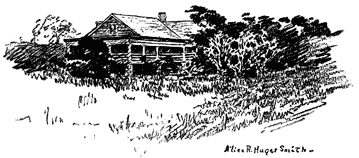
Some years ago the plantation where I had spent my very
short married life, Casa Bianca, was for sale, and against the
judgment of the men of my family I decided to put $10,000,
every cent I had, in the purchase of it, to grow old in, I said,
feeling it a refuge from the loneliness which crushed me.
Though opposed to the step, one of my brothers undertook
very kindly to manage it until paid for, then to turn it over
to me. I had paid $5000 cash and spent $5000 in buying
mules, supplies, ploughs, harrows, seed rice, etc., necessary
to start and run the place. This left me with a debt of $5000,
for which I gave a mortgage. After some years the debt
was reduced to $3000, when I awoke to the fact that I had
no right to burden and worry my brother any longer with
this troublesome addition to his own large planting,[1] and
I told him the first of January of 18—that I had determined
to relieve him and try it myself. He seemed much shocked
and surprised and said it was impossible; how was it possible
for me, with absolutely no knowledge of planting or experience,
to do anything? It would be much wiser to rent.
I said I would gladly do so, but who would rent it? He
said he would give me $300 a year for it, just to assist me in
this trouble, and I answered that that would just pay the
taxes and the interest on the debt, and I would never have
any prospect of paying off the mortgage, and, when I died,
instead of leaving something to my nieces and nephews, I
would leave only a debt. No; I had thought of it well;
I would sell the five mules and put that money in bank, and
as far as that went I would plant on wages, and the rest of
the land I would rent to the negroes at ten bushels to the
acre. He was perfectly dismayed; said I would have to advance
heavily to them, and nothing but ruin awaited me in
such an undertaking.
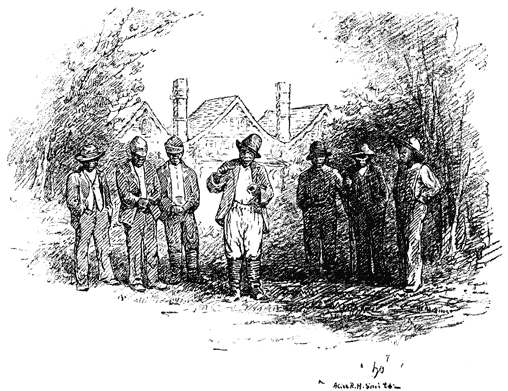
However, I assembled the hands and told them that all
who could not support themselves for a year would have to
leave the place. With one accord they declared they could
do it; but I explained to them that I was going to take
charge myself, that I was a woman, with no resources of
money behind me, and, having only the land, I intended to
rent to them for ten bushels of rice to the acre. I could advance
nothing but the seed. I could give them a chance
to work for themselves and prove themselves worthy to be
free men. I intended to have no overseer; each man would
be entirely responsible for the land he rented. "You know
very well," I said, "that this land will bring my ten bushels rent
if you just throw the seed in and leave it, so that every stroke
of work that you do will go into your own pockets, and I
hope you will prove men enough to work for that purpose."
Then I picked out the lazy, shiftless hands and told them
they must leave, as I knew they would not work for themselves.
All the planters around were eager for hands and
worked entirely on wages, and I would only plant fifty acres
on wages, which would not be enough to supply all with work.
My old foreman, Washington, was most uneasy and miserable,
and questioned me constantly as to the wisdom of what
I was doing. At last I said to him: "Washington, you do
not know whether I have the sense to succeed in this thing,
Mass' Tom does not know, I don't know; but we shall
know by this time next year, and in the meantime you must
just trust me and do the best you can for me."
It proved a great success! I went through the burning
suns all that summer, twice a week, five miles in a buggy
and six in a boat! I, who had always been timorous, drove
myself the five miles entirely alone, hired a strange negro
and his boat and was rowed by him to Casa Bianca plantation.
Then, with dear old Washington behind me, telling
of all the trials and tribulations he had had in getting the
work done, I walked around the 200 acres of rice in all stages
of beauty and awfulness of smell.
But I was more than repaid. I paid off the debt on the
place and lifted the mortgage. I had never hoped for that
in one year. My renters also were jubilant; they made
handsomely and bought horses and buggies and oxen for the
coming year's work. When I had paid off everything, I
had not a cent left in the bank to run on, however. Washington
was amazed and very happy at the results, but when
I said something to him about preparing the wages field for
the coming crop, he said very solemnly: "Miss, ef yo' weak,
en you wrastle wid a strong man, en de Lo'd gie you strenf
fo' trow um down once, don't you try um 'gain." I laughed,
but, remembering that I would have to borrow money to
plant the field this year, I determined to take the old man's
advice and not attempt it. This was most fortunate, for
there was a terrible storm that autumn and I would have
been ruined. My renters were most fortunate in getting
their rice in before the storm, so that they did well again.
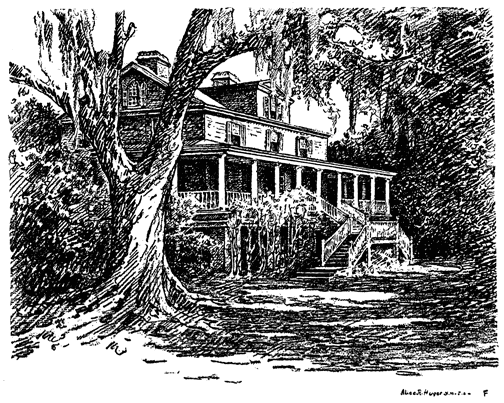
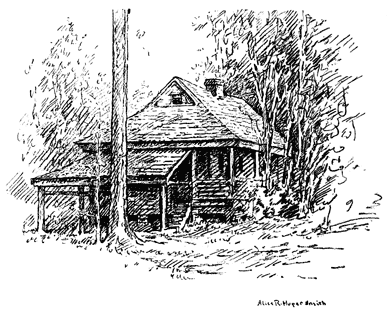
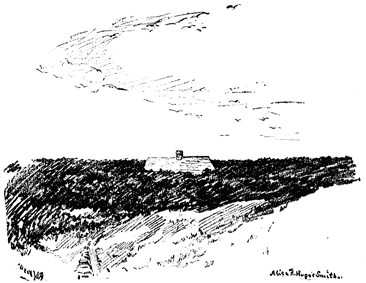
"Cherokee"—my father's place.
From that time I have continued to plant from 20 to 30
acres on wages and to rent from 100 to 150 acres. Of course
I have had my ups and downs and many anxious moments.
Sometimes I have been so unfortunate as to take as renters
those who were unfit to stand alone, and then I have suffered
serious loss; but, on the whole, I have been able to keep
my head above water, and now and then have a little money
to invest. In short, I have done better than most of my
neighbors.
Five years ago the head of our family passed away, and the
Cherokee plantation, which my father had inherited from
his grandfather, had to be sold for a division of the estate.
None of my family was able to buy it, and a syndicate
seemed the only likely purchaser, and they wanted to get
it for very little. So I determined the best thing I could
do was to buy it in myself and devote the rest of my life to
keeping it in the family, and perhaps at my death some of
the younger generation would be able to take it. This would
condemn me to a very isolated existence, with much hard
work and anxiety; but, after all, work is the greatest blessing,
as I have found. I have lived at Cherokee alone ever since,
two miles from any white person! With my horses, my
dogs, my books, and piano, my life has been a very full one.
There are always sick people to be tended and old people to
be helped, and I have excellent servants.
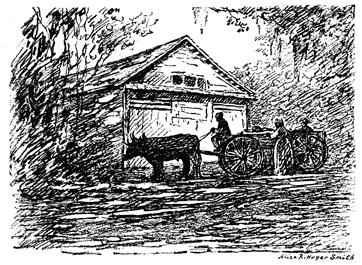
My renters here, nearly all own their farms and live on
them, coming to their work every day in their ox-wagons
or their buggies; for the first thing a negro does when he
makes a good crop is to buy a pair of oxen, which he can do
for $30, and the next good crop he buys a horse and buggy.
The purchase of Cherokee does more credit to my heart
than head, and it is very doubtful if I shall ever pay off the
mortgage. I have lost two entire crops by freshet, and the
land is now under water for the third time this winter, and,
though I have rented 125 acres, it is very uncertain if I can
get the half of that in. March is the month when all the
rice-field ploughing should be done. The earliest rice is
planted generally at the end of March, then through April,
and one week in May. Last season I only got in fifty acres
of rent rice and ten of wages; for in the same way the freshet
was over the rice land all winter, and when it went off, there
was only time to prepare that much. The renters made
very fine crops—30, 40, and 45 bushels to the acre, while
the wages fields only made 17! This is a complete reversal
of the ordinary results, for I have very rarely, in all these
years, made less than 30 bushels to the acre on my fields,
and I was greatly discouraged and anxious to understand
the reason of this sudden failure in the wages rice at both
plantations.
By the merest chance I found out the cause. Early in
December I was planting oats in a six-acre field. We broadcast
winter oats in this section and then plough it in on fields
which have been planted in peas before. I was anxious to
get the field finished before a freeze, and had six of the
best ploughmen in it. Grip had prevented my going out
until they had nearly finished, but Bonaparte had assured
me it was being well done. When I went into the field, it
looked strange to me—the rich brown earth did not lie in
billowy ridges as a ploughed field generally does. Here and
there a weed skeleton stood erect. I tried to pull up one
or two of these and found they were firmly rooted in the soil
and had never been turned. I walked over that field with
my alpenstock for hours, and found that systematically
the ploughmen had left from eight to ten inches of hard
land between each furrow, covering it skilfully with fresh
earth, so that each hand who had been paid for an acre's
ploughing had in reality ploughed only one-third of an acre.
And then I understood the failure of all the wage rice!
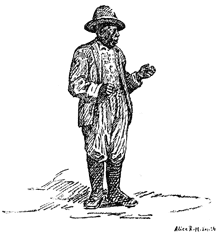
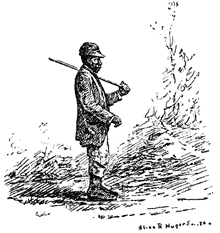
I called Bonaparte, my head man, whom I trust fully.
His grandfather belonged to my grandfather, and his family
hold themselves as the colored aristocracy of this country.
He has been a first-class carpenter, but he is rheumatic and
does not work with ease at his trade now, and prefers taking
charge of my planting as head man, or agent, as they now
prefer to call it. He is trustworthy and has charge of the
keys to my barns where rice, corn, oats, and potatoes are kept.
I have trusted him entirely, and it would be a dreadful blow
to think that he was losing his integrity. Though the pressure
from the idle, shambling, trifling element
of his race is very great, he has
been able to resist it in the past.
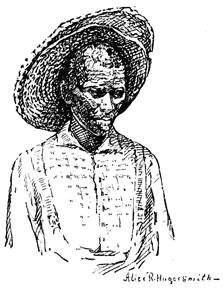
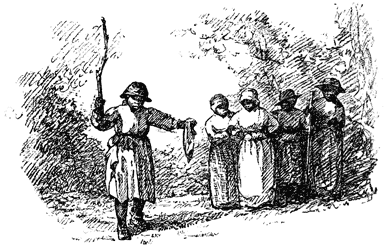
Bonaparte.
I showed Bonaparte what I had
discovered, and he seemed terribly
shocked. Whether this was
real or not I cannot say, but it
seemed very real, and as he has
never ploughed, perhaps he really
did not understand. When I said:
"And this is why the wage rice
turned out so badly! You received
ploughing like this and I
paid for it," he seemed convicted
and humbled. He had told me
how beautifully the rice got up, but as
soon as the hot suns of July struck it, the
leaves just wilted. Of course, the roots could
not penetrate the packed, unbroken clay soil. The best rice-field
soil is a blue clay which the sun bakes like a brick. For
a while the roots lived in the fresh earth on top.
The seed rice I had paid $1.35 a bushel for and planted
two and one-half bushels to each acre; the cost of cultivating
and harvesting it is $15 the acre, so that makes $18.37
which it cost to produce seventeen bushels of rice, which sold
at 80 cents a bushel, $13.60.
What is to be the result of this new departure in the way
of dishonesty I do not know. It has taken me a long time
to lose patience. A few years ago one could get the value
of the money paid for work. Just after the war there was
a splendid body of workers on this plantation, and every
one in the neighborhood was eager to get some of the hands
from here. My father gave prizes for the best workers in
the different processes, and they felt a great pride in being
the prize ploughman or ditcher or hoe hand of the year; but
now, alas, poor things, they have been so confused and
muddled by the mistaken ideas and standards held out to
them that they have no pride in honest work, no pride in
anything but to wear fine clothes and get ahead of the man
who employs them to do a job.
It is very hard for me to say this; I have labored so among
them to try to elevate their ideals, to make them bring up
their children to be honest and diligent, to make them still feel
that honest, good work is something to be proud of. Even last
year I would not have said this, but, alas, I have to say it now.
I have just come in from the corn-field, where two women
have been paid for cutting down the corn-stalks, so that there
will be nothing to interfere with the plough. They have
only broken off the tops of the stalks, leaving about eighteen
inches of stout corn-stalks all through the field. I shall have
to send some one else to do the work and pay once more.
Yesterday I drove eight miles to my lower place, Casa
Bianca, where the foreman asked me to go round the banks
with him and see the inroads of the last full-moon tides, and
it was appalling, the forces of nature are so immense. It
makes me quail to think of the necessity of setting my small
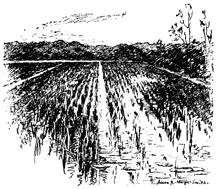
human powers in opposition. The rice-field banks are about
three feet above the level of the river at high water, and each
field has a very small flood-gate (called a trunk), which opens
and closes to let the water in and out; but when a gale
or freshet comes, all the trunk doors have to be raised so as
not to strain the banks, and the water in the fields rises to
the level of the river outside.
I must stop writing now or I will get too blue. I must go
out and bathe in the generous sunshine and feast my eyes
on the glory of yellow jessamine that crowns every bush and
tree and revel in the delicious perfume as my bicycle glides over
the soft, brown pine-needles along the level paths where the
great dark blue eyes of the wild violets look lovingly up at me.
Yes, yes, God is very good and His world is very beautiful,
and we must trust Him. When these brown children of His
were wild, they were, no
doubt, in a physical way
perfect, but when they were
brought to a knowledge of
good and evil and brought
under the law, like our
first parents, the Prince of
Darkness stepped in and
the struggle within them of
the forces of heaven and hell
has been going on there ever
since.
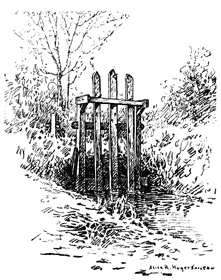
Each field has a small
flood-gate called a
"trunk."
Can we doubt which will conquer
in the end? No! Evil
can never have the final victory,
but the struggle will be long, for
the Prince of Darkness uses such subtle
emissaries. They come in the guise
of angels, as elevators and instructors,
taking from them the simple first principles of right
and wrong which they had grasped, and substituting the
glamour of ambition, the desire to fly, to soar, for the God-given
injunction, "What doth the Lord require of thee, but
to do justly and to love mercy and to walk humbly with thy
God?" Thank God, there is one man of their own race
striving to hold up true standards of the Cross instead of the
golden calf of the politician.
I fear this is a dull letter, but I have tried to make you
understand something of the situation.
Patience Pennington.
Cherokee, June 1, 1903.
Since last I wrote I have been the sport of winds and waves.
This place is still under water from a freshet, and on Sunday,
April 5, there was a severe gale, and the water swept over
the whole 200 acres of Casa Bianca, flowing up the rice-fields
in an hour. Saturday evening the hands,
after ploughing, left their ploughs in the
field to continue work Monday, and they
could not see the handles of the ploughs
Sunday morning. I went down Tuesday,
to find bridges carried away and even the banks still under
water, and the head man reported five breaks in the Black
River bank. It was impossible to do anything until the tide
receded, and as there was a strong east wind blowing and a
freshet coming down the Pee Dee, things looked very black.
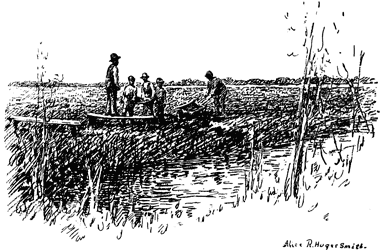
Marcus began work on the breaks.
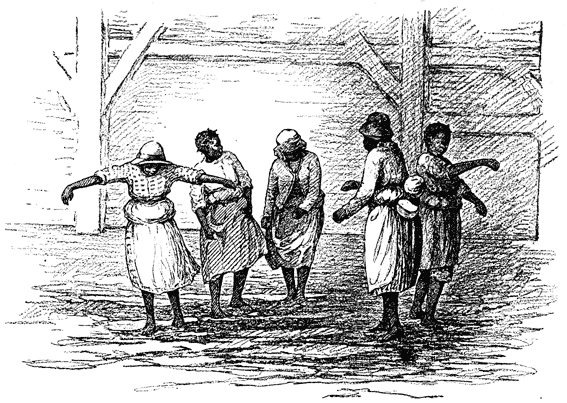
"The girls shuffled the rice about with their feet until it was clayed."
I could not help lamenting aloud, and Marcus felt obliged
to offer me some comfort, so he said: "Miss, if we one been
a suffer, I'd feel bad, but eberybody bank bruk, en eberybody
fiel' flow." This did not comfort me at all, but I realized
the folly of lamenting. Fortunately I had just bought
3000 feet of boards, and as soon as the water left the fields
Marcus began work on the breaks, and by driving puncheons,
laying ground logs, and flatting mud and filling in, the bank
is up again, keeping out the river, and the fields are drying off.
The season, however, has not waited on us. April is gone,
and not an acre is planted when I expected to have 100 acres
growing by this time. The worst is that I have been paying
out heavily every week to put things back where they
were at the end of March.
There are many curious things about the planting of rice.
One can plant from the 15th of March to the 15th of April,
then again from the 1st to the 10th of May, and last for ten
days in June. Rice planted between these seasons falls a prey
to birds,—May-birds in the spring and rice-birds in August
and September. It was impossible to plant in April this
year, and now every one is pushing desperately to get what
they can in May.
Yesterday I went down to give out the seed rice to be
clayed for planting to-day. I keep the key to the seed-rice
loft, though Marcus has all the others. I took one hand
up into the upper barn while Marcus stayed below, having
two barrels half filled with clay and then filled with water
and well stirred until it is about the consistency of molasses.
In the loft my man measured out thirty-five bushels of rice,
turning the tub into a spout leading to the barn below,
where young men brought the clay water in piggins from the
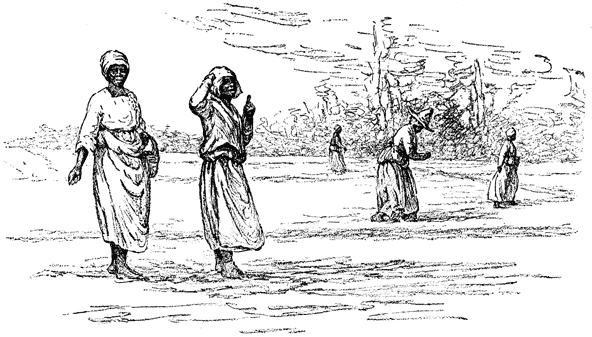
barrel and poured it over the rice, while young girls, with bare
feet and skirts well tied up, danced and shuffled the rice about
with their feet until the whole mass was thoroughly clayed,
singing, joking, and displaying their graceful activity to the
best advantage. It is a pretty sight. When it is completely
covered with clay, the rice is shovelled into a pyramid and left
to soak until the next morning, when it is measured out into
sacks, one and one-fourth bushels to each half acre. Two
pairs of the stoutest oxen on the plantation are harnessed
to the rice-drills, and they lumber along slowly but surely,
and by twelve o'clock the field of fourteen acres is nearly
planted.
It is literally casting one's bread on the waters, for as soon
as the seed is in the ground the trunk door is lifted and the
water creeps slowly up and up until it is about three inches
deep on the land. That is why the claying is necessary;
it makes the grain adhere to the earth, otherwise it would
float. Sometimes, generally from prolonged west winds,
the river is low, and water enough to cover the rice cannot be
brought in on one tide, and then the blackbirds just settle
on the field, diminishing the yield by half.
I went down into the Marsh field, where five ploughs are
running, preparing for the June planting. It is a 26-acre
field, very level and pretty, and I am delighted with the work;
it is beautiful. When I told one of the hands how pleased
I was with the work, he said: "Miss, de lan' plough so sweet,
we haf for do' um good." I went all through with much
pleasure, though I sank into the moist, dark brown soil
too deep for comfort, and found it very fatiguing to jump
the quarter drains, small ditches at a distance of 200 feet
apart, and, worse, to walk the very narrow plank over the
10-foot ditch which runs all around the field and is very deep.
The evening is beautiful; the sun, just sinking in a hazy,
mellow light, is a fiery dark red, the air is fresh from the sea,
only three miles to the east, the rice-field banks are gay with
flowers, white and blue violets, blackberry blossoms, wistaria,
and the lovely blue jessamine, which is as sweet as an orange
blossom. Near the bridge two negro women are fishing,
with great strings of fish beside them. The streams are full
of Virginia perch, bream, and trout; you have only to drop
your line in with a wriggling worm at the end, and keep silent,
and you have fine sport. Then the men set their canes securely
in the bank just before dark and leave then, and
almost invariably find a fish ready for breakfast in the morning.
There is a saying that one cannot starve in this country,
and it is true.
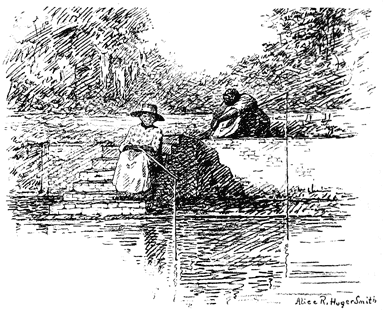
Near the bridge two negro women are fishing.
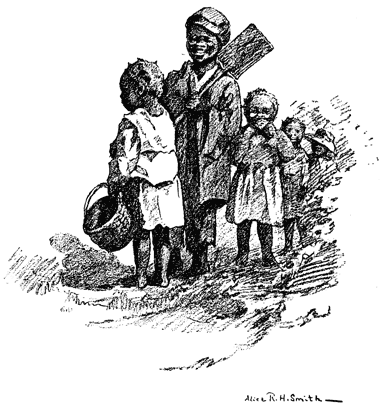
As I drove down I saw little children with buckets and
piggins picking blackberries; such big, sweet berries, covering
acres of old fields which once were planted in corn. As I
walked down the bank I found a "cooter" (terrapin) which
had come out of the river to lay eggs. My excellent Chloe
will make a delicious soup from it, or, still better, bake it
in the shell. All winter we have quantities of English ducks
in the rice-fields and partridges and snipe on the upland, and
in the woods wild turkeys and deer, so that if there is a sportsman
in the family, one can live royally with no expense.
Sheep live and thrive without any outlay. In 1890 I
exchanged a very fine two-year-old grade Devon, for
twenty sheep. Since then I have bought seven more.
A gale, with sudden rise of water, destroyed twenty-two at
one time in 1896, and I lost ten by dogs, but notwithstanding
these losses, in the last seven years they have brought me
in $200 by sale of mutton; my house is furnished with
rugs and blankets, and I am dressed in serge made from their
wool, and I have to-day at this place forty-six sheep and
thirty-five splendid lambs. If I only could get the latter
to a good market, it would pay handsomely, for their keep
has cost nothing. I have a Page wire fence around my place.
In the same way cattle live and thrive with no grain,
only straw during the winter, and the negroes do not give
theirs even straw; they simply turn them into the woods,
and in the spring look them up; find the cows with fine
young calves and ready to be milked. They shut the calf
up in a pen and turn the mother out, and she ranges the
rich, grassy meadows during the day, but always returns
to her calf at night. When she is milked, half of the milk
is left for the calf. In this way the negroes raise a great
many cattle, the head of every family owning a pair of oxen
and one or two cows.
However, we cannot turn our cattle into the woods as we
used to do, for unless we go to the expense of hiring a man to
follow them, they will disappear, and no trace of them can be
found. One negro will not testify in court against another,
so that it is scarcely worth while to attempt to prosecute,
for there is no chance of conviction. You hear that such a
man has been seen driving off your animal; one or two people
say they have seen him; you bring it into court, and witness
after witness swears entire ignorance of the matter.
I, for instance, have 500 acres of pine land, and the family
estate and my brothers' together make 3000 acres of the finest
pasture land. Where my father had herds of splendid
cattle I have to keep my cows in a very poor pasture of twenty
acres, fenced in, and in consequence have only five or six
cows and one pair of oxen on the same plantation where my
father used to stable sixty pair of oxen during the winter.
They worked the rice land in the spring and roamed the woods
and grew fat in summer.
On the road this morning I met Wishy, who made many
civil inquiries about my health. Five years ago one morning
I was waked earlier than usual by a request from Wishy's
mother, Annette, for something to stop bleeding. He had
been badly cut by a negro, who struck him on the head
with a lightwood bar. Wishy had laughed at his special
flame, who had gone to church the Sunday before with a
long white veil on her hat and he was enraged. I sent witch-hazel
and the simple remedies which I always keep for such
calls. About eleven o'clock another request came, this time
to lend my wagon and horses to carry Wishy to town fourteen
miles away, as his head was still bleeding. I was
shocked to hear that he was still losing blood and told them
the drive might be fatal under the circumstances; I would
go out and see what could be done.
Hastily getting together all the remedies I could think
of, my niece and I drove to Annette's house, which was
crowded with eager friends gazing at the unhappy Wishy,
who sat in the middle of the room, leaning forward over a
tub, a man on each side supporting him, while the blood
literally spouted from his head,—not a steady flow but in
jets. It was an awful sight. I had a bed made on the floor
near the door and had him lifted to it, well propped up with
pillows, so that he was in a sitting posture. At that time we
had no doctor nearer than the town, except a man who had
come from a neighboring state under a cloud of mystery. As
soon as I heard of Wishy's condition I had sent for him, but
the boy returned, saying he was not able to read my note, so
there was nothing but to do what I could or to let Wishy die.
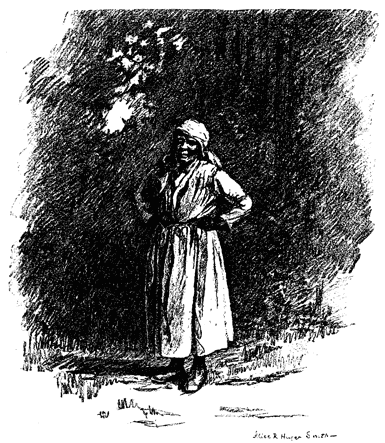
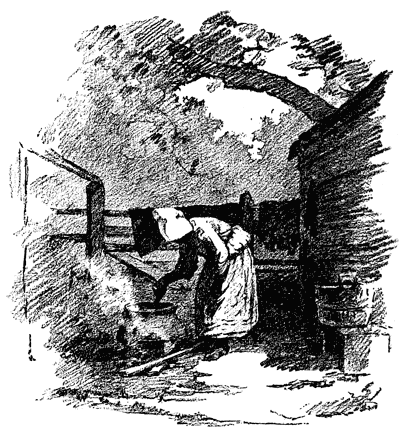
A request from Wishy's mother, Annette, for something to stop
bleeding.
I got Frank, who was very intelligent, to help me. I
dipped absorbent cotton in brandy and then into powdered
alum, and put it into the hole in the top of Wishy's head;
it seemed a gulf! I put in more and more, having Frank
hold his hands closely around the top of the head; but still
the blood flowed. Then I sprinkled the powdered alum
over all thickly until there was only one little round hole
just in the middle; I made a little ball of cotton and alum
and pressed it down into the hole with my finger and it
was done. I gave him the milk I had carried, had the house
cleared of people, and left, ordering that when the doctor
came, I should be sent for.
A day passed, and when I sent milk, the message came back
that the doctor had been there, looked at him, and gone away.
I began to feel very unhappy over the heterogeneous contents
of Wishy's head, but if I had not stopped the flow in some
way, he would have been dead certainly—his pulse was
just a flutter. I tried not to worry over it. The third day
a runner came to say: "De docta' cum." With all speed
I had Prue put in the buckboard and drove out. I had
never seen the doctor and was surprised to find a fine-looking
man in possession of the cabin. He called for a razor, said
he could do nothing until he shaved Wishy's head. There
was confusion among the numerous darkies who crowded round
the house. At last it was agreed that Uncle Jack had the
only razor in the street (as they call the negro quarters)
that could cut. While a woman went for the razor, the doctor
told Annette he must have hot water, and she proceeded to
put a tomato can full of water on the fire; but he peremptorily
ordered a large pot carefully washed, filled with water,
and put on the fire. When the razor came, it was too dull
to be of any use until the doctor had sharpened it, and then
he shaved all of the woolly head.
I watched the man's proceedings with a growing feeling
of shame. I had gone there to keep my eye on him, to prevent
any roughness or carelessness to the patient, and he
could not have been gentler or more interested and careful if he
had been treating the Prince of Wales himself. It was a long
business; with an endless stream of hot water from a fountain-syringe
he removed from the hollow depths of Wishy's
skull all the wonderful packing with which I had filled it,
and I went away satisfied.
Day after day for three weeks he came and dressed the
wound, until Wishy's head was restored to its normal state.
Then he sent a bill for $20, which Wishy begged me to pay,
and he would gradually return the money to me as he worked.
Of course, I paid it, and, sad to say, not one dollar has ever
been returned to me. Wishy married the next winter, and
moved to a neighboring plantation. He has never even
sent me a string of herring, though he has had a net for two
years and caught great quantities which he sold readily at
a cent apiece.
During the run of herring in the spring they crowd up the
little streams in the most extraordinary way, just piling on
top of each other in their haste to reach the very source of
the stream, apparently. I suppose one little leader must
wave its little tail and cry "excelsior" to the others. At
a small bridge over a shallow creek near here a barrelful has
been taken with a dip-net in an afternoon. But it takes
a meditative, not to say an idle person, to watch for the
special day and hour when the herring are seized by the impulse
to ascend that particular stream.
I must stop now, not having said anything I meant to say,
having been led away by the thought of my lost $20 and
how very useful it would be to me now, and I will have to
leave other things for another day.
Patience Pennington.
P.S. In future I will not write you a letter, but keep a
diary and send you a few sheets from time to time. P. P.
Peaceville, September 1.
Had a trying day at the plantation, making an effort to
get hay properly stacked, and was detained late. I had told
Jonadab to wash the buckboard and grease the wheels,
which he had done very thoroughly, for I could hear the
grease crackling, and Ruth was travelling very fast when
the world seemed to come to an end.
I did not know what had happened, but flew to Ruth's
head and quieted her, though she had dragged the buckboard
some distance before I could stop her. I do not know
what became of Dab at first, for I didn't see him until I had
stopped Ruth, when he came up, stuttering fearfully, and
said:—
"The wheel is lef' behind."
The front wheel had rolled off. I told him to go and bring
it and put it on, though I did not see how he was to do it
alone and I could not possibly help, as it was all I could do
to hold Ruth. Jonadab, however, has a way of surprising
me by unexpected capacity, just as a variety from my constant
surprise over his awkwardness.
On this occasion he held the wheel in one hand while he
lifted the axle with the other and got the wheel on. Then
I sent him to look for the nut, but I felt it was a forlorn chance,
for it was now quite dark. I was in despair; we were three
and a half miles from Peaceville, and if I walked, I would
have to leave all my impedimenta and only take my basket
of keys and other small things, such as my diary.
Most of the planters go home at sunset, and I feared they
had all passed, and I could not see my way to any solution.
Just as I had come to the conclusion that even my resourceful
mind could find no way out of the darkness, two buggies
drove up and the gentlemen asked what they could do for
me. I explained the situation, and one of them said:—
"If you will drive with me, Miss Pennington, Mr. B. will
take your things; the boy can ride the horse, and we will
leave the buckboard here until to-morrow."
I accepted the hospitality of his buggy with many thanks.
The transfer of freight was made. Dab took Ruth out, and
I rolled the vehicle into the woods, as I could not bear that
my buckboard should be left on the roadside, a spectacle
of a breakdown. Just as it was all accomplished Dab stammered
out:—
"I find de nut."
Great surprise, for this was fully 100 yards in front of the
spot where the wheel had run off, but he said he felt it under
his foot and picked it up and showed it in his hand. Mr.
H. said:—
"That boy could never have put the nut on at all after
greasing it!"
Dab was vociferous as to his having put it on and screwed
it tight. I was beyond conjecture, and too thankful to
question. Very rapidly the transfer was made back to my
vehicle, Mr. H. remarking, "Your buckboard takes easily
more than our two buggies."
I thanked them heartily for their chivalrous aid, and we
all drove on home.
After the agitation had somewhat subsided, I asked Dab,
who was sitting behind, if he had really put the tap on or
not. He answered with great certainty:—
"Yes, ma'am; yes, ma'am; I did put it on; I know I
did, en screwed it tight—"
I did not contradict him, but said, "Think about it; go
back in your mind and remember just what you did, and
where you put the nut when you took off this wheel, which
you say you greased last."
After two miles in silence I heard convulsed sounds from
the back, and finally out came "No-o-o, Miss Pashuns; no
ma'am, I never put that nut on; I put it on the front o'
the buckboard, an' when I put the wheel on, I went for a
drink of water, and never did put the nut back—no, ma'am,
I never put it back. I left it setting on the front of the
buckboard."
When Dab finally gets started after stuttering and spluttering,
he cannot bear to stop talking, but keeps repeating his
statement over and over with delight at the glib way in which
the words come out, and I have to say mildly, "That will do,
Dab," and even then I hear him saying them over to himself.
After stopping his flow of speech I told him it was a great
relief to know exactly what had happened, and I hoped it
would be a lesson to him all his life and make him feel that he
was a responsible being; that I trusted him with important
work, and how if it had not been for God's great goodness,
I might be lying on the road with a broken neck and he with
both legs broken. I did all I could to make him feel what a
mercy it had been, and he seemed deeply impressed. Ruth
behaved beautifully during the whole thing, so I gave her a
saucer of sugar when we got home.
Saturday, September 9.
Have been ill ever since the happy incident the other night,
but this afternoon I felt impelled to go into the plantation.
I had planned to send Chloe in with the money for Bonaparte
to pay off, but at the last minute got up and went myself.
As soon as he saw me Green said: "Glad you cum, ma'am.
Nana's got de colic turrible en we dunno w'at to do fur her."
I forgot that I was myself decrepit and flew to the house
and got a bottle of colic cure and a box of axle-grease. I
always keep aconite, but had none, but fortunately had not
returned this bottle of horse medicine which I had borrowed
when Ruth was sick. It said a teaspoonful every half hour,
but I knew my time was short and Nana was desperately ill,
so I gave a teaspoonful every ten minutes.
She would just throw her great body down with such force
that it seemed she must break every bone in it, roll over and
over, and pick herself up and flop down again before you could
attempt to head her off. While she was down, I made Green
and Dab rub her heavily with axle-grease.
I myself put the medicine in her mouth, holding her
head up and her lips tight together until she had swallowed
it. She has such confidence in me that she did not resist at
all, but kept quite still while I did it. I gave her six doses,
and then it was dark, and I suddenly became aware that
I was very tired and could do no more. I told Nana good-by,
for I never expect to see her again.
My poor dear little Irish terrier, who is my shadow and
constant companion, is very ill. For three days he has
neither eaten nor drunk. His throat seems paralyzed,
and he looks at me with such superhuman eyes that it makes
me miserable, for I can do nothing for him.
I take a bowl of water to him and he buries his little nose
in it, but cannot swallow or even snuff it up. I can get
nothing down his throat, so that it is impossible to treat him.
Sunday.
Poor little Snap was so ill and made such a constant
appeal to me for help which I could not give, that I felt it
was cruel to let him suffer longer, so I sent to Miss Penelope
for a bottle of chloroform. He followed me from room to
room, a feeble skeleton, all eyes, and still I tried to give him
milk, and when he turned his head from that, I gave him water
into which he would feebly dip his little black-tipped mouth.
At last I took him in my arms and put him on a soft
cushion in a tall banana box; then I cut several pieces of
very savory roast beef and put them all around his little
muzzle. He could not eat them, but he could smell them,
and I could see by his eye that it was a comfort to him to
have them there.
Then I filled a sponge with chloroform and put it into a
cone which I had made of pasteboard and put it over his
head and covered up the whole thing with a heavy rug.
After two hours I sent Dab to look in, and he came back
radiant to say that Snap was quite well.
I went to look, and the dear little doggie roused himself
from a delightful nap to look at me. All expression of
suffering and appeal was gone from his eyes. He looked
supremely happy and comfortable, and after glancing up
at me he tucked his head down on the roast beef and went to
sleep again.
I wet the sponge and once more left him. When I took
him out the next morning, I could not believe he was dead,
so perfectly happy and natural did he look. Dab dug his
grave in my little garden, and I laid him to rest, feeling the
loneliest mortal on earth when I got through.
September.
When I went in to Cherokee yesterday, I was amazed to
find Nana quite recovered. I had told Bonaparte if she
showed any disposition to eat, to give her rough rice instead
of either oats or corn, and it seems to have been a happy
thought, for it has agreed with her, and though weak still
and much skinned and bruised by the way she threw herself
about, she seemed quite well.
This is the eighty-eighth birthday of the sainted friend
whom I visit every day. Every one in the little village sent
her some little offering, so that her room was full of flowers
and dainty trifles, and she enjoyed them so much. Though
unable to eat anything and nearly blind, her interest in
everything and everybody is vivid.
This afternoon, as Dab was putting the demijohn of milk
in the box preparatory to leaving Cherokee, and I was
standing in front of him screwing the top on the jar of cream
to put in the same box, suddenly he dropped the demijohn
and leaped in the air, uttering the most terrific Comanche
yells I ever heard. I nearly dropped the jar of cream at
the sound; he fled away still yelling.
My mind is fertile in horrors, and I said to myself, "The
boy has gone mad!" I was terror struck.
When he finally stopped, some distance away, I called out,
"What is the matter, Jonadab?" He just pointed to a
spot near where I stood and began to yell again, "Snake run
across my foot."
The relief was so great that I looked composedly on the
big snake, but called in a tone of unwonted severity, "You
must come and kill it." I knew the only thing to prevent
Dab from going into a fit was to be severe in my tone, and
peremptory.
Most reluctantly and slowly he returned. I cannot
imagine why the snake elected to stay in the ivy to meet
its fate; it was sluggish, evidently having swallowed something
large, either a rat or another snake, for it was very
stout. I made Dab find a long strong stick. It required
continued urging and encouragement to get Dab to complete
the job, but as soon as it was done and he felt himself victor
over the thing which had terrified him so, he became puffed
up with pride and courage.
September 30.
The storm is over, and all nature is smiling. Oh, the
beauty of the sunshine falling on the dark green pines and
the ecstasy of the song of the mocking-bird, who is perched
on a tall pine just east of the piazza, splitting his little throat,
trying to give vent to his joy and thanksgiving to the Great
Father! If one could only bottle up a little of this sunshine
and glory and ecstasy to bring out on some gray morning
when one's blessings seem too far away to be remembered!
I am just writing a line while Dab is having his breakfast
and putting Ruth in the buckboard before we start for
Cherokee to see the damage done by the winds and the deluge
of rain which fell for twenty-four hours. The cotton had
opened more fully Saturday than it yet had done, but a
slight drizzle prevented its being picked. I fear the hay
which was stacked will all have to be taken down.
8 P.M.—Spent the day at Cherokee fighting with incompetency
and unwillingness.
The loose, irregular stacks of hay were, of course, wet to
the heart, and I had them taken down entirely, much to
Green's dismay. He thought it purely folly and fussiness,
and I had to stand by and see it done, lending a helping
hand now and then, to get it done at all.
He was loud in his abuse of Gibby, his brother, for his
incompetency and determination not to work, saying,
"He's too strifflin' to lib," but that he himself was capable
of everything; not only stacking hay, but everything else,
he did in the most perfect way. I let him talk on, for his
manner was respectful, and I was really interested and amused
to see unveiled his opinion of himself.
It would be very comfortable to see one's self in that perfect
light, instead of being always so fiercely conscious of one's
own shortcomings. I almost envied Green his fool's paradise.
I went to a stack which he assured he had "'zamined, an'
it was puffectly dry, 'cause, I put dat stack up myself."
With ease I ran my hand in up to the elbow and brought out
a handful of soaking wet hay. But that had no effect; he
said that was some he had just thrown back, fearing to have
it exposed, as it might rain, looking wisely at the clear sky.
One has to pray inwardly all the time to keep from a
mighty outburst. He is better than any one else I could
get just now.
Spent some time in the cotton-field seeing that the first
pickings were spread on sheets in the sun so as to dry thoroughly.
I had put some peanuts in my pockets for the little
girls, Jean and Kitty, and I stayed talking to them a little
while.
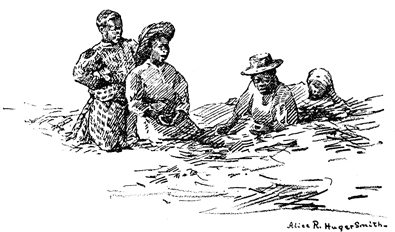
They have up to this time "minded child," that is, each
has lived with a married sister and taken care of their
babies. They do not look as though they had enjoyed
life, nor have they learned anything, and I
am anxious to brighten them up a little
and teach them to take an interest and
pride in their work. Thus far I cannot
boast of my success, as to-day Jean picked
six pounds and Kitty four!
October 1.
Another gorgeous autumn day,
with just enough white clouds flying
here and there to make shadows.
The cowpeas were picked to-day,
and they are bearing finely, and
the people know how to pick them; it
is not like the cotton. One woman who never can pick more
than twenty pounds of cotton had seventy pounds of peas,
and Eva had ninety pounds. I feel better satisfied with the
day's work than usual.
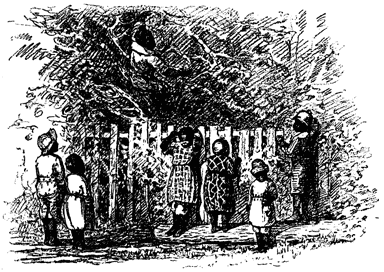
Green thought it was
folly and fussiness.
I got the hay which had been dried put in the barn, which
is much better than stacking it, when no one knows how,
but I could only do that because the ground is too wet to
run the mowing machine; thus I could use the team to haul
in the hay. One of the renters came up and paid his money
quite voluntarily, which is so unusual that it put me in good
spirits for the day.
October 3.
To-day is too beautiful for words. As I went into the
sun-swept piazza this morning I felt, like the mocking-birds,
an ecstasy of gratitude for so much beauty. I did wish so
I could take a day off and sit in the piazza and just bask in
the beauty of everything and breathe the crisp freshness of
the first fall weather and sew.
I am making a suit of white flannel woven from the wool
of my own sheep. I have embroidered the revers and cuffs
of the jacket and nearly finished it, and want it to wear
these delightfully cool mornings, but I cannot stay to-day.
I must get through my home duties as quickly as possible
and make my daily visit to the bedside of my saintly friend,
who, having begun her life in wealth and having in middle
age been reduced to poverty, has passed fourscore and eight
years, a beautiful example of woman, wife, and mother, and
is now slowly passing through the valley of the shadow.
This is my greatest pleasure and privilege, and whatever
other duty is hurried over, to this I give full time.
To hold daily converse with one who, after lying three
months in hourly pain, is serene and calm, nay, joyous with
gratitude for His many mercies (which some might need a
microscope to discover), is a rare opportunity of seeing a true
follower of the Blessed One, and I come away always feeling
as though I had quenched my thirst at a living stream,
refreshed and strengthened.
On the plantations, too, things look bright. The pea-vine
hay is falling heavy and sweet behind the mowing machine,
and what was cut yesterday has dried nicely and will be
raked into windrows this afternoon. The crab-grass hay is
also dry and ready to be stacked again. The cotton is opening
well, and we can make a good picking to-morrow.
As I went into the pea-field, where the women were singing
as they picked, I came upon a spider who was too large
to stand upon a silver dollar. I was most reluctant to kill
him, for he was doubtless the Hitachiyama of his race.
He scorned to run, or even move quickly away, so sure
was he that he was invincible and need fear no foe, and it
did seem too unfair to crush out his little greatness, but the
bite of such a spider would mean serious illness, if not death,
and there were all the women, most of them with bare feet,
to run the risk of being stung, so I dealt the fatal blow.
Some of the women picked ninety pounds, and Jean picked
forty and Kitty thirty-six.
October 4.
Job knew what he was talking about when he said: "Man
is born to trouble as the sparks fly upward." I went to
Cherokee in quite an excitement this morning because the
cotton-field was snowy yesterday and I expected to make a
big picking, but last night, on a plantation three miles away,
an old woman died and not a creature has come out to work.
Eva is the "Presidence of the Dessiety," her son tells me,
to which Linette belonged, and so, of course, she could not
be expected to work to-day, but the other women have no
such eminence nor can they claim kin nor even friendship:
meanwhile should the weather change and a rain come down,
my precious cotton will be ruined.
October 5.
Another brilliant morning, but no hands in the cotton-field
but Eva. She, having accomplished the duties falling
on her as "presidence" of the burial society and pinked out
yards and yards of frilling for the dressing of the coffin and
shroud and sat up all last night, did not feel bound to remain
to the funeral, as they had not been friends; indeed the
departed Linette had been the cause of great domestic
infelicity to Eva, so she came and picked her usual thirty-five
pounds alone.
I sent Dab to pick for a short time, and he did very well,
picking eleven pounds in about an hour. Then I went in
and picked for about fifteen minutes myself.
I wanted to find out what the difficulty was. I picked
a pound and a half and found it very easy and interesting,
even exciting work, and I am no wiser than I was before.
If I was not afraid of the sun, I would have gone on all day,
or rather until 2 o'clock, for it clouded up after that, and I
came home in a pouring rain, which continues at bedtime.
October 6.
A beautiful bright Sunday after a night of heavy rain.
The thought of the wasting cotton had to be sternly put
aside. I had to visit the wonderful invalid before I could
get rid of the nagging thought, "If only the cotton had been
picked!" After that the glorious sunshine and singing birds
had their full value, and the seventh-day peace reigned
within as well as without.
I have a little class in the afternoon on my piazza for a
Sunday lesson, eight little boys and one golden-haired,
blue-eyed little girl. At first, I had some difficulty in getting
them to come, for they always have such a good time playing
that it seemed to them a great waste of the golden hours
to come to Sunday-school.
Some of them said they were willing to come and sing
hymns, but they did not want any lesson. However, I
found one little fellow who wanted the lesson, so I told him
to invite any one who wanted the lesson to come with him
at 4.30 o'clock the next Sunday afternoon, but no one else.
Punctually at the hour three little boys and one little girl
arrived, while the other boys in the village played up and
down before my gate most ostentatiously, so that little
heads could not help turning to see what was going on, and
in the midst of one of the Commandments, I heard a squeaky
little voice, "I wonder what those fellows are laughing at!"
for they had got up a great burst out in the road, quite a
stage laugh.
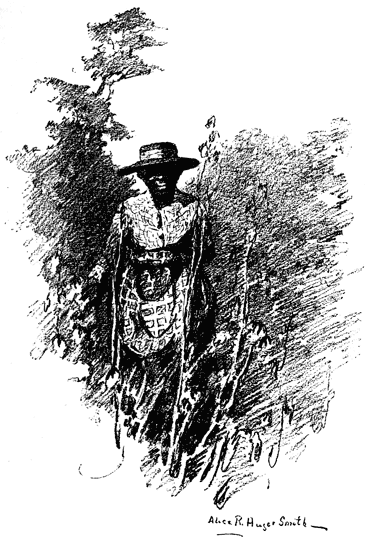
She picked her usual thirty-five pounds alone.
However, we got through comfortably and went into the
sitting-room to the piano, and I asked each one to choose
a hymn which we sang. At the second hymn one of the boys
from the road joined us, but I seemed unconscious of his presence,
and when the singing was over, I invited the first four into
the dining-room and handed them some little sponge cakes.
The next Sunday there was a full attendance and has been
ever since. The lesson has to be carefully selected, as there
are four denominations represented, so I take the Lambeth
platform and teach the Creed, the Lord's Prayer, and the
Ten Commandments. After that I tell them Bible stories,
beginning with the thrilling narration of the Creation and the
Garden of Eden.
When I first told how Eve was tempted to eat the fatal
apple, and Adam too was tempted, and they were driven out
from that beautiful spot to earn their living in the sweat of
their brows, the interest was breathless, and one little fellow
asked:—
"Miss Patience, what would have happened if they had
never eaten the apple? Would they have stayed in the
garden?"
"Yes," I said with confidence.
"And never had to wear any clothes?"
More faintly I answered "No, I suppose not."
"Well," he said, "the garden would have had to be made
much bigger for all the children that were to come."
"Yes," I said, "I suppose the whole world would have
been a garden," but I was glad to leave the subject and get
on to firmer ground.
However, this Sunday when I asked them to tell me the
story, they went on swimmingly until I asked who ate the
apple first. Most chivalrously they all answered, "Adam."
"No," I said, "I am sorry to say it was Eve."
"Then," piped up the squeaky little voice, "then, Miss
Patience, women are badder than men."
"Oh, no," I exclaimed, "but Eve was beguiled by the
serpent, who told her the fruit would make her wise. The
great Creator made man first, and meant him to be the
protector and guide of the woman, and when she offered him
the apple, he should have refused and said, 'Light of my
eyes, we must not eat it. The Great Being who made us
and gave us this beautiful home forbid us to eat of that
fruit.' But Adam failed in his duty and ate the apple, and
they were driven out."
My sturdy little brown-eyed thinker, who had been listening
with profound attention, said:—
"Miss Patience, what would have happened if Eve had
eat the apple and Adam hadn't?"
I was completely routed. "I cannot think what would
have happened then."
There was a chorus of little voices: "Why, Eve would have
been driven out, and he would have the garden for hisself."
I am quite sure when I was small we never asked such
questions. Perhaps when it was read, as it used to be, in
the Bible language, it did not take such hold on the mind as
it does when narrated, but I am so eager to get their interest
and attention that I tell them the stories instead of reading
them, and with such success that nothing but force could
keep them away.
Always have to light the lamp before we finish singing, but
no one will give up his hymn, and as I read over each verse very
slowly before we sing it, and they repeat it after me, it takes a
good while. It is wonderful how quickly they learn the words.
One very small boy, who strayed in for the first time,
when I told him he could choose a hymn asked for "Yankee
Doodle," greatly to the amusement of those who had been
coming two months. It is a pleasure to teach such bright
children. At the end I always hand a few chocolates or
some candy.
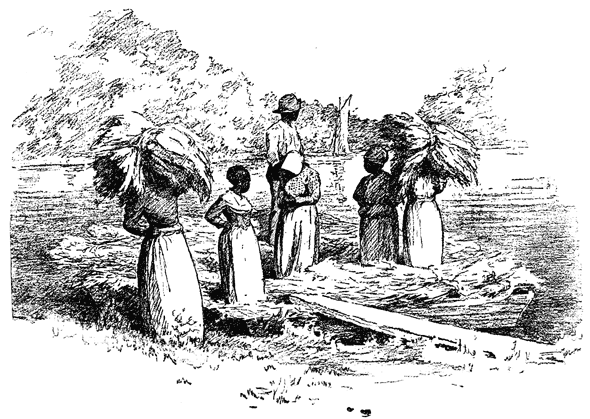
To-day the hands are "toting" the rice into the flats.
Casa Bianca, October 8, 1903.
The harvest has come and with it real harvest weather—crisp,
cool, clear; and the bowed heads of the golden grain
glow in the sunshine. The hurricane which
was reported as wandering around last
week frightened me terribly, but
after waiting Monday, Tuesday,
and Wednesday for it
to materialize, I had to cut
on Thursday, for the rice
was full ripe, and though we have had some light showers,
there has been no serious bad weather. To-day the hands
are "toting" the rice into the flats.
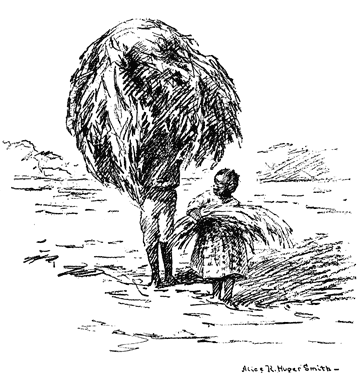
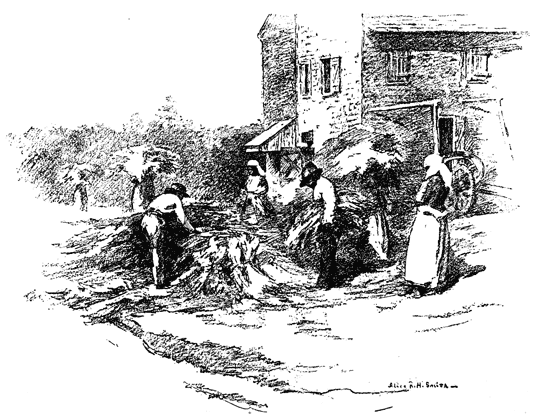
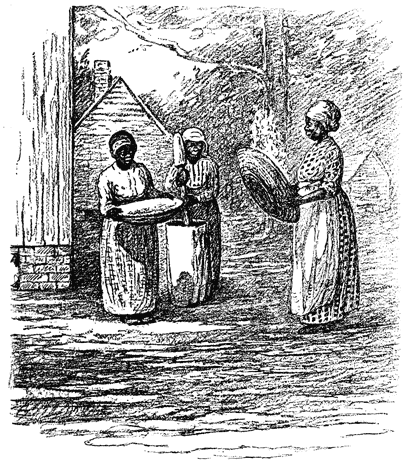
"You see a stack of rice approaching, and you perceive a pair of
legs, or a skirt, as the case may be, peeping from beneath."
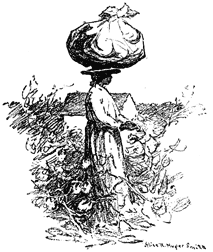
You see a stack of rice approaching, and as it makes its
way across the plank which bridges the big ditch, you perceive
a pair of legs or a skirt, as the case may be, peeping
from beneath. Men, women, and children all carry, what
look like immense loads, on their heads, apparently without
effort. This is the gayest week of the year. Thursday the
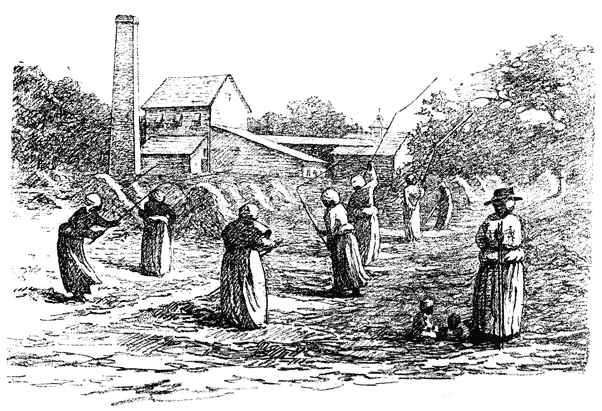
field was cut down by the hands with small reap-hooks, the
long golden heads being carefully laid on the tall stubble to
dry until the next day, when it was tied into sheaves, which
the negroes do very skilfully with a wisp of the rice itself.
Saturday it was stacked in small cocks to dry through
Sunday, and to-day it is being loaded into the flats, having
had every advantage of weather.
If only no rain or wind comes until it is unloaded at
Cherokee, fifteen miles up the river! I have sent for a tug
to tow the two flats up on the flood-tide this evening—just
now it is dead low water, and the flats are aground, which
always scares me; for, if by any chance they get on a log or
any inequality, they get badly strained and often leak and
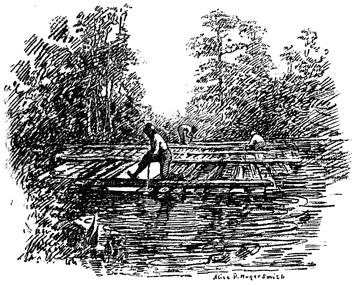
ruin the rice. Flats are one of the heavy expenses on a rice
plantation—large, flat-bottomed boats from twenty to
eighty feet long and from ten to twelve feet wide, propelled
in the most primitive way by poles and steered by one huge
oar at the stern. They can be loaded up very high if the
rice is properly stowed.
I have sent to try and get some rice-birds for my dinner.
These are the most delicious little morsels, so small one can
easily eat six for breakfast, and a man makes nothing of a
dozen for dinner. We used to get them in great abundance
only a few years ago, but now the rice-bird industry has
become so big a thing we find it very hard to get any at all.
Formerly a planter hired bird minders, furnished powder
and shot, and got several dozen birds from each one; but
now the negro men go at night with blazing torches into the
old rice-fields, which are densely grown up in water-grasses
and reeds, the birds are blinded and dazed by the light, and
as the fat little bodies sway about on the slender growth
upon which they rest, they are easily caught, their necks
wrung, and they are thrust into the sack which each man has
tied in front of him. In this way a man sometimes gets a
bushel by the time the reddening dawn brings him home,
and he finds waiting for him on the shore buyers from the
nearest town, who are ready to pay thirty cents a dozen for
the birds, so that one or two nights of this sport give as much
as a month's labor. Of course, it is hard to come out to cut
rice the next day, so probably illness is pleaded as an excuse
for his absence in the field.
This makes it more and more difficult to get the rice
harvested; no one but one of African descent could spend
his nights in the rice-field, where the air is heavy with the
moist malaria, so it is his opportunity. The shooting of
rice-birds has almost gone out, for the bird minders are so
careless. They shoot into the rice and so destroy as much as
the birds, almost; now blank cartridges are almost entirely
used to scare the birds. Going round the field one day with
Marcus, I said, with great relief: "I'm so glad not to see a
single bird to-day." He laughed and said: "Miss, wait till
de bird minders shoot." In a few seconds the bird minders
became aware of my approach and up and fired very nearly
at the same time. The birds rose in clouds so that the sun
seemed darkened for a few seconds, and the noise of their
wings was deafening. It seemed tantalizing not to be able
to get any to eat. In spite of the tremendous report of the
firing, it did no execution, for the old-fashioned muskets
which are used have an enormous load of very coarse powder,
but no shot.
Now, my flats are loaded, and I must start on my twelve-mile
drive to the pine-land. As soon as I can have the flats
unloaded I must send them back for the hands to harvest
their rice. I do not pretend to overlook this. I try to put
them on their mettle to do the best possible. Some respond,
but the majority just poke along, doing as little as possible
each day, so as to have longer time to strip the rice from the
straw, and carry it home in bags, so that when it comes
to mill, there is not enough to pay their rent. They know
how I hate to take all they bring, I so like for them to have
a nice little pile of their own to ship; it is very hard for
me to believe what the foreman tells me, that they have
been eating this rice for three weeks past.
October 16.
I have threshed the May rice, and it has turned out very
well, considering the hard time it had for two months after
it was planted. My wages field made twenty-five bushels
to the acre and the hands nearly the same, only a little less,
but it is good rice and weighs forty-six pounds to the bushel;
and as I hear every one complaining of very light rice, I am
thankful it is so good.
October 17.
I have had an offer of $1.05 for my rice in the rough, and
I am going to take it, though I shall miss the cracked rice
and the flour which we get when the rice is milled, and the
rice will have to be bagged and sewed up, which is a great
deal of work; but Mr. S. will pay for it at my mill, and that
will relieve my anxiety about money.
October 18.
A hard day's work, but the sale has been most satisfactory,
for as the standard weight per bushel for rice is forty-five,
and my rice weighs forty-six or forty-seven, I have a good
many more dollars than I had bushels, which is very cheering;
and I have had grip and am greatly in need of cheering.
Mr. S. weighed every sack and put down the weights and
then added up the interminable lines of figures. I added
them, too, but was thankful I did not have the responsibility,
for they came out differently each time I went over them.
October 24.
The harvest of my June field (wages) began to-day.
Though very weak and miserable from grip, I drove the
twelve miles to Casa Bianca, and in a lovely white piqué suit
went down on the bank. I timed myself to get there about
12 o'clock, and as I expected I met a procession of dusky
young men and maidens coming out of the field. I greeted
them with pleasant words and compliments on their nice
appearance, as they all reserve their gayest, prettiest clothes
for harvest, and I delight to see them in gay colors, and am
careful to pay them the compliment of putting on something
pretty myself, which they greatly appreciate. After "passing
the time of day," as they call the ordinary polite greetings,
I asked each: "How much have you cut?" "A quarter,
Miss." "Well, turn right back and cut another quarter—why,
surely, Tom, you are not content to leave the field
with only a quarter cut! It is but a weakling who would
do that!" And so on till I have turned them all back and
so saved the day.
A field of twenty-six acres is hard to manage, and unless
you can stir their pride and enthusiasm they may take a
week over it. One tall, slender girl, a rich, dark brown, and
graceful as a deer, whose name is Pallas, when I ask, "How
much?" answers, "Three-quarters, Ma'am, an' I'm just
goin' to get my break'us an' come back an' cut another
quarter." That gives me something to praise, which is
always such a pleasure. Then two more young girls have
each cut a half acre, so I shame the men and urge them not
to let themselves be outdone; and in a little while things are
swimming. I break down some of the tops of the canes and
make a seat on the bank, and as from time to time they come
down to dip their tin buckets in the river to drink, I offer
them a piece of candy and one or two biscuits, which I always
carry in the very stout leather satchel in which I keep my
time-books, etc.

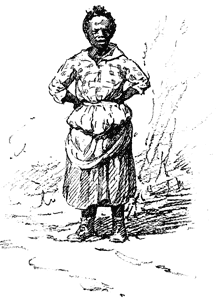
Pallas.
Though the sun is fiery, I feel more cheerful than I have
for a good while. The field of rice is fine, Marcus says,—"Miss,
I put my flag on dat fie',"—and insists it will make
over forty bushels to the acre. I don't throw cold water on
his enthusiasm, but I know it will not. However, the rice
is tall, and the golden heads are long and thick. I count a
few heads and find 200 grains on one or two, and am almost
carried away with Marcus's hope, but will not allow myself
to think how much it will make. One year this field put in
the bank $1080, but I know it will not do that this year.
There is no use to think of it.
I stayed on the bank until sunset to encourage the slow
workers to finish their task. All the work in this section is
based on what was the "task" in slavery times. That it was
very moderate is proved by the fact that the smart, brisk
workers can do two or three "tasks" in a day, but the lazy
ones can never be persuaded to do more than one task,
though they may finish it by 11 o'clock. I feel placid to-night,
for half the field is cut down and will dry on the stubble
all day to-morrow.
October 26.
Drove down to Casa Bianca as early as I could and found
the hands cutting merrily. As soon as each one had cut a
half acre they turned in and tied that cut on Saturday and
stacked it in small cocks.
Again I am cheered and rested by the beauty around me.
The sun is gorgeous, though the autumn haze is all over the
wide expanse of level fields with every hue of green and gold.
I get in the small patches of shade made by the tall canes
and feast my eyes and thank the Great Artist who has made
it all so beautiful.
The three flats are in position for loading to-morrow, the
wind is still west, and so I hope the fair weather may last.
My supply of candy and biscuits is much appreciated. I
make my own lunch on the biscuits and a bottle of artesian
water, which I always take with me. I would as soon think
of eating snake's eggs as of drinking the river water, so full
is it of animal life, I am sure. I know how it would look
under a powerful microscope.
October 31.
Spent yesterday in the mill threshing out my rice, most
trying to me of all the work, the dust is so terrible; but the
mill worked well, and so did the hands—and better than all,
the rice turned out well, thirty-five bushels to the acre, and
good, heavy rice. So I
felt rewarded for the dust
and other trials. I was
so determined to prevent
stealing that I engaged
the sheriff's constable to
watch on the nights that
the rice was stacked in the
barnyard; and now that
expense is over, and the
pile is safe in the second
story of the shipping barn.
Next I have to thresh
out the people's rice from
Casa Bianca, which will
be up in a day or two; then I will have a little time to
have the upland crops seen after before the rice here, at
Cherokee, which was planted very late, will be ready to cut.
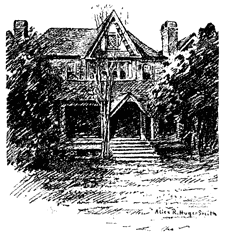
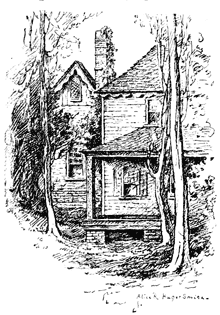
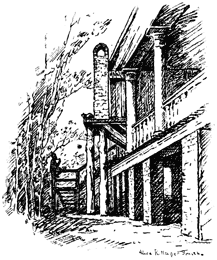
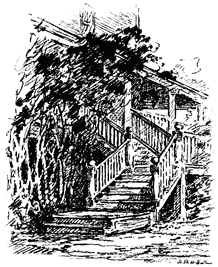
Front porch—Casa Bianca.
Cherokee, November 4.
Yesterday I had my wages field of rice here cut. It is
only eleven acres of very poor rice, which has cost a good
deal of money, owing to the freshets. The only thing to be
done now was to get it in with as little expense as possible,
so I announced yesterday that it must be in the barnyard
to-night. Bonaparte looked wise, smiled in a superior way,
and said that was impossible—that perhaps by Tuesday it
could be got in. I didn't dispute his wisdom or argue with
him. I simply went into the field with the hands in the
morning, yesterday, and stayed until it was all cut down.
I told Bonaparte to put a watchman in the field, and left
the choice to him. He said he would put Elihu; so I rested
content until about 10 o'clock, when I began to get anxious
about it. The best planter in my neighborhood had told me
he had never known the stealing of rice so bad from the field.
He attributed it to there being so little planted as high up
the river on account of the freshet, so that rice is very
scarce. This rice had not been good enough to warrant the
expense of the constable, but I did not wish to lose the little
that was there, so I determined to go over and see for myself.
I called a negro boy of about sixteen years whom I had
recently taken into my service, and asked him if he was afraid
to row me over to the field. He hesitated and I went on:
"I want to take some lightwood and a blanket over to Elihu,
who is watching, for the night is very cold." At once he said
he was not afraid at all, as the moon was bright. When
I ran up to my room to get my wraps and my good Chloe
found I was going, she said: "Miss Patience, le' me go wid
you; I know well how fo' paddle boat, en yo ain't long git
dat boy, en yu dun know ef 'e kin manige boat at night."
Of course I was delighted to take Chloe; I sent Jake for
lightwood, she took the blanket and I the matches. The
getting in the boat was the darkest part, but once out on the
river it was perfectly lovely—such a glorious night, the air
so crisp and exhilarating. As we neared the field Chloe
entreated me to be careful when I got out on the bank, for
Elihu might take us for thieves and shoot; but I went very
fearlessly, for I had a conviction that there was no Elihu
there, and so it proved.
I told Jake to kindle a large fire in a sheltered corner of the
bank, while Chloe and I walked all the way round the field.
I can't describe the weird peace of the scene; and to make it
more ghostlike Chloe insisted on speaking in a low whisper,
as becoming the time and place, and reminding me that people
from the next place might be hiding all around. No sign of
any marauder, however, appeared, and I knew the fire on the
bank would give the impression that I had installed my
friend the constable, so I went back to the house entirely
satisfied with the expedition. I charged Jake to say nothing
on the subject to any one. Why will one try to exact the
impossible? I lost my man, who has been with me fifteen
years, this fall, and Jake is the substitute for the present.
To-day I stayed in the field again all day and succeeded
in getting the rice tied and put in the flat by sunset. Then
I said the flat must be taken up to the barn, but Bonaparte
said that could not be done because there was "'gen tide."
Of course all the men echoed that it was impossible, but I
laughed at the idea, and climbing to the top of the rice, I sat
there and told two of the young men to take the poles and
push the flat out into the river—having privately asked
old Ancrum who had stowed the flat if it was true that a
flat could not go against the tide, and having heard from him
that it was nonsense. The men pushed the flat out and
poled it up the river with the greatest ease, and before dark
it was safely staked under the flat house, so that my mind
will be at rest about it to-morrow.
November 6.
Threshed out the rice to-day. It made only twenty
bushels to the acre, and I hear rice has gone down very much.
The hands now are whipping out the seed rice, which is a
tedious business, but no planter in this county will use mill-threshed
rice for seed. Mr. S., who bought my rice and who
travels all over the South buying rice for a mill in North
Carolina, told me that everywhere else mill-threshed rice
was used, simply putting a little more to the acre. Here it
is thought the mill breaks the rice too much, so the seed rice
is prepared by each hand taking a single sheaf at a time and
whipping it over a log, or a smooth board set up, until all the
rice comes off. Then the sheaves are laid on a clay floor
and beaten with flails, until nearly every grain has left the
straw. After all this trouble of course it brings a good
price—$1.75, $1.50 per bushel, $1.25 being the very cheapest
to be had.
November 7.
The time for paying the taxes will soon be passed, and all
the negroes on the place have asked me to pay their taxes in
addition to my own, so that I must sell some rice. Took
samples to our county town; I was told they were very good
rice, but no one wished to buy. I was offered, however,
82½ cents a bushel for one and 85 cents for the other! I sold
the smaller lot for 82½ and determined to hold the larger part,
for I feel confident rice must go up by February, and I do so
want to get $1 a bushel for it, for then I will pay out, but
otherwise not, after all my work.
November 12.
Peaceville has been wrought up to a state of wild excitement.
On Sunday afternoon, when I was expecting my little
class, only Kitty and the Philosopher and Squeaky came, and
before I could ask where the others were they burst out:—
"All the others have gone to hear the lion roar, and to see
if they could get a peep at him."
"A lion? Here?" My tone was suitable to the subject.
"Yes, ma'am; they put up three big tents while we were
in church this morning, right in front of the post-office."
I praised them for coming under such heavy temptations,
but they exclaimed in chorus: "We didn't want to come—mamma
made us; we wanted to hear the lion roar, too."
At which I was more pleased than ever, and was as rapid as
possible with the lessons and told no story, though I thought
Daniel in the lions' den might suit the occasion; but I soon
saw that they could listen to nothing under such phenomenal
circumstances. A very feeble Punch and Judy is the greatest
show seen here before.
We sang the hymns, I gave each one an apple, and said
I would walk down with them to the tents. A most delightful
progress we made, every one having turned out to see the
unwonted sight.
Before we got to my gate the King of the Forest began to
roar tremendously and kept it up, to the awe and delight of
the humans and the dismay of the animals. Cows refused
to come up to be milked, but fled to the swamp, and horses
cowered in their stalls.
Every one, even the most sedate, had turned out to look
at the tents. I went with the children until I saw their
parents and then returned to my piazza.
Tuesday.
Yesterday was the grand day. There were two exhibitions,
one at 1 o'clock and at 8 p.m. The two stores were
shut for the day, and business suspended while the village
gave itself up to dissipation.
I had to go to the plantation, having an appointment with
a carpenter for an important bit of work. It was difficult
to get Ruth past the tents. I took the plan of stopping to
talk to every one I met as I approached the green in front of
the post-office, which was so changed since Saturday, when
she saw it last.
Most fortunately the lion did not roar at that time, and
we got by without accident. Though I have seen a great
many fine wild beasts, the excitement in the air gained me,
and I was anxious for Chloe to choose the morning performance
as I had to be away then; but Chloe, when I told her
she could go morning or evening, whichever she preferred,
said she would go at night, as she heard that would be the
grandest. So I could not go, for she would never have
consented to leave the house and yard unguarded.
I did not see the show, but I certainly have enjoyed the
accounts of it and have come to the conclusion that the
Shelby show might be called a high-class moral entertainment.
The most particular and sedate, not to say prudish,
were not shocked, and the acrobatic feats amazed every one.
Peaceville was a great surprise to them also; they asked
for a hotel or boarding-house; there was none. They wanted
to board somewhere, but no one took boarders. The acrobatic
star, who, as Chloe described her, hung from the top
of the tent, dressed in "pink titers," by one foot, holding
up her fifteen-year-old daughter, also beautiful in pink tights,
by the foot, said she did not wish to stay in a tent; she
never did; she wanted to be in a house, and finally some
ladies who lived near the place where the tents were pitched
said they had an empty house in their yard which they
would fix for her, and it being Sunday afternoon and no
servants were to be found, the ladies themselves put beds in
the house and made it comfortable for the acrobat ladies,
and when these offered to pay, were quite shocked and surprised
and said there was no charge; they were glad to have
been able to make them comfortable.
Chloe and Dab have both given me thrilling accounts of
the lady dressed in pure silver, a very stout lady who took
the head of a snake, bigger round than Dab's body, and
stroked it and laid it on her breast: "Her color was quite
change while she did it, en the snake lick out 'e tongue en
you could see the lady trimble an' it was byutiful."
Altogether for many days joy will reign in the memory of
these delights. It was conducted with great dignity, and
there was no confusion or trouble, which seems wonderful,
for there were great crowds of darkies coming from miles
around and only about thirty white people all together. Yet
they had the seats arranged on different sides, so that all
were satisfied. The lion was given part of a kid before the
spectators, and then he stopped roaring.
November 18.
Green has returned to work; that is, he milked this morning
and hauled one load of manure to the field. His cousin,
Wishy, got his kinfolk to buy off the negro who was prosecuting
him for killing his cow, and the case was dropped.
Long ago, when I kept Wishy from bleeding to death
by patching up his head, I fear I did not benefit the world.
I find Elihu has gone! Moved bag and baggage to my
neighbor's, where he will have unlimited credit. He owes
me $10, which he promised faithfully to pay, and Jean and
Kitty have walked off in my boots beyond the reach of my
small efforts to improve them.
I feel quite sad about it—my heart has always been tender
to Elihu; I have had to help him so often. The last time he
went off to make "big money," as they call it, on some timber
work he came back very ill, and for a month I took him nourishment
and medicine daily, in spite of which his wife and
children lived in my potato patch. He was very weak, and
one day he broke out: "Miss, if I ever lef' you 'gen and
gone off for work any ways else, you sen' for the sheriff en
tie me. You ben good to me en ten' me, en den de debil
mek me lef' yu fer mek' big money! en now look a' me! Yu
ten' me en yu feed me des de same."
He is an uncommonly rich shade of black, so that his
own mother always referred to him as "dat black nigger."
Under constant and proper supervision he can be very useful,
but he cannot make himself work every day. He must have
a compelling hand and head behind him.
He has ten living children and a smart active young woman
for his second wife. When we were planting largely of rice,
he made a fine living, as he rented sixteen acres—he did the
ploughing and his family the rest of the work. He had a
splendid yoke of oxen, which he bought from us, and cows
and another fine steer he had raised.
The changes in the conditions in the last few years I do
not understand, but since McKinley's death steadily the
negroes have declined in their responsibility and willingness
to work until now their energies are spent in seeing how little
they can do and still appear to work so as to secure a day's
pay.
Elihu used to be a splendid ploughman, but this spring I
had him to plough ten acres for me, breaking it up flush.
The earth was barely scratched, I found afterward, though
I paid him by the day instead of by the acre, fearing he
would be tempted to hurry over it if I paid by the acre.
Forage was very scarce, and as long as he ploughed for me
I told him to give his oxen all they could eat from the hay
under the barn which was blown down. The two-story
barn was packed full of hay, some of my best alfalfa, when the
storm struck it. Of course it took some labor to get the hay
out, and poor Elihu, after the mighty effort of ploughing
one-half acre a day, could not make himself get out more
than just enough to keep the oxen alive.
I had urged him from the beginning of the winter to make
his children gather daily a certain quantity of the gray moss
with which the oaks are laden and which cattle eat greedily;
that would have kept his cows and oxen in good condition,
but he never did it.
I had two large sacks gathered every day for my cattle;
his went hungry. One by one the cows and young calves
died, not being accustomed to range like the woods cattle.
Some time after he finished ploughing for me he drove his
son up to see a doctor fifteen miles from here in a very bitter
spell of weather—drove the creatures up without feed, and
after consulting the doctor turned right back. One ox dropped
and died two miles from home, the other managed to get back,
but lay down about 100 yards from my front gate, under the
trees laden with food which would have saved its life, if given
in time. I used to take the lantern and go out at night
to carry food to it, knowing that if Elihu saw me feeding
it he would cease giving the little care which he expended
on it.
It struggled on a week and then died. One month before
he had been offered $60 for the yoke.
At last he had not an animal left. Then he came to me and
said he would like to take service with my neighbor by the
month as ploughman, as he would no longer give him work
unless he hired to him by the month. I was very sorry, for
I let him work there all the time when I had no work for him.
He is a splendid boatman, and I always called on him to
row me across the river and did not mind wind or waves with
Elihu at the oars.
However, I told him he could do so if he paid $1 a month
for his house—now he has gone, owing me for eight months
rent besides his tax. Several years ago he was double taxed,
having neglected to pay at the right time, and since then I
have always paid his tax when I paid my own.
He owns some land with timber. When I went to pay the
tax, I saw two buildings and twenty-five acres and the tax
was $4. I saw Elihu, I showed him the paper, and asked:—
"Have you any buildings on the land?"
"No, miss, I ent build no house, I ruther stay here, en if
I sick you ten' me."
"But, Elihu, the tax paper calls for two houses."
"Well, miss, ent you know, look like I ought to had house
by now!"
"But if you have none, you should not pay tax on one.
Now when February comes, which is the month to make
returns, I will make your return without the house."
"Well, miss, if you tink so, but I hate fer tek off de house."
I deprived him of his air castle, but the tax was reduced
to $2.70, I believe—I must look over the tax receipts to see.
I always pay Bonaparte's and some others, I am so afraid
of their putting off until they are double taxed. I do not
see how I am to
pay my own
taxes this
year; they
are nearly $200,
and there is nothing coming in. I have many, many valuable
things which I would like to sell, but I have no gift that
way.
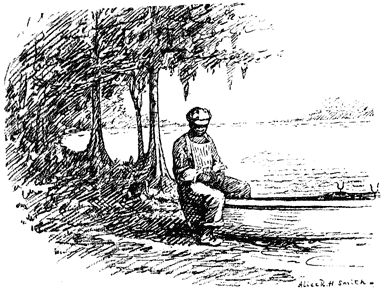
Elihu was a splendid boatman.
After many struggles I made up my mind to accept an offer
for my castle in the air, a mountain top in the Sapphire
region of North Carolina, but the purchaser withdrew; it is
so with everything—no one wants to buy anything. If our
valiant, voracious, and vivacious King Stork would only desist
from his activities while a few small creatures were left it
would be a mercy; but I fear when he gets through, there will
be none but sharks, devil-fish, and swordfish left.
November 20, Saturday.
When Green came this morning, I told him I wanted Bonaparte
to sow the oats on the land he has been ploughing
this week, and he must harrow it in to-day, as the season is
already late. He seemed shocked and said the land was quite
too rough for him to get through harrowing the acre and a
half to-day.
I in turn was shocked and told him that was absurd and
that it must be done; that I was distressed to hear he had
ploughed it so badly as what he said would indicate; that I
would have Dab take Romola and run the cultivator while
he ran the harrow, so as to have the oats thoroughly covered.
I told Dab to get the horse at once and take the cultivator to
the field.
I did a thousand things before following him. I found him
in the slough of despond and I had to fix the harness, etc., for
him, and then we proceeded to the field. I found Dab had
not the faintest idea of how to guide the horse and manage the
cultivator, so I told him until he got accustomed to it I
would lead Romola, so that he could devote all his attention
to the cultivator.
The ground was rough to distraction, and with every
polite intention Romola could not help every now and then
walking up my skirt, short as it was, and I was nearly dragged
down upon the ground, but I could not bear to give up,
though I was utterly exhausted, for the cultivator was doing
good work.
We had just got through half an acre and I was wondering
how I could retreat with my laurels, when Patty came at a
full run to say the "lady had come." Never was an arrival
more welcome. I told Dab he must take Romola back to the
stable and make himself presentable and bring in dinner as
soon as possible.
Made my way to the house as quickly as I could, but I was
so tired that my feet were like lead. S— was very much
surprised to find what I had been doing and
proceeded to argue with me, but I only
made fun of her arguments, and we
had a very gay dinner.
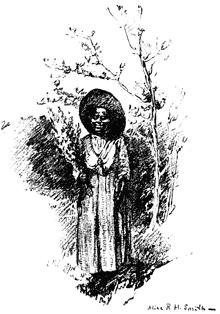
My little brown
maid Patty is
a new acquisition
and a great comfort,
for she is
very bright.
My little brown maid Patty is a
new acquisition and a great comfort,
for she is very bright and intelligent
and not too dignified
to run, which is a great blessing.
Cherokee, Sunday, November 22.
Drove S— to church in our little
pine-land village; she seemed to enjoy
the very simple service. Then I took
her over to my summer-house which
is just across the road from the church.
She was amused at the roughness and
plainness of the pine-land house as compared
to the winter quarters. Drove her
then in to Hasty Point, which is named
from Marion's hasty escape in a small
boat from the British officers during the
Revolution, and is a very beautiful point,
overlooking the bold Thoroughfare and
Peedee River; then home to a dinner of English ducks. I
am very stiff from my agricultural efforts.
November 24.
Yesterday just as I was getting into the buckboard to drive
S— down to Gregory to take the train Jim arrived. He has
come to begin the colts' education and can only stay a month,
as his employer in Gregory gave him a month's holiday. I
am so glad to have him—told him to get all the harness
together and mend things up and see if he could contrive a
harness fit to put on Marietta to break her in the road cart.
S— was so anxious to see Casa Bianca that I thought we
could drive in there on our way to Gregory, eat our lunch
there, and still get down in time for the train, but we failed
to do it. She was so delighted with the place and wanted
to see everything in the rambling old house, even the garret
with its ghostly old oil portrait of a whole family in a row and
a broken bust of another member, that we delayed too long.
Besides, the train left at 4:10 instead of 4:45, as it has been
doing for some years. I had to leave S— to spend the night
at the hotel, which I hated to do, but she said she must get
off on the 6 a.m. train, and I was equally obliged to come
home, so we parted with mutual regret.
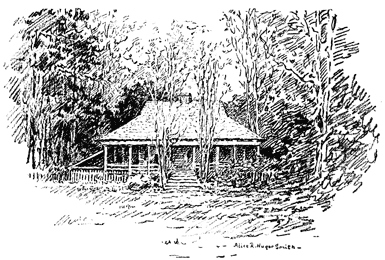
The roughness and plainness of the pine-land house.
It was late for my long, lonely drive. By the time I got
to the ferry it was dark, and I wondered how I was to manage.
I asked the two old men to lend me their lantern, but they
said they could not spare it. However, about half a mile
farther on I stopped at a cottage and asked for the loan of a
lantern, and the owner, a darky, brought out a bright, well-trimmed
lantern and with true courtesy assured me he was
happy to lend it, and I made the drive without accident,
truly thankful to get into my dear home, with its bright fire
of live-oak logs, at 8:30 out of the cold and darkness.
December 8.
To-day Richard Dinny came to say he would undertake to
mend the break in the rice-field bank. As it is about two
miles round there in a boat, I had him paddle me through the
canal to Long field trunk, and I walked from there on the
banks. I hurried along because the time was short before
hour for luncheon. I had had the bank hoed just in the
middle, so that a sportsman could go through unseen by the
ducks in the field. Sometimes it was hard for me to get
through with my skirt, but the man found it hard to keep up
with me. The break looked very alarming, the water rushing
over, and every tide that goes over will double the work.
Coming back, my hair caught in a brier and I found it
impossible to disentangle it. I had taken off my big hat
early in the engagement and left it on the bank near the boat.
After trying desperately to get free from the brier I asked
Richard, who was just behind, if he had a knife. He said yes.
"Then cut this bramble," I said, holding well up above my
head the brier, which was completely wrapped in my hair.
He got out his knife and took a long time about it, sawing
and sawing, but finally I was released. As soon as I got home
I rushed upstairs to fix my hair for luncheon, for it is curly and
was every which way over my head. As I took it down a
lock as thick as my finger came off in my hand. Richard
had taken so long because he was sawing off my hair instead
of the bramble.
December 9.
Yesterday's work at the break was too much for Richard.
This morning he sent word he was called off by important
business, so could not come.
December 11.
We are having the most delightful springlike weather. It
is a joy to wake up morning after morning and find the same
balmy, mild air. The effort to keep the house warm in the
cold weather got on my nerves very much, and now I am relaxing
and expanding to my own natural condition, which is
rather optimistic—one of peace and good-will to the world
in general, with a firm faith that things must come right in the
end, however difficult and crisscross they may seem.
Went to Casa Bianca to-day. The place is too lovely
for words. How any one who has the money and wants a
winter home can hesitate to give $10,000 for it I do not see.
When it is sold, it will break my heart, but either this place or
that must go. This place (Cherokee) has nearly 900 acres,
and the house is in perfect order. Besides, it has an ever-flowing
artesian well 460 feet deep which throws water above
the roof when a smaller pipe is put on,—a reducer, the man
who bored the well called it. There is a grove of live oak of
about 50 acres.
I often wonder that it should have fallen to my lot to have
two such beautiful homes. Altogether if I only had a small
certain income, I would not envy the King on his throne.
December 12.
All the sashes up this lovely April morning. I have a man
called Jimmie trimming up a little. The vista my dear
mother had cut out years ago had grown up, and it is a great
pleasure to have it open once more. From the front piazza
it opens a view down the river, a beautiful bend, the shining,
glimmering water framed by the dark oak branches.
Finally I have put Joe, Ruben, and George to work on the
break. After lunch went over in the boat to see their work;
they had a fine supply of mud cut, some on the bank and some
in the flat. Sent Bonaparte to take over some long plank
for them to use inside of puncheons to hold the soft mud.
December 13.
Joe, George, and Ruben working on break. They had to
be there at daybreak to catch the low tide. This afternoon
I went over in boat to look at the work, and to my delight it
is really done, and I believe will last, only every day at low
water they must put on a little fresh mud to raise it as it
settles.
Oh, this heavenly Indian summer! It is too delightful for
words!
Bonaparte had Frankie and Green helping him to clean
the chimneys. It is a troublesome business.
Bonaparte goes up on a ladder to the top of the house. It
always frightens me to see him, for he is an old man, but he
minds it less than the younger ones. He ties a stout cedar
bough to a long rope about midway in the rope, then drops
it down the chimney the three stories to the first floor;
there Frankie catches the rope and between them they pull
it backward and forward until the chimney is clean and the
hearth is filled with soot.
Once I tried getting a chimney-sweep, but he wept and
pleaded so not to go up the chimneys again, saying he would
suffocate, they were so long, that I returned to the old and
primitive way and will never try the sweep again. After
this one sweeping we keep the chimneys clean by burning
them, when there is a pouring rain, about once a month.
I have always broken my colts myself; no one but myself
either rode or drove Ruth until she was thoroughly broken.
Of course Jim's stable discipline was of the utmost importance,
and he always went along, but he never touched the
reins. I did the driving.
This year, however, I had not the spirit to cope with them
and have determined to leave it entirely to him. He is now
patching up a harness so as to drive Marietta in the road
cart.
It may be wise to explain a peculiarity of our low-country rice
region. From the last week in May until the first week in November
it was considered deadly for an Anglo-Saxon to breathe the night
air on a rice plantation; the fatal high bilious fever of the past was
regarded as a certain consequence, while the African and his descendants
were immune. Hence every rice planter had a summer
home either in the mountains, or on the seashore, or in the belt of
pine woods a few miles from the river, where perfect health was
found. In 1845 my father built a large, airy house surrounded with
wide piazzas on Pawley's Island, and there he spent the summer,
with occasional trips north and abroad, until the war made it unsafe
to occupy the island. Then he built a log house in the pineland
village of Peaceville: this large house with double shingled roof
was built by his plantation carpenters with wooden pins, owing to
the blockade there being no nails to be had. After the war my
brother owned this, and my mother in spite of great difficulties returned
to the beach as a summer home. As the crow flies this island
was about three miles east of Cherokee, but for us mortals to reach
it, many miles by land and water had to be traversed—all of our belongings,
servants, horses, cows, furniture, were loaded on to lighters
and propelled seven miles through broad rivers and winding creeks
to Waverly Mills where they were disembarked and travelled four
miles by land, but when we reached this paradise on the Atlantic
Ocean we felt repaid for all the effort. It was here we spent our
summers when I began my rice-planting venture. As my mother
reached the limit which David places for the span of life, she shrank
from the long move and bought a house in Peaceville just opposite
the church and here the last beautiful summers of her life were
passed in peaceful serenity.