A Dangerous Crossing—An Ill-omened Place—Louis the XVI. in
Prosperity and Adversity—January 21st, 1793—The End of
Robespierre—The Luxor Column—The Congress of Wheels—England
and France—The Champs Elysées—The Parc Monceau—A Terrestrial
Paradise—Oriental Museums—The Etoile's Tributaries—The
Arc de Triomphe—The Avenue du Bois de Boulogne—A
Vast Pleasure-ground—Happy Sundays—Longchamp—The
Pari-mutuel—Spotting a Winner—Two Crowded Corners—The
Rival Salons—The Palais des Beaux-Arts—Dutch Masters—Modern
French Painters—Superb Drawing—Fairies among the
Statues—The Pont Alexandre III.—The Fairs of Paris—A
Vast Alms-house—A Model Museum—Relics of Napoleon—The
Second Funeral of Napoleon—The Tomb of Napoleon.
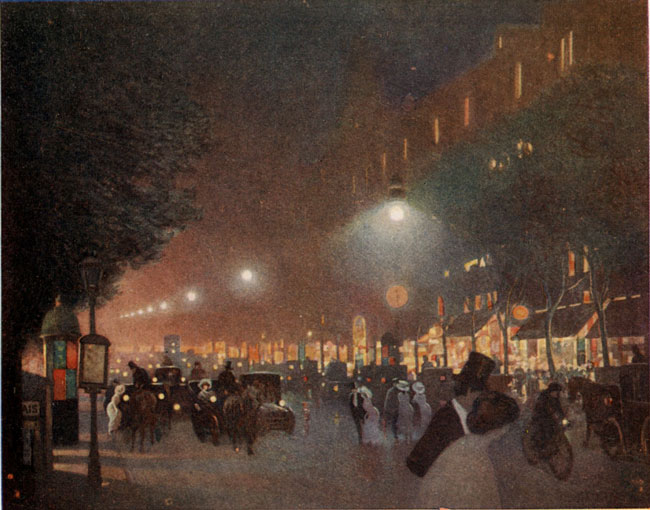
The Place de la Concorde by day is vast rather
than beautiful, and by night it is a congress
of lamps. By both it is dangerous, and in bad weather
as exposed as the open sea. But it is sacred ground
and Paris is unthinkable without it. The interest of the
Place is summed up in the Luxor column, which may
perhaps be said to mark what is perhaps the most
critical site in modern history; for where the obelisk
now stands stood not so very long ago the guillotine.
The Place's name has been Concorde only since 1830
It began in 1763, when a bronze statue of Louis XV.
on horseback was erected there, surrounded by emblematic
figures, from the chisel of Pigalle, of Prudence,
Justice, Force and Peace. Hence the characteristic
French epigram:—
"O la belle statue, O le beau piédestal!
Les Vertus sont à pied, le Vice est à cheval."
Before this time the Place had been an open and uncultivated
space; it was now enclosed, surrounded with
fosses, made trim, and called La Place Louis Quinze.
In 1770, however, came tragedy; for on the occasion of
the marriage of the Dauphin, afterwards the luckless
Louis XVI., with the equally luckless Marie Antoinette,
a display of fireworks was given, during which one of
the rockets (as one always dreads at every display)
declined the sky and rushed horizontally into the crowd,
and in the resulting stampede thousands of persons fell
into the ditches, twelve hundred being killed outright
and two thousand injured.
Twenty-two years later, kings having suddenly become
cheap, the National Convention ordered the statue
of Louis XV. to be melted down and recast into cannon,
a clay figure of Liberté to be set up in its stead, and
the name to be changed to the Place de la Révolution.
This was done, and a little later the guillotine was erected
a few yards west of the spot where the Luxor column
now stands, primarily for the removal of the head of
Louis XVI., in whose honour those unfortunate fireworks
had been ignited. The day was January 21st, 1793.
"King Louis," says Carlyle, "slept sound, till five
in the morning, when Cléry, as he had been ordered,
awoke him. Cléry dressed his hair: while this went
forward, Louis took a ring from his watch, and kept
trying it on his finger; it was his wedding-ring, which
he is now to return to the Queen as a mute farewell.
At half-past six, he took the Sacrament; and continued
in devotion, and conference with Abbé Edgeworth. He
will not see his Family: it were too hard to bear.
"At eight, the Municipals enter: the King gives
them his Will, and messages and effects; which they,
at first, brutally refuse to take charge of: he gives them
a roll of gold pieces, a hundred and twenty-five louis;
these are to be returned to Malesherbes, who had lent
them. At nine, Santerre says the hour is come. The
King begs yet to retire for three minutes. At the end
of three minutes, Santerre again says the hour is come.
'Stamping on the ground with his right-foot, Louis
answers: "Partons, Let us go."'—How the rolling
of those drums comes in, through the Temple bastions
and bulwarks, on the heart of a queenly wife; soon to
be a widow! He is gone, then, and has not seen us?
A Queen weeps bitterly; a King's Sister and Children.
Over all these Four does Death also hover: all shall
perish miserably save one; she, as Duchesse d'Angoulême,
will live,—not happily.
"At the Temple Gate were some faint cries, perhaps
from voices of pitiful women: 'Grâce! Grâce!' Through
the rest of the streets there is silence as of the grave.
No man not armed is allowed to be there: the armed,
did any even pity, dare not express it, each man overawed
by all his neighbours. All windows are down,
none seen looking through them. All shops are shut.
No wheel-carriage rolls, this morning, in these streets but
one only. Eighty thousand armed men stand ranked,
like armed statues of men; cannons bristle, cannoneers
with match burning, but no word or movement: it
is as a city enchanted into silence and stone: one carriage
with its escort, slowly rumbling, is the only sound.
Louis reads, in his Book of Devotion, the Prayers of
the Dying: clatter of this death-march falls sharp on
the ear, in the great silence; but the thought would fain
struggle heavenward, and forget the Earth.
"As the clocks strike ten, behold the Place de la
Révolution, once Place de Louis Quinze: the Guillotine,
mounted near the old Pedestal where once stood the
Statue of that Louis! Far round, all bristles with
cannons and armed men: spectators crowding in the
rear; D'Orléans Egalité there in cabriolet. Swift messengers,
hoquetons, speed to the Townhall, every three
minutes: near by is the Convention sitting,—vengeful
for Lepelletier. Heedless of all, Louis reads his Prayers
of the Dying; not till five minutes yet has he finished;
then the Carriage opens. What temper he is in? Ten
different witnesses will give ten different accounts of it.
He is in the collision of all tempers; arrived now at the
black Maelstrom and descent of Death: in sorrow, in
indignation, in resignation struggling to be resigned.
'Take care of M. Edgeworth,' he straitly charges the
Lieutenant who is sitting with them: then they two
descend.
"The drums are beating: 'Taisez-vous, Silence!'
he cries 'in a terrible voice, d'une voix terrible'. He
mounts the scaffold, not without delay; he is in puce
coat, breeches of gray, white stockings. He strips off
the coat; stands disclosed in a sleeve-waistcoat of white
flannel. The Executioners approach to bind him: he
spurns, resists; Abbé Edgeworth has to remind him
how the Saviour, in whom men trust, submitted to be
bound. His hands are tied, his head bare, the fatal
moment is come. He advances to the edge of the
Scaffold, 'his face very red,' and says: 'Frenchmen, I
die innocent: it is from the Scaffold and near appearing
before God that I tell you so. I pardon my enemies:
I desire that France——' A General on horseback,
Santerre or another, prances out, with uplifted hand:
'Tambours!' The drums drown the voice. Executioners,
do your duty!' The Executioners, desperate
lest themselves be murdered (for Santerre and his Armed
Ranks will strike, if they do not), seize the hapless
Louis: six of them desperate, him singly desperate,
struggling there; and bind him to their plank. Abbé
Edgeworth, stooping, bespeaks him: 'Son of Saint
Louis, ascend to Heaven'. The Axe clanks down; a
King's Life is shorn away. It is Monday the 21st of
January, 1793. He was aged Thirty-eight years, four
months and twenty-eight days.
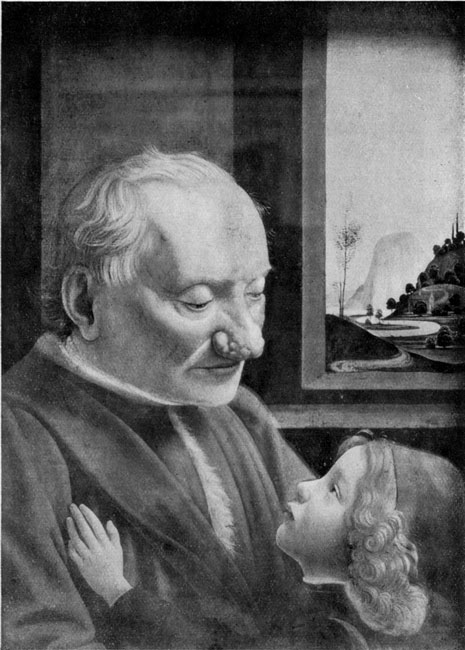
VIEUX HOMME ET ENFANT
GHIRLANDAIO
(Louvre)
"Executioner Samson shows the Head: fierce shout
of Vive la République rises, and swells; caps raised on
bayonets, hats waving; students of the College of Four
Nations take it up, on the far Quais; fling it over Paris.
D'Orléans drives off in his cabriolet: the Townhall
Councillors rub their hands, saying, 'It is done, It is
done'. There is dipping of handkerchiefs, of pike-points
in the blood. Headsman Samson, though he
afterwards denied it, sells locks of the hair: fractions of
the puce coat are long after worn in rings.—And so, in
some half-hour it is done; and the multitude has all
departed. Pastry-cooks, coffee-sellers, milkmen sing out
their trivial quotidian cries: the world wags on, as if
this were a common day. In the coffee-houses that
evening, says Prudhomme, Patriot shook hands with
Patriot in a more cordial manner than usual. Not till
some days after, according to Mercier, did public men
see what a grave thing it was."
The guillotine for more ordinary purposes worked in
the Place du Carrousel, not far from Gambetta's statue
to-day; but from May, 1793, until June, 1794, it was
back in the Place de la Concorde (then Place de la
Révolution) again, accounting during that time for no
fewer than 1,235 offenders, including Charlotte Corday,
Madame Roland and Marie Antoinette. The blood
flowed daily, while the tricoteuses looked on over their
knitting and the mob howled.
Another removal, to the Place de la Bastille, and then
on 28th July, 1794, the engine of justice or vengeance
was back again to end a life and the Reign of Terror
in one blow. What life? But listen: "Robespierre,"
lay in an anteroom of the Convention Hall, while his
Prison-escort was getting ready; the mangled jaw bound
up rudely with bloody linen: a spectacle to men. He
lies stretched on a table, a deal-box his pillow; the
sheath of the pistol is still clenched convulsively in his
hand. Men bully him, insult him: his eyes still indicate
intelligence; he speaks no word. 'He had on the sky-blue
coat he had got made for the Feast of the Être
Suprême'—O Reader, can thy hard heart hold out
against that? His trousers were nankeen; the stockings
had fallen down over the ankles. He spake no word
more in this world.
"And so, at six in the morning, a victorious Convention
adjourns. Report flies over Paris as on golden wings;
penetrates the Prisons; irradiates the faces of those
that were ready to perish: turnkeys and moutons, fallen
from their high estate, look mute and blue. It is the
28th day of July, called 10th of Thermidor, year 1794.
"Fouquier had but to identify; his Prisoners being
already Out of Law. At four in the afternoon, never
before were the streets of Paris seen so crowded. From
the Palais de Justice to the Place de la Révolution,
for thither again go the Tumbrils this time, it is one
dense stirring mass; all windows crammed; the very
roofs and ridge-tiles budding forth human Curiosity,
in strange gladness. The Death-tumbrils, with their
motley Batch of Outlaws, some twenty-three or so,
from Maximilien to Mayor Fleuriot and Simon the
Cordwainer, roll on. All eyes are on Robespierre's
Tumbril, where he, his jaw bound in dirty linen, with his
half-dead Brother and half-dead Henriot, lie shattered;
their 'seventeen hours' of agony about to end. The
Gendarmes point their swords at him, to show the
people which is he. A woman springs on the Tumbril;
clutching the side of it with one hand, waving the other
Sibyl-like; and exclaims: 'The death of thee gladdens
my very heart, m'enivre de joie'; Robespierre opened
his eyes; 'Scélérat, go down to Hell, with the curses
of all wives and mothers!'—At the foot of the scaffold,
they stretched him on the ground till his turn came.
Lifted aloft, his eyes again opened; caught the bloody
axe. Samson wrenched the coat off him; wrenched the
dirty linen from his jaw: the jaw fell powerless, there
burst from him a cry;—hideous to hear and see. Samson,
thou canst not be too quick!
"Samson's work done, there bursts forth shout on
shout of applause. Shout, which prolongs itself not
only over Paris, but over France, but over Europe, and
down to this generation. Deservedly, and also undeservedly.
O unhappiest Advocate of Arras, wert thou
worse than other Advocates? Stricter man, according
to his Formula, to his Credo and his Cant, of probities,
benevolences, pleasures-of-virtue, and suchlike, lived not
in that age. A man fitted, in some luckier settled age,
to have become one of those incorruptible barren Pattern-Figures,
and have had marble-tablets and funeral-sermons.
His poor landlord, the Cabinet-maker in the
Rue Saint-Honoré, loved him; his Brother died for him.
May God be merciful to him and to us!
"This is the end of the Reign of Terror."
In 1799 the Place won its name Concorde. The
next untoward sight that it was to see was Prussian and
Russian soldiers encamping there in 1814 and 1815, and
in 1815 the British. By this time it had been renamed
Place Louis Quinze, which in 1826 was changed to Place
Louis Seize, and a project was afoot for raising a monument
to that monarch's memory on the spot where he
fell. But the Revolution of 1830 intervened, and "Concorde"
resumed its sway, and in 1836 Louis-Philippe,
the new king (whose father, Philippe Egalité, had
perished on the guillotine here), erected the Luxor
column, which had been given to him by Mohammed
Ali, and had once stood before the great temple of
Thebes commemorating on its sides the achievements
of Rameses II. Since then certain symbolic statues of
the great French cities (including unhappy Strassburg)
have been set up, and the Place is a model of symmetry;
and at the time that I write (1909) a great part of it
is enclosed within hoardings for I know not what purpose,
but I hope a subway for the saving of the lives of
pedestrians, for it must be the most perilous crossing in
the world. One has but to set foot in the roadway and
straightway motor-cars and cabs spring out of the earth
and converge upon one from every point of the compass,
in the amazing French way. Concorde, indeed!
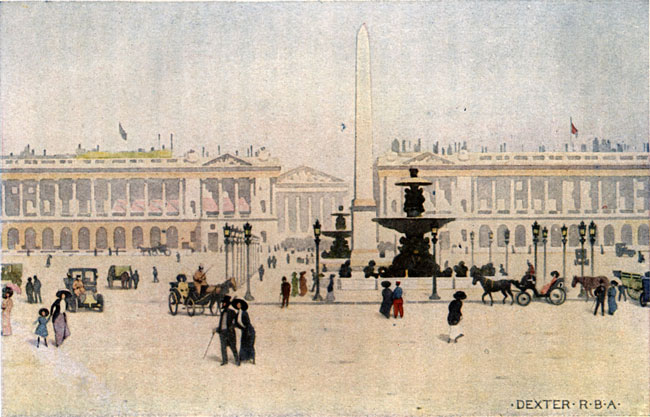
AUTOMOBILE CLUB
THE MADELEINE
MINISTÈRE DE LA MARINE
THE PLACE DE LA CONCORDE
(LOOKING NORTH)
If the Place de la Concorde may be called at night a
congress of lamps, the Champs-Elysées in the afternoon
may be said to be a congress of wheels. Wheels in such
numbers and revolving at such a pace are never seen in
England, not even on the Epsom road on Derby Day.
For there is no speed limit for the French motor-car.
Nor have we in England anything like this superb
roadway, so wide and open, climbing so confidently to
the Arc de Triomphe, with its groves on either side at
the foot, and the prosperous white mansions afterwards.
It is not our way. We English, with our ambition to
conquer and administer the world, have neglected our
own home; the French, with no ambition any longer
to wander beyond their own borders, have made their
home beautiful. The energy which we as a nation put
into greater Britain, they have put into buildings, into
statues, into roads. The result is that we have the
Transvaal, Australia, New Zealand, Canada and India,
but it is the French, foregoing such possessions and all
their anxieties, who have the Champs-Elysées.
The Champs-Elysées were planned and laid out by
Marie de Médicis in 1616, and the Cours la Reine, her
triple avenue of trees, still exists; but Napoleon is the
father of the scheme which culminates so magnificently
in the Arc de Triomphe. The particular children's
paradise of Paris is in the gardens between the main
road and the Elysée, where they bowl their hoops and
spin their Diabolo spools, and ride on the horses of
minute round-abouts turned by hand, and watch the
marionettes, with the tired eyes of Alphonse Daudet,
who sits for ever, close by, in very white stone, watching
them. Here also are the open-air cafés, the Ambassadeurs
and the Alcazar, while on the other, the river, side
are the Jardin de Paris, a curiously Lutetian haunt, and
Ledoyen's, one of the pleasantest of restaurants in summer.
Just above this point we ought to turn to the left to
visit the Petit Palais and cross the Pont Alexandre
III., but since we are on the way let us now climb to
the Etoile, and on to the Bois, first, however, just turning
off the Rond-Point for a moment to look at No. 3
Avenue Matignon, where Heine (beside whose grave we
are to stand on Montmartre) suffered and died.
The Place de l'Etoile might be called a kind of gilt-edged
Seven Dials, since so many roads lead from it.
Aristocratic Paris comes to a head here. On the right
runs from it the Avenue de Friedland, leading to the
Boulevard Haussmann, which meets with so inglorious an
end at the Rue Taitbout, but is perhaps to be cut
through to join the Boulevard Montmartre. Next on
the right is the Avenue Hoche, running directly into
the Parc Monceau, a terrestrial paradise to which good
mondaines certainly go when they die. A little appartement
overlooking the Parc Monceau—there is tangible
heaven, if you like!
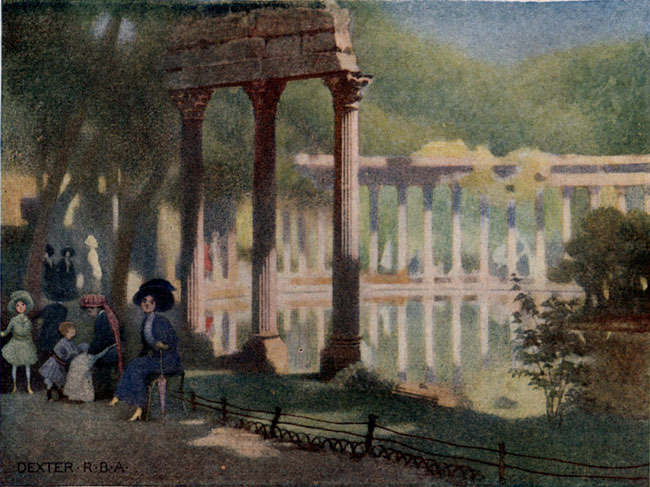
The Parc itself is small but perfect, elegant and expensive
and verdant. The children (one feels) are all
titled, the bonnes are visibly miracles of distinction and
the babies masses of point lace; the ladies on the chairs
must be Comtesses or Baronnes, and the air is carefully
scented. That is the Parc Monceau. It needed but one
detail to make it complete, and that was supplied a few
years ago: a statue of Guy de Maupassant, consisting
of a block of the most radiant marble to be procured,
with the novelist as its apex, and at the base a Parisienne
reading one of his stories. Other statues there
are: of Ambroise Thomas the composer, to whom Mignon
offers a floral tribute; of Pailleron the dramatist, attended
by an actress; of Gounod surrounded by Marguerite,
Juliet, Sappho and a little Love; and of Chopin
seated at the piano, with the figures of Night and
Harmony to inspire him. These are only a few; but
they are typical. Every statue in the Parc has a
damsel or two, according to his desire. It is the mode.
There is also a minute lake, on the edge of which have
been set up a number of Corinthian columns; and before
you have been seated a minute, an old woman appears
from nowhere and demands twopence for what she
poetically calls an armchair, the extra penny being
added as a compliment to the two uncomfortable wires
at the side which you had been wishing you could break
off. Such is the Parc Monceau, the like of which exists
not in London: the ideal pleasaunce of the wealthy.
Through it, I might add, you may drive; but only at
a walking pace—au pas. If the horse were to trot he
might shake some petals off.
At the western gate is the Musée Cernuschi, containing
a collection of oriental pottery and bronzes. I am
no connoisseur of these beautiful things, but I advise
all readers of this book to visit both this museum and
the Guimet in the Place d'Iéna, which is a treasury of
Japanese and Chinese art.
Returning to the Etoile, the next avenue is the Avenue
de Wagram, running north to the Porte d'Asnières,
while that which continues the Avenue des Champs-Elysées
in a straight line west by north is the Avenue
de la Grande Armée, running to the Porte Maillot and
Neuilly. On the left the first avenue is the Avenue
Marceau, which leads to the Place de l'Alma; the next
the Avenue d'Iéna, leading to the Place d'Iéna; the
next, the Avenue Kléber, running straight to the Trocadéro
(into which I have never penetrated) and Passy,
where the English live; the next, the Avenue Victor
Hugo, which never stops; and finally the Avenue du Bois
de Boulogne, the most beautiful roadway in new Paris,
along which we shall fare when we have examined the
Arc de Triomphe.
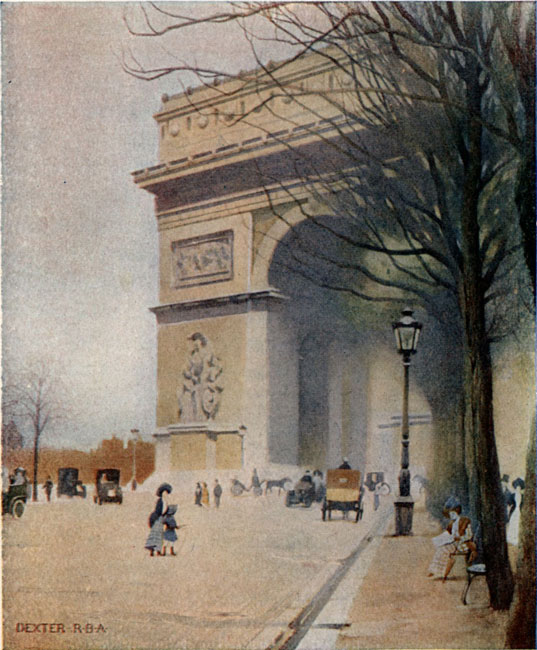
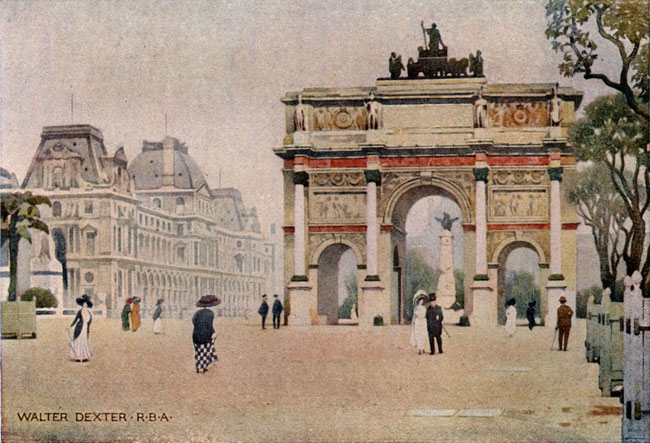
This trophy of success was begun, as I have said, by
Napoleon to celebrate the victories of 1805 and 1806;
Louis-Philippe finished it in 1836. Why Louis XVIII.
did not destroy it or complete it as a further memorial
of the Restoration, I cannot say. Napoleon's original
idea was, however, tampered with by his successors, who
allowed a bas-relief representing the Blessings of Peace
in 1815 to be included. The sculptures are otherwise
wholly devoted to the glorification of war, Napoleon
and the French army; but they are not to be studied
without serious inconvenience. My advice to the conscientious
student would be to buy photographs or
picture postcards, and examine them at home: the Arc
de Triomphe is too great and splendid for such detail.
From the top one can see all round Paris, and though
one cannot look down on it all as from the Eiffel Tower,
or see, beneath one, such an interesting district as from
Notre Dame, it is yet a wonderfully interesting view.
The Avenue du Bois de Boulogne has the finest road
in what is, so to speak, the Marais of the present day;
that is to say, in the modern quarter of the aristocratic
and wealthy. We have seen riches and rank moving
from the Marais to the Faubourg St. Germain and from
the Faubourg St. Germain to the Faubourg St. Honoré,
and now we find them here, and here they seem likely
to remain. And indeed to move farther would be
foolish, for surely there never was, and could not be, a
more beautiful city site than this anywhere in the world—with
its wide cool lawns on either side, and its gay
colouring, and the Bois so near. Here too, on the heads
of the comfortable complacent bonnes, are the most
radiant caps you ever saw.
The Bois de Boulogne, which takes its name from the
little town of Boulogne to the south of it, now a suburb
of Paris, began its life as a Paris park in the eighteen-fifties.
Before that it was a forest of great trees, which
indeed remained until the Franco-Prussian war, when
they were cut down in order that they might not give
cover to the enemy. That is why the present groves
are all of a size. I cannot describe the Bois better than
by saying that it is as if Hyde Park, Sandown Park,
Kempton Park, and Epping Forest were all thrown
together between Shepherd's Bush, Acton and the river.
London would then have something like the Bois; and
yet it would not be like the Bois at all, because it would
rapidly become a desert of newspapers and empty bottles,
whereas, although in the summer populous with picnic
parties, the Bois is always clean and fresh.
There are several gates to the Bois, but the principal
ones are the Porte Maillot at the end of the Avenue de
la Grande Armée, and the Porte Dauphine at the end
of the Avenue du Bois de Boulogne, and it is through
the latter that the thousands of vehicles pass on their
way to the races on happy Sundays in the spring and
autumn. Most English people visiting the Bois merely
drive to the races and back again; it is quite the exception
to find any one who really knows the Bois—who
has walked round the two lakes, Lac Inférieur,
which feeds the cascade under which one may walk (as
at Niagara), and Lac Supérieur; who has seen a play
in the Théâtre de Verdure, or an exhibition at Bagatelle,
the villa of the late Sir Richard Wallace, who gave the
Champs-Elysées its drinking fountains and London the
Wallace Collection. Bagatelle now belongs to Paris.
Every English visitor, however, remembers the stone
animals, dogs and deer, in the lawn of the Villa de
Longchamp on the right as one approaches the race-course,
and the windmill on the left, one of the several
inoperative windmills of Paris, which marks the site of
the old Abbey of Longchamp, founded by Isabella, the
sister of Saint Louis.
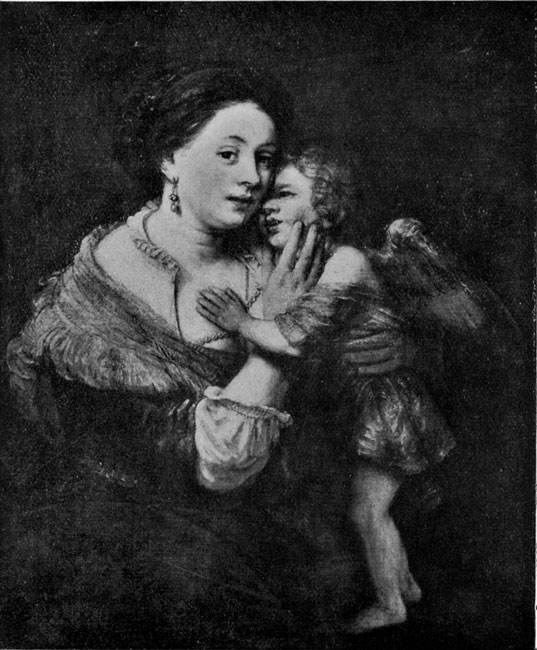
VÉNUS ET L'AMOUR
REMBRANDT
(Louvre)
The Bois has two restaurants of the highest quality
and price—Armenonville, close to the Porte Maillot, a
favourite dining-place when the Fête de Neuilly is in
progress, in the summer, and the Pré Catelan, near Lac
Inférieur and close to the point where the Allée de la
Reine-Marguerite and the Allée de Longchamp cross.
In the summer it is quite the thing for the young
bloods who frequent the night cafés on Montmartre to
drive into the Bois in the early morning and drink a
glass of milk in the Pré Catelan's dairy, perhaps bringing
the milkmaids with them.
The Bois has two race-courses, but it is at Longchamp
that the principal races are run—the Grand Prix and
the Conseil Municipal. Racing men tell me that the
defect of the pari-mutuel system is that one cannot arrange
one's book, since the odds are always more or
less of a surprise; but to one who does not bet on horses
anywhere but in Paris, and who views an English bookmaker
with alarm, if not positive terror, the pari-mutuel
seems perfect in its easy and silent workings and the
dramatic unfolding of its surprises. For first you have
the fun of picking out your horse; then quietly putting
your money on him, to win or for a place; and then,
after the race is run and your horse is a winner, you
have those five to ten delightfully anxious minutes while
the actuaries are working out the odds.
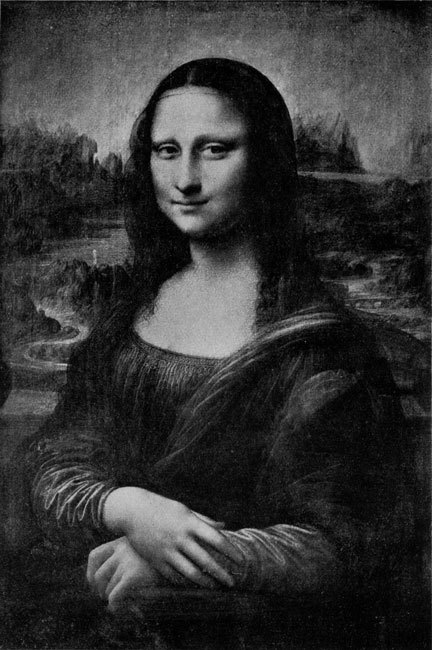
An experience of my own will illustrate not only the
method of the system but the haphazard principles on
which a stranger's modest gambling can be done. On
the morning of the races I had visited the Louvre with
Mr. Dexter, the artist of this book. We had not much
time, and were therefore proposing to look only at the
Leonardos and the Rembrandts, which are separated
by a considerable stretch of gallery hung with other
pictures. On leaving the Leonardos we walked briskly
towards the Dutch end; Mr. Dexter, however, loitered
here and there, and I was some distance ahead when he
called me back to see a Holbein. It was worth going
back for. In the afternoon at Longchamp, when the
time came before the race to pick out the horses who
were to have the honour of carrying my money, I noticed
that one of them was named Holbein. Having already
that day been pleased with a Holbein, I accepted the
circumstance as a line of guidance, and placed a five-franc
piece on the brave animal. He came in first, and
being an outsider his price was 185.50.
The Longchamp course is perfectly managed. There
are three places where one may go—to the pesage,
which costs twenty francs for a cavalier and ten francs
for a dame; to the pavillon, which is half that price;
or to the pelouse, where the people congregate, which
costs a franc. Perfect order reigns everywhere.
For the wanderer who has no carriage awaiting him
and no appointments to hurry him there are two entertaining
things to do when the races are over on a fine
Sunday afternoon. One is to cross the Seine to Suresnes
by the adjacent bridge and sitting at the café that faces
it, watch the crowd and the traffic, for this is on a main
road from Paris to the country; or walking the other
way, one may enjoy a similar spectacle at the Café du
Sport outside the Porte Maillot and study at one's ease
the happy French in holiday mood—the husbands with
their wives and their two children, and the Sunday
lovers arm in arm.
And now we return to the Champs-Elysées in order
to look at some pictures and admire a beautiful bridge.
For the Avenue Alexandre III., as for the Pont Alexandre
III., Paris is indebted to the 1900 Exhibition.
These are her permanent gains, and very valuable they
are. Of the two white palaces on either side of this
green and spacious Avenue, that on the right, as we
face the golden dome of the Invalides, is the home of
the Salon and of various exhibitions. I say Salon, but
Paris now has many Salons, two of which, in more or
less amicable rivalry, occupy this building at the same
time. In one, the Salon proper, the Salon of the old
guard, the Royal Academicians of France, there are
miles of paint but few experiments; in the other, where
the more independent spirits—the New Englishers, so
to speak—hang their works in personal groups, there
are fewer miles but more outrages. For outrages, however,
pure and simple (or even impure and complex), I
recommend the Salon that is now held in the early
spring in some of the old Exhibition buildings on the
banks of the river, close to the Pont d'Alexandre III.
I have seen pictures there—nudities, in the manner of
Aztec decorations, by the youngest French artists of
the moment—which made one want to scream. It was
said once that the French knew how to paint but not
what to paint, and the English what to paint but not
how to paint it. Since then there has been such a fusing
of nationalities, such increased and humble appreciation
on the part of the English painters of the best French
methods, that one can no longer talk in that kind of
cast-iron epigram; but it is impossible to see some of
the crude innovating work now being done without the
reflection that France is rapidly and successfully creating
a school of artists who not only know not what to paint
but how to paint too.
The Palais des Beaux-Arts, which was built for the
collection of pictures at the Exhibition of 1900, is now
a permanent gallery for the preservation of the various
works of art acquired from time to time by the municipality
of Paris, thus differing from the Luxembourg collections,
which are national. The Palais has become a
kind of brother of the Carnavalet, the one being the
historical museum of Paris and the other—the Palais—the
artistic museum of Paris. The Palais undoubtedly
contains much that is not of the highest quality, but
no one who is interested in modern French painting
and drawing can afford to neglect it, while the recent
acquisition of the Collection Dutuit, consisting chiefly of
small but choice pictures of the Dutch masters, including
a picture of Rembrandt with his dog, from his own
hand, has added a rather necessary touch of antiquity.
One of the special rooms is devoted to pictures of the
opulent Félix Ziem, painter of Venetian sunsets and the
sky at its most golden, wherever it may be found, who
is still (1909) living in honourable state on those slopes
of the mountain of fame which are reserved for the few
rare spirits that become old masters before they die,
and who presented his pictures to Paris a few years ago;
another room is filled with the works of the late Jean
Jacques Henner, whose pallid nudities, emerging from
voluptuous gloom, still look yearningly at one from the
windows of so many Paris picture dealers. Henner, I
must confess, is not a painter whom I greatly esteem;
but few modern French artists were more popular in
their day. He died in 1905, and this gift of his work
was made by his son. Other French artists to have
rooms of their own in the Palais are Jean Carriès the
sculptor, who died in 1894 at the age of thirty-nine,
after an active career in the modelling of quaint and
grotesque and realistic figures, one of the best known
and most charming of his many works being "La Fillette
au Pantin" (No. 1338 in the collection); and
Jules Dalou (1838-1902), also a sculptor, a man of more
vigour although of less charm than his neighbour in
the Palais. That strange gift of untiring abundant
creativeness which the French have so notably, Dalou
also shared, his busy fingers having added thousands of
new figures to those that already congest life, while he
modelled also many a well-known head. I think that
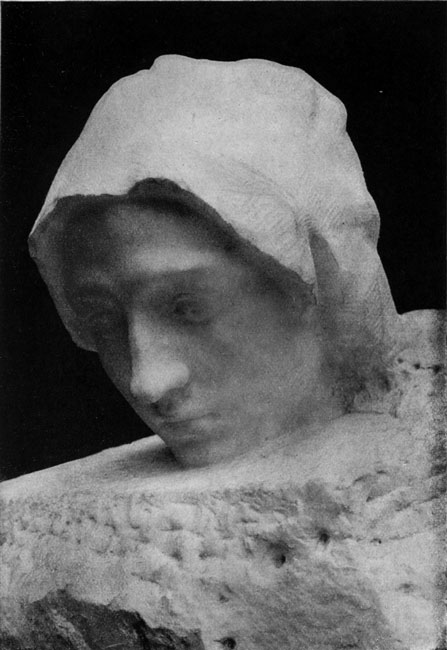
I like best his "Esquisses de Travailleurs". Nothing
here, however, is so fascinating as Dalou's own head by
Rodin in the Luxembourg.
Of the picture collection proper I am saying but
little, for it is in a fluid state, and even in the catalogue
before me, the latest edition, there is no mention of
several of its finest treasures: among them Manet's
portrait of Théodore Duret, a sketch of an old peasant
woman's hand by Madame David, a Rip Van Winkle
by that modern master of the grotesque and Rabelaisian,
Jean Véber, and one of Mr. Sargent's Venetian sketches—the
racing gondoliers. For the most part it is like
revisiting the past few Salons, except that the pictures
are more choice and less numerous; but one sees many
old friends, and all the expected painters are here. It
is of course the surprises that one remembers—the
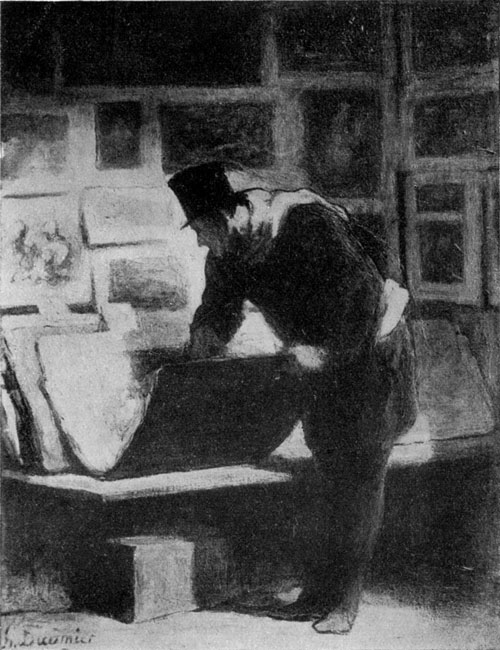
three Daumiers, for example, particularly "L'Amateur
d'Estampes," reproduced opposite page 286, and "Les
Joueurs d'Echecs," and the fine collection of the drawings
of Puvis de Chavannes and Daniel Vierge. I was
also much taken with some topographical drawings by
Adrian Karbowski—No. 494 in the catalogue. Other
pictures and drawings which should be seen are those by
Cazin (a sunset), Pointelin, Steinlen (some work-girls),
Sisley, Lebourg, and Harpignies, who exhibits water-colours
separated in time by fifty-nine years, 1849 to 1908.
The drawings on a whole are far better than the paintings.
In the collection Dutuit look at Ruisdael's "Environs
de Haarlem," Terburg's "La Fiancée," Hobbema's "Les
Moulins" and a woodland scene, Pot's "Portrait of a
Man," Van de Velde's landscape sketches, and the Rembrandt.
The rooms downstairs are not worth visiting.
Among the statuary, some of which is very good,
particularly a new unsigned and uncatalogued Joan of
Arc, is a naked Victor Hugo holding a MS. in his
hand; while Frémiet of course confronts the door, this
time with a really fine George and the Dragon, George
having a spear worthy of the occasion, and not the short
and useless broadsword which he brandishes on the
English sovereign.
On my last visit to this thinly populated gallery
I was for some time one of three visitors, until suddenly
the vast spaces were humanised by the gracious
and winsome presence of a band of Isidora Duncan's
gay little dancers, with a kindly companion to tell them
about the pictures, and—what interested them more—the
statues. These tiny lissome creatures flitting
among the cold rigid marbles I shall not soon forget.
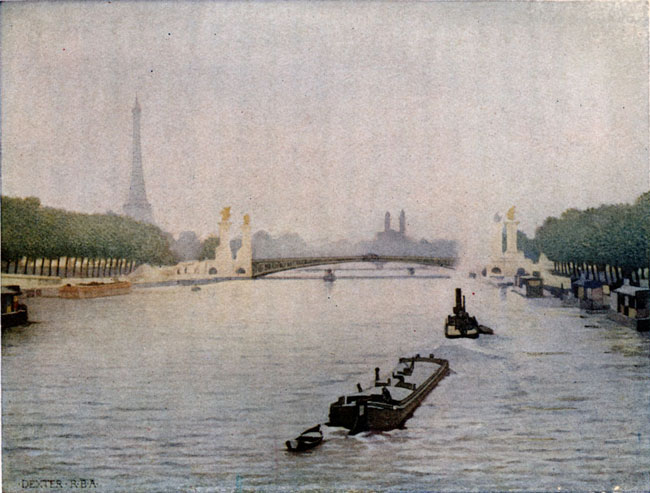
And so we come to the Pont Alexandre III., the
bridge whose width and radiance are an ever fresh surprise
and joy, and make our way to the Invalides, at
the end of the prospect, across the great Esplanade des
Invalides, so quiet to-day, but for a month of every year,
so noisy and variegated with round-abouts and booths.
It is, by the way, well worth while, whenever one is
in Paris, to find out what fair is being held. For somewhere
or other a fair is always being held. You can
get the particulars from the invaluable Bottin or Bottin
Mondain, which every restaurant keeps, and which is
even exposed to public scrutiny on a table at the Gare
du Nord, and for all I know to the contrary, at the
other stations too. This is one of the lessons which
might be learned from Paris by London, where you ask
in vain for a Post Office Directory in all but the General
Post Office. Bottin, who knows all, will give you the
time and place of every fair. The best is the Fête de
Neuilly, which is held in the summer, just outside the
Porte Maillot, but all the arrondissements have their
own. They are crowded scenes of noisy life; but they
are amusing too, and their popularity shows you how
juvenile is the Frenchman's heart.
One should enter the Invalides from the great Place
and round off the inspection of the Musée de l'Armée
by a visit to Napoleon's tomb; that, at least, is the
symmetrical order. The Hôtel des Invalides proper,
which set the fashion in military hospitals, was built by
Louis XIV., who may be seen on his horse in bas-relief
on the principal façade. The building once sheltered and
tended 7,000 wounded soldiers; but there are now only
fifty. From its original function as a military hospital
for any kind of disablement it has dwindled to a home
for a few incurables; while the greater portion of the
building is now given up to collections and to civic offices.
There could be no greater contrast than that between
the imposing architecture of the main structure and the
charming domestic façade in the Boulevard des Invalides,
which is one of the pleasantest of the old Paris buildings
and has some of the simplicity of an English almshouse.
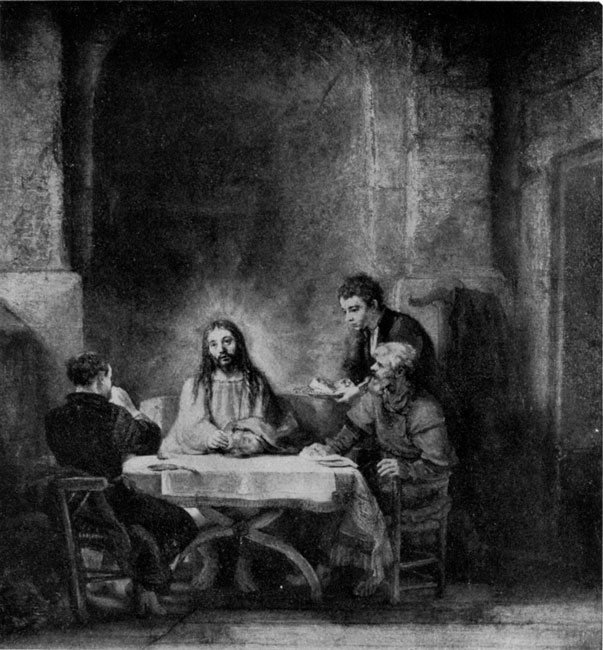
LES PÈLERINS D'EMMAÜS
REMBRANDT
(Louvre)
It is not until we enter the great Court of Honour
that we catch sight of Napoleon, whose figure dominates
the opposite wall. Thereafter one thinks of little else.
Louis XIV. disappears.
Passing some dingy frescoes which the weather has
treated vilely, we enter the Musée Historique on the
left—unless one has an overwhelming passion for
artillery, armour and the weapons of savages, in which
case one turns to the right. I mention the alternative
because there is far too much to see on one visit, and it
is well to concentrate on the more interesting. For me
guns and armour and the weapons of savages are without
any magic while there are to be seen such human
relics as have been brought together in the Musée Historique
on the opposite side of the Court. The whole
place, by the way, is a model for the Carnavalet, in that
everything is precisely and clearly labelled. This, since
it is a favourite resort of simple folk—soldiers and their
parents and sweethearts—is a thoughtful provision.
The Musée Historique has at every turn something
profoundly interesting, and incidentally it tells something
of the men from whom numbers of Paris streets
take their names; but the real and poignant interest is
Napoleon. The Longwood room is to me too painful.
The project of the admirable administrator has been to
illustrate the whole pageant of French arms; but the
Man of Destiny quickly becomes all-powerful, and one
finds oneself looking only for signs and tokens of his
personality. So it should be, under the shadow of the
Dome which covers his ashes. I would personally go
farther and collect at the Invalides all the Napoleonic
relics that one now must visit so many places to see—the
Carnavalet, Fontainebleau, the Musée Grévin, our
own United Service Museum in Whitehall (as if we had
the right to a single article from St. Helena!), Madame
Tussaud's, and Versailles. There is even a room at the
Arts Décoratifs devoted nominally to Napoleon, but it has
few articles of personal interest and none of any intimacy—merely
splendid costumes for occasions and ceremonials
of State, with a few of Josephine's lace caps among them.
Its purpose is to illustrate the Empire rather than the
Emperor, but the Invalides should have what there is.
At the Invalides you may, I suppose, see in three or
four rooms more Napoleonic relics of a personal character
than anywhere else. In Whitehall is the chair he died
in; but here is his garden-seat from St. Helena, one bar
of which was removed to allow him as he sat to pass
his arm through and be more at his ease as he looked
out to the ocean that was to do nothing for him. At
Whitehall is the skeleton of his horse Marengo; here
is the saddle. Here are his grey redingote and more
than one of his hats. Among the relics in the special
Napoleonic rooms those of his triumph and his fall are
mixed. Here is the bullet that wounded him at Ratisbon;
here are his telescopes and his maps, his travelling
desks and his pistols; here are the toys of the little Duke
of Reichstadt; here is the walking stick on which Napoleon
leaned at St. Helena, his dressing-gown, his bed, his
armchair and his death-mask. Here are the railings of
the tomb at St. Helena, and a case of leaves and stones
and pieces of wood and other natural surroundings of the
same spot. Here also is the pall that covered his coffin
on the way to its final burial under the Dome close by.
It is a fitting end to the study of these storied corridors
to pass to the tomb of the protagonist of the drama
we have been contemplating. The Emperor's remains
were brought to Paris in 1840, nineteen years after his
death at St. Helena. Thackeray, in his Second Funeral
of Napoleon, wrote a vivid, although to my mind hateful,
description of the ceremonial: a piece of complacent
flippancy, marked by the worst kind of French irreverence,
which shows him in his least admirable mood,
particularly when he is pleased to be amusing over the
difference between the features of the Emperor dead
and living. None the less it is an absorbing narrative.
One looks down upon the sarcophagus, which lies in
a marble well. It is simple, solemn and severe, and to
a few persons, not Titmarshes, inexpressibly melancholy.
The Emperor's words from his will, "Je désire que mes
cendres reposent sur les bords de la Seine, au milieu de
ce peuple français que j'ai tant aimé," are placed at the
entrance to the crypt. He had not the Invalides in
mind when he wrote them; but one feels that the
Invalides is as right a spot for him as any in this land
of short memories and light mockeries.