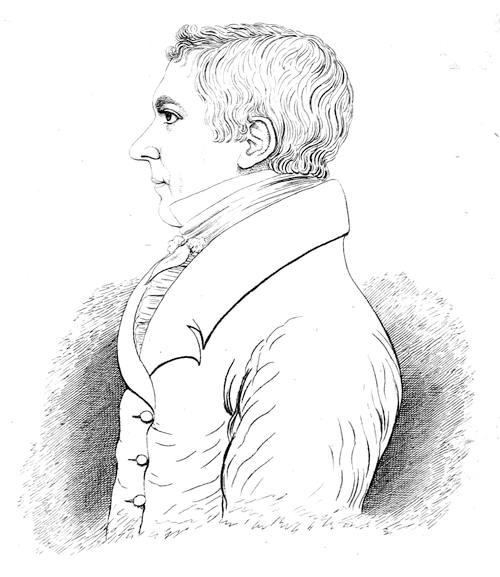
In the year 1806, being at the University of
Edinburgh, an advertisement was put on the College
Gate, by Messrs. P. and C. Wood, merchants,
Leith, intimating that a surgeon was wanted for
the ship Resolution of Whitby, Yorkshire, engaged
in the North Sea whale-fishery.
Impelled by curiosity, and by a still more powerful
motive, to visit the snow-clad coast of Spitzbergen,
I applied; and was, after due examination,
admitted surgeon for the voyage.
Nothing particular occurred on my journey from
this to Whitby, where I arrived on Sunday the 16th
of March, and was, in every respect, comfortably
accommodated at the house of the Captain.
As we did not sail for several days after my arrival,
I spent a considerable part of my time in
making such remarks on the town as were particularly
interesting.
Whitby is a thriving sea-port in the North Riding
of Yorkshire, situated on the mouth of the
river Esk. It is chiefly celebrated for the manufacture
of canvas, and for the extensive alum works in
its neighbourhood. Its harbour is the best on this
coast, and has a fine pier; but it has no river communication
with the interior country. Behind the
pier is a battery which mounts twelve eighteen-pounders.
This town was formerly noted for its
Abbey, of which some ruins still remaining testify
its ancient magnificence.
Here are different houses of worship, viz. an elegant
church of the established religion; and several
meeting-houses belonging to Presbyterians, Quakers,
Methodists, Roman Catholics, &c.
Whitby is 50 miles north-east of York, and
243 north of London; Lat. 54° 30´ North, Long.
1° 55´ West.
The word Whitby is a contraction of its original
appellation White Bay, so called from the white
surges made by the breaking of the waves along
the shore, so that the whole bay assumes a white or
frothy appearance to a person standing upon the
opposite banks.
Contiguous to this place, in a town called Marton,
was born that great circumnavigator Captain
James Cook, whose barometer (that which he used
in his voyage of discovery) we had on board the
Resolution.
Between Whitby and Lyth, a small town distant
about four miles, is a beautiful level strand, generally
known by the name of Whitby Sands, upon
which there used to be annual races; but now they
are less frequent.
Adjacent to Lyth, is the seat of the Mulgrave
family, one of whom, Constantine John Phipps,
(afterwards Lord Mulgrave), in 1773, undertook a
voyage, by his Majesty’s command, towards the
North Pole, under the hopes of discovering a passage
to the East Indies in a north-east direction:
but in which he, like many others, did not succeed.
Among the sands on the shore are found stones
resembling snakes without heads, the “Cornu ammonis”
of naturalists. These stones are easily
known by circular, or rather spiral windings marked
on their outside. One of these being broken, its
interior exhibits the appearance of a snake rolled
up and ready to make a spring.
That these are petrified snakes, is really believed
by the peasants on the coast, concerning which they
tell the following whimsical story:
An old lady, say they, who lived in that neighbourhood
some centuries back, having procured a
charm, or spell, to banish some noxious reptiles with
which that part of the country was then cruelly harassed,
set to work, and, by her incantations, collected
all the snakes within a considerable distance, and
brought them to the banks of Whitby, whence she
hurried them down so precipitately on the strand,
that they all broke their necks, and of course, in
their petrified state, are found without heads[1].
Not many years ago Whitby sent upwards of
twenty vessels to Greenland; but afterwards that
trade fell much to decay, until it was latterly revived
by the persevering activity of Captain Scoresby,
whose many successful whale-fishing voyages
tended greatly to promote the opulence of this town,
by encouraging others to embark in the same lucrative
business.
The Resolution, in which I made this voyage,
was a stout new ship, of about four hundred tons
burden, fitted out as a letter of marque, carrying
twelve six-pounders, besides stern-chasers, and well
furnished with firelocks, pistols, swords, cutlasses,
bayonets, &c. She was provided with nine fishing
boats, and her crew consisted of between sixty and
seventy men.
Greenland voyages are generally performed in
the course of four or five months; but, lest vessels
should be detained by the ice beyond that
time, they have usually nine months provision on
board.
Our ship was abundantly supplied with good
beef, pork, bacon, flour, oat-meal, biscuit, peas, potatoes,
cheese, butter, molasses, preserved fruit,
fowls, eggs, dried fish, strong ale, small beer, English
brandy, tea, coffee, sugar, tobacco, besides plenty
of foreign spirits and wines for the use of the
cabin. Neither was there any cost spared in laying
in an ample supply of proper medicines and cordials
for the sick.
Early on the morning of the 23d of March we
set sail from Whitby, amidst the hearty cheers of
a numerous concourse of spectators.
Being favoured with a fresh breeze which caused
a heavy swell, a general sickness prevailed at our
first setting out, from which the most experienced
seamen were not exempted, and which affected
me so severely, as to preclude all possibility of
making any remarks previous to our landing in
Shetland.
On the 25th at noon, we cast anchor in Bressay
Sound, opposite Lerwick, the capital of the Shetland
Isles.
This town is situated in Mainland, so called
from its being the principal of these Isles. It is
about half a mile long, and is irregularly built;
but contains some good houses, and is inhabited by
about one thousand eight hundred persons. It is
the seat of the courts held by the Sheriff-depute,
or Stewart-depute. Two packets, or traders, having
good cabins, and tolerable accommodation for
passengers, sail occasionally between this and
Leith.
Lerwick derives its chief support from the courts
of law, and from the vessels employed in the whale-fishery
making this harbour their rendezvous.
Near the north end of the town stands Fort Charlotte,
a small fortification mounting eighteen large
guns, from eighteen to thirty pounders, besides several
very large field pieces. It commands the
north entry to Bressay Sound, and is garrisoned by
a small detachment of invalids.
In the neighbourhood of this town there is a chalybeate
spring, but it is not much esteemed for its
medical virtues.
Bressay Sound lies between Lerwick and Bressay
Island, and forms an extensive and commodious
harbour, in which 1000 vessels well found may
ride at all seasons in the greatest safety. Here the
Dutch herring fleet used to rendezvous about the
middle of June. This harbour has the particular
advantage of two entries, one from the south, and
another from the north.
On the outside of the north entry lies a sunk
rock, called the Unicorn. On this rock was
wrecked the Unicorn man-of-war sent out in pursuit
of the Earl of Bothwell, who fled to Shetland;
hence the rock has its name. The paltry
village of Scallaway lies also on the Mainland, and
has an excellent harbour. Near this is the ancient
castle of Scallaway, built by one of the Earls of
Orkney.
These are the only two towns, or villages, in the
Shetland Isles.
Mainland is upwards of sixty miles long from
north to south; and in some places upwards of
twelve miles in breadth; it is so shaped, that no
part of it lies above three miles from the sea; and
consists of a great multitude of irregular promontories,
and a vast number of peninsulæ connected by
narrow isthmuses, insomuch that it abounds with
bays and harbours almost innumerable.
In the parish of North Mevan, a peninsula belonging
to this Island, stands the cloud-capt
mountain of Rona, the highest in Shetland. It
is eight miles long, four broad, and three thousand
nine hundred and forty-four geometrical feet
above the level of the sea; serving for a land-mark
to fishers and vessels coming from the Northern
Ocean. From the top of this lofty eminence the
eye commands an extensive and pleasing prospect,
stretching fifty miles at least in every direction.
The great number of small islands and peninsulas
scattered beneath, and often a distant view of vessels,
in summer, affords a most agreeable diversified
scene.
On the summit of this mountain stands a house,
called the watch-house, in which six or seven
men can sit. It is constructed of four large
stones, covered by two more for a roof, on the
top of which is erected a pyramidal tower of small
stones.
In the same parish stands a rock rising perpendicular
on all sides to a vast height, which, at a
few miles’ distance, looks like a ship under full sail.
Near to this are two very high inaccessible pillars,
on which the large species of cormorants
breed. What is extraordinary, the rocks possessed
by these birds one year is deserted the next, and returned
to again after being a year unpossessed.
This singular practice has been carried on time
immemorial.
Here is a small isle, called Dorholm, perforated
by a vast arch, seventy feet in height, under
which boats fish, having light from an opening at
the top.
Next to this is the holm and isle of Stenness,
so much celebrated for the great number of kittiweaks
which resort to it; the young of which
being esteemed delicious food, are taken in great
abundance.
To the north of Stenness is the Maiden Skerry,
a rock so called from its having never been
trodden on by man. The lofty rock called the
Ocean Skerry, stands about two miles from this,
and serves as a good landmark for ships wanting
a harbour in their passage from the north.
Not far from this rock is the island of Papa,
having a natural cave of three entrances, through
which the tide ebbs and flows. It has several
apartments, and is wide enough to admit a large
boat with the oars at full length on each side.
This gloomy cavern grows gradually wider towards
the centre, which nature has ornamented
with a beautiful arch. Beyond this, the boat is
directed by a small gleam of light from an aperture
in the top.
The island of Bressay lies to the east of Mainland,
and is about four miles long, and two
broad.
Adjoining to this Island, and on the south-east
side of it, lies the small but fertile Island of Noss,
the south headland of which is not less than four
hundred and eighty feet in perpendicular height.
Opposite to this, and distant ninety-six feet from
the island, stands another perpendicular rock or
holm, of the same height, quite level at the top,
and producing excellent pasture for sheep.
To transport them there, however, might well
have been thought impossible; but human ingenuity
requires only the exhibition of difficulties
in order to overcome them. An islander climbed
up the rock, and having fastened some ropes
to stakes he drove into the soil on the top, threw
them across the intervening chasm to the headland,
where they were in like manner fastened.
A cradle or basket was then drawn along these
ropes, and sheep are thus transported to, and
from the holm; and the eggs or young of the
sea-fowl, which there breed in vast numbers, fall
an easy prey to the skill and industry of man.
The adventurous islander who first ascended
the holm, and showed the possibility of joining it
to the island, from an excess of bravery, met with
an untimely end. Disdaining to pass over in the
cradle, and trusting that the same expertness which
had conducted him to the summit of the rock would
enable him to descend to its base,—he fell, and
was dashed to pieces.
“Quem si non tenuit, magnis tamen excidit ausis.”
It may be observed, that both men and horses
are transported over the rapid rivers of South
America in a similar manner. Vid. Ull. Voyage
de l’Amerique, vol. i. p. 358.
As there is a considerable discrepancy in authors
as to the height of this rock, and the breadth
of the chasm; and not having myself an opportunity
of examining it, I have followed the account
given by the accurate Pennant in his Arctic
Zoology.
The erection of a light-house on the Island of
Noss would be of essential service to the interests
of navigation. Many valuable ships, and, among
others, a Russian frigate of 38 guns, have been
lost on the east coast of the Shetland Isles.
To the north of Mainland lies Yell, an Island
twenty miles long, and nearly twelve broad, with
several good harbours, or voes, as they are called
by the inhabitants.
Foula lies to the west of Mainland. It is
about three miles long, and one and a half broad,
and has only one harbour. This is called Ham,
and is much resorted to by fishermen. Foula is
thought by some to be that island which the
ancients reckoned the ultimate limit of the habitable
globe, and to which, therefore, they gave
the appellation of “Ultima Thule.” This supposition
is not founded solely on the mere analogy
of the name, but also on the authority of Tacitus,
who, speaking of the victories obtained by Agricola,
and how far he penetrated northward, uses
this expression: “Insulas quas Orcadas vocant
invenit domuitque; dispecta est et Thule quadamtenus.”
Tacit. Vit. Agric. §10. But though the
high land of Foula may be easily seen, in a clear
day, from the northern part of the Orkneys,
still it is doubtful whether this be really the island
so called; because had the Roman fleet passed
to the north of the Orkneys, they must have seen
Mainland, Yell, and Unst, lying to the north of
Foula. It may be further observed, that the
description of Thule, as given by Pomp. Mela,
lib. 3, §6, and Pliny, lib. 2, §75, and lib. 4,
§16, is not reconcileable with the supposition of
its being identical with Foula. At Thule, says
Pomponius, “Per Solstitium vero nullae (noctes
sunt) quod tum jam manifestior non fulgorem
modo sed sui quoque partem maximam ostentat.”
This phenomenon, as Vossius has observed, can
only belong to the 66th and 67th degree of latitude,
and gives considerable countenance to the
opinion of Thule being the same with Iceland.
The statement of Pliny, who is not celebrated
for geographical accuracy, is alike irreconcileable
with either hypothesis, and belongs only to the Pole
itself.
These, (with the exception of Unst,) are all
the islands belonging to Shetland that are worth
notice, though they are nearly forty in number.
About seventeen of these are inhabited; the rest
being inconsiderable, are called Holms, and used
only for pasture.
On our arrival in Bressay Sound, there were anchored
twenty-six ships from London, Hull, and
Whitby, each of which, in turn, gave us three
cheers, which we as often returned. All these
ships were waiting for men, it being the place
where most of the ships bound to the Greenland
fishery call at to make up their complement.
The Captain finding men very scarce, and wages
high, did not engage any hands at Lerwick.
We afterwards weighed anchor, and sailed out of
the north entrance for Balti Sound, Island of
Unst.
Balti Sound is in the middle of the east side of
the island, into which it stretches nearly two miles.
Before the entrance, is a large narrow island, called
Balti, whence the Sound derives its name, and
which shelters it from all winds, forming an excellent
safe harbour or anchoring place. If a ship be
leaky, there are several very commodious beaches
on which she may be laid until thoroughly repaired.
This harbour used to be the most frequented
of any in Shetland, especially by ships going to
Archangel and Greenland.
Unst, the remotest of the Shetland Isles, and
most northern part of his Britannic Majesty’s dominions,
is supposed to be about eight miles long
and four broad.
A hill called Vallafield rises within a mile and
a half of its northern extremity, and runs directly
parallel to the western coast, to the very northern
point. It is six hundred feet high. At right angles
with this hill, stands Crossfield, nearly in the
middle of the island. To the north lies Saxaforth,
which is seven hundred feet high. It is the highest
in the island, and may be seen upwards of forty
miles off the coast. A hill, called Vordhill, runs
parallel to the east coast.
Among these hills are tracts of level fertile
ground, and the highest hill is some feet covered
with black moss. Unst contains many fresh water
lochs. That of Cliff is two miles long, and nearly
half a mile broad. The banks of this loch exhibit
pleasant and most beautiful scenery. From this
loch a few smaller ones run to the southern part of
the island.
The headlands here rise to the height of sixty or
seventy fathoms; but the shores of the bays and
harbours are low and sandy.
About this island are scattered here and there a
great many very small ones.
Around the coast are several curious natural
caves. One at Sha has its roof supported by octagonal
pillars.
At Burra Firth are a vast number of small
caves, running from the sea under the hills. One
of these only is entered once a-year, and robbed of
the seals which frequent it. The rest are mostly
inaccessible.
To the east of this, under an arm of the hill of
Saxaforth, is a magnificent natural arch, three
hundred feet long, and of a considerable height,
through which a boat can row.
The Shetland Isles, (called by the Dutch, Zetland;
and, by the Danes, Yetland,) lie between
sixty and sixty-one degrees of north latitude, and
have their longest day about nineteen, and their
shortest about five hours.
These islands, with those of the Orkneys, make
one of the counties of Scotland, which send a representative
to the British Parliament.
The climate of these, as of all other isles of like
size, is far from being settled. The atmosphere is,
in general moist. They have also heavy snows,
but not much frost; and are often visited by dreadful
storms of wind, rain, and thunder, in so much
that the water is agitated even to the bottom of
these comparatively shallow seas.
Owing to the great refraction of northern latitudes,
for about three months in summer they enjoy
the sight of the sun almost without intermission;
but for the same space in winter, (especially
in December,) that luminary hardly rises above
the horizon, and is commonly obscured by clouds
and mists.
“The sun from far shows with a sickly face,
Too weak the fogs and mighty dews to chase.”
In this gloomy season, the absence of day is
supplied partly by moon-light, and partly by the
radiance of the aurora borealis, or merry-dancers,
as they are called in these islands. These are
the constant attendants of clear evenings, and prove
great reliefs, amidst the gloom of the dark winter
night. They commonly appear at twilight, near
the horizon, of a dun colour, approaching to yellow;
sometimes continuing in that state for several
hours without any apparent motion, after which
they break out into streams of stronger light,
spreading into columns, and altering slowly into
ten thousand different shapes, varying their colours
from all the lines of yellow to the most obscure
russet. They often cover the whole hemisphere,
and then make the most brilliant appearance.
Their motions at these times are amazingly quick;
and they astonish the spectator with the rapid
change of their form. They break out in places
where none were seen before, skimming briskly
along the heavens: are suddenly extinguished, and
leave behind an uniform dusky tract. This again
is brilliantly illuminated in the same manner, and
as suddenly left a dull blank. In certain nights
they assume the appearance of vast columns, on
one side of the deepest yellow, on the other declining
away, till it become undistinguished from the
sky.
They have generally a strong tremulous motion
from end to end, which continues till the whole vanish.
According to the state of the atmosphere,
they differ in colours. They often assume the colour
of blood, and make a most dreadful appearance.
The rustic sages represent these phenomena as
prognosticative of future events, and thereby affright
the gaping multitude with dread of war, famine,
and pestilential devastations. Vid. Pen.
Arct. Zool. vol. i. p. 27.
The ebb tides here run north, and the flood tides
to the southward, unless on the north and south
extremities of the country, where they run east and
west; but their rapidity is inconsiderable when
compared to that of the firths of Orkney.
The shores are generally lofty, and rise almost
perpendicular from the ocean.
I went out with the captain in one of the ship’s
boats, and sailed round some of the headlands of
Unst. The scene was truly sublime:—fogs immured
their summits; the noise of the sea dashing
against the rocks;[2] and the screams of the eagles
and other birds of prey, which there enjoy perfect
security; combined with the sombre and terrific appearance
exhibited by these bulwarks of nature, impressed
us with awe and a pleasing kind of astonishment.
The prospect to me was quite novel.
I had formerly been familiar only with champaign
countries; but I had no difficulty in declaring, that
it was from some such scene as this only, that one
could form an adequate conception of natural magnificence.
The face of the country exhibits a prospect of
black craggy mountains and marshy plains, interspersed
with some verdant spots which appear
smooth and fertile. Neither tree nor shrub is to
be seen, except the juniper and heath.
“Throughout the horrid wild no tree was seen,
Earth, clad in russet, scorn’d the lively green.”
This want of trees and shrubs is the more remarkable,
as in different parts of these islands there
are evident marks of their having been once a wooded
country. In the island of Foula are often found
the remains of large trees laid bare by the violence
of some tempest, carrying away the strata which
covered them. At present, however, no kind of
wood can be made grow; and it is found extremely
difficult to cultivate even the lowest and most common
shrub. This decrease of vegetation has not
been satisfactorily accounted for.
The nature of the soil is very different. In
some places it consists of deep moss, with a sandy
bottom; in others the moss is only about a foot deep
over a stratum of clay. The cultivated parts consist
generally of a mixture of clay and small stones.
In some places there is abundance of tough clay,
similar to that used in Britain in the manufacture
of bricks or pottery.
No coal has hitherto been discovered in these
Islands, but in several of them are found limestone,
freestone, rock-crystal, corals, white spar, iron-ore,
copper-ore, sulphur, fuller’s earth, and veins of variegated
jasper.
Springs of fresh water are frequent in the mountains;
and there are numerous lakes and streams,
abounding in salmon, trout, &c.
Along the shores are a great many ancient
towers, originally known by the names of Burrows
or Duns; but by the inhabitants they are now
called Wart or Wardhills. They were so arranged,
that the whole Islands could, by signals from
one to another, be apprised of approaching danger
in a very short time. Sometimes they were
used for state prisons. Vid. Baxter, Gloss. Antiq.
Brit.
Some of these are surrounded with dry ditches,
others with walls. I saw one in Unst, called Snaburg,
which has both a wet and a dry ditch. One
of these ditches is cut with great labour through
the solid rock.
There is another in Fetlar, (one of the most remote
of the Shetland Isles,) in the form of a Roman
Camp, having in the middle a rectangular
area surrounded by a wall, and that by an earthen
rampart of the same figure. Vid. Plate, Pen. Arct.
Zool. vol. i. p. 33.
Druidical circles of stones are also common here.
There have also been found swords made of the
bones of large fish, flint heads of arrows, flint hatchets,
&c.
In the Island of Unst are two curious sepulchral
circles. The largest consist of three concentric
circles, its greatest being fifty feet in diameter.
The outermost circle is formed of small stones, the
other two of earth. Through all these is a single
narrow entrance to a tumulus which stands in the
centre.
The other circle is considerably less, and has only
two rings made of earth.
An extensive burying-place has also been discovered
in the Isle of Westra, by the violence of
the winds blowing away the sands which covered
the bodies twenty feet below the surface of the
earth. Near this are a great many graves, discovered
only by a few short upright stones set in the
level sand.
Among the human bones have been found those
of oxen, horses, dogs, and sheep; as also battle-axes,
different kinds of swords, brazen daggers,
knives, spoons, cups, curious stones, beads, &c.
At one time there was found a thigh bone closely
encircled by a ring of gold. Pen. Arct. Zool. vol. i.
p. 36.
In the more early stages of society, this custom
of burying weapons, and the rude symbols of worship
along with the dead, was perhaps every where
practised. The Catacombs of Egypt, and the Tumuli
of Peru, abound with relics of this description.
The following verses of Virgil allude to the same
ceremony:
“Some in the flames,
[3] the wheels and bridles throw,
The swords and helmets of the vanquish’d foe;
Some the known shields their brethren bore in vain,
And unsuccessful jav’lins of the slain.”
Pitt’s Virg. lib. I. xi. 266.
It has been long since observed, that the two extremes
of heat and cold are alike unfavourable to
the growth of such animals as may be considered
indigenous to the temperate zone. Excessive heat
in the one case induces relaxation; while the contrary
extreme diminishes the vital principle, and
stunts the growth of the animal. The animals
common to Britain are, in the Shetland Isles, of a
greatly reduced size. Their horses, familiar to us
by the name of shelties, are very numerous, and
seldom more than nine or ten hands high. They
are covered with long hair, and are remarkably
strong, spirited, and not unhandsome. They are
chiefly used for carrying home peats, and never receive
any food but what they gather from the scanty
herbage of the ground. Neither are they ever
put into a house, so that many of them die in the
winter.
The steadiness with which these ponies travel
through the most rugged paths is surprising. In
both 1806 and 1807, I made several expeditions
into the country mounted on them. An islander
preceded me to point out the way. At first I
thought my brains must have been dashed out, but
I soon recovered from this panic. In the most
wretched and precipitous paths, the animal never
made a single false step, and also travelled with
considerable agility.
The Shetland cows are also very small, and, owing
to the scarcity of fodder, give but little milk.
They are kept close in the house, summer and
winter; and are littered with heath, and sometimes
with peat mould.
The women of Shetland are, in general, ignorant
of making cheese; but their butter, when manufactured
for sale, is equal to any that can be found
elsewhere. That made for the payment of rent is
of a much inferior quality.
It was an old custom here to pay their rent one
half in grease butter at Lammas, and the other half
in money at Martinmas. This custom, however, is
generally relinquished, and the butter converted
into money.
Their method of making butter being curious,
I have thought proper to describe it. They fill
their churn with milk, which they churn in the
usual way till the oleaginous part be made to separate
from the serum. They then throw in some
red-hot stones, and continue churning till the butter
float at the top, when it is taken out, and carefully
washed and salted. The butter-milk being boiled,
what floats on the surface is used as food, and the
residue is esteemed an excellent beverage; and when
kept over winter, they reckon it an efficacious antidote
against the bad effects arising from the constant
use of fish.
Their swine are of a remarkably small size,
short-backed, and easily fed. A pig ready for the
spit is often sold at two shillings.
Their sheep (the most profitable part of their
live stock, and which are calculated to be from
110,000 to 120,000 in number,) are likewise of
very small growth. One between three and five
years old, sells from four to seven shillings.
In winter, especially when the ground is covered
with snow, these animals feed on the sea-weed, with
which the shores are covered. This they resort to
by a kind of natural instinct; for as soon as the
tide begins to ebb, the whole body of them (although
feeding several miles off) make for the seashores,
where they stay as long as the tide will permit
them, and then return to their usual walks.
The wool of these sheep is remarkably soft and
fine; but there is so much diversity in its quality,
that some stockings at L.2, 2s. per pair, and others
at sixpence, are made from it. The common price
of tolerable good stockings is from five shillings to
half-a-guinea per pair. They are all knitted. The
very fine ones, which are esteemed superior in value
to silk, will pass through a small finger ring. The
different colours of the wool are white, black, light
grey, and sometimes a russet. The sheep are
never shorn; but early in June the wool is pulled
off without injuring the animal. In this process
care is taken to leave the long hairs which grow
amongst the wool, by which means the young wool
is sheltered, and the animal kept warm and comfortable.[4]
The people of these isles have attempted to introduce
a larger breed of sheep from Britain, but
the inclemency of the climate rendered their labours
abortive. This verifies what the famous
Scottish historian says of these Isles:
“Adeo fera, ut nullum animal nisi illic natum
ferat.” Buch. lib. 1. § 50.
Here are neither hares nor foxes, though rabbits
are plenty; the skins of which are sold at about
half-a-guinea per dozen. The flesh of these is nothing
inferior to those of Britain, though they are
somewhat less in size.
The other wild quadrupeds which have reached
these islands, are the otter, brown rat, common
mouse, fetid shrew, and bat.
The Shetland Isles abound with several kinds
of birds, as curlews, snipes, grouse, green plovers,
redshanks, herons, and other waders. The short-eared
owl is also frequently seen here, and makes
its nest on the ground. This species never flies,
like other owls, in search of prey, but sits quiet
on an eminence, watching like a cat the appearance
of mice or other vermin. No partridges
are found in these Isles, and many of the other
birds migrate to a warmer clime on the approach of
winter.
The lofty cliffs impending over the ocean, are
the haunts of eagles, falcons, ravens, hawks, hooded
crows, &c. The Erne-eagles, which are very
ravenous, and destructive among the lambs, possess
the most exalted precipices, and, like the falcons,
will not admit of any society. This, Pliny, in his
Hist. Nat. lib. 10. c. 3. beautifully expresses:—
“Unum par Aquilarum magno ad populandum
tractu, ut satietur, indiget; determinant ergo
spatia nec in proximo prædantur.”
A premium of three shillings and fourpence is obtained
for killing one of these eagles; and smaller
premiums are given for killing less destructive
birds.
Here are also seen grey linnets, larks, sparrows,
red-breasts, wrens, landrails, and stone chatters.
The tame fowl are, geese, ducks, pigeons, dung-hill
fowl, and some turkeys.
To the winding bays resort swans, dunter, clack,
and soland geese; teal, Greenland doves, shearwaters,
kittiweaks, (which are amazingly numerous,)
different kinds of gulls, cormorants, and other aquatic
birds.
In the islands of Unst and Foula is bred a bird
of the web-footed kind, called Skua, about two feet
long, having its claws sharp, strong, and hooked,
like those of a kite. It preys on the lesser water
fowl, like a rapacious land bird, and is so remarkably
courageous and fierce in defending its
young, that it will even repel the eagle from its
haunts. Some birds are driven here by the frost
from the inclement north, and pass their winter in
the Shetland bays; whilst others, (mostly of the
palmated kind,) retire in the spring to more southern
latitudes. The guillemot remains in these
islands till November.
This is a very pretty bird, about one foot and a
half long. Its bill is about three inches long; head,
neck, back, wings, and tail of a deep mouse colour.
Its breast and belly milk white. There is another
bird, called the stormy petrel, of a black and white
colour, with a black bill much hooked at the end.
It breeds commonly among the loose stones on
the shore; and, bounding into the water, often
affrights the superstitious fishermen, who take
it to be an omen of some impending disaster.
These birds are found at all distances from land,
in all parts of the Atlantic, from Great Britain to
the coast of North America; and follow ships in
great flocks. On account of their clamour at night
(being silent through the day) they are hated by
sailors, who (imagining they forbode a storm) call
them witches.
Our sailors shot many of these birds, but that
had not much effect in making the others keep a
more respectful distance.
Many of the inhabitants of these islands feed,
during the season, on the eggs and young of wild
birds. These they procure in a very dangerous
manner from cliffs, in some places from sixty to
one hundred fathoms high. The attempt is
mostly made from above. The dauntless adventurer
descends by a rope made either of straw or
hog’s bristles, and held by a person at the top.
Oftentimes the rope breaks, and the unhappy
fowler is either dashed to pieces or drowned.
The necessity of shifting the rope from place to
place, with the impending weight of the fowler and
his prey, renders the attempt much more hazardous.
In Foula they drive a small stake or dagger in
the soil at the top of the precipice, to which they
fasten a fishing line. By this slender assistance
they descend to the place where the nests are,
which they plunder, and ascend again with amazing
intrepidity. This manner of fowling was, by
the Norwegian law, considered a species of suicide.
What is still more extraordinary, custom has
so hardened the Shetlanders against all sense of
danger, that they will wander among the rocks
at night, in order to surprise the old fowl upon the
nest.
The eggs and young of the black-backed and
herring gulls, compose the chief part of the booty
acquired in these predatory and desperate attempts.
The seas[5] abound with cod, turbot, haddock,
ling, and two certain species of northern fish,
called torsk and opah. Lobsters, crabs, oysters,
&c. are also very plentiful. At certain seasons
vast shoals of herrings visit these shores. In June
they appear in surprising columns, and perform
the circuit of the islands; after which they totally
disappear, especially in time of storm. After they
first approach from the north, the appearance of
the ocean is materially altered. They are divided
into columns of five or six miles long, and
three or four broad; and, in their passage, the water
is propelled before them like an impetuous current.
Sometimes they sink for a little while, then
rise again to the surface. When the sun shines,
the appearance of this finny tribe is most beautiful,
being similar to a spacious field of variegated
gems.
They afford a sure subsistence to vast multitudes
of birds, of whales, and other fish; and, to complete
their destruction, man himself joins in the
common chase.
For this purpose, vessels from many nations used
to rendezvous in Bressay Sound, to lay in treasures
of this useful species.[6]
The fishing business here engrosses the whole
attention of the men. To this they constantly resort
in all seasons and weathers, in small light skiffs
which they get from Norway. These boats go out
about noon, and do not return until three, and
sometimes six o’clock the following day. During
that time they often go twelve leagues from land.
The yearly export of fish to foreign markets, particularly
those of Spain and Italy, amounts to several
hundred tons.
Agriculture, in the Shetland Isles, is at a very
low ebb. The land being in general very barren,
rocky, and chiefly depending on the tillage of the
women, yields but scanty produce. The labour,
in the lesser isles, is performed by digging over
the soil like a garden. Their spade is narrow,
like that used in cutting peats, and not at all similar
to that with which they dig in Britain and
Ireland.
After the seed is sown, (which they do in a very
awkward manner, going backwards as if sowing
onion seeds,) the women drag a kind of harrow,
made wholly of wood, over it, taking hold of a
straw rope fastened to the harrow, and passing over
their shoulders. This I have seen them do, at the
same time that the men were lying beside them
looking on.
In Mainland, where the farms are more level
and extensive, they make use of a sort of plough,
such as was common in times of remote antiquity,
and which a man may carry to any distance in
one hand. The ploughman walks by the side of
the plough, which he directs by a small handle
fixed on the top of it. The driver (if so he may
be called) goes before the oxen, and pulls them
on by a rope tied round their horns; and some
with spades follow, to level the furrow and break
the clods. Such seed as I saw, was not so good
as that called drawings, or small corn, in Britain,
and was also chaffy, and seemingly of a bad species.
From the appearance of a stubble, it was
evident that their crops were neither luxuriant nor
prolific.
So prevalent is their rage for fishing, that the
only land used in husbandry is that along the sea
coast, which bears no proportion to that lying waste
and uncultivated.
In some places where the soil is fertile, the crops
are early, especially where the substratum is limestone;
but the seasons are so various, that it is impossible
to state the precise time of harvest.
The grain crop consists of a small kind of black
or grey oats, and a species of barley, commonly
called bear or big. The oatmeal has a bitter
burnt taste. The potatoes, however, are tolerably
good.
Very little time is, in general, devoted to gathering
of manure. Sometimes they make use
of sea-weed either by itself, or made into small
dunghills with cow-dung or earth. Notwithstanding
that they have abundance of limestone and
peats, they seldom use lime as a manure, owing to
which neglect, and the want of fallowing, they have
frequently a plentiful crop of weeds.
There is a very great stop to agricultural improvements
still to be considered. Most of the
tenants hold their farm from year to year by a
verbal bargain; and the stipulations of the very
few written leases that are granted, consist chiefly
in binding the tenant assiduously to attend his
landlord’s fishing as long as he possesses his farm.
Now, any failure in this is a forfeiture of the agreement.
But he may labour the land as he pleases;
no question is asked on this head by the landlord.
The grain is cut down in the usual way, and
when fit, is carried home either on the shoulders of
the women, or on horseback.
There are not more than two or three carts
in these islands, and these are only kept by gentlemen
by way of novelty. Neither are there any
roads, public or private, except the foot-paths made
over the hills by the horses, cattle, and sheep.
The landlords build the farm houses at their
own expense. They are generally mean, low huts,
into which a person must enter in a bending posture;
and if he have not a guide (unless he be acquainted
with the windings of the fabric,) he will
scarcely find the apartment occupied by the family,
they and their cattle being, for the most part, inhabitants
of the same building[7]. They have the
fire in the middle of the house. The beds are
commonly like those of ships, with sliding doors.
A table, a pot, and some stools, are the principal
furniture to be seen.
Whether there were any chests, presses, cupboards,
&c. in any of the huts which I visited, the
continual smoke would not admit being ascertained.
It is evident, however, that they are exempt from
the window tax, as they have only a small hole besides
that of the chimney, on which is a door to shut
and open occasionally.
The office-houses (where there are any) are
truly despicable. These the tenants build at their
own expense, and in the cheapest manner they
can, on account of the uncertainty of their tenure.
Here are few inclosures, so that the land lies
almost wholly in open fields; and by this breach of
agricultural economy their crops are exposed to the
ravages of the numerous sheep, cattle, &c. which
feed on the commons without herdsmen.
These islanders trade chiefly to Leith, London,
and Hamburgh; and with Dutch fishermen, and
such ships as visit their coasts. The chief exports
are linen and woollen yarn, rugs, stockings, butter,
dried fish, herrings, oil, feathers, skins of various
kinds, and kelp; the manufacture of which was
first commenced in 1780. The commodities imported
are corn, oatmeal, spirits, tobacco, lines and
hooks, salt, &c.
Here the Greenland ships are frequently served
with mittens, night-caps, comforters, wigs, &c.
The inhabitants are sure to come with their
boats alongside such ships as happen to call in
here. They bring with them fish, fowl, eggs, &c.
for which they get beef, pork, flour, meal, or such
provisions as they may wish to have. They choose
rather to barter than sell for money, probably for
this reason, that they generally get more than the
value of their commodities; at least, they do not
fail to ask plenty, and have cunning enough to lay
down their case as very deplorable, which tends to
excite in the breasts of commanders of vessels that
sympathy which is so peculiar to sailors. The
Shetlanders, by these means, find a very good
market for such things as they have to dispose of,
and generally get as much meat and drink as they
can take while on board.
The Shetland Isles are divided into twelve parishes,
in which are placed twelve ministers, the
office of some of whom is very laborious, there being
different small islands in one parish: besides,
the paths are remarkably bad, and the people so
wretchedly poor, that they cannot afford to accommodate
their pastor in times of public examinations,
visitations, &c. insomuch, that unless he
carry with him, on those occasions, some store
of viaticum, he must content himself with the
soothing hope of a hearty meal on his return
home.
These islands enjoy the advantage of parochial
schoolmasters, having the salaries allowed on the
Scottish establishment; by which means the inhabitants
are all taught to read, write, and understand
arithmetic; and among those of any
rank, the Latin, Greek, and French languages are
not unknown, as also the rudiments of the mathematics.
The English language prevails in all these islands;
but they being a long time subject to the
Kings of Norway, it is spoken with the accent of
that country, and is mixed with a great many
Norwegian words, especially in Foula. Neither
here nor in the Orkneys is the Gaelic language
known.
English as well as Danish money is current here;
but neither species is superabundant.
According to the latest account, this group of islands
contains 22,379 inhabitants, among whom are
about twenty considerable proprietors, and a great
many small ones. The whole land-rent amounts
to about £5000 per annum, which is a small
sum when compared with the profits the proprietors
make by the fisheries, in which they are all
concerned. This business is carried on by the
tenants: an affair which tends much to affect the
state of the common people at large. The landlords,
as before mentioned, make their lands subservient
to this trade, by setting them in small portions
to fishermen; and, in order the more to propagate
the human species for the purpose of fishing,
the young men get premiums of small subdivisions
of land, (though without lease,) on their
taking wives. The poor, who thus swallow the
matrimonial bait, getting more numerous families
than they can maintain, and having no way of supporting
themselves but by the fish which they take;
(and which they are obliged to sell to their landlords
at a fixed price,) are often necessitated, either
to go on board such merchant vessels as call in
here, or to enter voluntarily into his Majesty’s
navy. In many places, three or four families are
found on a farm which, thirty or forty years ago,
was possessed only by one.
Unmarried men have another inducement to enter
into matrimony; for when government requires
a number of men for the Navy, the proprietors
take good care to send off those who are unmarried.
By these factitious regulations, the population
has become superabundant, insomuch that
the produce of the islands does not support their
inhabitants more than seven or eight months in the
year.
Before the proprietors of land became so deeply engaged
in the fishing business, juvenile or premature
marriages were, in these islands, looked on as next
to a crime, because thereby the population might
increase to such a degree as to become ruinous and
oppressive to the whole community. For this reason,
a regulation was made against marriage, unless
when the parties could produce evidence that
they possessed L.40 Scots, or L.3, 6s. 8d. Sterling.
This salutary law is now never enforced, to the
great prejudice of the whole inhabitants. It is
curious to observe how the principles of Mr. Malthus
accommodate themselves to, and receive illustration
from, the smallest societies.
The secluded inhabitants of these solitary isles
are very unhealthy, and seem to complain of one
general disorder, which is of a phthisical and scrophulous
nature, the cause of which evidently seems
to be this: the men are exposed to intense cold at
the fishing, where they remain twenty-four, thirty,
and sometimes forty-eight hours in open boats; get
their feet wet: and when they come home have but
very sorry cheer to accommodate themselves with;
nor is their daily employment sufficiently laborious
to prove a healthful exercise. Hence proceed colds,
coughs, phthisis pulmonalis, and every thing which
renders the frame a complete nest of complicated
disorders. The women above the common rank,
lead a very sedentary life, and seldom appear out of
doors, unless at church, which, probably on account
of its great distance from them, they do not often
visit. Besides, tea has found its way into these
dreary regions, a constant use of which is the well-known
enemy of those who lead sedentary lives, and
do not take exercise sufficient to promote the necessary
secretions. Hence come on relaxation of the
solids, indigestion, flatulency, glandular obstructions,
hysterics, &c.
None of the female sex here appeared so healthy
and blooming as those employed in cultivating the
ground.
During our stay here in both 1806 and 1807,
I was asked to visit different sick patients, and
found a private infirmary almost in every house.
To some of those I hope I gave useful medicines;
to others I gave only some simples to satisfy them,
as I found they were fast hastening to that “bourn
whence no traveller returns.”
Medical advice and drugs are at a very exorbitant
price here; and such cordials as wine, &c. cannot
be procured for love or money. As the Captain
was so charitable as to allow me to give medicines
gratis to such as were really objects of compassion,
I took nothing for my trouble in preparing them,
or visiting the sick; knowing, that if God should
be pleased to make me an instrument in relieving
the distressed, I would be more than amply repaid.
April 3. Having got eight men at Balti Sound,
we weighed anchor at ten A. M. and sailed out of
the north entrance with a fine south-west breeze.
For some days we had fine clear frosty weather,
during which time no particular occurrence took
place.
On the 12th, at four P. M. we saw the long narrow
island of Jan Mayen, (so called from the name
of its discoverer,) bearing north-east, and distant
about ten leagues. It lies in about 71° N. Lat.
and 8° 15´ E. Long. from Ferro. Vid. Forster’s
Hist. Voy. to the North, p. 422.
This island was once, in honour of Prince Maurice
of Nassau, called Mauritius Island in Greenland,
to distinguish it from Mauritius island on the
N. W. point of Spitzbergen. It stretches from
N. E. to S. W. The north end rises into a high
mountain called Beerenberg, from its being haunted
by bears; though its steepness renders it inaccessible
to man. A hundred yards from the shore the
water is about sixty fathoms deep: but a little farther
out no soundings have been found.
The seas neighbouring to this island were formerly
much frequented by whale fishers, (especially
from 1611 to 1633,) but the whales are now seldom
found here, having withdrawn to the ice, where
they enjoy more security.
The bears, sea-horses, and other voracious marine
animals, together with the foxes and carnivorous
birds, not finding so good a supply of whale
carrion, as usual, have also, in a great measure, deserted
the coast.
On the land are still seen some vestiges of those
temporary buildings where the fishers of that time
boiled their blubber. But this practice of boiling
blubber in the North has long since been discontinued,
and is now performed on the return of the
vessels to their respective ports.
In 1633, seven sailors were left in Jan Mayen
Island to winter; but on the 7th of June following
they were all found dead, (chiefly of the scurvy,)
by some people from Holland, who arrived there.
It was evident that they had lived through the winter,
as their journal was carried down to the 30th of
April, soon after which they must have fallen victims
to disease.
It is necessary to observe, that the Dutch at this
period entertained hopes of being able to found
some permanent establishments in the North, and
that for this purpose men were sometimes left in
these islands, to make observations during the winter.
The wretched fate that generally attended
these adventurers, at last induced the States-General
totally to relinquish the attempt.
Here we fell in with some streams of ice, which
we went through in search of seals; but of these we
saw very few, and got none. Spoke a brig from
Bergen. 15th, One sail in sight.
On the 16th we were encountered by a violent
storm from the north; and after running, as near
as we could calculate, about fifty leagues in a
south-westerly direction, we were met by a great
number of birds; this clearly showed us to be at
no great distance from land, and had we continued
under the same course, we perhaps would soon have
fallen in with Iceland; here however, we lay-to
under close reefed top-sails, till the weather moderated,
and on the 17th we sailed in a north-east direction.
The weather at this time was so hazy that
we could not take an observation; and after a gale,
and lying-to, not much reliance can be placed on
the reckoning by account.
I may here remark that top-sails are now generally
reckoned the best sails for a ship to ly-to under.
They are not exposed to accidents from becalming
in a heavy sea; and, from their height,
they have more power to steady the ship than a sail
of treble size nearer the deck; top-sails used for lying-to
should be made of stouter canvass than usual.
22d, The Greenland fleet in sight.
23d, Eighteen sail in company. Lay-to about
three quarters of an hour to get some fresh water
ice, which is known from that of salt water by its
crystalline transparency, the other being very opaque.
We occasionally brought large pieces of it on board
in a boat, which were piled upon the deck to serve
as water for the use of the men, and had also a hogshead
filled with it for the tea-water in the cabin.
24th, Several showers of snow. To-day we
passed that solitary spot called Bear, or Cherry
Island, in Lat. 74° 30´ N. Long. 19° 5´ E. The
surface of this island is mountainous, craggy, and
dreary in its aspect; exhibiting in some places a
scene of black, stupendous precipices; and in others
lofty eminences covered with snow.
The ears of people approaching this island are
incessantly assailed with the sounds of the impetuous
waves dashing against the rugged shores; the
crashing collision of floating ice; the discordant
notes of innumerable birds; the barking of arctic
foxes; the snorting of walruses[8], and the dreadful
roaring of the polar bears.
The currents near the island are remarkably
rapid, which renders it impracticable to cast anchor
within two miles of it, where soundings can
be had in twenty or thirty fathoms. Vid. Forster,
p. 329.
In 1604, this island was visited by a ship commanded
by Stephen Bennet, who, in this and
many succeeding voyages, killed prodigious numbers
of sea-horses, or walruses. He discovered
also abundance of lead ore under a mountain, (by
him named Mount Misery, from its truly wretched
and forlorn appearance,) of which he brought
upwards of thirty tons home to England. Here
are also found coals of an excellent quality, and
very fine virgin silver of different forms. Vid.
Forster, p. 332.
Near to Cherry Island is a small spot called
Gull Island, on which were likewise found several
veins of lead ore and coals.
25th, Clear weather and hard frost.
26th, Clear weather, and a considerable quantity
of ice.
27th, Some snow; ice increasing.
28th, At ten A. M. the ship was made fast to
a large iceberg, the lowest part of which was
about ten, and the highest forty feet from the
surface of the water. Its circumference was considerable.
These floating mountains of ice, to which Dutch
navigators have given the name of Icebergs, and
which are of all different magnitudes, are originally
formed on land. The sun, even in those
high latitudes, has a considerable power in melting
the snow on the mountains, which, running
down into the valleys, and again congealing, segments
frequently break off from the entire mass,
and fall into the sea. The ice of which these
floating masses are composed, is of various colours.
The original fresh water ice is sometimes incrusted
with that formed from the sea water, and this
again is covered with new ice formed of fallen
snow. The different positions of the spectator
relatively to the incidental rays of light, varies
likewise the seeming hue of the whole. In some
parts it emulates the vividness of the emerald, and
in others, the most beautiful sapphire. When
the iceberg is totally composed of melted snow,
which is sometimes but partly the case, the refraction
of the solar rays is the most beautiful;
and the appearance of those floating mountains
on the side opposite the sun, presents such a blaze
of light, intermingled with different glowing tints,
as totally to baffle description.
“Frost,” says the eloquent Pennant, “sports
with these icebergs, and gives them majestic as
well as other singular forms. Masses have been
seen, assuming the shape of a Gothic church with
arched windows and doors, and all the rich drapery
of that style, composed of what an Arabian
tale would scarcely dare to relate, of crystal of
the richest sapphirine blue; tables with one or
more feet; and often immense flat roofed temples,
like those of Luxor on the Nile, supported by
round transparent columns of cerulean hue, float
by the astonished spectator.”
I have not unfrequently seen floating masses
of ice which had evidently been formed of drifted
snow, since they wanted the compactness and solidity
of those formed by the melting of the snows.
Many of these contained trees, and (as there are
no trees in Spitzbergen) must have been originally
formed in the northern parts of Russia or
America, and, being carried by the rapid rivers
of these countries into the ocean, had drifted into
these latitudes. These trees have often the appearance
of being burnt at the ends; and Olafsen
mentions, that the violent friction which they frequently
experience, occasionally sets them on fire,
and exhibits the extraordinary phenomenon of
flame and smoke issuing from this frozen ocean.—Malte-Brun,
tome v. 241.
Between one and two o’clock this morning, I
was much entertained by the sun darting his rays
through the cabin windows.
30th, Cast off from the iceberg, and endeavoured
to force our way through the ice in a northern
direction, till it became so thick and close around
us, that we were forced to make fast to another large
iceberg, where a small part of the surface of the
water was free from ice.
May 1st, In the morning, about twelve or one
o’clock, the Garland was put upon the main-top-gallant
stay by the last married man, as is usual
among the Greenland ships. It is formed by the
crossing of three small hoops in the form of a
globe, and is covered with ribbons, &c. The
crew on this occasion blacken their faces with
a mixture of grease and soot, and dance round
the decks, their chief musical instruments being
frying-pans, mess-kettles, fire-irons, &c. This
rough mode of festivity they continued till the
Captain ordered them a plentiful allowance of
grog. After regaling themselves with the very
acceptable donation of their commander, they
washed themselves, and began to coil away the
boat lines, and prepare for the fishing. In every
boat there is a line, 720 fathoms long, to the end
of which is fixed a harpoon about eight feet five
inches long; the iron part is better than two
feet long, and is extremely sharp. On each side
of the point is placed a barb, or wither, diverging
from the harpoon at an angle of nearly forty degrees,
to prevent the instrument from flinching
and losing its hold. There are also several lances,
or spears, about six feet long, the points of
which are about two inches broad: by these the
whales are killed after being struck with the harpoons.
A boat’s crew consists of a harpooner, a boat-steerer,
a line-manager, and three or four men,
more or less, according to the size of the boat.
2d, Cast off, and made for a large iceberg,
one mile to the east, to which we made fast, and
were soon after closed in by the ice. This iceberg
was twenty feet high, and mostly composed
of fresh water ice. We had not been above two
hours in this situation before a strong gale cleared
away the ice, and we discovered South Cape
in Spitzbergen, bearing north-east, distant thirty
miles.
May 3d, Sailed for Charles Island on the west
coast of Spitzbergen, the most southern part of
which is in latitude 78°.
We were much impeded in our course by ice,
which, according to the Greenland phrase, was
very rank, around us. The ship struck occasionally
on masses of considerable size, to the no little
surprise of those sailors who were making their
first voyage hither. We had this day a piece of
fresh beef cooked for dinner, which we brought
from England; it tasted as well, and was as full
of juice as if newly killed: as did all the fowls
which we got at Shetland: These were hung by
the legs to a rope upon the quarter-deck; but
neither plucked nor gutted. Our eggs likewise
preserved their good taste. This proves the antiseptic
power of intense cold.
4th, Intense frost. Ice-bound, with several sail
in company.
5th, Strong gales. Unhung the rudder.
6th, The ship towed through very rank ice,
by four boats manned by half the crew. Ten sail
in company.
7th, Made fast to an iceberg about seventy
yards long and forty broad, and about twenty
feet above the surface of the water. It was very
much furrowed, and, from its great depth, drifted
but little, while the lesser fragments of ice were
driven past it at the rate of about two knots an
hour.
I had this day a complete proof of the fallacy
of the opinion, which maintained that salt water
did not freeze. All around the ship, ice was formed
on the surface of the water; I observed the spiculæ
darting with considerable velocity, and in an
immense variety of forms. This ice, when newly
formed, is of a bay colour, and when it has attained
the thickness of window glass is called by the
sailors, bay ice. It is rough on the surface, and
opaque; if the frost be not interrupted by a swell
of the sea, or storm, the salt-water ice often extends
to an immense distance. It is by the Greenland
sailors termed a field, when of such extent that the
eye cannot reach its bounds. The smaller fragments
of salt-water ice are called seal meadows,
and on them these animals often sport by
hundreds.
In storms large masses of ice are frequently piled
on each other, to a considerable height; these
are called packs, and often assume a very fantastic
appearance. The grinding noise occasioned by the
collision of those huge masses of ice against each
other, and against the ship, not only fills the mind
of the auditor with a degree of horror, but, for
a considerable time, deprives him of the sense of
hearing.
Storms in those seas are so extremely dangerous,
that the most powerful pens could convey but
a faint representation of their horrific sublimity.—
The fury of the ocean is but the least of the
enemies the sailor has to contend with. If the
ship, during a storm, should be encircled by ice,
there is hardly a possibility of avoiding impending
fate.
8th, Discovered the south point of Prince
Charles’ Island, bearing east, distant six leagues.
On the 11th, we made Fair Foreland, or Vogel
Hook, the northern extremity of Charles’ Island
and on the 13th, we reached the southern extremity
of the westernmost cape, forming Cross-bay in
Spitzbergen, at a short distance from which, we
were made fast to a large iceberg.
Spitzbergen is a general appellation given to a
vast assemblage of frozen islands, lying between
South Cape, in 76° 30´, and Verlegan Hook, in
80° 7´ north latitude. Its greatest breadth is from
the westernmost part of Mauritius, or Amsterdam
Island, called Hackluyt’s Headland, to the extreme
east point of North-Eastland, comprising
from 9° to nearly 24° east longitude.
The inhospitable nature of this frozen climate
has prevented Spitzbergen from being properly explored.
The best charts that have been published
are extremely defective, and its larger divisions are
but imperfectly defined. It could nowise interest
the reader to peruse a dry catalogue of headlands or
straits; and a few general observations may suffice
to exhaust all that is interesting in its appearance.
The general aspect of this gloomy and sterile
country, affords a scene truly picturesque and
sombre. The shores are rugged, bold and terrific,
being in many places formed by lofty, black, inaccessible
rocks, some of which taper to exceedingly
high points, and are altogether bare, and almost
destitute of vegetation. The entire face of the
country exhibits a wild, dreary landscape, of amazingly
high[9] sharp-pointed mountains, some of
which rear their summits above the clouds, and are
capped with strata of snow, probably coeval with the
creation of the world.
“So Zembla’s rocks (the beauteous work of frost,)
Rise white in air, and glitter o’er the coast:
Pale suns, unfelt, at distance roll away,
And on th’ impassive ice the lightnings play;
Eternal snows, the growing mass supply,
Till the bright mountains prop th’ incumbent sky;
As Atlas fix’d each hoary pile appears,
The gather’d winter of a thousand years.”
The mountains of Spitzbergen have been observed,
by voyagers, to decline in altitude towards the
east; neither are the eastern mountains so black,
steep, or naked, as those more to the west. This
curious phenomenon is considered by some naturalists
as a general law of nature. The mountains
here are totally composed of one entire and single
mass of granite. The only fissures discovered in
their vast extent, are formed by the intensity of the
frost rending them assunder. They burst with a
noise like thunder, and often huge fragments are
torn from the summits, and rolled with great impetuosity
to the base.
The glaciers are the most astonishing of all
the natural phenomena of this county. It would
only convey a faint representation of their size
and magnificence, to say, that they far surpassed
those of Switzerland. Travellers who have been
in both countries, declare there is no comparison
between them. Perhaps the most proper method
to form a just conception of their magnitude, is
by considering the size of the icebergs, which, as
previously stated, are fragments of them. One of
these masses, according to Phipps, has been found
grounded in twenty-four fathoms water, while
it towered above the surface to the height of
fifty feet. Almost every valley can boast of
its glacier, some of which vie with the mountains
in height. They are occasionally hollow,
and immense cascades of water are precipitated
from them.
The magnificence of this scene it is impossible
to describe. The gloomy silence of the surrounding
country, the hoarse noise of the water dashing
from an immense height, and the magnificent effect
produced by the reflection of the solar rays,
form a tout ensemble which can only be faintly conceived.
Though the mountains of Spitzbergen consist
generally of rocks of primary formation, it is not
altogether destitute of those of a later origin.
Captain Phipps discovered several species of marble,
which dissolved readily in muriatic acid.
On the east side of the country, potters’ clay
and gypsum have been found, and different
specimens of talc, mica, and lapis olearis, are to
be met with. Phipps did not perceive any metallic
ores in this country, nor, as far as I know,
have other voyagers discovered any. The interior
of the country, however, has been very little,
if at all, explored, and it would therefore be wrong
to conclude against their existence from this circumstance,
more especially as they are said to be
found in Greenland.
Solid as the rocks of this barren country are,
their disintegration has gone on to a considerable
extent. The combined effects of cataracts, formed
of melted snow, of frosts, and tempests, are at once
perceived in the quantity of grit, or coarse sand,
worn down from the mountains. This sterile substance,
(the only thing among the rocks resembling
soil,) is somewhat fertilized by the putrified
lichens, and dung of wild birds.
No fountains, or springs of fresh water, are to be
found here; frost arrests the watery fluid in its
course, and prevents it from ascending to the surface.
The cascades falling from the glaciers, are
solely formed of melted snow, and with this only
the navigators can be supplied.
This inhospitable climate is not entirely destitute
of vegetation; some plants are found, which
brave the rigour of perpetual frost, and convey
some faint representation of a more southern
country. They are generally short, crabbed, and
have a wretched appearance. The Salix herbacea,
(dwarf willow,) the most vigorous of them all,
scarcely rises two inches from the ground. Among
the few herbs, the Cochlearia, (scurvy grass,) deserves
the first rank, as being the providential resource
of distempered seamen. Here are also found
several species of Lichen, (liverwort,) Saxifraga,
Ranunculus, Bryum, and a few others, of little or
no use in the medical world.
On the west side of Spitzbergen there are some
safe harbours and roads for ships. The sea near
the shore is, for the most part, shallow, and the
bottom rocky; but it often suddenly deepens to
some hundred fathoms, where the lead sinks in soft
mud, and sometimes mixed with shells. In Smeerenberg,
which has a sandy bottom, vessels may
ride in thirteen fathoms water not far from the
shore, where they are sheltered from all winds.
The tide, from the number of islands through
which it passes, flows very irregularly, in some
places only three and four feet.
Mr. Marten has affirmed, that the sun here,
at midnight, appears with all the faintness of the
moon; but his assertion has not been corroborated
by the experience of subsequent voyagers.
During my stay in this country, in 1806 and
1807, distinction between day and night was almost
completely lost. Any perceptible difference
between the splendour and radiance of the mid-day
and mid-night sun, in clear weather, (if these expressions
may be used,) arose only from a different
degree of altitude. Some of our most experienced
Greenland sailors, when called upon deck, have frequently
asked me whether it was day or night;
and I have often seen them obliged, even in clear
sun-shine, to consult the quadrant on this head. I
may add, that Captain Phipps has also contradicted
Mr. Marten in the most positive manner.
The temperature here is extremely fluctuating.
Sometimes the heat is so great as to melt the pitch
on the decks and cordage of the vessels, and in a
few minutes after, succeed high winds, snow, and
frost. The sky, even in calm and serene weather,
is covered with dense white clouds, the repositories
of the snow so often falling.
The degree of heat experienced in these northern
latitudes being so much greater than is experienced
in the same latitudes in the southern
hemisphere, is supposed to proceed from the greater
quantity of land in the north reflecting the rays
of the sun, which in the south are absorbed by the
ocean. Whatever hypothesis may be adduced to
account for the greater temperature of the north,
the fact itself is indisputable. Terra del Fuego,
situated only in fifty-five degrees south latitude, is
extremely cold; and Captain Cook could not penetrate
farther than the seventy-first degree of latitude,
a distance far short of what the Greenland
ships are every year in the habit of sailing towards
the other Pole.
Thunder and lightning are unknown at Spitzbergen,
or at least are extremely rare. Forster
supposes that the electric exhalations in a country
so much covered with snow must be very few,
and these so much consumed by the frequency of
the Aurora Borealis, that there is never collected
at one time a quantity of fluid sufficient to produce
thunder and lightning. That luminous appearance,
so often observed during a storm in this country,
he alleges to be the effect of volcanic eruptions;
though this, I confess, seems to me extremely
problematical. Vid. Forster’s Hist. Voyages, p.
486.
There is a great diversity among the accounts
given by different travellers, of the forms assumed
by the new fallen snow in this country. During
hard frost, I always observed that the flakes closely
resembled an asterisk with six points. As the
temperature varied, their appearance was changed,
which may, perhaps, serve to explain the differences
alluded to.
The one summer day of Spitzbergen continues
from about the middle of May to the middle of October,
when the sun bids a long adieu to this northern
region. The horrors of winter are discovered,
not alleviated, by the splendour of the Aurora Borealis,
and the pale lustre of the moon.
Here, says the energetic Thomson,—
“Here winter holds his unrejoicing court;
And through his airy hall the loud misrule
Of driving tempest is for ever heard;
Here the grim tyrant meditates his wrath,
Here arms his winds with all subduing frost;
Moulds his fierce hail, and treasures up his snows,
With which he now oppresses half the globe.”
Spitzbergen has no settled inhabitants. It is,
however, resorted to by parties of Russians, who, in
turn, continue there throughout the year for the
purpose of hunting, which they practise in all weathers.
These hardy adventurers have erected huts
adjacent to several of the harbours and bays, and
are well provided with fuel, from the immense quantities
of drifted wood that is every where to be found
in the different creeks. Archangel supplies them
with dried fish, rye-meal, and an abundant supply
of whey, similar to, if not made in the same manner,
as the Shetland beverage. This last constitutes
their chief drink, and is likewise used in baking
their bread. Their beds are principally composed
of skins of the animals which they kill, and
of these they also make garments, which they wear
with the fur side next their bodies. The walrusses
and seals afford them a plentiful store of their
favourite delicacy, train-oil, and the bears, deers,
and foxes, fall frequent victims to the dexterity of
these excellent marksmen. They are at liberty to
return to their native country towards the latter end
of September, if not relieved by a fresh party before
that time. Some of these Arctic hunters came
on board our ship, and when set down to meat,
they preferred a mess of biscuit and whale oil to all
the dainties placed before them. Of this coarse repast
they ate with a sufficiently healthful appetite,
and in their own language pronounced it good.
They had the complexion of Siberians, and were
dressed in bear and deer skins. They had an athletic
and vigorous appearance, though somewhat
stiffened and cramped by the extreme cold to which
they are exposed. During the time they were on
board, and particularly while at meat, they behaved
with a decorum and gentleness which could hardly
be expected from their grotesque appearance: and
the neatness of their fowling-pieces, boat-tackling,
&c. manifested a taste and ingenuity of which the
inhabitants of a more refined country need not be
ashamed.
The zoology is the only remaining subject of
importance in the description of this country to be
here considered. After giving an account of the
bear, deer, and fox, I shall notice the seal and
walrus, and conclude with describing a few of the
birds. Afterwards I shall give a short history of
its discovery; and then pursue the account of our
voyage.
The Ursus maritimus, or Polar bear, may with
great propriety be termed the sovereign of the land
animals of Spitzbergen, or even of the Arctic circle.
Unlike the lion of Africa, his dominion is not confined
solely to the land; for, by means of the ice, he
extends his ravages far from any continent, and disputes
the supremacy of the ocean with the walrus
himself, even in his own element. Here, says the
poet just quoted,
—— “The shapeless bear,
With dangling ice all horrid, stalks forlorn;
Slow pac’d, and sourer as the storms increase,
He makes his bed beneath the inclement drift,
And, with stern patience, scorning weak complaint,
Hardens his heart against assailing want.”
The Polar bear is the largest of the species, and
has frequently been found of an immense size.
Barentz killed one thirteen feet in length, and it
is asserted they have been found of a much larger
size, but not on equally good authority. The one
which Captain Phipps describes was only seven
feet one inch long, and the largest we got on
board did not exceed seven feet six inches; though
we killed one apparently much larger, but a gale
coming on, we were obliged to bear away, and leave
it on the ice.
The hair of this species is very long, woolly,
and of a yellowish white colour. Its teeth lock
into each other like those of a rat-trap, and are so
remarkably strong and sharp, that it has been
known to shiver lances made of steel. Its head
is small, and a good deal elongated; nose black,
and without hair; ears short, erect, and rounded;
neck slender. Its limbs are of a vast thickness,
and each foot is armed with five exceedingly strong
black claws. The carcass of the one mentioned by
Captain Phipps, though without the skin, head,
and entrails, weighed 610 lbs. The flesh is white,
and though of a coarse texture, is prized by some
as equally delicious with mutton, especially when
boiled; for when roasted it is of an oily taste.
The liver, it would seem, is of a poisonous nature,
as some Dutch sailors who ate part of one were
taken so extremely ill, that, after recovering, the
skin all over their bodies fell off in scales.
The fat makes good train oil, and that which is
procured from the feet is sometimes used in medicine,
and is commonly known by the name of bear’s
grease. In some upwards of a hundred pounds of
fat has been got; and Captain Fox is said to have
killed one which yielded forty-eight gallons of oil.
Forster’s Hist. Voy. p. 363.
The skins are imported into Britain, chiefly for
covering coach-boxes. In Greenland the inhabitants
use the flesh and fat as food; and of the skins
they make seats, boots, shoes, and gloves; the tendinous
parts they split into fibres for the purpose
of sewing.[10]
The food of the Polar bears consists chiefly of
fish, of seals which they seize when sleeping, and
the carcasses of whales, walrusses, &c. so often
found floating in the northern seas. On land
they prey on the rein-deers, young birds, and
eggs; and sometimes lay hold of the Arctic fox,
notwithstanding all his stratagems in order to
escape. Some naturalists have maintained that the
Polar bear chiefly delighted in human flesh;
this, however, is expressly contradicted by Fabricius,
who, from his long residence in Greenland,
must be allowed to be unexceptionable
authority. It will not prey on man, says he, unless
pressed by hunger, and it deserves to be
mentioned, that the Greenlanders feign themselves
dead when they wish to avoid the pursuit. It
cannot, however, be denied, that, when attacked,
or hungry, they are extremely dangerous to man.
Many well authenticated instances are to be met
with of the courage with which they have attacked
the crews of boats, or even of ships. The following
is one of the many: “A few years since,
the crew of a boat belonging to a ship in the
whale fishery, shot at a bear at a short distance,
and wounded it. The animal immediately set up
the most dreadful yells, and ran along the ice
towards the boat. Before it reached it, a second
shot was fired, and hit it. This served to increase
its fury. It presently swam to the boat;
and in attempting to get on board, reached its
fore foot upon the gunwale; but one of the crew
having a hatchet, cut it off. The animal still
however, continued to swim after them, till they
arrived at the ship, and several shots were fired at
it, which also took effect; but on reaching the ship
it immediately ascended the deck; and the crew
having fled into the shrouds, it was pursuing them
thither, when a shot from one of them laid it dead
upon the deck.” Vid. Bewick’s Hist. Quadrup.
6th edit. p. 296.
The walrus is the most dangerous enemy the
bear has to contend with, and his immense tusks
often give him a decided superiority. What the
bear, however, wants in strength, he supplies by
cunning, as he takes huge fragments of ice in his
paws, and, dashing them against the head of the
walrus, attacks and kills him after he is stunned
by these blows. The one and the other often fall
in this desperate fray.[11]
According to Fabricius, their time of parturition
is in the winter, and their number of young
at a birth seldom exceeds two. At this period, if
on land, they make large dens in the snow; but
they frequently bring forth in some of those vast
caverns, so often found in the huge masses of packed
ice. Their attachment to their offspring is remarkably
great. When mortally wounded, they
will take their little cubs under their paws, embrace,
and bemoan them with their latest breath.
Polar bears are equally at home by land and
by sea, where they swim with great strength and
agility; they also dive, but cannot remain long
under water. As if impatient of rest, they are frequently
seen passing from one island of ice to another,
and are often met with at a great distance
from land. They are frequently drifted into Iceland
and Norway, where, from the extreme hunger
they suffer in their passage thither, they make
dreadful ravages among the cattle, but are soon dispatched
by the inhabitants, who rise in a body as
soon as they learn that one of them has approached
their shores. The government of Iceland encourages
the destruction of these animals, by paying
a premium of ten dollars for every bear that is killed.
That these animals are possessed of considerable
sagacity is evident from the account we
have given of their combats with the walrus, and
may be farther elucidated by the following fact:—The
Captain wounded one in the side, and immediately
the animal, as if conscious of the styptic
nature of snow, covered the wound with it, and
made off. We did not perceive any blood in its
tract.
The sight of the bear is rather defective, but its
senses of smelling and hearing are very acute, and
compensate for any feebleness in the other.
Some writers have affirmed that Polar bears lie
in a state of torpor through the long winter night,
and appear only with the return of the sun; but
this is denied by Fabricius, who says, they are equally
on the hunt summer and winter.[12]
The Cervus tarandus, or rein-deer, comes next
in order. This useful and beautiful animal is
found in every part of Spitzbergen. It has long,
slender, branched horns, bending forwards, and
palmated at the top, and broad palmated brow
antlers.
Its body is thick, and rather square; tail short;
legs not so long as those of a stag; hoofs large,
concave, and deeply cloven; hair very thick, and
under the neck long and pendent: before the first
coat is shed it is of a dark cinereous colour, but after
that period it changes to white, except a large
space round each eye, which is always black.[13]
Some rein-deer are four feet six inches high; and
a pair of their horns has been found which were
three feet nine inches long, two feet six inches
from tip to tip, and weighed nine pounds and three
quarters. The horns of the females are less than
those of the male, and not altogether of the same
form. She has six teats, four of which only give
milk.
The principal food of the rein-deer is the lichen
(or liverwort) which it frequently raises from below
great depths of snow by means of its feet and
antlers. The female goes about eight months with
young, and seldom brings forth more than one at a
time. Her attachment to her offspring is remarkably
strong.
The rein-deer species do not bound, but run
with an even pace, and with considerable rapidity;
in running, they make a clattering noise with
their hoofs. They swim very well, crossing in
their way narrow arms of the sea. Their senses
of smelling and hearing are extremely acute; and
it has been observed, that they are more cautious
when in flocks, than when living in a solitary manner.
The camel is not more useful to the Arabians,
than the rein-deer to the Laplanders, and northern
Asiatics; it, in fact, constitutes their whole
riches; and on this valuable animal they may be
said entirely to depend. An attention to rearing
and preserving them, forms the sole business of their
lives, and to that alone their agricultural economy
is confined.
“The rein-deer forms their riches. These, their tents,
Their robes, their beds, and all their homely wealth,
Supply their wholesome fare, and cheerful cups:
Obsequious at their call, the docile tribe
Yield to the sled their necks, and whirl them swift
O’er hill and dale, heap’d into one expanse
Of marbled snow, as far as eye can sweep,
With a blue crust of ice unbounded glaz’d.”
The Canis lagopus, or Arctic fox, is found in
all parts of Spitzbergen. Its nose is sharp and
black; eyes black, with yellow iris; ears short,
erect, round, and almost hidden in the fur; legs
short, with the toes furred like those of a hare;
tail long and bushy. The male is generally larger
than the female; but neither reach the size
of the common British fox. In summer, its hair
is of a greyish colour, which in winter changes
to white, when it also becomes longer, softer, and
a good deal thicker than it is in the former period.
The Arctic fox is monogamous, and brings forth
twice a year, in the months of March and June.
It has several pups at a time.
This species feeds chiefly on young water fowl
and eggs, and when very hungry, will eat any kind
of shell or other fish. In the northern parts of Asia,
and in Lapland, they prey on the lemming, or Lapland
marmont, (Mus Alpinus,) which are often
seen there in surprising numbers.
They generally burrow in the ground, but in
Spitzbergen and Greenland, where the intensity
of the frost renders this impracticable, they lie in
caverns, and in the cliffs of rocks, two or three
together. They are so remarkably hardy, that the
most rigorous severity of winter in these regions,
never stops their search of prey. They are excellent
swimmers, and are often seen passing from
one island to another, especially at the time when
bird-nests are to be found. Some zoologists have
affirmed, that they are harmless, simple, and easily
taken; but Fabricius assures us that they possess
all the wildness and cunning of the vulpes, or
fox of these kingdoms. Fabricius says, the Arctic
fox has three different kinds of voices[14]. Its
smell is not so fetid as that of the common fox.
Its flesh is not only eaten by the Greenlanders, but
some voyagers have esteemed it as being good food.
Vid. Phipps, p. 184.
Their skins are of little value in traffic, especially
the white furred ones, as the fur easily comes
off.
It was formerly supposed that there were two
species of Arctic foxes, but this is denied by Fabricius
on very satisfactory grounds.
These three quadrupeds constitute the entire
of that great division of animals which belong to
Spitzbergen. In warmer climes, the species are
more numerous; but the individual animals do
not there seem to possess more vigour or animation
than these are imbued with. The climate
of Spitzbergen being an extreme of cold, the animals
of a more genial country cannot exist there.
These species are indigenous to the regions of
frost; cold is their element, and in it alone they
thrive.
The amphibious animals come next in order;
and as the accounts of them, given by different
voyagers and naturalists are extremely confused, I
have been more circumstantial than would otherwise
have been necessary.
The Phocæ[15] are the most numerous class of
animals which frequent Spitzbergen, where they
are found in vast numbers. Though the specific
characters of each particular tribe are distinctly
marked, their general resemblance is, upon the
whole, so very striking, that the following observations
may be applied to them all indiscriminately.
In the scale of nature, the Phocæ hold
an intermediate station between amphibia and
perfect fish; but nearer the latter than the former.
The organization of other amphibious animals,
such as the beaver, castor, otter, &c. fits
them better for living on the land than the water.
In this genus the contrary takes place. The arms
and legs of the Phocæ, (if we may employ these
terms,) are wholly enveloped in the flesh of the
animal, the hands and feet being alone protruded;
these too are webbed, and are instruments evidently
more calculated for swimming than moving on
land.
This unaptness of organization is strongly displayed
in the painful motion of the animal, which,
from the shortness of its legs, has to rest at every
step on its belly, until it prepares for a new advance.
Its agility, considering these defects, is indeed astonishing,
and is certainly the effect of great exertion.
The eloquent and ingenious Buffon was of
opinion that the Phocæ approached to fish by a
still more decisive criterion. “They are the only
animals,” says he, “which have the foramen ovale
open, and which can therefore live without respiring,
and to whom water is as proper and suitable an
element as air.” Theoretic views appear to have
here led this excellent writer into an error, as it is
now well known that the Phocæ cannot remain long
in the water without coming to the surface to
breathe.
The Phoca vitulina, by the English termed seal,
and by the French, phoque, is the most common
species of those animals in the north, and is dispersed
with some variety throughout the rest of
the ocean. Its head is large and flat; the teeth
strong, and so sharp that I have seen it bite in
two the handspikes with which the men were attempting
to kill it; the tongue is forked; and it
is well furnished with whiskers around the mouth;
has almost no external appearance of ears, but
merely an aperture to convey the sound to the
sensorium; the eyes are small, and have a haggard
appearance; the neck thickens as it approaches
the shoulder, the thickest part of the animal;
from whence the body gradually tapers in a cylindrical
form, to the extremity, where the hind
legs are placed, between which is a very short
tail; the fore paws consist of five fingers, joined
together by a membrane, and furnished with very
strong cylindrical nails; the hind paws are formed
in the same way, except that the fingers are longer
than in the fore paws, and that the shortest of them
are in the middle, and the longest on the outside of
the paw. The length of an ordinary full grown seal
is about seven or eight feet; and its thickness at
the shoulder four or five. It is covered with short
coarse thick hair, which varies in its colour with the
different ages of the animal.
The flesh of the seal is of a reddish colour, and
is, by the Greenlanders, accounted excellent food.
Our sailors esteemed the entrails of a young one
which they dressed, as equal to those of a hog. A
seal will yield about twelve or fourteen gallons of
good oil; their skins are very valuable, serving for
covers to trunks, vests, &c. and are now used to a
very considerable extent in the manufacture of shoes.
The Greenlanders, who depend almost entirely for
subsistence on this animal, make their boots, and
other articles of dress, as well as the inside of their
huts, of its skin.
The seal is a gregarious and polygamous animal.
It is never met with at a great distance
from land, but frequents the bays and seas adjacent
to the shore. It feeds promiscuously on most
sorts of small fish, but chiefly on the spawn of the
salmon.
Fabricius differs from both Buffon and Pennant
in asserting, that the seal brings forth but one at a
time, while they maintain that it brings forth two.[16]
At the time of parturition, it comes on shore, and
suckles its young there for about six weeks before it
takes them to the water, where it instructs them in
swimming. Though naturally timid, the female
defends her young with great boldness and spirit;
on other occasions they generally place their safety
in flight; but I have sometimes seen them throw
back stones and pieces of ice on the sailors who pursued
them.
Seals delight to lie upon the ice, or on the shore,
exposed to the sun[17]; they there sleep very profoundly,
and fall an easy prey to the sailors, who
dispatch them by a blow on the nose.
Their voice has been not unaptly compared by
Buffon to the barking of a hoarse dog; when attacked,
they make a more doleful kind of noise.
Pliny expressly states this animal to be of a docile
and tractable nature, and in this he is supported
by the more enlarged experience of modern
times. The seal described by Dr. Parsons[18]
was taught to come out of his tub, and return to
the water at the command of its keeper, to stretch
out its neck to kiss him, and to perform several
other motions.
Seals have a very delicate sense of hearing, and
are very much delighted with music. The Captain’s
son, who was a good performer on the violin,
never failed to have a numerous auditory, when we
were in the seas frequented by those animals; and
I have seen them follow the ship for miles when any
person was playing on deck. This fact was observed
by the ancient poets[19], and is thus alluded to by
Sir Walter Scott, in one of his poems:
“Rude Heiskar’s seals, through surges dark,
Will long pursue the minstrel’s bark.”
These animals, in swimming, constantly keep
the head, and often the whole body, as far as the
shoulder, above the surface of the water. The first I
saw was at a considerable distance, and might easily
have been mistaken for a man, though it was much
liker a dog.
Buffon has already remarked, that this animal
had given a foundation to the poetic fiction of the
Nereids in antiquity; and perhaps we may add, to
the no less fictitious mermaids of modern times.
The Arctic walrus, or Trichechus rosmarus of
Linnæus, the other great variety of the Phocæ, frequents
the bays and shores of Spitzbergen in vast
numbers, though they are not now found in such
quantities as when the Europeans first navigated
these seas. The walrus is considerably larger than
the seal, being sometimes found eighteen feet long,
and twelve round, where thickest[20]. Their characteristic
difference, however, consists in the walrus
having two very large tusks, or horns, like the elephant’s,
projecting from his upper jaw. These are
sometimes found of an extraordinary size, from two
to three feet in length, and weighing twenty pounds.
The tusks of the Spitzbergen walrus seldom attain
this size, because there the animal is generally killed
before attaining its full growth. It is only on
the northern coast of Asiatic Russia, or where they
are not molested by hunters, that such tusks are
found.
With the exception of the tusks, the form of
the walrus does not differ materially from that of
the seal. Head round, with a short nose; mouth
small, with strong bristles; small red eyes; short
neck; colour variable; rest of the body similar to
the seal; but its toes, especially in the hind feet,
are much stronger.
The walrus is monogamous but in other respects
its habits are nearly the same with those of
the seal. It brings forth its young in the same
manner, preys on the same kinds of fish, and, like
the seal, ascends the ice, (more rarely the land,) to
bask in the sun.
The walrus is a very valuable animal, yielding
frequently half a tun of oil, equally valuable with
that of the whale. The tusks are said to be more
valuable than those of the elephant, as being more
compact and hard, and consequently taking a finer
polish: the skin, which is nearly an inch thick, is
used to cover the masts or yards of ships, where
they cross each other, to prevent their being injured
by the friction. It was formerly cut into ropes;
and Buffon mentions its being used at Paris in the
springs of carriages.
The walrus becomes very furious when attacked,
and the whole herd join to revenge any injury
an individual may have received. If wounded in
the water, they will sometimes surround the boat,
and attempt to sink her, by striking their tusks
against her sides and bottom. Their combats
with the bear, their most dangerous enemy among
the lower animals, have been already described.[21]
The water and air round Spitzbergen abound
more with inhabitants than the land; the fish are
perhaps not more numerous than the birds, which
are there seen in thousands: of these I shall only
describe a few of the most curious species.
The Procellaria glacialis or Mallemukke of the
Dutch, is found in very great abundance in the
seas of Spitzbergen, especially in the whale-fishing
season.—Bill yellow and strong; neck, tail, and
under part of the body, white; back, and coverts
of the wings, ash; primaries dusky; legs straw-colour.
The bird is carnivorous, and feeds on the blubber
of cetaceous fish, and on other dead carcasses
floating in the sea. They are often seen following
whales, especially wounded ones, on whom
they pounce at every time of their rising to
breathe, and tear the blubber from their back.
As soon as the carcass of a whale is sent adrift
after the blubber is taken off, it is covered over
with these voracious birds, who then make a loud
worrying noise. When a fish is alongside the
ship, they surround it in vast numbers, and are
so eager of their prey, that they suffer themselves
to be caught with the hand, and may be knocked
down easily by those on the whale, or in the
boats.
Though extremely fetid, the Greenlanders account
the flesh of the Mallemukke good food, and
eat it either raw or dressed. The fat they burn
in lamps.
When caught, the Mallemukke not only attacks
with its bill, but spurts the blubber out of
its mouth and nostrils in the face of its captor.
Their flight is a kind of race along the surface of
the water. They build their nests on rugged
precipices, and at other times seldom come to
land.
Larus parasiticus, or Artic Gull. Bill dusky,
and much curved at the end; crown black; back,
wings, and tail, dusky; the rest white. The two
middle feathers of the tail are three or four inches
longer than the rest. The female is altogether
brown. Length about fourteen inches.
The Artic gull lives almost solely on the fish
taken by other birds; to obtain which, it follows
and harasses them till they either drop their prey,
or vomit with fear; it then devours the residue before
it falls into the sea.[22] The Artic gull is frequently
taken sleeping on the water.
Anas mollissima, or Eider Duck, is sometimes
found on the coast of Spitzbergen in vast numbers,
especially in winter. Bill black, and somewhat
elevated; from the forehead, which is a glossy
black, extends a dark purple stripe beyond each
eye: neck, body, and tail, a mixture of black and
white; legs green. The body of the female is
mostly of an iron colour, striped with black; tail
of an ash hue.
This species is about twice the size of the common
domesticated duck, and its body is covered
over with a thick coat of valuable down.
Colymbus glacialis, or Great Northern Diver.
Head and neck black; throat and hind part of
the neck marked with a semilunar spot of white,
and with white streaks, varied with white spots;
upper part of the body and wings black, varied
with white spots; tail duskish; legs black. Some
of them are found three feet five inches long, and
weigh sixteen lbs.
It makes its nest in the most remote parts of
the North, in the islets of fresh water lakes. Each
pair possesses a lake. Its sight is keen, flies well,
and, darting obliquely, drops safely into its nest.
When pursued, it saves itself by diving; but when
it has young ones, it does not make its escape, but
strives to beat off its enemy with its bill.
Emberiza nivalis, or Snow Bunting, is found
in vast numbers at Spitzbergen, and as it is graminivorous,
its frequenting a country so ill provided
with vegetables, has justly been regarded as a very
surprising phenomenon. It is not a large bird,
and its colour varies with the season of the year.
As it does not seem necessary to notice the few
insects which belong to Spitzbergen, some short
account of its discovery is all that now remains for
us to treat of regarding it.
The progress of discovery towards the North
has been extremely slow. The ancients possessed
no accurate knowledge of the countries north
of the Rhine, though they made voyages a considerable
way beyond that barrier. The accounts
of the Hyperborei, as given by Pomponius Mela
and Pliny, two geographical writers of great reputation,
are perfectly fabulous, and afford an incontrovertible
proof of the total ignorance they
were in respecting the country they pretended to
describe. During the long period of the decline
and fall of the Roman empire, the desire of discovering
foreign countries, like other liberal pursuits,
had totally subsided. In the fifteenth century,
however, men awakened from their lethargy,
and the voyages of Columbus and Vasco de Gama
constitute one of the most important epochs in
the history of the human race. The spirit of adventure
was aroused, and voyagers boldly ventured
into hitherto unexplored seas. The English
and Dutch navigators of the sixteenth century, envying
the glory and wealth acquired by the Portuguese
in their voyages to India by the Cape of
Good Hope, were seized with the same spirit of
adventure, and were fired with the hopes of opening
a new route to those regions, by sailing round
the north of Europe and Asia. Though these expectations
were disappointed, yet to this stimulus
the great discoveries made in the North are to be
principally ascribed.
The honour of the discovery of Spitzbergen has
been long contested between the English and the
Dutch. The former claim it from Sir Hugh Willoughby’s
pretended view of it in 1553; but the
land seen by him being in latitude 72°, could not
be any part of Spitzbergen, which extends no farther
south than 76° 30´. Some writers have supposed,
that if what Sir Hugh saw was not a fog
bank, it must have been either the island of Jan
Mayen, or some part of Greenland; while others
allege, that it was either Nova Zembla, or the
island of Kolgow. The English historians have
likewise honoured Stephen Burrows with the title
of second discoverer of this country in 1556,
though he never advanced farther in these seas
than the latitude of 70° 42´. The priority of this
discovery indubitably belongs to the Dutch, who,
under the pilotage of William Barentz, in 1596,
not only discovered, but landed on some of the
northernmost islands (in lat. 80°) by them named
Spitzbergen, or Sharp Mountains.
Barentz, as already observed, in the same voyage
discovered Cherry Island, which was by him called
Bear Island; but changed its appellation in 1603,
when it was discovered by a ship belonging to Sir
Francis Cherry of London.
The English began the whale fishery at Spitzbergen
immediately after its discovery by Barentz.
The nation soon became sensible of the advantages
to be derived from this trade, and Parliament gave
premiums to the different adventurers. They had
a formidable rival to contend with in the Dutch,
who long were successful competitors with the English
in this traffic[23].
In Spitzbergen as well as in Jan Mayen, sailors
have been frequently left till winter, from the same
motives, and have generally met with the same
fate; some, however, have been more fortunate, and
have braved all the rigours of this inhospitable climate.
In 1630, eight Englishmen were left here
by accident, and, overcoming all the difficulties
they were exposed to, by their ingenuity, were next
summer found in good health. In 1743, four
Russians were left here, and were not relieved till
1749, when three of the number were found alive,
who had exhausted, as Pennant observes, all the
ingenious contrivances related of Robinson Crusoe.
It is now time to continue the account of the remainder
of our voyage, together with the whale-fishing,
the great object for which voyages are made to
this country.
Having made fast to an Iceberg on the 13th, as
before remarked, near the south-west promontory of
Cross Bay, we continued in that situation during
the 14th, making all the necessary preparations for
the fishing, and on the 15th we sailed about ten
leagues from the shore in a westerly direction, making
about one point towards the south. It blew
this day a brisk gale from the east, which was intolerably
cold; the wind at that time passes over
large fields of ice, and in that climate, is comparatively
as noxious as it is in Britain. During a
fresh easterly breeze, I have found the cold in the
cabin so intense, that, notwithstanding we had a
good fire and warm clothing, I have been obliged
to put on furred gloves to enable me to hold a book.
We this day killed several seals, and might have
got many more, but they are not of much use unless
the vessel be fitted out for their fishing only.
This day we made fast to a large iceberg, and the
latitude, by observation, was nearly 79°.
16th, We were almost encompassed by ice, and
remained in the same situation as before.
17th, Remarkably warm. The men were forced
to strip in warping the ship, sallying, &c. In
warping, the men move from side to side in the
boats, to break the bay ice, and, in sallying, they
run from the one side of the vessel to the other,
according to the motion, and the command of the
person who takes the lead; this facilitates the motion
of the ship through the ice. The thermometer
this day stood at 41° in the cabin without
fire. Being exposed to the sun on deck, it got
up to 66°, where it remained stationary. On
being hung in the shade, it fell to the freezing
point.
18th, Continued forcing our way slowly through
bay ice; almost no wind. In sultry days, and, indeed,
in all weathers, navigators are much harassed
in those seas by the fogs; they, however, chiefly
occur towards the latter end of summer. They
are excessively dense, and at a distance are frequently
mistaken for land. In winter, when the cold
is intense, a vapour called fog smoke frequently
arises from the chinks of the ice, which is so acrid
as to excoriate the face and hands of those who
approach it. We this day observed a fog bank, a
little to the north-east, which at first we mistook
for Hackluyt’s Headland, from which, however,
we were then at a considerable distance. The
edges of these fog banks are so well defined, that
the most experienced sailors often fall into such
mistakes.
20th, Latitude by observation 79° 50´. Sea
clear of ice, with a smart easterly breeze. In this
parallel of latitude we ran 12° to the west in eighteen
hours. This will not appear surprising on
considering that a degree of longitude in this parallel
is little more than ten miles.
21st, Fell in with a dead fish. This whale had
been killed for a considerable time, and was entirely
covered with Mallemukkes, and other voracious
birds. At a distance it resembled a floating
mass of feathers, but on our approaching it, we
were almost stunned by the quarrelling noise of these
Harpies. We brought it alongside and stripped
it of its remaining blubber.
22d, After having stripped off the blubber, we
sailed north-east; the sea was clear of ice, and
the weather serene. A distant view of the icebergs
reflecting the rays of the sun, added an inexpressible
beauty and grandeur to the scene.
They had all the appearance of illuminated Gothic
castles, and realized the magnificence of fairy
scenes.
23d, Killed a large whale. This animal, the
largest with which men are as yet acquainted, is of
that genus of fish termed cetaceous. Some classifiers
of animals, because the cetaceous fish breathe
by lungs, and not gills, and because they suckle
their young, have, by a learned and laughable absurdity,
ranked them among quadrupeds. It is
needless, however, to say, that they want the distinguishing
and decisive characteristics of quadrupeds;
and hence, though they may correspond with them
in some respects, they should assuredly be held to
be of a different race.
The common whale, called by Linnæus Balæna
mysticetus, has, it is affirmed, been sometimes
found 160 feet long. In the seas of Spitzbergen
and Greenland, however, whales now seldom
reach 70 feet, being generally killed before they
arrive at full growth. Head of a triangular
shape, and nearly one-third of the size of the fish;
under-lip much broader than the upper. Have
no teeth, but merely laminæ in the upper jaw,
similar to those found in the bill of a duck, but
more closely set together, and of a black colour.
Tongue, in ordinary sized whales, about 18 or 20
feet long; consists of a soft spongy fat, and frequently
yields five or six barrels of oil. That
article in commerce, commonly known by the
name of whalebone, is found adhering to the upper
jaw, in thin parallel laminæ, usually measuring
from 3 to 10 or 12 feet in length; of these
there are generally 200 on each side, which are
fit for use. The breadth of the largest, at the
thick end, where they are attached to the jaw,
is about a foot. When the longest of these laminæ
measures six feet, the whale is called a payable
or size fish; for every one of which that is
caught, the captain generally gets three guineas,
the surgeon one, the carpenter one, &c. The
whalebone is covered with long hair like that of
a horse, which not only preserves the tongue
from being hurt, but prevents their food from
being returned when they eject the water from
their mouths. The throat is not more than three
or four inches wide; eyes and ears small. In
the middle of the head are two orifices, commonly:
called blow holes, through which they eject water
to a great height. No dorsal fin; a large one under
each eye. Body tapers gradually towards the
tail, which is often above twenty feet broad, semilunar,
and horizontal in respect to the body. Female
larger than the male; her teats placed in the lower
part of the belly.
The colour of the whale varies with its age;
the back of some being black, of others black and
white, and some are all white; under jaw and belly
generally white, whatever may be their age. Some
old whales have a broad white strip over their back
down to the belly.
Their skin is smooth, lubricated, and about one
inch thick. I had a book bound with some of
the epidermis, or scarf-skin, which I brought
home, but it did not altogether answer the purpose.
Their bodies, immediately under the skin, are
covered with a layer of fat, called blubber, from
12 to 18 inches thick in large fish. This, in young
whales, resembles hog’s lard; but in old ones it is
of a reddish colour. A large whale will produce
12, 20, and sometimes 25 tuns of oil, which now
sells at from £30 to £40 per tun.
Mr. Scoresby, jun. in a description of the Balæna
mysticetus, published in the memoirs of the Wernerian
Society of Edinburgh, gives the following
table of the ordinary quantity of oil produced from
whales of different sizes of bones:
| Bone in feet. | Oil in tuns. | Bone in feet. | Oil in tuns. |
| 1 | | 1½ | | 7 | | 7 | |
| 2 | | 3 | | 8 | | 9 | |
| 3 | | 3½ | | 9 | | 11 | |
| 4 | | 4 | | 10 | | 13 | |
| 5 | | 4½ | | 11 | | 16 | |
| 6 | | 5½ | | 12 | | 20 | |
“The blubber of a sucker,” Mr. Scoresby observes,
“when very young, frequently contains
little or no oil, but only a kind of milky fluid; in
which case, when the animal is deprived of life,
the body sinks to the bottom, as also does the
blubber when separated from it; while the body
and blubber of larger individuals always swim.
Though the preceding statement be exceedingly
near the truth, yet exceptions occur; for I have
known a whale of 2½ feet bone produce 10 tuns of
oil, and one of 12 feet bone estimated at only
9 tuns; but such instances are much rarer than
to see one of 2½ feet bone produce 4 or five tuns of
oil.”
The Balæna mysticetus, according to Marten
and other North Sea voyagers, feeds chiefly upon
a species of vermes, called Clio limacina, or Sea
May Fly,[24] which are found in surprising numbers
throughout the Arctic seas. According to
Fabricius, the principal food of the whale consists
of two different species of sea insects;[25] while Linnæus
maintains that they live chiefly on the Medusa
capillata, or sea blubber. This last substance,
commonly called by Greenlandmen whale’s meat,
resembles frog-spawn, and is frequently seen floating
on the surface of the Northern seas.
Mr. Scoresby says, “that he has good reason to
believe that the whale feeds chiefly, if not altogether,
on the squillæ or shrimp tribe; for, on examining
the stomach of one of large size, nothing
else was found in it; they were about half an inch
long, semi-transparent, and of a pale red colour.—I
also found a great quantity in the mouth of
another, having been apparently vomited by it.
When the whale feeds, it swims with considerable
velocity under water, with its mouth wide open;
the water enters by the fore part, but is poured out
again at the sides, and the food is entangled and
sifted as it were by the whalebone, which does not
allow any thing to escape.”
Their time of parturition is in April, and though
they are said to bring forth two young ones at a
time,[26] yet I never saw more than one along with
such as we killed. Fabricius says, that, for the
most part, they bring forth but one.[27] The female
is frequently taken when endeavouring to save her
young one, which is generally killed first by way of
stratagem. She then strives to take it away under
her fins; but, in the midst of these efforts, being
overtaken by the boats, she falls a victim to her
maternal affection.
The female, during pregnancy, which is about
nine or ten months, is very fat; and the cub, when
excluded, is black, and about ten feet long. It
continues at the breast for a year. To suckle her
young, the mother throws herself upon one side on
the surface of the water; she is frequently seen carrying
it on her back, and when she has occasion to
go to the bottom, takes it with her under one of
her fins.
Whalebone was formerly an article of great value
in commerce, and at one time sold for £600 per
ton. It is not now, however, worth a twentieth part
of that sum, and is not an object of any attention
to the whale fishers. We may remark, that,
by an old feudal law, the tail of all whales belonged
to the Queen,[28] as a perquisite to furnish her
Majesty’s wardrobe with whalebone. A strong
proof of the ignorance that had at that time prevailed
respecting this animal.
The flesh of the whale is variously prepared by
the Greenlanders, and is used either when newly
catched, or when sub-putrid. The skin, tail, and
fins, they eat raw; the blubber is used either as
food, or in lamps; they dress the intestines like
those of the seal. The tendons serve them as
thread for nets. The bones serve as timber for
roofing their houses, and other domestic purposes;
and fishing-rods of the best quality are made from
the whalebone.[29]
The common whale, notwithstanding its magnitude,
swims with surprising agility, and generally
against the wind. The flat position of its
tail enables it to ascend suddenly to the surface of
the water to breathe, which it is frequently obliged
to do. Whales are very harmless and timid;
but, when attacked, frequently strike the boats a
dangerous blow with their tails, in which their
greatest strength lies. About midsummer, when
they begin to couple, they are very wild, and difficult
to catch, unless harpooned during copulation,[30]
or when found sleeping on the water.
Their fidelity to each other is said to be very great.
Anderson tells us, that having struck one of two
whales, a male and female, that were in company,
the wounded fish made a long and terrible resistance;
it struck down a boat with three men in it, with a
single blow of the tail, by which all went to the
bottom: The other fish attended its companion,
and lent it every assistance, till, at last, the fish that
was struck, sunk under the number of its wounds;
while its faithful associate, disdaining to survive the
loss, stretched itself upon the dead fish, and shared
its fate.
The ancients were not unacquainted with the
Balæna mysticetus, though they do not seem to
have had any knowledge of its uses. Their acquaintance
with the spermaceti whale, found in the
Indian ocean, was somewhat more accurate. It
is interesting to observe, in the account of Nearchus’s
Voyage, as given by Arrian,[31] the terror of
the sailors when they first perceived the blowing
of these animals. As soon as this ancient navigator
had successfully conducted his fleet past a
single whale, he received an applause equal to what
he could have expected had he vanquished an enemy’s
fleet.
Whenever a whale is seen from the ship, one
or more boats are sent in pursuit; and if they
get close to it, the harpooner strikes it with his
harpoon; but should the boat not get near
enough for this purpose, he heaves the harpoon
at the whale with great skill. As soon as the
animal finds itself wounded, it descends, dragging
the line fastened to the harpoon after it with
such velocity, that one of the crew is constantly
obliged to pour water on the stem of the boat, to
prevent its taking fire by the intense friction of
the line. A hatchet is always at hand to cut the
line, should it chance to get entangled. A large
whale will sometimes run out the lines of two
boats.[32] As soon as a whale is struck, they hoist
a flag, or jack, in the boat, which being seen by
the ship, the crew all run about the decks crying
“A fall, A fall;” as much as to say, “He’s
fast, He’s fast.” Immediately all hands, except a
few to take care of the ship, get into the boats
with great expedition, and repair to the place where
they expect the whale will rise to breathe. When
it appears, they strike it again, and so on till there
are sometimes three or four harpoons fast. When
the whale becomes fatigued, and is severely wounded,
it throws up water mixed with blood, and
immediately the whole boats surround the groaning
monster, and dispatch it with their spears.
At this moment, the sea, to a considerable distance,
looks as if tinged with vermilion. In dying,
the noise occasioned by the whale’s lashing the
water with its tail and fins, is heard to a very great
distance.
As soon as a whale is killed, it is towed by the
boats to the ship, and being made fast by tackles
placed at the nose and tail, is immediately stripped
of its blubber. This process is by Greenland
sailors termed flinching, and is very speedily performed.
The harpooners and their assistants cut
the blubber into long stripes, which are hoisted
into the ship, cut into smaller pieces, and thrown
into the hold, from whence they are again brought
upon deck to be pared and barrelled up. In
flinching, the whale is turned round by a tackle
made fast to the fins.
The process of paring and barrelling up the
blubber, is termed making off, and is performed at
leisure times when the crew are not engaged in the
pursuit of live whales. The blubber being brought
upon deck, the fleshy parts are pared off, and it is
then placed, piece by piece, on a block, having three
iron spikes in the top to keep it steady; here it is
skinned by a harpooner, and is then ready for
chopping. This operation is performed by the
boat-steerers, who cut the blubber into pieces of
about one foot long, and three inches square at the
ends. When it is chopped they push it off the
bench into the speck trough, placed by the side of
the hatchway, having what is called a lull bag
attached to a hole in the bottom for the purpose of
letting down the chopped blubber to a tub in the
hold. The blubber is afterwards put, piece by piece,
into the bung-hole of the casks, which are all fixed
for that purpose previous to the vessel’s leaving
home.
The Balæna mysticetus, notwithstanding its
immense size, is exposed to the multiplied assaults
of various enemies inhabiting its own element.
Of these, the most dangerous is said to be the
Physeter microps, or Black-headed Spermaceti
Whale. The voracity of this species is very
great. Its ordinary food is the seal; but if it
does not find a sufficient quantity of them for its
prey, it attacks the common whale, and even
the shark, and tears them to pieces. The Sea
Unicorn, or Monodon monoceros, is another of the
whale’s enemies; and it is said that they never
meet without engaging in combat. Its immense
tusk, or horn, generally gives it a superiority over
the whale. Marten gives an account of a combat
between the Saw-Fish, Squalus pristis, and
the Iceland whale, to which he was an eye witness.
It was extremely dangerous to approach the field
of battle, and his observations were therefore made
at a distance. The water was greatly agitated, and
rose to an immense height, accompanied with a
noise that stunned the ears of the hearers. A fog
coming on prevented Marten from ascertaining the
result of this direful combat; but he was informed
by the sailors that the whale was generally vanquished;
and that they kept aloof till such time
as the saw-fish, eating the tongue, relinquished the
carcass, which they made their prey.
A species of crab, vulgarly called the whale-louse,
the Oniscus ceti of Fabricius, if not the
most dangerous, is perhaps the most troublesome of
the whale’s enemies. We scarcely took any whales
but had one or two of these vermin fastened to
them. The Oniscus ceti is about the size of a small
crab, and is covered with remarkably hard scales.
Head similar to that of the Pediculus humanus,
with four horns, two of which serve as feelers; the
other two are hard, curved, and serve as clinchers
to fix the animal to the whale. Underneath its
chest, the Oniscus has two carvers, like scythes,
with which it collects its food; and behind these
are four feet, that serve it for oars. It has six
other clinchers behind, which rivet it so closely to
the whale, that it cannot be disengaged but by cutting
out the entire piece to which it is joined. The
Oniscus is jointed in the back like the tail of a lobster,
and the tail covers it like a shield when feeding.
It fixes itself upon the tenderest part of the
whale’s body, between the fins, on the sheath, or on
the lips, and in this position tears pieces out of the
whale like a rapacious vulture.
Dr. Colquhoun gives the following statement of
the value of the whale-bone and whale-oil imported
into Great Britain in the following years:
| 1805 | £663,535 |
| 6 | 608,206 |
| 7 | 521,240 |
| 8 | 544,567 |
| 9 | 500,715 |
| 10 | 566,967 |
24th, Latitude at midnight, by observation,
81° 12´ 42´´. Longitude, as near as our incorrect
instruments would permit ascertaining, 12° 42´ E.
Sea pretty clear of ice, with a considerable swell.
25th and 26th, Continued cruising near the ice
in search of whales, and were fortunate enough to
capture three, two of which were size fish.
28th, Latitude, by observation, 81° 50´. Sea
almost quite clear of ice, with a great swell; weather
serene. Had our object been the making of
discoveries, there was not apparently any thing to
have prevented us from going a good way farther
to the north; at least we did not perceive any
large fields of ice in that direction; though it is
more than probable we should have very soon
fallen in with them. We were a little farther
north than Captain Phipps, who ran a great risk
of being locked up entirely by the ice. He was,
in fact, ice-bound from 31st July to 10th August,
and during that time the packed ice rose as high
as the main-yard. The want of ice in that place,
where we then were, was perhaps owing to the effects
of some late gale clearing it away. The great
swell in the sea appeared to indicate this to have
been the case.
In my second voyage to this country, in 1807,
we could not penetrate higher than 78° 30´. A
ridge of ice totally prevented our farther progress.
May 29th and 30th, Course nearly E. S. E. towards
the Seven Islands. We had on the 30th a
considerable quantity of bay ice, and made but little
progress. Occasional showers of snow. Saw
only one whale.
31st, Tacked to the W. S. W. Ice increasing.
Saw several whales. Lay to for fishing. Got a
very large whale, which measured sixty-four feet
in length.
During the flinching of the whales, there were
generally a considerable number of sharks in the
vicinity of the vessel. They were principally of
that variety termed Squalus pristis, or Saw-Fish.
At this time, one more voracious than the rest, approached
close to the side of the whale’s carcass,
and seized a large piece of blubber, which was
ready to be hoisted on board. Before he could
make his escape, however, he was struck by a
harpoon, and his flight being thus obstructed, he
was attacked with spears: a tackle was immediately
fastened to his jaws, and being hoisted on deck,
his belly was ripped open, and the blubber recovered.
The carpenter, too, stripped a considerable
quantity of skin from his tail. Notwithstanding
this rude treatment, he was no sooner let down
than he swam away with great agility.
The Squalus pristis, or Saw-Fish is often
found upwards of fifteen feet long; with sword-shaped
bony snout, nearly one-third the length of
the fish, and denticulated on both sides: mouth
placed beneath the anterior part of the head; jaws
furnished with several rows of teeth; habit rather
slender; body convex above, and somewhat flattened
beneath; skin rough; colour greyish brown
above, paler beneath.
June 1st, Continued in the same situation, being
almost icebound. Sent out the boats after
a whale, which made its escape below the ice after
being struck; the lines of course were lost. The
harpoons are marked with the names of the ship
and captain, and if a whale that has been killed by
one ship be found by another, she is obliged to
deliver up a certain portion of the blubber to the
former.
From June 1st to June 7th, the weather was,
upon the whole pretty good, though the squalls
were very frequent, accompanied by dense showers
of snow. The rigging, by this time, had assumed
a very strange appearance, at least what would
be deemed as such by a more southern sailor.
The ropes were frequently increased to double
their usual size by the incrustations of ice, which
had to be beat off by handspikes to allow them to
pass through the blocks. The decks were every now
and then besprinkled with saw-dust and sand, to
counteract the slippiness arising from the combined
effects of frost and grease. The cabin-floor, too,
was covered with saw-dust, and the crew kept some
of it in their pockets to clean their hands. In this
space of time we catched five fish of different magnitudes.
During the time we were in those high latitudes,
our compasses, five in number, varied widely
from each other; but this is known to happen to all
compasses, according as they are placed in different
parts of the ship. That which was kept in the cabin
varied the least. This may perhaps tend to
confirm the opinion of some navigators, who have
maintained that the polarity of the needle is injured
by intense cold. The notion of the variation decreasing
as the distance from the Pole diminishes,
does not appear to have any foundation. According
to Captain Phipps,
| In Lat. 78° 22´ N. | Long. 9° 8´ E. | Mean var. was 14° 55´ |
| 79 50 | 10 2 | 20 3 |
| 80 30 | 15 4 | 11 56 |
On referring to the Appendix, it will be seen
that the variation, as observed in the Sybyll, in
lat. 78° 11´, long. 6° 55´ E. amounted to 19° 6´.
And by the same excellent observations, combined
with those of Captain Flinders, it is proved that
the variation depends more on the ship’s course
than on any thing else. It is much to be regretted
that Captain Phipps did not mention the course his
ship was under when he made his observations on
the variation. As they stand at present, they want
the most essential element.
8th, Latitude, by observation, 79° 42´. Sea
nearly clear of ice. Course W. S. W. ½ S. At
seven P. M. we discovered Hackluyt’s Headland,
bearing E. N. E. distant four or five leagues. The
weather was hazy, and we had but an indistinct
view of this black precipitous promontory. Saw
several whales, but got none.
June 9th, Intense frost. Observed the freezing
of salt water. Shot two seals, one of which only
we brought on board.
16th, Stood in nearer the shore to the south of
Hackluyt’s Headland. Several of the sea-unicorns
were here observed at no great distance from the
ship. I noticed two which passed close under our
stern, that had double horns of a considerable size.
The unicorns make a great noise in blowing, and,
when at a distance, are often mistaken for whales.
We fired several shots at them, and mortally
wounded a small one, which we brought on board.
It measured 9½ feet in length, and its horn was four
feet one inch.
The Monodon monoceros, Narwhal, or Unicorn
Fish, has been found twenty-two feet long, and
twelve round. Head nearly one-fourth the length
of the body, round, small, and terminates in an obtuse
rounded snout. Mouth small; no teeth, but
a large wreathed tusk or horn. Sometimes two[33],
and often ten feet long, proceeds from its upper jaw,
diverging to one side, and tapering gradually towards
the tip. Eyes and ears very small; one respiratory
orifice in the back part of the head; back
broad, convex, and tapering towards the tail,
which is horizontally placed, and is divided into
two obtuse oval lobes. Body of an ovoidal shape;
no dorsal fins, but a high ridge or projection extends
from the blow-hole to the origin of the tail,
and gradually diminishes in height as it approaches
the tail; two pectoral fins; colour generally cinereous,
dappled with numerous multiform black
spots; belly a shining white, and soft as velvet to
the touch.
Naturalists differ greatly as to the food of the
unicorn. Perhaps it differs with the parts of the
ocean it inhabits. Small fishes, Mollusca and Actinea,
are their more general food.
The Narwhal swims with great swiftness, and,
like the other cetacea, cannot remain long under
the water without respiring. When frightened, or
attacked, they huddle together in such numbers
that they force their long horns into the body of
each other, and thereby become an easy prey to
their pursuers.
This animal, though seemingly harmless, is, as
already mentioned, a dangerous enemy of the common
whale; and has been known to dart its horn
into the side of a ship[34]. The vessel must have
sunk had not the horn been broken off by the violence
of the stroke.
The oil produced by the Monodon monoceros,
though scanty, is, in point of quality, superior to
any other cetaceous oil.
The horn of the Narwhal was long the object
of a kind of superstitious respect. It was said to
be efficacious in the cure of several distempers;
and was prized as being of the very highest value.
The Margraves of Bareuth possessed one which
cost them 600,000 rix dollars; and the kings of
Denmark have a most magnificent throne formed
of these horns, which is esteemed more valuable
than if composed of gold. Captain Scoresby (of
the Resolution,) has a very fine bed made of the
same materials. It is reckoned a great curiosity,
and is extremely handsome. The horn is of a finer
texture, and takes a better polish than that of
the elephant.
11th, Got two fish. Several sail of Greenlandmen
in company.
12th, Strong easterly breeze. Ran a considerable
way to the westward.
13th and 14th, Gale increased, and we ran a
considerable way farther to the westward. Cold
very intense.
June 15th, Latitude, by observation, 78° 13´.
Made fast to a large iceberg.
16th, Got a size fish. While we were made
fast to this iceberg, some of the crew had put a
piece of blubber to the fire, and, allured by the
smell, a very large bear came and put his nose over
the gunwale. One of the harpooners shot him;
but a squall coming on, we did not bring the carcass
on board.
From the 16th to the 21st, we caught four
whales, of various sizes. The weather was now
getting hazy, as it generally does at this season of
the year, and the whales were become more difficult
to catch.
22d, Spoke the Catharina Elizabeth, of Hanover,
Captain Schultz, after being a considerable
time separated from the rest of the Greenland
ships. From her we learned that a French frigate,
and some smaller vessels, were in the North.
This intelligence determined us not to lessen our
distance from Spitzbergen, but to shape our course
to England by the Feroe Isles. This determination,
however, had nearly sent us to a French
port, for the Guerriere was taken of the Feroe
Isles on the 19th July, two days after we passed
them.
From the 22d to the 29th, the day on which
we set sail for England, we took six whales,
making in all twenty-four, of which fourteen were
size fish.
On the 26th, an accident happened which was
like to have deprived us of one of our boatsteerers;
but, fortunately, was not finally attended
by any evil consequence. He was thrown out of
the boat by the stroke of a whale’s tail, but kept
himself on the top of the water by his oar. The
crew were in such disorder, that before they got
him into the boat, he was almost senseless with
cold, and still worse before they could row him
to the ship. He was brought down to the cabin,
stripped, and laid on a blanket before the fire.
His hair was like so many icicles, and the body
exhibited a very cadaverous appearance. No pulsation
was to be found in any part, and I held a
mirror before his mouth without producing the
least evidence of respiration. I immediately ordered
the soles of his feet to be rubbed with strong
brine; his temples were chaffed with strong volatile
spirits, and the same were applied to his nose.
Hot flannels, moistened with camphorated spirits
of wine, were applied to the spine, and over the
breast, and renewed every quarter of an hour.
Stimulating powders were put to his nose, but
without any apparent effect; he never showed
the least symptoms of animation; nor could the
body be brought to any degree of warmth, notwithstanding
being rubbed with hot coarse cloths.
As the last resource, I ordered one of the men to
blow into the patient’s mouth, as strongly as he
could, holding his nostrils at the same time lest
any of the air should escape. When I found, by
the rising of the chest, that the lungs were properly
inflated, I ordered him to quit blowing, and
with my hand pressed down the chest and belly,
so as to expel the air. This imitation of natural
respiration was pursued for a short time, till, putting
my hand on his left breast, I found his heart
give some feeble beats: soon after, the pulse at
the wrist was found to beat. In a short time he
opened his eyes, and looked round in wild amaze;
then shut them again. As soon as he was able to
swallow, I gave him a gentle cordial, which was
repeated every five minutes, till he was a great
deal recovered. The Captain was so kind as to
order him to be put into his own bed, with two
of the men, one on each side, to bring him the
sooner to a natural heat. Plenty of clothes being
put over them, he soon fell into a profound sleep
and gentle perspiration, and so remained for two
or three hours, when he awoke quite well and refreshed,
but had rather a wild look. On giving
him a glass of brandy, he arose and went to his
own berth as before. All the time I was on board,
the poor fellow expressed the greatest gratitude to
me, and thankfulness to God, for thus being providentially
rescued from the grasp of death. It is
almost needless to remark, that in this inclement
region, swimming is of little or no use to any person
who may chance to fall overboard, as his muscular
motion is almost instantaneously obstructed
by the intensity of the cold.
Colds and coughs are the disorders most prevalent
among sailors in this country. Sometimes the
scurvy breaks out amongst them, but I never saw
any symptoms of it. Fractures, dislocations, sprains,
bruises, cuts, and frost-biting, give the surgeons a
good deal of trouble. A certain complaint, either
contracted in England, or the Orkney or Shetland
Isles, is very common.
The Resolution did not lose a single man in either
of the voyages I made to this country. By
the blessing of Providence, they were again all
safely restored to their native land.
30th, Latitude 76° 37´; Longitude, as near as
we could calculate, 1° West. Steered due south.
The men were employed in cleaning the ship, drying
the lines, &c.
From July 1st to July 5th, course southerly.
Weather fine, but hazy. Ice diminishing, and the
sun getting gradually nearer the horizon. Saw
several whales; they were now become extremely
furious, and made considerably more noise in
blowing.
Voyagers are, in these high latitudes, often
surprised and delighted by the appearance of mock
suns and moons, but I was not so fortunate as to
perceive any. The frozen particles floating in the
atmosphere are supposed to be the cause of these
phenomena.
From the 5th to the 7th, wind at N. E. Course
S. S. W. Lat. 71° 10´. Greenland ships, from
their clumsy make, when heavily loaded, sail with
but very little expedition.
July 8th, Strong breeze from E. N. E. Course
S. S. W. ½ W. Ice totally gone. Sun almost
coincident with the horizon.
From the 8th to the 17th, excellent weather.
Course generally S. S. E. ½ E. On the 17th,
we fell in with the westernmost of the Feroe
Isles. Our dead reckoning was considerably to
the east.
The Feroe Isles lie 70 leagues N. W. from Unst,
in Shetland, and extend to 62° 30.´
Seventeen of these islands are habitable. They
are rugged, mountainous, and rocky; the intervening
currents deep and rapid; the sea around them
turbulent, and at times so much agitated by whirlwinds,
that vast quantities of water are forced
up into the air, and the fishes contained therein
frequently deposited on the tops of the highest
mountains. These are equally resistless on land,
tearing up trees, stones, and animals, and carrying
them to very distant places. Whirlpools, too,
are numerous in these seas, and extremely dangerous;
that near the island of Suderoe is the
most noted. It is occasioned by a crater, sixty-one
fathoms deep in the centre, and from fifty to
fifty-five on the sides. The water forms four fierce
circumgyrations. The point they begin at is on the
side of a large bason, where commences a range of
rocks running spirally, and terminating at the
verge of the crater. This range is extremely rugged,
and covered with water from the depth of
twelve to eight fathoms only. It forms four equidistant
wreaths, with a channel from thirty-five
to twenty fathoms in depth between each. On
the outside, beyond that depth, the sea suddenly
sinks to eighty and ninety. On the south border
of the bason, is a lofty rock, called Sumboe Munk,
noted for the number of birds which frequent it.
On one side, the water is only three or four fathoms
deep, on the other, fifteen. The danger at most
times, especially in storms, is very great. Ships
are irresistibly drawn in: the rudder loses its power,
and the waves beat as high as the masts, so that an
escape is almost miraculous; yet at the reflux,
and in very still weather, the inhabitants will venture
in boats for the sake of fishing. Arct. Zool.
2d edit. vol. i. p. 56.
On arriving at these southerly latitudes, the appearance
of the moon and stars was, to use the language
of Captain Phipps, almost as extraordinary
a phenomena as the sun at midnight, when we
first got within the Arctic circle.
On the 20th, lay becalmed off Fair Isle, a barren
spot, about three miles long, situated midway
between the Shetland and Orkney Isles, and inhabited
by about 170 persons. The shores are high
and rugged; greatest depth of the water near it
twenty-six fathoms. The tide here runs with great
velocity, and forms at the east end a considerable
eddy. Some ships belonging to the famous Spanish
Armada were lost on this isle.
When lying off Fair Isle, we sent the men we
had got from Shetland ashore in the row-boats.
22d, Passed North Ronaldshaw light in the
Orkneys. The wind being but little, and at S.E.
we were drifted by the tide down the Murray
Firth, or Tuum Æstuarium of the Romans, as
far as Spey Bay. Tacked and stood in for Kinnaird’s
Head, the Taizalum Promontorium, which,
with the north-eastern extremity of Caithness,
forms this capacious bay.
July 23d, Off Fraserburgh, to which we sent
letters by a fishing boat. Tacked and stood in for
Peterhead, the most eastern part of Scotland, and
famous for its medicinal waters; it is situated about
thirty miles north of Aberdeen.
25th, Fell in with a cutter off Saint Abb’s
Head, which we at first took for a French privateer:
to our satisfaction, however, she proved to be
the Try-All of London, a privateer of 14 guns, and
70 or 80 men.
26th, Came in sight of Whitby. It blowing
very hard, we could not anchor in the roads.
Sailed farther to the south; then tacked and hoisted
a flag for a pilot. In the evening a pilot came
off in his cobble; but it blew so remarkably hard,
that he could not get any person to come along
with him but an intrepid lame tailor. They came
on board, but being heavy laden, and the tides low,
we could not get into Whitby. We therefore determined
to run for Hull; but, calling at Scarborough,
we got a brig to come to Whitby roads in
order to lighten us.
July 27th, Fourteen of our men being afraid of
the press, took two boats, and ran into Robbin
Hood’s Bay. Anchored this evening in Whitby
Roads.
28th and 29th, The brig lightened us about
100 tons, and the evening of the latter day we got
withinside the bridge, and were mustered by the custom-house
officers, as is usual on those occasions.
31st, Paid off.
In concluding the account of this voyage, it
would be unpardonable in me to neglect mentioning
the kindness and attention with which I
was always treated by Captain Scoresby, and his
son the mate. Captain Scoresby is well known
to the world at large, for his vigorous, enterprizing
character, as well as for consummate skill in
nautical matters. As Captain of the ship, his
conduct was most exemplary. He was attentive
to all the duties of religion, and preserved a proper
decorum, and strict discipline, without harshness,
among the crew.