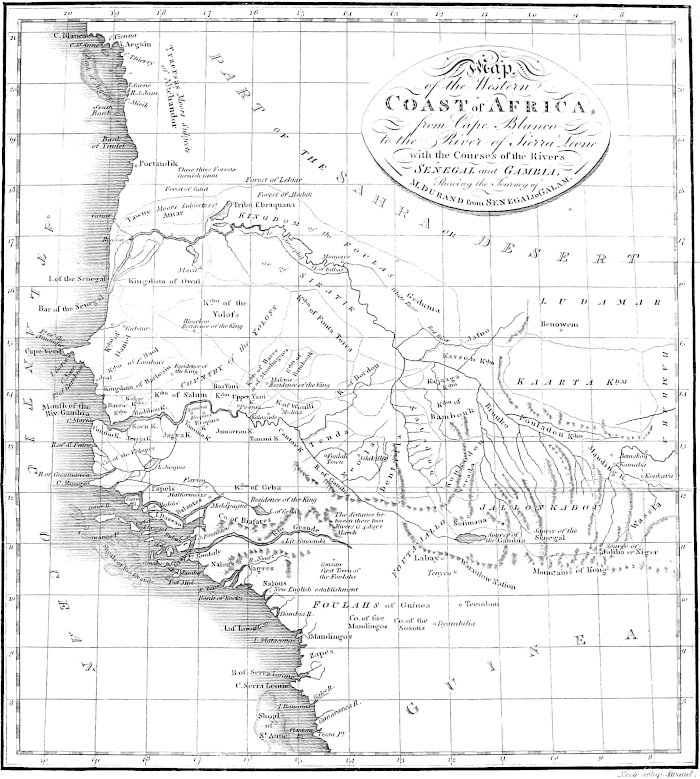
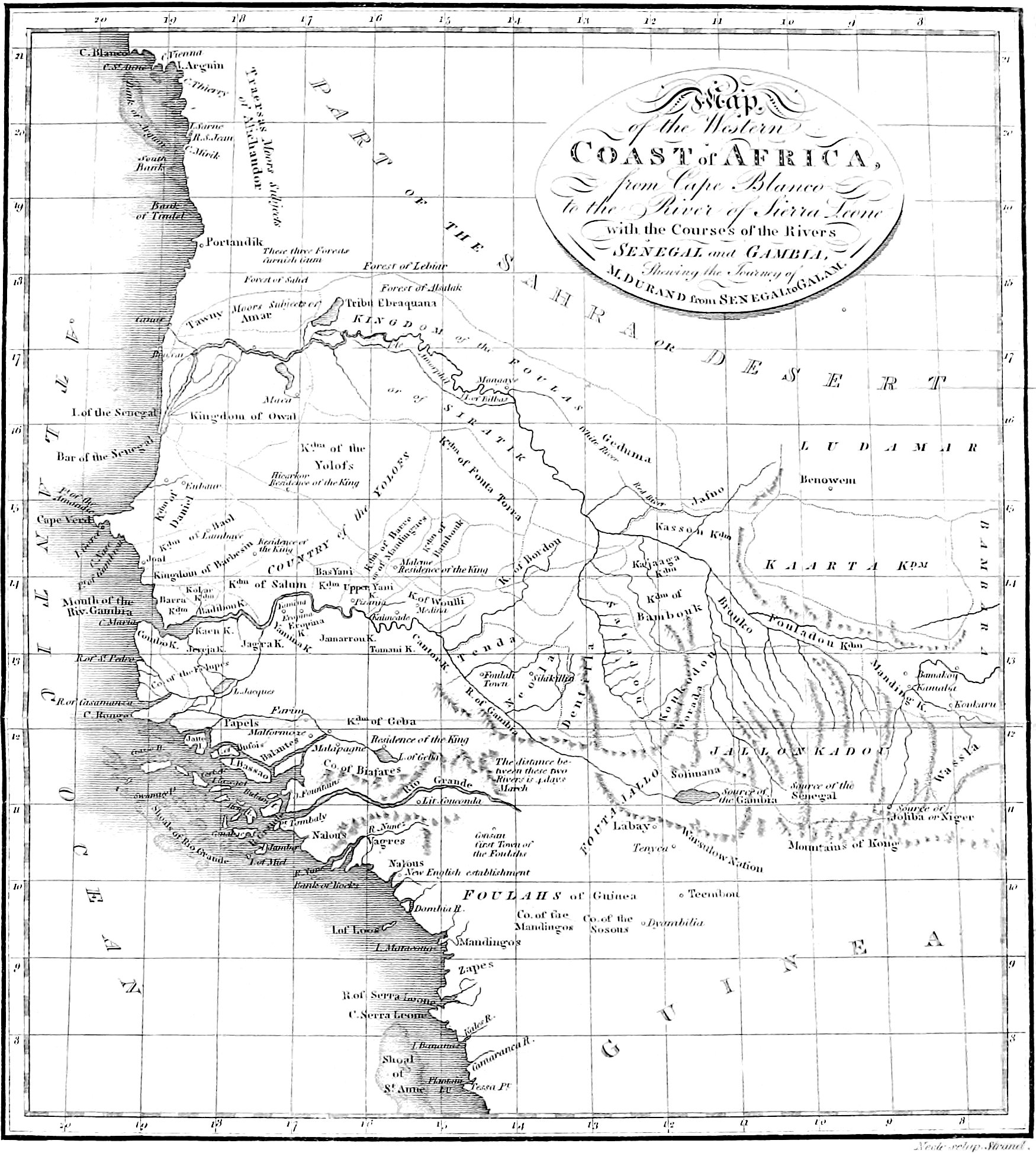
Map of the Western Coast of Africa from Cape Blanco to the River of Sierra Leone with the Courses of the Rivers Senegal and
Gambia, Shewing the Journey of M. Durand from
Senegal to Galam.
Published Sept.
30th 1806 by Rich. Philips New Bridge
Street.
RELATIVE
TO THE DISCOVERIES, ESTABLISHMENTS, AND
COMMERCE
OF EUROPEANS IN THE ATLANTIC OCEAN,
FROM Cape Blanco to the River of Sierra
Leone.
TO
WHICH IS ADDED AN
ACCOUNT OF A JOURNEY FROM
ISLE ST. LOUIS TO GALAM.
BY
J. P. L. DURAND, FORMERLY GOVERNOR OF ISLE ST. LOUIS.
Translated from the French,
& embellished with numerous Engravings.
LONDON: PRINTED FORRICHARD PHILLIPS, 6,NEW BRIDGE STREET, By J. G. Barnard, 57, Snow
Hill.
1806
PREFACE.
SINCE the activity of commerce, and the
necessity of understanding its relations, induced the maritime
powers of Europe to attempt fresh discoveries, all their efforts
have been directed towards the new world. When the most fertile
parts of that continent, and its still more productive isles, were
discovered and explored, the enterprising spirit of navigators
carried them even to the south pole; in short, the most distant and
hazardous expeditions were undertaken, and immense sums were
disbursed to find out a few corners of the earth which were
uninhabited.
While, however, those navigators were pursuing their adventures,
the discoveries which had long before been made, and the
establishments which had been formed in the richest country in the
world, a country most proper for producing colonial goods, and one
situated nearest to Europe, were neglected. That country would
probably have been abandoned altogether, if the necessity of
obtaining for other regions its robust cultivators, had not drawn
many vessels towards the part which exclusively afforded such a
resource.
I allude to the western part of Africa, which, whether on the
shores of the sea, or in the interior districts, is of the greatest
importance in the double respect of agriculture and commerce. It
appears that the ancients were only acquainted with the northern
coast of Africa, which extends from the straits of Gibraltar to the
isthmus of Suez, and with the eastern coast, contiguous to the Red
Sea. The southern part was totally unknown to them; while their
notions of the western coast were very confined, and they did
nothing but sail along it: even this route, which is now so easy,
was to them a dangerous adventure: the Phenicians, Persians,
Greeks, Carthaginians, and Romans, successively attempted to
reconnoitre in this
direction; and it is said, that the Phenicians cleared the pillars
of Hercules, passed the straits, and established colonies and
factories on several parts of the coast. But the accounts which we
have received of all those expeditions, are so replete with fables,
and evident contradictions, that it is difficult to place in them
any degree of confidence.
According to Herodotus, a few Phenicians left the Red Sea during
the reign of Necas, king of Egypt; and after a three years’ voyage,
returned to their country by the straits of Gibraltar, but they saw
only the coast. Eudoxia, to avoid the wrath of Ptolemy Lathyrus,
succeeded in the same enterprise; but no advantage was derived from
her voyage. Satas, in the time of Xerxes king of Persia, and Hanno
and Himilcon, by order of the republic of Carthage, made similar
attempts at discovery, by proceeding from the pillars of Hercules;
but they failed in their undertaking. The Nasamones, or ancient
inhabitants of the kingdom of Tunis, undertook a similar voyage,
though without success. Hence, all those navigators, and many
others who might be mentioned, far from affording us information,
only gave rise to doubts, and prove the general ignorance and fear
which pervaded the ancient sailors. Certain it is, that if such
expeditions did take place, the ships kept at a great distance from
the continent: for we have no proofs of the appearance of these
people, much less their residence, on the coast of the Atlantic
Ocean.
The Romans, who were so ardent in extending their empire, did
not succeed in fixing it on the western coast of Africa. It is
believed that they penetrated from the isthmus of Suez as far as
the Niger, and thence to Mount Atlas. But if they reached this
famous mountain, it certainly stopped their discoveries in that
part of the world: for they thought, that under the torrid zone,
the lands burned, and the rivers were torrents of fire; an opinion
which was long credited, even by the learned men of those times:
and when the Christians, who were the first that presumed to suppose, the countries
under the torrid zone to be inhabited, expressed such an opinion,
they were looked upon as heretics.
The Spaniards, in more modern times, pretended to have examined
all the coasts of Africa, several centuries before the birth of the
Messiah; but they said nothing of the interior, and we must give
them credit for their reserve. They pretended to have conducted to
America the vessels of Solomon and Hiram, when they went in search
of the treasures mentioned in scripture; but this pretension was
seriously combated by the Portuguese, who insisted on the honour of
having made the first discovery of those countries; and with such
obstinacy did the latter maintain their opinions, that the subject
was brought under legal discussion, and a verdict given in their
favour. At this period, some Frenchmen of Dieppe interfered in the
famous dispute, and proved, that they were the first navigators who
had entered the Senegal, and that they had formed establishments on
that part of the coast, long before the Portuguese and other
navigators had made their appearance.
These expeditions of the merchants of Dieppe, took place at the
commencement of the fourteenth century, and from that time they
established themselves on the Senegal, and along the coast as far
as Sierra Leone. In September, 1365, they engaged with some
merchants of Rouen; and the next year they undertook the strongest
maritime expedition which had till then been seen on the African
coast. They formed factories at certain distances, which served as
an asylum for their merchandise and the persons in their employ, by
which the Africans always found a ready market, and the French
vessels constant cargoes. From this beginning were produced the
establishments of the Senegal, Rufisque, Goree, the river Gambia,
Sierra Leone, and two others on the coast of Malaguette, one of
which was called “Little Paris,” and the other “Little Dieppe.” In
1382, they erected forts at the gold mine on the coast of
Guinea, at Agra, and
at Cormentin. The consequences of these discoveries, were immense
wealth, and the best profit was probably that afforded by ivory. In
1392, owing to the violent agitation of France, in consequence of
the civil war and the illness of Charles VI. the commerce of Africa
was entirely abandoned; and the factories for which such great
sacrifices had been made, fell into the hands of the Dutch, the
Portuguese, the English, and the Spaniards. The Portuguese were the
most ardent plunderers, as they were authorised by the Popes, who
conceded to them in perpetuity all the territories which they might
discover from Cape Bojador to the Indies inclusively; they
therefore made several fortunate expeditions, and for a long time
enjoyed a decisive superiority.
Pope Martin V. in the plenitude of his divine authority, very
liberally granted to Portugal, the right of seizing and
confiscating all the property of infidels, in order that they might
have the opportunity of becoming converts, to which he added a
plenary indulgence for the souls of those who might fall in such
pious expeditions. This donation, which was made in 1432, was
afterwards confirmed and augmented by Popes Eugene IV. Nicolas V.
and Sextus IV.; and the kings of Portugal assumed the title of
“Lords of Guinea and the Coast of Africa.”
Spain now became anxious to have a share in the acts of temporal
authority of the sovereign pontifs; and in 1492, Alexander VI.
divided his liberalities, by investing Spain and Portugal with the
territories of the East and West Indies.
The English were slow in their courses, and were restrained by
the express orders of their court, which, out of respect for the
Popes, and consideration for Portugal, would not permit its
subjects to proceed towards the western coast of Africa; nor did
they emancipate themselves from this restriction, till the middle
of the sixteenth century, when being at war with Portugal, they
directed their arms against her establishments, and gradually
succeeded in destroying their power.
The French, who
were the legitimate proprietors, recovered their rights, and
regained several of their ancient possessions; but as these events
took place gradually, and at different periods, I shall not here
describe them, though I ought to say, that we maintained for a long
time by force of arms, the possessions which we had acquired from
Cape Blanco to the Cape of Good Hope; and that the French have
always considered that vast extent of coast, as dependent on their
commercial operations.
It will be equally needless to trace the progress of our
commercial companies in Africa down to the present period. It is
known, that in 1664, the merchants of Dieppe and Rouen sold their
establishments to the West India Company, for the sum of 150,000
livres; and that the new owners, by the extent of their
speculations, had more than they could manage, and were crushed
beneath the weight of their own projects.
The English captured isle St. Louis and Senegal in 1758; the
French regained them twenty years afterwards, and had the
possession ensured to them by the treaty of peace with England in
1783, which also guaranteed to France, the isle of Goree, all the
coast between Cape Verd and the river Gambia, and the factory of
Albreda, situated at the mouth of that river; which, however, as
well as fort James, is in the possession of England.
From the left bank of the river Gambia, which forms Cape St.
Mary, as far as the river of Sierra Leone, the coast belongs
exclusively to no foreign nation; but the French share with the
English, the Portuguese, and all commercial people, the right of
frequenting, and that of forming new establishments on such points
as are not occupied.
Soon after the peace of 1783, it was proposed to create a
company for the Senegal; when the king granted to the Guiana
company the exclusive privilege of the gum trade for nine years;
and this company ceded its new privilege in 1785, to a body
of merchants, who
assumed the title of the Gum Company. By a decree of the council on
the 10th of November, 1786, the king subjected the company to pay
the colonial expences, which were fixed at 260,749 livres; and
granted them in return, the exclusive right of the slave trade,
with an extension of the commerce in gum for three years longer. It
then took the name of the Senegal Company; but being badly
organised, it met with little success, and was abolished by a
decree of the Constituent Assembly in 1791.
Previous to this time, I belonged to the naval department, when
the marshal de Castrées appointed me principal director of the
company at Isle St. Louis. I therefore left Havre on the 13th of
March, 1785, and arrived at my new destination on the 10th of April
following; at which time, M. de Repentigny was governor-general,
and to whom I was particularly recommended by M. Vergennes, the
minister for foreign affairs. This wise and modest officer received
me with the greatest kindness; and we lived together in the most
perfect harmony, till he was succeeded by M. de Boufflers, whose
talents and celebrity were of the greatest advantage to the
country.
My memoirs were begun at Senegal, and terminated at Paris. I
have shewn them to several persons; and the two great authors,
Lalande and La Harpe, have published reflections on my journey to
Galam; in consequence of which, and at the urgent desire of many
friends, I have submitted my manuscript to the press. I shall only
observe, that all the people of Africa are so much alike, that I
have found it impossible to give a just and precise idea of them,
without making what may be deemed repetitions; and as to the style
of my work, I declare that I have no literary pretensions: I have
only occupied myself in describing facts with accuracy and truth;
while my object is to promote the power and riches of my country,
with the hope that the inhabitants of Africa may thereby become
more happy.
VOYAGE TO SENEGAL.
CHAP. I.
CAPE BLANCO AND ITS ENVIRONS. — DANGERS OF THAT
PASSAGE. — BARBAROUS AND CRUEL CHARACTER OF THE MOORS WHO INHABIT
THE COAST. — SHIPWRECK OF M. DE BRISSON. — CAPTURE OF HIM AND HIS
COMPANIONS. — CHARACTER OF A MOORISH CHIEF. — HARDSHIPS OF
CAPTIVITY IN THE DESERTS. — LIBERATION OF M. DE BRISSON AND ONE OF
HIS COMPANIONS.
ON reaching the western coast of Africa,
navigators meet first with Cape Blanco, which is situated in 20° 55
m. 30 sec. lat. and 19° 30 m. long. It is a spot almost circular,
insomuch that, on account of its far projections, it is more
difficult to discover than any other point on the coast: it is
surrounded with dangerous banks, which are with difficulty avoided;
and it derives its name from the white colour of its burning and
arid soil. The next point is Cape St. Anne, which is to the
eastward on the same parallel; the distance from one cape to the
other, is computed at eight leagues. They form between them a large
and deep bay, about twelve leagues north and south, which contains
various mouths of torrents or rivers, in which the sea ascends so
high as to spoil the fresh water, and thus deprives vessels of the
only resource which this part of the coast would otherwise afford
them.
From Cape St. Anne to Salt Cape, the coast runs S. E. for about
six leagues. This cape received its name from a variety of natural
and abundant salt-pits which it contained, and from which, before
the rainy season, a quantity of salt used to be collected. The
Europeans, however, have abandoned them; but it is probable that
the Moors turn them to advantage. About six leagues farther, at the
point called Hof, is another bay as large and deep as the former:
it contains three isles, the largest of which is to the eastward,
and is called Arguin. It is necessary to pass all these capes, in
order to arrive at the French possessions. The coast is uncommonly dangerous for
navigators, on account of the frequent storms and continually heavy
sea; while there are numerous currents which set violently in
towards land, and which prove a new Taurida to such vessels as have
the misfortune to fall in their tracks. The natives, who are
subjects of the emperor of Morocco, are, in every sense of the
word, barbarians, with whom it has hitherto, and doubtless always
will be impossible to trade. They consider wrecked ships as
presents sent them by heaven; enrich themselves by the plunder they
afford, and reduce the unfortunate mariners to the most disgusting
slavery. From this state of bondage, indeed they have not the least
hope of escaping, as they can only regain their liberty by means of
a serious demand on the part of their country at the emperor’s
court; in which case, the monarch compels his subjects to give up
the slaves when they can be discovered, but, to which they do not
consent, without receiving a considerable ransom. We have several
instances of the payment of this ransom, by the emperor of Morocco
himself, when he has wished to make his court to the French
government. Sometimes these savages, in order to avoid the demands
of their emperor, and keep the slaves they have seized on, retire
to inaccessible parts of the desert, where I have good reason to
know that they amuse themselves by subjecting the unfortunate
Europeans to the most shocking torments and cruel death. But
navigators may avoid these dangers by sailing to the westward of
the Canaries.
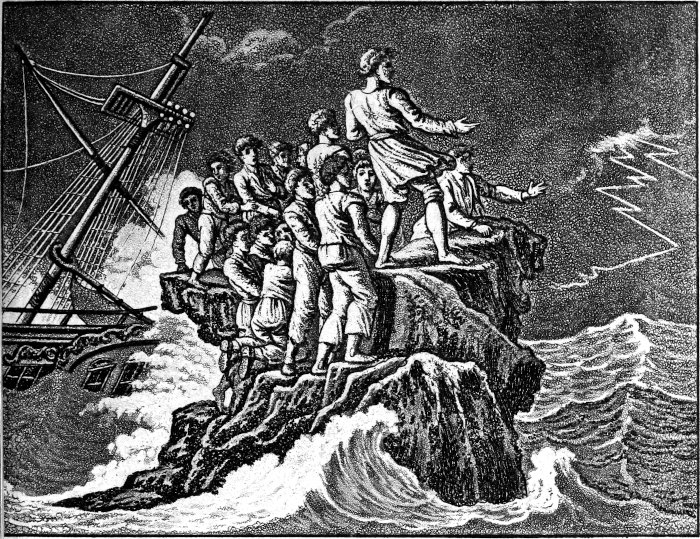
I shall give an account of a shipwreck, which happened on this
coast while I was at isle St. Louis, which will be the best means
of illustrating the dangers I have mentioned, while it will afford
some interesting information relative to the desert which borders
on the Senegal.
M. de Brisson left France in the month of June, 1785, for isle
St. Louis, in a vessel called the St. Catharine, Captain Le Turc.
On the 10th of July following, they found themselves at midnight,
between the coast of Africa and the Canary islands, in a sort of
creek formed by rocks. The captain being alarmed, steered the ship
towards the shoal; and the vessel being driven with great force by
the currents, struck three times, and then remained motionless.
During the whole night, it resisted the attacks of the sea, which
seemed ready every instant to swallow it up; but towards morning
the storm abated, and M. de Brisson, with all the crew, got to
land. But these unfortunate people found themselves on a barren and
unknown country; they ascended the highest rocks, and could
perceive nothing but an immense plain covered with white sand, on
which a few plants were interspersed, similar to branches of coral;
they bore a small seed of the same colour, resembling in size and
shape that of mustard. The Moors call it avezoud, and make a
paste of it, with which they regale themselves. In the distance,
they discovered several hillocks, which, being overspread by a kind
of wild fern, resembled a vast forest.
Shipwreck at Cape Blanc.
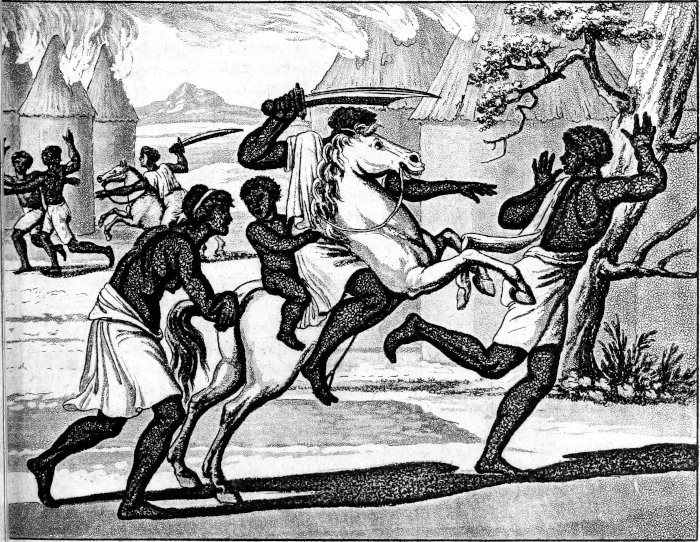
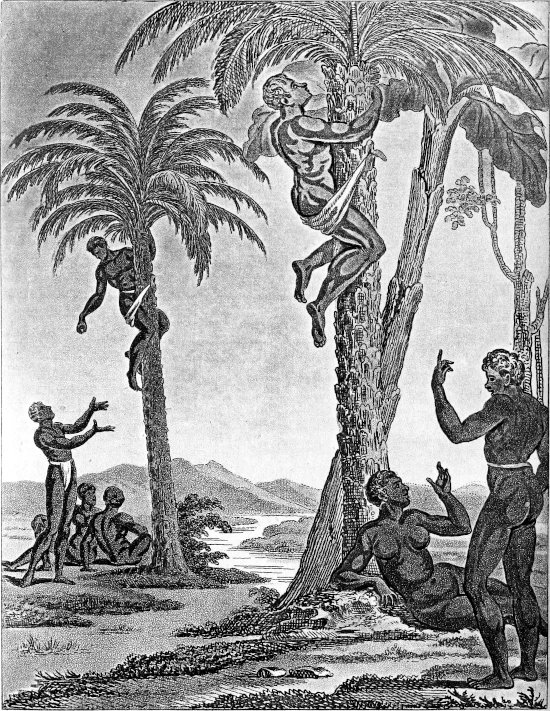
Catching Slaves.
They advanced towards the hillocks, and soon perceived a number
of camels feeding, from which they had no doubt that the
neighbourhood was inhabited. This was a valuable discovery for the
poor mariners, who were almost perishing with hunger and thirst.
Some men who were watching the camels, as soon as they perceived
the Europeans, gave the alarm to a neighbouring encampment, and
they soon found themselves surrounded by Moors, who appeared to be
overjoyed, and made the most dreadful shouts and cries. The
shipwrecked crew not being together, were seized by the collar with
a ferocious eagerness, and immediately stripped; while those who
attempted resistance, were wounded and thrown almost expiring on
the sand.
During this barbarous transaction, M. de Brisson perceived a
Moor unarmed, and from his costume, he recognised him to be one of
those who had accompanied the king Alikouri on a visit which he
paid him at isle St. Louis. He therefore ran and threw himself at
his feet, as did M. Devoize, the second officer of the ship, and
five of the crew who had not left him: but they soon perceived that
they were as unfortunate as their companions; for the Moor received
them with contempt. He asked M. de Brisson in a severe tone, who he
was, from whence he came, and what brought them all there? This
officer answered by drawing on the sand the form of a ship, and by
means of expressive gestures, with the assistance of a few Arabic
words, which he had learned at isle St. Louis, he made him
understand that they had been shipwrecked, and begged his
assistance to conduct them to their destination; adding, that he
possessed the means of rewarding him for his trouble. This last
remark was perfectly understood, and gave great pleasure to the
Moor, who immediately composed his features, and placed his fingers
between those of M. de Brisson, as a testimony that they were
friends, and would be always united. He demanded the effects of
which M. de Brisson had spoken, and received two watches, one of
them a repeater; two chains, a gold stock-buckle, two pair of
silver shoe-buckles, a brilliant ring, a silver goblet and cover,
and 220 livres in specie. The money gave him more pleasure than all
the other articles; he secreted the treasure very mysteriously in
his blue shirt, and promised M. de Brisson that he would never
abandon him. The surrender of this property had induced our
countryman to think that he should gain the kindness of those into
whose hands he had fallen; but it proved to him a source of the
greatest misfortune. The Moor then asked M. de Brisson, at
what part he had been
shipwrecked; and on being informed, he called several of his
fellows, and made a sign to them to follow him. By the manner in
which they approached, M. de Brisson perceived that his protector
was a man of some consideration; and he afterwards learned that he
was one of the priests, whom they called a Talba.
On reaching the sea-shore they shouted with joy; but their
eagerness for plunder soon set them at variance. Several of them
swam off to the remains of the wreck in order to get what they
could, while those who remained behind were afraid that they should
not obtain their share: the women, in particular, became quite
outrageous.
The news of this shipwreck becoming known in the country, the
savages ran towards the shore in great numbers; and their disputes
about the plunder attained such a height that several lives were
lost. The women, enraged at not being able to get to the ship, fell
upon the unfortunate Frenchmen, and partly stripped them naked,
disputing all the time who should possess the clothes of M. de
Brisson, which were better than the rest.
The talba, who had become the master of the ship-wrecked crew,
but who, though a priest, was a warrior by profession, perceiving
that the number of savages increased every instant, found himself
obliged to join with two friends in order to secure the portion of
plunder which he had obtained. The arrangements being made, as well
concerning the share of plunder as that of the slaves, the three
Moors retired from the crowd for the purpose of hiding their booty.
The Frenchmen were conducted to a miserable hut covered with moss,
about a league distant from the sea, where they were crowded
together and rigorously searched in case they might have concealed
some valuables; but nothing being found on them, they were stripped
quite naked, and even robbed of their shirts and handkerchiefs. M.
de Brisson then learned that his master was called Sidy
Mahammet-del-Zouze, of the tribe of Labdesseba, the
most ferocious of any in the desert, and the irreconcilable enemy
of the Wadelims, who are not much better.
After having buried in the sand the treasure which he had
acquired, Sidy-Mahammet returned to the shore to get his share of
the plunder of the ship; and during his absence a troop of Wadelims
attacked the retreat of the Europeans, pulled them out by the
throat and the hair of the head, and then began to fight amongst
themselves for the few clothes which M. de Brisson had about him;
and in their jealous fury they not only stripped him to the skin,
but pursued him behind some heaps of sand, where they knocked him
down, and almost beat him to death. They were preparing a rope to
strangle him, when one of the men whom the talba had associated with him,
came running out of breath, and accused them with having violated
the asylum of Sidy-Mahammet, carried off his slave, and trodden
under foot the sacred book of their religion. He told them that the
priest, indignant at the indecency of their sacrilegious conduct,
had demanded that the old men of both parties should meet to try
the criminals in full council, and that the only means of appeasing
his wrath would be to give up his slave. This menace had a good
effect, and M. de Brisson was immediately set at liberty. The
person who had interfered in behalf of the French officer was
called Nonegem; he conducted M. de Brisson to the place where the
council was assembled, and the trial immediately began; when the
liberator, as avaricious as he was cunning, pretended that M. de
Brisson was a slave of his own, as he had taken him from those who
would have carried him off. He also founded his pretensions on
having seen this Frenchman give his master several articles which
he conceived to be very valuable. These audacious remarks, and
particularly the disclosure of the little treasure, rendered
Sidy-Mahammet furious: he darted at Nonegem a look of rage and
indignation, and exclaimed, “This Christian belongs to me; he came
of his own accord to throw himself into my arms, and I have
promised to protect him and conduct him to king Alikouri. I gave
him my word that I would do so; and I hope the tribunal will give a
verdict in my favour, instead of declaring for Nonegem, who
deserves to be severely punished.” To this Nonegem replied, “As thy
slave cannot be mine, he shall die by my hand.” On which he drew a
poignard to kill M. de Brisson, who stood appalled with terror.
Sidy-Mahammet, however, without expressing the least emotion, threw
over him a kind of chaplet of a considerable length; and then took
up a little book which hung at his waist, when in an instant the
women rushed towards M. de Brisson, took him from Nonegem, and
delivered him over to the enraged priest: for they dreaded lest he
should issue an anathema against his adversary. The whole of the
council immediately applauded the act of authority of the talba,
and approved of the conduct of the women. I should add by the way,
that the talbas, or marabous, always wear a long string, which
contains one hundred and fifteen little black balls, and which they
use as the catholics do chaplets.
M. de Brisson was then taken to his comrades who were in the
vicinity, and whom he found in a pitiable state. They were almost
starved; for during the three days which they had been in captivity
they had had no food but a little wheat-flour spoiled by sea-water,
mixed with some barley-flour, which had for a long time been
preserved in goats-skins. While they were enjoying this wretched
meal, a friend of Sidy-Mahammet came and told them to hide themselves without
delay, as the Wadelims were coming from all parts to carry off the
slaves and treasure. The talba profited by this advice, and they
all hid themselves behind some hillocks of sand, where they
remained till some Moors of the other tribe, who were interested in
preserving their plunder, came to reinforce their comrades. A guide
went before the Frenchmen, and pointed out to them the road they
had to take, by erecting at certain distances little pyramids of
stones. This precaution was necessary in order to avoid the
outskirts of the enemy, particularly those of the Wadelims. Indeed,
these people are so avaricious, that whether friends or enemies
they are equally to be dreaded. At break of day all those who
possessed Christian slaves came with them, and joined the
Frenchmen; when the whole body marched off for the interior of the
country, at which resided the families of their respective
owners.
This journey was to the Europeans toilsome in the extreme: they
were dying with hunger and thirst, by which they experienced such
pain, on moving the tongue, that they were afraid to ask the
simplest question. Being forced to follow the steps of the camels,
whose pace was hastened, they were exhausted by fatigue; and to
avoid being surprised, they made several counter marches, in
consequence of which they were a fortnight in making a journey
which was generally performed in five days.
After climbing mountains of a prodigious height, covered with
small greyish flints as sharp as those of muskets, they descended
into a sandy plain, interspersed with thistles, and here the
cavalcade rested. M. de Brisson having walked till his feet were
excoriated, could proceed no farther; on which his master made him
get up behind him on a camel, whose rough movements caused him to
experience insupportable pain. Being naked, and having no means of
preventing the friction of the camel’s hair, he was soon so chafed,
that his blood ran down the camel’s sides. This was a sight which
afforded much amusement to his master; and the better to enjoy it,
he pressed the camel to a quicker pace. At length M. de Brisson, no
longer able to endure the torture, threw himself down on the sand,
and experienced no other injury than a few scratches from the
thorny thistles.
Towards evening they met their guide and halted. M. de Brisson
being no longer able to move, and suffering all the horrors of
starvation, threw himself behind a bush and implored death; but
they soon roughly pulled him from his retreat to make him unload
the camels. Being, however, tired of his life, he made some
resistance, and knocked down the Moor who disturbed him, on which
the latter ran off and fetched his master, who assured his captive
that he had nothing to fear. This, and many other instances of a
similar nature, prove that the Moors are not insolent, and that they only shew
courage when they meet with no resistance.
The shipwrecked mariners, while sitting beneath the bushes,
perceived some arrangements which made them tremble with horror.
The Moors put a quantity of stones in a brasier, and made them red
hot; they then lifted up a lage stone, and dug a hole in the
ground, occasionally making shouts of laughter, and repeating the
name of Brisson. At length they called him to them, and made him
approach to the hole which they had dug; but what was his surprise
when he saw them draw from the hole which they had just dug, and in
which he thought they were going to bury him, a large skin full of
water, a sack of barley-flour, and a newly-killed goat. His fear
subsided, and the sight of the provisions gave him a new life; he
saw them fill a large wooden bowl with water in which they put a
quantity of flour, and then, by throwing into it the red-hot
stones, they made it boil. By this means they produced a sort of
gruel which they kneaded in their hands, and ate without chewing.
The slaves had for their repast the same steeped flour, and a very
small quantity of brackish water: the goat was reserved for the
next day. The guide who went before them had procured those
provisions in a neighbouring village, and had concealed them under
the stone. M. de Brisson observed, that the resentment of the Moor
whom he had struck was converted into acts of kindness and
complaisance: for this man brought him a larger share of provisions
than was allotted to the others. The meal being finished, each man
laid himself down to sleep behind the bushes.
The next morning as soon as day appeared, a signal was given for
their departure; and M. de Brisson, with the other slaves, were
ordered to collect the camels and load them; after which the troop
set off, and at noon stopped in a plain where there was not a
single tree to shade them from the rays of the sun. Having unloaded
the camels, the slaves were employed in digging up roots to make a
fire; a labour which, in this country, is the more troublesome, as
all the trees, roots, and grasses, are thorny. As soon as the fire
had imparted a sufficient heat to the sand, they covered the goat
entirely with it; and while the slaves were keeping up the fire,
their masters regaled themselves with the raw fat of the animal,
for which they seemed to have a great relish. When the goat was
dressed, the Moors, without taking the trouble to knock off the
sand, ate it with a most incredible voracity, gnawing it to the
very bones, and pulling off the skin which remained on them with
their nails: they then threw the bones to the slaves, telling them
to make haste and get their dinner, that they might reload the
camels.
Towards evening they perceived some tents on a little
eminence, with a few
herds grazing: the inhabitants of this village came in crowds to
meet the travellers; but far from expressing towards the
unfortunate slaves the mild laws of hospitality, they overwhelmed
them with insults, and subjected them to the most inhuman
treatment. Two comrades of M. de Brisson were used with extreme
rigour, and the women were more ferocious than the men. Their
owners made but feeble resistance; for they were very glad that the
people occupied themselves more with the slaves than with the
burdens of the camels. M. de Brisson, who was at a little distance
from his camel, perceived a man who was aiming at his face with a
double-barrelled musket, on which he presented his breast to him
and told him to fire; when the assassin, struck by his firmness,
let the piece fall from his hands. At the same instant he was
struck on the head by a stone, and for a moment lost his senses;
but on recovering himself he burst into a rage, and loudly demanded
vengeance. There needed no more to spread terror through the
village, and the savages who had come to see the travellers took to
flight; one of them, however, before he ran off, gave M. de Brisson
a blow on the breast with his musket, which made him vomit blood,
and the unfortunate man was unable to recognise the fellow who had
injured him; but by complaining loudly he excited the curiosity of
several of those monsters, who asked him a number of questions, and
seemed pleased with his answers.
M. de Brisson, to prove that he knew the king Alikouri, and that
he had been his friend at isle St. Louis, attempted to
imitate the egeums or buffoons, whom that king had in his
suite: by this kind of drollery he so highly pleased his master,
that he made him repeat his mimickry several times, and at last
employed this stratagem to divert the people, who, he feared, would
steal his property. No sooner had he mentioned the talent of his
slave for imitating the egeums, than M. de Brisson was surrounded
by crowds of men, women, and children, who were constantly pressing
him to sing, and for which they rewarded him with a little camel’s
milk.
The travelling party remained one day in this canton; but the
inhabitants, though they had received them coldly, supplied them on
their departure with provisions for three or four days. They
proceeded eastward, and passed over large plains, which were
covered with white, flat, and round flints, but not a single plant
was to be seen; and the horizon appeared to be loaded with a
reddish vapour, which resembled in different parts the flames from
volcanoes. The small pebbles pricked the feet of the Frenchmen, and
produced a sensation similar to the burning of sparks. The air
contained neither birds nor insects; and the silence which
prevailed was so profound, as to produce a sort of terrific effect on the mind. If
by chance a breath of air arose, the traveller immediately
experienced an extreme lassitude; his lips became chapped, his skin
parched, and his whole body covered with painful carbuncles. The
Moors, who had retired to live in these countries in order to avoid
certain tributes which they did not wish to pay, were afflicted by
the atmosphere as much as their slaves; for so inhospitable is the
region, that the most ferocious animals dare not penetrate it.
On leaving this plain they entered another, where the wind had
raised from space to space the sand into hillocks, and the
intervals of which produced a few odoriferous plants, which the
almost famished camels devoured with avidity. They afterwards came
to a valley surrounded by mountains, the soil of which was white
and saponaceous; and here, for the first time, they found some
pools of water: it was very brackish, covered with green moss, and
had a pestilential smell; but such was their thirst, that they
drank it with indescribable pleasure. Towards evening they had the
good fortune to meet with an hospitable horde by whom they were
well received, and who pointed out to them the road which led to
some other villages where they could obtain provisions to last them
for the remainder of their journey. This information was very
seasonable, as their guide had lost his way.
The brother-in-law of the master of M. de Brisson was one of the
chiefs of the burgh, and took particular care of all the slaves: he
sent them a meal of ostrich-flesh and camel’s milk. He appeared
affected at the fate of M. de Brisson, and said to him, with much
tenderness, “Unfortunate Christian! my brother has long been my
debtor; if you will attach yourself to me, I will make arrangements
with him to obtain you.” This proposition, though it affected M. de
Brisson, nevertheless made him tremble, as it indicated a long
captivity, while he flattered himself that his present state would
soon be changed; he therefore sought for his master, and intreated
him not to consent to such an arrangement. “Be easy,” said the
Moor; “you shall not leave me except to go to Senegal or Morocco,
and that shall soon take place.” This assurance gave indescribable
joy to the captive.
They rested three days amongst the Moors of the tribe called
Laroussye, and then continued their journey to the spot at
which resided the families of their conductors. It was not till
they had travelled sixteen days, and suffered the most dreadful
fatigue and misery, that they arrived at the place of their
destination, reduced to skeletons.
At break of day they discovered a village which apparently
occupied a fertile spot. Several tents were pitched under large
shady trees, and innumerable herds were grazing on the
hillocks, which made
them conceive the place to be the residence of peace and plenty.
But this proved an illusion.
The travellers were soon perceived ascending a hill which led to
the residence of the Moors who were approaching; and several black
slaves came to meet them, prostrated themselves, and kissed their
feet. At a short distance the children made the air resound with
shouts of joy; and the women placed themselves erect at the
entrance of the tents to give their husbands a respectful
reception. As the latter approached, the women came forward, and
with a submissive aspect, placed the right hand on the men’s heads,
which they kissed after prostrating themselves to the ground. This
ceremony being over, they looked towards the Christian slaves with
much curiosity, and then insulted them in the most odious manner:
they spat in their faces, and threw stones at them; while the
children, imitating their example, pinched them, pulled their hair,
and tore their flesh with their nails, their cruel mothers
stimulating them to the commission of such injuries.
A division was now made of the slaves; and Messrs. Devoise, de
Brisson, and Beaudré were taken by Sidy-Mahammet. As soon as his
family had done carressing him, M. de Brisson asked which of the
women who surrounded him was his favourite, on which he pointed her
out. The captive then approached her, and presented her with a
double handful of cloves, which her husband had carefully kept for
her, that he might meet with a favourable reception; for these
women are passionately fond of aromatic scents, and that of cloves
beyond others. She received the present with an insulting hauteur,
and then kicked him from the tent. A minute afterwards this
despotic woman commanded the slaves to unload the camels; after
which she set one to clean a sort of kettle, and sent another to
pull up roots for fuel. While she was giving these orders, her dear
husband was fast asleep, with his head on the lap of one of his
concubines.
The unfortunate Frenchmen, though thus condemned to an excess of
fatigue, misery, and opprobrium, nevertheless occasionally
experienced some relaxation, owing to the interference of their
master; but the cruelty of his wife was incessant, and at length
became unbearable. The Moors never inhabit the same place for a
length of time; but when the half-starved herds have devoured all
the pasturage, they change their position, and remove to a spot
which is more favourable. The care and labour attendant upon such
changes were the task imposed upon the French slaves; and from the
frequency of these movements they were absolutely exhausted. One
day Devoise and Beaudré were beaten almost to death, and left
senseless on the sand, because they were unable to perform the
required service. For a long time they were compelled to the dire
necessity of seeking their food along with the cattle; and on these
occasions their only nutriment was plants and live snails.
M. de Brisson was possessed of sufficient strength and firmness
of mind to resist all these hardships; but he was soon subjected to
others. He was compelled to harness the camels to the plough, to
attend to the tillage and sowing of the lands; and his master, when
he had finished his own jobs, would let him out to other Moors for
a portion of milk. He would infallibly have fallen under the
fatigue, if some hope of liberty had not remained with him, and if
he had not been enabled occasionally to steal some barley and
mutton in addition to the small quantity of food which they allowed
him.
The unfortunate M. Devoise being older, and not so strong in
constitution, could not long withstand such hardships. Every day he
prayed for death, who at length came to his assistance. This
gentleman was the brother of the present French commercial
commissioner at Tunis. I was on terms of the strictest intimacy
with him; and when I heard of his shipwreck, I sent to the deserts
with the most pressing requests that he might be delivered up; but
all my endeavours were unsuccessful. M. de Brisson paid him the
last duties of humanity. Beaudré also died, and his body was
devoured by ravens and serpents.
M. de Brisson at length obtained the permission of his master to
write to Mogador, which the Moors call Sovia. He addressed his
letter to the French consul, and gave a melancholy account of the
hardships he suffered. It was conveyed by a Jew, who travelled
through that part of the desert; for the Jews who are born in the
desert live on good terms with the Moors, and adopt nearly the same
customs; but the Jewish inhabitants of the towns being more rigid
observers of their religious maxims, receive far worse
treatment.
A second favour more important than the first occurred by
chance. Another Sidy-Mahammet, who was sheriff of the tribe of the
Trarzas, had occasion to pass through the place where M. de Brisson
was enslaved, and they recognised each other. The sheriff spoke so
highly of him to the brother-in-law of his master, Sidy-Sellem,
that the latter, who was naturally humane and compassionate, made a
second attempt to purchase him, and the bargain was at length
concluded. The price of his transfer was five camels.
Sidy-Sellem was the first who informed M. de Brisson of the
change, which was soon confirmed by his former master, and they
separated on the best terms. M. de Brisson, on returning with his
new owner, met with a companion of his misfortune, who had been
baker to the wrecked ship, and they travelled together under the protection of
Sidy-Sellem. Their master had given them a camel to ride on without
a saddle, and they proceeded in this manner for some days; but the
motion of the animal was so fatiguing, that they were obliged to
quit it and travel the rest of the way on foot.
This journey was difficult, but much less so than the former, as
their master took them through villages where water was plentiful,
and the people were more feeling. M. de Brisson, however, had a
shocking rencontre with some Moors of the tribe of Telkannes. They
fired two muskets at him, but which luckily missed him. Two Moors
then seized him, and were about to carry him off, when Sidy-Sellem,
who was some distance behind, came forward on the report of the
guns, and loudly complained of the outrage; but the Moors told him
that they had taken the slave for a thief who had run away,
Sidy-Sellem pretended to believe them, and the travellers continued
their journey.
The Moors of this tribe are the worst off of any in the desert.
They live amongst hills which are formed entirely of sand raised by
the wind; and it is so difficult to penetrate into their retreats,
that it is a common saying, that they endeavour to conceal
themselves from the rays of the sun: the plains in the
neighbourhood contain great numbers of enormous serpents, which do
not permit the cattle to approach them.
At length our travellers reached the town of Gouadnum,
which is the refuge for all the rebels of the desert: it is divided
into two parts, each of which has a governor; but the only
superiority between them is that which is given by fortune, All the
houses are built alike, and receive their light from the door and
the roof, which is uncovered. Four large walls surround the space
which contains the houses; and the whole circumference has only one
gate, which is guarded by large dogs. Each individual has also a
dog for his own security, because they have as much to fear from
their neighbours as from strangers. The town, however, carries on a
considerable trade, and has several markets which resemble our
fairs. They have for sale great quantities of the most beautiful
wool, and fine woollen stuffs, of which they make their cloathing.
The merchants who carry them into the interior of the country give
in exchange camels and gold from the mines of Bambouk: they also
receive for those articles wheat, barley, dates, horses, tobacco,
salt, gunpowder, combs, mirrors, and other articles of hardware.
This commerce is chiefly carried on by Jews, who are exposed to the
most outrageous insults, which they nevertheless bear patiently, on
account of the great advantages they derive from the traffic, and
the pleasure they experience in cheating the Moors.
Our travellers remained eight days at Gouadnum, From thence to Mogador they met with
nothing but villages, and castles built on the summits of high
mountains. At a distance these look like superb palaces; but on
approaching them, their walls are found to consist of nothing but
mud, and are built in the most shapeless and disgusting form. They
were now not so well fed; and the nearer they approached to a town,
the less hospitality they received.
At length, after a journey of sixty-six days, they arrived at
Mogador, where Messrs. Dupras and Cabannes came to them, and
without being disgusted at their revolting appearance, assured them
that their misfortunes were at an end. They took with them
Sidy-Sellem and his son, and their house became the asylum of the
whole.
The same day M. de Brisson and the baker were presented to the
governor of the place, who informed them that they must proceed to
Morocco, as the emperor desired to see all the Christian slaves,
and give them their liberty.
Mogador is advantageously built; the batteries are strong, and
have a cannon at each embrasure; but the mouth of the cannon rests
on the bottom of the aperture, so that the pieces can be of no use
but for shew. It is the same at Rabat, Salep, and Tangier; the
emperor having neither workmen capable of mounting them, nor timber
fit for making the carriages.
Eight days afterwards Sidy-Sellem and the party set off for
Morocco: they were furnished with mules, a tent, provisions, and
men to wait on them; and after a journey of four days they reached
the capital.
The city of Morocco is every thing but handsome; the houses are
of clay, and in the style of those of Gouadnum, but lower, more
dirty, and close. The streets are covered with filth of every kind,
including the bones and offal of the cattle that are killed. The
emperor’s palace is of the same kind as the other buildings, being
of clay, and surrounded by walls: it consists of six vast squares.
The mosque is built in the same manner, and the whole of the palace
has a disgusting appearance.
The unfortunate captives repaired to the house of the French
consul-general, where they were to remain till they could be sent
to France; they were afterwards taken before the emperor, whom they
found sitting in a sort of coach body. He looked at M. de Brisson
for some time, and then told him that he had been wrecked through
his own fault, by not keeping far enough from the shore. He then
asked for ink and paper, and traced with a reed the four principal
points of the compass to indicate that Paris was northwards; after
which he scratched about a dozen Roman characters, and gave the
paper to M. de Brisson, asking him if he could read it? On
repeating a few other questions to shew how well he was informed, he added, that the
rebels of the desert had ill-treated him, and desired to know what
they had taken from him. M. de Brisson told him all that had
happened; on which he said, “I do not command in the country where
you have been taken, that is the people are beyond my authority.”
He wished to know how M. de Brisson had got to his capital; and on
being told, he ordered Sidy-Sellem to be brought before him. He
asked him, if he had given a high price for the Frenchmen, and what
he intended to do with them. To which Sidy-Sellem replied, that he
had no other intentions than to prostrate himself at the feet of
his sovereign, and do the homage of a slave. He then enquired,
whether the Wadelims and Lebdessebas had any other Christian
prisoners. Sidy-Sellem, in the most submissive manner, answered,
that there were several whom he could easily collect, if the
emperor would give him orders. The emperor, however, dropped the
conversation; but he ordered the Frenchmen to be guarded for the
present, and supplied with provisions from the royal kitchen.
The next day the consul claimed them, and they were given up.
The emperor does not supply the ambassadors or other foreigners in
his capital with any household furniture, though he assigns them a
residence, and distributes to them a certain number of oxen, sheep,
poultry, and a quantity of bread.
The inhabitants of Morocco are almost white, and are not quite
so barbarous as those of the desert, which, perhaps, is only owing
to the presence of the emperor. One day M. de Brisson rode out on
horseback with the French consul and American envoy: they were
followed and pressed hard by the mob, till at last they were
obliged to dismount, although escorted by a guard; without this
precaution their lives would have been in danger. M. de Brisson was
struck on the head by a stone, and it was impossible to discover
the offender.
A few days afterwards the emperor again ordered the slaves
before him in the court where he gives his public audiences. He was
sitting on a beautiful charger, caparisoned with blue and scarlet
cloth covered with gold fringe. Beside him was a squire or prince
holding a long pole, on the top of which was a parasol to shelter
his majesty from the solar rays. Behind him stood the body guard in
the most profound silence. The looks of the emperor seemed to
spread consternation around him: indeed, he is always preceded by
terror; for he orders the heads of several of his subjects to be
struck off, and beholds the execution with the most perfect apathy.
His will is a law, and is executed instantaneously; but when a rich
criminal purchases his pardon, he is never put to death, whatever
may be his crime. At this audience the Frenchmen were permitted to
depart.
M. de Brisson and
the baker embarked for France; and Sidy-Sellem retired well
satisfied with the generosity of the consul.
CHAP. II. — PORTENDICK.
ISLE OF ARGUIN. — PORTENDICK. — HISTORICAL ACCOUNT
OF THE DIFFERENT NATIONS WHO HAVE OCCUPIED THOSE PLACES. — EUROPEAN
COMMERCE AND FISHERIES. — CAPE VERD. — GOREE, ITS POSSESSION BY
EUROPEAN NATIONS. — ACCOUNT OF THE MANNERS AND TRADE OF ITS
INHABITANTS.
THE ships which leave Europe for the
establishments in the Atlantic ocean, along an extensive coast of
about three hundred and fifty leagues, cannot relay more
conveniently in Africa than at the isle of Arguin, at which their
commercial operations may be said to begin. The most safe anchorage
is at the southern point, where vessels that draw only ten or
twelve feet water may approach very near to land. Between the isle
and the continent is a canal in which vessels of heavy burden, and
even frigates, may anchor at the spot on which formerly stood the
fort. When the Dutch took the place, they regularly fortified it,
and built a fort with four bastions and deep fosses. In short, they
neglected nothing that might enable them to keep perpetual
possession of the isle, but this fort has disappeared; and of all
their works there only remain two cisterns, which seem to have been
respected both by time and men. The largest is ten fathoms wide,
sixteen long, and about fifteen deep, and is about two hundred
fathoms from the part containing the remains of the face of the
fort. It appears to have been dug in the rock. In the midst of this
spacious vault is a large well fifteen feet deep, in which all the
waters unite, whether they proceed from springs or filtrate through
the rock from the soil which covers it. It is asserted that the
cistern contains five thousand six hundred muids of water. The
smaller cistern is to the north of the first, and is an artificial
vault dug like the other by the hand of man, with the assistance of
explosion. The capacity of the parts which receive the water is
estimated at half that of the cistern first mentioned. These two
cisterns were formed by the Portuguese between 1445 and 1481, when
after the fall of the Norman company they first occupied the isle
of Arguin.
Portendick is a bay about half way between Arguin and isle St.
Louis. Its entrance is very difficult, being closed by two sand
banks, which have only two or three fathoms of water;
but in the middle
between the two banks is a passage from 70 to 80 fathoms wide, and
six deep, by the north bank; and from seven to eight on the south.
On proceeding some distance you discover another pass, which cuts
the northern bank at about one third of its length, and contains
about five fathoms of water. The bay is only six fathoms deep; the
bottom is uneven, and it is impossible to remain long here during
the greater part of the year, on account of the heavy sea and
breakers which are driven in by the wind. The Dutch have erected a
wooden fort at Portendick, for which all the materials were
prepared at Amsterdam.
Arguin and Portendick have been disputed by several European
nations with inconceivable rancour. The Portuguese were driven from
them, after possessing them two hundred years, by the Dutch, who
took the isle and fort of Arguin in 1638; but in 1665 they were
captured by the English. The Dutch, however, retook them in the
following year, but lost them in 1678, after sustaining an
obstinate siege from the French. The French destroyed the fort,
carried off the artillery, with every thing else that was worth
removing; but the possession of the isle was secured to them by the
treaty of Nimeguen, concluded between France and Holland 1678.
The loss of this factory did a serious injury to the Dutch
merchants, and they resolved to retake it; but fearing to violate
the treaty, they attacked it in 1685, under the mask of the flag of
the elector of Brandenburgh, who had become king of Prussia. They
then restored the fortifications, and kept the isle during the war,
which began in 1688 and lasted till 1698, when it was terminated by
the treaty of Ryswick. This war enabled the Dutch to renew their
alliances with the Moors; and the latter, who were engaged in the
negociations, had their warehouses near the cisterns.
The French company in 1721, fitted out a squadron at L’Orient
and Havre, to retake that valuable possession. It consisted of
three ships of war, a frigate, and three sloops, with land forces;
the squadron was commanded by M. P. de Salvert, who landed, and
finding the Dutch disinclined to surrender, erected batteries to
attack the fort. He was given to understand, that the Moors, who
were then numerous, were determined to assist the Dutch, and perish
to a man, rather than surrender the place. After a vigorous
bombardment, the Moors finding themselves incapable of farther
defence, retired during the night, and passed over to the
continent.
The French entered the fort by the same ladder by which the
Moors had left it. They found in it only two negroes, an old female
Moor, and two children belonging to M. Both, the former French
governor of Arguin. The Dutch governor, M. Jan de Wine, voluntarily
followed the Moors, who took with them prisoners to the continent,
several Frenchmen who resided in the fort; they also carried along with them all
the merchandise. The French repaired the breaches, and M. J. du
Bellay, who had been appointed governor of the Settlements,
transferred the command to M. Duval, and embarked in the squadron
for isle St. Louis. Duval was of all others in the service of the
company, the least proper for such a command; he was a violent man,
cruel in prosperity, and cowardly and irresolute in adversity. The
Moors had been informed that they might come back to Arguin, and
would be well received, as it was a matter of much consequence to
attach them to the French interest. Duval, however, counteracted
these orders, and was guilty of the blackest perfidy.
The Moors returned with confidence, when this infamous governor
ordered them all to be massacred. Their bodies were cut in pieces
and exposed in different parts, as an example to their countrymen
of the treatment they were to expect.
After this horrible execution, no accommodation with the
irritated Moors could be hoped for; and the Dutch did not fail to
keep up the resentment of those people towards the French. In the
mean time, the Moors and pretended Prussians had retired to
Portendick. Duval was superceded in his command; and the Moors
having landed on the island in concert with the Dutch, they gained
possession of the cisterns, and seized on M. Leriche and four other
Frenchmen, who had been sent to them with a flag of truce; and
after springing a mine, which injured the fortifications, they
compelled the French to surrender the fortress on the 11th January,
1722, when the latter were obliged to solicit the protection of the
Dutch, to prevent the Moors from cutting their throats. The captors
acquired on this occasion an immense quantity of merchandise.
Shortly before the surrender, a French vessel was stranded about
five leagues from Arguin, and the crew, eight in number, having
effected a landing, were seized by the Moorish chief Homar, and
instantly put to death. Duval became the victim of his atrocity and
imprudence; for Homar meeting with him off Cape Blanco, as he was
returning home, boarded his vessel, cut off his head, and put to
death the whole of the crew, sixteen in number, Duval not making
the least resistance.
This sanguinary warfare lasted for some time; the Moors revenged
the outrages they had suffered; and the Dutch obtained a momentary
triumph.
It would be useless to trace the various operations which were
incessantly carried on against these two possessions. M. de Salvert
in 1724, re-acquired possession both of Portendick and Arguin;
since which, the Dutch have not appeared as enemies in that
quarter.
The result of this statement is, that every nation which has
endeavoured to
establish itself at Arguin and Portendick, had no object but to
share or monopolize the gum trade, which the French, who were
firmly established in the Senegal, wished to concentrate amongst
themselves. Indeed the gum trade with the Moors, was the most
important of the operations which took place in those roads. The
forests of gum trees are at no great distance from the shore; and
the trade likewise consisted of gold, elephants’ teeth, oxen,
sheep, raw hides, and ostrich feathers; besides which, it is
asserted that ambergrease was formerly found in considerable
quantities. But though I made and caused to be made the most
vigorous researches, I could never obtain any. M. Pelletan, my
successor, was more fortunate, nevertheless he mentions only a
single instance in which he found it; and that was in a different
part of the coast; which proves at least that this substance is
very scarce.
The fisheries on this part of the coast are very abundant. All
the capes, as far as the mouth of St John river, afford shelter to
multitudes of fish, which find plenty of nutriment. Indeed these
gulphs are like so many vast ponds completely stocked, with the
only difference that they cannot be exhausted. The Europeans derive
much advantage from these fisheries, which afford them a number of
seals: the fish forms the chief subsistence of the garrisons, and
are exchanged with the Canary and Azores islands, as well as with
the Moors on the coast of Guinea. The green species of turtle also
delights in these roads, and the shell is much sought for in
commerce.
When the French directed their commercial operations to the
Senegal, they abandoned the fisheries.
About 30 or 35 leagues from Portendick, and in 15° 15 m. lat.
you arrive at the mouth of the Senegal. To reach Goree, either from
Europe or from the Senegal, it is necessary to pass Cape Verd,
which is the most western point of Africa; its elongation into the
sea, makes it a vast peninsula. The soil is good, and covered with
fine trees: it is fit for all kinds of cultivation, and is
fertilized by several rivulets; all which render it very desirable
for the establishment of the colony. Its trees being always green,
have given rise to its name, as it is distinguished by its
appearance from all the other capes on the coast, which are dry and
barren. The bay of Yof forms a considerable space between the point
of Barbary and Cape Verd; and the currents set violently into this
bay in a S. S. E. direction.
The approach of a ship towards this cape is known by two
mountains, which are called the Breasts, from an idea that they
resemble those organs in form. As soon as they are perceived,
precaution must be taken to avoid a rocky point, which projects
about two leagues into the sea, and which causes the ships
to make a
considerable offing to the S. W. in order to double it: they are
obliged to do so, till the two Breasts appear on the same line, so
that one obscures the other. Thus you arrive at Cape Verd, on
doubling which, you reach Goree, at a distance of two leagues. This
cape, from the two Breasts to Cape Bernard, was ceded to France by
two treaties in 1763 and 1765, between the king Damel and the
governor of Senegal, as well as the villages of Daccard and Bin,
from which the inhabitants of the isle of Goree derive their
subsistence.
The passage from the Senegal to Goree is made in about
twenty-four hours; but the return is generally longer, from the
opposition of the winds and currents. It sometimes even takes a
month to return this short distance. The island received its name
Goree, which means “Good Road,” from the Dutch, who
obtained it in 1617 by treaty, from Biram, king of Cape Verd. They
built a strong fort upon it on a steep mountain to the N. W. and
another which commanded the creek, and secured their magazines. The
Dutch enjoyed their acquisition till 1663, when it was taken from
them by the English, to whom this conquest was the more important,
as they had established themselves in the river Gambia: but next
year they were expelled from the isle by the Dutch admiral de
Ruyter, who attacked them with a powerful squadron. The French took
it from the Dutch in 1677, by which time the latter had put it into
an excellent state of defence, and mounted the batteries with
forty-two pieces of cannon. From that time to the present it has
often been contested; and fallen into the possession of the
English, French, and Dutch. The English possessed it during the
last war. The government of the island when the French retained it,
was the same as that of isle St. Louis; and the religion, manners,
and customs of the inhabitants of both places are nearly
similar.
CHAP. III.
FARTHER REMARKS ON GOREE, AND COMMUNICATION FROM IT
TO THE SENEGAL. — KINGDOMS ON THE COAST OF GOREE, VIZ. CAYOR, BAOL,
SIN, AND SALEM. — CURIOUS PARTICULARS OF A RACE OF NEGROES. —
JOURNEY FROM GOREE TO SENEGAL, &c.
THE commerce of the isle of Goree, extends from
Cape Verd to the kingdom of Salem, about seven leagues from the
mouth of the Gambia; but there is no establishment on that part of
the coast. The three factories of Rufisque, Portudal, and Joal are
abandoned, the French administration of Goree merely keeping as
residents, while they had the island, an inhabitant and a
negro, who relieved
each other alternately, and whose business was to treat for
provisions. An establishment was projected at Cahone, a village
belonging to the kingdom of Salem, nearly at the part where the
river Gambia divides into two branches, the most northerly of which
takes the name of Salem. It would have been very advantageous, as
the Mandingos, from the kingdoms of Tombuctoo, Bambara, and the
other states to the eastward, come to Cahone with their
merchandise. It was not carried into execution; but it is evident
that such an establishment would at any time be of the greatest
advantage, as it might receive the commerce which formerly existed
between Goree and the numerous isles formed by the river of Salem.
Some inhabitants still go to trade at that river, and always turn
their merchandise to the best account. It was on the banks of this
river, that the famous lump of ambergrease was found, which M.
Pelletan acquired; I will give an account of its discovery.
An inhabitant of Goree, named St. Jean, a well informed man, one
day observed his negroes employed in careening their canoe, with a
substance which they had melted, and of which they neither knew the
nature nor the value. St. Jean discovered it by the smell, and
caused what remained of the lump to be carried home. The whole had
weighed upwards of a hundred pounds. To shew that this branch of
commerce might become very important, I shall only observe that M.
St. Jean sold the substance at from nine to ten francs per ounce,
and it was resold in France for thirty-six francs.
Besides the means of commerce which Goree might have on this
coast, it has opened a communication by land with Senegal. The
distance between those two establishments is about forty leagues,
but it is commonly made in five or six days; and the journey used
to be one of pleasure to the French merchants, who went in parties,
carrying with them provisions and tents for encamping on the most
agreeable spots. The route is now so well known, that a sort of
barracks have been built as an asylum for travellers. The greatest
difficulty on the journey is that of procuring water, which it is
necessary to carry with one, though wells have been dug at
different distances. Milk, however, may always be procured in great
quantities and at a cheap rate.
About half way up Cape Verd is a large lake, the water of which
is brackish, though formed by a rivulet which is perfectly fresh.
It is difficult to explain the cause of this singularity. Some
suppose that the bottom of the lake consists of a nitrous earth,
which communicates its flavour to the water; while others think,
and perhaps with more reason, that the sea water filtrates through
the ground, and mixes with that of the lake. But whatever may be
the cause, it is remarkable that the water agrees equally well with
sea and river fish. The negroes take immense quantities of fish between Capes Verd and
Manuel, where the lake empties itself into the sea; and the vast
flocks of birds, which live on its banks, also devour quantities of
fish. Amongst the birds is a species which seems to belong to the
falcon tribe: they have a brown plumage, with some white feathers
at the neck and extremities of the wings . Their beak is thick and
curved like a sickle, so that the fish which they take cannot
escape. They have short thighs and claws; and the latter are armed
with strong and sharp nails. They fly easily, and keep themselves
for a considerable time on the surface of the water with the head
inclined. When a fish appears they dart upon it, and carry it off
to devour amongst the reeds. They have been sometimes shot, but
they cannot be eaten, as their flesh has such a rank and fishy
taste, and is full of oil. Near this lake, and in several parts of
the route lately mentioned, are numbers of trumpet birds, whose
notes resemble the sound of that instrument. They are black, and of
the size of a turkey-cock, to which they are nearly similar in
shape. Their lower beak is hollow and sonorous; and it is by this
that they produce the sound described.
The lake just mentioned is named after the Cereses or Serays,
some tribes of negroes who inhabit its banks: they form, as in
every other part where they establish themselves, a sort of
democratic republic, without knowing the principles of that kind of
government; but following in this case their instinct and wishes,
they never choose to acknowledge any master. They live in a
complete state of nature, without any other rules than what she
inspires: they have no idea of the divinity, and are persuaded that
the soul dies with the body. They go almost entirely naked, speak a
particular language, which differs from that of all their
neighbours, and never intermarry with the other negroes, whom they
dislike to such a degree, that they seem to be as averse from
trading with them, as they would be from a contagion. One of the
principal traits in their character is the resentment which they
bear for offences, which they never pardon: and if they do not take
vengeance themselves, they transmit their hatred to their children,
and it subsists in the family till reparation be made for the real
or supposed injury. In other respects they are a good kind of
people, mild and simple in their manners, and hospitable even to
officiousness. They give a particularly kind reception to the
whites who pass through their country, carefully cultivate their
lands, and raise a great number of cattle.
They have a great respect for the dead, whom they inter without
their villages, in round or square spots, like those which they
inhabit. After exposing the body on a bed they plaister the stakes,
which form the square of interment, with a kind of clay, and also
encompass it with a wall about a foot thick, which ends in a pointed roof, and incloses
the spot. This collection of burying grounds resembles another
village, and is often larger than the inhabited one to which it
belongs. These people do not know how to write; but to distinguish
the bodies which rest in these little huts, they put a bow and
arrow on those which contain the men, while the women’s sepulchres
have at top a pestle and mortar, being the instruments which they
use to pound their rice and millet. In other respects, as they
marry amongst each other, and thus form only one family: they have
no object in transmitting to posterity the names of the dead or
their parentage.
The route from Goree to Senegal is in general woody, and the
woods contain many banyan and latane or palm trees. The fruit of
the former, and the wine of the latter, are too well known to need
any description. There are also great numbers of a shrub, whose
leaves resemble those of the pear-tree, and have an aromatic
flavour combined with the smell of the myrtle: it communicates its
delicious flavour to the flesh of the cattle, which feed on it in
preference to any other vegetable. There is likewise a tree which
is called the soap-tree: its fruit is of the size of a small
walnut, and the negroes, who use it to wash the cotton cloths which
they wear round their waists, beat it between two stones to
separate the nut from the shells; and it is with the latter that
they rub what they are about to wash. It dissolves easily, and
completely cleanses the cotton, but burns the cloth: this
circumstance, however, though serious to the wearers, is of great
advantage to our commerce, which supplies them with such
articles.
In some parts they cultivate tobacco upon a large scale; for the
negroes, though they only use it for smoking, consume vast
quantities. They merely bruise it when ripe, and make it into
bunches; and notwithstanding this slovenly way of preparing it, the
flavour of it is tolerably good.
In the journey to which I have alluded we meet with no dangerous
animals, excepting serpents, which are both large and numerous,
being sometimes from fifteen to twenty feet long, and a foot and a
half in diameter. It is asserted that these are less dangerous than
the small ones, which are but two inches thick, and four or five
feet long: it is, however, remarkable that the human species are
very seldom injured by these reptiles. To observe the sang
froid with which the negroes let the serpents enter the hovels
to creep about, hunt the rats, and sometimes the fowls, without
feeling the least alarm at their appearance, one would suppose that
there was a reciprocal contract between them to live together in
harmony. Nevertheless the negroes are sometimes bitten by these
animals, on which occasions the remedy they apply is the actual cautery. When they
happen to possess gunpowder, they cover the puncture with it and
explode it, which produces a scar that draws out the venom. These
accidents, however, are not frequent, and the negroes in general do
not appear to apprehend them. The Cereses, on the contrary, dread
the serpents, and keep them from their habitations as much as
possible; indeed, they are continually at war with them, lay snares
for them with much adroitness, and, on finding them, eat their
flesh, which they think very good.
The serpents have other and still more terrible enemies, which
are the eagles that abound throughout the country: they are of the
same species as those in Europe, but far superior in size and
strength.
We also meet in the journey above described numerous hordes of
elephants; but they do no injury, nor ever disturb travellers: and
likewise with parties of apes, who amuse by their watching and
singular antics. There is also an aquatic animal sometimes found
which the Cereses call bourba. This animal is something
between the bear and the hog: its hair is short, thin, and whitish;
and its feet have tolerably strong and pointed claws, which it uses
to climb up trees like the bear. Its head is more like the bear’s
than the hog’s; and though wild, it has not a terrific aspect. Its
eyes are small and half closed, notwithstanding which it is very
active. Its mouth is large and furnished with long and sharp strong
teeth. It lives almost constantly in the rivers, notwithstanding
which it is ascertained to be amphibious: its size is equal to that
of a hog about a year old; and its flesh is fat and succulent.
Several persons have published their accounts of this little
journey, and they all agree in stating that it is easy and
agreeable. Indeed, I never heard of the slightest accident
happening to those who performed it. The travellers arrive
unfatigued at the village of Gandiolle, which is situated at the
mouth of the Senegal, where they embark in canoes, and proceed to
isle St. Louis in two or three hours, ascending the river by means
of their oars.
The coast on which the commerce with Goree is established, as
has been specified in the preceding passages, is divided amongst,
and governed by, four negro kings. The most important and
considerable of these states is that of Cayor, which is worthy of
particular attention on account of the influence which its king,
named Damel, has had in the success or disasters of the French
establishments in this vicinity.
The kingdom of Cayor begins in the province of Toubè on the
continent, and is about six leagues distant eastwards of Senegal,
from which it is only separated by some marshes and the isle of
Sor. It extends along the sea as far as the village called
Grand Brigny, the
frontier of the kingdom of Baol. Its continent is only a short
league from Goree, but it stretches nearly sixty leagues in the
interior. It was joined to the dominions of the provinces of Baol
in 1695, after a sanguinary war, in which the latter were
conquerors, and possessed both states to the year 1717. The king
gave himself the name of Damel, which is the particular appellation
of the king of Cayor; but at the death of Tinmacodon, the
inconvenience arising from so great an extent of country being
under one governor was seriously felt, and the kingdom was again
divided, when Amarizone, brother to the deceased monarch, ascended
the throne of Baol.
The royal family of Cayor is called Bisayou-ma-Fatim. The king
who at present reigns was not the first in the order of succession,
but was elected; but he was elected without any intrigue on his
part: he took the title of Damel, and established his common
residence at Guiguis, a village about thirty leagues from Senegal.
After his election, the great people came to pay their homage to
him, and all the ceremonies usual in such cases were scrupulously
attended to: they prostrated themselves at some distance from the
king’s feet without any other clothing than a simple piece of cloth
round the loins; and afterwards, on approaching, they bent the knee
three times before him, putting at each declension a handful of
sand to their foreheads. The marabous or priests were exempted from
these humiliating ceremonies; and on coming to acknowledge their
new sovereign, they merely took the oath of fidelity, which was
administered by himself.
The order of succession to the throne is regulated as follows:
The brothers of the king succeed him by seniority; and the children
of the deceased prince only ascend the throne when there are no
brothers to take possession of it, a circumstance which very rarely
happens; but when it does, the eldest son takes precedence. The
first wife is the queen; the prince marries her publicly, and the
festival lasts three days; nearly all his subjects attend it and
make him presents. The children by this marriage are the legitimate
children, and natural heirs to the throne; and after them the
children by the second wife have the right, as well as those of the
other women whom the king has simply declared to be his wives. The
king may also have other women to whom he gives no qualification;
and their children, who are reputed legitimate, may also pretend to
the throne according to their age, in case their father should die,
and leave no children by his first queen or other acknowledged
wives.
This succession to the throne in the collateral lines is not
peculiar to the kingdom of Cayor. It is also the case in that of
Hoval, which is contiguous, and the king of which takes the title
of Brack; but a different method is adopted by the family
of the latter; as it
is always the eldest son of the eldest sister of the deceased king
who succeeds to the throne. These people, who in other respects are
neither better informed, nor more polished, than their neighbours,
think with good reason that by this manner of succession, there is
more certainty as to birth-right. They apply to themselves, without
knowing the meaning of it, the maxim of the Roman laws: “Partus
matrem demonstrat, pater vero semper est incertus”; and it is
doubtless this persuasion which causes the law to be religiously
observed in the country of Hoval. In the kingdom of Cayor, on the
contrary, it is sometimes violated, as is proved by the election of
the last sovereign. Indeed it often happens that the great men
combine together, convoke the people, and appoint to the throne
another prince of a different family from him who has the right to
ascend it, though they are always cautious to take him from the
royal family.
The king of Cayor reigns despotically over his subjects, who are
rather his slaves, as they tacitly obey and serve him: in other
respects he is neither richer nor better off than themselves; and
they pay him for his subsistence, a tribute which varies according
to his pleasure. He is not distinguished either by the number of
his houses, by that of his women, or by his guards. The military
service near his person, that which takes place in time of war,
and, in general, all the jobs or escorts, are performed by the
subjects at their own expence, and they are obliged to execute his
orders, and follow him wherever he chooses to lead them.
Damel and his subjects profess the Mahometan religion; but they
render it scarcely recognisable by a multitude of retrenchments or
additions. The same occurs amongst all the African hordes, who only
agree together on three points, namely, a plurality of women,
circumcision, and the respect which is due to the prophet Mahomet:
on the other hand, each village has its particular practices, and
turns those of the others into ridicule.
Damel, and the other kings and princes of the Negroes or Moors,
have the privilege of never being made slaves. When they are taken
in battle, they are either killed, or they destroy themselves.
A superstition peculiar to the kingdom of Cayor is, that both
the people and the king think that the latter will die in the year
in which he may cross any river or branch of the sea: hence he
never goes to Goree, or to isle St. Louis in the Senegal, but
remains always in his own territories on the continent.
While I was at Senegal, M. de Boufflers, governor-general of the
colony, wished to have an interview with Damel, and it took place
on the 24th April, 1786. The place fixed on was a large plain on
the continent, called Guyarabop, and which lay on the banks of the
Senegal; it was inclosed by a fosse, and its entrance was defended by an entrenchment;
a tent was prepared in the middle. M. de Boufflers proceeded
thither in the morning with a detachment of fifty men; and Damel,
who was then at Gandiolle, a village in the southern part of his
states, set off to meet the French general. This prince had in his
suite a corps of cavalry, and a numerous body of infantry: on
reaching the gate, he entered on horseback alone, and was received
at the tent by the French general. The troops of this sovereign
then took their station in the plain, and remained under arms the
whole day in the most perfect order and discipline.
The productions and objects of commerce furnished by this
country, are, slaves, who are generally rendered numerous by war;
millet, of which such quantities are produced, that during my
administration, being charged with the supply of provisions,
&c., I derived enough from it for our whole consumption, which
is immense; and lastly salt, which is furnished by the
inexhaustible pits at Gandiolle.
These pits form the dowry of the wife of Damel, who is the
acknowledged queen of Cayor. Each vessel which comes to trade for
the salt, pays her a sort of duty, which is not always the same,
but is agreed on with a delegate whom she sends to the spot during
the period of the trade. It is however, in general, a piece of
Guinea, four piastres, and twenty bottles of brandy, for a hundred
barrels of salt; which number of barrels every year receives an
addition of three or four. The purchasers give besides to the
queen’s envoy a present in merchandise to the value of three or
four piastres.
On the payment of these duties, and a few others of a
subordinate nature, the women of Gandiolle undertake to carry the
salt on board the ships at the rate of half a bar per barrel. By
giving them something more they are induced to smuggle an
additional quantity on board, a plan which is always adopted, and
which it is impossible for the queen to prevent. These expences of
porterage are paid in iron, coral, beads, and other trifling
articles, on which the merchants gain so much profit, that the half
bar, which is valued at two livres, eight sous (about two shillings
sterling) is not worth to them more than ten sous, or five pence
English.
During the time that M. Brue was at Senegal, a serious dispute
arose between him and Damel, during which the former was seized by
the negro king, and was in great danger of his life; but after many
stratagems and much threatening on the part of the French, he
regained his liberty; and though by the stipulations in the last
treaty of peace with Damel, the French were to pay no kind of duty
for their commerce, it was found necessary on this occasion to make
the king a present amounting to 20,779 livres, which was taken in
merchandize, valued according to the price which is given for negroes. This
reduced the ransom to about 7,000 livres in actual value, without
reckoning the private loss of the general, who was robbed of his
money, jewels, and clothes, which were estimated at 6,000 livres;
besides which he was kept for twelve days in close captivity,
without being allowed to speak to any one. Since this period, Damel
has never failed to insist on a very considerable duty every year,
as the price of his good-will towards our nation. The king,
however, did not escape with impunity on account of the outrage;
for M. Brue on his liberation formed a coalition with the
neighbouring sovereigns of Brack, Siratick, Burba-yolof, Bur-sin,
and Bur-salum, and watched the coasts of Damel so closely, that no
foreign vessels could approach them. He likewise seized and
destroyed all the fishing-boats that came out, burned several
villages, and obliged many others to supply Goree with all the wood
which it required.
This war lasted eight months, and the states of Damel suffered
by it severely, but still no reconciliation took place; and a plan
was laid for seizing the negro king, and sending him as a slave to
the West Indies; but at this crisis M. Brue was recalled to France,
to give his advice on the deranged affairs of the African company.
A negociation was afterwards entered into with M. Lemaitre, who
submitted to the most humiliating terms, and undertook to pay
annually to the king of Cayor 100 bars of iron for permission to
get wood and water from his territory, and to purchase provision.
This duty has successively increased, and it is now very high, so
that it would be dangerous, if not impossible, to suppress it.
What I am now about to say relative to the Moors, and the
customs in the kingdom of Cayor, will apply to all the other states
on this coast, the difference between each being too trivial to
merit distinction. I shall therefore confine myself chiefly to
topographical details.
The kingdom of Baol, which is the first after Cayor, begins at
the village of Little Brigny, and ends at the river of Serena: it
is seven leagues from Goree, and has only about twelve leagues of
coast from north to south. The king bears the name of Tin.
The kingdom of Sin, whose sovereign takes the name of Bur, is
still smaller; as it has only eleven leagues of coast in the same
direction.
The same title of Bur belongs to the king of Salum, whose
dominions begin at the river of Palmera, and end at two or three
leagues from the point of Barra. They run inwards as far as where
the Gambia separates into two branches, the northern of which takes
the name of the river of Salum. This river divides itself into six arms, each of
which contains islands, which are inhabited and cultivated; but
they are said to be unhealthy, particularly for foreigners.
CHAP. IV.
OF THE RIVER GAMBIA. — ESTABLISHMENTS OF EUROPEANS
ON ITS BANKS. — KINGDOMS WHICH DIVIDE THEM. — MANNERS AND CUSTOMS
OF THE INHABITANTS. — PRODUCTIONS OF THE COUNTRY, &c.
&c.
AFTER traversing the country which I have just
described, and about thirty leagues from Goree, you arrive at the
mouth of the Gambia, which empties itself into the sea at cape St.
Mary on the south, and at the Isle of Birds on the north. Its width
at this part is very great, being estimated at least at two leagues
between the points of Barra and Bagnon. The strait between those
points is ten or twelve fathoms deep, so that all sorts of vessels
can go up it. On the left bank of the river is a point which
contains a large group of trees, amongst which is one much higher
and larger than the rest: it is called the flag of the king of
Barra; and the English have introduced the custom of saluting it
with several guns, a ceremony which would subject a ship, that
might dispense with it, to the greatest insults.
The river Gambia is, throughout its whole course, of
considerable width, and its bed is deep and muddy; while its banks
are covered with thick mango-trees. It abounds in fish; and sharks
are very common at its mouth. In the upper parts it is frequented
by crocodiles and hippopotami: its depth is so great that a ship of
forty guns, and three hundred tons, may ascend it as far as
Genachor, situated about sixty leagues from the sea; while a vessel
of one hundred and fifty tons, can go as far as Barraconda, which
is about two hundred and fifty leagues distant. The tide flows as
high as this spot in the dry season, that is, from November to June
or July; but the rest of the year the river is impassable, on
account of the inundations caused by the rains, and on account of
the violence of currents, which overflow the banks in every
direction, and carry away large trees.
Europeans have not proceeded higher than Barraconda: it appears
that hereabouts the course of the river is interrupted by a bank of
rocks, and farther up, it loses itself for several days in an
impenetrable lake, covered by high grass and reeds. From the
account of the Mandingo merchants and other negroes, who are in the
habit of travelling the whole length of this river, as well as from the opinion of
several celebrated writers, there is reason to believe that it
takes its source below a considerable fall made by the Senegal,
which there divides into two branches, one of which to the south
has been mistaken for the Gambia; but this error has been
controverted by several authors, and particularly by Mungo Park,
who has examined the place in question, and who asserts that the
river Gambia takes its rise from the same chain of mountains from
which issue the Senegal and the Niger. The Gambia begins to run one
hundred miles to the westward of the Senegal, and continues its
course in the same direction till it enters the sea.
The part of the coast near this river was, like all the rest,
discovered by the Normans, who probably formed establishments along
it, which they abandoned for the more rich and permanent situations
of the Senegal and the Gold-coast. The Portuguese then occupied
those spots which the Normans had left; and it may be seen by the
ruins of their factories, and the forts which they erected, that
they had penetrated very far into the interior. The wars in which
they were involved with the other nations of Europe, at length
rendered them incapable of supporting their power in that part of
the world: yet several Portuguese families remained there, were
naturalised amongst the inhabitants; while their descendants
gradually becoming Africans, have spread into the interior, and
live on good terms with the natives. The latter are the subjects of
a multitude of petty princes, who all take the title of king,
though the territories of many of them are very small. There are no
less than eight of these kingdoms on each bank of the Gambia, in a
space of about two hundred and fifty leagues from its mouth.
The kingdoms situated on the northern bank are, 1. that of
Barra, which extends eighteen leagues along the coast; Guiocanda,
which follows it, and occupies five leagues of coast; 3. Baddison,
which fills twenty leagues; 4. Salum, which surrounds the first
three mentioned to the north and west, by following a course of the
river to the extent of ten leagues; 5. Gniania, which comprises
only two leagues of coast; 6. Couhan, which occupies four; 7.
Gniani, extending thirty leagues along the river; and 8. Ouli,
which terminates between Barraconda and the rocky bank, and
occupies ninety leagues.
These different distances calculated in a right line, form a
total of one hundred and seventy-nine leagues; to which may be
added seventy-two leagues for the windings of the river in this
space, which makes the whole extent from the point of Barra to the
kingdom of Ouli, two hundred and fifty leagues.
The eight kingdoms on the southern bank are that of Combe or
Combo, which runs eighteen leagues along the coast,
from St. Mary’s Point
to the river Combo, from which it takes its name. 2. The kingdom or
empire of Foigny, which begins at the river Combo and terminates at
that of Bintan, having eleven leagues of coast. 3. Gereges, whose
limits are the river of Bintan, and the village from which the
kingdom takes its name; it possesses seven leagues of coast. 4.
Kiam, which comprises twenty. 5. Geagra, which has only ten. 6.
Gnamena, whose extent is fifteen. 7. Kiaconda, which occupies
forty. 8. Toumana, of the same extent, and the kingdom of Cantor,
the limits of which are not perfectly known, but which must be at
least twenty leagues of coast.
The whole of these different parts of the coast, calculated in a
right line, forms a total of one hundred and sixty-five leagues, to
which may be added for capes and contours of the river, at least
eighty-five more; so that, from the mouth of the Gambia to the
known extremity of the kingdom of Cantor, the extent of territory
on ascending the south bank of the Gambia, is two hundred and fifty
leagues.
We possess no very circumstantial account of these Negro states,
which, however, are nearly alike. Those most worthy of notice are
the empire of Foigny, on the south bank, and the kingdom of Barra
on the north. The former is watered by four rivers, and extremely
fertile: it produces rice, pulse of all kinds, potatoes, and
abundance of fruits. Its palm wine is excellent, and the people
breed oxen, sheep, goats, and poultry. The country is uncommonly
populous: the inhabitants are industrious and of a commercial turn;
they are open, tractable, and particularly faithful. The king
assumes the title of emperor, and his neighbours not only
acknowledge this distinction, but pay him a tribute. He bestows
great attention on the conduct of the English and French, who carry
on the commerce of the river; and when the two nations are at war
in Europe, he takes care that they shall not fight in his states;
but in cases of hostility he takes the part of the weakest, or of
those who are attacked.
The kingdom of Barra is almost entirely peopled by strangers, as
the natives of the country are there only few in number. The
greatest population is that of the Mandingos or Mandings, so called
from the name of their native country Mandin or Mandingue, which is
situated about four hundred leagues to the east, and is
prodigiously peopled, as is evident from the vast number of slaves
which it furnishes every year, as well as from the colonies, which
frequently proceed from it to extend their active industry to other
quarters. It was thus that there arrived in the kingdom of Barra
those who are considered as natives and who have possessed
themselves of the supreme power, and the whole of the commerce; the king and his great
men being Mandingos. They are the only well informed persons in the
state; for they know almost every thing, and can read and write.
They have public schools, in which the Marabous, who are the
masters, teach the children the Arabic tongue; their lessons are
written on small pieces of white wood; but they give the preference
to the paper which we have introduced amongst them. When they know
the alcoran, they obtain the title of doctors.
It is remarkable that the Mandingos, who have all come from a
republican state, have formed nothing but monarchies wherever they
have established themselves; but they have not invested their kings
with unlimited authority. On all important occasions these princes
are obliged to convoke a meeting of the wisest old men, by whose
advice they act, and without which they can neither declare war nor
make peace.
In all the large towns the people have a chief magistrate who
bears the name of alcaide, and whose place is hereditary: his duty
is to preserve order, to receive the tribute imposed upon
travellers, and to preside at the sittings of the tribunal of
justice. The jurisdiction is composed of old men who are free; and
their meeting is called a palaver; it holds its sittings in the
open air, and with much solemnity. The affairs which are brought
for discussion, are investigated with much candour; the witnesses
are publicly heard; and the decisions generally excite the
approbation of both parties.
They have no written laws, but decide on the cases according to
their ancient customs; nevertheless they sometimes have recourse to
the civil institutes of Mahomet, and when the koran does not appear
to them sufficiently perspicuous, they consult a commentary
entitled Al Scharra, which contains a complete exposition of the
civil and criminal laws of Islamism. They have amongst them people
who exercise the profession of counsellors, or interpreters of the
laws, and who are allowed to plead either for the accuser or the
accused, as at European tribunals: these negro-lawyers are
Mahometans, and have, or pretend to have, studied, with particular
attention, the institutions of the prophet. In the art of chicanery
they equal the most acute pleaders of civilized countries.
These people follow the laws of Mahomet, of which they are rigid
observers: most of them neither drink wine nor spirits; and all
fast with the utmost rigour during the ramadan or lent. They breed
no hogs, because their laws forbid the eating of their flesh;
though they might sell them to great advantage. They are very
affectionate amongst themselves, and always assist each other. It
is not understood that they make slaves, as this punishment is only
decreed by the king, and chiefly against the great people who are guilty of crimes. In
other respects they are more polished than the rest of the negroes;
are of a mild character, sensible, and benevolent: all which
qualities may be attributed to their love for commerce, and to the
extensive travels in which they are continually engaged. The ease
with which they cultivate their lands proves their industry; they
are covered with palm, banyan, fig, and other useful trees. The
people have but few horses, though the country is well adapted to
breeding them; but they have a number of asses, which they use for
travelling, and their territory abounds with wild buffalos.
The Mandingos are particularly industrious in making salt, which
they do in a peculiar manner. They put river water in the halves of
calabashes, or in shallow earthen pots, and expose it to the sun,
the heat of which produces crystals of salt, the same as in
ordinary pits: for the water is always much impregnated with the
saline principle, as the sea mixes with it a considerable way up
the river. In a short time after the calabashes have been exposed,
a cream of fine white salt is formed on the surface, and this is
taken off three or four times; after which the vessels are filled
again. They have also very abundant salt-pits at Joal and Faquiou,
and their produce forms an important branch of trade: they load
their canoes with it; and ascending the river as far as Barraconda,
they exchange it for maize, cotton stuffs, ivory, gold dust,
&c.
The great number of canoes and men employed in this commerce
gives great influence and respect to the king of Barra. Indeed, he
is the most powerful and terrible of all the kings of the Gambia;
he has imposed considerable duties on the ships of all nations,
each of which, whatever may be its size, is obliged to pay on
entering the river, a duty equal to about five hundred livres, or
nearly 21l. sterling. The governor of Gillifrie is charged with the
receipt of these duties, and he is always attended by a number of
persons who are very importunate: they are incessantly asking for
whatever pleases their fancy, and pursue their demands with such
ardour and perseverance, that to get rid of them the navigators are
almost always obliged to satisfy their desires.
The Mandingos are above the middle size, are well made, robust,
and capable of bearing great fatigue. The women are stout, active,
and pretty. The clothes of both sexes are of cotton, which they
manufacture themselves. The men wear drawers, which hang half way
down the thigh, and an open tunic, similar to our surplice. They
have sandals on their feet, and cotton caps on their heads. The
women’s dress consists of two pieces of linen six feet long and
about three wide; the one is plaited round the loins, and falls
down to the ancle, forming kind of petticoat; while the other
negligently covers their bosom and shoulders.
Their habitations like those of all the other negroes, are small
and inconvenient huts. A mud wall about four feet high, over which
is a conical opening made of bamboos and straw, serves for the
residence of the rich man, as well as of the humblest slave. The
furniture is equally uncouth: their beds are made of a bundle of
reeds placed on pickets two feet high, and covered with a mat or an
ox’s skin; a jar for water, a few earthen vessels for boiling their
meat, with some wooden bowls, calabashes, and one or two stools,
form the whole of their household goods.
All the Mandingos in a free state have several women; but they
cannot marry two sisters. These women have each a hut; while all
the hovels belonging to one master are surrounded by a lattice-work
of bamboo made with much art: an assemblage of this kind is called
Sirk, or Sourk. Several of these enclosures,
separated by narrow paths, compose a town; but the huts are placed
with much irregularity, and according to the caprice of the person
to whom they belong. The only point to which they attend is to have
the door in a south-westerly direction, that it may admit the
sea-breezes.
In each town a spot is set apart for the assemblies of the old
men; it is enclosed by interlaced reeds, and generally covered by
trees which protect it from the sun. Here they discuss public
affairs and try causes; the idle and profligate also resort hither
to smoke their pipes and hear the news.
In several parts they have missourates or mosques, where they
meet to say the prayers prescribed by the Koran.
The population of the free Mandingos forms at the utmost, about
one fourth of the inhabitants of the country which they occupy. The
remaining three fourths are born in slavery, and have no hope of
escaping from it: they are employed in all servile labours; but the
free Mandingo has no right to take the life of his slave, nor to
sell him to a foreigner, unless he has been publicly tried, and
decreed to deserve such a punishment. The prisoners of war, those
imprisoned for crimes or debt, and those who are taken from the
centre of Africa and brought to the coast for sale, have no right
to appeal, as their masters may treat and dispose of them according
to their fancy.
Another part of the population of the kingdom of Barra, is
composed of the descendants of the Portuguese families who remain
in the country, and of whom we have already spoken. Such persons,
or rather those who take the title of Portuguese (for all the
Mulattos, and even men who are almost black, call themselves
Portuguese, and to doubt their origin is an affront they do not
pardon), profess the catholic religion, and have churches and priests in
different parts. They are recognized by their costume; they wear a
great chaplet suspended from the neck, a very long sword by their
side, a shirt, a cloak, a hat, and a poignard.
Some of these people devote themselves to commerce and
agriculture, and are generally adroit, brave, and enterprising.
They acquire property, live happily, and are much esteemed; but by
far the greatest part live in the most complete state of idleness,
and in consequence of being poor, addict themselves to thieving;
they also pass their time in the most disgusting state of
libertinism, and are equally despised by the Mahometans and the
Christians.
The industrious part of these people proceed to the top of the
river in the canoes or boats of the country, and generally perform
such voyages on account of the French, who entrust them with
merchandise, and pay them liberally. They have sometimes been
attacked in their voyage, but they always proved that they knew how
to defend their liberty and property. They have also learnt from
their ancestors never to pardon wrongs nor injuries; and if this be
not a precept of their religion, it is a command of their fathers
which necessity justifies. I am of opinion that it is possible to
employ with great advantage these men so inured to the climate, to
travel over, and make discoveries in the interior of Africa.
The Portuguese build their habitations according to the plan of
their ancestors, by which they are more solid and commodious than
those of the Negroes: they raise them two or three feet above the
soil to secure them from the damp, and give them a considerable
length so as to divide each house into several chambers. The
windows they make are very small, in order to keep out the
excessive heat of the climate; and they never fail to build a
vestibule open on all sides, in which they receive visits, take
their meals, and transact their business. The walls are seven or
eight feet high, and, as well as the roof, are of reeds covered on
both sides with a mixture of clay and chopped straw: the whole is
coated with plaister. They take care to plant latane or other trees
before their houses, or to build them on a spot where such trees
are growing, in order to enjoy the refreshing shade which they
produce. The king of Barra and the greatest people of his kingdom
have similar places of residence.
On the banks of the river Gambia may also be found three nations
of Africans, namely, the Felups, Yolofs, and Foulahs. All these
people are Mahometans, but they have retained the stupid, though
innocent superstitions of their ancestors. The real Mahometans they
call Kafirs, which means infidels.
The Felups are of an indolent, melancholy, and slovenly
character: they never
pardon an injury, but transfer their hatred to their children as a
sacred inheritance, so that a son must necessarily avenge the
offence received by his father. At their festivals they drink a
quantity of mead, and their drunkenness almost always produces
quarrels: if on these occasions a man lose his life, his eldest son
takes his sandals and wears them every year on the anniversary of
his death, till he have had an opportunity to avenge it; and the
murderer seldom escapes this determined resentment. The Felups,
however, notwithstanding this ferocious and unruly disposition,
have several good qualities; they are very grateful, have the
greatest affection for their benefactors, and restore whatever is
entrusted to their care, with the most scrupulous fidelity.
The Yolofs are active, powerful, and warlike; they inhabit a
part of the vast territory which extends between the Senegal and
that occupied by the Mandingos on the banks of the Gambia. I shall
speak of them more fully in the description which I shall give of
the Senegal, and in which I shall include some account of the
different people who inhabit its banks.
The Foulahs have a complexion of a rather deep black colour,
silky hair, and small and agreeable features; their manners are
mild, and they love a pastoral and agricultural life. They are
dispersed through several kingdoms on the coast of the river Gambia
as shepherds and farmers; and they pay a tribute to the sovereign
of the country which they cultivate. They are natives of the
kingdom of Bondou, situated between the Gambia and the Senegal,
near Bambouk: they leave their country in large bodies in search of
distant territories, where they can extend their industry; and
after making, what they conceive, a fortune, they return to enjoy
the result of their labours.
To recur to the establishments which have been formed by
Europeans on the river Gambia, it should be stated that the
Portuguese replaced the French on that river, and that the former
were succeeded by the English. They established themselves at a
distance of fourteen leagues from its mouth, on a little isle not
more than seventy or eighty fathoms in length, by forty or fifty in
width. They built a tolerably strong fort flanked by three
bastions, and constructed several redoubts on different parts of
the isle; but in the war from 1688 to 1695, several attacks were
made on this settlement by the French with various success, and
which ended in a convention for a permanent neutrality between
France and England in that part of the world. The possessions of
the French were confirmed by the treaty of 1783; and at present the
only post which the French possess in the Gambia, is Albreda on the
territories of the king of Barra, to whom they pay a duty of 810
livres. It is a possession at the mouth of the river which will never be of any
great importance, as nothing can be procured by it but what escapes
the activity of the English, and that of course is little. The
English have no fort in this quarter, nor does it appear that they
have any intention of building one; they have, however, four
factories without fortifications, one at Gillifrie, a little town
on the northern bank, opposite St. Jaques; another at Vintain, on
the southern bank, and about two leagues from Gillifrie; and two
more, which will be subsequently mentioned.
The Felups, a savage and unsocial nation of whom I have spoken,
carry to Vintain a great quantity of wax, which they collect in the
woods: the honey is consumed amongst them, as they make it into an
intoxicating drink, which bears a great resemblance to the mead of
the Europeans. The country which they inhabit is very extensive,
and produces a quantity of rice, with which they supply the persons
who trade on the rivers Gambia and Casamança; they also sell them
goats and poultry at a moderate price.
The third English factory is at Joukakonda, about six days’
navigation from Vintain. This is a very mercantile town, and is
entirely inhabited by Negroes and English.
The fourth is at Pisania, about sixteen miles above Joukakonda.
It is a village built by the English in the states of the king of
Gniagnia; it serves them for a factory, and is only inhabited by
themselves and a few domestic Negroes; they here carry on a trade
in slaves, ivory, and gold. This village is situated in an immense
and peculiarly fertile plain, and is covered with wood. The cattle
get very fat from the richness of the pasture, and the inhabitants
raise them in great numbers; they also employ themselves in
fishing, from which they derive much advantage, and have a number
of well regulated gardens, in which they grow onions, potatoes,
manioc, pistachios, pompions, and other useful pulse. Near the
towns they cultivate on a large scale, tobacco, indigo, and cotton.
Their domestic animals are the same as in Europe: they have hogs
which live in the woods, but whose flesh is by no means good;
poultry of every kind, with the exception of turkies; and red
partridges and Guinea-hens are abundant. The forests are filled
with a small species of gazelle, whose flesh is perfectly good. The
most common wild animals are the hyæna, the panther, the elephant,
the tiger, and the lion. The ass is the only beast of burden which
is used in this part of Africa. The art of employing animals in
labours of the field is unknown, for every thing is done by hand.
The principal aratory instrument is the hoe, whose form is
different in every district. The free Negroes do not till the
ground, as this labour is performed exclusively by the slaves.
The commerce is carried on by the Negro courtiers, who
are known by the name
of the Slatées; these are free Negroes who possess considerable
influence in the country, and whose principal employment consists
in selling the slaves they procure from the centre of Africa. They
likewise furnish the Negroes on the coast with native iron,
odoriferous gums, incense, and schetoulou, or vegetable butter,
which I shall afterwards have occasion to speak of; and take in
exchange salt, which is a rare and valuable commodity in the
interior.
The English are not established on the river Gambia farther up
than Pisania; and here their trade is not very extensive, as their
exports do not amount to more than 500,000 French francs, (about
20,000l.) The Americans have attempted to send some vessels to this
quarter on commercial speculations.
The objects of trade here are the same as on the other parts of
the coast, namely, gold, elephants’ teeth, slaves, wax, millet,
oxen, sheep, poultry, and other articles of subsistence. Slaves,
however, form the principal object; but at present not above 1000
are annually purchased: they cost from 450 to 500 francs each,
which is the ordinary price of a man of a healthy constitution,
from sixteen to twenty-five years of age. The European merchandises
given in exchange are, fire-arms, ammunition, iron work, spirituous
liquors, tobacco, cotton caps, a small quantity of broad cloth,
trinkets, India goods, glass-work, and other trifles.
CHAP. V.
COMMUNICATION BY LAND BETWEEN ALBREDA AND CACHAUX.
— DESCRIPTION OF THE COUNTRY. — MANNERS, CUSTOMS, AND RELIGION OF
ITS INHABITANTS. — ARTS. — EXTRAORDINARY SPANIARD. — DIFFERENT
VILLAGES, &c.
NOTWITHSTANDING the difficulties which the
factory of Albreda had to encounter from the operations of the
English established up the river, it nevertheless acquired a degree
of importance from the industry of the persons employed in it. They
formed connections with the villages situated along the rivers that
emptied themselves into the Gambia, and extended their views as far
as Cachaux, the principal establishment of the Portuguese at the
river of St. Domingo, with which they opened a communication by
land.
They first arrived at the river of Bintan, the mouth of which is
on the left bank of the Gambia, about a league above the old fort
of the English. Vessels enter it without fear of grounding, at any
season of the year, though they generally profit by
spring tides; and
when these fail, they use the oar or are towed. The banks of this
river are very agreeable, as they are to the right lined with hills
that are covered with large trees, while the left contains
extensive and beautiful meadows.
The village of Bintan, which is the ordinary residence of the
emperor of Foigny, was formerly of more importance than it is at
present; it is situated to the right of the river, on the declivity
of a hill, and covered with fine trees, which protect it from the
sun. Almost all its houses are built in the Portuguese style. The
French have a factory in it, as have the English; and both parties
live in an amicable manner under the protection of the emperor.
When, however, any difficulties arise between them, this prince
never fails to assist the side that is the weakest.
The population of the Portuguese at Bintan is considerable; they
live at their ease; their houses are large, good, and
well-furnished, and they have a decent church. The Negro
inhabitants of this part are the Felups; they speak a language
peculiar to themselves, and are idolaters. Those who live up the
country or at a distance from the Europeans, are almost savages:
they hunt other Negroes that pass through their territories; but
they respect the Whites, and make it a rule never to offer them the
slightest insult. Those of Bintan or its environs who are occupied
in commerce, are gentle, frank, and civilized; they like strangers,
are always ready to render them service, and are candid and honest
in their commercial dealings.
About seven leagues from Bintan is the village of Gereges. The
French and English formerly had factories here, but they are now
abandoned: the Portuguese have, however, established themselves in
this village in great numbers. The country is intersected by a
number of little rivers; and journeys as well as commerce are here
performed by water. The king of this little state resides about a
quarter of a league from Gereges; his houses, and those of his
women, officers, and slaves, form a large village, which is built
without order or regularity on a level soil well covered with
trees. The houses are surrounded by several palisades formed of
large piles, ten or twelve feet high, and each door is, according
to custom, very low and narrow.
The subjects of this prince are reputed brave, and adroit in the
use of arms. The English have more than once experienced the
effects of their skill, particularly on an occasion which I shall
describe. They had some misunderstanding with the alquier of
Gereges and the officers of the king. The English complained to the
prince and asserted, that as he had not done them justice, they
would do it to themselves. With this view they armed and manned the
largest vessel which had entered the river, and seemed by their
preparations as if they intended to land and ravage the country, as they came to anchor
opposite the village. The prince, far from being alarmed at this
expedition, assembled his troops, and dispersed them in ambush
along the river; when, as soon as the English begun the attack, the
Negroes opened, and kept up for several hours such a rapid fire of
musquetry, that several of the enemy were killed and wounded, and
their intentions rendered abortive.
The king commanded in person, and when he saw that the English
could no longer appear above deck, he ordered his troops to cease
firing, and ranged them towards the shore in a threatening
position. The result was, that the English were obliged to weigh
anchor and let their vessel drop down with the tide. An
accommodation was then set on foot, which the English purchased
dearly.
Besides the Portuguese, two nations, who differ in their manner
and language, inhabit this state: they are the Felups and the
Bagnons, or Banions. The character of the former I have already
explained; for they are the same here as in the empire of Foigni.
The Bagnons are of a mild and gentle disposition, and are attached
to a commercial intercourse with foreigners; they are also brave
and industrious. The women are mild, economical, and much attached
to their husbands and children; perhaps indeed, the world does not
contain more industrious females, as they voluntarily devote
themselves to labour from their youth.
The king of Gereges and his negro subjects are idolaters.
Pasqua, a large village of the Bagnons is next to, and about ten
leagues distant from Gereges. This journey is commonly performed by
land and without danger. The country is well cultivated, and those
lands which are capable of inundation produce rice, while the other
parts afford millet and all kinds of peas: they also grow immense
quantities of gourds and water-melons.
The oxen of this country are excellent and uncommonly large,
probably in consequence of the pastures being abundantly rich in
fine and tender grass; the sheep, however, are not so good, as they
are very fat, and their flesh has a strong taste. Poultry, on the
contrary, succeeds well, and is very fine.
All the houses are sheltered from the excessive heat of the sun
by large trees called cheese trees, which are always in leaf while
their branches are susceptible of any direction.
This country abounds in bats, which are generally as large as
pigeons: their wings are very long, and are furnished with five or
six pointed hooks, by means of which they fix themselves together
from the branches of trees, and hang down like large parcels of any
thing thrown over the boughs. Of all volant animals, this is the
only one which has milk to nourish its young; it is eaten by the
Negroes. On the road to this village there may be observed a kind of round pyramids of
earth, some of which are about seven feet high: they resemble the
monuments raised to the memory of the great men of the country; but
they are in fact the buildings of ants, and are as firm and compact
as if they were formed of mortar. On breaking them, a multitude of
ants fiercely issue out, and endeavour to punish the disturbers of
their repose. These ants are whitish, and about the size of a
barley-corn: their nests have only a single aperture at about one
third of its height; and the ants attain it by means of a path,
which runs round the pyramid from the bottom to the entrance.
Pasqua, which means the tree or pavilion of the king, is a
village not remarkable for the number of its inhabitants, as its
population does not exceed 300 persons, including the Portuguese,
who are about one fourth of the number; but it is important on
account of its political distinction. The king keeps in it a
garrison of 100 infantry to awe the neighbouring states, and
protect the Bagnons from the enterprizes of the savage Felups. This
garrison is charged with exacting the tribute imposed by the kings,
and with punishing the vagabonds. The village is surrounded by six
rows of pallisades, comparatively fastened together by six traverse
beams, and they are kept in good repair: it is situated on the bank
of a little river called St. Grigou, but which is in several maps
called Pasqua. This river is not wide, but is very deep, and
contains plenty of fish, though crocodiles abound in it, and
destroy immense numbers: its banks are fertile and agreeable.
About a league from Pasqua, and on the bank of the same river, a
Spaniard from the isle of Cuba, called Don Juan Maldonado, had
taken up his residence in a charming house, all the environs of
which were delightful. The land which was not in tillage, formed
vast meadows interspersed with bowers of palm and other trees,
which presented a most charming appearance.
The house of this Spaniard was large and convenient, was
surrounded by eight or ten huts occupied by his slaves, and the
whole was enclosed by a quadruple wall of piles, the innermost of
which was ten feet high, well terraced, and supported by two raised
ways, with four platforms, each of which contained two pieces of
cannon. Don Juan lived peaceably in his fortress, and was esteemed
and respected by his neighbours: he was rich and did much good, but
he had no wife.
At this residence travellers were cordially received and
feasted. The people of the country do not agree with respect to
this extraordinary man; some say that he left several children,
heirs to his virtues and solitude. He lived in the most intimate
way with several Negresses, without being attached to any one of
them by the ties of marriage. Others assert, that he had no
children; that the king inherited his property, and that he left
his ordinary residence to return to Spain.
The Negroes of
this country are husbandmen, and they perform their operations in
cadence with the sound of drums: the spades which they use, are
made of wood, shod with a small rib of iron; this serves them to
root up weeds, open the ground, and cover the seeds which they
sow.
From the residence of Maldonado to James’s village, is about
three days journey, a distance which is agreeably performed by
land. At this village, a greater quantity of wax is procured than
at any other part of the province: the Portuguese alone buy here
more than 500 cwt. every year. A market is held in it twice a week,
whither the Negroes of the environs bring the wax for sale; the
Portuguese buy it by wholesale, melt, and purify it, form it into
cakes, and send it to Cachaux, where the magazines are established;
from hence they ship it on their own account, or sell it to
European merchants who send in quest of it.
The native inhabitants of James are Feloups and idolaters: they
are adroit and civilized; and their manners are softened by their
commerce and connections with foreigners. They acknowledge no
sovereign, but live under the pacific republican government of
their elders; their lands are rich and well cultivated, though they
have no other agricultural implements than wooden spades, shod with
iron, and having long handles.
With respect to the country, it is impossible for one to be more
agreeable; it abounds in palm and other large trees. The Portuguese
live here in easy circumstances, and have handsome and convenient
houses. It is remarkable that the musquitoes are more numerous here
than in any other part of Africa; they consequently are a great
inconvenience to the inhabitants.
The river of Casamança is about a league distant from this
village; it empties itself into the sea, to the north of the river
St. Domingo; its water is deep enough to bear large ships; but
there is a bar at its mouth which is very difficult and dangerous
to pass, as it can only be cleared by canoes or small craft, and
never without danger. Both banks of this river are inhabited by
savage and cruel Felups, who will not hold any communication with
the whites, and are always at war with their neighbours. Their
country is interspersed with rivers, or rather with torrents, which
proceed from a lake that is formed by the heavy rains, but which is
dry in the fine season. At the rainy period the whole country
resembles a vast marsh.
A few leagues up this river, is the village of Guinguin: it is
inhabited by the Portuguese, who carry on a considerable commerce
in wax; for this privilege they pay a duty to the king, and are as
much masters in his states as he is himself. This prince and all
his subjects are idolaters, and speak a peculiar language. The soil
of this district is flat and very rich. Apes are
uncommonly numerous
in this part, and commit shocking ravages; but they are themselves
grievously tormented by the bees, with which the country is
covered.
The next Portuguese colony is Cachaux; it lies near the river of
St. Domingo, about twenty leagues from its mouth. This
establishment is in the territory of the tribe called Papels, an
idolatrous people, whose principal god is a little statue, which
they call Chine, and to which they sacrifice dogs. These
Negroes are of an intrepid character, but they are treacherous,
cruel, and vindictive; they are almost always at war with their
neighbours, and even with the Portuguese, who, to secure themselves
against their incursions, have surrounded their town on the land
side with a strong pallisade, supported by some batteries, at which
they always mount guard to prevent being surprised. Their houses
consist only of a ground floor, but they are large and convenient;
they are covered during the rainy season with the leaves of the
latane tree, and the rest of the year with sail-cloth, which
secures them from the operation of the sun, or of moisture. This
change of covering is indispensible, because in the dry season the
leaves would take fire, while the sail-cloth would not keep out the
rain. They have a church, the duty of which is performed by a
curate and a few priests; and there is likewise a convent inhabited
by two or three Capuchins. All the Portuguese catholics and their
priests are spiritually dependent on the bishop of St. Jago, one of
the Cape de Verd islands. The Papels or natives have a part of the
town to themselves, which they exclusively occupy: though they
remain idolaters, they have adopted nearly all the customs of the
Portuguese. Outside of the pallisades nothing is to be seen but
swamps and fields of rice, the produce of which is not equal to the
consumption. Oxen and cows are very scarce and dear in this part,
and there are neither sheep, hogs, goats, nor poultry, though they
might be bred with great facility. The town is not supplied with
water, so that the inhabitants are obliged to fetch it from the
distance of a musquet-shot from the pallisades, and almost always
with an escort, to prevent their slaves from being killed or
carried off.
The political, civil, and military government, rests with a
governor, who is called a captain-major; he has under him a
lieutenant, an ensign, and an aid-de-camp, as well as a receiver of
the duties, a notary, and a few serjeants who act as clerks. The
garrison contains thirty European soldiers, who are changed every
three years; it is generally composed of men who are sentenced to
banishment, and who are absolved on their return; they are obliged
to work for their subsistence, as they have scarcely any allowance.
The inhabitants form a sort of militia, who do the duty of the place and maintain
order: nevertheless it is dangerous to go out at night; and the
players on the guitar are often the victims of their nocturnal
perambulations.
Nearly all the Portuguese in Africa are of mixed blood, that is,
mulattoes; but they are so black, that it requires a good knowledge
of colours to distinguish them from Negroes.
These people take credit to themselves for being jealous, and
carrying that passion to excess: they keep their women extremely
close, and the white ones in particular are never allowed to go out
in the day time, not even to mass. The women of colour have rather
more liberty; they go out in the day time, but they are wrapt up in
such a manner, that nothing can be seen but their toes and one of
their eyes. At visits, the women are never seen nor even spoken of;
for to enquire after a lady’s health, is the greatest injury that
can be done to the Portuguese in Africa.
The daughters of the Papels, and indeed all the girls who are
slaves, are more lucky; they are not watched so closely, but are
allowed to work in the houses, and go out to market, or wherever
their business calls them: they go almost naked, having only before
them a little apron about a foot long, and six or seven inches
wide, with belts of different coloured beads, ear-rings, and fringe
round their loins. When they are married, they wear a piece of
cotton cloth, which covers them from the waist to the calf of the
leg.
The Portuguese of Cachaux, and all those of Africa, eat meat
only once a day, which is at dinner time; in the evening they eat
fish and vegetables, both of which they procure in abundance, and
almost for nothing. They begin every meal with fruit, of which they
have plenty which grows naturally, as well as of the kinds which
require a little care to cultivate.
Their commerce is carried on by barter; for gold and silver are
not current. The articles of exportation are, slaves, wax, ivory,
and gold from the mines of the interior; those of importation
consist of wine, brandy, wheat, flour, iron, glass, copper
utensils, arms, powder, lead, gun-flints, cottons, shoes, hats,
silks, combs, hardware, mirrors, &c. In this traffic the
Portuguese employ three or four vessels per year, which come to
them from Lisbon; but the principal part of the commerce is carried
on by foreigners.
At this settlements are the finest trees in Africa, whether for
their size, height, or the value of their timber. It is not rare to
find a single tree, which will make a canoe large enough to carry
ten tons burthen, and twenty or thirty men.
The Papels naturally like the sea, and are good sailors; the
Portuguese employ them in all their expeditions. Although some
change may have taken place in the Portuguese
settlements since I
resided in Africa, yet that naturalized nation exists on the same
spot, and has lost none of its customs.
CHAP. VI.
OF THE ISLES OF THE BISSAGOS AND THEIR INHABITANTS.
— RECEPTION OF M. BRUE ON THE ISLE OF CAZEGUT. — ACCOUNT OF A
PIRATICAL EXPEDITION. — COSTUME OF THE PEOPLE OF CAZEGUT. —
PRECAUTIONS TO BE TAKEN ON TRADING WITH SEVERAL OF THE ISLANDS. —
SANGUINARY AND TREACHEROUS CHARACTER OF THE PEOPLE.
ON passing the mouth of the rivers of Casamança
and St. Domingo, you meet between Capes Rouge and Verga, with a
large deep gulph, in which are several isles of various sizes, and
inhabited by different tribes. You first observe the archipelago of
the Bissagos, which takes its name from the people who inhabit its
islands.
The French after discovering these spots, abandoned them on
account of their wars in Europe. The Portuguese who inhabited the
isles of Cape Verd, succeeded them, but were too weak to maintain
the possession. The descendants of the first colonists, who are
confounded with the aborigines, still live there in a humiliating
and precarious condition; notwithstanding which, they pretend to be
sovereigns of those isles, and have at different periods built
several villages and forts; but the French have paid little respect
to their pretended rights, and have established factories wherever
they pleased.
The Bissago isles are about eighteen or twenty in number; the
most considerable are Casnabac, Galline, Cazégut, Carache,
Aranguena, Papaguaye or Parrots’ isle, Formosa, Babachoca, Bisague,
Ouarangue, Jatte, Bussi, Bourbon, Bissaux, Bulam, and a few others
which are less known, because they are less frequented. Of those
which I have specified, the last two are the most important.
The archipelago of the Bissagos is nearly fifty leagues in
length, by an unequal width. The isles are enclosed by a large
chain of rocks, between which and the isles of Jatte, Bussi,
Bissaux, and Bulam, which are near to the continent, is a canal
three or four leagues wide, and in no part less than one league: it
generally contains from eight to twelve fathoms of water, with a
muddy bottom. There are several natural harbours in theses islands,
which contain all the materials necessary for forming
establishments.
Each of these isles is governed by a chief, who assumes the
title and authority of a king; these petty princes are
independent of each
other, and sometimes make war amongst themselves, but they more
frequently unite against the Biafares, who are their greatest
enemies, and whom they have expelled from Bulam. They have canoes
large enough to carry from twenty-five to thirty men with their
arms, which are sabres and darts.
The Bissagos are large, strong, and robust people, though they
feed only upon shell and other fish, palm-oil, and the nuts of the
palm-tree; they sell to Europeans the millet, rice, and other
vegetables which they produce. They have an extreme liking for
brandy, which they drink in great quantities, and which is sold to
them at a high price; indeed their propensity for this liquor is so
great, that it renders them furious and unnatural. As soon as a
vessel appears for the purpose of selling that article, they always
quarrel amongst themselves about who shall obtain the greatest
quantity, and be first served. The weakest on these occasions
become the prey of the most powerful. The father sells his
children; and if the son can seize his father and mother, he
conducts them to the Europeans, and barters them for brandy; he
then gets drunk, and continues so as long as the quantity will
last, at which his relatives have been valued.
All these people are idolaters, and naturally cruel. They cut
off the heads of the men they kill, drag their bodies through the
streets, scalp them, dry the skins with the hair on, and ornament
their houses with them as a proof of their bravery and victories.
Their envious character renders suicide very frequent amongst them;
the least chagrin induces them to turn their rage against their own
persons. They hang themselves, jump from precipices, and throw
themselves into the sea, while the most brave amongst them
terminate their existence with the poniard.
Besides these general characters, there are distinctive traits
amongst the inhabitants of the different isles: that of Formosa,
the most eastern of the whole, is planted with the finest trees,
which they consider as the residence of gods. They give a
delightful aspect to the island, which, however, is
uninhabited.
The isle of Galline and that of Casnabac, are at the head of the
bank: they are populous and fertile; their shores abound in fish,
and they contain plenty of fresh water. Nothing is wanting amongst
the inhabitants, but an industrious disposition, to render them a
social race. The isles in general are very fertile, and capable of
supporting large colonies.
The isle of Cazégut is one of the most extensive, being six
leagues long by two wide: it is surrounded by banks and shoals,
except at its N. E. and S. W. points, where vessels can anchor in
perfect safety. It abounds in fruit and timber trees, as well as in
rice, pumpkins, peas, and every species of culinary vegetables. The
Negroes are idolaters, and sacrifice cocks to their divinity; in other respects,
they are very sociable and honest in their dealings. The trade
which they carry on with the Europeans has refined their manners;
and they have learned from the Portuguese the manner of building
large and convenient houses.
M. Brue visited this island, and received on board his ship the
greatest person belonging to it, except the king, to whom he was a
near relation: this prince, accompanied by only two Negroes, came
with great confidence on board the French frigate: he had only a
piece of cotton round his loins, and a hat on his head; while his
hair, which was almost red, was greased with palm oil. He saluted
M. Brue very civilly, took off his hat to him, and said, through
his interpreter, that the island was at his disposal. While they
were in conversation with this prince, and were making him drink
brandy, a canoe arrived from the island, having on board five men.
One of the Negroes came on board holding a cock in his left hand
and a knife in his right: he fell on his knees before M. Brue, then
rose, and turning to the east, cut his cock’s throat; he then went
upon his knees again, and scattered a few drops of the animal’s
blood at M. Brue’s feet. He performed the same ceremony at the
masts and at the pump, and then presented the cock to the French
general: the latter wished to inform himself of the object of these
ceremonies, and was told by the Negro, that the wise men of his
country considered the whites as the gods of the sea, and that the
mast was a divinity which caused the vessel to walk; while the pump
was a miracle which made water rise, whose nature it was to fall
down. These Negroes retired on the approach of night; and M. Brue
promised the prince that he would visit him next morning.
He went according to his appointment, when the Negro prince
received him on the shore, gave him his hand, and led him to his
house, which was about 300 paces from the sea: it was large, built
in the Portuguese style, and white-washed within and without; it
had an open vestibule at the entrance, was surrounded with large
palm-trees, and had convenient articles of furniture, including
very neat chairs and stools of black wood. After offering M. Brue
refreshments and palm wine, he led him to another building, about
fifty paces farther: this was a chapel, with an altar and benches,
and a bell was attached to a tree before the door. The prince
ordered it to be rung, and said to M. Brue, who was singularly
astonished at what he saw, that he had built this church himself
for the use of the Christians who might wish to settle near him;
that he was no Christian, but that he loved them; and that if some
priest would come and live with him, he would let him want for
nothing. M. Brue promised that he would send him a priest and some Frenchmen to
live on the isle under his protection.
The king resided about a quarter of a league from this spot, and
M. Brue was presented to him by the Negro prince, who received him
in a gracious manner. He was a good looking old man, with a grey
beard and white hair; he had lively eyes, a handsome mouth, and a
majestic air. His cloathing consisted only of a piece of cotton and
a hat, which he took off to salute M. Brue; he then offered him the
land which he desired, to form an establishment, and promised to
protect him against all enemies. He added, “I have forgotten all
that has passed between one of my predecessors and a French pirate;
because faults are personal, and vengeance should not be extended
to those who are innocent.”
The following were the circumstances to which the Negro king
alluded. In 1687, a Frenchman named Delafond, stopped at the island
to barter some goods, and had reason to complain of the
inhabitants, who stole some of his property. While he was thinking
how he should revenge himself, a French ship of war arrived; and he
proposed to the commander to conquer and pillage the island of
Cazégut. The attack was resolved on, and 200 men were landed, who
carried every thing before them. The king of the island at that
time was invested and burnt in his huts; while his subjects flew to
the woods and mountains; so that only ten or twelve were taken out
of 2000 or 3000, who formed the population of the island.
This unfortunate and cruel expedition did not, however,
interrupt the commerce of the French. Delafond had recourse to so
many artifices, that he persuaded the principal people of the
island, that he had taken no part in the attack, but that the death
of the king, and the desolation with which it had been attended,
were caused by a chief of pirates, on whom all the crime of the
expedition was at length thrown.
The king having promised to forget this outrage, M. Brue felt
inclined to accept his offers, and made him presents, which he much
admired; amongst which were two casks of brandy.
The king’s house was neither so fine nor so well furnished as
that of his relative; but it had some chairs and tables. The king
invited M. Brue and his suite to dinner, and gave them venison,
beef, and mutton, tolerably well prepared. They drank very good
palm wine; and after dinner they smoaked and drank brandy, on which
occasion the king caused M. Brue to smoke out of his own pipe. This
was really a royal instrument, both with respect to its length and
capacity; the tunnel was five feet long, and the bowl large enough
to hold a quarter of a pound of tobacco: it was well ornamented
outside.
The king presented
two cocks to M. Brue. In this country, such a present is the most
distinguished that can be made; as it is a sort of sacrifice in
favour of the person who receives it. Soon afterwards the French
officer left the island to visit Bussi, of which I shall have
occasion to speak.
The women and girls of Cazégut wear no covering, but a sort of
belt in the form of fringe, which is extremely thick, and made of
rushes; it surrounds their loins, and reaches down to their knees.
The rest of the body is generally naked, except when the wind blows
from the N. E. at which time the cold, to which they are very
sensible, obliges them to put a similar covering round their neck;
this defends their arms, and falls down to the belt, in the shape
of a cone. Some of them wear a third belt round the head, and which
falls over their shoulders. They ornament themselves with bracelets
of copper and tin, which they put on their arms and legs; and they
always rub their hair with palm-oil, to make it red, fat, and soft,
which with them is the highest degree of elegance.
In general, both the men and women are of a good size, and well
shaped; their skin is of so fine a black, that it seems like
polished marble. The features of their face are agreeable; they
have neither the thick lips, nor pug nose, which seems the
characteristic of the Africans; and they possess a degree of wit
and address which would render them skilful in the arts, if they
were less idle, and if their happy disposition could be cultivated.
Their character, which is naturally proud, renders slavery
insupportable to them, particularly out of their own country; and
there is nothing which they will not undertake to rid themselves of
it; when therefore they are embarked as slaves, too much precaution
cannot be taken to prevent them from revolting; for when that
happens, the women are as terrible as the men. If the Whites
neglect the slightest means of security, they know how to profit by
it: they murder them, seize the vessel, and make towards the coast,
where they generally run the ship aground, and then save themselves
by swimming.
The isle of Jatte is not more than ten leagues long. Its
reduction would not be difficult; and it is asserted to be one of
the most agreeable of the Bissagos.
The isle of Bussi is to the west of that of the Bissaux, from
which it is separated by a large and deep channel. The entrance on
the south side is dangerous, on account of shoals which cover a
good part of its width. It is almost as large as that of the
Bissaux, abounds in fine trees, and contains many rivulets, which
run into the sea. The inhabitants are Papels; but, as they have not
been civilized by commerce, they are wicked, treacherous, and
addicted to thieving. The interior of the island is
unknown, because
voyagers have not a sufficient opinion of the inhabitants to expose
themselves in going over it; and even in procuring from them
provisions and refreshments, it is necessary to secure oneself from
insult. This isle has two ports or roadsteads, in which ships can
anchor and be secure from the sea winds. The old port is to the
north, and the new one is to the south.
1 A Moorish Soldier.
3 A Moorish Princess.
2 A Moorish Prince.
4 A Woman of ordinary Rank.
1 & 2 Female Slaves.
4 Priest of the Country.
3 Lady of the Isle of
St. Louis.
5 An Armed Negro.
To the north of the isle of Bussi, and on the other side of the
canal on the main land, is a tract of country ten or twelve leagues
long, which is inhabited by Negroes, who are called
Balantes, and who are remarkable for holding no
intercourse whatever with their neighbours, either on the continent
or the isles. They allow no one to enter their country, never give
their daughters in marriage to the other Negroes, and very seldom
allow their sons to unite themselves to foreign women. They are
idolaters; their government is a sort of republic, administered by
the elders of each canton, who form a council. They have slaves;
but the free Negroes never attempt each other’s liberty. In other
respects they are wicked, cruel, and all of them thieves. Their
arms are saguayes, arrows, and sabres.
In their battles these negroes are daring, rash, and furious:
they respect no flag; and all nations have occasionally been
insulted by them. Notwithstanding they are often victorious, yet
they are more frequently defeated; but their natural ferocity is
always the same. They never abandon their piracies; and thus the
navigation, near their territories, is always attended with
danger.
These people are tolerably industrious; at least we judge so
from the appearance of their country, as we pass along the coast.
They traffic by carrying to their neighbours, and even to
foreigners who enter their roads, rice, millet, culinary
vegetables, oxen, goats, poultry, and particularly gold. The
quantity of these different articles which they annually bring from
their country, is a sufficient proof of its fertility. It is a
generally received opinion, that the gold which the Balantes sell,
is obtained from mines in the interior of the country which they
occupy; and that this is the reason why they refuse to let any
person enter it: they are aware that this precious metal excites
the envy of the Europeans, and that they would expose themselves to
expulsion or slavery, if they were to admit those nations amongst
them. They pay a tribute in gold to the king of Casamança, and
sometimes give this metal for such merchandise as pleases them, or
for which they have great occasion. An analysis has been made of
this gold, and of that from Galam, the result of which has proved
the former far superior to the latter, and even to that of all the
countries to the eastward. Several circumstances contribute to
strengthen the opinion, that the country of the Balantes
contains gold-mines;
and it is not impossible for an European nation to possess them by
the means of address or of force; but the former should be employed
in preference.
The Portuguese, in 1696, united to their forces 300 Bissaux
Negroes, and undertook an expedition against the Balantes: they
effected a landing without opposition, but the time was not
propitious, as they began their operations in the rainy season; and
at the time of the action their arms and ammunition got wet, and
were rendered unserviceable. In this disaster, which they ought to
have foreseen, they were attacked by the Balantes, and pursued with
a fury peculiar to people who fight for every thing which they hold
dear: they were, therefore, completely defeated and obliged
precipitately to re-embark, leaving the field strewed with their
Negroes and their own people; while all their ammunition and
baggage fell into the hands of the enemy, who have ever since been
far more insolent.
Several Europeans who have since had the imprudence to land
amongst these Negroes for commercial purposes, have been plundered
and assassinated: it is, therefore, found to be more wise to trade
with them without quitting one’s boats, and to be cautious that the
tide does not leave them aground; for, on such occasions, which
have often happened, these people without caring for the numbers
which they may lose, attack the Europeans with singular fury, so
that it is impossible to resist them.
When such accidents as have just been alluded to are foreseen
and provided against, the merchants inform the Negroes of their
arrival by the discharge of a cannon, on which they come down to
the shore, and the king is almost always at their head. The
interpreter then lands with specimens of the merchandise, and a
bottle of brandy for the king, or the greatest personage present:
the canoe which conveys him ought to be well armed; and immediately
after landing him, it should return to the vessel. These people
always receive a master of languages with proper respect. Presents
follow their mutual compliments, and they then agree about the
slaves, ivory, &c. He at length returns to the shore; a signal
is made for the canoe, and he re-embarks, observing the same
precautions as on landing.
The slaves and other merchandise, are conveyed on board the
European ships by the canoes of the country. As soon as they
approach, the whole crews of the vessels take up arms, the guns are
primed, and the matches lighted; the canoes come along side one at
a time, and only a very few Negroes are suffered to board at the
same time: if they disobey these orders, they are fired on without
hesitation; otherwise they would not fail to possess themselves of
the ship, and murder all the people it might contain. On such an
occasion, the Europeans cannot be too alert; for if they shew either weakness or pity,
they are lost. Not only the captain, but none of the crew ought
ever to go on shore, for they would thereby rashly expose
themselves to slavery or loss of life; and in the former case their
ransom would cost more than the entire cargo of the ship.
About twenty-eight years ago, a French vessel arrived at the
Bissagos for the purpose of trading; but running aground off one of
the isles, part of the crew were massacred, and the rest made
slaves. Amongst the latter, was a man named Constantine, whom M. de
Lajaille, who was employed to reconnoitre this archipelago, found
at the Bissaux in 1785, and from whom he received some particulars
of the country.
On the 31st December, in that year, M. de Lajaille cast anchor
before the isle of Jatte, and disembarked in his canoe, followed by
four armed boats; he first met with five or six negroes who were
watching cattle on the strand. Soon afterwards about 100 unarmed
inhabitants came forward, and advancing to M. de Lajaille, several
of them took hold of his hand as a token of friendship. They were
followed by a much greater number of the islanders who were not
perceived by the crew, and who issued out from the bushes. They
suddenly attacked him, seized him by the body and limbs, and
endeavoured to confine him; but being a powerful man, he disengaged
himself, and the boats, by firing amongst the assailants, favoured
his re-embarkation. M. de Carbonneau, however, who came to his
assistance, was wounded by a musket and a sabre; in consequence of
which he died six days after. These events afford a recent proof of
the ferocious character of the people who inhabit several of the
islands in this archipelago, and of the contempt in which they
ought to be held. Notwithstanding all these difficulties, and the
risks with which they are attended, we do not hesitate to trade
with them; and in exchange for slaves, ivory, wax, gold, and other
articles, which they procure for us, we bring them yellow amber,
baize, and serges made to imitate cloth, or dyed of two different
colours, one on each side. We also convey to them a quantity of
brandy, bells, red and yellow woollens, linen, glass work,
fowling-pieces, powder, &c. This commerce, however, is very
confined; but it might be carried on to a great extent if a number
of ships were to proceed together on such a speculation.
CHAP. VII.
OF THE BISSAUX ISLAND, ITS DISCOVERY,
ESTABLISHMENTS, PRODUCTIONS, &c. — RELIGION, MANNERS, AND
CUSTOMS OF THE INHABITANTS. — OF THE PEOPLE OF THE BISSAGOS. —
THEIR TREACHERY TOWARDS EUROPEANS WHO TRADE WITH THEM; AND CAUTIONS
TO NAVIGATORS, WHO ATTEMPT ANY INTERCOURSE WITH THEM. — FERTILITY
OF THE BISSAUX. — PRIVILEGES OF THE KING OF THAT ISLAND. — HIS
CURIOUS METHOD OF PUBLISHING HIS ORDERS. — MANNER OF TAKING
CAPTIVES. — CEREMONY AT THE DEATH OF THE SOVEREIGN.
THE isle of the Bissaux, which is situated E.
and W. of cape Rouge, between 17 deg. 28 min. long., and 11 deg. 16
min. lat. at its south point, was discovered by the Normans in
their early expeditions, who establish themselves upon it and
traded with the natives. The decline of their affairs at length
obliged them to abandon this establishment, and the Portuguese took
possession of it; they derived great advantages from this island,
though they had but a few ships which traded with it, and these
only came at long intervals. But the advantageous position of this
establishment in the centre of the great number of fertile and
populous islands, containing large navigable rivers, which were
capable of affording an easy communication with the interior parts
of them, and a knowledge of what it had formerly produced, and
which was annually at least four hundred negroes, five hundred
quintals of wax, and three or four hundred quintals of ivory,
induced M. Brue, who in 1697 was governor-general at Senegal, to
re-establish the French factory.
M. Castaing, who was employed under him, was selected to execute
this project: he repaired to the island with a good assortment of
merchandise, and was well received by the king of the country, who
granted him some huts in which he took up his residence with his
escort. He succeeded to great advantage in the trade which he
carried on; but having lost many of his people, and those who
remained with him being dangerously ill, he returned to Senegal in
1699, and complained to the governor, that the Portuguese, who
remained in the island, had compelled him to pay them ten per cent
on his articles of trade.
M. Brue in
consequence resolved to go himself to the island with forces
capable of overawing both the Portuguese and the negroes; and in
March 1700, he came to anchor before the Portuguese fort, at the
point of Bernafel with seven ships of war. The Portuguese governor
wished to prevent the French from landing; but the menacing
attitudes of the French vessels, soon induced him to come to an
understanding with them; and M. Brue demanded an audience of the
king of the island, which was granted him. The king received him in
the most humble manner, and sacrificed an ox to him, dipping his
fingers in the blood, and touching with them the hand of M. Brue, a
ceremony, which amongst these people is considered as a mark of
eternal alliance. The result was, that he gave him leave to
establish a factory or houses in any part of his dominions, and
even offered to accommodate him with his own places of residence
till the French establishments should be built.
Thus the French regained their footing upon the Bissaux; and M.
Brue, after leaving a guard, a factor, and other officers on the
island, returned to Goree and Senegal in April 1700.
The isle of the Bissaux is from thirty-five to forty leagues in
circumference: its appearance is agreeable, and its soil rises
insensibly as far as the centre, where summits of mountains are
found which are level, and from which issue several springs that
fertilize the country. The ground is throughout planted with trees
which form the most delightful and refreshing arbours; and we
everywhere meet with orange-trees of a size and height, which are
truly astonishing, as well as lemon-trees, cheese-trees, and
banians. The soil is deep, fat, and extremely fertile; it produces
abundance of rice, and two kinds of millet, the straw of which
receives so much nutriment, that it resembles young trees. They
also have good harvests of a small grain similar to the millet,
which is uncommonly white, and with the flower of which they make a
thick soup or porridge, which the negroes eat, after dissolving in
it a quantity of butter or fat. The Portuguese have planted manioc
in these parts, which grows well and affords excellent flour. The
Negroes, who are naturally idle, eat it after roasting it on their
embers. Palm-wine is the general drink in this country. Oxen here
are of an uncommonly large size, and the cows as well as
short-legged goats are very fat, and give abundance of milk. There
are, however, neither sheep, hogs, nor horses: the labours of the
last mentioned animals are performed by the cows, who carry easily,
and naturally go at a jog-trot. A hole is made in the cartilage of
the nostrils, through which a cord is passed, and this serves for a
bridle, by which they are governed without trouble.
With the exception
of the European establishments, we nowhere see a collection of
houses so considerable as to deserve the name of a town, burgh or
village, though the last appellation might be given to the palace
of the king, which M. Brue saw when he visited that prince, and
which was about three quarters of a league from the Portuguese
fort.
This palace is formed within a wall made of straw so compact,
that it appears at a distance like an enclosure of stone; at the
door is a guard of twenty-five or thirty soldiers armed with
sabres, bows and arrows. On entering, you first observe a kind of
labyrinth of banian-trees with tolerably neat huts, which form the
residence of the king’s women, children, domestics and slaves. In
the centre is a large court entirely shaded by a single
orange-tree, which is so thick, and its foliage so compact and
extensive, that it forms a sort of roof-work. The huts which belong
exclusively to the king surround this court, and their number,
together with those which are in the parts already mentioned, and
the extent of the ground on which they are built, present the
appearance of a village enclosed within a wall.
When this king has an interview with Europeans, he is generally
clothed in the dresses which he has obtained from them; but on
other occasions he, as well as his subjects, appears in no other
dress than a piece of cotton which goes round his loins and hangs
down to his knees. The costume of the women consists of a simple
piece of cotton which covers them from the waist downwards, and
they wear ornaments, such as collars and bracelets of beads and
coral. The girls go entirely naked, and several of them have their
bodies tattoed with flowers and different figures; but as soon as
they are married they take to the cotton. The king’s daughters
appear in the same manner as those of his subjects.
The king of the Bissaux and all his people are idolators; but so
extravagant is their religion, that it is impossible to give an
idea of it. Their principal idol is a small figure, which they call
Chine; but it is difficult to know who he is, whence he comes, or
what he is good for? This deity however is not exclusively adored:
for every individual adopts for his god whatever his imagination
presents to him. They have consecrated trees to which they make
sacrifices, and which they consider either as gods of, or as the
residence of divinities: the animals sacrificed are dogs, cocks,
and oxen, which they take great care in fattening. After these
sacrifices, they cut the victim to pieces, and the king with his
attendants, as well as others who are present, take a portion and
eat it, leaving the gods nothing but the horns, which are hung on the branches of
the trees, and left there till they drop by corruption or decay.
They never undertake any important affair without consulting these
deities.
The isle of the Bissaux is divided into nine provinces, eight of
which are governed by officers who are appointed by the king, and
who themselves afterwards take this title in order to give that of
emperor to their sovereign. This prince when he issues orders or
makes known his will, uses a wooden instrument which is called
bombalon, and which is much like a ship’s trumpet, only
longer and bigger: by striking it outside with a mallet of hard
wood, it produces a sound which is heard at a tolerable distance;
and men being stationed with similar instruments, at intervals
repeat the number of strokes as fast as the sounds are conveyed to
them, and thus transmit the orders of their sovereign; for every
one knows what is meant by any number of strokes and the
comparative force with which they are given.
By means of this instrument, which may be considered similar to
our telegraph, the will of the prince is made known and promptly
executed throughout the island; and those who refuse to obey the
orders which they receive, are immediately made slaves. This
political punishment serves to keep the subjects to their duty, and
to form a part of the revenues of the king, who sells the slaves
for his own emolument.
This prince has a singular method of acquiring property; it is
only necessary for him to accept the gift which any individual may
make him of his neighbour’s house, though the donor may have no
right to it whatever; and though the king knows this, he
nevertheless takes possession of the tenement, while the owner is
obliged either to repurchase it or build another. It must, however,
be admitted, that the sufferer has immediate means of retaliation,
as he can at the same instant give the king the house of the person
who has deprived him of his own; and then both are ruined, as two
houses are disposed of, and the king is the only gainer. This
custom is not indeed so dangerous in a country where every one is
his own landlord, so that the donor always fear thars that his own
property may be given away; a circumstance which causes such
presents very rarely to be made.
This king contrives to preserve peace within his own states; but
though he has no intestine war, he is continually in hostilities
with his neighbours: for when he wants slaves, he makes an
irruption amongst the Biafares, the Bissagots, the Balantes, and
the Nalons, who live contiguous to his territories, either on the
main land, or in the numerous isles, which form the archipelago of
the Bissagos.
On such occasions
the preparations and the expedition itself do not occupy more than
five or six days. The bombalon announces that the king wishes to
make war, and points out the place of rendezvous; on which the
great men with the officers and armed soldiery never fail to repair
thither, and are embarked in the canoes of the prince, which are
twenty or thirty in number. Each canoe holds about twenty men, for
whom the commandant is responsible to the king; and they are
obliged to row under pain of death or slavery. The king seldom goes
upon these kinds of expeditions, but employs himself in consulting
the gods, who always gave an opinion favourable to his
undertakings. On such an occasion he makes them a great sacrifice,
and himself with the warriors and priests are the only persons who
eat the flesh of the animals that are killed. The embarkation then
takes place, and every one is inspired with the greatest hopes:
they always contrive to land on the enemy’s shore in the night, and
come by surprise upon a few scattered and defenceless huts, the
inhabitants of which they carry off together with whatever they
possess. Oftentimes these warriors lie in ambush in the bye-paths
which lead to the rivers and springs, and endeavour to seize those
who pass, or come for water. When they make a capture they return
to their canoes singing, as if they had gained a glorious
victory.
The king, as his right of sovereignty, possesses one half of the
slaves who are taken, and the rest are divided amongst the men who
have so bravely exposed their lives. These slaves are sold to the
Europeans, excepting those who are princes, or persons of some
distinction, whom their friends ransom by giving for each of them
two slaves, or five or six oxen.
When the conquering warriors return to their island, they are
received with praise and congratulation; but woe be to the
prisoners if the expeditions have not been completely successful;
if a warrior have been taken or killed, they run the risk of being
murdered, particularly if the person who has been killed be a man
of distinction, or if his relatives be rich.
These warlike people are, however, often attacked in their turn
by their neighbours. The Balantes and Biafares make frequent
incursions in the Bissaux isle, and wage war with the greatest
cruelty: for though they set apart a certain number of their
prisoners to be sold to the whites, they reserve the rest to be
sacrificed to their god, in honour of their victory.
They celebrate the obsequies of their dead by rude songs and
dances to the sound of the drum, in which their motions and
postures exhibit in a frightful manner the passions of rage,
melancholy, and despair. The women are the principal actresses in
this scene: they appear with their heads loaded with mire
and blood, the latter
of which they have drawn from themselves by scratching; and they
continue to howl like persons deranged till the body is put in the
ground.
The same ceremonies are observed at the death of the king; and
on this occasion the women of whom he has been most fond, and the
slaves for whom he had occasion either to serve or divert him, are
murdered and buried in his grave. It is, however, asserted, that
this custom is now almost abolished, that is, that a smaller number
of those miserable people are buried with the body of their
king.
The order of succession to the throne is regulated in a manner
truly extraordinary. Four of the strongest noblemen carry the body
of the deceased king as far as the sepulchre; on reaching which
they toss the bier up in the air and keep it from falling to the
ground. After giving the corpse several propulsions of this kind,
they let it fall upon the grandees who have prostrated themselves
around the grave; and the person on whom the royal body rests, is
immediately proclaimed king.
Hence royalty is elective in the Bissaux island; though from the
arrangements that are made, the election cannot fall upon
any but a prince of the royal family, namely the sons, brothers, or
nephews of the deceased. It may easily be supposed that those who
aspire to the throne, neglect no means to gain the favour of the
electors; and happy is he who is rich enough to acquire their good
opinion, and obtain their royal burden: such an one on being
proclaimed king, has the diadem encircled on his head, that is,
they twist round his cap two folds of rope, which is the mark of
his sovereign power.
I shall terminate this chapter by mentioning a phenomenon
observed by M. Brue. He declares, that he saw on this island a
white woman who had a black father and mother: she was married to a
black man, and all their children were of his colour. Several
travellers have mentioned similar occurrences; but none of them
attempt to point out the cause.
CHAP. VIII.
DESCRIPTION OF THE ISLE OF BULAM. — ITS ADVANTAGES
AND PRODUCTIONS. — ORIGIN AND FAILURE OF THE ENGLISH ESTABLISHMENT.
— RIVERS WHICH FORM THE ARCHIPELAGOS OF THE BISSAGOS, WITH SOME
PARTICULARS OF THE PEOPLE WHO RESIDE ON THEIR BANKS. — PARTICULARS
OF THE KINGDOM OF CABO, AND ITS SOVEREIGN. — COMMERCIAL ADVANTAGES
OF THE VILLAGE OF GESVES, AND THE KINGDOM OF GUENALA.
THE isle of Bulam is situated in 11° 18′ 6″
lat. and 17° 19′ long. It was discovered by the French, who
frequented it for a long time, and examined it in every direction,
without forming any establishment upon it, though they always
intended the contrary. Some of the plans, however, were badly
conceived, having originated with men who possessed no knowledge of
the country; while others indicated objects of the greatest
advantage: amongst the latter were those of M. Brue at the
beginning of the last century; of the Abbe Desmance, towards the
middle; and of Barber, an Englishman, who resided at Havre, in
1787. All these schemes, however, came to nothing, and are now
forgotten.
The island of Bulam is eight or nine leagues long from east to
west, about five leagues in breadth from north to south; and
between twenty-five and thirty in circumference: it is only
separated from the main land by a channel, which forms the harbour
at the east end. It is contiguous to many navigable rivers, which
ascend to a vast distance in the continent and offer the greatest
commercial advantages. The climate is better than that of most of
the West India Islands, and is only unhealthy where the rough state
of nature is predominant: by cultivation and industry it might be
rendered very salubrious.
The shore, which affords an easy landing, is bordered with large
and fine trees; the soil rises insensibly during the space of two
leagues from the sea to a few hills, serving as the bases of some
considerable mountains, which are in the centre of the island.
These mountains are neither steep nor barren; they are easy of access, and might be
cultivated without much trouble; their summits are covered with
trees; and rivers, which always contain plenty of water, issue from
them, and fertilize the whole of the country. It is doubtless to
this irrigation that the soil is indebted for its fecundity.
Palm-trees of every kind, as well as all those which are indigenous
in hot climates, are most abundant. The southern quarter is a
natural meadow, in which are herds of oxen and wild horses; the
former of a very large size, but the latter smaller than
ordinary.
In every part of the island may be found a prodigious number of
stags, hinds, goats, buffaloes, and elephants; while tigers, lions,
and wolves do not infest this charming retreat. Game and smaller
birds breed undisturbed, and are seen in vast flocks all over the
island. The shores afford plenty of fish, and amongst them great
numbers of turtle; in short, it produces in abundance all the
necessaries of life: it is, however, uninhabited, and has been so
ever since the Bissagos expelled the Biafares, to whom it belonged,
and banished them to the continent. This was the termination of a
sanguinary war, in which the Biafares being overcome, were either
dispersed, or made slaves, or sold.
The conquerors did not think proper to establish themselves on
the territory which they had acquired; but they repair thither
every year, to the number of three or four hundred, in the months
of February, March, April, and May, and plant fields of rice,
millet, and other pulse. After their harvest, which is always
plentiful, they return to their own country.
From the known richness of the soil it would doubtlessly
produce, without much trouble, sugar, coffee, cocoa, indigo,
cotton, tobacco, and in general all the productions of America. The
labour might be performed by slaves purchased on the spot, or hired
at the rate of three or four bars for each man per month: the bar
is a nominal coin of Africa, valued at four livres sixteen sous,
about 3s. 8d. English, and costs in Europe little more than half
that sum. These slaves would in time have a liking for the island,
might become free, purchase land, and finally be civilized. The
navy of that country which might first form the establishment would
also derive great advantages: the expeditions of Europeans in this
part of the world have had commerce exclusively for their object,
and the cultivation of land or the building of ships has never been
thought of; though in the isle of Bulam almost every thing
requisite for this important object might be obtained. The
Portuguese who are naturalized in this part of Africa, employ the
large trees which grow at Bulam and the neighbouring islands, for
making their boats. There is one species, called micheiry,
of which they construct their decks; it is easy to work, and is
never perforated by
worms: specimens of this wood have been sent to Europe and America,
where it is deemed preferable to those kinds that are generally
used: it must, however, be admitted, that mast-timber is not to be
procured; the micheiry is too short, and the palm and most of the
other trees are too heavy and brittle. The Portuguese, however, are
obliged to make their masts of palm-trees; but on account of their
weight they form them very short, and dispense with top-masts.
The marshy spots produce some peculiar trees, the leaves of
which are large and thin, the wood is spongy, and the bark thick
and supple, insomuch that it is made into tow. To effect this
object they peel the inner from the outer rind, and the former
makes a kind of tow, which never rots. With respect to cordage, the
country furnishes abundance of materials for this purpose, as it is
made from a species of reed which abounds in all the marshy spots.
This vegetable is cut and left to macerate in water, when, after
beating it to deprive it of the outer rind, it is spun and made
into good ropes. The cocoa-trees also afford a supply for this
purpose; the fibrous substance which covers the shell makes
excellent tow; and the ropes which are spun from it, are cheaper
and more in use there than those of hemp. The natives understand
this sort of manufacture, and the well-informed Negroes convert it
to their own use.
We continue to send insignificant expeditions to this part of
the world, and trade in slaves, wax, ivory, hides, cotton,
ostrich-feathers, and gold; but fortunate will that nation be,
which shall establish a powerful colony in the isle of Bulam.
The English, in 1792, were the first who made an attempt at an
establishment of this description: they formed an association, and
raised by subscription a sum of 9,000l. sterling; each subscriber
giving 50l. for 300 acres of arable land in the island. They sent
off three ships, which carried nearly 300 colonists, and a variety
of articles necessary for their establishment.
The principal objects to this association was the abolition of
the slave-trade; the civilization of the Negroes; and the opening
of a humane and social intercourse between Europe and Africa,
founded on the exchange of useful goods and on pecuniary
speculations.
The new colonists were well received by the natives, and
particularly by the naturalized Portuguese on the continent, who
had long been in the habit of trading for slaves. After their
arrival they elected a chief; and their choice fell on Lieutenant
Beaver, who proved himself worthy of their confidence[1].
He agreed with
Captain Dalrymple, who commanded the expedition, to buy in the name
of the colonists the whole of the isle of Bulam, as well as a great
tract of territory on the neighbouring continent.
This project was carried into execution, and the sale was made
to them by three negroes, who seemed to have an equal right to the
property which they sold; the price of this acquisition was 473
bars.
This transaction put a stop to one of the causes of dissension
which had always prevailed amongst the Europeans; it terminated
those incessant quarrels which took place amongst the Negro kings
about the possession of the island, and which always caused the
shedding of blood. The English were wise enough to renounce all
ideas of usurpation; they bought and became masters of the island
by a written and voluntary convention.
The directors of this benevolent association, however, wanted
practical knowledge in such kinds of enterprise. The colonists
arrived in the rainy season, which is the most unhealthy period.
Several individuals became terrified at the insalubrity of the
climate; they supposed that a more extensive degree of cultivation
would be necessary to support them in the colony: hence they
returned to England with their wives and children.
Another cause of failure was, that they did not pay a sufficient
regard to the choice of their colonists: for amongst those whom
they took out were several men of bad principles and immoral
conduct, who excited divisions in this infant establishment. On the
other hand, the leaders neglected to bring with them carcasses and
other materials necessary for building houses, which were
indispensable to secure them from the rain and sun.
At length the late war was one of the principal causes of the
want of success to this undertaking, as it cut off all
communication between the colony and Europe. Captain Beaver in his
Report on the 19th of January, 1794, said, that the enterprise had
not failed, but that it had been unfortunate through unforeseen
circumstances: he, however, made the greatest efforts, and his good
conduct and perseverance from the 5th of May, 1792, to the 29th of
November, 1793, afford the highest idea of his courage and
abilities.
Mr. Beaver and the
valiant colonists who would not abandon him, braved the climate,
and resisted the repeated attacks of the inhabitants of the
Bissagos, by whom they were often disturbed, though they always
repelled them with loss. These Negroes consider the island of Bulam
a part of their domain. It would be difficult to persuade them to
the contrary; but their forbearance might be purchased at a
trifling rate; and this mode is preferable to a state of war, which
otherwise would always disturb the colony.
The first months were employed in cultivating a considerable
tract of the island, and in building a large house in the form of a
barricade, which was the general magazine, the residence of the
colonists, and their citadel. The gardens which they formed, were
handsome and agreeable; and different botanical experiments were
successfully made, with tropical and European seeds and plants: all
the vegetable productions answered their expectations, and arrived
at maturity with astonishing quickness. The colonists, however,
informed of the declaration of war, while their separation from
Europe deprived them of clothes, medicines, and implements of
agriculture, induced Captain Beaver to retire to Sierra Leone, to
pass the rainy season. He therefore left Bulam under the protection
of the neighbouring Negro kings, whose confidence and esteem he had
acquire and who promised to keep the island in trust for the
colonists till the termination of the war.
These princes, who were sincerely attached to Captain Beaver,
had discovered, that commerce and agriculture, which increase
mankind and the products of nature, are preferable to speculations
which have for their object the depopulation of Africa.
On the 29th November, 1793, Captain Beaver left the island of
Bulam, with the extreme regret of not having been seconded in
proportion to his zeal and perseverance. It appears, however, that
the labours which were begun, were not entirely suspended till
after the war. The English will certainly appear again on that
island; and I have no doubt, that their generous efforts will be
crowned with success.
To return to the archipelago of the Bissagos; it must be stated,
that it is formed by a multitude of rivers, which empty themselves
into the sea. I have already spoken of the Casamança and Saint
Domingo, as well as of the Portuguese establishments, their
commerce, and connections with the various tribes of natives who
inhabit the banks of those rivers. I have, however, yet to offer
some remarks on the kingdom of Cabo, which deserves particular
notice.
About one hundred and fifty leagues from the mouth of
the river Casamança
is a vast and deep bend of land, which has given the name of Cabo
or Cape to a considerable kingdom that occupies it. It is said that
this territory was governed at the beginning of the last century by
a Negro king named Bizam Mansaré, who lived in greater splendour
and magnificence than any of the other Negro sovereigns. He had a
numerous court, and more than four thousand marks in table plate;
he also kept six or seven thousand soldiers well armed and
disciplined. This king knew how to make himself respected by the
labouring people, and to maintain good order in his states: he
subjected to military punishment such of his subjects as refused to
pay him tribute, or who were asked for it twice before they
produced it; and he had established such a vigilant police
throughout his kingdom, that merchants might leave their goods out
on the highway, without any danger of losing them. He enacted
severe laws against robbery, which were so rigorously executed that
no one dared to break them. His slaves were not chained together;
and as soon as the buyers had fixed upon them, they had no fear of
their escaping or being carried off, as the guards on the frontiers
were inexorable and faithful.
This prince generally supplied the Portuguese in the course of
each year with six hundred slaves, besides gold and ivory, in
exchange for European merchandize: he used to prefer the
fennel-water from the isle of Rhé; cinnamon-water, rosolis, sabres
with ornamented hilts, French saddles, easy chairs covered with
velvet, and various articles of household furniture.
When a white person came to visit him, he had him conducted to
and from his residence, and paid all his expences from the moment
he entered till he had left his states: his subjects dared not
receive any perquisites from the stranger under penalty of being
made slaves. The king always gave him an audience the moment he
demanded it; and it was customary on such occasions for the
European to make a present to the king equal in value to three
slaves. The visits and presents were continued upon the same
footing till the merchant perceived some diminution in the
generosity of the king; when he treated with him for what remained,
and the merchant received payment. When he was about to have his
audience of leave, he would ask the king to make him a present for
his wife, and the sovereign in general used to give him a slave or
a piece of gold.
The prince of whom I have been speaking, died in 1705, generally
regretted. But from many private accounts which I received during
my government at Senegal, I have reason to know that his successors
have continued to imitate his just and equitable conduct.
To the N. N. W. of
the Bissaux isle is the river of Gesves, which takes its name from
a village sixty-six leagues from its mouth. At the part where it
disembogues itself into the sea is another village called the Boat,
the inhabitants of which cultivate rice in abundance, and exchange
it for merchandize. It is asserted that these people are
particularly famous for their talents in taming the most ferocious
animals.
The Gesves is extremely rapid, which is attributed to the
natural and considerable descent of its bed, as well as to an eddy
or irregularity of the tide which is very dangerous, and is known
by the name of mascaret: it arises from the tide being six
hours in running down, and only three or less in coming up; while
it ascends with such rapidity that the waves seem like mountains of
water rolling over one another, and their impulse is so great that
they carry off whatever comes in their way. Hence vessels moor in
these roads in such a manner as to keep always afloat, or to move
on, when they see the mascaret approaching.
The trade of Gesves consists annually of about two hundred
slaves, five tons of wax, as much ivory, and four or five hundred
common pagnes, or pieces of common Negro-cloth. This last article
could not be dispensed with in the trade carried on with the Negro
kings and the Bissagos: there are also other kinds of cotton, which
are bartered, and are of a superior quality. The most certain
method of carrying on trade with advantage, and giving it all the
extent of which it is susceptible, is to have a number of boats,
which should frequent all the rivers and creeks of the country, for
the purpose of procuring merchandize; which might thus be obtained
at first hand, and would deprive the Portuguese of the great
benefits which they derive from their interference.
On penetrating up the mouth of this river, that is to say, up
the curve which it makes to the north-west, we arrive at a village
named Gonfode; it is inhabited by the Biafares Negroes, who are
tolerably civilized, and attached to commerce. To the south of the
Gesves is another, to which they give the name of Goli, which is
likewise inhabited by the Biafares, who trade to some extent with
the Portuguese. The river in question leads to one of the ordinary
residences of the king of Guenala: the trade carried on along its
banks is very considerable, but its navigation is very difficult,
on account of the numerous shoals and rocks with which it is
filled. This obstacle, however, does not prevent the Negroes
employed by the Portuguese from trading continually along it with
their canoes, though the mascaret attacks them in a very violent
manner.
On the shores of this river the Portuguese, and those who
pretend to be so,
have established themselves in great numbers: they live in the most
disgusting idleness, passing the whole day on mats in the vestibule
of their houses, smoking and gossiping. They very seldom take a
walk, and never hunt; indeed they take no sort of exercise, every
thing being done for them by their domestics: the latter are
constantly employed in trading for their masters; and the profits
which they derive, are sufficient for the subsistence of the
Portuguese, many of whom even obtain a small fortune from the
industry of their servants. But notwithstanding this, most of them
are so indolent, that they live in the manner of the Negroes, and
even worse; insomuch that they often want the necessaries of life:
they have neither the foresight nor the courage to procure
themselves vegetables in such a fertile country, the industry to
breed domestic animals, nor the strength to hunt game, with which
the whole territory abounds.
One may judge of the apathy of these people by the state of the
village of Goli, which contains about four thousand inhabitants,
who call themselves Portuguese, though there are not amongst them
more than ten or twelve families; all the rest being Mulattoes or
Negroes. It is situated on an eminence and in an advantageous
position; but it has no wall. The houses are built of wood; and the
environs, which were formerly cultivated, are now fallows. The
inhabitants get their provisions from the Negroes of the
surrounding villages.
About ten or twelve leagues to the south of the river of Gesves,
is that to which the Portuguese have given the name of Rio Grande,
on account of its extent compared with the others which are near
it. From this river they derive ivory, wax, gold, and slaves; the
quantity or number of which varies according to the wars which the
people make among themselves. On ascending this river to the height
of eighty leagues or thereabouts from its mouth, you meet with a
nation of Negroes called Anabous: they are good merchants,
and supply much ivory and rice, as well as some slaves.
On proceeding along the coast to the southward, and about
sixteen leagues from Rio Grande, you come to the river of
Nongne; it is considerable, and extends very far up the
country: it furnishes about three hundred quintals of ivory, some
slaves, and rice at a very cheap rate. Sugar-canes and indigo grow
spontaneously in that quarter, and are very good.
From these districts a salt is derived which is held in much
estimation by the Portuguese, who consider it an excellent
antidote. The history of the discovery of such a great virtue in
this salt is worthy of relation. It appears to have been owing to
an elephant, who when wounded by a poisoned arrow, a weapon which
the Negroes shoot at those monstrous animals,
continued, to the
great astonishment of the hunters, to walk and graze without
shewing any sign of pain. One of the Negroes asserted that he saw
the elephant go to the side of a stream, and convey some sand to
its mouth by means of its trunk: he and his companions then went to
look at what they supposed to be sand, when they found that it was
a white salt, having a slight taste of alum. They then attacked
another elephant, which did the same; on which the Negroes
communicated their discovery to the Portuguese, who are dreadfully
alarmed at poisoned weapons: they made various experiments with
this salt, and discovered it to be the best antidote hitherto
known. To cure one-self radically of any poison absorbed, it is
only necessary to drink a drachm of this salt dissolved in
water.
In the river of Nongne, a trade is carried on from the month of
March till August, at which time ships must take the advantage of
returning with the south winds. Between this river and that of
Sierra Leone there are four others, namely those of
Pongue, Tafali, Samos, and
Cassores; they are all navigable, and present great
commercial advantages. The people who inhabit the countries through
which they run, are the Zapes, the Foules, the
Cocolis, and the Nalez.
The Zapes divide themselves into hordes, who go by different
names; there are for instance, the vagabond Zapes, who have no
settled habitations; the athletic Zapes; the thin Zapes, &c.
All these people are idolaters, though they acknowledge a Supreme
Being, but do not worship him, though they consider him as the
master of all other gods. They are extremely clever in the art of
poisoning arrows, and make use of poison in various ways: they also
know the antidote lately mentioned, and sell it; so that they
circulate both the poison and the cure; their greatest trade,
however, is in elephants’ teeth. There is likewise a certain fruit
which they dispose of, called Colles, which the Portuguese
are very fond of: it has a bitter taste, and imparts an excellent
flavour to water.
It is not impossible to spread civilization amongst people who
are still savage, nor to render highly valuable those extensive
lands which are fertile, and so favourably treated by nature. Our
interest, humanity, and love for the arts and sciences, all
conspire to render such attempts a duty of morality.
CHAP. IX.
OF THE ISLES OF LOS OR IDOLES. — ACCOUNTS OF
CERTAIN ANIMALS. — THE CROCODILE OR CAYMAN. — THE ELEPHANT. — THE
RIVER-HORSE. — TAMED CROCODILES. — SINGULAR ANECDOTE OF AN
ELEPHANT. — A PARTICULAR ACCOUNT OF THE HIPPOPOTAMUS.
ABOUT forty leagues to the south of Bissagos,
in lat. 9° 27′ long. 15° 40′ you arrive at the islands of De Los or
Idoles: they are seven in number, but only three of them are
inhabited. The four others are properly nothing but rocks. On the
easternmost of these isles is an English factory. Their isolation
from the continent, and the elevation of their soil, render them as
healthy as they are agreeable; the natives call them
Sarotima, that is, the “land of the white man:” we knew
them formerly under the name of Tamara.
About sixty years ago these islands were only inhabited by a
single family, called Bagos; at present they are overloaded with a
mixture of Bagos, and the fugitive slaves of the Suzees and the
Mandingos.
The three isles which are inhabited, are called Tamara, Los, and
Crafford. Tamara, the greatest and most westerly, is almost
semicircular; its shore rises in an amphitheatrical form to such a
height, as to be seen twelve leagues at sea. It produces fine
trees, which are fit for building: its surface is not properly
known, and ships prefer anchoring at the isle of Los. The chief of
this isle is called William; he has his village on the low point,
which forms a plain about a quarter of a league long, by half a
quarter wide. He has always wished for the French to establish
themselves there; but the anchorage is not sufficiently convenient,
as all goods, &c. are obliged to be landed in canoes or by
similar means.
Los is the most eastern island: it is a league long, and it is
necessary to pass the south end in order to anchor off it. All
dangers can be foreseen in this part; which is not the case at the
north-east point, as it runs under water to the extent of a quarter
of a league.
Crafford is
exactly between the two great isles, and stands amidst two large
rocks, about a league in circumference. The surf and breakers reach
a league from its northern point: they are occasioned by a large
sand-bank below high-water-mark; but this danger is of little
consequence, as ships always pass to the south of the isles.
From April to September the storms are frequent, and the winds
impetuous; but all accidents may be prevented by coming to an
anchor about half a league from the English factory. In case of the
breaking of cables, the ships are ready to set sail and make for
the offing.
The English establishment prospers, and carries on its trade in
a peaceable manner; it always keeps in the road four or five large
ships, six coasters, and several shaloops for navigating the
river.
The French may be found on these islands, as well as on every
part of the coast. About twenty years ago, a sailor from Havre,
whose name I regret I do not know, had the courage to establish
himself on his own account at the isle of Los; his enterprize was
attended with the best success, and afforded a great resource to
the French ships which frequented those roads. I do not know
whether this establishment still exists, but it would be of great
advantage either to support or renew it.
From the isle of Los may be seen Cape Tagrin. The mountains of
the interior are very high, and appear to be three or four leagues
from the sea-shore. Cape Tagrin is low and covered with trees, as
are all the points of the coast.
In this part of Africa may be found, in greater numbers than
elsewhere, crocodiles or caymans, elephants, and sea-horses. The
first are too well known to need any description; but in these
countries they have certain customs which are worth mentioning.
At the lower end of the river of St. Domingo, and at the mouth
of that of Gesves, is a village which, as I have already said, is
called the Boat, and I have been assured that the inhabitants of
this place have succeeded in training crocodiles. These carnivorous
animals, which are dreaded in every other part of the world, walk
about in the village just mentioned, without doing the least injury
to any one. The natives indeed give them food, which renders them
mild and tractable; and children may be seen riding on their backs,
and even beating them, without any resentment being visible on the
part of the crocodiles. This is doubtless, a great proof of what
may be effected by patience and benevolence: for in other parts
these creatures pursue and destroy men and beasts without
distinction. There are nevertheless Negroes rash enough to attack
them with poniards, and who generally kill them. At Senegal there was a
servant who took pleasure in going to fight them; but he often
returned severely bitten and lacerated. He was once on the point of
falling a prey to an animal of this description, which had rendered
him hors de combat; but he was assisted just in time by his
comrades.
The elephants are less dangerous towards man, but do equal
injury to his property. When they lie down in the mud to cool
themselves, they pay no attention to people who pass near them; and
it is rare that they seek a quarrel: but when they are fired on and
wounded, they begin to be enraged, and it is difficult to escape
them. Excepting in this case, and when people wish to frighten
them, they retire gravely as soon as they think proper. They look
for a long time at those who disturb them; then give two or three
roars, and go away. When injured they are very ingenious in their
means of vengeance, and uncommonly clever in executing them. It is
asserted that the crew of a French vessel, which had arrived in the
river of St. Domingo, observed an elephant sticking in the mud in
such a manner that he could not disengage himself: the sailors
thought that it would be easy to take him, and accordingly fired
muskets at him, which did not kill him, but put him in a rage. They
could not get near enough to spear him; and being little accustomed
to this kind of hunting, they did not know the parts at which he
might be wounded with the greatest effect. The elephant could
neither run away from, nor get towards his assailants; he therefore
in despair took up the mud with his trunk, and threw it in such
quantities into the ship, that it was ready to sink, and the
sailors were obliged to tow it off. As the tide set in, they
observed the elephant disengage himself and swim to shore.
The sea-horses or hippopotami which are found in all the waters
of Africa, abound more particularly in the rivers which I have just
mentioned: they are easier dispersed than elephants. On seeing men
or hearing a noise, they quickly retire to the river from which
they issued, and plunge in head-foremost; the next minute they
re-appear at the surface, and neigh two or three times so loudly
that they may be heard at a very great distance.
This animal, which the ancients called hippopotamus, and of
which they have transmitted to us several inaccurate descriptions,
is not to be found in any other part of the world. I shall
therefore give a complete description of it. It resembles in
several respects both the ox and the horse; and its tail is like
that of a hog, except that it has no hair at the end. When it has
attained its full size, it is higher, longer, and bigger, by about
one third, than the largest of the French oxen; and it is not
uncommon to find hippopotami which weigh from 12 to 15 cwt: its
body is thick, compact, and closely covered with short brown hair,
which grows grey,
and, as the animal gets old, resembles that of a mouse. When in the
water, this hair always shines: the head is large and stout, but it
appears short or diminutive in proportion to the rest of the body,
and it is quite flat. The neck is thick and short, and bears no
hair till the animal gets old. This part possesses great strength,
as do also the loins. The ears, though large, are small with
respect to the size of the head: they are pointed, and the animal
can erect or backen them like the common horse. It has a fine sense
of hearing, and a penetrating sight. Its eyes are large and
particularly projecting; and when it is ever so little enraged,
they become red, and glare in a terrible manner. The nose is thick
and turned up, and the nostrils are wide. Besides the incisors and
grinders, which are very large and rather hollow in the center, the
animal has four very large teeth, which serve it for weapons of
defence; two being on each side like those of the boar; they are
about seven or eight inches long, and nearly five inches in
circumference at the root: those of the lower jaw are rather more
bent than the others, and the substance of which they are composed,
is whiter and infinitely harder than ivory. When the animal is
enraged and gnashes its teeth, which emit sparks: this circumstance
doubtless gave rise to the opinion amongst the ancients that the
sea-horse vomited fire. It is certain that these teeth when struck
against a bit of steel, produce sparks, as readily as a flint.
The hippopotamus has no horns, its feet and teeth being the only
weapons with which nature has provided it; its legs are thick,
fleshy, and of a tolerable size; the foot is cleft like that of
oxen; but the pasterns or knees are too weak to support the weight
of the body: nature, however, has provided against this defect by
supplying the fetlock with two little horny substances, which tend
to support the animal while walking; it thus leaves upon the
ground, at every step, the impression of the four horns, which must
have made the ancients think that its claws were similar to those
of the crocodile, as they have depicted it to us. The hippopotamus
walks tolerably quick when it is pressed, and if it find a level
and rather hard soil; but it can never overtake a horse, nor even a
light-made man, as are all the Negroes who hunt it for
amusement.
The skin of the river-horse is uncommonly hard, particularly
that which covers the neck, the back, the hind part of the thighs,
and the rump, insomuch that balls only slip along it, and arrows
recoil. It is, however, much thinner, and consequently more easy to
perforate, under the belly and between the thighs; in these parts,
therefore, the hunters attempt to wound it.
The river-horse is amphibious: it is frequently seen in the sea;
but we know that it does not proceed far from the coast or
fresh water, as it
requires for its existence to be near meadows and cultivated lands.
It has been observed to walk much faster in the water than on land,
as the former supports it, and assists the progress of its heavy
body; nevertheless, it cannot stay in the fluid for a length of
time, or as long as it can remain on land. The time which it has
been ascertained to keep under water, is about half or three
quarters of an hour; after which it is obliged to come to land for
the purpose of free respiration.
It sleeps ashore amongst the rushes and thickets with which the
banks of the river are covered; and in such parts the females drop
their young, and give them suck. As soon as they see any object or
hear the least noise, they throw themselves into the water, and the
young ones follow the dam. The female generally bears four at a
time, and breeds once a year; so that the number of these animals
in the Bissagos and the neighbouring rivers, is not
astonishing.
The hippopotamus feeds both on fish and on such land animals as
it can take by surprise; because the weight of its body does not
enable it to run them down. It has been asserted that it eats human
flesh; but all the accounts which I have received, tend to refute
this opinion. Besides animals and fish, we know that it eats the
grass of the fields, and particularly rice, millet, peas, melons,
and other vegetables, as its voracity is not easily satiated. The
Negroes keep it away from their grounds by the means of noises and
fires: for it makes more devastation with its feet in a piece of
cultivated ground than by what it eats; and if it take a fancy to
sleep in such a spot, the harvest is thereby entirely
destroyed.
It is while the animal thus reposes that the natives most easily
destroy it by approaching in a gentle manner; and it betrays itself
by its loud snoring. The Negroes take a pleasure in attacking it,
on account of their agility; but they take care not to hunt it,
except it be at a distance from a river to which they can prevent
its return; but if it be wounded and cannot reach the water, which
it searches for with more eagerness than it defends itself against
the hunters, it becomes furious, and then it would be imprudent to
approach it. It is very tenacious of life, and never yields it
without much struggle. The hunters endeavour to break its legs with
musket-balls; and if they once cause it to fall, they kill it with
ease. If, however, on such an occasion, it succeed in gaining a
river, it plunges headlong in; and after remaining for an instant
at the bottom, it appears again at the surface, pricks up its ears,
and looks about in every direction, as if in search of those who
had forced it to quit the pasture; it then neighs, and plunges
again to the bottom, which it reaches, whatever may be its depth, where it doubtless
remains more safe, and perhaps more at its ease than it would be
between two bodies of water. There is some danger in attacking it
on the rivers: for if the hunters miss their aim, it tries to
avenge itself, and often does great injury to the boats which are
in pursuit of it.
This animal indeed does not want a certain degree of instinct:
for example, it evacuates much blood, and it is asserted that it
often bleeds itself; for this purpose it looks out for a sharp
point of rock, which is not rare on the banks of rivers, and
against this it rubs itself quickly till the friction produces an
aperture capable of admitting the passage of the blood; and it is
said to observe the discharge with attention and pleasure, and even
to agitate itself when the stream is not sufficiently copious; but
when it thinks that enough has been emitted, it goes to lie down in
the mud, and thus closes up the wound.
The Negroes of Angola, Congo, and the eastern coasts of Africa,
consider the river-horse, which they call Fetiso, as a
diminutive of some divinity, notwithstanding which they eat it. The
other Negroes also think the flesh excellent. The Portuguese, who
are rigid observers of Lent and fast days, pretend that it is a
fish, and as such they eat it. They are doubtless in the right, as
they find it very palatable. Europeans, on the contrary, have much
difficulty in accommodating themselves to such a repast, as they
find it to possess a gross taste and strong smell.
The skin and teeth of the river-horse are objects of commerce:
of the former, when dried and stretched, they make shields and
bucklers, which are proof against arrows and bullets; while the
teeth fetch a greater price than those of elephants. The dentists
buy them up with avidity, as they have found that teeth made of
this substance do not turn yellow like those of ivory; besides
which they are much harder. It is also asserted that little plates
made of these bones, and fixed by a riband round such parts of the
limbs as are attacked by cramp and sciatica, prevent the
exacerbation of those disorders, as long as they remain on the
skin. This is a recipe which I do not guarantee; but it may be
easily tried.
CHAP. X.
RIVER OF SIERRA LEONE, ITS DISCOVERY &c. —
EXPEDITIONS OF THE EUROPEANS, THEIR PARTIAL ESTABLISHMENTS, AND
PROJECTS OF COLONISATION. — REVIEW OF THEIR RESOURCES AND PROJECTS.
— GENERAL REMARKS ON THE ESTABLISHMENTS WHICH MIGHT BE FORMED, AND
THE MEASURES TO BE TAKEN FOR PROMOTING THE PROSPERITY OF COMMERCE
IN THAT PART OF THE WORLD.
THE last French establishment on the western
coast of Africa is on the river of Sierra Leone, so named on
account of the mountains and lions which are found in the country.
The river is situated in 8°. 30′. lat. and 15°. 7′. long.; it was
first discovered by the French, who were succeeded by the
Portuguese; and these people formed several factories upon it, of
which there now remain only the ruins, though a great number of
their descendants may be found on both their banks, where they are
naturalised, and are scarcely distinguishable from the natives.
The other Europeans have confined themselves for a length of
time to the making of separate expeditions for the trade of slaves,
and this is the market to which the Americans still resort for the
same traffic.
Several individuals have established themselves in this quarter,
and have resided here for various periods; they all succeeded more
or less, and have left striking traits of their industry as well as
of their crimes; amongst the rest was an Englishman, named Ormond,
who was employed as a cabin-boy about thirty years ago in a ship
engaged in the trade, and contrived to remain as an assistant in
the factory on the river of Sierra Leone: here he afterwards formed
an establishment on his own account in a district more to the
northward; and though he could neither read nor write, he became so
clever in his own way, that he amassed a fortune of about £30,000
sterling.
This example clearly proves the consequences of private
industry; but the history of the man in question shews how
dangerous it is to abandon it to itself: for the cruelties which he
committed exceed all belief. It is asserted, that to get rid of his
slaves for whom he could not find a sale, he tied stones to their
necks, and threw them at night into the river. At another time he
caused one of his servants to be tied, and gave him with his
own hand four hundred
lashes, of which the unfortunate creature died a few days after. He
also, on detecting a criminal intercourse between one of his slaves
and a Negress, fastened them to a barrel of pitch and set it on
fire.
Ormond was as superstitious as he was cruel: he believed, like
the Africans, in sorcery. But nothing could prevent the blows with
which Providence, after permitting him to continue in his career of
wickedness, attacked him. His health declined, and he retired to
the isles of Los, leaving the management of his affairs to a
mulatto, who was his son. A horde of the Bagos, with whom he had
had a quarrel, took that opportunity to avenge themselves, and
plundered his factory, in which they were assisted by his slaves.
All the buildings were burnt, and twelve or fifteen hundred slaves,
worth 30,000l. were set at liberty. Young Ormond was put to death
on this occasion, and the father was so afflicted at the news, that
he survived only a month.
The French received their possessions on the river of Sierra
Leone in consequence of a treaty with Panabouri, proprietor of
Gambia, which was signed between the Negro king and M. de Lajaille
on the 14th January, 1785. The king gave his son, named Pedro, as a
hostage for his performance of the contract; and the youth was
conveyed to France, where he received a pension of 1200 livres per
annum for two years. On returning to Africa, his father sent him
back to France to finish his education. The king himself not being
able to read or write, made a cross as his signature to the
treaty.
M. de Lajaille has not given us a description of the island in
the Gambia which was ceded to the French by this treaty, nor has he
said any thing of the manners and religion of the people. From the
accounts, however, which I procured, it appears that the island is
very small and unhealthy: there are scarcely six acres of soil
capable of cultivation; all the rest is a vast swamp. The trade
which we carry on consists in slaves and wax. The position of the
port was badly chosen; and though water abounds in the place, the
garrison have to go a considerable distance to obtain it; in short,
the establishment is of trivial advantage. The French who were left
on the isle of Gambia, were neglected and abandoned by their
countrymen; and after experiencing all the horrors of want, they
almost all perished in the month of August, 1793. Two or three
individuals only returned, in a state of irritation against the
government which ought to have protected them, and so ill in
health, that they did not long survive. Notwithstanding this
failure, the river of Sierra Leone abounds in favourable spots both
for culture and commerce, on which the French or any other nation
might establish powerful colonies. The English, who about fifteen
years ago had fixed them in various parts near this river, have since formed
settlements far greater and important than those of the French. The
latter in their attempts were too parsimonious; while the former
were prodigal in their gold.
In the month of May, 1788, Mr. Granville Sharp sent off a vessel
laden with provisions, different materials, and about thirty-nine
artificers, to establish a colony at Sierra Leone. This colony,
whose principal settlement was afterwards at Free-town, had for its
basis principles entirely philanthropic. The colonists were to
employ themselves in the cultivation of the lands and the
civilization of the Africans, while the slave trade was to be
totally renounced amongst them.
The fortune of an individual was of course insufficient for such
an undertaking. Mr. Sharp, therefore, in 1790 formed a society of
twenty-one persons, which in a few months became still more
numerous; and an act of parliament was passed, authorising them to
make a company, and to enjoy for thirty-one years the privileges
granted to them by the act. Messrs. Thornton and Wilberforce were
then the directors, and the members who had most influence over the
company. The first regulation which it made, excluded every
individual who was interested in the slave trade; and it was not
only agreed that they should for ever abandon that traffic, but
that there should never be slaves in the colony.
In the month of March, 1791, the company caused 1131 Blacks to
be brought from Nova Scotia to Sierra Leone: they were engaged for
a certain time, and were to be free when their period of servitude
expired. Portions of soil were given to them to cultivate for their
own advantage; but it was impossible to keep them to the spots
which had been assigned to them. Being influenced by a commercial
spirit, and wishing to obtain a portion of the money which the
company had imprudently introduced into the colony, these new
settlers abandoned their fields, and all came to reside in the
chief place, called Free-town.
The subscription was closed on the 1st of June, 1792; and the
capital of the company then amounted to the vast sum of 242,899l.
sterling. This sum was employed in the following manner:
The first expences of the establishment
amounted to
£82,620
The dead stock, that is to say, the ships, soil, and articles
relative to the defence of the colony, to
24,685
Capital employed in commerce
27,400
Capital placed at interest in the public funds
108,194
£242,899
These expences,
however, greatly exceeded the idea which had been formed by the
company; they were occasioned by a concurrence of circumstances
which it was impossible to foresee, but which are all properly
explained in the different statements that have been published by
the directors.
The colonists arrived in the rainy season, which occasioned a
general sickness and many deaths. Several of the principal officers
were taken ill, and obliged to return to England; and a great many
of the subordinate agents fell sacrifices to the additional labour
which they in consequence had to perform. It appeared that the air
of Free-town, like that of all the positions on the coast, is bad,
and even dangerous during the rainy and stormy season; but that it
is good and agreeable for the rest of the year.
The cultivation went on slowly, and experienced many
difficulties; nevertheless the directors were of opinion that the
soil of Africa might be managed by its native inhabitants. They
were of this opinion from the apparent success of the plantations,
which they had undertaken; but they adhered to their system of
making the future progress of such plantations depend on the
abolition of the slave trade.
Under the article of civilization, the directors comprised a
form of government for the colony: it is founded on the principles
of the English constitution. The trial by jury perfectly succeeded;
and the Africans appeared to incline to the measures adopted in the
colony to introduce Christianity and civil regulations. But the
success of the enterprize was a subordinate consideration compared
with the grand object, the abolition of the slave trade. Yet to
overcome the first difficulties was far more easy, than what they
had afterwards to encounter: for they had some severe misfortunes
to try their constancy.
On the 27th of November, 1794, a French squadron entered the
river of Sierre Leone, and fired on Free-town. The inhabitants
conceiving all resistance useless, begged to capitulate, but in
vain: the French landed, plundered the houses and magazines, and
conducted themselves with extreme rigour. They were encouraged in
their excesses by the captains of two American ships employed in
the slave trade. It was impossible to check the animosity of
Arnaud, the commander of the expedition: he protested that he would
burn all the houses belonging to the English; and he kept his word.
The books of the company were seized and destroyed, and all the
bibles and prayer-books were trampled under foot. The collection of
the botanist Afzelius was ravaged; his plants, seeds, birds,
insects, drawings, and memoranda were dispersed and spoiled, and
his mathematical instruments and machines broken to pieces. Even
the church was
plundered, and the sacred books consumed; nor did the invaders
spare the drugs and medicines for the use of the colony. The loss
to the company on this occasion was estimated at 40,000l.
sterling.
This expedition was condemned by all rational Frenchmen, and was
disowned by the government, who caused the commander of the
squadron to be thrown into prison. His punishment would have been
exemplary, if it had not clearly appeared that he was ignorant of
the injury he had committed. It was proved from his journal, that
he had been led into the error by two American Negroes, and that he
thought he was doing a patriotic action by destroying an
establishment of Pitt, for furnishing slaves. It was
evident that he had no other motives for his conduct; but this did
not diminish the evil, and the company immediately employed
themselves in repairing the injuries which the colony had
sustained, with the resources that remained amongst them. It is
remarkable that the turbulent colonists were the very Negroes who
had been transported from Nova Scotia to Africa, and whom no
inducement could attach to the establishment. Although they were
free, they complained that they were oppressed; and it is probable
that if these refractory beings had found the planters and the
remainder of the inhabitants inclined to take part in their
project, they would have infallibly attained their object, which
was that of a revolution: for the chief officers of the society had
neither power nor other means sufficient to keep them in
subjection.
To obviate this inconvenience, the directors of the company
obtained in 1799 from the British government a letter of licence,
on the plan of those which had been granted to the India company at
the time of its institution; to which was added a corps of fifty
men taken from the garrison of Goree; and the sum of 7,000l. which
parliament allowed for the construction of a fort.
In the month of February, 1800, a quarrel broke out between king
Tom, who lived in the vicinity of Free-town, and the captain of a
slave-ship belonging to Liverpool, relative to certain rights of
anchorage which this king had received, from vessels that entered
St. George’s bay, and which the English captain refused to pay. The
affair was laid before the governor and council; but the
discontented persons, and such of the colonists as were in the
interest of Tom, would not abide by the decision of the tribunal;
but demanded, on the contrary, that the captain should be delivered
up to them, or pay a heavy sum as a ransom. The governor and
council endeavouring to oppose the violence of the discontented,
who appeared determined to support their pretensions, condemned the
captain to pay the sum required; promising him, however, a
reimbursement from the company.
The affair was thus determined: but the condescension of the
council seemed to pave the way for the ruin of the
colony; for from this
instant the discontented, led by the chiefs of their districts, who
were called Hundreders, committed the greatest excesses,
refused to submit to any authority, and on the 25th of September,
1800, issued a formal proclamation, in which they forbade the
inhabitants, under a penalty of 20l. sterling, from obeying any
orders of the governor and council. They then published a new
constitution, which vested all the authority in the hands of the
hundreders, and established a maximum for the sale of articles of
sustenance. Certain crimes, such as the stealing of cattle,
adultery, defamation, disobedience towards parents, the destruction
of fences, &c. were punished by fines; and the debts contracted
by the inhabitants towards the company, were left to the decision
of the hundreders, who interdicted not only every kind of
reimbursement, but even the paying of the interest, under pain of
banishment from the colony.
The revolters, whose numbers amounted to about fifty, were
headed by three fellows named Robinson, Anderson, and Zirier. The
colony then had at its disposal eighty Negroes and twelve
Europeans, who were determined to defend it. Nevertheless, though
their force was so much superior, they made no attempts to subdue
the insurgents; but chance threw in their way a great assistance:
for at this very time a large English ship arrived from Nova
Scotia, having on board, under the command of Lieutenants Smith and
Tolley, forty-five soldiers, and five hundred and fifty Maroons,
besides a number of other men, women, and children. The revolters
were therefore attacked on the 2d of October, and easily overcome;
thirty-five were made prisoners, three of whom were found guilty of
various crimes, and condemned to death; and seven were sent as
malefactors to Goree: the remainder were transported to Bulam, on
the northern coast of Sierra Leone.
The Maroons who came from Nova Scotia, have assigned to them the
town of Granville, where the government watches attentively over
them. This measure, however, is unnecessary: for as late as the
month of May, 1801, they had not shewn any disposition to offend
the laws; and it is expected that great advantages may be derived
from their industry.
Hitherto the commerce of the company has not been attended with
much success; it has lost one after another, four large ships, the
cargoes of which were worth upwards of 30,000l. The French have
also taken two other vessels belonging to this establishment, worth
about 7,000l. The company has received from the British government
a grant of 21,000l.; and at the end of 1799, its capital consisted
of about 82,332l. while in December, 1800, it amounted to
122,563l.; and its debts at the last mentioned period were 26,995l.
It therefore possessed at that time a capital of 95,567l.
This company
sustained a great loss by the death of an alderman of Free-town,
named Thomas Cooper, who was of the African race: the Blacks
considered him as their common father, and still weep after
him.
Every means is adopted to enlarge and accomplish the
expectations of the colonists; and with this view different kinds
of instruction are given. Amongst other efforts towards
civilization, may be mentioned a printing-office, at which is
published once a fortnight a newspaper, called the Sierra Leone
Gazette.
The principal productions of this colony are sugar-canes,
Cayenne pepper, cotton, ginger, and coffee; the last of which is as
good as that from the Levant. The animals which they endeavour
principally to breed are asses and cows; but there is much
difficulty to extend the race of those useful quadrupeds.
Such is the present state of the English company: it has
experienced misfortunes foreign and domestic, which have threatened
its existence; and it has encountered enormous losses, which have
consumed great parts of its fund. From a comparison of the sums
already mentioned, it will appear that the money which has been
employed or lost amounts to 175,352l. The company, nevertheless, is
powerful; its means are more proportionate than its wants, and its
enterprise is too great to be ruined by a few injuries; while by
gradually proceeding with firmness, it will attain its objects.
All the institutions of this company, and its great exertions to
promote the happiness of the Africans, are founded on the abolition
of the slave trade. It is evident that without this praise-worthy
resource, it promises itself nothing from all the undertakings and
sacrifices which it makes to support them; but notwithstanding its
wishes, it is surrounded with several establishments entirely
devoted to the slave trade, and vessels are continually arriving
for the same purpose: so that this trade is carried on under the
very eyes of the company, with the same ardour as ever. Yet this
society is equally as sanguine as it was at first, respecting the
abolition of the slave trade, which it hopes to see accomplished;
and therefore continues its labours with unshaken fortitude, and
the resolution to do nothing but what it pledged itself to perform.
It has, however, shewn us that it cannot attach to the soil the
Negroes which have been brought from Nova Scotia, and they have
retired to Free-town for the purposes of traffic. Hence the
question naturally presents itself—by whom can the company have its
grounds cultivated? On this subject it is silent; but I think I can
give an answer.
I have said that the population of Africa is composed of
one-fourth free men and three-fourths slaves. It is an admitted
fact, that the free Negroes never work; it is therefore necessary
to employ slaves, and
to pay their masters for their hire. If, however, the company were
to employ them, it would depart from its primitive regulations,
which positively stipulate that there shall never be any slaves in
the colony. If it were to buy them in order to render them free,
and employ them in cultivation, I would ask if it could then be
satisfied with their labour, or could hope to attach them to the
soil? I should wish that this important question were ascertained
beyond all doubt; but I must confess my doubts of its success; and
I fear that the Negroes whom the company may render free, will
imitate all other Negroes that are their own masters, and who will
do nothing, or in other words, that they will prefer slavery to
labour. This apprehension is founded on the knowledge which I
posses of their natural and invincible indolence. I must,
therefore, repeat with freedom my opinion of the rigorous
conditions which the company has imposed on itself; and I really
think that there will always be an obstacle to the accomplishment
of its views. But to attain its wishes, I would propose an opposite
mode, which I will point out in a few words.
I would make use of the Africans in their present state, that is
to say, slaves, and would pay their masters the price of their
labour; I would render them subservient to mild, humane, and
benevolent laws; and I would incite them to work, and to like the
place of their residence, by the inducement of property and land.
Having thus prepared them for the charms of liberty, I should
hasten to purchase them and make them free, that they might enjoy
it. This method would, in my opinion, produce many cultivators: for
even those who have been of no advantage during several years,
might be thus dismissed and sent home. In short, I would leave off
exactly where the company began; and I should thus hope to see my
colony composed of industrious and experienced men. Hence, like the
company, I should not only renounce the slave trade, but should
deliver the Africans from bondage. I should buy them as formerly,
only under the sacred condition of having them for a certain time
to cultivate our American colonies, which it is impolitic to
abandon; and under a condition equally sacred of making them
proprietors at the expiration of their servitude, provided they
would reside on the spot. Should they, however, be disinclined to
stay in the colonies, I would comply with their wishes, and convey
them back to Africa. Those who might turn out bad, or be guilty of
crimes, ought to be banished from the colonies, but scrupulously
restored to their own countries.
With respect to laws, I think that the colonies ought to be
governed not only by a particular code, but that certain
regulations should be adopted by each of them; as it appears
impossible to me, that general laws can insure the prosperity of
all such establishments.
I shall add
another reflection, of public utility. The Blacks are a kind of men
destined by Nature to inhabit Africa and America; she has created
them for burning regions: let us, therefore, take care not to
oppose her views, or overthrow the barriers which she has
established; but let us preserve their races in their natural
purity, and not permit the Negroes to inhabit Europe. This mixture
of black and white is dangerous to our population, and in time it
may change, corrupt, and even destroy it.
CHAP. XI.
PRODUCTIONS OF THE BANKS OF SIERRA LEONE. — ACCOUNT
OF THE PEOPLE AND THEIR FORMS OF GOVERNMENT, WITH SOME PARTICULARS
OF THEIR MANNERS AND CUSTOMS BOTH CIVIL AND MILITARY. — CEREMONIES
ATTENDING CIRCUMCISION. — LAWS OF THE DIFFERENT TRIBES. —
PRIVILEGES OF THE KINGS, WITH RESPECT TO THEIR SUCCESSORS. —
ACCOUNT OF THE PURRAH, A SORT OF SECRET TRIBUNAL. — EFFECT OF
COMMERCE UPON THE NEGROES. — CHARACTER OF THEIR WOMEN.
THE English in their choice of Sierra Leone, on
which to form permanent establishments, acted wisely, particularly
as to their object of civilizing the Africans: for every thing in
this quarter concurs to favour such an undertaking. Nature has here
produced in such profusion every thing which is necessary, useful,
or agreeable to man, and the most perfect state of refinement could
scarcely add any thing to such kinds of riches.
The natives cultivate both rice and manioc, with the utmost
attention; and the former, which is the principal article of
commerce, succeeds wonderfully in humid parts; while it grows to
considerable perfection upon the heights, only that on the latter
it is not so strong, though the grain is better. The second plant
only thrives in sandy or open spots; and here the inhabitants sow
it in vast quantities, as it forms their ordinary food. They
likewise cultivate for themselves and their cattle, Jerusalem
artichokes, turnips, and a species of potatoe peculiar to the
country, as well as cabbages and peas: they likewise sow maize, of
which they obtain several harvests in a year, for it always comes
to maturity in three months. They have two species of millet, both
of which are very common in these parts, and are used for feeding
poultry. The stalk of the larger kind contains a very refreshing
juice.
Banian, orange, and lemon-trees grow in great abundance, and
bear fruit the whole year. The oranges are of an
exquisite taste, and
are larger than those of Europe; while the lemon-trees, which have
for a long time been imported by the Portuguese, have so much
degenerated, that the fruit is very small. The ananas, on the
contrary, have a much better taste than those of our continent; and
they are found throughout the year in the woods and on such soils
as are inclined towards the water. The natives also cultivate them
to some extent.
Amongst the common fruit trees are the cocoa-tree, which is
found in the greatest abundance on the river of Sherbro; the
butter-tree, which grows in every part; the tamarind, of which
there are several varieties; and also a species of fruit which is
hard and insipid, and which is eaten by the natives of the country,
who call it massino. There is likewise the European
fig-tree, which bears fruit no larger than a walnut; it has an
agreeable taste, but is not eaten, because it is filled with
insects. There is a tree of this genius peculiar to the country,
which does not resemble the fig-tree in any respect except in its
gravelly seed, and the fruit of which, the size of an ordinary
pear, is almost round, and very agreeable. The apricot-tree of the
Antilles is here of a particular species, but is not inferior in
taste to that in the West Indies. A sort of gooseberry called
antedesma is very abundant, and its taste is exactly
similar to that of our red gooseberry. The cherries of this country
surpass in flavour all the other fruits, and can only be compared
to that of the finest nectarine.
Besides these, we find at Sierra Leone the bread-fruit tree,
which at a distance has the appearance of an old pear-tree, and
grows abundantly in the low and sandy quarters. Its fruit is nearly
the size of an apple. When fresh it is very nutritious, and its
taste is similar to that of gingerbread; but it loses its odour on
getting old; the vine is also met with in these climates; but its
fruit, which is round, black, and acid, in no respect resembles the
grapes of Europe; the tree being of a species totally different. It
is, however, supposed, that it might be ameliorated by culture.
The leguminous productions are not so numerous; and yet of these
there are many varieties. A kind of sorrel, which is very common
here, contains an acid similar to that of the ordinary species,
without resembling it in any other respect. The purslain which
rises three days after sowing, is commonly found on the hillocks
near the shore: it is said, that the leaves of this plant are a
specific by simple application for wounds of all kinds. The leaves
of the gombo are used as spinach; and the calalou
may likewise be substituted for that plant. This vegetable is
indigenous; and by springing from soils newly ploughed, indicates
their fertility.
To all the natural
advantages of the soil in question may be added, that of its being
proper for the cultivation of every thing which contributes to the
riches of our American colonies. Sugar-canes would succeed
perfectly well upon it; and the coffee-tree already grows there, of
two different species; both of which, however, are unknown in
Europe. Nevertheless, that of the West India islands is also
cultivated; and its fruit is said to be of as a good quality as
that in the Levant. Tobacco of the common kind likewise thrives
amazingly; but the natives do not cultivate it; and the cotton-tree
is to be met with in every part of this country in the greatest
abundance, as well as the kind of the tree which affords silk.
This country is also enriched by peculiar kinds of spices. There
are several species of pepper, nutmeg, and thyme, as well as others
of uncommon fine flavour, which the natives use for different
physical purposes, notwithstanding there is a variety of physical
plants. There has been discovered at Sierra Leone a new kind of
Peruvian bark; and commerce may hereafter make it of much
importance, as its virtue has been ascertained not only by the use
which the natives make of it, but from the experiments to which it
has been submitted at London. The cola is a fruit
celebrated in the country both by the natives and the Portuguese,
as a substitute for the Peruvian bark. The latter people even send
ships along the coast to collect it in great quantities. The nut
that contains castor-oil, grows in every part of these
districts.
Nature, indeed, has not confined herself to this variety of
productions, but has placed at the disposition of man those objects
which afford him the greatest pleasure. At Sierra Leone the
substances used for dying are found in abundance. A yellow colour
is extracted from the butter-tree; and the indigo, which grows
spontaneously in every part, affords the finest blue. From many
other vegetables may be obtained black and red colours.
The different species of the mineral kingdom, in the
neighbourhood of Sierra Leone, are as yet but little known; a
search, however, will soon be made, and we shall know the result.
This country is equally rich in animals. Cattle of all kinds
succeed in it and fatten, though not so easily as in Europe. The
wool of sheep undergoes a change in consequence of the heat, and
becomes thin; but goats and hogs breed amazingly, and prove as fat
as in other countries. The wild hogs, squirrels, and antelopes may
likewise be reckoned amongst the animals at Sierra Leone, which are
proper for the food of man. They raise there all kinds of poultry
known in Europe, which breed uncommonly fast. There is a species of
heron, which is easily tamed, and is very good to eat. The wild ducks and
pigeons are delicious; but geese and turkeys become emaciated.
There is likewise a vast quantity of sea and river fish: the
spermaceti whale is sometimes found at Sierra Leone, but more
frequently on the northern coasts. There are also sharks,
thorn-backs, porpoises, eels, mackarel, and mullet, all of which
are eaten, except the eels. Oysters and the other kinds of
shell-fish are likewise very plentiful, and serve as food for the
natives.
Green turtle are very common here, and are often of an
inconceivable size. Land and river tortoises are also to be met
with; the former in great numbers: they are used by the people, and
might be sent to Europe with advantage.
Amongst the zoophites, none deserve greater attention than the
common spunge, which covers the sandy shores, and with which a
considerable trade might be carried on.
The beasts of prey are lions, leopards, hyænas, civet cats, and
several species of weazles. The last mentioned animals are great
enemies of poultry. There are likewise apes of various species. The
chimpanzee is common on the mountains of Sierra Leone, and
resembles a man more than the ourang-outang: its greatest height is
nearly five feet, and it is covered with long and thick hair down
the back, but short and light on the breast and belly. Its face is
without hair, and the hands and head are similar to those of an old
Negro, except that the hair of the head is not curly. It eats,
drinks, sleeps, and sits at table like a human being. When young,
it walks on all fours; but treads on the back of its hands: when
grown up, it moves erect by the aid of a stick. This animal is
always gentle and good natured.
A species of crocodiles and caymans is to be seen here, which
has never been described by naturalists: they are ten or twelve
feet long.
There are six known species of lizards, amongst which are the
guarra and the cameleon. Serpents are innumerable: they enter the
houses during the night for the purpose of catching the poultry:
the largest which was ever known here, was eighteen feet long; but
it was found not to be venemous.
Insects are innumerable in this part of the world. The most
remarkable are the termites, or white ants, which eat and
even destroy hedges and houses that are built of wood; while the
common ants only devour provisions. The grasshoppers and crickets
consume clothes, linen, and leather; and there are mosquitoes,
flies, scorpions, and centipedes, as well as wild bees, the last of
which furnish wax and honey in abundance. Worms are little known;
but the barnacles are large, and do much injury to the ships that
are not covered with copper.
The same
advantages for the commercial or philanthropic spirit of Europeans
prevails amongst the population of the shores of Sierra Leone,
whether the inhabitants are considered with respect to their
natural state, or the imperfect degree of sociability in which they
exist. Amongst these people may particularly be distinguished the
Suzees, the Bulams, the Bagos, the Tommanies, and the Mandingos.
The Mandingos are Mahometans, as I have already observed more than
once. Here, as elsewhere, they strictly observe, to outward
appearance, the precepts of the alcoran, which they propagate with
the utmost zeal. Being strongly impressed with the importance of
governing the conscience, there is no means which they do not
employ to make proselytes. If they be powerful, they resort to
force; on the other hand, they call to their aid all the resources
of address. They teach any one gratis to read and write the Arabian
language. When they meet with clever men, they affect and imitate
the weaknesses and follies of other people, though they pretend to
the austere manners and authority of servants of God: in particular
they attribute to themselves a supremacy over all sorcerers, and
sell talismans. In short, they know so well how to acquire the
confidence of the principal persons and chiefs of hordes, that they
reign almost every where, and govern the estates under the title of
the supreme ministers of the Bookman; their advice is
always resorted to.
The circumcision of male subjects is generally practised by the
Mahometans throughout Africa. At Sierra Leone the girls are not
exempted from this religious and political institution. Amongst the
Mandingos and the Suzees, it is performed upon them by the excision
of the external end of the clitoris. The ceremonies which accompany
this operation deserve to be known.
Every year in the fine season, and with a new moon, all the
young girls of the village, who are marriageable, are assembled.
The night preceding the day of the ceremony, they are conducted by
the women of the place to the most secret part of a wood, at each
avenue to which amulets are scattered, the object of which is to
keep off every curious person, who might profane with his presence
the scene of action. The seclusion of the girls lasts for upwards
of a month, during which time no human being perceives them, except
the old woman who performs the solemn rite, and who every morning
brings them their food. If from decease or any other obstacle, her
return should be prevented, the person who succeeds her, as she
approaches the spot, calls with a loud voice, deposits the victuals
at a certain place, and then hastens back without either seeing or
being observed by the patients: for whether by chance or
inclination, whoever violates this sanctuary, is punished with
death.
It is at this
period only, when the body is subdued by the austerities which it
has suffered, and the mind prepared by the religious obscurity and
silence of the forest, that these girls are taught the customs and
superstitions of their country: for till that grand period, they
are not considered capable of understanding or practising them. At
length the period of their retreat expires, and by this time the
wound caused by the operation is nearly healed. They are taken back
to the village at night, with the same secrecy as they were brought
out: they are received by the young and old women entirely naked.
In this state, forming an irregular kind of procession, and
followed by persons with musical instruments, they parade through
the streets by day-light. If during this ceremony a man be found
looking at them, he is immediately put to death, unless he can
furnish a slave. Their return from the wood is succeeded by a month
of probation, during which time they are each day conducted in
procession, accompanied by music and covered from head to foot, to
the houses of the principal people, before which they sing and
dance till the owner of each makes them a trifling present. When
the month has expired they are liberated from all these ceremonies,
and handed over to the men intended for their husbands.
Neither the origin nor the motives of this ludicrous ceremony
are known: but the women have such a veneration for it, that the
most shocking of all insults is to reproach them for not having
done it honour; and this reproach is even lavished on strangers,
who may not have arrived amongst the tribe till after the period
appointed for the operation.
The other people, namely the Suzees, Bulams, Bagos, and
Tommanies, are idolaters. It is impossible to form an accurate idea
of their religion: they have no fixed object of adoration to which
a religion that may be called natural, may be applied. Every man
forms gods according to his inclination; and the ridiculous, rude,
and numerous figures which they worship, are beyond all
conception.
The principal articles of their faith are, that there is a god
who lives over their heads, governs all, and through whom every
thing exists. Whatever happens to them, whether good or bad, is
ordained by the deity, unless they attribute the events to magic;
but this idea of an omnipresent providence is not accompanied by
any return on their part, either of gratitude for its benefits, or
of submission to allay its wrath by prayer.
They consider devils to be the ministers of God, and make them
offerings: these devils, the most powerful sovereigns of the earth,
are represented by little statues of clay, which are often renewed,
and made nearly to resemble man. They place them at the root of a tree in a niche
covered with dry leaves, and decorate their altars with pieces of
linen, cups, plates, pots, or bottles, copper-rings, necklace
beads, or other trifles, none of them of any value. When the
Negroes wish to gain favour in the sight of these idols, they
provide themselves with a quantity of brandy, of which they pour
out a small portion for the devil, and drink the rest before him in
large quantities.
Their favourite idols are made of wood, are from eight to ten
inches high, and painted black: they are considered as the
Penates of the hut; but the people pay them little
attention, because they suppose them not to want their
assistance.
On any event which may happen, these Negroes make an offering to
their genii, whom they suppose to have the same power in the air,
as the devils have on earth. The offering is always of little
value; but they have the most implicit reliance on its efficacy. It
is a crime to carry away one of these idols, even unknowingly: the
offender is always brought to justice, and woe to him, if he be
poor, of his prosecutor powerful; for it is sure to cost him the
loss of his liberty. Such are the peculiarities of a religion in
which it is difficult to distinguish, whether superstition or
absurdity be more predominant.
I have already spoken of the government of the Mandingos. They
have proceeded from a republican state, and have every where formed
monarchies; but in this part of Africa they are elective and very
limited. In all of them the authority of the chief greatly
resembles that of the father of a family, and each district of this
nation has a regulating king or chief of its own.
The Mandingos and the Suzees, the most powerful and populous
nations of the coast, acknowledge the supremacy of the king of the
Foulhas, though they never see nor consult him: they speak of him,
however, with respect, and consider him as the potentate of the
great empire which extends from Gambia to Cape Monte. The Bulams,
the Tommanies, and the Bagos admit of no other authority than that
of the chief of their tribe.
Excepting amongst the Mandingos and the Suzees, few of the kings
belong to the countries which they govern, but are almost always
foreigners, that is, from different nations of the continent. The
reigning prince may chuse himself a lieutenant, who at his death
succeeds to his honours and governs in his name, as long as he may
be suffered to retain his situation; and if he be clever and
powerful he never fails to get possession of the hereditary
property of the deceased, which he keeps till the election of a new
king; and it is not rare to see the lieutenant either invested with
the royal dignity, or continue to exercise it all his life, under
the modest title with which he assumed it.
In 1787 the chief
of Sierra Leone had no other title than the one last mentioned. He,
however, reigned more than ten years: his subjects, who loved him,
wished to proclaim him king; but the wise Negro refused that
honour, and contented himself with power without ostentation.
The revenues of such a king consist in certain duties and in
presents, which he receives from all who apply to him on subjects
that come under his authority. These presents are proportionate to
the means of the supplicant and the importance of the affair: the
poor man gives but little; when, however, the subject is serious, a
rich individual must not offer less than the value of a slave. His
income also consists in the customs which foreigners pay for
permission to trade, and these are often considerable.
The marks and attributes of royalty are elephants’ tails,
carried before the sovereigns, who generally walk with gold or
silver-headed canes, and gold-laced hats, which they procure from
the Europeans.
The executive power and the right of passing a final judgment
are vested in the king; nevertheless the chief of each village
considers himself as its master and only magistrate. The king
merely invites these chiefs together, and decides in full council
on such points as have been separately determined.
The parents of a deceased king or chief do not enjoy the
privilege of being distinguished from their countrymen. Each of
them exercises his own profession; and it is not rare to see the
son of a king reduced, after the death of his father, to hire
himself to Europeans as a common sailor, in order to procure the
means of subsistence.
The Negroes have no other claim to the lands than present
possession. When a cultivator quits any spot, the first comer
establishes himself upon it; his only qualification being, that he
belongs to the same tribe. This is a point of which they are
extremely jealous, as they will not suffer a stranger to settle
amongst them without their consent. Their laws, which are
transmitted merely by tradition, are nothing but the ancient
customs of the country, and differ slightly in various states. The
king, assisted by the chiefs, decides on every thing in a
Burree, or public audience, which is attended by people
called palaver-talkers, who act as counsellors, and
discuss the claims of the parties.
Their debates are in general determined equitably, according to
the proofs which are brought forward; particularly when the case is
between persons of equal station. But here, as elsewhere, the
weaker is often the victim of the stronger party; and he who loses the cause pays the
expences, for which he gives security before leaving the
council.
Their rules of justice are not, however, so particularly
observed in their intercourse with the Whites. It is of no use for
the latter to gain the cause, as they never derive any advantage
from their success; for they never grant them their expences
whether they be in the right or wrong. On asking them their motives
for such conduct, they answer, “the white men gain plenty of money,
and therefore cannot want it.”
A capital crime is punished either by death or slavery, though
the former mode is scarcely at all resorted to, except by the
Mandingos, who follow the Mussulman laws, and whose proceedings are
very short. Murder, however, is an exception.—The punishment for
sorcery is slavery; but for adultery or any other crime, a
pecuniary recompence is sufficient.
The manner of causing debts to be paid, is founded on the
earliest notions of equity. Debts are ordinarily contracted for a
certain time; if, when it has expired, the debtor hesitate or
refuse to pay it, the creditor has recourse to the king or chief,
who tells the defaulter to perform his promise; but if the advice
be not followed, the king permits the creditor to seize the debtor
or some of his slaves; and if he live in another town, so that this
measure cannot be resorted to, then the creditor arrests the first
countryman of the debtor with whom he meets, and detains him till
the debt is discharged; an act which the debtor is soon obliged to
perform by the inhabitants of the town. The person who has been so
detained never fails to obtain damages for his imprisonment.
A law peculiar to Sherbro, and known through all the country by
the name of Purrah, is the most singular of all the laws
established in Africa: this wise and politic institution took its
origin from a view to terminate the incessant wars which arose
amongst the inhabitants, from their pride, jealousy, and
irritability. Every free man thirty years of age, may become a
member of the purrah: at the time of his admission he undergoes
various ceremonies, conformably to the secret law; and on this
point they are as scrupulous as are the Free-masons of Europe, with
regard to their mysteries. Both these institutions have indeed many
instances of resemblance, such in particular, as the ordination of
a grand master, and the exclusion of women. It is only at the last
extremity that this institution is resorted to; but it has the
right of punishing murderers and magicians.
When two nations, which are at war, become tired of hostilities
and wish for peace, though each party be too proud to ask it of the
other, they apply to a neighbouring king to get him to act
as mediator. When he
consents, and he seldom refuses, he informs the two parties that he
is about to become their arbiter; that he cannot longer see friends
destroy one another; and that if they refuse his interference, he
will send the purrah to them. If the combatants do not accept this
invitation, the dreadful purrah is solemnly ordained.
As soon as the institution is assembled, and until it has broken
up, there must be no more blood spilt, and all the enemies may
return, without alarm, to their ordinary occupations. If it should
happen that, notwithstanding this decree of terror, the Negro,
thirsting for vengeance, avails himself of an opportunity to take
it, the purrah, on the news of this event, breaks up, and a body of
forty or fifty warriors, armed and disguised, go in search of the
aggressors. Every man, whatever may be his station, flees from
their presence; and if any one be rash enough to look at them
outside his house, they cut him to pieces, and disperse the
fragments in every direction. The same fate is reserved for those
who have transgressed the decrees of the purrahs, wherever they are
met with.
It is impossible to describe the alarm with which this
institution inspires the great mass of the people, who believe that
its members are influenced by devils, and that they can do all the
ill they wish, without receiving any injury in return. They carry
off provisions or whatever takes their fancy, without meeting the
least resistance. In every part, and amongst all nations, terror is
known to produce the same effect. Amongst the Africans it is
justified by powerful motives, namely, the re-establishment of
peace, and the preservation of man. When the former takes place,
the institution breaks up, and each man retires to his home.
A thirst after vengeance, that sovereign passion of the
Africans, is the principal cause of their frequent wars. When the
nation decrees them, they are general, and each member of a horde
sees an enemy in every individual of the other. When they are
private, the quarrel only prevails between the two towns, and the
expeditions of each are confined to plunder; the highest of their
ambition being to surprise and burn a few villages, and take some
prisoners.
The inhabitants of the coast have abandoned their national arms
for the sabre and musket; but those of the inland parts make use of
lances, darts, and poisoned arrows. It is evident the commerce with
the Europeans has had a great influence on the morals of the
Negroes; it has given them a relish for society, industry, the
arts, and domestic virtues. Those who live far inland, are still
savages. It is remarked that the inhabitants of the coast or neighbouring isles, are
much more vigorous, better shaped, braver, more active, and less
superstitious than those of the country parts: this difference must
be attributed to their connection with Europeans, to their food,
and the salubrious air which they respire.
The Bulams, Tommanies, and Bagos are strong, of a good
countenance, and of a fine black colour; their limbs are strait and
muscular, their features agreeable, and they are above the middle
size. The Tommanies in particular have an open and ingenuous
physiognomy, and the women are generally handsome. The Suzees have
a yellow complexion; their shape and height are inferior to those
of the Tommanies, and they have thick lips and pug noses. The
Mandingos seem to be, and in fact are, a separate race: they are
tall, but thin, and of a dull black colour; their eyes are small,
and they wear their beards like the Jews of Europe. The Bulams,
Suzees, and several others shave themselves when they are young;
and when they begin to turn grey, they let their beards grow, as
they consider white hair to be indicative of wisdom.
The difference of features between the free Blacks and the
slaves is so striking, that an eye of the least penetration
immediately distinguishes their condition. The former exhibits a
noble dignity and pride in his whole person, and his looks are
confident and commanding. The slave, on the contrary, depressed by
his unfortunate situation, has a servile gait, and neither speaks
nor walks without casting down his eyes. The slaves which are
brought from the interior, are smaller, less robust, and worse
shaped than the free Negroes. Those who live near the sea, are of
the same size as their masters.
The language of the Suzees appears to be the mother tongue of
the idioms of the other tribes: it is mild and agreeable. That of
the Mandingos, like the people who speak it, is very different from
the others; it is a corrupted kind of Arabic, and totally different
from that which they teach in their schools, and which they call
the language of prayer.
The character of the Blacks is nearly the same every where: they
are indolent, except when animated by the desire of vengeance;
implacable, perfidious, and dissimulating when they have received
an injury, in order that they may find an opportunity of avenging
it with impunity: on the other hand, they are gentle and hospitable
to every one, but inclined to larceny, and remarkable for an
extreme inconstancy of taste and conduct. The women behave with
great propriety, and fulfil all domestic duties with the utmost
attention. They never wean their children till they are capable of
walking, and can bring to their mother a calabash filled with
water: they lose no time in teaching them to go alone; for during the whole
period of their suckling, the husbands scrupulously respect the
laws of chastity to their utmost extent, and would regard an
infraction of them as a crime the more serious, as it would be
hurtful to the nurse and the health of the child. Barrenness is the
greatest ignominy a woman can suffer, Nature has not excluded them
from the pains of child-birth, but they support them with much
courage, and without making any complaints. A short time after,
they return to their ordinary occupations.
Their domestic amusements are every where alike, and are similar
to those of our country people. In the evening the principal wife,
surrounded by the other women of her husband, and the servants of
the house, employs herself in spinning or carding cotton; while one
of the company amuses the rest by reciting pleasant stories. The
old ones tell of witches and ghosts, the young ones of their
amours. There are likewise games of chance, at which the men and
women play separately; but both sexes like dancing in preference to
every thing, and to this exercise they devote themselves every
moon-light evening, from an hour after sun-set till midnight.
Besides these evenings, the birth of a child, or the visit of a
friend, likewise supplies them with frequent opportunities for
enjoying Cullumgées, by which name they distinguish their
meetings for singing and dancing. When they give a cullumgée in
honour of any event, the dancers appear dressed in a grotesque
manner. They wear a high cap of rushes, surrounded by feathers,
have the eyes, mouth, and nose painted white, and wear round their
waists a small petticoat of rushes, which they display in every
possible shape. On beginning to dance they take in their hands
small pieces of wood, which they strike together, and by which they
mark time, as do the Spaniards with the castanets.
The death of one of the family, or of a relation or friend, is a
new opportunity for a dance. They celebrate the Wha, or
mourning; and the ceremony of lamentation is of such a nature, that
a stranger would suppose them to be making festivities.
On the evening of an appointed day, the relations, friends, and
acquaintances of the deceased assemble before his house, where they
sing in his praise, and dance to the sound of a drum: they
incessantly vary the figures of their dance; sometimes they form a
large circle round the music, and clap their hands on each stanza
of the song; at others a single person dances in the midst of the
rest, who alternately sit down and stand up; or three or four only
are in action at once, and continue to move about till they are
fatigued, when they are replaced by others. The company all the
while sing and clap their hands. This ceremony and discharges of musquetry
continue without interruption from morning to evening for three
successive nights. On these occasions neither tobacco nor brandy is
spared.
When the person deceased is a man of importance, and his parents
or friends are rich, this mourning ceremony is repeated two or
three times a year for several years together. On the death of a
member of a poor family, his relatives are a long time before they
can procure a sufficient quantity of brandy and tobacco for the
solemnity; but, whatever difficulties they may experience in
amassing it, the ceremony takes place sooner or later.
This assembly, in which both sexes join, may be called a public
mourning; but there is another of a domestic kind, practised
principally by the women, and which is peculiar to the Bulams and
the Tommanies. The performers on this occasion wear a linen or
white cotton cap, which comes down as low as their eyes, so that
they can see nothing but the ground. They have several rows of the
grain of the country round their neck and waist. If they be married
women, they wear no other clothes than the simple tuntungée. They
are not permitted to eat or drink with other persons, nor even
prepare their own food; but at the time of the repast, a drum is
beaten, and dancing takes place before the door of the house in
which the mourning is celebrated. None, except the guests, must use
the vessels which are employed at this repast.
The duration of such a mourning is not fixed, but is regulated
by the will or caprice of those who make it; and the chief person
is generally the mother, aunt, or some other aged relative. They
generally cause it to be celebrated by young girls who are of a
marriageable age, as a means of securing their virtue: for while it
lasts, if any connection be discovered between the two sexes, the
woman would be dishonoured, and the man punished.
A woman, if she conceive herself neglected by her husband, may
put the house of the latter into mourning; but, after she has made
use of this privilege for a short time, the husband pacifies her by
a present: it consists of a goat, some poultry, tobacco, and a
bottle of brandy, towards her expences. The woman then becomes
tractable, and the people reconcile her with her husband. This
custom is very judicious on the part of the women, who like to
avenge themselves and shew their authority: for while the mourning
lasts, the husband cannot enjoy the society of his mistress.
The drum is their principal instrument of music; they have three
sorts of it, which differ in size according to the purposes for
which they are used. One kind is made of hard wood,
hollowed within:
the two ends are stopped up, and a longitudinal hole is cut in the
side. They strike it with two sticks, and the strong and acute
sound which it sends forth, is heard in calm weather at a great
distance, and is considered as the signal of alarm. Another kind is
made of light wood, hollowed like the former, but the ends of which
are covered with goat or sheep-skins, dried and lightly stretched
by cords. Some of these drums are six or eight feet high, by two or
three in diameter; and they occasionally have at their ends rows of
sharks’ teeth or pieces of copper, which produce a tolerably loud
tinkling.
These people have likewise two kinds of stringed instruments,
one of which is a sort of guitar, and the other resembles in shape
a Welsh harp, but is only two feet high. The strings are made of
the fibres of a plant combined with the hair of elephants’ tails.
The women and children in their amusements produce a sound from
gourds, in which they inclose some dry seeds. At Sherbro the
natives reckon amongst their musical instruments a reed pipe
pierced with four holes, and a trumpet made of an elephant’s
tooth.
The chief food of the people is rice, which they boil after it
is dried, and season it with palm-oil, or with a strong sauce made
from fish or meat, or from poultry or vegetables simmered together,
and to which they add spices, pepper, and palm-oil. They eat very
little meat, but what they do consume, they prefer smoked or
boiled: they are, however, good cooks, and prepare their aliments
in a very delicate manner. The men and women do not eat together,
and they drink only water; they make but two meals a day, one at
ten in the morning, and the other at sunset. The men, however, who
are in easy circumstances, generally add another meal very early in
the morning, which has been prepared over night by their favourite
woman.
There are no other professions known amongst them than those of
carpenters, smiths, and makers of musical instruments. They are
very active and clever in their labour, particularly so considering
the imperfection of their tools. In each family they spin and weave
their linen, and make their own clothes; the women spin and card
the cotton, and the men weave and sew.
Their dress is both simple and convenient: the boys and girls
wear nothing but the tuntungée, which is a thin band of
linen passed between the thighs. The females are distinguished by
the manner in which they wear it, as they have a cord round their
waist, in which they tuck the tuntungée, and leave the ends hanging
down before and behind; they likewise carry round the loins a belt
composed of several rows of seeds. The boys bring one of the ends
of the tuntungée in front; they twist the rest round them, and let
the other end hang down behind. The women quit this dress on their marriage,
and then appear in a piece of cotton cloth, which hangs below the
calf of the leg.
The women are passionately fond of ornaments; they wear
ear-rings, necklaces, bracelets, finger-rings, chains, strings of
coral, &c., and paint their faces with different colours. In
short, an African lady, on coming from her toilet, is an object
well worth observance. Over the ordinary dress, which is nothing
but the small and short petticoat, they put another of red taffety;
a silk handkerchief thrown loosely round their neck, falls down
them like a child’s bib: another of the same colour is put over the
head; and the ears, neck, &c. are loaded with the ornaments
already mentioned. They dress their hair in curious folds, so as to
form crescents or circles, paint the forehead white, and generally
have five or six silver rings on each finger. A lady of this
description on going out has her servants walking behind her; they
are generally girls from ten to fifteen years of age, who are the
handsomest that can be found, and who ornament themselves with
coral and seeds; they wear a piece of taffety or fine India stuff
thrown over the left shoulder.
The men’s dress is a large shirt without either collar or
waist-band, but with wide sleeves, trowsers, which reach below the
calf of the leg; and a hat or small cap, which sits tight on the
head, and is made of the linen of the country. In other respects
they generally go with the head and feet bare, the chiefs excepted,
who always endeavour to imitate the Whites. The Mandingos, however,
are distinguishable from the rest by always wearing red sandals and
bonnets, and ornamenting their shirts and trowsers with embroidery,
at which they are very clever.
The men never walk without their belmos, which is a
large and straight knife hung in a belt at the right thigh; they in
fact carry two instruments, one to eat with, and the other to
defend themselves.
The Negroes build their villages generally on the banks of a
river or creek, that they may follow fishing; and such a place may
always be recognised by the pullams with which it is surrounded:
these are large trees, whose presence always announces an
uncultivated country: for the natives never give themselves the
trouble to clear more soil than they want to build on; they are not
even aware, that the felling of the trees that surround them, would
render their dwellings more wholesome. Their streets are never
built in a straight line, because each person chuses the spot which
he likes best; he then builds as many little houses as he has women
or people to accommodate, and the whole of these huts describe a
circle, which is surrounded by stakes, as has already been
mentioned; while such is the activity of vegetation, that these
stakes in a few months become a complete hedge. The junction of several of these
habitations forms a town, which often covers a quantity of ground,
and is generally inclosed with a mud-wall. When the people are at
war, they have several barriers, which they close always at sunset,
and never open them on any occasion whatever till morning: they are
guarded all the night by vigilant sentinels. The shape of their
huts has already been described. I have only to add, that their
doors are not like ours, except amongst those who pique themselves
on imitating the Whites: the others consist of a mat fixed to the
roof; and when this mat is let down, no one must be so indifferent
as to enter without giving notice, though this precaution is
unnecessary when the mat is raised. The edges of the roof project
seven or eight feet over the wall, and rest upon poles: this shed
is thus converted into a sort of portico, which secures the wall
from rain, and, with certain additions, serves as a place for their
stores.
In the more distant parts of the country, the natives build
large houses of bricks baked in the sun, and these houses may last
many years if care be taken to secure them from the injuries of the
weather. No chimnies are constructed in their habitations, though
they make a fire in them every evening to drive away the musquitos,
and prepare their food.
The common people, slaves, and children sleep on mats or dried
skins, spread upon the ground; but the free Negroes, and those in
easy circumstances, have a kind of alcove formed of four stakes
driven into the earth, on which they hang mats in the manner of
curtains. In the men’s apartments is a box to contain their clothes
and treasure, which is covered with a mat or a skin, whereon they
place their weapons. The women’s chamber contains the domestic
utensils, mats, stools, and always a looking-glass.
In the Mandingo countries there is a mosque in every town, from
the steeple of which the people are called to prayers, the same as
in Turkey.
Polygamy in these regions is practised in its utmost latitude.
The women are frequently hostages for alliance and peace; and the
chiefs of two tribes who have been at war, cement their treaties by
an exchange of their daughters: private individuals do the same;
and this circumstance may be the reason why the chiefs in
particular have such a great number of women.
A girl is frequently betrothed to a man as soon as she is born.
Among the Suzees the child remains with the mother till a proper
age; which, however, is determined more by the progress of nature
than by the revolution of a certain time: they are then
definitively delivered over to the husband. On the day
agreed on for the
marriage, the bridegroom places on the road which the bride has to
pass, several of his people at different distances, with brandy and
other refreshments; for if these articles be not furnished in
abundance, the conductors of the bride will not advance a step
farther, though they may have got three parts of the way on their
journey. On approaching the town, they stop, and are joined by the
friends of the bridegroom, who testify their joy by shouting,
drinking, and letting off their pieces.
Black Marriage at Goree.
The Cullemgee of the Negroes.
At this period an old woman takes the girl on her shoulders, and
the attendants cover her with a fine veil: for from that moment
till the consummation of the marriage, no man must see her face.
Mats are now spread before the old woman, who must not on any
account touch the ground with her feet. In this manner the bride is
conveyed to the house of her husband, followed by the friends of
both families, singing, dancing, and firing off their muskets.
Towards evening the husband comes into the apartment of his young
wife. If he have reason to suspect that some mortal has been more
happy than he is likely to be, he leaves her immediately; and this
circumstance is no sooner known amongst the friends who have
conducted her to him, than they all hasten from the sight of the
observers, crying and howling with shame and confusion. If, on the
other hand, things are found as they ought to be, he remains with
her the whole night: the friends then rejoice, and next day carry
in procession the proofs of her virginity, according to the laws of
Moses. In both cases, however, the husband may keep the young girl;
but if he should send her back, he is obliged to give up all that
she has brought him.
The Bulams, the Bagos, and the Tommanies receive into their
houses their betrothed brides during their infancy, and make the
relations of the child a present proportionate to their means. If
afterwards the girl should not be well treated, the parents have a
right to take her back on giving up the present; while, on the
other hand, the husband always has the privilege of sending her
home, without re-demanding any thing.
From these details it will be seen, that chastity is a virtue
highly esteemed amongst the Africans, at least till marriage; but
from that moment it is a trait of unpoliteness and want of
education in the woman to resist the solicitations of a lover: she
would indeed be punished, if discovered, but her reputation would
remain unsullied. In the black savages of Africa we find the
customs which are prevalent in Italy and Spain: for each Negro lady
has a cicisbeo or cortéjo, whom she makes choice of and takes with
her on all occasions. The husband is obliged to tolerate this
intercourse in silence: nevertheless, the laws are not wanting in
severity towards the adulterer; but they are of little
effect, unless the
complainant is a man of great power; and even then he dares not
make a stir in the business, on account of the ridicule which would
afterwards attend him. It is particularly amongst the great men who
keep a number of women, that the above-mentioned practice is most
in vogue. The rest of the people are contented with one or two
women, and by this means they are less exposed.
A remarkable and truly extraordinary circumstance is, that the
women never abuse their husbands by introducing into their families
illegitimate children: for before their accouchement they
always name the father. If, however, the husband should wish to
have a child of his own by a woman he loves, he obliges her to
swear that she will remain continent for a certain time: she takes
the oath, and generally keeps it; but if, in the interval, either
by violence or the persuasion of her lover, she yields to his
wishes, and thus breaks her promise, she confesses her fault
immediately to her husband; and this avowal is the more striking,
because the criminal pair do not on that account suffer a less
shameful punishment: they are ever afterwards devoted to contempt
and infamy.
These people have the greatest veneration for the dead; and they
pay them the last duties with profound and melancholy respect. As
in Europe, they bury them either in the morning or evening, as
suits their convenience. The place of interment is sacred, and is
always a wood beyond the town. One of their dogmas is, that none
die without having a presentiment of their end, unless they be
victims of magic or poison; or when the charms of an enemy have
been more powerful than the talismans which they carry about
them.
The body that is to be interred is wrapped in a piece of white
linen, and placed on a bier, which is carried on the heads of six
boys or six girls, according to the sex of the deceased: the corpse
is preceded by a friend, who holds a green bough in his hand, and
asks the body several questions as to the cause of its death. His
principal interrogatories are, “Did you foresee it? is it natural?
is it in consequence of poison or magic?” The bearers interpret the
answers of the deceased according to the movements of the body,
which they pretend to feel. A simple rotation indicates that the
death was natural, in which case the body is asked, what could
induce it to die and leave its friends? whether it was from chagrin
at not being able to procure such good clothes, or such a fine
musket as a certain person? or whether it was through despair at
not having taken vengeance upon any one who had offended it? But
whatever may be the answer to these last questions, the friends
must not injure those of whom the dead body is said to
complain.
A movement
forwards is a proof of poison or magic, and then they attempt to
discover the guilty individual. They mention to the deceased the
names of several persons, not even excepting those of his own
family. If the body be silent, it is supposed to be irritated at
the suspicion against its relatives, and they beg it to tell them
who is the guilty person. To ascertain this fact, they invite it to
turn the bier towards the person who carries the branch. If the
body should then push the bier forwards, and strike the bough with
it, the guilty person is thus named, and the spectators are
convinced. Three motions forwards indicate magic, and two poison.
The criminal is then suddenly seized; and if the accusation be for
magic, he is sold without formality. It often happens, when the
deceased is a person of distinction, and the one whom he accuses is
poor, they sell his whole family with him; but if he be accused of
poisoning, they reserve him for a subsequent trial, from which,
however, he rarely escapes.
After depositing the dead man in his grave, in which, according
to their custom, they throw his best clothes, and whatever else
they conceive he may want, they return to the accused who is
confined, but in such a manner that he might escape if he please;
and he is informed, that the laws which he has transgressed,
require the privation of his liberty. As soon as night approaches,
the criminal makes his escape to the nearest town, where he invokes
the protection of the chief, who is supposed to be impartial. He
protests his innocence of the crime, and demands the ordeal of red
water. This request is generally complied with, and the friends of
the deceased are invited to assist at the ceremony.
On the appointed day they place the criminal on a high seat,
strip off all his clothes, and leave him nothing but an apron of
plantain leaves round his waist. He then, in presence of the whole
town, who assemble on these occasions, eats rue or cola, and drinks
poisoned water. If he die, which almost always happens, he is
declared guilty; but if he should live twenty-four hours after the
ceremony, he is adjudged innocent. During this time he dares not
relieve nature by any secretions; and if he have not strength to
retain them, his impotence is considered as strong a proof of his
crime, as if he had fallen dead on first taking the fatal drink.
Nay, in order to prevent all surprise, they force him to join in
the songs and dances, with which during the night they celebrate
his innocence.
A person once acquitted by this judgment of God acquires a
general confidence, and has a right to bring an action against the
parents and friends of the deceased for defamation and false
poisoning. The latter in such cases are always condemned, and pay a
fine equal to the injury.
When the
accusation of magic falls on a person whom they cannot sell, either
on account of his age, or the rank of his family, he is conducted
to a field out of the town, where he is obliged to dig his own
grave; while the people, who surround and guard him, load him with
insults, and say as a common phrase, “You kill others, and do not
wish that death should strike you in return.” During these injuries
he continues his doleful work with an apparent insensibility, and
merely answers, “It is true that I have killed such a one, and many
others; and if I were to live I should kill many more.” From time
to time he takes measure of the grave with his own body; and when
he thinks it deep enough, they place him at one end with his face
towards it: in this position one of the assistants gives him a
violent blow on the nape of the neck, which causes him to fall into
the grave on his face; they then cover him with mould, and finish
him by running him through with a sharp pike, which they strike
several times into his body. The grave is then filled up, and the
name of the criminal is condemned to oblivion.
These ceremonies, in which slight differences prevail amongst
the various tribes, are so absurd, and their injustice is so
palpable, that it is astonishing that the people have not abolished
so barbarous a custom, notwithstanding its antiquity.
All savage or ignorant nations have believed in spells and
magic; but nothing can equal the furious people of whom I am
speaking. If a crocodile devour a man, a leopard destroy a sheep, a
person fall ill, or die suddenly; or if any reverses be
experienced, it is always through the sorcerer; and when he is
discovered, he never escapes the cruel punishment which the law
pronounces against him.
They place implicit faith in the efficacy of a talisman, which
they call gris-gris: they wear it round their neck, at
their waist, and on their legs and arms. Each has its particular
virtue: one preserves them from bullets; another from poison; and
when a man has been killed, burnt, or drowned, they say, that his
gris-gris was not so efficacious as that of his enemy. They are,
however, persuaded that the gris-gris can do nothing against
cannon.
These talismans are made of goat skins, with the hair on, or of
morocco leather; and they are of different sizes, from one to three
inches; they are filled with a kind of powder, and with scraps of
certain sentences of the alkoran in the Arabic. The priests, or
marabous, have the exclusive privilege of preparing and selling
them. These people all follow the trade of divines or augurs: their
testimony is, in the eyes of the people, evidence itself; they pry
into futurity, discover thieves and adulterers, perform miracles; in short,
all the actions of the credulous people are submitted to their
influence.
Amongst savage nations the practice of physic is generally added
to that of divination or sorcery. In these countries, however, it
is otherwise; for the old women here cure diseases, and fulfil
their task with great zeal and astonishing success, particularly in
cases of wounds: they employ simple herbs, which abound in the
fields and woods.
The most common diseases are hydrocele and intermittent fevers:
the latter they infallibly cure by simple remedies; the former is
supposed to arise from the excessive use of palm wine amongst the
natives, whose constitution is particularly voluptuous. Venereal
diseases are also very common; but they are never attended with
those dreadful symptoms which appear in Europe. The natives will
not believe that they can acquire this disease by a connection with
an unclean individual: it is easily cured by simples and
sudorifics. The small-pox is endemic, but is more rare on the
coasts than in the country.
Foreigners who come here are subject to other diseases, the most
fatal of which is dysentery. They have remedies for these attacks;
but the method of preventing them is, to preserve a medium between
excess and privation.
I shall terminate this chapter with a reflection which I
conceive important. The French government has admitted the
necessity of protecting the commerce of the western coast of
Africa, of forming new establishments on points most favourable for
trade, and of sending expeditions to procure accurate information.
These measures are the more necessary, as the slave-trade has been
renewed on our part. The decree which suppressed it, and which
precipitately gave liberty to all our Negro slaves, was made in the
delirium of tumultuous passions, and has caused the greatest
misfortunes, which time and wisdom alone can repair. I shall repeat
here, what I have already said relative to the philanthropic
principles of the English company;—that its success must depend
upon the concurrence of all nations, and on a perfect understanding
amongst them for the abolition of the trade. But if they flatter
themselves with such an union, it is a question whether they will
ever obtain it. It is at least doubtful, whether any government
would authorise a convention which would proclaim at once the ruin
and entire loss of the American colonies. I declare it with pain,
that if the company above-mentioned do not give another direction
to its views, it will have indulged in a fine dream, and expended
enormous sums to no purpose.
CHAP. XII.
DESCRIPTION OF THE BAR OF THE SENEGAL, AND OF THE
BANKS OF THAT RIVER, AS FAR AS ISLE ST. LOUIS. — PRECAUTIONS TO BE
TAKEN FOR PASSING THE BAR. — REMARKS ON THE CANOES OF THE NEGROES.
— DESCRIPTION OF ISLE ST. LOUIS, ITS ADMINISTRATION AND
INHABITANTS.
AFTER the rapid sketch which I have given of
our establishments from Cape Blanco to the river of Sierra Leone,
it is necessary to return to the bar of the Senegal, and say
something of the passage of that river, as far as Isle St. Louis,
which deserves a particular description.
The bar of the Senegal is situated in about 15° 53′ lat. and 18°
51′ 30″ lon.: it is a bank of moving sand, formed at the mouth of
the river by the mud and sand which it conveys in its course to the
sea, and which the latter repels incessantly towards the coast. The
river, in consequence of its mass of water, and the violence of its
current, has made two outlets here, which are called the passes of
the bar, and are distinguished by the appellation of Great and
Small. To enter them is very difficult, and even dangerous.
The great pass is generally about a hundred fathoms wide, and
eight or nine feet deep; and at all times the only ships which can
pass it, are those that draw seven or eight feet of water. The
waves are so short and strong, that they break with a terrible
violence; and this passage often proves an end to the most
favourable navigation. The small pass is so narrow and shallow,
that none but canoes or small boats can get through it.
The large opening cannot be passed without an expert pilot, who
is in the habit of visiting it every day, to know exactly its state
and depth; both of which are uncertain, as they vary according to
circumstances. All, therefore, that is known, is the extent and
rapidity of the floods; but the sudden variations in question must
doubtless be attributed to the double action of the river and the
sea.
The pilot who is engaged to conduct ships over the bar, has a
large boat with a deck, and a crew of Negroes, who have no
cloathing but a band of linen about six inches broad, which passes
between their thighs: they are all strongly-made people, and
excellent swimmers. But notwithstanding their knowledge
and activity, the
boat and its crew often perish: they, however, more frequently
escape the destruction which threatens them, and often exert
themselves for the safety of strangers. But woe be to the rash
seamen who might dare to attempt without their assistance the
passage of the bar, as they would infallibly perish. Fortunately
this passage does not last longer than a quarter of an hour; but it
inspires so much dread, that the length of time seems
insupportable. The first persons who passed this bar must have been
intrepid sailors.
When this passage is effected, its horrors are succeeded by a
calm, as the course of the river then becomes as smooth and gentle
as its entrance was shocking and difficult.
It is from twenty to twenty-five feet deep, and of a
considerable width. The exhausted rowers then take breath, drink
brandy, and dance and rejoice at their success: they of course
always receive a recompence. When I entered, I gave them a louis
d’or, with which they were so highly satisfied that they were a
long time singing my generosity, and afterwards did me great honour
in the colony.
The Negroes go through the little passage with much adroitness,
in the canoes which they use either for fishing or to go on board
the vessels that arrive. These canoes are sometimes made of nothing
but the trunk of a tree hollowed out; but more frequently the
bottom is of a single piece, while the sides are fastened together
by small cords made of the bark of a tree, caulked with beaten
straw and clay; those of the Senegal in general are caulked in the
French manner. The crew of these little narrow canoes, which are
seldom more than twelve feet long, is generally composed of five
men. One of them sits at the poop, and steers with one hand, while
with the other he bales out the water that has leaked into the
canoe. The other four Negroes, keep erect with their faces towards
the prow. They use paddles, which they plunge quickly into the
water, and strike behind them; the paddles are in the shape of a
baker’s peel, and they cause the boat to move and veer with
quickness. These canoes have no seats, and are liable to overturn;
but at this the crew are little concerned; they fix to the bottom
or sides such articles as they intend to convey to the ships, and
when they reach them, they upset the canoe, which remains so till
they return; when one of them gets in, and bales out the water,
while the rest swim alongside, and keep the canoe from sinking,
till it is ready for them to enter, and continue their voyage. When
at sea, these boats seem as if they would be lost every instant, as
the least wave seems to raise them to the clouds; while on
descending with it, they disappear, as if they were ingulphed by
that which follows.
The boat with a
deck, which has already been mentioned, serves not only to perform
the passage of the bar, but also to unlade the vessels that are
about to enter the river; by which means, those from 100 to 150
tons generally ascend it, while such as are of a greater burden
remain in the road. The process of unlading, on account of the
roughness of the water, is difficult and expensive; and during the
delay which it occasions, the crews of the European ships often
fall sick.
It is perhaps to the inconveniences of the bar of the Senegal,
that we are indebted for the safety of our establishments in that
quarter; as one or two armed boats, within the bar, would be
sufficient to sink all the vessels that might attempt to pass it;
because only one ship can make the passage at the time. The best
months for entering the river, are April, May, June, and July; and
the most dangerous, those of September, October, November, and
December, when the winds blow impetuously, and increase the course
of the current so much as to render the passage almost
impracticable.
On arriving in the road, you see to the right a spot called
Barbary Point, which separates the river from the sea: it is flat
and barren, being principally a moving sand, which being fine and
dry, is blown about by the wind. It is about a hundred fathoms in
length, and is frequented only by pelicans, which are not worth the
trouble of hunting, and by small crabs, which are not eaten. The
right bank is called Guinea-land, and is much better than Barbary
Point. Its name signifies, in the language of the country, the
Devil’s land: it is level and covered with large trees and
beautiful grass; and is dependant on the kingdom of Cayor, which
finishes at the isle of Bifeche, about six leagues from the
bar.
Within two leagues of the bar is a natural canal, formed by the
river which leads to the village of Bieurt: on it are two little
isles; one of them, called Bocos, on which the French had a
factory; and the other Mogue, which is neither inhabited nor
cultivated, though it contains very abundant salt-pits. At this
place is also an inexhaustible quarry of oyster-shells, from which
lime is made. Such prodigious heaps of oyster-shells have been
found in other parts; but it is remarkable that they are shells
only: for, notwithstanding the assertions of several philosophers
and historians, the oyster is unknown at Senegal.
Isle St. Louis lies in 16° 4′ 10″. lat. and 18°. 48′. long. It
is in the middle of the river, and only four leagues from the bar:
it has an anchorage for vessels of a certain burden, the width of
the river being in this part 380 fathoms, and the depth from 20 to
30 feet. The isle itself is only 1150 toises in length from north
to south, and its width not every where alike, it being at the
southern point eighty toises, and at the western, the part where
the fort is built, a hundred and thirty. From north to south, it
forms a sort of elongated bank; the soil is level and sandy, a few
mango or other trees being found only at the northern point:
amongst them is the famous banyan tree, whose root is always in
water, and from whose straight pliant, and knotless branches,
shoots strike out, which take root almost as soon as they touch the
ground, and thus form natural bowers. The number thus increases to
an inconceivable extent, insomuch that a single banyan tree may in
time produce a prodigious quantity of other trees of the same
species, which give rise to a whole forest of bowers, under which
one may conveniently walk and be sheltered from the sun. Nothing is
more curious or agreeable than these promenades, which are
frequently found on the banks of the river. There are likewise on
the isle a few lonely palm-trees, some of which grow in the
gardens.
The climate of Isle St. Louis is mild, wholesome, and agreeable
during eight months of the year. From the beginning of December to
the end of July, the temperature may be compared to that of our
finest summer days; though cold is often felt there. All the houses
have chimnies, which shews, that it is necessary to have fire in
them during certain days in the year; but they are kindled only in
the morning and evening, as the rays of the sun heat the atmosphere
sufficiently. This brilliant orb shines in these countries in all
its splendour during the eight months already mentioned. The sky is
pure and cloudless; fresh winds purify the atmosphere; and the cold
which occurs at intervals is a real benefit bestowed by nature for
the health of the inhabitants.
Diseases are as rare at this period as they are frequent in the
months of August, September, October, and November, which are
comprised under the name of the sickly season, and during which
time rain falls in abundance. The winds are at this epoch easterly;
they cross the burning sands of Africa, and, corrupted by the fetid
exhalations from the marshes, carry contagion to the island. Hence
dysenteries, with putrid and inflammatory fevers, become frequent,
and often make great havoc. To secure oneself against their malign
influence, it is necessary to avoid all excesses, and particularly
to guard against sleeping in the daytime: it is also of great
advantage to drink fasting a little brandy in which bark has been
infused; to take wholesome food in small quantities; and to bathe
every day. The air is purified by burning gum, which the country
furnishes in abundance. I passed two such seasons at Isle St. Louis
without experiencing the least inconvenience; and others have lived
there twenty,
thirty, and forty years, and were equally fortunate as myself.
When, however, a person is attacked, he has no occasion to
despair of a cure: for the doctors use several good remedies; but
the best specific is an emetic, by the taking of which in proper
time, I have known several persons completely restored to health. I
admit that such attacks are dangerous: but it is an error to
suppose them incurable; as it likewise is to believe that the
climate is always unhealthy: indeed I do not know a better one
during two thirds of the year; and the dangers of the other portion
have been exaggerated by travellers and historians. The latter have
never been in Africa; and the former have accustomed themselves to
assert falsehoods.
There have never been any physicians at Isle St. Louis; but
surgeons are established there by government, which has not always
been fortunate in its choice. To well informed men the country
would present remedies in its own productions: for the natives
prevent disease, or cure themselves when afflicted, by simples
which are unknown to us at present; and here it is probable that by
attentive observation very useful discoveries might be made.
When the unhealthy season is past, and the easterly winds have
been succeeded by the fresh and salutary breezes which constantly
blow for the remainder of the year, health and hilarity again
prevail; and a cannon-shot is then fired towards the sea. This
ceremony is a notification that the danger has subsided, and it
dissipates the fears of the inhabitants.
There are, however, two inconveniences, against which they have
much difficulty to guard. The first is the bites of thousands of
musquitos and locusts, which, though more troublesome and numerous
in the rainy season, yet remain to injure the inhabitants after it
has passed. I discovered the means of preserving myself from their
attacks, at least during the night. I caused Spanish curtains to be
made for my bed, which are formed of Italian gauze, sewed together
all over, and closing round by means of groves, which prevented
these insects from getting in; and thus I slept in peace.
The other inconvenience, which is doubtlessly far more serious,
is the absolute want of water during eight months in the year: for
there is neither spring nor fountain in the island; and the river
is saline from December to the end of July. The rest of the year
being the time when the waters swell, the rapidity of their course
prevents the tide from coming up high enough to spoil that part of
the river in which the island is situated, and the inhabitants then
use it, as it is pleasant and potable. At other times, expedients
must be resorted to: they therefore make small holes in the sand, from which
they acquire a brackish water, and use it for want of better. They,
however, filter it in different ways, which makes it tolerably
good. But as these portions would not be sufficient for a supply of
the colony, they send boats to the top of the river, whither the
sea does not penetrate, and till them with water, which they bring
back. These voyages are repeated at different times in the month,
according to the necessities of the colony.
It may not be unserviceable to give some explanations of the
holes which they make in the sand, for the purpose of procuring
water: they are not deep, and only give out their water for an
instant; in consequence of which it is necessary to renew them in
other positions, as often as a fresh supply is requisite. They
expose it to the wind in earthen vases, which are not glazed. This
water presents a phenomenon of a curious nature: it becomes saline
in proportion as that of the river gets fresh; and as soon as the
latter resumes its brackish taste, that taken from the holes in the
sands is perceptibly sweeter. This double effect of the tide upon
the water which is no longer in contact with it, is doubtless
worthy of the attention of chemists.
On the other hand, one cannot but be astonished to learn that
the principal establishment of the French on the African coast, is
without water during the greater part of the year, particularly
when it is known that they are able to build cisterns with ease; as
lime, sand, and bricks are to be found or made on the spot.
Isle St. Louis, and those in its neighbourhood, are not proper
for cultivation: their soil is flat, sandy, and barren, but little
above the level of the river, and consequently exposed to
inundations; that of Babagué excepted. Those which lie higher up
possess, on the contrary, the greatest fertility, and produce
cotton, indigo, and tobacco spontaneously. But it is an erroneous
assertion that they contain orange and lemon trees, as these
salutary fruits are totally unknown on the banks of the
Senegal.
In the small circumference of Isle St. Louis, there are a fort,
a powder-magazine, a hospital, a church, and about twenty brick
houses. The Negroes, whether slaves or freemen, inhabit wooden huts
covered with thatch, and of a conical form. All the streets are
large and perfectly straight, which produces an agreeable effect. A
large burying-ground is also at the southern point.
The inhabitants are very religious, though they are not all
Catholics; I even think that the greater portion are Mahomedans:
nevertheless, they all live together in peace and harmony. Each
sect believes in God, and adores him after its own manner, so that no one is
disturbed on account of his religious opinions.
In my time, the population of the colony amounted to six or
seven thousand souls, among whom were about three hundred white
inhabitants, Mulattos, or free Negroes. It appears that since they
have increased considerably, the census of 1801, having estimated
them at ten thousand. This augmentation is owing to the successive
arrival of slaves purchased at Galam, and who have remained on the
island; so that the increase has now become too great in relation
to the extent of the place and the means of procuring subsistence.
Another island has therefore been acquired, to which the superflux
of the population will be sent, with the view of forming a new
colony. That of Isle St. Louis contains a civilized, humane,
gentle, and economical people, who are consequently happy. The men
are tall, well made, ardent, courageous, sober, and indefatigable;
they possess a robust constitution, are uncommonly faithful; and
have a noble gait and physiognomy. Indeed it is impossible to find
more attentive or sincere domestics; as they carry to extremities
their affection for those who have done them any service.
The women are sensible, modest, tender, faithful, and
particularly handsome; their charms being increased by an air of
innocence and a mildness of language. They have, however, an
invincible inclination for love and voluptuousness; while they
express the sentiments of those passions with an accent and tone of
voice, which our organs cannot imitate either in point of feeling
or softness. They have a skin as black as ebony; a well-formed
nose, generally aquiline; eyes large and lively; thin, vermilion
lips; and the finest teeth in the world. In short, their shape is
enchanting; and they may be said to combine all the perfections of
beauty.
The marriages of the Black or Mulatto catholics take place at
the church, as in France; those of the Mahometans are celebrated
according to the law of the prophet. The union of a white man with
a black or mulatto girl is a compact quite peculiar.
It is not indissoluble, but lasts as long as the parties have no
reason to complain of each other; or till they are obliged to
separate for ever; but if the absence of the man be only for a
certain time, the woman remains single, waits with patience for the
return of her husband, and she does not make choice of another,
except in case of death, or the assurance that he will not return.
This second union affixes no stigma on the honour or reputation of
the woman.
When a black man
wishes to marry, and has made his choice, he finds the parents of
the girl, and asks their consent: if he obtain it, the day is fixed
for the ceremony. The girl then, veiled from head to foot, is
conducted by her parents and nearest friends to the house of the
bridegroom: here they find every thing disposed for a feast, and a
table copiously served. The guests eat, drink, sing, and dance to
the sound of instruments during the whole night, and make a
shocking riot. The married couple are then conducted to a chamber,
and the musicians, buffoons, and mountebanks attend at the door,
till the marriage be consummated, in order to publish the success
of the bridegroom and the virtue of the bride. They carry the
testimony through the streets, written in letters of blood on a
piece of white cotton; but the blood is generally that of a fowl.
If the new married woman be a widow, this ridiculous farce does not
take place.
The girl thus married takes the name of the husband, and does
the honours of his house; the children who proceed from such an
union, bear the name of their father. Whence it happens that at
Isle St. Louis and Goree we meet with several mulatto families
which have French and English names. A woman thinks herself
honoured by partaking of the couch of a white man, and is true,
submissive, and grateful to the utmost extent; in short, she uses
every art to merit his kindness and love.
If the husband embark to cross the sea, the disconsolate wife
accompanies him to the shore, and sometimes follows him by swimming
after the ship as far as her strength will allow; when obliged to
return, she gathers up the sand on which the impression of his last
footsteps remain, and wrapping it in a piece of cotton, places it
at the foot of her bed.
Music and dancing have the most powerful attractions for the
Negroes, insomuch, that they walk and work in cadence; they sing as
they go to battle; and though the sound of their instruments is
monotonous and melancholy, yet this music is the greatest pleasure
which they experience, and they follow it with a sort of
frenzy.
Both sexes are clothed with cotton, which they manufacture
themselves. The men wear trowsers, which come half way down their
legs, and a loose tunic resembling a surplice. The head and feet
are naked. The dress of the women consists of two pieces of cotton,
six feet long by three wide; one of which goes round their loins,
and falls to the ancle, as a sort of petticoat; the other
negligently covers the breast and shoulders. The dresses of the
slaves, both male and female, are the same as have been already
described: indeed, there is little difference in the clothing of any of the
inhabitants in this part of Africa. There is no variety of fashion,
except in the head-dresses of the women; and the only alterations
which I have observed in these, are in their height.
All the inhabitants of both sexes, whether Mulattos, Whites, or
free Negroes, speak French tolerably well. Their common and natural
language is that of the Yolofs. The first things which strangers
learn, are their numbers.
Rice and millet are the principal food of the inhabitants; but
foreigners who come to the island, import Bourdeaux flour, coffee,
sugar, and liquors: they find there oxen, sheep, poultry, game, and
fish; so that they live the same as they do in their own country;
except that they want fruits, which are not cultivated.
The governor of the island is the supreme head of the civil,
military, and judicial administration: the last, though dependant
on the governor, is not entirely military; the laws are not
positive, but have been established from custom. It is seldom that
either free Mulattos or Negro slaves are condemned to death. Before
the revolution, Negroes who were found guilty, were sold and sent
to the American colonies. If they happened to be slaves, the
produce of the sale served to indemnify the injured party, and the
surplus was given to the master, after the expences were
discharged; but if the condemned Negroes were free, a part of the
produce of the sale likewise went to the prosecutor, and the rest
was vested in the king’s treasury. In both cases the governor gave
an account of the prosecution to the minister of the marine. At
present, I am assured that no other sentences are passed than that
of imprisonment in irons, either for a limited time, or for
life.
The Whites are tried by the same tribunal, and under the same
forms. When any one disturbs the tranquillity of the inhabitants,
he is arrested, banished from the colony, and embarked for France.
If he have committed murder, burglary, or any capital crime, he is
seized, and sent to France, to be tried according to the
instructions sent from the Senegal. All disputes relative to
commerce are decided before the governor, who endeavours to
reconcile the parties; and if he cannot succeed, they appoint three
arbitrators, who, with the governor at their head, give a final
decision. If the parties be Europeans, the arbiters are Whites; and
when they are Africans, their case is decided by Blacks: while a
dispute between an European and an African is submitted to a person
of each colour. The decisions thus elicited are strictly adhered
to; and there is not an instance in which a subsequent contest has
arisen. The same forms of proceeding took place at Goree, while it
was in our possession, as well as at all our establishments in
this part of the world. Since then several reductions have been
made in the forces and branches of civil administration, which have
done no good to the colony.
The governor or commandant is the chief of the military
department and of the police; he is also intrusted with the
political arrangements that are made with the native princes, and
he occasionally visits or receives them at his own residence: these
visits, however, form the most disagreeable part of his office; for
they seldom last less than a week at a time, and nothing can be
more tedious than the ceremonies observed on the occasion.
The prince is always followed by a numerous body of attendants
and musicians, who never leave him. He neither speaks, walks, eats,
nor indeed moves, except by the sound of instruments, which his
guiriots, or band, play without interruption. The article
most in use is the half of a calebash, to which is fixed a long
handle; it has three strings of horse and camel hair, and resembles
a guitar. Its sound is heavy and monotonous. The prince smokes
continually; and the chief employment of his attendants is to fill
and hand him the pipes in succession, and take care that he never
is without one. The governor is obliged to feed and lodge all these
fellows; and to get rid of them, he at last loads them with
presents: but, however liberal he may be in this respect, they are
never satisfied; and in order to obtain something more, they
pretend to set no value upon what he has given them.
When companies assemble to regulate the commerce of the Senegal,
the director-general is particularly incommoded by their visits; as
he has to put up with the trouble, and defray the expence of the
whole. This last appears to me to be just, as they have no other
motive than commercial affairs; but I never suffered any thing more
disgusting in the whole course of my administration.
Isle St. Louis produces only pulse and culinary vegetables,
which are obtained in abundance by those who possess gardens. The
neighbouring isles supply amply, quantities of rice and millet.
Hitherto the only importance which we attached to the possession
of the Senegal, was in consequence of the trade carried on for
slaves, gum, gold, elephants’ teeth, and ostrich feathers. Many
years ago we used to derive from it wax and hides; but these
articles are no longer comprised in our speculations. We give in
exchange, brandy, silks, cottons, iron, and all the articles which
have been previously mentioned, as forming the barter at other
parts of the coast.
When the Negroes
first began to trade with Europeans, the article on which they set
most value was iron; because it served them to make agricultural
and warlike instruments. Hence iron soon became the commodity from
which they appreciated all other articles. Thus a certain quantity
of merchandize of any other kind was estimated to be worth so many
bars of iron, which gave rise to the commercial expression of a bar
of merchandize: for example, twenty plants of tobacco were
considered as a bar of tobacco; and a gallon was called a bar of
brandy; while a bar of any merchandize whatever was considered
equal in value to a bar of any other kind.
The bar therefore is an ideal sort of money; but it necessarily
happened that the abundance or scarcity of merchandize was in
proportion to the number of foreign ships which arrived; and hence
as their relative value was in continual fluctuation, it was
necessary to be more decisive. At present the Whites value a bar of
any sort of merchandize at four livres sixteen sous (about 3s. 10d.
sterling); thus a slave who is valued at 100 bars, costs 490 livres
Tournois.
In exchanges of this nature, the White merchant has a great
advantage over the Negro: for the bar which he gives at the value
abovementioned, seldom costs him more than half that price. The
African who suspects this, is very difficult to satisfy, and is
petulant and tiresome, on account of his ignorance.
Isle St. Louis is the general rendezvous for the trade of the
Senegal; and the average number of slaves sent there is about 12 or
1500 per annum; though it is asserted to have formerly amounted to
3000. The price of slaves has varied at different periods, on
account of the competition and jealousy of different European
traders. The Negroes of the Senegal are preferred to all the Blacks
of the African coast, as their race is handsomer than the others.
But it has been found that they are more fit for domestic services,
and for the arts and trades, than for working in the fields, a
labour too severe for their constitution.
They value at, a piece of India, a Negro from 15 to 25
years old, who is vigorous, well formed, and has no defect. Three
Negro boys or girls, well made and about 10 or 12 years old, are
worth two pieces of India; and two children, between 5 and 10, are
given and received for one piece.
A pound of ivory generally sells on the spot for 1 livre 16
sous; and a drachm of gold, for 10 livres: these articles are paid
for in merchandize, according to the value of the bars. Ostrich
feathers have no determinate price, but are sometimes given as
presents, and at others sold to a good account.
When speaking of the Moors, I shall give a description of the
gum trade, which they exclusively carry on.
CHAP. XIII.
COURSE OF THE SENEGAL, AND DISTINCTION BETWEEN IT
AND THE NIGER. — ACCOUNT OF THE PEOPLE WHO OCCUPY ITS BANKS. —
KINGDOMS AND INHABITANTS ON THE LEFT SIDE. — ACCOUNT OF KING BRACK,
AND HIS LUDICROUS CONDUCT AT AN INTERVIEW WITH THE GOVERNOR. —
DEFEAT OF A MOORISH PRINCE. — BATTLE BETWEEN THE VICTOR AND THE
KING OF CAYOR, WITH ITS RESULTS. — ANIMALS OF THE BANKS OF THE
SENEGAL.
THE Senegal, on the banks of which almost all
the commerce of western Africa is carried on, and which has given
its name to the French establishment in this part of the world,
runs from its source for forty leagues or thereabout N. N. W. and
then turns due N. as far as the cataracts of Govina: thence it runs
to the N. W. till it reaches the cataracts of Felou; W. as far as
Galam; N. W. to Faribé; and W. to Serimpalé. From this part it
turns abruptly to the S.; and after several curvations it continues
the same direction to the sea. In its course it divides itself into
several branches, and forms two large lakes and some isles, of
which I shall have occasion to speak.
It has long been thought that the Senegal and the Niger were the
same river; and they were indifferently called by each name.
Several ancient and modern authors have maintained this opinion;
and others have controverted it. But the discoveries of Mungo Park
have irrevocably decided the point; as this traveller has found,
that the Senegal and the Niger are two different rivers whose
course is opposite; the former running in a western, and the latter
in an eastern direction.
In all seasons, the Senegal is navigable for small vessels and
large boats, from its mouth as far as Podor, and even to Domus,
which is twelve leagues higher. It cannot be ascended higher so as
to reach Galam, except in the rainy season, when there is
sufficient water to navigate vessels from 130 to 150 tons
burthen.
There are two lakes formed by this river, one called the
Basket-lake; and the other taking its name from Cayor. The banks of
the former are fertile, and well peopled; but the inhabitants being
intolerably lazy, often suffer the greatest misery,
particularly when
the harvest happens to fail. They are likewise exposed to the
ravages of locusts and other calamities; and yet they have never
had the presence of mind to guard against such disasters.
The grass-hopper or locusts come from the deserts that lie to
the S. W. in bodies so numerous, that they obscure the light of the
sun. They follow the direction of the wind, which seems to drive
them forwards; and wherever they stop, they spread desolation; they
devour all the fruit, grain, herbage and the leaves, and shoots of
trees, so as to leave nothing but the bark. They are about as thick
as one’s finger, or rather longer; and have sharp and cutting
teeth, the attacks of which nothing can resist.
The Moors are sometimes victims of these terrible animals; but
they avenge themselves by eating them: they carefully collect them,
put them into leather bags, skin them, and boil them in milk. When
thus prepared, they afford a very delicate and wholesome food.
Near the abovementioned lake there is a forest of the finest
black ebony in the world, the wood of which may be had for the
trouble of cutting it, and conveying it to boats; the expence of
which does not make it come to more than forty sous the cwt. Large
supplies might be obtained every year when the waters have
risen.
The other is situated to the right of the river, about fifty
leagues from its mouth, is much larger than the one just described,
and is inhabited by Moors and Negroes, who live in easy
circumstances.
The Senegal in its course forms forty-one isles. Those in the
neighbourhood of isle St. Louis have been already described; and
the others are not of sufficient importance to deserve particular
notice.
The banks of the Senegal are occupied by various tribes; the
right is inhabited, to the north, by the Moors; and the left, to
the south, by the Negroes. But this demarcation is not rigorously
observed, as some hordes of Moors have long established themselves
in the Negro country, where they follow the occupation of shepherds
and farmers, and live on good terms with their neighbours.
The left bank comprises several kingdoms and various nations.
The Yolofs, who inhabit a vast tract of country between the Senegal
and Gambia, are a powerful, active, and warlike native people, who
differ from the other Negroes not only in their language, but in
their features and colour. Their noses are not so flat, nor their
lips so thick as those of most other Africans; their skin is of a
fine black; and the Europeans, who carry on the slave trade, consider them as
the handsomest Negroes on that part of the continent. These people
are divided into several kingdoms or independent states, which are
frequently at war with each other, or with their neighbours. Their
religion is that of Mahomet; and their manners, superstitions, and
forms of government, bear a perfect resemblance to those of the
Mandingos already described. They excel the latter in the art of
manufacturing cotton, and they also spin the finest wool, which
they card and weave into broad cloths. I have spoken of their dress
and language in an early part of the present work.
King Brack, the sovereign of Hoval, has an absolute power over
his subjects, and can reduce them to slavery, or sell them with
impunity. He is the owner of all the lands; and those which he has
chosen for himself, are cultivated by any of the subjects whom he
may fix on. During the journies which he makes, he is kept, and his
expences are defrayed by his people. His revenues certainly are not
considerable; but he wants for nothing. This prince receives
annually from France, a duty in money, to the amount of 4915
livres.
In time of war all his subjects are obliged to take up arms at
their own expence; the chiefs of each village conduct their troops,
and unite round the prince. The greatest portion of this
undisciplined military force is the cavalry. They march without
provisions, and have no other advantage than what they derive from
spoliation, of which the king has the greatest share. The princes
and chiefs have nearly an equal portion, and they all profit more
or less by the spoils of the vanquished party. The value and
importance of such booty depend on the number of men taken and made
slaves at the time of the engagement; and a single battle decides
the fate of the country. The vanquished side capitulates in the
field of action, and the conquerors return home; but the conditions
being rarely observed, they cause a new war to break out, which
leads to the same result.
I shall give a few particulars of the manners and customs of
king Brack, which I observed during an interview that I had with
him at his express desire.
In the beginning of April 1788, I made a journey to Podor, with
the intention of reconnoitering the coast, ascertaining the course
of the river, and making some regulations in the gum-trade. A few
leagues before I arrived at the isle of Toddee, I perceived on the
left bank, a numerous body of cavalry, and was informed, that king
Brack wished for boats to be sent to bring him on board my vessel.
I therefore sent two canoes, which returned with the king, five of
his ministers, and four of his musicians. As soon as the prince
embarked, I saluted him with nine pieces of cannon; and on reaching the
ship, I paid him every attention which could flatter and please
him.
His majesty was dressed in a white shirt, which hung down to his
knees and was tied round him by a red swash; he had over it a large
open tunic of a yellow colour; and his head and feet were naked,
except that he wore a pair of yellow slippers. His suite were
dressed according to the custom of the country.
I conducted the king under an awning placed on the deck, where
we sat down together, and passed reciprocal protestations of
friendship. I offered him some refreshments which he accepted; and
was presented with Bourdeaux wine, but would not drink it. He asked
me for brandy; on which I immediately ordered several flagons of
that liquor to be placed before him: in a very short time he drank
four large glasses full, and ate scarcely any thing. On taking a
fifth he lost his speech; and the sixth set him fast asleep. His
ministers and musicians were very sober, as they had drunk but
little.
The king while in this state of inebriety was surrounded by his
suite: some of them endeavoured to purify the air by agitating over
his head, and in every direction with great violence, a pagne or
cotton cloth; which manner of renewing the air is in general use in
that country. The rest were occupied in keeping off the flies from
his person, lest they should disturb his sleep.
I amused myself with this ridiculous farce, till my people
informed me that dinner was on table, when I invited the ministers
to accompany me; but they refused to quit their master: I therefore
sat down to table alone. Shortly after his majesty awoke, and asked
to see me, when they told him I was at dinner. “What,” observed he,
“without letting me know? This white man is very unkind.” He then
got up, came into the cabin, where the cloth was laid, stepped upon
a chair, jumped on the other side; and at last seating himself at
one of the windows, placed his feet upon the table.
In this posture, which caused me to laugh heartily, his majesty
was supplied with what he wished to eat, but he would drink nothing
but brandy. I therefore ordered the attendants to present him with
as much he chose, on which he drank the same quantity as at first,
and soon afterwards he fell dead drunk upon the floor.
His ministers raised him up, and attempted to carry him upon
deck, by lifting him over the table; but his majesty was
sufficiently awake to express his regret at leaving it: he
therefore suddenly seized hold of a hare by the head, and carried
it with him. I think I still see him holding the hare like a
sceptre.
After my dinner,
which I had much difficulty to finish for laughing, I went upon
deck, to inquire after his majesty; and found him a little
refreshed. We then talked for a few minutes on commercial affairs.
Nothing worth notice afterwards occurred till it was time to
separate; when I made him the customary presents, with which he
appeared satisfied; and I did not forget to repeat the dose of
brandy, nor to give the ministers and musicians what they had a
right to expect. All the company then returned me thanks, and we
parted on the best terms imaginable. While he was proceeding to the
shore, I again saluted him with nine guns; and on landing, I saw
him mount his horse, put himself at the head of his troops, and
proceed towards his village.
In the evening he entered into conversation with his ministers,
and wished to know what I had given them. Each of them told him
what he had received; and they all acknowledged that they had been
favoured with a tolerable portion of brandy. This his majesty
insisted on abridging, in order to increase his own stock; and one
person only refused to obey his orders, for which he was
immediately seized. The negro made some resistance, and was wounded
severely in the shoulder by a sabre. The next morning this
ex-minister, a man of fine figure, tall and robust, was brought on
board my ship, loaded with irons, and sold for a hundred bars.
I was much affected at the fate of this unfortunate man, and had
him conducted to isle St. Louis, where his wounds were dressed and
speedily cured. In the end his friends came to beg him off, and I
restored him to his family.
The kingdom of the Foulahs, which is next to that of Hoval,
begins at Ivory island, near Podor, and is governed by a prince
named Siratick. This is likewise a name of dignity, which the king
adds to that of his family: his states are much greater than those
of Brack, as they extend along the banks of the river, as far as
the kingdom of Galam, a distance of 200 leagues; their width is
unknown. The country is well peopled, and the lands are good and
rich.
The Foulahs have a deep black skin, and are neither so large,
nor so handsome as the Yolofs. Siratick is more powerful than
Brack, and has a more numerous cavalry. His states are divided into
several provinces, each of which is governed by a lieutenant who
commands its army, and whose power is absolute.
The religion, constitution, manners, &c. are like those of
Brack, nearly similar to the Mandingo regulations; but the language
differs. We pay to Siratick and his princes, an annual duty of 4333
livres. The crown amongst the Foulahs is hereditary, and descends to the eldest son
of the king, if he be married to a princess of the blood royal: in
the contrary case, it devolves to the eldest brother of the king or
his nephew. In case of any disputes, which may afterwards happen,
the great people unite, and elect a king; but they can only take
him from amongst the reigning family.
In my time this country was governed by a Marabou negro, named
Almamy Abdulkader: This prince had a very high character
for his sanctity and valour, and had the absolute confidence of his
own subjects, as well as of the neighbouring states; insomuch that
people came from all parts to buy his gris-gris, and kiss
his feet. He had reason to complain of Alikoury, a Moorish king of
the Trarzas tribe, and marched against him with a numerous army: in
his way he passed through the states of Hamet Mocktar, another
Moorish prince, who was king of the Bracknas, formed an alliance
with him, and at length arrived on the territories of Alikoury.
This Moorish prince met his enemies, fought valiantly, and was
killed; on which Almamy returned more powerful and revered than
ever.
Alikoury was with me at isle St. Louis, when he was informed of
the march of Almamy: he immediately set off with the utmost
calmness, though without dissimulating as to the danger with which
he was threatened; and took of me his last farewell. This brave man
foresaw his destiny, and might have avoided it by retreating to the
desert; but flight with him would have been cowardice, and he
preferred death.
After this event Damel, king of Cayor, who was jealous of the
power of Almamy, and of his influence over other states, was
invaded by him and personally insulted. The following is the manner
in which this event has been related. Almamy set no bounds to the
authority which he had usurped, till his successes and the
flatterers to whom he listened, had nearly cost him his head. One
day he sent an ambassador to Damel, accompanied by two men, each of
which carried a large sabre fixed to the end of pole. On obtaining
an audience, the ambassador stated the intention of his master, and
on laying the two blades before him said, “with this weapon Almamy
will shave the head of Damel, if he, like a true Mussulman, refuses
to acknowledge himself his vassal; and with this Almamy will cut
the throat of Damel, if he refuse to subscribe to those
conditions.” Damel answered coldly, that he had no choice to make;
and that he would neither have his head shaved, nor his throat cut.
He then politely dismissed the ambassador.
Almamy was irritated at this unexpected resistance; and putting
himself at the head of a powerful army, he entered the states of
Damel. On his approach, the inhabitants of the towns and villages stopped up their
wells, destroyed their stores, and abandoned their houses; he
therefore marched from place to place, without meeting with any
opposition. Nevertheless his army suffered greatly for want of
water, and many soldiers dropped dead on the road. At length he
conducted his forces to a wood where he found water: the soldiers
then allayed their thirst, and overcome with fatigue, laid down,
and fell asleep. In this situation they were attacked by Damel, and
completely defeated; many were trodden to death by the horses;
others who attempted to escape were killed, and the remainder made
prisoners. Almamy himself was made a slave, and taken before Damel,
whom he had dared to threaten: he prostrated himself upon the
ground before this generous king, who, instead of running him
through with his lance, as is the custom in such cases, regarded
him with pity, and said, “if I were in your place, what would you
do to me?” “I would kill you,” replied Almamy, with much firmness,
“and I know that is the fate which I am to expect.” “No,” replied
Damel,“my lance is tinged with the blood of your subjects killed in
battle; and I will not stain it deeper. The dipping of it in your’s
would not restore my towns, or give life to the men who died in the
wood. You shall not therefore die by my hand; but I shall keep you,
till I am certain that your presence in your own states will no
more be dangerous to your neighbours.” Almamy after this remained
prisoner at the court of Damel for about three months; and instead
of being reduced to the condition of a slave, was treated with the
greatest distinction. At the end of that period, Damel yielded to
the solicitations of the subjects of Almamy, and gave them back
their king.
Almamy profited by this lesson: he governed with more prudence
and wisdom; never disturbed his neighbours, but rendered his own
people happy.
From the details which I have given, it will be seen, that the
soil on all this side of the Senegal is of the richest kind, and
gives food to a vast number of wild animals. There are besides
abundance of oxen, sheep, poultry, and fish. Amongst the domestic
animals is the camel: it carries great burdens, and is patient and
submissive. They cause it to undergo great fatigues, and to travel
several months together over burning sands, with very little food
or water; its milk furnishes excellent drink; the Moors even drink
its urine, and its flesh is their principal food.
The horses of this country are generally smaller than those of
Europe; but they are well made, strong, active, and cunning.
The most remarkable of the wild animals, are the elephant, lion,
and tiger: the wild boar, buffalo, tiger-cat, civet,
gazelle, panther,
leopard, stag, hind, and common deer are equally numerous.
The elephant is celebrated for its sagacity, docility, courage,
strength, and size, and particularly for its attachment to its
owner. The Africans have been mistaken in, or they despise the
benevolent disposition of this animal; and instead of endeavouring
to tame it, and apply it to useful purposes, they hunt it, kill it,
eat its flesh, and sell its teeth.
The country also contains a vast number of apes of a small
species: those of Galam are larger; the people often go into the
woods to amuse themselves with their tricks. When they wish for
young ones in order to tame them, they hunt the dams, which always
carry their young in their arms: they fire at them, and the dam
generally falls either dead or mortally wounded, pressing her young
to her bosom. The hunter then takes it from the mother, which, if
not dead, expires through despair.
After the accounts of Buffon and Daubenton, nothing remains for
me to say of the lion, tiger, &c. The river horse which I have
already described, is common in the Senegal.
The birds of Africa have likewise been described by several
naturalists. The paroquets of the Senegal are not esteemed: they
speak with difficulty, and pronounce badly; in fact this is a
heavy, melancholy, and stupid bird. A species, however, unknown
either at Senegal or in Europe, was discovered by chance during my
governorship, in the isle of Sor: it was a young bird, and as
yellow as a lemon. A Negro made me a present of it; I reared it
with care, and in a short time it began to speak, but its voice was
broken and harsh. As it grew up it acquired a few green feathers;
but the yellow colour was always predominant. In the course of time
it spoke much better than at first. This extraordinary bird which I
wished to present to our naturalists, came to an unfortunate end.
Being saved with me at the time of my shipwreck on the coast of
Wales, it was seized and eaten by a cat on the very night of my
landing.
CHAP. XIV.
OF THE MOORS WHO OCCUPY THE RIGHT BANK OF THE
SENEGAL, WITH AN ACCOUNT OF THEIR ORIGIN, MANNERS, CUSTOMS,
RELIGION, AND LANGUAGE. — OF THE GUM TRADE, WHICH THEY EXCLUSIVELY
CARRY ON. — NATURE AND RESULT OF THAT TRAFFIC. — DESCRIPTION OF THE
TREE WHICH PRODUCES THE GUM.
THE right bank of the Senegal is under the
dominion of the Negro kings, Brack and Siratick, who, as we have
already stated, reside on the left bank; but their sovereignty on
the right side is almost nugatory: for there begins the immense
desert which runs from east to west, from the sea as far as Galam;
and from south to north, from the Senegal to the kingdom of
Morocco. This sea of sand is known by the name of the Great
Desert of Sahara, and is inhabited by the Moors, who, instead
of acknowledging the authority of the Negro kings, are their
irreconcilable enemies.
The name of Moors, which is given to all the tribes of
the desert, seems to indicate that they are formed of the
aborigenes; that is to say, that they have all descended unmixed
from the Numidians, who, in the earliest times of which history
informs us, inhabited the coasts of Africa, and the whole of the
countries called Numidia and Mauritania; but their manners,
customs, religion, and particularly their language, invincibly
prove that the primitive race has been intermixed with other
people, who brought them those ideas and that idiom which prevailed
in another part of the world. They are at present distributed into
tribes of greater or less extent, which are independent of each
other, and each of which has its chief. Every tribe is divided into
hordes; and each horde encamps on such a spot as will afford
pasturage for their cattle; so that a whole tribe is never united
in the same quarter.
In the interior of the desert reside the tribes of the Wadelims,
of Labdesseba, Laroussye, Chelus, Tucanois, Ouadelis, Gedingouma,
Jafanon, Ludamar, and several others. The first two are the most
formidable, and extend their predatory system as far as the
environs of Morocco, whose emperor is in constant alarm at their excesses. They
are composed of large, strong, and well-made men; have generally a
stiff hair, a long beard, a furious look, large pendent ears, and
nails like talons: they even convert these into a formidable kind
of weapon, in the quarrels which they have with their neighbours.
The Wadelims in particular are the most arrogant and warlike race,
and spread terror wherever they pass; though, like all the other
Moors, their courage fails them, unless they have a decided
superiority of numbers in their favour.
These people live under tents, which they move about at will:
they are of a round form, terminating in a cone, and are covered
with a thatch made of camel’s hair, so compact, that rain never
penetrates through it. This covering is made by the women, who also
prepare the leather of which the saddles, bridles, and various
other articles, are manufactured.
The furniture of these dwellings consists of two large leather
sacks, which hold a few rags and scraps of iron-work: sometimes
they have a box or two, which become the object of cupidity amongst
a whole horde. Three or four goat-skins, in which they keep their
milk and water, several wooden platters, two large stones for
pounding barley, a lesser one for driving in the pickets of the
tents, some osier mats, which serve them for beds and covering, and
a small copper kettle, are the whole of the goods which distinguish
the rich from the poor.
It is also the business of the women to prepare the provisions,
fetch water, and attend to the horses and cattle, which always
lodge in the same tent. Those who are in easy circumstances keep
Negro slaves to do the principal part of the labour; but they are
always obliged to wait upon their husbands themselves. In short,
nothing can exceed the arrogance of a Moor to his wife, nor the
humility of the woman in presence of her husband.
The women, when a horde changes its situation, strike the tents,
load and unburden the camels; and when the husband mounts his
horse, his wife holds the stirrup: they are not even admitted to
eat with the men, but when dinner is ready, they retire, and wait
till they are called on, to take what is left.
These women are in some degree the property of their husbands:
for a Moor does not marry till he is able to buy himself a wife.
The fathers sell their daughters; and he who has most of them, is
considered the richest man. The price agreed on is always paid in
advance; and the husband may afterwards put away his wife, but what
he has given for her is never returned. Nevertheless a Moor cannot
turn away his wife without obtaining permission from the oldest
people of the horde, but which they never refuse to give; so that
the demand is a simple matter of form.
The women are
treated by the Moors with the most sovereign contempt; they never
take the names of their husbands, nor do the children even bear the
names of their fathers. Amongst almost all the hordes they admit
only of four or five different names. The men are distinguished by
that of their tribe, and have some kind of surname.
Although the women in question are so badly used, and though
they are very indecent in their manners and gestures, they are
faithful to their husbands. An instance to the contrary seldom
occurs; but when it does, the offender is driven from the house of
her lord, and his relations generally revenge themselves by her
blood, for the disgrace which she has brought upon their
family.
The Moors consider the women as an inferior race of beings,
created solely for their pleasure and caprice. With respect to
female beauty they have singular ideas. An elegant shape, majestic
walk, a mild and expressive physiognomy; in short, all the charms
which delight our eyes, are to them without attraction. They must
have women particularly fat; for with them corpulence seems to be
every thing. Hence those women who only require the assistance of
two slaves to help them to walk, can have but moderate pretensions;
but those who cannot stir, and who are obliged to be conveyed upon
camels, are considered perfect beauties, particularly if they have
long teeth projecting out of the mouth.
This taste of the Moors for massive beauties induces the women
to take the greatest care to make themselves fat. Every morning
they eat an enormous quantity of cuscus, and drink several jugs of
camel’s milk. The girls are obliged to take this food, whether they
have an appetite or not; and when they refuse they are beaten to
compliance. This forced diet does not occasion indigestion or any
other disease; on the contrary, it induces that degree of fatness
which passes for perfection in the eyes of the Moors. The Moorish
girls are in other respects little attended to; and their education
is totally neglected. These people think nothing of moral
qualifications: for voluptuousness, submission, and corpulence are
all that the Moors admire.
The boys are better treated; they are generally taught to read
and write the Arabic language; and as soon as they begin to grow
up, they are respected by the Moorish women, and even by their
mothers, who no longer eat with them. At an early period they are
accustomed to use the poniard adroitly, and to tear out with their
nails the bowels of their adversaries: they are taught to give a
lye the semblance of truth; are, in short, familiarized with wickedness, and are
instructed to commit a crime with as much pleasure as they would do
a good action.
A plurality of wives being permitted amongst the Moors, a hut is
seldom seen with less than eight or ten children. The women live
together under the same tent, and are witnesses of the partial
attachment of the husband, without betraying any marks of
jealousy.
The tent destined to receive a new married couple is ornamented
with a little white flag, and the bridegroom has a band round his
forehead of the same colour; and whether he be young or old, or be
married for the first or sixth time, he is always decorated with
the symbol of virginity.
On the day of the ceremony the bridegroom causes a camel to be
killed, for the purpose of regaling the guests. The bride, with the
women and young girls of her acquaintance, dance all day round a
kettle-drum, and their motions are of a most indecent kind. They
dance singly, and one after the other. She who begins the
performance stretches out her neck, and makes the most shocking
grimaces, which are repeated by the spectators with astonishing
precision. They beat time with their hands; and at length all the
company put themselves in motion.
The day after the wedding the bride is separated from her
husband, and her friends wash her from head to foot; they
afterwards comb her, plait her hair, redden her nails, and clothe
her in a new drapery. She then pays visits through the camp, and in
the evening is taken back to her spouse.
The Moors are extremely fond of their women and children, by
whom they in return are tenderly loved. It is difficult to
reconcile these sentiments of affection with the obdurate and
barbarous conduct which they display in their families. For the
slightest fault the offender is corrected with a revolting degree
of severity; and the girls are always ill used, as they are
indifferent both to the father and to the mother.
Nothing can exceed the joy of the parents on the birth of a son.
The mother has neither doctor nor midwife to assist her; and she is
most frequently alone and extended on the sand at the time of her
accouchement. She immediately lays down her infant, takes
some milk to refresh herself, and then goes to bed for the night.
The mother who gives birth to a son, in order to testify her joy,
blackens her face for forty days. On the birth of a daughter, she
only daubs it half over, and keeps it so no longer than twenty
days. A woman so disguised is a horrid and disgusting
spectacle.
It is difficult to form an idea of the pride and ignorance of
the Moors; they think themselves the finest people in the
world, and suppose
that the sun rises for them alone. “Contemplate that planet,” said
a Moor to a Christian slave; “it is unknown in thy country: during
the night you are not enlightened like us, by that orb which rules
on our days and our fasts, or by those luminaries which fill the
celestial arch, and indicate the hours for our prayers;—(he alluded
to the stars.) You have no trees, nor camels, nor sheep, nor sand,
nor goats,” continued he; “nor are your women made like ours. You
do not inhabit the earth, but are born, live, and die in your
houses that float on the sea.”
The greatest luxury of a Moor is to see his wives and daughters
richly dressed, and on them he exhibits all his opulence by
ornamenting their ears, arms, and legs with rings of gold and
silver.
They have no knowledge of the arts and trade, though they make
in a rude manner, pikes, knives, and even kettles, from the native
iron which is furnished to them by the Negroes. Everything else for
which they have occasion comes to them either directly or
indirectly from the Europeans. They are a pastoral kind of people;
and when at peace, rear great numbers of oxen, cows, sheep, goats,
and horses. They make their oxen carry burdens, and cross rivers,
on which occasions they ride them like horses.
They have no knowledge of cultivating land. The person who is
charged with the labour, repairs to a spot which appears most
moistened by rain, and scatters indifferently the seeds of millet,
barley, and wheat, which he covers by drawing over them a plough
harnessed to a camel. This implement, without breaking the ground,
makes a simple furrow at its surface. If the subsequent rains
promote the growth of the seed, each person takes the portion that
belongs to him, and retires to his camp. Sometimes, instead of
waiting till the grain comes to maturity, they cut it down and dry
it on hot ashes, by which they deprive themselves of an abundant
harvest, as well as of the straw that would feed their horses. But
the Moors have no regard for futurity; they think only of the
present.
Their common course of provisions is millet, barley, wheat,
milk, honey, locusts, and wild animals. They make no use of poultry
or domestic animals, except at the last extremity, or on solemn
occasions, such as the visits of princes or distinguished friends,
the birth of sons, marriages, or deaths. They pass alternately from
abstinence to voracity. Their religion subjects them to frequent
and rigorous fasts: in their travels they endure hunger and thirst;
but when they find an opportunity of satisfying their appetite,
they eat at a single meal more than three Europeans, and drink in
proportion. Several of them, particularly the kings and great people, deprive
themselves of wine, either from a religious principle or by way of
example. But those who have connections with the Europeans are less
scrupulous, and drink inordinate quantities of wine and brandy.
These people are almost always at war; frequently among
themselves, but oftener with the Negroes. In battle, those who are
mounted on horses are hidden in clouds of dust; but the camel,
whose pace is heavy, though it takes long steps, is scarcely less
useful than the horse: for, animated by the shouting of its rider,
it dashes amongst the crowd, and produces more carnage by its bites
than is effected by the musquetry. The Moors never make their
attack in order of battle; but as many men as there happen to be,
so many separate combats take place; and he who throws his
adversary to the ground, seizes on his arms, and retires
precipitately with the fruit of his conquest; but if the person
conquered be a Negro, he is detained and made a slave. On some
occasions two combatants of equal strength will give each other
several stabs with their poniards, and then reciprocally tear out
their entrails with their nails.
Such incursions generally ruin one party or the other. Those who
possessed a considerable stock of cattle, are reduced in one day to
the most dreadful misery, and despoiled by others, who, the evening
before, had no property at all. The weaker tribes are of course the
most exposed, and therefore take care to live at a distance from
the others, especially from the Wadelims and Labdessebas.
Their ordinary arms are sabres, sagayes, and arrows, the last
two of which they throw with great strength and accuracy. Some of
them procure from the Europeans or Negroes musquets or pistols; but
they cannot make use of them for any length of time, because those
which are brought to them from Europe are of a very bad kind;
besides which, the humidity of the climate causes them to be
speedily covered with rust, while the heat spoils the temper of the
metal: they therefore become good for nothing, and there are no
workmen clever enough to repair them.
The Moors are very hospitable: every stranger, of whatever
country or tribe he may be, or whether known to them or not, is
kindly received. If several travellers arrive at any place
together, the inhabitants defray amongst them the expences of their
reception. They all, without distinction, go before a new comer,
congratulate him upon his arrival, assist him in taking off his
luggage, and convey it to a place of security. He is then conducted
behind a bush to pass the night: for it is an invariable custom
amongst these people never to admit a stranger into
their tents. When
this ceremony is over, the people sit down around him, and enquire
the news of the country from which he comes; they ask, for example,
whether such a horde have evacuated the spot on which they last
encamped, whether he have met with others on his passage, &c.
They then enquire the motives for and extent of his journey, and
ask about the tribe to which he belongs. They never put any
questions about his health till he has satisfied them on all the
other points of their curiosity.
If the stranger do not know any person amongst the horde which
he visits, it is the richest of them who is obliged to shew him the
rights of hospitality; but this is not the case when the travellers
do not come alone. They give to each a large porrenger of milk, and
barley flour steeped in milk porridge or in water, when they happen
to have any. If the visiter be able to read, they confer on him the
honour of saying prayers; and on this occasion the table, or
subordinate priest of the horde, places himself by his side as
master of the ceremonies.
If the stranger have friends amongst the horde, and be
distinguished either by his rank or property, they kill a goat or
sheep, and sometimes an ox, for the purpose of regaling him. One of
their wives prepares the feast. Before cooking the meat, she
separates the suet, and serves it up to the guests in its raw
state. As soon as the meat is dressed, she sets the share of her
husband before his friends and neighbours; as it would be an
irreparable error not to offer them this portion. She then puts the
share of the stranger upon a layer of straw; and the Arabian who
gives the treat, causing either a Christian or a negro slave to
carry it, goes and offers it himself. This repast is never served
up till ten o’clock at night, even though the stranger should have
arrived in the morning. The Moors offer nothing except at night by
the light of the moon, or round a large fire, which they generally
kindle in all seasons. The traveller never fails to invite the
person who treats him to do him the honour of eating with him; but
the latter always beg to be excused, and his reason is, the respect
which he bears for and ought to shew to strangers.
The next day the traveller continues his route, and goes off
without taking leave of any one: if he happen to remain longer, it
is considered an infringement upon their hospitality, and they let
him know it by giving him a smaller allowance, which they continue
to diminish as long as he stays, and thus politely force him to
depart.
Amongst the Moors justice is prompt and decisive. Civil rights
are little respected; but they know the necessity of checking men
from committing crimes by the example of punishment. On these
occasions, and in ordinary cases, the guilty
individuals are
conducted before the king of the tribe, who judges them alone and
according to his caprice. When a man is accused of a capital
offence, the prince calls in the most ancient people of the horde,
and pronounces his judgment according to their opinion, which is
instantly carried into execution. Capital punishments, however, are
only inflicted upon Negroes: those of the Moors are merely fine,
restitution, or banishment.
The most common diseases of the Moors are intermittent fevers
and dysenteries, which are speedily cured by sudorifics, a few
simple syrups, and a mild diet. Indeed, the patients often abandon
themselves to the sole aid of nature, and quickly recover. The
Moors have no physicians, and the old women are employed in taking
care of the sick. There may be seen amongst them a great number of
old men, who enjoy full health and vigour, though their whole time
has been passed in continual exertions, and under all the fatigues
and privations inseparable from their mode of life. It has,
however, been remarked, that the less they have been connected with
Europeans, the less have they been liable to infirmity and disease;
because while they remained in their frugal and simple mode of
life, their constitution was not affected by strong drinks or
high-seasoned food.
The small-pox makes from time to time great ravages amongst the
Moors, from whom it passes amongst the southern Negroes: those of
the Senegal and the Gambia practise inoculation. At length the
Moors, after a long career, come, like other men, to the end of
their existence, and receive the last duties of their family and
the whole of their horde. Amongst them a death is announced by
terrible cries, and the women are employed to make the
notification. On this occasion, all those belonging to an
encampmant repair to the tent of the deceased, where some cry, and
others sing his praises. Very often they change parts; so that the
women cry, laugh, and sing alternately. Afterwards the body is
washed, dressed, and carried to an elevated spot, where it is
placed in a grave with the face turned towards the east, and the
head rather raised. They cover the grave with stones, to secure the
corpse from the attacks of certain carnivorous animals.
Their dress is very simple. The rich wear trowsers and pagnes,
or pieces of cotton, which hang down to the ground: the latter
forms a sort of great-coat without buttons, which they pass over
the breast, and fasten with a belt; in this belt they place a
poniard or large knife, sometimes two; and as they have no pockets,
they put in their bosom whatever they have occasion to carry about
them. A handkerchief is attached to the belt, but they use it more
for wiping their hands and face than any other purpose: those who are of some
respectability carry two. The common people have their head, legs,
and feet naked; but the others wear, when they can get them,
Morocco slippers, or sometimes half-boots, and always round the
head a roll of white linen, which forms a turban. The latter
likewise wear a woollen cloak, which is of a white colour, very
finely made, and is brought to them from Morocco or Tunis: this
cloak is very simple, and has at top a pointed cape, with which
they cover their heads; at the end of this hood is a long string
with a tassel. They never wear sabres except in the army; and then
they either carry them in the hand, or pass them between the belt
and their body. They do not know the use of regular belts; and
though some richly embroidered ones have been sent to them as
presents, they disdain to use them in battle, but make a parade of
them when they go on visits. When they ride on horseback, the
princes wear a sort of jockey boots of Morocco, and a mass of arms,
which are fastened to the saddle bow; and they carry a lance or
sagay in their hands. The others ride almost naked, but are always
armed either with muskets, bows and arrows, or sagays.
Dresses of the Negroes of Senegal at Cape Verd.
The kings are always dressed in finer stuffs than the other
Moors; they have likewise larger tents, and are remarkable for
being covered with white linen or cotton.
The head-dress of the Moorish women is generally composed of a
bandeau of white cotton, a part of which is larger than the rest,
and serves as a veil for the face when they go in the sun: they
often go veiled from head to foot. They have fine and long hair,
which they plait, and leave flowing on their shoulders.
The Moors purchase from the Europeans or Negroes all the
articles necessary for their clothing, and they pay for them in
slaves or gum. The women often appear with their faces uncovered:
this is a positive fact, at least with respect to the hordes in the
vicinity of the Senegal. I have seen a great number of them, and
even queens and their daughters, in their camps, as well as on
board our vessels at Isle St. Louis, and they never appeared
veiled. Some of these females were very handsome, and many of them
were pretty; in general they have a pleasing appearance; they are
of the ordinary height, but are well made; their eyes are large,
black, and very animated; their complexion, which is browned both
by nature and art, does not want for vivacity. They put a blue tint
on their eye-lids, and redden their nails. They are but slightly
clothed: they wear long trowsers, shifts with very wide sleeves,
and a girdle under the bosom; and round the neck a piece of linen,
generally blue, which hangs down to the heels; they walk with their
legs and feet naked; but the princesses, when they pay visits, or
on the days of ceremonies, use European slippers.
The language and
religion of these people are those which the Arabians brought into
Africa. Mahometanism was preached by the conquerors, and was
adopted by the Africans who submitted to them: the others were
exterminated. Soon the conquerors and the vanquished became one
people, professed the same religion, and spoke the same
language.
Of all known languages, the Arabic is the most extensive. It is
spoken in the three Arabias, in Palestine, Syria, Mesapotamia,
Egypt, on the coasts of Abex and Darien, in the kingdoms of
Tripoli, Tunis, Algiers, Fez, Morocco, and Talifez; in the immense
countries which are in the environs and to the south of the Atlas;
on the banks of the Nile, the Niger, the Senegal, and the Gambia;
in short, it is the prevailing tongue wherever Mahometanism is
established, but it is often disfigured by the dialects of the
different nations who have adopted it.
It is the same with the religion of Mahomet, which was founded
by valour, and extended by force: it has yielded in many parts to
the manners and customs of the people on whom it has been imposed.
The Moors, for example, are circumcised; but they have no fixed
time for that ceremony, and they never perform it till after the
age of thirteen years. The girls of these people are exempted from
it, though there are some who make this operation by inflicting a
slight wound. In the desert they have no mosques, but they meet in
the open air: for the duty which they most scrupulously observe, is
that of prayer, of which there are several repetitions in a day,
and the first of which begins before sun-rise.
The talbe, or priest, is remarkable for his long beard; and is
dressed in a piece of woollen cloth, half white and half crimson,
which floats loosely about his body. His figure is emaciated by
fasting and the continual wearing a kind of chaplet of an enormous
size; and his voice is melancholy and lamentable. He begins his
office by ordering the people to come and range themselves under
his banner, to hear and sing the praises of the prophet; they all
run towards him with the most holy respect. The talbe first
inclines himself towards the earth, scatters with his hands that on
which his feet have rested, and then taking a handful of that which
has not been sullied by his steps, he, for want of water, rubs it
over his face, hands, and arms, in order to purify himself, in
which action the people all imitate him.
After the prayers they remain for some time squat on the ground,
trace with the fingers different figures on the sand, and move
their hands round their heads, as if they were anointing themselves
with a holy unction. In their prayers the Moors preserve the most
profound respect: the women, who only assist at those of the morning and at ten
in the evening, place themselves at the entrance of their tents,
and remain with their faces turned towards the rising sun. It does
not appear that these people know the obligation of pilgrimages to
Mecca; but they observe with the utmost scrupulousness the
rhamadan, or lent.
The talbe is both the priest and schoolmaster: his scholars
assemble every evening before the tent, and by the light of a large
fire he teaches them some sentences of the koran, and initiates
them in the principles of their religion. His greatest anxiety,
however, seems to be to inspire them with an insurmountable
aversion from strangers, and extreme horror at the name of a
Christian. These principles, when once imbibed, are never effaced
from their minds, and throughout the whole of their life they think
the murder of an European no greater crime than that of a dog. The
scholars write their lessons on small tablets, as paper is too
scarce for common use. While they are at their daily occupations,
the boys carry these tablets at their backs; and when they have
learnt to read and write, and have acquired a few prayers by heart,
they are considered sufficiently informed, and above the rank of
children: they then look with contempt upon the unlettered Negroes,
and even upon their own countrymen who have not made such progress
in science as themselves.
All the Moors of the desert acknowledge the supremacy of the
King of Morocco, but they pay him no tribute, and live in the
greatest independence. Some of these people have abandoned the
deserts, and taken up their residence in the towns, where they
employ themselves in commerce, and carry on different trades; but
they are looked upon by the others with contempt, and as having
degenerated from the nobleness of their ancestors: others have
established spots in the oases, or fields, where they
devote themselves to agriculture; and even these are stigmatised as
degenerate, and unworthy of the name of Arabs.
The real Arabs, indeed, are those who encamp in the desert, who
live in complete liberty, and only acknowledge as their superiors
the chiefs of their tribes. Those likewise are real Arabs, who live
habitually in a state of war, who kill for the sake of robbing
their victims, and who steal whatever comes in their way; so that
the epithets of Arab and thief are synonimous.
There is in the desert and on the banks of the Senegal a race
named Azounas, to whom the name of Arab properly belongs:
they are neither herdsmen, merchants, nor cultivators; but are
vagrants, thieves by profession, and consequently Moors or Arabs by
acknowledged title. Their trade, which renders them dreaded by and
odious to all their neighbours, keeps them in continual alarm at being surprised and
punished by those whom they have plundered; they are therefore
always on the alert, and continually changing their encampments; in
consequence of which they have their tents more convenient and
portable, while themselves are lightly armed and clothed, in order
that they may carry off booty with greater swiftness. It is,
however, the Negroes only whom they plunder; for an instance seldom
occurs of other Moors being the objects of their outrage. They make
frequent excursions on the other side of the river, and carry off
whatever they find, whether men, women, cattle, provisions, or
poultry, so that they are the greatest plague with which the
Negroes are afflicted.
The Moors in general like long journies. I have observed that
those of the desert do not go to Mecca; but the reason is, that
this pilgrimage would be too long and unprofitable: they, however,
frequently go to Galam and the more eastern kingdoms; or, in fact,
to every part where they expect to find an advantageous change.
All the people of the interior want salt; the Moors therefore
bring it them, as well as the linen and iron-work which they
receive from the Europeans, and they get in exchange gold,
elephants’ teeth, civet, and slaves. They set off in parties, like
a caravan, and on their way they use the privilege which they have
assumed of appropriating to themselves whatever they can find,
whether belonging to their enemies or friends; who, however, cease
to be the latter, if they possess what suits the purpose of the
banditti. Their journey has, therefore, a double object, and they
seldom fail to attain it.
On returning from the interior they generally divide, and some
of them go home, while others repair to the banks of the Senegal,
and several go even to Fez and Morocco. To these last-mentioned
places they convey their gold, elephants’ teeth, and slaves in
particular, as, from a religious principle, they are forbidden to
sell the children of Mahomet to infidels. This precept, however, is
not always scrupulously observed: the tribe of Azounas in
particular despise it, and sell to us at Isle St. Louis a
considerable number of slaves.
There is certainly a communication between the Senegal and
Morocco. I knew several Moors who had performed this journey, and
one of whom who came to reside at Isle at St. Louis, more than once
offered to conduct to Morocco any white person with whom I might
entrust him, and bring him back by the same route. This project
would have been carried into execution, had my affairs allowed me
to reside longer on the island. I know that these journies are
difficult; but I think that their dangers are exaggerated. It is
possible to open routes in Africa, even through the desert, to travel
over the interior, and to procure all the information that may be
required relative to this interesting part of the globe.
The Moors gathering Gums.
Conveying the Gums to Senegal.
It is in this same desert, between the banks of the Senegal and
the Isle of Arguin, that there are to the northward, three forests
of that species of tree which produces the gum, and which on that
account is called the gum-tree. They are all situated at nearly an
equal distance from the river, and which is supposed to be about
forty leagues: the forests are ten leagues distant from each other.
The first is called Sahel; the second, which is the
largest, Lebiar; and the third is known by the name of
Alfatack. Several small clusters of gum-trees, independent
of these forests, are to be found at many other points of the
Senegal.
The tree which produces the gum is a small species of Acacia: it
is thorny, branched, and loaded with leaves, which are rough,
always green, very narrow, and of a middling length: its flowers
are white, and have but five petals, which form a calix, filled
with stamina of the same colour, surrounding a pistillum which,
changes into a pod or husk from three to four inches long: this at
the beginning is round and green; but at its maturity acquires the
colour of a dead leaf. It is filled with small, round, hard, and
blackish seeds, which serve for the reproduction of the tree.
The gum is nothing else than the superabundant parts of the sap
of this tree, which sap being too small in quantity, and drawn
rapidly up by the heat of the sun, swells the fibres of the tree,
bursts the imperceptible coats which surround it, and make a
passage through the pores of the bark. This never happens when the
tree only has the necessary quantity of sap for its preservation
and growth; and then, if gum be wished for, it is necessary to use
violence, and gain it from the nutriment of the tree by means of
incision. This practice affords some produce, but cannot be
executed without the loss of a large portion of the gum that
escapes through these incisions, which the sap always endeavours to
heal.
Two gum harvests are made every year: the first, which is the
most abundant, takes place in December: the knobs are then larger,
cleaner, and drier. This harvest is the best, because the rains,
which have just ceased, have moistened the earth, which has, in
consequence, afforded a more abundant sap to the trees; and this
the heat of the sun has had time to consolidate, though without
drying it. The second harvest is made in March; but this affords
less, and the produce is of an inferior quality, because the heat
is then too violent, and it is necessary to make incisions before
the gum can be obtained.
Before the Senegal gum was known, that from Arabia
furnished the whole
consumption of Europe; but since this discovery the former has
superseded the latter, and the Arabian gum is no longer to be seen:
the little, however, which does come to us is derived from the
Levant by the Provencals. They are in the habit of boasting of its
properties as far beyond those of the Senegal gum; but several
experiments have proved, that one is as good as the other, and may
be employed for the same purposes. Besides the usual application of
it in manufactures and medicine, we have a way of depriving it of
its natural faintness; and, in several towns in France, they make
it into excellent preserves. The Moors and Negroes are very fond of
eating it in its crude state.
The regular consumption of this gum in Europe is estimated at
1000 tons of 2000 lbs. each. The India Company formerly imported,
every year, 1200 Moorish quintals (the quintal is reckoned equal to
900 lbs. French.) At present our trade is about 1,500,000 lbs.; and
we might extend it to 2,000,000, without the concurrence of the
English at Portendick.
The price of gum is always regulated by the number of pieces of
Guinea which it costs at first hand, and this price varies every
year in consequence of the difference in the harvests, but chiefly
from a combination amongst the purchasers. This combination was, a
year or two since, carried to such an extent, that the ship-owners
lost fifty per cent. by the expedition. In my time, 1785 and 1786,
the price of the quantar, which weighed 2400 lbs. was fixed at ten
pieces of Guinea: it has since been raised to fifty, and even sixty
pieces; it will, probably, soon get above an hundred: in short, the
Moors will ruin the French, if government do not interfere, and
check the effects of their combination. According to the relative
value of merchandize, the gum, in time of peace, ought to cost, on
the spot, from fifteen to twenty sous per pound, and be worth in
France from forty to forty-five sous.
Three races or tribes of Moors, each of whom have their chief,
frequent the desert which borders on the Senegal, collect the gum,
and carry on the trade exclusively. The first is called
Trarzas, and occupies all the country comprised between
Arguin, St. John’s river, and the Senegal. This country extends
from the shores of the sea to forty leagues in-land; and the chief
of the tribe is a descendant of Alikandora, whose name is
celebrated in the festivals of the country: his name is Alikouri.
The state is hereditary; and the eldest son of the king succeeds
the father. In default of children, the crown descends to the
nearest relation of the reigning family.
Alikouri being almost always encamped near Portendick, causes
the gum which is collected by his tribe, to be conveyed thither, and only sends to
Isle St. Louis what he cannot find room for at Portendick. Our
government pays him annually a duty of 11,347 francs; and he
likewise receives considerable fees from our merchant ships.
The second tribe is known by the name of Marabous of Armancour.
The chief of this race is named Chems, and is also named
Aulad-el-Hagi: these collect the gum from the forests of
Lebiar, and bring it to the French in the Senegal, at about forty
leagues only from Isle St. Louis. It does not appear that
government pays any duty to the Marabous of Armancour, though they
get much by trading with us, and the merchant vessels pay them
nearly the same fees as to king Alikouri. All the members of this
tribe are Marabous, that is, doctors or preachers of the law of
Mahomet: they are hypocritical and superstitious; but they have
good memories, are artful in their commercial dealings, and reason
well on the course of the stars, which they are in the habit of
observing.
The Bracknazians are the third tribe of Moors: they have a king
named Hamet Mocktar, whose dignity is hereditary. They collect
their gum from the forest of Alfatack, and sell it to the French
near Podor.
This kind of fair or market is held in the open air: it begins
in April, and ends in June or early in July; the rains then set in,
and give the signal for retreat. They do not weigh the gum, but
serve it in a cubic measure called quantar, which should
be of a size that was long ago agreed on between the Moors and the
French, but which the latter have taken care to augment, as often
as they have found an opportunity. The measure is fixed on deck; it
has a sliding bottom, which lets the contents fall into the hold as
soon as the measure is full. At first it contained about 220 lbs.
of eight ounces to the pound; but its size has so much increased,
that at the time of my residence in the Senegal it held 2400 such
pounds: I believe it has not been thought prudent to increase the
size of the measure beyond this point. The Moors, however, are too
cunning to be imposed on by such a gross artifice; and have
therefore increased the price in the proportion already mentioned,
which is about equal to the frauds practised in the measure.
During my stay at Isle St. Louis, I entered into some treaties
with these tribes relative to the gum trade; and in April 1785, I
went to the fort of Podor, where the trade was going on. I there
found king Hamet Mocktar, his brother, the queen, their daughter,
and suite. The Moors received me kindly, and I passed the day with
them. The next day the king, his brother, the queen, and the
daughter, made me ask them to dinner: they came betimes; and it is
a fact, that during the two months while I remained in the environs of Podor,
this family constantly honoured me with their company.
I received them with distinction, and under discharge of cannon.
We dined under a tent, which I had caused to be erected upon deck.
Hamet Mocktar was a fine figure, large, and well made; he was
covered with a scarlet cloak, embroidered with yellow tinsel; his
hat was laced in the same manner, and he wore green half-boots.
After the first compliments, he began to put himself at his ease by
taking off his clothes; and he, as well as the rest of his people,
remained only in their shirts. His brother had no mark of
distinction, but was dressed like the other Moors. The queen, who
appeared to be about thirty-five years old, was of an ordinary
size, but so prodigiously fat, that she could not walk without the
support of two men, who never quitted her. The daughter was about
sixteen or seventeen years old, and had a pleasant physiognomy: her
figure was perfectly handsome. Both mother and daughter were
dressed according to the custom of the country, but they were
covered with gold and corals.
The dinner was very convivial, and the guests conducted
themselves with the utmost decency and discretion, not the smallest
excess or disturbance taking place. During the whole time of dinner
we were regaled by music of the king’s band.
In the evening the guests retired within the fort; and every
succeeding morning they not only returned the visit, but remained
with me the whole day. We often went to walk on the banks of the
river, and the king’s daughter was always of the party. She taught
me a few Arabic words, and I in return instructed her in French; in
which she made such progress, that before we separated, she could
express her wishes, and ask for whatever she wanted. The king and
queen testified no uneasiness at the familiarities that passed
between us.
One day this young princess conceived she had a complaint
against one of my clerks, named Bourdonnois, she having taken
offence at a proposition which she did not rightly understand. She
appealed to me, and relieved her mind by shedding tears. The king
coming in unexpectedly, and observing the state of his daughter,
flew into a dreadful rage. I ordered the clerk to be brought
forward, and without wishing to hear what he had to say, gave
orders, that he should be embarked, and sent to Isle St. Louis: I
was immediately obeyed. As he was going away, the king and his
daughter relented, and intreated me to pardon him. I pretended that
I would not excuse him; but they pressed me to forgive him, and
finding that I still refused, the princess fell at my feet. I
raised her immediately, and granted her request. As soon as she was
sure that the man would be liberated, her face was overspread with smiles, and I
recognised by this trait the goodness of her heart. The king
himself went to fetch back Bourdonnois; he brought him before me,
and the pretended injury was forgotten. On this occasion my conduct
was politic, and was attended with success. I suddenly terminated a
discussion which might have become serious, if I had seemed to
doubt of the offence, or hesitated to repair it.
Durand entertaining King Hamet & Family.
I have mentioned this anecdote by way of opposition to the
naturally obdurate, barbarous, and cruel character of the Moors in
general. It is a light upon the dark picture which I have already
given of their savage manners; and it affords a proof, that our
connections with these people render them more communicative,
sensible, and humane.
CHAP. XV.
ACCOUNT OF A JOURNEY BY LAND FROM ISLE ST. LOUIS,
ALONG THE SENEGAL, TO GALAM, IN WHICH ARE GIVEN THE PARTICULARS OF
THE DIFFERENT COUNTRIES, INHABITANTS, AND PRODUCTS ON THE ROUTE. —
OF THE KINGDOMS OF CAYOR, JOLOF, BARRA OR MANDING, BAMBOUK, JOULY,
MERINA, BONDOU, &c. &c.
ON setting off for Isle St. Louis, I promised
that I would penetrate into the interior of Africa, and decide our
doubts as to the state of that part of the world. The same project
had excited the attention of the English; and I must declare that I
was eager to imitate, or even to anticipate, them in such an
undertaking. Nevertheless I did not wish to venture upon one of
those journies which, transporting a single man, without any fixed
object, amidst savage hordes, exposes him to all sorts of
privations and risques, without affording him proper means of
information: but, on the other hand, I was well aware that those
dangers, which often occur, are provoked by imprudence, or
exaggerated by misfortune and a wish to excite interest.
It was, however, my wish to visit an unknown soil, but which I
thought less liable to difficulty and labour; and I resolved to
execute what had, till then, appeared impracticable—a journey by
land from Isle St. Louis to Galam. My intention was, should I
succeed, to travel afterwards over land to Morocco and Tunis[2].
My choice of this journey for a trial likewise had another
motive. I wished to know if the inconveniencies of the route which
I was about to trace through the interior of the
country, would not
be much less than those of the voyage hitherto performed along the
coast of the Senegal, to arrive at fort St. Joseph, the most
distant of our factories.
This attempt met with the most complete success. I shall proceed
to give an account of it, in which it will be seen that the
Negroes, though avaricious and needy, received my traveller with
affection of the most hospitable and generous kind; that they
appeared with all their natural good qualities, and the simplicity
of the early ages; and that they every where professed a desire to
gain information with all the efforts of a rude people approaching
towards civilization; while they eagerly expressed their wish, that
we would establish ourselves amongst them.
I must first make known what means were in my power for
executing my project, and what measures I thought would insure it
success. I had no compass in my possession, and was therefore
obliged to regulate the journey by the course of the stars, and the
indications of the natives.
I could not hope for any great accuracy in the observations
which might be made during the journey; but I imposed an obligation
on the person, whom I employed to perform it, to mark the number of
days’ march by the rising and setting of the sun, so as to point
out, as nearly as possible, the hour of his arrival at, and
departure from, each station. I also pressed him to note in his
journal, the changes he might experience in the soil, the hills,
mountains, forests, trees, lakes, rivulets, animals, and kinds of
cultivation. He was likewise to observe the different tribes which
he might meet with in his route, and to give an account of their
manners, customs, religion, language, and the reception which he
met with amongst them. My ulterior object was, that, after making
all these remarks on the country, he should prepare the people for
a general intercourse with the French, discover the exact situation
of their gold mines, and continue his route as far as the isthmus
of Suez, after which he might return to France from some of the
ports in the Mediterranean.
I have to regret, that the noble enterprize which I had planned,
though equal to my expectations, was far from affording the results
which might have been expected; as, since my departure, it has
never been followed up, and because the principal agent in it
became the victim of an unpardonable negligence.
M. Rubault, the person employed under my orders in this
expedition, left Isle St. Louis on the 11th January, 1786, in
company with a Marabou Moor, named Sidy Carachi: this Moor, from
his quality as priest and doctor of laws, enjoyed, like all his
cast, the greatest veneration from all the hordes in Africa. I gave
Rubault two domestic Negroes, three camels to carry the baggage and
convey the travellers, and ordered him such a supply of provisions, merchandize,
and arms, as I conceived adequate to the undertaking. The party set
off from Gandiolle, whither I accompanied them, on the 13th, at
break of day. After a march of seven hours, over a flat soil
covered with palm-trees, they arrived at a village called Camessou,
the master of whom received them with great kindness, and gave them
a preparation of flour and milk.
Each village, in this part of Africa, has a chief known by the
title of master. In some parts of the country the name does not
correspond with that of master; but the prerogatives and attributes
of the chief are the same. He receives a tribute from all the
inhabitants for his expenses, and is charged with executing the
orders of the king in whatever relates to the police or general
justice, except that recourse is had to the sovereign in cases of
condemnation to death or slavery. This establishment is nearly the
same as the feudality which is said to have prevailed in the
earliest times of the creation. The master is the lord of the
village.
On setting out after his repast, at three in the afternoon,
Rubault arrived by seven at another village, named Bety, where he
passed the night; this he left at ten next morning, and at seven in
the evening came to a third village, called Meriné-Giob.
The inhabitants of this village were celebrating the Gammon,
which is an annual festival in honour of the birth of Mahomet; it
lasts three days. Here Rubault was well treated, and proceeded
onwards the next morning at six o’clock. The country over which he
travelled this day was covered with little hamlets. Amongst the
trees he observed a white tamarind, or ape’s bread-tree, of so
extraordinary a size that he stopped to measure it, and found it to
be eighty-four feet in circumference. He next reached Gure, a
village governed by a prince of the royal family; and afterwards
that of Hyam-Hyren, where he arrived at noon, and stopped for three
hours till the intense heat had subsided. The chief here refreshed
him, and had him taken to a couch, where he ordered one of his
women to stand and fan him.
On the 16th, after passing through several small Negro villages,
he arrived at that of Meriné, where the inhabitants received him
with acclamations, which testified their great pleasure. The master
and the principal inhabitants came in bodies to salute him, and
kept off their people, who pressed on him through curiosity. At the
same time a prince named Yousoufat, the governor of a neighbouring
village, having heard of the arrival of a white man, came with a
numerous suite of cavalry, and offered his services. This prince
urged him to stop a few days in his village, which he declined, but
was obliged to promise that he would accept the offer on his
return. On the 17th, when he was about to leave the village of
Meriné, the master came with great ceremony to wish him a good
journey: he prostrated himself at his feet, kissed his hands, and
refused to accept of any present whatever.
He next reached the village of Beteldiabi, where the people came
out and danced before him to the sounds of the instruments of their
country, which are the rude kind of drum already described, and one
which resembles our mandolines. It is remarkable, that the Negroes
of the Senegal can never accustom themselves to European drums,
with which they have been acquainted for a length of time.
The village of Beteldiabi is the last in this direction which
belongs to the kingdom of Cayor. Rubault left it at three in the
afternoon, and travelled the rest of the day, and a great part of
the night, through a forest which is near this place. He saw in it
a great number of tigers, lions, wolves, and other ferocious
animals, which came very near to his party at different times, and
whose roarings were dreadful. This forest was composed of palm,
tamarind, gum, and other large trees, of which Rubault did not know
the species.
The kingdom is a dismemberment of the Yolofs. The extent of the
latter was so great, that its king, Burba-Yolof, not being able to
govern it himself, was obliged to divide it into several provinces,
and entrust them to lieutenant-generals. The one who governed the
country now called the kingdom of Cayor, soon revolted, and caused
himself to be declared king of the country in which he was
stationed. Some others followed his example; and thus were composed
the states of Brack and Siratick, which formed parts of the
above-mentioned empire, but which are now independent kingdoms. At
length the legitimate sovereign had only the smallest part of his
territories left him, and this was the worst and the most distant
from commercial intercourse. Notwithstanding this almost general
defection, Burba-Yolof always maintained his pretensions to the
countries which he had lost. He found a favourable opportunity for
attacking the kingdom of Cayor, and hastened to turn it to
advantage.
The people, irritated at the tyranny of Damel, were disgusted
with his government, and wished to shake off the yoke. Burba-Yolof
fomented this dissension, and speedily raising an army, attacked
Damel, who was killed in the first battle, and his forces were
defeated and dispersed. On this occasion Burba-Yolof gave many
proofs of valour, but he wanted prudence. He entered, it is true,
on an usurped domain; but the people wished him to make his
conquest legitimate by a new election, which could not fail to be
in his favour. Far, however, from adopting this simple formality, he treated those
proud people like revolted subjects; on which the great men
withdrew to Tin, king of Baol, and intreated his protection against
their sovereign, whom they now stigmatized as an usurper.
Latir-Fat-Soucabé, king of Baol, entered immediately into the views
of the refugees, and fearing that he would himself be driven from
his territories, if he gave Burba-Yolof time to strengthen himself
in Cayor, he raised a body of troops, whose number was rapidly
augmented by the discontented hordes who quitted the kingdom of
Cayor. He then conducted them with so much skill and courage, that
he beat Burba-Yolof in several skirmishes, and killed him in a
general engagement; on which such of his army as were not cut in
pieces took flight, so that, in a short time, the kingdom of Cayor
had neither enemies to fear, nor a sovereign to govern it.
Hitherto king Tin had only acted as an auxiliary: he had played
the part of a man who, seeing his neighbour’s house on fire, runs
and uses all his efforts to extinguish the flames in order that he
may preserve his own. He had only taken part in this quarrel to
maintain an equilibrium amongst his neighbours, and to prevent the
most powerful from overrunning the others; but now finding himself
at the head of a numerous army, he wished to possess himself of the
kingdom of Cayor, and to keep it by covering his usurpation with
the veil of a legitimate election. With this view he convoked all
the notables of the kingdom, and, on the appointed day, the people
repaired to a vast plain, on which the army of Tin was encamped. He
addressed them on the necessity of having a king who would govern
them with equity, and protect them from invasion; declared that he
knew no person better qualified for such duties than himself; and
without waiting for their opinions, he added, that whoever did not
immediately approve of his proposition he should consider as his
capital enemy. He even went farther, and pronounced the Desoulé
Sabai, which is the most terrible oath in use amongst the
Negroes: it is a violent imprecation; and he thundered it as a
solemn defiance against whoever might oppose his election.
All the electors acutely felt this injury, which was the
greatest that could be done to them. The Negroes never pardon it,
and nothing can efface it but the poniard: they were, however, in
the midst of a conquering army, which would have cut them in pieces
if they had presumed to oppose the wishes of its chief; they
therefore looked at one another for some time in melancholy
silence, and seeing that they had no alternative, they acknowledged
him as king, to the prejudice of the heirs of the sovereign whom he
had killed, and whom they already began to regret.
As soon as he was proclaimed king he distributed honorary
titles to some of
the electors, promised rewards to others, and assumed the functions
of royalty without waiting to be bathed in a spring consecrated to
the coronation of the kings of Cayor. He took the name of Damel,
and abandoned that of Tin; he then received the homage of the great
people, who took the oath of fidelity, and appointed two
lieutenant-generals to govern the kingdoms of Cayor and Baol.
At length his usurpation being evident, and his cruelties having
rendered him odious to the whole state, he began to fear that the
principal people might raise the rest against him; to prevent which
he cut off the heads of those whom he suspected, and sought to gain
the affection of his subjects by opposing the demands which the
notables had upon their vassals, and which they had a right to
receive. This measure ruined them, and obliged them to retire to
the neighbouring states. But the people, though relieved from the
tribute, were neither richer nor happier; as Damel soon
appropriated to himself what the great men used to receive. He made
himself rich at the expense of all, and by ruining them all without
distinction, he deprived them of the means of rebellion.
By such conduct this prince maintained himself upon the throne
of Damel until his death. The two states of Cayor and Baol, which
he had united to his dominion, were afterwards divided, but they
remained with his family: that of Burba-Yolof has never been able
to recover its rights, and appears to have renounced them.
The descendants of Latir-Fat-Soucabé still reign at Cayor and
Baol. This family, elevated by crime, has gradually acquired wisdom
and moderation. It has had much influence on our commercial and
political operations, which it still preserves, and nothing
indicates that it will lose its present power and
consideration.
I have already touched on the subject of this revolution; but I
have now added some circumstances that were omitted, and which I
think relate essentially to the history of the country.
On the 18th January, after travelling part of the night, Rubault
arrived at four in the morning at Lequekié, the first village in
the kingdom of Yolof, which he left on the 19th; and, after passing
two or three others, he was met, on the 20th, by an envoy from the
king of Yolof, who came to congratulate him, and escort him to the
village in which the king resided: it is called Hicarkor, and our
traveller was conducted to a large square in front of the king’s
hut. Immediately the sovereign approached, followed by his whole
court, and having on his left a great number of those buffoons whom
the Negroes call griottes: there are both men and women who devote
themselves to this
profession, for which they are reckoned infamous, and deprived of
burial. Their actions are highly gross and indecent: there is a
party of them for each village; and as they have a right to insult
and injure those against whom they have a complaint, they are very
well treated during their life, and even enjoy a sort of respect;
but at their death the people avenge themselves by offering the
greatest insults to their remains, and generally suspend their
bodies on a tree. At Senegal, however, where the people are more
civilized and humane, they are interred like the rest.
Those who accompanied the king of Yolof sung songs in praise of
his goodness, and celebrated the arrival of a white man. One of
them carried a mat for the king to seat himself on the instant he
might wish to rest. On coming up to Rubault, the king received him
with open arms, and taking him affectionately by the hand, held it
a long time; he then caused a mat to be spread, and placing himself
upon it, made the stranger sit on his right-hand. Then, after a
silence of some time, he asked him what had brought a white man
into his states, where one had never arrived before? Rubault
explained that he had been sent to Galam by M. Durand, and was
ordered to salute his Yolof majesty, and to express the desire of
the French government to form an establishment in his kingdom. This
answer pleased the king, who immediately ordered a hut to be
prepared for him, to which he was conducted to repose. About noon,
a prince belonging to the royal family came with great ceremony, to
invite him to dinner at the hut of the king; on reaching which he
observed a young Negress washing the sovereign’s feet; she left off
as soon as the stranger appeared, and the king then taking him into
another apartment, they sat down together on the same mat. They
parted with great ceremony, and the next day the king expressed the
high satisfaction he felt at the proposition of M. Durand; and
assured Rubault that he would do every thing in his power to favour
the French. He then requested the envoy to accept an axe, and
pressed him to remain some days longer in the village, in order
that his subjects might see him, and consign the fact to their
history, that, during his reign, they had had the happiness to know
that a white man had arrived in their country.
On the 23d, the king had a long conversation with Rubault, with
the aid of two interpreters, and informed him, that an escort would
be ready on the 25th to accompany him to Galam. After the
conference, the ladies of the court, with their attendants, came to
visit him; they approached very near to him, seeming to examine him
with great curiosity, and described their sensations to each other
in a very low voice. They all seemed satisfied with the sight, and
expressing their wishes for his health and happiness, retired; amongst the number
were four of the king’s wives.
On the 25th, at two in the afternoon, M. Rubault was ready for
his departure; when he received a most affectionate and pompous
farewell from the royal family, the king declaring that he would
himself write a letter to M. Durand. He then accompanied him to the
spot where his camels were waiting, and taking him kindly by the
hand, said, “I pray the Lord to preserve thee on thy journey.”
The king gave Rubault three men to accompany him to Galam; and
on leaving the village of Hicarkor, they travelled over a large
plain planted with gum-trees, of which the Negroes appeared to know
neither the use nor value. On quitting this plain on the 27th, he
was informed, that for the next four days’ journey, he would meet
with no habitation, but would have to pass through a vast and
difficult forest, all the trees of which were of a thorny nature,
and very close together. Arrangements were in consequence made:
they reached the wood at noon, and travelled in the midst for the
remainder of the day and part of the night. They then waited for
the return of the sun, and reposed, together with their camels, in
a space surrounded by a large fire. They heard, and occasionally
saw several lions; but these animals made off on hearing the
slightest noise. M. Rubault travelled through this large forest
from the 28th to the 31st; and he asserts, that half of it is
filled with gum-trees.
At five in the evening he left the kingdom of Yolof, and entered
that of Barra. I have observed that the king promised to write me a
letter, and send it by three of his subjects: this expedition
shortly afterwards took place. I received the three Negroes with
much distinction, and kept them a fortnight at Isle St. Louis;
after which I sent them home with a proper answer, and presents for
the king and his family.
The letter of King Babakoury expressed the delight he
experienced at the sight of a white man, and the superior happiness
he should derive from my acquaintance. It concluded with inviting
me to come and see him. In my answer I regretted that I could not
have that pleasure, in consequence of being obliged to return to
France, but that I expected soon to come back again, and should
take the first opportunity of paying him a visit.
From the dismemberment of the kingdom of Yolof, have not only
been formed several powerful kingdoms, particularly those of Cayor,
Walos, and Foules, which reach along the Senegal, from Galam to its
mouth, but they cut off all communication between the Yolofs and
that river. Hence these people being confined in the interior, have
lost much of their power and commercial influence; but even as it
now is, the Yolof kingdom, on account of its great fertility, presents
striking advantages.
Rubault, after five hours journey through a wood, arrived at ten
at night at the first village in the kingdom of Barra or Manding.
All the inhabitants were asleep; and the arrival of this little
caravan amongst them threw them into such alarm that they took up
arms; they were, however, soon appeased by the people of the King
of Yolof; and the master of the village conducted Rubault to a hut,
served him with supper, and presented him with a goat.
On the 1st of February he left this village, which was called
Passe, at two in the afternoon. He travelled over a vast plain,
which was well cultivated, and planted with fine trees. It is
inhabited by laborious and more civilized Negroes than the
generality of that race. The houses were well built, and
cleanliness seemed as general amongst them as with the whites.
These people are observers of the laws of Mahomet, have public
schools, and almost all of them can read and write. The children go
to school in the middle of the night, or a few hours before break
of day. The men in this part drink neither wine nor brandy; they
all keep the rhamadan with strictness, and have a great partiality
for agriculture. They live under a sort of republic, which is
wisely administered by a council of elders; they are faithful,
good-natured, and humane; mutually assist each other, and take
slaves from the other hordes, but never make them amongst
themselves. When their fellow-citizens have been guilty of crimes,
they are condemned to slavery and sold; but it is the law which
pronounces the punishment.
With respect to their women, they are less rigorous than
Mahomet; as they think, that if the prophet could place in paradise
his camel, cat, and many other animals, they may also expect their
women to enter it. To give them hopes of this event, they cause
them to undergo circumcision; and in order that their natural
modesty may not be hurt, the operation is performed by women. They
teach the females to expect beatitude, but only on condition that
they are chaste, faithful, and obedient to their husbands.
In this plain, which is covered with trees, Rubault observed
several of the wild fig kind, which had grown to the vast girth of
upwards of thirty feet. The trunk, after reaching the height of
thirty-five or forty feet, divides itself into several large
branches, which produce an infinity of smaller ones, that are
loaded with fruit and leaves: the latter resemble those of the
walnut-tree are of a light green, and grow so thick that they form
an impenetrable obstacle to the sun. The fruit of this tree is of
the shape and size of pigeons’ eggs; it has a faint
taste, and is
filled with maggots. Animals feed on it; but the Negroes do not use
it. The timber is not fit to burn, is difficult to saw in planks,
and is used by the Negroes for bowls, platters, &c. The Negroes
repose and receive visits under its shade.
There are found in this part of the country all the animals
peculiar to Africa, as well as an abundance of elephants, lions,
tigers, wild hogs, gazelles, civets, tiger-cats, and ounces. The
gazelles partake of the camel, the goat, the deer, and the hare;
their hair is like that of the camel; and, as well as that animal,
they have a black circle above the eyes; their body is like that of
the hind; their bleat imitates that of the goats; and their legs,
like those of the hare, are shorter before than behind. They ascend
with rapidity, but they lose much in coming down a hill, and when
the declivity is steep they often roll down instead of running. In
a flat country they are at their ease, and go well, extending
themselves to such a degree that their bellies almost touch the
ground; they prick their ears at the least noise. Their horns grow
straight till within an inch of the extremity, when they curve
inwards, as if nature wished to prevent them from doing any harm.
They are extremely gentle, and easy to tame. They pass over Africa
alternately, from the northern to the southern part.
The Negroes salt or pickle the flesh of the gazelles; but when
thus prepared, it is not very good; though it is extremely delicate
when eaten fresh. They have a singular manner of hunting these
animals. When the grass is dry, they set it on fire, and place
themselves at the passage which the gazelles must take to escape,
where they watch for them, and when they appear attack them with
arrows, sagayes, and clubs, making prodigious slaughter.
The civet is an animal as large and thick as a tolerably great
dog; it has a pointed muzzle; the eyes and ears are small; the
whiskers like those of a cat; the skip spotted with white, black,
and yellow; while its tail is as thick and long as that of a fox.
It is a wild, cruel, and carnivorous animal, whose bite is
dangerous. The Negroes take them by snares; and those who buy them
keep them in iron cages, and feed them on raw flesh.
This animal is merely an object of curiosity with the Africans,
as they do not eat it. The Europeans derive from it an unctuous
liquid, similar to an ointment, which collects in the males in a
bag placed between the testicles and the penis; and in the females
between the pubes and the anus. This bag is about three inches
deep, by two and a half wide: it contains a number of little glands
filled with odorous matter, which is obtained by compression. The
operation is thus performed:—They seize the tail of the animal
while confined in the cage, and draw it between the bars; they then bring the
hind legs in the same manner, and hold them tight; they then pass a
plank before the animal to prevent him from going forwards; and in
this position they introduce into the sac a small iron spoon, with
which they lightly scrape the internal emissaries. This motion
compresses the glands, and obliges them to evacuate the matter they
contain, which is then removed with a spoon.
This process cannot, however, be performed daily; as the animal
does not produce a sufficient supply of matter; it therefore takes
place every third day, and in certain seasons, once in two days.
Each time affords about a drachm and half, or at the utmost two
drachms. When the substance is first taken it is white, rather
bordering upon grey, but changes imperceptibly to a brown. Its
smell at a distance is sweet and agreeable; but when near, is too
strong, and affects the head. The perfumers prepare it by mixing
with it other drugs, which interrupt the violent volatility of its
particles, and thus render the smell not merely supportable, but to
many people delightful.
The Dutch breed a number of civets, and send to Paris all the
musk which they obtain. They feed the animals on nothing but milk
and the yolks of eggs; and it is asserted that this food renders
the Dutch musk whiter than which comes from Africa, or the East and
West Indies, where they feed them promiscuously and abundantly on
different kinds of raw flesh: in other respects, the colour
excepted, all musk has the same qualities. It is, however, almost
impossible to procure pure musk, as the Jews of Holland and Cairo,
and indeed all those who trade in this article, almost always
adulterate it. They gain much by this practice, and we lose
nothing: in the way we receive it, it is equal to our wants, and
even to our luxuries.
A great number of civets might be raised in the European
factories in Africa; but it is evident that the rage for musk is
past, as our nerves are become so delicate that we can scarcely
think of it; it is therefore only used in medicine, in which it is
administered for the cholic in children, by applying it to the
navel, as well as in certain female complaints; and, however small
may be the quantity that we receive, we find it sufficient for our
consumption.
The ounces are a species of the leopard, and their skin is
extremely beautiful. This animal is very active, runs in a leaping
or cantering manner, and darts like lightning upon its prey. It is
said, that the Persians used them for hunting gazelles, and the
following is the manner in which their chase has been described:
they carried the ounces on horseback, either before or behind them;
and when they perceived a gazelle, they shewed it to one, and let
him loose. The ounce made after it, seized it by the
neck, and strangled
it; but if he missed his leap, and the gazelle escaped, he remained
in the greatest apparent confusion. The huntsman then caressed him,
took him again on horseback, and continued the sport, when the
ounce became so eager to retrieve his credit, that the next animal
that appeared was sure to be taken.
The Africans do nothing towards taming ounces, but leave them in
a pure state of nature, so that they are less docile, amusing, and
useful.
This animal is about the size of a greyhound: it has a round
head, a wide mouth, and very sharp teeth. There is nothing
ferocious in its appearance, but it is naturally savage. It never
approaches villages or farms, except at night, and does not attack
either men, women, or children; but every thing else suits its
purpose. There is nothing good about it but its skin.
The tiger-cat in Africa is merely a degenerate species of the
tiger, with which we are acquainted; and though it be smaller and
less strong, it possesses all the untameable ferocity peculiar to
its prototype.
There is also very common in this country, a curious species of
lizard or cameleon; this animal is generally two feet long, from
the muzzle to the root of the tail; and the tail itself is not less
than three feet in length. It lives on fruit and roots; its skin is
covered with little yellow, green, black, and white scales, which
appear as if varnished, so bright are the colours. Its large red
eyes, which are even with the top of the head, seem to sparkle when
you come too near it, or irritate it. When in a state of anger, its
bag, which is under its throat, suddenly swells, and the animal
becomes agitated and furious. Its bite, without being venomous, is
severe; and it never lets go the part which it has seized. If it be
not quickly killed, it carries away the part which it has caught,
and it is not easy to deprive it of life. Blows do it no harm; but
the only part at which it can be mortally wounded is the nostrils,
on which it sheds a few drops of blood, opens its mouth, and
expires. Its feet have five toes, armed with long, strong, and
sharp claws, which serve to climb trees, as well as to attack and
defend itself. Its tail is also a weapon of defence with which it
does much injury. The Negroes eat these animals, and find the flesh
excellent; they hunt them with their ordinary arms, and often take
them with a slip-knot when they find them on the branch of a
tree.
The vast plain which Rubault now quitted, is partly under the
dominion of the King of Bambouk. He arrived at seven o’clock in the
evening in the village of Maleme, the ordinary residence of the
king. This kingdom, however, which Rubault calls
Bambouk, is not
that which contains the gold mines, which I shall afterwards speak
of.
The prince received him with marked attention, and waited on him
at his hut, accompanied by all his court; he told him he was the
protector of travellers, and desired him to inform his countrymen,
that he wished them often to visit him. The next day, the 2d, he
proceeded on his journey, when the king gave him an ox, and Rubault
returned the compliment by a piece of Guinea. On that day and the
third, he passed through the villages of Caffime, Cambalot, and
Caldenne, at which he stopped to procure a supply of provisions. He
observed that the inhabitants of this village were all dyers, and
that they made a quantity of indigo; their lands were highly
cultivated, and were covered in many parts with gum-trees, as well
as with the species which produces incense, aloes, and mastic. The
Negroes are but little acquainted with the value of these
productions; but Rubault considers them if properly collected, as
an inexhaustible source of riches.
The incense is a kind of gum. These two substances, though of a
different nature, are obtained at the same period, by different
processes, from the trees which produce them: the latter also are
very much alike. That which gives the incense is very full of
branches, which are slender, flexible, and covered with prickles;
they have a thin adherent bark, of a grey colour; their leaves are
long and narrow, always green, and coupled, though each shoot is
terminated by a single leaf. The pedicle is red and tolerably
strong. On rubbing them between the hands, they give out an
unctuous liquid of a strong and aromatic smell, and rather an acrid
taste. A great quantity of these shrubs are found near the
gum-trees in the desert, as well as on most spots in this part of
Africa. The greatest consumption of incense takes place in our
churches; it is also used in medicine. The substance called aloes
is also sought for in the isles of the Red Sea, though it may be
more readily obtained on the coasts, and in the interior of Western
Africa. The Indians make much use of this resin as a powerful
cathartic. Mastic is also obtained in great quantities, and the
apothecaries employ the pulverised wood of the trees which produce
it, in their compositions.
The people of the state of Bambouk are rigid Mahometans, and
their government is hereditary and absolute.
On the 5th of February, at four in the morning, after a journey
of two hours, Rubault entered the kingdom of Youly, and arrived at
noon at the village of Cambia, the whole of which was surrounded
with a palisade ten feet in height. Here the master gave him a good
dinner, and in two hours afterwards, he reached the village of
Lamcemo, where he passed the night. The next day at dawn, as he was about to proceed
on his journey, an envoy arrived from the king of Youly, requesting
he would visit his majesty at Medine, the place of his residence.
Rubault answered that, although he had the greatest desire to see
his majesty, circumstances would not permit him, as he was in haste
to get to Galam; besides which, he had no merchandize left worthy
of the acceptance of so great a personage.
The envoy, who seemed to attach more importance to the present
than the visit, answered shortly, that this was an unsatisfactory
excuse, as the camels which he saw were loaded with property. It
was in vain that our traveller assured him of his mistake, and he
insisted on inspecting our baggage. Being then convinced, he said,
that his master had been imposed upon by false reports, and he
would set him right. He then suffered the party to proceed, and
accepted the blade of a sabre.
The kingdom of Youly is very mountainous, and the hills are
covered with fine trees. The villages are situated in the vallies,
and the soil is very fertile. The inhabitants cultivate great
quantities of grain, indigo, tobacco, and cotton.
The town of Medine, which is the capital of the kingdom, is of a
considerable size, and contains about a thousand houses. Its
fortifications are the same as those of the other towns in Africa.
These people, like all the rest, are superstitious; and though most
of them are pagans, they place implicit confidence in the grisgris
or amulets of the Mahometans: the reason is, that they consider the
art of writing as magic; and therefore place more faith in the
talent of a magician, than in the sentences of the prophet.
Mungo Park observed at Kolor, an institution which is worthy of
being known, particularly because Rubault speaks of it in more
succinct terms. They both saw suspended to a tree a kind of masked
habit, which they were told belonged to Monbo-Jombo, a name which
they give to a magistrate peculiar to themselves, and whose office
is very singular. It is formed for the purpose of frightening the
women, and is established in almost all the Mandingo towns. When a
husband thinks he has reason to complain of the conduct of his
wife, he disguises himself, or dresses one of his friends, in this
masked dress; then, armed with a rod, as the sign of his authority,
Monbo Jombo announces his arrival by making terrible cries in the
wood near the towns: these cries are always heard in the evening or
night; and the figure on entering the town repairs to the bentang,
or spot, at which all the inhabitants make a point of
assembling.
This apparition terrifies all the women; because as the person
who acts the part of Monbo Jombo, is totally unknown to them, each
of them fears that the visit is made to herself. The
ceremony commences
by songs and dancing, which continue till midnight, and then the
guilty female is singled out by the mask. Instantly she is seized
by the company, stripped naked, tied to a post, and cruelly
scourged by the rod of the magistrate, amidst the cries and shouts
of all the spectators. It is remarkable, that on these occasions
the women most loudly ridicule the unfortunate person who is
punished. At break of day the mask makes himself known; and the
poor woman, who has almost sunk beneath the stripes, retires
confused and dishonoured. Thus terminates this indecent and
barbarous farce.
On the 8th of February, after a journey of two hours, Rubault
entered the kingdom of Merine. He had set off at five in the
morning, and at noon reached the village of Gambia, which belongs
to this sovereignty. He was here informed by the master that he
would have to travel for two days through the desert of Sinbani,
where he would find no habitation; he received refreshments in the
village, but was obliged to pass the night in the wood.
The inhabitants of Gambia informed Rubault of a very singular
custom which prevails amongst them, as well as the whole kingdom of
Merine. These Negroes are travellers; and when one of them is on a
journey, his neighbour takes possession of his wife: the woman is
obliged to receive him, feed him, comply with his wishes, and take
the greatest care of his person. This custom is reciprocally
observed, and the Negroes never fail to conform to it: hence, as it
is general, it does no harm to any one.
Rubault set off from this village in the morning, continued his
journey till ten in the evening, and, as was predicted to him,
passed the night in the forest. This forest appeared astonishing to
Rubault; he spoke with surprise of the numbers, height, and beauty
of the trees, amongst which were all those of the gum kind. He did
not feel the want of water; but all his provisions being exhausted,
he suffered much from hunger, and was obliged to eat the fruit of a
tree called yonne: he compared it to potatoes, with this
difference, that it was less compact; he observed that it was the
ordinary and favourite food of wild hogs, of which animals he met
with great numbers, as well as with wolves, apes, tigers, and
lions, but received no harm from them, though they approached
tolerably near to him. He even saw a lioness and her cubs walking
at a very short way from him, while the lion remained at the
distance of musket-shot. Besides these animals, which are very
common in Africa, the country of Merine contains several others
which are found no where except in that state and its environs.
The most remarkable of these is guiamala, which is
nearly as high as
the elephant, but much less stout: it is a kind of camel; it has a
long neck; the same sort of head; and two protuberances, which form
a kind of natural saddle on its back; it has also extraordinarily
long legs. The horny substance of its foot is black and cleft like
that of an ox; it walks fast, and runs well during a great
distance. It eats little, and is not delicate, but feeds on
thistles, reeds, leaves, and shoots of trees. It is always in a
half-starved state; but the Negroes eat its flesh, which they find
very good.
The natives have never attempted to tame this animal, or to make
use of it for carrying burdens; they do not therefore know whether
it is docile, or capable of bearing a load. They do not approach it
without difficulty, and never without alarm. Nature has furnished
it with seven horns, which are straight, black, strong, and
pointed; and in those which are of full age, they are above two
feet in length, but when the animal is young, they are not more
than six inches: they are then enveloped in a rough kind of hair to
within two or three inches of their extremity; but this hair drops
off when the horn has attained a certain length. It resides in the
woods and on the highest mountains.
There is also in this part of the country a species of white
apes, whose colour is as beautiful as that of our finest white
rabbits. They have fine red eyes, are of a small stature, and are
very gentle and docile when young; but as they grow up, their
natural cunning and malignity are developed. They are so delicate,
and so much attached to their native country, that they refuse
food, and starve themselves to death when taken out of it. The
French residents at Galam had several of them; but they were never
able to bring any alive to Isle St. Louis. It cannot surely be said
that it is the loss of liberty which causes them to pine to death:
for they care little about being chained in their own country; and
while in this state, they eat and thrive abundantly; but they will
not leave the territory. This is a great pity, as they are the most
beautiful animals in the world; and setting aside their malice,
nothing is more agreeable or diverting.
The weazle of this country is not larger than that of Europe;
but it is totally white, and so brilliant is the colour, that it
seems to be covered with silver. It is fierce, and naturally
untameable: it bites in a strange manner; and when it gets any
thing between its teeth, it is easier to kill it, than make it let
go its hold. It is long, strong, and slender; and its continual
motion gives it such an extraordinary appetite, that it is obliged
to be continually in search of food. It preys upon birds, fowls,
rats, and serpents; indeed, nothing comes amiss to it; and when it
meets with an animal for which it has a liking, consulting less its
strength than its
courage, it springs upon the victim, forces in its sharp and long
claws, and in the end always overcomes it.
The Negroes continually hunt this animal, though with great
precaution, for they have a singular dread of its bite; and to
secure themselves against it, they catch the weazle by snares, and
kill it before they take it from the trap; they then eat the flesh,
and sell the skin to the French at the factory of Galam, or to the
English, by the means of caravans which convey the slaves.
The pigeons of this country are large, and in shape like our
own; but they have this peculiarity, that their plumage is quite
green, there not being a feather of any other colour. At a distance
they look like parroquets. They breed fast, and are very good to
eat.
The kingdom of Mériné is not very large: Rubault passed through
its narrowest part. The people are Mandingos, and possess an active
and mercantile spirit. They consist of Mahometans and idolaters,
but the latter are most numerous; they, however, live in harmony
together, and never suffer religious differences to disturb their
peace.
On the 10th of February, Rubault set off early in the morning,
and arrived at noon at the village of Talliko, a frontier of the
kingdom of Bondou: this is probably the same village which Mungo
Park calls Tallika, and by which he also entered the kingdom. The
major part of the inhabitants of this village are Foulahs, who
profess the Mahometan religion: they are merchants, who enrich
themselves either by supplying the caravans which pass through
their country with provisions, or by the sale of ivory, which they
procure by hunting elephants, to which they are accustomed from
their infancy.
By the 14th Rubault had reached the village of Coursan, the
ordinary residence of the king of the country, whose name is
Almami. It is worthy of remark, that Mr. Park no longer followed
the track of my traveller: for he indicates the residence of the
king of Bondou to be at the village of Fatteconda, on the right
bank of the river Félémé, and at a great distance from Coursan.
Both gentlemen saw the king, and have given a description of the
palace which he inhabited, which exactly correspond; hence we can
only reconcile the difference in the places to arise from the king
having palaces at each of them.
His majesty being at a country seat, the stranger was received
by his prime minister, who supplied him with provisions, and told
him that the king would arrive the next day. On the 14th the queen
saw him, and intreated him to stop a little longer, as she had sent
an express to her husband, who shortly returned with intelligence
that he was coming. An ox was therefore killed; and the king, on
arriving, sent for our traveller.
After asking him
the usual questions, as to what had brought him into his country,
he wished to know, if I had not sent him some present? Rubault
answered that I intended to do so, but that he had distributed all
the merchandise which I had given him. He, however, promised to
send the king whatever he might wish for, as soon as he arrived at
Galam. His majesty appeared surprised, and replied, that his father
used to receive great presents from the factory at Galam; but he
had had nothing from them. He concluded by adding that, as Rubault
had brought him no present, he would not suffer him to depart. The
next day, however, he became more tractable, told him that no harm
should happen to him; but insisted on receiving a present, it being
an ancient privilege which he would not forego. It was at length
agreed, that Rubault should send him a compliment from Galam, which
was fixed at two pieces of guinea, a fine musket, four pounds of
powder, one hundred flints, one hundred bullets, and a pair of
double-barrelled pistols. This demand from so powerful a king was
considered as very moderate; nevertheless, by way of making sure of
the articles, he ordered three men to go with Rubault as far as
Galam, under pretence of escorting him, where they faithfully
received the promised allowance, as well as several magnificent
presents for the king’s women.
The queen having reported her opinion to the other women, they
all wished to see the traveller, and he was in consequence
conducted to the square where they resided. Immediately on his
entrance, they all rushed out, surrounded him, and expressed their
astonishment by laughing and shouting. Several of them would touch
his eyes, and others, his hands, nose, &c. at which they
expressed surprise and curiosity: they then asked him a number of
questions, as to the origin of the colour of his skin, as well as
about the white women, their amorous propensities, and the conduct
of their husbands towards them. Rubault satisfied them as well as
he could, and did not fail to flatter them. Indeed, he asserts,
that there were many of them that were handsome and well shaped.
Most of them were young: he endeavoured to count them, but could
not, as they were continually running about him; he, however,
supposes, that there were at least fifty.
The village of Coursan is surrounded with palisades, and
contains about 1200 inhabitants. Rubault then continued his
journey; and on the 17th quitted the kingdom of Bondou. The duties
or customs are very rigorous in this state; and in many of its
towns, the value of a bar in European merchandise is paid for the
passage of a loaded ass. In the part where the king resides, they
demand a musket and a barrel of powder. I lately spoke of the
preparations for war, which this sovereign was making against the king of Bambouk:
the expedition was successful, and the conquered party was obliged
to cede all the countries and villages on the eastern bank of the
Félémé.
If it were not for the uncharitable maxims of the Koran, the
Foulahs of Bondou, who are naturally good, would be kinder to
strangers, and less reserved in their conduct towards the
Mandingos: my traveller, however, had nothing to complain of, as he
was very well treated.
The government is under the influence of the Mahometan laws,
with the exception of the king and his family; but though the great
people of the state be Mussulmans, they are wise enough not to
sanction religious persecution; and Pagans and Mussulmans
consequently live in peace together.
The Foulahs have a particular language; but almost all of them
speak Arabic: they are graziers, farmers, and merchants, and every
where live in abundance; but at Bondou they enjoy in profusion all
the necessaries of life.
CHAP. XVI.
EXTRACT FROM THE JOURNAL OF SIDI-CARACHI ON HIS
RETURN FROM GALAM TO ISLE ST. LOUIS. — FARTHER PARTICULARS OF THE
COUNTRY IN THE ENVIRONS OF GALAM.
SIDI-CARACHI, the Marabou Moor, who accompanied
my traveller to Galam, set off to return to Isle St. Louis on the
29th of March, 1786. As he did not exactly come by the same route
which he went, I shall give an extract from his journal, which will
shew the distance of the journey by hours, from Isle St. Louis to
Galam[3].
*
From
Tombaboukané
to
Golombo,
6 hours.
*
Golombo
—
Médiné
5 ditto.
Médiné
—
Kainoura,
7 ditto.
*
Kainoura
—
Gougiourou,
5 ditto.
Gougiourou
—
Sambacolo,
5 ditto.
Sambacolo
—
Buggil,
6 ditto.
**
Buggil
—
Coussan,
5 ditto.
*
Coursan
—
Coudi,
4 ditto.
**
Coudi
—
Granado,
6 ditto.
**
Granado
—
Tellika,
5 ditto.
**
Tellica
—
Gambia,
8 ditto.
*
Gambia
—
Kolor,
6 ditto.
**
Kolor
—
Lamen,
8 ditto.
Lamen
—
Caldenne,
4 ditto.
*
Caldenne
—
Cafime,
6 ditto.
*
Cafime
—
Maleme,
5 ditto.
*
Maleme
—
Passe,
6 ditto.
*
Passe, four days travelling in the
woods to arrive at Kiamen, eight hours march per day,
32 ditto.
*
Kiamen
—
Caka,
6 ditto.
*
Caka
—
Gury,
5 ditto.
*
Gury
—
Hicarkor,
6 ditto.
*
Hicarkor
—
Douai,
4 ditto.
Douai
—
Gasama,
6 ditto.
Gasama
—
Kibi,
5 ditto.
*
Kibi
—
Coqui,
7 ditto.
Coqui
—
Betel-Diabi,
5 ditto.
*
Betel-Diabi
—
Mériné
6 ditto.
*
Mériné
—
Keainderain,
4 ditto.
Keainderain
—
Mériné-Giob,
5 ditto.
*
Mériné-Giob
—
Maricamp,
5 ditto.
Maricamp
—
Gandiolle
7 ditto.
*
Gandiolle
—
Isle St. Louis,
6 ditto.
Total 206 hours.
These 206 hours journey are calculated at the rate of
three-fourths of a league per hour, a progress which appears
reasonable, and which gives the distance of 154½ leagues. By the
river, it is estimated at not less than 300 leagues; which makes an
enormous difference; while it is evident that the abridgment of the
journey nearly two months, in consequence of performing it by land,
is the least advantage which Europeans will derive from the
discovery.
I have said that Sidi-Carachi left Galam on the 29th of March;
he arrived at Isle St. Louis on the 22d of April following. He
performed his journey homewards without experiencing the least
obstacle, and was every where received with the most generous
hospitality. He returned upon one of the camels which had gone with
the party to Galam. At the village of Sambacolo he was treated with
great distinction. The place is remarkable for being inhabited
entirely by farmers and hardware-manufacturers: the latter comprise
sword-cutlers, smiths, farriers, and copper and gold-smiths, but
they have neither forges nor shops. They work outside their houses,
under the shade of trees, and convey the whole apparatus of their
trades wherever they wish to move to; their working materials,
however, consist only of a very small anvil, a goat’s-skin which
serves them for bellows, a few hammers, a vice, and two or three
files.
These workmen are naturally so indolent, that they always sit at
their employment, and are incessantly talking and
smoking. They never
work alone; for the smallest job requires at least three
assistants: one blows the bellows, and uses all sorts of wood for
fuel; while the other two sit with the anvil between them; and in
this posture they beat the metal carelessly, and with as little
strength as if they were afraid of hurting it. Nevertheless, they
manufacture articles of gold and silver, which appear by no means
common; and if they were less idle and better informed, they would
become excellent workmen.
In the articles which they make from iron, they are equally
adroit; and the temper which they give to their cutting instruments
is perfect. They have iron mines, but they prefer iron from ours,
which we convey to them in bars. I have already observed, that
these bars are considerably reduced, and serve for money, in the
bargains which we make with them. Our iron ought to be nine feet
long, two inches wide, and four lines thick: it is divided into
fifteen parts, of seven inches and a half in length, which are
called flaps, four of which form the bar.
Sidi-Carachi speaks, in his journal, of a tree which is found in
these environs, where it is called Sanare: it is about the size of
a large pear-tree; and its leaves, which resemble those of the
rose, are always green. Its wood and flowers are odoriferous, and
the Negroes use them to perfume their huts. They carefully preserve
this species of tree, because the bees delight in it, and they sell
their wax and honey to the English.
At Kiamen, Sidi-Carachi lodged with a Marabou Negro, who was the
richest and most respectable of the inhabitants. This man enjoyed
the highest reputation, on account of his holy character; and
people came from very distant parts to make him offerings, and buy
his gris-gris. He behaved extremely kind to his brother in Mahomet;
and after talking on the object of his journey, he spoke about the
desert which our traveller had just passed through. “It is there,”
said the Marabou Negro, “in a vast place surrounded by trees, that
I perform the august ceremony of circumcision.”
This ceremony takes place in the following order:—The procession
is led by the Guiriots, who beat their drums, and march with a
solemn step, without singing: they are followed by the Marabous of
all the neighbouring villages, who are dressed in white, and walk
in pairs. At some distance onwards, are placed the young Negroes
who are to undergo the operation: they wear no breeches, and march
one after the other, holding a large sagaye in the left hand: they
are accompanied by their relations, who not only witness their
profession of faith, but excite their courage to support the pain
they are about to suffer, which, though very acute, the patients
must not seem to feel.
The principal Marabou, or he from Kiamen, walks after
the candidates, and
the procession is closed by a body of armed men. On reaching the
spot, the Marabous place themselves on each side of a plank, which
is raised on two benches in the midst of the circle. The candidates
and their relatives stand opposite to the platform, at the distance
of about fifty feet, in the same order in which they arrived; and
the armed men surround the place of sacrifice.
The Marabou operator then turns himself towards the east, says a
sala or prayer, which all the assistants repeat with much gravity.
This ended, the first candidate, followed by his friends,
approaches the plank and bestrides it, taking off the pagne which
covers his shoulders and body. The Marabou takes the prepuce, draws
it as far as possible over the gland, holds it between his fingers,
and quickly separates it with a knife. The Negro then gets from the
board, retires laughing, and does not seem to mind the bleeding of
the wound. The other candidates submit to the same ceremony, and
all remain in sight till it is over.
When the wound has bled for some time, it is repeatedly washed,
and this is continued every day with fresh water till it be healed,
which generally takes place in ten days or a fortnight. This cure
must be performed without any drug; and all the patients, when
descending from the plank, are obliged to assume a cheerful aspect,
though many of them are so much overcome as to require the help of
their friends to conduct them away.
When the wounds are healed the patients make a tour through all
the villages, and raise contributions for a public festival.
These people are rigid observers of all the laws of Mahomet; and
one of their duties, which they exercise to the utmost extent, is
to rob and cheat the Christians as often as possible. They say
prayers five times a day, and on Friday, which is their sabbath,
seven times. The Mahometans of Senegal only pray three times daily,
viz. at the dawn, at noon, and at sun-set: for want of mosques,
they meet in the place appropriated for public business, and join
in prayer with much devotion and gravity. The ceremony lasts about
half an hour each time, and no excuse is admitted for
non-attendance. On praying they always turn their faces towards the
east; but on the contrary, when they wish to satisfy the wants of
nature, they turn towards the west, and crouch down like women.
All Mahometans are obliged to fast once a year for an entire
moon, and this fast is called the ramadan. The period at which it
takes place, changes annually, in consequence of their year being a
lunar one, which makes it ten days shorter than the solar
calculations; but the less informed Negroes, fix their fast on the
appearance of the September moon, or the autumnal equinox. As soon
as it appears, they salute it by offering it their right
hand, which they
previously spit in; they then bow their heads towards it, and walk
two or three times in a circular direction.
Negroes Swarming Trees.
All the Mahometans have a great veneration for the moon,
insomuch that they never fail to salute it as soon as it rises.
They present it their open purses, and pray that it will cause
their money to increase, as it grows. They call their months by the
name of moons.
Sidi-Carachi stopped at Gasama, a large village situated in a
valley, which contains a prodigious number of palm-trees of every
kind, and with the wine from which the inhabitants carry on a
considerable trade. It is a liquor which runs from the top of the
tree by means of an incision, and is of the consistence and colour
of skimmed milk; it ferments like champaign: it is sweet when it
issues from the tree, but becomes sour in a few days, and speedily
changes to vinegar; notwithstanding which the Negroes frequently
make it their common drink. This wine is very spirituous, and the
intoxication which it produces often gives rise to fatal effects.
One branch of these trees will frequently yield, from a single
incision, two quarts of wine in twenty-four hours, and continue
running for thirty or forty days; after which the Negroes, who
interest themselves to preserve the trees, stop up the hole with
clay, in order to give the sap another direction. Each branch will
bear an incision, with the same result.
One manner of drawing off the wine is, to make a hole at the top
of the tree, in which they fix a cane, to conduct the liquor down
into their pots. The Negroes do not know why this method is
preferable, but they say, that they pursue the means adopted by
their forefathers: the reason, however, is obvious; for if the tree
were perforated towards the bottom, the sap would run off before it
had imparted any nourishment to the tree; and it is likewise
ascertained, that the higher the tree, the more sweet and rich is
the wine.
The Negroes do not use ladders to ascend these trees, but climb
by means of a strong rope of cotton, or of palm leaves twisted
together: this rope is long enough to embrace the trunk of the tree
and the body of a man, leaving about two feet between them. The
Negro encloses the rope by means of a button and loop, and then, by
a circular motion, ascends the tree with the greatest confidence,
having his arms at liberty to perform any operation.
Besides the wine, the Negroes derive from a certain species of
the palm-tree, a kind of oil, which they eat, and use for anointing
their bodies; it renders their skin glossy, and their joints
supple. This oil has the taste and consistence of butter. The
Europeans employ it in their cookery, and find it very good
when fresh; but if
kept for a time, it becomes rank, and loses its colour, taste, and
smell. It is said to possess some medicinal virtues, particularly
in the gout, the pain of which it relieves.
There are several species of palm-trees, all of which are
produced in Africa in great abundance. Those which are found on the
banks of the Senegal, afford no fruit; nor did I ever find any
dates amongst them, though I made a particular search. Why these
trees are barren in the positions just mentioned, I cannot
perceive, as they bear fruit in the interior and on the coast of
Barbary.
I have now said enough to shew the utility of the journey that I
have described. I received through Rubault a letter from Sirlan,
prince of Galam, stating that soon after my envoy’s arrival, he had
procured for the company upwards of 200 slaves, and a quantity of
gold and ivory.
CHAP. XVII.
ACCOUNT OF THE SITUATION OF RUBAULT AT GALAM, AT
THE TIME OF MY DEPARTURE FROM ISLE ST. LOUIS. — PERIOD OF MY
EMBARKATION. — ARRANGEMENTS WHICH I MADE FOR THE SAILING OF A FLEET
TO GALAM, AND FAILURE OF ITS OBJECT. — MELANCHOLY END OF RUBAULT. —
GENERAL REFLECTIONS ON THE VOYAGE TO GALAM. — REMARKS ON THE
KINGDOM OF BAMBOUK AND ITS GOLD MINES.
IT was evident that Rubault was treated with
the highest respect at Galam; the governor and the inhabitants were
all eager to serve him, while the neighbouring princes sought his
alliance, and kept up an amicable correspondence with him, to
induce him to form establishments in their states; to effect which,
negociations were actually opened, that would have answered our
most sanguine wishes. The report of the re-establishment of the
French factory at Galam was soon spread through the country, and
every day produced important changes in our favour; while the
routes from the interior were covered with people, who conveyed
their slaves and merchandize to Galam. In short, the influx was so
great, that Rubault had no merchandize to give in exchange.
Nevertheless the Negro merchants or Moors gave credit to Rubault
for all their articles at a price agreed on, and which was to be
defrayed on the arrival of the fleet.
Rubault had purchased upwards of 1000 slaves of different
nations, and had collected a quantity of gold, 800 quintals of
ivory, and a number of precious stones and objects of natural
history; while the trade, which had already become so
important, would
have been considerably augmented during the stay of the fleet, as
that was the period of the fair, and the general rendezvous of all
the African merchants; in short, he had fully acquitted himself of
his mission, as he had procured the company immense benefits, and
had disposed the neighbouring princes to receive us on their
territory.
Such was the situation of Rubault at Galam, when I left Isle St.
Louis on the 21st of July, 1786. I had made arrangements for the
sailing of the fleet, which repaired to its destination, but too
late, as Rubault no longer existed. He found it impossible to
maintain, through nothing but the respect which was shewn to him,
the great number of slaves which he had procured, and they became
refractory and set themselves at liberty. He had for some time
foreseen the fate which would befall him, and was making
arrangements to avoid it, by returning over land to Isle St. Louis;
but while he hesitated, the others acted. One fatal night, the
slaves revolted and pursued him with fury; the house which he
inhabited, was a feeble structure, and they easily forced the
doors. Rubault jumped out of the window, but was immediately seized
and massacred; the house and magazines were pillaged, and all the
property disappeared with its collector. This event arose from the
discredit which our commerce experienced: for it is not enough with
the half-civilized nations in Africa, to pay in merchandise, but
there must be a rigorous punctuality in the times of payment. The
most afflicting result, however, of this catastrophe, was the
abandonment of the discoveries which I had attempted to make in a
country still unknown, as the documents which Rubault had collected
were destroyed; while in consequence of his unfortunate end, I
could find no one who would attempt the journey again. Thus all my
hopes were defeated.
During this horrible night, the prince of Galam, and the
inhabitants reposed in peace. When they were informed of the
insurrection, it was too late to stop its course, which was so
rapid, that they had scarcely time to take measures for their own
security. The inhabitants were so much afflicted at the event, that
they sent a deputation to Isle St. Louis, to express their regret
at what had happened; but the evil was without a remedy, and it was
agreed to think no more of it.
The great inconvenience of the voyage to Galam is, that then is
the only period at which a fleet can sail, as the river cannot be
ascended, except after the first rains, which are during the sickly
season. The vessels generally leave Isle St. Louis at the end of
July, or the beginning of August, when the current of the river has
an incredible force, and the wind is almost always contrary, so
that it is necessary to tow the ships by ropes over a difficult and
uncut road. Indeed,
every circumstance is combined to protract the voyage and render it
disagreeable.
The diseases also which prevail in this season, are more
frequent and active on the river. The burning air does not
circulate, nor is it ever tempered by the sea-winds. The banks of
the river are covered with trees, whose leaves and offal, which
seem to have been collecting ever since the creation, corrupt and
infect the atmosphere, and render poisonous the air which is
inhaled. Besides this, the voyagers are devoured by insects,
drenched by almost continual rains, and singed by lightning, which
incessantly threatens their lives.
The ships are obliged to pay duties to several princes, in order
to obtain a free passage; and as these are not regulated
beforehand, the navigators are compelled to stop every year, and
enter into a fresh negociation on the subject; by which they lose
the most valuable part of their time, and sacrifice the health of
their crews. The princes are also sometimes so exorbitant in their
demands, that the ships attempt to pass without yielding to them,
and this petty warfare seldom turns to our advantage. In short,
these and numerous obstacles, render two months requisite to go by
water from Isle St. Louis to Galam; and even such Europeans as have
performed it, return in a dying state, and seldom perfectly recover
their health. These were the considerations which induced the
English to abandon the post at Galam, when they were masters of the
Senegal; but they did wrong, and it becomes us to improve by their
error.
The route by land does away all these difficulties, as it is
safe, convenient, occupies only twenty days, and may be undertaken
during eight months of the year. The most favourable time for
setting out, is the month of March, at which period the season is
fresh, the sky pure, and the winds blow constantly from the north.
Travellers by land might also carry on a considerable trade with
the inhabitants on their way, as the country abounds with gum-trees
and gold mines. The passage which I caused to be traced, was made
by a single man; but it might be performed by caravans of any
number, though they should always be under the guidance of a
Marabou, as these priests possess the greatest influence over the
Negroes. By such means we might obtain a proper knowledge of the
interior of Africa, and by extending our political and commercial
relations, make ourselves rich, and the people happy.
The kingdom of Bambouk is a large country, celebrated for its
gold mines. The Moors acquire this metal by repairing to the spot,
while the French and English receive it from the Mandingo Negroes,
who bring it to the Gambia. This kingdom is bounded on the N. by
that of Galam; on the N. E. by the Kajaaga; on the E. by the river Senegal; on the
S. by the districts of Kulla and Konkadou; on the W. by the
Satadou; and on the N. W. by the kingdom of Bondou.
It is a mistake which has prevailed, that the kingdom is not
governed by any king; it has its sovereigns like the other
neighbouring kingdoms; and each village has a master. Towards the
river of Félémé, these chiefs are called Farims, with the
addition of their residence. In the interior of the country, they
are called Aleuranni: they are all independent of each
other, but acknowledge the supreme head of the kingdom; and they
are obliged to unite for the defence of the country in time of
danger.
The Mandingos have possessed themselves of this state, in
addition to their other conquests; and the natives of the country,
who are called Malincops, have received them, and formed alliances
with them, so that they are now only one nation, in which the
religion, customs, and manners of the Mandingos, are absolute.
There is no country with which we are acquainted, that is so
rich in gold mines as Bambouk. The experiments that have been made,
prove that their ore is far superior to that of the mines of the
Brazils and Peru; besides which, from the nature of the soil, ten
men would extract more gold from Bambouk, than a hundred would in
the rich mines of Spain and Portugal. In short, the country is so
filled with gold mines, that the metal is found in every direction;
but the richest of those that have been discovered, are in the
centre of the kingdom, between the villages of Kelimani and
Natacou, about thirty leagues to the east of the river Félémé. The
gold is very pure, and appears in a surprising abundance.
The country is intersected by high and barren mountains; and the
inhabitants having no means of subsistence but what they procure
with their gold, are obliged to work sedulously in the mines; but
they must first obtain the permission of the chiefs of their
villages, who only grant it for a certain time, and on condition,
that they retain not only half the produce, but likewise all the
lumps which are above a certain size.
The Negroes of Bambouk have no notion of the different species
of earth, nor the least rule for distinguishing that which produces
gold. They know generally that their country contains much of the
precious metal, and that the more steril the soil is, the more may
be found in it. They watch indifferently in various parts, and when
they by chance meet with a small quantity of the ore, they continue
to work in the same spot till they see it diminish, on which they
move somewhere else. They are of opinion, that the gold is an evil
spirit, which delights in tormenting those who love it; on which
account it often changes its place. When the mine happens to be rich,
and they are satisfied with its produce without much trouble, they
stop on the spot, and dig to the depth of six, seven, or eight
feet; but they never go farther, being totally ignorant of the art
of working by strata; nor are they sufficiently industrious to
prevent the ground from falling in upon them.
By this manner of proceeding, they never come to the principal
veins; while the ramifications are so rich, and the gold which they
contain is so pure, that no mixture of marcassite or other mineral
substances prevails in it: it is, indeed, so pure, that there is no
occasion to melt it; but just as it comes from the mines it may be
worked.
When the lumps are covered by mould, the Negroes put them into
water, which detaches the terraqueous parts, and the gold sinks to
the bottom.
It may be conceived, that with such little industry they not
only obtain but a small part of the gold which is in the mine, but
that they only imperfectly collect what they have extracted,
because, on pouring off the water and mould, an infinity of
particles pass with them.
Besides the gold which is so abundant in the country of Bambouk,
there is found in many parts a quantity of blue stones, which are
considered as certain tokens of other valuable mines. There have
been discovered copper, silver, lead, iron, and tin, as well as
excellent loadstones and salt-petre.
Iron is found at Bambouk as well as in all the contiguous
states; and the mines are not only abundant, but the ore is of the
best quality. The Negroes make it into pots and kettles, without
any other aid than the hammer and a fire; they therefore will not
buy our iron unless it be wrought.
They have somehow or other learned the art of making gunpowder,
which they use when they are not in possession of our’s; but the
latter always fetches a certain value, on account of its
superiority.
Almost all the commandants at the fort of Galam have made
attempts to acquire a perfect knowledge of the kingdom of Bambouk
and its gold mines. In 1716 M. Compagnon undertook this perilous
journey, and surmounted all its difficulties. He resided in the
country nearly eighteen months, travelled all over it, visited the
mines, and described them in the most satisfactory manner; he even
so far gained the good opinion of the inhabitants, that they not
only allowed him to visit all their mines, but they even permitted
him to take as much earth as he pleased and to send it to isle St.
Louis. In 1720, he published an account of the principal mines
which he discovered, and states them to be at
Fourquaronne, Sambanoura, Segalla,
Guinguifarama, Niausabana, Tambacoura,
Netteco, Naye, and at Tomane Niacanet.
Since then new discoveries have been made, and those of the two
mines of Kelimani and Natacou, are supposed to be the richest in
the whole kingdom.
Several projects have been presented for forming establishments
in this kingdom, but to me none of them appear feasible. One person
has proposed the conquest of this vast country, and has only
demanded for that purpose 1200 men; without reflecting that the
most numerous army, even supposing that it were to arrive on the
spot, and experience no resistance on the part of the natives,
which is not likely, would be destroyed in a short time by the
privations it would undergo, and the heat of the climate. Another
project was, to build a movable fort of wood, in order, under the
protection of such machinery, to examine the mines.
I consider both these projects as illusory dreams, because they
are impracticable. I shall now state my own:—I think the most
simple, least expensive, and the easiest of execution would be, to
establish, under modest pretensions, a factory at Galam, and to
rebuild the forts of St. Joseph on the Senegal, and St. Peter on
the Félémé. Our intercourse is desired in these countries, and we
should be received with open arms. Hence we might become the
masters of their commerce and the whole of their gold mines, and
might afterwards arrive at Tombut, which is still farther, and by
which we might complete the grand tour of the interior, which I
have already alluded to.
I shall now say a few words on the different hordes of Africa,
and the relative advantages they derive from their connection with
the Europeans.
All those countries are inhabited, either by Moors or by men
whose complexion is of different shades of black, and were called
Negroes. There is no race of men more perfidious and cruel than the
Moors; they do not possess any of the virtues of the Arabs; they
oppress the Negroes, and consider the persecution of strangers as a
religious duty.
The Negroes, on the contrary, are naturally good, humane, and
hospitable. Those who inhabit the environs of the Senegal are
large, muscular, and well-formed men; their countenance is noble;
their feelings sensitive and grateful; and their spirit is
courageous and indefatigable. There are no domestics more attentive
or capable of sincerer attachment; their activity and information
render them fit for all the arts and trades; but, as I have already
said, they are not adapted for agricultural labours, their bodies
not being accustomed to stoop.
The women of these countries are generally handsome, gentle,
modest, tender, and faithful; they have in their looks a certain
degree of innocence, and in their language a timidity
which adds to their
charms. They have an invincible inclination for love and
voluptuousness, and they express their wishes in this respect with
such an attractive voice, as their organs alone seem capable of
uttering. Their skin is as black as ebony. Nothing can be more
agreeable than their physiognomy; their nose is well formed, and
generally aquiline; their eyebrows are finely arched; their lips
thin, and of a beautiful vermillion red; they have the finest teeth
in the world; the shape of their body is uncommonly elegant; in
short, they combine every perfection which constitutes beauty.
At Goree the men and women are also handsome; but there the
Mulattoes of both sexes, who have descended from Europeans, are
distinguishable in point of appearance, as they possess the grace
of their fathers, and dress in the European manner. I may add, that
the people of Goree are uncommonly cheerful; and a love of pleasure
and gaiety prevails amongst them to a greater extent, than in any
other part of the coast of Africa.
To the south and east of the Senegal, the Africans degenerate in
a wonderful manner. Their colour is no longer the fine black just
described, but an olive. Their form is indeed still robust, but
aukward; their limbs are stiff, and the lineaments of their face
are so gross, as to defy the judgment of the physiognomist. The
figures which they paint on their foreheads and cheeks add to their
ugliness. They are useful in all labour which requires exertion,
but they possess no ingenuity. Their women are ugly and sallow; and
they are, to those who were lately described, what the most
barbarous ignorance is to a polished education. Their vivacity is
so violent as to resemble anger.
All the governments of Africa are more or less absolute and
despotic. Whether the kings be entitled to the throne by birth, or
be called to it by voluntary election, the people are equally
subjected to the arbitrary will of the prince, who disposes of
their liberty and even of their lives, according to his pleasure;
but he cannot destroy more than one at a time: he may do any thing
to an individual, but nothing to a body of people.
There are a few small states or rather families in this part of
Africa, who live together and are governed by elders whom they deem
worthy of confidence; these are not the masters who have been
described; and the people who live in perfect liberty, would be
happy, were they not disturbed by their neighbours. They are often,
however, attacked, and being too weak to defend themselves, are
taken and sold as slaves; so that even the most peaceable
inhabitants of this unfortunate country seem destined to wear
chains.
These people in general have no knowledge of the art which is so
revered amongst us, under the name of politics. Though they observe state
formalities, and the custom of sending ambassadors is familiar to
them, either to solicit assistance against a powerful enemy, or to
obtain a mediation on points of difference. These ambassadors,
however, do not occupy themselves with complicated subjects, but
speak only on affairs of the moment; they are every where honoured
and respected, their persons are held sacred, and they generally go
in bodies of five or six together, preceded by a drum, which
announces them at a distance.
Their wars are not better arranged than their politics. Every
free man is a soldier; but no government has troops in its pay. On
the first signal, the army collects and marches; and often,
hostilities which began in the morning, are finished before night.
They never yield a portion of territory, but take or keep all or
none. Sometimes they dethrone a king, and another takes his place;
but the territory always belongs to the people at large. Thus
neither the great nor small states are dismembered, as the
commonalty would oppose such a proceeding, and the chiefs are too
wise thus to aggrandise themselves. Besides, these people do not
attach any idea of glory to their conquests. Their prisoners are
slaves, except the princes, who, as has already been stated, always
enjoy their liberty by unanimous consent: they are given up
immediately on certain conditions, or put to death; the rest are
either exchanged or sold.
The ordinary occasions for the wars which almost always prevail
in these countries, are, an insult at the time of a ceremony; a
violent robbery; the injury of a girl, or the attack of a
banditti.
In the course of my work I have explained the religion of all
these hordes, as well as their laws relative to polygamy, marriage,
and burial. Polygamy is not only even permitted, but honoured
amongst them, whether Mussulmans or idolaters. The Christians here,
as in Europe, have only one wife. I believe that the custom which
formerly prevailed, of interring several persons alive with the
dead body of a man of quality, is totally abolished.
One of the distinctive characteristics of these people, except
such as reside on the coasts, and for whom commerce has created
artificial wants, is a total indifference towards riches; in
consequence of which hospitality is a common virtue amongst them.
Their houses are open at meal-times, and travellers, whether rich
or poor, may enter, and eat and drink with the family: they may
even reside with them, if they wish so to do, and all their suite
is well treated during their stay, without any recompence being
expected. Amongst themselves, the Negro, who would refuse to divide
with his relations, friends, and neighbours, the produce of his hunting or fishing,
would be held up to public contempt.
Agriculture, that necessary art, is considered amongst them to
be the occupation of slaves or women; and in some parts, the only
advantage which the latter have over the slaves, is, that they are
allowed to rest every third day, from what may be considered
excessive labour.
The nature of their food, clothing, and dwellings, has been
already described. Hence, it is evident, that the Africans have
lost nothing, nor can they sustain any loss from their intercourse
with Europeans; but they have acquired information, property, and a
practice of virtue; advantages which have contributed to their
happiness. Let us therefore hope, that all the hordes of Africa may
one day resemble the inhabitants of St. Louis and Goree; they will
then be happy, and owe their improvement to their connection with
the whites.
CHAP. XVIII.
ACCOUNT OF MY RETURN TO EUROPE, WITH THE
PARTICULARS OF MY SHIPWRECK.
I LEFT the Senegal for Havre on the 24th July,
1786, on board the brigantine l’Aimable Marthe; the crew
consisted of the captain, whose name was Doré, a lieutenant, a
carpenter, a mate, and three sailors. The passengers were Messrs.
Gourg, naval commissioners at Senegal, Longer, captain of a
frigate, Bernard my cook, a young Negro and myself.
After an uncommonly long and dangerous passage, we were of
opinion, on the 12th September, in the morning, that we should
arrive in the course of the night at Havre; and we in consequence
gave ourselves up to that pleasure which travellers always
experience at the end of a long voyage; when I perceived that the
captain was out in his reckoning, and that we were in the Bristol
channel. I informed him of this circumstance, and his surprise was
equal to my own. The weather was stormy, the sea ran high, and the
rapid gusts of wind indicated an approaching tempest.
At three o’clock we were in sight of Lundy island, and attempted
to take refuge at it; but our efforts were unavailing; and we then
directed our course for the bay of Tumby, which we entered, though
here our hopes of finding a shelter also proved abortive; and we
could not withstand the violence of the wind and tide. We were,
however, near enough to the shore to observe the inhabitants
collecting upon it, and expressing their regret that they could not
afford us any assistance. We had dropped our bower anchor, but we were under
the necessity of cutting the cable, and then our loss seemed
inevitable. We nevertheless attempted to reach the isle of Caldy;
and for this purpose we kept tacking the whole night, during which
the weather was dreadful. The wind was W. S. W. and blew so strong,
that we could only let out the main and mizen-sail. We were then in
three fathoms water; but after tacking on different points, we
found ourselves at two o’clock in Laugharn Bay, in only two fathoms
water: the sea was furious, and every instant covered the vessel,
while the rain was violent in the extreme, so that it soon became
impossible to work the ship: she therefore ran aground, with three
violent shocks, which laid her open, unshipped the rudder, and
decided our fate.
We now found ourselves completely wrecked; and, in order to
lighten the vessel, we cut away the masts, when we found that she
remained fixed in six feet water, but was every instant covered
with waves of an enormous size, which seemed ready to swallow her
up. In this dreadful crisis some fell to making rafts, others
seized on pieces of wood, and all endeavoured to avoid that death
which seemed to be prepared for them. At this period it was
remarkable that some of our little crew were concerned about
futurity; and one of them being very anxious respecting the fate of
the Negro boy, who had never been christened, baptized him in my
presence with some fresh water, and then held him fast in his arms,
with a view that they might die and arrive together in the other
world.
About three o’clock the storm began to subside, and the waves
broke with less violence against our vessel. We then perceived that
it was low water; but the darkness of the night prevented us from
distinguishing where we were, or ascertaining the place of our
shipwreck; nevertheless, without knowing what distance we were from
land, we thought it probable that we might get to it, and resolved
to make the attempt. A small canoe was therefore let down, and I
was the first who got into it: Longer and the lieutenant followed
me, but we did not find sufficient water to work the boat; we
therefore got out of it, and walked for about an hour in the sea,
preceded by two sailors, who sounded at every step, and served as
guides. After passing through different depths of water, but not
sufficient to stop us, we at length landed, and sent back the two
sailors to inform our companions that we were safe, and invite them
to follow the route we had taken.
On quitting the vessel we left all our clothes, which might have
prevented us from swimming, if necessary: I had nothing on but a
pair of trowsers, in one of the pockets of which I had put a letter
with my address, in order that my family might be
informed of my
fate, if I should be drowned, and cast on shore. This was the only
precaution which I thought it necessary to take. We therefore found
ourselves on an unknown spot, four in number, almost naked, and
without the means of subsistence.
The night continued to be very dark, and the rain poured down in
torrents. We, however, continued to walk for two hours, without
knowing whither we were proceeding: at length we reached a mansion,
which we walked round several times, but could not find any door
open, or a place in which we could obtain shelter, though we made
noise enough to be heard, if the inhabitants had not all been in a
sound sleep. At length, after much trouble, I discovered a little
gate, which led into the park. I raised the latch, the gate opened,
and we found ourselves, with inexpressible pleasure, in a large
walk, which led to the vestibule of the mansion. I knocked at the
door with all my strength, and we heard the barking of dogs inside;
we also soon found that the domestics were stirring: they appeared
to be running to the chamber of the master, doubtless to inform him
that the house was infested by banditti; as they only spoke to us
through a garret window. They asked us first in English, and then
in bad French, for what reason we had entered the park at such an
hour? I answered in a feeble voice, and lamentable accent, that we
were unfortunate Frenchmen, whose ship had been wrecked, and that
we requested an asylum.
If that is the case, answered the person who first spoke, you
may be easy; I will order my doors to be open, and you shall
receive all the assistance that you may be in want of.
Soon afterwards the doors were thrown open, and we saw in the
hall all the servants of the chateau, armed with muskets and
sabres: it seems they had taken this precaution, lest we had
deceived them by our story; but when they saw us naked, almost
frozen, and objects of pity rather than fear, they put down their
arms, and paid us every attention.
We were at first conducted into the kitchen, where, before a
large fire, we warmed our frost-bitten limbs. Soon afterwards the
mistress of the house, and all her female domestics, came and
brought us linen, and other apparel, which we divided amongst each
other as well as we could. A table was then laid out, and we were
supplied with victuals and drink; which we devoured with the
greatest eagerness, being almost famished.
After the repast, I was shewn to a chamber; while my companions
and the master of the house went down to the shore, to endeavour to
save something from the wreck. On their return, I learnt that the
vessel had gone entirely to pieces at three o’clock.
All the crew were saved; but most of them had taken
another direction:
my cook and boy lost themselves, and three days elapsed before they
found me.
About noon the lady of the mansion sent to know if I would take
some tea: I begged to be served with it in my apartment, but she
insisted that I should come down stairs, and take it with her. I
had much difficulty to bring myself to accept this compliment, as I
was still in a most deplorable condition, and not fit to be seen.
About five in the afternoon the gentleman returned, with several of
his neighbours, and some of the crew. They had saved very few
things from the wreck; but they restored to me a bag with about 500
dollars, and a box containing my papers, which I got dried in the
oven. My boy John also saved a sack with nearly 1200 livres; a
packet of virgin gold, from Senegal, which I sold in London for
about 100 guineas; an ape, a yellow parroquet, and some ostriches’
eggs. The loss, however, which I sustained by this wreck I shall
ever regret, on account of the useful knowledge which it has
prevented me from communicating to my country. I lost a choice
assortment of plants, unknown in Europe; several bottles of
distilled palm wine; some water taken from the Senegal, at Isle St.
Louis and Podor; several tons of the earth from the gold mines at
Galam and Bambouk; a collection of the scarcest reptiles, birds,
and fishes; and drawings of the costumes, arms, equipages, &c.
of all the hordes in this part of Africa.
At six o’clock we sat down to an excellent dinner, and remained
a long time at table. The repast terminated in the English manner;
that is, we swallowed bumpers of wine till we were all drunk. The
next day our host conducted me to Carmarthen, where I purchased a
new wardrobe, and equipped myself from head to foot.
This day we received an express from the merchants of London;
who, having heard of our shipwreck, sent to offer us their
services. We were grateful for their attention; but situated as we
were, we could only thank them, and answer that we wanted for
nothing. I shall always regret that I lost the letter from those
obliging merchants, whom we afterwards saw at London, where they
treated us in a magnificent style. I should have had the greatest
pleasure in making known to my countrymen the names of those
liberal gentlemen, so respectable for their humanity, and the
nobleness of their sentiments; but being deprived of the means, I
must content myself with speaking of their countryman, whose care
saved me from misery and death.
The name of this generous Englishman was Henry Trollope; he was
a native of Norwich; was then 36 years of age, and was a captain in
the navy. His lady, who was handsome, modest, and of the gentlest
disposition, was a native of London, whose maiden name was Fanny Best. She was then
about 22 years old. They had no children; a circumstance which they
felt severely, as they were both very anxious to have a young
family. I hope, for the happiness of themselves and the human race,
that their wishes have been fulfilled. Mrs. Trollope, when a girl,
had been educated at Brussels, so that she, as well as her husband,
spoke French sufficiently well to be understood. I must here add,
that the attachment of this amiable woman towards her husband, had
induced her to accompany him in all his voyages.
They inhabited Westmead castle, about three miles from Laugharn,
in Wales, the place of our shipwreck. It stands in a delightful
situation, is well built, and its architecture possesses a noble
simplicity. Its internal arrangements are well adapted; the park is
large and well planted, and the gardens are judiciously laid out.
At the time I was wrecked Captain Trollope had taken a lease of it
from Lord Montalt, of which three years had expired.
During my stay at the castle, the liberal inhabitants
incessantly endeavoured to dispel from our minds the remembrance of
our misfortune; and every day was distinguished by some new
festivity: hunting, fishing, gaming, and feasting, succeeded each
other without interruption; and the only care seemed to be how
fresh pleasure could be procured. O! Mrs. Trollope, worthy and
affectionate wife of the most humane of men, I feel the most lively
emotion in thus bearing testimony to the gratitude which I owe you,
and which will never be effaced from my heart.
On the 24th of September, in the afternoon, Captain Trollope
proposed to me a hunting party; but I preferred keeping company
with his wife, and he left me alone with her. We were walking in
the park, when we observed at a distance a huntsman riding at full
gallop; he passed by us without saying any thing, and without
stopping at the castle.
Mrs. Trollope was alarmed, and said to me, “some accident has
happened to my husband.” We soon learned that his horse had fallen
and rolled on him, by which he was dangerously hurt; and the
messenger who passed us, was riding to fetch a surgeon. It is
impossible to describe the distraction of the lady, and our own
consternation, when we saw Captain Trollope brought home upon a
litter: he was taken to his chamber, followed by his wife, who made
the most pitiable lamentations; he, however, turned towards her,
and said, with much unconcern, “Fanny, be quiet, wipe away your
tears, and cease crying.”
On the arrival of the surgeon, our fears were dispelled, as he
assured us that the accident would not be attended with any bad
consequences. In short, by proper medical attention, the
captain was in a
few days restored, and we were enabled to resume our ordinary
exercises and amusements.
After passing eighteen days in this delightful abode, without
being suffered to incur the least expence, we embarked for Bristol,
at the very place of our shipwreck. Our separation cost tears on
both sides. I left my ape with Mrs. Trollope, together with
whatever I had saved from the wreck, that was worth her acceptance.
My parroquet was unique of its kind; it spoke well, and was the
only one of a yellow colour that I ever saw even at Senegal, where
I obtained it. It came to a miserable end, having been caught and
devoured by the cats. Mrs. Trollope was inconsolable at the event,
and spoke of it every day.
The generous Captain was not satisfied with the kind reception
that he had given us in his mansion, but wished to serve us after
our separation. He therefore gave us letters of recommendation to
Bristol, Bath, and London; in consequence of which we were every
where received with the highest respect.
END OF DURAND’S VOYAGE
INDEX
AFRICA, general remarks on its
inhabitants, 87. — Laws
of the different tribes, 96, 173. — Africans, remarks on the religion and
manners of the, 93 — The
appointment of their kings, 95. — Almamy Abdulkader, war between him,
Alikouri, and Damel, 126. — Ambergrease, discovery of a remarkable lump
of that substance found at Goree, 28. — Animals, short account of the principal, on
the right bank of the Senegal, &c. 127, 154. — Ants, remarkable account of, 48. — Apes, white, the most
beautiful animals in the world, 160. — Arabic, immense extent where that language
is spoken, 138. — Arabs,
their character, manner of living, trade, &c. 139. — Arguin, isle of,
historical sketch of that Dutch settlement, 23. — Arnaud, his revolutionary fanaticism
in destroying Free-town, 84. — Azounas, see Arabs.
Bagnous, sketch of their character, 47. — Baking, singular method of,
practised by the Moors, 15. — Balantes, character and customs of those
Negroes, 57. — Expedition
of the Portuguese against it, 58. — Caution requisite in trading with them, ib.
— Bambouk, account of the kingdom of, richness of its gold-mines,
&c. 170. — Banions,
see Bagnions. — Baol, extent of the kingdom of, 35. — Barra, interesting account
of the kingdom of, 38. —
His authority, revenues, &c. 40. — Bats, curious account of them in some parts
of Africa, 47. — Beaver,
captain, his laudable conduct as governor of the isle of Bulam,
70. — Beauty, Moorish
ideas of, 132. —
Biafares, their expulsion from the island of Bulam, by the
Bissagos, 67. — Bintan,
present state of the village, the residence of the emperor of
Foigny, 46. — Population
of the Portuguese there, ib. — Bird, description of a curious sort
at Goree, 29. — Bissagos,
archipelago of the, first discovered by the French, its site,
number, government, &c. 53. — Its formation, 70. — Character of the natives, 53. — Their war with the Biafares, 67. — Bissaux, the isle of, its
discovery, establishments, productions, &c. 60. — Religion, manners, and customs of the
inhabitants, 62. — Their
mode of warfare, 64. —
Account of the order of succession, 65. — Bizaur Mansare, character of the Negro king,
71. — Blaiks, their
general character, 99. —
Much addicted to superstitious practices, 107. — Boat, indifference of the inhabitants
to the crocodile, 76. —
Bondou, arrival in the kingdom of, &c. 161. — Boufflers, M. account of his
interview with Damel at Senegal, 33. — Bourba, an amphibious animal, account of
the, 31. — Brack, king,
interview with him described, 123. — Bread-fruit tree in Africa, account of the,
90. — Brisson, M. de,
account of his shipwreck on the coast of Africa, his treatment by
the Moors, 11. — Is
transferred to a new master, 19. — His dangerous encounter with two Moors,
20. — His arrival at
Morocco, and interview with the emperor, 21. — His liberation, by order of the emperor of
Morocco, departure for France 23. — Brue, M. account of his dispute with Damel,
34. — His reception on
the isle of Cazegut, 54.
— Buffoons, numerous among the Negroes, 150. — Bulam, description of the island of, its
situation, extent, &c. 66. — Soil, productions, and trade, 68. — History of the English
establishments formed there, ib. — Bumbalon, description of this
curious contrivance for conveying orders, 63. — Bussi, remarks on the isle of, 56.
Cabo, remarks on the kingdom of, 70. — Cachaux, particulars of the
Portuguese colony of that name, its government, &c. 50. — Cape, see Cabo.
Cape Verd, its situation, directions to mariners on approaching it,
26. — Casamanca, the,
impediments to its navigation, 49. — Casnabac, an island in the archipelago of
the Bissagos, 53. —
Cayor, historical sketch of the country, order of succession to the
throne, 32. — Religion of
the country, 33. —
Superstition of the inhabitants, ibid. — Cazegut, account of the
isle, its fertility, &c. 54. — Dress and character of the inhabitants,
56. Cereses, account of
some singular tribes of Negroes so called, 29. — Chastity, its relative value among the
Blacks, 105. —
Chimpanzee, description of that animal, 92. — Circumcision, ceremonies attending the
practice of, 93. —
Description of the performance of the operation, 165. — Cisterns, account of two
remarkable, in the isle of Arguin, 23. — Civet, account of this animal, 154. — Costume of the sexes in
Africa, 102. —
Crocodiles, proof of the possibility of training them, 76.
Damel, dispute of that Negro king with M. Brue,
24. — Damel, royal
magnanimity of, to a vanquished enemy, 127. — Devoise, M. his death, in consequence of
cruel treatment, by the Moors, 18. — Diseases incident to the Moors, 136. — Durand, M. shipwreck of,
177. — Duval, M.
instance of his black perfidy and cruelty, 25. — Dwellings, manner of constructing
them, their site, &c. 103.
Elephants, singular revenge of a, 77. — English, remarks on their
establishments on the Gambia, 43. — Their trade, 45. — Their dispute with the king of Gereges,
46. — History of their
establishment in the isle of Bulam, 68.
Factories, English, account of those situated in
Africa, 44. — Fanaticism,
revolutionary, disgraceful instance of French, 84. — Felups, character of the, 42. — Articles of trade with
them, 44. — Fertility of
the soil in the vicinity of the Senegal, 127. — Fetiso, see Hippopotamus. —
Fisheries, their abundant produce on the coast near Portendick,
26. — Foigny, short
account of the kingdom of, 38. — Formosa, supposed to be the residence of the
gods of the Bissagos, 53.
— Foulahs, the, site of their country, remarks on the inhabitants,
their manners, &.c. 43. — Account of them, their religion,
constitution, manners, &c. 125. — Free-town, history of its establishment,
83. — French, their
establishments on the banks of the Gambia, 44.
Galam, general remarks on the voyage to, 169. — Diseases of the country,
&c. 170. — Galline,
sketch of the isle, 53. —
Gambia, description of the river, its extent, navigation, &c.
36. — Its discovery by
the Normans, 37 —
Kingdoms on its banks, ibid. — History of its Establishments,
43. — Objects of trade on
this part of the coast, 45. — Gereges, account of the different
establishments formed in the village, 36. — Gesves, course and extent of the river, its
commercial advantages, 72. — Goli, situation of the river, its trade,
&c. 72. — Goree,
remarks on the passage to it from Europe, as well as the Senegal,
26. Dutch origin of its
name, 27. — Numerous
contests respecting its possession, ibid. — Extent of its commerce,
ibid. — Productions of the island, 30. — Goudnum, account of the town, its buildings,
manufactures, and trade, 20. — Guenala, remarks on the kingdom of, and its
inhabitants, 72. —
Guiamala, description of the, 160. — Gum, account of the tree which produces it,
importance of the trade with it, 139.
Hamet, Mocktar, entertainment given to him and his
family, 141. —
Hippopotamus, account of this singular animal, 77. — Method of hunting it, 79. — Hospitality, conduct of the
Moors to those who abuse it, 135. — Hospitality, English, interesting instance
of, 178. — Hundreders,
account of the, 86.
Idoles, account of the islands of, 75. — Incense, its abundance in
some parts of Africa, 157. — Interview with a Negro king described,
151. — Iron, the staple
article in trade with the Africans, 120. — James, remarks on its inhabitants, their
trade, &c. 49.
Joukakonda, remarkable on account of the English factory there,
44. — Journey by land
from isle St. Louis to Galam, reasons for the tour, &c.
145. — Distance of the
route, 163.
Lajaille, M. de, his dangerous situation owing to
the treachery of the Bassantes, 59. — Lake, account of a singular, found on the
isle of Goree, 28. —
Locusts, their ravages, are eaten by the Africans, 122. — Los, its site, trade of
this isle and its vicinity, 76. — Louis, St. description of the isle, its
climate, soil, customs of the inhabitants, &c. 112 — 120.
Mahometans of Senegal, sketch of the tenets of
their religion, 166. —
Maldonado, Don Juan, description of his settlement near Pasqua,
48. — Mandingos, the,
origin of the name, manners, customs, government, &c. 38. — Their religion, 39. — Their method of
manufacturing salt, 40. —
Dress of both sexes, ib. — Population 41. — Marabous of Armancour, remarks respecting
the, 141. — Maroons,
their laudable conduct at Sierra Leone, 86. — Marriage, ceremonies attending it at isle
St. Louis, 117. —
Merine, sketch of the kingdom, its productions, &c. 159. — Micheiry, account of the
tree of that name, 67. —
Magador, arrival of the captives at, remarks on the town, 21. — Moors, their barbarous and
cruel character on the coast of Africa, 10. — Specimen of their cupidity, 11. — Instance of their
pusillanimity, 14. —
Insulting manners of the women, 18. — Treatment of their European slaves, ibid —
Their dreadful retaliation of French perfidy and cruelty, 25. — Account of the different
tribes on the right bank of the Senegal, 129. — Specimen of their pride and ignorance,
132. — Their trade,
manufactures, agriculture, provisions, &c. 133. — Manner of conducting warfare,
134. — Costume, 136. — Religion, 138. — Moors and Negroes,
comparison between the, 173. — Morocco, sketch of the city of, 21. — Remarks on the inhabitants,
22. — Morocco, the
emperor of, his ridiculous pretensions to learning, &c.
21. — Musk, process for
obtaining it, 154.
Negroes, their natural aversion to labour,
88. — Negroes, free,
contrasted with slaves, 99. — Negroes and Moors, comparison drawn between
the, 173. — Generosity
of the former, 175. —
Normans, the first discoverers of the coast of Africa near the
Gambia, 37.
Ordeal, mode of trial in Africa by, 106. — Ormond, his success in
commerce on the river of Sierra Leone, and tragical end, 81. — Ounce, employment of that
animal by the Persians for hunting, 155. — Oyster-shells, remarks relative to an
inexhaustible quarry of, 112.
Palm-wine, manner of obtaining it, its effect upon
the constitution, 167. —
Parroquet, account of a newly discovered species of, 128. — Pasqua, view of the
country surrounding the village, its productions, &c. 47. — Phenomenon, singular in the
isle of Bissaux, 65. —
Piracy, French, disgraceful account of, 55. — Pisania, description of the English factory,
commerce, &c. 44. —
Portendick, description of the bays of, its former commercial
establishment, 24. —
Struggles between the Dutch and French for its possession, ib. —
Its produce and trade, 26. — Portuguese in Africa, general remarks on
the, 41. — On their
manners and commerce, 51.
— Purrah, account of the institution so called, 97.
Rio-Grande, trade carried on by way of the,
73. — Royalty, singular
order of succession to, 65. — Rubault, his departure from Isle St. Louis,
to travel by land to Galam, 146. — Success of his journey to Galam, 168. — Account of his murder,
169.
Salt, peculiar method of making it by the
Mandingos, 40. — Singular
species of, an antedote against poison, 74. — Salt-pits at Gandiolle, the, allotted for
the dowry of the queen of Cayor, 31. — Salum, dominions of the king of, 35. — Salutation, curious method
of, 54. — Sea-horse, see
Hippopotamus. — Senegal, the, description of the bar of
that river and its banks, 110. — Senegal river, its course, distinction
between it and the Niger, 121. — Serays, see Cereses. — Serpents,
indifference of the Negroes to them between Goree and Senegal,
30. — Sharp, Mr. G. his
establishment of a colony at Sierra Leone, 83. — Sidi Carachi, account of his journey
from isle St. Louis to Galam, 164. — Sierra Leone, the river of, its discovery,
81. — Account of the
different establishments of Europeans in that quarter, 82. — Present state of the
English colony, 86. —
Productions of the banks of the river, 89. — Animal productions, 91. — Sin, sketch of the kingdom, 35. — Slave-trade, ingenious
remarks on the, 109.
Tamara, site of the isle, and productions,
75. — Tin, king, his
usurpation of the kingdom of Cayor, 149. — Travelling in Africa, the difficulties of,
described, 14. —
Trollope, captain, his generous treatment of some shipwrecked
Frenchmen, 179.
Villages of the Negroes, description of the,
147, 153.
Wadelims, maimers, customs, &c. of the,
129. — Wedding,
description of a Moorish, 130.
Yolof, account of a revolution in, 148. — Brief remarks on the
character of, &c. 43,
122. — Youly, general
remarks on the kingdom of, 157.
Zapes, account of the different hordes called,
74.
FOOTNOTES:
[1]The spirit and motives of M. Durand are
throughout his work sufficiently evident: his object is to promote
the ambitious views of his countrymen at the expence of every other
nation. His account of Bulam is partial and unsatisfactory; but as
he has mentioned the name of Captain Beaver, we will refer our
readers for a full and interesting history of the establishment at
Bulam, to a work which he lately published, intitled “African
Memoranda, &c.”—Ed.
[2]The author, doubtless, meant that he would
cause these journies to be executed; for it does not appear that he
had any intention of performing them himself.—Ed.
[3]The places marked with an asterisk, were
visited by Rubault and Sidi-Carachi, when they travelled together.
Two asterisks indicate the place which Mungo Park passed through as
well as our travellers.
CAPE BLANCO AND ITS ENVIRONS. — DANGERS OF
THAT PASSAGE. — BARBAROUS AND CRUEL CHARACTER OF THE MOORS WHO
INHABIT THE COAST. — SHIPWRECK OF M. DE BRISSON. — CAPTURE OF HIM
AND HIS COMPANIONS. — CHARACTER OF A MOORISH CHIEF. — HARDSHIPS OF
CAPTIVITY IN THE DESERTS. — LIBERATION OF M. DE BRISSON AND ONE OF
HIS COMPANIONS.
ISLE OF ARGUIN. — PORTENDICK. — HISTORICAL
ACCOUNT OF THE DIFFERENT NATIONS WHO HAVE OCCUPIED THOSE PLACES. —
EUROPEAN COMMERCE AND FISHERIES. — CAPE VERD. — GOREE, ITS
POSSESSION BY EUROPEAN NATIONS. — ACCOUNT OF THE MANNERS AND TRADE
OF ITS INHABITANTS.
FARTHER REMARKS ON GOREE, AND COMMUNICATION
FROM IT TO THE SENEGAL. — KINGDOMS ON THE COAST OF GOREE, VIZ.
CAYOR, BAOL, SIN, AND SALEM. — CURIOUS PARTICULARS OF A RACE OF
NEGROES. — JOURNEY FROM GOREE TO SENEGAL, &c.
OF THE RIVER GAMBIA. — ESTABLISHMENTS OF
EUROPEANS ON ITS BANKS. — KINGDOMS WHICH DIVIDE THEM. — MANNERS AND
CUSTOMS OF THE INHABITANTS. — PRODUCTIONS OF THE COUNTRY, &c.
&c.
COMMUNICATION BY LAND BETWEEN ALBREDA AND
CACHAUX. — DESCRIPTION OF THE COUNTRY. — MANNERS, CUSTOMS, AND
RELIGION OF ITS INHABITANTS. — ARTS. — EXTRAORDINARY SPANIARD. —
DIFFERENT VILLAGES, &c.
OF THE ISLES OF THE BISSAGOS AND THEIR
INHABITANTS. — RECEPTION OF M. BRUE ON THE ISLE OF CAZEGUT. —
ACCOUNT OF A PIRATICAL EXPEDITION. — COSTUME OF THE PEOPLE OF
CAZEGUT. — PRECAUTIONS TO BE TAKEN ON TRADING WITH SEVERAL OF THE
ISLANDS. — SANGUINARY AND TREACHEROUS CHARACTER OF THE PEOPLE.
OF THE BISSAUX ISLAND, ITS DISCOVERY,
ESTABLISHMENTS, PRODUCTIONS, &c. — RELIGION, MANNERS, AND
CUSTOMS OF THE INHABITANTS. — OF THE PEOPLE OF THE BISSAGOS. —
THEIR TREACHERY TOWARDS EUROPEANS WHO TRADE WITH THEM; AND CAUTIONS
TO NAVIGATORS, WHO ATTEMPT ANY INTERCOURSE WITH THEM. — FERTILITY
OF THE BISSAUX. — PRIVILEGES OF THE KING OF THAT ISLAND. — HIS
CURIOUS METHOD OF PUBLISHING HIS ORDERS. — MANNER OF TAKING
CAPTIVES. — CEREMONY AT THE DEATH OF THE SOVEREIGN.
DESCRIPTION OF THE ISLE OF BULAM. — ITS
ADVANTAGES AND PRODUCTIONS. — ORIGIN AND FAILURE OF THE ENGLISH
ESTABLISHMENT. — RIVERS WHICH FORM THE ARCHIPELAGOS OF THE
BISSAGOS, WITH SOME PARTICULARS OF THE PEOPLE WHO RESIDE ON THEIR
BANKS. — PARTICULARS OF THE KINGDOM OF CABO, AND ITS SOVEREIGN. —
COMMERCIAL ADVANTAGES OF THE VILLAGE OF GESVES, AND THE KINGDOM OF
GUENALA.
OF THE ISLES OF LOS OR IDOLES. — ACCOUNTS
OF CERTAIN ANIMALS. — THE CROCODILE OR CAYMAN. — THE ELEPHANT. —
THE RIVER-HORSE. — TAMED CROCODILES. — SINGULAR ANECDOTE OF AN
ELEPHANT. — A PARTICULAR ACCOUNT OF THE HIPPOPOTAMUS.
RIVER OF SIERRA LEONE, ITS DISCOVERY
&c. — EXPEDITIONS OF THE EUROPEANS, THEIR PARTIAL
ESTABLISHMENTS, AND PROJECTS OF COLONISATION. — REVIEW OF THEIR
RESOURCES AND PROJECTS. — GENERAL REMARKS ON THE ESTABLISHMENTS
WHICH MIGHT BE FORMED, AND THE MEASURES TO BE TAKEN FOR PROMOTING
THE PROSPERITY OF COMMERCE IN THAT PART OF THE WORLD.
PRODUCTIONS OF THE BANKS OF SIERRA LEONE. —
ACCOUNT OF THE PEOPLE AND THEIR FORMS OF GOVERNMENT, WITH SOME
PARTICULARS OF THEIR MANNERS AND CUSTOMS BOTH CIVIL AND MILITARY. —
CEREMONIES ATTENDING CIRCUMCISION. — LAWS OF THE DIFFERENT TRIBES.
— PRIVILEGES OF THE KINGS, WITH RESPECT TO THEIR SUCCESSORS. —
ACCOUNT OF THE PURRAH, A SORT OF SECRET TRIBUNAL. — EFFECT OF
COMMERCE UPON THE NEGROES. — CHARACTER OF THEIR WOMEN.
DESCRIPTION OF THE BAR OF THE SENEGAL, AND
OF THE BANKS OF THAT RIVER, AS FAR AS ISLE ST. LOUIS. — PRECAUTIONS
TO BE TAKEN FOR PASSING THE BAR. — REMARKS ON THE CANOES OF THE
NEGROES. — DESCRIPTION OF ISLE ST. LOUIS, ITS ADMINISTRATION AND
INHABITANTS.
COURSE OF THE SENEGAL, AND DISTINCTION
BETWEEN IT AND THE NIGER. — ACCOUNT OF THE PEOPLE WHO OCCUPY ITS
BANKS. — KINGDOMS AND INHABITANTS ON THE LEFT SIDE. — ACCOUNT OF
KING BRACK, AND HIS LUDICROUS CONDUCT AT AN INTERVIEW WITH THE
GOVERNOR. — DEFEAT OF A MOORISH PRINCE. — BATTLE BETWEEN THE VICTOR
AND THE KING OF CAYOR, WITH ITS RESULTS. — ANIMALS OF THE BANKS OF
THE SENEGAL.
OF THE MOORS WHO OCCUPY THE RIGHT BANK OF
THE SENEGAL, WITH AN ACCOUNT OF THEIR ORIGIN, MANNERS, CUSTOMS,
RELIGION, AND LANGUAGE. — OF THE GUM TRADE, WHICH THEY EXCLUSIVELY
CARRY ON. — NATURE AND RESULT OF THAT TRAFFIC. — DESCRIPTION OF THE
TREE WHICH PRODUCES THE GUM.
ACCOUNT OF A JOURNEY BY LAND FROM ISLE ST.
LOUIS, ALONG THE SENEGAL, TO GALAM, IN WHICH ARE GIVEN THE
PARTICULARS OF THE DIFFERENT COUNTRIES, INHABITANTS, AND PRODUCTS
ON THE ROUTE. — OF THE KINGDOMS OF CAYOR, JOLOF, BARRA OR MANDING,
BAMBOUK, JOULY, MERINA, BONDOU, &c. &c.
ACCOUNT OF THE SITUATION OF RUBAULT AT
GALAM, AT THE TIME OF MY DEPARTURE FROM ISLE ST. LOUIS. — PERIOD OF
MY EMBARKATION. — ARRANGEMENTS WHICH I MADE FOR THE SAILING OF A
FLEET TO GALAM, AND FAILURE OF ITS OBJECT. — MELANCHOLY END OF
RUBAULT. — GENERAL REFLECTIONS ON THE VOYAGE TO GALAM. — REMARKS ON
THE KINGDOM OF BAMBOUK AND ITS GOLD MINES.