This book was printed in 1735 and this etext is a careful
reproduction of that original text. No spelling and very few
punctuation corrections have been made in order to preserve the
historical value of the original work.
All dates are Julian calendar dates; a new year begins on March 25th.
When a year is given for a date between January 1st and March 24th it
is shown in this etext as 1720/1 or 1721/2 or 1722/3.
The long-s ſ has been replaced by s throughout the etext.
Footnote anchors are denoted by [number],
and the footnotes have been placed at the end of the book.
All changes noted in the ERRATA on page 266 have
been applied to the etext. Each change is indicated
by a dotted gray underline.
The page numbering of the main text starts at 1, 2 then jumps to
19, 20, 21 etc. No pages are missing, it is a printing error by the
original publisher.
A few minor changes to the text, mostly obvious compositor errors,
are noted at the end of the book.
These are indicated by a dashed blue underline.
Lately Publish’d,
In a neat Pocket Volume, Price 3s.
The Navy Surgeon: Or, A Practical
System of Surgery. Illustrated with
Observations on such remarkable Cases as
have occurred to the Author’s Practice in the
Royal Navy. To which is added, A Treatise
on the Venereal Disease, the Causes,
Symptoms, and Method of Cure by Mercury:
An Enquiry into the Origin of that
Distemper; in which the Dispute between
Dr. Dover, and Dr. Turner, concerning
Crude Mercury, is fully consider’d; with
Useful Remarks thereon. Also an Appendix,
containing Physical Observations on the
Heat, Moisture, and Density of the Air on the
Coast of Guinea, the Colour of the Natives;
the Sicknesses which they and the Europeans
trading thither are subject to; with a Method
of Cure. By John Atkins, Surgeon.
Printed for Ward and Chandler, at the Ship, between the
Temple-Gates in Fleet-Street; and Sold at their Shop in
SCARBOROUGH.
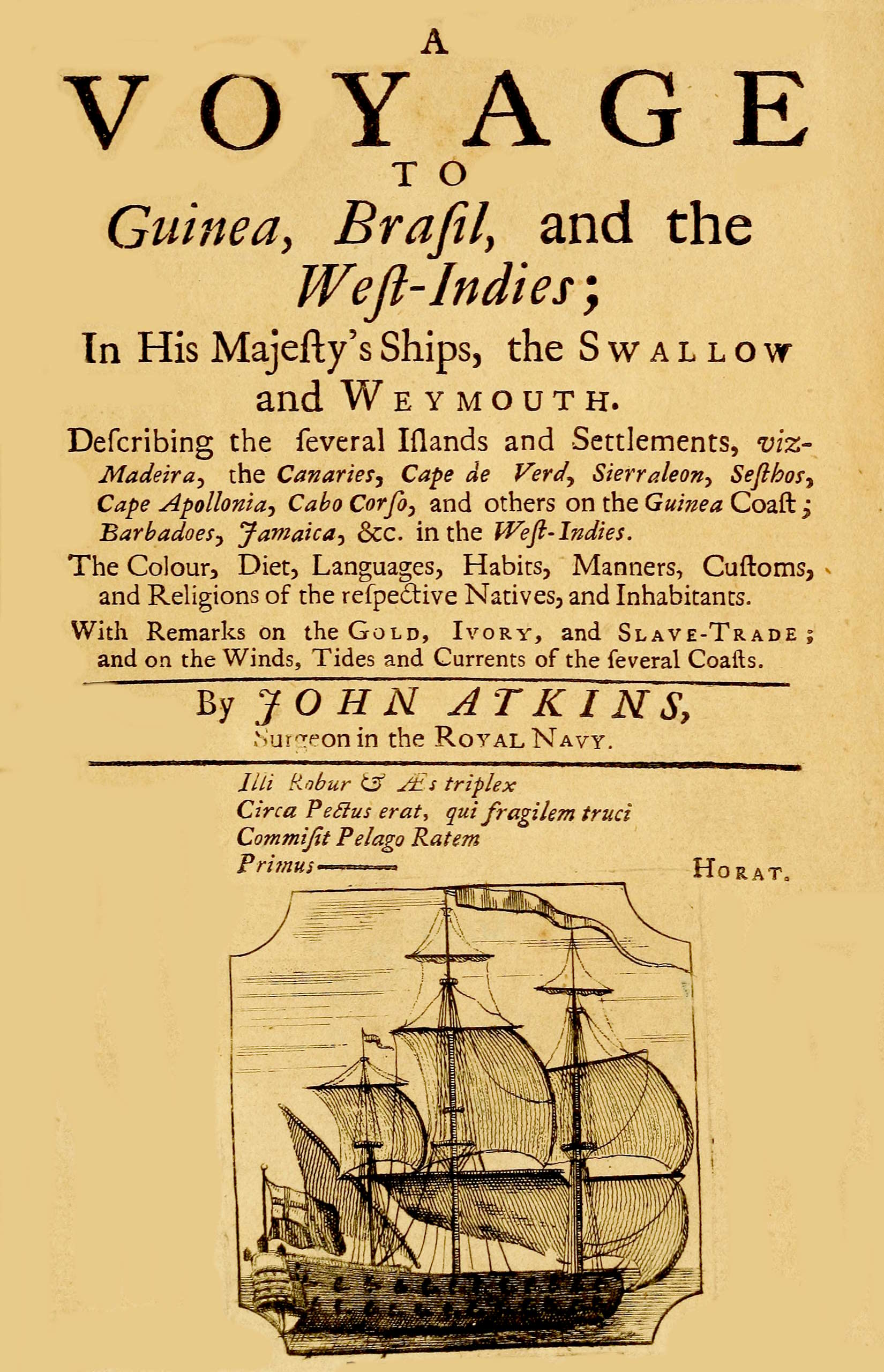
A VOYAGE TO Guinea, Brasil, and the West-Indies;
In His Majesty’s Ships, the Swallow
and Weymouth.
Describing the several Islands and Settlements, viz—Madeira,
the Canaries, Cape de Verd, Sierraleon, Sesthos,
Cape Apollonia, Cabo Corso, and others on the Guinea Coast;
Barbadoes, Jamaica, &c. in the West-Indies.
The Colour, Diet, Languages, Habits, Manners, Customs,
and Religions of the respective Natives, and Inhabitants.
With Remarks on the Gold, Ivory, and Slave-Trade;
and on the Winds, Tides and Currents of the several Coasts.
By JOHN ATKINS, Surgeon in the Royal Navy.
Illi Robur & Æs triplex
Circa Pectus erat, qui fragilem truci
Commisit Pelago Ratem
Primus——
Horat.
LONDON;
Printed for Cæsar Ward and Richard Chandler, at the
Ship, between the Temple-Gates in Fleet-Street; And Sold at their
Shop in Scarborough. M.DCC.XXXV.
PREFACE
The Publishing of this Voyage,
is from a Supposition
that it contains something
useful to those following in the same
Track, and that it will be no unprofitable
Amusement to others who
do not. I shall therefore wave all
Apology, and instead, proceed to a
Reflection or two, on the Life and
Element we occupy.
And first, The Man whose
Means of Subsistence irreversibly depends
on the Sea, is unhappy because
he forsakes his proper Element,
his Wife, Children, Country, and
Friends, all that can be called pleasant
(and of Necessity, not Choice)
to tempt unknown Dangers, on
that deceitful, trackless Path; Lee
Shores, Tempests, Wants of some
kind or other, bad Winds, or the
rougher Passions of our selves, are
continually molesting; and if common
Danger under one adopted Parent
(Neptune) does not always unite
us, yet we are still cooped like
Fowls, to the same Diet and Associates.
“Till chang’d at length and to the Place conform’d
Obscures the Glim; that visive and olfactive Nerves
In us feel dreadful Change.
And to compleat our ill Luck,
while we are thus contending with
sinister Fate, the Rogues at home
perhaps are stealing away the Hearts
of our Mistresses and Wives. Are
not these a hapless Race thus
doomed!
A Sea-Life absolutely considered,
had so much of Hardship and Danger,
that in King John’s Time a national
Synod ordained, no married
Persons should go beyond Sea without
publishing their mutual Consent;
which, I apprehend, proceeded from
this Foundation: That it should not
be in the power of one to thrust himself
on Difficulties and Hazard, that
would make the other equally unhappy.
The Saxons before, made
a Law, that if a Merchant crossed
the wide Sea three times, he should
be honoured with the Title of Thane,
(Rapin, p. 15.) and the Monarchs of
the East shew their Approbation,
by still leaving the rough Dominion
of it to Christians. There
are Circumstances notwithstanding,
which may abate the Infelicity, and
give real Pleasure: Such chiefly in
the Navy, are a Defence of one’s
Country, a Livelihood, being better
manned and provided against Dangers
than Trading Ships; Good-natur’d
Officers, a mutual good Treatment,
seeing the Wonders of the
Deep, and at last, maimed or decrepid,
a Retreat to Superannuation,
or that noble Foundation of Greenwich-Hospital;
to which of late
Years must be added, the Satisfaction
Officers receive from that generous
Contribution for supporting
their Widows, and consequently
the Children they may leave behind
them.
This charitable Project is governed
by the following Articles, established
by His present Majesty.
I.
That Widows of Commission and
Warrant Officers of the Royal Navy,
shall be reputed proper Objects of the
Charity, whose Annual Incomes arising
from their Real and Personal
Estates, or otherwise, do not amount
to the following Sums, viz.
l. s. d.
The Widow of a Captain or Commander,
45 0 0
The Widow of a Lieutenant or Master,
30 0 0
The Widow of a Boatswain,
}
Gunner, Carpenter,
}
Purser, Surgeon,
}
Second Master of
} 20 0 0
a Yacht, or Master of a
}
Naval Vessel warranted
}
by the Navy Board,
}
And that where any such Widow is
possessed of, or interested in any Sum
of Money, the Annual Income and
Produce thereof, shall be computed
and deemed, as annually yielding
Three Pounds per Centum, and no
more.
II.
That to avoid Partiality and Favour
in the Distribution of the Charity,
Widows of Officers of the same
Rank shall have an equal Allowance,
the Proportion of which shall be fixed
Annually by the Court of Assistants,
according to their Discretion; and
that in order thereunto, the said
Court may distribute Annually such
Part of the Monies, arising by the
said Charity, among the Widows,
as they think proper; and to lay out
such other Part thereof in South-Sea
Annuities, or other Government
Securities, as to them shall seem meet,
for raising a Capital Stock for the
general Benefit of the Charity, where
the Application is not particularly
directed by the Donors.
III.
That in the Distribution of Allowances
to poor Widows, the same
be proportionate to one another, with
respect to the Sum each is to receive,
according to the following Division,
viz.
The Widow of a Captain or Commander
shall receive a Sum One
Third more than the Widow of a
Lieutenant or Master.
The Widow of a Lieutenant or
Master shall receive a Sum One
Third more than the Widow of a
Boatswain, Gunner, Carpenter, Purser,
Surgeon, Second Master of a
Yacht, or Master of a Naval Vessel
Warranted by the Navy Board.
IV.
That Widows admitted to an Annual
Allowance from the Charity,
shall begin to enjoy it from the First
Day of the Month following the
Decease of their Husbands, provided
they apply within Twelve
Months for the same; otherwise, from
the Time of their Application.
V.
That if any Widow, admitted to
the Charity, marries again, her Allowance
from thenceforth shall cease.
VI.
That in order to prevent Abuses,
no Widow shall be admitted to the
Benefit of the Charity, who has not
been married for the Space of Twelve
Months to the Officer by whose Right
she claims the same, unless the said
Officer was killed or drowned in the
Sea Service. And if any Officer
marries after the Age of Seventy
Years, his Widow shall be deemed
unqualified to receive the Charity.
VII.
That if the Widow of an Officer
lives in the Neighbourhood of any
of His Majesty’s Dock-Yards, the
Commissioner of the Navy residing
there, and some of the Principal
Officers of the Yard, or the said Officers
of the Yard, where there is no
Commissioner, shall inform themselves
thoroughly of the Circumstances of
the Deceased; and being satisfied
that the Widow comes within the
Rules of the Charity, shall sign and
give her the following Certificate
gratis, viz.
These are to certify the Court of
Assistants for managing the Charity
for Relief of Poor Widows
of Commission and Warrant Officers
of the Royal Navy, That
A. B. died on the _________
and has left the Bearer C. B. a
Widow; and according to the
best Information we can get from
others, and do really believe ourselves,
is not possessed of a clear
annual Income to the Value of
___________ and therefore she
appears to us to be entituled to
the Benefit of the said Charity
under their Direction.
Besides which, the Widow is to
make Affidavit, that her Annual
Income is not better than is expressed
in the said Certificate, and that she
was legally married (naming the
Time when, and the Place where)
to the Officer, in whose Right she
claims the Benefit of the Charity.
VIII.
That if the Widow resides in any
other Part of his Majesty’s Dominions,
a Certificate of the like Nature
is to be signed by the Minister
of the Parish, a Justice of the Peace,
and two or more Officers of the Navy,
who are best acquainted with
her Circumstances; and she is to
make such Affidavit as is before
mentioned.
IX.
That all Widows applying for the
Benefit of the Charity, are to make
Affidavit, that they are unmarried.
X.
That Widows admitted to the
Charity shall once in every Year, at
the Time that shall be appointed,
bring to the Court of Assistants their
Affidavits, containing a particular
State of their Circumstances, and
that they continue unmarried.
XI.
That Widows of Masters and Surgeons
are to apply to the Navy Office,
and receive from thence a Certificate
of the Quality of their Husbands
in the Navy, which shall be
given them Gratis, before they apply
to the Court of Assistants, to be
admitted to the Charity.
XII.
That no Officer or Servant employed
in the Business or Service of
this Charity, shall receive any Salary,
Reward, or other Gratuity,
for his Pains or Service in the Affairs
of the said Charity, but that
the whole Business thereof shall be
transacted Gratis.
Secondly, Of the different Seas
we traverse.
The Mediterranean, from the
Climate, Fertility, and Beauty of
the Countries bordering on it, claims
the Preference, I think, of all Seas;
and recompenses more largely the
Fatigues of a Voyage. What is peculiar,
and makes them more than
others pleasant, is, First, the Temperature
of their Air, neither too
hot nor cold, but a pleasant Mediocrity,
that is, Spring or Summer
all the Year. Secondly, Being of a
moderate Compass: A Man by a
little conversing with Maps, fixes
an Idea of his Distances, his Stages
from Place to Place, and may measure
them over in his Head with
the same Facility he would a Journey
from London to York. Thirdly,
Thus acquainted with the daily Progress,
our Approaches please in a
Proportion to the Danger and Wants
we go from, and the Remedy and
Port we go to. Leghorn, Genoa,
Naples, &c. have their different
Beauties. Fourthly, The confining
Lands on the European and African
Side being mountainous, and
the Sea interspersed with Islands,
gives these Priorities to main Oceans,
viz. that you cannot be long out
of sight of some Land or other, and
those flowing with Milk and Honey,
no ordinary Comfort, excepting
when they are Lee Shores. Secondly,
If the Hills be to Windward,
they take off the Force of strong
Winds, and make a smooth Sea.
And thirdly, The same Hills to Leeward,
do by their Height give a
Check to Storms; the Air stagnating
by their Interposition, I have
observed frequently in shore, to become
a gentle Gale.
Lastly, The greatest Pleasure of
those Seas, is visiting Towns and
Countrys that have been worthy
History; the most famous do somewhere
or other border there, and
have given birth to the greatest Men
and greatest Actions. Greece, that
was the Mother of Arts and Sciences,
the Oracle of the World, that
brought forth a Homer, Socrates,
Alexander, &c. and was one of the
four great Empires, stands to those
Seas (though changed now to European
Turky, by a Progress as wonderful)
so does Italy, the Seat of the
last universal Empire. That Rome,
which subjected almost all the Kings
and Kingdoms of the known World,
gave Britain Laws, and left every
where eternal Monuments of their
Power and Magnificence: Here
lived Virgil, Horace, Cæsar——Hither
some say St. Paul made his
Voyage, having coasted along Crete,
and suffered Shipwreck at Malta,
Islands famous here, the one being
the Birth-place of Jupiter, the other
for a renowned Order of
Knights, the professed Defenders of
Christianity against the Turk.
Volcanos, Catacombs, Triumphal
Arches, and Pillars, Baths, Aqueducts,
and Amphitheatres, are
peculiar Curiosities of Italy. There
is scarcely a Spot in that delicious
Country, but is recorded for some
remarkable Occurrence; is memorable
for High-ways, Grottos, Lakes,
Statues, Monuments, some Victory
gained, or Battle lost, the Birth or
Death of Cæsar or his Friends. On
the African Side, stands or did stand,
Carthage, Troy, Tyre, Nice, Ephesus,
Antioch, Smyrna; and on that
shore was once Christianity firmly
planted (no less than 300 Bishops
being expelled thence;) but alas how
all things change! neither Greatness
nor Virtue can exempt from
Mortality: Towns, Countries, and
Religions, have their Periods.
Thebes, Nineveh, &c. are now
no more.
Oppida posse mori,
Si quæras Helicen & Burin, Achaidas Urbes,
Invenies sub Aquis.
They have a determined Time to
flourish, decay, and die in. Corn
grows where Troy stood: Carthage
is blotted out. Greece and her Republicks
(Athens, Sparta, Corinth,)
with other fam’d Asian and African
Cities the Turkish Monarchy has
overturned. Their Magnificence,
Wealth, Learning, and Worship, is
changed into Poverty and Ignorance;
and Rome, the Mother of all, overrun
with Superstition. Who, on the
one hand, but feels an inexpressible
Pleasure in treading over that Ground,
he supposes such Men inhabited,
whose Learning and Virtues have
been the Emulation of all succeeding
Ages? And who again but must
mourn such a melancholly Transposition
of the Scene, and spend a
few funeral Reflections over such
extraordinary Exequiæ: Perhaps the
Revolution of as many Ages, as has
sunk their Glory, may raise it again,
or carry it to the Negroes and Hottentots,
and the present Possessors
be debased.
The next pleasant Sailing to the
Mediterranean, is that part of the
Atlantick, Southern, Pacifick, South,
or Indian Seas, that are within the
Limits of a Trade-Wind; because
such Winds are next to invariable,
of such moderate Strength as not to
raise heavy Seas, or strain a Ship;
no Storms at Distance from Land;
and equal Days and Nights.
The Atlantick, and Southern Ocean,
without the Limits of this
Trade-Wind, that is, from 30 to
60°° of Latitude, are far the worst
for Navigation; wide, rough, and
boisterous Seas, more subject to
Clouds, Storm, and Tempest, variable
Weather; long, dark, cold
Nights, and less delightful Countries
and Climates out of Europe.
Lastly, Beyond 60 Degrees of
Latitude we have little Commerce,
and the Seas less frequented; the
Countries growing more and more
inhospitable, as Latitude and Cold
increases towards the Pole; however,
Men who have used Greenland,
tell me, those inclement Skies
contain no other Vapors, than Mist,
Sleet, and Snow; the Sea less ruffled
with Winds, which blow for
the most part Northerly, towards
the Sun, i. e. towards a more rarified
Air, seen in those Drifts of Ice from
thence, that are found far to the
Southward, both on the European
and American side. Another Advantage
to cheer the Winter’s Melancholy
of Northern Regions, is
the Moon’s shining a Length proportioned
to the Absence of the
Sun; so that where he is entirely
lost, she[2] never sets, but with reflected
and resplendent Light on
Ice and Snow, keeps up their Consolation.
In all Seas are met numerous Incidents
and Appearances, worthy
our Reflection. I have therefore
gone on to Observations more instructive
and amusing. If the Solutions
are not every where Standard,
they may strike out Hints to better
Capacities; among those, I can
perceive two more liable to Objection.
First, The Pythagorean Soliloquy
I set out with (p. 18.) which may
be deemed too foreign for the Subject:
To which I answer——A
Voyage to Sea is a Type of that dark
and unknown one we are to make in
Death: Wherefore it is not unnatural
with a Departure from the Land’s
End of England, shooting into an Abyss
of Waters, to consider a little on
that Life, which lost is a Departure
from the World’s End, and to
launch into a greater Abyss, Eternity;—The
Principle, in what is
material of us, I think, highly consonant
to Reason, and continues
still the Doctrine of the Eastern
Sages.
Diversæ autem corpora formæ non
sunt nisi diversæ modificationes
ejusdem materiæ, &c.
(Keil de legibus naturæ.)
E. G. Vapors condensed to Rain,
we see descend on Earth; and both
enter and pass into the Seeds and
Forms of all Plants. From them,
either taken alone, or amassed in
animal Food, is what constitutes
and repairs by a daily Eating, our
own Bodies; which if there be any
Trust to Sense or Reason, moulds,
decays, and turns again to Dust and
Air, in order for Regeneration.
What only can destroy this Philosophy
(as I observe at that place)
and maintain a Resurrection of the
same Body, is Revelation, and the
Immortality of the Soul; for Sameness,
or Identity then, will not consist
in the same individual Particles
being united, that makes our Bodies
here, (which we are sure are continually
fluctuating, and changing
while we live;) but on that Consciousness
which the immaterial
Part will give, though joined to
Matter, taken from the Top of Olympus.
Secondly, The Denial of Canibals
against the Authority of grave Authors,
has proceeded from a Persuasion,
that the Charge carries the
highest Reproach on Humanity, and
the Creator of it. My Aim, therefore,
was to shew in the best manner
I could, that the Accusation
every where has probably proceeded
from Fear in some, to magnify the
Miracle of escaping an inhospitable
and strange Country, and from Design
in others, to justify Dispossession,
and arm Colonies with Union and
Courage against the supposed Enemies
of Mankind. Conquest and Cruelty,
by that means go on with pleasure on
the People’s side, who are persuaded
they are only subduing of brutish
Nature, and exchanging, for their
mutual Good, Spiritual for Temporal
Inheritances. By particular
and private Men, this may have
been fixed on a People, to allay
some base or villainous Actions of
their own, that could not any other
way be excused, or bear the Light:
And for this, I appeal to the discerning
part of our Traders, acquainted
with Guinea, whether
they do not think the Reports of
Cape St. Mary’s Inhabitants, Cape
Mont, Montzerado, Drewin, and
Callabar, down-right Falsities, and
impolitick ones; for the multiplying
of Places, like Plots, in a great measure
destroys the Use of them.
At the Caribbees again, it is full
as preposterous; for on small Islands,
had their Women bred like Rabbits,
they must have been desolated Ages
before the Europeans Arrival; unless
we can suppose human Flesh was eat
only on their Feast-Days; or that
they just commenced Monsters upon
our Discovery.——La Hontan, or
some other French Translation I
have read, talking of Canibals bordering
on Canada, flies into a strange
Gallicism, and makes them commend
the Flesh of a Frenchman
(sad Partiality) in Eating, as of finer
Taste than that of an Englishman.
These, with Europeans neglecting
to charge the East-Indians thus,
who have more Power than simple
Americans or Negroes to resent the
Indignity and Reproach, makes me
disbelieve the whole of what I have
hitherto heard; and that the true
Anthropophagi are only the diverse
Insects infesting us in diverse Countries;
the Pediculose Kind do not live
in hot Climates; instead thereof, they
are assaulted with a ravenous Fly
called Muskito; Legions that live
wild in the Woods, and seize with
every Opportunity, human Flesh,
like Lions.
As there is a strict Regard to
Truth observed throughout the
whole, it is apprehended the following
Sheets will be not only amusing,
but useful.
A VOYAGE TO Guinea, Brasil, and the West-Indies;
In His Majesty’s Ships, the Swallow,
and Weymouth, &c.
We took in eight Months Provisions
each, at Portsmouth; Stores, Careening-Geer,
and Necessaries requisite
to continue us a double Voyage down
the Coast of Guinea, for meeting, if possible,
with the Pyrates; who did then very much
infest those Parts, and destroy our Trade and
Factories. Accordingly the Company’s Governors
for Gambia and other Places, embark’d
under our Convoy, and were to have
what Support we could give them, in restoring
the Credit of the Royal African Company;
which begun now to take new life
under the Influence of the Duke of Chandois.
For this Purpose we set sail from SpitheadFebruary 5th, 1720/1.
It is a Pleasure we have beyond the Merchant-Service
in sailing, that we are forbid
Commerce. When Men of War have no
other Lading than Provisions and Necessaries,
the Duty of Sailors is eased, and their Conveniencies
better; whereas Cargoes, besides
dishonouring the Commission, and unfitting
the King’s Ships for Action, stifle and sicken
a Ship’s Company in warm Climates, impose
hard Services, and spoil the Trade of the
Merchant they are designed to encourage, and
expect a Gratuity from; because Labour and
Freight free, they can afford to undersel.
In the Evening from six to nine, we saw
those Appearances in the Sky called Capræ saltantes,
by the Sailors Morrice-Dancers; they
are Streams of Light that suddenly shoot into
one another, and disappear for a Minute or
two; yet shifting their Stations within the
Quarter, in so quick and surprizing a manner
as might easily deceive superstitious Times into
a belief of Armies in the Air; these, the
Scintillæ volantes, and such like nitrous Exhalations,
having given rise, it’s probable, to
all those Prodigies the Air has heretofore in
impious Times abounded with.
The Western Extremity of England that we
are now passing by, has been supposed, from
the equal Depth of Water found there, from
Doors, Windows, and Roots of Trees, formerly
(it’s said) hooked up by Fishermen,
to have been in Ages past continuous with the
rocky little Islands of Scilly, by a Land called
Lioness. When I consider the Changes Earthquakes
and Inundations have made, and continue
insensibly to make on all the different
Coasts of the Earth, losing in some places,
and gaining in others; and what new Islands
have now and then been thrust up on the
surface of the Waters by Streams and Currents,
subterranean Winds and Fires; the
thing does not appear to me altogether conjectural:
the Rocks seem now with terrible
accent to lament the reparation. Who knows
but we likewise are severing eternally from
our Friends! it is a Voyage we shall at some
time or other make; and those solitary Rocks
that bound the last sight to our Homes and
Countries, naturally bring to my mind some
Reflections on the subject.
Whether when we have shut up this Life
we shall remain resolved into our Elements;
revive again in some Plant or Animal; or
thirdly, be reinstated Soul and Body into
Glory, is an Enquiry worthy our utmost Concern
and Diligence; as it will sweeten the imbittered
Potions of Life, make us patient under
Afflictions, and even easy on this treacherous
Element the Sea; whom none ought
to trust; but they who have a Faith in Providence.
Immortality has been the Ambition of the
greatest and wisest Men that have lived, and
indeed who would not in the satiety of worldly
Objects seek out and desire such a prerogative
to his Soul? The Philosophers, rather
than lose so comfortable a prospect, have
placed it in an Existence that can never concern
our Happiness or Misery as Men: The
Princes of them having made it to subsist in
the universal Soul of the World; from
whence, say they, are struck out Scintillations
to every thing that has Life; and in Death,
what was Elementary, returned to its proper
station, and what was Divine in us, to what
is Divine in the Universe: a Metempsychosis
or Transmigration continuing the World on
in the order we see it.
When I ponder on the natural Cause of our
Being ... On the Necessity of that Cause to
produce us, and what the material Agent is ...
On our gradual Advances and Decay; both in
respect to Body and Soul ... The Soul’s sympathizing
with the disorders of the Body ...
Our Sleeps and total Forgetfulness ... Our
Susceptibility of Madness or Idiocy, and
hebridous Productions, especially that of Man
with Beast; I am tempted to think this the
most plausible of all Philosophical Opinions,
in relation to our future Existence, that we
are not Creatures of that consequence we imagine;
our Natures neither deserving, nor
should they expect in reason any other Immortality
than what other Creatures enjoy in their
Seed and Transmigration. This Doctrine is
what the Eastern Sages, reverenced for their
Wisdom, do still propagate, and teach the
Heterodox a Lesson of Humility, That Pride
was not made for Man: but at the same time
it makes me superstitiously fear and abhor a
Grave of Waters; which I fancy will subside
us too far from the Sun, whose Power is the
chief Principle to revive us again in some
Plant or Animal on our native Element:
which will be such perhaps as, in our Life-time,
our Senses were familiar and delighted
with; and for which, we had a sympathetical
Affection and Tendency to. But then
granting the Doctrine, I am considering what
the Advantage of such a belief can be to us
as Men? Why none. Our personal Identity
must be destroyed in the first Transmigration,
much more in an infinite Succession; and
we (as we) can never after this Life be affected
with either Pleasure or Pain. I am
therefore on the whole fond of Revelation,
and wish that to be Truth which ascribes such
Power to Faith, That it can remove Mountains:
and therefore, with its fruits concurring,
may raise us into immortal Spirits,
translate us to Bliss, even without passing
through the horrors of Death.
That an Almighty Power can subsist us to
Eternity, we are very sure; and that he will
do it, I say let it be our Happiness, that we
have the Promises of his Gospel; for here only
can be a remedy to all worldly Cares; and
wherever Death o’er takes us, whether this
Voyage or next, so we be upon our Watch, it will
transport us to a Port and Treasure fixed. It
will free us from Rocks, Sands, and tempestuous
Seas, and anchor us in a Haven of Felicity.
The Gale with which we left England,
carried us the length of Cape [3]Finisterre into
serener Weather, and Sun-shine; but there
we met with continued Westerly Winds
(very unusual to the Coast of Portugal)
which prolonged our Passage. A Day or
two’s sail from Madeira, we fell in with
Commodore Matthews, in the Lion, bound
with a Squadron of four Sail to the East-Indies,
on the like Service with ours to Africa,
viz. the Suppression of Pyrates.
Abundance of Sea-weed floated about us
at 40 Leagues distance, and continued a
constant float till we reached the Island; an
Argument that the bottom of the Sea, especially
where the Depths are decreasing towards
any Shore, have a Cloathing of Plants,
which are probably the common Nutriment
of large Fish. This our Divers in Pearl,
and Coral-fishing, have confirmed to 8 or 10
Fathom water; and this, I think, the present
Observation proves to be in greater Depths;
1st, Because the Unwieldiness of some, and
the manner of being provided for Mastication
in others, declares Ruminating, and not Prey,
to be the way of Subsistence in many. 2dly,
There is a greater Resort toward Shores, than
in the distant Ocean, and perhaps, like
many little Fish in our own Channels, they
may have their Seasons of Rotation, and their
Grazing, the Cause of unrooting and throwing
it up here. 3dly, Porpoises play about
us daily in Shoals, the most familiar great
Fish in the Atlantick, and at all Parts of it:
They tumble most upon a rough Surface, and
against the Wind. Sailors observing these
Porpoises, say, they portend Storms. The
Latins call them Porci marini, from some
Resemblance to the Hog, in it’s Entrails
and Bigness, (weighing several Hundred.)
These Fish, as they are very numerous, never
enticed to the Hook, wasting many of
their hours in play, and gradually lessening
from Shore, shew they know readily where to
make their Meals at the bottom of the Sea,
tho’ at other times they certainly prey on
smaller and particular Species of Fish: These
their Feasts, it’s like, and That their ordinary
Diet.
MADEIRA.
This Island, at the first Discovery of it
by the Portuguese, about the Year
1420, was over-run with Wood, whence it’s
Name. Divided to the two Discoverers,
they set the Woods on fire, which Travellers say
burnt seven Years; the Ashes giving
a vast Fertility to their Sugar-Canes, at the first
Planting; till a Worm getting into the
Cane, spoiled the Increase, &c. so that it is
now entirely planted with Vines brought originally
from Candia, which yield the strongest
Wines: That called Malmsey is a rich
Cordial, the best made at the Jesuit’s Garden
in Fonchial. Their Vintage is in September
and October, and make about 25000 Pipes.
Others say, one Mecham an Englishman,
in a Voyage to Spain was drove on this
Island before the Discovery above: That his
Crew sailed without him and his Mistress;
whom he buried here, left an Inscription on
her Tomb, and then in a Canoo of his own
building sailed to Barbary; the King presenting
him as a Prodigy to the King of Castile:
From whole Account, the Spaniard soon
after made conquest of the neighbouring
Canary Islands. The Island is rocky Mountains,
with an Intermixture of little fruitful
Plains. The highest Parts, Goat-herds and
Woods; the Middle, Kitchen-Gardens; and
the Bottom, Vineyards. The Roads bad,
which makes them bring their Wines to town
in Hog-skins upon Asses; a brownish and a
red sort, the latter called Vino tinto, being
according to common report stained with
Tint, tho’ they assure you it is the natural
Grape. They are almost all limed, a Preservative
against the excessive Heats of the
West-Indies, where they are for the most
part transported by us, and where no other
Wine keeps well.
Trade is carried on by Bartering, 40 or 50
per Cent. being allowed on an Invoice of
Provisions, Cloaths, or Houshold-Goods; of
the former sort, Bread, Beef, Pork, Pilchard,
Herring, Cheese, Butter, Salt, and Oil, are
first in demand. The next are dry Goods,
Hats, Wigs, Shirts, Stockings, Kersys, Sagathys,
Crapes, Says, Shalloons, and Broadcloths,
particularly Black Suits, the usual wear
of the Portuguese. The last and least in Expence
are Escrutores, Chairs, Pewter, Post-Paper,
Counting-books, &c. For these you
have in Exchange their Wine at 30 Millrays
a Pipe; the Malmsey, 60. each Millray in
present Pay 6s. 8d. in Bills 6s. What
other little Traffick I had, stands as per Margin.[4]
There is one Caution to be observed;
That as there is not much dishonour in
Trade to take advantage of a Chapman’s
Weakness, it is prudent to see the Wines
you have tasted shipped forthwith, or it is
odds but the Stranger finds them adulterated:
So that altho’ they seem to allow a good Interest
on your Goods; yet the Badness of your
Wine, or (if good) broke at their Price, lessens
the supposed Advantage. Some Goods
at particular times, bear an extraordinary
Price; not so much by a Call of the Island,
as of Brasil, whither they are again exported.
Fonchial is the chief Town of the Island,
the Residence of the Governour and Bishop: Is
large and populous, has five or six Churches;
three Nunneries, not so strict as at Lisbon, we
conversing and trading for Toys with them
every day; and as many Convents of Fathers.
That of the Jesuits has at present in it only
seventeen; a neat handsome Building and
Chappel: this Order being in all Catholick
Countries the most respected for their Learning
and Riches. Wherever you find a College
of them, you may be sure there is good
Living. The other Inhabitants consist of a
mixed Race; Portuguese, Blacks, and Molattoes,
who are civil, courteous, and equally
respected in Trade; the Portuguese no
where abroad scrupling an Alliance with darker
Colours.
They keep no regular Market, but the
Country brings in according as they think
will be the Demand at any time: Kid, Pork,
and now and then a lean Heifer, Cabbages,
Lemons, Oranges, Walnuts, Figs, Yams,
Bananoes, &c. There is one Curiosity I found
in their Gardens called the everlasting Flower,
never fading after gathered, or indiscernibly,
in many Years; the Herb is like Sage
growing, and the Flower like Camomil:
I laid by several of them, and found at twelve
Months end they were just of the same freshness
as when gathered.
Fonchial Road is very open and unsafe against
West and S. W. Winds; deep Water
also, that there is no anchoring but at the West
End, and that in 40 Fathom, a Mile or Mile
and half off Shore: So that when a Swell
from those Quarters gives notice of a Gale
coming, all Ships in the Road slip their
Cables and to Sea, returning at a more favourable
season for their lading: Which
likewise, by an extraordinary Surf on the
Beach, becomes troublesome to ship off; commonly
done by swimming the Pipes off to
the Lanch, or lade on the Beach, and run
her with many hands into the Sea. The
like trouble Boats have in Watering (by
a River at the W. End of the Town) and is
most commodiously done before the Sea-breeze
comes in.
The Loo makes a tolerable Harbour for
small Vessels against Westerly Winds, that
would be unsafe without. They make fast
their Cable to a high Rock called the Loo,
whereon is a Fort; but when the Winds
veer, opening their Heads to the Sea, all
Hands go on Shore, and leave the Ship and
Storm to contest it by themselves.
Their Lodgings on shore are as uneasy to
Strangers, as the Road to Ships; being prodigiously
pestered with Bugs and Fleas. Cotts
upon the Floors, is the common way of
laying.
Their Strength is in the Militia, computed
at 18000 disciplin’d and loyal Fellows;
They, the Azores, and Cape De Verd Islands
soon returning to their Allegiance, after that
Revolution in Portugal, 1640.
Before I leave Madeira, I must relate the
surprizing Account just arrived here by several
Masters of Vessels, Eye-witnesses of a
new Island which sprung out of the Sea the
20th of November last, 17 Leagues S. E. from
Terceira, one of the Western Islands.
The Master who took a Survey of it by
order from the Governour of Terceira, lays it
down, a League long, a Mile broad, a little
above the surface of the Water, and smoking
like a Volcano. After the Eruption, the
Sea for several Leagues round was covered
with Pumice-stone, and half-broiled Fish. I
was curious to know what Symptoms (if
any) had preceded this Prodigy at the other
Islands; and learned that Pico, one of them,
a noted Volcano, had ceased to burn for
some time, and that they had felt a Shock
or two of an Earthquake that had done considerable
damage. Corvo, an Island in this
Neighbourhood ([5]Albert de Mandelzo tells
us) started up also in such manner, June 16,
1628. And History relates the like in the
Archipelago.
That new Islands should be formed in Rivers,
as at the Conflux of the Save with the
Danube, or Sands shifting in any Channels,
may be from the Swiftness of the Streams,
wasting some and raising others; but that
this Effect should happen in deep Water, 50
or 60 Miles from Shore, is truly wonderful:
The Phænomenon seems best resolved here,
by subterranean Fires, which from a great
Depth and Extent have their Vents at Volcanoes;
and as the Consumption of their Materials
is more, the nigher they are such Vents
(observable in Italy, Iceland, &c.) so their Effects
in the neighbourhood of Waters (when
by any Accident the Mouth is stopp’d, and
they meet) must be Concussions of the Earth,
blowing the Mountains away in Cinders;
and now and then in Ages, such a Wonder
as a new Island, the same as we see (if we
may compare great things with small) in several
Chymical Preparations. This Island has
settled, and probably by the Spunginess of its
Materials, may sink in a few Years out of
sight again. The ultimate End, is perhaps
to strike Mankind with a Dread of Providence,
and warn a sinful World against the
Consequences of angry Omnipotence: Men
generally taking a deeper Impression from
something new and wonderful in Nature,
than in the Creation or Conservation of the
World it self.
CANARIES.
From Madeira we sailed by the Canary
Islands, belonging to the Spaniards,
and taken by them in 1418.
Palma, remarkable for rich Wines, making
12000 Pipes per Annum.
Ferro, or Ferrara, for our Navigators
taking their first Meridian from thence, there
being none, or the least Variation; and for a
Volcano that now and then breaks out upon
it. One in November 1677, seen five Days;
and in 1692 broke out again with Earthquakes,
and seen six Weeks together: There is
also, our Voyages say, a wonderful Tree on
it, forty Foot high, that condenses the Clouds
in such quantity, as to supply the want of
Springs.
Grand Canary, the chief Residence for
Governours and Consuls; and Teneriff, for
its noted Pike, thought from the shewing it
self singly, to be the highest Land in the
World. It is a Pyramidal Heap of rough
Rocks piled thus (it’s thought by Naturalists)
from some subterraneous Conflagration that
burst out heretofore.
The Ancients called them Insulæ fortunatæ;
it’s likely from the Interception they
may have given to the Destruction of Coasters
blown off, before the use of the Compass:
Cape Non on the Continent being
the utmost of their Navigation.
Cape de VERD Islands,
Denominated from the Cape, always
green: They were anciently called
Hesperides; the Diminutive of Spain, called
heretofore Hesperia, propterea quod hæc regio,
omnium extrema, sit a sit ad Occidentem;
Hesperus, the Evening Star, by a Metaphor
signifying the West.
They are inhabited by Portuguese, who
welcome all sort of Ships (of good, or ill Design)
bound to Guinea, India, Brasil, or the
West-Indies; they frequently putting in
here to furnish themselves with fresh Provisions,
exchanged for Trifles; chiefly at St.
Iägo (James) the principal, which has three
or four Forts, and where resides the Governour.
In several of these Islands there are
natural Salt Ponds, kerning great quantities
without trouble. The most noted by the
English is Maio, or the Isle of May, where
many of our Ships lade in Summer; and
was, with Tangier, and Bombay in India,
Part of Q. Catherine’s Fortune to England.
Another of them has a Volcano, and called
Del Fuego.
The Land about the Cape appears the
Height of that at Deal in Kent; woody,
a white even Sand along Shore, and about
28 Fathom Water a League off. Just to the
Northward are two or three great Rocks,
called by our Sailors Shitten Islands, being
white all over with the Dung of Sea-fowls.
At the same distance Southward of the Cape,
is an Island called Goree, about a League
from the Main, has a French Factory with
two Forts, commanding all the Trade about
the River Senega, from other Nations.
While our Ships lay
too here, we had good
Fishing with our Lines; took Breams (or
Porga’s) Skip-jacks, Groupes, a Rock-fish
(thick, short, and of a deep yellow on the
Belly, Gills, and Mouth) and the Jew-Fish;
which has a double Mouth, the uppermost not
to swallow Food, but full of Air-pipes, and
finned like a Cod, all well tasted: and having
washed them down with a Bowl, our
Friends and we parted, the Weymouth steering
in for Gambia River with the Governour
Colonel Witney, and the Merchants;
We for Sierraleon, anchoring there the Beginning
of April, 1721.
The Winds from Madeira to Sierraleon
at first blew fresh at S. and S. W. and as we
came farther to the Southward, they wheel’d
gradually on the Western Side of the Circle,
quite round to the N. so as in the Latitude of
21 to have it N. E. a true Trade, seven, eight,
or nine knots Day and Night; but whether
it were the Badness of our half-minute
Glasses, the tendency of the Sea with the
Wind, or any Current, I cannot tell; but
we always found our selves considerably
further to the Southward, by Observation
every day, than the Distance by the Log
would give.
In this Passage, we took up a few Turtle
with our Boat. As they sleep and bask upon
the Surface, we steal upon them without
noise, and throw them in upon their Backs.
We saw also abundance of flying Fish, and
their continual Enemies, the Albicore and Dolphin;
the latter we strike now and then with
a Fizgig, or Harping-iron. It is a glorious-colour’d,
strait Fish, four or five Foot long,
forked Tail, perpendicular to the Horizon:
plays familiarly about Ships; is of dry Taste,
but makes good Broth. They are seldom
seen out of the Latitudes of a Trade-wind;
and the flying Fish never: These are the bigness
of small Herrings; their Wings about
two thirds its length; come narrow from
the Body, and end broad; they fly by the
help of them a Furlong at a time when
pursued, turning in their Flight, sometimes
dip in the Sea, and so up again, the Wind
making them, by this Expedient, fleeter.
AFRICA in general.
As there is nothing more surprizing
and delightful in Voyages or Travels,
than beholding the different Habits,
Customs, Dieting, and Religion of the different
Natives; so there is none I believe,
wherein that Difference can be found, so much
as here. A Colour, Language and Manners, as
wide from ours, as we may imagine we should
find in the planetary Subjects above, could
we get there.
But before I proceed on any Observations
of my own, it may be proper from others,
to convey some Idea of Guinea in general;
so much as carries Probability, either from
the Dead or Living.
Africa, one of the four Quarters of the
World, next in bigness to Europe, by the
Ancients had several Names; Olympia, Ammonis
Ortygia; but the most noted, Apher,
from a Nephew, it’s said, of Abraham’s.
It extends from about 36 N. to as many Degrees
of Southern Latitude; and excepting
Egypt, Barbary, Morocco, and in this last
Age the Coast of Guinea, is a Country as little
known as any Part of the Globe. Marmol
says, the Arabians in the 400 of the Hegyra,
passed into Afric and divided it. This is certain,
that it has many fine large Rivers, some
of them navigable for Ships. Along the
Banks of these Rivers, the Inhabitants
abound with Millet, Rice, Pulse or,
Indian-Corn. The further we depart from
Morocco on this West Side, or Egypt on
the East, there is always found less Industry
and more Ignorance: For Governments, tho’
never so tyrannical, are better than none,
extending some Improvement to Humanity.
The Niger, which is one of the largest
Rivers in Africa, is said to have the same
Property of overflowing every Year, like
Nile, remunerating to the inland parts a vast
Fertility and Increase; and this very probably,
because it has been traced
some hundred Leagues, and by the Course, descends
from the Ethiopian Mountains, the common
Fountain of both.
The Senega and Gambia, Branches of
this great River, disgorge here at the windward
Part of Guinea; they are large Rivers,
driving considerable Trade: To the former of
these, the King of Morocco extended his
Dominions, about 1526, by the Conquest
of the Kingdom of Tombuto, which still
continues tributary, and whence that King
raises considerable Negro Armies, his chief
Strength. A College of the Sect of Haly,
is founded in Melli, a Kingdom upon this
River. They have many Crocodiles or Alligators,
Sea-Horses, and Shirks in them.
Senega affords great quantity of Gum; and
at Gambia begin our Factories for Slaves,
Teeth, and Gold, on which this general Remark,
That the Slaves there, faring softer from
a better Soil, are not so hardy as those
lower down. The Teeth are as large, and in
as much plenty, as at any one Part of the
whole Coast; those taken out of the Sea-Horse
are small, not weighing above 5 or
6 Pounds, but more solid than the Elephant’s.
And lastly, their Gold is current in what the
Traders call Bars, little twisted Lengths,
or in Rings of 4, 5, 6, 7, or 8s. Value.
All the great Rivers flow and ebb regularly,
being governed by the Moon, as the Tides
on our own Coasts; but the Sandiness of the
Soil, and Nearness of the Sun, makes the
Country between, so extreamly dry, that they
have great scarcity of Water for an hundred
Miles an end sometimes; and this Drought is
what brings the Beasts of all sorts in Droves
to the Banks, for satisfying Thirst, (Tygers,
Panthers, Leopards, Antelopes, Elephants,
Apes; Ostriches, &c.) From which Accident,
say they, might probably have happened the
many Hebridous Productions that have made
this Country the Proverb of all Ages; it
continually producing something new or
monstrous.
Their chief Diet is Indian Corn, Rice,
Palm-nuts, Bananas, Yamms, Pine-apples,
and now and then a little Fish, or a Fowl;
all which thro’ Ignorance, and want of Necessaries,
are very slovenly cooked by them.
Africa is almost a Triangle in shape; the
Kingdoms on the North are Mahometans;
and in the trading Towns of Barbary, and
Turky, there is a little Mixture of Jews. On
the Eastern Line next Persia, are said to be
some of the Sect of Gaurs, followers of Zoroastes,
a very learned Persian Philosopher,
that appeared, according to Dr. Prideaux, about
2300 Years ago: He instituted Fire-worship,
and established it by a superiour
Cunning, through most parts of Persia and
India, where there are still some left, poor
and despised, (called Persees) since the seventh
Century, when the Mahometans over-run
that Country, and almost extinguished them.
In Æthiopia, (Prester John’s Country)
Writers say, are a sort of Christians, still acknowledging
the Patriarch of Alexandria;
meerly nominal I believe, for the Greeks
themselves, much nigher his Pastorship, have
since their Conquest by the Turks, in a manner
lost their Christianity; Poverty and Ignorance,
the Consequence of Captivity having
obliterated the outward Pomp, which, next to
Power, is the main Pillar in all Religions.
Inland, and to the Southern Extremity, they
are Pagans. And on this Western Line
(the Negroes) all trust to the Gregory or Fetish;
which in the bulk of it means no
more than what we in Europe call Charms,
which in many respects carries strong Superstition,
that is, a vain Religion in it; only
their consecrated Materials having more Reverence
from their Ignorance and Fear,
work more stupendous Effects; or are imagined
to do so, which is the same thing.
So much may serve for a general Idea of Africa,
since several of the Articles will, in
the progress of the Voyage, be occasionally
expatiated on.
SIERRALEON.
By Guinea here, I mean all Negro-land,
from about the River Senega Northward,
to within a few Degrees of Cape Bon
Esperance; because Ships bound to any part
of this Extent, are said to be bound to Guinea;
and because the People, without these
Lines, alter to a dark Colour seen in the
Moors at this, and the Hottentots at the other
Extremity. The Name (Gordon says)
imports hot and dry, and its Gold gives
Name to our Coin.
The black Colour, and woolly Tegument
of these Guineans; is what first obtrudes it
self on our Observation, and distinguishes
them from the rest of Mankind, who no
where else, in the warmest Latitudes, are seen
thus totally changed; nor removing, will they
ever alter, without mixing in Generation.
I have taken notice in my Navy-Surgeon,
how difficultly the Colour is accounted for;
and tho’ it be a little Heterodox, I am persuaded
the black and white Race have, ab origine,
sprung from different-coloured first Parents.
When we parted with the Weymouth off
Cape de Verd, we steered S. S. W. to avoid
the Shoals of Grandee, and in hawling in
for the Land again, waited till we came into
the Latitude of Sierraleon, some others laying
on the N. Side that River. The Soundings
in with the Cape are gradual, from 60
Fathoms about 12 Leagues off, to 13; when
we get in sight of Cape Sierraleon, known
by a single Tree much larger than the rest,
and high land on the back of it. We run
up on the Starboard side of the River, anchoring
in the third Bay from the Cape;
where is very commodious watering and
wooding; and regular Tides, as in any part
of the Channel of England.
Remark 1. The Trade for our African
Company here, is carried on from Bense or
Brent Island, about 5 Leagues distance from
our Anchorage, by Factors, of whom Mr.
Plunket is chief. The private Traders are
about 30 in number, settled on the Starboard
side of the River: loose privateering
Blades, that if they cannot trade fairly with
the Natives, will rob; but then don’t do it
so much in pursuance of that trading Advice,
(Amass Riches, my Son,) as to put themselves
in a Capacity of living well, and treating
their Friends, being always well pleased if
they can keep their Stock at Par, and with
their Profits purchase from time to time,
Strong-beer, Wine, Cyder, and such Necessaries,
of Bristol Ships, that more frequently
than others put in there; of these, John
Leadstine, commonly called old Cracker, is
reckoned the most thriving.
They all keep Gromettas (Negro Servants)
which they hire from Sherbro River,
at two Accys or Bars a Month. The Women
keep House, and are obedient to any Prostitutions
their Masters command. The Men-servants
work in the Boats and Periagoes,
which go a trading in turns with Coral, Brass,
Pewter Pans, Pots, Arms, English Spirits, &c.
and bring back from the Rio Nunes, Slaves,
and Teeth; and from Sherbro, Camwood
for Dyers; a Sloop or two is the most that
is loaded from the latter Place in a Year, and
that with difficulty; being obliged to go
far up the River, narrow and beset with
Mangroves, which makes it sickly.
The Ivory here is of the Elephant or Sea-Horse,
great and small; the former, sold at
about 40 Accys per Quintal in Exchange;
the other at half Price.
The Slaves when brought here, have
Chains put on, three or four linked together,
under the Care of their Gromettas, till Opportunity
of Sale; and then go at about
15 Pounds a good Slave, allowing the Buyer
40 or 50 per Ct. Advance on his Goods.
As these Slaves are placed under Lodges
near the Owner’s House, for Air, Cleanliness,
and Customers better viewing them,
I had every day the Curiosity of observing
their Behaviour, which with most of them
was very dejected. Once, on looking over
some of old Cracker’s Slaves, I could not
help taking notice of one Fellow among the
rest, of a tall, strong Make, and bold, stern
aspect. As he imagined we were viewing
them with a design to buy, he seemed to
disdain his Fellow-Slaves for their Readiness
to be examined, and as it were scorned looking
at us, refusing to rise or stretch out his
Limbs, as the Master commanded; which
got him an unmerciful Whipping from
Cracker’s own Hand, with a cutting Manatea
Strap, and had certainly killed him
but for the loss he himself must sustain by it;
all which the Negro bore with Magnanimity,
shrinking very little, and shedding a
Tear or two, which he endeavoured to hide
as tho’ ashamed of. All the Company grew
curious at his Courage, and wanted to know
of Cracker, how he came by him; who told
us, that this same Fellow, called Captain
Tomba, was a Leader of some Country Villages
that opposed them, and their Trade, at
the River Nunes; killing our Friends there,
and firing their Cottages. The Sufferers this
way, by the Help of my Men, (says Cracker)
surprized, and bound him in the Night, about
a Month ago, he having killed two in his
Defence, before they could secure him, and
from thence he was brought hither, and
made my Property.
Remark 2.Sierraleon River is very
broad here, but in ten or twelve Miles rowing
upwards, narrow to half the Breadth of
the Thames at London, spread on both sides
thick with Mangroves; Trees, or slender
woody Shrubs, that spring from the low,
watry Banks of Rivers, in warm Climates.
From the Branches, the Sap descends again
and takes a second Root, and so on, a third,
fourth, &c. that the Ground is all covered;
very difficult, if not impossible for Men to
penetrate: This makes them fit Haunts for
the Manatea and Crocodile (Sea-Cow and
Alligator) which, with the Shirks, very much
infest the River. A Story or two of these
Creatures, may not be unacceptable.
The Manatea is about eleven or twelve
Foot long, and in girt half as much; Teeth
only in the back part of her Mouth, which are
like the Ox’s, as is also her Muzzle and Head;
with this difference, that her Eyes are small
in proportion, and Ears you can scarce
thrust a Bodkin in; close to her Ears almost,
are two broad Finns, sixteen or eighteen
Inches long, that feel at the Extremities
as tho’ jointed; a broad Tail, Cuticle granulated,
and of a colour and touch like Velvet:
the true Skin an Inch thick, used by the
West-Indians in Thongs for punishing their
Slaves; weigh to five or fix hundred Weight;
of a firm Flesh, that cuts fat, lean, and white
like Veal: Boiled, stewed, or roasted (for
I have eaten it all ways) it has no fishy
Taste, but is as acceptable a Treat as Venison
to Cockneighs.
The Negroes way of taking them, is in a
Canoo, which they paddle towards the Manatea
with as little noise as possible, (she
being extreamly quick of hearing:) when
near enough, a Man placed ready in the
Boat’s Head, strikes in his Harpoon with a
long Pole into her, and lets go. She makes
towards the Mangroves immediately, and
the Water being shallow, they now and
then get sight of the Pole, and so follow,
renewing the Strokes till they kill, or weary
her, and then drag her ashore.
The Alligator answers in all respects,
and doubtless is the Egyptian Crocodile;
shaped not unlike the Lizard, but of two
hundred Weight perhaps, covered with hard
Scales that are impenetrable to Shot, unless
very near; long Jaws set with sharp Teeth,
two very large, and two small: Finns like
Hands: A Tail thick and continuous; will
live a long time out of the Water, being sold
frequently alive in the West-Indies. They
are not shy, but rather bold, and tho’ easily
waked, will not make off presently,
our Boats falling down with the Stream
within a few yards of them, before they
stir; laying basking to the Sun, in little
muddy Nooks they form in their egress
from the Mangroves. When they float
upon the Water, they lie very still and like
a Log of Timber, till the little Fry underneath
come unwarily sporting about them
and tempt their greedy Stomachs; they diving
very quick upon their Prey.
One of these set upon a Man of Captain
Masterton’s, a Sloop that put in here from
Sherbro. The Sailor, to avoid walking round
a Bay, and being mellow with drinking,
would needs cut his way short by wading
over a weedy part of it up to his Breast,
where the Alligator seized him; and the
Fellow having full Courage, ran his Arm
down his Throat: Notwithstanding which,
the Crocodile loosed, and renewed the Battle
two or three times, till a Canoo that saw the
Distress, paddled to his Relief, but he was torn
unmercifully in his Buttocks, Arms, Shoulders,
Thighs, and Sides; and had not the
Creature been young, must certainly have
been killed. The Man recovered of his
Wounds.
Shirks very much infest the Mouth of
this River; the most bold and ravenous of
the watry Tribe: He never forsakes your
Hook, till he is taken, and slights the Proverb,
Occultum visus decurrere piscis ad hamum.
We have catched three in less than half an
hour, each 8 or 10 Foot long, the Livers of
them making above ten Gallons of Oil.
They have four or five Rows of short, sharp
Teeth, one within another, and the Sides
of them indented like Saws. Their Swallows
14 and 16 Inches over. In the Maws,
we found Beef Bones, and what other Trash
had been thrown over-board in the Day;
for they are like the Parson’s Barn; they
turn on their backs to take in their
Prey. Our Seamen dressed and eat the Flesh,
tho’ very strong; the fault of all carnivorous
Animals.
These Shirks have generally two, three,
or more pretty-coloured little Fish, the bigness
of Herrings attending them, called Pilots:
They go in and out at his Maw, or
fasten on his Back, in familiar manner:
They are supposed like the Jackall to the
Lion, to be instrumental in procuring him
Prey, and warning him of Danger in Shoals,
for which he receives Food, and Protection
from the Shirk.
I shall give an Instance or two within my
own knowledge, to shew the Boldness and
Rapacity of this Fish.
The Weymouth’s Barge rowing up Gambia
River, a Shirk made to them, and notwithstanding
the noise of so many Oars,
seized one of them in his Mouth, and snapped
it in two.
At Whydah, a very dangerous Coast to
land at, having two Bars before it, and great
Seas; a Canoo was going on shore from a
Merchant-Ship with some Goods, and in
attempting to land, overset: A Shirk nigh
hand, seized upon one of the Men in the
Water, and by the Swell of the Sea, they
were both cast on shore; notwithstanding
which, the Shirk never quitted his
hold, but with the next Ascend of the Sea,
carried him clear off.
In short, their Voracity refuses nothing;
Canvas, Ropeyarns, Bones, Blanketing, &c.
I have seen them frequently seize a Corpse,
as soon as it was committed to the Sea; tearing
and devouring that, and the Hammock
that shrouded it, without suffering it once to
sink, tho’ a great Weight of Ballast in it.
There are in the Bays of this River, variety
of good Fish, that supplies the Scarcity
of Flesh; Turtle, Mullet, Skate, [6]Ten-pounders,
[7]Old-wives, [8]Cavalloes,
[9]Barricudoes,
[10]Sucking-Fish, Oysters, [11]Cat-Fish, Bream,
and Numb-Fish; the most of which we
catch’d in great numbers with our Searn;
two or three Hours in a Morning supplying
a Belly-full to the whole Ship’s Company.
The Oysters and Numb-Fish have something
peculiar; the former growing, or rather
sticking in great Bunches of twenty or thirty,
upon the Rocks and Mangroves, to which
they seemingly grow, very small and ill-tasted.
The latter, which is the Torpedo of the
Ancients, is flat as a Skate, so very cold
as to numb the Hands or Arms of those
who touch him, but goes off again in few
Hours; and with a Stick you may toss him
about a Day together without any other
Harm than losing your time.
Remark 3. The Country about Sierraleon
is so thick spread with Wood, that
you cannot penetrate a Pole’s length from the
Water-side, unless between the Town, and
Fountain whence they fetch their Water,
without a great deal of difficulty. They
have Paths however through these Woods, to
their [12]Lollas, and [13]Lugars, which tho’ but
a mile or two from the Town, are frequently
the Walks of wild Beasts; their Excrement
I have found up and down in walking here,
white and mixed with Ossicles.
The Shores hereabouts, like those of Sweden,
are rocky, and without any Cover of
Earth almost; yet produce large Trees, the
Roots spreading on the Surface: The chief
of these are the Palm, the Coco, and the
Cotton-Tree, described p. 198, in the first
Volume of the History of the Pyrates.
Other Vegetables for Food are Rice, Yams,
[14]Plantanes, [15]Pine-Apples,
[16]Limes, Oranges,
[17]Papais, Palm-nuts, wild Roots,
and Berries.
This is their common Sustenance; the
Gift of Providence, without their Care;
they might abound, but prefer Ease and Indolence,
he being greatest among them,
who can afford to eat [18]Rice all the Year
round. Kid and Fowl, they have a few,
and were all the domestick Animals I saw.
Remark 4. On the Negroes here, their
Clothing, Customs and Religion.
The Men are well-limbed, clean Fellows;
flattish-nosed, and many with Exomphalos’s;
the Effect of bad Midwifry, or straining in
their Infancy to walk; for they are never
taught, but creep upon a Matt on all Fours,
till they have Strength to erect themselves;
and notwithstanding this, are seldom distorted.
These do not circumcise, but the Slaves
brought from the Northward are frequently
so; perhaps from bordering on Morocco.
The Women are not nigh so well shaped
as the Men: Childing, and their Breasts always
pendulous, stretches them to so unseemly
a Length and Bigness, that some, like the
Ægyptians, I believe, could suckle over
their Shoulders. Their being imployed in
all Labour, makes them robust; for such as
are not Gromettas, work hard in Tillage,
make Palm-Oil, or spin Cotton; and when
they are free from such work, the idle Husbands
put them upon breading and fetishing
out their Wool, they being prodigious proud
and curious in this sort of Ornament; and
keep them every day, for many hours together,
at it.
Their Houses are low, little Hutts, not
quite so bad as many in Yorkshire, built with
wooden Stockades set in the ground, in a
round or square form, thatched with Straw;
they are swept clean every day; and for Furniture,
have a Matt or two to lie down upon;
two or three earthen or wooden Dishes, and
Stools, with a Spoon, all of their own
making. They are idle, principally from
want of Arts and domestick Employments:
for as I observed, they are so cautious of planting
too much, and wasting their Labour,
that they are really improvident; smoaking
all day in long Reed-Pipes together; unplagued
with To-morrow, or the Politicks of
Europe.
Whole Towns shift their Habitations, either
when they do not like their Neighbours,
or have more Conveniency somewhere else;
soon clearing Ground enough for what
Building and Culture they purpose. Seignior
Joseph, a Christian Negro of this Place,
has lately with his People left a clean, well-built
Town, and removed further up the
River. Their Huts are mostly orbicular,
forming a spacious square Area in the middle,
and in this, the doors paved with
Cockle-Shells; two or three Crosses erected,
and round about, Lime-trees, Papais, Plantanes,
Pine-apples, and a few Bee-hives;
the latter made out of pieces of old Trees,
three foot long, hollowed and raised on two
Poles.
In the middle of the Area was a great
Curiosity, a large Tree with 500 hanging
Nests at least upon it; this is a small familiar
Bird, that builds thus about their Towns,
upon the extreme slenderest Twigs, hanging
like Fruit, and declares the Wisdom of Instinct,
since it’s designed a Security for their
Young, against Monkeys, Parrots, Squirrels,
&c. Creatures of Prey, whose Weight cannot
there be supported.
Anointing their Body and Limbs with
Palm-Oil, is a daily Practice with both Sexes;
some use [19]Civet, but all cast a strong,
disagreeable Smell; this mending it much
like as melted Tallow is by a Perfumer’s
Shop.
Palaavers are their Courts of Judicature,
where the principal or elderly Men amongst
them meet in a Ring or under a Lodge,
to settle the Differences that arise amongst
themselves, or with the Factories; the frequentest
are in relation to Trade. Each salutes
the other at meeting, by a Bend of the
Elbow, and raising his Hand to his Face.
When they have heard what each Party has
to say, they determine by Vote, who has
the Reason of the thing on their side, and
so punish, or acquit. For Fornication, the
Party (whether Man or Woman) is sold for
a Slave. If a white Man lies with another’s
Slave, he is bound to redeem her at a current
Price. On a Charge of Murder, Adultery,
or if there can be any other more
heinous Crime among them, the suspected
Person must drink of a red Water his Judges
prepare; which is called, purging the Criminal:
that is, if the suspected be of ill Life,
or had Envy to the deceased, so that the
Surmizes against him are strong, though they
want positive Evidence; they will give him
so much of that Liquor as shall kill him; but
if inclined to spare him, they politickly give
less, or make it weaker, whereby his Innocence
appears the better to the Friends and
Relations of the deceased.
Panyarring, is a Term for Man-stealing
along the whole Coast: Here it’s used also,
for stealing any thing else; and by Custom
(their Law) every Man has a right to seize
of another at any Conveniency, so much as
he can prove afterwards, at the Palaaver-Court,
to have been defrauded of, by any
body in the same place he was cheated.
Dancing is the Diversion of their Evenings:
Men and Women make a Ring in an
open part of the Town, and one at a time
shews his Skill in antick Motions and Gesticulations,
yet with a great deal of Agility,
the Company making the Musick by clapping
their hands together during the time,
helped by the louder noise of two or three
Drums made of a hollowed piece of Tree,
and covered with Kid-Skin. Sometimes
they are all round in a Circle laughing, and
with uncouth Notes, blame or praise somebody
in the Company.
During our stay at this Port, we paid a
Visit to Seignior Joseph, about nine miles
up the River. The Reason of his leaving
the other Town, he told me was, the frequent
Palaavers he was engaged in, on account
of Differences between his People and
the Grimattoes, and the great Expence he
was at, in so near a Neighbourhood with the
English. He has been in England and Portugal;
at the last place he was baptized, and
took in that christian Erudition that he endeavours
to propagate. He has built a little
Oratory for his People’s Devotions; erected
a Cross; taught several of his Kindred Letters,
dispersing among them little Romish
Prayer-Books, and many of them are known
by Christian Names. Those of the Country
not yet initiated, never have but one. Mousi,
or Moses; Yarrat, and Cambar, are very
common Names to the Men; Baulee, and
Kibullee, to the Women. Others take the
Cognomen from their Disposition; Lion,
Lamb, Bear, Hog, &c. like our Danish Ancestors.
Seignior Joseph, who is very communicative,
tells me, to the extent of his
knowledge, the People are cleanly, of good
Temper, and docible; all wishing some
Missionaries would think their Conversion
and Wants worth regarding: But the Poverty
of their Country will probably keep
them a long time from that Benefit. There
is no Invitation in a barren Soil, scarce of
Provisions and Necessaries, Danger of wild
Beasts a mile from Home (especially Wolves;)
and about their Houses, Rats, Snakes, Toads,
Musquitoes, Centipes, Scorpions, Lizards,
and innumerable Swarms of Ants, a white,
black, and red sort, that build to 8 or 9 Foot
high, dig up the Foundation of their Houses
in two or three Years, or turn a Chest of
Cloaths to Dust (if not watched) in as many
Weeks. This Christian Negro, by the Advantage
of Trade, has in some measure removed
the Wants of his own Family (his
Towns;) they are tolerably stocked with Guinea
Hens, Fish, and Venison; while the Country
fifty miles off, he says, have little to feed
on but Honey, and Manyoco Root. He received
us in a Europæan Dress (Gown, Slippers,
Cap, &c.) and sent his Canoos out to shew us
the Diversion of chasing the Manatea; they
brought one ashore in two hours time, and
we had stewed, roast, and boiled, with a
clean Table-cloth, Knives and Forks, and
Variety of Wines and strong Beer, for our
Entertainment. The Flesh of this Creature
was white, and not fishy; but very tough,
and seasoned high (as are all their Dishes) with
Ochre, Malaguetta, and Bell-pepper.
His Kinswomen came into the Room after
we had dined, and to them other Neighbours,
saluting those of their own Colour, one by
one, by making a Bend of their right Elbow,
so that the Hand comes nigh the Mouth; the
other to whom she addresses, is in the same
Posture, and mixing their Thumbs and middle
Fingers, they snap them gently off, and
retreat with a small Quaker-like Obeysance,
decently and without Hurry or Laugh. They
shewed likewise much good-nature towards
one another, in dividing two or three Biskets,
and half a Pint of Citron Water (we
brought) into twenty Parts, rather than any
one should miss a Taste. In conclusion,
Seignior Joseph saw us to the Boat, and took
leave with the same Complaisance he had
treated us.
The Religion here, if it may be called
such, is their Veneration to Gregries: Every
one keeps in his House, in his Canoo, or about
his Person, something that he highly
reverences, and that he imagines can, and
does defend him from Miscarriage, in the
nature our Country-Folks do Charms, but
with more Fear: And these things are very
various; either a cleaved piece of Wood, a
Bundle of peculiar little Sticks or Bones, a
Monkey’s Skull, or the like. To these, every
Family has now and then a Feast, inviting
one another; but of this more, under the
Word Fetish.
The GRAIN and MALAGUETTA Coasts.
We left Sierraleon and were joined by
our Consort the Weymouth, May 1,
from Gambia; we found upon Conference,
that both Ships had like to have ended their
Voyage at these first Ports: She had run on
a Sand in that River, wringing three Days and
Nights in a Tide’s way, with great difficulty
getting off: We, at Sierraleon letting in
Water to the Ship one Evening, had forgot
the Plug, till we had 5 or 6 Foot Water in
the Hold.
The Company’s Presents, we understood
by them, were received well there by the
King of Barra, and he has given the Factors
leave to build a Fortification at Gilliflee, a
Town commanded by a Woman, about 15
Miles up the River; made a Duchess by Captain
Passenger, from whence the Custom I
believe has been taken up, of distinguishing
the most deserving Fellows at trading Towns
by the Titles of Knights, Colonels, and Captains,
which they are very proud of. This
Duchess of Gilliflee has become very much
the Factory’s Friend there, and gives all possible
Assistance in their Settlement.
Cape St. Mary’s, or the Starboard Entrance
of that River, they found no Cannibals,
as commonly reported among Sailors;
but a civilized People, with whom they
wooded their Ship.
On the 4th we were off Cape Monte, and
next day Montzerado, both high Lands;
the former appearing in a double, the latter
with a single Hommock; the Country trenching
from them, low and woody; about 35
Fathom Water 3 Leagues from Shore. From
the latter, came off a Canoo with the Cabiceer,
Captain John Hee, distinguished by
an old Hat, and Sailor’s Jackett with a
greater number of thick brass Rings on his
Fingers and Toes, than his Attendants. He
seemed shy of entering the Ship, apprehending
a Panyarring; his Town’s People having
often suffered by the Treachery of Ships, and
they as often returned it, sometimes with
Cruelty, which has given rise to the Report
of their being Savages and Cannibals at several
places; very unlikely any where, because
they could not part with their Slaves,
which are but few, if they had this Custom,
nor could they have any Trade or Neighbours:
Their Fears would make them shun
their Enemies (the rest of Mankind) and all
Correspondence totally cease.
The Fetish they brought off, on this dangerous
Voyage, was a Bundle of small, black
Sticks, like a hundred of Sparrowgrass put
into a Bag, knit of Silk-grass, and hanging
over one of their Shoulders, seeming to
place a Security and Confidence in it; for
I would have handled and tasted it, but found
it put them in a Fright, saying, to deter me,
You didee, you kicatavoo, (i. e.) if you eat,
you die presently.
The mutual Distrust between us, made
their present Business only begging old
Breeches, Shirts, Rags, Biskett, and whatever
else they saw, parting in some hurry,
and calling to one another for that end, in
a Note like what Butchers use in driving
Cattle. They have plenty of Milhio, Rice,
Yamms, and Salt hereabouts.
We found in our coasting by Bashau, and
other trading Towns, the same Fears subsisting,
coming off every day in their Canoos,
and then at a stand whether they should enter:
The boldest would sometimes come on
board, bringing Rice, Malaguetta, and Teeth,
but staying under Fear and Suspicion. Here
we may take these Observations.
1. Canoos are what are used through the
whole Coast for transporting Men and Goods.
Each is made of a single Cotton-tree, chizelled
and hollowed into the shape of a Boat;
some of them 8 or 10 Foot broad, carrying
twenty Rowers. The Negroes do not row
one way and look another, but all forward,
and standing at their Paddles, they dash together
with dexterity, and if they carry a
Cabiceer, always sing; a Mark of Respect.
2. Cabiceers are the principal of the trading
Men at all Towns; their Experience, or
Courage having given them that Superiority:
All Acts of Government in their several Districts,
are by their Votes.
They came off to us with some English
Title and Certificate; the Favour of former
Traders to them, for their Honesty and good
Service; and were they done with Caution,
might be of use to Ships as they succeed in
the Trade: Whereas now they contain little
Truth, being done out of Humour, and
learn them only to beg or steal with more
Impudence.
3. The Negrish Language alters a little in
sailing, but as they are Strangers to Arts, &c.
restrained to a few Words, expressive of their
Necessities: This I think, because in their
Meetings they are not talkative; In their
Trading the same Sound comes up often;
and their Songs, a Repetition of six Words
a hundred times.
Some Negrish Words.
Didee, Eat. Malafia, } Govina, } Ivory. Malembenda, Rice. Cockracoo, Fowl. Praam, Good. Nino, Sleep. Sam sam, all one. Acquidera, Agreed. Oura, Very well. Tomy, Arse-clout.
Attee, ho, How do you? Dashee, a Present. Kickatavoo, Killed, or Dead. Tossu, Be gone. Yarra, Sick. Fabra, Come. Brinnee, White Man. Bovinee, Black Man. Soquebah, Gone, lost. Tongo, Man’s Privities. Bombo, Woman’s.
Lastly, the Dress common to both Sexes
every where, is the Tomy, or Arse-clout,
and the pleating or breading of their Wooll.
The Arse-clout the Women tie about their
Hips, and falls half way down their Thigh
all round; but the Men bring it under their
Twist, and fasten just upon the girdling part
behind. Both take great delight in twisting
the Wool of their Heads into Ringlets, with
Gold or Stones, and bestow a great deal of
Time and Genius in it.
The Women are fondest of what they call
Fetishing, setting themselves out to attract
the good Graces of the Men. They carry a
Streak round their Foreheads, of white, red,
or yellow Wash, which being thin, falls in
lines before it dries. Others make Circles
with it, round the Arms and Bodies, and in
this frightful Figure, please. The Men, on
the other side, have their Ornaments consist
in Bracelets; or Manilla’s, about their Wrists
and Ancles, of Brass, Copper, Pewter, or Ivory;
the same again on their Fingers and
Toes: a Necklace of Monkey’s Teeth, Ivory
Sticks in their Ears, with a broad head. Most
of them have one, two, or more of these
Ornaments, and have an Emulation in the
number and use of them.
When the Nakedness, Poverty and Ignorance
of these Species of Men are considered;
it would incline one to think it a bettering
their Condition, to transport them to the
worst of Christian Slavery; but as we find
them little mended in those respects at the
West-Indies, their Patrons respecting them
only as Beasts of Burthen; there is rather
Inhumanity in removing them from their
Countries and Families; here they get Ease
with their spare Diet; the Woods, the Fruits,
the Rivers, and Forests, with what they produce,
is equally the property of all. By Transfretation
they get the brown Bread, without
the Gospel: together, as Mr. Baxter observed,
they might be good Fare, but hard
Work and Stripes without it, must be allowed
an unpleasant Change. They are fed, it’s true,
but with the same Diet and Design we do
Horses; and what is an aggravating Circumstance,
they have a Property in nothing, not
even in their Wives and Children. No
wonder then, Men under this View, or worse
Apprehensions, should be prompted with Opportunity
frequently to sacrifice the Instruments
of it.
SESTHOS.
We anchored before Sesthos, or Sesthio,
May 10th, a Place where most of
our windward Slave-ships stop to buy Rice,
exchanged at about 2s. per Quintal. The
River is about half the breadth of the Thames;
a narrow Entrance only for Boats on the
starboard Side, between two Rocks, which,
on great Swells and Winds, make the shooting
of it dangerous; the rest of the breadth
being choaked with Sands.
The Town is large, and built after a different
Model from those we have left; they
run them up (square or round) four Foot
from the Earth; at that height, is the first
and chief Room, to sit, talk, or sleep in,
lined with matted Rinds of Trees, supported
with Stockades, and in the middle of it, a
Fire-place for Charcoal, that serves a double
Purpose; driving off Insects and Vermine,
and drying their Rice and Indian Corn. Of
the upper Loft they make a Store-house,
that runs up pyramidal 30 foot; making the
Town at distance, appear like a number of
Spires, each standing singly.
This, and every Town hereabouts, had a
Palaaver-Room, a publick Place of meeting
for the People to council, and transact the
Business of the Society: They are large, and
built something like our Lodges for Carts,
open, 4 foot from the Ground; then a Stage
to sit, rafted and well covered against Rain
and Sun-shine. Here they meet without
distinction; King and Subject, smoaking
from Morning to Night. At this Place, it
is common to bring your Traffick; brass
Pans, pewter Basins, Powder, Shot, old Chests,
&c. and exchange for Rice, Goats and Fowls.
Two or three Pipes, a Charge of Powder, or
such a Trifle, buys a Fowl. A 2 pound Basin
buys a Goat; and I purchased two for an old
Chest, with a Lock to it. Such a piece of
Mechanism I found a Rarity, and brought
all the Country down to admire. A Watch
still encreased their Wonder; and making
Paper speak (as they call it) is a Miracle.
They bring their written Certificates hinted
above, and when you tell them the Contents,
or they are made Messengers of Notes
between English Ships, they express the utmost
Surprize at such sort of Knowledge and
Intercourse; it infinitely exceeds their Understanding,
and impresses a superior and advantageous
Idea of the Europeans.
The King who commands here has the
Name of Pedro; he lives about five Miles
up the River, a Sample of Negro Majesty.
As there is a Dashee expected before Ships
can wood and water here; it was thought
expedient to send the Royal Perquisite up by
Embassy (a Lieutenant and Purser) who being
in all respects equal to the Trust, were
dismissed with proper Instructions, and being
arrived at the King’s Town, they were ushered
or thrust in by some of the Courtiers
into the common Palaaver-Room (to wait
the King’s dressing, and coming from his Palace)
his publick Audience being ever in the
Presence of the People. After waiting an
hour, King Pedro came attended by a hundred
naked Nobles, all smoaking, and a Horn
blowing before them. The King’s Dress
was very antick: He had a dirty, red Bays
Gown on, chequer’d with patch-work of other
Colours, like a Jack pudding, and a
Fellow to bear the Train, which was a narrow
Slip of Culgee tacked to the bottom
of the Gown. He had an old black full-bottom’d
Wig, uncombed; an old Hat not
half big enough, and so set considerably behind
the Fore-top, that made his meagre
Face like a Scare-crow; coarse Shoes and
Stockings, unbuckled and unty’d, and a brass
Chain of 20lib. at least about his Neck.
To this Figure of a Man, our modern
Embassadors in their Holiday Suits, fell on
their Knees, and might have continued there
till this time, for what Pedro cared: He
was something surprized indeed, but took
it for the Fashion of their Country, and so kept
making instant Motions for the Dashee. This
brought them from their Knees, as the proper
Attitude for presenting it; consisting in
a trading Gun, two pieces of salt Ship-beef,
a Cheese, a Bottle of Brandy, a Dozen of
Pipes, and two Dozen of Congees. But Pedro,
who understood the Present better than
the Bows, did not seem pleased when he
saw it; not for any defect in the Magnificence,
but they were such things as he
had not present Occasion for; asking some
of their Clothes and to take those back
again, particularly their Breeches, sullied
a little with kneeling in the Spittle:
But on a Palaaver with his Ministers,
the Present was accepted, and the Officers dismissed
back with a Glass of Palm-Wine
and Attee, ho, (the common way of Salutation
with Thumbs and Fingers mixed, and snapping
off.)
To smooth the King into a good Opinion
of our Generosity, we made it up to his Son,
Tom Freeman; who, to shew his good-nature,
came on board uninvited, bringing his
Flagelet, and obliging us with some wild
Notes. Him we dress’d with an edg’d Hat,
a Wig, and a Sword, and gave a Patent upon
a large Sheet of Parchment, creating him
Duke of Sesthos, affixing all our Hands, and
the Impress of a Butter mark on Putty.
This was taken so kindly by the Father,
that he sent us a couple of Goats in return,
and his younger Son Josee for further Marks
of our Favour; whom we dignified also, on a
small Consideration, with the Title of Prince
of Baxos. Several indeed had been titled,
but none so eminently, as by Patent, before;
which procured us the entire good-will of
the King; suffering us at any time to hawl
our Searn in the River, where we catched
good store of Mullets, Soles, Bump noses,
and Rock-fish; and to go up to their Villages
unmolested.
In one of these Towns, some others of
us paid a Visit to his Majesty, whom we
found at a Palace built as humble as a Hog-sty;
the entrance was narrow like a Port-hole,
leading into what we may call his Court-Yard,
a slovenly little Spot, and two or
three Hutts in it, which I found to be the
Apartment of his Women. From this we
popped through another short Portico, and
discovered him on the left hand, upon a
place without his House, raised like a Taylor’s
Shop-board, and smoaking with two
or three old Women, (the favourite Diversion
of both Sexes.) His Dress and Figure, with
the novelty of ours, created mutual Smiles
which held a few Minutes, and then we took
leave with the Attee, ho.
From his Town we went to two others
still farther up the River; at one of them
was a bright yellow-colour’d Man, and being
curious to know his Original, were informed
(if we interpret their Signs and Language
right) that he came from a good distance
in the Country, where were more.
Captain Bullfinch Lamb, and others, have
since told me,
they had seen several; Mr.
Thompson, that he saw one at Angola,
and another at Madagascar; a great Rarity,
and as perplexing to account for, as the black
Colour.
Exomphalos’s are very common among the
Negroes here. I saw also one squint-ey’d;
another without a Nose; and another with
a Hair Lip; Blemishes rare among them.
Circumcision is used pretty much; not as a
religious Symbol, but at the Humour of the
Parent, who had found a Conveniency in it.
The Diet is Rice, Potatoes, Yacoes or Indian
Corn, Parsly, and other Vegetables;
the Cultivation of which, and their domestick
Affairs, are all imposed on the Women.
In general may be observed, they are exceeding
cowardly, like other Countries undisciplined;
a whole Town running away
from a Boat with white Men. Thievish on
their own Dunghills; none of them seeming
to have any Notion of it as a Crime,
and quarrel only about a Share of what is
stole. So lazy, that Scores of them will attend
our Searn for a Bisket, or the Distribution
of such small Fish as are thrown by; for
tho’ their Waters afford great Plenty, they
want the Means or Inclination to catch them;
chusing rather to loiter and jump about the
Sands, or play at round Holes, than endeavour
to get Food for themselves.
Cape APOLLONIA.
From Sesthos, we reached in two or
three Days Cape Palma;
weighed Anchor from Jaque a Jaques, the 28th; from
Bassau, the 30th; Assmee, the 31st; and
anchored here the 6th of June. In this part
of our Sailing may be observed,
1. That the Land from Sierraleon, excepting
two or three Capes, and that about
Drewin, appears low, and the first Land you
see (as the Irishman says) is Trees; runs very
streight without Bays or Inlets, which makes
it difficult to distinguish, and impossible for
us to land safely at; the Surff breaking all
along to a great height, by means of a continued
Swell from a vast Southern Ocean;
a Sea which the Natives only understand, and
can push their Canoos through. This seems
a natural Prohibition to Strangers, and
whence it follows in respect to Trade, that
Ships are obliged to send their Boats with
Goods near Shore, where the Natives meet
them, and barter for Slaves, Gold, and Ivory;
for at many places a Grandee Shippee (as they
call it) affrights them, and they will venture
then, as I imagine they can swim.
2. The Ground is very tough, our Consort
and we losing three Anchors in heaving
a Purchase; we stopping at Nights for
fear of over-shooting Places of Trade.
3. We find pretty equal Soundings, about
14 Fathom Water, a League from Shore,
unless at one noted place, a Lusus Naturæ,
called the bottomless Pit, 7 Leagues below
Jaque a Jaques, where the Depth is all at once
unfathomable, and about three Miles over.
The great Sir Is. Newton, in his calculating
the Force of Gravity, says, Bodies decrease
in their Weight, and Force of their
Fall, in the Proportion of the Squares of
Distance from the Center; so that a Tun at
the Surface of the Earth would weigh but
¼ of a Tun, removed one Semi-Diameter
of the Earth higher; and at three Semi-Diameters,
but the 1/16 of a Tun. In like manner
their Velocities of Descent decrease: A
Body at the Surface which would fall 16
foot in a Second, at 12000 Miles high, or
three Semi-Diameters, would fall only 1/16,
or one Foot in a Second; but at all given
Distances, something, &c.
Now, according to this Rule, heaving a
Lead in great depths of Water, the Velocity
should increase with the descent or
sinking of it; since in the Progress of Gravity,
the falling Body in every space of Time
receives a new Impulse, and continually acting,
the same Gravity super-adds a new Velocity;
so that at the end of two Seconds, to
be double what it was at the end of the first,
and so on, which here the Weight of the
super-incumbent Medium should still more
accelerate. Yet a Lead-line is drawn out
perceptibly slower at the second, than the first
hundred Fathoms: But perhaps this proceeds
from the increasing quantity of Line to be
drawn with it, not so equally apt to demerge,
and a Nisus in all Bodies of Water, from
below upwards, contrary to Gravity.
4. The Winds were more Southerly than
above, checking the Land-Breeze, which
obtaining brings strong unwholesome Smells
from the Mangroves.
5. Their Diet being very slovenly, and
much of a piece in this Track, I shall here
entertain you with two or three of their Dishes.
Slabbersauce is made of Rice and Fish, a
Fowl, a Kid, or Elephant’s Flesh, the better
for being on the stink. They boil this
with a good quantity of Ochre and Palm-Oil,
and is accounted a royal Feast.
A Dog is a Rarity with some: Our Master
had a little Boy-Slave of eight years of
Age, in exchange for one. At other Places,
Monkeys are a very common Diet.
Bomini is Fish dried in the Sun without
Salt; stinking, they put it in a Frying-pan
with Palm-Oil, then mixed with boiled Rice,
snatch it up greedily with their Fingers.
Black Soupee is a favourite Dish, as well
at our Factories, as among the Negroes;
we make it of Flesh or Fowl, stew’d sweet,
with some uncommon tasted Herbs; but the
ascendant Taste is Pepper, Ochre, and Palm-Oil.
At first I thought it disagreeable, but
Custom reconciled it as the best in the Country:
Men’s way of Diet being certainly a
principal Reason why in all places some of
Land and Sea-animals are approved or rejected;
liked in one Country, and detested in
another.
To return to Jaque a Jaques; we met
there the Robert of Bristol, Captain Harding,
who sailed from Sierraleon before us, having
purchased thirty Slaves, whereof Captain
Tomba mentioned there was one; he gave
us the following melancholly Story. That
this Tomba, about a Week before, had combined
with three or four of the stoutest of his
Country-men to kill the Ship’s Company, and
attempt their Escapes, while they had a Shore
to fly to, and had near effected it by means of a
Woman-Slave, who being more at large, was to
watch the proper Opportunity. She brought
him word one night that there were no more
than five white Men upon the Deck, and they
asleep, bringing him a Hammer at the same
time (all the Weapons that she could find) to
execute the Treachery. He encouraged the
Accomplices what he could, with the Prospect
of Liberty, but could now at the Push,
engage only one more and the Woman to
follow him upon Deck. He found three
Sailors sleeping on the Fore-castle, two of
which he presently dispatched, with single
Strokes upon the Temples; the other rouzing
with the Noise, his Companions seized;
Tomba coming soon to their Assistance, and
murdering him in the same manner. Going
aft to finish the work, they found very
luckily for the rest of the Company, that
these other two of the Watch were with
the Confusion already made awake, and upon
their Guard, and their Defence soon awaked
the Master underneath them, who running
up and finding his Men contending for their
Lives, took a Hand-spike, the first thing
he met with in the Surprize, and redoubling
his Strokes home upon Tomba, laid him at
length flat upon the Deck, securing them
all in Irons.
The Reader may be curious to know their
Punishment: Why, Captain Harding weighing
the Stoutness and Worth of the two
Slaves, did, as in other Countries they do by
Rogues of Dignity, whip and scarify them
only; while three others, Abettors, but not
Actors, nor of Strength for it, he sentenced
to cruel Deaths; making them first eat the
Heart and Liver of one of them killed.
The Woman he hoisted up by the Thumbs,
whipp’d, and slashed her with Knives, before
the other Slaves till she died.
From this Ship we learned also, that the
inland Country who had suffered by the
Panyarrs of the Cobelohou and Drewin People,
have lately been down, and destroyed the
Towns, and the Trade is now at a stand; and
perhaps the Consciousness of this Guilt increases
their Fears of us. The Ceremony of
contracting Friendship and Trade, is dropping
a little salt-water into the Eye, or taking it into
their Mouth, and spurting out again; which
must be answer’d, or no Trade will follow.
At Cape Apollonia, the Natives are of a jet
black, very lively and bold, accustomed to
Trade, and better fetished than their Neighbours;
have cleaner and larger Tomys, wear
Amber Beads, Copper Rings, Cowrys, and
their Wooll twisted in numberless little
Rings and Tufts, with bits of Shell, Straw,
or Gold twisted in them. They have all
a Dagger † cut in their Cheek, and often in
other Parts of their Body: A Custom preserved
among a few, down to the Gold
Coast. The Romans and Goths, when possessed
of Barbary, exempted the Christians
from Tribute; and to know them, engraved
a + upon their Cheeks; but this seems too
distant for any Analogy with theirs. All
we learn is, its being a very ancient Custom,
and distinguishes them from the Country,
who they Panyarr and sell for Slaves, naked
at 4 oz.per Head; allowing 100 per Cent.
on Goods, they cost at a medium 8l. Sterling.
The Cabiceers, out of this, demand a
due of 20s. and the Palaaver-Man 10s.
whence I conjecture they are more regularly
trained to Panyarring or thieving, than the
Towns we have past.
There is a great deal of Ground cleared
about this Cape, and sown with Indian Corn;
first brought among the Negroes, it’s said, by
the Portuguese.
Cabo TRES PUNTAS.
We stopped a few Hours at Axim in
our Passage from Apollonia, and anchored
here June 7, most Ships doing it for
the Conveniency of watering, more difficultly
supplied at any parts above. It is called
Three Points, from that number of Headlands
that jutt one without the other; within
the innermost is a commodious Bay, nigh
the watering-place. John Conny, who is
the principal Cabiceer, exacts a Duty from
all Ships, of an Ounce of Gold, for this
Privilege; and sends off a Servant with his
Commission, a large Gold-headed Cane, engraved
John Conny, to demand it. Our
Neglect herein, with some opprobrious Treatment
of the Agent, occasioned John Conny
next day to come down with a Posse and seize
our Water casks ashore, carrying away ten or a
dozen of our Men Prisoners to his Town.
The Officer among them endeavouring to
distinguish to John the Difference of a King’s
Ship from others, got his Head broke: John
(who understood English enough to swear)
saying, by G—— me King here,
and will be paid not only for
my Water, but the Trouble has been given
me in collecting it. Drink on, says he to the
Sailors, (knocking out the Head of a Half-Anchor
of Brandy,) and eat what my House affords;
I know your part is to follow Orders.
John, after some trouble in negotiating, accepted
in recompence, six Ounces of Gold,
and an Anchor of Brandy.
His Town stands about three Miles Westward
of the watering-place; large, and as
neatly raftered and built, as most of our
North or West small Country Villages. Every
Man his Coco-trees round the House,
and in the Streets (such as they are) sit People
to sell the Nuts, Limes, Soap, Indian Corn,
and what is a great part of their Food, Canky,
the Work of the Women. It is made of Indian
Corn, after this manner; they pound it
in a Mortar for some time, then malaxing
it with Water and Palm-Wine, they grind
it still finer with a Mull upon a great Stone,
which every House almost has at the Door for
that purpose; baked or boiled in Cakes, it
makes a hearty and well-tasted Bread.
The Danish (or, as they say, the Brandenburghers)
Fort was on an adjacent Hill, of
four or five Bastions, and could mount fifty
Guns. The Garison, when in being, probably
taught the Natives the way of marketing,
observed only where the Factories are;
but being some few years since relinquished
by them, it’s now in John Conny’s possession,
and has raised up some Contests and Palaavers
with the Dutch: for they pretending
a Title of Purchase, sent a Bomb-Vessel and
two or three Frigates last Year, to demand a
Surrendry; but John being a bold and subtle
Fellow, weighing their Strength, answer’d,
that he expected some Instrument should be
shewed him to confirm the Brandenburghers
Sale; and even with that (says he) I can see
no Pretence but to the Guns, the Brick,
and Stone of the Building, for the Ground
was not theirs to dispose of. They have paid
me Rent for it, (continues he) and since they
have thought fit to remove, I do not design
to tenant it out to any other white Men
while I live. This sort of Palaaver nettled
the Dutch; they threw in some Bombs and
Shot; and heating more with Rage and Brandy,
very rashly landed forty of their Men
under the Command of a Lieutenant to attack
the Town: They fired once without
any Damage, and then John at the Head of
his Men, rushing from under the Cover of
the Houses, outnumbred and cut them in
pieces; paving the entrance of his Palace
soon after, with their Skulls.
This Advantage made him very rusty, upon
what he called his Dues from every body,
tho’ just in Trade; and when we had returned
to a good Understanding, my self, with some
other of our Officers paid him a Visit: Our
landing was dangerous, the Southerly Winds
making so great a Surff, nor could we do
it by our own Boats, but Canoos of his sending,
paying an Accy for the Service; they
count the Seas, and know when to paddle
safely on or off. John himself stood on the
Shore to receive us, attended with a Guard
of twenty or thirty Men under bright Arms,
who conducted us to his House; a Building
pretty large, and raised from the Materials of
the Fort. It ascends with a double Stone
Stair-case without, of twelve Steps; on that
Floor are three good Rooms; one his Armory,
another his Chamber, with a standing
Bed in it, and the third for Entertainment
of Guests, furnished with Tables, Chairs, &c.
We came to it thro’ two Court yards; the
outermost has Houses for Officers and Servants
belonging to him, the inner (a spacious
Square) has a Guard-Room and good
Armory fronting the Entrance, with Piazzas
to accommodate his Guard, and imitate in
some measure the Grandeur he had observed
in the Prussian Governours; John having
been some Years a Servant with them, and
thence had taken his Punctilio and Ceremony,
and knew how to put on a significant Countenance.
He is a strong-made Man, about
fifty, of a sullen Look, and commands the
Respect of being bare headed, from all the
Negroes about him that are worth Caps.
To us he shewed very great Civility; we had
returned his Salute of six Guns with [20]an
equal Number, and made up the Breach of
Watering, on his own terms; things that
pleased him, and he gave us leave to fish in
a River on the back of his Town; but returning
with very little Success, which John
could not foresee, we were disappointed of
our Dinner, and had a hard Look into the
Bargain, for he told us, this ill Luck was owing
to our neglect of giving the Waters a
Dashee, for it was a Grandee-man’s [21]Fetish,
he said, and deserved more notice; however
we got some Canky-Bread, salt Butter,
Cheese, Palm-Wine, and Beer, served up
with clean Plates, Knives, Napkins, &c.
One of his Wives (for he seemed to have
many) sat all the time he entertained us behind
his Chair, big with Child, a clean
Wrapper round her, and handsomly fetished;
both together, I believe, had in Gold Chains
about their Necks, their Wrists, Ancles and
Legs, with the Drops in their Hair, to 8 or
10lib.Troy-Weight.
Finding our Landlord cheerful and familiar,
I ventured to ask him what was become
of the Dutchmen’s Skulls that lately paved
the entrance of his House. He told me very
frankly, that about a Month before our Ship’s
Arrival, he had put them all into a Chest
with some Brandy, Pipes, and Tobacco, and
buried them; for, says he, it is time that all
Malice should depart, and the putting up a
few Necessaries with the Corps, such as they
loved, is our way of respecting the deceased.
Among themselves, I learned it was customary
with the Rich, to sacrifice a Slave or
two also at their Funerals. The under Jawbones
of these Dutchmen he shewed me
strung, and hanging on a Tree in the Court-yard.
From this odd Ceremony in their Funerals,
and what is above noted upon the Word
Fetish, it looks as though there were some
dark Notions of a future State among them,
and an Expectance in it of Retribution.
It is impossible to expect in such a State of
Nature as theirs, naked of Education and
Science, that they should be able to form any
refined Notions of a Deity; which, we experience
among our selves, receives the Improvement
with our growing Understanding,
purely the Effect of Art and Study; the Philosopher
and Countryman being at as much
distance in their Explanation of divine Points,
as it is possible the Christian Sailor and the
Negro can be. Let us imagine then, apart of
our Species started up in the World, without
knowing how or why, (the Negroes Case)
and examine strictly in our own Thoughts,
what religious Notions could be framed by
them?
To me it appears, that their Appetites and
Passions would have the first Regard; they
are gnawing and troublesome, requiring immediate
Care and Redress; and the Intervals
from supplying them; it’s very natural to
suppose, would some of them be employed
in ruminating upon their own Beings, in what
manner, and to what end they were placed
here; and on all those other Beings that
surround them; the Consequence of which
must be, Amazement and Wonder: And as
they experienced Pain and Sickness, some
things would terrify, and some please, according
as they were persuaded they promoted
or averted such ill or Good. Now
as the Understandings of Men, supposed as
above, would be mean and low, not able
to account for these Effects from their Causes,
the natural Power and Tendency in this, to
promote that: I say, not knowing this way
of Induction, they will readily ascribe something
supernatural to any Materials used about
them; they may want the Word, but
the Meaning would be confirmed in the
use of Fetish.
That this is not barely a Supposition, but
an experienc’d Truth, is evident in the Condition,
the Actions, and Manner of these
poor People. They are set down as from
the Clouds, without Guide, Letters, or any
means of Cultivation to their better Part,
but what immediately strike their Senses
from beholding this Universe, and the Beings
contained in it; their Deductions from
whence, as to a Deity devoid of Matter, is
next to impossible, therefore we say mean
and pitiful. They can go no further without
Learning, than concluding all things about
them good or evil, to have a God
or a Devil in it that immediately either
benefits or hurts them; and thence their
Worship.
That these People could arrive to better
Knowledge by the use of proper Means and
Instruction, there is no manner of doubt.
They give proof enough that their natural
Endowments are capable of following any
Pattern; but as it is, their Actions demonstrate
that the Soul wants a proper Nurture
as well as the Body, and will hardly, without
a Miracle, increase its Knowledge to any
degree above what at present it appears; but
when the Seeds and Principles are laid by
letter’d Nations, it is not then nigh so difficult
to improve. They want all, and their
Understanding therefore in spiritual Matters
is poor and naked, like their Bodies, which
if they cannot provide of Necessaries with
the Materials about them; how insuperable
is the other, where all is out of sight?
To come to the point, the Negroes have
chose Woods, Lakes, Hills, or a part of
these, a bundle of Chips, or Roots, a Stone,
a piece of Metal, or the like, for their Fetishes.
Now what is more likely, or indeed
grateful, than assigning a supernatural Power,
and of course reverential Respects, to those
very things they are immediately conversant
with, and experience their Effects?
For the Hill, the Wood or the Lake may afford
Sustenance from time to time; perhaps
in Extremity, either may have contributed to
their Preservation or Defence from wild
Beasts; or Panyarring, a more dreadful Evil.
And others of them (for there are a great
Diversity) have as a Charm, cured a Sickness,
been propitious in their Journeys by Land
or Water, in their Hunting, Fishing, or other
Exercises; that is, they have been safe, they
have observed, and protected from Danger,
Distress, or Hurt, while they bore such a Fetish
about them, or in the House, or Boat,
they lodged or travelled in; which are the
Reasons, and all the Reason they can give
for their Choice. And some have descended
from Father to Son with great Reputation,
two, three; or more Generations, until the
Proprietor could not observe any of the usual
Effects, or was improsperous; and thus,
whether he imputes it to the Age and Decay
of the Fetish, I cannot tell; but he rejects
it, and from some lucky Accident to him
takes a newer, and consequently a better:
Immemorial Custom giving strength to the
Persuasion and the Practice.
Nor does this appear that unaccountable
and ridiculous Folly some would have it.
All material Beings are equally incomprehensible
as to their Seed and real Essence; the
Existence of a Straw as mysterious as the Existence
of the Sun: Quodcunque vides, Deus
est. No Man can comprehend how Matter
came first into being, nor, which is nigher
him, how the Atoms that compose a Stick,
Stone, or Metal, are supported and hang together
in that Bulk; or what diversifies them,
that one should be fusible, another malleable,
some both: I say, to consider these, and
some other Attributes of Matter in the Essence,
it will be impossible to explicate, without
putting the Deity to it; and if infant
Reason cannot reach above a material God,
what I think would first and most naturally
occur, would be the Objects about us, as they
did us good or hurt, the Fetishes of the
Negroes. The original Gods, obvious to the
first and darker days of Reason, were in my
opinion, Stocks and Stones, Serpents, Calves,
Onions, Garlick, &c. Not that these things
appeared to them in the exalted Attributes
of Spirit, Creator, Omniscience, &c. then
inconceivable: No; they only could observe
that all the parts of Nature were mysterious
in their Essence and Operations, and therefore
attracted their Esteem and Worship.
That the wiser Idolaters (as called) set up
the Sun to worship, from the prodigious
Advantages of Light and Life to the World,
I take to be a Refinement on this ancienter
Heathen Mythology; an improved Understanding
that perceived the Heavenly Bodies,
the Sun in particular, to be the Source of
all Benefit and Fertility to the Earth. That
this was so, I am more inclined to think,
from the ignorant and contrary Conclusions
still made by many People born in more
enlighten’d Countries, concerning the Influence
and general Benignity of them. It
is hard to persuade some of such universal
Good, when they are evidently, they think,
Sufferers in the failure of their Crops, Plagues,
and Famine. Too much Rain or Sun-shine
must ever have disturb’d some body, and
mixed Murmur with Devotion, removed
only, as Knowledge increased:
The dripping Sailors curse the Rain,
For which poor Farmers pray in vain.
Again, if we can think they have conceived
any Notions of a future State, as is
not improbable; have a natural Affection or
Respect; the Custom was on neither account;
preposterous of John Conny, to bury Pipes,
Tobacco, Brandy, or what else the deceased
loved or wanted. It answers to the Pomp
and Decency of our own Funerals, only
more significant.
From the Negroes Religion, may be drawn
these Observations. First, The Foundation
of all Men’s Religions is taken from this visible
Universe, as ancient as the Creation.
The greater Lights that have from time to
time appeared in the World, are only Refinements
and Superstructures upon this Prop;
first Milk, and then Meat.
2. The grossest Idolatries are not a proper
Subject of Laughter: It is a case all Mankind
seem bewilder’d in, some more grossly
than others indeed, and bespeaks the Pity of
greater Light and Knowledge.
3. The Negroes Ignorance of Good and
Evil was equal, before their Acquaintance
with us; and as they are acknowledged to
advance with greater pace in the latter, discerned
between the trading and the country
People brought down for Slaves; the question
might be ask’d, Whether ours or their
own Religion contributes most to it?
4. The essential Point in all, is to mend
Men’s Morals, to make them good and virtuous
to their Neighbours, obedient to Superiours,
and where it fails, the true Politician
will account it bad by whatever Name
denominated. The Faiths that cannot produce
good Works, are certainly faulty, and
may be spiritualiz’d into Vapour and Shadow,
as well as materializ’d into Dross and Chaff.
Lastly, The Fear of the Fetish keeps them
from injuring one another a little, that is,
one another in the same Combination; but
has little or no Influence in respect to us;
whom they rob, cheat, or murder, as best
answers their Conveniencies. They are like
the Articles of Pyrates, which keep up a sort
of Honesty among themselves, tho’ they despoil
every body else. John Conny is very
upright and just himself in all Bargains; but
then he does not want what the others are
thieving; it is below his Game: rigorous
also in exacting his Dues, or inflicting Punishments.
There was a Murderer a few Weeks
since, (we understood) whom John had condemned,
altho’ there were some Circumstances
of excuse, (a se defendendo, which
John did not understand) and made the Criminal’s
own Brother, one of his trustiest
Servants to be the Executioner before his
Face, by tying a vast great Stone like a Mill-Stone
about his Neck and throwing him into
the Sea from a Canoo.
He has engrossed by his Riches and Power,
the Trade of the Place; and by that means
has reduced the Traders Profits to 20 per Cent.
a Disadvantage they themselves have contributed
to in some measure, by underselling
one another. His People allow less, for in
the little Traffick they had with us, they paid
all in Crackra Gold, not a quarter the value
it was taken at. They are all marked with
a Cross in their Cheek, unless John Conny
himself (who told me it was only Ornament)
and none are circumcised.
The Women fetish with a coarse Paint of
Earth on their Faces, Shoulders and Breasts,
each the Colour they like best. In Marriage
the Husbands spend four Ounces of Gold
more or less, according to their Ability, on her
Friends and Acquaintance; who by this are
brought together as Witnesses, that he may
have redress in case of Adultery; a Crime
for which the Transgressor becomes the injured
Person’s Slave. A Man likewise forfeits
his Liberty for thievery among themselves;
and Trade has so infected them with
Covetousness and Fraud, that the Chiefs will
put Snares both for the one and the other,
driving at the Profit, and not the Punishment
of a Crime.
Cabo CORSO.
At this Cape Corso on the Gold Coast, is
the principal Fort and Factory of our
English Company, to which their Ships constantly
resort, and receive orders either by
themselves, or with Supercargoes, where else
to proceed.
The Company about this time of our
Voyage had raised by Subscription 392400l.
and in December 1722, made a Call of 5
per Cent. allowing the Proprietors, as had
been accustomed, a Dividend of 3 per Cent.
In December 1723, they exposed to Sale
200000l. Stock at 30 per Cent. which shewed
their Affairs had an ill Aspect, notwithstanding
their late Flourishes; confirmed next
Winter, when they petitioned the Government
(I find in a Pamphlet printed a few
Years since) that they were undone, and the
African Trade lost, unless they were impower’d
to scheme it over again: The Projectors
for the Company righteously proposed,
that if the Legislature would give a Sanction,
they would engage to raise the Stock-jobbing
Humour, and raise a Million, whereof
they would be liberal.
The Factory consists of Merchants, Factors,
Writers, Miners, Artificers and Soldiers;
and excepting the first Rank, who are the
Council for managing Affairs, are all of them
together a Company of white Negroes, who
are entirely resigned to the Governour’s
Commands, according to the strictest Rules
of Discipline and Subjection; are punished
(Garison fashion) on several Defaults, with
Mulcts, Confinement, the Dungeon, Drubbing,
or the Wooden Horse; and for enduring
this, they have each of them a Salary
sufficient to buy Canky, Palm-Oil, and a
little Fish to keep them from starving: for
tho’ the Salaries found tolerably in Leadenhall-Street
(50 to 90l.per Ann. a Factor;
50 an Artificer) yet in the Country here,
the General (for the Company’s good) pays
them in Crackra, a false Money which is only
current upon the spot, and disables them
from taking any advantage of buying Necessaries
from Ships coasting down. If the Subjects
should have other, it’s against the Interest
of the Company to suffer its being laid
out any where from themselves, because their
Stock would by that means lie dead. So
that for the Support of Nature, or perhaps
indulging youthful Follies, these thin Creatures
are obliged to take up of the Company,
and in effect by it sign over their Liberty;
none being admitted to depart, ’till he
has adjusted all Accounts. When the Man
is too sober to run in Debt, there are Arts of
Mismanagement, or loss of Goods under his
Care, to be charged or wanting. Thus they
are all liable to be mulcted for Drunkenness,
Swearing, Neglects, and lying out of the
Castle, even for not going to Church, (such
is their Piety:) and thus by various arbitrary
Methods, their Service is secured durante
bene placito.
The same Method he takes with the Town
Negroes, who, inconsiderate Wretches, are
continually scoring up for Goods or Drams,
and thus become Pawns to the Company,
i. e. liable to be sold when the General thinks
fit.
The Director-General is Supreme, or first
Person in the Factory, at 2000l.per Ann.
Two other Merchants at 300l. and a Secretary
at 200l. are what compose the Council
for the Company’s Affairs; send Factors to
their outer Forts, and Supercargoes on board
Vessels to collect the Trade, who are to transmit
and make up their Accounts here. The
General supports a Table for them; a [22]Chaplain
and Surgeon, who have orderly Meals,
without any idle Bottles.
Tho’ the General has but one Vote in Business,
yet it’s tacitly consented, from his
better Allowance and Power as Governour,
that he shall lead the others, who sign only
for their Salaries: He therefore disposes
solely of Preferments to the Factors and
Writers, who, as they please or displease, may
be continued at, or removed to their advantage.
For, as on Service from the Fort they
are allowed a Commission in Trade, additional
to their Pay; so, in some of the outer
Forts (such as Accra, or in a Ship) they
make considerable Increase; while at others
again, Anamaboo, or Dixcove, they find a
great deal of Trouble, wet Lodging, Scarcity
of Provision, and no Profit; and as these last
outnumber the good, I observed most of our
Factors to have dwindled much from the
genteel Air they brought; wear no Cane
nor Snuff-box, idle in Men of Business, have
lank Bodies, a pale Visage, their Pockets
sown up, or of no use, and their Tongues
tied. One Cause of their Slenderness indeed,
is a Scarcity of Provision; little besides
Plantain, small Fish, Indian Corn, and a
great deal of Canky, to be bought at Market.[23]
Poor T——d was a Youth well recommended,
and lived as long as he could. I
had once some Business in his Office, when a
Negro Woman came bawling about his Ears
for a Plantain he had stole from her: He
would feign have concealed the meaning of
her Musick, but at length I understood it was
the only Morsel he had eat for three days
past; one night’s Debauch, and several
Mulcts having run him out of Pocket. The
next Occasion I had of enquiring after him,
I heard, that being too narrowly watched in
this illegal Traffick, he pined with a Vacuum
of the Guts, and died; leaving this Advice
to his Countrymen, rather to run a remote
hazard of being hanged at home, than chuse
a Transfretation hither.
Another Instance how well they live, was
the Captain of their Soldiers, in my time
stealing away from the Castle in the night,
to make his Escape on board a Brigantine
going off the Coast; but, unlucky Gentleman,
was chased and brought back by the
Weymouth next day: The General, by Canon
Law, fined the Master of the Vessel, 70
Ounces for this Misdemeanor, besides corporal
Punishment.
The General does not feel this Want, for
altho’ here be a Scarcity of neat Cattle, Kid,
or Fowl, (no body having any besides himself)
he supplies this Want from other Parts, by
their own trading Vessels, and Dashees from
Masters of Ships, and neighbouring Nations;
and for Vegetables, he has a large Garden
without the Castle, first planted by Sir Dalby
Thomas, a former Governour, abounding
not only with their’s, but Fruits of English
Growth, and entirely for his own use. Of
Taggys, a sweet Nut, they make Emulsions,
and boil to a Custard.
Cromers grow in Pods like Peas, but larger,
rounder, and full of little Seed; this, and
Tantarraboys, a Fruit red and yellow, that
grows wild, they put into their black Soupee,
made here in the best and cleanest manner,
washing the Palm-nuts with warm water,
to bring away the Strings.
The General has taken a Consa, which by
the Negroes is understood a temporary Wife,
because she is not obliged to leave the Country,
which is looked on as Slavery: She is
a Mulatto Woman, begot by a Dutch Soldier
at Des Minas, by whom he has four Children,
of fair, flaxen Hair and Complexion.
Her Negro Friends and Relations add Interest
and Power to him, and he again can
back their Injustice in the Pawns irregularly
procured to the Garrison. He dotes on this
Woman, whom he persuades now and then
to our Chappel-Service, and she complies
without Devotion, being a strict Adherer to
the Negrish Customs. I attended the Illness
of one of her Children; and afterwards on
the General himself, who on both Occasions,
I found, was so weak or so wise, as to give
the preference of Fetishing to any Physical
Directions of mine, wearing them on his
Wrists and Neck. He was a Gentleman of
good Sense, yet could not help yielding to
the silly Customs created by our Fears, and
shews the Sway it bears in the Choice or Alteration
of our Religion.
He cannot persuade this Woman to leave
the Country, tho’ he has stole or forced her
Consent for all the Children, in regard to
their Education; she still conforming to the
Dress of her Country, being always barefoot
and fetished with Chains and Gobbets of
Gold, at her Ancles, her Wrists, and her
Hair; to alter which in England, she thinks
would sit awkard, and together with her Ignorance
how to comport her self with new
and strange Conversation, would in all likelihood
alienate her Husband’s Affections.
The General, besides being a kind Husband
and Father, is a good Servant to the Company;
assiduous and diligent, maintaining
his Authority against the Dutch at Des Minas:
Mr. Butler, the Dutch Director-General
there, and he, having frequent Controversies
and Demands upon one another;
sometimes on account of pretended ill-usage
to the Relations of his Consa, oftner upon
Trade. Yet the Dignity he is to preserve in
this petty Sovereignty, and the accustomed
fawning Submission of the Negroes to it,
has made his Carriage haughty towards all
under him. He resides for ever within his
Battlements; his Subjects and he resembling
the Giant and enchanted Castle. He is
seen no oftner than is necessary; and when
he vouchsafes an Invitation to his Table, you
must keep a good Look-out, or lose your
Dinner; he never descending so much from
State as to ask after you, tho’ he knows
there is no Victuals any where else. A Project
indeed is lately set on foot, for the Company’s
importing Irish Beef and Pork, to be
issued at 19 and 12lib. an Accy, wished for
by those who love their Meat without Sauce.
I was six Weeks attending the Trials of the
Pyrates at this Castle, and treated very civilly.
The Factory have every now and then a
large Demand for Salt, made and brought
hither from Accra. The Sale appears like a
Fair in the Castle, and many of those Negroes
whose Ivory or Gold would not purchase
half a Bushel, I was told had travelled
some hundred Miles; they chusing to go in
Bodies when Seed-time is over, as a better
Protection from wild Beasts, and their wilder
Countrymen, who frequently make Incursions
from several parts of the Coast, and sieze
them for Slaves, when few and defenceless.
The Castle is a large Quadrangle, built by
the Portuguese; for tho’ the French first
discovered this Part, their Civil Wars hindred
Settlements first made by them; who
erected Forts, from whom the Dutch seized
their’s, and we from them again. Vice-Admiral
Holmes in 1664, after reducing New-York
and Long Island from the Dutch,
coming here by order of the Duke of York,
then Lord-Admiral, and dispossessing them
of most Places; it certainly being as reasonable
on our side as it was on their’s;
or more, because they would have excluded
all others from the Trade, making Prize of
our Ships, and imprisoning the Men. Admiral
Ruyter seized them from us again the
next Year, without Declaration of War,
which engaged us to a Reprizal on their
Bourdeaux Fleet. These Transactions, and
the pressing Instances of the Parliament, who
voted, the King should be addressed to redress
the Wrongs and Injuries of the Dutch
on our Trade in Africa and India to a vast
Value, occasioned a War, which concluded
with
our Right of Privilege.
The Height of the Walls is the Strength
of this Fort; sufficient against any Negro
Power, as they lately experienced in an Attack
the Fantins made upon the Castle’s
Dependants, who found their Security under
the Walls; for here are some potent Neighbours,
such as the Emperor of Fantin, the
Kings of Santie, Akim, and Aquemboe, between
whom and the Company’s Negroes,
happen frequent Occasions of Quarrel, from
unwarrantable Practices in Trade. The common
way to evade the Stroke, or push it
in the Company’s favour, is giving a Dashee
of 5 or 600lib. in Goods to one of them,
to fall on the Adversary; a Trick used alternately
by the Dutch, and us also, to
counterplot one another’s Interests.
In the Area of this Quadrangle, are large
Vaults, with an iron Grate at the Surface to
let in Light and Air on those poor Wretches,
the Slaves, who are chained and confined
there till a Demand comes. They are all
marked with a burning Iron upon the right
Breast, D. Y. Duke of York.
Tanks (Reservatories of Water) are in the
Castle, vaulted and terrassed, capable of holding
100 Tuns or more: The Pavement leans
from all parts towards them, to drain off the
Rain; Water being scarce in dry [24]Seasons,
and great quantities wanted. There is only
one, nasty, muddy Pond, of ill Taste, in the
Neighbourhood, from whence Ships are supplied,
swum off to the Boats with a great
deal of trouble by the Negroes.
Within the Castle is a Smith’s Shop, a
Cooperage, Store-houses, a Chappel, and
Houses for the Officers and Servants. The
General’s Lodging communicates with the
Chappel, a capacious Hall, which serves to
preach and dine in, pray or drink, serve
God or debate on Trade; hence they can
over-look what the Company’s Servants are
doing, and how comply with their respective
Duties. A Bastion runs out from it
that has a very pleasant Prospect to the Sea,
discerning with a Glass the Ships coming
down the Coast, and very distinctly all those
in the Road at Des Minas.
Having done with the Factory and Castle
at present, I come now to the Natives, who
from a long Acquaintance with Europeans,
are much the best Negroes of the whole
Continent.
Their Houses are built of Mud, kept clean,
many of them with Chairs or Stools, good
Matts to lie down upon, earthen Pots and
Pans, and several Changes of Tomees (Arse-Clouts.)
They give Names to their Children,
mostly by the days of the Week born
on, Quashee, Yeday, Cuujo, that is, Sunday,
Monday, Tuesday, &c. and at Manhood,
change it to something expressive of
their Disposition; Aquerro Occu, Yocatee,
[25]Tittwee, like a Parrot, Lion, Wolf, &c.
The same they do by white Men, imposing
a Name of their own chusing.
Their Town is a little without the Castle-Gate,
where the Women keep a Market with
their Canky, Papais, Soap and Fish, such as
Cavalloes, Bream, Cat-fish, &c. all small,
but in tolerable plenty; there being out in
the Road fishing, from 40 and 50, to 100
Canoos, when fine Weather.
These Market-Women have Scales, and
weigh every Toccu of Gold-dust. A dozen
Sticks of Wax, a couple Pounds of Loaf-Sugar,
or two or three pieces of salt Beef,
will be worth an Accy; our Crown an Accy
and a half.
Such as are imployed with the Smith, or
the Cooper, make presently good Workmen,
and the Negro Goldsmith, with very little
Instruction, has arrived to a good Skill in making
Spoons, Buckles, Buttons, heading Canes,
or tipping the Deers Feet.
Captain Tom, an honest fellow among
them (our Gold-taker) who, understanding
a little English by being imployed in our
Service, was a great Acquaintance of mine,
and would, in the best manner he was able,
always satisfy my Curiosity about the Fetish:
He believes it able to protect from Dangers,
or recover from Sickness; so that, in Travail,
or any Ailment, they never are without
the Fetish about them, whom they constantly
Dashee for Health and Safety. Tom wore
his about the Leg, and at Sea, as constantly
as he had a Dram, a Glass of Wine, or any
Victuals, he dipped his Finger and gave the
Fetish a Taste. It’s the general Belief that it
both speaks and sees; wherefore on any Action
that ought not to be done, the Fetish
is hid within their Tomee, or wrapped in a
Rag to prevent Tales. This Persuasion obtains
by the Cunning of the Fetish-Man (or
Priest) who is consulted with a Present always
(a Bottle of Rum, a Goat, a Fowl, a Papa,
according to the Importance of the Business,
and Ability of the Person) on any Sickness,
Business or Undertaking; and his Answers
sway them to the Pursuance or Omission:
If he says the thing shall succeed so and so,
it commonly does, their natural Sagacity
measuring out Consequences; and in Medicines
or Charms, Experience pronounces tolerably
on the Operation. The last Refuge
of the Fetish-Man is, to charge the Person
with some Crime that diverted the good Influence
of the Fetish; and so fond are they
of these Tutelar Deities, and credulous of
the Intercourse between them and the Fetish-Man,
that they are glad to accuse one another
of Faults that made them unlucky; and
if no Friend was Witness, do it themselves,
to prevent the Displeasure might fall on them
by any Contempt.
Every Man has two, three, or more Fetishes
to his fancy; one worn about him, or in
his Canoo; the rest at home, bequeathing
them, as they prove serviceable, from Father
to Son. There is also at Cabo Corso, a publick
Fetish, the Guardian of them all; and
that is the Rock Tabra, a bluff peninsular
Prominence that juts out from the Bottom
of the Clift the Castle stands on, making a
sort of Cover for Landing, but so unsafe,
as frequently to expose the Boats and People
to Danger, the Sea breaking over with great
force. This was most remarkably felt by
them about forty or fifty years ago, when
all their Fishing Canoos, from some want of
Devoir, were by a Southerly Wind split against
Rock Tabra, and the Misfortune happening
on a Tuesday, has ever since been set
apart for Idleness, Dancing, and Diversion.
To this Rock, the Fetish-Man sacrifices
annually a Goat and some Rum, eating and
drinking a little himself, and throwing the
rest into the Sea with odd Gestures and Invocations,
he tells the Company, and they believe
that he receives a verbal Answer from
Tabra, what Seasons and Times will be propitious;
and for this Knowledge every Fisherman
finds it worth his while to Dashee him
with some Acknowledgment.
They not only seem to think there is an
Intelligence in those material Things that
are of immediate Good or Hurt to them,
but also the Fetish-Men to have Conversation,
and by it to be acquainted with their
most private Affairs at any distance, which
preserves Awe and Regard.
Peter Anchicove, another Gold-taker of
Cape Corso, assured me that being once at
Succonda, a Fetish-Man met him, and demanded
three Accys, which was given immediately
on threatning: (the Gift on ordinary
Occasions is less; a piece of Perpet, a
Cap, a Fowl, or from a Market-Woman
a Loaf of Canky.) And then he bid Peter
leave the Voyage he was upon, and return
home, for his Wife had in this Absence
kept a scandalous Correspondence with several
Men. Accordingly when he came
home, he found it as the Fetish-Man had
said, and a Palaaver being called, Peter recovered
two Ounces of Gold Damage (the
Punishment of Adultery) against one of the
Offenders; an Ounce and a half of it to himself,
the other half Ounce to the Court.
The Penalty goes no farther, if the Woman
be Daughter to a Freeman; for if the Cuckold
is not contented, the Father takes her
home on the acknowledgment of a Goat,
or the like small Present, because it is his
Loss: But if a purchased Slave is false, she is
sold. When Proof is wanting, but the Suspicion
strong, he brings an edible Fetish,
which if she refuse to eat, she is adjudged
guilty, and the dread of its poisonous Quality,
makes them often confess, to their
Accusers Satisfaction; the certain Punishment
being preferable to the doubtful Lethality
of the Fetish.
The Men likewise, in this or notorious
Crimes, go thro’ such a Tryal, or compound
rather by a Mulct, which better answers the
Aim, and shews he is not stubborn and refractory[26].
At Accra they have Fetish-Women also,
so by Descent, who pretend Divination, give
Answers to all Questions, and, like our Fortune-tellers,
are continually bubbling the
weaker.
Fetishes
are sold, from an experienced
Goodness in them, from two Accys to two
Bendees a-piece, or as they are warranted
to protect from this or that sort of Evil, or
better than another can do it. They use
Circumcision, Prayers, and Washings, and
seem to have an obscure Notion of Futurity;
for when I used to charge my acquaintance
with any thing of Dishonesty, they would
reply, That after Death the honest goodee
Man go to Godee, livee very well, have a
goodee Wife, goodee Victuals, &c. but if
a Rogue and Cheatee, he must be tossed here
and there, never still. To this agrees the
vulgar Notion of some, returning after Death
to their own Country.
At a Death, the Relations and Neighbours
keep a noise and howling till the day of
Interrment, always at their own Houses,
where the Corpse being put in a Trunk, and
carried a small Circuit on Men’s Heads, the
Town’s-Folks attend with wild Noise and
firing of Guns, till finding the Deceased does
not wake, they drink and make merry, and
bury with the Corpse a Portion of Liquor,
Pipes, &c. This done, a little Victuals is supplied
by the Relations every day to the Grave,
for a considerable time.
The superiour Genius of these Gold-Coast
Negroes, is owing much to the Settlement
of European Factories among them: Their
greater Honesty toward us, first from Forts
that awe them; secondly, from their unwarrantable
Practices with their Neighbours,
who by Panyarrs and cheating for our good,
are become perpetual Enemies, and fixed
them by Interest and Necessity ours; where
the greater part of them find they can live
better by Honesty than by being Thieves,
they are under less Fear, and could not conceal
any attempts of Fraud long. Honesty
in all trading places is bottom’d upon this
in the lower, and upon Interest in the higher
Ranks of Men; if the former can provide
themselves as well, or better, that is, with
quieter Sleeps and less Anguish by being honest
than Robbers; it is egregious Folly, abating
the Crime, to forsake it: and when
prosperous Events give Increase to Riches, it
is Interest to allure others, a general Security
lying in it. And they may, by the Influence
of Example, and an open Behaviour,
make particular Men so, that were not first
in the Design. Few, I surmise, under the
same Circumstances with the Wretches that
at last go to the Gallows, but would have
been there too, if Fortune had reversed their
Scituation; those that can rob under no Necessity,
we may be sure would.
Thirdly, altho’ Christianity is not concerned
in the Question with these Negroes,
I am apt to think, European Conversation
has given them the Intimation of the Word
Godee, (for so they express the tremendous
Name) and another State, which, if beyond
their Comprehension, and the Instruction
hitherto had, may yet have advantaged the
Reverence to Fetishes; which, if it answers
in the cultivating Virtue, and mending
their Morals, is no silly thing.
The Coast from Cabo CORSO to WHYDAH.
From Cabo Corso we made short Stops
in our Passage, at Anamaboe, Montford,
Barku, Shallo, Accra, R. Volta, the Papau
Coast, and arrived at WhydahJuly 4; where
we made a stay of three Weeks.
At Anamaboo our private Ships finish their
Slaving, few or none being got downward,
till you reach Whydah.
At Montford, Shallo, and thereabouts,
they make up the Deficiency of Rice and
Corn for the Voyage, the Country appearing
fruitful, and with better Aspect than any
of those we have passed to Windward, intermixed
with Hills and Vales; at every League
almost, a Town; many Corn-fields, Salt pans
and other Marks of Industry, particularly about
Accra, which shews they are extricated
out of those Difficulties with their Neighbours
behind them, that the manner of persuing
the Slave-Trade exposes others too.
At Accra, we, the French, and Dutch,
have each a Factory and Fort, and make there
great quantities of Salt, supplied to Windward,
and to the inland Provinces, where it
is always a precious Commodity.
Before we reach hither, we pass by a
considerable high Mount, which Anchecove
says, he has seen smoke like a Volcano; from
whence, and being the Haunt of rapacious
wild Beasts, they have borrowed the Name,
and call it Devils Hill; but the most
danger to Travellers, is from a prodigious
number of Apes (some 5 foot long) and
Monkeys that inhabit it, who will attack
single Passengers, and drive them for Refuge
into the Water, of which these Creatures
are very fearful. At some Places the Negroes
have been suspected of Bestiality with
them, and by the Boldness and Affection
they are known under some Circumstances
to express to our Females; the Ignorance
and Stupidity on the other side, to guide or
controul Lust; but more from the near resemblances
are sometimes met to the Human
Species, would tempt one to suspect
the Fact: Altho’ by the way, this, like other
Hebridous Productions, could never go no
farther; and as such a monstrous Generation
would be more casual and subject to Fatality,
the Case must be uncommon and
rare. Our Carpenter got one on board from
these parts, as near the likeness of a Child,
without being one, as perhaps was ever seen;
a flat and smooth Visage, little Hair, no
Tail, would taste nothing but Milk, or Gruel
sweetned, and that with difficulty; moaning
continually in a tone like an Infant; in
short, the Moans and Aspect were so shocking
and melancholly, that after two or three
Months keeping, it was stunn’d and thrown
over-board.
The Ourang Outang, taken now and
then at some parts of Guinea, and at the
Island of Borneo in East India, has been
thought a human Savage. Captain Flower
brought home one from Angola, in 1733,
disembowelled and preserved in Rum: It
lived a few months with him, had a smooth
Visage, little Hair, Genitals like the Human,
with Testicles outside; would frequently
walk on it’s hind Legs voluntarily; would
sit down in a Chair to sip or drink, in the
same manner they did; always slept sitting,
with his Hands upon his Shoulders; not
mischievous like others, and had his Hands,
Feet, and Nails, more resembling ours.
The River Volta is remarkable for the
Rapidity of its Stream, making a very great
Sea upon the Bar, and carrying it self off
for some way unmixed; at two Leagues,
it’s only brackish. From hence begins the
Papau Coast, low and woody.
The whole Track from Sierraleon, is without
Gulphs or Bays, of near an equal depth
of Water at the same distances; little Elevation,
except at great Rivers where the
Tides are regular, as with us at home; seldom
without Breezes; when a Storm or
Tornado happens, they are always off Shore.
No Dews perceptible on board Ships in the
Nights, tho’ large at Shore, and a constant
misty Horizon. Captain Dampier observes
the same near Shores, on the Western side
of America: It is always hazy, says he,
nigh Land, to 20 degr. of Latitude.
WHYDAH.
This Country is governed by an absolute
King, who lives in Negrish Majesty
at a Town called Sabbee, six Miles
from the Sea. His Palace is a dirty, large
Bamboo Building, of a Mile or two round,
wherein he keeps near a thousand Women,
and divides his time in an indolent manner,
between Eating and Lust; he is fatned to a
monstrous Bulk; never has been out since
he became King (nigh twelve years) which
some say, is because a large Dole being due
to the People on the Demise of one, and
the Accession and first Appearance of another
new Prince, his Covetousness keeps
him within doors: Others, that there is
a Sword wanted (the Emblem of his Power);
which should, but is not yet delivered him,
by some grand Fetish-Man beyond Jaqueen.
If any Subjects want Audience, they ring a
Bell to give notice; and if admitted, must
prostrate before him, as likewise to his grand
Fetish-Man, or High-Priest, if present. The
same Humility and Subjection is required of
Inferiours to rich and powerful Men, without
doors: They prostrate to as many as
they meet of these in the Street, and stir not
till a Sign is given to get up; so that the
meanest may sometimes be two or three
hours walking the length of the Town.
White People are seldom or never admitted
to Presence, but at the times they
pay their Customs; very considerable from
Europeans, who drive here the greatest Slave-Trade
of any on the whole Continent: Besides
these Dues, the King augments his Revenue
by a Duty on every thing bought or
sold by his People. To his Women, he
gives entirely the Privilege of making and
selling a Beer brewed from Indian Corn,
pretty much in use here, called Putto.
The King of Ardra is his potent and warlike
Neighbour; a populous Country, full
of large Crooms or Towns, and all of them
obsequious Slaves, who dare not sell or buy
any thing without Licence, and both ways
he exacts a Custom. It is by means of this
Country that so great a number of Slaves
are brought down to Whydah and sold to
the Europeans naked; the Arse-clouts they
had, I fancy, having been the Plunder of the
Populace: for altho’ they are kept strictly
under, in respect to the Great-ones among
themselves, they have in recompence, a
thievish, unlicensed Behaviour to others.
Both Sexes squat when they make water,
and the Women may obtain a Palaaver and
Fine against any Man, who at such time
should indecently discover his Privities.
Travelling is in [27]Hammocks, called here
Serpentines; they are with Curtains to draw
round, against Heat or Flies, slung cross a
Pole and bore up at each end by a Negro,
two others attending in the Journey, to relieve
alternately: The Heat makes it dangerous
for Englishmen to travel without
them, and they are hired at six Shillings a day.
Provisions are plentiful above any place on
the whole Coast, but neither very cheap nor
large. A Cow of 300lib. weight is reckoned
a fine Beast, and will sell for two grand Quibesses;
a Calf of 80lib. weight for one grand
Quibess; a Sheep of 12lib. for eight Gallinas;
Fowls, five for a Crown; a Dozen
Wild-fowl, or a Hog, for the same Money:
but it’s convenient on this Voyage always
to provide Cowrys or Booges (little Indian
Shells, called in England Blackamoors Teeth,
bought at 1s. and sold here at 2s. 6d.per lib.) as the readiest for this sort of Traffick.
Coin is the dearest way of buying, at
distance from Europe.
Whydah Currency.
40
Cowrys make a
Toccy.
5
Toccys —— a
Gallina.
20
Gallinas —— a
Grand Quibess, which answers to 25 Shillings.
Horses, are what I never saw any where
else on the Continent.
The most curious of their Customs, and
peculiar to this Part, is their Snake-Worship,
which, according to my Intelligence, is as
follows. This Snake, the Object of their
Worship, is common in the Fields, and cherished
as a familiar Domestick in their Houses,
called Deyboys; they are yellow, and marbled
here and there, have a narrow Swallow,
but dilatable (as all of the Serpent Kind are)
to the thickness of your Arm on feeding. It
is the principal Deity or Fetish of the Country,
and brought into more Regularity
than others, by the superiour Cunning of
their Fetishers, who have one presiding over
them, called the grand Fetisher, or
High-Priest, who is held in equal Reverence
with the King himself; nay, sometimes more,
through gross Superstition and Fear: for they
believe an Intercourse with the Snake, to
whom they have dedicated their Service, capacitates
them to stop or promote the Plagues
that infest them. He hath the craft by this
means, to humble the King himself on all
occasions for their Service, and to drain
both him and the People, in supplying their
Wants. It is Death for a Native to kill one
of these Snakes, and severe Punishments to
Europeans. When Rains are wanted at Seed-time,
or dry Weather in Harvest, the People
do not stir out after it is night, for fear
of the angry Snake, which, provoked with
their Disobedience, they are taught, will
certainly kill them at those times, if abroad,
or render them Ideots.
They have Fetish-Women, or Priestesses,
that live separated with a number of Virgins
under their Care, devoted to the Snake’s Service:
I have heard, the rich Cabiceers do
often buy the Consent of these Women to
debauch their Pupils; they pretend to the
Girls, they have had some late Correspondence
with the Snake, who intimates the
agreeableness of her favouring such or such
a Man’s Addresses; teach her to act Fits and
Distortions at the sight of him, to enhance
the Price, and that for this Compliance,
she shall be amply rewarded in the Snakes
Country, far pleasanter than this she breaths
in, and he then more amiable, having here
put on his worst Shape, that Obedience might
have the more Merit. A Discovery in the
Girl would be certain Death, and none
would believe; or if they did, would dare
openly to assert such Murder against the Assertion
of the Fetish-Men or Women.
It is probable that King Solomon’s Navy of
Tharshish (1 Kings
Ch. x.) did coast from
Ezion Geber (the bottom of the red Sea) round
Cape Bon Esperance[28]to Sofalu, by some
thought Ophir; and if so, why not to the Gold-Coast?
or that King Hiram’s Navy from Tyre,
might on the North and Western side together
have encompassed this Continent;
tho’ afterwards, on the destruction of each
State, the Navigation might be lost with the
Trade. This is probable, I say, from the
length of the Voyage (three years) no unreasonable
time in the infancy of Sailing, Ignorance
of the Compass, and dilatory Methods
of Trading in Fleets, and in their Returns,
Gold, Ivory, and Apes. The Peacocks mentioned
in this Text, might possibly be the
Crown-Birds; beautiful, of the same bigness,
and a greater Rarity. One of them we had
from Gambia (a Present to the Duke of Chandois)
had a fine Tuft of stiff speckled Feathers
on the Head; the Wings, red, yellow,
white and black, with a black Down on the
fore-part of it’s Head.
Granting this, whether or no it’s too foreign
to imagine, some traditional Story
might be derived from them concerning the
old Serpent, the Deceiver of Mankind? or
that fiery one lifted up by Moses in the
Wilderness? Gordon in his Geography, p. 327,
says, the Mosaical Law was once introduced
into some parts of Negro-land, strengthned
by the Affinity of some Names and Customs
they retain with the Jews, particularly Circumcision,
practised at most, if not all parts of
the Coast. Bosman on this, says even Girls
have their Clitoris stripp’d. The Ægyptians
(on this their own Continent,) were the first
we read of that circumcised, from whom
Abraham borrowed it, and the Patriarchs
Posterity might as well have transmitted the
use of it with their Trade, to this opposite
side of Africa; the only Objections are,
the easier Method of borrowing it from the
Mallays, black Turks that inhabit about the
middle of Africa, with whom they communicate
by Trade; and because the Practice
here, like as with the Mahometans, is
not taken up of Precept, but Tradition. Be
it how it will, they are found tenacious of
their Customs and Opinions: A Woman,
from whose greater Flexibility and Subjection
as a Consa to any European, might be expected
a Change, never relinquishing her
Country-Gods, tho’ she had cohabited for
years, as has been frequently tried at our
Factories.
Others think this Snake-Worship might
be taken up as of old the Ægyptians did
their Ox and Cow, their Crocodile and Cat,
&c. They had some moral Reason, tho’
overwhelmed in Fable and ridiculous Superstition.
The Ox and Cow were Emblems
of Tillage, taught to them by Osiris and Isis,
whom they feigned changed into those
Creatures, and in that form worshipped
them.
The Crocodile and Cat preyed upon those
Reptiles that devoured the Fruits of their
Husbandry, like as these very Snakes are said
to kill the black and poisonous sort, and
to destroy various Species of Vermin, injurious
to their Fields and Grain.
We bear (far from Egypt) a Reverence
to many Creatures, Beasts and Birds; eat
some, and cherish others; I believe, often
on no other Foundation than Heathen Fable.
The Fetish is this Reverence improved, and
if we laugh at [29]Sambo for inflicting Fine or
Death on whoever hurts or kills the Snake,
may not he in his turn, as justly laugh to
hear that in some Countries it is Death to
steal a Sheep, a Horse, &c. or Penalties to
kill Pidgeons, Wild-fowl, &c. tho’ never
so much in want of them: For it is all according
to the Fashion of the Country, and
doubtless proceeds from a profound Veneration
to those Creatures.
Many and ridiculous are the Stories formed
upon the Foundation of the Snake,
over-acted to the Prejudice of Beliefs, which
in unletter’d Countries should be short, and
have the Design and Import of Laws; such
Laws as in their nature are best fitted to awe
or persuade Men into the Practice of what
is good: but here they are multiplied with
silly Circumstances, or stretch beyond Memory,
and spoil their Use; for which reason,
I am firmly of opinion the Snake-Worship
will never endanger our Factories,
or propagate far, it has made such Rogues of
them.
Besides the Snake, they have two other
principal Deities, and other small Fetishes.
The former are their Groves, and the high
Sea; addressing either upon the Peculiarity,
I suppose, of their Affairs, or rather, these
Groves are consecrated to the Snake, most
of them having a square Tower built in a
retired part of it, to which they carry Dashees,
and Presents. There is one in this
Neighbourhood pre-eminent to all in the
Country, and to which the Prince and People
annually make rich Offerings.
Their smaller Fetishes, like as at other
parts, are numberless, and for smaller Concerns
made of Stone, Bone, Wood, or
Earth; but herein they differ from others,
that this small Fetish is the first thing they
see, after they are determined upon some
Affair or Business, and sometimes determines
them to that Affair, whence it is
taken up and invoked: If the Business ends
luckily, it is lain by in honour to the chief
Idol, and dasheed now and then; but if not,
they throw it away.
I should have done now with Whydah,
but the surprizing Revolution brought about
here in 1727, by the victorious King of
Dauhomay, turning things topsy turvy, and
entirely destroying our Slave-Trade, deserves
some Remarks.
This Prince was probably incited to the
Conquest from the generous Motive of redeeming
his own, and the neighbouring
Country People from those cruel Wars, and
Slavery that was continually imposed on
them by these Snakes and the King of Ardra;
each helped the other to propagate the
Mischief far and wide, and differ’d between
themselves, only in sharing the Booty. That
this spurred on their Catastrophe, I think,
First, Because it is agreeable to Capt. Snelgrave’s
Character of that King, a Gentleman
well acquainted with that part of Guinea, and
who has given the latest Account of those People:
He says in that Tract, he made a Journey
in company with some of the English Factory
to the Camp of the King of Dauhomay (40
or 50 miles up the Country,) and informs us,
“that in the Conversation and Business
he had to transact, he had experienced
him just and generous; in his Manners,
nothing barbarous, but contrarily, the
most extraordinary Man of his Colour.”
The natural Consequence from such Qualities
in a Prince, being, I think, to extend them
towards all that are oppressed, and against
those in particular, his Resentments were
fired: First, on account of their publick
Robberies, and Man-stealing, even to his
Dominions; and Secondly, That Contempt
the King of Whydah had expressed towards
him, saying publickly, “that if the King of
Dauhomay should invade him, he would
not cut off his Head (the Custom of
Conquerors) but keep him alive, to serve
in the vilest Offices:” a Specimen both
of his Vanity and Courage, which he had
soon after Occasion to try; and then instead
of the haughty Revenge he purposed,
dastardly deserted his Kingdom, he and the
Subjects of Ardra becoming in a few days
miserable Fugitives.
2. The King of Dauhomay at this Interview
with Captain Snelgrave, which was
after the Conquest of Ardra and Whydah,
agrees with him in the Character of these
Enemies: “That they were Villains to both
white and black People, and therefore had
been punished by his hands;” a Text that
ought to have been regarded more heedfully
by the Factory than it was: For what were
they Villains more than others of the Colour,
unless for this illegal and unjust Trade?
And if he himself declared his Victories in
punishment of their Crimes, what might
not they expect in their turn, who differed
only as the Pawnbroker and the Thief? Mr.
Testesole, the Company’s Governour, we find
when Opportunity presented, was seized by
them, and cruelly sacrificed: “The Crime
alledged being, that he had used the Dahomes
on all Occasions in his power, very
ill, on account of the bad Trade they had
occasioned:” and afterwards they went on,
surprized and plundered all the European
Merchants at Jaqueen, finishing in that, the
Destruction of the Slave-trade, the little remaining
being now at Appah, a place beyond
the bounds of his Conquest. Yet in all
this, could we separate our Idea of the Sufferers,
and the temporary Views of Traders;
the King’s Actions carry great Reputation,
for by the destruction of this Trade, he relinquished
his own private Interests for the
sake of publick Justice and Humanity.
Lastly, that this destruction of the Trade
was designed in the King of Dauhomay’s
Conquest, seems confirmed by Captain Bulfinch
Lamb’s Proposal from him to our
Court.
This Gentleman, on some Business of the
Factory, was at Ardra when the Dahomes
came down upon them, was made a Prisoner,
detained near four years with the Emperor,
and came to England at last by his Permission
or rather Direction, having given
him 320 Ounces of Gold, and 80 Slaves to
bear his Charges. In his Scheme of Trade,
said to be proposed from that Emperor and
laid before our Commissioners of Trade,
some of the Articles run thus;——That the
Natives would sell themselves to us, on
condition of not being carried off.——That
we might settle Plantations, &c. a Foundation
quite foreign to the former Slave-trade,
and carried no Temptation but the empty
one of Instruction and Conversion, which
he himself might have laid down there, and
had given some room to expect, agreeably to
the Judgment he made of the King’s Sentiments,
and his own view of getting away;
an additional Honour to the King in this
way of thinking indeed; “but the Inconsistency
made it unsuccessful,” and Captain
Lamb, tho’ under a solemn Promise to
return, never gave any Account of his Embassy
to that Prince.
Captain Snelgrave’s Account leads me
still a little farther, on his suggesting these
conquering Dahomes to be Men-eaters; I
beg an Animadversion or two on that Head.—Common
Report has settled Cannibals at several
parts of Africa. Dapper in the Geographical
Atlas says, the Ausicans or Gales
in Æthiopia, and many of the Natives of
Quiloa, Melinda, and Mombaza, on the
East side of Africa are such, and that human
Flesh is sold in the Shambles. Gordon,
in his Geographical Grammar, conveys
it modestly as a Report, that the Kingdom
of Loango in South-Africa has many
Cannibals, and that human Flesh in several
places is sold publickly in the Shambles, as
we do Beef and Mutton. That the Caffres,
(tho’ abounding with Provisions) also are
such, and will eat even nasty Hottentots
their Neighbours; who tho’ accounted the
most brutish People upon the Globe in their
Manners and Feeding, are at the same time
excused by all Travellers so inhuman a Custom.
Bosman reports the same of Drewin.
The Observation I shall make on these and
the like Stories I have heard from other
parts of the World, is their being reported
of Countries remote from our Correspondence,
abounding with Provisions, by Persons
who never were in the Places they relate
their Wonders; or where they have,
their Testimony is on hear-say, or their Reasons
inconclusive, and against later Experience.
I am prejudiced indeed against the
Opinion of Cannibals, and very much doubt
whether there be any such Men on the face
of the Earth, unless when provoked by Famine,
as has unfortunately happened in
Voyages: Or possibly with Savages, single
Instances may have been, as their way to
express an intense Malice against a particular
Enemy, and in terrorem; or to cement with
a Bond of Secrecy some very wicked Societies
of Men: but that there should be a
common Practice of it, Nations of Men-eaters,
to me looks at present impossible.
Captain Snelgrave’s being the newest Account
of this Affair, and on his own personal
Knowledge, I shall amuse the Reader
with a short Extract from him, and then my
Objections.
“This Gentleman, by an Invitation from
the King of Dahome or Dauhomay, went
in company with some other of the Factory
from Jaqueen, to pay him a Visit at
his Camp, 40 miles inland; there he was
an Eye-witness of their human Sacrifices,
Captives from the Kingdoms of Ardra,
Whydah, Tuffoe, and other Conquests:
the King chose them out himself. The
first Victim I saw, says he, was a well-looking
Man, of 50 or 60, his Hands tied,
he stood upright by a Stage five foot from
the Ground. The Fetisher or Priest laying
his Hand on the Head, said some
Words of Consecration for about two
Minutes; then giving the Sign, one behind
with a broad Sword hit on the Nape
of his Neck, and carried off the Head at
one Blow, the Rabble giving a Shout.
Others of these Captives he made his Servants,
or sold for Slaves.——”
The Story thus far is not over-marvellous;
whether the Sacrifices be considered as a
Thanksgiving to their Fetish, or God (as
an Acknowledgment, he was told) or an Honour
to the Manes of his deceased Heroes,
because such Practice is supported both by
Scripture and History. The Captives in War
under the Jewish Law, which fell to the
Lord’s Share, were to be slain (Levit. xxvii.
v. 28, 29.) and the Custom of many Pagan
Countries has been, and still continues in
many parts of the World to this day (if
we may credit History or Travellers) to attend
the Obsequies of their Princes and great
Men with human Sacrifices, particularly at
some other Parts of Guinea. The Emperor of
Feton’s Funeral (Miscell. Curiosa, Vol. 3.
p. 356.) was accompanied with a great number,
and remarkably barbarous. Montezuma,
(Antonio Solis says,) sacrificed 20000 Enemies
a year. The present Dahomes follow
it from political Principles, to awe the
Conquered, and secure the Conquest; for
the captive King was always one, and
next him the Men of Experience and Influence,
such as already had, or were most
likely to disturb his future Peace; answering
more justly than that Argument à posteriori,
of the Bow-string or Halter, when
Men rise for the Recovery of a lost Country,
&c.
Contending Princes do to this day frequently
sacrifice with less honourable Views,
if we may credit Captain Gulliver, who
says, one King has lost his Life, another the
Crown, only in a Contest about the primitive
way of breaking Eggs.
I say this is not so over-marvellous; but
when we come to the Carcases of these
Men, how the Dahomes had made a Festival
of their Flesh in the night, it swells to
Incredibility. “Captain Snelgrave was not
an Eye-witness of this indeed; he says, the
Bodies lay a little while on the ground to
drain the Blood, and then were carried by
Slaves to a place nigh the Camp, and laid in
a Heap; he saw two of these Heaps over
night, containing he judged about 400,
who had been chose out by the King that
Morning, for Sacrifice. On the next Morning
they were gone, and asking the Linguist
what had become of them, he answered,
the Vulturs (ravenous Birds very
plentiful in the Country) had eaten them.
Not satisfied with this Answer, (seeing
nothing remain but Blood) we asked for
the Bones, and then he confessed, the
Priest had divided the Carcases among the
People in the night, who had boiled and
feasted on them, as holy Food; the Head
is for the King, (continues the Linguist)
the Blood for the Fetish, and the Body for
the common People.”
I make no doubt of the truth of this
Relation, and yet think the Circumstances
not conclusive enough, to charge the Dahomes
as Anthropophagites.
1. Because the truth depends too much on
the Linguist, (Butteno, a Negro of Mr. Lamb’s,
brought up at the Factory) how well he knew
to render the Language to our Ideas: and to
his Veracity and his Courage. He might think
with his Country-men that it was their best
Excuse to the white People, for that cowardly
and ignominious Flight of Thousands from
200 of the Dahomes at Sabbee (the Whydah’s
head City) where, instead of eating them,
they pretended a Fright of being eat, and
with the King, took precipitately to their
heels, deserting in a shameful manner their
Country: and makes something like the
Story of our Saracens Heads of old; when
the English had been threshed heartily for
their silly Croisade, they represented their
Adversaries thus large, to insinuate none but
Monsters or Devils could have done it. However
the Linguist tells his Masters first, that
the Vulturs had eaten those Bodies, but
perceiving them diffident of this, and prone
to another Persuasion (which, by the way, is
some excuse for him) he tells them frankly,
that the People had eaten them in the night,
&c. The Bones, which were wanting, and
that had drawn this Secret from him, are to
me a Confirmation that they were buried.
Otherways, as these Cormorants could not
chew or digest them, they should have been
found strewed somewhere, as the Roads were
in his Journey: The Fellow might also in
his turn propose some advantage in this Belief;
for Captain Snelgrave tells us, he met
with great Impositions and Cheats at his return
to Jaqueen, by the Lord there, and
others in Trade, notwithstanding the kind
Reception he had met with at Camp, and
that King’s Charge to the contrary.
2. A Portuguese who resided there, that
spoke their Language, and which is very
remarkable, had married a woolly white Woman
born of black Parents, who had never
seen any other Colour: this Gentleman talked
highly of the King’s Policy and Generosity,
that his Sacrifices were a Proof of it; that
he was just, strictly obeyed, and never eat any
human Flesh. If so, according to my way
of thinking, he would hinder so barbarous
a Custom in others his Subjects; or it would
be a Contradiction to his Character, a Sufferance
being the same, as doing it himself.
3. If the Sacrifices were designed for eating,
one would think they should have been
all young People, not thrown in a Heap,
which is an Objection to their spending well;
and now and then I should have expected
they would have been prompted by Novelty
to have tasted a white Man: but it is
the King’s Character of being far from barbarous,
and of delicate Wit and Policy:
Lamb lived three years and a half with them,
and never was eat.
4. If Men were thus eat, and liked by a
Nation, there would be less occasion and
Inclination to sell them us for Slaves; they
at least must lose a Breakfast by it now and
then; and it would fall heavier on such
Captives they had made their Servants, (for
some were made so at the same time the
others were sacrificed) who I am in some
doubt whether they would wait tamely for
the turn of having their Throats cut. This
Man-Eating therefore probably might be an
Imposition on the Credulity of the Whites;
as the Persuasion amongst some of them is,
that they are bought by us to fat and eat: the
Belief in my opinion is equally grounded.
Theirs (if any) is better; for the next Cruelty
to buying human Flesh, one would naturally
think, should be to eat it; especially
with Negroes, who cannot conceive how
their Labour can be used, that want so little
for their own support.
5. Some Places reported on the Coast to
be Men-Eaters are by latest Accounts much
doubted, if not contradicted. At Loango
they are found with better Manners, and
mixed with Portuguese. At Cape St. Mary’s,
the Starboard Entrance of the River
Gambia, generally said to be Men-Eaters,
were found by our Boat’s Crew as civilized
as any People on the whole Coast, tho’ their
Number exposed them an easy Prey. To
this we may add, that all Negroland, by the
Observations I could make, are very abstemious
of Flesh in comparison of us; they
have very few tame Creatures (Kid, Sheep,
Kine, &c.) among them; their Country is
mostly Woods cleared away a little at their
Cooms, to sow as much Indian Corn and
Rice as they imagine will serve them; which,
with Banana’s, Plantanes, Palm-Nuts, Pine-Apples,
and now and then a little stinking
Fish, or a Fowl, is the chief of their Diet.
6. As Slave-Cargoes are a Compound of
different Nations, it is more than probable
they are mixed from these Men-eating Countries;
and therefore on their rising and murdering
a Ship’s Company, they would have
shewn us e’er now a Precedent, especially
those who believed we were to eat them.
7. Men in this horrid Practice would, with
the distinguishing Characteristick of Reason
about them, be more brutish than any part
of the Creation; no Creatures of the greatest
Ferocity preying upon their own Species.
8. If such Custom were taken up to intimidate
their Neighbours, and facilitate
Conquests, the Practice should be more publick;
not in the Night, but Day, and openly:
Custom in any People familiarizing all Barbarities,
and more so, when an Interest is
proposed.
Therfore, lastly, the strongest Proof produced
for it is, that one Mr. Moresaw human
Flesh sold at Dahome’s Market-place.
If the Person mentioned does not mean
human Flesh alive, and in way of Trade,
yet without a good interior Sight, he might
mistake it for that of Monkeys, there being
an awkard Resemblance to the Moorish Race,
in the Hands and Phiz; and I have given
one Example purposely, among many (at the
beginning of this Chapter) to shew they are
a common Diet at some places; our Sailors
frequently eat them. What inclines me more
to this Opinion is, First, the Force of Pre-possession
and Fear, which many Readers
may experience in their own Constitution.
Second, That I never saw a Flesh-Market of
any sort, tho’ I have been on shore at many
places on the Coast of Guinea, not even among
the English, the most carnivorous in
the World; but when they do kill, lend
it out. Thirdly, What is my greatest Objection,
is, that the Captain should bring
another to assert what he might have done
himself, since he was at Dahome’s Camp,
(the same place,) and more inquisitive and
discerning; unless this Market was kept
one Voyage, and not another.
I have bestowed these Objections, purely
in respect to the King of Dahomay, whom,
tho’ I never saw, nor expect to be advanced
in his Court, I have a natural Propensity to
wish well, since he has redeemed his Country-Men
from being sold as Slaves. I would
feign, after such an Action, excuse them from
being Men-eaters;
a Charge full as bad for the People, a jumping out of the Frying-pan
into the Fire. Their Guilt herein is less likely,
because it happens that this conquered Country
abounds more with Neat Cattle, than all
other parts of the Coast.
Currents on the Coast of GUINEA.
The incomparable Sir Isaac Newton
solves all the Phænomena of the Tides
upon the sole Principle of Gravity. The
Earth, Sun, Moon, and all the celestial Bodies,
says he, have a Gravitation towards their
Centers, in proportion to the quantitys of
Matter in each of them. Our Earth being
within the Activity of the Sun and Moon’s
Attractions; the fluid part of this Globe, the
Ocean, feels it, and necessarily swells: and
this, by taking off or abating the force of
Gravity, wherever the Moon is perpendicular
in the Ecliptick; whereby the greater Pressure
of Gravity without, carries the Water
thitherward, &c. (See the Theory of the
Tides, Philos. Transact.) Currents seem to
be the same thing (at least on this Coast) and
on the same Principle I shall lay down the
Facts, and then draw the Conclusions.
The Rivers of Gambia, Sierraleon, Gabon,
the Straits and Channels of Benin, and thro’
the whole Coast, the flowings are regular
on the Shores, with this difference, that in
Rivers or Channels where two Shores contract
the Waters into a narrow Compass, the
Tides are strong and high, as well as regular;
but on the dead Coast, slow and low, not
to above two or three foot, increasing as
you advance towards the Bay and Channels
of Benin; and this is farther evident at Cape
Corso, Succonda, Commenda, and other places:
for wherever the Land rounds and cheques,
the Flowings there will be a Foot or two
more than on an evener Coast, tho’ next adjoining.
The Currents here set sometimes two knots
an hour along Shore, sometimes with, sometimes
against the Wind; tho’ generally to Leeward;
sometimes off, sometimes on, ripling
like a Tide, at other times a smooth unmoved
Surface for days together, and never felt, or
imperceptible at 8 or 10 Leagues Offing.
The Currents set in on both Shores, to the
Bay of Benin; from the Southward, about and
beyond Cape Lopez; and from the Westward
along the Papau Coast, that is, to Leeward;
for the Winds are as commonly deflected along
Shore, as the Currents. This all Ships
experience in their Passage to Angola, if they
hold the Land on board, or if they endeavour
getting Westward on the Papau or
Gold Coast.
The reason of this Diversity, I imagine,
proceeds from the Formation of the Land,
together with the Weather, and the Winds.
The Land being on a strait Line, without
Gulphs or Bays, unless that remarkably
large one of Benin and Callabar, the
Flux of the Sea, when it comes to be bounded
by the Shores, have a natural Tendency there,
seen in growing stronger as they advance towards
it on both sides; because such Gulphs,
in a Contraction of the Waters, bear some
Resemblance to Channels, which every where
in proportion to their Breadth and Depth,
and the Sea they stand open with, have more
or less Current or Tide along their Shores
inward; assisted partly by the Winds, which,
as I have observed, are deflected, and tend
also on both sides towards the Bay; and
partly, by the Weather; clear and hot Sunshines
drawing more Vapours from the Seas
next Shores in all places, (and especially in
Bays with Shoals) to be expended in Exhalations,
Mists, Fogs, and Rains; the Rains
again may, by being incessant for a Month or
six Weeks, and in a Rotation upon different
parts of the Coast, contribute to some little
diversity of Strength.
Another reason of Currents tending mostly
to Leeward here, is the Flood being propagated
from a vast Southern Ocean, takes it’s
Course along Shore; but the Ebbs revert easily
and equally from all parts to the Ocean,
and therefore make so little an Alteration
of the Stream, as is seldom and scarcely
felt at a very little distance from it. The most
that we found was open with this Bite of Benin.
We left Whydah the latter end of July,
where tho’ the Currents in the Road were
very strong to Leeward, and the Winds altogether
S. W. yet we found we could with
ease have weathered any of the Islands;
which would have been impossible, had the
same Current in the Road extended across
the whole Bay; nay, our getting so far to
the Southward (i. e. Windward) will be very
difficult to account for, unless the Waters
received into this Bay by those Currents are
allowed to reverberate in the middle Space,
tho’ insensibly, towards the main Ocean.
From these light Observations, I think it
may be concluded, First, that in all Places,
Currents and Tides have a very great affinity.
That it is principally the Formation of the
Lands drives them into the one or the other;
if contracted between two Shores so as to
form a Channel, the diurnal Elevation of the
Ocean, by the Attraction of the Moon, will
make there a Tide, rapid in proportion to it’s
Breadth, Depth, and Sea it is open to: And
if an open Coast, as Guinea, those Tides become
Currents. This agrees with the Voyages
I have met to those Parts, and particularly
the sixth general one set forth by the India
Company of that Channel, made by the
Eastern side of the Continent, and the Island
of Madagascar; for being too deep and broad
for the Direction of a Tide, there are Northern
and Southern Currents, as the elevated
Sea rowls round the North or South end of
the Island: and which is still more agreeable,
they are strongest where the Channel is narrowest,
and less, and vary on different Points
of the Compass, as the Sea spreads more in
the Passage cross the Line.
2. That all Currents and Tides are found
only on Shores, and indiscernible at 10 Leagues
distance from a Coast, or the Mouth of any
Channel; are also variable from the same
Influence of the Moon, and Change of Weather.
RAINS.
There is a Return of Vernal and Autumnal
Rains through the whole Coast.
The former, whether on this or the other side
the Equator, are longer and more incessant.
They begin on this side at Sierraleon, in
May; at the Gold Coast and Whydah, in
April, preceded by S. and S. E. Winds. On
the other side the Line again, the Vernal
Rains fall at Cape Lopez, in October; at
Angola in November, &c. And as these Seasons
are attended with the Interposition of
Clouds thro’ both, the Air is cooler, and
therefore by the stewed Inhabitants denominated
Winter.
What conduces to such annual and regular
Returns, is perhaps inscrutable: It is only
a general Observation, that the Sun, on or
nigh the Æquinox, inclines to rain every
where. Dr. Clayton says, (Philos. Trans.)
that there are frequent and great Rains at
Virginia in April and September, and other
Countries observe the same. The ultimate
end is to embrue the Land with Fertility,
where the Inhabitants have Sense and Willingness
to co-operate with Providence.
At Cape Corso this year, they ceased the
end of May; they had fell, we understood,
for six Weeks before, almost without intermission,
only some hours they were heavier,
and chiefly in the Nights, with continued
Thunder, Lightning, and Calms. Whenever
they felt a Breeze, it was Southerly,
(directly upon the Land) the Clouds that
contained the Rains succeeding one another
from the Ocean, as it were orderly. If the
Horizon brightened as it does by Spirts at
these Seasons, the Sun is felt with redoubled
Heat and Fervour.
[30]The Mist and Haziness of the Horizon
(always on the Coast) and those great Dews
which out of the rainy Seasons fall every
night on the Shore, and rarely or never two
Miles from it where the Ships anchor, are
corroborating Proofs of what is just before
hinted under the Article of Currents, that
the Vapours supplying these, or Rains, are
extracted from Coasts and Shallows more abundantly
than from the main Ocean; which
would otherways be seen and felt, and in
greater measure at Sea, from so large a Body
of Waters surrounding; but is so far from
happening, that Exhalations of all sorts diminish,
as is the Distance from Land.
Again, the Winds from Sea, which are
the Winds that usher in these Rains, are
known to spring up but a few Leagues from
Shore; (the Trade obtaining in all these Latitudes:)
and tho’ I say, any regular Periods
of it under this Vicinity of the Sun all the
year may be inscrutable, yet when they do
come, they visibly bring on the Land-Clouds
loaded with aqueous Vapors; a more rarified
Air there naturally attracting them, and
helping their fall.
Both Ships came to Isle Del Principe the
end of July, 1721, where we felt dreadful
Effects from the excessive Heats and Irregularity
of the Seamen, during our Careening;
for although we arrived very healthy, the
Island furnishing Palm-Wines and the means
of debauching at easy Rates, and our Tents
giving opportunity; they soon run into Excess,
which brought on an epidemical malignant
Fever, that reduced us in a short Stay of
two Months, to some Deliberations whether
we could proceed to Sea safely without
a return of Men from England; the Weymouth
not being able to purchase her Anchors,
and we in the Swallow with difficulty.
My Judgment, as Surgeon, was by all means
to go, tho’ in the most sickly Condition, because
thus removed from the chief Causes
of our Misfortune (Calms, excessive Heats,
and a disorderly Living) whoever were visited
with the Distemper, would by that method
find a Crisis in Recovery or Death, and stop
the infection: We therefore, with the Assistance
of some Men from a Dutch East-India
Ship that happened to put in, got under
Sail and left the Island; the effect I have related
elsewhere more at large, and shall only
observe here, that our Fevers for want of
Necessaries turned in many to Fluxes, and
pursued us, tho’ with less Cruelty. The Weymouth,
who brought out of England a Compliment
of 240 Men, having at the end of
the Voyage 280 dead upon her Books.
Princes was the Birth-place of Africanus
and Moulee, of whom they give this tragical
Relation; That she becoming a Favourite
of her Patron, was forced from Africanus,
and having a Child whose Complexion betray’d
the true Father, Africanus murdered
both, and afterwards himself, to avoid Punishment.
We touched at [31]St. Thome, the chief of
these Portuguese Islands for fresh Provisions,
purchased cheap; the Profit of half a dozen
Hogs fed two or three Months, and sold at
the Gold Coast, will maintain the best Mess
in a Ship a whole year.
It was lucky for Mr. Rowry, Master of a
Bristol Vessel, that the Man of War came in;
his Men had made him Prisoner, and were
disposing of the Slaves at a very easy Rate
with the Governor, who rejects no Schemes
of Profit. Rowry, who had been discountenanced
by him upon his Men’s Complaints,
was now heard indeed; but not knowing
rightly the Method of getting Men to bring
away his Brigantine in our Company, he was
obliged to take what Price the Governor
would set on her and her Cargo, and took
Passage with us for Cape Corso; where, upon
Demand, he accompanied his Leave with a
handsome Acknowledgment for his Diet, and
went home with the Account.
We regained the Gold Coast in fifteen days
from this Island, having met in the Passage
some Sprinklings that we understood had
been heavy showers on Shore.
WINDS.
The Winds, different from our Quarter
of the World, in these Voyages
are either peculiar to warm Latitudes; such
are Trade-Winds, Land and Sea Breezes;
or to the Coast, Tornadoes, and Air-Mattans.
Trade-Winds are easterly, blow fresh night
and day, all the Year, and every where round
the Globe; that Part of it I mean that we
are upon, the Ocean, whether Atlantick,
Indian, or American: for the Soil and Position
of Lands, though the same Cause of
them subsists more powerfully, gives uncertain
and various Deflections. They will extend
to 30°° of N. Latitude, when the Sun
is on this side the Equator, and as far S.
when on the other; deflecting where he is
farthest off (here to the N. E. there to the
S. E.) and always nearest to the E. Point
on the Equinoctial, or where he is vertical.
The general Causes assigned by the Ingenious
for these Phænomena, and with the
greatest Probability of Truth, are;
First, the daily Rotation of the Earth
Eastward upon its Axis, whereby the Air or
Wind (the enforced Stream of it) by this
means goes Westward in respect of the Superficies;
and this is farther countenanced
in that these Winds are found only in the
largest Circles, where the diurnal Motion
is swiftest; and also because they blow as
strong in the Night as Day; home, on the
Coast of Brasil, as near Guinea.
The second permanent Cause of this Effect,
the ingenious Dr. Halley ascribes to the
Action of the Sun-beams upon the Air and
Water every day, considered together with
the Nature of the Soil, and Situation of the
adjoining Continents.
The Sun heats and rarefies the Air exceedingly,
in all Latitudes within the Zodiack,
(evident from the anhelous Condition it subjects
most Animals to in Calms) and therefore
the Air from Latitudes more without
his Influence (as more ponderous) presses in,
to restore the Equilibrium: and to follow the
Sun, must come from the Eastward. The
westerly Winds that restore this Balance,
from Latitudes beyond the Tropicks, would,
I fancy, be as constant, and keep a Circulation,
were the whole a Globe of Waters:
As it is, they are from 30 to 60°°, abundantly
the most predominant, with a Deviation
to N. or S. on various Accidents: blow
with more force, because, among other Reasons,
the Equilibrium is restored to a greater
from a lesser Circle; and as it were to confirm
this, are received into the Trade-wind,
with a Deflection of N. E. or more northward
at the Point of reception.
On the Coast of Guinea, North of the
Equinoctial, the true Winds are westerly,
keeping a Track with the Shore, where it
trenches all eastward. From the River Gabon
again, under the Line, the Land stretches to
the Southward, and, exactly answerable thereto,
the Winds wheel from S. E. to S. by E.
to keep nigh a Parallel with it; in both, the
Shore seems to deflect the true Trade, in
the same manner Capes do Tides or Currents,
and obliges it, like them, on that
Point where they have the freest Passage. If
at any particular Seasons (as in the Rains is
remarked) the Winds become more southerly,
and set full upon the Shore, they are
weak; and as the Sun is at such time on
this side the Equinoctial, it is probably to restore
an Equilibrium to that Air at land,
more rarefied from a stronger and more reflected
Heat.
I shall give two or three other Remarks
on Trade-winds, proper, tho’ made at other
Periods of the Voyage.
1. You must be distant from the Influence
of Land to Windward, before the Trade
blows true and fresh, (from this Coast we
may suppose twenty or thirty Leagues) and
then a Ship bound to America will make a
constant and smooth Run of forty or fifty
Leagues every twenty-four Hours. And as
there are no Storms, vast numbers of flying
Fish sporting near the Ship, (found every
where within the Verge of these Winds,
and no where else that ever I saw,) Bonetoes
pursuing them; with Birds of various
sorts, Garnets, Boobys, Tropick-Birds, and
Sheerwaters, it makes a very delightful sailing.
2. Although the N. E. and S. E. Trade-Winds
on this and that side the Line, do
not blow adverse, yet by approaching to it,
are in my Thoughts, the Occasion of becalming
the Latitudes between 4 and 12°
N, the Point of Contest; as we found, and
will be hereafter remarked in our Passage
from Brasil to the West-Indies, in July and
August: and this I think, First, because the
East southerly Trade is known ordinarily to
extend E. S. E. to 4° of Northern Latitude:
and consequently, as the East northerly is
bounded a little nearer or further from the
Equinoctial, as is the Station of the Sun;
Calms and small Breezes, the Attendant of
them, may vary a little, yet they will always
happen about these Latitudes, and near the
windward Shores be attended with Thunder,
Lightning, and perpetual Rains. Secondly,
all Ships actually find this in their
Passage from Guinea to the West-Indies in
any Month, or from England thither; the
true Trade decreasing as they approach those
Latitudes, and up between Cape Verd and
the Islands, those Calms by all our Navigators
are said to be as constantly attended
with Rains and Thunder.
Thirdly, Because the same thing happens
at the Commencement of the Trade, from
the variable Winds in 27 or 28°° of Northern
Latitude, sooner or later as I observed
is the Station of the Sun: From all which
I would infer, that from Guinea these calm
Latitudes are easier passed, not nigh, but within
100 Leagues of the Continent of Africa,
and at America not to get into them till a
Ship has nigh run her Distance; for the Land,
I think, either to Windward or Leeward does
give a better Advantage to the Breezes, than
nearer or more remote: Ships from England
do not want this Caution so much, because
the N. E. Trade does not fail till a little beyond
the Parallel of Barbadoes, the Southermost
of our Islands.
Land and Sea-Breezes are Gales of no
great Extent, the former much fainter and inconstant
will blow off an Island to a Roadsted,
be on which side of it you will, but
whether at the same time or no, or now here,
now there, I am not experienced enough to
say, tho’ their Weakness and Inconstancy
makes either way defensible.—They are
found at all shores within or near the Tropicks,
the Sea-breeze coming in about ten in
the morning, fresh and sweet, enlivening
every thing. The Land-breeze when it does
succeed, is at the same distance from Sun-set
or later, small, sultry, and stinking, especially
when from Rivers whose Banks are
pestered with rotten Mangroves, stagnating
Waters, &c.
They seem to arise entirely from the Heat of
the Sun-beams: That the Air is more rarified
by their Reflections on the solid Body of the
Earth than on a fluid, is certain; therefore
till their rarified Air, made so by three or four
hours Sun, is brought to an Equilibrium, the
Breezes must be from the Sea at all parts of
the Coast, because at all parts, the same Cause
is operating. And if this Rarefaction is limited
by a determined heighth of the Atmosphere,
the Sea-breezes that are to fill up the Vacuities
will last a determined time only; two, three,
or more hours: this is fact, but whether
properly solved, must be submitted. Of affinity
with this are the frequent Breezes we
find with meridian Suns at shores, even to the
Latitude of England, tho’ very still before
and after. Again, the Land-breezes which
succeed at night when the Sun has lost it’s
Power, seem by their Weakness to be the
return of Air heaped up by the preceding day’s
Heat, like other Fluids when higher or fuller
from any Cause (in one part than another)
of course has it’s reflux to make an even
Surface.
Tornadoes, by the Spaniard called Travadoes,
are in no part of the World so frequent
as at Guinea. They are fierce and violent
Gusts of Wind that give warning for some
hours by a gradual lowering and blackening
of the Sky to Windward whence they come,
accompanied with Darkness, terrible Shocks
of Thunder and Lightning, and end in Rains
and Calm. They are always off shore, between
the N. and N. E. here, and more Easterly
at the Bites of Benin, Calabar, and
Cape Lopez; but although they are attended
with this favourable Property of blowing
from the shore, and last only three or four
hours, yet Ships immediately at the appearance
of them furl all their Sails and drive before
the Wind.
We have sometimes met with these Tornadoes
two in a day, often one; and to shew
within what a narrow Compass their effects
are, Ships have felt one, when others at ten
Leagues distance have known nothing: Nay,
at Anamaboo (3 or 4 Leagues off) they have
had serene Weather while we have suffered
under a Tornado in Cape Corso Road. And
vice versa. A Proof of what Naturalists conjecture,
that no Thunder is heard above 30
Miles; in these Storms it seems to be very near,
one we felt the Afternoon of taking Roberts
the Pyrate, that seemed like the ratling of
10000 small Arms within three yards of our
Heads; it split our Maintop-Mast, and ended
as usual in excessive Showers, and then calm;
the nearness is judged by the Sound instantly
following the Flash. Lightning is common
here at other times, especially with the shutting
in of Evening, and flashes perpendicularly
as well as horizontally.
Both arise from a plenty of nitrous and
sulphurous Exhalations that make a Compound
like Gun-powder, set on fire in the
Air; and if the Clouds that retain them be
compact, and their heterogeneous Contents
strong, various, and unequal, then like a
Cannon in proportion to these, the disjection
is with more or less Violence, producing
Thunder, which as with a [32]Shot has frequently
split the Masts of Ships; and strengthens
the above Observation of their being discharged
near hand; because if at any considerable
distance, they would spread in the
Explosion, and lose their Force. It furnishes
also another, viz. That neither Thunder nor
Lightning can be felt or heard far from shores;
Winds may impel such Exhalations something,
but at a hundred Leagues from any Land
the Appearance must be rare and uncommon,
because the matter of their Compound
cannot be collected there.
Air-mattans, or Harmatans, are impetuous
Gales of Wind from the Eastern Quarter
about Midsummer and Christmas; they are
attended with Fogs, last three or four hours,
(seldom with Thunder or Lightning, as the
Tornados) and cease with the Rain; are very
dry, shriveling up Paper, Parchment, or Pannels
of Escruitores like a Fire. They reach
sometimes this Gold Coast, but are frequentest
and in a manner peculiar to the Bite of
Benin, named so some think from Aer Montain,
respecting whence they come; or by
others Mattan, the Negrish Word for a pair
of Bellows, which they having seen, compare
this Wind to.
The GUINEA Trade.
An extensive Trade, in a moral Sense, is
an extensive Evil, obvious to those
who can see how Fraud, Thieving, and Executions
have kept pace with it. The great
Excess in Branches feeding Pride and Luxury,
are an Oppression on the Publick; and the
Peculiarity of it in this, and the Settlement
of Colonies are Infringements on the Peace
and Happiness of Mankind.
By discoursing on this particular Branch, I
do not pretend to a Sufficiency of giving
full Directions; the Natives Alteration and
Diversity of Taste are Obstacles with the most
experienced: It’s only within my Design to
give a general Insight to such as are Strangers,
and a Rule to improve upon by such as are
not.
We may for this end divide Guinea into
a windward Coast, the Gold Coast, and the
Bay, a Tract of 6 or 700 Leagues from the
River Gambia, in 13°° N. to Angola, about
9 or 10°° S. The Portuguese were the first
Europeans that settled and built Forts here,
tho’ now the least concerned, paying their
Tribute to the Dutch for Leave: What remains
of theirs is to the Southward on the
River Congo at Loango de St. Paul, and the
Islands, where they keep Priests to teach their
Language to the Natives, and baptize without
making Christians.
1. In the windward Coast, Gambia, Sierraleon,
and Sherbro Rivers may be reckoned
chief; the African Company having Factors
and Settlements there. Less noted, but more
frequented by private Ships in this part of
Guinea, are Cape Mont, and Montzerado,
Sesthos River, Capes Palmas, Apollonia,
and Tres Puntas. A number of others intervene,
of more or less Trade; which it is their
Custom to signify at the sight of any Ship
by a Smoke, and is always looked on as an
Invitation to Trade; but as each is alterable
among them from the Chance of War, the
Omission shews they decline it, or are out of
Stock.
This Change of Circumstance found on
different Voyages, proceeds from weak and bad
Governments among themselves, every Town
having their own Cabiceers or ruling Men,
(or it may be three or four in Confederacy)
all so jealous of the others Panyarring, that
they never care to walk even a mile or two
from home without Fire-Arms; each knows it
is their Villanies and Robberies upon one another
that enables them to carry on a Slave-trade
with Europeans; and as Strength fluctuates,
it is not unfrequent for him who sells
you Slaves to-day, to be a few days hence
sold himself at some neighbouring Town;
this I have known.
The same way of reasoning answers for the
Panyarrs and Murders so frequently between
them and us, and never that I heard with the
French or Portuguese. For if any of our
Ships from Bristol or Liverpool play tricks,
and under pretence of Traffick seize and
carry away such of them as come on board,
and trust themselves on that Confidence, the
Friends and Relations never fail with the
first Opportunity to revenge it; they never
consider the Innocence of who comes next,
but as Relations in Colour, Panyarr the
Boat’s Crews who trust themselves foolishly on
shore, and now and then by dissembling a
Friendship, have come on board, surprized
and murdered a whole Ship’s Company. Captain
Piercy’s Lieutenant was killed on shore
on some such Pretence, or because he had
a good Suit of Cloaths, or both. Captain
Canning of the Dove Brigantine 1732, was
cut off by the Natives of Grand Bassau from
an Inadvertency; first, of tempting the Negroes
with the sight of a fine Cargo, and
then by trusting the Mate Mr. Tho. Coote on
shore; the one prompted them to rob, and
the other was an Hostage for their Security,
they ventured off in their Canoos and murdered
all the Company under the Conduct
of a Fellow they called Thomas Grey, who
run the Vessel in shore; the Mate remained
with them unhurt, about sixteen days, and was
then redeemed by Captain Wheeler for 17
Pounds worth of Goods, which as an Encouragement
to the Service, he was suffered
to repay at London. His Food during the
stay, was Indian Corn, Rice, Snails and
Monkeys; the last they shoot as often as they
want, in the Woods, and after the Guts are
taken out, singe the Hair off, and then boil
it in the Skin. He saw no other Flesh in
this part of the Country, excepting a few
Fowls, tho’ he was up it above twelve
miles.
2. The Gold Coast is the middle and smallest
part of the Division, stretching from Axiem
a Dutch Settlement, to near the River
Volta, an extent of 70 or 80 Leagues, but of
more consequence than the others, in respect
to our’s and the Dutch Company’s
Forts, who together command the greatest
part of it. There is one Danish Fort at Accra
indeed, (the Leewardmost of our Settlements)
but in a decaying State, and will probably
(as that of the Brandenburghers at Cape Tres
Puntas) be relinquished in a little time.
Our Company’s principal Fort is at Cape
Corso. That of the Dutch, two or three
Leagues above, called Des Minas or St.
George de Elmina; each has other little ones
up and down this Coast, to gather in the Trade
that centers for the respective Companies, at
one or other of the aforesaid larger Forts.
The African Company was erected under
the Duke of York in K. Charles II’s Time, and
therefore Royal; the Epithet being still retained,
tho’ that Prince’s Superstition, and
Thirst after Power, have long since justly banish’d
him the Realm.
In it’s first flourishing Condition, it was allowed
by authentick Accounts to have gained
annually to England 900,000l. whereof in
Teeth, Camwood, Wax and Gold, was only
100,000l. and the rest in Slaves; which in
the Infancy of their Trade were in very great
demand over all the American Plantations to
supply their own wants, and carry on a clandestine
Commerce with the Spanish West-Indies.
On Computation, Barbadoes wanted annually
4000 Negroes, Jamaica 10000, Leeward
Islands 6000; and because the Company
(’twas complained by such as wished them ill
Success) could not supply this Number, having
only imported 46396 Slaves between the
years 1680 and 1688; Interlopers crept in, and
contended for a Share; which the Company
represented as contrary to the Privileges of
their Patent, and withal, that the Accusation
was groundless and unjust, because they did
supply enough for demand, and maintained
Forts and Garisons at a great Charge, for awing
and subjecting the Natives to trade, and maintaining
an Industry equal to the Dutch, without
which it was plain to all impartial Considerers,
it would be but very difficultly carried
on. However, their Adversaries, after some
years of grumbling, obtained an Act of Parliament
1697, whereby private Traders for making
good this deficiency of Slaves, should have
Liberty of Trade, allowing the Company 10
per Cent. towards defraying their extraordinary
Expence.
From this time the Company more visibly
decayed, insomuch that in eight following
years they only imported to the West-Indies
17760 Slaves; and the separate Traders in that
time 71268.
Their 10 per Cent. in the first ten years amounted
to 87465l. and therefore finding
their Trade under great disadvantages with
these new Inmates, they resolved to make the
best shares they could in this Money, by lessening
their Expence about the Forts. They accordingly
withdrew all Supplies from their
Garisons, leaving them to subsist by their own
Management or starve. Gambia Fort having
only twelve men, was taken by a Privateer of
eight Guns in 1709, Sierraleon thirteen men,
Sherbro four, and these not of any Charge to
the Company, but were possessed by such, who
having a long time resided in their Service,
by help of those Fortifications were capable to
do something for themselves, and so the private
Traders by degrees got entirely quit of
their Impost; the reason in a manner ceasing,
for which it was at first allowed.
About 1719, their Affairs seemed to revive
again, under the Auspices of the Duke of
Chandois, who became a very considerable
Proprietor in their Stock, and promised from
his Figure and Interest a Renewal of those
Privileges that had depressed them; their
Objections ceasing, (the number demanded
being now very short of what it was formerly.)
More Ships were imployed than for many
years past, but whether it were their too
large Expence, or Corruption of their chief
Officers, who too often in Companys think
they are sent abroad purely for their own Service,
or both; they soon felt that without a
separate Act they were uncapable of contending
with private Traders, and every year
more and more explaining their Inability,
they applied to Parliament, and now support
their Forts by an annual Allowance from
the Government, of 10000l.
Those who are the Favourers of Companies
suggest, that if the Trade must be allowed,
and the Christian Scheme of enlarging
the Flock cannot well be carried on without
it, that then it seems necessary and better
for the Publick that some rich and powerful
Set of Men should have such exclusive
Powers to encourage and enable the subsisting
of Forts and Garisons, to awe the Natives
and preserve the Trade from being engrossed
by our dangerous Rivals here, the
Dutch; which, as we relinquish, falls an acquisition
to them, and renders all precarious;
they could also bring (as an exclusive Company)
foreign Markets to their own Price.
The Company’s Trade wanting that Encouragement,
every year grows worse; buying
dearer than in times past on the Coast, and
selling cheaper in the West-Indies; the reason
at Guinea, is a greater Scarcity of Slaves,
and an improved Knowledge in the trading
Negroes who dispose of them; and at the
West-Indies it is the Demand failing, more
disadvantageously still for them, because separate
Traders are not under the delays they
are subject to: They take the whole Coast in
their way, while the other is consigned to
the Governour, and can afford to undersel
their Goods (necessary Requisites for Dispatch
and Success) because they stand exempt from
all Coast-Charges. On the other side, our
Colonies are now pretty well glutted with
Slaves, and their Call consequently not nigh
so large: 2000 in a year perhaps furnishes all
our Plantations, and tho’ more are imported,
it is in order to transport them again to the
Spanish West-Indies, where tho’ the Assiento
Ships are of late years only indulged by
Treaty, all others being liable to Confiscation,
and the People to Slavery if taken by
the Spanish Guard le Costa; yet the Prospect
of Gain inciting, they still find means to continue
on, and maintain a forcible Traffick
for them, under the Protection of their Guns.
This clandestine Method, by the way, hurts
the South-Sea Company, beating down the
Price of their Slaves, who cannot so well
afford it, because bought, and brought there
at a greater Charge.
The third part of our Division is the Bay
of Guinea, which takes in Whydah, Benin,
Callabar, &c. to Congo and Angola in 8°°
S. In this Extent Whydah is principal, there
being more Slaves exported from that place
before the late Conquest of it by the King of
Dauhomay, than from all the rest of the Coast
together, the Europeans being said in some
years to have carried off 20000; but more of
this by and by. I shall only observe, that as
this part abounds more with Slaves, the other
does with Gold, and the windward Coast
with Ivory.
I now proceed to our Method of Trade,
and shall sum the Rules of it up, under the
head of Interlopers. Private trading Ships
bring two or three Boats with them upon
this Coast for Dispatch, and while the Mates
go away in them with a proper Parcel of
Goods, and Instructions into the Rivers and
By-places, the Ship is making good her
Trade at others near hand.
The Success of a Voyage depends first, on
the well sorting, and on the well timing of
a Cargo. Secondly, in a Knowledge of the
places of Trade, what, and how much may
be expected every where. Thirdly, in dramming
well with English Spirits, and conforming
to the Humours of the Negroes.
Fourthly, in timely furnishing proper Food
for the Slaves. Fifthly, in Dispatch; and
Lastly, the good Order and Management of
Slaves when on board; of each, a Word or
two.
First, on the Timing of a Cargo: This
depends at several places much on Chance,
from the fanciful and various Humours of the
Negroes, who make great demands one
Voyage for a Commodity, that perhaps they
reject next, and is in part to be remedied either
by making the things they itch after, to
pass off those they have not so much mind
to, or by such a continual Traffick and Correspondence
on the Coast, as may furnish
the Owner from time to time with quick
Intelligence, to be done only by great Merchants,
who can keep imployed a number of
Ships, that like a Thread unites them in a
Knowledge of their Demands, and a readier
Supply for them, as well as dispatch for their
Master’s Interest, by putting the Purchases of
two or three Ships into one. The late Mr.
Humphry Morrice was the greatest private
Trader this way, and unless Providence had
fixed a Curse upon it, he must have gained
exceedingly.
Secondly, Of the Sorting, this may be observed
in general; That the Windward and
Leeward Parts of the Coast are as opposite
in their Demands, as is their distance. Iron
Bars, which are not asked for to Leeward, are
a substantial Part of Windward Cargoes.
Crystals, Orangos, Corals, and Brass-mounted
Cutlasses are almost peculiar to the Windward
Coast;—as are brass Pans from Rio Sesthos
to Apollonia.—Cowreys (or Bouges) at
Whydah.—Copper and Iron Bars at Callabar;—but
Arms, Gun-powder, Tallow,
old Sheets, Cottons of all the various Denominations,
and English Spirits are every
where called for. Sealing-wax, and Pipes,
are necessary in small Quantities, they serve
for Dashees (Presents) and a ready Purchase
for Fish, a Goat, Kid, or a Fowl.
To be more particular, here follows an
Invoyce bought at London about the year
1721.
A GUINEA Cargo.
l. s. d.
l. s. d.
10 Cotton Ramalls at
0
11
0
5
10
0
10 Silk Do
1
00
0
10
00
0
20 Herba-longees
0
10
0
10
00
0
20 Photees
0
17
6
17
10
0
30 Tapseils
0
12
0
18
00
0
20 Blue swaft Bafts
1
02
0
22
00
0
20 Chintz
0
12
6
12
10
0
50 Nichanees
0
13
0
32
10
0
176 Blue Paper Sletias
0
7
6
66
00
0
650 Crystal Beads No 221 per Mill.
2
00
0
13
00
0
2500 Do — No 30
2
12
0
6
10
—
4500 Do — No 36
2
18
0
13
01
0
2000 Rangos per Cwt.
0
11
0
11
00
0
4 Cases and Chests
—
—
—
1
15
0
Charges and Entry at Custom-house
—
—
—
3
12
6
Ct. q. l.
20 Brass Kettles qt.
2
0
02
28 Do
2
0
04
25 Do
2
0
06
251 Guinea Pans
3
0
18
-------------
9
1
02
per Cwt. 7l. 7s. 0d.
68
02
5
-------------
311
00
11
4 Casks
1
03
00
20 Chests of old Sheets each qt. 65, at
0
1
10½
121
17
06
130 2lb.Guinea Basins.
73 3 — Do
13 4 — Do
In all 4Cwt. 1q. 11l.
18
04
09
Box of Scales, Weights and blue Pans.
—
19
00
Cartage, Portage, Wharfage, &c.
4
10
00
84 Quart Tankards at 2s. 2d.
9
02
00
96 Pint Do at 1 8
8
00
00
A Cask
—
14
09
11 Groce of slope-pointed Knives at 1l. 6s.
14
06
00
200 Blue Ranters at
0
08
00
80
00
00
50 Narrow green Do
0
08
00
20
00
00
50 Broad blue Do
0
11
06
28
15
00
25 Says at
1
15
06
44
09
06
8 Cases with Carriage
2
10
06
150 Trading Guns at
0
08
03
61
17
06
50 Do dock Locks
0
08
06
21
05
00
150 Cags
0
00
07
02
10
06
21 Cwt. Tallow
2
01
00
43
01
00
For melting and putting up per Cwt.
—
00
02
2
03
00
Cartage, and 10 large Cags
—
00
11
00
16
08
-------------
797
06
07
35 Small Cags at
0
00
08
1
03
04
10 Barrels of Powder
3
05
00
32
10
00
Wateridge and shifting the Powder
00
08
06
50 Wickered Bottles
0
03
02
9
03
04
172 Gall. malt Spirits
0
02
00
17
04
00
40 Cases of Spirits
0
07
00
14
00
00
Freight of a Vessel to Portsmouth
5
10
00
Expences and Postage of Letters
0
11
00
Commission at 2½ per Cent.
22
03
03
-------------
900
00
00
10 Cwt. of Cowrys at 5l.
50
00
00
-------------
Total
950
00
00
I was but a young Trader, and could not
find out till I came upon the Coast, that
this Cargo was ill sorted. At the first place
we touched (Sierraleon) where commonly
may be got twenty or thirty as good Slaves
as any upon the Coast, I found I had neither
Cutlasses, iron Bars, a better sort of Fire-Arms,
Malt, and other strong Liquors, the delight of
those Traders. At none of the others, quite
down to the Gold Coast, were many considerable
Articles of my Invoyce ever asked for;
so that I was forced to make friends with
the Factorys, and exchange at such a loss,
that had it not been for the small Wages our
Ship was at, and some lucky hits, the Owners
must have suffered much; but to give an
Insight.
The Sale of Goods.
At Sierraleon.
Gold Bars.
1 Piece of Planes
10
7 77lb. Kettles
26
3 Pieces of Chintz
12
1 Piece of Handkerchief Stuff
2
---
The Price of a Woman Slave
50
7 50lb. Kettles
20
5 Pieces of Brawls
10
1 Piece of Ramal
4
1 Bar of Iron
1
---
The Price of a Boy Slave
35
At Apollonia.
Accys.
2 Photees
14
2 Cotton Ramals
8
1 Piece Longee
4
2 Sletias
5
7 Sheets
7
32 Brass Pans
32
---
A Man Slave
70
3 Photees
21
41 Sheets
41
2 Longees
8
---
A Man Slave
70
At Gambia.
Gold Bars.
9 Gallons of Brandy
9
6 Bars of Iron
6
2 Small Guns
10
1 Cag of Powder
10
2 Strings of Pacato Beads
2
1 Paper Sletia
3
---
A Woman Slave
40
At Assinee.
8 Trading Guns
32
1 Wicker Bottle
4
2 Cases of Spirits
6
28 Sheets
28
---
A Man Slave
70
At Anamaboo and Cape Palmas.
Accys.
A Cag of Tallow
2½
A quart Pewter Tankard
1
A Pint Do
½
4lb. Pewter Basin
1
2lb. Pewter Basin
½
Sealing-Wax
3
A qr. Barrel of Powder
8
A gallon Cag of Musket-Shot
6
A gallon Cag of small Shot
8
At Whydah,
Cowrys sell per Cwt.—— 12l. 10s. or in
their way of reckoning, 10 grand Quibesses.
At Angola, the Duties are about 100l. Sterl.
every Ship; and Goods sell, viz.
Pieces.
A Gun
1
A Cag of Powder
1
A deep blue Baft
3
A Culgee
3
A Tapseil
2
A Nicanee
2
A Cutchalee
1½
A red Chintz
1½
A Bundle of Anabasses qt. 10lb.
1
10 Brass Pans small and large
1
4 2lb. Pewter Basins
1
1½ Case of Spirits
1
A whole Case Do
1½
4 Cutlasses
1
A Guinea Stuff
½
2 Bunches of Beads
1
4 King’s Cloths
1
4 Looking-Glasses
1
10 Pint Mugs
1
A Brawl
½
9 Foot of black Bays
1
16 Inches of Scarlet Cloth
1
16 Do of blue Cloth
1
1 Photee
2
1 Pair Cotton Ramal
1½
As I propos’d only a general View of the
Trade, I have pointed out here the best I
could, what Goods are asked for, the Price,
and at some places, the Proportion; the
Slaves selling at a Medium of 15l. a Man,
and 12l. a Woman; a Gun and Barrel of
Powder being always parts of the Truck (at
Cabenda) for a Slave. They have Canoos there,
will carry 200 Men; matted Sails to them,
and Cordage twisted from a wild Vine that
grows in plenty about the Country; with these
they pass frequently from Congo to Loango.
A Slave-Ship in the former River would
intercept much of the Trade to Cabenda and
Angola: The Duties are easy with the King
of Soni, and the Harmony they live in with a
few defenceless Portuguese Missionaries,
shews they are a peaceable People.
A Second Requisite for Success in this Trade,
is an acquaintance with the Places, what may
be expected at them, either as to the Manner
of Trading, bold or fearful of one another,
and the Number of Slaves they are able to
bring.
Where the Company’s Factors are settled,
as at Gambia, and along the greatest part of
the Gold Coast, they influence the Trade
something against private Ships; so also at
Sierraleon some separate Traders live, who
voyage it with Boats into the adjacent Rivers,
and most of what a Ship can purchase, is
thro’ their hands; but those from London
seldom strike higher upon the Coast than Cape
Mount, Montzerado, and Junk, falling from
thence down to Leeward; many of the places
in their Course being rendered dangerous,
from the Tricks and Panyarrs the Traders
have first practised upon the Negroes; a mutual
Jealousy now keeping each side very
watchful against Violence. We trade on
board the Ship, often keeping our Sailors in
close quarters abaft, because few: while the
Slaves are viewing and contracting for at
the fore part; at night also keeping a good
Watch, some of these Negroes attempting
now and then to steal with their Canoos
athwart your Hawse, and cut the Cable.
Captain Cummin at Whydah, they stranded
1734.
They again, are as often diffident of coming
nigh us, and will play for hours together
in their Canoos about the Ship, before they
dare venture. In this windward part, I
have before observed, they have a superstitious
Custom, of dropping with their Finger
a drop of Sea-Water in their Eye, which
they are pleased when answered in, and passes
for an Engagement of Peace and Security;
and yet after all this Ceremony, they will
sometimes return to shore: If hardy enough
to come on board, they appear all the time
shy and frightned, and from the least appearance
of a Panyarr, jump all over board.
Downwards to Bassam, Assinee, Jaquelahou,
Cape le Hou, Jaque a Jaques, Cape Apollonia,
and Three Points, or where they have
possibly gained a Knowledge of the English
Factorys, there is a better Understanding and
Security: These are places that sell off a number
of Slaves, managed however wholly on
board the Ships who anchor before the Town,
hoist their Ensign, and fire a Gun: Or when
the Natives seem timorous, do it by their
Boats coasting along the Beach, and pay at
some of them a small Duty to the chief Cabiceers.
Thirdly, To give dispatch, cajole the Traders
with Dashees of Brandy, and tell them,
you cannot possibly stay above a day or two,
and that on their account. To a Country-Man,
if he joins where there is prospect of
Goodee Trade, you are to form some Story
that may carry him farther to Leeward if possible,
(two or three Leagues will hinder his
doing you any Damage for that Voyage.)
The Lye did me most Service, and for which
I had the Merchant’s Dispensation, was informing
my good Friend that at Cobelahou
they had taken a great number of Captives,
and that Captain —— had got his Freight there
in ten days: this I did with an air of Diffidence,
to make the greater Impression, and
at the same time dashee’d his Negro Friends
to go on board and back it. If on better
Intelligence such like Story should not take,
and he resolves to stay and share, your Reputation
is secured by the diffidence of your
Report, and you must resolve with him now
upon a Price in your Slaves, not to outbid
one another; but at the same time make as
strong a Resolution not to observe it. And
here the Master has room to display his talent,
the frequency of the Trick having made all
very cautious and diffident.
When a Ship has gathered up all this
Trade, she makes up the deficiency of her
Freight at Anamaboo, three Leagues below
Cape Corso, where they constantly stop, and
are sometimes two or three Months in finishing.
It is a place of very considerable Trade
in itself; and besides, the Company have a
House and Factor, keeping always a number
of Slaves against those demands of the Interlopers,
who, they are sensible, want dispatch,
and therefore make them pay a higher Price
for it than any where on the whole Coast;
selling at six Ounces and a half a Slave (in
exchange for Goods) tho’ the poor Creatures
look as meagre and thin as their Writers.
If the Company should want rather to buy
than sell, as is sometimes the case, and fits
both; then such a difference is paid by the
General, as shall make it worth the Ship’s
time to go to Windward again.
Hence I make this deduction, that if the
Adventurers Stock be small, only sufficient
to employ one Vessel, to have her a
Sloop; because less hazard is run in lengthning
out time, which subjects to Sickness
and Mortality among the Slaves; saves the
aggregate Charge of supporting them and a
Ship’s Company, and likewise such a Vessel
will have less remains of Cargo, after her
Slaving is compleated; what is left, usually
going off to the trading Cabiceers and Factories
at a low Price, or what is worse, kept
on board and spoiled.
Contrarily, great Traders who can imploy
many Ships, obviate in a great measure such
Inconveniencies: They put the Trade of two
or three Ships into one at Anamaboo, (the
largest and most chargeable) and with the
conjunction of their remains, go to Windward,
and begin anew.
Fourthly, giving way to the ridiculous
Humours and Gestures of the trading Negroes,
is no small artifice for Success. If you look
strange and are niggardly of your Drams,
you frighten him; Sambo is gone, he never
cares to treat with dry Lips, and as the Expence
is in English Spirits of two Shillings
a Gallon, brought partly for that purpose;
the good Humour it brings them into, is
found discounted in the Sale of Goods.
A fifth Article, is the wholesome Victualling,
and Management of Slaves on board.
The common, cheapest, and most commodious
Diet, is with Vegetables, Horse-Beans,
Rice, Indian Corn, and Farine, the
former, Ships bring with them out of England;
Rice, they meet to Windward, about
Sesthos; Indian Corn, at Momford, Anamaboo,
&c. and further Supplies of them, or
Farine, at the Islands of St. Thomas, and
Prince’s; Masters governing themselves in
purchasing, according to the Course they design
to steer.
This Food is accounted more salutary to
Slaves, and nearer to their accustomed way
of Feeding than salt Flesh. One or other is
boiled on board at constant times, twice a
day, into a Dab-a-Dab[33] (sometimes with
Meat in it) and have an Overseer with a Cat-of-nine-tails,
to force it upon those that are
sullen and refuse.
The further Management and Caution to
be taken with Slaves on board, till their delivery
in the West-Indies, I shall intermix
with what I know of the method of Trade
at Whydah, and Angola, because Cautions
where a Cargo is of one Language, is so much
the more requisite.
Whydah is the greatest trading Place on
the Coast of Guinea, selling off as many
Slaves, I believe, as all the rest together; 40
or 50 Sail (French, English, Portuguese, and
Dutch) freighting thence every year. The
King is absolute as a Boar; making sometimes
fair Agreements with his Country Neighbours,
it being often the Interest of Traders
to be honest (perhaps the only reason that
makes them so) but if he cannot obtain a
sufficient number of Slaves that way, he
marches an Army, and depopulates. He, and
the King of Ardra adjoining, commit great
Depredations inland.
On the Ships he lays these Impositions, and
to prove his Folly, does it mostly for the benefit
of those that rule him; First, of having
the Refusal of all Goods; Secondly, the
Value of twenty Slaves from every Ship,
small or great, as a Duty; and Thirdly, forces
his own upon them at an advanced Price.
The French, Dutch, and English, have
each a House, or mud Fort, about three
Miles from the Sea, keeping Tents at the Beach
for the convenient receiving and securing
their Cargoes as it comes from the Ship, and
transmitting the Returns; which, by a dangerous
double Barr upon the Coast, is rendred
impassable sometimes (by the alteration of
the Winds) for a fortnight together; the Negroes
only know how to paddle thro’ it, and
when they think it safe, a Signal is made to
the Ships, from those Tents, by hoisting their
Flags.
The chief of either Factory that gets first on
board any Ship coming into the Road, has a
right to serve her with Boats and Servants,
and has a Due of seven Slaves for it.
The Commanders, with their Surgeons,
(as skilled in the Choice of Slaves) attend
the whole time on shore, where they purchase,
in what they call a fair open Market.
The Mates reside on board, receiving from
time to time their Master’s Directions as to
the Goods wanted, and to prepare the Ship
for the Reception and Security of the Slaves
sent him; where this is a Rule always observed,
to keep the Males apart from the
Women and Children, to handcuff the former;
Bristol Ships triple such as are sturdy,
with Chains round their Necks; and to keep
your own Men sober, and on a barricado’d
Quarter-deck: tho’ the natural Cowardice of
these Creatures, and no other Prospect upon
rising, but falling into the hands of the same
Rogues that sold them, very much lessens the
Danger: Nevertheless, it is adviseable at all
times, to have a diligent Watch on their Actions,
yet (abating their Fetters) to treat them
with all Gentleness and Civility.
At Angola, the first Man is the King, the
second, Mabuca, third, Mafucar, fourth,
Machangee, fifth, Captain More, and the
sixth, Madam Barsse; Names expressive of
some [34]Virtue; and where they chuse a white
Man’s, (common at many parts of the Coast)
it is from the Qualities they admire in such,
and strive to imitate.
Here they force about twenty Servants,
which the Ship is obliged to pay, after the
rate of six Fathom of Guinea Cloth per month,
and every Sunday Morning, two Knives to
each of them.—Their Business is to attend
every Morning, and carry up your Goods safe
to the Factory, where others take the Charge,
and are accountable for all Losses.
The Bum-boy again supervises the Slaves,
to do justice between Buyer and Seller, and
by the Custom or Law of the Country, the
Ship is to stand charged with neither them
or other Effects, till delivered into the Boat.
However, considering what are their Courts
of Justice, it will behove all Masters to have
a diligent Inspection upon the Slaves themselves,
and to keep good Locks and Bolts
upon their Goods: for it is here, as at Whydah,
the commonest People, who cannot arrive
at, or forbid Trade, are all Thieves and
Beggars, the King and Courtiers chief, but
openly more honest, because they get more
by it.
Your Gold-takers are, Peter Griffin, (the
King’s Brother-in-law) Thomas Boon, and
John Brown. Sometimes Ships settle an Agency
at Mumbalar, or other neighbouring
Place, and get considerable Trade; I have
known 70 Slaves purchased there in a Month,
with the additional Duty of six Pieces, and
giving to the Servants who fetched up the
Goods, each a single Annabass, a bundle of
Beads, three Knives, and a Dram: with all,
let your Agreements be as positive as possible,
for they are very difficultly kept to their
Words.
When we are slaved and out at Sea, it is
commonly imagined, the Negroes Ignorance
of Navigation, will always be a Safeguard;
yet, as many of them think themselves
bought to eat, and more, that Death
will send them into their own Country,
there has not been wanting Examples of rising
and killing a Ship’s Company, distant from
Land, tho’ not so often as on the Coast; but
once or twice is enough to shew, a Master’s
Care and Diligence should never be over till
the Delivery of them. Some Negroes know
well enough, that the preserving one white
Man may answer their Purpose in an Exchange;
however, generally speaking, we
allow greater Liberty in our Passage, as conducive
to their Health; we let them go at
large on the Ship’s Deck, from Sun-rise to
Sun-set, give such as like it, Pipes and Tobacco,
and clean and air their Dormitories
every day.
Having given my Sentiments of the way
and method of Trade at different parts of
the Guinea Coast, I have still some remaining
Observations to make under the chief
Articles of it, viz.Slaves, Ivory, and Gold.
SLAVES.
Slaves become so (we are told) in this
Country, by War, by Mulcts on some
particular Crimes, or Debts which they are
unable to discharge; and they are bought by
us (some say) not as Merchants, but Christians,
to preserve them from Sacrifice and
Cannibals, to convey them to a Land flowing
with more Milk and Honey, to a better
Living, better Manners, Virtue, and Religion;
let us examine each of these Pretences.
First, the Negroes. By War for the most
part is meant Robbery of inland, defenceless
Creatures, who are hurried down to the
Coast with the greater Cruelty, as it is from
a contented, tho’ a very poor Life. Trade
has improved the Robbers, but as all are not
alike expert, or alike Villains, it is alterable,
ebbs and flows, and at some places we have
never yet had any.
2. The Negroes become Slaves to one
another, by Mulcts imposed on some sort of
Crimes, or Debts contracted beyond their
Ability to discharge. Few come to us this
way; for tho’ much Artifice and Revenge
might mix in their Palaavers (Justiciary
Courts) yet their Jurisdiction extends not beyond
their own Towns, when Self-preservation
will teach them more regard to Justice
for their own sakes, lest the Relations of
those sentenced should revenge it, and also
because the Barbarity would encrease an Enmity
to the Rulers, the Punishment falling
on Neighbours of the same Country, Complexion,
Language, and Religion.
We who buy Slaves, say we confer a Good,
removing them to a better state both of Temporals
and Spirituals; the latter, few have the
Hypocrisy (among us) to [35]own, and therefore
I shall only touch on the former.
They live indeed, according to our European
Phrase, very poor and mean, destitute
almost of the common Necessaries of Life;
but never starve, that is peculiar to trading
Republicks; then who is judge of their Wants,
themselves, or we? Or what does Poorness
mean? more than a sound, to signify we
have that which another does not want. Do
not many men in politer Nations, renounce
the World for Cloisters and Desarts, and
place a greater happiness in preserving their Innocence,
than enjoying even the Necessaries
of Life; nay, often ravished with the neglect of
them. Wherever therefore Contentment can
dwell, tho’ under the meanest Circumstances,
it is a barbarous Corruption to stile such
poor, for they have every thing they desire,
or, which is much the same, are happily ignorant
of any thing more desirable.
To remove Negroes then from their
Homes and Friends, where they are at ease,
to a strange Country, People, and Language,
must be highly offending against the Laws
of natural Justice and Humanity; and especially
when this change is to hard Labour,
corporal Punishment, and for Masters they
wish at the D——l.
We are Accessaries by Trade, to all that
Cruelty of their Countrymen, which has
subjected them to the Condition of Slaves,
little better in our Plantations, than that of
Cattle; the Rigour of their usage having
made some hundreds of them at Jamaica
run away into barren Mountains, where
they chuse to trust Providence with their
Subsistance, rather than their Fellow-Christians
(now) in the Plantations.
Slaves differ in their Goodness; those
from the Gold Coast are accounted best, being
cleaned limbed, and more docible by
our Settlements than others; but then they
are, for that very reason, more prompt to
Revenge, and murder the Instruments of
their Slavery, and also apter in the means to
compass it.
To Windward they approach in Goodness
as is the distance from the Gold Coast; so,
as at Gambia, or Sierraleon, to be much
better, than at any of the interjacent places.
To Leeward from thence, they alter gradually
for the worse; an Angolan Negro
is a Proverb for worthlessness; and they mend
(if we may call it so) in that way, till you
come to the Hottentots, that is, to the
Southermost Extremity of Africa.
I have observed how our Trading is managed
for Slaves, when obliged to be carried
on aboard the Ship.—Where there are
Factories, (Gambia, Sierraleon, the Gold
Coast, Whydah, Calabar, Cabenda, and Angola,)
we are more at large; they are sold
in open Market on shore, and examined by
us in like manner, as our Brother Trade
do Beasts in Smithfield; the Countenance,
and Stature, a good Set of Teeth, Pliancy
in their Limbs and Joints, and being free
of Venereal Taint, are the things inspected,
and governs our choice in buying.
The bulk of them are country People, stupid
as is their distance from the Converse of
the Coast-Negroes, eat all day if Victuals is
before them; or if not, let it alone without
Complaint; part without Tears with their
Wives, Children, and Country, and are more
affected with Pain than Death: yet in this
indocile State, the Women retain a Modesty,
for tho’ stripped of that poor Clout which
covers their Privities (as I know the Whydahs
generally do) they will keep squatted all
day long on board, to hide them.
Whydah Slaves are more subject to Small-Pox,
and sore Eyes; other parts to a sleepy
Distemper, and to Windward, Exomphalos’s.
There are few Instances of Deformity any
where; even their Nobles know nothing of
chronical Distempers, nor their Ladies, of the
Vapours. Their flattish Noses are owing to
a continued grubbing in their Infancy against
their Mother’s Backs, being tied within
the Tomee, whether upon Travel or Business,
for a year or two, the time of their sucking.
IVORY.
Ivory is a Commodity sold all the
Coast over, but, like the Slaves, more in
some parts than others, and supplied thence
to all the Western World. It is in Teeth or
Screvelios. The Teeth are the large, weighing
from 30 to an hundred weight, are worth
double the other at home; these selling for
ten or twelve pounds, when those do not
for above 5l. a hundred.
The Screvelios are small, from fifteen
down to four Pounds weight; among these
last are sold us to Windward, the Teeth of
the Hippopotamus, or Sea-Horse, catched
in the Rivers Nunes and Gambia, about
16 Inches long, a white Ivory, but so brittle
as not to be easily worked.
The Rule upon the Coast is, that when
four will weigh an hundred weight, they shall
all be accounted Teeth, and paid for as such,
tho’ one or two of them be never so small;
for the more Teeth encrease in their weight,
the better the Ivory, and makes amends for
the smallness of the other.
At Gambia, the points of them are often
found broken, from the Elephant’s grubbing
against rocky Ground; at other times, you
see them flawed, or they are light in proportion
to their bigness, Circumstances that
abate their value.
I have been often ruminating, how the
trading Negroes come by these Elephants
Teeth, and find they exchange our European
Commodities with the inland Natives
for them; but whether they again shoot the
Elephants, or find their Teeth in travelling
through the Woods and Desarts, is uncertain.
Their Rivers and Canoos indeed, help to extend
their Knowledge a vast way through
the Country, and there are some Accounts
that tell us, the Negroes scituated upon these
Rivers (like the Americans) make Excursion,
or Voyages of a month or two, from
their Habitations.
Mr. Plunket of Sierraleon, and others of
above twenty years experience in those parts,
have informed me, that Elephants move and
change their Pasture in very large Herds;
that they have seen Droves upon the Banks
of the Gambia, of a thousand and fifteen
hundred together; that they are bold, have
a tough Case, forage less than Horses, and
look out much better: from the Circumstance
of number, and boldness of their
March (said to be in a line) they seem secured
from any attacks of the timorous Natives,
who must come very near, or their
Skin is impenetrable by Fire-arms. Besides,
Ivory was the Trade of Guinea, before the
use of them, to which I may add, the weighty
Teeth come to Sale in a less number than
the Screvelios; altogether persuading me,
they are not shot, but that the larger Size
are Teeth of Elephants who have died naturally,
and which being grown to their utmost
Perfection and Solidity, withstand a
very considerable Elapse of time, without
decay or mouldering; and that the Screvelios
are probably such as are shed when young,
the like as we meet in the human Species,
or as Bucks do their Horns, which the Natives
by practice know where to look for.
GOLD.
The Gold of Guinea is mostly traded
for at the Gold Coast (thence denominated)
and is either in Fetish, in Lump, or
in Dust.
The Fetish-Gold is that which the Negroes
cast into various Shapes, and wear as
Ornaments at their Ears, Arms, and Legs,
but chiefly at their Head, entangled very
dextrously in the Wool; it is so called, from
some Superstition (we do not well understand)
in the Form, or in their Application and
Use, commonly mixed with some baser
Metal, to be judged of by the Touch-Stone,
and skill of the Buyer you employ.
The Lump, or Rock Gold, is in pieces of
different weights, pretended to be brought
our of Mines. I saw one of these which Mr.
Phips had at Cape Corso, weighing thirty
Ounces, they are always suspected to be artificial,
and by the cunning Fellows in Trade,
cast so, to hide some baser mixture of Silver,
Copper or Brass: wherefore it is not safe
trusting to the antique, dirty look, but to
cut or run it for satisfaction.
Dust Gold is the common Traffick, the
best comes hither from the neighbouring inland
Kingdoms of Dinkira, Akim, and Arcana,
and is got (we are told) out of the
River-Sands. Tagus in Portugal was once
so famed;
Omnis arena Tagi, quodque in mare volvitur aurum.
Juvenal. Satir. 3.
The Natives dig Pits nigh the Water-falls
of Mountains abounding with this Metal;
the Ponderosity of their Particles sinking
them there: and then with incredible Pains
and Industry, they wash the Earth and Sand
in Trays and Vessels till it all swims off, and
they espy at bottom now and then two or
three shining Grains of Gold that pays them
(without great Fortune) only as Labourers.
This is the most probable Account, how
they come by their Gold on this Coast: For
if it were through Mines, and from Kingdoms
so nearly bordering on our Factories as Arcana
(whence the best and purest) it would
long since, I imagine, have tempted us, or
the Dutch to have dispossessed the Natives,
and worked them solely to our own use.
Gold Dust is not gathered at any part of
the same River, it’s said, but at convenient
Spots nearest the Mountains; because when
too distant from the Floods that wash through
Mines, their Weight buries them too deep,
or disperses their Particles too widely, to answer
the Labour of Searching.
Masters of Ships customarily hire a Native,
at so much per month, for this part of
the Trade; he has a quicker sight at knowing,
and by Practice, readier at separating
the drossy and false Gold, with which the
true has ever some Mixture, to impose on
unskilful People. This impure Stuff is called
Crackra, a Pin or brass Dust, current upon
the Gold Coast among themselves, but is a
gross Cheat in Traffick, some of it is very
bad.
The way to separate, is by copper Blow-pans,
shaped like Fire-Shovels; into this your
Gold-taker throws three or four Ounces at
a time, and by gently tossing, and blowing
upon it, the lightest being the false, flies off:
the larger Grains he discriminates by his sight,
and separates by his Fingers with a wonderful
dexterity.
Their way of counting Gold at the Factories,
is by Ounces, Bendees, and Marks,
lesser are Dumbays, and Doccys, or Toccus;
12 of this, or 24 of that, make an Accy,
(about 5s.)
All reserve it in Leather Pouches, and at
London, the Gold-Smith runs it down in a
[36]Crucible at two pence per Ounce; it’s
kept dissolved for the Evaporation of Dross,
(perhaps one Ounce in a hundred) and then
cast into a solid Bar; a Chip from it he sends
to the Assay-master in the Tower, who by
his Office is Judge, and on a small Fee, signs
back a Note of it’s Value, that is, how much
above, or under Sterling; and so amounts to
a Shilling or two over or under 4l. a Troy
Ounce.
Our Return upon the Gold Coast.
At our coming hither in October 1721,
we understood every where that the
Pyrates under the Command of Roberts, had
been plundering the Ships down the whole
Coast, but were then supposed gone off:
the latest Account of any who had suffered,
being in August last. We therefore, under no
Apprehension of their Return, divided the
Provisions had been sent hither from England
to us, and leaving the Weymouth (the worst
disabled Ship of the two) in Cape Corso
Road, stretch’d away to Windward again,
the Beginning of November, in order to
mann, by the Purchase of Slaves, and impressing
Sailors from the Merchant Vessels;
the latter we had little Occasion of, their ill
Treatment, and bad Diet (or a Pretence of
it) making them all Volunteers that could
be spared.
At Succonda we heel’d and scrubbed Ship,
a Ledge of Rock shooting from the western
Point nigh a League, making it a smoother
Sea than any of the neighbouring Places;
and this little Check given to the Water,
we observed, made the Bay flow a foot
or two higher than any part of the plain Coast.
At Dixcove, the Windermost of our Gold-Coast
Factories, we heard by the Carlton,
that the Soldiers who had come out under
our Convoy for the African Company’s Service
at Gambia, had unhappily mutiny’d
with Captain Massey one of their Officers;
disdaining the bad usage of the Merchants
who had the Command and Victualling of
them, they spiked up the Guns, and retir’d
to the Ship which had brought them over,
(the Bumper) and there by a joint Consent
of George Lowther the second Mate, and
some of the Sailors, proceeded to Sea; the
Effect of which, see in the History of the
Pyrates.
At Apollonia we found all our old Acquaintance
were gone: The Queen that had
two or three Months ago sent off a Dashee
of four Accys, was lately, with her People,
forced to move to Assinee.
There are a numerous People called Santies,
or Assanties, extending a long way
on the back of them, who derive a considerable
Trade to the Coast, particularly at Anamaboo.
This Nation, provoked by the frequent
Depredations and Panyarrs of the
Apollonians, had lately been down and
drove them from their Habitations; tho’ themselves,
unwilling to own the Roguery, say it
has proceeded from the Instigation of Jan
Conny their Neighbour and Competitor. At
Assinee therefore, we found them preparing
to revenge this Injury, buying up all our
trading Arms at a good Price, and giving a
Fowl for every Flint we could spare, (there
being no such thing in the Country.) They
are as fearless as any of the Colour, both in
Trade and War, and promise themselves an
Amendment of their Fortune, which, by accounts
since, I hear they have accomplished
against Conny.
At Cape Three Points we found our Water-Pond
almost dried up, tho’ the Wind at
S. E. had lately brought on two or three
heavy Showers of Rain, and they failing,
constant thick Fogs in the day, and what is
very unusual at the distance we anchor, Dews
in the night on board: The Current to
Westward. In this Bay, two or three Evenings
running, we saw a monstrous Fish heavily
moving about the Ship, divided into
eight or ten different Parts, each as large as
a Thornback, sinking immediately at the
throwing over a Hook; the Sailors call it a
Devil-Fish. Fire-Flies also, (common to
warm Latitudes,) flew about in the night;
an Insect that makes the like light in the
Air, as Glow-Worms on the Ground.
What I shall farther observe from this
Cruise or the Circuit we have made, I never
yet met either of those useful Animals, a
Dog or a Horse, among the Natives; the
latter, Bosman (who writes of Guinea) says,
are numerous in-land; and of the other,
their Bark turns to a Howl in three or
four Broods, their Ears and Colour inclining
to a Fox. Those I have seen, and not hitherto
mentioned, are, among Quadrupeds, the Cat,
Hare, Rat, Lizzard, Boar, Porcupine, Civet-Cat,
Camelion, and Petto or Sluggard,
from the Slowness of his March; he will
grow lean in the time he takes to ascend a
Tree, and never comes down till he has devoured
all the Fruit. Birds, the Parrot, Paraquet,
Pheasant, Partridge, Wild-Duck, Turtle-Dove,
Snipe, Kite, and others. Fish, the
Jack, Plaise, Sole, Bream, Thornback, Dab,
Lobster, Crab, Shrimp, &c.Reptiles, the
Toad, Scorpion, Centipes.
PYRATES.
As Roberts the Pyrate, by the bold
Sweep made in August, had struck a
Pannick into the Traders, we were several
times in our late Cruise alarmed with Stories
of their being again to Windward; which
kept us Plying, till others contradicting
such Report, and considered with the rashness
of the Attempt, returned us to our Rendesvouz
in Cape Corso Road, where we had
scarce well arrived, before Mr. Phips received
Intelligence by two or three Canoos
dispatched to him, of Vessels chased and
taken by them a few Leagues off, committing
great Cruelties. They were well manned,
we understood, having increased their number
greatly by this double Expedition, and
the Reputation of their Success; the Seamen
every where entering, notwithstanding our
neighbourhood, and where they refused, by
report, ’twas oftner thro’ Fear, than any detestation
of the Practice.
The Conclusion from our Advices, was to
follow them to Whydah; for avoiding this
Road, (which it might be imagined they
would do, in respect to our being there) the
next and chiefest Place for Booty was there.
We missed them however by 24 hours, but
following quickly to Cape Lopez, luckily
fixed the Limits of their Navigation; their
Drunkenness, Inadvertency, and Disorder,
making them fall an easy Prize to us.
Discipline is certainly an excellent Path
to Victory; we see it through all Nations,
who in some ages are warlike, in others effeminate.
Courage, locutory or military,
like a Trade, is gained by an Apprenticeship.
The Coward to-day, may seven years
hence become a brave Fellow, and metamorphosed
again, perhaps by a bad Wife, or other
adverse Fortune. What makes our
Militia laughed at, even by Men draughted
from them? only because they want that
constant Discipline, the red Coat and martial
Law, that makes the other terrible: Every
Man in standing Troops, is in a School of
Exercise, where, if not dull, he may acquire
the Tread, the Talk, and Courage of a Hero.[37]
Subordination is an Essential to it in this
very Discipline; the Gentleman brought up
ever so tamely, finding a Courage with his
Commission, and for the most part, increasing
as he becomes a Captain, a Colonel, or
a General. The Pyrates, tho’ singly Fellows
of Courage, yet wanting such a Tye of Order,
some Director to unite that Force, were
a contemptible Enemy, neither killed nor
wounded us a man in taking them, and must
ever, in the same Circumstances, be the Fate
of such Rabble.
We found in the three Ships about 200
Englishmen, 60 or 70 stout Negro Slaves,
great plenty of trading Goods, and, what
more attracted the Eye, a large quantity of
Gold Dust, by computation, 8 or 10000l.
the Searches made, and the Diligence of the
Officers in those Searches, imagining themselves
to have some share in the Heap, makes
that Sum very probable; the Pyrates themselves
giving out double: for all which, the
Commander at home obtained the Privy-Seal.
The People, their Wives, and Widows,
who thought themselves injured in this Seclusion,
petitioned the Lords-Commissioners of
the Admiralty, the Secretaries, and other Officers
of State, for a Recall of this Grant;
sine Auspiciis. The Officers
joined also in a Petition for the E—— of B——y’s Interposition,
to obtain for them the Division of
any Sum they might prove, over and above
what was suggested in obtaining the Privy-Seal;—and
with the same Success.
To return from this Excursion; the number
of our Prisoners gave a great deal of fatigue
and uneasiness, during a six Weeks Passage,
lest the danger of a Halter should prompt
them to some desperate Attempt for their
Liberty; but arriving safe at Cape Corso again,
they were there brought to their Tryals,
hang’d, or acquitted; the Court allowing
for the Office of Register,
l.
s.
d.
26 Days Attendance, at 30s.per Diem,
for which at home ⅓ was deducted
26
00
0
The Provost, 7s. 6d.per Diem
9
15
0
The General of the Coast gave the Table,
which made the whole Charge rest upon those
two Articles, the cheapest since the Reformation.
St. George de ELMINA.
During our Stay in the Road, an
Officer or two of us took an Interval
to wait on Mr. Butler, the Director-General
for the Dutch at St. George de Elmina, three
Leagues to Windward; he received us so
much the more kindly, that in eighteen years
which he had resided on the Coast, he had
seldom been visited by his Countrymen, and
of late, not at all, which he imputed to the
Misunderstandings that were frequently happening
between him and his Neighbour, Mr.
Phips, on account of Trade; they could
not pay him this Compliment without offending
the other. His Table had ten Dishes of
Victuals, an extraordinary Shew in a part
of such Scarcity, with variety of Beer and
Wine, and an attendance of six Negro Servants,
each a gold Chain about his Neck,
the largeness distinguishing Grandeur, as fine
Cloth or Lace does a Livery.
After Dinner, Mr. Butler gave us four
gold Rings a-piece, (the Make of the Country)
a Trifle, he said, to remember him, and
then shewed us their Apartments and Store-houses,
large, and well stocked.
The Castle, taken from the Portuguese
in 1638, is a Quadrangle, like that of Cape
Corso, but has a double Ditch round, cut
out of a Rock, which like Basins hold the
Rain-water, and give additional Strength;
a populous Negro Town at the foot of it,
under their Protection.
From hence, we retired for the Afternoon
to a Summer-house in his Garden, and in
the Evening his Officers attended us to the
Boat, where we were still followed with Marks
of undeserved Respect, three or four Rooves
of Brasil Sugar, (then a Commodity) and at
putting off, a Salute of nine Guns. The
worst part of our Fare came afterwards, when
we could not commend this Hospitality and
Generosity of Mr. Butler, without indirect
Reflections upon our own Castle.
On the 1st of May 1722, we left Cape
Corso, (for my own part, I hope till Doom’s-Day)
and on the third, came down to Whydah.
Here we took a Sailor out of a Portuguese
Ship, that had been a Confederate in
seizing Captain Rowry’s Vessel, as mentioned
before at St. Thomas’s; he, on the Reflection
of his Crime, and a Fear of worse Evil, cut
his Throat, and died. About this time I was
appointed Purser to the Weymouth, (a Bursier,
the Officer in Colleges, that takes care
of their Accounts) every body being dead almost,
that could do it: and with Reluctancy
in me, because not skill’d in the Employ, and
neither Cooper, Steward, or Necessaries on
board; but the Indulgence I expected on
these accounts from a worthy Commander,
and some little Advantage in quitting the
Surgeon’s Employ, were Persuasives.
From Whydah, both Men-of-War steered
away for Cape Lopez, to wood and water,
in order for the West-Indies.
Cape LOPEZ.
Cape Lopez makes a safe and pleasant
Bay, our anchoring in 20 Fathom Water,
the Cape N W B N, the Watering-place
S B E, each a mile and half distance.
Coming in, we bring the Cape S. S. W.
to avoid what most Charts lay down, the
Shoal called Frenchman’s Bank, about a
League and half N. N. E. from the Cape;
and some say there are other Shoals between
that and the Main to the Northward.
The Cape is low and steep, yet looks
bluff with Trees, has some Savannahs behind,
the resort of Buffaloes; I have seen a dozen
head at a time here, which, when you are
minded to hunt or shoot, the Negroes are
ready to assist. The Bay is well stored with
Fish, and the Country affords Plantains, Goats,
Fowls, and particularly grey Parrots, all cheap;
but their principal trading Commodities are
Wax in Cakes, and Honey, exchanged with
us on easy terms, for Linnen, Calicos, Stuffs,
Pewter Spoons, Knives, &c. and it is the
Seal of all Bargains, to take hold of one another’s
Hands and say, Palaaver suquebah.
Pou, or Wood, is after the rate of a Fathom,
for an old Guinea Sheet; their Water
free, and easy come at, but is a standing
Pool, and not so well-tasted therefore as
Springs.
The Natives are harmless and inoffensive,
never sell one another. But when Ships come
in, flock towards the Bay with Wax, Honey,
a few Teeth, and little Gold; which last, I
rather believe, is brought thither, because not
one of them seemed to know the Value of it.
They are timorous, and therefore have their
Habitations at a distance from the Sea, few
of them venturing on board a Ship; feared,
I suppose, by the Tricks have formerly been
put upon them by our Traders: so that we
barter altogether on shore, where they attend
for that purpose.
Their familiar Salute at meeting, is by
clapping their hands two or three times, to
one another. To a Superior, (the Cabiceer,
or the Aged) they bend the Knee, raising first
their Hands to the out-parts of their Shoulders
or Arms, then patting the other’s Hands gently
three times, they cry Chamba at each time,
and retreat with three times clapping their
own hands:—to profess an extraordinary
Friendship to you, they raise your Hand as high
as they can reach.
Many of them have borrowed Names
from the Europeans that put in here, and are
pleased when you will adopt them to wear
such a Cognizance of your Remembrance;
they do not sollicit this Favour till after several
views, that they see something to be admired,
or that the Person asked, has a fancied
Sympathy of Temper, or likeness with themselves.
As they come down to trade in Tribes,
each has a Captain or Leader, who always
craves or claims some Dashee, before you
strike a Bargain with any of the other Negroes;
a Bottle of Brandy, a Sabre, Knife,
or any ordinary Apparel is acceptable; the
Chief loves to distinguish himself by an Imitation
of our Dress, and is often so preposterously
set out with Hat, Wig, and Breeches,
that he makes a fifty times more
ridiculous, and scaramouch Figure, than any of his naked
Dependants.
Jacobus was one of these; he takes on
him the Title of King, without knowing
the meaning, and came on board to visit us
in a very antick Figure; an old Sailor’s Wig
turned upside down, half a pair of Breeches,
Jacket, Hat, &c. yet this Man seemed to be
reverenced much by the others, and in drinking,
two of them always held up a Cloth before
his Face, that he might not be seen; the
Custom seems to have a State in it, and borrowed
perhaps from some neighbouring Monarch:
He of Monomotapa, it is said, never
drinks, but the Court put up their Prayers with
a loud Voice, which being heard by others,
is transmitted over the whole Town.
As Jacobus and his Company grew drunk,
(for they swallowed nothing but Bumpers of
Brandy) I observed this Respect was laid aside;
and what was a greater Misfortune, the Prince
and his Retinue beheld with winking Eyes,
all their Hovels on fire ashore: The Occasion
this; we happening to have all our Colours
flying, and some Guns let off in honour of
the 28th of May, another Leader on shore
misinterpreting it as a particular Respect to
Jacobus, grew jealous, seized his House during
the Revel, his Wives, and his Dashees,
drank up all his Brandy, eat all his Victuals,
cudgelled his People, and set both his Houses
on fire.
Next Morning, on unravelling the Mystery,
the Surprize was over, and all became good
Friends again. They have very little Knowledge
or Use of Fire-Arms, because no Trade
scarce; their Weapons being Spears, Arrows,
and Clubs, and it is a bloody Battle among
them, when half a dozen of a side are knocked
down.
A VOYAGE TO Brasil, and the West-Indies.
From Cape Lopez (parting with the
Coast) we came in sight of the Island
Annabona, the Breezes small at South, and
Calms alternatively; hereabout we cruised
three or four days, for our Consort the Swallow,
that some how or other was separated;
and missing her, bore away for Brasil.
In the Passage it may be first observed,
that when we had sailed ninety Leagues to the
Westward, and got into 3°° S. the Winds
that were at South veered, so as to become
a true S E. Trade, that carried us four or five
Knots.——And still as we advanced farther
Westward, it blew fresher at E S E. 7, 8,
and 9 Knots constantly, with neither Thunder
nor Lightning. Quære, whether this
distance is not a proper Medium to allow for
the Attraction of all Exhalations by the Land;
at least that they considerably abate after that
length from all Shores, allowing for Latitude,
and as they are Montainous or Plain. We
see within this Dimension, (plainly) that it
takes off the Influence of the Sun, and varys
the Trade Wind towards itself: Nor is it so
astonishing, since Animals themselves obey;
several sorts of Fish and Fowl have a periodical
return to such and such places, and not so
of those inhabiting the more stable Element
of Land: Wherefore it is highly rational to
think, that as the fluid Elements they live in
yield to the attractive Power of the Earth
and Planets, so also their Inhabitants have
their Instinct more sensibly fated by them.
Secondly, in this Trade-Wind sailing, we
are every day diverted with flying Fish, Bonetos,
and Sea-Fowl; the Sails require little
labour in trimming, the Ship goes steady, and
the Bowl unslung; so that at leaving such a
Country we might cheerfully sing,
How happy were we, when the Wind blew abaft!
One of these cheerful Evenings, eleven at
night, the full Moon became totally eclipsed,
a Darkness surprizing, as it was unexpected;
when she had recovered her Light,
we repeated our
Sacrifice in Bowls, and fell into Reflections
and Admiration of that Power which
supports the Regularity of the planetary Motions,
and the Sublimity of that Art which
can so exactly calculate them: They demonstrate
the Sphericity of the Earth, because
Countries, as they are farther East or West,
observe them hours sooner or later, according
to their Longitude, which could not be
on a Plain, but visible to all at once.
This Longitude therefore in a general View,
is the same thing as Time, the difference of
it being the distance East and West of any
two places, allowing 15 Degrees, or 300
Leagues to an Hour; the whole 24 being
lost or gained in a Circum-navigation of the
Globe, West or Eastward.
A natural, tho’ hitherto incorrect way of
estimating the Parts of Longitude in those
Runs, till Instruments and Rules are discovered,
is, I think, First, to make exact
Tables of the Sun’s Risings and Settings, at
Places commonly departed from, and those
we go to for every day in the year: and then,
Secondly, to carry two proved Watches of
equal Goodness, kept in equal Warmth, and
freest from Motion and Weather, to measure
the difference of time where you are, by
the same edge of the Sun the Tables were
made from; the Minutes sooner or later, according
as you go East or West, is so many
Leagues of Longitude for that day. I would
insinuate by this only my Opinion, that those
literal Improvers of Time, the Watch Makers,
bid as fair for the Discovery of Longitude as
the Astronomer; for if Watches can be made
not to err above two or three Minutes in the
time a Ship is running 1000 Leagues, or if they
do err more, a Rule could be found how
much, (like as an Azimuth corrects the common
Compass;) or if any Movement could be
depended on only from Observation to Observation,
then the Error would be no greater
than what is met in different Quadrants, observing
Latitude. As it is, it seems a proper
Method to correct or assist the present Rules
of calculating meridional Distance.
We made this Passage of 8 or 900 Leagues
to Brasil in three Weeks; but having elsewhere
given my Observations on the Country,
I shall only take notice that the Trade
blowing very fresh, and bringing in a great
Swell, we hastened from the Coast to our
intended Ports in the West-Indies.
In our Progress thither, a Remark or two:
First, that in the Navigation from Brasil,
we crossed the Æquinoctial, two or three
Degrees W. of Cape Roque, keeping on with
a pleasant S E. Trade that gradually lessened,
and in 4°° North Latitude, left us in Calms,
Rains, and uncertain Squalls, (varying round
the Compass;) That this continued for several
days, till we drew in or near the Parallel of
Barbados, and then we as gradually had
obtained the Trade to Northward of the East,
running 150 Leagues with it, that is, to Barbados.
Secondly, The reason of Calms, and Rains
met in Latitudes between 4°° and 11°° N.
(with a little Variation, as the Sun is of this
or that side the Equinoctial) is probably
from a Contest between the N E. and S E.
Trade; but whether the passing them be more
favourable far to the Eastward or Westward,
I am uncertain.
BARBADOS. — A Charity Sermon at Bridgetown, for the two Parishes, St. Philip, and Christ-Church.
Barbados was discovered by Sir William
Carter, in King James I’s time,
planted to little purpose until 1627; since
which, the Crops have been so advantageous,
as to have raised the Price of Ground thirty
fold.
We anchored here in Carlisle-Bay the beginning
of August, the resort of most Shipping
who load at this Island. The Bay is
made by Needham and Pelican Points; the
Anchorage 20 Fathom, so clear Water that
you may see to the bottom; but so foul and
rocky, that the Cables are always buoy’d up
with Cask. In the bottom of the Bay stands
Bridgetown, the principal of the Island, and
is the Residence of the Governor, Factors,
and Merchants, who transact their Business here
and at their Plantations alternately. There
is only one large Church, with an Organ,
and about twenty Chappels at different parts
of the Island, all Episcopal, there having
been no Dissenters these many years. The
People are for the most part polite and well-bred,
promoting Trade by a magnificent way
of living; the chief of them are Colonels,
or Captains of Militia, and in the Assembly
are divided into a Party-Interest, on the civil
Affairs of the Island, their chief Distinction;
murmuring, or elate, just as they are in or
out of the Governor’s Favour, who can abate
in the Customs, or imploy in the Application:
(tho’ by the way the fewer Officers,
and those Menials, the better advantage to
him.)
The whole is a sweet Spot of Earth, not
a Span hardly uncultivated with Sugar-Canes;
all sides bend with an easy Declivity to the
Sea, and is ever green: This delight to the
Planter has its Inconveniencies, that there is
no Recreation out of Business, but in Drinking
or Gaming.
The Propriety was given by King James I.
to the Earl of Carlisle; and Anno 1661, King
Charles II. purchased it back of Lord Kinoul,
that Earl’s Heir, allowing him 1000l.per
Ann. Acknowledgment.
Anno 1663, an Act passed by the President
(who acts as Governor in their absence)
the Council and Assembly, for 4½ in Specie
Duty of all Commodities, the Produce of the
Island, which it’s computed will amount to
10000l.per Annum.—Madeira Wines
imported, at 4l. 10s.per Pipe, raises 7000l.
and this, with one Pound of Gunpowder per
Tun on each Ship, is appropriated for Stores,
and Repairs to Forts.
The Governor is appointed by the King,
his Salary formerly used to arise at an uncertain
Sum of 4 or 5000l.per Ann. from
Presents and Perquisites, since fixed at 1200l.,
2000l. and now is 6000l. And as the Council,
a part of their Constitution, is in a manner
of his own Nomination, being appointed by
Letters of Mandamus, as they have Power
to make Demands on ancient Perquisites, and
sway in the Application of the publick Money;
there are various ways of obliging, and
his Party will always be uppermost in the
Legislature, which consists of him, the Council
of twelve, and an Assembly of twenty
two, chose at the several Parishes by a Majority
of Votes.
One Law is, That no Inhabitant shall be
carried
off the Island without Leave; whoever
engages in the Project, is liable to the
Debts; so that when a Family sees Ruin approaching,
(a frequent Case of late years)
their Remedy is stealing away in Boats to
some other Place of Subsistence; and if they
cannot this way escape a hard Creditor, they
comfort themselves in dying, that it may
be their Lot next. Those who depart fairly,
are obliged to give publick notice at the Secretary’s
Office; and no body objecting in
twenty one days, are at liberty.
Another Act in 1676, passed against the
Industry of the Quakers, whose Conversion
of the Negroes, it was pretended, hazarded
the Safety of the Island. They are computed
at 80 or 90000, and are countenanced in Polygamy;
yet not dangerous, because no Mountains
to fly to, Detections and Executions
would soon follow their Rebellions. The
English are reckoned 20000, the Women among
them most Scotch and Irish, very homely,
and great Swearers. The Men, contrarily,
are very gay, clean, and handsome, from mean
Originals, often succeeding with rich Widows;
it being but Justice to link a fat
Plantation to the truely nauseous Draught of
Matrimony.
The way of feeding such a Multitude, and
providing Necessaries in an Island yielding
little besides Sugar, is principally by their
Fisheries and Importations.
The Sea gives them great plenty of flying
Fish, Dolphins, Barricuda and King Fish, particularly
the first; they bait with their own
Specie, which thrown about, the Fish fly in
such numbers to the Boats, that they take
them up with Dip-nets, and sometimes the
Dolphins with them; the Season goes off
at the Autumnal Equinox. Their Importations
by Ships from England, Ireland, New-England,
Pensylvania, Carolina, or New-York,
constantly supplying any Defect of
Food or Necessaries, every Vessel bringing
them something or other of this kind,
which the Merchants keep in store and sell
the Planters occasionally, who give their Sugars,
Rum, and Molosses in return. The Price
in what I was acquainted is, viz.
Bought,
Rum
at
1s.
2d.
per Gallon.
Citron Water
40
0
Pickled Pepper
10
0
Preserved Ginger
5
0
per lb.
Sugar, twenty Shillings a hundred; and before
our Improvements (says Gee) the Portuguese
sold for 7 and 8l. a hundred.
Cocoa, 3 or 4l.
Aloes
4d.
per lb.
Sold,
Salt Beef and Pork, 40 Shillings for a Cask of 2 Cwt.
Bisket, 17s.per hundred
Candles, 6½ per lb. &c.
Exchange 30 per Cent. or more.
I have heard that the Custom-house Books
had one year 35000 Hogsheads of Sugar entred,
which at 10l.per Hogshead, amounts to
350000l. Every Acre was supposed 10s. a
year Profit to the national Stock of England,
besides what the Planter got, and Mouths
fed by it; but I must observe, the Crops of
late years have very much failed, and put many
of them under great Necessities. The Soil
fertile in the Age past, seems now growing
old, and past its teeming-time; they endeavour
to mend this by a few Cattle kept for
the sake of Manure; few, I say, because Land
imploy’d this way, gives not 1/10 its Value.
Wherefore when a thoughtless Man has joined
to unlucky Events and Seasons an inadvertent
way of living, he falls a Prey to the
more astronomical Heads of Factors, who
supply him with Food and Necessaries. The
Hardships of many Planters at this time,
through such Inclemencies, cannot be better
laid open to the Reader, than in transcribing
part of a Sermon, that I am informed was
preached by Command of his Excellency the
Governor, May 1734.
“Here I should have left off, but I am
commanded by his Excellency the
Governor, to exhort you to that Charity,
the Necessity of which has been laid before
ye.
“Remember therefore, that one of the
ways observed of seeking God is, by obeying
the Dictates of his Holy Spirit, that Humanity
and Charity undepraved Nature feels
towards all that are poor and distressed.
“What an excellent Grace of Christianity
this is, St. Paul from the Spirit of God
teacheth, (1 Cor. xiii.) saying, that when
the Gift of Tongues, of Prophecies, of
Miracles shall cease, a greater, even that
of Charity, shall never cease in the Church
militant, never in the Church triumphant;
nor can there be any greater Inducements to
provoke us to Charity, than first, it covers
a Multitude of Sins, and next, bringeth
God himself (as he is pleased to esteem it)
in debt to us; for he who giveth to the
Poor lendeth to the Lord, and look, what
he layeth out shall be paid him again; paid
in Blessings here, and hereafter eternal
Life, if no mortal Sin continue in the
Giver, to hinder these blessed Effects.—I
need say no more to ye who read the Bible,
how dear to God those Christians are,
who according to their Ability are liberal
to poor Persons and Families; so that what
remains for me to say, is to expatiate a
little upon the miserable State of the Poor
of these two Parishes, and leave the whole
to your pious Consideration.
“In one of these, St. Philip’s, mine Eyes
beheld all the Signs of an approaching Famine;
the Face of the Earth appeared as
it were a dry Crust, burnt up and gaping
for its watry Nutriment; hardly any
thing green appeared, and I am told, the
Face of the Country is much the same
in Christ-Church Parish. Now how miserable
must it be with the single Poor, and
with Families! I assure you, several are
come into ours, and others are gone farther
Leeward to seek for Work and Food.
You who are tender Parents, consider how
terrible it must be for Families with nothing
in their House, nothing growing on their
Land, not a grain of any thing to support
themselves and dear helpless Children:
No Money, and no Credit, no Relief
from without, and no Bread, nor Water
either, hardly within or without. I
have heard of poor Men going about for
Work, to sustain their own Bodies, forced
to leave Wife and Children at home to
starve; sure your Hearts must relent, and
every one of you give according as you
are able, with a free Mind, and willing
Heart. But here some may object, Why
should I give to those two Parishes, when
our own Poor may be in as great Want?
I answer, some may be so; but the Calamity
(blessed be God) is not so general
here; it is not so bad with us in that one
necessary Article of Water. Thirst is terrible,
let us then pity our poor Brethren,
their Wives and Children, who go so far
for Water that they have not due time to
get their Bread, were there Work for them
to earn it by.
“I believe, you know we have here poor
Families in great want, and I could wish
our Vestry would meet, particularly to
consider it; but in the mean time, let us
not forget the poorer People of these two
Parishes, as now perishing for want of
Food; yea, his L——p and the Council’s
Belief is, (you hear) that some have already
died for want of Bread.
“What Christian Man or Woman then
in Affluence and Plenty, can have an Heart
so hard as not to bestow liberally on so
great, so sad, so calamitous a Necessity and
Misery? and what poorer Christian, who
has somewhat, tho’ little above his daily
Wants, but will fling his Mite to stop so
dread an Evil?
“What Christian Woman, who has young
and helpless Children of her own, and
Bread to give them, but whose Bowels must
yearn and Heart ake to hear, that in these
two Parishes are many Infants crying at the
empty Breasts of their Mothers, and their
Mothers weeping and languishing at the
same time for Bread to sustain themselves.
“What compassionate Fathers or Brothers
but must grieve to understand, that grown
Children too young to work, are now
starving in these Parishes, and their Parents
and Brothers nothing to relieve them.
“What good Children but must bleed at
heart to see their Parents starving? yet such
is the Fate of some in these Parishes.
“Christians consider, that one way of keeping
Famine from us of this Parish, is to
bestow our Charity in a Proportion to
their Wants, and our Ability: That is the
likeliest Method to move God to give us
fruitful Seasons, to renew our Springs, and
bring a cheerful Green over the Face of
our Plants and Seeds.
“May the blessed Spirit, &c.”
The Consequence of this Distress now among
the Barbadians, is shifting their old
Habitations; several impelled by Necessity,
and Wants, (stronger Motives than Religion;)
are stealing away to mend it where they can.
The Sufferings of these Islanders, I think,
will carry some Similitude to larger Countries;
where the remarkable Decay, or Loss
of one single Branch of Trade, it’s observed,
will sensibly affect Multitudes, not only those
immediately concerned in the retailing, who
must change Trades, infringing on others, or
seek other Countries, but also those not concerned;
because as an extraordinary Trade
stamps an extraordinary Value on Land, and
that on Provisions, when the one fails, or
changes hands, as it has and will do, (Venice,
the Hans Towns, Antwerp, Holland, and
which by the way, shews all Countries bordering
on the Sea, within 50°° of Latitude,
equally advantageous for Trade) the other
ought to give way for the lowering of Provisions,
and Charge of Subsistence to the Poor,
(some ways of it being supposed now to be
cut off or curtailed:) and if Landlords do it
slowly, the Law should oblige; because, as
publick Virtue is no private Man’s Profession,
he will take his Lands into his own
hands, tho’ with Loss, rather than submit to
the Reduction of his Rents; and because he
can afford it, will hoard, and suffer Grain to
decay and spoil, before he will fall the Price.
In our Plantations, the inferior sort of Merchants
are not unlike Sharpers in Gaming; they
by a better Skill, know how to prey on the
Wants, the Weakness, and Passions of their
Customers (the Planters and Artificers) chaining
them down by degrees to their Service;
many of the Inconsiderate being ruined without
knowing it, till the very Day they want
Victuals.
SUGAR-CANES.
In the Wars between Holland and Portugal
in Brasil, a Dutch-Man arrived here
from thence, who taught them the way of
Planting and making Sugars. They are set
out between August and December, six
Inches deep, and do not come to Maturity
until one year and a quarter: when ripe,
which is known by their Colour, they cut
them up with a Bill, and send them to the
Wind-mills, which presses out the Juice so
clean, the Canes by being an hour or two
in the Sun, become fit for Fuel.
The Liquor must not remain in the Cistern
above a day, for fear of souring; it is
therefore by a Gutter conveyed to the Copper
or Boyler, and in the boiling, the Filth
scummed off; thence it’s conveyed into the
second and third, and in the last, called the
Tack, is boiled to a Consistency, and turned
into a Grain by throwing in of Temper,
which is only the Infusion of Lime and Water
made strong according to the Goodness
of the Cane. Nine Pounds of Juice makes
one of Muscovado, and one of Molossus.
From hence it is carried to the cooling
Cistern, till fit to put in Pots, which have
Holes at Bottom to drain off the Molossus.
Of these Molossus again, they sometimes
make another worse Sugar, called Paneels.
Of the Scum, coarse Molossus, Washings of
the Boilers and Pots, fermented together, is
made Rum.
To refine Sugar, is to boil it over again,
and clarify with the same Lime-Water and
Eggs, reckoned better than the clayed Sugars
of this Region, made by putting a clayey
Earth mixed with Water to the thickness of
a Batter upon them, and repeated three or four
times according to the degree of Whiteness
design’d; both ways carry the Treacle and
Molossus downwards, but the former most
esteemed, as mixing less, and purging to better
purpose. Lime refines from Impurities,
and imparts a softer Taste, experienced in
throwing it into Wells of hard Water; the
best refin’d in Loaves comes back to the Sugar-Colonies
from England, sell at 50 or 100 per
Cent. Advance, and are of common Use; they
must be kept dry, a hot and moist Air dissolving
them.
From Molossus, Distillers make a clean
Brandy, and it gives a pretty tasted Spirit to
Malt Liquors, boiled and worked in the Tun.
Besides Rum and Sugars, they have Quantities
of Ginger, Aloes, Tamarinds, Citron,
Cassia, Coloquintida, Cassava, Limes, Oranges,
Guavas, Pine-Apples, Mastick, Cedar,
Cotton and Palmeto Trees, prickled Pear;
but our Apples and Pears, nor any of our
Shrub-Fruits, Goose-berry or Currant, will
thrive. Of the Potato they make a brisk Small-beer,
called Mobby.
About two or three years ago, the low
Price of Sugars, that had reduced and beggar’d
the Planters, brought on a Complaint,
and Bill in Parliament in their favour. They
urged, according to the best of my Remembrance,
that the northern Colonies, especially
New-England, being suffered to trade
with the French Islands, was in a great part
the Occasion of this, and a Loss to the Nation;
for they took off all the French Molossus,
which before they had no use for,
but sold it our Islands at very low Prices.
The French therefore were helped by this
Sale, to afford their Sugars cheaper, and still
more enabled by a nearer Way of Living;
by the Customs being taken off, allowing them
to go thence to any Market, and other Encouragements
to undersell, and take the foreign
Markets from us, who were clogged
with all those Inconveniencies.
The New-England People alledged, their
Trade seemed the least essential Article in the
Injury complained of; for unless our Islands
found means to take off the other Impediments,
and bring their Sugars to as cheap, or
cheaper Price than the French and Dutch,
they would be the same in respect to foreign
Markets; and if new Grounds are better, or
more wanted in Plantations, there are enough
at Jamaica, St. Christopher’s, &c. to redress
the Evil. But this is not in their View, say
they; the more Lands are employed, the less
will be the Value of the present Estates, an
impolitick Reduction of all prodigal Expences;
for every Island singly, reckon their Happiness
in part, not from the flourishing Condition
of another, but from Casualties, and bad
Seasons; the less quantity there is to answer
the Demand, the higher the Price.
Barbados formerly used to buy the French
and Dutch Sugars, making all that Trade
go through their own hands, till in 1715,
laying a Duty turned the Channel, and they
would now make up that oversight by imposing
their own Price on us.
The Northern Colonies deserve Favour,
they think, as vastly superior in Number and
Trade, take off more of the Manufactures of
England for themselves, and their Trade with
the Indians, who exchange Furrs and Pelfry
to make Hats; for the same Reason, they
want more Molossus to manufacture among
themselves, than our Islands can sell, or if
they could, cannot take off one quarter of
the Lumber, Horses, and refuse Fish, with
which we trade with the French, not only
for Rum and Molossus (which may as well
come to us this way, as through their hands)
but sometimes also Money; and without
which we have no means of purchasing, nor
could get rid of our Produce and Industry,
which is very unreasonable.
To lay a Tax of six-pence a Gallon on
French Molossus, is the same as a Prohibition,
which their Country cannot so easily
bear. They take 20000 Hogsheads a year
(each 100 Gallons) from the Dutch and
French, which is 50000l. whereas they have
no Specie to pay it, their Currency being all
Paper, and that but 30000l. Besides, it would
be the first Tax on a charter’d Colony from
England, where they have no Representatives.
Lastly, it was said, the French buy their
Negroes, and Sugar-Materials (Mills, Coppers,
&c.) 40 per Cent. dearer than us; therefore
for our Islands to say they cannot afford
as cheap, is to say, they will not abate of
their Pride and Luxury, but help to maintain
it by a Tax on our more humble Industry.
The WEST-INDIES.
For a general Idea of the West-Indies,
we may understand by that Term, all
the Continent, Sea, and Islands, from Terra
Firma to Florida, or from near the Equinoctial
to 28°° of N. Latitude; and if you
include Bermudas, to 32°°. The main Land
in this Circuit divided into Spanish Provinces,
is more peculiarly called the Spanish West-Indies,
they possessing all, unless to the Southward
in Guiana and Paria, where there are
a few English, Dutch, and French, interspersed
on the Rivers and Coast of Oronoko,
Surinam, and Amazons.
They import hence to Europe, besides
Rum and Sugars, great quantities of Cocoa,
Indigo, Cotton, Logwood, Ginger, Lignum-vitæ,
Cochineel, Snuff, Cassia, Aloes, Pimento,
Tortoise-shell, Dyers, and other Wood,
a Variety of Drugs, and above all, prodigious
Quantities of Plate, and some Gold.
The Islands in this Sea are the Charibbees,
Sotovento, Antilles, and Bahama.
Charibbees were the lesser Antilles, about
30 in number, whereof the French have
Martinico, St. Lucia, Bartholomew, Deseada,
Granada, Marigalant, Guadalupe,
and Santa Cruz. To the Dutch belong in
whole or part, Saba, Eustatia, St. Vincent,
and Tobago, or Tobacco Island; so called,
from the Plenty of that Weed there, or the
Weed so called, as first transplanted thence.
The rest are English, and of them Barbados
is chief. Others next of Note are Antegoa,
Nevis, St. Christopher’s, and Montserrat;
which have a separate Governor, stiled General
of the Leeward Islands, their principal
Produce with us, is Rum and Sugars; but
the French, besides these, cultivate Cocoa,
and Indigo: and as the managing of more
Lands naturally gives Plenty, and makes
room for an Increase of People, the French
Policy of late years has considerably increased
their Colonies at Martinico and Hispaniola;
some say 40000 settled there at
the French King’s Expence, with the Addition
of a year’s Maintenance, to countenance
their Mississipi Settlements, and these
further Views of drawing over Men’s Affections,
by affording Europeans the West-India
Commodities, at the cheapest rate, and
strengthning themselves against the Resentment
of any who dislike it.
In some are found large Caves that run
half a Mile under ground, supposed the
Dwelling-places of the old Natives, who
quickly forsook them to the new Inmates;
tho’ Dampier says, he met some of these Charibbees
at St. Lucia, and St. Vincent, and others
say the like of Curasao: The Name imports
Cannibals, an Inhumanity charged on
them at the Discovery, as a proper Accusation
for Dispossessors.
Sotovento Isles lie E S E. and W N W.
along the Terra Firma, called so because the
Spaniards in their Voyages to Mexico, make
them one after another sub vento (to Leeward.)
Of these, the Dutch have Curasao,
Oruba, and Berraire. The Spaniard the others,
(La Trinidad, and Margarita, chief;)
from whence, and the Antilles, they have
of late years very much infested this Navigation,
with their Guard le Costas, confiscating the
English Effects in Reprisal, it is supposed, for
the Loss of their Fleet near Messina, 1718.
The greater Antilles are, Cuba, Hispaniola,
Portorico, and Jamaica; the three former,
Spanish.
Cuba is principal; a very pleasant and flourishing
Island, the Spaniard building and improving
for Posterity, without dreaming, as
the English Planters do, of any other Home.
They make the best Sugars in the West-Indies.
It was from this Island, (Velasquez
Governor,) that Cortez in 1518, made his
Expedition and Conquest of Mexico.
The Havana, its chief Port and Town,
is esteemed the richest in America; for besides
its own valuable Produce, the Spanish
Fleets from all parts on the Main, make up
here in their return to Europe.
The Islands on the South Side of it, and
the Camaines, are resorted to for the largest
and best Turtle.
Porto-Rico, and Hispaniola (the diminutive
of Hispania) are Islands we make, in
our Passage to Jamaica, famous of late for
their Guard le Costas. These Privateering
Fellows, when they are not acting by lawful
Commission, they know the Governor’s
Mind, and bring in Ships on a pretence they
are trading with the King of Spain’s Subjects
in a clandestine and prohibited manner; if
they find any Pieces of Eight, it is a Condemnation;
an Encouragement in searching
a Ship, to deposite some there themselves:
Or if this Trick fails, they are yet detained,
and on various Pretences lengthned out with
Law-suits, till ruined. We called, after weighing
from Barbados, at Sancto Domingo,
the chief Town of Hispaniola, where we
found three English Masters of Ships under
these Hardships. They had got the better in
Law, but with such Charge and Delay, that
it had spoiled their Ships and Voyages; and
lest that should not do it effectually, their
Damages are against the Captains of the Privateers,
who are perhaps the Governor’s servile
Dependants, and not worth a Groat.
Sancto Domingo Harbour has 15 Fathom
Water at the Bar, and the Entrance defended
by several Batteries. The Town is the Residence
of an Arch-Bishop, and a President from
Spain, who lives in a House that is said to
have been built and occupied by Christopher
Columbus himself. To this Officer (on account
of its prior Settlement) Appeals come
from all the Spanish West-India Islands,
whose Sentence is definitive, unless called
by a particular Commission to Old Spain.
They buy their Places, it seems, and consequently
execute them oppressively.
The Island is diminished of its Inhabitants,
for this, or a securer and better Settlement
on the Continent; so that the French now,
about Petit Guavas, equal, if not outnumber
them, tho’ both together are vastly short
of what its Extent and Fertility deserves.
A Soil that produces any thing; their Sea
and Rivers full of Fish, and the Country
spread with Forests of Cabbage and Palm-Trees,
in which are prodigious Numbers of
wild Hog and Beef, which the Hunters of
different Nations at certain Seasons shoot,
the latter for their Hides; and the Pork, they
jerk (as they call it) that is, strip it from the
Bones, and then salting the Flesh a little, dry
it in the Sun.
Bahamas, so called from the Principal, or
Lucayes from Lucayone (new Providence,
the largest of them) where the English have
a Governor: They are noted for a dangerous
and rapid Chanel, commonly called the Gulph
of Florida, through which the Spanish Fleets
always take their Passage to Europe, and are
frequently shipwrecked.
The Pyrates often take their rise here, or
if not, seldom fail in the Course of their
Adventures to visit these Seas. There are
Multitudes of little Islands and Kays, besides
this Division above, that afford Refreshments of
wild Hog, Cow, Goat, Sheep, Parrots, Guanas,
Turtle, and Fish; many of them uninhabited,
and seldom visited but on that account,
whereby they are a natural and good Security.
The Sailor, when he would express
the Intricacy of any Path-way, stiling it the
Caribbees.
They commonly make their Beginning
here after this manner; when any Spanish
Ship is wrecked in Florida, the Jamaicans
fit out Vessels to fish upon her, (the best I believe,
being always pleas’d with going shares
in such Voyages, which may be judged of by
their Treatment of the Galleon cast away
on Jamaica, a very few Years ago) and dispute
a Right of Plunder with the Spaniard
himself, who is also fitted from the Havana
on these Accidents, to recover what they
can; the Contest therefore is with various
Fortune, and sometimes turns to a bad account.
Our Logwood-Cutters from Campechy and
Honduras, who have been unfortunate by
the frequent Visits of the Spaniards to destroy
that Trade, remove hither, or those to
them, to consult of Reparations to their broken
Fortunes. Saunterers also, who are
turtling from different Parts, do all together
make a considerable Resort sometimes, and
being prompted to Revenge for the Injuries
sustained, they combine and furnish out a
little Sloop perhaps against them at first, who
finding little come by confining their Ways
and Means to the Spaniards only, who sail
in Fleets, they fall at last on any Nation;
the Transition being easy from a Buccanier
to a Pyrate; from plundering for others, to
do it for themselves.
These Logwood-Cutters, (since mentioned)
I must observe, were originally settled at the
Bay of Campechy, but with a contested Right
that made it hazardous, the Spaniard opposing
the Legality, and when uppermost, treating
them as Pyrates, which our People have
frequently returned again with Interest. It
was taken 1659, by Sir Christopher Mins. In
1678 again, by the English and French Privateers;
and what Licence the Peace of Utrecht
gave, I am uncertain, but they are
since drove out, and now support themselves
with their Arms at the Bay of Honduras.
They are about 500 (Merchants and Slaves,)
and have taken up their Residence at a Place
called Barcaderas, about 40 Miles up a narrow
River full of Alligators; and what is a greater
Inconvenience against transporting their Effects,
is a strong Current in it from the Freshes
up Land, and the Banks being covered with
Shrubs, that makes it difficult to walk and
tow the Boats; covered also with infinite
Numbers of Sand-Flies, and Muskitos. They
live in Pavilions; a Servant at their time of
lying down to rest, shaking them till cleared
of these Vermin, that are an unsufferable
Plague and Impediment to Sleep.
At the Season (once a year) they move
their Pavilions from the pleasurable Spots,
the better to attend the Logwood cutting,
which carries them sometimes many Miles
from this principal Residence, to follow the
Wood, which runs in a Line or Vein (like
Minerals in the Earth) of some Miles perhaps,
and then as many, without a Stick of it.
They cut it into large Pieces, and leave it on
the Ground till the Land-Flood favours their
bringing it into the River, and then Canoos
are laden away with it, to lay in store at
Barcaderas, where the Chief are still left
residing.
They have all good Arms, and knowing
the Spanish Clemency, defend themselves
desperately, if attacked; which has happened
seldomer than at Campechy, and always by
Sea.
A Servant, which is the first Step with Seamen
into the Trade, is hired at a Tun of Logwood
per Month, and has one Day in seven
for himself, making together about 10l. a
Month to him; hence, if thoughtful and
sober, they in time become Masters, join
Stock, and trade independently. They have
a King, chose from among their Body, and
his Consort is stiled Queen, agreeing to some
Laws by common Consent, as a Guide to
them.
The Ships that come into the Bay, are
on their Guard also, fetch it down in flat-bottomed
Boats, each Crew being allowed on
the Voyage, a Bottle of Rum and some Sugar,
and row generally in the Night, as freest
from those stinging Flies, and rest in the
Day.
The Exchange with Ships is for Money,
Beer, Flower, or any sort of Provisions and
Necessaries; these, the cunningest reserve in
Store against the Wants and Demands of the
Inconsiderate, and so make extraordinary
Returns.
It may not be improper to conclude this
Head with an Observation or two on the
Channel and Current of Florida, which I
submit to the more Skilful.
This Gulph is as dangerous a Navigation
as any known; the Spaniards often experience
it, because it’s an Addition to the
Danger, that they have unwieldy Ships, and
lubberly Seamen. We commit Errors, I
imagine, by our common Charts, which lay
down the Channel double the Breadth it is;
the most intelligent in the Passage having assured
me, it is not above 16 or 18 Leagues
over; and therefore when a Storm happens,
build on a false Supposition.
The Spaniard is likewise over-careful to be
safe; the nicer Observations made on Shoals,
Currents, or Winds, either here or in the
Bay, when and how to make them advantageous,
are from an imagined Security against
any maritime Power, committed only
to their Admiral (according to common Report)
whose Light the Fleet are to follow;
and for their better Recovery of any shipwrecked
Cargo in the Gulph, (frequent in
losing the Admiral,) they have a Garrison
at St. Augustine, on the Florida Shore, a
barren Spot where they are almost starved,
and which would not be worth keeping but
for this. Ships and Vessels may, and often
have sailed through this Channel from the N
End to Cuba, or the Bay of Mexico, notwithstanding
the common Opinion, on account
of the Current, that is against it. They
keep the Bahama shore aboard, Shoals of a
great Extent, sprinkled with rocky Islands
so low, there is very little Safety to those
unhappy Men who are cast away upon them;
yet at several, there are anchoring Places,
and fresh Water found.
They meet the Wind in Summer, for the
greatest part of the Channel, Easterly; which
with a counter Current in shore, pushes them
through easily; much the better way for any
sudden Attack upon the Havana (a glorious
Attempt in time of War) because they cannot
discover you, like as in the other Path
from Jamaica, where by Beacons, they can
gain an Intelligence of 150 Leagues in a very
short Space of time, and so be the better prepared.
In order to the laying down my Sentiment
on the Florida Current, I shall premise the
Facts and Observations of our Pilots in relation
to this Gulph, and that of Mexico,
which have a Dependency as to the Cause
of it, with each other.
1. This Stream goes constantly out to the
Northward in mid Channel, its Force having
some respect (like Tides in other Channels)
to the Moon and to the Winds; with a
counter Current, or at least a Stillness of the
Water in shore, that will enable a Ship to
turn through, be the middle Stream never so
strong; the same as in the Strait of Gibraltar,
where tho’ the Current is continually into
the Mediterranean, Ships may work through,
keeping the Shore aboard.
2. The Current which goes out here, sets
for the most part into the Gulph of Mexico,
between the two Capes of Corientes and Catoche,
with counter Currents in shore; tho’
not always so, the Pilots having observed
them strong to the East, new, and full
Moons.
3. As to the Bay of Mexico it self, there
are every where Currents round it various
and uncertain, as to the Point they run on,
or time of Continuance, especially on the
Apalachian Side where it is safest stopping
in the Night, and up Anchor only, in the
Day. That these Currents are less discernible
the farther from shore, and for the most
part, bend to the Trend of the Lands; that is,
when you have rounded Cape Catoche, it sets
Westward, open with Campechy Bay to the
Southward: From Vera Cruz in 19°° to the
Latitude of 28°° it runs to the Northward,
and thence round the Bay to the Eastward;
more perceptible, I say, the nearer shore, because
bounded, and makes the Tides in the Rivers.
4. The Rivers of Georgia, and Carolina
(next Coast to Florida Northward) have as
regular Tides as the Thames. So again, in
the Bay of Honduras Southward, whose Reflux,
it must be taken notice, makes a Northern
Current.
Now to sum up all, in order to account
for the Current of Florida, which seems to
me only this, that more of the Flood is
propagated into the Bay of Mexico, by that
Passage made from the West End of Cuba,
and Shore of Yucatan; and more of the Ebb
by the Chanel of Florida, and for these
Reasons.
The Gulph of Mexico receives many and
large Rivers, whose Mouths together carry
some proportion with the Chanel of Florida;
and consider’d as a little Mediterranean Sea,
the Flood in it must have a more remarkable
and strong Ebb: which shews it self rather
here, first, because the Make of the Lands
gives a freer Opening and Tendency of the
Waters that way. Second, The Length and
Contraction of the Channel, makes it more
visible and constant, and is the Continuance of
those River-Streams (that disembogue in the
Bay) even till it meets with the Tide to the
Northward, which checks, like as at them,
and produces a counter Current along shore:
for we may observe, that altho’ the Current
goes constantly out in the Channel, yet at the
Isle of Providence contiguous to it almost,
the Tides are alternate and regular. Third,
The Winds at East are more favourable to
the Exit than the Trade, which sets in directly
at the other Passage, and while it helps
the Flood there, is at the same time an Obstacle
to its Return; to which assists also that
Northern Current from the Bay of Honduras;
nor will it be so perceptible there, because
what Reflux is, opens to a wider Sea
immediately, and probably had been the
same at Florida, if the Gulph of Mexico had
open’d without such Restraint to the main
Ocean directly.
On this Supposition, the Variety and Uncertainty
of Currents in the Bay, and the
greater or less Rapidity in the Chanel, will
depend much on the Winds without; and as
they are dry or wet Seasons at Land, new
and full Moons should influence the Strength
of the Stream; and hard Gales concurring
at N. or N E. among the Bahamas, should
slacken it there, and promote an Eastern Current
at the other Passage.
JAMAICA.
Jamaica, called St. Jago by Columbus,
and was altered by King James
II. it being a Compound of his Name, and
Ca an Island. The chief Town is called St.
Jago de la Vega (by the English, Spanish-Town.)
Here the Governor resides; Courts
are held, and the Assembly (chose as at Barbados)
meet to enact Laws for the civil Government
of the Island; which consequently
draws the greatest Resort of People, on account
either of Business or Pleasure.
It was built about 1590, plunder’d by some
English Privateers under one Jackson, in 1638,
and in 1657 the whole Island was reduced
by Pen and Venables: The favourite Families
of those Days, (Bradshaws, Iretons, Axtells,)
I believe, sharing the Estates; so warm a Climate
with Hurricanes, Earthquakes, and dry
Belly-achs, was a due Preparation. This Town
of St. Jago is irregular, and low built, to secure
it against Storms; even the Governor’s, or
what they call the King’s House, is but a
Ground Floor, and makes one side of a Quadrangle,
with a Parade, where all Gentlemen
meet to transact their Business; the Merchants
and Factors for distant Planters, and
the Officers civil and military, do together
make a considerable Number, dividing in the
Evenings to Parties of Dancing, Gaming, or
Drinking, and generally to a publick House,
to avoid the Obligation of Returns and Treats,
very costly in this Country.
Kingston, at the upper End of Port-Royal
Harbour, the Place of lading and unlading
almost all Ships to and from the Island; is
in my eye, preferable to the former. The
Streets are wide, and more regular, to face
the Sea-Breezes, and the cross Streets at right
Angles, that the Air may have as little Interruption
as possible; a Convenience that
cannot be too much meditated in so hot a
Climate: for the Land-Breezes failing betimes
in the Morning, you have it excessively
hot; all Creatures languish and faint till the
Sea one succeeds, which will not be till ten
a clock, sometimes eleven, or later, and may
be esteemed the Life of the Island, dispelling
those impure Vapors, continually exhaled
from the Mountains, and refreshing and
rowsing the animal Nature, from Backgammon
or Loitering, to Business.
The Harbour is spacious here, and the Ships
lie Land-locked; but the Peninsula that
covers them from the Sea being low and narrow,
they are not so safe against Storms as
one would imagine.
From hence to Spanish-Town, when called
on any Law-suit or Business, they take
Boat to Passage-Fort on the other side, a
small River at the Bottom of the Harbour,
where are three or four Houses that furnish
Passengers for the Journey (6 Miles) at 20s.
a Coach, or 5s. a Horse, and are rarely without
Customers; the Calls in Traffick are so
frequent.
Port-Royal, which makes up with the former
two, all the Towns of Note on the
whole Island, is on the Starboard Entrance
of the Harbour. The Road before it is reckoned
good holding Ground, and fenced from
Southerly Winds, by sandy Kays without.
The Town it self stands on such a sandy Kay,
not much above the Surface of the Water,
and contains no more Ground than holds the
Buildings, and the Fort contiguous with it
on the outer Point; which, with a Line, or
Rampart of Guns to the Sea, (together about
100) is their chief Defence. Under the Fort
is a little Nook, or Bay, called Chocolato
Hole, where we have a Hulk lies for cleaning
Ships.
Port-Royal has suffered remarkably every
ten years, for thirty past. In 1692, an Earthquake
sunk above half the Town; the Rubbish
of those Buildings being still seen under
Water, in the shallow Channel that now continues
to divide it from the Main. In 1702,
it was burnt down. In 1712, August 28th,
happened a dreadful Hurricane. And now,
August 28th, 1722, a more dreadful one,
that besides the Damage it spread over most
parts of the Island, did here in particular
split the Castle, lay the Church and two
thirds of the Town flat, burying three or four
hundred People in the Ruins; but the Terror
and Desolation may deserve a more particular
Description.
Forsan hæc olim meminisse juvabit.
HURRICANES:
The West-Indians agree, that August
and September is the Season to expect
them. They are incredible Tempests of
Wind, whose Fury, neither Ships, Masts,
Trees, or Buildings can resist. They come
a Day or two before the full or new Moon
next the Autumnal Equinox, and give Warning
by a preceding unusual Swell of Water.
They are of no great Extent, but blow within
a Chanel as it were, one Island feeling it,
when the next (within 20 Leagues perhaps)
has no Share; and are, if not peculiar, rarely
met with out of the West-Indies.
The Cause, as guessed at, is Plenty of elastic
Vapors on the Terra Firma (whence they
all blow) with which conspire at this time of
year, the united Force of the Sun and Moon, to
give their Explosion a greater Force; to this
also may contribute, subterraneous Heats and
Mountains: and if such different Effluvias as
constitute the Matter of a Hurricane, can be
supplied to the Chanel it blows in, crescit
eundo.
This Opinion seems confirmed, first, from
the Points of the Compass they blow on (S E.
and S S E.) and never without side the Continent
at Cape Roque; for that Length the
uninterrupted Trade-Wind is a Barrier, and
from which these Storms, by the Position of
Lands and Mountains, are necessarily a Deflection.
Second, Æquinoctial Gales, we
know, are every where observed to happen,
and ascribed to the greater Agitation of Air,
by Heat in a greater Orb; when therefore
the Northern Suns have so long together
been attracting, and at the same time chopping,
and opening the Earth for a freer
Emission of nitrous, sulphurous, and elastic
Particles, no wonder the conjoined Forces of
the Planets there, should now and then put
them in execution.
The present Hurricane was a Week after our
Arrival; began at eight in the Morning, two
Days before the Change of the Moon, gave
at least 48 Hours notice, by a noisy breaking
of the Waves upon the Kays, very disproportioned
to the Breeze, a continued Swell,
without Reflux of the Water; and the two
Nights preceding, prodigious Lightnings and
Thunder; which all the old experienced Men
foretold would be a Hurricane; or that one
already had happened at no great distance.
I was ashore at Port-Royal, and found all
the Pilots returned from the Windward part
of the Island, (where they customarily attend
the coming down of Ships,) and observing upon
the unusual Intumescence of the Water,
so great the Day before, and beat so high,
that our Boats could not possibly put on shore
at Gun Kay to take the Men off that were
set there, to the Number of twenty, for
trimming up our Cask; themselves making
Signals not to attempt it. Betimes next Morning,
the Wind began in Flurrys at N E. and
flew quickly round to S E. and S S E. where
it continued the Stress of the Storm, bringing
such Quantities of Water, that our little
Island was overflowed 4 foot at least; so that
what with the fierce driving of Shingles
(wooden Staves used instead of Tiling upon
their Houses) about our Ears, and the Water
floating their Boats, empty Hogsheads, and
Lumber about the Streets, those without
doors were every Moment in danger of being
knocked on the Head, or carried away
by the Stream. Within it was worse, for the
Waters sapping the Foundations, gave continual
and just Apprehensions of the Houses
falling, as in effect half of them did, and
buried their Inhabitants: Nor indeed after
the Storm had began, was it safe to open a
Door, especially such as faced the Wind, lest
it should carry the Roofs off; and escaping
thence, there was no place of Retreat, we
remaining in a very melancholly Scituation
both from Wind and Water. The Perils
of false Brethren was nothing to it.
It may be worth notice, what became
of the Purser in this common Danger; I
was regardless at first, as suspecting more of
Timidity in the People, till finding my self
left alone Proprietor of a shaking old House,
the Streets full of Water and Drift, with
Shingles flying about like Arrows; I began
to meditate a little more seriously upon my
Safety, and would have compounded all my
Credit in the Victualling, my Hoops, and
Bags, for one Acre (as Gonzalo says in the
Tempest) of barren Ground, long Heath, or
brown Furze, to have trod dry upon.
Our Neighbours had retreated towards the
Church, as the strongest Building, and highest
Ground, which I was luckily too late to recover;
but endeavouring to stem upwards
for a safer Station, was taken into a House
in the lower Street, with an old Woman
wading in the same manner from her ruined
Habitation.
We were no sooner in, but new Fears of
this also falling, thrust us into the Yard (the
Water then at eleven a clock, breast high)
where we helped one another upon a low
Brick-built Out-house, that being more out
of the Wind, and surrounded with others,
kept the Waters still. The unhappiness of
those who suffered in stronger, was their
facing the Wind, which brought the Sea upon
them with violence. A Platform of one
and twenty Guns and Mortars were drove
some of them to the Market-place; the two
Lines of Houses next the Sea, with the Church,
were undermined and levelled with the Torrent,
and in their ruin was our Safety; for
altho’ we had a greater Depth, they were by
such a Bank made motionless. The whole
Rise of the Water was computed at 16 or 18
foot, very admirable at a Place where it is not
ordinarily observed to flow above one or two.
At 5 in the Evening the Waters abated,
and with so quick a Retreat as to leave the
Streets dry before 6; when every one was
congratulating his own Safety in Condolancies
upon the Loss of their Friends. Of 50 Sail
in this Harbour, only 4 Men-of-War and 2
Merchant-Ships rid it out, but with all their
Masts and Booms blown away. All the Men
we left at Gun Kay were washed off and perished,
except one Indian that drove into Harbour
upon a broken Gallows that had been there
erected. Wrecks, and drowned Men were
every where seen along shore; general Complaints
of Loss at Land (least at St. Jago)
which made it a melancholy Scene, and to
finish the Misfortune, the Slackness of the
Sea-Breezes, Calms, and Lightning, stagnating
Waters, Broods of Insects thence, and a
Shock or two of Earthquake that succeeded
to the Hurricane, combined to spread a baneful
Influence, and brought on a contagious
Distemper, fatal for some Months through
the Island. There being no Volcanos, the
Earthquakes felt here are always after great
Rains, on a parched Earth that admits their
Penetration; and possibly nigher the Coast,
as at Port-Royal, may be from the Sea in
a long Process of time undermining in some
manner a loose Earth, or finding in its deep
Recesses new Caverns; or subterranean Heats
working towards them, the dreadful Contest
shocks.
In December following, for we were detained
some Months in the Repair of Damages
received, another or two Shocks were
felt; and at the End of the Month, as
their proper Season, came on what they call
fiery Breezes, strong Gales from Sea, that
hold out often against the Land-Breezes,
six or seven Days together; they are pre-signified
by a hazy Horizon, and portentous
of a wholesome Season.
Norths, are counter to these; they blow
at uncertain Periods, strong and cool from
the Mountains; the People shut their Doors,
and button up close against it, and the Impurities
the Air has been experienced to be
loaded with from that Quarter. We had one
of these Gales the latter End of September,
and two Days after, quick Shocks of Thunder
and Lightning, which split a Sloop’s
Mast, and the Flag-Staff at the Castle in
pieces.
On Christmas-Day we had a Meteor in
this Horizon, that appeared to be a Ball of
Fire, trailed along to a quarter of the Compass,
from N N E. dropping Balls in the
Track, that were suddenly extinguished. The
same I believe we call Falling-Stars, unless
larger, and a more transverse Descent. Astronomers
suppose them sulphurous Bodies,
set on fire by the Sun, tho’ eclipsed till he
is set.
To Return to the Island: The English
Gentlemen are preferable to the Women;
for the most part, of a genteel Education,
and emulous in a Magnificence of Living,
but true Republicans in the Disposition; a
Stranger unconcerned in Business, very difficultly
tasting any other Hospitality than his
Landlady’s.
Bitts of 7½d
Dinner
5
A Bottle of Small-Beer
1
A Bottle of Ale
4
Coffee per Dish
1
A Quart of Rum Punch
4
Lodging per Night
8
Ordinaries are filled with a Mixture of Land
and Seafaring People, who have three or four
sorts of Cookery at Dinner, and each a Pint
of Madeira, with a Desart of Guavas, and other
insipid or ill-tasted Fruit. One of our
Dishes is frequently Turtle, much esteemed
in this part of the World, and are supplied
to the Market here by Sloops, and sold at a
Bitt a Pound, like other Flesh; now also
increased to a tolerable Plenty, by the Planters
having set apart Servants, Pens, and Pasture-Grounds,
for rearing up all kinds of Domestick
Animals, in which of late Years they
have found their account; our Ships Companies
being victualled here twice a Week
with fresh Beef, during a stay of 6 Months;
and an Hospital on shore provided with lighter
Food.
Bartering is the easiest way of Living on
shore; or rather, no Man can live long without
it: Madeira Wines, refined Sugars,
Linnens, and Necessaries of almost all kinds,
selling from 100l. to 150 per Cent. Advance.
Their Rum to you, 3 Bittsper Gallon; Sugars,
from 4 to 7 Dollars a hundred, both
superior to Barbados. Other Commodities
are Ginger, Piemento, Cocoa, Indigo, Cotton,
Tortoise-shell, Dyers Wood, Cedar,
Mohogany, and Manchineel-woods, and allow
35 per Cent. Advance on Money.
The Cræoles (those born here) which are
properly the Natives of the Island, the ancient
ones being all extirpated, or fled the
Cruelty of the Spaniard, before our Possession,
are a spurious Race; the first
Change by a Black and White, they call
Mulatto; the second a Mustee, and the
third a Castee; the Faces, like a Coat of
Arms, discovering their Distinction. They
are half Negrish in their Manners, proceeding
from the promiscuous and confined Conversation
with their Relations, the Servants
at the Plantations, and have a Language equally
pleasant, a kind of Gypsy Gibberish,
that runs smoothest in Swearing.
The English Subjects are computed at 7
or 8000, the Negroes at 80000; a Disproportion,
that together with the Severity of
their Patrons, renders the whole Colony unsafe;
many hundreds of them have at different
times run to the Mountains, where they
associate and commit little Robberies upon the
defenceless and nearest Plantations; and
which I imagine they would not have done,
but for the Cruelty of their Usage, because
they subsist very hard and with Danger, by
reason of Parties continually sending out by
the Government against them, who have 5l.
a Head for every one killed, and their Ears
are a sufficient Warrant, for the next Justice
to pay it; if the Negro be brought in a Prisoner,
he is tormented and burnt alive. Our
latest Advices from Jamaica concerning them
is, that they have chose a King, daily increase,
have some inaccessible Places of Retreat,
and are suspected of being encouraged
and supplied with Powder and Arms from
Cuba.
The natural Remedy against this Evil, is
an Increase of Hands. They have large Savannahs
both on the North and South Sides,
supposed formerly to have been Fields of
Indian Wheat, that afford good Pasturage,
and breed up a great number of Cattle with
a great Waste of Land, still left capable of
large Improvements into Sugar Plantations or
Tillage; but here lies the Objection to any
further Encouragement. If the present Proprietors
can export 11000 Hogsheads of Sugar
annually, and the Price with that number
is kept low at Market, whoever contributes
towards making 11000 more, is depreciating
his own Estate, lending a Hand to ruin himself.
Tillage and Grazing, tho’ not employing
the Land to 1/10 Part its Value in such
Colonies, would yet interfere with the present
Interest also, by lowering the Price of
Provisions; wherefore the Security from such
Augmentation of People (the Merchants being
Judges) give place to Profit, a Neglect
that must be reaped in the End, by Undertakers
of more generous Sentiments. This
convinces me, that altho’ Trade be Wealth
and Power to a Nation, yet if it cannot be
put under Restrictions, controlled by a superior
and disinterested Power, that Excess
and Irregularity will be an Oppression to many,
and counter-balance the publick Advantages
by increasing the Difficulties of Subsistence,
and with it, Men’s Dissaffection.
Here is a distant Evil; the Cure of which
lies in an Expence that no body likes; nor for
such Dislike will ever blame himself in time
of Danger. The Merchant and Planter think,
if less Sugars were made, it would be better,
provided (every one means) the bad Crop do
not happen upon their own Plantations, and
this for the same Reason, the Dutch and other
Companies burn their Spice, India
Goods, Tobacco, &c.viz.to keep up a
Price; for rendering things common or
cheap, or assisting towards the same Liberty,
would border too much on the christian Precepts.
The Sloop-Trade hence to the Spanish
West-Indies, under the Protection of our
Men-of-War, has been reckoned at 200000l.per Ann. In 1702, Orders came to the Governor
to hinder it, on account of a Treaty
between us and the Dutch for that purpose,
who have since gone into it themselves from
Curisao; and in 1716, a yet greater Obstruction
was put, by the peculiar Privileges of
the Assiento Factors; however, they continue
on, and complain of no other Illegalities,
than the Spanish Seizures, of late years very
frequent, and together with the Decay of
this Branch of Trade, their Want of Spanish
Wrecks, Privateering, and Fall of Sugars,
makes the Island not so flourishing as in times
past.
Sir Nicholas Laws a Cræole, gives way
as Governor, to the Duke of Portland, who
arrived in that Quality (with his Dutchess and
Family) about the middle of January this
Year. He had put in to Barbadoes in the
Passage, and met a generous Reception.
Here they have doubled the Salary, a Compliment
to his Nobility, and that too little,
it’s said, for his splendid and magnificent way
of Living. His Table singly, has already rise
the Price of Fowls, from 4 to 6 Bitts.
The Jamaica Chronology.
A. D.
Columbus discovered the Island May 3d.
1494
Sir Anth. Shirley routed the Spaniard
1596
Pen and Venables did the same
1655
Geo. Fortescue Sedwick Doyley
1660
Ld. Windsor, Governor
1662
Sir Charles Littleton
1663
Sir Thomas Muddiford
1664
Col. Thomas Linch, President
1671
Lord Vaughan, Governor
1675
E. of Carlisle
1679
Sir Henry Morgan
1680
Sir Thomas Linch
1682
Hender Molesworth
1684
D. of Albemarle
1687
Sir Francis Watson, President
1688
E. of Inchiquin, Governor
1690
Earthquake June 7th
1692
John White, President
1692
Col. John Bowden
1692
Sir William Beeston, Governor
1693
French landed at Withy-Wood
1694
William Selwin, Governor
1702
Col. Peter Beckford, President
1703
Col. Tho. Handaside, Governor
1704
Ld. Archibald Hamilton
1711
A Hurricane, August 28th
1712
Peter Haywood, Governor
1716
Sir Nicholas Laws
1718
A Hurricane August 28th
1722
D. of Portland, Governor
1722
The Pelican is a great Curiosity among
their Birds, as the Alligator in their watry
Tribe; it is a common Water-Fowl, that is
all day picking up his Living at Sea, and
roosts at Night on high Rocks and Clifts, sitting
with his Head to the Wind; his Body
when skinned, is as large as an ordinary
Goose, the Wings will extend to 7 or 8 feet,
a short Tail, the Bill 14 Inches long, very
hard, and increasing broader towards the End,
where it crooks like a Parrot’s; their Necks
are a foot and half, with a bay-colour’d Hair
instead of Feathers on the back side of
them, and from about half way there are
membranous Bags or Pouches, which stretch
thence to the Extremities of their under Bills,
capable, when separated, of holding a couple
of Pounds of Tobacco: in these they reserve
their Prey when gorged with eating, and in
these they are said to transport their young
ones, when Danger or Instinct prompts them
to change Places. They appear slow and
heavy Birds flying, but have a piercing Sight
to discern their Prey (the little fishy Fry below)
from a considerable Height in Air,
whence they fall like a Stone, and catch,
or dive after them.
We killed three or four, and in opening
their Bodies, met the same Observations,
viz.
1. They had double Ventricles, that together
reached the length of their Bodies; to
the Bottom of which, were connected the
Small-Guts, about twice as thick as a Goose-quill.
2. In the first Ventricle or Craw, the Fish
they had swallowed (70, 80, or 100) the
Bigness of smaller Sprats, lay whole and unaltered.
3. In the lower Ventricle, those little Fish
changing to a paler Colour, were nigh the
Fund of it mashed and macerated, and (what
was principally meant by reciting any Observations)
here also the Mass or Pulp had an intimate
Mixture of numbers of slender, lively
Worms in it; which to me, was a Matter of
Speculation, for finding no such Insects in the
small Fish above, which I suspected at first
might have been their Prey, I concluded it
here to be the common Accident of Concoction,
a certain Consequence of Heat and
Putrefaction, which are conquered by farther
Digestion, and pass into insensibility again;
for the Small-guts, after a little Distance
from the Stomach, had none, or rather
made part of a yellow, chylous Substance.
Quære? whether other, or all Creatures
have not such a Principle of Concoction,
more or less discernible in some, than others,
there; tho’ imperceptible, and differently
shaped and coloured, as is the Nature of the
Food swallowed, and the Strength and Heat
of the Animal swallowing. Vercellonius supposes
the Thyroide Gland in Man, to be a
little Nidus of verminous Eggs, generated
there, and transmitted through subtle Ducts
to the Oesophagus and Stomach, to impart
a vital Character to the Chyle.
I should have proceeded here to some other
natural Curiosities, but omit it, as being
already more accurately done by Sir HansSloan, in 2 Vol. 4to.
The Weymouth and Swallow having now
fixed their Jury-masts, and finished their Repairs,
weighed from Port-Royal on New-year’s
Day, anchoring out at the Kays, where
we stayed till the 7th of February, and then
left the Island.
There are two Passages used for returning
hence to Europe; heavy Sailers, and Fleets,
use the Gulph of Florida, because assisted
by a constant Current to the Northward, (already
spoke to;) lighter, and well-manned
Ships, that called the Windward Passage;
First, as the safest and shortest Navigation, all
the Difficulty being, plying to the East End
of Jamaica; for which, Secondly, there succeeds
generally a Windward Current, on new
or full Moons; or a Course of fiery Breezes,
bringing in a fuller Sea, and therefore the
Reflux more perceptible. Thirdly, keeping
nigh shore, the Land-breezes sometimes favour
the Design.
We chose this way in our Return home,
and with half Masts worked to Windward of
Port Morant, in six or seven Days, a Distance
of 12 Leagues, where the Passage is in
a manner gained, because the Lee of Hispaniola
makes a smooth Water, and deflects
the Trade-Wind often, in Flaws to advantage.
We indeed met Calms for three or
four Days, but on the 17th, got sight of the
little Island Navasia, which the Jamaicans
use in Boats, to kill Guanas, an amphibious
Creature that breed in abundance at the
Roots of old Trees, some of them 3 foot long,
a Lizard Shape, with sharp, black, and green
Scales; the Flesh firm, white, and as Sailors
say, makes good Broth.
The same Evening we anchored in Donna
Maria Bay, at the West End of Hispaniola,
the usual Stop, especially of the King’s Ships
in those Parts, for Wood and Water: We
filled our Cask at a Valley, a Mile Southward
of the two brown Clifts, very good Water,
but on some Winds the Sea gets over the
Bar. There are two other Places used, nigher
those Clifts, and not so easily overflown.
Here we bought some jerked Hog’s Flesh from
two or three French Hunters, belonging to
Petit Guavas.
At leaving the Bay, a strong S W. Wind
soon set us between the Capes St. Nicholas
and Maize; when we came into small Winds,
and a Current in our favour, the old Bahama
Strait, and Islands dispers’d here, showing
this wherever they contract the Waters,
and lessens again, as we open to a larger Sea.
The 26th, nigh the Island of Heneago, recovered
the true Trade-Wind, E. half N.
The 28th, saw the Rocks called Hogstys by
our Observations in 21°° 38 something farther
to the Northward than they are set down
in the Charts. At Noon, came round Aclin’s
Kays (pretty high out of the Water) and
before Night, made Crooked or Well-Island.
The last, and from which we took our Departure,
was Watlin’s Kay, 24°° N. where
we may farther remark, that the Trade-Wind
continued with us to the Latitude of 32°°
but faint and weak, from 27°°; caused, I presume,
from the Contest between the Variable
and that, as I have already guessed the N E.
and S E. Trade does in other Places.
From 26 to 37°° Degrees of Latitude,
(as far N. as Virginia) we found every
Day large Quantities of what they call
Gulph-weed, floating about the Ship, and lessening
in proportion to the Distance; it is
so called, from a Conviction of its being
thrown from the Shoals of Florida; and by
being found three or four hundred Leagues
N E. a-trend with the Continent, argues I
think, a Continuance (tho’ insensible) of some
Current, or that it is longer, or more to the
Northward than Southward in those Latitudes;
and contrarily, in higher North Latitudes
the Seas nigh the Continent have a Tendency
Southward, demonstrated in those
Islands of Ice, that drive all Summer from
the North West, along the Coast of Newfoundland,
even as far as New-England.
To the Northward of Bermudas, the
Winds grew variable, and as we advanced,
stronger; A never-failing Gale (N W. to S W.)
blowing from the American Coast at this
Length and onward, to 60°° of Latitude,
and tho’ not invariable like the Trade, yet a
Constancy of ¾ or 4/5 of the year, shews it on
the same Principle with them; Ours was
a very hard Gale at N W. which put us to
a reefed Fore-sail for a Fortnight, so great a
Sea following, that we could not help dipping
it up by Tuns sometimes at our Stern.
We arrived in England, April, 1723.
FINIS.
AN ABSTRACT Of the foregoing VOYAGE.
A. Anchored, or arrived at.
W. Weighed, or went from.
1720/1
Feb. 5th.
W.From Spithead, about the same
time with Commadore Matthews,
who commanded a Squadron of
4 Sail to India, on the like Service; the
Suppression of Pyrates.
Mar. 10.
A. At Madeira. In our Approach to the
Island (for 30 or 40 Leagues) met abundance
of Sea-weed floating; here also
we overtook Commadore Matthews;
two of his Squadron by hard Gales of
Wind, had damaged their Masts, and
left him at Sea.
Mar. 18.
W.Thence; and presently at Sea, found
the Trade-Wind fresh.
27.
We made the Cape De Verd Islands, and
on the 30th, parted with the Weymouth,
bound in with the Governor and
Factors for Gambia River. Meeting
after this, Calms, or small Breezes, (common
near this Land) we took up several
Turtle, who love sleeping on a smooth
Surface.
1721.
April 7.
A. At Sierraleon, the next noted River
and Factory from Gambia; and on the
18th, visited Seignior Joseph, a generous
and good-natur’d christian Negro,
who had lately removed his People some
Miles up the River. With his old
Buildings wooded our Ship.
28.
W.Sierraleon. The Winds 2 or 3 Points
within the Land, always favourable for
sailing to the Westward, which is therefore
called down the Coast.
May 10.
A. Off the Mouth of Sesthos River; a Bar
before it, but commodious enough for
watering. Here may be purchased considerable
Quantities of Rice; the River
abounds with Fish; and you are tolerably
supplied with Goats and Fowls, or you
imagine so from the great Scarcity that
appears at most other Places, from Sierraleon
to Whydah.
May 18.
W.Thence, and sailed several Days along
the Coast, low like Holland, anchoring
now and then. The 30th, came before
Bassam or Bassau. The 31st, before
Assinee, passing by that unfathomable
Place called the Bottomless Pit[38]; the
Natives every where appearing shy of
Correspondence, until we came upon
the Gold Coast.
June 2.
A.Cape Appollonia, the Land grows higher
here, and the Natives more alert and
prompt at Trade.
6.
A.Axim, the first European Factory, belonging
to the Dutch.
7.
A. Cape Tres Puntas; the Fort formerly
was the Brandenburghers, who deserting
it, it’s now in the possession of a
Negro, called John Conny. Ships constantly
stop here to water, as the most
convenient Place for taking in any large
Quantity, and pay, each Ship, an Ounce
of Gold for the Privilege.
14.
W.Thence, and anchored the 15th at
Dixcove, an English Factory. This,
Succonda, Anamaboo, and others, tho’
called Factories, are the Residence only
of two or three People from the principal
one at Cape Corso, who have Commission
over and above their Salary,
for what Trade they transact.
16.
W.Dixcove, and anchored next Day before
Cape Corso Castle, our African Company’s
chief Fort; the Residence of their
Governor, stiled Director General; two
Merchants, a Secretary, Chaplain, Surgeon,
Factors, Writers, Artificers, and
a Company of Soldiers; with Buildings
and Conveniencies inside, for themselves
or Slaves.
June 26.
A.Anamaboo (just below it) a noted
Place of stopping, for all our Windward
trading Ships, to compleat their
Slave Cargoes.
28.
A. and W.Montford; the 30th, Barkee,
and then Shallo. Through the whole
from Sierraleon, it may be observed,
that Wood, Candles, or any other Ships
Necessaries are hard to get; the former,
not from a Want in the Country (it being
over-run) but an impassable Beach,
where there is no navigable River, and
the Diffidence of the Negroes, where it
might be best supplied; and the other,
because Merchant-Ships do not expect a
Trade of that sort, and therefore unprovided.
July 4.
A.Whydah. The whole Coast runs in a
strait Line (without Gulphs or Bays) is
thick set with Trees, a Tendency of the
Sea with the Wind, and every where a
very rough and turbulent Beach.
20.
W.Whydah, and arrived the 28th at the
Island of Princes, belonging to the Portuguese.
In our Approach, saw every
Day abundance of Whale, Thresher,
and Petrel.——Cleaned our Ships, heaving
down by one another, but became
exceeding sickly by the Fatigue, each
burying three and four Men a Day, for
six Weeks together.
Sep. 20.
WPrinces, both having purchased their
Anchors with difficulty.
28.
ASt. Thomas’s, another Portuguese
Island (the principal of three) on this
Coast, abounding with fresh Provisions,
especially Hogs and Fowls, exchanged
like other Places of Poverty, at very
easy Rates.
Oct. 5.
WHence, and stretched with our Starboard
Tacks to the Westward, designing
to reach as far to Windward as possible,
that if any Pyrates should be on the
Coast, we might have them under our
Lee. The 20th we fell in with Cape
Apollonia, went from thence the 23d,
and anchored at Axim.
24.
WAxim, and came to Cape 3 Points,
where neglecting to pay John Conny his
Duties for Water, he panyarr’d some
of our Men, till satisfied.
30.
Left Cape 3 Points, and arrived next Day
in Cape Corso Road again; it being every
where confirmed to us in this Return
down, that the Pyrates in August
last (the time we were at Princes) had
committed great Ravages upon the Merchant
Ships.
Nov. 10.
W. Cape Corso Road, leaving the Weymouth,
(now too disabled to weigh her
Anchor,) and plying to Windward, fell
in with Succonda the 15th, repeating
our Visits in a Month’s Cruise, to Dixcove,
cquedah, Cape 3 Points, Axim,
Cape Apollonia, Assinee, Bassam, Jaque
a Jaques, &c. our Purpose in it being
to secure Trade, air a sickly Ship, be in
the way of Intelligence, and impress
Men from the Merchant-Ships. Many
prevented this indeed, by escaping to us
themselves from ill Treatment (they
said) bad or short Diet; but then, as
more again on the same Pretence took
on with the Pyrates, it shews Caprice
and Humour to be the principal Point
that determines Seamen to this or that
Service.
1721/2
Jan. 6.
ADe Elmina, the Dutch African Company’s
principal Fort, of great Trade,
there being seldom less than 5 or 6 Sail
of Dutch Ships in the Road, often
more.
7.
A. Cape Corso Road, and left it the 10th
in pursuit of the Pyrates; the Governor
here, having received two or three Expresses,
that they had chased and taken
a Ship nigh Axim, a Place we had just
come from.
11.
AApong to Leeward, not following too
fast lest we over-shot them, but after
certain Intelligence that the Rogues had
passed this Road (off at Sea) we followed.
12.
AAccra, a considerable trading Place,
(for Salt particularly) and where the
Dane, the Dutch, and English, have a
Castle.
Jan 15.
AWhydah, and learned that the Pyrates
had plundered and ransomed 11 Sail of
Ships, and left the Place two Days before,
on the Report of our following
them.
19.
W. Thence, and followed the Pursuit,
coming before the Isle of Princes the
29th, and found the Portuguese Strangers
to the News.
Feb. 1.
A. The Mouth of the River Gabone, a snug
Harbor we thought, for their Reception,
the Navigation being difficult; but finding
by our Boats we had missed them,
left it the 3d, and continued our Search
to Cape Lopez.
Made the Cape, and soon after discovered
the three Pyrate Ships at Anchor in that
Bay. One of them upon the Heel,
righted at sight of us, slipped her Cable
and chased, bending some of her Sails as
she came out, by which we judged the
Rashness of our Enemy, who fell a Prize
to us before Night.
10.
Recovered the Cape again, and found the
Prize’s Consorts (according to expectation)
very easy in the Bay, and stayed
so long that we doubted whether they
would stir for us; but at length, as their
Eyes cleared in our nearer Advance, all
mad and frightned, they cut their Cable,
set their Sails, up went the black Flag,
and down their Courage; they continued
a running Fight, while only our
chace Guns could play upon them,
and struck presently when our Broadside
reached, without the least Damage done
to us.
Feb. 12.
A. Cape Lopez Bay, seizing there the
third Pyrate Ship, that had been deserted
for a better Escape or Defence in the other.
18.
W. Thence, having wooded and watered,
bound with our Prizes and Prisoners to
Cape Corso; the General, and chief
Merchants there, being in the Commission,
(brought out of England with us)
for the Tryal of them. Stopped at
Princes, from the 21st to the 24th.
Mar. 15.
A. Cape Corso Road; the Pyrates in this
Passage were very troublesome to us,
from a Project or two they had formed
for their Deliverance, and hoped by the
Weakness of our Ship’s Company,
would have succeeded.
1722
May 1.
W. Cape Corso, the General’s Daughter of
the Coast taking a Passage with us to
England, a fair, flaxen-hair’d, young
Lady, tho’ born of a Mulatto.
I shall here observe at leaving the Center,
that in respect to Trade, Guinea needs
only this threefold Division, viz. the
Gold, the Ivory, and the Slave-Coast;
all to Windward of this, might be called
the one, and all to Leeward the other;
not because either of these Parts of Trade
would be entirely wanted in such respective
Division, but each abounds more
under that Denomination.
May 3.
AWhydah, and left it the 5th, arriving at
Cape Lopez the 26th, where both Ships
wooded, watered, and purchased Wax
for making Candles, now exceeding
scarce; and is the most convenient Place
for Ships of War, at leaving the Country.
June 5.
W. Cape Lopez, and after a few Days at
Sea, by foggy Weather lost Company
with our Consort the Swallow.
July 1.
Made Cape Augustine in Brasil, a Portuguese
Colony, and anchored the 4th in
Pernambuca Road, the next great Port
of Trade in this Province, to Bahia.
12.
WBrasil, having found the Trade-Winds
blow home, and increased in their
Strength to this Continent, bringing
a dangerous Swell into the Road.
August 3.
ABarbados, took in a Supply of Rum
and Provisions, and left it the 9th.
23.
APort-Royal in Jamaica, where we
found the Swallow had arrived, a Week
before.
Aug. 28.
A Hurricane[39] that drove the Prize ashore,
blew away all our Masts, with other
Damages that detained us here 6 Months
to repair.
1722/3
Jan. 1.
WPort-Royal, and anchored at the Kays.
Feb. 7.
W. The Kays, bound for England.
19.
ADonna Maria Bay in Hispaniola (the
Windward Passage) to water, &c.
22.
W. Thence, and arrived at Spithead, April
8th, whence we were ordered to
Woolwich, and paid off May 11th, 1723.
[1] Put metaphorically for a Ship’s Cockpit; and answers
to the dark Cellaring of a House.
[2] At the Changes of the Moon appears a Pillar of Fire
in the North, which darting its Rays every way, moves
from Place to Place, enlightning not only Greenland, but
Iceland and Norway; and sometimes further, till the returning
Sun obscures it. (Harris, p. 635. Vol. II.)
[3]Finis Terræ, the Westermost Extremity of Europe, and
formerly thought a Ne plus ultra.
[6] Ten-pounders are like Mullets, but full of small Bones,
like Herring-bones.
[7] Old-wives; a scaly, flat Fish, half as thick as long, called
so from some Resemblance the Face is fancied to have, with
that of a Nun’s.
[8] Cavalloes; a bright, silver-colour’d Fish, with a prickly
Ridge on each side, half its length.
[9] Barricudoes; a well-tasted Fish, one Foot and an half
long, not wholesome if the Roof of the Mouth be black.
[10] Sucking-Fish; something like the Dog-Fish; underneath
he has an oval Flat, of three Inches and an half over,
granulated like a Nutmeg-grater; with this he sticks so fast,
as difficultly to be torn from the Deck. He often infests the
Shirk, sticks fast, and sucks his Nourishment from him.
[11] Cat-Fish, so called from four slender Fibres like Whiskers,
sprouting from the under part of his Mouth.
[12] Lollas, are Places cleared of Wood, but barren; the
Habitations only of Bug a bugs, the Species of an Ant; build
not above a Foot and half high; are whitish, smaller than the
common sort, sting, and devour Cloaths.
[13] Lugars; open, clear Places, sowed with Rice, &c.
[14]Plantanes and Bananoes are a very common Fruit, shaped
like Cucumbers, but slender and longer; peeled of their Coat,
they are roasted and eat as Bread, fried, or eaten raw. The
latter is the juicier, and of a preferable Taste. The Plant
bearing them grows as high as a Cherry-tree, with a Leaf
three Yards long, and one over; an admirable Detergent in
foul, sanious Ulcers, stripped of the inner Skin, and applied as
you do Housleek in Corns.
[15] The Pine-Apple is their Prince of Fruits; does not grow
so high, but about the Bigness of a Pæony; a beautiful green
and yellow; firm and juicy as a Melon; eaten with Wine
and Sugar. Some of strong Fancy, imagine all sorts of
Fruit to be tasted in it; to me, it always left a stinging
abstergent Flavour.
[16] Lime-trees, about as big as our Apple, arise by several
Roots, and have an oval Leaf; the Fruit smaller, but of sharper
Scent and Flavour than Lemons. In the Woods also are many
Sevil-Orange Trees, the Fruit largest and best tasted of any
I ever met.
[17] Papais, the Size of a moderate Melon, green as that, and
full of Seeds, which thrown out, and the outside pared, is used
with Meat, buttered and salted. They grow 20 or 30 Foot high.
Bosman says, Male and Female (the Alcoran, that all Fruits
grow so, p. 213.) the Male blossoming, but bearing no Fruit.
[18] Rice is sown in swampy Grounds; grows the height of our
Wheat, and from the top of the Stems shoot very slender
Stalks, bearing the Rice grained one above another to a vast
Increase; a Peck yielding above 40 Bushels: Yet such is their
Idleness, there is often a Deficiency supplied from Sherbro, &c.
[19] The Civet is about as large as a Ram Cat, comes from
about Sherbro; it’s Head like a Foxes. The Male only affords
this, at the rate of 3 or 4 Grains a day, gathered with a Quill
out of a little Cod or Hole, near the Intestin. rectum.
[20] General Phips at Cape Corso, was so nettled at this (he
receiving but 19 for 21) that it took his Stomach off Victuals
two or three Days.
For as in Fight the Gun or Drum
Will make the Warriour’s Stomach come;
So eke in Play; if two miss Fire,
The Stomach palls with wax’ning Ire.
[21] The Word Fetish is used in a double Signification among
the Negroes: It is applied to Dress and Ornament, and to
something reverenced as a Deity (a Lake, a Stone, a Tree,
&c.) both so far agree, as to be regarded as a Charm. That
by a Peculiarity, and this by some inherent Essence, can attract
Good, or divert Evil. Here they sometimes hide the
Fetish in secret parts of the Woods; on urgent Occasions make
a sort of Appeal to them, separating some the Friday, some
the Saturday, and keep within doors the whole day, in a Moaning,
or what you may call a Devotion to it.
[23] Boiled by the Negroes to the bigness of half-penny Rolls,
and an Accy purchases nine a day of them for a Month. The
English bake it.
A lean Goat you may get by chance for five Accys; a Muscovy
Duck, a Parrot, or couple of Chickens, for one.
[24] Miscell. Curiosa. Vol. iii. has a Journal of the Weather
at Cape Corso for 12 Months, from Mr. Hillier, who says, that
was a Year of the most Rain that could be remembred.
[25]Tittwees, like a large Wolf or Mastive, very fierce, and
rob their Towns in the Night, of what Kid or Poultry they find.
Tigers, not so adventurous, but are seen by them sometimes:
There are two now in the Castle.
Serpents. I have heard the Gentlemen of the Factory say,
they have been seen here 30 foot long, able to swallow a
Child whole; (Bosman says, a Man, or a full-grown Deer.)
Deer. Those whose Feet are tipped, and used as Tobacco-Stoppers,
are the bigness of a large Cat. The General had one in his
Kitchen, the Feet as thick as the middle Finger; whence I judge,
those very slender ones we see, are the Abortives of this Animal.
[26] These sort of Tryals have much the same View with the
Water of Jealousy among the Jews, or Ordeal with our Saxon
Ancestors, that is, a Tryal by Fire or Water: The former
was proving their Innocency by walking on hot Plough-Shears
un-hurt: The latter was used hot or cold. They run their
Arm into it scalding hot; or the Priest gave an Imprecation
to a Draught of Holy-Water. The Person swore to his Innocence,
and being tied Hands and Feet, was thrown into a
River or Pond; if he sunk, he was adjudged innocent, if he
floated, guilty: And these ways continued till K. Hen. III.
Another way with the Saxons, was single Combat; if a
Woman, she appointed her Champion.
Another, since we are upon Tryal, was by two Ounces of
Bread and Cheese taken after the Communion, the Priest thus
imprecating; May it stick in your Throat, turn pale, your
Limbs convulsed, &c. if guilty; but if innocent, may you
swallow it easily, &c.
Rapin.
[27]Hæmac is a Brasil word, and signifies a Net slung to rest
in; made there from the Rind of a Tree.
[30] See the Appendix to the Navy-Surgeon, in which are Physical
Observations on the Moisture and Density of the Air.
[31] There is a square Fort on the Larboard Point of the Bay,
and Anchorings about a League from it.
[32] Some pretend to have found what they call a material Thunder-bolt;
such a one is said to have fell on the Turkish Mosque
at AdrianopleA. D. 1693; and such are shewn in the Museums
of Princes. At Copenhagen they have a large piece of
metallick Substance, said to be Thunder-bolt.
[33] A Word used by our Sailors, for the Grout is made of it.
[34]Moquissin is a name given to any thing they think has an
incomprehensible Virtue. V. Geographic. Atlas.
[35] The Portuguese, who trade hither from Erasil, chuse their
Cargoes all Boys and Girls, if they can, as more ductile for
Conversion; there being Fathers appointed to instruct them in
their Creed, and to baptize them, on their arrival; but then
they are Papists.
[36] Made of a peculiar Earth from Germany, and bear (those
that are good) the most intense heat.
[38] At this Place I would observe, in relation to heaving
the Lead, that there is a Nisus in Bodies of Water from below
upwards, which makes ’em to sink neither so fast, nor
so direct, at any considerable Depth, as near the Surface; all
at 200 Fathom or less, being bottomless; i. e. unfathomable.
This Nisus, or resisting Motion to the Descent of Bodies,
is not only perceptible in the Lead, but more sensibly declares
itself, first, in that black or green Skim, seen sometimes
on the Surface (even smelling) after long Calms, the
Product of some intestine Motion.
2. That Divers, or any floating Bodies, emerge with
greater Force than they sunk.
3. Mr. Boyle’s 20th Experiment observes, that a glass
Bubble let open into the Receiver, on the Exsuction of the
Air, the Water in it manifestly rises a greater Height; consequently
the Expansion and Rarefaction of the Air by the
Heat of the Sun, makes room for this Spring in the Water,
to exert itself; and therefore the Tides themselves would
more difficultly yield to the distant Attractions of the Sun
and Moon (I should think) without adding to that Theory
this conjoined Force, or natural Propensity of the Sea, to
swell before.
In respect to sinking the Lead, also may be added, a greater
Coldness, and a greater Saltness of the Sea, in proportion to
the Depths; (both which are very probable,) and will create
a greater Buoyancy, or Resistance to sinking, as will likewise
the drawing out a greater Quantity of Line, (less apt to demerge.)
So that although falling Bodies in Air, have their
Velocities encreased, the nearer they approach the Earth, yet
contrarily in Water, it diminishes with the Descent.
[39] Depend much on the preceding Season, (hot and dry
Weather) apt to raise greater Plenty of elastick Vapours on the
Terra firma, and will explode themselves now here, now
there, as the greater Rarefaction of Air (more towards one
Island than another) may invite.
BOOKS lately Printed for, and Sold by
Cæsar Ward and Richard Chandler, at
the Ship, between the Temple-Gates in
Fleet-Street, and at their Shop in Scarborough.
1. A Voyage to Guinea, Brasil, and the West-Indies, in His
Majesty’s Ships the Swallow and Weymouth. Describing
the several Islands and Settlements, Madeira, the Canaries,
Cape de Verd, Sierraleon, Sesthos, Cape Apollonia, Cabo Corso,
and others on the Guinea Coast; Barbadoes, Jamaica, &c. in
the West Indies. The Colour, Diet, Languages, Habits, Manners,
Customs and Religions of the respective Natives, and Inhabitants.
With Remarks on the Gold, Ivory, and Slave-Trade;
and on the Winds Tides and Currents of the several
Coasts. By John Atkins, Surgeon in the Royal Navy.
Illi Robur & Æs triplex
Circa Pectus erat qui fragilem truci
Commisit Pelago Ratem
Primus ——.
Horat.
2. An Enquiry into the Contents, Virtues, and Uses of cold
and hot mineral Springs, particularly the Waters of Scarborough;
in a Letter to Robert Robinson of Lincoln’s-Inn, Esq; Recorder
of that Corporation. Price 1s.
3. The Christian Turk, or, the instructive and entertaining
Adventures of Prince Jakaya, Son to Mahomet III. Emperor
of the Turks: Who lost his Succession to the Ottoman Empire,
by being privately bred up in the Christian Religion. The
whole intermix’d with several delightful Histories of the most
illustrious Personages, and containing the greatest Variety of
Events ever yet published. In two Volumes 12mo. Price 4s.
The Second Edition. Translated from the Original French.
4. The Life of Osman the Great, Emperor of the Turks, who
first attempted the Conquest of Poland, and the uniting that
Kingdom to the Dominions of the Ottoman Porte. Compiled
from the Memoirs of three successive Ambassadors from the
King of France, to the Grand Signior, by Madam de Gomez;
Author of La Belle Assemblée. The whole comprizing the
greatest Variety of extraordinary Incidents and surprizing Revolutions
that ever happen’d in so short a space of Time, even
in that fluctuating Empire. Faithfully Translated from the
French, by John Williams, Esq; in two neat Pocket Volumes.
Price 4s.
5. The Vocal Miscellany; a Collection of above 800 celebrated
Songs, many of which were never before Printed; with
the Names of the Tunes prefixed to each Song, in two Pocket
Volumes. Price Six Shillings.
N. B. Either Volume may be had alone, Price Three Shillings.
6. The Platonick Lovers: Consisting of original Letters in
Prose and Verse, that pass’d between an English Lady and an
English Gentleman in France, (under the borrow’d Names of
Clio and Strephon;) who took an Affection to each other, by
reading accidentally their occasional Compositions. With a
Critical Essay, containing some Remarks upon the Nature of
Epistolary and Elegiac Poetry; and on the most beautiful Passages
in these Epistles. By the ingenious Mr. John Porter.
The Third Edition corrected. In a neat Pocket Volume.
Price 2s.
“But oh! encroaching Mortal as thou art,
Let still thy Spirit have the greatest Part;
You may admire me all the Ways you can;
Give me the Lover, but keep back the Man.”
Clio to Strephon, p. 79.
7. Poems on several Occasions, viz. The Progress of Musick.
A Hymn to Sleep. Mira and Colin, a Song. The Bee. The
lost Muse. The Girdle. To Mira; with the Miscellaneous
Works of Mr. Pope. An Ode to Lycidas. The Candle.
CORVUS a very common Case. The Flea. To Fulvia singing.
The Constant Shepherd. A Supportable Misfortune. The
Gift. Mira’s Picture. Cupid’s Reply. The Advice to Mira.
To Lycidas in the Country. A Paraphrase on some of the Odes
of Anacreon, being an Essay towards the Translation of that Poet.
On Happiness. To Apollo, between the Author and his Friend,
in the Manner of Horace’s first Satire, second Book. An Ode on
his Majesty’s Birth-Day. The Plague of Wealth; or, the Poet’s
Diary: Occasion’d by the Author’s receiving 50l. as a Premium
for the foregoing Ode. By Matthew Pilkington, A. M.
Revised and Corrected by the Rev. Dr. Swift. Octavo.
Price 3s. 6d.
8. Letters: Containing an Account of what seemed most
remarkable in travelling through Switzerland, Italy, and some
Parts of Germany, &c. in the Years 1685 and 1686. Written
by Dr. Gilbert Burnet, late Lord Bishop of Sarum. 8vo.
Price 4s. 6d.
9. C. Julius Cæsar’s Commentaries of his Wars in Gaul, and
Civil War with Pompey. To which is added, a Supplement to
his Commentary of his Wars in Gaul; as also Commentaries
of the Alexandrian, African, and Spanish Wars; with the Author’s
Life. Adorned with Sculptures from the Designs of Palladio.
Made English from the original Latin, by Colonel Martin
Bladen, one of the Lords Commissioners of Trade and Plantations.
8vo. Price 6s.
10. The Adventures of Proteus, or Love in several Shapes,
&c. Being a most diverting Sett of Novels, never before published.
By Mrs. Herbert. The Second Edition. 8vo. Price 4s. 6d.
11. The Frauds of Romish Monks and Priests, set forth in
eight Letters, lately written by a Gentleman in his Journey to
Italy, and published for the Benefit of the Publick. The Fifth
Edition in 2 Vol. 12mo. Pr. 5s.
12. Glossarium Antiquitatum Britannicarum, five Syllabus
Etymologicus Antiquitatum veteris Britanniæ atque Iberniæ,
temporibus Romanorum. Auctore Willielmo Baxter, Cornavio,
Scholæ Merciarium Præfecto. Accedunt Viri Cl. D. Edvardi
Lhuidii, Cimeliarchæ Ashmol. Oxon. de Fluviorum, Montium,
Urbium, &c. in Britanniâ Nominibus, Adversaria posthuma.
Editio Secunda. 8vo. Price 6s.
13. The English Pleader: Being a select Collection of various
Precedents of Declarations on Actions brought in the Courts of
King’s-Bench and Common-Pleas at Westminster, in Case, Debt,
Covenant, Trespass, Trespass and Assault, Ejectment, Replevin,
Prohibition, &c. Taken from the Rolls in the Treasury of the
said Courts, and Forms settled by Counsel and Special Pleaders,
since the Commencement of the Act of Parliament for the Laws
being in the English Language. To which are added, The Forms
of Pleas and Issues, both General and Special, with Replications
thereto: As also Judgments in both Courts on the several Actions:
And likewise Forms and Precedents of Recoveries and Concords
of Fines; with the Method of suffering and passing the
same. By an Eminent Attorney of Lincoln’s-Inn. 8vo. Price 5s.
14. The English Clerk’s Instructor in the Practice of the Courts
of King’s-Bench and Common-Pleas, viz. in filling up and suing
out Writs of the first Process; in drawing Declarations,
Pleas, and Demurrers; making up Issues and Paper Books;
entering Judgments; suing out Writs of Execution; Writs of
Error, Originals, Outlawries, &c. and in passing of Fines;
and several other Matters necessary for the Practice of an Attorney.
To which are added, several Choice Precedents of Declarations
never before printed. By Daniel Reading, Attorney
at Law. In 2 Vol. 8vo. Pr. 10s.
15. A Guide to Justices: Being modern English Precedents,
for the Direction of Justices of the Peace, in making out Warrants,
Mittimus’s, Recognizances, Supersedeas’s, Affidavits, Informations,
Inquisitions, Summons, Precepts, Certificates for the
Poor, and Warrants for their Removal, Bonds, &c. Necessary for
all Justices of the Peace, Deputy-Lieutenants, Commissioners of Sewers,
&c. to assist them in the Execution of their several Offices.
Approved by, and published at the Request of Sir John Dutton,
Sir Robert Cann, Sir William Codrington, Barts Robert Kendal,
William Blathwaite, Giles Earle, John Stephens, John Temple,
Thomas Cooke, John Small, Esqrs; and others his Majesty; Justices
of the Peace for the County of Gloucester. By Joseph Higgs
Gent. who has been Clerk to the Commission of the Peace,
from the Reign of King Charles II. to the present time. 8vo.
Price 3s. 6d.
16. The Justice’s Case-Law: Or, A concise Abridgment of
all the Cases of Crown Law relating to Justices of Peace and
their Business and Proceedings; with References to the Reports,
and other Law-Books. Digested in a new Alphabetical Method,
very necessary for Justices of the Peace, as a Direction how to
proceed in their Offices. By a Gentleman, who hath many
Years filled the Chair of the Quarter-Sessions. 8vo. Price 4s.
17. Lex Mercatoria: Or, The Merchant’s Companion.
Containing all the Laws and Statutes relating to Merchandize,
wherein our Trade with foreign Nations, and amongst ourselves,
is concisely treated of, under the Heads of Merchants
and Owners of Ships, Masters, Mariners, Pilots, &c. with
Precedents of Instruments and Writings made use of in all Cases
relating to Trade. The Second Edition, corrected and enlarged.
8vo. Price 5s.
18. The Laws of England concerning the Game: Of Hunting,
Hawking, Fishing, and Fowling, &c. and of Forests, Chases,
Parks, &c. And also concerning Setting-Dogs, Greyhounds, Lurchers,
Nets, Tunnels, Low bells, Guns, and all Manner of Engines
and Instruments mentioned in the several Statutes to destroy
the Game: Shewing who are qualified by Law to keep and
use them; the Punishments of those who keep them, not being
qualified. The whole being a summary Collection of all the
Statute-Law concerning the Game; and of all the Cases, Resolutions,
and Judgments in the several Courts of Record at
Westminster relating thereunto. Together with two Precedents
of Declarations; the one in an Action of Trespass against an idle
and dissolute Person for Hunting, &c. in which the Plaintiff
(if he recover) is to have full Costs; and the other in an Action
of Debt upon the Statute of 8 Geo. I. for a pecuniary Penalty,
forfeited by that Law, in which the Plaintiff (if he recover)
shall have double Costs. Continued down to the present Time.
By William Nelson, of the Middle-Temple, Esq; The Second Edition.
12mo. Price 2s. 6d.
19. An exact and compleat Collection of all the Laws relating
to Elections of Members to serve in the House of Commons,
from Magna Charta, down to the Year 1734. Digested
under the Heads of the Electors, the Elected, and the Returning
Officers. To which is added, An Alphabetical Index, referring
to the several Sections; whereby may be seen, at one
View, the Care of the Legislature to preserve the Freedom of
Elections. Price 2s. bound.
20. The Navy Surgeon: Or, A Practical System of Surgery.
Illustrated with Observations on such remarkable Cases as have
occurred to the Author’s Practice in the Royal Navy. To
which is added, A Treatise on the Venereal Disease, the Causes,
Symptoms, and Method of Cure by Mercury. An Enquiry into
the Origin of that Distemper; in which the Dispute between
Dr. Dover, and Dr. Turner, concerning Crude Mercury, is fully
considered; with Useful Remarks thereon. Also an Appendix,
containing Physical Observations on the Heat, Moisture, and
Density of the Air on the Coast of Guinea; the Colour of the
Natives; the Sicknesses which they and the Europeans trading
thither are subject to; with a Method of Cure. Address’d to
the Surgeons of the Navy Royal. By John Atkins, Surgeon in
the Royal Navy. 12mo. Pr. 3s.
21. Prosodia Chirurgica: Or, A Memoria Technica, calculated
for the Use of old Practitioners, as well as young Students
in Surgery. Being a Lexicon, wherein all the Terms of Art
are accounted for, their most received Sense given, and an
exact Definition of them from the best Greek Authors: Also
their Pronunciation, as to Quantity, determined by proper
Marks over each Syllable. The Second Edition. Price 2s.
22. The Gardener’s Universal Calendar: Containing an Account
of the several Monthly Operations in the Kitchen-Garden,
Flower-Garden, and Parterre, throughout the Year; and
also Experimental Directions for performing all Manner of
Works in Gardening, whether relating to Sowing, Planting,
Pruning, Herbs, Flowers, Shrubs, Trees, Ever-greens, &c.
with the Products of each Month, in a Method wholly new,
taking in the whole Business of Gardening and Husbandry.
12mo. Price 2s.
23. The Compleat Fruit and Flower-Gardener: Containing
Directions for raising the most curious Flowers, and cultivating
the choicest Fruits. By J. Cowell, Gardener at Hoxton. To
which are added, Two new and curious Essays concerning the
best Method of Pruning Fruit-Trees, sewing the great Disadvantage
of the Knife. II. A Discourse concerning the Improvement
of the Potatoe, and the various Ways of preparing
and dressing it for the Table. By R. Bradley, F. R. S. The
Third Edition. Adorned with curious Figures. 8vo. Price
3s. 6d. bound.
24. A Practical Grammar of the English Tongue: Or, A
Rational and easy Introduction to Speaking and Writing English
correctly and properly. Peculiarly adapted to the Nature and
Genius of the Language, and free from the hard and unnecessary
Terms of the Latin Rudiments. The whole treated of in
expressive Terms and familiar Style, and in the most natural
and instructive Method, viz. That of Question and Answer.
Designed for the Use of Schools: And though calculated for
such as require only an English Education, may yet be a useful
Foundation to those who are designed for higher Studies. By
William Loughton, Schoolmaster at Kensington. Price 1s. 6d.
or 15s. a Dozen, for the Use of Schools.
The ingenious Author of the Republick of Letters, for September
1734, has this Character of Mr. Loughton’s Grammar.
“The Author (says he) in his Preface, gives his Reasons for
compiling A Practical English Grammar, which, it must be
own’d, he has done in such a Manner, as to render it the best of
the Kind: His Rules are plain and easy, concise and clear; he
has laid aside the old Terms, and made use of such as are more
expressive of the several Parts of Speech; his way of Question
and Answer renders it intelligible to young Capacities.—I
heartily wish it more generally introduc’d into our English
Schools, since it would give all those whose Education is confin’d
to their Mother Tongue, an adequate Notion of it; teach the
Fair Sex to write more correctly; and expedite the Studies of
such who are design’d for the Learned Languages,
by furnishing them with a proper Idea of the several Parts of Grammar before
their Entrance upon the Latin Rudiments.”
25. A General Dictionary, Historical and Critical, in which
a new and accurate Translation of that of the Celebrated Mr.
Bayle, with the Corrections and Observations printed in the
late Edition at Paris, will be included, and interspers’d with
several thousand Lives, never before publish’d. The Whole
containing the History of the most Illustrious Persons of all
Ages and Nations; particularly those of Great-Britain and Ireland,
distinguished by their Rank, Actions, Learning, and other
Accomplishments. With Reflections on those Passages of
Mr. Bayle, which seem to favour Scepticism and the Manichee
System. By the Rev. Mr. Bernard, the Rev. Mr. Birch, F. R. S.
Mr. John Lockman, and other Hands; and the Articles relating
to Oriental History by Mr. George Sale, Editor of the late Edition
of the Alcoran in 4to.
N. B. This Work is publish’d Monthly at 3s. per Number,
containing 20 Sheets each. Two Volumes are already finish’d,
and the Remainer will be publishied in the same Manner, till the
Whole is completed.
Proposals for the said Work, with a Specimen annex’d, may
be had of C. Ward and R. Chandler, at the Ship between the
Temple-Gates in Fleet-Street; and at their Shop at Scarborough:
At both which Places Subscriptions are taken in.
TRANSCRIBER’S NOTE
The numerical dates in the Sidenotes (on pages 255 to 265) have all
been italicized for consistency eg Mar. 10..
Except for those changes noted below, all misspellings in the text,
and inconsistent or archaic usage, have been retained.
Pg 35: ‘some hunred Leagues’ replaced by ‘some hundred Leagues’. Pg 48: the footnote anchor [16] was missing, and has been added to ‘[16]Limes, Oranges’. Pg 68: ‘weighed Auchor’ replaced by ‘weighed Anchor’. Pg 97: ‘our Rigth of’ replaced by ‘our Right of’. Pg 97: ‘The Heigth of’ replaced by ‘The Height of’. Pg 104: ‘ars sold’ replaced by ‘are sold’. Pg 132: ‘a Change full as bad’ replaced by ‘a Charge full as bad’. Pg 193: ‘joined also in in a’ replaced by ‘joined also in a’. Pg 199: ‘ridiculous, scaramouch’ replaced by ‘ridiculous, and
scaramouch’ (catchword ‘and’ was missing). Pg 202: ‘we re- our’ replaced by ‘we repeated our’. Pg 207: ‘off the 1sland’ replaced by ‘off the Island’. Pg 209: ‘Food or Necessarieis’ replaced by ‘Food or Necessaries’. Pg 243: ‘Bitts of 7d½’ replaced by ‘Bitts of 7½d’. Pg 261: ‘1721/2’ inserted before ‘Jan 6.’ as a new Sidenote. Pg 263: ‘1722’ inserted before ‘May 1.’ as a new Sidenote. Pg 265: ‘1722/3’ inserted before ‘Jan 1.’ as a new Sidenote. Catalog: ‘by furnish- them’ replaced by ‘by furnishing them’.
Read A voyage to Guinea, Brasil, and the West-Indies (1735) by John Atkins — Full Text Online Free | Open Old Books