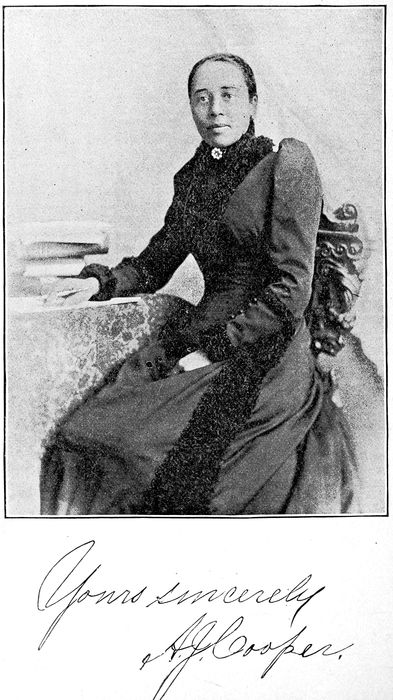
The cover image was created by the transcriber and is placed in the public domain.
BY
A BLACK WOMAN OF THE SOUTH.
XENIA, OHIO:
THE ALDINE PRINTING HOUSE.
1892.
COPYRIGHT 1892
BY
ANNA JULIA COOPER.
A VOICE FROM THE SOUTH.
“With regret
I forget
If the song be living yet,
Yet remember, vaguely now,
It was honest, anyhow.”
To
Bishop Benjamin William Arnett,
With profound regard for his heroic devotion to
God and the Race,
both in Church and in State,—and with sincere
esteem for his unselfish espousal of the cause
of the Black Woman and of every human interest
that lacks a Voice and needs a Defender, this,
the primary utterance of my heart and pen,
Is Affectionately Inscribed.
CONTENTS.
PART FIRST.
Soprano Obligato.
Womanhood a Vital Element in the Regeneration and Progress of a Race
In the clash and clatter of our American Conflict,
it has been said that the South remains
Silent. Like the Sphinx she inspires vociferous
disputation, but herself takes little part in
the noisy controversy. One muffled strain in
the Silent South, a jarring chord and a vague
and uncomprehended cadenza has been and
still is the Negro. And of that muffled chord,
the one mute and voiceless note has been the
sadly expectant Black Woman,
An infant crying in the night,
An infant crying for the light;
And with no language—but a cry.
The colored man’s inheritance and apportionment
is still the sombre crux, the perplexing
cul de sac of the nation,—the dumb skeleton
in the closet provoking ceaseless harangues,
indeed, but little understood and seldom consulted.
Attorneys for the plaintiff and attorneys
IIfor the defendant, with bungling gaucherie
have analyzed and dissected, theorized and
synthesized with sublime ignorance or pathetic
misapprehension of counsel from the black
client. One important witness has not yet been
heard from. The summing up of the evidence
deposed, and the charge to the jury have been
made—but no word from the Black Woman.
It is because I believe the American people
to be conscientiously committed to a fair trial
and ungarbled evidence, and because I feel it
essential to a perfect understanding and an
equitable verdict that truth from each standpoint
be presented at the bar,—that this little
Voice has been added to the already full chorus.
The “other side” has not been represented by
one who “lives there.” And not many can
more sensibly realize and more accurately tell
the weight and the fret of the “long dull
pain” than the open-eyed but hitherto voiceless
Black Woman of America.
The feverish agitation, the perfervid energy,
the busy objectivity of the more turbulent
life of our men serves, it may be, at once to
IIIcloud or color their vision somewhat, and as
well to relieve the smart and deaden the pain
for them. Their voice is in consequence not
always temperate and calm, and at the same
time radically corrective and sanatory. At
any rate, as our Caucasian barristers are not
to blame if they cannot quite put themselves in
the dark man’s place, neither should the dark
man be wholly expected fully and adequately
to reproduce the exact Voice of the Black
Woman.
Delicately sensitive at every pore to social
atmospheric conditions, her calorimeter may
well be studied in the interest of accuracy
and fairness in diagnosing what is often conceded
to be a “puzzling” case. If these
broken utterances can in any way help to a
clearer vision and a truer pulse-beat in studying
our Nation’s Problem, this Voice by a
Black Woman of the South will not have
been raised in vain.
Tawawa Chimney Corner;
Sept. 17, 1892.
SOPRANO OBLIGATO.
V
For they the Royal-hearted Women are
Who nobly love the noblest, yet have grace
For needy, suffering lives in lowliest place;
Carrying a choicer sunlight in their smile,
The heavenliest ray that pitieth the vile.
Though I were happy, throned beside the king,
I should be tender to each little thing
With hurt warm breast, that had no speech to tell
Its inward pangs; and I would soothe it well
With tender touch and with a low, soft moan
For company.
—George Eliot.
[1] WOMANHOOD A VITAL ELEMENT IN THE REGENERATION AND PROGRESS OF A RACE.
9
The two sources from which, perhaps,
modern civilization has derived its noble
and ennobling ideal of woman are Christianity
and the Feudal System.
1. Read before the convocation of colored clergy of the Protestant Episcopal
Church at Washington, D. C., 1886.
In Oriental countries woman has been uniformly
devoted to a life of ignorance, infamy,
and complete stagnation. The Chinese shoe
of to-day does not more entirely dwarf, cramp,
and destroy her physical powers, than have
the customs, laws, and social instincts, which
from remotest ages have governed our Sister
of the East, enervated and blighted her mental
and moral life.
Mahomet makes no account of woman
whatever in his polity. The Koran, which,
unlike our Bible, was a product and not a
10growth, tried to address itself to the needs of
Arabian civilization as Mahomet with his circumscribed
powers saw them. The Arab was
a nomad. Home to him meant his present
camping place. That deity who, according
to our western ideals, makes and sanctifies
the home, was to him a transient bauble to be
toyed with so long as it gave pleasure and
then to be thrown aside for a new one. As a
personality, an individual soul, capable of
eternal growth and unlimited development,
and destined to mould and shape the civilization
of the future to an incalculable extent,
Mahomet did not know woman. There was
no hereafter, no paradise for her. The heaven
of the Mussulman is peopled and made
gladsome not by the departed wife, or sister,
or mother, but by houri—a figment of Mahomet’s
brain, partaking of the ethereal qualities
of angels, yet imbued with all the vices
and inanity of Oriental women. The harem
here, and—“dust to dust” hereafter, this was
the hope, the inspiration, the summum bonum
of the Eastern woman’s life! With what result
on the life of the nation, the “Unspeakable
Turk,” the “sick man” of modern Europe
can to-day exemplify.
Says a certain writer: “The private life of
11the Turk is vilest of the vile, unprogressive,
unambitious, and inconceivably low.” And
yet Turkey is not without her great men.
She has produced most brilliant minds; men
skilled in all the intricacies of diplomacy and
statesmanship; men whose intellects could
grapple with the deep problems of empire
and manipulate the subtle agencies which
check-mate kings. But these minds were
not the normal outgrowth of a healthy trunk.
They seemed rather ephemeral excrescencies
which shoot far out with all the vigor and
promise, apparently, of strong branches; but
soon alas fall into decay and ugliness because
there is no soundness in the root, no life-giving
sap, permeating, strengthening and perpetuating
the whole. There is a worm at the
core! The homelife is impure! and when we
look for fruit, like apples of Sodom, it crumbles
within our grasp into dust and ashes.
It is pleasing to turn from this effete and
immobile civilization to a society still fresh
and vigorous, whose seed is in itself, and
whose very name is synonymous with all that
is progressive, elevating and inspiring, viz.,
the European bud and the American flower
of modern civilization.
And here let me say parenthetically that
12our satisfaction in American institutions rests
not on the fruition we now enjoy, but springs
rather from the possibilities and promise that
are inherent in the system, though as yet,
perhaps, far in the future.
“Happiness,” says Madame de Stael, “consists
not in perfections attained, but in a sense
of progress, the result of our own endeavor
under conspiring circumstances toward a goal
which continually advances and broadens and
deepens till it is swallowed up in the Infinite.”
Such conditions in embryo are all that we
claim for the land of the West. We have not
yet reached our ideal in American civilization.
The pessimists even declare that we are not
marching in that direction. But there can be
no doubt that here in America is the arena in
which the next triumph of civilization is to be
won; and here too we find promise abundant
and possibilities infinite.
Now let us see on what basis this hope for
our country primarily and fundamentally
rests. Can any one doubt that it is chiefly on
the homelife and on the influence of good
women in those homes? Says Macaulay:
“You may judge a nation’s rank in the scale
of civilization from the way they treat their
women.” And Emerson, “I have thought
13that a sufficient measure of civilization is the
influence of good women.” Now this high
regard for woman, this germ of a prolific idea
which in our own day is bearing such rich
and varied fruit, was ingrafted into European
civilization, we have said, from two sources,
the Christian Church and the Feudal System.
For although the Feudal System can in no
sense be said to have originated the idea, yet
there can be no doubt that the habits of life
and modes of thought to which Feudalism gave
rise, materially fostered and developed it; for
they gave us chivalry, than which no institution
has more sensibly magnified and elevated
woman’s position in society.
Tacitus dwells on the tender regard for woman
entertained by these rugged barbarians
before they left their northern homes to overrun
Europe. Old Norse legends too, and
primitive poems, all breathe the same spirit
of love of home and veneration for the pure
and noble influence there presiding—the wife,
the sister, the mother.
And when later on we see the settled life
of the Middle Ages “oozing out,” as M.
Guizot expresses it, from the plundering and
pillaging life of barbarism and crystallizing
into the Feudal System, the tiger of the field
14is brought once more within the charmed circle
of the goddesses of his castle, and his imagination
weaves around them a halo whose
reflection possibly has not yet altogether vanished.
It is true the spirit of Christianity had not
yet put the seal of catholicity on this sentiment.
Chivalry, according to Bascom, was
but the toning down and softening of a rough
and lawless period. It gave a roseate glow
to a bitter winter’s day. Those who looked
out from castle windows revelled in its “amethyst
tints.” But God’s poor, the weak, the
unlovely, the commonplace were still freezing
and starving none the less in unpitied, unrelieved
loneliness.
Respect for woman, the much lauded chivalry
of the Middle Ages, meant what I fear it
still means to some men in our own day—respect
for the elect few among whom they expect
to consort.
The idea of the radical amelioration of womankind,
reverence for woman as woman regardless
of rank, wealth, or culture, was to
come from that rich and bounteous fountain
from which flow all our liberal and universal
ideas—the Gospel of Jesus Christ.
And yet the Christian Church at the time
15of which we have been speaking would seem
to have been doing even less to protect and
elevate woman than the little done by secular
society. The Church as an organization
committed a double offense against woman in
the Middle Ages. Making of marriage a sacrament
and at the same time insisting on the
celibacy of the clergy and other religious orders,
she gave an inferior if not an impure
character to the marriage relation, especially
fitted to reflect discredit on woman. Would
this were all or the worst! but the Church by
the licentiousness of its chosen servants invaded
the household and established too often
as vicious connections those relations which it
forbade to assume openly and in good faith.
“Thus,” to use the words of our authority,
“the religious corps became as numerous, as
searching, and as unclean as the frogs of
Egypt, which penetrated into all quarters,
into the ovens and kneading troughs, leaving
their filthy trail wherever they went.” Says
Chaucer with characteristic satire, speaking
of the Friars:
‘Women may now go safely up and doun,
In every bush, and under every tree,
Ther is non other incubus but he,
And he ne will don hem no dishonour.’
16Henry, Bishop of Liege, could unblushingly
boast the birth of twenty-two children in
fourteen years.[2]
It may help us under some of the perplexities
which beset our way in “the one Catholic
and Apostolic Church” to-day, to recall some
of the corruptions and incongruities against
which the Bride of Christ has had to struggle
in her past history and in spite of which she
has kept, through many vicissitudes, the faith
once delivered to the saints. Individuals, organizations,
whole sections of the Church militant
may outrage the Christ whom they profess,
may ruthlessly trample under foot both
the spirit and the letter of his precepts, yet
not till we hear the voices audibly saying
“Come let us depart hence,” shall we cease to
believe and cling to the promise, “I am with
you to the end of the world.”
“Yet saints their watch are keeping,
The cry goes up ‘How long!’
And soon the night of weeping
Shall be the morn of song.”
However much then the facts of any particular
period of history may seem to deny it, I
for one do not doubt that the source of the
vitalizing principle of woman’s development
17and amelioration is the Christian Church, so
far as that church is coincident with Christianity.
Christ gave ideals not formulæ. The Gospel
is a germ requiring millennia for its growth
and ripening. It needs and at the same time
helps to form around itself a soil enriched in
civilization, and perfected in culture and insight
without which the embryo can neither
be unfolded or comprehended. With all the
strides our civilization has made from the first
to the nineteenth century, we can boast not
an idea, not a principle of action, not a progressive
social force but was already mutely
foreshadowed, or directly enjoined in that
simple tale of a meek and lowly life. The
quiet face of the Nazarene is ever seen a little
way ahead, never too far to come down to and
touch the life of the lowest in days the darkest,
yet ever leading onward, still onward, the
tottering childish feet of our strangely boastful
civilization.
By laying down for woman the same code
of morality, the same standard of purity, as
for man; by refusing to countenance the
shameless and equally guilty monsters who
were gloating over her fall,—graciously stooping
in all the majesty of his own spotlessness
18to wipe away the filth and grime of her guilty
past and bid her go in peace and sin no more;
and again in the moments of his own careworn
and footsore dejection, turning trustfully and
lovingly, away from the heartless snubbing
and sneers, away from the cruel malignity of
mobs and prelates in the dusty marts of Jerusalem
to the ready sympathy, loving appreciation
and unfaltering friendship of that quiet
home at Bethany; and even at the last, by
his dying bequest to the disciple whom he
loved, signifying the protection and tender
regard to be extended to that sorrowing
mother and ever afterward to the sex she
represented;—throughout his life and in his
death he has given to men a rule and guide
for the estimation of woman as an equal, as a
helper, as a friend, and as a sacred charge to
be sheltered and cared for with a brother’s
love and sympathy, lessons which nineteen
centuries’ gigantic strides in knowledge, arts,
and sciences, in social and ethical principles
have not been able to probe to their depth or
to exhaust in practice.
It seems not too much to say then of the
vitalizing, regenerating, and progressive influence
of womanhood on the civilization of to-day,
that, while it was foreshadowed among
19Germanic nations in the far away dawn of
their history as a narrow, sickly and stunted
growth, it yet owes its catholicity and power,
the deepening of its roots and broadening of
its branches to Christianity.
The union of these two forces, the Barbaric
and the Christian, was not long delayed after
the Fall of the Empire. The Church, which
fell with Rome, finding herself in danger of
being swallowed up by barbarism, with characteristic
vigor and fertility of resources, addressed
herself immediately to the task of
conquering her conquerers. The means chosen
does credit to her power of penetration and
adaptability, as well as to her profound, unerring,
all-compassing diplomacy; and makes
us even now wonder if aught human can successfully
and ultimately withstand her far-seeing
designs and brilliant policy, or gainsay
her well-earned claim to the word Catholic.
She saw the barbarian, little more developed
than a wild beast. She forbore to antagonize
and mystify his warlike nature by a full blaze
of the heartsearching and humanizing tenets
of her great Head. She said little of the rule
“If thy brother smite thee on one cheek, turn
to him the other also;” but thought it sufficient
for the needs of those times, to establish
20the so-called “Truce of God” under which
men were bound to abstain from butchering
one another for three days of each week and
on Church festivals. In other words, she respected
their individuality: non-resistance
pure and simple being for them an utter impossibility,
she contented herself with less
radical measures calculated to lead up finally
to the full measure of the benevolence of
Christ.
Next she took advantage of the barbarian’s
sensuous love of gaudy display and put all
her magnificent garments on. She could not
capture him by physical force, she would dazzle
him by gorgeous spectacles. It is said
that Romanism gained more in pomp and ritual
during this trying period of the Dark
Ages than throughout all her former history.
The result was she carried her point. Once
more Rome laid her ambitious hand on the
temporal power, and allied with Charlemagne,
aspired to rule the world through a civilization
dominated by Christianity and permeated
by the traditions and instincts of those sturdy
barbarians.
Here was the confluence of the two streams
we have been tracing, which, united now,
stretch before us as a broad majestic river.
21In regard to woman it was the meeting of
two noble and ennobling forces, two kindred
ideas the resultant of which, we doubt not, is
destined to be a potent force in the betterment
of the world.
Now after our appeal to history comparing
nations destitute of this force and so destitute
also of the principle of progress, with other
nations among whom the influence of woman
is prominent coupled with a brisk, progressive,
satisfying civilization,—if in addition we find
this strong presumptive evidence corroborated
by reason and experience, we may conclude
that these two equally varying concomitants
are linked as cause and effect; in other words,
that the position of woman in society determines
the vital elements of its regeneration
and progress.
Now that this is so on a priori grounds all
must admit. And this not because woman is
better or stronger or wiser than man, but from
the nature of the case, because it is she who
must first form the man by directing the earliest
impulses of his character.
Byron and Wordsworth were both geniuses
and would have stamped themselves on the
thought of their age under any circumstances;
and yet we find the one a savor of life unto life,
22the other of death unto death. “Byron, like
a rocket, shot his way upward with scorn and
repulsion, flamed out in wild, explosive, brilliant
excesses and disappeared in darkness
made all the more palpable.”[3]
Wordsworth lent of his gifts to reinforce
that “power in the Universe which makes for
righteousness” by taking the harp handed him
from Heaven and using it to swell the strains
of angelic choirs. Two locomotives equally
mighty stand facing opposite tracks; the one
to rush headlong to destruction with all its
precious freight, the other to toil grandly and
gloriously up the steep embattlements to Heaven
and to God. Who—who can say what a
world of consequences hung on the first placing
and starting of these enormous forces!
Woman, Mother,—your responsibility is one
that might make angels tremble and fear to
take hold! To trifle with it, to ignore or misuse
it, is to treat lightly the most sacred and
solemn trust ever confided by God to human
kind. The training of children is a task on
which an infinity of weal or woe depends.
Who does not covet it? Yet who does not
stand awe-struck before its momentous issues!
It is a matter of small moment, it seems to
23me, whether that lovely girl in whose accomplishments
you take such pride and delight,
can enter the gay and crowded salon with the
ease and elegance of this or that French or
English gentlewoman, compared with the
decision as to whether her individuality is
going to reinforce the good or the evil elements
of the world. The lace and the diamonds, the
dance and the theater, gain a new significance
when scanned in their bearings on such
issues. Their influence on the individual personality,
and through her on the society and
civilization which she vitalizes and inspires—all
this and more must be weighed in the balance
before the jury can return a just and
intelligent verdict as to the innocence or banefulness
of these apparently simple amusements.
Now the fact of woman’s influence on society
being granted, what are its practical bearings
on the work which brought together this
conference of colored clergy and laymen
in Washington? “We come not here to
talk.” Life is too busy, too pregnant with
meaning and far reaching consequences to
allow you to come this far for mere intellectual
entertainment.
The vital agency of womanhood in the regeneration
24and progress of a race, as a general
question, is conceded almost before it is fairly
stated. I confess one of the difficulties for
me in the subject assigned lay in its obviousness.
The plea is taken away by the opposite
attorney’s granting the whole question.
“Woman’s influence on social progress”—who
in Christendom doubts or questions it?
One may as well be called on to prove that
the sun is the source of light and heat and
energy to this many-sided little world.
Nor, on the other hand, could it have been
intended that I should apply the position when
taken and proven, to the needs and responsibilities
of the women of our race in the South.
For is it not written, “Cursed is he that
cometh after the king?” and has not the King
already preceded me in “The Black Woman
of the South”?[4]
They have had both Moses and the Prophets
in Dr. Crummell and if they hear not him,
neither would they be persuaded though one
came up from the South.
I would beg, however, with the Doctor’s
permission, to add my plea for the Colored
Girls of the South:—that large, bright, promising
fatally beautiful class that stand shivering
25like a delicate plantlet before the fury of
tempestuous elements, so full of promise and
possibilities, yet so sure of destruction; often
without a father to whom they dare apply the
loving term, often without a stronger brother
to espouse their cause and defend their honor
with his life’s blood; in the midst of pitfalls
and snares, waylaid by the lower classes of
white men, with no shelter, no protection
nearer than the great blue vault above, which
half conceals and half reveals the one Care-Taker
they know so little of. Oh, save them,
help them, shield, train, develop, teach, inspire
them! Snatch them, in God’s name, as brands
from the burning! There is material in them
well worth your while, the hope in germ of a
staunch, helpful, regenerating womanhood on
which, primarily, rests the foundation stones
of our future as a race.
It is absurd to quote statistics showing the
Negro’s bank account and rent rolls, to point
to the hundreds of newspapers edited by colored
men and lists of lawyers, doctors, professors,
D. D’s, LL D’s, etc., etc., etc., while the
source from which the life-blood of the race is
to flow is subject to taint and corruption in the
enemy’s camp.
True progress is never made by spasms.
26Real progress is growth. It must begin in the
seed. Then, “first the blade, then the ear,
after that the full corn in the ear.” There is
something to encourage and inspire us in the
advancement of individuals since their emancipation
from slavery. It at least proves that
there is nothing irretrievably wrong in the
shape of the black man’s skull, and that under
given circumstances his development, downward
or upward, will be similar to that of
other average human beings.
But there is no time to be wasted in mere
felicitation. That the Negro has his niche in
the infinite purposes of the Eternal, no one
who has studied the history of the last fifty
years in America will deny. That much depends
on his own right comprehension of his
responsibility and rising to the demands of the
hour, it will be good for him to see; and how
best to use his present so that the structure of
the future shall be stronger and higher and
brighter and nobler and holier than that of the
past, is a question to be decided each day by
every one of us.
The race is just twenty-one years removed
from the conception and experience of a chattel,
just at the age of ruddy manhood. It is
well enough to pause a moment for retrospection,
27introspection, and prospection. We look
back, not to become inflated with conceit because
of the depths from which we have
arisen, but that we may learn wisdom from
experience. We look within that we may
gather together once more our forces, and, by
improved and more practical methods, address
ourselves to the tasks before us. We look
forward with hope and trust that the same
God whose guiding hand led our fathers
through and out of the gall and bitterness of
oppression, will still lead and direct their children,
to the honor of His name, and for their
ultimate salvation.
But this survey of the failures or achievements
of the past, the difficulties and embarrassments
of the present, and the mingled
hopes and fears for the future, must not degenerate
into mere dreaming nor consume
the time which belongs to the practical and
effective handling of the crucial questions of
the hour; and there can be no issue more vital
and momentous than this of the womanhood
of the race.
Here is the vulnerable point, not in the heel,
but at the heart of the young Achilles; and
here must the defenses be strengthened and
the watch redoubled.
28We are the heirs of a past which was not
our fathers’ moulding. “Every man the arbiter
of his own destiny” was not true for the
American Negro of the past: and it is no
fault of his that he finds himself to-day the
inheritor of a manhood and womanhood impoverished
and debased by two centuries and
more of compression and degradation.
But weaknesses and malformations, which
to-day are attributable to a vicious schoolmaster
and a pernicious system, will a century
hence be rightly regarded as proofs of innate
corruptness and radical incurability.
Now the fundamental agency under God
in the regeneration, the re-training of the race,
as well as the ground work and starting point
of its progress upward, must be the black
woman.
With all the wrongs and neglects of her
past, with all the weakness, the debasement,
the moral thralldom of her present, the black
woman of to-day stands mute and wondering
at the Herculean task devolving upon her.
But the cycles wait for her. No other hand
can move the lever. She must be loosed from
her bands and set to work.
Our meager and superficial results from past
efforts prove their futility; and every attempt
29to elevate the Negro, whether undertaken by
himself or through the philanthropy of others,
cannot but prove abortive unless so directed
as to utilize the indispensable agency of an
elevated and trained womanhood.
A race cannot be purified from without.
Preachers and teachers are helps, and stimulants
and conditions as necessary as the
gracious rain and sunshine are to plant growth.
But what are rain and dew and sunshine and
cloud if there be no life in the plant germ?
We must go to the root and see that that is
sound and healthy and vigorous; and not deceive
ourselves with waxen flowers and painted
leaves of mock chlorophyll.
We too often mistake individuals’ honor
for race development and so are ready to substitute
pretty accomplishments for sound sense
and earnest purpose.
A stream cannot rise higher than its source.
The atmosphere of homes is no rarer and
purer and sweeter than are the mothers in those
homes. A race is but a total of families. The
nation is the aggregate of its homes. As the
whole is sum of all its parts, so the character
of the parts will determine the characteristics
of the whole. These are all axioms and so
evident that it seems gratuitous to remark it;
30and yet, unless I am greatly mistaken, most of
the unsatisfaction from our past results arises
from just such a radical and palpable error, as
much almost on our own part as on that of
our benevolent white friends.
The Negro is constitutionally hopeful and
proverbially irrepressible; and naturally stands
in danger of being dazzled by the shimmer
and tinsel of superficials. We often mistake
foliage for fruit and overestimate or wrongly
estimate brilliant results.
The late Martin R. Delany, who was an unadulterated
black man, used to say when
honors of state fell upon him, that when he
entered the council of kings the black race
entered with him; meaning, I suppose, that
there was no discounting his race identity and
attributing his achievements to some admixture
of Saxon blood. But our present record
of eminent men, when placed beside the actual
status of the race in America to-day, proves
that no man can represent the race. Whatever
the attainments of the individual may
be, unless his home has moved on pari passu,
he can never be regarded as identical with or
representative of the whole.
Not by pointing to sun-bathed mountain
tops do we prove that Phœbus warms the valleys.
31We must point to homes, average
homes, homes of the rank and file of horny
handed toiling men and women of the South
(where the masses are) lighted and cheered by
the good, the beautiful, and the true,—then
and not till then will the whole plateau be
lifted into the sunlight.
Only the Black Woman can say “when and
where I enter, in the quiet, undisputed dignity
of my womanhood, without violence and
without suing or special patronage, then and
there the whole Negro race enters with me.”
Is it not evident then that as individual workers
for this race we must address ourselves
with no half-hearted zeal to this feature of our
mission. The need is felt and must be recognized
by all. There is a call for workers, for
missionaries, for men and women with the
double consecration of a fundamental love of
humanity and a desire for its melioration
through the Gospel; but superadded to this we
demand an intelligent and sympathetic comprehension
of the interests and special needs
of the Negro.
I see not why there should not be an organized
effort for the protection and elevation of
our girls such as the White Cross League in
England. English women are strengthened
32and protected by more than twelve centuries
of Christian influences, freedom and civilization;
English girls are dispirited and crushed
down by no such all-levelling prejudice as that
supercilious caste spirit in America which
cynically assumes “A Negro woman cannot
be a lady.” English womanhood is beset by
no such snares and traps as betray the unprotected,
untrained colored girl of the South,
whose only crime and dire destruction often is
her unconscious and marvelous beauty. Surely
then if English indignation is aroused and
English manhood thrilled under the leadership
of a Bishop of the English church to build up
bulwarks around their wronged sisters, Negro
sentiment cannot remain callous and Negro
effort nerveless in view of the imminent peril
of the mothers of the next generation. “I
am my Sister’s keeper!” should be the hearty
response of every man and woman of the race,
and this conviction should purify and exalt the
narrow, selfish and petty personal aims of life
into a noble and sacred purpose.
We need men who can let their interest and
gallantry extend outside the circle of their
æsthetic appreciation; men who can be a father,
a brother, a friend to every weak, struggling
unshielded girl. We need women who are so
33sure of their own social footing that they need
not fear leaning to lend a hand to a fallen or
falling sister. We need men and women who
do not exhaust their genius splitting hairs on
aristocratic distinctions and thanking God they
are not as others; but earnest, unselfish souls,
who can go into the highways and byways,
lifting up and leading, advising and encouraging
with the truly catholic benevolence of
the Gospel of Christ.
As Church workers we must confess our
path of duty is less obvious; or rather our ability
to adapt our machinery to our conception
of the peculiar exigencies of this work as
taught by experience and our own consciousness
of the needs of the Negro, is as yet not
demonstrable. Flexibility and aggressiveness
are not such strong characteristics of the
Church to-day as in the Dark Ages.
As a Mission field for the Church the Southern
Negro is in some aspects most promising;
in others, perplexing. Aliens neither in language
and customs, nor in associations and
sympathies, naturally of deeply rooted religious
instincts and taking most readily and kindly
to the worship and teachings of the Church,
surely the task of proselytizing the American
Negro is infinitely less formidable than that
34which confronted the Church in the Barbarians
of Europe. Besides, this people already look
to the Church as the hope of their race.
Thinking colored men almost uniformly admit
that the Protestant Episcopal Church with its
quiet, chaste dignity and decorous solemnity,
its instructive and elevating ritual, its bright
chanting and joyous hymning, is eminently
fitted to correct the peculiar faults of worship—the
rank exuberance and often ludicrous
demonstrativeness of their people. Yet,
strange to say, the Church, claiming to be
missionary and Catholic, urging that schism
is sin and denominationalism inexcusable, has
made in all these years almost no inroads
upon this semi-civilized religionism.
Harvests from this over ripe field of home
missions have been gathered in by Methodists,
Baptists, and not least by Congregationalists,
who were unknown to the Freedmen before
their emancipation.
Our clergy numbers less than two dozen[5]
priests of Negro blood and we have hardly
more than one self-supporting colored congregation
in the entire Southland. While the
organization known as the A. M. E. Church
35has 14,063 ministers, itinerant and local, 4,069
self-supporting churches, 4,275 Sunday-schools,
with property valued at $7,772,284, raising
yearly for church purposes $1,427,000.
5. The published report of ’91 shows 26 priests for the entire country,
including one not engaged in work and one a professor in a non-sectarian
school, since made Dean of an Episcopal Annex to Howard University
known as King Hall.
Stranger and more significant than all, the
leading men of this race (I do not mean demagogues
and politicians, but men of intellect,
heart, and race devotion, men to whom the
elevation of their people means more than
personal ambition and sordid gain—and the
men of that stamp have not all died yet) the
Christian workers for the race, of younger and
more cultured growth, are noticeably drifting
into sectarian churches, many of them declaring
all the time that they acknowledge the
historic claims of the Church, believe her
apostolicity, and would experience greater
personal comfort, spiritual and intellectual, in
her revered communion. It is a fact which
any one may verify for himself, that representative
colored men, professing that in their
heart of hearts they are Episcopalians, are
actually working in Methodist and Baptist
pulpits; while the ranks of the Episcopal
clergy are left to be filled largely by men who
certainly suggest the propriety of a “perpetual
Diaconate” if they cannot be said to have
created the necessity for it.
36Now where is the trouble? Something
must be wrong. What is it?
A certain Southern Bishop of our Church
reviewing the situation, whether in Godly
anxiety or in “Gothic antipathy” I know
not, deprecates the fact that the colored people
do not seem drawn to the Episcopal Church,
and comes to the sage conclusion that the
Church is not adapted to the rude untutored
minds of the Freedmen, and that they may be
left to go to the Methodists and Baptists
whither their racial proclivities undeniably
tend. How the good Bishop can agree that
all-foreseeing Wisdom, and Catholic Love
would have framed his Church as typified in
his seamless garment and unbroken body, and
yet not leave it broad enough and deep enough
and loving enough to seek and save and hold
seven millions of God’s poor, I cannot see.
But the doctors while discussing their scientifically
conclusive diagnosis of the disease,
will perhaps not think it presumptuous in the
patient if he dares to suggest where at least
the pain is. If this be allowed, a Black woman
of the South would beg to point out two possible
oversights in this southern work which
may indicate in part both a cause and a remedy
for some failure. The first is not calculating
37for the Black man’s personality; not having
respect, if I may so express it, to his manhood
or deferring at all to his conceptions of
the needs of his people. When colored persons
have been employed it was too often as
machines or as manikins. There has been no
disposition, generally, to get the black man’s
ideal or to let his individuality work by its
own gravity, as it were. A conference of
earnest Christian men have met at regular
intervals for some years past to discuss the
best methods of promoting the welfare and
development of colored people in this country.
Yet, strange as it may seem, they have never
invited a colored man or even intimated that
one would be welcome to take part in their
deliberations. Their remedial contrivances
are purely theoretical or empirical, therefore,
and the whole machinery devoid of soul.
The second important oversight in my judgment
is closely allied to this and probably
grows out of it, and that is not developing
Negro womanhood as an essential fundamental
for the elevation of the race, and utilizing
this agency in extending the work of the
Church.
Of the first I have possibly already presumed
to say too much since it does not strictly come
38within the province of my subject. However,
Macaulay somewhere criticises the Church of
England as not knowing how to use fanatics,
and declares that had Ignatius Loyola been in
the Anglican instead of the Roman communion,
the Jesuits would have been schismatics
instead of Catholics; and if the religious
awakenings of the Wesleys had been in Rome,
she would have shaven their heads, tied ropes
around their waists, and sent them out under
her own banner and blessing. Whether this
be true or not, there is certainly a vast amount
of force potential for Negro evangelization
rendered latent, or worse, antagonistic by the
halting, uncertain, I had almost said, trimming
policy of the Church in the South. This may
sound both presumptuous and ungrateful. It
is mortifying, I know, to benevolent wisdom,
after having spent itself in the execution of
well conned theories for the ideal development
of a particular work, to hear perhaps the
weakest and humblest element of that work
asking “what doest thou?”
Yet so it will be in life. The “thus far and
no farther” pattern cannot be fitted to any
growth in God’s kingdom. The universal
law of development is “onward and upward.”
It is God-given and inviolable. From the
39unfolding of the germ in the acorn to reach
the sturdy oak, to the growth of a human
soul into the full knowledge and likeness of
its Creator, the breadth and scope of the
movement in each and all are too grand, too
mysterious, too like God himself, to be encompassed
and locked down in human molds.
After all the Southern slave owners were
right: either the very alphabet of intellectual
growth must be forbidden and the Negro
dealt with absolutely as a chattel having
neither rights nor sensibilities; or else the
clamps and irons of mental and moral, as well
as civil compression must be riven asunder
and the truly enfranchised soul led to the entrance
of that boundless vista through which
it is to toil upwards to its beckoning God as
the buried seed germ to meet the sun.
A perpetual colored diaconate, carefully
and kindly superintended by the white clergy;
congregations of shiny faced peasants with
their clean white aprons and sunbonnets catechised
at regular intervals and taught to recite
the creed, the Lord’s prayer and the ten
commandments—duty towards God and duty
towards neighbor, surely such well tended
sheep ought to be grateful to their shepherds
and content in that station of life to which it
40pleased God to call them. True, like the old
professor lecturing to his solitary student, we
make no provision here for irregularities.
“Questions must be kept till after class,” or
dispensed with altogether. That some do ask
questions and insist on answers, in class too,
must be both impertinent and annoying. Let
not our spiritual pastors and masters however
be grieved at such self-assertion as merely signifies
we have a destiny to fulfill and as men and
women we must be about our Father’s business.
It is a mistake to suppose that the Negro is
prejudiced against a white ministry. Naturally
there is not a more kindly and implicit
follower of a white man’s guidance than the
average colored peasant. What would to
others be an ordinary act of friendly or pastoral
interest he would be more inclined to
regard gratefully as a condescension. And
he never forgets such kindness. Could the
Negro be brought near to his white priest or
bishop, he is not suspicious. He is not only
willing but often longs to unburden his soul
to this intelligent guide. There are no reservations
when he is convinced that you are his
friend. It is a saddening satire on American
history and manners that it takes something
to convince him.
41That our people are not “drawn” to a
church whose chief dignitaries they see only
in the chancel, and whom they reverence as
they would a painting or an angel, whose life
never comes down to and touches theirs with
the inspiration of an objective reality, may be
“perplexing” truly (American caste and
American Christianity both being facts) but
it need not be surprising. There must be
something of human nature in it, the same as
that which brought about that “the Word
was made flesh and dwelt among us” that
He might “draw” us towards God.
Men are not “drawn” by abstractions.
Only sympathy and love can draw, and until
our Church in America realizes this and provides
a clergy that can come in touch with
our life and have a fellow feeling for our woes,
without being imbedded and frozen up in
their “Gothic antipathies,” the good bishops
are likely to continue “perplexed” by the
sparsity of colored Episcopalians.
A colored priest of my acquaintance recently
related to me, with tears in his eyes, how
his reverend Father in God, the Bishop who
had ordained him, had met him on the cars
on his way to the diocesan convention and
warned him, not unkindly, not to take a seat
42in the body of the convention with the white
clergy. To avoid disturbance of their godly
placidity he would of course please sit back
and somewhat apart. I do not imagine that
that clergyman had very much heart for the
Christly (!) deliberations of that convention.
To return, however, it is not on this broader
view of Church work, which I mentioned as a
primary cause of its halting progress with the
colored people, that I am to speak. My proper
theme is the second oversight of which in
my judgment our Christian propagandists
have been guilty: or, the necessity of church
training, protecting and uplifting our colored
womanhood as indispensable to the evangelization
of the race.
Apelles did not disdain even that criticism
of his lofty art which came from an uncouth
cobbler; and may I not hope that the writer’s
oneness with her subject both in feeling and in
being may palliate undue obtrusiveness of
opinions here. That the race cannot be effectually
lifted up till its women are truly elevated
we take as proven. It is not for us to dwell
on the needs, the neglects, and the ways of
succor, pertaining to the black woman of the
South. The ground has been ably discussed
and an admirable and practical plan proposed
43by the oldest Negro priest in America, advising
and urging that special organizations such
as Church Sisterhoods and industrial schools
be devised to meet her pressing needs in the
Southland. That some such movements are
vital to the life of this people and the extension
of the Church among them, is not hard
to see. Yet the pamphlet fell still-born from
the press. So far as I am informed the Church
has made no motion towards carrying out Dr.
Crummell’s suggestion.
The denomination which comes next our
own in opposing the proverbial emotionalism
of Negro worship in the South, and which in
consequence like ours receives the cold shoulder
from the old heads, resting as we do under
the charge of not “having religion” and not
believing in conversion—the Congregationalists—have
quietly gone to work on the young,
have established industrial and training schools,
and now almost every community in the
South is yearly enriched by a fresh infusion
of vigorous young hearts, cultivated heads,
and helpful hands that have been trained at
Fisk, at Hampton, in Atlanta University, and
in Tuskegee, Alabama.
These young people are missionaries actual
or virtual both here and in Africa. They
44have learned to love the methods and doctrines
of the Church which trained and educated
them; and so Congregationalism surely and
steadily progresses.
Need I compare these well known facts
with results shown by the Church in the same
field and during the same or even a longer
time.
The institution of the Church in the South
to which she mainly looks for the training of
her colored clergy and for the help of the
“Black Woman” and “Colored Girl” of the
South, has graduated since the year 1868, when
the school was founded, five young women;[6] and
while yearly numerous young men have been
kept and trained for the ministry by the charities
of the Church, the number of indigent females
who have here been supported, sheltered and
trained, is phenomenally small. Indeed, to
my mind, the attitude of the Church toward
this feature of her work is as if the solution of
the problem of Negro missions depended solely
on sending a quota of deacons and priests into
the field, girls being a sort of tertium quid whose
development may be promoted if they can
pay their way and fall in with the plans
mapped out for the training of the other sex.
45Now I would ask in all earnestness, does not
this force potential deserve by education and
stimulus to be made dynamic? Is it not a
solemn duty incumbent on all colored churchmen
to make it so? Will not the aid of
the Church be given to prepare our girls in
head, heart, and hand for the duties and responsibilities
that await the intelligent wife,
the Christian mother, the earnest, virtuous,
helpful woman, at once both the lever and
the fulcrum for uplifting the race.
6. Five have been graduated since ’86, two in ’91, two in ’92.
As Negroes and churchmen we cannot be
indifferent to these questions. They touch us
most vitally on both sides. We believe in the
Holy Catholic Church. We believe that however
gigantic and apparently remote the consummation,
the Church will go on conquering
and to conquer till the kingdoms of this
world, not excepting the black man and the
black woman of the South, shall have become
the kingdoms of the Lord and of his Christ.
That past work in this direction has been
unsatisfactory we must admit. That without
a change of policy results in the future will
be as meagre, we greatly fear. Our life as a
race is at stake. The dearest interests of our
hearts are in the scales. We must either
break away from dear old landmarks and
46plunge out in any line and every line that enables
us to meet the pressing need of our people,
or we must ask the Church to allow and
help us, untrammelled by the prejudices and
theories of individuals, to work aggressively
under her direction as we alone can, with God’s
help, for the salvation of our people.
The time is ripe for action. Self-seeking
and ambition must be laid on the altar. The
battle is one of sacrifice and hardship, but our
duty is plain. We have been recipients of
missionary bounty in some sort for twenty-one
years. Not even the senseless vegetable
is content to be a mere reservoir. Receiving
without giving is an anomaly in nature.
Nature’s cells are all little workshops for manufacturing
sunbeams, the product to be given
out to earth’s inhabitants in warmth, energy,
thought, action. Inanimate creation always
pays back an equivalent.
Now, How much owest thou, my Lord? Will
his account be overdrawn if he call for singleness
of purpose and self-sacrificing labor for
your brethren? Having passed through your
drill school, will you refuse a general’s commission
even if it entail responsibility, risk
and anxiety, with possibly some adverse criticism?
Is it too much to ask you to step forward
47and direct the work for your race along
those lines which you know to be of first and
vital importance?
Will you allow these words of Ralph Waldo
Emerson? “In ordinary,” says he, “we have
a snappish criticism which watches and contradicts
the opposite party. We want the
will which advances and dictates [acts].
Nature has made up her mind that what cannot
defend itself, shall not be defended. Complaining
never so loud and with never so
much reason, is of no use. What cannot
stand must fall; and the measure of our sincerity
and therefore of the respect of men is the
amount of health and wealth we will hazard in
the defense of our right.”
THE HIGHER EDUCATION OF WOMEN.
48
In the very first year of our century, the year
1801, there appeared in Paris a book by
Silvain Marechal, entitled “Shall Woman
Learn the Alphabet.” The book proposes a
law prohibiting the alphabet to women, and
quotes authorities weighty and various, to
prove that the woman who knows the alphabet
has already lost part of her womanliness.
The author declares that woman can use the
alphabet only as Moliere predicted they would,
in spelling out the verb amo; that they have
no occasion to peruse Ovid’s Ars Amoris, since
that is already the ground and limit of their
intuitive furnishing; that Madame Guion
would have been far more adorable had she
remained a beautiful ignoramus as nature
made her; that Ruth, Naomi, the Spartan
woman, the Amazons, Penelope, Andromache,
Lucretia, Joan of Arc, Petrarch’s Laura, the
daughters of Charlemagne, could not spell
49their names; while Sappho, Aspasia, Madame
de Maintenon, and Madame de Stael could
read altogether too well for their good; finally,
that if women were once permitted to read
Sophocles and work with logarithms, or to
nibble at any side of the apple of knowledge,
there would be an end forever to their sewing
on buttons and embroidering slippers.
Please remember this book was published
at the beginning of the Nineteenth Century.
At the end of its first third, (in the year 1833)
one solitary college in America decided to admit
women within its sacred precincts, and
organized what was called a “Ladies’
Course” as well as the regular B. A. or Gentlemen’s
course.
It was felt to be an experiment—a rather dangerous
experiment—and was adopted with
fear and trembling by the good fathers, who
looked as if they had been caught secretly
mixing explosive compounds and were
guiltily expecting every moment to see the
foundations under them shaken and rent and
their fair superstructure shattered into fragments.
But the girls came, and there was no upheaval.
They performed their tasks modestly
and intelligently. Once in a while one or two
50were found choosing the gentlemen’s course.
Still no collapse; and the dear, careful, scrupulous,
frightened old professors were just getting
their hearts out of their throats and preparing
to draw one good free breath, when
they found they would have to change the
names of those courses; for there were as
many ladies in the gentlemen’s course as in
the ladies’, and a distinctively Ladies’ Course,
inferior in scope and aim to the regular classical
course, did not and could not exist.
Other colleges gradually fell into line, and
to-day there are one hundred and ninety-eight
colleges for women, and two hundred
and seven coeducational colleges and universities
in the United States alone offering the
degree of B. A. to women, and sending out
yearly into the arteries of this nation a warm,
rich flood of strong, brave, active, energetic,
well-equipped, thoughtful women—women
quick to see and eager to help the needs of
this needy world—women who can think as
well as feel, and who feel none the less because
they think—women who are none the less
tender and true for the parchment scroll they
bear in their hands—women who have given
a deeper, richer, nobler and grander meaning
to the word “womanly” than any one-sided
51masculine definition could ever have suggested
or inspired—women whom the world has long
waited for in pain and anguish till there should
be at last added to its forces and allowed to
permeate its thought the complement of that
masculine influence which has dominated it for
fourteen centuries.
Since the idea of order and subordination
succumbed to barbarian brawn and brutality
in the fifth century, the civilized world has
been like a child brought up by his father. It
has needed the great mother heart to teach it
to be pitiful, to love mercy, to succor the weak
and care for the lowly.
Whence came this apotheosis of greed and
cruelty? Whence this sneaking admiration
we all have for bullies and prize-fighters?
Whence the self-congratulation of “dominant”
races, as if “dominant” meant “righteous”
and carried with it a title to inherit the earth?
Whence the scorn of so-called weak or unwarlike
races and individuals, and the very
comfortable assurance that it is their manifest
destiny to be wiped out as vermin before this
advancing civilization? As if the possession
of the Christian graces of meekness, non-resistance
and forgiveness, were incompatible
with a civilization professedly based on
52Christianity, the religion of love! Just listen
to this little bit of Barbarian brag:
“As for Far Orientals, they are not of those who will survive.
Artistic attractive people that they are, their civilization
is like their own tree flowers, beautiful blossoms destined
never to bear fruit. If these people continue in their
old course, their earthly career is closed. Just as surely as
morning passes into afternoon, so surely are these races of
the Far East, if unchanged, destined to disappear before the
advancing nations of the West. Vanish, they will, off the
face of the earth, and leave our planet the eventual possession
of the dwellers where the day declines. Unless their
newly imported ideas really take root, it is from this whole
world that Japanese and Koreans, as well as Chinese, will
inevitably be excluded. Their Nirvana is already being realized;
already, it has wrapped Far Eastern Asia in its
winding sheet.”—Soul of the Far East—P. Lowell.
Delightful reflection for “the dwellers where
day declines.” A spectacle to make the gods
laugh, truly, to see the scion of an upstart
race by one sweep of his generalizing pen consigning
to annihilation one-third the inhabitants
of the globe—a people whose civilization
was hoary headed before the parent elements
that begot his race had advanced beyond
nebulosity.
How like Longfellow’s Iagoo, we Westerners
are, to be sure! In the few hundred years,
we have had to strut across our allotted territory
and bask in the afternoon sun, we imagine
53we have exhausted the possibilities of
humanity. Verily, we are the people, and
after us there is none other. Our God is power;
strength, our standard of excellence, inherited
from barbarian ancestors through a long line
of male progenitors, the Law Salic permitting
no feminine modifications.
Says one, “The Chinaman is not popular
with us, and we do not like the Negro. It is
not that the eyes of the one are set bias, and
the other is dark-skinned; but the Chinaman,
the Negro is weak—and Anglo Saxons don’t
like weakness.”
The world of thought under the predominant
man-influence, unmollified and unrestrained
by its complementary force, would
become like Daniel’s fourth beast: “dreadful
and terrible, and strong exceedingly;” “it had
great iron teeth; it devoured and brake in
pieces, and stamped the residue with the feet
of it;” and the most independent of us find
ourselves ready at times to fall down and worship
this incarnation of power.
Mrs. Mary A. Livermore, a woman whom I
can mention only to admire, came near shaking
my faith a few weeks ago in my theory
of the thinking woman’s mission to put in the
tender and sympathetic chord in nature’s
54grand symphony, and counteract, or better,
harmonize the diapason of mere strength and
might.
She was dwelling on the Anglo-Saxon
genius for power and his contempt for weakness,
and described a scene in San Francisco
which she had witnessed.
The incorrigible animal known as the
American small-boy, had pounced upon a
simple, unoffending Chinaman, who was taking
home his work, and had emptied the
beautifully laundried contents of his basket
into the ditch. “And,” said she, “when that
great man stood there and blubbered before
that crowd of lawless urchins, to any one of
whom he might have taught a lesson with his
two fists, I didn’t much care.”
This is said like a man! It grates harshly.
It smacks of the worship of the beast. It is
contempt for weakness, and taken out of its
setting it seems to contradict my theory. It
either shows that one of the highest exponents
of the Higher Education can be at times untrue
to the instincts I have ascribed to the
thinking woman and to the contribution she
is to add to the civilized world, or else the influence
she wields upon our civilization may
be potent without being necessarily and always
55direct and conscious. The latter is the
case. Her voice may strike a false note, but
her whole being is musical with the vibrations
of human suffering. Her tongue may parrot
over the cold conceits that some man has
taught her, but her heart is aglow with sympathy
and loving kindness, and she cannot be
true to her real self without giving out these
elements into the forces of the world.
No one is in any danger of imagining Mark
Antony “a plain blunt man,” nor Cassius a
sincere one—whatever the speeches they may
make.
As individuals, we are constantly and inevitably,
whether we are conscious of it or not,
giving out our real selves into our several little
worlds, inexorably adding our own true
ray to the flood of starlight, quite independently
of our professions and our masquerading;
and so in the world of thought, the influence
of thinking woman far transcends her feeble
declamation and may seem at times even opposed
to it.
A visitor in Oberlin once said to the lady
principal, “Have you no rabble in Oberlin?
How is it I see no police here, and yet the streets
are as quiet and orderly as if there were an
officer of the law standing on every corner.”
56Mrs. Johnston replied, “Oh, yes; there are
vicious persons in Oberlin just as in other
towns—but our girls are our police.”
With from five to ten hundred pure-minded
young women threading the streets of the
village every evening unattended, vice must
slink away, like frost before the rising sun:
and yet I venture to say there was not one in
a hundred of those girls who would not have
run from a street brawl as she would from a
mouse, and who would not have declared she
could never stand the sight of blood and
pistols.
There is, then, a real and special influence of
woman. An influence subtle and often involuntary,
an influence so intimately interwoven
in, so intricately interpenetrated by the masculine
influence of the time that it is often difficult
to extricate the delicate meshes and
analyze and identify the closely clinging fibers.
And yet, without this influence—so long as
woman sat with bandaged eyes and manacled
hands, fast bound in the clamps of ignorance
and inaction, the world of thought moved in
its orbit like the revolutions of the moon;
with one face (the man’s face) always out, so
that the spectator could not distinguish
whether it was disc or sphere.
57Now I claim that it is the prevalence of the
Higher Education among women, the making
it a common every-day affair for women to
reason and think and express their thought,
the training and stimulus which enable and
encourage women to administer to the world
the bread it needs as well as the sugar it cries
for; in short it is the transmitting the potential
forces of her soul into dynamic factors
that has given symmetry and completeness
to the world’s agencies. So only could it be
consummated that Mercy, the lesson she
teaches, and Truth, the task man has set himself,
should meet together: that righteousness,
or rightness, man’s ideal,—and peace, its necessary
‘other half,’ should kiss each other.
We must thank the general enlightenment
and independence of woman (which we may
now regard as a fait accompli) that both these
forces are now at work in the world, and it is
fair to demand from them for the twentieth
century a higher type of civilization than any
attained in the nineteenth. Religion, science,
art, economics, have all needed the feminine
flavor; and literature, the expression of what
is permanent and best in all of these, may be
gauged at any time to measure the strength
of the feminine ingredient. You will not find
58theology consigning infants to lakes of unquenchable
fire long after women have had a
chance to grasp, master, and wield its dogmas.
You will not find science annihilating personality
from the government of the Universe
and making of God an ungovernable, unintelligible,
blind, often destructive physical force;
you will not find jurisprudence formulating
as an axiom the absurdity that man and wife
are one, and that one the man—that the married
woman may not hold or bequeath her
own property save as subject to her husband’s
direction; you will not find political economists
declaring that the only possible adjustment
between laborers and capitalists is that
of selfishness and rapacity—that each must
get all he can and keep all that he gets, while
the world cries laissez faire and the lawyers
explain, “it is the beautiful working of the
law of supply and demand;” in fine, you will
not find the law of love shut out from the affairs
of men after the feminine half of the
world’s truth is completed.
Nay, put your ear now close to the pulse of
the time. What is the key-note of the literature
of these days? What is the banner cry
of all the activities of the last half decade?
What is the dominant seventh which is to add
59richness and tone to the final cadences of this
century and lead by a grand modulation into
the triumphant harmonies of the next? Is it
not compassion for the poor and unfortunate,
and, as Bellamy has expressed it, “indignant
outcry against the failure of the social
machinery as it is, to ameliorate the miseries
of men!” Even Christianity is being brought
to the bar of humanity and tried by the standard
of its ability to alleviate the world’s suffering
and lighten and brighten its woe. What
else can be the meaning of Matthew Arnold’s
saddening protest, “We cannot do without
Christianity,” cried he, “and we cannot endure
it as it is.”
When went there by an age, when so much
time and thought, so much money and labor
were given to God’s poor and God’s invalids,
the lowly and unlovely, the sinning as well as
the suffering—homes for inebriates and homes
for lunatics, shelter for the aged and shelter
for babes, hospitals for the sick, props and
braces for the falling, reformatory prisons and
prison reformatories, all show that a “mothering”
influence from some source is leavening
the nation.
Now please understand me. I do not ask
you to admit that these benefactions and virtues
60are the exclusive possession of women, or
even that women are their chief and only advocates.
It may be a man who formulates
and makes them vocal. It may be, and often
is, a man who weeps over the wrongs and
struggles for the amelioration: but that man
has imbibed those impulses from a mother
rather than from a father and is simply
materializing and giving back to the world
in tangible form the ideal love and tenderness,
devotion and care that have cherished and
nourished the helpless period of his own existence.
All I claim is that there is a feminine as
well as a masculine side to truth; that these are
related not as inferior and superior, not as
better and worse, not as weaker and stronger,
but as complements—complements in one
necessary and symmetric whole. That as the
man is more noble in reason, so the woman is
more quick in sympathy. That as he is indefatigable
in pursuit of abstract truth, so is she
in caring for the interests by the way—striving
tenderly and lovingly that not one of the
least of these ‘little ones’ should perish. That
while we not unfrequently see women who
reason, we say, with the coolness and precision
of a man, and men as considerate of helplessness
61as a woman, still there is a general consensus
of mankind that the one trait is essentially
masculine and the other as peculiarly
feminine. That both are needed to be worked
into the training of children, in order that our
boys may supplement their virility by tenderness
and sensibility, and our girls may round
out their gentleness by strength and self-reliance.
That, as both are alike necessary in
giving symmetry to the individual, so a nation
or a race will degenerate into mere emotionalism
on the one hand, or bullyism on the
other, if dominated by either exclusively;
lastly, and most emphatically, that the feminine
factor can have its proper effect only
through woman’s development and education
so that she may fitly and intelligently stamp
her force on the forces of her day, and add her
modicum to the riches of the world’s thought.
“For woman’s cause is man’s: they rise or sink
Together, dwarfed or godlike, bond or free:
For she that out of Lethe scales with man
The shining steps of nature, shares with man
His nights, his days, moves with him to one goal.
If she be small, slight-natured, miserable,
How shall men grow?
* * * Let her make herself her own
To give or keep, to live and learn and be
All that not harms distinctive womanhood.
For woman is not undeveloped man
62But diverse; could we make her as the man
Sweet love were slain; his dearest bond is this,
Not like to like, but like in difference.
Yet in the long years liker must they grow;
The man be more of woman, she of man;
He gain in sweetness and in moral height,
Nor lose the wrestling thews that throw the world;
She mental breadth, nor fail in child-ward care,
Nor lose the childlike in the larger mind;
Till at the last she set herself to man,
Like perfect music unto noble words.”
Now you will argue, perhaps, and rightly,
that higher education for women is not a
modern idea, and that, if that is the means of
setting free and invigorating the long desired
feminine force in the world, it has already
had a trial and should, in the past, have produced
some of these glowing effects. Sappho,
the bright, sweet singer of Lesbos, “the violet-crowned,
pure, sweetly smiling Sappho” as
Alcaeus calls her, chanted her lyrics and
poured forth her soul nearly six centuries before
Christ, in notes as full and free, as passionate
and eloquent as did ever Archilochus
or Anacreon.
Aspasia, that earliest queen of the drawing-room,
a century later ministered to the intellectual
entertainment of Socrates and the
leading wits and philosophers of her time.
Indeed, to her is attributed, by the best critics,
63the authorship of one of the most noted
speeches ever delivered by Pericles.
Later on, during the Renaissance period,
women were professors in mathematics, physics,
metaphysics, and the classic languages in
Bologna, Pavia, Padua, and Brescia. Olympia
Fulvia Morata, of Ferrara, a most interesting
character, whose magnificent library was destroyed
in 1553 in the invasion of Schweinfurt
by Albert of Brandenburg, had acquired a most
extensive education. It is said that this wonderful
girl gave lectures on classical subjects
in her sixteenth year, and had even before
that written several very remarkable Greek
and Latin poems, and what is also to the
point, she married a professor at Heidelberg,
and became a help-meet for him.
It is true then that the higher education for
women—in fact, the highest that the world
has ever witnessed—belongs to the past; but
we must remember that it was possible, down to
the middle of our own century, only to a select
few; and that the fashions and traditions of
the times were before that all against it. There
were not only no stimuli to encourage women
to make the most of their powers and to welcome
their development as a helpful agency
in the progress of civilization, but their little
64aspirations, when they had any, were chilled
and snubbed in embryo, and any attempt at
thought was received as a monstrous usurpation
of man’s prerogative.
Lessing declared that “the woman who
thinks is like the man who puts on rouge—ridiculous;”
and Voltaire in his coarse, flippant
way used to say, “Ideas are like beards—women
and boys have none.” Dr. Maginn
remarked, “We like to hear a few words of
sense from a woman sometimes, as we do
from a parrot—they are so unexpected!” and
even the pious Fenelon taught that virgin
delicacy is almost as incompatible with learning
as with vice.
That the average woman retired before
these shafts of wit and ridicule and even
gloried in her ignorance is not surprising.
The Abbe Choisi, it is said, praised the Duchesse
de Fontanges as being pretty as an angel
and silly as a goose, and all the young ladies
of the court strove to make up in folly what
they lacked in charms. The ideal of the day
was that “women must be pretty, dress
prettily, flirt prettily, and not be too well informed;”
that it was the summum bonum of
her earthly hopes to have, as Thackeray puts
it, “all the fellows battling to dance with
65her;” that she had no God-given destiny, no
soul with unquenchable longings and inexhaustible
possibilities—no work of her own to
do and give to the world—no absolute and inherent
value, no duty to self, transcending all
pleasure-giving that may be demanded of a
mere toy; but that her value was purely a
relative one and to be estimated as are the fine
arts—by the pleasure they give. “Woman,
wine and song,” as “the world’s best gifts to
man,” were linked together in praise with as
little thought of the first saying, “What doest
thou,” as that the wine and the song should
declare, “We must be about our Father’s
business.”
Men believed, or pretended to believe, that
the great law of self development was obligatory
on their half of the human family
only; that while it was the chief end of man
to glorify God and put his five talents to the
exchangers, gaining thereby other five, it was,
or ought to be, the sole end of woman to glorify
man and wrap her one decently away in a
napkin, retiring into “Hezekiah Smith’s lady
during her natural life and Hezekiah Smith’s
relict on her tombstone;” that higher education
was incompatible with the shape of the
female cerebrum, and that even if it could be
66acquired it must inevitably unsex woman destroying
the lisping, clinging, tenderly helpless,
and beautifully dependent creatures whom
men would so heroically think for and so gallantly
fight for, and giving in their stead a
formidable race of blue stockings with corkscrew
ringlets and other spinster propensities.
But these are eighteenth century ideas.
We have seen how the pendulum has swung
across our present century. The men of our
time have asked with Emerson, “that woman
only show us how she can best be served;”
and woman has replied: the chance of the
seedling and of the animalcule is all I ask—the
chance for growth and self development,
the permission to be true to the aspirations of
my soul without incurring the blight of your
censure and ridicule.
“Audetque viris concurrere virgo.”
In soul-culture woman at last dares to contend
with men, and we may cite Grant Allen
(who certainly cannot be suspected of advocating
the unsexing of woman) as an example
of the broadening effect of this contest on the
ideas at least of the men of the day. He says
in his Plain Words on the Woman Question,
recently published:
67“The position of woman was not [in the
past] a position which could bear the test of
nineteenth-century scrutiny. Their education
was inadequate, their social status was
humiliating, their political power was nil,
their practical and personal grievances were
innumerable; above all, their relations to the
family—to their husbands, their children,
their friends, their property—was simply insupportable.”
And again: “As a body we ‘Advanced
men’ are, I think, prepared to reconsider, and
to reconsider fundamentally, without prejudice
or misconception, the entire question of
the relation between the sexes. We are ready
to make any modifications in those relations
which will satisfy the woman’s just aspiration
for personal independence, for intellectual and
moral development, for physical culture, for
political activity, and for a voice in the arrangement
of her own affairs, both domestic
and national.”
Now this is magnanimous enough, surely;
and quite a step from eighteenth century
preaching, is it not? The higher education
of Woman has certainly developed the men;—let
us see what it has done for the women.
Matthew Arnold during his last visit to
68America in ’82 or ’83, lectured before a certain
coeducational college in the West. After the
lecture he remarked, with some surprise, to a
lady professor, that the young women in his
audience, he noticed, paid as close attention
as the men, “all the way through.” This led, of
course, to a spirited discussion of the higher
education for women, during which he said to
his enthusiastic interlocutor, eyeing her philosophically
through his English eyeglass: “But—eh—don’t
you think it—eh—spoils their
chawnces, you know!”
Now, as to the result to women, this is the
most serious argument ever used against the
higher education. If it interferes with marriage,
classical training has a grave objection
to weigh and answer.
For I agree with Mr. Allen at least on this
one point, that there must be marrying and
giving in marriage even till the end of time.
I grant you that intellectual development,
with the self-reliance and capacity for earning
a livelihood which it gives, renders woman
less dependent on the marriage relation for
physical support (which, by the way, does not
always accompany it). Neither is she compelled
to look to sexual love as the one sensation
capable of giving tone and relish, movement
69and vim to the life she leads. Her horison
is extended. Her sympathies are broadened
and deepened and multiplied. She is in
closer touch with nature. Not a bud that
opens, not a dew drop, not a ray of light, not
a cloud-burst or a thunderbolt, but adds to
the expansiveness and zest of her soul. And
if the sun of an absorbing passion be gone
down, still ’tis night that brings the stars.
She has remaining the mellow, less obtrusive,
but none the less enchanting and inspiring
light of friendship, and into its charmed circle
she may gather the best the world has known.
She can commune with Socrates about the
daimon he knew and to which she too can
bear witness; she can revel in the majesty of
Dante, the sweetness of Virgil, the simplicity
of Homer, the strength of Milton. She can
listen to the pulsing heart throbs of passionate
Sappho’s encaged soul, as she beats her
bruised wings against her prison bars and
struggles to flutter out into Heaven’s æther,
and the fires of her own soul cry back as she
listens. “Yes; Sappho, I know it all; I know
it all.” Here, at last, can be communion
without suspicion; friendship without misunderstanding;
love without jealousy.
We must admit then that Byron’s picture,
70whether a thing of beauty or not, has faded
from the canvas of to-day.
“Man’s love,” he wrote, “is of man’s life a thing apart,
’Tis woman’s whole existence.
Man may range the court, camp, church, the vessel and the mart,
Sword, gown, gain, glory offer in exchange.
Pride, fame, ambition, to fill up his heart—
And few there are whom these cannot estrange.
Men have all these resources, we but one—
To love again and be again undone.”
This may have been true when written. It
is not true to-day. The old, subjective, stagnant,
indolent and wretched life for woman
has gone. She has as many resources as men,
as many activities beckon her on. As large
possibilities swell and inspire her heart.
Now, then, does it destroy or diminish her
capacity for loving?
Her standards have undoubtedly gone up.
The necessity of speculating in ‘chawnces’ has
probably shifted. The question is not now
with the woman “How shall I so cramp,
stunt, simplify and nullify myself as to make
me elegible to the honor of being swallowed
up into some little man?” but the problem, I
trow, now rests with the man as to how he
can so develop his God-given powers as to
reach the ideal of a generation of women who
71demand the noblest, grandest and best
achievements of which he is capable; and this
surely is the only fair and natural adjustment
of the chances. Nature never meant that the
ideals and standards of the world should be
dwarfing and minimizing ones, and the men
should thank us for requiring of them the
richest fruits which they can grow. If it
makes them work, all the better for them.
As to the adaptability of the educated
woman to the marriage relation, I shall simply
quote from that excellent symposium of
learned women that appeared recently under
Mrs. Armstrong’s signature in answer to the
“Plain Words” of Mr. Allen, already referred
to. “Admitting no longer any question as to
their intellectual equality with the men whom
they meet, with the simplicity of conscious
strength, they take their place beside the men
who challenge them, and fearlessly face the
result of their actions. They deny that their
education in any way unfits them for the duty
of wifehood and maternity or primarily renders
these conditions any less attractive to
them than to the domestic type of woman.
On the contrary, they hold that their knowledge
of physiology makes them better mothers
and housekeepers; their knowledge of chemistry
72makes them better cooks; while from
their training in other natural sciences and in
mathematics, they obtain an accuracy and
fair-mindedness which is of great value to
them in dealing with their children or employees.”
So much for their willingness. Now the
apple may be good for food and pleasant to
the eyes, and a fruit to be desired to make
one wise. Nay, it may even assure you that
it has no aversion whatever to being tasted.
Still, if you do not like the flavor all these
recommendations are nothing. Is the intellectual
woman desirable in the matrimonial
market?
This I cannot answer. I confess my ignorance.
I am no judge of such things. I have
been told that strong-minded women could
be, when they thought it worth their while,
quite endurable, and, judging from the number
of female names I find in college catalogues
among the alumnae with double patronymics,
I surmise that quite a number of men are willing
to put up with them.
Now I would that my task ended here.
Having shown that a great want of the world
in the past has been a feminine force; that
that force can have its full effect only through
73the untrammelled development of woman;
that such development, while it gives her to
the world and to civilization, does not necessarily
remove her from the home and fireside;
finally, that while past centuries have witnessed
sporadic instances of this higher growth, still
it was reserved for the latter half of the nineteenth
century to render it common and general
enough to be effective; I might close
with a glowing prediction of what the twentieth
century may expect from this heritage
of twin forces—the masculine battered and
toil-worn as a grim veteran after centuries of
warfare, but still strong, active, and vigorous,
ready to help with his hard-won experience
the young recruit rejoicing in her newly found
freedom, who so confidently places her hand
in his with mutual pledges to redeem the ages.
“And so the twain upon the skirts of Time,
Sit side by side, full-summed in all their powers,
Dispensing harvest, sowing the To-be,
Self-reverent each and reverencing each.”
Fain would I follow them, but duty is nearer
home. The high ground of generalities is
alluring but my pen is devoted to a special
cause: and with a view to further enlightenment
on the achievements of the century for
THE HIGHER EDUCATION OF COLORED WOMEN, I
wrote a few days ago to the colleges which
74admit women and asked how many colored
women had completed the B. A. course in
each during its entire history. These are the
figures returned: Fisk leads the way with
twelve; Oberlin next with five; Wilberforce,
four; Ann Arbor and Wellesley three each,
Livingstone two, Atlanta one, Howard, as
yet, none.
I then asked the principal of the Washington
High School how many out of a large
number of female graduates from his school
had chosen to go forward and take a collegiate
course. He replied that but one had ever
done so, and she was then in Cornell.[7]
7. Graduated from Scientific Course, June, 1890, the first colored woman
to graduate from Cornell.
Others ask questions too, sometimes, and I
was asked a few years ago by a white friend,
“How is it that the men of your race seem to
outstrip the women in mental attainment?”
“Oh,” I said, “so far as it is true, the men, I
suppose, from the life they lead, gain more by
contact; and so far as it is only apparent, I
think the women are more quiet. They don’t
feel called to mount a barrel and harangue
by the hour every time they imagine they
have produced an idea.”
But I am sure there is another reason which
75I did not at that time see fit to give. The atmosphere,
the standards, the requirements of
our little world do not afford any special stimulus
to female development.
It seems hardly a gracious thing to say, but
it strikes me as true, that while our men seem
thoroughly abreast of the times on almost
every other subject, when they strike the
woman question they drop back into sixteenth
century logic. They leave nothing to
be desired generally in regard to gallantry
and chivalry, but they actually do not seem
sometimes to have outgrown that old contemporary
of chivalry—the idea that women may
stand on pedestals or live in doll houses, (if
they happen to have them) but they must not
furrow their brows with thought or attempt
to help men tug at the great questions of the
world. I fear the majority of colored men do
not yet think it worth while that women aspire
to higher education. Not many will subscribe
to the “advanced” ideas of Grant
Allen already quoted. The three R’s, a little
music and a good deal of dancing, a first rate
dress-maker and a bottle of magnolia balm,
are quite enough generally to render charming
any woman possessed of tact and the
capacity for worshipping masculinity.
76My readers will pardon my illustrating my
point and also giving a reason for the fear
that is in me, by a little bit of personal experience.
When a child I was put into a
school near home that professed to be normal
and collegiate, i. e. to prepare teachers for colored
youth, furnish candidates for the ministry,
and offer collegiate training for those who
should be ready for it. Well, I found after a
while that I had a good deal of time on my
hands. I had devoured what was put before
me, and, like Oliver Twist, was looking around
to ask for more. I constantly felt (as I suppose
many an ambitious girl has felt) a thumping
from within unanswered by any beckoning
from without. Class after class was organized
for these ministerial candidates (many
of them men who had been preaching before
I was born). Into every one of these classes
I was expected to go, with the sole intent, I
thought at the time, of enabling the dear old
principal, as he looked from the vacant
countenances of his sleepy old class over to
where I sat, to get off his solitary pun—his
never-failing pleasantry, especially in hot
weather—which was, as he called out “Any
one!” to the effect that “any one” then
meant “Annie one.”
77Finally a Greek class was to be formed.
My inspiring preceptor informed me that
Greek had never been taught in the school,
but that he was going to form a class for the
candidates for the ministry, and if I liked I
might join it. I replied—humbly I hope, as
became a female of the human species—that I
would like very much to study Greek, and
that I was thankful for the opportunity, and
so it went on. A boy, however meager his
equipment and shallow his pretentions, had
only to declare a floating intention to study
theology and he could get all the support, encouragement
and stimulus he needed, be absolved
from work and invested beforehand
with all the dignity of his far away office.
While a self-supporting girl had to struggle
on by teaching in the summer and working
after school hours to keep up with her board
bills, and actually to fight her way against
positive discouragements to the higher education;
till one such girl one day flared out and
told the principal “the only mission opening
before a girl in his school was to marry one of
those candidates.” He said he didn’t know
but it was. And when at last that same girl
announced her desire and intention to go to
college it was received with about the same
78incredulity and dismay as if a brass button on
one of those candidate’s coats had propounded
a new method for squaring the circle or trisecting
the arc.
Now this is not fancy. It is a simple unvarnished
photograph, and what I believe was
not in those days exceptional in colored
schools, and I ask the men and women who
are teachers and co-workers for the highest
interests of the race, that they give the girls a
chance! We might as well expect to grow
trees from leaves as hope to build up a civilization
or a manhood without taking into
consideration our women and the home life
made by them, which must be the root and
ground of the whole matter. Let us insist
then on special encouragement for the education
of our women and special care in their
training. Let our girls feel that we expect
something more of them than that they
merely look pretty and appear well in society.
Teach them that there is a race with special
needs which they and only they can help;
that the world needs and is already asking for
their trained, efficient forces. Finally, if there
is an ambitious girl with pluck and brain to
take the higher education, encourage her to
make the most of it. Let there be the same
79flourish of trumpets and clapping of hands as
when a boy announces his determination to
enter the lists; and then, as you know that
she is physically the weaker of the two, don’t
stand from under and leave her to buffet the
waves alone. Let her know that your heart
is following her, that your hand, though she
sees it not, is ready to support her. To be
plain, I mean let money be raised and scholarships
be founded in our colleges and universities
for self-supporting, worthy young women,
to offset and balance the aid that can always
be found for boys who will take theology.
The earnest well trained Christian young
woman, as a teacher, as a home-maker, as
wife, mother, or silent influence even, is as
potent a missionary agency among our people
as is the theologian; and I claim that at the
present stage of our development in the South
she is even more important and necessary.
Let us then, here and now, recognize this
force and resolve to make the most of it—not
the boys less, but the girls more.
“WOMAN VERSUS THE INDIAN.”
80
In the National Woman’s Council convened
at Washington in February 1891, among a
number of thoughtful and suggestive papers
read by eminent women, was one by the Rev.
Anna Shaw, bearing the above title.
That Miss Shaw is broad and just and
liberal in principal is proved beyond contradiction.
Her noble generosity and womanly
firmness are unimpeachable. The unwavering
stand taken by herself and Miss Anthony
in the subsequent color ripple in Wimodaughsis
ought to be sufficient to allay forever any
doubts as to the pure gold of these two
women.
Of Wimodaughsis (which, being interpreted
for the uninitiated, is a woman’s culture club
whose name is made up of the first few letters
of the four words wives, mothers, daughters,
and sisters) Miss Shaw is president, and a lady
from the Blue Grass State was secretary.
81Pandora’s box is opened in the ideal harmony
of this modern Eden without an Adam
when a colored lady, a teacher in one of our
schools, applies for admission to its privileges
and opportunities.
The Kentucky secretary, a lady zealous in
good works and one who, I can’t help imagining,
belongs to that estimable class who daily
thank the Lord that He made the earth
that they may have the job of superintending
its rotations, and who really would like to
help “elevate” the colored people (in her own
way of course and so long as they understand
their places) is filled with grief and horror
that any persons of Negro extraction should
aspire to learn type-writing or languages or to
enjoy any other advantages offered in the
sacred halls of Wimodaughsis. Indeed, she
had not calculated that there were any wives,
mothers, daughters, and sisters, except white
ones; and she is really convinced that Whimodaughsis
would sound just as well, and then it
need mean just white mothers, daughters and
sisters. In fact, so far as there is anything in
a name, nothing would be lost by omitting
for the sake of euphony, from this unique
mosaic, the letters that represent wives. Whiwimodaughsis
might be a little startling, and
82on the whole wives would better yield to
white; since clearly all women are not wives,
while surely all wives are daughters. The
daughters therefore could represent the wives
and this immaculate assembly for propagating
liberal and progressive ideas and disseminating
a broad and humanizing culture might be
spared the painful possibility of the sight of a
black man coming in the future to escort from
an evening class this solitary cream-colored
applicant. Accordingly the Kentucky secretary
took the cream-colored applicant aside,
and, with emotions befitting such an epochmaking
crisis, told her, “as kindly as she
could,” that colored people were not admitted
to the classes, at the same time refunding the
money which said cream-colored applicant
had paid for lessons in type-writing.
When this little incident came to the
knowledge of Miss Shaw, she said firmly and
emphatically, NO. As a minister of the gospel
and as a Christian woman, she could not lend
her influence to such unreasonable and uncharitable
discrimination; and she must resign
the honor of president of Wimodaughsis if
persons were to be proscribed solely on account
of their color.
To the honor of the board of managers, be it
83said, they sustained Miss Shaw; and the Kentucky
secretary, and those whom she succeeded
in inoculating with her prejudices, resigned.
’Twas only a ripple,—some bewailing of lost
opportunity on the part of those who could
not or would not seize God’s opportunity for
broadening and enlarging their own souls—and
then the work flowed on as before.
Susan B. Anthony and Anna Shaw are evidently
too noble to be held in thrall by the
provincialisms of women who seem never to
have breathed the atmosphere beyond the confines
of their grandfathers’ plantations. It is
only from the broad plateau of light and love
that one can see petty prejudice and narrow
priggishness in their true perspective; and it
is on this high ground, as I sincerely believe,
these two grand women stand.
As leaders in the woman’s movement of to-day,
they have need of clearness of vision as
well as firmness of soul in adjusting recalcitrant
forces, and wheeling into line the thousand
and one none-such, never-to-be-modified,
won’t-be-dictated-to banners of their somewhat
mottled array.
The black woman and the southern woman,
I imagine, often get them into the predicament
of the befuddled man who had to take
84singly across a stream a bag of corn, a fox
and a goose. There was no one to help, and
to leave the goose with the fox was death—with
the corn, destruction. To re-christen
the animals, the lion could not be induced to
lie down with the lamb unless the lamb would
take the inside berth.
The black woman appreciates the situation
and can even sympathize with the actors in
the serio-comic dilemma.
But, may it not be that, as women, the very
lessons which seem hardest to master now,
are possibly the ones most essential for our
promotion to a higher grade of work?
We assume to be leaders of thought and
guardians of society. Our country’s manners
and morals are under our tutoring. Our
standards are law in our several little worlds.
However tenaciously men may guard some
prerogatives, they are our willing slaves in
that sphere which they have always conceded
to be woman’s. Here, no one dares demur
when her fiat has gone forth. The man would
be mad who presumed, however inexplicable
and past finding out any reason for her action
might be, to attempt to open a door in her
kingdom officially closed and regally sealed
by her.
85The American woman of to-day not only
gives tone directly to her immediate world,
but her tiniest pulsation ripples out and out,
down and down, till the outermost circles and
the deepest layers of society feel the vibrations.
It is pre-eminently an age of organizations.
The “leading woman,” the preacher,
the reformer, the organizer “enthuses” her
lieutenants and captains, the literary women,
the thinking women, the strong, earnest, irresistible
women; these in turn touch their
myriads of church clubs, social clubs, culture
clubs, pleasure clubs and charitable clubs, till
the same lecture has been duly administered
to every married man in the land (not to speak
of sons and brothers) from the President in
the White House to the stone-splitter of the
ditches. And so woman’s lightest whisper is
heard as in Dionysius’ ear, by quick relays and
endless reproductions, through every recess
and cavern as well as on every hilltop and
mountain in her vast domain. And her mandates
are obeyed. When she says “thumbs
up,” woe to the luckless thumb that falters in
its rising. They may be little things, the
amenities of life, the little nothings which
cost nothing and come to nothing, and yet
can make a sentient being so comfortable or
86so miserable in this life, the oil of social
machinery, which we call the courtesies of life,
all are under the magic key of woman’s permit.
The American woman then is responsible
for American manners. Not merely the right
ascension and declination of the satellites of
her own drawing room; but the rising and
the setting of the pestilential or life-giving
orbs which seem to wander afar in space, all
are governed almost wholly through her magnetic
polarity. The atmosphere of street cars
and parks and boulevards, of cafes and hotels
and steamboats is charged and surcharged
with her sentiments and restrictions. Shop
girls and serving maids, cashiers and accountant
clerks, scribblers and drummers, whether
wage earner, salaried toiler, or proprietress,
whether laboring to instruct minds, to save
souls, to delight fancies, or to win bread,—the
working women of America in whatever
station or calling they may be found, are subjects,
officers, or rulers of a strong centralized
government, and bound together by a system
of codes and countersigns, which, though unwritten,
forms a network of perfect subordination
and unquestioning obedience as marvelous
as that of the Jesuits. At the head and
87center in this regime stands the Leading
Woman in the principality. The one talismanic
word that plays along the wires from
palace to cook-shop, from imperial Congress
to the distant plain, is Caste. With all her
vaunted independence, the American woman
of to-day is as fearful of losing caste as a
Brahmin in India. That is the law under
which she lives, the precepts which she binds
as frontlets between her eyes and writes on
the door-posts of her homes, the lesson which
she instils into her children with their first
baby breakfasts, the injunction she lays upon
husband and lover with direst penalties attached.
The queen of the drawing room is absolute
ruler under this law. Her pose gives the cue.
The microscopic angle at which her pencilled
brows are elevated, signifies who may be recognized
and who are beyond the pale. The
delicate intimation is, quick as electricity,
telegraphed down. Like the wonderful transformation
in the House that Jack Built (or
regions thereabouts) when the rat began to
gnaw the rope, the rope to hang the butcher,
the butcher to kill the ox, the ox to drink the
water, the water to quench the fire, the fire to
burn the stick, the stick to beat the dog, and
88the dog to worry the cat, and on, and on, and
on,—when miladi causes the inner arch over
her matchless orbs to ascend the merest trifle,
presto! the Miss at the notions counter grows
curt and pert, the dress goods clerk becomes
indifferent and taciturn, hotel waiters and
ticket dispensers look the other way, the Irish
street laborer snarls and scowls, conductors,
policemen and park superintendents jostle and
push and threaten, and society suddenly seems
transformed into a band of organized adders,
snapping, and striking and hissing just because
they like it on general principles. The
tune set by the head singer, sung through all
keys and registers, with all qualities of
tone,—the smooth, flowing, and gentle, the
creaking, whizzing, grating, screeching, growling—according
to ability, taste, and temperament
of the singers. Another application of
like master, like man. In this case, like mistress,
like nation.
It was the good fortune of the Black Woman
of the South to spend some weeks, not long
since, in a land over which floated the Union
Jack. The Stars and Stripes were not the
only familiar experiences missed. A uniform,
matter-of-fact courtesy, a genial kindliness,
quick perception of opportunities for rendering
89any little manly assistance, a readiness to
give information to strangers,—a hospitable,
thawing-out atmosphere everywhere—in shops
and waiting rooms, on cars and in the streets,
actually seemed to her chilled little soul to
transform the commonest boor in the service
of the public into one of nature’s noblemen,
and when the old whipped-cur feeling was
taken up and analyzed she could hardly tell
whether it consisted mostly of self pity for
her own wounded sensibilities, or of shame for
her country and mortification that her countrymen
offered such an unfavorable contrast.
Some American girls, I noticed recently, in
search of novelty and adventure, were taking
an extended trip through our country unattended
by gentleman friends; their wish was
to write up for a periodical or lecture the ease
and facility, the comfort and safety of American
travel, even for the weak and unprotected,
under our well-nigh perfect railroad
systems and our gentlemanly and efficient
corps of officials and public servants. I have
some material I could furnish these young
ladies, though possibly it might not be just on
the side they wish to have illuminated. The
Black Woman of the South has to do considerable
travelling in this country, often unattended.
90She thinks she is quiet and unobtrusive
in her manner, simple and inconspicuous
in her dress, and can see no reason why in any
chance assemblage of ladies, or even a promiscuous
gathering of ordinarily well-bred and
dignified individuals, she should be singled
out for any marked consideration. And yet
she has seen these same “gentlemanly and efficient”
railroad conductors, when their cars
had stopped at stations having no raised platforms,
making it necessary for passengers to
take the long and trying leap from the car
step to the ground or step on the narrow little
stool placed under by the conductor, after
standing at their posts and handing woman
after woman from the steps to the stool, thence
to the ground, or else relieving her of satchels
and bags and enabling her to make the
descent easily, deliberately fold their arms and
turn round when the Black Woman’s turn
came to alight—bearing her satchel, and bearing
besides another unnamable burden inside
the heaving bosom and tightly compressed
lips. The feeling of slighted womanhood is
unlike every other emotion of the soul. Happily
for the human family, it is unknown
to many and indescribable to all. Its poignancy,
compared with which even Juno’s
91spretae injuria formae is earthly and vulgar,
is holier than that of jealousy, deeper than indignation,
tenderer than rage. Its first impulse
of wrathful protest and proud self vindication
is checked and shamed by the consciousness
that self-assertion would outrage
still further the same delicate instinct. Were
there a brutal attitude of hate or of ferocious
attack, the feminine response of fear or repulsion
is simple and spontaneous. But
when the keen sting comes through the finer
sensibilities, from a hand which, by all known
traditions and ideals of propriety, should have
been trained to reverence and respect them, the
condemnation of man’s inhumanity to woman
is increased and embittered by the knowledge
of personal identity with a race of beings so
fallen.
I purposely forbear to mention instances of
personal violence to colored women travelling
in less civilized sections of our country, where
women have been forcibly ejected from cars,
thrown out of seats, their garments rudely
torn, their person wantonly and cruelly injured.
America is large and must for some
time yet endure its out-of-the-way jungles of
barbarism as Africa its uncultivated tracts of
marsh and malaria. There are murderers and
92thieves and villains in both London and Paris.
Humanity from the first has had its vultures
and sharks, and representatives of the fraternity
who prey upon mankind may be expected
no less in America than elsewhere.
That this virulence breaks out most readily
and commonly against colored persons in this
country, is due of course to the fact that they
are, generally speaking, weak and can be imposed
upon with impunity. Bullies are always
cowards at heart and may be credited
with a pretty safe instinct in scenting their
prey. Besides, society, where it has not exactly
said to its dogs “s-s-sik him!” has at
least engaged to be looking in another direction
or studying the rivers on Mars. It is not
of the dogs and their doings, but of society
holding the leash that I shall speak. It is
those subtile exhalations of atmospheric odors
for which woman is accountable, the indefinable,
unplaceable aroma which seems to exude
from the very pores in her finger tips like the
delicate sachet so dexterously hidden and concealed
in her linens; the essence of her teaching,
guessed rather than read, so adroitly is
the lettering and wording manipulated; it is
the undertones of the picture laid finely on by
woman’s own practiced hand, the reflection of
93the lights and shadows on her own brow; it
is, in a word, the reputation of our nation for
general politeness and good manners and of
our fellow citizens to be somewhat more than
cads or snobs that shall engage our present
study. There can be no true test of national
courtesy without travel. Impressions and
conclusions based on provincial traits and
characteristics can thus be modified and generalized.
Moreover, the weaker and less influential
the experimenter, the more exact and
scientific the deductions. Courtesy “for revenue
only” is not politeness, but diplomacy.
Any rough can assume civility toward those
of “his set,” and does not hesitate to carry it
even to servility toward those in whom he
recognizes a possible patron or his master in
power, wealth, rank, or influence. But, as
the chemist prefers distilled H2O in testing
solutions to avoid complications and unwarranted
reactions, so the Black Woman holds
that her femineity linked with the impossibility
of popular affinity or unexpected attraction
through position and influence in her
case makes her a touchstone of American
courtesy exceptionally pure and singularly
free from extraneous modifiers. The man
who is courteous to her is so, not because of
94anything he hopes or fears or sees, but because
he is a gentleman.
I would eliminate also from the discussion all
uncharitable reflections upon the orderly execution
of laws existing in certain states of
this Union, requiring persons known to be
colored to ride in one car, and persons supposed
to be white in another. A good citizen
may use his influence to have existing laws
and statutes changed or modified, but a public
servant must not be blamed for obeying
orders. A railroad conductor is not asked to
dictate measures, nor to make and pass laws.
His bread and butter are conditioned on his
managing his part of the machinery as he is
told to do. If, therefore, I found myself in
that compartment of a train designated by the
sovereign law of the state for presumable Caucasians,
and for colored persons only when
traveling in the capacity of nurses and maids,
should a conductor inform me, as a gentleman
might, that I had made a mistake, and offer to
show me the proper car for black ladies; I
might wonder at the expensive arrangements
of the company and of the state in providing
special and separate accommodations for the
transportation of the various hues of humanity,
but I certainly could not take it as a want of
95courtesy on the conductor’s part that he gave
the information. It is true, public sentiment
precedes and begets all laws, good or bad; and
on the ground I have taken, our women are to
be credited largely as teachers and moulders
of public sentiment. But when a law has
passed and received the sanction of the land,
there is nothing for our officials to do but enforce
it till repealed; and I for one, as a loyal
American citizen, will give those officials
cheerful support and ready sympathy in the
discharge of their duty. But when a great
burly six feet of masculinity with sloping
shoulders and unkempt beard swaggers in,
and, throwing a roll of tobacco into one corner
of his jaw, growls out at me over the
paper I am reading, “Here gurl,” (I am past
thirty) “you better git out ’n dis kyar ’f yer
don’t, I’ll put yer out,”—my mental annotation
is Here’s an American citizen who has
been badly trained. He is sadly lacking in
both ‘sweetness’ and ‘light’; and when in the
same section of our enlightened and progressive
country, I see from the car window, working
on private estates, convicts from the state
penitentiary, among them squads of boys
from fourteen to eighteen years of age in a
chain-gang, their feet chained together and
96heavy blocks attached—not in 1850, but in
1890, ’91 and ’92, I make a note on the fly-leaf
of my memorandum, The women in this
section should organize a Society for the Prevention
of Cruelty to Human Beings, and disseminate
civilizing tracts, and send throughout
the region apostles of anti-barbarism for the
propagation of humane and enlightened ideas.
And when farther on in the same section
our train stops at a dilapidated station, rendered
yet more unsightly by dozens of loafers
with their hands in their pockets while a productive
soil and inviting climate beckon in
vain to industry; and when, looking a little
more closely, I see two dingy little rooms
with “FOR LADIES” swinging over one and
“FOR COLORED PEOPLE” over the other;
while wondering under which head I come, I
notice a little way off the only hotel proprietor
of the place whittling a pine stick as he
sits with one leg thrown across an empty
goods box; and as my eye falls on a sample
room next door which seems to be driving the
only wide-awake and popular business of the
commonwealth, I cannot help ejaculating under
my breath, “What a field for the missionary
woman.” I know that if by any
fatality I should be obliged to lie over at that
97station, and, driven by hunger, should be compelled
to seek refreshments or the bare necessaries
of life at the only public accommodation
in the town, that same stick-whittler
would coolly inform me, without looking up
from his pine splinter, “We doan uccommodate
no niggers hyur.” And yet we are so
scandalized at Russia’s barbarity and cruelty
to the Jews! We pay a man a thousand dollars
a night just to make us weep, by a recital
of such heathenish inhumanity as is practiced
on Sclavonic soil.
A recent writer on Eastern nations says:
“If we take through the earth’s temperate
zone, a belt of country whose northern and
southern edges are determined by certain limiting
isotherms, not more than half the width
of the zone apart, we shall find that we have
included in a relatively small extent of surface
almost all the nations of note in the
world, past or present. Now, if we examine
this belt and compare the different parts of
it with one another, we shall be struck by a
remarkable fact. The peoples inhabiting it
grow steadily more personal as we go west.
So unmistakable is this gradation, that one is
almost tempted to ascribe it to cosmical rather
than to human causes. It is as marked as the
98change in color of the human complexion observable
along any meridian, which ranges
from black at the equator to blonde toward
the pole. In like manner the sense of self
grows more intense as we follow in the
wake of the setting sun, and fades steadily as
we advance into the dawn. America, Europe,
the Levant, India, Japan, each is less personal
than the one before.... That politeness
should be one of the most marked results of
impersonality may appear surprising, yet a
slight examination will show it to be a fact.
Considered a priori, the connection is not far
to seek. Impersonality by lessening the interest
in one’s self, induces one to take an interest
in others. Looked at a posteriori, we
find that where the one trait exists the other
is most developed, while an absence of the
second seems to prevent the full growth of the
first. This is true both in general and in detail.
Courtesy increases as we travel eastward
round the world, coincidently with a decrease in
the sense of self. Asia is more courteous than
Europe, Europe than America. Particular
races show the same concomitance of characteristics.
France, the most impersonal nation
of Europe, is at the same time the most polite.”
And by inference, Americans, the most personal,
99are the least courteous nation on the
globe.
The Black Woman had reached this same
conclusion by an entirely different route; but
it is gratifying to vanity, nevertheless, to find
one’s self sustained by both science and philosophy
in a conviction, wrought in by hard
experience, and yet too apparently audacious
to be entertained even as a stealthy surmise.
In fact the Black Woman was emboldened
some time since by a well put and timely
article from an Editor’s Drawer on the “Mannerless
Sex,” to give the world the benefit of
some of her experience with the “Mannerless
Race”; but since Mr. Lowell shows so conclusively
that the entire Land of the West is a
mannerless continent, I have determined to
plead with our women, the mannerless sex on
this mannerless continent, to institute a reform
by placing immediately in our national curricula
a department for teaching GOOD MANNERS.
Now, am I right in holding the American
Woman responsible? Is it true that the exponents
of woman’s advancement, the leaders
in woman’s thought, the preachers and teachers
of all woman’s reforms, can teach this nation
to be courteous, to be pitiful, having compassion
one of another, not rendering evil for inoffensiveness,
100and railing in proportion to the
improbability of being struck back; but contrariwise,
being all of one mind, to love as
brethren?
I think so.
It may require some heroic measures, and
like all revolutions will call for a determined
front and a courageous, unwavering, stalwart
heart on the part of the leaders of the
reform.
The “all” will inevitably stick in the throat
of the Southern woman. She must be allowed,
please, to except the ‘darkey’ from the ‘all’;
it is too bitter a pill with black people in it.
You must get the Revised Version to put it,
“love all white people as brethren.” She really
could not enter any society on earth, or in
heaven above, or in—the waters under the
earth, on such unpalatable conditions.
The Black Woman has tried to understand
the Southern woman’s difficulties; to put herself
in her place, and to be as fair, as charitable,
and as free from prejudice in judging her
antipathies, as she would have others in regard
to her own. She has honestly weighed
the apparently sincere excuse, “But you must
remember that these people were once our
slaves”; and that other, “But civility towards
101the Negroes will bring us on social equality
with them.”
These are the two bugbears; or rather, the
two humbugbears: for, though each is founded
on a most glaring fallacy, one would think
they were words to conjure with, so potent
and irresistible is their spell as an argument
at the North as well as in the South.
One of the most singular facts about the
unwritten history of this country is the consummate
ability with which Southern influence,
Southern ideas and Southern ideals, have
from the very beginning even up to the present
day, dictated to and domineered over the
brain and sinew of this nation. Without
wealth, without education, without inventions,
arts, sciences, or industries, without well-nigh
every one of the progressive ideas and
impulses which have made this country
great, prosperous and happy, personally indolent
and practically stupid, poor in everything
but bluster and self-esteem, the Southerner
has nevertheless with Italian finesse and exquisite
skill, uniformly and invariably, so
manipulated Northern sentiment as to succeed
sooner or later in carrying his point and
shaping the policy of this government to suit
his purposes. Indeed, the Southerner is a
102magnificent manager of men, a born educator.
For two hundred and fifty years he trained to
his hand a people whom he made absolutely
his own, in body, mind, and sensibility. He
so insinuated differences and distinctions
among them, that their personal attachment
for him was stronger than for their own
brethren and fellow sufferers. He made
it a crime for two or three of them to be
gathered together in Christ’s name without
a white man’s supervision, and a felony
for one to teach them to read even the
Word of Life; and yet they would defend
his interest with their life-blood; his smile
was their happiness, a pat on the shoulder
from him their reward. The slightest difference
among themselves in condition, circumstances,
opportunities, became barriers of
jealousy and disunion. He sowed his blood
broadcast among them, then pitted mulatto
against black, bond against free, house slave
against plantation slave, even the slave of one
clan against like slave of another clan; till,
wholly oblivious of their ability for mutual
succor and defense, all became centers of
myriad systems of repellent forces, having but
one sentiment in common, and that their entire
subjection to that master hand.
103And he not only managed the black man,
he also hoodwinked the white man, the
tourist and investigator who visited his lordly
estates. The slaves were doing well, in fact
couldn’t be happier,—plenty to eat, plenty to
drink, comfortably housed and clothed—they
wouldn’t be free if they could; in short, in his
broad brimmed plantation hat and easy aristocratic
smoking gown, he made you think him
a veritable patriarch in the midst of a lazy,
well fed, good natured, over-indulged tenantry.
Then, too, the South represented blood—not
red blood, but blue blood. The difference
is in the length of the stream and your distance
from its source. If your own father
was a pirate, a robber, a murderer, his hands
are dyed in red blood, and you don’t say very
much about it. But if your great great great
grandfather’s grandfather stole and pillaged
and slew, and you can prove it, your blood
has become blue and you are at great pains to
establish the relationship. So the South had
neither silver nor gold, but she had blood;
and she paraded it with so much gusto that
the substantial little Puritan maidens of the
North, who had been making bread and canning
currants and not thinking of blood the
least bit, began to hunt up the records of the
104Mayflower to see if some of the passengers
thereon could not claim the honor of having
been one of William the Conqueror’s brigands,
when he killed the last of the Saxon kings
and, red-handed, stole his crown and his lands.
Thus the ideal from out the Southland brooded
over the nation and we sing less lustily than
of yore
‘Kind hearts are more than coronets
And simple faith than Norman blood.’
In politics, the two great forces, commerce
and empire, which would otherwise have
shaped the destiny of the country, have been
made to pander and cater to Southern notions.
“Cotton is King” meant the South must be
allowed to dictate or there would be no fun.
Every statesman from 1830 to 1860 exhausted
his genius in persuasion and compromises to
smooth out her ruffled temper and gratify her
petulant demands. But like a sullen younger
sister, the South has pouted and sulked and
cried: “I won’t play with you now; so there!”
and the big brother at the North has coaxed
and compromised and given in, and—ended
by letting her have her way. Until 1860 she
had as her pet an institution which it was
death by the law to say anything about, except
that it was divinely instituted, inaugurated by
105Noah, sanctioned by Abraham, approved by
Paul, and just ideally perfect in every way.
And when, to preserve the autonomy of the
family arrangements, in ’61, ’62 and ’63, it
became necessary for the big brother to administer
a little wholesome correction and set
the obstreperous Miss vigorously down in her
seat again, she assumed such an air of injured
innocence, and melted away so lugubriously,
the big brother has done nothing since
but try to sweeten and pacify and laugh her
back into a companionable frame of mind.
Father Lincoln did all he could to get her
to repent of her petulance and behave herself.
He even promised she might keep her pet, so
disagreeable to all the neighbors and hurtful
even to herself, and might manage it at home
to suit herself, if she would only listen to
reason and be just tolerably nice. But, no—she
was going to leave and set up for herself;
she didn’t propose to be meddled with; and so,
of course, she had to be spanked. Just a little
at first—didn’t mean to hurt, merely to teach
her who was who. But she grew so ugly, and
kicked and fought and scratched so outrageously,
and seemed so determined to smash up
the whole business, the head of the family got
red in the face, and said: “Well, now, he
106couldn’t have any more of that foolishness.
Arabella must just behave herself or take the
consequences.” And after the spanking, Arabella
sniffed and whimpered and pouted, and
the big brother bit his lip, looked half ashamed,
and said: “Well, I didn’t want to hurt you.
You needn’t feel so awfully bad about it, I
only did it for your good. You know I
wouldn’t do anything to displease you if I
could help it; but you would insist on making
the row, and so I just had to. Now, there—there—let’s
be friends!” and he put his great
strong arms about her and just dared anybody
to refer to that little unpleasantness—he’d
show them a thing or two. Still Arabella
sulked,—till the rest of the family decided she
might just keep her pets, and manage her own
affairs and nobody should interfere.
So now, if one intimates that some clauses
of the Constitution are a dead letter at the
South and that only the name and support of
that pet institution are changed while the fact
and essence, minus the expense and responsibility,
remain, he is quickly told to mind his
own business and informed that he is waving
the bloody shirt.
Even twenty-five years after the fourteenth
and fifteenth amendments to our Constitution,
107a man who has been most unequivocal in his
outspoken condemnation of the wrongs regularly
and systematically heaped on the oppressed
race in this country, and on all even
most remotely connected with them—a man
whom we had thought our staunchest friend
and most noble champion and defender—after
a two weeks’ trip in Georgia and Florida immediately
gives signs of the fatal inception of
the virus. Not even the chance traveller from
England or Scotland escapes. The arch-manipulator
takes him under his special watch-care
and training, uses up his stock arguments
and gives object lessons with his choicest
specimens of Negro depravity and worthlessness;
takes him through what, in New York,
would be called “the slums,” and would predicate
there nothing but the duty of enlightened
Christians to send out their light and emulate
their Master’s aggressive labors of love; but
in Georgia is denominated “our terrible problem,
which people of the North so little understand,
yet vouchsafe so much gratuitous advice
about.” With an injured air he shows the
stupendous and atrocious mistake of reasoning
about these people as if they were just ordinary
human beings, and amenable to the tenets
of the Gospel; and not long after the inoculation
108begins to work, you hear this old-time
friend of the oppressed delivering himself
something after this fashion: “Ah, well, the
South must be left to manage the Negro. She
is most directly concerned and must understand
her problem better than outsiders. We
must not meddle. We must be very careful
not to widen the breaches. The Negro
is not worth a feud between brothers and
sisters.”
Lately a great national and international
movement characteristic of this age and
country, a movement based on the inherent
right of every soul to its own highest development,
I mean the movement making for
Woman’s full, free, and complete emancipation,
has, after much courting, obtained the
gracious smile of the Southern woman—I beg
her pardon—the Southern lady.
She represents blood, and of course could
not be expected to leave that out; and firstly
and foremostly she must not, in any organization
she may deign to grace with her presence,
be asked to associate with “these people
who were once her slaves.”
Now the Southern woman (I may be pardoned,
being one myself) was never renowned
for her reasoning powers, and it is not surprising
109that just a little picking will make her
logic fall to pieces even here.
In the first place she imagines that because
her grandfather had slaves who were black,
all the blacks in the world of every shade and
tint were once in the position of her slaves.
This is as bad as the Irishman who was about
to kill a peaceable Jew in the streets of Cork,—having
just learned that Jews slew his Redeemer.
The black race constitutes one-seventh
the known population of the globe; and
there are representatives of it here as elsewhere
who were never in bondage at any
time to any man,—whose blood is as blue and
lineage as noble as any, even that of the white
lady of the South. That her slaves were black
and she despises her slaves, should no more
argue antipathy to all dark people and peoples,
than that Guiteau, an assassin, was white, and
I hate assassins, should make me hate all persons
more or less white. The objection shows
a want of clear discrimination.
The second fallacy in the objection grows
out of the use of an ambiguous middle, as the
logicians would call it, or assigning a double
signification to the term “Social equality.”
Civility to the Negro implies social equality.
I am opposed to associating with dark persons
110on terms of social equality. Therefore, I abrogate
civility to the Negro. This is like
Light is opposed to darkness.
Feathers are light.
Ergo, Feathers are opposed to darkness.
The “social equality” implied by civility to
the Negro is a very different thing from forced
association with him socially. Indeed it
seems to me that the mere application of a
little cold common sense would show that uncongenial
social environments could by no
means be forced on any one. I do not, and
cannot be made to associate with all dark persons,
simply on the ground that I am dark;
and I presume the Southern lady can imagine
some whose faces are white, with whom she
would no sooner think of chatting unreservedly
than, were it possible, with a veritable
‘darkey.’ Such things must and will always
be left to individual election. No law, human
or divine, can legislate for or against them.
Like seeks like; and I am sure with the
Southern lady’s antipathies at their present
temperature, she might enter ten thousand
organizations besprinkled with colored women
without being any more deflected by them
than by the proximity of a stone. The social
equality scare then is all humbug, conscious
111or unconscious, I know not which. And were
it not too bitter a thought to utter here, I
might add that the overtures for forced association
in the past history of these two races
were not made by the manacled black man,
nor by the silent and suffering black woman!
When I seek food in a public café or apply
for first-class accommodations on a railway
train, I do so because my physical necessities
are identical with those of other human
beings of like constitution and temperament,
and crave satisfaction. I go because I want
food, or I want comfort—not because I want
association with those who frequent these
places; and I can see no more “social equality”
in buying lunch at the same restaurant, or
riding in a common car, than there is in paying
for dry goods at the same counter or
walking on the same street.
The social equality which means forced or
unbidden association would be as much deprecated
and as strenuously opposed by the circle
in which I move as by the most hide-bound
Southerner in the land. Indeed I have been
more than once annoyed by the inquisitive
white interviewer, who, with spectacles on
nose and pencil and note-book in hand, comes
to get some “points” about “your people.”
112My “people” are just like other people—indeed,
too like for their own good. They hate,
they love, they attract and repel, they climb
or they grovel, struggle or drift, aspire or despair,
endure in hope or curse in vexation,
exactly like all the rest of unregenerate humanity.
Their likes and dislikes are as strong;
their antipathies—and prejudices too I fear,
are as pronounced as you will find anywhere;
and the entrance to the inner sanctuary of
their homes and hearts is as jealously guarded
against profane intrusion.
What the dark man wants then is merely to
live his own life, in his own world, with his
own chosen companions, in whatever of comfort,
luxury, or emoluments his talent or his
money can in an impartial market secure.
Has he wealth, he does not want to be forced
into inconvenient or unsanitary sections of
cities to buy a home and rear his family. Has
he art, he does not want to be cabined and
cribbed into emulation with the few who
merely happen to have his complexion. His
talent aspires to study without proscription
the masters of all ages and to rub against the
broadest and fullest movements of his own
day.
Has he religion, he does not want to be
113made to feel that there is a white Christ and
a black Christ, a white Heaven and a black
Heaven, a white Gospel and a black Gospel,—but
the one ideal of perfect manhood and
womanhood, the one universal longing for development
and growth, the one desire for
being, and being better, the one great yearning,
aspiring, outreaching, in all the heart throbs
of humanity in whatever race or clime.
A recent episode in the Corcoran art gallery
at the American capital is to the point. A
colored woman who had shown marked ability
in drawing and coloring, was advised by her
teacher, himself an artist of no mean rank, to
apply for admission to the Corcoran school in
order to study the models and to secure other
advantages connected with the organization.
She accordingly sent a written application accompanied
by specimens of her drawings, the
usual modus operandi in securing admission.
The drawings were examined by the best
critics and pronounced excellent, and a ticket
of admission was immediately issued together
with a highly complimentary reference to her
work.
The next day my friend, congratulating her
country and herself that at least in the republic
of art no caste existed, presented her ticket of
114admission in propria persona. There was a
little preliminary side play in Delsarte pantomime,—aghast—incredulity—wonder;
then
the superintendent told her in plain unartistic
English that of course he had not dreamed a
colored person could do such work, and had
he suspected the truth he would never have
issued the ticket of admission; that, to be
right frank, the ticket would have to be cancelled,—she
could under no condition be admitted
to the studio.
Can it be possible that even art in America
is to be tainted by this shrivelling caste spirit?
If so, what are we coming to? Can any one
conceive a Shakespeare, a Michael Angelo, or
a Beethoven putting away any fact of simple
merit because the thought, or the suggestion,
or the creation emanated from a soul with an
unpleasing exterior?
What is it that makes the great English
bard pre-eminent as the photographer of the
human soul? Where did he learn the universal
language, so that Parthians, Medes and
Elamites, and the dwellers in Mesopotamia, in
Egypt and Libya, in Crete and Arabia do hear
every one in our own tongue the wonderful
revelations of this myriad mind? How did he
learn our language? Is it not that his own
115soul was infinitely receptive to Nature, the
dear old nurse, in all her protean forms? Did
he not catch and reveal her own secret by his
sympathetic listening as she “would constantly
sing a more wonderful song or tell a more
marvellous tale” in the souls he met around
him?
“Stand off! I am better than thou!” has
never yet painted a true picture, nor written a
thrilling song, nor given a pulsing, a soul-burning
sermon. ’Tis only sympathy, another
name for love,—that one poor word which, as
George Eliot says, “expresses so much of
human insight”—that can interpret either
man or matter.
It was Shakespeare’s own all-embracing
sympathy, that infinite receptivity of his, and
native, all-comprehending appreciation, which
proved a key to unlock and open every soul
that came within his radius. And he received
as much as he gave. His own stores were infinitely
enriched thereby. For it is decreed
Man like the vine supported lives,
The strength he gains is from th’ embrace he gives.
It is only through clearing the eyes from bias
and prejudice, and becoming one with the
great all pervading soul of the universe that
either art or science can
116“Read what is still unread
In the manuscripts of God.”
No true artist can allow himself to be narrowed
and provincialized by deliberately shutting
out any class of facts or subjects through
prejudice against externals. And American
art, American science, American literature
can never be founded in truth, the universal
beauty; can never learn to speak a language
intelligible in all climes and for all ages, till
this paralyzing grip of caste prejudice is loosened
from its vitals, and the healthy sympathetic
eye is taught to look out on the great
universe as holding no favorites and no black
beasts, but bearing in each plainest or loveliest
feature the handwriting of its God.
And this is why, as it appears to me, woman
in her lately acquired vantage ground for
speaking an earnest helpful word, can do this
country no deeper and truer and more lasting
good than by bending all her energies to thus
broadening, humanizing, and civilizing her
native land.
“Except ye become as little children” is not
a pious precept, but an inexorable law of the
universe. God’s kingdoms are all sealed to
the seedy, moss-grown mind of self-satisfied
maturity. Only the little child in spirit, the
117simple, receptive, educable mind can enter.
Preconceived notions, blinding prejudices, and
shrivelling antipathies must be wiped out, and
the cultivable soul made a tabula rasa for
whatever lesson great Nature has to teach.
This, too, is why I conceive the subject to
have been unfortunately worded which was
chosen by Miss Shaw at the Woman’s Council
and which stands at the head of this
chapter.
Miss Shaw is one of the most powerful of
our leaders, and we feel her voice should give
no uncertain note. Woman should not, even
by inference, or for the sake of argument,
seem to disparage what is weak. For woman’s
cause is the cause of the weak; and when all
the weak shall have received their due consideration,
then woman will have her “rights,”
and the Indian will have his rights, and the
Negro will have his rights, and all the strong
will have learned at last to deal justly, to love
mercy, and to walk humbly; and our fair land
will have been taught the secret of universal
courtesy which is after all nothing but the art,
the science, and the religion of regarding one’s
neighbor as one’s self, and to do for him as
we would, were conditions swapped, that he
do for us.
118It cannot seem less than a blunder, whenever
the exponents of a great reform or the
harbingers of a noble advance in thought and
effort allow themselves to seem distorted by a
narrow view of their own aims and principles.
All prejudices, whether of race, sect or sex,
class pride and caste distinctions are the belittling
inheritance and badge of snobs and
prigs.
The philosophic mind sees that its own
“rights” are the rights of humanity. That
in the universe of God nothing trivial is or
mean; and the recognition it seeks is not
through the robber and wild beast adjustment
of the survival of the bullies but through the
universal application ultimately of the Golden
Rule.
Not unfrequently has it happened that the
impetus of a mighty thought wave has done
the execution meant by its Creator in spite of
the weak and distorted perception of its human
embodiment. It is not strange if reformers,
who, after all, but think God’s thoughts after
him, have often “builded more wisely than
they knew;” and while fighting consciously
for only a narrow gateway for themselves,
have been driven forward by that irresistible
“Power not ourselves which makes for righteousness”
119to open a high road for humanity.
It was so with our sixteenth century reformers.
The fathers of the Reformation had no
idea that they were inciting an insurrection of
the human mind against all domination. None
would have been more shocked than they at
our nineteenth century deductions from their
sixteenth century premises. Emancipation of
mind and freedom of thought would have
been as appalling to them as it was distasteful
to the pope. They were right, they argued,
to rebel against Romish absolutism—because
Romish preaching and Romish practicing were
wrong. They denounced popes for hacking
heretics and forthwith began themselves to
roast witches. The Spanish Inquisition in the
hands of Philip and Alva was an institution
of the devil; wielded by the faithful, it would
become quite another thing. The only “rights”
they were broad enough consciously to fight
for was the right to substitute the absolutism
of their conceptions, their party, their ‘ism’
for an authority whose teaching they conceived
to be corrupt and vicious. Persecution
for a belief was wrong only when the persecutors
were wrong and the persecuted right.
The sacred prerogative of the individual to
decide on matters of belief they did not dream
120of maintaining. Universal tolerance and its
twin, universal charity, were not conceived
yet. The broad foundation stone of all human
rights, the great democratic principle “A
man’s a man, and his own sovereign for a’ that”
they did not dare enunciate. They were incapable
of drawing up a Declaration of Independence
for humanity. The Reformation to
the Reformers meant one bundle of authoritative
opinions vs. another bundle of authoritative
opinions. Justification by faith, vs. justification
by ritual. Submission to Calvin vs.
submission to the Pope. English and Germans
vs. the Italians.
To our eye, viewed through a vista of three
centuries, it was the death wrestle of the principle
of thought enslavement in the throttling
grasp of personal freedom; it was the great
Emancipation Day of human belief, man’s intellectual
Independence Day, prefiguring and
finally compelling the world-wide enfranchisement
of his body and all its activities. Not
Protestant vs. Catholic, then; not Luther vs.
Leo, not Dominicans vs. Augustinians, nor
Geneva vs. Rome;—but humanity rationally
free, vs. the clamps of tradition and superstition
which had manacled and muzzled it.
The cause of freedom is not the cause of a
121race or a sect, a party or a class,—it is the
cause of human kind, the very birthright of
humanity. Now unless we are greatly mistaken
the Reform of our day, known as the
Woman’s Movement, is essentially such an
embodiment, if its pioneers could only realize
it, of the universal good. And specially important
is it that there be no confusion of
ideas among its leaders as to its scope and
universality. All mists must be cleared from
the eyes of woman if she is to be a teacher of
morals and manners: the former strikes its
roots in the individual and its training and
pruning may be accomplished by classes; but
the latter is to lubricate the joints and minimize
the friction of society, and it is important
and fundamental that there be no chromatic
or other aberration when the teacher is settling
the point, “Who is my neighbor?”
It is not the intelligent woman vs. the
ignorant woman; nor the white woman vs.
the black, the brown, and the red,—it is not
even the cause of woman vs. man. Nay, ’tis
woman’s strongest vindication for speaking
that the world needs to hear her voice. It would
be subversive of every human interest that the
cry of one-half the human family be stifled.
Woman in stepping from the pedestal of
122statue-like inactivity in the domestic shrine,
and daring to think and move and speak,—to
undertake to help shape, mold, and direct the
thought of her age, is merely completing the
circle of the world’s vision. Hers is every
interest that has lacked an interpreter and a
defender. Her cause is linked with that of
every agony that has been dumb—every wrong
that needs a voice.
It is no fault of man’s that he has not been
able to see truth from her standpoint. It does
credit both to his head and heart that no
greater mistakes have been committed or even
wrongs perpetrated while she sat making
tatting and snipping paper flowers. Man’s
own innate chivalry and the mutual interdependence
of their interests have insured his
treating her cause, in the main at least, as his
own. And he is pardonably surprised and
even a little chagrined, perhaps, to find his
legislation not considered “perfectly lovely”
in every respect. But in any case his work is
only impoverished by her remaining dumb.
The world has had to limp along with the
wobbling gait and one-sided hesitancy of a
man with one eye. Suddenly the bandage is
removed from the other eye and the whole
body is filled with light. It sees a circle where
123before it saw a segment. The darkened eye
restored, every member rejoices with it.
What a travesty of its case for this eye to
become plaintiff in a suit, Eye vs. Foot. “There
is that dull clod, the foot, allowed to roam at
will, free and untrammelled; while I, the
source and medium of light, brilliant and
beautiful, am fettered in darkness and doomed
to desuetude.” The great burly black man,
ignorant and gross and depraved, is allowed
to vote; while the franchise is withheld from
the intelligent and refined, the pure-minded
and lofty souled white woman. Even the untamed
and untamable Indian of the prairie,
who can answer nothing but ‘ugh’ to great
economic and civic questions is thought by
some worthy to wield the ballot which is still
denied the Puritan maid and the first lady of
Virginia.
Is not this hitching our wagon to something
much lower than a star? Is not woman’s
cause broader, and deeper, and grander, than
a blue stocking debate or an aristocratic pink
tea? Why should woman become plaintiff in
a suit versus the Indian, or the Negro or any
other race or class who have been crushed
under the iron heel of Anglo-Saxon power
and selfishness? If the Indian has been
124wronged and cheated by the puissance of this
American government, it is woman’s mission
to plead with her country to cease to do evil
and to pay its honest debts. If the Negro has
been deceitfully cajoled or inhumanly cuffed
according to selfish expediency or capricious
antipathy, let it be woman’s mission to plead
that he be met as a man and honestly given
half the road. If woman’s own happiness has
been ignored or misunderstood in our country’s
legislating for bread winners, for rum sellers,
for property holders, for the family relations,
for any or all the interests that touch
her vitally, let her rest her plea, not on Indian
inferiority, nor on Negro depravity, but on
the obligation of legislators to do for her as
they would have others do for them were relations
reversed. Let her try to teach her
country that every interest in this world is
entitled at least to a respectful hearing, that
every sentiency is worthy of its own gratification,
that a helpless cause should not be
trampled down, nor a bruised reed broken;
and when the right of the individual is made
sacred, when the image of God in human
form, whether in marble or in clay, whether
in alabaster or in ebony, is consecrated and
inviolable, when men have been taught to
125look beneath the rags and grime, the pomp
and pageantry of mere circumstance and have
regard unto the celestial kernel uncontaminated
at the core,—when race, color, sex, condition,
are realized to be the accidents, not the
substance of life, and consequently as not obscuring
or modifying the inalienable title to
life, liberty, and pursuit of happiness,—then is
mastered the science of politeness, the art of
courteous contact, which is naught but the
practical application of the principal of benevolence,
the back bone and marrow of all religion;
then woman’s lesson is taught and
woman’s cause is won—not the white woman
nor the black woman nor the red woman, but
the cause of every man or woman who has
writhed silently under a mighty wrong. The
pleading of the American woman for the
right and the opportunity to employ the
American method of influencing the disposal
to be made of herself, her property, her children
in civil, economic, or domestic relations
is thus seen to be based on a principle as
broad as the human race and as old as human
society. Her wrongs are thus indissolubly
linked with all undefended woe, all helpless
suffering, and the plenitude of her “rights”
will mean the final triumph of all right over
126might, the supremacy of the moral forces of
reason and justice and love in the government
of the nation.
God hasten the day.
THE STATUS OF WOMAN IN AMERICA.
127
Just four hundred years ago an obscure
dreamer and castle builder, prosaically
poor and ridiculously insistent on the reality
of his dreams, was enabled through the devotion
of a noble woman to give to civilization a
magnificent continent.
What the lofty purpose of Spain’s pure-minded
queen had brought to the birth, the
untiring devotion of pioneer women nourished
and developed. The dangers of wild beasts
and of wilder men, the mysteries of unknown
wastes and unexplored forests, the horrors of
pestilence and famine, of exposure and loneliness,
during all those years of discovery and
settlement, were braved without a murmur
by women who had been most delicately constituted
and most tenderly nurtured.
And when the times of physical hardship
and danger were past, when the work of
clearing and opening up was over and the
128struggle for accumulation began, again woman’s
inspiration and help were needed and
still was she loyally at hand. A Mary Lyon,
demanding and making possible equal advantages
of education for women as for men, and,
in the face of discouragement and incredulity,
bequeathing to women the opportunities of
Holyoke.
A Dorothea Dix, insisting on the humane
and rational treatment of the insane and
bringing about a reform in the lunatic asylums
of the country, making a great step forward
in the tender regard for the weak by the
strong throughout the world.
A Helen Hunt Jackson, convicting the
nation of a century of dishonor in regard to
the Indian.
A Lucretia Mott, gentle Quaker spirit, with
sweet insistence, preaching the abolition of
slavery and the institution, in its stead, of the
brotherhood of man; her life and words
breathing out in tender melody the injunction
“Have love. Not love alone for one
But man as man thy brother call;
And scatter, like the circling sun,
Thy charities on all.”
And at the most trying time of what we have
called the Accumulative Period, when internecine
129war, originated through man’s love of
gain and his determination to subordinate
national interests and black men’s rights alike
to considerations of personal profit and loss,
was drenching our country with its own best
blood, who shall recount the name and fame
of the women on both sides the senseless
strife,—those uncomplaining souls with a great
heart ache of their own, rigid features and
pallid cheek their ever effective flag of truce,
on the battle field, in the camp, in the hospital,
binding up wounds, recording dying whispers
for absent loved ones, with tearful eyes pointing
to man’s last refuge, giving the last earthly
hand clasp and performing the last friendly
office for strangers whom a great common
sorrow had made kin, while they knew that
somewhere—somewhere a husband, a brother,
a father, a son, was being tended by stranger
hands—or mayhap those familiar eyes were
even then being closed forever by just such
another ministering angel of mercy and love.
But why mention names? Time would fail
to tell of the noble army of women who shine
like beacon lights in the otherwise sordid
wilderness of this accumulative period—prison
reformers and tenement cleansers, quiet unnoted
workers in hospitals and homes, among
130imbeciles, among outcasts—the sweetening,
purifying antidotes for the poisons of man’s
acquisitiveness,—mollifying and soothing with
the tenderness of compassion and love the
wounds and bruises caused by his overreaching
and avarice.
The desire for quick returns and large profits
tempts capital ofttimes into unsanitary, well-nigh inhuman investments,—tenement tinder
boxes, stifling, stunting, sickening alleys and
pestiferous slums; regular rents, no waiting,
large percentages,—rich coffers coined out of
the life-blood of human bodies and souls.
Men and women herded together like cattle,
breathing in malaria and typhus from an atmosphere
seething with moral as well as
physical impurity, revelling in vice as their
native habitat and then, to drown the whisperings
of their higher consciousness and
effectually to hush the yearnings and accusations
within, flying to narcotics and opiates—rum,
tobacco, opium, binding hand and foot,
body and soul, till the proper image of God is
transformed into a fit associate for demons,—a
besotted, enervated, idiotic wreck, or else a
monster of wickedness terrible and destructive.
These are some of the legitimate products
of the unmitigated tendencies of the wealth-producing
131period. But, thank Heaven, side
by side with the cold, mathematical, selfishly
calculating, so-called practical and unsentimental
instinct of the business man, there
comes the sympathetic warmth and sunshine
of good women, like the sweet and sweetening
breezes of spring, cleansing, purifying, soothing,
inspiring, lifting the drunkard from the
gutter, the outcast from the pit. Who can
estimate the influence of these “daughters of
the king,” these lend-a-hand forces, in counteracting
the selfishness of an acquisitive age?
To-day America counts her millionaires by
the thousand; questions of tariff and questions
of currency are the most vital ones agitating
the public mind. In this period, when material
prosperity and well earned ease and luxury
are assured facts from a national standpoint,
woman’s work and woman’s influence are
needed as never before; needed to bring a
heart power into this money getting, dollar-worshipping
civilization; needed to bring a
moral force into the utilitarian motives and
interests of the time; needed to stand for God
and Home and Native Land versus gain and
greed and grasping selfishness.
There can be no doubt that this fourth centenary
of America’s discovery which we celebrate
132at Chicago, strikes the key-note of
another important transition in the history of
this nation; and the prominence of woman in
the management of its celebration is a fitting
tribute to the part she is destined to play
among the forces of the future. This is the
first congressional recognition of woman in
this country, and this Board of Lady Managers
constitute the first women legally appointed
by any government to act in a national capacity.
This of itself marks the dawn of a new
day.
Now the periods of discovery, of settlement,
of developing resources and accumulating
wealth have passed in rapid succession.
Wealth in the nation as in the individual
brings leisure, repose, reflection. The struggle
with nature is over, the struggle with ideas
begins. We stand then, it seems to me, in
this last decade of the nineteenth century, just
in the portals of a new and untried movement
on a higher plain and in a grander strain than
any the past has called forth. It does not require
a prophet’s eye to divine its trend and
image its possibilities from the forces we see
already at work around us; nor is it hard to
guess what must be the status of woman’s
work under the new regime.
133In the pioneer days her role was that of a
camp-follower, an additional something to
fight for and be burdened with, only repaying
the anxiety and labor she called forth by her
own incomparable gifts of sympathy and appreciative
love; unable herself ordinarily to
contend with the bear and the Indian, or to take
active part in clearing the wilderness and constructing
the home.
In the second or wealth producing period
her work is abreast of man’s, complementing
and supplementing, counteracting excessive
tendencies, and mollifying over rigorous proclivities.
In the era now about to dawn, her sentiments
must strike the key-note and give the
dominant tone. And this because of the
nature of her contribution to the world.
Her kingdom is not over physical forces.
Not by might, nor by power can she prevail.
Her position must ever be inferior where
strength of muscle creates leadership. If she
follows the instincts of her nature, however,
she must always stand for the conservation of
those deeper moral forces which make for the
happiness of homes and the righteousness of
the country. In a reign of moral ideas she is
easily queen.
134There is to my mind no grander and surer
prophecy of the new era and of woman’s place
in it, than the work already begun in the
waning years of the nineteenth century by the
W.C.T.U. in America, an organization which
has even now reached not only national but
international importance, and seems destined
to permeate and purify the whole civilized
world. It is the living embodiment of woman’s
activities and woman’s ideas, and its extent
and strength rightly prefigure her increasing
power as a moral factor.
The colored woman of to-day occupies, one
may say, a unique position in this country.
In a period of itself transitional and unsettled,
her status seems one of the least ascertainable
and definitive of all the forces which make
for our civilization. She is confronted by
both a woman question and a race problem,
and is as yet an unknown or an unacknowledged
factor in both. While the women of
the white race can with calm assurance enter
upon the work they feel by nature appointed
to do, while their men give loyal support and
appreciative countenance to their efforts, recognizing
in most avenues of usefulness the
propriety and the need of woman’s distinctive
co-operation, the colored woman too often
135finds herself hampered and shamed by a less
liberal sentiment and a more conservative attitude
on the part of those for whose opinion
she cares most. That this is not universally
true I am glad to admit. There are to be
found both intensely conservative white men
and exceedingly liberal colored men. But as
far as my experience goes the average man of
our race is less frequently ready to admit the
actual need among the sturdier forces of the
world for woman’s help or influence. That
great social and economic questions await her
interference, that she could throw any light
on problems of national import, that her intermeddling
could improve the management
of school systems, or elevate the tone of public
institutions, or humanize and sanctify the far
reaching influence of prisons and reformatories
and improve the treatment of lunatics
and imbeciles,—that she has a word worth
hearing on mooted questions in political economy,
that she could contribute a suggestion
on the relations of labor and capital, or offer a
thought on honest money and honorable trade,
I fear the majority of “Americans of the colored
variety” are not yet prepared to concede.
It may be that they do not yet see these
questions in their right perspective, being absorbed
136in the immediate needs of their own
political complications. A good deal depends
on where we put the emphasis in this world;
and our men are not perhaps to blame if they
see everything colored by the light of those
agitations in the midst of which they live and
move and have their being. The part they
have had to play in American history during
the last twenty-five or thirty years has tended
rather to exaggerate the importance of mere
political advantage, as well as to set a fictitious
valuation on those able to secure such
advantage. It is the astute politician, the
manager who can gain preferment for himself
and his favorites, the demagogue known to
stand in with the powers at the White House
and consulted on the bestowal of government
plums, whom we set in high places and denominate
great. It is they who receive the
hosannas of the multitude and are regarded
as leaders of the people. The thinker and the
doer, the man who solves the problem by enriching
his country with an invention worth
thousands or by a thought inestimable and
precious is given neither bread nor a stone.
He is too often left to die in obscurity and
neglect even if spared in his life the bitterness
of fanatical jealousies and detraction.
137And yet politics, and surely American
politics, is hardly a school for great minds.
Sharpening rather than deepening, it develops
the faculty of taking advantage of present
emergencies rather than the insight to distinguish
between the true and the false, the lasting
and the ephemeral advantage. Highly cultivated
selfishness rather than consecrated
benevolence is its passport to success. Its
votaries are never seers. At best they are but
manipulators—often only jugglers. It is conducive
neither to profound statesmanship nor
to the higher type of manhood. Altruism is
its mauvais succes and naturally enough it is
indifferent to any factor which cannot be
worked into its own immediate aims and purposes.
As woman’s influence as a political
element is as yet nil in most of the commonwealths
of our republic, it is not surprising
that with those who place the emphasis on
mere political capital she may yet seem almost
a nonentity so far as it concerns the solution
of great national or even racial perplexities.
There are those, however, who value the
calm elevation of the thoughtful spectator
who stands aloof from the heated scramble;
and, above the turmoil and din of corruption
and selfishness, can listen to the teachings of
138eternal truth and righteousness. There are
even those who feel that the black man’s unjust
and unlawful exclusion temporarily from
participation in the elective franchise in certain
states is after all but a lesson “in the
desert” fitted to develop in him insight and
discrimination against the day of his own appointed
time. One needs occasionally to stand
aside from the hum and rush of human interests
and passions to hear the voices of God.
And it not unfrequently happens that the All-loving
gives a great push to certain souls to
thrust them out, as it were, from the distracting
current for awhile to promote their discipline
and growth, or to enrich them by
communion and reflection. And similarly it
may be woman’s privilege from her peculiar
coigne of vantage as a quiet observer, to
whisper just the needed suggestion or the
almost forgotten truth. The colored woman,
then, should not be ignored because her bark
is resting in the silent waters of the sheltered
cove. She is watching the movements of the
contestants none the less and is all the better
qualified, perhaps, to weigh and judge and advise
because not herself in the excitement of
the race. Her voice, too, has always been
heard in clear, unfaltering tones, ringing the
139changes on those deeper interests which make
for permanent good. She is always sound and
orthodox on questions affecting the well-being
of her race. You do not find the colored
woman selling her birthright for a mess of
pottage. Nay, even after reason has retired
from the contest, she has been known to cling
blindly with the instinct of a turtle dove to
those principles and policies which to her
mind promise hope and safety for children yet
unborn. It is notorious that ignorant black
women in the South have actually left their
husbands’ homes and repudiated their support
for what was understood by the wife to be
race disloyalty, or “voting away,” as she expresses
it, the privileges of herself and little
ones.
It is largely our women in the South to-day
who keep the black men solid in the Republican
party. The latter as they increase in intelligence
and power of discrimination would
be more apt to divide on local issues at any
rate. They begin to see that the Grand Old
Party regards the Negro’s cause as an outgrown
issue, and on Southern soil at least
finds a too intimate acquaintanceship with
him a somewhat unsavory recommendation.
Then, too, their political wits have been sharpened
140to appreciate the fact that it is good
policy to cultivate one’s neighbors and not depend
too much on a distant friend to fight
one’s home battles. But the black woman
can never forget—however lukewarm the
party may to-day appear—that it was a Republican
president who struck the manacles
from her own wrists and gave the possibilities
of manhood to her helpless little ones; and to
her mind a Democratic Negro is a traitor and
a time-server. Talk as much as you like of
venality and manipulation in the South, there
are not many men, I can tell you, who would
dare face a wife quivering in every fiber with
the consciousness that her husband is a coward
who could be paid to desert her deepest and
dearest interests.
Not unfelt, then, if unproclaimed has been
the work and influence of the colored women
of America. Our list of chieftains in the service,
though not long, is not inferior in
strength and excellence, I dare believe, to any
similar list which this country can produce.
Among the pioneers, Frances Watkins Harper
could sing with prophetic exaltation in
the darkest days, when as yet there was not a
rift in the clouds overhanging her people:
141“Yes, Ethiopia shall stretch
Her bleeding hands abroad;
Her cry of agony shall reach the burning throne of God.
Redeemed from dust and freed from chains
Her sons shall lift their eyes,
From cloud-capt hills and verdant plains
Shall shouts of triumph rise.”
Among preachers of righteousness, an unanswerable
silencer of cavilers and objectors,
was Sojourner Truth, that unique and rugged
genius who seemed carved out without hand
or chisel from the solid mountain mass; and
in pleasing contrast, Amanda Smith, sweetest
of natural singers and pleaders in dulcet tones
for the things of God and of His Christ.
Sarah Woodson Early and Martha Briggs,
planting and watering in the school room,
and giving off from their matchless and irresistible
personality an impetus and inspiration
which can never die so long as there lives and
breathes a remote descendant of their disciples
and friends.
Charlotte Fortin Grimke, the gentle spirit
whose verses and life link her so beautifully
with America’s great Quaker poet and loving
reformer.
Hallie Quinn Brown, charming reader, earnest,
effective lecturer and devoted worker of
unflagging zeal and unquestioned power.
142Fannie Jackson Coppin, the teacher and organizer,
pre-eminent among women of whatever
country or race in constructive and
executive force.
These women represent all shades of belief
and as many departments of activity; but they
have one thing in common—their sympathy
with the oppressed race in America and the
consecration of their several talents in whatever
line to the work of its deliverance and
development.
Fifty years ago woman’s activity according
to orthodox definitions was on a pretty clearly
cut “sphere,” including primarily the kitchen
and the nursery, and rescued from the barrenness
of prison bars by the womanly mania for
adorning every discoverable bit of china or
canvass with forlorn looking cranes balanced
idiotically on one foot. The woman of to-day
finds herself in the presence of responsibilities
which ramify through the profoundest and
most varied interests of her country and race.
Not one of the issues of this plodding, toiling,
sinning, repenting, falling, aspiring humanity
can afford to shut her out, or can deny the
reality of her influence. No plan for renovating
society, no scheme for purifying politics,
no reform in church or in state, no moral,
143social, or economic question, no movement
upward or downward in the human plane is
lost on her. A man once said when told his
house was afire: “Go tell my wife; I never
meddle with household affairs.” But no woman
can possibly put herself or her sex outside
any of the interests that affect humanity.
All departments in the new era are to be hers,
in the sense that her interests are in all and
through all; and it is incumbent on her to
keep intelligently and sympathetically en rapport
with all the great movements of her time,
that she may know on which side to throw
the weight of her influence. She stands now
at the gateway of this new era of American
civilization. In her hands must be moulded
the strength, the wit, the statesmanship, the
morality, all the psychic force, the social and
economic intercourse of that era. To be alive
at such an epoch is a privilege, to be a woman
then is sublime.
In this last decade of our century, changes
of such moment are in progress, such new and
alluring vistas are opening out before us, such
original and radical suggestions for the adjustment
of labor and capital, of government and
the governed, of the family, the church and the
state, that to be a possible factor though an
144infinitesimal in such a movement is pregnant
with hope and weighty with responsibility.
To be a woman in such an age carries with it
a privilege and an opportunity never implied
before. But to be a woman of the Negro race
in America, and to be able to grasp the deep
significance of the possibilities of the crisis, is
to have a heritage, it seems to me, unique in
the ages. In the first place, the race is young
and full of the elasticity and hopefulness of
youth. All its achievements are before it. It
does not look on the masterly triumphs of
nineteenth century civilization with that blasé
world-weary look which characterizes the old
washed out and worn out races which have
already, so to speak, seen their best days.
Said a European writer recently: “Except
the Sclavonic, the Negro is the only original
and distinctive genius which has yet to come
to growth—and the feeling is to cherish and
develop it.”
Everything to this race is new and strange
and inspiring. There is a quickening of its
pulses and a glowing of its self-consciousness.
Aha, I can rival that! I can aspire to that!
I can honor my name and vindicate my race!
Something like this, it strikes me, is the enthusiasm
which stirs the genius of young
145Africa in America; and the memory of past
oppression and the fact of present attempted
repression only serve to gather momentum for
its irrepressible powers. Then again, a race
in such a stage of growth is peculiarly sensitive
to impressions. Not the photographer’s sensitized
plate is more delicately impressionable to
outer influences than is this high strung people
here on the threshold of a career.
What a responsibility then to have the sole
management of the primal lights and shadows!
Such is the colored woman’s office. She must
stamp weal or woe on the coming history of
this people. May she see her opportunity and
vindicate her high prerogative.
TUTTI AD LIBITUM.
147
A People is but the attempt of many
To rise to the completer life of one.
The common Problem, yours, mine, every one’s
Is—not to fancy what were fair in life
Provided it could be,—but, finding first
What may be, then find how to make it fair
Up to our means; a very different thing!
—Robert Browning.
The greatest question in the world is how to give every man a
man’s share in what goes on in life—we want a freeman’s share, and
that is to think and speak and act about what concerns us all, and see
whether these fine gentlemen who undertake to govern us are doing the
best they can for us.—Felix Holt.
HAS AMERICA A RACE PROBLEM; IF SO, HOW CAN IT BEST BE SOLVED?
149
There are two kinds of peace in this
world. The one produced by suppression,
which is the passivity of death; the other
brought about by a proper adjustment of living,
acting forces. A nation or an individual
may be at peace because all opponents have
been killed or crushed; or, nation as well as
individual may have found the secret of true
harmony in the determination to live and let
live.
A harmless looking man was once asked
how many there were in his family.
“Ten,” he replied grimly; “my wife’s a one
and I a zero.” In that family there was harmony,
to be sure, but it was the harmony of a
despotism—it was the quiet of a muzzled
150mouth, the smoldering peace of a volcano
crusted over.
Now I need not say that peace produced by
suppression is neither natural nor desirable.
Despotism is not one of the ideas that man
has copied from nature. All through God’s
universe we see eternal harmony and symmetry
as the unvarying result of the equilibrium
of opposing forces. Fair play in an equal fight
is the law written in Nature’s book. And the
solitary bully with his foot on the breast of his
last antagonist has no warrant in any fact of
God.
The beautiful curves described by planets
and suns in their courses are the resultant of
conflicting forces. Could the centrifugal force
for one instant triumph, or should the centripetal
grow weary and give up the struggle,
immeasurable disaster would ensue—earth,
moon, sun would go spinning off at a tangent
or must fall helplessly into its master sphere.
The acid counterbalances and keeps in order
the alkali; the negative, the positive electrode.
A proper equilibrium between a most inflammable
explosive and the supporter of combustion,
gives us water, the bland fluid that we
cannot dispense with. Nay, the very air we
breathe, which seems so calm, so peaceful, is
151rendered innocuous only by the constant conflict
of opposing gases. Were the fiery, never-resting,
all-corroding oxygen to gain the mastery
we should be burnt to cinders in a trice.
With the sluggish, inert nitrogen triumphant,
we should die of inanition.
These facts are only a suggestion of what
must be patent to every student of history.
Progressive peace in a nation is the result of
conflict; and conflict, such as is healthy, stimulating,
and progressive, is produced through
the co-existence of radically opposing or
racially different elements. Bellamy’s ox-like
men pictured in Looking Backward, taking
their daily modicum of provender from the
grandmotherly government, with nothing to
struggle for, no wrong to put down, no reform
to push through, no rights to vindicate and
uphold, are nice folks to read about; but they
are not natural; they are not progressive.
God’s world is not governed that way. The
child can never gain strength save by resistance,
and there can be no resistance if all
movement is in one direction and all opposition
made forever an impossibility.
I confess I can see no deeper reason than
this for the specializing of racial types in the
world. Whatever our theory with reference
152to the origin of species and the unity of mankind,
we cannot help admitting the fact that
no sooner does a family of the human race
take up its abode in some little nook between
mountains, or on some plain walled in by their
own hands, no sooner do they begin in earnest
to live their own life, think their own thoughts,
and trace out their own arts, than they begin
also to crystallize some idea different from
and generally opposed to that of other tribes
or families.
Each race has its badge, its exponent, its
message, branded in its forehead by the great
Master’s hand which is its own peculiar key-note,
and its contribution to the harmony of
nations.
Left entirely alone,—out of contact, that is
with other races and their opposing ideas and
conflicting tendencies, this cult is abnormally
developed and there is unity without variety,
a predominance of one tone at the expense of
moderation and harmony, and finally a sameness,
a monotonous dullness which means
stagnation,—death.
It is this of which M. Guizot complains in
Asiatic types of civilization; and in each case
he mentions I note that there was but one
race, one free force predominating.
153In Lect. II. Hist. of Civ. he says:
“In Egypt the theocratic principle took possession
of society and showed itself in its manners,
its monuments and in all that has come
down to us of Egyptian civilization. In India
the same phenomenon occurs—a repetition of
the almost exclusively prevailing influence of
theocracy. In other regions the domination
of a conquering caste; where such is the case
the principle of force takes entire possession
of society. In another place we discover
society under the entire influence of the democratic
principle. Such was the case in the
commercial republics which covered the coasts
of Asia Minor and Syria, in Ionia and Phœnicia.
In a word whenever we contemplate the
civilization of the ancients, we find them all
impressed with one ever prevailing character of
unity, visible in their institutions, their ideas
and manners; one sole influence seems to govern
and determine all things.... In one nation,
as in Greece, the unity of the social principle
led to a development of wonderful rapidity;
no other people ever ran so brilliant a career
in so short a time. But Greece had hardly
become glorious before she appeared worn
out. Her decline was as sudden as her rise had
been rapid. It seems as if the principle which
154called Greek civilization into life was exhausted.
No other came to invigorate it or
supply its place. In India and Egypt where
again only one principle of civilization prevailed
(one race predominant you see) society
became stationary. Simplicity produced monotony.
Society continued to exist, but there
was no progression. It remained torpid and
inactive.”
Now I beg you to note that in none of these
systems was a Race Problem possible. The
dominant race had settled that matter forever.
Asiatic society was fixed in cast-iron molds.
Virtually there was but one race inspiring and
molding the thought, the art, the literature,
the government. It was against this shrivelling
caste prejudice and intolerance that the
zealous Buddha set his face like a flint. And
I do not think it was all blasphemy in Renan
when he said Jesus Christ was first of democrats,
i. e., a believer in the royalty of the individual,
a preacher of the brotherhood of
man through the fatherhood of God, a teacher
who proved that the lines on which worlds are
said to revolve are imaginary, that for all the
distinctions of blue blood and black blood and
red blood—a man’s a man for a’ that. Buddha
and the Christ, each in his own way, wrought
155to rend asunder the clamps and bands of caste,
and to thaw out the ice of race tyranny and
exclusiveness. The Brahmin, who was Aryan,
spurned a suggestion even, from the Sudra,
who belonged to the hated and proscribed
Turanian race. With a Pariah he could not
eat or drink. They were to him outcasts and
unclean. Association with them meant contamination;
the hint of their social equality
was blasphemous. Respectful consideration
for their rights and feelings was almost a
physical no less than a moral impossibility.
No more could the Helots among the Greeks
have been said to contribute anything to the
movement of their times. The dominant race
had them effectually under its heel. It was
the tyranny and exclusiveness of these nations,
therefore, which brought about their immobility
and resulted finally in the barrenness of
their one idea. From this came the poverty
and decay underlying their civilization, from
this the transitory, ephemeral character of its
brilliancy.
To quote Guizot again: “Society belonged
to one exclusive power which could bear with
no other. Every principle of a different tendency
was proscribed. The governing principle
would nowhere suffer by its side the
156manifestation and influence of a rival principle.
This character of unity in their civilization
is equally impressed upon their literature
and intellectual productions. Those monuments
of Hindoo literature lately introduced
into Europe seem all struck from the same
die. They all seem the result of one same
fact, the expression of one idea. Religious
and moral treatises, historical traditions,
dramatic poetry, epics, all bear the same
physiognomy. The same character of unity
and monotony shines out in these works
of mind and fancy, as we discover in
their life and institutions.” Not even Greece
with all its classic treasures is made an exception
from these limitations produced by exclusiveness.
But the course of empire moves one degree
westward. Europe becomes the theater of the
leading exponents of civilization, and here we
have a Race Problem,—if, indeed, the confused
jumble of races, the clash and conflict, the din
and devastation of those stormy years can be
referred to by so quiet and so dignified a term
as “problem.” Complex and appalling it
surely was. Goths and Huns, Vandals and
Danes, Angles, Saxons, Jutes—could any
prophet foresee that a vestige of law and order,
157of civilization and refinement would remain
after this clumsy horde of wild barbarians had
swept over Europe?
“Where is somebody’ll give me some white
for all this yellow?” cries one with his hands
full of the gold from one of those magnificent
monuments of antiquity which he and his
tribe had just pillaged and demolished. Says
the historian: “Their history is like a history
of kites and crows.” Tacitus writes: “To
shout, to drink, to caper about, to feel their
veins heated and swollen with wine, to hear
and see around them the riot of the orgy, this
was the first need of the barbarians. The
heavy human brute gluts himself with sensations
and with noise.”
Taine describes them as follows:
“Huge white bodies, cool-blooded, with
fierce blue eyes, reddish flaxen hair; ravenous
stomachs, filled with meat and cheese, heated
by strong drinks. Brutal drunken pirates and
robbers, they dashed to sea in their two-sailed
barks, landed anywhere, killed everything;
and, having sacrificed in honor of their gods
the tithe of all their prisoners, leaving behind
the red light of their burning, went farther on
to begin again.”
A certain litany of the time reads: “From
158the fury of the Jutes, Good Lord deliver us.”
“Elgiva, the wife of one of their kings,” says
a chronicler of the time, “they hamstrung
and subjected to the death she deserved;” and
their heroes are frequently represented as
tearing out the heart of their human victim
and eating it while it still quivered with life.
A historian of the time, quoted by Taine,
says it was the custom to buy men and women
in all parts of England and to carry them to
Ireland for sale. The buyers usually made the
women pregnant and took them to market in
that condition to ensure a better price. “You
might have seen,” continues the historian,
“long files of young people of both sexes and
of great beauty, bound with ropes and daily
exposed for sale. They sold as slaves in this
manner, their nearest relatives and even their
own children.”
What could civilization hope to do with
such a swarm of sensuous, bloodthirsty vipers?
Assimilation was horrible to contemplate.
They will drag us to their level, quoth the
culture of the times. Deportation was out of
the question; and there was no need to talk
of their emigrating. The fact is, the barbarians
were in no hurry about moving. They
didn’t even care to colonize. They had come
159to stay. And Europe had to grapple with
her race problem till time and God should
solve it.
And how was it solved, and what kind of
civilization resulted?
Once more let us go to Guizot. “Take ever
so rapid a glance,” says he, “at modern Europe
and it strikes you at once as diversified, confused,
and stormy. All the principles of social
organization are found existing together within
it; powers temporal, and powers spiritual, the
theocratic, monarchic, aristocratic, and democratic
elements, all classes of society in a state
of continual struggle without any one having
sufficient force to master the others and take
sole possession of society.” Then as to the
result of this conflict of forces: “Incomparably
more rich and diversified than the ancient,
European civilization has within it the promise
of perpetual progress. It has now endured
more than fifteen centuries and in all that
time has been in a state of progression, not so
rapidly as the Greek nor yet so ephemeral.
While in other civilizations the exclusive
domination of a principle (or race) led to
tyranny, in Europe the diversity of social elements
(growing out of the contact of different
races) the incapability of any one to exclude
160the rest, gave birth to the LIBERTY which now
prevails. This inability of the various principles
to exterminate one another compelled
each to endure the others and made it necessary
for them in order to live in common to
enter into a sort of mutual understanding.
Each consented to have only that part of civilization
which equitably fell to its share.
Thus, while everywhere else the predominance
of one principle produced tyranny, the variety
and warfare of the elements of European civilization
gave birth to reciprocity and liberty.”
There is no need to quote further. This is
enough to show that the law holds good in
sociology as in the world of matter, that equilibrium,
not repression among conflicting forces
is the condition of natural harmony, of permanent
progress, and of universal freedom. That exclusiveness
and selfishness in a family, in a
community, or in a nation is suicidal to progress.
Caste and prejudice mean immobility.
One race predominance means death. The
community that closes its gates against foreign
talent can never hope to advance beyond a
certain point. Resolve to keep out foreigners
and you keep out progress. Home talent develops
its one idea and then dies. Like the
century plant it produces its one flower, brilliant
161and beautiful it may be, but it lasts only
for a night. Its forces have exhausted themselves
in that one effort. Nothing remains
but to wither and to rot.
It was the Chinese wall that made China in
1800 A. D. the same as China in the days of
Confucius. Its women have not even yet
learned that they need not bandage their feet
if they do not relish it. The world has rolled
on, but within that wall the thoughts, the
fashions, the art, the tradition, and the beliefs
are those of a thousand years ago. Until
very recently, the Chinese were wholly out of
the current of human progress. They were
like gray headed infants—a man of eighty
years with the concepts and imaginings of a
babe of eight months. A civilization measured
by thousands of years with a development
that might be comprised within as many
days—arrested development due to exclusive
living.
But European civilization, rich as it was
compared to Asiatic types, was still not the
consummation of the ideal of human possibilities.
One more degree westward the hand
on the dial points. In Europe there was conflict,
but the elements crystallized out in
isolated nodules, so to speak. Italy has her
162dominant principle, Spain hers, France hers,
England hers, and so on. The proximity is
close enough for interaction and mutual restraint,
though the acting forces are at different
points. To preserve the balance of power,
which is nothing more than the equilibrium
of warring elements, England can be trusted
to keep an eye on her beloved step-relation-in-law,
Russia,—and Germany no doubt can be
relied on to look after France and some others.
It is not, however, till the scene changes and
America is made the theater of action, that the
interplay of forces narrowed down to a single
platform.
Hither came Cavalier and Roundhead, Baptist
and Papist, Quaker, Ritualist, Freethinker
and Mormon, the conservative Tory, the liberal
Whig, and the radical Independent,—the
Spaniard, the Frenchman, the Englishman,
the Italian, the Chinaman, the African, Swedes,
Russians, Huns, Bohemians, Gypsies, Irish,
Jews. Here surely was a seething caldron of
conflicting elements. Religious intolerance
and political hatred, race prejudice and caste
pride—
“Double, double, toil and trouble;
Fire burn and cauldron bubble.”
Conflict, Conflict, Conflict.
163America for Americans! This is the white
man’s country! The Chinese must go, shrieks
the exclusionist. Exclude the Italians! Colonize
the blacks in Mexico or deport them to
Africa. Lynch, suppress, drive out, kill out!
America for Americans!
“Who are Americans?” comes rolling back
from ten million throats. Who are to do the
packing and delivering of the goods? Who
are the home-folks and who are the strangers?
Who are the absolute and original tenants in
fee-simple?
The red men used to be owners of the soil,—but
they are about to be pushed over into
the Pacific Ocean. They, perhaps, have the
best right to call themselves “Americans”
by law of primogeniture. They are at least
the oldest inhabitants of whom we can at
present identify any traces. If early settlers
from abroad merely are meant and it is only
a question of squatters’ rights—why, the Mayflower,
a pretty venerable institution, landed
in the year of Grace 1620, and the first delegation
from Africa just one year ahead of
that,—in 1619. The first settlers seem to have
been almost as much mixed as we are on this
point; and it does not seem at all easy to decide
just what individuals we mean when we
164yell “America for the Americans.” At least
the cleavage cannot be made by hues and
noses, if we are to seek for the genuine F. F.
V.’s as the inhabitants best entitled to the
honor of that name.
The fact is this nation was foreordained to
conflict from its incipiency. Its elements
were predestined from their birth to an irrepressible
clash followed by the stable equilibrium
of opposition. Exclusive possession belongs
to none. There never was a point in its
history when it did. There was never a time
since America became a nation when there
were not more than one race, more than one
party, more than one belief contending for
supremacy. Hence no one is or can be supreme.
All interests must be consulted, all
claims conciliated. Where a hundred free
forces are lustily clamoring for recognition
and each wrestling mightily for the mastery,
individual tyrannies must inevitably be chiselled
down, individual bigotries worn smooth
and malleable, individual prejudices either
obliterated or concealed. America is not
from choice more than of necessity republic
in form and democratic in administration.
The will of the majority must rule simply because
no class, no family, no individual has
165ever been able to prove sufficient political
legitimacy to impose their yoke on the country.
All attempts at establishing oligarchy
must be made by wheedling and cajoling, pretending
that not supremacy but service is
sought. The nearest approach to outspoken
self-assertion is in the conciliatory tones of
candid compromise. “I will let you enjoy
that if you will not hinder me in the pursuit
of this” has been the American sovereign’s
home policy since his first Declaration of Independence
was inscribed as his policy abroad.
Compromise and concession, liberality and
toleration were the conditions of the nation’s
birth and are the sine qua non of its continued
existence. A general amnesty and
universal reciprocity are the only modus vivendi
in a nation whose every citizen is his own
king, his own priest and his own pope.
De Tocqueville, years ago, predicted that
republicanism must fail in America. But
if republicanism fails, America fails, and somehow
I can not think this colossal stage was
erected for a tragedy. I must confess to being
an optimist on the subject of my country.
It is true we are too busy making history,
and have been for some years past, to be able
to write history yet, or to understand and interpret
166it. Our range of vision is too short
for us to focus and image our conflicts. Indeed
Von Holtz, the clearest headed of calm
spectators, says he doubts if the history of
American conflict can be written yet even by
a disinterested foreigner. The clashing of
arms and the din of battle, the smoke of cannon
and the heat of combat, are not yet
cleared away sufficiently for us to have the
judicial vision of historians. Our jottings are
like newspaper reports written in the saddle,
mid prancing steeds and roaring artillery.
But of one thing we may be sure: the God
of battles is in the conflicts of history. The
evolution of civilization is His care, eternal
progress His delight. As the European was
higher and grander than the Asiatic, so will
American civilization be broader and deeper
and closer to the purposes of the Eternal than
any the world has yet seen. This the last
page is to mark the climax of history, the
bright consummate flower unfolding charity
toward all and malice toward none,—the final
triumph of universal reciprocity born of universal
conflict with forces that cannot be exterminated.
Here at last is an arena in which
every agony has a voice and free speech. Not
a spot where no wrong can exist, but where
167each feeblest interest can cry with Themistocles,
“Strike, but hear me!” Here you will
not see as in Germany women hitched to a
cart with donkeys; not perhaps because men
are more chivalrous here than there, but because
woman can speak. Here labor will not
be starved and ground to powder, because the
laboring man can make himself heard. Here
races that are weakest can, if they so elect, make
themselves felt.
The supremacy of one race,—the despotism
of a class or the tyranny of an individual can
not ultimately prevail on a continent held in
equilibrium by such conflicting forces and by
so many and such strong fibred races as there
are struggling on this soil. Never in America
shall one man dare to say as Germany’s somewhat
bumptious emperor is fond of proclaiming:
“There is only one master in the country
and I am he. I shall suffer no other beside
me. Only to God and my conscience am I
accountable.” The strength of the opposition
tones down and polishes off all such ugly excrescencies
as that. “I am the State,” will
never be proclaimed above a whisper on a
platform where there is within arm’s length
another just as strong, possibly stronger, who
holds, or would like to hold that identical
168proposition with reference to himself. In this
arena then is to be the last death struggle of
political tyranny, of religions bigotry, and intellectual
intolerance, of caste illiberality and
class exclusiveness. And the last monster that
shall be throttled forever methinks is race
prejudice. Men will here learn that a race, as
a family, may be true to itself without seeking
to exterminate all others. That for the note
of the feeblest there is room, nay a positive
need, in the harmonies of God. That the
principles of true democracy are founded in
universal reciprocity, and that “A man’s a
man” was written when God first stamped
His own image and superscription on His
child and breathed into his nostrils the breath
of life. And I confess I can pray for no nobler
destiny for my country than that it may be
the stage, however far distant in the future,
whereon these ideas and principles shall ultimately
mature; and culminating here at whatever
cost of production shall go forth hence to
dominate the world.
Methought I saw a mighty conflagration,
plunging and heaving, surging and seething,
smoking and rolling over this American continent.
Strong men and wise men stand helpless
in mute consternation. Empty headed
169babblers add the din of their bray to the crashing
and crackling of the flames. But the
hungry flood rolls on. The air is black with
smoke and cinders. The sky is red with lurid
light. Forked tongues of fiery flame dart up
and lick the pale stars, and seem to laugh at
men’s feebleness and frenzy. As I look on I
think of Schiller’s sublime characterization of
fire: “Frightful becomes this God-power,
when it snatches itself free from fetters and
stalks majestically forth on its own career—the
free daughter of Nature.” Ingenuity is
busy with newly patented snuffers all warranted
to extinguish the flame. The street
gamin with a hooked wire pulls out a few
nuggets that chanced to be lying on the outskirts
where they were cooked by the heat;
and gleefully cries “What a nice fire to roast
my chestnuts,” and like little Jack Horner,
“what a nice boy am I!”
Meantime this expedient, that expedient,
the other expedient is suggested by thinkers
and theorizers hoping to stifle the angry, roaring,
devouring demon and allay the mad
destruction.
“Wehe wenn sie losgelassen,
Wachsend ohne Widerstand,
Durch die volkbelebten Gassen
Walzt den ungeheuren Brand!”
170But the strength of the Omnipotent is in it.
The hand of God is leading it on. It matters
not whether you and I in mad desperation
cast our quivering bodies into it as our funeral
pyre; or whether, like the street urchins, we
pull wires to secure the advantage of the passing
moment. We can neither help it nor
hinder; only
“Let thy gold be cast in the furnace,
Thy red gold, precious and bright.
Do not fear the hungry fire
With its caverns of burning light.”
If it takes the dearest idol, the pet theory or
the darling ‘ism’, the pride, the selfishness,
the prejudices, the exclusiveness, the bigotry
and intolerance, the conceit of self, of race, or
of family superiority,—nay, if it singe from
thee thy personal gratifications in thy distinction
by birth, by blood, by sex—everything,—and
leave thee nothing but thy naked manhood,
solitary and unadorned,—let them go—let
them go!
“And thy gold shall return more precious,
Free from every spot and stain,
For gold must be tried by fire.”
And the heart of nations must be tried by
pain; and their polish, their true culture must
be wrought in through conflict.
171Has America a Race Problem?
Yes.
What are you going to do about it?
Let it alone and mind my own business. It
is God’s problem and He will solve it in time.
It is deeper than Gehenna. What can you or
I do!
Are there then no duties and special lines of
thought growing out of the present conditions
of this problem?
Certainly there are. Imprimis; let every
element of the conflict see that it represent a
positive force so as to preserve a proper equipoise
in the conflict. No shirking, no skulking,
no masquerading in another’s uniform.
Stand by your guns. And be ready for the
charge. The day is coming, and now is, when
America must ask each citizen not “who was
your grandfather and what the color of his
cuticle,” but “What can you do?” Be ready
each individual element,—each race, each class,
each family, each man to reply “I engage to
undertake an honest man’s share.”
God and time will work the problem. You
and I are only to stand for the quantities at
their best, which he means us to represent.
Above all, for the love of humanity stop the
mouth of those learned theorizers, the expedient
172mongers, who come out annually with
their new and improved method of getting the
answer and clearing the slate: amalgamation,
deportation, colonization and all the other
ations that were ever devised or dreamt of.
If Alexander wants to be a god, let him; but
don’t have Alexander hawking his patent plan
for universal deification. If all could or would
follow Alexander’s plan, just the niche in the
divine cosmos meant for man would be vacant.
And we think that men have a part to play in
this great drama no less than gods, and so
if a few are determined to be white—amen, so
be it; but don’t let them argue as if there
were no part to be played in life by black
men and black women, and as if to become
white were the sole specific and panacea for
all the ills that flesh is heir to—the universal
solvent for all America’s irritations. And
again, if an American family of whatever condition
or hue takes a notion to reside in Africa
or in Mexico, or in the isles of the sea, it is
most un-American for any power on this continent
to seek to gainsay or obstruct their departure;
but on the other hand, no power or
element of power on this continent, least of all
a self-constituted tribunal of “recent arrivals,”
possesses the right to begin figuring beforehand
173to calculate what it would require to send
ten millions of citizens, whose ancestors have
wrought here from the planting of the nation,
to the same places at so much per head—at
least till some one has consulted those heads.
We would not deprecate the fact, then, that
America has a Race Problem. It is guaranty
of the perpetuity and progress of her institutions,
and insures the breadth of her culture
and the symmetry of her development. More
than all, let us not disparage the factor which
the Negro is appointed to contribute to that
problem. America needs the Negro for ballast
if for nothing else. His tropical warmth and
spontaneous emotionalism may form no unseemly
counterpart to the cold and calculating
Anglo-Saxon. And then his instinct for law
and order, his inborn respect for authority, his
inaptitude for rioting and anarchy, his gentleness
and cheerfulness as a laborer, and his
deep-rooted faith in God will prove indispensable
and invaluable elements in a nation
menaced as America is by anarchy, socialism,
communism, and skepticism poured in with
all the jail birds from the continents of Europe
and Asia. I believe with our own Dr. Crummell
that “the Almighty does not preserve,
rescue, and build up a lowly people merely for
174ignoble ends.” And the historian of American
civilization will yet congratulate this country
that she has had a Race Problem and that
descendants of the black race furnished one
of its largest factors.
ONE PHASE OF AMERICAN LITERATURE.
175
For nations as for individuals, a product,
to be worthy the term literature, must contain
something characteristic and sui generis.
So long as America remained a mere English
colony, drawing all her life and inspiration
from the mother country, it may well be
questioned whether there was such a thing as
American literature. “Who ever reads an
American book?” it was scornfully asked in
the eighteenth century. Imitation is the
worst of suicides; it cuts the nerve of originality
and condemns to mediocrity: and ’twas
not till the pen of our writers was dipped in
the life-blood of their own nation and pictured
out its own peculiar heart throbs and agonies
that the world cared to listen. The nightingale
and the skylark had to give place to the
mocking bird, the bobolink and the whippoorwill,
the heather and the blue bells of Britain,
176to our own golden-rod and daisy; the insular
and monarchic customs and habits of thought
of old England must develop into the broader,
looser, freer swing of democratic America, before
her contributions to the world of thought
could claim the distinction of individuality
and gain an appreciative hearing.
And so our writers have succeeded in becoming
national and representative in proportion
as they have from year to year entered
more and more fully, and more and more
sympathetically, into the distinctive life of
their nation, and endeavored to reflect and
picture its homeliest pulsations and its elemental
components. And so in all the arts, as
men have gradually come to realize that
Nothing useless is or low
Each thing in its place is best,
and have wrought into their products, lovingly
and impartially and reverently, every
type, every tint, every tone that they felt
or saw or heard, just to that degree have their
expressions, whether by pen or brush or
rhythmic cadence, adequately and simply
given voice to the thought of Nature
around them. No man can prophesy with
another’s parable. For each of us truth
means merely the re-presentation of the sensations
177and experiences of our personal environment,
colored and vivified—fused into consistency
and crytallized into individuality in the
crucible of our own feelings and imaginations.
The mind of genius is merely the brook, picturing
back its own tree and bush and bit of
sky and cloud ensparkled by individual salts
and sands and rippling motion. And paradoxical
as it may seem, instead of making us
narrow and provincial, this trueness to one’s
habitat, this appreciative eye and ear for the
tints and voices of one’s own little wood
serves but to usher us into the eternal galleries
and choruses of God. It is only through the
unclouded perception of our tiny “part” that
we can come to harmonize with the “stupendous
whole,” and in order to do this our sympathies
must be finely attuned and quick to vibrate
under the touch of the commonplace
and vulgar no less than at the hand of the
elegant and refined. Nothing natural can be
wholly unworthy; and we do so at our peril,
if, what God has cleansed we presume to call
common or unclean. Nature’s language is
not writ in cipher. Her notes are always
simple and sensuous, and the very meanest
recesses and commonest byways are fairly
deafening with her sermons and songs. It is
178only when we ourselves are out of tune through
our pretentiousness and self-sufficiency, or are
blinded and rendered insensate by reason of
our foreign and unnatural “cultivation” that
we miss her meanings and inadequately construe
her multiform lessons.
For two hundred and fifty years there was
in the American commonwealth a great silent
factor. Though in themselves simple and
unique their offices were those of the barest
utility. Imported merely to be hewers of
wood and drawers of water, no artist for many
a generation thought them worthy the sympathetic
study of a model. No Shakespeare
arose to distil from their unmatched personality
and unparalleled situations the exalted
poesy and crude grandeur of an immortal
Caliban. Distinct in color, original in temperament,
simple and unconventionalized in
thought and action their spiritual development
and impressionability under their novel
environment would have furnished, it might
seem, as interesting a study in psychology for
the poetic pen, as would the gorges of the
Yosemite to the inspired pencil. Full of vitality
and natural elasticity, the severest persecution
and oppression could not kill them out
or even sour their temper. With massive
179brawn and indefatigable endurance they
wrought under burning suns and chilling
blasts, in swamps and marshes,—they cleared
the forests, tunneled mountains, threaded the
land with railroads, planted, picked and
ginned the cotton, produced the rice and the
sugar for the markets of the world. Without
money and without price they poured their
hearts’ best blood into the enriching and developing
of this country. They wrought but
were silent.
The most talked about of all the forces in
this diversified civilization, they seemed the
great American fact, the one objective reality,
on which scholars sharpened their wits, at
which orators and statesmen fired their eloquence,
and from which, after so long a time,
authors, with varied success and truthfulness
have begun at last to draw subjects and models.
Full of imagination and emotion, their sensuous
pictures of the “New Jerusalem,” “the
golden slippers,” “the long white robe,” “the
pearly gates,” etc., etc., seem fairly to steam
with tropical luxuriance and naive abandon.
The paroxysms of religious fervor into which
this simple-minded, childlike race were
thrown by the contemplation of Heaven and
rest and freedom, would have melted into
180sympathy and tender pity if not into love, a
race less cold and unresponsive than the one
with which they were thrown in closest contact.
There was something truly poetic in
their weird moanings, their fitful gleams of
hope and trust, flickering amidst the darkness
of their wailing helplessness, their strange sad
songs, the half coherent ebullitions of souls in
pain, which become, the more they are studied,
at once the wonder and the despair of musical
critics and imitators. And if one had the insight
and the simplicity to gather together, to
digest and assimilate these original lispings of
an unsophisticated people while they were yet
close—so close—to nature and to nature’s
God, there is material here, one might almost
believe, as rich, as unhackneyed, as original
and distinctive as ever inspired a Homer, or a
Cædmon or other simple genius of a people’s
infancy and lisping childhood.
In the days of their bitterest persecution,
their patient endurance and Christian manliness
inspired Uncle Tom’s Cabin, which revolutionized
the thought of the world on the
subject of slavery and at once placed its author
in the front rank of the writers of her country
and age. Here at last was a work which
England could not parallel. Here was a work
181indigenous to American soil and characteristic
of the country—a work which American
forces alone could have produced. The subject
was at once seen to be fresh and interesting
to the world as well as national and
peculiar to America; and so it has since been
eagerly cultivated by later writers with widely
varying degrees of fitness and success.
By a rough classification, authors may be
separated into two groups: first, those in
whom the artistic or poetic instinct is uppermost—those
who write to please—or rather
who write because they please; who simply
paint what they see, as naturally, as instinctively,
and as irresistibly as the bird sings—with
no thought of an audience—singing because
it loves to sing,—singing because God,
nature, truth sings through it. For such
writers, to be true to themselves and true to
Nature is the only canon. They cannot warp
a character or distort a fact in order to prove
a point. They have nothing to prove. All
who care to, may listen while they make the
woods resound with their glad sweet carolling;
and the listeners may draw their own conclusions
as to the meaning of the cadences of
this minor strain, or that hushed and almost
awful note of rage or despair. And the
182myriad-minded multitude attribute their
myriad-fold impressions to the myriad-minded
soul by which they have severally been enchanted,
each in his own way according to
what he brings to the witching auditorium.
But the singer sings on with his hat before his
face, unmindful, it may be unconscious, of the
varied strains reproduced from him in the
multitudinous echoes of the crowd. Such was
Shakespeare, such was George Eliot, such was
Robert Browning. Such, in America, was
Poe, was Bryant, was Longfellow; and such,
in his own degree perhaps, is Mr. Howells.
In the second group belong the preachers,—whether
of righteousness or unrighteousness,—all
who have an idea to propagate, no matter
in what form their talent enables them to
clothe it, whether poem, novel, or sermon,—all
those writers with a purpose or a lesson,
who catch you by the buttonhole and pommel
you over the shoulder till you are forced to
give assent in order to escape their vociferations;
or they may lure you into listening with
the soft music of the siren’s tongue—no matter
what the expedient to catch and hold your
attention, they mean to fetter you with their
one idea, whatever it is, and make you, if
possible, ride their hobby. In this group I
183would place Milton in much of his writing,
Carlyle in all of his, often our own Whittier,
the great reformer-poet, and Lowell; together
with such novelists as E. P. Roe, Bellamy,
Tourgee and some others.
Now in my judgment writings of the first
class will be the ones to withstand the ravages
of time. ‘Isms’ have their day and pass away.
New necessities arise with new conditions and
the emphasis has to be shifted to suit the
times. No finite mind can grasp and give out
the whole circle of truth. We do well if we
can illuminate just the tiny arc which we occupy
and should be glad that the next generation
will not need the lessons we try so
assiduously to hammer into this. In the evolution
of society, as the great soul of humanity
builds it “more lofty chambers,” the old shell
and slough of didactic teaching must be left
behind and forgotten. The world for instance
has outgrown, I suspect, those passages of
Paradise Lost in which Milton makes the
Almighty Father propound the theology of a
seventeenth century Presbyterian. But a
passage like the one in which Eve with guileless
innocence describes her first sensations
on awaking into the world is as perennial
as man.
184“That day I oft remember, when from sleep
I first awaked and found myself reposed
Under a shade on flowers, much wondering where
And what I was, whence thither brought and how.
Not distant far from thence a murmuring sound
Of waters issued from a cave, and spread
Into a liquid plain, then stood unmoved
Pure as the expanse of Heaven;
I thither went
With unexperienced thought and laid me down
On the green bank, to look into the clear
Smooth lake that to me seemed another sky.
As I bent down to look, just opposite
A shape within the watery gleam appeared,
Bending to look on me; I started back,
It started back; but pleased I soon returned,
Pleased it returned as soon with answering looks
Of sympathy and love; there I had fixed
Mine eyes till now,—and pined with vain desire,
Had not a voice thus warned me.
‘What thou seest,
What there thou seest, fair creature, is thyself;
With thee it came and goes; but follow me,
And I will bring thee where no shadow stays
Thy coming and thy soft embraces.’
What could I do but follow straight
Invisibly thus led?
Till I espied thee, fair indeed and tall,
Under a plantain; yet methought less fair,
Less winning soft, less amiably mild
Than that smooth watery image; back I turned
Thou following criedst aloud, ‘Return, fair Eve,
Whom fliest thou? whom thou fliest, of him thou art.
Part of my soul, I seek thee, and thee claim
My other half.’”
185This will never cease to throb and thrill as
long as man is man and woman is woman.
Now owing to the problematical position at
present occupied by descendants of Africans
in the American social polity,—growing, I
presume, out of the continued indecision in
the mind of the more powerful descendants of
the Saxons as to whether it is expedient to
apply the maxims of their religion to their
civil and political relationships,—most of the
writers who have hitherto attempted a portrayal
of life and customs among the darker
race have belonged to our class II: they have
all, more or less, had a point to prove or a
mission to accomplish, and thus their art has
been almost uniformly perverted to serve their
ends; and, to add to their disadvantage, most,
if not all the writers on this line have been
but partially acquainted with the life they
wished to delineate and through sheer ignorance
ofttimes, as well as from design occasionally,
have not been able to put themselves in
the darker man’s place. The art of “thinking
one’s self imaginatively into the experiences
of others” is not given to all, and it is impossible
to acquire it without a background and a
substratum of sympathetic knowledge. Without
this power our portraits are but death’s
186heads or caricatures and no amount of cudgeling
can put into them the movement and reality
of life. Not many have had Mrs. Stowe’s
power because not many have studied with
Mrs. Stowe’s humility and love. They forget
that underneath the black man’s form and
behavior there is the great bed-rock of humanity,
the key to which is the same that unlocks
every tribe and kindred of the nations
of earth. Some have taken up the subject
with a view to establishing evidences of ready
formulated theories and preconceptions; and,
blinded by their prejudices and antipathies,
have altogether abjured all candid and careful
study. Others with flippant indifference have
performed a few psychological experiments
on their cooks and coachmen, and with
astounding egotism, and powers of generalization
positively bewildering, forthwith aspire
to enlighten the world with dissertations on
racial traits of the Negro. A few with really
kind intentions and a sincere desire for information
have approached the subject as a
clumsy microscopist, not quite at home with
his instrument, might study a new order of
beetle or bug. Not having focused closely
enough to obtain a clear-cut view, they begin
by telling you that all colored people look exactly
187alike and end by noting down every
chance contortion or idiosyncrasy as a race
characteristic. Some of their conclusions remind
one of the enterprising German on a
tour of research and self-improvement through
Great Britain, who recommended his favorite
sauer kraut both to an Irishman, whom he
found sick with fever, and to a Scotchman,
who had a cold. On going that way subsequently
and finding the Scotchman well and
the Irishman dead, he writes: Mem.—Sauer kraut
good for the Scotch but death to the Irish.
This criticism is not altered by our grateful
remembrance of those who have heroically
taken their pens to champion the black man’s
cause. But even here we may remark that a
painter may be irreproachable in motive and
as benevolent as an angel in intention, nevertheless
we have a right to compare his copy
with the original and point out in what respects
it falls short or is overdrawn; and he
should thank us for doing so.
It is in no captious spirit, therefore, that we
note a few contributions to this phase of
American literature which have been made
during the present decade; we shall try to estimate
their weight, their tendency, their truthfulness
and their lessons, if any, for ourselves.
188Foremost among the champions of the black
man’s cause through the medium of fiction
must be mentioned Albion W. Tourgee. No
man deserves more the esteem and appreciation
of the colored people of this country for
his brave words. For ten years he has stood
almost alone as the enthusiastic advocate, not
of charity and dole to the Negro, but of justice.
The volumes he has written upon the
subject have probably been read by from five
to ten millions of the American people. Look
over his list consecrated to one phase or another
of the subject: “A Fool’s Errand,” “A
Royal Gentleman,” “Bricks without Straw,”
“An Appeal to Cæsar,” “Hot Ploughshares,”
“Pactolus Prime,”—over three thousand pages—enough
almost for a life work, besides an
almost interminable quantity published in periodicals.
Mr. Tourgee essays to paint life with the
coloring of fiction, and yet, we must say, we
do not think him a novelist primarily; that
is, novel making with him seems to be a mere
incident, a convenient vehicle through which
to convey those burning thoughts which he is
constantly trying to impress upon the people
of America, whether in lecture, stump speech,
newspaper column or magazine article. His
189power is not that already referred to of thinking
himself imaginatively into the experiences
of others. He does not create many men of
many minds. All his offspring are little
Tourgees—they preach his sermons and pray
his prayers.
In “Pactolus Prime,” for example, one of
his latest, his hero, a colored bootblack in a
large hotel, is none other than the powerful,
impassioned, convinced and convincing lecturer,
Judge Tourgee himself, done over in
ebony. His caustic wit, his sledge hammer
logic, his incisive criticism, his righteous indignation,
all reflect the irresistible arguments
of the great pleader for the Negro; and all
the incidents are arranged to enable this bootblack
to impress on senators and judges, lawyers,
and divines, his plea for justice to the
Negro, along with the blacking and shine
which he skillfully puts on their aristocratic
toes. And so with all the types which Mr.
Tourgee presents—worthy or pitiful ones
always—they uniformly preach or teach, convict
or convert. Artistic criticism aside, it is
mainly as a contribution to polemic literature
in favor of the colored man that most of
Tourgee’s works will be judged; and we know
of no one who can more nearly put himself in
190the Negro’s place in resenting his wrongs and
pleading for his rights. In presenting truth
from the colored American’s standpoint Mr.
Tourgee excels, we think, in fervency and frequency
of utterance any living writer, white
or colored. Mr. Cable is brave and just. He
wishes to see justice done in the Freedman’s
case in equity, and we honor and revere him
for his earnest manly efforts towards that end.
But Mr. Cable does not forget (I see no reason
why he should, of course,) that he is a white
man, a Southerner and an ex-soldier in the
Confederate army. To use his own words, he
writes, “with an admiration and affection for
the South, that for justice and sincerity yield
to none; in a spirit of faithful sonship to a
Southern state.” Of course this but proves
his sincerity, illustrates his candor, and adds
weight to the axiomatic justice of a cause
which demands such support from a thoroughly
disinterested party, or rather a party
whose interest and sympathy and affection
must be all on the side he criticises and condemns.
The passion of the partisan and the
bias of the aggrieved can never be charged
against him. Mr. Cable’s is the impartiality
of the judge who condemns his own son or
cuts off his own arm. His attitude is judicial,
191convincing, irreproachable throughout.
Not only the Christian conscience of the
South, but also its enlightened self-interest is
unquestionably on the side of justice and manly
dealing toward the black man; and one can
not help feeling that a cause which thus enlists
the support and advocacy of the “better
self” of a nation must ultimately be invincible:
and Mr. Cable, in my judgment, embodies
and represents that Christian conscience
and enlightened self-interest of the hitherto
silent South; he vocalizes and inspires its
better self. To him the dishonesty and inhumanity
there practiced against the black
race is a blot on the scutcheon of that fair
land and doomed to bring in its wake untold
confusion, disaster, and disgrace. From his
calm elevation he sees the impending evil, and
with loving solicitude urges his countrymen
to flee the wrath to come. Mr. Tourgee, on
the other hand, speaks with all the eloquence
and passion of the aggrieved party himself.
With his whip of fine cords he pitilessly
scourges the inconsistencies, the weaknesses
and pettiness of the black man’s persecutors.
The fire is burning within him, he cannot but
speak. He has said himself that he deserves
no credit for speaking and writing on this
192subject, for it has taken hold of him and
possesses him to the exclusion of almost everything
else. Necessity is laid upon him. Not
more bound was Saul of Tarsus to consecrate
his fiery eloquence to the cause of the persecuted
Nazarene than is this white man to
throw all the weight of his powerful soul into
the plea for justice and Christianity in this
American anomaly and huge inconsistency.
Not many colored men would have attempted
Tourgee’s brave defense of Reconstruction
and the alleged corruption of Negro supremacy,
more properly termed the period of white
sullenness and desertion of duty. Not many
would have dared, fearlessly as he did, to
arraign this country for an enormous pecuniary
debt to the colored man for the two hundred
and forty-seven years of unpaid labor of his
ancestors. Not many could so determinedly
have held up the glass of the real Christianity
before these believers in a white Christ and
these preachers of the gospel, “Suffer the little
white children to come unto me.” We all see
the glaring inconsistency and feel the burning
shame. We appreciate the incongruity and
the indignity of having to stand forever hat in
hand as beggars, or be shoved aside as intruders
in a country whose resources have
193been opened up by the unrequited toil of our
forefathers. We know that our bill is a true
one—that the debt is as real as to any pensioners
of our government. But the principles
of patience and forbearance, of meekness and
charity, have become so ingrained in the
Negro character that there is hardly enough
self-assertion left to ask as our right that a
part of the country’s surplus wealth be loaned
for the education of our children; even though
we know that our present poverty is due to
the fact that the toil of the last quarter century
enriched these coffers, but left us the
heirs of crippled, deformed, frost-bitten, horny-handed
and empty handed mothers and
fathers. Oh, the shame of it!
A coward during the war gets a few scratches
and bruises—often in fleeing from the enemy—and
his heirs are handsomely pensioned by
his grateful country! But these poor wretches
stood every man to his post for two hundred
and fifty years, digging trenches, building
roads, tunneling mountains, clearing away
forests, cultivating the soil in the cotton fields
and rice swamps till fingers dropped off, toes
were frozen, knees twisted, arms stiff and useless—and
when their sons and heirs, with the
burdens of helpless parents to support, wish
194to secure enough education to enable them to
make a start in life, their grateful country
sagely deliberates as to the feasibility of sending
them to another undeveloped jungle to
show off their talent for unlimited pioneer
work in strange climes! The Indian, during
the entire occupancy of this country by white
men, has stood proudly aloof from all their efforts
at development, and presented an unbroken
front of hostility to the introduction and
spread of civilization. The Negro, though
brought into the country by force and compelled
under the lash to lend his brawn and
sturdy sinews to promote its material growth
and prosperity, nevertheless with perfect amiability
of temper and adaptability of mental
structure has quietly and unhesitatingly accepted
its standards and fallen in line with its
creeds. He adjusts himself just as readily
and as appreciatively, it would seem, to the
higher and stricter requirements of freedom
and citizenship; and although from beginning
to end, nettled and goaded under unprecedented
provocation, he has never once shown
any general disposition to arise in his might
and deluge this country with blood or desolate
it with burning, as he might have done. It is
no argument to charge weakness as the cause
195of his peaceful submission and to sneer at the
“inferiority” of a race who would allow
themselves to be made slaves—unrevenged.
It may be nobler to perish red-handed, to kill
as many as your battle-axe holds out to hack
and then fall with an exultant yell and savage
grin of fiendish delight on the huge pile of
bloody corpses,—expiring with the solace and
unction of having ten thousand wounds all in
front. I don’t know. I sometimes think it
depends on where you plant your standard
and who wears the white plume which your
eye inadvertently seeks. If Napoleon is the
ideal of mankind, I suppose ’tis only noble to
be strong; and true greatness may consist in
an adamantine determination never to serve.
The greatest race with which I am even partially
acquainted, proudly boasts that it has
never met another race save as either enemy
or victim. They seem to set great store by
this fact and I judge it must be immensely
noble according to their ideals. But somehow
it seems to me that those nations and races
who choose the Nazarene for their plumed
knight would find some little jarring and
variance between such notions and His ideals.
There could not be at all times perfect unanimity
between Leader and host. A good
196many of his sayings, it seems to me, would
have to be explained away; not a few of his
injunctions quietly ignored, and I am not sure
but the great hulk of his principles and precepts
must after all lie like leaden lumps, an
undigested and unassimilable mass on an uneasy
overburdened stomach. I find it rather
hard to understand these things, and somehow
I feel at times as if I have taken hold of the
wrong ideal. But then, I suppose, it must be
because I have not enough of the spirit that
comes with the blood of those grand old sea
kings (I believe you call them) who shot out
in their trusty barks speeding over unknown
seas and, like a death-dealing genius, with the
piercing eye and bloodthirsty heart of hawk
or vulture killed and harried, burned and
caroused. This is doubtless all very glorious
and noble, and the seed of it must be an excellent
thing to have in one’s blood. But I
haven’t it. I frankly admit my limitations. I
am hardly capable of appreciating to the full
such grand intrepidity,—due of course to the
fact that the stock from which I am sprung
did not attain that royal kink in its blood ages
ago. My tribe has to own kinship with a very
tame and unsanguinary individual who, a long
time ago when blue blood was a distilling in the
197stirring fiery world outside, had no more heroic
and daring a thing to do than help a pale
sorrow-marked man as he was toiling up a
certain hill at Jerusalem bearing his own cross
whereon he was soon to be ignominiously
nailed. This Cyrenian fellow was used to
bearing burdens and he didn’t mind giving a
lift over a hard place now and then, with no
idea of doing anything grand or memorable,
or that even so much as his name would be
known thereby. And then, too, by a rather
strange coincidence this unwarlike and insignificant
kinsman of ours had his home in a
country (the fatherland of all the family)
which had afforded kindly shelter to that
same mysterious Stranger, when, a babe and
persecuted by bloody power and heartless jealousy,
He had to flee the land of his birth. And
somehow this same country has in its day done
so much fostering and sheltering of that kind—has
watched and hovered over the cradles
of religions and given refuge and comfort to
the persecuted, the world weary, the storm
tossed benefactors of mankind so often that
she has come to represent nothing stronger or
more imposing than the “eternal womanly”
among the nations, and to accept as her mission
and ideal, loving service to mankind.
198With such antecedents then the black race
in America should not be upbraided for having
no taste for blood and carnage. It is the fault
of their constitution that they prefer the
judicial awards of peace and have an eternal
patience to abide the bloodless triumph of
right. It is no argument, therefore, when I
point to the record of their physical supremacy—when
the homes and helpless ones of this
country were absolutely at the black man’s
mercy and not a town laid waste, not a building
burned, and not a woman insulted—it is no
argument, I say, for you to retort: “He was a
coward; he didn’t dare!” The facts simply do
not show this to have been the case.
Now the tardy conscience of the nation
wakes up one bright morning and is overwhelmed
with blushes and stammering confusion
because convicted of dishonorable and
unkind treatment of the Indian; and there is
a wonderful scurrying around among the
keepers of the keys to get out more blankets
and send out a few primers for the “wards.”
While the black man, a faithful son and indefeasible
heir,—who can truthfully say, “Lo,
these many years do I serve thee, neither
transgressed I at any time thy commandment,
and yet thou never gavest me a kid that I
199might make merry with my friends,”—is
snubbed and chilled and made unwelcome at
every merry-making of the family. And when
appropriations for education are talked of, the
section for which he has wrought and suffered
most, actually defeats the needed and desired
assistance for fear they may not be able to
prevent his getting a fair and equitable share
in the distribution.
Oh, the shame of it!
In Pactolus Prime Mr. Tourgee has succeeded
incomparably, we think, in photographing
and vocalizing the feelings of the
colored American in regard to the Christian
profession and the pagan practice of the dominant
forces in the American government.
And as an impassioned denunciation of the
heartless and godless spirit of caste founded
on color, as a scathing rebuke to weak-eyed
Christians who cannot read the golden rule
across the color line, as an unanswerable arraignment
of unparalleled ingratitude and
limping justice in the policy of this country
towards the weaker of its two children, that
served it so long and so faithfully, the book is
destined to live and to furnish an invaluable
contribution to this already plethoric department
of American literature.
200Mr. Cable and Mr. Tourgee represent possibly
the most eminent as well as the most
prolific among the writers on this subject belonging
to the didactic or polemic class. A
host of others there are—lesser lights, or of
more intermittent coruscations—who have
contributed on either side the debate single
treatises, numerous magazine articles or newspaper
editorials, advocating some one theory
some another on the so-called race problem.
In this group belongs the author of “An Appeal
to Pharaoh,” advocating the deportation
absurdity; also the writings of H. W. Grady;
“In Plain Black and White,” “The Brother in
Black,” “The South Investigated,” “A Defense
of the Negro Race,” “The Prosperity of
the South Dependent on the Elevation of the
Negro,” “The Old South and the New,”
“Black and White,” etc., etc., among which
are included articles from the pen of colored
men themselves, such as Mr. Douglass, Dr.
Crummell, Dr. Arnett, Dr. Blyden, Dr. Scarborough,
Dr. Price, Mr. Fortune, and others.
These are champions of the forces on either
side. They stand ever at the forefront dealing
desperate blows right and left, now fist and
skull, now broad-sword and battle-axe, now
with the flash and boom of artillery; while
201the little fellows run out ever and anon from
the ranks and deliver a telling blow between
the eyes of an antagonist. All are wrought
up to a high tension, some are blinded with
passion, others appalled with dread,—all sincerely
feel the reality of their own vision and
earnestly hope to compel their world to see
with their eyes. Such works, full of the fever
and heat of debate belong to the turmoil and
turbulence of the time. A hundred years
from now they may be interesting history,
throwing light on a feature of these days
which, let us hope, will then be hardly intelligible
to an American citizen not over fifty
years old.
Among our artists for art’s sweet sake, Mr.
Howells has recently tried his hand also at
painting the Negro, attempting merely a side
light in half tones, on his life and manners;
and I think the unanimous verdict of the subject
is that, in this single department at least,
Mr. Howells does not know what he is talking
about. And yet I do not think we should
quarrel with An Imperative Duty because it
lacks the earnestness and bias of a special
pleader. Mr. Howells merely meant to press
the button and give one picture from American
life involving racial complications. The
202kodak does no more; it cannot preach sermons
or solve problems.
Besides, the portrayal of Negro characteristics
was by no means the main object of the
story, which was rather meant, I judge, to be
a thumb nail sketch containing a psychological
study of a morbidly sensitive conscience
hectoring over a weak and vacillating will and
fevered into increased despotism by reading
into its own life and consciousness the analyses
and terrible retributions of fiction,—a product
of the Puritan’s uncompromising sense of
“right though the heavens fall,” irritated and
kept sore by being unequally yoked with indecision
and cowardice. Of such strokes Mr.
Howells is undoubtedly master. It is true there
is little point and no force of character about
the beautiful and irresponsible young heroine;
but as that is an attainment of so many of
Mr. Howells’ models, it is perhaps not to be
considered as illustrating any racial characteristics.
I cannot help sharing, however, the
indignation of those who resent the picture in
the colored church,—“evidently,” Mr. Howells
assures us, “representing the best colored
society”; where the horrified young prig, Rhoda
Aldgate, meets nothing but the frog-like
countenances and cat-fish mouths, the musky
203exhalations and the “bress de Lawd, Honey,”
of an uncultivated people. It is just here that
Mr. Howells fails—and fails because he gives
only a half truth, and that a partisan half
truth. One feels that he had no business to
attempt a subject of which he knew so little,
or for which he cared so little. There is one
thing I would like to say to my white fellow
countrymen, and especially to those who dabble
in ink and affect to discuss the Negro;
and yet I hesitate because I feel it is a fact
which persons of the finer sensibilities and
more delicate perceptions must know instinctively:
namely, that it is an insult to humanity
and a sin against God to publish any such
sweeping generalizations of a race on such
meager and superficial information. We
meet it at every turn—this obtrusive and offensive
vulgarity, this gratuitous sizing up of
the Negro and conclusively writing down his
equation, sometimes even among his ardent
friends and bravest defenders. Were I not
afraid of falling myself into the same error
that I am condemning, I would say it seems
an Anglo-Saxon characteristic to have such
overweening confidence in his own power of
induction that there is no equation which he
would acknowledge to be indeterminate, however
204many unknown quantities it may possess.
Here is an extract from Dr. Mayo, a thoroughly
earnest man and sincerely friendly, as
I believe, to the colored people.
“Among these women are as many grades of native, intellectual,
moral and executive force as among the white
people. The plantations of the Gulf, the Atlantic coast
and the Mississippi bottoms swarm with negro women who
seem hardly lifted above the brutes. I know a group of
young colored women, many of them accomplished teachers,
who bear themselves as gently and with as varied womanly
charms as any score of ladies in the land. The one abyss of
perdition to this class is the slough of unchastity in which,
as a race they still flounder, half conscious that it is a slough—the
double inheritance of savage Africa and slavery.”
Now there may be one side of a truth here,
yet who but a self-confident Anglo-Saxon
would dare make such a broad unblushing
statement about a people as a race? Some
developments brought to light recently through
the scientific Christianity and investigating
curiosity of Dr. Parkhurst may lead one to
suspect the need of missionary teaching to
“elevate” the white race; and yet I have too
much respect for the autonomy of races, too
much reverence for the collective view of God’s
handiwork to speak of any such condition,
however general, as characterizing the race.
The colored people do not object to the adequate
205and truthful portrayal of types of their
race in whatever degree of the scale of civilization,
or of social and moral development, is
consonant with actual facts or possibilities.
As Mr. Howells himself says, “A man can be
anything along the vast range from angel to
devil, and without living either the good
thing or the bad thing in which his fancy
dramatizes him, he can perceive it”—and I
would add, can appreciate and even enjoy its
delineation by the artist. The average Englishman
takes no exception to the humorous
caricatures of Dickens or to the satires and
cynicisms of Thackeray. The Quilps and the
Bernsteins are but strongly developed negatives
of our universal human nature on the dark
side. We recognize them as genre sketches,—and
with the Agneses and Esthers and Aunt
Lamberts as foils and correctives, we can appreciate
them accordingly: while we do not believe
ourselves to be the original of the portrait,
there is enough sympathy and fellow
feeling for the character to prevent our human
relationship from being outraged and insulted.
But were Dickens to introduce an average
scion of his countrymen to a whole congregation
of Quilps, at the same time sagely informing
him that these represented the best there was206of English life and morals, I strongly suspect
the charming author would be lifted out on
the toe of said average Englishman’s boot, in
case there shouldn’t happen to be a good
horsewhip handy.
Our grievance then is not that we are not
painted as angels of light or as goody-goody
Sunday-school developments; but we do
claim that a man whose acquaintanceship is
so slight that he cannot even discern diversities
of individuality, has no right or authority
to hawk “the only true and authentic” pictures
of a race of human beings. Mr. Howells’
point of view is precisely that of a white man
who sees colored people at long range or only
in certain capacities. His conclusions about
the colored man are identical with the impressions
that will be received and carried
abroad by foreigners from all parts of the
globe, who shall attend our Columbian Exposition
for instance, and who, through the impartiality
and generosity of our white countrymen,
will see colored persons only as bootblacks
and hotel waiters, grinning from ear
to ear and bowing and courtesying for the
extra tips. In the same way Mr. Howells has
met colored persons in hotels or on the commons
promenading and sparking, or else acting
207as menials and lazzaroni. He has not
seen, and therefore cannot be convinced that
there exists a quiet, self-respecting, dignified
class of easy life and manners (save only
where it crosses the roughness of their white
fellow countrymen’s barbarity) of cultivated
tastes and habits, and with no more in common
with the class of his acquaintance than
the accident of complexion,—beyond a sympathy
with their wrongs, or a resentment at
being socially and morally classified with
them, according as the principle of altruism
or of self love is dominant in the individual.
I respectfully submit that there is hardly a
colored church in any considerable city in this
country, which could be said in any sense to
represent the best colored society, in which
Rhoda Aldgate could not have seen, when she
opened her eyes, persons as quietly and as
becomingly dressed, as cultivated in tone and
as refined in manner, as herself; persons, too,
as sensitive to rough contact and as horribly
alive as she could be (though they had known
it from childhood) to the galling distinctions
in this country which insist on levelling down
all individuals more or less related to the
Africans. So far from the cringing deference
which Mr. Howells paints as exhibited to
208“the young white lady,” in nine cases out of
ten the congregation would have supposed
intuitively that she was a quadroon, so far
from the unusual was her appearance and
complexion. In not a few such colored
churches would she have found young women
of aspiration and intellectual activity with
whom she could affiliate without nausea and
from whom she could learn a good many
lessons—and, sadly I say it, even more outside
the churches whom bitterness at racial inconsistency
of white Christians had soured into a
silent disbelief of all religion. In either class
she would have found no trouble in reaching
a heart which could enter into all the agony
of her own trial and bitter grief. Nor am I
so sure, if she had followed her first gushing
impulse to go South and “elevate” the race
with whom she had discovered her relationship,
that she would have found even them so
ready to receive her condescending patronage.
There are numerous other inadvertent misrepresentations
in the book—such as supposing
that colored people voluntarily and deliberately
prefer to keep to themselves in all public
places and that from choice “they have their
own neighborhoods, their own churches, their
own amusements, their own resorts,”—the
209intimation that there is a “black voice,” a
black character, easy, irresponsible and fond of
what is soft and pleasant, a black ideal of art
and a black barbaric taste in color, a black
affinity—so that in some occult and dreadful
way one, only one-sixteenth related and totally
foreign by education and environment, can
still feel that one-sixteenth race calling her
more loudly than the fifteen-sixteenths. I
wish to do Mr. Howells the justice to admit,
however, that one feels his blunders to be
wholly unintentional and due to the fact that
he has studied his subject merely from the
outside. With all his matchless powers as a
novelist, not even he can yet “think himself
imaginatively” into the colored man’s place.
To my mind the quaintest and truest little
bit of portraiture from low-life that I have read
in a long time is the little story that appeared
last winter in the Harpers, of the “Widder
Johnsing and how she caught the preacher.” It
is told with naive impersonality and appreciative
humor, and is quite equal, I think, both
in subject and treatment to the best of Mrs.
Stowe’s New England dialect stories. It is
idyllic in its charming simplicity and naturalness,
and delightfully fresh in its sparkling
wit and delicious humor. We do not resent
210such pictures as this of our lowly folk—such
a homely and honest
“Pomegranate, which, if cut deep down the middle,
Shows a heart within blood tinctured of a veined humanity,”
is always sweet to the taste and dear to the
heart, however plain and humble the setting.
A longer and more elaborate work, Harold,
published anonymously, comes properly in
our group second, the didactic novel. It gives
the picture of a black Englishman cultured
and refined, brought in painful contact with
American,—or rather un-American, color prejudice.
The point of the book seems to be to
show that education for the black man is a
curse, since it increases his sensitiveness to
the indignities he must suffer in consequence
of white barbarity. The author makes Harold,
after a futile struggle against American
inequalities, disappear into the jungles of
Africa, “there to wed a dusky savage,” at the
last cursing the day he had ever suspected a
broader light or known a higher aspiration;
a conclusion which, to my mind, is a most illogical
one. If the cultivated black man cannot
endure the white man’s barbarity—the
cure, it seems to me, would be to cultivate the
white man. Civilize both, then each will
know what is due from man to man, and that
211reduces at once to a minimum the friction of
their contact.
In the same rank as Harold belongs that
improbability of improbabilities, Doctor Huguet,
by the arch-sensationalist, Ignatius Donelly.
As its purpose is evidently good, I shall
not undertake to review the book. Suffice it
to say the plot hinges on the exchange of soul
between the body of a black chicken thief and
that of a cultivated white gentleman, and sets
forth the indignities and wrongs to which the
cultured soul, with all its past of refinement
and learning, has to submit in consequence of
its change of cuticle. The book is an able
protest against that snobbishness which
elevates complexion into a touchstone of
aristocracy and makes the pigment cells of a
man’s skin his badge of nobility regardless of
the foulness or purity of the soul within; the
only adverse criticism from the colored man’s
point of view being the selection of a chicken
thief as his typical black man; but on the
principle of antitheses this may have been
artistically necessary.
I shall pass next to what I consider the
most significant contribution to this subject
for the last ten years—a poem by Maurice
Thompson in the New York Independent for
212January 21, 1892, entitled A Voodoo Prophecy.
From beginning to end it is full of ghoulish
imagery and fine poetic madness. Here are
a few stanzas of it:
“I am the prophet of the dusky race,
The poet of wild Africa. Behold,
The midnight vision brooding in my face!
Come near me,
And hear me,
While from my lips the words of Fate are told.
A black and terrible memory masters me,
The shadow and the substance of deep wrong;
You know the past, hear now what is to be:
From the midnight land,
Over sea and sand,
From the green jungle, hear my Voodoo-song;
A tropic heat is in my bubbling veins,
Quintessence of all savagery is mine,
The lust of ages ripens in my reins,
And burns
And yearns,
Like venom-sap within a noxious vine.
Was I a heathen? Ay, I was—am still
A fetich worshipper; but I was free
To loiter or to wander at my will,
To leap and dance,
To hurl my lance,
And breathe the air of savage liberty.
213You drew me to a higher life, you say;
Ah, drove me, with the lash of slavery!
Am I unmindful? Every cursed day
Of pain
And chain
Roars like a torrent in my memory.
You make my manhood whole with ‘equal rights!’
Poor empty words! Dream you I honor them?—
I who have stood on Freedom’s wildest hights?
My Africa,
I see the day
When none dare touch thy garment’s lowest hem.
You cannot make me love you with your whine
Of fine repentance. Veil your pallid face
In presence of the shame that mantles mine;
Stand
At command
Of the black prophet of the Negro race!
I hate you, and I live to nurse my hate,
Remembering when you plied the slaver’s trade
In my dear land ... How patiently I wait
The day,
Not far away,
When all your pride shall shrivel up and fade.
Yea, all your whiteness darken under me!
Darken and be jaundiced, and your blood
Take in dread humors from my savagery,
Until
Your will
Lapse into mine and seal my masterhood.
214You, seed of Abel, proud of your descent,
And arrogant, because your cheeks are fair,
Within my loins an inky curse is pent,
To flood
Your blood
And stain your skin and crisp your golden hair.
As you have done by me, so will I do
By all the generations of your race;
Your snowy limbs, your blood’s patrician blue
Shall be
Tainted by me,
And I will set my seal upon your face!
Yea, I will dash my blackness down your veins,
And through your nerves my sensuousness I’ll fling;
Your lips, your eyes, shall bear the musty stains
Of Congo kisses,
While shrieks and hisses
Shall blend into the savage songs I sing!
Your temples will I break, your fountains fill,
Your cities raze, your fields to deserts turn;
My heathen fires shall shine on every hill,
And wild beasts roam,
Where stands your home;—
Even the wind your hated dust shall spurn.
I will absorb your very life in me,
And mold you to the shape of my desire;
Back through the cycles of all cruelty
I will swing you,
And wring you,
And roast you in my passions’ hottest fire.
215You, North and South, you, East and West,
Shall drink the cup your fathers gave to me;
My back still burns, I bare my bleeding breast,
I set my face,
My limbs I brace,
To make the long, strong fight for mastery.
My serpent fetich lolls its withered lip
And bares its shining fangs at thought of this:
I scarce can hold the monster in my grip.
So strong is he,
So eagerly
He leaps to meet my precious prophecies.
Hark for the coming of my countless host,
Watch for my banner over land and sea.
The ancient power of vengeance is not lost!
Lo! on the sky
The fire-clouds fly,
And strangely moans the windy, weltering sea.”
Now this would be poetry if it were only
truthful. Simple and sensuous it surely is, but
it lacks the third requisite—truth. The Negro
is utterly incapable of such vindictiveness.
Such concentrated venom might be distilled
in the cold Saxon, writhing and chafing under
oppression and repression such as the Negro
in America has suffered and is suffering. But
the black man is in real life only too glad to
accept the olive branch of reconciliation. He
merely asks to be let alone. To be allowed to
pursue his destiny as a free man and an American
216citizen, to rear and educate his children
in peace, to engage in art, science, trades or
industries according to his ability,—and to go to
the wall if he fail. He is willing, if I understand
him, to let bygones be bygones. He
does not even demand satisfaction for the centuries
of his ancestors’ unpaid labor. He asks
neither pension, nor dole nor back salaries;
but is willing to start from the bottom, all helpless
and unprovided for as he is, with absolutely
nothing as his stock in trade, with no
capital, in a country developed, enriched, and
made to blossom through his father’s “sweat
and toil,”—with none of the accumulations of
ancestors’ labors, with no education or moral
training for the duties and responsibilities of
freedom; nay, with every power, mental,
moral, and physical, emasculated by a debasing
slavery—he is willing, even glad to take his
place in the lists alongside his oppressors, who
have had every advantage, to be tried with
them by their own standards, and to ask no
quarter from them or high Heaven to palliate
or excuse the ignominy of a defeat.
The Voodoo Prophecy has no interest then
as a picture of the black, but merely as a revelation
of the white man. Maurice Thompson
in penning this portrait of the Negro, has, unconsciously
217it may be, laid bare his own soul—its
secret dread and horrible fear. And this,
it seems to me, is the key to the Southern situation,
the explanation of the apparent heartlessness
and cruelty of some, and the stolid indifference
to atrocity on the part of others, before
which so many of us have stood paralyzed
in dumb dismay. The Southerner is not a
cold-blooded villain. Those of us who have
studied the genus in its native habitat can testify
that his impulses are generous and kindly,
and that while the South presents a solid phalanx
of iron resistance to the Negro’s advancement,
still as individuals to individuals they
are warm-hearted and often even tender. And
just here is the difference between the Southerner
and his more philosophical, less sentimental
Northern brother. The latter in an abstract
metaphysical way rather wants you to
have all the rights that belong to you. He
thinks it better for the country, better for him
that justice, universal justice be done. But
he doesn’t care to have the blacks, in the concrete,
too near him. He doesn’t know them
and doesn’t want to know them. He really
can’t understand how the Southerner could
have let those little cubs get so close to him
as they did in the old days—nursing from the
218same bottle and feeding at the same breast.
To the Southerner, on the other hand, race
antipathy and color-phobia as such does not
exist. Personally, there is hardly a man of
them but knows, and has known from childhood,
some black fellow whom he loves as
dearly as if he were white, whom he regards
as indispensable to his own pleasures, and for
whom he would break every commandment
in the decalogue to save him from any general
disaster. But our Bourbon seems utterly incapable
of generalizing his few ideas. He
would die for A or B, but suddenly becomes
utterly impervious to every principle of logic
when you ask for the simple golden rule to be
applied to the class of which A or B is one.
Another fact strikes me as curious. A Southern
white man’s regard for his black friend
varies in inverse ratio to the real distance between
them in education and refinement.
Puck expresses it—“I can get on a great deal
better with a nigger than I can with a Negro.”
And Mr. Douglass puts it: “Let a colored
man be out at elbows and toes and half way
into the gutter and there is no prejudice against
him; but let him respect himself and be a man
and Southern whites can’t abide to ride in the
same car with him.”
219Why this anomaly? Is it pride? Ordinarily,
congeniality increases with similarity in
taste and manners. Is it antipathy to color?
It does not exist. The explanation is the
white man’s dread dimly shadowed out in this
Voodoo Prophecy of Maurice Thompson, and
fed and inspired by such books as Minden
Armais and a few wild theorizers who have
nothing better to do with their time than
spend it advocating the fusion of races as a
plausible and expedient policy. Now I believe
there are two ideas which master the Southern
white man and incense him against the black
race. On this point he is a monomaniac. In
the face of this feeling he would not admit he
was convinced of the axioms of Geometry.
The one is personal and present, the fear of
Negro political domination. The other is for
his posterity—the future horror of being lost
as a race in this virile and vigorous black race.
Relieve him of this nightmare and he becomes
“as gentle as the sucking dove.” With
that dread delusion maddening him he would
drive his sword to the hilt in the tender breast
of his darling child, did he fancy that through
her the curse would come.
Now argument is almost supersensible with
a monomaniac. What is most needed is a
220sedative for the excited nerves, and then a
mental tonic to stimulate the power of clear
perception and truthful cerebration. The
Southern patient needs to be brought to see,
by the careful and cautious injection of cold
facts and by the presentation of well selected
object lessons that so far as concerns his first
named horror of black supremacy politically,
the usual safeguards of democracy are in the
hands of intelligence and wealth in the South
as elsewhere. The weapons of fair argument
and persuasion, the precautionary bulwark of
education and justice, the unimpeachable
supremacy and insuperable advantage of intelligence
and discipline over mere numbers—are
all in his reach. It is to his interest to
help make the black peasant an intelligent
and self-respecting citizen. No section can
thrive under the incubus of an illiterate, impoverished,
cheerless and hopeless peasantry.
Let the South once address herself in good
faith to the improvement of the condition of
her laboring classes, let her give but a tithe of
the care and attention which are bestowed in
the North on its mercurial and inflammable
importations, let her show but the disposition
in her relative poverty merely to utter the
benediction, Be ye warmed and fed and educated,
221even while she herself has not the wherewithal
to emulate the Pullman villages and the Carnegie
munificence, let her but give him a fair
wage and an honest reckoning and a kindly
God-speed,—and she will find herself in possession
of the most tractable laborer, the most
faithful and reliable henchman, the most invaluable
co-operator and friendly vassal of
which this or any country can boast.
So far as regards the really less sane idea
that amicable relations subsisting between the
races may promote their ultimate blending and
loss of identity, it hardly seems necessary to
refute it. Blending of races in the aggregate
is simply an unthinkable thought, and the
union of individuals can never fall out by accident
or haphazard. There must be the
deliberate wish and intention on each side;
and the average black man in this country is
as anxious to preserve his identity and transmit
his type as is the average white man. In any
case, hybridity is in no sense dependent on
sectional or national amity. Oppression and
outrage are not the means to chain the affections.
Cupid, who knows no bolt or bars, is
more wont to be stimulated with romantic
sympathy towards a forbidden object unjustly
persecuted. The sensible course is to remove
222those silly and unjust barriers which protect
nothing and merely call attention to the possibilities
of law-breaking, and depend instead
on religion and common sense to guide, control
and direct in the paths of purity and right
reason.
The froth and foam, the sticks and debris at
the water-top may have an uncertain movement,
but as deep calleth unto deep the
mighty ocean swell is always true to the tides;
and whatever the fluctuations along the ragged
edge between the races, the home instinct is
sufficiently strong with each to hold the great
mass true to its attractions. If Maurice
Thompson’s nightmare vision is sincere on his
part, then, it has no objective reality; ’tis
merely a hideous phantasm bred of his own
fevered and jaundiced senses; if he does not
believe in it himself, it was most unkind and
uncalled for to publish abroad such inflaming
and irritating fabrications.
After this cursory glance at a few contributions
which have peculiarly emphasized one
phase of our literature during the last decade
or two, I am brought to the conclusion that
an authentic portrait, at once æsthetic and
true to life, presenting the black man as a free
American citizen, not the humble slave of
223Uncle Tom’s Cabin—but the man, divinely
struggling and aspiring yet tragically warped
and distorted by the adverse winds of circumstance,
has not yet been painted. It is my
opinion that the canvas awaits the brush of
the colored man himself. It is a pathetic—a
fearful arraignment of America’s conditions
of life, that instead of that enrichment from
the years and days, the summers and springs
under which, as Browning says,
“The flowers turn double and the leaves turn flowers,”—
the black man’s native and original flowers
have in this country been all hardened and
sharpened into thorns and spurs. In literature
we have no artists for art’s sake. Albery A.
Whitman in “Twasinta’s Seminoles” and
“Not a Man and Yet a Man” is almost the
only poet who has attempted a more sustained
note than the lyrics of Mrs. Harper, and even
that note is almost a wail.
The fact is, a sense of freedom in mind as
well as in body is necessary to the appreciative
and inspiring pursuit of the beautiful. A
bird cannot warble out his fullest and most
joyous notes while the wires of his cage are
pricking and cramping him at every heart
beat. His tones become only the shrill and
poignant protest of rage and despair. And so
224the black man’s vexations and chafing environment,
even since his physical emancipation
has given him speech, has goaded him into
the eloquence and fire of oratory rather than
the genial warmth and cheery glow of either
poetry or romance. And pity ’tis, ’tis true.
A race that has produced for America the only
folk-lore and folk songs of native growth, a
race which has grown the most original and
unique assemblage of fable and myth to be
found on the continent, a race which has suggested
and inspired almost the only distinctive
American note which could chain the attention
and charm the ear of the outside world—has
as yet found no mouthpiece of its own to
unify and perpetuate its wondrous whisperings—no
painter-poet to distil in the alembic
of his own imagination the gorgeous dyes, the
luxuriant juices of this rich and tropical vegetation.
It was the glory of Chaucer that he
justified the English language to itself—that
he took the homely and hitherto despised
Saxon elements and ideas, and lovingly wove
them into an artistic product which even Norman
conceit and uppishness might be glad to
acknowledge and imitate. The only man who
is doing the same for Negro folk-lore is one
not to the manner born. Joel Chandler Harris
225has made himself rich and famous by simply
standing around among the black railroad
hands and cotton pickers of the South and
compiling the simple and dramatic dialogues
which fall from their lips. What I hope to see
before I die is a black man honestly and appreciatively
portraying both the Negro as he
is, and the white man, occasionally, as seen
from the Negro’s standpoint.
There is an old proverb “The devil is always
painted black—by white painters.” And
what is needed, perhaps, to reverse the picture
of the lordly man slaying the lion, is for the
lion to turn painter.
Then too we need the calm clear judgment
of ourselves and of others born of a disenchantment
similar to that of a little girl I
know in the South, who was once being laboriously
held up over the shoulders of a surging
throng to catch her first glimpse of a real live
president. “Why Nunny,” she cried half
reproachfully, as she strained her little neck
to see—“It’s nuffin but a man!”
When we have been sized up and written
down by others, we need not feel that the last
word is said and the oracles sealed. “It’s
nuffin but a man.” And there are many gifts
the giftie may gie us, far better than seeing
226ourselves as others see us—and one is that of
Bion’s maxim “Know Thyself.” Keep true
to your own ideals. Be not ashamed of what
is homely and your own. Speak out and
speak honestly. Be true to yourself and to
the message God and Nature meant you to
deliver. The young David cannot fight in
Saul’s unwieldy armor. Let him simply therefore
gird his loins, take up his own parable
and tell this would-be great American nation
“A chile’s amang ye takin’ notes;” and
when men act the part of cowards or wild
beasts, this great silent but open-eyed constituency
has a standard by which they are being
tried. Know thyself, and know those around
at their true weight of solid intrinsic manhood
without being dazzled by the fact that
littleness of soul is often gilded with wealth,
power and intellect. There can be no nobility
but that of soul, and no catalogue of adventitious
circumstances can wipe out the stain or
palliate the meanness of inflicting one ruthless,
cruel wrong. ’Tis not only safer, but nobler,
grander, diviner,
“To be that which we destroy
Than, by destruction, dwell in doubtful joy.”
With this platform to stand on we can with
227clear eye weigh what is written and estimate
what is done and ourselves paint what is
true with the calm spirit of those who know
their cause is right and who believe there is
a God who judgeth the nations.
WHAT ARE WE WORTH?
228
I once heard Henry Ward Beecher make
this remark: “Were Africa and the Africans
to sink to-morrow, how much poorer
would the world be? A little less gold and
ivory, a little less coffee, a considerable ripple,
perhaps, where the Atlantic and Indian Oceans
would come together—that is all; not a poem,
not an invention, not a piece of art would be
missed from the world.”
This is not a flattering statement; but then
we do not want flattery if seeing ourselves as
others see us is to help us in fulfilling the
higher order, “know thyself.” The world is
often called cold and hard. I don’t know
much about that; but of one thing I am sure,
it is intensely practical. Waves of sentiment
or prejudice may blur its old eyes for a little
while but you are sure to have your bill presented
first or last with the inexorable “How
much owest thou?” What have you produced,
what consumed? What is your real
value in the world’s economy? What do you
229give to the world over and above what you
have cost? What would be missed had you
never lived? What are you worth? What
of actual value would go down with you if
you were sunk into the ocean or buried by an
earthquake to-morrow? Show up your cash
account and your balance sheet. In the final
reckoning do you belong on the debit or the
credit side of the account? according to a
fair and square, an impartial and practical
reckoning. It is by this standard that society
estimates individuals; and by this standard
finally and inevitably the world will measure
and judge nations and races.
It may not be unprofitable then for us to
address ourselves to the task of casting up
our account and carefully overhauling our
books. It may be well to remember at the
outset that the operation is purely a mathematical
one and allows no room for sentiment.
The good housewife’s pet chicken which she
took when first hatched, fed from her own
hand and fondled on her bosom as lovingly as
if it were a babe, is worth no more (for all the
affection and care lavished on it) when sold
in the shambles: and that never-to-be-forgotten
black hen that stole into the parlor, flew
upon the mantel looking for a nest among
230those handsome curios, smashed the sèvers
vases and picked the buds from the lovely
tea rose—so exasperatingly that the good
woman could never again endure the sight of
her—this ill-fated bird is worth no less. There
are sections of this country in which the very
name of the Negro, even in homeopathic doses,
stirs up such a storm of feeling that men fairly
grow wild and are unfit to discuss the simplest
principles of life and conduct where the colored
man is concerned; and you would think
it necessary for the Ethiopian actually to
change his skin before there can be any harmonious
living or lucid thinking: there are a
few nooks and crannies, on the other hand,
in another quarter of the same country, in
which that name embodies an idealized theory
and a benevolent sentiment; and the black
man (the blacker the better) is the petted
nursling, the haloed idea, the foregone conclusion.
In these Arcadias, it is as good capital
as pushing selfishness and aspiring mediocrity
need ask, to be advertised as one of the oppressed
race and probably born a slave.
But after all sentiment, whether adverse or
favorable, is ephemeral. Ever shifting and
unreliable, it can never be counted in estimating
values. The sentiments of youth are outgrown
231in age, and we like to-day what we
despised or were indifferent to yesterday.
Nine-tenths of the mis-called color prejudice
or race prejudice in this country is mere sentiment
governed by the association of ideas.
It is not color prejudice at all. The color of
a man’s face per se has no more to do with his
worthiness and companionableness than the
color of his eyes or the shades of his hair.
You admire the one or think the other more
beautiful to rest the gaze upon. But every
one with brains knows and must admit that
he must look deeper than this for the man.
Mrs. Livermore once said in my hearing: “It
is not that the Negro is black; Spaniards,
Portuguese, East Indians, enter our parlors,
sup at our tables, and, if they have a sufficiently
long bank account, they may marry our daughters:
but the Negro is weak—and we don’t
like weakness.”
Now this dislike it is useless to inveigh
against and folly to raile at. We share it ourselves
and often carry it to a more unjustifiable
extent. For as a rule the narrower the
mind and the more circumscribed the experience,
the greater will be the exaggeration of
accidents over substance, and of circumstance
over soul. It does no good to argue with the
232poor sea-sick wretch who, even on land after
the voyage, is nauseated by the sight of clear
spring water. In vain you show the unreason
of the feeling. This, you explain, is a
different time, a different place, a different
stage of progress in the circulation of waters.
That was salt, this is fresh, and so on. You
might as well be presenting syllogisms to
Ætna. “Yes, my dear Fellow,” he cries,
“You talk admirably; but you don’t know
how I feel. You don’t know how sick I was
on that nasty ship!” And so your rhetoric
cannot annihilate the association of ideas.
He feels; you know. But he will outgrow his
feeling,—and you are content to wait.
Just as impervious to reason is the man
who is dominated by the sentiment of race
prejudice. You can only consign him to the
fatherly hand of Time; and pray that your
own mental sight be not thus obscured and
your judgment warped in your endeavors to
be just and true.
Sentiment and cant, then, both being ruled
out, let us try to study our subject as the
world finally reckons it—not certain crevices
and crannies of the earth, but the cool, practical,
business-like world. What are we worth?
not in Georgia nor in Massachusetts; not to
233our brothers and sisters and cousins and aunts,
every one of whom would unhesitatingly declare
us worth a great gold-lump; nor to the
exasperated neighbor over the way who would
be just as ready, perhaps, to write us down a
most unmitigated nuisance. But what do we
represent to the world? What is our market
value. Are we a positive and additive quantity
or a negative factor in the world’s elements.
What have we cost and what do we come to?
The calculation may be made in the same
way and on the same principle that we would
estimate the value of any commodity on the
market. Men are not very unlike watches.
We might estimate first the cost of material—is
it gold or silver or alloy, solid or plated,
jewelled or sham paste. Settle the relative
value of your raw material, and next you
want to calculate how much this value has
been enhanced by labor the delicacy and fineness,
the honesty and thoroughness of the
workmanship; then the utility and beauty of
the product and its adaptability to the end
and purpose of its manufacture; and lastly is
there a demand in the market for such an
article. Does it meet a want, will it go and go
right? Is it durable and reliable. How often
do you have to wind it before it runs
234down, how often repair it. Does it keep good
time and require but little watching and looking
after. And there is no radical difference,
after all, between the world’s way of estimating
men and our usual way of valuing watches.
In both the fundamental item is the question
of material, and then the refining and enhancement
of that material through labor, and
so on through the list.
What then can we say for our raw material?
Again I must preface an apology for anything
unpalatable in our menu. I promised,
you remember, to leave out the sentiment—you
may stir it in afterwards, mixing thoroughly
according to taste. We must discuss
facts, candidly and bluntly, without rhetoric
or cant if we would have a clear light on our
problem.
Now whatever notions we may indulge on
the theory of evolution and the laws of atavism
or heredity, all concede that no individual
character receives its raw material newly created
and independent of the rock from whence
it was hewn. No life is bound up within the
period of its conscious existence. No personality
dates its origin from its birthday. The
elements that are twisted into the cord did
235not begin their formation when first the tiny
thread became visible in the great warp and
filling of humanity. When first we saw the
light many of the threads undoubtedly were
spun and the color and fineness of the weft
determined. The materials that go to make
the man, the probabilities of his character and
activities, the conditions and circumstances of
his growth, and his quantum of resistance and
mastery are the resultant of forces which have
been accumulating and gathering momentum
for generations. So that, as one tersely expresses
it, in order to reform a man, you must
begin with his great grandmother.
A few years ago a certain social scientist
was struck by a remarkable coincidence in
the name of a number of convicts in the State
prison of New York. There were found thirty-five
or forty men, of the same name with
but slight modification in the spelling, all convicted
of crimes similar in character. Looking
into the matter, he traced them every one
back to one woman of inferior character who
had come from England in one of the first
colonial ships. And that woman had been a
convict and charged with pretty nearly the same
crime.
Rightly to estimate our material, then, it is
236necessary to go back of the twenty or thirty
years during which we have been in possession,
and find out the nature of the soil in
which it has been forming and growing.
There is or used to be in England a system
of entail by which a lot of land was fixed to a
family and its posterity forever, passing always
on the death of the father to his eldest
son. A man may misuse or abuse, he may
impoverish, mortgage, sterilize, eliminate
every element of value—but he can never sell.
He may cut down every tree, burn every fence
and house, abstract by careless tillage, or by
no tillage, every nutritive element from the
soil, encumber it to two or three times its
value and destroy forever its beauty and fertility—but
he can never rid himself of it.
That land with all its encumbrances and liabilities,
its barrenness and squalidness, its poverty
and its degradation is inexorably, inevitably,
inalienably his; and like a shattered and
debased personality it haunts him wherever
he goes. An heir coming into an estate is
thus often poorer than if he had no inheritance.
He is chained to a life long possession of debt,
toil, responsibility, often disgrace. Happier
were it for him if he could begin life with
nothing—an isolated but free man with no
237capital but his possibilities, with no past and
no pedigree. And so it often is with men.
These bodies of ours often come to us mortgaged
to their full value by the extravagance,
self-indulgence, sensuality of some ancestor.
Some man, generations back, has encumbered
his estate for strong drink, his descendants
coming into that estate have the mortgage to
pay off, principal and interest. Another cut
down the fences of character by debauchery
and vice,—and these have to ward off attacks
of the enemy without bulwarks or embattlements.
They have burnt their houses of
purity and integrity, have rendered the soil
poor and unproductive by extravagance and
folly,—and the children have to shiver amid
the storms of passion and feed on husks till
they can build for themselves a shelter and
fertilize their farms. Not very valuable estates,
you will say. Well, no,—nothing to
boast of, perhaps. But an energetic heir can
often pay off some of the liabilities and leave
the estate to his children less involved than
when he received it. At least he can arrest
the work of destruction and see to it that no
further encumbrances are added through his
folly and mismanagement.
In estimating the value of our material,
238therefore, it is plain that we must look
into the deeds of our estates and ferret
out their history. The task is an individual
one, as likewise its application. Certainly
the original timber as it came from the
African forests was good enough. No race of
heathen are more noted for honesty and chastity
than are the tribes of Africa. For one of
their women to violate the laws of purity is a
crime punishable with death; and so strictly
honest are they, it is said, that they are wont
to leave their commodities at the place of exchange
and go about their business. The
buyer coming up takes what he wishes to purchase
and leaves its equivalent in barter or
money. A returned missionary tells the story
that certain European traders, when at a loss
as to the safe keeping of their wares, were
told by a native chief, “Oh just lay them
down there. They are perfectly safe, there are
no Christians here.”
Whatever may be said of its beauty, then,
the black side of the stream with us is pretty
pure, and has no cause to blush for its honesty
and integrity. From the nature of the case
the infusions of white blood that have come
in many instances to the black race in this
country are not the best that race afforded.
239And if anything further is needed to account
for racial irregularities—the warping and
shrinking, the knotting and cracking of the
sturdy old timber, the two hundred and fifty
years of training here are quite sufficient to
explain all. I have often thought, since coming
in closer contact with the Puritan element
in America, what a different planing and
shaping this timber might have received under
their hands!
As I compare the Puritan’s sound, substantial,
sanctified common sense with the Feudal
froth and foam of the South; the Puritan’s
liberal, democratic, ethical and at the same
time calculating, economical, stick-to-ative and
go-ahead-ative spirit,—with the free and easy
lavishness, the aristocratic notions of caste
and class distinctions, the pliable consciences
and unbending social bars amid which I was
reared;—I have wished that it might have
been ordered that as my race had to serve a
term of bondage it might have been under the
discipline of the successors of Cromwell and
Milton, rather than under the training and
example of the luxurious cavaliers. There is
no doubt that the past two hundred and fifty
years of working up the material we now inherit,
has depreciated rather than enhanced
240its value. We find in it the foolish ideas of
aristocracy founded on anything else than a
moral claim; we find the contempt for manual
labor and the horror of horny palms, the love
of lavish expenditure and costly display, and—alas,
that we must own it—the laxness of
morals and easy-going consciences inherited
and imitated from the old English gentry of
the reigns of Charles and Anne. But to know
our faults is one step toward correcting them,
and there are, I trust, no flaws in this first
element of value, material, which may not be
planed and scraped and sand-papered out by
diligent and strenuous effort. One thing is
certain, the flaws that are simply ingrained in
the timber are not our responsibility. A man
is to be praised primarily not for having inherited
fine tools and faultless materials but
for making the most of the stuff he has, and
doing his best in spite of disadvantages and
poor material. The individual is responsible,
not for what he has not, but for what he has;
and the vital part for us after all depends on
the use we make of our material.
Many a passable article has by diligent
workmanship been made even from inferior
material. And this brings us to our second
item of value—Labor.
241This is a most important item. It would
seem sometimes that it is labor that creates all
value. A gold mine is worth no more than
common clay till it is worked. The simple
element of labor bestowed on iron, the cheapest
and commonest of metals, multiplies its
value four hundred thousand times, making it
worth sixty-five times its weight in gold, e. g.:
A pound of good iron is worth about
4 cts.
A pound of inch screws
$1.00
A pound of steel wire from
$3.00 to $7.00
A pound of sewing needles
$14.00
A pound of fish hooks from
$20.00 to $50.00
A pound of jewel screws for watches
$3,500.00
A pound of hair springs for watches
$16,000.00
While a pound of fine gold in standard coin is worth only about
$248.00
Now it is the same fundamental material
in the hair springs valued at $16,000.00 which
was sold in the rough at 4 cts. per pound. It
is labor that has thus enhanced its value. Now
let us see if there is a parallel rise of value in
the material of which men are made.
No animal, the scientists tell us, is in infancy
so utterly helpless, so completely destitute of
the means of independent existence, so entirely
worthless in itself as the world estimates
values, as is man. The chick just out of the
shell can pick up its own food and run away
242from approaching danger. Touch a snapping
turtle just a moment after its birth, and it will
bite at you. Cut off its head and it will still
bite. Break open the egg of the young and
the vivacious little creature will, even in the
embryo, try to fight for its rights and maintain
its independence. But the human babe
can for weeks and months, do nothing but cry
and feed and fear. It is a constant drain on
the capital of its parents, both physically and
mentally. It is to be fed, and worked for, and
sheltered and protected. It cannot even defend
itself against a draft of wind.
What is it worth? Unsentimentally and
honestly,—it is worth just as much as a leak
is worth to a ship, or what the mistletoe is
worth to the oak. He is a parasite, a thief,
a destroyer of values. He thrives at another’s
expense, and filches from that other every atom
of his own existence. The infatuated mother,
it is true, would not sell him, she will tell you,
for his weight in gold; but that is sentiment—not
business. Besides, there is no danger
of her having the chance to make such a bargain.
No one will ever tempt her with any
such offer. The world knows too well what
an outlay of time and money and labor must
be made before he is worth even his weight in
243ashes. His present worth no one would accept
even as a gift—and it is only the prospect of
future development of worth that could induce
any one, save that mother, to take up the
burden. What an expenditure of toil and
care, of heart power and brain power, what
planning, what working, what feeding, what
enriching, what sowing and sinking of values
before one can tell whether the harvest is
worth the output. Yet, how gladly does the
mother pour out her strength and vitality, her
energy, her life that the little bankrupt may
store up capital for its own use. How anxiously
does she hang over the lumpish little
organism to catch the first awakening of a
soul. And when the chubby little hands begin
to swing consciously before the snapping eyes,
and the great toe is caught and tugged towards
the open mouth, when the little pink
fists for the first time linger caressingly on her
cheek and breast, and the wide open eyes say
distinctly “I know you, I love you,”—how she
strains him to her bosom as her whole soul
goes out to this newly found intelligence in
the impassioned cry of Carlyle: “Whence—and
Oh Heavens, whither!”
“How poor, how rich, how abject, how august,
How complicate, how wonderful is man!”
244It is labor, development, training, careful, patient,
painful, diligent toil that must span the
gulf between this vegetating life germ (now
worth nothing but toil and care and trouble,
and living purely at the expense of another)—and
that future consummation in which “the
elements are so mixed that Nature can stand
up and say to all the world, ‘This is a man.’”
It is a heavy investment, requires a large
outlay of money on long time and large risk,
no end of labor, skill, pains. Education is the
word that covers it all—the working up of
this raw material and fitting it into the world’s
work to supply the world’s need—the manufacture
of men and women for the markets of
the world. But there is no other labor which
so creates value. The value of the well developed
man has been enhanced far more by
the labor bestowed than is the iron in the
watch springs. The value of the raw material
was far below zero to begin with; but this
“quintessence of dust” has become, through
labor, “the beauty of the world, the paragon
of animals,—noble in reason and infinite in
faculty!”
What a piece of work, indeed!
Education, then, is the safest and richest investment
possible to man. It pays the largest
245dividends and gives the grandest possible product
to the world—a man. The demand is
always greater than the supply—and the world
pays well for what it prizes.
Now what sort of workmanship are we putting
on our raw material. What are we doing
for education? The man-factories among
our people make, I think, a fairly good showing.
Figures are encouraging things to deal
with, and too they represent something tangible
in casting up our accounts. There are
now 25,530 colored schools in the United
States with 1,353,352 pupils; the colored people
hold in landed property for churches
and schools $25,000,000. 2,500,000 colored
children have learned to read and most
of these to write also. 22,956 colored men
and women are teaching in these schools.
There are sixty-six academies and high schools
and one hundred and fifty schools for advanced
education taught by colored teachers, together
with seven colleges administered by colored
presidents and faculties. There are now one
thousand college bred Negro ministers in the
country, 250 lawyers, 749 physicians; while,
according to Dr. Rankin, there are 247 colored
students preparing themselves in the universities
of Europe.
246The African Methodists alone, representing
the unassisted effort of the colored people for
self-development, have founded thirty-eight
institutes and colleges, with landed property
valued at $502,650, and 134 teachers supported
entirely by the self denying effort of
the colored people themselves.
This looks like an attempt, to say the least,
to do the best we can with our material. One
feels there has not been much shirking here;
the workmanship may be crude sometimes,
when measured by more finished standards,—but
they have done what they could; in their
poverty and inexperience, through self denial
and perseverance, they are struggling upward
toward the light.
There is another item to be taken into account
in estimating the value of a product, to
which we must give just a thought in passing,
i. e., the necessary waste of material in the
making.
The Sultan of Turkey once sent to China
to procure a fac simile of some elegant plates
he had had, all of which were now broken but
one and that, unfortunately, was cracked.
He sent this one as a pattern and requested
that the set be renewed exactly like the former
ones. He was surprised on receiving the
247plates to note the fabulous sum charged for
them,—but the Celestial explained that the
cost was greatly increased by having to put in
the crack,—so many had been lost in the
making.
The anecdote is not my own, but it suggests
a thought that may be useful to us and I borrow
it for that purpose. They tell us that the
waste of material is greater in making colored
men and women than in the case of others—that
a larger percentage of our children die
under twenty-one years of age, especially in
large cities, and that a larger number who
reach that age and beyond, are to be classed
among the world’s invalids and paupers. According
to the census of 1880 the average
death rate throughout the country was, among
the whites 14.74 per 1000; among colored
17.28 per 1000: the highest among whites
being in New Mexico, 22.04, lowest in Arizona,
7.91 per 1000. Among colored, the mortality
ranges from 35.25 in the District of Columbia
where it is the highest, to 1.89 in Arizona, the
lowest.
For 1889 the relative death-rate of the two
races in the District of Columbia was: whites,
15.96 per 1000; colored, 30.48, about double. In
1888 they stood 18+ to 30+; in 1886 and ’87,
248about 17 to 31; in ’85 and ’86, 17 to 32. Especially
noticeable is the difference in the
mortality of children. This is simply alarming.
The report for 1889 shows that out of
the 5,152 deaths occurring in the District of
Columbia during that year, 634 were white
infants under one year old, while 834, an excess
of 200, within the same limits were
colored. Yet the white population of the
District outnumbers the colored two to one.
The Health Commissioner, in his report for
that year, says: “This material difference in
mortality may be charged to a great extent to
the massing of colored people in alleys and
unhealthy parts of the city and to their unsanitary
surroundings: while there is no doubt
that a very large proportion of these children
die in consequence of being fed improper and
unhealthy food, especially cheap and badly
prepared condensed milk, and cow’s milk
which has been allowed to stand to the point
of acidity after having been kept in vessels
badly or unskillfully cleaned.” And he adds,
“if the general statistics of infant mortality
seem astounding to the public, the cause can
most frequently be found in the reprehensible
custom of committing little impoverished
waifs to hired nurses and foul feeding bottles
249rather than allow them the food that nature
has provided.”
Now all this unquestionably represents a
most wanton and flagrant waste of valuable
material. By sapping out the possibilities of
a healthy and vigorous existence it is deliberately
and flagitiously breeding and multiplying
paupers, criminals, idiots, drunkards, imbeciles
and lunatics to infest and tax the
commonwealth. The number spoiled in the
making necessarily adds to the cost of those
who survive. It is like the Sultan’s cracked
dinner-plates. It is no use to go into hysterics
and explode in Ciceronian phillippics against
life insurance companies for refusing to insure
or charging a higher premium for colored
policies. With them it is simply a question
of dollars and cents. What are you worth?
What are your chances, and what does it cost
to take your risks in the aggregate? If thirty-five
colored persons out of every thousand
are, from any cause whatever, lost in the
making, the remaining nine hundred and
sixty-five will have to share the loss among
them. This is an unavoidable law. No man
can dissociate himself from his kind. The
colored gentleman who keeps his horses, fares
sumptuously, and lives in luxury is made to
250feel the death gasps of every squalid denizen
of the alley and poor-house. It is God’s own
precaution to temper our self-seeking by binding
our sympathies and interests indissolubly
with the helpless and the wretched.
What our men of means need to do, then,
is to devote their money, their enlightened interest,
their careful attention to the improvement
of sanitation among the poor. Let some
of those who can command real estate in
healthful localities build sweet and clean and
wholesome tenements on streets and rent them
at reasonable rates to the worthy poor who
are at present forced into association with the
vileness and foulness of alleys and filthy
courts by the unfeeling discrimination of white
dealers. Let some colored capitalists buy up
a few of those immense estates in the South,
divide them into single farms with neat,
cheery, well-ventilated, healthsome cottages
to be rented to the colored tenants who are
toiling all these weary years in the one-room
log hut, like their own cheerless mules—just
to fodder themselves.
In cities, low priced houses on streets are
almost uniformly kept for the white poor. I
know of numerous houses in Washington the
rent of which is no dearer than colored people
251are paying in alleys—but the advertisement
says, “not rented to colored people.”
If the presence of a colored tenant in a neighborhood
causes property to depreciate, it may
be a question of sentiment,—it must be a
question of business. The former it is superfluous
to inveigh against or even to take cognizance
of. It is possibly subject to enlightenment,
and probably a sickness not unto death.
But the practical reason underlying it is directly
our concern and should command our
energetic consideration. It is largely a question
of what are we worth—and as such, subject
to our immediate responsibility and
amendment. If improvement is possible, if it
is in our power to render ourselves valuable to
a community or neighborhood, it should be
the work of the earnest and able men and
women among us, the moral physicians and
reformers, to devise and apply a remedy.
Sure it is that the burden rests on all till the
deliverance comes. The richest and most
highly favored cannot afford to be indifferent
or to rest quietly complacent.
In rural districts, the relative mortality of
colored people is not so excessive, still the
poverty and destitution, the apparent dearth
of accumulation notwithstanding ceaseless
252drudging toil is something phenomenal in
labor statistics. I confess I have felt little
enthusiasm for the labor riots which seem
epidemic at the North. Carnegie’s men at
Homestead, for instance, were among the best
paid workmen in the country, receiving many
of them $240 per month, living luxuriously,
dictating their own terms as to who should
work with them, how many hours, and what
special labor they will perform. Their employers
are forced to hire so many and such
men—for these laboring despots insist on an
exact division of labor, no one must be called
on to work outside his specialty. Then they
must share profits, but be excused from all
concern in losses—a patent adjustable sliding
scale for wages which slides up beautifully, but
never down! If the Northern laboring man has
not become a tyrant, I would like to know
what tyranny is.
But I wonder how many know that there
are throughout the Southland able bodied,
hard working men, toiling year in and year
out, from sunrise to dusk, for fifty cents per
day, out of which they must feed and shelter
and clothe themselves and their families!
That they often have to take their wage in
tickets convertible into meat, meal and molasses
253at the village grocery, owned by the same
ubiquitous employer! That there are tenants
holding leases on farms who toil sixteen
hours to the day and work every chick and
child in their possession, not sparing even the
drudging wife—to find at the end of the harvesting
season and the squaring up of accounts
that their accumulations have been like gathering
water in a sieve.
Do you ask the cause of their persistent
poverty? It is not found in the explanation
often vouchsafed by the white landlord—that
the Negro is indolent, improvident and vicious.
Taking them man for man and dollar
for dollar, I think you will find the Negro, in
ninety-nine cases out of a hundred, not a whit
behind the Anglo-Saxon of equal chances. It
is a fact which every candid man who rides
through the rural districts in the South will
admit, that in progressive aspirations and industry
the Negro is ahead of the white man
of his chances. Indeed it would not be hard
to show that the white man of his chances does
not exist. The “Crackers” and “poor-whites”
were never slaves, were never oppressed or
discriminated against. Their time, their earnings,
their activities have always been at their
own disposal; and pauperism in their case can
254be attributed to nothing but stagnation,—moral,
mental, and physical immobility: while
in the case of the Negro, poverty can at least be
partially accounted for by the hard conditions
of life and labor,—the past oppression and
continued repression which form the vital
air in which the Negro lives and moves and
has his being.
One often hears in the North an earnest
plea from some lecturer for “our working
girls” (of course this means white working
girls). And recently I listened to one who
went into pious agonies at the thought of the
future mothers of Americans having to stand
all day at shop counters; and then advertised
with applause a philanthropic firm who were
giving their girls a trip to Europe for rest and
recreation! I am always glad to hear of the
establishment of reading rooms and social entertainments
to brighten the lot of any women
who are toiling for bread—whether they are
white women or black women. But how
many have ever given a thought to the pinched
and down-trodden colored women bending
over wash-tubs and ironing boards—with
children to feed and house rent to pay, wood
to buy, soap and starch to furnish—lugging
home weekly great baskets of clothes for
255families who pay them for a month’s laundrying
barely enough to purchase a substantial
pair of shoes!
Will you call it narrowness and selfishness,
then, that I find it impossible to catch the fire
of sympathy and enthusiasm for most of these
labor movements at the North?
I hear these foreigners, who would boycott
an employer if he hired a colored workman,
complain of wrong and oppression, of low
wages and long hours, clamoring for eight-hour
systems and insisting on their right to
have sixteen of the twenty-four hours for rest
and self-culture, for recreation and social intercourse
with families and friends—ah, come
with me, I feel like saying, I can show you
workingmen’s wrong and workingmen’s toil
which, could it speak, would send up a wail
that might be heard from the Potomac to the
Rio Grande; and should it unite and act, would
shake this country from Carolina to California.
But no man careth for their souls. The
labor interests of the colored man in this country
are as yet dumb and limp. The unorganized
mass has found neither tongue nor nerve.
In the free and liberal North, thanks to the
amalgamated associations and labor unions
of immigrant laborers, who cannot even speak
256English,—the colored man is relegated to the
occupations of waiter and barber, unless he
has a taste for school teaching or politics. A
body of men who still need an interpreter
to communicate with their employer, will
threaten to cut the nerve and paralyze the
progress of an industry that gives work to an
American-born citizen, or one which takes
measures to instruct any apprentice not supported
by the labor monopoly. A skilled
mechanic, a friend of mine, secured a job in
one of our cities and was seen by union men
at work on his house. He was immediately
ordered in murderous English to take down
his scaffolding and leave the town. Refusing
to do so, before night he was attacked by a
force that overwhelmed him and he was
obliged to leave. Such crushing opposition is
not alone against colored persons. These
amalgamated and other unions hold and are
determined to continue holding an impenetrable
monopoly on the labor market, assuming
supreme censorship as regards the knowledge
and practice of their trade.
In the South, on the other hand, where the
colored man virtually holds the labor market,
he is too uncertain and unorganized to demand
anything like a fair share of the products
257of his toil. And yet the man who
thinks, must see that our labor interests lie at
the foundation of our material prosperity.
The growth of the colored man in this country
must for a long time yet be estimated on his
value and productiveness as a laborer. In
adding up the account the aggregate of the
great toiling mass largely overbalances the few
who have acquired means and leisure. The
nation judges us as workingmen, and poor
indeed is that man or race of men who are
compelled to toil all the weary years ministering
to no higher want than that of bread. To
feed is not the chief function of this material
that has fallen to our care to be developed and
perfected. It is an enormous waste of values
to harness the whole man in the narrow furrow,
plowing for bread. There are other
hungerings in man besides the eternal all-subduing
hungering of his despotic stomach.
There is the hunger of the eye for beauty, the
hunger of the ear for concords, the hungering
of the mind for development and growth, of
the soul for communion and love, for a higher,
richer, fuller living—a more abundant life!
And every man owes it to himself to let nothing
in him starve for lack of the proper food.
“What is man,” says Shakespeare, “if his
258chief good and market of his time be but to
sleep and feed!” Yet such slavery as that is
the settled lot of four-fifths the laboring men
of the Southland. This, I contend, is an
enormous, a profligate waste of the richest
possibilities and the divinest aptitudes. And
we owe it to humanity, we owe it pre-eminently
to those of our own household, to
enlarge and enrich, so far as in us lies, the
opportunity and grasp of every soul we can
emancipate. Surely there is no greater boon
we can bestow on our fellow-man in this life,
none that could more truly command his deepest
gratitude and love, than to disclose to his
soul its possibilities and mend its opportunities,—to
place its rootlets in the generous
loam, turn its leaves towards the gracious
dews and warm sunlight of heaven and let it
grow, let it mature in foliage, flower and fruit
for God and the race! Philanthropy will devise
means—an object is not far to seek.
Closely akin to the value that may be said
to have been wasted through the inclemency
and barrenness of circumstance, through the
sickness, sin and death that wait on poverty
and squalor, a large item of worth has undoubtedly
been destroyed by mistaken and
unscientific manufacture—foolhardy educators
259rashly attempting to put in some theoretically
desirable crack—the classical crack, or the
professional crack, or the artistic-æsthetic-accomplishments
crack—into material better
fitted for household pottery and common
every-day stone and iron ware. I want nothing
I may say to be construed into an attack
on classical training or on art development
and culture. I believe in allowing every longing
of the human soul to attain its utmost
reach and grasp. But the effort must be a
fizzle which seeks to hammer souls into preconstructed
molds and grooves which they
have never longed for and cannot be made to
take comfort in. The power of appreciation
is the measure of an individual’s aptitudes;
and if a boy hates Greek and Latin and spends
all his time whittling out steamboats, it is
rather foolish to try to force him into the
classics. There may be a locomotive in him,
but there is certainly no foreshadowing evidence
of either the teacher or preacher. It is
a waste of forces to strain his incompetence,
and smother his proficiencies. If his hand is
far more cunning and clever than his brain,
see what he can best do, and give him a chance
according to his fitness; try him at a trade.
Industrial training has been hitherto neglected
260or despised among us, due, I think, as I
have said elsewhere, to two causes: first, a
mistaken estimate of labor arising from its
association with slavery and from its having
been despised by the only class in the South
thought worthy of imitation; and secondly,
the fact that the Negro’s ability to work had
never been called in question, while his ability
to learn Latin and construe Greek syntax
needed to be proved to sneering critics.
“Scale the heights!” was the cry. “Go to
college, study Latin, preach, teach, orate, wear
spectacles and a beaver!”
Stung by such imputations as that of Calhoun
that if a Negro could prove his ability to
master the Greek subjunctive he might vindicate
his title to manhood, the newly liberated
race first shot forward along this line with an
energy and success which astonished its most
sanguine friends.
This may not have been most wise. It certainly
was quite natural; and the result is we
find ourselves in almost as ludicrous a plight
as the African in the story, who, after a sermon
from his missionary pleading for the habiliments
of civilization, complacently donned
a Gladstone hat leaving the rest of his body
in its primitive simplicity of attire. Like him
261we began at the wrong end. Wealth must
pave the way for learning. Intellect, whether
of races or individuals, cannot soar to the consummation
of those sublime products which
immortalize genius, while the general mind
is assaulted and burdened with “what shall
we eat, what shall we drink, and wherewithal
shall we be clothed.” Work must first create
wealth, and wealth leisure, before the untrammeled
intellect of the Negro, or any other
race, can truly vindicate its capabilities. Something
has been done intellectually we all
know. That one black man has written a
Greek grammar is enough to answer Calhoun’s
sneer; but it is leisure, the natural outgrowth
of work and wealth, which must furnish room,
opportunity, possibility for the highest endeavor
and most brilliant achievement. Labor
must be the solid foundation stone—the sine
qua non of our material value; and the only
effective preparation for success in this, as it
seems to me, lies in the establishment of industrial
and technical schools for teaching our
colored youth trades. This necessity is obvious
for several reasons. First, a colored child,
in most cases, can secure a trade in no other
way. We had master mechanics while the
Negro was a chattel, and the ingenuity of
262brain and hand served to enrich the coffers of
his owner. But to-day skilled labor is steadily
drifting into the hands of white workmen—mostly
foreigners. Here it is cornered.
The white engineer holds a tight monopoly
both of the labor market and of the science of
his craft. Nothing would induce him to take
a colored apprentice or even to work beside a
colored workman. Unless then trades are to
fall among the lost arts for us as a people,
they must be engrafted on those benevolent
institutions for Negro training established
throughout the land. The youth must be
taught to use his trigonometry in surveying
his own and his neighbor’s farm; to employ
his geology and chemistry in finding out the
nature of the soil, the constituents drafted
from it by each year’s crop and the best way
to meet the demand by the use of suitable renewers;
to apply his mechanics and physics to
the construction and handling of machinery—to
the intelligent management of iron works
and water works and steam works and electric
works. One mind in a family or in a town
may show a penchant for art, for literature,
for the learned professions, or more bookish
lore. You will know it when it is there. No
need to probe for it. It is a light that cannot
263be hid under a bushel—and I would try to enable
that mind to go the full length of its desires.
Let it follow its bent and develop its
talent as far as possible: and the whole community
might well be glad to contribute its
labor and money for the sustenance and cultivation
of this brain. Just as earth gives its
raw material, its carbons, hydrogen, and oxygen,
for the tree which is to elaborate them
into foliage, flower and fruit, so the baser elements,
bread and money furnished the true
brain worker come back to us with compound
interest in the rich thought, the invention,
the poem, the painting, the statue. Only let
us recognize our assignment and not squander
our portion in over fond experiments. James
Russell Lowell says, “As we cannot make a
silk purse out of a sow’s ear, no more can we
perform the opposite experiment without having
a fine lot of spoiled silk on our hands.”
With most of us, however, the material,
such as it is, has been already delivered. The
working of it up is also well under way. The
gold, the silver, the wood, the hay, the stubble,
whatever there was at hand has all gone
in. Now can the world use it? Is there a
demand for it, does it perform the functions
for which it was made, and is its usefulness
264greater than the cost of its production? Does
it pay expenses and have anything over.
The world in putting these crucial questions
to men and women, or to races and nations,
classifies them under two heads—as consumers
or producers. The man who consumes as
much as he produces is simply nil. It is no
matter to the world economically speaking
whether he is in it or out of it. He is merely
one more to count in taking the census. The
man who consumes more than he produces is
a destroyer of the world’s wealth and should
be estimated precisely as the housekeeper estimates
moths and mice. These are the
world’s parasites, the shirks, the lazy lubbers
who hang around rum shops and enter into mutual
relationships with lamp posts to bear each
the other’s burdens, moralizing all the while
(wondrous moralists and orators they often
are!) and insisting that the world owes them
a living! To be sure the world owes them
nothing of the kind. The world would consider
it a happy riddance from bad rubbish if
they would pay up their debt and move over
to Mars. Every day they live their unproductive
bodies sink and destroy a regular portion
of the world’s values. At the very lowest
estimate, a boy who has reached the age of
265twenty, has already burned up between three
and four thousand dollars of the world’s possessions.
This is on the very closest and most
economical count; I charge him nothing for
fuel or lights, allowing him to have warmed
by fires that would have burned for others
and estimating the cost simply of what he has
eaten and worn, i. e. the amount which he has
actually sunk of the world’s wealth. I put
his board at the moderate sum of ten dollars
per month, and charge him the phenomenally
small amount of thirty dollars a year for clothing
and incidentals. This in twenty years
gives him a debt of three thousand dollars,
which no honest man should be willing to
leave the world without settling. The world
does not owe them a living then—the world
only waits for them to square up and change
their residence. It is only they who produce
more than they consume, that the world owes,
or even acknowledges as having any practical
value.
Now to which class do we belong? The
question must in the first place be an individual
one for every man of whatever race:
Am I giving to the world an equivalent of
what it has given and is giving me? Have I
a margin on the outside of consumption for
266surplus production? We owe it to the world
to give out at least as much as we have taken
in, but if we aim to be accounted a positive
value we must leave it a little richer than we
found it. The boy who dies at twenty leaving
three thousand dollars in bank to help another,
has just paid expenses. If he lives longer it
increases his debit and should be balanced by
a corresponding increase on the credit side.
The life that serves to develop another, the
mother who toils to educate her boy, the father
who invests his stored-up capital in education,
giving to the world the energies and usefulness
of his children trained into a well disciplined
manhood and womanhood has paid his debt in
the very richest coin,—a coin which is always
legal tender, a priceless gift, the most precious
payment we can make for what we have received.
And we may be sure, if we can give
no more than a symmetric life, an inspiring
thought, a spark caught from a noble endeavor,
its value will not be lost.
Previous to 1793 America was able to produce
unlimited quantities of cotton, but unable
to free the fibre from the seeds. Eli Whitney
came to the rescue of the strangled industry
and perfected a machine which did the work
needed. The deliverance which he wrought
267was complete. The following year America’s
exports of cotton to England were increased
from not one pound in previous years to
1,600,000 pounds. He gave dollars.
Just before the battle of Quebec Wolf repeated
and enjoyed Gray’s Elegy saying he
valued that gem more highly than the capture
of the city before which he was encamped.
The next day the city was taken and Wolf
was laid to rest. But the world is in debt to
both the poet and the soldier—a boundless
debt, to the one for an eternal thought-gem,
to the other for immortal heroism and devoted
patriotism.
Once there lived among men One whom
sorrowing millions for centuries since have
joyed to call friend—One whose “come unto
me ye that are heavy laden” has given solace
and comfort to myriads of the human race.
He gave a life.
We must as individuals compare our cost
with what we are able to give. The worth of
a race or a nation can be but the aggregate
worth of its men and women. While we
need not indulge in offensive boasting, it may
not be out of place in a land where there is
some adverse criticism and not a little unreasonable
prejudice, quietly to take account of
268stock and see if we really represent a value in
this great American commonwealth. The
average American is never too prejudiced, I
think, to have a keen appreciation for the
utilities; and he is certainly not behind the
rest of the world in his clear perception of the
purchasing power of a dollar. Beginning
here, then, I find that, exclusive of the billions
of wealth given by them to enrich another race
prior to the passage of the Thirteenth Amendment,
the colored people of America to-day
hold in their own right $264,000,000 of taxable
property; and this is over and above the
$50,000,000 which collapsed in the Freedman’s
Savings Bank when that gigantic iniquity
paralyzed the hope and shocked the faith of
an inexperienced and unfinancial people.
One would like to be able to give reliable
statistics of the agricultural and mechanical
products of the colored laborer, but so far I
have not been able to obtain them. It is a
modest estimate, I am sure, to ascribe fully
two-thirds of the 6,940,000 bales of cotton produced
in 1888 to Negro cultivation. The reports
give estimates only in bulk as to the products
of a state or county. Our efficient and
capable census enumerators never draw the
color line on labor products. You have no
269trouble in turning to the page that shows exactly
what percentage of colored people are illiterate,
or just how many have been condemned
by the courts; no use taking the trouble to
specify whether it was for the larceny of a ginger
cake, or for robbing a bank of a cool half
million and skipping off to Canada: it’s all
crime of course, and crime statistics and illiteracy
statistics must be accurately detailed—and
colored.
Similar commendable handling meets the colored
producer from the managers of our Big
American Show at Chicago which we are all so
nervously anxious shall put the best foot foremost
in bowing to the crowned heads and the
gracious lords and ladies from over the waters.
To allow any invention or mechanism, art or
farm product to be accredited a black man
would be drawing the color line! And our
immaculate American could never be guilty of
anything so vile as drawing a color line!!!
I am unable to say accurately, then, just
how many bales of cotton, pounds of tobacco,
barrels of molasses and bushels of corn and
wheat are given to the world through Negro
industry. The same difficulty is met in securing
authentic information concerning their
inventions and patents. The records of the
270Patent Office at Washington do not show
whether a patentee is white or colored. And
all inventions and original suggestions made
by a colored man before emancipation were
necessarily accredited to some white individual,
a slave not being able to take the oath
administered to the applicant for a patent.
Prof. Wright, however, by simply collecting
through personal inquiry the number of colored
patentees which could be remembered and
identified by examiners and attorneys practicing
before the Patent Office authorities, published
upwards of fifty in the A. M. E. Review
for April, 1886. Doubtless this number was
far within the truth, and many new patents
have been taken out since his count was made.
Almost daily in my walk I pass an ordinary
looking black man, who, I am told, is considering
an offer of $30,000 for his patent rights
on a corn planter, which, by the way, has
been chosen as part of the Ohio exhibit for
the Columbian Exposition. He has secured
as many as half a dozen patents within a few
years and is carrying around a “new machine”
in his head every day.
Granville Wood, of Cincinnati, has given
valuable returns to the world as an electrician;
and there is no estimating the money in the
271outright gift of this people through unremunerated
toil. The Negro does not always
show a margin over and above consumption;
but this does not necessarily in his case prove
that he is not a producer. During the agitations
for adverse legislation against the Chinese,
the charge was alleged that they spent nothing
in the country. They hoarded their earnings,
lived on nothing, and finally returned to
China to live in luxury and to circulate the
wealth amassed in this country. A similar
complaint can never be lodged against the
Negro. Poor fellow, he generally lives pretty
well up to his income. He labors for little
and spends it all. He has never yet gained
the full consent of his mind to “take his gruel
a little thinner” till his little pile has grown a
bit. He does not like to seem short. And
had he the wage of a thousand a year his bigheartedness
would immediately put him under
the painful necessity of having it do the entertainment
of five thousand. He must eat,
and is miserable if he can’t dress; and seems
on the whole internally fitted every way to
the style and pattern of a millionaire, rather
than to the plain, plodding, stingy old path
of common sense and economy. This is a
flaw in the material of the creature. The
272grain just naturally runs that way. If our
basal question of economics were put to him:
“What do you give—are you adding something
every year to the world’s stored up capital?”
His ingenuous answer would be, as the ghost
of a smile flits across his mobile lips—“Yea,
Lord; I give back all. I am even now living
on the prospects of next year’s income. I
give my labor at accommodation rates, and
forthwith reconvert my wages into the general
circulation. Funds, somehow, don’t seem to
stick to me. I have no talents, or smaller
coins either, hid in a napkin.” It will be well
for him to learn, however, that it is not what
we make but what we save that constitutes
wealth. The hod-carrier who toils for $1.50 a
day, spending the dollar and laying up the
half, is richer than the congressman with an
annual income of $5000 and annual duns of
$8000. What he most urgently needs to
learn is systematic saving. He works hard
enough generally—but does not seem able to
retrench expenses—to cut off the luxuries
which people of greater income and larger
foresight, seeing to be costly and unnecessary
would deny themselves. He wants to set to
work vigorously to widen the margin outside
the expenditures. He cannot be too deeply
273impressed with the fact that tobacco and
liquors—even leaving out their moral aspects—are
too costly to be indulged in by any who
are not living on the interest of capital ready
in store. A man living on his earnings should
eschew luxuries, if he wishes to produce
wealth. But when those luxuries deteriorate
manhood, they impoverish and destroy the
most precious commodity we can offer the
world.
For after all, the highest gifts are not measurable
in dollars and cents. Beyond and
above the class who run an account with the
world and merely manage honestly to pay in
kind for what they receive, there is a noble
army—the Shakespeares and Miltons, the
Newtons, Galileos and Darwins,—Watts,
Morse, Howe, Lincoln, Garrison, John Brown—a
part of the world’s roll of honor—whose
price of board and keep dwindles into nothingness
when compared with what the world
owes them; men who have taken of the
world’s bread and paid for it in immortal
thoughts, invaluable inventions, new facilities,
heroic deeds of loving self-sacrifice; men who
dignify the world for their having lived in it
and to whom the world will ever bow in grateful
worship as its heroes and benefactors. It
274may not be ours to stamp our genius in enduring
characters—but we can give what we
are at its best.
Visiting the slave market in Boston one
day in 1761, Mrs. John Wheatley was attracted
by the modest demeanor and intelligent
countenance of a delicate looking black
girl just from the slave ship. She was quite
nude save for a piece of coarse carpet she had
tied about her loins, and the only picture she
could give of her native home was that she
remembered her mother in the early morning
every day pouring out water before the rising
sun. The benevolent Mrs. Wheatley expended
some labor in polishing up this crude gem,
and in 1773 the gifted Phillis gave to the world
a small octavo volume of one hundred and
twenty precious pages, published in London
and dedicated to the Countess of Huntingdon.
In 1776, for some lines she had sent him, she
received from the greatest American the following
tribute dated at Cambridge:
Miss Phillis:— ... I thank you most sincerely for
your polite notice of me in the elegant lines you enclosed;
and however undeserving I may be of such encomium and
panegyric, the style and manner exhibit a striking proof of
your poetical talents; in honor of which and as a tribute
justly due to you, I would have published the poem had I
not been apprehensive that, while I only meant to give the
275world this new instance of your genius, I might have incurred
the imputation of vanity. This and nothing else
determined me not to give it place in the public prints. If
you should ever come to Cambridge or near headquarters, I
shall be happy to see a person so favored by the Muses, and
to whom nature has been so liberal and beneficent in her
dispensations. I am, with great respect,
Your obedient humble servant,
George Washington.
That girl paid her debts in song.
In South Carolina there are two brothers, colored
men, who own and conduct one of the most
extensive and successful farms in this country
for floriculture. Their system of irrigating and
fertilizing is the most scientific in the state,
and by their original and improved methods
of grafting and cultivating they have produced
a new and rich variety of the rose called
Loiseaux, from their name. Their roses are
famous throughout Europe and are specially
prized by the French for striking and marvellous
beauty. The Loiseaux brothers send out
the incense of their grateful returns to the
world in the sweet fragrance of roses.
Some years ago a poor and lowly orphan
girl stood with strange emotions before a
statue of Benjamin Franklin in Boston. Her
bosom heaved and her eyes filled as she whispered
between her clenched teeth, “Oh, how
276I would like to make a stone man?” Wm.
Lloyd Garrison became her providence and
enlarged her opportunity; she paid for it in
giving to the world the Madonna with the
Christ and adoring Angels, now in the collection
of the Marquis of Bute. From her studio
in Rome Edmonia Lewis, the colored sculptress,
continues to increase the debt of the
world to her by her graceful thoughts in the
chaste marble.
On May 27, 1863, a mixed body of troops in
blue stood eagerly expectant before a rebel
stronghold. On the extreme right of the line,
a post of honor and of danger, were stationed
the Negro troops, the first and third regiments
of the Louisiana Native Guards. On going
into action, says an eye witness, they were
1080 strong, and formed into four lines, Lieut.-Colonel
Bassett, 1st Louisiana, forming the
first line, and Lieut.-Colonel Henry Finnegas
the second. Before any impression had been
made upon the earth works of the enemy, and
in full face of the batteries belching forth their
sixty-two pounders, the order to charge was
given,—and the black regiment rushed forward
to encounter grape, canister, shell and musketry,
having no artillery but two small howitzers—which
seemed mere pop-guns to their
277adversaries—and with no reserve whatever.
The terrible fire from the rebel guns upon the
unprotected masses mowed them down like
grass. Colonel Bassett being driven back,
Colonel Finnegas took his place, and his men
being similarly cut to pieces, Bassett reformed
and recommenced. And thus these brave fellows
went on from 7 o’clock in the morning
till 3:30 p. m., under the most hideous carnage
that men ever had to withstand. During this
time they rallied and were ordered to make
six distinct charges, losing thirty-seven killed,
one hundred and fifty-five wounded, and one
hundred and sixteen missing, “the majority,
if not all of these,” adds a correspondent of
the New York Times, who was an eye witness
of the fight, “being in all probability now lying
dead on the gory field without the rights of
sepulture! for when, by flag of truce our forces
in other directions were permitted to reclaim their
dead, the benefit, through some neglect, was not
extended to these black regiments.”
“The deeds of heroism,” he continues, “performed
by these colored men were such as the
proudest white men might emulate. Their
colors are torn to pieces by shot, and literally
bespattered by blood and brains. The color-sergeant
of the 1st La. on being mortally
278wounded, hugged the colors to his breast when
a struggle ensued between the two color-corporals
on each side of him as to who should
bear the sacred standard—and during this
generous contention one of the corporals
was wounded. One black lieutenant mounted
the enemy’s works three or four times,
and in one charge the assaulting party came
within fifty paces of them. If only ordinarily
supported by artillery and reserve,
no one can convince us that they would
not have opened a passage through the
enemy’s works. Captain Callioux, of the 1st
La., a man so black that he prided himself on
his blackness, died the death of a hero leading
on his men in the thickest of the fight. One
poor wounded fellow came along with his arm
shattered by a shell, jauntily swinging it with
the other, as he said to a friend of mine:
‘Massa, guess I can fight no more.’ I was
with one of the captains looking after the
wounded, when we met one limping along
toward the front. Being asked where he was
going, he said, ‘I been shot in de leg, cap’n,
an’ dey wants me to go to de hospital—but I
reckon I c’n gib ’em some mo’ yit.’”
Says Major-General Banks in the report
from Headquarters of the Army of the Gulf,
279before Port Hudson, May 30, 1863, writing to
Major-General Halleck, General-in-Chief at
Washington: “The position occupied by the
Negro troops was one of importance and called
for the utmost steadiness and bravery in those
to whom it was confided. It gives me pleasure
to report that they answered every expectation.
Their conduct was heroic. No troops
could be more determined or more daring.”
“‘Charge!’ Trump and drum awoke,
Onward the bondmen broke;
Bayonet and sabre-stroke
Vainly opposed their rush.
Through the wild battle’s crush,
With but one thought aflush,
Driving their lords like chaff,
In the guns’ mouths they laugh;
Or at the slippery brands
Leaping with open hands,
Down they bear man and horse,
Down in their awful course;
Trampling with bloody heel
Over the crashing steel,
All their eyes forward bent,
Rushed the black regiment.
‘Freedom!’ their battle-cry—
‘Freedom! or leave to die!’
Ah! and they meant the word,
Not as with us ’tis heard,
Not a mere party-shout:
They gave their spirits out.
280Trusted the end to God,
And on the gory sod
Rolled in triumphant blood!”
And thus they paid their debt. “They gave—their
spirits out!”
In the heart of what is known as the
“Black Belt” of Alabama and within easy
reach of the great cotton plantations of Georgia,
Mississippi, and Florida, a devoted young
colored man ten years ago started a school
with about thirty Negro children assembled
in a comical looking shanty at Tuskegee. His
devotion was contagious and his work grew;
an abandoned farm of 100 acres was secured
and that gradually grew to 640 acres, largely
wood-land, on which a busy and prosperous
school is located; and besides a supply farm
was added, of heavy rich land, 800 acres, from
which grain and sugar cane are main products.
Since 1881, 2,947 students have been taught
here, of whom 102 have graduated, while 200
more have received enough training to fit
them to do good work as teachers, intelligent
farmers, and mechanics. The latest enrollment
shows girls, 247; boys, 264. Of the 102
graduates, 70 per cent. are teachers, ministers
and farmers. They usually combine teaching
and farming. Three are printers (learned the
281trades at school), one is a tinner, one a blacksmith,
one a wheel-wright, three are merchants,
three are carpenters, others in the
professions or filling miscellaneous positions.
That man is paying his debt by giving to this
country living, working, consecrated men and
women!
Now each can give something. It may not
be a poem, or marble bust, or fragrant flower
even; it may not be ours to place our lives on
the altar of country as a loving sacrifice, or
even to devote our living activities so extensively
as B. T. Washington to supplying the
world’s need for strong and willing helpers.
But we can at least give ourselves. Each can
be one of those strong willing helpers—even
though nature has denied him the talent of
endlessly multiplying his force. And nothing
less can honorably cancel our debt. Each is
under a most sacred obligation not to squander
the material committed to him, not to sap its
strength in folly and vice, and to see at the
least that he delivers a product worthy the
labor and cost which have been expended on
him. A sound manhood, a true womanhood
is a fruit which the lowliest can grow. And
it is a commodity of which the supply never
exceeds the demand. There is no danger of
282the market being glutted. The world will
always want men. The worth of one is infinite.
To this value all other values are merely
relative. Our money, our schools, our governments,
our free institutions, our systems of
religion and forms of creeds are all first and
last to be judged by this standard: what sort
of men and women do they grow? How are
men and women being shaped and molded by
this system of training, under this or that
form of government, by this or that standard
of moral action? You propose a new theory
of education; what sort of men does it turn out?
Does your system make boys and girls superficial
and mechanical? Is it a producing of
average percentages or a rounding out of manhood,—a
sound, thorough, and practical development,—or
a scramble for standing and
marks?
We have a notion here in America that our
political institutions,—the possibilities of a liberal
and progressive democracy, founded on
universal suffrage and in some hoped-for, providential
way compelling universal education
and devotion,—our peculiar American attainments
are richly worth all they have cost in
blood and anguish. But our form of government,
divinely ordered as we dream it to be,
283must be brought to the bar to be tested by this
standard. It is nothing worth of itself—independently
of whether it furnishes a good atmosphere
in which to cultivate men. Is it
developing a self-respecting freedom, a sound
manliness on the part of the individual—or
does it put into the power of the wealthy few
the opportunity and the temptation to corrupt
the many? If our vaunted “rule of the people”
does not breed nobler men and women than
monarchies have done—it must and will inevitably
give place to something better.
I care not for the theoretical symmetry and
impregnable logic of your moral code, I care
not for the hoary respectability and traditional
mysticisms of your theological institutions, I
care not for the beauty and solemnity of your
rituals and religious ceremonies, I care not
even for the reasonableness and unimpeachable
fairness of your social ethics,—if it does
not turn out better, nobler, truer men and
women,—if it does not add to the world’s
stock of valuable souls,—if it does not give us
a sounder, healthier, more reliable product
from this great factory of men—I will have
none of it. I shall not try to test your logic,
but weigh your results—and that test is the
measure of the stature of the fullness of a man.
284You need not formulate and establish the
credibility and authenticity of Christian Evidences,
when you can demonstrate and prove
the present value of Christian men. And
this test for systems of belief, for schools of
thought, and for theories of conduct, is also
the ultimate and inevitable test of nations, of
races and of individuals. What sort of men
do you turn out? How are you supplying the
great demands of the world’s market? What
is your true value? This, we may be sure,
will be the final test by which the colored
man in America will one day be judged in
the cool, calm, unimpassioned, unprejudiced
second thought of the American people.
Let us then quietly commend ourselves to
this higher court—this final tribunal. Short
sighted idiosyncracies are but transient phenomena.
It is futile to combat them, and unphilosophical
to be depressed by them. To
allow such things to overwhelm us, or even to
absorb undue thought, is an admission of
weakness. As sure as time is—these mists will
clear away. And the world—our world, will
surely and unerringly see us as we are. Our
only care need be the intrinsic worth of our
contributions. If we represent the ignorance
and poverty, the vice and destructiveness, the
285vagabondism and parasitism in the world’s
economy, no amount of philanthropy and benevolent
sentiment can win for us esteem:
and if we contribute a positive value in those
things the world prizes, no amount of negrophobia
can ultimately prevent its recognition.
And our great “problem” after all is to be
solved not by brooding over it, and orating
about it, but by living into it.
THE GAIN FROM A BELIEF.
286
A solitary figure stands in the marketplace,
watching as from some lonely
tower the busy throng that hurry past him.
A strange contrast his cold, intellectual eye to
the eager, strained, hungry faces that surge by
in their never ending quest of wealth, fame,
glory, bread.
Mark his pallid cheek and haggard brow,
and the fitful gleam of those restless eyes like
two lone camp-fires on a deserted plain.
Why does that smile, half cynical, half sad,
flit across his countenance as he contemplates
these mighty heart throbs of human passions
and woes, human hopes and human fears? Is
it pity—is it contempt—is it hate for this
struggling, working, believing humanity which
curls those lips and settles upon that hitherto
indifferent brow?
Who is he?
Earth’s skepticism looking on at the protean
287antics of earth’s enthusiasms. Speculative unbelief,
curiously and sneeringly watching the
humdrum, commonplace, bread-and-butter
toil of unspeculative belief. Lofty, unimpassioned
agnosticism, that thinks—face to face
with hobbling, blundering, unscientific faith,
that works.
Dare we approach?
“Sir: I perceive you are not drawn into the
whirl-pool of hurrying desires that sweep over
earth’s restless sons. Your philosophy, I presume,
lifts you above the toils and anxieties
the ambitions and aspirations of the common
herd. Pardon me, but do you not feel called
to devote those superior powers of yours to the
uplifting of your less favored brethren? May
not you pour the oil of human kindness and
love on these troubled waters? May not your
wisdom shape and direct the channel of this
tortuous stream, building up here, and clearing
out there, till this torrent become once
more a smiling river, reflecting Heaven’s pure
love in its silvery bosom, and again this fruitful
valley blossom with righteousness and
peace? Does not your soul burn within you
as you look on this seething mass of struggling,
starving, sinning souls? Are you not inspired
to lift up despairing, sinking, grovelling man,—to
288wipe the grime and tears from his marred
countenance, and bid him Look aloft and be
strong, Repent and be saved, Trust God and
live!”
Ah! the coldness of the look he turned on
me! Methought ’twould freeze my soul.
“Poor fool!” it seemed to say; and yet I could
not but think I discovered a trace of sadness
as he replied:—
“What is man?—A curiously fashioned
clock; a locomotive, capable of sensations;—a
perfected brute. Man is a plant that grows
and thinks; the form and place of his growth
and the product of his thought are as little dependent
on his will or effort as are the bark,
leaves, and fruit of a tree on its choice.
Food, soil, climate,—these make up the man,—the
whole man, his life, his soul (if he have
one). Man’s so-called moral sense is a mere
dance of molecules; his spiritual nature, a
pious invention. Remorse is a blunder, repentance
is vain, self-improvement or reformation
an impossibility. The laws of matter
determine the laws of intellect, and these
shape man’s nature and destiny and are as inevitable
and uncontrollable as are the laws of
gravitation and chemical affinity. You would-be
reformers know not the stupendous nonsense
289you are talking. Man is as little responsible
for vice or crime as for fever or an
earthquake. Those in whom the cerebrum
shows a particular formation, will make their
holidays in gambling, betting, drinking, horse-racing—their
more serious pursuits in stealing,
ravening, murdering. They are not immoral
any more than a tiger is immoral; they are
simply unmoral. They need to be restrained,
probably, as pests of society, or submitted to
treatment as lunatics. Their fellows in whom
the white and gray matter of the brain cells
are a little differently correlated, will in their
merry moods sing psalms and make it their
habitual activity to reach out after the Unknown
in various ways, trying to satisfy the
vague and restless longings of what they call
their souls by punishing themselves and pampering
the poor. I have neither blame nor
praise. Each class simply believe and do as
they must. And as for God—science finds
him not. If there be a God—He is unknown
and unknowable. The finite mind of man
cannot conceive the Infinite and Eternal. And
if such a being exists, he cannot be concerned
about the miserable wretches of earth. Searching
after him is vain. Man has simply projected
his own personality into space and
290worshipped it as a God—a person—himself.
My utmost knowledge is limited to a series of
sensations within, aware of itself; and a possibility
of sensations without, both governed
by unbending laws within the limits of experience
and a reasonable distance beyond.”
“And beyond that Beyond” I ask breathlessly—“beyond
that Beyond?”
I am sure I detected just then a tremor as
of a chill running through that fragile frame;
and the eye, at first thoughtful and coldly
scornful only, is now unmistakably shaded
with sadness. “Beyond that Beyond?” he
repeated slowly,—beyond that Beyond, if there
be such,—spaces of darkness and eternal silence!
Whether this prolonged throb of consciousness
exist after its external possibilities have
been dissolved—I cannot tell. That is to me—a
horrible plunge—in the dark! I stand at
the confluence of two eternities and three immensities.
I see, with Pascal, only infinities
in all directions which envelop me like an
atom—like a shadow which endures for a
moment and—will never return! All that I
know is that I must die, but what I know the
very least of is that very death—which I can
not avoid! The eternal silence of these infinite
paces maddens me!
291Sick at heart, I turn away and ask myself
what is this system which, in the words of
Richter, makes the universe an automaton,
and man’s future—a coffin! Is this the cold
region to which thought, as it moves in its orbit,
has brought us in the nineteenth century?
Is this the germ of the “Philosophy of the
future”—the exponent of our “advanced
ideas,” the “new light” of which our age so
uproariously boasts? Nay rather is not this
monstruum horrendum of our day but a renewal
of the empiricism and skepticism of the days of
Voltaire? Here was undoubtedly the nucleus
of the cloud no bigger than a man’s hand,
which went on increasing in bulk and blackness
till it seemed destined to enshroud earth
and heaven in the gloom of hell.
David Hume, who, though seventeen years
younger than Voltaire, died in 1776 just
two years before the great French skeptic,
taught skepticism in England on purely metaphysical
grounds. Hume knew little or
nothing about natural science; but held that
what we call mind consists merely of successive
perceptions, and that we can have no
knowledge of anything but phenomena. His
system afterwards passes through France, is
borrowed and filtered through the brain of a
292half crazy French schoolmaster, Auguste
Conte, who thus becomes the founder of the
Contist school of Positivism or Nescience or
Agnosticism as it is variously called. The
adherents of his school admit neither revelation,
nor a God, nor the immortality of the
soul. Conte held, among other things, that
two hours a day should be spent in the worship
of Collective Humanity to be symbolized
by some of the sexe aimant. On general principles
it is not quite clear which is the sexe
aimant. But as Conte proceeds to mention
one’s wife, mother, and daughter as fitting
objects of religious adoration because they
represent the present, past and future of Humanity—one
is left to infer that he considered
the female the loving sex and the ones to be
worshipped; though he does not set forth who
were to be objects of woman’s own adoring
worship. In this ecclesiastical system which
Prof. Huxley wittily denominates Romanism
minus Christianity, Conte made himself High
Pontiff, and his inamorata, the widow of a
galley slave, was chief saint. This man was
founder of the system which the agnostic
prefers to the teachings of Jesus! However,
had this been all, the positivist would have
been as harmless as any other lunatic. But
293he goes a step farther and sets up his system
as the philosophy of natural science, originating
in and proved by pure observation and
investigation of physical phenomena; and
scoffs at as presumptuous and unwarrantable
all facts that cannot be discerned through the
senses. In this last position he is followed by
John Stuart Mill, Herbert Spencer, G. H.
Lewes, and a noble army of physicists, naturalists,
physiologists, and geologists. Says one:
“We have no knowledge of anything but
phenomena, and the essential nature of phenomena
and their ultimate causes are unknown
and inscrutable to us.” Says another: “All
phenomena without exception are governed
by invariable laws with which no volitions
natural or supernatural interfere.” And
another: “Final causes are unknown to us
and the search after them is fruitless, a mere
chase of a favorite will-o-the-wisp. We know
nothing about any supposed purposes for
which organs ‘were made.’ Birds fly because
they have wings, a true naturalist will never
say—he can never know they have wings in
order that they may fly.”
And Mr. Ingersoll, the American exponent
of positivism, in his “Why I Am an Agnostic,”
winds up a glittering succession of epigrammatic
294inconsistencies with these words:
“Let us be honest with ourselves. In the
presence of countless mysteries, standing beneath
the boundless heaven sown thick with
constellations, knowing that each grain of
sand, each leaf, each blade of grass, asks of
every mind the answerless question; knowing
that the simplest thing defies solution; feeling
that we deal with the superficial and the relative
and that we are forever eluded by the
real, the absolute,—let us admit the limitations
of our minds, and let us have the courage
and the candor to say: we do not know.”
It is no part of my purpose to enter into
argument against the agnostics. Had I the
wish, I lack the ability. It is enough for me
to know that they have been met by foemen
worthy their steel and that they are by no
means invincible.
“The average man,” says Mr. Ingersoll,
“does not reason—he feels.” And surely
’twere presumption for an average woman to
attempt more. For my part I am content to
‘feel.’ The brave Switzer who sees the awful
avalanche stealing down the mountain side
threatening death and destruction to all he
holds dear, hardly needs any very correct
ratiocination on the mechanical and chemical
295properties of ice. He feels there is danger
nigh and there is just time for him to sound
the tocsin of alarm and shout to his dear ones
‘fly!’
For me it is enough to know that by this
system God and Love are shut out; prayer
becomes a mummery; the human will but
fixed evolutions of law; the precepts and sanctions
of morality a lie; the sense of responsibility
a disease. The desire for reformation
and for propagating conviction is thus a fire
consuming its tender. Agnosticism has nothing
to impart. Its sermons are the exhortations
of one who convinces you he stands on
nothing and urges you to stand there too. If
your creed is that nothing is sure, there is certainly
no spur to proselytize. As in an icicle
the agnostic abides alone. The vital principle
is taken out of all endeavor for improving
himself or bettering his fellows. All hope in
the grand possibilities of life are blasted. The
inspiration of beginning now a growth which
is to mature in endless development through
eternity is removed from our efforts at self-culture. The sublime conception of life as the
seed-time of character for the growing of a
congenial inner-self to be forever a constant
conscious presence is changed into the base
296alternative conclusion, Let us eat and drink
for to-morrow we die.
To my mind the essence of the poison is just
here. As far as the metaphysical grounds for
skepticism are concerned, they are as harmless
to the masses as if they were entombed in
Greek or Hebrew. Many of the terms, it is
true, are often committed to memory and
paraded pretty much in the spirit of the college
sophomore who affects gold-bowed spectacles
and stooping shoulders—it is scholarly,
you know. But the real reasons for and
against agnosticism rest on psychological and
scientific facts too abstruse for the laity to
appreciate. There is much subtle sophistry in
the oracular utterances of a popular speaker
like Mr. Ingersoll, which catch the fancy and
charm the imagination of the many. His brilliant
blasphemies like the winged seed of the
thistle are borne on the slightest breath of
wind and find lodgment in the shallowest of
soils; while the refutation of them, undertaken
in a serious and logical vein is often too conclusive
to convince: that is, it is too different
in kind to reach the same class of minds that
have been inoculated with the poison germs.
My own object, however, is neither to argue
nor to refute argument here. I want to utter
297just this one truth:—The great, the fundamental
need of any nation, any race, is for
heroism, devotion, sacrifice; and there cannot
be heroism, devotion, or sacrifice in a primarily
skeptical spirit. A great man said of
France, when she was being lacerated with the
frantic stripes of her hysterical children,—France
needs a religion! And the need of
France during her trying Revolution is the
need of every crisis and conflict in the evolution
of nations and races. At such times most
of all, do men need to be anchored to what
they feel to be eternal verities. And nothing
else at any time can propel men into those
sublime efforts of altruism which constitute
the moral heroes of humanity. The demand
for heroism, devotion and sacrifice founded on
such a faith is particularly urgent in a race at
almost the embryonic stage of character-building.
The Hour is now;—where is the man?
He must believe in the infinite possibilities of
devoted self-sacrifice and in the eternal grandeur
of a human idea heroically espoused. It
is the enthusiasms, the faiths of the world that
have heated the crucibles in which were
formed its reformations and its impulses
toward a higher growth. And I do not mean
by faith the holding of correct views and
298unimpeachable opinions on mooted questions,
merely; nor do I understand it to
be the ability to forge cast-iron formulas
and dub them TRUTH. For while I do not
deny that absolute and eternal truth is,—still
truth must be infinite, and as incapable
as infinite space, of being encompassed and
confined by one age or nation, sect or country—much
less by one little creature’s finite
brain.
To me, faith means treating the truth as true.
Jesus believed in the infinite possibilities of an
individual soul. His faith was a triumphant
realization of the eternal development of the
best in man—an optimistic vision of the human
aptitude for endless expansion and perfectibility.
This truth to him placed a sublime
valuation on each individual sentiency—a
value magnified infinitely by reason of its immortal
destiny. He could not lay hold of this
truth and let pass an opportunity to lift men
into nobler living and firmer building. He
could not lay hold of this truth and allow his
own benevolence to be narrowed and distorted
by the trickeries of circumstance or the colorings
of prejudice.
Life must be something more than dilettante
speculation. And religion (ought to be if it
299isn’t) a great deal more than mere gratification
of the instinct for worship linked with the
straight-teaching of irreproachable credos.
Religion must be life made true; and life is
action, growth, development—begun now and
ending never. And a life made true cannot
confine itself—it must reach out and twine
around every pulsing interest within reach of
its uplifting tendrils. If then you believe that
intemperance is a growing vice among a people
within touch of your sympathies; if you see
that, whereas the “Lord had shut them in,”
so that from inheritance there are but few
cases of alcoholized blood,—yet that there is
danger of their becoming under their changed
circumstances a generation of inebriates—if
you believe this, then this is your truth. Take
up your parable and in earnestness and faith
give it out by precept and by example.
Do you believe that the God of history often
chooses the weak things of earth to confound
the mighty, and that the Negro race in America
has a veritable destiny in His eternal purposes,—then
don’t spend your time discussing
the ‘Negro Problem’ amid the clouds of your
fine havanna, ensconced in your friend’s well-cushioned
arm-chair and with your patent
leather boot-tips elevated to the opposite
300mantel. Do those poor “cowards in the
South” need a leader—then get up and lead
them! Let go your purse-strings and begin
to live your creed. Or is it your modicum of
truth that God hath made of one blood all
nations of the earth; and that all interests
which specialize and contract the broad, liberal,
cosmopolitan idea of universal brotherhood
and equality are narrow and pernicious,
then treat that truth as true. Don’t inveigh
against lines of longitude drawn by others
when at the same time you are applying your
genius to devising lines of latitude which are
neither race lines, nor character lines, nor intelligence
lines—but certain social-appearance
circlets assorting your “universal brotherhood”
by shapes of noses and texture of hair. If
you object to imaginary lines—don’t draw
them! Leave only the real lines of nature and
character. And so whatever the vision, the
revelation, the idea, vouchsafed you,
Think it truly and thy thoughts shall the soul’s famine feed.
Speak it truly and each word of thine shall be a fruitful seed;
Live it truly and thy life shall be a grand and holy creed!
Macaulay has left us in his masterly description
of Ignatius Loyola a vivid picture of
the power of a belief and its independence of
material surroundings.
301‘On the road from the Theatine convent in
Venice might have been seen once a poor
crippled Spaniard, wearily but as fast as his
injured limbs can carry him making his way
toward Rome. His face is pinched, his body
shrunken, from long fast and vigil. He enters
the City of the Cæsars without money, without
patrons, without influence! but there
burns a light in his eye that recks not of despair.
In a frequented portion of a busy street
he stops and mounts a stone, and from this
rude rostrum begins to address the passers by
in barbarous Latin. Lo, there is contagion in
the man! He has actually imparted of his
spirit to that mottled audience! And now the
same fire burns in a hundred eyes, that shone
erewhile from his. Men become his willing
slaves to do his bidding even unto the ends of
the earth. With what courage, what zeal,
what utter self-abnegation, with what blind
devotion to their ends regardless of means do
they preach, teach, write, act! Behind the
thrones of kings, at the bedside of paupers,
under every disguise in every land, mid pestilence
and famine, in prisons oft, in perils by
land and perils by sea, the Jesuit, undaunted,
pursues his way.’
Do you seek to know the secret charm of
302Ignatius Loyola, the hidden spring of the
Jesuit’s courage and unfaltering purpose? It
is these magic words, “I believe.” That is
power. That is the stamping attribute in
every impressive personality, that is the fire
to the engine and the motor force in every
battery. That is the live coal from the altar
which at once unseals the lips of the dumb—and
that alone which makes a man a positive
and not a negative quantity in the world’s
arithmetic. With this potent talisman man
no longer “abideth alone.” He cannot stand
apart, a cold spectator of earth’s pulsing struggles.
The flame must burst forth. The idea,
the doctrine, the device for betterment must
be imparted. “I believe,”—this was strength
and power to Paul, to Mohammed, to the
Saxon Monk and the Spanish Zealot,—and
they must be our strength if our lives are to
be worth the living. They mean as much to-day
as they did in the breast of Luther or of
Loyola. Who cheats me of this robs me of
both shield and spear. Without them I have
no inspiration to better myself, no inclination
to help another.
It is small service to humanity, it seems to
me, to open men’s eyes to the fact that the
world rests on nothing. Better the turtle of
303the myths, than a perhaps. If “fooled they must
be, though wisest of the wise,” let us help to
make them the fools of virtue. You may
have learned that the pole star is twelve degrees
from the pole and forbear to direct your
course by it—preferring your needle taken
from earth and fashioned by man’s device.
The slave brother, however, from the land of
oppression once saw the celestial beacon and
dreamed not that it ever deviated from due
North. He believed that somewhere under its
beckoning light, lay a far away country where
a man’s a man. He sets out with his heavenly
guide before his face—would you tell him he
is pursuing a wandering light? Is he the
poorer for his ignorant hope? Are you the
richer for your enlightened suspicion?
Yes, I believe there is existence beyond our
present experience; that that existence is
conscious and culturable; and that there is a
noble work here and now in helping men to
live into it.
“Not in Utopia,—subterraneous fields,—
Or some secreted island, Heaven knows where!
But in this very world, which is the world
Of all of us—the place where in the end
We find our happiness, or not at all!”
There are nations still in darkness to whom
304we owe a light. The world is to be moved
one generation forward—whether by us, by
blind force, by fate, or by God! If thou believest,
all things are possible; and as thou
believest, so be it unto thee.