Nothing can be more natural than the attachment
and regard to which the faithful services of our
domestics are entitled; it is a beautiful link in the
chain of family charities, and can only be severed by
pride, by folly, or by vice.
It was one of those lovely mornings
which frequently mark the declining
autumn in our variable climate,
when summer as it were seems to
linger amid the decaying vestiges of
her glory, and the deep verdure of the
vales affords a strong and lively contrast
to the seared leaves, falling in
quick succession from the branches
so late affording refreshing shade
to the traveller; when the stormy
winds which had howled through the
quick-changing woods, swept over the
fields divested of their waving riches,
and whose violence had awakened
the sympathy of the compassionate
for the unfortunates exposed to elemental
strife, had sunk into the profoundest
repose, and the fleecy clouds
seemed still and motionless as a flock
of sheep slumbering in peace under
the shepherd’s care: every thing in
nature breathing tranquillity, and disposing
the mind to gentleness and
peace. It was on such a morning
after nearly a sleepless night, Mr.
Elmer entered his breakfast-room, having
taken his usual morning’s stroll
on the gravel terrace upon which
the windows opened; he had scarcely
entered, before his old and faithful
domestic attended with the breakfast
equipage, and having modestly and
respectfully inquired how he had
passed the boisterous night, put
the newspaper with other papers
upon the table, keeping one in his
hand. “And what is that long paper,
Alan?” inquired Mr. Elmer; “why
this your honour was given me as I
went for the rolls; it is an account of
the wild beasts that are arrived at
C——” and he gave the paper to his
master, who saw that it contained the
figures and description of an itinerant
menagerie then exhibiting at the
town, in the immediate vicinity of
which he resided.
“Dear, your honour,” said Alan,
“sure Master Harry and Miss Joanna,
and may be my little favorite Miss
Ellen, would like to see the elephant;
I really should, to see if it is as fine
a one as those we used to admire in
India: you remember that fine
beast at Calcutta in particular your
honour, as sensible as any Christian?”
“Yes I do indeed, Alan;” replied
Mr. Elmer, with his accustomed affability;
“and I think with you, that
it will be a great treat to the dear
children, to see an animal which even
in its confined state, so greatly displays
the wisdom of the Creator;
they cannot be too early acquainted
with such proofs of his greatness
and goodness. Tell William to get
the phaeton ready, and we will go
for them this lovely morning; you
must also be our escort to the elephant,
Alan; for (he added with an
arch smile), your old master is almost
in his second childhood, and there
is no telling what effect the sight
of the huge elephant may have upon
him.” “Bless your honour, when you
talk so, you make me feel so queer;
but life and death are in the power of
a good God, and you have taught me
my dear master, to submit every thing
to his will: I hope it is no sin to
pray that as we have lived together,
so we may die together.” A tear of
affection swelled in the eye of the old
domestic, as he regarded with a look
of grateful veneration his beloved
master, whose fine mild and placid
features, indicated a soul at peace
with itself, and in the habitual exercise
of the best feelings of the heart.
“Well my good fellow, pour out my
coffee, and let us lose no time in fetching
the young ones to this great sight:
tell Mary they will dine here, therefore
not to forget the pudding.” Alan
hastened to obey; and while he is
making his preparations, and his
master takes his coffee, we will introduce
them a little more particularly
to our young friends.
CHAP. II.
“From the same bosom drew the vital stream,
Through life’s eventful scenes together passed.”
The father of Mr. Elmer held a
considerable official situation in India,
and almost immediately succeeding
the birth of this his only child, was
obliged to sail for Bengal, taking
with him his young wife, having prevailed
upon her to leave her infant
under the care of a young woman
who had been a favorite attendant,
and was respectably married to a
farmer in her native village, bordering
on the Highlands of Scotland. Mrs
Thomson, sincerely attached to her
dear young mistress, received her
infant with a mother’s tenderness,
and having recently given birth to
her own first-born, she placed the
little Henry by his side, and faithfully
promised his weeping mother, that
he should never miss her fostering
love at least: and she hoped that in
a year or two she should return him
a “bonny lad to her dear lady.” But
her anticipations were never verified,
poor Henry never more was pressed
to his mother’s bosom, or caused the
thrill of parental pride to swell a father’s
breast, for in returning to England
after an absence of five years,
the ship was wrecked and all on board
perished.
The guardians of the orphan however,
permitted him to remain during
the first happy years of childhood
with his foster parents, and he shared
to the full their affectionate attention
with their own son Alan, while the
boys themselves grew up in every respect
as brothers; although Mrs.
Thomson, who possessed no small
share of the sound sense which distinguishes
the inferior classes of her
country, always impressed upon the
mind of her son, that while he loved
Henry as a brother, he must also ever
recollect that he was his superior, and
as such entitled to his respect and
duty. “I shall be happy my dear
Alan,” she would say, “if when he
grows up to manhood, that he will take
you into his service, for surely it will
be a service of love; and unless his
disposition greatly changes, you must,
my dear boy, be happy with him.”
Alan fully concurred in this secret
wish of his mother, and by its frequent
repetition, was accustomed habitually
to regard Henry as his master, and
to pay him a sort of intuitive deference,
which was not in the remotest
degree allied to servility, but flowed
from that modest humility which ennobles
the heart that cherishes it;
and which rendered Alan as much
respected as beloved by his master,
and all who knew him under all the
various changes and situations of his
succeeding life. Perhaps the first
sorrow either of these boys experienced,
was at the period when Henry
was to quit the cottage of his foster
parents, to be placed at a public
seminary for education, and his beloved
companion Alan was not to
accompany him; for hitherto their
studies had proceeded together under
the tuition of the village preceptor:
and they had been distinguished by
him as diligent and clever boys. “And
why may not Alan go with me?” he
artlessly inquired of his guardian.
“Because Alan is a farmer’s son my
dear, and you are a gentleman’s son;
education necessary for him may be
obtained in his native village, but you
must go where you will form connections
suitable to your birth, and be
taught many things requisite to your
advancement in the world.” “But
Alan learns quite as quick as me, and
indeed we both acquire our lessons
easier when we study together.”
“Perhaps so, but you will have numerous
companions; beside my dear
boy, much as your wish proves your
affection, assure yourself it would be
a very false species of it to remove
Alan from his sphere, in fulfilling the
peculiar duties of which, he may live
happy and respected, and in which
you may greatly contribute to render
him so; but in removing him from
his early connections, or in elevating
him above them, you hazard his humility,
consequently his virtue and
his happiness; and by refining his
mind, you may destroy his relish for
the simple pleasures of his present
situation, without having it in your
power to substitute any to supply
its place; hence, you may in the
hope of increasing his happiness, be in
danger of producing discontent.”
Henry’s reason could not but concur
in these remarks of his guardian, while
his feelings revolted from the separation.
It was however useless to contend
against necessity; and in a few
days, (after mutual assurances of
remembrance, correspondence, &c.)
the boys bid adieu to each other.
Much might be said upon the mutual
feelings of these affectionate lads;
but it is wisely ordained that the
strong emotions of youth should
quickly give place to new excitements,
and fresh objects of curiosity;
it will therefore only be necessary to
say, that although each felt the deprivation
of the other’s society, each
became resigned to the necessity,
each open to the enjoyments of their
peculiar situation: their mutual parting
promises were religiously kept,
Henry frequently wrote to his humble
friend the incidents of his school
life,—the progress of his studies; and
Alan recounted the village anecdotes,
the fidelity and sagacity of Ryno,
Henry’s favorite spaniel, the fresh
haunts of the mountains he had discovered,
his success in fishing, &c.
Henry acquired no pride to cloud
the pleasure with which he remembered
the simple cottage and its dear
inhabitants; Alan never lost sight of
his humility and respect in corresponding
with his beloved young
master, while it expanded his ideas
and enlarged his views beyond what
they could otherwise have attained.
Thus years passed on, during
which but one summer vacation had
been passed in what Henry emphatically
called “the happy valley;”
a thousand plans were then formed
for the future by the enterprising
boys; all tending to a renewal of
companionship: and at a time when
they least expected, their most sanguine
wishes were fulfilled. Henry
had nearly attained his seventeenth
year, when this unexpected wish promised
accomplishment. It is thus
recounted in an extract of a letter
to Alan.
“At length, Alan, my future destination
seems determined upon, and
I hasten to inform you of the proposed
plan, as you, my lad, are somewhat interested
in it. Now I think I see those
blue veins on your temples swell, and
your eyes flash fire while you repeat
the last words. Well then to the point,
through the interest of Mr. H. I shall,
in the spring, ‘if it pleases God,’
as our dear pious mother would
say, sail for India, being appointed
to a situation in the presidency, to
which my youth would have been an
obstacle, had it not been obviated by
my facility in sketching objects from
nature, (acquired, I verily believe,
in measuring distances among our
rocks and mountains, Alan, and peering
after you on the crags), and also
my wonderful acquisition of the oriental
languages; I suppose rendered
easy to me by the flexibility of the
organs, produced by the early habit
of mimicing the mountain echoes,
and the cries of the sea birds to deceive
you, my good boy. Be this as
it may, I find I have astonished the
examiners, and am in consequence,
strongly recommended to the governor-general,
as competent to the
honourable and confidential situation
in question. ‘But how’ I think I
hear you say ‘can this so much interest
me, except indeed as it removes
my friend far far from me?’ Now
attend, and I will tell you—I am not
only allowed, but required to take a
personal attendant with me to the
seat of eastern parade and luxurious
ease—the presidency, and if Alan
Thomson can make up his mind to
quit the happy valley, and all that
constitutes it such, where can Henry
Elmer choose better, than to have
him for his personal attendant?”
It is almost unnecessary to say, that
Alan joyfully acceded to the plan,
and although his mother “wept sore”
at parting, yet she could not but acknowledge
that her wishes were
fulfilled. Accordingly, loaded with
her blessings, and the good wishes of
all who knew him, he joined Henry
in London, and they sailed together
for India.
It would be no unamusing task,
to detail the events which occurred
to these constant companions while
in Asia; we may perhaps one day
recount their various adventures, one
only, in which a young officer, an
intimate friend of Henry Elmer,
was a principal actor, and he with
Alan spectators, we will detail, as it
illustrates the dangers to which the
orientals are exposed by the wild
animals of these torrid regions.
“During the march of a detachment,
conducting some official servants of
the presidency to a place appointed,
on their arrival at a village, the zumudar
made known to the party, that a
tiger had taken up his quarters in the
vicinity, and besides committing terrible
ravages among the cattle, he had
killed several villagers, and had on
that morning wounded the son of the
zumudar, who was with great difficulty
rescued from death. Animated
by this account, all the young men of
the party, both military and civil, determined
to hunt this terrific animal,
and mounting their elephants proceeded
to dislodge him from his
haunts. They soon discovered him.
The elephant of the young officer alluded
to being rather in the advance,
was attacked by the tiger; another
elephant, which was near, turned
round in apparent dismay and ran off
to some distance. The tiger had
sprung upon the shoulder of the first
elephant, and the rider, with admirable
presence of mind, fired at him in
this situation, and he fell. Imagining
however (too hastily) that he had disabled
him, he rashly descended from
the elephant, for the purpose of despatching
the tiger with his pistols,
but in alighting from the ponderous
animal, he unfortunately came in contact
with the tiger, which with the
instinctive wiliness that distinguishes
the species, had only couched for a
second spring, and now catching hold
of the unfortunate, youth, dragged
him some distance along the ground;
his presence of mind, however, did
not forsake him, but having succeeded
in drawing a pistol from his belt,
he fired it, and lodged the ball in the
body of the tiger; the enraged and
furious beast shook him violently
without quitting his hold, and made
off to the thickest part of the jungle
with his prey. In the struggle to
disengage himself from the furious
beast, the officer almost instinctively
caught hold of him by both his ears,
and succeeded, after a desperate conflict,
in throwing the animal upon his
side, when he again availed himself
of this momentary release to draw
forth his remaining pistol, and presenting
the muzzle close to the breast
of the tiger, shot him through the
heart. He then returned to his
elephant, which he actually mounted
without assistance—so great is the
influence of the mind over the feelings
of the body, declaring, afterwards,
that he, at that moment, felt
little or no pain from his wounds,
although he had received no fewer
than five-and-twenty, and many of
them severe. He subsequently suffered
much from the consequences of
this desperate conflict—losing the
motion of the knee, which was the
principal seat of the injury. So desperate,
so rapid, and so entire was
this attack and conflict, that the other
persons could only gaze and shudder,
at the almost inevitable result; and
when they found the unfortunate
young man had escaped the fury of
the tiger, and even killed him, they
were almost struck dumb with admiration
and astonishment.”
It will now be proper to resume
our history, having we hope interested
our young readers by our account of
the worthy Mr. Elmer, and his faithful
Alan Thomson, upon their first
entrance upon the active duties of
life, but from which, at the period of
the commencement of our history,
they had retired to a pleasant villa in
the vicinity of a fine old town, in one
of the eastern counties of England,
in order to be near the only daughter
of Mr. Elmer, married to a clergyman
of the name of Monson, and residing
at a beautiful village only three miles
from the town of C——, and the
villa of Mr. Elmer.—But the phaeton
is at the door, and Alan mounted on
his docile Jessy, to accompany his
master; therefore, while they travel
so pleasantly, we will have a peep at
the rectory before their arrival.
CHAP. III.
“See the fond mother, and her offspring round,
Her soft soul melting with maternal love;
Some to her breast she clasps, and others prove
By kisses her affection. On the ground,
Her ready foot affords a seat for one,
Another smiling sits upon her knee;
By their desiring eyes, and actions free,
And lisping words their little wants are known:
To those she gives a smile, a frown to these,—
But all in love.”
The young and amiable Mrs.
Monson fully realized this pleasing
picture of a fond mother. On the
morning which thus introduces her
and her little family to our young
readers, she had employed the valuable
hours of its prime as usual, in the
tender duties of the nursery and the
school room; and the children having
fulfilled their appointed tasks to her
satisfaction, she readily yielded to
the request of Harry and Joanna,
the two eldest, for permission to
amuse themselves on the lawn, upon
which the sun shone gloriously;
while she took the three younger to
visit an old lady in the village, whose
partiality to children, and her great
kindness to them, made her a general
favorite.
The storm of the preceding night
had left ample evidences of its power,
among the shrubs and flowers in
the borders of the lawn; and the
walks were covered with the leaves
of which its violence had bereft some
fine old elms and chesnuts, in an
irregular sort of avenue, which formed
the approach to the lawn; while
those portions of the garden appropriated
to the children, were of
course, as well as every other, in the
greatest disorder, and choked by the
drifted leaves. Almost unable to
find a single flower, Harry proposed
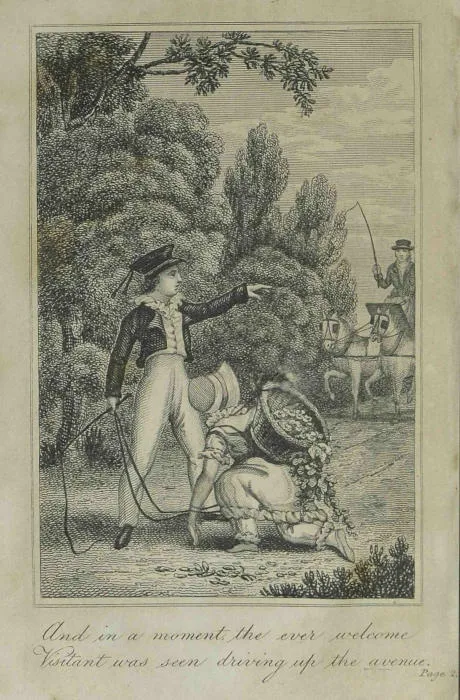
that Joanna should be his horse and
cart, to make-believe being gardener,
and really to clear away the leaves
from their little gardens. Joanna
hesitated, but was at last persuaded
by the entreaties of Harry, and his
promise that she should be gardener
in her turn. He accordingly, with
not a little ingenuity, fastened an old
basket to her back, and finding some
list in the garden-house, soon harnessed
her in good style, and quickly
manufacturing his emblem of power
and command—the whip, proceeded
to load his cart with great energy,
though, it must be confessed, rather
too heavily for his vehicle, which was
at the point of loosening from its
fastenings, when the well-known
sound of grandpapa’s phaeton, and
the regular trot of his ponies, arrested
the attention of the labourers, and
in a moment, the ever-welcome visitant
was seen driving up the avenue.
Joanna struggled to free herself from
the trammels, but in vain, they were
too skilfully fastened for her ingenuity
and impatience to loosen; and
half in tears at the delay and obstruction,
she petitioned “dear Harry” to
free her. Harry, however, although
equally desirous, found it not quite
so easy as he expected, and Mr.
Elmer had arrived at the gate before
Joanna’s liberation was effected.
“How now, my young despot,” exclaimed
Mr. Elmer good humouredly,
“what, exercising your power
over the weak thus early?” “Oh grandpapa,”
replied Harry, still busy in
untying knots, “it is only make-believe,—Joanna
was soon going to
drive me about.” “Pray take this
piece off my arm, Harry,” entreated
Joanna, as she made her arm red in
her attempt to slide from it a piece
of rough list, tied with no gentle knot,
and in the attempt pushing off her
bonnet, and disclosing her animated
countenance, glowing with exercise
and impatience. Alan quickly however
lent his assistance, and Harry
dashing off his cap, and shaking his
dark locks from the perspiration which
burst from his forehead, declared that
Joanna trotted as well as grandpapa’s
ponies, and only wanted a little practice
to be just the thing to get his
hand in to drive them. “Upon my
word, sir, you have appointed your
sister to an honourable post; but as
she seems to have been sufficiently
practised this morning, what say you
to a ride with me;—will you, my
young Phaeton, condescend to be
driven by your old grandfather?”
“Dear grandpapa, you know what a
treat it is always to me, and may not
dear Joanna go too?” “Certainly,
and Ellen too if she likes it; I am
come for you to dine with me to-day;
but these hands must be washed,
jacket brushed, locks arranged, and
stockings made tight, or it will certainly
be thought I have picked up a
gipsy, particularly if Joanna keeps
her bonnet hanging behind her, as it
now does.” “Oh! we will be ready
in a minute, grandpapa; but, dear
me, Ellen is gone out with mamma!”
“Well, I will wait a little while for
you all, for look here (spreading out
the bill of the menagerie) I am going
to place you all amongst these animals;
you look a little like an ourang-outang,
Harry, and Joanna reminded
me when her arms were so pinioned,
of the kangaroo with its short fore
feet.” “Oh dear grandpapa, how
droll you are,—but I declare there is
an elephant, what is there a real one
to be seen? and are you going to take
us to see it? Oh how good you are.
Joanna dear, you wont be afraid,
will you?” “No, Harry, that I shall
not, for I am sure grandpapa would
not take us any where to hurt or
frighten us; but I shall like very
much to see an elephant; Mamma
told me her beautiful fan was made
of ivory,—so the elephant’s teeth are
called.” “It is a very large animal,
is it not grandpapa?” inquired Harry.
“Yes, my dear, very large and very
wonderful, as well as useful.” “I
suppose it is taller than you, grandpapa?”
“Rather,” replied Mr. Elmer,
with a significant smile, amused
at the artless estimate of Harry, and
anticipating with pleasure the astonishment
of the children, when they
should behold the magnitude of the
animal. While some further conversation
passed, and the children were
dressing for their jaunt, Mrs. Monson
returned. Of course, an interchange
of kisses, embraces, blessings, &c.
took place; but at length Mr. Elmer
placed himself, with gratified affection,
in his little vehicle, with his
juvenile companions, and they merrily
proceeded on their way to C——,
asking a thousand questions about
what they were going to see. Having
arrived at Rose Mount, they alighted,
and proceeded on foot to C——.
The amusement they enjoyed there,
will be found recounted in the following
chapter.
CHAP. IV.
“These are thy glorious works, Parent of good,
Almighty!——these declare
Thy goodness beyond thought, and power divine!”
The cheerful activity of Alan
Thomson, bearing his little favorite
Ellen in his arms, one of her fat little
arms encircling his neck; the mild
and venerable demeanour of Mr. Elmer;
and the engaging innocence of
the children, each holding a hand of
their indulgent grandpapa, seemed
irresistibly to actuate the several individuals
who formed the crowd surrounding
the caravans composing the
menagerie; for they readily gave way,
that the little group might easily pass
to the entrance, while the woman
who took the admittance-money, exclaimed
“God bless the sweet dears,”
and in a tone of respect said to Mr.
Elmer as he passed, “take care, Sir,
I am afraid you will find the steps
very slippery:” thanking her for the
caution, he passed into the enclosure.
The first object that met the astonished
view of the children, was the
elephant. Its height was nearly eleven
feet, appearing to their unpractised
eyes, a moving mountain. Ellen,
with a sensation of fearful surprise,
clung to the arm of Alan, who feeling
the pressure kissed her, and told her
not to be afraid, for that great animal
was as gentle as her own little pet
lamb, and loved children dearly; “I
have seen one,” he added, “that used
to rock a little baby like your brother
Charles to sleep in its cradle.” Ellen,
thus encouraged, ventured to look at
it again, and her fear began to subside;
yet when she saw the animal, by the
command of the keeper, lift a pail full
of water from the ground with its proboscis,
and pour it into its mouth as
into a vessel, she was too much astonished
to speak. “I see by its spotted
skin this is a Ceylonese,” said
Mr. Elmer to the keeper; “they are
not so handsome as the white elephants,
but they are larger and stronger,
and with qualities I believe equally
wonderful, and useful to man.” “Yes,
your honour, this noble animal is from
Ceylon [Note 1.]; it was given to a
British officer by the king of Candy,
and truly he was a royal present, for
his mildness, sagacity, and docility
are most wonderful. Poor fellow,”
he added, caressing the elephant, “he
not only obeys, but he anticipates
all I would have him do, he understands
all my signs, he never mistakes
my voice, knows perfectly well when
I am angry or pleased, listens to
what I tell him with attention, and
never fails to execute my commands.”
“I readily believe it,” replied Mr.
Elmer, “for such are the general characteristics
of this valuable quadruped.”
“Will not the young gentleman
like to see how we ride and manage
them,” inquired the man, evidently
pleased with his affable and intelligent
visitor. “Certainly, and the young
ladies too,” said Mr. Elmer good
temperedly, as he turned to three or
four neatly dressed girls just entering
the area.
The keeper then made a sign to
the elephant (which might in a moment
have annihilated the whole party
by the exercise of the power with
which Providence had invested him,
had it not also with restraining wisdom,
rendered it subservient to the
will of man), when it folded its flexible
proboscis gently but firmly round
the body of the keeper, and lifted
him upon his back; here he sat a
few moments, and then removed to
the animal’s neck with a little pointed
iron rod, intended by pricking the
ears of the elephant to guide and urge
him on; but this was very seldom
necessary, even generally speaking,
as these sagacious animals are so docile
and so much attached to their
keepers that words and caresses are
quite sufficient, seldom or ever being
refractory unless insulted with improper
or cruel chastisement; bending
their knees for the accommodation of
those who mount them, and moving
steadily on with a gravity suitable to
their immense bulk. “I should be rather
afraid, grandpapa,” said Harry,
“to ride upon an elephant, because he
could so easily take me off with his
trunk.” “Why indeed, my boy,
were it not for the confidence which
the docility and strong affection of
these immense and powerful animals
produce in those accustomed to attend
and use them, the fear might be
very just; but the admirable qualities
they possess, effectually dissipate all
apprehension in the breasts of those
who have the care of them, so strong
is the attachment they have for their
cornacs or keepers, that there are instances
in which they are stated to
have died of sorrow, when, irritated
by ill treatment, or other causes,
they have in a paroxysm of rage killed
their guide. These instances of ungovernable
fury are very rare, nor do
I remember to have myself felt any
apprehensions, although I have taken
many long journeys on noble elephants:
one particularly I remember,
whose sagacity, docility, and affection
could not be exceeded; if I wished to
stop to enjoy and sketch a beautiful
prospect, he would remain immoveable
until I wished to go forward.
If I desired the ripe and delicious
mangoes, growing out of the reach
of myself or my attendants, he would
select the most fruitful branch, and
breaking it off with his trunk, offer
it to the driver for the refreshment
of myself and companions in the
houdah, accepting any part we might
give to himself with a respectful
salam or salute, viz. by raising his
trunk three times above his head in
the mode of oriental obeisance,
expressing at the same time his
thankfulness by a murmuring noise.
When a bough obstructed the houdah,
he twisted his trunk around it,
breaking it off with ease, even if of
considerable magnitude, and not unfrequently
gathering a leafy branch
either to keep off the flies, or as a fan
to agitate the air around him, by waving
it with his trunk. When we
had pitched our tents on any spot,
he generally paid us a visit at the
tent door during breakfast to procure
sugar-candy, or fruit, and seemed delighted
and cheered by the encomiums
and caresses he deservedly
met with; indeed no spaniel could
be more innocently playful, or fonder
of those who noticed him than this
truly valuable and wonderful animal,
who on particular occasions appeared
even conscious of his exaltation above
the brute creation.”
This anecdote seemed highly to
interest all the visitants present, for
they approached during the relation,
nearer and nearer to the nice old gentleman
who had travelled on the back
of an elephant, seeming to regard
him with nearly as much admiration
and astonishment as they did the
animal itself.
A decent man in the group, who
appeared particularly struck with the
account of Mr. Elmer, was not a little
alarmed, however, when the elephant,
reaching over the heads of several
persons, put his proboscis to the pocket
of the man, who afraid to move,
looked with a terrified aspect to the
keeper, but seemed unable to speak.
“You probably, Sir, have fruit in your
pocket,” observed the keeper, “which
his quick and accurate sense of smell
has discovered: do not be alarmed.”
A word to the elephant caused him
to remove his intrusive proboscis,
and the man produced three or four
apples, which he now (not however
entirely divested of alarm) presented
to the unceremonious animal, who
took them mildly from his hand,
making a low sort of murmur, as of
satisfaction.
“They must eat a great deal,
grandpapa;” said Joanna softly, as
she watched the elephant eating the
apples, “what do they eat?” “Their
food is entirely vegetable, my dear;
the young shoots of trees, different
sorts of grain, and fruits of various
kinds abounding in the East, from
whence they come. Sometimes they
do a great deal of mischief by breaking
into the plantations, not only
ravaging every thing they find, but
by trampling the ground with their
large and heavy feet: they generally
also herd together in large numbers,
marching in troops, the oldest leading
the way, and the mothers taking the
young ones firmly embraced in their
trunks.” “But what do the poor
elephants do, grandpapa, who are
caught and shut up like this; they
cannot have nice tender branches of
trees to eat?” “When tamed and
used for labour, my dear, they require
a great deal of care, and a large quantity
of food, and that of the best quality,
with much rice, both raw and
prepared. I once had one who to
keep himself in full vigour, required
daily a hundred pounds weight of
this food, besides fresh herbage to
cool him, for they are very subject to
be overheated, and must, in those hot
countries, be conducted to the water
several times in the day for the purpose
of bathing. It is curious to observe
how they refresh themselves:
sucking up the water in the trunk,
they carry it to the mouth, drink a
part of it, then elevating the trunk,
allow the remainder to run over every
part of their body.” “What is the
quantity and quality of the food this
elephant consumes?” inquired Mr.
Elmer of the keeper. “He is usually,
Sir, fed with hay and straw, but he
generally seems to prefer the latter;
the quantity he takes I cannot exactly
ascertain, as he scatters much
that is given him for food, and also
eats a great deal of the straw with
which he is littered. He eats with
great avidity bread, boiled potatoes,
and other vegetables; I allow him
nine pails of water, given at three
different times in the day. He is
extremely fond of beer and all kinds
of spirituous liquors.” “Yes,” replied
Mr. Elmer, “I have seen them
take arrack in the East Indies, and it
is customary if they shew any repugnance
to what may be exacted of
them, for the cornac or conductor to
promise them arrack or other spirit.
It is very dangerous, however, to
neglect any promise made to them;
many have fallen victims to this indiscretion:
for although nothing can provoke
an elephant to hurt those who
never injured him, yet he remembers,
and never fails to revenge an offence, if
he has power.” “He will not only do
this, Sir,” said the keeper, “but he
will obey the command of his cornac
desirous of terrifying any one; when
told to do so, he will run at the
person with great apparent fury,
and you may well believe effectually
terrifies the object of his
attack; but when he gives himself
up for lost, the elephant stops short
and does him no injury. Should
the master chuse to affront any
one, he tells his elephant, who quickly
collects mud and water in his
trunk, and squirts it upon the person
pointed out to him.” The keeper
now ordered the huge animal to lie
down: it instantly obeyed, and the
spectators were then invited to view
the texture of his skin, to examine
its ears, its trunk, and its tusks.
They remarked the smallness of its
eyes, the large and pendulous ears,
the great head, the ponderous body,
the arched back, the short and thick
legs, and the extreme awkwardness
of its appearance altogether; and
were thence led to acknowledge, that
it is very wrong to judge of the value
of any thing by mere externals; but
they were never weary in admiring
the wise, the wonderful, the admirable
structure of the proboscis, and
agreed it was justly considered as one
of the miracles of nature. They
were directed by Mr. Elmer, to observe,
that this wonderful organ is
composed of an infinite number of
flexible rings, and consists of a double
tube with a somewhat flattened circular
tip, furnished with a projecting
point, which may not inaptly be called
a finger, possessed of extreme sensibility,
and with which it can take up
the smallest object. The trunk, formed
with this astonishing pliability, turns
with ease in every direction, performing
the office of a hand and arm:
and such is its strength, that it is
capable of breaking off long and large
branches from the trees, and to lift
immense weights.
“How thick and coarse the skin
looks, grandpapa,” said Harry; “it
looks as if nothing could penetrate
it.” “Some parts of it are however,
my dear, extremely sensible, and in
those parts the poor animal feels the
stinging of the flies so painfully that
he not only employs the usual instinctive
motions to free himself from their
attacks, but it would seem the resources
of that intelligence with
which Providence has endowed him.
He strikes them with his tail, his ears
and his trunk: he also contracts
his skin, and crushes his tormentors
between the wrinkles. He drives
them off with the branch of a tree, or
bundles of long straw; and when all
these ingenious artifices fail, he collects
a great quantity of dust in his
trunk, and covers all the most tender
parts of his skin with it. He will
thus dust himself several times in a
day, and always sagaciously chuses
the most effectual period; that is,
after bathing.”
“Grandpapa,” whispered Joanna,
“you said you travelled many journies
on an elephant; you did not
ride on the neck as the man did,
surely?” “No, my dear, the driver,
or cornac as he is styled, rides
on the neck, the traveller beneath
a sort of awning or tent placed on
the back of the animal. The great
princes of India allow five men and
a boy to each elephant; the chief of
these rides upon the neck to guide
him, another sits upon the rump
when engaged in war, the rest supply
him with food and water, and perform
the necessary services.
“Elephants indeed, either in peace
or war, are more obedient to command
than many rational beings. It
is stated also, that upon an emergency
they can travel two hundred miles in
forty-eight hours, and will hold out
for a month at the rate of forty or
fifty miles a day, with cheerfulness
and alacrity; but, my dear children,
we must conclude our anecdotes of
the elephant, at home I believe, we
have made this fine animal a very
long visit, and must therefore defer
till another day the view of the others
worthy attention.” Mr. Elmer having
given the keeper a handsome gratuity
for his patience and civility, the children
thanking him also, they retired
to make way for a number of persons,
urged by the same laudable curiosity
to see the stupendous animal.
CHAP. V.
“Curiosity is one of the strongest and the most
lasting appetites implanted in us, and admiration
one of our most pleasing passions.”
ADDISON.
The moment of egress from the
menagerie seemed to unlock the generally
loquacious tongue of little Ellen;
a thousand questions were now asked
of her good-tempered bearer, respecting
the elephants; nor was Mr.
Elmer uncalled upon to relate what
he had seen of their wonderful qualities,
during his residence in Hindostan,
“We will now enjoy our walk,
my dear children,” he observed, “and
when we have dined I will endeavour
to recollect all I have seen of the
habits and usefulness of these sagacious
animals.” “Well grandpapa,”
said Harry, “I little thought when I
got up this morning that I should
see such a great creature, and be so
very much entertained as I have been,
I hope when I am a man I shall go
to India and ride on the back of an
elephant. I think I should make
them very fond of me, for I would
be sure to caress and encourage them,
and never promise any thing I did
not remember to perform.”
“That is (I suppose, my dear, you
mean to say) you would remember
to perform what you promised?”
“Yes, grandpapa, that is what I
mean; dear me! if the elephant could
but speak, he would have expressed
himself better than me, stupid boy.
There, Joanna! look at that bullock
in the field, we should call that a
great creature, but it seems like a
kitten now, or at most a dog compared
to the elephant. I wonder
what you and I looked like to the
elephant: had he eat any thing except
grain and fruit, I should have been
afraid to have gone near him, he might
have swallowed us up in a moment.”
“Thus, my dear boy,” remarked Mr.
Elmer, “we find every object in the
creation impressed with the characters
of infinite wisdom, beneficence,
and perfection of its great author.
Had the elephant been as ferocious
as he is powerful, how dreadful the
ravages he might commit, how fearful
to be the subject of his violence; but
with dispositions gentle, and of social
habits, they range in solitary grandeur
the vast solitudes of the torrid zone,
and when ensnared by the power and
art of man, to whom all are made
subject, they are very soon tamed
and rendered the most useful and
effective servants of the being to
whom supremacy is given.” “You
will tell us after dinner, how they are
caught and tamed, won’t you grandpapa;”
asked Joanna. “Yes, my
dear, certainly, I will describe to you
what I myself was a witness of when
I was very young, and I assure you
I enjoyed the sport highly.”
They had now arrived at the villa,
and were not sorry to find dinner ready
for them; indeed, it had waited
some time, so that Mary’s pudding
was not quite so light as she wished.
“Hey day!” said Mr. Elmer, as he
cut it, “I question if the elephant
could not have compounded a better
pudding.” The children, however,
were hungry, and the pudding quickly
disappeared. “Hey day!” said
grandpapa laughing, “I question if the
elephant would have despatched it
quicker.” The cloth removed, the
little glasses filled, and papa’s and
mamma’s health with dear grandpapa’s
duly drank, and the fruit enjoyed,
Harry sidled to his grandpapa—“I
hope I shall not be too troublesome,
but I long to hear how they catch the
elephants.” “Ah so do I,” added
Joanna, and Ellen (climbing on his
knee) kissed his cheek as if to bribe
him to comply with the wish of
Harry.
“Ah, you are all irresistible petitioners,”
said the kind old man,
while a tear of genuine feeling trembled
in his mild eye, and placing
Harry between his knees, and a
girl upon each of them, he prepared
to gratify them. “I have told you,
my children, that the elephants generally
herd together; these herds consist
of from forty to a hundred, and
when discovered, about five hundred
people are employed to surround
them. They are driven by the means
of fires placed on moveable pedestals,
and by great noises to the spot where
they are to be secured. This place
consists of three different enclosures,
communicating with each other by
the means of narrow openings or
gate-ways. When the elephants first
arrive at the gates and palisadoes,
great difficulty is found to make them
enter; the leader’s sagacity always
making him suspect some snare:
but when once he is made to pass,
the rest follow without hesitation.
Reach me that sheet of paper, Alan,”
said Mr. Elmer, as the old man entered
the room. “There now, Harry,
look here, there are the enclosures;
(marking the paper with his pencil)
now you see we have the elephants
in this: do you understand?” “Oh
yes, grandpapa.” “Well, they have
passed this gate-way. Immediately
fires are stationed round the greatest
part of the enclosure, particularly
at and near the entrances, to prevent
the elephants from returning.
A terrible shouting and noise is
made by the hunters, beating of
drums called tom-toms, firing blank
cartridges, to urge the elephants into
the next enclosure. They, thus finding
themselves entrapped, scream
dreadfully, and discovering no opening
but the entrance into the next
enclosure, they after traversing repeatedly
their present situation, following
their leader, at length enter
the second enclosure, which is smaller
than the first. The gate is instantly
closed upon them, the same process
of fires, shouts, &c. force them to
pass into the last enclosure. Being
now completely surrounded, and finding
no outlet, the poor ensnared animals
become desperate, frequently
advancing furiously to the surrounding
ditch to break down the palisade,
screaming aloud, and swelling their
trunks; but wherever they attempt
an attack, they are repelled by the
noise of the hunters and opposed by
the fires. The ditch is then filled
with water, and the fatigued elephants
have very soon recourse to it in order
to cool themselves, and to quench
the thirst produced by their exertions
and fury. Having continued in this
situation for a few days, during which
they are scantily fed from a scaffold
on the outside, the door of an outlet
about sixty feet long and very
narrow is opened, and one of the
elephants is induced to enter by
having food thrown before it. When
advanced far enough, the gate is
closed upon him, when finding his
retreat cut off, and that he cannot
turn himself, he advances furiously,
endeavouring to break the bars in
front of him. He even rises up in
his rage and leaps upon the bars
with his fore feet; thus he continues
his efforts to obtain liberty, until he
becomes exhausted; ropes are then
by degrees carefully passed round
him, and he is secured. Sometimes
instead of being enticed into the
Roomee or narrow passage, they are
taken by the aid of tamed elephants,
who engage the attention of the wild
ones, while they are secured by ropes.
The elephants being thus ensnared
are separated, and each placed under
the care of a keeper appointed to
attend and instruct him. This principal
attendant, has three or four
subordinate assistants, who supply
the elephant with his food and water,
until he is sufficiently tamed to feed
himself. To effect this, a variety of
methods are resorted to, soothing and
caressing, sometimes threatenings and
even goading with a long stick pointed
with iron; but more generally the
keeper flatters and coaxes him, scratching
his head and trunk with a long
bamboo split at one end into several
pieces, and driving away the flies
from his sores and bruises, produced
by his desperate struggles for liberty.
He also is very attentive to keep him
cool, by squirting water frequently
all over him, taking care to keep out
of the reach of his trunk.
“In a few days he even advances
cautiously to his side, speaks to him
soothingly, pats him, and strokes him
with his hand, and in a very little
while he conciliates the immense
animal, who knows him and obeys
his commands. The keeper now
becomes more familiar, ventures to
mount him from the back of a tame
elephant, and thus gradually increasing
in intimacy, he is at last permitted
to seat himself upon the neck,
from which place he is to regulate
and direct the motions of the subdued
animal. While they are training in
this manner the tame elephants lead
the others out alternately for exercise,
and likewise to ease their legs from
the cords, with which they are tied,
and which gall them dreadfully, unless
frequently slackened and shifted.
“In about five or six weeks the
elephant becomes obedient to his
keeper, his fetters are then removed
by degrees, and generally in about
six months he suffers himself to be
conducted from one place to another.
In some parts of the East these huge
animals are taken by means of pitfalls.
Through the forest several paths
are cut, in these are dug deep and
large holes, which are carefully concealed
by being covered over with
branches and loose earth. The elephants
in passing over, of course fall
into the pit, the hunters secure them
while in this helpless state, and dragging
them out, tame them in the
following manner. The elephant is
placed between two tame ones; they
are surrounded by men, each holding
a pike with a lighted torch at the end
of it, who talk to the animal and call
out to him as they offer him meat,
‘take it, take it, take it.’
“The wild elephants refusing obedience,
signs are made to the tame
ones to beat him, which they immediately
do by giving him desperate
blows on the head with their trunk,
and if the poor beast offers any resistance,
the blows are repeated till exhausted
he at length is rendered
obedient, and appears to become perfectly
reconciled to his fate. It is
worthy of observation, that although
this noble animal uses his utmost
force to disengage himself when ensnared,
and would certainly kill any
one coming within his reach, yet he
seldom or never attempts to hurt
those tame elephants that have aided
in ensnaring him; but on the contrary,
seems as often as they are
brought near, in order to adjust his
harnessing, or move or slacken the
ropes that gall him, to be pleased,
soothed, and consoled by them, as it
were, for the loss of his liberty.”
“Thank you grandpapa,” said the
gratified Harry, “I shall certainly
never forget how the elephant is
snared, but I think I am not ambitious
to be an elephant hunter.”
“You would not then like to be an
Abyssinian elephant hunter?” “Why,
grandpapa?” “Because of the great
danger and skill required.” “Did
you ever see them, grandpapa?”
“No, my dear, but an enterprising
traveller has given us an account of
the mode in very lively colouring.”
“Perhaps you can remember it so as
to tell us, dear grandpapa?” “I will
try, my boy.—Mr. Bruce tells us that
the persons employed in this dangerous
service live constantly in the
woods, subsisting upon the flesh of
the animals they kill. They are exceedingly
thin, light, and agile, both
on foot and on horse-back. They
are called Agageers, a name derived
from the one descriptive of their
mode of destroying the great animals,
such as the elephant and rhinoceros;
Agar signifying to hough or hamstring
with a sharp weapon, or,
more properly, cutting the tendon
of the heel. To effect this, two men
quite naked, to prevent their being
caught by the trees and bushes,
in making their escape from their
watchful enemy, get on horse-back.
One of them sits on the back of
the horse, sometimes with a saddle,
sometimes without one: with only
a short stick in one hand, carefully
managing the bridle with the other:
behind him sits his companion, armed
only with a broadsword——but hold,
I recollect I have a drawing of the
group. Harry boy, ring the bell,
Alan shall bring my port-feuille.”
“Ah, that will be delightful Harry,”
exclaimed Joanna, who had a fine
taste for drawing and delighted to
look at them. Alan appeared, received
his directions where to find
the port-feuille, and in a few minutes
it was opened before the delighted
children; indeed its contents were
well calculated to gratify the most
refined taste, and to excite the admiration
of the practised delineator of
nature’s beauties and wonders.
The descriptive drawing of the
Agageers and elephant was soon
found. “Here, Harry,” said Mr.
Elmer, as pleased as his juvenile companions,
“here they are. The left
hand of his Agageer is employed
you see, in grasping the sword by the
handle; about a foot or fourteen inches
of the blade of which is covered
with whipcord. This part he takes
in his right hand without any danger
of being hurt by it, and though the
edges of the lower part of the sword
are as sharp as a razor, he carries it
without a scabbard.
“As soon as an elephant is found
feeding as here delineated, the horseman
rides before him as near his face
as possible, or if he tries to escape,
crosses him in all directions, calling
out, I am such a one, and such a one,
this is my horse, that has such a
name, I killed your father in such a
place, and your grandfather in such
another place, and I am now come to
kill you, who are nothing in comparison
with them. This nonsense he
thinks the elephant perfectly understands;
who irritated at hearing the
noise so immediately before him, attempts
to seize him by his trunk.”
“Oh, grandpapa, how frightful!”
exclaimed Joanna involuntarily. Mr.
Elmer smiled, kissed her forehead,
and proceeded: “the elephant intent
upon this, follows the horse every
where, turning round and round with
him, neglecting to make his escape
by going straight forward, in which
consists his only safety. After having
made him thus turn several times in
pursuit of the horse, the horseman
rides up close beside of him, and
drops his companion just behind on
the off side; and while he engages
the elephant’s attention upon the
horse, the other behind him gives
him a drawn stroke just above the
heel, into what in man is called the
tendon of Achilles. This is the
critical moment—don’t your heart
beat, Harry?” “That it does, grandpapa,
pit a pat, pit a pat.” “Well,
the horseman instantly wheels round,
again takes his companion up behind
him, and rides off full speed after the
rest of the herd, if they have started
more than one; and sometimes an expert
Agageer will kill three out of one
herd. If the sword is good and the man
not too timid, the tendon is generally
separated entirely, and if not quite
cut through, is so far divided that the
animal from the stress his weight puts
upon it, breaks the remaining part
asunder.” “Ah! poor thing, how
much it must suffer,” said Joanna.
“It must, indeed, my dear, for in
either case he remains quite incapable
of advancing a step, till the horseman
returning, or his companions
coming up, he is pierced through with
javelins and lances, by which he falls
to the ground, and expires from loss
of blood. Here is another drawing
descriptive of this closing scene. The
elephant being thus slain, they cut
his flesh into slips or thongs, and
hang them upon the branches of the
trees till they become dry, without
salt, and then lay them by for their
provision in the rainy season.” “Dear
me, grandpapa, what bad food they
must be. I am sure I must be very
hungry indeed to relish such a strange
dish.” “Yes, my boy, hunger is
admirable sauce. I don’t know but
it would make you even relish very
highly the pretty dirty list bridle you
so cleverly put on Joanna this morning.”
“Oh, grandpapa! no, I never
could eat that to be sure, it was so
rough it would choke me.” “Well,
well, I hope you will never be reduced
to such necessity; what say
you, my pet?” (to Ellen.) “No,
grandpa, I like little chicken, not
dried elephant for my dinner.” “That
is very lucky, my dear, because we
could not conveniently have the one,
and my poultry-yard is very well
filled. Yet, my dear, we are informed
by a lively traveller, that the feet of
the elephant roasted are a delicious
morsel, as well as the shins; and I
can readily imagine it, from the pure
nature of their food, and the extreme
cleanliness of their habits.”
“Have you any more drawings of
the elephant, grandpapa?” inquired
Joanna. “I dare say there are
among these, my dear; we will look
through them.” “O yes, here is
one,” resumed the eager and delighted
girl. “Do not touch, Ellen; you
know mamma always tells you, little
girls should not touch any thing that
is shown them, especially such beautiful
drawings.” Ellen withdrew her
finger at this remonstrance of her
sister, and quietly looked on. “I
remember the occasion upon which
this drawing was taken,” said Mr.
Elmer. “Elephants are kept in
many parts of India more for show
and grandeur than use, although I
shall relate to you many instances in
which I have seen them eminently
useful. Their keeping is attended
with very great expense, as they devour
a vast quantity of the best provisions,
and are sometimes regaled
with a plentiful repast of cinnamon,
of which they are exceedingly fond.
When the King of Pegu walks abroad,
he is preceded by four stately white
elephants, adorned with sumptuous
trappings, covered with precious
stones, and ornaments of gold; and
when he gives audience, these four
elephants are presented to him, who
do him reverence by raising their
trunks, and uttering three distinct
cries, while kneeling before him.
This ceremony ended, they are conducted
back to their apartment, where
each is fed from large golden vessels.
They are also washed twice a day
with water taken from a silver reservoir.
During the time of their being
thus refreshed and adorned, they are
under a canopy supported by eight
slaves, in order to defend them from
the heat of the sun. In being led to
the vessels containing their food and
water, they are preceded by trumpets,
and march with great majesty, as if
feeling the elevation conferred upon
them by this pomp. The king of
Siam has also 1000 elephants attached
to his army.
“This drawing, my children, represents
the great mogul, upon an
occasion of his appearing in public,
when I had an opportunity of seeing
him. No pomp, magnificence, or
luxury can exceed, or indeed be comparable
to the ostentatious brilliancy
of this potentate on such occasions.
He sits, as you may perceive by this
sketch, upon a throne of gold, glittering
with precious stones: the throne
and monarch borne on the back of a
noble elephant, who seems conscious
of his burden. The elevation gives the
emperor an air of grandeur, which is
extremely impressive to the beholders,
above whom he is so highly exalted
in situation as well as rank; nor can
we fail to regard with an eye of indulgence
that despotic pride which
is both excited and fostered by the
adulation paid to a mortal. It requires
something more than mortal
strength, to resist the fascinations of
power and the flatteries of the self-interested,
who live in the sunny
beams of royal favour. As the elephant
moves slowly and majestically
on, the people fall prostrate before
their great and mighty prince. It
is thus by dazzling the eyes of his
slaves, and inspiring them with awe,
he supports his despotic authority:
his mighty will is the law. The
shield of this splendid despot is
thickly studded with diamonds and
rubies; on his head he has a gorgeous
turban, ornamented in the
same manner, and round his neck
a rich chain of pearls of the most
exquisite beauty. He also you see
bears a sword and a beautiful quiver
of arrows, bearing also a staff in his
hand richly adorned with drilled or
pierced diamonds, while chains of
diamonds and rubies adorn different
parts of his dress. Rich bracelets
encompass his arms, just above the
wrist and elbow; and his fingers are
covered with costly rings. When he
marches at the head of his troops, he
is attended by at least a hundred elephants,
richly caparisoned, and ten
or twelve thousand men. In the
centre, either on an elephant or a
fine Persian horse, rides the emperor,
although he is said to be at the head
of his troops; and when he travels
privately into the country, he is conveyed
in a covered sort of chariot
drawn by oxen. When this eastern
potentate holds in person a divan, or
public court for the administration of
justice, he is seated, as you see in this
drawing, on the musnud, viz. a kind
of stage elevated about two feet above
the floor, and covered with a superb
cloth, richly embroidered with jewels
and fringed with gold. In the centre
of the musnud, you see he is
placed upon a sort of tray, being
formed of either gold or silver gilded.
He styles himself the conqueror of
the world. His officers surround
him, his courtiers adulate him, and
the unfortunate are admitted to petition
him.” “Who is that person,
grandpapa, with his head nearly
touching the floor, and without his
shoes?” “That is a petitioner, my
dear; he is obliged to leave his
slippers outside the entrance, and to
advance barefooted in token of humility.
The salute he is making is
called salam: it is expressive of his
profound veneration. His forehead
nearly touching the ground, he bows
himself thus three times before the
musnud, and then presents his petition
with a purse of gold,—the one
being very useless at an eastern court
without the other. On giving them,
he says, with great humility, ‘Read
this my petition, the day will come
when all petitions shall be read.’ If
the emperor does not choose to receive
the petition, he frowns and
turns away his head; but if favourable,
which greatly depends upon the
weight of the purse, he smiles and
grants a gracious nod of approbation.”
Just as Mr. Elmer concluded this
explanation of the drawing, which
inimitably displayed the superb costumes
of the mogul court, Alan entered
with the tea equipage, informing
his master, that he would but
just have time to take tea before the
phaeton would be ready, according
to his order, that the children might
reach home before it was too late to
hazard their taking cold. An universal
exclamation of “surely it cannot
be so late, Alan,” came from the
party who had been so amused, that
time had passed unheeded. Even
Little Ellen, who would have found
it impossible to have remained so
long still any where but on grandpapa’s
knee, could not help saying,
she was very sorry it was so late that
they must go home.
“Well, my dears, as my sketch-book
has proved so amusing, you
must come and look at it another
day, and hear some more anecdotes
about the elephants, and perhaps go
to the menagerie again, if it remains
at C——. Now, Harry, let us
see if those cakes Mary has made for
us, are as good as the strips of elephant’s
flesh.” “This I know, grandpapa,”
replied Harry, “that I will
willingly give up to the Agageers the
dried flesh, while Mary is so good
as to furnish us with such famous
cakes: won’t you take some, young
ladies,” he added, with arch ceremony.
Nothing loath, the young ladies
accepted his proffer, and full of innocent
glee they concluded their refreshment;
having kissed their dear
grandpapa over and over again, they
jumped into the phaeton, and were
driven off by Alan, eagerly anticipating
the pleasure of telling their
papa and mamma all they had seen,
and the kind invitation of their grandpapa,—which
none of them failed to
remember.
Their conversation naturally turned
upon what they had heard respecting
the elephant, and they seemed disposed
to regard every thing they saw
in reference to it; for instance, they
were accompanied by a favorite water
spaniel of their grandfather’s, who in
passing a stream seemed highly to
enjoy the swim across, instead of
passing the bridge. “Look at Selim,”
said Harry; “now if he was an elephant,
he must go over the bridge,
for he could not jump over the stream,
and certainly he could not swim.”
“Swim, no, I should think not, indeed,
Harry,” said Joanna, laughing;
“an elephant swim, no, no, with all
its cleverness and sagacity, it could
not do that to be sure.” “But you
are mistaken, my dear,” said Alan,
“for they swim over large rivers with
great ease. The form and weight of
the elephant do not indeed seem
much adapted to swimming, yet his
trunk enables him to do so. It is
true, that when out of his depth in
the water (as Selim now is) his body
and head are entirely sunk under it;
yet he is not in danger of being
drowned as other land animals, as he
carries his trunk raised above the
surface, in order to breathe, and steers
his course also by it. Even when
several elephants have been crossing
a river at the same time, they have
all found their way very well, and
what is remarkable have never been
known to interfere with each other,
although their heads, and of course
eyes, have all the time been under
water.”
“Well, you do surprise us, Alan,”
said the children, “so you have seen
elephants swim?” “Yes, often, my
dears; you remember your grandpapa
told you they formed great herds, or
families, in the woods. Now I can
assure you, that when these families
remove from place to place, which
they must do for food, the largest
elephants put themselves at the head,
and if they arrive at a river, are the
first to pass over it. On reaching the
opposite bank, they try if the landing-place
is safe; if it is, they give a
signal with their trunk, on which another
division of the old elephants
pass over, the younger then follow,
holding one another by locking their
trunks together, then the rest of the
old ones bring up the rear.” “Well,
I am glad Selim chose to swim over
the stream, or we should not have
heard these anecdotes of the elephants
from you, Alan, and I dare
say might have still thought it was
impossible for them to swim.”
“O, there is papa and mamma on
the lawn,” said Ellen, “we shall
soon be at home; what a happy day
we have had!”
As they approached the gate, such
was the cry—“O what a happy day
we have had! and we are to go again,
grandpapa says; and he bid us tell
you, mamma, we have not been
troublesome, but have made him very
happy. And he says, you must go,
mamma,” added Ellen, “and Charles,
when he is a little older. He says
I behave very well now.” “I am
glad he has returned you with a good
character, my little pet,” said Mr.
Monson, as he took Ellen in his arms.
“Oh papa,” she said, “the elephant
is as big as the hay-stack, but so good-natured,
Alan says, it rocked a little
baby to sleep in a cradle.” “Then,
you would have no objection to ride
upon one, I suppose.” “Why yes,
papa, I don’t think I should like it.”
“But I should,” observed Harry.
“Papa, let me go to India, when I
am a little bigger; I shall then travel
on elephants, and eat mangoes, and
see the grand mogul all over jewels
and gold, with the people bowing
their heads to the ground, while he
looks so proud and stately.” “What,
I suppose, you would like to see his
majesty weighed, Harry?” “Weighed,
papa! I don’t know what you
mean.” “I mean the grand festival,
given on the birth-day of the great
mogul, when he is very sumptuously
dressed, and goes to a magnificent
pavilion, attended by his nobles. In
it are suspended golden scales, adorned
with jewels. Into one of these
scales, the emperor places himself, in
order to balance the other, which is
filled with rubies, emeralds, pearls,
gold, silver, fine stuffs, cinnamon,
cloves, and other sweet spices; and
an exact account is given of the difference
of his weight from the last
year: if he weighs more, the people
shout and rejoice; if less, they manifest
every token of concern. The
ceremony is concluded with the distribution,
from the hands of the mogul,
of golden almonds, and other artificial
fruits, formed of the same precious
metal; and to the poor he distributes
small pieces of money.” “That
must be a very pretty sight indeed,”
observed Joanna, “I should like to
see such a grand prince throwing
money to the poor. How happy the
rich must be!” “Say rather, my
child, might be,” said Mr. Monson,
“did the will always accompany the
power; but as this is not always, nor
indeed very often the case, to be content
is our wisest as well as our most
virtuous course. We have the gracious
assurance that a willing mind
is accepted by Him who bestows
upon us every good, and that a cup
of cold water given in his name to
those that need it, is an act well-pleasing
to Him, and verily will have
its reward. But the evening closes,
and my Ellen gets sleepy; let us go
in, and thank God for the blessings
of the day, ere we seek that repose
which is to refresh us for the duties
of the morrow, should the Almighty
suffer us to see it. An habitual remembrance,
that we depend upon
him for life and breath, and all things,
will give additional value to each of
these blessings, and preserve our
minds easy and serene. You cannot,
my children, be too early taught
that this is the secret of happiness,
the only source of true enjoyment.
The prayers of the innocent are acceptable
to Him, and their hearts the
sweetest sacrifice that can be offered
to his Majesty. Come, then, my
children, we will kneel before Him,
and commit ourselves to his Almighty
protection.”
Mr. Monson was the most cheerful
of men, and he had found that to
preserve it unclouded in his own
breast, as well as have its light pervade
his family, was to cherish a
simple unaffected piety, and a constant
sense of the omnipresence of
God. “He is about my path and
about my bed, and spiest out all my
ways,” was his frequent and emphatic
caution to his children and dependents,
and his encouragement when
they had done any thing pleasing
to him; thus referring their reward
to Him who seeth in secret. It was
his regular custom to assemble his
family morning and evening, convinced
not only that it was a homage
due to the Creator and Preserver,
but also that such practice
was the only thing that could preserve
that beautiful union of ranks forming
a family, each reciprocally depending
upon each in their several peculiar
departments, making together the
sweet harmony of domestic charities.
Declaring they should dream of
the elephant and the great mogul,
the children kissed their parents,
and cheerfully retired, not a little
fatigued with the unexpected pleasures
of the day.
CHAP. VI.
The chiefest action for a human being
Is never to be out of action. We should think
The soul was never put into the body,
Which has so many rare and curious pieces
Of mathematical motion, to stand still.
The frolic of the preceding day
had not rendered the children inattentive
to their lessons, when they
arose from their peaceful repose, but
on the contrary the new ideas they
had acquired, served but to animate
them to greater acquisitions; and
Mr. and Mrs. Monson had just reason
to be pleased with their diligent
attention to their several pursuits.
Joanna, who was receiving instruction
in drawing from her mamma, felt
more than usual emulation when she
recollected the beautiful sketches of
her grandpapa, and wondered if she
should ever be able to draw like him.
“Doubtless you will, my love, if you
apply, and practise as I wish you,
fully accomplishing one study before
you proceed to another: it is by attempting
too much at a time, that so
many young people never obtain a
facility in doing any thing properly.
Nothing can be effected without
industry, patience, and perseverance;
and there are few things, within the
compass of human knowledge, but
may be effected with these assistants.
Having been accustomed to
use your pencil nearly ever since you
could hold one, I have great hopes
that you will obtain that freedom and
facility in its use, without which no
one can make an accurate and pleasing
drawing. You have sketched
these sheep very well; I suppose I
shall have you trying an elephant
soon?” “No, mamma, it is not
pretty enough to induce me to sketch
it; but I do like to hear my grandpapa
describe its sagacity and gentleness.
I wonder when we shall go to
C—— again?” “That seems
very uncertain, from the gloomy state
of the day, my dear; but if you are
not able to repeat your visit to the
elephant, you have seen enough to
give an interest to all you may see or
hear respecting such a wonderful
animal; and you know I have always
told you, that cultivating your talents
and expanding your mind, by improving
reading and conversation,
not only opens to you many sources
of pleasure unknown to the ignorant
and the idle, but also gives additional
gratification in viewing any object of
taste and curiosity, and not only this,
it prevents the feeling of disappointment
becoming painful when any
circumstance prevents the fulfilment
of engagements like that the kindness
of your grandpapa made with you:
for not depending upon one species
of pleasure alone, a cultivated mind
is never at a loss for employment and
subjects of interest.”
Joanna and her brother fully verified
this observation of their mamma.
Several days of nearly incessant
rain and storm prevented all possibility
of repeating their visit to C——,
and when at length the sky cleared,
they saw their grandpapa coming up
the avenue, they were so fully engaged
in their different avocations,
that they were easily reconciled to
the account he gave them, namely,
that discouraged at the state of the
weather, which precluded people going
to the menagerie, the proprietor
had left C——; “therefore,” added
Mr. Elmer, “we must be content
with what we have seen, and perhaps
I may afford you some further amusement,
my children, with this sketch-book
Alan found out this morning,
as it contains a great many delineations
of Asiatic animals, particularly
of the elephant, employed in the various
uses to which its great strength
and sagacity are applied. I am come
to pass the day with you, if you will
spare me a piece of pudding; and
Mary desires I will distribute these
cakes among you.” This self-invitation
gave universal satisfaction. Every
one was most willing to give up
their share of pudding to dear grandpapa,
and Mary’s cakes were pronounced
most delicious. Ellen had
climbed the envied seat, grandpapa’s
knee, and now whispered in his ear
“grandpapa, did the elephant shew
Mary how to make the nice cakes?”
This question was asked by an artless
child of her grandfather. For
Ellen thought, from their excellence,
they must be the handy work of the
clever animal of which she had heard
so much. “Indeed, little pet, I am
not in the secret of their composition,
but I am very glad they are good,
and please you; I am not come, however,
to disturb lessons, we shall have
plenty of time; so now off with you
at present, while I go and have a chat
with your papa.” The children without
hesitation retired to their lessons.
After an early dinner, the children
were invited to grandpapa, who unfolding
his sketch-book resumed his
anecdotes of the elephant.
The first drawing exhibited was a
view of an Indian camp. The tents
were white except the mogul’s, which
was red, and loftier and more superb
than the rest; it was encompassed
by an enclosure about ten or twelve
feet in height, and guarded by chosen
troops. The officers’ tents encircled
the emperor’s, arranged according to
the respective rank they bear in the
army. “The soldiers are attended
by their families on these occasions,”
observed Mr. Elmer, as he pointed
out several carrying their provisions
on their heads and the vessels for
dressing their repast; whilst their
arms were carried by their wives, followed
by several children. “In fact,”
said Mr. Elmer, “when this eastern
monarch takes the field, there is a
much greater parade of magnificence
than there is of proper warlike spirit.
He is attended by his court, his elephants,
and almost all the inhabitants
of his capital; for there is in the
centre of the camp a sort of town,
wherein are shops and magazines,
where trades are carried on as in a
city. But here, children, is what I
wish you to observe, you see those
finely caparisoned elephants?” “Yes,
grandpapa, and what have they got
upon their backs?” “Those are small
towers, containing the wives of the
emperor. Would you like, Joanna,
to be shut up in a tower on the back
of an elephant?” “Oh no, indeed,
grandpapa.” “Then bless God, my
dear, you are not an Asiatic, but
breathe the free air of Britain.” “Ah,
mamma often says she is proud of
being an Englishwoman; surely those
poor ladies must be very unhappy.
Who takes care of them when they
are riding upon the elephants?”—“They
are attended by guards, appointed
for the purpose, my dear;
and are not so unhappy as you may
suppose, being accustomed from infancy
to confinement, and to be subservient
to the will of their lord. In
this part of the camp, you may observe
the elephants who carry the
small cannon; they are fired from that
situation. Every rajah, or great officer,
as well as the sovereign, rides
upon an elephant; and the eyes of
the whole army are fixed upon their
prince. If he fall, it is concluded he
must be slain, and the troops all disperse.
Thus frequently they change
the fortune of the day, as the result
might be favourable did they possess
firmness and proper discipline. Elephants
bred to war, and well disciplined,
I have been assured,” added
Mr. Elmer to his attentive auditors,
“will stand firm against a volley of
musquetry, and never give way unless
severely wounded. I have seen one
of those courageous animals with upwards
of thirty bullets in the fleshy
parts of his body, and yet perfectly
recovered from his wounds.” “Poor
thing,” said Joanna, “how much it
must have suffered; I wonder how
they could do any thing to it, to cure
the wounds.”
“Their intelligence is wonderfully
displayed on these occasions,” replied
Mr. Elmer, “I had once an
opportunity of observing the wonderful
patience and sagacity of an elephant,
which had received a desperate
flesh wound from a cannon ball.
After having been twice or thrice
conducted to the military hospital,
where he patiently extended himself
to have the wound dressed by the
surgeon, he would afterwards go
thither alone. The surgeon did whatever
he thought necessary, applying
sometimes even fire to the wound,
and though the acute pain of this
application caused the poor animal
to utter the most plaintive cries and
groans, he never expressed any other
tokens than those of gratitude to the
surgeon, who by these momentary
torments effected his cure after a
considerable lapse of time. I have
also been informed of another instance
of the remarkable sagacity
displayed upon a somewhat similar
occasion. A young elephant had in
the field of battle received a violent
blow in its head, the pain of which
rendered it so frantic and ungovernable,
that it was found impossible to
have the part properly dressed: for
whenever any one attempted to approach
it, it ran furiously off, suffering
no one to come within several
yards of it. The man who had the
care of it at length devised a plan for
securing it. By a few signs, he gave
the mother of the animal sufficient
intelligence of what was required to
relieve the wound inflicted on the
young one. The sensible creature
instantly seized it with her trunk,
and held it firmly down, though
groaning with agony, while the surgeon
dressed the wound; and this
service she continued to perform till
the animal was perfectly recovered.
In many parts of India, also, my
dears, as you see in this terrible drawing,”
said Mr. Elmer, as he turned
over the leaves of his book, “elephants
are made the executioners of
justice, for with their trunks they
will break every limb of the miserable
criminals, trample them to death
with their feet, or transfix them with
their tusks, as they are directed.”
“You mentioned the eastern monarchs
being borne on elephants to
the field of war, my dear sir,” said
Mr. Monson, “you doubtless recollect
that part of the apocryphal history
of our bible, in which it is stated
that the elephants of Antiochus were
provoked to fight by showing them
the blood of grapes and mulberries;
and to every elephant they appointed
a thousand men, armed with coats of
mail, and five hundred of the best
horsemen. These were ready on
every occasion; wherever the beast
was, and whithersoever he went they
went also; and upon the elephants
were strong towers of wood, filled with
armed men, beside the Indian that
ruled them.” “Yes! I well remember
the passage,” replied Mr. Elmer,
“and with the recollection is associated
that instance of patriotic self-devotion
exhibited in the action of
Eleazer, surnamed Savanar, who perceiving
that one of the elephants,
armed with the royal harness, was
higher than any of the others, supposed
the king was upon him. He
accordingly, it is related, put himself
in jeopardy, to the end he might deliver
his people, and get himself a perpetual
name. Wherefore he ran
upon him courageously, through the
midst of the battle, slaying on the
right hand and on the left, so that
they were divided from him on both
sides. Which done, he crept under
the elephant, and thrust him under,
and slew him; whereupon the elephant
fell down upon him, and there
he died.” A general exclamation of
surprise, not unmingled with horror,
at this catastrophe, was made by the
children, “And was the king killed,
too, grandpapa?” “No, my dear;
for it is stated, the rest of the Jews
seeing the strength (or power) of the
king, and the violence of his forces,
turned away from them. Thus by
not following up the bravery of Eleazer,
they defeated the sacrifice he
had made of his own life.” “Look
here, Ellen,” said Joanna, as she
drew her attention to a drawing Mr.
Elmer displayed, “here is a pretty
little child; grandpapa will explain
why it is so near that great elephant.”
“I will so, my dear,” said Mr. Elmer,
as he placed Ellen so as she
might easily look at the sketch. “The
elephants that are trained to carry
the luggage of the armies in India,
are each under the care of a native
Indian; and in an instance of this
kind here sketched, the keeper and
his wife went, as was their practice,
into the woods to collect leaves
and shoots of trees for his food, having
fixed him to the ground by a
length of chain, and leaving their
little child (unable to walk) under the
protection of the sagacious animal,
who not only always defended it, but
as it crept about, would, when it arrived
near the extremity of the chain,
wrap his trunk gently round its body,
and place it again in the centre of
his circle.” Ellen shrunk at the idea
of being lifted up by an elephant.
“They say,” observed Mr. Monson,
“that in crossing the north bridge at
C—— yesterday morning, the caravan
containing the elephant was
racked so much, it was feared the
whole would have been precipitated
into the river. This account reminded
me of a circumstance which occurred
when I was in Holland. Two
elephants on their arrival in Holland,
as presents to the stadtholder, were
conveyed in a vessel up the river Waal
to Nimeguen, whence they were driven
on foot to Loo. The attendants
had the greatest difficulty in inducing
them to cross the bridge at Arnheim.
The animals had fasted several days,
it was therefore thought certain that
placing food on the opposite side of
the bridge would induce them to pass
it. Still, however, some time elapsed
before they would venture themselves
upon it; and even at last they did
not take a step without first examining
the planks to see that they were
firm. During the time they were at
Loo, they were so tame as to be suffered
to range at liberty. They would
sometimes come even into the banqueting-room,
when the company
were assembled to dinner, and receive
fruit from different individuals
of the party. After the conquest of
Holland, in consequence of the cruelty
of many persons who crowded to
see them, they lost much of their
gentleness. They were subsequently
conveyed to Paris, where they are
confined in cages and are even become
almost ferocious towards spectators.
They are not suffered to range at
liberty, but are kept in an enclosure
sufficiently large to allow them some
exercise. This enclosure contains
their den and a pond or reservoir, in
which during summer they frequently
bathe and refresh themselves.
“Here are two drawings,” said
Mr. Elmer, “representing the elephant
engaged in useful labour. I
was induced to sketch the scenes
from the novelty of them to an European
eye, and also as displaying the
importance of these animals in a
country, the enervating heat of which
renders manual labour so distressing.
To give an idea of the labour an elephant
performs, it may be sufficient
to remark that all the heavy packages,
sacks, bales, casks, &c. transported
from one place to another in India,
are carried by elephants, which bear
their burdens on their backs, their
necks, and their tusks; and even
their mouths are employed, by giving
them the end of a rope, which they
hold fast with their teeth. Uniting
their wonderful sagacity with their
strength, they are never known to
injure or to break any thing committed
to their charge. From the banks
of the rivers, they put the packages
into boats, without wetting them,
laying them down in the gentlest
manner and arranging them as they
ought to be placed, and when disposed
in the places their masters direct,
they will try with their trunks
whether the goods are firmly and
properly stowed, and if they find a
tun or cask unsteady and likely to
roll, they will actually go of their
own accord in quest of stones to prop
and steady it. A gentleman of my
acquaintance was a spectator of the
scene described in this drawing. You
see that ship building?” “Yes,
grandpapa.”
“Well, the river here represented
is a very fine one, called the Mandova,
upon the banks of which is the
Portugueze settlement or city, called
Goa, built on an island of the same
name, divided from the continent by
this river Mandova. You see on this
side a large area, filled with timber
in preparation for ship building? At
the time my friend visited the place
some men had tied the ends of a
heavy beam with a rope, which was
handed to an elephant, who carried
it to his mouth, and after twisting it
round his trunk drew the beam without
any conductor to the place where
the ship was building. One of the
elephants employed, sometimes drew
beams so large and heavy that more
than twenty men would have been
necessary to move them. Judge then
how valuable the services of the elephant
must be. But what excited
particularly the admiration of this
gentleman was, that when other
beams obstructed the road, the elephant
elevated the ends of the one
he was conveying, that it might easily
run over such as laid in the way.”
“That is indeed a wonderful instance
of intelligence,” remarked Mr. Monson,
“and justly entitles the noble animal
to be styled ‘half reasoning.’”
“Here is another war scene, Harry,”
said Mr. Elmer, again displaying
his drawing. “You perceive how
this elephant is employed?” “Yes,
he seems pushing something up a
high mountain.” “It is a piece of
artillery,” remarked Mr. Elmer, “his
sagacity is very apparent in this service.
While the oxen, which you
see are yoked to the cannon, make an
effort to pull it up the declivity, the
elephant pushes the breech with his
trunk, and at each effort supports the
carriage with his knee, which he
places against the wheel. He seems
to understand whatever is said to
him, and to take the best means to
effect the purpose desired. When
his conductor wants him to execute
any painful labour, or difficult task,
he has only to explain the nature of
it, and recite the reasons which
should induce him to obey. If this
is done gently and encouragingly,
success is almost certain; for they
have been known so docile, as to
sacrifice their lives to their exertions,
rather than incur the displeasure or
contempt of their master. I was told
a remarkable instance of this. They
were formerly used in India in the
launching of ships; an elephant was
employed to force a very large vessel
into the water, but the work proved
superior to his strength. His master,
in a tone of sarcasm, desired the
keeper to remove ‘that lazy beast,
and bring another.’ The poor animal
instantly renewed his efforts,
fractured his skull, and died on the
spot.” “I am not sorry for his cruel
master,” said Harry indignantly, “he
did not deserve to have such a noble
beast. I dare say he was sorry enough
when the poor thing dropped down
dead.”
“It is indeed basely cruel to tax
the strength of any dumb animal beyond
its powers,” replied Mr. E.—“too
many instances of this barbarity
daily occur to our observation:
even this morning, as I was coming
hither, I met a man with a poor
half-starved ass, on which he had
placed two immense trusses of hay
and a sack of potatoes, with two boys
seated thereon nearly as big as the
animal, each of them bearing a large
basket of turnips, and a huge stick
with which they beat about the poor
animal’s head; while the brute who
followed with a similar sort of bludgeon,
incessantly urged his poor slave
on by beating it behind.” “These
instances of wanton cruelty, are indeed
a disgrace to the lower orders
of our civilized land,” said Mr. Monson,
“which nothing but the universal
dissemination of the compassionate
doctrines of our religion can correct;
and it is some consolation to find,
that the individuals we observe guilty
of these despotic acts of barbarity are
generally ignorant of the principles of
religion. Melancholy as this reflection
is, that men will remain in darkness
while light is beaming on all
sides, yet so it is; and we have still
to lament that numberless are the
human beings who know not or consider
not that they will have to answer
for every abuse of the power
given them over the inferior creation.
Ever recollect, my children,” added
Mr. Monson impressively, “that the
thoughtless cruelty which we are now
so frequently pained to witness towards
the inferior orders of created
beings, would not disgrace any having
the impress of man, did they but
know God and study his attributes.
To you who do, I trust I need not
add, that as every creature is formed
with a capability of enjoyment, to
deprive it of that right is an offence
against Him who created nothing in
vain.” As Mr. Monson thought it
was the most effectual as well as the
most valuable mode of education, to
draw moral inferences from passing
circumstances, such reflections as the
above were very frequent in his familiar
intercourse with his children,
who so far from considering them
sermonizing, naturally desired his
remarks, and were grateful for them.
“The tusks of the elephant are
called ivory, are they not, grandpapa?”
inquired Harry. “Yes, my
dear; they are not visible when the
animal is very young, but as it advances
in growth, they are very conspicuous,
and in the full grown animal
measure sometimes ten feet from
their sockets, weighing one hundred
pounds each, and sometimes much
heavier. The tusk is hollow to a certain
height, and of a hard, solid, and
firm substance, and being capable of
a high polish, many beautiful toys
and ornaments are formed of it. The
Chinese and other Asiatics manufacture
the ivory into toys of the most
exquisite beauty, and of such extreme
delicacy as scarcely to appear the
work of human ingenuity. Indeed
of this product of the wonderful elephant,
some of the most admirable
ornaments of the eastern palaces are
formed. You remember, my children,
that Solomon made him a great
throne of ivory.” “Yes, grandpapa,”
said Joanna, “that was one of the
beautiful things that excited the surprise
of the Queen of Sheba, when
she visited Solomon.” “It is described
in the bible,” observed Harry,
“as being overlaid too with pure
gold; and steps, and a footstool of
gold, which were fastened to the
throne, and stays on each side of the
sitting place, and two lions standing
by the stays: and twelve lions stood
there on the one side and on the
other upon the six steps. There was
not the like made in any kingdom.”
“Dear Harry,” said Joanna, without
raising her eyes from the drawings,
“how well you remember the description
of Solomon’s beautiful throne.”
Harry laughed, and produced his
pocket bible, from which he had read
the account.
“That was very magnificent,” observed
Mr. Elmer, “it was the king’s
seat of judgment, and of public audience;
where he showed himself to
the nobles and strangers who resorted
to him. It was placed, we are told
by the Jewish historians, in the midst
of a flight of rich pillars of cedar,
curiously carved and covered, or rather
inlaid with gold. The ascent,
as Harry has just read, was by six
steps, each step being supported on
either side by a small lion, and the
arms of the seat with two as large as
life. All these, and even the steps
themselves, were covered with ivory
and gold. There is no mention of
ivory till about Solomon’s time. Perhaps
he brought elephants out of
India, or at least caused a great quantity
of ivory to be imported from
thence.”
“Surely, grandpapa, there was never
any thing so magnificent as the
throne of Solomon; indeed all that
he had,” remarked Harry. “Though
at that time it undoubtedly was unequalled,
my boy, yet in after ages
we find many accounts of things
constructed with great magnificence.
[Note 2.] The throne of the Parthian
kings was of gold, encompassed
with four golden pillars adorned with
precious stones. The Persian kings
are stated to have sat in judgment
under a golden vine, and other trees
of gold, the bunches of whose grapes
and other fruits were composed of
jewels.”
“As you seem to have got upon a
magnificent subject,” said Mr. Monson,
“of thrones, and gold, and precious
stones, perhaps the description
of the great mogul’s famous peacock
throne, as given by Tavernier, may
entertain you.” “Oh yes, papa,”
exclaimed both the children at once.
“Well, then, cautioning you not to
think I am going to read you a fairy
tale, I will fetch the volume from my
study.” “Thank you, papa.” In
a few minutes, Mr. Monson returned
with the volume, from which he read
as follows:—
“The great mogul has seven
thrones, some set all over with diamonds,
others with rubies, emeralds,
and pearls. But the largest throne
is erected in the hall of the first court
of the palace. It is in form like one
of our field beds, six feet long and
four broad. I counted about a hundred
and eight pale rubies, in collets,
about that throne, the least whereof
weighed a hundred carats,[1] but
there are some that weigh two hundred.
Emeralds I counted about
a hundred and forty, that weighed
some three score, some thirty carats.
The under part of the canopy is entirely
embroidered with pearls and
diamonds, with a fringe of pearls
round the edge. Upon the top of
the canopy, which is made like an
arch, with four panes, stands a peacock
with his tail spread, consisting
entirely of sapphires and other proper
coloured stones. The body is of
beaten gold, enchased with numerous
jewels, and a great ruby adorns his
breast, to which hangs a pearl weighing
fifty carats. On each side of
the peacock are two nosegays, as high
as the bird, consisting of various sorts
of flowers, all of beaten gold enamelled.
When the emperor seats himself
upon the throne, there is a transparent
jewel with a diamond appendant
encompassed with rubies and emeralds,
so suspended that it is always
in his eye. The twelve pillars also
that uphold the canopy, are set round
with rows of fair pearl of the most
exquisite water. At the distance of
four feet upon each side of the throne
are placed two umbrellas, the handles
of which are about eight feet high,
covered with diamonds; the umbrellas
themselves being of crimson velvet,
embroidered and fringed with pearl.
This is the famous throne which
Timour began and Shah Johan finished,
and is really reported to have
cost one hundred and sixty millions
and five hundred thousand livres.”[2]
“To us,” observed Mr. Elmer, “to
whom jewels are so comparatively
rare, as well as the precious metals,
the eastern profusion of both seems
almost a fable. We are told of a
Prince of Persia who had two troops
of guards, consisting of a thousand
men each; one troop of which bore
maces of gold, each weighing a thousand
crowns; the other carried maces
of silver of the same weight. These
were his ordinary guard, and upon
extraordinary ceremonies each horseman
carried his mace upon his shoulder.
I have frequently seen the slaves
or servants of the Mahotta chiefs running
before them with gold and silver
staves of rich workmanship; they are
called chopdars, and are a sort of
heralds who sing the praises of their
chiefs, proclaiming their titles in
the hypobolic style of the east. To
their lord, for instance, is generally
ascribed the power of ‘levelling mountains,
of exhausting the ocean, of awing
the earth, and making the people
tremble at his nod.’”
“What nonsense, grandpapa.” “I
think it wicked, Harry,” said Joanna,
“to flatter people so; it is that perhaps
that makes great men so proud.”
“There are but too many instances
of its having this effect, my dear.
The adulation which the potentates
of the east receive from their slaves,
fosters the pride too natural to the
human heart, and leads to many oppressive
and cruel acts; which might
be much enlarged upon. But leaving
this subject, let me remind you of
one quality possessed by the elephant
I had forgotten to name, that
is, its sensibility to music, respecting
which there are many anecdotes;
one only I will relate. A band of
music was placed in a gallery, which
surrounded the upper part of the
building in which two elephants were
confined. Some provision they were
fond of was given them, in order to
engage their attention, and the musicians
began to play. The sound
no sooner struck their ears, than they
ceased to eat, and looked about with
surprise to discover from whence the
sounds proceeded. At sight of the
gallery, the orchestra, and the spectators
assembled to view the effect
of the experiment, they discovered
considerable alarm, as though they
imagined there was some design
formed against them. But the harmony
soon appeared to have lulled
every fear; all other emotions becoming
completely absorbed in their
attention to it. Strains of a bold
and wild expression excited in them
turbulent agitations, expressive either
of violent joy, or of rising fury. A
soft air performed on the bassoon
evidently soothed them to gentle and
tender emotions. A gay and lively
air moved them to demonstrations of
sportive sensibility; whilst other variations
of the harmony would not
fail to produce corresponding changes
in the motions of these susceptible
animals.”
“I should suppose,” remarked Mrs.
Monson, who had entered the room
to hear this anecdote, “that the discovery
of this susceptibility to ‘sweet
sounds’ will be found useful in taming
and regulating this wonderful animal.
It is a remarkable circumstance that
the most intelligent of the brute creation,
such as the dog, the horse, &c.
have this susceptibility to variation
of sound. Our Fanchon is an instance
of this. There are tones on
the piano which seem to agonize her,
and others from which she appears to
feel as much pleasure.” “Oh yes,
mamma, there is that little Polish
dance we all like so, seems to please
Fanchon as much as any of the party,
and the Scotch air you and I love so
dearly, seems to give her as much
pain as if she were caught in a trap.”
All laughed, and agreed with this
remark of Joanna’s, and said it was
strange, passing strange! “But now
we must have the book put aside, my
dears,” said Mrs. Monson, “grandpapa
has been very good to indulge
you so long. Tea is now waiting,
and as the evening has turned out so
stormy, I shall keep your grandpapa
with us to night; therefore to-morrow
perhaps he will allow you another
peep at his sketches.” The children
assured that every due indulgence
would be granted them, then vied
with each other who should soonest
be ready to conduct grandpapa into
the drawing-room, and having taken
a merry tea, they accompanied their
mamma to the nursery, not however
till they had returned to the parlour
a short time, to bid their grandpapa
good night, and to promise they would
call him in the morning, as he had
petitioned they might be allowed to
breakfast with him.
CHAP. VII.
If there is happiness below,
In such a home she’s shrin’d.
The human heart can never know
Enjoyment more refin’d,
Than where that sacred band is twin’d
Of filial and parental ties;
That tender union all combin’d,
Of nature’s holiest charities!
The morning was dry, but gloomy,
and the fire cheerfully burning in the
breakfast-room, when he was conducted
thither by the delighted children,
was no unpleasant object to
Mr. Elmer; who both from his advanced
age, and from the effects of
a long residence in the torrid regions,
was very susceptible of the autumnal
changes of temperature. Warmth
and cheerfulness soon however pervaded
his frame and his spirits, in
the family circle of his daughter, aided
by that most social of meals the
morning’s repast, which was protracted
by the relation of many an anecdote,
and the passing of many a joke.
Reverting to the removal of the menagerie,
Harry said “if we could
have seen it again, grandpapa, should
we have seen the great serpent that
is named in the bill?” “The boa
constrictor do you mean?” “Yes,
grandpapa. Joanna says she should
not like to see it, it must be so frightful.”
“Its magnitude makes it terrible,
my dear; and indeed all the
serpent tribe convey unpleasant ideas
to the mind, but if we can divest ourselves
of this feeling, they are beautiful
to behold, from the vividness
and variety of their colours. Your
mention of this enormous serpent,
my dear Harry, reminds me of a
species I have frequently seen and
admired in Asia; it is called the
boiga, remarkably beautiful, combining
the most lively colours of the
richest gems with the splendour of
burnished gold, mingled with dark
brown shades, which contrast and display
the more brilliant hues. The
whole under surface of the head and
body is of a silver white, separated
from the changing blue of the back by
a golden chain on each side the whole
length of the body. This fine blue
and silver, ornamented with gold, by
no means however gives a full idea
of the beautiful embroidery, as it may
be termed, of the boiga. We must
take it in all the reflected tints of
silver colour, golden yellow, red, blue,
green and black mingled, and ever
changing in the most extraordinary
and beautiful manner possible; so
that when about to change its skin,
it seems studded with a mingled
assemblage of diamonds, emeralds,
topazes, sapphires, and rubies, under
a transparent veil of bluish chrystal.
Thus in the rich and torrid plains of
India, where the most splendid gems
abound, nature seems to have chosen
to reunite them all together with the
noble metals to adorn the brilliant
robe of the boiga. It is one of the
most slender of serpents in proportion
to its length, which but rather
exceeds three feet, yet not more than
a few lines in diameter. The tail is
nearly as long as the body, and like
a needle for fineness at the extremity,
yet is somewhat flattened on all sides
so as to be in some measure square.
From the delicacy of its form, its
movements are naturally agile, so
that doubling itself up several times,
it can spring to a considerable distance,
with great swiftness. It can
twine and twist itself most readily
and nimbly around trees or other
similar bodies, climbing or descending,
or suspending itself, with the
greatest facility. The boiga feeds on
small birds, which it swallows very
easily, notwithstanding the small diameter
of its body; as, like other serpents,
it has the power of distending
its throat and stomach. It conceals
itself under the foliage of trees, on
purpose to surprise the small birds,
and is said to attract them by a peculiar
kind of whistling, to which the
term of song has been applied, certainly
with great impropriety, as its
long divided tongue and the conformation
of its other organs of sound
are not adapted to a melodious continuity
of tones. Yet although nature
has not ranked the boiga amongst
the songsters of the woods, it certainly
seems to possess a more perfect
instinct than other serpents, united
to more agile movements and more
beautiful exterior. In the isle of Borneo
[note 3], the children play with
the boiga without the smallest dread;
they carry it in their hands, and
twist it about their necks, arms, and
bodies in a thousand directions. It
returns caress for caress with the Indian
children, who fondle it apparently
pleased to be intwined about
their little hands and arms. The
appearance of these nimble and innocent
animals in the forests, is extremely
beautiful, displaying their
splendid colours and gliding swiftly
from branch to branch, without possessing
the smallest noxious quality.
We may perhaps almost regret, that
this species require a degree of heat
greatly surpassing that of our regions,
and that it can only subsist near the
tropics, in Asia, Africa, and America.
In fact, the boiga seems not only to
possess superior beauty, but may be
said to personify the old maxim of
combining the wisdom of the serpent
with the harmlessness and gentleness
of the dove.”
“Thank you, my dear grandpapa,”
said the ever-ready spokesman, Harry,
delighted to listen to these accounts
of his venerable relative, who
justly thought this oral instruction, in
the hours of familiar intercourse, was
infinitely more likely to impress the
youthful mind, than mere reading-works
of natural history; he therefore
lost no opportunity of describing
what he had seen or heard likely to
interest the children.
“You have seen the serpents in
India taught to dance, have you not,
my dear father?” asked Mrs. Monson.
“Serpents dance, mamma,”
said Harry, laughing, “I should as
soon have thought our favorite elephant
could dance a reel.” “I have
however,” said Mr. Elmer, “several
times seen the serpents in India
dance, and those too very different
in disposition to the innocent boiga,
for among the arts of the Indian
jugglers and mountebanks, the most
remarkable is, that they make one of
the most venemous serpents, the naja,
or hooded snake, called by the Portuguese
cobra de capello, what they term
dance. This serpent is most dangerous
to man, infusing by his bite
a deadly poison into the wound.
Those who are so unfortunate as to
be bitten by it, are immediately seized
with fits and dreadful oppression,
and expire in convulsions, unless
speedy assistance is given; at least
they hardly escape mortification in
the injured part, the cure of which
is very difficult, if antidotes are not
instantly applied. This serpent, which
belongs to the class of vipers, is from
three to four feet in length, and of a
middling thickness; its skin is scaly,
beautifully striped, rough, dark brown,
and the under part of its body white.
When provoked, it has the singular
property of puffing up the skin on
both sides of the neck and extending
it like a fillet, which on the reverse
side shows like a pair of spectacles
distinctly marked with a white colour,
the circles of which are visible in the
skin, which is spread round the head:
thus with its body raised, and with
extended jaws, displaying two rows
of sharp teeth, it darts upon the enemy
with surprising swiftness. That
this formidable animal should be
brought by singing to make, before
spectators, movements resembling a
dance, is almost incredible to those
who only hear of it, and an astonishing,
if not agreeable sight to those
who witness it.”
“Oh pray tell us more about the
serpent-dance, grandpapa, if it is not
too much trouble,” said Harry, riding
astride Mr. Elmer’s knee, and looking
all eager curiosity. “It is all very
natural, my boy, as you will find
when I describe the dance. A juggler,
or charmer of serpents as they
call themselves, who intends to display
his art, before he does any thing,
takes a piece of a certain root, of
which he always carries some in his
girdle, in his right hand, closing it
firmly; this root he declares, defends
him against all attacks from serpents;
so that he can do any thing with
them without being endangered.
After this, he throws the serpent on
the ground, out of the vessel in which
he carries it about, and gently irritates
it with a stick, or with the clenched
hand in which he holds the root.
The provoked animal, resting upon
the point of its tail, raises up its
whole body, and darts upon the fist
which he holds out to him, with
flaming eyes and extended jaws, from
which the hissing tongue is protruded.”
“Oh how frightened I
should be to see it,” said Joanna,
timidly. “The charmer,” resumed
Mr. Elmer, “now begins his song,
at the same time moving his fist backwards
and forwards, up and down,
according to the time. The serpent,
with its eye constantly directed towards
the fist, imitates its movements
with its head and whole body,
so that without quitting its place,
and resting on its tail, it extends
its head two spans long, and moves
to and fro, together with the body,
in beautiful undulations, which is
called dancing: this, however, does
not last more than half a quarter of
an hour; for exhausted by the erect
position and movements to the musical
time, the serpent throws itself
upon the ground and escapes. To
avoid this, the charmer breaks off his
song a little before, when the serpent
lays itself quietly upon the ground,
and suffers itself to be brought back
to its receptacle.” “Then, grandpapa,
the root has a secret power, and
the song does make the serpent harmless?”
eagerly asked Harry. “These
people certainly affirm so, my dear,
for they say, the root causes the serpent
to do no harm, and the singing
makes it dance; but I do not believe
that this is true in either case. According
to the conviction produced
on my mind, by accurate observation,
I think it is fear by which these serpents
are taught to follow the motions
of the master’s hand, which is held
before them, and are induced to
the movements resembling those of
a dance. I once saw a Hindoo instruct
such a serpent in a few days
to dance, by means of a stick and a
bason which he held before it; and
they are rendered harmless by extracting
the poison from the bags at
the root of the canine teeth of the
upper jaw, which is done by provoking
them, and making them bite
a cloth or some other soft and warm
body, by repeating which several
days successively, the poison is extracted.
Yet it appears from the testimony
of many respectable travellers,
that there are certainly many vegetable
substances which afford security
against the bite of a serpent. There
is a herb in Abyssinia so efficacious
against poison, that it is stated, the
most venemous serpents immediately
on touching it are as if stunned, and
whoever eats the root of this herb
may be for years amongst the most
poisonous serpents without danger of
injury.”
“Well, when I go to India,” said
Harry, “I should like certainly to
have a little of that herb, for I cannot
say I like snakes and serpents, they
seem so sly.” “Infinite wisdom has
endued them with this subtilty, my
dear,” remarked Mr. Elmer, “in obedience
to that grand law of self-preservation,
which pervades animated
creation. Your observation of the
slyness of the serpent tribe may perhaps
more peculiarly and justly be
applied to that species of them called
the cerastes, or horned snake. This
serpent is emphatically called by the
orientals the lier in ambush, as it lies
in wait for passengers in the sand.
From its lurking place, it treacherously
bites the horses’ heels, so that
the rider is thrown off backward, in
consequence of the horses’ legs becoming
almost immediately torpid,
through the virulence and activity of
the poison.”
“O dear, what a dreadful animal,”
said Joanna. “It is so, my dear,”
replied the good old man; “but yet
the more we look into the works of
the Almighty, the more reason shall
we find to acknowledge that nothing
is made in vain, and although there
will be many mysteries beyond our
finite capacities to understand, yet
we may discern ample proofs of wisdom
and goodness: we ought then
to adore in silence, and wait in patience
till the veil is further removed
from the ways of our great and good
Creator. Even this wily serpent,
whose insidious attack seems so revolting
to the generous nature of man,
is endued with the instinctive power,
in order to preserve its own existence.
It is about thirteen or fourteen inches
long, and has two small excrescences
on the head, resembling barley-corns,
and which the natives compare to
horns. They are, however, properly
feelers, which project when the serpent
is covered in the sand; when it
moves these feelers (as you doubtless
have seen snails), the birds, who fancy
they are worms, fall upon them; then
the cerastes, which is roused by the
slightest touch of its feelers, twines
round the birds, and kills and devours
them. It is however apparently a very malignant
animal, for when it inclines to surprise
any one who is too far from him, he
creeps with his side towards the person and
with his head averted, till judging his distance
he turns round and springs upon
him, fastening on the part next to him.
It has the power of easily doing this, as
it moves with great rapidity, and in all
directions.” “Ah! how different from
the innocent boiga,” said Joanna. “But,”
added Mr. Elmer, “among the great
number of serpents which abound in
Hindostan, the cobra minelle is the most
dangerous, although the smallest. I will
conclude our notices of this subtle tribe
with the description of this fearful animal,
whose bite occasions a speedy and painful
death. They are of a brown colour,
speckled with black and white, though
at a distance not easily distinguished from
the ground on which they move; happy
however would it be for many who become
their victims, if they confined themselves
to it, but they enter the houses, and creep
upon the beds and chairs. I once found
four in my chamber.” “Well, I am
happy I do not live in India, however,”
said Joanna; “for all the jewels, and
grandeur, and delightful fruits would be
nothing to me from the fear I should
continually have of the serpents.” “They
are indeed not very pleasant inmates,”
replied Mr. Elmer, “often being found
in old walls. But what, Joanna, will you
say of a serpent which discovered to a
prince a great treasure; that was even
more extraordinary than dancing, was it
not?” “I think so, indeed, grandpapa,
but how was it?”
“A prince of Persia, we are informed,”
resumed Mr. Elmer, “was reduced to
great difficulties from want of a due attention
to his government and treasury
(for you are ever to remember that difficulty
and distress will inevitably follow
neglect and carelessness). Walking disconsolately
and anxiously one day, in an
apartment of his palace, which had previously
been the residence of his enemy
and rival, he perceived a serpent putting
its head out of a chink in the wall. Immediately
seized with a superstitious fear,
he summoned persons to search the wall
and destroy the serpent. In opening the
wall for this purpose, a secret place was
discovered in which they did not find the
serpent, but a vast treasure lodged in
several coffers, in which Jacout, his enemy,
had deposited his most precious effects.”
“Is that story true, grandpapa?”
asked Harry. “We are assured by the
person that relates it of its veracity, my
dear; I cannot vouch for it.” “And do
you think, grandpapa, that they really do
charm the serpents and make them harmless?”
“Really, my dear boy, you have
proposed a question I find it difficult to
answer. Numerous testimonies of the fact
might be collected, and truly there are
some instances in which the powers of the
persons professing the art appear extraordinary.
A modern traveller in Africa
(Brown) says, after expressing his surprise
at those powers, ‘the serpent most
common at Kahina is of the viper class,
and undoubtedly poisonous. If one of
them enter a house, the charmer is sent
for, who uses a certain form of words.
I have seen three serpents thus enticed
out of a cabin of a ship lying near the
shore. The operator handled them, and
then put them in a bag. At other times
I have seen the serpents twist round the
bodies of these Psythi in all directions,
without having had their fangs extracted
or broken, and without receiving any
injury from them.’ That they certainly
are highly susceptible of musical sounds,
I have many times had occasion to observe,”
said Mr. Elmer, “and though I
did not mean to enlarge further upon the
subject, I will add one other little anecdote
which occurs to my recollection.
Among my drawings, I have that of the
cobra de capello, or hooded snake, which
danced for an hour on the table while I
painted it; during which time I frequently
handled it, to observe the beauty of the
spots, and especially the spectacles on the
hood, which I have described to you, not
a moment doubting that its fangs had
been previously extracted, consequently
that I was caressing an innoxious animal.
But the next morning a domestic,
who was a Mahometan, came to me in
great haste, and desired I would instantly
retire and praise the Almighty for my
good fortune. Not understanding his
meaning, I told him I had already performed
my devotions, and that my religion
did not enjoin so many stated prayers
as to the followers of his prophet.
Mahomed then explained the reasons I
had for the immediate act of praise, by
informing me, that while he was purchasing
some fruit in the bazar, he observed
the man who had attended me on
the preceding evening, entertaining the
country people with his dancing snakes;
they according to usual custom sat on
the ground around him, when either from
the music stopping too suddenly, or from
some other cause irritating the vicious
reptile I had so often handled, it darted
at the throat of a young woman, and
inflicted a wound of which she died in
the short space of half an hour.” An
exclamation of horror burst from the
children at the relation of this fatal catastrophe.
“Mahomed,” continued Mr.
Elmer, “once more repeated his advice
for praise and thanksgiving to Alla, and
did not fail to record me in his calendar
as a lucky man.” “Indeed, grandpapa,
I think he was quite right, and I dare
say you thought so too, and did not neglect
his advice?” Mr. Elmer was on
the point of assuring Harry that he was
truly sensible of the providence which
had saved him from this shocking and
rapid death, when Mrs. Monson entered
the room. “The morning having cleared
so delightfully, my dear father,” she said
to Mr. Elmer, “perhaps you would like
to put in practice your intention of walking
to dame Wilson’s, for some honey.
Myself and the children will be happy to
show you the way to our respectable
old friend.” “I accept your offer, my
dear,” said Mr. Elmer, “provided it is
not too late, but (taking out his watch)
I must be at C—— by three o’clock.”
“Oh, grandpapa, there will be plenty of
time,” said Harry, delighted that he should
still enjoy his grandpapa’s company.
“Well, then,” said Mrs. Monson, “let
us be quick, and prepare, while the sun
shines so gloriously and the air is so clear
and balmy. I will but tell Susan to follow
us with the little ones, and we will
set off directly;” and she hastened out
of the room with all a mother’s, all a
daughter’s feelings glowing at her heart
and animating her countenance, while the
good old man followed her with his eyes,
into which started the tear of joyful
affection.
CHAP. VIII.
The path-way from the rectory to the
farm-house of John Wilson and his dame,
was a pleasant and dry gravelly lane, on
the skirts of a wood, which formed the
back ground of Mr. Monson’s comfortable
dwelling, the front windows of which
commanded a delightful view of a richly-cultivated
country, in which a high moral
interest was given, by the many neat and
pleasant cottages and small farm-houses
that spotted the landscape.
It may with truth be said, there is no
weariness in the contemplation of nature,
on the contrary, a relish for her simple
delights and beauties formed in early life,
remains with us to the latest hours of our
existence; and even if the world have
engrossed the advancing years of life, the
mind naturally reverts with pleasure and
tender satisfaction to those early days
when the country walk was anticipated
as a high gratification, and enjoyed with
a relish which belongs only to those
which are innocent. As the happy party
passed down the lane, Harry observed the
broom (now hanging its yellow riches as
it were to tempt the passenger), covered
with the gossamer. “Dear grandpapa,
how thick the cobwebs cover the broom,”
he observed; “how can it be done?”
“That fine filmy substance, my dear, is
called gossamer; it is formed by the flying
spider, which in traversing the air for
food shoots out those fine filmy threads,
which are made to look so thick by being
borne down by the dew.” “Well may
we say,” remarked Mrs. Monson “that
the study of nature’s works is delightful,
as well as the subjects inexhaustible, the
more we examine, the further we search,
so much the more shall we have reason to
admire and adore the Divine artist.” “True,
my dear,” replied Mr. Elmer, “nor is the
power and wisdom of the Creator manifested
more strongly in any thing than in
the formation of those countless myriads of
living creatures we call insects; though
diminutive in point of size, in regard to
numbers they are unquestionably the most
distinguished of the works of nature, for
they pervade every situation, the water,
the air, the bowels of the earth; they
exist in wood, upon animals, decayed
vegetables, all kinds of flesh, in every
stage of its health and decay. Of these,
multitudes
——‘Escape
The grosser eye of man: for if the worlds
In worlds inclos’d, should on his senses burst,
From cates ambrosial, and the nectar’d bowl,
He would abhorrent turn.’
“But, my little Ellen,” added Mr. Elmer,
calling his favorite pet, “look at
that pretty Red-breast sitting on that fallen
tree. I dare say he is waiting for his
companion the fagot-maker.” “Oh I
wish he would go home with me,” said
the little girl, “I would so love him, and
feed him so nicely.” “Let him alone,
and he will pay your window a visit when
the weather gets a great deal colder, and
the snow is on the ground. Then you may
give him some crumbs, and he will repay
you with a sweet song.” “Yes,” said
Joanna, “we all love Robin Red-breast;
mamma has given us several sweet descriptions
of this dear little bird. But,
grandpapa, I never saw a nest of Red-breasts.”
“It generally builds near the
roots of trees, my dear, in some concealed
spot near the ground. The little nest is
composed of dried leaves, mixed with
hair and moss, and lined throughout with
feathers. In order more effectually to
conceal it, the bird is said to cover it with
leaves, suffering only a narrow winding
entrance under the heap to be left. Its
pleasing familiarity has caused the pretty
little bird to have some peculiar denomination,
indicative of its social habits, in
several countries. The inhabitants of
Bornholm (in Denmark), call it Tommi
Siden; the Norwegians, Peter Rosmad;
the Germans, Thomas Gierdel; and we,
as you know, Robin Red-breast.” “And
by far the prettiest name, too,” said Harry,
as he trudged by the side of his grandpapa,
every now and then looking up,
with a countenance fraught with curiosity
and pleasure, to that of his mild and intelligent
grandfather. Thus conversing,
they reached the end of the lane, and
turning a corner, the farm of honest John
Wilson was seen just peeping through the
trees of a large orchard, the fruit of which
hung in rich abundance on some remarkably
fine and handsome trees. The grass
of the orchard was green and fresh as the
spring, a fine sow and a numerous litter
of nice little white pigs seemed to be in
the full enjoyment of a stolen ramble in
this land of plenty, while a rough little
pony, a fine milch ass, and a frolicsome
little foal seemed equally pleased with
their quarters. The orchard was divided
from the road by a narrow ditch and luxuriant
quickset hedge, clipped with the
utmost neatness, and so thick as to be impervious
to man or beast. Having passed
this promising part of the farmer’s domain,
our party came in front of the building.
It was one of those ancient mansions,
a few of which now exist, that from
having been the residence of the opulent
country gentlemen of the fourteenth and
fifteenth centuries, have been converted
into substantial farm-houses. On one side
of the heavy porch grew a huge bay-tree,
throwing its dark shadow even round
the corner in which it stood, as if to
screen from observation the dilapidation
of a building, with which it seemed coeval;
on the other side was a pyracantha
rising with vigorous shoot even to the
chamber windows, its bright red berries
contrasting with its sober foliage and the
variegated leaves of a vine, which also
was trained over the front of the building.
By the opening on each side of the
porch, stood two heavy carved stone jars,
containing each a myrtle, apparently cut
down every season, and studiously kept
as round as possible, scarcely one twig
advancing before another, and in perfect
consistency with the solid and substantial
nature of the vases which contained them,
as well as every thing around. Before
this substantial building, was no lawn or
sweep, no clumps, no shrubberies, but a
spacious garden cut into regular walks;
some gravelled, edged with box, others
grass. A few enormous espalier trees
were seen, on which blushed in the noon-day
sun some remarkably fine apples;
and in a narrow border, surrounding two
square grass plats before the house, were
rosemary, rue, sweet-brier, marigolds,
China asters, hollyhocks, and other varieties
of late blowing flowers, mingling
their bright hues. On the grass plat was
spread a sail-cloth, with seeds drying in
the sun, and a little cottager’s child sat
near, shelling kidney-beans. Within the
open casement of one of the windows a
fine tortoise-shell cat reposed in state, the
heat of the sun making her variegated coat
almost to emit sparks of fire. Before the
porch, full in the path, lay stretched at
his length, a very large greyhound, who
seemed too much to enjoy his slumbers to
think of giving way to the visitants, as,
opening the white gate from the green
bordering the road, they proceeded up
the path to this abode of apparent substantial
comfort. Not a creature but the
little girl shelling the beans was to be
seen, and on inquiring of her, they found
the poor child was dumb. A pretty loud
knock at the door however soon brought
the mistress of the mansion to the open
window, and as quickly to the door when
her guests were perceived. “Bless you,
madam, I ask your pardon, I hope you
have not been waiting long, but we be
all so busy to-day, the gipsies might have
ran away with the house, and we never the
wiser.” While dame Wilson was apologizing,
Mr. Elmer was observing that she
presented a model which was daily becoming
more rare, and the loss of which,
like every other good, will perhaps not be
appreciated at its full value, until it is
not to be redeemed. Mrs. Wilson appeared
about forty-five, comely, but not
too stout for activity. Her dear blue eye,
healthful bloom, active step, and kindly
manner, almost instantly prepossessed in
her favour, and every observation of her
judicious management, and perfect propriety
in her station, soon ripened that
involuntary favour into esteem for her
useful character. “We are come to inquire,
if you can let us have some of your
nice honey this season, Mrs. Wilson?”
said Mrs. Monson. “I dare say you may,
ma’am,” replied the good dame, “but
don’t stand here,—and you, sir, [to Mr.
Elmer,] and these darlings,” as she severally
kissed the children, “pray walk into
the house; you will excuse its not being
in order, for as I was saying, we have
been mighty busy this morning. If you
will sit down a bit, I will get the little
dears some cakes.” “Do not trouble
yourself to do that, I pray,” said Mrs.
Monson, “they really do not require any
refreshment.” “Oh! but they must try
my cakes, I have just been baking, as
you may see,—I am all over flour:” and
she brushed a little flour off her neckkerchief
as she spoke, the extreme neatness
and cleanness of her dress little indicating
she had been employed in the
manner she mentioned. Every thing in
the house, or keeping-room, denoted comfort
and neatness; a dresser covered with
a cloth white as a curd,—beneath it a
goodly sight of copper and brass utensils,
above as fair a show of pewter, tin, and
earthenware: an immense fire-place, the
open part of it so far modernized as to
have, instead of dog’s, a range bright as a
drawing-room stove, above the mantel-board
a fowling-piece, two pistols, and a
hanger were suspended in awful array;
in the front ground four old-fashioned
brass candlesticks, a modern japanned
chamber candlestick, with snuffers and
tray, and in the middle a large brown
earthen jar, filled with hollyhock and
Michaelmas daisies. The floor of this
apartment was of stone, remarkably white,
and at the bottom of it a large dining-table,
polished by the labour of the damsels
of the farm, attracted the attention,
as it literally reflected the form that
passed before it. To make up the furniture
of this living room were, beside
the usual chairs of wainscot, two caned,
and armed for the elders of the family,
and whose ample seats were rendered
comfortable by soft leather cushions;
they were curiously carved, as was also
the foot of a small round table, which
appeared to be the accompaniment of
the farmer’s chair. Having remained in
this spacious apartment a few minutes,
Mrs. Wilson returned to the party laden
with good cheer for the children, which
she soon arranged on a table near the
large cheerful window. Fresh-made butter,
cream cheese, baked fruit, and beautiful
little loaves, as well as light cakes,
presently invited the visitants to do honour
to her housewifery skill; milk, whey,
and mead forming the beverage to the
feast. “And how are your daughters,
Mrs. Wilson? I have not seen them; I hope
they are well, and yet with you.” “Oh
yes, ma’am, Susan is gone with the butter
and poultry to market this morning, and
Betty, poor girl, has been up all night
with Jenny.” “What, have you a servant
ill then?” inquired Mrs. Monson, in a
sympathizing tone. “No, thank God, not
so, ma’am; Jenny is our best cow, poor
beast, but I forgot, you did not know that
when I spoke. She has been very bad, and
Betty never leaves the poor dumb animals
to the men alone, but sits up to see they
are properly attended to; I think she has
saved many a poor beast by her care,—and
they cost so much money, it is very necessary
to attend to them.” “Will you have
a good season with your bees, think you?”
inquired Mr. Elmer. “I think we shall,
sir, but we have not examined the weight
of the hives yet.” “You do not destroy
your bees to obtain their riches, do you,
Mrs. Wilson?” said Mrs. Monson. “No,
indeed, ma’am, if that were necessary, I
would not keep them, if I gained ever so
much by them.” “But you are obliged
to rob them of their harvest, are you not?”
“Why, yes, sir, that we certainly must do
in some degree, but yet we attend to and
feed them, and they soon recover their
loss; but will you walk and look at the
hives?” “With pleasure, if not interrupting
you too much?” “My baking is all
over, therefore I can readily attend you,”
replied the good-humoured woman; and
they proceeded to the apiary,—Ellen having
attached herself to nice Mrs. Wilson.
The apiary was judiciously chosen, a
little nook in a southern aspect, quite
open to the sun, but sheltered from the
wind, and in the vicinity abundance of
flowers and sweet herbs; every spot
around clear and free from weeds, decayed
vegetables, or any thing in which insects
might harbour, or noisome smells be produced.
The spot was sufficiently near to
the house to give constant opportunity of
attending to them in the feeding time, and
yet so sheltered as not to be subjected
to interruption of noises or passengers,
which greatly inconvenience these industrious
insects. Mrs. Wilson was particularly
successful with her bees, although,
except in not destroying them, she had
not adopted any of the improved methods
of management. The children longed to
ask a thousand questions, but so much
time had been taken up by this feast and
Mrs. Wilson’s caresses, that Mr. Elmer
could only order his winter store of honey,
and thank Mrs. Wilson for her kindness,
before he was obliged to summon his
young companions to return. After many
invitations on the part of the hospitable
dame, and many promises from Mr. Elmer,
they bade Mrs. Wilson farewell, and proceeded
by the open road to the rectory,
Mr. Elmer having ordered his phaeton to
be in readiness by the time of his return.
The discourse during the walk home
naturally turned upon the bees, and Harry
inquired what his mamma meant about
destroying the bees. “It has hitherto
been usual, my dear,” she replied, “when
taking the honey collected from the flowers
by these little busy insects, to take
their lives also, reserving first a few to
keep up the stock.” “And how do they
do this, mamma; are they not afraid of
being stung?” “The common method is,
my dear, to dig a hole in the ground near
the hive or hives to be taken, and put a
stick with a piece of rag tied to it into the
place, the rag having been dipped in
melted brimstone as the ends of matches
are; this rag is set fire to, and the hive
is immediately placed over the hole, the
earth being instantly thrown up all round,
so that none of the smoke may pass away.
In less than a quarter of an hour the poor
bees are seemingly all dead, but if they
are not, they are soon rendered so by
being buried in the earth that is returned
into the hole. It is indeed by this last
unnecessary act that they are absolutely
killed, for it has been ascertained by experience,
that most of the bees would
have recovered from the effects of the
fume, and that a careful mode of conducting
the operation would prevent any further
injury.”
“Mrs. Wilson told you, grandpapa, that
bees are very much troubled by the insects,
did she not?” “Yes, my dear,
their enemies are many and various; vermin,
insects, and birds are among them.
It is said that the earwigs steal into the
hives at night, and drag out bee after bee,
sucking out their vitals and leaving nothing
but their skins or scalps, like so
many trophies of their butchery. Wasps
and hornets are however the most formidable
enemies the bee has to encounter.
But, my dear Harry,” continued Mr. Elmer,
“what will you say, if I tell you I
knew a boy who was a great destroyer of
bees, from being so fond of them as to eat
them.” “Oh no, grandpapa, that is impossible,
you are laughing at me now because
I am so inquisitive.” “No, indeed,
I am not, Harry. This poor boy, of whom
I speak was an ideot from his birth, and
from his earliest childhood showed a great
propensity to bees. They were in fact his
food, his amusement, and apparently the
sole objects which excited him. In the
winter season he dozed away his time by
the fire-side, in an almost torpid state,
seldom leaving the chimney corner; but
in the summer he was all alert, and in
quest of his game. He had no apprehensions
from their stings, but would seize
them with naked hands, and at once disarm
them of their weapons, and suck their
bodies for the sake of their honey bags.
Sometimes he would fill his bosom with
these animals, and sometimes he attempted
to confine them in bottles. He was
very injurious to those who kept bees, for
he would glide unperceived into their bee-gardens,
and sitting down before the stools
would rap with his fingers, and catch the
bees as they came out. He has even been
known to overturn the hives for the sake
of the honey, of which he was passionately
fond. Where mead was making, he would
linger round the tubs and vessels, begging
a draught of what he called bee-wine.
As he ran about, he used to make
a humming noise with his lips resembling
the buzzing of bees. This lad was in
person and appearance lean and sallow,
and except in his favorite pursuit, in which
he was wonderfully adroit, discovered not
any understanding. He fortunately died
while a youth.”
“That is a more curious story, grandpapa,
than the serpent charmers,” remarked
Harry; “I shall never taste honey,
or see a bee on a flower, but I shall
think of the poor ideot bee-boy.” “And
thank the Almighty, my dear boy, that
‘thy presiding star doth more propitious
shine.’ But here we are at home, and
there is Alan all ready; now I must bid
farewell!”
“Oh, that is what none of us like, grandpapa!”
said Joanna, “but yet we are very
much obliged to you for sparing us so
much of your time.” “If grandpapa could
but have staid another day, we should
have heard all about the bees, and the
honey, and the wax,” said Harry. “We
must reserve that till the time when we
can watch them, my dear; I think I shall
procure some of Mrs. Wilson, and get a
glass hive: we will think of it.” “You
are always thinking of something to make
them happy,” said Mrs. Monson, as she
kissed the venerable cheek of her beloved
father,—and the tear of affection started
in her eye. “Well, best friends must part
sometimes,” said the good old man as he
returned her salute, imprinted a kiss on
the fat cheek of the babe she held in her
arms, shook Harry heartily by the hand,
and, inquiring for the other young ones,
found they had all gathered round Alan,
who was promising them various pleasures
when they were allowed again to
visit the villa, having won the hearts of
all by presenting each with a garden implement
of his own manufacture, to one
a hoe, to another a rake, to another a cart,
and to his favorite little Ellen a beautiful
little garden roll, of which she was not a
little proud, as the gift of dear old Alan;
of whom she artlessly inquired, if the white
part of the roll was not ivory, taken from
the great elephant?
Note 1.—Ceylon is a large and mountainous island
of Asia, in the Indian ocean, on the coast of Coromandel.
It is about 200 miles in length and 120 in breadth.
It produces large quantities of cinnamon and pepper of
a superior quality; a great variety of beautiful and
useful woods, but one of the most remarkable of its
trees is the tallipot, a single leaf of which is large
enough to shelter ten persons. It abounds in corn,
rice, elephants, buffaloes, goats, hogs, deer, hares, dogs,
jackals, monkeys, tigers, and bears. There are also
mines, from whence are procured rubies, sapphires,
topazes, and other stones of inferior value. The natives
of the northern parts of the island are a hardy race,
and called Bedas; those on the south, Cinglasses, a
people extremely superstitious, worshipping idols of
various monstrous forms. They are divided into tribes
like the Hindoos; and their language, which is said to
be copious, smooth, elegant, and expressive, is now
made the medium not of imparting the dogmas of gross
superstition alone, but of conveying the light of Revelation
to the benighted souls of those remote islanders
of the East; the Scriptures being translated into Cingalese
and received with grateful avidity by the natives.
Note 2.—Ivory was highly valued and admired
among the Jews and other eastern nations of antiquity.
The purity of its white and delicate smoothness of the
surface, with the durability of it (being not liable to
tarnish and rust like metals, or like wood to rot or become
worm-eaten), made it a favorite ornament in the
furniture of the houses and palaces of the great.—Amos
(chap. vi.) speaks of beds or sofas of ivory, and
the ancient profane authors frequently name curious
inlaid works of gold, silver, and ivory. In short, it was
used for almost every article of superior elegance and
luxury: vessels for different purposes, images of the
deities worshipped, ornaments of various kinds, couches,
thrones and footstools, also to ornament weapons of
war; consequently a considerable value was put upon
the commodity. The Romans also used to inlay the
ceilings and walls of their saloons not only with gold,
silver, and beautiful woods, but also with ivory.
Note 3.—Borneo is an island in the Indian archipelago,
about 800 leagues in circumference, and divided
into several states or kingdoms. It produces aromatic
herbs, oranges, lemons, mangoes, pines, palms in great
abundance; also fine mastic and other precious gums,
with rice, cassia, coffee, honey, cotton, camphire, frankincense,
musk, aloes, and sweet spices of all kinds.
Diamonds and gold dust are found in the rivers. The
animals are elephants, buffaloes, oxen, horses, tigers,
leopards, bears, monkeys, deer, wild boars, goats, parrots,
paroquets, and a great variety of beautiful birds.
There is also plenty of fine sea and river fish. The inhabitants
on the coast are Mahometans; those in the
interior, comparatively little known, are Gentoos. On
the sea-coast, and near the rivers, the land is usually
overflowed half the year, by the heavy and continual
rains; to guard against which, some of the habitations
are built on floats, and others erected on high pillars.
Borneo, the capital, is built on piles, and is large and
populous, with a good harbour on the north of the
island.