THE BAZAAR.
"My dear," said Mrs. Durnford to
her husband on his return from a long
walk, "I this morning received a letter
from poor Susan Boscawen, full of the
most lively expressions of her gratitude,
for the kind assistance which you gave
to her on the death of her father. She
has established herself at the Bazaar,
in Soho-square, which I understand is
a most respectable institution, founded
by a gentleman of considerable opulence
residing in the place, and by this means,
she is enabled to support her aged mother
and her two helpless brothers. The
one you know is a cripple, and the
other was born blind. If you have
no objection, I should like to take
the children to town some morning,
when it would be convenient to you to
accompany us, and shew them the interior
of our English Bazaar."
"Name your day and I will attend
you," replied Mr. Durnford. "The
sight will be both novel and pleasing to
the children, and I shall feel myself particularly
delighted in beholding the amiable
Susan, placed in a situation of
safety and emolument."
"Pray, papa," said Theodore, a fine
boy about ten years of age, "what is
the meaning of the word Bazaar?"
"My dear boy," replied Mr. Durnford,
"the term Bazaar is given by the
Turks and Persians to a kind of Market
or Exchange, some of which are extremely
magnificent; that of Ispahan, in
Persia, surpasses all the other European
exchanges, and yet that of Taurus exceeds
it in size. There is the old and the
new Bazaar at Constantinople, the former
is chiefly for arms, and the latter for different
articles belonging to goldsmiths,
jewellers, furriers, and various other manufactures.
Our Bazaar in Soho-square,
was founded by Mr. Trotter, on premises
originally occupied by the store-keeper
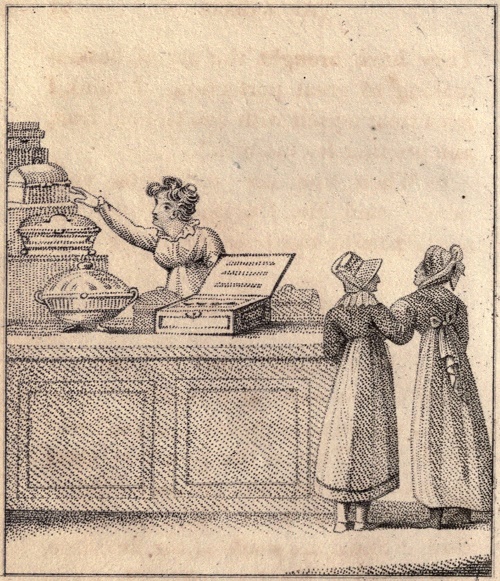
general, consisting of several rooms
which are conveniently fitted up with
handsome mahogany counters, extending
not only round the sides, but in the
lower and upper apartments, forming a
parallelogram in the middle. These
counters, having at proper distances
flaps or falling doors, are in contiguity
with each other, but are respectively
distinguished by a small groove at a distance
of every four feet of counter, the
pannels of which are numbered with
conspicuous figures, and these are let
upon moderate terms to females who
can bring forward sufficient testimonies
of their moral respectability."
"It appears to me to be a most excellent
establishment," said Mrs. Durnford,
"as it enables many a worthy
female to dispose of the produce of her
labours, without incurring the risk of
taking a shop which might prove unsuccessful,
and thus she would not only be
drained of every sixpence she possessed,
but she might be reduced to actual beggary
from the failure of her first attempt."
"True, my dear," replied Mr. Durnford,
"such is too frequently the case.
But in this institution no such danger
can arise. The person who from strong
recommendation obtains a counter in
our Bazaar, pays daily, three-pence for
every foot in length, and is not required
to hold her situation more than from day
to day. I have been told, that at present,
there are upwards of a hundred
females who are employed in these
rooms, and a more pleasing and novel
effect can hardly be imagined, than is
here produced by the sight of these elegant
little shops, filled with every species
of light goods, works of art, and female
ingenuity in general."
"Then you have seen the Bazaar,
papa?" said Maria, the eldest daughter
of Mr. Durnford.
"Yes, my love," replied her father,
"I went over it about five weeks ago
with Lady Bellenden, who has placed
two very amiable young women there,
both of whom are the orphan daughters
of a country curate, one of them has a
counter for all sorts of painted ornaments,
the other for fine needle work.
But you shall see the Bazaar yourself,
Maria, and if your mother is disengaged,
I think we will set out to-morrow
morning, immediately after breakfast.
We shall then have plenty of time to
examine the contents of the Bazaar, and
return in time to receive our guests for
dinner."
To the inexpressible delight of all the
children, Mrs. Durnford immediately
assented to the proposal of her husband,
and it was agreed, that as the
young people had behaved themselves
lately much to the satisfaction of their
parents, they should all of them enjoy
the pleasure of a "visit to the Bazaar,"
except the baby in arms, and the
youngest boy.
Early the next morning Mr. and Mrs.
Durnford, with Maria and Emily, who
were twins, and just turned of twelve
years of age, and Caroline, a sweet
little girl about seven, accompanied by
Theodore, proceeded with light hearts
and buoyant spirits to town, which was
only two miles from the residence of their
father, a gentleman of large independent
fortune. They had frequently visited
the metropolis, had been once to a play,
and had seen several other places worthy
of their inspection, but they all felt their
curiosity strongly excited to view the
Bazaar, as well as to behold once more
Susan Boscawen, who was a daughter
of a deceased tradesman, long a resident
in this village, and for whom they all
entertained a sincere regard.
On arriving at the place of their destination,
the young people were surprized
to see the square filled with elegant equipages,
some of them belonging to our
first nobility. "I believe, my dears,"
said Mr. Durnford, "that this is the
first time any of you have seen Soho-square."
"Yes, papa, it is," cried Theodore,
"pray whose statue is that which I see
placed in the centre of that large area,
and what are those figures at the feet of
the statue."
"It is, as you may observe, a pedestrian
statue of King Charles the Second,"
replied Mr. Durnford, "and
those wretched mutilated figures are emblematical
of the rivers, Thames, Trent,
Severn, and the Humber. The Square
was formerly called King-square, and I
believe some efforts have been made to
have that name revived. It has been
greatly altered since the original disposition
of the ground: then a fountain
of four streams fell into a basin in the
centre; where now stands the worn out
statue of King Charles. It was once
also called Monmouth-square, the Duke
of Monmouth then residing in the second
house; and tradition says, that on
the death of the Duke, his admirers
changed it to Soho, being the word of
the day at the battle of Sedgemoor.
The name of the unfortunate Duke is,
however, still preserved in that of Monmouth-street,
long celebrated for old
shops, old clothes, and shop cellars.
That house, my dears, is celebrated as
being the residence of the venerable and
worthy Sir Joseph Banks, whose whole
life has been devoted to science, and the
diffusion of every branch of useful knowledge."
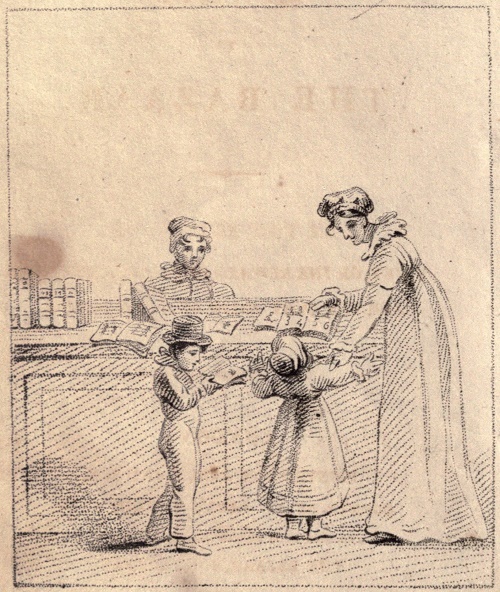
BOOKSELLER,"
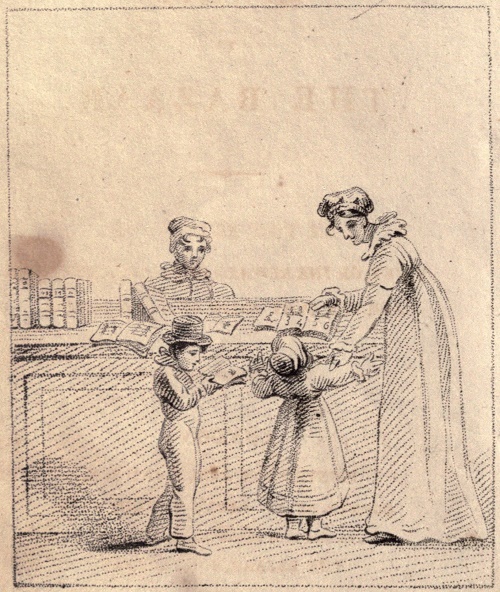
Bookseller
Published Feby. 20, 1818, by J. Harris,
corner of St. Pauls.
cried Theodore, with delight, as his eyes
rested upon a parcel of books neatly
bound, which were placed on the next
counter.
"I have no objection to your selecting
one book a-piece," said his father, "but
you remember, Theodore, that I always
make a point of buying all your books
at the corner of St. Paul's Church-yard.
You may, however, purchase a few of
this person, who appears to have got a
very good selection."
"I had them, Sir, of Mr. Harris, in
St. Paul's Church-yard," said the woman.
"He was so good as to choose for me
what he thought would sell best."
"Then you may look over them, my
dears," said Mr. Durnford. "I suppose,
Caroline, that you know what paper is
made from?"
"Of linen rags, papa, but I do not
know how it is made."
"No, my love, neither can I explain
it to you now, as the process is too long.
Theodore, can you inform me of the
origin of printing."
"Coining, and taking impressions in
wax, are of great antiquity," said Theodore,
"and the principle is precisely
the same as that of printing. The application
of this principle to the multiplication
of books, constituted the discovery
of the art of printing. The Chinese
have for many ages printed with
blocks, or whole pages engraved on
wood; but the application of single
letters or moveable types, forms the
merit and the superiority of the European
art. The honour of giving rise to
this method, has been claimed by the
cities of Harlem, Mentz, and Strasburg;
and to each of these it may be ascribed
in some degree, as printers resident in
each, made improvements in the art."
"So far you are right, my dear boy,"
said his father, "it is recorded, that one
Laurentius, of Harlem, was the first inventor
of the leaden letters, which he
afterwards changed for a mixture of tin
and lead, as a more solid and durable
substance. We may suppose this to have
been about 1430. From this period,
printing made a rapid progress in most
of the chief towns of Europe. In 1490
it reached Constantinople, and was extended
by the middle of the following
century, to Africa and America. It was
for a long time believed that printing
was introduced into England, by one
William Caxton, a mercer, and citizen
of London, who having resided many
years in Holland, Flanders, and Germany,
had made himself master of the
whole art, and set up a press in Westminster,
in 1471. But a book has since
been found, with a date of its impression
at Oxford, in 1468, and is considered as
a proof that printing began in that University
before Caxton practised it in
London. Emily, what have you got
there bound so handsomely in morocco?"
"Mrs. Chapone's Letters, papa, it is
a present from mamma. And Maria has
got European Scenes, for Tarry at
Home Travellers, a very pretty book,
full of engravings. And Caroline has
chosen Keeper's Travels in Search of
his Master."
"Very well, my dear, and here is
Sandford and Merton for our Theodore,
half-bound in Russia. This leather is
now made use of in libraries, because
it preserves the books from the moth,
the smell, perhaps, is not so agreeable.
Other books are bound in calves' skin,
which is a very pretty binding, and
others are only half-bound, as it is called,
or in boards. Now, if you are suited,
we will pass on to the