A Tribute of Regard, Presented by
Thy Affectionate Friend
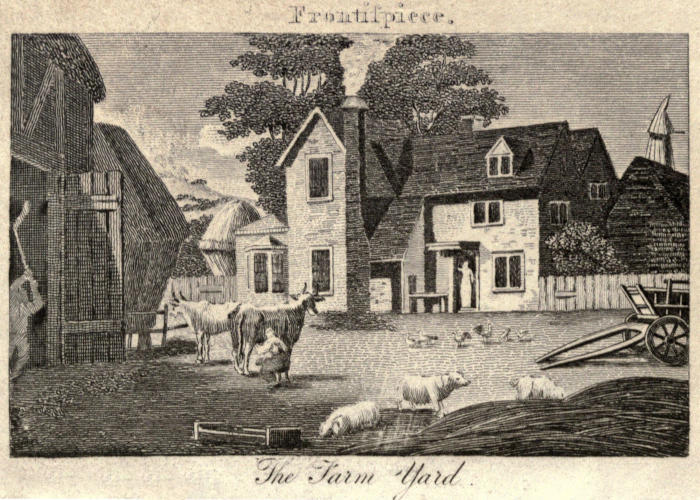
Frontispiece.
The Farm Yard.
A
VISIT TO A FARM HOUSE; OR,
AN INTRODUCTION TO
VARIOUS SUBJECTS CONNECTED WITH
RURAL ECONOMY.
EMBELLISHED WITH BEAUTIFUL PLATES.
By S. W. AUTHOR OF “A VISIT TO LONDON.”
SEVENTH EDITION, REVISED AND CORRECTED By T.H.
LONDON: WILLIAM DARTON, 58, HOLBORN HILL.
And to be had of all Booksellers.
1820. (Entered at Stationers’ Hall.)
[PRICE HALF-A-CROWN.]
PREFACE.
This little Work was undertaken to
excite the attention of those children,
who live in the country, to the various
objects by which they are surrounded;
and to furnish those residing in the
metropolis and other large cities, with
some information relative to rural economy,
which their situation prevents
them acquiring by personal observation.
The author acknowledges that she
is totally incompetent deeply to discuss
the phenomena of nature, or the science
of agriculture; she should indeed
think it inconsistent to introduce scientific
researches into a Work of this
kind. But a slight investigation of
the simple arts by which the nourishment
of man is effected, or of some of
those wonders of creative power which
daily present themselves to view, cannot,
in her opinion, be deemed an improper
exercise even at an early age.
VISITS TO A FARM HOUSE. — CHAPTER I. Cows.
“What a delightful morning!”
exclaimed little Arthur Benson on
opening his eyes, and seeing the sun
shine bright into his room; “Charles,
Charles,” continued he, turning to his
brother, who was still asleep, “let us
get up directly, and we shall have time
for a little walk before grandpapa
and grandmamma come down stairs.”
Charles obeyed the summons, and
they were soon dressed. They then
went into the garden, and from the
garden into the field adjoining; both
highly pleased with all they saw, for
they had never slept out of London
before, and the country was quite a
new scene to them. “See,” said
Charles, “how all the cows are gathered
together by that gate; and here
comes a man they call old Ralph with
a pail on his arm. Pray, Ralph, what
do the cows want there?” “They
want to be milked,” said Ralph, “and
through that gate is the way to the
farm yard.” “Are you going to milk
them, and may we come with you?”
inquired Arthur.
Leave being given, they tripped
along by the side of the good old servant;
but both stood at some distance
behind when they came near the cows,
as they felt rather afraid of going close
to such large animals. “Why, now,
masters, what is there to be afraid of?”
said Ralph, who found they had left
off talking and suddenly shrunk back.
“The cows will not hurt you, if you
do not hurt them.” “Don’t they sometimes
toss people with their great
horns?” asked Charles. “Here and
there you may meet with a vicious one,”
replied the man, “but in common they
are very gentle.”
Arthur. I remember my papa told
me never to run in the way of the cows
that we meet in London streets.
Ralph. Aye, that is a very different
thing. The poor cattle are not used
to be there, so sometimes they may be
frightened; and then, the butchers are
often cruel, and will beat and drive
them about, as I have heard, so that
for what I know it may be best to keep
out of their way; but here there is
nothing of the sort. I do not ill use
them, and they are always quiet with
me.
The little Bensons then recovered
from their fears, and wanted to milk
the cows themselves. The trial was
made, and they were surprised to find
that they were not able to do it as well
as Ralph. Had they been older, they
would have known that there are many
things which are easy to those who are
accustomed to do them, that one who
had never tried would find difficult.
“Pray, Ralph,” asked Arthur, “why
has the young calf that thing full of
spikes round his mouth? See, he wants
to suck the black cow, and she will
not let him. Cannot you take it off?”
“Oh no, master Arthur, it is time
the calf should be weaned. He is
old enough now to eat grass, and we
want the milk for the dairy; so we put
the spikes on him, and because of them,
as they would hurt her, the mother will
not let him suck any more.”
“Is he to be killed?” inquired
Charles.
“Not at present,” replied the old
man. “Master means to keep him
to draw in the team.”
“To draw in the team!” said Charles
with some surprise.
“Yes,” returned Ralph; “we have always
a team of oxen. You may see
them ploughing in that field yonder;
just there,” continued he, pointing with
his finger, “beyond the holly hedge.”
“I see them; I see them,” said
Arthur. “Poor creatures! how slow
they go! Are not they tired, Ralph?”
“No, sir,” replied Ralph, “they do not
move so quick as horses; but they are
vastly stronger. And though it is not
always quite so easy to manage them,
yet on the whole they answer very
well.”
Ralph had now finished milking:
and taking the little boys into the stable,
he showed them a baby calf, as
he called it, that was to be sold to
the butcher the next day.
“O you pretty little thing!” said
Arthur. “Only look, Charles, at these
spots on its back. I should like to
have it for my own. Why must it be
killed, pray?”
Ralph. To serve us for food, master
Arthur. If we were to suffer all
the cattle to live, they would eat all the
grass and corn that we could grow;
and then we should be starved, and
you would not like that.
Arthur. No, I don’t want to starve;
only I do not like to have things killed.
At this moment Mr. Mansfield
came into the stable.
“We were talking about this poor
calf, grandpapa,” said Charles. “Ralph
says it is to be killed to-morrow to
make veal. I am sorry for it; it has
such a pretty coat!”
“It cannot be helped, my dear,”
replied his grandfather. “But when
it is dead, do you know what will be
done with its pretty coat?” The
boys answering they did not, “It will
be sold,” said he, “to the tanner, who
dresses the skins of cattle, or hides as
they are called; and when it is properly
prepared, it makes that beautiful,
smooth kind of leather, that the
large books you were looking at last
night were bound with. It is often
prepared to write upon, and is then
called vellum. The skins of oxen and
cows make a thick coarse leather, such
as the soles of our boots and shoes.”
“And what becomes of the hair?”
asked Charles.
“After the hide has been soaked for
a long time,” replied Mr. Mansfield,
“it comes off easily, and is put into
that kind of mortar which is used
to plaster walls, in order to keep
them from crumbling and falling
away. Did you never see in a white
wall broken down in part, a heap of
short hairs, and here and there perhaps
a little loose piece of mortar hanging
to them?”
Arthur said he had, but he did not
know it was cow-hair; and added,
he could not have thought it could
have been of any use.
“Every thing is of use, my dear,”
said Mr. Mansfield. “I doubt if you
can name a part of the cow that will
not turn to some account.”
“What the hoofs, grandpapa?” said
Charles.
“Yes, Charles,” returned Mr. Mansfield.
“The hoofs and the parings of the
skin, by being boiled down to a strong
jelly, make the glue which carpenters
use to join things together.”
Arthur. The horns—Oh, I know
what is done with the horns. I have
seen horn lanterns, and I have got
a little box at home that mamma says
is made of horn.
Mr. Mansfield. Very well, Arthur.
And you may have seen boxes, and
knife-handles, and combs, and many
other things, made of the bones of the
ox. Even the dung is of some use.
It is a good manure for land; it is
used in the process for bleaching linen;
and poor women pick it up when it is
dry, and make fires of it, to save coals.
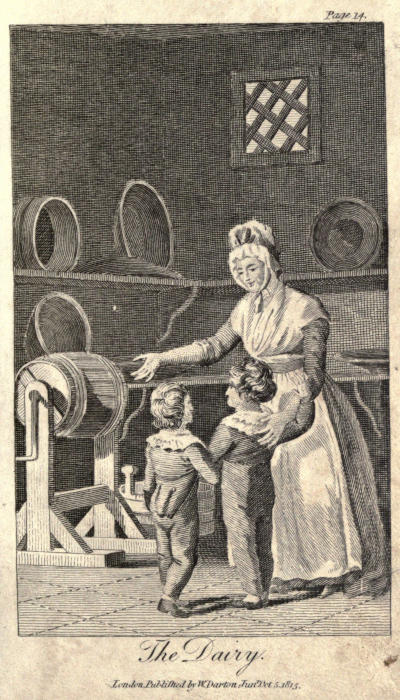
CHAPTER II. The Dairy.
Mrs. Mansfield, hearing how
much her little grandsons had been
pleased with the cows, after breakfast
took them into the dairy, to show them
what was done with the milk which
those useful animals give in such large
quantities. The dairy was a little
room with a brick floor, facing the
north, and kept very cool, by means
of a latticed window that let in fresh
air. It was necessary that it should
be built in that way, because heat
soon turns milk sour. Round the
room were fixed a sort of trays lined
with lead, which then were all filled
with milk.
“Grandmamma, what is to be done
with this milk?” inquired Arthur.
“It is set for cream,” answered
Mrs. Mansfield; “and the cream will
be made into butter.”
Charles. How is butter made, pray?
Grandmamma. Come here, and I
will show you. The milk is poured
into these trays, which are not deep,
but broad, so as to cover a large
space. When it has stood some time,
the cream or greasy part, which at
first is mixed with the milk, rises to
the top in the manner you now see.
Then it is skimmed off with this
ladle, and put into a pan by itself.
This is done twice a-day; and when
there is cream enough, it is churned
into butter.
Charles. Is there any churn here,
grandmamma? Sister Kate has got a
plaything churn, but I never saw one
fit for real use.
Mrs. Mansfield pointed to a large
barrel fixed on a stand, with a winch
handle to turn it, and told him that
was the churn. Charles was surprised,
and said it was not at all like his sister’s.
Grandmamma. Perhaps not. Sometimes
they are made like a pail, with
a long stick to pull up and down; but
these I have give less trouble, and, I
believe, are now common.
London. Published by W. Darton Junʳ. Oct. 5, 1815.
Arthur. Well, grandmamma, how
is this used?
Grandmamma. The cream is put
in through that little square door,
which is then shut quite close; and
when the churn has been turned a good
while, it is changed into butter.
Charles. So then butter is nothing
but cream shaken about? I should
like to see it made.
Grandmamma. You cannot see it
now, my dear, because Rose churned
yesterday. But I will give you a
little cream in a phial: and you
may shake it till you make it into
butter.
Arthur. Oh, can we make it so? I
should like it very much indeed, if
you please, ma’am.
Mrs. Mansfield fetched a phial,
and the two boys amused themselves
a long time with their experiment.
But they found that with all their pains
they could not turn the whole into
butter; their grandmamma told them
there was always some waste; that it
was called buttermilk, and given to
the pigs.
Arthur and Charles, quite proud of
their success, went to look for Rose,
that they might tell her they could
make butter as well as she. They
found her in the dairy, where their
attention was drawn to a new circumstance.
Rose was standing before a
large tub, full of a white substance
rather thicker than jelly, which she was
very diligently employed in breaking.
They forgot the butter they had
intended to boast of, and both began
to ask a variety of questions, which
she answered with great good humour.
Both the Boys. What is that for?
What are you doing now, Rose?
Rose. Making cheese.
Charles. Making cheese? Well,
since I have been at my grandpapa’s,
I have seen things I never saw before.
Arthur. But how do you make it,
Rose? What have you got there?
Rose. Curd.
Arthur. What is curd?
Rose. It is made from milk, master
Arthur. When the cream is taken off,
we take the milk and mix it with rennet,
and then—
Arthur. Rennet! What is that?
Rose. A sour juice that is made by
boiling a part of the inside of a calf.
We put a little rennet to the milk,
which makes it part into curds and
whey. This thick white part is the
curd, and the thin watery part is called
whey.
Arthur. Is that the whey people
take for a cold?
Rose. No. That kind of whey is
made with wine instead of rennet; but
the curd parts just in the same manner
as this.
Charles. I will ask our Sally to let
me look at it the next time she makes
whey. But why do you break it?
Rose. That there may be no lumps.
Wait a little, if you please, and you
shall see how I go on.
She then took a large round bag
made of coarse cloth, into which she
put all the curd, and pressed it with
very heavy weights in order to squeeze
out as much of the whey as she could.
This done, she turned it out of the bag
into a vat which has holes like a cullender,
and, leaving it to drain, then
told them the cheese was finished.
“I did not know,” said Charles, “it
was so easy to make cheese. But what
is the rind, pray?”
“’Tis the same as the rest,” replied
Rose; “only, being left to the air, it
grows hard in time.” Then leading
them into another room, she showed
them a great number of cheeses; some
were still soft, having been lately made;
others, that had been longer kept, were
grown quite hard.
“What is the whey good for?’
asked Charles, as they came back
through the dairy.
“We give it to the pigs,” said Rose.
“So then,” said Arthur to himself
as he walked away, “butter and cheese
are both made from milk; but the butter
is the greasy part, and the cheese
is the curdy.”
“Yes, master Arthur,” said Rose,
“you are right, for that is our way of
making butter and cheese in this country:
but in many places, where richer
cheese is made, they use the milk without
skimming off the cream; and to
make good cream cheese, the cream
only is used when skimmed from the
milk.”
CHAPTER III. The Pigs.
When dinner-time came, it happened
that there were brought to table
some custards and gooseberry tarts,
of which Charles was tempted to eat
very greedily. He had already been
twice helped, and the servant was going
to carry away the remainder of a tart
that had been left in the dish, when
Charles, not satisfied whilst any remained,
stopped him, and once more
filled his plate with it.
The footman stared; and his grandpapa
and grandmamma looked at him
with surprise, but said nothing.
In the evening Mr. Mansfield led
his grandsons into the yard, just at
the time his man was giving the pigs
their supper. Arthur and Charles
were diverted at the eagerness with
which the whole family squeaked and
grunted over their food, which they
devoured with the utmost haste, treading
one over another as they scrambled
for a share.
“O grandpapa,” exclaimed Charles,
“how droll it is to see the pigs
eat! Look there! look there! One
has got a cabbage leaf, and another
wants it. Now it has got it away,
and it eats it as fast as ever it can. And
now it is come for more. I dare say
they will soon empty the trough.”
“Perhaps so,” replied his grandpapa,
smiling. “Pigs are as fond of
cabbage leaves and bean stalks, as
little boys are of gooseberry pie.”
Charles blushed.
“Hey, Charles!” continued he,
putting his hand upon his head so as
to look full in his face, “this is not
the first time to-day I thought I had
a pig for my companion. Do you
know any body that ate voraciously,
and at last emptied the dish?”
Charles softly answered, “Yes, sir.”
“Well, I believe he is ashamed of
his greediness,” said Mr. Mansfield;
“I only advise him another time to
be more upon his guard for fear we
should take him for a pig.”
As they were sauntering about, a
sow with a fine litter of pigs at her
heels came across the yard.
“Pray, sir,” asked Arthur, “how
many pigs may a sow have at once?”
“From ten to twenty,” said Mr.
Mansfield. “But as she has not milk
enough to suckle so many, she casts
off some, and seldom brings up more
than twelve.”
London. Published by W. Darton Junʳ. Oct. 5, 1815.
Grandpapa. They are not very
difficult. They will eat almost any
kind of rubbish and offal: but vegetables
of all sorts are best for them.
Cabbage stalks, potatoe parings, bean
and pea shells, they like very well;
and it is a good way to turn them out
into the forests, where they meet with
plenty of acorns, and mast nuts that
grow upon beach trees. With their
long snouts they turn up the ground,
that they may get at the roots or
plants: to prevent this, we are obliged
to have a ring thrust through their
noses, otherwise they would do a great
deal of mischief.
Charles. Are they of much use,
grandpapa?
Grandpapa. Not whilst they are
alive. When dead, the flesh, you
know, is eaten, and is called pork, or
bacon if salted in a particular manner.
The lard, or some of the fat, is used
in making many sorts of plasters, and
the bristles are formed into brushes
of various kinds; and are used by
shoemakers and others in sewing leather,
instead of needles.
Arthur. I like little pigs much
better than I do great old ones.
Grandpapa. I cannot say the hog
is a favourite animal with me. He
is not only ugly, but his habits of life
are disagreeable. You may have observed
that he is very fond of grouting
in the mire. Neither his grunting nor
his squeaking is pleasant music; and
the whole race are so greedy, that, if
they have food enough, they will eat
till they are too heavy to stand on their
legs; even then they will lie on their
sides, and eat still. Sometimes the
sow will go so far as to devour her own
young.
Arthur. Indeed? The unnatural
brute!
Grandpapa. I should have told
you that their stomach is made very
large, and requires an unusual quantity
of food. But if we are disgusted with
the manners of a hog, we should be
careful not to imitate them; as filth,
gluttony, and want of natural affection,
must surely be ten times more shocking
in the creature man, who is blessed
with reason.
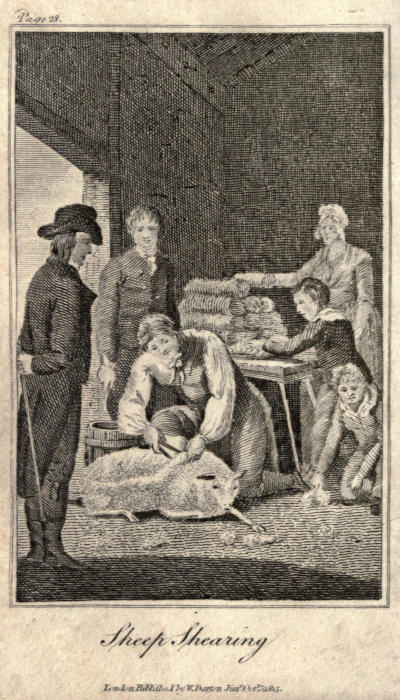
CHAPTER IV. Sheep-Shearing.
The following day being appointed
for sheep-shearing, a number of men
and boys assembled at an early hour in
the great barn. Arthur and Charles
went with their grandpapa to see the
process, and were greatly pleased with
the hurry and bustle of the scene. The
sheep were penned in a fold close to
the barn, and were fetched away by
the lads one by one, as fast as the
shearers were ready for them. A few
days before, they had all been washed
at a mill-pond, so that their fleeces
were beautifully white, and they were
so thick as to make the animals appear
almost twice as large as they really
were.
London. Published by W. Darton Junʳ. Octʳ. 5, 1815.
Arthur observed with surprise, that
the poor creatures were perfectly quiet
during the time of their being shorn;
although they struggled with terror
when they were first brought out, and
bleated piteously as soon as they were
set at liberty.
He wondered at the ease with which
the men laid them on the ground, and
afterwards turned them over from side
to side, as was necessary in the course
of the shearing. After watching one
of the shearers for some time, he began
the following conversation with
him:—
Arthur. Good man, does not it
hurt the sheep to be pulled about in
that way?
The Man. They do not like it;
but I try to hurt them as little as I
can.
Arthur. Are you not afraid of
cutting them with the shears, when you
put them down into the middle of the
wool?
The Man. We take care to feel
our way, but now and then they get an
unlucky snip. That man there, that
stands by the door, has some tar that
he puts to them if they chance to be
hurt.
Arthur. Poor things! how cold
they must feel when they lose such
a quantity of wool!
The Man. It is time they should
be shorn now, master. This is their
winter coat, as one may say; and if
it was left much longer, by little and
little it would fall off of itself.
Arthur. Then why don’t you
let it come off of itself, instead of
taking all this trouble, and teasing the
sheep?
The Man. My service to you, sir!
What, are we to lose the wool, or to
follow the sheep from place to place
wherever they choose to stray, in
order to gather it after them? No,
no; they may suffer a little at first,
but if the weather is warm they soon
get over it.
Arthur. How many can you shear
in a day, good man?
The Man. Why, fifty, more or less.
The quickest hands can finish one in
ten minutes.
Charles during this time was helping
a little girl to pick up the loose
locks of wool that were scattered over
the floor. His brother turned round,
and saw how he was employed. What
should he do? Every one was busy
besides himself, and he could not bear
to be the only idle person. A message
came to fetch away one of the women,
whose task it was to roll up the
fleeces and pile them together on a
heap. Arthur offered to take her
place; and, after a few trials, he learned
to tie them up very dexterously. He
continued at this employment for
some time, and rejoiced to find himself
of some use.
Mr. Mansfield at length called the
two boys to go away. They immediately
obeyed; and Charles, taking hold
of his grandpapa’s hand, asked him if
he did not think a sheep-shearing was
a most charming thing.
Grandpapa. It does very well in its
season, my dear boy. Wool is so useful,
that the shearing-time always gives
me pleasure.
Arthur. What shall you do with it,
grandpapa?
Grandpapa. I shall sell it to the
wool-stapler; and, after it has passed
through the hands of different manufacturers,
you may perhaps meet with
it again in some shop, though so altered
as not to be known for the same.
It will then be in the shape of flannel,
worsted, cloth, or perhaps some kind
of stuff.
“That is all very droll,” said Charles.
“But when will there be another sheep-shearing,
grandpapa?”
“Not till this day twelvemonth, my
dear,” returned Mr. Mansfield. “Wool
does not grow very fast. In two or three
weeks you will see the sheep covered
with a little short wool; and the traces
of the shears will then be worn away.
As winter comes on, it grows thicker
and longer; but that is not a time to
rob them of their fleece. At last the
year will come round, and then they
will be again ready for the shearer.”
“I am fond of sheep,” said Arthur;
“and I like little lambs, they look so
innocent.”
Grandpapa. They are gentle, timid
creatures, and require the care of
man more than almost any other animal;
as they have neither strength to
defend themselves when attacked by
their enemies, nor swiftness to run
from danger.
Arthur. And they pay us for the
care we take of them, by letting us
have their wool?
Grandpapa. Indeed they do, Arthur;
but not by their wool alone, for
they are useful in more ways than one.
Mutton, which you know is the flesh
of the sheep, is one of the most wholesome
meats we have; some parts of
the fat are melted down to make tallow.
The skin is sometimes made
into parchment, and sometimes into
leather, for gloves, shoes, and other
things: and parts of the guts are twisted
into strings for musical instruments.
Charles. What enemies have sheep,
grandpapa? You have said they can’t
defend themselves against their enemies.
Grandpapa. Wherever there are
wild beasts, Charles, they have many
enemies, as they all prey upon the
sheep. Eagles will attack young lambs;
so will foxes; and even dogs, if they
are fierce, and not properly trained.
Arthur. But I have often seen a
dog along with a flock of sheep.
Grandpapa. Yes; the breed that is
called the shepherd’s dog is very useful
in managing them. They seldom
bite, but will fetch those back that
have gone astray; and by barking at
them alone, guide the whole flock much
more easily than a man can do. When
they have done their business, you
may see them come back to the shepherd,
and follow him as quietly as
possible.
In the evening a supper was provided
to refresh the shearers after their
hard day’s work, consisting of legs of
mutton, and plum-puddings, with plenty
of good ale. All was jollity and
mirth. During the day a constant buz
of many voices might have been heard
even at some distance from the barn;
but the business they were engaged in
did not allow time for much talk. At
night, on the contrary, they had nothing
to do but to divert themselves,
and every tongue was heard. They
told merry stories without end, sang
songs, and drank to the health of their
kind master. Mr. Mansfield himself
staid with them for some time, encouraging
them to be cheerful, and walked
about to see that every body was helped.
At length, he left the party, followed
by his grand-children, who immediately
retired to rest, highly satisfied with the
pleasures of the day.
CHAPTER V. A Walk through the Fields.
The next morning, Mr. Mansfield
asked the little boys if they were disposed
for a walk. Arthur replied that
he should like it very much; but
Charles said he would rather stay at
home with his grandmamma; accordingly
they set off without him.
“What pretty purple flowers grow
in that field!” observed Arthur, when
they had proceeded a little way.
“Pray, grandpapa, what are they?”
“That is a field of clover,” replied
Mr. Mansfield; “and it will soon be
cut for hay.”
Arthur. I never saw such pretty
hay as that.
Grandpapa. Oh, there will be no
beauty in it. On the contrary, it looks
much coarser and browner than what
is made of common grass, which is
called meadow hay.
Arthur. What becomes of the flowers
then?
Grandpapa. They dry and wither
away. You do not suppose they
would live when cut down. Did you
ever see how hay is made?
Arthur. Yes, a great many times.
A number of men and women go into
a field and turn the grass, and then
they put it into cocks, and afterwards
make a stack of it.
Grandpapa. Why do they do all
that?
Arthur. To make it into hay.
Grandpapa. Yes. But why does
turning it about make grass into hay?
Arthur said he did not know.
Grandpapa. Then I will tell you.
The grass when cut down is full of
moisture. If you squeeze a blade in
your fingers, it will be damp; and that
dampness is called sap. Now, while
the sap is in it the grass will not keep.
If you were to make it into a stack, it
would soon rot, and smell so putrid
you would not like to go near it. But
when it is turned about to the sun and
the wind, till the sap is dried away,
there is no more danger, and you
may stack it, and keep it for a long
time.
Arthur. But if I had a field, grandpapa,
I would never make hay. My
horses should go in and eat the grass
when they wanted it; and I would
save myself the trouble of working for
them.
Grandpapa. I am afraid, Arthur, you
would make a lazy farmer. Do not
you know that nothing in this world
is to be had without trouble? and
if you are so very sparing of your
pains, I fear you will not succeed very
well.
Arthur. Why not, pray, sir?
Grandpapa. Did you ever take notice
of the grass in the winter?
Arthur. Yes; I believe it is then
short and black.
Grandpapa. The blackness is nothing
but the earth among it; it is very
thin at that time of the year. Did you
ever observe a field just before it was
cut for hay?
Arthur. Oh, yes. Do you know,
grandpapa, we all took a walk in a field
a little while ago; and the grass was
so very long that it came up to the top
of my legs; and little Kate cried, and
could not get on at all.
Grandpapa. You see then, that as
there is much grass in summer and
but little in winter, your horses at one
time would have more than they could
eat, and at another would starve. Yet
this would be owing to your own fault:
for God gives enough for the whole
year; and all he requires of us is, that
we should in the season of plenty lay
up for the time of need.
CHAPTER VI. The Walk continued.
The next field they came to was
sown with rye, which Mr. Mansfield
said was a species of corn; and, although
much coarser than wheat, was
frequently made into bread, and in many
places formed the chief food of the
poor. He desired his grandson to gather
an ear or two, that he might learn
to distinguish between that and barley,
which grew in the field through which
they were next to pass.
Arthur pulled up a root of rye, and
then ran to overtake his grandfather,
who by this time had got over the
stile, and was slowly crossing the barley
field.
“Well, Arthur, what difference do
you find in the growth of these two
kinds of corn?” asked Mr. Mansfield.
Arthur. Indeed, grandpapa, I don’t
see any, except that the rye grows
very high, as high as the top of your
hat, and that the barley only comes to
my elbow.
Mr. Mansfield. That is one difference,
to be sure. Examine them well,
and perhaps you may discover some
other.
Arthur. Oh, yes, I see, sir. The
spikes of the rye are neither so fine nor
so long as in the barley.
Mr. Mansfield. Very true again.
So you see you need never mistake
between them. The straw of the rye
is the longest, but the beard (you
should not call it the spikes) is shorter
and coarser.
Arthur. I think the long beard of
the barley gives it rather a silky look,
as it waves about with the wind. Pray,
grandpapa, is barley sown to make
bread too?
Mr. Mansfield. Sometimes it is
used for that purpose; but the greatest
part of what we grow in England is
for making beer.
Arthur. Beer! Is it possible that
barley can make beer? Do you know,
sir, how it is done?
Mr. Mansfield. Yes; and you shall
hear, if you wish to know. All grain
is the seed of the plant; and before it
can be put to any use it must be taken
out of the ear. Now, to do that, it is
thrashed with an instrument called a
flail. I suppose you have seen one, have
you not?
Arthur. I remember once passing
at some distance from a barn, where
a man was swinging something about,
that looked like a bent stick; and he
beat the ground with it, and somebody
said he was thrashing.
Mr. Mansfield. That he certainly
was. The corn was spread upon the
barn-floor, and he was beating out
the grain with a flail. The next business
is to separate it from the chaff,
or outside skin. This is sometimes
done by turning a machine very quickly
so as to cause a wind, which blows
away the chaff, for it is as light as a
feather. A more simple method is, to
throw the corn across from one side
of the barn to the other, against the
wind. The chaff, being so light, is
soon blown back, whilst the corn goes
on a little further, and falls in a heap
by itself.
Arthur. But, dear grandpapa, what
has this to do with making beer?
Mr. Mansfield. All in good time,
my dear boy. You must get at the barley
before you can use it, must you
not? The method of winnowing I
have described, relates principally to
wheat (for barley is without chaff);
but the barley must be thrashed, and
separated from the ear; after which
it is put for some days into a cistern
of water. It is then taken out and
laid in heaps; when it ferments, and
is ready to shoot out in the same manner
as if sown in the ground. Afterwards
it is spread thinly over a floor,
and frequently turned; and when partly
dry is carried to a kiln, a kind of
oven, where it is dried. Having
passed through all this process it is
called malt, and the man whose business
it is, is termed a maltster.
Arthur. I thought brewers made
beer?
Mr. Mansfield. You were right.
Brewers buy malt. They grind it, and
then pour hot water upon it, to get
out its strength and goodness. The
liquor thus obtained, which is sweet-wort,
becomes the most valuable part
of the commodity; for the malt has
lost its virtue, and is called grains, and
is only used to feed pigs and cattle.
The wort is afterwards boiled with
hops, which give it a bitterish taste instead
of a sickly sweet, and keep it
wholesome and good. Then it takes
the name of beer; and after fermenting
for a little while may be put into casks
and kept for use. And now, Arthur,
do you think that you understand
brewing? Shall you recollect that malt
is barley prepared in a particular way?
and that beer is made by pouring warm
water on the malt, and afterwards boiling
it with hops?
Arthur. I think I shall, grandpapa.
CHAPTER VII. The Pony.
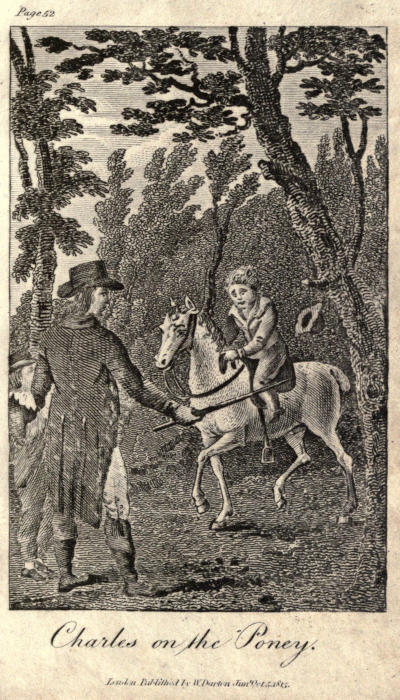
As Mr. Mansfield and Arthur were
returning from their walk, in a lane
at a little distance from the house they
were met by Charles, who had mounted
a pony belonging to his grandfather:
it had taken fright, and was running
away at full speed. Mr. Mansfield
stopped it by catching hold of the bridle;
and as soon as he was satisfied
that no mischief had happened, and
Charles was sufficiently recovered to
be able to talk, he inquired what had
led him to try his skill in horsemanship.
London. Published by W. Darton Junʳ. Oct. 5, 1815.
“Why, grandpapa,” replied Charles,
“Robert had just come home with the
pony, and left him at the gate; and I
wanted to ride; so I got upon him,
and he ran away with me.”
Mr. Mansfield. As you have never
been used to ride, my dear Charles,
you had better not get upon strange
horses when you are alone. I wonder
too that Plover should run away; he
is in general very gentle.
Charles. At first he would keep
his head over the gate, and I could
not get him to move. So I hit him
with a stick I had in my hand, and
that set him off in a gallop.
Mr. Mansfield. I fancy all was
owing to your want of skill; for Plover
is a very quiet creature, and easily managed;
but he will not bear ill usage;
therefore, if you beat him much, I am
not surprised at the accident.
Arthur. I am sure, grandpapa,
Charles did not mean to be cruel, and
use the horse ill.
Mr. Mansfield. He is so good a
boy that I do not suspect him of it;
and I only meant to give him a caution
against another time. No, my
dear children, I hope you will never
take pleasure in wanton cruelty. My
heart has often ached at the barbarities
I have seen practised on poor
dumb creatures.
Arthur. Once when I was walking
with papa, we saw a man beating
a horse about the head with the butt
end of his whip, and my papa advised
him not to do so; but he said it was
his own horse, and he had a right to
do as he liked.
Mr. Mansfield. Nothing can give
a man a right to be cruel. We may,
it is true, make what use we please of
our beasts, as long as we treat them
well, for they were made for our convenience;
but God Almighty has given
to them life and feeling the same as
he has to us; and we make him angry
with us whenever we use them ill.
“I often think, grandpapa, that it
is very strange such large creatures as
these,” said Arthur, patting Plover,
who now walked quietly by the side
of his master, “should suffer us to get
upon their backs, and manage them as
we please. They are much stronger
than we are; and I wonder they do
not drive us away, and not carry us,
and refuse to draw our coaches and do
every thing we like.”
Mr. Mansfield. It would be astonishing,
Arthur, if we did not consider
that our reason gives us a great advantage
over all brutes. Some of them,
it is true, are much larger, some much
stronger, and others much swifter than
we; but by means of our understanding
we can conquer the strongest, and
tame the fiercest of them.
Charles. How can we tame them,
pray, sir?
Mr. Mansfield. By methods which
they cannot resist. Plover is stronger
than you, but a boy of your size who
understands riding would be able to
manage him. He would pull the bridle
on this side, or on that, according
as he wished him to turn; and as he
pulled, the bit would hurt the horse’s
mouth just enough to make him willing
to go where he was wanted: therefore,
by our knowing how to manage
a bit and a bridle, we are more than
a match for a horse in spite of his great
strength.
Arthur. I understand you now,
grandpapa. And I have something
to tell you. As we were taking a
walk a little while ago, a dog came
barking and snapping, and I thought
he was going to bite me; but my
mamma called out, “Don’t be frightened,
Arthur; pick up a stone to throw
at the dog, and it will send him away.”
So I did, and to be sure he slunk off
at once. Now was not it my reason
that made me conquer the dog,
though the dog could bite harder than
myself?
Mr. Mansfield. Exactly so. You
see, then, that although our bodies are
naturally weak and helpless, yet by
our reason we are furnished with the
means of strength and defence. So
God has ordained; and therefore,
though he will not suffer us to be cruel
to any of his creatures, yet, as our
Bible tells us, he said at the beginning
of the world, that the fear and dread
of man should be for ever upon all
animals.
As Mr. Mansfield finished these
words, they reached the stable yard,
and Ralph came forward to unharness
the pony.
“Plover must be shod to-morrow,
sir,” said he, as he looked at one of
his hinder feet.
“Is not it cruel, grandpapa,” asked
Charles, “to drive nails into the
horse’s feet?”
Mr. Mansfield. No, my dear, it
is not. The nails only go into the
hoofs, which are very hard, and have
not any feeling; but if we did not put
on these iron shoes, the hoofs, hard as
they are, would soon be battered to
pieces when they travel over rough and
gravelled ground.
Arthur. Dead horses are of no
use; are they, sir?
Mr. Mansfield. Their flesh is given
to dogs; but the skin, when converted
into leather, is used for making harness
and some other things.
CHAPTER VIII. A Visit to the Windmill.
“Do you know, my dear,” said
Mrs. Mansfield to her husband, when
they were sitting at tea, “the miller
has forgotten to send home the flour
he promised to let us have last week;
and Sarah has just told me we have
not enough in the house to bake to-morrow!
So what must we do? Can
you spare one of the men to go over
and inquire about it?”
“I am afraid, my dear,” said Mr.
Mansfield, “they are all busy at present;
but when Ralph comes in he may
go of the errand.”
“It has just occurred to me,” rejoined
Mrs. Mansfield, “that if you
are disposed for another walk this fine
evening, you might go yourself and
take the children with you; and it will
be a nice treat to them, for I know
they have never seen a mill.”
“Ah, do go, grandpapa; will you,
grandpapa? it will be so very delightful!”
said both the boys at the same
instant.
“Well, bring me my hat then,” said
their indulgent grandfather. “I did
not intend to stir again to-night; but
if it will give you pleasure, my dear
boys——”
“Thank you, sir! thank you, sir!”
cried Charles, running for the hat.
“I hope you won’t be tired though,”
said Arthur. “You shall rest upon
my shoulder all the way; and do not
be afraid of leaning all your weight,
for I shall be able to bear it very well.”
“You shall have my shoulder to
rest upon too,” exclaimed Charles:
“So I dare say, grandpapa, you will
not be tired.”
“Indeed,” replied Mr. Mansfield,
putting one hand upon the shoulder of
each, as he rose from the chair, “with
two such kind little supporters, I shall
not be easily fatigued.”
As they walked, Charles expressed
his joy that they were going to see
the inside of a mill, which was what
he had long wished to do. “And,
pray,” inquired he, “what is it like?”
Mr. Mansfield. That you will see
when you get to it: in the mean time,
Arthur, examine this wheat. I showed
you barley and rye in the morning.
“There is no beard to this,” said
Arthur.
Mr. Mansfield. No; and the ear is
heavier and larger. Gather one, and
count the number of grains it contains.
Charles pulled violently, and drew
up a root that had seven stalks growing
from it.
“Hold, you wasteful little fellow!”
cried his grandpapa. “I did not tell
you to root up my field at one stroke.
Let me see, however. Observe what
a wonderful increase here is. These
seven stalks have all sprung from one
single grain, and each ear contains,
perhaps, twenty grains; which gives
us in all a hundred and forty grains
instead of one.”
Arthur. That is astonishing, indeed!
So there always grows a hundred
and forty times as much wheat
as is sown?
Mr. Mansfield. No, no, I did not
say that. In this instance it is so;
and sometimes it may even happen to
produce more; but a great deal of seed
rots in the ground, without ever growing
at all: of what does come up,
some is spoilt before it is ripe, and the
ears that come to perfection do not all
yield so well as these. I believe, therefore,
that taking the kingdom throughout,
we only gather about eight times
the quantity we sow.
Arthur. How long is wheat growing,
pray, sir?
Mr. Mansfield. Nine or ten months
generally. No sooner is the harvest
of one year got in, than we begin to
prepare for that of the ensuing year.
We plough the land, and sow it
again immediately. Some seed, indeed,
is not sown before the spring,
but that never produces quite such
good crops.
Charles. What is the use of ploughing,
grandpapa?
Mr. Mansfield. To break up the
earth, which would otherwise get so
hard that no corn could grow in it.
When a field has been ploughed, a
man walks over it, and scatters the
seed all over the field. Then it is raked
in by an instrument full of great iron
teeth, called a harrow. Care must afterwards
be taken to keep it free from
weeds, but besides that nothing more
can be done. It is left for the rain to
water, and the sun to ripen it.
Charles. And when it is quite ripe,
then the harvest comes, does it not, sir?
Mr. Mansfield. Yes. Then the
reapers go into the field, and cut down
the corn with their sickles. They tie
it up in bundles, which are called
sheaves, when it is carried into barns,
and thrashed out for use.
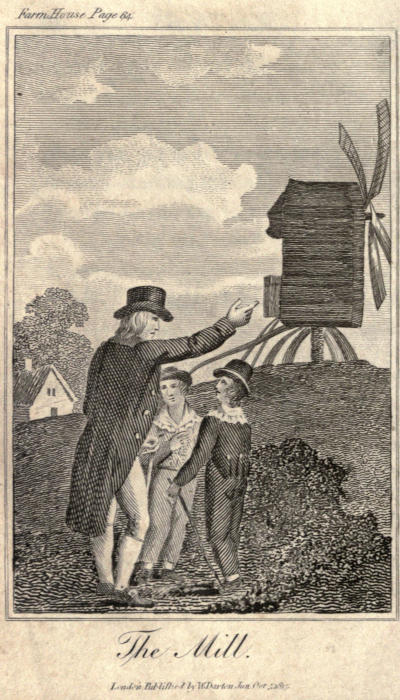
As they were conversing in this
manner they arrived at the mill; and
when Mr. Mansfield had given his
orders, he asked leave to lead his
grandchildren over it. He then explained
to them, how the sails, being
turned round by the wind, were the
occasion of turning different wheels
in the inside of the building. He
next pointed out to them two large
flat stones, shut up in a kind of box.
“You may see,” said he, “that all
the corn is made to pass between these
stones. The understone is fixed; but
the upper one turns round, and presses
so heavily upon it, as to bruise and
grind the corn to powder.”
“I understand you, grandpapa,”
returned Charles. “And is that all
that is done here?”
Mr. Mansfield. Not all, Charles;
for the corn, though ground into meal,
wants sifting. To do that, there is a
contrivance called a boulting engine,
and you may look at it if you step this
way.
Mr. Mansfield then opened a little
door in the large wooden box, or bin,
that contained the engine; when a
quantity of fine flour flew out into
their faces, and powdered them all
over. The boulter was made of frame-work,
five or six feet long, round
which a canvas was tightly strained.
“Now,” said Mr. Mansfield, “the
meal is put into this boulting machine,
which turns round, you see, very fast
when the mill is at work. The quickness
of its motion causes the fine
flour to fly off through the canvas;
but the coarse and husky part, which
is bran, not being able to do that,
falls to the bottom by itself. The
use of shutting it up in this box, is
to prevent the flour from being scattered
over the mill.”
The Bensons and their grandfather
remained at the mill till they had thoroughly
examined every part of it.
They received much pleasure from
seeing the different wheels and contrivances,
and were diverted to find,
when they came away, that they were
so covered with flour as to look almost
as white as millers.
As they were returning home, Arthur
observed, that having first seen
the wheat growing, and afterwards
ground, they only wanted now to know
how flour was made into bread, to
understand the whole process from beginning
to end.
Mr. Mansfield replied, that he
could easily explain that. The flour
was mixed with a proper quantity of
water, and a little yeast put in to
make it rise. “This,” said he, “is
well kneaded together, and then it is
put into an oven and baked.”
“But what is yeast?” inquired
Charles.
Mr. Mansfield. A scum that rises
on the top of new beer.
Arthur. Have not I, sir, seen to-day,
some of all the different kinds of
corn that grow here?
Mr. Mansfield. I do not recollect
our having met with oats. They do
not grow in one compact ear like the
rest, for every grain has a separate
little foot-stalk to itself. In this part
of the country they are chiefly given to
horses; but in Scotland, and the north
of England, oatmeal cakes are frequently
eaten instead of bread.
“And now,” continued he, “I am
not sorry to find myself near home.
You, Arthur, may likewise be glad to
rest yourself, for you have been stumping
about almost all day.”
The boys declared they were not at
all tired, and thanked their grandpapa
for the pleasure he had procured them.
CHAPTER IX. Poultry.
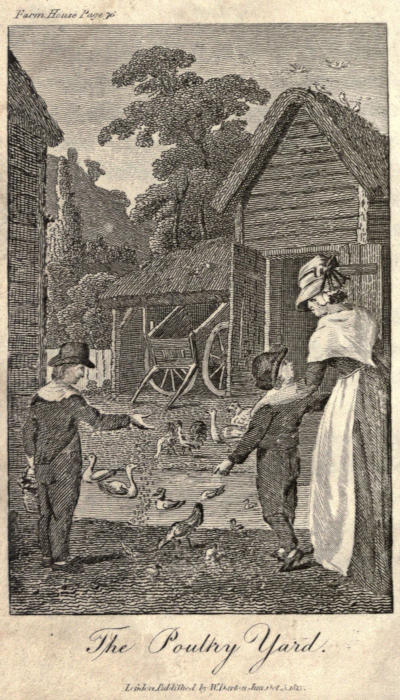
“Grandmamma, pray where are
you going?” asked Charles one morning,
on seeing his grandmother walk
out at the garden door.
“To feed my chickens, my love,”
returned she.
“Then I will go with you, if I
may,” said Charles. “And so will I,”
said Arthur: and he threw down his
peg-top in a corner.
“My speckled hen,” said Mrs.
Mansfield, “came off her nest, yesterday,
with a fine brood of chickens.”
Arthur. That is the one, is not
it, ma’am, that has been sitting so close
ever since we came?
Grandmamma. Yes, and for a fortnight
before, which makes in all three
weeks; the time hens always sit on
their eggs.
Charles. I think they must be tired
of keeping still so long.
Grandmamma. I believe, Charles,
you would be tired of such confinement;
but birds do not seem to mind
it at all. Though so active at other
times; when they have laid their eggs,
they are quite contented to sit still till
the young ones are hatched.
Arthur. Do all birds sit for three
weeks, grandmamma?
Grandmamma. No: ducks and
geese sit for a month; and pigeons
and smaller birds for about a fortnight.
Now you may give them some of these
grits, and then you will have the pleasure
of seeing them peck.
Charles. Let me have a handful, if
you please. Chick, chick, chick, chick!
come here, poor chickey, and I will give
you something to eat. Dear grandmamma!
they will not let me catch
them; and look at the old hen, she
is almost ready to fly at me.
Grandmamma. She is afraid you
are going to hurt her chickens, when
she sees you run after them. Hens
are often very fierce, if any one offers
to meddle with their young ones.
Charles. Well then, poor things!
I will not take you up in my hand,
but I will give you your food on the
ground. How pretty they look! They
are the colour of my canary bird.
Arthur. I see the old hen does
not eat much herself. She only pecks
about the grits, to show them to her
chickens.
Grandmamma. She is a very good
mother; so we will give her some barley.
That is the best food for the old
ones.
Arthur. See, Charles, how oddly
they drink! They turn up their heads
whenever they swallow.
Grandmamma. By that means they
let the water trickle down their throats.
Grandmamma. Because our throats
are not formed the same as birds’;
for we are provided with a muscle,
which carries down the liquor by its
motion.
Charles. How the pretty creatures
creep under their mother’s wings! and
she puffs her feathers out, and makes
herself as large as she can to cover
them all.
Grandmamma. You see how Providence
has provided for the welfare
of all his creatures. Whilst they are too
young to take care of themselves, he
gives to the parent a strong affection
towards them, and wisdom sufficient
to bring them up. The mother,
though generally timorous, and easily
frightened, to preserve her young ones
will boldly turn round and face almost
any danger. You observed that the
hen forgot her own hunger, when she
was teaching the little chickens to
peck; now she covers them with her
wings to keep them from the cold,
which, as they are not completely
fledged, would probably kill them if
it were not for her care.
Charles. And what will she do
when these little things are grown as
big as she is?
Grandmamma. Long before that
time she will have cast them off. Brutes
never care for their young when they
are able to shift for themselves.
Arthur. That is very different
from us. I do not think my mamma
will cast us off as long as she lives.
Grandmamma. I do not think she
will. And I hope, my dear boys, that
in return you will never neglect her.
A chicken, you see, could not be reared
unless the hen took care of it; but a
child requires constant attention for
many years; and even when grown
up, the fondness of the parents still
continues. Surely, then, nothing can
excuse ingratitude and undutifulness
towards them.
Arthur. No, grandmamma: so for
the future I will always mind what
my papa and mamma say to me; and
I will try never to do any thing that I
think they won’t like.
Grandmamma. That is a very good
resolution, and I hope you will keep
to it.—— Well, Charles, what do you
say to the pigeons? They are pretty
birds, are they not?
Charles. Indeed, ma’am, they are.
I was looking at them falling head
over heels, when up in the air.
Grandmamma. Those are called
tumblers, that fly in that way. There
are many kinds of pigeons. The white
ones out there, with tails that stand
up somewhat like hens’, are called fan-tails.
Arthur. What must we feed the
pigeons with?
Grandmamma. You may give them
a few tares, if you like; but here we
have no occasion to supply them with
much food, for they come to the barn
doors, and pick up the corn that is
scattered about.
Charles. Are all those one brood,
that sit together on the top of that
cart-house?
Grandmamma. No. Pigeons never
lay more than two eggs at one
time; and the pair that are hatched
commonly continue mates to one another
all their lives.
Charles. Now let us look at the
ducks and geese, if you please. The
pond is nearly covered with them, I
see.
Arthur. How very small some of
them are! I should have thought that
they were too young to be able to swim.
Grandmamma. Oh, they take to
the water as soon as they leave the
egg-shell. They are web-footed, and
that enables them to swim.
Charles. What is being web-footed,
ma’am?
Grandmamma. Having a skin to
fill up all the space between the toes.
When they swim, they paddle, or
strike with their broad feet against the
water; which gives them motion onwards.
Arthur. I suppose, grandmamma,
you keep poultry for the sake of eating
them!
Grandmamma. You are right. But
do you know what is done with the
feathers?
Charles. No.
Arthur. I do, ma’am. Beds and
pillows are stuffed with them.
Grandmamma. And what use is
made of the long quill feathers, that
grow in the goose’s wing?
Arthur. I never have been told.
Grandmamma. The quill part, by
being cut into shape, is converted into
pens for writing.
Charles. Do only geese furnish
pens?
Grandmamma. Some people write
with crow-quills: but they are too
small for a bold hand; so that they
are very little used. The quills of the
turkey are too hard; and those of
ducks and chickens, on the contrary,
are as much too soft. Swan quills,
however, make excellent pens; but
they are too scarce to be in general
use.
CHAPTER X. The Deer.
In Mr. Mansfield’s neighbourhood
resided a Mr. Ashley, a gentleman of
large fortune, and of a very obliging
disposition. He had heard that Arthur
and Charles Benson were at their
grandpapa’s on a visit, and one day
he sent for them to play with his son
William, a little boy nearly of their
own age. The Bensons went, and
William took them into the park,
where they amused themselves for
some time by the play of trap-ball. The
game was at last suddenly broken off
by master Ashley, who threw down
the bat upon the ground, exclaiming
that his pretty tame fawn was coming
in sight, and that he must go and
stroke it. The Bensons were rather
sorry to be interrupted in their play;
but, as they had been early taught, that
it was often necessary to give up their
own inclinations to the wishes of others,
they left off with the utmost good humour.
“Look at the pretty creature!”
said William Ashley, caressing the
fawn. “I wish I had a bit of bread
here: it would eat it out of my hand.”
“I have found a piece of biscuit in
the corner of my pocket,” said Charles.
“Here it is. I will feed it, if you
please.”
“How old is he?” inquired Arthur.
“Six weeks, or two months, I do
not recollect which,” replied William.
“But see, here comes the mother! I
thought she could not be far off, for
does never desert their young ones until
the end of the summer.”
The little party was still admiring
the fawn, when Mr. Ashley came, and
told them that dinner was almost ready.
“We will come, papa,” said William,
“as soon as we have done
counting the spots upon my little
fawn’s back.”
“Pray,” inquired Charles, “are all
deer spotted?”
Mr. Ashley. No: their colour is
various. Some are of a reddish cast,
some of a deep brown, some white,
and others spotted like these. Observe
the herd that are feeding under
those trees, and you will see a great
difference amongst them.
“And those, sir,” said Arthur, “have
all fine branching horns.”
“They are stags,” returned Mr.
Ashley. “The does are the females,
and never have any horns. But perhaps
you did not know that even
stags are without, for a part of every
year?”
Arthur. Indeed, sir, I did not,
and shall be obliged to you if you will
tell me about it.
Mr. Ashley. I will readily. Towards
the latter end of February, stags
shed their horns, and soon after fresh
ones begin to grow. These are at first
very tender; and the flies, when they
are in that state, are often extremely
troublesome to the poor animals. Whilst
the horns are off, they separate from
each other, and endeavour to hide
themselves from every other creature,
as they are then incapable of making
any defence; but in about three months,
when the new ones have grown to their
full size, they associate together again
in large herds.
After these observations, the whole
party returned to the house, and entered
the dining-parlour, and their conversation
was interrupted by the inquiries
which Mrs. Ashley made, after
the health of Mr. and Mrs. Mansfield:
but soon after dinner, William renewed
the subject, by asking his father, whether
he might be permitted the next
season to hunt with the stag hounds?
Mr. Ashley replied, that he was
much too young; and then turning to
Charles, he asked him if it was his
wish also to be a sportsman?
“Indeed, sir,” returned Charles,
“I don’t thoroughly understand what
you mean by a sportsman; and I
never wished nor even thought about
it.”
“Oh, a sportsman,” said William,
“is a man who is fond of hunting and
shooting, and other field sports; and
if you knew what they were, I am
sure you would like them, for I think
they must be the greatest pleasures of
life.”
“In what way do they hunt?” inquired
Arthur.
William. Why, a stag is turned
out into the country, and then, fly
where he will, a whole pack of dogs
follow him in full cry; and a number
of gentlemen, mounted on fine horses,
gallop after with the greatest possible
speed: and they don’t mind what they
come to; for they leap over gates, and
hedges, and ditches, and ride down
hills that are almost as steep as precipices;
and at last, when the stag
can run no further, he is caught by
the dogs, who kill him; but sometimes
his life is saved, that he may be hunted
again another day.
“What a cruel diversion!” exclaimed
Arthur, shocked at the
thought of what the stag must suffer.
“I am sure I could never take pleasure
in tormenting a poor animal in
that way.”
“We huntsmen do not think of the
poor animals,” returned Mr. Ashley.
“Perhaps not, my dear,” said his
wife; “but your want of thought
will not prevent them from feeling
pain and terror; and I must own, I
am always surprised when men of humanity
join in such barbarous sports.”
“Do you hunt any thing besides
deer?” asked Charles.
Mr. Ashley. Yes, my dear, foxes
and hares; the former with fox-hounds,
and the latter with harriers.
Arthur. Pray, sir, are deer ever
wild in this country?
Mr. Ashley. Not the kind that we
have in our parks, which are fallow
deer; but there is another species,
properly called stags, somewhat
larger, differing in a few particulars
from those that are wild in our forests.
I do not mean that every body has a
right to take them; for they are accounted
the property of the king.
William. I forget, papa, where you
told me that fallow deer were first
brought from.
Mr. Ashley. It is said, they came
originally from Bengal: but they were
brought here from Norway by King
James the first; and England is now
more famous for venison than any other
country in the world.
Charles. Is any use made of the
skins, pray, sir?
Mr. Ashley. Yes: the skin both of
the buck and doe makes the soft
thick leather, of which gentlemen’s
riding breeches and gloves are made.
The horns are very hard and solid,
and make excellent handles for knives
and other utensils. They likewise
contain a salt, called salt of hartshorn,
from which is extracted spirit of hartshorn.
Mrs. Ashley. How should you like
to go to Lapland, and ride over the
snow in a sledge drawn by rein deer?
Charles. By rein deer, ma’am?
What, have deer strength enough to
draw carriages?
Mrs. Ashley. The rein deer, my
love, is a very extraordinary creature.
It inhabits Lapland, and other cold
countries, and answers to the inhabitants
the purpose of most of the animals
we have among us. It serves
them instead of a horse, and draws
their sledges with amazing swiftness
over the frozen country. It supplies
them too with milk and cheese, instead
of the cow; and answers the purpose
of our sheep, in furnishing them with
warm covering.
Providence, who has thus formed
the rein deer capable of supplying
the numerous wants of man, has provided
with wonderful care for its support.
That dreary country, where
no grass will grow, and not any herb
which we are accustomed to see, is
nevertheless covered all over with a
species of white moss, which serves as
food for it. This is its only pasture;
and it gets at it in winter, by scratching
away the snow with its hinder legs.
Arthur. Is the rein deer good to
eat, pray, ma’am?
Mr. Ashley. It is. So, when it has
lived about sixteen years, the Laplander
generally kills him for the sake
of his flesh and his skin.
CHAPTER XI. The Pheasantry.
Mr. Ashley’s pleasure-grounds
were very extensive; and in one corner
of the park he had inclosed four
or five acres of land for keeping rare
and curious birds.
Early in the afternoon, he proposed
to his young visitors to take a walk to
the pheasantry, as it was called; an offer
which they gladly accepted. They
entered the inclosure by going through
a pretty cottage, where an old man
lived who had the care of the birds.
The cottage was deserted; but outside
the back door they found Maddox
asleep in a chair, and his little
grand-daughter Peggy hard at work
by his side.
Peggy rose, and curtsied in a very
pretty manner. Then having roused
the old man, by telling him that
’squire Ashley was come, she sat down
again to her needle. But master William,
who was very fond of her, begged
she would leave her work while
they stayed, and look after the birds
with them. On a grass plot close to
the cottage there were three or four
hens under baskets; and they had
each a little brood belonging to them,
which the Bensons mistook for bantams.
But Peggy said they were young
pheasants; their eggs they often set
under hens, as they made the best
mothers of any fowl.
“Are these all we are to see?” inquired
Arthur.
“No, sir,” replied Peggy; “we
have many that are full grown; only
they are now scattered about, and hid
among the bushes. I’ll call them.”
She then fetched out a pan with
some of their food, which she scattered
over the grass, calling at the
same time in a particular manner. Presently
several pheasants came from
their hiding-places. They were rather
shy at first; but by degrees they ventured
nearer, and at last began to eat
the food that was thrown to them.
The boys admired their beauty. The
plumage of some was of a fine gold colour,
variegated with streaks of purple
and green. These they learnt were
called gold pheasants. The silver
pheasants were very handsome, although
not quite so showy. They
were of a clear white, streaked likewise
with purple on the neck and breast.
The common pheasant was not equal
in beauty to these; but it had notwithstanding
a great variety of colours, and
was remarkably brilliant.
“What do you feed them with?”
asked Charles.
“Ants’ eggs and curds are most
proper for them,” said Peggy: “but
they will eat oats and barley; and
they pick up wood-lice, and earwigs,
and other insects.”
A loud squalling now diverted the
attention of the little party to another
object. They looked up, and saw
it proceeded from a peacock, which
was perched on the top of a high tree.
Charles inquired if any thing was
the matter with him; he was answered
that they always made such noise. A
little further in the woods they found
another peacock. His beautiful long
tail did not trail after him in the usual
way, for he had spread it, so as to
make the feathers stand straight out
from his body; and the eyes, or large
spots in the ends of the feathers, being
raised one above the other, had a very
pretty effect. In this state he marched
about with a proud air, and turned
himself round and round, as if to exhibit
his gaudy appearance to every
body present.
Arthur observed another bird with
a fine neck and head like the peacock,
but without his beautiful tail. In answer
to his inquiries, Mr. Ashley told
him that it was a pea-hen, and added,
that, with very few exceptions, the females,
throughout the feathered race,
were greatly inferior in beauty to the
males.
The party now returned to the
house, and Arthur, who liked to know
to what purpose every thing was applied,
asked Mr. Ashley, what was the
use of the fine birds they had seen?
“They are merely kept as curiosities,”
answered that gentleman. “Now
and then we kill a young pea-fowl, to
eat as a delicacy; but my chief motive
in keeping them is, that I may
have the pleasure of showing them to
my friends.”
“Pheasants are eaten sometimes,
I know,” said Charles.
“Yes,” said William; “but not
gold and silver pheasants. The common
ones that fly about wild, are
killed in the shooting season by the
sportsmen, the same as partridges and
other game.”
Charles. What do you mean by
game?
Mr. Ashley. Game denotes such
kind of birds, or beasts, as are taken
or killed by fowling and hunting.
They were now arrived at the house,
and Mr. Ashley left them; but the
boys, at the request of Arthur, resumed
their game of trapball.
CHAPTER XII The Story of Old Maddox.
The next morning at breakfast, the
two boys entertained their grandpapa
and grandmamma with a full account
of what they had seen on the preceding
day; and both dwelt with particular
pleasure on the beauty of the
pheasants.
“Did you take notice of Harry
Maddox, the old man who has the
care of them?” inquired Mr. Mansfield.
The children replied, that he was
for some time talking with Mr. Ashley;
but that he took no notice of
them, and that they had observed nothing
particular about him.
“That, man,” said Mr. Mansfield,
“shabby and mean as he now appears,
was once in possession of considerable
property. It was his idleness alone
that reduced him to poverty.”
“How so, grandpapa?” inquired
Charles. “Pray tell us about him.”
“I was going to do so,” returned
Mr. Mansfield, “in the hope that
the history of his misfortunes might
be a lesson to you, not to fall into
the fault that has occasioned his ruin.
“Maddox’s father rented a capital
farm, a few miles from this village.
Harry was a school-fellow of mine, so
that in his childhood I saw a great
deal of him. He had some good qualities.
He always spoke the truth,
and I don’t recollect that he ever did
any thing spiteful, or injured another
purposely. His great fault was a
habit of constant idleness. At play-time,
when the rest of the boys were
amusing themselves at their different
sports, Maddox might always be found
sitting on the stump of an old tree,
that once overshadowed the playground;
and all his employment was
to scratch up the earth with a stick.
This was so constantly the case, that
the stump was called by the boys
Maddox’s seat; and I have been
told that it still goes by the same
name; though, most likely, the circumstance
that gave rise to it has long
been forgotten. You may suppose
that in school hours Harry did not
gain much credit. He was oftener
in disgrace than any boy amongst us.
He stood near the bottom of the
lowest class, and I do not know that
he ever made his way much higher.
Indeed, how should he? for all the
time that he ought to have spent in
learning his lessons, he passed in
merely holding the book in his hand,
or twisting the corners of the leaves.”
Charles. But I should have thought
he would have been punished if he
could not say his lesson; and he would
not like that, I suppose.
Mr. Mansfield. Perhaps he did not
like punishment; but he liked the
trouble of avoiding it still less. Indeed,
after a smart caning, he would
sometimes sit down to his book, and
learn as much in half an hour as most
of us could in a whole one. His being
able to do so, as our good master
used to say, made him so much the
more inexcusable. “If, Maddox, you
were dull by nature, and could not
learn,” I remember his telling him one
day, when the boy was crying, and
begging not to be flogged, “I should
pity you; and, as long as you did your
best, should never be angry: but
you have really a good understanding,
and this idleness is unpardonable,
and you need not hope to escape
correction.” Correction, however, and
encouragement, were equally thrown
away upon Maddox; and he left school
at fifteen, after having passed a miserable
time, scolded by the masters and
derided by the boys.
Arthur. What became of him then,
grandpapa?
Mr. Mansfield. His father took
him home, intending to bring him
up to farming: but he found he could
make nothing of him; so he put him
apprentice to a brewer in a good way
of business.
However, Harry still continued
idle, and learned nothing, so that when
he was out of his time, his master was
very glad to get rid of so useless a
hand, and declared he would have
nothing further to say to him; notwithstanding
he was then in want of a
partner, and old Mr. Maddox, the
father, had offered to advance a considerable
sum, if he would give him a
share of the business.
Some time after this, he married;
and his father then set him up in a
brewery by himself, and gave him all
that was necessary to begin trade with.
His success, however, was just
what might have been expected. He
did not like to give himself trouble;
and his beer was so bad, that nobody
would buy it. In short, he lost all
his customers, and ran into debt; so
that every thing he had was taken
away to pay his creditors.
The kind father once more received
his son, with his wife and family, into
his own house; and instead of being
angry, he tried to console him for his
misfortunes, by telling him, that as
long as he had a shilling in the world
he should share it with him; and
that, by industry and frugality, they
might yet do very well. One would
have thought that such great kindness,
and the distresses he had brought
upon himself, would have had some
effect on the mind of young Maddox;
and indeed they had: for a short time,
he went on pretty well, but he soon relapsed
into his former habits of indolence.
As long, however, as his
father lived, he did not know what
it was to want. It is true, he was accustomed
to lie in bed till noon, and
then to doze in an arm chair the
greatest part of the day. But his father
was always up before the dawn,
and continued to attend to the concerns
of his farm till after the sun
was set; for he found that much additional
industry was required, to enable
him to support such a large increase
to his household. Harry at length
lost his excellent parent, and had the
misfortune, not long after, to bury his
wife.
Charles. Ah, poor Maddox! How
badly off he must have been then,
grandpapa!
Mr. Mansfield. He was, indeed,
my dear. All good management was
at an end, both in the house and in
the fields. He took no care of his children
himself, nor did he provide any
body to look after them for him. His
sons, in consequence of this neglect,
grew up very wild young men. They
were always in company with the most
worthless fellows in the neighbourhood;
and at last one of them ran
away to sea, and never was heard of
more. The youngest girl fell into an
ill state of health, and perished from
want of care and nursing. The eldest
daughter, mother to the little Peggy
whom you saw at the cottage, was the
only one of the children that grew up
to be a comfort to herself, or to her
family. She married at a very early
age, but, unfortunately for Peggy, died
some time ago.
Arthur. So poor Peggy has no
mother! What a sad thing for her!
Mr. Mansfield. She has no father
neither, my dear: but we will talk
more of her by and by, if I have not
tired you with my long story.
Charles. Oh, you need not be afraid
of tiring us, grandpapa. We like to hear
you very much, and I want to know
how Maddox went on with his farm.
Mr. Mansfield. Why, he left his
farm to take care of itself; and when
the men went to him for directions,
he used to tell them to begone about
their business, and do as they would,
for he should not trouble himself about
the matter. So perhaps one wanted
to sow beans, when another wanted
to sow corn; and then they would get
into a quarrel, and not work at all.
By this means, the seed was never put
into his fields till after it had begun to
grow up in all the country round: and
as he took no care to keep his land
clean, it was always choked with
weeds; and, in all the time he was a
farmer, he had not a single good crop.
His fences too were left in the most
ruinous state, and his neighbour’s cattle
used to get into his fields through
the gaps in the hedges, and do much
mischief among his corn and hay.
Then sometimes his own beasts trespassed
in the same manner upon the
grounds of other people, and he was
obliged to pay for the damage they
did; and if they were sent to the
pound, it was some expense to him to
redeem them.
Arthur. What do you mean, sir, by
saying they were sent to the pound?
Mr. Mansfield. A pound is a small
spot inclosed with high rails, in which
cattle that go astray may be confined;
and the person whose office it is to
keep the pound claims a certain fee
when they are sent for by the owner.
Maddox’s farm belonged to Mr.
Ashley; and when the lease was out,
his landlord refused to grant him another.
From the time of the old man’s
death, the rents had been very irregularly
paid; and besides, Mr. Ashley
did not choose to let any part of his
estate to a man who suffered it to go
to ruin.
Charles. Indeed, I think he was in
the right. I should not like to have
my fields, that might be kept in nice
order, like yours, grandpapa, spoilt
from want of proper care. But what
became of Maddox, then?
Mr. Mansfield. He hired a wretched
cottage, and lived for some time
upon the little money he had by him.
When that was gone, he was actually
reduced to beggary. He had scarcely a
rag to cover him, and could barely get
food to keep him alive. I happened
to hear of his miserable situation, and
I called on Mr. Ashley, to consult
about what could be done for him.
Arthur. And what did Mr. Ashley
say?
Mr. Mansfield. He said he was
sorry to hear of his distress; and would
be glad to relieve him, if it were in his
power. “But,” he added, “what can
I do? It is not proper to maintain a
strong, hearty man, like Maddox, in
idleness. He learned so little when he
was young, that I know he can hardly
read or write; therefore, I cannot
make him my steward. If I hire him
as a labourer, he will not do a day’s
work in the year; and I am sure, for
the pains he would take, my deer
might all be lost, or stolen, if I made
him deer-keeper.” Soon after this
conversation, however, Mr. Ashley
inclosed a part of his park, for keeping
pheasants, and then he resolved
to intrust the care of them to Harry
Maddox, and ordered that he should
take little Peggy to live with him;
for the poor girl just before had
had the misfortune to lose both her
parents.
Charles. Oh, you promised just
now to tell us something about
Peggy.
Mr. Mansfield. I have only to say,
that her character is the very reverse
of her grandfather’s. She is a notable,
active girl, and does a wonderful
deal for her age. As Mr. Maddox
still continues the same, the birds
would be sadly neglected, if it were
not for her care. Mr. Ashley puts her
to school, where she learns to work:
and I believe she keeps both her own
and the old man’s clothes in very
tolerable order. The cottage, too, is
neat and clean, though there is no one
to do any thing but herself.
“I thought she was a nice girl,”
said Charles. “She was at work, you
know, Arthur, yesterday afternoon,
when we went there.”
“Yes,” replied Arthur, “and the
old man was fast asleep. What a contrast
between them!”
“You see,” rejoined Mr. Mansfield,
“though she is but a child, in
how respectable a light her industry
makes her appear. She acquires the
esteem of all who know her, and she
has the satisfaction of feeling that she
does not live in vain. As for poor old
Maddox, I don’t know from what
source his satisfactions can arise. The
review of his past life can afford him
no comfort; and if he looks forward
to the close of his present existence,
he must be shocked at the account to
which he will then be called, for duties
neglected, talents misemployed,
and a family ruined, through his want
of care.”
Arthur. Well, I have often been
told that I ought to be a good boy, and
mind my lessons; but I did not know
before, that idleness could lead to so
much mischief. I always thought that,
when I was a man, I should attend to
my business as a matter of course.
Mr. Mansfield. Ah, my dear child,
you are much mistaken, if you suppose
that you will be able to get the
better of your faults, only by growing
older. Now is the time for you to
acquire good habits of all sorts; and
if you neglect to do so, depend upon
it, that when you become a man, you
will find the task only rendered a great
deal more difficult, from having been
so long delayed.
“Very true, my dear,” said Mrs.
Mansfield. “Besides, little folks
should consider, that it is not their
future advantage alone which should
lead them to take pains with their
studies—it is one of the absolute
duties of their infant state. God Almighty
did not mean that any of us
should be idle at any time; and a child
who is idle when he ought to be at his
book, as much transgresses the will of
God, as a man who neglects his trade,
or a woman who takes no care of her
family.”
“I think,” said Mr. Mansfield,
starting up as he looked at his watch,
“that whilst I have been prating
away in favour of industry, I seem to
have forgotten that I have a thousand
concerns to attend to. But I will no
longer act in a way so contrary to my
precepts. And so good morning to
you, I am off till dinner-time.”
The story of Maddox had a very
good effect upon the minds of the
young Bensons. They immediately
brought out their books, and spent
some time in reading and learning
their lessons. Afterwards Mrs. Mansfield
heard them the catechism, and
explained to them some parts of it
which they did not clearly understand.
When Mr. Mansfield came in to
dinner, he said that he should be
obliged in the afternoon to go upon
business to a place about ten miles
off; and he asked his wife, if she
would like to accompany him in their
one-horse chaise.
“Thank you, my dear,” returned
Mrs. Mansfield; “but it would give
me more pleasure if you would take
the boys. I know they would enjoy a
ride, and they have been very good
this morning.”
“Have they so?” said the obliging
grandpapa. “Why then, if you will
give up your place, I will take them
very willingly. I like the company
of good children.”
The party thus settled, dinner was
quickly dispatched; the chaise stood
ready at the door, and the boys jumped
into it with a look of pleasure on their
countenances that can more easily be
fancied than described.
Part of the road they were to travel
lay through a large forest. Here they
had an opportunity of seeing a variety
of trees; and Mr. Mansfield answered
with the greatest readiness every question
they put to him concerning them.
“What tree is that, grandpapa?”
inquired Charles, pointing to one that
grew near the road; “the one, I
mean, that has such an amazing large
trunk, and the branches of it spread so
wide all round?”
Mr. Mansfield. It is an oak, my
dear; the most valuable timber tree
that grows.
Arthur. What are timber trees?
Mr. Mansfield. Trees that are used
in building houses and ships; they are
principally oaks, elms, and ash-trees.
Arthur. And you say that the oak
is the most valuable of them all; pray
what makes it so?
Mr. Mansfield. The wood is very
hard, and tough; not apt to splinter,
nor liable to be eaten by worms;
and as it remains sound for a great
while when under water, it answers
very well for building ships, or for
piles, or bridges; in short, for any
thing that requires strength and durability.
They now came to a part of the forest
where many large oaks had been
recently felled. Leafless, and stript of
all, but the stumps of the larger
branches, they lay at length upon the
ground, and made a striking contrast
to the green and flourishing trees that
grew around.
Charles inquired, what made them
look so white? Mr. Mansfield replied,
that they had been stript of
their bark, or outer skin, which was
used by the tanner, in the process of
manufacturing leather. “Indeed,”
added he, “every part of the oak may
be employed in tanning; the saw-dust,
the leaves, all have a binding
quality, that, in process of time, will
harden the raw hide of beasts into
leather.”
“Acorns grow upon oaks, don’t
they, sir?” said Charles.
“To be sure they do,” answered
Arthur. “I have seen them in abundance
since we have been riding. Are
they good to eat, grandpapa?”
Mr. Mansfield.You would find
them bitter and disagreeable, but pigs
and deer fatten upon them. Did you
ever take notice of the cups?
As he said this, he broke off a bough
from a tree which they were passing,
and gave it to the boys to examine.
“Would you suppose,” asked he,
“that these large oaks, that cover so
much ground, and form the glory of
the forest, all sprung from acorns no
larger than these?”
“It is very wonderful,” said Arthur.
“Pray, sir, are they long growing?”
Mr. Mansfield. An oak seldom
comes to perfection in less than two
hundred years, and they will sometimes
live four or five hundred. Our
English oaks are particularly esteemed,
but they are much fewer in number
than they once were. In ancient
times, before there were so many inhabitants,
and when cultivation was
little attended to, almost the whole
island was but one forest. It has been
cleared by degrees, however, and converted
into corn and pasture land; and
we have only now a few forests of any
size. In consequence of this, oak
timber is much scarcer than it used to
be. If you go into old houses, that
were built two or three centuries ago,
you will see nothing but oaken floors
and oaken wainscots. Now the case
is altered, and people are obliged to
be contented with wood of a very inferior
quality. Deal, for instance, is
much used for the purposes I have
mentioned.
Charles. Are there any deal trees
in this forest, grandpapa?
Mr. Mansfield. There are no such
things as deal trees, Charles. It is the
wood of the fir, which, when cut up
into timber, is called deal. By and
by, I will point out to you a plantation
of firs, of which there are several
different species. They are all
ever-greens; that is, they do not lose
their leaves in winter. The Scotch
fir is the most hardy, and thrives well
on the bleak mountains of the north.
It may likewise be reckoned the most
useful; for it supplies us with the best
deal for making masts of ships, floors,
wainscots, tables, boxes, and other
things. The trunk and branches afford
excellent pitch and tar. The
roots, when divided into small splinters,
are sometimes burnt by poor people
instead of candles. The outer
bark is used, as well as that of the oak,
in tanning leather; and I have heard
that there is a place in Scotland where
they make ropes of the inner bark;
and that in some of the northern countries
of Europe, in times of scarcity,
they grind it, and mix it with their
flour when they make bread.
Arthur. I see another large tree,
grandpapa, but it does not look like
the oak.
Mr. Mansfield. ’Tis a beech, a very
useful tree to the cabinet-maker. Its
branches, you observe, slope gently
downwards, instead of growing straight
out, and it is more full of leaf than
the oak. That tree on the left is an
ash. Its foliage is very light. The
wood is much used for making implements
of husbandry, particularly hop-poles.
“And there is a fine stately tree!”
observed Charles; “is it another
beech?”
Mr. Mansfield. No, Charles, that
is an elm; a timber tree of great value.
You may often see them in hedgerows,
and they are frequently planted
in rows to make avenues in parks.
The inner part of the wood is almost
as solid and heavy as iron; and is
therefore much used in mill-work, and
to make axle-trees, keels of boats,
chairs, and coffins.
“Pray, pray,” interrupted Arthur,
“look at that tree a little way off, how
the leaves flutter with the wind! They
are in constant motion; but yet it is
very calm, and all the other trees are
still.”
“That tree,” replied Mr. Mansfield,
“is called an aspen, or trembling poplar.
It is the nature of it to be in that
constant agitation, whether the wind
is high or not.”
“What is done with the aspen?”
inquired Charles.
Mr. Mansfield. The stem is bored
for water-pipes, and is made into milk-pails,
clogs, and pattens.
The business which Mr. Mansfield
had to transact, detained them so long
that it grew very dark as they were
returning home; and the little boys
were surprised, in the midst of the
gloom, to see a bright shining speck
upon the ground. “What is that,
what is that, grandpapa?” they exclaimed
at the same instant. “It
looks,” added Charles, “as if one of
the stars had fallen to the earth.”
“And I see another, and another,”
said Arthur, laughing: “oh, what can
they be?”
“They are glow-worms,” replied
Mr. Mansfield; “and you may find
numbers of them, after dark, at this
time of the year.”
“They are very pretty,” said Arthur.
“I should like to see one near.
Will you be so kind, sir, as to stop for
a moment, and let me get out and fetch
one?”
Mr. Mansfield consented, and Arthur
jumped out, and presently returned
in triumph with his prize.
They then saw that the glow-worm
was a small insect, something bigger
than a wood-louse; and that the brightness
proceeded from a part under the
tail. The light it gave was strong
enough for them to see what time it
was by their grandfather’s watch, when
held close to it.
“I have been trying, grandpapa,”
said Arthur, after having sat still for
some time, with the glow-worm in
his hand, “to find what it is that
occasions the light; but I cannot make
it out.”
“I believe, Arthur,” said Mr.
Mansfield, smiling, “that this wonderful
little insect has puzzled philosophers
much wiser than you. I never
heard its luminous appearance explained
in a very satisfactory manner;
and not at all in a way that you would
understand.”
Charles. There is no difficulty in
finding out glow-worms, let it be ever
so dark.
Mr. Mansfield. Your observation,
my dear, brings to my mind a pretty
fable I once read about a glow-worm;
and the moral of it is, that we ought
not to boast of any external advantages
we may possess, or despise those who
happen to be without them; since the
very things we are proud of, often bring
down misfortunes upon us.
Arthur. But what was the fable,
grandpapa? In my book they always
put the fable first; but you have begun
with the moral.
Mr. Mansfield. “A glow-worm, vain
of her beauty, began to upbraid a poor
humble wood-louse, that lay beside
her. ‘Dost not thou admire my
splendid tail,’ said she, ‘that sends
forth a light almost as glorious as the
stars? Insignificant reptile that thou
art! wonder at thy boldness, in venturing
so near to one of my brilliant appearance.
What admiration wilt thou
acquire, or when wilt thou become the
pride and glory of the night?’
“The wood-louse replied with great
humility, ‘Happy in myself, I do not
wish to draw the attention of others;
and if I have not thy beauty to boast
of, I am at least without thy pride.’
“A nightingale, who was singing in
a neighbouring bush, attracted by the
light of the glow-worm, flew to the
spot where she lay, and seizing the
vain insect in her beak, carried it away
to feast her family. The wood-louse,
concealed in darkness, escaped the
enemy’s notice.”
CHAPTER XIV. Bees.
The next morning, on the little
boys getting up, they were surprised
at hearing a tinkling sound just under
their windows. They were induced,
as soon as they were ready, to run
down into the garden, to see what was
going forward.
Mrs. Mansfield was the person who
occasioned the noise, by striking the
lid of a tin saucepan with a large key.
“Oh, grandmamma, what are you
about?” exclaimed Arthur, laughing.
“I should have taken you for my
little sister Kate, amusing herself by
making, what she would call, a pretty
noise.”
“I do it, my dear, to prevent the
bees from going away,” replied Mrs.
Mansfield. “Don’t you see what
swarms are flying about?”
“Yes,” returned Arthur. “But
what have they to do with the key and
the saucepan lid?”
London. Published by W. Darton Junʳ. Oct. 1ˢᵗ. 1815.
“All these,” said Mrs. Mansfield,
“are young bees, that have been
hatched this summer; and now that
they are grown up, the hive is too
small to contain them. They therefore
have left it; and are going to
seek another place for themselves; and
it is generally supposed that a tinkling
noise will keep them from going to a
distance; though, whether it has any
effect or not, I cannot pretend to
determine.”
By this time the bees had settled
in a cluster on the branch of a tree,
where they all hung together in one
great mass. Old Ralph then took an
empty hive, and shook them into it,
having previously covered his hands
and face, that he might not be stung.
“How do bees make honey,
grandmamma?” inquired Charles.
Mrs. Mansfield. By means of their
long trunks they suck up the sweetness
that is in the cups of flowers.
Charles. And is that honey?
Mrs. Mansfield. Not until it has
been further prepared by the bees,
who swallow it, and then throw it up
again, after having digested it in their
stomachs.
Charles. Bees make wax too, do
not they?
Mrs. Mansfield. Yes: come to this
bed of flowers, and you will see them
at work.
“I observe,” said Arthur, after
having watched them attentively for
some time, “that they every moment
stroke their legs over one another; is
that of any use?”
Mrs. Mansfield. It is in order to
put the yellow dust, which they collect
from the flowers, and of which
the wax is made, upon their hinder
thighs: a few short hairs on them form a
kind of basket, on purpose to receive
it. When they have collected as much
as they can carry, they fly back to the
hive to deposit it there.
Arthur. And what use do they
make of it, grandmamma?
Mrs. Mansfield. After having kneaded
and properly prepared it, they make
it into the honey-comb, or little cells
which contain the honey; and when
the cells are full, the bees stop them
up with a little more wax, to preserve
it as food for the winter.
Arthur. Then how do we get it?
Mrs. Mansfield. The hive is held
over brimstone, which kills the bees,
and then we take out the honey-combs.
Some people adopt a method of taking
the honey without destroying the bees;
but I do not know whether that is
less cruel in the end; for the poor
things are then frequently starved in
the winter, for want of their proper
food.
Arthur. Have not I heard something
about a queen-bee?
Mrs. Mansfield. Very probably you
have. There is a queen to every hive;
and she is larger than the rest. She
very seldom comes abroad, and whenever
she does, she is attended by a
number of her subjects. They are
so much attached to her, that, if she
dies, they make a mournful humming,
and unless another queen be given to
them, will at last pine away, and die
too.
“How very surprising!” said
Charles. “Who would have thought
that such little insects could show so
much attachment to each other?”
Mrs. Mansfield. The natural history
of the bee is full of wonders, my
dear. Besides the queen, there are
two different sorts, the drones and the
working bees.
The drones seldom leave the hive,
and never assist to procure honey.
When the time comes for making up
their winter stores, they are, therefore,
all killed by the working bees as useless
members of society. As they are
without stings, they are unable to defend
themselves. The working bees
compose the most numerous body of
the state. They have the care of the
hive, collect wax and honey from the
flowers, make the wax into combs,
feed the young, keep the hive clean,
turn out all strangers, and employ
themselves in promoting the general
good.
Arthur. They are very industrious,
indeed, Charles! Do you recollect
Dr. Watts’s little hymn about the
Busy Bee?
Charles. Yes, brother; I was just
thinking of it.
Mrs. Mansfield. Repeat it then
will you, my love? After the account
I have been giving you, we shall attend
to it with particular pleasure.
Charles. How doth the little busy bee
Improve each shining hour!
And gather honey all the day
From every opening flower!
How skilfully she builds her cell!
How neat she spreads the wax!
And labours hard to store it well
With the sweet food she makes!
In work of labour, or of skill,
I would be busy too;
For Satan finds some mischief still
For idle hands to do.
In books, or work, or healthful play,
Let my first years be past;
That I may give, for every day,
A good account at last.
CHAPTER XV. An Evening Stroll.
As the weather was remarkably
pleasant, Mrs. Mansfield proposed
having tea earlier than usual, that
they might afterwards have time for
a walk; and the rest of the party approving
the scheme, they set off in
high spirits, the moment that meal
was concluded. Mrs. Mansfield was
not a very good walker, but she leaned
upon her husband’s arm, and enjoyed
the fineness of the evening. It
was not their intention to go to any
great distance from home; so when
they came to a stile, or the stump of
a tree, she sat down to rest herself,
and take a view of the country; during
which time, the little boys amused
themselves by running backwards and
forwards, and would frequently pick
up some flower or curious little pebble,
and bring it to their grandpapa,
to inquire its name and use. As they
were proceeding gently by the side of
a large pond, they saw a great number
of birds skimming over the surface
in all directions. In answer to
Arthur’s inquiries, Mr. Mansfield replied
that they were swallows, and
that they were flying about in quest of
food.
“What food,” asked Charles, “can
they possibly expect to find growing
upon the pond?”
“Flies and insects,” answered his
grandfather, “are the proper food for
swallows; and many of them constantly
sport on the water.”
“And swallows,” said Mrs. Mansfield,
“are thought to be of great use,
by destroying so many millions of
them, which would otherwise multiply
so fast, as to be quite a nuisance to
the world.”
Charles. Can they catch them as
they fly?
Mrs. Mansfield. Yes, my dear.
Their mouths are made large that
they may take in their prey the more
easily; and indeed, every part of the
swallow is wonderfully adapted to its
nature and manner of living.
Arthur. How do you mean, grandmamma?
Mrs. Mansfield. As in pursuit of
insects it is necessary for them to be
almost constantly on the wing, their
bodies are very light and small; and
the wings being long in proportion,
they fly with great ease and swiftness.
This is more particularly needful to
them, because they are birds of passage;
that is, they go to different countries
according to the season of the
year. They come over here in large
flocks about the middle of April; and
in October they assemble again in great
numbers, and fly across the sea to
some warmer climate. They make
their nests with clay, and line them
with feathers and soft grass, and build
them chiefly a little way down the tops
of chimneys, or under the eaves of
houses. As they have little occasion to
be upon the ground, their legs are short
and ill adapted for walking.
“Your observation, my dear,” said
Mr. Mansfield, “that swallows are
formed in the best manner possible for
their habits of life, is perfectly just;
but it should not be confined to them.
The God of Nature has equally adapted
every other kind of bird, and, I
may add, every animal, to the state
for which he designed it.”
Arthur. Has he, indeed, grandpapa!
I wish you would tell me about
them, then. I should like you should
give me an account of every creature
that lives.
Mr. Mansfield. Oh, my dear! I
am much too ignorant of Natural History
to be able to do that. Indeed, I
know very little of it; but the more I
read and the more I observe, the greater
reason I see to admire the wonderful
goodness and wisdom of the Almighty.
At this instant, Charles, who had
been running to a little distance, returned
with great speed, bringing with
him, by the hinder leg, a dead animal
he had picked up, rather smaller than
a common rat, but broader in proportion
to its length.
“What is this, what is this?” asked he.
“A mole,” replied Mrs. Mansfield,
who saw it first.
“A mole!” repeated her husband:
“Oh, bring it to us, then. This little
animal, Arthur, will serve as an instance
of what I was saying; for no creature
can be more exactly suited to its mode
of life.”
“How, sir?” inquired Arthur.
“In the first place,” returned Mr.
Mansfield, “you should be informed
that the mole lives almost constantly
under ground; as its food consists of
worms and little insects that it finds
in the earth. It is therefore necessary
for it to be able to work its way
through the earth; and if you examine
it well, you will find it admirably constructed
for that purpose.”
“Indeed,” said Arthur, “I see
nothing very particular in it.”
Mr. Mansfield. Look at its fore-feet.
They are broad, strong, and short; not
set straight from the body, but inclining
a little sideways. By means of this
position, it is enabled, as it burrows its
way, to cast off the mould on each side,
so as to make for itself a hollow passage
in the middle. Their breadth
likewise serves the purpose of hands, to
form their nests, scoop out the earth,
and seize their prey. The form of the
body is equally well contrived. The
fore part is thick and strong, so that it
can dig its way with wonderful quickness,
either to pursue its prey or to
escape from its enemies; whilst the
hinder parts being small and taper, enable
it to pass easily through the loose
earth that the fore-feet had flung behind.
“It is of a clean black colour,” said
Charles; “and the hair is short, thick,
and very soft.”
“True,” said Mr. Mansfield. “And
the skin is so tough that it would require
a sharp knife to cut it. It is not
therefore liable to be injured by flints,
or other stones that it may meet with
in its passage under ground. Now let
me see which of you can find its eyes.”
Charles. The eyes, the eyes! grandpapa,
this mole must be without eyes!
Arthur. I would find them if I
could, but it certainly has none.
Mr. Mansfield parted the hair, and
pointed out two very small specks.
“The smallness of the eyes,” said he,
“is to this animal a peculiar happiness.
Had they been larger, they would have
been liable to frequent injuries, from
the mould falling into them; and of
what use would they be to him, when
destined to pass his whole life where
no light could reach him?”
Arthur. But then, sir, how do they
see to get their food?
Mr. Mansfield. They do not see it,
Arthur; they find it out by their smell,
which as well as their hearing is very
acute: so that, though nearly blind,
they are not without the means of providing
for their support, and of knowing
how to avoid danger. The eye is,
therefore, merely given them to let
them know that they are out of the
way when they see the light. The mole
shows great art in skinning worms,
which it always does before it eats
them; stripping the skin from end to
end, and squeezing out all the contents
of the body. During summer they run
in search of snails and worms, in the
night-time, among the grass; which often
makes them the prey of owls.
Moles do a good deal of mischief in
fields and gardens; because, by running
under the earth, they loosen the roots
of plants and corn. But yet they are
of use, as every thing living is, in the
grand system of Nature: their prey
would without them so multiply, that
they themselves would commit greater
mischief than we fear from moles.
CHAPTER XVI. The Return Home.
The next day was the day appointed
for the young Bensons to return
home. They rose earlier than
usual, that they might have time to
walk round the farm, and take a last
look at the objects that had given
them so much pleasure. They first
went to the poultry-yard, and took
with them some tares, to feed a pigeon
that was grown so tame as to fly down
when he saw them, and perch upon
their heads. Their next business was
to take leave of Plover the pony, for
whom they had both conceived a great
affection; for, after Charles’s fright,
Mr. Mansfield had given them several
lessons in riding, and they had learned
to manage him tolerably well, and
were exceedingly delighted with the
exercise.
They were stroking him, and lamenting
that they should have no more
rides, when old Ralph came up.
Honest Ralph was much attached
to his master, and was disposed to
love his grandchildren for his sake;
and their constant civility and good
humour conspired to make them favourites.
As he had heard what they said,
he very obligingly brought out the
saddle and bridle; and, harnessing
the pony, told them that breakfast was
not yet ready, and that they should
have a ride the last morning.
These words “the last morning”
brought the tears into Charles’s eyes;
but as he had a good deal of fortitude,
he strove to suppress them, and,
mounting Plover, galloped away to a
distance, that he might not be seen to
cry. Presently after Arthur took his
turn, and, as it grew late, they then
went in doors.
They found Mr. and Mrs. Mansfield
in the parlour, and the post-chaise,
in which they were to set off,
already at the door. They were therefore
obliged to hurry over their breakfast,
that they might not keep their
grandfather waiting for them; for the
old gentleman had engaged to accompany
his grandsons to London, where
he was to remain for a few days.
Mrs. Mansfield kissed both the boys
over and over again, and charged them
to give her love to their papa and
mamma, and little sister. She bestowed
upon them great commendations
for their good conduct and docility
during the whole of their stay,
and told them that, as they had enjoyed
their visit, she hoped they would
repeat it at some future opportunity.
Arthur and Charles pressed her
hand, and returned her embraces; but
their voices failed when they attempted
to thank her for the great kindness
she had shown them.
At length the moment of separation
came; but before they stepped into
the chaise, they went round to shake
hands with all the servants, who had
assembled about the door, in order to
see them set off, and wish them good-bye.
When the carriage drove off, a
gloom hung for a short time upon the
countenances of the young travellers;
but it cleared away by degrees, as
their attention was diverted to new
objects, and in a short time they entirely
recovered their gaiety.
After they had travelled some miles,
Mr. Mansfield informed them that
they were then upon a new road,
which a few years before had been
cut through a steep hill. “You observe,”
said he, “that we have a high
bank on each side of us, so that we seem
to be almost buried between the two.
The spot where we now are was formerly
level with the top of the banks,
and made a part of the same field with
them; and the old road then went
several miles further about, to avoid
this hill. But now that the ground
has been cut away so as to leave the
road on a gentle ascent, coming this
way saves time, and is less fatiguing
to horses.”
“It must have been a work of great
labour,” said Arthur.
“Certainly,” returned Mr. Mansfield;
“but it is nothing in comparison to
some works that have been accomplished.
What should you think of
making canals, or artificial rivers, for
forty or fifty miles together, where before
was dry land?”
“Is it possible,” said Charles,
“that that should ever have been
done!”
“Undoubtedly, my dear, in several
places,” observed Mr. Mansfield.
“When a number of men, Charles,
unite together in the same work, with
prudence and industry, it is difficult to
say what they cannot do.”
The travellers did not arrive in
London till late in the evening.
Arthur and Charles rejoiced to meet
again their dear parents and sister,
from whom they had never before
separated; and they felt, that though
they might enjoy an occasional excursion,
yet for a constancy no place
was so happy or desirable as HOME.
THE END.
London: William Darton, 58, Holborn-Hill.
CHILDREN’S BOOKS PUBLISHED BY
WILLIAM DARTON,
58, Holborn-hill, London.
1. A VISIT to LONDON; containing a Description
of the principal Curiosities in the British Metropolis.
With six Copper-plates, price 2s. 6d.
2. The SHIPWRECK; or Misfortune the Inspirer
of virtuous Sentiments. By Mrs. Pilkington. 18mo.
price 2s. 6d. half bound, with Copper-plates.
3. AUNT MARY’s New Year’s GIFT to GOOD little
BOYS and GIRLS who are LEARNING to READ.
By the Author of “Aunt Mary’s Tales,” “Ornaments
Discovered,” &c. 18mo. price 1s. 6d. half bound,
with Copper-plates.
4. STORIES for CHILDREN; chiefly confined to
Words of Two Syllables. By the Author of “Aunt
Mary’s Tales,” &c. 18mo. price 1s. 6d. half bound,
with Copper-plates.
5. The ALCHEMIST. By the Author of “Ornaments
Discovered,” &c. 18mo. price 2s. 6d. half bound.
6. The METAMORPHOSES; or Effects of Education:
a Tale. By the Author of “The Ornaments
Discovered,” &c. 18mo. price 2s. 6d. half bound.
7. LITTLE LESSONS for LITTLE FOLKS; containing,
1. The Little Sweepers. 2. The Mistake. 3.
The Widow and her only Son. 4. Ask and Learn.
5. Village Annals; or Truth and Falsehood. By Mary
Belson, Author of “Industry and Idleness,” “Modern
Goody Two-Shoes,” “Adventures of Thomas Two-Shoes,”
“William’s Secret,” “The History of Peggy
and her Mammy,” &c. 18mo. price 2s. 6d. half
bound.
8. The YOUNG MORALIST; consisting of Allegorical
and Entertaining Essays, in Prose and Verse.
Fifth Edition, enlarged; with occasional Notes and Illustrations.
By G. Wright, Esq. Editor of “Mental
Pleasures,” &c. 18mo. price 2s. 6d. half bound, with
Copper-plates.
9. The ORPHAN GIRL; a Moral Tale, founded on
Facts. By Mary Robson, Author of “Ornaments Discovered,”
&c. 18mo. price 2s. half bound, with Copper-plates.
10. THIRTY-TWO REMARKABLE PLACES IN
OLD ENGLAND, for the Instruction and Entertainment
of Youth. Price 6d. with Nine Copper-plate
Views; and 1s. with Eighteen Views.
11. MARY and her CAT; in Words not exceeding
Two Syllables. A New Edition, with New Plates.
Price 6d. plain, or 1s. with the Plates coloured.
12. The GEOGRAPHICAL PRIMER, designed for
the Younger Classes of Learners, and calculated to advance
them, by natural and easy Gradations, to a perfect
Acquaintance with the Elements of the Science: with
an Appendix, containing Fourteen Hundred Questions
on the principal Maps. By J. H. Wiffen. 18mo. 3s.
bound in red.
13. ROBIN HOOD; being a complete History of
all the Notable and Merry Exploits performed by him
and his Men, on many Occasions. With Eight fine
Copper-plates. Price 6d. plain, or 1s. coloured.
14. GRATEFUL TRIBUTES, or Recollections of
Infancy; containing the Poems of My Father, Mother,
Brother, Sister, Uncle, Aunty, Mammy, Bible, Grandfather,
Grandmother, and Childhood. A New Edition,
18mo. with Six Plates, price 6d. or square with coloured
Plates, price 1s. 6d.
15. BARBAULD’S HYMNS, in Prose, for Children;
calculated to impress the infant Mind with early Devotion.
With beautiful Copper-plates, price 6d. or coloured,
1s.
16. The PLEASING, INTERESTING, and AFFECTING
HISTORY of PRINCE LEE BOO; with an
Account of the Pellew Islands. Embellished with elegant
Copper-plates, price 1s.
17. The ADVENTURES of THOMAS TWO-SHOES:
being a Sequel to that of “The Modern Goody
Two-Shoes,” By Mary Belson, Author of “Industry
and Idleness,” &c. Price 1s. with Copper-plates.
18. PROFITABLE AMUSEMENT FOR CHILDREN;
or Familiar Tales combining useful Instruction
with pleasing Entertainment. By the Author of
“Learning better than House and Land.” Price 2s.
half bound.
19. FOOD for the YOUNG; adapted to the Mental
Capacities of Children of tender Years. By a Mother.
Price 2s. half bound, with Copper-plates.
20. The WINTER SCENE; to amuse and instruct
the Rising Generation. By M. H. Price 2s. half bound,
with Copper-plates.
21. The BOOK of BEASTS, beautifully coloured,
with a Description of each: adapted to the Capacities
of Infant Minds; in Words of Two and Three Syllables.
Price 1s. 6d.
22. The BOOK of BIRDS, beautifully coloured
with a Description of each: adapted to the Capacities
of Infant Minds; in Words of Two and Three Syllables.
Price 1s. 6d.
23. The ADVENTURES of ROBINSON CRUSOE,
the York Mariner; embellished with Copper-plates.
Price 6d. and a larger Edition, price 1s. with several
Cuts.
24. The UNION ATLAS, containing Thirty-eight
new and improved Maps of all the Empires, Kingdoms,
and States, in the known World; designed as a Companion
to the various Gazetteers and Books of Geography
now in Use. The whole clearly engraved by Artists
of eminence, and carefully coloured; including Maps
of the Roman Empire, and of Ancient Greece. Imperial
4to. price, half bound and full coloured, 20s.
25. ANIMAL CREATION; or The Power of the
Supreme Being attempted to be unfolded to the Minds
of the Rising Generation. By a Parent. Containing
many Engravings of Animals in Wood. Price 6d.
26. DIX’S JUVENILE ATLAS, containing forty-four
Maps, with plain Directions for copying them;
designed for Junior Classes. 4to. half bound, price 10s. 6d.
plain, or 14s. full coloured.
27. The LITTLE VOCABULARY, intended as an
Introduction to any of the larger Spelling Books, and
particularly designed to assist Mothers in the Instruction
of their young Children. By Mrs. Lovechild,
price 6d.
28. EASY READING: adapted to the Capacities of
Children from Five to Seven Years old; designed to advance
them by natural and easy Gradations to the perusal
of larger Works; being a Companion to, and intended
to follow, the “Little Vocabulary.” Divided
into a Number of short Lessons, and embellished with
many Wood-cuts. By Mrs. Lovechild, price 1s.
29. The YELLOW SHOE-STRINGS; or, The Good
Effects of Obedience to Parents, price 1s. with Copper-plates.
30. The MODERN GOODY TWO-SHOES; exemplifying
the good Consequences of early attention to
Learning and Virtue. By Mary Belson, Author of
“Industry and Idleness,” &c. Price 1s. with Copper-plates.
31. HENRY; a Story for Little Boys and Girls
from Five to Seven Years old. By Frances Boyer Vaux.
Two Parts, price 1s. each, with Copper-plates.
32. LECTURES at my SCHOOL; or, Play-Ground
Conversations. By a Friend to Youth. Illustrated with
fifty elegant Engravings, price 2s. 6d. half bound.
33. LEARNING better than HOUSE and LAND
as exemplified in the History of Harry Johnson and
Dick Hobson. By J. Carey, LL.D. 2s. 6d. half bound.
34. The ADVENTURES of a DONKEY. By Arabella
Argus, Author of “The Juvenile Spectator.” 18mo.
price 2s. 6d. half bound.
35. The SCRIPTURE ALPHABET. By a Parent,
for his Children. Illustrated with Twenty-Seven Engravings
from Scripture, price 1s. or, coloured, 1s. 6d.
36. The ADVENTURES of the CELEBRATED
LITTLE THOMAS DELLOW, who was stolen from
his Parents on the 18th of November, 1811, and restored
to them on the 3d of January, 1812. Illustrated by
Eight characteristic Engravings, price 1s.
37. LONDON: a Descriptive Poem. Second Edition,
corrected, and illustrated with elegant Views on
Copper-plates, price 1s.
38. The FRENCH and ENGLISH PRIMER; or,
An easy Vocabulary of Twelve Hundred common
Words; for the Use of Children. By the Abbe Bossut;
price 9d.
39. The ORPHAN BOY; or A Journey to Bath.
Founded on Fact. By Mary Belson, price 2s. half
bound, with Plates.
40. The WONDERS of ANIMATED NATURE;
consisting of Descriptions at large, and engraved Representations
of the principal Animals and Birds in the
Royal Menageries of London and Paris. Translated
from La Cepede, with considerable Additions by the
English Editor. 8vo. half bound, price. 8s.
41. The GOOD BOY’s SOLILOQUY; containing
his Parent’s Instructions relative to his Disposition and
Manners. Illustrated with Sixteen Copper-plates, price
One Shilling.
42. The FIRST, or MOTHER’S CATECHISM;
containing Common Things necessary to be known at
an Early Age. By the Rev. David Blair; price 9d.
43. The ORNAMENTS DISCOVERED. By the
Author of “Aunt Mary’s Tales,” “Alchemist,” “Metamorphoses,”
“New Year’s Gift,” and “Stories for
Children.” 18mo. price 2s. 6d. half bound.
44. The RAMBLES of a BUTTERFLY. By Mary
Belson. With Plates, 18mo. price 2s. half bound.
45. A DESCRIPTION of the most remarkable
TREES, PLANTS, and SHRUBS, in all Parts of the
WORLD; illustrated with several curious Anecdotes of
their wonderful Properties: and at the same time manifesting
infinite Wisdom in the formation of those valuable
Productions so beneficial to all Mankind. By
Joseph Taylor, Author of “Tales of the Robin.” 12mo.
price 4s. half bound, with several Plates.
46. PORTRAITS of CURIOUS CHARACTERS in
LONDON, &c. with Descriptive and Entertaining
Anecdotes. Price 1s. sewed, or 1s. 6d. half bound. The
Portraits are accompanied with a Biographical Sketch
of each Character, which will be found highly interesting.
47. The ADVENTURES and CONVERSATIONS
of a SUMMER’S MORNING: intended to entertain and
instruct the Minds of Youth. A New Edition, improved.
By Wm. Wiseacre, Esq, price 1s. 6d. half bound.
48. The FIRST STEP to KNOWLEDGE; being
an easy Introduction to the various English Spelling
Books. By the Rev. J. Goldsmith. Twenty-eighth
edition, price 6d.
49. The INVITED ALPHABET; or, Address of A
to B; containing his friendly Proposal for the Amusement
and Instruction of good Children, with Twenty-five
Engravings on Copper-plates, price 1s. 6d.
50. The ASSEMBLED ALPHABET; or, Acceptance
of A’s Invitation; concluding with a Glee for three
Voices: being a Sequel to the “Invited Alphabet.”
With elegant Copper-plate Engravings, price 1s. 6d.
51. INFANTINE ERUDITION, concluding with a
Glee for three Voices; to which are added, the Figure
Dancers, The whole intended as a Supplement to the
“Invited” and “Assembled” Alphabets: illustrated
with beautiful Copper-plates, price 1s. 6d.
52. JUVENILE PLUTARCH; containing Accounts
of the Lives of Celebrated Children, and of the Infancy
of Persons who have been Illustrious for their Virtues
or Talents. With Plates, two vols. price 5s.
53. The JUVENILE SPECTATOR; being Observations
on the Tempers, Manners, and Foibles, of various
young Persons, interspersed with such lively Matter,
as, it is presumed, will amuse as well as instruct.
By Arabella Argus. 12mo. Two vols. in one, price
8s. neatly half bound, with several Copper-plates.
54. The WONDERS of the HORSE; recorded in
Anecdotes, and interspersed with Poetry. By Joseph
Taylor, Author of “Tales of the Robin.” Price 2s. 6d.
half bound, with Copper-plates.
55. REFLECTIONS for the SEVEN DAYS of the
WEEK, written fur the use of the Young; and expressly
designed for those Children who are educated at the
Public Expense. By Elizabeth Belson, price 6d.
56. CLASSICAL ENIGMAS, adapted to every
Month in the Year; composed from the English and
Roman Histories, Heathen Mythology, and Names of
famous Writers: to which are added, Riddles, Transpositions,
Charades, and Queries: Meant to amuse Youths
of all Ages, and at the same time to exert their Memories,
by calling to mind what they have read at different
times. By Anne Ritson, price 6d.
57. A GRAMMATICAL CATECHISM, in two parts,
with Notes, for the Use of Schools; exhibiting a Compendium
of Grammar, in Question and Answer: designed
for the purpose of Examination in that Study. By
Mrs. Thackwray, Walworth. Price 1s.
58. PEGGY and her MAMMY. By Mary Elliott,
(late Belson,) Author of “Industry and Idleness,” &c.
With Copper-plates, price 1s.
59. WILLIAM’S SECRET. By Mary Elliott, (late
Belson,) Author of “Industry and Idleness,” &c. With
Copper-plates, price 1s.
60. The WAX-TAPER; or, Effects of Bad Habits.
By Mary Elliott, (late Belson,) Author of “Industry
and Idleness,” &c. With Copper-plates, price 1s.
61. A New HISTORY of ENGLAND, from the Invasion
by Julius Caesar to the present Time, in two
Parts. With many Copper-plates, price 1s. each part.
“The memory of things past ought not to be extinguished
by length of time; nor great and admirable actions
remain destitute of glory.” Herodotus.
62. FRANKLIN’S WAY to WEALTH; or, Poor
Richard Improved: to which is added, “How to make
Much of a Little,” earnestly recommended to the Industrious
Poor; also “Alphabetical Maxims,” worthy the
remembrance and regard of all. An entire new Edition,
with several Copper-plates. By Bob Short, price 6d.
63. A NEW and ENTERTAINING ALPHABET, for
Young Children; where some Instruction may be gained,
and much Amusement; embellished with Twenty-six
Engravings, price 6d.
64. DIVINE and MORAL SONGS, for the use of
Children. By Isaac Watts, D.D. with many Plates,
price 6d.
WILLIAM DARTON, Wholesale Bookseller, 58, Holborn Hill.
LONDON.
Maps, Charts & Plans
of every description.
Extensive collections of Books for the Use of Children & Young People and Works of Merit
as soon as Published.
School Books in every branch of Education;
and Books in all Languages.
Arts, Sciences, & Polite Literature,
either in Plain or Elegant Bindings.