BY
RUTH GAINES AUTHOR OF “THE VILLAGE SHIELD,” ETC.
WITH AN INTRODUCTION BY
WILLIAM ALLAN NEILSON President of Smith College
NEW YORK
E. P. DUTTON & COMPANY 681 FIFTH AVENUE
Copyright, 1918,
By E. P. DUTTON & COMPANY
All Rights Reserved
Printed in the United States of America
PREFACE.
The history and the work of the Smith College
Relief Unit in the Somme is known wherever
reconstruction work in France is spoken
of. This brief account does not purport to
give anything but a small cross-section, the
picture of but one of the villages in our care.
It is told in the first person to make the telling
easier. As I have said, of all our villages,
Canizy was the most beloved. All the Unit
had a share in it.
The picture is given as it was seen day by
day. What was true in this section, may not
be true in another. Here the German retreat
was so rapid that the devastation, though
appalling, was not complete; whole avenues of
trees were left standing in places, and only two
churches were dynamited, by contrast with
the two hundred and twenty-five destroyed
throughout the région dévastée. It was perhaps
in more calculated ways that the Prussians
here vented their spite; in the burning of
family pictures, the wrecking of machinery,
the cutting of the trees about the Calvaries, and
the taking away of the bells from the church
towers. They left behind them here, as everywhere,
ruin and silence; a silence of industry,
of agriculture, of all the normal ways of life;
a silence which has given the plain of Picardy
the name of “The Land of Death.”
No one, it may safely be said, can see this
war as a whole. The nations taking part in it
girdle the world, and no people is unaffected
by it. Real knowledge can be gained of only
comparatively small sections of the conflict,
and we are grateful to those who, knowing a
small section, give us a faithful account of their
own observation and experience, and refrain
from speculation and generalisation.
Among the infinitude of tragedies few have
appealed more poignantly to our imaginations
than those involved in the devastation of Picardy;
and among the attempts at salvage few
details have attracted the sympathetic attention
of America more powerfully than the efforts
of the Smith College Relief Unit. Their
heroic persistence in the work of evacuation
under the very guns of the great offensive of
March, 1918, made the members of the Unit
suddenly conspicuous; but the more picturesque
feats of that terrible emergency had
been preceded by a long winter of quiet work.
The material results were largely wiped out;
the spiritual results will remain. It is the
method of that work as carried on in a single
village that is described in this little book.
When we have read it we know what kind of
people these were who clung to the remnants
of their homes in the midst of desolation. Their
character and temper are depicted with kindly
candour; they were very human and very much
worth saving. When the time comes for reconstruction
on a large scale, such an account
as this will be of value in enabling us to realise
the nature of the task and in teaching us how
to set about it.
Smith College is proud of what these graduates
have done and are doing; and this note
is written to assure the Unit rather than the
outside world that those who have to stay at
home see and understand.
William Allan Neilson.
Smith College,
Northampton, Mass.
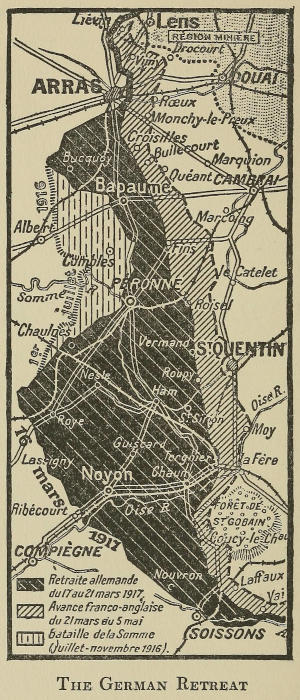
The German Retreat
CHAPTER I UN VILLAGE TOUT OUBLIÉ
As a relief visitor, in a Unit authorized by
the French Government au secours dans
la région dévastée, I have lived recently in the
Department of the Somme. There I had in
my care a village with a personality which I
venture to think is typical of Picardy. As
such, I would present it to you.
It was on a winter’s morning, by snow and
lantern light, that I traversed for the last
time a road grown familiar to me through
months of use, the road which led from our
encampment, known as that of the “Dames
Américaines” at Grécourt, past the railroad
station of Hombleux to the hamlet of Canizy.
It leads elsewhere, of course, this road; to the
military highway for instance, which has
already seen in the last three years three
momentous troop movements: the advance and
retreat of the French, the advance and retreat
of the Germans, and, again, the victorious
sweep of the French and British armies which
reclaimed, just a year ago, the valleys of the
Somme. It leads to the front, that fluctuating
line, some twelve miles distant, in the shelter
of which we have lived and worked for the
ruined countryside. It is an important route,
on some occasions choked with artillery, on
others with blue columned infantry swinging
down its vista arched with elms. Officers’ cars
flash by there, and deafening camions. But
for me, until this the morning of my departure,
it has led to Canizy.
There is no longer a station at Hombleux,
because the Germans destroyed it. One
therefore paces the platform and stamps one’s
feet with the cold. Down the track, from the
direction of Canizy, the headlight of the engine
will presently emerge. All about, the plain
lies white and level; the break in the hedge
where a footpath crosses the tracks to the village
is almost visible. In fancy, I take it,
past a fire-gutted farm house and eastward
on a long curve across fields where the snow
hides an untilled growth of weeds. The highway
which parallels the railroad, recedes in a
perspective of marching trees, till, topping a
little rise, a wooden scaffold stands clear
against the sky. It was formerly a German
observation post. To the left, equally gaunt,
rises the Calvary which marks the entrance to
the village. And beyond, cupped in a gentle
declivity, lie the ruins of Canizy, framed in
snow. So I saw it last; so all the way to
Amiens, and from Amiens to Paris, as the
train bore me away, I saw it; so in its misery
and its beauty, I would picture it to you.
You will not find my hamlet on any map
of the région dévastée with which I am familiar;
it is not listed among the destroyed villages
of the Department, although it was
looted, dynamited and defaced, even to the
cutting of the oak trees about its Calvary.
You would have to search minutely in history
for any mention of it among the King’s towns
of Picardy which became famous in guarding
his frontier of the Somme. Comparatively
modern and quite insignificant, it lies beside
a tree-bordered, dyked canal, one of many
which tapped the rich plain and bore the produce
of farm and garden to the market centres,
of Péronne, Ham and St. Quentin. To this
canal sloped its fields of chicory, leeks, pumpkins,
potatoes, turnips, carrots and other garden
truck. Crooked lanes, brick-walled or
faced with trim brick cottages, led from it back
through the village to higher ground. There,
before the war, the grands cultivateurs, such as
M. le Maire, and M. Lanne, who rents the old
Château, would have ploughed and sown their
winter wheat.
In those days, Canizy had a railroad also,
and I have heard how for three sous one could
travel by it to Nesle. It took only eight minutes
then,—but now! By it as well, one went
more quickly than by canal to St. Quentin or
Péronne with perhaps a hundred huge baskets
of vegetables on market day. But the Germans
tore up the bed of the railroad and destroyed
the locks of the canal. They blew up,
too, the bridge on the main highway which used
to pass the Calvary at the foot of the village
street. Cut off, reached only by a circuitous
and deep-rutted road which is impassable at
certain hours every day owing to mitrailleuse
practice across it, Canizy lapsed into oblivion.
As its mayor said on our first visit, “Look
you, it has been quite forgotten,—c’est un village
tout oublié.”
In 1914, Canizy had 445 inhabitants. Of
these, there were perhaps half a dozen substantially
well off, such as M. le Maire, possessing
ten hectares of wheat land, a herd of
seven cows, four horses, thirty rabbits and fifty
hens. Besides, M. le Maire, or his wife, was
proprietor of one of the three village épiceries.
Joined with him in respectful mention by the
townspeople are the lessee of the Château, and
various owners of property not only in Canizy
but in the surrounding country. Of these
gentry, not one apparently had been made
prisoner by the Germans. They were to be
found on their other estates, at Compiègne, at
Ham, or in Paris. Even the real mayor was
an absentee, so that the acting mayor, lame,
red-faced and heady-eyed, was the only representative
of landed interests left in the little
town. He had had, however, a dozen or more
neighbours scarcely less comfortably provided
with worldly goods than himself: M. Picard,
for instance, who owned extensive market gardens
and employed six workers in the fields.
He it was who did not suffer even during the
German occupation, for was he not placed in
charge of the ravitaillement? And though
his friends the Germans took him away with
them, a prisoner, did not his wife and children
live well on his buried money, eh? O, Mme.
Picard, elle était riche. There were the
Tourets, two brothers, who held connecting
high-walled gardens in the centre of the village,
and their next door neighbour, the comely
widow, Mme. Gabrielle. Directly opposite
ranged the Cordier farm, comprising an orchard
of 360 trees, ten cows, two bulls, one
ox, eighty-seven pigs, three horses, one hundred
and fifty chickens, and one hundred and
fifty rabbits. Smaller cottages there were,
some rented, but most of them owned, where
the families raised just enough for their own
necessities, or worked for their more prosperous
townsfolk. There were the village cobbler,
the two store keepers who competed with the
mayor, a sprinkling of factory hands who
walked along the dyke a mile and a half to
work in the brush factory at Offoy, and last
on the street, but not least in social importance,
the domestics of the Château. There were,
too, the poor whom one has always; but in
Canizy, so far as I could learn, they consisted
of but two shiftless families.
The civic life of the village centred about
its public school and its teacher, and, of course,
its curé and its church. The monotony of toil
was relieved by market days and fête days and
first communions and neighbourhood gatherings.
Of these last I have seen a few pictures,
groups of wrinkled grandparents and sturdy
sons and grandchildren stiffly posed in Sunday
best, yet happy in spite of it. Behind
them pleached pear trees or grape vines make
an appliqué against a patterned brick wall.
But there are not many of the pictures even
left, for you will understand, the Germans
systematically searched them out and burned
them in great piles. The one that I remember
best, a poor mother had torn out of its
frame the night of her flight. “I could not
think well,” she said. “The Boches had
wrenched my Coralie away—so lovely a child
that every one on the streets of Ham turned
to look at her curls as she walked—but I did
save this. See, there she is,—how pretty and
good, and that is my eldest, a soldier. He is
dead. And that, with the accordion, is my
seventeen-year-old Raoul, like his sister, a
prisonnier civil. What do the Boches do,
think you,” she continued, “with such? One
hears nothing, nothing. Never a letter, never
a message. Even when Mme. Lefèvre and
Mme. Ponchon returned, they brought no
word. The prisoners, evidently they are separated.
One is told that they work and starve,—that
is all.”
A community so homogeneous in its interests,
was bound to link itself intimately by
marriage as well. The intricacies of the family
trees of Canizy were a source of constant
mental effort, as one discovered that Mme.
Gense was really Mme. Butin, that is, she had
at least married M. Butin, and that Germaine
Tabary was so called because she was living
with her maternal grandparents, whereas her
father’s name again was Gense, and her mother
was known by the sounding title of Mme.
Gense-Tabary. “But why these distinctions?”
one continually demanded upon unravelling
the puzzles for purposes of record.
“Because, otherwise, one would become confused,”
was the reply.
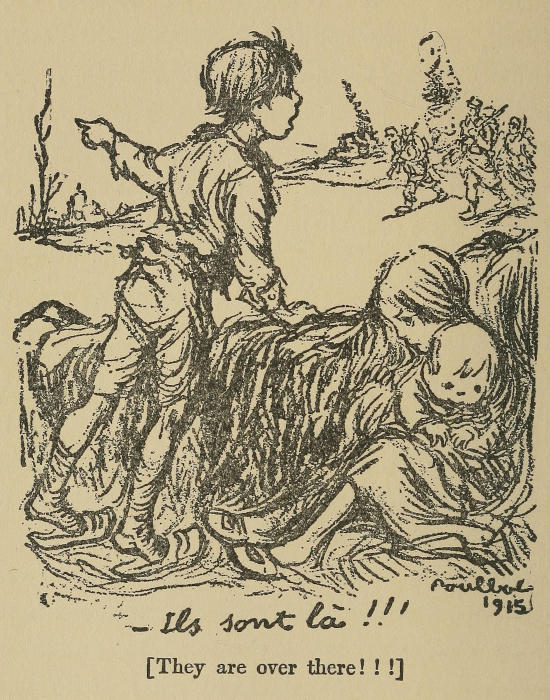
—Ils sont là!!!
[They are over there!!!]
Such, peaceful, prosperous, yet stirred by
family bickerings enough to spice its days,
was Canizy before the war.
Canizy to-day numbers just one hundred
souls, fifty being children and fifty adults. It
was in March, 1917, that the village was
blotted out. Two years and a half of German
occupation preceded that event. In every
house German soldiers had been billeted; one
sees now on the door posts the number of
officers and men allotted, or the last warning,
perhaps, in regard to concealed fire-arms.
For two years and a half the inhabitants had
been prisoners, for the same length of time
there had been no school and no mass. Yet
the villagers do not speak unkindly of their
conquerors. They fared better than many,
for they fell to the lot of the Bavarians, who
are reputed to be more humane than the Prussians.
Besides, Picardy is inured to invasions,
which for centuries have swept across her
plains. By them, fortitude has been inbred.
But one day last spring, the Bavarians filed
away northward. Prussians succeeded them.
Quickly came the order for the villagers to
evacuate their homes. At the same time, the
able-bodied, men and women, youths and maidens,
were seized and held. Weeping mothers,
tottering grandfathers, and helpless children,—the
remnant,—were driven forth with what
scant possessions they could snatch, to the
town of Voyennes, four kilometres away.
There, huddled with the like refugees of other
villages, they remained ten days. From it
they could see the ascending smoke, black by
day and red by night, and hear the detonations
which marked the destruction of their homes.
They returned to the blackened ruins,—as, in
the words of a historian of the Thirty Years’
War, their ancestors had done. “Les paysans,”
he says, “qui avaient survécu à tant de
désastres étaient accourus dans leurs villages
aussitôt que les ennemis s’éloignèrent de ce
champ de carnage. Mais, sans ressources
d’aucune sorte, sans habitations, sans chevaux,
sans bestiaux, sans instruments de culture,
sans grains pour la semence, que pouvaient-ils
faire? Mourir——”[3]
But our villagers, though equally pillaged in
the year 1917, were not doomed to death.
The Germans had retreated before the advancing
French and British armies, and the ruins
of Canizy ere long were held by Scottish
troops.
CHAPTER II LE CHÂTEAU DE BON-SÉJOUR
In Canizy, after the Germans were through
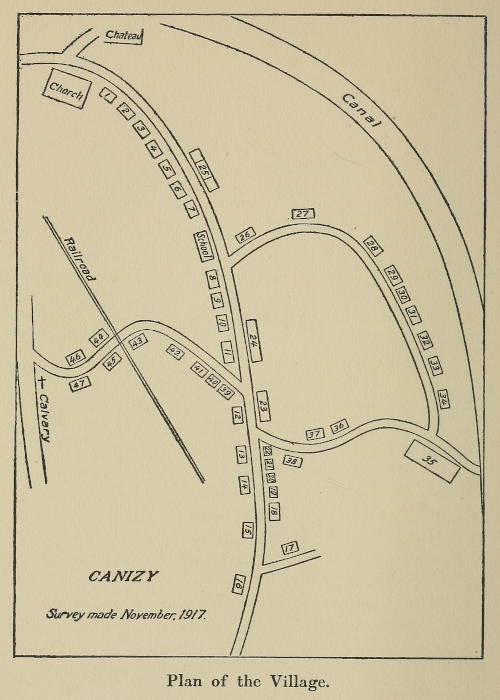
with it, not one of its forty-seven houses
stood intact. Most were roofless shells, or
fallen heaps of brick. An occasional ell, a
barn, a rabbit hutch, or a chicken house,—such
were the shelters into which the returning
villagers crept. Nor was there furniture.
Pillage had preceded destruction and loaded
wagons had borne away the plunder of household
linen, feather mattresses, clothes presses,
chairs or anything practicable, into Germany.
Scattered through the ruins to this day lie iron
bedsteads twisted by fire, the metal stands of
the housewives’ sewing machines, broken farm
tools and fire-cracked stoves. One day, beside
a half-demolished wall, I came upon a
group of little girls playing house. They had
marked off their rooms with broken bricks, set
up for a stove a rusty brazier, and stocked
their imaginary cupboards with fragments of
gay china. A grey, drizzling day it was, and
their toy ménage had no roof. But was it
more cheerless than the hovels they called their
homes, where their mothers, like them, had
gathered in the wreckage left by the Germans,—a
stove here, a kettle there, and a “Boche”
bed of unplaned planks, perhaps, with an improvised
mattress of grass? I paused to regard
the play house. “What is this room,” I
inquired. “La cuisine,” was the quick reply.
“And this?” “La salle à manger.” “But this
next?” “Une salle à manger,” came the
chorus. “Then all the rest are salles à manger?”
“Assurément,” with merry laughter.
“O, I see. Are you then so hungry at your
house?” And I turned away with an uncomfortable
conviction that they were.
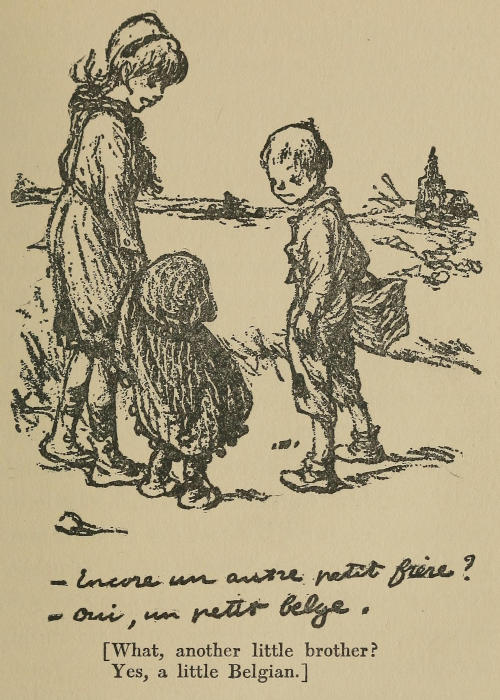
—Encore un autre petit frère?
—Oui, un petit belge.
[What, another little brother?
Yes, a little Belgian.]
One after another, if you listen, the Village
mothers will tell of their return; with what
hope against hope they looked for some trace
of vanished husbands, sons and daughters;
with what despair they realised the utter ruin.
“My cat,” said one, “was the only living thing
I found. She was waiting for me on the doorstep.”
But those were fortunate who found
even the door sills remaining to their homes.
Those who were shelterless took possession of
some semi-habitable corner of their neighbour’s
outbuildings, or even of cellars, and furnished
them with what they could find. As I went
about among them, in an effort to supply immediate
needs, I was continually told: “That
cupboard, you understand, is not mine. I am
taking care of it for Mme. Huillard, who is
with the Boches. When she returns, I must
give it up.” “This bed,”—a very comfortable
one, by the way—“belongs to M. de Curé,
whom the Germans made prisoner.” “Those
blankets an English soldier gave me.” “This
stove”—in answer to a query as to whether a
new one would not be appreciated—“well, to
be sure, it has no legs, but one props it with
bricks, et ça marche, tout de même!” The
boast of the Prussians in regard to their handiwork
was true: “Tout le pays n’est qu’un immense
et triste désert, sans arbre, ni buisson,
ni maison. Nos pionniers ont scié ou haché les
arbres qui, pendant des journées entières, se
sont abattus jusqu’à ce que le sol fût rasé.
Les puits sont comblés, les villages anéantis.
Des cartouches de dynamite éclatent partout.
L’atmosphère est obscurcie de poussière et de
fumée.”[4]
By the time of the arrival of our Unit, six
months after the Great Retreat, our villagers
had recovered from the shock of their sorrow.
They had managed to save enough bedding
and clothing for actual warmth; they had
planted and worked their gardens; they were
used to the simplest terms of life. This courage
rather than the too-evident squalor, was
what impressed one on a first visit to Canizy.
Dumb endurance drew one’s heart as no protestations
could have done. It made me long
to make my home among my villagers, so that
I might the more quickly meet their needs.
But this could not be, because every habitable
cranny was crowded to capacity. Hence
it was that I lodged with the rest of the Unit,
four miles away, at the Château de Bon-Séjour.
Again, you will not find my château
so called upon the map. It is merely a name
that represents to me six months of hardship,
of comradeship and of some small achievement
that made the whole worth while.
At the Château, then, but not in it, lived the
Unit. For the Château, a German Headquarters,
and a most comfortable one, in its
day, had been wrecked in the best German
style. There were seventeen of us, American
college women, to whom the Government had
entrusted the task of reconstructing thirty-six
of the 25,000 square miles of devastated
France. Two were doctors, three nurses, four
chauffeurs, and the rest social workers.
Among them were a cobbler, a carpenter, a
farmer, a domestic science expert; and of other
manual labor there was nothing to which they
did not turn their hands. It was in the golden
days of early September that my companions
reached the Château allotted them in that indefinite
area known as the War Zone, and became
from that moment a part of the Third
Army of France. But I, for reasons best
known to the passport bureau of that army,
did not arrive until October. The seventy-mile
run from Paris was made in our own
truck, driven by two of our chauffeurs. As
we cleared the dusty suburbs and took the
highway northward, war seemed very far
away. To be sure, we often passed grey
camions rumbling to or from the front, or saw
fleeting automobiles containing officer’s whiz
by. But the country, the fields of stacked
grain or of freshly seeded wheat; the apple
orchards,—sometimes miles of trees along the
roadside festooned with red fruit,—poplared
vistas of smoke-blue hill and valley, with
church spires and red roofs in the distance,—all
these spoke of peace. Even the air lay in
a motionless amber haze, spiced with apples
and wood smoke and ferns touched by frost.
But suddenly war was upon us. As we topped
a sharp rise we came upon an empty dugout,
about which stood a shell-shattered grove.
Lopped orchards followed, zig-zag trenches, a
bombarded village set in fields bearing no
crop but barbed-wire entanglements and tall
weeds turned brown. The country became
flatter as we hurried along, intent on reaching
the Château before dark. At intervals we
made detours around crumpled bridges. Occasionally
a sentry halted us, to be shown our
permits known as feuilles bleues. By this time
the sun was setting and caught and turned to
gold a squadron of aeroplanes. Like great
dragon-flies they coursed and wheeled and
presently alighted, to run along the fields to
their canvas-domed hangars. In the after-glow,
we could still see occasional peasants or
soldiers working late at ploughing with oxen
or tractors. But otherwise, mile on mile, the
brown plain, dotted here and there with scraggly
thickets, lay deserted.
It was dusk when we turned off the main
road between the half dozen dynamited farm-houses
that once formed a tiny village, past
the little church, and into the gate of the
Château. To the rear of this ruined mass, set
in a row as soldiers would set them, were the
three baraques, or temporary shacks, which the
Army had made ready for us. Very cheerful
they looked that night with the lamplight
streaming from open doors and windows, and
the smell of savoury stew upon the air.
But morning revealed what darkness had
hidden: the destruction which this estate shared
with the entire countryside. Of the noble
spruces and poplars, which had formed the two
main avenues leading the one to the church and
the other to the highway, only a ragged line
remained; the rest lay as they had been felled,
in tangles of crossed trunks. The Château
itself, an imposing building as one viewed it
through the frame of a scrolled wrought-iron
gate, proved to be a rectangle of roofless
walls. The water-tower, draped in flaming
ampelopsis, no longer held the reservoir which
had supplied in former days the mansion, the
greenhouses, the servants’ quarters and the
stables. The greenhouses themselves, the
jardin d’hiver, and the orangerie, where were
grown hot-house fruits, retained scarcely one
unbroken pane of glass. Dynamite had been
employed freely; but—an instance of German
economy—the main roof of the greenhouse had
been demolished by the well-calculated fall of
a heavy spruce. In this same greenhouse were
the remains of a white tiled tank, and a heating
plant which had involved the construction of
three new buildings. “Voilà,” said Marcel, the
sixteen-year-old son of the gardener, as he
pointed it out, “the officers’ bath.”
Marcel and his mother (whom, we think, the
Germans left behind because of her too shrewd
tongue) still take unbounded pride in the
place. Even before repairs were made on her
own cottage, Marie routed Marcel out of a
morning to weed the flower beds and to fence
off what, by courtesy, she calls the lawn. By
this last manœuvre she renders difficult both
the entrance and exit of our cars. She also
refuses to open for us the wicket for foot passengers,
probably because in the days of Mme.
la Baronne’s hospitality there were none.
Here entertaining was done on a patrician
scale. A French officer who stopped in passing,
told us how he was in the habit of coming
each year to hunt in season. There was a
gallery of famous pictures. In short, the
Château of his friend, Mme. la Baronne, was
the show place of the countryside. “To
think,” said he, as he pointed to a sign still
standing beside the gate, “to think that dogs
were forbidden,—and yet the Germans came
here!” Marie, having been left by her mistress
in charge of the property, carries the responsibility
with seriousness. A letter arrives:
Mme. la Baronne desires that the vegetable
garden be always locked, and that no
trees be cut. It is she, doubtless, who directs
that the lawn be preserved. “Poor Madame,”
sighs Marie, “she little knows. Pray heaven
she may never return to see what the Boches
have done!”
With Marie’s and Marcel’s help, one can
reconstruct from the ruins the gracious comfort
of the old estate, the hospitable kitchen,
the chambers warm in winter and tree-shaded
in summer, the wide balustrades where the
guests sat in long summer gloamings, courting
the breeze. It was Marcel who pointed out
the view one gains from the steps of the
Château, straight through gaping doors and
windows, to the sundial from which radiated
the alleys of the grove: bronze oaks and
beeches, golden plane trees, spruces and tasselled
pines.
How is the beauty of that day departed!
Half of the grove lies now a waste of scrubby
second growth and fallen timber, for here the
Germans employed Russian prisoners as
lumbermen. No longer the huntsmen and
their ladies pace the alleys. Now, on almost
any day you may see old women dragging
branches from the woods to the basse-cour, to
be cut up for fuel. Twenty-six of them, no
men, and only two children, the wretched villagers
had found in the Baronne’s stables their
only shelter after the razing of their homes.
Yet we entered the winter far less warmly
housed than they. Our two-room baraques
were supplemented in time by six portable
houses which we had brought from America;
two we used as dormitories and the other four
as a dispensary, a store, a kitchen, and a dining
room. Our furnishings were of the simplest;
camp beds, a stove for each building,
a table, camp stools, and shelves. Our wood—when
we had any—was chopped by a vigorous
old lady who walked a mile and a half from the
nearest village to do it. Our laundry was done
upon a stove a foot square in a small building
known as the Morgue: such having been its use
during the German occupation. Marie made
our cuisine on her range in a hut which she had
built into the ruins of her cottage. Zélie carried
food and dishes in baskets to and fro from
kitchen to dining room, a quarter of a mile
apart. The one luxury of our existence was
hot water, prepared by Marcel in a huge cauldron,
and brought in covered metal pitchers to
our doors.
Only once did Marcel fail us, and that was
because the rightful owner of the cauldron left
the basse-cour for her newly erected baraque.
She requested our kind permission to transport
thither her property. “There is another
cauldron at Buverchy, which I think you could
rent in place of mine,” she suggested. “It
belonged to my cousin, Mme. Bouvet, and is
now in Mme. Josse’s yard. No one is using
it.” Marcel was dispatched to make inquiries,
and later, with horse and wagon, to fetch the
cauldron home. But meantime there had
dawned a morning when we were not wakened
by the clump-clump of Marcel’s sabots, and
the setting down of the water jug with a thud
upon the frozen ground.
For wood, we depended largely on the
chivalry of nearby encampments of troops,
French, English, Canadian or American, to
whom our need became apparent. For food,
we were supplied by the Army with our quota
of bread and a soldier, M. Jean, to fetch it.
Vegetables and some fruit we obtained from
our villages, of which we had sixteen in our
charge. Often these were presents, thrust
upon us through gratitude; nor could we pay
for them. Meat was plentiful in all the towns
of the Zone, where the Army was charged with
supplying the civilian population with food.
Anyone, going on any errand, marketed; and
the dispensary jitney, which might have
started in the morning with doctors, nurses,
kits, and relief supplies, often returned at
night overflowing with cabbages, potatoes,
pounds of roast, bags of coal, and bidons of oil.
Our relief supplies came through more regular
channels, largely from Paris, where one
member of the Unit devoted all her time to
buying. These were either shipped to the
nearest railroad station, or sent by the French
Army, free of charge, in a thundering camion.
We never knew when to expect this last, nor
what it would contain. Sunday seemed a
favourite day for its arrival. On one occasion,
there were three pigs, loose and hungry,
and no pen to put them in; seventy-five crated
chickens followed, with the request that the
number be verified, and the crates returned.
Such were the colonel’s orders. But, seeing
that the Unit carpenter had to construct a
chicken yard, this command was modified by
a judicious distribution of cigarettes. Mixed
cargoes of Red Cross boxes, stoves, bundles of
wool from the Bon Marché which had burst en
route, and sundries, were even harder to deal
with.
We had no store room. The cave of the
Château, seeping with tons of débris which in
places bent with its weight the steel ceiling,
and open along one whole side to the elements,—this
contained our dairy, our lumber, our
fuel, our vegetables, our groceries, and our relief
supplies. It abounded in rats, cats, and
bats. But such as it was, it was the centre of
our activities. By night often weirdly lighted
with candles, by day never empty, laughter
rather than complaints floated from its dim
interior. Here we held our first store; here
the children who had trudged over from
Canizy, Hombleux or Esmery-Hallon waited
in line for their milk; here were assembled and
tied up the thousands of packages for our
fêtes de Noël. As winter advanced, we prepared
for a day in the cave by encasing our
feet in peasants’ socks and sabots, and our
hands in worsted mittens. The soldiers in
the trenches had nothing on us.
Whether at home or on the road, our days
were long and arduous, and seldom what we
had planned. Even Sunday became part of
the working week, for then we attempted to
entertain our official supervisors and co-laborers,
and all chance acquaintances. M. le
Commandant of the Third Army has dined
with us; the ladies of the American Fund for
French Wounded, under whom we held our
section, have come to call; the Friends walk
over from Esmery-Hallon where they are
building baraques for the commune; a lonesome
Ambulance boy who has tramped ten
miles and must retrace his steps before dark,
drops in; a squad of Canadian Foresters rides
through the gate; reporters, accompanied by
a French officer, harry us with questions. But
most frequent, and most welcome of all our
visitors, are our countrymen, the—th New
York Engineers. They came from home,
those men, to be the first of our army under
fire. But during the early days of the autumn,
their talk was not of their work, but of ours.
They brought us slat walks, called duck walks,
to keep us out of the mud, and wood, and
benches, and stoves. They came with mandolins
and guitars and violins to give an entertainment
to our villagers, and stayed for a
buffet dinner and dance. They sent their
trucks to take us in turn to a party at their
encampment. But all that was before the
Cambrai drive. As we, in our baraques,
listened night and day to that bombardment,
we little knew the heroic part taken in it by our
Engineers. Surprised, unarmed, with pick
and shovel they stood and fought; and later,
hastily equipped with rifles, helped save the
day for England on the bitterly contested
front. But you have doubtless read of them
in the papers, for they were the first of our
soldiers to die in battle and to be mentioned in
the orders of the day.
CHAPTER III M. LE MAIRE
By rights, Canizy belongs with three other
hamlets, to the commune of Hombleux.
The mayor of Hombleux is therefore in reality
also the mayor of Canizy. But each of the
hamlets has an acting mayor besides. And,
to complicate this matter of mayors still further,
the real mayor of the commune has left
his post to reside in his mansion in the Boulevard
Haussmann in Paris. Inquiring into
the reason of his non-residence, I was told that
he was broken in health, and belonged to a
political party which, at the moment, was no
longer in power. Hence the so-called mayors,
with whom rests the welfare of our villages.
Before the war, the present mayor of Hombleux
was one of the grands cultivateurs.
With Mme. la Baronne, Mme. Desmarchez
and M. Gomart, he owned most of the rich
acres encircling the town. Hombleux itself
contained then about 1200 inhabitants, and
was an industrial as well as an agricultural
centre, having a distillery and two refineries
for sugar-beets. Of the factories, practically
nothing now remains, and of the inhabitants,
250 have survived the German deportations.
Zélie, the kitchen maid, has told me of these
last. “The first deportation,” she said, “was
one of five hundred. The officers came to the
doors at seven o’clock with the names, and told
us to be ready to start at dawn. O Mademoiselle,
the night! All the neighbours ran to and
fro; all night we washed and sewed and ironed,
and in the morning, each with a sack of fresh
linen, my father, my sister, M. le Curé,—the
flower of our village,—were marched away.
And after, what weeping!” Zélie put down
her broom to wring her hands, as if still dry-eyed
from too much suffering. “The next
time,” she continued, “the Boches gave us
no warning. They came at midnight, and
dragged us from our beds.” “Did you then
go?” I inquired. “But yes,” she replied, and
her eyes flashed. “They tried to make us
work; there were five of us, friends, from our
village. But work for the enemies of France?
We would not! They put us in prison; they
fed us almost nothing, but we would not work.
One day they summoned us. ‘Go,’ they said,
‘go where you like, beasts of the Somme!’
Hungry, foot-sore, travelling mostly by night
from the frontier, we came home. It was midnight
when we reached Hombleux. In my
own house, my mother had barred the door.
I tapped on the window to wake her. At first,
she would not believe that it was I. Even
now, she looks at me with a question in her
eyes as if asking continually, ‘Zélie, is it
thou?’”
Our mayors have no such heroic past!
They not only saved their own skins, but reside
to this day with their wives and daughters;
comely daughters of an age for the German
draft. Of one it is more than whispered that
he is a spy. Many carrier pigeons he had in
his dovecote, and whether there were any connection
or not, he knew of the impending German
invasion, and left his comfortable house
and growing crops, to spend the summer of
1914 in Normandy. Nor did he return till
the summer of 1917. Meantime, his little
hamlet had held a town meeting of its refugees,
and elected a lady as mayor. In fact, M.
Renet, on his return, found himself the only
man in the village. He found also—a suspicious
circumstance in the eyes of his neighbours—his
house the only one undestroyed. I have
talked with him there, looking out of his casement
windows into a walled garden, where the
fruit trees are uncut, and the walks are still
bordered with close-trimmed box. He assumes
an injured air, recounting his unpopularity.
It is unfortunate, but since M. the
Deputy has again asked him to act as mayor,
que voulez-vous? He is compelled.
His superior, the mayor of the entire commune,
did not fare so well. On our first visit,
we found him inhabiting a loft in his partially
ruined barn. But despite his chubby person,
this mayor is a man of action. Week after
week, Hombleux receives shifting regiments
of troops back from the trenches en repos.
These are detailed for construction work.
Carpenters set up the baraques, which the
Government furnishes to homeless families;
masons and bricklayers are slowly raising the
walls of the village bakery. The mayor has
taken his share of the materials and workmen,
and is now housed in a two-room lean-to, with
a new slate roof, and lace-curtained windows.
Here, beside an open fire, he transacts business.
He it is to whom returning refugees come
to report and register; through him claims of
damage (based on pre-war valuation of property)
are filed, which the Government has
promised to honor after the war. To him,
requests for baraques are made, and sent by
him to the Sous-Préfet of the Department, to
be forwarded in turn to the Minister of the
Interior, with whom such matters rest. The
mayor calculates the amount of allocation or
pension to which each family in the devastated
area is entitled, varying according as they are
réfugiés or rapatriés, according to the number
of bread-winners imprisoned or serving with
the colors, according to the number of children,
or, in some cases, to the decorations won by
their soldiers, for decorations carry pensions.[5]
This entire matter of income is adjusted finally
for our district by the Préfet at Péronne. Besides
housing and pensioning, the Government
has undertaken to supply a certain
amount of cereals, coffee, sago and the like.
These the mayor distributes. Furniture as
well is provided by the Government: bedsteads,
mattresses (not forgetting bolsters),
stoves, cupboards, chairs, tables and batteries
de cuisine. Before our coming to take charge
of the district, the mayor signed the furniture
requisitions which were understood by the fortunate
recipients to represent a part of their
“indemnité de guerre.” He also had the even
more delicate task of distributing relief supplies
left in bulk by the Red Cross or other
agencies on their hurried passage through the
ruined villages. Naturally, the supply fell
short of the demand; and it was with unconcealed
pleasure that the Mayor at the instance
of the Sous-Préfet turned over these two
thankless tasks to us. Yet we found him—or
rather his wife and daughter—always ready to
advise and coöperate. On demand, they furnished
immaculately penned lists of all inhabitants,
whether grouped by sex and by age, by
family, or by the main division of adults and
juveniles. They know the number of families
in each hamlet, the number of persons in each
family, the name and the age of each. Much
more they know, of gossip, and of human nature,
and laughed, I fear a trifle derisively, at
our manifest difficulties.
All these activities, centring in the Mayor,
belong to the civil administration of the Department.
The Ministry of Agriculture has
its share in reconstruction also, but is more
independent of local officials, having an office
of its own in the commune. To it belong the
ploughing and seeding, the replacing of orchards,
and to a certain extent of livestock.
But on all these matters, as to whose fields
shall be ploughed, or who shall plant two apple
trees or own a goat, the verdict of the Mayor is
sought. He himself, you may be sure, is dependent
on no such circuitous methods. Together
with two other grands cultivateurs, he
has bought an American tractor, a harrow,
and a mowing machine. These can even be
hired for the same price as the government-owned
tractors, which is forty francs an
hectare. Over all reconstruction, considered
as a part of the civil administration, preside
the Sous-Préfet and the Préfet of the Somme.
On the other hand, food supplies in general,
such as bread, are controlled by the army. In
fact, every detail of life in the War Zone is
their care if they choose to assume it. Troop
movements delay shipments; therefore there
may be no bread. Cavalry needs fodder; the
sergeant at Hombleux goes out to forage with
rick and trio of white horses and buys it at
a fixed price. Mme. N—— is ill; the army
doctor visits her, and if she seems to him a
menace to the health of the soldiers, he removes
her to a hospital. In view of the military importance
attached to the Zone, the confidence
of the French Government in giving over a
section of it to the care of a group of American
women, wholly unacquainted with the
task before them, seems truly touching.
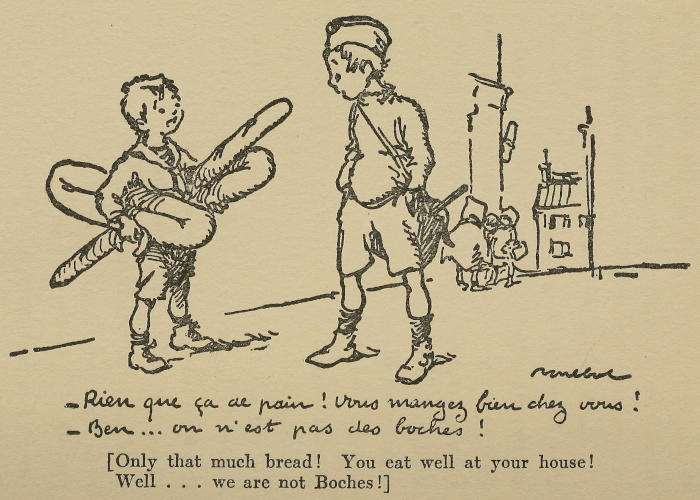
—Rien que ça de pain! Vous mangez bien chez vous!
—Ben ... on n’est pas des boches!
[Only that much bread! You eat well at your house!
Well ... we are not Boches!]
In fact, it seemed appalling, as I learned
from day to day the problems for which I was
myself responsible in Canizy. Not the least
of these was its mayor. Unlike his confrère at
B——, M. Thuillard had not fled his property
until forced to do so with the rest of the villagers
immediately prior to the Retreat of
1917. During the occupation, he kept his
store as usual. And even though his horses
and cattle, his fat rabbits and plump chickens,
were requisitioned by the Germans, they say
that he was paid for them. To see him, however,
housed in a miserable hut, with a dirt floor
so uneven that the very chairs looked tipsy;
to hear the complaints of his querulous wife,
and the references of his daughter to their former
comfort, was calculated to enlist one’s
sympathy. Mme. Thuillard was ill, and he was
lame, and the daughter’s husband was a prisoner,
and they had lost heavily, because they
had the most to lose. All this they told me
over the saucerless cups of black coffee which
they offered me “out of a good heart.”
But when I considered the Mayor’s duty
to his village, my own heart hardened. Here
is the entry I find in my notebook on my first
survey of Canizy. “Canizy, dependence of
Hombleux, Thuillard, Oscar, in charge. Curé
of Voyennes has charge of the children; 4 k.
away. No church, no school, no bread, no
water fit to drink.” There was something, of
course, in the Mayor’s own contention that the
village had been forgotten; and one could
understand why the Curé came only to burials
when one saw him,—so ill he looked. But in
M. Thuillard’s barn were two stout horses,
and two carts stood before his door. On his
own business, he could travel. “Why, then,”
I inquired, “has he not fetched the bread supply
from Hombleux to which the village is
entitled?” “Because he has nothing to gain,”
and the good wife I interrogated shrugged
her shoulders and laughed. “Look you,” she
continued, “M. Thuillard is rich; 26 kilos of
money he buried, and it is not in sous.” This
rumour, which gave the one-legged Mayor
something of the air of a land pirate, I heard
on all sides. Even the school teacher of Hombleux
repeated it; and her husband, an officer,
nodded his head to emphasize his “Oui, c’est
vrai.”
Of one of our mayors, however, I would like
to record nothing but praise. Widow of a
soldier, left with two little girls, and absolutely
no other possession in the world, she ruled
our home village at the Château with justice
and dignity. She never complained. When
at last the baraque on the ruins of her farm
was completed, all except the fitting of the
glass in the windows, she insisted on moving in
so that we could make use of the space she
vacated in our basse-cour. I met her one bitter
evening shortly afterward, as I was returning
from Canizy. “Is it not cold in the
baraque, Madame?” I asked. “Oh, yes,” she
replied, “but what would you? It is so good
to be at home!”
CHAPTER IV O CRUX, AVE
As the aeroplanes fly, Canizy is perhaps
three miles from the Château, or reckoned
in time, half an hour by motor and an
hour on foot. But by either route, one turns
into the village at the stark Calvary I have
already mentioned, with its half obliterated
inscription: Ave, O Crux.
At our first visit, despite our novelty, Canizy
regarded us with indifference. We seemed
to them doubtless one more of those strange
manifestations of the war which had stranded
them among their ruins. Incurious, apathetic,
they passed us with sidelong glances, and went
their ways. But this did not last long. The
“Dames Américaines” did such extraordinary
things! They gathered and bought up rags;
they played with the children; they walked
fearlessly, even at night, across the fields to
tend a sick baby; they slept—so the village
children who had seen their encampment reported—on
lits-soldats. The village waked to
a new interest, and it came about that one
expected to be waited for by the gaunt old
cross.
Before my arrival, the routeing of our three
cars had already been decided. Three times
a week the Dispensary was held at Canizy,
and once a week, on Monday, our largest truck,
turned into a peddler’s cart with shining tinware,
sabots, soap, fascinators, stockings and
other articles of clothing, made there its first
stop. On the seat back of the driver and the
storekeeper, or if there were not room for a
seat, on top of the hampers, went also the children’s
department, consisting of two members.
While the mothers, grandmothers and elder
sisters gathered at the honk of the horn about
the truck, the children, equally eager, followed
the teachers to an open field for games. Or,
did it rain, I have seen them of all ages from
fourteen years to fourteen months, huddled in
a shed, listening open-mouthed to the same
tales our children love, which begin, in French
as in English, with “Once upon a time.”
But when, after a three-days’ inspection of
our outlying domain, I asked our Director for
the village of Canizy, I was given charge of all
branches of our work there. This meant not
interference but close coöperation with the
other members of the Unit already occupied
with its problems. Of all our villages, Canizy
was the most beloved, not, perhaps, because its
need was greatest, but because its isolation was
most complete. No one could do enough for
it. Were a sewing-machine to be repaired, the
head of our automobile department, a mechanical
genius, spent hours making it “marcher.”
The doctors, with their own hands, took time
to scrub the children’s heads. They came to
me with every need that they found on their
rounds, with the neighbourhood gossip, and
with kindly advice. The teachers gave me the
names of children requiring shoes; and, as the
work developed, asked in turn for recommendations
in regard to opening a children’s
library. To the farm department, I made requests
that we buy largely of fodder and
vegetables, until we had literally hundreds of
kilos of pumpkins, turnips and carrots bedded
for us in the cellars, on call. To this department
went also requisitions that Mme. Cordier
be supplied with a pig, or M. Noulin with five
hens, or Mme. Gense with a goat. Or, were
there shipments of furniture to be delivered,
one called again on the automobile department,
which even through the drifts and cold
of winter, kept at least one of its engines
thawed and running every day.
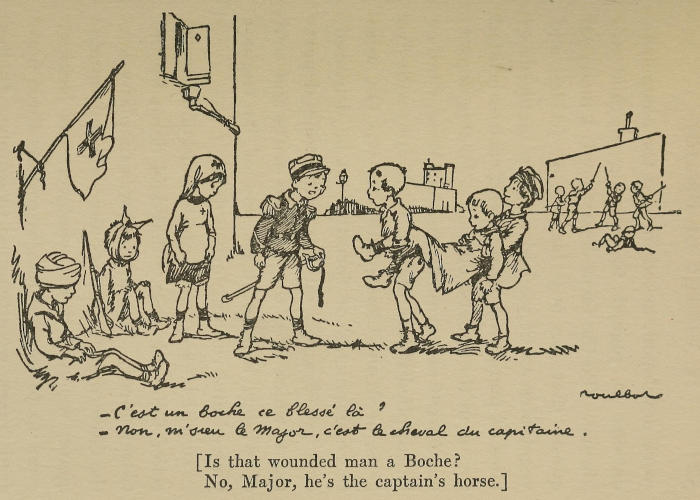
—C’est un boche ce blessé là?
—Non, M’sieu le Major, c’est le cheval du capitaine.
[Is that wounded man a Boche?
No, Major, he’s the captain’s horse.]
It will be seen that our scheme of material
relief followed closely that laid down by the
Government. Our method was simple: where
the Government supplies were on hand, or adequate,
we used them; whatever was lacking,
even up to kitchen ranges costing three hundred
francs, we attempted to supply. In this
we had not only our own resources to draw on,
but to a limited extent, those of the American
Fund for French Wounded, and to a much
larger extent, those of the Red Cross. In
a huge truck came the goods from the
Red Cross, driven by a would-be aviator who,
when asked his name, replied bashfully,
“Call me Dave.” “Dave” was frequently
accompanied by another youth of like ambition,
named Bill. And I will say that they
handled their truck as if it were already a
flying-machine. The first consignment of
hundreds of sheets and blankets, the truck and
the driver, all were overturned in our moat.
It took a day to get them out. The next mishap
was a head-on collision with our front gate.
But the last, which I learned of just before
I left, will best illustrate their imaginative turn
of mind. Bill, the intrepid, having attempted
to traverse a ploughed field, left his machine
there mired to the body, and spent the night
with us. He seemed a trifle apprehensive as
to how his “boss” would take this exploit.
Willing workers, however, were Dave and
Bill. Unannounced, they came exploding up
the driveway under orders to work for us all
day. And many a time have we risked our
necks with them, perched on the high front
seat, careering along at what seemed like sixty
miles an hour.
But for my part, my usual mode of travel
was on foot, and my orbit bounded by the
Château, Hombleux and Canizy. In any
case, even though I went over by motor, I was
dropped at my village and walked back across
the fields. As I grew better acquainted with
the villagers, I came and went at will, spending
almost all the daylight hours—few enough
in winter—with them. Every one has heard
of the mud in the trenches. The clayey soil
of our district, admirably adapted to the making
of bricks, lends itself equally well to the
making of mud. Continually churned by
camions and marching troops, it becomes on
the highways of the consistency of a purée,
through which, high-booted and short-skirted,
one wades. It is therefore a relief to turn off
by the footpath beyond Hombleux, though it
plunges for the first quarter of a mile through
a bog. Of a sunny day, birds sing in the
hollow, wee pinsons perched on ragged hedges
answering one another with fairy flutes.
Farther on, yellow-breasted finches dart over
patches of mustard as yellow, and sing as they
fly. Raucous crows, whose gray-barred wings
make them far more decorative than ours, and
the even more strikingly marked magpies,
darken in great flocks the newly ploughed and
seeded wheatfields which in increasing areas
border the path. A sudden movement sends
them whirring like a black and white cloud
against the sky. Often above them courses a
flier of another sort, a scout aeroplane probably,
holding its way from the aviation fields
in our rear, to the front. It rasps the heavens
like a taut bow; by listening to the beat of
its engines one can determine whether it be
French or Boche. For Boche planes come
over us frequently, on bombing raids; and
sometimes one does not have to look or listen
long to know that an air battle is taking place
overhead. The sharp reports; the white puffs
of our guns, the black plumes of the enemy’s;
the glint of the sunlight on careening sails
high up in the blue,—it all passes like a panorama,
of which we do not know the end.
Other sounds also are familiar to us on our
plain, when from the Chemin des Dames, or
St. Quentin, or Cambrai, the great guns boom.
Like surges they shake and reverberate; and
when, as often happens, the sea-fog rolls in
from the Channel, one can well fancy them the
breakers of a mighty storm. So they are, out
there, on our front, where the living dyke of
the poilus holds back the German flood.
The highway and the railway, these are the
two most coveted goals of the German bombs.
For over them go up the trains of ammunition
and of soldiers and supplies. Both we cross
on the way to Canizy. The railroad, running
between well defined hedges, would seem
almost as conspicuous an object as the tree-sentinelled
road. But, so far, both have escaped
harm. Trains whistle and puff as usual
up and down from Amiens to Ham. Often
I halt at the crossing, to wave to soldiers, who
fill the cars; sometimes I pass through companies
of red-turbaned, brown Moroccans,
who are brought here by the Government to
rebuild bridges and keep the roadbed in repair.
Over the track the footpath carries one, on
over brown stubble, to the Calvary and Canizy.
As I have said, at the Cross one is awaited.
Sometimes it is only one little figure in black
apron and blue soldier’s cap that stands beside
it to give the signal; sometimes from the wall
on the other side of the road, a half dozen girls
start up, like a covey of quail. The boys
usually ran away, but the girls advanced to
surround one, and dance hand in hand down
the street. But always before the Calvary
there was a pause. Brown hands, none too
clean, were raised to forehead and breast with
the quick sign of the cross. One caught a
whispered invocation. “But you do not do
it,” five-year-old Flore protested to me one
day, with troubled eyes. “Why do you not
salute the Calvary?” “Teach me,” I replied;
and in chorus I learned the words which on
the lips of the war-orphaned children are infinitely
pathetic: “Glory to the Father and to
the Son and to the Holy Ghost.”
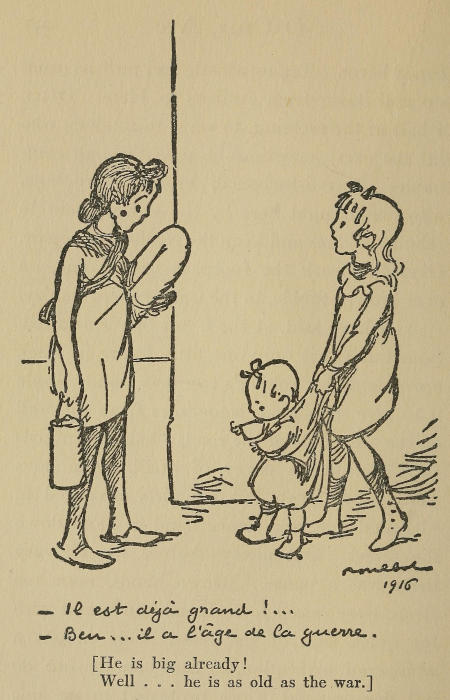
—Il est déjà grand!...
—Ben ... il a l’âge de la guerre.
[He is big already!
Well ... he is as old as the war.]
It is not alone at Canizy that one finds the
Cross, though by its aloofness above the plain
this one became impressive. By every roadside
stands a Calvary, sometimes embowered
in trees, but more often stark and naked, with
the wantonly felled trunks about its base bearing
mute Witness to a desecration which respected
the form, but not the spirit, of the
Christ. At Hombleux, three such crucifixes
marked the intersections of the village lanes,
flanked by stenciled guide-posts: A Nesle, A
Athies, or A Roye. They cluster in the cemeteries,
above well-remembered graves; Where
even the dead no longer rest inviolate, since
the Germans, to their unspeakable shame, have
blasted open many a tomb. Day by day, the
obsession grows on one that these uplifted
symbols of suffering, stripped and mocked and
defiled by the invader, typify the crucifixion of
Picardy.
CHAPTER V MME. GABRIELLE
Every village, everywhere, has its
stronger characters, to whom the community
looks up, perhaps unconsciously.
Canizy, having been deprived of its normal
leaders in the Curé, a prisoner, and the teacher,
transferred to the school at Hombleux, looked
up in this way to Mme. Lefèvre and Mme.
Gabrielle. The former was the especial friend
of our medical department. In fact, she
rented one of her two rooms for our use as a
dispensary, and her flagged kitchen was
always open to her neighbours and to us.
Here I measured out milk to half the village,
or distributed the loaves of bread which we
ourselves purveyed from the crabbed Garde
Champêtre at Hombleux. Or, had I neither
the time nor the patience, Mme. Lefèvre herself
made the distribution, and gave me a list
of the recipients, and always the correct
amount of neatly stacked coppers in change.
A shrewd face had Mme. Lefèvre, wrinkled by
humour as well as by sorrow. She had been
taken away by the Boches in their retreat, but
later, for some reason unknown, was allowed
to return. Her three daughters, however,
and her husband, all were in the hands of the
enemy. She lived alone, therefore, and busied
herself in her late-planted garden, and in her
neighbours’ affairs.
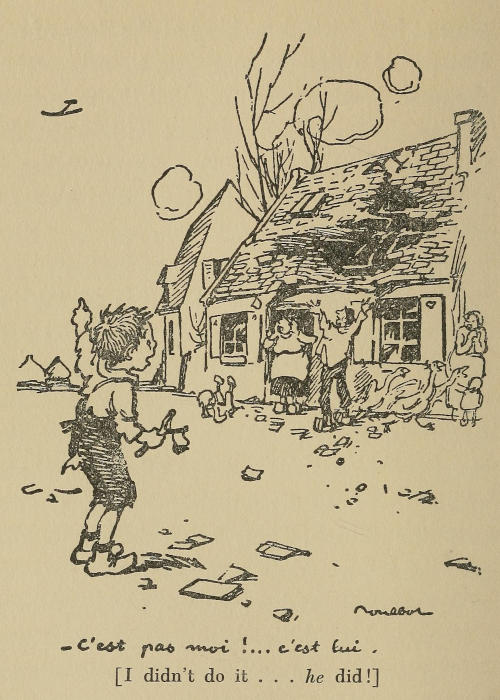
—C’est pas moi!... c’est lui.
[I didn’t do it ... he did!]
Most of them, it seemed, were related to her
in one way or another, all the Genses being of
her kin. Of these there were Mme. Gense-Tabary,
already mentioned, and her swarming
family of eight, bright and pretty as pictures,
and dirty as little pigs. She, lodged near the
bank of the canal, really had no excuse for this
chronic condition, and was encouraged to
scrub by object lessons, clean clothing, and
gifts even of long bars of savon marseilles. I
remember her yet, two or three children tagging
at her skirts, knocking at the door of my
baraque of a Sunday morning, to tell me that
she must have more soap. All the way from
Canizy she had walked to get it; and she did
not go back without. Mme. Gense-Tabary’s
eldest daughter, known as Germaine Tabary,
was the sorrow of the village, even more than
its daughters who had gone into captivity; for
she had become an earlier victim of the invaders,
and with her unborn baby was left
behind. Mme. Marie Gense, another unfortunate,
was a niece by marriage of Mme.
Lefèvre’s. Her husband was a soldier. She
had lived in a little cottage whose blue and
white tiled floor I often had occasion to admire,
next the church. But being left with two
growing boys, and no resources, what was she
to do? What she did was to add to her family
a Paul, and one bitter winter night which our
doctors and nurses well remember, a Paulette.
“What would you?” she expostulated. “I
had no bread for the children; in this way they
were fed.” That two more months were
added, and that her lean-to of ten feet by
twelve could not accommodate them, were
facts which did not seem to concern her. And
of all good children, her two boys, Désiré and
Robert, were certainly the best. But Aunt
Lefèvre looked upon her niece’s conduct as a
scandal. She was forbidden the kitchen, and
it was even known that the quarrel had come
to the point of knives. With the children,
that was different. “Yes,” said Mme. Lefèvre
on the arrival of the new baby, “Désiré
may sleep in the Dispensary if you so wish. It
is your room; you pay for it.” That Désiré
did, though I had a bed put up for him, I misdoubt.
But Robert, happy-go-lucky Robert,
with his head cocked on one side and a smile
rippling his brown eyes, even Aunt Lefèvre
could not help loving him. There was no
question of his sleeping out, however, he being
nurse to the babies and to his mother as well.
Another wayward connection of Mme. Lefèvre’s
was a sister of Mme. Marie Gense’s,
known as Mme. Payelle. She had three children
as cunning as you could wish to see,
clean—as were Marie’s—and sunny-tempered.
Their parentage also was a mystery. But this
blot did not rest by rights on the village escutcheon.
Mme. Payelle had been installed there
by one of her admirers, a soldier en permission;
she really did not belong to Canizy.
To keep her social position in the midst of
these misfortunes was a tribute to Mme.
Lefèvre’s worth. She was always doing kindnesses,
and speaking to us on her neighbours’
behalf. Beneath her shed stood one of the
four chaudières, or washing cauldrons, which
survived the general destruction. These,
varying in capacity from 50 to 250 litres, are
an indispensable utensil of housekeeping in
Picardy. In them, week by week, the soiled
clothes are boiled. Not even the lack of a
pump—and there was only one left in the village—was
so much deplored as the loss of the
cauldrons. In view of these two handicaps
and the dearth of soap, the squalor of the village
on our arrival seems excusable. Mme.
Lefèvre, at least, did her share toward remedying
it. Without charge, her chaudière was in
constant use, and her shed became a neighbourhood
rendezvous.
It will be seen that all the Genses were by no
means a bad lot, Mme. Lefèvre being one herself.
Of an older generation, and I know not
of what degree of kinship to her, is Mme.
Hélène Gense, grandmother to Mme. Gabrielle,
that energetic, substantial young Widow,
not Mme. Thuillard nor yet Veuve Thuillard,
but Mme. Gabrielle to all Canizy. In pre-war
times, she owned, through her parents and
not by marriage, the most central homestead
in the village. There remain now only the
arched gate into the courtyard, the brick rabbit
hutches, a heap of débris, and a tottering wall.
She and ten-year-old Adrien lodge, therefore,
in the first house on the left as you come past
the Calvary, with Grand’mère Gense. This
ell, flanked though it is by the ruin of the main
building, is the most cheerful spot in the village.
The narrow yard before the door is
swept; a row of geraniums blossoms beneath
the windows. Above all, there are windows,
two of them, and curtains at each. Outside
the door, if you are fortunate in the hour of
your call, will stand two pairs of worn sabots.
Or perhaps the door may be open, framing
Grand’mère, bent almost at right angles, Mme.
Gabrielle, and Bobbinot. Bobbinot is a dog,
iron-grey, smooth-coated, with a white band
on his breast and a white vest. He has no
pedigree, his mistress assures me, but his brown
eyes and his square, intelligent head bear out
her statement that he is “très loyal.” All
three welcome me; a chair is proffered near the
fire. Grand’mère sinks carefully into her low
seat, Mme. Gabrielle sets on a saucepan of
coffee, and we sit down to chat.
It is a pleasure to look about as we talk.
On the mantel, to give a note of colour, are laid
a row of tiny yellow pumpkins; the floor is
red, and through the window peer red geraniums.
In a cupboard beyond the stove is a
modest array of pans and dishes. Two panes
of glass, like portholes, pierce the wall to the
rear. Beneath stands a sideboard, and a little
to one side, a round table. Not until the
coffee was heated did I notice that cups were
set for four.
“But have you another guest?” I inquired,
as Mme. Gabrielle poured first some syrup
from a bottle, and then the steaming drink.
“But no, only Adrien. Adrien, come!”
She raised her voice. Then for the first time
I saw the boy, head propped on elbows, poring
over a book. The mother regarded him indulgently.
“It is a pity for the children that we
have no school. Adrien is apt; when the Germans
were here, he understood everything,
everything. And when the Scotch came, he
learned, too. I myself try to learn English.”
She brought forth from the sideboard an English-French
phrase book. “This I found in a
house after the English soldiers went away.
It would be easy, but there is the pronunciation.”
“I will teach you,” I said, and we took
up the words one by one, Grand’mère laughing
the while, pleasant laughter, like a cracked, old
bell. But the boy kept on reading and
hummed a tune. “The children,” broke in the
mother, “they sing; it is well.” But presently
the boy shuts his book with a sigh and draws
a chair to the table. “Did you like it, the
story?” I inquire. “Yes, it tells of America.”
On the table, clear now save for Adrien’s belated
cup, is revealed an oilcloth map in lieu
of a linen cover. “Where, then, is America?”
His finger traces the colored squares. “Here
is France, here England, here Italy, here Russia,—but
America, it is so far one cannot see
it.” “But yes,” rejoins his mother, “so far
that never in my life did I expect to see an
American. Once in my childhood I remember
looking at a picture of M. Pierpont’s bank in
New York—a great bank. But now I have
seen Germans, Russians, English, Moroccans,—and
you. The war teaches many things.”
“You have seen Russians?”
“Very many; the Germans worked our fields
with Russian prisoners. A strange people!
You and I converse; we come from different
countries, but we have ideas in common. The
Russians were like dumb beasts; they had no
esprit de corps.”
“It is the fault of their government,” I
venture.
“Yes,” she replied, “France and America
are republics. It is not that our government
is perfect. There are many beautiful things
in France, but there is much injustice also,
much.”
I knew of what Mme. Gabrielle was thinking,
then; of the wheatlands of Canizy, where
not one furrow had been turned for the next
year’s harvest, while the grands cultivateurs
and the petty politicians looked out for themselves;
and of the school building, long promised
and still delayed.
But Mme. Gabrielle looked beyond the confines
of her small village and its grievances.
Love for la belle plaine and la belle France,
unreasoning, passionate, pulsed in her. Hatred
of the Germans was its corollary.
“Mademoiselle, during the occupation, we were
prisoners,” she said. “We had to have passes
to go one fourth of a kilometre from our village.
My mother was sick at Voyennes,—and
I could not go to see her.” It came out that
Bobbinot had been her constant companion.
“But I should think,” I said, “that the Germans
would have taken him away.” “They
dared not; he would have bitten them!” was
the spirited response.
At Mme. Gabrielle’s table, with the map
upon it, I was destined to sit often, sometimes
for luncheon and sometimes for dinner, while
we took counsel over village affairs. For
Mme. Gabrielle, together with Mme. Lefèvre,
and the former school teacher, became an informal
advisory committee to me. Through
punctiliously served courses of soup, stew,
salad, wine, cheese and coffee, Mme. Gabrielle
offered her information, or, when asked, her
opinion. It was she who reassured me on the
point of selling rather than of giving the
smaller articles we distributed. “I understand
completely; it is better for us. The
American Red Cross did the same when
the Germans were here. They sold the food,
but very cheap. Without their help, we
should have starved. We are grateful to
America, which saved our lives.” It was she
who advised in regard to a baby whom its half-witted
mother had placed in a crèche: “For
the mother,” she said, “it would doubtless be
better that the child returned. But for the
child—and I am a mother myself who speak—let
it remain.” On the good sense and the
good heart of Mme. Gabrielle one came to rely.
Even as far as Hombleux she was known and
respected. “O yes,” the women there told me,
“Mme. Gabrielle, we know her. She is une
femme très forte.”
CHAPTER VI VOILÀ LA MISÈRE
Directly opposite Mme. Gabrielle
lives Mme. Odille Delorme. One lifts
the latch of a heavy wooden gate to enter her
courtyard. On left and right are the remains
of barn and stable, from the rafters of which
depend bundles of haricots hung to dry. A
half dozen chickens scurry from under foot,
and at the commotion Mme. Delorme steps
out. “I have come to make a little visit,” I
begin. “Enter then, and see misery,” is her
reply. It is a startling reply from this woman,
strong, intelligent, and direct. The room of
which she throws open the door is tiny; the
floor is of earth; there is no window, only a hole
covered with oiled linen, which lets in a ray of
light but never any sun. A stove, a table, two
stools, a shelf or two and a few dishes hung on
nails are her furnishings. In her arms she
holds her sixteen-months’ baby; a little girl
of three comes running in from an adjoining
alcove, and is followed presently by her seven-year-old
sister, Charmette. The three children
look like plants blanched in a cellar. As
gently as possible, I proceed with necessary
questions: for in social parlance, I am making
a preliminary survey of the family needs.
“Your husband?” I inquire. She turns to her
little girl, “Marie, tell the lady, then, where
is Papa.” And Marie, smiling up into her
mother’s face, repeats her lesson proudly,
“Avec—les—Boches.” “Avec les Boches,” reiterates
the mother, and catches the child to her
in a passionate embrace. There is a pause before
I can continue. “Have you beds and covers?”
“See for yourself, Mademoiselle,” and
she leads the way through her ménage; three
passage-ways opening the one into the other,
like the compartments of a train. The first
contains a child’s bed of white enamel, and beneath
an aperture like that in the outer room,
a crib. Both are canopied and ruffled in spotless
white. “Yes,” Mme. Delorme says in answer
to my unspoken surprise, “I bought these
beds. The ruffles are made of sheets, one can
but do one’s best. As you see, it is only a
chicken-house after all.” Beyond, quite without
light, is a space occupied by her own bed,
a springless frame of planks. From nails in
the walls clothes of all sizes and descriptions
hang. In fact, one wonders at the amount of
clothing saved by the panic-stricken peasants
in their flight. They not only took away with
them heavy sacks made out of sheets, but buried
what they had time to. Of course, some of
their hiding places were rifled; but most of the
villagers have a real embarrassment of riches
in their old clothes. Their first request is
usually for a wardrobe, so that the mice will
not nest in them.
But Mme. Delorme asked for nothing. She
rested her case in the simple statement, “Voilà
la misère.” At a later date, when I returned
with a camera, she repeated, “What would
you? Take a picture of our misery?” “Yes,
Madame, to carry with me to America, that
they may see it there and fight the harder for
knowing what the Boches have done.” “Eh,
bien!” she replied, and the picture was taken.
Framed in the deep gateway, from which the
clusters of dried beans depend like a stage curtain,
her baby in her arms, her two little girls
clinging beside her, and neighbourly Adrien,
broom in hand, sweeping the light snow from
the path,—I see her yet amid the ruins, brave,
broken-hearted Odille Delorme.
Before the war, Mme. Delorme had not the
social position of her neighbour, Mme. Gabrielle.
She lived on her smaller property,
and attended to her truck garden and her
poultry yard and her children, while her husband
served the Government as bargeman on
the canal. Yet the two were close friends.
Mme. Gabrielle having bought a cow, shared
the milk with Mme. Delorme. Mme. Gabrielle
told me that Mme. Delorme needed blankets.
“She would never admit it,” she explained.
“We are not used to accepting
gifts, you see.” Or were it necessary for
Mme. Delorme to go to Ham perhaps for her
allocation, Mme. Gabrielle transferred the
baby and Marie to her kitchen until their mother’s
return.
From this extreme end of the village, by the
Calvary, the street continues across the railroad
track. Here, on almost any day, children
may be seen digging miniature coal mines.
They do it not in play, but in earnest. The
ties which the Germans left have long since
been used as fuel, but in the roadbed the villager
still finds a scant supply of coal. Beyond
the track, the first habitable building is a
barn. Its interior consists of one room,
earthen-floored where two makeshift beds allow
it to be seen. In one corner stands a small
stove. No light enters except from the open
door. Here lodge the old mother, the married
daughter, two children, a girl of seventeen
and a boy of eleven, and their orphaned
cousin, four-year-old Noël. Lydie, capable,
red-cheeked, crisp-haired, welcomes us and
pulls forward a bench. “Be seated, please.”
Her voice has a ring of youth, her mouth a
ready smile. One wonders how it can be, yet
it is so. The grandmother complains querulously
from the untidy bed where she is lying
to keep warm. Lydie tells us with perfect
equanimity that she herself has no bed. Where
does she sleep? On the bench. Beds would
be welcome, yes, and sheets and blankets. The
grandmother adds a request for warm slippers;
her feet are so often cold. A pane of glass
for the door I set down also in the list in my
notebook, and as assets—the furniture being
negligible—300 kilos of cabbages, 100 kilos of
potatoes, leeks and chicory in smaller quantities.
—Avant ... quand c’était pas la guerre ...
on en avait deux pour un sou, des pralinés! ...
[Once, before the war, the pralines were two for a sou.]
My next call I have been urged to make by
our doctors. Here in a ramshackle ell, facing
a court deep in mire, live the poorest family
in the village, comprising Mme. Laure Tabary,
her six children, and a black and bearded
goat. The goat inhabits a rabbit hutch from
which her tether allows her the freedom of the
narrow brick path. From the sidelong gleam
in her eyes, one always expects an attack in the
flank or rear. But Madame, her mistress, regards
her as a pet; perhaps because she cannot
regard her in any other favourable light,—since
la petite gives no milk. Once past the
goat, the door is quickly gained. Two rooms
has Mme. Tabary, and a loft and a shed. She
needs them! From forlorn Olga to forlorn
Andréa, the girls of the family descend in
graduated wrappings of rags. “O, Mme.
Tabary,” exclaimed the school teacher, with
whom I discussed the all too evident need of
soap, and of clothing, “she is a very worthy
woman, but she is always poor.” Always poor,
always ailing, yet always humorous, were the
Laure Tabarys. Did the unfortunate woman
try to boil her washing, the stove must needs
break, and the cauldron full of scalding water
descend upon Madeleine. No sooner were her
wounds dressed than Andréa developed a
fever. It would be interesting to know how
many litres of gasoline were consumed by us
in the carrying of Mme. Tabary’s children to
and from hospitals located ten and twenty
miles away. One would have thought the distracted
mother might welcome these deportations.
But, naturally enough, she distrusted
them, and having faithfully promised to give
up the baby to our care on a certain day, left
instead for Ham. Of how she was won over,—that
is a tale which belongs to the annals of
the medical department rather than to me. But
I have heard rumours of hair ribbons and dolls
and candy and fairy stories and I know not
what of similar remedies which Hippocrates
and Galen never mentioned. Judge, then,
whether our doctors were bugbears or no
among the children of our villages!
But the ell housed another family besides
the Tabarys. Across the hall lodged the
Moroys; M. Edouard, an old man of eighty-four,
his niece and nephew and his granddaughter,
Mlle. Suzanne. All lived in the one
room. It was a room with only three corners
as well, because in the fourth the floor rose in
an arch which indicated the cellar-way. In
this room were three beds, a table, a stove,
three chairs and a broken sewing machine. Yet
I never saw the room in disorder, nor heard
any requests from the family beyond that of a
little sugar for Grandpère, and, if possible, another
bed, so that Charles might have a place
to sleep. Meantime, Charles slept upon the
floor. In this room were two windows. The
one to the south interested me by chance, because
the panes looked so clear. I stepped
over and put out my hand. It went straight
through the framework; there was no glass.
“But you must be cold!” I exclaimed, knowing
well the common fear of courants d’air.
Besides, it was late October, and the nights
were already frosty. “Yes, a little,” Mlle.
Suzanne admitted in a matter of fact way.
“Yes,” agreed her aunt, in a more positive tone.
“And besides, Mademoiselle, our stove is too
small, as you see. In fact, it is not ours, but
belongs to Mme. Tabary. But she has so large
a family, we made an exchange. Perhaps
when you distribute stoves——” I promise to
remember, wondering the while if we in like
circumstances would share our last crusts with
like generosity. For the window, so scarce was
glass, oiled linen was the best that could be
done, a pity considering that it excluded the
sun with the cold.
Mlle. Suzanne, with the exception of Germaine
Tabary and Lydie Cerf, is the only
young woman in Canizy. She had been taken
captive by the Germans, but was allowed to
return. Her family, however, met an unknown
fate; father and brother, they were
avec les Boches. A curious circumstance in
this connection was that Suzanne, having been
an independent worker, received no pension
for her loss. She, too, seemed a Good Samaritan
to her neighbours—lame Mme. Juliette
depends on Suzanne to bring her her pitcher
of milk; Mme. Musqua, sick and irresponsible,
has only to send over her children to Mlle.
Suzanne to be cared for,—what matter two
more or less in the crowded room? I added
my quota to her labours by asking her to take
charge of washing rags, and started her in with
those of her next-door neighbour, Mme. Tabary.
For the purpose, I have given her a
cylindrical boiler, standing three feet high.
This, when not in use, is placed over by the
cellar-way. On washing days, it is set on an
open fire in the court, where Grandpère feeds
it with laboriously chopped twigs. Meantime,
back of the house, patches of colour and
of flapping white begin to adorn the wire fence.
Suzanne also sews, by hand and, now that its
frame is mended by I know not how many
screws in the warped wood, by machine. We
give out the sewing, and she earns by it perhaps
three francs a week.
Beyond the Moroys, lives Mme. Thuillard,
Charles, as the neighbours call her to distinguish
her from the Thuillards, O. I have seldom
found this energetic lady at home, but I
often see her, and sometimes hear her, as she
passes with firm step down the street to work
in her garden. When not playing, her ten-year-old
granddaughter Orélie follows in her
wake. This leaves in the unlighted recesses
of the barn, her husband, M. Charles. He
seems an apologetic and conciliatory soul,
with whom I discuss domestic needs, such as a
window, a lamp, and sheets for the beds. He
will tell his wife what I say and report to-morrow
when he comes for the milk. It is in his
entrance-way, so to speak, that I first noticed
a pile of willow-withed market baskets. “O,
yes,” he said, “I had hundreds of such, but the
Boches took them.” “Are they then made
hereabouts?” “Before the war; but now no
one is left who understands the trade.” The
next day I am likely to get a report, and a
sharp one, from Madame, his wife. “Sheets,”
she queries, “what sort of sheets? Are they
linen sheets? Blankets. Are they wool? Are
they white? Look you, before the war, I had
five dozen linen sheets and plenty of blankets
and down quilts of the finest quality. Keep
your gifts about which you make so much talk!
I will have none of them, none of them at all!”
I have sometimes wondered if Madame were
related to the contrary-minded but equally independent
wife of the garde champêtre who
distributes—or not—at her pleasure, the communal
supply of bread. “I hear,” she began
one day, as I waited for change for a hundred
franc note—change which came in gold, by the
way, as well as in silver—“I hear that you are
to make a distribution of gifts. Do not forget
me! I will receive anything, but you understand,
not for payment; only as a present.
Behold,” this with a playful slap on the shoulder,
“any one will tell you that I have a tongue.
O, là, là, là!”
CHAPTER VII NOUS SOMMES DIX
It was at Christmas time that we came most
to realise the broken family circles in all
our villages. There was not one household
which did not have some hostage avec les
Boches. Of the pitiful remnant, the old men—there
were no young ones—were to me the
most appealing. I shall never forget the fête
in the hill village of Douilly, well up to the
front, a village completely destroyed, whose
inhabitants were living in cellars. On the brow
of the hill, facing the sunset, stood the white
stone church. It had been used by the Germans
as a barracks, and had not been reconsecrated,
so that we were given permission to
hold our party there. Cold, bare, yet beautiful
with the sunlight falling in rainbow colours
on the groined arches, was the old church.
At the bases of the pillars, we deposited our
sacks of presents; most of them for the children,
but one each for the women and the men.
The latter were in my charge. Only three
came hobbling up from the outskirts of the
crowd. “But is this all?” I asked, as they chose
the size of package which seemed to each most
desirable. “Are there no other men in the
village?” The old men consulted together.
“There is Grandpère Cordon,” suggested one,
“and Jean, who has rheumatism,” “and blind
Pierre——” “Nous sommes dix,” came the
answer, finally. “Shall we take the presents
to the rest?”
“Nous sommes dix!” It was the answer
which might have been made in Canizy. According
to the number of inhabitants, it might
represent the proportion of the male population
left anywhere in the région dévastée. Not
one was able-bodied. In Canizy there were,
for example, the lame mayor of whom I have
spoken; his four contemporaries, verging on
sixty, one a heavy drinker, another one-armed,
a third in need of an operation, a fourth suffering
from heart disease. Even the latter had
been taken away, but as he said, when the German
doctor put down his ear to listen, he threw
up his hands, and gave the officers a good piece
of his mind for having imported a useless consumer
of food. So he was encouraged to make
his way back.
Of an older generation are two of the servitors
of the Château, the one the feeble gardener,
the other the bedridden husband of the
laundress, who has not worked for many years.
There is M. Tabary also, the grandfather of
Germaine, who has his own peculiar sorrow in
his granddaughter’s visible disgrace. A Boche
baby will never outlive its stigma while the
memory of the Great War remains. M. Tabary
is sick and frail. It was he who, persuaded
at last to come to the Dispensary,
paused in going out to doff his old cap with a
courtly bow and to address the doctors with a
“Merci, mes demoiselles, merci; je suis content.”
It was a fortunate circumstance, however,—for
I cannot think it intentional on the part
of the Germans—that all of these old men,
more or less in need of care, had either wives
or other feminine relatives to give it to them.
Not so circumstanced was M. Augustin.
Smooth-shaven save for a white fringe of
beard, his fresh-coloured but anxious face
appeared one day at the Château. Thither
he had gone to deliver a load of hay. But the
particular lady who had contracted to buy it
being unexpectedly absent, M. Augustin was
disturbed. His language gave one an impression
of vigour which was borne out by subsequent
acquaintance. On the saint’s day of the
village, he shared honours with young Lydie
in being the life of the party, by contributing a
song and a quaint peasants’ dance. He was
to be met with frequently along the roads, with
blue-visored cap, brown corduroys and stout
cane. As his neighbours said: “M. Augustin,
il voyage toujours partout.” Still, he took
time to do chores, like chopping wood for Mme.
Juliette, to hoe in his garden, and to keep his
house. The latter was, strictly speaking, a
shed. It had two windows, however, through
which, in the absence of the owner, I made inventory.
A broken stove was propped against
a home-made chimney; a plank table stood beneath
the window; a chair, and a rough chest
completed the furniture. On the table, instead
of a lamp, was a bottle containing a candle;
beside it were a bowl and a frying pan.
Chiefly from the neighbours, I learned that
M. Augustin was a widower, that he had been
the village cobbler, and that he preferred to
live alone. Now, we had shoe-making tools
among our stores, so one day I asked him if
he would not like some. “No, Mademoiselle,
I thank you,” he replied. “My eyes are no
longer clear; I cannot see well.” I was more
successful with other suggestions, however. A
little nest of dishes pleased him greatly; a new
stove was installed, and a bed, and what was
perhaps even more greatly appreciated, a
lamp. The evidence of his appreciation took
the form of whitewash on walls and ceiling;
the cobwebs vanished from the windows; and
a shelf appeared for the dishes behind the stove.
It may be that M. Augustin will now be more
content with his own fireside, and less drawn
to visit the wineshops of Ham and Nesle.
I never saw M. Augustin at mass, where the
village transformed itself on occasion from
weekday caps and kerchiefs and sabots to its
conventional and unbecoming best. Therefore
I must needs infer that his face was shaven
daily, and his suit always clean, for his own satisfaction.
The moral stamina shown by this is
noteworthy, and characteristic of the peasantry
of our district. We ourselves in our living
conditions found cleanliness next to godliness
in this respect at least, in that it was hard
to attain. But cui bono seemed never to have
disturbed the habits of M. Augustin.
Another sprightly old gentleman was M.
Touret. His quarters were more spacious
than those of his neighbour, for he lived in a
barn. Overhead, hay piled from eaves to roof-tree
helped to keep out the cold, and there was
one window. As he himself said when asked
if he wanted anything: “What would you?
I am warm; I have a chair, a stove and a bed.
If the young people were here—perhaps. But
we who are old, we shall not live long, we have
enough.” M. Touret, however, did not live
alone. The mother of his son’s wife had taken
pity on him after the Germans deported his two
sons and their families, and had invited him
to share her barn. There were three housed
there altogether, for with them lived her son.
M. Touret was oftenest found on a bench between
the window and the stove, poring
through his spectacles over the daily paper.
Mme. Clara was usually busy with some
savoury cooking, and M. Albert on the occasion
of my first visit held the centre of the
floor with saw-horse and axe. A chair was offered
at once, and we all sat down to talk. M.
Touret, however, kept glancing at his paper,
or regarded us over the rims of his spectacles.
Presently he broke in: “As for you, I do not
know what you may be, but as for me, I am a
Christian.” In the midst of a conversation
about fodder and furniture, the effect was arresting,
until one realised from his point of
view the strangeness of our position. What,
he must have queried, are these young American
women doing here? We were certainly
different from the French ladies of family who
nursed the soldiers, or took over whole communities
to house and feed. French women
would never have walked as we did, muddy-shoed
and knapsacked, alone over the fields.
They might have been more understanding,
at least their ways would have been more conventional
and better understood.
In fact, on another occasion M. Touret
asked me why I had come to France. “Monsieur,
my father was a soldier; I cannot fight,
but in this war I, too, want to help.” “Your
father was a soldier? Ah yes, that would be in
the Civil War, in ’64—I remember it well.
And what rank did he hold? Was he a general?”
“But no, Monsieur; only a common
soldier.” “A common soldier?” He thought
a moment. “But not like ours, because in
America you are not a military nation, and depend
on volunteers.” My face must have expressed
astonishment. “Look you, Mademoiselle;
before the war it was my habit to read.
I read every year as many as two hundred
volumes. I had a large library in a cabinet.
The Germans burned my books.” He rose,
picked up something from a bench behind the
stove and handed it to me. It proved to be a
charred and mildewed copy of a history; the
history of England in the time of Henry the
Eighth. Mutilated as it was, the pages
showed a beautiful clear type and exquisite
engravings. It was a good example of the
printing of Abbeville, famous for its engravers
and binders since the days of its first printing
press in 1484.
“Would you not like some books, then?” I
ventured.
“What sort of books? Not magazines.” He
looked contemptuously at one that I had in
my hand. “Me, I like stories. See what I
bought yesterday.” He brought from a chest
of drawers a gaudy paper volume entitled “La
Morte d’Amour.”
Knowing that our library contained no such
light literature, I continued, “Would you perhaps
like Dumas?”
“Dumas? ‘The Three Musketeers’?” His
wrinkled face lighted. “I know them. Another
book I liked the Germans loaned me when
they were here. It was by an Englishman—B-u-l-w-e-a-r—‘The
Last Days of Pompeii’—a
very interesting book.”
“Tell me,” he went on a little later, “some
one has said that you have no twilight in North
America. Is it true?”
It seeming in his mind to be a reflection upon
our country, I tried my best to dissipate this
impression by citing the great size of the
United States, and its varying climatic conditions.
But I could not truthfully say that we
had the lingering orange sunsets and afterglows
of pink and mauve and applegreen
which I knew were in his mind, and with which
I too became familiar on the plain of Picardy.
The last time I saw M. Touret was on a
white and wintry morning when I had risen
even earlier than the Villagers or M. the chaplain,
to attend the Village mass. In a golden-brown
corduroy which might have been the
twin of M. Augustin’s, I spied M. Touret on
the path ahead of me, homeward bound after
the service. I ran to catch up.
“Good morning, Monsieur, and how are
you?”
“O, doucement, doucement,” he answered.
“And you?”
“The books, did you like them?” I inquired,
for his Christmas present had consisted of
three.
“O, well enough; but one was not true. It
was called ‘Contes de la Lune.’ I did not read
it. Another (this in reference to Tourguenieff)
was by a Russian; and you know well, in
France we do not love Russia, now. A Russian
indeed! The third,—well Jules Verne is
always interesting. Ça ira.”
Somewhat discouraged, I recalled what
Mme. Clara had told me once in an effort to
soften the old man’s brusqueness. “He is old;
he is full of crotchets, you understand.” But
Madame herself appeared to me to be quite as
old, though I had the wit not to compliment
her politeness thus maladroitly. Perhaps it
was because of this honesty, entirely unaffected,
that of all the households in my village,
I enjoyed most hers and M. Touret’s. There
one found a freeborn fellowship, which, like
the mellow twilight, belongs to Picardy. It
is a timbre resonant in the older generation;
that generation which endured the invasion of
1870, as well as the invasion of 1914. It is a
survival of many wars, of many hardships, a
spirit akin to that fortitude which has made our
own country,—a common language that we,
who came from the ends of the earth, could
understand.
CHAPTER VIII UNE DISTRIBUTION DE DONS
At length, the survey of Canizy was completed:
its crooked streets traced on a
map, its houses numbered, and the pre-war
and the post-war status of each of its families
noted thereon. But long before these facts
had been collected, the articles found to be
most necessary had been bought for the homes.
It only remained to wait their arrival. Even
the number of sheets and blankets in each
household was listed, and against them, the
number to be given out. The honesty and
unselfishness of most of the villagers in setting
down their needs, was a constant joy. There
was Mme. Regina, for instance, who had five
pairs of stout linen sheets and four soldiers’
blankets on two Boche beds. I proposed a
new bed for the baby, and covers to go with
it. Mme. Regina acquiesced at first, but later
drew me aside: “I can get along,” she said,
“I know you have not enough to go around,—and
when one is so poorly lodged anyway, it
does not matter. When I get my baraque,
then I will come to you.”
There was good sense in Mme. Regina’s decision.
The housing rested not with us, but
with the Government, through the mayor of
the commune. Long delay ensued in Canizy,
when ten families had applied, and only three
baraques had been set up. Of these, two were
for the domestics of M. Lanne. Mme.
Picard and the Mayor himself were among
the waiting; nor could one decide which was
the more miserably off. Even Mme. Picard’s
vegetables were comfortably bedded compared
with her children, in her dark and windy barn,
and as for M. le Maire, a water-spout built
within his hut carried the rain from his bed.
But at last one day, loads of baraques began
to arrive, and red-fezzed Moroccans, to erect
them. There were five shacks in all, and four,
it transpired, were for Mme. Picard and M.
Thuillard. I could understand that Mme.
Picard had need of her two apartments, but
the Mayor,—well, he wished to reopen his
store. And his wife, all smiles at their prospective
installation, offered me myself a guest
room so that I could live in my village at last.
But this offer was tendered before the distribution
of gifts.
It was Dave, or strictly speaking, the Red
Cross, which made possible an early allotment
of blankets and sheets in Canizy. Though
they had been overturned in the mud, even
Mme. la Maire did not complain of their condition.
“It matters nothing; they can be
washed,” she said. On the day we had chosen,
word was passed to each family that a distribution
would be made at Mme. Lefèvre’s at
four that afternoon. There was no need of a
garde champêtre such as they had in Esmery-Hallon
to cry the news. The children flew
with it; the mothers halted at the corners to
talk about it; and at four o’clock, when the
jitney drove in with its wonderful cargo, a
line like a bread-line had formed in front of
the door. Mme. Lefèvre herself came out to
help us; the older boys lent a hand, and within
five minutes, piles of single blankets and
double blankets, and single sheets and double
sheets, were ready to be given out. Then a
window was opened and the names were called.
“Mme. Carlier: 6 blankets; 3 single sheets; 3
double sheets.” “Mme. Lecart: 3 double
sheets, 2 blankets.” So ran the list. One after
another the mothers stepped forward, received
their quota and went away. There were order,
good nature, and no unkind comment. Even
afterwards, there seemed to be little dissatisfaction.
The distribution had been made, as
every one knew, on the basis of actual need,
and the result was accepted as just. If Mme.
Lefèvre had only one blanket, that was because
she had plenty of linen sheets, much better
than the cotton ones we gave, a woollen
blanket, and a warm red eiderdown quilt.
Only the mayor’s wife and that very human
lady, Mme. Charles Thuillard, of whom I have
before spoken, raised protesting voices,—but
such was their bent.
Our first distribution having gone so well,
and we being still received as friends, we proceeded
to the second, which consisted of cast-iron
beds and stoves. The single beds we had
been fortunate enough to buy ourselves; but
the double beds and the stoves came from M.
le Sous-Préfet and were signed for by the
recipients as a part of their indemnité de
guerre. Heavy loads these articles made,
and Dave and his truck were requisitioned for
the day. We first had to secure the double
beds, which were stored, together with other
civilian supplies, at the Moroccan camp at
Nesle. To Nesle, then, we tore, coasting the
long hills, and chugging up the inclines as if
the Germans themselves were in pursuit. Arrived
at the camp, we found that we had not
made the proper entry, and must reverse,
disentangle ourselves from the railroad embankment,
plough through mud to the axles,
and back up to the warehouse at the other end
of the yard. All this Dave did. Bedsteads,
mattresses and bolsters were then piled aboard.
Dave and one of my comrades precariously
balanced on the front seat, and I high on the
load, expecting a landslide every minute, we
steamed away for Canizy. A house to house
visitation with a truck down its narrow and
uneven streets was also an adventure, and we
were thankful enough when the day ended
with only minor injuries, and every family that
needed them supplied with beds. Stoves were
simpler, for the reason that they were smaller.
Wardrobes, buffets, chairs and tables would
have followed, could we have secured them.
But these, even when I left, had not yet been
crossed off the village lists.
Failing to obtain furniture, we distributed
clothing, for by this time the winter was well
upon us. Individual families had been taken
care of before as the need arose. In order
not to pauperize, or hurt the genuine self-respect
of the people, I tried a plan known by
them as “an arrangement,” whereby I took
vegetables, or rags, in exchange. This system
of barter was also one of coöperation with our
travelling store, which supplied the wants of
families able—and glad—to buy. The coming
of the store made a red-letter day, like a market-day,
in the village. Even the soldiers gathered
around, commenting humorously on the
bargains, and urging the ladies to buy. They
asked on their own part for mufflers or sabots
or cigarettes. Once a small tradesman, transformed
by his uniform in appearance but not
in nature, wondered audibly how long we
thought we could remain in business and lose
in each purchase from a third to a half of its
value. Our storekeeper laughed. “Toujours,
M. Soldat,” she answered, and forthwith beguiled
a hesitant grandmother into buying
an entire bar of laundry soap at four francs
instead of twelve.
But our “arrangements” did not lack humour
or interest. There was Mme. Laure, for
example, who was purposely absent when we
brought the new clothing for her family, and
undressed and bathed it and filled the boiler in
turn with what we had taken off; and Mme.
Gense-Tabary who conspired with her husband
to get vegetables in Ham and resell to us at
a higher price in payment for her dozens of
new garments, and Mme. Payell who, hearing
a rumour that We were about to outfit her
babies, bought extra buttons to have them
ready to sew on. There was also conscientious
Mme. Regina, with her box of clean rags all
ready for the new suit We gave fifteen-year-old
Raymond.
The purpose of the rag industry was twofold:
to clear the cluttered interiors, and with
the rags themselves to make rag rugs. After
Mlle. Suzanne’s washing, the clean pieces went
to a class of three young girls, who met once a
week, divided the stock, and sewed and braided
the strands. To them went also the snippings
of the hundreds of garments we cut and let
out through the district to be sewed. A pretty
picture my girls made of a Tuesday afternoon
around the big table in Mme. Noulin’s store;
Elmire fair and delicate as a lily, Albertine
black-haired and black-eyed, and quick, graceful,
thirteen-year-old Cécile. Fingers and
tongues were busy. Mme. Noulin herself
bustled in and out, and finally served us
with the inevitable coffee. This ceremony
concluded the lesson. But the yards of
braiding grew week by week,—though not
without some small heart-burning and rivalry.
“Cécile,” Elmire complained, “takes all the
longer pieces and gives me only the scraps.
Perhaps Mademoiselle would speak to her.”
But it was the Government which unintentionally
interfered most with my rags. I had
bespoken the mayor’s hut for our headquarters
as soon as he was ready to move out. Only a
few feet from the best well, where we planned
to install our new pump and our Village chaudière,
it was to be a centre of neighbourhood
industry. But the mayor still waits on opportunity
and the rags still wait in sacks.
As winter advanced, it became obvious, even
at mass, that Canizy went cold. The children’s
noses and mittenless hands were red. True,
there was Mme. Gabrielle, who came in furs
and smart black hats; and several other ladies
sufficiently warm if rather rusty and old-fashioned.
But one noted among the children
an absolute lack of the capes which are the
characteristic dress of French school children.
Throats wrapped in mufflers, hands thrust
into pockets or skirts,—this was their method
of keeping warm. The older boys especially
looked pinched in trousers which had become
too short, and tightly buttoned, threadbare
coats. One day, when a biting wind and a
powdery snow impressed their discomfort upon
me, I made a raid on our store-room, with the
entire permission of my colleague in charge.
Woollen shirts, stockings, caps, overcoats
and suits, whatever article of warmth I could
find, I gathered up. The roads were too
drifted for the truck, or for walking, but I
had asked for the horse and wagon. Carlos,
our soldier, helped me pack my plunder, and
conveyed me on my way. But a difficult way
it proved to be, and it was not until nearly
twilight that we drew up at Mme. Lefèvre’s
door, too late to distribute that night. I left
the warm clothing in her care, asking her at the
same time to make me a list of those to whom
she thought it ought to go, and promising to
return the following day. But Mme. Lefèvre’s
enthusiasm exceeded her instructions. When I
came, she met me with a triumphant smile. “I
knew, Mademoiselle, that it would please you
were the clothes on the backs of the poor children.
Voilà, I have given the clothing according
to the list.” A cramped and illiterate list
it was she handed me, devoid of capitals, but
it accounted for every article, even to a boy’s
coat given to Lydie Cerf. “Lydie?” I queried
mentally, yet not for the world would I have
questioned or criticised good Mme. Lefèvre.
Lydie herself I did question. “But, yes,
Mademoiselle,” she replied, “I am keeping the
coat for Papa. He is with the Boches. It will
be ready for him when he returns.”
When they return! It was a phrase on every
lip. “If the children were here, it would be
different.” “No, I do not wish to touch my
indemnity. I and my wife, we are saving it
for the boys when they come home.” “Mademoiselle,
I need another bed.” “But you have
two.” “Yes, but there is my mother, who may
return any day.” So ran the undercurrent of
longing in every family, mutilated as were the
apple trees girdled in the orchards, uprooted,
like them, and left for dead.
For my next distribution, which was to be
a more important one, I went to Mme. Gabrielle.
“Madame,” said I, “it is true, is it not,
that the parents of most of the children have
enough money to buy capes?” “Yes,” she admitted.
“But it is not true that they will not
do so?” “Yes; there are so many things to
buy when one has lost so much. We fear to
spend the money.” “Very well. Will you
make me out a list for all the world?” The
list was made; a list so orderly that it could be
used as a shopping guide. Coats for the women
and capes for the children were bought,
including a coat for Lydie Cerf. They were
brought down by our own truck, which had
made a special trip to Amiens in the bitterest
weather, and deposited with Mme. Gabrielle.
“Madame,” I said again as we brought the
heaped armfuls in, “will you not make this distribution
yourself?” “But it is very difficult,”
she remonstrated, “and all the world will say
that I am partial.” “I will tell all the world
that the distribution is mine,” I urged. “You
can see yourself that we are very busy,—and
you know the size for each child.” Reluctant
though she was, Mme. Gabrielle’s kind heart
could not refuse. On a Sunday not long after,
a strange yet strangely familiar audience sat
in the little church, the women in coats all of
one pattern, “but of different colours, the children
in smart blue hooded capes. No one
looked self-conscious, or thanked us. The distribution,
like the snow, had fallen on the just
and on the unjust; it was a providence for
which one thanked God.
CHAPTER IX EN PERMISSION
At noon time, on dispensary days, I sometimes
lunched with the doctors in Mme.
Lefèvre’s kitchen. It was a heterogeneous
spot, with two beds (one being stored for a
niece), two cats, and a few neighbours always
sitting near the fire. Usually the neighbours
were waiting for la factrice. A tap at the
window, and Madame ran to open it, and received
a handful of letters which the postmistress
brought each day by bicycle from Nesle.
Were it cold, she herself, a capable, pleasant-faced
woman, came in to join the group for a
moment, threw back her long cape, and
warmed her numb hands. Meantime spectacles
were brought out and the envelopes
scanned. It was not alone of the return of the
refugees that the village lived in hope. They
might come unannounced, but the soldiers, en
permission,—that was different. Any day Albert
or Henri might write that he was coming
home!
C’est un coup de fourreau de sabre.
[A cut of a sword-scabbard.]
And when they came! It was in Mme.
Lefèvre’s kitchen again that I had the pleasure
of seeing the greeting given to a soldier in
faded blue. A bronzed and bearded man he
was, the father of a family. But the family
alas! the wife and the children, were avec les
Boches. M. Huillard seemed to have returned
therefore, unheralded. As he opened the door,
the neighbours rose with exclamations; the men
grasping his hands, the women presenting one
cheek and then the other for a kiss. Questions
followed: Where had he been stationed?
At Verdun, and, more lately, at St. Quentin.
“At St. Quentin? Have you seen Narcisse,
then?” Mme. Carpentier inquired eagerly.
“Yes, your husband was well. I have a letter.”
And M. Huillard fumbled in his pockets and
brought out a thumbed envelope with the
cramped address: Mme. Regina Carpentier,
Canizy, Somme.
An account of the recent bombardment is
curtailed by M. Huillard’s own desire for information.
This is his first visit to the village
since his leave-taking during the tragic mobilisation
of 1914. He has known, of course, of
the German occupation; he has heard the terrible
news of the deportation of wife and
children. He has seen other devastated villages.
But to-day, for the first time, he looks
upon the ruins of his own home. I saw him
standing alone that afternoon before the sagging
door, which bore the staring military
number 25, and beside it, chalked inscriptions
in German and in English jostling each
other: Gott mit uns.Hot ᛭ buns. Within,
thistles grew about the hearth. M. Huillard
uttered no sound, and shed no tears, but his
face, as he turned away, was set in a white
hatred, and his right hand rose to heaven in
an unspoken vow.
No soldier on his ten days’ leave remained
idle. Mme. Cordier’s handsome son, looking
even more handsome in the uniform of an Alpine
chasseur, was no exception. In fact, when
I first saw him, the uniform, including his
decoration, was covered by a mason’s white
blouse. Up on a ladder, he was white-washing
the walls of the stable in which his family then
lived. A huge brick manger in a dark corner
was startingly brought out by his brush. It
served as a kitchen table, and was laughingly
referred to as one of the conveniences of the
ménage. In another home, I found one day a
soldier-brother knocking up a cupboard out of
rough planks. Cheerful was the sound of his
vigorous hammer strokes, and cheerful the
sight of a young and merry face among the
ruins. It mattered not whether he had a bed
to sleep in—one of the most difficult requests
we had to refuse was that of a bed to a soldier—the
younger poilu en permission was always
gay. If his mother worked, he helped her; and
day after day through the Christmas holidays
one of these boys walked to the Château each
morning to help Mme. Topin chop our wood.
I happened in upon her on the eve of his departure.
Her tiny cabin was full of an odour
most appetising after my long day’s walk.
Over a glowing fire, she was turning waffles,
“to put in his knapsack,” she explained. But
he had one the less for my having called; and
over it his mother sprinkled half of the last
teacupful of sugar she possessed.
Mme. Topin had another son also serving
with the colours, who came home quite often
to see his wife, because he was making a slow
recovery from gas-injured lungs. She, during
his absence, taught in the village school, while
her old mother kept house and took care of
three-year-old Guy. M. Topin it was who
showed me around his ruined yard one day,
pointing out the place of the five-room cottage,
and telling me the colours of the roses whose
blackened stalks still remained against the
walls. “This was white and very fragrant;
that yellow. I planted it on Guy’s birthday.
Here we had a bed of mignonette. Take care,
Guy—pardon, Mademoiselle.” And he
stooped to wrench away from the child’s
fingers a long cartridge picked up in the
débris. “A German bullet,” he explained,
handing it to me. “There are hundreds of
them about.”
As I have said, the soldier en permission
expected to work. Yet I know of one who was
assigned to more of a-task than he relished.
Him, hapless being, I first encountered down
by the old Château at Canizy, hunting rabbits
for a stew. But as I remembered the dimensions
of his mother’s baraque, it seemed to me
that self-interest might prompt him to leave
his hunting to assist me for a time. Besides
his grandmother, his mother, a brother and a
sister, there was an aunt who had arrived to
lodge with the family,—a réfugiée from near
Péronne. Utterly destitute and unhappy was
the aunt. The fact that her husband and her
daughter were still in the slavery from which
she had escaped, would be enough to sadden
any one, but she whispered to me that her sister
did not make her welcome. At the time, we
were much in need of a domestic at our camp.
“Would you like to come and work for us,
perhaps,” I suggested. “We have no lodging,
but I will find you a shelter in Hombleux from
which you can walk over with Madame our
cook.” Rash promise, to which I added a
complete outfit of furniture and two francs a
day. The offer was accepted.
From pillar to post, I then went to Hombleux.
A regiment en repos had been quartered
there since I had made arrangements
with the baker’s wife for a room in her
tidy loft. Regiments succeeded one another
rapidly, and during their sojourns there was
literally no lodging to be had. I was finally
directed to a corner in the outbuilding of a
former convent school which was considered
habitable. My soldier I pressed into service to
assist its quondam tenant, who had moved out
because it was so cold, in removing the vegetables,
wood and furniture she still had stored
there. He looked on while a resourceful young
girl pasted oiled paper on the iron window
frame; he went to the woods and chopped and
hauled a tree for fuel; he brought over at the
same time a plank with which to mend the door.
This took a day, which I, meantime, spent in
Ham. There I bought a bed, mattress and
bedding, a stove, a pipe, an elbow for the same,
a chair, a table, a metal wash basin and a
pitcher, a saucepan, a little set of dishes, a
lamp, a brush and a broom. It is surprising
how many things are necessary for even a
primitive existence. Two days more were
consumed in setting these few articles in place,
and all the neighbours helped.
The snow had come, meantime, and the
soldier returned to rabbit hunting. As he remarked
on pointing out the little roads beaten
by them through the weeds, “They look much
better en casserole.” It remained for our own
soldier at the château to bring our domestic to
her new home. One frosty morning, Tambour
and the cart awaited me after breakfast, and I
set forth. Old Tambour appeared none too
steady on the trot to which I urged him. “Ça
glisse,” explained Carlos, and we relapsed into
a walk. In fact, all the way to Canizy we
walked, the shrewd wind biting nose and ears
and coursing under the blankets on the high
seat. Carlos got out, winding the lines about
the whipstock. The horse floundered through
drifts, and he, adjusting his cap to the veering
gusts, trudged at his head. At length, we
debouched upon the direct road to the village.
But, barring our way was a machine-gun
squad. Already the red signals had been
posted and the route was défendu. Even as we
halted, came volleys like staccato hail. On
other occasions, with honking horn, we have
run this gauntlet, the sentries halting the fire
for us to pass. But to-day, I judged it safer
to turn down into a hollow, and skirt the action.
Thus delayed, it was near noon when
we turned into the gate of the Château at
Canizy.
We were expected, however; coffee was hot
upon the stove, and the soldier en permission
served it, stirring the cups in rotation with the
one family spoon. Madame, our new domestic,
was ready also, with quite a store of bedding
and clothing done up in a sack. Two kisses
apiece, a last admonition, a promise to come
to see her on Sunday, and she climbed up over
the wheel. To her, I imagine, the journey to
Hombleux seemed, like a voyage to a foreign
country. Nor was she welcomed, as I afterwards
learned, by her new neighbours in the
commune. It seems, one should have gone to
the mayor first for permission to install her;
and certainly one should have paid more money
to that inconvenienced lady, the former tenant.
As Madame said, “She talks most unkindly.”
To add to the newcomer’s hardships, the winter
wind ripped the oiled linen from the window,
and her nephew, the soldier, never returned
to mend the door. “Bien mal logée,” having
to walk a mile and a half through the snow at
dawn and after dark, it is not to be wondered
at that she made a final choice of her sister’s
sharp tongue and warm fire, and left our employ.
—Si j’étais grand....
[If I were grown up!]
Akin to the soldier en permission is the soldier
en repos. Of the latter class was our Carlos,
who was given us by M. le Sous-Préfet,
together with a horse and two carts. He was
to report during his stay to no one but Mlle.
la Directrice, nor would the authorities take
any direct cognisance of him save in case of her
complaint. A southerner was Carlos, a dapper
man from the Basque provinces. There he
had a wife and two children whom he had not
seen for three years. But he expected a permission
shortly, he said; and that may have
reconciled him to the uncongenial hewing of
wood and drawing of water to which he was
detailed. Day long he drove, or chopped trees,
or cleaned the stable, as advised. His only
diversion appeared to be our milk maid,—a
harmless enough one, I presume; for she told
us proudly and often how she received a letter
from her soldier-husband every day. Nevertheless,
there was visible sadness when one
morning Carlos announced that he had been
transferred. And was he then going home?
No, his permission had been taken away; he
was returning to the front. He and Tambour
were to join the artillery. Poor old Tambour,
faithful, plodding; one knew not for which
to feel more compassion, the horse or the
master, as one pictured them dragging into
position the grey seventy-fives! “Good-bye,
then,” I said, “I am sorry.” “O, what would
you,” he replied. “So it goes. But you, you
are leaving also. Some one has told me, for
America—La bonne chance, Mademoiselle.”
Unlike Carlos only in that they came by
regiments, were the shifting troops taken at
intervals from the trenches for a brief rest in
our more habitable villages. One saw them, a
weary line of blue, marching down the roads,
flanked by stretcher bearers, and followed by a
provision train. Once settled, they stood about
the corners of the streets or in the gaping doorways;
a disconsolate enough addition to the
ruins. Or at the camp kitchens, drawn up to
one side, they grouped themselves around huge
cauldrons of soup. Sometimes a more ambitious
company set to work to clean up the
village and built an outdoor bathing tank
which was much in use. On one occasion, a
dashing troop of blue devils gave military concerts
each evening. An incongruous sight was
the band, drawn sprucely up in a desolate
courtyard, and a strangely stirring sound, the
music floating through the empty streets, of
Ce que c’est qu’ un drapeau. Often soldiers
and even officers came over to see us at the
Château and to ask for cigarettes or shoes. If
one had time to listen, they talked for hours
on the war. They were never boastful, these
soldiers; they had a just estimate of the German
strength of organisation; they had no illusions
as to their own personal fate. Each
one expected to die at his post. Patient,
sturdy, intelligent, they gave one confidence
that, however heavy the dawn bombardments,
our lines would hold. And if our lines, then
all the lines manned by them with such spiritual
as well as physical courage. The morale of
the poilu, unflinching, will yet win the war.
CHAPTER X A LA FERME DU CALVAIRE
Midway between Hombleux and Canizy,
at the crossing of the highway,
stood on one side a Calvary, and on the
other a demolished farm house. The lane here
emerged from a hollow, so that both objects
rose distinctly against the sky. About the
Calvary, the poplars were shattered by shell-fire;
back of the farm sloped an orchard, whose
every tree had been lopped. Across the road
and into the fields ran a zig-zag trench, where
could be found even yet blue coats and rusted
helmets; the line of defence evidently for the
highway, against the German advance. A
square declivity, formerly a clay pit, perhaps
an hectare in area, bordered road and trench.
Its banks were green with grass, and in the
bottom land was a little orchard. At one side,
half-hidden, was a hut.
A solitary farm is rare in these rural communities,
where the houses as a rule cluster in
villages. I was undecided at first as to whether
the Farm of the Calvary belonged to Hombleux
or Canizy. But in the yard were two
obvious reasons for calling and inquiring.
Higher than the hut rose a heaped hay stack;
at its base the apples from the orchard had been
gathered in a mound of red and white. I ran
down the path, too steep for walking, and
knocked at the door. It was opened by a
gaunt, dark man of perhaps forty-five. At a
table sat his wife paring apples; and in a
corner, quite unabashed, his daughter, pretty
Colombe, finished lacing her bodice before she
stepped forward to greet me. So small a room,
in any of our villages, I had never been in.
A double bed took up all the space except for
a border of about two feet. The roof was so
low that the man seemed to have acquired a
perpetual stoop.
“Entrez! entrez!” was the hospitable entreaty;
but not seeing how this might be possible,
I remained on the threshold.
“I come from the Château,” I began.
“But yes, you are one of the Dames Américaines,
eh! We have often seen you cross the
fields. Colombe, here, goes to the sewing class
with you.” Colombe smiled a recognition.
“I should have called before, perhaps; but I
was not aware that a family lived in so small a
place, until I saw the smoke from the chimney
to-day.”
“Yes, it is small,” admitted the wife.
“A Boche hut, eh!” agreed her husband.
“Yonder, across the road is my farm. Not
one stone left; all destroyed. I have asked for
a baraque.”
I measured the interior with my eyes. “You
would not have room for another bed——”
“If it folded, yes, and we would thank you.
Colombe, she sleeps now on the ground.”
—C’était là, notre maison.
[Our house used to be there!]
The bed being promised, I inquired as to
fodder. Could I see if it were suitable to feed
our cows? Assuredly; and the brown sides
of the stack were rudely pulled apart that I
might see and smell the sweet hay within. How
much would it weigh and how much would it
cost? A bargain was finally concluded for
eight hundred francs.
This was the first of many visits to the hut
beside the road. Going or coming, sharp eyes
spied me, and friendly voices called me in.
Once it was for a bumper of sparkling cider.
“I make it myself, from the apples. But I
have to take them to Mme. Marié’s in Hombleux
because my press the Germans broke.
Ah, the Germans!” he continued. “It is only
a month and a half since I returned, eh!”
“Were you then taken to Germany?”
“To Belgium; and I worked, always. And
hungry, always hungry; one has nothing, eh!
to eat.”
On another occasion I was offered apples;
not the small, sour ones from which cider was
made, but luscious golden globes that adorned
the narrow beams of the hut like a frieze.
“See,” said Monsieur. “I will put them in
this sack, so that you can carry them the more
easily.”
But I, thinking of the long miles yet ahead
of me, ventured to suggest that I call on my
return.
“Very well, only, look you, I shall not be
here. But wait, I will hide them. Behold, in
the chaudière,” and suiting the action to the
word he lifted the cover of the cauldron and
placed them within. “No one will think to
look for them there. Au revoir, until you return.”
But a rain set in that afternoon; a slant
mist which made Corot-like effects of brown
autumn copses and shut one in from the sometimes
too lonely sweep of the plain. At the
same time, it beat persistently on my face, and
made heavier at every step my woollen uniform.
I did not stop therefore for my apples,
and wondered for a few days what had been
their fate. But not for long.
One morning at breakfast I was told that
I had a caller. Now callers about this time
of a morning had become frequent, ever since
Monsieur le Maire of the commune told his
villagers that they must apply to us rather
than to him for beds and stoves and cupboards.
I visualised the waiting crones of Hombleux
whom in America we should have thrust into
an Old Ladies’ Home. Not so the French
Government, which respected their sentiment
and built for each on her own plot her own
baraque. Knowing well that we had no cupboards,
and no prospect of getting any, I
rose with a sigh. But my face brightened at
the sight of M. Guilleux.
Over his back hung a sack, nor was it empty.
“You did not come for your apples,” he
began. “I hope that you wish them, however.”
He unslung the sack, opened it, and disclosed
the golden fruit.
I thanked him. “But the sack, you wish it
back?”
“Yes, for look you; it is a little souvenir.”
And at that he showed me certain crosses and
darts and letterings in German script which
indicated by number and description the prisoner,
Guillaume Guilleux of the commune of
Hombleux and the farm du Calvaire. “I took
this with me, eh! I would not part with it.”
“Not to me, Monsieur? To me also it would
be a souvenir, to take to America.”
“O no, Mademoiselle, never,” and his hands
clutched it involuntarily. “The souvenir and
the memory, they are mine. Both my grandchildren
shall remember also in the years to
come.”
But the sack was not the only souvenir contained
in the little hut. I spied one day three
tiny teacups depending from nails upon the
wall. They were even smaller than coffee
cups, and delicately flowered.
“Oh, how pretty,” I exclaimed. “May I
look?”
Mme. Guilleux took them down with fumbling
fingers and a suddenly altered face. For
the first time, I noticed the sharp indrawn
wrinkles about mouth and eyes which tell of
suffering.
“They belonged to Solange, Colombe’s sister,”
and not able to continue, she hid her face
in her apron. “They were her tea-set,” she
went on in broken sentences. “Her father and
I bought them for her on her thirteenth birthday,
and she always kept them. Mon Dieu,
how lovely she was! Curls, and long lashes,
and skin like apple blossoms, and eyes blue
like those flowers! She was my oldest, and
good as she was pretty. But on the night when
the Germans came, they tore her from my
arms. Why do I live?” she broke into sobs.
“Solange, Solange!”
She wiped her eyes at length, and regarded
the little cups. “When we returned, I
searched the ruins. I was fortunate, for I
found these. They were all that I did find.
Everything else had been destroyed. Nor did
I save anything, for look you, after the soldiers
seized Solange, I ran hither and thither
distracted, and knew not what to save.”
She rose, took the cups from my hands, and
rehung them on the wall.
How do they live, I wondered, as I passed
out and over the fields? How do these mothers
keep their reason, who have seen their daughters
taken into a captivity upon which shuts
down a silence deep as death? One understands
the comment of Mme. Charles Thuillard,
who in spite of her sharp tongue has a
most human heart. She was showing me the
picture of her daughter one day; an enlargement
such as all the world makes of its dead.
“Thank God,” she said, “she was happy; she
died before the war.”
CHAPTER XI LES PETITS SOLDATS
Ou t’en vas-tu, soldat de France,
Tout equipé, prêt au combat,
Ou t’en vas-tu, petit soldat?
C’est comme il plaît à la Patrie,
Je n’ai qu’ à suivre les tambours.
Gloire au drapeau,
Gloire au drapeau.
J’aimerais bien revoir la France,
Mais bravement mourir est beau.
So, in chorus, sang the children of my village,
day after day, as they marched and
circled about us up and down the streets. A
catching tune; a laughing eye; did they realise
that only twelve miles away on the firing line
their soldiers were dying for the glory of the
flag? No, it was not possible for them, fugitives
though they themselves had been, to live
the horrors of war. As Mme. Gabrielle said:
“The children laugh; they do not know that
our world is destroyed, and it is well.”
Yet it would be hard to find a more manly
group of boys in any land than those of Canizy.
They were soldiers, even in their dress; blue
caps, and blue or khaki blouses and trousers
which their mothers had cut and made from the
cast-off coats of passing troops, English or
French as the case might be. Stockings also
were of a military colour; for as Mme. Marie
Gense explained: “One can find stockings in
the trenches sometimes,—dirty, of course, and
ragged; but they can be washed and raveled,
and the yarn is excellent.” So it came about
that little Robert had one pair of stockings
with blue tops and khaki feet, because, you
understand, there was not enough wool of one
colour to complete them. Above his wooden
sabots, the straight splicing was plainly visible,
if he were ever en repos. But my memory of
Robert is of tireless feet that twinkled almost
as merrily as his eyes. It was no hardship for
him to walk the eight miles back and forth to
the Château of a morning for his quart can of
milk. Mud, rain, snow, it was all one to him.
By the hand, he often brought a younger
cousin, Albert, aged six. Chubby-faced and
sturdy of leg was Albert, clad in a diminutive
khaki suit, and a brown visored cap which
failed to blight his red cheeks. Robert, being
brave and unconscious, whistled the merry call
he had been taught, “Bob White, Bob White!”
and smiled at all the world. But Albert,
being shy, buried his small nose between cap
and muffler, hung his head, and if pressed too
far by unsought civilities, presented his back.
It would be small wonder if all the children
of Canizy had been shy. With their elders
they were virtual prisoners during the German
occupation. They had no incentive to
gather in groups, no church and no school.
Rather, they were taught to slip in and out in
silence lest they attract sinister attention.
One of our little soldiers to the end of his life
will carry a mark of German brutality in a
hand maimed by a too well aimed grenade.
Even since the Retreat, their life has consisted
of skulking more or less among the ruins.
Raiding aeroplanes, by night or day, drop
bombs in their vicinity; for Canizy lies near
to Ham, the munition centre of the St. Quentin
front. They hear the bombardments; and the
rumours fly that the Boches are advancing.
Will the lines hold? Their mothers keep eyes
and ears open to the eastward. One refuses
to buy a stove, because she thinks it is too
risky an investment; her husband is sure the
Germans will return, and a stove, it cannot be
carried away. “What will you do then, if the
Germans come?” I ask. “Fly,” is the universal
reply. “We know the Boches; better to
die than remain.”
—Et les momes Boches ils
embrassent leur père? ...
[And do the little Boche children hug their father?]
Even in the fields, a child cannot play. One
day I was taken by a bevy of laughing little
girls to see an obus which had fallen in the
graveyard near the entrance to the church. It
had lain there some months unexploded, hidden
by grass and weeds. But the preparations
for All Saints’ Day, as punctiliously
made last autumn as in times of peace, revealed
it. The girls danced about it like
sprites, touching it spitefully with their toes.
“Take care,” I cried. “Come away.” Merry
laughter greeted my alarm. “There are many
of them,” said dare-devil Thérèse; “they do no
harm.” Nevertheless, knowing that a farmer
had been killed while ploughing, not far away,
by just such a shell, I sent word to the military
authorities who removed this particular obus,
before the next Sunday’s mass. The Government
recognises the danger, and prints large
placards of warning, which are hung up in the
schoolrooms.
The schools themselves are depressing
enough, for against no class of buildings did
the Germans vent more hatred. Throughout
the devastated area, they were completely destroyed.
Ecole des Filles, or Ecole des
Garçons may still be seen in white capitals
adorning a gaping arch or a jagged wall.
But the schools, such as they are, are held in
half-ruined dwellings, or in baraques. One
such dilapidated interior bore, beside the warning
against spent shells, the following “Fable
for the day,” written in the teacher’s slant hand
upon the blackboard: “At our last breath, we
shall have nothing. Since we have neither
father nor mother, we are now orphans.
Nevertheless, we must do right. We must do
right because it is right.”
In Canizy, as I have said, there was no
school. The walls even of the former school
building were razed to the ground. But the
children were supposed to attend the school of
another commune, that of Offoy, a mile and a
half distant along the canal. This seemingly
simple provision for education was made impossible
by the fact that regiments continuously
en repos at Offoy used the sandy buttes
formed by the Somme at this point for mitrailleuse
practice. One saw them every afternoon
at half past two, bringing out their gruesome
targets, in the shape of a human head and
shoulders, and sentineling the crossroads with
notices and red flags. Then woe to the urchin
lingering perhaps in Offoy on some belated
errand. Like the rabbits he must stay under
cover until the fusillades should cease. Yet
the children of the village were not wholly
neglected. It was their former teacher, now
resident in Hombleux, who taught them the
stirring Petit Soldat. And from Offoy came
M. l’Aumônier, of whom you shall hear later,
to teach them the catechism and to receive them
into the church. “They are very gentils, the
children of Canizy,” he assured me one day.
“They are not like the children of the other
villages. They have brave parents; they are
well brought up.”
Well brought up, yes, in all the usages of
docility and endurance. Shifting of troops,
obedience to military masters, slavery and pillage,
such are the facts which these children
have learned for three years. But grafted as
the lesson has been upon a spirit gentle by
nature, the result is terrible in its sombreness.
Robert Gense, uncannily helpful; Raymond
Carpentier, threadbare and bowed at fourteen,—a
look like that of a faithful, whipped dog
in his eyes,—Elmire Carlier, whose lovely
mouth is carved in patience, the Tabarys, ragged
and elfin—these are the children of
Picardy. But where is the spontaneity of
childhood? Where may one find it in the
track of war?
Garde à vous!
—Compagnie!... halte!
[Company ... halt!]
On our own playground, perhaps, sometimes.
Yet the children had to be encouraged
to play. They might remember the words of
the rondes which have lately become familiar
to American children also through the illustrations
of Boutet de Monville, but they no
longer curtseyed as the beautiful gentlemen
and the beautiful ladies should sur le pont
d’Avignon. They no longer had books to
read. A prayer book, a hymnal, sometimes
the family records; these were all the literature
saved in their mothers’ sacks of flight. But
the play teacher draws our waifs of the war
as if with a magic flute; even M. Lanne’s cows
come trooping with the children, because the
boy who herds them cannot come without.
The babies come, with older sister nurses; and
on the outskirts may be seen bent grandfather
or grandmother, forgetting sorrow for the
moment, in watching the romping groups.
And even after the store automobile, stripped
of its merchandise, honks persistently its desire
to be off, the joy of that brief hour is perpetuated
in the books that the teacher leaves behind.
Who so proud then as the boy or girl
singled out to be the owner of a book for a
whole week? Contes des Fées, petites histoires,
the rondes themselves; they are treasures
comparable to fairy gold. Yet reading
never seems to interfere with duty; Raymond,
or Désiré, or Adrien, you are likely to meet
them as usual en route to Voyennes for apples,
or returning from Ham with loaves of bread
hanging, like life preservers, about their necks;
they pasture the few cows; they feed the rabbits;
they bring wood and dig coal,—they are
the men of Canizy.
Such grow to be the soldiers of whom France
is proud; those older children, the poilus, whom
all the world has come to know. Long ago
Julius Cæsar knew them also, and Hirtius
Pansa wrote of them: “They make war with
honour, without deceit and without artifice.”
Brought up to adore la Patrie, singing of
death, as of glory, the little soldier of France
marches to-day as did the child in the Children’s
Crusade. Across three thousand miles
I hear his refrain:
Point de chagrin,
Point de chagrin,
Il a sa gourde, il a sa pipe,
C’est un gaillard toujours en train.
CHAPTER XII M. L’AUMÔNIER
In Canizy, one found always something
new. It might be an obus, or a soldier en
permission, or a family réfugiée, or a baraque.
I learned to expect the unexpected. Having
carefully negotiated with M. Lanne for certain
timbers and chicken wiring which formed
the basis for a roof of which I had need, I was
prepared to see that they had vanished overnight,
and to express neither surprise nor indignation
when I was told that they were
transformed into the foundation for Mme.
Picard’s baraques. Having left glass, diamond
cutter, putty, brads, and a list of those
who needed the panes, I was not discouraged
when week after week went by without M.
Augustin’s cutting them. The fact that M.
Noulin had brought the materials over in his
cart, and held them on his premises, was doubtless
reason enough why M. Augustin stayed
his hand. At all events, it seemed wiser to
leave the solution of this problem to the village;
and the last I knew, it hinged on the return of
a soldier en permission, a glazier by trade.
He, all the world assured me, would actually
out the glass!
The Noulins themselves were among my
earliest surprises. How they came I know
not, but one day I found the trio, father,
mother and daughter, tidying up the premises
they had rented from M. Huillard. The outermost
room, from the walls of which still depended
half-charred pictures, gaped to the
sky. But this was used as a store-room for
neatly stacked wood and fodder; within, the
main room served as both kitchen and épicerie;
off it opened two bedrooms, and in the rear
was a yard. The rooms were completely furnished
and the yard stocked with hens and
about thirty rabbits. In the stable stood a
pony and a high-wheeled cart. All these
goods had M. Noulin bought and brought back
from Compiègne, whither he had fled at the
outbreak of the war.
It was in the épicerie, which we provisioned,
that I came to look for most of the news of
Canizy. Here, about the table, might sit
drinking the Moroccans who were repairing
the canal. Here Mme. Moulin thrust into my
hand an account of our own Unit in her fashion
journal of the month; an account glowing with
undeserved praise of America and concluding
with the words: “Heureux pays, où sur les
mairies des villages on pourrait écrire: ‘Aide-toi,
l’Amérique t’aidera.’ Plus heureuses
Américaines, qui peuvent et qui savent donner!”
Here she showed me a postal marked
Deutschland, and bearing on its back the picture
of a jovial-looking man in civilian dress.
“It is my son,” explained Mme. Noulin. “He
is a prisonnier militaire, and sends me this to
show me how well he is. He writes, too, that
he has plenty to eat, of sugar, of chocolate,
and is always warm,—there is so much of
coal! Think you it is true?”
On the table was lying a package, done up
with many directions, all pointing to Germany.
“What is this?” I asked. “That is for him;
but the factrice could not take it to-day; such
are her orders. No packages will be transported
by Germany this week, or next, or who
knows for how long? It is on account of a
troop movement, she says.”
“But why then do you send, if he has no
need?”
“There, what did I tell you?” broke in her
husband. “Oh, these women; they have no
minds! It is the enemy who sends the letters,
that we may feel more bitterly the cold, the
hunger, the misery, that we endure!”
It was at Mme. Noulin’s, in fine, that I first
met M. l’Aumônier.
A snowy, windy morning it was, and the
glare and the smart in my eyes blinded me so
that I did not at first note anything unusual
about the blue-clad soldier sitting by the fire.
Declining Madame’s invitation to share the
open bottle of wine on the table, I was proceeding
with my errand when she’ interrupted,
“Mademoiselle, I want you to know that this
is M. l’Aumônier from Offoy, who takes an
interest, like you, in Canizy.”
The chaplain arose at the informal introduction.
A deprecatory smile became well his
sensitive yet Roman features, and a quick flush
heightened his colour. “But no,” he said, his
enunciation betraying him a gentleman in spite
of the plain uniform, “it is I who have been
hearing of your goodness and that of your co-benefactresses,
Mademoiselle.”
“Mademoiselle,” protested Mme. Noulin,
“you should know that Monsieur walks from
Offoy every morning before eight o’clock to
conduct a class in the catechism in the church.”
“That matters nothing; it is my pleasure, I
would say, duty. But you—you who have
come from America to help my poor France,
you who walk so much farther. I, I have legs
trained for walking by long marches, by a soldier’s
life——”
But I knew something of the duties of a
military chaplain. Had I not seen the bare,
dark infirmary where he comforted his invalided
companions? Had I not visited the
baraque called the Soldiers’ Library which
was more or less in his charge; that cheerless
hut with the books locked out of sight in one
corner, and the directions for rifle practice
confronting one on the wall? Could not one
divine the battle charges when M. l’Aumônier
went forward in the ranks with his comrades,
or stopped only to give them the sacrament
as they fell? Did I not know the calls made
upon him by the civilians also, now that he was
en repos? A soldier’s life, indeed, has inured
the military chaplains of the French army to
hardships by contrast greater perhaps than
any endured by the other soldiers of France.
Sans l’officier, les soldats nous
auraient peut-être rien fait?
[If it hadn’t been for the officer, I don’t think the
soldiers would have done anything to us.]
I strove to stop him, to express to him something
of my deep appreciation of this added
burden he had taken on his shoulders in the
spiritual care of the children of Canizy.
But he waved away all implied sacrifice.
“It is a pleasure,” he repeated, “and the children
are so good.”
Thereafter, M. l’Aumônier became my most
disinterested ally in our village. Did a mass
seem desirable, the time was set late enough
for me to reach it from the Château. What
mattered it that thereby Monsieur did not
breakfast till noon? When Mme. Gabrielle
was still undecided over her distribution, he
consented to lend his presence to the function,
and thereby insured its success. He even
undertook the responsibility of such a mundane
matter as the cutting of the glass. Day
after day, I met him in one family circle or
another, making pastoral calls. Very different
were those happy weeks to the villagers
from the months preceding, when spiritual
consolation came only with death. He seemed
to find entrance into the hearts of the people,
and they responded to his care as flowers to
the sun.
Wherever M. l’Aumônier went, went also
a clean, blond soldier boy of twenty, who was
studying to be a priest like his friend. He
spoke English, which he had learned as a shipping
clerk in an exporting house at Havre.
“Our Colonel,” he explained, “is very much interested
in the civilians, particularly in the
children. He even sent one of his captains to
Paris to buy warm clothing for every one of
them in Offoy. He is a very rich man and
very kind. He has detailed me to help M.
l’Aumônier all that I can.”
We were walking along the canal as we
spoke, and the wind blew straight from the
north. M. l’Aumônier said something in a
low voice, and the boy whipped off his scarf.
“Yes, please, you are cold; you must take it,”
and perforce the scarf was wound about my
neck.
“How long are you to be here?” I asked,
dreading to see this regiment pass back to the
front.
“Me, I do not know. I have been wounded,
you know; twice with the bayonet, and ten
days ago I was gassed. The lungs pain me
yet,—I cannot do much work.”
“You,” broke in his superior, “you, Mademoiselle,
will go before we do—for you have
told me that you leave soon for America. At
least, you will have seen something, and can
tell them there of the misery which France
suffers.”
“But one sees so little,—the trenches, the
battles, the hardships of the soldiers, I know
nothing of these.”
“The trenches? There is little to see; is it
not so, comrade? But this,” he swept his arm
to indicate the circle of destruction all about
us, “this you know. Tell them of the agony
and of the fortitude of Picardy.”
We had come to the parting of our ways.
Turning west, I was confronted by a winter
sunset; bare branches, crimson streamers, cold
lakes of turquoise; and bleak against this background,
the ruins of Canizy. M. l’Aumônier
was right; of this one who has seen it cannot
help to speak; of the terrible devastation, of
the silent courage of those who live in it and
fight, unheralded, their fight for France.
CHAPTER XIII HEUREUX NOËL
Christmas weather, sunlight, moonlight
and snow; our grove a white stencil;
our baraques with their red shutters by day
and their lighted windows by night, like
painted Christmas cards; our defaced and
ruined villages new-clothed with beauty,—such
was our Christmas week. But the snow,
so beautiful to the eye, accentuated the bitter
cold of our ill-lodged and under-nourished
neighbours, and the moon pointed out to hostile
aeroplanes desired points of attack. It
was on account of the dangerous moonlight
that the Bishop of Amiens forbade midnight
masses in the churches. We, and our villagers,
were the more disappointed because
even during the German occupation these
masses had been sung. We heard of loaded
Christmas trees, and of parties where cakes
and chocolate were served by German officers.
“Not for all the world, you understand,”
Colombe, our informant, explained, “just for
themselves.” Yet all the world had had some
share in the German Christmas, and we felt
eager to make up a little for the added hardships
caused since that time by German
cruelty, for all the ruined homesteads which
are but the outward sign of families scattered,
missing and dead.
Yet at first, so prevalent was the feeling
of sadness, we thought it might not be desirable
to have a fête. Did the villagers want
one? Had the Christmas tree too many German
associations? We made inquiry of M.
le Sous-Préfet, and of the Commandant of the
Third Army. From the latter came the following
reply:
27.11.17. Guiscard
Dear Miss ——,
I am glad to tell you that you got a stupid gossiping
about the Christmas tree.
There is nothing at all in this country against the
charming practice to delight the children with a spruce
of which some toys are hanging all round among as
many candles as possible.
Therefore you are free to be nice for the poor people
once more and God bless you for your splendid charity.
With my kindest regards for you, for your chief, and
your sisters,
Yours respectfully,
——
So it came about that in each of the villages
there was a spruce, with toys and candles and
goodies, and carols and Christmas cheer. In
Canizy, thanks to good fortune and to M.
l’Aumônier, the fête was especially pretty. I
had not yet met the chaplain or planned my
Christmas, when, on a late December afternoon,
I happened to pass the little chapel, on
my way to Visit a group of families lodged
within the grounds of the old Château. Several
times before I had been inside, once for a
mass on All Saints’ Day, and more than once
to look at the faded painting behind the altar,
and at the quaintly quilted banners of the
saints along the wall. These, strange to say,
had been left in place by the German invaders;
save for a soiled altar cloth and two or three
broken windows, the church, indeed, appeared
as if it might still be in constant use.
—Il n’est pas venu?... Il est mobilisé!
— ... Et il a pas eu de permission.
[He has not come? He has been mobilised....
And he has not had any leave.]
To-day, in spite of the early gathering dusk,
and the long walk home, an impulse beckoned
me in,—a very definite impulse, however, for
I had in mind to decipher a moulded coat of
arms upon the walls, and to search the sacristy.
In other village churches, alas! dismantled,
were to be found carved chests of drawers,
black letter Bibles, brasses, and glorious books
of chants. Perhaps my little chapel might
contain treasures also. Past Our Lady of
Lourdes and St. Anthony of Padua, past the
Sacred Heart, and that humble saint of gardens,
St. Fiacre, to whom had nevertheless
been given the place of honour on the Virgin’s
right, and up through the chancel I went.
The door of the sacristy creaked at my sacrilege.
The alcove on which it opened was hung
with cobwebs. The floor was littered; drawers
gaping awry disclosed a medley of candle ends,
tinsel flowers, vases and books. But on
shelves across the end, my eye caught glowing
colours of vestments, green and gold and purple,
lying in the same folds, apparently, in
which M. le Curé had left them when he went
forth into captivity three years ago. In a
corner cabinet were sundry images, broken
for the most part, and among them that of a
wax doll, broken-armed and blackened with
age, but encased in a bell of glass. In an
opposite corner, behind a scaffolding, I found
another treasure; a tiny thatched hut upon a
standard, evidently designed to be borne in
processions. Ivy, turned crisp and brown, entwined
its four pillars, and chestnut leaves,
silvered with dust, made an appliqué upon the
thatch. The God of Gardens, the Festival of
the First Fruits, perhaps,—had I not come
here upon a Roman survival in old Picardy?
But, suddenly, I saw with other eyes; here
were the cross and the Christ-child; I had
stumbled on the Christmas crèche.
Time pressed; I noted again the faded
blazons which flanked the saints on either wall—a
closed crown, a shield embossed with seven
fleurs-de-lis, and upheld by two leopards—shut
the outer door, and took my way to the
Château. One can see that the Château of
Canizy is ancient, by its two stone turrets and
its Gothic arch. At least, it is so ancient that
no one in the village remembers the family
whose royal escutcheon adorns its chapel walls.
It is but lately a ruin, however, at the wanton
hands of the Germans. In a stable in the
farmyard, I found the family I had come to
visit, formerly domestics of the estate.
The old, bent grandmother, vacant-eyed
and silent, sat in a corner nearest the fire.
The mother, whom I never saw without her
black cap, shook hands and dusted off a chair.
The daughter, lovely as a beam of sunshine in
that dark interior, offered me wine.
“But no,” I protested, “it is late,” and having
paid for the knitting of a pair of stockings,
which was my errand, I continued, “Tell me,
please. I have just come from the sacristy.
There is a little house there.”
“The crèche!”
“There is also a doll.”
“Yes, the little Jesus!”
“Have you then all you need for the crèche,
and would you like a mass for Noël?”
At that even the grandmother’s eyes lighted.
“A mass! We have not had one for three
years!”
Who, then, would clean the church, who
trim the crèche, who tell me what to get for
it? The answers came as rapidly as the questions.
Elmire had always had charge of the
crèche; she would return with me at once to
see what was lacking.
Together we made our way back and inventoried
(1) the crèche itself; (2) a white lace-bordered
square, (3) the little Jesus, and (4)
some tinsel, or angel’s hair.
“There is lacking,” Elmire thought quickly,
“a Saint Joseph, a Blessed Virgin, six tapers,
cotton wool, and perhaps a star.”
Twice on my homeward journey I was
stopped by Elmire’s younger brother, running
after me with breathless messages: “Elmire
says, would you please get a shepherd,” and,
“Elmire asks for three little sheep.”
Where one was to get these was as much a
mystery as the priest for the mass. But I
promised that all should be done.
The figures for the crèche were actually
found in Amiens. To them was added a new
little Jesus in a cradle; and the whole was
brought by hand to Elmire. The delight of
the entire family in unwrapping the various
bundles was equalled only by my own in
watching them. Afterwards, in the stable,
the crèche was trimmed. Artificial flowers,
blue and pink and tinsel, bloomed under
Elmire’s deft fingers; the pillars were fluted
with coloured paper, the roof plaited with holly
leaves. A lamp was necessary in the dark
place, and its light fell on the eager faces of
the family, grouped about that fairy hut. “In
a stable,” I thought as I looked at them, “in
a stable, the Christ is born again.”
—Si on voit pas l’Noël, on verra
peut-être un Zeppelin.
[Well, if we don’t see Santa Claus, we may see a Zeppelin,
anyhow!]
But it was M. l’Aumônier who voiced my
thought at mass on Christmas Day. He had
made a children’s service of this, centred about
the crèche. After the cantiques, led by the
soldier-boy, after the triumphal Adeste,
Fideles, the children knelt in a circle about the
cradle of the Christ.
“My children,” began the chaplain, “this
year, you yourselves live in huts, in barns, and
in stables; so in a stable lives the little Jesus,
as you see. You know what it is to be cold,
beneath the snow upon the roof; so does the
little Jesus. You have been hungry; so is he.
“My children, it behooves you, therefore, to
make for the little Jesus a cradle in your
hearts; cleanse them, each of you, and ask the
little Jesus in.
“What next should you do, my children?
Should you not pray first of all for yourselves,
that you may be kept from sin? Next, forget
not to pray for the soldiers of la Patrie, who
only a few miles away, guard you from your
enemies. Next, think on your fathers, your
older brothers and sisters, who are with the
Germans in captivity. Beseech mercy for
them, my children, that the good God may
return them to your homes. Next, be especially
thoughtful of your mothers and obedient
to them, who stand to you in the place of both
your parents. And last, but also of importance,
my children, remember in your prayers
your benefactresses, these ladies who have given
you this year the Christmas crèche.”
—Et si i gèle cette nuit? ...
—Ben mon vieux on pourra s’asseoir.
[And if it freezes to-night?
Why, old chap, we can sit down.]
M. l’Aumônier said more, but I could not
hear it. I was aware that he himself set the
children an example by praying for us, heretics
though we were. It was only when we came
out into the open sunlight, and walked up the
street to Mme. Lefèvre’s to strip the tree, that
laughter became possible, and that one could
see the accustomed smile in his eyes. Yet
even at the fête, we could not escape from
thanks. The presents, selected to be sure with
care, but so inadequate compared with the
needs, were hardly distributed when a hush
fell on the packed room. A boy stepped forward,
and began to read from a piece of paper
in his hand. A girl followed. Their elders
listened with the greatest satisfaction, nodding
their heads and smiling at our amazement.
And this is what they said,—a measure not of
what we did, but of the spirit of stricken
Canizy:
Le cœur des dames Américaines s’est emu, à la pensée
des misères qu’avait entraînées derrière soi, la terrible
guerre, et vous êtes venues parmi nous les mains pleines
de bienfaits et vos cœurs débordant de dévouement.
Il nous est bien doux de vous dire merci, en cette
circonstance créée encore par votre charité. Notre merci
passera, permettez nous Mesdames et chères Bienfaitrices,
par la crèche du petit enfant Jésus!
Puisse-t-il vous rendre en consolation, ce que vous lui
donnez en bienfaits! Au début de l’année nouvelle, nos
vœux sont pour vous et pour ceux qui vous sont chers!
Que Dieu comble de gloire, et de prospérité votre noble
Amérique! Qu’il féconde sa générosité inlassable, que
Dieu vous accorde une bonne santé, nos chères Bienfaitrices,
et qu’il vous dise toute l’affection de cette
commune, profondément reconnaissante.
CHAPTER XIV FIDELISSIMA, PICARDIE
Since the commencement of this short
volume, the German flood has rolled again
across the Somme. Péronne, Nesle, Ham,
Noyon, those towns mentioned so often and
so gloriously in the annals of France, have
fallen once more into the hands of the enemy.
With them go the villages where my Unit
laboured. Canizy, it is no more. The green-bladed
wheatfields have become fields of unspeakable
carnage; the poor ruins again smoke
to heaven, and down the shattered highways
course endlessly the grey columns of that
Emperor whose empire is pillage and death.
What, then, remains to us of our labours?
At least a memory in the lives of the peasants,
and a present help in this their time of stress.
Our villagers were rescued, and taken by special
trains to safety. The Unit accomplished
this work of succour. Their trucks were
driven under shell fire through the villages to
collect the inhabitants; sometimes they were
the last over the bridges; they left our headquarters
only when the Uhlans were within
charging distance; they have fed and clothed
thousands of refugees and soldiers. Mentioned
with them in the newspaper accounts of
their service is our Red Cross truck driver,
Dave. The fate that has overtaken our peasants,
what is it but a repetition of the immemorial
blows that have welded and tempered
their ancestral spirit? As one of their historians
has limned them: “Les Picards sont
francs et unis.... Ils vivent de peu.... Il
arrive rarement que l’activité et le désir de
s’avancer les déterminent à sortir de leur pays....
Ils sont sincères, fidèles, libres, brusques,
attachés à leurs opinions, fermes dans
leurs résolutions.”[6] It was to this spirit that
an ancient king of France paid honour, when
he granted his kinsman, who held this province,
a coat of arms bearing the royal lilies, and the
motto: Fidelissima, Picardie.
A thousand such Picards we have known,
women for the most part; enduring a bitter
winter, a daily hazard, that they might live on
their own land and till their own fields once
more. There was Mme. Pottier, sitting in her
wrecked bakery, where the empty bread
baskets were arranged like plaques against the
walls. Her husband and her three daughters
were prisoners. Her youngest son had died
a soldier. She showed me with trembling
hands the letter she had received from his
Colonel, commending his clean life and his
brave death. Her only remaining child was
a religieuse,—a Red Cross nurse. I found
Mme. Pottier one day reading the “Lives of
the Saints.” “I like to read,” she said, “all
books that are good. I love well the good
God.” But she worked also, and knitted
many a pair of stockings for us. First, however,
the wool must be weighed. “It is just,”
she reiterated after each protest on my part.
“My conscience will be easy so.” And up a
ladder she mounted to the loft, where stood
scales designed to weigh sacks of flour. No
weights being small enough, she took a few
coppers from her pocket. “Voilà!” she said,
throwing them into the balance. “Remember,
the skeins weigh six sous; when the stockings
are done, you shall see, they will be the same.”
There was Mme. Gouge, beautiful and
tragic, who came and cooked for us, in order
to send her son to school in Amiens; and even
more pathetic, her brother-in-law, formerly
the owner of the prettiest house in the village,
who often accompanied her and served our
meals. He was the village barber as well,
and on a Saturday was busy all day in his
shed, heating water, shaving M. le Maire and
other of his neighbours, and presenting each,
on the completion of the task, with a view of
shaven cheeks, or clipped hair, in the broken
bit of mirror which hung beside the door.
Orderliness seemed to be M. Gouge’s ruling
passion; the arbours in the two corners of his
garden, the round flower-bed in the centre, the
grassy square, the gravel walks,—all were
as well kept as if the shattered house were still
tenanted, and Madame, his wife, were looking
out as she used to do upon the garden she
loved.
Among the Picard soldiers, there was
Caporal Levet, the boy-friend of M. l’Aumônier,
who made so light of his wounds.
“It is nothing,” he repeated again and again
after sharp fits of coughing brought on by
exposure to the biting wind as he accompanied
us during our week of fêtes. “This is
nothing; I am resting now. Soon I shall go
back. My Colonel, he told me only to-day
that I must go down to the Midi to train
Moroccans. That is to the bayonet. Me, I
do not like the bayonet,—the charges. One
goes with the blacks, you know. I have been
wounded twice. But,” a shrug of the shoulders,
“my Colonel says that I am the youngest,—and
I should go.” Some one asked at one
of the parties that he lead the Marseillaise.
He protested for the first time. “We
French,” he said, “we are droll; we do not like
to sing always of dying for the glory of la
Patrie.” But they die, nevertheless; and one
is left only to wonder when his time will come,
on what dark night, in the lull of the bombardment,
when the blacks leap out of the trenches
and lead the desperate charge.
In Hombleux, in the church, beside the
altar, hangs the Village roll of honour, bearing
the names of six sons of Picardy fallen in its
defence.
Roullard Pottier
Albert Gourbière
Robert Gautier
Pierre Commont
August Deslatte
Amidé Bens
Oui, mais, il est fort papa, plus
fort que dix boches.
[O yes, papa is strong, stronger than ten Boches.]
Unknown heroes these, peasant names, roughly
printed. Yet Hombleux, in the midst of
its desolation, of its sorrow for those other sons
and daughters forced into ignoble slavery, remembers
its soldier dead. It remembers in
prayer that France for which all have suffered.
Near the illuminated scroll, upon its black
background, stands a statue of Joan of Arc,
and beneath it is placed this prayer:
O bienheureuse Jeanne d’Arc! que notre France a
besoin, à l’heure présente, d’âmes vaillantes, animées de
cette espérance que rien ne déconcerte, ni les difficultés,
ni les insuccés, ni les triomphes passagers et apparents
de ses ennemis; des âmes qui, comme vous, mettent
toute leur confiance en Dieu seul; des âmes enfin que
les efforts généreux n’effraient pas, et qui, ainsi que
vous soldats, se rallient à votre étendard portant ces
mots gravés: “Jésus! Maria! Vive labeur!” O Jeanne!
ranimez tous les courages, faites germer de nobles
héroïsmes et sauvez encore une fois la France qui vous
appelle à son secours!
Fidelissima, Picardie! It was in Amiens,
in the Library there, that I first saw the emblazoned
coat of arms of the province, and
those of her famous cities, Péronne, Nesle, St.
Quentin, Amiens, Noyon, Ham with its castle,
and Corbie, with its crows. I had come by
slow train from Paris, and waited perforce for
the still slower train which was to drop me that
night at Hombleux, the nearest railroad station
to our Château. Snow was upon the
ground; the sunlight sharp and cold. It cleft
the airy spire of the Cathedral out of the blue
sky like a diamond-powdered sword. It
frosted the delicate azure of the rose window,
and high up among the clustered pillars, threw
prismic whorls that floated like flowers upon
a rippled stream of light. In the Library, it
fell upon tooled leather bindings, upon the
gorgeous blazons, upon pages illuminated, like
the white walls of the Cathedral, with ethereal
fruits and flowers. But the day was all too
brief. As my train puffed and rumbled away
from the city, dusk enveloped the plain till
the evening star—or was it an avion?—burned
forth. Passengers entered or descended, the
last being a batch of Tommies bound for the
Cambrai front. They were a noisy, good-natured
lot, who slammed their rifles into the
racks, trod upon one another’s toes, and wished
heartily that “this bloomin’ war was done.”
At Chaulnes they got out; an American engineer
followed, and I was left alone. In total
darkness the train proceeded, the engine as we
swung around the curves looking like a dragon,
belching fire. Presently, out of the vast level,
rose the moon; and with it came those detonations
which we, even in our sheltered camp, had
learned to associate with its beauty. The
Boches were bombing Ham.
Like my day in Amiens is my remembrance
of Picardy; the dun plain, the windy sky, the
play of light and shadow over both. The
blazons given her by history glow anew in
the heroisms of to-day. They form a glorious
volume, illuminated with flowers as gorgeous
as those traced by the monks of Corbie upon
the pages of their Books of Chants, bound, as
were they, with massive iron bands,—the iron
bands of war.
APPENDIX Before the War — 1914 — November, 1917
CANIZY
Survey made November, 1917.
Plan of the Village.
1. Mme. Marie Gense—Had a few rabbits; good
house.
2. M. Noulin—Was a storekeeper; had rabbits and
hens.
[6] Introduction à la histoire générale de la Province de
Picardie. Dom Grenier.
[7] Where no information is given as to property, no member
of the family remains in the village. It should be understood
that every family had some member, or members, with the
colours, or avec les Boches, or both.