E-text prepared by Richard Tonsing and the Online Distributed Proofreading Team ( http://www.pgdp.net ) from page images generously made available by Internet Archive ( https://archive.org ) — A VAGABOND JOURNEY AROUND THE WORLD A NARRATIVE OF PERSONAL EXPERIENCE
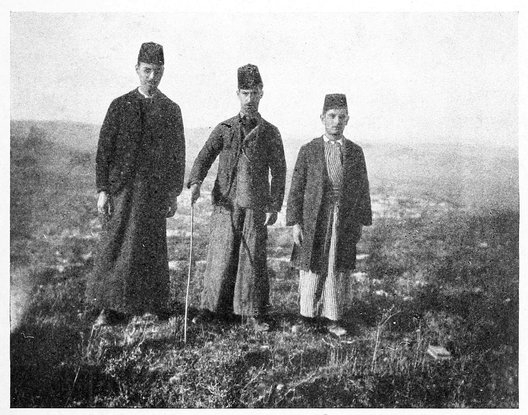
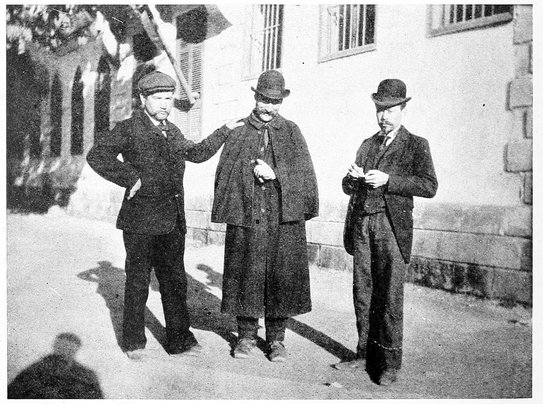
On the summit of Jebel es Sihk, back of Nazareth. From left to right: Shukry Nasr, teacher; Elias Awad, cook; and Nehmé Simán, teacher; my hosts in Nazareth
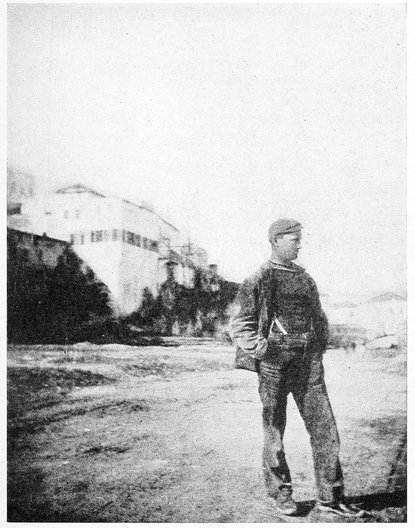
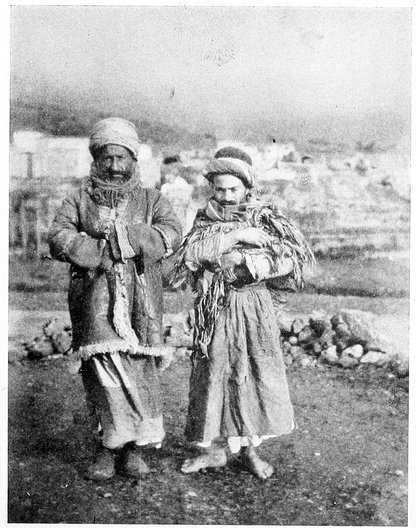
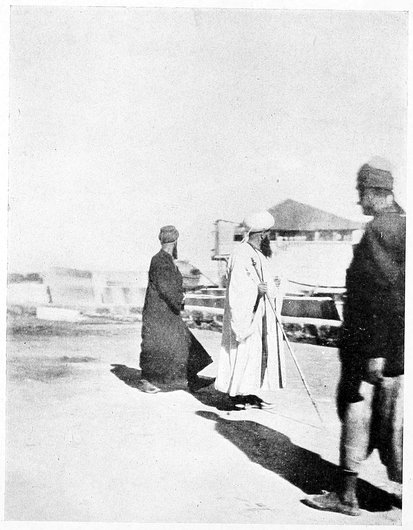
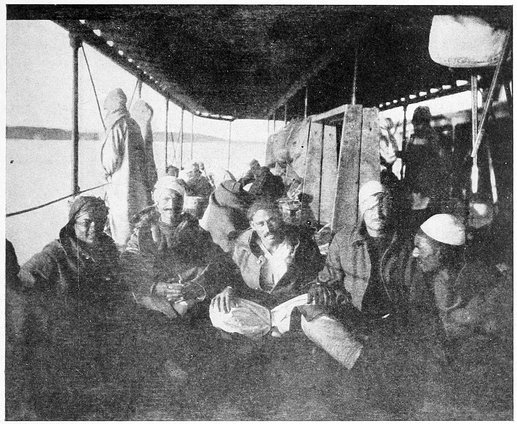
The shopkeeper and the traveling salesman with whom I spent two nights and a day on the lonely road to Jerusalem. Arabs are very sensitive to cold, except on their feet and ankles
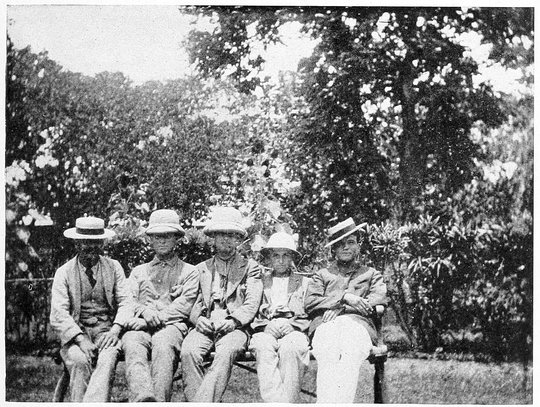
American wanderers who slept in the Gordon Gardens of Colombo. Left to right: Arnold, ex-New York ward heeler; myself; “Dick Haywood”; an English lad; and Marten of Tacoma, Washington
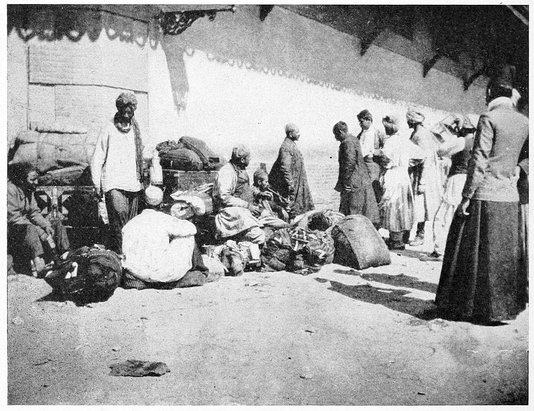
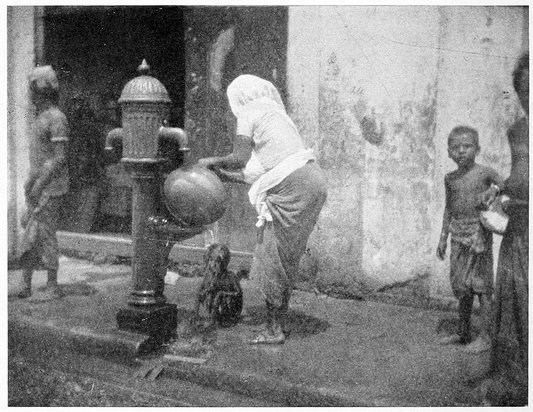
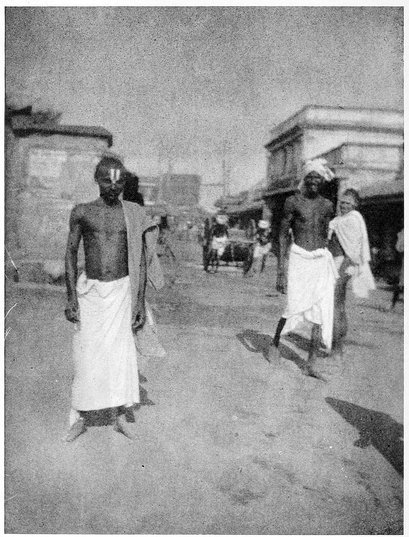
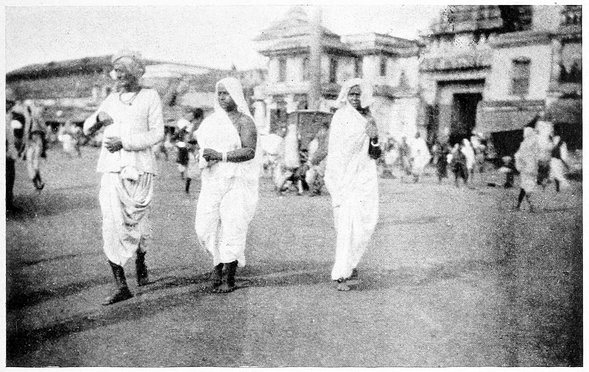
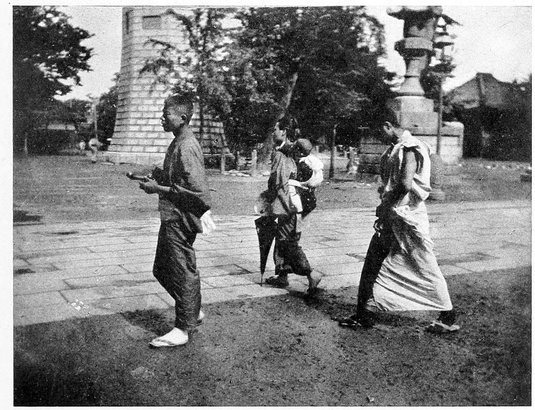
“Suttee” having been forbidden by their English rulers, Hindu widows must now shave their heads, dress in white, and gain their livelihood as best they can
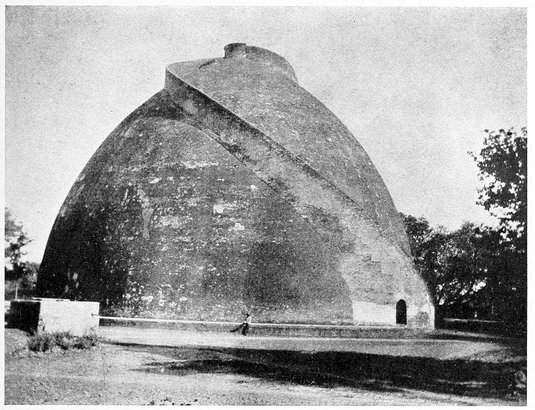
xiBankipur’s chief object of interest is a vast granary built in the time of the American Revolution to keep grain for times of famine. From its top the traveler catches his first glimpse of the Ganges
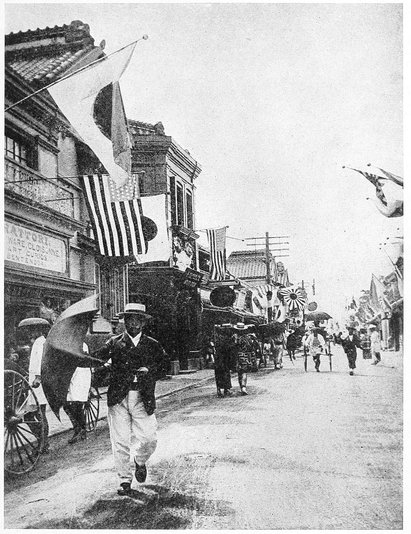
A Yokohama street decorated for the Taft party. The display is entirely private and shows the general good will of the Japanese toward the United States
Some years ago, while still an undergraduate, I chanced to be present
at an informal gathering in which the conversation turned to
confessions of respective aspirations.
“If only I had a few thousands,” sighed a senior, “I’d make a
trip around the world.”
“Modest ambition!” retorted a junior, “But you’d better file it
away for future reference, till you have made the money.”
“With all due respect to bank accounts,” I observed, “I believe a
man with a bit of energy and good health could start without money
and make a journey around the globe.”
Laughter assailed the suggestion; yet as time rolled on I found
myself often musing over that hastily conceived notion. Travel for
pleasure has ever been considered a special privilege of the wealthy.
That a man without ample funds should turn tourist seems to his
fellow-beings an action little less reprehensible than an attempt to
finance a corporation on worthless paper. He who would see the
world, and has not been provided the means thereto by a considerate
ancestor, should sit close at home until his life work is done, his
fortune made. Then let him travel; when his eyes have grown
too dim to catch the beauty of a distant landscape, when struggle
and experience have rendered him blasé and unimpressionable.
A spirit of rebellion against this traditional notion suggested a
problem worthy of investigation. What would befall the man who
set out to girdle the globe as the farmer’s boy sets out to seek his
fortune in the neighboring city; on the alert for every opportunity,
yet scornful of the fact that every foot of the way has not been
paved before him? There were, of course, other motives than mere
curiosity to urge me to undertake such an expedition. As a vocation
I had chosen the teaching of modern languages; foreign travel
promised to add to my professional preparation. Were I permitted
an avocation it would be the study of social conditions; what surer
xiiiway of gaining vital knowledge of modern society than to live and
work among the world’s workmen in every clime? In the final reckoning,
too, an inherent Wanderlust, to which, as an American, I
lay no claim as a unique characteristic, was certainly not without its
influence.
It was not until a year after my graduation that opportunity and
my plans were ripe. I resolved to take a “year off,” to wander
through as much of the world as possible, and to return to my desk
in the autumn, fifteen months later. As to my equipment for such
a venture: I spoke French and German readily, Spanish and Italian
with some fluency; I had “worked my way” on shorter journeys,
had earned wages at a dozen varieties of manual labor in my own
country, and had crossed the Atlantic once as a cattle man and once
before the mast. It was my original intention to attempt the journey
without money, without weapons, and without carrying baggage
or supplies; to depend both for protection and the necessities of life
on personal endeavor and the native resources of each locality. That
plan I altered in one particular. I decided to carry a kodak; and
to obviate the necessity of earning en route what I might choose to
squander in photography, I set out with a sum that seemed sufficient to
cover that extraneous expense; to be exact: with one hundred and
four dollars. As was to be expected, I spent this reserve fund early,
in those countries of northern Europe in which I had not planned
an extensive stay. But the conditions of the self-imposed test were
not thereby materially altered; for before the journey ended I had
spent in photography, from my earnings, more than the original
amount,—to be exact again: one hundred and thirteen dollars.
The chief object of investigation being the masses, I made no
attempt during the journey to rise above the estate of the common
laborer. My plan included no fixed itinerary. The details of route
I left to chance and the exigencies of circumstances. Yet this random
wandering brought me to as many famous spots as any victim
of a “personally conducted tour” could demand; and in addition,
to many corners unknown to the regular tourist. These latter it is
that I have accentuated, passing lightly over well-known scenes. It
is easy and, alas, too often customary for travelers to weave fanciful
tales. But a story of personal observation of social conditions can
xivbe of value only in so far as it adheres to the truth of actual experience.
I have, therefore, told the facts in every particular, denying
myself the privilege even of altering unimportant details to render
more dramatic many a somewhat prosaic incident. The names of
places, institutions, and persons appearing in the text are in every
case authentic; the illustrations are chosen entirely from the photographs
I took during the journey.
The question that aroused my curiosity has been answered. A man
can girdle the globe without money, weapons, or baggage. It is
in the hope that the experiences and observations of such a journey
may be of interest to fireside travelers that I offer the following
account of my Wanderjahr.
The author wishes to acknowledge the courtesy of Harper’s Weekly, Outing
and The Century Magazine in permitting him to republish from their pages
certain chapters of this book.
A VAGABOND JOURNEY AROUND THE WORLD
CHAPTER I PRELIMINARY RAMBLES
3
On the eighteenth day of June, 1904, I boarded the ferry that
plies between Detroit and the Canadian shore, and, coasting
the sloping beach of verdant Belle Isle, swung off on the
first stage of my journey around the globe. At the landing stage a
custom officer glanced through my bag, stared perplexedly from the
kodak to my laborer’s garb, and with a shrug of his shoulders passed
me on into the streets of the Canadian village.
A two-mile tramp brought me to the Walkerville cattle-barns, where
thousands of gaunt calves are rounded up each autumn to come forth
in the summer plump bulls and steers, ready for the markets of old
England. From the long rows of low, brick buildings sounded now
and then a deep bellow or the song or whistle of a stock feeder at
his labor. I had arranged for my passage some days before, and, dropping
my bag at the office, I joined the crew in the yard.
Months of well-fed inactivity had not tamed the spirits of the
sleek animals that were set loose and driven one by one out of the
various stables. The racing, bellowing cattle, urged slowly up the
shute into the waiting cars by blaspheming stockmen, waving lancelike
poles above their heads, gave to the scene the aspect of a riotous
corrida de toros. The sun had set and darkness had fallen in the
alleyways between the endless stables before the last bull was tied and
the last car door locked. The shunting engine gave a warning whistle.
We, who were to attend the stock en route raced to the office for our
bundles, and, tossing them on top of the freight cars, climbed after
them.
There were no formal leave-takings between the little stock-yard
community on the shute platform and those who were “crossin’ the
4pond wi’ the bullocks.” The cars began to move amid such words
of farewell as might have been exchanged with one setting out for
the nearby village:
“So long, Jim, keep sober.”
“Don’t fergit me that tin o’ Wills’ Smokin’, Bob.”
“Give me best to Molly down on the Broomielaw, Jim,” with an
overdrawn wink at that worthy standing stolidly on the last car.
Jim and Bob were “boss cattle men,” each of whom, though still
young, had made scores of trips between the barns and the principal
ports of Great Britain.
A short run down the spur brought us to the main line of the
Canadian Pacific; our cars were joined to a train that was making up,
and we made our way to the caboose that had been rammed on behind.
Though the companies permit it, train men look with no kindly
eye on the intrusion of traveling “cow-punchers” into their home and
castle. As we emerged into the glare of the tail-lights, carrying our
bundles and poles, a surly growl gave us greeting:
“Huh! ’Nother bloody bunch o’ cattle stiffs!”
A steady run of thirty-six hours, enlivened by changes of caboose
at unseemly hours, crews of increasing surliness, and a tramp along
the cars at every halt to “punch ’em up” brought us to Montreal.
The feeders at the railroad pens took charge of the shipment and we
repaired to the “Stockyards Hotel,” a hostelry pervaded from bar-room
to garret by the odor of cattle. Thus far our destination had
been uncertain, but, not long after our arrival, information leaked
out that we were to sail for Glasgow on the Sardinian two days
later.
On that second evening, I reported at a wharf peopled by a half-hundred
men whose only basis of fellowship, apparently, was pennilessness
and riotous desire to secure passage to the British Isles.
Twelve hundred cattle, collected from several Canadian feeding centers,
were to be shipped and, besides the bosses, twenty cattle men
were needed. A few, like myself, had come overland with the stock
trains; but the throng was made up chiefly of those who had paid a
Montreal agency $2.50 for the privilege of shipping.
Over these we were given precedence. “Farnsworth’s gang” was
summoned first and under the lead of our boss we filed into the shipping-office,
to be greeted by a blustering officer seated before the ship’s
log:
“What’s yer name?”
5“H. Franck.”
“Ever been over before?”
“Yes, sir, on the Manchester Importer.”
The name was recorded and I touched the pen to make binding
the contract I had signed by proxy.
“All right! Fi’ bob fer the run. Next!”
Our boss was entitled to eight men, four of whom he had already
chosen. The last of these had barely given his name, when the
“agency stiffs” swept aside the policeman who had held them back,
and surged screaming into the office. We left them to fight for
the coveted places and, stepping out into the night, groped our way
on board the Sardinian. Even while we wandered among the empty
cattle pens, built on her four decks, we clung jealously to our bundles,
for the skill of the Montreal wharf-rat in “lifting bags” is proverbial
among seafaring men.
Towards midnight several loads of baled straw were sent on board,
and those of us who had not succeeded in hiding “turned to” to
bed down the pens. Like many another transatlantic liner, the Sardinian,
homeward bound, carried cattle in the spaces allotted to
third-class passengers on the outward journey. It was not, however,
for this reason, as one of my new acquaintances was convinced, that
this section of the ship was known as the steerage.
The bedding completed, we threw ourselves down in the stalls
and fell asleep. Long before the day broke, the entire ship’s company,
from the first mate to the sleepiest “stiff,” was rudely awakened
by a stampede of excited cattle and the blatant curses of their drivers.
The stock-yard tenders had tied up alongside. In three hours our
cargo was complete; the panting animals were securely tied in their
stanchions; the winch had yanked up on deck the three or four bulls
that, having been killed in the rush, were to be dumped in the outer
bay; and we were off down the St. Lawrence. The crew fell to coiling
up the shore-lines and joined the cattle men in a rousing chorus:—
“We’re homeward bound, boys, for Glasgow town,
Good-by, fare thee well! good-by, fare thee well!
We’ll soon tread the Broomielaw now, my belle,
Good-by, fare thee well; good-by.”
Our passage varied little from the ordinary trip of a cattle boat.
A few quarrels and an occasional free-for-all mélée were to be expected,
for the “stiffs’ fo’c’stle” housed a heterogeneous company.
6Some of our mates were skilled workmen of industry and good
habits, bound on a visit to their old homes. Contrasted with them
were several incorrigible wharf-rats, bred on the docks of the United
Kingdom, who had somehow contrived to cross the Atlantic to what
had been pictured to them as a land “where a bloke c’n live like a
gent at ’ome widout wavin’ ’is bleedin’ flipper.” The western hemisphere
had proved no such ideal loafing-place. Bound back now
to their accustomed haunts, the disillusioned rowdies spent their
energies in heaping curses on America and those who had painted
it in such glowing colors. They were not pleasant messmates.
The work on the Sardinian was, as we had anticipated, hard, the
food unfit to eat, and the forecastle unfit to live in. But there
were no “first trippers” among us and all had shipped with some
knowledge of the treatment meted out to “cattle stiffs.”
On the tenth day out, the second of July, we came on deck to find,
a few miles off to starboard, the sloping coast of Ireland, patches of
growing and ripening grain giving the island the appearance of a
huge, tilted checkerboard. Before night fell, we had left behind
Paddy’s Mile-stone and the Mull o’ Kintyre, and it was near the mouth
of the Clyde that we completed our last feeding.
A mighty uproar awakened us at dawn. Urged on by the bellows
of Glasgow longshoremen, the cattle were slipping and sliding down
the gangway into the wharf paddock. Unrestrained joy burst forth
in the feeders’ quarters. Enmities were quickly forgotten, the few
razors passed quickly from hand to hand, beards of two weeks’ growth
disappeared as if by magic, bags were snatched open, the rags and
tatters that had done duty as clothing on the voyage were poked in
endless stream through the porthole into the already poisonous Clyde,
and an hour later the “stiffs,” looking almost respectable, were scattering
along the silent streets of Sunday-morning Glasgow.
Strange it seemed next morning to find business moving as usual,
with no sounds of celebration, for it was the Fourth, “Independence”
or “Rebellion” day, according to the nationality of the speaker. At
noon we gathered on board the Sardinian to receive our “fi’ bob” and
our discharges from the Board of Trade. These latter were good for
the return trip on the same steamer, but few besides the bosses intended
to avail themselves of the privilege. As for myself, I found
another use for the document. One who is moving about Europe in
the garb of a laborer must be ever ready to declare his station in
life. The answer of the American tramp that he is “just a’ travelin’”
will not pass muster across the water. To have called myself a carpenter
or a teamster without corroborating testimonials would have
been as foolish as to have told the truth. The discharge from the
Sardinian, though issued to a cattle man, did not differ materially
from that of an able seaman. My corduroy suit and cloth cap gave
me the appearance of a Jack ashore. I decided to pose henceforth
as a sailor.
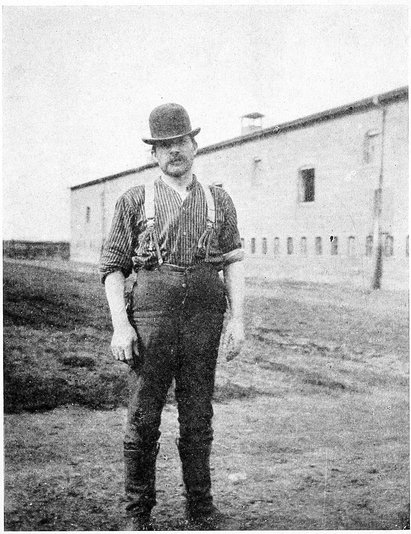
A boss cattleman of the Walkerville barns who has crossed the Atlantic scores of times
Upon arrival in Montreal I put up at the “Stock Yards Hotel” and get a preliminary hair-cut in anticipation
7Tucking my kodak into an inside coat pocket, I sold my bag for
the price of a ticket on the night steamer to Belfast. A two days’
tramp along the highways of the Emerald Isle was a pleasant “limbering
up” for more extended journeys to come. It might have been
longer but for an incessant rain that drove me back to Scotland.
On the afternoon of my return to Glasgow I struck out along the
right bank of the Clyde towards the Highlands. An overladen
highway led through Dumbarton, a town of factories, that poured its
waste products into the sluggish river of poison, and brought me
at evening to Alexandria. A band was playing. I joined the recreating
throng and stretched out on the village green. What a
strange fellow is the Scotchman! In a few short hours he runs
through the whole gamut of emotions, gloomy and despondent when
things go wrong, romping and joking a moment after.
The sun was still well above the horizon when the concert ended,
though the hour of nine had already sounded from the church spire.
Not far beyond the town the hills died away on the left and disclosed
the unruffled surface of Loch Lomond, its western end aglow with the
light of the drowning sun. By and by the moon rose to cast a phosphorescent
shimmer over the Loch and its little wooded islands. On
the next hillside stood a field of wheat shocks. I turned into it,
giving the owner’s house a wide berth. The straw was fresh and
clean, just the thing for a soft bed. But wheat sheaths do not offer
substantial protection against the winds of the Scottish Highlands, and
it was not with a sense of having slept soundly that I rose at daybreak
and pushed on.
Two hours of tramping brought me to Luss, a cozy little village
on the edge of the Loch. I hastened to the principal street in quest
of a restaurant, but the hamlet was everywhere silent and asleep.
Down on the beach of the Loch a lone fisherman, preparing his tackle
for the day’s labor, took umbrage at my suggestion that his fellow-townsmen
were late risers.
“Why mon, ’tis no late!” he protested, “’tis no more nor five, an’
8a bonny mornin’ it is, too. But there’s a mist in it,” he added pessimistically.
I glanced at the bright morning sun and the unclouded sky and
set down both statements for fiction. But a clock-maker’s window
down the beach confirmed the first, and the second proved as
true before the day was done. Stifling my premature hunger, I
stretched out on the sands to await the morning steamer; for Ben
Lomond, the ascent of which I had planned, stood just across the Loch.
About six a heavy-eyed shopkeeper sold me a roll of bologna,
concocted of equal parts of pepper and meat, and a loaf of day-before-yesterday’s
bread. The steamer whistle sounded before I had regained
the beach. I purchased a ticket at the shore-end of the distorted
wooden wharf and hurried out to board the craft. My way was
blocked by a burly Scot who demanded “tu p’nce.”
“But I’ve paid my fare,” I protested, holding up the ticket.
“Aye, mon, ye hov,” rumbled the native, straddling his legs and
setting his elbows akimbo. “Ye hov, mon. But ye hovna paid fer
walkin’ oot t’ yon boat on oor wharf.”
Ten minutes later I paid a similar sum for the privilege of walking
off the boat at Renwardenen.
Plodding across a half-mile of heath and morass, I struck into
the narrow, white path that zigzagged up the face of the Ben, and
soon overtook three Glasgow firemen, off for a day’s vacation in the
hills. The mist that the fisherman had foreseen began to settle down
and turned soon to a drenching rain. For five hours we scrambled
silently upward in Indian file, slipping and falling on wet rocks and
into deep bogs, to come at last to a broad, flat boulder where the path
vanished. It was the summit of old Ben Lomond, a tiny island in a
sea of whirling grey mist, into which the wind bowled us when we
attempted to stand erect. My companions fell to cursing their luck
in expressive Scotch. The remnants of a picnic lunch under the
shelter of a cairn tantalized us with the thought of how different the
scene would have been on a day of sunshine. I was reminded, too,
of the bread and bologna that had been left over from my breakfast,
and I thrust a hand hopefully into my pocket. My fingers plunged into
a floating pulp of pepper, dough, and bits of meat and paper that
it would have been an insult to offer to share with the hungriest
mortal; and I fell to munching the mess alone.
Two of the firemen decided to return the way we had come. With
the third I set off down the opposite slope towards Inversnaid. In
9the first simultaneous stumble down the mountain side, we lost all
sense of direction and, fetching up in a boggy meadow, wandered for
hours over knolls and through swift streams, now and then scaring
up a flock of shaggy highland sheep that raced away down primeval
valleys. Well on in the afternoon, as we were telling ourselves for
the twentieth time that Inversnaid must be just over the next ridge,
we came suddenly upon a hillside directly above the landing stage
of Renwardenen. On this side of the Loch was neither highway nor
footpath. For seven miles we dragged ourselves, hand over hand,
through the thick undergrowth, and even then must each take a header
into an icy mountain river before we reached our goal.
Here a new disappointment awaited me. Instead of the town I
had expected, Inversnaid consisted of a landing stage and a hotel of
the millionaire-club variety in which my worldly wealth would scarcely
have paid a night’s lodging, even should the house dogs have permitted
so bedraggled a being to approach the establishment. The fireman
wandered down to the wharf and I turned towards a cluster of board
shanties at the roadside.
“Can you sell me something to eat?” I inquired of the sour-faced
mountaineer who opened the first door.
“I can no!” he snapped, “go to the hotel.”
There were freshly baked loaves plainly in sight in the next hovel,
but I received a similar rebuff.
“Have you nothing to eat in the house?” I demanded.
“No, mon, I’m no runnin’ a shop.”
“But you can sell me a loaf of that bread?”
“No!” bellowed the Scot, “we hovna got any. Go to the hotel.
Yon’s the place for tooreests.”
The invariable excuse was worn threadbare before I reached the
last hut, and, though I had already covered twenty-five miles, I struck
off through the sea of mud that passed for a highway, towards Aberfoyle,
fifteen miles distant.
The rain continued. An hour beyond, the road skirted the shore
of Loch Katrine and stretched away across a desolate moorland.
Fatigue drove away hunger and was in turn succeeded by a drowsiness
in which my legs moved themselves mechanically, carrying me on
through the dusk and into the darkness. It was past eleven when I
splashed into Aberfoyle, too late to find an open shop in straight-laced
Scotland, and, routing out a servant at a modest inn, I went supperless
to bed. Months afterward, when I was in training for such undertakings,
10a forty-mile tramp left no evil effects; at this early stage of the
journey the experience was not quickly forgotten.
The attraction of the open road was lacking when, late the next
morning, I hobbled out into the streets of Aberfoyle, and, my round
of sight-seeing over, I wandered down to the station and took train
for Stirling. Long before the journey was ended, there appeared, far
away across the valleys, that most rugged of Scotland’s landmarks,
the castle of Stirling. Like the base of some giant pillar erected by
nature and broken off by a mightier Sampson, it stands in solemn isolation
in a vast, rolling plain, the very symbol of staunch independence
and sturdy defiance.
My imagination far back in the days of Wallace and Bruce, I
made my way up to the monument from the city below, half expecting,
as I entered the ancient portal, to find myself surrounded by those
bold and fiery warriors of past ages. And surely, there they were!
That group of men in bonnets and kilts, gazing away across the parapets.
Cautiously I approached them. What pleasure it would be to
hear the old Scottish tongue and, perhaps, the story of some feud
among the fierce clans of the Highlands! Suddenly one of the group
strode away across the courtyard. As he passed me, he began to sing.
A minstrel lay of ancient days, in the old Gaelic tongue? No, indeed.
He had broken forth in the rasping voice of a Liverpool bootblack,
juggling his H’s, as only a Liverpool bootblack can, in “The Good
Old Summer Time.”
An hour afterward I faced the highway again, bound for Edinburgh.
The route led hard by the battle-field of Bannockburn, to-day a stretch
of waving wheat, distinguished from the surrounding meadows, that
history does not know, only by the flag of Britain above it. With
darkness I found lodging in a wheat field overlooking the broad
thoroughfare.
The next day was Sunday and the weather calorific. For all that,
the highroad had its full quota of tramps. I passed the time of day
with any number of these roadsters,—they call them “moochers” in
the British Isles. Some were sauntering almost aimlessly along the
shimmering route, others were stretched out at apathetic ease in shady
glens carpeted with freshly-blossomed bluebells. The “moocher” is
a being of far less activity and initiative than the American tramp.
He is content to stroll a few miles each day, happy if he gleans a
meager fare from the kindly disposed. He would no more think of
“beating his way” on the railroads than of building an air-ship for
his aimless and endless wanderings. It is always walk with him, day
after day, week after week; and if, by chance, he hears of the swift
travel by “blind-baggage” and the full meals that fall to his counterpart
across the water, he stamps them at once “bloody lies.”
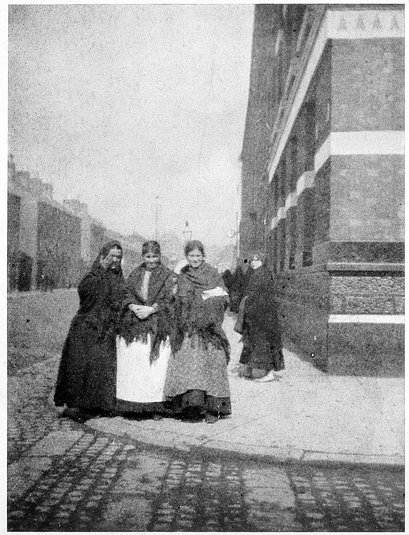
Women laborers in the linen-mills of Belfast, Ireland
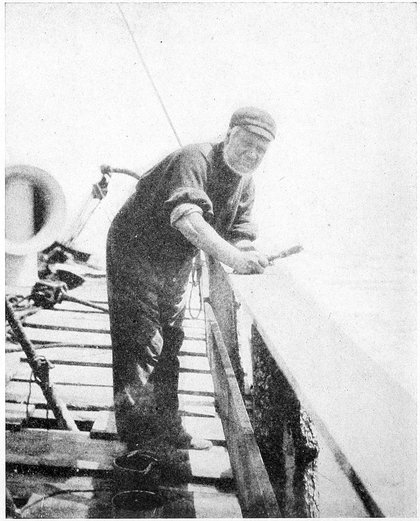
S.S. Sardinian. “Lamps does a bit of painting above the temporary cattle-pens”
11In stranger contrast to the American, the British tramp is quite apt
to be a family man. As often as not he travels with a female companion
whom he styles, within her hearing and apparently with her
entire acquiescence, “me Moll” or “me heifer.” But whatever his
stamping ground the tramp is essentially the same fellow the world
over. Buoyant of spirits for all his pessimistic grumble, generous to
a fault, he eyes the stranger with deep suspicion at the first greeting,
as uncommunicative and noncommittal as a bivalve. Then a look, a
gesture suggests the world-wide question, “On the road, Jack?”
Answer it affirmatively and, though your fatherland be on the opposite
side of the earth, he is ready forthwith to open his heart and to
divide with you his last crust.
I reached Edinburgh in the early afternoon, and, following the
signs that pointed the way to the poor man’s section, brought up in
Haymarket Square. A multitude of unemployed, in groups and in
pairs, sauntering back and forth, lounging about the foot of the central
statue, filled the place. Here a hooligan, ragged and unkempt as his
hearers, was holding forth, to as many as cared to listen, on the subject
of governmental iniquities. There another, less fortunate than his
unfortunate fellows, wandered from group to group in his shirt-sleeves,
vainly trying to sell his coat for a “tanner” to pay a night’s lodging.
High above towered the vast bulk of Edinburgh castle. A royal infant
lowered from its windows, as happened, ’tis said, in the merry
days of Queen Bess, would land to-day in a most squalid lodging house.
Indeed, this is one point that the indigent wanderer gains over the
wealthy tourist. The cheap quarters, the slums of to-day are, in many
a European city, the places where the history of yesterday was made.
The great man of a century ago did not dwell in a shaded suburb; he
made his home where now the hooligan and the laborer eke out a precarious
existence.
The sorry-looking building at the foot of the castle rock bore the
sign:—
I had too often been misled by similar self-assertive adjurations
to expect any serious striving on the part of the proprietor to keep
12anything but the sign in any marked degree of cleanliness. I was
not prepared, however, to find the place as filthy as it proved. The
cutting satire of the ensign was doubly apparent when I escaped
again into the square. A “Bobby” marched pompously up and
down not far from the brazen-voiced speaker, whose power of endurance
should have won him a livelihood somewhere.
“Where shall I find a fairly cheap lodging house?” I inquired.
“Try the Cawstle Inn h’over there,” replied “Bobby,” with a majestic
wave of his Sunday gloves towards the hostelry I had just inspected.
“But that place is not clean!” I protested.
“Not clean! Certainly it’s clean! There’s a bloomin’ law makes
’em keep ’em clean,” and “Bobby” glared at me as if I had libeled
the King’s Parliament and the Edinburgh police-force into the bargain.
I entered another inn facing the square, but was thankful to escape
from it to the one I had first visited. Paying my “tanner” at a
misshapen wicket, I received a stub bearing the number of my sty and
passed into the main room. It was furnished with benches, tables,
and a cooking establishment. For four pence the guest might have set
before him an unappetizing, though fairly abundant, supper. By far
the greater number of the inmates, however, were crowded around
several cooking stoves at the back of the room. Water, fuel, and
utensils were provided gratis to all who had paid their lodging. On
the stoves was sputtering or boiling every variety of cheap food,
tended by tattered men who handled frying-pans with their coat-tails
as holders, and cut up cabbages or peeled potatoes with knives on the
blades of which were half-inch deposits of tobacco. Each ate his
concoction with the greatest relish as soon as it showed the least sign
of approaching an edible condition, generally without any allowance of
time for boiling messes to cool, thereby suffering more than once dire
injury.
Three days later I took passage for London and on the afternoon
following my arrival embarked at Gravesend on the Batavien II, bound
for Rotterdam. The steerage fare was five shillings; in view of the
accommodations, an extravagant price. My only companions amid the
chaos of so-called mattresses strewn about the hold were a German
Hufschmied and his bedraggled spouse, joint possessors of a bundle
of rags containing a most distressingly powerful pair of lungs. The
odor of the mattresses and the stench from the bundle turned the night
13into a walking nightmare, which I spent in congratulating myself that
the voyage was to be of short duration.
I climbed on deck at sunrise to find the ship steaming at half speed
through a placid canal. Far down below us were clusters of squat
cottages, the white smoke of kindling fires curling slowly upward from
their chimneys. Here and there a peasant, looking quite tiny from
the height of our deck, crawled along across the flat meadows. Away
in the distance several stocky windmills were turning slowly yet ceaselessly
in the morning breeze.
The canal opened out into the teeming harbor of Rotterdam. A
custom’s officer inquired my profession, slapped me paternally on the
back with a warning in German to beware the “schlechte Leute” who
lay in wait for seamen ashore, and dismissed me, while the well-dressed
tourist still fumed over the uninspected luggage in his cabin.
I quickly tired of the confines of the city and turned out along
the flat highway to Delft. The route skirted a great canal; at intervals
it crossed branch waterways, all half-hidden by cumbersome cargo-boats.
Heavily laden boats toiled slowly by on their way to market,
empty boats glided easily homeward. On board, stocky men, bowed
double over heavy pike-poles, marched laboriously from bow to stern.
Along the graveled tow-paths that checkered the flat landscape, buxom
women strained like over-burdened oxen at the tow-ropes about their
shoulders. Wherever one met him the boating Dutchman shared
most fairly with his wife the labor of propelling his unwieldy craft,
except that the wife walked and the Dutchman rode.
In the early afternoon I briefly visited Delft, and pushed on towards
the Hague. No wayfarer, obviously, could in a single day become
accustomed to the national clatter of wooden shoes. Beyond Delft I
turned into a narrow roadway paved in cobblestones and flanked by
two canals. It was a quiet route even for Holland. In serene contentment
I pursued my lonely way, gazing off across the unbroken
landscape. Suddenly a galloping “rat-a-tat” sounded close behind
me. What else but a runaway horse could produce such a devil’s
tattoo? To pause and glance behind might cost me my life, for the
frenzied brute was almost upon me. With a swiftness born of fear
I took to my heels. A few yards beyond was a luckily-placed foot-bridge
over one of the canals. I made a flying leap at the structure
and gained it in safety, just as there dashed by me at full speed—a
Hollander of some six summers, bound to market with a basket on
his arm!
14“S-Gravenhage,” as the Dutchman calls his capital, was a city
teeming with interest; but Holland was one of those countries
which I purposed to “do” in orthodox tourist fashion and, after a
few short hours in the royal borough, I sought out the highway to
Leiden. My seeking was not particularly successful. The mongrel
commixture of German, English, and pantomime in which I carried
on conversation with the natives was a delectable language, but it
did not always gain me lucid directions. Sharply prosecuted inquiries
brought me to a road to Leiden, right enough, but it was not
the public highway. Thanks to some misconstruction of the native
dactylology, I set out for the stamping ground of Rembrandt along
the old royal driveway.
It was a pleasure, of course, to travel by the Queen’s own promenade,
especially as it led through a fragrant forest park. Unfortunately,
a royal demesne is no place in which to find an inn when hunger
and darkness come on. This one had not even a cross-road to lead
me back to the main highway, and I plodded on into the night amid
unbroken solitude. Just what hour it was when I reached Leiden I
know not. Beyond question it was late, for the good people, and even
the bad, except a few drowsy policemen, were sound asleep; and with
a painful number of miles in my legs I went to bed on a pile of lumber.
The warming sun rose none too early, though long before the first
shopkeeper. Still fasting I set off towards Haarlem. On these flat
lowlands this Sabbath day was oppressively hot. Yet how dolorously
devout appeared the peasants who plodded for miles along the dusty
highway to the village church! The men, those same men so comfortably
picturesque in their work-a-day clothes, marched in their
cumbersome Sunday garments like converts doing penance for their
sins. The women, buxom always, but painfully awkward in stiffly
starched gowns, tramped swelteringly behind the males. Even the
children, the rollicking youngsters of the day before, were imprisoned
in homemade straight-jackets and suffered martyrdom in uncomplaining
silence. But one and all had a cheery word for the passerby and
never that sour look which one “on the road” encounters on British
highways.
Often, since leaving Rotterdam, I had wondered at the absence of
wells in the rural districts. Surely these peasants’ cottages were not
connected by water-mains! Pondering the question, I had thus far
quenched my thirst only in the villages. But towards noon on this
15hot Sunday an imperative call for water drove me to turn in at an
isolated cottage. Beside the road ran the omnipresent canal. A
narrow foot-bridge crossed it to the gate before the dwelling, around
which flowed a branch of the main waterway, giving a mooring for
the peasant’s canal-boat. The gate proved impregnable and it required
much shouting to attract the attention of the householder. At
last, from around a corner of the building, a Vrouw of the most buxom
type hove into view and bore down upon me as an ocean liner sails
into a calm harbor. My knowledge of Dutch being nil, I followed my
usual method of coining a language by a process of elimination. Perhaps
the lady spoke some German.
“Ein Glas Wasser, bitte.”
“Vat?”
It could do no harm to give my mother tongue a trial.
“A glass of water.”
“Eh!”
I tried a mixture of the two languages. For what is Dutch after
all than a jumble of badly spelled English and German words with
the endings lopped off?
“Ein glass of vater.” It was the open sesame.
“Vater?” shrieked the lady with such vehemence that the rooster
in the back yard leaped sideways a distance of six feet. “Vater!”
“Ja, vater, bitte.”
A profound silence succeeded, a silence so absolute that one could
have heard a fly pass by a hundred feet above. Slowly the lady placed
a heavy hand on the intervening gate. A shadow passed over her face,
as though she were mentally calculating the strength of resistance of
the barrier against a madman. Then, with a bovine snort, she wheeled
about and waddled towards the house. Close under the eaves of the
cottage hung a tin basin. Snatching it down without a pause, the human
steamship set a course for the family anchorage, stooped, dipped
up a basinful of that selfsame weed-clogged water that flowed by in
abundance at my feet, and tacked back across the yard to offer it to me
with a magnanimous sigh of resignation. I quenched my thirst thereafter,
in rural Holland, at roadside canals, after the manner of beasts
of the field—and Hollanders.
Miles away from Haarlem appeared the great flower-farms for
which this region is famous and, growing more and more frequent,
continued into the very suburbs of the city itself. Across the ultra-fertile
plain beyond, the broad highway to Amsterdam ran as straight
16as a geometrical line. From the city of tulips to where it disappeared
in the fog of rising heat waves, the thoroughfare was thronged with
vehicles, riders, and, above all, with wheelmen, who, refusing to
swerve a hair’s breadth for my convenience, drove me ever and anon
into the wayside ditch. The Hollander is, ordinarily, an obliging fellow,
and in the main the humble workman or pedestrian is fairly
treated. Yet that distinct line of demarkation between the “commoner”
and the “upper class” is never obliterated. The American
laborer may spend some time in the British Isles without noting this
discrimination; he will not be long on the continent before the advantage
of his status at home is shown forth in plain relief.
There is not that gradual shading off from the professional man to
the coal-heaver that exists in the United States. One can no more
conceive of a Hollander who looks forward to a career in the gentler
walks of life “beginning at the bottom” than of one who aspires to
the papacy taking a wife. He whose appearance stamps him as of
those who live by the sweat of the brow cannot complain of any overt
act of oppression. Yet he is early reminded that, as a worker with
his hands, he has a distinct place in society and that he must keep to it.
Among his fellow workmen, in his own caste, he lives and moves and
has his being as in our own land. But in other ranks he catches here
and there a glance, a gesture, a protesting silence, that brings home
to him his lowly status.
My zigzag tramp ended late in the afternoon, and, after a deal of
wandering in and out among the canals of the metropolis, I took a
garret lodging overhanging a sluggish waterway. The proverbial
cleanliness of Holland is no mere figure of speech. Few cities of the
same size have as little of the slum district within their confines as
Amsterdam. The Dutch laborer is, in many ways, far better off than
those of the same class across the channel. In the city there is always a
Koffie Huis close at hand, where eggs, milk, cheeses, and dairy products
in general are served at small cost and in cleanly surroundings.
Compare this diet with that of the British workman, who subsists often,
not on food, but on the waste products of those places where food is
prepared. One can identify a Briton of the lower classes by his teeth.
At twenty he has a dozen, perhaps, that are neither broken off,
crumbling, black, nor missing. At thirty he shows a few yellow fangs.
But one cannot determine the class of the Hollander by the same sign.
His diet is too wholesome.
Parks, museums, laborers’ quarters, and the necessity of a protracted
17search each evening for my canalside garret kept me three days in
Amsterdam. On the fourth I drifted on board one of the tiny
steamers of the Zuidersee and journeyed to Hoorn. Hoorn is one of
Holland’s dead cities, one of the many from which prosperity and
wealth departed to come no more as the shifting sands of the North
Sea blocked up their channels and drove away the rich commerce that
was their fortune. Now they are dead indeed. A tiny remnant of a
great population clatters along their deserted streets, a few of the
ancient mansions house humbler inmates, and all about is ruin.
By no means regretting the whim that had carried me away to this
land of yesterday, I set back along the See towards Amsterdam. The
typical Hollander is nowhere seen to better advantage than in this district.
The population plies two vocations. Along the shores and on
the adjoining islands the stolid, picturesque fisherman is predominant.
In the great, flat meadows the care of his cattle occupies the no less
stolid, if less quaint, peasant.
There are wheat shocks even in Holland. As night was falling over
the vast plain I withdrew to a roadside field and retired. A Dutchman
spied me out in my resting-place at some silent hour, but sped away
across the country like a firm believer in ghosts when I offered to
share my bed. I awoke at daybreak to find myself within sight of the
much maligned island of Marken, with an unobstructed view of the
quaint old church of Monnickendam, a once populous city that has
shrunk to a baggy-trousered hamlet of fisherfolk. Beyond the town
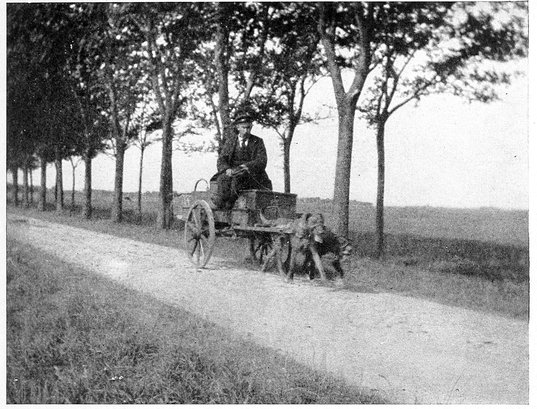
there rattled by occasionally a milk or baker’s cart, drawn, now by one
dog, now by a team of two or three, harnessed together with utter disregard
to size, breed, or disposition. Sometimes, indeed, a canine and
a human team-mate tugged together at the traces.
There ran a rumor in my favorite Koffie Huis soon after my arrival
at Amsterdam in the afternoon, that a cargo-boat which carried
passengers for a song was to leave at four for Arnheim on the Rhine.
I thrust a lunch into a pocket and hurried down to the mooring-place
of the international liner. She was a canal-boat some twenty-five feet
long and eight wide, as black as a coal-barge, though by no means as
clean; her uncovered deck piled high with boxes, barrels, and crates
ranging in contents from beer mugs to protesting live stock. I scrambled
over the cargo and found a seat on a barrel of oil. It was already
after four, but there was really no reason for my anxious haste. No
Dutch cargo-boat was ever known to depart at the hour set.
It turned out that the overburdened craft was not yet loaded. From
18time to time lethargic longshoremen wandered down to the wharf with
more bales, crates, and boxes, and stacked them high about us. It
was long after dark when their task was done, and, what with quarrels
between the captain and the crew as to the proper channel, we were
scarcely out of the harbor when dawn broke.
A long day we spent in jumping about the cargo like jack-rabbits,
in a vain attempt to keep out of the way of the crew searching for a
bale to set ashore at each wayside village. That alone would have been
endurable. But our lives were made miserable by two Hungarians,
owners of a barrel organ, who insisted that the infernal squawk which
the machine emitted was “moosik,” and who had the audacity to invite
us periodically to pay for the torture.
I left the cargo-boat at Arnheim and, halting at the principal cities
on its banks, made my way up the Rhine by steamer and on foot in a
few days to Mainz. From there I turned eastward along the highway
to Frankfurt. Strange and varied had been my sleeping-places in
Germany. The innkeepers of the Fatherland, fearful of punishment
for lodging those who turn out to be “wanted” by His Majesty’s
officers, are chary of offering accommodations to strangers. Whether
it was due to the garb that stamped me as a wanderer or to a foreign
accent, it was my fate to be treated in the Kaiser’s realm as an extremely
suspicious member of society.
It was late at night when I reached Frankfurt. The highway
ended among the palatial edifices of the business section, and I wandered
long in search of the poorer quarters. At last, in a dingy
side street a tavern, offering logieren at one mark, drew my attention.
Truly it was a high price to pay for a bed, but the hour was late
and the night stormy. I entered the drinking-room, and waiting
until the Kellner could catch a moment’s respite from his strenuous
task of silencing the shouts of “Glas Bier” that rose above the tumult,
made my wants known.
“Beds?” cried the Kellner, too busy with his glasses to look up
at me, “To be sure. We have always plenty of beds. One mark.”
But mein Herr the proprietor was staring at me from the back of
the hall. Slowly he shuffled forward, cocked his head on one side,
and scrutinized me intently from out his bleary eyes.
“What does he want?” he demanded, turning to the tapster.
I answered the query myself and the customary inquisition began.
“Woher kommen Sie?”
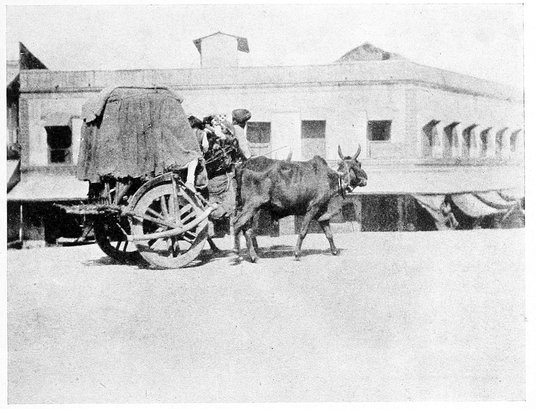
A baker’s cart of Holland on the morning round
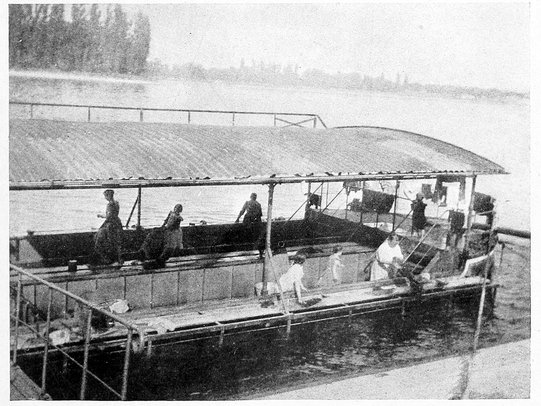
A public laundry on the Rhine at Mainz, Germany
Knowing from experience the order of the questions, I launched
19forth into the story of my life, past, present, and future, or as much
of it as was in keeping with the assertion that I was an American
sailor on a sight-seeing expedition in the Fatherland. Plainly my
hearers regarded it as a clumsy tale. Long before I had ended, the
proprietor, the Kellner, and those clients of the house that had
clustered around us, fell to nudging each other with grimaces of incredulity.
The Wirt, harassed by the conflicting emotions of greed
and fear, blinked his pudgy eyes and glanced for inspiration into
the faces about him. The temptation to add another mark to his coffers
was strong within him. Yet what would the police inspector
say in the morning to the name of a foreigner on his register? He
scratched his grizzly poll with a force that suggested that he was
going clear down through it to extract an idea with his stubby fingers,
glanced once more at the tipplers, and surrendered to fear.
“Es tut mir leid, Junge,” he puffed, with a prolonged blink, “I am
sorry, but we have not a bed left in the house.”
I wandered out into the night and told my story to a second, a
third, and even a fourth innkeeper with the same result. In despair
I turned in at the fifth house resolved to try a strange plan—to
tell the truth. In carefully chosen words I explained my identity
and my purpose in visiting Germany in laborer’s garb. Never before
since leaving Detroit had I resorted to such an expedient, and I took
good care not to repeat the experiment during my subsequent travels.
I had barely elucidated my situation when the landlord informed me
in no uncertain terms that I was a liar and an ass into the bargain;
and that a hasty retreat from his establishment was the surest way
of preserving my good health. He was a creature of awe-inspiring
proportions, and I followed his suggestion promptly. At midnight
a policeman directed me to an inn where suspicious characters were
less of a novelty, and I was soon asleep.
I had not yet well learned the lesson, begun in the British Isles,
that the homes of the famous of a century ago are the slums of
to-day. Next morning I turned back to the brilliant thoroughfares,
expecting to find somewhere along them the birthplace of Goethe.
Once amid such surroundings as the greatest of the Germans might
fittingly have graced by his presence, I addressed myself to a policeman.
Goethe? Why, yes, the name seemed familiar. He was not
sure, but he fancied the fellow lived in the eastern part of the city,
and directed me accordingly. The way led through narrow, winding
streets. Now and then I went astray, to be set right again by other
20minions of the law. The quest cost me a goodly amount of shoe-leather
and most of the morning, but I found at last the landmark I
was seeking—exactly across the street from the inn in which I had
slept.
There was in Frankfurt after all a lodging house where wanderers
free from the burden of wealth were welcome. I came across it
during the day’s roaming and took care not to forget its location.
Several disreputable humans were wending their way thither as twilight
fell and, joining them, I entered a great, dingy hall, low of ceiling,
and poorly served in the matter of windows. A cadaverous
female, established behind a rust-eaten wicket, was dealing out
Schlafmarken at thirty Pfennig (7 cents) each. I pocketed one and
hastened to find a place on one of the wooden benches; for the hall
was rapidly filling with members of the Brotherhood of the Great
Unwashed.
Drowsiness came quickly in the stifling atmosphere. I stepped to
the wicket and asked to be shown to my quarters.
“What!” croaked the hollow-eyed matron, “bed? You can’t sleep
yet. Wait till you hear the bell at ten-thirty.”
I turned back to the bench only to find that another squatter had
jumped my claim. Too sleepy to stand unaided, I hung myself up
against the wall and waited. If the dreams from which I was
aroused were not much shorter than they seemed, several days passed
before there sounded the sudden clang of an iron-voiced bell. The
resulting stampede carried me to the second floor.
In an evilly-ventilated room, lower of ceiling than the hall below, I
found that cot thirty-seven, to which I had been assigned, could be
reached only by climbing over several of the sixty which as many
men in varying stages of insobriety were preparing to occupy. By
a series of contortions, in the execution of which I often thumped
with my elbows the man behind me and displaced my cot sufficiently
to cause the downfall of my opposite neighbor, whose equilibrium
was far from stable, I succeeded in removing my shoes and coat.
To venture further in the disrobing process seemed undesirable. I
spread my germ-proof jacket across the animated coverlet and lay
down. Before the last sot had ceased his maudlin grumbling there
broke out here and there in the room a dialogue of snores. Rapidly
it increased to a chorus. In ten minutes the ensemble would have put
to shame the most atrocious steam calliope ever inflicted upon a
defenceless public. Reiterated kicks and punches reduced to comparative
21silence the few slumberers within reach; by shying one shoe
at a distant sleeper whose specialty was a nerve-racking falsetto
and the other at a fellow whose deep bass set the cots to trembling
in sympathy, I brought a moment’s respite. But the dread of going
forth in the morning unshod drove me on an expedition across the
bodies of my roommates and, by the time I had recovered my footwear,
the chorus was again swelling forth in Wagnerian volume. I
gave up in despair and settled down on the hill and dale mattress to
convince myself that I was sleeping in spite of the infernal bedlam.
There runs a proverb, the origin of which is lost among the
traditions of hoar antiquity, to the effect that misfortunes travel
in bands. That it is true I have never doubted since the day following
that broken-backed night in Frankfurt. It was curiosity that
called down upon my head this new adversity, for naught else could
have moved me to investigate the secrets hidden behind a fourth-class
ticket to Weimar. In all the countries of Europe there is
nothing that compares with the fourth-class railway service of Germany.
The necessity of providing some mode of transportation
cheaper than walking may be an excuse for its perpetration, but woe
betide the unsuspecting traveler who, for mere matter of economy,
abandons for this system that of our ancient forebears.
Intending to take the nine o’clock train, I purchased a ticket about
eight-forty and stepped out upon the platform just in time to hear
a guard bellow the German variation of “all aboard.” The Weimar
train stood close at hand. As I stepped towards it, four policemen,
strutting about the platform, let out simultaneous war-whoops, and
sprang after me.
“Wo gehen Sie hin?” shrieked the first to reach me.
“Ich gehe nach Weimar.”
“Aber, the train to Weimar is gone!” shouted the second officer.
As I had a hand on the carriage door, I made so bold as to deny
the assertion.
“Aber, ja, er ist fort!” gasped the sergeant who brought up the
rear of the constabulary deluge. “It is gone! The guard has already
said ‘all aboard.’”
The train stood at the edge of the platform long enough to have
emptied and filled again; but, as it was gone ten minutes before it
started, I was forced to wait for the next one at ten-thirty.
The fourth-class carriage, unlike other European cars, was built
on the American plan, with a door at each end. In reality it was
22nothing more than a box car with wooden benches around the sides
and a few apologies for windows. Almost before we were under
way, the most unkempt couple aboard stood up and turned loose what
they evidently thought was a song. Many of the passengers seemed
to be victims of the same auricular illusion, for the pair gleaned a
handful of Pfennige before descending at the first station. The bawl
of cracked voices, however, was but a prelude to worse visitations,
for, as no train man enters the cars while they are in motion, fourth-class
travelers are the prey of every grafter who chooses to inflict
himself upon them.
We stopped at a station at least every four miles during that
day’s journey. At the first hamlet beyond Frankfurt the car slowly
filled with peasants and laborers in heavy boots and rough smocks,
who carried sundry farm implements ranging from pitchforks to
young plows. Sunburned women, on whose backs were strapped
huge baskets stuffed with every product of the countryside from cabbages
to babies, packed into the center of the car, turned their
backs upon those of us who occupied the benches, and serenely
leaned themselves and their loads against us. The carriage filled
at last to its utmost limits, and its capacity passed belief, a guard
outside closed the heavy door with a bang, and uttered a mighty
shout of “Vorsicht”! (look out), evidently to inform those near the
portal that they were lucky to have “looked out” before it was
slammed. The station master on the platform, a man boasting a
uniform no American rear-admiral could afford, or dare to appear in,
raised a hunting-horn to his lips and gave as a signal of departure
such a blast as echoed through the ravines of Roncesvalles. The
head-guard drew his whistle and shrilly seconded the command of his
superior. The engineer whistled back to inform the guard that he
was ready to do his duty. The guard repeated his sibilant order.
The driver liberated another pent-up shriek to show how easily his
engine could reach high C, or to imply that he was fast nerving himself
up to open the throttle; the man on the platform whistled again
to cheer him on; a heroic squeal came from the cab in answer; and,
with a jerk that sent peasants, baskets, farm-tools, lime-pails, cabbages,
and babies into a conglomerate, struggling mass at the back
end of the car, we were off. To celebrate which auspicious event the
engineer emitted a final shriek and gave a second yank, lest some sure-footed
individual had by any chance retained his equilibrium.
By the time some semblance of order had been restored, unwieldy
23peasant women pulled out of the clawing miscellany and stood right
end up, cabbages and babies restored to their proper baskets, pitchforks
and smocks disentangled, the next station was reached and
a sudden stop undid all our efforts, this time stacking the passengers
at the front end. Some minutes after the train had come to a standstill,
when long-distance travelers had lost all hope of relief from
the sweltering congestion, the countrymen began slowly to wander
out at the doors. The exodus continued until there remained in the
car only those few through-passengers, who, utterly cowed and subjugated,
shrank back on the benches to escape attention. Then the
vanguard of another multitude, bound for a village some three miles
distant, made its appearance and history repeated itself.
There were times, too, during the journey when the villages were
apparently too far apart to suit the engine-driver. For occasionally,
soon after having run through his entire repertoire of toots, he
suddenly, remarkably suddenly in fact, brought the engine to a halt
in the open country. But as German railway laws forbid voyagers
to step out, crawl out, or peep out of the car under such circumstances
without a special permit from the guard, countersigned under
seal by the head-guard, there was no means of learning whether the
engineer had lost his courage or merely caught sight of a wild flower
that particularly took his fancy.
Such are the pleasures of a fourth-class excursion in Germany.
Travelers by first-class, it is said, suffer fewer inconveniences, but,
however varied the accommodations may be, the prices are more so.
At every booking-office is posted a placard giving the cost of transportation
to every other town in the Empire. He who would ride
on upholstered seats pays a bit higher rate than in the United States.
Second-class costs one-half, third-class one-fourth as much. Three
other rates are quoted: fourth-class, soldiers’ tickets, and Hundekarten
(dog tickets). The German conscript pays one-half fourth-class fare
and rides in a third-class carriage. Hundekarten cost fourth-class
fare. Verily it is better in Germany to be a soldier than a dog—at
least while traveling.
I arrived at Weimar late at night. A stroll to Jena the following
afternoon led through a pleasant rural district well known to
the “poet pair” of Germany and the soldiers of Napoleon. From
Jena I turned westward again, and, braving the rigors of fourth-class
travel for two interminable days, descended during the waning hours
of July at the city of Metz.
24When August broke in the east, I turned pedestrian once more
and set out towards Paris on the Route Nationale, constructed in
the days when Mayence was a proud French city. The road wound
its way over rolling hills, among the ravines and valleys of which was
fought a great battle of the Franco-Prussian war. For miles along
the way, dotting the hillsides, standing singly or in clusters along
lazy brooks, or half-hidden by the foliage of summer, were countless
simple, white crosses, bearing only the brief inscription “Hier ruhen
Krieger-1870.” Beyond, the colossal statue of a soldier of past decades
pointed away across a deep-wooded glen to the vast graveyard of his
fallen comrades.
A mile further on, in the open country, out of sight of even a
peasant’s cottage, two iron posts at the wayside marked the boundary
established by the treaty of Versailles. A farmer with his mattock
stood in Germany grubbing at a weed that grew in France.
Mindful of the lack of cordiality that exists between the two
countries, I anticipated some delay at the frontier. The customhouse
was a mere cottage, the first building of a straggling village
some miles beyond the international line. A mild-eyed Frenchman,
in a uniform worn shiny across the shoulders and the seat of the
trousers, wandered out into the highway at my approach. Behind
him strolled a second officer. But the difficulties I had expected were
existent only in my own imagination. The pair cried out in surprise
at mention of my nationality; they grew garrulous at the announcement
that I was bound to Paris à pied. But their only official act was
to inspect my bundle, and I pressed on amid their cries of “bon
voyage.”
The highways of France are broad and shaded, her innkeepers
neither exclusive nor intrusive; yet even here pedestrianism has its
drawbacks. Chief among them are the railway crossings. The French
system of protection against accidents is effective, no doubt; but if
monsieur the Frenchman were as impatient a being as the American the
mortality would be little lessened, for the delay involved at these
traverses du chemin de fer would choke with rising choler as many
as might come to grief at an unprotected crossing.
On either side of the track is a ponderous barrière, the opening
and shutting of which would be slow under the best of circumstances.
Being always tended by a colossal barrièrière (gate-woman)
who moves with the stately grace of a house being raised on jack-screws,
the barricade is unduly effective. Ten minutes before a train
25is due, la barrièrière hoists herself erect, waddles across the track to
draw the further gate, closes the nearer one, and, having locked
both, returns to the shade of her cottage. The train may be an hour
late, but that is beside the question. This is the time that Madame is
hired to lock the gates and locked they must remain until the train
has passed. Woe betide the intrepid voyager who tries to climb over
them, for her tongue is sharp and the long arm of the law is arrayed
on her side.
Plodding early and late, I covered the round-about route through
Châlons, Rheims, and Meaux, and reached Paris a few days after
crossing the frontier. A month of tramping had made me as picturesque
a figure as any boulevardier of Montmartre; moreover, August
in the French capital was neither the time nor the place to display
garments chosen with the winds of the Scottish Highlands in
mind. I picked up in the Boulevard St. Denis, at a gross expenditure
of fifteen francs, an outfit more in keeping with the weather, took
up my abode in a garret of the Latin Quarter, and roamed at large in
the city for three weeks.
CHAPTER II ON THE ROAD IN FRANCE AND SWITZERLAND
26
The month of August was drawing to a close when I swung
my wardrobe of the city over a shoulder and, wandering
down the Boulevard St. Germain, struck off to the southward.
A succession of noisy, squalid villages, such as surround
most cities of the old world, lined the way to Mélun. Beyond,
tramping was more pleasant, for the route swung off across a rolling
country, unadorned with squalling urchins and mongrel curs, towards
Fontainebleau. The foot-traveler in France need have no fear of
losing his way. From Paris to the important cities and frontier
towns radiate “Routes nationales,” each known by a certain number
throughout its length. Signboards point the way at every cross-road;
kilometer posts of white stone keep the wayfarer well informed
of the progress he is making—almost too well, for when he has
grown foot-sore and ill-tempered, each one greets him with a sardonic
smile that says as plainly as words, “Huh! You’re only a kilometer
further on, and a kilometer is not a mile by a long way.”
They are excellently built, these national highways; the heaviest
rain barely forms upon them a perceptible layer of mud. But one
could pardon them a little unevenness of road-bed if only they would
strike out for their goal with the dogged determination of our own
axle-cracking turnpikes. They wind and ramble like mountain
streams. They zigzag from village to village even in a level country.
The least knoll seems to have been sufficient reason in the minds of
the constructing engineers for making wide detours, and where hills
abound, there are villages ten miles apart with twenty miles of tramping
between them.
Thus far I had tramped the highways of Europe alone. Beyond
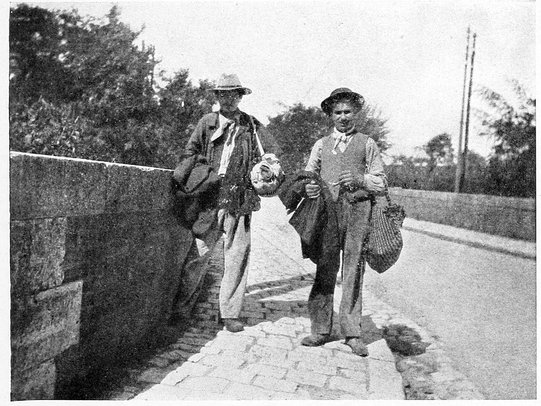
Nemours, my second night’s resting-place, I came upon two wayfarers
in the shelter of a giant oak, enjoying a regal repast of hard bread
which they rendered more palatable by dipping each mouthful in a
brook at their feet. On the plea of an ample breakfast I declined
27an invitation to share the feast, but our routes coincided and we
passed on in company. The pair were young miners walking from
Normandy to the great coal-fields of St. Etienne. Thanks to the
free-masonry of “the road,” formalities were quickly forgotten, and
before the first kilometer post rose up to greet us we were exchanging
confidences in the familiar “tu” form. I soon added to my
vocabulary the nickname of the French tramp. My new comrades
not only addressed me as mon vieux, but greeted by that title every
wayfarer we encountered, until it came to have as familiar a sound
in my ears as the “Jack” of the American hobo. Its analogy to
our “old man” is at once apparent.
There are stern laws in France against wandering from place to
place. A lone traveler may sometimes escape attention, but well I
knew that in trio we should often be called upon to give an account
of ourselves. We were still some distance off from the first village
beyond our meeting-place when an officer appeared at the door of the
gendarmerie and, advancing into the highway, awaited our arrival.
“Où allez vous autres?” he demanded, with officious bruskness.
“A St. Etienne.”
“Et vos papiers?”
“Voilà!” cried the miners, each snatching from an inside pocket
a small, flat book showing signs of age and hard usage.
The gendarme stuffed one of the volumes under an arm and fell
to examining the other. Between its greasy covers was a complete
biography of its owner. The first leaf bore his baptismal record,
followed by a page for each of his three years of military service,
all much decorated with official stamps and seals. Then came affidavits
of apprenticeship, variously endorsed and viséd, and last a
page for every firm that had employed the miner, giving dates, wages,
testimonials, and reasons for leaving or dismissal. The miner bore the
scrutiny with fortitude. With his official book at hand the French
laborer has little dread of the officers of the law. After each term
at his trade he may, if he sees fit to travel a bit, give variations of
the old “looking-for-work” story, though as the date of his last
employment grows more and more remote, the gendarmerie becomes
an increasing obstacle.
Without some such document no one may tramp the highways of
France. He who travels on foot for other reason than poverty, or
who, being poor, will not make his way by begging, is an enigmatical
28being to any race but the Anglo-Saxon. To the French gendarme
his mode of travel is proof absolute that he is a misérable sans-sous
to whom every law against vagrancy must be strictly applied.
The officer ended the examination of the books and handed them
back with a gruff bien.
“Maintenant, les vôtres,” he growled.
“Here it is,” I answered, ignoring the plurality of the French
pronoun, and I drew from my pocket a general letter of introduction
to our consular service, signed by the Secretary of State. The gendarme,
who had expected another book, opened the paper with a perplexed
air which increased to blank amazement when, instead of
familiar French words, his eyes fell on a half-dozen lines of incomprehensible
hieroglyphics.
“Hein! Que diable!” he gasped. “Qu’est-ce que c’est que ça?”
“My passport,” I explained. “Je suis américain.”
“Ha! Américain! Diable! And that is really a passport? Never
before have I seen one.”
It was not really a passport by any means. I had none. But
monsieur le gendarme was in no position to dispute my word had I
told him it was a patent of nobility.
“Very good,” he went on, “but you must have another paper. Foreign
vagabonds cannot journey in France without a document to
prove that they have worked.”
Here was a poser. It would have been easy to assert that I was
a traveler and no workman, but it would have been still easier to
guess where such an assertion would land me. I rubbed my unshaven
chin in perplexity, then struck by a sudden inspiration, snatched
from my bundle the cattle-boat discharge.
“Bah!” grumbled the officer, “more foreign gibberish! What is
that vilaine langue the devil himself couldn’t read?”
“English,” I replied.
“Tiens, que c’est drôle que cette machine-là,” he mused, holding
the paper out at arm’s length and scratching his head.
However, with some assistance he made out one date on the document,
and, handing it back with a sigh of resignation, gave us leave
to pass on.
“A propos!” he cried, before we had taken three steps, “what
country did you say you come from?”
“America,” I answered.
29“L’Amérique! And being in America you come to France? Oh,
mon Dieu, what idiocy!” and waving his arms above his head he fled
for the shade of his office.
The ways of my companions would have made them the laughing-stock
of American roadsters. They looked forward to no three meals
a day. The hope of a “set-down” never intruded upon their field of
vision. In fact, they considered that the world was going very well
with them if they collected sous enough for one or two lunches of
bread and wine daily. Yet wine they would have, except for breakfast,
or they refused to eat even bread. Like almost all who tramp
any distance in France, they “played the merchant” and were surprised
to find that I ventured along the highways of their country
without doing likewise. That is, they carried over one shoulder a
bundle containing shoe-strings, thread, needles, thimbles, and other
articles in demand among rural housewives. The demand was really
very light. They did make a two or three-sous sale here and there,
but the market value of their wares was of least importance. By
carrying them, the miners evaded the strict laws against vagrancy.
Without the bundles they were beggars, with them they ranked as peddlers.
The ruse deceived no one, not even the gendarme. But it
satisfied the letter of the law.
Still engrossed in discussing the character of the officer who
had delayed us, we reached a large farmhouse. With one of the
miners I lingered at the roadside. The other entered the dwelling,
ostensibly to display his wares. A moment later he emerged with
a half-loaf of coarse peasant’s bread. Madame had needed nothing
from his pack, but “she made me a present of this lump.”
It was while they were canvassing a village in quest of sales, or
crusts, in the dusk of evening that I lost sight of the miners. I had
passed the village inn, and, being always averse to retracing my steps,
continued my way alone. Had I suspected the distance to the next
hamlet, I might have been less eager to press on. Fully three hours
later I stumbled into Les Bussières and, having walked sixty-nine
kilometers, it was not strange that I slept late next morning. Besides,
the day was Sunday, and what with satisfying the curiosity
of a company of peasants in the wine-room and drinking the health
of several of them, I did not set out until the day was well advanced.
Beyond the village stretched the broad, white route, endless and deserted.
The long journey before me would have been less lonely in
30the company of the miners; but we had parted and I plodded on in
solitude, wondering when I should again fall in with so cheery a
pair.
In passing a clump of trees at the roadside, I was suddenly roused
from my revery by a shout of “Holà! L’américain!” What could
have betrayed my nationality? I halted and stared about me. My
eyes fell on the grove and I beheld my companions of the day before
hastily gathering their possessions together.
We journeyed along as before, producing our papers at each village
and being once stopped in the open country by a mounted gendarme.
The miners played in poor luck all through the morning. A
single sou and an aged quarter-loaf constituted their gleanings.
Gaunt hunger was depicted on their countenances before we reached
Briare in the early afternoon and, breaking the silence of an hour, I
offered to stand the compte of a meal for three.
There was in Briare, as in every town in France larger than a
hamlet, an inn the proprietor of which catered to the vagabond class.
None but a native tramp could have found the establishment without
repeated inquiries; but the miners, needing no second invitation and
guided by some peculiar instinct, led the way down a side street and
into a squalid cul de sac. The most acute foreign eye would have
seen only frowning back walls, but my companions pushed open the
door of what looked like a deserted warehouse and we entered a
low room, gloomy and unswept. Around the table, to which we made
our way through a very forest of huge wine-barrels, were gathered a
dozen peasants and a less solemn pair who turned out to be of “the
profession.”
The first greetings over, the keeper set out before us a loaf of
coarse bread and a bottle of wine, demanded immediate payment,
and having received it, resumed his seat on a barrel. His shop was,
in reality, the wine cellar of a café the gilded façade of which faced
the main street. In it the liquor that sold here for four sous the litre
would have cost us a half-franc. One of the miners, having gained
my consent to the extravagance, invested two sous in raw, salt pork
which he and his companion ate with great relish. I was content to
do without such delicacies, for the wine and bread made a very
appetizing feast after hours of trudging under a broiling sun.
Canal-boats laden with lumber from Nièvre entering Paris
“They are excellently built, the Routes Nationales of France”
In the course of the afternoon I photographed the miners, a proceeding
which caused them infantine delight, both declaring that this
was the first time in their begrimed existence that they had ever
31been tirés. We found lodging in a peasant’s wheat stack. I was a
bit chary of spending the night in so deserted a spot with two such
vagabonds, for the kodak and the handful of coins from which I had
paid for our dinner was a plunder worth a roadster’s conspiracy.
My anxiety was really ungrounded. Morning broke with my possessions
intact and, after an hour’s work in picking straw and chaff
from our hair and clothing, we set off at sunrise.
I left my companions behind soon after, for their mode of travel
resulted in far less than the thirty miles a day I had cut out for
myself, and passed on into the vineyard and forest country of Nièvre.
Harvest was over in the few fertile farms that were not given up to
the culture of the grape; the day of the gleaners had come. In the
fields left bare by the reapers, peasant women gathered with infinite
care the stray wheat stalks and, their aprons full, plodded homeward.
To the thrifty French mind there is nothing so iniquitous as to
waste the smallest thing of value. Before this army of bowed backs
one could not but wonder whether it had ever occurred to them that
labor also may be wasted.
The most extravagant of its inhabitants were already lighting their
lamps when I entered the village of La Charité. To whatever benevolence
the quiet hamlet owes its name, it was typical of those rural communities
that line the highways of France. A decrepit grey church
raised a time-mellowed voice in the song of the evening angelus.
Squat housewives gossiped at the doors of the drab stone cottages
lining the route. From the neighboring fields heavy ox-carts, the
yokes fastened across the horns of the animals, lumbered homeward.
In the dwindling light a blacksmith before his open shop was fitting
with flat, iron shoes a piebald ox triced up on his back in a frame.
In lieu of the familiar sign, Ici on loge à pied et à cheval, the village
inn was distinguished from the private dwellings by a bundle
of dried fagots over the door. I entered, to find myself in a room
well-stocked with wooden tables, with here and there a trio of villagers,
over their wine and cards, blowing smoke at the unhewn beams
of the ceiling. In answer to the customary signal, the tapping of
pipes on the tables, an elderly woman appeared and inquired bruskly
wherein she could serve me.
“You have lodgings, n’est-ce pas?”
A sudden, startling silence greeted the first suggestion of foreign
accent. Cards paused in mid-air, pipes ceased to draw, tipplers craned
their necks to listen, and madame surveyed me deliberately, even a
32bit disdainfully, from crown to toe. Satisfied evidently, with her inspection,
she admitted that she had been known to house travelers
and hurried away to bring the register, while the smoking and the
drinking and the playing were slowly and half-heartedly resumed.
Madame scrutinized intently each stroke of the coarse pen as I filled
in the various blanks, puzzled several moments over my “passport,”
and dropping all her stiff dignity, became suddenly garrulous:
“What! You are an American? Why, another American has
lodged here. It was in 1882. He was making the tour of the world
on a bicycle. He came from Boston”—she pronounced it with a
distressing nasal—“but I could not understand his French. He did
not pronounce the R. He said ‘foncé’ when he meant ‘français.’
for ‘terre’ he said ‘tèah.’ I will give you his bed. He had not
many hairs on his head. Do you eat ragoût also in America? He
wore such funny pince-nez. Fine wine, n’est-ce pas? He had hurt
his foot—” and thus she chattered on, through my supper and up the
stairs to my chamber.
The room once graced by the man from Boston was stone-floored,
with whitewashed walls, and large enough to have housed a squad
of infantry. Of its two beds, hung with snow-white curtains, I preferred
the one nearer the window. Unfortunately, my compatriot of
the pince-nez had chosen the other and madame would not hear of
my violating the precedent thus established. The price of this lodging,
and the usual one in the rural inns of France, was fifteen cents.
There were times when my zealous efforts to spend for lodging
as few sous as possible brought me to temporary grief. The night
following my sojourn in La Charité is a case in point. I reached St.
Pierre le Moutier some time after dark, and, upon inquiry for the
cheapest auberge, was directed up a dismal alleyway. On the fringe
of the open country I stumbled upon a ramshackle stone building, one
end of which was a dwelling for man, while the other housed his domestic
animals. Inside, under a sputtering excuse for a lamp, huddled
two men, a woman and a girl, around a table that canted up against the
wall as if it had borne too much wine in its long existence and become
chronically unsteady on its legs thereby. So preoccupied was
the quartet in devouring slabs of dull-brown bread and a watery
soup from a common bowl in which floated a few stray cabbage-leaves
that my entrance passed unnoticed.
Advancing to attract attention I brought disaster. For in the semi-darkness
I stepped on the end of a board that supported two legs of
33the tipsy table, causing the bowl of soup to slide into the woman’s
arms, and the loaf to roll about on the earth floor. The mishap, evidently
no new experience, aroused no comment, but it gained me a
hearing and brought me into the conversation. Of the two men, one
was the proprietor and the second a traveler of the tramp variety
who, though posing as a Parisian, spoke a decidedly mongrel language.
With the fluency of a stranded tragedian he launched forth in a raging
narration of his misfortunes. French at all resembling the educated
tongue had become as familiar to me as English, but the patois and
slang in which the fellow unfolded the story of a persecuted life
would have daunted an international interpreter. I caught the drift
of his remarks by making him repeat each sentence twice or thrice,
but he ended with a: “Heing! Tu comprinds ma’reux le frinçais;”
and I was forced to admit that if the jargon he got off were “frinçais,”
I certainly did.
The younger, and consequently less begrimed of the females, led
the way to my “room,” which turned out to be a hole over the stable,
some four feet high, approached by an outside stairway, and containing
two of the filthiest cots a vivid imagination could have pictured.
To my disgust I found that one of the beds was reserved for
my friend of the uncouth tongue. A half-hour later, unstable after
a final bottle of wine with the aubergiste, he stumbled into the den
and proceeded to make night hideous—awake, by his multiloquence,
asleep, by a rasping snore. A dozen times I awoke from a half-conscious
nap to find him sitting cross-legged in his cot, puffing furiously
at a cigarette, above the feeble glow of which glistened his cat-like
eyes as he stared at me across the intervening darkness. At daybreak
he was gone and I departed soon after.
There is really no reason why the French roadster should go hungry
in autumn. That he does, is due to a strange national prejudice unknown
in America; for at that season half the highways of France
are lined with hedges heavy with blackberries. At first I looked with
suspicion on a fruit left ungathered by the thrifty peasantry, but, coming
one morning upon a hedge unusually burdened with berries, I satisfied
myself as to their identity and fell to picking a capful. A band of
peasants, on the way to the fields, halted to gaze at me in astonishment
and burst into uproarious laughter.
“Mais, mon vieux,” cried a plowman. “Que diable vas tu faire
de ces choses-là?”
“Eat them, of course,” I answered.
34“Eat them!” roared the peasants, “but those things are not good
to eat,” and the notion struck them as so droll that their guffaws still
came back to me long after they had turned a bend in the highway.
Every Frenchman I approached on the subject held the same view.
The two miners traveled for hours with a gnawing hunger, or invaded
lonely vineyards at imminent risk of capture by the rural gendarmerie,
to eat their fill of half-ripe grapes, sour and acrid. But when I, from
my safe position outside the hedge, held up a heavily-laden bush, their
answer was always the same: “Ah, non, mon vieux. Not any for
me.” Obviously I could not regret the bad repute in which the fruit
was held, for when hunger overtook me I had but to stop and pick
my dinner, and except for the few sous spent for bread and wine, my
rations from Fontainebleau to the Swiss frontier cost me nothing.
My tramp continued past Nevers and Moulin, down through the department
of Allier to the city of Roanne, stretching along both banks
of the upper Loire. A few kilometers beyond, the highway began a
winding ascent of the first foothills of the Alps. Even here the cultivation
bespoke the thrift of the French peasant. Far up the rugged
hillside stretched terraced farms, each stone-faced step of the broad
stairways thickly set with grapevines. Higher still a few wrinkled
patches in sheltered ravines gave sustenance to the most sturdy toilers.
Here it is that may be seen the nearest prototype of that painful figure
known far and wide, that stolid being who leans on his mattock, gazing
helplessly away into meaningless space; nearest, because his exact
original no longer dwells in the fields of France: he has moved southward.
Down a glen below the highway the trunk of a tree, broken
off some six feet above the ground and with a huge knot on one side,
stood out in silhouette against the distant horizon. But for a crudeness
of outline one might have imagined the stump a clumsy, ragged
peasant, with a child astride his shoulders. I stood surveying this
figure, wondering what forces of the elements could have given a
mere tree so strange a likeness to a human form, when it suddenly
started, moved, and strode away across the gully.
The highway continued to climb. The patches of tilled ground
gave way to waving forests where sounded the twittering of birds, and
here and there the cheery song of the woodsman or shepherd boy.
Some magic there is inherent in the clear air of mountain heights that
calls forth song from those that dwell among them.
A typical French roadster who has tramped the highways of Europe for thirty years
The two French miners with whom I tramped in France. Notice shoe laces carried for sale
With sunset came the summit. The road began to descend, the
forests fell away, the tiny fields appeared once more, and the ballad
35of the mountaineer was silent. A colony of laborers, engaged in the
construction of a reservoir, gave me greeting from the doors of their
temporary shacks, and lower still I turned in at an auberge half-filled
with a squad of soldiers.
He is an interesting figure, the French conscript. In his make-up
is none of the boisterous braggadocio of the American trooper and
of Tommy Atkins, never that scorn for civilians so often characteristic
of the voluntary, the mercenary soldier. He feels small inclination to
boast of his wisdom even in military matters, for well he knows that the
jolly innkeeper may be able to tell a tale of his own days sous le drapeau
that makes the conscript’s favorite story weak and insipid by comparison.
Then, too, it is hard to be boastful when one is sad at heart;
and the French conscript is not happy. To him conscription is a yoke,
akin to disease and death, which fate has fastened upon the children of
men. He dreads its coming, serves under unexpressed protest, and
sets it down in his book of life as three years utterly lost.
There is, indeed, a note of pessimism everywhere prevalent among
the masses of France. It is not a universal note, not even a constant
one: loud-voiced “calamity-howlers” are less in evidence than in our
own optimistic land. But even amid the merry chatter there hovers
over every gathering of French workmen a gloominess, an infestivity
that speaks of lost hope, of fatalistic despair. Briefly and unconsciously,
a craftsman of chance acquaintance summed up this inner
feeling of his class: “Ah, mon pauvre pays,” he sighed, “elle n’est
plus ce qu’elle était.”
Chattering groups of Lyonese, mounting to the freer air of the hills
in Sunday attire, enlivened my morning tramp down the descending
highway. By early afternoon I came in sight of the second city of
France and the confluence of the Soâne and Rhône. The vineyards
ceased, to give place to mulberry trees. Even on this day of merry-making
the whir of silk-looms sounded from the wayside cottages,
well into the suburbs of the city. The humble dwellings were succeeded
by mansions; the national highway, by a broad boulevard that
led down to the meeting-place of the two rivers, and the first stage
of my journey to southern Europe was ended.
From Lyon I turned northeastward towards Geneva and the Alps.
A serpentine route climbed upward. Often I tramped for hours
around the edge of a yawning chasm, having always in view a rugged
village and its vineyards far below, only to find myself at the end of
that time within stone’s throw of a long-forgotten kilometer-post.
36Near the frontier hovered a general air of suspicion. The aubergiste
of the mountain hamlet of Moulin Chabaud hesitated long and studied
every dot and letter of my papers before offering me a chair under the
big fire-place; he remained surly and distraught all through the evening,
as if convinced in spite of himself that he was harboring one whose
career had not been unsullied. When I awoke, a mountain rain was
falling, cold and ceaseless; but preferring always a certain amount
of physical discomfort to sour looks, I pushed on, splashing into
Geneva long after nightfall.
It would doubtless require a frequent repetition of such experiences
to stifle that indefinable dread, akin to fear, which oppresses the weary
pedestrian who, entirely unbefriended, enters an unknown city in the
darkness of night. Limping aimlessly through the streets of Geneva
in my water-soaked garments, I felt particularly dismal and forlorn.
Genevese, huddled under their umbrellas, pushed me aside when I attempted
to speak to them or snapped a few incoherent words over
their shoulders. In vain I attempted to escape from the district of
jewellers’ shops and watch-makers’ show-windows, little suspecting
that I was virtually on an island given over almost entirely to business
houses and rich dwellings.
A slippery street led to a bridge across the Rhône, and a policeman
beyond pointed out the district gendarmerie as the proper place to
prosecute my inquiries. From a window of the building shown a
dim light, and within sounded a brisk “entrez” in answer to my knock.
Two police sergeants, engrossed in a game of cards, turned to scowl
at me across the room.
“Eh bien, toi! Qu’est-ce qu’il y a?”
“I am looking for a lodging house and the policeman—”
“Lodging! At this time of night? Do you think the city provides
a hotel de luxe for vagabonds, that they may come and go at any
hour—?”
“But I intend to pay my own lodging.”
“Pay! Quoi! Tu as de l’argent?”
“Certainly I have money!” I cried indignantly, though to tell the
truth the weight of it was not making me stoop-shouldered.
“Ah!” gasped the senior officer, speaking the word high up in his
mouth after the fashion of Frenchmen expressing supreme astonishment.
“Que je vous aie mal jugé! I thought you were asking admittance
to the night shelter.”
The shock of hearing one he had taken for a vagabond admit that
37he had money was clearly a unique experience in the sergeant’s constabulary
career. He had by no means recovered when I turned away
to the inn he had pointed out.
Three days later I boarded a steamer that zigzagged between the
cities flanking blue Lac Léman, and descending at Villeneuve, set out
along the valley of the upper Rhône. Here all was free and open as
the mountains bordering the fertile strip, for the close-hedged fields
of France are not to the taste of the Swiss peasant. No gendarme
waylaid me at each hamlet; I had but to step off the highway to
gather apples under the trees or to escape from the glaring sun.
Night overtook me at St. Maurice, a sure-footed mountain village,
straddling the Rhône where it roars through a narrow gorge on its
way to the lake beyond. Even within doors the villagers speak a
high-pitched treble, so fixed has become the habit of raising their
voices above the constant boom of the cataract. In my lodging directly
above, the roaring intruded on my dreams, and in fancy I
struggled against the rushing current that carried me down a sheer
mountainside.
Church-bound peasants fell in with me along the route next morning,
peasants lacking both the noisy gaiety of the French and the gloominess
of the Sunday-clad German. Wayside wine-shops, or a pace
too rapid for a day of rest cut short my acquaintance with each group,
but I had not far to plod alone before the curiosity of a new band
gave me companionship for another space.
At Martigny the highway bent with the river to the eastward; the
mountain wall crowded more closely the narrow valley, pushing the
road to the edge of the stream that mirrored the rugged peaks. Here
and there a foot-hill boldly detached itself from the range, and taking
its stand in the valley, drove off the route on a winding detour.
Two such hills gave Sion a form all its own. An ample Paradplatz
in the foreground held back the jumble of houses tossed upon an undulating
hillside. Back of the village, like gaunt sentinels guarding the
valley of the upper Rhône, stood two towering rocks, the one crowned
by the ruins of an ancient castle, the other by a crumbling church that
gazed scornfully down on the jostling buildings of modern times. A
Sunday festival was raging on the parade-ground. Around the booths
and puppet-shows surged merry countrymen in gay attire; from the
flanking shops hung streamers and the flags of many nations.
I had barely reached the town when a rumble of thunder sounded.
Dense, black clouds, flying before a wind that did not reach us in the
38valley, appeared from the north, tearing themselves on the jagged
peaks above. Close on the heels of the warning a storm broke in true
Alpine fury. The festooned multitude broke madly for the shelter of
the shops, the gaudy streamers and booths turned to drooping rags,
the puppets humped their shoulders appealingly, and the parade-ground
became a shallow lake that reflected a bright sun ten minutes after the
first growl of thunder.
The oppressive heat tempered by the shower, I rounded the greater
of the sentinel rocks and continued up the valley. Rolling vineyards
stretched away on either hand to the brink of the river or the base of
the enclosing mountains. A burning thirst assailed me. Almost unconsciously
I paused and picked two clusters of plump grapes that
hung over the stone coping of a field above the highway.
A stone’s throw ahead, two men stepped suddenly from behind a
clump of bushes and strolled towards me.
“Do you know what that is?” demanded one of them, in French,
as he waved a small badge before my eyes.
I certainly did. It was the official shield of the rural gendarmerie.
“Yes,” I admitted.
“Back you go with us to Sion!” roared the officer. He was a lean,
lank giant who, evidently in virtue of his length, assumed the position
of spokesman. His companion, almost a dwarf, nodded his head
vigorously in approval.
“Eh bien?” I answered, too weary to argue the matter.
“Yes,” blustered the spokesman, “back to Sion and the magistrate—”
he paused, squinted at the dwarf, and went on in dulcet tones, “unless
you pay thirty francs.”
“Thirty francs! Where on earth should I get thirty francs?”
In my excitement I somewhat bungled my French.
“Where go you?” asked the pocket edition of the law. His voice
was soothing and he spoke in German.
“To Italy. I am a workman.”
“Ja! Und in deinem Lande—in your land you may pick grapes
when you like, was?” shouted the long one.
“A couple of bunches? Of course!”
“Was! In Italien?” In his voice was all the sarcasm he could
call up from a tolerably caustic nature.
“I am no Italian. I come from the United States.”
“United States!” bellowed the gendarme, looking around at his companion.
“What is this United States?”
39“Ah-er-well, there is such a country,” suggested the midget,
“but—”
“And in this country of yours you do not speak French, nor German,
nor yet Italian?” snapped the officer, relapsing unconsciously
into French.
“No, we speak English.”
“Mille diables! English! What then is that?”
“Ja. Es gibt so eine Sprache,” ventured the dwarf.
The spokesman ignored him.
“Well, pay fifteen francs and we have seen nothing.”
“Impossible.”
“Then back to Sion and the gendarmerie.”
“Very well, en route.”
The pair scowled and turned aside to whisper together. The tall
one continued, “My comrade says, as you are a pauvre diable on
foot—five francs.”
“Five francs for two bunches of grapes, comme ça?” I gasped
holding them out.
“Ach! Ein, unglücklicher Kerl,” urged the dwarf. “Say three
francs.”
“No!” I cried, “C’en est trop. Two bunches, like that? I have
here two francs—”
The leader shook his head, glanced at his mate, and took several
steps in the direction of Sion.
“Ah! A poor devil on the road,” breathed the other.
“Well, two it is,” growled the moving spirit.
I took two francs from my pocket and dropped them into the outstretched
palm. The officer jingled the coins a moment, handed one
to his companion, and pocketed the other with the air of a man who
had well performed an unpleasant duty. His threatening scowl had
vanished and a smile played on his lean face.
“Merci,” he said, dropping his shield into a side pocket and turning
back to his hiding-place, “au revoir, monsieur!” And the small man,
following close on his heels, turned to add, “Bon voyage, monsieur
l’américain.”
I plodded on into the dusk, eating the high-priced grapes, and wondering
just where the owner of the vineyard entered into the transaction.
Somewhere near the treacherous clump of bushes I passed the unmarked
boundary between French and German Switzerland. Thus far
40the former tongue had reigned supreme, though pedestrians often
greeted me with “Bon jour,” “Guten Tag.” But the voice of the
street in Sierre, where I halted for the night, was overwhelmingly Teutonic,
and the signs over hospitable doors no longer read “auberge,” but
“Wirtschaft” and “Bierhalle.” There I lay late abed next morning,
and once off, strolled leisurely along the fertile valley, for a bare twenty
miles separated the town from Brieg, at the foot of the Simplon
pass.
You who turn in each evening at the selfsame threshold, you who
huddle in your niche among the cave-dwellers of great cities, you who
race through foreign lands in car and carriage as if fearful of setting
foot on an alien soil, can know nothing of the exhilaration that comes
in tramping mile after mile of open country when life blooms forth in
its prime on every hand. A single day afoot brings delight. Yet only
he who looks day after day on an ever-changing scene, who passes on
and ever on into the great Weltraum that stretches unendingly before
him, can feel the full strength of the Wanderlust within. To stop
seems an irreverence, to turn back a sacrilege. In these days of splendid
transportation we lose much that our forefathers enjoyed. There
is a sense of satisfaction akin to self-pride, a sense of real accomplishment
that thrills the pedestrian who has attained a distant goal through
his own unaided efforts, a satisfaction which the traveler by steam
cannot experience.
The highway over the Simplon, constructed by Napoleon in 1805,
is still, in spite of the encroachment of railways, a well-traveled route,
though not by pedestrians. The good people of Brieg burst forth
in wailing sympathy when I divulged my plan of crossing on foot.
Traffic between the village and Domo d’Ossola in Piedmont has for
generations been monopolized by a line of stage-coaches. There was
more than the exhilaration of such a tramp, however, to awaken my
revolt against this time-honored means of transportation, for the fare
on one of these primitive bone-shakers ranged from forty to fifty
francs.
With a vagrant’s lunch in my knapsack I left Brieg at dawn, for the
first tramontane hamlet was thirty miles distant. Before the sun rose,
the morning stage rattled by and the jeering of its drivers cheered me
on. The highway showed nowhere a really steep grade, though it
mounted seven thousand feet in twenty-three kilometers. With every
turn of the route the panorama grew. Three hours up, Brieg still
peeped out through the slender Tannenbäume, far below, yet almost
41directly beneath; and the vista extended far down the winding valley
of the Rhône, back to the sentinel rocks of Sion and beyond. Across
the chasm sturdy mountaineers scrambled from rock to boulder with
their sheep and goats, as high as grew the hardiest sprig of vegetation.
Far above the last shrub, ragged, barren peaks cut from the
blue sky beyond figures of fantastic shape; peaks aglow with nature’s
most lavish coloring, here one deep purple in the morning shade, there
another, with basic tone of ruddy pink changed like watered silk under
the reflection of the rays that gilded its summit.
Beyond the spot where Brieg was lost to view began the réfuges,
roadside cottages in which the traveler, overcome by fatigue or the
raging storms of winter, may seek shelter. In this summer season,
however, they had degenerated one and all into dirty wine-shops where
squalling children and stray goats wandered about among the tables.
I peered in at one and inquired the price of a bottle of wine. A
spidery female rose up to fleece me of my slender hoard and I beat a
hasty retreat, thankful to have come prepared against the call of
hunger, and content to drink the crystalline water of wayside
streams.
The roadway found scant footing in the upper ranges, and burrowed
its way through several tunnels. High above one of them a glacier
sent down a roaring torrent sheer over the route, and through an opening
in the outer wall of the sub-torrential gallery one could reach out
and touch the foaming stream as it plunged into the abyss far below.
Light clouds, that had obscured the sterile peaks during the last
hours of the ascent, all but caused me to pass unnoticed the hospice of
St. Bernard that marks the summit. I stepped inside to write a postal
to the world below, and turned out again into a drizzling rain that soon
became a steady downpour. But the kilometers that had been so long
in the morning fairly raced by on the downward journey, and a few
hours brought me to the frontier.
As if fearful of losing sovereignty over a foot of her territory,
Italy has set a guard-house exactly over the boundary line, amid wild
rocks and gorges. A watchful soldier stepped out into the storm and
hailed me while several yards of Switzerland still lay between us:
“Any tobacco or cigars?”
I fished out a half-used package of Swiss tobacco, wet and mushy.
The officer waved a deprecatory hand.
“What’s this?” he demanded, tapping the pocket that held my kodak.
42“A picture machine,” I explained, showing an edge of the apparatus.
“Bene, buona sera,” cried the officer, as he ran for his shelter.
At nightfall I splashed into the scraggy village of Iselle. From a
yawning hole in the mountainside poured forth a regiment of laborers
who scurried towards a long row of improvised shanties, hanging, on
the edge of nothing, over a rushing mountain river. Having once
been a “mud-mucker” in my own land, I followed after, and struck up
several acquaintanceships over the evening macaroni. The band was
engaged in boring a tunnel, thirteen miles in length, from Brieg to
Iselle. With its completion the Simplon tourist will avoid the splendid
scenery of the pass; the stage-coaches will be consigned to the scrap-heaps
they should long since have adorned; and an hour, robbed of
sunshine and pure air, will separate Italy from the valley of the Rhône.
Then will the transalpine voyager degenerate into the subalpine passenger.
CHAPTER III TRAMPING IN ITALY
43
There was next morning nothing to recall the dismal weather
of the day before except the deep mud of the highway and my
garments, still dripping wet when I drew them on. The vine-covered
hillsides and rolling plains below, the lizards basking on
every rock and ledge, peasant women plodding barefooted along the
route gave to the land an aspect far different from that of the valley
of the Rhône. It was hard to realize that the open fields and chilling
night winds of Switzerland were not hundreds of miles away, but just
behind the flanking range.
The French and German that had so long served me must now give
place to my none too fluent Italian. In the grey old town of Domo
d’Ossola I halted at a booth to buy a box of matches.
“Avete allumette?” I demanded of the brown-visaged matron in
charge.
I have always had an unconquerable feeling that the French “allumette”
ought really to be an Italian word; but my attempt to introduce
it into that language failed dismally.
“Cose sono allumette?” croaked the daughter of Italy, with such
overdrawn sarcasm that it was all too evident that she understood
the term, but did not propose to admit any knowledge of the despised
francese tongue.
“Fiammiferi, voglio dire,” I replied, recalling the correct word.
“Ah! Ecco!” cried the matron, handing me a box with her
blandest smile.
I quickly discovered, too, that the language of the Divine Comedy
was not the one in which to make known my simple wants. But
being more familiar with the phraseology of the famous Florentine
than with the speech of the masses, I found myself, in those first days
in the peninsula, prone to converse in poetics despite a very prosaic
temperament. As when, in the outskirts of Domo d’Ossola, I turned
to a chestnut vendor at a fork in the road, and pointing up one of the
branches, demanded:
44“Ah!—er—Perme si va nella città dol—Confound it, no, I mean
is this the road to Varese?”
To which the native, to whose lips was mounting a “non capisc’”
at sound of the Dantesque phrase, answered in a twinkling:
“Di s’guro, s’gnor’, semp’ dritt!”
Across northern Italy, almost in a straight line, are scattered several
famous cities, all invaded by the broad highway that leads from the
Simplon to Venice. Most beautiful among them is Pallanza, a village
paradise on the shore of Lago Maggiore, in the lakeside groves of
which I should have tarried longer but for the recollection of how wide
the world is to the impecunious wayfarer. I fished out, therefore, from
the bin of a second-hand book dealer a ragged Baedeker in French,
and, thus armed with a more trustworthy source of information than
dull-eyed peasants, boarded the steamer that connected the broken ends
of the highway. During the short journey a band of English tourists
sauntered about on the deck above me, and my native tongue, unheard
since Paris and not to be heard again until—well, until long after,
sounded almost foreign to my ears.
Beyond Varese next morning, within sight of five snow-capped
peaks of the range I had crossed three days before, I espied from
afar the white sun-shields of two officers, armed with muskets, and
marching westward. Anticipating a quizzing, I turned aside from
the sun-scorched route and awaited their coming in a shaded spot.
Strange to say, in this land burdened with a tax on salt and an unholy
visitation of soldiers and priests, vagrants enjoy far more liberty than
in France. Thus far the indifference of the gendarmerie had been so
marked that I had come to feel neglected. Yet tramps abounded.
This very freedom makes Italy a favorite land among the Handwerksgesellen
of Switzerland, Germany, and Austria, many of whom
I had already met, marching southward full of Wanderlust, or crawling
homeward with bitter stories of the miseries of the peninsula.
The carabinieri, spick and span of uniform, their swords rattling
egotistically on the roadway, drew near, and, stepping into the shade,
opened a conversation that needs no translation.
“Di dove siete?”
“Di America, dei Stati Uniti.”
“Di America! Ma! E dove andate?”
“A Venezia.”
“Ma! Come! A piedi?”
“Di siguro. Come volete che fare?”
45“Ma! Perche andare a Venezia?”
“Sono marinaio.”
“Ah! Marinaio! Bene!” and without even calling for my papers
they strutted on along the highway.
A wonderful word is this Italian “ma.” Let not the uninitiated suppose
that the term designates a maternal ancestor. But—and that is
its real meaning—it is a useful vocable and like all useful things is
greatly overworked. If an Italian of the masses wishes to express disgust,
surprise, resignation, depression of spirits, or any one of a score
of other impressions, he has merely to say “ma” with the corresponding
accentuation and timbre and his hearers know his opinion exactly.
It takes the place of our “All right!” “Hurry up!” “Quit it!”
“Let ’er go!” “The devil he did!” “Rot!” “Dew tell!”
“Cuss the luck!” “Nuff said!” “D—n it!” and there its meanings
by no means cease.
Poverty stalks abroad in Italy. Even in this richer northern section
it required no telescope to make out its gaunt and furrowed features.
Ragged children quarrelled for the possession of an apple-core thrown
by the wayside; the rolling fields were alive with barefooted women
toiling like demon-driven serfs. A sparrow could not have found
sustenance behind the gleaners. In wayside orchards men armed with
grain-sacks stripped even the trees of their leaves; for what purpose
was not evident, though the beds to which I was assigned in village
inns suggested a possible solution of the problem.
The peasant of these parts possesses three beasts of burden: a team
of gaunt white oxen—or cows—an undersized ass, and his wife.
Of the three, the last is most useful. The husbandman does not
load his hay on wagons; a few blades might fall by the wayside. He
ties it carefully in small bundles, piles them high above the baskets
strapped on the backs of his helpmeet, and drives her off to the village,
often miles distant. They are loads which the American workman
would refuse to carry—so does the Italian for that matter; but the
highway is animate with what look, at a distance, like wandering haystacks,
from beneath which, on nearer approach, peer women, or half-grown
girls, whose drawn and haggard faces might have served as
models to those artists who have depicted on canvas the beings of
Dante’s hell.
A traveler, ignorant of Italian, wandering into Como at my heels on
that sweltering afternoon, would have been justified in supposing that
the advance agent of a circus had preceded him. Had he taken the
46trouble to engage an interpreter, however, he would have learned that
a more serious catastrophe had befallen. The very night before a
longed-hoped-for heir to the throne of Vittore Emanuele had dropped
into his reserved seat on the neck of the Italian tax-payer. On the
city gate, on house-walls everywhere, on the very façade of the
cathedral, great, paste-sweating placards announced the casuality in
flaunting head-lines, and a greater aggregation of adjectives than would
be required in our own over-postered land to call public attention to
the merits of Chow Chow Chewing Gum, or the Yum Yum Burlesque
Company. Worst of all, the manifesto ended, not with expressions of
condolence to the proletariat, but with a command to swear at once
loyalty and fealty to “Il Principe di Piemonte.” Everywhere jostling
groups were engrossed in spelling out the proclamation; but it was
quite possible to pass through the streets of Como without being
trampled under foot by its citizens in their mad rush to carry out the
royal order.
Nightfall found me in quest of a lodging in Pusiano, a lakeside
village midway between Como and Lecco. It was no easy task. The
alberghi of Italy—but why generalize? They are all tarred with the
same stick. The proprietor, then, of the Pusiano hostelry, relying for
his custom on those who know every in and out of the town, had not
gone to the expense of erecting a sign. I found, after long and diligent
search, the edifice that included the public resort under its roof;
but as the inn had no door opening on the street, I was still faced
with the problem of finding the entrance. Of two dark passages and a
darker stairway before me, it was a question which was most suggestive
of pitfalls set for unwary travelers, and of dank, underground dungeons.
I plunged into one of the tunnels with my hands on the defensive;
which was fortunate, for I brought up against a stone wall.
The second passage ended as abruptly. I approached the stairway
stealthily; stumbled up the stone steps, over a stray cat and a tin pan,
and into the common room of the Pusiano inn—common because it
served as kitchen, dining-room, parlor, and office.
My wants made known, the proprietor half rose to his feet, sat
down again, and motioned me to a seat. I took a place opposite him
on one of the two benches inside the fire-place, partly because it had
been raining outside, but chiefly on account of an absence of chairs
that left me no choice in the matter. Shrouded in silence I filled my
pipe. The landlord handed me a glowing coal in his fingers and
dropped back on his bench without once subduing his stare. His wife
47wandered in and placed several pots and kettles around the fire that
toasted our heels. Still not a word. I leaned back and, gazing upward,
watched as much of the smoke as could find no other vent pass
up the chimney. Now and then a drop of rain fell with a hiss on pan
or kettle.
“Not nice weather,” grinned the landlord, and the ice thus broken,
we were soon engaged in animated conversation. Too animated in
fact, for in emphasizing some opinion mine host had the misfortune
to kick over a kettle of boiling macaroni and was banished from the
chimney corner by a raging spouse. Being less given to pedal gesticulation,
I kept my place, and strove to answer the questions which
the exile fired at me across the room.
By meal time several natives had dropped in, and our party at table
grew garrulous and in time so numerous that to serve us became a serious
problem to the hostess, who was neither lithe nor quick of movement.
The supper began with una minestra, a plate of soup containing
some species of macaroni and, as usual in these cheap alberghi, several
species of scrap-iron. Then a bit of meat was doled out, somewhat
to my surprise; for the price of this article is so high in Italy that a
stew of kidneys, liver, sheep’s head, or fat-covered entrails is often
the only offering. He who has the temerity and a heavy enough purse
to order a cutlet or a bistecca in such an inn is looked upon with awe
and envy as long as he remains. I seldom had either.
Following the meat dish—it is never served with it—came a bowl
of vegetables, then a bit of fruit and a nibble of cheese for each of us.
Wine, of course, had been much in evidence; the Italian has no conception
of a meal without his national drink. The wayfarer may call
for nothing to eat but the three-cent minestra, and la signora serves
it as cheerily as a dinner at one lira; but let him refuse to order wine,
and her sympathy is forever forfeited. When drowsiness fell upon me
the hostess led the way to an airy, spacious room, its bed boasting a
lace canopy, and its coarse sheets remarkably white in view of the fact
that the Italian housewife does her work in the village brook, and
never uses hot water. Such labor is cheap in the peninsula and for
all this luxury I paid less than ten cents.
Early next day I pushed on toward Lecco. A light frost had fallen
during the night, and the peasants, alarmed at this first breath of winter,
had sent into the vineyards every man, woman, and child capable
of labor. The pickers worked feverishly. All day women plodded
from the fields to the roadside with great buckets of grapes to be
48dumped into hogsheads on waiting ox-carts. Men, booted or shod
with wooden clogs, jumped now and then into the barrels and stamped
the grapes down. Once full, the receptacles were covered with strips
of dirty canvas, the contadino mounted his cart, turned his oxen into
the highway, and fell promptly asleep. Arrived at the village, he
drew up before the chute of the communal wine-press and shoveled
his grapes into a slowly-revolving hopper, from which, crushed to an
oozy pulp, they were run into huge vats and left to settle.
Halting for a morning lunch in the shadow of the statue of Manzoni,
I rounded that range of mountains, so strangely resembling a saw,
which shelters Lecco from the east wind, and continuing through the
theater of action of “I Promessi Sposi,” gained Bergamo by nightfall.
Beyond that city a level highway set an unchanging course across a
vast, grape-bearing plain, watered by a network of canals. The Alps
retired slowly to the northward until, at Brescia, only a phantom
range wavered in the haze of the distant horizon.
About the time of my arrival in Italy, a strike had been declared
in Milan. The Milanese motormen had refused to groom their horses
or something of the sort. Once started, the movement was rapidly
growing general and widespread. The newspapers bubbled over with
it, the air about me was surcharged with raging arraignments of
capitalistic iniquities. Strikes and lock-outs, however, were no affairs
to trouble the peace of a foot-traveler. When trains ceased to run,
I marched serenely on through clamoring groups of stranded voyagers;
when the barbers closed their shops, I decided to raise a beard.
The butchers joined the movement and I smiled with the indifference
of one who had subsisted for weeks chiefly on bread.
The bakers of northern Italy concoct this important comestible in
loaves of about the size and durability of baseballs. Serving in that
capacity there is good reason to believe that one of them would remain
unscathed at the end of a league game, though the score-book recorded
many a three-bagger and home-run. Still, hard loaves soaked in
wine, or crushed between two wayside rocks were edible, in a way;
and, as long as they were plentiful, I could not suffer for lack of
food.
A few miles beyond Brescia, however, the strike became a matter
of personal importance. At each of the bakeries of a grumbling village
I was turned away with the cry of:—
“Pane non ch’è! The strike! The bakers have joined the strike
and no more bread is made!”
49To satisfy that day’s appetite I was reduced to “paste,” a mushy
mess of macaroni; and at a Verona inn I was robbed of half my sleep
by the discussion of this new phase of the situation, that roared in
the kitchen until long after midnight.
I was returning across the piazza next morning, from an early
view of the picturesque bridges and the ancient Colosseum of Verona,
when I fell upon a howling mob at the gateway of the city hall.
Joining the throng, I soon gained an inner courtyard, to find what
seemed to be half the population of Verona quarreling, pushing, and
scratching in a struggle to reach the gate of a large wicket that shut
off one end of the square. Behind it, just visible above the intervening
sea of heads, appeared the top of some massive instrument, and
the caps of a squad of policemen. I inquired of an excited neighbor the
cause of the squabble. He glowered at me and howled something in
reply, the only intelligible word of which was “pane” (bread). I
turned to a man behind me. He took advantage of my movement to
shove me aside and crowd into my place, at the same time vociferating
“pane!” I tried to oust the usurper. He jabbed me twice in the
ribs with his elbows, and again roared “pane.” In fact, everywhere
above the howl and blare of the multitude, one word rang out clear
and sharp—“pane! pane! pane!” Sad experiences of the day before,
and the anticipation of the long miles of highway before me, had
aroused my interest in that commodity. I dived into the human whirlpool
and set out to battle my way towards the vortex.
With all its noise and bluster, an Italian crowd does not know the
rudiments of football. Even the wretch who had dispossessed me of
my first vantage-ground was far behind when I reached the front
rank and paused to survey the scene of conflict. Inside the wicket
a dozen perspiring policemen were guarding several huge baskets of
that baseball bread already mentioned. Beyond them stood the instrument
that had attracted my attention—a pair of wooden scales
that looked fully capable of giving the avoirdupois of an ox. Still
further on, an officer, whose expression suggested that he was recording
nominations of candidates to fill the King’s seat, presided over
a ponderous book, a pen the size of a stiletto behind each ear, and one
resembling a young bayonet in his hand.
One by one the citizens of Verona shot through a small gate into
the enclosure from the surging multitude outside as from a catapult;
to be brought up with a round turn by the shouted question, “Pound
or two pounds?” Once weighed out, the desired number of loaves
50traveled rapidly from hand to hand on one side of the official line;
while the applicant, struggling to keep pace with them on the other,
paused before the registering clerk to answer several pertinent personal
questions, corralled his purchase at the table of the receiving
teller, and made his escape as best he could.
Almost before I had time to study the workings of this system,
the press of humanity behind sent me spinning through the gate.
“Two pounds!” I shouted, as I swept by the scales en route for the
book. Just in front of me a gaunt creature paused and gave his
residence as Florence. “No bread for you!” roared every officer
within hearing; policemen, sergeants, and clerks, in a rousing chorus,
“Only bread for Veronese! Get out of here!” and, impelled by two
official boots, the stranger stood not on the order of his going.
That Florentine was a god-send to me. In my innocence I had
already opened my mouth to shout “Americano” to his Self-Complacency
behind the volume, and, had that fateful word escaped me, I
should have gone “paneless” through the long hours of a long
day.
“Residenza?” shouted the registrar, as I entered his field of
vision.
“Verona, signore.”
“Professione?”
“Calzolaio, signore.”
“Street and number.”
I remembered the name of one street and tacked on a number
haphazard.
“Bene! Va!” An official hand pushed me unceremoniously towards
the teller. I dropped ten soldi, gathered up my bread, and departed
by the further wicket-gate down a flagstone alley.
Let him who has not tried it take my word that to carry two
pounds of edible baseballs in his arms is no simple task. A loaf
rolled in the gutter before I had advanced a dozen paces. The others
squirmed waywardly in my grasp. With both hands amply occupied,
I was reduced to the indignity of squatting on the pavement to fill
my pockets, and even then a witless observer would have taken me
for an itinerant juggler. Never since leaving Detroit had I posed as a
philanthropist, but the burden of bread called for drastic measures;
I must either be charitable or wasteful.
He who longs to give alms in Italy has not far to look for a
recipient of his benefaction. I glanced down the passageway, and my
51eyes fell on a beggar of forlornly mournful aspect crouched in a
gloomy doorway. With a benignant smile I bestowed upon him enough
of my load with which to play the American national game among his
confrères until the season closed. The outcast wore a sign marked,
“Deaf and dumb.” Either he had picked up the wrong placard in
sallying forth, or had been startled out of his rôle by the munificence
of the gift. For as long as a screeching voice could reach me I was
deluged with more blessings, to be delivered by the Virgin Mary; Her
Son; every pope, past, present, or to come; or any saint, dead, living,
or unborn, who had a few stray ones about him; than I could possibly
have found use for.
I plodded on towards Vincenza. All that day the hard-earned
loaves, which I dissolved in a glass of wine at village inns, aroused
the envy of pessimistic groups gathered to curse the strike in general
and that of the bakers in particular.
When morning broke again I summoned courage to test the third-class
accommodations of Italy, and took train from Vincenza to
Padua. At least, the ticket I purchased bore those two names, though
the company hardly lived up to the printed contract thereon. We
started from somewhere off in the woods to the west of Vincenza
and, at the end of several hours of jolting and bumping, not excused,
certainly, by the speed of the train, were set down in the center of a
wheat field, which the guards informed us, in blatant voices, was
Padua. I had a faint recollection of having heard somewhere that
Padua boasted buildings and streets, like other cities. It was possible,
of course, that the source of my information had been untrustworthy;
I am nothing if not gullible. But fixed impressions are not easily
effaced, and I wandered out through the sequestered station to whisper
my absurd delusion to the first passerby.
“Padova!” he snorted, “Ma! Di siguro! Certainly this is Padua!
Follow this road for a kilometer. Just before you come in sight of
a whitewashed pig-sty turn to the left, walk sempre dritt’, and the
city cannot escape you.”
I set out with the inner sense of having been “done” by the railway
company, but the good man’s directions proved accurate and
brought me in due time to the city gate.
The Italian stammers two excuses for this enchanting custom of
banishing his stations to the surrounding meadows. If the city admitted
railways within her walls—and every town larger than a
community of goat-herds is walled—how could the officials of the
52octroi collect the duty on a cabbage hidden in the fireman’s tool-box?
Or in case of foreign invasion! A regiment of Austrians ensconced
under the benches of the third-class coach might, if they survived
the journey, butcher the entire population before their presence was
suspected. Besides, who could live in peace and contentment knowing
that the sacred intermural precincts might at any moment be deluged
with a train-load of cackling, beBaedekered tour—But no, now
I think of it, my informant offered only two apologies.
Those who are victims of insomnia should journey to Padua.
There may be in the length and breadth of Europe another community
as conducive to sleep, but it has thus far escaped discovery. The
sun is undoubtedly hot in Italy during the summer months. There
runs a proverb in the peninsula to the effect that only fools and the
English—which of course, includes Americans—venture forth near
noonday without at least the protection of a parasol. But having
suffered no evil effects during weeks of tramping in the country with
only a cap on my head, I, for one, should hesitate to charge entirely
to climatic conditions the torpor of the Padovans.
At any rate the city was lost in slumber. The few horses dragged
their vehicles at a snail’s pace; the drivers nodded on their seats; those
few shopkeepers who had not put up their shutters and retired to the
bosom of their families could with difficulty be aroused from their
siestas to minister to the wants of yawning customers. The very dogs
slept in the gutters or under the chairs of their torpescent masters,
and, to judge from many a building that was crumbling away and falling
asleep like the inhabitants, this Morpheusatic tendency was no
temporary characteristic.
However, the general somnolence permitted me to view in peace
the statues and architecture for which the drowsy city is justly
renowned, and leaving it to slumber on, I set off at noonday on the
last stage of my journey across northern Italy. The phantom range
of the Alps had disappeared. Away to the eastward stretched a land
as flat and unbroken as the sea which, tossing its drifting sands
on a lee shore through the ages, has drawn this coast further and
further towards the rising sun. Walking had been easier on the
long mountain ascents behind, for a powerful wind from off the
Adriatic pressed me back like an unseen hand at my breast. Certain
as I had been of reaching Fusiano on the coast before the day was
done, twilight found me still plodding on across a barren lowland.
53With the first twinkling star a faint glow appeared to the left and
afar off, giving center to the surrounding darkness. Steadily it
grew until it illuminated a distant corner of the firmament, while
the wind howled with ever-increasing force across the unpeopled
waste.
Night had long since settled down when the lapping of waves announced
that I had overtaken the retreating coast-line. A few ramshackle
hovels rose up out of the darkness, but still far out over the
sea hovered the glow in the sky—no distant conflagration, as I had
supposed, but the reflected lights of Venice. Long cherished visions
of a cheering meal and a soft couch, before my entrance into the city
of the sea, vanished; for there was no inn among the hovels of Fusiano.
I took shelter in a shanty down on the beach and awaited patiently
the ten-o’clock boat.
By the appointed hour there had gathered enough of a swarthy
crowd to fill the tiny steamer that made fast with great difficulty
to the crazy wharf. On the open sea the wind was riotous, and our
passage took on the aspect of a transatlantic trip in miniature. Now
and then a wave spat in the faces of the passengers huddled aft.
A ship’s officer jammed his way among us to collect the six-cent
tickets. Behind him the officials of the Venice octroi were busily
engaged in levying dues on produce from the country. Two poor
devils, gaunt as death’s heads, crouched in the waist, guarding between
them a bundle of vegetables that could be bought a few centesimi
cheaper on the mainland than in the city. The stuff could not have
satisfied the normal appetite of one man; yet in spite of their pleadings,
the pair were compelled to drop their share of soldi into the
official bag.
By and by the toss of the steamer abated somewhat. I pushed to
the rail to peer out into the night. Off the port bow appeared a
stretch of smooth water in which were reflected the myriad lights
of smaller craft and the illuminated windows of a block of houses rising
sheer out of the sea. We swung to port. A gondola, weirdly
lighted up by torches on bow and poop, glided across our bow. The
houses born of the sea took on individuality, a wide canal opened on
our left and curved away between other buildings, the splendor of
their façades faintly suggested in the light of mooring-post lamp
and lantern. It was the Grand Canal. The steamer nosed its way
through a fleet of empty gondolas, tied up at a landing stage before
54a marble column bearing the lion of St. Mark, and the passengers
hurried away across the cathedral square to be swallowed up in the
night.
In a city of streets and avenues there are certain signs which
point the way to the ragged section, but among the winding waterways
and arcade bridges of this strange metropolis such indications
were lacking. A full two hours I tramped at utter random, on the
blisters of the highway from Padua, only to turn up at last in an
albergo within a stone’s throw of my landing-place and the Palace
of the Doges.
The squares and alleys of Venice are strewn with human wreckage.
In the rest of Italy the most penurious wretch may move from place
to place in an attempt to ameliorate his condition; but on this
marshy island the man unable to scrape together a few soldi for boat
or car fare is a prisoner. The captives are little accustomed to sleep
within doors. Lodging, obviously, must be high in a city where space
is absolutely limited; but there are “joints” where food sells more
cheaply than anywhere else on the continent.
On the evening following my arrival, I came upon one of these
establishments which rubbed shoulders with the cathedral of St. Mark.
Appetite alone certainly could not have enticed me inside, but eager
to scrape acquaintance with the submerged tenth—the fraction seems
small—of Venice, I crowded my way into the kennel. A lean and
hungry multitude surged about the counter. At one end of it was
piled a stack of plates; near them stood a box which, to all appearances,
had long done service as a coal scuttle, filled to overflowing
with twisted and rust-eaten forks and spoons. The room was foggy
with the steam that rose from a score of giant kettles containing as
many species of stew, soup, and vegetable ragoût.
Each client, conducting himself as if he had been fasting for a
week past, snatched a plate from the stack; thrust a paw into the
box for a weapon of attack, and dropping a few coppers of most unsanitary
aspect into the dish, shoved it with a savage bellow at that
one of the kettles the contents of which had taken his fancy. A fogbound
server scraped the soldi into the till, poured a ladleful of steaming
slop into the outstretched trencher, and the customer fought his
way into a dingy back-room.
A Venetian pauper on the Rialto bridge
My gondolier on the Grand Canal
Amid the uproar I had no time to inquire prices. I proffered
six cents to a wrinkled hag presiding over a caldron of what purported
to be a tripe and liver ragoût. She cried out in amazement,
55handed back four cents, and filled my plate to the rim. I reached
the back-room with half the mess—the rest being scooped up in the
coat sleeves of the famished throng—and took my place at an already
crowded table. Neither bread nor wine was to be had in the
house. On a board propped up across a corner of the room were several
cylinders of corn mush, three feet in diameter and half as thick.
A hairless creature, stripped to the waist, cut off slabs of the cake
for those who would have something to take the place of bread.
The yellow dough sold at two cents a pound, yet each order
was carefully weighed, and purchaser and server watched the scales
jealously during the operation. As a substitute for wine there was a
jar of water, that abominable, germ-infested water of Venice, from
which each drank in turn.
Every type of wretch which the city shelters was represented in
the emaciated gathering. Rag-pickers snarled at cathedral beggars.
Street urchins jostled bearded bootblacks. Female outcasts rubbed
elbows with those gruesome beings who pick up a few cents a day at
the landing stages. My boisterous appetite dwindled away at sight
of the messes around me and in the exploration of the mysteries of
my own portion. All at once there burst upon me the recollection
that I had seen neither a dog nor a cat during all that day in Venice,
and I turned and fought my way to the door. Behind me rose a
quarrel over my unfinished portion. Outside, on the square beside
the fallen campanile, kind-hearted tourists were feeding wholesome
grain to a flock of pigeons, above which magnificent statues looked
down upon a crowd of homeless waifs huddled under the portico of
the Palace of the Doges.
I turned down to the landing stage one morning resolved on the
extravagance of a gondola excursion. The water cabmen of Venice
are not wont to solicit men in corduroys and flannel shirt. A score
of them, just recovering from a stampede on a tow-head in regulation
tourist garb, greeted my arrival with the fishy eye of indifference.
When I boldly announced my plan, they crowded around me to laugh
in derision at the laborer seeking to play the lord. For some time
they refused to take my words seriously, and even then the first skeptic
to be convinced insisted on proof of my financial solvency before he
proffered his services.
Along the Grand Canal passing gondoliers, without passengers to
keep them decorous, flung cutting jests at my propeller.
“Eh! Amico! What’s that you’ve got?”
56“Ch’è un rico, colui quà, eh?”
“Sangue della Vergine, caro mio, dove hai accozzato quello?”
But once assured of his fare, the fellow lost his smirk and became
all servility, pointing out the objects of interest with a mien of owl-like
solemnity, and rebuking his fellow-craftsmen with an admonishing
shake of the head.
Fear drove me forth from Venice before I had rested the miles from
Paris out of my legs—fear that in a few days more the mosquitoes
would finish their nefarious work and devour me quite. On the Sunday
evening following the opening of the carnival, I fought my confetti-strewn
way to the station and “booked” for Bologna. I had
not yet, however, learned all the secrets of Italian railway travel.
The official who snatched my ticket at the exit to the platform and
the midnight express handed it back and pushed me away with a
withering glare:
“No third-class on this train,” he growled, “wait for the slow train
at five in the morning.”
How any particular one of the trains of Italy could be discriminated
against by being called slow was hard to comprehend. Perhaps I misunderstood
the gateman. He may have said “the more slower train.”
At any rate, I was left to stretch out on a truck and await the laggard
dawn.
Under a declining sun our funereal caravan crawled into Bologna,
and I struck out along the ancient highway to Florence. Between the
two cities stretches an almost unbroken series of mountain ranges,
a poverty-stricken territory given over to grazing and wine-production,
and little known to tourists, for the railway sweeps in a
great half-circle around the northern end of the barrier. A few miles
from the university town the highway began a winding ascent in
Simplon-like solitude, save where a vineyard clung to a wrinkled hillside.
At such spots tall, cone-shaped buckets of some two bushels’
capacity stood at the roadside, some filled with grapes, others with
the floating pulp left by the crushers.
What species of crusher was used I did not learn until nearly nightfall.
Then, suddenly rounding a jutting boulder, I stepped into a
group of four women, their skirts tied tightly around their loins,
slowly treading up and down in as many buckets of grapes. One of
them, a young woman by no means unattractive, sprang out of the
bucket with a startled gasp, let fall her skirts over legs purple with
grape-juice far above the knees, and fled to the vineyard. Her companions,
57too young or too old to find immodesty in the situation,
gazed in astonishment at the fleeing girl and continued to stamp slowly
up and down.
Darkness overtook me in the solitude of an upper range, far from
either hut or hamlet. A half hour later, a mountain storm burst upon
me.
An interminable period I had plunged on when my eyes were gradually
drawn to a faint light flickering through the downpour. I
splashed forward and banged on a door beside an illuminated window.
The portal was quickly opened from within, and I fell into a tiny
wine-shop occupied by three tipplers. They stared stupidly for some
time, while the water ran away from me in rivulets along the floor.
Then the landlord remarked with a silly grin:—
“Lei è tutto bagnato?” (You are all wet.)
“Likewise hungry,” I answered. “What’s to eat?”
“Da mangiare! Ma! Not a thing in the house.”
“The nearest inn?”
“Six miles on.”
“Suppose I must go to bed supperless, then,” I sighed, drawing
my water-soaked bundle from beneath my coat.
“Bed!” cried the landlord, “you cannot sleep here. I keep no
lodging house.”
“What!” I protested, “do you think I am going on in this deluge?”
“I keep no lodging house,” repeated the host, doggedly.
I sat down on a bench, convinced that no three Italians should evict
me without a struggle. One by one they came forward to try the
efficacy of wheedling, growling, and loud-voiced bluster. I clung
stolidly to my place. The landlord was on the verge of tears when
one of the countrymen drew me to the window and offered me lodging
in his barn across the way. I made out through the storm the dim
outline of a building, and catching up my bundle, dashed with the
native across the road and into a stone building, with no other floor,
as I could feel under my feet, than Mother Earth. An American
cow would balk at the door of the house of a mountain peasant of
Italy; she would have fled bellowing at a glimpse of the interior of
the barn that loomed up as my host lighted a lantern, and pointed out to
me a heap of corn-husks in a corner behind the oxen and asses. Fearful
of losing a moment with his cronies over the wine, he gave the
lantern a shake that extinguished it and, leaving me in utter darkness,
hurried away.
58I groped my way towards the heap, narrowly escaped knocking
down the last ass in the row, and was about to throw myself down
on the husks when a man’s voice at my very feet shouted a word that
I did not catch. Being in Italy I answered in Italian:
“Che avete? Voglio dormire qui.”
“Ach!” groaned the voice. “Nur ein verdammter Italiener!”
“Here friend!” I protested, in German, prodding the prostrate form
with a foot, “who are you calling verdammter?”
Before the last word had passed my lips the man in the husks
sprang to his feet with a wild shout.
“Lieber Gott!” he shrieked, clutching at my coat and dancing
around me. “Lieber Gott! Du verstehst Deutsch! You are no
cursed Italian! Gott sei dank! In three weeks I have heard no
German.”
Even the asses were protesting before he ceased his shouting and
settled down to tell his troubles. He was but another of those familiar
figures, a German on his Wanderjahr, who, straying far south in the
peninsula, and losing his last copper, was struggling northward again
as rapidly as strength gained by a crust of bread or a few wayside
berries each day permitted. One needed only to touch him to know
that he was thin as a side-show skeleton. I offered him the half of a
cheese I carried in a pocket, and he snatched it with the ravenous
cry of a wolf and devoured it as we burrowed deep into the husks.
All night long the water dripped from my elbows and oozed out
of my shoes, and a bitter mountain wind swept through the unmortared
building. Morning came after little sleep, and I rose with joints so
stiff that a half hour of kneading barely put them in working order.
Outside a cold drizzle was falling, but the peasant grew surly, and,
bidding farewell to my companion of the night, I set out along the
mountain highway.
Two hours beyond the barn I came upon a miserable hamlet, paused
at an even more miserable inn for a bowl of greasy water, alias soup,
in which had been drowned a lump of black bread, and plodded on in
the drizzle. A night and day of corn-husks had given me a rococo
appearance that I only half suspected before my arrival at a mountain
village late in the afternoon. It was a typical Apennine town; surrounded
on all sides by splendid scenery, but itself a crowded collection
of hovels where steep, narrow streets reeked with all the refuse of
a common habitation of man and beast. The chief enigma of Italy
is to know why ostensibly sane humans choose to house themselves in
an agglomeration of stys, as near each other as they can be stacked,
the outside huts jostling and crowding their neighbors, as if enviously
waiting to catch them off their guard, that they may push nearer to
the center of the unsavory jumble; while round about them spread
great valleys and hillsides uninhabited.
Going for the water. A village north of Rome
Italy is one of the most cruelly priest-ridden countries on the globe
59Wallowing through the filth of such a hamlet, I came upon a tumble-down
hostelry of oppressive squalor. About the fire-place were huddled
several slatternly, downcast mortals. I paused in the doorway,
wondering to which to address myself. The rural innkeeper of Italy
will never speak to a new arrival until he has been accosted by the
latter. I once put the matter to the test by entering an inn at five in
the afternoon and taking a seat at one of the tables. Many a side
glance was cast upon me, many a low-toned discussion raged at the
back of the room, but at nine in the evening I was still waiting for the
first greeting.
Here, then, I stood for several moments on the threshold. At
length, a misshapen female, unkempt and unsoaped to all appearances
since infancy, fumbled in her apron, rose, and stumped slowly towards
me holding out—a cent! I stepped back, and the charitable lady,
misunderstanding my gesture of protest, returned to her seat, snarling
in a cracked falsetto that beggars nowadays expected francs instead of
soldi.
Disgusted at this invidious reception, I pigeon-holed my appetite and
marched on. But I seemed permanently to have taken on the aspect
of an eleemosynary appeal. Two miles beyond the village I passed a
ragged road-repairer and a boy, breaking stone at the wayside. Hard
by them was a hedge, weighed down with blackberries, to which I
hastened and fell to picking my delayed dinner. The cantoniere stared
a moment, open-mouthed; laid aside his sledge, and mumbled something
to the boy. The latter left his place, wandered down the road a short
distance beyond me and idled about as if awaiting someone. With a
half-filled cap I set off again. The boy edged nearer as I approached
and, brushing against me, thrust something under my arm and ran back
to the stone-pile. In my astonishment I dropped the gift on the highway.
It was a quarter-loaf of black bread left over from the ragged
workman’s dinner.
Late that night I reached a hamlet with a more energetic, if less charitable
innkeeper; and the next afternoon found me looking down upon
60the vast Florentine valley, the winding Arno a bluish silver under the
declining sun. By evening I was housed in the city of Dante and
Michael Angelo.
During four days in Florence I played a sort of Jekyll and Hyde rôle,
living with the poorest self-supporting class, but spending hours each
day in cathedral and galleries. Paupers were everywhere in evidence,
fewer than in Venice, perhaps, for here they could escape. Lodgings
all but the utterly penniless could afford. I paid a half-franc daily for
an uncramped chamber within a hop, skip, and jump of the roasting-place
of Savonarola. But those ultracheap eating houses of the canal
city were lacking. Florentines on the ragged edge patronized instead
a species of traveling restaurant. As night fell, there appeared at various
corners, in the unwashed section of the city, men with push-carts
laden with boiled tripe. Around them gathered jostling throngs whose
surging ceased not for a moment until the last morsel had been sold.
Each customer seemed to possess but a single soldo, which he had carefully
guarded through the day in anticipation of the coming of the
tripe-man. Never did the huckster make a sale without a quarrel
arising over the size of the morsel; and never did the vendee retire
until a second strip, about the size of a match, had been added to the
original portion to make up what he claimed to be the just weight.
I spent an undue proportion of my fourth day in Florence viewing
her works of art; for Sunday is the poor man’s day in the museums and
galleries of Europe, there being no admission charged. When the
throng was driven forth from the Pitti palace in the late afternoon, I
decided not to return to my lodging and wandered off along the highway
to Rome. The mountain country continued, but the ranges were
less lofty and more thickly populated than to the north, and when night
settled down, I was within sight of a hilltop village.
It is doubtful if there is another nation on the globe whose people
are such general favorites as our own citizens. The American is a
popular fellow in almost every land, certainly not the least so in Italy.
Through all the peninsula there hovers about one, from that—to the
Italian—magic world of America, a glamor which is sure to arouse
interest to the highest pitch. More than that; there is, among the
lower classes, an attitude almost of deference towards the man in any
way connected with the El Dorado across the sea, as if every breast
harbored the vague hope that this favored of the gods might be moved
to carry home on his return a pocketful of his admirers.
Longing for America, however, does not imply any great amount
61of knowledge thereof. In this northern section especially, where one
rarely meets a man whose remotest friend has emigrated, ignorance
of the western hemisphere is astonishing.
An average village crowd, showing some evidence of education,
was gathered in the hostelry of this first town beyond Florence. My
arrival at first aroused small interest in the groups before fire-place
and table. In ordering supper, however, I betrayed a foreign accent.
Immediately there passed between the cronies of the band sundry
nods and occult signs which they fondly believed were entirely incomprehensible
to a newcomer, but which, in reality, said as plainly as
words:—
“Now where the deuce do you suppose he comes from?”
I volunteered no information. The cronies squirmed with curiosity.
Several more mysterious symbols flitted across the room, and one of the
tipplers, clearing his throat, suggested in the mildest of tones:—
“Hem—ah—you are German, perhaps?”
A tedesco being no unusual sight in Italy, the listeners showed only
a moderate interest.
“No.”
The speaker rubbed his neck with a horny hand and turned an apologetic
eye on his fellows.
“Hah! You are an Austrian!” charged another, with a scowl.
“No.”
“Swiss?” suggested a third.
“No.”
Interest picked up at once. A voyager from any but these three
countries is something to attract unusual attention in wayside inns.
“Ah!” ventured a fourth member of the group, with a glance of
scorn at his more obtuse companions, “You are a Frenchman?”
“No.”
The geographical knowledge of the party was exhausted. There
ensued a long, wrinkle-browed silence. The landlady wandered in with
a pot, looked me over out of a corner of her eye, and retreated slowly.
The suspense grew unendurable. A native opened his mouth twice
or thrice, swallowed his breath with a gulp, and purred, meekly:
“Er—well—what country does the signore come from?”
“Sono americano.”
A chorus of exclamations aroused the cat dozing under the fire-place.
The hostess ran in, open-mouthed, from the back room. The landlord
dropped his pipe on the floor and emitted the Italian variation of
62“dew tell!” The most phlegmatic of the party abandoned their
games and stories and crowded closely around me.
My advent seemed to two of the habitués to be providential. Some
time before, a wager had been laid between them which, till now, there
had seemed small chance of deciding. One man had wagered that the
railway trains of America run high up in the air above the houses, a
tenet which he sought to defend against all comers by an unprecedented
amount of lusty bellowing, and one which his opponent pooh-poohed
with equal vehemence. For a time I was at a loss to account for his
claim that he had read the information in a newspaper. In the course
of his vociferations, however, he mentioned “Nuova York,” and inquired
if it were not also true that its buildings were higher than the
steeple of the village church, and whether the railways were not thus
built to enable the people to get into such high houses; implying, evidently,
his conviction that Americans never come down to earth. Only
then was the source of his mental picture of an aërial railway system
clear. He had read somewhere of the New York Elevated and had
applied the article to the whole country.
Moreover “Nuova York” was synonymous with America to the
entire party. Not a man of them knew that there were two Americas,
not one had ever heard the term “United States.” America represents
to the Italian of the masses a country somewhere far away, how far
or in what direction he has no idea, where wages are higher than in
Italy. Countless times I have heard questions such as these from
Italians who were not without education:—
“Is America further away than Switzerland?”
“Did you walk all the way from America?”
“Who is king of America?”
“Why! Are you a native American? I thought Americans were
black!”
Once a woman added insult to injury by inquiring in all sincerity:—
“In America you worship the sun, non è vero?”
On some rare occasions a wiser native appeared, to display his erudition
to the assembly. One evening I mildly suggested that the United
States as a whole is as large, if not larger, than Italy. My hearers
were deafening me with shouts of derision, when one of the party came
to my rescue.
“Certainly, that’s right!” he cried, “it is larger. I have a brother
in Buenos Ayres and I know. America, or the Stati Uniti, as this
63signore prefers to call it, has provinces just like Italy. The provinces
are Brazil, Uruguay, República Argentina, and Nuova York.”
Squelched by which crushing display of geographical erudition, the
gathering maintained a profound silence for the rest of the evening;
and the authority on America began a lecture on that topic, in the
course of which I learned many a fact concerning my native land which
I had never suspected.
One can be little surprised that the Italian fears to embark for a
country so little known. I met often with people who had set out for
America, gone as far as Genoa, and there abandoned the journey, perché
aveva paura. Many, indeed, journey to the seaport, never suspecting
that to reach this land of fabulous wealth they must travel on the
ocean; more than one has only the vaguest notion of what an ocean is.
When the endless expanse of water stretches out before them, all the
combined miseries of their native land and the wheedling of the most
silver-tongued steamship agent cannot induce them to trust themselves
on its billows; and in dread and fear they hurry home again.
It may be said with little danger of error, too, that the average
American knows very little of the Italian of this northern section. He
is, quite contrary to popular notions, a very kind and obliging, even
unselfish fellow, decidedly a different person from the usual immigrant
to our shores. The riffraff and off-casts of their native land,
that are spreading far and wide in our country, living in clans and
bands wherein the moving spirit seems to be he whose record at home
is most besmirched, the “dagoes” of common parlance, are no product
of this northern portion of the peninsula. We have, possibly,
been too quick to attribute to all Italians the characteristics of those
undesirables with whom we have come in contact, more than seven-eighths
of whom hail from the southern section. The Neapolitan, the
Sicilian, the Sardinian, from lands where congested districts breed characters
held in as much contempt by the Italian of the north as by our
own citizens, have little in common with the Venetian, the Florentine,
and the Sienese.
CHAPTER IV THE BORDERS OF THE MEDITERRANEAN
64
There are few stretches of roadway in Italy that wind
through finer scenery than that panorama which spreads out
along the highway between Florence and Siena. The pedestrian,
however, finds small opportunity to contemplate the landscape,
for his progress is beset with strange perils. Each peasant of this
section possesses a yoke of white oxen, a bovine type indigenous to
the Apennine region, the distinguishing feature of which is the length
of the horns, measuring often six and even seven feet from tip to tip.
Now meet two such beasts, yoked together, and it is a wide highway
that leaves you room to pass. Moreover, their drivers being invariably
sound asleep, the animals wander at sweet will about the right of way,
tossing their heads toward the passer-by. When one considers that
every twenty or twenty-five acres through this territory constitutes a
farm, that every farmer has his pair of oxen, and that he does his
best to lay out his work in such a manner as to give him the greatest
possible amount of time on the road, leaving real labor to his wife and
daughters, it is easily understood that to make one’s way on foot, requires
no mean amount of vigilance, nimbleness, and endurance.
Nor is that all. On every highway of Europe the wayfarer must
be always on the alert for the sound of an automobile horn. Continental
chauffeurs have small respect for foot-travelers, and the pedestrian
who does not heed their imperative honk is quite apt to come into
collision with a touring-car moving at its highest rate of speed. Now
the first note of protest of an over-burdened ass bears a similarity to
the toot of an automobile horn that can scarcely be accounted for under
the head of coincidences. Moreover, the time ensuing between the
first and second notes is quite long enough for a car to shoot around
a corner, send the unobserving wanderer skyward, and disappear into
the gasoline-saturated Beyond. In consequence, my journey from
Florence to Siena was no pleasure stroll; for when I was not vaulting
roadside hedges before oncoming oxen, I was crouching on the edge
65of the highway, peering anxiously round a turn of the route until a
second asinine vocable broke on my ear.
He who would obtain an exact idea of the ensemble of the city of
Siena has but to dump a spoonful of sugar on a well-heaped dish
of rice. Some of the grains remain at the very top of the heap, others
cling tenaciously to the sides as if fearful of falling to the bottom into
the dish itself. For rice, read a rocky hill; for sugar, houses; for dish,
a broad, fertile valley in which space is unlimited, and the visualization
of Siena is complete. Except in that small quarter on the flat summit
of the hill it is one of those up-and-down towns in which streets should
be fitted with ladders; where every householder is in imminent danger,
each time he steps out of doors, of falling into the next block,
should he inadvertently lose his grip on the façade of his dwelling. I
scaled the city without being reduced to the indignity of making the
ascent on hands and knees; but more than once I kept my place only
by clutching at the flanking buildings.
How little the knowledge of the world among the masses of Italy
has increased, since the days of Columbus, was suggested during my
evening in the perennial inn at the summit of the town. Engaged in
a game of “dama” (checkers) with the innkeeper’s small daughter,
I strove at the same time to satisfy the curiosity of the host himself
and a band of strolling musicians, of whom a blind youth accompanied
both game and conversation on a soft-voiced violin.
“When you go to America,” asked the innkeeper, pointing out a
move to my opponent, “you get clear out of sight of land, non è vero?”
I admitted that such experiences were common.
“Ah, I once thought of going to America,” he cried, turning to impress
upon the attentive audience his fearlessness in having dared to
conceive so intrepid a venture, “until they told me that. But you
wouldn’t catch me on a boat that went clear out of sight of land. I
don’t mind a trip from Genoa to Naples, or even to Bastia, where you
always have the coast alongside; but when you leave the land and jump
out into the universe, steering by the stars and going—La Santissima
Vergine knows where—ah, not for me! Why, suppose the captain
loses his way when the stars move? You come to the edge of the
world and over you go. Ugh!”
The audience shuddered in sympathy, and the blind youth drew forth
from his instrument a wail such as might have risen from the victims
of so dreadful a fate.
By the time a new topic had been broached the hostess wandered
66in and sat down before the register in which I had written my autobiography.
Her eyes fell on the figures indicating my age.
“Aha!” she cried, jabbing the number with a stubby forefinger
and winking good-humoredly, “soldiering is hard work, to be sure. I
don’t blame you a bit. Officers are hard masters.”
I had too often been accused of running away to escape military
service to be at all put out by this familiar accusation.
“Many a boy I know,” went on the woman, “has run away to
America just before he reached his majority and the beginning of his
three years in the army. How strange you Americans should fly over
here to Italy for the same reason!”
“You bet I don’t blame them,” growled the innkeeper.
“But military service is not required in America,” I protested.
“Eh!” cried my hearers, in chorus.
“We don’t have to be soldiers in America,” I repeated.
“What!” shouted the host, “you have no army?”
“Yes; but the soldiers are hired, as for any other trade.”
“But who makes them go?” demanded the blind musician.
“No one. They are paid to go.”
The audience puzzled for several moments over this strange arrangement.
Suddenly the landlady burst out laughing.
“You think to fool us!” she cried. “How, if nobody makes
them go, can there be soldiers to pay?”
“Aye! That’s it!” roared the host.
“They want to go,” I explained.
“Want to be soldiers!” bellowed the innkeeper. “What nonsense!
Who wants to be a soldier and work three years for nothing?”
“But you don’t understand. Those who want to be soldiers are
paid wages.”
“Ah!” cried the musician, with a sudden burst of inspiration, “when
your name is drawn, you pay a man to go for you?”
“No; the government pays him. Our names are not drawn.”
“How much money the king must spend, paying all the soldiers,”
mused my opponent.
“Ah! They are a strange people, the Americans,” sighed the host,
and he cast upon me a glance that seemed to say, “and liars, too, very
often.”
Selling the famous long-horned cattle of Siena outside the walls
Italian peasants returning from market-day in the communal village
Weeks before, I had given up all hope of making clear to Italians our
military system. The institution of compulsory service has been so
woven into their picture of life since infancy that barely a man of them
67has the power of imagining an existence without this omnipresent fate
hanging over his head. Whatever may be the attitude of the educated
Italian towards it, military service is regarded by the laboring class as a
curse from which there is no escape. We are accustomed to say that
nothing is sure but death and taxes. The Italian would include conscription.
Two days after leaving Siena, I turned out in the early morning
from Viterbo, just fifty miles north of Rome. Strange to say, in
measure as I approached the capital the less inhabited became the
countryside. For hours beyond Viterbo the highway wound over low
mountains between whispering forests, in utter solitude. Where the
woods ended, stretched many another weary mile with never a hut by
the wayside. Only an occasional shepherd, clad in sheepskins, sat
among his flocks on a hillside, and gave life to a landscape that suggested
the wilds of Wyoming or the vast steppes of Siberia.
The sun was touching the western horizon as I traversed a rugged
village, but with Rome so close at hand I pressed on. The hamlet,
however, appeared to be the last habitation of man along the highway.
The sun sank in an endless morass, amid the whispering of great fields
of reeds and grasses, and the dismal croaking of frogs. Twilight faded
to black night. Far off, ahead, the reflection of the Eternal City
lighted up the sky; yet hours of tramping seemed to bring the glow not
a yard nearer.
Forty-one miles I had covered when three hovels rose up by the
wayside. One was an inn, but the keeper growled out some protest
and slammed the door in my face. I took refuge and broke an all-day
fast in a wine-shop patronized by traveling teamsters, one of whom
offered me a bed on his load of straw in the adjoining stable.
He rose at daybreak, and for the first few miles the dawdling pace
of his mules was fully fast enough for my maltreated legs. Little by
little I forged ahead. The deserted highway led across a bleak moorland,
rounded a slight eminence, and brought me face to face with the
once center of the civilized world.
To the right and left, on low hills, stood large modern buildings,
from which the mass of houses sloped down and covered the intervening
plains, broken only by the Tiber winding its way through the dull,
grey stretch of habitations. Here and there a dome or steeple reflected
the morning sun, but towering high above the mass, dwarfing all else
by comparison, stood the vast dome of St. Peter’s. Close before me
began an unbroken suburb on both sides of the route; suggesting that
68the modern Roman builds only as far from the center of the city as his
view of it remains unimpaired. Countless multitudes have caught
their first glimpse of Rome from this low hilltop. Before the days of
railways, pilgrims journeyed from Civita Vecchia, on the coast, by this
same road—millions of them on foot, and entered the city by this
massive western gateway. Through the portal poured a steady stream
of peasants, on wagons, carts, donkeys, and afoot, checked by officers
of the octroi, who ran long lances through bales and baskets of farm
produce. I joined the surging bedlam and was swept within the walls.
Early that afternoon I made my way across the Tiber and through
the narrow streets of the Borgo to the square before St. Peter’s. About
the papal residence the carriages of le beau monde kept up continual
procession. I threaded my way towards the entrance to the Vatican
galleries, though with little hope that one who had been taken for a
beggar in the miserable villages of the Apennines could get beyond
the door. At the base of the stairway a Swiss guard, resplendent in
that red and yellow uniform which Michael Angelo is accused of having
perpetrated, raised his javelin and accosted me in German:—
“Sorry, Landsmann, but the galleries are just closing; it is one
o’clock.”
Taking the speech as a polite way of saying that tramps were not
admitted, I turned away. Another glance, however, showed that visitors
really were leaving, and a “hist” from behind called me back.
The guard, glancing around to see if he were observed by the other
servants of the Holy Father, leaned on his lance and inquired in a low
voice:—
“How’s business on the road these days?”
He had, it turned out, once been a penniless wanderer in nearly every
corner of the continent. For some time we chatted in the jargon of
“the road,” that language made up of a mixture of slang and gestures
that one can learn only by tramping the highways of Europe. The
guard smiled reminiscently at each mention of the rendezvous of
vagrants to the north, and, having heard such bits of news from the
field of action as I could give him, carefully outlined for me the various
“grafts” of the Roman fraternity. A companion in office called
to him from the top of the steps and he hurried away with the parting
injunction:—
“Come to-morrow, mein Lieber, early, if you want to see the galleries.”
When I had inspected the interior of St. Peter’s I sought out the
69rendezvous to which the guard had directed me. A dozen birds of
passage around the wine-tables greeted my entrance in several languages:—
“Ha! En voilà un de plus!”
“Woher, Landsmann? Was gibt’s neues?”
“Y que tal la carretera, hombre?”
“Madre di dio, amico, che fa caldo! Vuoi bere?”
I sipped the glass of wine offered by the Italian—to have drunk it
all would have been “bad form”—and sat down to give an account
of myself.
“Aber du bist kein Deutscher?” cried a grizzled vagabond, when I
had finished.
“Amerikaner,” I replied.
“American!” shouted the band, in a chorus in which European
tongues ran riot, “Why, there is another American knocking about
town. He’ll drop in before long; meanwhile, have a drink.”
I waited impatiently, for months had passed since I had spoken with
a fellow countryman. In the course of a half-hour there strolled in a
swarthy specimen of the genus vagabundus, attired in a ragged misfit.
“Ach! Du Amerikaner!” cried the chorus. “Here is a countryman
of yours.”
I accosted the newcomer. “How are you, Jack?”
He took place on a bench, stared at me a moment, and demanded,
in Italian:—
“What country are you from?”
“Dei Stati Uniti,” I replied. “But they told me you were an American,
too.”
“Certainly I am an American!” he shouted, indignantly. “I come
from Buenos Ayres.”
It had been my custom to ramble at random through the cities of
Europe, visiting the points of special interest as I chanced upon them.
The topography of Rome, however, is not of the simplest, and, having
picked up a guidebook for a few soldi in a second-hand stall, I set
out dutifully to follow its lead through the city. It was a work in
Italian, published for the use of Roman Catholic pilgrims. For two
days it led me a merry chase among the churches and chapels of Rome,
calling attention here to the statue of a saint, the bronze foot of which
had been kissed into a shapeless mass by devout pellegrini; there to
a shrine in which was enclosed the second bone of the third finger of
the right hand of some martyr or pope, or a splinter of the true cross
70that had miraculously found its way to Rome. But as I hurried from
chapel to church and from church to chapel I became suspicious of
the profound silence of the book’s author, a Father Guiseppe Somebody,
on the subject of the monuments of ancient Rome. Having
therein more interest than in martyrs’ bones and kissed statues, I sat
down on the steps of the forty-ninth church, and turned over the leaves
in search of reference to the old-time edifices. Page after page the
nomenclature of churches and chapels continued, interspersed with descriptions
of more finger-bones and splinters; but, up to the last leaf,
not a word of ante-Christian Rome and its ruins. On the final page,
in a footnote, the devout author expressed himself as follows:—
“There are in Rome, besides all the blessed relics and holy places we
have pointed out to the pilgrim, certain ruins and monuments of the
days previous to the coming of Our Holy Saviour. The Faithful, however,
will take care not to defile themselves by visiting these remnants
of unholy pagan and heathen Rome.”
I sold the “Pilgrims’ Guide” for the price of a bottle of wine and
set out to explore the city after my own fashion.
Cæsar, for some reason, has not seen fit to inform posterity whether
he patronized the “Colosseum Tonsorial Parlors,” or carried his own
razor. If he sallied forth for his daily scrape, times were different
then; for, had the conqueror of the Gauls had at hand such barbers as
modern Rome harbors he would certainly have turned Vercingetorix
over to their tender mercies instead of subjecting him to the mild punishment
of an underground dungeon.
There was a shop not far from the wayfarers’ retreat in the Borgo.
Recalling painful experiences elsewhere in the peninsula, I avoided it as
long as possible, but there came a day when I must sneak inside and
take a seat. That, to begin with, was a mere chair, a decidedly rickety
one that squeaked and writhed under me as if afraid, like myself, of
the scowling proprietor, who stropped his razor in the far corner. By
and by he laid the weapon aside, and picking up a small milk-pan, retreated
to the back of the room. The only mirror in the establishment
being some five inches square, there was no means of knowing
what game he indulged in during a prolonged absence.
I had all but fallen asleep, stretched like a suspension bridge between
the chair and the wooden box that did duty as foot-rest, when the
barber, approaching stealthily, slapped me suddenly and emphatically
on the point of the chin with the brush of a defunct or bankrupt billposter.
The blow was nothing compared with the temperature of the
71splash of lather that accompanied it. The cold chills set the ends of
my toes tingling. There ensued a lathering of which no American so
fortunate as to have spent all his days in the land of his first milk-bottle
can form a conception. From ear to ear, from Adam’s apple
well up my nostrils, that icy lather was slapped and rubbed in with the
paste-brush and the rasp-like palm of the manipulator, until my first
notion that this thorough soaping was to lighten the work with the
razor was succeeded by the fear that my torturer had decided to dispense
with that instrument entirely. When he had covered all my face
but one eye, the barber laid aside his brush, strolled to the door, and
stood with his arms akimbo, evidently to give his biceps time to recover
from their strenuous exertions.
A fellow-townsman sauntered by, and the two fell into a discussion
that involved, not the batting averages of the major league, but the advance
of a half-cent a liter in the price of wine. The lye on my face
began to draw and tingle, the chair groaned under me, and still the
dispute raged at the door. Fortunately, the townsman was called away
before it was settled. The barber gazed after his retreating form,
hummed an opera air in sotto voce, and glanced at the sky for signs of
a storm. Then he turned slowly around, stared frowningly at me for
several moments in an effort to recall how a man all soaped and ready
for the razor had gotten into his establishment, and, with a sigh of regret
at the task before him, hunted up the razor, stropped it again as if
it had lain unused for six months, and fell to. A hack at one side of
my face razed at least a dozen hairs. The torturer changed his mind
concerning the point of attack and transferred his efforts to the other
side—with no gratifying success, however. He began once more, this
time at the point of the chin, worked his way upward by a series of
cuts and slashes, and, having removed from my face most of the skin, a
fair share of the lather, and even some of the stubble, stepped back
to survey his handiwork.
“Here, you’re not finished!” I cried, pointing to my upper lip.
“What! Shave your lip?”
“Certainly.”
“But why?”
“Because I want it shaved.”
“Santissima Madonna!” he gasped, making several passes before a
chromo print of the Virgin on the back wall. “Here is a man who
wants the upper lip of a woman!”
However, having called the Lady’s attention to his innocence, he
72shaved the lip and relieved an anxiety under which I had labored since
entering the shop. For, many a barber of Italy had refused point-blank
to undertake any such unprecedented defilement of the human
face, and driven me forth with a nascent moustache in spite of my protests.
Nearly a week after my arrival in the capital I turned southward
again, on the highway to Naples. For three days the route led through
a territory packed with ragged, half-starved people, who toiled incessantly
from the first peep of the sun to the last waver of twilight, and
crawled away into some foul hole during the hours of darkness. The
inhabitants of this famished section bore little resemblance to the people
of the north. Shopkeepers snarled at their customers, the “shortchange
racket” was always in evidence, false coins of the smallest denomination
abounded—fancy “shoving the queer” with nickels—and,
had not my appearance been quite in keeping with that of the
natives, I should certainly have won the attention of those who live
by violence.
There were other difficulties unknown in the north. The language
changed rapidly. The literary tongue, spoken in Florence and Siena,
was almost foreign here. A word learned in one hamlet was incomprehensible
in another a half-day distant. The villages, almost without
exception, were perched at the summits of the most inaccessible hills,
up which each day’s walk ended with a weary climb by steep paths of
rubble that rolled underfoot.
I found lodging at the wayside only on my fourth day out of Rome,
in a building that was one-fourth inn and three-fourths stable. The
keeper, his wife, and a litter of children had scarcely enough wardrobe
between them to have completely clothed the smallest urchin. All were
barefooted, their feet spread out nearly as wide as they were long, the
thick callous of the soles split and cracked up the sides like the hoofs
of horses that had long gone unshod. The wife and several of her
brood lay on a heap of chaff in a corner of the room reserved for humans.
The father sat on a stool, bouncing the bambino up and down
on his unspeakable feet; another child squatted on the top of the four-legged
board that served as table and, in awe of the new arrival, alternately
handled his toes and thrust his fingers in his mouth.
“You have lodgings for travelers?” I inquired.
“Yes,” growled the proprietor.
“How much for a bed?”
73“Two cents.”
I was skeptical and demanded to see the lodging that could be had
at such a price.
“Giovanni!” bawled the head of the charming band, “bring in the
bed!”
A moth-eaten youth threw open the back door and fired at my feet a
dirty grain-sack, filled with crumpled straw that peeped out here and
there.
When I had smoked a final pipe, the father bawled once more to his
first-born and motioned to me to take up my bed and walk. I followed
the youth across a stable yard towards a wing of the building, picking
my way between the heaps of offal by the light of the feeble torch he
carried. Giovanni waded inside, pointed out to me a long, narrow
manger of slats, and fled, leaving me alone with the problem of how
to repose nearly six feet of body on three feet of stuffed grain-sack.
I tried every combination that ingenuity and some not entirely different
experiences could suggest, but concluded at last to sleep on the bare
slats and use the sack as a pillow.
I had just begun to doze, when an outer door opened and let in a great
draught of night air, closely followed by a flock of sheep that quickly
filled the stable to overflowing. Some of the animals attempted to
overflow into the manger, sprang back when they found it already occupied,
and made known their discovery to their companions by a long
series of “baas.” The information awakened a truly Italian curiosity.
The sheep organized a procession and the whole band filed by the
manger, every animal poking its nose through the slats for a sniff.
This formality over, each of the flock expressed a personal opinion
of my presence in trembling, nerve-racking bleats, which discussion
had by no means ended, when the youth came to inform me that it was
morning and carried off my bed, fearful, no doubt, of my absconding
with that valuable ameublement.
In spite of the bruises on the salient points of my anatomy, I plodded
on at a good pace, hoping, with this early start, to reach Naples before
the day was done. Two pairs of gendarmes, who halted me for long
interviews, made the attempt useless, however; and I was still in the
country when the gloom, settling down like fog, drove into the highway
bands of fatigued humans and four-footed beasts, toiling homeward.
The route descended, the intervening fields between squalid
villages grew shorter and shorter, finally giving way entirely to an unbroken
74row of stone houses that shut in the highway. The bands of
homing peasants increased to a stream of humanity against which I
struggled to make my way.
Swept into the backwater of the human current, I cornered a workman
and inquired for Naples.
“Napoli! Ma! This is Napoli!” he bellowed, shoving me aside.
I plunged on, certain that a descending road must lead to the harbor
and its sailors’ lodgings. Ragged, sullen-visaged laborers, now and
then an unsoaped female, swept against me. Donkeys laden and unladen
protested against the goads of their cursing masters. Heavy ox-carts,
massive wagons, an occasional horseman, fought their way up the
acclivity, amid a bedlam of shrill shouts, roaring oaths, the strident yee-hawing
of asses, the rumble of wheels on cobblestones, the snap of
whips, the resounding whack of cudgels; and before and behind a bawling
multitude filled the scene that resembled nothing more nearly than
the hurried flight of its diabolical inhabitants from that inferno which
the Florentine has pictured. It was long after my first inquiry for
“Napoli” that I reached level streets and was dragged into a dismal
hovel by a boarding-house runner. Fifty-five days had passed since my
departure from Paris, thirty-four of which had been spent in walking.
If there is a spot of similar size in the civilized world that houses
more rascals, knaves, and degenerates than Naples, it has successfully
hidden its iniquities. The struggle for existence in this densely packed
section of the peninsula has driven its lower classes in one of two directions:
they have become stolid, unthinking brutes or incorrigible
rogues. Even those who, by day, are employed at professions considered
honorable and remunerative among us, spend their nights and idle
hours as agents of every species of business and deception to be found
in congested centers. Every steamship office, every restaurant, every
hotel, shop, gambling den, or house of prostitution has its scores of
“runners” to entice the stranger or unwary citizen within its doors.
We have “runners” in America, but these procurers that fight for a
meager percentage in Naples are not merely the dregs of city life; even
the man who has left his telegraph instrument or bookkeeper’s stool
during the afternoon prowls through the dark streets in quest of a stray
soldo. The barber roams at large to drag into his shop those whose
faces show need of his services; the merchant stands before his door
and bawls and beckons to the passing throng like a side-show barker;
the ticket-agent tramps up and down the wharves striving to sell passage,
at regular price if necessary; at an exorbitant one if possible.
75To cheat is second nature to the Neapolitan of the masses. He cheats
his playmates as a boy, cheats the shopkeeper at every opportunity,
enters business as a man intending to cheat, and sticks to that intention
with a persistence worthy a better cause to the end of his days—to be
cheated by the undertaker and the priest at the finale of his life of deception
and fraud. Yet this same Naples, corrupt, Machiavelian, is,
with its environs, the breeding-ground of the vast majority of Italians
who emigrate to America.
As is usual among poverty-stricken people, gambling is the principal
vice of the southern Italian. Cards and dice are not unknown, but the
game that is dearest to the heart of the Neapolitan is mora, the counting
of fingers. The sharp call of “cinque! tre! otto! tre! dieci!” raised
a never-ending hubbub in my lodging house. The sums of money
hazarded were not fabulous; but had there been fortunes at stake the
game could not have been more fiercely contended. Each player, at the
beginning of the contest, jabbed his sheath-knife into the bottom of the
table within easy reach of his hand, and at every dispute waved it
threateningly above his head. A quarrel, one evening, went beyond the
point of vociferations. One player emerged from the contest with a
slash from nose to chin, and another with an ugly cut in the abdomen.
But so ordinary an occurrence was this in the house that a half-hour
later the game was raging as loudly as before.
One fine morning, soon after my arrival in Naples, I awoke to find
myself the possessor of just twenty francs. Thus far I had been a
tourist; for, if I had spent sparingly, I had given my attention to sightseeing
rather than to searching for employment. Having squandered
in un-riotous living the money intended for photographing, the time had
come when I must earn both the living and the photographs.
It had been my intention to ship as a sailor from Naples to some
point of the near east. The cosmopolitan dock loafers assured me,
however, that there was but one port on the Mediterranean in which I
might hope to sign on, and that was Marseilles. The information had
come too late, for the fare to Marseilles as a deck passenger—and that
included no food en route—was twenty-five francs. To be left
stranded in Naples, however, was a fate to be dreaded. I determined
to take passage as far as possible, namely, to Genoa, and to make my
way as best I could from there to the great French port.
By playing rival runners against each other, I reduced the regular
fare of twelve francs to nine francs and a cigar, the stogie being the
commission of the runner. With a day left at my disposal I ruined
76my misused shoes among the lava-beds of Vesuvius, slept on a park
bench to save the price of a lodging, and was rowed out to the Lederer
Sandor, a miserable cargo-steamer hailing from Trieste. She did not
sail until a full twenty-four hours after the time set, and my stock of
bread and dried codfish gave out while we were but halfway to Genoa.
I had noted, however, that, the ship’s business being chiefly the carrying
of freight, little watch was kept on the passengers. Upon arrival in the
birthplace of Columbus, therefore, I purchased a second stock of provisions
and returned on board, for it was cheaper to hire a boatman to
row me out to the ship than to pay lodgings in the city. Among a score
of through passengers my presence on board attracted no attention and,
knowing that the Sandor was to continue along the Riviera, I was still
seated on one of her hatches when she sailed out of Genoa at noon.
We cast anchor next morning at St. Maurizio and, in the early afternoon,
steamed on towards Nice. As we slipped by gleaming Monte
Carlo, and I was beginning to congratulate myself on having made my
way thus far in spite of a flat purse, the first mate, a native of Trieste,
sought me out on deck.
“What is your name?” he asked, in Italian, waving in his hand a
bundle of tickets, each of which bore the signature of its purchaser.
Plainly my ruse was discovered; but, hoping to confuse the discoverer,
I answered in English. But to no avail. For this young man,
who swore at the sailors in German and cursed longshoremen impartially
in Italian and French, spoke English almost without an accent.
I had barely mentioned my name when he burst out in my own
tongue:—
“What are you doing on board? Your ticket is only to Genoa.”
“Yes!” I stammered, “but I want to get to Marseilles and I haven’t
the price.”
“No fault of ours, is it?” demanded the officer. “Your ticket reads
Genoa. You will have to pay the price from Genoa to Nice.”
“Haven’t got the half of it,” I protested.
The mate stared at me a moment in silence and hurried away to attend
to more pressing affairs. Whether he forgot my existence purposely
or by accident, I know not; he was busy on the bridge until our
arrival at Nice and, by dropping over the bow to the wharf as dusk fell,
I dodged the vigilant eyes of both ship and custom officers and hurried
away, once more in “la belle France.”
Italian peasants returning from the vineyards to the village
A factory of red roof-tiles near Naples. The girl works from daylight to dark for sixteen cents
I rose next morning with a one-franc piece in silver and a five-franc
note, both in Italian currency. The silver passed as readily as a French
77coin and, fancying the paper would be as eagerly accepted, I did not
trouble to change it into coin of the republic before setting out on the
hundred and fifty mile tramp to Marseilles. The last sou of the silver
piece had been spent when I arrived at Cannes in the evening. I turned
in at an auberge of the famous spa and tendered an Italian note in
payment for a lodging.
“Non d’un chien! We don’t take Italian paper!” cried the aubergiste,
with great vehemence. “Ça ne vaut rien du tout.”
I visited several other inns and such shops as were still open, but the
note I could not pass, even at a discount. I found myself in the paradoxical
situation of being penniless with money in my pocket. A chill
wind blew in from the Mediterranean. I sat down on a step out of
range of the village lights, but soon fell to shivering and rose to wander
on. Down on the sandy beach in front of the principal street were
drawn up several rowboats. I peered from behind the nearest building
until the two officers who patroled the water front had reached the
far end of their beats and, scurrying down to the beach, dropped into
the shadow of the first skiff. Most of the boats were tightly covered
with boards or tarpaulins but, creeping on hands and knees from one
to another, I found two with coverings that had openings in them large
enough to admit a lean and hungry mortal. In the first into which I
thrust my head I made out the forms of two gamins, sound asleep.
The second was uninhabited. I squirmed my way in and found inside
a bed of dirty, but warm reed mats.
Scarcely had I fallen asleep when I was awakened by the chatter of
hoarse voices and looked up to see an angry face peering at me through
the opening.
“Eh! Dis donc, toi!” growled the possessor of the face. “Qu’est-ce
que tu fais dans mon lit?”
“Ton lit,” I answered, sleepily. “If I got here first, how does it
come to be your bed?”
“Hein!” snarled the face. “Ç ’a été mon coucher ces trois mois.
Bouge toi de là, sinon—” and he drew a finger suggestively across his
throat.
At this display of emotion one of his companions outside pulled the
speaker away and thrust his own face in at the opening.
“Mais, dis donc, mon vieux!” he murmured. “You don’t mean to
rob three poor devils of the bed they have slept in for weeks, quoi?”
I admitted the injustice of such action and crawled out to join the
three crouching figures in the shadow of the craft.
78“Where do you come from?” whispered one of them.
“From Nice. I am on the road.”
“Quoi!” cried the three, in suppressed chorus, “on the road! Then
why don’t you go to the gendarmerie?” and they pointed away across
the beach to a lighted window.
“They’ll give you a bed for three nights,” went on one of the trio;
“we’ve been stowed away there as many times as the law allows or
we wouldn’t make our nests here.”
I crouched out of sight until the patrol had passed once more and
dashed across the sand towards the lighted window. A door stood
ajar; inside, an officer, armed in a way more fitting to a chief of brigands
than to the guardian of a peaceful watering-place, leaned back in
his chair, puffing at a long Italian cigar.
“Bien! Qu’est-ce qu’il y a?” he demanded, laying the stogie on the
table edge and surveying me leisurely from head to foot.
I waved the five-franc piece in the air. “I’m a sailor, walking to
Marseilles, and the innkeepers won’t accept this.”
“Ça!” he cried contemptuously, after examining the bill under the
light; “Why, that’s Italian. No good at all! Why do you come to the
gendarmerie so late? We can’t let vagabonds into the Asile de Nuit
at this hour.”
“The Asile de Nuit!” I protested. “I’m not looking for the
Asile, but for an inn; and I don’t see that I’m a vagabond, with a five-franc
note—”
“That’s no good,” he finished, “perhaps not, legally, but—Where
are your papers?”
I handed over the consular letter and the cattle-boat discharge.
The officer studied them a moment as if English were not unknown to
him and fell into a reverie.
“American, eh?” he mused, when his dream had ended; “Sailor?
Hum! Well, go sit out in the hall until I am relieved and I’ll take you
to the Asile.”
I sat down against the wall on the flagstone of the entry and fell into
a doze from which I was awakened by the entrance of another gendarme,
in full armament like his colleague. The latter stepped out
a moment later, growled a “viens,” and hurried off through the deserted
streets, his sword rattling noisily on the pavement in the silence
of the night. I marched close at his heels, wondering what was in
store for me; for, though I had often heard roadsters mention the
79vagabond quarters which every city of France maintains, I knew nothing
of the institutions at first hand.
Five minutes’ walk brought us to a small brick building, at the door
of which the gendarme drew out a bunch of gigantic keys and entered.
The first door led into a hallway along which the officer walked some
ten feet and, with more rattling of keys, opened a second that led into
nothing, so far as I could see, but Stygian darkness.
“Voilà!” he shouted, pushing me past him through the door; “Te
voilà à l’Asile de Nuit.”
“But where do I sleep?” I demanded. The darkness was absolute
and, at my first step inside the door, I bumped against what appeared
to be the edge of a heavy table.
“Hein! Diable! Sleep on the shelf,” snapped the gendarme; then,
comprehending that I was unfamiliar with the architectural arrangements
of an Asile de Nuit, he struck a match and by its brief flicker
I caught a glimpse of the night asylum of Cannes.
It was a room about twenty feet long and seven wide, with a
single, strong-barred window at the end facing the street. The entire
length of the room ran a sloping wooden shelf, six feet wide
and some four feet above the floor at the highest edge, with an alleyway
a foot wide between it and the wall behind me. The ledge was
occupied by about fifteen as sorry specimens of humanity as it had as
yet been my lot to see in one collection. They were packed like spoons,
with nothing between their bodies and the twenty-foot bed but their
own rags; and each of the fifteen braced his feet against a board projecting
some four inches above the lower end of the shelf as if his
life depended on keeping in that position.
As the wavering light of the match fell on their faces, a chorus of
surly growls burst from the lips of the speakers, and increased to shouts
and curses when the gendarme crowded a knee between two of the
prostrate forms and exerted his strength to push more closely together
the two divisions of the company thus formed.
“Sacré bleu, vous!” he bellowed. “Bougez vous, donc! Here ’s a
comrade. Do you want all the Asile to yourselves, non de Dieu!”
“Crowd in there,” he commanded, pushing me towards the six-inch
space which he had opened between two of the sleepers. I crowded in,
as per order, but did not succeed in widening the space to any appreciable
extent. The gendarme went out, slammed and locked both
doors, and left me to listen to the growls and oaths that by no means
80decreased at his exit. The planks, for all I know, may have been
soft enough; with all my struggling I could not force the slumberers
far enough apart to reach the shelf; and I spent the night lying with
one shoulder and one hip on each of my nearest companions, who
alternated in turning over and pushing me back and forth between
them like a piece of storm-tossed wreckage on the open sea.
The king of theatrical costumers, striving to dress unconventionally
the beggar chorus of a comic opera, could have created nothing to
equal the garments of the gathering of tramps from the four corners
of Europe that slid off the shelf with the advent of daylight, and fell
to brushing and rearranging their rags as if some improvement in
appearance could result from such industry. Instinct is so strong
in man that, were his only covering a fig-leaf, he would doubtless give
it a shake and a pull upon arising, if only in memory of days when his
attire was less abbreviated. I rubbed my eyes and waited for some of
my companions to make the first move towards the door. But their
toilet finished, they sat down one by one on the edge of the shelf as if
the desire to get outside the building was the furthest from their
thoughts, and fell to exchanging their troubles in at least four
languages.
I rose and, climbing over a forest of legs to the door, grasped the
knob and was about to give it a yank, when the exit of the officer the
night before, with the clang of heavy bolts shot home, came back to
memory. I sat down again with the others, and following their example,
filled my pipe, as the only consolation left me. Nor was one of
these outcasts, who told of days of fasting and the bitter pangs of
hunger, without his supply of the soothing weed.
Traffic was already beginning in the street outside. Now and then
some facetious passer-by stopped to peer through the bars at us and
to sneer: “Bah! Messieurs les vagabonds. Sales bêtes!” Others
carried their jocosity so far as to toss pebbles and clods of earth in
through the grating; to which treatment my companions in misery
were powerless to reply, except by spitting out viciously at their tormentors
and promising them a summary vengeance when once they
were released.
An hour after daylight a gendarme came to unlock the doors. I
pushed out with the rest and set off in the direction of Marseilles. I
had not gone five paces, however, when I heard a shout behind me:
“Eh, toi! Où est-ce que tu vas comme ça?”
I turned around in surprise.
81“Come along here, you,” roared the officer, and with the rest I
filed back to the gendarmerie, the butt of the derisive grimaces of
passing urchins.
At headquarters each of us was registered again, as we had been
the night before, after which we were permitted to go our several
ways. There was no means of changing my wealth into French coin
until the banks opened, two hours later. Scorning to delay so long,
I turned away breakfastless to the westward, convinced that some
village banker would come to my assistance by the time France was
wide awake. But at high noon I was still plodding on, dizzy with
hunger and the fatigue of climbing a low, uninhabited spur of the
Alps that stretches down to the Mediterranean west of Cannes, with
that infernal Italian note still in my pocket. At four in the afternoon
I reached the village of Fréjus. A merchant, whom I ran to earth
after a long search, agreed to accept the likeness of Vittore Emanuele
at a half-franc discount; and I sat down on the village green with an
armful of bread and dried herring—my first meal in twenty-eight
hours.
I paid, that night, for a flea-bitten lodging in Le Puget, but concluded
next day that the three francs remaining could be better invested
in food than in sleeping-quarters. When darkness again overtook
me, therefore, I applied for accommodations at the gendarmerie
of Cuers. The village was too small to boast an Asile de Nuit, but
after long argument I induced the rustic in charge of the town hall to
allow me to occupy the solitary cell which the hamlet reserved for the
incarceration of its felons. It was a three-cornered hole under the
stairway leading to the upper story, and I spent the night in durance
vile; for the rustic, for some reason unknown, insisted on locking
me in.
Next day I pressed steadily onward through a hungry Sunday of
pouring rain, the mud of the highway oozing in through the expanding
holes of my dilapidated shoes. From time to time a facetious innkeeper
peered out through the downpour to shout: “Hé donc, toi!
You don’t know it’s raining, perhaps?” But bent on reaching Marseilles
before my last coppers had been scattered, I dared not linger
to give answer.
Late Sunday evening is an inconvenient hour to look for the municipal
officers of an unimportant French village. Back of the central
place of Le Beausset I found the hôtel de ville, a decrepit, one-story
building; but I knocked at the back door, the entrée des vagabonds,
82for some time in vain. A passing villager advised me to “go
right in.” I opened the door accordingly and stepped inside, only to
be driven out again by a series of feminine shrieks before I had an
opportunity to make out, in a badly-lighted kitchen, the exact source
of the uproar. I sat down in the rain outside the door that had been
slammed and bolted behind me and waited.
When the last café had ceased its shouting, another villager, half in
uniform, pushed past me and knocked for admittance. Certain that he
was a gendarme, I followed him inside. At the back of the room,
over a stove from which rose tantalizing odors, stood two women who,
catching sight of me, deluged the officer with a flood of words.
“Here, mon vieux,” he snapped, whirling upon me, “what do you
mean by marching into my house and frightening my women out of
their wits?”
I excused my conduct on the ground of advice too hastily taken.
The gendarme scowled over my papers, tucked them away in a greasy
cupboard behind the stove, and turned with me out into the night.
The Asile was not far distant, and it was unoccupied. The officer
set a candle-end on a beam and, bidding me not to set the place on
fire and to exchange the key for my papers in the morning, departed.
I burrowed deep into the straw with which the shelf was covered and
fell to sleep in my water-soaked garments.
Short rations and plank beds had left me in no condition to cover
in a single day the thirty-five miles between Le Beausset and Marseilles.
I found my legs giving way when darkness caught me some distance
from the harbor and, having no hope of finding a better lodging, sat
down against a tree on an outer boulevard. A bitter wind blew, for it
was the last day of October and well north of Naples. In the far
west of my own country, however, I had learned a trick of great value
“on the road.” It is, that a coat thrown over the head is far more
protection while sleeping out of doors than when worn in the usual manner.
I was, therefore, unmolested as long as the night lasted, no
doubt because passers-by saw in my huddled form only a grain-sack
dropped by the wayside.
CHAPTER V A “BEACHCOMBER” IN MARSEILLES
83
It was well for my immediate peace of mind that no prophet accosted
me on my way down to the harbor next morning, to
foretell the hungry days that were to be my portion in Marseilles.
One of the strikes that periodically tie up the seaport of
southern France was at its height. Dozens of sailing vessels rode at
anchor in the little “Old Harbor”; the râde behind the great V-shaped
breakwater was crowded with shipping; at the wharves were moored
long rows of ocean-liners, among which the white, clipper-built steamers
of the Méssagéries Maritimes predominated, their cargoes rotting
in their holds. In a season of customary activity it would have been
easy to “sign on” some ship eastward bound. On this November
morning, a blind man must have known, from the silence of the port,
that there was small prospect even of finding work ashore.
Six sous rattled in my pocket. I squandered the half of them for
a breakfast and set out on a tour of the warehouses on the wharves.
But at every spot where twenty longshoremen were needed for the
unloading of a mail steamer, there were hundreds surging around the
timekeeper, clamoring for employment. I reached the front ranks of
several of these groups by football tactics, only to be informed, when I
shouted my name to the official on the top of a cask or bale, that he was
hiring only those stevedores whom he knew personally, and could not
find places for a fourth of them. As darkness came on, I gave over the
useless tramping up and down the roadstead, wolfed a “stevedore’s
hand-out” in one of the open-air booths of the Place de la Joliette,
and utterly penniless at last, turned away to the Asile de Nuit, as the
only refuge left me.
The night asylum of Marseilles, situated beyond the Avenue de la
République, just off the silent wharves, was no such one-room hovel
as housed the wanderer in Cannes or Cuers. It covered what would
have been a block in an American city and rose to a height of three
stories; a plain, cold structure above the door of which the legend,
“Asile de Nuit,” cut in stone, seemed to suggest how permanent and
84irremediable is poverty. Before the entrance were at least a hundred
men of every age, from mere boys to wrinkled greybeards, chattering
in groups, leaning against the building, seated on the sidewalk with
their feet in the gutter, or strolling anxiously up and down. Not all
of them were vagabonds in outward appearance. Here and there were
men in comparatively clean linen and otherwise as faultless in attire
as well-to-do merchants. A half-dozen of them wore dress-suits.
They did not sit with their feet in the gutter; most of them held aloof
from their ragged companions and strutted back and forth with the
pompous air of successful politicians. But their conversation was, like
that of the others, of the “grafts” of the road throughout the continent
of Europe.
The “dress-suit vagabond” was a type new to me then. He became
a familiar figure long before my wanderings ended. Wherever I met
him, he hailed from the Kaiser’s realm. The German is admitted by
the vagabonds of every nationality to be the most successful beggar in
“the profession.” It is this well-dressed tramp who awakens the blatant
sympathy of English and American tourists—those infallible
judges of human nature—the world over. “Poor fellow!” will cry
the hysterical lady abroad, when approached by one of this suave-mannered
gentry; “He is, indeed, making a struggle to keep up in the
world! Let’s give him something worth while, Arthur, for, surely, he
cannot be ranked with those lazy, ragged tramps over there.” As a
matter of fact, “those ragged tramps over there” are, more often than
not, unpresumptuous sailors reduced to tatters by the rascalities of
shipping companies or their able assistants, the land sharks of great
ports. They would jump at any chance of employment, while the
“poor fellow,” who has begged the very clothes that give him this
false appearance of respectability, has been approaching just such
hysterical ladies for years, fully intends doing so to the end of his
days, and would not accept the presidency of a railroad.
The Asile of Marseilles was not controlled, as those of other
French cities, by the gendarmerie, but was the branch establishment
of a neighboring monastery. By eight o’clock the crowd before the
building had doubled, the doors were thrown open, and we filed into
an office where three monks, in cowl and soutane, sat behind a
wicket. In Europe, man’s fate often hangs on a few scraps of paper.
The applicant for lodging in the Asile was irrevocably turned out
into the night unless he could show two of these all-important documents,
one to establish his identity and nationality, and another to
85prove that he had been at work at a not-too-distant date. To forge
certificates of employment is no unsurmountable task to those who
cannot come by them honestly, and the most laudatory ones presented
were those of the “dress-suit tramps.” A grey-haired frère read my
papers rapidly and asked me, in English, with hardly a trace of foreign
accent, if I spoke French. Upon my affirmative reply he pushed
the documents I had handed him to his younger colleague, who entered
my name and biography in a huge book and gave me, with my
papers, a check entitling me to a bed in the Asile for eight nights.
I passed into the common room, a sort of chapel, the long benches of
which were already half-filled with grumbling tramps. In front was a
plain pulpit, around the walls fifteen large crucifixes, and at the back
a table where several men were writing letters with materials furnished
by the establishment. The room was crowded when nine
o’clock sounded from the great Asile bell. The outer door closed
with a bang, the grey-haired monk marched in with a gigantic Bible
in his arms, mounted the pulpit, and launched forth in a service worthy
of note for the length of its prayers and a drowsy discourse on the
life of some saint or other, to which the assembled vagabonds listened
with stolid tolerance as something which must be endured as
a punishment for being penniless. A gong rang out in the hall at
the end of the sermon. We mounted the stairs and each, according to
his check, entered one of several large rooms containing fifty beds
apiece. Those who had registered at some previous date went at once
to their cots. The newcomers filed by a frère in charge of a huge
pile of bedding in the center of the room. As each one received two
clean sheets and a pillow-case, he promptly sought out the cot assigned
him, pulled off the soiled linen, carried it back to the monk, and
returned to make up his bed. The cleanliness of the cots was truly
monasterial. But they were so narrow that to turn over was a precarious
operation, and so much harder than a plank bed as to suggest
that they were filled with ground stone. In spite, however, of the
chorus of snores which mocked the printed notices on the walls, commanding
silence, I lay not long awake, for I had long since parted
company with soft beds.
At five in the morning, long before daylight, we were awakened
by a clanging bell and a trio of frères who marched up and down
the room, shouting to us to be up and away. Woe betide the man who
turned over for another nap, for one of the monks was upon him in
an instant and, with an agility and a force that suggested that he
86had been a champion wrestler before taking orders, dumped him unceremoniously
on the floor. When we had made up our beds and
soused our faces at a hydrant in the outer courtyard, we were driven
out into the dreary streets.
I had fallen in with a stranded English sailor at the Asile. Not
even on shipboard can one strike up acquaintances as quickly as in
a band of sans-sous. For an hour we wandered about the city, shivering
in the chill that precedes the dawn, and then made our way
down to the harbor. A British merchantman was discharging a cargo
at one of the wharves. We slunk on board and, keeping out of
sight of the officers, dodged into the forecastle. The crew was struggling
to do away with a plentiful breakfast.
“I sye, shipmites,” cried my companion, “any show for a bite?”
“Sure, lads!” shouted several of the sailors, with that hearty unselfishness
of the English seamen the world over. “Eat up and give
the old ship a good name!”
“English? Eh, lad?” asked the old tar who gave me his seat at the
table.
“My mate is, but I’m an American,” I answered, a bit dubiously.
“Oh, hell,” rumbled the veteran salt, heaping his plate in front of
me, “English or American! What’s the bloody difference? I mean
you’re not a dago or a Dutchman? How long have you been on the
beach?”
We did full justice to the ship’s good name and left her with
bread and meat enough in our pockets to stave off the hunger engendered
by a day of tramping up and down the wharves. Next morning
the only English vessel in harbor lay well out in mid-stream, and
we subsisted on unroasted peanuts and broken cocoanut-meat imported
for its oil, of which several vessels from the Orient were discharging
whole shiploads.
Penniless sailors swarmed in the Place de la Joliette and the Place
Victor Gélu, the rendezvous of seamen in Marseilles. As my acquaintance
with these “beachcombers” increased, I picked up knowledge
of the “grafts” of the port. On my fourth morning in the city
I was aroused from a nap against the pedestal of the bronze Gélu by
a Brazilian sailor, who had been long stranded in the city.
“Hóla! Yank,” he shouted, “are you coming for breakfas’?”
“Busted!” I answered, shortly.
“Con̄o, me too,” he returned; “come along.”
He led the way round the vieux port and far out along the beach
87by a steep road. In that section of Marseilles known as les catalans,
once the home of Dumas’ Monte Cristo, we joined a crowd before a
granite building above the entrance of which was a sign reading,
“Bouchée de Pain.” When the door opened we filed through an anteroom
where a man handed each of us a wedge of bread, de deuxieme
qualité, from several bushel baskets of similar wedges, and we passed
silently on into an adjoining room. The two rough tables it contained
were each garnished with a jar of water, which, as we ate our bread,
passed from hand to hand. On the walls hung copies of the rules
governing the Bouchée de Pain, and in various parts of the room stood
officials who strove to enforce them to the letter. The important ones
were as follows:
“1. No talking is allowed in the Bouchée de Pain.
“2. The bread must be eaten at the tables and not carried away.
“3. Anyone bringing other food into the Bouchée de Pain to eat
with his bread will be summarily ejected.
“4. Bread will be served daily at ten and at three to those who
do not forfeit their right to the kind charity of the city of Marseilles
by disobeying these rules.”
But, as he who has come into contact with tramps and adventurers
knows, it is difficult to suppress the inventive talents of the genus
vagabundus by mere printed statutes, even with a cohort of officers
to enforce them. The second of the rules, especially, was not strictly
adhered to. The crowds that reported daily at the institution were
so great as to fill the tables a third and even a fourth time. The
wily ones about me, knowing that this was only the “first table,”
nibbled their wedges ever so slowly, until the uninitiated had finished
their portions and the officers cried “allez,” when they tucked what
was left under their coats, and tumbled with the rest of us through
a back door, there to trade the wedge for tobacco, or to eat it with
what they had picked up about the city.
“Vámonos, hombre,” said the Brazilian; “now for the soup.”
A full two miles we walked over another steep hill to find, before
a building styled “Cuillère de Soupe,” much the same crowd as had
been at the Bouchée de Pain. The soup was more carefully doled
out than the bread had been. An officer at the door called for our
papers, set down our names in his register, and handed us tickets
which entitled us to soup at eleven and four daily, but only for
eight days.
88The fates preserve me from ever again tasting the concoction, misnamed
soup, which was set before me when I had gained admittance.
A bowl of water, grey in color, and of the temperature which the doctor
calls for when he has by him neither a stomach-pump nor a feather
with which to tickle the patient’s throat, contained one leaf—and
that the very outside one—of a cabbage, half an inch of the top
of a carrot with the leaves still on it, and three sprigs of what looked
like grass. When I had made a complete inventory of my own dish,
I turned to peer into that of the Brazilian. He had the selfsame
portion of a carrot, a companion to my cabbage-leaf, and three quite
similar blades of grass. Certainly, one could not accuse the soup
officials of partiality, and if the cook was sparing of specimens from
the vegetable kingdom he made up for it in ingredients from the
world of minerals. There was salt enough in my mess to have
preserved a side of beef, and pebbles of various sizes and shapes
chased each other merrily around behind the spoon with which I
stirred up the mixture. I know not who supplied the establishment
with water, but the beach was not far distant.
Several times I returned to the Bouchée de Pain before I left Marseilles
behind; the Cuillère de Soupe I struck off my calling list at
once.
The city of Marseilles has established these two institutions in an
attempt to reduce the begging class, and to provide an alternative for
the indiscriminate asking of alms, which is strictly forbidden in the
city. The buildings have purposely been placed in the most inconvenient
sections of the municipality and far apart, in the hope that
only those who are in dire want will visit them. As small an
amount of food is given as will sustain life, because it is fancied
that this arrangement will cause the penniless to redouble their efforts
to become self-supporting. Yet the plan is not entirely a success,
though the authorities may not know it. Many a man I have seen at
these places whom I knew had money enough on his person to buy a
dozen hotel dinners—money wheedled out of soft-hearted and soft-headed
tourists, which he would have considered it a sin to pay out for
food when cool, green absinthe could be bought with it. The “dress-suit
tramps,” if they had no “bigger game on the string,” made this
walk their daily exercise, and referred to it as their “constitutional.”
Those who wished really to look for work found that the long tramp
twice a day used up both their time and their strength, until they had
little of either left to prosecute their search.
89The strike broke and business was slowly and half-heartedly resumed.
All my efforts to find work, however, turned to naught.
It became evident that if ever I “shipped” for the Orient it must be
through the assistance of someone of better standing. A few of the
“beachcombers” signed on, but every captain who wandered through
the Place Victor Gélu to pick up a sailor was at once surrounded by a
half-hundred seamen headed by their “boarding masters,” and chose
his man long before an “outsider” could gain a hearing. In many a
city of Europe I had been advised by fellow-wayfarers to appeal to
the American consul. In the opinion of my English companion and
others: “That’s all the bloody loafers are shipped over here for,
anyway, to give we honest chaps a lift when we’re down.” Not quite
sharing this view, I had, thus far, thanked the advisers and gone my
way. But when I had seen several “beachcombers” sail away through
the assistance of higher authorities, I determined to make my existence
known to our Marseilles representative.
Accordingly, on my return from the Bouchée de Pain one morning,
I stopped in at the consulate. My papers were inspected by a negro
secretary in the outer office, passed on to the vice-consul, and finally
to the consul-general. That official, calling me inside to satisfy
himself as to my nationality, gave me a note to one “Portuguese
Joe,” whom I would find “hanging around on the Place Victor Gélu.”
Joe, the consul explained, was master of a sailors’ boarding house,
who undertook to shelter and feed such penniless mariners as the
consul could vouch for, until he found them berths, and took his reward
in a month’s advance on their wages—the regular blood-money
system that is in vogue in almost every port.
I found Joe “hanging around” as the consul had promised, hanging
around a lamp-post in the center of the place, and if he had not
been able to find some such support he would have been lying around
the same public spot. He was a big, greasy, half-breed nigger—I
should hate to say negro—and he had what, in Jack Tar’s parlance,
is known as “a full cargo.” In a ring about him were a score of
sailors of various nationalities and colors, from plain New Yorkers
and Baltimore negroes, to East Indians and men from the Congo Free
State, who were making the boarding master the butt of their raillery.
These same men, except, perhaps, the Anglo-Saxons, would have
quailed before this maudlin rascal, sober, whom they were repaying,
now, by their ridicule, for many a perfidious trick he had played them.
I received a franc from the drunken lout as soon as I had made him
90understand the note from the consul, and lost no time in leaving it in
a restaurant. That night I slept on the floor of Joe’s house, with a
huge Antigua negro as a roommate. The house was a shack bordering
on the fish-market and the red-light district, a quarter requiring
six policemen to the block. Several times during the night I started up
at some piercing scream or long-drawn wail, and I borrowed a morning
paper fully expecting to read of deeds of unusual violence. But
it was only the customary list of minor misfortunes that was chronicled;
a carousing sailor run down in that street, an Italian stabbed
by a fellow-countryman in this, a demi-mondaine thrown out of a
window in a third.
Portuguese Joe was a totally different being the next morning
from the besotted wretch that I had seen the day before. Fat and
pompous, dressed as if to attend a fancy ball, he paraded up and down
the seamens’ rendezvous, interviewing a captain here, stopping for a
tête-à-tête with another boarding master or a runner there, and scowling
haughtily at the common sailors who ventured to approach
him.
Joe was a fair example of the type that is the visitation of seamen
ashore. Jack Tar is the most prodigal of existing beings, either
with the earnings in his pocket or with those he has yet to toil for,
and he bears with far too much resignation the knavery of these shipping
masters. With all its romance, life on the ocean wave is a dreary
and precarious enough existence to the man before the mast, yet
many are the nations that enhance the misery of his lot by tolerating
these human sharks and their nefarious practices in their ports.
When Jack comes ashore, his one desire, in most cases, is to spend
his accumulated earnings as soon as possible. At sea, money is the
most worthless of commodities. The man in the forecastle on a long
voyage would not sell his share of the soggy “plum-duff” that comes
with his Sunday dinner for a month’s wages in cash. Small wonder,
then, that he is lavish with his pounds and shillings during his few
days ashore, and that he rarely thinks of shipping again until his
last coin is spent. It is then that the careless prodigal falls an
easy prey to Portuguese Joe and his ilk. Joe boasted of “never having
done a tap of work” in his life. His mixture of Portuguese and negro
blood had made him a tolerably quick-witted fellow, with considerable
tact, as that quality goes among seafaring men. He had
picked up a practicable use of most of the European languages, and
enough knowledge of the niceties of French law to know how far he
91could go with impunity in fleecing his victims. In various ways he
had ingratiated himself with captains and the agents of ships sailing
from Marseilles, until he had become one of several absolute
monarchs in that port over slow-witted, spendthrift Jack Tar. Was
business going badly? Then Joe was down aboard some ship talking his
way with his oily tongue into a seat at the captain’s table. Were
sailors in demand? Then he was picking them up everywhere, giving
them a meal or two, and shipping them off with nothing but a bag of
ragged “gear” to show for the month or six weeks’ advance on their
wages, which he hastened back to throw on the gambling table or to
spend in the nasty vices of a great seaport. To be sure, some of
this money would have gone the same way if the sailor had received
it. But one could more easily have tolerated its squandering by
the man who had undergone the sufferings and privations of a long
voyage to earn it, and at least we “beachcombers” should have been
spared the sight of Portuguese Joe and his cronies, strutting back
and forth across the Place Victor Gélu, and putting their heads together
to evolve new schemes for robbing other victims.
There were few accommodations in Joe’s hovel, and on the second
day I was transferred to a seamens’ boarding house in the dingy
backwater of the Avenue de la République. The establishment was
run by Joe’s brother, a burly mulatto known in all the lower quarters
of the city as “Portuguese Pete” who, like his brother, lay claim to
no family name; and by his wife, a slatternly white woman of French
parentage. In the windowless upper story were a score of foul nests
that ranked as beds. The one to which I was assigned was a broken-backed
cot. After a vain attempt to sleep, doubled up like a pocketknife,
amid the uproar of my roommates, who were snoring in several
languages, I crept down stairs to borrow a plank from the kitchen
wood-pile, and propping up the pallet, fell asleep. Some time must
have passed, for I was in deep slumber and not even the house cat was
stirring, when the cot, mattress, bedding, and prop came down with a
crash that certainly awakened the policeman in the next block, and
left me entangled in a Gordian knot of sheets and counterpanes of
the width of a ship’s hawser. I slept on the floor during the rest of
my stay with Portuguese Pete.
There was one advantage—and one only—gained by the change
from the Asile to this new lodging. The habits of Pete and his spouse
were by no means as austere as those of the monks who turned us out
into the cold, grey dawn. The meals we were to pay so dearly for,
92when we shipped, were on a par with the sleeping accommodations.
Each morning, after taking turns in pounding on the proprietor’s door
for an hour or two, we usually succeeded in inducing his consort to
descend, in négligé and a vicious temper, to serve us each a cup of
tepid water with a smell of chickory about it, and a wedge of bread.
At noon and night we did duty alternately before the black, smoky
fire-place, in assisting Madame Pete to prepare the soup and macaroni
that were served in painfully meager quantities with bread and brackish
wine. Like the pupils of Squeers, we dared not ask for more,
lest we call down upon our heads the mighty wrath of Pete.
Pete spoke a cosmopolitan language, an Esperanto of his own making,
concocted from all the tongues represented around his board,
with no partiality or predeliction for any particular one. He who
did not know at least French, English, Italian, and Portuguese or
Spanish, with something of the patois of Provence, had small chance
of catching more than the drift of Pete’s remarks. English words
with Italian endings, Portuguese words with a French pronunciation,
French words that started out well enough but ended with a nondescript
grunt, all uttered in a voice that made the rafters ring and
the wine-glasses on the table dance excitedly, were the daily accompaniments
of our gatherings. Yet Pete, with all his bellow, was
the exact antithesis of his brother. He had spent years before the
mast and had been rated an excellent sailor, before he drifted into
Marseilles and became the understudy of unscrupulous Joe. He was
as slow of wit as the seamen who quailed before his wife’s bleary
eye—and as for tact! The only influence or coercion which Pete
could bring to bear on those of his fellow-men who did not heed the
roar of his mighty voice were his no less mighty fists. More than
once he had threatened, like the giant Antiguan, to use these powerful
arguments on his brother’s anatomy; for Joe had never hesitated,
when there was something to be gained by it, to entrap Pete in the
meshes of his Machiavelian plots. As when, during a season of
sharp demand for sailors, he had generously served Pete with “knock-out
drops,” dragged him on board a ship bound for the fever-infected,
west-African coast, and made merry with the two months’
advance offered for any seaman that could be captured. But Joe
let himself be caught only in the glare of daylight and on the public
squares, and there the wrath of Pete and many another who had
fought his way back to Marseilles with the avowed intention of
throttling the rascally half-breed, had vanished at the sound of that
93oily tongue. Pete was kind-hearted and prodigal by nature, and years
in the forecastle had by no means cured him of these faults. Those
who knew told tales of his favors to boarders and of the groaning of
his table in the days of prosperity. But evil times had fallen on Marseilles
and, like my fellow-boarders, I always left Pete’s hovel with
a gnawing hunger, and divided my days between following the clue
of some job and wandering with envious eyes through the market-places.
The band that rose from our table to follow Pete to the ship-chandler’s
office or to tramp at Joe’s heels, by night or by day, to
the far end of the breakwater, in pursuit of a rumor that a ship was
“signing on,” was as variegated in experience as in color. Two
hulking, good-hearted Baltimore negroes were the heroes of the
party. In a strike riot of two months before they had been arrested
for killing a gendarme, a crime of which they were really, though
unintentionally, guilty. The prosecution, however, had not succeeded
in proving a case against them. The older had been sentenced to
sixty days and the younger, who had been shot during the mélée, was
left to recuperate in the city hospital. They burst in upon us almost
at the same time during my first days at Pete’s, and took the head of
the board at once. Two nights later the hospital patient—a youth of
nineteen—gave an exhibition of cool, collected grit that is rarely
equaled even among seafaring men. A half-dozen of us had stepped
into a cabaret in the unconventional section of the city. A quarrel
began over some question of racial dislike. In the free-for-all battle
that ensued an Italian drew a long, double-edged sheath knife and
sprang for the youth from Baltimore. The latter had scarcely finished
knocking down another assailant but, without stepping aside
ever so little, he calmly grasped the finely ground blade in his left
hand, and while the blood gushed down his forearm, as the Italian
strove to twist the knife out of his grip of iron, he drew from his hip-pocket
a razor, opened it behind his back as tranquilly as for a morning
shave, and slashed his opponent from ear to chin. With the
Italian’s necktie bound tightly around his wrist, he marched homeward,
singing plantation ballads at the top of his voice, washed his
mutilated palm in a bucket, tied it up with the tail of a shirt, and sallied
forth in quest of new adventures.
As near-heroes, there was a stocky little Spaniard, once a banderillero,
who had abandoned the bull-ring for the forecastle with a dozen
scars from sharp horns on his neck and body. His tales were rivaled
94by a Jamaican negro, the only survivor of a shipwrecked crew, who
had risen to power in a South-Sea island, and by an Australian who
was credited with having thirty-six wives. An Italian who had been
on the operatic stage—what for, we could not find out; a Finn
who chewed tobacco while he ate; and a runaway boy from Madeira,
who flooded his macaroni with tears so regularly that his portion was
always served unsalted, were likewise on exhibition. Then there was
“Antoine de la Ceinture” (Tony of the Belt). Tony was one of the
last-but-not-least sort. Were we bound for the chandler’s office? Then
Tony could be trusted to bring up the rear. Was dinner late in being
served? It was because Tony had not yet put in an appearance.
Was Joe lining us up for inspection before some skipper? Then
everyone knew without looking that it was Tony who answered to
his name at the end of the line. But Tony’s most remarkable feature
was his belt. Many of the workmen of France wear in lieu of suspenders,
long, gaily-colored sashes. Yet no belt in the length and
breadth of France could rival Tony’s. It was as red as the blood that
flowed on the night of the mélée—when Tony had lived up to his
reputation by being the farthest from the center of action;—it was
a good yard wide and longer than the longest royal brace ever rove
through a block; and forty times each day Tony must unwind it
from around his waist, give an end to one of us, with a warning
to keep it stretched to its full width, and march off down the street
with the other end. There he would take the first turn around his
body, pull the sash taut; and with a flutter of coat-tails and arms,
up the street would come Tony, spinning round and round as if carried
along by a whirlwind, until he reached his temporary valet, when
he would heave a sigh of regret because the belt was not longer, or
brighter, or wider, or didn’t make him look enough like the spool
on which a bolt of cloth is wound, or for some other reason quite beyond
our comprehension; and, tucking in the end, would tag at the
queue of our company to some other section of the city, there to
unwind and wind himself up again.
My entrance into Paris in the corduroy garb and with the usual amount of baggage of the first months of the trip
“Tony of the Belt”
Workers were a drug on the market in Marseilles. There was one
happy day when, in wandering about the vieux port, where the fleet
of “windjammers” was rolling and pitching in a heavy gale, I was
promised extraordinary wages by the captain of a clumsy barkentine,
flying the checkerboard Greek flag, to help his depleted crew
move the craft to a safer mooring. He had picked up the Antiguan
and—strange to relate—Tony of the Belt; and together we tugged
95at hawser and brace for several hours, while the barkentine under our
feet seemed undetermined after each roll whether to right herself
again or turn turtle. But we got her re-moored at last, and the three
francs which the skipper dropped into my hand had a merry jingle
which I had almost forgotten. A day’s work in the fish-market won
me as much more, and I seemed to have struck prosperity when, the
following morning, I spent three hours in rolling wine-barrels onto
harbor trucks. But the only reward which the truckman and the official
taster offered when the task was done was “all the wine you can
hold,” and my humble capacity forced me to accept much less than
union wages. The six-franc fortune dwindled gradually away, though
I spent it sparingly to supplement the meager fare of Pete’s table,
or for an occasional investment of two sous in tobacco. The French
government does not sell the weed in such small quantities. But
“beachcombers” hesitated to spend a half-franc all at once, especially
as the invariable word of greeting from seemingly countless acquaintances
was, “Any smokin’ on you, Jack?” and the dealers—indifferent
to the law and with an eye to business—broke up the legal
ten-sous packets into ten two-sous lots, in their own wrappings. There
were fellow-boarders who laughed at my extravagance. They sallied
forth in the morning before the street-sweepers had made their
daily round, and tramped up and down the Cannebière, a main
thoroughfare which evening promenaders littered with cigar and
cigarette butts. But the Anglo-Saxons, for the most part, refused to
employ their talents in “shooting snipes on the Can o’ Beer.”
The boarding-masters of Marseilles refused to believe my assertion
that I was bound away from, and not towards, my native land.
Three times during my stay with Pete, I was called upon to sign on—once
on a collier for Algiers, and twice on tramps bound for the
“States.” My refusal to accept these berths aroused the ire of Joe;
and, on the day following the sailing of the last craft, I was turned
out dinnerless from Pete’s domicile on a world that had grown decidedly
cold for a southern country. I could not greatly regret this
ejection; it left Joe unable to make a demand on my wages, should
I ever sign on. My list of acquaintances had increased; on some
occasions I had spent a few sous to relieve the hunger of some unhoused
beachcomber, and the thoughtfulness stood me now in good
stead. As I wandered from Pete’s house down to the Place de
la Joliette, I fell upon one of these, a little, wizened Alexandrian
Jew, who had “just made a haul of a franc” which, with that unselfishness
96universal “on the beach,” he offered at once to share. That
night I found myself again in the crowd before the Asile de Nuit.
Quarrels were frequent among the destitutes who collected at the
asylum, but not often was it the scene of such a tragedy as was enacted
on this frosty evening. Five minutes after I had joined the
group before the building, a begrimed and tattered youth strolled up
to within a few feet of me, glanced about him, pulled a revolver from
his pocket, fired instantly at a group of vagabonds who chatted on
the curb ten feet away, and dashed off towards the harbor. The victim,
a German who could not have been over twenty, fell with scarcely
a groan, rolled off the sidewalk into the gutter, gave a few convulsive
kicks, and lay still. A doctor arrived as he was being carried into the
office. He had been shot directly through the heart. My first impulse,
when two gendarmes began inscribing the names of witnesses,
was to offer my testimony. Luckily, it occurred to me in time that
justice is a slow process in France, and that authorities are none
too kind in their methods of assuring the presence in court of such
witnesses as lodge at an Asile de Nuit. To be delayed in Marseilles
several months would have put an end to my wanderings before they
had well begun; I backed towards the outskirts of the increasing
crowd and made answer to the excited officer with the book;—“Moi,
monsieur? Je viens d’arriver.”
The assassin was taken, before morning, and his story added to the
annals of “the road.” The dead man had been his companion during
his Wanderjahre in Servia. The few dollars that had been their common
possession he had trusted to his comrade—no unusual custom
among tramps. At a dismal mountain village the treasurer had decamped,
leaving the other to the tender mercies of the Servian police.
When he was released from several weeks of imprisonment as
a vagrant, the deserted man determined to have revenge. By methods
peculiar to trampdom, and with a persistency that would have
done credit to the best of detectives, he had tracked the absconder
through Montenegro, the Turkish coast-towns, and Italy, only to lose
all trace of him in Genoa. A chance meeting put him on the trail
again; he tramped to Marseilles and ran the German youth to earth
five months after his act of treachery. The sympathy of the beachcombers
was entirely with the assassin. In the moral code of “the
road” there are few crimes more iniquitous than that of the dead
man. But sympathy availed him nothing, for months afterward the
youth was guillotined in the Place Victor Gélu, that dreary square in
97which Portuguese Joe and penniless seamen were accustomed to “hang
around.”
When excitement had abated somewhat, the Asile was thrown open—not
for me, however. The second frère received my papers from
his superior, as on the first night, but squinted at me above his glasses.
“Lodged here before?” he demanded.
“Yes.”
“When?”
“Two weeks ago.”
“Then I can’t admit you.”
“But I only stayed five of my eight days.”
“Ça ne fait rien! When you have been admitted once you can’t
come back again for six months. Allez-vous en!”
This mandate proved inexorable. When I attempted to argue the
matter a burly doorkeeper sent me spinning into the street. I wandered
away through the city and, towards midnight, turned down to
the wharves. An empty box car stood behind a warehouse. I
crawled inside to find it already occupied by three English sailors of
former acquaintance. To sleep was impossible, for it was bitter cold.
After a couple of hours of shivering on the icy floor of the car, we
crept out and took to tramping up and down the streets and byways—that
most dismal experience, known professionally as “carrying the
banner”—until daybreak.
Long, hungry days passed, days in which I could scarcely withstand
the temptation to carry my kodak to the mont de piété just off
the sailors’ square. Among the beachcombers there were daily some
who gained a few francs, by an odd job, by the sale of an extra
garment, or by “grafting,” pure and simple. When his hand closed
on a bit of money, the stranded fellow may have been weak with fasting.
Yet his first thought was not to gorge himself, but to share his
fortune with his companions under hatches. In those bleak November
days, many a man, ranked a “worthless outcast” by his more
fortunate fellow-beings, toiled all day at the coal-wharves of Marseilles,
and tramped back, cold and hungry, to the Place Victor Gélu to
divide his earning with other famished misérables, whom he had not
known a week before. More than one man sold the only shirt he
owned to feed a new arrival who was an absolute stranger to all.
These men won no praise for their benefactions. They expected none,
and would have opened their eyes in wonder if they had been told that
their actions were worthy of praise. The stranded band grew to be
98a corporate body. By a job here and there I contributed my share to
the common fund, and between us we fought off gaunt starvation.
In a dirty alley just off the Place was an inn kept by a Greek, in which
one could sleep on the floor at three sous, or in a cot at six; and every
evening a band of ragged mortals might have been seen dividing the
earnings of some of them into three-sou lots as they made their way
towards l’Auberge chez le Grec.
One spot in all Marseilles was the sole oasis in this desert of dreariness
and desolation, the Sailors’ Home. Here, as winter drove us
away from the sunny side of the breakwater, where we had been able
to swim in early November, we congregated around the roaring stove
to discuss the hopelessness of the situation, and to peruse the newspapers
that kept us somewhat in touch with the moving world outside.
But when dusk fell, the doors were closed behind us, and the
biting air and the squalor of other quarters were only increased by
contrast. I turned in at the Home one morning, to find that misfortune
had overtaken the three Englishmen of the box car. My first
acquaintance had arrived in Marseilles in the thinnest of overalls
and jumper. Man can endure far more than most of us suspect; but
night after night out of doors in such garb had broken the health
of the Englishman, and the gendarme who had found him unconscious
on the wharf had bundled him off to the Home. Sick as he was, it
took four days of official red-tape and nonsense to get him admitted
to the hospital, and it was only by strenuous efforts that we were able
to pay his bad chez le Grec while the question was pending. His two
companions had deserted from the British navy in Buenos Ayres,
changed in name and dress, and signed on a “windjammer” for
Genoa. To escape the king’s service had cost them months of labor
and danger, a year’s wages, and their possessions. Nothing will better
indicate the misery of Marseilles on strike than the fact that, with six
months’ imprisonment at Gibraltar and a re-serving of their time in
prospect, they had resolved to endure “the beach” no longer, and had
marched up to the consul’s office to give themselves up. They were
held under arrest at the Home for the first British steamer for the
Rock.
There were those among the beachcombers who would not be outdone
by the force of circumstances, who put on a bold front and set
out to get the “living the world owed them.” In beggardom as in the
world at large, the brazenface carries the day, and the modest and
unassuming are pushed into the background. Among the first victims
99of this class, in foreign ports, are the consuls. There was in
Marseilles a certain Welshman who won fame for his exploits during
this season. Signed off in Barcelona, he had made his way to the
French port, and had received from the British consul, within an hour
of his arrival, two francs and a promise of clothes, next day. In the
morning, as per promise, he was well fitted out and given another
franc. He promptly hunted up a pawn shop, got back into his rags,
and made tracks for the nearest wine-shop. Next morning, penniless,
he was back early to see the consul, spun a pathetic yarn, and came
out with two more francs. This amount, however, could not last long
in a café. The Welshman pocketed the money, marched over to the
American consulate, and proved so satisfactorily that Pittsburg was
his home that two more francs were added to his collection. Day after
day new variations of his story were sprung in all sections of the city.
On his ability to speak some German, he “worked” the Austrian,
Swiss, and German consuls, besides several foreign charitable societies.
These institutions gave only clothing for the most part, but one of
the Welshman’s experience had little difficulty in turning them into
money.
Meanwhile, he was “pumping” his own consul, who twice more
fitted him out, only to have him turn up again next morning as ragged
and unkempt as ever. The consul was not blind, but when a vagabond
sits down in your office and refuses to move until he receives a franc,
it is often cheaper to give it than to take time to throw him out. The
day came, however, when the consul determined to put an end to this
system of blackmail, and, after giving the customary franc one morning,
he ordered the Welshman not to come back again under pain of
arrest. Bright and early the next morning the “beachcomber” turned
up, a strong smell of absinthe entering the room with him.
“Good morning, consul,” he burst out, gaily, and loud enough to be
heard by those of us who were listening outside, “I wonder if you can
spare me a couple of francs for a morning bite?”
The consul stepped to the telephone and called for a policeman.
A few minutes later, a gendarme pushed past us, stepped inside,
and received orders to put the offender under arrest. But the Welshman,
who lolled undisturbed in an office chair through all this, had
taken the trouble to make himself familiar with the fine points of international
law. He grasped a heavy ruler from the table as the officer
approached.
“If that Frog-eater touches me, I’ll brain ’im,” he shouted, “I’m a
100British subject on British soil, and no bloody Frenchman can arrest
me!”
The consul knew only too well the truth of this assertion. A French
officer has no more authority within the borders of a foreign consulate
than on London Bridge, and any injury which the Welshman
might do the gendarme in resisting arrest would come under the head
of justifiable self-defense. The consul, however, had police powers in
his own office. He took the belligerent seaman by the arm, led him
outside onto the soil of France, and turned him over to the policeman.
The officer conducted him to the station-house across the way, while
several of us tagged after him.
“Where was he arrested?” demanded the sergeant.
“In the British consulate, monsieur.”
“Vraiment! And the British consul has sent money for his keeping
while he is shut up, eh?”
“Non, monsieur.”
“Non? Then what do you mean by bringing him over here?
Allez! Vous!” and the Welshman, who knew all this process, move
by move, made a deep bow to the sergeant, stuck his thumbs in the
armholes of his tattered vest, strutted out across the park, and back
into the consulate.
“Good morning, consul!” he cried, with the blandest of smiles, and
extending a gnarled and far from clean hand. “I’ve just escaped from
grave danger, consul, and I’ve come back to see if, perhaps, you
haven’t changed your mind about that couple of francs.”
The consul looked him over, glanced at the stack of letters and
official papers that demanded his attention, and, with the sheepish
look of a man who feels he is being made game of, admitted that
he had.
There ran through the shipping quarters one morning the rumor that
the “Dag” was signing on a crew. She was a tiny wooden brigantine
under Norwegian colors, anchored in the vieux port. She carried a
mere handful of men, was reported as “the hungriest hell that ever
weighed an anchor,” and did not look seaworthy enough to cross an
inland lake. Moreover she was bound for Madagascar by way of the
Cape of Good Hope, a six-month trip at least. This was not the route
I had mapped out for myself. But it was eastward, twenty-five days
in Marseilles had left me ready to jump at any chance, and I raced
down to the old harbor with the rest. It was only a chance meeting
with “Dutch Harry,” another of the rascally boarding masters of the
101port, that saved me from putting my name on the “Dag’s” articles.
“Dutch” had a contract with the agents of a tramp steamer from
Boston to supply a force of seamen to paint the vessel in harbor; and
an hour later I was hanging over the side on a swinging plank with
the waves of the râde washing over my feet, daubing paint on the
rusty hull. The boarding master received six francs a day for our
labor—and paid us two and a half. But we took our meals with the
crew—whenever the captain was ashore—and I saved enough to come
to the assistance of several of my fellow destitutes, among whom was
the wizened Jew, who had once more fallen on evil days.
This work lasted several days. I was mixing paint on deck, one
afternoon, when the chief mate, strolled by, sauntered back, turned
to look away across the harbor as though he had not seen me within
five feet of him, and muttered as to himself, “We’re going out to-night,
homeward bound for Boston. The company don’t allow us any
too many men. If some of these painters was found stowed away
on ’er after the pilot left ’er, I don’t suppose the old man would do
a hell of a lot o’ kicking.” Then he turned until he could glance at me
out of the tail of his eye, looked off across the harbor once more,
swung round on his heel, and marched aft.
If the ship had been eastward bound, the mate’s hint would have
fallen on fertile soil. Several painters disappeared during the afternoon
and they did not go ashore. I took supper with the crew when
the day was done, watched from the pier-head as the newly-painted
vessel turned her prow to the open sea, and hurried back to the dwelling
of the boarding master. “Dutch” was indeed wrathy—especially
as I had called for two and a half francs that he had considered
safe in his pocket. When I opened the door of his wine-shop, he
stared at me from behind a dense cloud of smoke and a tall bottle
of greenish contents for several moments. Then with a roar that
only Portuguese Pete of all Marseilles could have equaled, he burst
out, “Why, you damn fool, why in hell didn’t you stow away on that
tub? Didn’t you know she was Boston bound?”
“Aye,” I answered. “But I told you, you remember, I’m not homeward
bound.”
Several ships bound for Egypt signed on a man or two during the
next few days, but they were all “boarding-house stiffs.” When the
mate of the P & O yacht Vectis sent to the Home for an English
quartermaster, I fancied my time had come, as there was not another
English-speaking sailor “on the beach” after the arrest of the deserters.
102But the P & O ships only Britons. The next day my first
acquaintance was released from the hospital and secured the berth.
The last day of November, a month after my arrival in Marseilles,
found me still gazing out upon the Château d’If and up at the ship’s
ball on the summit of Notre Dame de la Garde, and still tramping
sorrowfully up and down the breakwater and the endless wharves.
But with the new month my luck changed. The Warwickshire of the
Bibby Line, plying between England and Burma, put in at Marseilles
to await her overland passengers and sent out a call for a sailor. I
was the first man on board, displayed my discharge from the cattle
boat, and was called into the cabin.
“It don’t tell in this discharge whether you are an A. B. or not,”
said the mate. “Are you?”
“I am an A. B.,” I replied, though I meant quite a different sort
of A. B. from what the mate understood by my answer. I was
signed on at once, and the next day I watched the familiar harbor of
Marseilles grow smaller and smaller until it faded away on the horizon.
CHAPTER VI THE ARAB WORLD
103
On a placid sea the Warwickshire sped eastward, sighting
the mountain ranges of Corsica and Sardinia, and sweeping
through the straits of Messina so close to the Sicilian shore
that we could make out plainly, from the deck, the evening strollers
on the brightly-lighted promenade. The crew was East Indian. The
white quartermasters with whom I messed were gorged with such food
as only a French chef can cook, and valiantly I struggled to make
up for those famished days in the dismal streets of Marseilles. My
official duties were largely confined to “polishin’ ’er brasses,” and, with
all due modesty, I assert that the ship was the brighter for my presence.
The Bibby Line scorned to carry any but first-class passengers.
I took my “watch below” within easy hailing distance of the
promenade deck and those belinened voyagers to whom the custom
of tipping for every possible service had become second nature, and
picked up many a franc and six-pence among them.
On the morning of the fifth day out the brasses were pronounced
in a satisfactory condition, and I was ordered into the hold, with a
score of the native crew, to send up the trunks of Egyptian travelers.
The weather grew perceptibly warmer with every throb of the engines.
When I climbed on deck after the last chest, the deep blue of the
ocean had turned to a shabby brown, but the horizon was still unbroken.
Suddenly there rose from the sea, on our starboard bow, as
a marionette bobs up in a puppet-show, a flat-topped building, then
another and another, until a whole village, the houses of which seemed
to sit like gulls on the ruddy sea, spread out before us. It was Port
Saïd. The pilot-boat had swung alongside and the statue of de Lesseps
was plainly visible before we caught the first glimpse of land, a
narrow stretch of reddish desert sand beyond the town. Slowly the
Warwickshire nosed her way into the canal, the anchor ran out with a
rattle and roar of cable, and there swarmed upon our decks a countless
multitude of humans, that seemed the denizens of some remote
and unknown sphere.
104Darkness fell soon after. I had signed on the Warwickshire under
a promise that I might leave her at Port Saïd. Through all the
voyage, however, the quartermasters had spent the hours of the dogwatch
in pouring into my ears tales of the horrors that had befallen
white men stranded among the Arabs. The shrieks that rose from the
maze of buildings ashore, the snarling, scowling mobs that raced
about our decks, called back these stories all too vividly. In the
blackest of nights, this new and unknown world was in imagination
peopled with diabolical creatures lying in wait for lone mortals who
might venture ashore unarmed and well-nigh penniless. If I escaped
a quick assassination among these black hordes, a lingering starvation
on this neck of sand might be my lot. The captain had given
me leave to continue to Rangoon. An Englishman, returning to the
Burmese district he governed, had promised me a well-salaried position.
Most foolhardy it seemed to halt in this “dumping ground of
rascality” when in a few days I might complete half my journey
around the globe and find a ready employment.
For an hour I sat undecided, staring into the black inferno beyond
the wharves. Palestine and Egypt, however, were lands too famous
to be lightly passed by. I bade farewell to the astonished quartermasters,
collected my few days’ wages from the mate, and with some
two pounds in francs, lire, and shillings in my pocket, dropped into
a feluca and was rowed ashore.
A scene typically Oriental graced my landing. In my ignorance, I
had neglected to spend a half-hour in bargaining with the swarthy
boatman before stepping into his craft. That the legal fare I paid
him was posted conspicuously on the wharf made him none the less
assertive in his demands. For an hour he dogged my footsteps, howling
threats or whining pleas in a cracked treble, now in his native
Arabic, now in such English as he could muster. The summary vengeance
of the Islamites, prophesied with such fullness of detail by my
shipmates, seemed at hand; but I shook the fellow off at last and set
out to find a lodging.
The task at which I had grown so proficient in Europe was a far
more difficult problem in this strange world. To be sure, there were
several hotels along the avenue facing the wharves, before which well-dressed
white men lounged at little tables; and black, barefooted
waiters flitted back and forth, carrying cool drinks that we of America are wont to associate with August mid-days rather than with December
evenings. But a strong financial backing is nowhere so indispensable
105as in hostelries offering “European accommodations” in the
Orient. There were, undoubtedly, scores of native inns in the maze
of hovels into which I plunged at the first step off the avenue, but
how distinguish them when the only signs that met my eye were
as meaningless as so many spatters of ink? Even in Holland I had
been able to guess at shop names. But Arabic! I had not the remotest
idea whether the ensign before me announced a lodging house or the
quarters of an undertaker. I returned to the avenue; but the few
white men who paused to listen to my inquiry for a “native” hotel
stared at me as at one who had lost his wits, and passed on with a
shrug of the shoulders. A long evening I pattered in and out of
crooked byways, bumping now and then into a swarthy Mussulman
who snarled at me and made off, and bringing up here and there
in some dismal blind alley. Fearful of wandering too far from the
lighted square, I turned back toward the harbor and suddenly caught
sight of a sign in English: “Catholic Sailors’ Home.” Whether
the establishment was Catholic or Coptic was small matter, so long as
it announced itself in a human language, and I dashed joyfully
towards it.
The “Home” comprised little more than a small reading-room.
Half-hidden behind the stacks of ragged magazines sat the “manager,”
a Maltese boy, huddled over paper and pencil and staring disconsolately
at an Italian-English grammar. I stepped forward and offered my
assistance, and together we waded through an interminable lesson.
Before we had ended, six tattered white men wandered in and carefully
chose books over which to fall asleep.
“You must know,” said the manager, as he closed the grammar,
“that there am no sleepings here. And we closes at eleven. But I
am fix you oop. I am shelter all these seamans while I lose my place
when the Catholic society found it out.”
He peered out into the night, locked the doors, blew out the lights,
and aroused the sleepers. We groped our way along a stone-paved
corridor to the back of the building.
“You are getting in here,” said the Maltese, pulling open what
proved by morning light to be a heavy pair of shutters, “but be quietness.”
I climbed through after the others. A companion struck a match
that lighted up a stone room eight feet square, once the kitchen of
the Home. Closely packed as we were, it soon grew icy cold on the
stone floor. Two “beachcombers” rose with exclamations of disgust
106and crawled out through the window, to tramp up and down the corridor.
I groped my way to a coffin-shaped cupboard in one corner,
laid it lengthwise on the floor, pulled out the shelves, and, crawling
inside, closed the doors above me. My sleep was unbroken until
morning.
By the light of day my bedfellows, squatted against the wall of
the corridor, formed a heterogeneous group. At one end sat a Boer
dressed in heavy, woolen garments of the veldt, of a faded, weather-beaten
condition startlingly in keeping with the bronzed and bewhiskered
countenance of the wearer. A seedy Austrian youth lolled
open-mouthed between the South African and an oily Turk. A
Liberian negro was sharing a mangled crust with a Russian Finn, half-hidden
behind a forest of unpruned whiskers. A ragged Englishman
stood stiffly erect near the door.
We found ample time to divulge the secrets of our past before
the turnkey came to release us. With the Englishman I strolled down
to the harbor. Myriads of “coaling niggers,” in dirty, loose robes, as
indistinguishable one from another as ants, swarmed up the sides of
newly-arrived ships, or returned, jaded and begrimed, in densely
packed boat-loads, from a night of toil. The custom police, big, pompous
negroes beside whom the Arabs seemed light colored, strutted
back and forth within the wharf enclosure. As each band of heavers
arrived, the officers laid aside their brilliant fezes, slipped over their
gay uniforms a bag-like garment that covered them to their gaitered
shoes, and gathered the workmen, one by one, in a loving embrace.
“Affectionate fellows, these followers of the prophet,” I mused.
“Aye,” croaked my companion, “and bloody good smugglers,
dressed in them dirty skys’ls.”
They live in coal, these heavers of Port Saïd. Their beds, their
wives, their children, the merchants with whom they come in contact,
even the little baked fish which bleary-eyed females sell them outside
the gates, are covered with its dust.
The Englishman knew of but one “graft” in Port Saïd. Each
day, at noon, the friars of a Catholic monastery served dinner to
the penniless. A crowd overwhelmingly Oriental lined up with us
under the trees of the convent garden to await the serene pleasure of
the tawny Arab who dispensed the charity of the priests. Between a
Tartar and a Nubian, I received, after long delay, a deep tin-plate, a
pewter spoon, and a misshapen slice of bread. The entire party had
lost hope of obtaining anything more edible, when the monasterial
107servant appeared once more, straining painfully along with a huge
caldron of soup, which he deposited on the flat grave-stone of a defunct
friar. As we filed by him, the Arab tossed at each of us a ladleful
of the boiling concoction. Whether it landed in our plates or
distributed itself generously over our nether garments depended entirely
on our own dexterity, for the haughty server dumped the ladle
where, in his opinion, our dishes ought to have been, utterly indifferent
as to whether they were there or not.
The Englishman disappeared next day, and I joined fortunes with
the seedy Austrian. With a daily dinner and a lodging, even in a cupboard,
assured, I found Port Saïd a more agreeable halting-place than
Marseilles. There was work to be had here, too. On this second
afternoon we were stretched out on the breakwater, under the shadow
of the statue of de Lesseps, watching the coming and going of the
pilot-boats and the sparkle of the canal that dwindled to a thread on
the far horizon of the yellow desert, when a portly Greek approached
and asked, in Italian, if we wanted employment. We did, of course,
and followed him back to land and off to the westward along the beach
to a hovel in the native section. On the earth floor sat two massive
stone mortars. The Greek motioned to us to seat ourselves before
them, poured into them some species of small nut, and handed each
of us a stone pestle. When we had fallen to work, he sat down on a
stool, prepared his narghileh and, except for an occasional wave of the
hand as a signal to us to empty the mortars of the beaten pulp and
refill them, remained utterly motionless for the rest of the day.
Mechanically we pounded hour after hour. The pestles were heavy
when we began, before the day was done my own weighed at least a
ton. What we were beating up and what, in the name of Allah, we
were beating it up for, I do not know to this day. The Austrian asserted
that he knew the use of the product, but fell silent when I asked
to be enlightened. Night sounds were drifting in through the door
of the hovel when the Greek signed to us to stop, and with the air of
one who feels himself to be over-generous but proud of his fault,
handed each of us five small piastres (12½ cents). My companion
at once raised his voice in vociferous protest, in which, at a nudge of
his elbow, I joined. The Greek was hurt to the point of tears. The
ingratitude of man, when he had, out of the kindness of his heart,
given us a whole day’s wages for a half-day’s work! How could we
bring ourselves to complain when he had cut his own profit in half
simply because we were men of his own color for whom he felt an
108altruistic and unmercenary sympathy? At the end of a half-hour of
noisy clamoring he consented to present us each with another piastre,
and we hurried away across the beach to a native shop where spitted
mutton sold cheaply.
Two days later I took a “deck-passage” for Beirut and boarded a
hulk flying the British flag. By sundown we lost sight of the low-lying
port and set a course northeastward. A throng of Arabs, Turks,
and Syrians, Christian and Mohammedan, male and female, squatted on
the half-covered deck. In one scupper were piled a half-hundred
wooden gratings, the use of which remained a mystery to me until
my fellow-passengers fell to pulling them down one by one and spreading
their beds on them. I alone, of all the multitude, was unsupplied
with bedding; even the lean, gaunt Bedouins, dressed in tattered filth,
had each a roll of ragged blankets in which, their evening prayers and
salaams towards Mecca ended, they rolled themselves and lay down
together in a place apart. This dividing into groups was general,
for caste lines are sharp drawn in the Orient and, when I stretched
out on a bare grating, the entire throng was huddled in a dozen
isolated bands, each barricaded by the sturdiest males.
Morning broke bright and clear. Far off to starboard rose the snow-capped
range of the Lebanon; but we were bearing northward now,
and several hours did not bring us perceptibly nearer the coast. The
time was close at hand when I must learn something of the modes
of travel in Asia Minor, though, to tell the truth, I had small hope of
landing, for passports were reported indispensable in this mysterious
land of the Turk. I strolled anxiously about the deck. In a group
of Christian Turks I came upon two who spoke French, and engaged
them in conversation with the ulterior motive of “pumping” them.
A few stories of the highways of Europe amused the party greatly.
Casually I announced my intention of walking to Damascus. The
interpreted statement evoked loud shouts of incredulity, not unmixed
with derision.
“What!” cried one of the French-speaking Turks, waving a flabby
hand towards the snow banks that covered the wall-like Lebanon
range, “Go to Damascus on foot! Pas possible. You would be buried
in the snow. This country is not like Europe! There are thousands
of murderous Bedouins between here and Damascus who would glory
in cutting the throat of a dog of an unbeliever! Why, I have lived
years in Beirut, and no man of my acquaintance, native or Frank,
would ever undertake such a journey on foot.”
109“And you would lose your way and die in the snow,” put in the
other. All through the morning the pair were kept busy interpreting
the opinion of the group on the absolutely unsurmountable obstacles
against such an undertaking. It was the first version of a story that
grew old and threadbare before I ended my journeyings in the Orient.
But it was a new tale then, told with an unoriental vehemence, and
as I ran my eye along the snow-cowled wall that faded into hazy distance
to the north and south, I was half inclined to believe that I was
nearing a land where my plans must be abandoned.
The coast line drew nearer. On the plain at the mountain foot appeared
well-cultivated patches, interspersed with dreary stretches of
blood-red sand. At high noon we dropped anchor well out in the
harbor of Beirut. Clamoring boatmen were soon rowing first-class
passengers ashore. But the red flag of quarantine was snapping in
the breeze above the custom house, and as deck passengers, more likely
to spread the plague than tourists well supplied with “backsheesh,”
we were detained on board. Four sweltering hours had passed when
a screech sounded ashore, and several company tenders put out from
the inner harbor. Down the gangway tumbled a mighty cascade of
Orientals, male and female, large and small, dirty and half dirty,
pushing, kicking, scratching, and biting each other with utter disregard
of color, sex, or social standing, and hopelessly entangled with
bundles of every conceivable shape. The sinewy boatmen established
something like an equality of burdens by rough and ready tactics, and
amid the shrieks of husbands separated from wives, children from
parents, Bedouins from their priceless rolls of blankets, the tenders
set off for a stern, stone building on a barren rock across the bay.
The spirit of segregation grew contagious. As we swung in against
the rock I caught a haughty Bedouin attempting to separate me from
my knapsack. A well-directed push landed him in the laps of several
heavily-veiled females and I sprang up a stairway cut in the face of the
rock. The building at the summit bore the star and crescent, and the
title “Lazeret.” In small groups we passed into a room where a
pudgy-faced man in European garments, topped by a fez, stared at me
long and quizzically before he beckoned to the first of our party to approach.
One by one my fellow passengers answered a few questions,
received a paper signed by the man in the fez, and fell to quarreling
with him over the price thereof. Well they knew that no amount
of bellowing could reduce the official fee, but as Orientals they
could not have purchased a postage stamp without attempting to “beat
110down” the salesman. The officer heaved a sigh of relief when I
handed him without protest the five piastres demanded, and I passed
on, still wondering why I had been taxed. The paper was in French
as well as Turkish and informed me that I had paid for disinfection.
Some time after the last man had paid his fee—the female passengers
had mysteriously disappeared—a second door swung open, an official
folded our papers, tore a round hole in them, and we entered a room
containing several long tables. An unwashed and officious Arab
handed to each of us a garment not unlike a scanty nightshirt, and
ordered us to strip. When our wardrobes had been laid out on the
tables in separate heaps, a half-dozen ragged urchins appeared, rolled
each heap into a bundle, and disappeared through a tight-fitting steel
door. Disinfecting a Frank was, evidently, a new problem in the
Lazeret of Beirut. An urchin stared at my clothing, bawled something
to the unwashed official, and passed me by. The officer picked my
garments up one by one with a puzzled air, handed me my sweater and
suspenders, as if he did not feel that such mysterious articles could
be rated as clothing, and sped away with the rest.
A long hour passed. The nightshirts lent their wearers neither
dignity nor modesty. My own had been designed for the smallest of
Arabs and did a white man meager service, but the jabbering natives
would not have been in the least disturbed if their wardrobe had been
reduced to the fig leaf of notorious past. The steel door opened. We
filed into the next room and found our disinfected bundles arrayed on
more long tables and steaming like newly-boiled cabbages. As rapidly
as the garments cooled, I attired myself and turned out upon a tiny
square before the Lazeret. Suddenly there rang out a cry for passports.
An icy bubble ran up and down my spine, but I stepped boldly
forward and thrust my letter of introduction into the face of a diminutive,
white-haired officer at the gate. He received it gingerly, as if expecting
it to explode in his hands, turned it up sidewise, upside down,
sidewise once more, and, certain that he had found its proper position,
began to run his finger up and down the lines, mumbling to himself and
shaking his head sagely from side to side. Slowly he turned, eyed
me suspiciously, and after several preliminary gurgles, wheezed:
“Paseeporto? Paseeporto?”
“Sure, it’s a passeporto!” I replied, nodding my head vigorously.
The officer glanced from the paper to my face and back at the paper
several times, plainly as helpless before a problem for which he knew
no precedent as a child. The doctor who had made out our disinfection
111slips stepped out into the square, and the officer, knowing that he
read and spoke French, rushed upon him. The good leech could hold
the letter right side up, but he knew no more of its contents than the
man who had read it sidewise. He turned to ply me with questions.
I assured him that American passports were just such simple things,
and he accepted my assertion. The officer thrust the letter into his
sack—for in Turkey passports are held over night by the police and returned
to the owner’s consulate in the morning—and waved his hand
as a sign of dismissal.
Darkness had fallen and the city was some miles distant. The
doctor called a sinister-looking native, attired in a single garment
that reached his knees, and ordered him to guide me to the town. We
set off through the night, heavy with the smell of oranges, along a narrow
road, six inches deep in the softest mud. At the outskirts of the
city the native halted and addressed me in Arabic. I shook my head.
Like most uneducated Orientals, he was of the opinion that, if a full-grown
Frank could not understand language intelligible to the smallest
child of his acquaintance, it was through some fault of his hearing.
He put the question again and again, louder and more rapidly with
every repetition. I let him bellow until breath failed him and he
gave up and splashed on. He halted once more in a square, reeking
with mud, in the center of the city, and burst forth in a greater
vehemence of incoherency than before.
“Ingleesee?” he shrieked with his last gasp.
“No,” I answered, comprehending this one word, “Americano.”
“Ha!” shouted the Arab, “Americano?” and he began his bellowing
once more. Evidently he was attempting to explain something
about my fellow countrymen, for the word “americano” was often
repeated. Exhausted once more, he struck off to the southward. I
shouted “hotel” and “inn” in every language I could muster, but
after a few mumbles he fell silent and only the splash of our feet in
the muddy roadway attended our progress. We left the city behind,
but still the Arab plodded steadily and silently southward. Many a
quartermaster’s story of white men led into Mussulman traps passed
through my mind. Far out among the orange groves of the suburbs
he turned into a small garden and pointed to a lighted sign above the
portal of the building among the trees. It announced the American
consulate. Not knowing what else to do with a Frank who did not
understand the loudest Arabic, the native had led me to the only man
in Beirut to whom he had heard the term “americano” applied.
112When I had paid my bill next morning in the French pension to
which I had been directed, my worldly wealth was reduced to one
English sovereign. I turned in at the office of Cook and Son and,
tossing the piece to the native clerk, asked him to change it into coin
of the realm, of small denomination. He turned the sovereign over
several times, bit it, laid it carefully away, and set to pulling out boxes
and drawers and dumping the coins they contained on the counter
before me. There were pieces of copper, pieces of silver, pieces of
bronze, tin, iron, nickel, zinc; coins half the size of a dime, coins that
looked like tobacco tags, coins big enough with which to fell an ox,
coins with holes in them, coins bent double, saucer-shaped coins, coins
that had been scalloped around the edge by some erstwhile possessor
of artistic temperament and hours of leisure; and still the clerk continued
to pour out coins until I felt in duty bound, as a tolerably honest
member of society, to call a halt.
“Say, old man,” I put in, “that was only a sov. I gave you, you
know.”
“Yes, yes, I know,” panted the native, dumping another handful
that rattled down the sides of the heap like a bucketful of stones on
the pile under a stone crusher, “I know, and I am very sorry I have
not enough to change him. But I give you this and he just make him
up.”
He tossed towards me a gold piece of ten francs.
“What!” I cried, “You don’t mean that I get that heap and ten
francs besides, for one quid?”
“Aywa, efendee, yes, that makes one pound,” he answered.
I pawed over the heap. Each rake brought to light pieces of new
and unique pattern. “Fine collection,” I said, “but what’s the
answer?”
The clerk drew a long breath as if for an extended lecture, and
picked up one of the tobacco tags; “This,” he said, “is a metleek.
It is worth eleven-twelfths of a half-penny. Five of these coppers
make a metleek—only not quite—that is—here in Beirut—in
Damascus five of them make a metleek and a little more. Ten metleeks
make a bishleek—” he picked up one of the coins the owner
of which would be arrested, in a civilized country, for carrying
concealed weapons, “one bishleek—that is—except one and a half
of these copper coins—that is—here—in Damascus ten metleeks
make a bishleek and four coppers—except not quite—and in Sidon
they make the same as in Damascus—only a little less—and these
113coins are worth the same as a bishleek—except not quite—that is—here—if
they have a hole in them they are worth a copper and three-fourths—more—that
is, here—in Damascus they are worth a copper
and one-fourth more, and this dish-shaped one is worth three bishleeks
and three metleeks and two coppers and sometimes three-fourths of a
copper more, except they with holes in them which are worth two metleeks
and a copper and a half more, and this mejeedieh is worth in
Damascus seven bishleeks and seven metleeks and two coppers and
sometimes three and sometimes here not so much by two and a half
coppers and in Jerusalem—”
“And suppose it is a rainy day?”
“Oh, that does not make any difference,” said the clerk, with owl-like
solemnity, “but sometimes on busy days, as on feast days, the
bishleek is worth three coppers and a half more—that is, here—in
Damascus it is worth two more and sometimes not so much—as in
Ramadan, and in Sidon it is worth three-fourths of a copper less and
in—here in Beirut—”
“Hold on, efendee,” I cried. “If you have a pencil and a ream of
paper at hand—”
I understood his explanation perfectly, of course, but I had an unconquerable
dread of forgetting it in my sleep.
“Certainly,” cried the obliging clerk, and he dragged forth two
sheets of paper and covered both with figures. Reduced to writing,
the monetary system of Syria was simplicity itself. One could
see through it as easily as through six inches of armor plate.
“Now, in carting this around—” I asked, tucking the sheets of
paper away in a pocket, “you don’t hire a porter—”
“Ah,” said the clerk, “you have not the large purse? Our Syrians
carry a purse which is very long, which is long like the stocking which
it is said are worn by the lady; but if you have not such a long purse
and you have not any ladies—” I drew out a large handkerchief and
fell to raking the heap of coins into it. “Ah,” he cried, “that does
very good, only you do not forget that in Damascus the mejeedieh is
worth seven bishleeks and seven metleeks and two coppers and sometimes—”
But I had escaped into the silence outside.
I reduced my burden somewhat by spending the heaviest pieces of
junk for breakfast and, strolling down to the harbor, sat down on a
pier. The bedlam of shrieking stevedores, braying camels, and the
rattle of discharging ships drowned for some time all individual sounds.
In a sudden lull, I caught faintly a shout in English behind me and
114turned around. A lean native in European dress and fez was beckoning
to me from the opening of one of the narrow streets. I dropped
from the pier and turned shoreward. The native ran towards me.
“You speak Eengleesh?” he cried, “Yes? No? What countryman
you?”
“American.”
“No? Not American?” shrieked the native, dancing up and down,
“You not American? Ha! ha! ver’ fine. I American one time, too.
I be one time sailor on American warsheep Brooklyn. You know
Brooklyn? Ver’ nice sheep, Brooklyn. You write Eengleesh, too,
No? Yes? Ver’ fine! You like job? I got letters write in Eengleesh!
Come, you!”
He led the way through the swarming bazaar, shouting answers to
the questions I put to him. He claimed the name of Abdul Razac
Bundak and the profession of “bumboat-man,” one of those familiar
figures of Oriental ports, a native who had picked up a fluent use of
so-called English, the language of the shipping world, and turned
it to practicable account. His activities were varied. He sold supplies
to foreign ships, acted as interpreter for officers ashore, led
tourists on sight-seeing expeditions, and, in the busy season, ran a
sailors’ boarding house.
Some distance back from the harbor, in a shoe shop kept by his
uncle, I sat down to write three letters at Bundak’s dictation. By
the time we had finished them—and a dozen cigarettes—my familiarity
with other languages had leaked out, and I wrote three more, two
in French and one in Spanish. With one exception, all six were bids
to ship captains accustomed to visit Beirut. The bumboat-man paid
me two unknown coins, and “set up” a dinner in a neighboring shop.
As I appeared during my tramp in Asia Minor. A picture taken by Abdul Razac Bundak, bumboat-man of Beirut
That afternoon we piloted a party of Germans through the labyrinthian
bazaars and out across the orange groves to Dog River.
Abdul chattered in his pidgin English, and I strove to turn his uncouth
speech into the language of the Fatherland. In the days that followed,
our “company,” as Abdul styled it, was the busiest in Beirut. The
fame of Bundak’s “faranchee secretary” spread abroad. The scribes
who sat in their little stands in the market-places were called upon
now and then to pen letters in some European language. Hitherto,
they had refused such commissions. Now they despatched an urchin
to the shop in Custom-House street, before which our “company” was
wont to sit dreaming over narghilehs supplied by a neighboring café,
and summoned us to some distant corner of the bazaars. The priest
115in his confessional was never entrusted with more secrets than fell
from the lips of the scribes amid the droning of Bundak, the interpreter.
Had those men of letters been less indolent, the volume of their
business might well-nigh have doubled. But they insisted on exercising
their profession after the laggard manner of the East, and ever and
anon drifted away into the land of day-dreams with a sentence stranded
on their lips. The palm of the left hand was the writing desk to
which they were accustomed; it was always with difficulty that I
stirred them up to clear a space on their littered stands. They and
their fathers before them had always written from right to left; they
stared in amazement when I began in the left-hand corner. More
than one burst forth in vociferous protest at this unprecedented use
of a pen, and long harangues from the senior member of our firm did
not always convince them that the result of my labor was more than
meaningless scratches. The fees of this new profession were never
princely. The scribes themselves received no more than a bishleek
for a letter, and must supply the materials. But even from the half of
our share I added something each day to the scrap iron in my handkerchief.
When business lagged there were but two resources left to Abdul—to
eat or to drink. Let his narghileh burn out before a summons
came, and the bumboat-man rose with a yawn and we rambled away
through the intricate windings of the bazaars to some tiny tavern,
tucked away in an utterly unexpected corner. The keepers were always
delighted to be awakened from their siestas by our “company.”
While we sat on a log or an upturned basket and sipped a glass of
some native concoction which the proprietor placed on the ground—there
being no floor—at our feet, Abdul spun long tales of the
faranchee world. They were bold forays into the field of fiction,
most of them, but with a live faranchee to serve as illustration, the
shopkeepers were never critical and listened open-mouthed, after the
fashion of all children of the East before a story teller.
There was really no reason why these taverns should not have supplied
all our wants during the day, for the “free lunch” system, that
has long been credited to America, is indigenous to Beirut. With
every drink the keeper served a half-dozen tiny dishes of hazelnuts,
radishes, peas in the pod, cold squares of boiled potatoes, and
berries and vegetables known only in Syria. But Abdul was gifted
with an inexhaustible appetite, and at least once after every transaction
he led the way to one of the many eating-shops facing the busiest
116streets and squares. In a gloomy grotto, the front of which was all
door, stood two long tables of the roughest materials, flanked by
rougher benches with barely space enough between them for the
passage of clients. The proprietor rarely stirred from behind a great
block of brick and mortar near the entrance, over which simmered a
score of black kettles. I read the bill of fare by raising the covers of
each caldron in succession, chose a dish of the least unfathomable
mystery, picked up a discus-shaped loaf and a cruse of water from
the bench at the entrance, and retreated to the rear. Whatever I chose,
it was almost certain to contain mutton. The sheep appears in sundry
and strange disguises in the Mohammedan world. The Arabian cook,
however, sets nothing over the fire until he has cut it into small pieces,
and each dinner was an almost unbroken succession of stews of varying
tastes and colors. Each order, whether of meat or vegetables, we ate
separately, with a bread-cake.
Abdul rarely concerned himself with the contents of the kettles, for
his unrivaled favorite was a dish prepared by running alternately tiny
cubes of liver and kidneys on a spit and revolving them over the
glowing coals. I, too, should have ordered this delicacy more often
had not Abdul, with his incurable “Eengleesh,” persisted in referring
to it as “kittens.” I parted from the bumboat-man each evening; for,
though his home was roomy enough, he was a true Mohammedan and
would never have thought of introducing even his business partner
into the same building with his wives. Beds were good and rates low
in the native inns. Though we lived right royally in Beirut, my expenses
were rarely twenty-five cents a day.
With all its mud and squalor there was something marvelously
pleasing about this corner of the Arab world. The lazy droning of
its shopkeepers, the roll of the incoming sea, the twitter of birds
that spoke of summer and seemed to belie the calendar, above all,
the picturesque contrast of orange trees bending under the ripening
fruit that perfumed the soft air, with the snowdrifts almost within
stone’s throw on the peaks above, lent to the spot a charm unique.
For all that, I should not have remained so long in Beirut by
choice, for the road was long before me, and to each day I had
allotted its portion of the journey. The traveler in the East, however,
must learn that he cannot lay plans and expect to hold to
them as at home. To the Oriental it is entirely immaterial whether
he sets out to-day or to-morrow, and the view point of the Frank is beyond
his grasp. Had you planned a departure for Monday and find
117that some petty obstacle makes it impossible? “Oh! well,” says the
native, “Tuesday is as good a day as Monday. Wait until to-morrow.”
Does Tuesday bring some new difficulty? The native will repeat
his consoling advice just as jauntily as if he had not worn it
threadbare the day before. The expression “wasting time” has no
meaning whatever to the Oriental. Twenty-four hours does not represent
to him one-half the value of one of his miserable copper coins.
A certain number of days must run by between his birth and death.
What matters it just how he occupies himself during that period?
He is, perhaps, a bit happier if a task already planned must be
put off, for the postponement reduces the sum-total of exertion of
his allotted span, and nothing does the Oriental hate so much as
exertion.
The officials of the Porte, imbued with this philosophy of life,
were in no haste to examine my papers. Not until my third visit to
the consulate did the air of consternation with which the American
representative met me at the door inform me that my letter had been
returned.
“What the devil did you pass this note as a passport for?” shouted
the consul; “Why, man, in ten years I never heard of a man entering
Turkish territory without a passport—except one, and he was fined a
hundred pounds.”
“Tourist, wasn’t he?” I answered, “I’ve found that workingmen
pass more easily.”
“In Europe, perhaps,” said the consul, “but not here. Now don’t
venture into the interior until you have a teskereh—a local passport—unless
you want to be shipped to one of the Sick Man’s dungeons
on the double quick.”
Four days passed before this document, with its description of my
features in the unfathomable orthography of the Turk, was ready.
Even had I received it earlier, it is by no means certain that I could
have set out for Damascus at once. Native or Frank, not a resident of
Beirut admitted knowing which of her reeking alleyways led to the
foothills to the eastward. Abdul threw up his hands in startled
horror when I broached the subject of my intended journey. “Impossible!”
he shrieked, “There is not road. You be froze in the snow
before the Bedouins cut your liver. You no can go. Business good.
Damascus no good. Ver’ col’ in Damascus now.”
It cost me a day’s earnings one afternoon among the tavern keepers
to revive his flagging memory before he recalled that there was a road
118to Damascus, and that caravans had been known to pass over it; but
even in such good spirits he persisted with great vehemence that the
journey could not be made on foot.
The bumboat-man left me next morning at the outskirts of the
city and a bend in the road soon hid him from view. For an hour the
highway was perfectly level, flanked by rich gardens and orange
groves, and thronged with dusky, supple-limbed men and women
garbed in flowing sheets. Soon all this changed. The road wound
upward, the delicate orange tree gave place to the sturdy olive, the
fertile gardens to haggard hillsides, the gay throng to an occasional
Arab, grim and austere of visage, leading or riding a swaying camel.
Over the dull solitude fell a silence broken only by the rising wind
sighing mournfully through the jagged gullies and stocky trees. The
summer breeze of the sea level turned chilly and I found it worth
while to seek the sunny side of a boulder before broaching the lunch
in my knapsack. Nearer the summit of the first range the aspect was
less dreary. The cedar forests began and broke the monotony of the
ragged landscape. Here and there a group of peasants was grubbing
on the wayside slopes. To the north or south a flat-roofed village
clung to a mountain flank.
How strange and foreign seemed everything about me! The implements
of the peasants, the food in my knapsack, the very tobacco in
my pipe, every detail of custom and costume seemed but to widen the
vast gulf between this and my accustomed world. If I addressed a
fellow-wayfarer, he answered back an incomprehensible jumble of
words, wound the folds of his unfamiliar garments about him, and hurried
on. If I caught sight of a village clock, its hands pointed to
six when the hour was midday. Even the familiar name of the famous
city to which I was bound was meaningless to the natives, for they
called it “Shaam.”
My pronunciation of the word was at fault, no doubt, for though
I stood long at a fork in the route in the early afternoon shouting
“Shaam” at each passer-by, I took the wrong branch. Some hours
I had tramped along a rapidly deteriorating highway before a suspicion
of this mistake assailed me. Even then, with no means to verify
it, I kept on. At last the route emerged from a cutting, and the
shimmering sea almost at my feet showed that I was marching due
southward. Two peasants appeared above a rise of ground beyond.
As they drew near, I pointed off down the road and shouted “Shaam?”
The pair halted, wonderingly, in the center of the highway some distance
119from me. “Shaam! Shaam! Shaam!” I repeated, striving
to give the word an accentuation that would suggest the interrogation
point that went with it. The peasants stared open-mouthed, drew
back several paces, and peered down the road and back at me a dozen
times, as if undecided whether I was calling their attention to some
phenomenon of nature or attempting to distract their attention long
enough to pick their pockets. Then a slow, half-hearted smile broke
out on the features of the quicker witted. He stood first on one leg,
then on the other, squinted along the highway once more, and began to
repeat after me, “Shaam! Shaam! Shaam.”
“Aywa, Shaam!” I cried.
He turned to his companion. The parley that ensued was long
enough to have settled all differences of opinion in politics, religion,
and the rotation of crops. Then both began to shake their heads so
vigorously that the muscles of their necks stood out like steel hawsers.
Two broad grins that were meant to be reassuring distorted their
leathery visages. They stretched out their arms to the southward
and burst forth in unharmonious duet: “La! la! la! la! la! Shaam!
la! la! la! la! la!” The Arab says “la” when he means “no.” I
turned about and hurried back the way I had come.
Dusk was falling when I traversed for the second time a two-row
village facing the highway. As I expected, there was not a building
in any way resembling an inn. For the Arab, even of the twentieth
century, considers it a sin that “the stranger within his gates” shall
be obliged to put up at a public house. I had already seen enough of
the Syrian, however, to know the chief weakness of his character—insatiable
curiosity. One thing he cannot do is mind his own business.
Is there a trade going on, a debt being paid, a quarrel raging? The
vociferations of bargaining, the jingle of money, the angry shrieks
drive from his head every thought of his own affairs, and he hastens
to join the increasing throng around the parties interested, to offer
his advice and bellow his criticisms. I sat down on a boulder at the
end of the village.
In three minutes a small crowd had collected. In ten, half the
population was swarming around me and roaring at my vain attempt
to address them, as at some entertainment specially arranged for
their enjoyment. A good half-hour of incessant chattering ensued before
one of the band motioned to me to follow him, and turned back
into the village. The multitude surged closely around me, examining
minutely every article of my apparel that was visible, grinning, smirking,
120running from one side to the other, lest they lose some point in
the make-up of so strange a creature, and babbling the while like an
army of apes.
The leader turned off the highway towards the largest building in
the village. Ten yards from the door he halted, the multitude
formed a semicircle, leaving me in the center like the chief buffoon
in a comic opera ensemble, and one and all began to bellow at the
top of his lungs. A girl of some sixteen years appeared on the
threshold. “Taala hena!” (come here) roared the chorus. The girl
ran down the steps. A roar as of an angry sea burst forth as every
member of the company stretched out an arm towards me. Plainly,
each was determined that he, and not his neighbor, should have the
distinction of introducing this novel being.
“Sprechen Sie Deutsch?” shrieked the girl in my ear.
“Ja wohl,” I answered.
The rabble fell utterly silent at the first word, and I asked to be
directed to an inn.
“There is no hotel in our city of Bhamdoon,” replied the girl, with
flashing eyes; “We should be insulted. In this house, with my
family, lives a German missionary lady. You must stop here.”
She led the way to the door. The missionary met me on the steps
with a cry of delight, which she hastened to excuse on the ground that
she had not seen a European in many months.
“What would supper and lodging cost me here?” I demanded.
The habit of making such an inquiry had become almost an instinct
among the grasping innkeepers of Europe. Luckily, the German lady
was hard of hearing. The girl gave me a quick glance, half scornful,
half astonished, which reminded me that such a question is an insult
in the land of the Arabs.
“The lady is busy, now,” said the girl, “come and visit my family.”
She led the way along a hall and threw open a door. I pulled off
my cap.
“Keep it on,” said my guide, “and leave your shoes there.”
She stepped out of her own loose slippers and into the room. It
was square and low, the stone floor half covered with mats and cushions;
in the center glowed a small, sheet-iron stove, and around three
of the walls ran a divan. Two men, two women, and several children
were seated in a semicircle on the floor, their legs folded in front of
them. They rose without a word as I entered. The girl placed a
cushion for me on the floor. The family sat down again, carefully and
121leisurely adjusted their legs, and then one and all, in regular succession,
according to age, cried “lailtak saeedee” (good evening).
In the center of the group set three large bowls, one of lentils
and another of chopped-up potatoes in oil. The third contained a
delicacy made of sour milk—a cross between a soup and a pudding,
that is a great favorite among the Arabs. On the floor, beside each
member of the family, lay several sheets of bread, half a yard in
diameter and as thin as cardboard, each heap bearing a close resemblance
to the famous “stack of wheats” of our own land. The
head of the house pushed the bowls toward me, ordered a stack of
bread to be placed beside my cushion, and motioned to me to eat. I
stared helplessly at the bowls, for there was neither knife, fork, nor
spoon in sight. The girl, however, knowing the ways of faranchees
from years in a mission-school in Beirut, explained my perplexity to
her father. He cast upon me such a look as an American society
leader might bestow upon an Australian Bushman at her table, begged
my pardon, through his daughter, for overriding the dictates of
etiquette by partaking of a morsel before his guest had begun, tore a
few inches from a bread-sheet, and folding it between his fingers,
picked up a pinch of lentils and ate. I lost no time in falling to.
A wonderful invention is this gkebis or Arab bread. If one purchases
food in a native bazaar, it is wrapped in a bread-sheet—and a
very serviceable wrapper it is, for it requires a good grip and a fair
pair of biceps to tear it. A bread-sheet takes the place of many
table utensils: arab matrons, ’tis said, never complain of their dishwashing
tasks. It makes a splendid cover for pots and pans, it does
well as a waiter’s tray. Never have I seen it used to cover roofs, nor
as shaving paper—but the Oriental is noted for his inability to make
the most of his opportunities. In its primary mission—as an article
of food—however, gkebis is not an unqualified success. In taste it
is not always unsavory, but ten minutes chewing makes far less impression
on it than on a rubber mat. It is rumored, too, that more
than one Frank has lost his appetite in striving to pronounce its
guttural Arabic name. Very often—as on this occasion—when
weeks have passed since its baking, the gkebis grows brittle and is
inclined to break when used as a spoon. My host picked up one of
my sheets, held it against the glowing stove with the flat of his hand,
and returned it. It was as pliable as cloth and much more toothsome
than before.
The younger man rolled cigarettes for the three of us. We
122had settled back to chat—through interpreter—when there came a
tap at the door and a few words in Arabic that caused the family
to jump hurriedly to their feet. An awe-struck whisper passed from
mouth to mouth; “sheik! sheik!” The children were whisked into
one corner, the door flung open, and there entered a diminutive man of
about sixty. Long, flowing robes enveloped his form, a turban-wound
fez perched almost jauntily on his head, and his feet were bare, for
he had dropped his slippers at the door. His face, above all, attracted
attention. Deep-wrinkled, with a long scar across one cheek, a visage
browned and weather-beaten by the wild storms that sometimes
rage over the Lebanon, there was about it an expression of frankness;
yet from his eyes there flashed shrewd, worldly-wise glances
that stamped him as a man vastly different from his simple fellow-townsmen.
The sheik greeted the head of the family, took a seat near me on
the divan, salaamed solemnly to each person present, acknowledged the
greetings they returned, and with a wave of his hand bade them be
seated. The newcomer had, quite plainly, been attracted to the house
by the rumor that a faranchee was visiting the family. After a few
preliminary remarks, the drift of which I could follow from his expressive
gestures and the few words I had picked up, he turned the
conversation, with the ease of a diplomat, to the subject of their
strange guest. My hosts needed no urging. For a time the sheik listened
to their explanations and suppositions with an unruffled mien,
puffing the while at a cigarette with as blasé an air as if faranchees
were the most ordinary beings to him.
As a climax to his tale the head of the house remarked that I was
bound to “Shaam” on foot. The ending was fully as effective as
he could have hoped. The sheik fairly bounded into the air, threw
his cigarette at the open stove, and burst forth into an excited tirade.
The girl interpreted. It was the old story of “impossible,” “can’t be
done,” and the rest; but a new element was introduced into a threadbare
prediction; for the sheik declared that, as village magistrate, he
would not permit me to continue in such a foolhardy undertaking.
How many weapons did I carry? None? What? No weapon?
Travel to far-off Damascus without being armed? Why, his own
villagers never ventured along the highway to the nearest towns
without their guns! He would not hear of it; and he was still disclaiming
as only an excited Oriental can, when the missionary came
to invite me to a second supper.
123I took leave of my host early next morning, swung my knapsack
over my shoulder, and limped down to the road. But Bhamdoon was
not yet done with me. In the center of the highway, in front of the
little shop of which he was proprietor, stood the sheik and several fellow
townsmen. With great politeness, he invited me to step inside.
My feet were still swollen and blistered from the long tramp of the
day before, for the cloth slippers of Port Saïd offered no more protection
from the sharp stones of the highway than a sheet of paper,
and I accepted the invitation. The village head placed a stool for
me in the front of the shop, in full sight from up or down the route.
It soon became evident that I was on exhibition as a freak of humanity,
for the sheik pointed me out with great delight to every passer-by.
Apparently, too, he had chosen this opportune moment to collect
some village tax. On the floor beside me stood an earthenware pot,
and the sheik, as soon as his exhibit had been viewed from all sides,
called upon each newcomer to drop into it a bishleek (ten cents).
Like true Orientals, they gave smaller pieces, some half bishleeks,
some one or two metleeks; but not a man passed without contributing
his mite, for the command of the sheik of a Syrian village is law to all
its inhabitants.
Some time I had served as a bait for tax-dodgers when a villager
I had not yet seen put in an appearance, and addressed me in fluent
English. He had gathered a Syrian fortune in Maine and returned,
years before, to the rugged slopes of his native Lebanon. He insisted
that I visit his house nearby and, once there, fell to tucking bread-sheets,
black olives, raisins, and pieces of sugar-cane into any knapsack,
shouting incessantly at the same time of his undying affection
for America and things American. Out of mere pride for his bleak
country, he took care, on the way back to the shop, to point out a
narrow path that wound up the steep slope of a neighboring range.
“That,” he said, “leads to the Damascus road. But no man can
journey to Damascus on foot.”
The earthenware pot was almost full when I took my seat again on
the stool. I turned to my new acquaintance.
“What special taxes is the sheik gathering this morning?” I demanded.
“Eh! What?” cried the erstwhile New Englander, following the
indication of my finger, “The pot? Why, don’t you know what that’s
for?”
“No,” I answered.
124“Why, that is a collection the sheik is taking up to buy you a ticket
to Damascus on the railroad.”
I picked up my knapsack from the floor and stepped into the highway.
The sheik and several bystanders threw themselves upon me
with cries of dismay. It was no use attempting to escape from a
dozen horny hands. I permitted myself to be led back to the stool
and sat down with the knapsack across my knees. The sheik addressed
me in soothing tones, pointing at the pot with every third word. The
others resumed their seats on the floor, rolled new cigarettes, and fell
quiet once more. With one leap I sprang from the stool into the
street and set off at top speed down the highway, a screaming, howling,
ever-increasing but ever more distant throng at my heels. A
half-hour later I gained the summit of the neighboring range and slid
down the opposite slope onto the highway to Damascus.
For miles the road ascended sharply, elbowing its way through
narrow gorges, or crawling along the face of a mountain where its
edge was a yawning precipice. The giant cedars of the first slopes
had given way to clumps of stunted dwarfs, cowering in deep-cut
ravines behind protecting shoulders of the range. Few were the
villages, and being low and flat and built of the same calcareous
rock as the mountains, they escaped the eye until one was almost
upon them. In every hamlet one or more of the householders marched
back and forth on the top of his dwelling, dragging after him a
great stone roller and chanting a mournful dirge that seemed to
cheer him on in his labor. At first sight these flat roofs seem to
be of heavy blocks of stone. In reality they are made of branches
and bushes, plastered over with mud, and, were the rolling neglected
for a fortnight in this rainy season, they would soon sag and fall
in of their own weight. More frequent than the villages were the
ruins of a more pretentious generation, standing bleak and drear
on commanding hillsides and adding to the haggard desolation. At
long intervals appeared a line of camels, plodding westward with a
tread of formal dignity, a company of villagers on horseback, or a
straggling band of evil-eyed Bedouins astride lean asses. Never a
human being alone, never a man on foot, and never a traveler without
a long gun slung across his shoulders. The villagers stared at me
open-mouthed, the camel drivers leered sarcastically, the scowling
Bedouins halted to watch my retreating form as if undecided whether
I was worth the robbing.
125The snow, which, seen from Beirut, seemed to cover the entire summit
of the range in impenetrable drifts, lay in isolated patches along
the way. Here was no such Arctic realm as Abdul had pictured. The
air was crisp at noonday; by night, no doubt, it would have been bitter
cold—mere autumn weather to us of northern clime. But it was
easy to understand why those accustomed to the perpetual summer of
the coast had fancied the passage an unprecedented hardship.
At the summit, the snow lay deeper. Far below stretched a rectangular
tableland, a fertile plain dotted with clusters of dwellings,
and shut in on every side by mountain ranges. Across it, like a white
ribbon, lay the Damascus highway, growing smaller and smaller, to be
lost in tortuous windings in the foothills beyond.
I reached the plain by evening and halted in a hamlet not far off
the city of Zakleh. Among the heavy-handed peasants who surrounded
me was one who had labored long enough in Italy to have
picked up a smattering of her language. We of the West might well
take lessons in hospitality from the Arab. Imagine a Syrian arriving
at night and on foot in, let us say, a village of rural Kansas; a
Syrian in native costume who, in answer to the questions put to him
could do no more than point to the road across the prairie and gurgle
some such word as “Chikak! Cheekako!” each time with a
different accent. An Arabic-speaking villager, arriving on the scene,
would, possibly, pause to inquire the stranger’s wants. He might
direct him to an inn, but he would not consider it his duty to put himself
to the annoyance of seeing that he found it. Such was not the
Italian-speaking Arab’s notion of the proper treatment of strangers.
He took personal charge of me at once, led the way to the caravanserai,
acted as interpreter, quarreled with the proprietor when he tried
to overcharge me, and to save me a dismal evening surrounded by a
jabbering multitude, remained until late at night.
I took leave of him at the door of a stone stable—the only lodging
which the hamlet offered. The few camel drivers already gathered
there were well supplied with bags and blankets which they made no
offer to share with me. When I had watched them chasing through
the mysteries and hiding-places of their manifold garments the nimble
creatures with which they were infected, I lay down on the cobblestone
floor without a sigh of regret. Long before morning, however,
I should gladly have accepted the most flea-bitten covering. The
kodak that served me as a pillow rattled hour after hour with my shivering.
126I shivered until my neck and arms ached with the exertion of
vainly trying to hold myself still, and never before had I realized the
astonishing length of a December night.
I put off with the first suspicion of dawn and was already halfway
across the plain when the sun climbed the mountain rampart to the
eastward. To the natives the morning was bitter cold. Bands of
laborers on their way to the fields grinned at me sympathetically and
passed their hands over the scarfs wound round and round their necks
and heads. They were certain that, with face and ears unprotected, I
was suffering acutely; yet each and all of them, in low slippers, was
bare of leg halfway to the knee.
Where the plain ended the highway wound upward through a narrow,
rocky defile. Marauding Bedouins could not have chosen a
better spot to lie in wait for their victims. I started in alarm when
a shout rang out at the summit of the pass. The summons came from
no highwayman, however. Before a ruined hut on the hill above,
stood a man in khaki uniform, the reins of a saddle horse that grazed
at his feet over one arm. “Teskereh!” he bawled. I climbed the
hillside and handed over my Turkish passport. The officer grew
friendly at once, tethered his horse, and invited me into the hut. Its
only furnishings were a mat-covered bench that served the guardian
as a bed, and a pan of coals. I drew out a few coins and ate an imaginary
breakfast. The officer could not—or would not—understand
my pantomime. He motioned me to a seat, offered a cigarette, and
poured out a cup of muddy coffee from a pot over the coals. But food
he would not bring forth.
While we sat grinning speechlessly at each other, the tinkle of a
bell sounded up the pass. The officer sprang to his feet and hurried
down the hill. Not once before had I been called upon to produce
the teskereh which the American consul had assured me was indispensable,
and a suspicion that one-half the amount it had cost would
have sufficed to blind the officers of the Porte to its absence grew to
conviction at this Thermopylæ of the Lebanon. A war of words
sounded from the highway. I stepped to the door. The soldier and
the driver of an overburdened ass were screaming at each other in
the center of the route. When the quarrel had reached its height,
the traveler dropped something into the guardsman’s hand and continued
on his way. The officer climbed the hill, smiling broadly,
“Teskereh, ma feesh!” he cried, “Etnane bishleek!” (he had no teskereh!
Two bishleeks); and he dropped the coins with a rattle into a
stocking-like purse that was by no means empty. I drew him out of
the hut and, once in the sunshine, opened my kodak. He gave one wild
shriek and stumbled over himself in his haste to regain the hovel; nor
could any amount of wheedling induce him to venture forth again
until I had closed the apparatus. Accepting a bribe was a mere matter
of business; to have his picture taken was a sure way to future perdition.
The lonely, Bedouin-infected road over the Lebanon. “Few corners of the globe offer more utter solitude than Syria and Palestine”
The Palestine beast of burden loaded with stone
127Beyond the pass stretched mile after mile of desolation absolute,
hills upon hills sank down behind each other, barren and drear, except
for an occasional olive tree, a sturdy form of vegetation that, in itself,
added to the general loneliness. Few corners of the globe can equal
in fearful stretches of utter solitude this land so aptly termed, in
Biblical phraseology, “the waste places of the earth.” All through the
day I tramped on, with never a sight nor sound of an animate object,
save once in mid-afternoon, when I broke my fast on bread-sheets and
cakes of ground sugar-cane at an isolated shop. Darkness fell over
the same haggard wilderness. The wind, howling across the solitary
waste, filled my ears. On this blackest of nights I could not have
made out a ghost a yard away, and the unknown highway led me into
many a pitfall. Long hours after sunset I was plodding blindly on,
my cloth slippers making not a sound, when I ran squarely into the
arms of some species of human whose native footwear had rendered
his approach as noiseless as my own. Three startled male voices rang
out in guttural shrieks of “Allah”—Arabic invocations, evidently,
against evil spirits—as the trio sprang back in terror.
Before I could pass on, one of them—plainly a materialist—struck
a match. The howling wind blew it out instantly, but in that
brief flicker I caught sight of three ugly faces under a headdress that
belongs to the roving Bedouin. With a simultaneous scream of
“Faranchee!” the nomads flung themselves upon the particular corner
of the darkness where the match had shown me standing. The motive
of their attack, perhaps, was Oriental hospitality. In the excitement
of the moment I credited them with a desire to increase their capital
in the kingdom of black-eyed houris, and evacuated the spot by a bit
of side stepping that would have won me fame in the roped arena. In
my haste to execute the manœuvre, however, I fell off the highway,
and the rattling of stones under my feet precipitated another charge.
A dozen times during the ensuing game of hide-and-seek I felt the
breath of one of the flea-bitten rascals in my face. The Arabic rules
of the game, fortunately, required the players to keep up a continual
128howling for mutual encouragement, while I moved silently, after the
fashion of the West. Aided by this unfair advantage, I eluded their
welcoming embraces until they stopped for a consultation, and, creeping
noiselessly on hands and knees, I lay hold on the highway and
sped silently away, by no means certain whether I was headed towards
Damascus or the coast.
An hour later the howling of dogs heralded my approach to some
hamlet. Once in it, I halted to listen for sounds of human life. Its
inhabitants, apparently, were lost in slumber, for what Syrian could
be awake and silent? The lights that shone from every hovel proved
nothing, for the Arab nations are unaccountably fearful of the evil
spirits that lurk in the darkness. I beat off the snapping curs and
started on again. Suddenly muffled peals of laughter and the excited
voices of male and female sounded from the depths of a building before
me. I hurried towards it and knocked loudly on the iron-studded
door. The festivities ceased as suddenly as if I had touched
an electric button controlling them. For several moments the silence
was absolute. Then there came the slapping of slippered feet along
the passageway inside, and a woman’s voice called out to me. I summoned
up my limited Arabic: “M’abarafshee arabee! Faranchee!
Fee wahed locanda? Bnam!” (I don’t speak Arabic! Foreigner!
Is there an inn? Sleep!). Without a word the unknown lady slapped
back along the corridor. A good five minutes elapsed. I knocked once
more and again there came the patter of feet. This time a man’s
gruff voice greeted me. I repeated my Arabic vocabulary. There
sounded the sliding of innumerable bolts and bars, the massive door
opened ever so slightly, and the muzzle of a matchlock was thrust
out into my face.
The eyes that appeared above it were evidently satisfied with their
inspection. The door was thrown wide open, and a very Hercules of
a native, with a mustache that would have put the Kaiser to shame,
stepped out, holding his clumsy gun ready for instant use. I could
not but laugh at his frightened aspect. He smiled sheepishly and, retreating
into the house, returned in a moment unarmed, and carrying
a lamp and a rush mat. At one end of the building he pushed open a
door that hung by one hinge and lighted me into a room with earth
floor and one window, from which five of the six panes were missing.
A heap of dried branches at one end stamped it as a wood shed.
A gaunt cur wandered in at our heels. The native drove him off,
spread the mat on the ground and brought from the house a pan of
129live coals. I called for food. When he returned with several bread-sheets,
I drew out my handkerchief and began to untie it. My host
shook his head fiercely, made the sign of the cross and pointed several
times at the ceiling, implying, evidently, that he was a convert of
the Catholic missionaries and that the Allah of the Christians would
pay my bill.
Barely had the native disappeared when the dog poked his ugly
head through the half-open door and snarled viciously at me. He was
a wolfish animal of the yellow mongrel variety so common in Syria,
and in his eye gleamed a rascality that gave him a startling resemblance
to the thieving nomads that infect that drear land. I drove him off
and made the door fast, built a roaring fire of twigs, and rolling up
in the mat, lay down beside the blaze. I awoke from a half-conscious
nap to find that irrepressible cur sniffing at me and displaying his ugly
fangs within six inches of my face. A dozen times I fastened the
door against him in vain. Had he merely bayed the moon all night
it would have mattered little, for with a fire to tend I had small chance
to sleep; but his silent skulking and muffled snarls kept me wide-eyed
with apprehension until the grey of dawn peeped in at the ragged
window.
The village was named Hemeh—a station of the railway from the
coast not far beyond told me as much. The dreary ranges of the day
before fell quickly away. The highway descended a narrow, fertile
valley in close company with a small river, on the banks of which grew
willows and poplars in profusion.
A bright morning sun soon made the air grateful, though the chill of
night and the mountains still hovered in the shadows. Travelers became
frequent; peasant families driving their asses homeward from
the morning market, bands of merchants on horseback, well-to-do natives
in a garb that recalled the ill-omened coat of Joseph. Here
passed a camel caravan whose drivers would, perhaps, purchase just
such a slave of his brothers this very day. There squatted a band of
Bedouins at breakfast and their eating was as ceremonial as any meal
among the ancient Jews. Beyond rode a full-bearded sheik who was
surely as much a patriarch in appearance as Abraham of old.
The road continued its descent, the passing throng became almost
a procession, and I swung at last round a mountain spur that had hidden
from view an unequaled sight. Two miles away, across a vast, level
plain, traversed by the sparkling river, and peopled by a battalion of
soldiers in manœuvre, the white city of Damascus stood out against
130a background of dull-red hills, the morning sun gleaming on graceful
domes and minarets of superb Saracenic architecture. It was an
ultra-Oriental panorama before which that first quatrain of Omar
sprang unbidden to the lips. I passed on with the throng and was
soon swallowed up in the multitude that surged through “the Street
called Straight”—which isn’t.
CHAPTER VII THE CITIES OF OLD
131
More successfully than all other cities of its age and fame,
Damascus has repulsed the advance of Western civilization
and invention. To be sure, the whistle of the locomotive is
heard now in her suburbs; for besides the railway to the coast, a new
line brings to the ancient city the produce of the vast and fertile Hauran
beyond Jordan. A few single telegraph wires, too, connect “Shaam”
with the outside world, and the whir of the American sewing machine
is heard in her long, vaulted bazaars. But these things make the prehistoric
way of the city the stranger by comparison, and serve to remind
the traveler that he is not on another sphere, but merely far removed
from the progressive and prosaic West.
Here is a man, with a hammer that might have existed in the stone
age, beating into shape a vessel of brass on a flat rock. There a
father and son are turning a log into wooden clogs with a primitive
bucksaw, the man standing on the log, the boy kneeling on the ground
beneath. Beyond them is a turning lathe such as the workmen of
Solomon may have used in the building of his temple. The operator
squats on the floor of his open booth, facing the street—for no
Damascan can carry on his business with his back turned to the sights
and sounds of the ever-changing multitude. With one hand he draws
back and forth a sort of Indian bow, the cord wound once round the
stick, which, whirling almost as rapidly as in a steam lathe, is fashioned
into the desired shape by a chisel held with the left hand and the bare
toes of the artisan. Mile after mile through the endless rows of
bazaars such prehistoric trades are plied. Not a foot of space on
either side of the narrow streets is unoccupied. Where the overdressed
owners of great heaps of silks and rugs have left a pigeon-hole
between their booths, sits the ragged vendor of sweetmeats and
half-inch slices of cocoanut. The Damascan does not set up his business
as far as possible from his competitors. In one quarter are
crowded a hundred manufacturers of the red fez of Islam. In another
a colony of brass workers make a deafening din. Beyond, sounds
132the squeak of innumerable saws where huge logs are slowly turned
into lumber by hand power. The shopper in quest of a pair of slippers
may wander from daylight to dusk among booths overflowing with
every other imaginable ware, to come at last, when he is ready to purchase
the first thing bearing the remotest resemblance to footwear,
into a section where slippers of every size, shape, and quality are displayed
in such superabundance as to make him forget from very bewilderment
what he came for.
To endeavor to make headway against the surging multitude is
much like attempting to swim up the gorge of Niagara. Long lines
of camels splash through the human stream, utterly indifferent to the
urchins under their feet. Donkeys all but hidden under enormous
bundles of fagots that scrape the buildings on either side, asses bestraddled
by foul-mouthed boys who guide the beasts by kicking them
behind either ear and urge them on by a sound peculiar to the Arab—a
disgusting trilling of the soft palate—dash with set teeth out of
obscure and unexpected side streets. Not an inch do they swerve
from their course, not once do they slacken their pace. The faranchee
who expects them to do so is sure to receive many a jolt in the
ribs from asinine shoulders or some unwieldy cargo and to be sent
sprawling, if there is room to sprawl, as the beast and his driver
glance back at his discomfiture with a diabolical gleam in their eyes.
Hairless, scabby mongrel curs, yellow or grey in color, prowl among
the legs of the throng, skulk through the byways devouring the refuse,
or lie undisturbed in the puddles that abound in every street. The
donkey may knock down a dozen pedestrians an hour, but he takes
good care to step over the pariah dogs in his path. Periodically the
mongrels gather in bands at busy corners, yelping and snarling, snapping
their yellow fangs, and raising an infernal din that impedes bargainings
a hundred yards away. If a bystander wades among them
with his stick and drives them off, it is only to have them collect again
five minutes after the last yelp has been silenced.
Damascus. “The street called Straight—which isn’t”
A wood-turner of Damascus. He watches the ever-passing throng, turning the stick with a bow and a loose string, and holding the chisel with his toes
Where in the Western world does the pursuit of dollars raise such a
hubbub as the scramble for metleeks in the streets of Damascus? A
dollar, after all, is a dollar and under certain conditions worth shouting
for; but a metleek is only a cent and the incessant calling after it,
like a multitude searching the wilderness for a lost child, sounds
penurious. “Metleek!” cries the seller of flat loaves, on the ground
at your feet. “Metleek!” roars the gruff-voiced nut vendor, fighting
his way through the rabble, basket on arm. “Metleek!” screams
133the wandering bartender, jingling his brass disks. Unendingly the
word echoes through the recesses and windings of the bazaars; commandingly
from the hawker whose novelty has attracted the ever-susceptible
multitude, threateningly from the sturdy fellow whose
stand has been deserted, pleadingly from the crippled beggar who
threads his way miraculously through the human whirlpool. A great,
discordant symphony of “Metleek!” rises over the land, wherein are
blended even the voices of the pasha in his palace, the mullah in his
mosque, and His Impuissant Majesty in far-off “Stamboul.”
Lives there a man in all the realm who would accept a larger coin even
under compulsion?
One figure stands out as the most miserable in all the teeming life
of Damascus—the Turkish soldier. The burden of conscription falls
only on the Mohammedan, for none but the followers of the prophet of
Medina may be enrolled under the Sick Man’s banners. The recruit
receives a uniform of the shoddiest material once a year, and an allowance
of about two cents a day. What the allowance will not cover,
he pays for out of his meager rations. His tobacco, his amusements,
the very patches on his miserable uniform, he reckons in terms of
the flabby biscuits that are served out to him. Every morning there
sallies forth from the tumble-down barracks an unkempt private,
hopeless weariness of the petty things of life stamped on his coarse
features, his garb a crazy quilt of awkward patches, who, holding
before him a sack of soggy gkebis contributed by his fellow-conscripts,
wanders through the market places, adding his long-drawn wail to the
chorus of “Metleek.” Individually, he is a gaunt scarecrow; on
parade he bears far more resemblance to a band of Bowery bootblacks
than to a military company. In outward forms he is as devoutly religious
as his taskmaster at Stamboul, or the bejewelled merchant
who picks his way with effeminate tread through the reeking streets
to his mosque. Five times each day he halts for his prayers wherever
the voice of the muezzin finds him. Not even his racial dread of water
deters him from performing the ablutions required by the Koran. In
spite of his poverty he finds means to stain his nails with henna, and
to tattoo the knuckles or the backs of his hands with grotesque figures
that assist materially, no doubt, in the ultimate salvation of his soul;
and he snarls angrily at the dog of an unbeliever who would transfix
his image on photographic paper.
On the Sunday afternoon of my arrival in Damascus a surging multitude
swept me through the entrance to the parade ground opposite the
134barracks. A sea of upturned faces surrounded a ragged band that
was perpetrating a concert of German and Italian airs. For a time
I hung on the tail of the crowd. When endurance failed, I withdrew
to the only seat in evidence—a stone pile in a far corner—to
change the film in my kodak. Almost before I had begun, a steady
flow of humanity set in towards me. In a twinkling I was the center
of a jostling throng of Damascans, each one screaming and pushing
for a view of the strange machine; and the players struggled on despairingly
with only themselves as audience. Distressed at having unintentionally
set up a counter attraction, I closed the apparatus and
turned away. The move but aggravated the difficulty. For a moment
the Damascans gazed hesitatingly from the deserted band stand
to my retreating figure, swelled with curiosity, and surged pell-mell
after me. My reputation as a self-sacrificing member of society was
at stake. Bravely I turned and marched back to the struggling musicians—the
adjective, at least, is used advisedly—and held the kodak
in plain sight. An unprecedented audience of music-lovers quickly
gathered and for a time the concert moved with great gusto. But
the players were merely human, and only Arabian humans at that.
One by one they caught sight of the “queer machine” below them.
The technique faltered; the trombones lost the key—or found it,
which was quite as disconcerting; the fifers paused; the cornetists
lost their pucker; the leader turned to stare, open-mouthed as the rest,
and an air that had suggested, here and there, the triumphal march
from Aïda died a lingering, agonizing death.
This, surely, was the psychological moment for a photograph! I
opened the kodak. A hoarse murmur rose from the multitude. At
last they recognized the nefarious instrument! I pointed it at the
leader. He screamed like a pin-pricked infant, a man beside me
snatched at the kodak, another thumped me viciously in the ribs, a
third tore at my hair, and the frenzied population of Damascus swept
down upon me, bent on wreaking summary vengeance on a defiler
of their religious superstitions. I left them entangled in their own
legs and darted under the band stand towards the gate. A guard bellowed
at me. I squirmed through his arms and sped far away through
the half-deserted streets of the music-loving metropolis.
Darkness was falling when I caught breath in some unknown corner
of the city. Long lines of merchants were setting up the board-shutters
before their booths. Hardly a straggler remained of the
maudlin, daytime multitude. Dismally I wandered through the labyrinth
135so animate at noonday, shut in on either side by endless, high
board fences. It mattered not in what European language I inquired
for an inn from belated citizens; each one muttered “m’abarafshee,”
and hurried on. I sat down before a lighted tobacco booth and feigned
sleep. The proprietor came out to drive off the curs sniffing at my
feet and led the way to a neighboring khan, in which the keeper spread
me a bed of blankets on the cobblestone floor.
I ventured next day into the “Hotel Stamboul,” a proud hostelry
facing the stable that serves Damascus as post office, with little hope
either of making known my wants or of finding the rate within my
means. The proprietor, strange to say, mutilated a little French and,
stranger still, assigned me to a room at eight cents a day. The cost
of living was thereby reduced to a mere nothing. The Arab has a
great abhorrence of eating his fill at definite hours and prefers to
nibble, nibble all day long as if in constant fear of losing the use of
his jaws by a moment’s inactivity. Countless shops in Damascus
cater to this nibbling trade. For a copper or two they serve a well-filled
dish of fruit, nuts, sweetmeats, pastry, puddings, ragoût, syrups,
or a variety of indigenous products and messes which no Westerner
could identify. They are savory portions, too, for the Arab cook,
however much he may differ in methods from the Occidental chef,
knows his profession. Like the street hawker who sells a quart of
raisins for a cent—the Mohammedan makes no wine—his prices seem
scarcely worth the collecting; and be his customer Frank or Mussulman,
they never vary. In the seaports of the Orient the whiteman
must expect to be “done.” The ignorance and asininity of generations
of tourists have turned seaside merchants into commercial vultures.
In untutored Damascus not a shopkeeper attempted to cheat me out of
the fraction of a copper.
Four days I had passed in Damascus before I turned to the problem
of how to get out of it. I had planned to strike southwestward
through the country to Nazareth. On the map the trip seemed easy.
The journey from the coast had proved, however, that the sketches of
the gazetteer were little to be trusted in this mysterious country. The
highway from the coast, moreover, is one of the few roads in all the
land between Smyrna and the Red Sea. Across the Bedouin-infected
wilderness between Damascus and Nazareth lay only a vaguely marked
route, traversed in springtime by a great concourse of pilgrims. In
this late December the rainy season was at hand. Several violent
downpours, that would have convinced the most skeptical of the literal
136truth of the Biblical account of the deluge, had already burst over
Damascus, storms that were sure to have reduced Palestine to a soggy
marsh and turned its summer brooks into roaring torrents.
The passage, however, could not have been more difficult than the
gathering of information concerning it. The dwellers in the cities of
Asia Minor are the most incorrigible stay-at-homes on the globe.
Travel for pleasure or instruction they have never dreamed of. Only
the direst necessity can draw them forth from their accustomed
haunts, and they know no more of the territory a few miles outside
their walls than of the antipodes. It cost me a half-day’s search to
find the American consulate, a shame-faced hovel decorated with a
battered shield of the size and picturesqueness of a peddler’s license.
The consul himself opened the door and my hopes fell—for he was a
native. A real American would have seen my point of view and given
me all the information in his power. This suave and lady-like mortal
dealt out cigarettes with a lavish hand and delved into the details of
my existence back to the fourth generation; but directions he would
not give, on the ground that when I had been stolen by Bedouins or
washed away by the rain my ghost would rise up in the hours of
darkness to denounce him. His last reason, especially, was forceful.
“If you attempt to go to Nazareth on foot,” he cried, “you will get
tired.”
Towards evening I ran to earth in the huddled bazaars a French-speaking
tailor who claimed to have made the first few miles of the
journey. Gleefully I jotted down his explicit directions. An hour’s
walk, next morning, brought me out on a wind-swept stretch of greyish
sand beyond the city. For some miles a vague path led across the
monotonous waste. Pariah dogs growled and snarled over the putrid
carcasses of horses and sheep that lined the way. The wind whirled
aloft tiny particles of sand that bit my cheeks and filled my eyes. A
chilling rain began to fall, sinking quickly into the desert. At the
height of the storm the path ceased at the brink of a muddy torrent
that it would have been madness to have attempted to cross. A solitary
shepherd plodded along the bank of the stream. I pointed across
it and shouted, “Banias? Nazra?” The Arab stared at me a moment,
tossed his arms aloft, crying to Allah to note the madness of a
roving faranchee, and sped away across the desert.
I plodded back to the city. In the armorers’ bazaar a sword-maker
called out to me in German and I halted to renew my inquiries. The
workman paused in his task of beating a scimitar to venture his
137solemn opinion that the tailor was an imbecile and an ass, and assured
me that the road to Nazareth left the city in exactly the opposite direction.
“’Tis a broad caravan trail,” he went on, “opening out beyond
the shoemakers’ bazaar.” A bit more hopeful, I struck off
again next morning.
The assertion of Abdul that it was “ver’ col’” in Damascus was
not without foundation. In the sunshine summer reigned, but in the
shadow lurked a chill that penetrated to the bones. On this cloudy
morning the air was biting. Before I had passed the last shoemaker’s
booth a cold drizzle set in. On the desert it turned to a wet snow
that clung to bush and boulder like shreds of white clothing. A toe
protruded here and there from my dilapidated cloth slippers. The
sword-maker, apparently, had indulged in a practical joke at my expense.
A caravan track there was beyond the last wretched hovel, a
track that showed for miles across the bleak country. But though it
might have taken me to Bagdad or the steppes of Siberia, it certainly
did not lead to the land of the chosen people.
I turned and trotted back to the city, cheered on by the anticipation
of such a fire as roars up the chimneys of American homes on the
memorable days of the first snow. The anticipation proved my ignorance
of Damascan customs. The proprietor and his guests were
shivering over a pan of coals that could not have heated a doll’s house.
I fought my way into the huddled group and warmed alternately a
finger and a toe. But the chill of the desert would not leave me. A
servant summoned the landlord to another part of the building. He
picked up the “stove” and marched away with it, and I took leave of
my quaking fellow-guests and went to bed, as the only possible place
to restore my circulation.
Dusk was falling the next afternoon when I stumbled upon the
British consulate. Here, at last, was a man. The dull natives with
their slipshod mental habits had given me far less information in four
days than I gained from a five-minute interview with this alert
Englishman. He was none the less certain than they, however, that
the overland journey was impossible at that season. Late reports
from the Waters of Meron announced the route utterly impassable.
The consul was a director of the Beirut-Damascus line. Railway
directors in Asia Minor have, evidently, special privileges. For the
Englishman assured me that a note over his signature would take me
back to the coast as readily as a ticket. The next day I spent Christmas
in a stuffy coach on the cogwheel railway over the Lebanon and
138stepped out at Beirut, shortly after dark, to run directly into the arms
of Abdul Razac Bundak.
Our “company” was definitely dissolved on the afternoon of December
twenty-seventh and I set out for Sidon. Here, at least, I could
not lose my way, for I had but to follow the coast. Even Abdul, however,
did not know whether the ancient city was one or ten days distant.
A highway through an olive grove, where lean Bedouins squatted
on their hams, soon broke up into several diverging footpaths. The
one I chose led over undulating sand dunes where the misfit shoes that
I had picked up in a pawn shop of Beirut soon filled to overflowing.
I swung them over a shoulder and plodded on barefooted. A roaring
brook blocked the way. I crossed it by climbing a willow on one
bank and swinging into the branches of another opposite, and plunged
into another wilderness of sand.
Towards dusk I came upon a peasant’s cottage on a tiny plain and
halted for water. A youth in the Sultan’s crazy quilt, sitting on the
well curb, brought me a basinful. I had started on again when a voice
rang out behind me, “Hé! D’où est-ce que vous venez? Où est-ce
que vous allez?” In the doorway of the hovel stood a slatternly
woman of some fifty years of age. I mentioned my nationality.
“American?” cried the feminine scarecrow, this time in English,
as she rushed out upon me, “My God! You American? Me American,
too! My God!”
The assertion seemed scarcely credible, as she was decidedly Syrian,
both in dress and features.
“Yes, my God!” she went on, “I live six years in America, me!
I go back to America next month! I not see America for one year.
Come in house!”
I followed her into the cottage. It was the usual dwelling of the
peasant class—dirt floor, a kettle hanging over an open fire in
one corner, a few ears of corn and bunches of dried grapes suspended
from the ceiling. On one of the rough stone walls, looking strangely
out of place amid this Oriental squalor, was pinned a newspaper
portrait of McKinley.
“Oh, my God!” cried the woman, as I glanced towards the distortion,
“Me Republican, me. One time I see McKinley when I peddle
by Cleveland, Ohio. You know Cleveland? My man over there”—she
pointed away to the fertile slopes of the Lebanon—“My man go
back with me next month, vote one more time for Roosevelt.”
The patch-work youth poked his head in at the door.
139“Taala hena, Maghmoód,” bawled the boisterous Republican.
“This American man! He no have to go for soldier fight long time
for greasy old Sultan. Not work all day to get bishleek, him! Get
ten, fifteen, twenty bishleek day! Bah! You no good, you! Why
for you not run away to America?”
The soldier listened to this more or less English with a silly smirk
on his face and shifted from one foot to the other with every fourth
word. The woman repeated the oration in her native tongue. The
youth continued to grin until the words “ashara, gkamsashar, ashreen”
turned his smirk to wide-eyed astonishment, and he dropped on his
haunches in the dirt, as if his legs had given way under the weight of
such untold wealth.
The woman ran a sort of lodging house in an adjoining stone hut
and insisted that I spend the night there. Her vociferous affection
for Americans would, no doubt, have forced her to cling to my coat-tails
had I attempted to escape. Chattering disconnectedly, she prepared
a supper of lentils, bread-sheets, olives, and crushed sugar cane,
and set out—to the horror of the Mohammedan youth—a bottle of
beet (native wine). The meal over, she lighted a narghileh, leaned
back in a home-made chair, and blew smoke at the ceiling with a far-away
look in her eyes.
“Oh, my God!” she cried suddenly, “You sing American song! I
like this no-good soldier hear good song. Then he sing Arab song
for you.”
I essayed the rôle of wandering minstrel with misgiving. At the
first lines of “The Swanee River” the conscript burst forth in a roar
of laughter that doubled him up in a paroxysm of mirth.
“You damn fool, you,” bellowed the female, shaking her fist at the
prostrate property of the Sultan. “You no know what song is!
American songs wonderful! Shut up! I split your head!”
This gentle hint, rendered into Arabic, convinced the youth of the
solemnity of the occasion, and he listened most attentively with set
teeth until the Occidental concert was ended.
When his turn came, he struck up a woeful monotone that sounded
not unlike the wailing of a lost soul, and sang for nearly an hour in
about three notes, shaking his head and rocking his body back and
forth in the emotional passages as his voice rose to an ear-splitting
yell.
The dirge was interrupted by a shout from the darkness outside.
The woman called back in answer, and two ragged, bespattered Bedouins
140pushed into the hut. The howling and shouting that ensued
left me undecided whether murder or merely highway robbery had
been committed. The contention, however, subsided after a half-hour
of shaking of fists and alternate reduction to the verge of tears,
and my hostess took from the wall a huge key and stepped out, followed
by the Bedouins.
“You know what for we fight?” she demanded, as she returned
alone. “They Arabs. Want to sleep in my hotel. They want pay
only four coppers. I say must pay five coppers—one metleek.
Bah! This country no good.”
Four-fifths of a cent was, perhaps, as great a price as she should
have demanded from any lodger in the “hotel” to which she conducted
me a half-hour later.
All next day I followed a faintly-marked path that clung closely
to the coast, swerving far out on every headland as if fearful of
losing itself in the solitude of the moors. Here and there a woe-begone
peasant from a village in the hills was toiling in a tiny patch.
Across a stump or a gnarled tree trunk, always close at hand, leaned
a long, rusty gun, as primitive in appearance as the wooden plow
which the tiny oxen dragged back and forth across the fields. Those
whose curiosity got the better of them served as illustrations to the
Biblical assertion, “No man having put his hand to the plow and
looking back is fit for the kingdom of Heaven.” For the implement
was sure to strike a root or a rock, and the peasant who picked
himself up out of the mire could never have been admitted by the
least fastidious St. Peter. Nineteen showers flung their waters upon
me during the day, showers that were sometimes distinctly separated
from each other by periods of sunshine, showers that merged one into
another through a dreary drizzle.
A wind from off the Mediterranean put the leaden clouds to flight
late in the afternoon and the sun was smiling bravely when the path
turned into a well-kept road, winding through a forest of orange
trees where countless natives, in a garb that did not seem particularly
adapted to such occupation, were stripping the overladen branches of
their fruit. Her oranges and her tobacco give livelihood—of a sort—to
the ten thousand inhabitants of modern Sidon. From the first
shop in the outskirts to the drawbridge of the ruined castle boldly
facing the sea, the bazaar was one long, orange-colored streak. The
Sidonese who gathered round me in the market would have buried
me under their donations of the fruit—windfalls that had split open—had
I not waved them off and followed one of their number, I
knew not whither.
Women of Bethlehem going to the Church of the Nativity
The most thickly settled portion of Damascus is the graveyard. A picture taken at risk of mobbing
141He turned in at a gate that gave admittance to a large walled inclosure.
From the doors and down the outside stairways of a large
building in its center poured a multitude of boys and youths, in drab-colored
uniforms, shrieking words of welcome. A young man at the
head of the throng reached me first.
“They students,” he cried; “I am teacher. This American Mission
College. They always run to see white man because they study white
man’s language and country!”
Every class in the institution, evidently, had been dismissed that
they might attend an illustrated lecture on anthropology. The students
formed a circle about me, and the “teacher” marched round
and round me, discoursing on the various points of my person and
dress that differed from the native, as glibly as any medical failure
over a cadaver.
“Will you, kind sir,” he said, pausing for breath, “will you show
to my students the funny things with which the white man holds up
his stockings?”
I refused the request, indignantly, of course—the bare thought
of such immodesty! Besides, those important articles of my attire
had long since been gathered into the bag of a Marseilles rag-picker.
I moved towards the gate.
“Wait, sir,” cried the tutor, “very soon the American president of
the school comes. He will give you supper and bed.”
“I’ll pay my own,” I answered.
“What!” shouted the Syrian, “You got metleek? Thees man bring
you here because you sit in the market-place like you have no
money.”
Some time later, as I emerged from an eating shop, a native sprang
forward with a wild shout and grasped me by the hand. Grinning
with self-complacency at his knowledge of the faranchee mode of
greeting, he fell to working my arm like a pump handle, yelping at
the same time an unbroken string of Arabic that rapidly brought
down upon us every lounger in the market-place. He was dressed in
the blanket-like cloak and the flowing headdress of the countryman.
His weather-beaten visage, at best reminiscent of a blue-ribbon bulldog,
was rendered hideous by a broken nose that had been driven
entirely out of its normal position and halfway into his left cheek.
Certainly he was no new acquaintance. For some moments I struggled
142to recall where I had seen that wreck of a face before. From
the jumble that fell from his lips I caught a few words:—“locanda,
bnam, Beirut.” Then I remembered. He of the pump-handle movement
had occupied a bed beside my own during my first days in
Beirut and had turned the nights into purgatory by wailing a native
song in a never-changing monotone, while he rolled and puffed at innumerable
cigarettes.
When I had disengaged my aching arm I enquired for an inn. My
long-lost roommate nodded his head and led the way to the one large
building abutting on the street, a blank wall of sun-baked bricks
some forty feet in length, unbroken except for a door through which
the Arab pushed me before him. We found ourselves in a vast,
gloomy room, its walls the seamy side of the sun-baked bricks, its
floor trampled earth, and its flat roof supported by massive beams of
such wood as Hiram sent to Solomon for the temple on Mt. Moriah.
Save for a bit of space near the door, the room was crowded with
camels, donkeys, dogs, and men, and heaps of bundled merchandise.
It was the Sidon khan, a station for the caravan trains that make their
way up and down the coast. Across the room, above the door, ran a
wooden gallery, some ten feet wide. My companion pushed me up the
ladder before him, took two blankets—evidently his own property—from
a heap in the corner, and, spreading them out in a space unoccupied
by prostrate muleteers or camel drivers, invited me to lie
down.
The scene below us was a very pandemonium. Donkeys, large and
small, lying, standing, kicking, braying, broke away, now and then, to
lead their owners a merry chase in and out of the throng. Reclining
camels chewed their cud, and gazed at the chaos about them with
scornful dignity. Others of these phlegmatic beasts, newly arrived,
shrilly protested against kneeling until their cursing masters could
relieve them of their loads. Men and dogs were everywhere. Gaunt
curs glared about them like famished wolves. Men in coarse cloaks,
that resembled grain-sacks split up the front, were cudgeling their
beasts, quarreling over the sharing of a blanket, or shrieking at the
keeper who collected the khan dues. Among them, less excited mortals
squatted, singly or in groups, on blankets spread between a camel
and an ass, rolled out the stocking-like rags swinging over their
shoulders, and fell to munching their meager suppers. Here and
there a man stood barefooted on his cloak, deaf to every sound about
143him, salaaming his reverences towards the south wall, beyond which
lay Mecca.
Before the first grey of dawn appeared, the mingling sounds that
had made an incessant murmur during the night increased to a
roar. There came the tinkling of bells on ass and dromedary, the
braying and cursing of the denizens of the desert. Men wrestled with
unwieldy cargoes, or cudgeled animals reluctant to take up their burdens.
At frequent intervals the door beneath our gallery creaked,
and one by one the caravans filed out into the breaking day.
The khan was almost empty when I descended the ladder. Late
risers were hurrying through their prayers or loading the few animals
that remained. The keeper, sitting crosslegged near the door, rolled
me a cigarette and demanded a bishleek for my lodging. I knew as
well as he that such a price was preposterous, and he was fully aware
of my knowledge. He had merely begun the skirmish that is the
preliminary of every financial transaction in the East. A little experience
with Oriental merchants imbues the faranchee traveler with
the spirit of haggling; when he learns, as soon he will, that every
tradesman who gets the better of him laughs at him for a fool, self-respect
comes to the rescue. For who would not spend a half-hour of
sluggish Eastern time to prove that the men of his nation are no inferiors
in astuteness to these suave followers of “Maghmoód,” however
small may be the amount under discussion?
By the time my cigarette was half finished I had reduced the price
to four metleeks. Before I tossed it away, the keeper of the khan
had accepted a mouth-organ that had somehow found its way into my
pack and about three reeds of which responded to the most powerful
pair of lungs; and he bade me good-bye with a much more respectful
opinion of faranchees than he would have done had I paid the first
amount demanded.
The wail of a leather-lunged muezzin echoed across the wilderness
as I set off again to the southward. A road that sallied forth from
the city stopped short at the edge of an inundated morass and left
me to lay my own course, guided by the booming of the Mediterranean.
The cheering prospect of a night out of doors lay before me;
for, if the map was to be trusted, the next village was fully two days
distant. Mile after mile the way led over slippery spurs of the mountain
chain and across marshes in which I sank halfway to my knees,
with here and there a muddy stream to be forded. Only an occasional
144sea gull, circling over the waves, gave life to the dreary landscape.
A few isolated patches showed signs of cultivation, but the cold, incessant
downpour kept even the hardy peasants cooped up in their
villages among the hills to the eastward.
The utter solitude was broken but once by a human being, a ragged
muleteer splashing northward as fast as the clinging mud permitted.
On his face was the utter dejection of one who had been denied
admittance at St. Peter’s gate. At sight of me he struggled to increase
his pace and, pointing away through the storm, bawled plaintively,
“Homar, efendee? Shoof! Fee homar henak?” (Ass, sir?
Look! Is there an ass beyond?) When I shook my head he lifted
up his voice and wept in true Biblical fashion, and stumbled on across
the morass.
The gloomy day was waning when I plunged into a valley of rank
vegetation, where several massive stone ruins and a crumbling stone
bridge that humped its back over a wandering stream, suggested an
ancient center of civilization. I scanned the debris for a hole in
which to sleep. Shelter there was none, and a gnawing hunger protested
against a halt. From the top of the bridge an unhoped-for
sight caught my eye. Miles away, at the end of a low cape that ran far
out into the sea, rose a slender minaret, surrounded by a jumble of flat
buildings. I tore my way through the undergrowth with hope renewed
and struck out towards the unknown, perhaps unpeopled, hamlet.
Dusk turned to utter darkness. For an interminable period I
staggered on through the mire, sprawling, now and then, in a stinking
slough. The lapping of waves sounded at last, and I struck a solider
footing of sloping sand. Far ahead twinkled a few lights, so far out
across the water that, had I not seen the village by day, I had fancied
them the illuminated portholes of a steamer at anchor. The beach
described a half-circle. The twinkling lights drew on before like
wills o’ the wisp. The flat sand gave way to rocks and boulders—the
ruins, apparently, of ancient buildings—against which I barked
my shins repeatedly.
I had all but given up in despair the pursuit of the fugitive
glowworms, when the baying of dogs fell on my ear. An unveiled
corner of the moon disclosed a faintly defined path up the sloping
beach, which, leading across the sand-dunes, brought up against a fort-like
building, pierced in the center by a gateway. Two flickering
145lights under the archway cast weird shadows over a group of Arabs,
huddled in their blankets.
The arrival of any traveler at such an hour was an event to bring
astonishment; a mud-bespattered faranchee projected thus upon them
out of the blackness of the night brought them to their feet with
excited cries. I pushed through the group and plunged into a maze
of wretched, hovel-choked alleyways. Silence reigned in the bazaars,
but the keeper of one squalid shop was still dozing over his pan of
coals between a stack of aged bread-sheets and a simmering kettle of
sour-milk soup. I prodded him into semi-wakefulness and, gathering
in the gkebis, sat down in his place. He dipped up a bowl of soup
from force of habit, then catching sight of me for the first time,
generously distributed the jelly-like mixture over my outstretched
legs.
The second serving reached me in the orthodox manner. To the
nibbling Arabs who had ranged themselves on the edge of the circle
of light cast by the shop lamp, a bowl of soup was an ample meal for
one man. When I called for a second, they stared open-mouthed.
Again I sent the bowl back. The bystanders burst forth in a roar of
laughter which the deserted labyrinth echoed back to us a third and
a fourth time, and the boldest stepped forward to pat their stomachs
derisively.
I inquired for an inn as I finished. A ragged Sampson stepped
into the arc of light and crying “taala,” set off to the westward.
Almost at a trot, he led the way by cobbled streets, down the center
of which ran an open sewer, up hillocks and down, under vaulted
bazaars and narrow archways, by turns innumerable.
He stopped at last before a high garden wall, behind which, among
the trees, stood a large building of monasterial aspect.
“Italiano faranchee henak,” he said, raising the heavy iron knocker
over the gate and letting it fall with a boom that startled the dull
ear of night. Again and again he knocked. The muffled sound of
an opening door came from the distant building. A step fell on the
graveled walk, a step that advanced with slow and stately tread to
within a few feet of the gate; then a deep, reverberant voice called
out something in Arabic.
I replied in Italian; “I am a white man, looking for an inn.”
The voice that answered was trained to the chanting of masses.
One could almost fancy himself in some vast cathedral, listening to
146an invocation from far back in the nave, as the words came, deep and
sharp-cut, one from another: “Non si riceveno qui pellegrini.” The
scrape of feet on the graveled walk grew fainter and fainter, a heavy
door slammed, and all was still.
The Arab put his ear to the keyhole of the gate, scratched his
head in perplexity, and with another “taala” dashed off once more.
A no less devious route brought us out on the water front of the back
bay. In a brightly lighted café sat a dozen convivial souls over
narghilehs and coffee. My cicerone paused some distance away and
set up a wailing chant in which the word “faranchee” was often repeated.
Plainly, the revelers gave small credence to this cry of
Frank out of the night. Calmly they continued smoking and chattering,
peering indifferently, now and then, into the outer darkness.
The Arab drew me into the circle of light. A roar went up from the
carousers and they tumbled pell-mell out upon us.
My guide was, evidently, a village butt, rarely permitted to appear
before his fellow-townsman in so important a rôle. Fame, at last,
was knocking at his door. His first words tripped over each other
distressingly, but his racial eloquence of phrase and gesture came to
the rescue, and he launched forth in a panegyric such as never congressional
candidate suffered at the hands of a rural chairman. His
zeal worked his undoing. From every dwelling within sound of his
trumpet-like voice poured forth half-dressed men who, crowding
closely around, raised a Babel that drowned out the orator before his
introductory premise had been half ended. An enemy suggested an
adjournment to the café and left the new Cicero—the penniless being
denied admittance—to deliver his maiden speech to the unpeopled
darkness.
The keeper, with his best company smile, placed a chair for me in
the center of the room; the elder men grouped themselves about me
on similar articles of furniture; and the younger squatted on their
haunches around the wall. The language of signs was proving a
poor means of communication, when a native, in more elaborate
costume, pushed into the circle and addressed me in French. With
an interpreter at hand, nothing short of my entire biography would
satisfy my hearers; and to avoid any semblance of partiality, I was
forced to swing round and round on my stool in the telling, despite
the fact that only one of the audience understood the queer faranchee
words. The proprietor, meanwhile, in a laudable endeavor to make
hay while the sun shone, made the circuit of the room at frequent
147intervals, asking each with what he could serve him. Those few
who did not order were ruthlessly pushed into the street, where a
throng of boys and penniless men flitted back and forth on the edge
of the light, peering in upon us. Anxious to secure the good-will of
so unusual an attraction, the keeper ran forward each time my whirling
brought him within my field of vision to offer a cup of thick coffee,
a narghileh, or a native liquor.
I concluded my saga with the statement that I had left Sidon that
morning.
“Impossible!” shouted the interpreter. “No man can walk from
Sidra to Soor in one day.”
“Soor?” I cried, recognizing the native name for Tyre, and
scarcely believing my ears. “Is this Soor?”
“Is it possible,” gasped the native, “that you have not recognized
the ancient city of Tyre? Yes, indeed, my friend, this is Soor. But
if you have left Sidon this morning you have slept a night on the way
without knowing it.”
I turned the conversation by inquiring the identity of the worthies
about me. The interpreter introduced them one by one. The village
scribe, the village barber, the village carpenter, the village tailor, and—even
thus far from the land of chestnut trees—the village blacksmith
were all in evidence. Most striking of all the throng in appearance
was a young man of handsome, forceful face and sturdy,
well-poised figure, attired in a flowing, jet-black gown and almost
as black a fez. From time to time he rose to address his companions
on the all-important topic of faranchees. A gift of native eloquence
of which he seemed supremely unconscious, and the long sweep of his
gown over his left shoulder with which he ended every discourse, recalled
my visualization of Hamlet. I was surprised to find that he
was only a common sailor, and that in a land where the seaman is regarded
as the lowest of created beings.
“Hamlet” owed his position of authority on this occasion to a
single journey to Buenos Ayres. After long striving, I succeeded in
exchanging with him a few meager ideas in Spanish, much to the discomfiture
of the “regular” interpreter, who, posing as a man of unexampled
erudition, turned away with an angry shrug of the shoulders
and fell upon my unguarded knapsack. I swung round in time to
find him complacently turning the film-wind of my kodak and clawing
at the edges in an attempt to open it. If one would keep his
possessions intact in the East he must sit upon them, for not even the
148apes of the jungle have the curiosity of the Oriental nor less realization
of the difference between mine and thine.
The city fathers of Tyre, in solemn conviviality assembled, resolved
unanimously that I could not be permitted to continue on
foot. Some days before, midway between Tyre and Acre, a white man
had been found, murdered by some blunt instrument and nailed to the
ground by a stake driven through his body. The tale was told, with
the fullness of detail doted on by our yellow journals, in French and
crippled Spanish; and innumerable versions in Arabic were followed
by an elaborate pantomime by the village carpenter, with Hamlet and
the scribe as the assassins, and the tube of a water-pipe as the stake.
Midnight had long since passed. I promised the good citizens of Tyre
to remain in their city for a day of reflection, and inquired for a
place to sleep.
Not a man among them, evidently, had thought of that problem.
The assemblage resolved itself into a committee of the whole and
spent a good half hour in weighty debate. Then the interpreter rose
to communicate to me the result of the deliberations. There was no
public inn in the city of Tyre—they thanked God for that. But its
inhabitants had ever been ready to treat royally the stranger within
their gates. The keeper of the café had a back room. In that back
room was a wooden bench. The keeper was moved to give me permission
to occupy that back room and that bench. Nay! Even more!
He was resolved to spread on that bench a rush mat, and cover me
over with what had once been the sail of his fishing-smack. But first
he must ask me one question. Aye! The citizens of Tyre, there assembled,
must demand an answer to that query and the spokesman
abjured me, by the beard of Allah, to answer truthfully and deliberately.
I moved the previous question. The village elders hitched their
stools nearer, the squatters strained their necks to listen. The man
of learning gasped twice, nay, thrice, and broke the utter silence with
a tense whisper:—
“Are you, sir, a Jew?”
I denied the allegation.
“Because,” went on the speaker, “we are haters of the Jews and
no Jew could stop in this café over night, though the clouds rained
down boulders and water-jars on our city of Tyre.”
The keeper fulfilled his promise to the letter and, putting up the
shutters of the café, locked me in and marched away.
Tyre is now a miserable village connected with the mainland by a wind-blown neck of sand
Agriculture in Palestine. There is not an ounce of iron about the plow
149The nephew of the village carpenter, a youth educated in the
American Mission School of Sidon, appointed himself my guide next
morning. The ancient city of Tyre is to-day a collection of stone and
mud hovels, covering less than a third of the sandy point that once
teemed with metropolitan life, and housing four thousand humble
humans, destitute alike of education, arts, and enterprise. Our pilgrimage
began at the narrow neck of wind-blown sand—all that remains
of the causeway of Alexander. To the south of the present
hamlet, once the site of rich dwellings, stretched rambling rows
of crude head-stones over Christian and Mohammedan graves, a
dreary spot above which circled and swooped a few sombre rooks.
On the eastern edge a knoll rose above the pathetic village wall, a
rampart that would not afford defense against a self-confident goat.
Below lay a broad playground, worn bare and smooth by the
tramp of many feet, peopled now by groups of romping children and
here and there an adult loafing under the rays of the December sun.
Only a few narrow chasms, from which peeped the top of a window or
door, served to remind the observer that he was not looking down upon
an open space, but on the flat housetops of the closely-packed city.
Further away rose an unsteady minaret, and beyond, the tree-girdled
dwelling of the Italian monks. To the north, in the wretched
roadstead, a few decrepit fishing smacks, sad remnants of the fleets
whose mariners once caroused and sang in the streets of Tyre, lay
at anchor. Down on the encircling beach, half buried under the
drifting sands and worn away by the lapping waves, lay the ruins of
what must long ago have been great business blocks. The Tyreans
of to-day, mere parasites, have borne away stone by stone these edifices
of a mightier generation to build their own humble habitations.
Even as we looked, a half dozen ragged Arabs were prying off the
top of a great pillar and loading the fragments into a dilapidated
feluca.
A narrow street through the center of the town forms the boundary
between her two religions. To the north dwell Christians, to the
south Metawalies, Mohammedans of unorthodox superstitions. Their
women do not cover their faces, but tattoo their foreheads, cheeks,
and hands. To them the unpardonable sin is to touch, ever so slightly,
a being not of their faith. Ugly scowls greeted our passage in all
this section. I halted at a shop to buy oranges. A mangy old crone
tossed the fruit at me and, spreading a cloth over her hand, stretched
it out. I attempted to lay the coppers in her open palm. She
150snatched her hand away with a snarl and a display of yellow fangs
less suggestive of a human than of a mongrel over a bone.
“Hold your hand above hers and drop the money,” said my companion.
“If you touch her, she is polluted.”
To a mere unbeliever the danger of pollution seemed reversed.
But mayhap it is not given to unbelievers to see clearly.
Once across the line of demarkation cheery greetings sounded from
every shop. Generations of intermarriage have welded this Christian
community into one great family. Often the youth halted to observe:
“Here lives my uncle; that man is my cousin; this shop belongs to
my sister’s husband; in that house dwells the brother-in-law of my
father.”
America was the promised land to every denizen of this section.
Hardly a man of them had given up hope of putting together money
enough to emigrate to the new world. The brother of my guide
voiced a prayer that I had often heard among the Christians of Asia
Minor.
“We hope more every day,” he said, “that America will some time
take this land away from the Turks, for the Turks are rascals and
the king rascal is the Sultan at Stamboul. Please, you, sir, get
America to do this when you come back.”
My cicerone was a true Syrian, in his horror of travel. His family
had been Christians—of the Greek faith—for generations, and
Nazareth and Jerusalem lay just beyond the ranges to the eastward;
yet neither he, his father, nor any ancestor, to his knowledge, had
ever journeyed further than to Sidon. His teachers had imbued him
with an almost American view of life, had instilled in him a code of
personal morals at utter variance with those of this land, in which
crimes ranging from bribery to murder are discussed in a spirit of
levity by all classes. But they had not given him the energy of the
West, nor convinced him that the education he had acquired was
something more than an added power for the amassing of metleeks.
Some day, when he had money enough, he would go to America to
turn his linguistic ability into more money. Meanwhile, he squatted
on his haunches in the filth of Tyre, waiting more patiently than
Micawber for something to “turn up.”
The highest ideal, to the people he represented, is the merchant—a
middle-man between work and responsibility who may drone out his
days in reposeful self-sufficiency. The round of the streets led us
to the liquor and fruit shop kept by his father, a flabby-skinned fellow
151who stretched his derelict bulk on a divan and growled whenever
a client disturbed his day-dreams. To his son he was the most
fortunate being in Tyre.
“Why,” cried the youth in admiration, “he never has to do anything
but rest in his seat all day and put up his shutters and go home
at night! Would you not like to own a shop and never have to work
again all the days of your life?”
My answer that the dénouement of such a fate would probably be
the sighing of willows over a premature grave was lost upon him.
An unprecedented throng was gathered in the café when I reached
it in the evening. The proprietor danced blindly about the room, well
nigh frantic from an ambitious but vain endeavor to serve all comers.
“Hamlet,” done with his day’s fishing and his sea-going rags, was
again on hand to give unconscious entertainment. The village scribe,
if the bursts of laughter were as unforced as they seemed, had brought
with him a stock of witty tales less threadbare than those of the
night before; and the expression on the face of my guide, and his
repeated refusals to interpret them, suggested that the stories were
not of the jeune fille order.
The village carpenter was the leader of the opposition against
my departure on foot, and finding that his pantomime had not aroused
in me a becoming dread of the Bedouin-infected wilderness, he set out
on a new tack. A coasting steamer was due in a few days. He proposed
that the assembled Tyreans take up a collection to pay my passage
to the next port, and set the ball rolling by dropping a bishleek
into his empty coffee cup. A steady flow of metleeks had already
set in before my protests grew vociferous enough to check it. Why
I should refuse to accept whatever they proposed to give was something
very few of these simple fellows could understand. The carpenter
wiped out all my arguments in the ensuing debate by summing
up with that incontestable postulate of the Arab: “Sir,” he cried,
by interpreter, appealing to the others for confirmation, “if you go
to Acre on foot, you will get tired!”
I slept again on the rush mat. My guide and his uncle accompanied
me through the city gate next morning, still entreating me to reconsider
my rash decision. The older man gave up just outside the village
and with an “Allah m’akum’” (the Lord be with you) hurried
back, as if the unwonted experience of getting out of sight of his
workshop had filled him with unconquerable terror. The youth halted
beyond the wind-blown neck of sand, and, after entreating me to send
152for him as soon as I returned to America, fled after his uncle. From
this distance the gloomy huddle of kennels behind recalled even more
readily than a closer view those lines of the wandering bard:
“Dim is her glory, gone her fame,
Her boasted wealth has fled.
On her proud rock, alas, her shame,
The fisher’s net is spread.
The tyrean harp has slumbered long,
And Tyria’s mirth is low;
The timbrel, dulcimer, and song
Are hushed, or wake to woe.”
For the first few miles the way led along the hard sands of the
beach. Beyond, the “Ladder of Tyre,” a spur of the Lebanon falling
sharply off into the sea, presented a precipitous slope that I scaled with
many bruises. Few spots on the globe present a more desolate prospect
than the range after range of barren hills that stretch out from
the summit of the “Ladder.” Half climbing, half sliding, I descended
the southern slope and struggled on across a trackless country in a
never-ceasing downpour.
It was the hour of nightfall when the first habitation of man broke
the monotony of the lifeless waste. Half famished, I hurried towards
it. At a distance the hamlet presented the appearance of a low
fortress or blockhouse. The outer fringe of buildings—all these
peasant villages form a more or less perfect circle—were set so closely
together as to make an almost continuous wall, with never a window
nor door opening on the world outside. I circled half the town before
I found an entrance to its garden of miseries. The hovels,
partly of limestone, chiefly of baked mud, were packed like stacks
in a scanty barnyard. The spaces between them left meager passages,
and, being the village dumping ground and sewer as well as the communal
barn, reeked with every abomination of man and beast. In
cleanliness and picturesqueness the houses resembled the streets.
Here and there a human sty stood open and lazy smoke curled upward
from its low doorway; for the chimney is as yet unknown in
rural Asia Minor.
A complete circuit of the “city” disclosed no shops and I began a
canvass of the hovels, stooping to thrust my head through the smoke-choked
doorways, and shaking my handkerchief of coins in the faces
of the half asphyxiated occupants, with a cry of “gkebis.” Wretched
hags and half-naked children glared at me. My best pulmonary efforts
153evoked no more than a snarl or a stolid stare. Only once did I receive
verbal reply. A peasant whose garb was one-fourth cloth, one-fourth
the skin of some other animal, and one-half the accumulated
filth of some two-score years, squatted in the center of the last hut,
eating from a stack of newly baked bread-sheets. Having caught him
with the goods, I bawled “gkebis” commandingly. He turned to peer
at me through the smoke with the lack-luster eye of a dead haddock.
Once more I demanded bread. A diabolical leer overspread his features.
He rose to a crouching posture, a doubled sheet between his
fangs, and, springing at me half way across the hut, roared, “MA
FEESH!”
Now there is no more forcible word in the Arabic language than
“ma feesh.” It is rich in meanings, among which “there is none!”
“We haven’t any!” “None left!” “Can’t be done!” and “Nothing
doing!” are but a few. The native can give it an articulation that
would make the most aggressive of bulldogs put his tail between his
legs and decamp. My eyes certainly had not deceived me. There
was bread and plenty of it. But somehow I felt no longing to tarry,
near nightfall, in a fanatical village far from the outskirts of civilization,
to wage debate with an Arab who could utter “ma feesh” in that
tone of voice. With never an audible reply, I fled to the encircling
wilderness.
The sun was settling to his bath in the Mediterranean. Across the
pulsating sea to the beach below the village stretched an undulating
ribbon of orange and red. Away to the eastward, in the valleys of
the Lebanon, darkness already lay. On the rugged peaks a few isolated
trees, swaying in a swift landward breeze, stood out against the evening
sky. Within hail of the hamlet a lonely shepherd guarded a flock
of fat-tailed sheep. Beyond him lay utter solitude. The level plain
soon changed to row after row of sand dunes, unmarked by a single
footprint, over which my virgin path rose and fell with the regularity
of a tossing ship.
The last arc of the blazing sun sank beneath the waves. The prismatic
ribbon quivered a moment longer, faded, and disappeared, leaving
only an unbroken expanse of black water. Advancing twilight
dimmed the outline of the swaying trees, the very peaks lost individuality
and blended into the darkening sky of evening. In the trough
of the sand dunes the night made mysterious gulfs in which the eye
could not distinguish where the descent ended and the ascent began.
Invariably I stumbled half way up each succeeding slope. The
154shifting sands muffled to silence my footsteps. On the summit of the
ridges sounded a low moaning of the wind, rising and falling like
far-off sobbing. A creative imagination might easily have peopled
the surrounding blackness with flitting forms of murderous nomads.
Somewhere among these never-ending ridges the “staked faranchee”
had been done to death.
Mile after mile the way led on, rising and falling as rhythmically
as though over and over the same sandy billow. Sunset had dispelled
the rain, but not a star broke through the overcast sky, and only the
hoarse-voiced boom of the breakers guided my steps. Now and then I
halted at the summit of a ridge to search for the glimmer of a distant
light and to strain my ears for some other sound than the wailing of
the wind and the muffled thunder of the ocean. But even Napoleon
was once forced to build a hill from which to sweep the horizon before
he could orientate himself in this billowy wilderness.
The surly peasant was long since forgotten when, descending a ridge
with my feet raised high at each step in anticipation of a succeeding
ascent, I plunged into a slough in which I sank almost to my knees.
From force of habit I plowed on. The booming of the waves grew
louder, as if the land receded, and the wind from off the sea blew
stronger and more chilling. Suddenly there sounded at my feet the
rush of waters. I moved forward cautiously and felt the edge of what
seemed to be a broad river, pouring seaward. It was an obstacle not
to be surmounted on a black night. I drew back from the brink and,
finding a spot that seemed to offer some resistance beneath my feet,
threw myself down.
But I sank inch by inch into the morass, and fearful of being buried
before morning, I rose and wandered towards the sea. On a slight
rise of ground I stumbled over a heap of cobblestones, piled up at
some earlier date by the peasants. I built a bed of stones under the
lee of the pile, tucked my kodak in a crevice, and pulling my coat over
my head, lay down. A patter of rain sounded on the coat, then another
and another, faster and faster, and in less than a minute there
began a downpour that abated not once during the night. The heap
afforded small protection against the piercing wind, and, being short
and semicircular in shape, compelled me to lie motionless on my right
side, for only my body protected the kodak and films beneath. The
rain quickly soaked through my clothing and ran in rivulets along my
skin. The wind turned colder and whistled through the chinks of the
pile. The sea boomed incessantly, and in the surrounding marshes
155colonies of unwearying frogs croaked a dismal refrain. Thus, on the
fringe of the Mediterranean, I watched out the old year, and, though
not a change in the roar of the sea, the tattoo of the storm, nor the
note of a frog, marked the hour, I was certainly awake at the waning.
An Oriental proverb tells us that “He who goes not to bed will be
early up.” He who goes to bed on a rock pile will also be up betimes—though
with difficulty. The new year was peering over the Lebanon
when I rose to my feet. My left leg, though creaking like a rusty
armor, sustained me; but I had no sooner shifted my weight to the
right than it gave way like a thing of straw and let me down with
disconcerting suddenness in the mud. By dint of long massaging, I
recovered the use of the limb; but even then an attempt to walk in a
straight line sent me round in a circle from left to right. Daylight
showed the river to be lined with quicksands. It was broad and swift,
but not deep, and some distance up the stream I effected a crossing
without sinking below my armpits. Far off to the southeast lay a
small forest. A village, perhaps, was hidden in its shade, and I dashed
eagerly forward through a sea of mud.
The forest turned out to be a large orange grove, surrounded by a
high hedge and a turgid, moat-like stream. There was not a human
habitation in sight. The trees were heavily laden with yellow fruit. I
cast the contents of my knapsack on the ground, plunged through moat
and hedge, and tore savagely at the tempting fare. With half-filled
bag I regained the plain, caught up my scattered belongings, and struck
southward, peeling an orange. The skin was close to an inch thick,
the fruit inside would have aroused the dormant appetite of an
Epicurean. Greedily I stuffed a generous quarter into my mouth—and
stopped stock-still with a sensation as of a sudden blow in the
back of the neck. The orange was as green as the Emerald Isle, its
juice more acrid than a half-and-half of vinegar and gall! I peeled
another and another. Each was more sour and bitter than its forerunner.
Tearfully I dumped the treasure trove in the mire and stumbled
on.
Two hours later, under a blazing sun—so great is the contrast in
this hungry land between night and unclouded day—I entered a native
village, more wretched if possible than that of the night before.
Scowls and snarls greeted me in almost every hut; but one hideously
tattooed female pushed away the proffered coins and thrust into my
hands two bread-sheets the ragged edge of which showed the marks of
infant teeth. They were as tender as a sea boot, as palatable as a
156bath towel, and satisfied my hunger as a peanut would have satisfied
that of an elephant. But no amount of vociferation could induce the
villagers to part with another morsel, and, thankful for small favors,
I trudged on.
A well-marked path, inundated here and there and peopled by bands
of natives, turned westward beyond an ancient aqueduct, and at noonday
I passed through the fortified gate of Acre. The power of faranchee
appetites was the absorbing topic of conversation in the stronghold
when I fell in with a band of emigrating Bedouins, and departed.
The white city of Haiffa, perched on the nose of recumbent Mt. Carmel
across the bay, seemed but a stone’s throw distant. It was an illusion
of sea and sun, however. Long hours I splashed after the Arabs
through surf and rivulet along the narrow beach, my shoes swinging
over my shoulder, and night had fallen before we parted in the Haiffan
market place.
At a Jewish inn, in Haiffa, I made the acquaintance of a fellow-countryman.
He was a dragoman of a well-known tourist company,
born in Nazareth, of Arab blood, and had never been outside the confines
of Asia Minor. His grandfather had lived a few years in New
York, and, though the good old gentleman had long since been gathered
to his fathers, his descendants were still entitled to flaunt his naturalization
papers in the faces of the Turkish police and tax-gatherers and
to greet travelers from the new world as compatriots. Nazry Kawar,
the dragoman, was overjoyed at the meeting. He dedicated the afternoon
to drawing, for my benefit, sketches of the routes of Palestine,
and took his leave, promising to write me a letter of introduction to
his uncle, a Nazarene dentist.
Early the next morning I passed through the vaulted market of
Haiffa and out upon the road to Nazareth. It was really a road, repaired
not long before for the passage of the German Emperor; but already
the labor of the Sultan’s servants had been half undone by the
peasants, to whom a highway is useful only as an excellent place in
which to pitch stones picked up in the adjoining fields. For once the
day was clear and balmy and a sunshine as of June illuminated the rugged
fields and their tillers. Towards noon, in the bleak hills beyond the
first village, two Bedouins, less bloodthirsty than hungry, fell upon me
while I ate my lunch by the wayside. Though they bombarded me
with stones from opposite sides, they threw like boarding-school misses
and dodged like ocean liners, and I had wrought more injury than I had
received when I challenged them to a race down the highway. They
were no mean runners, but the appearance over the first hill of a road-repair
gang, a score of bronze-faced, sinewy women under command
of a skirt-clad male, forced them to postpone their laudable attempt to
win favor with the houris.
On the road between Haifa and Nazareth I meet a road-repair gang, all women but the boss
On the summit of Jebel es Sihk, back of Nazareth. From left to right: Shukry Nasr, teacher; Elias Awad, cook; and Nehmé Simán, teacher; my hosts in Nazareth
157An hour later I gained the highest point of the route. Far below
the highway, colored by that peculiar atmosphere of Palestine a delicate
blue that undulated and trembled in the afternoon sunshine,
stretched the vast plain of Esdraelon, walled by mountain ranges that
seemed innumerable leagues away. The route crawled along the top
of the western wall, choked here between two mountain spurs, breathing
freely there on a tiny plateau, and, rounding at last a gigantic
boulder, burst into Nazareth.
A mere village in the time of Christ, Nazareth covers to-day the
bowl-shaped valley in which it is built to the summits of the surrounding
hills and, viewed from a distance, takes on the form of an almost
perfect amphitheatre. In the arena of the circus, a teeming, babbling
bazaar, I endeavored in vain to find the dentist Kawar to whom my letter
was addressed. When my legs grew aweary of wandering through
the labyrinth and my tongue refused longer to deform itself in attempts
to reproduce the peculiar sounds of the Arabic language, I sat down on
a convenient and conspicuous bazaar stand, rolled a cigarette, and
leaned back in the perfect contentment of knowing that I should
presently be taken care of. Near me on all sides rose a whisper, in
the hoarse voice of squatting shopkeepers, in the treble of passing
children under heavy burdens, a whisper that seemed to grow into a
thing animate and hurried away through the long rows and intricate
byways of the market as no really living thing of the Orient ever does
hurry, crying: “Faranchee! Fee wahed faranchee!” Before my
first cigarette was well lighted an awe-struck urchin paused nearby to
stare unqualifiedly, with the manner of one ready to take to terror-stricken
flight at the first inkling of a hostile move on the part of this
strange being, in dress so ludicrous, and whose legs were clothed in
separate garments! Here, surely, was one of those dread boogiemen
who are known to dine on small Arabs, and so near that—perhaps he
had better edge away and take to his heels before—but no, here are a
dozen men of familiar mien collecting in a semicircle back of him!
And there comes his uncle, the camel driver. Perhaps the boogieman
is not ferocious after all, for the men crowd close around, calling
him “faranchee” and “efendee,” and appearing not in the least afraid.
The camel-driver is doubly courageous—who would not be proud
158to be his nephew?—for he actually addresses himself to the strange
being, while the throng behind him grows and grows.
“Barhaba!” says the camel-driver, in greeting, “Lailtak saeedee!
Where does the efendee hail from? Italiano, perhaps?”
“No, American.”
“Amerikhano!” The word runs from mouth to mouth and the
faces of all hearers light up with interest. “America? Why, that
is where Abdul el Kassab, the butcher, went, long years ago. It is said
to be far away, further than “El Gkudis” (Jerusalem) or “Shaam”
(Damascus).” But the camel driver has derived another bit of information.
Listen! “Bahree! The faranchee is a bahree, a sailor,
a man who works on the great water, the ‘bahr’ that anyone can see
from the top of Jebel es Sihk above, and on the shores of which this
same camel driver claims to have been. It is even rumored that to
reach this America of the faranchee and of Abdul el Kassab, one must
travel on the great water! Indeed, ’tis far away, and, were the faranchee
not a bahree, how could he have journeyed from far-off America to this very Nazra?”
But my Arabic was soon exhausted and the simple Nazarenes, to
whom a man unable to express himself in their vernacular was as
much to be pitied as a deaf-mute, burst forth in sympathetic cries of
“meskeen” (poor devil). The camel driver, striving to gain further
information, was rapidly becoming the butt of the bystanders, when
a native, in more festive dress, pushed through the throng and addressed
me in English. I held up the letter.
“Ah,” he cried, “the dentist Kawar?” and he snatched the note out
of my hand and tore it open.
“But, here,” I cried, “are you the dentist?”
“Oh, no, indeed,” said the native, without looking up from the
reading.
“Then what right have you to open that letter?” I demanded,
grasping it.
The native gazed at me a moment, the picture of Innocence Accused
and astonished at the accusation.
“Oh, sir,” he said; “the Kawar is my friend. If it is my friend’s
letter, it is my letter. If it is my letter, it is my friend’s letter. Arabs
make like that, sir. I am Elias Awad, cook to the British missionary
and friend to the dentist. Very nice man, but gone to Acre. But
Kawar family live close here. Please, you, sir, come with me.”
Ten minutes later I had been received by the family Kawar like
159a long-lost friend. One glimpse of their dwelling showed them to be
people of Nazarene wealth and position. The head of the house,
keeper of a dry-goods store, had once been sheik or mayor of Nazareth
and was a man of extreme courtesy. He spoke only Arabic.
His sons, ranging from bearded men to a boy of nine, had been impartially
distributed among the mission schools of the town. Two spoke
English and one German and were stout champions of the Protestant
faith. The fourth and fifth spoke French and Italian, respectively,
and posed as devout Catholics. The youngest, already well versed in
Russian, clung to the faith of his father, the orthodox Greek. Amid
the bombardment of questions in four languages I found a moment,
here and there, to congratulate myself on my ignorance of the tongue
of the Cossacks.
While the evening meal was preparing, the cosmopolitan family, a
small army in assorted sizes, sallied forth to show me the regulation
“sights.” With deep reverence for every spot reminiscent of Jesus,
they pointed out Mary’s Well, the Greek church over the supplying
spring, the workshop of Joseph, and many a less authentic relic; and,
utterly oblivious of the incongruity, halted on the way back to cry:
“This, sir, is the house of the only Jew, thank God, who still dwells in
Nazareth!”
Supper over, the Protestants dragged me away to a little church on
the brow of the valley. The service, though conducted in Arabic, was
Presbyterian even to the tunes of the hymns; the worship quite the
antithesis. For the men displayed the latest creations in fezes in the
front pews, and the women, in uniform white gowns, sat with bated
breath on the rear benches. Now and then a communicant kicked off
his loose slippers and folded his legs in his seat; and the most devout
could not suppress entirely a desire to stare at a faranchee who sat
bareheaded in church! After the benediction the ladies modestly
hurried home, but not one of the males was missing from the throng
that greeted our exit. To these my companions hastened to divulge
my qualities, history, and raison d’être, as exactly as some information
and an untrammeled imagination permitted. Among the hearers were
two young men, by name Shukry Nasr and Nehmé Simán, teachers
of English in the mission school, who, eager for conversational practice
and touched with the curiosity of the Arab, refused to leave until I
had promised to be their guest after my stay with the Kawars was
ended.
The next day was one long lesson on the customs and traits of the
160better-class Arab. Shukry Nasr and Nehmé Simán called early and
led me away to visit their friend, Elias, the cook. On the way I protested
against their refusal to allow me to spend a single metleek even
for tobacco. “You are our guest, sir,” said Nehmé; “we are very
glad to have you for a guest and to talk English. But even if we did
not like, we should take good care of you, for Christ said, ‘Thou shalt
house the stranger who is within thy gates.’”
“Why,” cried the cook, when our discussion had been carried into
his room in the mission, “in the days of my father, for a stranger to
pay a place to live would have been insult to all. A stranger in town!
Why, Let my house be his—and mine!—and mine! would have
shouted every honorable citizen!”
“But Nazareth is getting bad,” sighed Shukry. “The faranchees
who are coming are very proud. They will not eat our food and sleep
in our small houses. And so many are coming! So some inns have
been built and even the Italian monastery like to have pay. Very
disgraceful!”
“Did you give any policemen a nice whipping?” asked Elias, suddenly.
“Eh?” I cried.
“If a faranchee comes to our country,” he explained, “or if we go
to live in America and come back, the policeman cannot arrest.”
“Yes, I know,” I answered.
“If a policeman touches you, then, you must give him a nice whipping,”
continued the cook. “If my father had been to America I
would give nice whippings every day. Many friends I have—” and
he launched forth into a series of anecdotes the heroes of which had
returned with naturalization papers for the sole purpose, evidently, of
making life unendurable for the officers of the Sultan.
“If they only refuse to obey the soldiers,” said Nehmé, “that is nothing.
Everybody does that. But here is the wonderful! They do
not have even to give backsheesh!”
“Do you have backsheesh in America?” demanded Shukry.
“Ah—er—well—the name is not in common use,” I stammered.
“It is in my town of Acre that the backsheesh is nice,” cried the
cook, proudly, “and the nicest smuggling. Have you seen that big,
strong gate to my town, sir? Ah, sir, many nice smugglings go in
there. But how you think?”—he winked one eye long and solemnly—“The
nice smugglings are the ladies. Many things the lady can carry
under her long dress.”
161“But there are the guards,” I put in.
“The guards? Quick the guard get dead if he put the finger on the
lady.”
“Then why not have a woman guard?” I suggested.
“Aah!” cried the cook. “How nasty!”
“But the man,” he went on, sadly, “must pay backsheesh if he
smuggle a pound of arabee (native tobacco, so-called in distinction
from “Stambouli,” the revenued weed) or if he make a man dead.”
“What!” I cried, “Backsheesh for murder?”
“Oh, of course,” apologized the cook, “if the man that makes
dead has no money, he is made dead by the soldiers—”
“‘Kill’ is the English word, Elias,” put in Nehmé.
“Oh, yes,” continued Elias, “if the man that kills has money, the
officer sends a soldier after him. The man puts his head through his
door and drops some mejeediehs in the soldier’s hand. Then the
soldier comes back and gives almost all the mejeediehs to the officer,
and they decide that the man has run away and cannot be find. But
if it is a faranchee has been made—er—killed, very bad, for the
consul tell the government to find the man and kill him—and if the
man have not so much money that the government cannot find—very
bad!”
“To-morrow,” said Shukry, as I stropped the razor which the cook
invited me to use, “you are coming to live with me.”
“To-morrow,” I answered, “I go to the Sea of Galilee.”
“Ah!” cried the three, in chorus, “Then we give you a letter to our
good friend, Michael Yakoumy. He is teacher in Tiberias and he
takes much pleasure to see you.”
“And you take a letter for my wife,” said Elias. “She is nurse in
the hospital. Often I write but the government lose the letter.”
“So you’re married?” I observed, through the lather.
“No! no!” screamed the cook. “How you can come to my house
if I am married? This only my—my—”
“Fiancée,” said Nehmé.
“Or sweetheart,” said Shukry.
“Aah!” muttered Elias, “I know the word ‘sweetheart.’ But I
don’t like. How you call a woman sweet? Every woman bad, and if
she live in Palestine or America, she cannot be trust”; and Nehmé and
Shukry, in all the wisdom of seventeen years, nodded solemnly in approval.
“But your fiancée—” I began.
162“All the same,” said the cook, “but every man shall get married—Look
out, sir, you are cutting your moustaches!”
“Why not?” I asked.
“Aah!” shrieked the cook, as I scraped my upper lip clean, “why
faranchees make that? So soon I my moustaches would shave, so
soon would I cut my neck.”
There is a road that, beginning down by Mary’s Well and winding
its way out of the Nazarene arena, leads to Cana and the Sea of
Galilee. Nehmé and Shukry, however, true sons of Palestine, utterly
ignored the highway when they set out next morning to accompany me
to the first village. From the Kawar home they struck off through
the village and traversed Nazareth as the crow flies, with total disregard
of the trend of the streets. Down through the market, dodging
into tiny alleys, under vaulted passageways, through spaces where we
were obliged to walk sidewise, they led the way. Where a shop intervened,
they marched boldly through it, stepping over the merchandise
and even over the squatting keeper, who returned their “good
morning” without losing a puff at his narghileh. With never a moment
of hesitation in the labyrinth of bazaars nor among the dwellings
above, they stalked straight up the slope of Jebel es Sihk, by trails
at times almost perpendicular, and out upon a well-marked path that
led over the brow of the hill.
At the summit they paused. To the north rose the snow-capped
peak of Mt. Hermon. Between the hills, to the west, peeped the
sparkling Mediterranean. Eastward, unbroken as far as the eye could
see in either direction, stretched the mighty wall of the trans-Jordan
range. The view embraced a dozen villages, tucked away in narrow
ravines, clinging to steep slopes, or lying prone on sharp ridges like
broken-backed creatures. Shukry’s enumeration savored of Biblical
lore. There was Raineh, down in the throat of the valley; further
on Jotapta and Ruman; across the gorge Sufurieh, the home of fanatical
rascals among whom Christians are outlaws. Every hamlet has
a character of its own in Palestine. The inhabitants of one may be
honest, industrious, kindly disposed towards any advance of civilization;
while another, five miles distant, boasts a population of the worst
scoundrels unhung, bigoted, clannish, and sworn enemies to every fellow-being
who has not had the good fortune to be born in their enlightened
midst. This diversity of characteristics, so marked that a
man from across the valley is styled “foreigner,” makes resistance
to the Turk impossible and breeds a deadly hatred that raises even
163to-day that sneering question, “Can any good thing come out of
Nazareth?”
The teachers took their leave in Raineh. Beyond Cana, perched
on a gentle rise of ground among flourishing groves of pomegranates,
the highway wavered and was lost in the mire. I set my own course
across a half-inundated plain. Late in the afternoon the Horns of
Hutin, adorned by a solitary shepherd whose flock grazed where once
the multitude listened to the Sermon on the Mount, rose up to assure
me that I had not gone astray, and an hour later the ground dropped
suddenly away beneath my feet and the end of my pilgrimage lay before
me. Near seven hundred feet below sea level, in a hollow of the
earth dug by some gigantic spade, glimmered the blue Sea of Galilee,
already in deep shadow, though the sunshine still flooded the plain
behind me. I stepped over the edge of the precipice and, slipping,
stumbling from rock to rock, steering myself by clutching at bush and
boulder, fell headlong down into the city of Tiberias.
A city of refuge in ancient times, Tiberias is to-day one of the
few towns of Palestine in which the Jewish population preponderates.
It is a human cesspool. Greasy-locked males squat in the doorways
of its wretched hovels; hideous females, dressed in an open
jacket stiff with filth, which discloses to the public gaze their withered,
bag-like breasts and their bloated abdomens, wallow through the sewerage
of the streets in company with foul brats infected with every unclean
disease from scurvy to leprosy. Dozens of idiots, the hair eaten
off their heads, and their bodies covered with running sores, roam at
large and quarrel with mongrel curs over the refuse. For these are
the “men possessed of devils,” privileged members of society in all the
Orient. An Arab proverb asserts that the king of fleas holds his court
in Tiberias. To be king of all the fleas that dwell in Palestine is a
position of far greater importance than to be czar of all the Russias;
and it is strange that His Nimble Majesty has not long ago chosen a
capital in which it would not be necessary to disinfect his palace daily.
The home of Michael Yakoumy, from the windows of which
stretched an unobstructed view of the sea from the sortie of the Jordan
to the site of Capernaum, was a model of cleanliness. Here, in
this wretched hamlet, that whole-hearted descendant of Greek immigrants
toils year after year at a ludicrous wage, striving to instill some
knowledge and right living into the children of the surrounding rabble.
He was, all unknowingly, a true disciple of the “simple life” in its
best sense, displaying the interest of a child in the commonplace occurrences
164of the daily round, not entirely ignorant of, but wholly unenvious
of the big things of the world outside.
I attended the opening of his school next morning and then turned
back towards Nazareth. At the foot of the precipitous slope a storm
broke and the combination of water and jagged rocks wrought disaster
to my worn-out shoes. When I reached sea level they were succumbing
to a rapid disintegration. In the first half-mile across the plain
the heels, the soles, the uppers, the very laces, dropped bit by bit
along the way. For a time the cakes of mud that clung to my socks
protected my feet, but the socks, too, wore away and left me to plod
on barefooted over the jagged stones of the field.
Long before I had reached the mountainous tract about Cana, I was
suffering from a dozen cuts and stone-bruises; and the journey beyond
must have appealed to a Hindu ascetic as a penance by which to win
unlimited merit. As for Cana, it will always be associated in my mind
with that breed of human who finds his pleasure in bear-baiting and
cock-fighting. For, as I attempted to climb into the village market,
my feet refused to cling to the slimy hillside and I skidded and
sprawled into a slough at the bottom, amid shrieks of derisive laughter
from a group of villagers above.
By the time I reached Raineh it was as dark as a pocket, and the path
over the Jebel was out of the question. The winding highway pursued
its leisurely course and led me into Nazareth at an hour when every
shop was closed. For some time I could not orientate myself and wandered
shivering through the silent bazaars, the cold, dank stones underfoot
sending through me a thrill of helplessness such as Anteus must
have felt when lifted off the strength-giving earth. Then a familiar
corner gave me my bearings, and I hobbled away to the home of Elias.
The village shoemaker, being summoned next morning, appeared
with several pairs of Nazarene slippers, heelless and thin as Indian
moccasins; again shod, I set out with the teachers for the home of
Shukry. It was a simple dwelling of the better class, halfway up the
slope of Jebel es Sihk, and from its roof spread out the bowl-shaped
village at our feet, Mt. Tabor, and the lesser peaks away in the distance.
The recent death of his father had left the youth to rule over
the household. In all but years he was a mature man, boasting already
a bristling moustache, for humans ripen early in the East.
It was January seventh according to our calendar, or Christmas
Day according to the Russian, a time of festival among the Greek
churchmen and of ceremonial visits among all Christians. Our shoes
165off, we were sitting on a divan when the guests began to appear. Each
arrival—all men, of course, though Shukry’s mother hovered in the
far background—was greeted by the head of the family standing erect
in the center of the room. There was no hand-shaking, but a low kow-tow
by guest and host and a carelessly mumbled greeting. Then the
visitor slid out of his slippers, squatted on the capacious divan, and,
when all were firmly seated, the salutation “naharak saeed” was exchanged,
this time being clearly enunciated. If the newcomer was
a priest, Shukry’s small brother slid forward to kiss his hand and retired
again into an obscure corner. These formalities over, the guest,
priest or layman, was served cigarettes and a tiny cup of coffee.
Frankness is the key to the Arab character. The hypocritical smirks
of our own social gatherings are not required of the Nazarene who
lays claim to good breeding. If the visitor was a friend or fellow-churchman
of his host an animated conversation broke out and, interrupted
at brief intervals by new arrivals, raged long and vociferously.
Those who professed a different faith—the Greek priests especially—sipped
their coffee in absolute silence, puffed at a cigarette, and, with
another “naharak saeed,” glided into their slippers and departed.
Later in the day I made, with my host, the round of the Christian
families, deafened with questions in Protestant homes, suffered to sit
in painful silence in Greek dwellings, and undermining my constitution
with every known brand of cigarette. Our course ended at the Kawar
home. The former mayor, dressed in latest faranchee garb, with a
vast expanse of white vest, sat cross-legged in his white stocking-feet,
a fez perched on his head. The conversation soon turned to things
American.
“Many years ago,” translated the eldest son, on behalf of his
father, “I began to wonder why, by the beard of the prophet, faranchees
come from a great, rich country like America to travel in a
miserable land like ours.”
A long dissertation on the joys and advantages of globe-trotting drew
from the former sheik only an exclamation of “M’abaraf!” (I don’t
understand).
“An American who was in Nazareth long ago,” he went on, by
mouth of offspring, “told me a strange story. I did not believe him,
for it cannot be true. He said that in America people buy dogs!”
and the mere suggestion of so ludicrous a transaction sent the assembled
group into paroxysms of laughter.
“They do,” I replied.
166The pompous ex-mayor fell into such convulsions of merriment that
his rotund face grew the color of burnished copper.
“BUY dogs?” roared his sons, in a chorus of several languages.
“But what for?”
Never having settled that question entirely to my own satisfaction,
I parried it with another: “How do you get a dog if you want one?”
“W—w—w—why,” answered the eldest son, wiping the tears
from his eyes, “if anyone wants a dog he tells someone else and they
give him one; but who ever WANTS a dog?”
Once the guest of the better-class Arab, the traveler is almost certain
to be relayed from one city to another through an endless chain of the
friends of his original host. I had announced my intention of leaving
Nazareth in the morning. The ex-mayor, after attempting to frighten
me out of my project by the usual bear-stories, wrote me four letters
of introduction.
“Without these letters,” he explained, “you would not dare stay in
Gineen or Nablous, for my friends are the only Christians and those
are very bad towns. My friends in Jerusalem and Jaffa—if you
ever get there alive—may be able to help you find work.”
CHAPTER VIII THE WILDS OF PALESTINE
167
The sun, rising red and clear next morning, put to rout even
the protests of Nehmé and Shukry against my departure on
Sunday. Elias sorrowfully said farewell at the mission
gate. The teachers, carrying between them a package at which they
cast mysterious glances now and then, conducted me to the foot of
the Nazarene range. Pointing out a guiding mountain peak that
rose above Gineen, far across the trackless plain of Esdraelon, they
bade me good-by almost tearfully, thrust the package into my hands,
and turned back up the mountain pass. Half certain of what the bundle
contained, I did not open it until noonday overtook me, well out on
the plain. Inside was a goodly supply of gkebis, oranges, native
cheeses, and black olives; and at the bottom, a bundle of home-made
cigarettes, and a package of “arabee,” with a book of papers.
Late afternoon brought me to the edge of Esdraelon. A veritable
garden spot, covered with graceful palms and waving pomegranates
and perfumed with the fragrance of orange and lemon groves, covered
the lower slope of the peak that had been my phare. Back of the
garden stood the fanatical town of Gineen. The appearance of a
defenseless unbeliever in their midst aroused its inhabitants to scowls
and curses, and a few stones from a group of youngsters at a
corner of the bazaar rattled in the streets behind me. My letter was
addressed in native script. The squatting shopkeeper to whom I displayed
it attempted to scowl me out of countenance, then, recalling
his duty of hospitality towards whoever should enter his dwelling,
called a passing urchin and, mumbling a few words to him, bade me
follow. The urchin mounted the sloping market-place, made several
unexpected turnings, and, pointing out a large house surrounded by a
forbidding stone wall, scampered away like one accustomed to take no
chances of future damnation by lingering at the entrance to a Christian
hotbed.
I clanged the heavy knocker until the sound echoed up and down the
adjoining streets, and, receiving no response, sat down on the curb. A
168well-dressed native wandered by and I displayed the letter. He glared
at it, muttered “etnashar săă” (twelve o’clock, i. e., nightfall by Arabic
reckoning) and continued his way. From time to time visitors
paused at neighboring gates or house doors and, standing in the center
of the street, lifted up their voices in mournful wails that endured
long enough to have given the wailer’s pedigree from the time of
Noah; and were finally admitted. Beggars made the rounds, wailing
longer and more mournfully than the others, seldom ceasing until
a few bread-sheets or coppers were tossed out to them. Bands of
females, whose veils may have covered great beauty or the hideous
visages of hags, drew up in a circle round me now and then to discuss
my personal attractions, and to fill me with the creepy feeling one
might experience at a visit of the White Caps or the Klu-Klux Klan.
Full two hours I had squatted against the wall when an old man,
in European garb, slowly ascended the street, mumbling to himself
as he ran through his fingers a string of yellow beads. He paused
at the gate and pulled out a key. I sprang to my feet and handed him
the letter. He read it with something of a scowl and, motioning to me
to wait, went inside. A long delay followed. At last the gate groaned
and gave exit to the ugliest creature in the Arab world. He was a
youth of about twenty, as long as a day without bread, and too thin to
deflect a ray of light. His shoulders were bowed until his head stuck
out at right angles to his body; his long, yellow teeth protruded from
his lips; in his one eye was the gleam of the rascal; and his very attitude
stamped him as one who hated faranchees with a deadly hatred.
Around his lank form hung a half-dozen long, flowing garments as
from a hat-rack, and on his head was the coiffure of the Bedouin.
I caught enough of his snarling harangue to know that he was a
family domestic ordered to conduct me to the servants’ quarters. On
the opposite side of the long street he unlocked a battered door, and
admitted me to a hovel furnished with a moth-eaten divan and a pan of
dead coals. A dapper young native entered soon after and addressed
me in fluent French.
“My family is in a sad situation,” he explained; “we are friends
of the Kawar and so always the friends of his friends. But we are
the only Christians in Gineen and so we can only give you servant
quarters.” His train of reasoning was not particularly clear. “But
you must not stay in Gineen to-night. If you wait until to-morrow,
you must go on alone and in the mountains are Bedouins who every
day catch travelers, and fill their eyes and mouths and noses with
169sand, and drag them around by a rope, and cut them up in small pieces,
and scatter them all around! You must go to-night, with the mail-train.
Then you will be safe.”
“I’ve tramped all day,” I protested; “I’ll find lodgings in the town
if I am inconveniencing your family.”
“Mon Dieu!” shrieked the young man; “there you would be cut to
pieces in an hour! Gineen hates Christians. If you stop here, they
will beat my family—”
His distress, real or feigned, was so acute that I assented at last
to his plan. He ordered the misshapen servant to bring me supper,
and departed.
The living caricature followed his master and returned with a bowl
of lentils and several “side dishes.” With him appeared two companions,
almost as unprepossessing of mien as himself; and he had no
sooner placed the food on the floor than all three squatted around it
and, clawing with both hands, made way with the meal so rapidly that
I had barely time to snatch a few mouthfuls. When the last scrap
had disappeared, the newcomers fell to licking out the bowls. The
elongated servant set up the wailing monotony that is the Arabic notion
of a song, and, swaying back and forth and thrusting out his misplaced
fangs in a fixed leer, he continued for an unbroken two hours
a performance which the roars of mirth from his mates proved was
no compliment to faranchees.
Towards nine in the evening he turned his fellow-rascals into the
street, and motioning to me to take up my knapsack, dived out into
the night. By good fortune I managed to keep at his heels without
splitting my head on the huts among which he dodged and doubled in
an effort to shake me off before we arrived at the mail-train khan.
The keeper was a bitter enemy of unbelievers and admitted me only
under protest, and with a steady flow of vile oaths that was unchecked
as long as I remained in the building. My guide deposited his cadaverous
frame on a heap of chaff and took up his song of derision and his
leering where he had left off.
At the appearance of the mail train the song ceased, and the singer,
having briefly stated the desire of his master, disappeared. The snarls
of the servant and the khan-keeper had been friendly greetings compared
with those of the three drivers of the mail train. To all appearances
they were more to be feared than capture by sand-stuffing
Bedouins; but my sponsor was a man of higher caste than mere muleteers
and would surely in some degree hold them responsible for my
170safe arrival—so it seemed—and I determined to stick to the plan.
Of the four mules that made up the train, one was saddled with the
mail-sacks and, at a signal from the leader, the driver sprang astride the
others. The khan door opened, letting in a cutting draught of January
air, and I followed the party outside, fully expecting to be offered a
mount. The train, however, kept steadily on. The hindmost Arab
signed to me to grasp the crupper of his mule; then he cut the animal
across the flanks perilously near my fingers. Only then did the truth
burst upon me. Instead of letting me ride, as certainly the Christian
had expected them to do, the rascals had taken this golden opportunity
to reverse the usual order of things Oriental. The true believers would
serenely bestride their animals and the faranchee might trot behind like
a Damascus donkey-boy. I fancied I heard several chuckles of delight,
half-smothered in blatant curses.
The night was as black as a Port Saïd coaling nigger. In the first
few rods I lost my footing more than once and barked my shins on a
dozen boulders. The practical joke of the Arabs, however, was not
ended. Once far enough from the khan to make a return difficult, the
leader shouted an order, the three struck viciously at their animals, and
with a rattle of small stones against the boulders away went the party
at full gallop. I lost my grip on the crupper, broke into a run in an
attempt to keep the pace, slipped and slid on the stones, struck a slope
that I had not made out in the darkness, and stumbling halfway up it
on my hands and knees, sprawled at full length over a boulder.
I sat up and listened until the tinkle of the pack-mule’s bell died
away on the night air; then rose to grope my way back to the khan. It
was closed and locked. By some rare fortune I found my way to
the street in which the Christian lived and pushed open the door of the
hovel. The room was unoccupied, though the lighted wick of a tallow
lamp showed that the servant had returned. I spread out three
of the four blankets folded away on the divan and lay down. A
moment later the walking mizzenmast entered, leaped sidewise as
though he saw the ghost of a forgotten victim, and spreading the remaining
blanket in the most distant corner, curled up with all his
multifarious garb upon him. I rose to blow out the light, but the Arab
set up a howl of abject terror that might have been heard on the
northern wall of Esdraelon, and I desisted.
The route between Gineen and Nablous was in strange contrast to
that of the day before, much like a sudden transition from Holland
to an uncivilized Tyrol. Directly back of the fanatical town lay
171range after range of rocky peaks, half covered with tangled forests
of oak and terebinth. A pathway there was, but it indicated little
travel, and broke up now and then into forking trails from which I
could only choose at random. Against a mountain side, here and there
clung a black-hide village of roving Bedouins. These were the tribes
which, if rumor was to be believed, busied themselves with corralling
lone Christians and scattering their remains among the wooded valleys.
To-day, however, they were engaged in a no more awful vocation
than the tending of a few decimated flocks of fat-tailed sheep.
Late in the morning I came in sight of the mud village of Dothan.
A well-marked path marched boldly up to the first hovel, ran close
along its wall, swung round behind the building, and ended. It
neither broke up into small paths nor led to an opening in the earth;
it merely vanished into thin air as if the hovel were the station of
some aërial line. A score of giant mongrels, coming down upon me
from the hill above, gave me little time for reflection. Luckily—for
my clothing, at least—there lay within reach a long-handled
kettle such as natives use in boiling lentils; and half the mangy population
of the village, tumbling down the slope to gaze upon the
unprecedented sight of a lone faranchee in their midst, beheld him laying
about him right merrily. Not one of the villagers made the least
attempt to call off the curs. It was the usual Arab case of every
man’s dog no man’s dog.
The village above was a crowded collection of dwellings of the
same design as those of the Esquimaux, with mud substituted for
snow, perched on a succession of rock ledges that rose one above the
other. The human mongrels inside them answered my inquiries with
snarls and curses, one old hag exerting herself to the extent of rising
to spit at me through her toothless gums. Wherever a narrow
passageway gave suggestion of a trail I scrambled up the jagged faces
of the rock ledges in an effort to find the route. As well might a landlubber
have attempted to pick out the fore-royal halyards. Regularly
I brought up in back yards where several human kennels choked the
ground with their sewerage and the air with their smoke, and the reward
of every scramble was several gashes in my hands and volleys
of curses from the disturbed householders.
I caught sight at length of a peasant astride an ass, tacking back and
forth through the town, but mounting steadily higher. Shadowing
him, I came out upon an uninhabited ledge above. The precipitous
path beyond was but a forerunner of the entire day’s journey. Over
172the range I overtook the peasant, and not far beyond a horseman burst
out of a tributary cut and joined us. The peasant carried a cudgel
and a long, blunt knife, and seemed quite anxious to keep both in
a position that would attract attention. The horseman, in half-civilian,
half-military trappings, carried two pistols and a dagger in his belt, a
sword at his side, and a long, slim gun across his shoulders. The
countryman offered me a mount, but, as his beast was scarcely my
equal in weight, I contented myself with trudging at the heels of the
animals.
About noon, in a narrow plateau, we came upon an open well from
which a party of Bedouins, that I should not have chosen to meet
alone, scattered at sight of the officer. My companions tethered
their animals on the lip of grass and drew out their dinners. The
officer knelt beside the well with a pot; but the water was out of
reach of his corpulent and much-garbed form, and the peasant being
of the Tom Thumb variety, I won the eloquent gratitude of both by
coming to the rescue. Vainly I struggled to do away with the food
that was thrust upon me from either side. The officer was, evidently,
a man of wide experience and savoir-faire. Not only did he display
no great astonishment at the faranchee manner of eating, but he owned
a mysterious machine that filled the peasant with speechless awe.
The mystery was none other than an alcohol lamp! Not until the
coffee was prepared could the countryman be enticed within ten feet
of it. But once having summoned up courage to touch the apparatus,
he fell upon it like a child upon a mechanical toy and examined its
inner workings so thoroughly that the officer spent a half-hour in fitting
it together again.
During the afternoon the peasant turned aside to his village,
and not far beyond, the horseman lost his way. I could not but
speculate on the small chance I should have had alone on a route
which eluded a native well acquainted with the country. We had followed
for some distance a wild gorge which, ending abruptly, offered
us on one side an impassable jungle of rocks and trees, and on the
other a precipitous slope covered for hundreds of feet above with
loose shale and rubble. The officer dismounted and squatted contentedly
on his haunches. In the course of an hour, during which my
companion had not once moved except to roll several cigarettes, a bedraggled
fellah approached and replied to the officer’s question by
pointing up the unwooded slope. Three times the horse essayed the
climb, only to slide helplessly to the bottom. The Arab handed me his
173gun and, dismounting, sought to lead the steed up the slope by tacking
back and forth across it. Several times the animal fell on its haunches
and tobogganed down the hill, dragging the cavalryman after him.
The gun soon weighed me down like a cannon; but we reached the
summit at last, and were glad to stretch ourselves out on the solid
rock surface of the wind-swept peak.
The officer spread out food between us. To the southward lay a
panorama that rivaled the prospect from the summit of Jebel es Sihk.
Two ranges of haggard mountains, every broken peak as distinct in
individuality as though each were fearful of being charged with imitation
of its fellows, raced side by side to the southeast. Between
them lay a wild tangle of rocks and small forests through which a
swift stream fought its way, deflected far to the southward in its
struggle towards the Mediterranean by the rounded base of the
mountain beneath us. Over all the scene hovered utter desolation
and solitude, as of an undiscovered world innumerable leagues distant
from any human habitation.
For an hour we followed the trend of the stream far below,
rounding several peaks and gradually descending. The path became a
bit more distinct; but our surroundings lost none of their savage
aspect, and as far as the eye could see appeared neither man,
beast, nor fowl. Suddenly the cavalryman, rounding a jutting boulder
before me, reined in his horse with an excited jerk, and, grasping
his sword, pointed with the scabbard across the valley. “Nablous!”
he shouted. I hastened to his side. On a small plateau far below us,
and moated by the rushing stream, in a setting of haggard wilderness,
stood a city, a real city, with street after street of closely packed
stone buildings of very modern architecture. Like a regiment drawn
up in close ranks, the houses presented on four sides an unwavering
line; inside there was not an open space, outside hardly a shepherd’s
shelter.
We wound down the mountain path to an ancient stone bridge that
led directly into the city. A squad of those ragged, half-starved
soldiers indigenous to the Turkish empire would have stopped me
at the gate but for my companion, who, with a wave of the hand, drove
them off. Without prelude we plunged into the seething life of the
bazaars. The streets were as narrow, as intricate, and as numerous as
those of Damascus; but their novelty lay in the fact that they were
nearly everywhere vaulted over, and one had the sensation of strolling
through a crowded subway from which rails and cars were lacking.
174The shoes of the horse rang sharp and metallic against the
cobblestones as the animal plowed his way through the jabbering multitude,
and by keeping close at his heels, I escaped the returning
waves of humanity that rebounded from the unbroken line of shops
on either side of the narrow passages to fill our wake. The cavalryman
dismounted before a shop that minutely resembled its neighbors,
handed the reins to a keeper who advanced to meet him, and urgently
invited me to spend the night in the inn above. My Nazarene friends,
however, had intrusted me with personal epistles, which I felt in duty
bound to deliver.
The addressee was one Iskander Saaba, a Nazarene school teacher.
His house was not nearly so easily found as the proof that the inhabitants
of Nablous were fanatical, unreasonable haters of Christians.
In the cities of Asia Minor the streets are neither named nor the
houses numbered. Mr. Smith, you learn, lives near the house of Mr.
Jones. If you pursue the investigation further you may gather the
information that Mr. Jones lives not far from the house of Mr.
Smith, and all the raving of western impatience will not gain you
more. A few yards from the inn a water carrier and a baker’s boy
struck me simultaneously in the ribs with their respective burdens.
A wayward donkey, bestrided by a leering wretch, ran me down. A
tradesman carrying a heavy beam turned a corner just in time to give
me a distinct view of a starry firmament in a vaulted passageway.
These things, of course, were purely accidental. But when three stout
rascals grasped the knapsack across my shoulders and clung to it until
I had kicked one of them into a neighboring shop, and a corner street
vendor went out of his way to step on my heels, I could not so readily
excuse them. As long as I remained in the teeming bazaars these
sneaking injuries continued. Wherever I stopped a crowd quickly
gathered and showed their enmity openly by jostling against me, by
reviling the whole faranchee race, and even by spitting on my nether
garments.
In a residential district my inquiries were answered at last, and
I was soon welcomed with true Arabian hospitality by Iskander
Saaba. A most pleasant evening I spent in the dwelling of the youthful
teacher, a cosy house adjoining the mission school, the windows of
which looked down on the roaring river far beneath. The family and
a white-haired native, whom Saaba introduced as “my assistance in
the school,” plied me with questions ranging from the age of my
grandfather to the income of my various cousins, and gasped when I
175pleaded ignorance. But these things were but harmless examples of
the frankness of the Arab, at which only an underfed mortal could
have taken offense.
A steady rain was falling next morning and my host awoke me
with the old saw—“To-morrow is just as good a day as to-day.” When
I had convinced him that this was not an Occidental proverb, he set
out to pilot me through the city. On the way he paused often to purchase
food or tobacco, with which he stuffed my knapsack in spite
of my protests, answering always: “It is far to Jerusalem, and some
day I will come to America.” All in all, he did not spend twenty-five
cents; but I was well nigh staggering under my load when I took
leave of him at the southern gate of the city and struck off across the
oblong plateau shielded by Mt. Ebal and Mt Gerizim. Since the
day when it was called Shechem, a city of refuge, Nablous has
carried on much traffic with Jerusalem, and in recent years the
pusillanimous Turk has set himself to the task of building a connecting
highway. The section beyond the southern gate promised
well; but in this rainy season it was a river of mud which clung to
my shoes in great cakes and made progress more difficult than in the
trackless mountains to the north.
The highway ended abruptly at noonday, as I had been warned it
would. “It is all complete,” Shukry had said, “except over the
mountain, the highest mountain in Palestine, and over that it runs
not.” The barrier must, indeed, have been a problem to the engineers,
for it towered hundreds of feet above, as nearly perpendicular as
nature is wont to construct her works. Diagonally up the face of the
cliff a path was cut, but no spiral stairway, compressed within a
slender tower, ever offered more difficult ascent. At the summit I
came again upon the road, as wide, as finely ballasted, as well
engineered, as the most exacting traveler could have demanded; yet,
as it stood, utterly useless. It had been built that carriages might pass
from Nablous to the Holy City; but no wheeled vehicle in existence
could have been dragged up that wall-like hillside; and the sure-footed
ass, who still carries on the traffic between the two cities, would make
the journey exactly as well had the highway never been proposed.
One could read in that road the character of the power that holds
Palestine, and fancy its builders, like the highway, wandering irresolutely
from east to west and west to east, and halting at the highest
point to peer helplessly over the dizzy edge upon the section below.
Long after nightfall I stumbled upon an isolated shop, occupied
176by the keeper and an errant salesman of tobacco. The building was no
more than a wooden frame covered over with sheet iron; and the rain,
that began soon after I turned in with the drummer on one of the
shelves that served as bunks, thundered on the roof through the night
and made sleep as impossible as inside the bass drum at a Wagnerian
performance. In the morning, a deluge more violent than I had ever
known, held us prisoners; and, the weather being bitterly cold, I kept
to my shelf and listened to the roaring of the tin shack through the
longest day that ever rained and blew itself into the past tense.
The storm had abated somewhat when I set out again on the following
day. One stone village broke the dreary prospect; the ancient
Bethel, beyond the sharp hills of which the highway side-stepped to the
eastward. The rain of the preceding days had, no doubt, left the
peculiar atmosphere of Palestine unusually humid. In no other way
can I account for the strange vision that appeared late in the morning.
The hills ahead were somewhat indistinct, in the valleys lay a
thick, gray mist, while overhead, the sky was dull and leaden. Before
me, well above the horizon, hung a long dark cloud which, as I looked,
took on gradually the faint shape of a distant line of buildings. It
could have been no more than a mirage, for beneath it was a considerable
strip of sky; yet it grew plainer and plainer until there rode
in the heavens, like the army in that weird painting of the soldier’s
dream, a dull, gray city, a long city, bounded at one end by a great
tower, at the other shading off into nothing. Then suddenly it vanished.
Black clouds, hurrying westward from across Jordan, wiped
out the vision as one erases a lightly penciled line. Yet the image was
Jerusalem. Miles beyond, the fog lifted and showed the city plainly,
and it was that same long city bounded on the eastward by a great
tower, but with solid footing now on a dull, drear hill that sloped to
the west. The highway led downward across bleak fields, past the
reputed Tombs of the Kings and Judges, to-day the refuges of shivering
shepherd boys, and through the Damascus gate into the crowded
bazaars of the Holy City.
The shopkeeper and the traveling salesman with whom I spent two nights and a day on the lonely road to Jerusalem. Arabs are very sensitive to cold, except on their feet and ankles
A high official of Mohammedanism. It being against the teachings of the Koran to have one’s picture taken, master and servant turn away their faces
A howling horde swept me away through markets infinitely dirtier
and far less picturesque than those of Damascus, up and down
slimy stone steps, jostling, pushing, trampling upon me at every turn,
not maliciously, but from mere indifference to such familiar beings as
faranchees. At the end of a reeking street I turned for refuge to
an open doorway, through which I had caught a glimpse of a long
greensward and a great mosque with superbly graceful dome. A
177shout rose from a rabble of men and boys at one side of the square.
In Damascus, such demonstrations, bursting forth each time I entered
a mosque enclosure, had soon subsided. So I marched on with an air
of indifference. The shouts redoubled. Men and youths came down
upon me from every direction, howling like demons, and discharging
a volley of stones, some of which struck me in the legs, while others
whistled ominously near my head. I beat a hasty retreat. Not until
later in the day did I know the reason for my expulsion. I had
trespassed on the sacred precincts of the mosque of Omar on the summit
of Mt. Moriah, where no unbeliever may enter without an escort
of bribed soldiers.
A second attempt to escape the throng led me down more slimy
steps and along a narrow alley to a towering stone wall, where
Hebrews, rich and poor, filthy and bediamonded, alternately kissed
and beat with their fists the great beveled blocks of stone, shrieking
and moaning, with tears streaming down their cheeks. It needed
no inquiry to tell me that I had fallen upon the “Jews’ Wailing-Place.”
Random wandering brought me at noonday into the European section
about David street. Light as had been my expenditures in
Palestine, my fortunes had fallen. A sum barely equal to forty cents
jingled in my pockets. It was high time to seek employment. With
this end in view, I sought out the addressee of my letter. Unfortunately,
his influence was not far-reaching in the city, for he was a mere
man-of-all-work in a mission school outside its walls.
“But it is all right,” he cried; “if you are an American, I will take
you to ‘the Americans.’”
“The Americans” proved to be a community of my countrymen of
Quaker ancestry, who dwelt in a great modern building to the northwest
of the city. The errand boy introduced me into the inner courtyard,
thickly planted in orange and lemon trees, and a self-appointed
committee invited me in to supper. It seemed almost a new experience
to sit again at a white-decked table, partaking of such familiar
dishes as roast pork and rice pudding, with men and women of my
own land chatting on every side. An aged native of Pennsylvania,
for no better reason, apparently, than that he had crossed the Atlantic
forty years before on the ship that had brought me to Glasgow,
espoused my cause and set himself to the task of supplying me with
employment, and of getting me to heaven as well. The meal over, the
colony adjourned to the parlor on the second floor for a short religious
178meeting, and then spent the evening in mild merry-making.
Several visitors dropped in, among them two natives in faultless
evening attire, a disconcerting contrast to my own, but still wearing
their fezes. My sponsor announced one as the Superintendent of
Public Instruction and the other as the Chief of Police. Though
they did not speak English, neither would have been out of place in
the most accomplished society.
“These men,” said the Pennsylvanian, “are Mohammedans, and each
has several wives. Yet for years they have been welcome guests here,
for according to their code of morals they are very moral men. The
Superintendent, there, is a famous singer.” He was even then beginning
a duet with one of the young ladies at the piano, and that with the
clear tone of a man who sait faire.
“The Chief of Police has been rather roughly used?” I suggested.
Across his left cheek was a great scar and his left eye was missing.
“Every Christian,” said the man beside me, “should blush with
shame at sight of that scar. Each year, as you know, the Christian
pilgrims to Jerusalem celebrate feasts and festivals in the churches
here, and for years clashes and free fights have frequently broken out
between followers of rival creeds. For that reason the Turks have
found it necessary to establish a guard in every general Christian
edifice. Two years ago, at the Feast of the Assumption in the Church
of the Holy Sepulchre, the Greek and Armenian pilgrims, in spite of the
guards, fell upon each other. The Chief, there, a man of very peaceful
and kindly temperament, went among the combatants and spoke to
them through an interpreter. Instead of dispersing, the frenzied
pilgrims swept down upon this whole-hearted Mohammedan, and some
good Christian, of one side or the other, slashed him across the cheek
with a heavy knife and gouged out his eye. They tell us, you know,
over in America that Mohammedans are savages and Christians are
civilized. I, too, used to think that; but I have lived a long time in
Jerusalem now.”
Several members of the community, in business in David street,
promised to find me work. A round among them in the morning,
however, brought only reiterated promises, and I wandered away
through the city. Scores of Christian pilgrims were engaged in a
similar occupation, and my weather-beaten and bedraggled appearance
led more than one of these devout nomads to accost me. I soon fell
in with an Italian who had spent nearly two years in making his way
179from his home in Urbino to carry out a vow made in an hour of
distress.
“Why do you not go to a hospice?” he asked, when he had learned
my situation. “I have been in one for three weeks and get both food
and bed. There is the Russian, the Greek, the Armenian, the Coptic,
the Italian, the French—”
“But no American?” I put in, less eager for charity than for a
glimpse of the life within these institutions.
“N—no,” admitted the pilgrim; “no American—but I’ll tell you!
Go to the French hospice. Archbishop Ireland of America is there
this week and—”
“Where is it?” I asked.
The pilgrim led the way through several narrow, uneven streets and
pointed out a time-blackened door. A French servant met me in the
anteroom and listened to my request.
“Are you a Catholic?” he demanded.
“No,” I answered.
“Wait,” he murmured.
A few moments later he returned with the information that “the
reverend father could admit only those of the faith.” “You must
look to the Protestants,” he concluded.
“But I believe there are no Protestant hospices here?” I suggested.
“Ah! It is true,” cried the servant, waving his hands above his
head, “but tant pis! You should be a Catholic and all would be
well.”
I turned away to the American consulate. If there was work to
be had by faranchees in the city, the consul, surely, should know of it.
I fought my way through a leering throng of doorkeepers and
kawasses into the outer office. While I waited for an interview the
population of our land increased. A greasy, groveling Jew, of the
laboring classes, the love-locks at his temples untrimmed and unperfumed,
pushed timidly at the swinging door several times, entered,
and bowed and scraped before the native secretary to attract his attention.
“Gonsul,” he wheezed, holding out his naturalization papers, “Gonsul,
I vant rregister my vife; she got boy.”
The secretary glanced at the papers and duly enrolled the new arrival
as an American citizen, with all the immunities and privileges
thereunto appertaining.
180A moment later I was admitted to the inner office. The kindly,
white-haired consul asked for a detailed account of my journey in
Palestine.
“I am often much exercised,” he said, when I had finished; “I am
often much incensed that, with all the hospices for every other brand
of Christian, there are no accommodations in Jerusalem for American
pilgrims. It seems like cruel discrimination—”
“But I am scarcely a pilgrim,” I suggested.
“Yes, you are! Yes, you are!” cried the consul; “But never mind.
I shall give you a note to the Jewish hotel across the way and you may
pay the bill when you earn the money. For ‘the Americans’ will
find you work, you may be sure. See me again before you leave the
city.”
I mounted an outdoor stairway on the opposite side of David
street to a very passable hostelry. The window of the room assigned
me offered a far-reaching view. Directly below, walled by the backs
of adjoining shops, stenched the ancient pool of Hezekiah. To the
north, east, and south spread a jumble of small buildings, their dome-shaped
roofs of mud or stone thrown into contrast by a few houses
covered with red tiles, the general level broken by several minarets
and the architectural hotch-potch of the Church of the Holy Sepulchre.
At the further edge of the city, yet so near as to be as plainly visible
from base to dome as in the compound itself, stood the beautiful
mosque of Omar. From the valley of Jehoshaphat beneath rose the
Mount of Olives; the stone-terraced Garden of Gethsemane of the
lower slope backed by a forest of olive trees; the summit crowned by
the three-storied tower on the “Russian Calvary.” Beyond, a desolation
of rolling hills stretched away to the massive wall of the mountains
of Moab.
Descending to the street after dinner, I came upon the Pennsylvanian.
With him was an English resident who wished some documents
turned into French. I began on them at once and worked late
into the night. In the three days following, I interspersed my sightseeing
with similar tasks. The bazaars were half-deserted during
this period; for on Friday the Mohammedans held festival, Saturday
and Sunday were respectively the Jewish and Christian Sabbath, and the
influence of each of the sects on the other two was so marked that
the entire population lost energy soon after the middle of the week.
On Saturday, the hotel guests subsisted on the usual meals of meat,
181meat, meat; this time served cold, for what orthodox Jew could bid his
servants build a fire on the Sabbath? The day grew wintry cold, however.
The proprietor summoned a domestic, and, speaking a Yiddish
that closely resembled German, issued several orders, ending with
the wholly irrelevant remark, “I believe this is one of the coldest
days we have had in many a year.”
The servant scratched his moth-eaten poll, shuffled off, and returned
with a bundle of fagots that were soon crackling in the tiny sheet-iron
stove.
Sunday found me unoccupied, and, pushing through the howling
chaos at the Jaffa gate, I strolled southward along a highway, which
afforded, here and there, a glimpse of the Dead Sea. Turning off at
the tomb of Rachel, I climbed into the wind-swept village of Bethlehem.
From a cobblestone square in the center of the town, a low doorway,
flanked by blocks of unhewn stone so blackened by the none too
cleanly hands of centuries of pilgrims as to give it the appearance
of a huge rat hole, offered admittance to the Church of the Nativity.
A score of worshiping Christians gave me welcome in the grotto
of the manger by tramping on my lightly-shod toes and I quickly
retreated to the cedar-groined church above. At their altar in
one section of the transept a group of bejeweled dignitaries of the
Greek church were celebrating mass. Plainly, it was a solemn and
holy occasion to the patriarchs and their assistants. A small army of
acolytes hovered round the priests like blackbirds over an ear of corn,
advancing and retreating with great robes and surplices of rich
design, each of which served only for a kow-tow to some object of
religious veneration. In the center of the transept, a few feet away
from the worshiping priests, just where the Greek territory meets that
of some other sect, stood the Sultan’s guard. He was a typical
soldier of the Porte, his uniform of patches stretched and bagged out
of all semblance to modern clothing, his head covered with a moth-eaten
fez, its tassel long since departed and its lower edge turned
from its original red to a greasy brown through long contact with the
oily scalp of its wearer. Lazily he leaned on the muzzle of the musket
under his armpit, one dusty foot resting on the other, and gazed
with an unshaven grimace, half of scorn, half of pity, at those gullible
beings who performed their amusing antics to a false god. His relief
arrived soon after. The scoffer stalked out of the church, cast his
182musket on the cobblestones, and turning an ultra-solemn face towards
Mecca, stepped out of his shoes and bowed down in afternoon
prayer.
From the Pools of Solomon, I returned to Jerusalem. The English
resident came next morning with another document, which I returned
at noon and, having paid my bill, presented myself at the consulate to
announce my departure.
“How much money have you?” asked the consul.
“A ten-franc piece.”
“Good! Now, my lad, take my advice. There is a steamer leaving
Jaffa for Egypt to-morrow. Take the afternoon train—ten francs
will more than pay your fare—and once in Jaffa perhaps you can get
a berth on the steamer. Ask the American consul there to give you
his assistance.”
“I can save money by walking,” I ventured.
“Impossible!” cried the consul; “It’s forty miles to Jaffa; the ship
leaves at noon, and there is not another for ten days. Take the train.
You can’t walk there in time.”
Just to prove that the consul had underestimated my abilities as a
pedestrian, I spent half my wealth for a roll of films and struck out on
the highway to the coast. Long after dark I usurped lodgings in
Latron, the home of the penitent thief, and put off again before daylight,
in a pouring rain, across the marshy plain of Sharon. It was
nearly noon when I reached the port; but the sea was running mountain
high and the task of loading the steamer was proceeding slowly.
A native offered to pilot me to the dwelling of the American consul
for a few coppers. Urged on by an occasional jab in the ribs, he
splashed through the streets, ankle-deep in Jaffa soil in solution, to a
large hotel that made great effort to pose as an exclusive faranchee
establishment. I dashed into the office in a shower of mud that raised
a shriek of horror from the immaculately attired clerk, and called for
the consul.
“Impossible!” cried the clerk; “The consul is at dinner.”
Two steps towards the dining-room convinced him that my business
was of pressing importance. He snatched wildly at my dripping garments
and sent a servant to make known my errand.
The view of Jerusalem from my window in the Jewish hotel
Sellers of oranges and bread in Jerusalem. Notice Standard Oil can
Had the low comedian of a Broadway burlesque suddenly appeared
in full regalia amid these Oriental surroundings, I should have been
far less astonished than at the strange being who pounced down upon
me. He was tall, this American consul, tall as any man who hoped to
183be ranked as a man could venture to be, spare of shank as the contortionist
who drives the envious small boy to bathe himself in angle-worm
oil in the secret recesses of the barn for the fortnight succeeding
circus day—and he was excited. Several other things he was
as well—among them, a Frenchman, and, despite his efforts, none but
the words of his native tongue would go forth from his lips—and
that foreign jargon it was not my place, as a common sailor, to understand.
He stood framed in the doorway of the dining-room—though,
to be frank, the frame was a good six inches too short, and
wrinkled the picture sadly—and between whirlwind gusts of red hot
Gaelic, tore at his dancing mane.
“Sacré nom d’un chien!—to be disturbed entre le dessert et le
fromage—by a sunburned, muddy wretch—and with a knapsack!—Un
misérable court-le-monde, mille tonnerres!—Un sans-sous—and
these fellows were always after money—”
Had I been able to understand him, I might have protested. As it
was, what more could I do than try to rush a word across the track
where one train of invectives broke off and another began:—
“Say, mister, be youse the Amurican consil—?”
But the words were mercilessly ground under the wheels;—
“—And where should he get this money?—Mille diables!—Was he
a millionaire because he was consul for a few countries?—Un vagabond!—Par
le—”
“Say, mister, can’t youse talk English?”
“Anglais—angl—engl—Engleesh—certainly he could parle Engleesh!—But
to be called from dinner avant le demi-tasse—An American?—yes,
yes, oui—certainment, American consul—and to be
called out—Sailor, hein!—Aha! Quoi?—From Jerusa—Couldn’t
be—no train—hein?—walk?—diable!—non!—impossible!—Comment?—consul
in Jerusalem told—Par le barbe de—Help me?—A
poor Jaffa consul with no salary help a man sent by the Jerusalem
consul who drew des millards de francs!—le coquin—Hein?—Quoi?—My
paper that?—A ragged sailor with a letter from the Secretary
of State?—Un vagabond?—coming during dinner—Quoi?—my
letter?—Quelle histoire—what a lie!—elle était volée!—Oui—If
he did his duty, he would keep it for the lawful owner—elle était
volée—still, he would—”
He certainly would, for I had already twisted it out of his hands.
“Diable!—Quoi?—Write letter to the cap!—didn’t know him!—ship’s
agent—hein? certainly—one of his best friends—write letter?—of
184course—but the din—and money?—Hein?—Quoi?—dis
donc!—Pas d’argent?—no money?—vraiment!—sailor, and not
want money!—Sainte Vierge au—Note?—certainly—at once—why
hadn’t I said long ago—No!—no!—n’importe!—not the least
harm done—wasn’t hungry anyway—appetite very poor—only a
note?—pas d’ar—Delighted to know me—my letter?—certainly
it was my letter—Never doubted it for a moment—Would I take a
demi-tasse?—No?—Hurry?—of course—at once!”—and he was
gone.
A moment later the clerk handed me an unfolded note and I hurried
away to the wharf, a half-mile distant. The ship still rode at anchor.
I rushed to the wicket and presented the epistle. Why had I not been
warned that Jaffa was the refuge of worn-out comic opera stars? The
agent who peered out at me wore a glass eye, a headdress of the Middle
Ages, and—by the beard of Allah!—a celluloid nose.
His face puckered up as he read the missive—all, that is, except the
nose, which preserved a noncommital serenity. “Ah!” he snored,
drawing out a ticket from the rack, “Very well! The fare is twelve
francs.”
“The fare? But doesn’t the consul ask you to give me a berth as
a sailor?”
The noseless one pushed the note towards me. It was in French,
but a warning whistle from the harbor made me forget my ignorance
of that language. The letter was as upset in construction as the consul
had been when he noted my name. It ran:—
Dear Friend:—
The bearer, Harris Frank, is an American sailor who wishes to go to Egypt.
Will you kindly sell him a ticket and oblige, your humble, etc., etc.
____ ____,
American Consular Agent.
A letter authorizing the company to sell me a ticket that it would
have been delighted to sell to any species of man or ape who had the
money! It was as valuable as a letter from the mayor of New York
would be in buying a subway ticket! I dumped my possessions recklessly
on the floor and sped away to the hotel at a pace that spilled four
natives in the mire, by actual count. The consul was as raving as
before. He had just lain down for his siesta and was convinced that
I had repented my refusal to ask for money. A few words reassured
him. He fidgeted while I explained the desired wording of the new
note; and I was soon speeding back to the owner of the junk-shop face.
185He read the new communication after the leisurely way of the East,
and said:—“Well, as a sailor we can give you a ticket at half-price—six
francs.”
I snatched the note out of his hand. The goblins catch that scatter-brained
consul! He had unburdened himself as follows:—
Dear Friend:—
The bearer, Frank Harris, is an American sailor without funds who wishes
to go to Egypt. Kindly sell him a ticket as cheaply as possible, and oblige,
etc., etc.
—— ——,
American Consular Agent.
Utterly indifferent to the rain, I sat down against a pillar outside the
office. Four paltry francs rattled in my pocket. Long, penniless days
on the Jaffa beach seemed my promised lot. Stevedores were struggling
to breast the towering waves. Now and then a giant comber
overturned a laden rowboat high on the beach. Barefooted natives
waded into the surf with tourists in their arms. Each warning
whistle seemed to thrust Egypt further and further away. If only—
I felt a tap on the shoulder. A young native in the uniform of
Gook and Son was bending over me.
“Go on board anyway,” he said.
“Eh?” I cried.
“The captain is English. If you are a sailor he will give you work.”
“But I can’t get on board,” I answered.
For reply, the native pointed to the tourist-company boat, laden
with baggage and mails, at the edge of the wharf. I snatched up my
knapsack and dropped into the craft.
The steamer was weighing anchor when I scrambled up the gangway.
I fought my way through a chaos of tumbled baggage, seasick natives,
and bellowing seamen, and attempted to mount to the bridge. A burly
Arab seaman pushed me back. When darkness fell on an open sea I
had not yet succeeded in breaking through the bodyguard that surrounded
the captain. Writhing natives covered every spot on the open
deck. I crawled under the canvas that covered the winch, converted
my bundle into a pillow, and fell asleep.
In what seemed a half-hour later I awoke to find the ship gliding
along as smoothly as in a river. I crawled out on deck. A bright
morning sun was shining, and before my astonished eyes lay Port Saïd.
The ticket collector had neglected to look under the winch for passengers.
The steamer was held in quarantine for several hours. I purchased
186food of a ship’s boy and settled down to await the good will of the port
doctors. As I lined up with the rest, to be thumped and prodded by
order of His Majesty, the Khedive, a new plan flashed through my
mind. The ship was to continue to Alexandria. That port, certainly,
gave far easier access to the real Egypt than Port Saïd, and it was
an unexplored city. Instead of disembarking with the others, therefore,
I sought out the captain once more—and once more was repulsed
by a thick-witted seaman.
I returned to the deck and sat down on a hatch. To my dismay, the
native purser began to collect the tickets before the last tender was
unloaded. He approached me and held out his hand.
“Where can I see the captain?” I demanded.
“M’abarafshee,” he answered, shaking his head, “bilyeto!” (ticket).
Certainly I must offer some excuse for being on board without a
ticket. The lean form of the purser bending over me called up the
memory of the Jaffa consul. I rummaged through my pockets, and,
spreading out his second note to the ship’s agent, laid it in the purser’s
hand. The consul’s yellow stationery bore a disconcerting contrast
to the bundle of dark-blue tickets. The officer gave vent to his astonishment
in an avalanche of Arabic.
“M’abarafshee!” I imitated.
He opened his mouth to launch a second avalanche, hesitated,
scratched his head, and, with a shrug of the shoulders, went on gathering
“bilyetos” from the native passengers.
Some time later he descended from the upper deck and, beckoning
to me, led the way to the bridge. The steamer was preparing to get
under way. The captain, a burly Briton, stormed back and forth
across the ship, striving to give orders to the crew in such Arabic as
he could muster, and bursting the bounds of that unnatural tongue with
every fourth word, to berate the blockheads in forcible excerpts from
the King’s—private—English. His eye fell upon me.
“Here,” he roared, profanely, ’tis true, but to the point, “what the
bloody —— is all this?” and he waved the now ragged note in my face.
“Why, that’s a note from the Amurican consil in Jaffa, sir, sayin’
I want t’ ship for Egypt.”
The purple rage on the skipper’s face, the result of his attempt to set
forth in Arabic thoughts only expressible in English, subsided somewhat
at the sound of his own tongue.
The Palestine beast of burden carrying an iron beam to a building in construction
Jews of Jerusalem in typical costume
“But,” he went on, in milder tones, “this note asks the company to
187give you as cheap a passage as possible; and it’s addressed to the agent,
not to the captain of this ship.”
“What, sir!” I cried, “Is that all? Why, the consil knowed I
’adn’t no money, sir.”
“It’s open; why the devil didn’t you read it?” retorted the skipper.
“Aye, sir,” I answered, “but it’s wrote in some foreign lingo.”
“Eh?—er—well, that’s right,” admitted the commander, with a
waver of pride in his voice. “It’s written in French, and this is what
it says”—and he translated it.
“Why that bloomin’ consil—” I gasped.
“American sailor, are you?” demanded the captain.
I handed him my Sardinian and Warwickshire discharges.
“Well,” he mused, “if that note had been in English, I’d—”
“I’m ready to turn to with the crew, sir,” I put in.
“N—no. That’ll be all right,” said the skipper, stuffing the note
into his pocket as he turned his attention to the seamen on the deck
below. “Cover that hatch, you bloody fools, before a sea fills her!”
Early the next morning I disembarked in Alexandria.
CHAPTER IX THE LOAFER’S PARADISE
188
He who travels à force de bras may regulate his sight-seeing as
exactly as the moneyed tourist by clinging to one fixed plan—to
fall penniless and be forced to seek employment only in
those cities with which he would become well acquainted. In all north
Africa no spot offered more attractions for an extended stay than
Cairo. Once arrived there, whatever the fates had in store for me,
I should be on chosen ground. At all hazards I must reach Cairo
before I “went broke.”
On my second morning in Alexandria, I repaired to the railway station,
only to find that I had delayed my departure a bit too long. The
third-class fare to the capital was low, but, unfortunately, just three
piastres more than I possessed. Should I take train as far as possible
and finish the journey on foot and penniless, or should I save the money
on hand for food en route and tramp the entire distance?
Pondering the question, I dropped into a bench on the Place Mohammed
Ali, and fell to whittling a stick. A countryman, strolling by,
paused to stare, and sitting down on the far end of the bench, watched
me intently. Now a Frank is no more of a novelty in Alexandria
than in Kansas City, even though in ragged garb; for, given a great
port anywhere on the earth’s surface, you will find Jack Tar, at least,
rambling penniless and forlorn through her streets. Either the native
was astonished to see a man work, even with his hands, when he was
not paid to do so, or the knife had attracted his attention. Inch by
inch, he slid along the bench.
“Very good knife, kwice cateer,” he murmured.
Two months in the Arab world had given me vocabulary enough
for simple conversations. “Aywa,” I answered, tossing away the stick
and closing the knife.
The fellah gave a gasp of delight.
“But it shuts up, like a door,” he cried.
I opened and closed it several times for his edification; then slid down
in my seat, my thoughts elsewhere.
189“You sell it?” grinned the Arab.
“Eh!” I gasped, straightening up in astonishment, “you—”
“I’ll give you five piastres,” wheedled the peasant, “gkamsa tarifa.”
“Take it!” I cried, and, grasping the coin he held out to me, I
dashed away to the station.
A half-hour later I was speeding southward across the fertile delta
of the Nile. What a contrast was this land to that I had so lately
left behind! Every few miles the train halted at a bustling city; between
them mound-like fellaheen villages and well-cultivated fields
raced northward. Inside the car—of American pattern—prosperous,
well-groomed natives perused the latest newspapers and smoked
world-famous cigarettes with the blasé air of Parisian commuters.
Even the half-blind victims of ophthalmia leaned back in their seats
in the perfect contentment of well-fed creatures. An eyeless pre-adamite
in one corner roared with laughter at the sallies of his companions.
Far more at ease was he, for all his affliction, than I, with
neither friend nor acquaintance in the length and breadth of the continent.
The Oriental panorama grew dim. One could with difficulty distinguish
in this ultra-flat country, where every object stood out sharply
against the horizon, between a distant village and a reclining water-buffalo,
nearer at hand. The western sky turned ruddy a moment,
dulled to a brown, and the darkness that falls so quickly in tropical
countries left me to stare at my own face beyond the window. An impressive
reflection indeed! A figure to inspire prospective employers
with confidence! The lights that were springing up across the plain
were of no village where inhabitants welcomed strangers with open
arms. Every click of the wheels brought me nearer the metropolis of
Africa, a great city, of which I knew little more than the name, and
where I should soon be set adrift in the darkness with the ludicrous
sum of ten cents in my pocket! Perhaps in all Cairo there was not another
penniless adventurer of my race? Even if there were, and a
“vagabond’s retreat” somewhere among these long rows of streets that
flashed by as those of London in approaching St. Pancras, small chance
had I of finding it. For, were my Arabic as fluent as my English, no
policeman could direct me to so unconventional a quarter.
The train halted in a vast, domed station. A mighty press of humanity
swept me through the waiting-rooms and out upon a brightly-lighted
square. There the screaming throng of hackmen, porters,
donkey boys, and hotel runners drove me to take refuge behind a station
190pillar. I swung my knapsack over my shoulder and gazed, utterly
undecided, across the human sea.
Suddenly a voice sounded above the roar:—“Heh! Landsmann,
wohin?” I stared eagerly about me, for this simple greeting, properly
accented, is the password of the German tramp wherever he wanders.
Under a neighboring arc-light stood a young man of ruddy, sunburned
countenance, in a stout, if somewhat ragged, suit and a cloth cap. At
my sign of recognition, he dived into the crowd and fought his way
to my side.
“Ah!” he shouted, in German, “I knew only one of the boys would
blow in with a knapsack and a corduroy suit! Where are you turning
up from? Just got in from Zagazig myself. Been down there grubbing
up some cash. How long have you been away? Business any
good down at the coast? Don’t believe it is. Cairo’s the place for
easy winnings. Bet you blew in without a piastre? Give ’em the
stony face on the train? I did, though a fellow down in Zagazig
ticketed me. Gave me the cash, the wise one, and of course I planted
it and stared them off.”
Had I not already served an apprenticeship in German slang, I
should have come off with a very indistinct notion of the recent activities
of my new acquaintance. I broke in as soon as possible to assure
him that I had never dared to hope that civilization was so up-to-date
in Egypt that one could “beat his way” on the railroads, and to
protest that I could doubly deny his charge of having “eingeblasen”
without a piastre.
“It’s my first trip to Cairo,” I concluded. “I bought my own
ticket—”
“What!” roared the German, “Ticketed yourself! Lieber Gott,
aber du bist roh! Tick—But then,” he continued, in a hushed voice,
“now I think of it, so did I! Schafskopf, ja! I paid good money
to come to Cairo the first time! Höllespein, what a greenhorn I was!”
As he talked, we had left behind the howling throng. No need to
ask where he was leading me.
“There’s an Asile in Cairo,” he put in, “but you’re too late to-night.
You’ll meet all die Kamaraden where we’re going, for they’re most of
them ausgespielt with the churchman and can’t talk the Asile tickets
out of him.”
We crossed a rectangular square where street cars clanged their way
through a multitude, and turned down a street flanked by brightly-lighted
shops.
A winged dahabiyeh of the Nile
Sais or carriage runners of Cairo, clearing the streets for their master
191“It’s the Moosky,” said the German. “Good old lane. Many a
piastre I’ve picked up in her.”
He dodged into a side alley, jogged over a street, and entered the
headquarters of “die Kameraden.” It was a wine shop with connecting
kitchen, on the lower floor of a four-story building; just such a rendezvous
as one finds in Germany. A shuffling Jew was drawing beer
and wine for several groups of noisy faranchees at the tables, to the accompaniment
of a continual jabber in Yiddish to which the tipplers replied,
now and then, in German. A long-unwashed female wandered
in from the back room with a steaming plate of meat and potatoes.
“Der Jude has lodgings,” said my companion, pointing at the ceiling.
“Three small piastres. You can still eat a small piastre worth.”
Great impression two and a half cents would have made on an all-day
appetite! Almost before I realized it, I had called for a supper
that took my last copper.
By the time I finished eating, the “comrades” were demanding the
biography of “der Ankömmling.” As all the party spoke German, I
gave an abbreviated account of myself in that language.
“And what countryman are you?” asked a youth at a neighboring
table.
“Ich bin Amerikaner.”
The entire party, the Jew included, burst into uproarious laughter
so suddenly that two black urchins, peering in upon us, took to their
heels.
“Amerikaner! Ja! Ja!” shrieked the merrymakers, “Freilich!
We are all Americans. But what are you when you tell the truth to
your good comrades? Amerikaner! Ha! Ha!—”
The cane of the first speaker beat a tattoo on the table and the mirth
subsided. Plainly, he was a man of authority in the gathering.
“Now, then,” he cried, as though I were entitled by the rules of “the
union” to enter two answers, “what country are you from?”
I repeated my first assertion.
“So you are an American, rheally?” he demanded, suddenly, in
clear English, though with a marked accent.
A long reply in my own tongue upset his conviction that I should
not be able to understand him. The others, however, grinned skeptically
and fell to chattering again, glancing up from time to time to mutter,
“Amerikaner! Ja, gewiss.” I scraped up a half-pipe of tobacco
from the corners of a pocket, and fell asleep over the fumes.
A whining voice sounded in my ear:—“H’raus, Hop! Will mich
192einschliessen!” I opened my eyes to find the Jew bending over me.
The room was nearly empty. Of the few “comrades” who remained
one was the youth who had addressed me in English. I caught up my
bundle and turned towards the door.
“Du bist, aber, ganz kaput?” demanded the young man, “have you
no money?”
“No.”
He rose and followed after me.
“If you are ein richtiger Amerikaner,” he said, “I can show you
where to pick up the price of a lodging.”
I nodded. The youth called to the Hebrew to leave his door unlocked,
and led the way down the Moosky, across the square, and along
a street that flanked a wooded park.
“Esbekieh Gardens, those,” he said. “I’m taking you to the American
Mission Hospital. There are eight American preachers there, but
your best chance now is Reverend ——. He lives in the third story,
first door to the right of the stairway. You will find him studying.
He studies until two in the morning. Knock on the door once. He
won’t answer; but push it open and begin a hard-luck story right away.
Now don’t tell him that you’ve just come to Egypt, nor that you’re
a sailor; and, if he asks you if you speak German, say no. Tell him
you are a civil engineer, or a plate-layer, or a mason, and that you’ve
just walked down from Central Africa—your clothes fit that—and
that you could get no work there, or—or that you got sick; yes, that’s
better, for he’s an old wise one and knows there’s plenty of work up
the river. Tell him you speak only English and that you are an American—that
is if you are—and he will give you ten piastres. If you’re
not sure you can talk English without a foreign accent—I can’t tell
whether you do or not—well, I wouldn’t disturb the old man. He
doesn’t like Germans.”
The youth pointed out a door of the Mission and slipped into the
blacker night of one of her pillars. I stepped inside, and, mounting
to the first landing, sat down to think matters over. The night air of
January was too cold to sleep out of doors even should I succeed in
hiding where the patrol could not rout me out. But to come at midnight
to disturb an aged missionary with a stereotyped tale of woe!
Yet I knew the bitter hopelessness of looking for work after a night in
the streets, and “a deep breath for breakfast.” Work? Why, of
course! Just the point! I must find work before I left Cairo; why
could I not ask for a small loan and pay it back?
193I continued up the stairs and knocked on the door that had been indicated.
There was no response, but a tiny thread of light showed on
the threshold. I stepped inside. In the far corner of a small room,
a white-haired man closed, over a finger, the book he was reading, and
turned the light of a student lamp full upon me. I began my story—not
the one the German had plotted—and stated my case briefly.
To my dismay, the word “borrow” fell flat.
“I rarely,” said the old man, in a voice that would have chorded
well with the last key of a piano, “I rarely give money to a man who
has just come to the country. What business has he here without
sufficient funds to establish himself? I have never given money to
sailors. I know their ways too well. But after long months of daily
visits from ‘Americans’ who speak English as if they had learned it
in the slums of Berlin, I am glad to see a real American again; though
sorry to find that he is without money, and still more so that he is a
sailor. Here is a half-dollar”—handing me a ten-piastre piece—“I
hope you will not drink quite all of it up. What state are you from?”
“Michigan. You understand I am only borrowing this until I can
find work—”
“Young man,” said the missionary, rising to his feet, “you already
have the money—the amount I give, if I give at all. No additions to
your tale will cause me to offer more. Why, then, attempt to raise
false hopes within my breast? So you are from Michigan? I am
from Pittsburg. Good night,” and without giving me time for reply,
he sat down and lost himself in the pages of his book.
“You were gone a long time,” said the German, as I emerged
from the doorway. “You couldn’t show him you were an American?”
I held out the coin in my hand.
“Ei! Gott!” cried my companion, “you got it? You are an
American, then, a genuine American! It’s the test I always apply.
He can tell an American at his first three words.”
“But why didn’t the crowd believe me?” I demanded.
“Ach!” burst out the youth, “Here in Cairo all the boys are Americans.
We have Germans, Austrians, Hungarians, Poles, Norwegians,
all sorts in the union, and everyone is an ‘American’—except
among the comrades. And not three of them ever saw the United
States! It is because, of all the foreigners in Egypt, the Americans
are the easiest and the most generous. Then you know what a bad
reputation Germans have as beggars—all turning out on their Wanderjahre?
194The Germans here will help us. Yes! But how? By
giving us a loaf of bread, or an old pair of shoes, or two piastres.
Bah! But the Americans! They give pounds and whole suits, and
they don’t ask to hear the whole story of your past life. Americans?
Why, there are dozens of American missionaries, judges, merchants,
engineers, and ei! Gott! the tourists! There’s your rich harvest,
mein Freund! Why, a year I’ve been in Cairo learning English and
picking the roosters. I’ve been up to see that greybeard four times!
I dressed differently every time and practised every story for weeks
until I got the accent right. Three times I got ten piastres, but the
fourth he asked me questions, and, as I hadn’t practised the answers,
I talked wild English and tangled myself up. Then I tried to get out
of it by saying I was a Pennsylvania Dutchman. The old man started
in on geography, and when I told him Pennsylvania was on the Gulf
of Mexico he took his cane and chased me out. I’ve studied maps
of the United States since then, though. He couldn’t catch me again.
I know every city.”
“Yes,” he went on, as we turned into the now deserted Moosky,
“all die Kunde try to be Americans. Aber Gott! The fools! They
are too pig-headed ever to learn to talk English with an American accent.
But you! Du glücklicher Kerl! You can live in Cairo until
you grow a beard!”
I paid my lodging and followed the German up a narrow, winding
stairway at the back of the shop. On the third story he pushed open
a door much like the drop of a home-made rabbit trap, which gave admittance
to a small room where four of six beds were already occupied.
It needed only one long-drawn breath to prove that the “bedclothes”
had not seen the washtub during several generations of “the
boys,” and that a can of insect powder could be used to great advantage.
But he who is both penniless and hypercritical should remain
at home. I took the bed beside that of the German and was soon
asleep.
I awoke next morning to find my guide of the night before sitting
on his bed at a dry-goods box before the single window, sipping black
coffee from a tin can and eating a boiled egg and a slab of bread with
one hand, and slowly penning a letter with the other. Having seen
enough of him already to be convinced that he was a man of considerable
education, I was surprised to find that he wielded a pen with such
apparent difficulty.
“It’s this English script that troubles me,” he remarked, as if in
195answer to my unexpressed question. “When you have written all your
life in German script, it is hard to change.”
“Then you’re writing English?” I cried.
He motioned to the letter before him as he swallowed the last of
the coffee:—“Of course! A man can’t eat if he doesn’t work.
There’s a New York millionaire just come to town. His name is
Leigh Hunt, and I’m writing to ask him for employment. He won’t
have any, of course, but he may send me a pound or two. I found it
too hard to learn to speak English without a foreign accent, so I write
instead.”
He reached inside the box that served as table and tossed a dozen unstamped
letters on my bed. All were addressed to Englishmen or
Americans, among them people of international reputation.
“Read them according to the dates,” said the youth, “and see if my
English hasn’t improved. I copied them all and sent out the copies.
All but two sent me money. One wrote me to come and see him to-day.
The other I haven’t heard from. You don’t spell ‘poverty’ with
a capital, do you?”
As he had spoken but one sentence in English since our meeting, I
was surprised to note the fluent use of that language in his letters.
None of them contained actual errors; and only a peculiar turning of
a phrase, here and there, which a reader off his guard might easily
have overlooked, betrayed the nationality of the writer. The stories
they told were proof of an inventive imagination. A dozen “hard-luck
tales,” no one of which resembled the others, were all signed by
different Americanized names, over different addresses. Here a youth
from Baltimore, who had come to Egypt to open a store, had been
robbed of all he possessed. There a civil engineer from New York
had been forced to leave his work on the Berber-Suakim line and
hasten down to Cairo to attend a sick wife and four small children.
An aged stone mason, who had been injured while working on the
barrage at Assuan, prayed for assistance to get back to his home in
Cincinnati. A California prospector, just returned from an unsuccessful
expedition into the Uganda protectorate, was lying ill and penniless
in a miserable lodging-house.
Nor did the resourceful German confine himself to his own sex.
The last letter was an appeal to a well-known American lady from a
young girl who had come from Boston to act as stenographer to a
tourist firm that had not materialized, and who sought assistance before
starvation should drive her to ruin.
196“How about this Boston story?” I asked.
“Best of the lot,” replied the youth. “Sent me two pounds and a
letter full of wise advice—for females.”
“But didn’t she ask to see you?”
“Bah! Most of them are too busy enjoying themselves. They
prefer to send a bank note and forget the matter. Once in a while,
one of them sends for me and, if I think he is not too clever—most
millionaires aren’t, you know—I go to see him, and generally get
something on the Pennsylvania Dutch story.”
“Where do you get the names?”
“Mostly from this,” said the youth, reaching into the box once more
and pulling out a Paris edition of the New York Herald. “If a millionaire
starts for Egypt, or lands here, or catches cold, or bruises his
toe, the Herald knows it—and never forgets the address. Then there
is a society paper published here in Cairo—”
“Do you write German letters, too?”
“Not many. I used to, when I first came to Africa, but it’s a poor
game. I began to study English when I came to Cairo, a year ago.
My first letters must have been bad, for I got no answers. But they
make me a living now, and an occasional spree.”
“How much time does your letter writing take?”
“Four hours. I used to write at all times. Then I read of an
author who wrote, rain or shine, from nine till one, and I find it a good
idea. But to-day I’m going to break the rule and show you where
you can talk the pounds out of some rich Americans. Why,” he cried,
enthusiastically, “there hasn’t been a real American working the
crowd since I’ve been here. We’ll go into partnership. I know all
the ropes and you can do the writing and interviewing; and, when we
get Cairo pumped out, we’ll go up the Nile! I know every white man
from here to Cape Town. I’ve covered Africa from one end to the
other—with an American partner, too. But he was a real Pennsylvania
Dutchman and had a little accent. You’ll do much better.
Africa’s all good; though Cairo’s the best, for there’s no vagrancy law
here. We’ll make an easy living together or my name isn’t Otto
Pia.”
“Ever think of going to America?”
An Arab gardener on the estate of the American consul of Cairo, for whom I worked two weeks
Otto Pia, the German beggar-letter writer of Cairo
“Never,” he cried, “unless I was drunk. Never again a white
man’s country for me! Here, a white wanderer is an isolated case of
misfortune, far from his native shore. At home, he is only a common
tramp, one among thousands, and the man who would give him pounds
197here would give him to the police there. That’s why few of die Kunde
who come here—if they have brains enough to weave Märchen—ever
go back. Do you know the secret of getting the sympathy of the rich?
It’s to make them think we’re much worse off here than at home and
to keep before them the idea that we cannot find work. For that
reason I am a plate-layer in Cairo; for plate-layers are only needed far
up the Nile. If I’m up the Nile, I’m a stenographer, or a waiter, or
anything else that there is sure to be no work for. No, mein Freund,
never your United States for me! And you’ll not go back either,
when I’ve showed you how easy it is to pick the roosters here. A
tramp, you know, is like a prophet—’er gilt nichts in seinem Vaterlande.’”
“While you’re dressing and thinking up a few good Märchen,” he
went on, turning to his writing, “I’ll copy this letter. Then I’ll show
you a few of the easiest marks.”
I protested, however, that I had come to Cairo to work rather than
to weave “fairy tales.”
“Work?” he shouted, throwing aside his pen and springing to his
feet, “A fellow who can write and talk English—and German, too,
wants to work in Cairo? Why, mein lieber Kerl, you—you—”
but the words stuck in his astonished throat.
I descended to the street and set out to visit such European contractors
as I could locate. Long after dark, foot-sore and half-famished,
covered with the dust of Cairo, I returned to the rendezvous and
sat down at one of the tables. It was quite evident that die Kunde
were neither foot-sore nor hungry, and their garments were as immaculate
as second-hand garments can be made. The “wise ones”
had loafed in the cafés and gardens, had written a letter or told a hard-luck
story somewhere, and turned up at night with money enough to
make merry through the whole evening. I, having tramped all day,
from one address to another, turned up with—an appetite.
Otto Pia watched me, with a half-smile on his countenance, for some
time after I had entered. Then he raised his cane and rapped on the
table for silence.
“Ei! Gute Kamaraden!” he cried, “I have something to show
you! Guk’ mal! Here is a comrade who is an American—do you
hear—a real American, not a patched-up one; and this real American—in
Cairo—wants to work!”
“Work?” roared the chorus, “Work in Cairo—and a real American—Lieber
Gott—Ist’s denn ein Esel?—”
198I ate a meager supper and crawled away to bed. On the following
day, I tramped even greater distances, and returned to the wine shop
with only the price of a lodging left from the missionary’s donation.
Pia rose and took a seat beside me.
“Lot of work you found, eh?” he began. “Didn’t any of them
offer you money?”
“Most of them,” I answered.
“And you didn’t take it?” cried the German, “Why, you—you—you’re
a disgrace to the union.
“I know how you feel though,” he went on, “I was the same once.
When I ran away from Germany—to escape the army—I wouldn’t
take a cent I hadn’t earned; and I starved a month in Pietermaritzburg,
looking for work as you are here, before I got over my silly notions.
Ach! I was an ass! I tell you it’s no use. You won’t find
work—especially in those rags. If you will work, let me take you
where you can get some clothes first.”
It was all too evident that he was right. Weather-beaten garments
might pass muster in the wilderness of Palestine, but they were wholly
out of place in the Paris of Africa. Twice that day, those who had
refused me employment had offered to fit me out in their cast-off
clothing. I concluded to profit by the experience of Pia.
The German abandoned the composition of pathetic short stories
for an hour next morning to conduct me to the Secretary of the
“Cairo Aid Society,” a minister of the Church of England. Having
pointed out the rectory, he left me without a sign of recognition, and
marched unfalteringly down the street until he vanished behind the
next row of houses. I mounted the broad steps and pressed the
electric button. A jet-black Arab opened the door.
“I want to see the Reverend ——,” I began.
“Very sorry, but Reverend —— not in,” replied the servant, with
a flash of ivory teeth in a very friendly smile.
“When will he be in?”
“Ah! Reverend —— gone to Iskanderia. No can tell. Come
back maybe three day, maybe week,” and the black face grew so sorrowful
with pity that I hastened to leave, lest tears should begin to
flow.
The German was awaiting me about four steps from the spot where
he had disappeared at a brisk walk.
“You’re back soon,” he said, “what luck?”
199“He is not in.”
“Not in? Höllespein! Certainly he’s in! He never goes out before
noon. Do you think I’m a bungler at my profession? I know
the hours of every padre in Cairo, exactly, always! Who told you he
was not in?”
“His servant.”
“Was! Ein verdammter Schwartze? Herr Gott, aber du bist roh!
Two days looking for work, and you don’t know yet that every nigger
servant will tell you his master is out? Not in!”—and he burst forth
in his peculiarly silent, yet uproarious laughter.
A new light had broken in upon me. This, then, was the reason that
of some forty white men whom I had called on for employment, a
bare dozen had been at home? I left my companion to conquer his
risibility alone, and, hastening back to the rectory, brought the servant
to the door with a vicious ring.
“I’ve heard the Reverend —— is in. I want to see him.”
There was no smile on the ebony face now. Even through the mask
of black skin one could see anger welling up, the blind rage of the
Mussulman against the hated unbeliever.
“I say Reverend —— not in!” snarled the servant, in hoarse sotto
voce, “Go away.”
With a string of English oaths that spoke better of his linguistic
abilities than the influence of his master, he shut the door, quickly, yet
noiselessly.
I pressed a finger against the electric button and kept it there.
A quick muffled patter of footsteps sounded inside, a whispered imprecation
came through the keyhole. My finger was growing numb.
I relieved it with a thumb without breaking the circuit.
“Go away,” growled the servant, fiercely, half opening the door, “go
way, damn you, I cut your neck”—and his speech did not end there.
I relieved my thumb with another finger. The murderous gleam in the
Arab’s eyes blazed forth more fiercely, then by a stern command of
the will changed to an appeal.
“My God, stop!” he begged.
“Is your master in Iskanderia?”
A cry of rage trembled on his lips and was forced back.
“No,” he snapped, throwing open the door.
I stepped inside and followed him along the hall. At the entrance
to a well-stocked library he turned to me with a hoarse whisper:—“Damn
200you! Why for you ring bell? I make you full of holes—”
A light step sounded in the passage and a grey-haired English lady
stepped towards us.
“Yes, sir,” continued the Arab, without a pause, “master see you
right away, sir. Step inside, please, sir.”
“Maghmoód,” said the lady, “who was ringing the door bell so
long?”
“Think button get stuck, lady, when gentleman push,” replied the
Arab, beaming upon me, “Shall I bring chocolate, lady?”
I sat down in the library and was joined almost at once by a sturdy,
well-groomed old gentleman—a Briton by every token.
“Have trouble in getting in?” he demanded abruptly, before I had
spoken.
“Why—er—the servant thought at first you were not in,” I admitted.
“That rascal!” cried the minister, “I have dismissed ten servants
since I became secretary of the Society, for no other fault. Maghmoód
knows that it is my duty to keep open house during the morning;
yet for some reason I cannot fathom, an Arab domestic cannot bear
the thought of seeing his master give assistance of any kind to
Europeans in unfortunate circumstances. It is a servant problem that
has often been discussed among English residents; yet even the
plumber and the carpenter continue to be shut out from houses where
they have been sent for, unless they are well acquainted with native
tricks.
“Now as to your case”—he needed no enlightenment as to my
errand, evidently—“you need clothes, of course. Ordinarily, I have
several suits on hand, sent by Englishmen in the city; but there has
been such a run of German tramps that I have nothing left. I shall
have something before long, surely. Meanwhile, I will give you a
four-day ticket to the Asile Rudolph, our Society building. What is
your trade?”
“I have worked as carpenter, mason, blacksmith, stevedore—”
“Good! Good!” said the rector. “You should find work easily.
If you don’t, come back when your ticket runs out. I shall call
Maghmoód up on the carpet. Good-day, my man.”
I hastened to join the German.
“That’s good as a beginning,” he said, as I displayed the ticket,
“It shows you are on the trail, and you can work him for tickets for
two or three weeks. But I must get back to my desk. Follow this
avenue to the parade grounds; where you saw the Khedive’s guard
drilling, you know. The Asile is close by.”
An Arab café in Old Cairo
201In a side street in which sprawled and squalled native infants uncountable,
I tugged at a bell rope protruding from a stern brick wall,
and was admitted by a bare-legged Arab to the courtyard of the Asile
Rudolph. The superintendent, seated before the “office,” called for
my ticket. He was a sprightly Englishman, in the autumn of life,
long a captain in the Black Sea service, and still known to all as “Cap
Stevenson.” Around two sides of the court were the kitchen and
sleeping-rooms of the male inmates. Opposite the entrance towered
the Women’s Asile, a blank wall except for one window opening,
through which the English matron thrust her head at frequent intervals
to berate the captain, in a caustic falsetto, for the hilarity of his
charges.
Among my new companions, some two score of ragged, care-free
fellows who had already gathered around the tables in the open air
dining-room, the German vagabond predominated. The French,
Italian, and Greek tongues were frequently heard, there were two or
three castaways from the British Isles; but as long as I remained at
the Asile I was the sole representative of the western hemisphere.
An Arab servant bawled out from the depths of the kitchen, and,
as we filed by the door, handed each of us a bowl of steaming soup
and an ample slab of bread. There was no French parsimoniousness
about the Asile Rudolph. Each bowl held a liberal quart—of something
more than discolored dishwater, too—and down at the bottom
were three cubes of meat. Never did a bowl appear during all the
days that I wondered at the audacity of the society’s butcher without
exactly three such cubes, of exactly the same size. To my companions
they were the daintiest of morsels. The best-dressed vagabond
never dreamed of tasting his soup until he had fished out
this basic flesh and laid it on the table before him to gloat over until
he had finished his liquid refreshment. Once gorged with soup, he
sliced the cubes carefully, dipped the strips in rock salt, and slowly
munched them, one by one, in his eyes the far-away look of keen enjoyment.
As for myself, when I attempted to cut up my first cube, it
bounded away over my head and before I could turn around to follow
its flight had disappeared into the pocket of some quicker-witted guest.
I dismembered the second morsel with the assistance of a fellow-boarder,
and inflicted upon my teeth a piece of convenient size. An
hour later, I deposited the still undamaged delicacy outside a factory
202gate at the further end of the city. When I turned out to renew my
search it was gone.
Thoughtful guests of the Society made provision during the noon-hour
of plenty for the twenty-four hours to come; for morning and
evening brought only coffee or tea, and bread. There was, however,
something more than bed and board in store for the lucky possessor
of one of the Reverend ——’s tickets—a shower bath! It was closed
during the day, but I was by no means the last to finish the evening
meal, and, once inside the wooden closet, it was only the protest that
the stream could be used to even better advantage among my companions
that saved me from a watery grave.
I began my fourth day’s search by applying at the office of the chief
owners of modern Egypt—Thomas Cook and Son. There is hardly
a walk in life, from the architect to the donkey-boy, that is not represented
among the employees of that great tourist agency. Somewhere
in those cosmopolitan ranks, I might find my place. I proffered my
services to the company as a sailor on their Nile steamers, as an unskilled
workman in any of their enterprises, as a man with a trade in
the Bulak factory where their floating palaces are constructed. Nothing
came of it. In desperation, I struck out in a struggle directly
against the economic law of labor, and, instead of dropping lower with
each refusal, sought to climb higher.
It was true, admitted the manager, that the company was in need
of clerks. It was still more in need of interpreters, and, to all appearance,
I was qualified for either position. “But—but—I’m
sorry, old chap,” and he looked sternly at my heelless slippers and
ragged corduroys, “but really, you won’t do, don’t you know. I can
give you a note to a well-known contractor—”
I accepted it with pleasure; for the name of Cook and Son, embossed
at the top of a letter of introduction, has great weight in Egypt. The
contractor to whom the note was addressed gave me—another. The
addressee of the second gave me a third. Two, three, four days, I
spent in delivering notes to the European residents of Cairo and waging
battle against her Islamite servant body. Night after night I returned
to the Asile with one stereotyped answer in my head:—
“I really haven’t anything I can put you at now. I’ll give you a
letter to ——. Are you on the rocks? Well, here, perhaps this dollar
will help you out. You don’t want it? Well, I’ll keep you in mind.”
The employers were divided into two classes: those who offered
money as the easiest means of getting rid of an unwelcome visitor, and
203those who had been “on the rocks” themselves and protested against
my refusal to accept alms in the words of the water-works superintendent:—“Take
it, man, there is no harder work than looking for work;
why not be paid for it?” The strangest fact of all, one that impresses
itself on the out-of-work the world over, was the conviction of each that
I should easily find employment. “Why, to be sure,” exclaimed a superintendent
of shops in Bulak, “we haven’t anything to offer just
now; but a man with your list of trades will certainly find work in Cairo
in a few hours, without the slightest trouble.” It would have been hard
to convince him that I had heard that same statement in a half-dozen
languages a score of times a day for a week past. Gradually the assertion
of “the comrades,” that he who would work in the Egyptian
capital was an ass, took on new force.
Rich or penniless, however, he who does not enjoy the winter season
in Cairo must be either an invalid, a prisoner, or an incurable
pessimist. Here one does not need to add to every projected plan,
“weather permitting.” The sojourner in the land of Egypt knows, as
he goes to his rest at night, that, whatever misfortune to-morrow may
bring, it will be lightened by joyous sunshine. Nor need the sans-sous
lack entertainment in this city of the Nile. One had but to
stroll to the vicinity of the Esbekieh Gardens to hear a band concert,
to see some quaint native performance, or to find some excitement
afoot. At all hours of the day those fortunate beings whose names
graced the pages of Pia’s society papers displayed their charms to the
watching throng. At frequent intervals the Khedive and his bodyguard
thundered by. Now and then the bellow of Cairo’s champion
saïs heralded the approach of the Khedive’s master, Lord Cromer.
Nay, entertainment there was never lacking—merely food.
When my ticket ran out on the morning of the fourth day, I did
not apply at once for another. The evening before, the Greek proprietor
of a famous cigarette factory had promised me a position, had
even explained to me my probable duties as general porter in the
establishment. But when I had inveigled my way into the inner
sanctum for the second time, it was only to learn that a compatriot of
the proprietor had applied earlier in the morning, and was already at
work. Not to be outdone by his fellow-faranchees, the Greek offered
me—a letter of introduction.
The hour of public audiences at the rectory was passed. The day,
moreover, was Saturday, a half-holiday among contractors. In the
hope of earning a night’s lodging by some errand, I joined the howling
204mob of guides, interpreters, street-hawkers, and fakirs, before Shepherd’s
Hotel. I was the sole Frank in the gathering. Die Kameraden,
whatever their nationality, would have been transfixed with horror had
they seen one of their own patrician class competing with “niggers”
for employment. As a last resort, had “the business” been utterly
outrooted in Cairo, the members of “the union” might have consented
to busy themselves with some genteel occupation; but had gaunt starvation
squatted on his haunches in their path, they would never have
stooped to the work of natives.
My presence was soon noised through all the screaming multitude,
and I was cleverly “pocketed” by a dozen snake swallowers and
sword jugglers, and gradually forced towards the outskirts of the
crowd. When I resorted to force and beat my way to the front rank,
I was little better off than before. For two hours I watched the
natives about me selling, begging, running errands, or marching away to
guide a tourist party through the city; without once seeing a beckoning
finger in answer to my own offers of service. At frequent intervals,
a lady appeared on the hotel piazza, ran her eyes slowly over
the front ranks, stared at me a moment, and, summoning some one-eyed
rascal beside me, sent him across the city with a perfumed note. The
ladies, certainly, were not to be blamed. It was so much more romantic;
there was so much more local color in one’s doings, don’t you know,
if one’s errands were run by a Cairene in flowing robes, rather than by
a tramp such as one could see at home any day in St. Charles or Madison
Square! What if one paid an exorbitant price for such services?
It was to a picturesque figure, don’t you know, whose English was excruciatingly
funny.
It is half disgusting, half pathetic, this ebb and flow of the
population of Egypt at the crook of a tourist finger. From the door,
on which every eye was fixed, emerged the blatant figure of a pompous
pork-packer, or the half-baked offspring of a self-made ancestry.
With a wild howl the mob rose en masse and surged forward,
threatening to break my ribs against the foot of the piazza. If the
pork packer scowled, the throng fell back like a receding tide. If
the half-baked offspring raised an eyebrow, the multitude swept on,
tossing me far up the steps into the arms of “buttons,” on guard
against the besiegers below.
He was a coarse-grained cockney, this “buttons,” and, in carrying
out his orders to repel boarders, he was neither a respecter of persons
nor of his mother tongue. A score of times I was pushed down the
steps I had not chosen to ascend, with a violence and profanity out of
all keeping with racial brotherhood.
An abandoned mosque outside the walls of Cairo, and a caravan off for Suez across the desert
205But every dog has his day. A sallow youth issued from the hotel
and called for a man to carry a letter. “Buttons” was already raising
a hand to point out a pock-marked Arab who had departed on
four commissions since my arrival, when the tidal wave of humanity
set me on the piazza. I shouted to the sallow youth just as “buttons”
fell upon me. The youth nodded. It was a long-sought opportunity.
I reversed rôles with the cockney and landed him in a picturesque
spread-eagle on the heads of the backsheesh-seeking multitude. Had
he not been wont to use his influence in favor of a very limited number
of the throng, he would have been more immaculate in appearance,
when he was dug out by his pock-marked confederate and restored to
his coign of vantage. Meanwhile I had received the letter and a five
piastre piece in payment, and had departed on my errand.
The coin paid my evening meal and a lodging for two nights in
“the union,” and left me coppers enough for a native breakfast. Sunday
was no time either to “forage,” or to visit rectors of the church
of England. In company with Pia, who would under no circumstances
use his inventive pen on the Sabbath, I visited those few corners of
Cairo to which my search had not yet led me; the Mohammedan University
of El Azkar, the citadel, and the ruined mosques beyond the
walls.
When all other resources fail him, the Anglo-Saxon wanderer has
one unfailing friend in the East—Tommy Atkins. However penniless
and forlorn he may be, the glimpse of a red jacket and a monkey
cap on a lithe, erect figure, hurrying through the foreign throng, is
certain to give him new heart. Thomas has become a familiar sight
in Cairo since the days of the Arabi rebellion. Down by the Kasr-el-Nil
bridge, out in the shadows of the pencil-like minarets of Mohammed
Ali’s mosque, in parade grounds scattered through the city, he may be
found any afternoon perspiringly chasing a football or setting up his
wickets in the screaming sunlight, to the astonishment and delight of
a never-failing audience of apathetic natives. He doesn’t pose as a
philanthropist—simple T. Atkins—nor as a man of iron-bound morality—rather
prides himself, in fact, on his incorrigible wickedness.
But the case has yet to be recorded in which he has not given up his
last shilling more whole heartedly than the smug tourist would part
with his cigar band.
Thomas, however, has no overwhelming love for “furriners—Dutchmen,
206dagoes, and such like.” It would be out of keeping with
his profession. That was why Pia, after pointing out to me the least
public entrance to the cavalry barracks, on this Sunday noon, strolled
on down the street. The officers’ dinner was already steaming when I
was welcomed by the six privates of that day’s mess squad. By the
time it had been served, I was lending the cooks able assistance in
disposing of the plentiful remnants, amid the stories and laughter of
a red-coats’ messroom. Even the bulging pockets with which I departed
were less cheering than the last bellow from the barrack’s kitchen:—“Drop
in to mess any day, Yank, till you land something. No bloody
need to let your belly cave in while there’s a khaki suit in Cairo.”
I was admitted to the library of the Reverend —— the following
morning without so much as a hinted challenge from Maghmoód.
The good rector was more distressed than surprised that I had not
yet found work.
“The difficulty is right here,” he cried, as he made out a second
Asile ticket. “No one will hire you in those rags, if you have a dozen
trades. I must pick you up something that looks less disreputable.
Come on Wednesday. I shall surely have something to offer.”
I fished out the note of the Greek cigarette maker and bore greetings
from one European resident to another for two days more. On
the third, I returned to the rectory and received a bundle of astonishing
bulk.
“These things may not all fit you,” said the rector, “but it is all
we have been able to collect.”
Red-eyed with hope, I hurried back to the Asile and opened the package.
Just what I should have represented in the garments that came to
view I have not yet concluded. On top was a pair of trousers, in
excellent condition, but of that screaming pattern of unabashed checks
in which our cartoonists are accustomed to garb bookmakers and
Tammany politicians. In texture, they were just the thing—for
Arctic explorers, and they resigned in despair some four inches above
my Nazarene slippers. Next came a white shirt, with a mighty expanse
of board-like bosom—and without a single button; then the
low-cut vest of a dress suit, and, lastly, a minister’s long frock coat,
with wide, silk-faced lapels.
The first shock over, I bore the treasure back to the rectory.
But the good padre refused to unburden me. “Oh, I don’t want them
around the house!” he protested, “If you can’t wear them, sell them.”
Even the proprietor of “the union,” however, refused to come to my
207rescue. With much cajoling, I lured an unsophisticated newcomer at
the Asile inside the vest and trousers, and intrusted the other garments
to the safe-keeping of Cap Stevenson.
The endless stream of notes, having its source at the office of
Cook and Son, flowed on unchecked. If my object had been merely
to gain intimate acquaintance with the Cairenes of all classes, I
could not have chosen a better method. No tourist, with his howling
bodyguard of guides and dragomans, ever peeped into half the strange
corners to which my wanderings led me. My command of Arabic,
too, increased by leaps and bounds; for the necessity of giving expression
of my innermost thoughts to the servant body of Cairo required
an ever-increasing vocabulary.
The two-hundredth letter of introduction—if my count be not at
fault—took me to that ultra-fashionable world across the Nile. The
director of the Jockey Club read the latest epistle carefully, and, with
sportsman-like fairness, gave me another. The delivery thereof required
my presence in the great Gezireh Hotel. For once I was not
even challenged by the army of servants; the very audacity of my
entrance into those Elysian Fields left the astonished domestics
standing in petrified rows behind me. The superintendent was most
kind. He gave me, even without the asking, a letter of introduction!
The curse of Cain on him who invented the written character! My
entire Cairene experience had been bounded by this endless chain of
notes through all the cycle of her cosmopolitan inhabitants.
The new missive carried me back to Shepherd’s Hotel, and for once
I escaped employment by a hair’s breadth. The portly Swiss manager
was inclined to overlook the shortcomings in my attire. He needed a
cellar boy, could use another porter, or “you may do as a bell-boy,”
he mused, with half-closed eyes, “if—”
What vision was this? Might I aspire even to displace mine
ancient enemy, in all the splendor of two close rows of bright, brass
buttons, and pace majestically back and forth with the sang-froid
of a lion tamer, above the common horde I had so lately quitted?
What folly to keep silent concerning those acquirements that especially
fitted me to serve a cosmopolitan clientèle, while fickle fortune
was holding forth this golden prize! I broke in upon the manager’s
brown study with a deluge of German. He opened wide his eyes.
I addressed him in French. He sputtered with astonishment. I continued
in Italian. He waved his hands above his head like a swimmer
about to go down for the third time. I added a savoring of Spanish
208and Arabic for good measure, and he clutched weakly at a hotel
pillar.
Gradually, strength returned to his trembling limbs. He rubbed
his astonished gorge with a ham-like hand and dislodged an imprisoned
shriek:—“Aber, mein lieber Kerl! Speaking all those langvages
and out of a job—and in rhags! Why—you—you—you must haf
been up to some crhooked business, yes?” He glanced fearfully about
him at the silver ornaments of the office. “I—I—I am very
sorry, we haf not now a single vacancy. But—but you vill not
haf the least trouble—mit so viel’ Sprachen—in getting a position,
not the slightest! I gif you a note—to Cook and Son.”
I wandered sadly away across the city and stumbled upon the
American legation. Long battle won me admittance to the office of
the secretary. Beyond that I could not force my way. The secretary
heard my case, and, eager to be off to some afternoon function, thrust
an official sheet into his typewriter and set forth in a “to-whom-it-may-concern”
the half-dozen trades I mentioned; and several others to
which I had never aspired. A second sheet he ruined with a score of
addresses, and bade me be gone. If there was any corner of Cairo
from Heliopolis to Masr el Attika which I had not already visited,
these documents soon repaired the oversight. Two days the new task
required, and it brought no reward, save one. The head of the Egyptian
railway system promised me a pass to the coast when I chose to
leave the country. I did not choose at once, and, returning on the third
day to the legation, fought my way into the sanctum of the consul-general
himself.
“If you are looking for work of a specific character,” said that
gentleman, “I can do no more than has already been done—give you
more addresses. If you are merely looking for work, I can give you
employment at once.”
I pleaded indifference to qualifying adjectives.
The consul chose a card from his case, turned it over, and wrote on
the back:—“Tom;—Let Franck do it.”
“Take this,” he said, “to my residence; it is opposite that of Lord
Cromer, near the Nile, and give it to my butler.”
“Tom,” the commander-in-chief of the servant body of a vast establishment,
proved to be a young American of the pleasantest type.
I came upon him dancing blindly around the ballroom of Mr. Morgan’s
residence, and shouting himself hoarse with the Arabic variation of
“Get a move on!” The consul, it transpired, was to give a dinner,
209with dancing, to the lights of society wintering in the city. In the
two days that remained before the eventful evening the ballroom floor
must be properly waxed. Twelve native workmen, lured thither by
the extraordinary wage of twenty-five cents a day, had been holding
down the aforementioned floor since early morning. About them was
spread powdered wax. In their hands were long bottles. Above
them towered the dancing butler.
“Put some strength into it,” he bellowed, by way of variation,
as I stepped across the room towards him. For the three succeeding
strokes, the dozen bottles, moving in unison, to the chant of a thirteenth
“workman” who had been hired to squat in a far corner and
furnish vocal inspiration, nearly crushed the powdered wax under
them. But this unseemly display of energy was of short duration.
I delivered the cabalistic message. The Arabs bounded half across
the room at sound of the shriek emitted by its addressee:—“I’ll
fire ’em!” bellowed Tom. “I’ll fire ’em now. An American? I’m
delighted, old man! Get on the job while I kick these niggers down
the stairs. Had any experience at this game?”
I recalled a far-off college gymnasium, and nodded.
“Take you’re own gait, only so you get it done,” cried the butler,
charging the fleeing Arabs.
I discarded the bottle process and rigged up an apparatus after
the fashion of a handled holly-stone. By evening, the polishing was
half completed. When I turned my attention to the dust-streaked
windows, late the next afternoon, the ballroom floor was in a condition
that boded ill for any but sure-footed dancers. The outbreak of
festivities found me general assistant to the culinary department,
separated only by a Japanese screen from the contrasting class of society;
represented by such guests as Lord Cromer and his youthful
Lady, the ex-Empress Eugenie, the Crown Prince of Sweden, and the
brother of the Khedive. Deeply did I regret the lack of inventiveness
that forced me to report to the sleepless inmates of the Asile to which
Cap Stevenson admitted me long after closing hours, that the conversation
of so distinguished a gathering had been commonplace, the dancing
unanimated, and the flirting unseemly.
By arrangement with Tom, I continued to “do it” long after the
day of the ball. The fare at the servants’ table was beyond criticism,
but I declined a blanket and a straw-strewn stall in the consul’s
stable, and retained my cot at the Asile at a daily cost of two piastres.
As my earnings grew, I repaired, one night, to the American
210Mission Hospital, mounted to the third story, knocked on the first door
to the right, pushed it open, and astonished an aged missionary from
Pittsburg out of a night’s labor. One idle hour, too, I examined again
the garments I had left with Cap Stevenson and found them less useless
than I had once imagined. The shirt, being tied together, front
and back, with string, awoke the envy of all the “comrades.” For the
bosom was of many layers, and, as each one became soiled, I had but
to strip it off, and behold!—a clean shirt. When I had laid the
bundle away again, it contained only the minister’s frock coat.
Cap Stevenson had made a scientific study of the genus vagabundus
that enabled him to gauge with surprising precision the demands that
would be made on the Asile from day to day. There fell into my hands,
one evening, a Cairo newspaper, containing the following item:—
Suez, February 2d, 1905.
The French troop-ship ——, outward bound to Madagascar with five hundred
recruits, reports that while midway between Port Saïd and Ismaïlia, in
her passage of the canal, five recruits who had been standing at the rail suddenly
sprang overboard and swam for the shore. One was carried under and
crushed by the ship’s screw. The others landed and were last seen hurrying
away into the desert. All concerned were Germans.
I entered the office to point out the item to the superintendent.
“Aye,” said Cap, “I’ve seen it. That’s common enough. They’ll
be here for dinner day after to-morrow.”
They arrived exactly at the hour named, the four of them, weather-beaten
and bedraggled from their swim and the tramp across the
desert, but supplied with the Reverend ——’s tickets. Two of the
quartet were very engaging fellows with whom I was soon on intimate
terms. One of this pair had spent some months in Egypt years before,
after using the same means to make the passage from Europe.
On the Friday after their arrival, this man of experience met me at
the gate of the Asile as I returned from my day’s labor.
“Heh! Amerikaner,” he began, “do you get a half holiday to-morrow?”
“Sure,” I answered.
“I’m going to take Hans out for a moonlight view of the Pyramids.
It’s full moon and all the tourist companies are sending out
tally-ho parties. Want to go along?”
I did, of course. The next afternoon I left the Asile in company
with the pair. At the door of the office, I halted to pay my night’s
lodging.
Spinners in the sun outside the walls of Cairo
Guests of the Asile Rudolph, Cairo. François, champion beggar, in the center, in the cape he wore as part of his “system”
211“Never mind that,” said Adolph, the man of experience, “we’ll
sleep out there.”
“Eh?” cried Hans and I.
Adolph pushed open the outer gate, and we followed.
“Suppose you’ll pay our lodging at the Mena House?” grinned
Hans, as we crossed the Kasr-el-Nil bridge.
“Don’t worry,” replied Adolph.
We pushed through the throng of donkey boys beyond the bridge
and, ignoring the electric line that connects Cairo with the pyramids
of Gizeh, covered the eight miles on foot. Darkness fell soon after
our arrival, and with it rose an unveiled moon. The tourists were out
in force. Adolph led the way in and out among the ancient monuments
and pointed out the most charming views with the discernment
of an antiquarian. The desert night soon turned cold. The tourist
parties strolled away to the great hotel below the hill, and Hans fell to
shivering.
“Where’s this fine lodging you’re telling about?” he chattered.
“Komm’ mal her,” said Adolph.
He picked his way over the tumbled blocks towards the third pyramid,
climbed a few feet up its northern face, and disappeared in a
black hole. We followed, and, doubled up like balls, slid down, down,
down a sharply inclined tunnel, some three feet square, into utter
darkness. As our feet touched a stone floor, Adolph struck a match.
The flame showed two small vaults and several huge stone sarcophagi.
“Beds waiting for us, you see?” said Adolph. “Probably you’ve
chatted with the fellows who used to sleep here? They’re in the
British Museum, in London.”
He dropped the match and climbed into one of the coffins. I
chose another and found it as comfortable as a stone bed can be,
though a bit short. Our sleeping chamber was warm, somewhat too
warm in fact, and Hans, given to snoring, awoke echoes that resounded
through the vaults like the beating of forty drums. But the night
passed quickly, and, when our sense of time told us that morning had
come, we crawled upward on hands and knees through the tunnel and
out into a sunlight that left us blinking painfully for several moments.
A throng of tourists and Arabian rascals was surging about the
monuments. A quartet of khaki-clad Britishers kicked their heels on
the forehead of the Sphinx, puffing at their pipes as they exchanged
the latest garrison jokes. We fought our way through the clinging
212Arabs, climbed to the summit of the pyramid of Cheops, took in the
regulation “sights,” and strolled back to Cairo.
Many a strange bit of human driftwood floated ashore in the Asile
Rudolph, but their stories would take too long in the telling. Yet no
account of that winter season in Cairo would be complete without
mention of “François.” François was, of course, a Frenchman, a
Parisian, in fact, and, contrary to the usual rule, it was he, and not
a German, who won and still holds the mendicant championship of
Egypt. To all who spoke French, he was known as the most loquacious
and jolly lodger at the Asile. The Reverend —— had long
since turned him away from the door of the rectory; but François
would not be driven from his accustomed bed, and paid his two
piastres nightly.
As a young man the Frenchman had worked faithfully at his trade;
he admitted it with shame. Three years in the army, however, had
awakened within him an uncontrollable Wanderlust, and during the
twenty-three years since his discharge, he had tramped through every
country of Europe. He was a man of meager education and by no
means the native ability of Pia and many of the German colony.
But long years before his arrival in Egypt, he had evolved “un
système” to which his fame as a mendicant was due. The first part
of this system concerned his personal appearance. He was pale of
complexion, though in reality very robust, and he had trained his
shoulders into a droop that suggested the last stages of consumption.
His garb, in general, was that of a French workman, but over this
he wore a cloak with a long cape that gave him an aspect not unlike
a monk, and, combined with his drooping shoulders and sallow, long-drawn
face, created a figure so forlorn as to attract attention in any
clime. Nothing, François asserted, had contributed so much to his
success as this cloak. Rain or shine, from the Highlands of Scotland
to the shores of the Black Sea, in the depth of winter or in midsummer,
he had clung to this garb for twenty years, replacing in
that time a dozen cloaks by others of identical design. Even in
Egypt he refused to appear in public without this superfluous outer
garment, and, though the African sun had turned the threadbare cape
almost as yellow as the desert sands, he was not to be separated
from it until he had picked up another in some charitable institution
of the city.
The second part of François’s system was extremely simple. The
method which Pia so successfully manipulated was too complicated for
213a man of little schooling; yet François rarely made a verbal appeal
for alms. On a score of cards, which he carried ever ready in a
pocket of his cloak, was written in as many languages this petition:—
“I am ill and in misery. Please help me.”
The French card was his own production. The others he had collected
from time to time as he made friends in the various countries
he had visited. For, with all his wanderings, François knew hardly a
word of any language but his own.
I set out with the French champion, one Sunday afternoon, to
visit the mosque of Sultan Hassan. Not far from the Asile gate, he
caught sight of a well-dressed man, whose appearance stamped him
as a German. François shuffled his cards with a hasty hand, chose
the one in the corner of which was written, in tiny letters, the word
“allemand,” and set off at a trot. Arrived within a few paces of his
intended victim, he fell into a measured tread, thrust out the card,
and waited with sorrowful face and hanging head. The German returned
the card with a five-piastre piece.
Cairo is nothing if not cosmopolitan, and it is doubtful if every
one of the cards did not make its appearance at least once during the
afternoon. American tourists, English officers, French entrepreneurs,
Greek priests, Italian merchants, Turkish clerks, Indian travelers,
even the Arab scribes sitting imperturbable beside their umbrella-shaded
stands,—all had the misery of François called to their attention.
Whether it was out of gratitude for a sight of the familiar words of his
native tongue, or out of pity for the abject creature who coughed
so distressingly and pointed to his ears like a deaf mute whenever a
question was put to him, rare was the man who did not give something.
François collected more than a hundred piastres during that single
promenade. Yet before we set out he had called me aside and drawn
from an inner pocket a purse that contained twenty-six English sovereigns
in gold!
But it was his method of dispensing his income that made the
Frenchman an enigma to his confidants. François neither drank nor
smoked; he rarely, if ever, indulged even in the mildest dissipation.
Not far from the Asile, he stopped at a café for his petit déjeuner of
chocolate and rolls and his morning paper; and, had he met the Khedive
himself out for a stroll, François would not have appealed to him
before that breakfast was over. He was strictly a union man, was
François, in his hours of labor.
But his daily expenditures were for bed and breakfast only. There
214were scores of French chefs in Cairo, ever ready to welcome whomever
knew the kitchen door and the language of the cuisine. If his shoes
wore out, there were several French shops in the vicinity of the Esbekieh
Gardens. If he were in need of nothing more costly than a bar
of soap, François begged one of the first druggist he came upon. The
sovereigns which cosmopolitan Cairo thrust upon him were spent almost
entirely for souvenirs for his relatives in Paris. The most costly
albums of Cairene views, fine brass ware, dainty ornaments of native
manufacturer were packed in the bazaars and shipped away to those
fortunate brothers, sisters, and cousins of François in the French capital.
Only once in twenty-three years had he visited them, but few
were the towns and cities of all Europe the arts and manufactures of
which were not represented in that Parisian household. As a supplement
to his gifts, there came semi-annually a letter from François,
announcing some new success in his career as a traveling salesman.
An Arab market-day at the village of Gizeh
CHAPTER X THE LAND OF THE NILE
215
One fine morning, some two weeks after my introduction to
Tom, I vacated my post in the consul’s household and set
about laying plans for a journey up the Nile. My wages had
not been reckoned on the American scale, but for all that I was a man
of comparative affluence when I turned off the Moosky for my last
visit to the headquarters of “the union.”
The German is nothing if not systematic, be he prime minister or
errant adventurer. The Teutonic tramp does not wander at random
through lands of which his knowledge is chaotic or nil. He profits
by the experience of his fellow-ramblers. If he covers an unknown
route, he returns with a notebook full of information for his fellows.
Thanks to this method, the German beggar colony of Cairo had long
contained a bureau of information to which many a vagabond of other
nationality bewailed his linguistic inability to gain access. The archives
of “the union” were particularly rich in Egyptian lore. For
there is but one route in Egypt. He who has once journeyed up or
down the Nile, with open eyes, is an authority on the whole country.
Several of die Kunde were romping about on as many vermin colonies
when I entered, on this February afternoon, the room in which
Pia was accustomed to pen his eleemosynary masterpieces. It was an
informal and chance gathering that included nearly every authority
in “the union” on the territory beyond the Tombs of the Mamelukes.
My projected journey awakened great interest in all the group.
“As for myself,” said Pia, “I can’t see why you go. Most of the
comrades do, of course, but they will make the journey worth while.
As for a man who will only work! Pah! You will starve and die
in the sands up there.”
The emaciated door was kicked open and a burly young man entered
and threw himself across the foot of one of the cots.
“Ah, now,” Pia went on, “there is Heinrich. He is going up the
Nile too, in a few days. He’s been up six times already. Why don’t
216you go up with him? He knows all the ropes and you, being an
American—”
“Was!” roared the newcomer, “Ein Amerikaner? Going up the
river? Shake, mein lieber! We go up together! We’ll do more
business—”
“But if I go up, I’ll spend considerable time sight-seeing—”
“Sights? There’s something I never could understand. All the
tourists go up to see sights! Thank the Lord they do; what would
the business be without them? But what the devil do they see? Hundreds
of miles of dry, choking sand, with nothing but dirty Nile water
to wash it off your face and out of your throat! A lot of smashed-up
rocks, covered with pictures of hens and roosters, all red hot under
the cursed sun that never stops blazing. And besides that, niggers—millions
of dirty niggers, blind niggers, and half-blind niggers who
do nothing but crawl around after decent white men and beg.
That’s all there is in Egypt, if you go up the Nile, till you come to the
sudd-fields of Uganda.”
“Well what do you go up for?” I asked. Even this brief acquaintance
with Heinrich convinced me that he would die the death of a
martyr rather than disgrace die Kamaraden by working.
“What for? Why so I won’t starve, to be sure. If I could wiggle
the feather and paint like Otto there, I’d see hell freeze over before
I’d move a mile south of Cairo. But I can’t, so I must go over the
soft-hearted ones again. I’ve worked ’em pretty hard the last two
years, but the game’s good yet. I’ve grown this beard since the last
trip, and got a new story all bolstered up. I’m a civil engineer this
time, with a wife and three children here in Cairo. Going up, I’ll
be making for the Berber-Suakim line, after spending all I had on the
kid’s doctor bills. Coming down, it’s the fever story—that’s always
good—or my wife is dying and, if we can get her back to Hamburg
before she croaks, she’ll get an inheritance her uncle just left
her. Pretty neat that, eh?” grinned Heinrich, turning to his admiring
mates. “Thought that out one night when I couldn’t sleep. Brand
new, isn’t it? Aber, Gott, mein lieber,” he addressed me once more,
“if you’ll only come along! I can’t speak English, and most of the
soft ones know my face. But I’ll point out everyone of them from
here to Assuan. I’ll lay low and we’ll share even.”
A woman of Alexandria, Egypt, carrying two bushels of oranges. Even barefooted market-women wear the veil required by the Koran
On the top of the largest pyramid. From the ground it looks as sharply pointed as the others
I declined to enter into an offensive alliance against the “soft ones,”
however, and turned to Pia for the information which he had once
promised to give me. While he talked, every other lounger in the room
217added his voice from time to time; and from deep wells of experience I
gleaned a long list of names, flanked by biographical details, as we
journeyed mentally up the river. This vagabond’s edition of “Who’s
Who in Egypt” completed, Pia laid down several rules of the road.
“I don’t see why you go up,” he began. “You can make a fortune
right here. If you are determined to go, get a good story and always
stick to it, changing it enough to fit different cases. Some, it
will pay you to ask for work—you know the breed; others, just ask
for money. Take anything they give you. You can sell it if you don’t
want it. Always see the big men long before train time. They will
often offer to buy you a ticket to wherever you want to go; and, if the
train is soon due, they may go to the station and buy it. But if you
touch them long before train time, they may give you the money and go
back to business. Then you can spend a couple of piastres to the next
station and work that the same way. The sugar factories are all good—they’ll
even give you work, perhaps, if you are fool enough to take
it. Always hit the young Englishmen. They’re almost all of them
adventurers with nothing much to do with their money. When you
catch a missionary, make him take up a collection for you among the
native Christians. He must do it, by the rules of the Board of Missions.
“The ticket game is always best. If you get three or four
men in each town to give you the price to Assiut or Assuan, you can
make the trip in a month and pick up good money. When you get a
lot of silver, change it at any of Cook’s offices into gold sovereigns and
sew them up in your clothes. Be sure not to let any money rattle
when you’re spinning a hard-luck yarn. And don’t be a fool, like
some of the comrades who have gone up for one trip. They pump
a town dry, and, not satisfied to wait until they hit Cairo again, go on
a blow-out and lie around drunk for a week where those who gave
them ticket money can see them. That queers the burg for the next
six months. Of course you know enough to be of the same church,
and very pious, when you hit a missionary, and to be from the same
state when you touch an American? Above all never let a boat load of
tourists go by without touching them. Always go down to the dock
and make enough noise so that they all hear you. Some of the boys
who are good at it throw a fit when they get in a crowd of rich ones.
But as you talk English, a good tale of woe will do as well. When you
get well up the river, and a good tan, and a couple of weeks’ beard,
spring the old yarn of ‘lost my job and must get down to Cairo.’
218And always wait for a train. You’ll miss the whole game if you walk;
and you’ll die of sunstroke, besides.”
In the face of Pia’s warning, I left Cairo on foot the next morning,
and, crossing the Nile, turned southward along a ridge of shifting sand
beyond the village of Gizeh. Along an irrigating ditch, that flanked
the ridge, scores of shadufs, those human paradigms of perpetual motion,
were ceaselessly dipping, dipping, the water that gives life to the
fields of Egypt. Between the canal and the sparkling Nile, groups
of fellahs, deaf to the blatant sunshine, set out sugar cane or clawed
the soil of the arid plain. On the desert wind rode the never-ceasing
squawk of the sakka, or Egyptian water-wheel.
Beyond the pyramids of Sakkara, I sought shelter in the palm
groves that cover the site of ancient Memphis, and took my siesta on
the recumbent statue of Rameses. A backsheesh-thirsty village rose
up to cut off my return to the sandy road, and forced me to run a
gauntlet of out-stretched hands. ’Tis the national anthem of Egypt,
this cry of backsheesh. Workmen at their labor, women bound for
market, children rooting in the streets, drop all else to surge after the
faranchee who may be induced to “sprinkle iron” among them. Even
the unclothed infant astride a mother’s shoulder thrusts forth a dimpled
hand to the passing white man with a gurgle of “sheesh.”
As darkness came on I reached the railway station of Mazgoona,
some thirty miles from Cairo. The village lay far off to the eastward;
but the station master invited me to supper and spread a quilt bed in
the telegraph office.
A biting wind blew from the north when I set out again in the morning.
A hundred yards from the station, a cry of “monsoor” was
borne to my ears, and a servant summoned me back to his master’s
office.
“I have just received a wire,” said the latter, “from the division
superintendent. He is coming on the next train. Wait and ask him
for a job.”
A half-hour later there stepped from the north-bound express, not
the grey-haired man I had expected, but a beardless English youth
who could not have been a day over twenty. It was a new experience
to apply for work to a man younger than myself, but I respectfully
stated my case.
“I haven’t a vacancy on my division just at present,” said the boy.
“There is plenty of work in Assiut, though. Want to go that far
south?”
“Along the way shadoofs were ceaselessly dipping up the water that gives life to the fields of Egypt”
The “Tombs of the Kings” from the top of the Libyan range, to which I climbed above the plain of Thebes
219“Yes,” I answered.
He drew a card from his pocket and scribbled on it two fantastic
Arabic characters.
“Take the third-class coach,” he said, handing me the pass. “This
covers my division; but you might drop off in Beni Suef and look
about.”
Following his advice, I halted near noonday at that wind-swept village.
There was no need to make inquiry for the European residents;
they were all duly recorded in the “comrades’ Baedeker.” As in Cairo,
however, they offered money in lieu of work, and clutched weakly at
the nearest support when I refused it. A young Englishman, inscribed
in my notes as “Bromley, Pasha, Inspector of Irrigation; quite easy,”
gave me evening rendezvous on the bank of the canal beyond the village.
Long after dark he appeared on horseback, attended by two
natives with flaming torches, and, being ferried across the canal, led the
way towards his dahabeah, anchored at the shore of the Nile.
“I fancied I’d find something to put you at,” he explained, as he
turned his horse over to a jet-black groom who popped up out of the
darkness, “but I didn’t, and the last train’s gone. I’ll buy you a
ticket to Assiut in the morning.”
“I have a pass,” I put in.
“Oh,” said the Englishman, “well, you’ll put up with me here to-night,
anyway.”
He led the way across the gangplank. The change from the bleak
wastes of African sand to this floating palace was as startling as if
Bromley, Pasha, had been possessor of Aladdin’s lamp. Richly-turbaned
servants, in spotless white gowns, sprang forward to greet their
master; to place a chair for him; to pull off his riding boots and replace
them with slippers; to slip the Cairo daily into his hands; and sped
noiselessly away to finish the preparation of the evening meal. Had
Bromley, Pasha, been a fellow countryman, I might have enjoyed the
pleasure of his company instead of dining alone in the richly-furnished
anteroom. But Englishmen of the “upper classes” are not noted
for their democratic spirit, and the good inspector, no doubt, dreaded
the uncouth table manners of a plebeian from half-civilized America.
Breakfast over, next morning, I returned to the village and departed
on the south-bound express. The third-class coach was densely
packed with huddled natives and their unwieldy cargo; all, that is, except
the bench around the sides, on which a trio of gloomy Arabs,
denied the privilege of squatting on the floor, perched like fowls on a
220roost. The air that swept through the open car was as wintry as
the Egyptian is wont to experience. Only the faces of the males were
uncovered. The women, wrapped like mummies in fold after fold of
black gowns, crouched utterly motionless, well-nigh indistinguishable
from the bundles of baggage. Even the guard, wading through the
throng, brought no sign of life from the prostrate females; for their
tickets were invariably produced by a male escort.
The congestion was somewhat relieved at the junction of the Fayoum
branch. The men who had reached their destination rose to
their feet, struggled to extricate their much-tied bundles, and rolled
them over their fellow travelers and down the steps. Not a female
stirred during this unwonted activity of her lord and master. When
he had safely deposited his more valuable chattels on the platform,
he returned to grasp her by the hand and drag her unceremoniously
out the door.
Around the train swarmed hawkers of food. Dates, boiled eggs,
baked fish, oranges, and soggy bread-cakes, in quantity sufficient to
have supplied an army, were thrust upon whomever ventured to peer
outside. From the neighboring fields came workmen laden down with
freshly cut bundles of sugar cane, to give the throng the appearance
of a forest in motion. Three great canes, as long and unwieldy as
bamboo fish rods, sold at a small piastre, and hardly a native in the car
purchased less than a half-dozen. By the time we were off again, the
coach had been converted into a fodder bin.
The canes were broken into two-foot lengths, and each purchaser,
grasping a section in his hands, bit into it, and, jerking his head from
side to side like a bulldog, tore off a strip. Then with a sucking that
was heard above the roar of the train, he extracted the juice and cast
the pulp on the floor about him. At each station, new arrivals squatted
on the festive remnants left by their predecessors and spat industriously
at the valleys which marked the resting places of the departed. The
pulp dried rapidly, and by noonday the floor of the car was carpeted
with a sugar-cane mat several inches thick.
My pass ran out in the early afternoon, and I set off to canvass the
metropolis of upper Egypt. Several Europeans had already expressed
their regrets when, towards evening, I caught sight of the stars and
stripes waving over an unusually large building. I turned in at the
gate and made inquiry of a native grubbing in the yard.
“Thees house?” he cried, “you not know what thees is? Thees
American Hospital.”
221I drew out my notes. Beneath the name of the hospital appeared
this entry:—“Dr. Henry and Dr. Bullock, Americans; easy marks;
very religious.”
“Come and see house,” invited the native. “Very beeg.”
He led the way to one side of the building, where nearly a hundred
natives, suffering with every small ailment from festered legs to toothache,
were huddled disconsolately about the office stairway.
“Thees man come get cured,” said my guide. “Thees not sick nuff
go bed. American Doctors very good, except”—and his voice
dropped to a whisper—“wants all to be Christian.”
The patients filed into the office, emerged with cards in their hands,
and crowded about the door of the dispensary. As the last emaciated
wretch limped away, a slender, middle-aged white man descended
the steps.
“Thees Dr. Henry,” whispered the native. “Doctor, thees man be
American.”
I tendered my letter of introduction from the American consulate.
“A mechanical engineer!” cried the doctor. “Fine! Just the
man we are looking for. Come with me.”
An engineer I was not—of any species. That profession had been
forced upon me by the carelessness of Mr. Morgan’s secretary. But
there flashed suddenly across my mind the saying of an erstwhile employer
in California:—“When you’re looking for work, never admit
there’s anything you can’t do.” I followed after the doctor.
At the rear of the establishment, Dr. Bullock and a well-dressed
native were superintending the labors of a band of Egyptians, grubbing
about the edge of a large reservoir.
“Now, here is the problem,” said the older man, when he had introduced
me to his colleague. “This reservoir is our water supply.
It is filled by the inundations of the Nile. But towards the end of the
dry season the water gets so low that our force-pump will not raise
it. The native engineer whom we have called in is a graduate of the
best technical school in Cairo. But—ah—er”—his voice fell low—“you
know what natives are? Now what do you suggest?”
Compelled to spar for wind, I asked to be shown the pump and to
have the reservoir sounded. The native engineer hung on our heels,
listening for any words of wisdom that might fall from my lips.
Fortunately, I had once seen a similar difficulty righted.
“There are two possible solutions of the trouble,” I began, in an
authoritative voice, swinging round until the native appeared on the
222edge of my field of vision. “The first is to buy a much more powerful
pump”—the native scowled blackly—“the second is to build a smaller
reservoir halfway up, get another small pump, and—er—relay the
water to the top.” The engineer was smiling blandly at the doctors’
backs. “Now the first would be costly. The second requires only a
few yards of pipe, a cheap pump, and a bit of excavating.”
“Ah!” cried the native, rushing forward, “That is my idea exactly,
only I did not wish to say—”
“Bah!” interrupted Dr. Henry, “Your idea! Why don’t you fellows
ever have an idea until someone else gives you one? I’m glad.
Dr. Bullock, that we’ve got a man at last who—”
“Yes,” I repeated, “I should put in two pumps, by all means.”
“I’ll send in the order to Cairo to-night,” said the doctor. “Bring
your men in the morning, efendee, and set them to digging the reservoir.
You don’t need another man to help you on that, I hope?”
“You will find little work in Assiut, just now,” he went on, as we
entered the hospital. “By all means go to Assuan. There is employment
for every class of mechanic on the barrage. I suppose two dollars
will about cover your fee?” He dropped four ten-piastre pieces
into my hand. “But you must stay to supper with us. We have one
bed unoccupied, too; but three men have died in it in the past month,
and if you are superstitious—”
“Not in the least,” I protested.
I rose long before daylight next morning, and groped my way to
the station. A ticket to Luxor took barely half my fee as consulting
engineer. At break of day, the railway crossed to the eastern
bank, and at the next station the train stood motionless while driver,
trainmen, and passengers executed their morning prayers in the desert
sand. Beyond, the chimneys of great sugar refineries belched forth
dense clouds of smoke, and at every halt shivering urchins offered for
sale the crude product of the factories, cone-shaped lumps, dark-brown
in color.
The voice of the south spoke more distinctly with every mile. We
were approaching, now, the district where rain and dew are utterly
unknown. The desert grew more arid, the whirling sand finer, more
penetrating. The natives, already of darker hue than the cinnamon-colored
Cairene, grew blacker and blacker. The chilling wind of
two days past turned tepid, then piping hot, and, ere we drew into
Luxor, Egypt lay, as of old, under her mantle of densest sunshine.
A water-carrier of Luxor. A goatskin full costs one cent
The tourist colony of Luxor, housed in two great faranchee hotels,
223would be incomplete without a rendezvous for “the comrades.”
Close by the station squats a tumble-down shack, styled the “Hotel
Economica,” wherein, dreaming away his old age over a cigarette,
sits Pietro Saggharia. Pietro was a “comrade” once. His tales of
“the road,” gleaned in forty years of errant residence in Africa, and
couched in almost any tongue the listener may choose, are to be had for
a kind word, even while the exiled Greek is serving the forbidden
liquor to backsliding Mohammedans and the white wanderers who
take shelter beneath his roof.
I left my knapsack in Pietro’s keeping and struck off for the great
ruins of Karnak. The society intrusted with the preservation of the
monuments of upper Egypt has put each important ruin in charge of
a guardian, and denies admittance to all who leave Cairo without a
ticket issued by the society. The price thereof is little short of a
vagabond’s fortune. I journeyed to Karnak, therefore, resolved to be
content with a view of her row of sphinxes and a circuit of her outer
walls.
About the approach to the ancient palaces the seekers after backsheesh
held high court. Before I had shaken off the last screeching
youth, I came upon a great iron gate that shut out the unticketed,
and paused to peer through the bars for a glimpse of the much-heralded
interior. On the ground before the barrier squatted a sleek,
well-fed native. He rose and announced himself as the guard; but
made no attempt to drive me off.
“You don’t see much from here,” he said, in Arabic, as I turned
away. “Have you already seen the temple? Or perhaps you have no
ticket?”
“La, ma feesh,” I replied; “therefore I must stay outside.”
“Ah! Then you are no tourist?” smiled the native. “Are you
English?”
“Aywa,” I answered, for the Arabic term “inglesi” covers all who
speak that tongue, “but no tourist, merely a workingman.”
“Ah,” sighed the guard, “too bad you are an inglesi then; for if
you spoke French, the superintendent of the excavations is a good
friend of workingmen. But he speaks no English.”
“Where shall I find him?”
“In the office just over the hill, there.”
I took the direction indicated, and came upon a temporary structure,
before which an aged European sat motionless in a rocking chair.
224About him was scattered a miscellaneous collection of statues, broken
and whole.
“Are you the superintendent, sir?” I asked, in French.
The octogenarian frowned, but answered not a word. I repeated
the question in a louder voice.
“Va t’en!” shrieked the old man, grasping a heavy cane that leaned
against his chair and shaking it feebly at me. “Go away! You’re a
beggar. I know you are.”
Evidently the fourth layer of shirt bosom, uncovered specially for
the occasion, had failed in its mission. I pleaded a case of mistaken
identity. The aged Frenchman watched me with the half-closed eyes
of a cat, clinging to his stick.
“Why do you want to see the superintendent?” he demanded.
“To work, if he has any. If not, to see the temple.”
“You will not ask him for money?”
“By no means.”
“Bien! En ce cas—Maghmoód,” he coughed.
A native appeared at the door of the shanty.
“My son is the superintendent,” said the old man, displaying a
grotesque pattern of wrinkles that was meant for a smile. “Follow
Maghmoód.”
The son, an affable young Frenchman attired in the thinnest of
white trousers and an open shirt, was bowed over a small stone
covered with hieroglyphics. I made known my errand.
“Work?” he replied, “No. Unfortunately the society allows us to
hire only natives. I wish I might have a few Europeans to superintend
the excavations. But I am always pleased to find a workman
interested in the antiquities. You are as free to go inside as if you had
a ticket. But it is midday now. How do you escape a sunstroke with
only that cap? You had better sit here in the shade until the heat dies
down a bit.”
I assured him that the Egyptian sun had no evil effects upon me
and he stepped to the door to shout an order to the sleek gatekeeper
just out of sight over the hill. That official grinned knowingly
as I appeared, unlocked the gate, and, fending off with one hand several
elusive urchins, admitted me to the noonday solitude of the forest of
pillars.
As the shadows began to lengthen, a flock of “Cookies” invaded
the sacred precincts, and, stumbling through the ruins in pursuit of
225their shepherds, two dragomans of phonographical erudition, awoke
the dormant echoes with their bleating. With their departure, came
less precipitous mortals, weighed down under cameras and notebooks.
Interest centered in one animated corner of the enclosure.
There, in the latest excavation, an army of men and boys toiled at
the shadufs that raised the sand and the water which the sluiceways
poured into the pit to loosen the soil. Other natives, naked but for
a loin-cloth, groped in the mud at the bottom, eager to win the small
reward offered to the discoverer of each archæological treasure.
One such prize was captured during the afternoon. A small boy,
half buried in the ooze, suddenly ceased his wallowing with a shrill
shriek of triumph; and came perilously near being trampled out of
sight by his fellow-workmen. In a twinkling, half the band, amid a
mighty uproar of shouting and splashing, was tugging at some heavy
object still hidden from view.
They raised it at last,—a female figure in blue stone, some four
feet in length, which had suffered downfall, burial, and the onslaughts
of the Arab horde without apparent injury. The news of the
discovery was quickly carried to the shanty on the hill. In a great pith
helmet that gave him a striking resemblance to a walking toadstool, the
superintendent hurried down to the edge of the pit and gave orders
that the statue be carried to a level space, about which a throng
of excited tourists lay in wait with open notebooks. There it was
carefully washed with sponges, gloated over by the aforementioned
tourists, and placed on a car of the tiny railway system laid through
the ruins. Natives, in number sufficient to have moved one of Karnak’s
mighty pillars, tailed out on the rope attached to the car, and, moving
to the rhythm of a weird Arabic song of rejoicing, dragged the new
find through the temple and deposited it at the feet of the aged
Frenchman.
As evening fell, I turned back to the Hotel Economica. Several
“comrades” had gathered, but neither they nor Pietro could give me
information concerning the land across the Nile, which I proposed
to visit next day. The Greek knew naught of the ruins of Thebes,
save the anecdote of a former guest, who had attempted the excursion
and returned wild with thirst, mumbling an incoherent tale of having
floundered in seas of sand.
“For our betters,” said Pietro, in the softened Italian in which he
chose to address me. “For the rich ladies and gentlemen who can
ride on donkeys and be guarded by many dragomans, a visit to Thebes
226is very well. But common folk like you and I! Bah! We are not
wanted there. They would send no army to look for us if we disappeared
in the desert. Besides, you must have a ticket to see anything.”
I drew from my pocket the folders of the Egyptian tourist companies.
A party from the Anglo-Saxon steamer, tied up before the
temple of Luxor, was scheduled to leave for an excursion to Thebes
in the morning. What easier plan than to shadow these more fortunate
nomads?
Fearful of being left behind, I rose at dawn and hastened away
to the bazaars to make provision for the day—bread-cakes for hunger
and oranges for thirst. A native boatman, denied a fee of ten piastres,
accepted one, and set me down on the western bank. The shrill
screams of a troop of donkey boys, embarking their animals below the
temple, greeted the rising sun. Not long after their landing a vanguard
of three veiled and helmeted tourists stepped ashore, and, mounting
as many animals, sped away into the trackless desert. I followed
them as swiftly as was consistent with faranchee dignity until the
last resounding whack of a donkey boy’s stave came faintly to my ear;
then sat down to await the next section. The inhabitants of a mud
village swooped down upon me, and, convinced that I had fallen from
my donkey, sought to force upon me a score of wabbly-kneed beasts.
My refusal to choose one of these “ver’ cheap, ver’ fine” animals was
taken as an attempt at facetiousness, which it was to their interests as
prospective beneficiaries to roar at with delight. When the supposed
canard waxed serious, their mirth turned to virulence, and I was in a
fair way to be mounted by force when the steamer party rode down
upon us.
’Twas an inspiring sight. The half-mile train of donkeys that
trailed off across the desert was bestridden by every condition of
Anglo-Saxon from raw-boned scientists and diaphanous maidens to the
corpulent matrons and mighty masses of self-made men whose incessantly
belabored animals brought up the rear. I kept pace with the
band and even outstripped the stragglers. After an hour’s swift
march, that left me dripping with perspiration, the party dismounted
to inspect a temple. Gates were there none, and what two guardians
could examine the tickets of such a band all at once? I had satisfied
my antiquarian tastes before an observant dragoman pointed
me out to the officials, and my consequent exit gave me just the time
needed to empty the sand from my slippers before the cavalcade set
off again.
The main entrance to the ruins of Karnak
227The sharp ascent to the Tombs of the Kings was more irksome to
an over-burdened ass than to a pedestrian. Even though the jeering
donkey boys succeeded in pocketing me in the narrow gorges, it was I
who carried news of the advancing throng to the gate of the mausoleum.
A native lieutenant of police was on hand to offer assistance
to the keeper against the unticketed. But the lieutenant spoke Italian,
and was so delighted to find that he could hold converse with me
without being understood by the surrounding rabble, that he gave me
permission to enter, in face of the gate tender’s protest.
Sufficiently orientated now to find my way alone, I took silent
leave of the party and struck southward towards a precipitous
cliff of stone and sand. To pass this barrier the bedonkeyed must
make a circuit of many miles. Clinging to crack and crevice, I began
the ascent. Halfway up, a roar of voices sounded from the plain below.
I groped for a safer hand hold and looked down. About the
lieutenant at the foot of the cliff was grouped the official party,
gazing upward, confirmed now, no doubt, in their earlier suspicion
that I was some madman at large. Before their circuit of the mountain
had well begun, I had reached the summit above the goal from
which they were separated by many a weary mile.
The view that spread out from the rarely visited spot might well
have awakened the envy of the tourists below. North and south,
unadorned by a vestige of verdure, stretched the Lybian range, deep
vermilion in the valleys, the salient peaks splashed blood-red by the
homicidal sunshine. Below bourgeoned the plain of Thebes, its thick
green carpet weighted down by a few fellaheen villages and the ponderous
playthings of an ancient civilization. As the eye wandered, a
primeval saying took on new meaning:—“Egypt is the Nile.”
Tightly to the life-giving river, distinctly visible in this marvelous
atmosphere for a hundred miles, clung the slender land of Egypt, a
spotless ribbon of richest green, following every contour of the
Father of Waters. All else was but a limitless sea of yellow, choking
sand.
I descended to the Tomb of Queen Hatasu and spent the afternoon
among the ruins on the edge of the plain. Arriving alone and unannounced,
I had little difficulty in entering where I chose. For were
the guardian not asleep, I had only to refuse to understand his Arabic
228and his excited gestures, until I had examined each monument to my
heart’s content. I had passed the Colossi of Memnon before the
tourists, jaded and drooping from a day in the saddle, overtook me,
and I made headway against them to the bank of the river. There
they shook me off, however. The dragomans in charge of the party
snarled in anger when I offered to pay for the privilege of embarking
in the company boat. There was nothing else to do, much as I rebelled
against the recrimination, but to be ferried over with the donkeys.
I departed, next day, by the narrow-gauge railway to Assuan, and
reached that watering place of the first cataract in time to grace the
afternoon concert. Pietro’s retreat is the last of the chain. Nearly
six hundred miles, now, from the headquarters of die Kunde, I
was reduced again to a native inn and the companionship of a half-barbaric
horde. It was no such palace as housed my fellow-countrymen
on Elephantine Island; but the bedroom on the roof was airy, and
the bawling of a muezzin in the minaret above summoned forth no
other faranchee to witness the gorgeous birth of a new day.
Some miles beyond Assuan lay the new barrage, where work was
plentiful. Just how far, I could not know; still less that it was connected
with the village by rail. From morning until high noon, I
clawed my way along the ragged cliffs overhanging the impoverished
cataract, ere I came in sight of the vast barrier that has robbed it of
its waters. Among the rocks of what was once the bed of the Nile,
sat a dozen wooden shanties. From the largest, housing the superintendent,
came sounds of revelry out of all keeping with the gigantic
task at hand. It transpired, however, that this was no ordinary dinner-hour
festival. I had arrived, as so often before, mal à propos.
“Work?” gurgled the superintendent, handing back my papers,
“The bloody work is off the slate, Yank.”
Was it the Egyptian sun that had made him so merry? Perhaps.
But there was more than one bottle, blown with the name of Rheims,
scattered in the sand before the hut.
“Yesh,” confided the Englishman, “she’s all over, old cock. We’re
goin’ down in the morning. A few dago masons and the coolies will
mess about a few weeks more; but all these lads are, hick—‘Sailin’
’ome to merry England; never more to roam,’” and his voiced pitched
and stumbled over the well-known melody. “But the man that comes
up to work in this murderin’ sun should be paid for it, boys, even if
229it’s only a bloomin’ intention. ’Ere, lads, pass the ’at for the Yank.
’E can’t go ’ome to-mor—” but I was gone.
I was still the proud possessor of fifty piastres. That sum could
not carry me down to the Mediterranean; for the fare by train to Cairo
was sixty-five, and the steamer rate of forty-five did not include food.
Moreover, ’tis the true vagabond spirit to push on until the last resource
is exhausted; and what a reputation I might win among the Kunde
by outstripping the best weaver of Märchen among them!
The railway was ended, but steamers departed twice a week from
Shellal, above the barrage. At the landing a swarm of natives were
loading a dilapidated barge, and a native agent was dozing behind the
bars of a home-made ticket office.
“Yes,” he yawned, in answer to my query, “there is to-night
leaving steamer. Soon be here. The fare is two hundred and fifty
piastres.”
“Two hun—” I gasped. “Why, that must be first-class.”
“Yes, very first class. But gentleman not wish travel second class?”
“Certainly not. Give me a third-class ticket.”
The Egyptian fell on his feet and stared at me through the
grill.
“What say gentleman? Third-class! No! No! Not go third-class.
Second-class one hundred and eighty piastres, very poor.”
“But there is a third-class, isn’t there?”
“Third-class go. Forty piastres. But only for Arabs. White man
never go third-class. Not give food, not give sleep, not ride on
steamer; ride on barge there, tied with steamer with string. All gentlemen
telling me must have European food. Gentlemen not sleep with
boxes and horses on barge? Very Arab; very stink—”
“Yes, I know; but give me a third-class ticket,” I interrupted, counting
out forty piastres.
The native blinked, sat down dejectedly on his stool, and, with a
sigh of resignation, reached for a ticket. Suddenly his face lighted
up and he pushed my money back to me.
“If white man go third-class,” he crowed, “must have pass of
Soudan gover’ment. Not can sell ticket without.”
“But how can I get a pass before I am in the Soudan?”
“There is living English colonel with fort, far side Assuan.”
I hurried away to the railway station. The fare to Assuan was a
few cents, and one train ran each way during the afternoon. But it
230made the up-trip first! I struck out on the railroad, raced through
Assuan, and tore my way through the jungle to the fort, three miles
below the village. A squad of khaki-clad black men flourished their
bayonets uncomfortably near my ribs. I bawled out my errand in
Arabic, and an officer waved the sentinels aside.
“The colonel is sleeping now,” he said; “come this evening.”
“But I want a pass for this evening’s steamer.”
“We cannot wake the colonel.”
“Is there no one else who can sign the order?”
“Only the colonel. Come this evening.”
Order or no order, I would not be red-taped out of a journey into
the Soudan. I readjusted my knapsack and pranced off for the third
time on the ten-mile course between Assuan and Shellal. Night was
falling as I sped through the larger village. When I stepped aside
for the down-train, my legs wobbled under me like two pneumatic
supports from which half the air had escaped. The screech of a
steamboat whistle resounded through the Nile valley as I came in
sight of the lights of Shellal. I broke into a run, falling, now and
then, on the uneven ground. The sky was clear, but there was no
moon and the night was black despite the stars. The deck hands were
already casting off the shore lines of the barge, and the steamer was
churning the shallow water. I pulled off my coat, threw it over
my head, after the fashion in which the fellah wears his gown after
nightfall, and, thus slightly disguised, dashed towards the ticket
office.
“A ticket to Wady Haifa,” I gasped in Arabic, striving to imitate the
apologetic tone of an Egyptian peasant. For once I saw a native move
with something like haste. The agent glanced at the money, snatched
a ticket, and thrust it through the bars, crying: “Hurry up, the
boat is go—” but the white hand that clutched the ticket betrayed me.
The agent sprang to the door with a howl, “Stop! It’s the faranchee!
Come back—”
I caught up my knapsack as I ran, made a flying leap at the slowly
receding barge, and landed on all fours under the feet of a troop of
horses.
The Arab who stood grinning at me as I picked myself up was
evidently the only man on the craft who had witnessed my hurried
embarkation. He was dressed in native garb, save for a tightly buttoned
khaki jacket. His legs were bare, his feet thrust into low,
red slippers. About his head was wound an ample turban of red and
white checks, on either cheek were the scars of three long parallel
gashes, and in the top of his right ear hung a large silver ring.
The Egyptian fellah dwells in a hut of reeds and mud
231The scars and ring announced him a Nubian; the jacket, a corporal
of cavalry; the bridle in his hand, custodian of the horses; and any
blockhead must have known that he answered to the name of Maghmoód.
We became boon companions, Maghmoód and I, before the
journey ended. By night we shared the same blanket; by day he would
have divided the contents of his saddlebags with me, had not the black
men who trooped down to each landing with baskets of native food
made that sacrifice unnecessary. He spun tales of his campaigns with
Kitchener in a clear-cut Arabic that even a faranchee must have understood,
and, save for the five periods each day when he stood barefooted
at his prayers, was as pleasant a companion as any denizen of the western
world could have been.
When morning broke I climbed a rickety ladder to the upper deck.
It was so densely packed from rail to rail with huddled Arabs that
a poodle could not have found room to sit on his haunches. I mounted
still higher and came out upon the roof of the barge, an uncumbered
promenade from which I could survey the vast panorama of the Nile.
Its banks were barren, now. The fertile strips of green, fed by
the shaduf and the sakka, had been left behind with the land of
Egypt. Except for a few tiny oases, the aggressive desert had pushed
its way to the very water’s edge, here sloping down in beaches of
softest sand, there falling sheer into the stream in rugged, verdureless
cliffs. Yet somewhere in this yellow wilderness a hardy
people found sustenance. Now and then a peasant waved a hand or
a tattered flag from the shore, and the steamer ran her nose high up
on the beach to pick up the bale of produce he had rolled down the
slope. With every landing a group of tawny barbarians sprang up
from a sandy nowhere to slash from the gorgeous sunlight fantastic
shadows as black as their own leathery skins.
On the level with my promenade deck was that of the first-class
passengers. There were no English-speaking travelers among them.
Half the party were priests of the Eastern Church, phlegmatic, robust
men in long black gowns and a headdress like an inverted “stovepipe,”
beneath which a tangled thicket of hair and beard left barely
more than nose and eyes visible. The laymen, evidently, were of the
same faith. They took part in the religious services, and their speech
was redundant with the softened S of modern Greek.
Maghmoód, perhaps, betrayed my confidences. At any rate, the
232oily-skinned Armenian who accosted me from the steamer in execrable
French knew more of my affairs than I had told to anyone but the
cavalryman.
“My friends have been wondering,” he began, abruptly, “how you
will find work in the Soudan if you have not money enough to go to
Khartum, where the work is? We are all going to Khartum. The
venerable patriarch there, with the longest beard, is the head of our
church in Africa, going there to look after the Greeks. You should
come too.”
Several times during the afternoon, he returned to ply me with
questions. As we halted before the cliff-hewn temple of Abu Simbel,
I descended to the lower deck to pose Maghmoód for a picture. He
had just called up Mecca, however, and before he deigned to notice my
existence, a voice sounded above me:—“Faranchee, taala hena.” I
looked up to see the servant of the Armenian beckoning to me from the
upper deck.
“All the cabin passengers have been saying,” maundered the master,
when I reached the roof of the barge, “that you must get to Khartum.
We were about to take up a collection to buy you a ticket when the
venerable patriarch showed us a better plan. He is in need of a
servant who can write English and French. Of course, he is very rich,
like all the head patriarchs, and he will, perhaps, pay you much. If
he does not need you when he gets to Khartum, there is plenty of
work there. Come with me to the cabin.”
The “venerable patriarch” spoke only his native tongue. One of
his attendant priests, however, was well versed in Italian, and through
him his chief dictated a letter to the English mudir of Wady Halfa,
and a second to the French consul at Assiut. Neither epistle contained
matter of international importance. I half suspected that my
employment was little more than charity in disguise; yet the Greek assured
me that my services were indispensable. Who knows? But for
the force of circumstances, I might still be gracing the suite of the
patriarch of Africa.
We tied up at Wady Halfa after nightfall. The first man to cross
the gang plank was an English officer bearing an order forbidding
any one to land. A telegram from Assuan announced the outbreak
of the plague, and the steamer was to be held in quarantine.
A loud-voiced protest rose from the Greeks. The train to Khartum
was to depart soon, and the service is not hourly in the Soudan.
A swift correspondence took place between the steamer and the mudiria.
233The priests were permitted to disembark. The laymen revolted
against such discrimination and were soon released. Within a half-hour,
the second-class passengers followed after them; and, with no
man of influence left on board, the steamer slipped her moorings and
tied up in the middle of the river at the foot of the second cataract.
We were landed early next morning and the Armenian, in company
with three Greek residents, met me at the top of the bank.
“The patriarch has made this man your guardian,” he explained,
pointing to one of his companions. “He is keeper of the Hotel Tewfekieh.
He has your third-class ticket to Khartum, and you will live
with him until you leave.”
It was then Thursday morning. The next train was scheduled to
leave on Saturday night. In two days I had more than exhausted
the sights of Wady Halfa, and time hung heavily on my hands. Until
my meeting with the Greeks, I had never dreamed of proceeding beyond
the second cataract. The sun-baked city of Omdurman teemed
with interest, perhaps; but a sweltering two-day journey across the
desert was no pleasant anticipation. Moreover, half my allotted time
had already passed, and my trip around the globe was by no means
half completed. Unfortunately, my worldly wealth, if it was my own,
was tied up in a bit of cardboard in the possession of my host. It
was a small fortune, too, more than ten dollars. Had I been the possessor
of half that amount, I should have turned back to Port Saïd
forthwith. The good patriarch, certainly, would shed no tears of regret
if I failed to appear before him on Tuesday morning. My
“guardian,” too, always spoke of the ticket as my property, and would,
no doubt, relinquish it if I could offer a reasonable excuse for turning
back. But I could not, and who should say that the railway company
would refund the money if I could.
I had, therefore, resolved to carry out the plan as first proposed,
when, one afternoon, a native soldier broke in on my musing and summoned
me to the office of the commissioner of customs.
“I hear you’re going to Khartum,” said that official. “You know
you must have a pass from the mudir. Thought I’d tell you so you
wouldn’t get held up at the last moment. The mudiria is closed now,
but as soon as it opens, you can get a pass all right.”
“Hope not,” I muttered, as I turned away.
The next morning a servant in a turban of daring color-scheme
ushered me into the office of Governor Parsons, Pasha, raised his
palms to his forehead, and withdrew. The mudir was a slight, yet
234sturdy Englishman of that frank, energetic type which the British
government seems singularly fortunate in choosing as rulers of her
dependencies abroad. My application for a pass awakened within
him no suspicion of my real desire. He jotted down my answers on
the official blank before him as if this granting of permission to ragged
adventurers to enter a territory so lately pacified were but a part of his
daily routine.
“Name? Birthplace? Nationality? Age? Profession?” He
read the questions in a dispassionate voice that quickly dispelled my
hope of having the official ban raised against me. “Purpose in going
to Khartum? Probable length of stay?”
Oh, well, it did not matter. There would be a satisfaction in having
penetrated so far into Africa, and I could trust to fortune to bring
me down again.
“I see no reason to refuse you a passport,” said the mudir, in his
deliberate, clear-cut enunciation. “By the way, one other question
which the law requires me to ask. Of course you have sufficient
means to support yourself in Khartum, or to pay your way down
again?”
“I’ve got three piastres,” I answered, striving to conceal the joy
within me.
“What! No more?”
He turned the paper meditatively in his fingers.
“As a rule, we do not grant passports to those who may by any
chance find themselves unprovided for. It is a precaution necessary
for the protection of the individual, for Khartum is a far-call from
civilization. But then, I am not going to keep you back if you wish
to go. I have an infinite faith, justified by years of observation, in
the ability of a sailor, especially a young chap, to take care of himself.”
He pressed his official seal on a red pad and examined it intently.
Fate, evidently, was bent on sending me to Khartum. I resolved to
take a more active hand in the game.
“Well, a couple of chaps I was talkin’ with in Wady give the place
a tough name, too, sir,” I began. “You see, I didn’t know that when
I was down below, and since then I’ve been thinkin’, sir, that it would
be a bad port to get on the beach in.”
“And these Greeks, are you certain they will employ you? Did
they give their address?”
“They didn’t give no address, sir, only said they was goin’ to Khartum.
I was thinkin’ it would be better to get down to Port Saïd and
ship out, instead of goin’ up. But the ticket’s already bought, sir,
an’—”
Arab passengers on the Nile steamer. Except for their prayers, they scarcely move once a day
The Greek patriarch whose secretary I became—temporarily
235“Oh,” smiled the mudir, “that will offer no difficulty. It is a
government railway and I can give you a note to the A. T. M., requesting
him to refund you the price of the ticket. On the whole, after what
you have said, I think I had better refuse you a pass.”
He tore up the blank slowly and, pulling out an official pad, wrote
an order to the railway official. I tucked it in my pocket and returned
to the hotel.
“What’s the matter?” cried the Armenian, as I sat down with sorrowful
face in a corner of the pool room.
“The mudir has refused me a pass to Khartum,” I sighed.
“Refused you a pass?” echoed the Armenian, turning to the Greeks
that had gathered around us.
Cries of sympathy sounded on all sides.
“Never mind,” purred the interpreter, patting me on the shoulder,
“Khartum isn’t much and the patriarch will get along somehow without
you.”
“Yes, but there’s no work here to earn my fare down the river.”
The remark precipitated a long debate. At last, the interpreter
turned to me with a smiling face.
“We have it!” he cried. “As the mudir has refused you permission,
perhaps he will refund you the price of the ticket if you go and
ask him? That will be enough—”
“But the ticket isn’t mine,” I protested.
“Not yours?” cried the Armenian, “what nonsense! Of course
it’s yours. Whose else is it? The patriarch didn’t pay you anything
else for your work! Certainly, it’s your ticket.”
He took it from the sad-eyed hotel keeper and thrust it into my
hand. “Now run over to the mudiria and ask the governor if he can’t
fix it so you can get the money back.”
I ran—past the mudir’s office and into that of the traffic manager.
He was a young Englishman of the type of those who, according to Pia,
“have nothing much to do with their money.”
“Do you think,” he asked, as he handed me the price of the ticket,
“that two quid will carry you down to Port Saïd?”
“Sure,” I replied.
“I’m afraid it won’t,” he went on; “better have another quid.”
He thrust his hand into his pocket and drew out a handful of gold.
“No, I’m fixed all right,” I protested.
236“Go ahead, man; take it,” he insisted, holding out a sovereign.
“Many a one I’ve had shoved on me when I was down and out.”
“No, I’m all right,” I repeated.
“Well, here,” said the manager; “I’m going to make you out a
check on my bank in Cairo for a couple of quid. I think you’ll need
it. If you don’t, chuck it in the canal and no harm done. We
chaps never want to see a man on the rocks, you know.”
He filled out the check as he talked, and, in spite of my protest,
tucked it into one of my pockets. I acknowledged my thanks; but
months afterward I scattered the pieces of that bit of paper on the highway
of another clime.
Late that night I departed from Wady Halfa, reaching Assuan on
Monday morning. On the following day I boarded the steamer Cleopatra,
of the Cook Line, as a deck passenger, and drifted lazily down
the Nile for five days, landing here and there with the tourists of the
upper deck to visit a temple or a mud village. At the Asile Rudolph,
Cap Stevenson welcomed me with open arms, but “the union” was
wrapped in mourning. Pia, the erudite, had departed, no man knew
when nor whither. The end of the Cairo season was at hand. All
its social favorites were turning their faces towards other lands. I
called on the superintendent of railways to remind him of his promise,
and, armed with a pass to Port Saïd, bade the capital farewell.
CHAPTER XI STEALING A MARCH ON THE FAR EAST
237
As the American “hobo” studies the folders of the railway lines,
so the vagrant beyond seas scans the posters of the steamship
companies. Few were the ships plying to the Far East whose
movements I had not followed during that Cairene month of February.
On the journey from Ismaïlia to the coast we passed four leviathans,
gliding southward through the canal so close that we could read from
the windows of the train the books in the hands of the passengers
under the awnings. The names on every bow I knew well. Had I
not, indeed, watched the departure of two of these same ships from
the breakwater of Marseilles? Yet what a gulf intervened between me,
crawling along the edge of the desert, and those fortunate mortals,
already eastward bound! Gladly would I have exchanged places with
the most begrimed stoker on board.
Had I been permitted to choose my next port, it should have been
Bombay. He who is stranded at the mouth of the Suez Canal, however,
talks not of choice. He clutches desperately at any chance of escape,
and is content to be gone, be it east or west, on any craft that
floats. Not that ships are lacking. They pass the canal in hundreds
every week. But their crews are yellow men, or brown; and their
anchorage well out in the stream, where plain Jack Tar may not come
to plead his cause.
All this I recalled, and more, as I crawled through the African
desert behind a wheezing locomotive. But one solemn oath I swore,
ere the first hovel bobbed up across the sand—that, be it on coal barge
or raft, I should escape from this canalside halting-place before her
streets and alleys became such eyesores as had once those of Marseilles.
It was high noon when we drew into Port Saïd, and I hurried at once
to the compound behind the Catholic monastery. I was just in time.
Even as I laid my knapsack on the ground and lined up with the rest,
the Arab servant issued from the kitchen with those same battered
tins in which he had served us months before. Barely had he disappeared
again when three of the company swooped down upon me.
238One I had known at the Asile Rudolph. The second—cheering prospect!—was
that identical sun-bleached Boer who had squatted against
the wall of the “Home” on the early December morning of my first
Egyptian day; in those identical weather-beaten garments which he still
inhabited. The third I did not recognize. He was a portly German
whose outward appearance stamped him as a successful weaver of
Märchen, and he spread his squat legs and gazed at me for some time
with what appeared to be an admiring grin before he spoke.
“Sie sprechen Deutsch, nicht wahr?” he began. “You, perhaps,
haven’t seen me, but I saw you in Jerusalem. You were making
pictures with a photograph machine.” A roar of laughter set his fat
sides to shaking. “Donner und Blitzen! I have been on the road a
good twenty years; I know about every game die Kunde play. But
that certainly is the best I ever fell upon. Ach, what a story! I’ve
been telling them of the comrade with the photograph machine ever
since, die Kunde, and it’s a tale they never try to beat. Herr Allah,
dass ist, aber, gut!” and he bellowed with mirth until the Arab servant,
to whom hilarity in one accepting alms was the height of impudence,
threatened to summon the black policeman outside the gate.
The dinner over, I left my bundle with the Maltese youth and hurried
away to the shipping quarter. As I anticipated, the demand for
sailors was nil. The situation was most graphically described, perhaps,
by the American consul.
“A man on the beach in this garbage heap,” he testified, “is down
and out. He had better be sitting with the penguins on the coast of
Patagonia. We haven’t signed on a sailor since I was dumped here.
If you ever make a get-away, it will be by stowing away. I can’t advise
you to do it, of course; but if I was in your shoes, I’d stick away
on the first packet homeward bound, and do it quick, before summer
comes along and sends you to the hospital. The skippers are tickled to
death to get a white sailor, anyway, for these niggers are not worth the
rice the company feeds ’em. You’re welcome to tumble up these
office stairs every morning, if you like, but I’m not going to promise
to look out for anything for you. I’d only lose my lamps a’ doing
it.”
I returned to the Home at nightfall, and shared the kitchen—but
not the cupboard—with the Boer. Early the next morning, I
reached the water-front in time to see a great steamer nosing her way
through the small craft that swarmed about the mouth of the canal.
Her lines looked strangely familiar. Had I not known that the Warwickshire
was due in Liverpool on this first day of March, I should
have expected to see my former messmates peering over the rail of
the new arrival. I made out the name on her bow as she dropped
anchor opposite the main street, and turned for information to a
nearby poster.
S.S. Worcestershire of the Bibby Line, on which I stowed away after taking this picture
Oriental travelers at Port Saïd
239“Bibby Line,” ran the notice, “S. S. Worcestershire. Recently
launched. Largest, best equipped, fastest steamer plying between
England and British Burma. First-class passengers only. Fare to
Colombo, thirty-six guineas.”
A sister ship of the vessel that had rescued me from Marseilles!
The very sight of her was reminiscent of the prime roasts we had
been wont to serve the fishes of the Mediterranean. I hastened to
the landing stage and accosted the officers as they disembarked, with
the tourists, for a run ashore.
“Full up, Jack,” answered one of them.
I recalled the advice of the American consul. A better craft to
“stick away on” would never drop anchor in the canal. Bah! How
ludicrous the notion sounded! The Khedive himself could not even
have boarded such a vessel, in sun-bleached corduroys and Nazarene
slippers. By night, with no moon? The blackest night could not
hide such rags! Besides, the steamer was sure to coal and be gone
within a couple of hours. I trained my kodak upon her, and turned
sorrowfully away.
A native fair was in full swing at the far end of the town. Amid
the snake-charmers and shameless dancers, the incident of the morning
was soon forgotten. Darkness was falling when I strolled back towards
the harbor. At the shop where spitted mutton sold cheaply, I
halted for supper; but the keeper had put up his shutters. No doubt
he was sowing his year’s earnings among the gamblers at the fair.
Hungrily I wandered on, turned into the main street of the European
section, and stopped stock still, dumb with astonishment. The vista
beyond the canal was still cut off by the vast bulk of the Worcestershire!
What an opportunity—if once I could get on board! Perhaps I
might! In the terms of the paddock, it was “a hundred-to-one shot;”
but who could say when better odds would be chalked up? A quartermaster
was almost sure to halt me at the gang plank. Some palpable
excuse I must offer him for being rowed out to the steamer.
If only I had something to be delivered on board, a basket of fruit, or—shades
of Cairo!—of course—a letter of introduction!
240Breathlessly, I dashed into the Home, snatched a sheet of paper
and an envelope from the Maltese youth, and scribbled an appeal for
employment, in any capacity. Having sealed the envelope against the
prying eyes of subordinates, I addressed it in a flourishing hand to
the chief steward.
But my knapsack? Certainly I could not carry that on board! I
dumped the contents on the floor and thrust the kodak and my papers
into an inside pocket. There was nothing else—but hold! That
bundle at the bottom? The minister’s frock coat, of broadcloth, with
wide, silk-faced lapels! What kind fairy had gainsaid my reiterated
threats to throw away that useless garment? Eagerly I slipped into it.
The very thing! With my unshaven face and bleached legs in the
shadow, I could rival Beau Brummel himself. Many an English
lord, touring in the East, wears a cap after nightfall.
“Scrape that stuff together for me,” I bawled, springing past the
Maltese youth. “If I don’t turn up within a week, give ’em to the
beachcombers.”
The Worcestershire was still at anchor. Two Arab boatmen
squatted under a torch on one corner of the landing stage. The legal
fare was six pence. I had three. It cost me some precious moments to
beat down one of the watermen. He stepped into his felucca at last
and pushed off cautiously towards the rows of lighted portholes.
As we neared the steamer, I made out a figure in uniform on the
lowest step of the ship’s ladder. The game was lost! I might have
talked my way by a quartermaster, but I certainly could not pass this
bridge officer.
The boatman swung his craft against the ladder with a sweep of the
oar. I held up the note:
“Will you kindly deliver this to the chief steward? The writer
wants an answer before the ship leaves.”
“I really haven’t time,” apologized the mate. “I’ve an errand
ashore and we leave in fifteen minutes. You can run up with it yourself,
though. Here, boatman, row me over to the custom wharf.”
I sprang up the ladder. Except for several sahib-respecting Lascars,
who jumped aside as I appeared, the promenade deck was deserted.
From somewhere below came the sound of waltz music and
the laughter of merry people. I strolled leisurely around to the port
side and walked aft in the shadow of the upper cabins. For some
moments I stood alone in the darkness, gazing at the reflection of the
lower portholes in the canal. Then, a step sounded at the door of
241the saloon behind me, a heavy British step that advanced several paces
and halted. One could almost feel the authority in that step; one could
certainly hear it in the gruff “ahem” with which the newcomer cleared
his throat. An officer, no doubt, about to order me ashore! I waited
in literal fear and trembling.
A minute passed, then another. I turned my head, inch by inch, and
peered over my shoulder. In the shaft of light stood a man in faultless
evening attire, gazing at me through the intervening darkness.
His dress suggested a passenger; but the very set of his feet on the
deck proved him no landsman. The skipper himself, surely! What
under officer would dare appear out of uniform during a voyage?
I turned my head away again, determined to bear the impending
blow with fortitude. The dreaded being cleared his throat once more,
stepped nearer, and stood for a moment without speaking. Then a
hand touched me lightly on the sleeve.
“Beg pahdon, sir,” murmured an apologetic voice; “beg pahdon, sir,
but ’ave you ’ad dinner yet? The other gentlemen’s h’all been served,
sir.”
I swallowed my throat and turned around, laying a hand over the
place where my necktie should have been.
“I am not a passenger, my man,” I replied haughtily; “I have a
communication for the chief steward.”
The flunky stretched out his hand.
“Oh, I cawn’t send it, you know,” I protested. “I must deliver it in
person, for it requires an answer before the ship leaves.”
“Lord, you can’t see ’im,” gasped the Briton; “we’re givin’ a ball
and ’e’s in the drawrin’-room.”
The sound of our voices had attracted the quartermaster on duty.
Behind him appeared a young steward.
“You’d best get ashore quick,” said the sailor; “we’re only waitin’
the fourth mite. Best call a boatman or you’ll get carried off.”
“Really!” I cried, looking anxiously about me, “But I must have
an answer, you know.”
“I couldn’t disturb ’im,” wheezed the older steward.
“Well, show me where he is,” I protested.
“Now we’re off in a couple o’ winks,” warned the quartermaster.
“’Ere, mite,” said the youth; “I’ll take you down.”
I followed him to the deck below and along a lighted passageway.
My disguise would never stand the glare of a drawing-room. I thrust
the note into the hands of my guide.
242“Be sure to bring me the answer,” I cautioned.
He pushed his way through a throng of his messmates and disappeared
into the drawing-room. A moment later he returned with the
answer I had expected.
“So you’re on the beach?” he grinned, “you sure did get it on
Clarence, all right. ’Ard luck. The chief says the force is full an’ the
company rules don’t allow ’im to tyke on a man to work ’is passage.
Sye, you’ve slipped your cayble, anyway, ayn’t you? We’re not ’ome-ward
bound; we’re going out. You’d best rustle it an’ get ashore.”
He turned into the galley. Never had I ventured to hope that he
would let me out of his sight before he had turned me over to the quartermaster.
His carelessness was due, no doubt, to his certainty that
I had “slipped my cayble.” I dashed out of the passageway as if
fearful of being carried off; but, once shrouded in the kindly night,
paused to peer about me.
There were a score of places that offered a temporary hiding; but
a stowaway through the Suez Canal must be more than temporarily
hidden. I ran over in my mind the favorite lurking places on ocean
liners. Inside a mattress in the steerage? First-class only. In the
hold? Hatches all battened down. On the fidleys or in the coal
bunkers? Very well in the depth of winter, but sure death in this
climate. In the forecastle? Indian crew. In the rubbish under the
forecastle head? Sure to be found in a few hours by tattle-tale natives.
In the chain locker? The anchor might be dropped anywhere
in the canal, and I should be dragged piecemeal through the hawse-hole.
Still pondering, I climbed to the spot where I had first been accosted.
From the starboard side, forward, came the voice of the fourth mate,
clambering on board. In a few moments officers and men would be
flocking up from below. Noiselessly, I sprang up the ladder to the
hurricane deck. That and the bridge were still deserted. I crept to
the nearest lifeboat and dragged myself along the edge that hung well
out over the canal. The canvas cover was held in place by a cord
that ran alternately through eyeholes in the cloth and around iron
pins under the gunwale. I tugged at the cord for a minute that
seemed a century before I succeeded in pulling it over the first pin.
After that, all went easily. With the cover loosened for a space of
four feet, I thrust my head through the opening. Before my shoulders
were inside my feet no longer reached the ship’s rail. I squirmed in,
inch by inch, after the fashion of a swimmer, fearful of making the
243slightest noise. Only my feet remained outside when my hand struck
an oar inside the boat. Its rattle could have been heard in Cairo.
Drenched with perspiration, I listened for my discoverer. The festive
music, evidently, engrossed the attention of the entire ship’s company.
I drew in my feet by doubling up like a pocketknife, and, thrusting a
hand through the opening, fastened the cord over all but one pin.
The space inside was more than limited. Seats, casks, oars, and
boat-hooks left me barely room to stretch out on my back without touching
the canvas above me. Two officers brushed by, and mounting
to the bridge, called out their orders within six feet of me. The
rattle of the anchor chain announced that the long passage of the canal
had begun. When I could breathe without opening my mouth at every
gasp, I was reminded that the shop where spitted mutton sold cheaply
had been closed. Within an hour, that misfortune was forgotten.
The sharp edge of the water cask under my back, the oars that supported
my hips, the seat that my shoulders barely reached, began to cut
into my flesh, sending sharp pains through every limb. The slightest
movement might send some unseen article clattering. Worst of all,
there was just space sufficient for my head while I kept my neck
strained to the utmost. The tip of my nose touched the canvas. To
have stirred that ever so slightly would have sent me packing at the
first canal station.
The position grew more painful hour by hour, but with the beginning
of the “graveyard” watch my body grew numb and I sank into a
half-comatose state that was not sleeping.
Daylight brought no relief, though the sunshine, filtering through
the canvas, disclosed the objects about me. There came the jabbering
of strange tongues as the crew quarreled over their work about the
deck. Now and then, a shout from a canal station marked our progress.
Passengers mounting to the upper deck brushed against the
lifeboat in their promenading. From time to time confidential chats
sounded in my ears.
All save the officers soon retreated to the shade below. In the arid
desert through which we were steaming that day must certainly have
been calorific. But there, at least, a breeze was stirring. By four
bells, the Egyptian sun, pouring down upon the canvas, had turned my
hiding place into an oven. By noon, it resembled nothing so cool and
refreshing. A raging thirst had long since put hunger to flight. In
the early afternoon, as I lay motionless on my grill, there sounded the
splash of water, close at hand. Two natives had been sent to wash
244the lifeboat. For an hour they dashed bucketful after bucketful
against it, splashing, now and then, even the canvas over my head.
The gong had just sounded for afternoon tea when the ship began
to rock slightly. A faint sound of waves breaking on the bow succeeded.
A light breeze moved the canvas ever so little and the throb
of the engines increased. Had we passed out of the canal? My first
impulse was to tear at the canvas and bellow for water. But had we
left Suez behind? This, perhaps, was only the Bitter Lakes? Or, if
we had reached the Red Sea, the pilot might still be on board! To be
set ashore now was a fate far more to be dreaded than during the first
hours of my torture, for it meant an endless tramp through the burning
desert, back to Port Saïd.
I held my peace and listened intently for any word that might indicate
our whereabouts. None came, but the setting sun brought relief,
and falling darkness found my thirst somewhat abated. The motion
of the ship lacked the pitch of the open sea. I resolved to take no
chances with victory so close at hand.
With night came the passengers, to lean against the boat and pour
out confidences. How easily I might have posed as a fortune-teller
among them during the rest of the voyage! A dozen schemes, ranging
from an enthusiastic project for the immediate evangelization of all the
Indias to the arrangement of a tiger-hunt in the Assam hills, were
planned within my hearing during that motionless evening. But the
sound of music below left the deck deserted, and I settled down to the
less humiliating occupation of listening to the faint tread of the second
mate, who paced the bridge above me.
An hour passed. Other thoughts drove from my memory the secrets
that had been forced upon me. Suddenly, there sounded a light
step and a frou-frou of skirts, suggestive of ballroom scenes. Behind
came a heavier tread, a hurried word, and a ripple of laughter.
Shades of the prophet! Why must every pair on board choose that
particular spot to pour out their secrets? Because a man and a maid
chanced to pause where I could hear their lightest whisper, was I to
shout a warning and tramp back to starve in the alleyways of Port Saïd?
I refused the sacrifice, and for my refusal, heard many words—and
other sounds. The moon was beautiful that night—I know, though
I did not see it. A young English commissioner had left his island
home two weeks before, resolved to dwell among the hills of India in
a bungalow alone—that, too, I know, though I saw him not. Yet
245he landed with other plans, plans drawn up and sealed on the hurricane
deck of the Worcestershire in the waning hours of the second of
March; amid many words—and other sounds.
The night wore on. Less fearful, now, of discovery, I moved, for
the first time in thirty hours, and, rolling slowly on my side, fell asleep.
It was broad daylight when I awoke to the sounding of two bells. The
ship was rolling in no uncertain manner. I tugged at the cord
that bound down the boat cover and peered out. For some moments
barely a muscle of my body responded to the command of the will.
Even when I had wormed myself out I came near losing my grip on
the edge of the boat before my feet touched the rail. Once on deck, I
waited to be discovered. The frock coat lay in the lifeboat. No
landlubber could have mistaken me for a passenger now.
Calmly, I walked aft and descended to the promenade deck. A
score of bare-legged Lascars were “washing down.” Near them, the
sarang, in all the glory of embroidered jacket and rubber boots, strutted
back and forth, fumbling at the silver chain about his neck. I strolled
by them. The low-caste fellows sprang out of my way like startled
cats. Their superior gazed at me with a half-friendly, half-fawning
smile. If they were surprised, they did not show it. Probably they
were not. What was it to them, if a sahib chose to turn out in a
ragged hunting-costume for an early promenade? Stranger things
than that they had seen among these enigmatical beings with white
skins. Unfortunately the Worcestershire was a bit too cumbersome or
I might have carried it off before my presence on board was suspected.
Some time I paced the deck with majestic tread without catching
sight of a white face. At last a diminutive son of Britain clambered
unsteadily up the companionway, clinging tenaciously to a pot of tea.
“Here, boy,” I called; “who’s on the bridge, the mate?”
“Yes, sir,” stammered the boy, sidling away; “the mite, sir.”
“Well, tell him there’s a stowaway on board.”
“Wat’s that, sir? You see, sir, I’m a new cabin boy, on me first
trip—”
“And you don’t know what a stowaway is, eh?”
“No, sir.”
“If you’ll run along and tell the mate, you’ll find out soon enough.”
The boy made his way aft, clutching, now and then, at the rail, and
mounted to the upper deck. Judging from the grin on his face as he
came running back, he had added a new word to his vocabulary.
246“The mite says for you to come up on the bridge, quick. ’E’s
bloody mad.”
I climbed again to the hurricane deck. The mate’s sanguinary
choler had so overcome him that he had deserted his post and waited
for me at the foot of the bridge ladder. He was burly and lantern-jawed,
clad in the négligé of early morning in the tropical seas; bareheaded,
barefooted, his hairy chest agap, his duck trousers rolled up to
his knees, and a thick tangle of dishevelled hair waving in the wind.
With the ferocious mien of an executioner, he glared at me in utter
silence.
“I’m a sailor, sir,” I began; “I was on the beach in Port Saïd. I’m
sorry, sir, but I had to get away—”
The mate gave no other sign of having heard than to push his
massive jaw further out.
“There was no chance to sign on there, sir. Not a man shipped in
months, sir, and it’s a tough place to be on the beach—”
“What the holy hell has that got to do with me and my ship!”
roared the officer, springing several yards into the air and descending
to shake his sledge-hammer fist under my nose. “You —— ——,
I’ll give you six months for this directly we get to Colombo. You’ll
stow away on my ship, will you? Get to hell down off this deck before
I brain you with this bucket, you —— ——,” but his subsequent
remarks, like his attire, were for early morning use, and would
have created a even greater furor in that vicinity, a few hours later,
than his bare legs.
Not certain to what quarter of the Worcestershire the nautical term
applied, I started forward. Another bellow brought me to a halt.
“You —,” but never mind the details. The new order, expurgated,
amounted to the information that I was to wait in the waist until
the captain had seen me.
I descended, snatched a draught of tepid water at the pump, and
leaned against the port bulwarks. Too hungry to be greatly terrified,
I had really taken new heart at the mate’s threat. “Colombo” he
had said. Until then I had feared the Worcestershire, like most
East-Indiamen, would put in at Aden; and unwelcome passengers,
turned over to the British governor there, were invariably packed
off on the first steamer to Port Saïd.
An hour, two hours, three hours, I stood in the waist, returning the
stares of every member of the ship’s company, Hindu or English,
247whose duties or curiosity brought him to that quarter. With the
sounding of eight bells a steward returned from the galley with a can
of coffee. Once started, an endless procession of bacon, steaks, and
ragoûts filed by under my nose. To snatch at one of the pans would
have been my undoing. I thrust my head over the bulwarks, where
sea breezes blew, and stared at the sand billows of the Arabian coast.
Not until the denizens of the “glory-hole” had returned to their duties
did I venture to turn around once more. “Peggy,” the stewards’
steward, peered furtively out upon me.
“Eh! Mite,” he whispered; “’ad anythink to eat yet?”
“Not lately.”
“Well, come inside. There’s a pan o’ scow left to dump.”
Very little of it was dumped that morning.
I had barely returned to my place when four officers descended the
starboard ladder to the waist. They were led by the mate, immaculate
now, as the rest, in a snow-white uniform. His vocabulary, too,
had improved. A “sir,” falling from his lips, singled out the captain.
My hopes rose at once. The commander was the exact antithesis of
his first officer. Small, dapper, almost dainty of figure and movement,
his iron-gray hair gave setting to a face in which neither toleration
nor authority had gained the mastery.
With never a sign of having seen me, the officers mounted the poop
ladder and strolled slowly aft, examining as they went. “Peggy”
appeared at the door of the “glory-hole” with a dish cloth in his
hands.
“Morning h’inspection,” he explained, in a husky whisper; “they’ll
be back on the port side directly they’ve h’inspected the poop. The
little cuss’s the old man, Cap Harris, commodore in the Nyval Reserve.
’E’s all right.”
“Hope he lives out the voyage,” I muttered.
“The fat, jolly chap’s the chief steward,” went on “Peggy.”
“Best man on the ship. The long un’s the doctor.”
A stowaway takes no precedence over any other apparatus on board
ship that needs regulating. After their reappearance in the waist the
officers halted several times within a few feet of me to scrutinize some
article of the steamer’s equipment. When the scuppers had been ordered
cleaned and the pump had been pronounced in proper sanitary
condition, the mate turned to the captain and pointed an accusing finger
at me:—
248“There he is, sir.”
“Ah,” said the skipper. “What was your object, my man, in stowing
yourself away on this vessel?”
I began the story I had attempted to tell the first officer. The
captain heard it all without interruption.
“Yes, I know,” he mused, when I had finished. “Port Saïd is a very
unfortunate place to be left without funds. But why did you not come
on board and ask permission to work your passage?”
What stowaway has not heard that formula, even though the inquirer
has refused that permission a dozen times during the voyage?
“I did, sir!” I cried, “That’s just what I did! I brought a letter
to the chief steward. That’s how I come on board, sir.”
“That’s so!” put in the “fat jolly chap” eagerly; “he sent a note
to me in the drawing-room the night of the ball. But I sent back
word that my force was full.”
“I see,” pondered the captain. “You’re the first man that ever
stowed away on a vessel under my command,” he went on, almost
sadly; “you make yourself liable to severe punishment, you know?”
“I’d put him in irons and send him up, sir,” burst out the mate.
“N-no,” returned the skipper, “that wouldn’t be just, Dick. You
know Port Saïd. But you know you will have to work on the voyage,”
he added, turning to me.
“Why, certainly, sir,” I cried, suddenly assailed with the fear that
he might see, through my coat, the kodak that contained a likeness of
his ship.
“You told the chief officer you were a sailor, I believe?”
“A. B., sir—and steward.”
“Have you anything you can put him at, Chester?”
“I’ve more than I can use now,” replied the heavy-weight.
“Beg pardon, sir,” put in the mate, “but the chief engineer says
he can use an extra man down below.”
He was a kindly fellow, was the mate. Not only was the stoke hole
an inferno in that latitude, but the Hindu firemen would never have
ceased gloating over the sahib who had been sentenced to the degradation
of working among them.
“No! No!” answered the commander; “The man is a sailor and a
steward. He is not a stoker. You had better take him on deck with
you, Dick.”
He started up the ladder; but the mate loathed to acknowledge himself
defeated. He made a sign to the doctor.
249“Stick out your tongue,” commanded Sangrado, suddenly.
I complied.
“Does that look as if he had been without food for forty-eight
hours?” demanded the mate.
What he hoped to prove by the question I could not fathom. It
would never do to incriminate “Peggy,” and I kept silent. The leech
shrugged his shoulders.
“Huh,” muttered the mate, “I know what I’d do with him if I was
in command.”
“Take him on deck with you, Dick,” repeated the captain, from
above.
“And his accommodation?” put in the chief steward.
“There are a few berths unoccupied in the quarters of your men,
are there not?”
“Two or three, I believe.”
“Give him one of those and increase the mess allowance by one.
Get something to eat now, my man, and report to the chief officer,
forward, when you have finished.”
“I’ll send you down a couple of cotton suits,” whispered the chief
steward, as he labored up the ladder; “you’ll die of the plague with
that outfit on.”
I lingered in the “glory-hole” long enough to have eaten breakfast
and hurried forward. The mate, scowling, began a rapid-fire of questions,
in the hope of tangling me up in a contradictory story. The
attempt failed.
“Box the compass,” he snarled, suddenly.
I did so. For an hour he subjected me to a severe nautical examination
without any startling satisfaction.
“Umph!” he growled at last, “Take that holly-stone with the handle”—it
weighed a good thirty pounds—“and go to polishing the
poop. You’ll work every day from six in the morning until seven at
night, with a half-hour off for your mess. From four to six in the
morning and from eight to ten at night, you’ll stand look-out in the
crow’s-nest and save us two Lascars. On Sunday you’ll stand look-out
from four to eight, nine to twelve, two to seven, and eight to ten.
Look lively, now, and see that the poop deck begins to shine when I
come aft.”
Without a break, I continued this régime as long as the voyage
lasted. Having once imposed his sentence upon me, the mate rarely
gave me a word. Less from fear of his wrath than of a leer of satisfaction
250on his rough-hewn face, I toiled steadily at the task he had
assigned. The holly-stone took on great weight, but the privilege of
viewing every tropical sunrise and sunset from the crow’s-nest I would
not have exchanged for a seat at the captain’s table. My messmates
were good-hearted, their chief ever eager to do me a kindly service.
The Hindu crew took vast joy in my fancied degradation, and those
intervals were rare when a group of the brown rascals were not hovering
over me, chattering like apes in the forest, and grinning derisively.
But the proudest man on board was the sarang; for it was through him
that the mate sent me his mandates. Since the days when he rolled
naked and unashamed on the sand floor of his natal hut on the banks
of the Hoogly, the native boatswain had dreamed of no greater bliss
than to issue commands to a sahib.
Ten days the Worcestershire steamed on through a motionless
sea, under a sun that waxed more torrid every hour. The “glory-hole”
became uninhabitable. Men who had waded through the snow on
the docks of Liverpool two weeks before took to sleeping on the deck
of the poop, in the thinnest of garb. With the smell of land in our
nostrils, the good-night chorus was sung more than once on the
eleventh evening, and our sleep was brief. Before darkness fled I had
climbed again to my coign of vantage on the foremast. The first
gray of dawn revealed the dim outline of a low mountain range,
tinged with color by the unborn sunrise behind it. Slowly the mountains
faded from view as the lowlands rose up to greet us. By eight
bells we were within hailing distance of a score of brown-black
islanders, unburdened with clothing, who paddled boldly seaward in
their outrigger canoes. The Worcestershire found entrance to a far-reaching
breakwater, and, escorted by a great school of small craft,
rode to an anchorage in the center of the harbor. A multitude
swarmed on board, uncontrolled and uncontrollable, and in the resulting
overthrow of discipline I left my stone where the mess-call had
found it, and hurried below to make up my “shore bundle.” By the
kindness of the chief steward, I was amply supplied with cotton suits.
The frock coat, still in the lifeboat, I willed to “Peggy,” and reported
to the captain. His permission granted, I tossed my bundle into
the company launch, and, with one English half-penny jingle-less in my
pocket, set foot on the verdant island of Ceylon.
CHAPTER XII THE REALMS OF GAUTAMA
251
Difficult, indeed, would it be to choose a more striking introduction
to the wonderland of the Far East than that egg-shaped
remnant left over from the building of India. How
incomplete and lusterless seems the picture drawn by the anticipating
imagination when one stands at last in the midst of its prolific,
kaleidoscopic life! Sharp and vivid are the impressions that come
crowding on the traveler in jumbled, disordered succession, and he
experiences a confusion such as comes with the first glance at a great
painting. He must look again and again before the underlying conception
stands out clearly through the mass of unfamiliar detail.
It would have been strange if the white man of peripatetic mood
had not found his way to this Eden of the eastern seas. Within ten
minutes of my landing I was greeted by a score of “beachcombers”
gathered in the black shade under the portico of a large government
building. In garb, they were men of means. It costs nothing worth
mentioning to keep spotless the jacket and trousers of thinnest cotton
that make up the wardrobe of the Indias. More than their sun-baked
faces, their listless movements and ingrown indolence betrayed them
as “vags.” Those of the band who were not stretched out at full
length on the flagging of the veranda dangled their feet from the encircling
railing or leaned against the massive pillars, puffing lazily at
pipe or cigarette. On the greensward below, two natives sat on their
heels before portable stands, rising now and then to pour out a glass
of tea for the “comber” who tossed a Ceylon cent at their feet.
Theoretically, the party had gathered to seek employment. The
morning hour, since time immemorial, had called the exiles together
in the shade of the shipping office to lay in wait for any stranger,
the “cut of whose jib” stamped him as a captain. “Shipping,” however,
was dull. Imbued with the habit, “the boys” continued to
gather, but into their drowsy yarning rarely intruded the fear of being
driven forth from this island paradise.
Now and again some energetic member of the band rose to peer
252through the open door of the shipping office; yet retreated hastily,
for a roar as of an angry bull was the invariable greeting from
within. When courage came, I ventured to glance inside. A burly
Englishman, as nearly naked as a mild sense of propriety permitted, lay
on his back in a reclining chair, on the arm of which he threw a
mass of typewritten sheets every half-minute, to mop up the perspiration
that poured down his rotund face and hairy chest in spite of
the heavy velvet punkahs that swung slowly back and forth above
him.
“Shippin’ master,” volunteered a recumbent Irishman behind me.
“But divil a man dast disturb ’im. If you valy your loife, kape out
of ’is soight.”
At noonday the office closed. The beachcombers wandered languidly
away to some other shaded spot, and seeking refuge from the
equatorial sun in a neighboring park, I dreamed away my first day’s
freedom from the holly-stone. A native runner roused me towards
nightfall and thrust into my hands a card setting forth the virtues
of “The Original and Well-Recognized Sailors’ Boarding House of
Colombo, under Proprietorship of C. D. Almeida.” It was a two-story
building in the native quarter of Pettah, of stone floor, but
otherwise of the lightest wooden material. The dining-room, in the
center of the establishment, boasted no roof. Narrow, windowless
chambers of the second story, facing this open space, housed the seafaring
guests.
Almeida, the proprietor, was a Singhalese of purest caste. His
white silk jacket was modestly decorated with red braid and glistening
brass buttons. Beneath the folds of a skirt of gayest plaid peeped
feet that had never known the restraint of shoes, the toes of which
stood out staunchly independent one from another. For all his occupation
he clung stoutly to the symbols of his social superiority—tiny
pearl earrings and a huge circle comb of celluloid. Fate had been
unkind to Almeida. Though his fellow-countrymen, with rarely an
exception, boasted thick tresses of long, raven-tinted hair, the boarding
master was well nigh bald. His gray and scanty locks did little more
than streak his black scalp, and the art of a lifetime of hair dressing
could not make the knob at the back of his head larger than a hickory
nut. Obviously no circle comb could sit in position so insecure; at intervals
as regular as the ticking of his great silver watch, that of Almeida
dropped on the ground behind him. Wherever he moved,
there slunk at his heels a native urchin who had known no other task
in many a month than that of restoring to its place the ornament of
caste.
An outrigger canoe and an outdoor laundry in Colombo, Ceylon
Road-repairers of Ceylon. Highway between Colombo and Kandy
253The simple formality of signing a promise-to-pay made me a guest.
Four white men and as many black leaned their elbows on the unplaned
table, awaiting the evening meal. In an adjoining grotto, two
natives were stumbling over each other around a kettle and a fire of
fagots. Both were clothed in the scantiest of breechclouts. Now
and then they squatted on their smoothly polished heels, scratched
savagely at some portion of their scrawny bodies, and sprang up
again to plunge both hands into the kettle.
In due time the mess grew too hot for stirring. The pair resumed
their squat and burst forth in a dreadful chatter of falsetto voices.
Then fell ominous silence. Suddenly the cooks dashed into the
smoke that veiled the entrance to the cave, and, flinging themselves
upon the caldron, dragged it forth into the dining-room. The senior
scooped out handfuls of steaming rice and filled our plates. The
younger returned to the smoky cavern and laid hold on a smaller pot
that contained a curry of chopped fish. Besides these two delicacies,
there were bananas in abundance and a chettie of water, brackish, discolored
and lukewarm.
Having distributed heavy pewter spoons among the guests, the
cooks filled a battered basin with rice and, dropping on their haunches,
thrust the food into their mouths with both hands. The blazing
fagots turned to dying embers, the wick that floated in a bottle of oil
lighted up a bare corner of the table, and the rising moon, falling
upon the naked figures, cast weird shadows across the uneven floor.
Almeida took his leave. The dropping of his comb sounded twice
or thrice between the dining-room and the street, and the patter of
his bare feet mingled with the whisper of the night outside. I laid
my head on a hand as a sign of sleepiness, and a cook led the way to
the second story and into one of the narrow rooms. It was furnished
with three wooden tables of Dachshund legs. From two pegs in the
wall hung several diaphanous tropical garments, the property of my
unknown roommates. I inquired for my bed; but the cook spoke no
English, and I sat down on the nearest table to await a more communicative
mortal.
A long hour afterward two white men stumbled up the stairs, the
first carrying a candle high above his head. He was lean and sallow,
254gray-haired and clean shaven, with something in his manner that
spoke of better days. His companion was a burly, tow-headed
Swede.
“Oho! Ole,” grinned the older man; “here’s a new bunkie. Why
don’t you turn in, mate?”
“Haven’t found my bed yet,” I answered.
“Your bed!” cried the newcomer, “Why, damn it, man, you’re sitting
on it.”
I followed the example of the pair in reducing my attire to the
regulation coolie costume and, turning my bundled clothing into a pillow,
sweated out the night.
Over the tea, bananas, and cakes of ground cocoanut that made
up the Almeida breakfast, I exchanged yarns with my companions of
the night. The Swede was merely a sailor; the older man a less commonplace
being. He was an Irishman named John Askins, a master
of arts of Dublin University and a civil engineer by profession.
Twenty years before, an encroaching asthma had driven him from his
native island. In his wanderings through every tropical country under
British rule, he had picked up a fluent use of half the dialects of the
east, from the clicking Kaffir to the guttural tongue of Kabul. Not by
choice was Askins, M. A., a vagabond. Periodically, however, employment
failed him and he fell, as now, into the ranks of those who
listened open-mouthed—when he chose to abandon the slang of “the
road” and the forecastle—to his professorial diction.
Brief as was my acquaintance with Ceylon, I had already discovered
two possible openings to the wage-earning class. The first was to
join the police force. Half the European officers of Colombo had
once been beachcombers. Between them and our band existed a
liaison so close that the misdemeanors of “the boys” were rarely
punished, and more than one white castaway was housed surreptitiously
in the barracks on Slave Island. I had no hesitancy, therefore, in
applying for information to the Irishman whose beat embraced the
cricket-ground separating Pettah from the European quarter.
He painted the life in uniform in glowing colors. His salary was
fifty rupees a month. No princely income, surely, for bear in mind
that it takes three rupees to make a dollar. The “graft,” too, he
admitted sadly, was next to nothing. Yet he supported a wife—a
white one, at that, strange to say—and three children, kept several
servants, owned a house of his own, and increased his bank account
255on every pay day. Ludicrous, you know, is the cost of living in
Ceylon.
I hurried eagerly away to the office of the superintendent of
police. An awkward squad of white recruits was sprinkling with perspiration
the green before the government bungalow, from which a
servant emerged to inquire my errand. The alacrity with which I
was admitted to the inner sanctum aroused within me visions of myself
in uniform that were by no means dispelled by the hasty examination
to which the superintendent subjected me.
“Yes! Yes!” he broke in, before I had answered his last question;
“I think we can take you on all right. By the way, what part of the
country are you from? You’ll be from Yorkshire side, I take it?”
“United States.”
“A-oh! You don’t say so? An American! Really, you don’t
look it, you know. What a shame! Had a beat all picked out for you.
But as an American you’d better go to the Philippines and apply on the
force there. We can’t give you anything in Ceylon or India, don’t
you know. Awfully sorry. Good day.”
None but a man ignorant of the ways of the Far East could have
conceived my second scheme in one sleepless night. It was suggested
by the fact that, in earlier years, I had, as the Englishman puts it, “gone
in for” cross-country running. Returning to Almeida’s, I soon picked
up a partner for the projected enterprise. He was a young and lanky
Englishman, who, though he had never indulged in athletic sports,
was certain that in eluding for a decade the police of four continents
he had developed a record-breaking stride.
In a shady corner of Gordon Gardens we arranged the details of
our plan, which was—why not admit it at once?—to become ’rickshaw
runners. The hollow-chested natives who plied this equestrian
vocation leased their vehicles from the American consul. That official
surely would be glad to rent the two fine, new carriages that stood
idle in his establishment. The license would cost little. Cloth slippers
that sold for a few cents in the bazaars would render us as
light-footed as our competitors. We could not, of course, offer indiscriminate
service. Half the population of Colombo would have
swept down upon us, clamoring for the unheard-of honor of riding behind
a sahib. But nothing would be easier than to hang above our
licenses the announcement, “for white men only.”
“By thunder,” enthused the Briton, as we turned out into the sunlight
256once more, “it’s a new scheme all right, absolutely unique. It’s
sure to attract attention mighty quick.”
It did. So quickly, in fact, that had there been a white policeman
within call when we broached the subject to the American consul,
we should have found lodging at once in two nicely padded
chambers of the city hospital.
“Did you two lunatics,” shrieked my fellow-countryman, from behind
the protecting bulwark of his desk, “ever hear of Caste? Would
the Europeans patronize you? You bet they would—with a fine coat
of tar and feathers! You’d need it, too, for those long, slim knives
the runners carry. Of all the idiotic schemes! Why, you—you—don’t
you know that’s a crime—or, if it isn’t, the governor would
make it one in about ten minutes. Go lie in the shade somewhere
until you get your senses—if you’ve got one!”
Years ago, I came to the conclusion that the day of the enterprising
young man is past. But it was cruel of the consul to put
the matter so baldly. Luckily, the Englishman possessed four cents or
we should have been denied the bitter joy of drowning our grief and
dissolving our partnership in a glass of arrack.
From the distance of the western world the rate in Almeida’s
boarding house—a half rupee a day—does not seem exorbitant. It
was, however. In the native restaurants that abounded in Colombo,
one could live on half that amount; and as for lodging—what utter
foolishness to pay for the privilege of sleeping on a short-legged
table when the ground was so much softer? No sooner, therefore, had
a pawnbroker of Pettah appraised my useless winter garments at
two rupees than I paid my bill at the “Original Boarding House” and
became resident at large.
On the edge of the native section stood an eating shop that had won
the patronage of half the beachcombers in the city. It was a low,
thatched shanty, constructed, like its neighbors, chiefly of bamboo.
The front wall—unless the canvas curtain that warded off the blazing
sunshine be reckoned such—was all doorway, before which stood a
platform heaped high with multicolored tropical fruits.
A dozen white men bawled out a greeting as I pushed aside the
curtain and crowded into a place on one of the creaking benches
around the table. At the entrance stood the proprietor, guarding a
home-made safe, and smiling so vociferously upon whomever added to
its contents that his circle comb rose and fell with the exertion.
Plainly in sight of the yawning customers, in a smoke-choked back
257room, two chocolate-colored cooks, who had evidently divided between
them a garment as large as a lady’s handkerchief, toiled over a
long row of kettles.
The dinner was table d’hôte, and cost four cents. A naked boy
set before me a heaping plate of rice, four bananas, a glass of tea,
and six small dishes of curried vegetables, meat, and shrimps. The
time had come when I must learn, like my companions, to dispense with
table utensils. I began the first lesson by following the movements
of my fellow-guests. Each dug in the center of his mound of rice a
hole of the size of a coffee-cup. Into this he dumped the curries one
after another and buried them by pushing in the sides of the excavation.
The interment finished, he fell upon the mess with both hands,
and mixed the ingredients as the “board-bucker” mixes concrete—by
shoveling it over and over.
Let no one fancy that the Far East has no etiquette of the table. It
was the height of ill-breeding, for example, to grasp a handful of food
and eat it from the open palm. Obviously, the Englishman beside me
had received careful Singhalese training. Without bending a joint of
his hand, he plunged it into the mixture before him, drew his fingers
closely together, and, thrusting his hand to the base of the thumb
into his mouth, sucked off the food by taking a long, quick breath.
I imitated him, gasped, choked, and clutched at the bench with both
hands, while the tears ran in rivulets down my cheeks. ’Twas my
introduction to the curries of Ceylon. A mouthful of cayenne pepper
would have tasted like ice cream in comparison. The stuff was so
calorific—in chillies, not in temperature—that it burned my fingers.
“Hot, Yank?” grinned the Englishman. “That’s what all the lads
finds ’em when they first get out here. In a week they’ll be just
right. In a month you’ll be longin’ for Madras where they make ’em
’otter.”
The dinner over, the guests threw under their feet the food that remained;
washed their fingers, surreptitiously, of course, in a chettie
of drinking water; and sauntered out into the starlit night. Across
the way lay the cricket ground of Colombo, a twelve-acre field, silent
and deserted. While the policeman yawned at the far end of his
beat, I scrambled over the bamboo fence, and, choosing a spot where
the grass was not entirely worn off, went to bed. The proverbial
white elephant was never more of a burden than my kodak had become.
Hitherto, I had easily concealed it in a pocket of my corduroy
258coat. Now my entire wardrobe could have been packed inside the
apparatus, and wherever I wandered I was forced to lug the thing
under one arm, like a pet poodle, wrapped in a ragged cover that deceived
the covetous as to its real value. By night it served as pillow,
and so fixed a habit had its possession become, that I ran no more
risk of leaving it behind than of going away without my cap.
The grassy slope was as soft as a mattress, the tepid night breeze
just the right covering. I quickly fell asleep. A feeling, as of someone
close at hand, aroused me. Slowly I opened my eyes. Within a
foot of me, his naked body glistening in the moonlight, crouched a
coolie. I bounded to my feet. But the native was quicker than I.
With a leap that would have done credit to a kangaroo, he shot suddenly
into the air, landed noiselessly on his bare feet some three
yards away, and, before I could take a step in his direction, was
gone.
Midnight, certainly, had passed. The flanking streets were utterly
deserted. Not a light shone in the long rows of shops. Only the
ceaseless chanting of myriads of insects tempered the stillness of the
night. I drew a cord from my pocket, tied one end to the kodak and
another to a wrist, and lay down again. The precaution was wisely
taken. A tug at my arm awakened me a second time and, as I started
up, a black rascal, closely resembling my first visitor, scampered away
across the playground. Dawn was drawing a thin gray line on the
black canvas of night. I left my bed unmade and wandered away
into the city.
Before the sun was high I had found employment. A resident in
the Cinnamon Gardens had advertised for a carpenter, and for the
three days following I superintended the labors of a band of coolies in
laying a hardwood floor in his bungalow. During that period, a
rumor, spreading among the beachcombers, aroused them to new
wakefulness. Colombo was soon to be visited by a circus! It was not
that the mixed odor of sawdust and pink lemonade appealed greatly to
“the boys.” But tradition whispered that the annual show would
bring employment to more than one whose curry and rice advanced
with laggard steps.
Dropping in at Almeida’s when my task was ended, I found Askins
agog with news of the coming spectacle.
“She’ll be here in a week or ten days,” he cried, gayly. “That
means a few dibs a day for some of us. For circuses must have white
men. Niggers won’t do. That’s our game, Franck. Just lay low and
259when she blows in, we’ll swoop down on the supe and get our cognoms
on the pay roll.
“Or say!” he went on, in more excited tones. “Better still!
You won’t need to lie idle meantime, either. An idea strikes me.
Remember the arrack shop where the two stokers set us up a bottle
of fire-water the other day? Well, just across the street is the Salvation
Army. Now you waltz down to the meeting there to-night and
get converted. They’ll hand you down a swell white uniform, put
you right in a good hash-house, and throw a few odd grafts in your
way. All you’ll have to do’ll be to baste a drum or something of the
kind twice a day, and you can have quite a few chips tucked away by
the time the circus comes.”
“Good scheme,” I answered, “but I’ve got a few chips tucked away
now, and if she isn’t due for ten days that will give me time for a
jaunt into the interior of the island.”
“Well, it’s a ramble worth making,” admitted the Irishman, “but
look out for the sun, and be sure you’re on hand again for the big
show.”
The city of Colombo is well spread out. Though I set off early
next morning, it was nearly noon when I crossed the Victoria bridge
at Grand Pass and struck the open country. Great was the contrast
between the Ceylon of my imagination and the reality. A riot of
tropical vegetation spread out on every hand; in the dense shadows
swarmed naked humans uncountable. But jungle was there none,
neither wild men, nor savage beasts. Every acre was producing for
the use of man. The highway was wide, well-built as in Europe, close
flanked on either side by thick forests of towering palm trees. Here
and there, bands of coolies repaired the roadway, or fought back the
aggressive vegetation with ax-like knives. Clumsy, broad-wheeled
bullock carts, in appearance like our “prairie schooners,” creaked by
behind humped oxen ambling seaward at a snail’s pace. Under his
protecting roof, made, not of canvas, as the first glimpse suggested,
but of thousands of leaves sewn together, the scrawny driver grinned
cheerily and mumbled some strange word of greeting. Even the heat
was less infernal than I had anticipated. The glare of sunshine was
dazzling; a wrist uncovered for a moment was burned red as with a
branding-iron; my face shown browner in the mirror of each passing
stream; but often are the sun’s rays more debilitating on a summer
day at home.
In the forest the slim bamboo and the broad-leafed banana tree
260abounded; but the cocoanut palm predominated. In every grove, prehensile
coolies, armed with heavy knives, walked up the slender trunks,
and, hiding themselves in the tuft of leaves sixty feet above, chopped
off the nuts in clusters of three. One could have recited a poem between
the moment of their launching and the time when they struck
the soft, spongy earth, to rebound high into the air. ’Tis a national
music, the dull, muffled thump of cocoanuts, as reminiscent, ever after,
of dense, tropical forests as the tinkle of the donkey bell of Spain, or
the squawk of the water wheel of Egypt.
I stepped aside from the highway in the mid-afternoon, and lay
down on a grassy slope under shielding palms. A crackling of twigs
drew my attention, and, catching sight of a pair of eyes filled with
mute wonder, I nodded reassuringly. A native, dressed in a ribbon and
a tangle of oily hair, stepped from behind a great drooping banana
leaf and advanced with faltering steps. Behind him emerged a score
of men and boys, as heavily clothed as the leader; and the band, smiling
like a company of ballet dancers en scène, moved forward hesitatingly,
halting frequently to exchange signs of mutual encouragement.
Their timidity was in strange contrast to the boisterous or
menacing attitude of the Arab. One felt that a harsh word or a
gesture of annoyance would have sent these deferential country-folk
scampering away through the forest. A white man, whatever his
station in life, is a tin god in Ceylon.
With a simultaneous gurgle of greeting, the natives squatted in
a semicircle at the foot of the knoll on which I lay, as obsequious
in manner as loyal subjects come to do homage to their cannibal
king. We chatted, intelligibly if not glibly, in the language of signs.
My pipe aroused great curiosity. When it had burned out, I turned it
over to the leader. He passed it on to his companions, each and all
of whom, to my horror, tested the strange thing by thrusting the stem
halfway down his throat and sucking fiercely at it. Even when they
had examined every other article in my knapsack, my visitors were
not content, and implored me with tears in their eyes to give them
leave to open my kodak. I distracted their attention by a careful
inspection of their tools and betel-nut pouches. With truly Spanish
generosity they insisted on presenting me with every article that I
asked to see; and then sneaked round behind me to carry off the gift
while I was examining another.
I rose to continue my way, but the natives burst out in vigorous
protest, and, despatching three youths on some unknown errand,
261dropped again on their haunches and fell to preparing new chews
of betel-nut. The emissaries soon returned, one carrying a jack-fruit,
another a bunch of bananas, and the third swinging three
green cocoanuts by the rope-like stem. The leader laid the gifts,
one after another, at my feet. Two men armed with jungle knives
sprang forward, and while one hacked at the adamantine jack-fruit,
the other caught up a cocoanut, chopped off the top with one stroke,
and invited me to drink. The milk—the national beverage of Ceylon—was
cool and refreshing, but the meat of the green nut as inedible
as a leather strap. The jack-fruit, of the size and appearance
of a water melon, was split at last into longitudinal slices. These, in
turn, split sidewise into dozens of segments not unlike those of the
orange, each one containing a large, kidney-shaped stone. The meat
itself was white, coarse-grained, and rather tasteless. The bananas
were smaller, but more savory than those of the West Indies. When
I had sampled each of the gifts, I distributed them among the donators,
and turned down to the highway.
It is easy to account for the vagabond’s fondness for tropical
lands. He loves to strut about among reverential black men in
all the glory of a white skin; it flatters him astonishingly to have
native policemen and soldiers draw up at attention and salute as he
passes; he adores, of course, the lazy indolence of the East. But all
these things are as nothing compared with his one great advantage
over his brother in northern lands. He escapes the terror of the
coming night. Only he who has roamed penniless through a colder
world can know this dread; how, like an oppressive cloud, rising on
the horizon of each new day, it casts its gloom over every niggardly
atom of good fortune. In the north one must have shelter. Other
things which the world calls necessities the vagrant may do without,
but the night will not be put off like hunger and thirst. In the
tropics? In Ceylon? Bah! What is night but a more comfortable
day? If it grows too dark for tramping, one lies down in the bed
under his feet and rises, refreshed, with the new dawn.
From my forest lodging bordering the twenty-first mile post, I set
out on the second day’s tramp before the country people were astir.
The highway, bursting forth from the encircling palm trees now and
then, stalked across a small, rolling plain. Villages rose with every
mile, rambling, two-row hamlets of bamboo, where elbow room was
ample. Between them, isolated thatched cottages peeped from beneath
the trees. Here were none of the densely-packed collections of
262human stys so general in Italy and the land of the Arab; for Ceylon,
four centuries tributary to Europe, knows not the fear of marauding
bands.
As the sun climbed higher, grinning groups of rustics pattered by,
the men beclouted, the women clad in a short skirt and a shorter waist,
between which glistened ten inches or more of velvety brown skin.
Hunger and thirst come often in the tropics, but never was highway
more liberally stocked with food and drink. Half the houses displayed
for sale the fruits of the surrounding forest, and tea and
cocoanut cakes could be had anywhere. On a bamboo pedestal before
every hovel, however wretched, stood an earthenware chettie of water,
beside which hung as a drinking-vessel the half of a cocoanut-shell;
commonly slimy and moss-grown. Great was the joy of every family
whose hut I entered—silent joy, generally, for the unhoped-for honor
of welcoming a white man left one and all, from the half-naked wife
to the babe in arms—no household lacked the latter—speechless
with awe and veneration. They are charming children, these smiling
brown people, and industrious, though moving always after the languid
manner of the tropical zone.
Bathing is the national hobby of Ceylon. Never a stream crawling
under the highway but was alive with splashing natives. Mothers,
plodding along the route, halted at every rivulet to roll a banana
leaf into a cone-shaped bucket and pour uncounted gallons of water
on their sputtering infants, crouched naked on the bank of the stream.
Travelers on foot or by bullock cart took hourly dips en route. The
husbandman abandoned his tilling at frequent intervals to plunge into
the nearest water hole. His wife, instead of calling on her neighbors,
met them at the brook and, turned mermaid, gossiped in cool and comfort.
The men, subjected only to a loin cloth, gave no heed to their
clothing. The women, wound from knees to armpits in gossamer-like
sheets of snowy white, emerged from their aquatic couches and,
turning themselves round and round in the blazing sunshine like
spitted fowls over a fire, marched homeward in dry garments.
With the third day the landscape changed. The slightly rolling
lowlands of the coast gave way to tea-clad foothills, heralding the
mountains of the interior. The highway, mounting languidly, offered
noonday vista of the ranges that have won for Ceylon the title of
“Switzerland of the tropics.” Here were none of the rugged peaks
and crags of the Alps nor the barren wilderness of Palestine. Endless,
to the north and south, hovering in a sea-blue haze, stretched
rolling mountains, thick clothed in prolific vegetation. Unaggressive,
effeminate they seemed, compared with northern highlands; summits
and slopes a succession of graceful curves, with never an angular
stroke, hills plump of contour, like Ruben’s figures.
Singhalese ladies wear only a skirt and a short waist, between which several inches of brown skin are visible
A Singhalese woman rarely misses an opportunity to give her children a bath
263Try as I would, I had not succeeded in making my daily expenditures
since leaving the coast more than ten cents. Near the summit
of the route I paused at an amateur shop by the wayside. It was a
pathetic little hovel, built of rubbish picked up in the forest. A board,
stretched like a counter across the open doorway, was heavily laden with
bananas. Near at hand a plump, brown matron, in abbreviated skirt
and a waist little more than neckerchief, was spreading out grain—with
her feet—on a long grass mat. Unfortunately, the list of Singhalese
words that I had jotted down at the dictation of Askins lacked
the all-important term “how much.” I pointed at the fruit and tossed
a coin on the counter. It was a copper piece, worth one and three-fourths
cents; enough, surely, for the purchase of a half-dozen bananas.
The matron approached, picked up the coin gingerly, and, turning it
over and over in her hand, stared at me with wide-open eyes. Had
I been niggardly in my offer? I was thrusting a hand into my pocket
for another copper, when the female, motioning to me to open my
knapsack, dropped into it three dozen bananas, hesitated, and, assuming
the air of one whose conscience is master of his cupidity, added
a fourth cluster.
A furlong beyond, in a shaded elbow of the route, I turned to the
task of lightening my burden. Small success would have crowned my
efforts but for the arrival of a fellow-wayfarer. He was a man of
fifty or sixty, blacker of skin than the Singhalese. A ten-yard strip
of cloth, of a pattern in which two-inch stripes of white and brilliant red
alternated, was wrapped round his waist and fell to his knees. Over
his head was folded a sheet of orange hue. In either hand he carried
a bundle, wrapped in cloth and tied with green vines. The upper half
of his face was that of meekness personified; the rest was covered
with such a beard as one might swear by, deeply streaked with gray.
Painfully he limped to the roadside, and squatted on his heels in the
edge of the shade. By every token he was “on the road.”
“Have a bite, Jack?” I invited, pushing the fruit towards him.
A child’s voice squeaked within him. Gravely he rose to his feet
to express his gratitude in every known posture of the human figure
except that of standing on his head. That formality over, he fell to
with a will—and both hands—so willingly in fact that, with never a
264pause nor a choke, he made way with twenty-eight bananas. Small
wonder if he would have slept a while in the edge of the shade after so
noteworthy a feat.
I rose to plod on, however, and he would not be left behind,—far
behind, that is. Reiterated solicitations could not induce him to walk
beside me; he pattered always two paces in the rear, too mindful of
his own inferiority to march abreast with a sahib. From the gestures
and gasps that my questions drew forth, I gathered that he was a
yogi, a holy man—temporarily at least—bound on a pilgrimage to
some shrine in the mountains. Two hours beyond our meeting, he
halted at a branch road, knelt in the highway, and, ere I had divined
his intention, imprinted a sonorous kiss on the top of one of my
Nazarene slippers. Only my dexterity saved the other. He stood up
slowly, almost sadly, as one grieved to part from good company—or
bananas, shook the dust of the route from his beard, and, turning into
the forest-throttled byway, was gone.
Night, striding over the mountains in the seven-league boots he
wears in the tropics, playfully laid hand on me just at the entrance
to the inn of the Sign of the Palm Tree. The landlord demanded no
fee; the far-off howling of dogs lulled me to sleep. With dawn, I
was off once more. Sunrise waved his greeting over the leafy crests
of the Peradiniya Gardens, and her European residents, lolling in their
church-bound ’rickshaws, stared at my entrance into the ancient city
of Kandy.
Centuries ago, this mountain-girdled metropolis of the interior was
the seat of the native king. To-day, the monarch of Ceylon is a bluff
Englishman, housed within sight of the harbor of Colombo in a stone
mansion more appropriate to Regent’s Row than to this land of swaying
palm trees. The descendant of the native dynasty still holds his
mock court in the capital of his forefathers, struggling against the
encroachment of trousers and cravats and the wiles of courtiers stoop-shouldered
with the wisdom of Oxford and Cambridge. But his
duties have narrowed down to that of upholding the ancestral religion.
For Kandy is a holy city. Buddhists, not merely of Ceylon but
of India and the equatorial islands, make pilgrimage to its ancient
shrine. Long before the coming of the Nazarene, tradition whispers,
there was found in Burma one of the teeth of Gautama, the Enlightened
One. How it came to be picked up thus far from the burial
place of the Wandering Prince is as inexplicable as the discovery of
splinters of the true Cross in strange and sundry regions far distant
from Calvary. Be that as it may, a rich embassy from the king of
Burma bore the relic to this egg-shaped island, and over it was erected
the celebrated “Temple of the Tooth.”
The woman who sold me the bananas
The thatch roof at the roadside, under which I slept on the second night of my tramp to Kandy
265It is a time-worn structure of gray stone, simple in architecture from
the view point of the Orient, set in a lotus grove on the shores of a
crystal-clear lake. Mindful of the assaults that I had more than once
provoked by entering a house of worship in the East, I contented myself
with a circuit of its double, crenelated walls and a peep up the
broad steps that led to the interior.
The keeper of the inn to which fate assigned me had two sons, who,
thanks to the local mission-school, spoke fluent English. The older
was a youth of fifteen. In the West he would have been rated a child.
Here he was accepted as a man, to whom the problems of life had already
taken form. Our conversation turned naturally to the subject
of religion; naturally, because that subject is always first and foremost
in the East. His religion sets for the Oriental his place in the community;
it tells him what work he shall do all the days of his life, what
his children and his children’s children shall do. According to the
dictates of his faith he eats or refrains from eating, he seeks repose or
watches out the night, he greets his fellow-beings or shuns them like
dogs. Society is honey-combed with sects and creeds and castes.
Every man wears some visible symbol of his religion, and before all else
he scrutinizes the sign of caste of any stranger with whom he comes in
contact. No secondary matter, nor something to be aired once a week,
is a man’s religion in the East. It stalks at his heels as relentlessly
as his shadow at noonday.
“I suppose,” I was saying, soon after the son of the innkeeper had
broached this unavoidable topic, “I suppose that, as you have been educated
in a Protestant school, you are a Christian?”
The youth eyed me for a moment with noncommittal gravity.
“May I know,” he asked in reply—to change the subject, I fancied—“whether
you are a missionary?”
“On the contrary,” I protested, “I am a sailor.”
“Because,” he went on, “one must know to whom one speaks. I
am a Christian always—when I am in school or talking to missionaries.
“There are many religions in the world, and surely that of the white
man is a good religion. We learn much more that is useful in the
schools of the Christians than in our own. But, my friend,” he leaned
forward with the earnestness of one who is about to disclose a great secret,
266“there is but one true religion. He who is seeking the true religion—if
you are seeking the true religion, you will find it right here
in our island of Ceylon.”
It comes ever back to that. Hordes of missionaries may flock to the
“heathen” lands, bulky reports anent the thousands who have been
“gathered into the fold” may rouse the charity of the pious at home;
yet in moments of sober earnest, when, in the words of Askins, “it
comes to a show-down,” the convert beyond seas is a stout champion
of the faith of his ancestors.
“Many people,” continued my informant, “nearly all the people of
Ceylon who would learn from the Christians, who are hungry and
poor, or who would have work, pretend the religion of the white man.
For we receive more, the teachers are our better friends if we tell them
we are Christians. And surely we do the right in saying so? We
wish all to please the missionaries and we have no other way to do;
for it gives them much pleasure to have many converts. Have you,
I wonder,” he concluded, “visited our Temple of the Tooth.”
“Outside,” I answered. “Are sahibs allowed to enter?”
“Surely!” cried the youth, “The Buddhists have not exclusion.
We are joyed to have white men in our temples. To-night, we are
having a service very important in the Temple of the Tooth. With my
uncle, who keeps the cloth-shop across the way, I shall go. Will you
not forget your religion and honor us by coming?”
“Certainly,” I answered.
Two flaring torches threw fantastic shadows over the chattering
throng of Singhalese that bore us bodily up the broad stairway to the
sacred shrine. In the outer temple, at the top of the flight, surged a
maudlin multitude around a dozen booths devoted to the sale of candles,
bits of cardboard, and the white lotus-flower sacred to Gautama,
the Buddha. Above the sharp-pitched roar of the faithful sounded
the incessant rattle of copper coins. The smallest child, the most
ragged mendicant, struggled against the human stream that would have
swept him into the inner temple, until he had bought or begged a taper
or flower to lay in the lap of his favorite statue. From every nook
and corner, the effigy of the Enlightened One, defying in posture
the laws of anatomy, surveyed the scene with sad serenity.
Singhalese infants are very sturdy during the first years.
The yogi who ate twenty-eight of the bananas at a sitting.
Of all the throng, I alone was shod. I dropped my slippers at the
landing, and, half expecting a stern command to remove my socks, advanced
into the brighter light of the interior. A whisper rose beside
me and swelled in volume as it passed quickly from mouth to mouth:—“Sahib!
267sahib!” I had dreaded lest my coming should precipitate a
riot, but Buddha himself, arriving thus unannounced, could not have
won more boisterous welcome. The worshipers swept down upon
me, shrieking their hospitality. Several thrust into my hands newly
purchased blossoms, another—strange action, it seemed then, in a
house of worship—pressed upon me a badly-rolled cigar of native
make; from every side came candles and matches. At the tinkle of a
far-off bell the natives fell back, leaving a lane for our passing. Two
saffron-robed priests, smiling and salaaming at every step, advanced
to meet me and led the way to a balcony overlooking the lake.
In the semi-darkness of a corner squatted, in scanty breechclouts
and ample turbans, three natives,—low-caste coolies, no doubt, to
whom fell the menial tasks within the temple inclosure; for before
each sat what appeared to be a large basket. I took station near them
with my attendant priests, and awaited “the service very important.”
Suddenly the cornered trio, each grasping in either hand a weapon
reminiscent of a footpad’s billy, stretched their hands high above their
heads and brought them down with a crash that would have startled
a less phlegmatic sahib out of all sanity. What I had taken for
baskets were tom-toms! Without losing a single beat, the drummers
began, with the third or fourth stroke, to blow lustily on long pipes from
which issued a plaintive wailing. I spoke no more with my interpreter.
For the “musicians,” having pressed into service every soundwave
lingering in the vicinity, monopolized them during the ensuing
two hours. Two simple rules govern the production of Singhalese
music: first, make as much noise as possible all the time; second, to
heighten the effect, make more.
Puffing serenely at my stogie, I marched with the officiating monks,
who had given me place of honor in their ranks, from one shrine to
another. Behind us surged a murmuring, self-prostrating multitude.
No one sat during the service, and there was nothing resembling a sermon.
The priests addressed themselves only to the dreamy-eyed
Buddhas, and craved boons or chanted their gratitude for former favors
in a rising and falling monotone in which I caught, now and then,
the rhythm and rhyme of poetry.
It was late when the service ended. The boiler-factory music ceased
as suddenly as it had begun, the worshipers poured forth into the soft
night, and I was left alone with my guides and a dozen priests.
“See,” whispered the intermittent Christian. “You are honored.
The head man of the temple comes.”
268An aged friar, emerging from an inner shrine, drew near slowly.
In outward appearance, he was an exact replica of the surrounding
priests. A brilliant yellow robe was his only garment. His head was
shaven; his arms, right shoulder and feet, bare.
Having joined the group, he studied me a moment in silence, then
addressed me in the native tongue.
“He is asking,” explained my interpreter, “if you are liking to see
the sacred tooth?”
I bowed my thanks. The high priest led the way to the innermost
shrine of the temple, a chamber in arrangement not unlike the holy
sepulchre in the church of that name in Jerusalem. In the center of
the vault he halted, and, imitated in every movement by the attendant
priests and my guide, fell on his knees, and, muttering a prayer each
time, touched his forehead to the pavement thrice.
Erect once more, he drew from the tabernacle before him a gold
casket of the size of a ditty-box. From it he took a second, a bit
smaller, and handed the first to one of his companions. From the second
he drew a third, from the third a fourth. The process was repeated
until nearly every subordinate priest held a coffer, some
fantastically wrought, some inlaid with precious stones. With the
opening of every third box all those not already burdened fell on their
knees and repeated their first genuflections. There appeared at last the
innermost receptacle, not over an inch each way, and set with diamonds
and rubies. Its sanctity required more than the usual number of prostrations
and murmured incantations. Carefully the superior opened it,
and disclosed to view a tooth, yellow with age, which, assuredly, never
grew in any human mouth. Each of the party admired the molar in
turn, but even the high priest took care not to touch it. The fitting
together of the box of boxes required as much mummery as its disintegration.
The ceremony was ended at last, the tabernacle locked, and we
passed on to inspect other places of interest. Among them was the
temple library, famous throughout the island. It contained four
books. Two of these—and they were thumb-worn—were in English,—recent
works of Theosophists. For the priests of Buddha, far
from being the ignorant and superstitious creatures of Western fancy,
are often liberal-minded students of every phase of the world’s religions.
Printed volumes, however, did not constitute the real library.
On the shelves around the walls were thousands of metal tablets, two
feet long, a fourth as wide, and an inch thick, covered on both sides
with the hieroglyphics of Ceylon. When I had handled several of
these, and heard a priest read one in a mournful, sing-song chant, like
the falling of water at a distance, I acknowledged myself content
and turned with my guides toward the door.
Central Ceylon. Making roof-tiles. The sun is the only kiln
The priests of the “Temple of the Tooth” in Kandy, who were my guides during my stay in the city
269The high priest followed us into the outer temple. During all the
evening he had addressed me only through an interpreter. As I
paused to pick up my slippers, however, he salaamed gravely and spoke
once more, this time, to my utter amazement, in faultless English.
“White men,” ran his speech, “often join the true religion. There
are many who are priests of Buddha in Burma, and some in Ceylon.
They are much honored.”
“You see,” explained the son of the innkeeper, as we wended our
way through the silent bazaars, “he did not wish that you should at
first know that he speaks English. He has done you great honor by
asking you to become a priest; for so he meant. But often come white
men to the temple and mock all that is brought to see, making, many
times, very cruel jokes, and he who is close to Buddha waited to see.
You have not done so. Therefore are you honored.”
We mounted to the second story of the inn and, stripped naked, lay
down on our charpoys—native beds consisting of a strip of canvas
stretched on a frame. But it was long before I fell asleep; for the
youth, seeing it his clear duty, harangued me long and ungrammatically
from the neighboring darkness on the virtues of the “true religion.”
Somehow the impression gained ground rapidly among the residents
of Kandy that the white man who had attended the Sunday evening
service contemplated joining the yellow-robed ascetics at the Temple of
the Tooth. Just where the rumor had its birth I know not. Belike
the mere fact that I had turned none of the rites to jest had won me
favor. Or was it that my garb marked me as one more likely to attain
Nirvana than the bestarched Europeans whose levity so grieved him
who was “close to Buddha”?
At any rate, the rumor grew like the cornstalk in Kansas. With
the morning sun came pious shopkeepers to fawn upon me. Before
I had breakfasted, two temple priests, their newly-shaven heads and
faces shining under their brightly-colored parasols like polished brass,
called at the inn and invited me to a stroll through the market place.
Never an excursion did I make in Kandy or its environs without at
least a pair of saffron-garbed companions. That I should find a ready
welcome in the temple a hundred natives assured me, the priests by
veiled hints, the laymen more openly. They were moved, perhaps, by
270a no more altruistic motive than a desire to have on exhibition in the
local monastery a white priest. But to their credit be it said that no
suggestion of a material inducement crept into their arguments.
“Buddhism,” ran their plea, “is the true religion. The mere fact
that it has many more followers than any other religion proves that,
does it not? And the doctrine of the Enlightened One embraces every
anomaly of humanity—even white men. Only those who accept it
can hope for future happiness. Even if you are not yet convinced of
its truth, why not accept it now and run no risk of future perdition?”
Surely, the most conscientious of Christian missionaries never attempted
proselytism less underhandedly.
My escape from Kandy savored of strategy, but I reached the station
unchallenged, and, exchanging my last two rupees for a ticket to Colombo,
established myself in a third-class compartment. It was already
occupied by a native couple more gifted with offspring than attire.
Barely had I settled down to study Singhalese domestic life at
close range, however, when a mighty uproar burst out near at hand.
A half-breed in the uniform of a guard raced across the platform, and,
thrusting his head into the compartment, poured forth on my apparently
unoffending companions a torrent of incomprehensible words.
Had he denounced me as a victim of the plague? Plainly the family
was greatly frightened. The father sprang wildly to his feet and attempted
to clutch a half-dozen unwieldy bundles in a painfully inadequate
number of hands. The wife, no less terrified, raked together
from floor and benches as many naked urchins, in assorted sizes, but
entangled, in her haste, the legs of her lord and master, and sent him
sprawling among his howling descendants. With a sizzling oath, the
trainman snatched open the door and, springing inside, tumbled baggage,
infants, and parents unceremoniously out upon the platform.
Still bellowing, he drove the trembling wretches to another compartment;
a party of well-dressed natives took possession of the recently
vacated benches; and we were off.
That self-congratulatory attitude common to traveling salesmen the
world over betrayed the caste of my new companions. All of them
spoke English, and, eager to air their accomplishments, lost no time in
engaging me in conversation. Marvelous was the information and
the variations of my mother tongue that assailed me from all sides.
It is with difficulty that one refrains from “stuffing” these vainglorious,
yet childish fellows and it was evident that some other European
271had already yielded to the temptation. But my astonishment at the
treatment of the exiled family had by no means subsided.
“Will some of you chaps tell me,” I interrupted, “why the guard
ordered those other natives out of here, and then let you in?”
The drummers glared at me a moment in silence, looked at each
other, and turned to stare out of the windows. Most grossly, evidently,
had I insulted them. But even an insult cannot keep an
Oriental long silent. The travelers fidgeted in their seats, nudged each
other, and focused their stare once more upon me.
“Know you, sir,” said the most portly of the group, with severe
countenance, “know you that those were base coolies, who are not
allowed to ride in the same compartment with white gentlemen. We,”
and the brass buttons of his embroidered jacket struggled to perform
their office, “are high-caste Singhalese, sir. Therefore may we ride
with sahibs.”
CHAPTER XIII SAWDUST AND TINSEL IN THE ORIENT
272
The train rumbled into Colombo in the late afternoon. I made
my way at once through the pattering throng to Almeida’s.
In the roofless dining-room sat Askins, puffing furiously at
his clay pipe and scribbling with a sputtering pen in one of several
half-penny notebooks scattered on the table before him. At the
further end lolled the Swede and two fellow-beachcombers, staring
at the writer as at the performer of some mighty miracle.
“Doing?” grinned the Irishman, in answer to my question. “Oh!
Just another of my tales. You know you can’t knock around British-India
for twenty years without picking up a few things. About the
time Ole took his first bath I began jotting down some of the mix-ups
I’ve wandered into. That lot went to amuse Davy Jones when a
tub I was playing second engineer on threw up the sponge in the Bay
of Bengal. Later on I knocked the best of the yarns together again,
and I tear off another now and then when life gets dull.
“Published? Oh, I may shove them off one of these days on
some penny weekly. But if I don’t, the coroner can have them for his
trouble when I come to furl my mainsheet. He won’t find anything
else.”
“Vonderful!” cried Ole, with a Dr. Watson accent, “I haf study in
der school an’ I rhead sometimes a story in der dog-vatch; min der
man vitch can make der stories! Vonderful, by Gott!”
“By the way, Franck,” said Askins, gathering the notebooks together,
“how about the yellow-birds who tried to shave your sky-piece
over in Kandy?”
“Why, who has been telling you—?” I gasped.
“Haven’t heard a word,” replied the Irishman; “but I knew they’d
flag you. How did it turn out?”
I related my experiences with the temple priests.
“It’s an old game out here,” mused Askins. “In the good old days,
whenever one of the boys went broke, it was get converted. Not all
played out yet either. There’s a bunch of one-time beachcombers
273scattered among the Burmese monasteries. An old pal of mine wears
the yellow up in Nepal. No graft about him, though. He’s a firm
believer.
“Now and then a down-and-outer, especially over Bombay side,
turns Mohammedan. But most of ’em don’t take to the surgical
operation, and the cross-legged one remains the favorite. Of course,
there’s always the missionaries, too, but there’s not much in it for
a white man to turn Christian. There was good money in the
Mohammedan game before it was worked out. There’s a little yet.
Of course, you know you won’t get a red by tying up with the rice-bowlers,
but it’s a job for life—if you behave.”
“Huh! Yank,” roared the Swede, peering at me through the smoke,
“you get burn some, eh, playin’ mit der monkeys in der jungle?
Pretty soon you ban sunstroke. Here, I make you trade.”
He pointed to the tropical helmet on the table before him.
“You’re on,” I responded.
“He ban good hat,” said Ole, proudly; “I get him last week from
der Swede consul. Min he too damn big. What you give?”
For answer I tossed my cap across the table.
“Nah!” protested the Scandinavian, “I sell him for tventy cents
or I take der cap an’ vun coat.”
I mounted to the floor above and returned with a cotton jacket that
I had left in the keeping of Askins.
“How’s this?” I demanded.
“He ban all right,” answered Ole, slipping into it; “der oder vas
all broke by der sleeves.”
I donned the helmet and strolled down to the landing jetty, where
“the boys” were accustomed to gather of an evening to enjoy the only
cool breeze that ever invaded Colombo. Few had been the changes
in the beachcomber ranks during my absence. Amid the drowsy yarning
there sounded often a familiar refrain:—“The circus is coming.”
No one knew just when; but then, one doesn’t worry in Ceylon. If
he hasn’t rice, he eats bananas. If he can’t find work, it is a joy
merely to lie in the shade and breathe.
The publicity of the cricket grounds had led me to seek other
sleeping-quarters. Opposite the shipping-office, in the heart of the
European section, lay Gordon Gardens, a park replete with fountains,
gay flower pots, and grateful shade. By day it was the rendezvous
of the élite of the city, white and black. By night its gates were
closed, and stern placards warned trespassers to beware. Small hindrance
274these, however, for in all Colombo I had no better friend
than Bobby, who patroled the flanking street. Under the trees the
night dew never fell, the ocean breeze laughed at the toil of the
punkah-wallah, the fountains gave bathroom privileges, and prowling
natives disturbed me no more; for Bobby was owl-eyed. This new
lodging had but one drawback. I must be up and away with the
dawn; for within pea-shooting distance of my chamber towered the
White House of Ceylon, and Governor Blake was reputed an early
riser and no friend of beachcombers.
One by one there drifted ashore in Colombo four fellow-countrymen,
who, following my example, soon won for Gordon Gardens the
sub-title “American Park Hotel.” Model youths, perhaps, would
have shunned this quartet, for each plead guilty to a checkered past.
As for myself, I found them boon companions.
Henderson, the oldest, was a deserter from the Asiatic squadron.
Arnold, middle-aged, laden with the spoils—in drafts—of a political
career in New York, awaited in Ceylon the conclusion of the Japanese-Russian
war before hastening to Port Arthur to open an American
saloon.
Down at the point of the breakwater, where we were wont to
gather often for a dip in the brine, I made the acquaintance of
Marten. He was a boy of twenty-five, hailing from Tacoma, Washington.
Arriving in the Orient some years before with a record as a
champion swimmer, he had spent two seasons in diving for pearls on
the Coromandel coast. Not one of the native striplings who surrounded
each arriving steamer, clamoring for pennies, was more
nearly amphibious than Marten. It was much more to watch his submarine
feats than to swim that the beachcombers sallied forth each
afternoon from their shady retreats.
We swam cautiously, the rest of us, for the harbor was infested
with sharks. On the day after my arrival, the Worcestershire had
buried in the European cemetery of Colombo the upper half of what
had been one of my companions in the “glory-hole.” The appearance
of a pair of black fins out across the sun-flecked waters was
certain to send us scrambling up the rough face of the breakwater.
The rickshaw men of Colombo
American wanderers who slept in the Gordon Gardens of Colombo. Left to right: Arnold, ex-New York ward heeler; myself; “Dick Haywood”; an English lad; and Marten of Tacoma, Washington
But not so Marten. While we fled, he swam straight for the coming
monsters of the deep. When they were almost upon him he
dived with a shout of hilarity and a dash of foam into their very
275midst, to come to the surface smiling and unscathed, perhaps far out
across the harbor, perhaps under our dangling feet. How he put the
sharks to flight no man knew. The “gang” was divided in its
opinion between the assertion of the swimmer himself that he “tickled
’em under the belly,” and the conviction of Askins that he had merely
to show them his face—for Marten was not afflicted with manly
beauty.
The last member of our party was a bully born on the Bowery,
younger in years than Marten, older in rascality than Henderson. As
to his name, he owned to several, and assured us at the first meeting
that “Dick Haywood” would do well enough for the time being. His
chief claim to fame was his own assertion that he had escaped from
Sing Sing after serving two years of a seven-year sentence. The
story of his “get-away,” with which he often entertained twilight
gatherings on the jetty, smacked of veracity. For all an innate
skepticism, I found no reason to disagree with the conclusion of the
“gang” that his “song and dance” was true. Certainly there was no
doubt among his most casual acquaintances of his ability to get into
Sing Sing. He was clever enough, fortune favoring, to have broken
out.
Fleeing his native land, Haywood had brought up in Bombay and,
having enlisted in the British army, was assigned to a garrison in
Rajputana. Obviously, so temperamental a youth must soon weary of
the guard duty and pipe-clay polishing that make up the long, long
Indian day of Tommy Atkins. He engineered a second “get-away.”
The enlistment papers and a buttonless uniform in his bundle certified
to this adventure. In the course of time he reached Calcutta,
chiefly through the fortune of finding himself alone in a compartment
of the Northwest Mail with a Parsee merchant of more worldly wealth
than physical prowess. A rumor of this escapade soon drove him to
Madras. There his unconventional habits again asserted themselves
and fortune temporarily deserted him. He was taken in the bazaars
in the act of “weeding the leathers.”
Once more he escaped, this time from a crowded court room, and
finding India no longer attractive, turned southward to Ceylon, hoping
to make a final “get-away” by sea.
Few of “the boys” gave credence to these last tales. But they
were true. For a newcomer in the ranks reported on the day of his
arrival, before he had laid eyes on the culprit, that Madras was
276placarded with descriptions—they fitted Haywood exactly—of a
man charged with desertion, robbery, pick-pocketing, and escape from
custody.
Awaking penniless on the morning following my return from
Kandy, I decided to investigate a charity system in vogue in British-India.
Kind-hearted sahibs, members of a national association known
as the “Friend-in-Need Society,” maintain in the larger cities a refuge
for stranded Europeans and Eurasians. Above the door of each
Society building appear the initial letters of its title. The inventive
wanderer, for other reasons than this, perhaps, has dubbed the kindly
institution the “Finish.”
In Colombo the Society offered only out-door relief, meal tickets
distributed by its president or secretary. I found the first of these
officials to be the youthful editor of Colombo’s English newspaper,
with offices a ship’s length from Gordon Gardens. Tickets, however,
had he none.
“This office was too blooming handy,” he explained, throwing
aside his blue pencil to mop his brow. “If the hooligans loafing in the
Gardens or on the jetty had an idle hour on their hands, they spent it
inventing tales and strolled up here to see how much they could get
out of the Society by springing them on me. There was more than
one of them, too, that I’d have taken on the staff if he could have
dished up as good a yarn every week. But the thing got to be a fad,
and, when I found that a couple of fellows that applied to me had
their pockets full of dibs at the time, I decided to let the secretary, the
Baptist minister, do the distributing. His parsonage is four miles
from the harbor, and the man that will walk that far in Ceylon deserves
all he can get out of him.”
Far out beyond the leper hospital, where putrescent mortals peered
dejectedly through the palings, I came upon the bungalow of the
Reverend Peacock, set well back from the red highway in a grove of
palms. Several old acquaintances, including Askins, had assembled.
One of them stood abjectly, hat in hand, before the judgment-seat at
the end of the veranda.
The secretary was a man of pugilistic build, with the voice of a side-show
barker. His very roar seemed an assertion that he was an infallible
judge of human nature. Yet, strangely enough, he treated
most liberally the professional vagrants, and turned away empty-handed
those whose stories were told stammeringly for want of
277practice. Among those who appeared before him that morning, for
example, were two grafters, Askins and myself; and an Italian sailor,
really deserving of assistance.
The Irishman chose to state his case in the language of university
circles.
“Surely,” cried the reverend gentleman, in delight, “this must be
the first time a man of your parts has found himself in this predicament?”
“Verily, yes, Reverend Peacock,” quoth the learned son of Erin,
with an unrestrainable sigh, “the first indeed. As I can’t count the
other times, they don’t count,” he murmured to himself. “It’s the
asthma, reverend sir.”
“I shall be glad to make yours a special case,” said the secretary;
“Step aside into my study.”
I advanced to tell my tale and received eight tickets, twice the
usual number. A moment later the Italian was driven from the parsonage
grounds with the nearest approach to an oath that a minister is
entitled to include in his vocabulary.
The tickets, worth four cents each, entitled the holder to as many
meals of currie and rice, tea, bananas, and cakes in a native shop
chosen by the Society; it was the poorest in town. A faulty management
was suggested, too, by the fact that the proprietor was easily
induced to make good the Society vouchers in a neighboring arrack-shop.
Three day later, as dawn was breaking, I climbed the fence of the
“American Park Hotel” and strolled away to the beach for a dip in
the surf. Breakfast would have been more to the point, but my last
ticket was spent. One by one, “the boys,” little suspecting that this
was to prove the red-letter day of that Colombo season, turned back
into the squat city; and as the sun mounted higher I retreated to the
freight wharves, where the vague promise of a job had been held out
to me the day before.
The dock superintendent was slow in coming. At ten o’clock I
was still stretched out in the shade of his veranda, when I was suddenly
aroused by a shout from the shore end of the pier. I sprang up
to see the Swede struggling to keep a footing in the maelstrom of bullock
carts, coolie carriers, and shrieking stevedores, and waving his
arms wildly above his head.
“Circus!” he cried, “Der circus is coom, Franck! Creeket
278ground!” and, turning about, he dashed off at a pace that is rarely
equaled in Ceylon by white men who look forward to a long and active
life.
I dived into the throng and fought my way to the gate. The
Scandinavian was already far down the red driveway leading to the
native section. Among such a company of out-of-works as graced
Colombo at that season, there was small chance of employment to
those who lingered. I dashed after the flying Norseman and overtook
him at the entrance to the public playground.
A circus at the hour of its arrival presents a chaotic scene under
the best of circumstances. When it has just disembarked from a sea
voyage, in a land swarming with half-civilized brown men, its disorder
is oppressive. The center of the cricket field was a wild confusion of
animal cages, rolls of canvas, scattered tent poles, and all else that
goes to make up a traveling menagerie, not forgetting those pompous
persons whose hectic garb make them as effective advertising mediums
as walking billboards.
At the moment, these romantic beings were doing garrison duty; for
the recumbent circus was in a state of siege. Around it surged an
ever-increasing multitude of natives, peering, pushing, chattering, falling
back terror-stricken before the frenzied circus men who, armed
with iron-headed tent stakes, charged back and forth across the space;
but sweeping out upon the scattered paraphernalia again after each
onslaught.
We battled our way into the inner circle and shouted an offer of our
services to the blaspheming manager. He was a typical circus boss;
Irish, of course, bullet-headed, of powerful build, and free of movement,
with a belligerent cast of countenance that proclaimed his
readiness to engage in a “scrap” at any time that he could find leisure
for such entertainment. Tugging at a heap of canvas, he peered at us
between his out-stretched legs, and shouted above the din of battle:—
“Yis, I want four min! White wans! Are you fellows sailors?
There’s a hill of a lot o’ climbin’ to do.”
“Both A. Bs.,” I answered.
“All right! If ye want the job, bring two more.”
We turned to scrutinize the sea of humanity about us. There was
not a white face to be seen.
“Ve look by Almeida’s!” shouted the Swede, as we charged the mob.
Before we could escape, however, I caught sight of a familiar
slouch hat well back in the crowd, and a moment later Askins stood beside
279us. Behind him came Dick Haywood and, our squad complete,
we dashed back to the boss.
“Well!” he roared, “I pay a quid a week an’ find yerselves! Want
it?”
“A pound a week,” muttered Askins, “that’s more’n two chips a
day. Aye! We’ll take it.”
“All right! Jump onto that center pole an’ get ’er up. If these
niggers get in the way, brain ’em with a tent stake. Stip lively
now!”
The upper canvas was soon spread and a space roped off. The boss
tossed a pick-ax at me and set me to grubbing holes for the seat supports.
Carefully and evenly I swung the tool up and down in an old
maid’s stroke. The least slip would have broken a Singhalese head,
so closely did the natives press around me. To them the sight of a
white man employed at manual labor was the source of as much
astonishment as any of the wonders of the circus. Few, indeed, had
ever before seen a European manipulating heavier tools than pen or
pencil. Within an hour the news had spread abroad through the city
that the circus had imported the novelty of the age, some “white
coolies;” and all Colombo and his wife omitted the afternoon siesta
and trooped to the cricket ground to behold this reversal of society.
The mob that I drove from hole to hole increased rapidly. My mates,
carrying seat boards or sawdust for the ring, were as seriously handicapped.
Haywood of the untamed temper, taking the caustic advice
of the boss too literally, snatched up a tent stake and stretched two
natives bleeding on the ground. Even that brought small relief.
Strange comments sounded in my ears; for the native who speaks
English never loses an opportunity to display his learning. A pair at
my elbow opened fire in the diction of schoolbooks:—
“This sight is to me astounding!” shrieked the high-caste youth to
his older companion; “I have never before know that Europeans can
do such workings.”
“Why, indeed, yes!” cried the babu. “In his home the sahib does
just so strong work as our coolies, but because he is play cricket and
tennis he is doing even stronger. He is not rich always and sitting in
shade.”
“But do the white man not losing his caste when he is working like
coolies?” demanded the youth. “Why is this man work at such? Is
he perhaps prisoner that he disgraces himself lower than the keeper of
the arrack-shop?”
280“Truly, my friend, I not understand,” admitted the older man, a
bit sadly, “but I am reading that in sahib’s country he is make the
workings of coolie and yet is not coolie.”
There were others besides the native residents whose attention was
attracted to the “white coolies.” Here and there in the crowd I
caught sight of a European scowling darkly at us; just why, I could
not guess, unconscious of having done anything to provoke the ill-will
of my race. In due time, however, I learned the cause of their displeasure.
When night fell, all was in readiness for the initial performance;
though at the cost of a day’s work that we agreed could not be indulged
in more than semi-annually, even for an inducement of “more than
two chips.” The tents, large and small, were stretched, the circle of
seats complete. Rings, flying apparatus, properties, and lights were
ready for use. A half-thousand chairs, reserved for Europeans, had
been ranged at the ring side, the cage of the performing lion bolted together,
and the ticket booth set up at the entrance. The boss gave
vent to a final snarl, called a ’rickshaw, and drove off to his hotel for
dinner. Luckily, Askin’s credit was good in the favorite shop across
the way. We ate our currie and rice quickly, and returned to stretch
out on the grass at the players’ entrance.
Our pipes were barely lighted when two Europeans, dressed in snow-white
garments, stepped forward out of the darkness. We recognized
in them two Englishmen connected with the Lipton Tea Company.
“It strikes me, me men,” began one, in a high, querulous voice,
“that you chaps should know better than to do coolie labor in sight
of all the natives of the city.”
“What’s that?” I cried, in my surprise, though I heard Askins
chuckling behind me.
“I suppose you chaps have only come to Ceylon,” suggested the
other, in a more conciliatory tone. “You probably don’t realize what a
different world this is out here. You cawn’t work at manual labor
here, you know, the way you can in Hyde Park. Why, you will destroy
the prestige of every white man on the island, if—”
“You’ve stirred up a fine kettle of fish already,” burst out the first
speaker. “But Arthur, these chaps are not bank clerks. They cawn’t
understand the sowt of language you talk to your stenographer, you
knoaw. They are only sailors. Let me tell them the trouble.
“Now look heah, me men. This awfternoon my Hindu servant
stuck his head in at my office door, and shouted right out for me to go
281to the cricket ground and see the sahib coolies. By four o’clock he
was talking back every time I called him to do an errand. To-night,
blawst me, he was so slow in filling my pipe that I had to chuck a boot
at him. By to-morrow morning I suppose he’ll tell me to prepare me
own bawth, bah Jove. This sort of thing, ye knoaw, is giving the natives
the notion that they’re as good as Englishmen.”
“Think you’ll find,” said Askins, puffing slowly at his broken pipe,
“if you reflect a bit, that this unwonted arrogance in the aborigines and
the noticeable decrease in their respect for Europeans, which you attribute
entirely to our alleged indiscretion, are very largely due to the
recent victories of Japan over Russia.”
The Swede snorted like a stalled winch. The boot-chucker peered
through the darkness at the rags that covered Askins, M. A. Even
“Arthur” could not suppress a chuckle at his companion’s notion of
a mere sailor’s vocabulary. Before the other had recovered, he took
up the broken thread of the sermon.
“Reginald is right, me men, all the same. Ye knoaw of all the
castes out here only the very lowest work with their hands, and they
are despised by every other class. Why, the lowest caste in Ceylon,
ye knoaw, won’t undertake our meanest labor. We have to send over
for Tamil and Hindu coolies. Now the Englishmen are at the top of
this caste system. The natives look up to us as above their highest
caste. If this highest class, then, does labor that would degrade those
of their lowest caste, you can see where their reverence for white men
would soon go.
“Chaps have come out here at different times, missionaries especially,
determined to treat the natives like equals, saying it was all
rot and wrong to keep up this caste system. And they chatted with
their servants, and patted the babies on the back, and sat at the same
table with natives, and even planted their own gardens. And those
who haven’t got knives in their ribs for hoodooing the children are
looked upon as insane or degenerate, or as men being punished for
some crime. Why, if these people ceased to look upon us as their social
superiors they’d drive us into the sea in a month. If you chaps want
to stop long in Colombo you’d better drop this circus job.”
“But if that’s all the work we can find on the whole blooming island?”
I demanded.
“Work!” cried Reginald, excitedly, “Why, blawst it! Don’t work!
Better loaf than make us all lose caste with the natives.”
“But if the wily chip continues to elude us?” drawled Askins.
282“Eh!” gasped Reggie.
“I mean if the currie and rice refuse to come at our whistle?”
“Oah! Yeou mean if you have no money to buy food?”
“You’ve hit it,” replied the Dublin sage; “that’s the very idea.”
“Why, blawst it, me man,” shrieked Reggie, “don’t you know
there’s a Friend-in-Need Society in Colombo? What do you fawncy
we contribute to it for? Now if you chaps don’t stop disgracing all
the—”
“What’s the bloody row?” growled a voice in the darkness.
Our employer loomed up out of the night.
“Oh! That’ll be all right,” he asserted, in a soothing voice, when
the controversy had been explained to him; “The tints is all up.
T’night I’ll give these byes their uniforems, an’ whinever the show is
goin’ on an’ the niggers can see thim, they’ll wear thim.”
“Uniforms!” cried the Englishmen. “That’s different, ye knoaw.”
“Of course,” continued Reggie, lighting a cigarette, “it will be all
right with uniforms. When a man weahs a uniform, the natives think
he is doing something they cawn’t do, ye knoaw, and he keeps his
cawste. Oah, yes, that’ll do very nicely, Mr. Manager. We’ll be
off, then,” and the pair tripped away into the night.
“Fitzgerald’s Circus” was an Australian enterprise. Its personnel,
from Fritz himself to the trick poodle, hailed from the little continent.
In competition with the circuses of our own land this one-ring affair
would have attracted small attention; but its annual circuit of Oriental
cities, from Hong Kong to Bombay, was on virgin soil where the
most stereotyped “act” was greeted with bursts of enthusiasm.
To us, surfeited and sophisticated beings from an unmarveling
world, the sights of interest were in the amphitheater of benches rather
than in the ring. The burners lighted, we dashed off to don our uniforms.
These were light blue in color and richly trimmed with gold
braid—things of glory above which even the bald crown of Askins and
the straw-tinted thatch of the Swede inspired a deep Singhalese reverence.
The designers of the garments, however, having in mind durability
rather than the comfort of scores of annual wearers, had forced
upon us a costume appropriate to the upper ranges of the Himalayas.
Our first uniformed duties were those of ushers, and between the
appearance of the frightened vanguard of the audience and the first fanfare
of the audacious “orchestra,” life moved with a vim. The hordes
that swarmed in upon us before the barker had concluded his first appeal
comprised every caste of Singhalese society. Weighty problems
283unknown to the most experienced circus man of the western world
crowded themselves upon us, demanding instantaneous solution. A
delegation of priests in cheese-cloth robes raised their shrill voices in
protest because the space allotted them gave no room for their betel-nut
boxes. Half-breeds shouted strenuous objections to being seated
with natives. Merchants refused to enter the same section with shopkeepers.
Shopkeepers were chary of pollution at the touch of scribes.
Scribes cried out hoarsely at contact with laborers. Skilled workmen
screamed in frenzy at every attempt to make place among them for
mere coolies.
The lower the caste of the newcomer the more prolonged was the
uproar against him, and the more vindictive his own disgust at his inferiors.
The Hindu sudra, in his scanty loin-cloth, was abhorred of
all, and shrank servilely behind the usher during the circuit of the tent,
while each section in turn rose against him. The natives, for the most
part, refused to sit as circus seats are meant to be sat on, but squatted
obstinately on their heels, hugging their scrawny knees. Wily ’rickshaw
runners could be kept from crawling in among the chairs only
by extreme vigilance and occasional violence. Buxom brown women,
caught in the crush of humanity, ran imminent peril of being separated
from their loosely-fastened skirts, and through it all native
youths from the mission-schools, swarmed round us, intent on displaying
their “English” by asking useless and unanswerable questions.
The entrance of the European patrons, staid and pompous of demeanor,
put the natives on their best behavior, and, with the appearance
of the bicyclers for the first act, even the Eurasian forgot that the
despised sudra sat under the same tent with him. The heterogeneous
throng settled down into a motionless sea of strained, astonished faces.
Fitzgerald sahib prided himself on the smooth manner in which his
entertainment was run off, and to the four of us fell the task of supplying
the oil to his circus machinery. The “Wonderful Cycle Whiz!
Never Before Performed by Australians! Never!” once over, we had
one minute to pull down the bicycle track and carry the heavily
weighted sections outside the tent. While we lowered “Master Waldron’s”
trapeze with one hand, we placed and held the hurdles with
the other. Tables and chairs for “Hadgie Tabor’s Hand-Balancing
Act!” must appear as if by magic. In breathless succession the trick
ponies must be led on, the ring cleared for the performing elephant,
set again for the “Astounding Jockey Act,” and cleared for the “Hungarian
Horses.”
284Then “Mlle. Montgomery,” forgetting her bunion, capered into the
glare of publicity in a costume that made even the tropically-clad Singhalese
women gasp with envy. Most valiantly we struggled during
her “Daring Equestrian Act!” to drop the streamers low on her horse’s
flanks, and to strike the fair equestrienne squarely on the head with
our paper hoops; not so much from a desire to charm the audience
with our dexterity as to escape the sizzling comments which the fairy-like
“mademoiselle” flung back in snarling sotto voce at each blunderer.
Away with hoops and ribbons! Properties for the clown act! On
the heels of the fools came that “Mighty Demonstration of Man’s
Power over FEROCIOUS BEASTS!” during which an emaciated
and moth-eaten tiger, crouched on a horse, rode twice round the ring
with the contrite and crestfallen countenance of a hen-pecked suburbanite
who has returned home without recalling the reason for the knot
in his handkerchief.
Ten minutes’ intermission, that was no intermission for us, and there
came more properties, hoops and rings of fire, tables and chairs, performing
dogs to be held in leash, and a final act for which we set up
the elephant’s bicycle and drove the lion out for a spin on the huge
animal’s back. Had our uniforms been as airy as the raiment of the
Hindu coolies slinking at the tail of the howling hordes that poured
through the exit, our labyrinthian paths about the enclosure could easily
have been traced by the streams of sweat left behind us. Even though
our tasks were by no means ended with the performance, we rarely
waited for the disappearance of the last stragglers to strip as far as unexacting
Singhalese propriety would permit.
When the last property had been laid away, we arranged our beds
by setting together several chairs chosen from the general havoc,
and turned in. Unless we were disturbed by prowling natives, we even
slept; though rarely all at once and never for an extended period.
The boss, during that strenuous first day, had promised us ample
leisure when once the tents and cages were set up. Unfortunately, he
forgot his promise. Each day we were stirring at dawn, and, after
a banana and a wafer across the way, we fell to work. The benches,
which the departing multitude had scattered pellmell in their dash for
the cooler night outside, must be reset. The chairs of the sahibs,
strewn about the ring like wreckage washed ashore, must be rearranged
in symmetrical rows and decorated with ribbons. Cast-off programs,
banana peelings, betel-nut leaves, and all the rubbish of a band of
285merrymakers had to be picked up; the tent ropes “sweated” to keep
them taut; the lion’s cage minutely inspected; the ring re-sprinkled with
sawdust and, a job abhorred, freshly whitewashed. Between these regular
duties came a hundred and one chores of the boss’s finding; and,
whatever the task in hand, it must be interrupted ever and anon to
throw tent stakes at the awe-stricken faces that peered through the
openings in the canvas. Strange fortune if we were finished when the
cry of “touch off the lights” sent us shinnying up the tent poles and
ropes in Jack Tar fashion to kindle the gasoline burners. Not even the
Reverend Peacock could have accused us, during those merry days, of
living, like drones, on the industry of others.
Fitzgerald’s Circus had been domiciled nearly a week in Colombo,
when I was unexpectedly advanced from the position of a “swipe”
to one of weighty importance. It was during an idle hour late one
afternoon. The four of us were displaying our accomplishments in
the deserted ring, when it was my good fortune, or bad, according to
the individual point of view, to be detected by the ringmaster and
the proprietor in the act of “doing a hand-stand.” Certain so commonplace
a feat in itself could not have attracted the attention the
pair bestowed upon me, I regained my accustomed posture fully expecting
to lose my cherished “quid a week” for this defilement of the
sawdust circle. I waited contritely. The ringmaster looked me over
with critical dispassion from my shorn head to my bare feet, turned his
perpetual scowl on “Fitz” for a moment, and addressed me in the
metallic voice of a phonograph:—
“Know any other stunts?”
Was the question meant seriously, or was this caustic sarcasm but a
forerunner of my dismissal?
“One or two,” I admitted.
“Where’d ye learn ’em?” snapped the ringmaster.
I pleaded in exoneration a few years of gymnasium membership.
“Gymnasium on shipboard?” asked the owner.
“Why, no, sir, on land.”
“Could you do a dive over that chair into the ring, a head-stand, a
stiff-fall, and a roll-up?” rasped the ringmaster.
A chuckle and a snort sounded from my companions. Losing a job
was, from their point of view, neither a disgrace nor a misfortune—merely
a joke.
“Yes, sir, I can work those,” I stammered.
“You’re a sailor?”
286“Yes, sir.”
“Then a few tumbles won’t hurt you any. Can you hold a man of
twelve stone on your shoulders?”
I made a brief mental calculation; twelve times fourteen—one hundred
and sixty-eight pounds.
“Sure,” I answered.
“Well,” snapped the ringmaster, savagely, “I want you to go on
for Walhalla’s turn.”
“Whaat!” I gasped; “Walha—!” In my astonishment I had all
but taken to my heels. Walhalla and Faust were our two clowns, and
the joy with which the antics of the pair were greeted by the natives
kept them more in evidence than any other performer. My companions
roared with delight at the fancied jest.
“Here! You swipes,” cried the ringmaster, whirling upon them;
“go over and brush the flies off that elephant! An’ keep ’em brushed
off! D’ye hear me!”
“Now, then, Franck,” said the proprietor—this sudden rise in the
social scale had given me even the right to be addressed by name—“Walhalla
has a fever. Out for good, I suppose. Damn it, Casey!”
turning to his right-hand man, “I’m always losing my exhibits. Look
at this trip! My best bare-back skirt dies of cholera in Singapore.
My best cycler breaks his neck in Rangoon. The plague walks off
with my best trap man in Bombay—damn the hole! Why in hell is
it always the stars that go? Now it’s Walhalla. Five turns cut out
already. If we lose any more, we’re done for. We can’t, that’s all.
Now—”
“But I’m no circus man!” I protested, as his eye fell on me.
“Oh, hell!” said the ringmaster, “You’ve been with us long
enough to know Walhalla’s gags, and you can work up the stunts in a
couple of rehearsals.”
“But there’s the violin act!” I objected, recalling a combination of
alleged music and tumbling that always “brought down the house.”
“We’ll have to cut that out. But you can put on the others.”
“There’ll be ten chips a day in it,” put in “Fitz,” casually.
“Eh—er—ten rupees!” I choked. Self-respecting beachcomber
though I was, I would have turned missionary at that price.
“All right, sir. I’ll make a try at it,” I answered.
“Of course,” said “Fitz.” “Go and get tiffin and be back in half an
hour. I’ll have Faust here for a rehearsal.”
I sprang for an exit, but stopped suddenly as a thought struck me:—
The trick elephant of Fitzgerald’s circus and a high-caste Singhalese with circle-comb
John Askins, M.A., who had been “on the road” in the Orient twenty years
287“But say,” I wailed, “we’re aground! The clothes—!”
“Stretch a leg and get tiffin!” cried the ringmaster; “Walhalla’s
rags are all here.”
From nightfall until the audience, which “Fitz” was holding back
as long as possible, stormed the tent, I worked feverishly with Faust
in perfecting “gags,” tumbles, and the time-honored brands of “horse-play.”
When our privacy was invaded, I scurried away to the dressing-tent
to be made up. Several long-established antics we were
obliged to omit until the next day gave more opportunity for rehearsal;
but the clouted audience was uncritical, the Europeans indifferent to
“tommy-rot,” and the performance passed with no worse mishap to
the new member of the troupe than one too realistic fall and an occasional
relapse into seriousness.
Yet life as a circus clown was nothing if not serious—under the
paint. The least difficult functions of this new calling were those executed
in public. To strike “Mlle. Montgomery” squarely on the head
with a paper hoop while holding one leg in the air, and to fall down
from the imaginary impact with a whoop was as simple a matter as to
do the same thing in all solemnity and the uniform of a “swipe.” It
was back in the dressing-tent, scraping dried paint off one side of my
blistered countenance while my fellow fool daubed fresh colors on the
other, jumping out of one ridiculous costume into one more idiotic,
turning the place topsy-turvy in a mad scramble for a misplaced
dunce cap or a lost slap-stick, that I began to lose my fascination for
this honored profession. On those days when we favored Colomboans
with two performances, there was little hilarity in the dethroned scaramouch
who made his bed of chairs at the ring side. I wondered no
more at the funereal countenance with which Walhalla had been wont
to haunt our morning hours before the fever fell upon him.
One long week I wore the cap and bells on the cricket ground of
Colombo. All good fortune, however, must have an end—even ten-rupee
incomes for stranded wanderers. There dawned a day when
our canvas dwelling came down by the run, and the mixed odor of
sweat and sawdust was wafted away on the hot monsoon that sweeps
across the playground of Ceylon. The season of Fitzgerald was over.
The naked stevedores bundled into the ship’s hold the chest that contained
Walhalla’s merry raiment as carelessly as they threw the sections
of the lion’s cage on top of it. On the forward deck the moth-eaten
tiger peered through the bars at his native jungle behind the city,
and rubbed a watery eye; at the rail an unpainted Faust stared
288gloomily down at the churning screw. There were no tears shed by
the united quartet that, from the far end of the breakwater, watched
the circus sink hull-down on the southern horizon; but as we straggled
back at dusk to join the beachcombers under the palms of Gordon
Gardens, I caught myself feeling now and then in the band of my
trousers for the sovereigns I had sewed there.
CHAPTER XIV THREE HOBOES IN INDIA
289
The departure of Ole for home as a consul passenger, closely
followed by that of Askins for India, “ere his elusive chips
made their escape,” left me the oldest “comber” on the beach.
That honor might quickly have fallen to the next of heir but for the
pleading of a fellow-countryman; for the merry circus days had left me
a fortune that would carry me far afield in the vast peninsula to the
north. Marten of Tacoma, tally clerk of the British Steam Navigation
Company, promised to secure me a place in the same capacity if I
would delay my departure until pay day, that he might accompany
me. I agreed, for the ex-pearl-fisher spoke Hindustanee fluently.
Within an hour I was seated, notebook in hand, at the edge of a hatch
of a newly arrived vessel, drawing four rupees a day and free from
the dread of losing caste.
On the morning of April fourth, we took leave of the navigation
company and, having purchased tickets on the afternoon steamer to
Tuticorin, set out to bid farewell to our acquaintances in the city. The
hour of sailing was close at hand when Haywood, the much-wanted,
burst in upon us at Almeida’s.
“I hear,” he shouted, “that you fellows are off for India.”
We nodded.
“I’m going along,” he announced.
Naturally, we scowled. But on what ground could we protest?
One does not choose his fellow-passengers on an ocean voyage. Moreover,
I owed the erstwhile resident of Sing Sing some consideration.
For a week before, as we were leaving the favorite shop in Pettah, after
a midnight lunch, a Singhalese, mad with hasheesh smoking, had sought
a quarrel with us. Knowing the weakness of a native fist, I made no
attempt to ward off a threatened blow. Before it fell, Haywood suddenly
flung the screaming fellow into the gutter, and only then did I
note that the hand I had thought empty clutched a long, thin knife.
We held our peace, therefore, resolving to shake off our unwelcome
companion at the first opportunity, and, marching down to the quarantine
290station, tumbled with a multitude of Indian coolies into a barge
that soon set us on board the S. S. Kasara.
“You see,” said Haywood, two hours later, pointing away to Ceylon
hovering on the evening horizon, “if I’d hung round that joint
another week, I’d been pinched sure. I got to get out of British territory,
and with no show to ship out of Colombo, the only chance was to
make a break through India. If I’d come alone, I’d ’ave been spotted.
But with three of us I won’t be noticed half as quick.”
Suddenly a cabin door within reach of our hands opened, and into
our midst stepped Bobby, in full uniform.
“What the devil!” I gasped, “Thought your beat was between the
clock tower and the Gardens?”
Over Haywood’s face had spread the hue of a shallow sea, and his
lower jaw hung loose on its hinges.
“Skip bloody ’ell,” snorted Bobby, “I’m h’off to Madras to snake
back a forger they’ve rounded up there.”
“Sure that’s all?” demanded my partner.
“Yep,” smiled Bobs.
Haywood drew a deep breath and rose to his feet.
“By God, Bobs,” he muttered, “do you want to give me heart-failure?
Thought sure you was campin’ on my trail.”
“Naw,” answered the policeman, “none o’ the toffs in Colombo
ayn’t seen them notices yet. But you’d best keep on the move.”
The rumor that there were three white men “on deck with the niggers”
soon found its way to the cabin, and brought down upon us a
visitation that poor Jack Tar must often suffer in the Orient. He
was a missionary from Kansas, stationed in the hills of Mysore. Marten
and I, refusing to admit his assertion that, as sailors, we were, ex
officio, drunken, dissolute, ambitionless louts, were cruelly abandoned
to future damnation. But Haywood, who had been wondering till
then where he could “raise the dust for an eye-opener in the morning,”
pleaded guilty to every charge and, in the course of a half-hour, was
duly “converted.”
“Do you men know why you have no money; why you must travel
on deck with natives?” demanded the missionary, in parting. “It’s
because you’re not Christians.”
We might have pointed out that the Lascars chattering about the
deck drew a monthly wage because they were Hindus. But why prolong
291the argument? Haywood had already pocketed the two rupees
that made our toleration worth while.
We landed with Bobby in the early morning and bade him farewell
sooner than we had expected. For a native on the wharf handed
him a telegram announcing that the forger was already en route for
Colombo in charge of a Madras officer. Tuticorin was an uninspiring
collection of mud huts and reeking bazaars. Our halt there was brief.
It would have been briefer had we not chanced to run across Askins.
The erudite wanderer had stranded sooner than he had anticipated.
I took pleasure in setting him afloat again, and caught the last glimpse
of his familiar figure, beginning to bend a bit now under the weight of
twenty years of “knocking about,” as the train bearing us northward
rumbled through the village.
Even the beachcomber does not walk in India. To ride is cheaper.
Third-class fare ranges from two-fifths to a half a cent a mile, and
on every train is a compartment reserved for “Europeans and Eurasians
only,” into which no native may enter on penalty of being frightened
out of his addled wits by a bellowing official.
Descending at the first station to quench a tropical thirst, I was astonished
to see Bobby peering out of a second-class window.
“I couldn’t read the bloody wire without me glasses,” he confided,
as I drew near, “an’ I don’t think I’ll be able to find ’em before this
’ere ticket’s run out. We don’t git h’off fer a run up to Madras every
fortn’ght, an’ I ayn’t goin’ to miss this one.”
As I turned back to join my companions, the missionary from Kansas
appeared at the door of the same compartment. Evidently he had
thought better of his heartless decision to leave me to perdition, for
he flung the door wide open.
“Come and ride with me to the next station,” he commanded; “I
want to talk to you.”
“I’m third-class,” I answered.
“Never mind,” said the padre, “I know the guard.”
Having no other plausible excuse to offer, I complied, and endured a
half-hour sermon. Through it all, Bobby sat stiffly erect in his corner,
for to my amazement the minister did not once address him.
“How’s this?” I demanded, as we drew into the first station. The
Kansan was choosing some tracts from his luggage in the next compartment.
“Why don’t he try to convert you, being so good a subject?”
“’E did,” growled Bobby, “bloody ’ell, ’e did. But I shut ’im off.
292Told ’im I was one o’ the shinin’ lights o’ the Salvation Army in Colombo.
Blawst me h’eyes, why can’t these padres sing their song to
the niggers an’ let h’onest Englishmen alone! One of ’em gits to
wind’ard o’ me every time I breaks h’out fer a little holidye.”
Armed with the tracts, I returned to my solicitous companions and
settled down to view the passing landscape. It bore small resemblance
to that of Ceylon. On either hand stretched treeless flat-lands,
parched and brown as Sahara, a desert blazed at by an implacable sun
and unwatered for months. A few native husbandmen, remnant of
the workers in abundant season, toiled on in the face of frustrated
hopes, scratching with worthless wooden plows the arid soil, that refused
to give back the seed intrusted to it. There is no sadder, more
forlorn, more hopeless of human creatures than this man of the masses
in India. His clothing in childhood consists of a string around his
belly and a charm-box on his left arm. Grown to man’s estate, he
adds to this a narrow strip of cotton, tied to the string behind and
hanging over it in front. Regularly, each morning, he draws forth a
preparation of coloring matter and cow-dung—for the cow is a sacred
animal—and daubs on his forehead the sign of his caste, but the strip
of cotton he renews only when direst necessity demands. His home
is a wretched mud hut, too low to stand in, where he burrows by night
and squats on his heels by day. With the buoyant Singhalese he has
little in common. Sad-faced ever, if he smiles there is no joy in the
grimace. Enchained and bound down by an inexorable system of
caste, held in the bondage of an enforced habit of mind, habitually
overcome with a sense of his own inferiority, he is disgusting in his
groveling.
A hundred miles north of the seacoast, we halted to visit the famous
Brahmin temple of Madura. Haywood’s interest in architecture was
confined to such details as the strength and resistance of window bars,
but he had developed a quaking fear of daytime solitude and would
not be separated from us.
The temple served well as an introduction to the fantastic extravagance
of Oriental building. Its massive outer walls inclosed a vast
plot of ground. In the center, surrounded by a chaos of smaller
edifices, rose the inner temple, its cone-shaped roof and slender domes
a great field of burnished gold before which the eye quailed in the
cutting sunlight. Above all, the four gateways to the inclosure challenged
attention. Identical in form, yet vastly different in minor detail,
they towered twelve stories above the lowly huts and swarming
293bazaars of the city that radiates from the sacred area. Four thousand
statues of Hindu gods—to quote mathematical experts—adorned
each gateway, hideous-faced idols, each pouring down from four pairs
of hands his blessing on the groveling humans who starved beneath.
Within the gates, under vaulted archways, swarmed multitudes; pilgrims
in the rags of contrition, shopkeepers shrieking the virtues of
their wares from their open booths, screaming vendors of trinkets,
abject coolies cringing before their countrymen of higher caste,
loungers seeking relief from the sunshine outside. A sunken-eyed
youth wormed his way through the throng and offered us guidance
at two annas. We accepted, and followed him down a branch passageway
to the lead-colored pond in which unfastidious pilgrims washed
away their sins; then out upon an open space for a nearer view of the
golden roofs. High up within, whispered the youth, while Marten interpreted,
dwelt a god; but we, as white men, dared not enter to verify
the assertion.
We turned back instead to the quarters of the sacred elephants.
Here seven of the jungle monsters, chained by a foot, thrashed about
over their supper of hay in a roofless stable. They were as ready to
accept a tuft of fodder from a heathen sahib as from the dust-clad
faquir who had tramped many a burning mile to perform this holy
act for the acquiring of merit. Children played in and out among the
animals. The largest was amusing himself by setting the urchins, one
by one, on his back. But in the far corner stood another that even
the clouted keepers shunned. The most sacred of a holy troop, our
guide assured us, for he was mad, and wreaked a furious vengeance on
whomsoever came within reach of his writhing trunk. Yet—if the
sunken-eyed youth spoke truly—it was no misfortune to have life
crushed out by this holiest of animals. The coolie suffering that fate
was reborn a farmer, the peasant a shopkeeper, the merchant a warrior.
Was it satisfaction with their station in life or a weakness of
faith? We noted that even the despised sudras avoided the far corner.
“And how about a white man?” asked Haywood.
“A sahib,” said our guide, “when he dies, becomes a crow. Therefore
are white men afraid to die.”
We turned out again into the bazaars. Naked girls, carrying baskets,
were quarreling over the offal of passing beasts. The façade of every
hut was decorated with splashes of manure, each bearing the imprint
of a hand. For fuel is there none in this treeless land, save bois de
vache.
294With nightfall, Haywood, promising to return quickly, set out to
visit the missionaries of Madura, to each of whom the Kansan had
given him a note. Before he rejoined us at the station he had succeeded
in “raising the wind” to the sum of three full fares to the
next city. Yet he sneered at our extravagance in purchasing tickets
for a night ride, and, tucking away the “convert money” in the band
of his tropical helmet, followed us out upon the platform. The train
was crowded. A band of coolies, whom the station master, in the absence
of white travelers, had thrust into the European compartment,
tumbled out as rats scurry from a suddenly lighted room, and left us
in full possession.
In India, as in Europe, tickets are not taken up on the train; they
are punched at various stations en route by local officials, misnamed
“collectors.” The collectors, however, are commonly Eurasian youths,
deferential to white men and no match in wits for beachcombers.
Having turned out the light in the ceiling of our compartment, we
stretched out on the two wooden benches and laid plans for the morrow.
At each halt Marten kept look-out. If the collector carried no lantern,
Haywood had merely to roll under a bench until he had passed. At
a whisper of “bull’s-eye” our unticketed companion slipped through
the opposite door, and watched the progress of the half-breed by peering
under the train at his uniformed legs. Once he was taken red-handed.
It was after midnight, and we had all three fallen asleep.
Suddenly there came the rapping of a punch on the sill of the open
window.
“Tickets, sahibs,” said an apologetic voice.
“Say, mate,” whispered Haywood, “I’m on the rocks. Can’t you
slip me? Have a cigar.”
The Eurasian declined the proffered stogie with a startled shake of
the head, punched our tickets, and passed on without a word. Haywood
sat on tenter-hooks for several moments, but the engine screeched
at last, and he lay down again, vowing to wake thereafter at every
halt.
We arrived at Trinchinopoly in the small hours and stretched out
on a station bench to sleep out the night undisturbed. The chief of
Haywood’s difficulties, however, was still to be overcome, for the only
exit from the platform was guarded by a Eurasian who was sure to
call for tickets. It was Marten, given to sudden inspirations, who
saved the day for the New Yorker. As we approached the gate, he
ran forward and, to my astonishment, attempted to force his way
through it without producing his ticket.
A Hindu of Madras with caste-mark, of cow-dung and coloring-matter, on his forehead
295“Here! Ticket, please, sahib,” cried the Eurasian.
“Oh! Go to the devil!” growled Marten.
“Ticket! Where is your ticket? Stop!”
Marten pushed the collector aside and stepped out.
“Ah!” screeched the official, “I know! You haven’t any ticket.
You stole your ride. Come back, or I’ll call a policeman.”
The man of inspiration sprang at the half-breed with a savage snarl
and grasped him by the collar.
“What in hell do you mean by saying I haven’t any ticket? I’ll
break your head.”
“But I know you haven’t,” persisted the collector, though somewhat
meekly.
“Do you think that sahibs travel without tickets?” roared Marten,
drawing the bit of cardboard from his pocket. “Take your bloody
ticket, but don’t ever tell a sahib again that he’s stealing his rides.”
The Eurasian stretched out a hand to me, mumbling an apology, but
was so overcome with fear and the dread of accusing another innocent
sahib that Haywood stepped out behind us unchallenged.
We were waylaid by a peregrinating barber, and took turns in
squatting on our heels for a quick shave and a slap in the face with a
damp cloth. The service cost two pice (one cent). The barber was,
perhaps, twelve years old, but an American “tonsorialist” would have
gasped at the dexterity with which he manipulated his razor, as he
would have wondered at several long, slim instruments, not unlike hat
pins, which he rolled up in his kit as he finished. These were tools
rarely employed on sahibs, but no native would consider a shave complete
until his ears had been cleaned with one of them.
The city of Trichinopoly was some miles distant from the station.
Though we were agreed that such action was the height of extravagance,
we hailed a bullock cart and offered four annas for the trip to
the town. An anna, let it be understood once for all, is the equivalent
of the English penny. The cart was the crudest of two-wheeled vehicles,
so exactly balanced on its axle that the attempt of two of us to
climb in behind came near suspending the tiny, raw-boned bullock in
mid-air. A screech from the driver called our attention to the peril
of his beast, and under his directions we succeeded in boarding the
craft by approaching opposite ends and drawing ourselves up simultaneously.
296The wagon was some four feet long and three wide, with
an arched roof; too short to lie down in, too low to sit up in. One of
us, in turn, crouched beside the driver on the knife-like edge of the
head-board, with knees drawn up on a level with the eyes, clinging desperately
to the projecting roof. The other two lay in close embrace
within, with legs projecting some two feet behind.
The bullock was a true Oriental. After much urging, he set out at
the mincing gait of a man in a sack-race—a lame man, of very limited
vitality. A dozen heavy welts from the driver’s pole and as many
shrill screams urged him, occasionally, into a trot. But it lasted always
just four paces, at the end of which the animal shook his head
slowly from side to side, as though shocked at his unseemly conduct,
and fell again into a walk. The cart was innocent of springs, the roadway
an excellent imitation of an abandoned quarry. Our sweltering
progress was marked by a series of shocks as from an electric battery.
Marten ordered the driver to conduct us to an eating-shop. The
native grinned knowingly and turned his animal into a by-path leading
to a sahib hotel. When we objected to this as too high-priced, he
shook his head mournfully and protested that he knew of no native
shop which white men might enter. We bumped by a score of restaurants,
but all bore the sign “For Hindus Only.”
At last, in a narrow alleyway, the bullock fell asleep before a miserable
hut. The driver screeched, and a startled coolie tumbled out of
the shanty. There ensued a heated debate in the dialect of southern
India, in which Marten fully held his own. For a time, the coolie refused
to run the risk of losing caste through our polluting touch, but
the princely offer of three annas each won him over, and we disembarked,
to squat on his creaking veranda.
The bullock cart crawled on. The coolie ran screaming into the
hut and reappeared with three banana leaves, a wife, and a multitude
of naked urchins, all but the youngest of whom carried a cocoanut
shell filled with water or curries. These being deposited within reach,
the native spread the leaves before us, and his better half dumped in
the center of each a small peck of rice that burned our over-eager fingers.
The meal over, we rose to depart; but the native shrieked with
dismay and insisted that we carry the leaves and shells away with us,
as no member of his family dared touch them.
We wandered on through the bazaars towards the towering rock at
the summit of which sits Tommy Atkins, puffing drowsily at his pipe,
297in utter indifference to the approach of that day when his soul, in punishment
for eating of the flesh of the sacred cow, shall take up its
residence in the body of a pig. Our dinner had been more abundant
than substantial. Within an hour I caught myself eyeing the food
spread out in the open booths on either side. There were coils of
rope-like pastry fried in oil, lumps, balls, cakes of sweetmeats, chappatties—bread-sheets
smaller and more brittle than those of the
Arab—pans of dark red chillies, potatoes cut into small cubes and
covered with a green curry sauce. The Hindu is as much given to
nibbling as the Mohammedan. By choice, perhaps, he would eat seldom
and heartily, but he lives the most literally from hand to mouth
of any human creature, and no sooner earns a half-anna than he hurries
away to sacrifice it to his ever-unsatisfied hunger. The coolie is
rarely permitted to enter a Hindu restaurant, the white man never;
and brief were the intervals during my wanderings in India that I
lived on other fare than that of the low-caste native. The prices
could not have been lower, but to eat of the messes displayed under
the ragged awnings of Indian shops requires an imperturbable temperament,
an unrestrainable appetite, and a taste for edible fire acquired
only by Oriental residence.
There are caste rules, too, of which I was supremely ignorant when
I dropped behind my companions and aroused a shopkeeper asleep
among his pots and pans. For months I had been accustomed, in my
linguistic ignorance, to pick out my own food; but no sooner had I
laid hand on a sweetmeat than the merchant shot into the air with an
agonized scream that brought my fellow-countrymen running back
upon me.
“What’s the nigger bawling about, Marten?” demanded Haywood.
“Oh, Franck’s gone and polluted his pan of sweets.”
“But I only touched the one I picked up,” I protested, “and I’m
going to eat that.”
“These fool niggers won’t see it that way,” replied Marten; “if you
put a finger on one piece, the whole dish is polluted. He’s sending for
a low-caste man now to carry the panful away and dump it. Nobody’ll
buy anything while it stays here.”
The keeper refused angrily to enter into negotiations after this disaster
and we moved on to the next booth. Under the tutelage of
Marten, I stood afar off and pointed a respectful finger from one dish
to another. The proprietor, obeying my orders of “ek annika do, cheh
pisika da” (one anna of that, six pice of this) filled several canoe-shaped
298sacks made of leaves sewn together with thread-like weeds, and,
motioning to me to stand aloof, dropped the bundles into my hands,
taking care to let go of each before it had touched my palm.
Go where we would, the cry of pollution preceded us. The vendor
of green cocoanuts entreated us to carry away the shells when we had
drunk the milk; passing natives sprang aside in terror when we tossed
a banana skin on the ground. The seller of water melons would have
been compelled to sacrifice his entire stock if one seed of the slice in
our hands had fallen on the extreme edge of the banana leaf that covered
his stand.
As we turned a corner in the crowded market place, Haywood, who
was smoking, accidentally spat on the flowing gown of a turbaned
passer-by.
“Oh! sahib!” screamed the native, in excellent English, “See what
you have done! You have made me lose caste. For weeks I may not
go among my friends nor see my family. I must stop my business, and
wear rags, and sit in the street, and pour ashes on my head, and go often
to the temple to purify myself.”
“Tommy-rot,” said Haywood.
But was it? Certainly not to the weeping Hindu, who turned back
the way he had come.
These strange superstitions make India a land of especial hardship
to the white vagabond “on the road.” He is, in the natural course
of events, as safe from violence as in England; but once off the beaten
track he finds it difficult to obtain not only food and lodging, but the
sine qua non of the tropics—water. In view of this fact the rulers
of India have established a system which, should it come to his ears,
would fill the American “hobo” with raging envy. The peninsula, as
the world knows, is divided into districts, each governed by a commissioner
and a deputy commissioner. Except in isolated cases, these executives
are Englishmen, of whom the senior commonly dwells in the
most important city of his territory, and the deputy in the second in
size. The law provides that any penniless European shall, upon application
to any one of these governors, be provided with a third-class
railway ticket to the capital of the next district, and also with “batter”—money
with which to buy food—to the amount of one rupee a
day. The beachcomber who wanders inland, therefore, is relayed
from one official to another, at the expense of the government, to any
port which he may select. This ideal state of affairs is well known to
every white vagrant in India, who takes it duly into account, like every
published charity, in summing up the ways and means of a projected
journey.
Hindus of all castes now travel by train
“Haywood” snaps me as I am getting a shave in Trichinopoly
299Not many hours after our arrival in Trichinopoly, Marten had “gone
broke.” The four rupees a day of a tally clerk was a princely income
in the Orient; but the ex-pearl-fisher was imbued with the adventurer’s
philosophy that “money is made to spend,” and as the final act of a
day of extravagance had tossed his last anna to an idiot roaming
through the bazaars. Haywood was anxious to “salt down” the
rupees in his hat band, I to make the acquaintance of so important a
personage as a district commissioner. Thus it happened that as noonday
fell over Trichinopoly, three cotton-clad Americans emerged from
the native town and turned northward towards the governor’s bungalow.
Heat waves hovered like fog before us. Here and there a pathetic
tree cast its slender shadow, like a splash of ink, across the white
highway. A few coolies, their skins immune to sunburn, shuffled
through the sand on their way to the town. We accosted one to inquire
our way, but he sprang with a side jump to the extreme edge of
the roadway, in terror of our polluting touch.
“Commissioner sahib keh bungalow kéhdereh?” asked Marten.
“Hazur hum malum neh, sahib (I don’t know, sir),” stammered
the native, backing away as we approached.
“Stand still, you fellows,” shouted Marten; “you’re scaring him so
he can’t understand. Every nigger knows where the commissioner
lives. Commissioner sahib keh bungalow kéhdereh?”
“Far down the road, oh, protector of the unfortunate.”
We came upon the low rambling building in a grove among rocky
hillocks. Along the broad veranda crouched a dozen punkah-wallahs,
pulling drowsily at the cords that moved the great velvet fans within.
Under the punkahs, at their desks, sat a small army of native officials,
mere secretaries and clerks, most of them, yet quite majestic of appearance
in the flowing gowns, great black beards, and brilliant turbans
of the high-class Hindu. Servants swarmed about the writers,
groveling on their knees each time a social superior deigned to issue a
command. White men were there none.
The possessor of the most regal turban rose from his cushions as we
entered and addressed us in English:—
“Can I be of service to you, sahibs?”
“We want to see the commissioner,” said Marten.
“The commissioner sahib,” replied the Hindu, “is at his bungalow.
300He will perhaps come here for a half hour at three o’clock.”
“But we want tickets for the one o’clock train,” Haywood blurted
out.
“I am the assistant commissioner,” answered the native. “What
the commissioner sahib can do I can do. But it is a very long process
to draw upon the funds of the district, and you cannot, perhaps, catch
the one o’clock train. Still, I shall hurry as much as possible.”
In his breathless haste he resumed his seat, carefully folded his legs,
rolled a cigarette with great deliberation, blew smoke at the punkahs
for several moments, and, pulling out the drawers of his desk, examined
one by one the ledgers and documents within them. The object of
his search was not forthcoming. He rose gradually to his feet, made
inquiry among his hirsute colleagues, returned to his cushions, and,
calling a dozen servants around him, despatched them on as many
errands.
“It’s the ledger in which we enter the names of those who apply
for tickets,” he explained, “it will soon be found”; and he lighted
another cigarette.
A servant came upon the book at last—plainly in sight on the top
of the assistant’s desk. That official opened the volume with unnecessary
reverence, read half the entries it contained, and, choosing
a native pen, prepared to write. He was not amusing himself at our
expense. He was fully convinced that he was moving with all possible
celerity.
Slowly his sputtering pen rendered into the crippled orthography of
his native tongue comprehensive biographies of the two mythological
beings whom Marten and Haywood chose to represent; and the writer
turned to me. I protested that I intended to buy my own ticket; but
the assistant, regarding me, evidently, as an accessory before the fact,
insisted that the story of my life must also adorn the pages of his
ledger. The entry completed, he laid the book away in a drawer,
locked it, and called for a time-table.
“The third-class fare to Tanjore,” he mused, “is twelve annas.
Two tickets will be one and eight. Batter for a half-day for two, one
rupee. Total, two rupees and eight annas. I shall now draw upon
the treasurer for that amount,” and he dragged forth another gigantic
tome.
“Tanjore?” cried Marten. “Why, that ain’t fifty miles from here!
Is that as far as you’re going to ship us?”
“A commissioner lives there,” replied the Hindu, “and he will send
301you on. Each district is allowed to spend only enough for a ticket to
the next one.”
“If we have to go through this every forty miles,” groaned Marten,
“we’ll die before we get anywhere.”
“Let’s try the commish,” suggested Haywood; “where’s his joint?”
The assistant pointed at the back door, and we struck off through
the rock-strewn grove. On the way, Marten fell victim to another inspiration.
“I’ve got it!” he crowed, as we came in sight of the bodyguard of
servants, flitting in and out among the plants and vines of the commissioner’s
veranda, “Just watch my smoke.”
A native conducted us into a broad, low room, richly furnished and
cooled by rhythmically moving punkahs. The governor of the district
was a very young man, the junior, perhaps, of some of our trio.
He bade us be seated, ordered a servant to bring us cooling drinks, and,
when they were served, signified his readiness to hear our story. Marten
stepped forward and, assuming the attitude of an orator on whose
word hangs the fate of nations, proceeded to trot out the inspiration.
“We have come to you, Mr. Commissioner,” he began, “because we
must be in Madras to-morrow morning, and we can’t make it unless
we go through on the one o’clock train. We’re seamen, sir, from a
tramp that tied up in Colombo last month. A couple of nights ago we
got shore leave and went for a cruise around the city. The skipper
told us to be on board at midnight. We landed on the wharf at
eleven, an’ paid off our ’rickshaws an’ yelled for a sampan. But blast
me eyes, sir, if she wasn’t gone! She’d pulled ’er mud-hook at ten
o’clock, sir, we found out, an’ was off two hours before the skipper
told us to come back, an’ we was left on the beach. We knowed she
was makin’ fer Madras, so we comes over to Tuticorin an’ started to
catch ’er. She’ll be off to-morrow morning for ’ome, an’ if we don’t
make ’er we’ll be left on the beach, an’ all our clothes is on board, sir.
One of us”—pointing at me—“’as dibs enough to take ’im through,
but the assistant commissioner won’t give us two tickets only to
Tanjore, an’ eight annas batter, an’ if we stop in every district it’ll
take a week to get there, an’ cost the gover’ment a lot o’ batter.
Couldn’t you give us a ticket straight through, sir, so’s we can make
’er, an’ all our clothes an’ papers is on board, sir.”
“Are you sure your captain will let you back on board?” asked the
commissioner.
302“Sure,” cried Marten and Haywood as one man.
The Englishman snatched an official sheet from a drawer, scrawled
a few lines on it, and handed it to our spokesman.
“Here’s an order for through tickets and a day’s batter,” he said.
“Hurry down to the office and give it to my assistant.”
The Hindu force was dismayed at the note. The assistant scanned
the signature suspiciously, while secretaries and clerks crowded around
him.
“Why, that will be nearly ten rupees!” gasped an official, perusing
the time-table.
“I wonder,” mused the assistant, “has the commissioner sahib
power to grant such an order?”
The force did not know. There were few things of importance,
apparently, that it did know; but the haste with which it abandoned
more irksome duties and fell to pulling out ponderous volumes proved
that it was eager to learn.
“Yes, here it is,” sighed the senior officer at last, pointing out a
page to his colleagues, “‘within the discretion of the commissioner.’”
“Well, julty karow!” shouted Marten.
There is, you see, a Hindu equivalent for “hurry up.” Philologists
have noted it, translators have found it valuable, natives use it to
interpret the expression that falls so often from sahib lips. But the
records make no mention of a man who has induced a Hindu actually
and physically to julty karow.
“Come,” urged Haywood, “we want to make the one o’clock train.”
“I will hurry,” promised the assistant, transforming his turban
into a sheet and gravely rearranging it. “I shall now make out the
order.”
“But give us the tickets and cut out the red tape,” growled
Marten.
“Oh, sahib, that is impossible,” gasped the Hindu. “I must make
out the order and send it to the secretary to be sealed. Then it will
go to the treasurer, who will make a note of it and send it to the
auditor to be stamped and signed. Then it will be returned to the treasurer,
who will file it and make out a receipt to send back to the
secretary, who will send it to me to be signed, and the auditor—”
But Marten had fled through the back door and we dashed after
him.
“You know,” said the commissioner, as he finished writing a second
note, “you can’t hurry the Aryan brown. Kipling has written four
303lines that cover the subject. I’ve told them to give you the tickets
at once and look up the law afterward. But you probably cannot
catch the one o’clock train. There is, however, a night express that
reaches Madras in the morning, and you may take that, even though
there is an excess fare, if they cannot get you off by the other.”
The second note demoralized the force. Urged on by the threat
of new expenditures, the assistant strove bravely for once against his
lethargic Oriental nature. But hurry he could not, from lack of
practice. His pen refused to write smoothly, the treasurer’s keys
were out of place, and, when found, refused to fit the lock of the strong
box. The senior gave up at last, and, promising that a secretary would
meet us at the station in the evening with the higher-priced tickets,
bade us good day.
As we rose to depart, Marten asked for water. The high-caste
officials scowled almost angrily at the request; they cried out in horrified
chorus when Haywood stepped towards a chettie in the corner
of the room.
“Don’t touch that, sahib!” shrieked the assistant; “I shall arrange
to give you a drink.”
He spoke like a man on whom had suddenly fallen the task of
launching a first-class battleship. One can smile with indulgence at
the naked, illiterate coolie who clings to the silly superstitions of caste.
The ignorance and sterility of a brain weakened by centuries of
habitual desuetude pardons him. But to see educated, full-grown men
among men descend to the fanatical childishness of ridiculous customs
seems, in this twentieth century, the height of absurdity.
Among the servants within the building were none low enough in
caste to be assigned the task of bringing us water. The assistant
sent for a punkah-wallah. One of the great folds of velvet fell
motionless and there sneaked into the room the most abject of human
creatures. A curt order sounded. The sudra dropped to a squat,
raised his clasped hands to his forehead, and shuffled off towards the
chettie. Certainly, had he had a tail it would have been close drawn
between his legs.
Picking up a heavy brass goblet, he placed it, not on the table, but
on the floor in the middle of the room. The officials nearest the
blighted spot abandoned their desks, and the entire company formed a
circle around us. Haywood stepped forward to pick up the cup.
“No, no,” cried the force, “stand back!”
The coolie slunk forward with the chettie and, holding it fully two
304feet above the goblet, filled the vessel, and drew back several paces.
“Now you may drink,” said the assistant.
“Do you want more?” he asked, when the cup was empty.
“Yes.”
“Then leave the lota on the floor and stand back.”
The punkah-wallah filled it as before.
“Good day,” repeated the assistant, when we acknowledged ourselves
satisfied, “but you must carry the lota away with you.”
“But it costs a good piece of money,” suggested Haywood.
“Yes,” sighed the Hindu, “but no one dares touch it any more.”
A native clerk met us on the station platform at nightfall, with tickets
and “batter.” On the express that thundered in a moment later were
two European compartments; but Haywood was roused to the virile
profanity of the Bowery at finding one of them occupied by natives. At
the climax of an aria that displayed to advantage his remarkable
vocabulary of execrations, a deep, solemn bass sounded from the next
compartment:—
“Young man! Have you no fear of the fires of hell?”
“Oh! Lord!” gasped Marten, “Another padre!”
“Will you drive these niggers out of here!” screamed Haywood to
a passing guard.
“Take the next compartment behind,” answered the official, over
his shoulder; “There’s only one man in it.”
“Yes! But he’s a missionary!” bawled Marten.
The guard was gone. The station master gave the signal for departure
and we boarded the express with a sigh of resignation. Haywood
swore to wait for the next train rather than endure a sermon;
but the fear of being left behind fell upon him, and, as the engine
screeched, he scrambled through the door after us.
The sermon was immediately forthcoming, and the information we
gleaned anent the future dwelling-place of blasphemous seamen was
more voluminous than encouraging. Luckily, towards midnight the
missionary exhausted both his text and his voice, and left us to enjoy
such sleep as the ticket punchers permitted.
The Hindu affects many strange coiffures. Natives of Madras
A Hindu basket-weaver of Madras
In Haywood, as in others of his ilk, neither the Hindu nor his institutions
awakened any noticeable degree of respect. To him all
natives, from Brahmins to sudras, were “niggers,” and such of their
customs as did not conform to the standards set up in the vicinity of
Mulberry Bend he branded “damn nonsense.” He was a graduate of
a school in which differences of opinion are decided in favor of the
305disputant first able to crawl to his feet at the end of the controversy.
Nay, more: he had won public recognition in that brand of oratory,
and had long since outgrown the notion that there was any court of
last appeal other than a “knock-out.” There were several little points
on which Marten and I should have been convinced in spite of our
better judgment had not a cruel fate enrolled the New Yorker in the
welter-weight class.
Now the Hindu has never been able to see what advantage or satisfaction
arises from marring the visage of an enemy. He takes great
joy in giving a foe unpleasant information concerning the doings of
his ancestors back to the sixth generation, in carrying off his wife, or
in gathering together a band of friends to accuse him in court of some
atrocious crime. But his anger rarely expresses itself in muscular
activity.
“When a sahib becomes angry,” a babu once confided to me, “he
goes insane. He loses his mind and makes his hands hard and pushes
them often and swiftly into the face or the stomach of the other man,
or makes his feet go against him behind. It is because he is crazy
that he does such foolish things, that have not something to do with
the thing that has made him angry.”
Having no fear, therefore, of being repaid in his own coin, Haywood
had contracted the pleasant little habit of “beating up” a native on
the slightest provocation. Such conduct, of course, is not confined to
beachcombers. Many a European hotel in the Orient displays conspicuous
placards politely requesting guests not to beat or kick the
servants; but to make their complaints to the manager.
Beyond the shadow of a doubt, the Hindu heartily deserves an
occasional chastisement. The subtle ways in which he can annoy a
white man without committing an act that can legally be punished,
transcend the imagination of the Western mind. For centuries past,
too, the sahib has been permitted to defend himself against such persecution
after the orthodox manner of the Occident. But the good
old days, alas, are gone. A very few years ago an act was passed
making assault upon a native a crime. The world outside credited
it to the humanity of Lord Curzon. Residents within the country
whisper that an overwhelming desire to win the good will of the
natives had its rise at the moment when a certain great European
power began to gaze longingly from its bleak steppes in the north
upon this vast peninsula below the Himalayas. The Hindu, of course,
has not been slow to realize his new power. Slap a native lightly
306in the face, and the probability is that he will appear in court to-morrow
with a lacerated and bleeding countenance and a score of friends
prepared to swear on anything from the Vedas to the ashes of a
sacred bull that you inflicted the injury.
Haywood was fully cognizant of this state of affairs. Certainly it
would have been wisdom, too, on the part of one anxious to pass
through India as unostentatiously as possible to have endured an occasional
petty annoyance, rather than to attract attention by resenting
it. But endurance was not Haywood’s strong point, and a score of
times we felt called upon to warn him that his belligerency would bring
him to grief.
In the early morning after our departure from Trichinopoly, the
prophecy was fulfilled. The express stopped at a suburban station of
Madras, and Haywood beckoned to a vendor of bananas on the platform.
Now the youths of India are wont to gamble with bananas,
because matches are too costly, and we were not surprised that the New
Yorker blazed up wrathfully when the hawker demanded two annas
for four.
He paid the exorbitant price under protest, and settled down to
break his fast. The fruit, however, proved to be long past the stage
when it could appeal to a sahib taste, and the purchaser rose to shake
his fist at the deceitful vendor. The shadow of a derisive grin played
on the features of the native; the thumb of his outspread hand
hovered, entirely by accident, around the end of his nose; and he fell
to chanting a ditty that a man ignorant of the tongue of Madras would
have considered quite harmless.
“He says,” interpreted Marten, “that your grandfather was the son
of a pig, and fed your father on the entrails of a yellow dog; that
your grandmother gave birth to seven puppies, and your mo—”
But Haywood had snatched open the door, and, before the terrified
native could move, he “made his foot go against him behind” in no
uncertain manner. The Hindu shrieked like a lost soul thrown into
the bottomless pit, abandoned his basket, and ran screaming down the
platform.
Barely had the New Yorker regained his seat when a native officer
appeared at the window.
“What for you strike the coolie?” he stammered, angrily; “You
come with me! I arrest you,” and he attempted to step into the compartment.
307“Oh, rot!” shouted Marten, “you arrest a white man! Get out of
here or I’ll break your neck.”
The policeman tumbled out precipitately.
“Don’t let him bother you, Haywood,” went on my partner.
“Make him get a white cop if he wants to arrest you.”
“Huh! Don’t imagine for a minute any nigger is going to pinch me,”
snorted the New Yorker, settling down and lighting his pipe.
“I’ll get you a white policeman,” screamed the officer, “down at
the Beach station, and I’ll ride there with you.”
He stepped up on the running board once more.
“You’ll ride with the rest of the niggers,” roared Marten. “This
compartment is reserved for Europeans.”
The officer was fully aware of that fact. He stepped into the next
compartment and, ordering the natives who had been peering at us
over the top of the partition to sit down, glued his eyes upon us. The
train went on. As far as the next station, Haywood laughed at the
threat of arrest on so slight a charge. Before we had reached the
second, he had grown serious, and, as we drew near the third, he
addressed us in an undertone:—
“Say! I’m going to let this fellow pinch me.”
“What!” whispered Marten, “you’re a fool! A nigger policeman
can’t arrest a white man!”
“He can if the white man lets him,” retorted Haywood. “There’s
always a bunch of Bobbies at the Beach station and any white cop in
Madras would recognize me, an’ they’d hand me out about five years
of the lock-step. One of you claim my bundle’s yours, an’ take it an’
this note from the padre to the Christer it’s addressed to, an’ leave
’em there.”
“Heh, you,” he called to the officer above us; “if you want to run
me in I’ll go along.”
The officer came near smiling. What native would not have envied
him the honor of conducting a sahib to a police station? I swung the
New Yorker’s bundle over my shoulder and we stepped out. The
policeman walked at a respectful distance from his prisoner and led
the way across the Maidan. Three furlongs from the railway, he
entered the yard of a small, brick cottage, framed in shrubbery and
flowers, and, opening the door for Haywood, closed it in our faces.
We turned away towards the Y. M. C. A. building, an imposing
modern edifice that housed the addressee of Haywood’s note.
308“I’ll pick you up again in a day or two,” said Marten, at the foot
of the steps. “I’ve got an uncle living in town with a nigger wife,
and I always touch him for a few good meals when I land here.”
The association manager consented to take charge of Haywood’s
bundle, and offered me one night’s lodging until I could “look
around.” I accepted gladly, though there were still four sovereigns
in the band of my trousers. Force of habit led me down to the harbor;
but, as I anticipated, I ran no danger of employment in that quarter.
The boarding-houses swarmed with native seamen, and the shipping
master had not signed on a white sailor in so long that he had concluded
the type was extinct. I drifted away into the bazaars and, turning
up at the association building at nightfall, retreated to a veranda of
the second story with a blanket supplied by the manager.
CHAPTER XV THE WAYS OF THE HINDU
309
It was my good fortune to find employment the next morning.
The job was suggestive of the spy and the tattle-tale, but
the most indolent of vagabonds could not have dreamed of a
more ideal means of amassing a fortune. I had merely to sit still and
do nothing—and draw three rupees a day for doing it. Almost the
only condition imposed upon me was that the sitting must be done on
a street car.
Let me explain. The electric tramways of the city of Madras are
numerous and well-patronized. The company does not dare to entrust
the position on the front platform to aborigines; for in case of
emergency the Hindu has a remarkable faculty of being anywhere but
at his post, and of doing anything but the right thing. But as conductor,
a native or Eurasian of some slight education does as well as
a real man. He has only to poke the pice and annas into the cash
register he wears about his neck and punch and deliver a ticket. Yet
it is surprising, nay, sad, to find how many accidents befall him while
engaged in this simple task. He will forget, for instance, to give the
passenger the ticket that is his receipt for fare paid; coppers will
cling tenaciously to his fingers in spite of his best efforts to dislodge
them; he has even been known, in his absent-mindedness, to overlook
his friends on his tour of collection through the car. Don’t, for a
moment, fancy that he is dishonest. It is merely because he is a
Hindu and was born that way.
To correct these unimportant little faults, the corporation has a
force of inspectors, occasionally sahibs, commonly Eurasians, clad in
khaki uniforms and armed with report pads, who spring out unexpectedly
from obscure side streets to offer expert assistance to passing
conductors.
But, of course, mathematical experts do not dodge in and out of
the sun-baked alleyways of Madras for the good of their health.
The spirit of India is sure to attack them sooner or later, even if it
has not been with them since birth. Cases of friendship between inspectors
310and conductors are not unknown, and it is not the way of the
Oriental to attempt to reduce his friend’s income. In short, the
auditors must be audited, and, all unknown to them or its other servants,
the corporation employs a small select band of men who do
not wear uniforms, and who do not line up before the wicket on
pay day.
It was by merest chance that I learned of this state of affairs and
found my way to a small office that no one would have suspected of
being in any way connected with the transportation system of Madras.
An Englishman who was ostensibly a private broker deemed my
answers to his cross-examination satisfactory, and I was initiated at
once into the mysterious masonry of inspector of inspectors. The
broker warned me not to build hopes of an extended engagement,
rather to anticipate an early dismissal; for the uniformed employés
were famed for lynx-eyed vigilance, and my usefulness to the company,
obviously, could not endure beyond the few days that might elapse before
I was “spotted.” He did not add that a longer period might give
me opportunity to form too intimate acquaintances, but he wore the
air of a man who had not exhausted his subject.
My duties began forthwith. The Englishman supplied me with a
handful of coppers that were to return to the corporation through its
cash registers. I was to board a tramway, find place of observation in
a back seat, and pay my fare as an ordinary passenger. The distance
I should travel on each car, the routes I should follow, my
changes from one line to another, were left to my own discretion.
Upon alighting, I was to stroll far enough away from the line to allay
suspicion and return to hail another car. The company required only
that I make out each evening, in the private office, a report of my
observations, with the numbers of the cars, and sign a statement to the
effect that I had devoted the eight hours to the interests of the corporation.
What could have been more entirely mon affaire? If there
was a nook or corner of Madras that I did not visit during the few
days that followed, it was not within strolling distance of any streetcar
line.
Among the sights of the city must be noted her human bullocks.
Horses are rare in Madras. The transportation of freight falls to a
company of leather-skinned, rice-fed coolies whose strength and endurance
pass belief. Their carts are massive, two-wheeled vehicles,
as cumbersome as ever burdened a yoke of oxen. The virtues of axle-grease
they know not, and through the streets of Madras resounds a
311droning as of the Egyptian sakkas on the plain of Thebes. Yet two of
these emaciated creatures will drag a wagon, laden with great bales
from the ships, or a dozen steel rails, for miles over hills and hollows,
with fewer breathing spells than a truckman would allow a team of
horses.
My devotion to corporate interests brought me the surprise supreme
of my Oriental wanderings. At the corner of the Maidan, where the
tramway swings round towards the harbor, a gang of coolies was repairing
the roadway. That, in itself, was no cause for wonder. But
among the workmen, dressed like the others in a ragged loin-cloth,
swinging his rammer as stolidly, gazing as abjectly at the ground as
his companions, was a white man! There could be no doubt of it.
Under the tan of an Indian sun his skin was as fair as a Norseman’s,
his shock of unkempt hair was a fiery red, and his eyes were blue!
But a white man ramming macadam! A sahib so unmindful of his
high origin as to join the ranks of the most miserable, the most debased,
the most abhorred of human creatures! To become a sudra
and ram macadam in the public streets, dressed in a clout! Here was
the final, lasciate ogni speranza end. A terror came upon me, a longing
to flee while yet there was time, from the blighted land in which
a man of my own flesh and blood could fall to this.
Again and again my rounds of the city brought me back to the
corner of the Maidan. The renegade toiled stolidly on, bending dejectedly
over his task, never raising his head to glance at the passing
throng. Twice I was moved to alight and speak, to learn his dreadful
story, but the car had rumbled on before I gathered courage. Leaving
the broker’s office as twilight fell, I passed that way again. A
babu loitering on the curb drew me into conversation and I put a
question to him.
“What! That?” he said, following the direction of my finger.
“Why, that’s a Hindu albino.”
I turned away to an eating-shop, the proprietor of which had long
since alienated his fellow-countrymen by professing conversion to
Christianity, and sat down for supper. It was the official “bums’ retreat”
of Madras. A half-dozen white wanderers were gathered. I
looked for Marten among them; but he had found pleasure, evidently,
in the company of his chocolate-colored cousins, and when the last
yarn was spun he had not put in an appearance. I stepped out again
into the night to find a lodging.
Had I imagined that I alone, of all Madras, was planning to sleep
312beneath the stars, I should have been doomed to disappointment. For
an hour I roamed the city, seeking a bit of open space. If there was
a passageway or a platband too small to accommodate a coolie or a
street urchin, it was occupied by a mongrel cur. The night was black.
There was danger of running upon some huddled family in the darkness,
and the pollution of touch might prove mutual. I left the close-packed
town behind and struck off across the Maidan. Here was
room and to spare; but the law forbade, and if officers did not enforce
the ordinance, sneak thieves did—Hindu thieves who can travel on
their bellies faster than an honest man can walk, making less noise than
the gentle southern breeze, and steal the teeth from a sleeper’s mouth
and the eyes from under his lids ere he wakes. I kept on, stumbling
over a knoll now and then, falling flat in a dry ditch, and fetching up
against a fence. Groping along it, I came upon the highway that leads
southward along the shore of the sea. A furlong beyond was a grove
of high trees, with wide-spreading branches, like the pine; and beneath
them soft beach sand. I halted there. A landward breeze had tempered
the oppressive heat; the boughs above whispered hoarsely together.
At regular intervals through the night, the sepulchral voice of
the Bay of Bengal spoke faintly across the barren strand.
When I awoke, it was broad daylight, and Sunday. The day of rest
brings small change to the teeming hordes of India, but conductors
and inspectors were permitted to whisper together unobserved, and
I took advantage of the holiday to put my wardrobe in the hands of a
dhoby. A dhoby, in any language but Hindustanee, is a laundryman.
But the word fails dismally as a translation. Within those two
syllables lurks a volume of meaning to the sahib who has dwelt
in the land of India. The editors of Anglo-Indian newspapers, who
may only write and endure, are undecided whether to style him a
fiend or a raving maniac. Youthful philosophers and poets, grown
eloquent under the inspiration of a newly returned basket, fill more
columns than the reporter of the viceroy’s council.
For the dhoby is a man of energy. High above his head, like a
flail, he swings each streaming garment and brings it down on his
flat stone as if his principal desire in life were to split it to bits. Not
once, but as long as strength endures, and when he can swing no more
he flings down the tog and jumps fiendishly upon it. His bare feet
tread a wild Terpsichorean orgie, and when he can dance no longer he
falls upon the unoffending rag and tugs and strains and twists and
313pulls, as though determined that it shall come to be washed no more.
Flying buttons are his glee. If he can reduce the garment to the
component parts in which the maker cut it, his joy is complete. When
the power to beat and tramp and tug fails him, he tosses the shreds
disdainfully into the stream or cistern and attacks the wardrobe of
another helpless client. Yet he is strictly honest. At nightfall he
bears back to its owner the dirt he carried away, and the threads that
hold it together. When all other words of vituperation seem weak
and insipid, the Anglo-Indian calls his enemy a dhoby.
The cook of the rendezvous offered, for three annas, to wash all
that I owned, save my shoes and the inner workings of my pith helmet.
In a more commonplace land the possessor of a single suit
would have been bedridden until the task was done. But not in India.
A large handkerchief was ample attire within the “bums’ retreat.”
The beachcombers gathered in the dining-room saw in the costume
cause for envy, not ridicule; for few could boast of as much when
wash-day came for them, and the hours that might have been spent
under sheets and blankets in a sterner clime passed quickly in the
writing of letters.
From the back yard, for a time, came the shrieks of maltreated
garments. Then all fell silent. In fear and trembling, I ventured
forth to take inventory of my indispensable raiment. But as a dhoby
the cook was a bungler. There were a few rents in the gear arrayed
on the eaves gutter, a button was missing here and there, and there was
no evidence of snowy whiteness. But every garment could still be
easily identified, and an hour with a ship’s needle, when the blazing
sun had done its work, sufficed to heal the wounds, though not the
scars, of combat.
Not a word of Haywood had reached me since the police station had
swallowed him up. Evidently he was still forcibly separated from
society; but had he escaped with a light sentence or fallen victim to
“five years of the lock-step?” When my Monday report had been
filed, I set out to find the answer to that question. Such cases, they
told me, were tried at a court in a distant section of the city. Its
officials knew nothing of the New Yorker however, and I tramped to
the suburban station where the “crime” had been committed. Inquiry
seemed futile. The vendor was there, as blithesome as ever, and his
bananas were hoary with age, but the fourteen words of Hindustanee
I had picked up were those he did not know. The policeman on the
314platform had heard some discussion of the case, but had no definite
information to offer. Then came the relief squad, and the officer who
had made the arrest directed me to another distant court.
There were several buildings of judicial aspect scattered over the
great campus, but they were closed for the night. The door of a hut,
such as servants dwell in, stood ajar, and I entered. A high-caste
native was gathering together books and papers from the desk of a
miniature court room. I made known my errand.
“Haywood?” answered the Hindu, “Ah! Yes, I know about him.
I know all about him, for he was tried before me.”
The New Yorker had swallowed his pride, indeed, to consent to
being tried by a “nigger” rather than to come into contact with white
officers.
“And what did you hand him?” I ventured.
The justice, striving to appear at ease in a pompous dignity that was
as much too large for him as the enormous blue and white turban
that bellied out above his thin face like an un-reefed mainsail in a stiff
breeze, chose a ledger from the desk and turned over the leaves.
“Ah, here it is,” he exclaimed, pointing out an entry; “Richard
Haywood, Englishman. Charge, assault. Found in his possession,
four annas, three pice, one pocketknife, one pipe, three cigarettes,
two buttons.” They were nothing if not exact, but they had overlooked
one of the uses of the bands on pith helmets. “Plea, guilty.
Sentence, five rupees fine. Prisoner alleging indigence, sentence was
changed to one week in the Presidency jail.”
“Suppose I pay his fine?” I asked. “Will he be released at once?”
“Yes, but the case has passed out of my jurisdiction. You must pay
it to the warden.”
No sojourner in Madras need make inquiry for the great white
building that houses her felons. I reached it in time to find the
massive gate still unlocked and gained admittance to the warden’s
office. He denied my request for an interview with Haywood, however,
on the ground that prisoners for so brief a period were not allowed
visitors. I opened my mouth to mention the fine, then stopped.
Perhaps the New Yorker had some secret reason for choosing to
swelter seven days in an Indian prison. If he was anxious to be free,
he had only to take down his hat and, like the magician, produce from
it the money that would set him at liberty. I resolved to run no risk
of upsetting subtle plans, and turned back into the city.
Two days later, the broker confided to me the sad news that I
315had been “spotted.” Marten, who had joined me in the grove lodging,
the night before, proposed to apply at once to the secretary of the
Friend-in-Need Society for a ticket northward. Eager to investigate
the Home which the society operates in Madras, I accompanied him.
The secretary was an English magistrate who held court in a building
facing the harbor. The court room was crowded to suffocation.
While we waited for the native policeman to return with an answer
to our note I caught enough of the interpreter’s words to learn that
the perspiring Briton under the punkahs was weighing the momentous
question of the damages due a shopkeeper for temporary loss of caste.
The attaché, after long absence, brought the information that the
trial was at its climax and that he dared not disturb proceedings. But
Marten, familiar with the “ropes” of official India, snorted in disgust
and led the way down a passage that brought us to an anteroom
behind the judgment seat. Beckoning to me to follow, he pushed
aside the officers who would have barred our progress, and marched
boldly into the court room, halting before the stenographer’s table. I
anticipated immediate imprisonment for contempt of court; but the
magistrate, eager, as who would not have been, for a moment’s relief
from native hair-splitting, signed to the interpreter to stay the case,
and, sliding down in his daïs until he was all but lying on his back,
bade us step up beside him. Marten, who had transferred to Calcutta
the phantom ship he was pursuing, applied for a through ticket;
I, for admission to the Society Home.
“I’ll give you both a chit to the manager for to-night,” said the
justice, when we had spun our yarns. “The Home is rather overcrowded,
but we always try to find a place for Englishmen, even if we
can’t accommodate all the Germans, Italians, and Turks that turn up.”
“But we’re not Englishmen,” I put in.
“Nonsense,” yawned the judge. “When I say Englishmen of
course I include Americans, but as to you”—he turned to Marten—“I
can’t give you a ticket to Calcutta. That’s more than a thousand
miles. I’ll have the manager ship you to Vizagapatam in the morning.
That is half way, and the commissioner there will send you on.”
He made out the notes and we departed. As we passed the street
entrance, the corpulent babu was again pouring forth the woes of the
polluted plaintiff.
But for a sign over the entrance, the Home might have been
taken for the estate of an English gentleman of modest income. The
grounds were extensive and well-wooded. The gate was guarded by a
316lodge, beyond which the Home itself, a low, rambling bungalow, peeped
through the trees. A score of vagabonds, burned brown in face and
garb, loitered in the shade along the curb. Half were Eurasians.
There is no more irreclaimable vagrant under the sun’s rays than
the tropical half-breed when once he joins the fraternity of the Great
Unwashed. Reputation or personal appearance are to him matters
of utter indifference. A threadbare jacket and trousers—sad commentaries
of the willfulness of the dhoby—mark his social superiority
to the coolie; but he goes barefooted by choice, often bareheaded,
and in his abhorrence of unnecessary activity is as truly a Hindu as his
maternal ancestor. Like the native, too, he is indifferent to bodily
affliction—so it bring no pain—and laughs at encroaching disease as
though he shared with the Brahmin the conviction that his present
form is only one of hundreds that he will inhabit.
At our arrival a youth of this class was entertaining the assembled
wanderers with a spicy tale. His language was the lazy, half-enunciated
English of the tropical hybrid, and he chuckled with glee as
often as his companions. Yet he was a victim of the dread “elephantiasis”
so common among natives. His left foot and leg below the
knee were swollen to four times their natural size, and to accommodate
the abnormal limb his trouser leg was split to the thigh. As the gate
opened, he rose and dragged his incurable affliction with him, leaving
in the sand footprints like the nest of a mongrel cur.
The manager was a bullet-headed Irishman, chosen, like many another,
for his knowledge of the wily ways of the vagrant, gleaned in
many a year “on the road.” The Home, though more ambitious in its
scope, resembled the Asile Rudolph of Cairo. The meals, consisting
of native food, were served in the same generous portions, and the cots,
in spite of the unconventional habits of the inmates, were as scrupulously
clean. Adjoining the quarters of the transient guests, the society provided
a permanent home for aged and crippled beachcombers. We
sat late under the veranda, listening to strange tales of the road of
earlier days from a score of old cronies who quarreled for a pinch of
tobacco and wept when their words were discredited. Sad fate, indeed,
for those who, in the years of their strength and inspiration, had
made the world their playground, to be sentenced thus to end their
days in the meager bit of space to which sightless eyes or paralyzed
limbs confined them, while they wandered on in spirit over boundless
seas and trackless land.
Early the next morning the manager led the way to the Beach station
317and, having supplied Marten with a ticket to Vizagapatam and a day’s
“batter,” bade us bon voyage. The journey was long; it might also
have been uneventful but for my companion’s incorrigible longing to
annoy his fellow-beings. The weak point in Marten’s make-up was
his head. Years before, during his days before the mast, he had gone
ashore in a disreputable port after paying off from a voyage of several
months’ duration and, overladen with good cheer, had been so successfully
sand-bagged that he not only lost his earnings but emerged
from the encounter with a broken head. At the hospital it was found
necessary to trepan his skull. But the metal plate had proved a poor
substitute for sound bone; and the ex-pearl-fisher was wont to warn
every new acquaintance to beware “horse-play,” as a blow on the
head might result in serious injury.
The favorite occupation of the Hindu on his travels is sleeping. If
there is an alien voyager in his compartment he sits stiffly in his place,
on guard against a loss of caste. When his companions are all of his
own class, he stretches out on his back and slumbers, open-mouthed,
like a dead fish. But the benches are short. The native, therefore,
seeks relief by sticking his feet out the window. An Indian train
bristles from engine to guard-van with bare, brown legs that give it the
aspect of a battery of small guns.
Our express had halted, late in the afternoon, on a switch beside a
train southward bound. Marten, chancing to have a straw in his
possession, leaned out of the window and fell to tickling the soles of a
pair of protruding feet. Their owner was a sound sleeper. For several
moments he did not stir. As our train started, he awoke suddenly
and sprang up with so startling a whoop that my companion recoiled in
surprise and struck his head sharply on the top of the window.
The native was quickly avenged. For a moment his tormentor clung
to the casement, straining in every limb, then fell to the floor, writhing
in agony. Plainly he had lost consciousness, but he thrashed about
the compartment like a captive boa constrictor, twisting body and limbs
in racking contortions, and foaming at the mouth until his ashy face
was covered with spume, and dirt from the floor. His strength was
supernatural. To attempt to control him was useless,—forbidden, in
fact, on the day that he had warned me of his injury. I took refuge
on one of the benches to escape his convulsions.
The express sped on in the falling darkness. The next station was
far distant. Before me rose a vision of myself surrounded by stern
officials and attempting in vain to explain the presence of a corpse in
318my compartment. Foolhardy, indeed, had I been to choose such a
companion.
For a long hour his fit continued. Then the contortions of his body
diminished little by little; his arms and legs twitched spasmodically in
lessening jerks; his eyes, glassy and bloodshot, opened for a moment,
closed again, and he lay still. Through the interminable night he
stretched prone on the floor, motionless as a cadaver. When morning
broke in the east he sat up suddenly with a jest on his lips and none
the worse, apparently, for his ravings. But his memory retained no
record of occurrences from the moment when the wild shout of the
Hindu had sounded in his ears three hundred miles away.
An hour later we were purchasing sweetmeats in the bazaars of
Vizagapatam. The flat, sun-baked fields of southern India had been
left behind. The surrounding country was hilly and verdant; to the
eastward stretched the blue bay of Bengal. In the offing a ship lay
at anchor. Naked coolies, bent double under bales and bundles, waded
waist-deep into the sea and cast their burdens into a lighter. Adjoining
the bazaars, a sudra village of inhabited haycocks huddled together
in a valley. Before the huts men, women, and children crouched on
their haunches in the dust, their cadaverous knees on a level with their
sunken eyes, their fleshless talons clawing at scraps of half-putrid food.
Now and again they snarled at each other. More often they stared
away as vacantly as ruminating animals at the vista of squalor beyond.
Beside the village rose a barren rock, monument to the medley of religions
that inflict India. On its summit, within a space of little more
than an acre, commanding an outlook far out over the sea, stood a
Brahmin temple, a Mohammedan mosque, and a Christian church,
each reached by its own stairway cut in the perpendicular face of
the rock.
Several miles separated the sudra village from the government
buildings. On the way native policemen and soldiers drew up at attention
and saluted as we passed. An entire squad, loitering before the
central station, fell quickly into ranks and stood stiffly at present-arms
as long as we remained in sight. In this English-governed land, the
native sees in every sahib a possible superior officer to whom it is
safest to be deferential.
We reached in due time the commissioner’s office. His only representative
in the deserted bureaus was an emaciated punkah-wallah,
turned watchman, who bowed his head in the dust before the door as
Marten addressed him.
319“Nay, sahibs,” he murmured, “the commissioner sahib and the
little commissioners are absent, protectors of the miserable. To-day
is the Brahmin new year”—it was April thirteenth—“oh, charitable
one, and a holiday. The sahibs may come to-morrow. But nay! To-morrow
is a feast of the Mohammedans and a holiday also.”
“And the next day is Sunday,” I put in, when Marten had interpreted.
“The commissioner’s bungalow?” he demanded.
“In the forest beyond the hills,” murmured the coolie, pointing
northward. “Two cigarettes distant, oh, greatest of sahibs.”
To the grief of many a peregrinating beachcomber, the “appearances”
of the British governors of India are as rare as those of world-famed
tenors. We continued along a shimmering highway, winding
among trees, the dense shadows of which gave our eyes occasional relief,
and a mile beyond found the commissioner at home. Marten
gained a hearing and emerged with a note to the assistant commissioner.
Once entangled in the meshes of Oriental red-tape, there was
no escape; and from midday till late afternoon we raced back and
forth through the streets and byways of Vizagapatam, and routed out
no fewer than twelve Hindu officials from their holiday siestas. Even
then my companion won a ticket only halfway to the city on the
Hoogly.
We caught the night express and reached Berhampore next morning.
At his bungalow, a youthful commissioner was so moved by
Marten’s account of the loss of his phantom ship—the story had
lost nothing in frequent repetitions—that he waived all legal formalities
and gave him an order on the station master for a ticket
to his destination. Had he followed the movements of the abandoned
seaman for the rest of the day he might have listened skeptically to the
tale of the next wanderer to seek his assistance.
On the shores of the Bay of Bengal, some two hundred miles south
of the capital and a day’s tramp from the main line, lies Puri, the city
of Juggernaut. I should have visited it alone had not Marten, utterly
indifferent to the suspense of his grieving shipmates, insisted on accompanying
me.
We alighted at Khurda Road and purchased tickets to the sacred
city at a price that could scarcely have covered the cost of printing.
A train of unusual length for a branch line was already so densely
packed with pilgrims that those who tumbled out of the compartment
which the station master chose to assign us were in imminent danger
320of being left behind. Iron-voiced vendors danced about the platform.
Their wares were the usual greasy sweets, doughy bread-sheets and
curried potatoes that had been our fare for long days past. But this
was “holy food,” prepared by the priests of the hallowed city; for the
Hindu on his pilgrimages to a sacred shrine may not eat of worldly
viands. For all that the hawkers sold to us gladly, not abating, however,
by a copper, the exorbitant prices to which their monopoly and
the superstitions of their regular customers entitled them.
Night was falling when we descended at Puri. The station, as part
of a system abhorred of the gods of Hind, stood in the open country,
a full two miles from the sacred city. Not even the inhabitants of
Benares are more fanatical than those of Puri. Natives coming upon
us in the darkness along the road of sacrifice sprang aside in terror,
and shrieked a long-drawn “sahib hai!” to warn others to beware our
polluting touch. In the bazaars, many a merchant cried out in anger
when we approached his tumble-down shop; and only with much
wheedling could we draw one of them forth into the street to sell us
sweetmeats and fruits. Half the shacks were devoted to the sale of
dude, which is to say, milk—of bullocks and goats, of course, for the
udders of the sacred cow may not be violated. We paused at one to
purchase. A vicious-faced youth took our pice gingerly and filled
two vessels much like flowerpots. I emptied my own and stepped forward
to replace it on the worm-eaten board that served as counter.
The youth sprang at me with a scream of rage and fear, and, before
the pot had touched the counter, Marten knocked it out of my hand
and shattered it to bits on the cobblestones, then smashed his own beside
it. The two pice I had paid for the milk included the price of
the vessel, great quantities of which are made of the red clay of neighboring
pits. The crash of pottery that startled the silence of the night
at frequent intervals were signs, not of some sad accident, as I had supposed,
but that a drinker had finished his dude. The miserable, uneven
streets were paved in fragments of broken pots.
There was not a native hut in Puri that we could enter, much less
sleep in, and, our evening meal finished en marche, we returned to the
station and asked permission of the Eurasian agent to occupy two of
the wicker chairs in the waiting-room. He refused, not only because
it was against the rules, which didn’t matter, but because he was sure
to be found out if he disobeyed them. He knew of better quarters,
however, and directed us accordingly. We stumbled off through the
railway yards and came upon the first-class coach he had mentioned,
on a deserted side track. It was the best “hotel” of our Indian trip.
The car was built on the lines of the American Pullman, with great
couches upholstered in soft leather. There were burnished lamps that
we could light with impunity when the heavy curtains had been drawn,
several large mirrors, and running water. Small wonder if we slept
late next morning and found it necessary to reconnoiter a bit, for the
sake of the station master’s reputation, before making our exit.
The great road of Puri, over which the massive Juggernaut car is drawn once a year
321The inventive genius of the Hindu has bedecked the dwelling of god
Juggernaut with that extravagance of barbaric splendor beloved of the
Oriental. Admittance is denied the sahib, but without is much to be
seen. The temple rises in seven domes, one above each of four stone
stairways deep-worn by centuries of pilgrim feet and knees, and three
within the crumbling, time-eaten wall. They are domes, though, only
in general outline. The Hindu strives for bizarre effects in his architecture;
he dreads, above all, plain surfaces. The smaller domes rise
en perron like the terraced vineyards of the Alps, the steps half hidden
under glittering ornamentations,—hideous-faced gods of many arms,
repulsive distortions of sacred animals, haggard, misshapen gargoyles.
Above them towers Juggernaut’s throne room, resembling a
cucumber stood on end and suggesting that its builder, starting with
the dome as his original conception, was loath to bring his creation to
completion, and pushed his walls onward and upward to a dizzy height,
to end at last abruptly in a flat cupola. Mayhap his despotic master
had doomed him to that fate which has so often befallen successful
architects in the Orient, of losing his hands when his masterpiece was
completed.
Everywhere the temple bears witness to the ravages of time. The
splendors of earlier days are faded and crumbling; there hovers over
all not so much an air of neglect as of the inability of these groveling,
British-ruled descendants of the talented creators to arrest the decay,
an acknowledgment that the days of such constructions and the Hindus
of such days are passé.
Pilgrims swarm in Puri at all seasons. Our way through the narrow
streets was often barred by shrieking processions; a hundred pious
families had pitched their tents at the edge of the great road. But it
is in the month of July, when the bloodthirsty god makes his annual
excursion to a smaller temple two miles distant, that untold multitudes
pour in upon the wretched hamlet. The car, weighing many tons, is
set up outside the temple, and Juggernaut, amid the clamor of barbaric
rites, is placed on his throne therein. Hordes of natives eager to
322“acquire merit” surge round the chariot, screaming and struggling
in the frenzy of fanaticism for a place at the long ropes, and, to the
accompaniment of weird incantations, the procession starts. The great
road, scene in bygone centuries of uncounted human sacrifices, stretches
away straight and level to the smaller temple. It is the most generous
roadway in India, fully a furlong wide, in reality a great plain, covered
with withered grass where the tramp of many feet has not worn it
bare. A thousand naked bodies, burnished by the blazing sunlight,
strain like demons at the ropes. As one falls, a hundred others surge
forward to fight for his place. The aged peasant to whom this pilgrimage
has dissipated the meager earnings of a lifetime, returns to
his native village with inner assurance of the favor of the gods in his
next existence if he can force his way through the rabble for one weak
tug.
But the ponderous car moves slowly. A scanty rice diet is not conducive
to great physical strength, and the massive wheels cut deep into
the sandy plain. The ruts of the last journey, made nine months
before, were by no means obliterated at the time of our visit. Short
as is the distance between the two temples, the passing oftentimes endures
a week; and the struggle for places decreases day by day as those
who have performed their act of devotion turn homeward. The last
fanatics drop out one by one. The ropes lose their tautness and sag
of their own weight. A scanty remnant of the multitude gives a few
“dry pulls”; and the grim-visaged god completes his journey behind
bands of coolies hired for the occasion.
They sacrifice no more to Juggernaut. John Bull has scowled on
the custom. But the American superintendent of the mission hospital
among the trees at the roadside bore witness that the insatiate monster
has still a goodly quota of victims; for annually the plague breaks out
among the superstitious, devitalized pilgrims and leaves hundreds to
die on the flat, sandy coast like fish tossed ashore.
He who has journeyed through this strange land will be slow ever
after to look upon animals as devoid of intelligence and the power to
reason. Encircling the temple, we chanced upon one of her sacred
bulls setting forth on his morning rounds through the thatch-roofed
bazaars that make up the town of Puri. He was a sleek, plump beast,
with short, stumpy horns and a hump, as harmless, apparently, as a
child’s pet poodle. We kept him company, for, strange to say, the
fanatics, who had all but mobbed us for setting foot on the flagging
before a temple gate, offered no protest when we petted this most
reverenced of animals. He was too near the gods no doubt to be
polluted even by a sahib touch.
The main entrance to Juggernaut’s temple in Puri. I was mobbed for stepping on the flagging around the column
323Setting a course for the nearest shop, he advanced with dignified
tread, shouldering his way through the multitude, pushing aside all
who stood in his path, not rudely, but firmly, something almost human
in his manner, of waywardness, self-complacency, and arrogance. The
impoverished descendants of an ancient house would have marched
with that stately air of superiority, the son of a nouveau riche with
that attitude of primary proprietorship in the world and its goods.
Native reverence for the animal was little short of disgusting. Pilgrims
prostrated themselves before him; hawkers stepped aside with
muttered prayers; scores of women fell on their knees and elbows in
the teeming streets, bowed their heads low in the dust, and ran to kiss
his flanks.
Marching boldly up to the first booth, the bull chose a morsel of
green stuff from the inclined platform, and, chewing it leisurely after
the manner of an epicure, strolled on to the next stall. In the days
of his novitiate, ’tis said, the sacred calf eats his fill of the first food
he comes upon. A few weeks of experience, however, make him discriminating
in his tastes. Through the long rows of shops the beast
levied on all, stopping longest where the supplies were freshest, and
awaking a mild protest from the keeper. It was only a protest, however;
taking the form of a chanted prayer. For how may the Hindu
know that the soul of his grandfather does not look out through those
bovine eyes! At any rate, he acquires merit for every leaf and stock
that he loses. Now and again, Marten interpreted a rogation.
“Hast thou not always had thy fill, oh, holy one!” prayed the native,
rocking his body back and forth in time to his chant, “I would willingly
feed thee. Hast thou not always found welcome at my shop? But I
am a poor man, O king of sacred beasts. I pray thee, therefore, take
of the goods of my neighbor, who is the possessor of great wealth.
For my poverty is extreme, and if thou dost not desist, to-morrow may
I not be here to feed thee.”
As if in answer to the prayer, the animal moved on to the booth of
the neighbor, who bore no outward sign, at least, of the great wealth
that had been charged against him. His stock was fresh, however,
and the bull ate generously in spite of the keeper’s incantation. A
second and a third time the prayer was repeated, but to no effect.
Then the Hindu, picking up the joint of a bamboo, murmured the
prayer into it.
324“Thou canst not hear the prayer of a poor man, O sacred one,
through thy ears,” wailed the merchant. “Listen then to this petition,”
and, rising in his place, he struck the animal sharply over the
nose with the bamboo. The bull turned a reproachful gaze on the
violator of his sanctity, looked sorrowfully at him for a moment
through half-closed eyelids, and strolled slowly away.
Conspicuous among the swarming thousands of Puri are the widows.
With the death of her husband the Hindu woman must shave her head
and dress in a snow-white sheet that clings closely about her as she
walks. Under no circumstances may she marry again nor lay aside the
garb that announces her bereavement. More often than not her departed
spouse has left her unprovided with this world’s goods, and in
India the woman’s means of earning a livelihood are—well, painfully
limited. Under a humane British rule the widow’s fate is less cruel
than in the days when she mounted the funeral pyre with her dead,
perhaps; but it is certainly no less humiliating. The uninformed
sahib would seem justified in supposing that the chief interest of the
Indian wife is the preservation of her husband’s health.
The Hindu woman of the masses enjoys an almost Occidental freedom
from seclusion. Compared with the coarse females of Mohammedan
lands, she is modest, almost dainty—pretty, too, in her younger
days, for all her color. But age comes early, and with the increase
of wrinkles and barbaric jewelry her charms fade. Her costume is
more ample than that of the Singhalese,—a single strip of cloth of ten
or twelve yards wound round her body from neck to ankles, leaving
only arms and left shoulder bare. Lithe and supple by nature, her
every movement might be graceful were it not the custom of her husband,
dreading the tax collector, to load her down with his surplus
wealth. As a girl she is bedecked with gaudy trinkets before her costume
has advanced beyond the fig-leaf stage; as a matron, her passing
sounds like a junk-shop in the grasp of a cyclone. It is no unusual experience
to meet a female wearing rings on every finger and toe; bracelets
on both arms from wrists to elbows; rings in the top, side, and lobe
of each ear; and three nose-rings, one of which, some two inches in
diameter, pierces the left nostril and swings back and forth against the
cheek of the wearer. What a throb of joy must come to the husband
who presses so precious a wife to his bosom! But on the other hand,
as once I caught Marten musing to himself, “Suppose she flew de
coop?”
“Suttee” having been forbidden by their English rulers, Hindu widows must now shave their heads, dress in white, and gain their livelihood as best they can
A seller of the wood with which the bodies of Hindus are burned on the banks of the Ganges. Very despised caste.
The term “old maid” has no synonym in Hindustanee, and needed
325none until the first female missionary invaded the peninsula. Bachelors,
too, are rare. There chanced to fall into my hands an Anglo-Indian
sheet wherein was propounded this enigma over the signature of
“a puzzled babu.”
“Why,” demanded the puzzled one, after the usual incomprehensible
introduction necessary to prove his knowledge of the sahib tongue,
“is the Englishman living many times without a wife? If the Hindu
is more than very young and has not yet married himself he is contemplated
wicked and unclean. I am reading that in all the white
man countries there live more women than the men are. Why has
not every sahib taken one for his wife?”
Why not, indeed?
Marten had begun to display an arrogant author’s pride in the tale
that had carried him so rapidly northward. Several times he had
gone out of his way in Puri to tell some Eurasian or babu the sad
story of his marooning, and, as afternoon crept on, he resolved to repeat
it once more for the entertainment of the commissioner of the
district.
“But,” I protested, “you have a ticket to Calcutta. You can’t use
two!”
“Right,” he answered, “but it’s about six cigarettes from the commish’s
bungalow to the station, and he may come up with the dibs without
sending a nigger so far to buy the pasteboard. If he don’t loosen
we’ll have to fix it up with the station master.”
The commissioner had fled to the hills and his deputy was a native;
a strange one, though, for he not only acceded to the request of the
stranded seaman for a through ticket, but actually and visibly hurried
to complete the necessary formalities before the departure of the
daily train. He did not “come up with the dibs,” however, nor would
the station master buy back the ticket which a government clerk
purchased for my companion. But there was some gain in the
manœuvre; for upon his arrival in Calcutta the railway officials very
kindly refunded to Marten some four rupees on the unused portion
of the ticket from Berhampore.
An express similar to that from which we had alighted twenty-four
hours before rumbled into Khurda Road soon after we reached the
main line. We strolled along the platform and pulled open the door
of the European compartment—and fell back in astonishment. A
familiar topee with bulging hatband swung from a peg near the ceiling.
On a bench beneath, reposed the bundle which I had once lugged
326across the Maidan of Madras, and beside it sat Haywood! For some
cause unknown he had been released at the end of six days’ imprisonment
and had lost no time in taking the north-bound express—without
a ticket.
His joy at the reunion exceeded our own. Marten grumbled under
his breath at the fate that kept us in such baneful company, and, though
he did not hesitate to invent fanciful tales to explain to querulous collectors
the presence of three tropical helmets when only two travelers
were visible, he said nothing of the extra ticket in his hatband.
Several times during the night Haywood found it expedient to drop out
the further door for a stroll in the darkness, but he escaped detection
and, as the day dawned, alighted with us at the Howrah terminal. He
had “held down” the same train without paying an anna of fare, for
1,032 miles!
The pontoon bridge connecting Howrah with Calcutta was alive with
coolies tramping from their wretched hovels on the western bank
to a day of toil in the city. A multitude of natives disported in the
muddy waters of the Hoogly before a sacred bathing ghat. Below
the bridge scores of ships lay at anchor, native sampans and barges
inveigled their way among them, from the docks came the rattle of
steam cranes and the shrill chatter of stevedores at their labor. Here,
at last, was a real city, with all its familiar roar and bustle. My companions
departed to visit a missionary notorious for his friendliness to
beachcombers, and I plunged at random into the stream of humanity
that surged through the dusty streets.
CHAPTER XVI THE HEART OF INDIA
327
Late that afternoon we were reunited at the Sailors’ Home.
As time wore on the conviction grew that we must shake off
Haywood once for all. Go where we would, he was ever at
our heels, bringing disgrace upon us. Picking pockets was his glee.
When other excitement failed he turned to filching small articles from
the booths along the way. The last straw was added to our burden as
we were returning to the Home along the Strand on our second day
in Calcutta. The sophisticated inhabitants of the metropolis, far from
springing aside at the approach of a European, are more accustomed
to push him into the gutter. To be jostled by a “nigger” was
an insult that Haywood could not brook. He resorted to Bowery tactics;
but to little effect, for the Strand was crowded. The day was
hot. The higher caste natives, our chief annoyers, carried umbrellas
that soon suggested to the New Yorker a better means of retaliation.
Opening his pocket knife, he marched boldly through the
throng, slashing viciously at every sunshade whose owner provoked
his ire. An angry murmur rose behind us. Before we had reached
the Home, a screaming mob of tradesmen surged around us, waving
ruined umbrellas in our faces. Decidedly it was time to abandon the
perpetrator of such outrages. Hints had availed nothing, frankness
less. Violence against a “pal” was out of keeping with the code of
morals of “the road.” There was nothing left but strategy.
The New Yorker ate heartily that evening. His plate was still
heaped high with currie and rice when Marten and I retired to a bench
in the garden of the Home. Plan had I none, as yet, for continuing
my journey, for Calcutta was worth a week of sight-seeing. But plans
are quickly made in the vagabond world.
“Look here, mate,” said Marten, in a stage whisper, “we’ve got to
ditch that fellow. The cops’ll be running us in along with him some
day.”
I nodded. A seaman came to stretch himself out in the grass near
at hand, and we fell silent. Darkness was striding upon us when a
328servant of the Home advanced to close the gate leading into the street.
Suddenly Marten raised a hand and shouted to the gateman.
“Let’s dig out,” he muttered.
“Where?” I queried.
“Up country.”
“Sure,” I answered, springing to my feet.
We slipped out through the gate, stalked across the Maidan among
the statues of sahibs who have made history in India, past old Fort
William, and down to the banks of the Hoogly. The tropical night had
fallen, and above the city behind blazed the brilliant southern cross.
For an hour we tramped along the docks, jostled now and then by
black stevedores and native seamen. The cobble stones under our
feet gave way to a soft country road. A railway crossed our path
and we stumbled along it in the darkness. Out of the night rose a
large, two-story bungalow.
“Guards’ shack,” said Marten.
A “goods train” was making up in the yards. A European in the
uniform of a brakeman ran down the steps of the bungalow, a lantern
in his hand. Behind him came a coolie, carrying his lunch-basket.
“Goin’ out soon, mate?” bawled Marten.
“All made up,” answered the Englishman, peering at us a moment
with the lantern high above his head, and hurrying on.
“Think we’ll go along,” shouted Marten.
The guard was already swallowed up in the darkness, but his voice
came back to us out of the night:—
“All right! Lay low!”
A moment later the tiny British engine shrieked, a man in the
neighboring tower opened the block, and the diminutive freight
screamed by us. We grasped the rods of a high, open car and swung
ourselves up. On the floor, folded to the size of a large mattress,
lay a tarpaulin car-cover. A cooling breeze, sweeping over the moving
train, lulled us to sleep. Once we were awakened by the roar of a
passing express, and peered over the edge of the car to find ourselves
on a switch. Then the train rattled on and we stretched out again.
A second time we were aroused by shunting engines, and the guard,
passing by, called out that he had reached the end of his run. We
climbed out, and, retreating to a grassy slope, slept out the night.
The morning sun showed an extensive forest close at hand. A red,
sandy roadway, deep-shaded by thick overhanging branches, led off
through the trees. Here and there in a tiny clearing a scrawny native
329cooked a scanty breakfast over a fire of leaves and twigs before his
thatch hut. Above us sounded the note of a tropical bird. The jostling
multitudes and sullen roar of Calcutta seemed innumerable leagues
distant.
The forest opened and fell away on either hand; and we paused on
the high, grassy bank of a broad river, glistening in the slanting sunlight.
Below, in two groups, natives, male and female, were bathing.
Along a highway following the course of the river stretched a one-row
town, low hovels of a single story for the most part, above which
a government building and a modest little church stood out conspicuously.
A quaint, old-fashioned spire against the background of an India
horizon is a landmark not easily forgotten.
“Thunder!” snorted Martin. “Is this all we’ve made? That
bloody train must have been side-tracked half the time we was poundin’
our list’ners. I know this burg. It’s Hoogly, not forty miles from
Cally. But there’s a commish here. He’s a real sport, and ticketed
me to Cally four years ago. Don’t believe he’ll remember my figure-’ead,
neither. Come on.”
We strolled on down the highway. Before the government building
a score of prisoners, with belts and heavy anklets of iron connected
by two jointed bars, were piling cobble stones.
“But here!” I cried suddenly; “He’ll only give you a ticket back
to Calcutta if we’re so near there.”
“No bloody fear,” retorted Marten; “he’ll ticket me the way
I want to go. That’s old Lord Curzy’s law.”
“Then you’ll have to drop that yarn about the Guiseppe Sarto.”
Marten had thus christened his phantom ship, not because he
hoped to win favor with the Pope, but because he had been hard-pressed
for an Italian name. Commissioners who listened to his
“song and dance” had a disconcerting habit of drawing from a
pigeon-hole the latest marine guide at the mention of an English
vessel. But Italian windjammers, unlisted, might be moved about
as freely as pawns on a chessboard.
“Drop nothing,” snapped the ex-pearl fisher. “Think I’m goin’
to let a good yarn like that go to waste, an’ after me spendin’ a
whole bloody day learnin’ to pronounce that dago name—an’ the
skipper’s? Not me! I’m goin’ to send the Joe Taylor”—in familiar
parlance he preferred the English version of the name—“over to
Bombay, this time. I’ll have ’er due there in four days.”
330We turned in at an imposing lodge gate and followed a graveled
walk towards a great, white bungalow with windows commanding a
vista of the sparkling Hoogly and the rolling plains beyond. From
the veranda, curtained by trailing vines, richly-garbed servants
watched our approach with the half-belligerent, half-curious air of
faithful house dogs. Having no personal interest in the proceedings,
I dropped into a rustic bench beside the highway. A chatter of
Hindustanee greeted my companion; a stocky Punjabi rose from his
heels and entered the bungalow.
There ensued a scene without precedent in my Indian experience.
A tall, comely Englishman, dressed in the whitest of ducks, stepped
briskly out upon the veranda, and, totally ignoring the awful gulf
that separates a district commissioner from a penniless beachcomber,
bawled out:—
“I say, you chaps, come inside and have some breakfast.”
Much less would have been my astonishment had he suddenly
opened fire on us from a masked battery. I looked up to see Marten
leaning weakly against a veranda post.
“I only come with my mate, sir,” I explained. “It’s him as wants
the ticket. I’m only waitin’, sir.”
“Then come along and have some breakfast while you wait,” retorted
the Englishman. “Early risers have good appetites, and where
would you buy anything fit to eat in Hoogly? I’ve finished, but
Maghmoód has covers laid for you.”
We entered the bungalow on tiptoe and took places at a flower-decked
table. Two turbaned servants slipped noiselessly into the room
and served us viands of other lands. A punkah-wallah on the veranda
kept the great fans in motion. Upon me fell the vague sense of
having witnessed scenes like this in some former existence. Even
here, then, on the banks of the Hoogly, men ate with knives and
forks from delicate china ware, wiping their fingers on snow-white
linen rather than on a leg of their trousers, and left fruit peelings
on their plates instead of throwing them under the table! It seemed
anachronistic.
“I told you,” murmured Marten, finishing his steak and a long
silence, and mopping his plate dry with a slice of bread plastered with
butter from far-off Denmark; “I told you he was a real sport. He’s
the same one, an’ give me a swell hand-out four years ago.”
Maghmoód entered bearing cigars and cigarettes on a silver tray,
331and the information that we were to follow the commissioner to his
office, two miles distant.
An hour later we were journeying leisurely northwestward in a
crowded train that halted at every hamlet and cross-road. Marten
had received a ticket to Bankipore, far beyond the destination of the
local at Burdwan, where we alighted three hours before the arrival
of the night express. A gaping crowd surrounded us as we halted
to purchase sweetmeats in the bazaars and, flocking at our heels,
quickly drew upon us the attention of the local police.
Dreading Russian spies, the Indian government has, during the
few years past, required its officers to follow closely the trail of foreigners
within the country. The native policeman, however, could
not distinguish a suspicious character from a member of the viceroy’s
council, and takes a childish delight in demonstrating his importance
to society by subjecting every sahib stranger who will suffer it to
a lengthy cross-examination. Half the gendarmes of Burdwan, eager
to win from their superiors reputation for perspicacity, sought to bring
us before the recorders at the police station. Their methods were
ludicrous. They neither commanded nor requested; they invited us
in the flowery phrases of compliment to accompany them, and, when
we passed on unheeding, turned back in sorrow to their posts.
Two lynx-eyed officers, however, hung on our heels, and, following
us to the station as night fell, joined a group of railway gendarmes
on the platform. A lengthy conference ensued; then the squad lined
up before the bench on which we were seated, and a sergeant drew
out one of the small volumes which the government has adopted as
a register for transient Europeans.
“Will the sahibs be pleased to give me their names?” wheedled
the sergeant, in the timid voice of a half-starved Villon addressing
his verses to a noble patron.
I took the book and pencil from his hand and filled out the blanks
on a page.
“And you, sahib?” said the officer, turning to Marten.
“Oh, go to the devil!” growled my companion; “I ain’t no
Roossian. You got no damn business botherin’ Europeans. Go
chase yourself.”
“The sahib must give the informations or he cannot go on the
train,” murmured the native.
“How the devil will you stop me from goin’?” demanded Marten.
332The officer muttered something in the vernacular to his companions.
“You would, would you?” bellowed Marten.
“Ah! The sahib speaks Hindustanee?” gasped the sergeant.
“What is your name, please, sir?”
“Look here,” growled Marten, “I’ll give you my name if you’ll
promise not to ask any more fool questions.”
The native smiled with delight and poised his pencil.
“And the name, sir?”
“Higgeldy Piggeldy,” said Marten.
“Ah! And how is it spelled, please, sahib?”
The sergeant wrote the words slowly and solemnly at my companion’s
dictation.
“And which is the sahib’s birthplace?” he wheedled.
“You bloody liar,” roared Marten; “didn’t you say you wouldn’t
ask anything else?”
“Ah! Yes, sahib,” bleated the babu; “but we must have the informations.
Please, sir, which is your birthplace?”
“If you don’t chase yourself, I’ll break your neck!” roared Marten,
springing to his feet.
The assembled officers fell over each other in their haste to escape
the onslaught. Marten returned to the bench and sat down in moody
silence. The sergeant, urged forward by his fellow officers, advanced
timidly to within several paces of us and, poised ready to spring, addressed
me in gentle tones:—
“Sahib, the police wish, please, sir, to know why the sahibs have
come to Burdwan.”
“Because the local dropped us here, and we had to wait for the
express.”
“But why have you not take the express all the time?”
“We were at Hoogly. It doesn’t stop there.”
“Then, why have you not stay in the station? Why have you
walked in the bazaars and in the temples?”
“To see the sights, of course.”
“But there are not sights in Burdwan. It is a dirty village and
very poor and very small. Europeans are coming to Benares and
to Calcutta, but they are not coming in Burdwan. Why have the
sahibs come in Burdwan, and the sun is very hot?”
“I told you why. The sun doesn’t bother us.”
“Then why have the sahibs bought sweets and chappaties in the
bazaars?”
333“Because we were hungry.”
“Sahibs are not eating native food; they must have European food.
Why have you bought these?”
“For Lord’s sake, hit that nigger on the head with something!”
burst out Marten. “I want to sleep.”
The sergeant retreated several paces and continued his examination.
“And why have the sahibs gone to the tem—?”
The shriek of an incoming train drowned the rest, and we hastened
towards the European compartment.
“You must not go in the train!” screamed the sergeant, while
the squad danced excitedly around us. “Stop! You must answer—”
We stepped inside and slammed the door.
“The train cannot be allowed to go!” screeched the babu, racing
up and down the platform. “The sahibs are not allowed to go. You
must hold the train, sahib!” he cried to a European guard hurrying
by.
“Hold nothing,” answered the official. “Are you crazy? This
is the Bombay mail,” and he blew his whistle.
The sergeant grasped the edge of the open window with one hand
and, waving his notebook wildly in the other, raced along the platform
beside us.
“You must answer the questions, sahibs—”
The train was rapidly gaining headway.
“Get down, sahibs! Come out! You are not allowed—”
He could hold the pace no longer. With a final shriek he released
his hold and we sped on into the night.
Hours afterward we were awakened by a voice at the open window.
A native officer was peering in upon us.
“I have received a telegraph from Burdwan for a sahib who has
not answered some questions,” he smiled, holding up his notebook.
“My name’s Franck,” I yawned.
“Then it must be the other sahib,” said the native. “You are, sir,
I think, Mr. Higgeldy Piggeldy?”
“Naw! Mine’s Marten,” said my companion, drawing out his
papers. “Bloody funny name, that. Can’t be no Englishman. Must
be a Roossian.”
We left the express at daybreak. Bankipore was suffering from
one of the long droughts that have ever been the blight of this section
of India. The flat plains of the surrounding country spread out an
334arid, sun-baked desert as far as the eye could see. Along the roadway
the dust rose in clouds at every step, the trees stood lifeless in
ragged shrouds of dead, brown leaves. The few low-caste natives still
energetic enough to bestir themselves dragged by at the listless pace
of animals turned out to die, utter hopelessness in their shriveled faces,
their tongues lolling from their mouths. The sear grass of the great
Maidan was crushed to powder under our feet; a half-mile stroll
brought on all the symptoms of physical fatigue; the moistureless,
dust-laden air smarted in our throats and lungs and left our lips and
nostrils parched and cracking.
In the center of the Maidan, as far as possible from the human
kennels of the surrounding town, were pitched several sun-bleached
tents. A dun-colored coolie, squatting in a dusty patch, cried out at
our approach; and a native of higher caste pushed aside the flap of
the tent and, shading his eyes under an outstretched hand, gazed
towards us. He was dressed in uniform, his jacket open at the
throat, and his bare feet thrust into a pair of shabby slippers. A
figure commonplace enough, yet at sight of him we gasped with
delight. For on his head sat a fez! It was far from becoming to
its wearer; a turban would have offered more protection against the
Indian sun, but it heralded a Mohammedan free from the fanatical
superstitions of the Brahmin faith. We might quench our thirst at
once with no pollution of the cup; and depart without feeling that
creepy sensation of guilt that one experiences at home in stopping in
a saloon for a drink of water—if such things happen. How the point
of view towards one’s fellow men change with every advance to the
eastward! In this superstitious land an Islamite seemed almost a
brother.
But we were thirsty.
“Pawnee hai? Oh! Maghmoód, we would drink,” cried Marten.
The follower of the prophet smiled at the words of the vernacular
as he answered in perfect English:—
“Assuredly, gentlemen. I should be delighted. Step inside, where
it is cooler.”
His was no crude-builded language of the babu. An Oxford fellow
could not have expressed his thoughts more clearly, nor given more
immediate evidence of a sahib point of view.
The tent was furnished with mats and couches. In one corner
stood a chair and a desk littered with papers. The Mohammedan
335handed us a chettie of water. When we had drunk our fill, he offered
cigarettes and motioned to a couch.
“Be seated, gentlemen,” he said. “Unless you have urgent business
you may as well rest a bit.”
“Gee!” puffed my companion, leaning back on his elbows; “I’m
glad a Mohammedan’s superstitions don’t make him believe all this
tommy-rot about pollution.”
Marten of Tacoma was not distinguished for tact.
“We try, at any rate,” smiled the officer, “to be sane in our beliefs.”
“Of course,” went on my mate, “you have plenty of fool superstitions,
too; and you put rings in your wives’ noses, to lead ’em around
by, I suppose?”
A flash of fire kindled the eye of our host, but he smiled again as
he replied:
“We try, though, sir, to be sparing of unnecessary insults.”
“Gee!” murmured Marten, without looking up; “This is a good
cigarette.”
“Is this an encampment?” I put in, feeling it my duty to lead the
conversation into other channels. “I don’t see any sepoys about.”
“Oh, by no means,” said the Mohammedan; “this is police headquarters.
The smaller tents house the men.”
“Then you are not a soldier?”
“Not in recent years. I am chief of police for Bankipore.”
Marten cast a half-startled glance at the profile of the man he had
taken for a simple sergeant, and assumed a more dignified posture.
“The police, then, live in tents here?” I went on.
“If we didn’t, few of us would be living at all,” replied the chief.
“Early in March, with the famine, the plague broke out, and the
inhabitants have been dying in hundreds ever since. Ten of the
force were carried from their huts to the funeral pyres in the first
week. Then we set up the tents.”
“Doesn’t the government try to check the epidemic?”
“Try! We have been fighting it tooth and nail since the day it
began. But what can we do among ignorant, superstitious Hindus?
Our people are poor. They live in filthy huts with dirt floors, into
which rats can dig easily. If we attempt to fumigate a house, the
family abandons it and sleeps on the ground outside, the surest way
of taking the plague. If we try to purify their water and food we
336have a riot on our hands. The huts, too, are so packed together and
burdened with filth that the only way to clean them would be to burn
up the town. We have a force of government doctors. Medicine,
also, is free to all. But you know my people. They would far rather
die of plague than run the risk of losing caste through the doctor’s
touch. If a man dies, his family prefers to scoop a hole in the floor
and squat on his grave, rather than to turn his body over to Christians
or Mohammedans. We have strict laws against concealing sickness
and death, but it is difficult to enforce them. To make things
worse, the rumor is always going the rounds that the sahib government
has ordered the doctors to poison their patients or cast a spell
upon them; and among the masses such tales are readily believed.
What can you expect of ignorant, fanatical people who barely realize
that reading and writing exist, and who never learn anything except
on hearsay? Police and doctors and government medicine will never
wipe out the plague. The only thing that can stop it is rain, and
until that comes Bankipore will keep on dying.”
Marvelous was the manner in which this son of the Orient ran on
in an alien tongue, never at a loss for the word to express his meaning
precisely.
“Do all those attacked by the plague die?” I asked.
“I have been keeping tab on the cases,” returned the chief, “and
I find that a fraction of less than ninety-six per cent result fatally.
I know of men who have recovered. Our former district commissioner
was one. If the victim is a European or a well-to-do native
he has about one chance for life to three for death. But among the
sudras, the coolies, the peasants, the poor shopkeepers, there is small
hope. They have always half starved on a rice diet, the drought has
left us famine-stricken for a year; obviously, having no constitutions
to fall back upon, they merely lie down and die, never making an
effort unless their religious superstitions are in danger of violation.
No, it is only rain that will save us,” he concluded, pushing aside the
flap of the tent and gazing hopelessly at the cloudless sky.
We turned away into the town. It needed no word from the chief
of police to call attention to the ravages of plague and famine. The
shopkeepers, humped over their wares, wore the air of dogs ever in
the fear of a beating; the low-caste natives stared greedily at the
stale, dust-covered foodstuffs spread out along the way; fleshless personifications
of misery crawled by, whining for cowries—the sea-shells
that charitable India bestows on her beggar army. The inhabitants
337were not hungry. That is their normal condition. They were
starving. Yet the general misery made them none the less slaves
of their omnipresent superstitions. The gaunt, sunken-eyed merchant
screamed in frenzy when our fingers approached his octogenarian
rice cakes and chappaties; he held his bony claw on a level with our
knees to catch the coppers we offered. His stock was plentiful, if
grey-bearded; his prices as low as in the days of abundance. It was,
after all, chiefly a famine of annas.
At the great government bungalow, on a low hill to the eastward
of the town, were few evidences of affliction. The official force, from
the richly-gowned and turbaned judge, holding court on the veranda,
to the punkah-wallah who cooled his court-room, were glossy, well-fed
creatures. The commissioner, who drove up in a dog cart ornamented
with two footmen in scarlet and white livery, and who marched with
majestic tread through a lane of kowtowing inferiors, certainly had not
come without his breakfast. But even he must have known of the
famine, for in the stringy shade of thin-foliaged trees nearby huddled
scores of wretches waiting for leave to appeal for government assistance.
Native starvelings, obviously, should not take precedence over a
sahib. While I dropped into a proffered seat at the right hand of
the judge, Marten followed the Englishman inside. A long line of
prisoners, shackled in pairs and guarded by many native policemen,
awaited judgment. Two by two they dropped on their knees in the
sun-scorched dust, sat down on their heels, and, raising clasped hands
to their faces, rocked slowly back and forth. The judge muttered a
half-dozen words, which writers behind him jotted down in ponderous
volumes, waved a flabby hand, and the culprits passed on.
“These,” whispered an interpreter in my ear, “are wicked thieves.
They have stolen chappaties in the bazaars. They have prison for
three months. These next escape quickly with six weeks. They have
cut a coolie with knives. Those who kneel now have polluted high-caste
food.”
Close to an hour the procession continued. An aged coolie,
wrinkled and creased of skin as if he had been wrung out and hung
up to dry, and a naked, half-grown boy brought up the rear. While
they knelt, the secretary turned over the pages of his book.
“More thieves,” said the interpreter. “The boy has stolen a brass
lota; the man, the lunch of a train guard, three months ago. Their
prison is ended.”
338The judge spoke and a policeman produced a large bunch of keys
and removed their shackles. Man and boy fell on their faces in the
dust, and rising, wandered away over the brow of the hill.
A moment later Marten emerged from the bungalow.
“The old song and dance is as good as ever!” he cried, when we
were out of earshot. “I got a boost to Allahabad an’ two days’ batter
an’ the commish’s sympathy. Come on; let’s take in the sights.”
Bankipore’s chief object of interest was a stone granary, in shape an
immense bee-hive or hay-cock, depository in days of plenty for years
of famine. As such things go in India, it was a very modern structure,
having been erected in the time of the American revolution. It
was empty. An outside stairway, winding upward, led to a circular
opening in the apex, through which trains of coolies, in days gone by,
poured a steady stream of grain. Within was Stygian darkness.
We were rewarded for the perspiring ascent by a far-reaching view
of the famine-stricken plains, and off to the eastward I caught my
first glimpse of the Ganges.
We halted late that night at Buxar, far short of Allahabad, and
took slower train next morning to Moghul Serai. For to have remained
on board the express would have been to pass in the darkness
the holy city of Benares.
The pilgrim train was densely packed with wildly-excited natives
and their precious bundles. Not once during the seven-mile journey
across the arid plateau did a vista of protruding brown feet greet
us as we looked back along the carriages. The windows of every
compartment framed eager, longing faces, straining for the first
glimpse of the sacred city. To many of our fellow-travelers this
twentieth of April had been in anticipation, and would be in retrospect,
the greatest day of their worldly existence. For the mere sight of
holy “Kashi” suffices to wipe out many sins of past decades. Even
the gods of the Brahmin come here to consummate their purification.
Bankipur’s chief object of interest is a vast granary built in the time of the American Revolution to keep grain for times of famine. From its top the traveler catches his first glimpse of the Ganges
Women of Delhi near gate forced during the Sepoy rebellion. One carries water in a Standard Oil can, another a basket of dung-cakes
As we rounded a low sand dune, a muffled chorus of exclamations
sounded above the rumble of the train, and called me to the open
window. To the left, a half-mile distant, the sacred river Ganges
swept round from the eastward in a graceful curve and continued
southward across our path. On the opposite shore, bathing its feet
in the sparkling stream, sprawled the holy city. Travelers familiar
with all urban dwelling places of man name three as most distinctive
in sky-line,—New York, Constantinople and Benares. The last, certainly,
339is not least impressive. Long before Gautama, seeking truth,
journeyed thither, multitudes of Hindus had been absolved of their
sins at the foot of this village on the Ganges. To the bathing ghats
and shrines of the Brahmin the Buddhist added his temples. Then
came the Mohammedan conquerors with new beauties of Saracenic
architecture. In the toleration of British rule Jain and Sihk and even
Christian have contributed their share to this composite monument
to the world’s religions. Through it all, the city has grown without
rhyme or reason. Temples, monasteries, shrines, kiosks, topes,
mosques, chapels have vied with each other and the huts and shops
of the inhabitants in a wild scramble for place close to the absolving
waters of the Ganges, until the crescent-shaped “Kashi” of to-day
lies heaped upon itself, as different from the orderly cities of the western
world as a mass of football players in hot scrimmage from a company
of soldiers. From the very midst of the architectural scramble,
giving center to the picture, rise two slender minarets of the Mosque
Aurunzebe, needing but a connecting bar to suggest two goal posts.
The train rumbled across the railway bridge and halted on the
edge of the city. No engineering genius could have surveyed a line
through it. We plunged into the riot of buildings and were at once
engulfed in a whirlpool of humanity. Damascus and Cairo had
seemed over-populated; compared with Benares, they were deserted.
Where the chattering stream flowed against us, we advanced by short
spurts, pausing for breath when we were tossed aside into the wares
of bawling shopkeepers, or against a façade decorated with bois de
vache. Worshipers, massed before outdoor shrines, blocked the way
as effectually as stone walls. Cross currents of pilgrims, bursting
forth from Jain or Hindu temple, bore us away with them through
side streets we had not chosen to explore. Pilgrims there were everywhere,
of every caste, of every shade, from the brass-tinted hillman
to the black Madrasi, representatives of all the land of India from the
snow line of the Himalayas to Tuticorin by the sea. Among them the
inhabitants of Benares were a mere handful.
Sacred bulls shouldered us aside with utter indifference to what had
once been the color of our skins. Twice the vast bulk of a holy
elephant loomed up before us. On the friezes and roofs of Hindu
temples monkeys wearing glittering and apparently costly rings on
every finger scampered and chattered with an audacity that to the natives
was an additional proof of their divinity.
340We had been buffeted back and forth through the tortuous channels
for more than an hour when a frenzied beating of drums and a
wailing of pipes bore down upon us.
“Religious procession!” screamed Marten, dragging me after him
up the steps of a Jain temple. “We’ll have to hang out here till it
gets by. How’s them fer glad rags?”
The paraders were, indeed, attired in astonishing costumes, even
for India. The street below us was quickly filled with a screaming
of colors no less discordant than the harrowing “music” to which a
thousand marchers kept uncertain step. Some of the fanatics, not
satisfied with an exaggeration of native garb, masqueraded in the
most fantastic of guises, among which the most amusing was that of
a bold fellow burlesquing a sahib. He was “made up” to emphasize
the white man’s idiosyncrasies, and marched in a hollow square
where no point could be hidden from the view of the delighted bystanders.
To the Hindu, he is an ass who wears jacket and trousers
in preference to a cool, flowing robe; the tenderness of sahib feet is
the subject of many a vulgar jest. The burlesquer was attired in a
suit of shrieking checks that fitted his slender form as tightly as a
glove; on his feet were shoes with great projecting soles in which he
might have walked with impunity on red-hot irons. His flour-powdered
face was far paler than that of the latest subaltern to arrive
from England; over his long hair he wore a close-cropped wig of
sickly yellow hue; and his tropical helmet would have given ample
shade for four men. He was smoking a homemade imitation of a
“bulldog” pipe, and swung a small fence rail jauntily back and
forth as he walked. Every dozen yards he feigned to fall into a rage
and, dancing about in a simulation of insanity, rushed upon the surrounding
paraders, striking wildly about him with his clenched fists.
The fact that he never opened his lips during this performance
brought great delight to the natives, accustomed to give vent to their
anger by taxing their vocal organs to the utmost.
There were other suggestions of the Hindu’s hatred of his rulers,
the boldest of which brought up the rear of the procession. Two
natives bore aloft a rough wooden cross on which a monkey was
crucified—with cords rather than with nails. How widespread are
the teachings of Christian missionaries was suggested by the fact that
the most illiterate countryman “saw the point,” and twisted his lean
features into the ugly grimace that is the low-caste Hindu’s manner
of expressing mirth.
One of the many flights of steps leading down to the bathing ghats and funeral pyres of Benares
341We fought our way onward to the center of the town and descended
a great stone stairway beneath the slender minarets. Up and down
the embankment groups of thinly-clad pilgrims, dripping from their
ablutions, smoked vile-smelling cigarettes in the shadow of temple
walls or purchased holy food at the straw-thatched booths. Here
and there members of the most despised caste in India stood before
ponderous scales, weighing out the wood that must be used in the
cremation of the Hindu dead who hope to attain salvation. The abhorrence
of their fellow-beings hung lightly upon the wood-sellers,
tempered as it was by the enjoyment of a monopoly compared with
which an American trust is a benevolent institution.
In the bathing ghats, segregation of sexes prevailed. The men wore
loin clothes, the women white winding sheets through which the contour
and hue of their brown bodies shone plainly as they rose from
the water. From time to time bands of natives, covered with the dust
of travel, tumbled down the stairways and plunged eagerly into the
purging river. There is no sin so vile, says the Hindu, that it cannot
be washed away in the Ganges at the foot of Benares. Let us hope
so, for its waters certainly have no other virtues. Gladly would I,
for one, bear away any portable burden of peccadillos in preference to
descending into that fever-infected flow of mud. A ray of sunlight
will not pass through a wineglassful of Ganges water. Yet pilgrims
not only splashed about in it, ducking their heads beneath the
surface and dashing it over their faces, they rinsed their mouths in
it, scraped their tongues with sticks dipped in it, spat it out in great
jets, as if bent on dislodging some tenacious sin from between their
back molars.
Our circuit of the city brought us back to the station long enough
before train time to give opportunity for a duty that falls often to
the roadster in India,—a general “wash up.” Twice that day we
had been taken for Eurasians. Benares ends abruptly at the railway
line; beyond, stretches a flat, monotonous landscape of arid, unpeopled
moorland. Armed with a two-pice lump of soap of the hue of maple
sugar, we slid down the steep bank below the railway bridge in an
avalanche of sand and rubble. Once there, Marten decided that he
was “too tired” to turn dhoby, and stretched out in the shade of the
bank. I approached the stream, sinking halfway to my knees in the
slime. There would have been no Indian impropriety in disrobing at
once, but there would certainly have been a sadly sunburned sahib
ten minutes afterward. Ordinary beachcombers, like my companion,
342being possessed of but two cotton garments, must have retired
unlaundered or blistered. I, however, was no ordinary vagabond.
My wardrobe included three pieces. It was the simplest matter in
the world, therefore, to scrub the jacket while wearing the shirt and
the shirt while wearing the jacket, and to wrap the garment de
luxe around my legs while I soaked the third in the accumulation of
Hindu sins.
“Say, mate,” drawled Marten, while I daubed my trousers with the
maple-sugar soap, “you’ll sure go to heaven fer scrubbin’ your rags
in that mud. There’s always a bunch of Hindu gods hangin’ around
here. I don’t want to disturb a honest laborin’ man, o’ course, but
I’d be so lonesome if you was gone that I’m goin’ to tell you that
there’s one comin’ to take you to heaven now, an’ if you’re finished
with livin’—”
I looked up suddenly. Barely ten feet away the ugly snout of a
crocodile was moving towards me.
“Stand still!” shouted Marten, as I struggled to pull my legs from
the clinging mud. “He’s a god, I tell you. Besides, he’s probably
hungry. Don’t be so damn selfish.”
The trouser, well aimed, ended his speech abruptly as I reached
dry land. I worked, thereafter, with wide-open eyes; and before
the task was ended, caught sight of no less than fourteen of the river
gods of India.
We regained the station in time for the train to Moghul Serai, and,
catching the northwest express, arrived in Allahabad late at night.
The Strangers’ Rest, vagabonds’ retreat a half mile from the station,
was long since closed; but the Irish superintendent was a light sleeper,
and we were soon weighing down two charpoys under the trees of the
inner courtyard.
The jangling of the breakfast bell awakened us. The Allahabad
“Rest” was famed far and wide for its “European chow.” All
through the night we had embraced ourselves in joyful anticipation
of reviving our flagging memories on the subject of the taste of
meat. Marten had even dared to dream a wondrous dream, wherein
he had pursued a Gargantuan beefsteak as broad as the arid plain
below Benares, in thickness like unto a native hut, across half the
land of India, only to wake as he was falling upon it in the foothills
of the Himalayas.
“An’ the bloomin’ thing was steamin’ hot,” he driveled, as we raced
for the dining-room with a mob of ordinarily phlegmatic roadsters,
343“an’ the juice was runnin’ out all over the fields”—we dropped into
places at the table—“an’ it was that bloody rare that—ah—er—wha—what
the devil’s this?” he gasped, pointing at the plate before
him.
“Eh?” cried the superintendent, from the doorway.
“I was askin’,” murmured Marten, “what kind o’ meat this might
be.”
“That?” smiled our portly host. “Why, ’tis dhried fish, to be
sure. The day’s Good Friday, you’ll be remimberin’.”
So we were glad rather than sorry that the piety of the English
rector, to whom that power was deputed, forbade him issuing tickets
to stranded seamen until the next day.
Nothing short of a promise to set up a bottle of arrack would
have enticed another sojourner at the Rest outside its shady grove.
I set off to explore the city of Allah alone. Life moved sluggishly in
its broad, straight streets; for the day’s inactivity of Europeans and
Eurasians had clogged the wheels of industry. Lepers swarmed under
the trees along the boulevard passing the Rest—lepers male and female,
without fingers, or lips, or eyelids, some with stumps for feet,
and others with great running sores where their faces should have
been. Still others had lost their vocal cords, so that their speech,
as they crept close up behind the passing sahib to solicit alms, was
an inarticulate gurgle.
Great credit should be given to the Mohammedan women of Allahabad
and beyond, who, with no Worth to do them service, display
individuality of dress sufficient to attract a flagging attention. To
be exact, it isn’t a dress at all, being merely a jacket and a pair of
thin, cotton trousers, full above the knee and close-fitting below, like
riding-breeches. The costume originated with its wearers, no doubt.
Far be it from me, at least, to accuse them of copying the garb of
the sahibs who gallop along the broader thoroughfares.
We slept again under the spreading trees, and might have slept
well, had not the spot chanced to be the rendezvous of all the mosquitoes
of the northwest provinces. With morning our host marched
away at the head of a band of wandering minstrels to carry entertainment
to the English rector. The performance endured beyond
all precedent. One by one the artists straggled back to the grove,
some glad, some sorrowful; and among the latter was Marten. In
accordance with our plan to continue towards the Punjab, he had
promised to send the “Guiseppe Sarto” from the harbor of Bombay,
344where it had ridden at anchor since the day that we entered
Hoogly, to Kurachee at the mouth of the Indus. The classic tale
had aroused the old-time sympathy; the rector had listened gravely;
the story must surely have brought its reward had not the teller, too
cock-sure of his lines, forgotten momentarily the contemplated revision
of the text and blurted out the familiar name so distinctly that
correction was impossible. He had drawn, therefore, when the division
of lots fell, a ticket to Bombay.
There were two reasons why Marten had no desire to visit that port:
first, because I had refused to accompany him; second, because the
commissioners of that uncharitable presidency have contracted the
reprehensible habit of committing to the workhouse the penniless
white man taken within their borders. But the die was cast. The
law required that the holder of a government ticket depart by the
first train, and even had it not, there was no one else in Allahabad
to whom to appeal. The grief of the former pearl fisher was acute,
lachrymose, in fact. To dry his tears I consented to accompany him
to the capital of the next district.
We took leave of the Irishman as darkness fell and before the
night was well on its wane had sought a sharp-cornered repose at the
station of Jubbulpore. The commissioner of that district, moved by
a more carefully constructed tale, granted the stranded mariner a
ticket to Jhansi. The route mapped out for him led southward to
the junction with the main line, which I, anxious to explore a territory
off the beaten track, chose to gain by an unimportant branch.
We separated, therefore, promising to meet again next day at Bina.
Returning northward to the village of Khatni, I spent the night
on a station settee, and boarded the mixed train that sallies forth
daily from that rural terminal. It was in charge of a Eurasian driver
and guard, of whom the latter gave me full possession of a roomy
compartment adjoining his own. The country was rolling in outline,
a series of broad ridges across which the train rose and fell regularly.
To right and left stretched jungle, uninhabited and apparently
impenetrable. The villages rarely comprised more than a cluster
of huts behind the railway bungalow, to which the inhabitants
flocked to greet the arrival of the train, the one event that enlivened
a monotonous daily existence. Now and then I caught sight of some
species of deer bounding away through the low tropical shrubbery,
and once of that dreaded beast of India—a tiger. He was a gaunt,
agile creature, more dingy in color than those in captivity, who advanced
345rapidly, yet almost cautiously, clearing the low jungle growth
in long, easy bounds. On the track he halted a moment, gazed scornfully
at the sluggard locomotive, then sprang into the thicket and was
gone.
We halted at midday at the station of Damoh. Certain that my
private carriage could not be invaded in a district where Europeans
were almost unknown, I left my knapsack on a bench and retreated
to the station buffet. At my exit a strange sight greeted my eyes.
Before the door of my compartment was grouped the population of
Damoh. Inside stood a native policeman, in khaki and red turban.
Under one arm he held the guidebook, a tobacco box, a pipe, a spool
of film, and the leaf-wrapped lunch that had made up the contents of
my knapsack. The sack itself, a half-dozen letters, and the kodak-cover
lay on the floor under his feet. By some stroke of genius he
had found the springs that released the back of the kodak, and
having laid that on the bench beside him, was complacently turning
the screw that unwound the ruined film, to the delight of his admiring
fellow-countrymen.
The natives fled at my approach, and the officer, dropping my possessions
on the floor, dashed for the shelter of the station-master’s
office. I followed after to make complaint, and came upon him cowering
behind a heap of baggage, his hands tightly clasped over the
badge that bore his number.
“He says,” interpreted the Eurasian agent, when I had demanded
an explanation, “that it is his duty to look in empty compartments
for lost articles, but that he has not taken the littlest thing, not even
a box of matches, and asks that you forgive him. If you cannot put
the queer machine together again, he will.”
“These fellows are always prying into things like monkeys,” put
in the guard, “I’d make complaint to the inspector at Bina.”
A change came over the face of the policeman. Till then he had
been the picture of contrition; now he advanced boldly and poured
forth a deluge of incomprehensible lingo.
“Why, what’s this?” cried the station-master. “He says you assaulted
him.”
“Does he look like it?” I demanded.
“No,” admitted the agent, “most sahibs leave marks.”
“Oh! That’s the old trick,” snorted the guard. “He understood
the word ‘inspector’ and thinks he’ll keep out of hot water by
making a counter accusation.”
346“I don’t believe the tale,” said the agent, “but he insists on making
a complaint, and I shall have to telegraph it to the inspector at
the end of the line.”
The train went on. There being no European officers in the district
I could not be placed under arrest, but it was not long before
I found the police drag-net drawing close around me. The first station
beyond Damoh was a populous town, and among the natives who
crowded the platform my attention was drawn to two sturdy fellows
in the garb of countrymen who elbowed their way through the throng
and stared boldly in upon me. Apparently they had designs on my
depleted pocketbook, but, indifferent to so slight a loss, I returned
their scowls and settled back in my seat. We were well under way
again when I turned from my contemplation of the distant landscape
and glanced along the swaying cars. From the next compartment,
his eyes glued on my own, hung one of the countrymen. Annoyed,
I moved to the opposite side of the car. The head and shoulders
of the second rascal protruded from the window ahead. The situation
burst upon me. These, then, were “plain-clothes guys” assigned
the duty of shadowing me to my destination.
As long as the journey lasted, the detectives sat motionless in their
places, their heads twisted halfway round on their shoulders, staring
like observant owls at the only means of exit from my compartment.
I descended at Bina as twilight fell, and they hung on my heels
until I had been accosted by a young Englishman in khaki uniform.
“The station-master at Damoh,” began the Briton, “reports that
you assaulted a native officer. Will you come with me, please?”
He led the way to the waiting-room, and, producing a notebook,
jotted down my story.
“He needed a good drubbing whether he got it or not,” he admitted,
when I had concluded. “Unfortunately I cannot release you until
the inspector comes.”
“When will that be?”
“To-morrow, probably, on this same train.”
“But I can’t afford to be delayed twenty-four hours,” I protested.
“I’m short on cash and I’ve got to meet a mate.”
“I am sorry,” returned the Englishman, “but as deputy inspector
I have no power in the matter. I do not want to lock you up if you
will promise not to leave the station precincts. You may sleep in the
first-class waiting-room.”
Whether he relied entirely on my promise, I did not learn. At
347any rate, he ordered the agent to arrange a cane couch for me, and
not long after his departure a coolie arrived from the barracks with
such a dinner as I did not often enjoy during my days of liberty.
The next day the fare was even more generous, and was supplemented
by several delicacies which the Eurasian guard sent from the
messroom of the railway bungalow. The latter had not neglected
to make public my story, and every hour brought Englishmen, Eurasians,
or babus to express their conviction that I was being grossly
mistreated. Among them was a leathery little Irishman, a traveling
photographer with headquarters in Agra, and a discussion of our common
interests ended with his writing me a “chit” to his employer,
whom he represented as in need of an assistant.
The deputy inspector hovered about the station, and during one
of his visits I asked for a book with which to while away the time.
He must have pondered long over the shelves in his bungalow in quest
of a volume that would appeal to a sailor of slight education, of
American nationality, who was ostensibly suffering severe depression
of spirits. His choice demonstrated the unfailing perspicacity of the
Briton. He came back bearing a thumb-worn copy of “Bill Nye’s
History of the United States.”
With nightfall came the inspector to listen to a repetition of my
story.
“Your account,” he announced, “agrees entirely with that of the
Eurasian guard. I shall release you at once.”
An hour afterward I left Bina and, halting at Jhansi and the free
state of Gwalior, arrived in Agra three days later. Until then I had
fancied that Marten had passed me during the night of my captivity.
But as I alighted, I was surprised to see, in a letter-rack such as is
maintained at most Indian stations for the convenience of travelers,
a post card across which my name was misspelled in bold, blue letters.
On the back was scrawled this simple message:—
Godawara, India—April 25th.
Felow beechcomer:—
Missed the train to Bina becaze I knoked the block off a nigger polisman.
They draged me down hear and the comish finned me 15 dibs and then payed
the fine and put me rite as far as Agra. I wil pick you up ther on the 27th.
Yours,
Busted Head.
The twenty-seventh was past. The ex-pearl-fisher had evidently
gone on, and I saw him no more.
348Reduced now to a handful of coppers, I lost no time in seeking
out the photographer to whom my “chit” was addressed. He was a
Parsee of slender build, dressed in European garb, the trousers of
which, fitting his long legs all too snugly, gave him a strangely spiderlike
appearance. A small velvet skull-cap, embroidered in red and
pink with representations of flowers and leaves, sat imperturbable
on the top of his head, holding its place with every movement of
his lithe body as if nailed there. Suggestion was there none, in his
mien, of strange religious beliefs. His English was fluent, his manner
affable, yet tempered with a ceremonial coldness, as of one convinced
of the necessity of being ever on his dignity.
We came quickly to terms. The shop, well stocked with photographic
supplies, was in charge of a Eurasian clerk, and my new
duties confined me within the narrow limits of the dark-room. He
who would taste purgatory has but to find employment in a photographer’s
workshop in India. As the door closed behind me, I
muttered a determination to hold my new-found position for a fortnight.
Before the first set of plates had been transferred to the fixing-bath,
the resolution weakened; when an hour had passed, a voice
within me whispered that three days’ wages would be amply sufficient
for all present needs. There were new elements of the photographer’s
craft to be learned in the Parsee’s laboratory, too, such as the use of
ice in every process, and during the learning I conducted, all unintentionally,
a series of researches in the action of NaCl on the various
chemicals in my charge. In short, the stoke-hole of an ocean-liner
would have been hibernal by comparison. My employer’s tap on the
door, with the suggestion that it was time to set up the shutters, did
not need to be repeated.
Once in the street, the Parsee hailed a Hindu hansom, a sort of
stranded ferryboat set up on two circular table-tops and attached to
what had once been a pair of bullocks, and we were driven off. That
we reached the residence of my employer before morning and in good
health was reason for self-congratulation, for it was nearly a mile
distant. The axle-grooves in the misapplied table-tops were as near
the center as if they had been bored by a musket in the hands of a
blind man at one hundred paces. The driver was with great difficulty
inspired to action, and was totally incapable of transmitting such
inspiration to his animals. Along the boulevard the craft moved at
the cumbersome gait of a land crab; in the rougher streets it pitched
and rolled like a derelict in the trough of the waves.
The Taj Mahal, Agra, India
349The Parsee, accustomed to this fancied solution of the transit problem
of Agra, fell into that half doze of dreamy contentment typical of
the home-coming suburbanite the world over, and roused himself
only when the rattle of the cobble stones of his own courtyard disturbed
his ruminations. We alighted equi-distant from two squat
bungalows, of which the fire-worshiper gave me leave to enter the
former, ere he retired to the bosom of his family in the other. My
new home housed a band of servants and a lodger. The deep veranda
was curtained by a network of creeping vines that the drought
had touched with autumn colors. As I mounted the steps, a long-drawn
groan sounded from the semi-darkness, and I was greeted by
the sight of the lodger tossing deliriously on one of two dilapidated
willow armchairs with which the piazza was furnished. A fever
raged within him—the first symptoms, he was convinced, of the
plague that would carry him off before dawn. Plainly he did not
care to go. The charpoys within were all occupied. I preëmpted
the unoccupied chair and listened through the night to the Eurasian’s
frenzied endeavor to frighten off the grim visitor.
To the grief of the Parsee, I fled from his sweat-box the next afternoon,
and, having visited Agra and her incomparable Taj Mahal, took
night train to Delhi. The traveler who journeys slowly northward
through this land of strange scenes and superstitions loses
sight, oftentimes, of the fact that no other political entity includes
within its borders so many heterogeneous elements. India is not the
dwelling place of one people. The Punjabi of the north differs as
much from the Maduran as the Scotchman from the Neapolitan.
The hillman and the man of the plains prove on close acquaintance
to have little more in common than their brown skins and their misery.
Shake your fist at a Madrasi and he will take to his heels. Deny a
Gurka the privilege of fighting and you have robbed him of all that
makes life worth living.
The casual tourist, noting only slight changes from day to day, may
not realize this diversity of population. But let him push on to
Shahjehanabad, the city of King John, which they who dwell elsewhere
call Delhi. Here is a different world, an Arab world almost,
to remind him that Islam once held vast sway in the land of Hind.
Easily might he fancy himself again in Damascus. As in “Shaam,”
here are labyrinthian streets, each given up to a single trade. In
shaded nooks and corners the black-bearded scribe plies his art; from
many a minaret sounds the chant of the muezzin; the fez vies with
350the turban for supremacy. Lean-faced Bedouins and files of cushion-shod
camels bring with them a suggestion of the wild sweep of the
desert; and, if another touch is needed, over all hovers those crowning
symbols of Mohammedan civilization,—filth and pariah dogs.
But with the squalor came new privileges to sahib wanderers. Of
Mohammedan eating-shops there were plenty, and never a protest
rose against me when I paused to choose from the steaming kettles
framed in the doorway. The messes, if the blear-eyed Islamite who
stirred the fires under them was to be believed, contained no other
flesh than mutton. There were bones in more than one dish that
looked suspiciously small for those of the sheep; and the rabbit is
not indigenous to India. But quién sabe? The light-skinned vagrant
is too thankful, certainly, for an opportunity to satisfy his carnivorous
tastes to appoint himself a committee of investigation or to inquire
into the status of the pure food law.
It was this scent of a more western world perhaps, which soon
brought upon me the realization that our unplanned excursion “up
country” had carried me a thousand miles afield. I awoke one morning
resolved to turn eastward once more. Unfortunately the turning
lacked impetus, for in my pocket were four lonely coppers. A half-day’s
search in the native city failed to bring to light any demand for
white-skinned labor, and I concluded to make public my offer of services
through the district commissioner.
The afternoon siesta was ended and the élite of Delhi were awakening
to new life when I crossed the bridge spanning the railway
yards and entered the cantonment and the European section. Over
miles of rolling country, thinly streaked by the shade of those few withered
trees that had outlived the drought, were scattered the barracks,
government offices, and the bungalows of white residents. At the district
court a lonely babu clerk welcomed me with the information that
the government force was enjoying a Mohammedan holiday, that the
next day was sacred to some Hindu saint or sacred ape, and the third,
the Christian day of rest. The road to the commissioner’s residence
passed those of a score of English officials, each situated in a private
park, on the lodge gate of which an ensign set forth the name of the
owner and the titles which a grateful monarch permitted him to attach
thereto. An hour beyond the court, I was confronted by the
astonishing pedigree of the ruler of the district and turned aside with
bated breath into his estate. The honorable commissioner sahib was
not at home, asserted the native butler who was whitewashing canvas
shoes on the back veranda; he had gone to the honorable Englishmen’s
club.
A market-day in Delhi, India. Many castes of Hindus and Mohammedans are represented
The Hindu street-sprinkler does not lay much dust
351A score of smart traps and dog carts, in charge of gorgeously liveried
saïs were drawn up about the long, two-story club-house. On
the neighboring courts four pairs of linen-clad Englishmen, surrounded
by a select audience of admiring memsahibs and a hundred
wondering servants, were playing tennis with that deliberate, dispassionate
energy which the Briton of the “clawsses” puts into everything
from a casual greeting to a suicide. The honorable commissioner
sahib K. C. B., M. A., V. C, Bart, etc., was stretched out in
a reclining chair in the smoking-room of the club, his attention divided
between a cigarette and cooling beverage and the activities
of several other distinguished preservers of the alphabet, who were
driving a red and two white balls about a green table with characteristic
vim and vigor. The native who pointed out the mighty man
from the shelter of a veranda fern refused in an awe-struck whisper
to deliver my message until I had threatened to enter this sanctum of
social superiority unannounced. The Englishman bellowed a protest
at being disturbed, but rose and advanced to the door, glass in hand.
“I say, you know,” he cried, in a voice having its domicile in the
pit of his stomach, “this isn’t my office, my man. I cawn’t be attending
to official duties day and night. Come to the high-court to-morrow
and I will look into your case.”
“If any of the gentlemen inside, sir, or you, could put me onto a
job where I could earn the price of a tick—”
“A job! In Delhi? Do you fawncy there are full-rigged ships
on the Jumna? Come to my office at ten-thirty or eleven in the morning.”
“But to-morrow is a holiday.”
“Hah! By Jove, so it is! Well, come to my bungalow instead.”
“How about some work about the club? Anything at all.”
“See here, my man,” protested the commissioner, turning away,
“this is no employment bureau. I’m going over for a game of tennis
and I’ll bid you good day.”
“Then you’ll need someone to chase tennis balls for you,” I called
after him, “I’m fairly fast on my feet.”
“Chase tennis balls!” cried the governor, coming back. “Do you
mean you would run around before a crowd of native servants—you—a
white man—and—”
“Sure. Won’t you?”
352“Eh—er—wha—I? When I play tennis? Why, of course, for
exercise; but you were talking about work.”
“Well, let’s call it exercise if you’d rather.”
He stared at me a moment in silence, but, being an unusually quick-witted
Englishman, grinned as he turned away.
“Very well,” he said, over his shoulder, “wait for me over at the
second court. I’ll give you a rupee a set—in railway fare—to-morrow.”
I was perspiringly engaged as official ball-chaser of the Delhi tennis
club until twilight put an end to the sport, fagging three games
for the commissioner and as many more for his friends. The reward,
however, was not immediately forthcoming; and I turned back as
penniless as I had come, towards Delhi, four miles distant. The
half-audible melody of a summer night was broken now and then
by the patter of native feet along the dusty roadway, but I tramped
on for the most part in silence. Once I was startled by a lusty chorus
of male voices that burst out suddenly from the darkness ahead in
words of my own tongue; and a moment later a squad of red-coats,
bound barrack-ward after a merry afternoon on leave, trooped by me,
arm in arm, singing at the top of their lungs, “The Place where the
Punkah-wallah Died.” It is a sorrowful ditty, this favorite ballad
of the Tommy Atkins of India, bearing as it does the final word on the
infernal calidity of the peninsula. The punkah-wallah is as insensible
to the sun’s rays as any living mortal, his station is a shaded veranda,
his labor the languid moving of a weightless fan. He of the
ballad died of the heat at his post.
Bent on finding lodging in a deserted coach, I slid down the steep
slope at the edge of the European section into the broad railway
yards. A policeman patrolled the bank above; detectives lurked in
the narrow alleyways between the long rows of side-tracked cars;
and the headlights of puffing switch-engines turned streaks of the
night into broad day. I escaped detection only by vigilant dodging.
There were goods’ vans without number, an endless forest of them,
but they were sealed or loaded with some vile-smelling cargo; passenger
coach was there none. I struck off boldly across the tracks
towards the lighted station. The glare of a head-light was turned full
upon me and without the slightest warning I felt myself launched
into space so suddenly that I did not lose my upright posture. The
sensation of falling seemed of several minutes’ duration, as one experiences
in a dream of being thrown from a high building. Long
after the world above had disappeared, I landed in utter darkness, all
unhurt except for the barking of my nose. Near at hand several live
coals gleamed like watching eyes. I had walked into a cinder-pit
on the round-house track.
A lady of quality of Delhi out for a drive
Hindu women drinking cocoanut-milk
353By dint of a cat-like spring from the top of the largest heap of ashes,
I grasped the rail above and drew myself out, to find the engine crew
preparing to descend into the pit to recover my body. The station
platform was crowded. Beyond, surrounded on all sides by the teeming
bazaars, lay a thick-wooded park known as Queen’s Gardens.
Placards on the ten-foot picket fence forbade trespassing after nightfall;
but though I climbed the barrier in full sight of strollers and
shopkeepers they held their peace, convinced, no doubt, that the
sahib who entered at that hour was called thither by official duties.
I stretched out in the long grass, but the foliage overhead offered no
such shelter as the trees of equatorial Ceylon, and I awoke in the
morning dripping wet from the fallen dew.
Again that afternoon I did service at the tennis court, earning two
rupees more than the sum required to carry me back to Calcutta, and,
returning to the city, boarded the Saturday night express. The European
compartment was commodious and furnished not only with
a wash-room but with two wooden shelves on which I slept by night,
undisturbed by Eurasian collectors. Following the direct line
through Cawnpore and Allahabad, the train drew into Howrah on
Monday morning. Not once during the journey had my box-stall
been invaded. Nine hundred and fifty-four miles I had traveled, in
a private car on an express—and the ticket had cost $2.82! Truly,
impecunious victims of the Wanderlust should look upon India as
the promised land.
CHAPTER XVII BEYOND THE GANGES
354
Two hours after my arrival in Calcutta there entered the
American consulate, high up above the Maidan, a white man
who should have won the sympathy even of the hard-hearted
manager who had denied him admittance to the Sailors’ Home for
once having deserted that institution for a trip “up-country.” He
was the possessor of a single rupee. His cotton garments, thanks to
dhobies, Ganges mud, and forty-two hundred miles of third-class
travel, were threadbare rags through which the tropical sun had reddened
his once white skin. Under one arm he carried a tattered, sunburned
bundle of the size of a kodak. European residents of a far-off
district might have recognized in him the erstwhile ball-chaser
of the tennis club of Delhi. In short, ’twas I.
“Years before you were born,” said the white-haired sahib who
listened to my story, “I was American consul in Calcutta, the chief
of whose duties since that day has been to listen to the hard-luck
tales of stranded seamen. Times have changed, but the stories
haven’t, and won’t, I suppose, so long as there are women and beer,
and land-sharks ashore to turn sailors into beachcombers.”
As he talked he filled out a form with a few strokes of a pen.
“This chit,” he said, handing it to me, “is good for a week at the
Methodist Seamens’ Institute. You have small chance of finding
work in Calcutta, though you might try Smith Brothers, the American
dentists, down the street; and you certainly won’t sign on. But get
out of town, somewhere, somehow, before the week is over.”
“Yes, sir,” I answered, opening the door. “Oh, say, Mr. Consul,
was there an American fellow by name of Haywood in to see you?”
“Haywood?” mused the old man. “You mean Dick Haywood,
that poor seaman who was robbed and beaten on an Italian sailing
vessel, and kicked ashore here without his wages?”
“Why—er—yes, sir, that’s him,” I replied.
“Yes, I sent him away a week ago, to Rangoon as a consul passenger.
But his was an especially sad case. I can’t spend money on
every Tom, Dick, and Har—”
355“Oh! I wasn’t askin’ that, sir,” I protested, closing the door behind
me.
The Seamens’ Institute occupied the second story—and the roof—of
a ramshackle building in Lall Bazaar street, just off Dalhousie
square. Even about the foot of the stairway hovered a scent of
squalor and compulsory piety. On the walls of the main room, huge
placards, illuminated with texts from the tale of the prodigal son
and the stains of tobacco juice, concealed the ravages which time and
brawlers had wrought on the plaster. Magazines and books of the
Sunday-school species littered chairs and shelves. Four sear-faced
old Tars, grouped about a hunch-backed table, played checkers as if
it were an imperative duty, and cursed only in an undertone. For
the office door stood open. I entered and tendered my “chit” to
the Irish manager.
“Ye’re welcome,” he asserted, as he inscribed my name in a huge
volume; “but mind ye, this is a Methodist insteetootion and there’s
to be no cuss-words on the primaces. An’ close the door be’ind ye.”
“The cuss-words ye’ve picked up,” growled a grizzled checker-player,
when I had complied with the order, “ye must stow whilst
ye’re here. But if ye want to learn some new wans, listen at yon
keyhole when he’s workin’ his figyurs.”
My “chit” entitled me to three meals of forecastle fare a day, the
privileges of Sunday-school literature and checkerboards, the use of
a crippled cot, and the right to listen each evening to a two-hour sermon
in the mission chapel. In the company that gathered around
the mess-board at noon were few whose mother-tongue was other than
my own. The British Isles were ably represented; there were wanderers
from Australia, New Zealand, Canada, and even two from
“the States.”
My compatriots were Chicago youths whose partnership seemed
singularly appropriate—in India. For the one was named William
Curry and the other Clarence Rice.
“D’y ’iver put yer two eyes on a betther combeenation thon thot to
be floatin’ about this land uv sunburn an’ nakedness?” demanded
my companion on the right. “Why, whin they two be on the beach
they’d ’ave only to look wan anither in the face to git a full meal.
An’ yit they’re after tellin’ us they’re goin’ to break it oop.”
“You bet we be!” ejaculated Rice, forcing an extraordinary mouthful
into one cheek to give full play to his tongue. “This bunch don’t
go pards no more in this man’s land!”
356“Fer why?” asked a sailor.
“Here’s how,” continued Rice. “In Nagpore the commissioner
give us a swell set-down an’ everything looked good fer tickets to
Cally. ‘What’s yer name?’ sez the guy to Bill, when we come into
the office after puttin’ away the set-down. ‘An’ what’s yours?’ he
sez to me, after Bill had told him. ‘Clarence Rice,’ sez I. ‘Go on,’
hollers the commish. ‘None o’ yer phony names on me! Ye’re a pair
o’ grafters. Git out o’ this office an’ out o’ Nagpore in a hour or I’ll
have ye run in—wid yer currie an’ rice!’”
“Yes,” sighed Curry, “that’s what they handed us all the way
from Bombay. We was three weeks gettin’ across.”
The meal over, I descended to the street with the one self-supporting
guest of the mission. He was a clean-cut, stocky young man of
twenty-five, named Gerald James, from Perth, Australia. Until the
outbreak of the Boer war he had been a kangaroo hunter in his native
land. A year’s service in South Africa had aroused his latent Wanderlust
and, once discharged, he had turned northward with two companions.
Arrived in Calcutta, his partners had joined the police force,
while James, weary of bearing arms, had become a salesman in a
well-known department store.
I disclosed my accomplishments to his manager that afternoon, but
he did not need to glance more than once at my tattered garb to be
certain that his staff was complete. At their barracks the Australian’s
partners assured me that their knowledge of the city proved that the
only choice left to a white man stranded in Calcutta was to don a
police uniform. Evidently they knew whereof they spoke, for employers
to whom I gained access during the days that followed
laughed at the notion of hiring white laborers; and, though scores of
ships lay at anchor in the Hoogly, their captains refused to listen even
to my offer to work my passage. To join the police force, however,
would have meant a long sojourn in Calcutta, and at any hour of the
day one might catch sight of two coolies hurrying across the Maidan
with the corpse of the latest victim of the plague.
Nothing short of foolhardy would have been an attempt to cross
on foot the marshy, fever-stricken deltas to the eastward. One possible
escape from the city presented itself. Through the Australian
officers, whose beat was the station platform, I made the acquaintance
of a Eurasian collector who promised to “set me right with the guard”
as far as Goalando, on the banks of the Ganges. The signs portended
357however, that once arrived there I should be in far worse straits than
in the capital.
A chance meeting with a German traveler, who spoke no English,
raised my hoard to seven rupees; but the purchase of a new roll of
films reduced it again to less than half that amount, and at that low
level my fortunes remained for all my efforts. Sartorially, I came off
better; for the manager of the mission, calling me into his office one
morning, asked my assistance in auditing his account-book, and gave
me for the service two duck suits left behind by some former guest.
I succeeded, too, in trading my cast-off garments and my dilapidated
slippers for a pair of shoes in good condition.
At the Institute, life moved smoothly on. Each day began with a
stroll along the docks and two hours of loafing in the courtyard of the
Sailors’ Home, where seamen, paying off, were wont to display their
rolls, and captains had even been known, in earlier days, to seek recruits.
After dinner, those of long experience in Oriental lands retired
to their crippled cots or a shaded corner of the roof, while the
“youngsters” played checkers or pieced together some story from
the magazine leaves that the “boy” had thrown into a hasty jumble
before morning inspection. From four to sunset was the period of
individual initiative, when the inventive set off to try the effect of a
new “tale of woe” on beneficent European residents. The “old
hands,” less ambitious, lighted their pipes and turned out for a
promenade around Dalhousie square. Thus passed the sunlit hours.
He who had lived through one day with the “Lall Bazaar bunch”
knew all the rest.
But as the days were alike, so were the nights different. Each
evening of the week was dedicated by long custom to its own special
attraction, and newcomers fell as quickly into the routine as a newly
arrived prince into the social swirl of the capital. On Monday, supper
over, the company rambled off to that section of the Maidan adjoining
the viceroy’s palace to listen to the weekly band concert, during
the course of which the fortunate occasionally picked up a rupee
that had fallen from the pocket of some inebriated Tommy Atkins.
On Tuesday the rendezvous was the Presbyterian church at the
corner of the square; for it was then and there that charitable memsahibs,
incorporated into a “Ladies’ Aid Society,” ended their weekly
sewing-bee by distributing among the needy the evidences of their skill
with the needle. Hour after hour, a long procession of beachcombers
358filed up the narrow stairway of the Institute, to dump strange odds
and ends of cosmopolitan raiment on the floor. The night was far
spent before the last trade had been consummated.
Wednesday, however, was the red-letter date in the Institute calendar.
On that evening came the weekly “social.” In company with
an “old timer,” I set off early for the English church far out beyond
Fort William, in the chapel of which we were served such unfamiliar
delicacies as ice cream—so the donators dared to name it—and
cake. The invitations were issued to “all seamen on shore in the
city,” but found acceptance, of course, only among the penniless, for
the arrack-shops of Calcutta are subject to no early closing law.
In a corner of the chapel sat several young ladies and the junior
rector of the parish, a handsome English youth, announced on the
program as the president of the meeting. We were favored, however,
only with a view of his well-tailored back, for the necessity of furnishing
giggle motifs for the fair maidens and the consumption of innumerable
cigarettes left him no time for sterner duties.
When the last plate had been licked clean, the gathering resolved
itself into a soirée musicale. A snub-nosed English miss fell upon
the piano beside the pulpit, and every ragged adventurer who could
be dragged within pistol-shot of the maltreated instrument inflicted
a song on his indulgent mates. More than once the performer, indifferent
to memsahib blushes, refused either to expurgate or curtail the
ballad of his choice, and it became the duty of a self-appointed committee
to drag him back to his seat.
The suppression of a grog-shop ditty had been followed by several
moments of fidgety silence when a chorus of hoarse whispers near the
back of the chapel relieved the general embarrassment. A tow-headed
beachcomber—a Swede by all seeming—was forced to his feet
and advanced self-consciously up the aisle. He was the sorriest-looking
“vag” in the gathering. His garb was a strange collection
of tatters, through which his sunburned skin peeped out here and
there; and his hands, calloused evidences of self-supporting days,
hung heavily at his sides. The noises thus far produced would have
been prohibited by law in a civilized country, and I settled back in
my seat prepared to endure some new auditory atrocity. The Swede,
ignoring the stairs by which more conventional mortals mounted,
stepped from the floor to the rostrum, and strode to the piano. The
audience, grinning nervously, waited for him to turn and bellow forth
some halyard chantie. He squatted instead on the recently vacated
359stool and, running his stumpy fingers over the keys, fell to playing
with unusual skill—Mendelssohn’s “Frühlingslied.” Such surprises
befall, now and then, in the vagabond world. Its denizens are not
always the unseeing, unknowing louts that those of a more laundered
realm imagine.
“The Swanee River” was suggested as the Swede stalked back
to his seat, and the rafters rang with the response; for there was
scarcely one of these adventurers, from every corner of the globe,
who could not sing it without prompting from beginning to end.
During the rendition of “God Save the King,” the youthful rector tore
himself away from the entrancing maidens, and puffing at his fortieth
cigarette, shook us each by the hand as we passed out into the night.
A pleasant evening he had spent, evidently, in spite of our presence.
“After all,” mused the “old timer,” as he hobbled across the
Maidan at my side, “Holy Joes is a hell of a lot like other people,
ain’t they?”
Of the entertainments of other evenings I may not speak with authority,
for on that day I had concluded to take the Eurasian collector
at his word and escape from Calcutta before I had outlived
my welcome. As I stretched out on the roof of the Institute on my
return from the chapel, the man beside me rolled over on his blanket
and peered at me through the darkness.
“That you, Franck?” he whispered.
The voice was that of James, the Australian.
“Yes,” I answered.
“Some of the lads,” came the response, “told me you’re going to
hit the trail again.”
“I’m off to-morrow night.”
“Where away?”
“Somewhere to the east.”
The Australian fell silent a moment, and his voice was apologetic
when he spoke again.
“I quit my job to-day. There’s the plague, and the summer coming
on, and they expected me to take orders from a babu manager.
Calcutta is no good. I’d like to get to Hong Kong, but the boys say
no beachcomber can make it in a year. Think you’ll come anywhere
near there?”
“Expect to be there inside a couple of months.”
“How if we go pards?” murmured James. “I’ve never been on
the road much, but I’ve bummed around Australia some after kangaroos,
360and I’ve got fourteen dibs. I’ll put that up for my part of
the stake.”
“Sure,” I answered, for of all the inmates of the Institute there
was no one I should sooner have chosen as a partner for the rough
days to come, than James.
“How’ll we make it?” he queried. “It’s a long jump.”
“I’ll set you right to Goalando,” I replied, “and you can fix me
up on the Ganges boat, if the skipper turns us down. If we can make
Chittagong I think we can beat it through the jungle to Mandalay,
though the boys say we can’t. Then we’ll drop down to Rangoon.
They say shipping is good there. But let’s have it understood that
when we hit Hong Kong each one goes where he likes.”
“All right,” said the Australian, lying down once more.
Thursday passed quickly in the overhauling of our gear, and, having
stuffed our possessions into James’ carpetbag, we set off at nightfall
for the station; not two of us, but three, for Rice of Chicago had invited
himself to accompany us.
“What! So many?” cried the guard, when the Eurasian had introduced
us, “That’s a big bunch of deadheads for one trip. Well,
pile on. I’ll see that the collectors slip you.”
My companions returned to the waiting-room for the carpetbag,
and I fell into step with the station policeman, James’ former partner.
The platform was swarming with a cosmopolitan humanity. Afghans,
Sihks, Bengalis, Tamils, and Mohammedans strolled back and forth
or took garrulous leave of their departing friends through the train
windows. Suddenly my attention was drawn to a priest of Buddha
pushing his way through the throng. The yellow robe is rare in
northern India, yet it was something more than the garment that led
me to poke the policeman in the ribs. For the arms and shoulder of
its wearer were white and the face that grinned beneath the shaven
poll could have been designed in no other spot on earth than the
Emerald Isle!
“Blow me,” cried the officer, “if it ain’t the Irish Buddhist, the
bishop of Rangoon! I met ’im once in Singapore. Everybody in
Burma knows ’im;” and he stepped forward with a greeting.
“Do I rimimber ye?” chuckled the priest, “I do thot. Ye were
down in the Sthraits. Bless me, and ye’re up here on the force now,
eh? Oo’s yer frind?”
“American,” said the Australian, “off fer Chittagong with a pard
o’ mine.”
361“Foine!” cried the Irishman. “I’m bound the same. I’m second-class,
but I’ll see ye on the boat the-morrow.”
He passed on and, as the train started, James and Rice tumbled into
an empty compartment after me. The guard kept his promise and
not once during the night were we disturbed. When daylight
awakened us our car stood alone on a side-track at the end of the
line.
Goalando was a village of mud huts, perched on a slimy, sloping
bank of the Ganges like turtles ready to slip into the stream at
the first hint of danger. A shriveled Hindu, frightened speechless by
the appearance of three sahibs before his shop door, sold us a stale
and fly-specked breakfast, and we turned down towards the river.
On the sagging gangplank of a tiny steamer, moored at the foot of
the slippery bank, stood the Irish Buddhist, his yellow robe drawn
up about his knees, scrubbing his legs in the muddy water.
“Good mornin’ te ye!” he called, waving a dripping hand. “Come
on board and we’ll have a chat. She don’t leave till noon.”
“The time’ll pass fast,” I suggested, “if you’ll give us your yarn.”
“Sure and I will,” answered the Irishman, “if ye’ll promise te
listen te a good sthraight talk on religion after.”
What was it in my appearance that led every religious propagandist
to look upon me as a possible convert? Even the missionary from
Kansas had loaded me down with tracts.
The Irishman led the way to a cool spot on the deserted deck, sat
down Turkish fashion, and, gazing out across the sluggish, brown
Ganges, told us the story of an unusual life.
He was born in Dublin in the early fifties. As a young man he
had emigrated to America, and, turning “hobo,” had traveled through
every state in the Union, working here and there. He was not long
in convincing both Rice and me that he knew the secrets of the “blind
baggage” and the ways of railroad “bulls.” More than once he
growled out the name of some junction where we, too, had been
ditched, and told of running the police gauntlet in cities that rank
even to-day as “bad towns.”
“Two years after landin’ in the States,” he continued, “I hit
Caleefornia and took a job thruckin’ on a blessed fruit-boat in the
Sacreminto river, the Acme—”
“What!” I gasped, “The Acme? I was truckman on her in
1902.”
“Bless me eyes, were ye now?” cried the Irishman. “’Tis a blessed
362shmall worrld. Well, ’twas on the Acme thot I picked oop with a
blessed ould sea dog of the name of Blodgett, and we shipped out
of Frisco fer Japan. Blodgett, poor b’y, died on the vi’age, and after
payin’ off I wint on alone, fitchin’ oop at last in Rhangoon. Th’ English
were not houldin’ Burma thin, and white min were as rare as
Siamese twins. Bless ye, but the natives were glad to see me, and
I lived foine. But bist of all, I found the thrue religion, as ye wud
call it, or philosophy as it shud be called. Whin I was sure ’twas
right I took orders among thim, bein’ the foirst blessed white man te
turn Buddhist priest.”
“Good graft,” grinned Rice.
“The remark shows yer ignerance,” retorted the son of Erin.
“Listen. Oop te the day of me confirmation I was drhawin’ a hunder
rupees a month. I quit me job. I gave ivery blessed thing I
owned to a friend of moine, even te me socks. At the timple, an
ould priest made me prisint of a strip of yellow cloth, but they tore
it inte three paces te make it warthless, and thin sewed the paces togither
agin fer a robe, and I’ve worn it or wan loike it iver since.
If I’d put on European clothes agin, fer even wan day, I’d be expilled.
I cut off me hair and as foine a mustache as iver ye saw.
If I’d lit them grow agin I’d be expilled. If I’d put on a hat or
shoes I’d be expilled. So wud I if I owned a farthin’ of money, if I
shud kill so much as a flee, if I’d dhrink a glass of arrack, if I
tuched the ouldest hag in the market place with so much as me finger.
“Foine graft, say you and yer loikes. Listen te more. Whin I
tuk the robe, and that’s twinty year an’ gone, I become a novice in
the faymous Tavoy monistary. Ivery blessed morning of me loife fer
foive year, I wint out with the ither novices, huggin’ a big rhice bowl
aginst me belly. We stopped at ivery blessed house. If we’d asked
fer inything we’d ’a been expilled. The thrue Buddhists all put
something inte the bowl, rhice generally and curry, sometoimes fish.
Whin they were full we wint back te the monistary, an’ all the priests,
ould wans and novices, had dinner from what we’d brung them.
Thin we gave the rist te the biggars, fer blessed a thing can we ate
from the noon te the nixt sunrise.
“’Twas harrd, the foirst months, atin’ nothin’ but curry and rhice.
Now, bless ye, I’d not ate European fud if ’twas set down before me.
Ivery blessed afternoon I sthudied the history of Buddha and Burmese
with the ould priests. ’Twas a foine thing fer me. Before I found
the thrue faith I was that blessed ignerent I cud hardly rade me ouwn
363tungue. To-day, bless ye, I know eight languages and the ins an’
outs of ivery religion on the futstool. I was a vile curser whin I
was hoboin’ in the States, and ’twas harrd te quit it. But ivery
toime I started te say a cuss-ward I thought of the revired Gautama
and sid ‘blessed’ instead, and I’m master of me ouwn tungue, now.”
“Then you really worship the Buddhist god,” put in James.
“There agin,” cried the Irishman, “is the ignerance of them that
follows that champeen faker, Jaysus, the son of Mary and a dhrunken
Roman soldier. The Buddhists worship no wan. We riveere Buddha,
the foinest man that iver lived, because he showed us the way te
attain Nirvana, which is te say hiven. He was no god, but a man
loike the rist of us.
“After foive year I was ordayned and foive more I was tachin’
th’ ither novices and the childr’, the Tavoy monistary bein’ the big
school of Rhangoon. Thin I was made an ilder, thin the abbot of
the monistary, thin after fifteen year, the bishop, as ye wud call it,
of Rhangoon. Th’ abbots and the bishops have no nade te tache,
but, bless ye, I’m tachin’ yit, it bein’ me duty te give te ithers of the
thrue faith what I’ve larned.
“’Tis the bishop’s place te travel, and in these six years gone I’ve
visited ivery blessed Buddhist kingdom in Asia, from Japan te Caylon;
and I was in Lhassa talkin’ with the delai lama long before Yoonghusband
wud have dared te show his face there. There’s niver a Buddhist
king nor prince thot hasn’t traited me loike wan uv them, though
they’d have cut the throats of iny ither European. I’m comin’ back
now from three months with the prince uv Naypal, taychin’ his
priests, him givin’ me the ticket te Chittagong.”
“But if you can’t touch money?—” I began.
“In haythen lands we can carry enough te buy our currie and rhice.
I hove here three rupees,”—drawing out a knotted handkerchief
from the folds of his robe—“if there’s a anna of it lift whin I land
in Burma, I’ll give it te the foirst biggar te ask me. In Buddhist
cuntries the blessed people give us what we nade, as they’ll give it
te inywan ilse thot’s nadin’ it. They’re no superstitious, selfish
bastes loike these dhirty Hindus. Whin we come te Chittagong ye
can stop with me. Thin I’ll give ye a chit te the Tavoy in Rhangoon
and ye can stay there as long as iver ye loike. If iver ye have no
place te put oop in a Buddhist town, go te the monistary. And if ye
till them ye know me, see how foine ye’ll be traited.”
“Aye, but we’d have to know your name,” I suggested.
364“As I was goin’ te tell ye, it’s U (oo) Damalaku.”
“Don’t sound Irish,” I remarked.
“No, indade,” laughed the priest, “that’s me Buddhist name.
The ould wan was Larry O’Rourke.”
“Ye call thot graft, you and yer loikes,” he concluded, turning to
Rice, “givin’ oop yer name and yer hair and a foine mustache, and
yer clothes, an’ ownin niver a anna, and havin’ yer ouwn ignerant
rhace laughin’ at ye, and havin’ yer body burned be the priests whin
yer born agin in anither wan! But it’s the thrue philosophy, bless ye,
and the roight way te live. Why is it the white min thot come out
here die in tin year? D’ye think it’s the climate? Bless ye, no,
indade, it’s the sthrong dhrink and the women. Luk at me. Wud
ye think I was fifty-five if I hadn’t told ye?”
He was, certainly, the picture of health; deeply tanned, but with the
clear eye and youthful poise of a man twenty years younger. Only
one hardship, apparently, had he suffered during two decades of the
yellow robe. His feet were broad and stumpy to the point of deformity,
heavily calloused, and deeply scarred from years of travel
over many a rough and stony highway.
“It’s a strange story,” said James.
“I’m askin’ no wan te take me word in this world of liars,” responded
the Irishman, somewhat testily. “Here ye have the proof.”
He thrust a hand inside his robe and, drawing out a small, fat
book, laid it in my lap. It contained more than a hundred newspaper
clippings, bearing witness to the truth of nearly every assertion he had
made. The general trend of all may be gleaned from one article,
dated four years earlier. In it the reader was invited to compare the
receptions tendered Lord Curzon and the Irish Buddhist in Mandalay.
The viceroy, in spite of months of preparation for his visit, had been
received coldly by all but the government officials. Damalaku had
been welcomed by the entire population, and had walked from the
landing stage to the monastery, nearly a half-mile distant, on a roadway
carpeted with the hair of the female inhabitants, who knelt in
two rows, foreheads to the ground, on either side of the route, with
their tresses spread out over it.
When he had despatched a Gargantuan bowl of curry and rice in
anticipation of eighteen hours of fasting, the Irishman drew us around
him once more and began a long dissertation on the philosophy of
Buddha. Two morning trains had poured a multicolored rabble into
the mud village, and the deck of the steamer was crowded with natives
365huddled together in close-packed groups, each protected from pollution
by a breastwork of bedraggled bundles. Newcomers picked
their way gingerly through the network of alleyways between the
isolated tribes, holding their garments—when such they wore—close
round them, and joined the particular assembly to which their caste
assigned them. The Irishman, at first the butt of Hindu stares, was
soon surrounded by an excited throng of Burmese travelers.
As the afternoon wore on a diminutive Hindu, of meek and childlike
countenance, appeared on board, and, hobbling in and out through
the alleyways on a clumsily-fitted wooden leg, fell to distributing the
pamphlets that he carried under one arm. His dress stamped him as
a native Christian missionary. Suddenly, his eye fell on Damalaku,
and he stumped forward open-mouthed.
“What are you, sahib?” he murmured in a wondering tone of voice.
“As you see,” replied the Irishman, “I am a Buddhist priest.”
“Bu—but what country do you come from?”
“I am from Ireland.”
Over the face of the native spread an expression of suffering, as
if the awful suspicion that the missionaries to whom he owed his
conversion had deceived him, were clutching at his heartstrings.
“Ireland?” he cried, tremulously, “Then you are not a Buddhist!
Irishmen are Christians. All sahibs are Christians,” and he glanced
nervously at the grinning Burmese about us.
“Yah! Thot’s what the Christian fakers tell ye,” snapped the Irishman.
“What’s thot ye’ve got?”
The Hindu turned over several of the tracts. They were separate
books of the Bible, printed in English and Hindustanee.
“Bah!” said Damalaku, “It’s bad enough to see white Christians.
But the man who swallows all the rot the sahib missionaries dish oop
fer him, whin the thrue faith lies not a day’s distance, is disgoostin’.
Ye shud be ashamed of yerself.”
“It’s a nice religion,” murmured the convert.
“Prove it,” snapped the Irishman.
The Hindu accepted the challenge, and for the ensuing half-hour
we were witnesses of the novel spectacle of a sahib stoutly defending
the faith of the East against a native champion of the religion of the
West. Unfortunately, he of the wooden leg was no match for the
learned bishop. He began with a parrot-like repetition of Christian
catechisms and, having spoken his piece, stood helpless before his adversary.
A school boy would have presented the case more convincingly.
366The Irishman, who knew the Bible by heart, evidently, from
Genesis to Revelations, quoted liberally from the Scriptures in support
of his arguments, and, when the Hindu questioned a passage,
caught up one of the pamphlets and turned without the slightest hesitation
to the page on which it was set forth.
Entangled in a network of texts and his own ignorance, the native
soon became the laughing-stock of the assembled Burmese. He attempted
to withdraw from the controversy by asserting that he spoke
no English. Damalaku addressed him in Hindustanee. He pretended
even to have forgotten his mother tongue, and snatched childishly
at the pamphlets in the hands of the priest. When all other
means failed, he fell back on the final subterfuge of the Hindu—and
began to weep. Amid roars of laughter he clutched the tracts that the
Irishman held out to him and, with tears coursing down his cheeks,
hobbled away, looking neither to the right nor left until he had disappeared
in the mud village.
The steamer put off an hour later and, winding in and out among
the tortuous channels of the delta, landed us at sundown in Chandpore,
a replica of Goalando. Our passage—for the captain had refused
to “slip” us—had reduced our combined fortunes to less than
one fare to Chittagong. We scrambled with the native throng up the
slimy bank to the station, resolved to attempt the journey without
tickets. It lacked an hour of train time.
“Will you take this to Chittagong?” I asked, thrusting the carpetbag
into the hands of the Irish bishop. “We’re going to beat it.”
“Sure,” replied the priest, “it shud be easy be night with this
crowd.”
It soon became apparent, however, that some tattling Hindu had
warned the railway officials against us. As we strolled along the
platform, peering casually into the empty compartments and striving
to assume the air of men of unlimited means, the station-master
emerged from his office and fell into step with us.
“The evening breeze is very pleasant, is it not, sahibs?” he murmured,
smiling benignly.
“Damn hot,” growled James.
“The gentlemen are going by the train?”
“Sure.”
“There will be many people go to Chittagong. Much nicer if the
sahibs buy their tickets early.”
“We bought tickets in Goalando,” I answered.
367“Ah! Just so,” smiled the babu, but the smile suggested that he
knew as well as we the destination of those Goalando tickets.
He dropped gradually behind and was swallowed up in the crowd.
Rumor runs with incredible swiftness among the Hindus, and the
natives who stepped aside to let us pass stared suspiciously at us. We
turned back at the end of the platform to find a police officer strolling
along a few paces in the rear, ostensibly absorbed in the study of the
firmament. Three others flitted in and out among the travelers. The
police of Chandpore could not, of course, arrest us, could not, indeed,
keep us out of any compartment we chose to enter. But well we
knew that, if they reported us on board, the station-master would hold
the train until we dismounted, were it not till morning.
We strolled haughtily past the baggage-car and dodged around to
the other side of the train. Here in the darkness it should be easy to
escape observation. Barely three steps had we taken, however, when
we ran almost into the arms of a native sentry, and his cry was answered
by at least three others out of the night. The coaches were
well guarded indeed.
“The nerve o’ that damn babu!” exploded Rice, “thinkin’ he can
keep you’n me, what’s got away from half the yard bulls in the
States, from holdin’ down his two-fer-a-nickle train! Bet he never
heard of a hobo. Come on! We’ll put James onto the ropes an’ do
it in Amurican style. It’ll be like takin’ cowries away from a blind
nigger baby wid elephanteesees.”
We returned to the station to glance at the clock. Rice, in his
scorn, could not refrain from making a pair of ass’s ears at the astonished
babu. With a half hour to spare, we struck off through the
bazaars and, munching as we went, picked our way along the track to
a box-car a furlong from the station. In an American railroad yard
the detectives would have been thickest at this vantage-point, but the
babu knew naught of the ways of hoboes.
A triumphant screech from the engine put an end to James’ schooling;
and, as the silhouette of the fireman before the open furnace door
sped by, we darted out of our hiding place. The Australian, urged
on by our bellowing, dived at an open window and dragged himself
onto the running-board. We swung up after him, and making our
way forward, entered an empty compartment.
“Well, we made her,” gasped James, throwing aside his topee and
mopping his face, “but what about the collectors?”
“Yah! There’s the trouble,” scowled Rice.
368“The only game,” I answered, “is to refuse to wake up.”
“Fine!” cried the Chicago lad, “that’s the best scheme yet.”
I thought so too—until later.
We had slept two hours, perhaps, possibly three, when our dreams
were disturbed by the thump of a ticket-punch on the window-sill
and the unmistakable dulcet of a Eurasian:—
“Tickets, please, sahibs. Give me your tickets.”
We lay on our backs, imperturbable.
“Tickets, sahibs!” shrieked the Eurasian.
James was snoring lightly and peacefully; Rice, with long-drawn
snarls, like the death-rattle of a war-horse, as if striving not merely
to deceive the collector but to frighten him off.
“Tickets, I say, sahibs, tickets!”
The voice was high-pitched now, and the rapping of the punch
echoed back to us from the station building. Three more collectors
joined their colleague and murderously assaulted the car door.
“Hello there! Tickets! It’s the collector! Wake up! Tickets!”
The uproar drowned the mumble in which Rice cursed the unusual
length of the train’s halt. An official thrust an arm through the open
window and shook me savagely. The others, bellowing angrily, followed
his example, and rolled us back and forth on the hard benches.
The helmet that had shaded my eyes rolled to the floor. Rice, who
had lain down, as he afterward expressed it, “wrong end to,”
was caught by the ankle and dragged to the window. Still we slumbered.
Suddenly the uproar subsided.
“What’s this?” cried a sterner voice outside.
I opened my eyes ever so slightly and caught a fleeting glimpse of a
Eurasian in the uniform of a station-master.
“Let them alone,” he ordered, “they’ve had too much arrack. No
matter if their tickets are not punched at every station.”
The train started with a jerk, the station lights faded, and we sat
up simultaneously.
“Worked like a charm,” chuckled James.
“Thought it would,” I answered.
“Great!” grinned Rice, “Wouldn’t go in the States, though;” and
we lay down again.
Three more times during the night we were assaulted by a force
of collectors, but slumbered peacefully on. When I awoke again it
369was broad daylight. The train was speeding along through unpeopled
jungle. Evidently it was behind time, or we should long since
have reached Chittagong. James stirred on his bench, sat up, and
took to filling his pipe. Rice opened his eyes a moment later and fished
through his pockets for the “makings” of a cigarette. I took seat
at the window and stared ahead for signs of the seaport.
Suddenly a white mile-post flashed by, and my shout of astonishment
brought James and Rice to their feet in alarm. My eyes had
deceived me, perhaps, but I fancied the stone had borne three figures.
We crowded together and waited anxiously for the next.
“There it is!” cried my companions, in chorus. “Two hundred and
seventy-three!”
“Two hundred and seventy-three miles?” shrieked James. “The
whole run to Chitty’s not half that far! Soorah Budjah! Where
have we been snaked off to?”
“Let’s see whether we’re going or coming,” I suggested.
“Two hundred and seventy-four!” bellowed Rice, who was riding
half out the window, “An’ they ain’t no dot between ’em! We’re
goin’, all right!”
“Oh Lord! And all our swag!” groaned James.
Still it was possible that the posts indicated the distance to some
other city than Chittagong, and we sat down and waited anxiously
until the train drew up at the next station. It was nothing more than
a bamboo hamlet in the wilderness. We sprang out and hurried towards
the babu station-master.
“How soon do we get to Chittagong?” I demanded.
“Chittagong!” gasped the babu. “Why, you going wrong, sahibs.
Chittagong two hundred and eighty miles down there,” and he
pointed along the track the way we had come.
“Then why the deuce did they let us take this train?” shouted
James. “Where is it going, anyway?”
“This train going in Assam,” replied the native, “Where gentlemen
coming from? Sure you wishing go Chittagong? Let me see tickets.”
“Oh, we know where we want to go, all right,” said James, hastily.
“We’re coming from Chandpore.”
“Ah! Chandpore!” smiled the babu. “I understand. Train
from Chandpore breaking in two thirty miles further. Part going
to Chittagong, part coming here. You sitting in wrong car. Maybe
370you sleep?” “But,” he added, as a puzzled frown passed over his
face, “many collectors are at this junction. Why they have not wake
you?”
“That’s what I’d like to know,” bellowed Rice. “This is a thunder
of a railroad.”
The shriek of a locomotive sounded, and a moment later a south-bound
train drew up on the switch.
“This train going in Chittagong,” said the babu, “you can go
with it.”
“Do you think we’re going to pay our fare for two hundred and
eighty miles,” demanded James, “just because the collectors didn’t
tell us to change?”
“Oh, no, sahibs,” breathed the babu, “I will tell it to the guard.
Let me take tickets that I show him.”
“But we’ll have to hurry or we’ll miss her,” said James, starting
towards the side-tracked train.
“Oh, plenty time,” murmured the babu, “Let me take tickets;”
and he stretched out a hand.
Apparently it had come to a “show down.”
“Holy cats!” screamed Rice, suddenly springing into the air. “I
remember now! I had all the bloody tickets in my pocket, and when
the collector hollered fer ’em I give ’em to him. But I went to
sleep an’ he never give ’em back.”
“Very poor collector,” condoled the babu, “but, never mind, I
will tell to the guard how it is.”
The north-bound train pulled out and he stepped across the track
to chatter a moment in excited Hindustanee with a uniformed half-breed.
“Ah! Very nice!” he smiled, coming back, “On this train is riding
the sahib superintendent. You telling him and he tell you
what do.”
Our jaws fell. No doubt it seemed “very nice” to the babu, but
had we suspected that there was an Englishman within a hundred
miles of where we stood, Rice certainly would have invented no such
tale. It was too late to retract, however, and the Chicago lad, as the
author of the story and the only one familiar with its details, crossed
to the first-class coach. At his first words, a burly Englishman,
dressed in light khaki, opened the door of a compartment and stepped
down to the ground.
“It’s all off,” muttered James.
371But the Englishman listened gravely, nodded his head twice or
thrice, and pointed towards a third-class coach.
“Didn’t call me a liar an’ didn’t say he believed me,” explained
Rice, when the compartment door had closed behind us. “Says he’ll
look into the matter when we get back to the junction. I see somethin’
doin’ when we land there.”
Late in the afternoon the train drew up at the scene of our pummelling
the night before, and the Englishman led the way to the
station-master’s quarters. That official, however, was as certain as
we that no tickets for Chittagong had been taken up.
“Three sahibs have gone through in the night,” asserted his assistant,
“but with much noise we have not made them awake. Certainly
our collectors do not take up Chittagong tickets here.”
“You see how it is, my men?” said the superintendent, “If they
had been taken up he would have them.”
“By thunder,” shouted Rice, “I’ll bet a pack o’ Sweet-Caps the
guy that took ’em was no collector at all. He was some bloomin’ nigger
that wanted to take his family to Chittagong.”
“It is possible,” replied the Englishman, as gravely as though he
were discussing a philosophical problem, “but the company does not
guarantee travelers against theft. As we have found no trace of the
tickets you will have to pay your fare to Chittagong.”
“We can’t!” cried the three of us, in chorus. On that point we
could second Rice without feeling a prick of conscience.
“Yes,” murmured the superintendent, as if he had not heard, “you
will have to pay.”
He took a turn about the platform.
“But we’re busted!” we wailed, when he again stopped before us.
“Get into your compartment,” he said, quietly. “I will wire the
agent at Chittagong to collect three fares.”
“I tell you we haven’t got—”
But he was already out of earshot. No doubt he was convinced
that with time for reflection we should be able to unearth several
rupees which we had forgotten. Certainly he did not believe that
white men would venture into that wilderness without money—no
Englishman of his class would.
Dark night had fallen when we alighted at Chittagong. A babu
agent awaited us, telegram in hand. Luckily, his superior, an Englishman,
had retired to his bungalow. The Hindu led the way to a
lighted window and read the message aloud. It was a curt order to
372collect three fares, with never a hint of the unimportant detail we had
confided to the superintendent.
The agent, of course, would not be convinced of our indigency. To
our every protest he replied unmoved:—
“But you must pay, sahibs.”
“You bloody fool!” shrieked Rice, “How can we pay when we’re
busted?”
“You may not pass through the gates until you have paid,” returned
the babu.
“All right,” said James, wearily, “we won’t. Show us where
we’re going to sleep and send up supper.”
The shot told. The babu unfolded the telegram meditatively and
backed up to the window to read it again. He scratched his head in
perplexity, stood now on one leg, now on the other, and stared from
us to the paper in his hand. Then he trudged down the platform to
seek advice of the baggage master, paused to chatter with the telegraph
operator, and returned to the truck on which we were seated.
“Oh, sahibs,” he wailed, “we have not food and to sleep in the
station, and the superintendent has not said what I shall do. But
you will give me your names to write, and to-morrow you will come
back and pay the fares; and if you do not, I will send your names
to the superintendent—”
“And he can have ’em framed and hung up in his bungalow,” concluded
James. “Sure! You can have all the names you want.”
We gave them and turned away, pausing at the gate to ask the
collector to direct us to the Buddhist monastery. He chuckled at the
fancied joke and refused for some time to take our question seriously.
“It is very far,” he answered at last. “You are going through
the town, making many turns, and through the forest and over the
hill before you are coming to it by the crossroads.”
In spite of these explicit directions we wandered a full two hours
along soft roadways and over rolling hillocks without locating the
object of our search. Pedestrians listened respectfully to our inquiries,
but though we used every word in our Oriental vocabularies
that could in any way be applied to a religious edifice, they shook
their heads in perplexity. One spot at the intersection of two roads
seemed to answer vaguely to the collector’s description, but it was
surrounded on every side by dense groves in which there was no
sound of human occupancy.
We were passing it for the fourth time when a gruff voice sounded
373from the edge of the woods and a native policeman, toga-clad and
armed with a musket, stepped towards us. His face was almost invisible
in the darkness; the whites of his eyes, gleaming plainly, gave
him the uncanny appearance of a masked figure.
“Buddha!” cried James, with a sweeping gesture, “Boodha, Buddhaha,
Boodista? Buddha sahib keh bungalow kéhdereh?”
The officer shivered and peered nervously about him, like one convinced
of the white man’s power over hobgoblins. As we turned
away, however, he uttered a triumphant shout and dashed off into
the forest. A moment later the sound of human voices came to us
from the depth of the grove; a light flashed through the trees, swung
to and fro as it advanced; and out of the woods, a lantern high above
their heads, strode three yellow-robed figures.
“Bless me!” cried the tallest, in stentorian tones, “It’s the’ Americans!
Where in the name uv white min have ye been spindin’ the
blessed day? Lucky y’are te foind our house in th’ woods on a black
noight like this. It’s hungry ye’ll be. Come te the monistary.”
He led the way through the forest to a square, one-story building,
flanked by smaller structures; one of a score of native priests set before
us a cold supper of currie and rice, gathered by the novices early
that morning, and a half-hour later we turned in on three charpoys
in a bamboo cottage behind the main edifice.
As the sun was declining the next afternoon we climbed the highest
of the verdure-clad hills on which Chittagong is built, to seek information
from the district commissioner. For the native residents, priest
or layman, knew naught of the route to Mandalay. The governor,
aroused from a Sunday siesta on his vine-curtained veranda, received
us kindly, nay, delightedly, and, having called a servant to minister to
our thirst, went in person to astonish his wife with the announcement
of European callers. That lady, being duly introduced, consented,
upon the solicitation of her husband, to contribute to our entertainment
at the piano.
White men come rarely to Chittagong. Chatting, like social equals,
with a district ruler stretched out in a reclining chair between us, we
came near to forgetting for the nonce that we were mere beachcombers.
“And now, of course,” said our host, when James had concluded
an expurgated account of our journey from Calcutta, “you will wait
for the steamer to Rangoon?”
“Why, no, Mr. Commissioner,” I answered, “we’re going to
374walk overland to Mandalay, and we took the liberty of calling on you
to—”
“Mandalay!” gasped the Englishman, dropping his slippered feet
to the floor, “Walk to Man—Why, my dear fellow, come here
a moment.”
He rose and stepped to a corner of the veranda, and, raising an arm,
pointed away to the eastward.
“That,” he said, almost sadly, “is the way to Mandalay. Does
that look like a country to be traversed on foot?”
It did not, certainly. Beyond the river, dotted here and there with
crazy-quilt sails, lay a primeval wilderness. Range after range of bold
hills and mountain chains commanded the landscape, filling the view
with their stern summits until they were lost in the blue and hazy
eastern horizon. At the very brink of the river began a riotous tropical
jungle, covering hill and valley as far as the eye could see, and broken
nowhere in all its extent by clearing or the suggestion of a pathway.
“There,” went on the commissioner, “is one of the wildest regions
under British rule. Tigers abound, snakes sun themselves on every
bush, wild animals lie in wait in every thicket. The valleys are full
of dacoits—savage outlaws that even the government fears; and
the spring freshets have made the mountain streams raging torrents.
There is absolutely nothing to guide you. If you succeeded in traveling
a mile after crossing the river, you would be hopelessly lost; and
if you were not, what would you eat and drink in that wilderness?”
“Why,” said James, “we’d eat the wild animals and drink the
mountain streams. Of course we’d carry a compass. That’s what
we do in the Australian Bush.”
“We thought you might have a map,” I put in.
The commissioner stepped into the bungalow. The music ceased
and the player followed her husband out onto the veranda.
“This,” he said, spreading out a chart he carried, “is the latest map
of the region. You mustn’t suppose, as many people do, that all
India has been explored and charted. You see for yourselves that
there is nothing between Chittagong and the Irawaddy but a few
wavy lines to represent mountain ranges. That’s all any map shows
and all any civilized man knows of that section. Bah! Your scheme
is idiotic. You might as well try to walk to Lhassa.”
He rolled up the map and dropped again into his chair.
“By the way,” he asked, “where are you putting up in Chittagong?”
375“We’re living at the Buddhist monastery,” I answered.
“What!” he shouted, springing up once more. “In the Buddhist
monastery? You! White men and Christians? Disgraceful!
Why, as the governor of this district, I forbid it. Why haven’t you
gone to the Sailors’ Home?”
“Never imagined for a moment,” I replied, “that there was a
Home in a little port like this.”
“There is, and a fine one,” answered the commissioner, “and just
waiting for someone to occupy it.”
“No place for us,” retorted James. “We’re busted.”
“Nothing to do with it,” cried the Englishman. “Money or no
money, you’ll stop there while you’re here. I’ll write you a chit to
the manager at once.”
Had we rented by cable some private estate we could not have
been more comfortably domiciled than in the Sailors’ Home of Chittagong.
The city itself was a garden-spot, the Home a picturesque
white bungalow, set in the edge of the forest on the river bank. The
broad lawn before it was several acres in extent, the graveled walk
led through patches of brilliant flowers. Within, the building was
furnished almost extravagantly. The library numbered fully a thousand
volumes—by no means confined to the output of mission publishing
houses—in one corner were ranged the latest English and
American magazines, their leaves still uncut. The parlor was carpeted
with mats, the dining-room furnished with punkahs. In the
recreation room, instead of a dozen broken and greasy checkerboards,
stood a pool-table, and—comble de combles—a piano!
Three native servants, housed in an adjoining cottage, were at our
beck and call. For, though weeks had passed since the Home had
sheltered a guest, everything was as ready for our accommodation as
though the manager—for once a babu—had been living in daily expectation
of our arrival.
An hour after our installation, we were reclining in veranda chairs
with our feet on the railing, watching the cook in hot pursuit of one
of the chickens that was doomed to appear before us in the evening
currie, when a white man turned into the grounds and advanced listlessly,
swinging his cane and striking off a head here and there
among the tall flowers that bordered the route. Once in the shade
of the bungalow, he sprang up the steps with outstretched hand, and,
having vociferated his joy at the meeting, sat down beside us. Whatever
other vocation he professed, he was a consummate storyteller,
376and entertained us with tales of frontier life until the shades of night
fell. Suddenly, he interrupted a story at its most interesting point to
cry out, à propos of nothing at all:—
“The commissioner sent for me this afternoon.”
“That so?” queried James.
“Yes, he thinks you fellows are going to start to Mandalay on
foot. Mighty good joke, that,” and he fell to chuckling, glancing
askance at us the while.
“No joke at all,” I protested. “We are going on foot, just as soon
as we can find the road.”
“Don’t try it!” cried the Englishman, raising his cane aloft to
emphasize his warning. “I haven’t introduced myself. I am chief
of police for Chittagong. The commissioner has given orders that
you must not go. The force has been ordered to watch you, the
boatmen forbidden to row you across the river. Don’t try it, or my
department will be called in,” and with that he dropped the subject
abruptly and launched forth into another yarn.
Late that night, when Rice had been prevailed upon to leave off
pounding atrocious discords on the piano, we made a startling discovery.
There was not a bed in the Home! While James hurried
off to rout out a servant, we of “the States” went carefully through
each room with the parlor lamp, peering under tables and opening
drawers in the hope of finding at least a ship’s hammock. We were
still engaged in the search when the Australian returned with a
frightened native, who assured us that we were wasting our efforts.
There had never been a bed nor a charpoy in the Home. Just why,
he could not say. Probably because the manager babu had forgotten
to get them. Other sailor sahibs had slept, he knew not where, but
they had made no protest.
It was too late to appeal to the manager babu to correct his oversight.
We turned in side by side on the pool table and took turns in
falling off at regular intervals through the night.
With the first grey of dawn we slipped out the back door of the
bungalow and struck off through the forest towards the uninhabited
river bank beyond. For in spite of the warning of the chief of police
and Rice’s protest that we should “hold down such a swell joint” as
long as possible, we had decided by majority vote to attempt the
overland journey.
To elude the police force was easy; to escape the jungle, quite a
different matter. A full two hours we tore our way through the
377undergrowth along the river without finding a single break in the
sheer eastern bank that we should have dared to swim for. Rice
grew petulant, our appetites aggressive, and we turned back promising
ourselves to continue the search for a route on the following
day.
The servants at the Home, knowing the predeliction of sahibs
for morning strolls, greeted our return with grinning servility and
an ample chotah hazry. While we were eating, the chief of police
bounded into the room with a new story and the information that
the commissioner wished to see us at once; and bounded away again,
protesting that he was being worked to death.
In his bungalow on the hilltop, the ruler of the district was pacing
back and forth between obsequious rows of secretaries and assistants.
“I have given orders that you are not to start for Mandalay,” he
began, without preliminary.
“And how the deuce will we get out any other way?” demanded
James.
“If you were killed in the jungle,” went on the governor, as if he
had heard nothing, “your governments would blame me. But, of
course, I have no intention of keeping you in Chittagong. I have arranged,
therefore, with the agents of the weekly steamer to give you
deck passages, with European food, to Rangoon. Apply to them at
once and be ready to start to-morrow morning.”
This proposition found favor with James, and with two against me
I was forced to yield or be unfaithful to our partnership. We
returned to the monastery that afternoon to bid the Irish bishop farewell
and to get the note that he had promised us. In a blinding tropical
shower we were rowed out to the steamer Meanachy next morning
and for four days following lolled about the winch, on the drum of
which the Chinese steward served our “European chow.” The
steamer drifted slowly down the eastern coast of the Bay of Bengal,
touching at Akyab, and, rounding the delta of the Irawaddy on the
morning of May thirteenth, dropped anchor three hours later in the
harbor of Rangoon.
CHAPTER XVIII THE LAND OF PAGODAS
378
Somewhat back from the wharves, yet within earshot of the
cadenced song of stevedores and coal-heavers, stand two shaded
bungalows, well-known among the inhabitants of the metropolis
of Burma. The larger is the Sailors’ Home, the less important
the Seamen’s Mission. Rangoon, it transpired, was suffering a double
visitation of beachcombers and the plague. The protest of the managers
of both mariners’ institutions, that they were already “full
up with dead ones,” gave us small grief. For were we not sure of
admission to a more interesting residence? But there was real cause
for wailing in the assurance of the cosmopolitan band who listened
to the tale of our “get-away” from Calcutta, that we had fallen on
one of the least auspicious ports in the Orient.
There was work ashore for all hands, white or brown, for the servants
of the plague doctors had daubed on house-walls throughout the
city the enticing offer:—“Dead Rats—Two pice each.” But even
the penniless seamen, who had learned during long enforced residence
in the Burmese capital that their services were useful in no other
field, scorned to turn terriers.
It was my bad fortune to reach Rangoon a bit too late to be greeted
by an old acquaintance.
“Up to tree day ago,” cried one of the band at the Home, “dere
was one oder Yank on der beach here, ja. Min he made a pier’ead
yump by er tramp tru der Straits.”
“That so?” I queried.
“Aye,” put in another of the boys, “’e was a slim chap with a
bloody lot of mouth, always looking fer a scrap, but keepin’ ’is
weather-eye peeled fer the Bobbies.”
“Bet a hat,” I shouted, “that I knew him. Wasn’t his name Haywood?”
“Dick ’Aywood, aye,” answered the tar; “leastway that was the
’andle ’e went by. But ’e’s off now fer good, an’ bloody glad we
are to be clear of ’im.”
379We struck off through the city, taking leave of Rice before the
door of the first European official whose beneficence he chose to investigate.
The native town, squatting on the flat plain along the river,
was reminiscent of the Western world. Its streets were wide and
parallel, as streets should be, no doubt, yet lacking the picturesqueness
of narrow, meandering passageways, so common elsewhere in the
Orient. Sidewalks were there none, of course. Pedestrians mingled
with vehicles and disputed the way with laden animals and human
beasts of burden. Before and behind, on either side, as far as the
eye could see, stretched unbroken vistas of heterogeneous wares and
yawning shopkeepers. For to the Burman no other vocation compares
with that of merchant. A flat city it was, with small, two-story
hovels for the most part, above which gleamed a few golden
pagodas.
In the suburbs the scene was different. Vine-grown bungalows
and squat barracks littered a rolling, lightly-wooded country that
sloped away to a clear-cut horizon. Here and there shimmered a
sun-flecked lake; along umbrageous highways strolled khaki-clad
mortals with white faces and a familiar vocabulary. High above all
else, as the Eiffel tower over Paris, soared the pride of Burma, the
Shwe Dagón pagoda.
We climbed the endless vaulted stairway to the sacred hilltop, in
company with hundreds of natives bearing their shoes, when such
they possessed, in their hands, and amid the bedlam of clamoring
hawkers. Now and again a pious pilgrim glanced at our rough-shod
feet, but smiled indulgently and passed us by. The village of shrines
at the summit of the knoll was an animated bazaar, stocked with every
devotional requisite from bottled arrack to pet snakes. Even the
tables of the money-changers and the desks of the scribes were not
lacking to complete the picture.
Barefooted worshipers, male and female, wandered among the glittering
topes, setting up candles or spreading out lotus blossoms before
the serene-visaged statues; kowtowing now and then, but puffing
incessantly, one and all, at long native cigars. Near the mouth of
the humanity-belching stairway creaked a diminutive clothes-reel overburdened
with such booty as the red-man, returned from a scalping
expedition, hangs over the entrance to his wigwam. While we marveled,
a panting matron with close-cropped head pushed past us and
added to the display a switch of oily, jet-black hair. Her prayer had
been granted and the shorn locks bore witness to her gratitude.
380Shrines and topes were but doll-houses compared with the central
mass of masonry, towering upward to neck-craning height and covered
with untarnished gold from tapering apex to swollen base. It
was a monument all too brilliant in the blazing sunlight. Tiny pagodas
floated before our eyes as we glanced for relief into the deep
shadows of the encircling sanctuaries. Burmen from the sea to the
sources of the Irawaddy are inordinately proud of the Shwe Dagón.
Its destruction, they are convinced, would bring national disaster in
its train. Their rulers have turned this superstition to account.
Down at the edge of the cantonment below, John Bull has mounted two
heavy cannon that are trained on the pagoda day and night. A brief
word of command from the officer in charge would reduce the sacred
edifice to a tumbled mass of ruins. Ten regiments of red-coats would
be far less effective than those two pieces of ordnance, in maintaining
the sahib sway over Burma.
Rice of Chicago scorned to share the simple life among the wearers
of the yellow robe. As the day waned, he joined us at the Home with
the announcement that he had “dug up a swell graft” among the
European residents and, declining to disclose the details thereof, strutted
away towards the harbor.
We set off alone, therefore, the Australian and I, to the monastery
that had witnessed the metamorphosis of the erstwhile Larry
O’Rourke. The far-famed institution occupied an extensive estate
flanking Godwin Road, a broad, shaded thoroughfare leading to the
Shwe Dagón. Its grounds were surrounded by a crumbling wall and
a shallow, weed-choked ditch that could not be styled moat for lack
of water. Three badly-warped planks, nailed together into a drawbridge
that would not draw, led through a breach in the western wall,
the main entrance, evidently, for many a year.
Inside was a teeming village of light, two-story buildings, with deep
verandas above and below, scattered pell-mell about the inclosure
as if they had been constructed in some gigantic carpenter-shop,
shipped to their destination, and left where the expressman had
thrown them off. The irregular plots and courts between them were
trodden bare and hard or were ankle-deep in loose sand. Here and
there swayed a tall, untrimmed tree, but within the area was neither
grass nor flower nor garden patch. For the priest of Buddha, forbidden
to kill even a grub or an earthworm, may not till the soil about
his dwelling.
Bungalows along the way in rural Burma
Women of the Malay Peninsula wear nothing above the waist-line and not much below it
The surrounding town was no more densely populated than the
381monastery village. Besides a small army of servants, male and female,
in layman garb, there were yellow-robed figures everywhere.
Wrinkled, sear-faced seekers after Nirvana squatted in groups on the
verandas, poring over texts in the weak light of the dying day. More
sprightly priests, holding a fold of their gowns over an arm, strolled
back and forth across the barren grounds. Scores of novices, small
boys and youths, saffron-clad and hairless like their elders, flitted in
and out among the buildings, shouting gleefully at their games.
We turned to the first bungalow, a servants’ cottage evidently; for
there were both men and women and no shaven polls in the group
that crowded the veranda railing. Twice we addressed them in English,
once in Hindustanee; but the only response was a babel of strange
words that rose to an uproar. The women screamed excitedly, the
men shouted half-angrily, half-beseechingly and motioned to us to be
off. As we mounted the steps the shrieking folk took to their heels
and tumbled through the doors of the cottage, or over the ends of the
veranda, leaving only a few decrepit crones and grandsires to keep us
company.
Here was no such welcome as the Irishman had prophesied; but
first impressions count for little in the Orient, and we sat down to
await developments. For a time the driveling ancients stared vacantly
upon us, mumbling childishly to themselves. Then there arose a
chorus of excited whispers; around the corners of the bungalow
peered gaping brown faces that disappeared quickly when we made
the least movement. At last a native whom we had not seen before
advanced bravely to the foot of the steps.
“Goo’ evening,” he stammered, “will you not go way? There is
not plague in the monastery.”
“Eh!” cried James, “We’d be more like to go if there was.”
“But are the sahibs not doctors?” queried the Burman.
The suggestion set the Australian choking with laughter.
“Doctors!” I gasped, “We’re sailors, and we were sent by Damalaku.”
The babu uttered a mighty shout and dashed up the steps. The
fugitives swarmed upon the veranda from all sides and crowded
around us, laughing and chattering.
“They all running way when you coming,” explained the spokesman,
“because they thinking you plague doctors and they ’fraid.”
“Of what?” asked James.
“Sahib doctors feel all over,” shuddered the babu, “not nice.”
382Our errand explained, the interpreter set off to announce our arrival
to the head priest, and the grinning servants squatted in a semicircle
about us. Suddenly James raised a hand and pointed towards
the breach in the wall.
“Seems other beachcombers know this graft,” he laughed.
A burly negro, dressed in an old sweater of the White Star line
and the rags and tatters of what had once been overalls and jumper,
stepped into the inclosure. Anxious to make a favorable impression
at the outset, he had halted in the street to remove his shoes, and,
carrying them in one hand, he shuffled through the sand in his bare
feet, about the ankles of which clung the remnants of a bright red
pair of socks. In color, he was many degrees darker than the Burmese;
and the apologetic, almost penitent mien with which he approached
struck the assembled natives as so incongruous in one attired
as a European that they greeted him with roars of laughter.
When he addressed them in English they shrieked the louder, and
left him to stand contritely at the foot of the steps until we, as the
honored guests of the evening, had been provided for. There is
needed more than the whiteman’s tongue and garb to be accepted as
a sahib in British-India.
The babu returned, and, bidding us follow, led the way back into
the village and up the out-door stairway of one of the largest bungalows.
Inside, under a sputtering torch, squatted an aged priest of
sour and leathery countenance. He squinted a moment at us in
silence, and then demanded, through the interpreter, an account of our
meeting with Damalaku. We soon convinced him that the note was
no forgery. He dismissed us with a grimace that might have been
expressive either of mirth or annoyance, and the babu set off towards
a neighboring bungalow.
“You are sleeping in here,” he said, stopping several paces from the
cottage, “Goo’ night.”
“Thunder!” muttered James, as we started to mount the steps to a
deserted veranda, “He might, at least, have told ’em what we want.
If there’s anything I hate, it’s talking to natives on my fingers and
listening to their jabber all the evening without an interpreter.
He—”
“Hello, Jack!” shouted a voice above us, “Where the blazes did
you come from?”
We fell back in astonishment and looked up. Framed in the doorway
of the brightly-lighted bungalow stood a white priest.
383“Englishmen?” he queried.
“I’m American,” I apologized.
“The thunder you are!” cried the priest, “So’m I. On the beach,
eh?”
“Yep,” I answered.
“Well, come up on deck, mates. But first,” he added hastily, in
more solemn tones, “in respect for the revered Buddha and his disciples,
take off your shoes down there.”
“And socks?” I asked, struggling with a knot in one of my laces.
“Naw,” returned the priest, “just the kicks.”
We crossed the veranda and, having deposited our shoes in a sort
of washtub outside the door, followed the renegade inside.
The typical Indian bungalow is a very simple structure. The
Oriental carpenter considers his task finished when he has thrown together—if
the actions of so apathetic a workman may be so described—a
frame-work of light poles, boarded them up on the outside,
and tossed a roof of thatch on top. The interior he leaves to take
care of itself, and the result is a dwelling as rough and ungarnished
as an American hay-loft.
The room in which we found ourselves was some twenty feet
square and extremely low of ceiling, its skeleton of unhewn beams all
exposed, like the ribs of a cargo steamer. Two rectangular openings
in opposite walls, innocent of frame or glass, admitted a current of
night air that made the chamber almost habitable. In the center
of the floor, which was polished smooth and shining by the shuffle of
bare feet, was a large grass mat; while beyond, on a low daïs, squatted a
gorgeous, life-sized statue of Buddha.
At the moment of our appearance, a score of native priests were
crouched on as many small mats ranged round the walls. They rose
slowly, really agog with curiosity, yet striving to maintain that phlegmatic
air of indifference that is cultivated among them, and grouped
themselves about us. In the brilliant light cast by several lamps and
long rows of candles before the statue, we had our first clear view of
the American priest. He was tall and thin of figure, yet sinewy, with
a suggestion of hidden strength. His face, gaunt and lantern-jawed,
was seared and weather-beaten and marked with the unmistakable lines
of hardships and dissipation. It was easy to see that he was a recruit
from the ranks of labor. His hands were coarse and disproportionately
large. As he moved they hung half open, his elbows a
bit bent, as though he were ready at a word of command to grasp a
384rope or a shovel. The rules of the priesthood had not been framed to
enhance his particular style of beauty. A thick shock of hair would
have concealed the displeasing outline of a bullet head, the yellow
robe hung in loose folds about his lank form, his feet were broad and
stub-toed. But it was none of these points in his physical make-up
that caused James to choke with suppressed mirth. A Buddhist priest,
be it remembered, must ever keep aloof from things feminine. The
American had been a sailor, and his bare arms were tattooed from
wrist to shoulder with female figures that would have outdone those
on the raciest posters of a burlesque show!
Our hosts placed mats for us in a corner of the room and brought
forth a huge bowl of rice and a smaller one of blistering currie.
While we scooped up handfuls alternately from the dishes, they
squatted on their haunches close at hand, watching us, it must be admitted,
somewhat hungrily. The American had not yet mastered the
native tongue. His interpreter was a youthful priest who spoke
fluent English. With these two at our elbows, the conversation did
not drag. The youth was a human interrogation point; the convert,
for the nonce, a long-stranded mariner eager for news of the world
outside. Were “the boys” still signing on in Liverpool at three pound
ten? Did captains still ship out of Frisco with shanghaied crews, as
of yore? Were the Home in Marseilles and the Mission in Sydney
still closed to beachcombers? Was the Peter Rickmers still above
the waves? His questions fell fast and furious, interspersed with
queries from his companion. Then he grew reminiscent and told us,
in the vocabulary of them that go down to the sea in ships, tales of
his days before the mast and of his uninspiring adventures in distant
ports. For the moment he was plain Jack Tar again, swapping yarns
with his fellows.
The youth rose at last and laid a hand on the convert’s shoulder.
He started, blinked a moment, and glanced at his brilliant garment.
Then he rose to dignified erectness and stood a moment silent, gazing
down upon us with the half-haughty, half-pitying mien of a true believer
addressing heathen.
“You will excuse us,” he said, in his sacerdotal voice. “It is time
for our evening devotions.”
He moved with the others to the further side of the room, where
each of the band lighted a candle and came to place it on the altar.
Then all knelt on a large mat, sank down until their hips touched
their heels and, with their eyes fixed steadfastly on the serene countenance
385of the statue, rocked their bodies back and forth to the time of
a chant set up by one of the youngest priests. It was a half-monotonous
wail, rising and falling in uneven cadence, lacking something of
the solemnity of the chanted Latin of a Catholic office, yet more musical
than the three-tone song of the Arab. One theme, often repeated,
grew familiar even to our unaccustomed ears, a long-drawn refrain
ending in:—
“Vooráy kalma-á-y s-ă-ă-mée,”
which the swaying group, one and all, caught up from time to time
and droned in deep-voiced chorus.
The worship lasted some twenty minutes. When the American returned
to us, every trace of the seaman—save the tattooing—had
disappeared. He was a missionary now, fired with zeal for the “true
faith”; though into his arguments crept occasionally a suggestion that
his efforts were less for conversion than for self-justification. Now
and again he called on his sponsor in Buddhist lore and ritual to expatiate
on the doctrines he was striving to set forth. The youth
needed no urging. He drew a book from the folds of his gown and,
for every point brought up by the American, read us several pages
of dissertations or tales of the miracles performed by the Wandering
Prince.
The hour grew late for beachcombers. A dreadful fear assailed
us that the night would be all sermon and no sleep. We sank into an
open-eyed doze, from which we started up now and then half determined
to turn Buddhists that we might be left in peace. Towards
midnight the propagandists tired of their monologues and rose to their
feet. The white man led the way to a back room, littered with kettles
and bowls, bunches of drying rattan, and all the odds and ends of
the establishment, and pointed out two mats that the servants had
spread for us on the billowy, yet yielding floor of split bamboo.
“Take my tip, mate,” said the Australian, as we lay down side by
side, “that bloke don’t swallow any more of this mess about the transmigration
of souls than I do. Loafing in the shade’s his religion.”
We were awakened soon after daylight by a hubbub of shrill
laughter and shouts behind the bungalow. I rose and peered through
a window opening. In the yard below, a score of boys, some in yellow
robes, some in nothing worth mentioning, were engaged in a
game that seemed too energetic to be of Oriental origin. The players
were divided into two teams; but neither band was limited to any
386particular part of the field, and all mingled freely together as they raced
about in pursuit of what seemed at first sight to be a small basket.
It was rather, as I made out when the game ceased an instant, a ball
about a foot in diameter, made of open wickerwork. This the opposing
contestants kicked alternately, sending it high in the air, the
only rule of the game being, apparently, that it should not touch the
ground nor any part of the player’s body above the knees. When this
was violated, the offending side lost a point.
The wiry, brown youths were remarkably nimble in following the
ball, and showed great skill in returning it—no simple matter, for they
could not kick it as a punter kicks a pig-skin without driving their
bare toes through the openings. They struck it instead with the sides
of their feet or—when it fell behind them—with their heels; yet they
often kept it constantly in the air for several minutes. It was a
typical Burmese scene, with more mirth and laughter than one could
have heard in a whole city in the land of the morose and apathetic
Hindu.
The servants brought us breakfast. Behind them entered the
American priest. He squatted on the floor before us, but refused to
partake, having risen to gorge himself at the first peep of dawn.
Whatever its original purpose, the rule forbidding wearers of the yellow
robe to eat after noonday certainly makes them early risers.
The meal over, we fished our shoes out of the tub and, promising
the American to return in time for supper and “evening devotions,”
turned away. At the wooden bridge connecting the monastery with
the world outside, we met the foraging party of novices returning
from their morning rounds. Far down the street stretched a line of
priests, certainly sixty in all, each holding in his embrace a huge
bowl, filled to the brim with a strange assortment of native foodstuffs.
“Mate,” said James, later in the morning, as we stood before a
world map in the Sailors’ Home, “it looks to me as if we’d bit off
more ’n we can chew. There’s nothing doing in the shipping line
here, and not a show to earn the price of a deck passage to Singapore.
And if we could, it’s a thunder of a jump from there to Hong
Kong.”
“Aye,” put in a grizzled seaman, limping forward, “ye’ll be lucky
lads if ye make yer get-away from Rangoon. But once ye get on
the beach in Singapore, ye’ll die of ould age afore iver ye see ’Ong
Kong, if that’s ’ow yer ’eaded. Why mates, that bloody ’ole is alive
387with beachcombers that’s been ’ung up there so long they’d not
know ’ow to eat with a knife if iver they got back to God’s country.
Take my tip, an’ give ’er a wide berth.”
“It would seem foolish anyway,” I remarked, addressing James,
“to go to Singapore. It’s a good fifteen degrees south of here, a
week of loafing around on some dirty tub to get there, and a longer
jump back up north—even if we don’t get stuck in the Straits.”
“But what else?” objected James.
“Look how narrow the Malay Peninsula is,” I went on, pointing
at the map. “Bangkok is almost due east of here. We’d save a lot
of travel by going overland, and run no risk of being tied up for
months in Singapore.”
“But how?” demanded the Australian.
“Walk, of course.”
The sailors grouped about us burst out in a roar of laughter.
“Aye, ye’d walk across the Peninsula like ye’d swim to Madras,”
chuckled one of them. “It’s bats ye have in yer belfry, from a
touch o’ the sun.”
“But Hong Kong,” I began—
“If it’s ’Ong Kong, ye’ll go to Singapore,” continued the seaman,
“or back the other way. There’s no man goes round the world
in the north ’emisphere without touching Singapore. Put that down
in yer log.”
“If we walk across the Peninsula,” I went on, still addressing
James, “it would—”
“Yes,” put in the “Askins” of the party, “it would be a unique
and onconventional way of committin’ suicide, original, interestin’,
maybe slow, but damn sure.”
“Now look ’ere, lads,” said the old seaman, almost tearfully, “d’ ye
know anything about that country? There’s no wilder savages nowhere
than the Siameese. I know ’em. When I was bo’s’n on a
windjammer from the Straits to China, that’s fourt—fifteen year
gone, we was blowed into the bay an’ put ashore fer water. We
rowed by thousands o’ dead babies floatin’ down the river. We
’adn’t no more ’n stepped ashore when down come a yelpin’ bunch
o’ Siameese, with knives as long as yer arm, an’ afore we could shove
off they’d killt my mate an’ another ’and—chopped ’em all to pieces.
Them’s the Siameese, an’ the dacoits in the mountains is worse.”
In short, the suggestion raised such an uproar of derision and
chatter among “the boys” that we were forced to retreat to the
388street to continue our planning. For all the raillery, I was still convinced
that the overland trip was possible; necessary, in fact, for there
was no other escape from the city. “The boys” might be right, but
there was a promise of new adventures in the undertaking, and, best
of all, the territory was unknown to beachcombers. For the truest
satisfaction of the Wanderlust is to explore the world by virgin routes
and pose as a bold pioneer in the rendezvous of the “profession” ever
after.
James asserted that he was “game for anything,” and, though we
had no intention of quitting Rangoon for a week, we turned our attention
at once to gathering information concerning the route. The
task proved fruitless. Our project was branded idiotic in terms far
more cutting than I had heard even in Palestine and Syria. We appealed
to the American consul; we canvassed half the bungalows in
the cantonment and every European office in the city; we tramped far
out past the Gymkana station to the headquarters of the Geographical
Society of Burma, and, surrounded by excited bands of native clerks,
pored over great maps and folios ten feet square. All to no purpose.
The original charts showed only wavy, brown lines through the heart
of the Peninsula; and not a resident of Rangoon, apparently, had the
slightest knowledge of the territory ten miles east of the city.
Our inquiries ended, as we had dreaded, by attracting the attention
of the police. Late in the afternoon, while we were lounging in
the Home, an Englishman in khaki burst in upon us.
“Are you the chaps,” he began, “who are talking of starting for
Bangkok on foot?”
“We’ve been asking the way,” I admitted.
“Well, save yourselves the trouble,” returned the officer. “There
is no way. The trip can’t be made. You’d be killed sure, and your
governments would come back at us for letting you go. I have orders
from the chief of police that you are not to leave Rangoon except
by sea, and I have warned the patrolmen on the eastern side of
the city to head you off. Thought I’d tell you.”
“Thanks,” said James, “but we’ll hold down Rangoon for a while
yet anyway.”
“Yes, I know,” laughed the Englishman. “So the government is
going to give you a guide to show you the sights. Come in, Pearson!”
“Pearson” entered, grinning. He was a sharp-eyed Eurasian in
uniform, gaunt of face and long of limb. The Englishman took his
389leave and the half-breed sat down beside us. When we left the Home
he followed us to the monastery. When we slipped on our shoes
next morning, he was waiting for us at the foot of the steps. He was
a pleasant companion and his stories were well told; but we could no
more shake him off than we could find work in Rangoon. For three
days he camped relentlessly on our trail.
“Look here, James,” I protested, as we were breakfasting on Monday
morning, “the longer we hang around Rangoon, the closer we’ll
be watched. If ever we get away, it must be now, before they think
we’re going.”
“But Pearson—” began James.
“There’s one scheme that always works with Eurasians,” I answered.
The Australian raised his eyebrows.
“Firewater,” I murmured.
“Swell,” grinned James.
We put the plan into execution at once, halting at the first arrack-shop
beyond the monastery to show the detective our appreciation of
his services. By eight bells he was the most jovial man in Rangoon;
by noon he felt in duty bound to slap on the back every European we
encountered. Luckily, good cheer sells cheaply in Burma, or the project
would have made a serious inroad on our fortune of seven
rupees.
We halted, well on in the afternoon, at an eating house hard by
the Chinese temple. The Eurasian, alleging lack of appetite, ignored
the plate of food that was set before him.
“See here, Pearson,” I suggested, “you’ve been sticking close to
us for a long time. The government should be proud of you. But I
should think, after three days, you’d like to get a glimpse of your
wife and the kids.”
“Yesh, yesh,” cried the half-breed, starting up with a whoop, “I’m
close to ’ome ’ere. I’ll run round a minute. Don’t mind, old fel,
eh? I’ll be back fore you’re ’alf through,” and he stumbled off up
the street.
Once he was out of sight, we left our dinner unfinished, and hurried
back to the Home. The manager was sleeping. We laid hold
on the knapsack that we had left in his keeping and struck off through
the crowded native town.
“This is no good,” protested James. “All the streets leading east
are guarded.”
390“The railroad to Mandalay isn’t,” I replied. “We’ll run up the
line out of danger, and strike out from there.”
The Australian halted at a tiny drug store, and, arousing the bare-legged
clerk, purchased twenty grains of quinine. “For jungle
fever,” he muttered as he tucked the package away in his helmet.
That was our “outfit” for a journey that might last one month or
six. In the knapsack were two cotton suits and a few ragged shirts.
As for weapons, we had not even a penknife.
Just beyond the drug store we turned a corner and came face to
face with Rice, sauntering along in the shade of the shops as if life
were a perpetual pastime, a huge native cigar stuck in a corner of
his frog’s mouth.
“We’re off, Chi!” cried James, hardly lessening his pace. “Want
to go along?”
“Eh!” gasped our former partner, “Hit the trail? An’ the rains
comin’ on? Not on yer tintype. Ye’re bughouse to quit this burg.
The graft is swell, an’ I see yer finish in the jungle.”
“Well, so long,” we called, over our shoulders.
A mile from the Home we entered a small suburban station. The
native policeman strutting up and down the platform eyed us curiously,
but offered no interference. We purchased tickets to the first
important town, and a few moments later were hurrying northward.
James settled back in a corner of the compartment, and fell to singing
in sotto voce:—
“On the road to Mandalay,
“Where the flying fishes play—”
About us lay low, rolling hills, deep green with tropical vegetation.
Behind, scintillated the golden shaft of the Shwe Dagón pagoda,
growing smaller and smaller, until the night, descending swiftly,
blotted it out. We fell asleep, and, awakening as the train pulled into
Pegu, took possession of two wicker chairs in the waiting-room. A
babu, sent to rout us out, murmured an apology when he had noted
the color of our skins, and stole quietly away.
Dawn found us already astir. A fruit-seller in the bazaars, given
to early rising, served us breakfast and we were off; not, however,
until the sun, peering boldly over the horizon, showed us the way,
for we had no other guide to follow.
A sandy highway, placarded the “Toungoo Road,” led forth from
the village, skirting the golden pagoda of Pegu, a rival of the Shwe
391Dagón; but soon swung northward, and we struck across an untracked
plain. Far away to the eastward a deep blue range of rugged hills,
forerunners of the wild mountain chains of the peninsula, bounded
the horizon; but about us lay a flat, monotonous stretch of sandy lowlands,
embellished neither by habitation nor inhabitant.
Ten miles of plodding, with never a mud hole in which to quench
our thirst, brought us to a teeming bamboo village hidden away in a
tangled grove. When we had driven off a canine multitude and
drunk our fill, we should have gone on had not a babu pushed his way
through the gaping, beclouted throng and invited us to his bungalow.
He was an employé of a projected railway line from Pegu to Moulmein,
even then under construction, that was to bring him, on the day
of its completion, the coveted title of station-master. In anticipation
of that honor he had already donned a brilliant uniform of his own
designing, the sight of which filled his fellow townsmen with unutterable
awe.
We squatted with him on the floor of his open hut and dispatched
a dinner of rice, fruit, and bread-cakes—and red ants; no Burmese
lunch would be complete without the latter. When we offered payment
for the meal, the babu rose up chattering with indignation and
would not be reconciled until we had patted him on the back and
hidden our puerile fortune from view.
Railways are strictly handmade in Burma. Within hail of the
village appeared the first mound of earth, its summit some feet above
the high-water mark of flood time; and a few miles beyond we came
upon a construction gang at work. There were neither steam cranes,
“slips,” nor “wheelers” to scoop up the earth of the paddy-fields.
Of the band, full three hundred strong, a few toiled with shovels
in the shallow trenches; the others swarmed up the embankment
in endless file, carrying flat baskets of earth on their heads. They
were Hindus, one and all, of both sexes; for the Burman scorns
coolie labor. The workers toiled steadily, mechanically, though ever
at a snail’s pace, and the basketfuls fell too rapidly to be counted.
But many thousands raised the mound only an inch higher; and,
where the grading had but begun, one day’s labor did not suffice to
cover the short grass.
Beyond, were other gangs and between them deserted trenches and
sections of embankment. The dyke was not continuous. The company
sub-let the grading by the cubic yard to dozens of Hindu contractors,
each of whom, having staked out some ten rods along the right of
392way, threw up a ridge of the required height and moved on with his
band to the head of the line. Their trenches were sharp-cornered,
flat-bottomed, and contained little pagoda-shaped mounds of earth
with a tuft of grass on top, by which the depth could be estimated.
Early in the afternoon we came upon a small, sluggish stream, beyond
which stood a two-story bungalow of unusual magnificence for
this corner of the world. A rope was stretched from shore to shore,
and the primitive ferry to which it was attached was tied up at the
western bank. We boarded the raft and had all but pulled ourselves
across when a greeting in our own tongue drew our attention to the
bungalow. On the veranda stood an Englishman, bareheaded and
smiling.
James sprang hastily ashore, leaving me to bring up the rear—and
the knapsack; but at the top of the bank he stopped suddenly and
grasped me by the arm.
“Holy dingoes!” he gasped. “Do my eyes deceive me? I’m a
Hottentot if it isn’t a white woman!”
It was, sure enough. Beside the Englishman stood a youthful
memsahib, in snow-white gown. A millinery shop could not have
looked more out of place in these blistered paddy fields of the Irawaddy
delta.
“Trouble you for a drink of water?” I panted, halting in the
shade of the bungalow, which, like all dwellings in this region, stood
some eight feet above the ground, on bamboo stilts.
“A drink of water!” cried the lady, smiling down upon us. “Do
you think we see white men so often that we let them go as easily
as that? Come up here at once.”
“We’re just sitting down to lunch,” said the man. “I had covers
laid for you as soon as you hove in sight.”
“Thanks,” I answered, “we had lunch three hours ago.”
“Great Cæsar! Where?” gasped the Englishman.
“In a bamboo vil—”
“What! Native stuff?” he cried, while the lady shuddered, “With
red ants, eh? Well, then, you’ve been famished for an hour and a
half.”
We could not deny it, so we mounted to the veranda.
“Put your luggage in the corner,” said the Englishman. “Do you
prefer lemonade or seltzer?”
I dropped the bedraggled knapsack on the top step and followed
393my companion inside. In our vagabond garb, covered from crown to
toe with the dust of the route, the perspiration drawing fantastic arabesques
in the grime on our cheeks, we felt strangely out of place in
the daintily-furnished bungalow. But our hosts would not hear our
excuses. When our thirst had been quenched, we followed the Englishman
to the bathroom to plunge our heads and arms into great
bowls of cold water and, greatly refreshed, took our places at the
table.
The Burmese cook who slipped noiselessly in and out of the room
was a magician, surely, else how could he have prepared in this outpost
of civilization such a dinner as he served us—even without red
ants? If conversation lagged, it was chiefly the Australian’s fault.
His remarks were ragged and brief; for, as he admitted later in the
day: “It’s so bloody long since I’ve talked to a white man that I
was afraid of making a break every time I opened my mouth.”
The Englishman was superintendent of construction for the western
half of the line. He had been over the route to Moulmein on
horseback, and though he had never known a white man to attempt
the journey on foot, he saw no reason why we could not make it if we
could endure native “chow” and the tropical sun. But he scoffed at
the suggestion that any living mortal could tramp from Moulmein to
Bangkok, and advised us to give up at once so foolhardy a venture,
and to return to Rangoon as we had come. We would not, and he
mapped out on the table-cloth the route to the frontier town, pricking
off each village with the point of his fork. When we declined the invitation
to spend the night in his bungalow, even his wife joined him
in vociferous protest. But we pleaded haste, and took our leave with
their best wishes.
“If you can walk fast enough to reach Sittang to-night,” came the
parting word, “you will find a division engineer who will be delighted
to see you. That is, if you can get across the river.”
“It’s Sittang or bust,” said James, as we took up the pace of a
forced march.
Nightfall found us still plodding on in jungled solitude. It was
long afterwards that we were brought to a sudden halt at the bank
of the Sittang river. Under the moon’s rays, the broad expanse of
water showed dark and turbulent, racing by with the swiftness of a
mountain stream. The few lights that twinkled high up above the
opposite shore were nearly a half-mile distant—too far to swim in
394that rushing flood even had we had no knapsack to think of. I tore
myself free from the undergrowth and, making a trumpet of my hands,
bellowed across the water.
For a time only the echo answered. Then a faint cry was borne
to our ears, and we caught the Hindustanee words “Quam hai?”
(Who is it?). I took deep breath and shouted into the night:—
“Dö sahib hai! Engineer sampan, key sampan kéyderah?”
A moment of silence and the answer came back, soft yet distinct,
like a nearby whisper:—
“Achá, sahib.” (All right.) Even at that distance we recognized
the deferential tone of the Hindu coolie.
A speck of light descended to the level of the river, and, rising and
falling irregularly, came steadily nearer. We waited eagerly, yet
a half-hour passed before there appeared a flat-bottomed sampan,
manned by three struggling Aryans whose brown skins gleamed in the
light of a flickering lantern. They took for granted that we were
railway officials, and, while two wound their arms around the bushes,
the third sprang ashore with a respectful greeting and, picking up our
knapsack, dropped into the craft behind us.
With a shout the others let go of the bushes and the three grasped
their oars and pulled with a will. The racing current carried us far
down the river, but we swung at last into the more sluggish water
under the lee of a bluff, and, creeping slowly up stream, gained the
landing stage. A boatman stepped out with our bundle, and, zigzagging
up the face of the cliff, dropped the bag on the veranda of a
bungalow at the summit, shouted a “sahib hai,” and fled into the night.
The Englishman who flung open the door with a bellow of delight
was a boisterous, whole-hearted giant of a far different type
from our noonday host; a soldier of fortune who had “mixed” in
every activity from railway building to revolutions in three continents,
and whose geographical information was far more extensive than that
to be found in a Rand-McNally atlas. His bungalow was a palace in
the wilderness; he confided that he drew his salary to spend, and
that he paid four rupees a pound for Danish butter without a pang
of regret. The light of his household, however, was his Eurasian
wife, the most entrancing personification of loveliness that I have
been privileged to run across in my wanderings. The rough life
of the jungle seemed only to have made her more daintily feminine.
One would have taken his oath that she had just budded into womanhood,
even in face of the four sons that rolled about the bungalow;
395plump-cheeked, robust little tots, with enough native blood in their
veins to thrive in a land where children of white parents waste away
to apathetic invalids.
We slept on the veranda high above the river, and, in spite of the
thirty-two miles in our legs and the fever that fell upon James during
the night, rose with the dawn, eager to be off. As we took our leave,
the engineer held out to us a handful of rupees.
“Just to buy your chow on the way, lads,” he smiled.
“Tommy rot!” cried the adventurer, “Don’t be an ass. We’ve all
been in the same boat and I’m only paying back a little of what’s
fallen to me.”
When we still refused, he called us cranks and no true soldiers of
fortune, and took leave of us at the edge of the veranda.
Sittang was a mere bamboo village with a few grass-grown streets
that faded away in the encircling wilderness. In spite of explicit directions
from the engineer, we lost the path and plunged on for hours almost
at random through a tropical forest. Noonday had passed before
we broke out upon an open plain where the railway embankment began
anew, and satiated our screaming thirst with cocoanut milk in the hut of
a babu contractor.
Beyond, walking was less difficult. The rampant jungle had been
laid open for the projected line; and, when the tangle of vegetation
pressed upon us, we had only to climb to the top of the broken dyke
and plod on. The country was not the unpeopled waste of the day
before. Where bananas and cocoanuts and jack-fruits grow, there
are human beings to eat them, and now and then a howling of dogs
drew our attention to a cluster of squalid huts tucked away in a productive
grove. Every few miles were gangs of coolies who fell to
chattering excitedly when we came in view, and, dropping shovels and
baskets, squatted on their heels, staring until we had passed, nor heeding
the frenzied screaming of high-caste “straw-bosses.” Substantial
bungalows for advancing engineers were building on commanding eminences
along the way. The carpenters were Chinamen, slow workmen
when judged by Western standards, but evincing far more energy
than native or Hindu.
The migratory Mongul, rare in India, unknown in Asia Minor, has
invaded all the land of Burma. Few indeed are the villages to which
at least one wearer of the pig-tail has not found his way and made
396himself a force in the community. His household commonly consists
of a Burmese wife and a troop of half-breed children; and it is whispered
that the native women are by no means loath to mate with these
aliens, who often prove more tolerant and provident husbands than
the Burmen.
Those Celestial residents with whom we came in contact were
shrewd, grasping fellows, far different from the gay and prodigal native
merchants. The pair in whose shop we stifled an overgrown
hunger, well on in the afternoon, received us coldly and served us in
moody silence. Their stock in trade was exclusively canned goods
among which American labels were not lacking. Their prices, too,
were reminiscent of the Western world. When we had paid them
what we knew was a just amount, they hung on our heels for a half-mile,
screaming angrily and clawing at our tattered garments.
Where the western section of the embankment ended began a more
open country, with many a sluggish stream to be forded. We were
already knee-deep in the first of these when there sounded close at
hand a snort like the blowing of a whale. I glanced in alarm at the
rushes about us. From the muddy water protruded a dozen ugly,
black snouts.
“Crocodiles!” screamed James, turning tail and splashing by me.
“Beat it!”
“But hold on!” I cried, before we had regained the bank, “These
things seem to have horns.”
The creatures that had startled us were harmless water buffaloes,
which, being released from their day’s labor, had sought relief in the
muddy stream from flies and the blazing sun.
As the day was dying, we entered a jungle city, named Kaikto, and
jeopardized the honor in which sahibs are held in that metropolis of
the delta by accepting a “shake-down” in the police barracks. From
there the route turned southward, and the blazing sun beat in our
faces during all the third day’s tramp. Villages became more numerous,
more thickly populated, and the jungle was broken here and there
by thirsty paddy-fields.
When twilight fell, however, we were tramping along the railway
dyke between two dense and apparently unpeopled forests. The signs
portended a night out of doors, and we were already resigned to that
fate when we came upon a path leading from the foot of the embankment
across the narrow ridge between two excavations. Hoping to
find some thatch shelter left by the construction gangs, we turned
397aside and stumbled down the bank. The trail wound away through
the jungle and brought us, a mile from the line, to a grassy clearing,
in the center of which stood a capacious dak bungalow.
Public rest-houses of this sort are maintained by the government
of British-India, where no other accommodations offer, for the housing
of itinerant sahibs. They are equipped with rough sleeping quarters
for a few guests, rougher bathing facilities, a few reclining chairs,
and a babu keeper to register travelers and entertain them with his
wisdom; for all of which a uniform charge of one rupee a day is
made. There is, besides, a force of native servants at the beck and
call of those who would pay more. A punkah-wallah will keep the
velvet fans in motion all through the night for a few coppers; the
chowkee dar or Hindu cook will prepare a “European” meal on more
or less short notice.
But the bungalow that we had chanced upon in this Burmese wilderness
was apparently deserted. We mounted the steps and, settling
ourselves in veranda chairs, lighted our pipes and stretched our weary
legs. We might have fallen asleep where we were, listening to the
humming of the tropical night, had we not been hungry and choking
with thirst.
The bungalow stood wide open, like every house in British-India.
I rose and wandered through the building, lighting my way with
matches and peering into every corner for a water bottle or a sleeping
servant. In each of the two bedrooms there were two canvas charpoys;
in the main room a table littered with tattered books and magazine
leaves in English; in the back chamber several pots and kettles.
There was water in abundance, a tubful of it in the lattice-work closet
opening off from one of the bedrooms. But who could say how
many travel-stained sahibs had bathed in it?
I returned to the veranda, and we took to shouting our wants into
the jungle. Only the jungle replied, and we descended the steps for
a circuit of the building, less in the hope of encountering anyone
than to escape the temptation of the bathtub. Behind the bungalow
stood three ragged huts. The first was empty. In the second, we
found a snoring Hindu, stretched on his back on the dirt floor, close to
a dying fire of fagots.
We awoke him quickly. He sprang to his feet with a frightened
“achá, sahib, pawnee hai,” and ran to fetch a chettie of water, not
because we had asked for it, but because he knew the first requirement
of travelers in the tropics.
398“Now we would eat, oh, chowkee dar,” said James, in Hindustanee,
“julty karow.”
“Achá, sahib,” repeated the cook. He tossed a few fagots on the
fire, set a kettle over them, emptied into it the contents of another
chettie, and, catching up a blazing stick, trotted with a loose-kneed
wabble to the third hut. There sounded one long-drawn squawk, a
muffled cackling of hens, and the Hindu returned, holding a chicken
by the head and swinging it round and round as he ran. Catching
up a knife, he slashed the fowl from throat to tail, snatched off skin
and feathers with a few dexterous jerks, and less than three minutes
after his awakening, our supper was cooking. Truly, the serving of
sahibs had imbued him with an unoriental energy.
We returned to the veranda, followed by the chokee dar, who
lighted a decrepit lamp on the table within and trotted away into the
jungle. He came back at the heels of a native in multicolored garb of
startling brilliancy, who introduced himself as the custodian, and,
squatting on his haunches in a veranda chair, took up his duties as
entertainer of guests. There was not another that spoke English
within a day’s journey, he assured us, swelling with pride; and for
that we were duly thankful. Long after the cook had carried away
the plates and the chicken bones, the babu chattered on, drawing upon
an apparently unlimited fund of misinformation, and jumping, as
each topic was exhausted, to a totally irrelevant one, without a pause
either for breath or ideas. Fortunately, he had arrived with the notion
that we were surveyors of the new line, and we took good care
not to undeceive him; for railway officials were entitled to the accommodations
of dak bungalows without payment of the government
fee. We still had a few coppers left, therefore, when the cook had
been satisfied, and, driving off the inexhaustible keeper, we rolled our
jackets and shoes into two “beachcomber’s pillows” and turned in.
We slept an hour or two, perhaps, during the night. Of all the
hardships that befall the wayfarer in British-India, none grows more
unendurable than this—to be kept awake when he most needs sleep.
Either his resting place—to call it a bed would be worse than inaccurate—is
too hard, or the heat so sultry that the perspiration trickles
along his ribs, tickling him into wakefulness. If a band of natives is
not chattering under his windows, a fellow roadster snoring beside
him, or a flock of roosters greeting every newborn star, there are a
dozen lizards at least to make the night miserable.
The dak bungalow in the wilderness housed a whole army of these
399pests; great, green-eyed reptiles from six inches to a foot long. Barely
was the lamp extinguished, when one in the ceiling struck up his refrain,
another on the wall beside me joined in, two more in a corner
gave answering cry, and the night concert was on:—
“She-kak! she-kak! she-kak!”
Don’t fancy for a moment that the cry of the Indian lizard is the
half-audible murmur of the cricket or the tree toad. It sounds much
more like the squawking of an ungreased bullock-cart:—
“She-kak! she-kak! she-kak!”
To attempt to drive them off was worse than useless. The walls
and ceiling, being of thatch, offered more hiding places for creeping
things than a hay stack. When I fired a shoe at the nearest, a shower
of branches and rubbish rattled to the floor; and, after a moment of
silence, the song began again, louder than before. Either the creatures
were clever dodgers or invulnerable, and there was always the danger
that a swiftly-thrown missile might bring down half the thatch partition:—
“She-kak! she-kak! she-kak!”
Wherever there are dwellings in British-India, there are croaking
lizards. I have listened to their shriek from Tuticorin to Delhi; I
have seen them darting across the carpeted floor in the bungalows of
commissioner sahibs; I have awakened many a time to find one dragging
his clammy way across my face. But nowhere are they more
numerous nor more brazen-voiced than in the jungles of the Malay
Peninsula. There came a day when we were glad that they had not
been exterminated—but of that later.
Early the next morning we fell into a passable roadway that led
us every half-hour through a grinning village, between which were
many isolated huts. We stopped at all of them for water. The natives
showed us marked kindness, often awaiting us, chettie in hand,
or running out into the highway at our shout of “yee sheedela?”
This Burmese word for water (yee) gave James a great deal of innocent
amusement. Ever and anon he paused before a hut, to drawl,
in the voice of a court crier:—“Hear ye! hear ye! hear ye! We’re
thirsty as Hottentots!” Householders young and old understood. At
least they fetched us water in abundance.
The fourth day afoot brought two misfortunes. The rainy season,
long delayed, burst upon us in pent-up fury not an hour after we had
400spent our last copper for breakfast. Where dinner would come from
we could not surmise, but “on the road” one does not waste his
energies in worry. Something would “turn up.” It is in wandering
aimlessly about the streets of a great city in the midst of plenty
that the penniless outcast feels the inexorable hand of fate at his
throat—not on the open road among the fields and flowers and waving
palm trees.
The first shower came almost without warning; one sullen roar of
thunder, the heavens opened, and the water poured. Thereafter they
were frequent. At times some hut gave us shelter; more often we
could only plod on in the blinding torrent that, in the twinkle of an
eye, drenched us to the skin. The storms were rarely of five minutes’
duration. With the last dull growl of thunder, the sun burst out more
calorific than before, sopping up the pools in the highway as with a
gigantic sponge, and drying our dripping garments before we had
time to grumble at the wetting. Amid the extravagant beauties of
the tropical landscape the vagaries of the season were so quickly forgotten
that the next downpour took us as completely by surprise as
though it had been the first of the season.
During the morning we met a funeral procession en route for the
place of cremation. Wailing and mourning there were none. Why
should death bring grief to the survivors when the deceased has merely
lost one of his innumerable lives? There came first of all dozens of
girls dressed as for a yearly festival. About their necks were garlands
of flowers; in their jet-black hair, red and white blossoms. Each
carried a flat basket, heaped high with offerings that made us envious
of him who had been gathered to his fathers. Here one bore bananas
of brightest yellow; another, golden mangoes; a third, great, plump
pineapples. The girls held the baskets high above their heads, swaying
their bodies from side to side and tripping lightly back and forth
across the road as they advanced, the long cortège executing such a
snake-dance as one sees on a college gridiron after a great contest.
The chant that rose and fell in time with their movements sounded
less a dirge than a pean of victory; now and again a singer broke out
in merry laughter. The coffin was a wooden box, gayly decked with
flowers and trinkets, and three of the eight men who bore it on their
shoulders were puffing at long native cigars. Behind them more men,
led by two saffron-clad priests, pattered through the dust, chattering
like school girls, yet adding their discordant voices now and then to
the cadenced chorus of the females.
401The sun was blazing directly overhead, leaving our pudgy shadows
to be trampled under foot, when we heard behind us a faint wail of
“sahib! sahib.” Far down the green-framed roadway trotted a beclouted
brown man, waving his arms above his head. We were already
fifteen miles distant from the dak bungalow; small wonder if we were
surprised to find our pursuer none other than that chowkee dar who
had skinned our chicken so deftly the night before. A misgiving fell
upon us. No doubt the fellow had found out that we were no railway
officials after all, and had come to demand the bungalow fee of two
rupees. We stepped into the shade and awaited anxiously the brown-skinned
nemesis.
But there was no cause for alarm. Amid his chattering the night
before, the babu custodian had forgotten his first duty—to register
us. When his error came to light, we were gone; and he had sent
the cook to get our names. That was all; and for that the Hindu had
run the entire fifteen miles. When we had scribbled our names on
the limp, wet rag of paper he carried in his hand, he turned aside from
the road and threw himself face down in the edge of the forest.
The beauties of the landscape impressed themselves less and less
upon us with every mile thereafter. Not that our surroundings had
lost anything of their charm, the scenery was rather more striking;
but the dinner hour had passed and our bellies had begun to pinch us.
The Burmese, we had been told, were charitable to a fault. But what
use to “batter” back doors, when we knew barely a dozen words
of the native tongue? Here and there a bunch of bananas hung at
the top of its stocky tree, but the fruit was hopelessly green; cocoanuts
there were in abundance, but they supplied drink rather than food.
Still hunger grew apace. The only alternative to starving left us
was to exploit the shopkeepers,—to eat our fill and run away.
We chose a well-stocked booth in a teeming village, and, advancing
with a millionaire swagger, sat down on the bamboo floor and called
for food. The merchant and his family were enjoying a plenteous
repast. The wife grinned cheerily upon us for the honor we had done
her among all her neighbors, and brought us a bowl of rice and a
strange vegetable currie. While we ate, the unsuspecting victims
squatted around us, shrieking in our ears as though they would
force us to understand by endless repetitions and lusty bellowing.
When we addressed them in English, they cried “nămelay-voo,” and
took deeper breath. When we spoke in Hindustanee, they grinned
sympathetically and again bellowed “nămelay-voo.” How often I
402had heard those words since our departure from Rangoon! At first,
I had fancied the speaker was attempting to converse in French. It
was easy to imagine that he was trying to say “what is your name?”
But he was not, for when I answered in the language of Voltaire, the
refrain came back louder than before:—“Nămelay-voo?”
We did not eat our fill at the first shop. To have done so would
have been to leave the keeper a pauper. When our hunger had been
somewhat allayed, we rose to our feet.
“I’m sorry to work this phony game on you, old girl,” said James,
“but I know you couldn’t cash a check—”
“Nămelay-voo?” cried the personage thus disrespectfully addressed,
and the family smile broadened and spread to the family ears.
We caught up the knapsack and walked rapidly away; for well we
knew the agonized screams that would greet our perfidy and the
menacing mob that would gather at our heels. Four steps we had
taken, and still no outcry. We hurried on, not daring to look back.
Suddenly a roar of laughter sounded behind us. I glanced over my
shoulder. Not a man pursued us. The family still squatted on the
bamboo floor of the booth, doubled up and shaking with mirth.
We levied on the shopkeepers whenever hunger assailed us thereafter,
though never eating more than two or three cents’ worth at
any one stall. Never a merchant showed anger at our rascality. So
excellent a joke did our ruse seem to the natives that laughter rang
out behind us at every sortie. Nay, many a shopkeeper called us
back and forced upon us handfuls of the best fruit in his meager little
stock, guffawing the while until the tears ran down his cheeks, and
calling his neighbors about him to tell them the jest, that they might
laugh with him. And they did. More than once we left an entire
village shaking its sides at the trick which the two witty sahibs had
played upon it.
When night came on we appropriated lodgings in the same high-handed
fashion, stretching out on the veranda of the most pretentious
shop in a long, straggling village. Unfortunately, the wretch who
kept it was no true Burman. A dozen times he came out to growl
at us, and to answer our questions with an angry “nămelay-voo.”
Darkness fell swiftly. It was the hour of closing. The merchant began
to drag out boards from under his shanty and to stand them up
endwise across the open front of the shop, fitting them into grooves at
top and bottom. When only a narrow opening was left, he turned
upon us with a snarl and motioned to us to be off. We paid no heed,
403for so fierce an evening storm had begun that the shop lamp lighted
up an unbroken sheet of water at the edge of the veranda. The shopkeeper
blustered and howled to make his voice heard above the rumble
of the torrent, waving his arms wildly above his head. We stretched
our aching legs and let him rage on. He fell silent at last and squatted
disconsolately in the opening. He could have put up the last board
and left us outside, but that would have been to disobey the ancient
Buddhist law of hospitality.
A half-hour had passed when he sprang up suddenly with a grunt
of satisfaction and stepped into his dwelling. When he came out he
carried a lantern and wore a black, waterproof sheet that hid all but
a narrow strip of his face and his bare feet. Bellowing in our ears,
he began a pantomime that we understood to be an offer to lead us
to some other shelter.
“Let’s risk it,” said James. “This is no downy couch, and he’s
probably going to take us to a Buddhist monastery. If he tries any
tricks we’ll stick to him and come back.”
We stepped into the deluge and followed the native along the highway
in the direction we had come. The storm increased. It was not
a mere matter of getting wet. There was not a dry thread on us
when we had taken four steps. But the torrent, falling on our bowed
backs, weighed us down like a mighty burden, a sensation one may experience
under an especially strong shower bath.
Mile after mile the native trotted on; it seemed at least ten, certainly
it was three. The mud, oozing into our dilapidated shoes during the
day, had blistered our feet to the ankles; our legs creaked with every
step. The Australian fell behind. I stumbled over a knoll and
sprawled into a river of mud that spattered even into my eyes. A
bellow brought the Burman to a halt. I splashed forward and grasped
him by a wrist.
“Hold him!” howled James from the rear. “The bloody ass will
take us clear back to Pegu. There’s a house down there. Let’s
try it.”
We skated down the slippery slope, dragging the shopkeeper after
us, and stumbled across the veranda into a low, rambling hovel of a
single room. At one end squatted a half-dozen low-caste men and as
many slatternly, half-naked females. In a corner was spread an array
of food stuffs; in another, several dirty, brown brats were curled up
on a heap of rush mats and foul rags. James sprang through the
squatting group and fell upon the wares.
404“Only grains and vegetables,” he wailed. “Not a damn thing a
civilized man’s dog could eat unless it was cooked. It’s no supper
for us, all right. What say we turn in?”
He dived towards the other corner and tumbled the sleeping children
together. The natives stared stupidly, offering no sign of protest
at this maltreatment of their offspring. The Australian threw
himself down beside the slumberers.
“Holy dingoes!” he gasped, bounding again to his feet, “What a
smell!”
We had indeed fallen upon squalor unusual in the land of Burma.
Our guide, waiving the rights of higher caste, squatted with the
others. Then he began to chatter, and, that accomplishment being
universal among his countrymen, he was soon joined by all the group;
the old men first, in rasping undertones, then the younger males, in
deeper voice, and last, the females, in cracked treble.
We sat down dejectedly on two Standard Oil cans. For an hour
the natives jabbered on, gaping at us, chewing their betel-nut cuds
like ruminating animals. Green-eyed lizards in wall and ceiling set
up their nerve-racking “she-kak! she-kak!” The mud dried in thick
layers on our faces.
Suddenly James bounded into the midst of the group and grasped
the shopkeeper by the folds of his loose gown.
“We want something to eat!” he bellowed. “If there’s any chow
in this shack show it up. If there isn’t, cut out this tongue rattle,
you missing link, and let us sleep!” and he shook the passive Burman
so savagely that the cigarette hanging from his nether lip flew among
the sleeping children.
The shopkeeper, showing neither surprise nor anger, regained his
equilibrium, picked up his lantern, and marched with dignified tread
out into the night. Apparently he had abandoned us in spite of the
law of hospitality.
But he was a true disciple of Gautama, for he sauntered in, a few
moments later, in company with five men in high-caste costumes.
“Any of you chaps speak English?” I cried.
The newcomers gave no sign of having understood. One, more
showily dressed than his companions, sat down on a heap of rattan.
The others grouped themselves about him, and a new conference began.
The rain ceased. The lizards shrieked sardonically. James fell into
a doze, humped together on his oil can.
Suddenly I caught, above the chatter, the word “babu.”
405“Look here,” I interrupted, “If there’s a babu here he speaks English.
Who is he?”
The only reply was a sudden silence that did not last long.
“Babu,” cried the shopkeeper, some moments later. This time
there could be no doubt that he had addressed the silent Beau Brummel
on the rattan heap.
“You speak English!” I charged, pointing an accusing finger at
him. “Tell them we want something to eat.”
The fellow stared stolidly. If the title belonged to him he was
anxious to conceal his accomplishments.
“It’s some damn sneak,” burst out James, “come here to eavesdrop.”
Four days in the jungle had weakened the Australian’s command
over his temper. Or was his speech a ruse? If so, it succeeded in
its object. A flush mounted to the swarthy cheek of the native; he
opened and closed his mouth several times as if he had received
a heavy blow in the ribs, and spoke, slowly and distinctly:—
“I am not damn snake. I have been listening.”
“Of course!” bellowed James, “I repeat, you are a sneak.”
“Don’t!” shuddered the babu, “Don’t name me damn snake. If
they know you talk me so I fall in my caste.”
“Well, why didn’t you answer when I spoke to you?” I demanded.
“I was listening to find out what you were wishing,” stammered
the Burman.
“You half-baked Hindu!” shouted James. “You heard us say a
dozen times we wanted something to eat.”
“But,” pleaded the babu, “this is a very jungly place and we have
not proper food for Europeans.”
“Proper be blowed!” shrieked the Australian. “Who’s talking
about European food? If there’s anything to eat around here trot
it out. If we haven’t got money we can pay for it. Here’s a good
suit of clothes—” he caught up the knapsack and tumbled his “swag”
out on the floor.
“There’s only native food,” objected the Burman. “White men
cannot—”
“What you can eat, so can we,” I cried. “Take the suit and bring
us something.”
“Oh! We cannot take payment,” protested the babu.
“Jumping Hottentots!” screamed James. “Take pay or don’t, but
stop your yapping and tell them we want something to eat.”
406“I shall have prepared some food which Europeans can eat,” murmured
the native in an oily voice. He harangued the group long and
deliberately. An undressed female rose, hobbled to a corner of the
room, lighted a fire of fagots, and squatted beside it. Though it was
certainly midnight, we gave up all hope of expediting matters, and
waited with set teeth. For a half-hour not a word was spoken. Then
the female rose and strolled towards us, holding out—four slices of
toast!
“If I’d known there was bread in this shack,” cried James, as we
snatched the slices, “there’d have been damn little toasting.”
“I have worked for Europeans,” said the babu proudly, yet with a
touch of sadness in his voice, “and I know they cannot eat the native
bread, so I have it prepared as sahibs eat it.”
“We’ve been eating native bread for months,” mumbled James,
“days anyway. You’re a bit crazy, I think. Got any rice?”
“There is rice and fish,” said the Burman, “but can you eat that
too?”
“Just watch us,” said James.
The female brought a native supper, and we fell to.
“How wonderful!” murmured the babu, “And you are sahibs!”
When we acknowledged ourselves satisfied, two blankets were spread
for us on the floor, the chattering visitors filed out into the night, and
we stretched out side by side to listen a few hours to the croaking of
irrepressible lizards.
The following noonday found us miles distant. It was our second
day without a copper; yet the natives received us as kindly as if we
had been men of means. The proximity of Moulmein, where sahib
muscular effort might be turned to account, filled us with new hope
and we splashed doggedly on.
Villages there were without number. Their tapering pagodas dominated
the landscape. On the east stretched the rugged mountain
chain, so near now that we could make out plainly the little shrines
far up on the summit of each conspicuous peak. Tropical showers
burst upon us at frequent intervals, wild deluges of water from which
we occasionally found shelter under long-legged hovels. Even when
we scrambled up the bamboo ladders into the dwellings, the squatting
family showed no resentment at the intrusion; often they gave us
fruit, once they forced upon us two native cigars. It was these that
made James forever after a stout champion of the Burmese; for two
days had passed since we had shared our last smoke.
407Queer things are these Burmese cigars! They call them “saybullies,”
and they smoke them in installments; for no man lives with the
endurance necessary to consume a saybully at one sitting. They are a
foot long, as thick as the thumb of a windjammer’s bo’s’n, rather
cigarettes than cigars; for they are wrapped in a thick, leathery paper
that almost defies destruction, even by fire. In the country districts
they serve as almanacs. The peasant buys his cigar on market day,
puffs fiercely at it on the journey home, stows it away about his person
when he is satisfied, and pulls it out from time to time to smoke
again. As a result, one can easily determine the day of the week by
noting the length of the saybullies one encounters along the route.
To determine the ingredients that make up this Burmese concoction
is not so simple a matter. Now and then, in the smoking, one
comes across pebbles and fagots and a variety of foreign substances
which even a manufacturer of “two-fers” would hesitate to use.
But the comparison is unjust, for the saybully does contain tobacco,
little wads of it, tucked away among the rubbish.
Men, women, and children indulge in this form of the soothing
weed. As in Ceylon, the females, and often the males, wear heavy
leaden washers in their ears until the aperture is stretched to the size
of a rat hole. It is a wise custom. For, having no pockets, where
could the Burmese matron find place for her half-smoked saybully
were she denied the privilege of thrusting it through the lobe of her
ear?
Dusk was falling when we overtook a fellow pedestrian; a Eurasian
youth provided with an umbrella and attended by a native servant boy.
When he had gasped his astonishment at meeting two bedraggled
sahibs in this strange corner of the world and volunteered a detailed
autobiography, I found time to put a question over which I had been
pondering for some days.
“As your mother is Burmese,” I began, while we splashed on into
the night, “you speak that language, of course?”
“Oh! yes,” answered the Eurasian, “even better than English.”
“Then you can tell us about this phrase we have heard so much.
It’s ‘nămelay-voo.’ Sounds like bum French, but I suppose it’s
Burmese?”
“Oh! yes, that is Burmese.”
“What the deuce does it mean?”
“I don’t know,” replied the youth.
“Eh! But it’s certainly a common expression. Every Burman
408we speak to shouts ‘nămelay-voo.’ What are they trying to say?”
“I don’t know,” repeated the half-breed.
“Mighty funny, if you speak Burmese, that you don’t understand
that!”
“But I do understand it!” protested the youth.
“Well, what is it then?”
“I don’t know. I don’t understand.”
“Say, what are you giving us?” cried James. “Don’t you ever say
‘nămelay-voo’?”
“Certainly! Very often, every day, every hour!”
“Well, what do you mean when you say it?”
“I don’t understand. I don’t know.”
“Look here!” bellowed the Australian, “Don’t you go springing
any stale jokes on us. We’re not in a mood for ’em.”
“Gentlemen,” gasped the half-breed, with tears in his voice, “I do
not joke and I am not joking. ‘Nămelay-voo’ is a Burmese word
which has for meaning ‘I don’t know’ or ‘I don’t understand!’”
It was black night when we stumbled down through the village of
Martaban to the brink of the river of the same name, a swollen stream
fully two miles wide where our day’s journey must have ended, had
we not fallen in with the Eurasian. His home was in Moulmein, and,
summoning a sampan, he invited us to embark with him. The native
boat was either light of material or water-logged, and the waves that
broke over the craft threatened more than once to swamp us. Crocodiles,
whispered our companion, swarmed at this point. Now and
then an ominous grunt sounded close at hand, and the boatman peered
anxiously about him as he strained wildly at his single oar against the
current that would have carried us out to sea. Panting with his exertions,
he fetched the opposite shore, beaching the craft on a slimy
slope; and we splashed through a sea of mud to a roughly-paved street
flanking the river.
“You see Moulmein is a city,” said the Eurasian, proudly, pointing
along the row of lighted shops, with fronts all doorway, like those of
Damascus. “We have even restaurants and cabs. Will you not take
supper?”
We would, and he led the way to a Mohammedan eating-house in
which we were served several savory messes by an unkempt Islamite,
who wiped his hands, after tossing charcoal on his fire or scooping up a
plate of food, on his fez, and chewed betel-nut as he worked, spitting
perilously near to the open pots. The meal over, the Eurasian called
409a “cab.” It was a mere box on wheels, about four feet each way,
and had no seats. When we had packed ourselves inside, the driver
imprisoned us by slamming the air-tight door, and we jolted away.
Fearful of calling paternal attention to his extravagance, the youth
dismissed the hansom at the edge of the quarter in which he lived,
and we continued on foot to his bungalow. His father was an emaciated
Englishman of the rougher, half-educated type, employed in the
Moulmein custom service. He greeted us somewhat coldly. When
we had been duly inspected by his Burmese wife and their eighteen
children, we threw ourselves down on the floor of the open veranda
and, drenched and mud-caked as we were, sank into corpse-like
slumber.
CHAPTER XIX ON FOOT ACROSS THE MALAY PENINSULA
410
“Now lads,” said our host, as we were finishing a late breakfast
the next morning, “I’ll ’ave to ask you to move on. If I
was fixed right you’d be welcome to ’ang out ’ere as long
as you’re in town, but I don’t draw no viceroy’s salary an’ I’ve
got a fair size family to support. Up on the ’ill there, lives an
American Christer. Go up an’ give ’im your yarn an’ touch ’im fer a
few dibs.”
We did not, of course, take the advice of the Englishman. James
and I were agreed that it would not be consistent with our dignity to
turn to so base a use as the purchase of currie and rice the funds needed
for the distribution of Bibles and tracts among the aborigines. We
did call on the good padre, but for no other purpose than to crave permission
to inspect his cast-off foot wear. The tramp from Pegu had
wrought disaster to our own. My companion wore on his right foot
the upper portion of a shoe, the sole of which he had left somewhere
in the Burmese jungle; on the left, the sole of its mate, to which there
still adhered enough of the upper to keep it in place. He was better
shod than I.
But missionaries domiciled in the far corners of the brown man’s
land are not wont to be satisfied with a casual morning call from
those of their own race. The “Christer” espied us as we started up
the sloping pathway through his private park, and gave us American
welcome at the foot of the steps. Our coming, he averred, was the
red-letter event of that season. Before we had time even to broach
the object of our visit, we found ourselves stammering denials to the
assertion he was shouting to his wife within, that we were to stay at
least a fortnight.
Our new host was a native of Indiana, a missionary among the
Talaings, as the inhabitants of this region are known. His dwelling,
the Talaing Mission, was a palatial bungalow set in a wooded estate
on the outer rim of the city. Its windows commanded a far-reaching
view over a gorgeous tropical landscape. Within, it was not merely
411spacious, airy, and lighted with soft tints of filtered sunshine—blessings
easily attained in British-Burma, it was hung with rich tapestries,
carpeted with downy rugs, decorated with Oriental works of
art. The room to which we were assigned was all but sumptuously
furnished; and it was by no means the “bridal chamber.” At table
we were served formal dinners of many courses; a white-liveried chowkee
dar slipped in and out of the room, salaaming reverentially each
time he offered a new dish; a punkah-wallah on the back veranda
toiled ceaselessly; a gardener clipped away at the shrubbery in the mission
grounds; a native aya followed the two tiny memsahibs who drove
about the house a team of lizards, harnessed in tandem with the reins
tied to their hind legs. In short, the reverend gentleman lived in a
style rarely dreamed of by men of the cloth at home, or by the sympathetic
spinsters to whose charity the adjacent heathen owed their
threatened evangelization.
For all his profession, however, the man from Indiana was one
whose acquaintanceship was well worth the making. To us especially,
for when he was once convinced that our plea for employment was
genuine, he quickly found something to put us at. One would have
fancied that a “handy man” had never before entered the mission
grounds. There was barely a trade of which we knew the rudiments
that we did not take a turn at during our stay. Having served apprenticeship
in earlier days as carpenter, blacksmith, shoemaker, and
“carriage trimmer,” I repaired the floor and several doors and windows,
constructed two kitchen benches, forged wardrobe hooks, half-soled
the family shoes, and upholstered two chairs used on “state occasions.”
James, meanwhile, recovered the padre’s pack-saddle,
overhauled and oiled his fire-arms, put new roosts in his henhouse,
and set his lumber room in order. It was not that native workmen
were scarce; a small army of servants flitted about the bungalow,
leering at our loss of caste. But saddening experience had taught
the missionary that Hindu or Burmese workmen not only made a
botch of any task outside their narrow fields, but ruined with surprising
rapidity the tools of which he had brought a well-stocked
chest from his native land.
Our first day’s labor was enlivened with tales of the horrors that
would befall us if we persisted in continuing our journey; the second,
with pleas for a longer sojourn; the third, with preparations for our
departure. As to the route, we could learn no more than the names
of three villages through which the “wild men” of the interior
412passed on their way to Siam. To what section of Siam their trail
might bring us no man knew.
A few hours over washtub and needle made our rags presentable,
and we still had two extra cotton suits. That these and our other
possessions might be protected from the tropical deluges, we bought
two squares of oilcloth in which to roll our “swag.” My bundle
contained one of the two pairs of half-worn shoes that I had come
across in the lumber-room. Unfortunately, there was a marked pedal
disparity between the Australian and the missionary, and my companion
might have departed as poorly shod as he had arrived, had not
the good sky pilot insisted on fitting him out in the bazaars. There,
the stoutest shoes in stock proved to be a pair of football buskins,
imported for some Moulmein exponent of Rugby. These the purchaser
chose, in the face of the protest of the prospective wearer, arguing
that the cleats made them just the thing for climbing steep
mountain paths. In my pack, too, were our earnings at the mission,
some four dollars in silver and copper; James having pleaded that he
was too careless to be intrusted with such a fortune. Nor should the
parting gifts of our hosts be forgotten,—a little pocket compass from
the padre, and a bottle of “Superior Curry Dressing” from his solicitous
spouse.
We left the Talaing Mission, then, on the morning of May twenty-third,
and, boarding a tiny steamer plying on the Gyang river, disembarked
as the sun was touching the western tree-tops, in the village
of Choung Doa. It comprised two rows of spindle-shanked
hutches facing a narrow clearing ankle-deep in mud. In one of the
booths, boiled rice, tea, and a few stale biscuits from far-off England
were for sale. The population, irrespective of age, sex, or dishabille,
formed a gaping circle around us and flocked behind us as we set out,
like country boys in the wake of the annual circus parade.
A jungle trail that was almost a highway led eastward through
densest virgin forest. We set a sharp pace, for the hour was late
and the next hamlet full fifteen miles distant. Not a hut nor a human
being did we pass on the journey; only the trail, winding over thick-clothed
foothills, gave evidence that man had been here before us.
Black night had fallen when we reached Kawkeriek. As the capital
of the most eastern district of the Indian Empire, it posed as a
city of importance; yet it was only a larger collection of those same
one-story, bamboo huts, ranged in unsteady rows like the soldiers of
an inebriated army, in the square clearing which its inhabitants had
413won by force of arms from the militant jungle. A sub-commissioner
dwelt there. That much information had reached Moulmein. Perhaps
he spoke a smattering of English. We fell to shouting an inquiry
for his bungalow as we wandered in and out among the huts.
Here and there, where a light cast a flickering gleam into the night,
we startled the peace of a quiet family by intruding upon them—and
seldom found them in a garb to receive callers. The few belated
stragglers whom we came upon in the darkness listened with trembling
limbs to our query, grunted unintelligibly, and sped noiselessly away.
It was surely nine and time all well-behaved residents of the capital
should have been abed, when we captured a night-hawk on his way
home after a little supper with the boys, or a round of the dance-halls.
He was of bolder stuff, naturally, and better informed on who’s who
in Kawkeriek than his hen-pecked neighbors, and consented like a man
ready for any adventure to give us guidance.
Beyond the last row of dwellings, he plunged into a sub-sylvan
pathway, and, mounting a gentle slope, paused before a forest-girdled
bungalow. We turned to thank him, but he had slipped silently away,
anxious, no doubt, to reach his apartment before the elevator stopped
running.
The commissioner was reading in his study. He was a Burman
from “over Mandalay way,” as much a foreigner in Kawkeriek as we,
and so much a sahib in his habits that he had not yet dined. For that
we were grateful. To have missed the formal repast to which he invited
us would have been a misfortune indeed.
So rarely does England appoint any but a white man to rule over
a district, that this native, who had risen so high in her esteem, awakened
our keenest curiosity. In appearance he was like any other Burman
of the prosperous class. His garb was the usual flowing robe,
though his legs were dressed and his feet shod. His long, black hair,
a bit wavy and of a thickness the other sex might have envied, was
caught up at the back of his head in a “Psyche knot.” Like the
police captain of Bankipore, however, he was in all but nationality
and dress a European. Without the trace of a foreign accent, he
couched even his casual remarks in an English that sounded like a
reading from a master of style. His energy, his accomplishments, his
very point of view were those of the Occident. Had we entered the
bungalow blindfolded, we should never have suspected that his skin
was brown. So little of the native was there left in his make-up that,
though middle-aged, he was still a bachelor.
414“I have been too busy in my short life,” he confided, “to give attention
to such matters.”
There was a dak bungalow in Kawkeriek. The commissioner’s
servant escorted us thither, prepared our bath, and arranged the sleeping-quarters
for the reception of such distinguished guests. In the
morning we took breakfast with the governor. No more important
problem, apparently, than the planning of our itinerary had occupied
his attention in many a day. He had summoned his entire council,
six men of standing in the community, who approached the business
in hand with the solemnity of delegates to a Hague conference.
The morning was half spent before the result of their deliberations
was laid before us. It was tabulated under three heads. First: the
country east of the capital was a trackless jungle overrun with savage
dacoits, poisonous reptiles, and man-eating tigers, into which even
the people of Kawkeriek dared not venture. Secondly: if we persisted
in our suicidal project, would we not spend a few days of our closing
existence with the commissioner, who was pining away for lack of
congenial companions. Thirdly: if we denied him even this favor,
there was outside his door a “wild man,” chief of a jungle village,
whose route coincided with our own for one day’s journey.
We suggested an immediate departure. A servant stepped out on
the veranda and summoned the boh into the council chamber. He was
a “wild man” indeed. In physique, he was thin and angular, a tall
man for his race, though small when judged by our standard. His
skin was a leathery brown, his hair short and bristling, his eyes small
and shifty, with a suggestion of the leopard in them. The chewing
of betel-nut had left his teeth jet-black, and the prominence of his
cheek bones under a sloping forehead made his face ugly to look upon.
All in all, he was a creature who would have seemed in his proper
element chattering in the tree-tops of the jungle.
His dress, nevertheless, was brilliant. Around his brow was
wound a strip of pink silk; an embroidered jacket, innocent of buttons,
left his chest bare to the waist-line; his loins and thighs were clothed
in many yards of bright red stuff arranged in the fashion of bloomers.
Below the knees he wore nothing. At his waist was fastened a betel-nut
pouch. He carried a leather sack of the shape of a saddlebag,
and—having fallen under the civilizing influence of Kawkeriek—an
umbrella.
His dialect being a foreign language to the commissioner, the importance
of his mission was impressed upon the boh through an interpreter.
415He replied only in monosyllables, salaaming, each time he
grunted, so low that his head all but touched his knees. From time
to time he sat down on his heels as a signal mark of respect. When
he retired, he backed towards the door, kowtowing with every step,
and forgetting, in his awe, his leather sack, until he was called back
by the commissioner’s major domo.
The brilliant garb which the village chieftan had donned for his
audience with the governor was not, of course, his traveling costume.
On the outskirts of the capital he signed to us to halt and stepped
inside a hut. But for his ape’s countenance we should not have recognized
him when he reappeared. His regal garments had been packed
away in his haversack, the broad strap of which was his only covering,
save a strip of dirty, white cotton about his loins.
He plunged at once into the jungle, moving with little, mincing steps
beside which our strides seemed awkward. The path was so narrow
that the outstretching branches whipped us in the faces. It showed
few signs of travel and was overgrown with virile creepers that entangled
our feet. None but a jungle-bred human could have followed
the erratic, oft-obliterated route through that labyrinth of vegetation.
Flocks of birds of brilliant plumage flew away before us, uttering
strident screams; now and then a crashing of underbrush marked
the flight of some unknown animal. The overbearing sunshine, falling
sheer upon us, seemed to double the weight of the “swag” on
our shoulders; and the bundles themselves were not light.
Our guide was the most taciturn of Orientals. Not once during the
day, to our knowledge, did a sound escape his lips. Where the path
widened a bit, he raised his umbrella and cantered steadily forward.
Even swollen streams were no obstacle to him. Had he been alone
it is doubtful whether he would have noticed them at all. With
never a pause he splashed through the first and loped unconcernedly
on along the branch-choked path. We hallooed to him as we sat down
to pull off our shoes; and he halted a moment, but set off again before
we had waded ashore. When we shouted once more he turned to
stare open-mouthed until we were re-shod. Why these strange creatures
should wear garments on their feet under any circumstances
was an enigma to him; that we should stop to put on our shoes again
when we must know there were other streams to wade seemed the
height of asininity. When we had overtaken him he hinted in awkward
pantomime that we should do better to toss aside the foolish leather
contrivances that hindered our progress. He could not realize that a
416mile over sharp stones and jagged roots would have left us crippled.
As we neared the mountains the streams increased in number and
swiftness. In the beginning we took it upon ourselves, as a duty to
beachcombers who might some day appeal to us for statistical information,
to count them. When we had forded thirty-six before the
sun began its decline, we gave up the attempt in despair. By that
time, too, we had grown weary of halting every hundred yards to pull
off our shoes and bellow after the boh, who must be reminded at every
rivulet of our peculiar custom. James essayed to cross one on a
few stepping-stones, lost his balance, and sprawled headlong into it.
I was more fortunate, but reached the further bank by no means dry
shod. Thereafter we waded through the streams, which for the most
part were something over knee-deep, and marched on with the water
gushing from our shoe-tops. It mattered little in the end, for a pent-up
deluge burst upon us.
He who has never bowed his back to a tropical shower at the height
of the rainy season cannot know their violence; and nowhere do they
rage with more fury than in the mountains of the Malay Peninsula.
With a roar like the explosion of a powder-mill an infuriated clap of
thunder broke above us. Then another and another, in quick, spasmodic
blasts. It was no such tamed and domesticated thunder as
that of the north. Flaming flashes of lightning followed each other
in quick succession, half blinding us with their sudden glare. We
looked instinctively to see the riotous vegetation burst into flame. In
the falling masses of water—to call it rain seems absurd—we
plunged on; the densest thicket could not have offered the least shelter.
The boh had raised his umbrella. It broke the force of the downpour,
but could not save him a drenching. What cared he, dressed
only in a loin-cloth? The water ran in rivulets down his naked shoulders
and along his prominent ribs, yet on his macilent face hovered the
beginning of a haggard smile. Between the crashes of thunder the
devil’s-tattoo of the storm drowned out all other sounds. Only by
speaking into my companion’s ear as into a telephone receiver, and
bellowing at the top of my lungs, could I make myself heard.
Then the storm abated—gradually at first, then suddenly, and with
its ceasing our tones were still shrill and strident. Quickly the sun
burst forth again, to blaze fiercely upon us; though not for long. All
that day the deluges broke in succession so rapid that we had no notion
of their number. More often than not they caught us climbing a
sheer mountainside by a narrow, clay-bottomed path down which an
417ever-increasing brook poured, washing us off our feet while we
clutched at the overhanging bushes.
The boh led us, by zigzag routes, over two mountain ranges before
the day was done. At sunset, we were descending into a third valley
when we came suddenly upon a tiny clearing and a tinier village.
“Thenganyenam” the natives called it. There were four bamboo huts
and a dak bungalow, housing a population of thirty-one “wild men”
and one tame one. To take the census was no difficult matter, for
the inhabitants poured forth from their hovels before we had crossed
five yards of the clearing.
At their head trotted the domesticated human. In all the shrieking,
gaping band of men, women, and children there was no other that
wore more than a loin-cloth or an abbreviated shirt. He was a babu,
the “manager” of the public rest-house. With a majestic bow of
deepest reverence he offered us welcome, turned to wave back the awe-stricken
populace with the gesture of a man born to command, and
led the way with martial stride to the government bungalow.
“Look here, babu,” I began, as we sank down into wicker chairs
on the veranda, “this is a splendid little surprise to find a dak bungalow
and a man who speaks English, here in the jungle. But we’re
no millionaires; and the government fee is two rupees, eh? Too
strong for us. Can’t you get us a cheaper lodging in one of the huts?”
“The government,” returned the babu, with careful enunciation,
“the government have make the dak bungalow for Europeans. Why;
you may not ask me. In two years and nine days that I am living in
Thenganyenam there are come two white men, and one have only
rested and not sleep. But because the dak bungalow is make, all
sahibs coming in Thenganyenam must stop in it. When I have see
you coming by the foot and not by the horses I must know that you
have not plenty money. Every day we are not everybody rich. How
strong you have the legs to come from Kawkeriek by the foot! The
two rupees you must not pay. If you can give some little to the cook,
that he make you a supper—”
“That’s the word,” burst out James. “Sure, we pay for our chow.
Where’s the chowkee? Tell him to get busy.”
“But,” apologized the babu, “this is a very jungly place and we
have not proper food for Europeans.”
“Holy dingoes!” shrieked the Australian. “Do I hear that old,
stale joke again? Bring a pan of rice, or a raw turnip, or a fried
snake, anything, only julty karow. That wobbly-legged boh scoffed
418all his sandwiches without saying ‘How d’ye do,’ and that breakfast in
Kawky didn’t last an hour. Ring up the chowkee.”
“The other day,” observed the babu, reminiscently, “there was a
chicken in Thenganyenam. I shall send the cook to hunt him.”
Through the united efforts of the Thenganyenamians, the solitary
fowl was run to earth, with more hubbub than dispatch, and sacrificed
in sight of the assembled multitude. A delay that was both
painful and unaccountable ensued before it appeared before us as
tongue-scorching currie, in an ample setting of hard-boiled rice.
Meanwhile we had pulled off our water-soaked rags, rubbed down
with a strip of canvas, and donned our extra garments. The change
was most gratifying. It was not until then that we realized the full
value of the squares of oilcloth that had kept our “swag” dry. Supper
over, we drove the babu forth into the night and turned in on the
canvas charpoys.
The swamps and streams through which we had plunged during
the day had swarmed with leeches. One of these, having imbedded itself
in a vein of my right ankle, refused to be dislodged. At supper
a tiny stream of blood had trickled along my toes; but, fancying the
flow would cease of itself, I made no efforts to staunch it. I awoke
in the morning with the sensation of being held captive. The blood,
oozing out during the night, had congealed, gluing my right leg to
the canvas of the charpoy.
Before I had dressed, the Hindu cook and care-taker wandered into
the room; and, catching sight of the long, red stain, gave one lusty
shriek, and tumbled out on the veranda. James, who had slept in an
adjoining chamber, was awakened by the bellow, and, hearing the
Hindustanee word for “blood,” sprang to his feet with the conviction
that I had been assassinated as he slept. I was explaining the matter
to him when the cook returned, wild of eye, and bearing the register
in which we had inscribed our names the evening before. Waving
his free arm now at the book, now at the charpoy, he danced about us
screaming excitedly. Comprehending little of his voluble chatter,
we waved him off and stepped out upon the veranda. The “manager”
was just mounting the steps.
“Here, babu,” demanded James, “what’s biting our friend from the
kitchen?”
The Hindu turned to his superior, all but choking himself over his
convulsive utterance. Tears were streaming down his tawny cheeks.
419“He says,” cried the babu, when the cook fell silent at last, “in the
charpoy is much blood. Have you become wounded?”
“It was only a blood-sucker,” I explained, “but where does the
register come in?”
“The cook asks that you will write all the story of the blood in it,
very careful.”
“What nonsense,” I answered, when James’ mirth had subsided.
“I’ll pay for the damage to the charpoy.”
“Oh! It is no dam-máge,” protested the babu, “no dam-máge
at all. He is not ask for pay. But when the inspector is coming and
seeing the much blood in the charpoy, he is thinking the cook have
kill a man who have sleep here, and he is taking him to Kawkeriek
and making him shot. Very bad. So cook cry. Please, sir, write
you the story in the register book.”
I sat down at the veranda table and inscribed a dramatic tale for
the visiting inspector. Only when I had filled the page below our
names and half the next one, did the Hindu acknowledge himself contented,
and carry away the book for safe keeping.
We stowed away our dry garments and donned the rags and tatters
we had stretched along the ceiling the evening before. They
were still clammy wet. As for our footwear, we despaired for a time of
getting into it, or of being able to walk if once we did. Our feet
were blistered and swollen to the ankles, the shoes shrunken and
wrinkled until the leather was as inflexible as sheet-iron. We got
them on at last, however, and hobbled down the veranda steps and
away. For the first hour we advanced by spasmodic bursts, picking
our way as across a field of burning coals. James was in even more uncomfortable
straits than I. The football buskins, theoretically just
the thing for jungle tramping, had, in actual use, proved quite the
opposite. The day before, the Australian had slipped and stumbled
over the rubble like a man learning to skate. In drying, the shoes had
wrinkled and twisted into a shape that gave anything but a firm foothold,
and the heavy leather chafed like emery paper. Wherever he
came upon a sharp stone, the sufferer halted to chop viciously at one
of the cleats, cursing the missionary’s judgment and snarling like one
wreaking his pent-up vengeance on a mortal enemy. Before noonday
came, he had pounded off the last cleat, not without inflicting
serious injury to the soles; and at the first opportunity he borrowed
a knife and transformed the shoes into a decidedly low pair of oxfords.
420But even after these radical alterations he was uncomfortably
shod. I much doubt whether the white man has yet devised the proper
footwear for jungle tramping. To be foot-sore seems to be one of
the inevitable hardships of those who walk in the tropics. We, at
least, suffered more or less pain at every step from Kawkeriek to the
end of our journey.
Thenganyenam was no great distance from the frontier village.
Our guide of the day before had turned westward, but the pathway
between the adjacent hamlets was distinctly enough marked to be followed.
It was not yet noon when we reached Myáwadi. A few
showers had visited their fury upon us; but the brilliant sunshine was
again flooding the world about us. Myáwadi was a more populous
thorp than that we had left in the morning, pitched along the bank of
the stream that marks the limit of old England’s sway. An air of
lazy, soul-filling contentment hovered over the tiny jungle oasis.
With every puff of the soft summer breeze the tinkling of the little
silver bells at the top of the pagoda came musically clear to our ears.
Here and there a villager was stretched out on his back in the grass.
It seemed ill-mannered to break the peaceful repose of the inhabitants.
Besides the stone and mud sanctuary soaring above the brilliant
vegetation, the most imposing edifice was a bamboo barracks, housing
a little garrison of native soldiers. Here we stopped, as was our duty
before crossing the frontier. The sepoys were childish, good-hearted
fellows who made known their astonishment and offered their condolences
in expressive pantomime, and did their best to make as appetizing
as possible the dinner of rice and jungle vegetables they offered.
It was fortunate that they were so open-handed, for we could
not have purchased food in the village. This jungle land has not yet
reached the commercial stage.
The native lieutenant evinced a strong curiosity to know what errand
had brought us thus far from the beaten track of sahibs, and our
pantomimic explanation seemed only to increase his suspicions. When
he grew querulous we mentioned the name of Damalaku. He sprang
to his feet shrieking with delight, and, having danced about us for
some time, detailed a sepoy to accompany us to the first Siamese village,
with a note of explanation to the head man.
When the sun had begun its decline and the latest storm had abated,
we left the barracks and Burma behind. The international stream
was little wider than many we had already encountered, and barely
waist deep. We forded it easily, and the tinkling of the pagoda bells
421still came faintly to our ears when we climbed the sandy eastern bank,—in
Siam at last.
The first village, we had gathered, was no great distance off, so we
strolled leisurely on through the jungle, pausing to rest in shady thickets
so often that the sepoy left us in disgust and went on alone. Two
hours later he paused on his homeward journey to tell us in gestures
that he had delivered his international note and that the village was
waiting to receive us.
The day was not yet done when we reached the outpost of Siam,
to be picked up at the edge of the jungle by a Siamese of ape-like
mien, who conducted us to the hut of the village head man.
Picture to yourself a trust magnate of the most pompous and self-worshiping
type, with the face of an Alaskan totem pole, the general
appearance of a side-show “wild man,” a skin the color of a door mat
that has done service for many years, dressed in a cast-off dish cloth,
and you have an exact visualization of the man who ruled over
Mäsawt. He received us in the “city hall,” sitting with folded legs
on a grass mat in the middle of the floor. Around the walls of the
misshapen bamboo shack squatted several briefly-attired courtiers.
Through the network partition that separated the hall of ceremonies
from the family sanctum, peered a parchment-skinned female, and a
troop of dusky children not yet arrived at the dignity of clothing. If
we had waited for an invitation to be seated we might have remained
standing all night. The attitude of the Siamese towards the European
is quite different from that of the Burman. Their very poise seems to
say:—“We are a free people, not the slaves of white men like our
neighbors over the border.”
We made ourselves comfortable on the pliant floor, with our backs
to the wall, and lighted the saybullies that had done service for three
days past. For more than an hour the head man and his satellites
sat motionless, staring fixedly at us, and mumbling in an undertone
without once turning their heads towards those they were addressing.
The sun sank into the jungle and swift darkness fell. The parchment-skinned
female drifted into the room and set on the floor an
oil torch that gave a poor imitation of a light. At the dictation of
the babu of Thenganyenam, I had jotted down a few vital words of
Siamese. When conversation lagged, I put this newly-acquired vocabulary
to the test by calling for food. The head man growled, the
female floated in once more and placed at our feet a small washtub
of boiled rice.
422Now this Oriental staff of life is not without its virtues; but to eat
one’s fill of the tasteless stuff without any “trimmings” whatever is
rather a pleasureless task. I dragged out my notebook and again ran
my eyes down the list of Siamese words. Neither currie nor chicken
was represented. The only word that appeared to be of any value
under the circumstances was that for “sugar.” I bellowed it at the
head man. He stared open-mouthed until I had repeated it several
times.
“Sugar?” he echoed, with an inflection of interrogation and astonishment.
“Yes, sugar,” I cried, sprinkling an imaginary handful over the
rice.
The councillors gazed at each other with wondering eyes, and the
word passed from mouth to mouth—“sugar?”
“Sure, sugar!” cried James, taking up the refrain.
A man rose slowly to his feet, marched across to us, and, squatting
before the dish, began to run his bony fingers through the rice.
“Sugar?” he queried, peering into our faces. “No! no!” He
took a pinch of the food between his fingers, put it into his mouth,
and munched it slowly and quizzically. Then he shook his head vigorously
and spat the mouthful out on the floor.
“No, no; sugar, no!” he cried.
“Of course there’s no sugar!” shouted James. “That’s why
we’re making a bloody holler. Sugar, you thick-headed mummy!”
The official taster retired to his place; a silence fell over the company.
We continued to shout. Suddenly a ray of intelligence lighted
up the face of the head man. Could it be because we wanted sugar
that we were raising such a hubbub, rather than because we fancied
that foreign substance had been inadvertently spilled on our supper?
He called to the female. When she appeared with a joint of
bamboo filled with muddy brown sugar, the councillors rose gravely
and grouped themselves about us. I sprinkled half the contents of
the bamboo on the rice, stirred up the mess, and began to eat.
At the first mouthful such a roar of laughter went up from the assembly
that I choked in my astonishment. Whoever would have
guessed that these gloomy-faced dignitaries could laugh? The chieftan
fell to shaking as with a fit, his advisers doubled up with mirth,
and aroused the entire community with their shrieks. Wild-eyed
Siamese tumbled out of the neighboring huts. Within two minutes
half the village had flocked into the room, and the other half was
423howling for admittance and a glimpse of those strange beings who
ate their rice with sugar!
The surging mob must surely have burst the walls of the frail hut
asunder, had not the head man risen to the dignity of his position, and
driven all but the high and mighty among his subjects forth into the
night. Among those who remained after the general exodus was a
babu. He was a Siamese youth who had spent some years in Rangoon,
and his extraordinary erudition, like the garments he wore in
excess of the diaphanous native costume, weighed heavily upon him.
At the instigation of the head man, he subjected us to a searching
cross-examination, and later communicated to us the result of a debate
of some two hours’ duration. The jungle to the eastward was
next to impassable to natives; obviously such notoriously weak and
helpless beings as white men could not endure its hardships. There
was in Mäsawt a squad of soldiers with whom we could travel to Rehang
when their relief arrived—in a week or ten days. Meanwhile
we must remain in the village as government guests.
James and I raised a vigorous protest against this proposition. The
only reply to our outburst was the assertion of the head man that we
should stay whether we liked it or not. As the night was well advanced,
we feigned capitulation and made ready to retire. The village
chief lighted us into one of the small rooms of his dwelling and
left us to turn in on the bamboo floor.
Had we anticipated any great difficulty in escaping in the morning
it would have been a simple matter to have taken French leave during
the night. Bolts and bars were unknown in Mäsawt, and even had our
door been fastened, it would have needed only a few kicks at the
flimsy walls of our chamber to make an exit where we chose. We
had no desire to lose a night’s rest, however, and fell asleep with the
conviction that the head man would not be as energetic in executing
his order as in giving it.
Nor was he. While the mists still hovered over Mäsawt, we packed
our “swag” and entered the council chamber in marching array. The
chief was already astir, but the only effort he made to thwart us was
to shout somewhat meekly when we stepped out into the dripping
dawn.
At the eastern end of the town began a faint suggestion of a path,
but it soon faded away and we pushed and tore our way through the
jungle, guided only by the pocket compass. The militant vegetation
wrought havoc to our rags and cut and gashed us from brow to
424ankles; the perspiration ran in stinging streams along our lacerated
skins and dripped from our faces. Though we fought the undergrowth
tooth and nail it is doubtful if we advanced two miles an hour.
The sun was high when we came upon the first evidence that man
had passed that way before—a clearing not over six feet square, in the
center of which was a slimy pool and a few recently-cut joints of
bamboo. With these we drank our fill of the tepid water and had
thrown ourselves down in the shade when we were startled to our
feet by the sound of human voices. The anticipation of an attack
by murderous dacoits turned quickly to that of a forcible return to
Mäsawt, as there burst into the clearing a squad of soldiers.
There were seven in the party, a sergeant and four privates, armed
with muskets, and two coolie carriers, each bowed under the weight
of two baskets slung on a bamboo pole. After the first gasp of astonishment
the soldiers sprang for the bamboo cups beside the waterhole,
while the servants knelt down to set their burdens on the grass.
The fear that the troopers had been sent to apprehend us was quickly
dispelled by their acquiescence in permitting us to handle their
weapons. They were bound for Rehang, but why they had been released
from garrison duty at the frontier village so long before the
time set, we could not learn.
A formidable force was this indeed. There was far less suggestion
of the soldier about the fellows than of half-grown youths playing
at a military game. The sergeant, larger than the others, came
barely to James’ chin; and the Australian was not tall. The privates
were undeveloped little runts, any one of whom the average American
school boy could have tied in a knot and tossed aside into the jungle.
There was little of the martial air either in their demeanor or in their
childlike countenances. They were dressed in regulation khaki, except
that their trousers came only to their knees, leaving their scrawny
legs bare. On their heads were flat forage caps of the German type;
from their belts hung bayonets; and around the waist of each was
tied a stocking-like sack of rice.
We conversed with them at some length, so adept had we become
in the language of signs. Long after I had forgotten the exact means
employed in communicating our thoughts, the ideas that we exchanged
remained. Among other things I attempted to impress upon the
sergeant the fact that my own country held possessions not far from
his own. He caught the idea well enough, except that, where I had
said Philippines, he understood Siam. His sneers were most scathing.
425The bare suggestion that the white man held any sway over Muang
Thai—the free country—was ludicrous. Even the carriers grinned
sarcastically. A strange thing is patriotism. Here were these citizens
of a poor little state, stranded between the possessions of two
great powers, boasting of their unalienable independence, utterly oblivious
of the fact that their national existence could not last a week
if one of those powers ceased to glare jealously at her rival. When
they had eaten a jungle lunch, the soldiers stretched out for their
siesta, and we went on alone.
It was long hours afterward that we made out through a break in
the undergrowth two miserable huts. Not having tasted food since
the night before, we dashed eagerly forward. Two emaciated hags,
dressed in short skirts and ugly, broad-brimmed hats of attap leaves,
were clawing the mud of a tiny garden patch before the first hovel.
I called for food and shook a handful of coppers in their faces, but,
though they certainly understood, they made no reply. We danced
excitedly about them, shrieking our Siamese vocabulary in their ears.
Still they stared, with half-open mouths, displaying uneven rows of
repellant black teeth. We had anticipated such a reception. Even
the missionary of Moulmein had warned us that the jungle folk of
Siam would not sell food to travelers. The age of barter has not yet
penetrated these mountain fastnesses. What value, after all, were
copper coins in any quantity to the inhabitants of this howling wilderness?
We waded through the mire to the next hutch. Under it were
squatted two men and a woman, and a half-dozen mud-bespattered
brats sprawled about a crude veranda overhead. This family, too, received
us coldly, answering neither yes nor no to our request for
food. We climbed the rickety bamboo ladder into the hut and began
to forage for ourselves. The men scrambled up after us. When I
picked up a basket of rice, the bolder of the pair grasped it with both
hands. I pushed him aside and he retreated meekly to a far corner.
In other baskets we found dried fish, a few bananas, and a goodly supply
of eggs. Beside the flat mud fire-place were two large kettles and
a bundle of fagots. While James broke up branches and started a
blaze, I brought rain water from a bamboo bucket, in cocoanut shells,
and filled the kettles.
Chimney was there none, nor hole in the roof; and the smoke all but
choked and blinded us before the task was done. The rice and fish
we boiled in one conglomerate mess, pouring it out on a flat leaf
426basket when it approached an edible condition, and dashing out on the
veranda for a breath of fresh air. The householder remained motionless
in his corner. Having found, after long search, a bamboo
joint filled with coarse salt, we seasoned the steaming repast and fell
upon it. James had the bad fortune to choke on a fish bone, but recovered
in time to swear volubly when he discovered in the concoction
what looked suspiciously like a strip of loin-cloth. By the time
we had despatched the rice, a dozen eggs, and as many bananas, we
were ready to push on. I handed the downcast native a tecal—the
rupee of Siam—which he clutched with a satisfied grunt, as well he
might, for a shopkeeper would not have demanded a fourth as much
for what we had confiscated.
Just at sunset we burst into the straggling village of Banpáwa.
Some forty howling storms had added to our entertainment during
the day and we had forded an even greater number of streams. My
jacket was torn to ribbons; my back and shoulders were sadly sunburned;
in a struggle with a tenacious thicket I had been bereft of a leg
of my trousers; and the Australian was as pitiable an object to look
upon.
Near the center of the village was an unpretentious Buddhist monastery
beside which the priests had erected a shelter for travelers, a
large thatch roof supported by slender bamboo pillars. Under it
were huddled nearly a score of Laos carriers, surrounded by bales
and bundles; Banpáwa being an important station of the route followed
by these human freight trains of the Siamese jungle. They
were surly, taciturn fellows, who, though they stared open-mouthed
when we appeared, treated us like men under a ban of excommunication.
Physically they were sights to feast one’s eyes upon; splendidly developed,
though short of stature, with great knots of muscles standing
out on their glistening brown bodies. A small loin-cloth was their
only attire. Above it their skins were thickly tattooed to their necks
with fantastic figures, all in red, representations of strange and repulsive
beasts, among which that of a swollen fat pig was most often
duplicated. Below the indispensable garment the figures were blue,
even more closely crowded together, but stopping short at the knees.
It is said that this custom of making pictorial supplements of themselves
was first forced upon the Laos by a wrathful king. A youthful
servant, received as an attendant in the royal harem, was rapidly becoming
a great favorite among the secluded ladies, when one sad day
427the appalling information leaked out that the supposed country maid
was really a man. When the culprit had been duly drawn and quartered,
an imperative edict went forth from the palace of his raging
majesty, commanding every male in the kingdom to submit forthwith
to the tattooers’ needles. Even to-day, this custom, mentioned by
Marco Polo, is still universal among the males.
We sought to buy food from our sullen companions. They growled
for answer. Like the soldiers, each wore round his waist a bag of
rice; a few were preparing their evening meals over fagot fires at the
edge of the shelter; but not a grain would they sell. A raging storm
broke while we were wandering from one to another, shaking money
in their faces. When it had abated somewhat, we hobbled out into
the night to appeal to the villagers. There were some twenty huts in
the clearing, into each of which we climbed, in spite of our aching legs.
Every householder returned us the same pantomimic answer—he
never sold food, but he was sure his next door neighbor did, and the
neighbor was as sure that it was in the next hovel that our money
would make us welcome.
We played this game of puss-wants-a-corner for an hour, and we
were still “it” when we reached the last dwelling. The village was
really too populous a community in which to repeat the tactics that
had won us dinner; but hunger made us somewhat indifferent to consequences.
We climbed boldly into the hut and caught up a kettle.
The householder shrieked like a man on the rack; and, before we had
kindled a fire, a mob of his fellow townsmen swarmed into the shack
and fell upon us. They were not particularly fierce fighters. We
shook and kicked them off like puppies, but when the last one had
tumbled down the ladder we awoke to the sad intelligence that they
had carried off in their retreat every pot, pan, and comestible on the
premises. Besides the bare walls there remained only a naked brown
baby that rolled about the middle of the floor, howling lustily.
The village population was screaming around the shanty in a way
that made us glad we had a hostage. James sat down, gazed sadly at
the wailing brat and shook his head.
“No good,” he announced. “Not fat enough. Anyway there’s no
kettle to cook it in. Let’s vamoose.”
We turned towards the door. A man was peering over the edge of
the veranda. By the silken band around his brow we knew him for
a Burman; and he spoke Hindustanee. We gathered from his excited
chatter in that language that he had come to lead us to a place where
428food was sold. As we reached the ground the throng parted to let
us pass, but the frenzied natives danced screaming about us, shaking
sticks and cudgels in our faces. A few steps from the hovel some
bold spirit struck me a resounding whack on the back of the head.
It was no light blow, but the weapon was a hollow bamboo and no
damage resulted. When I turned to fall upon my assailant the whole
crew took to their heels and fled into the night.
“All I’ve got to say,” panted James, as we hurried on after our
guide, “is, I’m bloody glad that’s not a bunch of Irishmen. Where
would the pioneer beachcombers of the Malay Peninsula be now if
that collection of dish-rags knew how to scrap?”
The Burman led us through a half-mile of mire and brush, and a
stream that was almost waist-deep, to a suburb of Banpáwa. Four
huts housed the commuters. After long parley our guide gained us
admittance to one of the dwellings and sat down to keep us company
until our rice and fish had been boiled. He was something of a cosmopolite,
fairly clever in piecing together a language of gestures and the
few words we had in common. The conversation turned naturally—in
view of the fact that we were two as ragged sahibs as one would run
across in a lifetime of wandering—to the question of personal
attire. Our sponsor was well dressed for the time and place, and
the whim suddenly came upon him to substitute a tropical helmet for
the silk band about his brow. He offered James a rupee for his
topee, and pondered long over the refusal of the offer. Then he rose
to depart, but halted on the edge of the night to hold up two fingers.
“Dō rúpika! Achá, sahib?” he pleaded.
“You’re crazy!” retorted the Australian, “Think I want to get a
sunstroke?”
The Burman shrugged his shoulders with a disgruntled air and
splashed sadly away.
Our host was a sulky “wild man” in the prime of life, his mate a
buxom matron who had not yet lost the comeliness inherent in any
healthy, well-developed female of the human species. The pair, evidently,
had been long married, for they had but seven children.
A section of the bamboo floor of the tiny hut was raised a few feet
above the level of the rest, forming a sort of divan. On this we
squatted with the family, chatting over our after-supper saybullies.
The wife, for all her race, was a true sister of Pandora. What especially
awakened her curiosity was the color of our skins; though
they were not, at that moment, particularly white. She was seated
429next to James, suckling two lusty infants, and gazing with monkeylike
fascination at the hand of the Australian that rested on the divan
beside her. Hugging the babes to her breast with one arm, she edged
nearer and ran her fingers across the back of the Australian’s sunburned
paw. To her astonishment the color would not rub off. She
pushed up a sleeve of his jacket and began to examine the forearm;
when my companion, till then absorbed in conversation, snatched his
hand away with an exclamation of annoyance. No sooner had he let
it fall again, than she resumed the examination.
“Quit it!” cried James, turning upon her, “Or I’ll pay you back
in your own coin.” The husband snarled fiercely, sprang to his feet,
and, crowding in between his wife and the Australian, glared savagely
at him as long as the evening lasted.
We turned in soon afterward, eleven of us, on the divan. Though
the front wall of the shack was lacking, we needed no covering; even
when the rain poured we sweated as in the glare of sunlight. The sucklings
took turns in maintaining a continual wailing through the night;
the other brats amused themselves in walking and tumbling over our
prostrate forms; a lizard chorus sang their monotonous selections with
unusual vim and vigor. If we slept at all it was in brief, semi-conscious
snatches.
With daylight, came the Burman to repeat his attempt to purchase
my companion’s helmet. James spurned the offer as before.
“Then yours, sahib,” pleaded the fellow, in Hindustanee. “One
rupee!”
“One?” I cried. “My dear fellow, do you know that the Swedish
consul of Ceylon once wore that topee?”
“One rupee,” repeated the Burman, not having understood.
“Tell him to chase himself,” said James.
“Still,” I mused, “if he’d give two dibs it’d almost double our
stake.”
“Are you crazy?” shouted the Australian. “The sun would knock
you out in an hour.”
“But two more chips might just carry us through,” I retorted,
“and starving’s worse than the sun. I’ll risk it.”
“Will you sell?” demanded the Burman.
“Two rupees.”
“One!” shrieked the Oriental, “Two for the sahib’s which is new,
One for yours.”
There ensued a half-hour of bargaining, but the Burman gave in
430at last, and, dropping two tecals in my hand, marched proudly away
with that illustrious old topee, that I had won in fair barter with the
Norseman, set down on his ears.
I handed one of the tecals to our scowling host and we hit the trail
again. Out of sight of the hamlet we halted to don the extra suits in
our bundles. The Australian gazed sorrowfully at his buskins while I
slipped on my second pair of shoes. From the rags and tatters I was
discarding I made a band to wind around my brow, after the fashion
of Burma. Even with the top of my head exposed to sun and rain,
as it was for days, I suffered no evil effects.
The territory beyond Banpáwa was more savage than any we had
yet encountered; everywhere a rank vegetation so thick that our
feet rarely reached the ground. Now and again we plunged into a
thicket only to be caught as in a net, and, powerless to advance, retreated
with rent garments and bleeding hands and faces to fight our
way around the impenetrable spot. We were now in the very heart
of the mountains. Range after range of unbroken jungle succeeded
each other. From every summit there spread out a boundless forest
of teak and bamboo, turgid with riotous undergrowth. Mountains
that were just blue wreaths in the morning climbed higher and higher
into the sky—rolling ranges without a yard of clearing to break the
monotony of waving tree tops—and beyond them more mountains,
identical in formation. Level spaces were there none. Descents so
steep that the force of gravity sent us plunging headlong through
thorn-bristling thickets, ended in the uncanny depths of V-shaped valleys
at the very base of steeper ascents which we mounted hand over
hand as a sailor climbs a rope. In our ears sounded the incessant
humming of insects; now and then a snake squirmed off through the
bushes; more than once there came faintly to us the roar of some distant
brute. Of animate nature, most numerous were the apes that
swarmed in the dense network of branches overhead, and scampered
screaming away, at our intrusion, into the oppressive depths of the
forest.
Though the rains continued unabated, there were fewer streams
in these higher altitudes, and those were mere rivulets of silt fighting
their way down the slopes. At every mudhole we halted to drink; for
within us burned a thirst such as no man knows who has not suffered
it in the jungle-girdled waist line of Mother Earth. Chocolate-colored
water we drank, water alive with squirming animal life, in pools
431out of which wriggled brilliant green snakes. Often I rose to my feet
to find a leech clinging to my nether lip.
As the day grew, a raging hunger fell upon us. In a sharp valley
we came upon a tree on the trunk of which hung a dozen or more
jack-fruits within easy reach. We grasped one and attempted to pull
it down. The short, fibrous stem was as stout as a manila rope, and
knife had we none. We wrapped our arms around the fruit and
tugged with the strength of despair; as well have tried to pull up
a ship’s anchor by hand. We chopped at the stem with sharp stones;
we hunted up great rocks and attempted to split the fruit open on
the tree, screaming with rage and bruising our fingers. Streams of
perspiration coursed down our sun-scorched skins, hunger and thirst
redoubled, and still our efforts availed us nothing. When we gave
up and plunged on, our assault on the fruit had barely scratched
the adamantine rind.
Weary and famished, matted with mud from crown to toe, and
bleeding from innumerable superficial lacerations, we were still grappling
with the throttling vegetation well on in the afternoon when
James, a bit in advance, uttered a triumphant shriek.
“A path! A path!” he cried, “and a telegraph wire!”
Certain that hunger and the sun had turned his brain, I tore my
way through the thicket that separated us. His cry had been awakened
by no mirage of delirium. A path there was, narrow and steep,
but showing evidences of recent travel, and, overhead, a sagging telegraph
wire running from tree to tree. The compass had brought us
again to that elusive route followed by the native porters.
A half-hour along it and we came to a little plain, intersected by a
swift stream, in the backwater of which swam a covey of snow-white
ducks. On the western bank stood a weather-beaten bungalow, over
the door of which was a faded shield bearing the white elephant of
Siam. Above it disappeared the telegraph wire. Our thirst quenched,
we mounted the narrow steps and shouted to attract attention. There
was no response. We pushed open the door and entered. The room
was some eight feet square and entirely unfurnished, but in one
corner hung an unpainted telephone instrument of crude and ancient
construction. A spider had spun his web across the mouth of the
receiver and there were no signs that the hut had been occupied within
modern times.
“Nothing doing here,” said James. “Let’s swim the creek.”
432On the opposite bank was a bamboo rest-house, smaller than that of
Banpáwa, but with a floor raised some feet above the fever-breeding
ground. Back of it, among the trees, stood a cluster of seven huts.
We made the round of them, seeking food; but returned to the rest-house
with nothing but the information that the village was called
Kathái Ywá. Nine Laos carriers had arrived, among whom were
several we had seen the evening before. They had, perhaps, some
secret grudge against white men, for they not only refused to sell us
rice, but scowled and snarled when we drew near them. The day was
not yet done. We should have pushed on had not James fallen victim
to a burning jungle fever.
With plenty of water at hand, hunger grew apace. For a time the
forlorn hope that some more tractable human might wander into
Kathái Ywá buoyed us up. But each new arrival was more stupid
and surly than his forerunner. The sun touched the western tree-tops.
James lay on his back, red-eyed with fever. Eat we must, if
we were to have strength to continue in the morning. I made a second
circuit of the village, hoping to win by bluster what we had not
with cajolery. The community rose en masse and swarmed upon me.
The males carried long, overgrown knives; the females, cudgels. I
returned hastily to the rest-house.
The sight of the telephone wire awakened within me the senseless
notion that I might summon assistance from some neighboring village.
I left my shoes and trousers in charge of the Australian and
dashed through the stream and into the government bungalow. At
the first call I “got” someone. Who or where he was I could not
guess. I bawled into the receiver English, French, German, and all
the Hindustanee I could muster. When I paused for breath the unknown
subscriber had “rung off.” I jangled the bell and shook and
pounded the apparatus for five minutes. A glass-eyed lizard ran out
along the wire and stared down upon me. His mate in the thatch
above screeched mockingly. Then another voice sounded faintly in
my ear.
“Hello!” I shouted, “Who’s this? We want to eat. D’ you
speak English? Dō sahib hai, Kathái Ywá. Send us some—”
A flood of meaningless jabber interrupted me. Two words I
caught,—that old, threadbare phrase “nămelay-voo.” I had rung up
a Burman; but he was no babu.
“English!” I shrieked. “Anyone there that speaks English? We’re
sahibs! Hello! Hello, I say! Hello—”
A Laos carrier crossing the stream that separates Burma from Siam
433No answer. Central had cut me off again. I rang the bell until
my arm was lame and listened breathlessly. All was still. I dropped
the receiver and tumbled out of the hut determined to throttle one of
the Laos carriers. In the middle of the stream I slipped on a stone
and fell on my knees, the water to my armpits. The startled ducks
ran away before me. I snatched up a club and pursued them through
the village and back to the creek again, the inhabitants screaming in
my wake. I threw the weapon at the nearest fowl. It was only a
joint of bamboo and fell short. The ducks took to the water. I
plunged in after them and once more fell sprawling.
Before I could scramble to my feet a shout sounded near at hand,
and I looked up to see the squad of soldiers breaking out of the jungle.
They halted before the government bungalow and watched my approach
with deep-set grins. The sergeant, understanding my gestures,
offered us places around the common rice heap. I returned to the
rest-house for my nether garments. The villagers were driving their
panting ducks homeward. The Australian struggled to his feet and
we waded the stream once more, joining the soldiers on the veranda
of the government bungalow. Their porters brought huge wet leaves
to protect the floor, and built a fire within. A half-hour later the
troopers rose to their feet shouting, “Kin-kow! Kin-kow!” easily
understood from its similarity to the familiar Chinese word “chow,”
and we followed them into the smoke-choked building. In a civilized
land I would not have tasted such a mess as was spread out on a
banana leaf in the center of the floor, to win a wager. At that moment
it seemed a repast fit for an epicure.
We slept with the soldiers in the telephone bungalow. James’
fever burned itself out and he awoke with the dawn ready to push
on. For the first few miles we followed a path below the telephone
wire. In stumbling over the uneven ground my shoe-laces broke at
frequent intervals. Well on in the morning I halted to replace them
with stout vines. The Australian drew on ahead. Before I had overtaken
him the path forked and the wire disappeared in the forest between
the diverging routes. I hallooed to my companion, but the rain
was coming down in torrents, and the voice does not carry far in the
jungle. I struck into one of the paths; but in a very few minutes
it faded and was lost. I found myself alone in the trackless wilderness.
Here was a serious mishap indeed. The Australian had carried off
the compass; our money was in my bundle. Separated we were
434equally helpless, and what chance was there of finding each other again
in hundreds of miles of unblazed wilds?
I set a course by the sun and for three hours fought my way up
the precipitous face of a mountain. To crash and roll down the opposite
slope required less than a third of that time. In the valley,
tucked away under soaring teak trees, was a lonely little hut. A black-toothed
female in scanty skirt squatted in the square of shade under
the cabin, pounding rice in a hollowed log. The jungle was humming
its un-cadenced tune. I climbed to the veranda and lay down, certain
that I had seen the last of James, the Australian.
Under the hut sounded the thump, thump, thump of the pestle.
What exponents of the “simple life,” of which we hear so much where
it does not exist, are these jungle dwellers of Siam! They are as independent
of the outside world as their neighbors, the apes, in the tree-tops.
The youthful “wild man” takes his mate and a dah and
wanders off into the wilderness. He needs nothing else to win a
livelihood and rear a family. The dah is a long, heavy knife, a cross
between a butcher’s cleaver and a Cuban machete. It is the one and
universal tool and weapon of the indigène of the Malay ranges. With
it he builds his house, gathers his food, and defends himself against
his enemies. His dwelling is a mere human nest, as truly a nest as
the home of the swallow or the squirrel. The walls are of bamboo,
tied together with vines and creepers; the floor, of split bamboo; the
eight-foot pillars that support his hut, the ladder at the doorway, the
rafters, are all of the same material. Attap leaves for the roof grow
everywhere. Cocoanut shells do duty as plates and cups; a joint of
the omnipresent bamboo makes a light and handy pitcher or pot. To
lay up a stock of bananas for flood time is the work of a few hours;
a few yards of clearing supplies the householder rice in abundance.
If he has a taste for “fire-water,” an intoxicating drink can be made
from the sap of the palm tree. Two loin-cloths a year may be fashioned
from the skin of an animal or from a thick, woolly leaf that grows
in swampy places. Take away the dah and there is nothing that is not
of the jungle, save one import from the outside world—tobacco.
The “wild man” and his mate are inveterate smokers.
But it was not by loafing in the shade that I should beat my way
through to civilization. I rose to my feet and rearranged my “swag.”
If only I could hire a guide. Hark! The sound of a human voice
came faintly to my ear. No doubt the owner of the hut, and of the
slightly-clad female, was returning from a morning expedition. I
435listened attentively. Then off to the right in the jungle rang out a
familiar song:—
“Oh, I long to see my dear old home again,
And the cottage in the little winding lane.
You can hear the birds a-singing,
And pluck the roses blooming;
Oh, I long to see my old home again.”
It was the Australian’s favorite ballad. I shouted at the top of my
lungs, and, springing to the ground with one leap, crashed into the
jungle. A thicket caught me in its sinewy grasp. I tore savagely at
the entangling branches. The voice of the Australian rang out once
more:—
“Oh, why did I leave my little back room, out in Bloomsburee?
Where I could live on a quid a week, in such luxuree....”
He was further away now. I snatched myself loose and plunged
on after him, leaving a sleeve of my jacket in the thicket.
“Hello, James! Hello!” I bellowed. He was singing with a volume
that filled his ears. I opened my mouth to shout again, and fell
through a bush into a clearly-marked path. Above it sagged the telephone
wire and just in sight through the overhanging branches plodded
the Australian.
“Gee, but you’re slow,” he laughed, when I had overtaken him.
“When d’you find the path?” I demanded.
“Haven’t lost it,” he answered. “Why? Did you?”
“Haven’t seen it for five hours,” I replied.
“Holy dingoes!” he gasped, “Thought you were close behind, or
I’d have felt mighty little like singing.”
We had no difficulty in keeping to the route for the rest of the day,
and passed several carriers westward bound. With never a hut to
raid, we fasted. Yet had we but known it there was food all about
us. What a helpless being is civilized man without the accessories of
civilization! It fell to uncouth jungle dwellers to bring home to us
our own ignorance.
Weak from hunger, we had halted at the edge of a mountain stream
well on in the afternoon, when we were overtaken by the soldiers.
They had packed away their uniforms and wore only loin-cloths and
caps.
“Kin-kow? Kin-kow?” cried the sergeant, with an interrogatory
gesture.
436We nodded sadly. He chuckled to himself and waved his arms
about him, as if to say that there was food everywhere. We shrugged
our shoulders skeptically. He laughed like a man prepared to prove
his point and addressed himself to the squad. Two of the soldiers
picked up cudgels, and, returning along the path to a half-rotten log,
began to move back and forth on opposite sides of it, striking it sharp
blows here and there. They came back with a half-dozen lizards,
those great, green reptiles that sing their “she-kak!” all night long
in the thatch of Indian bungalows. Meanwhile two others of the
squad were kneeling at the edge of a mudhole. From time to time
they plunged their bare arms into it, drawing out frogs and dropping
them, still alive, into a joint of bamboo. The sergeant took a dah and
cut down a small tree at the edge of the jungle. A servant dug some
reddish-brown roots on the opposite bank of the stream, while his
mate started a fire by rubbing two sticks together.
In a few minutes all were reassembled beside us. The lizards were
skinned, cut up with lumps of red currie in an iron pot, and set to
boiling. A servant drew out the frogs one by one, struck them on the
head with a stick, and tossed them to his companion. The latter
rolled them up inside mud balls and threw them into the fire. The
sergeant split open his tree, extracted a pith some four inches in diameter,
cut it into slices, toasted them on the point of his dah, and
tossed them onto a large leaf spread out at our feet. The reddish
roots were beaten to a pulp on the face of the rock and sprinkled over
the toasted slices. Rice was boiled, the soldiers, grinning knowingly,
took up their refrain of “kin-kow! kin-kow!” and the meal began.
Before it was finished, both the jungle and its inhabitants had risen
several degrees in our estimation. Extracted from their shell of mud,
the frogs were found to be baked into brown balls, and tasted not
unlike fried fish. The toasted pith resembled pickled beets. But best
of all was the lizard currie. James and I ate more than our share, and
offered mutual condolence that the pair sent to pound the old tree trunk
had not remained longer at their task.
We went on with the soldiers, halting soon after dark at the bank
of the largest stream we had yet encountered. There was no village
in the vicinity, but the government had erected a military rest-house
on the bank. In this we spent the night with the troopers, after partaking
of a frog and lizard supper.
Beyond, the territory was less mountainous and the path well-marked;
437but whatever advantage we gained thereby was offset by another
difficulty. The river beside which we had left the soldiers was
deep and swift, and wound back and forth across our course with a
regularity that was disheartening. In the first few morning hours we
swam it no less than fourteen times. It was the ninth crossing that
we had cause longest to remember. Reaching the narrow, sandy bank
a bit before my companion, I stripped, and, rolling my clothing up in
the oilcloth, tied the bundle to my head, and plunged in. James began
to disrobe as I reached the opposite shore. Without removing
his ragged shirt, or his helmet, he fastened on his “swag” as I had
done, and struck out. Being an excellent swimmer he advanced with
long, clean strokes. Unfortunately he did not take care to keep his
head pointed up-stream. The powerful current caught him suddenly
broadside, dragged him under, and dashed him against a submerged
snag. He righted himself quickly, but in that brief struggle lost both
his bundle and his helmet, and in an effort to save both caught only
the topee. The “swag” raced down stream. I sprang to my feet
and dashed along the sandy shore in hot pursuit. The stream was
far swifter than I. The tangled undergrowth brought me to a sudden
halt, and the Australian’s worldly possessions were swallowed up in
the jungle.
I returned to find him sitting disconsolately on the bank. Luckily
there was but one tecal in his bundle, but with it had gone his shoes,
trousers, jacket, the odds and ends he had picked up on his travels,
his military and citizenship papers, the pocket compass, and even that
bottle of “Superior Currie Dressing”; in short, everything he possessed
except a helmet and a tattered shirt.
But James was not a man to be long cast down by minor misfortunes.
He tied the shirt about his loins and we proceeded. Relieved of his
burden, he marched more easily and crossed the streams with far less
difficulty than I. But in less than an hour his shoulders, back, and
legs were painted a fiery red by the implacable sun; and the stones and
jagged brambles tore and bruised his feet until he left a blood stain
at every step.
We were again overtaken by the soldiers about noonday and halted
for another jungle meal. Off once more, we forged ahead for a time,
but found it prudent to wait for the troopers to lead the way; for
the route was beset with unexpected pitfalls. As once, in fighting
our way along the bank of the river, we crashed headlong through the
438bushes into the dry, stony bed of a tributary—fifteen feet below.
This mishap left little of my clothing, and gave the Australian the
appearance of a modern Saint Sebastian.
A wider path began where we rejoined the soldiers. The higher
mountain ranges fell away; but if the foothills were less lofty they
were as steep, and the slopes were often clear of vegetation and reeking
in mud. At the top of such a ridge we overtook an equine caravan
returning from some village off to the southwest. Burdened with
huge pack saddles, the horses began the perilous descent reluctantly.
Suddenly three of them lost their footing, sat down on their haunches,
and rolled over and over, their packs flying in every direction. James
laughed loudly and slapped me on the back. The blow disturbed my
equilibrium. My feet shot from under me, and, slipping, sliding, rolling,
clutching in vain for support, I pitched down the five-hundred
yard slope and splashed headfirst into a muddy stream at the bottom
several seconds in advance of the horses.
Another mile left me barefooted and nearly as naked as my companion.
Now and again we overtook a band of Laos carriers, once a young
Buddhist priest in tattered yellow, attended by two servants. We had
seen him somewhere a day or two before and remembered him not
only by his garb but on account of the licentious cast of his coarse
features. He joined our party uninvited and tramped along with us,
puffing at a long saybully and chattering volubly. The soldiers greeted
his sallies with roars of laughter and winked at us in a way to suggest
that the tales he told would have made the efforts of Boccaccio
seem Sunday-school stories. We deplored more than ever our ignorance
of the Siamese tongue.
James was protesting that he could not continue another yard when
we came most unexpectedly to the edge of the jungle. Before us
stretched a vast paddy field, deeply inundated. The soldiers led the
way along the tops of the ridges toward a dense grove two miles
distant. The howling of a hundred curs heralded our approach, and
as many chattering humans swarmed about us when we paused in a
large, deep-shaded village at the edge of a river fully a mile wide. It
could be no other than the Menam Chow Pya—the “great river”
of Siam. Along the low eastern bank stretched a veritable city with
white, two-story buildings, before which were anchored large native
junks. It was Rehang. The soldiers told us so with shouts of joy
and ran away to don their uniforms.
We threw off what was left of our garments and plunged into the
439stream to wash off the blood and grime of the jungle. When we had
prepared ourselves for entrance into civilization the soldiers were
gone. We appealed to the villagers to set us across the river. They
refused. We took possession of one of a dozen dug-out logs drawn
up along the shore, and the village swarmed down upon us in a great
avalanche of men, women, children, and yellow curs. We caught up
two paddles and laid about us. In two minutes we were alone.
We pushed the dug-out into the stream and were climbing in when
two ugly, wrinkled females ran down the bank and offered to ferry
us across. They pointed the craft up-stream and fell to paddling,
their flabby breasts beating against their paunches with every stroke,
their bony knees rising and falling regularly. They were expert
water dogs, however, and crossed the swift stream without mishap,
landing us at a crazy wooden wharf in the center of the town.
In every published map of Siam you will find Rehang noted—somewhere
within a hundred miles of its actual situation. Not that
the city deserves such distinction. The geographer must have some
name to fill in this vast space on his chart or he lays himself open to
a charge of ignorance. On nearer sight the white, two-story buildings
were rather pathetic, dilapidated structures. The avenue between
them was not much better paved than the jungle paths, and
deeper in mud. The sanitary squad, evidently, had not yet returned
from an extended vacation. Here and there a dead cat or dog had
been tossed out to be trampled under foot. There was no dearth of
inhabitants; one could not but wonder how the town could house such
a population. But the passing throng was merely a larger gathering
of those same uncouth “wild men” of the jungle villages. The fear
of being arrested for unseemly exposure soon left us. James, in
national costume, attracted much less attention than I, in the remnants
of jacket and trousers.
Just one advance agent of modern civilization had reached Rehang.
Bill posters had decorated several blank walls with huge lithographs
announcing, in Siamese letters a foot high, the merits of a well-known
sewing machine. That we had expected, of course. In the back
waters of modern progress are a few hamlets where Milwaukee beer is
unknown, but the traveler who extends his explorations so far into the
wilds as to discover a community ignorant of the existence of the
American sewing machine merits decoration by the Royal Geographical
Society.
It was easy, however, to overlook the backwardness of this tumble-down
440thorp on the banks of the Menam; at least it was a market town.
James dashed into the first booth with a whoop of delight and startled
the keeper out of his wits by demanding a whole three cents’ worth of
cigarettes. Saybullies might do well enough as a last resort, but the
Australian did not propose to be reduced to such extremities again.
He splashed on through the reeking streets blowing great clouds of
smoke from his nostrils and forgetting for the time even the smarting
of his torn and sun-scorched skin.
Half the merchants of the town were Chinamen. We stopped at a
shop kept by three wearers of the pig-tail and, dragging a bench into
the center of the room, called for food. One of the keepers, moving
as if he deeply resented our intrusion, set canned meat before us, and
brought us as a can-opener, after long delay, a hatchet with a blade
considerably wider than the largest tin.
When we rose to depart, the Celestials quickly lost their apathy. They
demanded ten tecals. I gave them two. The market price of the stuff
was certainly not over a half of that sum. A triple scream rent the
air and a half-dozen Monguls bounded into the shop and danced like
ogres about us. One caught up the hatchet and swung it high above
his head. James snatched it from him, kicked him across the room,
and threw the weapon among the heaped-up wares. We fought our
way to the street. The keeper nearest us gave one stentorian bellow
that was answered from every side. Chinamen tumbled out through
every open doorway, out of every hole in the surrounding shop walls;
they sprang up from under the buildings, dropped from the low roofs,
swarmed out of the alleyways, for all the world like rats; screaming,
yelping, snarling, clawing the air as they ran, their cues streaming behind
them. In the twinkling of an eye the mob at our heels had increased
to a hundred. We refused to sacrifice our dignity by running.
The frenzied Celestials scratched us savagely with their overgrown finger
nails, caught at our legs, spattered us with mud. Not one of them
used his fists. When we turned upon them they recoiled as from a
squad of cavalry and we could retaliate only by catching a flying pig-tail
in either hand to send a pair of yellow-skinned rascals sprawling
in the mud. They came back at us after every stand before we had
taken a dozen steps. Our backs were a network of finger-nail
scratches. We cast our eyes about us for some weapon and found two
bemired sticks. Before we could use them our assailants turned and
fled, still screaming at the top of their lungs.
The sort of jungle through which we cut our way for three weeks. Gerald James, my Australian companion, in the foreground
Not far beyond, we turned in at the largest edifice in the town—the
441Rehang barracks. Among the half-hundred little brown soldiers lounging
about the entrance were our intermittent comrades of the few days
past. It was plain that they had told our story. The recruits gathered
about us, laughing and plying pantomimic questions. How had we
liked lizard currie? What had turned our dainty skins so blood red?
What ignorant and helpless beings were white men, were they not?
Suddenly, amid the general chatter, I caught a hint that there was a
European on the floor above. We sprang towards the stairway at the
end of the veranda. The soldiers shrieked in dismay and snatched at
our rags. We must not go up; it was contrary to stringent barrack
rules. A guardsman on duty at the foot of the stairs held his musket
out horizontally and shouted a tremulous command. James caught
him by the shoulder and sent him spinning along the veranda. We
dashed up the steps. Two doors stood ajar. James sprang to one
while I pushed open the other.
“Hello!” I shouted, “Where’s the white—”
A triumphant roar from my companion sent me hurrying after him.
He was dancing gleefully just inside the second door, and shaking a
white man ferociously by the hand, an astonished white man in khaki
uniform with officer’s stripes. I reminded the Australian of his costume
and he subsided. The European invited us inside and sent a
servant for tea, biscuits and cigars. Our host was commander of the
Rehang garrison—a Dane, but with a fluent command of English.
That we had been wandering through the jungle was all too evident; but
that we had come overland from Burma was a tale he would not credit
until the sergeant had been called in to confirm our assertions. Forgetting
his military duties, the commander plied us with wondering
questions until dusk fell, and then ordered three of the newly-arrived
squad to arrange for our accommodation.
The sergeant, plainly overawed at finding us on such intimate terms
with his dreaded chief, led the way through the barracks. The garrison
grounds were extensive. Within the inclosure was a Buddhist
monastery, resembling, if less pretentious than, the Tavoy of Rangoon.
Here were the same irregular patches of untilled ground, where
priests wandered and chattered in the twilight; the same disorderly
array of gaudy temples, gay little pagodas with tinkling silver bells,
and frail priestly dwellings.
On the veranda of one of the latter the soldiers spread a pair of
army blankets. We were for turning in at once. Our seneschals
would not hear of it. For a half-hour they trotted back and forth
442between our bungalow and that of the commander, bearing steaming
dishes. The little table they had set up was groaning under its burden
before the sergeant signed to us to begin. There was broiled fish,
a mutton roast, a great steak, a spitted fowl, fruits and vegetables of
astounding variety and quantity. The sergeant laughed aloud at our
astonishment when he drew out a pair of knives and forks from his
pocket. Then he tapped his head meditatively with a skinny finger
and ran off again into the night. He came back with a box of cigars
and a quart bottle of whiskey!
Neither of us being particularly addicted to the use of fire-water,
we wet our whistles and fell upon the fish. When I looked up again,
the sergeant was watching me with the fixed stare of a half-starved
cat.
“Kin-kow?” I asked, pointing at the steak.
The trooper shook his head almost fiercely.
“Try him on the gasoline,” suggested James.
I poured out a glass of whiskey and held it out to him. In accordance
with Oriental etiquette, he refused it seven times with a
pained expression. At the eighth offer he smiled nervously. At
the ninth he raised his hand hesitatingly and dropped it again. At the
tenth he took the glass gingerly between his slim fingers, eyed it
askance, tasted the liquor half fearfully, smacked his lips, gulped down
a liberal half of the potion, and handed the glass to the privates behind
him.
The mutton roast engrossed our attention. When it was finished,
I found the officer grinning down upon me. I filled the glass again.
He cocked his head on one side in the beginning of a shake and kept
it there. His refusals had lost force. With the third glass there was
no refusal. The fourth he poured out for himself. By the time we
were picking the chicken bones, the three warriors were dancing gleefully
about us. We sat down on the blanket for a smoke. The sergeant,
shrieking his undying affection, threw himself down between us
and began to embrace us in turn. When we kicked him off the veranda
he locked arms with the privates and waltzed away across the parade-ground,
screaming a high-pitched native song at the top of his lungs.
The quart bottle stood on the table—empty.
We spent the night on the veranda. We did not sleep there. Our
sun-scorched skins would not permit it; even had they burned less
fiercely, we could not have slept. One would have fancied the monastery
a gigantic hen yard, with the priests transformed into chanticleers
443during the hours of darkness. After every shower the unveiled
moon was greeted with a din of crowing that was nothing
short of infernal. In the brief respite each gathering storm brought
us, we tossed about wide-awake on our asperous couch, listening to the
symphonic tinkling of the pagoda bells.
With dawn came a summons from the Dane. We hurried to his
bungalow and joined him at breakfast. He had gathered together
two pairs of shoes and four khaki uniforms. They were from his
own tailor in Bangkok, still very serviceable, though fitting us a bit
too snugly, and chafing our blistered skins. Rolling up the extra
garments and swinging them over our shoulders, we bade our host farewell.
As we left the garrison inclosure we came upon the sergeant,
sitting on the ground, his knees drawn up to his chin, his face buried
in his hands—a very personification of the baneful morning after.
CHAPTER XX THE JUNGLES OF SIAM
444
The route to Bangkok, such as it was, lay on the eastern bank
of the Menam. This time we crossed the stream by the official
ferry, a dug-out canoe fully thirty feet long, which held,
besides ourselves and four paddlers, twenty-two natives, chiefly of
the gentle sex. All day we tramped through jungle as wild as that
to the westward, following the course of the river. Bamboo villages
were numerous and for every hut at least a half-dozen, mangy, yellow
curs added their yelping to the uproar that heralded our approach.
We cooked our food where we chose and paid for it when we had
eaten. The inhabitants were indolent “wild men” like those of the
mountains, content to live and die in their nests of jungle rubbish, with
a dirty rag about their loins. Occasionally a family ran away into
the forest when we took possession of their abode. More often they
remained where we found them, squatting on the floor, and watched
our culinary dexterity with lack-luster eyes. Except for their breasts,
there was nothing to distinguish the women from the men. Both sexes
wore their dull, black hair some two inches long and dressed it in a
bristling pompadour that gave them a resemblance to startled porcupines.
Both had jet-black teeth. The younger children were robust
little animals; the older, ungainly creatures with overgrown bellies.
Chief of the obstacles to our progress were the tributaries of the
Menam Chow Pya. Sometimes they were swift and deep. Then
we had only to strip and swim them, our bundles slung around our
heads. What we dreaded more were the sluggish streams, through
which we must wade waist deep in black, foul-smelling slush or half-acres
of nauseating green slime, cesspools that seemed designed to
harbor poisonous snakes. Once we despaired for a time of continuing
our way. We had been halted by a stagnant rivulet more than a
furlong wide, too deep to be waded, too thickly covered with stewing
slime to be swum. We wandered back along it for some distance.
No stream could have been less fitting a scene for romance. Yet what
was our surprise to find, where the green scum was thickest, an old
dug-out scow, half roofed with attap leaves, anchored to a snag equi-distant
445from either shore; and in it that same youthful priest of our
mountain tramp, engrossed in the entertainment of as comely a
female as one could have run to earth in the length and breadth of
these Siamese wilds. We half suspected that he would resent being
disturbed. At sight of the scowling face that he raised when we hallooed
to him we were sure of it.
Still we could not halt where we were merely out of respect for
romance. We beckoned to him to paddle ashore and set us across.
He refused and snarled back at us. We picked up the stoutest clubs
at hand and shook them at him. He laughed scornfully. I threw my
weapon at the craft. It struck the roof and went through it. The
priest sprang up with a whine, slipped his mooring, and, twisting his
face into an ugly grin of feigned amiability, paddled slowly towards
us. We sprang into the scow and five minutes later were plunging
through the jungle beyond.
The sun was still well above the horizon when we reached Kung
Chow. The Dane had told us it was twenty-two miles from Rehang.
Kung Chow was no ordinary jungle village. It consisted of a bungalow
of unusual magnificence, set in the center of a clearing on the bank
of the Menam, with a half-circle of smaller dwellings round about and
at a respectful distance from it. The main building was the residence
of the “jungle king”; the smaller housed his servants and retainers.
Of this royal person we had heard much at breakfast that morning.
To the commander of Rehang he was “almost a fellow countryman,”
as he hailed from Sweden. For many years he had been stationed at
Kung Chow as manager of a company that is exploiting the teak
forests, and the style in which he lived in spite of his isolation had
won him his sobriquet.
We found him sitting in state on the veranda of his palace, gazing
serenely out across the clearing. The servants that hovered about
him looked like ludicrous little manikins in his presence, for he would
have tipped the scales at perilously near a quarter-ton. The unruffled
mien with which he noted our arrival bespoke a truly regal poise.
We halted at the foot of the throne and craved the boon of a drink
of water. Judging from the calm wave of the hand with which the
“king” ordered a vassal to fetch it, one would have supposed that
white men passed his palace every hour. He watched us silently as
we quenched our thirst. There was no tremor of excitement in the
voice in which he asked our nationality and destination, and he inquired
no further.
446“I can put a bungalow at your disposal,” he said, “if you had
planned on stopping here.”
We were of half a mind to push on. It lacked an hour of sunset,
and, to tell the truth, we had grown so accustomed to being received
with open arms by Europeans that we were a bit disgruntled at his
impassionate demeanor. In the end we swallowed our pride and
thanked him for the offer. That decision turned out to be the most
fortunate of all the days of our partnership.
The “king” waved a hand once more and a henchman in scarlet
livery stepped forth and led us to one of the half-circle of bungalows.
It was a goodly dwelling, as dwellings go, up along the Menam. Five
servants were detailed to attend us. They prepared two English tub-baths
and stood ready with crash towels to rub us down. The condition
of our skins forced us to dispense with that service. When we
had changed our garments a laundryman took charge of those we had
worn. By this time, a servant had brought a phonograph from the
palace and set it in action. The phonograph is not a perfected instrument;
but even its tunes are soothing when one has heard
nothing approaching music for weeks except the ballads sung by
a crack-voiced Australian or the no less symphonic croaking of
lizards.
Then came our evening banquet. For days afterwards James could
not speak of that without a tremor in his voice. The supper of the
night before was a free lunch in a Clark street “slop’s house” in
comparison. Least of the wonders that arrived from the storehouse
of his jungle majesty was a box of fifty fat Habana cigars and a
dozen bottles of imported beer; ice cold in these sweltering tropics.
We had just settled down for an evening chat when a sudden violent
hubbub burst forth. I dashed out upon the veranda. Around
the palace fluttered half the population of Kung Chow, squawking
like excited hens; and the others were tumbling out of their bungalows
in their haste to add to the uproar.
The royal residence was afire. From the back of the building a
shaft of black smoke wavered upward in the evening breeze. When
we pushed through the panic-stricken throng, a slim blaze was licking
at a corner of the back veranda. Its origin was not hard to guess.
At the foot of the supporting bamboo pillar lay a sputtering kettle
over a heap of charred fagots. Around it the natives were screaming,
pushing, tumbling over each other; doing everything, in fact, but what
the emergency called for. A dozen of them carried buckets. Twenty
447yards away was a stream. But they were as helpless as stampeded
sheep.
James snatched a bucket and ran for the creek. I caught up the
tilting kettle and dumped its contents of half-boiled rice on the blaze.
With the Australian’s first bucketful we had the conflagration under
control and it was but the work of a moment to put it out entirely.
When the last ember had ceased to glow, the first native arrived with
water from the stream. Behind him stretched a long line of servants
with overflowing buckets. They fought with each other in their
eagerness to deluge the charred corner of the veranda. Those who
could not reach it dashed their water on the surrounding multitude,
and the real firemen; then ran for more. We were forced to resort
to violence to save ourselves from drowning.
As the last native was fleeing across the clearing, I looked up to
see “his majesty” gazing down upon us. There was not a sign of excitement
in the entire rotundity of his figure.
“These wild men are a useless lot of animals,” he said. “I’m glad
you turned out.” Then he waddled back into his palace.
We returned to our bungalow and started the phonograph anew.
Fully an hour afterward the “king” walked in upon us. He carried
what looked like a great sausage, wrapped in thick, brown paper.
“I’m always glad to help a white man,” he panted, “especially
when he has done me a service.”
I took the parcel in one hand and nearly lost my balance as he
let it go. It weighed several pounds. By the time I had recovered
my equilibrium “his majesty” was gone. I sat down and unrolled the
package. It contained fifty silver tecals.
Our second day down the Menam was enlivened by one adventure.
About noonday, we had cooked our food in one of the huts of a good-sized
village and paid for it by no means illiberally. Outside the
shack we were suddenly surrounded by six “wild men” of unusually
angry and determined appearance. Five of them carried dahs, the
sixth, a long, clumsy musket. While the others danced about us, waving
their knives, the latter stopped three paces away, raised his gun,
and took deliberate aim at my chest. The gleam in his eye suggested
that he was not “bluffing.” I sprang to one side and threw the cocoanut
I was carrying in one hand hard at him. It struck him on the jaw
below the ear. His scream sounded like a factory whistle in the
wilderness and he put off into the jungle as fast as his thin legs could
carry him, his companions shrieking at his heels.
448“When you are attacked by an Oriental mob,” the Dane had said,
“hurt one of them, and hurt him quick. That’s all that’s needed.”
Miles beyond, as we reposed in a tangled thicket, a crashing of
underbrush brought us anxiously to our feet. We peered out through
the interwoven branches. An elephant, with a mahout dozing on his
head, was advancing towards us. Behind him came another and another
of the bulky animals, fifteen in all, some with armed men on
their backs, others bearing a small carload of baggage. We stepped
out of our hiding place in time to meet the chief of the caravan, who
rode between the seventh and eighth elephants on a stout-limbed pony.
He was an Englishman, agent of the Bombay-Burma Lumber Company,
and had spent fifteen years in wandering through the teak
forests of Siam. Never before, he asserted, had he known a white
man to cross the peninsula unarmed and unescorted. For a time he
was convinced that we were playing a practical joke on him and had
hidden our porters and guns away in the jungle. Disabused of that
idea, he warned us to beware the territory beyond, asserting that he
had killed two tigers and a murderous outlaw within the past week.
“I shall pitch my camp a few miles from here,” he concluded.
“You had better turn back and spend the night with me. It’s all of
thirty miles from Kung Chow to here, more than enough for one day.”
We declined the offer, having no desire to cover the same territory
thrice. The Englishman wrote us a letter of introduction to his subagent
in the next village, and, as that hamlet was some distance off,
we took our leave at once.
For miles we struggled on through the tangle of vegetation without
encountering a sign of the hand of man. The shadows lengthened
eastward, twilight fell and thickened to darkness. To travel by night
in this jungle country is utterly impossible. We paid for our attempt
to do so by losing our way and sinking to our knees in a slimy swamp.
When we had dragged ourselves to more solid ground, all sense of
direction was gone. With raging thirst and gnawing hunger we threw
ourselves down in the depths of the wilderness. The ground was
soft and wet. In ten minutes we had sunk half out of sight. I
pulled my “swag” loose and rolled over to another spot. It was
softer and wetter than the one I had left.
“Hark!” murmured James suddenly. “Is that a dog barking?
Perhaps there’s a village near.”
“An elephant, with a mahout dozing on his head, was advancing toward us”
Myself after four days in the jungle, and with the Siamese soldiers with whom we fell in now and then between Myáwadi and Rehang. I had sold my helmet
We listened intently, breathlessly. A far-off howl sounded above
the droning of the jungle. Possibly some dog was baying the faint
449face of the moon. There was an equal possibility that we had heard
the roar of some beast abroad in quest of prey. “Tigers abound,” the
Englishman had said. So must snakes in this reptile-breeding undergrowth.
A crackling of twigs close beside me sent an electric shock
along my spine. I opened my mouth to call to James. He forstalled
me.
“Hello!” he whispered. “Say, I’ll get a fever if I sleep in this
mud. Let’s try that big tree there.”
It was a gigantic growth for the tropics. The lowest of its wide-spreading
branches the Australian could reach from my shoulders.
He pulled me up after him and we climbed higher. I sat down astride
a great limb, tied my bundle above me, and, leaning against the trunk,
sank into a doze.
I was aroused by a blow in the ribs.
“Quit it!” cried James angrily, thumping me again, “What the
deuce are you tearing my clothes off for?”
I opened my mouth to protest, but was interrupted by a violent
chattering in the branches above, as a band of monkeys scampered
away at sound of our voices. They soon returned. For half the
night those jabbering, clawing little brutes kept us awake and ended
by driving us from the tree entirely. We spent the hours of darkness
left, on the ground at its foot, indifferent alike to snakes and
tigers.
When daylight came we found the river again within a few hundred
yards of our resting place. A good hour afterward we stumbled,
more asleep than awake, into a village on the northern bank of a
large tributary of the Menam. It was Klong Sua Mak, the home of
the lumberman’s subagent; but our letter of introduction served us
no purpose, for we could not find the addressee. It did not matter
much. The place had so far advanced in civilization as to possess a
shop where food was sold. In it we made up for our fast of the
night before.
The meal was barely over when we were again in the midst of a
village riot. It was all the fault of the natives. We offered them
money to row us across the tributary, but they turned scornfully away.
When we stepped into one of the dug-outs drawn up on the bank,
they charged down upon us, waving their dahs. It was no such burlesque
of a fight as that of the day before. But for a pike pole in
the boat we might not have continued our wanderings beyond Klong
Sua Mak. At the crisis of the conflict a howling fellow, swinging a
450great knife, bounded suddenly into the craft. James caught him by
an arm and a leg. A glistening brown body flashed high in the air;
there sounded one long-drawn shriek; and the bold patriot sank in
the murky water some distance behind us. When he came again to
the surface, unarmed, we had pushed off from the shore.
“Damn niggers!” growled the Australian, catching up a paddle.
“Serve ’em right if we kept their bloody old hollow log and went
down to Bangkok in her. What say we do?” he cried, “My feet are
nothing but two blisters.”
For answer I swung the craft half round and we glided out into
the Menam. A boat load of natives put out behind us, but instead
of following in our wake they paddled across the river and down the
opposite bank. We stretched out in the bottom of the dug-out and,
drifting with the current, let them outstrip us. Far down the stream
they turned in at a grove above which rose a white building. I dozed
a moment and then sat up suddenly with a shout. The boat load
had pushed off again, and behind them came a second canoe bearing
six khaki-clad soldiers, armed with muskets. The white building was
a military post, and a part of the redoubtable Siamese army was on our
trail.
“Swing her ashore,” cried James, grasping his paddle. “No naval
battles in mine.”
The dug-out grounded on the sloping bank. Between the jungle
and the water’s edge was a narrow open space. Adjusting our “swag,”
we set off down the bank at any easy pace. The “wild men” beached
their boats near the abandoned dug-out and dashed after us, shouting
angrily. A few paces away the soldiers drew up a line and leveled five
muskets at us. The sergeant shouted an order commandingly. An icy
chill ran up and down my spinal column, but we marched on with
even stride. Knowing what we did of the Siamese soldier, we were
convinced that the little brown fellows would not dare shoot down a
white man in cold blood. Nor was our judgment at fault. When we
had advanced a few yards the squad ran after us and drew up once
more in firing line. The sergeant bellowed in stentorian tones; but the
guns hung fire.
Seven times this manœuvre was repeated. We were already a half-mile
from the landing place. Suddenly, a villager snatched a musket
from a soldier and, running close up on our heels, took deliberate aim.
His appearance stamped him as the bold, bad man of that region. My
flesh crawled in anticipation of the sting of a bullet. I caught myself
wondering in what part of my body it would be lodged. But the
fellow vented his anger in shrieking and aiming; he dared not pull the
trigger.
Bangkok is a city of many canals
451Finding us indifferent to all threats, the sergeant changed his tactics.
The scene became ludicrous. One by one the barefooted
troopers slipped up behind us and snatched at our packs and jackets.
When we turned on them they fell back wild eyed. Their persistence
grew annoying.
“Tip me off when the next one tries it,” said James.
Out of a corner of an eye I watched a soldier steal up on my companion
and reach for his depleted “swag.”
“Now!” I shouted.
The Australian whirled and caught the trooper’s musket in both
hands. The fellow let go of it with a scream, and the whole following
band, sergeant, soldiers, villagers, and bold, bad man turned tail and
fled.
Miles beyond we met two lone soldiers perambulating northward,
and, knowing that they were sure to stop at the post of our recent adversaries,
we forced the musket upon them and plodded on clear of
conscience.
Once more we were benighted in the jungle and again the ground
was soggy and the trees alive with monkeys. On the following day,
for all our sleepiness and blistered feet, we tramped a full thirty miles
and spent that night in an odoriferous bamboo hut, much against the
owner’s will—and our own.
Forty-eight hours after our escape from the soldiers we reached
Pakhampo, an important village numbering several Europeans among
its inhabitants. With one of these we took dinner. His house floated
on a bamboo raft in a tributary of the Menam, his servants were “wild
men” of his own training, and his wife a native. Unfeminine as is
the female of Siam, with her black teeth and her bristling pompadour,
half the white residents of the kingdom, many of them men of education
and personality, are thus mated.
A German syndicate has undertaken the construction of the first
railway of Siam. We struck out along the top of the unfinished
grade in the early afternoon, and, no longer hampered by entangling
undergrowth, set such a pace as we had not before in weeks. Long
after dark we reached the residence of a German superintendent of
construction, who gave us leave to sleep in an adjoining hut, in which
were stored several tons of dynamite. An hour’s tramp next morning
452brought us to “rail head” and the work train. Hundreds of Chinese
coolies, in mud-bespattered trousers and leaf hats three feet in diameter,
swarmed upon the flat cars as they were unloaded. With them
we jolted away through the sun-scorched jungle.
Ten miles south the train took a siding and stopped before a stone
quarry around which had sprung up a helter-skelter Chinese village.
A deluge drove us into a shop where samshoo, food, and coolie
clothing were sold, and we whiled away a gloomy morning in discussing
the characters of the proprietors, whose chief pastime, when
they were not quarreling over their cards, was to toss back and forth
about the room a dozen boxes of dynamite. At noon they set out on
these same boxes a generous dinner of spitted pork, jerked duck, and
rice wine; and invited us to join them. We did so, being hungry, yet
anticipating a sad depletion of our funds when the quarter-hour of
Gargantua came. All through the meal the Chinamen were most attentive.
When it was ended they rolled us cigarettes in wooden
wrappers, such as they smoked incessantly even while eating.
“Suppose they’ll want the whole bloody fortune now,” sighed
James, as I drew out money to pay them. To our unbounded surprise,
however, they refused to accept a copper.
“What the devil do you suppose their game is?” gasped the Australian.
“Something foxy, or I’m a dingo. Never saw a pig-tail look
a bob in the face before without grabbing for it.”
The dean of the shopkeepers, a shifty-eyed old fellow with a straggly
grey cue, swung suddenly round upon us.
“Belly fine duck,” he grinned.
Our faces froze with astonishment.
“Dinner all light?” he went on, “Belly good man, me. No takee
dollies for chow. Many Chinyman takee plenty. You fink allee
same me. No damn fear. One time me live Flisco by white man
allee same you, six year. Givee plenty dollies for joss stick. Me
no takee for chow.”
The Celestials had grouped themselves about us, laughing gleefully
at the surprise which the old man had sprung on us. Of the
eight Chinamen in the hut, six spoke “pidgin” English fluently and
had understood our every word.
We spent the afternoon in acquiring a Chinese vocabulary for the
days to come. Nor were these jungle merchants poor tutors. At
dusk they prepared a second feast, after which two of them shouldered
our packs and led the way through the wilderness to a point on the
453main line, where the locomotive of the work train was to halt on its
way south. If we had not progressed many miles during the day, we
had at least discovered an entirely new side to the Chinese character.
Freed of its burden of flat cars, the engine raced like a thing of
life through the cool, silent night, taking the curves at breathless
angles. We sat high up on the tender chatting with the Eurasian
driver, who, having a clear right of way, left his throttle wide open
until the station lights of Choung Kae flashed up out of the darkness.
There was no hotel in the village; but the railway agent sent his coolies
to arrange a first-class coach for our accommodation. The lamps
lighted, the leather cushions dusted, a chettie set within reach, and
our chamber was ready. A servant brought a bundle of Bangkok
newspapers, and we sat late into the night, listening, for the first time
in weeks, to the voice of the outside world.
At noon next day a passenger train left Choung Kae, and for
hours we rumbled across inundated paddy fields, with frequent halts
at excited bamboo villages. Then towering pagodas rose slowly above
the southern horizon, the jungle died away, and at five o’clock the
daily train of Siam pulled in at the Bangkok station. It is doubtful
if Rice, meeting us face to face, would have recognized the men of
whom he had taken leave in the streets of Rangoon just three weeks
before. Until we had shaved and washed in a barber’s booth we
had not the audacity to introduce ourselves as white men to an innkeeper
of the Siamese capital.
Somewhat to our disappointment, Bangkok was in no sense the
barbaric metropolis of heartless infanticides we had so often pictured
to ourselves in fighting eastward through the jungle. Spread out in
the low, flat basin of the Menam, there was something of monotony
in her rambling rows of weather-beaten cottages. Her ill-paved
streets were intersected by many canals, alive with shipping in the
morning hours, but stagnant during the rest of the day with low-roofed
boats yawning at their moorings. Pagodas and rambling
temples and monasteries were everywhere, occupying a large proportion
of the city’s area, yet unusual neither in architecture nor in
Oriental ugliness. To the traveler who has seen the Far-East elsewhere,
there was little novelty in the capital except her floating houses,
set on bamboo rafts in the Menam and rising and falling with the tide.
The inhabitants, lacking the politeness of the Burmese, were dull
and docile, stirring abroad, often, as briefly clothed as their brethren
of the trackless bush. Chinamen were numerous, the European community
454by no means small. Not all her white residents dwell in Bangkok
by choice. A majority of them, if popular tradition is to be
credited, came thither hastily and show no longing to depart. For
Siam has few treaties of extradition with the outside world. A
few of these exiles have prospered and are commercial powers in the
capital. Others seem content to live out their declining years in a
simple bungalow of the suburbs, with a native wife and naught to
disturb their tropical day-dreams save the dread of that hour in which
France or England may absorb the little buffer state and drive them
forth to seek new refuge. Of these latter we met a half-dozen, among
them two of my own countrymen, who made no secret of their wayward
conduct in other climes.
There were neither beachcombers nor shipping-offices in Bangkok.
Deck passage to Hong Kong, however, cost next to nothing, and
four days after our arrival we made application for tickets at the
steamship offices. To our surprise the company refused to sell them.
Deck passage was for natives only; white men, insisted the agent,
must travel first or second class.
We hurried back to our respective consulates and met again a half-hour
later, each armed with a letter to the obdurate agent. What
the representatives of our outspoken governments had written we
had no means of knowing; but the notes were evidently brief and to
the point, for the clerk, muttering angrily to himself, made out deck
tickets with unusual celerity. The next afternoon an unclad female
paddled us lazily across the Menam in a raging downpour and set us
aboard the Paklat, a miniature North German Lloyd steamer that cast
off her shore lines three hours later, and, slipping down over the sand
bar at the mouth of the river, dropped anchor next morning in the cove
outside to finish loading.
The Paklat was officered by five Germans and manned by a hundred
Chinese seamen, stokers and stewards, between which two
nationalities conversation was carried on entirely in English. In the
first cabin were several wealthy Oriental merchants; “on deck,” a
half-hundred Chinese coolies. Discipline was there none aboard the
craft. The sailors obeyed orders when they chose and heaped abuse
on the officers when they preferred to loaf. For the latter, in
constant dread of being betrayed to the pirates that abound in these
waters, stood in abject fear of the crew.
Never before had the Paklat carried white men as deck passengers.
The Chinese seamen, therefore, considering our presence on board
455an encroachment on the special privileges of their race, had greeted
our first appearance with scowls and snarls, and vied with each other
in so arranging their work as to cause us as much annoyance as possible.
We laughed at their enmity and, choosing a space abaft the
wheelhouse, stripped to trousers and undershirt and settled down for
a monotonous voyage.
Two sweltering days the steamer rode at anchor in the outer bay.
On the afternoon of the second the entire force of stewards, some
thirty strong, marched aft with their bowls of rice and squatted in a
semicircle near us. Not satisfied with merely encroaching on our
chosen precincts, one of the band sat down on the bundle containing
my kodak. When I voiced an objection the fellow leered at me and
refused to move. I threw down the book I was reading and, putting
a bare foot against his naked shoulder, pushed him aside and took possession
of my pack. In his fall he dropped and broke his rice bowl.
The entire band, accustomed, like most Orientals, to avoid angry
white men, retreated several yards, leaving their dishes of “chow”
where they had been sitting. The chief steward, a snaky-eyed Celestial
with a good command of English, berated us roundly in that
tongue and then ran forward to summon the first mate.
“Vell! Vell! Und vat I can do?” demanded that pudgy-faced
Teuton, when he had heard both sides of the story. “Vy you come
deck-passengers? You must look out by yourselfs yet,” and, picking
his way apologetically among the screaming stewards, he hurried back
to the bridge.
For a moment the Chinamen stood silent. I turned my back upon
them and, sitting down on the bare deck beside the Australian, fell
again to reading.
“Kang kweitze!” (Kill the foreign devils!) screamed the chief
of the stewards suddenly. With a roar as of an overturned hive of
gigantic bees, the Chinamen surged forward. A ten-foot scantling,
left on the deck by the carpenter, struck me a stunning blow on the
back of the head, knocking my book overboard; and I landed face
down among the rudder-chains at the rail.
When I collected my wits a dozen Chinamen were belaboring me
with bamboo cudgels. I struggled to my feet. James was laying
about him right merrily. At every blow of his hard, brown fists a
shrieking Celestial went spinning across the deck. We stood back to
back and struck out desperately. Buckets, clubs, and rope-ends beat
a continual tattoo on our heads and shoulders. Of a dozen bamboo
456stools that had been scattered about the deck no less than eight were
smashed to bits over our bare crowns. Inch by inch we fought our
way around the deck house and, escaping from our assailants, raced
forward.
In the waist stood four of the German officers, huddled together
like frightened sheep.
“You bloody Dutchman!” cried the Australian, shaking his fist
in the face of the first mate. “You’d hang back and see a man killed.
If there was one Englishman on board we’d clean out that bunch.”
The Chinamen had retreated; but fearing that they would throw
our bundles overboard, we armed ourselves with two stout clubs and
again started aft.
“Keep avay!” shrieked the first mate, “You make riot and ve all
get kilt!”
“It’d be no loss,” growled James, over his shoulder. We marched
around the deck house, swinging our weapons, and rescued our “swag”
without mishap. In our haste, however, we forgot our shoes and the
Australian’s helmet. Once more we turned back towards the scene
of conflict.
“Let dem alone,” pleaded the chief engineer, “vy you pick fight?”
Having no desire to flaunt our belligerency in the face of the crew,
and fancying their anger had cooled by this time, we tossed aside our
clubs and continued unarmed. Grouped abaft the deck house, the
Chinamen allowed us to pass unmolested. We stooped to pick up our
footwear.
“Kang kweitze!” screeched the chief steward, and before we could
straighten up they were upon us. It was a more savage battle than
the first. The remaining bamboo stools were wrecked at the first
onslaught. We struggled forward and had all but freed ourselves
again when James stumbled over a bollard and fell prone on the deck.
A score of Celestials swarmed about his prostrate form; every man
of them struck him at least a dozen blows with some weapon. Whole
constellations of shooting stars danced before my eyes as I sprang to
his assistance. A Chinaman bounded forward with a scream and
struck at me with a long, thin knife. Instinctively I threw up my
right hand, grasping the blade. It cut one of my fingers to the bone,
split open the palm, and slashed my wrist. But the fellow let go of
the weapon and, thus unexpectedly armed, we were not long in fighting
our way back to the waist.
When we had washed our wounds in salt water and bound them
457up as best we could, we marched to the cabin to charge the captain
with cowardice. He denied our assertion and, to prove his valor,
armed himself with two revolvers and led the way aft. It was with
considerable satisfaction that we watched a dozen of our assailants
show wounds they had received in the encounter. The commander
endeavored to make light of the affair, but assigned us to an
unfurnished cabin in the deck house and left us to spend a feverish
and painful night on the slats of the narrow bunks. In the morning
there was not a spot the size of a man’s hand on either of our bodies
that was not black and blue. The Australian, too, had suffered an
injury to the spine, and all through the voyage he was confined to his
comfortless couch, where he subsisted chiefly on black pills doled out
by the skipper, not only because his appetite had failed him but because
he lived in constant fear of being poisoned by the Chinese “boy”
who served us.
Eight weary days the decrepit old tramp wheezed like an asthmatic
crone along the indented coast of Cochin-China. On the morning following
the anniversary of my departure from Detroit two small islands
of mountainous formation rose from the sea on our port bow. Several
junks, manned by evil-faced, unshaven Monguls, bobbed up out
of the dawn and, hooking the rail of the Paklat with grappling-irons,
towed beside us, shouting offers of assistance to the passengers
possessed of baggage. More verdant islands appeared and when we
slipped into the horseshoe harbor of Hong Kong it was still half
shaded by the wooded amphitheater that incloses it.
A sampan, floating residence of a numerous family, set us ashore.
We made our way to the Sailors’ Home. My hand had healed, but
James had by no means recovered. As the day waned we made application
in his behalf at the municipal hospital. It was the Australian’s
misfortune that he was a British subject. Had he been of
any other nationality his consul would soon have arranged for his admission.
But as an Englishman he was legally at home and must therefore
shift for himself. For several days he was turned away from
the infirmary on threadbare pleas. Then at last he was admitted,
and I turned my attention to outgoing ships, eager to be off, yet sorry
to leave behind the best companion with whom I had ever shared the
joys and miseries of the open road.
The next morning I boarded the Fausang, an English cargo steamer
about to sail for Shanghaï, and explained my desires to the good-humored
British mate.
458“Sure, lad!” he cried, booting across the hatchway a Chinaman
who was belaboring a female stevedore. “Come on board to-night
and go to work. We can’t sign you on, but the old man will be glad
to give you a few bob for the run.”
At midnight we sailed. Again I quickly fell into the routine of
watch and watch and life in the forecastle. Four days later we anchored
in quarantine at the mouth of the Woosung, then steamed
slowly up the murky stream between flat, verdureless banks adorned
by immense godowns, and docked close off the Sailors’ Home.
It is at Shanghaï that the American wanderer, circumnavigating
the globe from west to east, begins to feel that he is approaching his
native land. Not only is he technically at home in one section of the
international city, but it is here that he meets the vanguard of penniless
adventurers from “the States.” Tramps from the Pacific slope
venture now and then thus far afield, as those along the opposite seaboard
drift across to the British Isles. But the world that lies between
these outposts knows little of the “hobo.”
Rumor had it that “the graft” was good in the Chinese port. Before
I had been a day ashore I came across a dozen or more fellow-countrymen
who had picked up a living for weeks among the tender-hearted
white residents and tourists. That was no great difficulty,
to be sure, for samshoo, the Chinese fire-water, sold cheaply; and an
abundant meal of milk, bread, potatoes, and eggs was to be had for
ten cents “Mex” in the establishment of a native who enjoyed the
distinction of having lived in “Flisco.”
There were delightful spots, too, in the close-packed city. Along
the Bund in the English section was a pleasant little park to which
white men, Indians, or plain “niggers” might retreat; but to which
no Chinaman, be he coolie or mandarin, was admitted. When the sun
was well on its decline a stroll out Bubbling Well Road proved an
agreeable experience. Towards nightfall the European rendezvous
was the broad, grassy Maidan, where Englishmen, in spotless flannels,
and crumple-shirted Americans, perspired at their respective national
pastimes. So numerous were the residents of Shanghaï hailing from
“the States” that each evening two teams struggled against each
other in a series that was to decide the baseball championship of
southern China.
European Shanghaï is the center of business activity. Round about
it lies many a square mile of two-story shanties that throttle each
other for leave to stand erect, fed by a maze of narrow footpaths
459aglow with brilliant signboards and gay joss-houses, and surcharged
with sour-faced Celestials who scowl threateningly at the European
pedestrian or mock his movements in exaggerated gesture and grimace.
Cackling vendors zigzag through the throng; wealthy Chinamen
in festive robes and carefully oiled cues pick their way along
the meandering lanes; burly runners, bearing on one shoulder a lady
of quality crippled since infancy by dictate of an ancient custom, jog
in and out among the shoppers.
There is in Shanghaï an institution known officially as “Hanbury’s
Coffee House,” popularly, as the “bums’ retreat.” Of the two titles
the latter is more exactly descriptive. But its charges were lower
than those of the Sailors’ Home, and on my third day in the city I
moved thither. With my “swag” under one arm I strolled into the
common room and approached the proprietor behind the register. A
dozen beachcombers were sitting over cards and samshoo at the
small tables. As I reached for the pen a sudden shout sounded behind
me:—
“By God! There’s the very bloke now! The bum that carries a
camera. Hello, Franck!”
The speaker dashed across the room with outstretched hand. It
was Haywood, that much-wanted youth, famous for his adventures
in Sing Sing and India.
“I was this minute spinnin’ your yarn to Bob here,” he cried, indicating
a grinning seaman at his heels, “when who should come in
but yourself as big as life. Gee! I thought for a minute this rice-water
was beginning to put me off my feet. So you’ve beat it to
here, eh? Show Bob the phizz-snapper or he’ll think I’m a liar.
“Say,” he continued, as Bob turned the apparatus over in his
stubby fingers with the nervousness of a bachelor handling a baby,
“where in Niggerland did you and Marten go that night you beat me
out of the chow-room at the Home in Cally? You sure faded fast.”
“Up country,” I answered, and gave him a brief account of my
travels since we had separated.
“Well, I’ve had a hell of a run, too,” he said, when I had finished,
“though there was no jungle in it. When I made that pier-head
jump out of Rangoon I thought I was signed on A. B. But the skipper
thought different and it was down in the sweat-box for mine.
The lads had told me she was bound for China, but before we was two
days out the mate passed the tip that she was off for the States. It
near give me heart failure, but I took a ramble through the bunkers
460and as they was half empty I knew the old man’d have to put in somewhere
for coal. So I tried soldierin’, hopin’ to be kicked ashore. In
three weeks we dropped into Yoko, but when I hit the skipper for my
discharge he give me the glassy eye. So I packed my swag and went
down the anchor-chain into a sampan at midnight, and the next mornin’
give the consul a song and dance about the tub bein’ the hungriest craft
afloat and the mate the meanest. He took it all in and when the old
man come ashore he told him to pay me off p. d. q.
“The month’s screw give me a good blow-out that ended in two
days by me gettin’ broke an’ pinched. When I got out I hit it off
for Kobe on a passenger and turned a little trick the night I got there
that landed me over seventy yen. It was a cinch I had to fade away,
so I took a pasteboard to Naggy. But the graft was no good there,
so I picked up with Bob an’ a deck passage an’ here we are. This is
plenty near enough the States for mine. But say,” he concluded, in
a confidential whisper, “I haven’t got a red. Happen to have the
price of a flop that ain’t workin’?”
In memory of old times I paid his lodging for the night and we
wandered out into the city.
When I awoke two mornings later a dismal downpour promised
a day of forced inactivity; and inactivity in a foreign land means
ennui and a stirring of the Wanderlust. I packed my “swag” hurriedly,
therefore, and an hour later was slipping down the Woosung
on board the Chenan of the Nippon Yusen Kaisha. Among several
hundred third-class passengers I was the only European; but I have
yet to be treated more considerately by fellow-travelers. Our sleeping
quarters consisted of two inclined platforms running half the
length of the ship, on which, in my ignorance, I neglected to preempt
a claim. But I lost nothing thereby, for no sooner was it noised
among the Japanese that an American was unprovided for, than a
dozen crowded round to offer me their places. I joined a party of
four students returning from Pekin, and, by packing ourselves together
like spoons, we found room without depriving any other of his quarters.
Three times daily we filed by the galley and received each a small
wooden box divided into three compartments; the larger contained
rice, the smaller, oily vegetables and tiny baked fish. With each meal
came a new pair of chopsticks. Japanese food does not appeal greatly
to the white man’s appetite; but the food supplied on the Chenan was
461far less depressing to the spirits than the steerage rations on many a
transatlantic liner.
On the second morning out, the rolling green hills of Japan rose
slowly above the sun-flecked sea. My companions hailed each landmark
with patriotic fervor and strove to convince me that we had
reached the most beautiful spot on the globe. In reality they were
not far wrong. The verdure-framed harbor of Nagasaki was little
less charming than that of Hong Kong; from the water’s edge rose
an undulating, drab-roofed town that covered the low coast ranges
like a wrinkled brown carpet, and faded away in the blue wreaths of
hillside forests.
The port was bustling with activity. Sampans, in which stood policemen
in snow-white uniforms, scurried towards us. Close at hand
two dull grey battle ships scowled out across the roadstead. Doctors,
custom officers, and gendarmes crowded on board. For the first time in
months I was sensible of being in a civilized country. In consequence
there were formalities without number to be gone through; but a
sailor’s discharge is a passport in any land. By blazing noonday I
had stepped ashore.
CHAPTER XXI WANDERING IN JAPAN
462
“Set me down at the Sailors’ Home,” I ordered, stepping into the
first ’rickshah to reach me.
“No good,” answered the runner, dropping the shafts.
“Sailor Home he close.”
“We’ll go and see,” I replied, knowing the ways of ’rickshah-men.
But the Home was unoccupied, sure enough, and its windows
boarded up. The runner assumed the attitude of a man who had
been insulted without reason.
“Me know ver’ fine hotel,” he said, haughtily, “Many white sailor
man stop. Me takee there. Ver’ fine.”
I acquiesced, and he jogged out along the strand driveway and halfway
round the sparkling harbor. Near the top of one of the ridges
on which Nagasaki is built he halted at the foot of a flight of stone
steps cut in a hillside.
“Hotel topside,” he panted, pointing upward.
In the perfumed grove at the summit stood a house so frail and
dainty that it seemed a toy dwelling. Its courtyard was gay with
nodding flowers, about the veranda posts twined red-blossomed vines.
In the doorway stood a Japanese woman, buxom, yet pretty. Though
her English was halting, her welcome was most cordial. She led the
way to a quaintly decorated chamber, arranged cushions, and bade me
sit down. I laid aside my bundle and gazed out across the panorama
of the harbor, delicate in coloring; a scene rarely equaled in any clime.
Fortunate, indeed, had I been to find so charming a lodging.
A panel moved noiselessly aside. The proprietress again slipped
into the room and clapped her hands thrice. Behind her sounded a
choral whisper, and six girls, lustrous of coiffure, clad in gaily flowered
kimonas, glided towards me with so silent a tread that they
seemed to float through the air. All were in the first bloom of youth,
as dainty of face and form as they were graceful of movement.
Twice they circled around me, ever drawing nearer, then, halting a
few feet away, they dropped to their knees, touched their foreheads
463to the floor, and sat up smiling. The landlady, standing erect, gazed
down upon me.
“Sailor man, how you like?” she purred, “Ver’ nice?”
“Yes, very nice,” I echoed.
“Well, take which one you like and get married,” she continued.
The ’rickshah-man, alas, knew the ways of sailors but too well. I
picked up my bundle and, glancing regretfully down upon the harbor,
stepped out on the veranda.
“What!” cried the matron, following after me, “You not like get
married? Ver’ nice room, ver’ good chow, ver’ nice wife, fifteen yen
one week.”
I crossed the flowery courtyard towards the stone stairway.
“You no like?” called the landlady, “Ver’ sorry. Good-bye.”
Beside a canal down near the harbor I found a less luxurious hotel.
The proprietor, awakened from a doze among the bottles and decanters
of the bar-room, gurgled a thick-voiced welcome. He was an
American, a wanderer since boyhood, for some years domiciled in
Nagasaki. The real manager of the hotel was his Japanese wife, a
sprightly matron whose farsighted business acumen was evidenced
by a stringent rule she had laid down forbidding her besotted spouse
entrance, except at meal hours, to any other section of the hostelry
than the bar-room. Most interesting of the household were the offspring
of this pair, a boy and girl of twelve and ten. In them were
combined the best qualities of the parent races. No American children
could have been quicker of wit nor more whole-heartedly diligent
at work or play; no Japanese more open to impression nor more inherently
polite of demeanor. Already the father was accustomed to
refer to his son problems too complicated for his own unresponsive
intellect; the mother left to her daughter the details of flower-plot
and wardrobe.
Lodged in an airy chamber, I could have slept late next morning had
I not been awakened at daybreak by what seemed to be a rapid succession
of revolver shots. I sprang to the window, half fearing that
the proprietor was assassinating his wife in a drunken frenzy. In
the yard below squatted the half-breed children, with a stick of
“punk” and a great bundle of fire-crackers. I had forgotten the date.
It was the Fourth, and Nagasaki was celebrating. All through the
day bombilations sounded at regular intervals about the city; nor was
the racket instigated entirely by American residents.
Ordinarily the boy and girl of the hotel dressed exactly like their
464playmates and no sooner turned their backs on their father than they
lapsed at once into the native tongue. But on this American day the
boy wore a knickerbocker suit and leather shoes; his sister had laid
aside her kimona and wooden sandals to don a short frock and long
stockings. Instead of the intricate coiffure of the day before, her
jet-black hair hung in two braids over her shoulders; and not once
during all that festal day did a word of Japanese pass between them.
Two days later, garbed in an American khaki uniform chosen from
the stock of a pawnbroker popular with soldiers returning from the
Philippines, I sought out the railway station and took third-class passage
for Hiroshima. Two policemen blocked my entrance to the platform,
and, in spite of my protest that my history was recorded in full
on the hotel register, they filled several pages of their notebooks
with an account of my doings. For the war with Russia was at its
height and a strict watch was kept on all white men within the empire.
The train wound off through a rolling, sylvan country, here circling
the base of a thickly-wooded hill, there clinging close to the
shore of a sparkling bay. Not an acre capable of production was untilled.
Peasants toiled in every valley, on every hillside; their neat
cottages dotted the landscape as far as the eye could see. Populous,
wide-awake villages succeeded each other rapidly. The stations were
well-equipped buildings bearing both in Japanese and English the
name of the town they served. In his eagerness to imitate the western
world the Jap has adopted one custom which might better have
been passed over. The gorgeous landscape was half hidden at times
by huge unsightly signboards bellowing forth the alleged virtues of
every conceivable ware.
The coaches were built on the American plan, and every carriage
was a smoking-car; for the use of tobacco is well-nigh universal in
Japan among both sexes. Barely had a lady folded her legs under
her on a bench across the aisle than she drew out a pipe in appearance
like a long lead pencil, the bowl of which held much less than
the smallest thimble, and a leather pouch containing tobacco as fine
as the hair of the head. The pipe lighted, she took one long pull at
it, knocked out the residue on the back of the seat before her, refilled
the bowl, exhaled from her lungs the first puff, and, turning the pipe
upside down, lighted it again from the glowing embers of the first
filling. The pipe held only enough for one puff; the smoker filled it
a score of times before she was satisfied, always keeping the smoke in
her lungs until the bowl was refilled, and using a match only for the
first lighting. Dining-cars were there none. At nearly every station
boxes containing a goodly supply of rice, several boiled and pickled
vegetables, one baked fish, and a pair of chopsticks only half split in
two, were sold on the platform. The contents were always the same;
the price fixed and surprisingly low.
A swimming-school of Japan, teachers on the bank, novices near the shore, and advanced students in white head-dress, well out in the pool
Women do most of the work in the rice-fields of Japan
465I had not taken care to choose a through-train to Hiroshima. Not
long after nightfall the one on which I was traveling reached its
terminal, a town named Hakata, and left me to spend the night in the
waiting-room. Before I had fallen asleep a band of youths employed
about the station began a series of tricks that kept me wide-awake
until morning. They threw vegetables and rotten fruit at me through
the windows; they pushed open the door to roll tin cans across the
floor; if I fell into a doze they sneaked inside to deluge me with
water or drag me off my wooden couch. Much we hear of the annoyances
to which the kindly Japanese residents on our Pacific slope
are subjected; yet no band of San Francisco hoodlums could have outdone
these youths in concocting schemes to make life miserable for a
foreigner in their midst.
Two hours’ ride from Hakata brought me to Moji and the ferry
that connects the southern island with the largest of the kingdom. Policemen
halted me on both sides of the strait and twice I was compelled
to dictate the history of my past. From Shimonesaki the railway
skirted the shore of the Inland Sea, passing the military hospital
of Itsukaishi, where hundreds of convalescing soldiers, attired in flowing
white kimonas with a great red cross on their breasts, strolled and
lolled in the surrounding groves.
I descended in the twilight at Hiroshima in company with two English-speaking
youths who had taken upon themselves the task of finding
me a lodging. The proprietor of a hotel not far from the station
acknowledged that he had never housed a white man, but begged for
permission to show his versatility. I bade my new acquaintances
farewell. The hotel office was a sort of patio, paved with small stones,
from which a broad stairway with quaintly carved balustrade led upward.
Mine host shouted a word of command. A smiling matron,
short of stature, her inclination to embonpoint rendered doubly conspicuous
by the ample oba wound round and round her waist, appeared
on the landing above and beckoned to me to ascend. I caught
up my bundle; but before I had mounted two steps the proprietor
sprang forward with a scream and, clutching at my coat-tails, dragged
466me back. A half-dozen servant girls tumbled wild-eyed into the patio
and joined the landlord in heaping abuse upon me. I had dared to
start up the stairway without removing my shoes! The sight of a
guest at a Fifth-avenue hotel jumping into bed fully clad could not have
aroused such an uproar.
I pulled off the offending brogans; the keeper added them to a long
line of wooden sandals ranged along the wall; and the matron conducted
me to a small chamber with a balcony opening on the street.
Everything about the apartment added to the feeling that I was a
giant among Lilliputians; the ceiling, gay with gorgeously tinted
dragons, was so low, the walls mere sliding panels of half-transparent
paper stamped with flowers and strange figures, the highly-polished
floor so frail that it yielded under every step. With a flying start a
man could have run straight through the house and left it a wreck
behind.
The room was entirely unfurnished. The hostess placed a cushion
for me in the center of the floor and clapped her hands. A servant
girl slipped in, bearing a tray on which was a tiny box of live coals,
several cigarettes, a joint of bamboo standing upright, and a pot of
tea with cup and saucer. Having deposited her burden at my feet,
and touched her forehead to the floor, the maid handed me a cigarette,
poured out tea, and remained kneeling a full half-hour, filling the tiny
cup as often as I emptied it. When she was gone I picked up the
joint of bamboo, fancying it contained sweetmeats or tobacco. It was
empty, however, and I was left to wonder until the hostess returned.
When she had understood my gestures she began a wordy explanation;
but I shook my head. With a grimace that was evidently meant to be
an apology, she caught up the hollow joint and spat into it. The
thing was merely a Japanese spittoon.
A maid soon served supper. She brought first of all a table some
eight inches high, then a great wooden bucket brimming full of hard-packed
rice, and lastly, several little papier-mâché bowls. One held a
greasy liquid in which floated the yolk of an egg, another a small,
soggy turnip, a third a sample of some native salad, at the bottom of the
fourth lay in dreary isolation a pathetic little minnow. Of rice there
was sufficient for a squad of soldiers; but without it the meal could not
have satisfied a hungry canary.
Horses are rare in Japan. Men and baggage are drawn by coolies
Japanese children playing in the streets of Kioto
As I ate, the girl poured out tea in a cup that held a single swallow.
Fortunately, I had already served my apprenticeship in the use
of chopsticks, or I should have been forced to revert to the primitive
467table manners of the Hindu. As it was, it required great dexterity
to possess myself of the swimming yolk; and he who fancies it is
easy to balance a satisfying mouthful of rice on the ends of two slivers
has only to try it to be disillusioned.
The meal over, I descended for a stroll through the town. The
host brought my shoes, grinning sympathetically at the weight thereof,
and I stepped out to mingle with the passing throng. There is nothing
more inimitable than the voice of the street in Japan. He who has
once heard it could never mistake it for another. There is no rumble
of traffic to tire the senses, no jangle of tramways to inflict the
ear. Horses are almost as rare as in Venice, and the rubber-tired
’rickshah behind a grass-shod runner passes as silently as a winged
creature. The rank and file, however, are content to go on foot, and
the scrape, scrape, scrape of wooden clogs sounds an incessant trebled
note that may be heard in no other land.
There are Oriental cities in which the stranger would hesitate to
wander after nightfall; in this well-ordered land he feels instinctively
that he is running less risk of disagreeable encounter than in any
metropolis of our own country. Class and mass mingle in the multitude;
evil and brutal faces pass here and there; the European is sometimes
subjected to the annoyance of unseemly curiosity, he may even
be roughly jostled now and then; for the politeness of the Jap is individual,
never collective. But rarely does the sound of brawling rise
above the peaceful falsetto of scraping clogs.
I returned to the hotel fancying I was doomed to sleep on the polished
floor; but the matron, apprised of my arrival, glided in and
inquired, by the cosmopolitan pantomime of resting her cocked head
in the palm of her hand, if I was ready to retire. I nodded, and at her
signal a servant appeared with a quilt of great thickness, which she
spread in the center of the floor. To an uncritical wanderer this
seemed of itself a soft enough resting place, but not until six pudding-like
counterpanes had been piled one on top of the other was the
landlady content. Over this couch, that had taken on the form of a
huge layer-cake, the pair spread a coverlet—there were no sheets—and
backed out of the room. I rose to disrobe, but before I had touched
a button they were back again, this time dragging behind them a great
net, stout enough in texture to have held Paul’s draught of fishes.
Disentangled, the thing proved to be canopy-shaped. While the matron
attached the four corners of the top to hooks in the ceiling, the
maid tucked the edges in under the stack of quilts.
468I was not averse to retiring at once, but at that moment there arrived
a cotton-clad youth who announced himself as a police interpreter.
Official Hiroshima was anxious to know more of the Americajín
whose arrival had been reported by the station guards. The
youth drew forth a legal form and read, in a sing-song voice, questions
covering every period of my existence since squalling infancy.
Between each the pause was long, for the interpreter must repeat each
answer to the open-mouthed females kneeling beside us and set it
down in the muscular native script. I passed a yawning half-hour before
he was finished, and another before he ended a smoke-choked
oration on the joy which my coming had awakened in the hearts of
his fellow officers. Ere he departed he found opportunity to inquire
into my plans for the future. I announced my intention of continuing
eastward in the morning.
“You must go so fastly?” he queried, with grief-stricken countenance.
“Then you shall go on the ten o’clock train; there is no other
but very late.”
I had no notion of leaving Hiroshima on any train, but, considering
my plans no affair of his, I held my peace. He departed at last and
a moment later I was sorry I could not call him back long enough
to interpret my orders to the matron and her maid. The pair refused
to leave the room. When I pointed at the door they waved
their hands towards the bed in a gesture that said I was at liberty to
disrobe and turn in. But neither rose from her knees. I tried more
energetic pantomime. The matron certainly understood, for she dismissed
the servant; but refused herself to withdraw. I began to unbutton
my jacket, hoping the suggestion would prove effective. She
sighed audibly and settled down on her heels. I sat down on my
cushion and lighted a cigarette, determined to smoke her out. She
drew out a tobacco pouch and a pipe, picked the cigarette out of my
fingers to light the first filling, and blew clouds of smoke at the ceiling.
Perhaps she was waiting to tuck me in when once I was abed. The
notion seemed ludicrous; yet that was exactly for what she was waiting.
With much shouting I prevailed upon her at last—not to
leave the room, but to turn her back to me. Slipping off my outer
garments, I crawled under the net and drew the coverlet over me.
The matron rose gravely to her feet and marched twice round my
couch, tucking in a quilt corner here, fastening a fold of the kaya
there. Then, closing the panels on every side, she picked up the lamp
and departed.
469The room soon grew stuffy. I crawled out to push back one of the
panels opening on the veranda. Barely had I regained my couch,
however, when a trembling of the floor announced approaching footsteps
and that irrepressible female appeared on the balcony, silhouetted
against the starlit sky. Calling out something I did not understand—fortunately
perhaps—she pushed the panel shut again. I
am accustomed to sleep with wide open windows; but it was useless
to contend against fate. My guardian angel of the embonpoint
knew that the only safe sleeping chamber was a tightly-closed room;
and in such I spent the night.
Rarely have I experienced a stranger sensation than at the moment
of awakening in that hotel of Hiroshima. It was broad daylight.
The sun was streaming in across the balcony, and the incessant
scraping of clogs sounded from the street below. But the room
in which I had gone to bed had entirely disappeared! I sat up with
bulging eyes. Under me was the stack of quilts, but all else was
changed. The net was gone and I sat alone and deserted in the
center of a hall as large as a dancing pavilion, the front of which
for its entire length opened on the public street. The transformation
was no magician’s trick, though it was several moments before
I had sufficiently recovered to admit it. The servant girls had merely
pushed together the panels.
For all the sinuosities of her streets and my ignorance of the Japanese
tongue I had no great difficulty in picking up the highway out
of Hiroshima. A half-century ago it would have been more dangerous
to wander unarmed through rural Japan than in China. To-day
the pedestrian runs no more risk than in England. There is a
suggestion of the British Isles, too, in the open country of the Island
Kingdom. Just such splendidly constructed highways stretch away
between bright green hedge rows. Populous villages appear in rapid
succession; the intervening territory, thickly settled and fertile, shows
the hand of the industrious husbandman. But old England herself
cannot rival this sea-girdled kingdom in her clear, exhilarating air of
summer, in her picturesque landscapes of checkerboard rice fields,
certainly not in the scenic charm of the Inland Sea.
The roadway, dropping down from the plateau of Hiroshima, soon
brought to view this sapphire-blue arm of old Ocean, and wound in
and out along the coast. Here and there a ripple caught the glint
of the sun; in the middle distance and beyond tiny wooded isles rose
from the placid surface; now and again an ocean liner, awakening
470memories of far-off lands, glided by almost within hailing distance.
In shallow coves unclad fishermen, exempt from sunburn, disentangled
their nets and heaped high their catches in wicker baskets.
It needed a very few hours on the road to teach me that Japan is
the home of the ultra-curious. Compared with the rural Jap the
Arab is as self-absorbed as a cross-legged statue of the Enlightened
One. I had but to pass through a village to suspend every activity
the place boasted. Workmen dropped their tools, children forgot
their games, girls left their pitchers at the fountain, even gossips
ceased their chatter; all to stare wide eyed if I passed on, to crowd
round me if I paused. Wherever I halted for a drink of water the
town rose en masse to witness my unprecedented action. My thirst
quenched, the empty vessel passed from hand to hand amid such a
chorus of gasps as rises from a group of lean-faced antiquarians examining
a vase of ante-Christian date. To stop for a lunch was almost
dangerous, for the mob that collected at the entrance to the
shop threatened to do me to death under the trampling clogs. In
the smaller villages the aggregate population, men, women, and children,
followed me out along the highway, leaving the hamlet as deserted
as though the dogs of war had been loosed upon it. Once I
passed a school at the recess hour. Its two hundred children trailed
behind me for a long mile, utterly ignoring the jangling bell and the
shouts of their excited masters.
Well on in the afternoon I had taken refuge from the sun in a
wayside clump, when a youthful Jap, of short but stocky build, hurrying
along the white route, turned aside and gave me greeting. There
was nothing unusual in that action; a dozen times during the day
some garrulous native, often with a knowledge of English picked
up during Californian residence, had tramped a mile or more beside
me. But the stocky youth threw himself down on the grass with a
sigh of relief. He was out of breath; the perspiration ran in streams
along his brown cheeks; his nether garments were white with the
dust of the highroad. Like most villagers of the district he wore a
dark kimona, faintly figured, a dull brown straw hat resembling a
Panama, thumbed socks, and grass sandals. Perhaps his haste to
overtake me had been prompted merely by the desire to travel in my
company; but there was about him an air of anxiety that awakened
suspicion.
I set off again and he jogged along beside me, mopping his streaming
face from time to time with a sleeve of his kimona. He was
471more supremely ignorant of English than I of Japanese, but we contrived
to exchange a few confidences by grunts and gestures. He,
too, had walked from Hiroshima. The statement surprised me, for
the white stones at the wayside showed that city to be twenty-five
miles distant. Enured to tramping by more than a year “on the road,”
I had covered the distance with ease; but it was no pleasure stroll for
an undersized Jap.
Once my companion pointed from his legs to my own, raised his eyebrows,
and sighed wearily. I shook my head. He pointed away
before us with inquiring gesture.
“Kobe,” I shouted.
“So am I,” he responded by repeating the name and thumping
himself on the chest.
I knew he was lying. Kobe was more than a hundred miles away;
third-class fare is barely a sen a mile in Japan; it is far cheaper to
ride than to buy food sufficient to sustain life on such a journey.
The fellow was no beggar, for we had already toasted each other in
a glass of saki. Certainly he was not covetous of the yens in my
pocket, for he was small and apparently unarmed, and there was
nothing of the footpad in his face or manner. Yet he seemed fearful
of losing sight of me. When I stopped, he stopped; if I strode
rapidly forward, he struggled to keep the pace, passing a sleeve over
his face at more frequent intervals.
Could it be that he was a “plain clothes cop” sent to shadow me?
The suspicion grew with every mile; it was confirmed when we entered
a long straggling village. My companion dropped back a bit
and, as we passed a police station, I caught him waving a surreptitious
greeting to four officers in uniform, who nodded approval.
A spy! What reason had the police of Japan to dog my footsteps?
My anger rose at the implied insult. The fellow was urging me
to stop for the night; instead I redoubled my pace. Not far beyond
the route forked, and, turning a deaf ear to his protests, I chose the
branch that led away over steep foothills. The short legs of the Jap
were unequal to the occasion. He broke into a dog trot and puffed
along behind me. His grass sandals wore through; he winced when
a pebble rolled under his feet. Night came on, the moon rose; and
still I marched with swinging stride, the little brown man panting at
my heels.
Three hours after sunset, amid the barking of dogs and the shouting
of humans, I stalked into the village of Hongo and sat down in
472the doorway of an open shop. A moment later the spy, reeling like
an inebriate, his face drawn and haggard, dropped at full length on
the matting beside me. His endurance was exhausted; and small
wonder, for Hiroshima was forty-six miles away over the hills.
In the twinkling of an eye we were surrounded by a surging throng
of dirty yokels. For Hongo is a mere mountain hamlet and its inhabitants
do not practice all the virtues for which their fellow countrymen
are noted. To stay where we were was to court annihilation by
the stampeding multitude. I struggled to my feet determined to press
on. The spy screamed weakly and the villagers swept in upon us and
imprisoned me within the shop. A long conference ensued. Then
the spy, leaning on two men, hobbled up the street, while another band,
promising by gestures to find me lodging, dragged me along with
them, the mob howling at our heels.
The fourth or fifth booth beyond proved to be an inn, a most un-Japanese
house, for it was squalid and dirty. The frightened keeper
bade us enter and set a half-dozen slatternly females to preparing
supper. The entire village population had gathered in the street to
watch my every movement with straining eyes. I sat down on a
stool and it smashed to bits under me. A clawing, screaming mob
swept forward to roar at my discomfiture. A half hundred of the
boldest pushed into the shop in spite of the keeper’s protest and drove
me further and further towards the back of the building, until I was
forced to beat them off to save myself being pushed through the rear
wall. A woman brought me rice. The boors fought with each other
for the privilege of being the first to thrust their fingers into it.
Another servant poured out tea. The villagers snatched the cup from
my fingers before I had drunk half the contents, and passed it from
hand to hand. A third domestic appeared with a saucer of baked
minnows. Each of a half-dozen of my persecutors picked up a fish
in his fingers and attempted to thrust it into my mouth. They had
no notion that such conduct was annoying. It was merely their way
of showing hospitality.
The throng at the doorway surged slowly but steadily nearer. I
caught up several clogs from the floor and threw them at the front
rank of the rabble. The multitude fell back into the street, but my
immediate entourage continued to snatch cups from my fingers and to
poke me in the face with baked minnows. Vocal protest was useless.
I picked up the bowl of rice and flung the contents into their faces.
This time the affectionate fellows understood. When the dish was
filled again they granted me elbow-room sufficient to continue my
meal.
A Japanese lady
473A saner man might have profited by experience and taken care not
to re-arouse the waning curiosity. In a thoughtless moment I filled
my pipe. Before it was lighted I suddenly recalled that “bulldog”
pipes have not been introduced into Japan. But it was too late. A
hoarse murmur sounded in the street, like the rumble of far-off thunder
at first, then swelling louder and louder; and with a deafening
roar the astonished multitude surged pellmell into the shop, shrieking,
scratching, tearing kimonas, trampling pottery under their clogs,
bowling over the guardian shopkeeper, sweeping me off my feet, and
landing me high and dry on a chest against the rear wall. It required
a quarter-hour of fighting to drive them out again into the night and
nothing short of grapeshot could have cleared the street before the
building as long as there remained a possibility of once more catching
sight of that giant pipe.
I took good care to keep it out of sight thereafter; but the multitude
had not visibly diminished when, towards midnight, I signed to
the proprietor that I was ready to retire. The inn boasted only one
sleeping-chamber, a raised platform in one corner of the room carpeted
with grass mats and partitioned off with dirty curtains suspended
from the ceiling. This foul-smelling apartment I was forced
to share with a dozen men and boys, odoriferous and ragged, who
chattered like excited apes for an hour after I had lain down. All
night long I was on exhibition. For when my companions were not
striking matches to study my physical and sartorial make-up, the proprietor
outside was raising a corner of the curtain to display me to
a group of gabbling rustics.
Profiting by experience, the police authorities did not set one man
the task of following me all the next day. The first of a relay of
spies overtook me at the outskirts of the village. He was long and
lean, and for ten miles he stalked along several yards behind me,
making no attempt to cultivate my acquaintance. At the first large
village he was relieved by a stocky youth of more sociable disposition,
who walked at my side and offered to “set ’em up” in a roadside
saki shop at least once in every mile. As often I halted to watch
some native craftsman. In one tiny hamlet a dozen women and girls,
all naked above the waist line, were weaving reed mats in an open
hovel. Far from objecting to my curiosity, they invited us to enter
and placed ragged cushions for our accommodation. Before we were
474seated the head of the establishment began to chatter. She was well
past middle age and of the form of a well-stuffed grain sack,—just
the type of human that can talk for an unlimited period without anything
to talk about. The Japanese word for “yes” along the shores
of the Inland Sea is “ha.” It was the only reply which my companion
found opportunity to interject into the conversation, and for
a full half-hour he sat crosslegged on his cushion, observing at regular
intervals and with funereal countenance:—“ha!—ha! ha! ha!—ha!
ha!—ha!”
A few miles beyond he retired in favor of a much older man whose
penchant was to be taciturn and stealthy in the discharge of his duty.
Anxiously he strove to impress upon me that he was traveling in my
direction by merest chance. If I halted, he marched past me with an
expression of total self-absorption and slipped into some hiding-place
a few yards down the highway until I went on. There was relief
from the monotony of tramping in concocting schemes to shake him
off, but every such attempt failed. If I slipped into a shop to run
out the back door, the howling of the pursuing multitude betrayed me;
if I dashed suddenly off into a wayside forest, I succeeded in rousing
the spy to feminine shrieks of dismay, but before I could cover a
mile he was again at my heels. In the afternoon I abandoned the
road and darted away up a mountain path. At the summit I came
upon a temple and a deep blue lake framed in tangled forests. This
time, apparently, I had outwitted my shadower. I threw off my
clothes and plunged in for a swim. When I regained the bank, the
spy, panting and dripping with perspiration, lay on his back in a shady
thicket beside my garments.
It was nearly sunset and the fourth lap in the police relay when a
man pushed his way through a village mob that surrounded me and
greeted me in a jargon that bore some resemblance to my native
tongue. I sat down by a shop door to rest, and for a half-hour the fellow
plied me with questions in near-English, with a sullen scowl and an
arrogant manner that said as plainly as words that he had a decidedly
low opinion of white men. His comprehension of my remarks was
by no means complete; his interpretation of them to the gaping throng
was probably even less lucid. About all he seemed to gather was
that I was traveling on foot, from which he concluded that I was
penniless.
I rose to depart and he caught me by an arm.
“So you tramp?” he cried. “One time me go States. Many time
475see tramp. In States tramp many time hungry. Not in Japan. Jap
man all good; give plenty. Wait. I make you present.”
Having found his people the least lovable and by far the most
selfish on the globe, I awaited the proposed benefaction with great
curiosity. The fellow turned and harangued the gathering at great
length. His hearers crowded up to give me congratulatory slaps on
the back. I expected to have at least a ticket to my own land forced
upon me. Having published his generosity to the four winds, the
charitable fellow set the cavalcade in motion and marched down the
street at my side.
“Jap man ver’ good,” he reiterated, while his admirers beamed
upon me. “You damn tramp. No business in Japan, but ver’
hungry. Me give you this.”
He opened his hand and displayed a copper sen.
Being covetous of the half-cent as a souvenir of Japanese generosity,
I stretched out a hand for it. The philanthropist snatched his
own away.
“Not give money to damn tramp!” he cried. “Wait for shop. Me
buy you two rice cakes.”
Rice cakes being valueless as souvenirs, I rejected the kind offer
and left the cavalcade to chatter their astonishment.
The village was long. A half-mile beyond I stopped at a shop
and ordered supper, the price of which amounted to six cents. A
great hubbub soon arose in the street outside, and, before the meal
was served, my would-be benefactor, red-eyed with rage, fought his
way into the booth.
“Why you tell you have no money?” he bellowed.
I denied having made any such statement.
“But you walk by the feet!” he screamed. “Me going to give
you one sen because you not starve. You run way and buy dinner
like rich man. You damn tramp, try be thief—”
I rose and kicked him into the street. His physical courage was
on a par with his philanthropy. But his bellowing of my alleged
perfidy aroused great anger in the gathering, and I was all but mobbed
when I left the shop.
The half-mountainous scenery, the rampant curiosity of villagers,
and the spy relay continued for two days more, at the end of which
I turned in at the Sailors’ Home of Kobe. Among the cosmopolitan
beachcombers who spun their yarns in the back yard of the institution
was one victim of the Wanderlust whose misfortunes are
476rarely equaled even in the vagabond world. He was a youth of
twenty, son of an Italian father and a Japanese mother. In early
childhood—his mother having died—he had returned with his father
to Naples. Ten years later a tavern brawl left him an orphan;
utterly so, for never had he heard a hint of the existence of parental
relatives.
Driven from the garret that had been his home, he joined the waifs
that prowl among the garbage heaps of the Italian metropolis until
he had grown large enough to ship as a mozzo on a coasting steamer.
With the end of his apprenticeship came a longing to visit the land
of his birth. He joined the crew of an East-Indiaman and “jumped
her” in Kobe.
In the long interim, however, he had utterly forgotten the language
of his childhood. English would have served him well enough, but
unlike most seamen he had picked up barely a word of that tongue.
His Italian was fluent, but it was Neapolitan Italian, and it is doubtful
if there were a dozen men in all Japan who understood that
dialect. A man suddenly struck deaf and dumb could not have found
himself in sadder straits. There were European residents in the
suburban villas of Kobe, there were generous tourists in her shops
and hotels; but it was useless to tell them hard-luck tales in a
language they could not understand. The Italian consul drove him
off with wrathful words, indignant at the attempted imposition of a
masquerading Jap. The Japanese were even less inclined to give
succor to one who, in features a fellow countryman, aped the white
man in garb and refused to speak the native tongue.
Under the weight of his calamities, the half-breed—tainted, perhaps,
with the fatalism of the East—had degenerated into a groveling,
cadaverous wretch, who cowered by day in a corner of the yard
of the Home and crawled away by night into noisome hiding places.
From time to time he contrived to get arrested, but the police were
cruelly lenient and soon drove him forth again into a world that
denied him even prison fare.
I had not been an hour in the Home when a servant summoned me
to the office. The superintendent and two police officers awaited me.
“Say, Franck,” began the former, “I hope that story you told me
was on the level? The cops have it you’re a Russian.”
“You came last night? You walked from Hiroshima?” demanded
one of the officers.
“Right you are,” I answered.
477“This is the one,” he continued, turning to the superintendent,
“The police followed him from Hiroshima. He is a Russian, they
telegraph me.”
“Nonsense!” said the manager; “He’s an American.”
“How can that be?” queried the second officer. “He wears even a
Russian uniform.”
A light broke in upon me. No wonder I had been so popular with
the police for four days past.
“Russian nothing,” I answered. “This is an American uniform
from the Philippines.”
“Just the kind the Russians wear,” objected the officer, stretching
out a hand to feel the texture of my jacket. “How, Mr. Manager,
do you know he is an American?”
“By his talk, of course,” replied the superintendent.
“But you are an Englishman,” retorted the detective.
“Just the reason I can tell an American,” responded the manager.
“Here! Look these over,” I put in, producing my papers.
The officers, however, were unreasonably skeptical and not only
discussed the documents at great length but insisted on inscribing
in their notebooks a very detailed account of my movements since
entering the country. It was all too evident that they did not believe
that I traveled on foot by choice; and as long as I remained in Kobe
I was conscious of being shadowed each time I left the Home.
On my third day in the city I rose early and passed out along the
highway to the eastward. The police, evidently, had been caught
napping, for no spy overtook me, and by noonday I was wandering
through the maze of streets and canals of Osaka. My presence in
that city was soon known, however, for an interpreter sought me out
in the early evening at the inn to which I had retired. As if his
quizzing were not sufficient, a second officer aroused me at dawn and
not only put me through the usual catechism but followed at my
heels until I had entered the precincts of the railway station. There
two officers dragged me into their booth and subjected me to a cross-examination
the length of which caused me to miss the second train
I had hoped to catch.
Luckily the service was frequent. I purchased a ticket to Kyoto
and boarded the ten o’clock express. Barely had I settled down in
my seat, however, when two officers dashed into the car.
“The police captain say you come police station!” cried one of
them, catching me by the arm. “Captain like speak you.”
478“The captain be blowed!” I answered, pushing him away.
“You come! Captain say not go with this train!” shouted the
officer.
His companion came to his assistance and the pair laid hands on
me. I braced my knees against the back of the next seat and let them
pull. In the Western world we hear much of jiu-jitsu and the physical
prowess of the Japanese. As for her policemen, and this was
but one of many a personal encounter they forced upon me, it was
never my misfortune to meet one with more strength than a schoolgirl.
For fully five minutes the pair tugged and yanked at my arms
and legs; but not once during that time was I in the least danger of
being dragged from my seat.
The pair held the trump card, however, for they forbade the express
to move while I remained on board. I took pity on my fellow
passengers, therefore, and, pushing the pair aside, followed them
into the station. In the first-class waiting-room they arranged a Morris
chair for my accommodation, brought me several English newspapers
and a packet of cigarettes, and, requesting me to remain until
they returned, hurried away. There were several policemen in the
square outside, however, who peered in upon me from time to time.
I had been reading nearly an hour when another interpreter stepped
into the room.
“The police captain have sent me,” he announced, with a conciliatory
smile, “to say that you are not the man which he think and that
you can go when you are care to.”
I caught the fourth train and reached Kyoto in the early afternoon—and
was immediately arrested. In short, not a day passed
during the rest of my stay in the country, except in the open ports,
that I was not taken into custody several times. Every officer to
clap eyes on my khaki-clad figure was sure to demand my surrender,
convinced that to his eagle eye his country owed its preservation. It
was never difficult to shake off a pair of officers, a few slaps always
sufficed; but, unlike other Orientals, they did not run away. They
dogged my footsteps into temples and bazaars, through shrieking slum
sections, down alleyways reeking with refuse, until an interpreter came
to establish my nationality.
Japanese canal-boats and coolies of Kioto
I spent a day in Kyoto and could have spent many more with
pleasure. At the station next morning four yen more than sufficed
for a ticket to Tokyo, with unlimited stop-overs. At Maibara a squad
of Russian prisoners, garbed in Arctic cloaks and fur caps, huddled
479in a sweltering group on the platform. As long as the train halted
not the hint of a jeer rose from the surrounding multitude, and the
townspeople came in continual procession to offer the stolid fellows
baskets of fruit, packets of tobacco, and all manner of delicacies. I
left the train at Nagoya, third city of the kingdom, in which the chief
point of interest is a great castle, at that season the residence of
hundreds of Russian prisoners.
Among the few guests at the inn to which I turned at nightfall was
an invalided sergeant, nearly recovered from two bullet wounds received
in Manchuria. A paper panel separated his room from my own.
We pushed it aside and shared a double-sized chamber. From the
moment of our meeting the sergeant was certain that I was a Russian.
Gestures of protest and innumerable repetitions of the word
“Americajín” did not alter his conviction in the least. Too well he
knew the czar’s uniform and the cast of features of the “Moosky!”
We conversed almost uninterruptedly for three hours, during which
time barely a word passed our lips. Certainly the sergeant must have
been an actor in his preliminary days, for there was no thought nor
opinion so complex that he could not express it clearly and concisely
in pantomime. Rendered into English his gestures and grimaces ran
as follows:—
“Well, you are a nervy fellow, yes, indeed! I suppose you’re
only an escaped prisoner; but you’ll be shot as a spy the moment you’re
found out. You’re not a Russian? Nonsense! Don’t spring any
such yarns on me. I’ve seen too many of you fellows. You may fool
these unsophisticated stay-at-homes, but I know you as I should know
my own father. So would any of the boys who have been to the
front. Oh, come, stop it! It’s no use telling me you’re an American.
Tell that to the civilians and the policemen, the blockheads. It’s a
mighty fine joke on them. But we’re alone now; let’s be honest.
You needn’t be in the least afraid of me. I’m on, but I wouldn’t peach
for the world. But I’m afraid your scheme won’t work. There is
not another man besides myself in Nagoya who would keep your
secret. The first schoolboy or old woman to find you out will run
his legs off to tell the police. You can bank on that. A year ago,
before I’d seen the world, I was as big a tattle-tale as the rest; but
I take a more cosmopolitan view of life since I got these scars, and I
can sympathize with a man now even if his skin is white.”
The police interpreter came at this point to take my deposition,
and the sergeant preserved a noncommittal gravity during the interview,
480though he winked twice or thrice as the policeman bent over his
notebook. When the visitor was gone, the soldier took up the story
of his army life. It was a gesticulatory epic, rich in detail, amusing
in incident. From the parting with his parents he carried me along
with him through the training camp of recruits, across the Sea of
Japan on a crowded transport, into the winter-bound bivouac in
Manchuria, on cruel forced marches to the northward, into many a
raging battle, to the day when he fell helpless in the bottom of a
trench. His musket stood in a corner of the room. He used it often
in the story and took great delight in assuring me that it had sent
many of what he considered my fellow-countrymen to their final
reckoning. He imitated their death throes with striking realism, rolling
about the floor with twitching limbs and distorted features, choking
and gasping as a man does in the last struggle. In comedy he was
as effective as in tragedy. His caricature of a Russian at his prayers
was a histrionic masterpiece; his knowledge of the “Moosky” service
as exact as that of a patriarch.
We turned in towards midnight and parted in the morning the best
of friends. From Nagoya the railway turned southward, and, following
the old royal highway along the coast of the main island, gave
us frequent glimpses of the ocean. The country grew less mountainous,
often there were miles of unbroken paddy fields in which uncountable
peasant women wallowed in the inundated mire, clawing with
bare hands the mud about the roots of the rice plants. On the slopes,
too steep to be flooded, long rows of tea bushes stretched from the
railway line to the wooded summits.
I tired of riding at four and dropped off at Numadzu, a village of
fishermen where the inhabitants to this day, I fear, remember me as
the most unobliging of mortals. My host spoke some English. Taking
advantage of his linguistic accomplishment, I requested him to
prepare a bath. A servant placed and filled a tub in the center of the
inn courtyard. I had begun to disrobe when a panel was pushed
aside and into the patio stalked a dozen men and women, the landlord
at their head.
“Here!” I protested; “I thought this was a bath room?”
“Sure! Bath room, a’ right,” returned my host. “Go ’head, make
bath.”
“Are you crazy?” I demanded. “Drive those women out of here
until I have finished bathing!”
The castle of Nagoya, in which many Russian prisoners were kept
Laying out fish to dry along the river in Tokio. Japan lives principally on fish and rice
481“Why for?” inquired the Jap, while the company squatted along
the wall.
I explained my objections and pushed them out one by one. The
proprietor was the last to go.
“Why for you so damn selfish?” he growled. “Why you not make
bath if ladies here? They not hurt you. They come see if you white
all over. You come see ladies make bath they not give damn kick.
Damn selfish American!”
I closed the panels and returned to my tub. But the curiosity of
the unselfish ladies was not so easily overcome. As I ceased my
splashing a moment, a poorly suppressed cough sounded above me, and
I looked up to see the entire party gazing down upon me from an
upper balcony. I caught up a cobblestone and they withdrew; but,
though callers innumerable dropped in during the evening, the proprietor
never tired of relating the story of my unprecedented selfishness.
Two policemen interviewed me on my way to the station next morning,
a third was in waiting when I descended at the village of Gotemba,
and a spy dogged my footsteps during the day’s tramp among
the foothills of Fujiyama. It is the ambition of the Mikado’s government
to “keep tab” on every foreigner from the day of his
arrival in the country until his departure; and local officers strive diligently
to supply the information demanded. But the system is something
of a farce. The most tolerant tourist is apt to tire of being
incessantly interviewed and, in a spirit of retaliation or merely for the
sake of variety, to try his hand at fiction. As for beachcombers,
there are few indeed who do not take delight in weaving “fairy tales”
for gullible officials.
In the open ports of Japan I scraped acquaintance with more than
a score of white sailors who had journeyed across the country afoot
or “on the cushions.” They passed for Americans, nearly every
man of them, though three-fourths were Europeans and at least four,
to my knowledge, Russians. But the point of nationality aside, there
was not one of them who told police interpreters the same story twice.
The Jap finds great difficulty in pronouncing the letter “L.” Jocular
beachcombers of my acquaintance swore on their discharge books
that they had lain awake nights to piece together names unpronounceable
for the next policeman. Hence it was that the traveler who announced
himself at one station as “Alfred Leland from Lincolnlane,”
482assured the officers of the next that he was “Lolo Lipland
Longlock from Los Angeles.” It mattered little what the wanderer
dubbed himself; a police interpreter could not tell an American from
a Zulu name, and though “Lolo Lipland Longlock” spoke only a half-hundred
words of English, the name, alleged nationality, and “fairy
tale” were solemnly inscribed on the records. That was well enough
for the gullible interpreter; but what of the puzzled government bookkeeper
at Tokyo, who poured over volumes of reports from the rural
districts, seeking in vain to find out what had become of “Alfred Leland
of Lincolnlane?”
I reached Yokohama that night and, having deposited my bundle in
the Sailors’ Home, continued next day to Tokyo. Financially I was
near the end of my rope. My daily expenditures in Japan had barely
averaged twenty-five cents; but even at that rate the fortune arising
from the gratitude of the “jungle king” of Kung Chow and the generosity
of the Fausang’s captain had been gradually dissipated. Bankruptcy
mattered little now, however, for Tokyo was the last city in
my itinerary. Once back in Yokohama, it would be strange if I could
not soon sign on some craft homeward bound. I squandered the
seven yen that remained, therefore, in three days of riotous living in
the capital; and, on a morning of late July, wandered out along the
highway to the neighboring port.
An employee of the Tokio-Yokohama interurban, and some street urchins
Fishermen along the bay on my tramp from Tokio to Yokohama
CHAPTER XXII HOMEWARD BOUND
483
There was preaching and singing in the Sailors’ Home of
Yokohama on the evening of my arrival. The white-bearded
missionary styled the service a “mass meeting for Christ.”
The beachcombers in attendance were not those to cavil at names.
So long as they were permitted to doze away the evening in comfortable
chairs, “holy Joe” might assign any reason he chose for their presence,
though there were those near me at the back of the room who
grumbled now and then at the monotonous voice that disturbed their
dreams.
No such protest, certainly, rose to the lips of the herculanean
Chilian with whom I had fallen in during the afternoon, for whatever
his inner feelings, they were stifled by his deep-rooted respect
for religious services. One by one, the beachcombers drifted out
into the less strident night; but the South American clung to his
place as he would have stuck to his look-out in a tempestuous sea.
Had “holy Joe” been gifted with a commonplace sense of the fitness
of things he might have held one hearer until the benediction. Late
in the evening, however, he broke off his absorbing dissertation on
the Oneness of the Trinity to assign a hymn, and, stepping down among
us, fell to distributing pledges of the “Royal Naval Temperance Society.”
“Válgame Dios!” breathed the Chilian, as a pamphlet dropped into
his lap. “He asks me to sign the pledge, me, who haven’t had the
price of a thimbleful in two months! This is too much! Vámonos,
hombre!” and, stepping over the back of his chair, he stalked to the
door.
In the darkness outside, a cringing creature accosted us. Something
in the whining Italian in which he spoke led me to look more
closely at him. It was the Neapolitan half-caste; more ragged and
woe-begone than ever, and smudged with the dust of the coal bunkers
in which he had stowed away in Kobe harbor.
I told his story to the Chilian as we struck off together towards
484the park which I fancied must be our resting-place for the night.
The South American, however, had not been three months “on the
beach” without learning some of the secrets of Yokohama. He
marched self-confidently down the main thoroughfare, past the German
and American consulates, turned a corner at the European post-office,
and, brushing along a well-kept hedge, stopped in the deep
shadow of a short driveway. Before us was a high wooden gate
flanked by two taller pillars, beyond which the thin moonlight disclosed
the outlines of a large, two-story dwelling.
“Look here, friend,” I interposed, “if you’re going to try burglary—”
“Cállete la boca, hombre!” muttered the Chilian. “The patrol will
hear you. Come on,” and, placing both hands on the top of the gate,
he vaulted it as easily as if it had been only half its six feet in height.
I followed, and the half-breed tumbled over after me, his heels beating
a noisy tattoo on the barrier. Once inside, however, the Chilian
seemed to lose all fear of the patrol and crunched along the graveled
walk, talking freely.
“Lucky thing for the beachcombers, this war,” he said; “If there
were peace we’d be sleeping in the park. Suppose the Czar knew he
was giving us posada?” he chuckled, marching around to the back of
the building. There was no sign of life within. Mounting to the
back veranda, our guide snatched open one shutter of a low window.
The half-breed was trembling piteously, though whether from hunger,
fatigue, or fear, I could not know. One needed only to look hard at
him to set his teeth rattling.
But I myself had no longing to be taken for a burglar.
“Here! What’s the game?” I demanded, nudging the Chilian.
“Why, man,” he replied, “this is our hotel, the Russian consulate,”
and he stepped in through the open window.
My misgivings fled. Japan and Russia were at war; the consulate,
therefore, must be unoccupied, and more than that, it was Russian
territory, on which the police of Japan had no more authority
than in Moscow. I swung a leg over the window sill.
“Ascolta!” gasped the half-caste, snatching at my jacket; “Ci sono
gente!”
I paused to listen. From somewhere close at hand came a muffled
snort.
“Come on,” laughed the Chilian. “It’s one of the boys, snoring.
Several of them make posada here.”
485When we had climbed in and closed the shutter, he struck a match.
The room was entirely unfurnished, but carpeted with grass mats so
soft that a bed would have been superfluous. The Chilian pulled
open the door of a closet and brought forth a candle, pipe, blanket,
and a paper novel in Spanish.
“Of course it’s only the servants’ quarters,” he apologized, spreading
out the blanket and lighting candle and pipe; “the main part of
the house is tight locked. But there’s plenty of room for such of the
boys as I have passed the word to,—sober fellows that won’t burn the
place up.”
He picked up the novel and was still reading when I fell asleep.
Sunlight streaming into my face and the sound of an unfamiliar voice
awakened me in what seemed a short hour afterward. The window
by which we had entered stood wide open, and a Japanese in European
garb was peering in upon us.
“What you make here?” he demanded, as I sprang to my feet.
“Come out quick or I call the police.”
The Chilian stirred and thrust aside the jacket that covered his
face.
“Go on way!” he growled, in the first English I had heard from
his lips. “Go on way an’ leave us to sleep.”
“I call the police,” repeated the native.
“Bloody thunder, police!” bawled my partner, sitting up. “Go on
way or I break your face.”
The Jap left hastily.
“Close the shutters,” continued the Chilian, in his own tongue.
“Too early to get up yet. That fellow is from the French consul,
who has charge of this place. He disturbs us every morning, but
he can do nothing.”
Two hours later the Chilian stowed away his property. When the
coast was clear, we climbed the gate and returned to the Home.
Life on the beach in Yokohama might have grown monotonous in
the days that followed but for the necessity of an incessant scramble
for rice and fishes. Out beyond the park were a score of native shops
where a Gargantuan feast of rice and stewed niku—meat of uncertain
antecedents—sold for a song. There were times, of course, when
we had not even a song between us; but in the Chinese quarters
nearer the harbor, queued shopkeepers offered an armful of Oriental
fruits and the thin strips of roasted pork popularly known as “rat-tails”
for half a vocal effort. Or, failing this, there were the vendors
486of soba, who appeared with their push-carts as dusk fell, demanding
only two sen for a bowl of this Japanese macaroni swimming in
greasy water, and the use of a badly-worn pair of chopsticks. The
Chilian was versatile, I had been “busted” before; between us we
rarely failed to find the means of patronizing at least the street vendors
before retreating to Russian territory.
Never had I doubted, on the day of my stroll back from Tokyo, that
the end of August would find me again in “the States.” By the
time I had learned to vault the consulate gate as noiselessly as the
Chilian, the Pacific seemed a far greater barrier. For shipping was
dull in Yokohama; the shipping, that is, of white seamen. That
day was rare in which at least one ship did not weigh anchor; but
their crews were Oriental. His book might be swollen with honorable
discharges, his stubby fingers nimble at making knots and splices;
but plain Jack Tar from the western world was left to knock his
heels on the long stone jetty and hurl stentorian oaths at each departing
craft.
A “windjammer,” requiring a new crew, would have solved many
personal problems; and there were three such vessels, two full-rigged
ships and a bark, riding at anchor far out beyond the breakwater.
But as far back as the oldest beachcomber could remember, they
had showed no signs of life, and their gaunt masts and bare yards
had long since come to be as permanent fixtures in the landscape as
the eternal hills beyond. Moreover, rumor had it that the crafts
were full-handed. Now and then a pair of their apprentices dropped
into the Home of an evening; more than one of “the boys,”
skirmishing for breakfast in the gray of dawn, had come upon the light
of one of their crews on his beams’ ends in the gutter of the undignified
district beyond the canal. But sober or besotted, not a man of
them dreamed of clearing out; and “the boys” had long since given up
all hope of being called to fill a vacancy.
I had, of course, lost no time in making known my existence at the
American consulate. Captains were not unknown in the legation; not
many moons since, a man had actually been signed on in that very building!
Each interview with the genial consul was full of good cheer;
yet, as a really satisfying portion, good cheer was infinitely inferior to
a bowl of soba. Between pursuing that elusive substance through the
streets of Yokohama and over her suburban hills, and wiping our feet
on the mats of steamship offices of high and low degree, neither the
Chilian nor I found cause to complain of the inactivity of existence.
487In one thing the South American was eccentric. He would not
beg. Though, to tell the truth, there was small temptation to be
overcome in that regard; for the Jap is an ardent believer in the old
adage anent the initial dwelling place of charity. Twice we found
work in the city, the first in the press room of one of Japan’s English
newspapers, the second on the wharf. But if the price of living was
low, the wage scale was even more debased; and there were others to
partake of our earnings, for in Yokohama were at least a score of
beachcombers with well-developed appetites, closely banded together in
a profit-sharing company.
When work failed, the blanket in the cupboard netted one yen.
That gone, there were a few odds and ends of wearing apparel in
my bundle to be offered up. The Chilian owned two pair of shoes;
an extraordinary amplitude of wardrobe that smacked of foppishness.
He felt more comfortable when the extra pair had been transferred
from “holy Joe’s” keeping to the sagging line above the pawnshop
door. When the shoes had been eaten, intercourse with the
broker lapsed. Except for my kodak and our pipes not a thing remained
but the clothes we stood in.
Then came the legacy from “Frisco Kid.” The “Kid” was one
of the few Americans among us. On the first evening that we were
forced to retreat “sobaless” to the Home, he drew me aside for a
moment.
“You know,” he whispered, “the Pliades is going out to-night?
I’m going to have a try at sticking away on her, an’ the washee man
has a few of my rags.”
He thrust into my hand a wooden laundry check.
“If I don’t turn up in the morning, the stuff’s yours. So long.
I’ll give ’em your regards in the States.”
At nine next day he had not returned, and, having satisfied the
laundryman with a few coppers borrowed from the missionary, we
feasted royally on the contents of the bundle,—a khaki uniform and
two shirts.
It was on Saturday, nearly two weeks after my return from Tokyo,
that the first prospect of escape from Japan presented itself,—a promise
from the consul to speak in my behalf to the captain of a fast mail
steamer to sail a few days later. Therein lay the last hope of completing
my journey in the fifteen months set, and I took care that
the consul should suffer no lapse of memory.
Early the following Monday, the last day of July, I turned in at
488the consulate just as two men, absorbed in conversation, emerged.
One was the vice-consul; the other, a man of some fifty years, stalwart
of figure and of a meditative cast of countenance rendered more
solemn by thick-rimmed spectacles, a Quakerish felt hat, and long
black locks. I set him down at once for a missionary, and, with a
seaman’s instinctive aversion for the cloth, stepped aside to let him pass.
The vice-consul, however, catching sight of me as he shook the
stranger’s hand, beckoned to me to approach.
“By the way,” he said, addressing the stranger; “here is an
American sailor who has been hanging around for a couple of weeks,
and he has not been drunk once—”
Obviously not; it takes money even to buy saki.
“Can’t you take him on, captain?”
Captain, indeed! Of what? The mail steamer, perhaps. I stepped
forward eagerly.
“Umph!” said the stranger, looking me over. “On the beach,
eh? Why, yes, I am none too full-handed. But it’s too late to sign
him on; my articles have been endorsed.
“Still,” he went on, “he can come on board and I’ll set him down
as a stowaway, and sign him on when once we’re clear of port.”
“Good!” cried the vice-consul. “There you are! Now don’t
loaf and make us ashamed to ask a favor of the captain next time.”
“Here’s a yen,” said the captain. “Go get something to eat and
wait for me on the jetty.”
I raced away to the Home to invite the Chilian to a farewell luncheon;
then returned to the appointed rendezvous. The day was stormy,
and a dozen downpours drenched me as many times during the seven
hours that I waited. Towards nightfall the captain drove up in a
’rickshaw and, without giving me the least sign of recognition, stepped
into his launch. As he disappeared in the cabin below, I sprang to
the deck of the craft.
Ten minutes later I should have given something to have been able
to spring back on the wharf. The launch raced at full speed out
across the harbor, past the last steamer riding at anchor, and turned
her prow towards the open sea. Where in the name of Father Neptune
was she bound? I wiped the water from my eyes and gazed in
astonishment at the receding shore. The last tramp was already far
astern. The higher waves of the outer bay caught the tiny craft as
she slipped through the mouth of the breakwater and sent me waltzing
about the slippery deck. Had the long-haired lunatic in the
cabin chosen a launch for a sea voyage or—? Then all at once I
understood, and gasped with dismay. Far off through the driving
rain appeared the towering masts of the sailing vessels, and that one
towards which we were headed had her sails bent, ready for departure.
That blessed vice-consul had sentenced me to work my way
home on a windjammer!
The Russian consulate of Yokohama, in which we “beachcombers” slept
Japanese types in a temple inclosure
489Dusk was settling over the harbor when the launch bumped against
the ship’s side. The rain had ceased. Several seamen, sprawling
about the forward deck, sprang to their feet as I poked my head over
the bulwarks.
“Hooray!” bellowed a stentorian voice, “A new shipmate, lads.
Turn out an’—”
The rest was lost in the resulting uproar. Sailors in every stage
of undress stumbled out of the forecastle; pimple-faced apprentices
bobbed up from amidships; even “Chips” and the sailmaker lost
their dignity and hurried forward, and in the twinkling of an eye I
was surrounded by all hands and the cook.
The “doctor” gave me leave to dry my uniform in the galley, and
I retired to the forecastle to spin my yarn to the excited crew. A
general laugh greeted the account of my meeting with the captain.
“A stowaway, is it!” cried one of the seamen. “There’d be more
truth in sayin’ you was shanghaied. That’s a favorite game with
the old man to cut down expenses an’ square ’imself with the owners.
Sign you on! Of course ’e could if ’e’d wanted. No damn fear!
An’ ’im five ’ands short. Hell, if this was a civilized port not a
clearance paper would ’e get until ’e’d signed on the crew the articles
calls for. Howsomever, ’ere you are, an’ it’s no use kickin’ after
you’re ’ung. But it’s a ragged deal t’ ’ave t’ work your passage
’ome on a windjammer.”
“This tub?” he went on, in answer to my request for information.
“Aye, when I’ve lighted up, I’ll gi’ you ’er story in a pipeful. She’s
the Glenalvon, square-rigged ship an’ English built, as you can see
wi’ your eyes shut, 1927 tons, solid enough, being all iron but ’er
decks an’ the blocks; but that’s all’s can be said for ’er. This
crowd shipped on ’er out o’ Newcastle two year ago with coal for
Iquique, loaded saltpetre for Yokohama, and she’s bound now for
Royal Roads in ballast—to load wheat for ’ome, like ’nough. With a
cargo she’s a good sailor, an’ ’as made the States in twenty-four
days; but with only mud in ’er bottom an’ foul wi’ barnacles there’s no
knowin’. Maybe a month.”
490“Countin’ yourself there’s thirty-three on board, one of ’em a
woman an’ two of ’em goats. To begin with, there’s the skipper.
Ten t’ one you took ’im for a ‘Christer.’ They all does ashore, but
’e’s a hell of a way from bein’ one afloat. He’s a bluenoser named
Andrews, an’ the biggest —— that ever come out o’ Halifax. Mind
you don’t fall foul of ’im.”
“The mate’s a bluenoser, too, bit longer ’n a belayin’-pin, with no
’air under ’is cap, an’ no sailorman. Oo ever seen a bald-’ead as was?
’E ain’t been caught ’igher aloft these two year ’n the spanker-boom.
“Second mate’s a Irish lad, just got ’is papers an’ a good seaman,
but hazin’ the boys like all these youngish chaps. The doctor’s a
Swede, Chips comes from the same island, an’ Sails is a Dutchman.
Then there’s seven men in the port watch an’ five in the second
mate’s, ten apprentices amidships, only three of ’em big enough t’ be
more ’n in the way, an’ ‘Carrot-top,’ the cabin boy. The skipper’s
wife—if she is—is a scrawny heifer you wouldn’t be seen walkin’
down the Broomielaw with; a bluenoser, too, some says, but there’s
no knowin’, for not a ’and ’as she spoke these two year. An’ there
you ’ave the outfit, four less ’n when she shipped ’er mud-hook—after
losin’ one off the Horn, two clearin’ out in Chilly, an’ plantin’ my mate
in the English cementery up there on the Bluff.”
By the time my clothes were dry the second mate came forward to
assign me to the starboard watch, and I turned in with my new
messmates. That we were not called until dawn was a sure sign that
the day of sailing had not come. After breakfast four apprentices
rowed the captain and his wife ashore, and we spent the day painting
over the side.
Once turned in again, it barely seemed possible that I had fallen
asleep when there came a banging on the iron door of the forecastle
and a blatant bellow of:—
“All hands! Up anchor, ho!”
With only five minutes’ grace to jump into our clothes, we tumbled
out precipitately. Twenty-two men and boys, their heads still heavy
with sleep, grasped the bars of the capstan on the forecastle-head
just as five bells sounded, and for four hours we marched round and
round the creaking apparatus. One man at a steam winch could have
raised the anchor in ten minutes, but here everything was entirely
dependent on man-power; the Glenalvon had not so much as a donkey-engine.
491Dawn found us still treading the never-changing circle in time to
a mournful dirge sustained by long-winded members of the crew.
The sun rose and the sweat ran in streams along the bars. Hunger
gnawed us inwardly. The skipper turned out for his morning constitutional,
a steamer slipped by us, at every revolution I caught myself
gazing regretfully across the bay at the flag-pole of the Russian
consulate.
Then all at once the second mate, peering over the side, raised a
hand.
“Belay all!” bellowed the skipper, from the poop. “Lay aloft,
all hands! Shake ’em out! Man the wheel!”
The crew sprang into the rigging. We loosened a dozen sails and,
leaving a man on each mast to clear the downhauls, slid down on deck
again and sheeted home the topgallants and the lower topsails.
Then came a more arduous task,—to hoist the upper topsail yards.
Every human being on board except the captain and his wife tailed
out on the rope; even then we were not enough. The massive iron
yard rose, but only inch by inch, and every heave seemed to pull our
arms half out of their sockets.
Seamen, like Arabs, work best in unison under the inspiration of
music. “Sails,” the Glenalvon’s acknowledged leader in vocal productions,
burst out in a rasping shriek:—
“As I was walkin’ down Ratcliffe Highway.”
All hands caught up the chorus in a roar that the distant cliffs
threw back at us:—
“Blow! boys! blow the man down!” heaving together at each
repetition of the word “blow.”
“Sails” continued:—
“A pretty young maid I chanced for to meet.”
“Oh! give us some time to blow the man down!”
“Says she, ‘Young man, will you stand treat?’”
“Blow! boys! blow the man down!”
“‘Delighted,’ says I, ‘for a charmer so sweet.’”
“Oh! give us some time to blow the man down!”
The yard rose a bit faster but by no means rapidly. The skipper
paced the poop, cursing us all for blunderers.
“Steward!” he roared, “bring a bottle of grog!”
The “doctor” let go the rope as if it had suddenly turned red-hot,
and ran for the lazaret. A smile of anticipation flitted along the
492line of perspiring faces. A promise of double wages for all hands
would have been less effective. The resulting heave took me so by
surprise that I was carried off my feet.
The cook appeared on the quarter-deck, and the skipper snatched
the bottle he carried and examined it attentively. We were too far
away to hear their conversation; but the yard was moving skyward
by leaps and bounds. Then suddenly the lord and master of us all
turned and pitched the bottle into the sea.
“My Gawd!” ran a horrified whisper along the rope. “E’s threw
it overboard. ’E thinks we’re sodgerin’.”
But for the tenacity of a few of us the yard must have come down
by the run.
Inspiration came again, however, for the cook ran off and returned
with a second flagon. The first, it turned out, had a tiny hole in the
bottom and was empty.
The topsail was quickly sheeted home and I lined up with the rest
before the galley-door to drink my “three fingers” of extremely poor
whiskey. Then, breaking up into smaller groups, we hoisted the
“fore-and-afters,” and, when we turned in for breakfast an hour late,
weak and ugly from hunger, the Glenalvon was carrying every stitch
of canvas but the three royals and her cross-jack.
“At least,” I told myself, rubbing my aching arms between mouthfuls
of watery “scouse,” “we’re off, and the worst is over.”
Which proved only how little I knew of the vagaries of “windjammers.”
Tokyo Bay, shaped like a whiskey bottle with the neck turned
westward, is so nearly land-locked that few masters of sailing vessels
attempt to beat their way out of it. When we had begun to heave
anchor a fair wind promised to carry the Glenalvon straight out to
sea. By dawn, however, it had shifted and before grog had been
served it blew from exactly the opposite point of the compass. Nothing
was left but to tack back and forth against it. A bellow summoned
us on deck before breakfast was half over, to go about ship.
A few more mouthfuls and a short pipe and we wore ship again. But
it was no use. The head wind increased, the bay was narrow; on
the third tack the skipper ventured too close ashore, lost his head, and
roared out an order:—
“Let go the anchor!”
The “mud-hook” dropped with a mighty roar and rattle of cable;
the fore-and-aft sails came down with a run; ropes screamed through
493the blocks; the topsail yards fell with a crash; the topgallants bellied
out and snapped in the breeze with the boom of cannon; the blocks
at the corners of fore and main sails threshed about our heads; ropes
and steel cables of every size squirmed about the decks, snatching us
off our feet and slashing us in the faces; pulleys, belaying-pins, apprentices,
and goats sprawled in every direction. It seemed, as a
seaman put it, that “all hell had been let loose”; and in three minutes
the work of five arduous hours had been utterly undone.
When the uproar had abated we took up the task of reducing the
chaos to order; furled the sails, squared the yards, coiled up the thousand
and one ropes that carpeted the deck, manned the pump and
washed down. To an unbiased observer this would have seemed
work enough for one day, but after a bare half-hour for dinner we
were routed out once more and sent over the side with our paint-pots.
Exactly this same experience—without the grog—befell us the
next day, and the next, and the next. It came to be our regular existence,
this being called soon after midnight to man the capstan, and
to work incessantly until twilight fell. Day after day the wind blew
steadily in at the mouth of the bottle, barely veering a point; and,
what was most regrettable, it was just the breeze to send us flying
homeward, once we were out of the bay. My shipmates were less
downcast than I, for it mattered little to them whether they earned
their wages in Tokyo Bay or on the open sea. But even they began
in time to grumble at the long hours and to curse the captain for
his parsimony in refusing to charter a tug.
A week went by. The bark that had long ridden at anchor near
the Glenalvon towed out to sea and sailed away. The mail steamer
glided by so close that the Chilian hailed me from her forecastle-head.
A dozen craft went in and out, and still the peerless cone of Fujiyama
gazed down upon us. Had there been any chance of the request being
granted, I should long since have craved to be set ashore.
There were ominous whispers in the forecastle that it was dangerous
to be forever tacking back and forth in Tokyo Bay. Nor was
such gossip idle. One morning, after the usual fiasco, we dropped
anchor not far from the northern shore. Immediately a small Japanese
war-vessel steamed out and hailed us; but her officers spoke no
English, and our captain, consigning them all to purgatory, turned
down into his cabin. He was up again in short order and what he
saw caused his jaw to sag and his rugged countenance to take on a
494sickly green pallor. Just beneath our bow, a half-ship’s length ahead,
the Japs had anchored a small buoy bearing the red flag that indicates
the presence of a submarine mine.
The “old man” did not wait for a repetition of the offer of the
Japanese to tow him to a safer anchorage. The crew manned the
capstan with unusual alacrity and a cable was quickly made fast to
the stern bollards. At the very moment, however, when we were beginning
to congratulate ourselves on a narrow escape, the cable
parted. Urged on by half a gale, the Glenalvon commenced to drift
rapidly and unerringly towards the red flag. For one brief moment
pandemonium reigned. “Carrot-top” and half the apprentices were
for jumping overboard; but the foremast hands behaved like men,
and a second cable was made fast just in time.
For all this experience Captain Andrews persisted in his attempt
to beat out of the bay. The harbor of Yokohama came to be a sight
odious to all on board, the crew was worn out in body and spirit, I
began to despair of ever again taking up the well-fed existence of a
landsman, and all because our niggardly skipper had set his heart on
saving a paltry sixty pounds. But he was forced to yield at last, and
all hands rejoiced that his miserliness had recoiled on his own head.
On the morning of August eleventh we turned out to heave anchor
for the tenth time. The skipper had been rowed ashore the afternoon
before and a tug was waiting to take us in tow. Late in the
day she dropped us outside the narrows and when night fell the Glenalvon,
under all sail, was tossing on the open sea.
Officially my presence on board was still unknown. Next morning,
as the starboard watch was about to turn in, I received an order
to lay aft. The skipper was sitting at the cabin table with the open
log before him.
“Here’s the entry I’ve just made,” he said, as I stepped in.
“This morning, soon after losing sight of land, a stowaway was discovered
on board, who gives the name of H. Franck, nationality,
American, and profession, seaman. He has been turned to with the
crew and entered on the articles with the rating of A.B., at one pound
a month”—my shipmates drew three—“under the maritime regulations
covering such cases.”
I touched the pen with which the captain had inscribed my name on
the articles, muttered a “thank you,” and returned to the forecastle.
Yokohama street decorated for the Taft party. The display is entirely private and shows the general good will of the Japanese toward the United States
My signing on was by no means the last episode to break the monotony
of the voyage. In fact, unexpected episodes came with such
495frequency during the trip that even they in time grew monotonous.
First of all, the breeze that had held us bottled up for twelve days
shifted to a head wind that soon increased to a gale. For more than
a week it blew steadily from the same quarter, varying only in violence.
Rain poured almost incessantly. Lashed by the storm, the sea
rose mountains high, and the ship, being in ballast, reared like a cowboy’s
broncho, or lay on her beams’ ends like a mortally wounded
creature. There was no standing on the deck. The best pair of sealegs
was as useless as the wabbly shanks of a landlubber. We
moved about like chamois on a mountain peak, springing from bollard
to bulwarks and from bulwarks to hatch combing, or dragging
ourselves hand over hand along the braces to windward. A steady
gale would have made life less burdensome, for so erratic was the
weather that every square of canvas from the mizzen-royal to the flying-jib
must be furled, reefed, and shaken out again a dozen times a
day. The bellow to lay aloft was forever ringing in our ears; we
lived in the rigging, like apes in their tree tops. If the trimming of
sails languished for a moment, there was a standing order to go about
ship as often as men enough for the manœuvre reached the deck.
It was a submarine task, this wearing ship. The lee braces rarely
appeared above the water line, and, once tailed out on them, every man
clung to his rope like grim death, for it was literally his only hold on
life; to let go meant a short shift to Davy Jones’ locker. With every
roll the sea swept high above our heads and left us floundering in the
scuppers like fish strung on a line. There were no rousing “chanties”
to cheer us on, for not even the sailmaker could air his vocal accomplishments
to advantage under water. But even without such inspiration
no man thought of loafing at the lee braces; and more than
once we took “a long pull and a strong pull” before the ship righted
and brought us sputtering and choking to the surface. Out on the jib-boom
the duckings were of even longer duration, for there one went
down, down, down into the cool, green depths of the sea until the
world above seemed lost to memory.
There were chronic pessimists on board the Glenalvon, there were
several who posed as infallible prophets in maritime matters; but it
is certain that not one of the ship’s company had anticipated any such
trip as this. Word drifted forward that the “old man” swore never
before to have known such weather on the north Pacific. All hands
took solemn oath that rounding the Horn had been a house-boat excursion
in comparison. In the forecastle the conviction grew that
496there was a “Jonah” on board. The identity of the culprit came to
be the question of the hour. Gradually the crew broke up into three
contending factions. One group accused me, as a newcomer, of being
the hoodoo, another regarded the bald-headed mate as the source
of evil, while the suspicions of the third fell on the one-eyed goat.
The varying notions gave rise to many a heated debate, to mutual
vituperation, and occasional blows; but the real cause of our misery
was never clearly established.
The head wind, the pouring rain, and the intermittent gales continued,
not only for days but for weeks. The weather turned bitter
cold. Unable to hold to her course, the Glenalvon ran “by the wind”
far to the north. One night on the second week out the one-eyed
goat froze to death. With only my khaki uniform I should have suffered
a similar fate but for the kindness of a shipmate, who, having
purchased at auction the clothing of the man lost off the Horn, and
being deterred by a seaman’s superstition from wearing a “dead
man’s gear” on the same voyage, put the garments at my disposal.
In the thickest raiment we shivered at noonday; no man’s chest contained
sufficient wardrobe to keep him warm during the long night
watches.
A mere enumeration of the hardships and misfortunes that befell
the Glenalvon during that voyage would draw out this yarn to unprecedented
length. We slept in wooden bins with a sack of chaff at
the bottom, and lashed ourselves fast to keep from being thrown out
on the deck. The condition of the beds mattered little, though, for
we rarely found opportunity to occupy them. The skipper worked
his crew like galley-slaves because it was his nature to do so; the
bald-headed mate kept the starboard watch on deck two-thirds of the
time because he had a grudge against the second mate that included
even the men under him.
Every garment forward of the mainmast was dripping wet or
frozen from one week’s end to the other. The rigging was coated
with ice from bulwarks to masthead. The sails were frozen as stiff
as sheet iron and reduced our fingers to mere bleeding stumps. The
food in the lazaret fell so low that we were reduced to half rations;
which was as well, perhaps, for the stuff had been on board for more
than two years and there was not an ounce of it that could not be
smelled from the royal yard, as it passed from galley to forecastle.
The “salt horse” was worm-eaten, the pork putrid; the man who
split open a sea biscuit and found therein less than a dozen weevils
497carried it around to his mates as a curiosity. The biscuits in one
cask, broached towards the end of the voyage, were stamped with the
date 1878.
The effect of this delectable diet was an epidemic of boils. As
many as five men were laid up at a time from this cause, even though
the skipper refused to enter on the sick-list any one with less than a
dozen. An old Welchman in the port watch displayed forty-two at
one time. Having joined the ship more recently, I escaped the attack,
but with that single exception not a sailor nor an apprentice was
spared, and even the second mate appeared one morning with a shame-faced
air and a bandage peeping out from the sleeve of his ulster.
Accidents were as common as boils. But for the fact that a seaman
prides himself on indifference to minor injuries, there would
have been nothing left but to heave to and turn the craft into a floating
hospital. The stoutest apprentice was struck on the head by a
flying block and rendered senseless for days. A burly Swede, the
best seaman on board, clung too zealously to a tack sheet, which, yanking
his hands through a hawser hole, broke his right arm. Looking
forward to an easy passage, the captain had rigged out the ship in
her oldest suit of sails. One by one the gale reduced them to ribbons.
The bursting of canvas sounded above the roar of every storm.
As each sail went, new ones of double-weight canvas were dragged
from the locker and hoisted aloft. It was ticklish work to bend a sail
on the icy yards, with the foot-rope slippery and every line frozen
stiff, while the ship swung back and forth far below like a cork on
the end of a stick. Every sail of the “soft-weather suit” carried
away before that unchanging head wind and even the new canvas
could not always withstand its violence. Between Yokohama and
Royal Roads the Glenalvon lost no fewer than twenty-seven sails.
The most dismal day of the voyage was the second of September.
About seven bells of the morning watch, the mate, fearing a blow,
let go about half the canvas. All of it except the fore-royal had
been furled when I returned the “scow-pans” to the galley. It was
then about three minutes to eight bells, and under ordinary circumstances
the flying royal would have been left for the next watch.
There were, however, in the port watch, two apprentices, nearly out
of their time, who had won the enmity of the first mate.
“What the devil are you hanging back for?” he shouted, advancing
upon them. “Lay aloft and furl that royal!”
The apprentices mounted, muttering to themselves. Eight bells
498sounded before they were halfway up the mast. Squirming out on
the yard, one hundred and sixty feet above the deck, they took in the
slack of the sheet. But their anger, evidently, had not abated, for
one, grasping a gasket, wound it once round the sail, and yanked savagely
at it. The rope carried away. With flying arms the apprentice
fell head foremost, struck on a back-stay, bounded against the
foresail, and crashed on the deck a few feet from the forecastle door.
His brains washed away in the scuppers.
One by one the crew slunk into the forecastle, shuddering or
grumbling. Soon, however, there came a summons for all hands to
lay aft. We hastened to execute the order. The captain, no doubt,
wished to express his sorrow at the misfortune. He stood at the
break of the poop, puffing fiercely at a huge, black cigar; and not a
word did he utter until every man had assembled.
Then, stepping to the rail, he raised a clenched fist and bellowed:—“Why
the bloody hell don’t you damn fools be careful! Don’t you
know we’re short-handed already? Lay aloft, a couple of hands, to
furl that royal—and clean up that mess forward.”
On the eighth of September we crossed the meridian less than half
a degree south of the Aleutian Islands. During the week ending that
noon we had been routed out from every watch below, we had pulled
and hauled and reefed and furled times without number, and we had
covered just sixty miles!
But on that day the Jonah weakened, for the wind turned northerly,
and, though the gale continued, the Glenalvon caught the breeze
on her beam and raced homeward like a steamer. The invalids began
to pick up, though the garbage doled out to us was as nauseating as
ever. Then came an unlooked-for catastrophe to depress our rising
spirits. The tobacco gave out! Those fortunate beings who had a
plug laid away would not have sold it for its weight in gold. They
chewed each quid for half a day and stuck it up on the bulkhead
above their bunks, smoking it when it had dried. The Swede gave
a suit of clothes, a sou’wester, and a half-worn pair of shoes for two
cubic inches of the weed. Another offered a month’s wages for a
like amount and was deterred from carrying out the transaction only
because the skipper refused to note it in the articles. The tobaccoless
smoked the ground beans that passed for coffee—or tea, according
to the hour; and, when the “doctor” refused longer to supply
the stuff, they smoked rope-yarns and scraps of leather picked up in
the rubbish under the forecastle-head.
499It must not be supposed that our labors were confined to the mere
task of sailing the vessel. Far from it. The “old man” begrudged
every sailor his watch below; he would have died of apoplexy had he
caught one of us loafing during his watch on deck. He was a firm
believer in the rust-eaten adage, “Six days shalt thou labor and do all
that thou art able; and, on the seventh,—holystone the deck and scrape
the cable.” We did both these things and a great many more. It
mattered not in the least whether the watch had been robbed of its
“time below” for several consecutive days, there must be no idling
during “ship’s time.” On this passage of the Pacific there was not a
day that the Glenalvon carried the same canvas steadily for four
hours; yet we found time during the trip to paint the entire hold
from keel to deck, to overhaul every yard of rigging, to chip and rub
off with sand and canvas all paint above decks and daub on a new coat,
to scour and oil every link of the cable, to overhaul the capstan, and to
braid rope-yarns enough to have supplied the British merchant marine
for a twelvemonth to come. When all else failed we were sent down
in the hold to sop up the saltpetre saturated bilge-water,—and lost
most of the skin on our hands in consequence.
There was no getting the upper hand of Captain Andrews. One
memorable day when the wind held good for a few hours and even the
second mate was gazing helplessly at several unoccupied seamen, the
“old man” gathered the watch together and dragged out of the hold
the “automobarnacles.” It was a contrivance not unlike a wagon-box
fitted with great stiff brushes, designed to do the work ordinarily
accomplished in dry dock. With a rope attached to each end the thing
was thrown over the side and dragged back and forth under the hull,
each circuit leaving the crew blue in the face and often tearing
asunder two barnacles as huge as snail shells.
On the nineteenth day of September the rumor drifted forward
that we were nearing port. There was no confirming it. The dignity
of the quarter-deck requires that the skipper shall permit information
of this sort to leak out only in such a way that it cannot be
traced to him. The pessimists in the forecastle swore that the voyage
was not half over, the conservatives vowed that we were still several
days’ run from the coast; but for all that, an unwonted excitement prevailed
on board.
In the middle of the afternoon watch all disputes were settled by
an order to get the anchor over the side. It needed no cursing to
arouse every man to his best efforts. The watch below forgot their
500sleepiness and turned out to scramble into the rigging, laughing
childishly. In record time the anchor swung from the cathead and
we waited impatiently for signs of land.
But the fog horn had been croaking at regular intervals for days.
The best pair of eyes could not have made out a mountain a ship’s
length away. Moreover, the skipper was none too sure of his whereabouts;
his reckonings, like those of many a “windjammer’s” captain,
were fully as much dependent on guesswork as mathematics.
At four bells, therefore, we wore ship and ran due north. At midnight
we went about again, and for two days we beat up and down the
coast, while the crew nibbled worm-eaten biscuits in helpless rage.
On the twenty-first the gale died down to a moderate breeze and
we hove to as near the entrance to Puget Sound as the skipper’s reckoning
permitted. In the early afternoon the fog thinned and lifted,
and a mighty cheer from the watch on duty brought every other man
tumbling out of his bunk. A few miles off to starboard a rocky promontory
rose slowly, throwing off the gray mist like a giant freeing
himself of a cumbersome garment. A tug hovering under the lee
shore spied the flapping canvas of the Glenalvon and darted out to
meet us.
As the tow-line slipped over the bollards, the first bit of news from
the outer world passed between our skipper and the tug captain.
“Is the —— in yet?” bellowed the former, naming the bark that
had passed us in Tokyo Bay.
“Aye,” came back the answer, “three weeks ago—”
A sizzling oath mounted to the lips of the “old man.”
“You’re down for lost, captain,” continued the newcomer. “She
reported you aground on Saratoga Spit.”
“Aground hell!” roared our beloved commander, “Though we’ve
struck everything but ground, and no bloody mistake.”
All night long the tug strained at the hawser, while the second mate,
dreading the loss of his reputation as a “hazer,” called upon us to
trim the bare yards each time the light breeze shifted a point. In
the afternoon we dropped anchor in a quiet cove close off a wooded
shore decorated by several wigwams, and the “old man,” being rowed
ashore, returned at dusk with a side of fresh beef and a box of plug
tobacco.
The next morning I turned to with the crew as usual and toiled
from daylight to dark. No hint of relief having reached me by the
next afternoon, I marched aft and asked for my release.
501“What’s your hurry?” demanded the skipper. “I’ll sign you on
at full wages and you can make the trip home in her.”
“Thank you kindly, sir,” I answered, “but I’m home now, once I
get ashore.”
“Aye!” snorted the captain, “And in three days you’ll be on the
beach and howling to sign on again. I can’t sign you off here, anyway,
without paying port dues. Turn to with the crew until she’s
dumped her ballast and tied up in Tacoma, and I’ll give you your
board-of-trade discharge.”
I protested against such a delay as forcibly as the circumstances
permitted.
“Huh! That’s it!” growled the master. “Every man jack of you
with the price of a drink coming to him puts his helm hard down if
a shift of work turns up. Well, to-morrow’s Sunday. I’ll get some
money of the agents when I go ashore and pay you off on Monday
morning. But I’ll have to set you down on the log as a deserter.”
“Very good, sir,” I answered.
Fifty-seven days after boarding the Glenalvon I bade farewell to
her crew. Dressed in khaki uniform and an ancient pair of sea boots
that had cost me four messes of plum duff, I landed with the captain
at a rocky point on the further side of the cove. He marched before
me until we had reached the door of an isolated saloon, then turned
and dropped into my hand seven and a half dollars.
“I’ve brought you here,” he said, “to save you from losing your
wages to those sharks down there in Squiremouth. You must be
back on board by to-morrow night.”
“Eh!” I gasped.
“Oh, I have to tell you that,” snapped the skipper, “or I can’t
set you down as a deserter,” and, pushing aside the swinging doors
before him, he disappeared.
I plodded on towards the city of Victoria. The joy of being on
land once more, above all of being my own master, was so acute that
it was with difficulty that I refrained from cutting a caper in the
public highway. For once I realized the full strength of that instinct
which drives the seaman on the day he is paid off from a long
voyage to plunge headlong into the wildest excesses of dissipation.
In reality I was still in a foreign land; yet how every detail
about me suggested the fatherland from which I had so long been
absent. The wooden sidewalk drumming under my boots; the cozy
houses, roofed with shingles instead of tiles, and each standing with
502retiring modesty in its own green lawn; the tinkle of cow-bells in neighboring
pastures—a hundred unimportances, that passed unheeded
when I dwelt among them, stood forth to call up reminiscences of
my pre-wandering existence. In Victoria every passer-by seemed a
long-lost friend, so familiar did each look in feature, garb, and actions.
All that day, as often as I heard a voice behind me, I whirled
about and stared at the speaker, utterly astonished that he should be
speaking English.
I caught the night boat for Seattle and landed at midnight in my
native land after an absence of four hundred and sixty-six days.
For two days following I did little but sleep, then set out one evening
to “beat my way” eastward, landing in Spokane the second night
thereafter. My wages as a seaman being nearly exhausted, I put
up at the “Ondawa Workingman’s Inn,” purchased a job at an employment
agency, and spent a week “bucking the concrete board”
for J. Kennedy, a bustling Irish contractor to whom Spokane is indebted
for most of her sidewalks. At the end of that time I turned
over another dollar to the employment agency and shipped as a railway
laborer to Paola, Montana. The train halted at midnight at the
station named, an isolated shanty in a wild mountain gorge; but, having
no desire to tramp ten miles across the parched foothills to the
camp of the contractor, I went on, like several of the “agency gang,”
by the same train—this time crouched on the steps of a Pullman car.
My companions dropped off one by one as the night air set their teeth
chattering, but I clung to my place until daylight came and the conductor,
raising the vestibule floor above my head, invited me to “hit
the grit.”
A four-mile walk brought me to Havre. From one of its restaurants
I had barely emerged when a ranchman accosted me. When
night fell I was speeding eastward in charge of seven car-loads of
cattle. Six days later I turned the animals over to the tender mercies
of a packing-house in Chicago, and, on the morning of October fourteenth,
entered the portals of my paternal home.
TRANSCRIBER’S NOTE
Silently corrected typographical errors.
Retained anachronistic and non-standard spellings as printed.