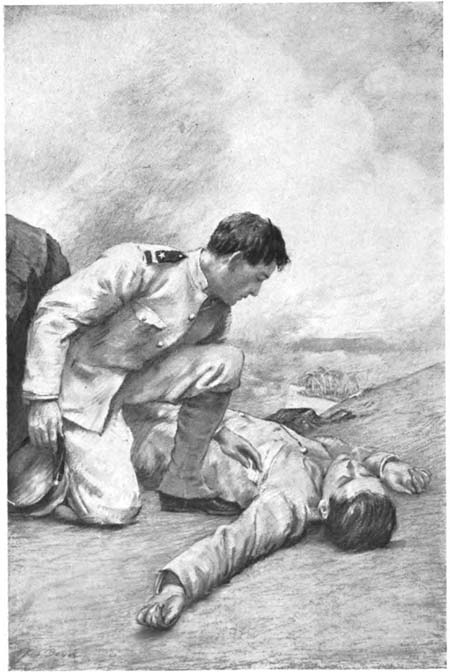
The midshipmen were so utterly astonished
at the actions of their fanatical enemies that
they could only gasp out their surprise in one
heartfelt word of relief. Then a familiar
voice at their elbow awoke them from their
stupefied inactivity. It was in Visayan and
they turned to gaze into the impassive face
of Rodriguez.
“I have ordered them to escape,” he added
in Spanish, casting a quick glance toward the
squad of soldiers. “Poor fellows, it would be
a pity to kill them, for they are but acting
under orders.”
The lads were too grateful to their rescuer
for saving their lives to make useless inquiries
as to why his influence could be exerted over
the acts of their enemy. Phil’s first thought
was for the men whom the captain had left
them to guard.
“Surround this house,” he commanded,
and the sergeant in charge gave a short command
and led the way himself to the rear of
the large native building.
“It is too late, señor commandante,” Rodriguez
said shaking his head; “they have all
escaped through the rear door and are by now
safely away.”
The midshipmen ran quickly up the steps
and gazed disappointedly into the gloom beyond.
The floor still lay at the bottom of the
cellar, the bamboo spears sticking half-way
through, but the natives had gone. The back
door stood open and to the ground was a jump
of twenty feet. They had safely escaped while
the lads were engaged defending themselves
against the attack of the bolo-men.
“I am on my way to see General Wilson,”
Rodriguez announced after a search had failed
to disclose any signs of the fugitives, “and
offer my services.”
“Do you mean that you will fight with us
against the insurgents?” Phil asked in glad
surprise.
“Yes, from now on I shall aid the Americans
to restore order in the island of Kapay,”
Rodriguez replied, pleased at the cordial reception
given him by the two midshipmen.
Together the party made their way back to
headquarters in search of Captain Blynn.
“It was providential that I happened
along,” Rodriguez said after they had passed
through the sentries; “those bolo-men knew
me and obeyed my sign. I see,” he added smilingly,
“that you are already arresting the traitors.”
“We were not very successful with Señor
Cardero and his friends yonder,” Sydney exclaimed
ruefully, “but I suppose we should be
thankful to have gotten off so easily.”
“Cardero is one of the craftiest of our outlaws,”
Rodriguez returned. “It is a marvel to
me how he could have remained unmasked so
long. Of course,” he added, “I have known
of this intrigue for some months, but until
they deliberately plotted against my life I
could not betray them.”
“Have you discovered who is the Katipunan
leader who tried to murder you last night?”
Sydney asked excitedly.
“Yes,” Rodriguez replied. “You have
doubtless guessed that he was Espinosa. I
know it now for sure. He has gone to Matiginao,
where there is a strong fort, and is in
command of all the insurgent forces there.
The bullet only crippled him last night, and I
hear he is rapidly recovering. General Diocno
was murdered last night in his bed and no
doubt I should have shared the same fate.”
They were by this time at the headquarters
building, and were glad to find that Captain
Blynn had returned. The midshipmen informed
the army man of their luckless adventure
and stood in silence expecting to hear his
harsh rebuke for allowing such important
prisoners to escape, but he only grasped their
hands and congratulated them upon their rare
good fortune.
“By George,” he exclaimed excitedly,
“we’ve been contentedly living over an active
volcano. It’s a marvel we haven’t all
been massacred long ago.
“Every native of any consequence in the
town has departed,” he added sadly.
“Rodriguez with you, and wishes to aid
us?” he cried gladly, as Phil told of the intention
of the wealthy native. “Well, that
certainly is cheering news.”
Rodriguez came into the office and stood
with dignified bearing before the big judge-advocate.
“So you are tired of being neutral?” the
army officer said pointedly in Spanish. “Do
you wish to occupy the position just vacated
by our mutual friend Espinosa?”
Rodriguez drew himself up proudly while the
midshipmen gasped at this harsh arraignment.
“I do not blame you, señor,” the native answered,
no evidence of anger on his placid
face. “I know that you can have but little
reason to trust the honesty of the men of my
race. But I do not desire a position. I am
now ready to take the field with my men,
heretofore neutral. I have three hundred
rifles.”
“You are ready then to take the oath of
allegiance?” Captain Blynn asked in official
tones.
“Yes, señor, and keep it,” Rodriguez returned,
his eyes unflinching.
“Have you any news that will lead to our
knowing the whereabouts of Lieutenant Tillotson?”
Blynn asked.
“Ah, I have,” the native answered eagerly.
“I was about to ask you—my spies report a
captive with Espinosa.”
The Americans gave sighs of relief. At
least Tillotson was alive.
General Wilson received Señor Rodriguez
with marked courtesy and appointed him on
the spot a colonel in command of his own
men whom he offered to enlist as native
troops, rationing and feeding them from army
funds, but Rodriguez declined the latter,
agreeing to defray all expenses.
The midshipmen insisted that their new
ally should go down to the dock and inspect
the gunboat, so after explaining to General
Wilson that they would like to be absent for
a few days on reconnaissance work, the three
strolled leisurely down the street.
“Where is Colonel Martinez?” Phil asked
after they had arrived on board and the
Chinese servant had brought refreshments.
Rodriguez shrugged his shoulders and
pointed toward the interior of the island.
“Will he serve under Espinosa as leader?”
Sydney asked incredulously.
“Who knows?” Rodriguez answered evasively.
The lads saw that their friend had reasons
for being non-committal and tactfully ceased
their interrogation, yet inwardly they were
consumed with curiosity. Espinosa had attempted
to kill Colonel Martinez on the
morning of Blynn’s attack, and now would
they serve amicably side by side against a
common enemy?
The hour for lunch arrived, and as
Rodriguez was not leaving for several hours
to return to his home up the river he gladly
accepted the midshipmen’s pressing invitation
to eat with them.
Phil had made up his mind to explore the
river, though this idea was unformed in his
mind when he left headquarters.
During the meal the midshipmen questioned
their guest about Espinosa’s impregnable
stronghold and of its approach by
water.
“There is a trail from my ranch to the
foot of the mountain,” Rodriguez replied
thoughtfully, “but it will be filled with traps,
and will be dangerous if Espinosa hears an attack
is to be attempted. The river flows
through a narrow gorge at Matiginao, and
from the cliffs huge boulders can be dropped
into the river many hundred feet below.
“The gunboat!” he exclaimed in amazement,
after Phil had questioned in regard to
the depth of water. “If it were possible!”
Rodriguez glanced admiringly at the heavy
cannon mounted near him. “Yes, with this
gunboat in the river the tops of the cliffs
could be swept, and soldiers could scale the
difficult trail unopposed, and once through
the narrows the trail leading from the stronghold
could be commanded by the cannon to
cut off the retreat of the insurgents. It is
wonderful! But the bridge, Señor Perry,”
he ended, his voice betraying his sudden disappointment;
“it is strongly built and a gunboat
cannot pass.”
“If I find there’s water enough to float
the ‘Mindinao,’” Phil replied assuredly,
“the bridge will not stand in the way long.
“Does your daughter know the country?”
Phil asked earnestly.
Rodriguez gazed a full minute at his questioner
before he answered.
“Every foot of it,” he added; “she was
born near the stronghold. But what is your
intention, señor? This is no work for a
woman.”
Phil would willingly have bitten off his
tongue for having led him into such an embarrassing
situation. He could not tell Rodriguez
that he wanted Maria because she
alone would he trust as a guide on the perilous
mission which he had made up his mind
to make.
Major Marble fortunately arrived at this
moment and saved the lad from becoming
more deeply involved. He gave them the
latest news.
“Tillotson’s father is keeping the wires
hot,” he told them. “We are ordered to spare
nothing to recapture him, but of course we
shall do that anyway. The general has wired
back the good news the señor has brought, that
Tillotson is believed to be a prisoner and alive.”
Before the party dispersed, Phil confided to
his hearers his plan to explore the river and
his intention to start that very night.
“Then you will visit me on my ranch?”
Rodriguez exclaimed gladly. “Everything I
have is at your service,” he added with the
grandiloquent air of a Spanish gentleman.
Phil nodded gratefully, realizing that unlike
the Spaniard, whose form of address the
native copied, Rodriguez made no empty offer.
“I believe,” the lad continued, a spark of
enthusiasm in his voice, “that a gunboat of
the tonnage of this vessel is capable of reaching
the insurgent stronghold.”
“If you can accomplish that,” Major Marble
exclaimed excitedly, “you and your ‘Mindinao’
will make an enviable name for yourselves,
for once that stronghold is taken we
shall have many surrenders throughout the
island.”
“Why not force the insurgents to concentrate
on Matiginao,” Phil asked earnestly,
“and attack them there?”
“The general has already sent out orders,”
Major Marble told them, smiling at the lad’s
eagerness, “to attack the insurgents wherever
they can be located and for all the troops to
concentrate on Palilo, leaving small garrisons
in the towns to guard the peaceful natives.
He is working up a big plan to attack this
stronghold with a large force, and will undoubtedly
take the field in person. He is determined
to rescue Tillotson, and will give
Espinosa no rest until he is captured or
killed.”
The midshipmen listened in delight to this
plan, which fitted in so well with their own
ideas.
The major soon departed, promising short
work in destroying the bridge if the lads discovered
the river to be navigable above the
house of Rodriguez.
O’Neil was ordered to have a boat’s crew of
four men ready to leave the gunboat at one
o’clock at night. The distance to Rodriguez’s
ranch was somewhat over fifteen miles and the
lads did not desire to be seen, so they would
pass at night and be safely within friendly
land by sunrise. Rodriguez left them soon
after to return by land and promised a hearty
welcome on their arrival up the river.
Promptly at one o’clock the expedition
started. O’Neil had provided the usual gear
for surveyors; a compass, a lead line, and also
a rifle for each man and a revolver for himself.
Silently they shoved off and rowed with
muffled oars up the river, and under the
bridge, built substantially in the days of the
Spaniards. “A few charges of dynamite
would settle it,” Phil thought.
Already O’Neil had uncoiled his lead line
and was sounding in the channel of the river.
“It’ll be a cinch, sir,” the boatswain’s mate
exclaimed after several soundings had given
him no less than four fathoms of water.
“Seven feet is all we need and we can carry
that for miles until the mountains commence
to go up steep; then there’ll be rocks to look
out for.”
Mile after mile was pulled in silence except
for the light dip of the oars and the dull, almost
soundless splash of the lead as it was
heaved a short distance forward of the boat.
The midshipmen gazed with apprehension
at the forbidding banks of the river. The
rank tropical foliage would conceal an army.
Riflemen might lie concealed and fire without
the slightest fear of discovery.
Gradually the river narrowed, but the depth
of water did not grow less.
It was just before dawn when the boat arrived
at the bend behind which, by the description
given them, would be the landing
pier of the Rodriguez ranch.
In a half hour the boat was being cared for
by one of the many willing attendants and the
sailors were escorted to the palatial residence
of Señor Rodriguez.
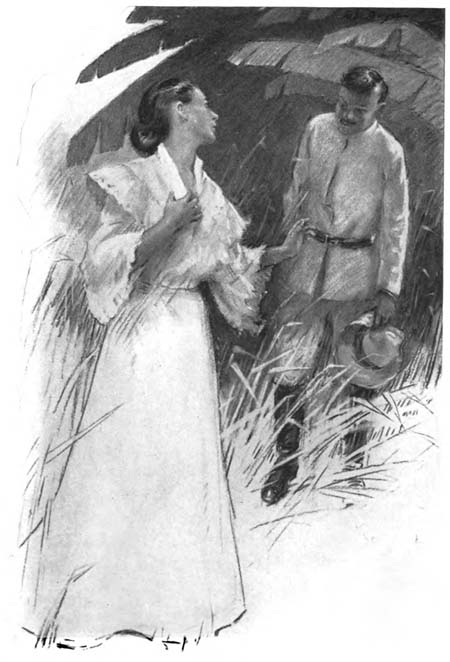
It was the señorita who came first to meet
her old friends.
“Now we are fighting together,” she exclaimed
gladly, “and I would like to go out
as a man and help.”
Phil thought that nothing so far had deterred
her. She had seen as much fighting as
most men and had withstood it bravely, and
he said so to her.
“You might be valuable, señorita, to put
courage in men’s hearts,” Sydney added smiling,
“but you would not be very formidable
as a soldier.”
Maria bit her lips vexedly.
“I can shoot as well as a man,” she cried half
angrily, “and I can ride a horse and paddle a
canoe. What more is needed?”
“Something which is not in your makeup,”
Phil answered admiringly. “You are
not vindictive and are not cruel. But you can
do us a favor, if you will. We want to explore
the country between here and Matiginao.”
Maria clapped her hands with joy.
“I know every foot of the country,” she
cried eagerly. “You couldn’t have better
guides than my little brother and I. But,”
she added, her voice becoming lower and a
fear in her eyes, “my father is now an enemy
to the ladrones and insurgents, and it is unsafe
to wander away on the lonely trails.”
Phil and Sydney exchanged glances as
much as to say, “There is your woman’s argument.
One moment she wants to fight and
the next she speaks of danger.”
Señor Rodriguez welcomed the midshipmen,
and together all sat down to a large
table where a delicious breakfast was served.
Phil saw his men were provided for, as he
intended leaving them behind, and after
breakfast Maria led the party out where
five finely bred horses were held by native
grooms.
Maria and Juan, who sat his pony as gracefully
as if he were a part of the animal, led
the way across the open fields surrounding
the ranch houses. Then they plunged into a
path cleaving the giant trees of the tropical
jungle. Limbs of trees brushed their faces
and great care was necessary to prevent themselves
from being unhorsed.
Phil’s idea was for the boat to wait until
dark, and then row up the river as far as
possible and return by morning, in order
that the general could be informed of the
feasibility of the plan and the work of destroying
the bridge started. His party, meanwhile,
were bent on following this trail
toward Matiginao, to reach the ranch before
the boat and wait for it. He realized that
they were running a great risk, but he believed
the necessity for the information was
worth the risk run. The trail led mostly
within sight of the snake-like river. They
passed many dwellings, most of them deserted
of all save hungry mongrels and starving
pigs.
“This seems to be a fine trail,” Sydney said
surprisedly, as they walked their horses two
abreast.
“It leads but five miles further,” Maria
replied, “and from where it ends, all other
trails are those made by animals, and followed
seldom by men.”
At a brisk trot Maria started ahead. The
jungle bent away from the road, leaving a
high arched canopy over the heads of the
travelers, through which the tropical sun
shone with sullen impotence.
“There is a small bungalow up here,” the
girl announced in pleasurable anticipation.
“We shall have our lunch there. Before the
big house was built we lived there.”
“How long has it been since you were
there?” Sydney asked in sudden anxiety, the
fear entering his mind that it might now
have other occupants.
“Not for years, señor,” the girl replied in
a low voice. “It is very lonesome, besides
there are many pulijanes[3] in the mountains.”
The house soon appeared through the thick
grove of cocoanut palms with its unkept lawn
sloping gently to the river. The grass in
front of the house was overhead high, and
everything had grown wild and in luxuriant
profusion. The house itself was in ruins.
While Maria and little Juan had taken
charge of the horses and tethered them amid
a good repast of alfalfa, the two lads strolled
down to the river.
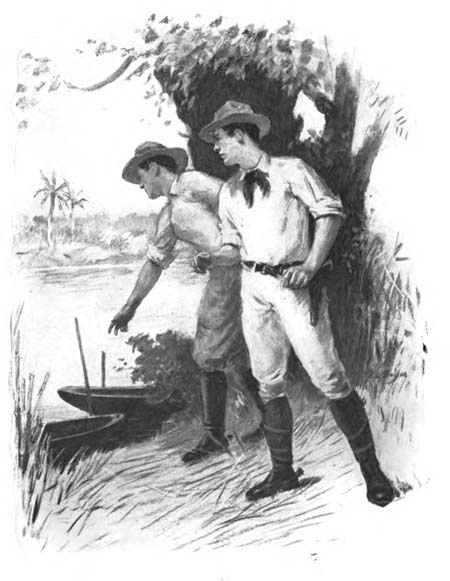
“Hello, here are some canoes!” Phil exclaimed;
“and they’ve been tied here recently,”
he added anxiously, as he saw clearly
the fresh footprints and the grass trodden
down near the landing.
“HELLO, HERE ARE SOME
CANOES!”
The lads’ intention had been to investigate
the depth of the water in the river, but their
startling discovery made them forget all else
save the visible evidence that a small body of
men had recently landed at this very spot
and had taken the almost obliterated trail to
the abandoned house. Maria and her brother
might even now be prisoners among their
enemy. The two midshipmen gazed at each
other through eyes wide with apprehension.
What was to be done?
“We can’t desert the girl,” Sydney declared,
gazing at the trodden grass. “Otherwise we
might reach the horses and escape before they
discover us.”
“Come,” Phil exclaimed, “there are not
many of them, and maybe,” he added reassuringly,
“they are not all armed.”
The two lads walked noiselessly toward the
house along the dim trail.
The building was now in plain sight. The
wide porch with its profusion of clinging
vines was deserted. The long flight of bamboo
steps was half in ruins. To the right not
a hundred yards distant their horses were
standing, their noses deep in the rich grass.
At the foot of the steps the midshipmen
halted. There was a mysterious silence in
the air about them and they imagined that
from the deserted building unfriendly eyes
were peering down upon them.
Phil gave a sigh of relief as he saw Maria,
leading little Juan, come slowly through the
tall grass toward them from the neighborhood
of the horses. He made up his mind
quickly. Nothing further could be gained
here, and the evidence that others had been
on this spot very recently was too strong not
to take the warning. He caught Sydney’s
arm and wheeled him away from the house.
The lads had not taken a half dozen steps before
a shrill cry from Maria riveted them in
their tracks. Over their shoulders they saw
that now the porch was filled with natives
who were pointing their rifles at them menacingly.
“Come on, we might as well face them,”
Phil whispered, his teeth tightly clenched
and with his hand on his pistol.
Turning, Phil led the way back to the
steps, and there he halted, glancing inquiringly
at the unfriendly guns covering him.
A native, apparently an officer, dressed in
a dull gray cotton uniform, walked slowly toward
him down the rickety steps.
“How dare you insult me and my friends
on my own door-step?” Maria’s voice was
high pitched in anger. “These gentlemen
are my guests. By what right are you
here?”
The Filipino officer had stopped half-way
on the steps in surprise, his revolver held in
front of him. Unconsciously he dropped its
muzzle toward the ground and regarded the
girl in unfeigned admiration.
“Pardon, señorita,” he said apologetically,
using the Spanish of the higher classes of
Filipinos. “You, then, are Señorita Rodriguez,
and I ask your forgiveness for my rudeness.
I thought these señores,” indicating
the two midshipmen with a nod of his head,
“were Americans and my enemies.”
Phil’s ears were startled by a loud peal of
laughter, and he gazed in almost horror at
the girl, believing that she had become
hysterical. But a glance at her smiling face
showed that her nerves were well in hand.
An angry flush suffused his face as it crossed
his mind that this was a trap of her own
laying. But he blamed himself instantly for
even entertaining such a thought. What
would she say? She must acknowledge that
he and Sydney were Americans, naval officers,
though they were not in uniform, having on
khaki riding suits. Phil’s hand slowly drew
out his revolver from its holster, while his
eyes were turned now on the averted face of
the native officer.
“From what part of the island have you
come?” Maria asked quickly, the smile of
superiority still on her face and Phil saw that
to the native the smile was disconcerting.
“I am just from Matiginao,” he replied.
“I came for fresh meat. To forage on your
father’s land.”
The smile died on Maria’s face, but luckily
the native had withdrawn his eyes and was
regarding closely the young men before him.
Maria felt that the Filipino officer must
know of her father’s enmity to his new
leader, Espinosa. Then as the native’s eyes
again traveled to her face the smile reappeared.
“I see all white men are to you Americans.
These señores are my guests. I vouch for
them,” she told him in a confiding voice.
“It was a natural mistake for you to make,
Señor——” she stopped questioningly, and he
supplied the name. “Salas, colonel in the
Filipino army, señorita, at your service,” he
said bowing gallantly.
Maria had not guessed at the officer’s
identity although she knew most of the important
leaders, having known them as a girl
at her father’s house before the war had begun.
Now the mention of his name almost
made her heart stop beating. This frail creature,
with the face and figure of a boy, was
feared by all who had fallen under his control.
He had won the unenviable reputation of
being the most cruel of the insurgent leaders,
first in Luzon under Aguinaldo and then on
the island of Kapay. He was scarcely older
than Phil, and yet he held the rank of colonel.
“Your name, señor,” she smiled, “is one
well known throughout Kapay. In appearance
you are not the ogre that you are
painted.”
Colonel Salas’ white, even teeth gleamed between
his thin lips. He felt himself the
master of the situation. Here was the proud
daughter of Rodriguez complimenting him.
His small soul was nourished by the thought
that he was feared by all.
“Then, señorita,” he said, “if you do not
consider me an ogre, will you and your English
friends accept the offer of a share in my
frugal meal? It is now ready inside.”
The midshipmen had watched with beating
hearts this plucky girl’s brave fence with the
subtle native and as he pronounced the word
English he glanced at the silent lads. Phil
thought he saw a gleam of joy in his cruel
eyes.
“They do not speak Spanish?” he asked,
shrugging his shoulder expressively as much
as to answer the question himself in the negative.
It was better so; one could play the
game better than two and the lads now knew
that Maria was an adept in diplomacy, and
could be depended upon to make a better and
intelligent fight for their lives. That their
lives were in danger was but too evident to the
lads. The native soldiers still covered them
with their rifles, and Colonel Salas had moved
to Maria’s side as they had talked, leaving the
line of fire quite clear. A word from him and
a score of bullets would be tearing through
their bodies. Did the officer believe that they
were English? Had he already seen through
the deception, and made up his mind to
maneuver so as to kill them at the least risk
to himself and men? Phil gauged the distance
between himself and the insolent face of
this young colonel and resolved that the word
of command to his men to fire should be a
dear one for the smiling colonel.