This ebook was created in honour of Distributed Proofreaders’ 20th Anniversary.
The Project Gutenberg eBook, A Twentieth Century Idealist, by Henry Pettit
Note:
Images of the original pages are available through
Internet Archive. See
https://archive.org/details/twentiethcentury00pett
A TWENTIETH CENTURY IDEALIST
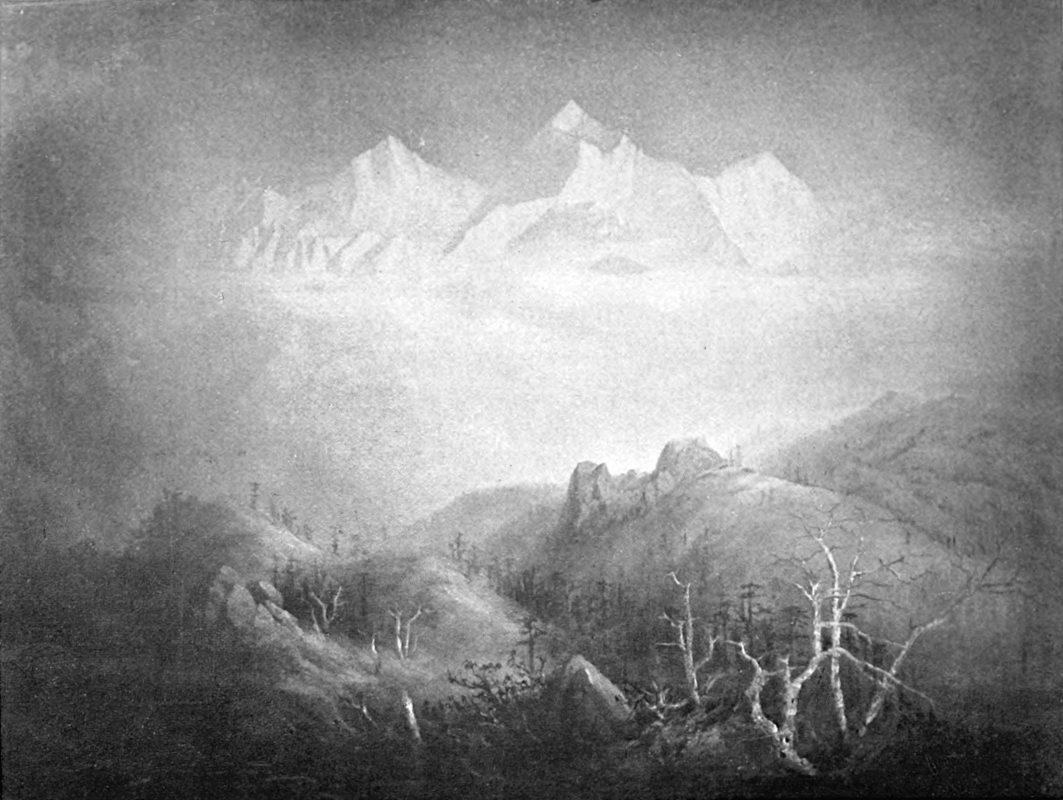
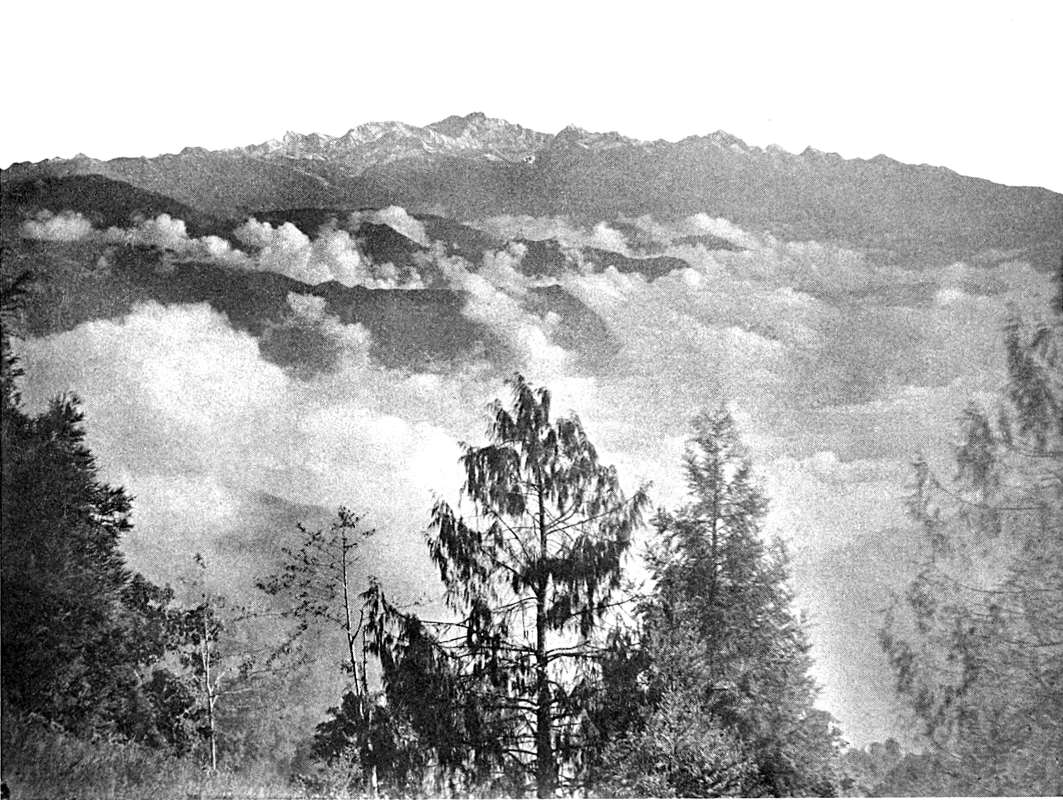
View from Pinnacle on Roof of Cathedral—the Delectable Mountains beyond. Among the Himalayas. Supposed highest summits on the earth’s surface. Elevation, 29,000 feet. From near Sundookphoo, 1885.
BY
HENRY PETTIT
Under the Surface of the Ordinary Life Lie Great Mysteries—
The Real Part of Man Is in His Ideals
“Nature herself is an idea of the mind and is never presented
to the senses. She lies under the veil of appearances, but is herself
never apparent. To the art of the ideal is lent, or, rather,
absolutely given, the privilege to grasp the spirit of all, and bind
it in a corporeal form.”
“Art has for its object not merely to afford a transient
pleasure, to excite to a momentary dream of liberty; its aim is
to make us absolutely free. And this is accomplished by awakening,
exercising, and perfecting in us a power to remove to an
objective distance the sensible world (which otherwise only burdens
us as rugged matter, and presses us down with a brute
influence); to transform it into the free working of our spirit,
and thus acquire a dominion over the material by means of ideas.
For the very reason also that true art requires somewhat of the
objective and real, it is not satisfied with a show of truth: it rears
its ideal edifice on truth itself—on the solid and deep foundation
of Nature.”
—From Schiller’s The Use of the Chorus in Tragedy.
PROLOGUE — I INQUISITIVE ADMIRATION
A TWENTIETH CENTURY
IDEALIST
THERE certainly is a subtle charm from personal intercourse
with those who seek a comprehensive view
of life, and strive to live according to their own ideals.
People who live upon broader lines than their neighbors are
apt to be interesting from that fact alone, and the charm
becomes quite fascinating when these ideals take form and they
practice what they profess. Even if they do not succeed
according to our notions, and fail to grasp until late in life
some of the profound concepts which underlie the manifest
workings of the mind of nature, the effort on their part counts
in their favor—their actions speak louder than words.
The Doctor was in his library when he mused thus. Books
upon peculiar subjects lay around him, some open, others
closed; and his eye fell upon a few articles which had been
selected for their special significance quite as carefully as the
books. The Doctor was much interested in what he called
“the hidden meaning of things,” and the character of his
library, with its peculiar contents, showed the fact.
Putting aside his cigar, he looked across the room, as if to
give audible expression to his thoughts, towards a younger man
of quite a different type, an individual whose very presence
suggested he had not ignored athletics while at college, even if
the studies had been exacting.
The Doctor was about to call him by name, when he hesitated,
his deeper interest in the young fellow asserted itself;
he concluded to take a good look at him first, and avoid if
possible any error in approaching the subject he wished to
bring up. He already knew him so well that it did not take
long to recall certain facts bearing upon the situation.
Paul was not as a general thing given to bothering about
hidden meanings. His diving below the surface had been
chiefly as a swimmer, from early boyhood until more recent
experience. He possessed a keener appreciation of surface
values and the exhilaration from a good bath rather than what
he might bring up by deep diving. But being young, energetic,
and sincere, his very energy itself was bound to bring him
down to the verge of deeper experience. In fact as the Doctor
looked at him he appeared like unto one standing upon the
rockbound coast of the ocean of life ready to take the plunge,
whenever—he felt like it.
“Take things as they are,” was one of Paul’s favorite
expressions.
The Doctor concluded he would, and broke the silence:
“How did you enjoy last evening?”
“Immensely.”
“Thought you would.”
“Yes? Greatly obliged for the introduction,” and Paul continued
examining some illustrations in a periodical apropos
of the coming coronation in England.
The Doctor determined to rivet his attention.
“I admire Adele Cultus greatly, don’t you?”
“No doubt she would look well, wearing a coronet like this—look
at it.”
The Doctor did not look, but continued:
“She certainly has some ideal of her own about life in
general, and, I suspect, about herself in particular.”
“Shouldn’t wonder,” said Paul, laconic.
“But she is thoroughly sincere about it.”
“Possibly, but last night the sincerity was all on my
side.”
“How so?”
“Well, I would have danced with her the evening through,
if she had let me—she loves dancing.”
The Doctor’s eyes twinkled: “Don’t you think she is a
striking personality?”
“Striking? Oh, yes! gracefully so, deux-temps spirituelle.
I felt the effect at once.”
“In character?”
Paul smiled. “I call it strikingly practical—no nonsense;
she wouldn’t let me, and that settled it.”
“Of course she had her own way—at a ball,” remarked the
Doctor dryly.
“Oh, of course! of course! She certainly would support a
coronet first-rate; it would not be the coronet’s part to support
her.”
“No doubt you are right, Paul. I was only asking some
test questions,” and the Doctor subsided, as if he had more
to say but would not venture.
“Test questions? Whom were you testing?” asked Paul.
“Both of you,” said the Doctor.
“Where did you first meet her?” asked Paul, still examining
the periodical.
“Where?—we didn’t meet! I heard her voice through the
crack of a door.”
“H’m!” And Paul put down his book.
“It was while I was convalescent at the hospital after that
bicycle accident. She was a volunteer nurse, and a remarkably
good one among not a few devoted women. You were
right about her being practical and spirituelle, and so was I
about her being spiritual.”
Paul took up a cigarette. A cloud of smoke enveloped his
head, his facial expression hid behind the cloud. The Doctor
continued:
“You know it takes a fair combination of the practical and
spiritual to make a true nurse?”
Paul agreed mentally, but all the Doctor heard was a voice
from behind the cloud, “she dances like an angel.”
Angelic dancing not being in the Doctor’s repertoire of
investigation, he changed to another point of view.
“While I was convalescent at the hospital it was very amusing
to read hands by palmistry. I read her hand.”
“You held her hand, you mean?”
“Of course.”
“You don’t mean to tell me you read her character by the
lines written in her hand! Nonsense!”
“I did not. I merely noticed the natural tendencies of the
individual as shown by the form of the hand. Her characteristics,
not her character.”
“I don’t believe in it,” remarked Paul, positive.
“You don’t? Well, just swap hands with some other fellow
and observe the consequences.”
Paul laughed. “Excuse me—quite satisfied with my own.”
“Just so,” said the Doctor, “and there is good reason why
you feel the satisfaction; the consequences would be not only
absurd, but positively disastrous.”
Paul began to feel interested as the Doctor forced the practical
issue upon his attention.
“The consequences of any change from the special form
of your own hand would only prove that the other fellow’s
hands do not fit your personality.”
Paul, who really knew much more about persons than personalities,
blew another cloud of smoke towards the ceiling,
and listened.
“You know, Nature never makes any mistakes.”
“I hope not, or I’m a goner,” quizzed Paul.
“And personality is really made up of three in one, a trinity
of the physical, mental, and spiritual. You’re a sort of trinity
yourself, my boy. You’ll find it out some day if you don’t
swap hands with some other fellow and spoil your own combination.”
“What did you learn by holding Miss Cultus’ hand?”
The Doctor was a little slow in replying, in fact, choosing
which of the many things he had observed was the particular
one to which he had best call Paul’s attention. Then he spoke:
“She shows marked individuality based upon rather a rare
type, yet a mixed hand; most Americans and Chinese are
mixed. You know, pure types are very rare.”
“You don’t say so?” quizzed Paul; “‘mixed,’ and like the
Chinese. What a wonderful insight for diagnosis palmistry
possesses!” The Doctor continued:
“In the main, her hand manifests the exceeding rare psychic
type,—that is, she loves and seeks the truth for its own sake.”
“There! I told you she was angelic, a practical angel,”
interrupted Paul. The Doctor kept straight on:
“And with this there are other features indicating both the
useful and the philosophic elements in her make-up, very
strong, each in its own relative domain.”
“Extraordinary! truly!” quoth Paul. “The useful must
have come to the front when she was acting nurse, and the
philosophic when she told me we had danced enough for one
evening. As to the psychic,—let me see! the psychic!—well,
to be frank, Doctor, I can’t say I have seen that as yet.”
“Oh, yes, you have,” thought the Doctor, “or you would not
be showing the interest you are taking just now.” This sub
rosa, and then he turned the topic once more:
“Where do you suppose she got those traits, so forcible in
combination?”
“Got her hands?” exclaimed Paul the practical. “Inherited
them of course, even the skin-deep profundity of palmistry
is not required to guess a diagnosis for that.”
The Doctor’s eyes again twinkled. “Whom did she inherit
them from?”
“Father and mother,—what nonsense to ask!”
“Why not her grandparents?”
“Give it up,” said Paul. “Take things as they are.”
Now, the result of this decidedly mixed but suggestive conversation
was to excite curiosity in both the Doctor and Paul.
Not that they formed a conspiracy to learn about Miss Cultus’
forbears; quite the contrary. Simply by friction in time they
learned something of the natural causes which had produced
her charming personality, so attractive to all who met her.
That they both had been led to respect and admire her upon
short acquaintance was only too evident,—on the surface.
What was not quite so evident, for neither of them had said
so, was that each had noticed her devotion to her mother,
constant, ever thoughtful, as if to make her appear to the best
advantage: as to her father, she simply idolized him.
Some of the items they learned had best be stated at once,
for her ancestors, in immediate relationship, certainly did cast
their shadows before; and the blending of the shades and shadows
later on in her life, formed a character that was lovely
and inspiring.
II HOW THE PROFESSOR WAS WON
FEW who knew Mrs. Cultus in after years, when as an
active woman of the world she displayed much tact
dominated by kindly consideration for others, would
have suspected the peculiar phases of development through
which she passed in younger days, during the immature
period of youth when the same natural tendencies took different
forms, and were so different in degree. From one point
of view the difference in degree produced a difference in
kind—she appeared to be a different sort of woman. What
she did when young was often mistaken for selfishness alone,
whereas the same natural tendency, operating as reasonable
ambition, after finding its true sphere, exerted a far nobler
activity, profoundly different in both degree and kind. Not
a few expressed surprise when her ambition to lead became
coupled with a determination to help others along at the same
time. Always ambitious, and with strong social instincts, she
read the book of life rather than literary productions; but
when she did deign to peruse a popular novel, her criticism
punctured the absurdities of modern snap-shot incongruity.
She was never selfish at heart, but she certainly did have a way
of using the world without abusing it, personally; and her
own way of expressing herself.
As to the Professor, her husband, he found himself going
to be married without having fully analyzed the case.
Charming manners and cultivated tastes, largely inherited
from antecedents in the professional walks of life, had led
Professor Cultus to fascinate and charm not a few during his
youth and early manhood,—what more natural! He was slow
however to realize that in so doing he might encounter
another, gifted as himself yet of an entirely different type,
complementary; and so it came to pass.
While returning from a congress of anthropologists which
met on the Continent, where there had been much discussion
of the genus homo through many stages of development, the
Professor was fated to be himself taught a lesson in anthropology
which never after lost its hold upon him. It gave him
much subject for thought, but not exactly of the kind suitable
for a technical paper before the next congress.
He met an individual whose antecedents no doubt did have
the same number of fingers and toes as his own, but whose
“thinking matter” in her brain seemed to operate differently
from his own; and whose experience in life had been very
different; one of whose position in the chain of physiological
development he knew much intellectually, but whose innate
appreciation of facts and ability to perform he had no adequate
realizing sense whatever; her avenue to truth, through heredity,
being quite different from his own.
They were fellow passengers upon one of the palatial
steamers which then first appeared upon the North Atlantic,
and it took her only the ten days’ voyage to capture the
Professor, his charming manners, his intellectual efforts and
his anthropological researches, all complete.
How did she do it? and what did she propose to do with
him after she got him?
The answer might be given in a single sentence: she met
him first with his own weapons, charming manners and an
intellect as bright as his own; then caught him because he
was objectively philosophic and for pure science, so called,
while she was subjectively philosophic and for pure material
results. She was quite as philosophic as he was,—also knew
chalk from cheese when she saw it. The Professor preferred
to analyze the composition before forming an opinion. While
he was analyzing, she so mixed the ingredients in his mental
laboratory that he could no longer differentiate or reason upon
the subject of a marriage at all: and in truth it must be stated,
his own youth was not much inclined that way either. His
heart got the better of his head.
Thus was the youthful Professor actually forced to accept
the situation philosophically. He flattered himself that in
time he would be able to investigate more fully, and make
any needed adjustments later on. She flattered herself that
she would be quite equal to any emergency that might arise,
as she proposed not only to push him to the very front among
his contemporaries, but also use his exalted position to attain
her own social ends.
When they first met, both away from home, in mid-ocean,
their mental activities alert, stimulated by what each had
experienced abroad, and little on hand to occupy the time, the
conditions were favorable. Even the menu on board ship
was highly seasoned after its kind, during the day, and after
dark the stars twinkled doubly in the heavens above, and the
mysterious depths below, while they looked at “the Dipper”
together.
No sooner did the charmingly vivacious young lady observe
the Professor’s attractive appearance than she made up her
mind; and noticing that he sat at the Captain’s table as one of
the selected few on board, she determined to know him personally.
Professor Cultus in young manhood certainly did look
handsome, of the intellectual type. His dark eyes were noticed
by others besides Miss Carlotta Gains. The prospect of this
new acquaintance was quite enough to cause her to exert herself,
so she frankly told Fraulein Ritter, under whose care she
was returning home, that she would like immensely to have
that gentleman presented to her.
Carlotta had been to Berlin, taking lessons in singing under
Fraulein Ritter’s direction and chaperonage; had been under
rather strict surveillance while studying, and had not much
enjoyed that particular phase of a young woman’s student
life in Berlin. When once clear of the Continental proprieties,
the American girl began again to assert herself. Carlotta was
certainly fortunate in having such a one as Fraulein Ritter
to consult, for she in turn was quite an authority in her own
branch. Educated at Weimar during the days of Liszt’s
supremacy, Fraulein Ritter had no small reputation afterwards
from her publications relating to music in general and
voice culture in particular. Incidentally she had met not a
few of the members attending the congress,—in fact, Professor
Cultus had already been presented to her in Berlin; so there
being nothing to shock Fraulein’s German sense of propriety
in granting Carlotta’s request, an introduction followed.
“Professor, allow me to present you to my pupil, Miss
Carlotta Gains. Possibly you have heard of her father,
Mr. Anthony G. Gains, of Silverton, Eldorado.” Why Fraulein
should have supposed that any knowledge of Anthony
Gains out in Eldorado could possibly have reached the
Professor can only be attributed to the benign influence
of Carlotta’s lucky star, and the other well authenticated fact
that “the world is not so big after all.” As luck would have
it, the Professor had known Mr. Gains fairly well, and not so
many years back, when at the early stage of his career he had
been called upon to give expert testimony in a certain law
suit involving technical information. The Professor had
found Mr. Gains a first-rate, all-round, square-minded American,
from his point of view, and Grab Gains, as his Eldorado
friends dubbed him, had much appreciated the young scientist’s
unbiased clear statements as a witness. Being astute and
practical in business, upon gaining the law suit he had given
his expert, on the spot, the biggest fee he had received up to
that time,—not for his testimony—oh, no,—for some other
work which came up incidentally, quite beyond his expenses
and regular charge.
Gains’s business foresight was not devoid of results. The
Professor at once thought he knew much about the antecedents
of the young lady, and expressed himself as delighted to meet
the daughter of his former friend. Of course he referred to
the general circumstances under which they had met, and
praised Eldorado as a locality of great scientific interest.
Miss Carlotta put two and two together, and recalled her
father’s remark that he would never have gained that case if
the Professor had not “talked science so that the jury could
understand.” The Professor seemed pleased to know it. Carlotta
at once determined to appreciate the Professor just as
that jury had done; so she immediately introduced a topic
bound to be of interest to him.
“What a success your congress proved to be, Professor.”
“Quite so,—more than we anticipated. But I did not
suspect it would attract your attention.”
“Why not? Fraulein takes all the publications; I intend to
read your paper with special interest,” her ambition leading
her more than half way.
The Professor looked quizzical. “I fear you will find it
rather slow for cursory reading.” Then his responsive manner
getting the best of him he added with considerable effect: “It
will give me the greatest pleasure to make it clear if I can.”
Carlotta took him up at once,—but on a topic she did know
something about as well as he, and stated it after her own
fashion.
“I noticed that one of the discussions was about the peculiar
costumes of certain tribes. Now, I never did understand why
the darker races should introduce brilliant colors in dress so
much more naturally and effectively than we do.”
The Professor instantly looked at her own dress and thought
it very effective, in excellent taste. Carlotta continued:
“Now, with us color is often so arbitrary, mere fashion, the
arrangement artificial, and when the thing is unbecoming you
feel just like a martyr;” then, musingly, “but he won’t find
that in me.”
Professor Cultus laughingly replied that “he really knew
little about dress”—which was a fib for an anthropologist—but
he supposed that “Dame Fashion was a capricious jade who
often made her reputation by producing whims to meet the
demand for something new; she had certainly been known
to introduce what was hideous to many, simply to cover up the
defects of a favorite patron.”
Carlotta at once thought, “Well, there’s nothing hideous
about me. I wonder what he means?”
The Professor once started, went on about the darker races
using the primitive and secondary colors only with such
marked effect; that they really knew little about hues and
shades as our civilization differentiates colors and effects. He
was then going on to add something about color in jewels
adding great effect to rich costumes, when Carlotta gave a
little start, drew her wrap about her and said she felt cold and
chilly.
Fraulein at once suggested they should leave the deck for
the saloon. Carlotta acquiesced as if very grateful, and begged
the Professor to excuse her.
Of course he did so promptly, with sympathy excited by
fear lest she might have suffered in consequence of his keeping
her standing too long in a cold wind.
Nothing of the sort. It was the reference made to jewels
by the Professor which had caused her impromptu nervous
chill. Could he possibly have noticed the too many rings she
wore and concluded she might be rather loud in her taste?
That must be rectified at once,—so Carlotta caught a chill on
the spot, merely a little sympathetic chill, but enough to get
away and arrange things better for the next interview. Certainly
her tact showed foresight as well as power to meet an
emergency from her point of view.
She knew instinctively the value of sympathy as well as
propinquity. She had gained her first point, an introduction;
now for the second, sympathy: and she was not slow to
act,—much quicker than the Professor dreamed of. She did
things first and discussed them afterwards; that was one of
her accomplishments which he often observed later on.
No sooner in her state-room than Miss Gains snatched off
every ring, all but one, a fine ruby rich in color but not too
large; “rubies never are,” she said, pensive. On this one she
looked with much satisfaction, it would meet her requirements
yet not excite suspicion, the removal of all might do so.
But why the ruby?
Carlotta was astute, like her papa, much more so than the
Professor imagined,—he learned that also later on. What
troubled her now was no new matter, and largely in her own
imagination. A biologist would have told her it was inherited.
Being a pronounced blonde of the florid type, vivacious, fond
of excitement, she had often noticed that her hands became
rather rosy in color. So the ardent yet astute Miss Gains had
evolved the brilliant yet practical idea that the ruby would be
“the very thing to throw the other red into the shade—people
will notice the ruby and speak of that.” If she could
not avoid being too rosy, in her own imagination, the ruby
should take the blame.
Carlotta was politic also, like her papa, much more so than
the Professor thought—he found that out also later on. So she
retained the ruby only, and wore a red tocque when next on
deck. She would no doubt have put on her golf jacket if on
shore, so determined was she to make those hands look as
refined as possible.
The Professor’s sympathy was now to be encouraged. If
the too many rings were to be kept out of sight, it was far
more important to keep the object of sympathy in sight. Carlotta
determined not to get over that chill too soon,—not to
remain so chilly that the state-room was the only warm place,
but just chilly enough to seek convalescence wrapped up in a
becoming garment, resting in an easy chair in some retired
corner, or on deck where the lights illumined others, and not
herself. Just chilly enough to require the little attentions of
a sympathetic friend, whose sympathy she could make warmer
as her own cold chill wore off.
Miss Carlotta was diplomatic, as the Professor also found
out. Once ensconced in that easy chair with the Professor to
keep the chills off, her success was already assured. Her
greatest triumph consisted undoubtedly in that she displayed
such a bright intelligent appreciation of the Professor’s point
of view about everything, anything from chalk and cheese to
volcanoes and earthquakes, not omitting the science of games,
especially ping-pong, and the usual dose of theosophy; and
so much policy and diplomacy as to her own point of view,
that to this day the intellectual scientist ascribes the results
primarily to his own ability in courting.
It was in fact a double game of life and chances, the game
of all games, of heart and head, that two can play at. Carlotta
won for life, whereas the Professor began by taking chances.
Propinquity at sea,—floating on the waves from which rose
Aphrodite.
Of course it became evident to the Professor that Carlotta
was precisely the person he most desired in life,—so appreciative,
intellectually bright, much knowledge of the world for
her age; and as she had incidentally remarked on one occasion,
quite comfortable as to worldly goods;—although, to be frank,
he laid little stress upon the latter at that time, having much
confidence in his own resources. He was often glad of it,
however, later on; it also proved one of the things he learned
subsequently.
Before they left the steamer there was an understanding,
and the way seemed smooth to expect a favorable consideration
from Carlotta’s parental governor. Her mother was no longer
living, which accounted for Carlotta’s being under the care of
Fraulein.
As a matter of fact Anthony Gains was not surprised in the
least when his daughter returned engaged to be married, and
easily accepted the situation philosophically; indeed, rather
congratulated himself that she had not been too independent,
like some, but deigned to go through the formalities of making
the announcement subject to his approval.
“Much better to avoid unnecessary fuss,” he said to himself,
“and it gives me a good chance to spare the Professor’s feelings.
In case they had given me the slip, I suppose a rumpus
would have been in order. Carlotta’s sensible,—I know her
well,—I’m glad she lived in the West before going to Europe.”
Her father did know her well, much better really than he who
then desired to take the chances. Papa also remembered with
much satisfaction the young scientist who had given “plain
talk to that jury.” He concluded he might be able to give
plain talk to his household if emergency required it. Finally
he told them frankly:
“Having gone through the mill myself, I guess you two can
manage your own business first-rate. I don’t suppose you
object if I coöperate.”
As his practical coöperation took effect even before the
marriage, when he settled a handsome sum upon Carlotta, the
Professor thought still more highly of his prospective father-in-law.
Not till all was over, the ceremony an accomplished fact,
and the young people off on another tour apropos of the
occasion,—not till then did Anthony Gains allow himself to
whisper in a room where there was no telephone:
“They’ll be comfortable anyhow. These scientific fellows
make so little they are not extravagant as a class. I guess it
will be all right—God bless ’em.”
Such had been an early but important chapter in the
experience of the immediate ancestors of Adele Cultus;—of
her whom both the Doctor and Paul had admired,—Paul
because she was practical, the Doctor because she was spiritual.
PART FIRST — III ADELE HERSELF
IT is not so much what was said, as who said it and how
they said it, that will convey an adequate impression of
the charm exerted by Adele upon those she met. Of
her two dozen desperately intimate friends at school, each had
been known to exclaim, “Why, of course I know her; isn’t she
just too lovely for anything?” and that covered the whole
ground.
When during college days a coterie of Juniors decided to
invite some Seniors to “a tea,”—not “to tea,” for all were
excruciatingly academic at that period, there was a spirited
debate as to the special duties of each girl during the function,
but not the slightest doubt that Adele should head the Reception
Committee. “Why, my dear, she’s just the one for that
place. Don’t you see it? We’ll show them the proper ’pose.’”
As a matter of fact, Adele did receive; also “poured out”
at times; also introduced some strangers to her own kindred
spirits to banish any feeling of uneasiness; and finally
achieved the undoubted triumph of making two girls friends
again, the girls much excited, holding diametrically opposite
opinions upon the momentous question of Cleopatra’s cruelty
to animals.
When she graduated, valedictorian of her class, she made
an address neither too long nor too short, not unlike her gown,
precisely as it should be,—pointedly academic to start with
and meet the case, then somewhat more colloquial, recalling
the good times they all had passed, and concluding with a
touching appeal “never to forget Alma Mater.” The entire
class mentally promised they never would, “nor you either,
Adele,” and she was deluged with so many future-correspondents
that the prospect became really alarming.
When she made her début, scarcely an evening passed that
some “man” did not tell her confidentially: “You look lovely
to-night, Miss Cultus;” and when upon a certain full-dress
occasion she sat with Mr. Warder on the stairway, presumably
with none but the old stand-up clock to listen, the first
remark she heard was, “Oh, I’m so glad, Miss Cultus, we can
have a chat, alone!” “Alone!” exclaimed Adele. “Why, certainly,
alone in the crowd,”—and as she drew her skirts aside
to allow four other couples and a queue of waiters to pass, her
clear responsive laugh appreciative of the situation, made Mr.
Warder enjoy the public seclusion immensely.
Evidently there was a personal magnetism about Adele
which affected all more or less, and many whose own characteristics
were totally unlike hers.
At a glance anyone would have noticed her light hair flowing
free, yet under control, tinged with sunlight, the sunlight
of youth; hers was a fair complexion like her mother’s, yet
with her father’s lustrous eyes. She was a blonde with dark
eyes; once seen, a picture in the mind’s eye.
Her father’s facial expression played over her countenance,
manifesting that responsive personal interest which drew many
to her. Her mother, as we already know, could express that
responsive attitude also, and exercise the personal influence
when she chose, but with Adele it was spontaneous, perfectly
natural, and her smile sincere, ingenuous, rather than ingenious,
one of the most precious and potent gifts a woman can
possess.
And some of her other gifts by heredity were also very
evident, but modified. Dame Nature had been exceedingly
kind, and given her as it were only those elements which
intensified the better traits of the previous generations. Her
active mind reminded one of her father’s intellectual ability
in science, but it was so modified by her mother’s more comprehensive
susceptibility and impressionability in many directions,
her worldly wisdom and promptness, that in Adele it
took a different turn from either one of the parents. Her
social instincts could not be suppressed, but fundamentally
they tended towards an appreciation and insight of the humanities
and ethical subjects rather than the material interests
one might look for in the granddaughter of Anthony Gains,
or the intellectual abstractions which might have come from
the Professor’s mode of thought.
Before graduating, some one asked her what she proposed
to do after leaving college, for all felt a brilliant career was
open. Adele was rather reserved in answering this question,
and generally replied that there was so much which ought to
be done in the world, no doubt she would be very busy. But
to her mother she confided on one occasion her innermost
thought, she “would like to work in the slums.” This so
horrified Mamma that Adele’s name was entered upon the
fashionable Assembly list for the coming season without
delay, as an antidote in case of emergency, although somewhat
premature as to time.
It would never do to oppose Adele. She was already
unaccustomed to that sort of management, and would assert
herself even if she regretted it afterwards. A compromise was
in order. She did not go to work in the slums, and did attend
fashionable functions with her mother, but after serious
conversation with her father on the subject of the practice of
medicine by women, and her own observations of the constant
demand for trained nurses who would not upset the whole
household, she concluded to look into that matter herself, and
volunteered to serve in the hospital during war times.
“I must do something to help along; and nobody need know,
unless I choose.” It was while thus serving that the
Doctor and Paul had first met her, when the Doctor was a
patient after his bicycle accident in a miniature cyclone. It
was in the hospital that Doctor Wise had first read her hand,
and made a note of it as approaching the psychic type more
clearly than any other he had then met.
From the Doctor’s point of view Adele’s hand was indeed
suggestive, but not so purely psychical as to intimate mysticism
to excess. It was rather that of a vivid idealist than a moody
mystic,—too much intellectuality in the upper part, as well
as assertion in the thumb and clearness in the head-line, not
to influence and modify the natural tendency and scope as
shown by the general form. It was not the hand of one whose
vague aspirations after the good but unattainable would lead
to extremes either in the activities of communism or socialistic
vagaries, nor in the opposite direction towards the passive life
of an ascetic. Either one would have soon disgusted Adele.
It was the hand of one who endeavored to be logical, and did
have common sense; yet in the exuberance of feeling sometimes
put her hero upon a pedestal only to find the pedestal had a
crack in it and the hero was in danger. As to the hero himself,
he was never affected; she remained true to her hero, no sawdust
in him; but she certainly did put him quietly aside on
the shelf when she found herself beyond his point of view.
She simply put him on the shelf to “think it out for himself,”
as she had done for herself,—and in consequence had more
would-be heroes following in her train, striving to catch up,
than is generally found in the domain of hero worship.
Youth has its sway. Adele was most delightfully enthusiastic
at times, often bent upon what she called “having a good
time.” Then she was a picture worthy of Fortuny’s art in a
sunny Spanish patio; but in quieter moments as introspective
as one of Millais’ peasants; rather over-confident in her own resources,
having really not met as yet any opposition worthy of
the name, unless perhaps a weak patient who refused to take
medicine. Then she took a sip herself, and told him “Now
you’ve got to take it,” and he did,—because her actions spoke
louder even than her words.
Her father had several times told her to read the world as
if it were a book, and she had heard her mother refer to
certain society leaders who acted a part that did not suit their
own style. She determined to know and read all passers-by,
from cooks with a sauce-pan to princesses with a crooked
coronet, including Tom, Dick and Harry of course; and she
found it so highly interesting, that when about eighteen she
thought she might—yes—she might, in time,—write a novel
herself; in fact she did write the title page, and the chapter on
“Direful Conflict,” in which the sauce-pan and coronet almost
came to blows. Whether to make that chapter the beginning
of her novel or the ending, proved the poser, so it too was
put upon the shelf with the heroes.
The most interesting thing to people is people themselves.
Adele’s maternal instincts told her this very soon.
Things are of real value about in proportion to the effort
they cost. Her instincts from her father suggested this, but
she did not believe it at first. It might be, but was not pleasant
to think of. She knew well enough that all that glitters is not
gold, but sometimes thought that glitter might be when it
wasn’t. When she found herself deceived in this respect her
conclusions took a pronounced feminine form of expression.
“Mother! I don’t think so very much of Mr. Upham they all
talk about. He tries to show off—absurdly condescending,
and talks as if he knew more about it than anybody else.
Nobody really thinks of what he says, only of him. I think
him a bore.”
“Well, don’t let him know it, my dear,” promptly answered
Mrs. Cultus. “One has to become accustomed to trifles. I
generally look the other way and avoid them.”
“I’m not going through the world on stilts, anyhow,”
laughed Adele.
“No, my dear, I trust not, nor on a bicycle either; neither
is becoming.”
Adele watched her father whenever they went out together,
with almost precocious interest. She wished to discover how
he made himself so agreeable to others and finally concluded
that “Father’s manners are perfection.” She followed her
father’s advice quite as naturally as she did her mother’s,
the wisdom of which often appealed to her also; but in spite
of her affection for both, she soon began to perceive there was
something much more subtle in life than worldly wisdom.
Things seen were by no means so potent as some other things
unseen. She would use the world, but not let it use her. “I
shall soon be used up myself” was the way she expressed it
after having had rather too much of a good time.
Without actually formulating the pros and cons in her own
mind, she really decided not to attempt any part unless she
could do justice to it under the stimulus of her own approval.
Things seen, and never ignored, were already becoming
subservient to things unseen.
Such was Adele as a girl, and during the few years when
her college experience was prime factor in her life.
IV ADELE HEARS THE WORDS OF A SONG
THERE was just enough of chilly winter left to make
the springtime fascinating and a wood fire still acceptable
in the cozy library where Doctor Wise and his
younger friend Paul Warder sat together expecting guests.
They occupied bachelor apartments in common. A delicious
aroma from wood logs permeated the atmosphere.
There was music also, for the eye as well as the ear. The
firelight played in crescendo and diminuendo, with now and
again marked rhythm and very peculiar accents. The sound
of wheels reverberated clearly in the cool night air and ceased
opposite the portal. An expectant waiting, but no response,
no frou-frou from silken skirts passing along the hallway as
anticipated. Instead, Benson,—Benson the butler, his countenance
a foot long.
“Some one, sir!”
“I presume so.”
“Some one, with his—his trunk.”
“His trunk!” The Doctor lowered the bridge of his nose,
and peered at Benson over his eye-glasses.
“Yes, sir! a big one.”
“What’s that for? What will he do with it? What will
we do with it?”
“Show him up, Benson,” said Paul, promptly; “trunk and
all.”
Paul’s eyes twinkled as he vanished through the doorway.
“Never heard of such a thing,” mused the Doctor, “bringing
a trunk to a musicale. Must be some mistake! Benson! I
say, Benson! Show him next door.”
“Not yet I hope,” and amid shouts of laughter in rushed
two fellows,—Paul bringing Henri Semple—“Harry”—of all
their musical friends the one most welcome and opportune.
The Doctor was delighted, and gave him a good squeeze—no
time for much else.
“Benson! put Mr. Semple’s trunk in his own room, you
know the one I mean; and now, Harry, if you don’t get inside
that trunk quickly as possible the state of the country will not
be safe, an invasion is threatened at any minute. Put on your
regimentals at once, and help us out.”
Semple, who understood the Doctor’s lingo from many years
back, took in the situation at a glance. He had hardly time
to laugh about the Doctor’s being “the same old chappie as
ever,” when he was literally thrust towards the stairway, to
follow the trunk, and put on his evening clothes.
The episode had been one of Paul’s agreeable surprises so
often had in store for the Doctor.
Semple’s name had appeared upon the passenger list of an
ocean flyer just arrived. Paul sought him by telephone,
caught him, and insisted upon his coming. Semple, already
in traveler’s shape, had “hustled” to reach his old friends.
The time was short, but Harry in true American fashion had
“got there”—that was all, with the regimentals ready to be
put on.
It is not necessary to produce the bachelor’s visiting list
and mark off all those who honored the occasion with their
presence. Paul always made it a point to have plenty of men
on hand at his entertainments; whether at chit-chat-musicale
or conversational game of whist, all went off with a rush.
Those who took their pleasure more seriously were furnished
excellent opportunity in the library, while the conversational
music-racket progressed in the parlor.
The trio, Doctor, Paul and Semple, were already standing
in line, like three serenaders in white waistcoats, when Mrs.
Maxwell was ushered in. She had kindly consented to act as
matron, knowing all so well; in fact had entertained both
Paul and Semple at her picturesque cottage, “The Kedge.”
Her vivacious presence at once brought with it a breezy
atmosphere from the romantic coast of Maine, where “The
Kedge” stood perched like a barnacle upon a boulder, and the
winds wafted white spray falling like a lace mantle upon
dahlias and nasturtiums at her feet.
And with her Miss Dorothy, her niece, whose charming
letters the winter previous from Ischl had given vivid pictures
of experience abroad, Vienna life, and Egyptian mysteries
known only to herself and the Sphinx.
A dozen or more soon followed. Conversation already at its
height when Professor and Mrs. Cultus entered, also their
daughter Adele whom the Doctor had before met under such
peculiar circumstances at the hospital. Adele looked radiant,
having brought with her an intimate friend, Miss Winchester,
for whom she had requested an invitation. The Doctor greeted
them with both hands, for he had already detected the devotion
which had sprung up between these two girls. They seemed
a host in themselves wherever they went. He made Miss
Winchester feel at home at once, and she accepted the situation
promptly; she had the happy faculty of doing that sort of
thing. The Doctor enjoyed her frankness. She was like, yet
very unlike Adele; no doubt much in common between them,
yet of a very different temperament. The inquisitive Doctor
perceived this at a glance. “Must read her hand,” he cogitated,
for his interest in Adele made him curious to know more of
the one to whom Adele seemed especially devoted.
Others dropped in later, the rooms became well filled. The
guests sought easy chairs, Paul taking special pains to see that
Mrs. Cultus was comfortably settled. Mrs. Cultus in turn had
made up her mind to hear Paul sing with the Doctor as
accompanist. She had heard that they performed “stunts,”
whatever they might prove to be, and now was her opportunity;
also, she wished the stunts just as soon as possible. “Keep it
up,” said Mrs. Cultus, sotto voce.
Of course Paul could not refuse point blank, but he must
be permitted to do so in his own way, for none knew better
than he and the Doctor that their music together was of such
a peculiar nature that unless led up to judiciously the effect
would be utterly ruined. In fact there was nothing in it but
“the spirit of the thing,” and little technique whatever except
to meet the demand of this spirit of the thing. They had
never had either time or inclination to cultivate and keep
technique-on-tap,—a thing to be turned on and off like a
fountain before an admiring public. Nevertheless, the little
they could do gave a deal of pleasure to those not already
hypnotized by digital gymnastics, or become satiated from
eating too much candy-music.
Unfortunately, Mrs. Cultus’ ideas about leading up to anything
in the domain of music had been originally formed upon
her experience when leading in the german, and in spite of
her short but higher experience in Germany, her natural propensities
often prevailed. As to any preparation of the mind
and ear for the reception of given musical sounds and kindred
forms of artistic and poetic expression, she was lamentably
wanting, in fact her tactics often little better than a box of
tacks to irritate the acuter sensibilities of those to whom she
appealed with so much apparent appreciation. Mrs. Cultus
never listened for the tone-color, simply because she could not
constitutionally; she really could not, it was not in her to
hear what she could hear.
The music commenced, and Mrs. Cultus waited for the
stunts. Henri Semple opened with some of Brahms’
Hungarian Dances, charmingly vivacious and contagious, also
played in some duets with the Doctor on Creole and Florida
negro themes. Racial and national dance music seemed not
a bad overture to harmonize with the gay spirits already in
vogue, yet lead on to something else. Herr Krantz then
favored the company with some German songs; he appreciated
the value of continuity, yet did not ignore the power of contrast.
Herr Krantz was an artist; his first song in rather
quick tempo with a dramatic climax, his second full of suppressed
emotion; each most artistic in effect. All enjoyed his
robust tenor voice, also his admirable interpretation of the
sentiment of what he sang. Mrs. Cultus and the Doctor led in
the applause; Mrs. Cultus because she detected that the whole
thing was as it ought to be, especially the dramatic climax
of the first song, and the tears suggested when the second song
died away. Mrs. Cultus was much given to applauding when
songs died away in tears, she wished the singer to understand
that he died with good effect. The Doctor admired all artistic
productions and renditions of any kind; even a good performance
on a jew’s-harp or a xylophone was appreciated by him
from the standpoint of art as art. If it did not manifest the
sacred fire of the soul above all else, it was to be enjoyed and
applauded nevertheless, as truth for its own sake, if not the
highest form of truth through musical expression. He had
heard mocking-birds sing like nightingales, yet they were not
the veritable rossignole; he had long since learned that perfect
technique was not the only way of expression, since the sacred
fire burst through all bounds and made terrible mistakes
(technical), yet was truth enduring, truth soaring towards
immortality and enduring as memory endures.
Paul in the meantime had induced Miss Winchester to
follow Herr Krantz; and since his German artistic rendition
had excited her imagination, her fingers fairly twitched with
desire to respond, ready to the interpretation of what she felt.
She knew she could play well because in the mood, delicious
sensation.
Miss Winchester’s talent for melodic expression was decidedly
of the romantic school. Her idol was Schumann, and at
times Tschaikowsky, but never when in their morbid humor,
then she shut up their compositions and left them to be
morbid alone, not with her. Fact is, Miss Winchester’s versatility
and intellectual vivacious activity were so pronounced
that she could render many original or rare wild fanciful
“morceaux,” provided they were vivacious and embodied with
personal experience, or what one might call the racial or
national rhythm of those people who did sing and dance
naturally. She and her brother were both extremely gifted in
this respect, and to hear them play together was not unlike
attempting to enjoy two glasses of champagne at the same
time.
Miss Winchester was soon leading the whole company
through some Mexican danzas with a spontaneous abandon
perfectly delightful; then some half-Spanish or old-time
Creole reminiscences, very dansante in their time and place,
and yet with a peculiar strain of languor which pictured the
sunny southern clime in one of its most characteristic moods.
Also one of her brother’s waltzes which quite lifted the hearer
off his feet, very difficult to interpret as she did; simply
because not being a singing waltz, neither of the kind that
draws the feet downwards towards the floor in tempo strict
and strong, but quite the contrary lifts the dancer up, carries
him beyond, without fatigue, borne upon the wings of time
into the realm of graceful motion.
Mrs. Cultus could not quite make out whether this strange
rhapsodical style of waltzing was quite up to the standard of
the occasion. It certainly was rather effective, but not as she
ever remembered hearing it in the german. “’Twas impossible
to count two or three to such a thing as that and keep up with
it;” therefore suspicious. So the politic Mrs. Cultus hid
behind her jewelled lorgnette, looking alternately at the performer
and the audience before making up her mind.
The susceptible Doctor was quite fascinated, translated, as
he entered into the spirit of the thing. He thought of scenes
in Delibes’ ballets, of Sylvia and Coppelia, also of the wonderful
grace of Beaugrand upon Walpurgis night when she
first appears enveloped by a cloud descending upon the stage,
the cloud disappearing, the dancer wafted forward to whirl
amid a maze of fascinating melody.
Adele and Paul also could not resist the temptation to “try
it in the hall,” but soon gave that up; Adele expecting to sing
herself, therefore careful of her voice, and Paul because the
fascination was quite sufficient without the dancing just then.
They were again caught sitting on the stairs under the benign
countenance of “Fanny,” the old family clock, who ticked on
solemnly as if accustomed to witness waltzing and flirtations,
in past times as well as to-night,—this when the Doctor put
in an appearance to ask Adele to sing.
Adele was an enchanting personification of youthful enjoyment
when Paul led her into the room, her dark eyes lustrous
and full of fire, yet but little conscious of self when she at
once dropped Paul’s arm to rush up to Miss Winchester and
thank her for the treat she had given them. “I never heard
you play better in my life, my dear! Oh, how I wish I could
do it!” and then, feeling her own position, became more subdued
in manner as she approached the piano. Henri Semple
had kindly offered to accompany her—they had often sung
together as she called it, so felt in unity at once. Only a word
was necessary to Henri, “Please go straight on, if I should trip
I’ll catch up again.” Henri smiled and began the introduction.
Adele first sang a rather pretentious florid aria. Her
mother had insisted upon this, evidently thinking that all
should be informed at once that her daughter had been
educated under the best masters, as she herself had been under
Fraulein Ritter. Adele complied with her mother’s request,
even if she herself had different notions as to the result. Mrs.
Cultus had “dropped her music” soon after the bills had been
paid for her education, and never picked it up again except in
nursery rhymes for Adele. Those nursery songs had won their
way to Adele’s heart, she sometimes sang them yet, but their
greatest triumph had been to excite within her a desire to
really sing herself. She now proposed to hold on and not drop
what she had striven for, to make her voice the means towards
expression of higher things, feelings which words could not
always express. As to the florid aria to commence with, “Oh,
yes! it would do to try the voice and bring out the notes, but
the real thing must not be expected until later.”
Her innermost thoughts were quite in this vein when enthusiastic
applause greeted her singing. She had sung well. Herr
Krantz complimented her, evidently sincere, so she took his
appreciation sincerely, but soon turned to Mr. Semple to select
something more to her own taste. She chose a composition
with which she was very familiar, one of her special favorites,
and passed it to Henri.
Semple glanced it over, and being himself of kindred spirit
with her own at once detected certain signs,—how it had been
well used but carefully handled, certain passages marked, some
private marks, evidently her own.
“Miss Cultus, don’t you play this accompaniment yourself?”
“Oh, yes!”
“I thought so—let me resign!”
“Don’t you know it?—it’s not difficult.”
“So I see, but I’m sure none could play it exactly as you
would feel it.”
Adele knew this to be true; no one could really accompany
the songs she really loved so completely to her own satisfaction
as herself, that was the way she had learned to love them.
“You won’t be offended if I do?”
Semple responded at once and stood beside her, but he felt
intensely curious to know exactly why, since she was so different
from many, she desired to do so with this particular piece,—the
accompaniment did not appear to be especially exacting, so
he asked her about the peculiarities of the composition.
“I like to be near the composer, near as I can,” was all she
said in reply, and without further ado seated herself at the
instrument.
Some noticing her movement were disappointed, others
delighted; the latter were those who loved music which came
from the heart,—the former those who admired what came
from the head.
The Doctor asked her father if she preferred to accompany
herself. “Only at times,” said the Professor, and he appeared
rather serious himself when he observed the mood she was in.
It would probably be Adele at her best, but by no means likely
to command the most general appreciation. Then he told the
Doctor: “She knows that head and heart must work together
as one if any true emotion is to come with the music, and she
thinks this is such a subtle matter in her own case that she
must become as near like the composer himself as she possibly
can to render the music as he originally conceived and felt it.
She insists that every good song is fundamentally emotional,
the spirit dominating the art. To get close to this spirit in the
piece, to become the composer and try to re-create the piece, is
what she is after. One soul and mind, the voice soul and the
artistic accompaniment; both had come originally from one
creative source, the composer, whose whole being must have
throbbed with one emotion when he wrote the piece if worth
anything. Those who would really feel the same emotion must
try to be like him and follow him in spirit and in truth. She
wishes to reproduce the intimate sympathetic blending of voice
and accompaniment which the composer had felt when he
wrote the song.”
“How intensely she must feel!” said the Doctor, pensive,
and turned to listen, giving attention to the singer to recognize
her personality as creator for the time being of the song,—the
singer giving new life, a renaissance or resurrection to the
song.
What Adele sang was a melody by Gounod with simple
chords in the accompaniment, the piano filling in like a second
voice when her own was not prominent. The second voice
sang with her, that is, to her and for her, and the two blended
as one, a veritable duet of heart and head as one. The piano
gave the atmosphere in which the melody lived, moved and
had its being, and the melody itself was the voice of a living
soul singing in truth and purity.
To sing it as she did required intense mental effort, herself
under admirable control;—the dominating emotional spirit
within. It was the divine art, the purity in the art, hence
divine in origin. Art dominated by the Spirit of Truth that
is Holy, in Music. Music as Truth, for a religious fervor
lay deep within the song. It was the overflow of her own
feelings which others heard and felt, yet she sang as if no one
was present,—none,—herself alone,—Adele an Idyl. As she
continued, the melody seemed to gain in spiritual significance,
so pure, so true, so simply lovely, the good, true and beautiful,
as one, a trinity of inner experience, and thus possessing
a high spiritual significance. All who heard, associated with
her voice their own best thoughts. They “became one” with
her,—and while she thus led them towards higher and better
things, the melody soared upon the wings of a dove, rising as
if nearing the celestial choir. It did not diminish, grow less,
nor die away, but passed from hearing; it was heard, and
then it was not heard, gone—gone to live among the melodies
of immortality, for the truth in her music had made it an
immortal song—none could ever forget, neither her, her song,
nor how she sang it.
“How angelic!” whispered those who heard her.
“She is an angel,” said her mother, who knew her best.
The Doctor mused; he was still thinking some time after
the song ceased. There was to him a feeling of both exhaustion
and exaltation,—the human and the divine in his
own personality.
As to Paul,—the emotion was rather strong for him, rather
too much just then, the complications of feeling decidedly
confusing, especially as he would be called upon to sing next.
He felt perfectly limp. “What on earth can I do, after an
angel has carried the whole crowd into the upper regions!”
The suppressed applause which followed Adele’s sacred
song had hardly ceased, the hum of appreciation still heard,
and Adele herself about to ask Henri Semple for the bouquet
of American Beauties which he held for her, when she caught
the eye of Paul and gave him a slight inclination of the head
to approach.
Paul had been asked to sing next. She knew it,—she also
knew the style of his music, that it could not possibly sound
to advantage immediately after her own success. She also
knew Paul’s sensibility, yet desire to oblige. In the kindness
of her heart, now so sensitive from the holy spirit in music
which had prompted her singing, she wished in some way to
aid Paul to bridge over the dilemma into which her mother’s
lack of appreciation of the personal element in music threatened
to lead him, for it was Mrs. Cultus who had insisted
upon his singing as soon as Adele finished.
May it not also be said that Adele herself was about to
take another step forward in her musical career? namely, by
a very practical appreciation of the vast domain of melodic
expression,—in other words the comprehensiveness of “the
art of putting things” and the wonderful difference in methods
and means by which spiritual effects may be produced.
She knew that Paul’s voice did appeal to mankind, at least
to some, quite as positively as her own; he also was sensitive
about it, but his emotional feeling was so different from her
own. She wished to be altruistic, and assure Paul fair treatment.
Paul joined her. “I never heard you sing better.”
“I’m glad you were here,—I felt like it,—Gounod is a great
friend of mine.”
“I wish I had a friend on hand.”
“How so?”
“To sing for me, my voice is scared to death.”
“It doesn’t sound that way, but I know what you mean.”
“’Pon honor!—the crudity of it! and then to be asked to
sing after you.”
“Never mind that, think of the music, and forget yourself.”
“What! forget the music and think of myself!” He had
hardly uttered the thought upside down before it seemed to
suggest something to him. He said nothing, however, for a
moment, and then seemed to brace up, and began talking
about other things, until Mrs. Cultus approached.
Adele knew, or rather thought she knew, that if her mother
pressed him too hard in his present mood she might receive a
refusal in return, a polite apology for not singing. Much to
her surprise, Paul consented with considerable cordiality, saying
he would do his best gladly; but there was a twinkle in
his eye which he could not disguise as he said it. Adele wondered
what the twinkle meant. Mamma felt sure he would
do “stunts.”
What had influenced Paul so suddenly? The twisted words
giving a new association of ideas had suggested yet another
motive for singing. “Forget the music, and think of you,
Adele.” He had thought of a songlet which did just that sort
of thing—he would try it.
Why had Adele failed to appreciate the twinkle? Simply
because she did not then know him well enough to recognize
one of the strongest elements in his character, namely, a certain
sure reserve power which men of his type are apt to
possess, and manifest in positions of this sort with marked
individuality in form of expression. Paul was just such a
man.
With him it had been Adele’s first song, the florid aria to
show off her voice, which had made the passing impression,
not the second; in fact, the train of thought first excited had
continued on through Adele’s second song, blinding him to a
certain extent,—so that although he did hear the beautiful
finale when her voice passed from hearing, he was preoccupied;
he heard it only as another instance of her highly cultivated
technique, nothing more. Its real spiritual significance
had been lost upon him because his mind was preoccupied
in another direction. Having ears he had not heard,
yet being what he was, he had; consequently his impressions
of her performance were complicated. He had appreciated
her cultivated voice as fully, probably, as any in the room,
but also remembered how at the hospital some time before
she had sung much less ambitious music which excited even
greater sympathy, bringing tears rather than applause. He
did not wish Adele to lose her charm in that respect, and now,
in his present frame of mind, feared lest she might do so.
In fact, being somewhat askew in his own mind, yet rather
sensitive about her, he jumped to the conclusion that she
might give up the old simplicity of real power in order to
electrify society by flights of vocalization. Thus the spirituality
of a sincere, practical man did not differ fundamentally
from that of another with greater æsthetic and artistic development,
but the manifestation of it took an entirely different
form.
Evidently Paul was quite as much interested in Adele’s
success as she was in his,—but how different the motive and
varied the form of expressing the emotion. Paul determined
to give her some sort of a hint as to how he felt, and in a way
she alone would recognize. If he had been older, no doubt
he would have told her so direct, but youth is fonder of playing
games in which self-reliance takes a prominent part. He
made up his mind to sing anyhow, and quick as a flash the
thought had come to him, “her effect was through the music,
not the words, why not forget the music and think of the
words?—try it with a style and with a purpose so different
from hers that no comparison can possibly be in order?” He
would force attention to the words rather than the music, and
compel the audience to listen for the sake of the words. As
to sentiment! His eyes twinkled as he thought of it; the
audience could interpret that, each after his own fashion,—as
for him, he would forget the music and think of Adele.
Paul went to the piano, telling Adele not to listen, as it
was only some verses from “Life” which the Doctor had set to
music. This was quite enough to excite Adele’s curiosity, and
made her more attentive even than the others.
Paul’s voice was a rich baritone with but little cultivation,
and fresh as nature had given it to him, with some few rich
masculine notes as soft as velvet. When he felt intensely, yet
kept himself under control, and the song brought into play
those particular notes, Paul could make even a society reporter
listen with sincerity. His articulation being clear, the
listeners heard the words without effort, and the music became
a harmonious medium of communication.
Much to his satisfaction he felt this mood coming over him.
The Doctor, too, knew by his manner that Paul would be at
his best, so played the accompaniment to sustain the voice,
yet allow expression absolutely free with Paul,—a condition
of things only possible to those who have personal sympathy
as well as melodic instinct.
Each line of the song told its own tale;—the sentiment, not
the cultivation of the voice nor accompaniment, attracted attention;—a
few gestures gave the proper emphasis.
“She is so fair,
And yet to me
She is unfair
As she can be.
“Were she less fair,
I should be free;
Or less unfair,
Her slave I’d be.
“Fair, or unfair—
Ah! woe is me;
So ill I fare—
Farewell to thee!”
The effect was peculiar. Some caught what they thought
were puns in the words, and called for a repetition to catch
them better; others said the fellow was a fool to give up the
girl so soon,—she was not really so unfair as she appeared to
him. Society amused itself hugely over the absurd situation.
Adele turned to the Doctor. “I don’t care for that song.”
“No! Why?”
“The girl was misunderstood.”
“How strange! I didn’t see it that way at all,” said the
Doctor.
“What did you see?”
“The young lady did not appreciate her admirer.”
“What is it called?” asked Adele.
“A Paradox.”
Paul overheard them and noticed an introspective expression
on Adele’s countenance. Was she trying to recall the
words? He would make sure of them, so in response to the
encore repeated after this fashion:
“Thou art so fair, and yet to me
Thou art unfair as thou canst be.
“Wert thou less fair, I should be free;
Or less unfair, thy slave I’d be.
“Fair, or unfair—Ah! woe is me;
So ill I fare,—farewell to thee.”
And as he sang, the peculiar twinkle in his eyes again
appeared. To the hearers it seemed very appropriate to the
song, part of the spirit of the thing. Paul was more interested
as to how it would affect Adele.
Adele was more confused than ever. Did he, or did he not,
intend anything? She hardly knew how she ought to address
him the next minute. It would be foolish to lay any
stress upon such a song, merely a play upon words at best;
yet her womanly instinct told her it might mean a great
deal. She had no time, however, to think much about it,
and did not care much anyhow, so tried to put the matter
quite aside.
“What absurd words!—not so bad either ... but he
certainly made them tell,” and she looked around the room as
if to notice what others thought.
People were still discussing the Paradox.
“The impression seems to last,” said she.
The Doctor caught her final word.
“What lasts, Miss Adele?”
A twinkle in her eye this time.
“Paul’s song,—wasn’t it amusing?” and they both laughed
heartily.
“The supper is served,” whispered a waiter to the Doctor,
and shortly after Adele was seen entering the supper-room on
the Doctor’s arm. Paul escorted Miss Winchester.
V AFTER DARK IN THE PARK
AFTER the guests had departed the Doctor decided he
would fill his lungs with fresh air by a short stroll
in the park before retiring. Thus to saunter was a
favorite experience with him after an evening spent in close
quarters. He could be alone, yet not alone,—in the world,
yet not of it.
“These breathing places are delicious,” he mused, “good for
all, day or night; to the poor a blessed change from close and
narrow homes, and to the wealthy if they only knew it, from
their over-heated rooms. Fresh air in the lungs and a good
quaff of pure water are the most healthy somnorifics I know.
Thank Heaven, this park furnishes such luxuries to all.” This
as he took a seat near a fountain which overflowed conveniently
for the thirsty wayfarer.
The trees overhead were coming into new leaf, and the
grass plots newly trimmed,—the resurrection of spring evidently
near at hand. Arc lights from a distance shone
through, giving a silvery lustre to the undersides of the new
foliage, and a radiant glow which permeated the long vista.
He looked above into the azure,—it was a starlit night; also
towards the horizon, down one of the wide avenues which intersected
at the park. Upon a public building in the distance
some statuary above the cornice stood distinct in outline
against the sky, but from time to time the figures were obscured
by clouds of smoke or steam enveloping as in a
luminous mist. The figures came and went as if they themselves
were endowed with movement. He watched the smoke-mist,
tracing to its source,—a press establishment,—the newspaper
workers busy while the public slept. He hoped that
to-morrow’s issue might bring news of something better than
the smoke of war, mists of politics, and the vile conflicts of
the debased side of humanity. Why not accentuate the good
in the world instead of the evil? Such would be the way of
truth in life, to overcome the evil with the good. But he
did not feel very sanguine that to-morrow’s issue would be of
that sort,—certainly not so long as the use and abuse of
head-lines purposely to mislead the public for the sake of
cash obtained.
He then looked more carefully at the fountain. It was a
gift to the city from a dear friend of both himself and Paul,
their old friend John Burlington, whose philanthropy took
many practical forms for the benefit of the public. He skirted
the park on his way out, and noticed a barber shop across the
street in which a few days previous he had been shaved.
Why that particular shop? Because therein he had been
shaved by a young woman, of whom in justice it must be said
she did it remarkably well. “Woman’s sphere is rapidly increasing,”
he mused, “but in such matters, at what a terrible
risk and sacrifice of womanly reserve; a gain in wages and
publicity, a loss of refinement and the other feminine attributes.
Is not woman’s head-gear sufficiently complicated
already to furnish employment to experts of her own sex
without attempting to scrape a man’s chin? Certainly the
latter was a risky business for a woman to attempt on short
notice.”
There was a hotel on the corner. He stopped to purchase
a cigar, but it was too late. Too late for that, but not too
late for others passing in and out. A couple passed through
an inconspicuous entrance with a peculiar dim lantern in the
vestibule near by, and soon disappeared. They appeared to
be sneaking in, yet perfectly familiar with the premises.
A gay crowd of young people on bicycles passed by; it
seemed unusually late to see so many out. As they wheeled off,
talking in high spirits, there was naught, however, to distinguish
them from a party of industrious young workers who
had been kept indoors during the day, and whose youth demanded
outdoor exercise, even if it had to be taken after dark.
“Where are their parents? still snoozing?” queried the
Doctor,—“a ride after midnight may lead to a ‘skip by the
light of the moon,’ but that’s none of my business,” and the
bachelor doctor wended his way back towards his own domicile.
He was just about to enter when he spied a slight, agile
figure, an elderly lady dressed in black, approaching and
motioning to detain him. He could not mistake that light
airy step, the nervous activity, the characteristic gestures.
It must surely be she whose activity in good works he had
known so long and well, yet he little expected to see her alone
in the public street at that hour.
He ran down to meet her, took her arm under his and
begged her to come in.
“I can’t, my dear, positively I can’t,” in a voice sweet and
cheerful, as if she wished it but was too busy.
“Well, let me escort you home, then,” insisted the Doctor.
“No, my dear, not necessary at all, not a bit. I never have
any difficulty at night. I wouldn’t take you on any account.
I’ve been to the——” and she hesitated.
“Well, what can I do for you, Aunt Mary?”
She smiled as if the name was most welcome,—patted the
Doctor on the back, called him one of “her boys,” and stopped
a minute to chat.
But who was Aunt Mary?
One of those excellent, self-sacrificing Christian women,
loving and lovable, whose whole life was devoted to helping
and encouraging those in distress. Her vocation especially
among the worthy poor, where her heart was ever willing, and
her activity constant in their behalf; striving to bring hope
and efficient aid to those who were struggling against adversity,
kindness where it was most needed, affection where it
was seldom met. Among many friends she had a small coterie
of gentlemen whom she called her boys. To these she
appealed in emergencies, and was sure to receive without further
inquiry, simply because “Aunt Mary wanted it.” As
sometimes the case with Christian women of her active, sympathetic,
sanguine type, she had been led to join a few others
in the work of redemption conducted under the auspices of
the Midnight Mission. Aunt Mary was returning from the
Mission when she caught sight of the Doctor, her heart full to
overflowing about some hopeful cases among the unfortunate
outcasts she had met. Like an Angel of Mercy she had been
spending her evening talking with purity of thought and
action to some, and waiting for others who might wander in
from the streets. She had been holding out her arms to welcome,
to give shelter in the Home—Christ-like—“Come unto
Me, all ye that are weary and heavy laden, and I will give
you rest.”
As the Doctor left Aunt Mary at the door of her own modest
home, his thoughts reverted irresistibly to his evening’s experience
considered as a whole.
The lights and shadows of city life, the contrasts, the
changes that a day may bring forth. Then of the countless
fields of work for truth as each one sees it in his own environment.
Surely the Christ life was the most beautiful and helpful
of all.
He recalled how Adele Cultus had once experienced an ardent
desire to work in the slums and been prevented by circumstances,
yet continued to progress in her own sphere. He
thought he detected a spiritual similarity between her and
Aunt Mary, yet to outward view there was little to suggest
such comparison; yet again there was, for the elderly sympathy
for others might have once in youth taken a youthful
form of expression,—and the present youthful girl who began
by sympathy for others might yet attain to her ideals.
Then his thoughts wandered off in quite another direction.
The fresh foliage in the park had forcibly reminded him of
the coming season for travel, the time had arrived to make
final arrangements for a contemplated trip abroad. Paul and
he had so decided during the winter, and already engaged
state-rooms. They had often spent summers in England and
on the Continent, and this time looked forward to a longer
absence than usual,—a visit to Greece, and possibly to the
Far East. The Doctor had longed to stand upon a pinnacle
of the Himalayas, having then about as much idea of what a
pinnacle in that region might prove to be, as many possess
of the veritable north pole.
His thoughts were certainly vague, yet again quite definite
after their kind. When he turned in to bed and began to
enter the domain of Travellers’ Hope, he thought he saw
Aunt Mary attending meeting in Exeter Hall, London, and
Adele Cultus playing golf with the divinities on Olympus.
He was hoping Adele would win, when—he forgot to notice
whether she did or not.
VI AN AVATAR IN THE OCCIDENT—THE THEOPHANY OF SPRING
THE advent of spring brought with it the spirit of locomotion
to many others besides the Doctor and Paul,—it
generally does to a sane mind in a healthy body.
With the resurrection of new life comes the exuberant desire
to live in the open, more freely, and have one’s being in action,
to exercise “thought, being and joy” to the fullest extent.
To none was this more forcibly true than to Adele Cultus,
whose whole being responded when the sun shone forth and
the birds sang. This condition of things had been greatly
strengthened in her limited experience thus far, by a conversation
she once had with her father, when she sought his
advice in connection with teaching a class in Sunday-School.
It was soon after she graduated, and although she was by no
means ignorant of academic phraseology in regard to certain
matters, she was not satisfied; she wanted a simpler, useful
way of expressing facts involving doctrine, and had asked her
father a direct question which might have proved a poser to
some parents, but certainly not to Professor Cultus, who earnestly
desired that his daughter should be spared the mental
strife in his own experience over moral and ethical questions
involving discussion which really did not help towards better
living. The Professor detected that she wished to talk with
him seriously; so he drew her towards him, made her sit upon
his knee that she might feel near him in love and affection,—comfortably
at home while her spirit sought the truth.
“Well, my daughter, what can Father do to help you? Any
college conundrums? Life is full of conundrums, you know!”
Adele smiled. “Oh, yes, I suppose so. But what I want
is a simple answer—my class must understand, and think
about it afterwards.”
“Perhaps you know the answer yourself, already,” said the
Professor, “and only wish to quiz me.”
Adele shifted her position on his knee, as if uneasy. “Why,
of course I know; I suppose everybody knows,—but I want
to be helped. Knowing is not enough. What is sin, anyhow?
I know it’s detestable, but I can’t help it. That’s about all I
do know, really.”
The Professor drew a breath of relief. Adele saw her
father’s eyes brighten, and instantly felt that he would help
her.
“Not such a poser as you think,” said the Professor, with
marvelous cheerfulness, considering the topic, “although an
immense amount has been written about it which certainly is
confusing.” Adele, noticing that to him it certainly was not
so gloomy as she had expected, at once felt at ease also.
“I don’t care what has been written about it to confuse,—what
is it? Some speak of a particular sin first committed
by Adam and Eve, and we have inherited it from them. Well,
Father dear, I don’t believe I inherited sin from you, even if
I do have it myself. God in Heaven is Love,—I can’t believe
such a thing of Him. Every baby I look at tells me it isn’t
sinful. Why, they stretch out their little hands to you to
take ’em in your arms.”
Her father appeared rather more solemn in aspect than before;
experiencing a peculiar paternal sensation of mysterious
responsibility. He let Adele continue.
“Others,” said she, “speak as if it were a condition we each
have to experience for some reason or other. That seems
reasonable, because we do. But it’s very confusing to teach,
or even to talk of to any one else, even if we all do have the
experience. What is it, anyhow?” and she looked at her
father straight in the eyes.
A strong, impressive, additional experience, which was inspiring
for both of them, resulted; and Adele afterwards
looked back upon it as one of life’s turning points, if not a
veritable crisis.
Truth paternal, as if direct from “Our Father,” rose
instantly within the innermost consciousness of Professor
Cultus, father of his beloved daughter sitting on his knee,
seeking the truth where she believed it could be found. He
knew intuitively what sort of definition could alone satisfy
Adele at that time in her life. He must speak the pure helpful
truth in sincerity, just as he saw it himself, no more, no
less:—and this being the case, the Holy Spirit of Truth in
Life gave him power of utterance. He answered promptly.
Adele never forgot his words, or to be more precise, the wonderful
concept as to facts in nature which his words instilled
within her own personality. The thoughts engendered became
a part of her being, and produced a purer atmosphere
for body, mind and heart.
“Adele, my darling, think of life this way. Truth is like
the light, the light you see with your physical eyes;—and light
is as righteousness. Sin, as you know, your conscience tells
you so, is the absence of righteousness; and this precisely as
darkness is the absence of light. Christ, the historic Jesus of
Nazareth, is well known, to those who know Him personally,
and therefore most competent to judge, as the Light of the
World in regard to spiritual life. It was He, among all the
founders of the great historic religions, who really, truly,
brought that spiritual life and immortality into the brighter
light we now enjoy. His personality, as the very source of
this light which enlightens, grows clearer and more potent as
the history of the world progresses; His personality the most
enlightening influence ever known in human experience and
the progress of civilizations. He was a thoroughly truthful,
righteous man, actuated by love for humanity; whose life,
words, deeds and sufferings for truth’s sake, embodied the
truth, and nothing but the truth. And now, Adele, with these
thoughts about the Light of the World one can understand
better, and more light will shine upon your inquiry.
“If one does not live in the good light of righteousness
and seek the very brightest and best he can get, then such a
person will certainly be more or less in the dark,—the darkness
of sin. Of course this condition of living away from the light
given us will result in violations of the divine laws in nature,
a breaking of the divine rule of duty which is to seek the light
of truth, not darkness. Adele, your conscience will tell you
the truth, therefore always turn from darkness towards light.
Go out into the world somewhere when you can’t see clearly in
your mind, and look upwards, the spiritual light will soon
come to you, my darling; but be sure to look upwards, always
upwards, beyond yourself,—toward the Light of the World.”
“I never did like cloudy days,” mused Adele,—and then
audibly, to encourage her father to continue—“I think I know
what you mean, Father; please go on.”
“Let me tell you a great secret,” said her father, drawing
her still closer. He loved her as the apple of his eye, and
was intensely desirous that she should be spared those unnecessary
troubles in this life from which he himself had suffered.
“Let me tell you a great secret, Adele, one of the most
practical mysteries in nature, because able to banish many
worries from your own heart-life. Don’t bother, my dear,
about overcoming sin, or sins, simply turn from them when
they seem near by, moving out into the light, any light you
can find,—and the darkness will flee away. Do you understand,
my daughter? All sin, but only when they deliberately
choose to seek and stay in the dark; all sin, just as we
all walk in the dark sometimes, but it is useless to fight in the
dark except to get out of it; therefore turn at once toward
the light so that you may see what you can see, the better the
light the more clearly you will see;—this is a fact in nature
both as to physical and spiritual sight, a great secret in nature,
hid from many ‘who love darkness.’ Go out into the sunlight
whenever you can, so warm and beautiful, and the darkness
of sin will flee away,—you will see truth clearer and
brighter than ever before.”
“Father, I begin to see a little already,” and she kissed him.
Her natural tendencies were to look upwards and enjoy
things. The Professor’s little sermon on Light as Righteousness
appealed to her strongly as the truth; and what he had
hoped for, namely, that sin, as such, should be put in the dark
background so that her mind would not dwell upon it at all,
was for once an actual experience in her life. This practical
experience was what she most needed then and there. Her
father had helped her to look upwards towards the Light of
the World, and when she did, she saw no sin nor darkness
whatsoever. This was indeed a secret worth knowing to live
by. It not only gave her a chance for practical application
in her class which she immediately decided to put in practice,
but it generated a train of thought which she applied many
times in later experience. On the very next Sunday she took
her own way to bring the matter home to her class, several
members of which would have been much improved by a
judicious use of soap and water. She touched upon this somewhat
delicate subject by simply suggesting that if any one
wished to know what sin was, he could easily find out by looking
at his dirty hands in the bright sunshine,—the sin spots
could then be easily seen. “Your inside is just like your outside,”
said she, “both want watching and washing in a good
light to find those dirty sin spots, and get rid of them.” The
class understood her perfectly; the boys especially, the girls,
too, each after his own kind.
As to the train of thought generated within herself, that
also took form, and in a way to strengthen her ideals of what
good thoughts should be. She retired to bed that blessed
night after her father had told her about the Light of the
World and of always looking upwards, with no fear of sin
whatever. It is something to be turned from, like many other
kinds of dirt in nature, only one had to look upwards in
order to avoid it because it soiled the mind as well as the
body. There was a lovely picture of the Christ Child in the
arms of His Mother, hanging over her writing-desk in her
room. As she looked upwards, it appeared bathed in sunlight,
and the Baby was so very fresh and clean.
And when the morning rays came into her bedroom, Adele
whispered to herself, “Oh, there’s the dawn! the light is coming!
The roseate first, and then the golden rays! How
beautiful! The Angels of Light! coming to drive away darkness—and
sin.” She cherished this symbolism her father had
given her, throughout her whole life; and from that day sunrise
meant much more to Adele than to many who had none
to tell them how the beauties and mysteries of nature are really
blended together as one. All may see the facts and be helped,
if they will only look upwards towards the Light of the World.
It was not surprising, therefore, at the present period of
her career, when the advent of spring approached, that Adele
enjoyed the prospect exceedingly. Incidentally she had heard
of several who were going abroad that season, among them the
Doctor and Paul. “Oh, how I wish I were going! The very
thought is exhilarating; what would the realization be!
If——”
She went to the window and looked upwards. “What a
lovely day!—I think I will take a stroll in the park,” and she
picked up a little book which the Doctor had loaned her. “I’ll
take this with me and read it; it’s something about Oriental
theophanies, whatever that may be. I’ll just read it and
imagine I’m out in the Orient. If one cannot go, the next
best thing is to imagine one is there,—with a book.”
She was dressing to go out when her thoughts took another
flight. “People talk about waiting for things to turn up,
they always say circumstances don’t suit just now, and then
collapse. Of course they collapse,—I should if always waiting—I
am sure I should. I couldn’t stand it. Why not
hurry up the circumstances? Mother often makes the circumstances,
and then people fall in; I’ve seen her do it fifty times.
Oh, how I wish I could go abroad!”—then taking her book
she set out for a stroll.
Adele in the park, how different from the Doctor, the circumstances
altogether different. Not at night and alone, but
when the sunlight gave brilliancy and she was liable at any
moment to meet some one she knew.
There was, however, a quiet nook where she hoped to be
able to read undisturbed, an inconspicuous seat partially surrounded
by a cultivated thicket of shrubbery. This seemed
to suit her present mood, and she was soon engrossed in the
little book so full of the Oriental way of looking at things,
figures of speech in which the forces of nature were personified,
and the most ordinary facts described in language which might
lead plain people to imagine supernatural operations in nature.
It was not so easy as she imagined, however, to keep her mind
in focus. Of course she had to nod to several of the girls as
they passed by, and with one eye still following them she observed
how the birds were ruining a newly planted flower
bed, nipping off the young shoots and gobbling up the seed
which should be left to sprout later. Of course that had to be
stopped,—she must frighten off the birds to save the plants.
Returning to her book, she noticed some manuscript leaves inserted.
They were in the Doctor’s handwriting and so palpably
intended to be read with the text in order to elucidate
further the author’s ideas, that Adele had no hesitation whatever
in reading them, and became absorbed at once. They
seemed like what her father had told her, only in another form.
The Doctor had used Western phraseology to convey Oriental
imagery and ideas,—to show how Oriental imagery may still
be forcible to Western sense,—how the truth was in all, to be
perceived by each after his own fashion. Of course the Doctor’s
effort was crude, and well showed how such ideas may
lose force when separated from the civilization which had
originally called them forth; but of this Adele had no realizing
sense. They spoke to her so that she could understand.
She did not criticise, but sought the truth no matter how
crude the effort,—thereby manifesting the prime element essential
in all true criticism, namely, sympathy with the author.
What she read was entitled:
The Theophany of Spring.
In the Domain of Nature, during early Spring, one sees
the Spirit of New Life as an avatar, a coming of the Deity,
or manifestation of the Mind in Nature, down to earth—to
produce a resurrection of thought, being, joy, from an apparent
death and past.
To rescue mankind from destruction, the Spirit form is
clothed with Hope as with a garment, hope in tangible manifestation,
an admirable exhibition of an abstract idea, a law
in nature, in concrete fulfilment,—obedience.
Clothed in delicate, lace-like foliage and young blossoms,
the verdant coloring of many shades, the Presence of the Spirit
is manifest. As movement tells of the wind, so do the youthful
forms tell of refinement, modesty, purity. How exquisite the
affinity, the relationship to the azure blue, the heavens above
from which new life must come with light, warmth, and nourishment;
and with the fleecy clouds floating in the vast expanse,
white, the blending of all colors; marking the heavenly
route by which the Spirit had passed in coming down to
Mother Earth. Sparkling gems, the gift from April showers,
decked her hopeful garments; not after man’s arrangement;
there was a method in the natural spirit-art which embodied
both the good and the true with the beautiful. Wherever the
brilliant points could accentuate a graceful fold, or enlighten
the mind, or give nourishment, produce good results in any
way, as moisture gives life and sustentation, there were the
sparkling gems upon the Theophany of New Life.
As one gazes with holy admiration at this theophany of
truth in renewed manifestation, and watches the changing
effects, the action of the Spirit of New Life becomes apparent;
the adaptation of the new growth to progress becomes a living
experience, the facts become vital in significance to help others
to live beautifully and truly. The pure white light from the
azure sky, the composite of all colors, differentiates itself when
touching the new growth and youthful forms. Topaz flowers,
and garlands of ruby blossoms, rich golden stamens set in
sapphire corollas, the royal purple, bloomed upon the garments
of Hope, turquoise opaque tints and alexandrite changing hues
took proper place as life took time.
The New Life advances, treading the way all plants and
men should follow—must follow. The always true, always
good, always beautiful, in motion or effect. And at times the
theophany is seen in effects too dazzling for mortal eye to
gaze upon with sight in nakedness—the naked eye cannot see
and live. From behind the cumuli of clouds such radiant outbursts
of effulgent splendor that a transfiguration of the
Presence itself seems imminent, a veritable foresight of what
the pure in heart above can see and live,—a glimpse of what is
implied by the immanence of the Creator of all life. It is
then that scintillations of brilliancy shine forth from every
gem, from every good thought, from every beautiful action,
responsive to Him who created them. It is then that the truth
is visible to the naked eye so that man can see upon the earth
that for which he prays, “as it is in heaven.” It is then that
the Spirit of New Life becomes enveloped as with a halo
around her own presence, and vision is blinded by the increasing
effulgence of the truthful atmospheric effects.
Man closes his eyes, his vision is too weak, too limited in
power and scope, to behold that which is actually before his
eyesight. And while his sight is sealed by the very glory of
the fact itself, and his mental vision strives to retain permanently
that which he has been permitted to witness, then
the Spirit speaks, speaks into the heart-life of those who have
sought by striving to learn how to hear as well as to see. It is
then when the eye is closed, yet all in the presence of New Life,
that the avatar, theophany, renaissance, resurrection of truth
in springtime, speaks the pure word of the Mind of Nature,
the Creator Father,—the still small voice is heard.
Softly as a murmur it comes from all directions. To him
whose life work is in one field it is a voice profound and comprehensive
in nature, and he calls it the music of the spheres.
To another, it seems as tender, loving and true as parental
affection in its holiest moments, and this one takes his children
into the fields and wood to see and hear. It pervades all
life, this Voice of Thought, Being, Joy, in the resurrection of
New Life. It is heard in the bird-notes from every bush as
the little songsters sing to their mates, rejoicing in renewed
virility and hope of cozy nests amid the youthful foliage; it
is the voice of renewed youth speaking unto itself, yet not
itself, but through itself into those whom it had created, preserved,
saved,—a simple, child-like voice, asking questions.
Man pauses to listen. What are the questions asked in the
early childhood of springtime?
Oh, how pure, sincere! Transparent, clear! How loving
the motive and desire which prompts the children of men
when close to nature to look up wistfully for an answer.
“Whence comes this Spirit of New Life?”
And lo! the inner voice:
“All things were made by Him, and without Him was not
anything made that was made.”
And lo! again the voice:
“In Him was Life, and the Life was the Light of Men.”
And lo! yet again the voice—for the third time,—the voice
of a man to his brother man:
“I am the Resurrection and the Life. Come unto Me.”
Adele heard this inner voice,—the Trinity in Nature
operative, speaking to her, to her personally.
She closed the book, pressing it against her heart, and
wended her way homeward, absorbed in thought, verily as
one in the world, yet now above it, spiritually.
Her father had spoken to her of the Light of the World, as
Intelligence and Righteousness. He who is the Light of the
World had said to her, spiritually:
“I am the Resurrection and the Life.”
She had sought the sunshine, and heard the Voice;—the
Voice of the Trinity in the springtime of her youth.
Not until next morning did the practical application of
what Adele had heard take hold upon her as something demanding
prompt attention. The concept once accepted, at
once acted like a seed-word, producing new life, and the beautiful
blossoms of a new intelligence appeared. She herself
became a part of this springtime resurrection. Being what
she was, youthful, intelligent, sincere, it of course took form,
naturally, in connection with that phase of life and activity
which was uppermost in her own environment at the time,—but
the motive now much more heartfelt and spiritual.
She had longed to go abroad, and often said so, merely, however,
for the hope of enjoyment, now the desire was to see
and learn more of humanity at large for a given purpose; and
especially that region, the Orient, from which such thoughts,
so practical yet spiritual, had originally come. She wanted a
broader knowledge of the world and of the great religions; of
the Light of the World as a universal spiritual as well as
physical experience, and this, simply in order to live better,
truer, and to help others.
“I must go!—really must,” she whispered, “even if I have
to make the circumstances.”
“Oh, ye who may survive me when the spring returns,
Remember how I loved its loveliness.”
VII OFF TO ASIA
IT was at the Club, only a few days later, where the Doctor
met Professor Cultus. The usual preliminaries of
greeting had hardly passed from hearing before the
Professor seemed unusually anxious to know certain details
about the Far East, details about modes of travel and such
things,—in fact, asked so many questions quite unlike his
usual mode of conversation, that the Doctor pricked up his
ears with delight, evidently having some suspicions, and
finally asked the direct question: “Why don’t you go and
see for yourself?”
Professor Cultus laughed, and then frankly acknowledged
the situation: “Mrs. Cultus and Adele are so bent on seeing
the Orient before it becomes civilized, as they evidently
expect, that I have no peace. Mrs. Cultus is reading ‘O. K.’
between the lines of ‘The Incarnation of Krishna Mulvaney,’
as if one ought to throw some light upon the other. She
says she wants to make the acquaintance of some of those
Khidmatgars and Maharajas while they yet stand upon their
native heath. I’ve told her they don’t wear kilts like MacGregor,
but ’twas no use. She immediately wished to know
what they did wear. I suppose I’m in for it. They’ve been
talking the matter over at intervals all winter, but now!
now! O now! we have it from thin soup to thick coffee.”
“Better give in,” said the Doctor, laughing heartily.
“Well, just between us, I have;—but I haven’t told them
so, not as yet. I rather take to the notion myself since I can
see my way to get off, but I don’t quite understand the modus
operandi—how one man can manage civilized women in a
land where women don’t generally count for much. Did
you say the Taj could now be seen without an elephant ride?
That’s the sort of thing I must know beforehand; two civilized
women on one wild beast might demoralize the beast.”
The bare possibility of having the Cultus party in the East
at the same time with themselves, sent Paul to call upon Adele
as quickly as he could pick up his hat and rush out. These
two young members put their heads together and practically
settled all details, both possible and impossible, before the
older members of the party could well realize what they were
talking about. Youth forever! American style! Action!
Action! Action! with occasional application of the brake.
Mrs. Cultus was greatly in favor of having four in their
own party.
“Une partie carree is always so much more workable when
travelling,” she said, “and besides, Adele ought to have some
one nearer her own age. I don’t intend to follow Adele into
every dirty native haunt she may take a notion to visit. Now
if we can only find some one of the modern Investigating-Civil
Club, or of the Literary-Reformation Reportorial Society,
we shall be in clover all through the tour; we can report
progress in print whenever we wish, and have a book
ready as soon as we return.”
“But, Mother, you are too grasping,” exclaimed Adele,
“only a literary corps can assimilate the whole thing.”
“No! Not quite!” said Mrs. Cultus. “We need only report
our own progress, not the rotation-progress-of-the-earth.
Now that I come to think of it, perhaps I’d better do the reporting
myself. The society column generally puts in what
I send them,—and then I’m sure of what is said. Oh! I have
an idea! It’s a companion for you, Adele, that troubles me!
Now I come to think of it, whom would you like?” But
before any one could reply, Mrs. Cultus continued:
“Why, Miss Winchester, of course! Now if she can be
persuaded,—Adele, you know how to coax her,—that will be
the very thing.” Professor Cultus made no objection, and the
delighted Adele took it up as if the persuasion of Miss Winchester
were a foregone conclusion.
Adele and Paul found Miss Winchester in her own study,
her writing-table littered with odds and ends, apparently,
really notes such as literary workers are apt to jot down when
a passing thought or phrase seems worth keeping; loose slips
of paper and packages held by gum bands, pieces pinched at
the ends with mysterious folds, also things tucked away under
blotters where she couldn’t find them, and so forth. The
Persuasion Committee, Adele Chairman, entered,—a gale of
wind among the papers. Action first and the ideas picked
up afterwards. Rapturous greeting between the girl chums;—then
Adele exclaimed, “Oh! Frank! If you love me do consent
to come with us.”
“Caramels or Gibraltars? Which is it this time?” laughed
Miss Winchester.
“Please put on your bonnet and come,” gushed Paul, manly
mindful of the importance of such things.
“O Frank! We’re just wild to have you.”
“Well, please become sane again, take a seat;—no, not
on that box, it’s precious!”
Adele dashed her hat and gloves on the writing-table, utterly
regardless of pens, ink, papers or blotters. “Now, my
dear, no nonsense,—do say yes.”
“My dear Adele, I do love you very much, but I haven’t
the faintest idea what you’re talking about.”
Adele produced a printed list of routes for travellers.
“There!” Miss Winchester noticed an illustration of the
Sphynx on the cover. “I never made her acquaintance,” said
she, and a comical expression played over her features as she
tried to divine what Adele expected the Sphynx to tell.
Adele took it up at once. “You never met the Sphynx!
Why, that’s just it! Now’s our chance,—don’t you see?” And
the Committee started in, one hundred and twenty words to
the minute, to explain matters.
Miss Winchester, somewhat confused by the rapidity of
Adele’s jumps from place to place in mental travelling, but as
responsively elastic as either of the others, took several turns
in her office-chair while the others were chatting; but when
they landed her among the Himalaya mountains as part of the
journey, she gasped for utterance:
“Bless me! You take my breath away.”
“Never mind! Catch it again. Oh, do please! Please
do! and come along!”
“But you must give me time to think,” and Miss Winchester
began cogitating how she would turn an apparent impossibility
into an assured fact.
“Oh, don’t think too much,” exclaimed Adele, when the
result of thinking looked precarious. “Just do it,—why, don’t
you see? The opportunity of our lives! We shall learn so
much.”
Now it so happened, the circumstances being favorable,
that Adele’s last appeal touched upon a matter in Miss Winchester’s
past experience, and excited a far more potent incentive
to join the party than any amount of contagious enthusiasm
could ever have accomplished.
Miss Winchester had not long before published a successful
novel based upon results of travel, including character
sketches, the result of careful observation amid episodes of
ordinary life. She had given it the whimsical title of “Upside
Down.” Now what could possibly be more opportune than to
follow this with others,—say on “Downside Up,” or, better
still, “Outside and Inside”? And where could more be
found of circumstantial interest than in the Orient? Who
knows!—it might lead to still another, “Turned Inside Out,”
for the East undoubtedly had many examples of that sort of
thing. Being already a member of the literary craft, the
opportunity was altogether too good to be lost, every nerve
must be strained to reach the other side. It goes without
saying that the Chairman of the Persuasion Committee was
caught dancing an impromptu tarantelle when Miss Winchester
finally told them it might, possibly might, be arranged.
“Oh, then it’s settled positively,” exclaimed Adele; “for if
you hesitate you’re lost.”
Paul thought Adele a little witch as she danced with glee,
all the time encouraging her friend. He remembered how
Adele had bewitched himself also not long before, when she
was in quite another mood. Paul laughed outright, but could
not keep his eyes from noticing her every movement.
As to Miss Winchester, she took hold of the problem with
a vim characteristic of some of the characters of her own creation;
she tackled at once the ubiquitous problem known to all
men on both sides of the globe as, “How to make both ends
meet,” and of course solved it satisfactorily. Some few of the
craft-literary, and in some degree all women of whatever persuasion,
usually do. So Adele was right,—that settled it.
Miss Winchester finally saw her way clear, and joined their
party.
It would have been difficult to find a more congenial and
vivacious group than Professor and Mrs. Cultus, Miss Winchester
and Adele, with their friends the Doctor and Paul, as
they met in the salon of the steamer on the eve of departure.
Henri Semple, who looked forward to meeting them later on
the other side, led the party of chosen friends who came to see
them off, and while trying to aid the Doctor and Paul with
their hand-baggage, kept dodging Mr. Hammond, one of those
antipathetic, ghostly individuals who throw cold water upon
such occasions. Mrs. Maxwell sent her butler with an exquisite
kedge anchor in rose-buds for Adele, “in case you have
no wireless telegraph when wrecked, my dear.”
Amid friends, and flowers sent in kind remembrance, with
many kind messages “bon voyage,” there was, nevertheless,
just a touch of regret when some one asked Adele how she
liked leaving America. She had thus far thought of it as
leaving home. Now home was “America” in reference to
where she was going,—her first sensation of the broadening
effects of travel.
A few moments later all were on deck in gay spirits, Miss
Winchester striving to avoid an impolite kodak-fiend in search
of celebrities, who was taking snap-shots from the bridge; but
she only succeeded in getting herself into a most unconventional
attitude, almost doubled up with laughter, strongly suggestive
in a finished picture that some one had the mal de mer
already. “One ought never to judge by appearances,” remarked
the Doctor, as he attempted to shield Miss Winchester
from the kodak.
The bell sounded, only passengers were permitted to remain
longer on board. The Doctor was saying “I trust we
meet again” to one of his trunks, when Semple hurried down
the gang-plank waving back “au revoir”; a gamin on the
dock instantly echoed back what sounded like “moo-swore,
take moo-swore.” Adele waved her handkerchief to Semple,
and a Frenchman near by took off his hat, smiling as if the
salute were intended for him.
The steamer swung out from the wharf and glided into midstream;
amid cheers, and adieus waved in many directions,
and kisses thrown to loved ones left behind. America and
home, now one and the same, began to recede. They were
actually on their way to the Far East.
PART SECOND — VIII A STUDIO FOR IMPRESSIONS
THE voyage across the Atlantic from New York to the
Gibraltar proved a constant series of sapphire days.
Skies light azure often cloudless, the ocean a richer
shade with enough wind to curl the sea-foam into delicate
lace-like patterns. When the billows rose into the domain
of direct sunlight, myriads of brilliant points scintillated like
sparkling gems decorating the wave crests,—the sea-foam
not unlike flossy embroidery or ruffles of lace upon silk of blue.
Adele’s first experience of things as they are in the great
motion constant, onward, ever forward, in the very being of
the boundless deep; also her first impressions of the ways and
means amid a cosmopolitan crowd on board an ocean-flyer.
Nature and humanity, each in constant movement, the former
with majesty and potency profound, the latter on the grand
rush, often to obtain something to eat.
Towards sunset she stood with the Doctor watching the
crimson disk grow less and less in brilliancy, and finally
through a veil of luminous atmosphere disappear in the mysterious
beyond.
They spoke little, as if under some fascination. The varied
movements in the sky and unstable water-foundation were indeed
somewhat hypnotic in effect, but a psychologist would
have been puzzled to detect the outcome of their meditations.
While they gazed, a passing breeze crossed the surface immediately
before them, changing the delicate traceries in nature’s
handiwork. The Doctor at once responded, for the complications
appealed to him, and most naturally he spoke in terms
of his own previous experience of similar impressions.
“Those changes in the wave curves are not unlike harmonic
modulations, and I can actually hear the difference.” Adele
seemed surprised.
“Yes,” continued the Doctor, “the slow, dignified progression
is certainly symphonic in character, yet the infinite
variety in less melodic forms piles up little by little until the
greater movement is itself influenced. How wonderful, majestic,
yet exceedingly subtle, and always refined! It is certainly
sound-color or color as sound, and the drawing of the
design—well, ’pon my soul, the drawing is too quick for me.
I can’t see how it is done, it flits from me, is gone, living
only in memory, not unlike the technical element in the rendition
of music. But the sound-color, the real harmony.
Ah! that I hear in my mind’s ear and see in my mind’s eye
for long afterwards.” Adele, much younger than the Doctor,
was also working out her own impressions according to previous
experience, the experience of youth.
“Oh, yes! I see what you see,—very artistic,—you can
talk about it in that style if you choose, but——” and she
seemed in doubt how to describe what she really felt. The
Doctor waited till she was ready.
“It’s so awfully real! It’s alive!”
“H’m!”
“Yes, a great real picture, that which I like in pictures.”
“No doubt an original,” remarked the Doctor, smiling.
“The original of many marines.”
Adele called attention to the magnificent contour lines
which themselves swayed to and fro over the curved surface.
“Don’t you see, it’s alive; the whole thing moves, it’s so
true; and you and I with it, we’re all going. Isn’t that just
glorious!”
“Oh!” exclaimed the Doctor, “in Him we live and move
and have our being,—that’s what you mean?”
“Just so,” and she paused before continuing: “He was
the Artist, and it is a living picture, a real one, just ready to
be painted.”
It was the apparent living earth, the breathing of the deep
sea which had impressed Adele, the suppressed emotion of
the planet, ever existing, ever apparent to those who had eyes
to see and ears to hear for observation; and this over the
whole vast expanse.
“Of course,” whispered Adele, “a living picture, by so great
an Artist, must be sublimely artistic.”
“True,” mused the Doctor, “the greater will include the
less,—a masterpiece, an original, to lead the artistic sense onward
and upward.”
But there were few on board who gave even a passing
thought to this physical breathing of the earth, nor to the
invisible moisture ascending by evaporation. The majority
thought no more of it than they did of their own individual
breathing; they took it as a matter of course, no more, no less.
They had, however, other impressions, quite as mundane, and
equally apparent. Some sought impressions from watching
card-sharpers in the smoking-room; others by listening to
fluent talkers who really abused good natural endowments by
promiscuous discussion of any and every subject that came
up; men who did not hesitate an instant to suggest what they
considered to be improvements upon nature. The conceit of
some seemed indeed colossal, especially when they, too, waved
their arms about, forming contour lines over curved ideas, to
carry their impressions far beyond the briny deep. Even
such, however, were really small harmless game compared to
what Mrs. Cultus soon encountered.
IX A BUDGET OF NEW SCIENCES
PREVIOUS to leaving home Mrs. Cultus had flattered
herself she was taking the Professor abroad to obtain
rest from his arduous scientific pursuits—alas! only
to find herself at once in a very vortex of new sciences and
arts, so-called. Authorities discussed Ping Pong as an art,
also skittles, and the nomenclature of golf was quite enough
in matter of differentiations to establish it as a science. Then
there were new methods in the practice of medicine. Thoughts
warranted to cure were for sale under the title of Mental
Science;—and even a religious science, said to be popular and
quite new to the orthodox Science of Religions. All were on
board and much in evidence.
None of these things would have much troubled the Professor,
but to Mrs. Cultus they afforded a glorious opportunity
to pick up odd bits of information. She herself was certainly
not suffering from fatigue from the perusal of scientific publications,
so when the book of experience opened a chapter new
to her, written by folk who prided themselves upon the especial
efficacy of their own mental efforts, why, that appealed as
the sort of science and art quite in her line rather than the
Professor’s. Having no lack of worldly wisdom in her own
mentality she at once took her stand. With regard to any
new phase of religious science, so-called, she would be very
inquisitive, not opinionated, much less dogmatic; but as to any
mental racket, scientific or otherwise, she thought she might
venture further. In fact ought to have some opinion of her
own, being entitled to it, ex-officio, as a Professor’s spouse.
Such was Mrs. Cultus’ point of view.
Matters were soon brought to a focus. She overheard repeated
remarks about patients who had been healed simply
by receiving new mental impressions easily obtained, generally
by correspondence, fixed charge, five dollars for epistolary
impression. Some one who had been victimized had told her
of a bushel-basket full of impressions shipped by mail each
day from a single office.
“There must be some good ones in the lot,” thought Mrs.
Cultus. “We must investigate a little.”
Then she heard of others cured by thought-transference,
either with or without faith,—and finally of cures which tax
credulity to extreme limits of sanity, namely, by the persuasive
efficacy of belief, even in spite of the Creator Father’s
natural laws to the contrary, as if natural laws were inadequate
to suit the Creator’s purpose. Surely enough this to
excite Mrs. Cultus’ curiosity. “What’s the use of travelling
unless you take things in, without being taken in yourself?”—and
she determined to caution her daughter. “Adele, my
dear, when your father and I first crossed the ocean together,
some time since, before you appeared, the ship’s company
contained many pilgrims from a sacred shrine, very sacred
and very profitable. We then heard much about cures. If
I mistake not I have yet a bottle of the sacred water from
that European shrine, stowed away in our medicine closet,
warranted to be very efficacious to the faithful.”
“Did you ever test its efficacy?” asked Adele.
“Well, to be frank, I never saw it used except just previous
to funerals, which struck me as rather late in the day. It
certainly acted like a sedative upon those who administered
it, but that’s another matter. What I was going to remark
is, that to-day the tide of curative waters seems to flow all the
other way. America does the quick-cure business whether
the patient is faithful or not.”
“Well, that’s certainly great gain for the medicine,” remarked
Miss Winchester. Mrs. Cultus continued:
“Yes, indeed; one might have guessed Americans would
introduce improvements in the system. I always did believe
in practical science, practical metaphysics they call it now,
and all that sort of thing, specially when the thing looks a
little mysterious to begin with,—it clears out the system.”
“Whose system? What system?” wondered Miss Winchester,
“the medicine’s or the patient’s?” but she said nothing,
and smiled inwardly as Mrs. Cultus continued her
drolling.
“But tell me, are the new medicines proprietary, patented,
or merely bottles for sale, duly authenticated like the old bottles?
I wonder if it would be safe to put some of this new
wine, beg pardon, curative water, into the old bottles?”
“Oh, dear no!” exclaimed Miss Winchester, promptly. “All
medicines are quite out of date. All you have to do is to
think you think, pay the price, and there you are—cured. I
was cured myself.”
“Why, bless me, child! of what?”
“Nothing serious—merely of my former impression.”
“What was your impression of an impressionist, Frank?”
said Adele, laughing. “I don’t believe all of them are quacks,
certainly not until I first hear what they have to say.”
Now Miss Winchester, being of the literary craft, indulged
in methods not unlike those practiced by the Doctor in connection
with his palmistry pranks. They both were much
given to observing individuals whose outward appearance suggested
a personality from whom they could learn something.
Studying types, the Doctor called it; studying human nature,
Miss Winchester considered it. All was grist that came to
their mill, good, bad, and even the indifferent, cranks and
amiables included. It so happened that in the course of her
study of human nature Miss Winchester had encountered a
pronounced specimen of the genus Professoress, said to occupy
the chair of Thought-Cure in a would-be Sanitorium-University.
This had been some time ago. What was her surprise
now to find said Professoress on board, occupying a deck-chair
among the innocents abroad. Not wishing to claim any
acquaintance (having already written her up in an article
upon “The Inside Cure”) unless forced to do so, she had
avoided a meeting. It had been this same individual of whom
she had thought when telling Mrs. Cultus of her own cure;
and as luck would have it, there the healer appeared,—on deck,
in a chair, quite near them when Adele innocently asked for
an impression of an impressionist.
Not wishing, however, to disclose this coincidence until she
could lead up to it after her own fashion, Miss Winchester
kept one eye upon the occupant of the chair, and the other
upon Professor Cultus, and yet answered Adele at the same
time; all of which goes to show that she herself was somewhat
of an expert in impressions, and in leading others up to
them; observing others while not herself perceived. When
she was ready she replied:
“No, Adele, I do not believe they are all quacks; but I do
believe in nerves and hysterics. There is such a thing as self-deception;—the
little tin-Solomon within the most of us does
sometimes assert himself;—you know the saying, ‘Everybody’s
crazy except you and me, and you’re a little off!’ I certainly
believe in nerves and hysteria.”
“What has that got to do with it?” asked Mrs. Cultus,
curious.
“May I refer to the Professor?” quoth Miss Winchester,
blandly.
Professor Cultus thus unwillingly drawn in, gave some
points simply as the quickest way to get rid of the talking.
“There is a class of disease known as hysteria, nervous, yet
involving no recognizable anatomical hurt, wound or injury.
The nervous system plays a very important part in the problem,
and nerves, you know, affect mentality.”
“No doubt of it, my dear,” interrupted Mrs. Cultus; “a
pinch always makes me start up as nervous as a witch, and I
never could talk sense during an electric storm. I feel nervous
now just to think of it.”
The Professor continued: “To meddle unadvisedly with
the nervous system is dangerous; yet with shrewd sense based
upon clinical observation it is possible to perfect cures.”
“Not without some smelling salts,” chimed in Mrs. Cultus,
laughing. “But bless me! are these new doctors experts like
that?”
“Specialists in the shrewd-sense department,” remarked
Miss Winchester. “Please go on, Professor Cultus.”
“When mental science encounters cases of hysteria, it is
quite possible a cure may be accomplished now and then, but
from the standpoint of what you would call orthodox treatment,
mental derangement of any kind requires most careful
consideration and perhaps prolonged treatment in the full
light of scientific research. To attempt such practice irregularly
is to court the consequences of ignorance, or perhaps
worse, really to injure the patient.”
“Oh, I understand it perfectly!” exclaimed Mrs. Cultus.
“I might be accidentally cured by irregular treatment, but
would not stay cured. My dear, I prefer to be orthodox.
Adele, where are my salts? Look in that bag, please,—I
haven’t used them for some time.”
“Nonsense, Mother! You’re cured already and don’t want
any salting, the sea air is quite enough;—nor do I believe that
all mental scientists have the hysterics, I mean their patients
haven’t.”
“No, indeed!” said the sprightly Frank Winchester; “it
is those who are cured who had the hysterics or something
equivalent; and the practitioners who now have the shrewd
sense and cash perquisite,—I know from experience.”
“What! Oh, my!” exclaimed Adele, “you have the hysterics!
Frank, I should never have accused you of such accomplishments,”
then, as if musing: “Isn’t it strange that
when you begin to describe an ache, so many others soon find
they have the same thing. Mild case I suppose, Frank?”
Miss Winchester enjoyed immensely this little rap; but having
been caught concluded to make the next sensational remark
more specific.
“I’m thankful to say, in my case there was no hysterics;—but
I did visit a mental science center, where ‘vibrations’ were
said to radiate marvellously. I went there on strictly professional
business, to hunt up a case, and on arriving was received
by—by——”
The speaker came to a sudden halt, her eyes fixed upon a
remarkable individual, the Professoress, now standing by the
deck-rail, overlooking the sea;—a short, very stout personage
under a broad-brimmed hat decorated with enough feathers to
have plumed a male ostrich in the month of January. Her
attendant, a tall, slender man with long neck, sharp eyes, and
gold eye-glasses. Fortunately the couple stood far enough
away to be out of hearing, or Miss Winchester would not have
continued:
“Speak of angels! there she is herself! She of the winged
thoughts! the redoubtable Angelica Thorn, popularly known
as ‘Madame,’ the honorary title conferred exclusively by the
Sanitorium-University. You may not believe it, but that impressive
angel with wings in her hat and honorary degree on
her own University register, is gifted with a marvellous power
of radiating thoughts,—her words fly up but thoughts remain
below, credited with realizing thousands of dollars per annum
by giving and taking mental impressions, sent and received
by the bushel-basket full, all by mail.” Mrs. Cultus put up
her lorgnette to see if any ships were passing in that direction—then
whispered:
“You surely don’t mean that person with flowing tresses and
all those waving plumes? She’s Milesian Frinch, not Parisian
French. You can’t deceive me. And what is she here for?”
Mrs. Thorn had taken off her hat; the tall, slim attendant
held it; while she, resting both elbows on the rail, and her chin
on her wrists, gazed out o’er the mighty deep.
“The pose is certainly cherubic,” remarked Mrs. Cultus,
cynical.
“No doubt she is radiating now,” remarked Frank Winchester.
Adele noticed her hair parted on one side, and plastered
flat over the temples, also wavy ringlets round her neck.
The Doctor, who thus far had not taken any part in this impressionistic
séance, no sooner observed her hands exposed to
display an unusual assortment of rings glistening in the sunlight,
than he concluded his turn for investigation had arrived.
Possibly here palmistry might be in order,—and diamond cut
diamond. There might be some real sport in it. Before the
others noticed, he sauntered off towards the couple. Little did
he then realize the consequences.
X PALMISTRY POSES AS MENTAL SCIENCE
IT was not difficult for the Doctor to obtain an interview,
and this without really introducing himself, simply
by some casual remark suggested by the surroundings.
He soon succeeded in directing conversation away from the immediate
vicinity and called attention to objects at a distance,
of course interjecting the highly original remark that distance
lends enchantment. Mrs. Thorn at once appreciated the enchantment
part of the proceedings, and pointed with her forefinger
at certain objects as not being exactly what they
seemed,—thereby illustrating what was really more important
for the Doctor to find out, namely, that she had no real objection
from refinement of feeling to specify given objects by
pointing at them. If she did appreciate enchantment, so-called,
she was certainly very practical in its application.
From the Doctor’s point of view this was simply “delicious”
on her part, and made him more blandly-persuasive-appreciative
than ever. Within five minutes more he had Mrs. Thorn
and her attendant both pointing at various features, clouds,
waves, ripples, a passing ship, the capstan and the captain’s
signals, anything, in fact, that would cause them to use their
hands; even soiled spots on the hand-rail and some very sticky
tar on a rope he made them avoid touching by withdrawing
their hands, any movement, in fact, that would show both
the form and action of their hands in connection with the
spoken words,—the hands suiting the action to the word
(thoughts). Mrs. Thorn was, in fact, betraying herself by
every word and action, and the expert Doctor reading “the
natural tendencies of the individuals” as if an open book.
The Cultus group privately watched these proceedings.
Paul and Adele, with heads rather close together, having their
own fun, Paul imitating the Doctor, and interjecting the
platitudes-of-humbuggery he had often heard the Doctor use
before in similar palmistry cases.
“You are a person with strong social instincts,” remarked
Paul, wise as an owl.
“Yes! not a hermit,—thanks!” said Adele.
“Very popular. Lot of fellows might fall in—h’m!—admiration
of you.”
“Thanks again, but don’t look at me, watch the Doctor.”
The Doctor was peering into Mrs. Thorn’s hand, which she
held out to him with evident satisfaction. Of course Paul
seized Adele’s hand while watching.
What was the Doctor examining with such apparent interest?
In general terms, a short fleshy hand, soft, with thin
skin, and ruddy color easily suppressed or caused under pressure.
Fingers only slightly tapering, with tips of the well
known “useful” curve when viewed from the under side, yet
curiously suggestive of the spatulate when seen from the back.
Thumb well proportioned and turning back spontaneously
with considerable self-assertion. But most noticeable of all,
where the roots of the fingers joined the palm, materialism
developed to an exceptional degree, almost of the “elementary”
type. A combination more curious than rare, designating
certain womanly instincts likely to operate by methods presumably
masculine in character. It was not easy to formulate
a specific diagnosis until after hearing such a person converse
on subjects about which she had had an interested experience,
for no mortal could reasonably conjecture, not even she herself,
how things would go eventually. Certainly a woman of
the world with strong emotions, no doubt loquacious at times,
yet a very clear head when it came to action; and material
results never lost sight of. Strange to say, however, the hands
themselves were soon forgotten, attention being drawn to
their adornment. The woman had an inordinate passion for
precious gems. Mrs. Thorn wore upon each hand exquisite
rings, superb stones set in excellent taste, but rather a mixture
when displayed together. The usual solitaires, also set with
sapphires of peculiar peacock hue; a changeable alexandrite,
and a ruby amid emeralds as leaves, evidently some color-scheme
taken direct from nature; not a topaz nor white sapphire
among the lot, and evidently the wearer knew cat’s-eyes
from Norwegian opals, even if others did not. Even these,
however, were secondary to a fire-opal of true Indian iridescence.
A cleft-opal, that mysterious gem so suggestive to
mystics in all climes. The light came from within the stone,
through an irregular cleft, the exterior still rough;—by no
means a conspicuous ornament, but when the eye upon close
examination penetrated the cleft, the mysterious interior was
ablaze with variegated colors. It was this fire-opal the Doctor
was examining when Adele caught him holding the impressionist
hand. The Cultus group saw little more of the Doctor
until after-dinner-promenade on deck; he was occupied with
Mrs. Thorn. Then Miss Winchester at once applied at the
bureau of information.
“What are the probabilities, Doctor Wise? mystic, or merely
gymnastic? One must never judge by appearances, of course,
but——” and Miss Winchester gave a little cough to suggest
her impression.
“Oh, a very interesting case,—very intelligent and thoroughly
practical. She talks mysticism like a California theosophist,
but acts like a cool-headed politician. Her thoughts
are about mysticism in its useful aspects; her words mystical
because a good business method for her; and her acts businesslike,
very, from the mystical point of view. How do you like
that for a type?”
“Evidently interesting to talk to,—also good to keep clear
of, in business,” thought Miss Winchester.
“So that’s what you palm-cranks call a mixed type!” exclaimed
Mrs. Cultus. “I call her variegated.”
“Oh, of course she is bound to be contradictory, in appearance
at least, at odd times,” said the Doctor. “Moody as a
mystic, dogmatic as a sectarian theologian, and will take risks
like a Wall Street speculator. She is made that way, she is
constitutionally so. Oh, yes, she is a bundle of mystical impressions
held together by very clear ideas of what she wants,
also has fearless business methods to obtain it. The seeming
contradiction is more apparent than real, however.”
“How about those rings?” quizzed Adele, when Paul’s back
was turned.
“Well, only one thing worth remembering. She wears her
largest upon her forefinger, the most conspicuous position
possible, a sure sign of—but let that pass.”
“No, Doctor! no passing allowed in this game—just tell
me, but please don’t tell Paul, or I shall never hear the end,
no matter what it is;” and she put her arm in the Doctor’s,
drawing him off for a deck promenade.
“Well, my dear, if you must know, the woman can’t help
advertising herself,—a most unrefined quality in woman, to
my notion. Men, you know, no matter how much they may
do it themselves, generally detest that sort of thing in women.
That’s one way in which her feminine instinct for appreciation
takes a somewhat masculine form in action. I could only
find it out surely by conversation with her. Now I expect to
hear of her some day as President of the International Impressionists’
Mental-Mystic Board of Trade. She will make
a good thing of it and possibly then disappear, mystically.”
Adele shuddered. The Doctor felt the motion on his arm.
Evidently that sort of talk was antipathetic to Adele.
After a little while she asked quietly:
“Does she presume to practice when travelling?”
“I should not be surprised if she were at it now. She told
me there was a patient on board whom she knew she could
cure, whether he had faith or not.” Adele twitched again.
“That sort of thing ought to be counteracted in some way.
I’ve not served in a hospital without learning at least that
much. But here! Oh, what can we do?”
XI AMATEUR MENTAL SCIENCE
MANY on board had noticed an invalid who took his
airing in a rolling chair. It seemed very natural
that he should appear melancholy at times, for he
was said to be partially helpless, in fact paralyzed on one side.
This was the unfortunate Mr. Onset, whom Mrs. Thorn
desired to treat according to the impressionistic methods of
the Mental-Mystic University-Sanitorium.
How it came to be rumored that she had obtained his consent
and that he was already acting under her direction is
really of little moment, for the fact soon became evident,—Mr.
Onset himself willingly alluded to it. He explained that after
trying many regular physicians he was about to visit certain
baths on the Continent when he incidentally met Mrs. Thorn,
and was only too glad to avail himself, in passing, of any hopeful
aid; especially since “the method required no medicines
which might interfere with subsequent treatment at the Spa,
and demanded no faith,”—of the latter commodity he had
little left to give to any system whatsoever. Mr. Onset was
certainly trying conscientiously to be frank with himself.
The next thing known was that Mrs. Thorn had held a good
orthodox business-mystic interview properly to diagnose the
case; and had given the patient some published articles to
read, the wording of which was most dexterously adapted to
excite curiosity for—what next; and later on some manuscript
letters to be perused when alone, the lights turned low so that
no one else could read them by looking over his shoulder, nor
find out how he kept them next the fifth-rib-covering of his
heart. These latter letters must be made mysterious, simply
because they communicated to the patient the mystical line of
thought he was to follow while the Commandant of the
Thought Center sat in her state-room meditating.
“Oh! I know exactly how it works!” exclaimed Mrs. Cultus.
“How? What?” asked Miss Winchester, laughing.
“Why, lying in your state-room bunk, meditating. I know
the whole business, so does the steward. He brings me champagne
in one hand and porridge-mush in the other. He reads
my thoughts perfectly.”
What the printed matter given to Mr. Onset contained was
soon known all over the ship,—an excellent advertisement;
what the written pages contained Onset kept to himself, as
if the subject-matter was rather too personal for discussion in
either the men’s or women’s smoking departments.
Mutual meditations continued, however; mental impressions
were presumably radiating, the vibrations presumably acting
in a marvellous manner, having been promised to take a
straight course direct from the state-room bunk to Mr. Onset’s
legs and none other, which certainly was a vast improvement
upon the expansion method of wireless telegraphy in communicating
thoughts. And this even if the paralysis did remain as
evident as before.
Yet curious to relate, these mysterious vibrations certainly
did expand with most positive effects upon others; Mrs. Cultus
continually on the lookout for substantial results, Frank Winchester
jotting down absurd notes as they flew by, Paul continually
vibrating between Adele and what she wanted. This
until Adele asked if there was any book in the library upon
“Practical Metaphysics.” Then Paul flunked, and sat down
beside her. As to the Doctor——
One morning he and the Professor inquired of the patient
how he was progressing:
“Slowly,” said Mr. Onset. “I still have little hope, but I
certainly caught a new idea.”
Onset’s voice was unquestionably melancholy, from his own
point of view,—but not of that peculiar timbre, nor in any
degree involved, as might reasonably be expected from a partially
helpless paralytic.
“There is something strange about that fellow,” remarked
the Doctor.
“I think so myself, but have not defined it as yet,” added
the Professor.
“Did you ever observe a man paralyzed on the right side
who could speak as he does, to say nothing of his power to
talk and converse connectedly and with ease?”
Their conversation naturally became more technical than
is desirable in this record, but it may be remarked that Professor
Cultus’ mode of thought displayed an insight into the
nature of mental processes in general, from the standpoint of
the modern psychology; whereas the Doctor accentuated certain
facts he had observed in Mr. Onset in particular. The Professor,
very careful in what he stated and very cautious as to conclusions;
the Doctor intensely appreciative, and ultra sanguine
as to results. The Professor much better informed as to how
details of anatomy were supposed to work; the Doctor understanding
how they actually had worked in cases he had
observed. They were, each of them, truth-seeking;—the Professor
exceptionally explicit as to the anatomy, nerves, nerve-centers;
especially clear as to “a veritable nerve-center having
a strange domination over the memory of articulating words.”
The Doctor insisted that Onset ought to manifest phenomena
different from what he did if he suffered from veritable paralysis.
Both being sure that paralysis of the right side of the body
is undoubtedly connected by the nervous system with the left
side of the brain; the careful Professor would not commit
himself further as to Onset’s case; the sanguine Doctor did
so at once:
“Onset is paralyzed on the right side. The organs of speech
in his case are not affected, yet if speech should be affected,
and is not, what becomes of the paralysis?”
A twinkle in the Doctor’s eye as he said this was noticed
by the Professor.
“You seem to have discovered something,” said the Professor,
smiling.
Another twinkle in the Doctor’s eye. “Rather! I think
it must be another opportunity for the palmistry humbug.
Mrs. Thorn and he are a pair, complementary, positive
and negative. He a good subject, for her, perhaps a
medium and all that sort of thing.”
“Go tell it to the marines on board,” said the Professor,
laughing, as the Doctor hurried off to find Onset.
Onset’s hands amused the Doctor greatly. He found vitality
much stronger than he had expected, but much less vivid
characteristics of health:—color thin, action weak; texture
smooth, fingers pointed; palm hollow and much crossed;
groups of little lines on certain mounts (versatility); a fine
development of a certain part of the hand (imagination, Mount
Luna); thumb lacking in force of will, just the opposite to
Mrs. Thorn; in fact, a number of details which in combination
might be read several ways, but invariably showing
marked susceptibility to fleeting impressions, mental-sensitiveness,—an
active mind yet unstable characteristics, a liability
to vagaries of some sort;—the natural tendencies of the individual
also suggested in certain directions,—but let that pass.
Yes. Onset’s hands were amusing. The Doctor would not
assert that the man was actually hipped then and there, but
there was ample chance that he should be if circumstances led
that way, the conditions favorable. He was just such a
patient as Mrs. Thorn might succeed in curing. And then
came the gist of the whole situation:
If Mrs. Thorn, why not anyone else? provided a counter-impression
was given, vivid and forcible enough to convince
the patient in spite of himself.
That afternoon found the Doctor, Miss Winchester, Adele
and Paul, putting their heads together, mysteriously cogitating;
evidently a plot on hand to give Mr. Onset another
new idea.
“It can do no harm and may do the poor fellow some good,”
whispered the optimistic Doctor. “Adele, your father will find
it out soon enough himself, so we needn’t bother him just yet.
In case of a rumpus the Professor will be just the one to fall
back upon. He told me to go to the marines; we’ll make him
our guardian angel,—our marine.”
Adele, laughing, wondered how angelic her father would
appear acting as a marine.
“Remember!” whispered the Doctor, “all at your stations
when the invalid is brought down to his state-room to retire
at nine o’clock this evening,—now don’t forget. You see
we’ve got to catch an idea before it gets away from us,—quick
work;” and the chief conspirator bustled off to find Onset.
“There’s nothing like having a patient toned up previous to
an operation,” said the Doctor, musing. “If we can succeed
in directing the mind previously, and put him in a proper
mood to receive the impression, the work will be well under
way before he himself is aware of it. Mrs. Thorn seems quite
an adept at preliminary work,—correct, but the preliminaries
may reasonably include a counter-irritant. If we can produce
premonitory suggestions leading up to an idea, the impression
will have a better chance to operate, the idea to cure in its
own way.”
“How are you this afternoon, Mr. Onset?” and he took a
seat near the invalid.
“Not much encouraged. No doubt Mrs. Thorn is thinking
the thing out in her room;—can’t say I feel any worse,
and that may be her doings; but really this arm and leg are
still so helpless that possibly when I retire to-night I ought to
remain in my berth to give her a better chance.”
“Not if I know it,” thought the Doctor; then audibly,
“Would you oblige me by attempting to stand up, if only on
one foot, and allow me to support your weak side,—just for
the effort?”
“It’s no use, my dear sir, not the slightest; I can’t move,
for the life of me. I only wish I could.”
“Then let me roll your chair for a turn or two,” and without
waiting for a reply he gently moved Onset to a place where
both could observe some steam issuing from an aperture.
“What complicated machinery!” remarked the Doctor.
“This ship must be a network of pipes, steam here at the side,
and also from the top of the funnel, no doubt both connected
with the boilers—boilers and live steam, live boilers and steam
everywhere! Fortunately, explosions seldom occur.”
“What terrible things accidents must be,” quoth Onset, evidently
interested and nervous; “terrible when one is helpless.”
“Sometimes not fatal,” quoth the dismal-cheerful Doctor;
“it frequently depends upon one’s own exertions at the critical
moment. I was myself once in a collision of passenger trains,
our car turned upside down—thrown twenty feet. I lit head-foremost
in one of those overhead parcel baskets which had
been above my seat and was now below. Fortunately, I was
able to pick himself up by the seat of another fellow’s breeches,
and scrambled out through a window. If I hadn’t scrambled
out that window I should certainly have been burnt alive!”
“Heavens!” exclaimed Onset, “there’s not even a window
on this ship downstairs to crawl through. I should never get
my leg through a port-hole, and probably be caught head out
and legs in. Do you think there’s any danger, Doctor?”
“Well, there’s a good deal of live steam under high pressure
about here; I really don’t know much about steam-fitters’
work, but if it were plumbing I should certainly say, yes.
Thank fortune, it is not plumbing, Mr. Onset.”
“But it is steam-fitting,” quoth Onset, now becoming positive,
his mental process very inconsequent, as with many of his
type. “Now, Doctor, I’d like to ask you just one question,
seriously you know, strictly private. I ought not to ask it
but I really must, under the circumstances. Mrs. Thorn has
told me considerable about vibrations; now any fool can see
that vibrations are not good for steam pipes, yet here we are.
Now tell me frankly, do you think Mrs. Thorn’s meditations
can affect or be affected by all this around us. She told me,
most positively, that her meditations vibrating to me must
not leak out—— Oh I wish she would accelerate a little if
any good is to come of it.”
The Doctor at once made a plunge for his handkerchief,
and blew his nose, enough to create more vibrations; then,
“Well, Mr. Onset, your perspicacity is remarkable; I never
met anyone who detected possibilities, aye, even probabilities,
more quickly than you do.” Onset felt flattered, the Doctor
gave him time to pat himself on the back, and then,
“But there’s nothing like having one’s mind prepared for
emergencies. If anything should happen, why, just call on me,
Mr. Onset. Fact is, I’m now so accustomed to accidents both
mental and physical that when not killed in the first crash I
generally pull through.”
“Thanks awfully, I certainly shall. Doctor, my man James
is good enough in ordinary emergencies, but I doubt his use
in accidents. James! Jamie! here, Jimmy! take me back
where I won’t see this steam, the odor and its suggestions are
both unpleasant. Good-bye, Doctor, I must now take a rest.”
Onset’s organs of speech were certainly all right, but his
mental apparatus decidedly leaky, and something the matter
with his legs.
“I trust the preliminary tonic may not lose its effect before
nine P. M.,” mused the Doctor as he went to report to the
other conspirators.
XII AMATEUR TACTICS—A FRIGHTFUL CURE
DINNER served, the conspirators enjoyed a promenade
on deck, keeping an eye upon Mr. Onset and Mrs.
Thorn as they sat conversing. No doubt vibrations
were at work, the most approved methods of the wonderful
Mystic Department of the Sanitorium Universitasque making
some sort of an impression; because, as Mrs. Thorn remarked
afterwards, “Mr. Onset was already oscillating between
the old and the new, and whenever that condition arose she
felt sure that the preliminary tendencies of the occult influences
towards a cure were already taking effect.” Mrs. Thorn
could be quite as perspicacious as the Doctor when she chose,
her theories decidedly new as well as lucid, in fact unique.
At last James appeared, to take the patient to his state-room;
this was the signal for the Doctor’s party to fly to their
stations. The rolling chair was brought to one of the narrow
gangways leading directly to Mr. Onset’s quarters below; the
passage entered through a door at the top, the short flight of
steps down closed by partitions on either side. The chief
conspirator noticed that when James went off with the patient
Professor Cultus was engaged in conversation with Mrs.
Thorn; evidently one of those curious coincidences most
opportune, which occult influences often exert in favor of the
one conspired against. “Good!” exclaimed the Doctor. “I
now know where our marine-angel is to be found when I want
him; now for an impression less occult.”
When James reached the head of the gangway, there stood
the Doctor, apparently by accident; and of course he offered
to assist in carrying the invalid down the steps. Onset appeared
more helpless than usual when, the Doctor supporting
his shoulders and James his feet, the trio began to descend.
If ever a subject for treatment had weak legs, it was Onset at
that moment.
All progressed favorably until they reached the bottom, and
were about to make the turn into the state-room passage;
“Look out for that awkward corner, James.”
“All right, sir! Keep his head up, I’ll take his feet round
first.”
“Go ahead!” exclaimed the Doctor. (The signal.)
No sooner said than a brilliant flash of light burst forth,
a little way ahead down the passage, accompanied by a hissing
noise not unlike an explosion.
Onset gave a start. “What’s that? Look there! Oh, Lord!”
replied to by shrieks from female voices, and a cloud of white
smoke with pungent odor. In an instant the passage seemed
filled with frightened voices and smoke.
It was merely some of Paul’s photographic flash-light powder,
accompanied by very realistic exclamations in consequence,
but in such close quarters it seemed much more
serious.
“God help us!” cried Jimmy, dropping Onset’s legs and
turning around to discover what had happened. Through the
smoke he saw Paul violently beating back flames which came
from one of the cross-passages.
It was only Miss Winchester and Adele, invisible behind the
angle, holding at arm’s length some burning paper upon a
plate, but quite enough for faithful James. Seizing Onset by
the ankles he would probably have dragged him on deck feet
foremost if the Doctor had not ordered him in sharp tones:
“Keep your head, man! Don’t yell! I’ll attend to this!
Go find Professor Cultus near the head of the gangway, quick!
Don’t yell! It’s bad enough as it is!”
The last remark settled Jimmy; he vanished up the steps,
and Onset groaned at the thought of being caught helpless
below decks.
“Now,” said the Doctor, quickly turning to the patient,
“we’ve got to hustle—it looks like an explosion, near by!—before
a panic seizes the passengers.” Poor Onset, in the
narrow passage lit by the flames, seized the Doctor with a
grip of terrible fright, his well arm jerking the Doctor as if
he had a spasm. “For God’s sake, don’t leave me!”
“I don’t intend to, I’ll stick by you,” said the arch conspirator,
“but you must make an effort, too,” and he lifted
the fellow upon his feet.
At this instant, down the steps came Professor Cultus and,
by another prearranged “coincidence” to which he was not a
party, the door above closed behind him.
Darkness indeed. The place might prove a veritable death-trap,
surely, so thought Onset.
“What mischief are you up to?” exclaimed the Professor,
serious in tone, but his countenance (which none could see)
somewhat suspicious if not humorous.
“Lend a hand!” cried the Doctor, and then in a whisper,
“I’m trying to get an idea into this chap’s legs—— Sh!”
Professor Cultus took hold of Onset’s opposite shoulder, and
together they turned him around, moved him in an upright
position towards the steps. He seemed indeed helpless, but
his eye was now fixed toward that gangway, the way to escape.
To get there and escape was the only thought potent in his
mind. The Doctor turned and again nodded to Paul. Off
went another flash-explosion, more pungent smoke, the sort
of choking fumes that scare you off. This time nearer, the
vivid light and more excited screams seemed hardly ten feet
away.
Onset gave a plunge with his well leg, and would certainly
have fallen flat but for his strong support.
“Now for it, Onset,” urged the Doctor, lifting the limp
limb, assisting to put it on the next step. Professor Cultus
nodded and took the weight.
“Now for another step!” urged the Doctor. Onset put his
well leg up by his own effort, but when the Doctor helped the
other to follow he noticed a change for the better, the paralyzed
limb was not quite such a non-active member as before.
Onset’s fright and desire to escape were getting their hold on
him in spite of himself, his legs asserting and maintaining
themselves without his realizing the fact that paralyzed legs
should not be able to behave that way.
The critical moment was approaching, the crucial test, the
final effort to force Onset to put forth his whole strength
spontaneously as for his life. The closed door above made
the passage still darker at the top, the smoke from behind
made the atmosphere more oppressive each moment. “Only
three more steps,” exclaimed the Doctor, “to burst through
that door or be suffocated.” Onset heard this. The Doctor
pressed his elbow against Professor Cultus to signal he was
now ready. The Professor gradually lessened his support,
and then quietly let go, slipping behind him to catch the man
if he fell.
Nothing of the kind occurred. Onset was so frantically
determined to get out that he stood supported on one side
only without realizing the fact, both legs commencing to work
together. Almost alone he managed to force himself higher.
Seizing the auspicious moment the Doctor gave Paul the
final signal. Flash! hiss-s-s-s-s! red lights, jumping shadows;
cries, more jumps; something yellow—ghastly! “Rush
for your life!” Onset and the infernal regions close behind
him, at the foot of the steps!
Paul had prolonged the agony by some red-burning powder
from one of the ship’s signal lights. Miss Winchester waving
a sheet of yellow glass from Paul’s photographic lantern before
her portable flames—great effect! Screams certainly
diabolical; one could hear the wild laughter amid the cries.
At such close quarters none could stand the racket a moment
longer. Professor Cultus, in the thick of the fumes, was the
first to protest. “Open that door! open I tell you, we’ll be
smothered!” which was a fact. Onset in a spasm of despair,
“Let me out! Let me out!” Miss Winchester, also spasmodic,
“I’m getting roasted—fried!” Adele, “I am roasted!”
Onset never knew the exact moment when the Doctor left
him standing alone; all he realized was the bursting open of
the door, the flood of electric light—it seemed like daylight—and
the Doctor above offering his hand to assist, the hand not
quite within reach, an effort necessary to reach it; all depended
upon the invalid’s own effort.
Without a thought but to escape, Onset started up those
remaining steps as one flying for his life, forgetful of weak
legs, paralysis, or any other incumbrance. Actuated by the
mental and spiritual impulse towards self-preservation he
plunged through the opening out upon the deck. Thoroughly
scared by a vivid realization of things as they were, his previous
hysteria which had clouded the mind vanished before a more
potent impression which cleared his mental atmosphere, vanquished
by a forced acceptance of the actual facts—he was not
paralyzed.
The Doctor steadied him an instant; only a moment of
assistance was necessary, until he realized himself standing
without support. Dazed and frightened, choking from the
fumes, while those who followed made an uproar of coughs
and laughter, the poor fellow could not take in the situation
at a glance. No one seemed excited, however, about any explosion;
all interest seemed centered in himself, congratulations
from everybody, Mrs. Cultus in particular.
“Why, Mr. Onset! I’m delighted to see you looking so well”
(social fib; Onset looked like an escaped lunatic), “and able
to walk” (conversational stretch), “cured” (perhaps), “and
quite like yourself again” (since when?).
Not until Onset heard these highly appropriate congratulations
did the whole situation dawn upon him. Yes, he had
escaped by his own unaided efforts at the last, and of course
it was too ridiculously evident to be denied that he was then
and there standing alone. The very thought was paralyzing
to the former impression that he could not stand. And behold
the power of a new lively idea, affecting matter as well as
mind—instead of melancholy Onset and an old scared impression,
behold Onset smiling in spite of himself. Everybody
thought he was going to make a speech. He did.
“Ho there, Jimmy! James, where are you?—Jim!”
Now, James had been in a terrible quandary during all the
latter part of these proceedings. After Professor Cultus had
descended, at his request, James had been confronted by Mrs.
Cultus, who calmly moved her seat directly in front of the
passageway and with apparent carelessness closed the door.
She had moved not an inch until just in time for the Doctor
to make his exit, followed by the demoralized Onset. It was
Mrs. Cultus who had amused herself by giving her impressions
as to the vibrating Jimmy, keeping him there until the
proper time came. The valet was as much surprised as the
master when he saw the melancholy Onset rise to the surface
in a cloud of smoke and then favor the company with a smile.
He received a further new impression when Onset remarked:
“We’ll clear the deck, Jimmy; I go it alone.”
Would Onset remain cured? Could a man so unstable in
legs, mode of thought, and possibly character, remain steadfast?
Adele was the first to ask herself this question.
XIII ADELE’S MEDITATIONS
NOTHING succeeds like success. The Doctor’s party
had broken so many of the ship’s rules, by igniting
flash-powder and burning paper below decks, that
a lively time was expected when they were called upon to explain
matters. No real harm had, however, been done to the
vessel; no more than if they had taken a flash-light picture
after dark. A few good fees to the stewards and a draft of
fresh air through the passage soon cleared the atmosphere.
When the officers put in an appearance to make an examination,
merely the fragrance from some pastilles which Miss
Winchester thoughtfully used to overcome the odor from
charred paper was noticeable, and every one was talking about
the paralytic who had rushed up the gangway in a state of
terror.
Onset’s cure became the general topic of conversation on
board, and forty people had forty differences of opinion as to
what had happened and the propriety of such proceedings.
Adele had taken only a minor part, but after it was over came
a reaction which made her very thoughtful:
“Onset must be very weak, weak in mind as well as body;
something must be wanting in his make-up. I don’t believe
that any one with real strength of character could be cured
exactly as he was; and what’s more, I don’t believe he is
cured.”
Then she mused more comprehensively, and being a well-educated
girl at once sought for the most notable example she
could recall of the antithesis of this weakness. Her thoughts
had been much on serious matters since her meditations in
the Park and her previous talk with her Father. “What is it
this man lacks?—strength of character, force of character?
What is that?
“Well, it strikes me most impressively in one particular
personality—historical; and in Him so strong that you feel this
strength to-day precisely as if He were yet alive. He told the
weak to take up their beds and walk, and they obeyed—really
weak legs walked. There was something wonderful about such
a character and the cures He made. He certainly had a force
which never failed, and the patients were permanently better
through and through, mental as well as physical—a deepening
of the whole character. He seems to me the only perfect practitioner
of healing ever known, and the first great Psychologist,
and although living so long ago is modern yet. He
seems like one who had then conquered even Science itself.”
Adele then sought the opposition to her own view, her
college training having taught her to reason in that way.
“I never heard any one say that the Historic Christ lacked
in force of character. Let me think! Yes, I did, too—once;
and curiously enough it was a Jewish Rabbi disparaging the
greatest historic character of the chosen people. He insisted
that Christ was ‘deluded,’ and deluded forsooth in direct consequence
of His own good thoughts and actions. Now, how
could a Personality setting the most notable example of force
and power be deluded like an ordinary man or self-constituted
critic? As to the ancient golden rule, known so well to Confucius
in Chinese form, and the Lord’s Prayer, also possibly
known in some form to the Rabbi Hillel in Hebrew fashion
previously, were they not each shown by Christ Himself in a
manner far more potent to all men, each after his kind?—I
might say acceptable to all creation in a way never dreamed of
by either Confucius or Hillel. Don’t tell me that such a character
could be deluded. If such was the case, then truth
itself in character is a delusion, and expediency takes its place.
All sciences and religions know better, all creation knows
better, all except the few who delude themselves in order to
bolster up a previous impression as to character to which they
feel committed. Don’t tell me that the greatest Hebrew who
ever lived, great because He developed force and strength of
character in civilizations strong unto this day, was deluded!
That is illogical and unsound, intellect misused, the twaddle
of criticism.”
Thus Adele, the young modern educated girl, free to think
of truth as she saw it, decided this question for herself, and
put the result of her meditations away in her mental storehouse,
little realizing how soon she would have occasion to
congratulate herself upon having crystallized her views on this
weighty subject.
“I’m glad,” she said inwardly, “I’m glad Christianity is
founded upon Christ’s personality still alive, His own words
and deeds still active, and not upon what other people, ancient
or modern, say about Him.”
Adele went to join her mother, and found Mrs. Thorn already
in evidence. The latter had indeed found her curative
vibrations somewhat counteracted by events due to others also
meditating more actively than she. And Mrs. Thorn showed
much worldly wisdom and tact in saying very little about it;
simply remarking that “Mr. Onset was already in a fair way
to recovery when the accident happened. Indeed, Mrs.
Cultus, I feel quite confident I should have cured him with
much less fuss about it.”
This latter remark was made as they sat in the same vicinity
on deck enjoying the air, the day following. Much to their
surprise some one answered promptly:
“I’m sure I should.”
XIV ANOTHER COMMOTION—RELIGIOUS-CURATIVE
“Will that you won’t be sick, and you won’t be,” quoth a volunteer adviser. “It’s my will itself that is sick,” replied a real sufferer.
I’M sure I should.”
Mrs. Cultus turned quickly, to find the speaker, a
placid-looking person, sitting near, presumably a lady,
yet who had evidently been eavesdropping. A person of
matronly aspect, whose voice and expression suggested a desire
to tell others something that might be of benefit to them.
Not at all one whose appearance suggested mysticism in any
degree; on the contrary rather ingenuous, consequently a surprise
to all present when she launched at them the following
dogmatic statements:
“The practice of healing, of course I mean metaphysical
healing, is based upon certain ethical and religious principles,
because we know that mind holds utter control over matter.”
Mrs. Cultus, at first taken aback, then much amused, replied
promptly: “Mind over matter! well, I should hope so. But
it strikes me mind often controls matter better than it controls
itself—h’m!” and Mrs. Cultus gave a little cough, as if the
very idea had produced “something-the-matter” in her own
anatomy.
Miss Winchester whispered to Adele: “My dear, we have
found another—metaphysical specimen this time. The ship
is full of them.”
“No more cures for me,” retorted Adele. “That magnesium
powder is not out of my head yet—I mean my hair.”
“Never mind that, dear. Your head will save your hair;
beg pardon, I mean your heels.”
“Well,” thought Adele, laughing, “even if this individual
is another new-science-expert, she can’t possibly be of the loud,
vociferous variety.” Adele judged by the placid manner and
quiet voice, insinuating even when making such positive and
surprising assertions. She had yet to learn how extremes
sometimes meet in the same personality. The Doctor could
have told her that the woman’s hands showed a most ardent
temperament, and that in some types suppressed zeal could
assume the appearance of placidity personified.
Mrs. Thorn regarded the matronly lady with especial interest,
because new mental impressions of any kind, from any
source, might at any time be of use to her. Her smile was
bland, mild, courtesy itself, with just a humorous tinge for
business with it, as she leaned forward to catch every word.
Some new point in the game might be played at any moment.
This when the placid matron remarked: “No medicines are
now needed, no such disturbances as we have had on board.
The true method by which mind may overcome all disease in
suffering humanity we have now learned.”
“You don’t say so!” exclaimed Mrs. Cultus. “No medicines?
What a blessing! But what takes their place, massage,
or change of climate? We’re trying the latter.”
The placid lady, as she soon informed them, was Mrs.
Geyser, of Wyoming, claiming to be an expert in the modern
field of popular metaphysics. Miss Winchester, who knew
what popularity implied, interrupted, “Oh, tell us, Mrs.
Geyser, Wyoming is noted, is it not, as a locality where the
natural ebullitions produced by physical forces are very remarkable?”
“Assuredly; in the volcanic region of our Park we have
many instances of nature’s activity, in the boiling springs
and water volcanoes, mud——”
“Baths and smothered combustion?” interrupted Frank
Winchester. Mrs. Geyser paid no attention, except to intensify
her previous statement.
“I’m quite accustomed to such sights. Nature often looks
so quiet and harmless, yet the ebullitions you speak of take
effect when not expected.”
“Anybody scalded?” asked Miss Winchester. Mrs. Geyser
began to suspect that she was being chaffed.
“Gushers by nature, don’t you think so, Mrs. Geyser?”
Mrs. Geyser could not question this undoubted fact. How
could she? Her own ebullitions of thought were already
seething. She couldn’t get a word in edgewise without interruptions.
How could any one preach practical metaphysics,
metaphysics with interruptions? The conditions were most
unfavorable. She determined, however, not to be balked in
a good cause. No! not by a flippant damsel, anyhow, with her
unseemly intrusions. So she fired off one of her big statements
to back up what she considered to be practical metaphysics.
“You know, I presume, that we preach the gospel or good
news according to doctrine found in the Bible and stated in
the tenets of religious Science.”
Mrs. Cultus remarked that she hoped her knowledge of the
Bible was sufficient, but, really, she knew little about the
tenets. “What are tenets, anyhow?”
“One of our tenets reads this way,” and Mrs. Geyser
assumed a tone of voice most serious, as if she were uttering
a revelation of mystery never before vouchsafed to ordinary
mortals. “We acknowledge the way of salvation to be the
power of truth over all error, sin, sickness and death, and the
resurrection of human faith and understanding to seize the
great possibilities, yes, possibilities, and living energies of
divine life.”
Mrs. Cultus drew a long breath. “Oh, dear, tenets are awful
things; so complicated! May I ask what becomes of the simplicity
of the gospel?”
Adele became very attentive while Mrs. Geyser was speaking.
There was something in it which appealed to her as very true,
yet that word “possibilities,” it was so easy to stretch it into
the impossible and unreasonable.
“Please give us a simple tenet,” asked Mrs. Cultus, now the
placid speaker.
“There is nothing easier, it’s as easy as reading a book.
We have keys of our own—you must use our keys—our own
book to both science and health.”
Frank Winchester gave a start, as if struck by an idea.
“Keys! those everlasting keys! There must be two sets!”
“Three, my dear, three! I remember them well,” said Mrs.
Cultus, her memory also startled into activity. “I knew St.
Peter by reputation only, but Louis also had keys. I remember
Louis XVI of France very well, when I was at school.
He was a locksmith also, and made Bourbon keys for the government.
Poor man! he lost both his keys and his head.
Why, Mrs. Geyser, I’m astonished! Don’t you know the
religious-government-locksmith-business is entirely obsolete?”
“In both science and religion,” mused Adele, while her
mother still kept the floor.
“Why, St. Peter himself said his keys were worn out. He
told the whole world he couldn’t lock the door on those Philippine
friars, when they had been caught interfering with the
Government.”
“Don’t mix politics and religion with metaphysics!” exclaimed
Adele, greatly amused, but beginning to feel interested
in the serio-comic discussion. “Please don’t—it’s bad
form.”
“I won’t, daughter. I was only thinking, thinking how
astute St. Peter was to find it out before The Hague conference
told him so. I rather liked that in Peter, because Paul
generally showed more intellect in the long run. Peter probably
was the better manager, but I suspect Paul had more—more—Oh,
what shall I call it?”
“Metaphysics?” suggested Frank Winchester, struggling to
conceal intense amusement.
Mrs. Geyser, in the meantime, was not the sort of person to
remain “sat upon,” as she thought, “in this outrageous manner.”
Her own mental ebullitions began to demand utterance,
but she managed to suppress external evidence. Nevertheless
the cause she represented must be defended. Yes; in
spite of Paul, Apollos, Cephas, Mrs. Cephas and Miss Cephas,
the truth must prevail. She must witness to show how it could
and would. She must tell how the greatest thing on earth
should be applied as medicine. Sincerity called for strenuosity,
the fundamental element in “our religion” must be
made known, preached, and she did so, thusly:
“The maintenance of health and cure of disease occupy a
large space in the religious faith of our society. Love is the
greatest thing on earth, the fundamental thing with us. Love
conquers all things, headache and neuralgia, backache and
lumbago, all included, annual and perennial, the whole list,
non-chronic and chronic. To apply religion scientifically we
first fix truth and love steadfastly in the patient’s thoughts
and explain what religious science is, but not too soon, not
until the patient is prepared for it;” and then Mrs. Geyser
continued to elucidate her method, incidentally remarking
that medicine was never needed, not even for babies, not even
in the mild form of a preparatory mixture. Frank Winchester
recalled to memory the recent preparatory mental dose
given by the Doctor to Mr. Onset, but said nothing. Adele,
recently graduated, could not avoid asking the question:
“Have you a diploma?”
A very dignified attitude struck Mrs. Geyser in the small
of her back when Adele innocently propounded this touchy
question. She straightened up to reply. “Our diplomas are
attested by the supernatural powers we exert. I deny that
natural causes can account for our proceedings, I mean our
results.”
“It looks just that way,” remarked Mrs. Cultus, while Mrs.
Geyser continued:
“But to comply with the laws of the land and render unto
Cæsar the things that are his I did take a course at our Metaphysical
College—twelve half-days’ instruction at three hundred
dollars for the course. Ample, I assure you, to satisfy
any materialistic law-maker, and quite as expensive as many
other colleges.” After this incidental announcement Mrs.
Geyser seemed ready to resume the practice of her profession
as teacher, but Adele, by this time, did not seem inclined to
let it be done so easily. Evidently a climax was approaching
in Adele’s own mind as to the duty of graduates.
“I notice, Mrs. Geyser, that you lay great stress upon cures.”
“Yes, they bear witness to the truth in our religious-science.”
“Do you keep any account of failures?”
“None whatever.”
“Then you notice what suits you and ignore the rest. Is
that truth in science?”
“Failures do not depend upon phenomena or cases.”
“Then upon what?” inquired Adele, intensely interested.
“Failures depend upon the Divine Word.”
A pause—Adele as one astounded at what she considered
the fearful abuse of both thoughts and words in Mrs. Geyser’s
statements.
No doubt Mrs. G.imagined she was protecting her faith and
religion by this placing of blame for failure upon the Spirit
of Truth in the Divine Word, as if Truth itself could ever be
a delusion, a fallacy, a failure; but, unfortunately, or fortunately
perhaps, Adele Cultus grasped the fuller import of
such assertions—so abusive of facts in nature scientific and
philosophical, so diametrically in opposition, or else ignoring
Christ’s especial teaching by word and work. Such was
Adele’s point of view.
To Adele this was utterly illogical, antagonistic to truth as
she saw it. Such an atrocious conception from one who had
just been talking about love, the greatest thing on earth,
struck through Adele like an electric shock, and, as usual with
her, the spiritual dominant. She was also outwardly calm,
but mentally that violent tension which comes with strenuous
effort to find the truest utterance. The horrible words again
sounded in her ears: “Failures—depend—upon——”
“Mrs. Geyser, to the Divine Word let us appeal. The record
states that our Saviour did depend upon the phenomena to
sustain his claims, ‘Believe me for the very works’ sake,’ and
He never failed. When science, some day, progresses to the
standpoint of our Saviour’s knowledge and practice we too
may understand the application of natural laws as He did.
What is the so-called supernatural? Merely that which science
has not yet explained: miracles to-day are not miracles to-morrow.”
All attention was now focused upon Adele, her eyes flashing
as they often had done when tackling a difficult problem at
college. Her mentality was concentrated. Mrs. Cultus
thought she “looked like Portia” when she continued:
“Our Heavenly Father wrote the Divine Word in all things.
Science and religion must agree. They have the same Author.”
Now if Adele had only stopped at this point and by silence
let the truth further speak for itself in the heart, much of
what followed would have been avoided. But youth is impulsive
in method and often abuses strenuosity by becoming indiscreet.
Her youth led her to jump at a conclusion embodying
personal reference, which of course broke away from the direct
route to assurance of faith by spiritual discernment of actual
facts. The bane of both science and religion came nearer
wrecking the truthful impression already germinated in Mrs.
Geyser’s consciousness.
“You are a religious thaumaturgist, Mrs. Geyser—a dealer
in wonder-work. Your results are not real miracles, because
you have failures and abuse truthful words. Having failures
when you attempt to heal, you can’t possibly be apostles of
the truly ordained religious and scientific type.”
Quick as a flash, Mrs. Geyser spoke the historic truth:
“Christ’s Apostles did have failures. Your remarks have
no force.”
Adele also quick as a flash:
“Precisely so! which shows the real difference between them
and Him. In every instance when they did fail He called
them a faithless and perverse generation. Do you know why,
Mrs. Geyser?”
Mrs. Geyser refused to reply.
“Because they neglected well known means, considered
scientific in those days, and so recognized yet by reasonable
people. The Apostles neglected to employ prayer and fasting,
that is to say, proper mental and physical treatment. They
had not adequately examined the case themselves, conscientiously
nor in a prayerful spirit, nor given the proper medicine
already known to be useful in such cases. Our Saviour
always applied common sense to his physical and spiritual
healing and had no failures.” Then she added mentally, “He
does it yet.”
Mrs. Geyser had never before heard the historic Christ
spoken of as a physician of the regular school, which eventually
resulted in modern practice. She had always thought of
Him as an Oriental Healer with no pretence to manifesting
cures by reasonable specific methods, such as have since been
learned by the Holy Spirit of Truth in medicine, psychology,
and the science of religion; by the Spirit which is Holy,
which Christ promised He would send. She had often said that
the Scriptures gave no direct interpretation of the scientific
basis for demonstrating until the new key was discovered.
In fact, Mrs. Geyser was herself very mediæval in her notions
of what Christ’s personality stands for as enlightenment, the
Holy Spirit of Truth in all things, the Light of the World.
Therefore what Adele asserted made little real impression
other than antagonism, not as yet, not until Adele, more
roused than ever, continued:
“No record of failures is shirking responsibility, and personal
responsibility is one of the truest things in any religion
worthy of the name. Denial of dependence upon phenomena
is a false position, totally unlike our Saviour. It is a pseudo-Christianity,
and it is rank pseudo-science to quote in the
same breath only those phenomena which you think will suit
your purpose.” She was going on to add “preposterous abuse
of the Divine Word,” when her mother beckoned her to be less
extreme and impulsive. Her youth therefore satisfied itself
by turning the personal allusions half-way round towards herself:
“I think your position is preposterous, Mrs. Geyser,
and your science an imposition upon the public.”
Adele regretted her words almost as soon as uttered, but
too late; an eruption imminent, it must come.
Mrs. Geyser, the mystic, had been in a suppressed condition,
but the mental-effervescence was approaching nearer and
nearer to the surface. Personalities which she often applied
to others she could not stand when turned towards herself—they
acted still more potently; in effect not unlike that of soap-suds
upon the water volcanoes of her native region, temporary
suppression followed by ebullitions worse than usual. She
could no longer sit still, so she rose to her feet, without fear
but with much trembling, and gave vent to a torrent of
expostulations, hurling her words at Adele as if to deluge her
with facts.
“You don’t pretend to say there have been no cures by
faith?”
“I do not,” said Adele firmly, “but——”
“But what, young miss? Can you deny facts in life?
Facts! facts as well authenticated as the New Testament
itself!”
“I neither deny facts in nature nor the testimony of honest
witnesses, but——”
“Cures which the Founder of Christianity promised His
followers they should perform!” cried the Geyser, still more
excited.
Adele’s indignation at this became irresistible, neither could
she stand it; and the result?
A remarkable thing yet perfectly natural, phenomenon well
known to both religion and science, a sudden intense appreciation
that “the letter killeth but the Spirit giveth life,”
affecting her whole personality, physical, mental, spiritual.
Adele’s ideal became realized in her own person.
The psychological influence of that which is Holy became
manifest.
She became, as it were, the personification of that which
she believed to be true. Sober enthusiasm and convictions,
both scientific and religious, came to her rescue.
She spoke, but with a revulsion in manner, quietly, slowly,
each sentence distinct, and her words were the truth in soberness,
moral courage and reason at its best, the Holy Spirit
over all:
“Pardon me, Mrs. Geyser. I am really very sorry I offended
you.” Then, after a little pause, “I can’t express all that I
feel and would like to say; but it seems to me our Saviour
was always reasonable. He never did imply what is unreasonable,
no matter what marvels and mysteries He may have
revealed to enlighten further. It seems to me nature has ever
since witnessed to His wonderful obedience to her laws and
His profound knowledge of the Divine Word wherever written
in nature, physical or spiritual. He came not to destroy but
to fulfil laws in nature, and this in spite of all that has ever
been said of Him to the contrary.”
All were now absorbed, blending their own spiritual experience
with hers as Adele continued:
“Now in religion the claims you make demand a marvellous
thing in nature, a marvel indeed, quite unreasonable to
expect in the brighter light of known truths,” and she rested
her eyes calmly on Mrs. Geyser, she too having become quieter
under the better influences at work.
“A marvel, indeed, Mrs. Geyser, no less than the actual
presence of a perfect human being.”
Mrs. Geyser repeated the words, musing self-consciously,
“A perfect human being!”
“Yes, indeed,” continued Adele. “Taking things as they
are, as the truth in science has already taught us, the performance
of cures by the means you attempt would demand
perfection in both knowledge and technic—one who knows
and one who does to perfection—a perfect man. Of course I
must mean perfect in reason, reasonably perfect as nature
manifests truth, at the period when the man lives.”
“What do you mean by perfection?” asked Mrs. Geyser,
evidently sincere. “I don’t quite understand what you mean
by that sort of high-flown talk.” This was only too true, for
Mrs. Geyser, with all her pretence to metaphysics, had never
formulated a definition of that word “perfection;” she knew
little and perceived less in that very mode of thought to which
she made claim as an expert.
Adele’s youthful eyes certainly did show a human-nature-twinkle
when thus called upon to define what should have
been elementary to Mrs. Geyser if an expert; and so very important
to remember when “perfect cures” were claimed in
spite of the known imperfections of all other systems of treatment.
Adele never appreciated her college training more than
when she found that she could use the knowledge thus obtained
in reasoning with Mrs. Geyser.
“Well, in metaphysics as well as other studies, perfection is
something like this: it is not only ‘finished in every part, completed,’
but much more, it is ‘whole, entire, existing in the
widest extent, and in the highest degree—in spiritual relations
divine in character and quality.’ You surely believe this,
Mrs. Geyser!”
Mrs. Geyser made a heroic mental effort to grasp this statement
and answer the question; Adele tried to help her,
anxious to share the very best of her own mental conclusions,
her own spirit dominated by the Spirit that is Holy, to help
others and not antagonize.
“Now to me the two words, perfection and divinity, are
precisely the same in significance in relation to our present
discussion, and they both touch the very highest point in
reason, the acme of reason. We cannot go higher than that,
can we, Mrs. Geyser?”
Mrs. Geyser acknowledged it was “pretty well up.”
Adele, properly gauging the calibre of her patient by this
remark, repeated the idea:
“No, I can think of nothing higher than perfection and
what it implies. No, not in physics, metaphysics, nor religion.
Can you, Mrs. Geyser?”
The listener seemed somewhat confused, but sincerely
anxious to learn. Adele continued:
“Religion and Philosophy both teach me that Divinity alone
manifests Perfection to the extent your claims call for. No
doubt you have examined into the matter thoroughly, Mrs.
Geyser. May I ask what your key says on the subject?”
The matronly Mrs. Geyser, ever self-conscious, yet trying to
be sincere, immediately directed her thoughts inwardly, to a
sort of self-examination which her system was apt to call for
in such cases; a system of self-examination very peculiar in
its operation, as if trying to detect how-much-of-perfection
she had within herself to be depended upon to influence or
exert the Supreme Power to perfect cures. If anybody ever
did try to work out her own salvation (cure herself) by means
of complicated theories distorting good intentions, it was this
earnest woman, misguided by a mist of words applied to the
veritable mysteries in nature, a mystical abuse of the unseen
truths so well recognized by all truth-seekers as mysterious.
Thou canst not tell whence it cometh nor whither it goeth.
Mrs. Geyser seemed worried, but in no way daunted; rather
troubled because she could not state her own case as she
thought it should be stated. Very like a matron indeed, with
an enormous bunch of keys at her side, not one of which would
fit.
Adele, also uneasy lest she had not shown that kindness and
consideration in manner and tone for one older than herself,
which the case called for—a case in which the Perfect Spirit
alone, the Holy Spirit of Truth in Love, can do the “perfect
work.”
Adele felt this deeply. “What shall I do now? Talk on?
No; no more talk. I hate this rumpus, hate it! but must do
something. Never again will I be caught in such a discussion
and controversy. Never! but I must do something. Poor
soul, she can’t even see what she can see. I wish I could see
for her,” and Adele cast her eyes about, as if looking for inspiration
in the surrounding objects.
A book lay upon Miss Winchester’s lap. She had been using
it at the piano in the salon. The title caught Adele’s eye.
“Songs Without Words,” the musical association with the
title she well knew, but now, what?
Her active mind, trained to work by association of ideas,
and her spiritual faculties longing to determine what to do
then and there, the two worked together. If the beautiful art
of music she loved so well could speak without words through
the ear, why, surely there must be a way to speak by—by——
She left her chair, crossed over to where Mrs. Geyser sat,
and held out a friendly hand, her attitude the reverse of
antagonistic, her eyes speaking the meekness which is always
followed by the promised reward. There was no mistake as
to the words uttered by those lovely eyes, they asked first for
peace, peace first, then hope, then charity, showing that meekness
which inherits the earth. Herself illumined by that
wonderful light that never was by sea or land, but sometimes
is reflected on the human face.
XV TWO SIMULTANEOUS SOLILOQUIES
THE countenance of Mrs. Cultus after this trying scene
was a study in itself. She was attempting to understand
her own daughter. Worldly wisdom was well
developed in Mrs. Cultus, and it was fortunate for Adele that
her mother had suppressed dangerous personalities early in
the interview, else the result would have been permanently
bad instead of what it proved to be. Much of what Adele said
Mrs. Cultus had fully appreciated, but not all; not when her
daughter began talking of what constituted perfection, and
the consequences. Then worldly wisdom failed, and the
mother regarded her daughter with amazement.
“The child! What does she know of metaphysics? Yet
she talked as if she knew all about it as well as she knows her
own classmates. She must have studied both religion and
science at college. I don’t wonder they made her valedictorian
of her class, to get in the last word. She is just like
her father, intellectual, and I certainly was with her when
she became angry with that woman for not giving medicine to
sick babies. Extraordinary, isn’t it, how some people can
crowd out their natural instincts for an idea—it is not safe to
live, not with such notions. What new-fangled medical schools
without medicine are being propagated! Here are two new
ones on board this ship—even in mid-ocean there’s no getting
rid of them. Well, I’m rejoiced that Adele has not been educated
out of her natural instincts. It is so much safer to be
orthodox about such things, and take medicine; and these fads,
why, never bother with fads except for amusement. Now that
telepathic reading we had one night at home was almost as
good as the other evening with hypnotics, both were so diverting.
But, oh! deliver me from these new sciences. Now I
mustn’t forget; I must tell Adele how much I admired her
standing up for old-fashioned medicine and orthodoxy in
religion.”
Thus soliloquized Mrs. Cultus in her state-room, while a
door, slamming every ten seconds in the passageway, somewhat
interfered with the continuity of her thoughts.
There was yet another of the party whose estimation of
Adele rose immensely. Paul Warder had overheard the discussion;
it gave him an insight as to Adele’s character which
he would have been a long time discovering, and he felt
strengthened himself by the thoughts she had expressed. Paul
was not given to ostentation in religious matters any more
than Adele herself, nor did he feel quite able to discuss such
things even if opportunity offered. He was not so constituted,
either by heredity or education. His antecedents had been of
good Quaker stock, his own affiliations with churchmen, his
daily associations with Doctor Wise, from whom he had heard
views almost to the verge of heterodoxy.
Paul kept his own counsel and, like Adele, preferred to show
by acts rather than words what his principles were. He and
Adele were physically and mentally different, but spiritually
not at all unlike. Without appreciating it themselves at this
time they already embodied that potent yet mysterious combination
in nature which affords the most solid, durable foundation
for true friendship, the secure and real basis upon which
marriage should stand. To hear Adele speak her mind freely,
as she did, was a new experience to Paul, an insight which
from its very nature forced him to think about her. It was
one of these incidents in his own life he could never forget,
never forget her nor what she had said.
Paul’s vernacular when he soliloquized was not so Emersonian
as it might have been; if it lacked anything it certainly
was even a suspicion of transcendentalism. No; Paul had a
vernacular of his own, equally characteristic and, from his own
point of view, even more forcible. He still retained some of
his college idioms when talking aloud to the bed-post, and
there was in them a peculiar virility. When he found himself
alone after this new experience his youth effervesced in this
style:
“By Jove, what a girl! No nonsense there! And she was
right, too; O. K. every time. How she did pick out the flaws
in that queer woman’s racket. I could see that it was absurd
myself, but I never could have spotted the thing as Adele did
and then finally smoothed things down so well. She must be
an awfully good girl. I wonder if a man can ever be as good
as a woman. And these college girls get on to things we
fellows never grasp by the right end, and then they put them
in practice, too. I detest women preachers, but, hang it! I
believe Adele Cultus could preach first-rate if she wished. I
hope she won’t get into the habit, but it is a deuced good
thing to be able to say exactly what you really think when
occasion arises. By Jove, she is a stunner! Take care, old
boy, and don’t fall in love with a strong-minded girl, whatever
you do. I never heard her talk so before, and if it had not been
for the provocation given her by that crank and the preposterous
statements she made about all-metaphysics and no-medicine
Adele would never have been roused. No, it was not
that either which aroused her—it was the abuse of the serious
words and what Adele saw differently that roused her. No,
that was not uncalled-for interference, but a regular spontaneous
stand-up for the truth as she saw it. But she must have
gone over it somehow beforehand, in her mind. We fellows
always have to peg over such things, or get the exact words
from books, so we can be sure of our ground. I expect she
has a good verbal memory; I wish I had. Science, religion,
and metaphysics all mixed up in the same breath. I believe
she’s right, metaphysics and religion do go together in brain
work, but it’s very dangerous ground for weak minds. Great
Scott! when a bright girl does use her intellect how attractive
she can be, and a fellow can’t help seeing and feeling how
lovely she is.”
Why should Paul have been so moved? He had just learned
something well worth knowing of a truly good woman whose
intellect worked comprehensively, not in grooves; one who
really knew more than he did on certain lines, and had the courage of her convictions,
the convictions being precisely what he himself most highly approved,
instinctively and by education. His youth did the rest.
He was attracted to her, as he said, and even more than he
thought, but he was not enamored of her—the masculine
desire for possession had not yet asserted itself; he was being
unconsciously led, however, in that direction. Nature’s preparatory
course was on a much higher plane than was the
human style of preparation given by the Doctor to Mr. Onset.
Paul felt beginning to blossom within him such an honest
regard, such a profound admiration for Adele, for her sincerity
and the truth in her, that he was led to “believe in her,”
trusted her perfectly, and was ready to defend her in all
things. But he did not love her in the complete sense of the
term under natural laws: the “for better or for worse” in the
supreme sense had not yet made its appeal, nor had either of
them yet seen Aphrodite rising from the sea.
What was Paul’s condition from a purely philosophical
standpoint? He had acquired through Adele’s force of character
that which was far better, the permeating sacred spirit
in which all true affection must rest if it is to endure. Paul
was as true in type as Adele. Her mentality had conquered
by manifesting her spirit from within, he had obtained a
firm intellectual belief based upon certain phenomena in
nature. Would the realizing sense of the need of each other
follow? If so, what direction, what line would it take—physical
or spiritual, downwards or upwards, for better or for
worse? The blossom might fall blighted before the perfect
fruit was formed.
As a matter of fact they themselves were absorbed simply
in the beauty of the flower as it unclosed, with little thought
of else than the enjoyable present.
XVI COURAGE VERSUS FOOLHARDINESS
WHILE yet thinking about Adele, Paul stood near
the stern of the vessel, overlooking the foamy
roadway produced by the constantly revolving
propeller; he noticed the rapid progress made by the ship
which bore him onwards. Looking outwards his thoughts at
first turned hopefully towards the future—towards the region
to which they were going; but soon, very soon, that which was
before his very eyes drew his mind towards the past, suggested
by the boiling wake extending in imagination clear back to the
land they had quitted. Yet as a matter of fact it was neither
the past nor the future that was just then most urgent with a
crucial test for him; he was about to realize that the present
is always more urgent and important than either.
Paul stood musing about this luminous pathway which led
back to their native land, their home, yet each moment took
him farther away from such associations, to meet strangers
from whom in the very nature of things he could not expect
such spontaneous sympathy as with his own countrymen.
Phosphorescence shone upon the troubled waters, marking
the wake of the ship for some distance. The sky clear, and in
the sheen of the moonlight details of the white-crested waves
could easily be defined. It was one of those glorious evenings
when the seascape appears artistically perfect, but cold and
unsympathetic. Moonbeams are not inherently sympathetic,
they have no warmth, they come not direct from that source
of heat and life which gives the vital energy to all material
things. But to imagination and in idealization moonbeams
may excite or allay fear, and they often give a clearer vision of
what sympathy really is, namely, hope and succor when most
needed. Nature is always kind if we have the spiritual discernment
to appreciate her, but variable according to her
own methods.
Paul had but little of the red-hot-heroic in his physical
make-up, nor was he especially romantic, but he did have something
a great deal better. As often with those of his type, his
sound mind in healthy body was supplemented by a keen sense
of duty. Moonbeams and romanticism he could joke about,
but underneath the jokes he had most decided opinions that a
fellow ought to help others when necessity arose, and also his
own ideas as to what was practical and what was foolhardy.
While still musing he could not avoid admiring the scene,
and spontaneously associating it with one he knew could enjoy
it; the picture was complete, ready to be admired. “I
think Adele would enjoy it, she ought to see it. The ship is
not going too rapidly, so the noise of the propeller amounts to
little. I’ll go and find her,” and he turned to seek her whose
pleasure was now more to him than heretofore.
Hurrying away, he had taken but a few steps before his
attention was arrested by a commotion forward. There were
voices, then the rapid patter and scuffling of feet on the deck,
then a sharp cry, a cry the most soul-stirring a landsman can
hear when in mid-ocean:
“Man overboard!”
“Which side?” exclaimed Paul, spontaneous.
“Port, sir!”
This caused such a complete revolution in Paul’s emotion
that for an instant he was confused. Like many a landsman,
with little fear of the water itself, yet with little or no practice
at sea, the simplest nautical phrase was apt to convey confused
ideas. He could not on the instant remember whether he
should look forward or aft (as in a theatre) to determine port
from starboard on board ship, and as usual rushed over to the
wrong side. The light was bad, the moon shone the wrong
way to see clearly, he rushed back again, leaned over the hand
rail and thought he saw something bobbing about on the water,
but was not sure—only an instant, then could distinguish the
waving arms of some one struggling. The figure was yet
ahead, but approaching, not quite near yet, but about to pass
as he looked on.
The situation was painfully dramatic, but from the deck
as Paul saw it not so perilous if actions were prompt.
“Where are those life preservers?” and with pocket-knife he
cut one loose and threw it overboard, then a second, and some
smaller cork-floats. Why several? He did not stop to think,
for another cry, this time from the deep, reached his ear, the
cry of a drowning man. It came sharp on the night air, like
a personal appeal, and so sounded to Paul—a personal appeal,
for none could have now heard it as clearly as he.
This was more than Paul could stand without making instant
response. Two more rips of the knife blade, this time on
his own shoe-strings, off went the shoes, then coat and waistcoat.
He answered with his college call, “All right, old fellow!”
then sprang on the hand rail and plunged headlong into the
ocean, a clear dive from the deck outwards, to find the drowning
man.
None but a deck hand caught a glimpse of the youthful
figure springing into space, of course too late for him to
interfere. “Two overboard!” cried the sailor promptly, then
giving vent to his own reflections, “Some blasted fool who
wants to do the thing hisself!” mumbling as he went forward
to report.
Increased excitement, passengers calling for help.
“Where was the other man?” exclaimed several voices
among a group coming aft to the new center of interest.
“Where?”
“There, ma’am!” said the deck hand, pointing; “he left his
boots.”
“Poor fellow!” exclaimed Miss Winchester. “Oh, Adele,
what a legacy! Just think of it, boots!”
The crowd rushed to look at the boots. They were held up
for inspection. Frank Winchester no sooner turned her eyes
upon them than she rushed forward, recognized the coat and
waistcoat, and stood aghast.
“It’s Paul!”
Adele did not move, she seemed turned to stone.
Her eyes were fixed, looking straight ahead, trying to pierce
the shadowy deep, the boundless expanse. The ocean seemed
enormous, terrible, and, oh, so cold, heartless, consuming!
“What! There? Lost!”
But she was quiet only for an instant, then seizing any loose
articles she could find threw them overboard, and with strong
emotion invited others to do the same. “Anything that will
float—will float! It may reach them; it may, it must!” and
the passengers followed her example.
More life preservers, several deck stools and steamer chairs
then followed overboard before the enraged boatswain could
interfere to stop their useless efforts.
“Don’t you see we’re b’arin’ round?” growled the old salt.
“The boats’ll pick ’em up. There’s no sea on now.”
“I truly hope so,” breathed Adele.
“They’ve got plenty of floats already,” said the sailor.
“How do you know?” demanded Miss Winchester, nettled
at the fellow’s brusque manner.
“Well, he’s got plenty anyway. Look here!” and it was
indeed a great relief to see the dangling ends of those cut
ropes, cut by Paul only a few minutes before, not insignificant
items, for they told of presence of mind and foresight instead
of reckless venture.
A lull followed, while the vessel began to turn in its course.
Several boats were made ready to be lowered into the water.
“Adele,” said Miss Winchester, striving to grasp the situation,
“Adele, I knew he could swim, all right, but, really,
really I did not take him for that sort of man.”
“H’m!”
“He’s very brave, Adele.”
“Perhaps you don’t understand him as well as I do,” and
Adele’s voice betrayed a greater intensity of feeling than she
had intended. Then, as if catching herself before too late, she
added in a very different tone, and casting her eyes towards
the center of the ship, where the officer of the deck was giving
directions:
“Frank, he’ll not be left—not if I can help it. Just wait
a minute.”
Each had done what she could thus far.
XVII TWO RESCUES—AND TWO GIRLS
THE turning of the steamer appeared to take an interminable
time, especially to the only two members of
the Cultus party who knew that Paul was overboard.
The passengers watched the great curve of foam left behind
as the huge monster crept around in its course. Then whispers
were heard, irrepressible, nervous whispers from people
who could not keep still, and who jerked their hands up and
down as if they themselves were in a dilemma.
“We’ll never find ’em, never! We’re only getting further
off! Will she never turn round? We’re miles away now!
Why don’t they steer straight for where they are?”
“I wish I had my hands on that wheel, I’d yank her around
in a jiffy.” This critic was judging by a cruise he had made
in a cat-boat on Barnegat Bay.
“I hope they’ve got them preservers hitched up high,” quoth
a kind, thoughtful old dame, wearing a knitted hood and
shawl crosswise. “It’s awful important not to be top-heavy
in the sea, nor to swallow too much water; it’s awful salt, you
know”—this kind suggestion the result of experience in a
surf bath at Atlantic City.
The boatswain’s whiskers surrounded a capacious grin as he
listened to this sagacious advice, while at the same time he
was watching the great semicircle of foam change to a horseshoe
curve, the two ends converging toward a point in the
open. He took a shy glance towards the bridge, observing
what was going on there, and then called out:
“Keep a lookout for’ard! Who’s got the best eyes?”
All strained their necks to catch a glimpse ahead.
The vessel had by this time veered and was ploughing back
in a direct course. Suddenly a beam of light shot out from
above the bridge, illuminating far ahead, penetrating the
moonlight, making objects on the surface distinctly visible.
“The search light! The search light!” and a burst of cheers
went forth loud enough to be heard a long distance.
“Give ’em another, boatswain!” exclaimed the Barnegat
critic.
“Those fellows ain’t deaf, give ’em another, boatswain!”
This from the thoughtful hood and shawl.
The old salt looked disgusted, for he had not taken part in
this demonstration, but the advisory committee took it up at
once, cheering again and again, as if the rescue depended upon
the noise they made.
Adele put her arm in Frank Winchester’s and drew her away
towards one of the life boats amidship. The boat was already
manned, waiting to be lowered at the right time.
Professor Cultus and the Doctor were standing near these
boats, when Adele touched the latter on the shoulder.
He turned quickly, something in her manner impressed him,
and he drew her aside.
“Please go in that boat, Doctor Wise.”
“What, you want me to go?”
“Yes, by all means.”
“I don’t understand.”
“Oh, but you will, if you’ll only go.”
“But there’s no reason for my going.”
“Yes, there is. Don’t ask me, but go, please, you really
ought to go.”
“Ought, ought to?” repeated the Doctor curious, very
thoughtful.
Now Doctor Wise had already learned that the first man
overboard was Mr. Onset, the very man he had frightened by
his amateur mental science treatment. Could the hysteria
have returned in some new form? Was it no cure after all?
Could the man have attempted suicide? If so, didn’t he himself
have some personal responsibility from tampering with
such a case? He should have left it for regular treatment.
A successful cure would probably have brought no such adverse
consequences as this; but if unsuccessful
who would be to blame? At any rate he was now identified with Onset
on board that ship and could not remain passive in such an emergency,
even if the ship’s crew could do the work better.
Such thoughts rushed through the Doctor’s mind when
Adele told him he ought to go with the rescue party, as he
supposed, to help Onset.
An executive officer was superintending the boat close by,
when Doctor Wise approached and asked nervously:
“Where is the physician of the ship?”
“With the next boat ahead.”
“Then I should like to go with this one.”
“Contrary to all rules,” said the officer, sharply.
Adele overheard this and before Doctor Wise decided what
to do she had the executive officer by the sleeve, holding on
firmly.
He politely but forcibly told her to let go and keep cool,
but she would not, not until she drew herself near enough to
whisper in his ear. If he could have seen her eyes he would
have listened even more quickly than he did, but she made her
voice speak from her heart.
Those close by only heard the first words, “Doctor Wise will
be of the greatest use, he——” the rest in an undertone.
Several of the self-constituted advisory critics at once volunteered
the opinion that two doctors were not too many for
two men overboard. The title “Doctor” carried its own weight
and the rush of events prevented any questions.
Miss Winchester meanwhile had worked her way through the
crowd to the side of the vessel and was straining every nerve
to discover the whereabouts of the two men struggling in the
water. No doubt they had been sighted already by the officers
on the bridge, because the speed of the vessel had been slackened
and the search light kept in a definite direction, but
Frank wanted to see them with her own eyes, alive and kicking,
if possible, especially the kicking, to make sure they were
alive. She thought she saw them, then knew she did not; she
put up her hands to look through the fingers curved to form
binoculars, but this was no better. Then eagerly looking
around she spied a pair of glasses in the hands of a lady. “Oh,
excuse me, just a minute!” and without waiting for a response,
took the glasses without ceremony. Mrs. Thorn let
her keep the glasses, but watched her excited fingers attempting
to focus them in the dim light.
The speed was now so much less that boats could be lowered,
ready to be let adrift at a moment’s notice. Miss Winchester
saw the Doctor in the second boat, then noticed a small white
spot in the distance upon the surface of the sea, and while
struggling to focus those “obstinate glasses” on the white spot
only made matters worse. Annoyed, clumsy just when most
anxious and impatient, she pressed her lips together to steady
her usually strong nerves, almost biting the end of her tongue,
and lo! the glasses were all right, and into vision sprang the
white spot, a life preserver supporting some one waving a
handkerchief; one end of it was in his teeth and the other
corner was held at full length, not at all unlike a flag of truce
or a “peace-flag” amid all the commotion and excitement.
“Oh, Adele, I see them! He doesn’t seem to mind it in the
least.”
“Both?” asked Adele, eagerly.
“Yes! no! yes!—I can’t make out what he’s got. Yes, two!
I think so.”
“They’re both there, ma’am,” said a sailor, respectfully.
“The Captain gave orders for each boat to bring a man. He’s
seen ’em ’way back.”
The boats were cast off; they rose and fell upon the undulations
of the mighty deep, now more impressive than when
traversed at the more rapid speed. The tiny boats ascended
to the summits of the white-crested waves and then were
hidden in the deep valleys of the dark sea. Paul, fluttering
his little white flag, rose and fell with them. They approached
each other with the movements of a stately minuet upon the
ocean. The fixed lights in the heavens above and the creeping
search light of man below illumined the scene.
When Doctor Wise recognized Paul it gave him an icy chill
down the middle of his back. It will never be known which
was really experiencing the worst chill at the instant, the
Doctor or Paul. However, the Doctor managed to shake himself
back into a normal condition, then stood up in the boat
and motioned with a peculiar movement, knowing Paul would
recognize one of their private signals. Paul did recognize it
and gave the reply. The Doctor then felt in his hip pocket
for his whiskey flask—it was all right—and then waited until
the boat was near enough to throw a line; Paul seized it.
The rescued Mr. Warder was found floating in a circular
life preserver as serenely as a duck in a pond. He held
Onset tightly with one arm, while Onset clung to him with
both, though safe enough if he could but have realized it.
There was nothing tragic whatever about either of them,
except Onset’s state of mind, which he showed by his convulsed
clasp of Paul.
Paul had taken a great risk, from the popular point of view,
but in so doing had trusted to the good faith of others to aid
him and had not been deceived. Without formulating these
facts in his own mind on the instant, he had acted nevertheless
upon the presumption that the science of navigation was able
to meet such a case, and he had faith in human nature when
embodied in sincere men. He had trusted the truth, and that
had made him free to act for the best, as he saw it; and all
this spontaneously, because he had the courage of such convictions
ingrained in his character.
XVIII A SENSATION VERSUS AN IMPRESSION
WHY did you do it?” asked the Doctor, as they
rowed back to the ship.
“He called me.”
“Who? Onset?”
“Yes. There was no real danger, only some risk.”
“The deuce there wasn’t,” rather surprised at Paul’s nonchalance.
“I knew you would pick me up. Onset floated, but was
nearly a goner when I reached him.”
“What possessed the fellow?”
“I don’t know. He was scared wild when I first saw him,
beating his arms about in every direction. That’s what kept
him from sinking, even if his head went under at times. Got
any more whiskey?”
Paul had been in the water only about half an hour, no
longer than during many a previous dip in the surf, but the
nervous tension had been severe.
The Doctor took hold of his hands and found the finger tips
were merely cold, not blue, and as usual the form and vitality
of the hand showed every element of power to give many a
good grip yet.
“Ah!” thought the Doctor, “your type can put forth the
strenuous effort if your spirit calls for it, and it does sometimes
draw upon the physical too much; the best swimmers
are for this cause sometimes drowned. Don’t do it again, my
boy. When the reaction comes you require stimulants even
more than at the time of exertion,” and he again gave Paul
the flask.
Mr. Onset was similarly cared for in the other boat. When
the two crews came together near the steamer Doctor Wise inquired
of the physician in charge what Onset had to say for
himself.
“He says he became giddy and fell over. I don’t believe
him.”
“H’m,” mused the Doctor, “weak head and hysterical legs—what
will he do next?”
Once on board again and the steamer well on her course, the
incident produced quite a little sensation, a surface ripple,
but very little serious impression.
Paul, in spite of himself, had to gratify curiosity and explain
details—how he first caught one of the floating deck
stools (“the one I threw over,” said the benign countenance
with the woollen hood), then swam towards where he thought
Onset might be, and saw his head against the sheen on the
water, and then kept his eye on the head while swimming;
how it did not seem a long swim, but a little slow after finding
a life preserver to tow along; how he managed to get the
floats under Onset, after first boxing his ears to keep him
quiet, and then ducked into the life preserver himself, “and
there we were until the steamer turned head on and the search
light became so blinding that I could not see what I could
see.”
“Oh, you good boy!” again exclaimed the beaming hooded
countenance, who had evidently been reading one of Mr.
Frank Stockton’s stories. “Do tell us, is it true, as Miss
Frank says, that you wore black stockings to keep off sharks?”
“Trousers, this time, madame—trousers! I really didn’t
have time to change.”
“All’s well that ends well,” but with Adele it was not the
end, much more the real beginning.
The part she had taken in connection with the case of
Onset’s hysteria, her mental activity during the discussion
with Mrs. Geyser and the spiritual experience she had just
encountered in learning Paul’s decided force of character,
made the young woman live and breathe intensely. Her whole
being had been brought into play. She developed more during
that eventful week of their life in mid-ocean than she might
have done in a whole year on land. Not that aught of her past
was lost or ignored, but it was made effective and she herself
made more completely alive. She was now indeed amid the
turmoils of life, where she found herself taking an active part.
The strange and varied motives which actuated many, also
the lofty aspirations and the power to act, seemed very similar
to her own ideals, far more so than she had expected. This
took away some of her own youthful conceit, but gave her a
much deeper and stronger appreciation of things as a whole.
Naturally a strong conviction arose within her that two
individuals with different characteristics, yet harmonious in
purpose, must be able to work better together than alone. She
had always felt rather independent as to any methods she chose
to adopt, but now she felt herself confronted by a whole series
of things she could not do, no matter how good the motive.
Paul, for instance, being a man, had done just what she
would have liked to do, but could not, being a woman. She
felt quite able to have done it—oh, yes; she could dive and
swim and keep it up; but somehow, for her to have jumped
overboard—well, don’t do it—foolishness—ridiculous. But
Paul could—no foolishness, nothing ridiculous; in fact, a
praiseworthy act, a reasonable risk, approved by his conscience
at the time and eventually strengthening his character. She
began to obtain a realizing sense of the complementary equivalent
in human nature.
Unavoidably Paul rose higher in her estimation. Twice
he had shown himself her equal, perhaps even her superior,
not mentally, but somehow in a forcible manner which taxed
her spirit as well as her intellect to comprehend. He had once
proved how her own vocal accomplishments, so much more
highly developed than his, could be in spirit most potent when
made subsidiary to the words and sentiment of a song; now he
had shown that actions are more convincing than words themselves
in spiritual significance. She no longer thought of
Paul as like other men, two-sided, one side good and the other—well,
not so good; but rather as good all round, a really good
man. Being an idealist, she put Paul on a pedestal and
took a good look at him. Certainly he was very sensible and
brave, also fascinating, now that she saw him in a good light.
This was the state of affairs when the crossing of the Atlantic
ended by their entering the Straits of Gibraltar.
XIX GIBRALTAR APPEARS AND DISAPPEARS
IT may seem superfluous to observe that the military spirit
dominated every other at “The Gib,” but the ladies of
the Cultus party had little idea how forcibly it would
affect them until they were behind the guns.
Four regiments were quartered at the station—brilliant
uniforms in all directions. Regulation scarlet most in vogue;
also “the sporty Rifles,” parti-colored like paroquets, green
predominating; also Scotch Highlanders in white and flesh
tints of nature. Bands and bag-pipes, fifers and drum corps
perambulated the narrow streets—action, color, martial music
in the air—the spirit of the place exhilarating at first and its
activity contagious.
“Look at those red-breasts, and, oh, dear, how very perky!”
exclaimed Miss Winchester, as Tommy Atkins and a group
of his chums went by—Tommy had winked at her when
passing.
“Come, Paul, fall in! Keep step! We’ll take that battery
just ahead.”
“Look before you leap!” cried Adele, laughing.
“Oh, that’s only a military mote in your eye,” laughed
Miss Winchester, “soldiers don’t mind a small matter like
that——” and she drew the young people off along the crooked
street which led to the hotel, Convent (headquarters), Park
and Alameda beyond, Professor and Mrs. Cultus following
in a carriage. As they looked upward the Rock frowned upon
them from a great height, and O’Hara’s Tower appeared near
as the bird flies, but a fatiguing ascent for those on foot. At
the Signal House flags were fluttering, and with a glass one
could distinguish “wig-wagging” in the direction of the Mediterranean,
possibly to an approaching steamer many miles
distant, on the way from that Far East which they all hoped
soon to reach.
Life at “The Gib” not forming an integral part of this narrative,
it is enough to recall that during their stop-over between
steamers they were fortunate in assisting at a battle
upon the neutral-ground, after which they attended a ball at
the “Convent.” Our interest just now is to note how well
Mrs. Cultus improved her opportunity, especially after visiting
Tangiers.
When at home Mrs. Cultus was a busy member in several
clubs, all fashionably active in good works. She had a pigeonhole
for each particular style of club letter paper, with headings
artistically engraved. Among them, “Politely Civil
Club,” “Amateurs’ Topographical,” “Domestic Relief Association,”
“Cat Home,” and “Old Man’s Depository.” Mrs.
Cultus doted on cats and variety in good works, and was determined
to prove all things and hold fast to that which is good.
In a spasm of zeal previous to her departure she had faithfully
promised to report from abroad such of her observations “obtained
by travel on the spot,” as might be interesting in connection
with the club work at home. It goes without saying
that both Gibraltar and Tangiers each proved to be a bonanza
to Mrs. Cultus, and she very wisely determined to get rid of
the troublesome business at once.
“I know I can write something better than that communication
about ‘Tobogganing in St. Petersburg,’ and as to the
one on ‘Seesawing in Alaska,’ it was a very trivial production.
In civil matters it’s quite as important to know what not to do
as what to do, and I certainly do see here on ‘The Gib’ many
things highly instructive to Uncle Sam in connection with
our new colonies. Now, let me see! Let me arrange my
thoughts before writing them out.
“Why, I feel quite an embarrassment of riches” (she repeated
it in French): “Gibraltar! certainly the most cosmopolitan
region we have yet reached, a perfect conglomeration
of diversified interests, and yet they are not at loggerheads;
military, also millinery, costumes very important; not
so much commercial as confidential; financial, with four kinds
of currency; national yet international, geographically considered;
diplomatic, aromatic, and ethical; all substantial
problems working in harmony—not a gun fired to keep the
peace, only for salutes.”
Mrs. Cultus’ finished production proved to be in a style
quite unique, what might be called demi-semi-official or colloquial-realistic,
with “side tags” to inform the Club in what
direction the region might be further “explored.” Of course
her full text became part of the archives of the Society, but her
opening and closing sentences were in this case so brilliant
that the world at large should really have the benefit of their
luminosity. No expert in the modern school of English composition
had greater appreciation than Mrs. Cultus of the
real value of an opening sentence to attract attention in the
right direction. What she fired off at the Amateurs’ Topographical
thus began:
“We are supposed to be in Europe, en route from America
to Asia; as a matter of fact we are in Africa, just across the
way. I write from the Café Maure, in order to get the flavor
of the place.” With her literary feet thus planted on four
continents at once, why, of course the Club knew precisely
where she stood, and obtained a glimpse of the habits and
customs of the population, also of Mrs. Cultus in particular.
Her closing sentence was also a masterpiece, this time of
imagery and charming retrospection, all carefully led up to
by a vivid description of the Zok or market place; introducing
a group of snake-charmers at work charming, fascinating to
watch, especially fascinating when the charmers, accompanied
by tom-toms and a sana (tambourine), appeared to eat the
snakes.
“It was diabolical,” wrote Mrs. Cultus; “I fled, and called
the others to escape fascination also. We had enough of the
Zok and snakes. Unfortunately, camels were in our way.
I had nothing but my parasol to keep the beasts off. No
doubt they too had been fascinated by the snakes, for a hubbub
arose which completely demoralized the dromedaries. A camel
with both humps up and rear legs in the air and his front
legs helping him to scream is calculated to make one leave his
vicinity unceremoniously. We did, we made our exit—sans
ceremonie—as I have the profound honor of now doing at the
end of this report.”
And the Society sent her a note of appreciation later on for
the sincere observation and vivid realism displayed in her
graphic report—noblesse oblige.
But in the meantime, while the report was on its way home,
Mrs. Cultus, when thinking it over, seemed not quite sure as
to its effect, in fact rather worried.
“I know,” said she, “that my style embodies that happy
medium between dignity and frivolity which is sure to take
at the Club, but, oh, just suppose somebody has described
Tangiers before!”
Miss Winchester overheard this terrible conjecture with
the keen interest of a real member of the literary craft, and
naturally came to the rescue of Mrs. Cultus, who was yet a
novice.
“Tangiers!—sung about before? Not more frequently than
some other good songs.”
“What song are you talking about, Frank? I sang no song.”
“‘Thou art like unto a flower, O Tangiers! so pure, so
white,’ et cetera. A Morocco rose by any other name will
always smell as sweet.”
“Anyhow, it’s Oriental,” quoth Mrs. Cultus, “and that’s
what I’m after just at present.”
Oriental—yes; they had been fascinated by their first
glimpse of the Orient and its surfeit of varied impressions.
From this time forward Adele was continually looking Eastward
with great and increasing eagerness. The shores of the
Mediterranean had yet in store for her some experiences quite
as forcible as those of the Atlantic mid-ocean, but she knew it
not. No doubt this had something to do with her present
mood when they came to leave Gibraltar, and she stood with
Paul and the Doctor upon deck, watching the disappearance
of the Rock.
The steamer took a southerly course when leaving port,
heading for the African shore, then bore off towards the
Orient, which was the real goal of their voyage. When passing
Europa Point the impregnable Rock, with terraced fortifications,
loomed up in gigantic proportions; seen edgewise,
its decreased width added to the apparent height. Lofty and
massive, it was indeed a Pillar of Hercules at the Gateway of
the Inland Sea.
The steamer passed into more open waters, the Rock rising
higher and higher, as if determined to assert its majesty, no
longer a pillar but a column of Victory, a strong and mighty
outpost of Europe, an advance guard of that domain which
lay behind, a bulwark of defence, a salient point for attack,
a formidable diplomatic menace to the nomads of Africa—“Thus
far shalt thou go and no farther.” And they sailed
onwards, out upon the blue expanse of sea and sky; the landscape
receded from view and different objects sank in turn
beneath the horizon. The graceful curves of the Iberian coast
faded away in the background, the mainland of Europe but a
thin line in the distance; the gateway of the Straits soon followed,
and the Atlantic, highway to America and home, was
lost to sight. There was naught left in what they saw to
suggest America.
As the ship sailed on, the sunlight pouring upon the sands
of Africa produced a hazy, luminous, rose-tinted mist o’er the
Land of the Moors, the mountains of Morocco blended away
amid the fleecy clouds in the azure of distance.
And they gazed until the sombre outline of the Rock alone
remained, an isolated dot upon the waters. A fisherman’s
craft scudded across the open, the Rock was hidden behind a
sail. A sea gull flitted along the horizon, the Rock was no
larger than a bird. The human eye grew weak in the effort
to retain its whereabouts. Could it yet be seen? Yes, it is
there—a mere speck in space! No, ’tis gone! Gibraltar had
disappeared.
Adele, standing between the Doctor and Paul, clinging to
the arms of her good friends, looked dreamily upon the
vacancy. In thoughtful silence this vivid experience in life
had become but a thing of the past.
XX THE ARTISTIC SENSE
What is the long and short of it?
Art is long, life is short.
AFTER a short tour through Italy, they had reached the
Vesuvian Bay. As Mrs. Cultus expressed it, “Heretofore
we have been visiting lakes and crypts, ruins
and picture galleries, and now at last have met a volcano.
It’s really beautiful, I assure you, quite as artistic as in
pictures, and set in a frame of landscape which I don’t
wonder artists love to paint. I feel just that way myself. Oh,
it is so exquisite with these sloping shores! and in the distance
that beautiful Island of Capri.”
Capri, the haunt of so many emperors in art as well as in
government. Capri, favorite of the imagination, one of the
enchanted isles, legendary locality, with its rustic stone ladder
to ascend heavenward. Capricious Capri, with its grotto in
blue, whereas ordinary mortals would be satisfied with grottoes
in green. Picturesque Capri, with rocky foreground, no
middle distance whatever, and several Paradises in the background.
Mythological Capri, ever under the watchful eye of
Minerva of the Promontory. Sportive Capri, with quails on
toast, and woodcocks twice a year. Historic Capri, famous
to the antiquary and modern economist; infamous, but only
in days gone by.
All this appeared very mysterious on the morning that the
Doctor looked from Capo da Monti over the Bay of Naples.
The island, enveloped in light mist, hung, as it were, in mid-air
between sea and sky. Adele and Paul were with him.
“Hazy atmosphere,” remarked the Doctor.
“I see violet tints,” remarked Adele. “I love violets.”
“It looks as if the island had no weight,” said Paul; “it
might be blown away by the wind.”
“One of those atmospheric effects,” continued the Doctor,
“which some artists portray with great success because much
is left to the imagination.”
“Then the other fellow imagines what he likes best; safe,
sure plan that; it just suits me,” said Paul. “All the pictures
I had in my room at college had a ‘go’ in them, and I imagined
what was coming.”
“Happy the artist who has the art of suggestion. It is
a rare gift; inborn, I think—the power to make others complete
the picture by reading their own best thoughts into it.”
“Some seem to care very little about what they say,” remarked
Adele. “I never could understand why they paint
a woman looking at herself in a glass; one’s back hair should
not be the most conspicuous thing in the picture; and as to
those extraordinary soap-bubble-cherubs, they don’t appeal to
me, no matter how well they are painted.”
“What sort do you like?” asked Paul the innocent.
“Why, dancing, of course—dancing on one’s knee—that’s
the place they would enjoy it most, stretching out their arms
in play, not catching flies. Those fly-catching cherubs are just
as bad as the bubblers.”
“How much you’re like your mother at times,” thought the
Doctor while laughing; then audibly: “You’re right, Adele;
art never is very high unless it reaches for something better
than catching flies—fleeting impressions.”
“Then from your point of view,” said Paul, “the technical
part and the science per se may appeal to the physical and
mental only; but if you want a picture to be thought about
afterwards, the subject must speak to the spiritual sense.”
“Well, rather!” exclaimed the Doctor, now getting somewhat
excited; “and more than that, many a well executed work
of art has been utterly forgotten simply because the subject
had better be forgotten. Some artists have actually killed
their pictures before they first touched brush to canvas.”
Adele appeared to agree to this, but said nothing. Paul
was not so loftily mystical in his appreciation.
“Perhaps they belong to the ‘yellow’ school?”
“And have the jaundice themselves?” quoth the Doctor,
warming up; “perhaps, for a bad subject is apt to have bad
influence. No picture worthy the title of masterpiece endures
as such unless it possesses the spiritual element and excites
spiritual perception of the right kind. In the final analysis,
the higher spiritual element is the salvation of any artistic
production. Woe betide the artist who belittles his art by
what might be called aspiration towards the low, and thinks
to justify it by a perfect technique! That is a false position
for a true man; for there is but one art—the Art Divine,
which cannot be debased by unworthy association.”
“Of course you mean Music,” said Paul, smiling. “Now
you’re off on your hobby; every man thinks his own
hobby the best—his art divine. You’re just like ’em all, Doc!
Look out! don’t measure everything by your own pocket-rule.”
The Doctor paid no attention.
“In other arts than Music,” said he, “the physical association
is so intimate and permanent that the artist has increased
responsibility in consequence.”
“Then greater achievement when he does succeed,” interrupted
Adele.
“Possibly, but not probably,” said the Doctor. “I only
referred to music because it furnishes an ideal standard by
which to judge of the unlimited power (of course divine, if
unlimited) which may be exercised through the artistic sense.
For instance, Mozart’s ability to excite pure spiritual aspirations
towards the good and true by means of the beautiful
in melodic phrase, was, and is (for he is immortal), so great
that those who yield themselves to his art are often led to forget
even the debased Don Juan (miserable subject), and have
pure emotions and beautiful visions suggested by the melodic
beauty of the music. One might almost say Mozart’s inspired
art awakens the dormant Angel who sleeps within the nature
of every man. You know what we find stated in Rau’s ‘Tone
King’ about him?”
Adele drew close to listen.
“Mozart, when on the border land, when his lovely spirit
so melodious in expression could see upwards even more clearly
than around and about him, said something like this:
“‘All work is divine, and raises man above earth. We all
love earthly things, but there are higher delights than these.
I, too, know something of this higher joy of creating. The
faculties God has given me render me happy; but I feel that
these powers within me are capable of fuller development in
eternity. To think that my power of producing something
great and fine could cease just when it begins to rise to the
full consciousness of all that might be accomplished, would
be to doubt the perfection of Divine Wisdom—perhaps my
whole being may be absorbed in one flow of immortal harmony,
for the musical spheres within one cannot perish.’”
After a pause, the Doctor asked, with much feeling:
“I suppose you know what all this means?”
“Tell us,” whispered Adele.
“It means that all true art in this life springs from Love
Divine, and aids in bringing life and immortality to light.”
As the Doctor said this the sound of a simple, plaintive
melody came floating upward toward the crest of the hill on
which they stood. Paul went forward to see whence it came.
“Some peasants in the next field; one is singing, another
playing a pipe, before a shrine.”
“Ah!” exclaimed the Doctor; “not the first time that shepherds
abiding in a field have heard music with a spiritual
significance.”
“And neither a Mozart nor very fine art,” remarked Paul.
Adele stood musing, then added, in a subdued voice:
“Yes; it is yet bringing Life and Immortality to Light.”
XXI AN ARTIST WITH DOUBLE VISION
THEY were again overlooking the Vesuvian Bay, Capri
still in the distance, but more distinct, not unlike a
phantom appearing and disappearing as the mist
passed by. The intermediate space was much clearer, more
light, better definition, as photographers say.
“Paul,” began the Doctor, “you remember George Le Roy,
the artist we met at Tarpon Bayou, Florida? He is now at
Capri.”
“Good!” exclaimed Paul. “A genius if ever there was one.
He takes me a walk out into the country whenever I look at
his pictures.”
“‘Art is his religion,’ so he says,” quoth the Doctor. “His
palette and his Bible tell the same story, or something like
that.”
“I can’t tell exactly why I like his pictures,” said Paul,
“but I do.”
“His pictures speak,” said the Doctor; “they echo the Mind
of Nature, the Voice, yet he never copies a tree or a cloud.
You hear something said to you, yet not a word spoken. Now,
Paul, that’s quite as high a flight for the artist as one is apt
to find in figure painting.”
“Oh, I can’t agree with you there. The human form requires
far greater ability to portray; one must depict action,
and emotions, too—in fact, a better draughtsman is required.”
The Doctor took him up.
“No doubt greater accuracy in detail, correct eye for form,
knowledge of anatomy to make the figure plastic, and intense
feeling to give power to convey to others the idea of emotions;
but when it comes to exciting emotions the landscape artist has
a field bountiful with opportunity for spiritual insight and significance—as
a matter of fact, figures themselves need not
be ignored, but made accessory.”
“The world and his wife don’t value landscapes as highly
as you do,” remarked Paul, cogitating. “Who ever sees all
that in a landscape?—why, the average man wouldn’t like
it if he did see it.” This somewhat nettled the Doctor.
“The average man! that pretentious individual who always
thinks of himself as Lord of Creation—let him keep on thinking
of his physique and physical comforts. I enjoy good
landscapes for the very reason that they lift one above all that;
they respond to something better, and that settles it for me.
I enjoy having inspiring landscapes always where I can see
them; there are precious few faces of which I can say the same
thing.” Then he added, as if mindful of one in particular:
“Some faces never respond; I take to the woods to get rid
of ’em, as I often leave a portrait for a landscape.”
The Doctor was getting roused. Paul detected it and concluded
to laugh the matter off.
“Why not take your piano with you, Doctor—to the woods?”
“I would if I could. Gottschalk did; and others to-day,
like him in that respect, do seek fresh thoughts and sounds
direct from Nature. Saint-Saëns does; he told me so during
some talks we had when out in far east Ceylon; and he is the
most notable living expert in different forms of musical composition,
ranging from complicated rhythmic conceits to
serious harmonies well nigh sublime. As to Edvard Grieg,
I caught him in the very act, entranced by Nature’s strange
moods and melodies amid the waterfalls of his beloved Norway.
And Beethoven! ah! there is the real test! Beethoven’s most
profound utterances are but the unadulterated deep sounds
and chords from Nature, both felt and heard when others
thought him deaf. His experience was in the woods of Austria,
and if we do not hear now, elsewhere, when he yet speaks,
we do not really comprehend Beethoven, how he transmuted
into another form that which exists in Nature. Blessed be his
name! for he did it that we, too, might hear. And we call
that Art.”
“Well, there’s one advantage about a piano in the woods,”
teased Paul.
“What’s that?”
“You’ll be more comfortable, and possibly less moist than
the other fellow.”
“What other fellow?”
“The one who sat on a wet cloud pecking at a harp—ask
Widow Bedot.”
Evidently Paul was trying to escape a serious discussion.
Fortunately for both, Adele came to the rescue. She perceived
that men of such different temperaments could seldom see
anything from the same point of view unless it was the result
of a similar or simultaneous experience, and that with Paul
the personality of the artist should go far to promote a thorough
appreciation of his work.
“It strikes me,” said Adele, “neither of you knows all that
may be said on that subject.”
“H’m!” ejaculated the Doctor, looking out of the corner
of his eye.
“Or else you’re not thinking about the same thing.”
“Give it up,” laughed Paul. “I was with the Widow on
that cloud.”
“Then, isn’t it just possible, a wee bit possible, that a landscape
artist himself, Mr. Le Roy, for instance, should know
more about such things than either of us?”
“All right; we’ll visit him,” said the Doctor; “take a run
over to Capri for the sake of our—artistic health.”
“You mean your credit as a critic,” thought Adele.
The venerable artist, nearly seventy years of age, gave them
a cordial welcome, his sharp eyes sparkling behind his old-fashioned
spectacles; a man of medium height, with evidently
no thought to throw away on mere matter of dress. His light-colored
soft hat covered a mass of touzled hair, with a few
streaks of gray; his beard was sparse on the cheeks and luxuriant
on the chin.
The Doctor looked with interest at his thin hands and his
hectic cheeks; then noticed his forcible action as he walked
and talked. Outward signs of a highly nervous, impulsive
temperament were very pronounced.
“He looks more like an impractical, enthusiastic mystic
than ever,” pondered the Doctor; “even more so than when
I met him years ago—no doubt Italy suits him as he ages in
spiritual discernment. He certainly can give very powerful
impressions when he paints, and to all sorts and conditions
of men; how remarkable, yet quite reasonable, that a man
so frail as he should produce such effects of power. I suppose
it is the intensity of his visions which makes him great. I
wonder how Paul the practical will size him up?”
The artist was talking to Paul about fresh air and the delightful
life at Capri.
“Then you paint in the open?” asked Paul.
“Well, yes, and no. Of course, one must go out, but not
necessarily far—all is near at hand. The paysage intime, as
it was called at Barbizon, is here, too, as we also found it
in Florida. There’s a sort of unity in nature, and in it we
live and move and have our being. It is a vast thing, that
unity, but it is close to us also. The landscape picture may
convey a comprehensive impression very large, out of proportion
to its actual subject. Art, you know, is but part of the
universal-plan, and like both science and religion, must drop
into its appropriate place.”
Paul seemed interested, also somewhat amused. “Fresh
air certainly does surround everything, and no doubt there
is a universal-plan in nature; but why mix up art, fresh air
and the universal-plan in that way?” Paul wondered how a
fellow who could paint such practical pictures, so true to life,
should talk so vaguely. “He’s a high-flyer. I like his fresh
air and his pictures better than his queer sentiments.”
Now, what Doctor Wise especially desired to learn was, not
what other people thought of Mr. Le Roy, but how he himself
satisfied his own keen, analytical sense. How Le Roy
worked, not in mere allegorical figure, but, going directly to
nature, discovered and conveyed something worth portraying.
For it was well known in art circles that Le Roy had slowly
gathered together his own theories as to nature and what nature
could give him, and of the Immortality of Art. The
conversation, therefore, took that turn.
“Every artist,” said Le Roy, “has his own feeling, and if
he develops it, may be a great artist in his way; yet, the other
schools, the men with other methods and ideas, may not recognize
the merit in his work.”
“Can this matter of feeling be explained in words?” asked
Adele.
“I think so, having made a thorough and complete theory
of it. I am now seventy years of age, and the whole study
of my life has been to find out what it is that is in myself—what
is this thing we call Life—and how does it operate. The
idea has become clearer and clearer; and as we see that the
Creator never makes any two things alike, nor any two men
alike, therefore every man has a different impression of what
he sees, and that impression constitutes feeling, so every man
has a different feeling.”
The Doctor’s face lighted up as he eagerly drank in these
words. Here was the “unlimited,” the very thing he had
heard so much about—the unlimited with a vengeance. He
knew that varied mentality and temperament among musicians
who were artists often produced discord, but here was a successful
artist of ripest maturity who insisted that no two artists
were ever alike—all received different impressions, all
had different feelings. Evidently everything or anything
might be expected from an artist. “Hurrah for the typical
artistic capacity and temperament; feelings of endless variety
and scope, hence unlimited.” Such was the Doctor’s interpretation—the
way it impressed him.
Le Roy continued:
“As to sitting at the feet of nature for inspiration, that
came to my mind in the beginning of my career. I went
instinctively to her, and drawn by a sympathetic feeling, I put
something on canvas. It was not always a correct portrayal
of the scene, but only something more or less like what I had
in mind. Other artists and certain Philistines would see it
and exclaim, “Yes! there is a certain charm about it. Did
you paint it outside?—because if you did, you could not have
seen this, that and the other.”
“Of course I could not deny it, and thought I ought to
improve my method. Being young, I then took it for granted
that we saw physically, and with the physical eye only. What
I had to learn was that a true artist has two sets of eyes: the
one physical, the other spiritual.”
Adele began to be uneasy lest the Doctor should at once
claim three pairs of eyes, physical, mental, and spiritual, one
of his own theories about such things, so she appealed to
the artist as quickly as possible.
“What did you do about it, Mr. Le Roy?”
“At first I tried to paint what I thought I saw, calling
memory to supply the missing details.”
“And the result?”
“The picture had no charm whatever; there was nothing
beautiful about it. I asked myself why it is that when I try
to do my duty and paint faithfully I achieve so little, but when
I care little for so-called faithful duty and accuracy I get
something more or less admirable.”
“Oh!” exclaimed the Doctor, “I presume the first pair of
eyes is always imitative, that is to say, photographic, and
copies; the second, artistic or spiritual—but how about the
third pair, the intermediate?”
“Whose?” asked Le Roy.
“The highly intellectual critic’s, self-constituted.”
“Oh, the critic! He always sees more than I do,” laughed
Le Roy. “Let him pass; what I wish to tell you is this:
“Little by little I began to find out that my feeling was
governed by a principle, and I needed to find out the law under
which it would act—the law of the unit, that is, of impression;
although I did not then understand it as such.”
Paul thought this a rather big undertaking, to discover any
law which would apply to all feelings, no two alike. Le Roy
continued:
“Landscape is a constant repetition of the same thing under
different forms and in a different feeling. When we go outdoors
our minds are underloaded in some, overloaded in others—we
don’t know where to go to work. We can only achieve
something if we have an ambition so powerful as to forget
ourselves and grasp whatever nature may give from any
source; that is to say, one must be up in the science of his
art. To be able to draw what you feel, you must first of all
be able to draw what you see. There can be no true color
without true form. In other words, to create an impression
you must have both knowledge and technique to do so.”
This statement pleased the Doctor immensely, a clear recognition
of the great philosophic truth that in the nature of
things science and art are both essential under the law of impression
in order to produce the best work. Now, what could
the artist say about the higher spiritual element?
The reply came: “If a man could be as God when he is
painting outside (perfection, thought the Doctor), then it
would be easy enough; but, as he cannot, he must fall back
on science. It is not possible for us to establish a measuring
point in art—not in a broad, general sense. Even the early
masters of the Renaissance were not always perfect in technique;
they sought sympathy, not applause; and their results
will always remain pre-eminent and authoritative in the domain
of impression.” Le Roy seemed strong in his convictions
about this, and followed up his thoughts with a still more
comprehensive statement: “The worst of it is that all thinkers
are apt to become dogmatic, and every dogma fails because
it does not give us the other side.”
“Then it restricts the truth to one point of view?” inquired
the Doctor.
“Yes—and the same applies to all things, to religion as well
as to art. A man who thinks must find a third element besides
the science of his art for his standpoint of reason. There
is a Trinity operative in regard to this.”
All the party now strained every nerve to catch the words
as they fell from the great artist’s lips.
“At one time I took up the science of geometry because
I considered it the only abstract truth; the diversion of the
arc of consciousness, and so on. No one can conceive the
mental struggles and torments I endured before I could master
the whole thing. I knew the principle was true, but in practice
it seemed contradictory. I had constantly to violate my
principles to get in my feeling.”
“Purely intellectual effort,” thought the Doctor, “must
ever fail, in the very nature of things.” Le Roy continued:
“I used this mathematical mode of thought as my third,
together with natural science and the art, to form the stable
tripod-standpoint of reason. I found it enabled me to keep
the understanding under perfect control, except——”
“Except when?” interrupted the Doctor, nervously. “Was
not pure mathematics always invariably sufficient to attain
stability and confidence?”
“Except when I overworked myself, then I was mentally
tired, my spirit not satisfied—I got wobbly, like any one else.”
“Now what do you do?” asked Adele, in thorough sympathy,
her lovely black eyes, full of intelligence, meeting those
of the venerable philosopher in art.
“What do I do, my child? What do I do?”
“Therein lies the secret of my life.”
XXII THE SECRET OF A LIFE
ALL waited reverently until the venerable artist was
ready to explain. They watched him take off his
spectacles and polish them, so that his physical sight
might aid his mental vision, and his spiritual insight assert its
potency. He stepped across his studio toward one of his superb
paintings—a landscape in which a wealth of rich coloring
streamed forth from behind dark, luxuriant foliage. At first
sight “the related masses of color rather than the linear extensions”
was what appealed to the beholder, as if, as a work of
art, it was not intended to instruct or edify, but to awaken an
emotion. Le Roy stood with one hand held forth toward the
picture; his other, as the Doctor noticed, rested naturally, unostentatiously,
upon a sacred volume lying upon a table at his
left, as if he wished to feel in physical touch with that book
while he spoke.
“You ask me what I do in the final resort—what I do when
both science and art grow weak and unstable.
“I retire to be alone, take only certain books with me, and
write, applying the principles I have already experienced as
true in art to the purest of all forms of reasoning, theology—religious
truths scientifically stated. Speaking of and with
God in nature is the saving, the salvation of my art. The
impressions I then receive are what you see in my pictures
and ask me to explain. That is the feeling you recognize and
the sentiment you appreciate. You see and appreciate precisely
in accordance with your own experience in personal
religion, no more, no less. You are part of the truth in unity
just as I am; we all have the soul for the beautiful, the beautiful
soul within us. One Father breathed into each man when
he became a living soul in beauty of mind and spirit. In a
way, I worship through my paintings.
“I know I have always had this power; all of us, when at
our best, know we have it in some degree, creative or responsive—but
I did not always understand the principles which
govern it. Science now assures me it is the truth. The unit
law of impression, you now see, demands the three in one,
Science, Art, and Communion with the Holy Spirit of Truth,
God in nature.
“People ask me why I keep on painting, old as I am, and
I answer: Simply because of a constraining force from beyond
me, from without, something which lifts me higher and higher
toward finding the very best forms of truthful expression.
Of course this development must depend in a measure on
physical strength and individual endowment. I am obliged to
watch myself that I do not overwork, and when I grow weary
of painting then I open the Book—the Source of Wisdom.
This gives me the only point of view, except the artistic, which
interests me—in fact, art and religion are very closely connected.”
Le Roy ceased speaking and stood thoughtfully before his
wonderful picture—verily his masterpiece, in that it rose to
a height of spiritual suggestion he had not before attained,
and by means the best he knew. His eyes were fixed upon it,
and he seemed to become oblivious to his surroundings.
Adele drew near, the Doctor and Paul close behind her; the
grouping itself was suggestive. The artist-philosopher, mystic
and artistic; the inquisitive Doctor, sincere and at times
metaphysical; the practical Paul, true and observing; and
Adele, an idealist—all dominated by a landscape utterly devoid
of figures.
A pure landscape. The beholder stood upon a moderate
elevation, a grove of trees on his left, the branches covering
the upper part of the canvas. Looking forward, a valley; a
village nestled below, telling of happy homes and playgrounds,
and near by the parish church, where the belfry chimes could
almost be heard. Through openings in the grove and in the
broader expanse were cultivated fields, and faintly outlined
was a winding stream meandering off toward the horizon; the
course of the stream broken by woodlands and far distant
bluffs, the bluffs lessening to a point in mid-distance, where
the stream for a time was concealed behind the foliage on its
banks. As observed by the physical eye trained to seek many
lines and complicated perspective it was truly a very simple,
modern subject, embodying little more than elementary drawing.
But what had this great artist seen by spiritual insight
dominating his art? What impression had the Spirit that is
Holy, the Creator with whom he had spoken when alone, revealed
to him? What had “the candle of the Lord,” within
himself, illumined?
An early morning, the atmosphere clear and transparent,
with fleecy clouds pure and chaste, late draperies of the flying
night, so delicately refined in form and shade, with light and
shadow, that with the birth of a new day the resurrection
from the dawn became brilliant with color. Every cloud and
celestial vista, every hillside, undulation, meadow, stream,
stone, branch, leaf and leaflet gave its own responsive reflection
of the Brightness of the Coming. Each diversified form
was alive with the inspiration caught and expressed by tints
and hues in the harmony of colors. So brilliant were some
of the combinations nature had called for, that the artistic
sense demanded that they should be partly hidden behind the
darker foliage. A vision of this world as it is, yet looking
towards something more beautiful, heavenward. Earth idealized
by the artist’s dream, to a reality too lavish for the
credulity of ordinary experience. None, unless with the artist
(he had seen with the eyes of the Spirit as well as of Science
and of Art), would have credited the glorious impression
so simple a landscape could give; therefore the sombre contrast
had been introduced. The artistic sense had controlled the
flight of imagination, and deeper shadows told each beholder
to look within and complete the scenes from his own experience.
Let us approach more closely, and go with the artist
nearer to the inner recesses of the heart of nature.
Among the shadows what had the Spirit suggested? “The
place whereon thou standest is Holy Ground.”
The beholders are upon an elevation, and close at hand in
the subdued light a group of trees, modestly conspicuous
among others in the grove. Vines encircle and climb their
trunks, and blossoms glorify the branches on either side. The
central vine is more luxuriant than the others, and its flowers,
tinged with a roseate glow, much akin to flesh tints in nature.
The vine and its branches are waving in the wind; they
take graceful forms and scatter blossoms at the beholders’
feet. To every lover of nature and weary one who seeks repose
it is a vision of beauty and rest now, and a promise of
rest to come.
The artist seemed especially fond of this feature in his
work; his eyes repeatedly reverted from the glorious coloring
he had given to the sky and the heavens above, to this notable
detail in shadow.
“May I ask what flower you intend to suggest?” said Adele.
“A passion vine. It climbs aloft among the ordinary forest
trees; some life-plants grow at its feet; the Rose of Sharon
is in bloom among the shrubs, and I leave to your imagination
the lilies-of-the-valley in the grass beneath. One of my impressions
when alone was, that a cross might have once stood in
such a place in the years gone by, when the mount was bare
and bleak; since then nature has shown her constant kindness,
for she abhors the void of bleakness and barrenness in
such a place, and has covered the mount with lovely foliage.
But the vision, the sight and the site of the cross remain;
you may find the suggestion here—it upholds the vine and the
branches, and the flowers are cradled in its arms.
“The cross is conceived as in bloom; and to me all the
beauty is greatly enhanced by one precious significance—the
same light in nature which so brilliantly illumines the celestial
cloud vistas also gives the roseate tint to the flowers upon the
cross.”
“That is ‘a creation’—by the artist,” meditated Adele.
“The crucifixion itself is marvellously beautiful,” said the
Doctor, “when portrayed in landscape without a figure upon
the scene. How great is genius in art, if it is endowed with a
gift for spiritual impressions.”
Adele put her arm in Paul’s as they walked along, pondering
over what they had seen. “The Cross in bloom, illumined
by the Light of the World. The Divine in Art has both sought
and spoken the Word.” She thought of how the artist had
searched the Book of Wisdom; and she recalled what had long
since been written therein about such Words spoken in nature
and in history: “They are they which testify of Me.”
XXIII OLYMPUS—COURT FESTIVITIES
SAILING down the Adriatic, the Ionian Isles finally rose
above the bosom of the sea; before them lay modern
Greece, with its landscape and atmosphere still populated
with the legendary divinities of ancient times. Mrs.
Cultus adjusted her eye-glasses to catch first glimpse of
Olympus, evidently under the impression that the Mountain
of the Gods towered over Greece much as Fuji Yama does
over Japan. She found it did, but not precisely as she had
anticipated.
As to Adele and Paul, they were becoming more susceptible
to impressions subtle, if not mystical, than ever before. Being
in the region of the old-time divinities the influence of those
deities at the Court of Olympus, whose especial duty was to
direct love affairs, began to be felt. So potent was this influence
that the lovers became intensely absorbed in watching for
Aphrodite, lest she might rise from the sea at any turn of
the tide. They had heard how, in modern times, she often
arose at other points than Cyprus.
As the vessel proceeded southward, a new Olympus was constantly
discovered and pointed out. This was great sport to
Miss Winchester; such an accommodating guide-book
mountain she had not before encountered.
“How many mountain resorts does our present Zeus keep
up?” asked she of the Captain, a jolly sailor.
“Oh, wherever you see storm clouds around the highlands,
there’s some fun going on.”
“Any court festivities, any Apollo bands or musical sands
to entertain Court circles?”
“Apollo is not popular at this season—since rag-time came
in, the lyrique and doggerel have gone out—the old accompaniment
was too sleepy.”
“But I must hear Orpheus on a lute, or Pan give a toot.”
“Orpheus played last at a ball game,” said the Captain.
“Too dulcet?”
“Not enough wood wind and brassy; the boys said too
lugubrious. They came to play ball, not to shed tears.”
“And poor Orpheus?”
“Went off with an organ grinder; now his name only appears
on Club letter paper and headings for concert programmes.
He manages to get into print, but he never plays.”
“How discouraging to art and musicians! Alas! alas!
But apropos of games, what is the popular athletic sport now-a-days
around Olympus?”
“Chasing quinine pills—a caddy holds the pills. You take
the pills and then chase ’em ‘over the hills and far away.’”
“For the health, I presume?”
“Of course; the discus has gone out, but this later game
makes more discussion than the discus ever did. Golf goes
first-rate in Greek costume. You ought to see it. Scotchmen
outdone.”
“How about ‘events’—athletic events?”
“Oh, events always occur in the Stadium.”
“Bless me, how exciting! But it sounds very stationary.”
“The victor generally does feel puffed up,” said the Captain.
“During the last Olympiad a local divinity came down (from
up the country) and accumulated such centrifugal force in
running that he flew off to Thermopylæ or Marathon, some
outside place or other, caught hold of the post there, swung
himself round and slid into the Stadium in fine style.”
“What honors did he receive—laurel or oak wreath?”
“Think it was fig leaves,” remarked the sailor Captain, “but
I am not sure. At any rate he was a hero. The town gave him
free entrance to all the beer saloons for life, a new pair of
sandals with wings and honors galore.”
“How appreciative! Discriminating public!”
“Sure! His name was engraved in the most honorable place
possible.”
“How was that?”
“At the foot of the list of victors from B. C. 1776, or thereabouts,
to A. D. 1896. He can no doubt stand the honor, but
I doubt about the beer.”
“May I ask his name?”
“Name—his name—let me see, what was his name? It
escapes me just at present. I’ll ask the steward some time,
he’s up in such things,” and the Captain went off to superintend
the passage of his vessel through the narrow channel
between the islands and the mainland.
“There’s modern fame!” thought Miss Winchester. “After
winning an Olympiad, to be labeled No. 3672, approx., name
forgotten and soon marked ‘Unknown.’”
XXIV THE GODS INTERFERE
WHILE in the vicinity of Olympus it was, of course,
quite natural for the gods to take an interest in
Adele and Paul at this critical period in their
affairs. They had heard of Adele as an Idyl—and assumed
her to be an interesting, romantic and possibly poetic little
creature, and in their old-time way of looking at things were
far from imagining what a modern American Idyl might have
become.
Mrs. Cultus in turn also had her own ideal. “Those Grecian
gods,” said she, “are so frightfully anthro-popo—something,
I forget the exact word, but it means meddlesome men. If I
had my way we would leave this place at once. Who is Aphrodite,
anyhow? I thought Venus was the most popular at
Olympus. Oh, dear, my Greek is awfully rusty. I wish I had
a copy of Took’s—good old Took’s Pantheon was full of such
things.”
Now, unfortunately for Mrs. Cultus, her flippant words
flew upwards. They were heard in Olympus by the great
Aphrodite herself, ever one of the most influential of the
Twelve Court Divinities. Hearing herself referred to in this
trivial manner she determined to prove to this modern woman
her potency, and that too by hastening events before madame
and daughter could escape from her realm. The campaign
opened at once.
Aphrodite whispered in Adele’s ear to be sure to make herself
attractive to Paul, especially in personal appearance, for
he was acutely sensitive to certain impressions just at that
time.
Adele’s natural instincts would no doubt have taught her
that much, but as she was under the brow of Olympus it is
better to call natural instincts and some other forces in nature
by their proper names.
At any rate Adele was thus affected, using every natural
womanly effort to make herself agreeable, and Paul responded
with a keen sense of appreciation. If Adele expressed a desire
to stroll on deck, Paul cleared the deck to give plenty of room;
if she wished to rest after a promenade he hurried to bring
two chairs, one in either hand; if she said the night was dark,
he said “ebony;” and if she expressed admiration for the
heavenly moonlight he was ready to agree they were together
in a Paradise.
Things would have worked admirably if some of the deities
other than Aphrodite and some busybodies who hang around
Courts and courting in general had not further interfered.
Juno the Jealous and Diana the Golf-player, both Roman
divinities visiting Zeus and his consort Hera, conceived the
idea that the course-links in the game Adele and Paul were
playing were entirely too smooth for real life, and it was
astonishing how many of the lesser dignitaries with their
relations came to the same conclusion. Complications at once
arose, since all were in the secret.
Juno promptly stirred up Boreas, whose special domain was
a little farther round the coast in the Ægean Sea, inciting
him to blow great guns which reverberated from shore to shore
across the billows. This in turn ruffled up Neptune, and in
consequence there was a tremendous commotion in the roadstead
where the steamer lay. Neptune’s venerable locks shone
like white-caps in all directions at once.
As to Adele, she admired the sea in commotion and Paul
agreed it was “the most magnificent spectacle.” Adele thought
she could stand the movement, in fact did at first, until the
united efforts of Boreas and Neptune acting simultaneously
produced a very peculiar motion of the vessel, and a diversity
of feelings so complicated within herself that she naturally
took to her state-room on short notice. Paul at once pronounced
the weather “beastly,” and the previous magnificence
took flight on the wings of the wind.
Now, with all these divinities conspiring against her,
Adele’s resemblance to her mother was certainly brought into
prominence as never before, and all the romance of her nature
seemed to vanish.
Adele in her state-room: “It is a physical impossibility to
look well, much less be agreeable, when things are tossing
about in this frightful way. Where’s my trunk?” and as she
reached down to open it, the trunk slid across the room. Alas,
too late! When she raised her head a new sensation.
“Oh, what’s that? Oh, dear, what a peculiar pain! Call
the steward, somebody. Steward, steward!”
Enter steward. “Yes, ma’am.”
“I’m miserable, steward.”
“Yes, ma’am, take tea and toast and a little porridge.”
Adele, sharply: “Go for Miss Winchester at once, steward.
Tell her I’m—I’m——”
“Yes, ma’am.”
Enter Miss Winchester. “Awful sorry you feel so upset,
Adele. What can I do for you?”
“I never felt so collapsed in my life,” moaned the sufferer.
“Now, tell me, Frank, shall I really die of this or not? Really,
I couldn’t stand a joke!” Miss Winchester smiled when she
perceived this universal symptom.
“No joke? Not even an antique in Greece, good yet? You
know what Ulysses said when he passed this way: ‘You fear
you will, then fear you won’t, and don’t’; that’s what he
thought, I’m sure.”
“Frank Winchester, you’re positively heartless! You make
me feel like throwing both you and Ulysses through that port-hole.
Oh, dear, dear! How badly I do feel!”
Miss Winchester did what she could to quiet matters. “No,
Adele, you certainly won’t die on purpose, not just yet.”
“Oh, Frank, what an awful thing to say, when you know
it’s really so critical;” then musing as if of unutterable
things, “what will Paul think of me?”
Now Paul, as luck would have it, was constitutionally opposed
to seasickness even in the roughest weather; and as for
Adele she had never before been so badly affected. “Owing
to too much ‘Egyptian Delight’ and dates,” said Miss Winchester,
feeling her pulse.
Paul thought the trouble would prove merely a trivial
matter on Adele’s part. If he had suspected how miserable
she really felt he would have acted differently, but being a
veritable tease at times, he sent her, by Miss Winchester, the
following verses from a newspaper clipping “for consolation.”
Frank proceeded to console Adele by reading these newspaper
verses:
I
“In the steamer, oh, my darling!
When the fog horns shriek and blow,
And the footsteps of the stewards
Softly come and softly go;
When the passengers are moaning
With a deep and heartfelt woe,
Will you think of me and love me
As you did a week ago?
II
“In the cabin, oh, my darling!
Think not bitterly of me,
Tho’ I rushed away and left you
In the middle of our tea;
I was seized with sudden longing,
Wished to gaze upon the sea,
It was best to leave you thus, dear,
Best for you and best for me.”
“In the gloaming,” said Frank, and finished with a deep
sigh. Adele looked unutterable things. “Best keep Paul out
of my presence—to send me such stuff, and just now, too!”
The vessel gave an awful lurch, and a tumbler broke in falling.
“Oh, Frank, I feel those terrible twists again! Is that
awful propeller still at it?—it feels just that way.”
“It will soon untwist, dear—don’t mind; think of the consolation
in those lovely verses.”
“I shall never speak to him again!” said Adele—“never!”
“Oh, yes, you will, and before the moon sets.” Miss Winchester
was thinking of other lovers’ quarrels in her experience.
“Moon!” exclaimed Adele. “If this continues there’ll be no
moon and I will be a lunatic. I have a thunder-gust headache.”
Frank bathed her temples with cologne.
“Oh, how delicious that is! It’s so kind of you, Frank.
The Doctor would say your hand is sympathetic; I think it’s
you, Frank. How much better I should feel if this ship would
only keep still one minute, just one minute, half a minute,
quarter of a——”
“That’s right, dear, go to sleep,” and Miss Winchester
kissed her on the forehead as she slept.
And while she slept, one should remember the season when
these events occurred—during the early autumn, the period
when summer changes and a purer radiancy obtains in nature.
The compensations of age in the year supplied the “unthought-of
deficiencies of an ardent past.”
Luna, the Italian goddess, was also visiting Olympus at
this time. She was behind a cloud during the pranks of
Boreas and Neptune, but overheard the conversation between
Adele and Miss Winchester, and her appeal to Adele that the
lovers’ quarrel should be settled before she sank beneath the
horizon touched her pride as a goddess. Luna was generally
considered cold and purely philosophic and at times artistic
in relation to lovers, but when in her march across the heavens
her pride and power were touched or called in question, she
could see very clearly and influence coming events with great
force. In fact all the tides in mundane revolutions were
affected by Luna.
Being a great personal friend of Aphrodite, the two goddesses
put their heads together and approached Zeus. The
very sight of two such exquisitely beautiful creatures of his
own creation, embodying both philosophy and love in league
towards one accomplishment, proved eminently effective.
Their anthropomorphous paternal progenitor, as usual, listened
to their request and granted it, his reason for so doing
being markedly paternal in its character. In order to keep
peace in the family while strangers were looking on, Zeus
directed Neptune to cease his uproarious behavior, and sent
Zephyr to take the place of Boreas. Zephyr, well known as
the mildest and gentlest of the sylvan deities, was only too
glad of the opportunity to take his family for an outing at the
seaside. He and the little Zephyrs played with ripples on the
waves like children enjoying themselves on the beach, while
Mrs. Zephyr waved the tree branches to and fro when fanning
herself in a hammock beneath. Thus, while Boreas scudded
off with the heavy clouds from above, the Zephyr family
wafted in gentle and delicious breezes below.
Luna looked down, smiling at intervals between clouds, at
the result of her visit to Zeus, and her open countenance,
often mistaken for that of a man, assumed the likeness of a
cameo goddess.
While this went on Paul, on deck, was watching the heavens
clearing after the storm, the breaking away of the clouds, the
falling of the wind, the quieting of the sea. Through rifts
in the sombre sky he caught glimpses of a silvery glow in the
mysterious depths, the glow became a radiancy, and darker
clouds hurried by in troops, their places taken by delicate
draperies, gauze-like, upon which the silvery light played in
form of a halo.
This celestial scenery riveted Paul’s attention. As the last
shadow-cloud passed away the gauze-like draperies also receded
from view, as a veil withdrawn from before a beautiful face.
Luna of Italy—Queen of the Night—shone forth.
Paul, keenly susceptible and appreciative, became absorbed
in admiration, but such his mood at this time that never before
had he been so affected by the moon’s glory.
“Our harvest moon at home,” thought he, “the merrymaking
moon for lads and lassies, so they say. I like it better for
yachting; no, I don’t, either;—the cozy twosing moon when
one feels like confiding after the day’s work is done. Yes, I
feel just that way—in some one we love best: Yes, I think so,
too. The moon which settles things before the winter comes
on—the moon—the—confound it! that moon knows entirely
too much! let me think for myself.” He imagined he heard a
whisper putting his secret longings into words, and telling
him he ought not to live alone—that is to say, not enjoying
this moon alone—no! And off he started, as if something very
urgent suggested itself.
It was Aphrodite who had whispered to him.
XXV APHRODITE RISES FROM THE SEA
IN the meantime the quieting of the sea had produced a
most beneficial effect upon Adele. Thanks to the kind
ministrations of her mother and Miss Winchester, the
thunder-gust headache had passed away as suddenly as it
came. The steward entered again to open the port-holes in
her state-room; a delicious breeze, soft and balmy, entered,
most refreshing.
“How quickly the storm has passed,” said Adele to her
mother.
“Yes, my child, and you had better leave this stuffy state-room
as quickly as possible. I feel sure you will recover as
soon as you breathe the invigorating air.”
“I had a whiff just now.”
“These coast storms are very fussy while they last,” said
Mamma, “but I suppose ’twill be like all those along the
Riviera; we often had superb nights following terrible gusts.
You had better get up, Adele.”
“Do you think it safe to venture?”
“Not the slightest risk, not the slightest. I’ll ask your
father to have the chair ready; you can take his arm at first.”
The soft, balmy air was again wafted in through the port,
and passed with healing touch over Adele’s cheek.
“How delicious that is,” and she repeated the line:
“Soft as downy zephyrs are.”
Why Adele used the word zephyrs instead of pillows, Zeus
only knows;—it must have been Zeus, not Aphrodite, for the
latter seldom troubled herself about either zephyrs or garments;
and yet the association of ideas aroused in the mind of
her mother by Adele’s talking about zephyrs was most potent
in results.
“That reminds me, Adele, I have a zephyr-shawl that is just
the very thing. I’ll go and get it,” and off she hurried.
In the passage outside she met Paul, also in haste, and they
stumbled over one another.
“I’m after a shawl for Adele; she ought to be on deck.”
“Ah! just what I think,” said Paul, enchanted to find matters
already so favorable.
“Her father will bring her up.”
“I shall be delighted; let me.”
“No, thanks very much; but, no, it’s not at all necessary,”
probably thinking of her daughter’s appearance. “But you
may arrange her chair in some protected place.”
“Better than ever,” thought Paul. “I’ll find it; a first-class
protection, to suit us all round.”
When Mrs. Cultus put the shawl around her daughter’s
shoulders and mentioned incidentally that Paul was arranging
things for her on deck, Adele had a violent revulsion of
feeling. Still thinking of those trashy verses Paul had sent
her, she felt little disposition to meet him; then noticed again
how stuffy was the air of the state-room; then her mother
insisted.
“But those verses, mother!”
“Never mind poetry,” said Mrs. Cultus, laughing. “Think
of what you’ve done in that line yourself. You’re just like me.
I did it,” and her mother shook all over with amusement.
“What are you laughing at?”—Adele serious.
“Why, my dear, you’ve been singing verses about ‘doves’
and ‘loves,’ and ‘toujours’ and ‘amours’ ever since you began
singing lessons. If I believed half of what you’ve sung in
public, I would not know what to think. Never mind poetry,
verses don’t count. Now go on deck.”
“It was half Frank’s fault, anyhow,” mused Adele, “to read
me such stuff when I felt so wretched. Never mind, I’ll have
a good crow to pick with Paul when I get him alone.”
Aphrodite also laughed—one of her most bewitching ripples
of laughter—when she overheard Adele’s last conclusion, and
promptly sent for her accomplished son, Eros.
Eros was a youngster, at least in appearance, but very precocious.
Like his father, the ancient Hermes (Mercury), he
was very quick in his movements, and affected considerable
style in his undress, for a divinity. He even appeared wearing
a collar, with the very latest style of neck-tie, a cordon of
blue ribbon over his shoulder instead of a belt around his
waist; which fact often troubled artists and “fotographers”
when they took his “picture.” Being thus ultra, he carried
at times a torch, then again bow and arrows, in lieu of a walking
stick; and sometimes put the name “Cupid” on his visiting
cards, because he said it sounded “cute.” The modern
divinities elsewhere, as well as at Olympus, were much divided
in their opinions about this Eros-Cupid, “modern-antique.”
Some said he was a good boy; others, the most mischievous
little urchin that was to be found sporting around the Mount
of the Gods; some contended that the mischief he wrought
showed him to be a charming little elf with his mother’s dimples
and ripples of laughter. Later, some foreigners dubbed
him Puck, but he was never so designated at Olympus, never,
not even by his mother; only by those who never ate apples,
the apples of discord, nor sported with him in the Gardens
of Hesperides.
Cupid, himself, however, when among the Romans generally
followed their example and called her Venus, which he
never did in Greece. The Greeks would have been shocked;
they were artistic and saw nothing improper, even under the
electric lightning-lights of Olympus; the Romans merely
commonplace, practical, useful. It was rumored, however,
that the pair of them, Aphrodite and Eros, did work together,
as Venus and Cupid even in Greece, on the sly as it were,
when Juno was off with her swans, and Diana gone out fishing;
beg pardon, it was hunting in those days, fishing came
in later.
On this occasion Eros appeared in due time, obedient to his
mother’s call. But, marvellous to relate, in appearance quite
different from what Aphrodite had expected. He became
visible in his most ancient Greek garb, his aspect the Beauty
of Youth. He bore a flaming torch which Zeus had given him,
the torch with which he had been armed from the beginning
of human experience, the torch which was lighted in the
Garden of Eden. The most youth-full as well as ancient of
all the divinities approached. From remote ages he had been
known to exist in some form, not only as an epiphany or an
apparition of youthful life and beauty, but more than this, far
more: the personification of the principle of union among the
disunited elements of the world, drawn together by that “enthusiastic
congeniality of spirit” which is the basis of all true
love; potent among human kind as the power which operates
for that sincere friendship which continues and develops, ever
ascending through the domain of mutual respect and regard,
into the glorious realm of devotion, self-sacrifice. This, the
purity of union among human kind, the purity of marriage,
the birth of souls, the realm of Immortal Youth.
Such was the unexpected aspect of Eros when he first appeared;
and such the significance of his presence.
Being a divinity, in the old Greek sense of the term, that
is to say, a personification of the natural forces and instincts
and passions, he could not appear reasonably in other garb or
aspect at this time, when active in relation to the affairs of
such a one as Adele Cultus, an Idyl, an ideal girl.
Upon Adele, in modern times, the same forces of nature
were still operative as they had ever been since the beginning.
Adele, too, possessed the divine spark or flame, within her, as
given by her Creator Father, and she was both lovely and lovable.
Paul adored her for her beauty of character, and her
youthful form as he saw it; and her devotion to the truth as
they both saw it; the true union, earthly, heavenly, eternal.
Alas, that such a divinity or personification, this original,
ancient Eros, should ever have been dethroned by others less
spiritual than Adele; dethroned, aye, dragged down from the
lofty pedestal, the rock of ages; and his torch of flame become
but an urn of ashes to be scattered by every vagrant wind; he,
himself, in time, represented as a thoughtless wayward child,
often as a wanton sporting with bows and arrows as if at play;
and forcing himself where no true affection exists, not even
regard. His unhappy victims deluded, and wandering in a
region of shadows where the light ever grows more dim; alas!
forever failing to enter the realm of Immortal Youth, the
realm illumined by the unfailing radiance of true love.
Yet such are the vicissitudes involving changes and irregularities
in mortal experience, especially in connection with the
materialistic tendencies of modern times, that the original
aspect of Eros has suffered, as with many other similar conceptions.
His aspect only, not the natural forces which he
personified; hence, in relation to Adele, the truth in Eros remained
untouched, whereas, his interview with Aphrodite in
this case certainly did illustrate the deterioration which had
overtaken the region of Olympus since so many of the old
divinities have fallen from their pedestals.
The Eros of the ancient Greeks could no longer retain his
lofty attitude and position amid modern requirements, and
his behavior in this instance certainly did demonstrate the
deterioration. He became, in aspect only, by various stages,
the versatile modern imp, Cupid, the Cupid now so often represented
as blindfolded, or even blind; and with or without
wings when used for decorative purposes. In fact, he might
easily be mistaken for an all-day-vaudeville performer, or a
cherub brought up upon the latest cereal, so little is left of the
original mythological divinity.
As before noted, Eros responded promptly to his mother’s
call, his appearance as it had been in the beginning.
Aphrodite was struck with amazement, it had been so long
since she had seen him in that guise. It recalled to her the
early Grecian period, soon after she herself had risen, born
by the forces of nature from the foam of the sea at Cyprus;
of the time when Eros (Amor) and the Graces were ever in
her train, and she herself the deity of reproduction and love;
of the time when the myrtle, the rose, and the apple were especially
sacred to her, and the dove, the swan and certain other
animals were symbolic of her activities. And she looked upon
him with affection.
“Eros! Oh, Eros! my lovely boy! son of my youth!” and
her voice failed. Overwhelmed by surging memories, some
time elapsed before she could again speak.
“How long, Eros! how long since thou camest to me as
now?”
Eros knelt before her as if to receive her blessing.
Verily, no Phidias, or Praxiteles, among the ancients, could
have worshiped by means of the sacred art of their day, and
found a better subject to crystallize in form for the good of
future generations, than this, an Olympian Madonna, a son at
his mother’s knee. Maternal love and the responsive trust
and veneration of Youth.
The nearer approach of Eros naturally brought his torch
in closer proximity. Its brilliancy became dazzling, in fact
blinding to eyes long since unused to its power.
Aphrodite, conscious only of the physical inconvenience,
placed her hand before her face as if to shade the eyes. This
was enough for Eros, he placed his torch upon a tripod at
greater distance, where it remained, so near and yet so far;
so subtle are the adverse influences when the physical becomes
dominant over the spiritual.
And instantly the natural consequence:
Eros separated from his torch was no longer the same. He
had entered the shadows; his aspect at once changed. His
form, still exquisite to behold, was like sculptured marble,
faultless in outline, yet without the flesh tint, the warmth of
color; complete except the illuminating flame which Zeus had
given him.
Aphrodite still gazed with admiration, but, alas! strange to
say, his aspect having become more familiar to present conditions
and himself speechless, she also said nothing; and Eros
continued to manifest the beauty of form alone.
And again the natural consequence:
Aphrodite had called him for a purpose, and must talk with
him; must cause the exquisite form to manifest life, the
statue must respond. And she called him anew:
“Eros! Oh, Eros! why not speak? Come to me from amid
those shadows! Eros! answer!”
Alas, no response.
And again she called him.
He was but a stone.
And again, for the third time.
No response possible.
Yet while she waited, a profound and thrilling change did
take place, both in form and expression. Not that Eros
spake, but his form manifested a movement or evolution towards
another phase of his nature. So impressive had he been
as a statue of divine suggestion, that many a Greek would have
placed him within the precincts of a sacred temple as most
appropriate locality for his abode. Once there, his heavenly
youth would serve to uplift the hearts of all who beheld him.
Once so conceived, any religion might have felt enriched from
an artistic point of view, to possess him among the treasures
of the sacred enclosure, as a symbol of the countless babes
within the heavenly realm; for “of such is the Kingdom of
Heaven.”
And so Eros now appeared, as a mediæval cherub, a concomitant
to a sacred picture. His religious aspect still apparent,
but now as accessory; and often represented only as “head
and wings,” gazing upwards.
And still he was silent; significant, but silent.
To Aphrodite he seemed as one fading away from her forever,
to be lost amid enveloping clouds; possibly to be appropriated
by other worshipers than those who frequented
Olympus. And such would have been the case if the torch of
Zeus, ever radiant, so near and yet so far, had not still cast
some light upon the scene. To Aphrodite, Eros was still hers,
of her, and from her, by whatever name he might be addressed;
and who more potent than she to call him by any
name she chose, any endearing term that sprang from her
heart?
“Eros, my own! Eros, my darling! My cherub! surely
you wish not to offend me, and rest gazing at others. Cupid!
speak!”
She had called him by his later and modern name; and
again the natural consequence, the final change. Of course he
spoke. Being what he was as Cupid in modern conception,
he could not do otherwise, he could not avoid conversation.
Also, his youthful wings commenced to flutter; and his beauty,
never lost since the beginning, made him, from the worldly
point of view, adorable.
But, alas! not as Eros, simply the modern fascinating
Cupid. Sad, also! no longer the Aphrodite of early times,
but the Roman Venus still in vogue; Venus who at once asserted
herself by giving orders to her attendant Cherub. The
Cherub carried his bow and arrows, and the torch of Zeus
grew very dim as Venus spake:
“Cupid! you certainly are clever! but you gave me such a
shock! I thought you never would wake up, or speak to me
again!”
The Cherub fluttered about her person not unlike a butterfly
to fascinate by graceful movement; the poetry of motion,
an admirable motif for decoration; activity, new sensations;
no more, no less.
“Cupid! if ever that occurs again, you will be caught and
imprisoned, imprisoned within a picture gallery, and there
you will remain. Zeus help you! Naughty boy!”
The beautiful winged youth, the spritely Cupid, at once
answered:
“I’ll girdle the earth in forty minutes. Catch me, who
catch can.”
Venus smiled. Some would have thought this smile “bewitching,”
others could have called her expression “a cynical
smile.” But it soon faded away, and in no degree prevented
her proceeding at once to the object of their interview.
“Cupid! there is going to be an engagement.”
“Ah! then the fight comes later on,” remarked the precocious
Sprite.
“Are you ready?”
“Always ready,” and as if to suit the action to the word,
he fluttered in graceful curves, and finally, en passant, kissed
her upon the cheek.
“Good. I see you are! You may amuse yourself with bow
and arrows when the time comes.”
“May I respectfully inquire when this momentous engagement
is to transpire?”
“When you see me——”
“Do what, my Lady Venus?”
“Rise from the sea, and give the usual signal.”
The confab ended for the present. Lady Venus and Cupid
understood each other perfectly.
A moonlit night and zephyrs wafted in; an easy chair, and
no one looking on. Two in shadow, gazing upon legendary
Greece; talking mythology such as they alone could understand;
feeling fluctuations of quite another kind.
A convalescent lassie, and a sympathizing lad, old friends
for at least a year, it seemed as if from childhood. A timely
aid, and a grateful maid; compliments in words, and nature’s
complementary. A man’s stout heart, and a woman’s tender
sympathy, sincerity and truth.
The conditions were favorable.
What else?
A secret, a secret to all but Cupid who stood behind a
celestial-rose bush on the heights nearby, his bow and arrows
ready. An event not to be seen by the binoculars of newsy
gossips, nor even perceived by the mental eyes of inquisitives.
All is left to the spiritual discernment of those who have loved.
What actually occurred during that heavenly evening when
they drifted upon the bosom of the Adriatic, when the stars
shone brightly or when cloud-draperies hid some endearing
charm, can only fully be known to two (and the divinities),
these two nature’s lovely, lovable and loved. But sure it is,
before the evening closed, Aphrodite again arose from the
sea, a Vision of Loveliness. Gliding by in her graceful shell,
floating amid foam on the crest of a wave, illumined by a
divine radiance, she threw a kiss of affection, the signal. And
from behind the celestial-rose bush sped Love’s Arrow, borne
upon the wings of the unseen. As this sweet messenger enters
the hearts of those ready to respond, so it was welcomed by
Adele and Paul, reclining beneath the brow of Olympus.
XXVI INTERMEZZO—ALLEGRO
OH, that voyage! From the brow of Olympus, across the
Mediterranean, down the Roseate Sea, the two lovers
journeyed. As they skirted the shore, never did
delicate tints upon a sapphire surface give back more heavenly
reflections! Those sunny days, under double awnings, when
none dared look at a thermometer lest he himself should melt
away. Those first-magnitude starlit nights when sleeping on
deck, with glimpses of others passing like spooks in the dark;
and in the distance, on “P. and O.” boats, the invisible friends
known to be there.
The last glimpse of Boreas was in a storm brewing off in
the direction of the Ægean Sea. Some thought they saw him
in propria-persona, gesticulating upon the high cliffs of Candia
as the vessel sailed by in the teeth of the wind, but this
individual proved to be merely a Turkish brigand, one of the
gang which infested that region.
But are not all such minor incidents already recorded in
the chronicles of the Cultus family for publication in future
genealogical records? How at Alexandria the Doctor took
little interest in the modern city upon the island of Pharos,
but much interest in the Ancient Library with no books left!
How, since said Library was destroyed some time ago, Paul
and Adele managed to reconstruct a brand new temple with
lamps, incense, and priests—all complete, to say nothing of
singing birds, and vestal virgins each carrying a sieve instead
of a lamp! How Miss Winchester met the Four Hundred
élite of Alexandria at the base of Pompey’s Pillar, and was
kodaked by Paul with the four hundred gamins at her feet,
asking for backsheesh; this historic picture labeled, “Hypatia
Addressing the Multitude. A. D. MDCCCLXXXXIX.”
How Mrs. Cultus took in the situation from a barouche, positively
refusing to set foot on the sward of a country famous
for asps and beetles; and also how Mrs. Cultus announced
that Cleopatra’s relish for pearls was in good taste, only it
carried her too far. How the unfortunate noseless Sphynx
turned up her nose, as usual, at all innocents abroad; and how
Mrs. Cultus, when entering the memorial bridal chamber of
Cheops, slipped upon the inclined staircase which leads thereto,
and fell into the arms of a modern bridegroom—a young
sheik. How the Professor stood upon the apex of Cheops and
took notes, alternate notes upon lichens which grew there, and
upon Memphis where it once was. Is it not also recorded
among the archives of modern Egypt how, during the period
of occupation of Shepherd’s, cards were left in due form upon
Pharaoh’s mummy in the Boulak Museum; and how
Mrs. Cultus received in turn a scarab, and some little scarabei,
of Manchester manufacture, taken from the left pocket of
Pharaoh’s forty-second cousin, after reposing there since A. D.
1492 (some said from 4000 B. C.)—a slight token of regard
from the Pharonic dynasty to the latest Republic on earth?
Was it not recorded also at the time, in the society column of
the “Pyramid Times,” that “Miss Pearline Cultus and Mr.
Adolph Warder were last seen behind an umbrella on the top
of the Pyramid with their feet hanging over the top step?”
probably the most conspicuous perch on the globe for two
lovers.
And above all, was it not also jotted down in the private
memoranda of both Paul and Adele, when passing Mocha and
Perim and Aden, in and out of the gloaming, that the voyage
was perfect bliss, the coffee—nectar fit for the gods, and the
coals of Perim—black diamonds? As to Aden, the much-abused
Aden, said to be separated only by a thin sheet of
Manila paper from the infernal-region-frying-pan—such assertions
proved absolutely false. Aden was a Paradise of
fruit and flowers, its reservoir like Lake Tahoe, and its inhabitants—white-robed
angels with Chinese features, flying
hither and thither in phantom jinrikishas. Was it not here
at Aden that Paul had the innocent audacity to open that
delicious but appalling fruit, the dorian, chopping it with a
hatchet under their very noses, only to hurl both dorian and
hatchet into the sea for the delectation of fishes whose noses
were equal to the occasion? And finally, did not the whole
party, except Mrs. Cultus, visit Mother Eve at Djeddah, and
find her the most attenuated specimen of humanity, both
physically and historically, that anyone could imagine, at
least forty feet long, aged six millenniums (some say eight or
nine; possibly seven times seven, or thereabouts), with her toes
turned up about two feet? And did they not make the astonishing
discovery which Mrs. Cultus at once reported to the
Politely Civil Archæological Society, that our own Mother Eve
was really very dark in complexion; in fact, quite a fast black
(since local tradition said so, and tradition was invariably
exact, if not too exact)?—a case of proving too much; which
wonderful discovery made them all wonder and debate if they
themselves, being white at present, might not possibly be
changed backwards, and revert to original color and type before
entering Mahomet’s Paradise.
Youth! Oh, Youth! how many are thy pleasures and privileges,
and thou dost not realize it. Thine the period when all
things are interesting, new sensations at every turn, and little
responsibility to interfere with whims. Go to the circus, go
globe-trotting in an automobile, and take part in the show.
Oh, Youth! thine is the blessed time of freedom, although
thou mayst not think so. Thou wilt, no doubt, hear much
good advice, but follow thine own inclinations, and enjoy the
happy privilege of changing thy mind on short notice. Mrs.
Cultus was no longer youthful, but she held on to the privileges
just the same.
“I always change my mind, Frank, when it suits me. I
fully intended to call upon Eva at Djeddah, certainly the first
lady in the land, even if she were only Mahomet’s wife, and
not our mutual ancestress; but, Frank, when it turned out
so midsummer hot, with such a brazen sky, I gave it up. Why,
Frank Winchester, I wouldn’t appear in the condition you
were, in that bedraggled gown and hat and felt slippers—no!
not if I really wished to call. That’s wisdom, my dear;
take an elder’s advice. Never hesitate to change your mind,
especially when it suits you.”
XXVII INTERMEZZO—ANDANTE
The Royal Route.
O SCIENCE! How true thou art! How true thou
strivest to be! Yet, what is not claimed in thy name,
when few are the golden gems picked up upon the
limited shore of this single world! We learn of thee, O
Science! through thee! by thee! but ever when we ask of thee
the Bread of Life, thou givest us a stone; and when we ask
for a fish, thou givest us a serpent. From the beginning it
has been so. Know thyself, O Science! thy finite place. Learn
even as a little child sitting at the feet of Infinite Knowledge.
O Philosophy! How noble thou art, to seek the truth in
all things as they are; ignoring nothing in nature, in any
province of thought, word or deed—in Science or Religion.
But thou revealest nothing. Thy intellect is finite—not infinite;
thy standpoint mortal—not immortal. Thou art god-like—but
not God.
O Religion! Thou Voice of the Mind of Nature! of Our
Almighty-Father, Creator; accepting all of Truth in Science
and Philosophy; yet, ever speaking of a higher and better
life, here and hereafter. How many untruths have been
spoken in Thy name, even spoken as ex cathedra, taking Thy
name in vain; yet, verily none can escape Thee, Thyself, O
Thou Holy Spirit of Truth in Love, in the heart of Humanity—Immanuel,
God with us!
XXVIII THE AFTERGLOW
AGAIN the shores had vanished, this time Europe left
behind, and the Orient lifting before them. It was
after the sun had plunged beneath the waves, and
the distance was illumined with the afterglow; when the
Parsee matrons had retired to rest, publicly, upon the saloon
floors, and some mysterious figures re-entered to recline on
deck in awkward pose, with crooked necks against chairs and
skylights, that Paul and Adele also glided forward, past captain
and capstan, to their favorite spot. Only the prow of the
vessel when it mounted the billows, and a spooky lanthorn
aloft, hung in space between them and the constellations. Together
they gazed forwards and upwards, listening to the
thoughts of the stilly night.
“Fond memories for other days,” remarked Adele.
Paul looked round to discover the object supposed to suggest
memories, and then concluded his chair was not quite
close enough to hers.
“There it is,” said she, looking toward the constellation
of the Southern Cross, resplendent in the heavens. “I never
shall forget it.”
“Beautiful, each star a gem, all gems; but——”
“I cannot conceive anything more suggestive or more appropriate
in the heavens than that cross,” said Adele.
“I am yet inclined to think that perhaps Orion is still
more magnificent.”
“Don’t let’s make comparisons, Paul. I don’t feel in the
mood just now; that only spoils our present enjoyment.”
“All right; take things as they are,” and Paul looked
again at the constellation.
“See those four stars, Adele; they would make an exquisite
pin. Would you like one in that form?”
“Pin! Please don’t think I care only for trinkets, and at
such a time as this! Please don’t, it only belittles everything;”
her voice betraying a slight trace of emotion.
Paul vowed inwardly that he would acquiesce in everything
she said, so in duty bound endeavored to be philosophic himself.
“There’s nothing like being natural, even when it feels unnatural.”
Adele laughed outright.
“My dear Paul, philosophy never did sit well on you; please
don’t.” Paul felt somewhat subdued, and immediately
changed the subject.
“What was it you said you wished to ask me?”
“Oh, yes, about being inquisitive. We’re all getting so horribly
inquisitive that I’ve had a curious experience. I really
don’t know what I think.”
It was Paul’s turn to laugh. “Oh, that comes from thinking
too much. Give it up; we’ve got something else on hand
just now; don’t let’s think.”
This idea seemed to impress Adele rather favorably in her
present mood, but she could not resist the temptation to continue.
“Paul, I really feel that I must exert my will—yes, I must
will that I won’t—no! I mustn’t won’t anything, that is not
what I mean. I can’t untangle my thoughts while talking.
Paul, try to help me; you do the talking.”
“I know exactly what’s the matter with you, Adele; what
Frank Winchester would call your ‘thinking apparatus’ is a
little weary, and I have a sure cure—put it here;” his shoulder
being very convenient. “Now we can talk without thinking
or think without talking; just as you please.”
Adele felt safer, and her mind much less disturbed.
“I’m so very inquisitive,” said she.
“That’s perfectly natural,” acquiesced Paul, who was himself
feeling quite comfortable; “most women, I mean most
people, are.”
“Doctor Wise is,” said Adele. “I like to hear him talk.”
“Oh, that’s the way the wind blows, is it?” exclaimed Paul.
“I knew you would tell me sooner or later. I know the Doctor
like a book. He’s the best friend I have in the world; but I’ll
tell you something about him.”
“I don’t wish to know unless it’s good,” said Adele, then
paused an instant; “but I think he can trust both of us.”
“Oh, yes, but the Doctor’s this way; now I tell you this in
confidence. He often forgets how old he is, and thinks we
are about the same age.”
“I don’t see anything very confidential in that; besides, I
rather like these middle-aged old fellows who must wear
glasses and won’t wear ‘specs;’ they keep their youth.”
“You surely don’t like frisky old boys?” laughed Paul.
“Nonsense! People may live many years and yet not be
aged. The Doctor’s not frisky.”
“Nor very slow, either,” laughed Paul. “Only he will persist
in looking backward, and above one’s head, and sometimes
inside of one, while you and I always look forward;
don’t we, Adele?”
“Why, of course.”
“Well, then, when we reach his age, we may find some satisfaction
in the other thing, but just at present I don’t feel like
it. The Doctor mixes me up, too, sometimes; even when I
understand his words perfectly. It’s the after-effects.”
“‘After-effects’ is good,” said Adele. “I’ve felt ’em myself,
lately—in my state-room; but even before that, when
they talked in the Sunday-school about Jebusites and Perizites,
the most mixed-up crowd I ever met; almost as bad as
those so-called scientists we met on the Atlantic. Now, I
really care more about Porto Rico and the Philippine Islanders
than any of those ancient or modern mixtures; and to return
to what I started with, don’t you think the Doctor attempts
to explain too much?”
“Well, yes—and no. Of course there are some things no
fellow can find out, but the Doctor is not really trying to
discover; he merely tries to arrange after his own fashion
what he already has read and experienced. He really sees
much more than most of us, and he told me he had discovered
that fact written in the palm of his own hand.”
“I see he has you well in hand,” said Adele, thoughtlessly.
Paul winced.
Adele felt a slight shiver, and was sorry she had so spoken.
“He has helped me greatly,” said Paul, reminiscent of the
Doctor’s friendship. “I never met a man who tried more to
give his friends something worth thinking and talking about
instead of twaddle and bosh.”
“And that’s just where my trouble comes in,” said Adele.
“I don’t care for twaddle and bosh, but isn’t there such a
thing as too much thinking; I mean too much thinking about
too many things? I’ve a great notion to do something radical.”
“Gracious! You a Radical? What do you propose to do?”
“Change my mind.”
“Don’t do that; it’s too radical! Change your method, or
your climate; but for heaven’s sake leave your mind alone.”
And Paul’s sudden outburst of laughter attracted attention
from the night watchman, who came forward to see if anything
was wanted.
“Nothing. Thanks!” answered Paul.
“Oh, yes, there is,” continued Adele; “something must be
done. I cannot undertake to keep up with all that’s going on
above, below, outside, inside and underneath. I used to think
so at college, but now it’s fatiguing. It’s not safe to live with
all creation coming down on you at every turn.”
“I never thought Atlas a happy man,” interjected Paul.
“He gives me the backache to look at him,” said Adele;
“and I’ve a notion not even to listen to philosophers or, in
fact, any talk that involves so many ifs and buts in one’s own
mind. Others may enjoy that game; I don’t. I told Father
I detested ‘exceptions’ to rules when at school, and now it’s
worse. I’m getting to think that most people had best leave
such things alone in real life. What do you think about it?”
Paul felt a thrill of satisfaction run through him as Adele
allowed herself to run on, giving vent to her feelings; and
she also felt a pressure of endearment which thrilled also.
“My dearest,” said he, “that’s the wisest thing you ever
thought out in your life. You’re the most level-headed girl
I ever met in all my days.” He spoke as if both he and she
were quite as old as the Doctor. Then, wishing to be very
profound, Paul tried to be eloquent.
“Adele! do you know what you have done?—the most—h’m!—the
most satisfactory thing I could have wished for
in life.”
“Nothing radical, I trust, or I probably shall regret it;”
her voice fading away towards the last in secret amusement.
“God knows! The Lord only knows how much trouble it
will save us—after we’re settled.”
“Don’t swear, my dear, don’t swear! I’ve been thinking
about it for some time. It’s the kind of philosophy I really
believe in.”
“So do I,” said Paul, his voice betraying strong feeling.
“Not to bother with ’osophies or sophistries, anthropologies
or any other apologies,” said Adele. “I want to live a free,
open life—a life in the open.”
“Take things as they are.”
“Yes, and people as we find them—try to do them good.”
A pause followed.
Paul was striving to grasp within his own consciousness
what an admirable girl Adele was, and how happy he ought to
be with such a true woman for his wife; but such thoughts only
confused him. All he could do was to whisper, more to himself
than to her, the old, old words, “How I do love you, love
you with all my heart!”
She heard him, and her heart responded.
“Do you know what you have done?” asked Adele softly,
intertwining her fingers in his. The sympathetic touch, the
currents of emotion, vitality and supreme strength entered his
very soul.
“Given me,” said she, “for my very own that which I most
crave.”
He bowed his head in reverence, and could not lift so much
as his eyes towards heaven.
“Oh, Paul, do you know what that means? Faith in one
to love and trust.”
He made a movement as if trying to speak, but she grasped
his hand anew, and pressed it.
They did not speak, only thought, and loved each other.
The Southern Cross shone resplendent in the heavens
above.
“Let Nature be your teacher;
Sweet is the love which Nature brings;
Our meddling intellect
Misshapes the beauteous form of things.
We murder to dissect—
Enough of Science and of Art;
Close up those barren leaves;
Come forth and bring with you a heart
That watches and receives.”
—Wordsworth.
PART THIRD — XXIX ILLNESS AND HALLUCINATION
AT last they had reached the Far East—a new world
densely populated with darker races, dark forms
clothed in white or multi-colored garments; many
with little clothing at all. The faces intelligent, the profiles
often more clear-cut and refined than their own. People who
told them frankly that their physiognomy showed “pink faces
with green eyes”—quite a revelation, since they had never
before seen themselves as others see them, from that point of
view.
It was at Bombay Mrs. Cultus first encountered the prolific
assortment of “boys,” Khidmatgars and Jadoo Wallahs, punka
boys, and boys from Goa. It did not take her long to grasp
the situation, simply because she purposely kept her own personal
assortment constantly on “the grand jump.” “I must
find out what each fellow can do, but won’t; and what he can’t
do, but will. As Paul would say, ‘This caste-business and
somebody else’s business is most distracting.’”
As to the Jadoo Wallahs and their famous tricks, Mrs.
Cultus had set her heart upon detecting the manner of growth
of that celebrated mango-tree, and in consequence had an experience.
The magician went through his whole performance as it is
usually given, and was about to take up his bush and walk,
when Mrs. Cultus at once exclaimed: “Not so quick, please!
You say it grew in ten minutes; that mango bush?”
“You saw it, Mem Sahib,” said the magician respectfully.
“Then there’s a humbug in that tree,” remarked Mrs.
Cultus blandly.
The Wallah seemed a little thrown off his guard.
“Show us the roots! the roots!” demanded Mrs. Cultus, as
if giving orders.
“Pardon, pardon, Mem Sahib! I thought you said a bug
was in the tree;” and instantly the magician’s acting became
superb; his whole attitude changed. One might have supposed
he considered it most unreasonable to ask to see the roots of a
tree. Possibly, this one had roots, but then they might be so
small you could not see them. Who knows what really was
there under ground? He didn’t; but he could take the risk
of digging to discover.
Considering the little pile of earth was only six inches high
and stood upon a cemented pavement, Mrs. Cultus told him to
“go to work and dig them up.” And then came the surprise
for her; a surprise which caused her never to forget that she
had been in India.
The Jadoo Wallah, taking the bush by the stem near the
ground with one hand, loosened it carefully from the earth.
In lifting it into the air, a half-opened seed, still attached
below ground, and the tendrils of new roots appeared. As
the small clods of earth fell away from these roots, the whole
bush from topmost leaf to lowest root-tendril, was exposed to
view at full length. Tremendous applause followed. Mrs.
Cultus was thoroughly nonplussed, mystified; but not too
much to find her purse and pay the Wallah well for his skill
and preparation.
“Those roots,” whispered Adele, “made me feel uncanny
when the little clods of earth fell from them.”
“Bits of string, soiled with moist earth, make very good
roots when seen from a distance,” remarked the Doctor, laughing.
“Even better imitations than the tendrils and flowers in
your hat, my dear.”
Thus, during their very first glimpses of India, they realized
they were encountering an intelligent people, a branch
of their own Aryan race, but of dark complexion, and given
over to skilful mystification.
Before reaching Calcutta, the physical exertions of the tourists
had been considerable. Mrs. Cultus in particular, owing
to her natural antipathy to a warm climate, seemed to suffer
more than any, and in consequence became seriously ill. One
cannot say suddenly ill, as often the case, although her perambulations
at Benares, and in the vicinity of Patna to visit the
Buddha’s bo-tree, had been quite enough to produce serious
results. Her strong nerves and her persistent determination
not to be a burden to others unless physically incapacitated,
carried her through until Calcutta was reached. Upon their
arrival she would have broken down at once if Western “grit”
and feminine curiosity had not again asserted themselves. She
would not give up; not at least until she had obtained her own
impression of the Bengalese capital and Government House,
to be able to talk about them afterwards at home. Then she
did succumb, half-purposely as it were, really when she had
left it until too late.
“If I must take my turn at collapsing, this is a much better
place than some of the bungalows where we were forced to
bunk. I might as well give in and have done with it. Adele,
my dear, I really do feel wretched.” This, when she was already
so feeble as to be unable to stand.
The daughter of Anthony “Grab” Gains, of Colorado, had
both grit and worldly wisdom by inheritance, but she had
little suspicion then that these characteristics could be so
forcibly demonstrated, even while the spiritual element was
in the ascendant. This spiritual element had not before been
especially evident—in fact, it had lain dormant, making her
appear one-sided, and often unappreciative of much that interested
her daughter as well as her husband and Doctor
Wise. The Calcutta physician soon pronounced her case important
if not serious, due to over-exposure in regions where
malaria of various kinds should have been guarded against.
Evidently few precautions had been taken; malarial germs
of some sort had entered her system; what particular fever
would result could only be determined after further observation
and certain tests. This much the physician told the Professor.
Mrs. Cultus, who could interpret every change of expression
in her husband’s countenance, and could read his thoughts in
such matters much more quickly than he suspected, took in the
exact situation a few minutes after the physician left her,
when her husband entered and began to potter around her
room, anxious, but striving to appear just the opposite. She
noticed him, a little later, take up a bottle of medicine, tasting
it as if he wished to make sure as to its contents. After he
had gone out, she said to Adele:
“My daughter, your father is such a dear man. Do you
know what he did?—tasted that medicine himself first, just
to satisfy himself it was all right for me. Now just suppose
it had been poison?”
Adele looked tenderly at her mother, fearing lest the fever
had already begun to affect her brain, and was causing absurd
notions. This proved to be the case. Mrs. Cultus became
more and more flighty, complaining: “My head feels so light;
it seems to be sailing off like a balloon.” Then, again, speaking
in disconnected phrases, her ideas all mixed and inconsequent.
Adele concluded she did not always say what she
meant to say, and therefore did not give the impression she
intended to convey.
All of which, being quite natural, was not surprising; only
when at intervals among her absurd vagaries the patient
startled them all by some exceptionally sane remark, indicating
a very level head, indeed. It was then that Adele felt
confused, and hardly knew what to do; she did not understand
the case.
Drawing affection led her to put her arm around her
mother’s neck, to place her cheek next hers, and to cherish her.
The invalid did not even whisper in reply, but her tacit acceptance
seemed to indicate that she knew it was her daughter
near, very near, and felt her touch—that was enough.
Fevered imagination was thus often soothed by the reality of
love.
“Nothing does mother so much good as to love her; it’s
better than medicine,” said Adele. “It’s very curious how
quickly her mind becomes quiet when I don’t say a word,
only let her know with caresses how we all love her.”
When Adele made this remark to the Doctor, he could only
reiterate what Adele and her mother had already told each
other by sympathetic touch. “Yes, the greatest thing on
earth is love, the beginning and ending of the greatest good;
and it is indeed a notable fact in sacred history that Christ
made more cures by the instrumentality of touch, bloodless
operations so to speak, than in any other way; in fact, Christ
conquered Science and soared away beyond.”
This assertion seemed to impress Adele most seriously;
then her mind turned towards some particular incident in her
own experience.
“I made several cures myself when I was nursing in the
hospital. I cured one of the physicians, a young man, a mere
boy.”
“How, may I ask?” The Doctor was very inquisitive.
“Put my first finger on his lips—he knew instantly what I
said—‘You had better not talk so much.’”
“Was he indeed cured?”
“Yes, instantly. He had been rather verdant before, but
after his cure he turned a lovely pea-green. Doctor, physicians
ought to look into this touchy-method; there’s more
psychology than medicine in it—that’s why it cures.”
“What a queer girl you are,” thought the Doctor, serious
himself; and then recalled what she had just said about her
mother, “we all love her,” not “how I love her,” but “how we
all love her”; assuming that her own affection for her mother
must be common to all the party.
The Doctor cogitated over this: “I can understand
mother’s love, and its response in all human kind; filial love,
brother’s love, sisterly affection, and much that is implied
thereby, they are innate in all races; but when it comes to
thinking and speaking and acting as if all others are sharing
our affection for the one we love in particular, as Adele assumed,
then I think a still nobler spirit exists, something
borne in from without must have been granted her. She
seems even unnaturally good. Here am I looking for this
something-worth-knowing as manifested by races at large
to-day, and I hear much in India about the brotherhood-of-man;
yet, right here under my eyes appears a girl manifesting
it in her experience, as if she knew more about it and
its differentiations, truly, than any of us. Now one might
say that each individual loves his own parents, or ought to;
and certainly here in Asia what they call ancestral veneration
does obtain without necessarily much ardent love; but all that
is a very different thing from seeing the very best of one’s self
in others, and acknowledging it—feeling that one is but an
exponent of the good in all, yet without conceit. That appeals
to me as the work of the Holy Spirit in man; one may
say unnatural, because more than natural; and that is to be
born again—spiritual rebirth.”
The illness of Mrs. Cultus soon manifested another phase.
No matter how incongruous her delusions or hallucinations
might be, her own character, the principle of her own individuality,
always dominated; the energy which lies deeper
than even the manifestation of life, on which the identity of
man and his existence and the continuance of his existence
depend, was never inactive; the principle of individuality
which determines both the form of character and the physical
frame, as well as the connection between them, was never
violated. It was Carlotta Gains Cultus herself; from her
came the thoughts. They were not words put into her mind by
suggestions from others.
One of her delusions was that she had lost all her money,
her fortune, and was now in a foreign land among many
strangers to whom she might be obliged to appeal, in case family
necessities forced them to work for their living. From her
point of view this was the direst calamity conceivable. She
expressed herself, however, with that peculiar tact which
showed how all the characteristics she had inherited from her
father were rooted and grounded in her very being. She was
talking to Miss Winchester:
“Frank, do you think the people over here would like it if
the Professor should lecture before them? Would he draw
good houses?”
Miss Winchester smiled, but knowing full well that Mrs.
Cultus could not be easily deceived, and would not be satisfied
by anything indefinite, answered as if serious:
“Of course, he’d draw, once or twice, on account of his
reputation; but I doubt about keeping it up.”
“Why not, Frank?”
“India’s a complicated place, you know; only Jadoo Wallahs
and balloon ascensions draw intelligent people—h’m!—native
crowds don’t count any more than middle-of-the-road
people do at home; now and again a polo or cricket match,
even the theatres are at a discount.”
“Couldn’t we try the Bishop and his set?”
“Certainly; if for charitable purposes.”
“Oh, dear! dear!” said the patient dolefully, “not yet charity,
not yet.” Then in a low, troubled voice: “I suppose Adele
and I must do something, ourselves. What can we do? I feel
so helpless, so weak!” Another expedient soon suggested itself.
It was sad to see her thus frantically trying to think to some
purpose; finally the effort was successful.
“Frank, do they play whist over here?” and then realizing
that the object must be clearly understood: “I could give lessons
myself, but dear Adele, my precious darling! it would
be too much for her, she never took to whist.” The poor
woman seemed so serious, the situation was really pathetic.
XXX CONVALESCENCE AND COMMON SENSE
THESE periods of hallucination, mingled with very
practical considerations, continued for some days,
until the fever ran its course. Fortunately it is not
within the scope of this story to note the progress of physical
ailments; it is more timely to note the effects upon the mental
and the spiritual life of an excellent woman ever true to herself
and to others, even during hallucinations. It was fortunate
also that Mrs. Cultus herself relieved her attendants of
any uncertainty in the matter.
She had just passed through a period of exceptionally vivid
impressions of disaster, when one of those flashes of clearer
perception, before referred to, came to her rescue; whether
merely a reaction from her previous weak condition, or because
she was so thoroughly frightened by what she had conceived as
possible, need not now be discussed. That she did brighten
up marvelously and manifest then and there a permanent
change for the better, was a fact. And again it was Miss
Winchester who was with her.
“Frank,” said Mrs. Cultus composedly, and with an air of
finality, “I’ve made up my mind; I’m determined.”
“You don’t say so—good!—about what?”
“To get well, that’s the first thing. I can’t stand this
being a care to others.”
“You are better, I’m sure; much better.”
“Not much as yet, but I can see it. I will be.”
Miss Winchester gave a little start. “See it? see what?”
fearing lest the patient was again off at a tangent after more
disasters. But Mrs. Cultus, having obtained a mental grip
upon herself, would not let go, even if she still felt weak
physically.
“Tell me what you see,” said Miss Winchester gently, taking
her by the hand, and continuing to wave the fan she
held.
“Oh, Frank! what a terrible thing it would be to be caught
in such a predicament, and unprepared!”
“How, my dear?”
“I’ve been imagining all sorts of things—these Indian beds
are not the best sort for me, I fear; I’ve been imagining—nonsense,
of course, for us—but just think how awful it would be
to lose one’s means of support! be forced to work for a living!
and then not be able to succeed; I mean when the real thing
does happen.”
“The world is full of cases like that.”
“Yes, I knew that before; but now I have actually felt it,
just as if it were true in our own case. I was sort of luny all
the time, even when my head floated off like a balloon. I
thought it was serious, and I suffered as much as if it had
really been true. Why, poor Adele—it would have killed me
to see her in such hard circumstances. Adele would have—let
me think—I’m wrong! Adele would not have——”
A strange expression came over her countenance, as if something
ineffably joyous and precious was just revealed to her.
She closed her eyes, and evidently was seeing the image of
her daughter in a new light.
Miss Winchester kept on fanning her gently, hoping she
would soon fall asleep.
But Mrs. Cultus’ spiritual discernment had been quickened;
and with it came the real, true conquest over both physical
weakness and mental vagaries. Her eyes opened again, they
were clearer than ever; her voice had a new depth, and was
certainly more sympathetic than before the fever began—it
manifested the spiritually melodious quality in essence.
“What about Adele?” asked Miss Winchester tenderly.
“Oh! I love her so much! She is so much to me; I cannot
tell you how much.”
“We all love her,” said Miss Winchester, innocently repeating
the very words Adele had used when speaking of her
mother.
“Yes, I know that, too; no one knows it better than I; but
I now see something about her I never saw before so clearly.”
“Tell me what it is.”
“Frank!—a mystery! Adele is prepared. She is ready for
anything that may happen. None of us need ever fear for
Adele, I’m sure of that; and I can see that she acts as she does
because she feels prepared. I must tell you about her; it is
a mystery, yet at the same time the most practical thing.”
All the positive elements in Mrs. Cultus now seemed
focused on the conviction that Adele was “prepared,” as she
called it, for anything, any emergency.
“She has many to look to,” said Miss Winchester, “more
than most girls.”
“Yes, but I’m not thinking of that. I mean her own
strength, something within herself, something I suppose all
girls could have if they were like Adele. I’m beginning now
to understand that—beginning to understand a little of how
she acts and why she does as she does. Adele could endure
and overcome adversity; she enjoys pleasure, more than any
of us; she lives what she believes, and is not afraid of anything.
Do you notice it, Frank, Adele is never afraid?”
Miss Winchester felt a little incredulous, but she said nothing.
Mrs. Cultus continued:
“I never before so well understood Adele, although I am
her mother. At times she talks like a chatterbox, but she
never says anything unkind about people. Perhaps I
shouldn’t say ‘never,’ for she did once give a regular scolding
to a rascally brute who was abusing his horse—a dumb creature
that couldn’t retaliate. Adele did speak for the dumb
brute, but that was an exceptional case, and she did right to
interfere.”
“She has my full approval,” remarked Miss Winchester.
Mrs. Cultus continued:
“Then she is interested in all babies—would you believe it?—of
any color. ‘Cherubs’ she calls them if she thinks it will
stop their crying. I heard her one day call a cherub, ‘Cupid,’
and kiss him. Bless me, I saw nothing attractive in that
particular child. She says she likes babies just as God made
them, of any color. Now, Frank, I call that practical religion,
and Adele turns from nothing; she is interested in
all humanity.”
“No doubt of it,” said Miss Winchester thoughtfully, as if
recalling an instance known to her personally.
Mrs. Cultus continued: “But when it comes to talkative
religion, Adele is more conservative, says little or nothing—only
acts naturally what she feels. And the strangest thing
of all is——” and Adele’s mother paused an instant as if she
ought to be careful about what she wished to say.
“What?” asked Miss Winchester, closely attentive.
“Why, she is always so sure, so perfectly sure in her own
mind, as if under the influence of some invisible power—something
mystical, you see, but very practical, too. I never
heard her say much about it but once—you remember when
she spoke to that Geyser Science woman on the Atlantic
steamer?—and then she certainly did express herself like a
girl much older, very precocious, to my notion. Do you know
what I think, Frank?”
“No, I can’t imagine.”
“Well, Adele was talking about Christ, and she was perfectly
fearless; you remember how He talked, when only a
youth, to the Doctors in the Temple?”
It was difficult for Miss Winchester to accept this comparison;
and seeing her hesitate, Mrs. Cultus tried to express
herself in better form:
“It seems to me Adele had the same spirit, and that’s what
I feel. Now you remember that Geyser Doctor, who at first
appeared so placid, and talked about what she really knew so
little; and then ended by exploding her ideas? Frank, I
shall never forget her, or the explosion, and its effect on
Adele. It was the first, last, and only time I ever saw Adele
in a religious discussion, and I never expect to see her so
caught again; in fact, she told me she would never indulge
again, not if she knew it in time.”
Miss Winchester nodded in remembrance, and was much
surprised that Mrs. Cultus should be able to display so much
of her old-time vigor, when lately she was so weak. “Her
spirit is stronger than ever,” thought Miss Winchester. Another
pause, and then Mrs. Cultus continued:
“I shall never forget that scene, because the child talked
as if she knew personally Him in whom she believed; as if the
One in whom she believed was being misquoted, if not actually
slandered, and all that sort of thing.”
Miss Winchester listened more attentively than ever.
“My dear, the child was right. I can see it all now. A sort
of holy jealousy, because she was averse to hearing anything
so misleading attributed to Him in whom she believed. Now,
for a girl to feel that way means a great deal, a very great
deal—it means everything. Adele was far more than interested;
she felt intensely all she said. How did she do it?
Why did she do it? Had the Holy Spirit spoken in her
heart? Frank, that is a mystery! Nobody, I trust, can deceive
me about such things, and I can see so much more than
ever now, and in a new light. Now, I know God is Love, because
He gave me Adele, and I try to love Him for it; and
just between us, you and me, myself, it is going to be very
hard for me to give her up, even to Paul.”
Miss Winchester would not have interrupted Mrs. Cultus
on any account as she was thus opening her own heart freely,
fearlessly. There was a beauty in these revelations fundamentally
holy.
“One of the strange things,” continued Adele’s mother, “is
how nothing has been changed with Adele since she became
engaged to Paul; just the reverse, her feelings seem even more
intense; and her love for Paul influences her for good in every
way.”
Miss Winchester, not wishing to intrude in these family
matters, made an effort to change the subject; but it was of
no use. Mrs. Cultus was too much interested in her daughter’s
future to talk of anything else; while her natural tact
was too vigilant to admit of any indiscretion.
“Adele and Paul,” said she, “with all their nonsense and
lovers’ pranks, get more out of their fun than any young people
I ever saw. I’ve watched ’em often. Adele does not give
up a thing worth seeing, and she goes into unspeakable places
with her Father and Paul. They tell me not to worry about
her, for she is always equal to any emergency. I wasn’t so
fearless when I was a girl. But Adele is different. I shouldn’t
be surprised if she did get into trouble some time.”
“Of course she may—that’s where the fun comes in,” said
Miss Winchester, less serious.
Adele’s mother looked up in alarm. “What are you laughing
at, Frank? Has she already been getting into scrapes?”
“Oh, no scrape, but I saw her on her dignity in a little
scene at Benares.”
“What was it?”
“We were in one of the temples, and a young Brahmin approached
her when she was a little distance from us and
alone. He was a good-looking young fellow, and he seemed
to know it. What he said I don’t know, and what she saw
wrong in him I can only conjecture, but the few glances she
gave him put him in a different frame of mind. He certainly
changed his manner and bearing as if forced to recognize
some superiority in her. One doesn’t often see that sort of
thing in young Brahmins, or their elders either. Only too
often that caste seems to arrogate to itself a special license to
do as it pleases.”
“There! I told you she was never afraid!” exclaimed Mrs.
Cultus. “Adele changed that fellow’s mind by a glance—and
a Brahmin at that; overcome by the use of his own weapons.
No, she is fearless. Whatever she does, she’s never afraid.
Very mysterious, yet so much common sense to make it effective.
It is as if—as if—oh, how shall I express what I
want to say in a few words? as if—the truth had made her
free.”
“Why, she must be a veritable Christian Psychologist,” said
Miss Winchester, seriously.
“There is no doubt of it,” answered Adele’s mother, confidently.
“Adele believes in the Greatest Psychologist that
ever lived.”
No more was said, and Mrs. Cultus pondered over these
things in her heart. The exertion of talking had fatigued
her, in spite of the increased spiritual strength which had
been born of her suffering. While looking at some flowers
which Paul had brought into her room, their beauty seemed
to lift her soul beyond them. Was it into the region of her
own youth, or of Adele’s youth?—or more beautiful still, the
realm of Perpetual Youth? Sleep came nigh.
She noticed that Paul’s flowers were buds just ready to
bloom. There was among them a lily, not a lily of the valley
but of the Annunciation; an Easter lily, double emblem of
new life—new life here, and resurrection into the New Life
of Perpetual Youth. It was the same sort of lily that she
remembered seeing in a sacred picture representing an Angel’s
Visit.
As Nature’s Comforter, restful slumber, closed her eyelids
in blessed peace, she seemed to behold herself in the act of
giving this lily to Paul. Miss Winchester heard the whispering
as she dozed off:
“Take it, Paul; it is a priceless treasure. This bud in
blooming will sweeten all your life. Solomon in all his glory
was not arrayed like one of these.”
Certainly an unexpected conclusion to be reached by the
worldly-minded Mrs. Cultus; but practical, as truth itself is
both mystical and practical. How different the hallucinations
during illness and bodily weakness, from the spiritual experience,
the visions of truth which really conquer physical
weakness and rise into the Realm of Perpetual Youth!
“Verily, a double blessing she gave them,” said Miss Winchester—“youth
here, youth perpetual.”
XXXI OFF TO THE HIMALAYAS
DURING the convalescence of Mrs. Cultus the physicians
recommended that she be taken to a more
salubrious climate, a higher altitude; and suggested
Darjeeling in North Bengal near the borders of Sikhim as an
admirable sanitarium. Adele was delegated to suggest it to
her mother. She entered the sick-room in great glee, drawing
Paul in with her.
“Little Mother, we’ve all been ordered off; Paul and I have
already thought of flying upwards to the Himalayas, and now
we all must go.”
“What’s that you say about flying away? Who’s ordered
it? I didn’t.”
“The physicians,” said Paul much amused. “We need to
take the usual Oriental prescription for foreigners—Vamoose
the ranchibus; get out!”
“Do Hindoos prescribe in Latin? What does it mean?”
“To be taken instantly,” said Miss Winchester, laughing,
“and all take the same dose.”
“Where did you say we are to go? Up where?” persisted
Mrs. Cultus, now beginning to enter into the spirit of the
thing.
“To the mountains,” said Adele joyfully, “up to Sikhim.”
“Sic ’em!” and Mrs. Cultus’ eyes twinkled. “Is it a hunting
scheme for Paul and the Doctor? Are there dogs up
there?”
Evidently mental alertness had returned to the invalid.
Adele thought so, and nodded to Paul:
“Come, boys! get your guns, and call the dogs—I mean
your tickets for the trip; I’ll attend to the rest.”
Paul vanished to make arrangements for the journey.
Never did a more interested and hilarious party start northward
towards Kunchingunga; towards the foot-hills of Sikhim,
between Nepaul and Bhootan. From the crest of these
foot-hills they hoped to see the Himalaya range stretching
east and west, like unto a barrier insurmountable, towering
aloft into thin air which no man could breathe and yet live;
terra firma supporting glaciers a mile in vertical height; terra
incognita, for no man had yet been able to tread thereon.
Region of the seen, yet unseen, because unlivable to mortals
as at present constituted.
No other portion of their tour gave better opportunity to
bring out individual traits of character than this; for nature
herself was to be met in many moods. Professor Cultus suggested
that each member of the party should select a specialty
for personal observation.
Miss Winchester jumped at this idea, like a reporter for a
woman’s home journal. She selected the varied ejaculations
of the natives; “grunts,” as she called them.
“Every race seems to grunt differently, and every idol
swears differently. I suppose prayers are diverse also, but the
grunts will be enough for me. We shall have hot-weather
sighs, and cold-weather shivers; torrid zone lassitude and
temperate zone platitude; Hindoo shuffles and Mongolian
shrugs, each accompanied by its appropriate ejaculation or
grunt. It is astonishing how much grunting is heard. Asia
is like a Florida razor-back settlement on a large scale. I
shall be kept quite busy; and no doubt myself become quite
accomplished.” Miss Winchester was evidently in high
feather, finding her surroundings inspiring from a literary
point of view.
“The Himalayas will suit your purpose admirably,” remarked
the Doctor.
“How so?”
“You may write a dialect story on your way—all grunts,
and nothing else.”
Paul thought the subject of the rapid changes from one
kind of vegetation to another would suit him as a specialty.
“There ought to be enough variety in ferns, palms, and natural
shrubbery, to say nothing of tea, quinine and poppies
(opium) to excite or soothe as we require doses.” Paul was
evidently hoping to obtain some plants for his Florida Garden,
his winter home, between Pelican Lodge and the salt
waves. There the Pelicans were omnivorous birds, not being
restricted to ordinary pelican diet.
Adele said she expected to be engaged chiefly in “looking
up.”
“Not guide-books, I hope?” quizzed Miss Winchester.
“Only when I lie down, to take a siesta; they will serve as
a sedative.”
“Whatever you do,” said Mrs. Cultus, ever practical and
worldly-wise, “be sure to jot down notes. You remember my
report on Tangiers to our Politely Civil League? Memoranda
came in splendidly then; I’ve just received a note of thanks
for my ‘communications.’”
“You mean your ‘proceedings,’ my dear,” grunted the Professor.
Miss Winchester at once made mental note of the Professor’s
mode of ejaculation, as indicative of the Occidental
grunt in contradistinction to the Asiatic.
“Miss Cultus is correct,” interrupted the Doctor, champion
inquisitor and note-jotter of the party. “No brain could remember,
much less assimilate, all that we are going to see,
without taking notes.”
At this point they were interrupted by the call to take their
places in the railway carriage at Calcutta, for their first four
hours by rail to Damookdea on the Ganges.
XXXII THE START UPWARDS
EN ROUTE from Calcutta, many villages were situated
amid luxuriant bamboos, palms and grasses, where
the Bengali cultivators of the soil worked hard for a
portion of the year, and then during the heated term put in
their time loafing, bathing in puddles, and raising children;
some of the children looked as if so raised—in puddles. Life
was known to ebb and flow spasmodically in that region, at
times receding to the very verge of famine, only to return and
overflow the country with abundance. Life was like a candle
burning at both ends in days of plenty, to be followed by
total darkness, where skeletons groped, wailing and gnashing
their teeth.
The foliage was luxuriant, and of rapid growth; but not
calculated to endure much strife with wind and storm. Very
beautiful, however, were some of the compensations in nature:
when the graceful banana leaves were blighted by the adverse
forces, and fell limp, black, and apparently useless; in the
very act of dying they fell over the clusters of fruit below,
thus protecting their offspring after they themselves had returned
to dust, in some cases cremated by the sun, ashes to
ashes. Many human beings had no doubt sacrificed themselves
in the same way, involving physical and nervous prostration,
since Vishnu was the real preserver, and they were Vishnubs.
A mysterious parallel. Altruism, to a certain degree, exists
between plant life and humanity; and one often hears the
natives speak of the transmigration of souls. Numerous
birds of brilliant plumage flitted about, and rows of paroquets
sat on the telegraph wires; as the natives said, reading and
reporting the messages. Did not the monkeys show great
wisdom and skill in constructing bridges of their own bodies
for Krishna to escape by passing over? Surely birds must
know something if monkeys were so wise. So also reasoned
the natives, with variations, each man after his own kind.
Miss Winchester in time took down a number of the native
ejaculations apropos of these things; and Mrs. Cultus, of
course, reported all such facts to her special committee of the
“Pet-Monkey Section” of the “Kindness to Animal League.”
“I did not know that Asia was so kind to animals,” said
she. The Doctor laughed: “I fear it is a sort of ‘touch-me-not,
taste-me-not’ kindness.” “More absurd proceedings,” thought
the Professor. Adele did not laugh; on the contrary she was
as usual much interested in children, and these people seemed
to her to be in the childhood period of the human race. “They
believe it all,” said Adele, “and so did I when I was in the
nursery; my dolly always talked, and monkeys scared us
both.”
The river Ganges was crossed at Damookdea, in the darkness,
on the steamer “Vampire.” Torchlights upon the distant
shore showed the river to be nearly a mile wide, the
further sides rising to form low bluffs. A huge sand-bar lay
opposite the primitive wharf, and had to be circumnavigated;
which was made difficult by the strong current and the tortuous
eddies whirling in many directions. They saw fishing-smacks
etched against the sky, with their lights bobbing up
and down; the nets were carried on enormous bamboo frames
which shone against the lights like spider webs. The prows
and sterns of the boats were pointed and rose high in peculiar
curves. The same boats, seen afterwards in daylight, propelled
by a single boatman, whose form showed against the
blue waves, were quite as picturesque as the gondolas at
Venice.
Then all night on the train, crossing the plains, and in the
morning Silliguri, the station at the track’s end, apparently.
Paul proceeded to reconnoitre among the crowds who gathered
about and under the railway sheds. There were officials,
indigo planters, race-course frequenters, Anglo-Saxons and
Germans, among the much more numerous dark-skinned
natives.
The preponderance of white garments showed the district
to be yet on the comparatively low-level, but a glance northward
told a different story; woodlands rising in billows of
foliage.
Paul beckoned to the party to hasten; his expression an
amused interrogation point.
“The railway has shrunk; prepare to shrink, or you will
not be comfortable in your new quarters;” and he escorted
them to the miniature Himalaya train which stood at the
end of the shed ready to ascend skyward.
Miss Winchester at once dubbed it “The Fly Express.”
Mrs. Cultus, looking over the top of one of the cars and
then bending down to see inside, exclaimed: “Are we really
to go up in—that thing? It’s a big toy, for little children.”
Miss Winchester at once crawled in; then peeping out like
a bird in a cage: “I have already shrunk—it feels quite cozy.”
Adele did not much relish such close quarters, and asked:
“Can’t we ride on top?”
Only the first-class coaches were inclosed; the second-class
had low partitions; the third-class had seats in rows, open on
all sides, covered overhead not unlike American trolleys in
summer. The width of the train accommodated only three
abreast, without any aisle; the car wheels were about eighteen
inches high; the car floor, into which the wheels were set,
was only a little over a foot above the ground. Sitting within,
one could easily touch the ground with an umbrella. The
engine appeared like a toy in dimensions, but it was very
powerful; like a strong healthy boy who could successfully
pull or push, but not very effective for sprinting.
“I like that engine,” said Paul, “he’s chunky, but tough;
I guess we’ll get there all right.”
The luggage was carried on platform trucks, covered with
tarpaulins; and this whole remarkable cortége was capable
of advancing at the reckless speed of eight miles an hour.
Some French tourists at once took places in “the first,”
hereby assuming the usual American prerogative to pay more
and receive less than was due. Mrs. Cultus entered the same
apartment, as she required protection on account of her health
and some one constantly in attendance. Thus cooped up,
Mrs. Cultus, Miss Winchester, and the Frenchmen, made a
coterie of their own; Mrs. Cultus somewhat uneasy lest the
movement of the train might deposit a Frenchman in her
lap at any moment. The ladies, intensely curious, thrust
their heads through the little windows, like children on an
excursion; the Professor called, “Look out!”
Mrs. Cultus quickly drew in her head.
A Frenchman instantly asked, most politely in manner:
“What have you, Madame? Monsieur said, ‘Look out!’”
“But he meant just the opposite,” quoth Mrs. Cultus.
“Hein! what a diabolical language!”
Miss Winchester here made a double addition to her collection.
Adele, since her mother was comfortably settled,
began looking around to locate herself; she espied a place
just suited to her ideas, at the rear of the train, on the last
trolley truck. She and Paul perched themselves on a good
square trunk, and were not visible to those in front when the
Flyer showed symptoms of flying. This resulted in the Professor
and Doctor Wise being greatly puzzled to know “what
had become of those children.”
The whistle gave a Himalaya shriek, and the foremost
coaches commenced to joggle before the “children” were discovered.
In the hurry there was nothing for the dignified
elders to do but to scramble on, as best they could, the same
truck with Adele and Paul.
Thus this inquisitive-exploration party commenced their
ascent of the famous Himalayas with a detachment of inquisitives
at each end of the train. Hilarious? who could help
being so on the Fly Express, rushing through the exhilarating
air direct from the Himalayas, at eight miles an hour? when
none would wish a moment curtailed; there was so much to
be seen, sitting there on a trunk and looking in the direction
of Kunchingunga!
Adele adjusted some robes taken from her strapped luggage,
in an effort to make her father more comfortable. It
was fortunate she had done so, for the joggle-train began a
frightful series of alternate jerks and bumps. Doctor Wise
described its construction as “articulated,” especially adapted
to requirements of the line. When on a level each car took
its own gait, the equipment loosely hung together to facilitate
running around sharp curves; a comical rattling arrangement
more ludicrous than agreeable, until it was stretched out in
making the ascent. Adele seized Paul and her father alternately
in convulsive efforts to hold on.
“I think I’d better get inside the trunk,” she gasped, when
a tremendous lurch threatened to tilt over the whole combination.
It was the last lurch, however, for the train had now struck
the high grade of one foot in twenty-eight, and at certain
points one in twenty-two. It drew itself out to full length,
the strong-boy engine sturdily dragging the apparatus after
him.
From the start the lift was perceptible.
Silliguri lies at an elevation of less than five hundred feet
above the sea. Ghoom Station, the summit of the line, is
only thirty-six miles distant, at an elevation approximating
seven thousand feet higher. That this difference should be
surmounted in one short stretch of road was, in its day, a
marvel of engineering skill. The Himalaya spur-hills upon
the southern side are often thus abrupt, hence the topographical
difficulties to be overcome by the miniature railway.
The line followed the old cart-road built by the English
Government some eighty years previous, crossing and recrossing,
oscillating from one side to the other to gain
distance. Doctor Wise could not help expressing admiration
for those early engineers who had originally penetrated this
region, and had located the cart-road where the native trails
were little better than the trails of wild animals; and for
their later brothers in the same profession whose skill had
adapted rails and motive power to such peculiar conditions.
Adele said she felt herself ascending the mountain “squirrel
fashion, by zigzags, and the longest way round was the
shortest way up.”
The train, after a short run through the thick woods, crept
out upon a knoll, and before them opened upwards a superb
vista; seen through a ravine it expanded heavenward; and
they caught sight of a mountain-spur jutting out against the
sky, far above them in the cloud region. It was indented;
they could plainly see the dent with their glasses—it looked
as if a roadway might pass through. The point stood boldly
out in space, with clouds beyond; the main range hidden from
view, the impression conveyed was that this promontory might
be near their destination.
“Can that be the summit?” exclaimed Adele; and an
answer came to her in rather an interesting fashion.
While they had been joggling along, a party of civil engineers
connected with the railway, waiting to take the train,
had noticed a pretty girl sitting upon the rear truck, evidently
in for a frolic, and at once concluded it was a good
location for themselves also. They had boarded the truck,
and were sitting upon the lower part quite ready for any innocents
abroad, reportorial or globe trotting, when Adele
noticed the railway cut far up on the mountain-side; of course
they volunteered the necessary information:
“Oh, that’s only chilly Kurseong, where passengers begin
to sneeze,” answered the civil engineer.
Adele, also responsive, gave an appreciative mock sneeze at
once, adding she “needed a little practice after being so long
down on the plains.”
“Others take tea for colds,” responded the civil engineer.
“Kurseong tea is, you know, tip-top.”
“Then it is the summit?” quizzed Paul.
“No, only halfway up, when you reach that point; the real
summit will appear as far aloft as that does now.”
“Oh!” said the Doctor, “then, as the Florida ‘crackers’
would say, we are just ‘two sights’ from the real summit.”
“They measure by sights there, do they?” remarked the
Professor. “In Switzerland they measure by hours; and
down in Calcutta I noticed Hindoos who measured time by
the numbers of pipes they could smoke.”
Adele gazed in amazement. It seemed hardly credible that
this lofty point, over one thousand feet higher than the
famous view-point on the Gemmi Pass in the Alps, should be
only halfway up, that the foot-hills of the Himalayas covered
with verdure were as lofty as Mont Blanc covered with
snow fields and glaciers. All the party began to realize the
grand scale upon which the Himalayas are built.
“So much for low latitude and high snow-line,” remarked
the Professor. “Now look out for changes in vegetation, races
and costumes;” all of which soon became apparent.
These southern slopes being protected by the high range
beyond, and the low latitude in which they are situated, make
it possible to reproduce the vegetation of all the zones within
an incredibly short distance. The Doctor remarked: “It is
as if we were traveling, in the short distance of about forty
miles, from Cuba to Canada.” The effect as if the earth’s
surface had been tilted upwards, so that to ascend the mountain
spurs was really to travel towards the Frigid Zone; and
that the north-pole must be up above them instead of being
in its supposed proper place, the middle of the north. This
state of things, so unusual to Adele, made a vivid impression
upon her as they advanced upwards.
The marshy lands and thatched houses of the type to be
found on the plains, enclosed by fences of matting hung upon
bamboo poles, with mud-puddles for public bathing—all these
began to disappear. There were fewer clumps of tall grasses
twenty feet in height with tufted heads, and of plume like
pampas; the mighty bamboo, and the giant cactus ever
grotesque, always on the defensive, even while bearing down
vegetation mightier than itself—these were left below. Soon
there were less fruits, wild mulberries, pomegranates, dates,
figs, lady-finger bananas of delicious strawberry flavor. These
became less and less frequent, although there were still to be
seen some of the five varieties of figs and twelve varieties of
bamboos. These continued with them to an elevation of one
thousand feet. What they now began to admire was the profusion
of roses and the luxuriant boughanvillia with rich dark-red
blossoms, much richer and darker even than in Florida,
more akin to that in the Bermudas, or at Hong Kong. But
even these souvenirs of the South passed from view as the
panorama continued to move; semi-tropical luxuriance constantly
giving place to stronger growths. Wild orange, also
peaches and lemons, were seen among the bananas. Banyans
with pendant branch roots spreading the parent growth
through the forest; cotton-wood trees built with buttress-roots,
as the Doctor remembered seeing them at Nassau; and
wormwood twelve feet high. Ferns in profusion, graceful as
ever, some of them old friends of the Alleghanies; for the
ferns are the most inveterate gad-abouts, constantly visiting
poor relations in almost every zone and climate.
Here and there were now to be seen terrestrial orchids,
vigorous specimens, holding their own amid the foliage of
their adopted parents, pines, oaks and other hardwood trees—a
curious combination. Persistent bamboos of hardier varieties
still obtained; they flourished along the water courses at
the foot-hills, and swept their graceful curves over adjacent
knolls. Such slender growths, although tough and strong,
became too attenuated to support themselves in an upright
position; their immense copious fountains of foliage took not
only curves of ascent like the cocoanut, palmetto, and superb
talipot, but also the return curves of leafy spray ruffling the
surface of the little streams.
Then there were glens and shady hollows decorated with
lichens and pendulous mosses; trailing growths of verdure of
countless kinds, carpets of tiny ferns—some mysterious
growths of sombre reds with vitreous lustre, as well as greens
so delicate that they hid themselves from the direct rays of
the sun; not to mention horrible nettles and poison vines;
terrors to thin-skinned visitors, but as little regarded by the
natives as were the leeches in the swamps, and the pestiferous
insects in the jungles. Bad plants, which the natives said had
been bad people in some previous incarnation; hence had been
incarnated backwards and downwards, not forwards and upwards.
Adele much appreciated these flights of fancy among the
natives; they seemed so much like nursery stories when she
was in the nursery herself. She was on the lookout to kodak
each new scene, and at times almost in despair.
“I might as well acknowledge that the Himalayas, like
Niagara, cannot be crowded into a small picture, but some
of those crazy cacti I really must catch; there now is something
already posing to be taken—let me catch him;” and she
balanced herself on the top of the trunk to photograph a
large tree festooned with vines suggesting the doleful tree
decorations in some of the cemeteries at home, only more luxuriant.
“How artistically tearful! How festive-funereal!” exclaimed
Miss Winchester, now with them, having changed
places with the Professor who had gone to Mrs. Cultus.
“That’s where you’re a little off,” said the civil engineer
quizzer. “The botanists would probably call it ‘leguminosa’—have
some?”
“Thanks, awfully,” said Miss Winchester with English style
and intonation. “Himalaya vegetables may prove more inviting
than that one looks, but please don’t risk your precious
neck to pick them off the vines.”
The English engineer said that he did not propose to die
before reaching the Sanitarium, which remark seemed to
strike the Doctor as “not bad, for a colonial living in a warm
climate.” So Adele settled the matter by kodaking the whole
party overshadowed by the artistically-tearful funereal-festive
vegetable-vine.
Near this locality the track indulged in numerous twists
and turns, squirming like a huge snake encircling the mountain
spur. The train slid out to the verge of a precipice, and
then backed off, just before the crash came.
“What a narrow escape!” exclaimed Mrs. Cultus, “I felt
as if well shaken, and was about to be taken. I hope to goodness
they won’t do it again”—but they did.
They were now rounding a projecting knoll, before passing
through a short cut; they then crept under a bridge which,
curious to relate, they crossed over hardly a minute later.
These engineering gymnastics were utterly preposterous to
our explorers.
“Has the train lost its way?” laughed Adele. “Where are
we? What next?”
“If I don’t fly off like a bird,” said Miss Winchester, “I expect
to enter the bowels of the earth and be a gnome; that
will surely be my next incarnation.”
“I prefer the bird,” remarked Adele.
“Which? parrot or peacock? India’s choice. Considering
altitude and climate, I think a gnome will suit me. What will
you be, Paul?”
“Oh, leave things as they are.”
“But you’ve got to be something if in India,” persisted Miss
Winchester.
“Rats!” exclaimed Paul, “as lief as anything else—what
nonsense you are talking!”
“There’s method in this railway madness,” suggested the
civil engineer; and he showed them some rough sketches he
had hurriedly made illustrating the series of loops and zigzags
the line had followed between Tindharia and Gumti. “How
is that for horseshoe curves, mule-shoes, and other adaptations
to the requirements of the road—‘feats of engineering’ we
call them.” The Englishman was trying to be facetious.
The lines he had drawn were curious. Paul said they reminded
him of the marks left upon the surface of ice by an
expert-fancy skater. Miss Winchester said she could use them
for an embroidery pattern, the art of embroidery being one
of her favorite occupations. The Doctor said they reminded
him of a fly travelling over an orange to find out what it was
like. Adele said they reminded her of exactly what they represented,
only now she had a bird’s-eye view looking down on
the whole thing. “I understand it now, but until I saw this
drawing I did feel all twisted up.” Curious, indeed, was the
association of ideas, each traveller finding suggested by the
engineer’s drawing his own tastes, or the memory of some
previous experience.
Still higher up, say between four and six thousand feet, the
Americans felt really quite at home in the woods; no matter
what part of the Middle or Northern States they might have
come from there were glimpses to remind them of home; not
unlike the loftier parts of the Alleghany range as seen from
Blowing Rock, or Cloudland in the Land of the Sky (North
and South Carolina), also glimpses suggesting the magnificent
distant scenery of Colorado, and even of the Northwest
Rockies; but in every case with much greater luxuriance of
foliage, and a realizing sense that they were only on the foot-hills,
the first steps leading to the Celestial region, still away
up and beyond.
Adele searched in her pocket and brought forth her little
Stars-and-Stripes badge, and pinned it on her left shoulder.
It took very little to make Adele show her colors, and just
here where the woods were full of oaks, hemlocks, maples and
many other trees which reminded her of home, she concluded
this was the proper time to bring out the pocket edition of Old
Glory.
The Englishman wondered why she selected that particular
time to do such a thing; it seemed such a superfluous proceeding.
He would have scorned the idea if he had known
that she associated oaks with America in particular. As it
was he could not suppress his curiosity.
“May I ask why you show your colors?”
“Because here I feel quite at home.”
“Oh, you Americans think the States take in all creation,
don’t you?”
“Well, pretty much; but this is the Queen’s Empire—we
admire the Queen immensely, she’s a home-body; and personally
I quite envy her.”
“No doubt she would appreciate your appreciation,” remarked
the Englishman, again touching the facetious. “May
I ask why you envy her?”
“We are going into the expansion business ourselves: the
Queen knows all about it.”
“Once you are in, you’ll wish you were out.”
“You made a success; why shouldn’t we? Of course we’ll
add some improvements.”
The Englishman laughed heartily. “What do you call success?”
“Making people feel at home,” said Adele.
“And the improvements—some new ’ism or religion, I suppose?”
“Every man to his own religion,” said Adele; “it’s the
same as with one’s own home. Religion ought to suit one’s
nature as your home suits your life.”
“These people have a great variety of religion,” remarked
the Englishman.
“There seems to be no lack,” said Adele, “but really I don’t
know yet. I can’t say that I have really worshiped with them,
according to their ritual here in their own homes.”
“Well, I wish you joy, but really I don’t understand fully
yet as to your idea of home here. I don’t feel at home; we
all go back to our homes—Merry England.”
“That’s not what I mean,” said Adele; “this region is the
most extraordinary home-country I ever saw, even more so
than our own mixed-up country, and that’s saying a great
deal.”
“I don’t understand yet,” said the Briton.
“Why, it’s this way, I feel perfectly at home in these woods;
the Hindoos were just as much at home a few miles back; the
place seems to suit all sorts and conditions of different civilizations,
not one civilization only; and the Queen lets them
live at home here in peace.”
“They fight like cats and dogs,” said the engineer promptly.
“We have the devil’s own time to keep the home, as you call it,
quiet.”
“It must be the children that cut up so,” laughed Adele.
“Every home is supposed to have its nursery—the world no
doubt has; people often call Asia the cradle of the human
race. This seems to me to be like God’s nursery.”
“And England’s the nurse!” shouted the Briton.
“Yes, that’s about it.”
“Well, here comes another baby, fresh from the woods, to
be taken into the nursery. What do you think of this precious
babe? I hand her over to you.”
What Adele saw for the first time was a large, stout Mongolian
woman, broad-visaged with slanting eyes, very dirty
and unkempt, accompanied by two men of similar mien,
neither of whom appeared so masculine as the precious babe
herself. These had wandered down from the upper regions—the
first glimpse to Adele of the next race they were to encounter.
“Babes in the woods,” remarked the Englishman.
Adele concluded not to call this one a cherub.
XXXIII A GLIMPSE OF THE PRIMITIVE
THE miniature Fly Express having crept over the summit
now slid down on the other side for a few miles,
into Darjeeling. The mountain resort, though upon
such high ground, was surrounded by still loftier elevations;
a veritable Sanitorium protected on all sides. It contained
more buildings of a public nature than the inquisitive Cultus
explorers had expected to find; the Sanitorium and bazaar
were surrounded by many substantially built structures, generally
upon picturesque sites, schools, a convent, villas, bungalows,
and here and there native shanties in unexpected
nooks and corners. There were valleys within valleys, and
hills upon hills; and domiciles were scattered broadcast over
the landscape. No time was consumed, however, in gazing
around them when they first arrived. The station and bazaar
nearby were lively with Nepaulese, Bhootans, Lepchas, members
of the hill tribes of Sikhim, inhabitants of the Darjeeling
Terai, with a much smaller contingent of English who seemed
to be there to keep the rest in order.
The tiny train had hardly come to a stand-still before a
Bhootan woman, a fine specimen physically and decidedly
noisy in manner, thrust her broad Mongolian visage, with its
high cheek bones and slanting eyes, into the little car window
where sat Mrs. Cultus. If a demon had suddenly appeared
at close quarters and offered to rub noses with Mrs. C. the
effect could not have been more startling. The Mongolian,
talking and gesticulating and holding a strap in her hand,
made it plain to them that she wished to carry their luggage—she
was a woman-porter.
Mrs. Cultus, not ordinarily disconcerted by sudden apparitions,
was this time fairly taken aback. Aside from the novelty
of a woman-porter, her repulsive appearance was disconcerting;
the broad cheeks smeared with red pigment and distorted
with grimaces seemed to Mrs. Cultus at first glance as
more than grotesque, even appalling. Drawing herself up
with dignity she gave a piercing look, as if in defiance, only
to discover that the Bhootanesque wild grin was intended for
a polite smile, and the smile was that of a young girl trying
to be serviceable and obliging. Mrs. Cultus burst out laughing,
which the Bhootan girl of course mistook for a cordial
acceptance of her offered assistance; and forthwith through
the window she seized all such loose articles as lay within
reach, piling them in a heap on the platform previous to depositing
them in her strap which she placed over her forehead
and let fall in a loop down her back. Several articles had
already disappeared out of the window before Mrs. Cultus
grasped the misunderstanding of her own laughter; but when
she found the woman was actually doing the heavy work of a
porter, and for her personally, Mrs. Cultus’ American ideas
about woman’s sphere and woman’s work asserted themselves.
As a member of the Ethical-Social Culturist’s-Reversal Association,
she must become an impromptu missionary to enter
her protest, and even set things right.
“I can’t allow it!” she exclaimed, shaking her head. “Get
me a man! a man! why, it’s outrageous! You’re only a young
girl!” and Mrs. Cultus turned to look for the Professor who
had already gone in search of a man.
The Bhootan damsel grinned once more, as if astonished,
then spoke her mind not unlike the historic waiter who
“roared it.” “No man!—don’t want a man! I take! I take
all! easy!” and proceeded to show how easily she could take
all by lifting a huge bundle of travelling rugs, rezais, nearly
as bulky as herself, putting them in the loop of her strap as
foundation piece, the smaller heavy things on top, and gave
a good grunt of satisfaction when the weight settled on her
forehead; and then—smiled again.
Mrs. Cultus, equally practical, at once changed her mind;
she concluded it was utterly useless to waste sympathy upon a
damsel so eminently qualified to take care of herself; especially
since the woman-porter had her own ideas of woman’s
sphere, and did not intend to permit any man to take away her
trade. If Miss Winchester had been near at the time no doubt
she would have been much impressed by the Bhootan grunt
of satisfaction for the privilege of carrying luggage; for verily
it was a notable addition to her collection.
Such was Mrs. Cultus’ first interview with a specimen of
womankind from the immense area of Central Asia, where
woman’s rights were already granted after their fashion, and
woman’s work performed with a vengeance. Mrs. Cultus little
realized that there, in the crowd around her, were not only
women-porters, but Thibetan mothers to whom polyandry
was no new thing, being in fact a custom of their district.
Women who had several husbands because they were the proper
things to have; and felt themselves quite equal to do man’s
work and a little more, besides. Mrs. Cultus learned this and
other items, when a few days later she noticed a pair of
rough sandal-boots standing at the door of a hut occupied by
a polyandrist household. She was informed that these were
equivalent to a notice left outside by one of the husbands that
he was on the premises, therefore for the present the others
had best keep away. Mrs. Cultus learned, too, that the several
husbands were often brothers, hence the household was
a more united family than if it were otherwise. Mrs. Cultus
was obtaining a realizing sense of relationships among some
of the primitives yet upon the earth, and she soon concluded
that the more primitive the people the less she personally
cared to visit them socially.
THE HIMALAYA CATHEDRAL — XXXIV ADELE SEES THE DELECTABLE MOUNTAINS
“On the mountains is freedom! The breath of decay
Never sullies the fresh-flowing air.”
—Schiller.
THE next day the whole party were domiciled in a little
stone structure one-story high, hung like an eyrie
upon a cliff. The site overlooked great depths, and
their domicile much like a tiny doll’s house perched upon a
mantelpiece. Above and beyond were insurmountable
heights, and only a narrow pony-path separated this little
dwelling from the forest-clad valleys thousands of feet below.
Within a few steps a remarkable view-point, a promontory jutting
out in mid-air; and before them rose “The Five Points
of Eternal Snow.”
Kunchingunga was no “Jungfrau,” but a matron, with her
children and grandchildren clustered around her imperial
throne.
Adele wandered off alone, and stood upon the promontory,
looking forward. On a level with her eye and apparently not
far off, soared a giant bird, poised in space, he being thousands
of feet above the earth beneath him. Adele waved her handkerchief
to attract his attention; the majestic areonaut merely
changed the angle of his wings to bring his eye into better
position, and refused to approach. A chilly current of air
came over the crest of the mountain; Adele drew her wrap
about her, and in so doing lost hold upon her kerchief—it
floated off on the breeze. It was no sooner free from her
hand, than the expert bird sweeping round in majestic curves
upon the wings of the wind, picked it up in mid-air, and soon
disappeared amid the foliage of the forest. This wild denizen
of the woods, who could sustain himself at a perilous height
in space, apparently had an instinctive fear of man, even of
a young girl, yet no fear of man’s inanimate production, the
handkerchief; and his penetrating eye had evidently grasped
the situation from the distance of half a mile. Such was the
clearness of the atmosphere, and such the acute vision of the
bird.
Adele admired his quickness of sight, his natural cleverness,
and his wild knowledge of the world, as he sailed away with
what she had held in her hand an instant before. “I don’t
mind the loss,” said she, “but I do dislike extremely to have
things snatched away, first by the wind and then by that eagle.
What the Doctor calls ‘the wild forces’ in nature, surely do
require taming.”
She looked across the valley. The lower ranges rose above
a belt of haze, the mountains above did not appear to rest
upon any solid base, and the summits of eternal snows appeared
as if in another world—a world where corruption had
put on incorruption, the world of purity and whiteness. Seen
through the rarefied air above, the apparent nearness of such
stupendous masses, solid and firm yet resting upon an ethereal
base, somewhat appalled Adele; and she drew her wrap closer
about her as her eyes wandered from peak to peak extending
in endless length on either side, yet all above and beyond the
reach of man. She knew them to be the backbone of a continent,
which (when seen from certain elevations, at the end
of the rainy season when the southeast monsoon ceases to
blow) was visible over an expanse of two hundred miles. She
knew this range of peaks must be miles away as the bird flies,
yet so wide was the angle between the horizon and those
celestial summits, and so great the difference between her own
level and that of the Eternal Pure Whiteness, that she felt
their presence near, and herself in the presence of the sublime
in nature. Her natural eye told her this, and gave her a new
physical sensation which was exhilarating, uplifting and inspiring.
And with this inspiration came a new incentive to
spiritual perception, a tremendous stimulant to idealize. It
was, indeed, what she saw—a Celestial Vision.
She caught her breath as she gazed afar; and a sense of
wonder, aye, of adoration, welled up from within, and a comprehending
love for the beautiful and for the sublime. These
emotions, like a powerful impulse heavenward, filled her whole
being, and words came—breathed rather than spoken—towards
the One who ever dwells in nature, ever listens, and always
hears. Forgetting self, unconscious that she was actually
praying, she yet prayed. Such is the compelling force of the
sublime in nature.
“Our Father who art!—art in Heaven!—Father in Heaven!
where all is beautiful!
“And what is this? Oh, how beautiful! just where our
Father has built His mansions. Look! those snows and glaciers
reflect His Glory! I can see it! That blue canopy overhead,
and those forests below, are like the Earth-Beautiful He made
for us, and there is the roseate light of a Holy Place. God is
there! Yes! I know it—I feel it! He is here, too! Yes!
surely. He is here! How holy is this place!”
Then assured of the nearness of her Father Creator, she
tried to grasp some idea of the meaning of His Presence to
her; and unto her was granted a glimpse of the very highest
possible conception of the facts visible in nature, of things as
they are, for the study of both science and religion.
She stood in the presence of the loftiest mountains upon
the globe; and what were they? What was this earth at her
feet?—the world and all that is therein!
“The Lord is in His Holy Temple! The Lord! and His
Temple! Holy! both Holy—God and His Temple. I can
see that, too! He made it, and all that is therein. He said
it was ‘good,’—it is—it must be Holy! It is His own.”
The word “Temple,” and what it implied, impressed itself
upon her mind, as if it revealed some tremendous fact in
nature which before she had not fully realized. She gazed
right and left, up the cross-valleys, and into the forest depths;
then finally towards the Celestial Summits bathed in that
roseate light which symbolized so much to her personally since
her earlier experience when her attention had been called to
it by her earthly father. What before she had really seen but
dimly, yet strong enough to be a constant aid to enlightenment,
now became a living reality. It was verily a temple;
and anew she began to idealize her surroundings.
“It is a Cathedral! this whole region! a mighty Cathedral!
God’s own, built by Him here in these mountains, the Himalaya
Cathedral!—the greatest upon Earth!” And while possessed
by this vivid thought, there came a still small voice, as
if from a sub-intelligence, whispering: “His service is here,
His ritual.” She heard this but faintly; then, rejoicing in her
idealization, she went straight on to picture the Cathedral.
“Look! there is the Nave, this great valley! and there is the
crypt beneath, that sombre forest far below! There is plenty
of room in that Nave for the congregation—free seats everywhere.
I can see it filled with all sorts of people. There!
there is some one now, in that tea-garden under those tree
ferns, a party of them looking towards the blue sky. They
wish to know what the weather is going to be like, wish to
know what God intends it to be, for they are looking upwards;
perhaps that is their way of worshiping! who knows?
“And there is the Transept! there is more than one, those
valleys; they reach to the end of the earth. How curious that
so many of these valleys lead directly up to the front, not so
‘crosswise’ as in other churches. I never saw a Cathedral so
well arranged for approaching and hearing. Ah! there’s a
Chapel in that transept! it looks more like a hut! some one
within is burning incense—it comes out of the chimney!
Well, we’ll call it incense, and that home is a chapel.”
And while she mused, a little group of natives crossed an
open field and entered a clump of trees surrounded by shrubbery,
a thicket. “Some other sort of worship,” she thought.
“I wonder what they are going to do? I’ll wait and see.”
Numerous parties on ponies passed along the mountain
roads, ascending and descending from different levels. “Why,
this Cathedral has most extensive galleries, and how many
real workers all on the move! Well, I rather like a gallery
at times; one can sit up there and not feel too conspicuous,
only worship.”
Then she noticed that the majority on ponies were going
in one direction—northward. “Why are they going that way,
I wonder?—why not towards the East as so many do in
Cathedrals? No, I forgot; the Moslems turn towards Mecca
no matter in what direction they may be from it; but here
it is different. These people seem to be approaching and observing
their ritual in a different manner and in a different
direction. Everything here seems to draw one’s attention
northward,” and she mused about this for some time, then:
“The pole star itself is hidden behind that mountain; we
are too far south to see it, but I heard Father say it was in
that direction. Yes, I remember it was very low in the heavens
when I last saw it sparkling there. It is there now, always
behind the crest of Kunchingunga. Even if these worshipers
cannot see it, they see Kunchingunga, their Holy Mountain,
pointing the same way—northward. Now, what does this
mean?” and she mused again, but this time only for an instant.
“Oh! I can see why! I understand it!” she exclaimed.
“In other directions, stars, as well as lesser things on earth,
seem ever moving, revolving, changing; Kunchingunga and
the North Star seem never to change. The North Star is
towards the centre, all revolve around that fixed point; it is
marvellous what a magnificent Clock there is to this Cathedral—the
Great Clock in the Heavens, the Clock of Ages, ever
revolving around the permanent fixed centre. But then again
God is the only Permanent, Unchangeable; and to Him a
thousand years are as one day—the Clock says so. Why, of
course, in His Cathedral one must look northward; it is like
looking towards Him, towards something fixed, that does not
change. Oh, I shall always think of this Cathedral with
Kunchingunga, its Great Clock, and the hidden star,” and she
quoted from Bryant’s “Hymn to the North Star”:
“And thou dost see them rise,
Star of the pole! and thou dost see them set.
Alone in thy cold skies
Thou keepest thy old unmoving station yet.”
“Yes, I understand it; in this Cathedral the worshiper
should look towards the north, towards the visible centre as
Nature and Science have made it appear to us. To consult
that Clock one must look straight ahead, towards the Only
One who is from the ever-existent past to the everlasting future—the
Ancient of Days.”
This thought naturally led to her next and final impression
on this memorable day in her spiritual life, alone with the
sublime in nature.
“Where is it?” she thought. “Where should I look to find
it? the Holy of Holies in this Cathedral,” and again she
turned northward.
“That Celestial region!—it is very near it, yet not exactly
of it. There! I can see the Choir, and almost hear the angels
singing, but I cannot approach nearer—not yet. Oh! those
Celestial summits!—the Delectable Mountains! Look! Oh,
look!”
Now as a matter of fact in Adele’s history, a kind Providence
did see fit to respond to her yearnings to appreciate
this marvelous scenery. As to all who seek the beautiful,
sublime and holy in nature she saw what she did see, and
through it she perceived the invisible; through things seen she
was in the presence of the unseen.
The sun’s rays falling upon the snow-fields and glaciers
on the higher elevations were reflected upwards and on either
side with intense brilliancy—prismatic colors of exquisite
delicacy were diffused over the whole landscape; these and the
various hues and shades bathed the whole of nature visible
with a glory that could be seen. The human eye was satisfied,
the artistic sense enraptured, and the holy spirit in man
at rest in peace.
No “dim religious light” had this Cathedral, but a Glory,
sublime, sacred; the Creator’s own handiwork, which man’s
artistic efforts may often suggest but can never equal.
To Adele in her frame of mind, it was a veritable Shekinah.
“The Holy of Holies! white and glistening! It is too
bright! too bright for me! I cannot see—the altar,—too
bright!” and she covered her eyes. “Weak humanity cannot
look upon His Face, and live.”
Not long after a voice was heard—a melodious voice, a
young and cultivated voice, singing; one who strove to make
her art holy—a means to spiritual ends; for it is in the spirit
that is the real growth. It was Adele—Adele worshiping after
her own fashion. She had prayed in her Cathedral, and now
she lifted her voice in praise; the melody rose heavenward to
mingle with the music she had heard spiritually—the Celestial
Choir. She sang with her whole soul:
“Angels ever bright and fair,
Take, oh, take me——”
None on earth heard her, so far as she knew.
None, indeed, but a poor unfortunate human being clothed
in rags who sat at the door of her hut under the brow of the
hill. Being out of sight, and dull of hearing, and a Taoist
priestess withal, this poor soul, sincere and true in her faith,
told her followers she had heard the Good Spirits talking in
the air above her.
“In a strange language,” she said, “but clear and sweet. I
knew it was the Good Spirits—and I called: ‘Buddha!
Buddha! O Sakya! take me from existence! O Sakya
Muni!’”
He who ever listens, heard them both.
XXXV HIMALAYA CATHEDRAL BY THE SUPREME ARCHITECT
ADELE’S idealization was correct. The inquisitive explorers
found themselves face to face with nature in
one of the Creator’s own Temples, where the good
and true and the beautiful were embodied in a place made for
worship by the Creator. A Cathedral whose architecture was
appropriate and soul-stirring (æsthetic) even unto sublimity;
and beyond man’s capacity to appreciate fully. A Cathedral
whose vaulting was the heavens above, its floor the earth beneath,
and its religious life as profound as the depths under
the earth. And as the sequel proved, our travelers were also
to find all types of worship there, existing even unto this day
in this Temple of the Lord; from the early sacrifice to the
latest enlightenment—the Divine Light of the World.
“Why so? Why all this? Upon what ground scientific,
philosophical, moral and religious? Freedom obtained—Life
in the open—the open life—physically, intellectually, spiritually.
The Truth as each man saw it was able to make him
free.”
The sense of the beautiful, the artistic sense, first asserted
itself in this particular group of Nineteenth Century inquisitives.
They were accustomed to temples made with hands in
which art had striven to express the truth; here in this scene
they found it rising through all gradations of beauty, and
realized that in nature we have the mother source of truth
and beauty in architecture. Of course, they first noticed and
criticised as seeing with the eyes of their own civilization.
What did they see? Lines as studied, yet free, as in any masterpiece
of Greece or basilica of early Christianity, as full of
aspiration, arching heavenward, as any Gothic work of later
day. And not only this; they soon recognized other forms,
outlines marked in character as a Hindoo Temple or Burmese
Pagoda, peculiar as a Chinese Tower or Japanese Torii—pure
and chaste as the Moslem Taj Mahal. They were astounded
at the many forms, originally obtained direct from nature or
suggested by natural forms, which had been subsequently
conventionalized by art. Evidently all sorts and conditions
of men had at one time or another sat at the feet of the
Supreme Architect.
Then they observed more critically.
The growth stood upon basal lines, founded upon the earth
itself, plain areas; then massive foundation rocks; terraces
to suit the location; knolls to accentuate the demands of perspective;
spurs to act as buttresses and bind together the rising
masses; hills to invite one to ascend higher; mountains towering
towards the realm of the unseen. The work suggesting
solidity, firmness, and all the essentials for majesty dominating
heavenward. The elementary design simple in form,
simple in combination, simple even as a Chaldean or Egyptian
monumental pyramid, Tomb, Library or Portal; as straight
and as true as a Persepolis House of Prayer; as flat and as
positive, and yet as significant and as symbolic as any Parsee
devotee of old, or a Mason from the days of Solomon, would
have chosen to signify Basic Truth in Religion or Simple
Life in Morality—the simplicity of the Gospel of Architecture.
A palpable fact began to manifest itself, namely: that man
never did learn anything worth knowing unless he came to
nature to see and perceive, to observe how the lilies of the field
were arrayed, and how the mountains towered heavenward to
Our Father who Art, to Him who is Art—the Way, the Truth,
the Beautiful; and this was not only visible to the eye, but
the Cathedral was resonant—it spoke. There was heard the
very Voice of the Creator Architect, the Mind of Nature; and
the sound thereof echoed to the ends of the Earth. The great
instruction had been given, learned practically, and practiced.
The motifs and details, conceived for application in working
out the design, had come direct from the original source, the
Artist-Mind of the Almighty, whose prolific unlimited power
of artistic expression manifested knowledge of all form and
substance; and this was impressed upon the beholder and
heard by him, an unobtrusive still small voice whispering
from that Spirit which had conceived it. Such manifestations
in nature were exquisite to both eye and ear; one did not feel
disposed to be loquacious about it, but only note and apply
what had been done by the Trinity of Usefulness, Beauty and
Adaptability. The Voice had said, “Follow me,” and men had
tried to do so.
The style chosen was that which in time became the Parent
of all styles subsequently born—born through man’s observance
of natural forms, his environment, his mental endowments,
and his intellectual appreciation; his virility to
produce artistic work. The Supreme Architect had been unceasingly
painstaking and exact; in human parlance, He had
been sensitive, conscientious, profuse yet never wasteful of
His virile powers; in fact, to the last degree jealous for what
He knew to be the truth in art. Being the One who knows,
He knew how, and would not otherwise. He would have
naught unless it were equally good, true and beautiful, the
three combined in one—a Trinity of Truth, like Himself,
Himself in His Work.
The doctrine of the Trinity pervaded this Cathedral, as ever
with truth physical, intellectual, spiritual.
To Professor Cultus and the Doctor after noting these
things, it seemed really to imply much more; namely, as if
the truth, the whole truth, and nothing but the truth, could
only be expressed in terms of Three in One.
“I love to think of it,” said Adele, “it’s so helpful.”
Thus appeared the Himalaya Cathedral to these Nineteenth
Century inquisitives. A place of worship—not the Lord’s
barn, but his Temple, His Holy Dwelling Place, adequate,
artistic and pure; worthy of humanity endowed by Heaven
with the power to worship in Spirit and in Truth; worthy of
its Master Architect.
XXXVI PROGRESS OF THE BUILDING
PROFESSOR CULTUS and the Doctor had many talks
concerning the progress of this Himalaya Cathedral
during construction, its “evolution,” as they expressed
it; and geological records were found safely deposited
for those who know how to read rocks. It appeared that the
design had been originally conceived and sketched by the hand
of the Master, and then worked out, or developed according to
forms suitable to all climes, from the tropical in the valleys
below to the arctic amid glaciers and domes of eternal snow.
Pupils of the Master had embodied His ideas; His own assistants
and workmen, the forces of Nature; born, brought up,
educated in His own industrial and artistic schools; where
His own master mind, masterful technique, and masterly spirit
dominated—the Trinity of Mind, Matter, and Spirit.
There had never been a period during the work when the
real progress had been arrested, nor had the original purpose
of design ever been changed by alterations, extras, or further
information on the subject.
In the beginning He had conceived it; the work commenced;
it grew; it continues. In itself manifesting a clear distinct
purpose, namely; a place in which to live, learn, and worship;
thereby manifesting the Trinity existent and operative, in
action, action, action; three as one. Within and without its
needs and decorations have ever been growing and progressing,
as the world grows older and the worshipers grow wiser. The
purpose pointed clearly towards what the intellect of man
designated as “perfection;” and of what the Holy Spirit in
man dreamed of as “The Perfect Day.”
At various periods in time poor humanity standing aside
like helpless children, had seen great commotions on the premises,
apparent catastrophes, and seeming opposition to things
as they should be. Humanity had actually seen the lightning
“strike” and demolish; and there was marvelous unity in co-operation
of labor when the lightning did strike. Nevertheless
the real status of things was not thereby changed. Man
imagined that the edifice itself would fall, and the world
come to an end; a mass of débris to be blown away, much like
nebulous mist or a comet’s tail is scattered and disappears in
space. Man had seen such things with his “field-glasses;”
similarly man presumed to know. He really knew just so
much of the building and its eternal purpose as the present
stage of progress permitted—no more, no less. Of many
things he could be but a spectator; and when he manufactured
his glasses for greater depths of penetration, he reduced
his scope (field), and less and less grew the light upon his
lens.
Thus far there had been no real catastrophe; it was merely
the taking down of scaffolding amid a cloud of dust and rubbish.
The scaffolding removed, the Temple stood behind safe
and erect; its beauty more apparent than ever before. A new
façade had been brought to light for the admiration of all who
cultivated their inborn capacity for appreciation; both worshipers
and non-worshipers alike.
It was during the crises of scaffold-demolishing, when there
was much talk of what would happen when the world dissolved,
that absurd disputes had arisen among the crowd of
lookers-on. Non-worshipers, in their conceit, offered criticisms,
although in fact they knew only “the little” that is
vouchsafed to all mankind. Theological fanatics asserted
themselves, saying with intensity:
“You have neglected your opportunities, and now it’s too
late. You’ll be condemned.”
To which came, of course, the practical responsive application:
“Be condemned!—yourself!” Hence the sobriquet, “condemned,”
popular in application to this day as a verb of intensity.
Such dogmatic assertions and petty recriminations were
really absurd in this presence; disputes embodying mere
words; since naught is condemned in nature where each day’s
work is pronounced “good,” and where “there is no condemnation”
to those who seek the Truth and follow in it; and where
the Divine Voice of a man to his brother man has pronounced
the dictum: “For this cause came I, the Truth, into this
world, to save it.”
This Himalaya Cathedral stood in a region where the rain-fall
was appalling. It was more sudden and more terrific than
occurs elsewhere. Torrents, apparently devastating, passed
that way, carrying all loose impedimenta before them, gathering
fresh strength by momentum as they rushed headlong
into the depths. Humanity stood aghast, wiseacres felt confident
that nothing could withstand the force of these downpours.
Having observed similar phenomena on a smaller
scale, therefore these reasoners concluded it must, must forebode
the worst, annihilation.
It was then that the voice in nature, resonant through the
Cathedral, actually laughed them to scorn for their blindness.
From the beginning nature had abhorred the idea of annihilation,
and would never permit a vacuum where she had
built so beautiful a Temple. Truth destroys not, but fulfils;
it is not destructive, but constructive. Annihilation, a
vacuum, is an abstract conception without a concrete embodiment
even in physics; and less still where the Mind of Nature
and the Spirit that is Holy dominate.
The phenomena of apparent devastation in this Cathedral
were but changes or transmutations of the forces employed by
the Great Master Builder. A change from lightning to rain
was simply a change of workmen, from those of one trade to
those of another, neither more nor less; only the removal of
that which had done its work, and now would interfere with
the progress of the building, the Temple, its greater usefulness
and its greater beauty. The torrents which seemed to
devastate were in fact cleansing, purging, sweeping henceforth
the accumulation within and around which had served
its purpose, and in that form was no longer needed. Acting
under natural laws, as recognized in geology, biology, natural
history and botany, the Divine Administration had cleaned
and purified that region. Cleanliness being a feature of godliness,
even the odor of the unkempt, the unwashed, and the
unclean, must be scrubbed out—the Cathedral to remain holy
must be kept fresh, clean and pure; befitting those who would
be pure, and thus able to pray and to praise.
And again was the Voice Divine of a man to his brother
man heard resonant through the Cathedral arches:
“I came not to destroy, but to fulfil. Wash and be clean!
Cleanse your hearts, and not your garments only.”
XXXVII PRIMATE OF THE CATHEDRAL—EX CATHEDRA
IT was during one of these cleansing periods, in years gone
by, when the terrific rain-fall scoured out the useless
and hideous from this Himalaya Cathedral, that a company
of poor native Lepchas stood upon the hill-side watching.
Comparatively safe in their own position they witnessed
and heard the forces of nature at work.
Among them was one whom they accounted as a wise man,
a Seer, who saw more in nature than most people can see; a
prophet who had foresight founded on close observation of
facts. Some of his neighbors would have designated him a
Lama, others would have called him a Buddha, and some,
more distant still, would have said a Medicine Man. Yet, all
listened to his words of wisdom, repeating them, until they
became in time the folk-lore of the land.
This Seer, who was so clear-sighted, stood for much, both
historically and ecclesiastically; also in Wisdom Literature.
He, and no one else, was the venerable and venerated
Primate of this Cathedral where a thousand years are as one
day and one day as a thousand years. As Primate-Leader
he received many visitations from distinguished ecclesiastics,
men with other titles; notably a primitive nature-worshiper
named Abel, whose parents, according to one form of record,
were quasi-divinities in the Garden of Eden; and another
named Tenno, himself also, according to another form
of record, a semi-divinity, his mother a Goddess—father
of a dynasty ruling upon earth to this day, the Mikado.
There were also Holy Rishis of the Vedic Period with
their descendants, Brahmins, Chief Yogis; also Buddhas,
Grand Lamas, and Superior Men; Priests after the order of
many things; Priests from Adab, “the oldest city in the
world,” founded in the misty years of the fifth millennium
B. C.; Priests of Bel at Nippur, 3800 B. C.; Priests of the
Sun God from Sippar (Biblical Sepharain), 3750 B. C.;
Priests from Lagash, the Sumerian Priest (King Gudea)
who reigned 2800 B. C., fully 500 years before the days of
Abraham; Priests from Assyria, 860 B. C.; Priests of the
North and of the South, of the Highlands and of the Lowlands,
and of the “Unknown,” after the order of Melchisedek.
Also Priests of Isis, from Egypt; and the Great Priest
of Ormuzd, Zoroaster, through whom the brightest light as to
conscience over intellect enlightened the world for one thousand
years—representing millions upon millions of worshipers
born from the womb of ancient time. Also Wise Men of the
East, Apostles, Elders, Deacons, Metropolitans, Popes and
Archbishops; Archdeacons, Priests, and Fathers; Rectors,
Pastors Emeritus, Ministers of the Word of God, Preachers
of the Gospel of Salvation; and Evangelists who brought both
the Word and the Bread of Life; of latter day experience;
all filling offices acknowledged to be sacred, and some using
words which sounded almost profane.
While he, the Himalaya Seer, was often clothed in rags,
and fed upon the flesh of wild beasts, and upon edible locusts
and excellent wild honey, and his loud ringing voice was as
one crying in the wilderness, the others often officiated in
robes of state. While he carried a staff in his hand, and had
little change of raiment, they often bore relics they considered
sacred, rings through their noses, and even iron bars
thrust through their cheeks, and others bore a gilded shepherd’s
crook so weighty in importance that it proved an incumbrance
even unto themselves. While he, in hot weather,
wore but a cloth about his loins, and a band across his forehead
to absorb the sweat of his brow, bowing his head in
reverence and fear when he saw the manifestations of Energy
in the Supreme Force in nature; another manifested the life
of asceticism and callousness to both heat and cold; another
brought lotus leaves and meditated, trying to think of nothing
at all—of absorption into nature; another brought the Sacred
Fire and preached the higher light which did enlighten for a
millennium of years: “O Ormuzd, Fountain of Light! thy
Light is in all that shines;” another brought his artistic image
and preached justification by faith in Ameda. Another
brought his crude and immoral images, yet preached justification
by faith in Krishna, and the enfranchisement of women;
and another, a fearless man, a married priest as God had
made them so from the beginning, who preached justification
by faith in Him who had said, “I am the Light of the World;
believest thou this? follow Me.”
And when he, the Seer, cried with a loud voice: “Repent!
I say unto thee, Repent!” the others also preached as they
had ability; using diverse institutions and rituals according
to the spiritual needs of the times and places. Thus it was
these who embodied the diverse manifestations of the Spirit
that is Holy; their experience in history proving that intellectual
effort only stimulates the craving of the soul, whereas
religious consciousness is never satisfied except by spiritual
growth.
Thus, there were many, very many, sincere preachers who
appeared and labored conscientiously, each after his own belief,
and officiated in this Cathedral, Nature’s own Temple;
some proselyting, others not—only trusting to natural growth.
And while all “took up collections,” yet, strange to say, one
only possessed the ancient veritable title of Seer, the one in
primitive costume, with primitive sincerity; the Venerable
Primate who lived in the open “without money and no scrip,”
and thus preserved his loud sonorous voice in nature; he who
lived very close to his Creator-God, the Creator and Father
of all.
What did this Seer see?
Standing in the presence of the storm, none realized his
own helplessness more devoutly than this poor Himalaya Seer
himself, following in the footsteps of his own primitive ancestry
since the beginning of man’s appearance as a religious
animal upon earth; hence known, in consequence, as a nature-worshiper.
Calling his group of followers about him he spake
to them as if in a trance, as if he saw what they could not
see: the Evil Spirits, or spirits for evil, flying hither and
thither over the land. While in this trance-like condition of
religious rapture, he spoke of the wind, the rain, and the
lightning as antagonistic personalities. He gesticulated, as if
he saw them as such, wild and irresistible, in indiscriminate
conflict with things as they are. Being himself human he
could not conceive personality as otherwise than subject to
human influences; therefore he called upon his fellow-worshipers
to send up some sweet odor, to propitiate, to offer a
sacrifice, to attract attention to something good and not evil—aye,
to crowd out the evil by the good.
The people obeyed him. Then and there arose the good influence,
and lo! a marvelous change took place in the heart-life
of each primitive worshiper. The evil spirits in the
storm ceased their warfare and dispersed—the tempest ceased,
nature smiled, each heart was filled with peace. “Peace, be
still! I say unto thee, peace, be still! My peace I give unto
thee.”
When in due course of nature the heavens had again
cleared, the Seer spake anew; but not now from a trance. He
had no trances after it cleared off, and he stood in the bright
sunlight of nature. No! He was as other men—no more, no
less—in all ages. What he now saw was also different, and the
tenor of his voice had changed.
He announced a message to be delivered.
His followers fell upon their faces before him.
He kept them waiting; in fact, being no longer in physical
fear himself he began to lack his primitive simplicity. The
sight of others bowing with their faces to the earth before him
was not unpleasant. Weak human nature asserted itself; he
posed, after his fashion. He kept the people waiting; and he
flattered himself that this was due to his office as Seer, as if
the office made the man, and not man the office.
The people waited; they had long since learned to wait, and
to wait upon others. The Seer then raised his hands heavenward
and spake; a message so ancient that its form now
sounds archaic, from before Abraham, from Job, from primitive
man; a poet of the Vedas of the South, or a historian of
the Northern Sagas, might have said it each after his own
fashion; it is recorded in the Holy Bible, the truth from the
beginning.
the message of the seer.
“The God of thy fathers hath sent me.”
The people respected the speaker—messenger—apostle—the
one sent.
“I know that my Bondsman, my Redeemer, liveth.”
The people were glad there was some one to call upon in
time of trouble.
“Thou shalt not be afraid of destruction when it cometh,
at destruction and famine thou shalt laugh. The Almighty
shall deliver thee in six troubles; yea! in seven there shall no
evil touch thee; therefore despise not thou the chastening of
the Almighty. Thou shalt be hid from the scourge, even the
scourge of the tongue; it shall not come nigh thee. I know
that my Redeemer-Bondsman liveth! and that he shall stand
at the latter day upon the earth.”
Such was the message, god-like, short and to the point;
natural, personal, spiritual; the Trinity in Speech.
The first message of Truth Immortal signaled from the
Fortress of the Primitive in nature; signaled from the “hills
whence cometh our Help.”
This thrilling message was heard around the world, in all
religions in some mysterious form or degree. A divine utterance,
original, it has continued to resound through all the
ages. It was the beginning of Hope, the assurance of Help,
from “Our Father who art”—art “ever present.”
The primitive populace wondered at the wisdom of their
Seer; his strange words which spoke of the God of their
fathers, as if He would help them and would save them from
destruction. They then, at first, thought little of that historical
significance of the message which referred to His coming
to the earth at a “latter day,” perhaps after they themselves
had departed; they were interested only in the present.
They wanted Him now; why would He not come at once?
The Seer satisfied them, explaining by application of the
message sent to them each individually. He did it in his own
way. The Seer had seen according to his capacity then and
there; he continued to preach as he had ability.
“The Good Spirit is here. I heard Him above the wind and
storm. I saw Him when He took me to the seventh-heaven
where I did see more than I do now. But He is here!—the
thunderings and lightnings were the noise of His horn
(trumpet), and the light of His Countenance?—the dust you
saw was the mountain smoking under Him.”
The people trembled with dread of what their Seer had
seen.
“I saw the Evil Spirits driven before Him, as the torrent
drives the wild beasts from the forest; and when He made a
scourge of small cords He drove them from his Temple as
sheep and oxen are driven. Some had disguised themselves
as those who sold doves—they fled at His approach. Deceivers
offered Him money, to tempt—He overthrew their
tables, tore their shams (hypocrisy) to shreds, and banished
them from His sight. And they cried: Peace! peace! and
there was no peace.”
The populace thought of demons let loose, and of a “hell
upon earth.” The Seer instantly thrust home his vivid
thoughts:
“You, yourselves, saw how He cleared the sky! You, yourselves,
know how His rains and storms cleaned out the dirt and
sickness. You saw it! You saw it yourselves! You sent up
the sweet odor! You made the sacrifice! See how you were
answered, your prayers answered.”
And a great shout went up: “We did! We saw it! a
miracle! when the sun shone again.”
And then the Seer closed with a statement so terrible, that
none in reason, among them, could doubt the truth depicted:
“These are they—these evil ones—who fell into deserted
graves; graves that men walk over them and are not aware
of them.”
The hearers shivered with abhorrence—the direful thought!
deserted graves! terrible consequence of disrespect to ancestors,
frightful neglect of ancestral veneration, abhorrent disrespect
to that source from which they had received their
being, as the Great Good Spirit had granted them life.
Thus ended the Seer’s message, and his own application of
it. Such was the imagery he used, such the emotion he endeavored
to portray and to excite. And yet, with all his
flights, from the Divine Message to the human application,
this Primitive Primate of Nature’s Cathedral had been profound.
He had touched upon the three great facts in things
as they are, and reasonably shall be:
“Dependence, Right Living, Eternal Security.”
Or, to employ another category of later date in Asia:
“Thought, Being, Joy.” (Hindoo formula for Brahm.)
Or another, philosophic:
“Science, Morality, Religion.”
Or as Christianity teaches:
“Faith, Hope, Love.”
And when seen as “The Light of the World”:
“The Almighty, the Saviour, the Holy Spirit of Truth, Immanuel.”
“The Soul of Man is the candle of the Lord.”
—Phillips Brooks.
XXXVIII INTERMEZZO—THE VOICE IN NATURE
Cathedral Orchestra and Organ.
Chorus, with Divine Solos.
O Man! Blessed is thine inquisitiveness—to learn and to know:
Cursed is thine inquisition of others.
O Man! Blessed is thy longing—to look upwards and beyond:
Cursed is thy willingness to sink downwards;
Where vice brings vileness in its train.
O Man! Blessed is thine altruism—to help others:
Cursed is thy selfishness, to bury thy talent of help.
Blessed are they who hunger and thirst after righteousness—for they shall be filled.
Blessed are they who seek the Truth—for they shall know.
Blessed are they who follow the Way—for they shall attain.
Seek and ye shall find. Knock!—it shall be opened.
I have the words—
The Words of Eternal Life.
Arise! O Soul! I say to thee, Come forth!
The Truth hath made thee free.
Arise! O Soul! and stretch thy wings;
Thy better portion seek.
Arise! and soar! towards greater things,
Enlightenment—and Peace.
Peace and Rest—Rest in Peace.
I am the Resurrection—and the Life.
THIS triple comprehensive chorus from nature, with its
Divine Solos, was heard by both Professor Cultus
and the Doctor with profound feeling and a deep
sense of responsibility. They had never heard an inner voice
(solo) blending with sounds in nature (chorus) quite like
this. And a veritable intermezzo in their experience, a recitative
of the wonderful harmonious truths in nature accompanying
the pure melody of Christ’s words; and corroborated
by others who knew Him, personally. All so true when sung
in concert of harmony and rhythm; the sacred music of this
sphere.
It seemed as if the Voices sang of truth ever present, ever
active, with men at work or a man at rest. All who entered
the Door of Truth in experience had the Words of Eternal
Life spoken unto them; and the words implied action, greater
light, intelligence, and peace; rest from trouble, in an immortal
active existence—a life immortal:
“Activity for all our powers, and power for all our activities.”[1]
Such was the deep impression made in the Himalaya
Cathedral upon the elder members of the party. Being elderly
they saw things that way. How about the younger members?
Youth does not see things in nature as elders do; youth has
much to learn yet; and old heads rarely grow on young
shoulders.
Adele had insisted upon going to a greater height up the
mountains. She longed to reach some high summit. She
wished to lose nothing of the lofty that could be reached; and
neither Paul nor the Doctor failed to second her motion.
XXXIX ON A PINNACLE IN NATURE
FROM the time that this region of the Himalayas first
impressed itself as a Cathedral upon the mind of
Adele, an idealist, she invariably spoke of the various
natural beauties of the locality as parts of the Grand Edifice.
“This Cathedral has magnificent proportions. I must explore
it, and go all over it, from crypt to dome, visit the baptistry,
and, as the Doctor says, ‘mount upon a pinnacle;’”
then musingly: “I should like to attend a service.”
“All right,” said Doctor Wise, the liberal, “we can have
a service of some sort, even if we are obliged to read prayers
ourselves.”
“It would be better to have the natives officiate—one of
the local bishops,” said Adele.
“He would not have Apostolic succession,” said Paul, of
Non-conformist proclivities.
“Apostolic, nevertheless,” remarked Professor Cultus, who
habitually looked at things from a literary point of view.
“He would consider himself sent by some one—that makes
him apostolic. He would have been ‘called’ to preach, or to
write, or to do something, fundamentally apostolic, if he is a
true man.”
“I should like to see a primitive cassock or stole,” said
Miss Winchester, who was inclined to ritualism, “and a real
old-time monk with his beads and a rope around his waist.”
“You shall,” said the Doctor, “and we will investigate to
see whether the clergy face towards the East.”
“Not here,” said Adele promptly; “they would not if they
knew.”
“Why not?” exclaimed Miss Winchester.
“Because they must look up.”
“Oh, of course.”
“Northward, I mean—up north.”
“What has that got to do with it?”
“It’s towards the centre of things—the pole star in the
heavens.”
“Dear me!” said Miss Winchester, “you’re so ‘broad’, you’ll
flatten out, become thin. I don’t like my bread buttered too
thin; but tell me, Adele, why here, in this place?”
“This Cathedral is so constructed.”
Miss Winchester said she had not before observed it in that
light.
“Which way shall we start?” inquired Paul.
“For a good view, down the nave,” said Adele. “Let’s ask
a verger to show us around.”
The verger presented himself in the person of a Bhootan
peasant astride of a Manchu pony, and leading others saddled
for members of the party.
“I’m not accustomed to attending church on horseback,”
remarked Miss Winchester. “But I rather like the idea.”
“Our ancestors did; often two on the same pony,” laughed
Paul. “That’s why I like it; heredity, I suppose.”
“It strikes me it was a case of go-as-you-please with our
primitive ancestors,” said the Doctor, jovial. “That’s why
we all like it.”
“If you mean liberty in worship,” whispered Adele, “that’s
why it suits me.”
“That’s about it,” thought the Doctor.
This was as they ascended Mt. Senshal towards Tiger Head.
The valley below was filled with cloud-billows which the cool
morning air still kept intact, the atmosphere above more clear
and transparent. As they and the sun rose higher and higher
the cloud-billows became vapor, and the mist twirled amid the
foliage of the forest, or was dissolved and disappeared in the
general atmosphere.
The Bhootan verger took them to a lofty crest from which
they could look down the vista of the valley, and before them
the nave of the Cathedral. Verdant hills lifted their heads
on either side, making a sky-line as lofty as many in the Alps;
yet here they were merely spurs of the mighty range beyond.
A pause. Adele stood gazing through the Nave; and there
was the congregation, a world-full, at her feet.
Some one suggested to Paul that he ask her to sing. The
request seemed injudicious just then and there, but some
people have no sixth sense. Paul drew up his pony near hers
while she was still absorbed in the prospect. It certainly was
inopportune, but he ventured:
“If my voice would carry, I should try to sing. How do
you feel about it, Adele?”
She shook her head.
“No? you don’t feel like singing! That’s not like you!”
“I like it too much, that’s why.”
“Oh, is that it?”
“Not here—I could not.”
“Where?”
“Perhaps—perhaps in the choir, when they have service.”
Evidently she had her own ideas about sentiments appropriate
in this Cathedral. There was a place and time for all
things. This was not the time nor place to make herself
prominent, not even with the divine art; rather the time for
meditation upon the infinite grandeur of the scene.
And the verger took them to other points of view, even as
far as Tongloo (altitude 10,000 feet), and Sunkukphoo (altitude
12,000 feet), consuming several days for these journeys.
Over hill and dale they went, from the Forest Bungalow
mounting to Goom Rock; passing by the pools (porkri) on to
the Manay Bhunjun (temple); up zigzags to a way-station hut.
They passed through bamboo groves, and were off and on their
ponies as the route became too steep for riding. The view at
Tongloo was comprehensive and superb. Then they continued
on by descending, before surmounting another range; past
waterfalls, towards the base of Pionothumna Hills (S. E.);
to rise again rapidly by endless zigzags, seventeen at one time
alone, towards the Kala Porkri, a loftier point than they had
yet reached; then more zigzags, much puffing and blowing,
through pines; then across the country, the open upon a high
level; and finally up and up, terrific pull, higher and higher,
by what Adele called the Himalaya Ladder, as extended as
Jacob’s, twenty-five zigzags in succession, a steep climb and
hard work, requiring an extra pair of wings, and double-bellows
lungs—to the summit at Sunkukphoo.
“Out on the roof!” exclaimed Miss Winchester.
“Among the flying buttresses,” thought the Professor.
“On a pinnacle of the Temple!” exclaimed the Doctor.
“All the world beneath us,” said Paul in admiration.
“All but those Delectable Mountains,” thought Adele,
glancing at once towards the snowy peaks which still towered
above them at an elevation of some twenty-nine thousand feet.
They stood in the presence of mountains five and a half
miles high, with comparatively little intervening; in the
presence of some of the highest summits upon the globe, and
themselves literally on a pinnacle.[2]
The sublimity of the Himalayas, now enhanced by greater
proximity of the beholder, presented a more pictorial effect
than heretofore: the grouping of the Trio of Mountains a
composition from the Artistic Mind of Nature; an inspiration
full of aspiration, for the earth itself seemed inspired by a
desire to ascend. Such was the first impression.
Attention was at once focused upon the Three Eternal
Peaks, rather than the extended Snowy Range which on either
side disappeared in the dim distance; and the forms and arrangement
of the landscape seemed almost ideal. Imagination
might have conjured up such a tableau, but its realization
and potency in spiritual influences would hardly have been
expected as reasonable—the constant ascension of jagged
glacial ever-pointing summits (material substance) towards
the Celestial unseen realm of azure blue. Yet, there it was—an
actuality—fixing itself in the mind’s eye and on the
physical retina, to be remembered ever afterwards.
In the centre rose the Majesty of the Mountains, the Majestic
Father Peak, clad in Nature’s robes of State Existence;
simple in outline, exquisite in texture, the dignified sweep of
lines and folds, draperies and half-hidden illusive forms seemingly
mysterious which characterized the vestments of
Nature’s Royal Presence—robes of state flowing from the
heavens above to the earth beneath.
Through the crystal atmosphere one could distinguish
Celestial Valleys, and ravines set amid rugged crags and
mountain “needles” of stone attenuated to an extent greater
than any Cathedral spire ever constructed by man: and in and
about the deeper recesses were local mists and hazy atmosphere,
as if to hinder or prevent too inquisitive curiosity as to
the hidden depths within. Curious and admirable indeed was
this seemingly mysterious element in Nature; yet, verily not
so, not mysterious, but only secrets yet to be explored and
divulged by scientific research.
Although the tourists had thus ascended heavenward somewhat
differently from Jacob’s angels with wings, rather upon
winged ponies following the legendary hero upon his white
horse; yet when they arrived, the after-effects were quite according
to ordinary experience.
Miss Winchester was the first to illustrate her human nature
under such conditions. The altitude affected her peculiarly,
not as it did the others.
“No wonder,” said she, “that some people are tempted to
jump off when they find themselves on high places!—the exhilaration
is intense. There is a fascination in the depth, it
draws one; it makes me feel as if I could sail off in space, like
the birds.”
“Be careful,” thought the Doctor, moving near her to steady
her nerves, if necessary.
“It is as if I should spread my arms—and leap!” cried
she. “I could sail on the air like the eagle; there is no
thought of danger.”
“No danger! no danger!” instantly shouted the Bhootan
pony driver, noticing her actions which spoke quite as loud
as her words. “No danger! my horses are sure-footed. No
danger with me! The Good Spirits take care of all I bring,
and will not let them dash their foot against the stones;” and
he continued to praise his sure-footed ponies as able to carry
anyone with safety. Miss Winchester concluded to dismount,
nevertheless, and the Doctor assisted her.
Adele began to feel nervous; the atmosphere being rarefied,
and she more sensitive than the others, it told upon her
physically, and at the same time affected her spiritually. She
was glad that Paul kept his pony next hers.
“What is it? are you tired?” asked Paul, noting her pallor.
“No! it’s so really high; we’re so high I don’t feel easy—it’s
not natural; it takes my breath away.”
“Oh, then you feel the effect of the thin air; open your
mouth wide and get the air on both sides of your ear-drums.
The pressure will then be even; you’ll feel better.” Adele
did so and felt more at ease.
“How resourceful you are, Paul—so practical; that pressure
was becoming too much for me—I felt faint.” Then
after looking around for some time and observing other
things, she remarked with considerable energy, yet serious:
“These pinnacle views are too much!”
“What is it now?” asked Paul.
“Why—look before you—those are mountains beneath us,
yet they look flat.”
“Yes, they do.”
“They are neither picturesque nor artistic, when you look
down upon them.”
“Then don’t look at them, my dear! Look at me.”
Adele smiled, but continued in her mood.
“Paul! from above, those mountains are not true to nature,
they are not mountains at all.”
“From your point of view, no.”
“From here, the world is all out of drawing, it does not
give you a true idea of itself.”
“It certainly doesn’t look very round,” remarked Paul; “it’s
rather concave, with the horizon as high up as we are.”
“No, the idea is not true,” continued Adele; “seen from
here, one might think our journey had been over a flat country—easy
to walk over—but you know it wasn’t.”
Paul laughed. “No, it wasn’t, my saddle tells me so—it
was a hard road to travel. But the view! that’s all right;
Adele, it is the grandest we have seen. I never expect to see
anything finer.”
“It’s too grand for me—it overwhelms.”
“How, Adele?”
“I’m deceived, in so many ways; deceived as to distance
and heights, and I can’t tell what I’m looking at. There now—over
there, is a large bare place, I suppose, but it looks like
a small field; and just the reverse, there is a clump of foliage,
it may be a jungle with tigers, although from here it looks so
harmless.”
“Oh, but you must use your common sense and gumption,
and not be misled by experiences.”
“Indeed! Well, what do you call that?”
“Where?”
“That thing over there—what is it?” pointing with her
whip.
Paul looked. Far away an irregular cloud-like something
stood out clearly as if raised above the surface of the
earth; it gleamed or glistened faintly in the distance, but
being irregular in form, light in color, and doubtless lifted
up because it appeared so, Paul pronounced it to be a cloud
drifting between the lower hills.
“No, Mr. Common Sense with gumption, it is a lake—the
pony man just told me so; the reflection makes it stand up
above the forest. I don’t think much of common sense that
mistakes a mud-puddle for a cloud, do you?”
“Then we won’t photograph it, for cloud effects,” said Paul,
feeling less sure of himself.
“Paul, these high places give a sort of false perspective.
I don’t know how to describe it, but it takes too much common
sense to get correct impressions. I don’t like to be deceived,
especially about things so intensely interesting; or
when I’m doing my best to see, and I don’t see the real thing
in return.”
“Well, keep your head level; if I had been on the lower
level I wouldn’t have been mistaken about that lake.”
“That’s just it,” said Adele. “No ifs are allowed on pinnacles,”
and on the instant her pony gave a lurch which
threatened to unseat her. She pulled him up sharply, and in
so doing was thrown forward, into a most uncomfortable position,
on the pommel of her saddle. Bracing up she tugged at
the reins, drawing them tighter than was necessary, which
only made the animal more restive. Paul patted the beast on
the neck, and held him until the guide approached.
The Bhootanese came up, swearing outrageously in his
native lingo; declaring that the very devil was in the beast.
He had bragged about his sure-footed ponies, but had not
mentioned that they, too, when in unaccustomed places and
particularly on elevations where the air was thin, were apt
to become restless, and were then given to shyings and backings
and misbehaviors quite foreign to them when on a lower
level. The pony was anxious to get down and return home;
the beast knew what was best for him. His Bhootanese master,
enraged at the animal for behaving so, swore until the
air was full of Himalaya imps, Bhootanese blue-devils, Nepaulese
demons, and a varied assortment of ejaculatory
grunts, both human and equine, all summoned for the occasion.
Even in Occidental parlance it might be said that the
Devil and his imps had been summoned to meet there on the
pinnacle.
Fortunately this assortment of demon-devils were of native
production; therefore not recognizable by the rest of the
party; although not unknown to the ponies, who soon quieted
down.
Miss Winchester, completely surrounded by the ejaculations,
of course secured a choice assortment for literary purposes;
she and the demons seemed to have it all their own
way for the time being.
Adele was so preoccupied with keeping her seat in the saddle
that she was conscious of neither imps nor sounds, but
after peace was restored she turned to Paul:
“That man swore, didn’t he?”
“Yes, like a trooper.”
“Well, tell him the Bad Spirit will catch him if he does
that sort of thing.”
“Then, perhaps, he’ll set the Old Boy on us.”
“I would like to see what the Bhootanese Old Boy is like,
if he doesn’t scare my pony.”
“What would you do if you’d see him?”
“Tell him to keep his eye on his servant here—this mule!
But we’ll have no more trouble now, this pony only needs
watching.”
“You held on first-rate.”
“Yes, but I didn’t come up here to watch a mule; I came
for something better.”
“Let me rub his nose,” said Paul, leaning over, making
friends with the pony.
Adele, who was indeed rather shaken up and agitated by
the incident, continued to feel nervous. She finally spoke:
“Would you like to know, Paul, how this really makes me
feel—this being so high up in the world?”
“Yes; I’d like to know how being elevated above the level of
ordinary experience affects you.”
“Well! sitting on a pinnacle, as the Doctor calls it, is a
fraud.”
“You really think so!”
“Yes, it is deluding; it demands more than I can manage;
it takes entirely too much time trying to hold on.”
“What do you propose to do about it?”
“Why, get down—to our own level—soon as possible.”
There had come into their experience one phase of the great
Asiatic lesson to humanity, namely; to be content in the
position, humble or exalted, to which they had been born. The
things seen had actually embodied things unseen.
XL A GLIMPSE OF TAOISM
AFTER the exhilarating ascent and sudden descent
from Sunkukphoo, Adele expressed a desire to see
the valleys. “We’ve been on the roof garden, amid
the flying buttresses; let us visit the cloisters, and see the
crypt.”
The Bhootan verger led the way along the pony-path in
front of their Peek-o’-Tip-Bungalow, to the left—the descent
was rapid. The mountains closed in upon them. Rhododendrons
as lofty as oaks shaded them from the outer world. A
strikingly beautiful region of another type, where blossoms
fringed the trees against the azure blue; and what was still
more beautiful, there were bouquets of scarlet appearing
against the snow-fields and glaciers.
“What striking contrasts!” exclaimed Paul, “yet the effect
is not overdone; it’s quite natural.”
“Nothing seems overdone in this Cathedral,” said Adele,
not dreaming what she was about to encounter. Miss Winchester
helped her out. “I must make a sketch of these wonderful
contrasts; it will suggest a superb color-scheme for an
embroidered altar cloth. I wish I knew one of the monks or
ecclesiastics in charge here; we could ask him to show us the
vestments in the Sacristy.”
Miss Winchester’s wish for a monk was soon gratified. A
turn in the road brought them face to face with a Taoist
Temple; a row of so-called young monks sat upon the ground
before the door. The Lamas wore masks, as well as parti-colored
garments, and they carried long, slender bell trumpets,
which they kindly tooted to the accompaniment of cracked
drums. The colors of their vestments and costume in general
were æsthetic as a patchwork quilt from the revolutionary
period of Sally Ross—only far more ancient.
Mrs. Cultus and Miss Winchester, both Colonial Dames,
were at once sentimentally affected by the color schemes and
the designs of these very old historical vestments. It was impossible
to be “moved” by their artistic excellence, so their
historical value became at once more important to notice. As
to the masks, they were supposed to represent demons, being in
design diabolical, no doubt very true to the life; and the
trumpets shrill.
Adele and the Doctor had little appreciation for the crude
colors, or the terrific din. The latter, finding himself an unwilling
listener to a “Rhapsodie Lamanesque” on drums,
searched for something to stuff in his ears to soften the sound;
he would have been willing to put his fist in the bell of the
leading trumpet, but such things were inopportune. The
effect was startling in the extreme; so very abrupt after the
exquisite tone-color contrasts they had just been admiring.
In fact, even their Manchu ponies halted, and wagged their
ears to shake off the sound. Adele’s animal turned one ear
backward and the other forward in astonishment.
Adele gave a new twist to the old line: “Where every prospect
pleases and only the music is vile.”
Miss Winchester’s churchly expectations received a severe
shock, for in this Cathedral monks were grotesque; but still
they were monks, although the ideal peaceful life of a monk
did not appear.
Curiosity got the better of Paul; he was off his pony and
confabbing with the Lamas before the others had recovered
from their amazement. A Lama took off his mask to allow
his own voice to be heard more distinctly. He was a young
fellow and rather good-looking, although shaven with a tonsure;
and quite as healthy in appearance as many a monk who
advocated asceticism. In fact, he seemed to be enjoying the
racket and also the masquerade. They were all of them, the
Lamas, not unlike a party of children playing at “theatre” in
a nursery.
“Come,” said Paul, “we are invited to enter—it is one of
your chapels, Adele.”
The Taoist Temple was an unpretentious, one-storied
structure, of small dimensions, with projecting eaves. To
the heathen inquisitives who accepted this invitation, it proved
to be a curio shop without and within. Under the eaves were
set vertically, into the front and side walls, cylinders about
two feet high and a foot in diameter each, a double row, each
cylinder held in position by a vertical spindle through the
middle. The double rows extended around these three sides
of the building.
The Chief Lama entered by the central door, the foreign
heathen following him. Passing around the interior, he gave
each cylinder a smart spank with the flat of his hand, causing
it to revolve rapidly on its vertical spindle. In a moment all
were in motion, and the whole house buzzing. The cylinders
were reeling off prayers by machinery at a rapid rate; and the
Lama, holding his simple rosary made of beans, stood ready
to accelerate any particular cylinder which lagged behind.
There could be no doubt as to the exact intention, the sincerity
and consequent efficacy of such prayers, simply because
the proper wording for a prayer was printed upon a slip of
paper carefully wrapped around the spindle inside the cylinder.
Even if one’s thoughts did wander, the printed matter
did not—the machine did the rest. All the worshipers had to
do was to obey orders to attend service, and whirl the machine;
the Lamas would take care of these wheels both inside
and out, and would also give any stranger within their gates
a little wheel for hand use, to take home with him, if he chose
to pay for it.
Mrs. Cultus, who was still far from strong, no sooner entered
the Temple than she found herself surrounded by buzzing
wheels on three sides of the room; the fourth side occupied
by what she called a “cabinet of curios.” So many rotary
prayers, whirling simultaneously, were very confusing, especially
as some of the wheels prayed in one direction and some
others in just the opposite. Mrs. Cultus soon grasped the
situation, however.
“I must have one. They are the most convenient things
I ever saw. I did not know these Taoists had such Yankee
notions in this line.”
An innocent (sic) Lama promptly offered to sell her a
small wheel, which, upon her return, she discovered had been
especially adapted to heathen requirements. The thoughtful
Lama had removed some of his own prayers and had substituted
items for which he knew the Christians were constantly
praying. He had inserted slips cut from advertisements in
the bazaar.
“Wanted, to rent—a bungalow! Wanted, bachelor’s quarters
with good drainage! Wanted, a good ayah (nurse);”
and he had also kindly left those petitions which all humanity
should offer, of course:
“Wanted, a baby; boy preferred. Girls need not apply.”
It was lucky that Mrs. Cultus did not discover the tenor
of these new prayers until later, or she might have felt constrained
to preach a heathen sermon herself to the innocent
Lamas in that chapel. At this time, however, she held the
wheel in her hand, twirling it, innocently praying (according
to the service interpretation) for what would have surprised
her greatly had her prayers been answered.
The Lama felt well pleased. The heathens were doing as
they were told. In time they would make good Taoists.
Miss Winchester also took much interest in this service, but
with a tinge of the missionary spirit which had escaped Mrs.
Cultus.
“It is curious, isn’t it?” said she. “I feel like spinning
round and round, myself—not alone, like those dancing
dervishes we saw at Cairo; I want a partner. But I can’t decide
which wheel to choose—curious, isn’t it?”
“I would not have believed it,” said Adele, “if I had not
seen it. It affects my eyes in exactly the same way that my
ears are affected when a congregation repeat the same words
over and over again without thinking what they are saying.”
“It is very monotonous,” said Paul. “I suppose the Lamas
use wheels to save talking—possibly to save preaching; it does
save the sermon, yet brings people to church.”
“It must amuse them, too,” said Adele; “they are only children,
you know.”
“But grown-up children,” remarked the Doctor.
“Yes, and that reminds me; I’ve heard before of folk condemned
for much speaking without thinking, and for sounding
trumpets in the synagogue and streets; we’ve certainly
found it here by the roadside.”
The scene thus far had been antipathetic to Adele, to both
her artistic and to her religious sense; still her sympathy for
the poor Taoists was excited. The real missionary spirit arose
within her; but what could she do? It seemed preposterous
to attempt or to say anything just then; she turned toward
Doctor Wise.
The Doctor was standing near a very old woman who had
just entered, a poor creature in rags and tatters, her face
smeared with dried blood and other red pigments, a veritable
hag in outer appearance, bowed down with hard work and
suffering. Even the Lamas made way for her, however, for
she was known to be a very devout old creature, who spent
much time in the Temple, who almost lived there; in fact,
she was a sort of priestess among them, the very priestess
who had heard Adele singing on the heights above her, and
had said it was the Good Spirits talking in the air.
The poor old soul had come to her customary holy place,
and was now evidently surprised to find it invaded by such
a coterie of strangers. Her attitude of intense curiosity soon
changed to an obsequious inclination of the body—the poor
creature was doing her very best to meet the case, to welcome
them to her temple.
Adele felt drawn to her because she was so hideous to behold—so
sure is it that extremes will meet if truth is in each.
Both being sincere, each after her own fashion, the poor
Taoist quickly appreciated when one of her own sex came
nearer to her; and an experience altogether truthful followed.
The eyes of the priestess surveyed Adele from hat to shoes;
and womanly instinct once gratified, her eyes brightened.
Adele smiled responsively; utterly forgetful that she herself
was indeed beautiful, her heart went straight forward in visible
sympathy with the poor creature before her.
The light in those old Taoist eyes became still brighter—it
was wonderful this time—with that Asiatic fire which characterizes
the religious enthusiast. An idea had evidently
struck the priestess; what was it?
Turning from Adele she hobbled across the room, each step
an effort, to where stood an enormous prayer-wheel over six
feet high, the most important wheel in the Temple. Squatting
on the floor beside it, she fumbled under it as if trying to find
something.
It was Adele’s turn to be curious.
The priestess, now fired by religious zeal, drew from underneath
an iron bar bent at one end, not unlike a heavy poker.
She adjusted it underneath to a crank on the wheel, and began
tugging and struggling.
Paul exclaimed at once: “She’s trying to start that immense
machine!”
“It looks so,” said Adele quietly.
“To pray with that is hard work.”
“She is not conscious of the effort.”
“Well, I should be.”
“I never knew before what it meant,” said Adele.
“What?”
“Why, to pray with all your strength—don’t you see?”
“Yes.”
“She has a motive to give her strength; I see it in her
eyes.”
“Possibly! but don’t tell me you can detect motives in people’s
eyes.”
“I can; she is a woman, you are not.”
“I give it up,” said Paul. “You have the advantage of me
in feminine insight; what is her motive?”
“To pray for us,” said Adele seriously. “I feel sure of it;
the good old soul, she looks it and acts it; she’s going to
pray.”
“By machinery?”
“It is for us, I tell you, Paul; I don’t care if she doesn’t
say a word; she’s doing it for us!—don’t you see her?”
“Oh!”
“Watch, and pray yourself, and you will see.”
Paul watched, but he couldn’t pray, not just then, so he
whispered: “Taoists and Buddhists don’t pray, anyhow—they
only mutter.”
“Well, no matter, nor mutter either,” said Adele. “It’s the
way they get at it. She is not beautiful, but she has something
better—she can——”
“Use machinery,” muttered Paul, the incorrigible. “No,
Adele, she is not handsome——”
“No, but she is good and true, poor old woman. If I had
to make the choice, I would rather have her prayerful spirit
than even beauty.”
Paul looked at the lovely girl to whom he was betrothed,
and thought her an enthusiast quite equal to the old woman;
then upon second thought:
“Adele!”
“Well?”
“I suppose you are right, but I’m glad you don’t look like
her.”
While they watched, the poor priestess was still tugging at
her wheel; she had but little strength and it was so heavy.
None of her people offered to help.
Adele’s interest increased, until a glow came into her eyes
also; seizing Paul by the arm, she whispered:
“It’s—it’s too much for her, Paul; see! she cannot move it.
You must help—no, I;” and the next instant Adele was beside
the Taoist on the floor; each helping the other to turn the
wheel, each trying to pray according to her own previous experience.
Adele said afterwards it took about all the strength
she had.
Between them, the wheel began to turn slowly, very slowly;
the dead weight, the inertia, the figurative indifference to be
overcome was typical of mundane matters generally, forming
a heavy impediment to be overcome in spiritual relationship.
But the wheel did move, the momentum increased, it gained
force, and was soon revolving at a good rate of speed by the
sole effort of the poor, weak, but sincere Taoist.
Adele slipped aside, and stood listening to the low musical
hum of the large machine instead of the sharp buzzing of the
smaller wheels she had heard before. Her musical ear at once
noticed the profound difference in the tone; it sounded
solemn—aye, sweet and peaceful; if continued it would be a
veritable lullaby dominated by spiritual significance; it would
be truly musical, spiritual music; all the greater harmonies
condensed in one solemn tone; a single spiritual tone. The
greatest orchestra of man could do no more.
Could it be possible that this wild priestess was also affected
by the sacred solemn sound? Do even the crude forms
of religion have such subtle distinctions of feeling? Do they
not, as well as we, hear the solemn sounds in nature? Why
not? Nature’s tones are full of significance. And who would
“know” this better than those who worship in the forest where
the trees bow their heads and the leaves rustle; or by the
stream where zephyrs blow and the birds warble; or before
the majestic mountains when the rushing mighty wind blows
its diapason, and the avalanche gives the basal note at the
end? Such are the nocturnes, the largos, aye, the symphonic
sounds in nature. Does not a “nature-worshiper” hear them?
They have been from the beginning, are now, and ever shall be.
Strange, oh, passing strange, the low tone of this mighty
wheel now sounded much like nature’s tones in harmony with
one at her devotions.
“I have heard the Taoist organ,” thought Adele, “its sacred
solemn sound.”
But for this solemn music, there was silence in the Temple
while the Taoist muttered.
So long as the strangers remained in that Cathedral chapel
the huge wheel continued to revolve—emblem of perpetual
prayer—praying without ceasing. The priestess who thus
prayed had much to say—to repeat—being old, and with little
time left in which to say her prayers. She kept on, oblivious
to all surroundings, absorbed in contemplation of the unseen;
for with all humanity there is nothing so real as the unseen.
She kept on oblivious to all the outer world who might be
gazing with curiosity; she remained crouched on the floor of
the Temple, simply muttering, over and over again, some
mystic phrase or the name of Buddha, which none of the
strangers could understand.
When the party left she was still praying after her fashion.
As they mounted their ponies and journeyed out into the great
world, she was still meditating on the best she knew, as the
Good Spirit had taught her. As they descended the ravine,
Adele could still hear the hum of the wheels; and above all
the low solemn tone was profoundly significant. It now came
to her from above, through the tree-tops; it blended with the
rustling of the leaves, and was lost in the sough of the forest.
XLI PROCESSIONAL BEFORE THE VEIL
ATMOSPHERIC changes were varied and rapid in the
vicinity of the Himalaya “Five Peaks of Eternal
Snow.” Clear days were by no means constant
around Darjeeling. There were periods when “the view towards
the chancel,” as Adele called it, was obstructed; days
when the clouds hung low, even resting upon the forests in
the ravines beneath. Yet the forms of the trees were not
always hid, they appeared as darker lines of delicate tracery
against the lighter background.
At such times Adele idealized with much refinement of
vision. “Those trees are the rood-screen; I can see through
into the chancel when it is clear; but to-day the chancel is
misty, the clouds hang like a veil. It is astonishing how much
is hidden by fog and mist in nature; that veil hides a great
deal.”
The Doctor also was very appreciative of such atmospheric
changes, since they often resulted in superb effects, cloud
scenery, sunbursts never to be forgotten for their magnificence.
It thus happened while they were all assembled on a Saturday
evening discussing projects for the morrow, that Adele
and the Doctor each felt the impulse to rise early on the same
morning to watch some of the atmospheric changes which
made beautiful the dawn.
The Doctor remembered having seen remarkable effects at
Banff in the Rockies; and Adele recalled having met Tartarin
de Tarascon on the Righi pretty early in the morning;
no doubt there might be some greater things than these to be
found among the Himalayas. Why it was, that only these two
of the party should have been so moved, and upon the same
particular morning, and without saying anything about it
previously, the Doctor could never quite understand; unless
on the general principle that if people will follow their natural
inclinations to see the best in life they need not be surprised to
find others doing the same thing at the same time. When
they discussed it subsequently, Adele accounted for it in her
own way.
“I so often dislike to make the necessary effort. That sort
of effort is very trying, when to see something extra which I
know can be seen I must force myself. Getting up early, for
instance; I don’t like getting up early as a general thing, but
I just forced myself to do so on that morning.”
Thus it happened to be the first day of the week very early
in the morning that she and the Doctor found themselves
abroad when it was yet somewhat dark. Adele was the first
to appear upon the scene; she was standing in the road opposite
Peek-o’-Tip when the Doctor came out of the bungalow.
Neither one was in the mood for conversation, and the morning
air was fresh. After the first agreeable surprise Adele put
her arm in his and they moved off together briskly. She was
in sympathy with him also, as with Paul, but the mutual feeling
manifested itself very differently. The cloud hung low.
“The sun will drink up the mist,” remarked the Doctor in
peasant parlance.
“I hope so, but I never can tell. Let us go to Observatory
Hill; that’s the best place.” She seemed to take it as a matter
of course that they each had the same object in view.
“Your Cathedral is gloomy,” said the Doctor, looking
around.
“One can’t see the chancel.”
“No.”
“It’s the veil,” said Adele, thoughtful.
“What did you say?”
“The cloud-curtains, the veil of the Temple is down.”
After walking some distance they entered a grove; of course
it became still darker because they entered the grove. What
they did not notice was that the clouds, instead of dispersing,
were becoming more dense. They only remembered that the
path led upwards towards higher ground in the open.
At one point on the way Adele stopped, and looked into a
dark glen where she said she heard running water. The Doctor
pushed aside bushes that stood in the way, and they were
sprinkled by the moisture that had condensed on the bushes.
If there had been more light they would have seen the diamond
drops upon the scarlet blossoms; but these were hidden
in the shadows at the mouth of the glen.
Before them was an exquisite cascade falling over rocks;
coming down the mountain it was tossed upon either side of a
heavy stone which had been rolled there in past ages by natural
forces, and now stood with white foam enveloping its
rugged sides.
This unexpected gem of natural scenery compelled them to
halt and admire.
“What a surprise, how beautiful!” exclaimed Adele.
“Yes, even in this dull light.”
“The water looks like delicate cambric.”
“Why, so it does—draped round the stone; the rocks are
sombre and solemn. You know it is said that some animals,
wild and savage, like to find such places as this to nestle down
and take their last long sleep.”
“I think I know why, too,” said Adele.
“Ah!”
“It is the music of the waterfall perhaps, and the movement
too. The water is so much alive, it’s living water.”
“All life seeks life,” said the Doctor. “Some sort of companionship;
even a hermit likes the life in his glen. It’s not
uncheerful here, after all, is it—even if it seems gloomy?”
“No, listen; the waterfall is singing. I could catch the
rhythm, and perhaps a cadence, in a short time if I were to
try; it seems to say something.”
“What does it say, to you?”
“Oh, ’tis ‘the water of life repeating,’” said Adele, quoting
one of her favorite lines. “I cannot tell you exactly what it
says in words, but the music in it is hopeful; I love to listen
to it.”
“So do I,” said the Doctor. “Would you like a drink?”
“Indeed, I would; just for remembrance, to say we have
been here together. Let us take a drink in remembrance.”
They both drank from a cup made of leaves—both of the
same cup—“the water of life,” as Adele called it; and as they
drank a bird flew down from its nest, perched itself on a rock
near the cascade above them, and drank also; a little bird with
a red breast. They did not see the bird, emblem of suffering
unto death for others, and only took a drop or two themselves,
for verily the realities of life made the glen damp and cold,
yet the thought symbolized by the bird was ever with them and
the moment precious.
“I should like to drink that water always,” said Adele.
“Always is a long time.”
“Well, I did not mean exactly that—until——”
The Doctor waited.
“Well, if I must tell you, until the resurrection.”
“I trust we may,” said he solemnly.
They understood each other perfectly, and after a pause,
while the robin sang a morning hymn, they continued their
walk.
Drops of rain began to fall upon the tree-tops. Adele and
the Doctor caught the sound.
“Only a little condensation,” said he, “a draught of cooler
air has passed over. We will be out of it in a few minutes.”
Adele felt chilly, but would not say so. She drew her
hooded-wrap about her, and felt quite safe with the Doctor.
“A Lepcha shanty is just beyond here,” said he, “if it
comes to the worst we can find shelter.”
“And plenty of dirt,” thought Adele. “No doubt, lots of
insects, especially on a damp day.”
The patter of rain increased, a very wet drop fell upon her
cheek, several big drops struck the Doctor full in the face.
Having no umbrellas they hurried along instinctively, then
broke into a trot—then ran to escape as best they could.
When crossing an open space between the woods and the hut
the rain fell in torrents.
“You will be drenched through and through,” said the
Doctor.
“I don’t mind it at all. It’s only on the outside, anyhow,
and I’m warmly clad; still it’s a little chilly—let’s hurry,”
and off she started, the Doctor after her, on a bee-line for the
shelter. Panting, they rushed up to the shanty.
The hut was almost full—full of Lepchas—men, women
and children, unkempt specimens of humanity whose clothes
when once on seemed seldom to be taken off until they fell off.
The Lepchas had also taken refuge from the storm, and were
all wet and bedraggled, like themselves.
“A sweet party, truly!” thought the Doctor, and so it was.
Poor natives lying round like drowned rats—the Americans
in exterior appeared not much better; all but Adele’s cheeks
which glowed after the exercise of running.
She pulled back her hood, and a ripple of smiles played over
her countenance—the Lepchas laughed too. Then as if they
were all friends together, she asked: “Can you take us in—take
us in?” and began shaking the rain from her garments
at the outer stone. It must have been her cheerful manner
that induced one of the women to make room next herself on
a seat; the Lepcha men were more stolid, but all began to
move when the strangers entered.
The Doctor soon detected a goat in the shanty—there was
no doubt about it—and concluded to escape as soon as possible.
But there they were—caught; caught as in a net of circumstances.
Little did he or Adele know to what the circumstances
would lead, but he said afterwards that it reminded
him of St. Paul’s experience at Joppa with a sheet-net full of
common things, four-footed beasts and fowls, unclean things
in general; which later on proved not so unclean as he had at
first thought; only in this case Adele and he were inside the
net with the rest.
Some of the Lepchas knew a few words of English, but
the more ancient universal language of signs and grunts
proved to be more useful. Adele patted a chicken, and a
Lepcha damsel patted the young goat, a kid. Both chicken
and kid seemed of special value to the natives. Adele could
not conjecture the reason. When the rain ceased and they all
stepped outside she was further enlightened. Neither the wet
Lepchas nor the bedraggled Christians desired to remain in
that stuffy hut, both hurried to seek the fresh air and to reach
the open; the whole crowd in fact, kid and chicken included.
And out they scrambled, pell-mell, with a unanimity of action
as natural as it was prompt. The natives formed a little group
in the open, looking around to satisfy themselves that the
clouds were dispersing. Through rifts in the mist near them
came the clearer morning light, to all, from whatever part of
the earth they had come, a foretaste of the brightest of days.
The natives gathered together, a little company, their leader
carrying the kid, a boy following with the fowl, others straggling
by twos and threes, yet now all of sober countenance.
Adele and the Doctor looked after them; there was evidently
some purpose in the manner of those natives as they proceeded
up the hill towards its crest, to the very place of observation
they themselves had selected for the best view, and where they
were going when they had been arrested by the shower. More
than mere curiosity, a fellow-feeling, now suggested that they
all go together; so, regardless of their wet and soiled garments,
Adele and the Doctor soon found themselves willingly
tramping up that hill along with the ragged natives. The
leader looked askance at first, but when he noticed Adele beside
one of his women, and the Doctor with his men, he made
the best of it, accepted the situation, and kept ahead carrying
the kid.
The path wound upwards, the ascent growing more steep.
None could see far ahead when the processional commenced.
Not until their march was well under way, not until the very
last stage of the climb, not until near approach to the place
they sought, not in fact until their own forms arose above the
near foreground, did they witness the Glory in nature which
was, and is, and is to be.
And as they surmounted the crest of the hill, so did the
Celestial scenery beyond become visible to their mortal eyes,
rising before them a sublime transformation scene—an ascension
of truth beautiful in nature.
To Adele and the Doctor, a veritable transfiguration of the
earth as they might imagine it glorified on the morning of a
Resurrection.
The mighty summits, the eternal peaks, on this first day
of the week, shone forth in the purer atmosphere of greater
altitude, magnificent in proportions as a work in Creation,
impressive in their glorious grandeur, refulgent as with the
sacred glow of a physical rebirth.
The clouds were moving aside, as a curtain is withdrawn;
and from the depths below, the valley and ravine, from forest
and waterfall, rose the mist. That which covers, screens, or
conceals in nature, like the fog, was passing away; that which
is more permanent, ascending heavenward to form clouds;
ascending as incense ascends; incense symbolic from ages past
of the prayers of humanity.
The Holy of Holies of the Himalaya Cathedral was open before
them.
The Veil of the Temple had been rent in twain.
As Incense Ascends—Symbolic, from Ages Past, of the Prayers of Humanity. The Kunchingunga Snowy Range. Elevation, 28,156 feet.
Scene from Observatory Hill, Darjeeling.
XLII ON HOLY GROUND
AS the impressive scene unfolded, the Cathedral becoming
more sublimely beautiful each moment, Adele
watched the wonderful play of light—the refulgence.
She was also profoundly impressed by the magnificent proportions
of the picture then being illuminated before her very
eyes by the Creator; and felt the breath of life come and go
with emotion.
“It is the Glorious Beauty of Holiness,” she murmured, and
then, kept silence before Him.
Now, next to Adele stood the native woman; and before
them both was unrolled the same scene. To this Himalaya
worshiper, Lepcha, Bhootanese, Nepaulese, Thibetan, or whatever
tribe she might have been born, the effect was not the
same as upon Adele. Familiarity with such sunrises in the
mountains had dulled what little appreciation she might ever
have had; but her religion had told her something which Adele
did not know. From untold generations her people had been
taught to regard that place as sacred. She had been brought
there as a child, and now she was leading her own children
there; and told the little ones: “The place whereon thou standest
is holy ground.” She had also her own ideas as to why it
was sacred; and that very morning had come to the holy
ground to show the children why it was holy; but Adele knew
nothing of all this.
Worldly wisdom might have judged this woman and Adele
to be in no way alike, yet, here in this presence, where the
holiness of beauty and the beauty of holiness were both in
evidence, there was really a fundamental similarity.
Adele drew near the Doctor; he, too, had been keeping silent
in the Holy Place.
“The Veil has been taken away,” said she.
“H’m, yes.”
“It is the most impressive sight I ever beheld.”
“Why so?”
“It is as a chancel should be.”
“Of course, the most beautiful portion of a cathedral.”
“Beauty is not all, I feel more than I see; the beauty is
sacred here; the sacred feeling comes first, and then—oh, it
is so beautiful!”
“It must be a Holy Place if it affects you that way.”
“Yes, a place for prayer, it seems natural to pray here;
here one thinks upwards, and looks upwards.”
“Then the effect is spiritual as well as artistic.”
“Oh, don’t analyze! I don’t wish to reason at all,” said
Adele. “For me it’s perfect. I’m satisfied. Just let me rest
here, let me go and sit down, and be a part of it.”
She seated herself at the foot of a tree.
It would have been sacrilege to disturb her at that moment—a
violation of sacred things in her experience. So, on the
instant, thought the Doctor.
After a little reflection, the Doctor said to himself that
this was not the time for Adele to “loaf and invite her soul.”
He feared lest she was carrying her idealization entirely too
far. Even the best in the world, if carried to excess, leads one
into danger; and spiritual excesses are especially dangerous,
either to youth or old age.
To sit at the feet of Nature, to admire and enjoy the
Creator’s work, was one thing; to be so absorbed in Nature’s
moods, and to become such a slave to emotion that all else is
forgotten, would be quite another thing. Adele seemed to
have forgotten the Lepchas, and himself, and even her own
self; and to be totally absorbed in adoration of the scenery.
The Doctor had many times seen pious worshipers in certain
phases of Hindooism, Buddhism, and Christianity, indulge
in that sort of thing; but never in Shintoism or any
really old form of faith which brought one close to nature,
through nature’s activities and manifestations unidealized;
where nature spoke for herself and mankind was silent before
her. He suspected this excess of idealization, this becoming
“a part of it,” as Adele had wished for, might become really
a weakness in her character, and might lead her into danger.
Such a frame of mind would certainly be fascinating to Adele,
she was so made, she was constitutionally an idealist; but certainly
it was not mentally healthful in relation to her duty to
others; not a thing to be rooted out, but to be controlled lest
the result should prove injurious.
The Doctor determined to break in upon her mood in some
way. He recalled her last remark, that she was perfectly satisfied
with her Cathedral, and only wished to rest and be a part
of it.
“Adele, you said this Cathedral was complete.”
“It is to me.”
“Not if it is a cathedral as usually understood.”
“What do you mean?”
“You have idealized what we now see as the chancel?”
“Certainly, the place where the service is conducted.”
“May I ask what is the central feature in the service to
which you and I are accustomed?”
“To administer; no doubt.”
“To administer; certainly—but what?”
She thought very seriously, trying to find suitable words.
She was not accustomed to this sort of stand-up-and-deliver
catechism; but finally she spoke:
“Some might say to administer the sacrifice; but I do not
see how this can be possible. It is not a fact in nature; I cannot
consider it true.”
“May I ask, why not?”
“You can never kill the truth; and Christ is not dead, but
living; they are the same no matter how you think about it—Christ
and the Truth.”
“But Truth was sacrificed in Him.”
“Never!” she cried. “That is an impossibility in nature.
It only seems sacrificed; it never really is.”
“But He was sacrificed.”
“His great sacrifice of Himself for Truth’s sake was really
His whole life work, and it was Perfection,” said Adele.
“His life, as well as His death,” acquiesced the Doctor, solemnly.
“Yes, a perfect work.”
“Well then, Adele, no other idealized sacrifice in administering
could make the service more complete, nor the atonement
more adequate than it is.”
The atonement!
Yes. The at-one-ment—the Saving of the World—the Salvation
of Mankind by the Truth.
And as they conversed thus, upon the Lepcha Holy Ground,
the Doctor concluded that Adele’s meditations had not led
her astray; but he felt constrained to say something further
which had been on his mind from the first.
“Adele, with us the ministration is usually at the chancel
rail.”
“Yes, or what corresponds to it.”
“Where from?”
“The altar; why do you ask?”
“Have you seen any altar in this Cathedral?”
Adele looked around in different directions, continually
reverting to the chancel region she had idealized, as if it ought
to be there. Surely there must be an altar in nature, or something
she could idealize as such; for so many religions professed
to have altars, from the earliest times down to the
present day. She began to fear lest her imagery as to the
Cathedral had failed her in a vital point. Once before she
had thought she could discover some form or shape in the
higher altitudes which might suggest an altar; in every case
the light had been so dazzling, or what she tried to see was so
vague, that her ideal had never been satisfied in its most vital
need; and now with the chancel itself open, the veil rent, she
saw nothing to suggest an altar. Where was it? Had it been
there? If so, then what had become of it—the altar?
XLIII SACRIFICE
ADELE was still sitting at the foot of the tree; some
said it was a bo-tree; others did not have knowledge
enough to tell what kind of a tree it was. She did
not think of this at all, as she sat dreaming upon the magnificent
spectacle before her. In her mind she was seeking for an
answer to the Doctor’s inquiry; then her eyes, while searching
for some object which might be idealized in some degree as an
altar, were drawn to the immediate foreground, away from
the chancel, to something in her own vicinity, quite near herself.
Upon the same knoll, a short distance from her, boughs of
foliage were festooned with cords and ropes upon which hung
hundreds of small pieces of bright-colored muslin cut fantastically;
also pieces of white textile, the size of a large napkin,
covered with printed or crudely stamped characters in the
native language. Hanging in garlands from bough to bough,
fluttering in the wind among the leaves, they were about as
effective as yacht signals strung out for decoration. Signals
they were, indeed, but of quite another kind; the fluttering
prayer-signals of the poor Lepchas, or Bhootanese, or Thibetans,
arranged in a semi-circle around their sacred place.
Wafted heavenward by the breeze, such signals were presented
as acceptable to the Good Spirits, and were considered to bear
upwards the supplications of poor humanity. They were the
symbols of prayer used by the same worshipers in whose hut
Adele and the Doctor had found a welcome shelter from the
storm.
At first sight Adele thought: “How very crude and tawdry!”
A second glance told her the decorations symbolized
something, and she felt more sympathetic. The bright colors
and the printed texts on white were certainly newer, fresher,
and cleaner than the garments of the Lepchas themselves;
they must have been selected, and they had cost something;
only a few annas perhaps, or possibly some widow’s mite.
“Yes, the effect is cheerful; a happy one,” thought Adele.
“One doesn’t feel despondent when looking at them.” How
could it be otherwise when each praying-signal fluttered a message of thanks, or propitiation?—all
of them in remembrance of the Good Spirits. And then she thought
she detected among them a familiar arrangement of colors;
what!—could it be possible? Yes, an old faded-out, partly-torn
specimen of “Old Glory,” hardly recognizable, but yet there, for the
sake of its being a new arrangement of colors, probably its true
significance utterly unknown. This moved Adele intensely, giving
her a curious new emotion, blending her patriotic feeling with the
sacred things of others. Finally she concluded that all the signals
were really artistic from the Lepcha point of view, for she noticed
an expression of much satisfaction pass over the countenances of
the natives when they found their sacred prayer-colors were still
so bravely fluttering after the storm; still in motion where the
Spirit of the Air could easily see and hear. The poor woman with whom
Adele had walked up pointed to some as if they were her own private
signals, but as Adele did not manifest much outward enthusiasm about
them, a sad expression came over the face of the nature-worshiper.
She seemed to realize that she ought not to expect these strangers
to understand her feelings. Perhaps the strangers would scorn such
things—old pieces of muslin picked up in the bazaar; they
could afford yards and yards of it if they chose. So the poor woman
turned away disappointed, to seek sympathy among her own kindred who
could better understand how such things were acceptable to the Good
Spirit.
It was profoundly interesting to see those two at this time,
so near in body, and yet so far apart in religious interpretations;
yet each upon what was to her “holy ground.” Such
are the mysterious operations of the Spirit of Religion in
Nature.
Adele was just beginning to realize the varied conflicting
elements in her surroundings when she and the Doctor heard
voices behind them—a weird chant—a primitive monotonous
crooning, but wild—the natives’ hymn. Around a thicket the
people had gathered, singing this invocation. Adele and the
Doctor drew near, and both of them being musical they involuntarily
attempted to catch the higher notes and to join in;
but it proved to be too much for them in every way, especially
to Adele’s cultivated ear. The very simplicity of the
strange sounds, all spirit and no art, made it difficult to detect
any method, only variations of monotonous notes and cries;
sometimes rhythm, but no trace of melody, at least to civilized
ears. It was painfully monotonous; aye, there was pain indeed
in that native chant of invocation. No grand aria of the
art divine, nor “wail of the orchestra” in modern times, had
more pain to the spirit in man, than that primitive wail. All
that Adele and the Doctor could do was to feel for them, yet
not be of them.
The thicket was formed by underbrush which had sprung
up around some taller trees. There was an open space inside,
with several rocks and stones which had evidently been
brought there by the worshipers. One rock larger than the
rest stood on one side, the others scattered with apparent lack
of method. The entrance was wide, so that all near at hand
could witness what was going on within the circle. And while
the weird song continued outside, the people drew nearer and
nearer; the solemn moment arrived for the Leader and his
Helper to enter this thicket—the Lepcha Holy of Holies—and
stand before their altar.
As Abraham of old, in mature manhood, Leader of “the
Chosen People” among races, did enter a thicket and there
offer a sacrifice well pleasing to the Lord: so did this poor
native at the end of the Nineteenth Century, enter his Holy
Place, a thicket in the Creator’s Cathedral of the Himalayas;
and there did offer a sacrifice well pleasing to the Good Spirit
to whom a thousand years are as one day, and one day as a
thousand years.
The first offering was the fowl; and as the dying spasms of
the bird scattered blood upon the stones, and upon the primitive
priest, and upon others who stood near enough, the wild
chant rose above the sound of flapping wings, and with the
final throes of death mingled the wails of the worshipers.
To Adele, whose experience in killing of any kind was limited,
the sight of life-blood flowing was most painful, even
obnoxious. When a little girl in the country during her
school-day vacations, she had always avoided seeing the fowls
killed; not only because it destroyed her appetite for them
afterwards, but because she felt a most positive and acute
sympathy for the fowls. In later years, if anyone had called
such proceedings “a sacrifice,” she would have been much surprised.
On this occasion, face to face with it, her sympathy
was strong enough to give her a sympathetic pain in the back
of her own neck when the fowl was stabbed, pierced unto death.
When Adele was in the hospital acting as volunteer nurse,
her experience had been to assist in curing, not in the surgical
department; and if such had been the case, she would not have
remained there a day. Now, when she found herself a quasi-participant
in these Lepcha proceedings, eye-witness of a
bloody wounded fowl flapping about, the situation was positively
repulsive; and very difficult to sympathize with, even
when she knew the act to be a feature in religious worship.
She looked up at the Doctor.
Doctor Wise was absorbed in studying the movements of
the priest.
The Lepcha stood over the kid, with his knife drawn ready
to take its innocent life.
Adele caught sight of him in that attitude, and gave a
shudder. She knew she could not endure to witness the next
act. Naught could have induced her to turn spiritually from
the poor nature-worshipers at such a moment, yet she could not
accept their primitive methods as other than downright cruelty
to-day. The sharp glittering knife, the rough stone, the
priest’s stolid expression; and above all else, the unsuspecting
little kid, so docile, as if among friends. Verily, the trustful
eyes of the little animal seemed to speak the very words: “Ye
are my friends, while I am yet with you.”
Adele buried her face upon the Doctor’s shoulder, and only
heard without seeing the sacrifice which followed.
And behold! one of the most natural yet mysterious of all
the phenomena in nature at once followed: Adele, embodying
in her own personality the progress made in appreciation of
religious ritual upon earth since primitive times, while spared
the terror of realism, was more deeply affected than by realism
itself; the things done had greater scope and power, the
spiritual impression was far more profound and lasting than
the effect of any spectacle which had actually been witnessed,
and this in the very nature of truth progressive. The mind
is greater than the eye, the Spirit of Truth is greater than the
mind, the real growth is not in the intellect but in the spirit;
aye, “the letter killeth, but the spirit giveth life. Knowledge
is power, but the spirit giveth immortality.”
Adele heard the cry of pain, the cry of life departing. It
was only that of an animal, an innocent kid, but it and its
innocence stood in lieu of many human beings. She heard
the chant of the natives calling aloud, heavenward! above the
cries of the innocent sacrifice; the people seemed themselves
to be suffering. They were, yet they were not; not physically,
yet their cries sounded as if the knife might be entering their
very vitals. No realism apparent to mortal eyes could have
been so powerful to affect them spiritually—the noblest, the
divine in their personality; not unless nature itself had witnessed
by taking part; not unless the veil of the Himalaya
Temple had closed again, or “the sun had been darkened over
all the earth,” or some such occurrence had transpired to direct
attention to an event affecting humanity at large.
Then the strangest part of this primitive ritual followed;
enduring in its action, and lasting in memory. An event implying
mystery took place, a seeming mystery was suggested,
a philosophic truth inculcated. How so by such a primitive
uneducated people, yet able to embody what to this day dominates
the profoundest concepts of philosophic man?
With the passing of the life by sacrifice, the life from the
shed blood as it curdled and sank into the ground, went also
the moans and dirges of those for whom the sacrifice had been
made. The Lepcha voices changed in quality, manifesting
great gain in force of conviction, rose higher and higher, and
finally gave vent to cries of exultation, aspiration, exaltation—they
chanted a triumph: a victory leading them onwards and
upwards towards something beyond in the direction of the
Eternal Summits magnificent before their very eyes. It was
as if they saw the truth in their faith no longer militant and
sacrificing, but triumphant in the Celestial Realm.
Strange, yet a natural consequence of the truth as they saw
it: as the life of the kid departed by the blood of sacrifice returning
into the earth among the grass of the field from which
it had come and upon which it had fed, there arose a new
life—a resurrection from the depths of misery and woe; a
new song—a triumphal song—a song of the Saved Ones. The
native choristers seemed possessed with renewed hope and
vitality; and acting under these influences they found the
burden of their song changed to suit a new condition which
they certainly discerned.
In the case of these Himalaya nature-worshipers, this ordinary
killing of a beast for food, as practiced by their ancestors
from time immemorial, had been used by the Mind of Nature,
the Creator Father, to teach a philosophic truth through the
religious sense; the full significance of which was not learned
by humanity until millenniums after those primitive ancestors
had found it to be a fact in nature.
Truly, this ancient ritual was profound in significance; it
had been so from the beginning.
Adele next heard the priest speaking aloud in a clear exulting
tone; it sounded as if he were addressing a multitude.
She would have given much to have comprehended fully what
he said, but it was lost to her; his words passed into the distance
over the tree-tops, into space, off towards the Celestial
region where the Good Spirit would both hear and understand.
Then ensued an interval of suspense; all she heard was the
sound of broken twigs and a slight tapping. It was the worshipers
attaching some feathers of the fowl and small pieces
of raw flesh of the kid to the trees. The feathers were to
flutter in the wind as more signals to the Spirits of the Air.
The hair of the goat was to be blown by the breeze as more
prayers or symbols of propitiation, ever active before the
Good Spirits.
After the ceremony was finished, the primitive procession
started upon its recessional, wended its way down the hillside,
to enter again their huts, and feast upon the burnt offering—cooked.
Adele looked up. The Ancient Service, in vogue from the
beginning in the development of religious consciousness in
man, and held to-day in the Himalaya Cathedral, was finished.
The altar had not been in the chancel, but as of old,
in the outer court of the Temple, in the world at large. The
daily sacrifice could be made by any man in his own daily
life—it was a part of the ritual of day-by-day devotion—the
sacrifice of things seen to attain spiritually to things unseen.
The altar might be in any man’s hearth or home, in his heart
or soul-life.
Adele had been present at a primitive realistic ceremony,
but she had not been able to witness it with her bodily eyes,
so great was the progress of truth in life “since the days of
sacrifice.” She understood now why the Creator had led
humanity to abjure and abolish actual burnt sacrifices, substituting
the spiritual experience, in remembrance.
Adele and the Doctor entered the thicket where the service
had been held. They noticed how the life-blood had already
sunk into the ground and been absorbed and become a part of
it, “earth to earth.” If they had visited the Lepcha huts, they
would have found “ashes to ashes.” They noticed also how
the recently added signals, the feathers and the hair of the
innocent kid, were fluttering with the other color-signals;
these latter new ones in remembrance of the day’s service.
And as they looked around they heard the Lepchas still off in
the distance, singing. They had plenty of fresh food now, and
a joyful spirit within. They sang as man often sings, when at
his daily work, at home, in his shop, or in the field.
What more philosophically true in man’s religious development,
from before Abraham, from primitive man, from the
beginning so far as humanity knows about itself? The Spirit
of Truth in ancient man had ever testified to the shedding of
innocent life-blood instead of the sacrifice of self, or personal
surrender, as the visible sign of propitiation, or of at-one-ment,
the atonement. A tangible sign, symbolic, which could
not in the very nature of things be understood in fuller significance
until mankind was ready for the comprehension of the
unseen, the spiritual sacrifice or atonement, until civilizations
had sufficiently developed to comprehend spiritually what had
always transpired naturally. The revelation culminating in
the voluntary sacrifice of Him who said: “I am the Truth,
the Life”—the Saviour of mankind.
Verily the Ancient Ritual was worthy of the Cathedral
built by the Mind of Nature—our Creator-Father.
XLIV THE EVERYDAY RITUAL
ADELE and Paul spent much time together wandering
about exploring the Cathedral. Adele said she heard
sermons in stones, and voices in running brooks, and
all that sort of thing. Paul hurled stones down precipices,
and said he didn’t care much for sermons, anyway. Adele
laughed when he stopped her at a spring in the woods and insisted
upon her tasting the water when he himself enjoyed it
freely.
“It goes all through me,” said Paul. “Delicious, the best
mountain spring I ever found.”
“Of course it goes all through you; such pure cold water
exhilarates as if giving a new life.”
“Oh, if you put it that way—why, of course. I know what
you mean; but what is life, anyway? No fellow can find out;
nobody knows much about it.”
“Well I do, and I intend to enjoy it,” and she filled her
lungs with the mountain air, which gave her such buoyancy
that she took off her hat, and shook back her hair to be en
rapport with her own ideal.
“That’s all right, while you feel like it.” To Paul she
looked like the personification of New Life for him; and he
came near kissing her to assure himself she was not a wood-nymph
who might vanish in a tree.
“People are not so stupid as you think,” said Adele.
“Well, what do they really know?” asked Paul, his double-self
amused to hear a girl assume that she knew more of life
than he, a man.
Their attention was distracted for a moment.
On the road close by they heard the tramp of feet approaching,
and they were near enough to speak if it proved to be
anyone they knew. A dandy, a variety of palanquin, was
passing, and inside was a woman of the English Colony. The
livery of her bearers was rather conspicuous, being yellow
with blue trimmings, yet not in bad taste for that region. The
toilet of the beauty inside the dandy was decidedly “chic,” and
the pose between the curtains drawn aside was certainly most
captivating. Many had said of her: “Thy bright smile haunts
me still.”
Paul recognized the occupant at a glance; to Adele she was
a stranger. Paul had met her accidentally and incidentally;
and upon so slight an acquaintance had received an invitation
to join a card-party at her apartments. The invitation had
been sent him before the soi-disant widow knew that Paul was
there a member of a family party, or she would have known
it was useless to waste a thought on him.
Not being a man who played cards for money, and for some
other reasons, Paul had sent a polite regret; after acknowledging
to himself with a laugh that he had been innocently
caught by that sort of thing once before, and didn’t intend to
be again. But the fellows persisted that he was “a fool not to
go and see the fun,” as the fair creature was only one of many
birds of passage stranded in India, and “devilish amusing”
when sitting at the head of her own table.
Paul preferred not to sit at that sort of a table; and when
this dashing woman of the world, a notable representative of
her set, thus appeared on the public road in her dandy state-conveyance,
so very near Adele, he instinctively stepped between
them; and became so much engrossed with Adele’s
wraps and her comfort, getting her things all mixed up when
no attention was necessary, that the fair one had passed without
receiving the slightest sign of recognition from either of
them.
Paul flattered himself he had disguised the situation fairly
well, and so he had from a man’s point of view, but not from
a woman’s. Adele at once spoke up:
“Don’t you know that lady, Paul? Why didn’t you speak
to her?”
Paul turned aside after his fashion, to avoid meeting Adele’s
eyes, but promptly answered:
“Yes, slightly—very slightly.”
“Then why not speak to her? A gentleman never cuts a
lady; never.”
“No, of course,” remarked Paul. “It’s the lady’s prerogative
to do the snubbing; some women seem to think men enjoy
being snubbed.”
“A well-bred woman always protects herself,” said Adele
briskly. “If I had been in that dandy, and you had turned
your back on me, that would not have been the end of it.”
Paul laughed, incredulous.
“No, Paul, I should not permit any acquaintance to treat
me so cavalierly. I should demand an explanation.”
“My dear Adele, no one would ever treat you that way,”
said Paul, rather surprised at her vehemence. “That sort of
thing is not apt to happen to you.”
“No, I suppose not, but I should resent it if it did. Now
tell me, Paul, frankly, why did you avoid speaking to that
lady?”
Paul pulled himself together as best he could and tried to
explain.
“Adele, you saw her yourself; you had a good look at her,
did you not?”
“Yes, I glanced at her, slightly—very slightly;” using inadvertently
Paul’s own words, which still rung in her ears.
“I think you must have seen her better than I did, for I
did not look at her at all. I was looking at you.”
“Well, perhaps I did.”
“Then we both know her slightly—very slightly.”
“Paul, don’t be evasive; I don’t like it. You were introduced,
I was not.”
“Well to be frank, Adele, I was introduced; yet I wasn’t.”
“Explain!”
“She introduced herself, and that’s not woman’s prerogative.”
“It might be, under some circumstances,” said Adele with
some asperity. “I know what you mean, however; go on.”
“I thought she held herself very cheap,” said Paul. “I
never could recognize, as a friend, one who undervalued herself.”
“Oh, dear, I never would have thought it! was she that sort
of person?” exclaimed Adele. “She didn’t look at all commonplace,
not with that stylish turn-out and liveried bearers.”
Paul laughed again; he couldn’t help it.
“I don’t see anything funny,” said Adele, as they moved
towards an old stump, took a seat under the trees, and sat
looking forward between the crimson rhododendrons, towards
the Celestial scenery beyond.
“Adele, unfortunately she didn’t pay for the style herself,”
remarked Paul, sub rosa; then correcting himself: “Yes, she
did, too!—no! she didn’t, either!—oh, bosh! you know what
I mean.”
This only made Adele more pointedly inquisitive.
“What are you talking about? Who did? her husband, I
suppose.”
“No, luckily she has none.”
“Paul, you’re outrageous to say that; who did?”
“I don’t know. I only know what a cruel, unkind world
says.”
“I’m sure you do know; tell me.”
“You’re extremely inquisitive, Adele—excruciatingly so;
you’re just as bad as Elsa.”
“Who’s Elsa?”
“In Lohengrin, but never mind her or him; if you must
know now, if you insist about this woman, why, then—some
other fellow, or other’s husband, has paid for it,” said Paul
reluctantly.
Adele was confused, and her manner showed it. She felt
uneasy, and her words told on what account. “Oh, Paul, that
is terrible—poor woman—poor soul!” and Adele turned
her head away to avoid Paul’s eyes—her heart sensitive—pained
at the thought of the poor soul.
Paul drew Adele to him and placed her head on his shoulder.
“Now, my darling, you do know why I could not recognize
that woman.”
“Why you came between us?” whispered Adele.
“Yes. I couldn’t help it.”
“To shield me—you felt that way?”
“H’m—but it isn’t necessary to say so.”
“I understand—only do it,” and she took the hand of him
who thus loved her, in her own, and pressed it to her, her
heart going out to him in tenderness.
A thrill of blissful content passed through Paul’s innermost
being. He knew her in whom he had believed; and she
had faith and trust in her protector for life. They were truly
happy.
The dandy had passed—gone forever—a mere episode in
their experience.
Their lives were thus becoming as one.
“I shall never forget our walks in this Cathedral,” said
Adele.
“I hope not,” said Paul, laconic, and not nearly so enthusiastic
as Adele had anticipated.
“You hope not? Why, what on earth is to prevent our remembering?”
At this point Paul’s natural tendency to tease a little got
the better of him; but Adele also by this time had had enough
experience to recognize his moods, and to meet him on his own
ground.
“I should like to clinch it,” said he, “so that we couldn’t
forget.”
“I’ll remind you if I see your memory weakening,” said
Adele.
Paul’s countenance exhibited that sort of smile usually described
as capacious. “I should like something to happen before
we left,” and he looked doubtfully at her. Being a man
of normal growth, the masculine desire for actual possession
of his future wife had grown upon Paul recently in a marked
degree; and the incidents of that particular day led him to
speak out. He felt sure Adele would be sincere with him
in response.
Adele as natural as he was, woman’s instinct told her to be
cautious, in fact shy; and her intellect suggested that she act
upon what she had just heard Paul say about people who
undervalued themselves. Of course, Adele suspected at once
what Paul hoped would happen; but she took her own way to
make him ask for it.
“What’s going to happen?” said Adele, leading him on. “I
mean what do you hope for?”
“It’s just this way; let me tell you.”
“I’m listening.”
“You call this a Cathedral, don’t you? I think it a first-rate
place, myself.”
“Admirable for a short sojourn.”
“And more, it’s very suitable for something special—something
for us two.”
“Not to live in; it’s too breezy.”
“I don’t mind a breeze, if it don’t result in something worse—a
squall.”
“Squalls! I don’t permit squalls,” said Adele.
“No, nor I, either; especially when another fellow tells you
squarely to ‘forever after hold your peace.’”
Adele did not quite enjoy this turn in the conversation, so
changed it a little.
“But you missed seeing the Lepcha ritual; you should see
how the natives make their sacrifices.”
“Sacrifices? God forbid, my dear. No! it’s all gain for us
here; please don’t even think of sacrificing anything.”
“Then we can attend some other ritual,” said Adele; which
remark was so very much of an acknowledgment on her part
that Paul imagined she would consent at once.
“All right!” said he. “There is a Church of England curate
in the village—I’m not particular.”
“Also Taoist monks with masks and wheels. I’m not so
very particular myself about the form,” quizzed Adele.
“Don’t keep me on the rack, my dear; just tell me which
you prefer.”
“Well, the Taoist ritual is the most spectacular, the Lepcha
the most thrilling, and the Church of England the most serious—probably,
but I have my doubts.”
“I never was more serious in my life,” said Paul. “The
English will do; that is, if it suits you?”
“Me! suits me!” she exclaimed, but her expression told him
well enough his allusions were clearly understood.
“Yes, of course, you have the final say.”
“To decide what? It was you who spoke about something
you hoped would happen before we left. You haven’t told me
what it is, have you?”
“But you guessed it at once, Adele, I’m sure; and better
than I can tell you. Would not this be an ideal place for our
marriage? Just arrange it to suit yourself.”
Adele turned her face away—a little embarrassed, rather
confused.
“Oh, don’t be in such a hurry, Paul. I really must think.”
“I am not, my dear. I’ve thought of it for a week,” said
the ardent lover.
“A week! you don’t call that much time to decide for life!”
Adele was now as serious as her lover was ardent.
“I decided at Olympus—oh, months ago,” said Paul, a little
nervous. “Didn’t you?”
“Yes, but this is like a surprise, after all, when it comes
to the actual. I must have some time. Oh, Paul, you’re so—impatient;
just like a boy.”
“Why shouldn’t I be? I feel as if we were really married
that evening when under the brow of Olympus”—and in one
sense this was true; Paul had felt so, conscientiously, as to
the bond between them.
“Do you? I don’t,” said Adele.
“Why you must have thought so,” said Paul, very inconsiderate
in his ardor.
Adele thought him too harsh to her, at such a time; and
her manner showed how uncomfortable he had made her feel.
It took Paul some little time to quiet his own ardor, and
appreciate things from her point of view; finally he succeeded.
“Adele, I suppose it is sudden; I had a wrong notion, an
idea that the suddenness was only read about in novels of impulse,
written to pass the time quickly. I know differently
now; you see I never did it before. Forgive me now, Adele;
I never dreamed of hurting you in any way—it is too serious.”
Paul’s ardor had only taken another form.
“Yes, this is real life; sudden and serious,” said Adele,
“more serious than when we were at Olympus.”
“Tell me why you think so?”
“A betrothal is truth in words; marriage is truth in deeds.”
Paul put his arm around her and told her again how he
felt and thought and wished to act for the very best, for both
of them. His manner changed, however. It was less ardent
and more devout. He held her hand as if it were very precious
to him, that to touch her was a sacred privilege. Never before
had she a realizing sense so intense, of that manly virtue,
which she then recognized in her future husband; and for the
first time she noticed he used a new expression. His words
were forcible, indeed.
“Adele, I love you with all my soul and strength.” Then
he bowed his head as if overcome.
From that moment Adele knew he was her husband both in
spirit and in truth. It was a complete answer to her prayers
for Paul’s good, when she had prayed in spirit and in truth for
him; the natural consequence of her prayers, her belief in
Paul, and her sincerity towards him. She might have reasonably
called him her husband in her own mind, in the presence
of the Holy Spirit of truth in nature and in religion; but she
did not. If Paul had died suddenly, however, before their
marriage, she no doubt would have done so—in spirit—and it
would have been the truth.
A pause, yet not a rest. Thoughts active, although neither
could speak. There was nothing more Paul could say. He
had spoken the whole truth, in love—an ineffable divine experience.
Youth’s foretaste of “Love divine, all love excelling.”
Adele was meditating as never before. Her thoughts flew
as a bird flies hither and thither, from possibilities to other
probabilities, future plans, future joys; flew outwards, then
inwards, as a bird among the branches of the Tree of Life;
seeking to know the good from the evil, the best from the better;
wishing to pluck fruit from the Tree of Life, and yet
preserve the integrity of her own conscious-self, her conscientious-self,
as to what she ought to do.
Conscience flew to her mother to throw her arms around
her mother’s neck and find sympathy, while mother’s love told
the truth in maternal affection into her daughter’s ear; conscience
flew to her father for consent and advice, to sit on his
knee once more, and look in his face, and press his cheek, and
run her fingers through his hair, and be caressed as “father’s
little girl.” The thought of separation from loved ones, in
any degree, what might it mean?—a leap in the dark?
No, not into the dark. She could see that, positively, in
Paul’s character: then what?—a rising upwards, an ascension
into the brighter light of a new life.
Nature indeed took its course, and with the experience came
the comforting voice speaking in nature where the Tree of
Life grows.
She looked towards the chancel of her Cathedral; and how
exquisitely beautiful was the scene! The place was decorated
as for a wedding; and she saw spiritually, “as in a dream,”
Paul standing at the chancel rail, waiting for her to come to
him.
That was enough—the dream became real.
She looked up, to speak to Paul; putting her arm on his
shoulder their faces met. Like as a bird, which had flown
from branch to branch in the springtime of existence, returns
to build a nest of its own among the beautiful foliage
of life, so she returned in spirit and in truth to him who
loved her and was willing to give himself for her.
Only a word was uttered:
“I am ready; I will go with you, Paul;” and in her own
thoughts, “I am yours.”
XLV RITUAL OF THE HUMAN RACE
THUS it came to pass that Adele and Paul were to be
married in the most majestic and impressive Cathedral
upon earth. Under the canopy of heaven, in a
domicile as well as edifice, constructed by the forces of nature
from designs by the Supreme Architect, their own Father-Creator;
married in a sacred place, purposed expressly for the
Creator’s own service, and their own use; where all the rituals
testified in ways practical yet mysterious to the Way of Truth
in Life.
If they had chosen the ritual of the nature-worshipers they
would have found themselves in harmony with the most
ancient of all, from the beginning; and the most widespread
upon the surface of the earth as historically known.
If they had chosen that of the Taoists considered as a peculiar
phase of Buddhism, they would have found themselves in
harmony with the most numerous, including both gnostic and
agnostic, and the most devoted to expediency as the goal of
existence, where the knowledge of human nature took the
most practical forms of application to be found upon the
globe to-day. They would have had the majority with them.
They chose neither; for truth progressive had taught them
to ignore naught in their own past experience, nor in the experience
of others; and to seek “the greater things than these”
which enlightenment is ever revealing through religion, philosophy
and science.
The Christian ritual of the marriage ceremony as it was
then performed in the open air, differed greatly from that of
the Lepchas, in that it was not held in a thicket partly
screened, as if it were a quasi-secret to be seen darkly by both
natural eye and spiritual sense: nor like the Taoist, in which
are prayers in endless repetition, perfunctory effort as if by
machinery, prayer wheels and decorations of the curio order.
The Christian ritual as given in this Cathedral under the auspices
of the Creator himself, ignored none of these; but
showed that the truth had made men free, freedom in the individual,
freedom by co-operation—for in union there is
strength and propagation, proselyting truth.
Strange to say, it was only those who officiated in strait-laced
garments of the local form of ecclesiasticism who appeared
awkward, stiff and unnatural in manner, and uneasy
in mind when they found themselves administering in the
open before a public which had thus become free in spirit.
The wedding took place upon a grassy hill-side, a beautiful
location where natural flowers bloomed, and crimson rhododendrons
hung in bouquets and garlands overhead, framing
in the Peaks of Eternal Whiteness (purity); a marvelous
symbolic landscape, symbolizing that humanity must pass
through and under the crimson of suffering in order to attain
the pure whiteness beyond.
The wedding took place where the Celestial scenery was ever
before them; fleecy clouds hanging like wedding draperies in
the azure blue around the Cathedral spires—the spires rising
heavenwards, ever pointing upward.
But at this particular time it was not so much these everyday
manifestations of natural facts in this Cathedral which
impressed those who officiated, as the astonishing cosmopolitan
aspect of the crowd which came to see and be seen. Representatives
of all sorts and conditions, racial and religious,
which the region contained, engaged in various occupations,
yet all now actuated by the same spirit, to share and rejoice
in the happiness of others. Many among the crowd of witnesses
had gone through the marriage ceremony themselves;
others looked forward with rejoicing to the time when they
would. Some, a limited number chiefly from the Latin races,
spoke of it as of very serious “sacramental” character; but
the enormous majority did not; and very many did not know
what such a word meant; yet every individual present knew
it was a “holy” condition to live in, for mortals. To all, the
tenor of it was to induce mankind to be happier, to gain
strength by co-operation in personal experience; an experience
never to be forgotten in this case, for natural methods in religious
ceremonial were about to take their course, and make
it the most interesting wedding any of the guests had ever
attended.
The first impulse of those asked to officiate was to robe
themselves, each to put on his own official cassock, stole, or
academical gown. Lo! there was no robing room—positively
no place suitable, not even an enclosure to screen a change of
garments; all must be done in the open before God and man.
If the officiating prelate had not brought his vestments in a
grip-sack he would have had difficulty in assuming, as custom
required, his usual official aspect. One unfortunate who laid
great stress upon his official garb, his robes of office, found
himself exposing a very soiled undergarment, much less decent,
really, than the occasion required. Never was mortal man
more ashamed of his personal underwear than this unfortunate
who had previously been covered in public by outer sacerdotal
garments.
Another, profiting by his experience, sought a little briar
bush he had discovered at the last minute, behind which to
robe himself; and ere he had assumed his wedding garments,
the bridegroom came.
Paul approached, and stood waiting for his bride. He was
dressed as often before when freedom of life and thought had
characterized his actions; in fact, very nearly as when he won
his bride and told her of his love. He and Adele had chosen
to commence their future life by identifying it with the very
freest and happiest of past experiences; hence Paul wore a
spotless suit of white flannels, with an inner white waistcoat
for the occasion; his necktie of light blue, which suited his
complexion admirably. Verily new garments in one sense,
but such as preserved his own sense of freedom just when he
wanted it most. Some cigars had peeped out of one of his
pockets just before he came forward, but the Doctor concealed
them at the last moment. The lapels of his coat were thrown
back upon his breast; his athletic frame was vigorous and
active, and his countenance was sincere and truthful; his
dark hair natural in its folds, and his eyes more forcible, energetic,
intense than ever before.
“I want you just as you are,” Adele had said to him, “without
one plea, not dressed up for an occasion;” and the healthy
groom came so, fresh, and clean, and free—a true man.
Other lovers of nature present said he was “a splendid fellow—he
looks it! Any girl ought to be proud of him”—the
truth. He was indeed much more a veritable nobleman in appearance
than when clothed in black.
He waited for Adele.
The bride, “arrayed in fine linen pure and white,” wore
orange blossoms because symbolic among her people, the emblems
festooning the bridal veil upon her shoulders. Her
forehead was uncovered; and naught in her hair but a spray of
blossoms held by a diamond cross—Paul’s gift. The cross
glowed and sparkled in the sunlight, not unlike a flame.
Some of the natives called it a “tongue of fire.” It was so, a
flame of affection from Paul to herself. Her blonde hair like
her mother’s, and intellectual dark eyes from her father, gave
an alluring and mysterious beauty; a combination which appealed
to the Orientals as angelic, and to many others as fascinating;
human, yet spiritual.
Adele at first looked upwards, but not in assumption—it
was her natural attitude when moving freely without fear;
then bowed her head as in the presence of God whom she
loved, and because she was with her beloved in human experience.
Upon her father’s arm she came forward, leaning in submission
to him from whom she had received her life (bios); and
embraced her mother, kissing her with arms around her neck,
before the Creator and men, in token of that mother’s love
she had received, namely her creation and preservation in this
life; which she considered were divine attributes, divine gifts
to be bequeathed to her own hereafter.
To Paul she seemed as one looking towards the Celestial
regions from which she must have come, and to which he felt
sure she was destined some day. And the Orientals present
looked on rapturously, and some drew in their breath between
their teeth with admiration and respect; their manner of doing
this seemed to say that they wished to imbibe some of the
happiness which her presence near them suggested. Another
voiced the sentiment of all mankind: “She is too lovely to
live, she will be taken;” but on the instant a twig in the grass
caught the skirt of her gown, and as she felt inclined to pause
and loosen it, the Doctor stooped to detach it, and the bride
passed on.
Her father’s dignified presence, markedly paternal, was
also suggestive—of what research after higher knowledge in
systems may accomplish when Christianity is recognized as
the great incentive to knowledge and ultimate unity. Truth
was the one goal in Professor Cultus’ scientific investigations;
but he was not one to accept mere knowledge as adequate.
He must have the truth also. His intellectual head stood upon
his finely proportioned shoulders, witness to the honesty and
thoroughness of truth as he saw it; an honest man—God’s
noblest work.
Mrs. Cultus, Carlotta Gains Cultus, the bride’s mother, was
by heredity a positive character, practical, active and worldly-wise.
She was the embodiment of that womanly knowledge of
the science of social intercourse, the ethics of society; one,
who after encountering men and things, learns to appreciate
them at their real value—a value not set by fashion, but by
the true commonsense standards. Mrs. Cultus was one not
always properly appreciated by others, but ever active on principle
whether appreciated or not; not solely in intellectual
lines of various heterogeneous clubs, but also in the humanities
when the appeal to her seemed reasonable, and therefore natural.
Mrs. Cultus had learned through severe illness certain
truths in life which appealed to her personally with practical
force and significance; an avenue to conviction very different
from that of her husband. Her presence now manifested that
other dignity of truth and worldly wisdom which did not
repel, but attracted all who really knew her, for confidence,
aid and affection; her husband and daughter most of all, for
they knew her best. Being a mother who had suffered, she
had learned to feel a mother-tenderness for all—that divine
affection for humanity ever characteristic of Him who took
even little babes in His arms and blessed them. So did Mrs.
Cultus, in this way, now strive to follow Him. Devoid of
either hypocrisy or guile, she was ever “true to the life”—her
natural life as God had made her.
And the bride’s friend, the friend of her own age; Adele
and “Frank” Winchester, intimates; the one with whom her
youthful thoughts and pranks had been unrestrained and free.
It was this friend who had arrayed her in fine linen, pure and
white, for her bridal, and by working faithfully, almost without
ceasing, had embellished her wedding garment with an
exquisite vine embroidered in white floss silk, encircling her
bosom, trailing down to the hem. Affection and artistic skill
guiding the willing fingers had produced this simple vine and
branches. The art of loving simply, yet constantly, entwining
truly, was in that vine, for there had been neither time nor
place for elaboration; yet the vine was finished in season, and
decked the bride at her wedding. It was a secret between
these chums, how the worker had added clandestinely a small
bunch of thorns embroidered in among the folds near the hem
of her garment, where Adele could tread upon them if she
chose. “Merely to remind you, my dear,” said Frank, laughing,
“what a thorn in the flesh I’ve often been; these are
the last—all future thorns are for Paul.” Adele cherished
those precious thorns as if they were jewels; she would not
have trod on them—no! no more than she would have wished
her friend a pathway of thorns.
And the Doctor, the inquisitive, sincere Doctor Wise—he
asked no further questions when he stood aside as the groom’s
best man; no questions about things in the heavens above and
the earth beneath, nor even about the spirits of just men
made perfect, here or anywhere else. The Doctor would have
much enjoyed wearing knickerbockers as when he went outing
with Paul, particularly so since Paul appeared in white flannels,
and if need be he could be ready for tennis or cricket
as soon as the ceremony was over; but propriety forbade.
Proprieties were apt to be a wee bit inconvenient from the
Doctor’s point of view; and just at present he was more
nervous than the groom, nervous to get the thing over and
have done with it. Such was the Doctor as he appeared on the
surface; fundamentally he was the very personification of
congratulation and joy. He knew that nature had taken the
true course with these two, both so endeared to him. He rejoiced
in being able to witness and appreciate so much that
was good in nature and in co-operation. He was supremely
happy too, but from yet another cause in nature; that the
Creator in kindness had thus made him, a very ordinary man,
able to see so much clearly, and yet not himself be lost in the
mysterious maelstrom of life.
The ladies gave the Doctor precious little opportunity to do
anything whatever on an occasion when bachelors-on-the-shelf
do not count; but he did search the country from Calcutta to
Nepaul to obtain some flowers which he knew were desired
by Adele, the bridal bouquet. A very simple one after all,
white rose-buds amid cultivated heliotrope. It seemed at one
time as if every sort of flower and shrub flourished in the
Himalaya region except what he wanted. He had parties
hunting heliotrope as if it might grow on berry bushes; and
when from a lofty tree mistletoe was brought him by mistake,
he nearly sent the bearer to the foot of a precipice. But he
got it. It was finally obtained, near by in a private conservatory,
much to his relief and Adele’s delight. The bouquet held
attached an exquisite lace handkerchief passed through a ring;
the ring was set with a sapphire of purest quality, that peculiar
shade in depth and delicacy which in the Orient is supposed
to characterize the plumage of the Bird of Immortality.
This gem, ever constant day or night, responsive to every ray
of light, symbolized the true blue of precious worth—truth
in purity and love. This was the Doctor’s gift. Adele had
heard him speak of such a stone and its significance among
sapphires of so many colors. She read his very thoughts as
she pressed his hand when accepting this significant and beautiful
gift. The fragrance of the flowers direct from nature;
the handkerchief a work of art; and the gem a true blue symbol—all
brought memories of their search after something
worth knowing in many fields. Never did Adele appear more
idyllic, poetic, aye, pastoral in the higher sense, than at this
moment; and the Doctor blessed her—in spirit.
Thus, when Paul advanced to meet his bride, they stood
among their own; the bridal party among their own race and
nationality, together with cousins from their Mother Country,
England—their faces radiant with hope and pleasure. A
choral of mixed voices, volunteers from the Christian Colony,
sang the processional; and the anthem was heard upon earth
as it ascended heavenward. This near a chancel rail of natural
growths, the line suggested by a carpet of wild flowers with
cultivated beauties placed at intervals. And there were tree-ferns
and palms, fountains of foliage at either end; the freshness
of the fountains springing from the centre of the plant,
its life within, not from near the exterior bark. Adele had
expressed a desire for these plants with their heart-life in the
centre; also because their significance was simple in nature,
their natural beauty artistic, and their natural meaning too
exalted and widespread to be affected seriously by passing
fashions or fads. And the crimson rhododendrons decorated
the background, while before them the Delectable Mountains
and the azure blue.
The ceremony was first directed towards the world at large,
for each individual to learn, mark, and spiritually digest that
which this couple manifested of truth in humanity. It was a
solemn period, while the people gave heed, each reading his or
her personal experience into that of the new couple; to each
(such was the condition in nature), from his individual point
of view. As a matter of fact Adele felt as if the minister was
speaking of some other than herself, and Paul felt as if all
eyes must be turned on Adele.
Then the Servant of God turned towards this man and
woman who would be one; a sacred moment when he pronounced
them husband and wife. They knelt together, her
hand in his—their first united prayer to “Our Father who
art,” for this, from Him, unto themselves—as also One.
And when they arose, and together turned to face the world,
behold a cloud of witnesses, out in the nave of the Cathedral,
a multitude upon the hill-slopes and skirting the forests,
every vantage ground occupied by natives drawn hither
by the world-wide desire to see “a bride adorned for her husband;”
actuated by countless motives which primitive and natural
curiosity suggested; curious to see what the dominant
people, English or Americans, would do when worshiping in
the outer air like themselves; curious to see what a Christian
marriage was like. Would it be gay and festive like their own?
what sort of a dress would be worn by the bride? and would
all her belongings and presents be carried along the road so
that all could see that she was rich? and would there be a real
feast? Thus many had been attracted by very practical reasons
which they considered suitable to the occasion.
And who were these in bright array after their fashion? a
little group not far from the bride herself. As if they had
been especially invited, they stood before some bamboo wands,
decorated for a gala-day; not before a thicket as once before,
but with their bright signals in the open, the prayer-signals
floating in the wind to attract the Good Spirits of the air.
And who were these in yellow robes? with trumpets and
bowls in their hands, and outlandish masks pendant from their
girdles; yet cheerful faces withal, and wearing fillets and earrings
of turquoise and coral taken from the “curio-case” in
their Temple. And one poor decrepit native priestess with
her good old prayer-wheel and bean rosary, twirling the wheel
and rattling the beans regardless of all else; one who knew
her wheel and rosary were good, because they were very old,
like herself—she had used them from childhood. Who were
they?
Because they were not arrayed in modern dress, some
thought them intruders, sheep of another fold gotten astray.
Many thought so, all except Paul and the Doctor who knew
what Adele herself had done; how she had gone out into the
highways and hedges to compel them to come in and take their
place near her. They were surely entitled as members of the
congregation of the original Primate of the Cathedral, these
poor Lepchas now Adele’s friends, to a place very far front.
And the gay Taoists, also her Himalaya friends, whom she
had met, and with whom she had worshiped in their own
chapel, learning to be with them and of them, in spirit. Although
crude and tawdry now, these Taoists, they were the
professed followers of Laotze, a highly spiritual man who had
given to the world one of the most abstruse, recondite, metaphysical
forms of religion ever known to humanity. “Oh,
what a fall was there!” thought Adele as she saw the Taoists
of to-day; but she invited them just the same, she wished
them to be with her now on an occasion she considered sacred.
And more surprising still, in this region:
Who were those two men, splendid examples of physical
manhood, men of darker complexions? They had been engaged
in distributing corsage bouquets and boutonnières
among the bridal party, and they now stood side by side as the
bride passed by. They saluted her, in a polite manner and
with a style quite their own, and the bride recognized with
sincere satisfaction their presence. Who were they? Verily
of the race she knew best, next her own. Originally from
Nubia in Africa, where their near ancestors had worshiped
in the forests, they were now, already, by the will of the
Creator, full citizens of her own beloved land. Adele had
found them in the bazaar, where they had drifted in from
God-knows-where in “God’s Own Country;” but to Adele they
represented the colored people of her own United States.
They were men who had shed their life-blood for the cause
of Truth in Freedom, and the Truth had made them free.
They were true men as God had made them such, in His own
way, but young in the experience of civilization. They were
now educating themselves by knowledge of the world for
greater things to come; educating themselves with an energy
and rapidity never before excelled by any race. Adele had
determined to help them along; for woe betide anyone who
dares ignore or impede the way of the Almighty in nature,
where the progress of the race is in unity with the progress
of religion itself. She said afterwards, that there was no
feature more home-like among the incidents connected with
her wedding, than to have these Freedmen from “God’s Own
Country,” from home, to distribute the cultivated flowers of
civilization which they themselves, that very morning, had
helped to collect, to arrange, and to give to others.
Thus to some few of the native witnesses to this wedding,
to some few whom Adele had met personally, she became
known as “The Lady of Loving-Kindness;” and no doubt
they would in time, some of them, have erected a shrine to her
memory, for they well remembered her beauty and the Flaming
Cross Light which sparkled upon her forehead. And still
later their descendants would have bowed down to an image
of her, saying they did not worship the image, but the Loving-Kindness
which she represented.
As a matter of fact, to the majority of the Orientals
actually present, but to whom she was not known personally,
strangers to her, the effect was very different. To them the
bride was now as one separated from them more than before:
this because she had become subject to the will of her husband,
and must hereafter walk behind him, not beside him, when
she went abroad; and in time must present him with a son,
or else perhaps it was better she herself had never been born.
Such were the actual facts with regard to some of the witnesses.
Yet, how natural, yet unnatural, are such conceptions;
natural to man in the primitive or childhood period of
his spiritual life, yet truly unnatural when taught otherwise
by more matured civilizations, when mankind has become enlightened
further by the brighter spiritual Light of the World.
To Paul and Adele, now as one, it was just the reverse.
They stood side by side, with their religious consciousness
turned to One whose bride was the Church Spiritual, of whom
all nations of the earth are blessed.
As the bridal party returned homewards through this
throng of sympathetic spectators, it was as if all had been invited
to this Marriage Feast.
Inconsistencies in hyphenation such as “hill-side”/“hillside” have
been maintained.
Minor punctuation and spelling errors have been silently corrected
and, except for those changes noted below, all misspellings in the
text, especially in dialogue, and inconsistent or archaic usage, have
been retained.
Page 26: “Semple opened with some of Brahams’” changed to “Semple opened with some of Brahms’”.
Page 73: “fire-opal of true Indian irridescence” changed to “fire-opal of true Indian iridescence”.
Page 108: “had the courage of her convicions” changed to “had the courage of her convictions”.
Page 117: “consequences as this; but if unsucessful” changed to “consequences as this; but if unsuccessful”.
Page 163: “the true union, earthly, heavenly, etrenal” changed to “the true union, earthly, heavenly, eternal”.
Page 226: “and all the essentials for majesty domnating” changed to “and all the essentials for majesty dominating”.
Page 275: “fluttered a message of thanks, or propitation” changed to “fluttered a message of thanks, or propitiation”.