London, Nov.-Dec. 1908.
About a week ago,22 whilst you were writing
your first letter to me and speaking of the
beautiful Eastern sun that was shining through
your latticed window, what a different experience
was mine in London. I was walking by
myself in the West End, when suddenly, the
whole city was shrouded in one of those dense
fogs to which you no doubt have become
accustomed. I could not see the name of the
streets nor the path at the opposite side, so I
wandered on for a little while, only to discover
that I had arrived back at the same place.
There was no one to show me the way, and
the English language that I had spoken from
infancy seemed of no use to me, since no one
took any notice of my questions.
I looked in vain for a policeman. Your
London policemen are so amiable and clever.
Whatever difficulty I have, they seem to be
able to help me, and the most curious of all
curious things is, they will not accept tips!
What wonderful men! and what a difference
from our policemen in Constantinople! In Constantinople,
I trembled almost at the sight of a
policeman, but here I cannot imagine what I
should do without them.
However, after losing myself and getting back
always to the same point, I finally struck out in a
new direction, and walked on and on until, when
I was least expecting it, I found that just by
chance I was safe in front of my club. You
can perhaps imagine my relief. It seemed to
me as if I had escaped from some terrible danger,
and I wonder more and more how you English
people manage to find your way in one of these
dense fogs.
When I got into my club, I found your letter
waiting me, and the Turkish post-mark cheered me
just a little, and made me forget for a while the
hideous black mantle in which London was wrapt.
On those evenings when I dine at “my club”
(see how English I have become!) I eat alone,
studying all the time the people I see around
me. What a curious harem! and what a
difference from the one in which you are living
at present.
The first time I dined there I ordered the
vegetarian dinner, expecting to have one of
those delicious meals which you are enjoying
(you lucky woman!), which consists of everything
that is good. But alas! the food in this
harem has been a disappointment to me. Surely
I must not accept this menu as a sample of what
English food really is.
On a little table all to myself, I was served
with, first of all, rice which was cooked not as in
Turkey, and as a second course I had carrots
cooked in water! After sprinkling on them
quantities of salt and pepper I could not even
then swallow them, so I asked for pickles, but
as there were none, that dish was sent away
almost untouched to join the first. Next I was
served with a compote of pears without sugar,
but that also did not come up to my expectations.
I ate up, however, all my bread and
asked for more. Then the waiter kindly went
from table to table to see how much he could
collect, brought just a handful, and informed
me he really could not give me any more. But
I told him it was not enough. “I want a very
large piece,” I said, so finally he decided to
consult the butler, went to the kitchen, and
brought me back a loaf to myself.
All this while, the curious people around me
had been staring at me devouring my loaf, but
after a while they wearied of that exciting entertainment,
their faces again resumed their usual
calm expression, and they went on once more
talking to one another. Sometimes, but not
often, they almost got interested in their neighbour’s
remark, but as soon as the last words
were uttered again they adopted a manner
which seemed to me one of absolute indifference.
As you know, I do not swear by everything
Turkish, but you must now admit from experience
that when once the Danube is crossed the
faces to be seen do express some emotion, either
love or hate, contentment or disappointment, but
not indifference. Since I left Belgrade, I have
tried, almost in vain, to find in the Western faces
the reflection of some personality, and so few
examples have I found that their names would
not certainly fill this page. Here in London
I met with the same disappointment. Have
these people really lost all interest in life?
They give me the impression that they all belong
to the same family, so much alike are they in
appearance and in facial expression.
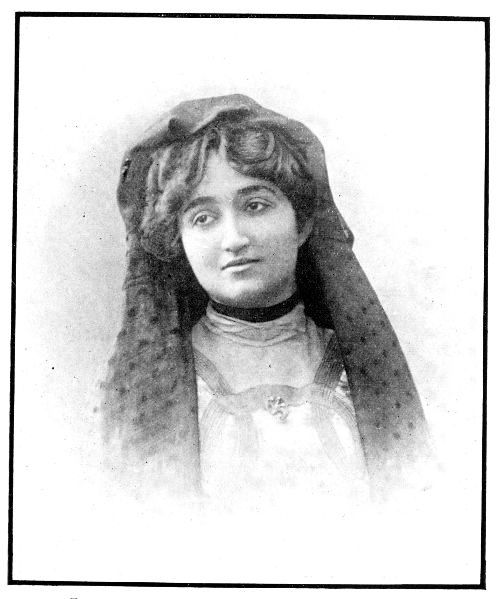
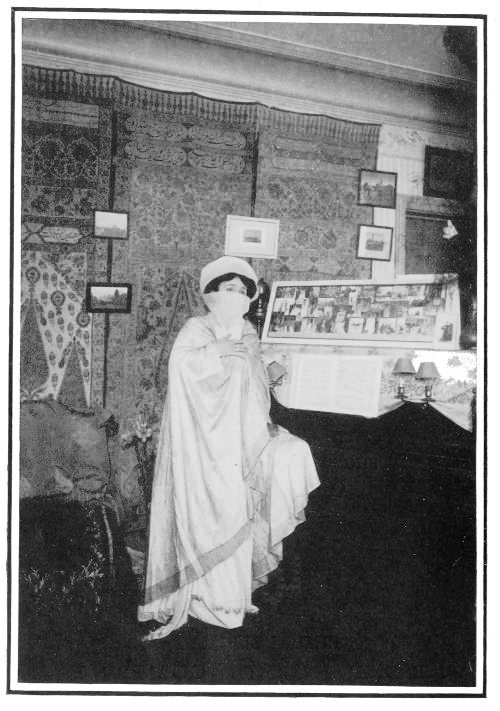
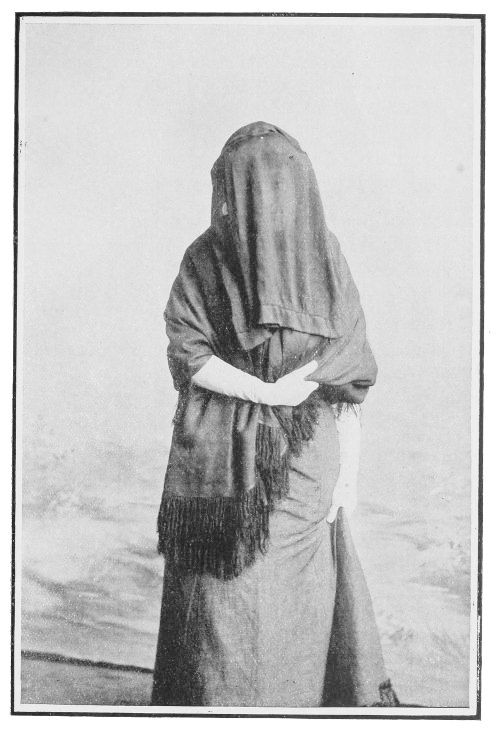
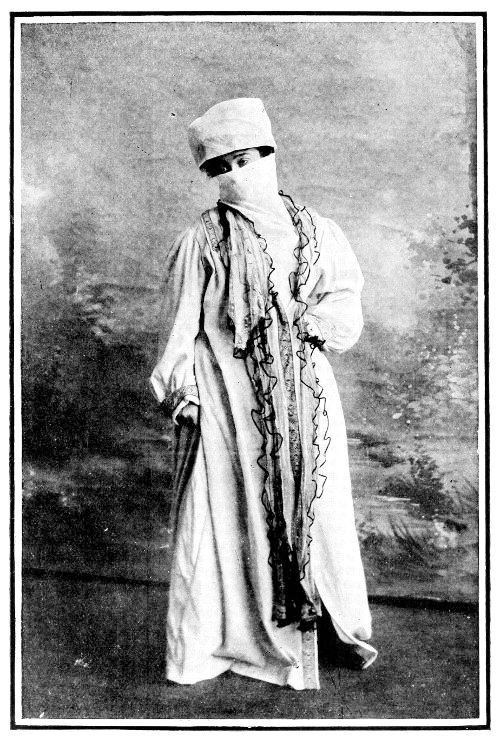
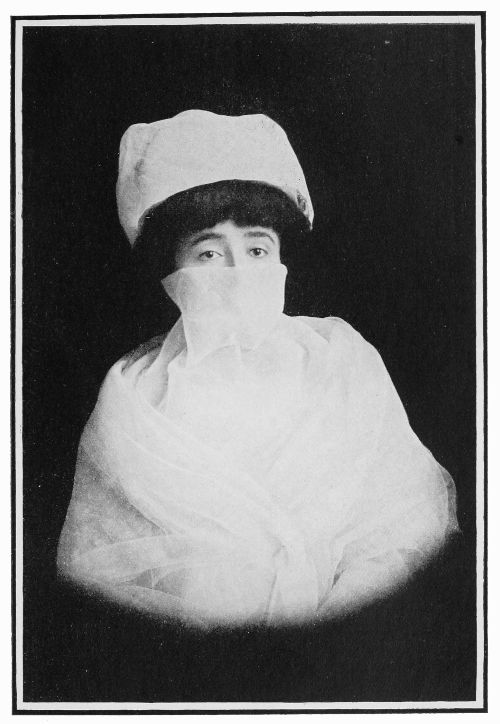
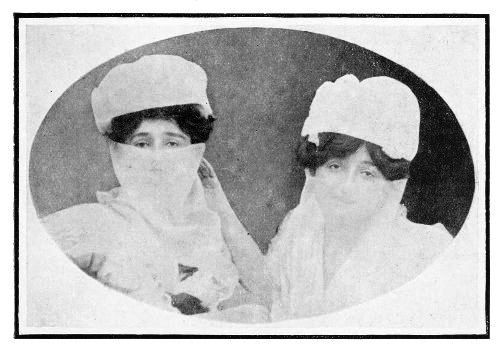
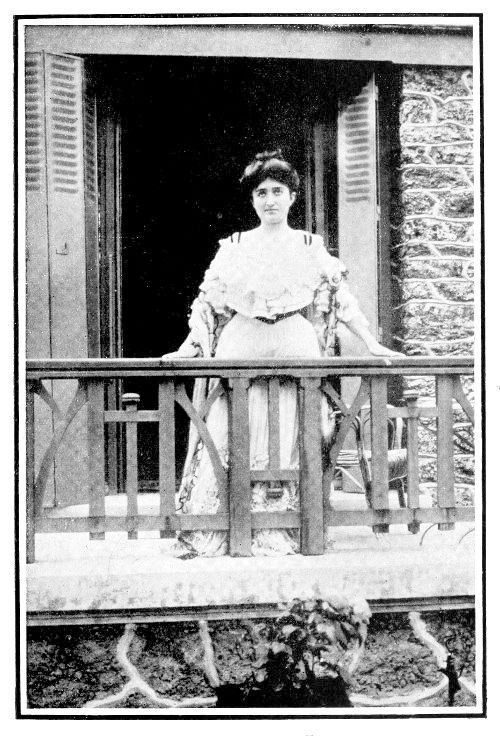
Zeyneb with a Black Face-veil thrown back
In the reading-room, where I spent my
evening, I met those same people, who spoke in
whispers, wrote letters, and read the daily papers.
The silence of the room was restful, there was
an atmosphere almost of peace, but it is not
the peace which follows strife, it is the peace of
apathy. Is this, then, what the Turkish women
dream of becoming one day? Is this their
ideal of independence and liberty?
Were you to show my letter to one of my
race she would think that I had a distinct
aversion for progress, or that I felt obliged to
be in opposition to everything in the countries
where I was travelling. You know enough of
my life, however, to know that this is not the
case. What I do feel, though, is that a Ladies’
Club is not a big enough reward for having
broken away from an Eastern harem and all
the suffering that has been the consequence of
that action. A club, as I said before, is after
all another kind of harem, but it has none of
the mystery and charm of the Harem of the
East.
How is one to learn and teach others what
might perhaps be called “the tact of evolution”—I
mean the art of knowing when to stop even
in the realm of progress?
I cannot yet either analyse or classify in a
satisfactory way your methods of thinking, since
in changing from country to country even the
words alter their meaning. In Servia, Liberal
means Conservative, and Freemason on the
Continent has quite a different meaning from
what it has here; so that the interpretation I
would give to an opinion might fail to cover
my real meaning.
Do not think that this evening’s pessimism
is due to the fog nor to my poor dinner. It is
the outcome of disillusions which every day
become more complete. It seems to me that we
Orientals are children to whom fairy tales have
been told for too long—fairy tales which have
every appearance of truth. You hear so much
of the mirage of the East, but what is that compared
to the mirage of the West, to which all
Orientals are attracted?
They tell you fairy tales, too, you women of
the West—fairy tales which, like ours, have all
the appearance of truth. I wonder, when the
Englishwomen have really won their vote and
the right to exercise all the tiring professions of
men, what they will have gained? Their faces
will be a little sadder, a little more weary, and
they will have become wholly disillusioned.
Go to the root of things and you will find the
more things change the more they are the same;
nothing really changes. Human nature is
always the same. We cannot stop the ebb or
flow of Time, however much we try. The great
mass of mediocrity alone is happy, for it is content
to swim with the tide. Does it not seem
to you, that each of us from the age when we
begin to reason feels more or less the futility
and uselessness of some of our efforts; the little
good that struggling has brought us, and the
danger we necessarily run, in this awful desire
to go full speed ahead? And yet, this desire to
go towards something, futile though it be, is
one of the most indestructible of Western
sentiments.
When in Turkey we met together, and spoke
of the Women of England, we imagined that
they had nothing more to wish for in this world.
But we had no idea of what the struggle for life
meant to them, nor how terrible was this eternal
search after happiness. Which is the harder
struggle of the two? The latter is the only
struggle we know in Turkey, and the same
futile struggle goes on all the world over.
Happiness—what a mirage! At best is it not
a mere negation of pain, for each one’s idea of
happiness is so different? When I was fifteen
years old they made me a present of a little
native from Central Africa. For her there was
no greater torture than to wear garments of
any kind, and her idea of happiness was to get
back to the home on the borders of Lake Chad
and the possibility of eating another roasted
European.
*****
Last night I went to a banquet. It was the
first time that I had ever heard after-dinner
speeches, and I admired the ease with which
everyone found something to say, and the women
spoke quite as well as the men. Afterwards I
was told, however, that these speeches had all
been prepared beforehand.
The member of Parliament who sat on my
right spoilt my evening’s enjoyment by making
me believe I had to speak, and all through the
dinner I tried to find something to say, and yet
I knew that, were I actually to rise, I could not
utter a sound. What most astonished me at
that banquet, however, was that all those women,
who made no secret of wanting to direct the
affairs of the nation, dared not take the responsibility
of smoking until they were told. What a
contradiction!
Since I came here I have seen nothing but
“Votes for Women” chalked all over the pavements
and walls of the town. These methods
of propaganda are all so new to me.
I went to a Suffrage street corner meeting the
other night, and I can assure you I never want
to go again. The speaker carried her little stool
herself, another carried a flag, and yet a third
woman a bundle of leaflets and papers to distribute
to the crowd. After walking for a little
while they placed the stool outside a dirty-looking
public-house, and the lady who carried the flag
boldly got on to the stool and began to shout,
not waiting till the people came to hear her,
so anxious was she to begin. Although she did
not look nervous in the least she possibly was,
for her speech came abruptly to an end, and my
heart began to beat in sympathy with her.
When the other lady began to speak quite a
big crowd of men and women assembled: degraded-looking
ruffians they were, most of them,
and a class of man I had not yet seen. All the
time they interrupted her, but she went bravely
on, returning their rudeness with sarcasm. What
an insult to womanhood it seemed to me, to have
to bandy words with this vulgar mob. One man
told her that “she was ugly.” Another asked
“if she had done her washing,” but the most of
their hateful remarks I could not understand, so
different was their English from the English I
had learned in Turkey.
Yet how I admired the courage of that woman!
No physical pain could be more awful to me
than not to be taken for a lady, and this speaker
of such remarkable eloquence and culture was
not taken for a lady by the crowd, seeing she
was supposed “to do her own washing” like
any women of the people.
The most pitiful part of it all to me is the
blind faith these women have in their cause, and
the confidence they have that in explaining their
policy to the street ruffians, who cannot even
understand that they are ladies, they will further
their cause by half an inch.
I was glad when the meeting was over, but
sorry that such rhetoric should have been wasted
on the half-intoxicated loungers who deigned to
come out of the public-house and listen. If
this is what the women of your country have to
bear in their fight for freedom, all honour to
them, but I would rather groan in bondage.
*****
I have been to see your famous Houses of
Parliament, both the Lords and the Commons.
Like all the architecture in London, these buildings
create such an atmosphere of kingly greatness
in which I, the democrat of my own country,
am revelling. The Democracy of the East is so
different from that of the West, of which I had
so pitiful an example at the street corner.
I was invited to tea at the House of Commons,
and to be invited to tea there of all places
seemed very strange to me. Is the drinking of
tea of such vital importance that the English
can never do without it? I wonder if the Turks,
now their Parliament is opened, will drink coffee
with ladies instead of attending to the laws of
the nation!
What a long, weary wait I had before they
would let me into the Houses of Parliament.
Every time I asked the policeman where the
member of Parliament was who had invited
me, he smilingly told me they had gone to fetch
him. I thought he was joking at first, and
threatened to go, but he only laughed, and said,
“He will come in time.” Only when I had
made up my mind that the tea-party would
never come off, and had settled myself on an
uncomfortable divan to study the curious people
passing in and out, did my host appear. I
thought it was only in Turkey that appointments
were kept with such laxity, but I was
reminded by the M.P. who invited me that I
was three-quarters of an hour late in the first
place.
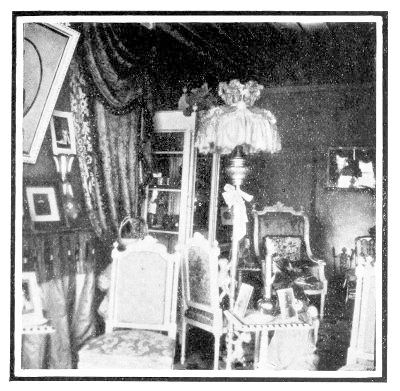
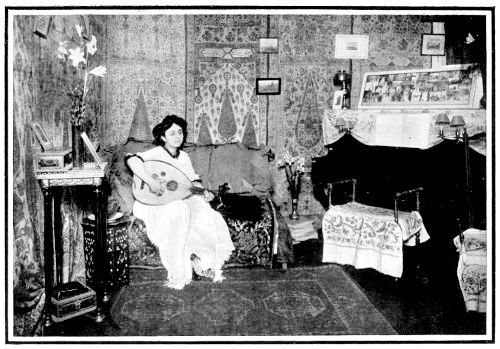
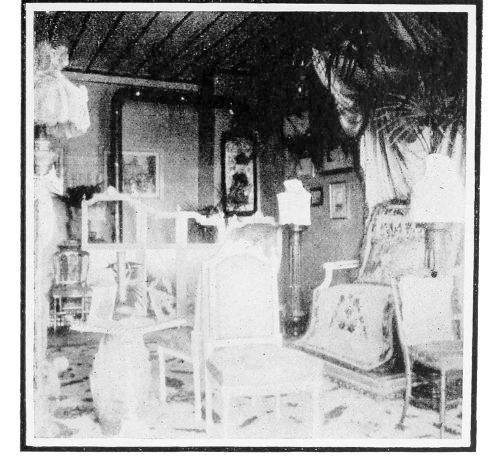
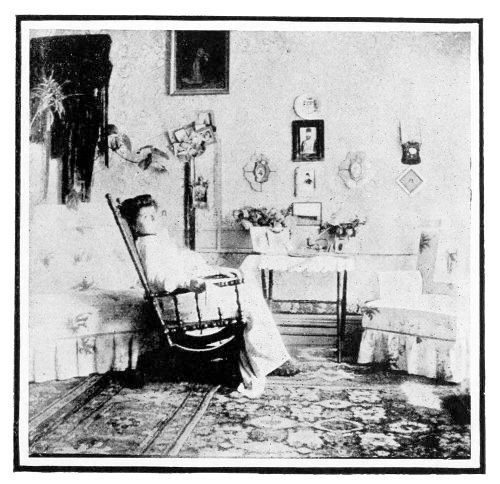
A Corner of a Turkish Harem of To-day
This photograph was taken expressly for a London paper. It was returned with this
comment: “The British public would not accept this as a picture of a Turkish Harem.”
As a matter of fact, in the smartest Turkish houses European furniture is much in
evidence.
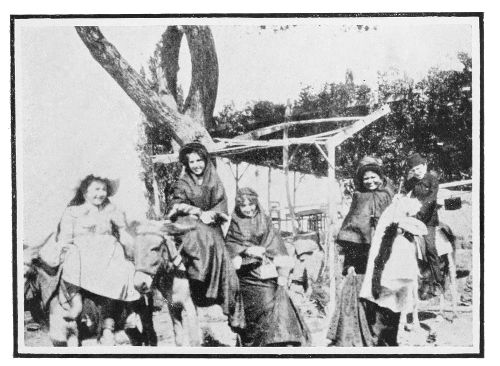
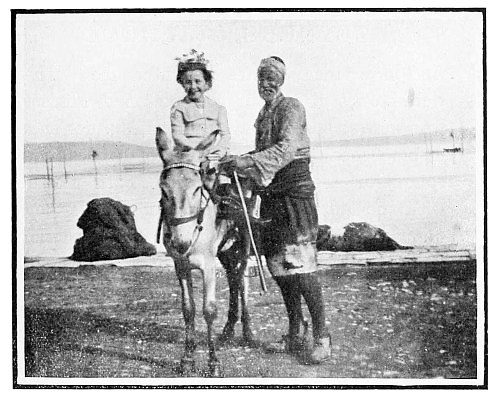
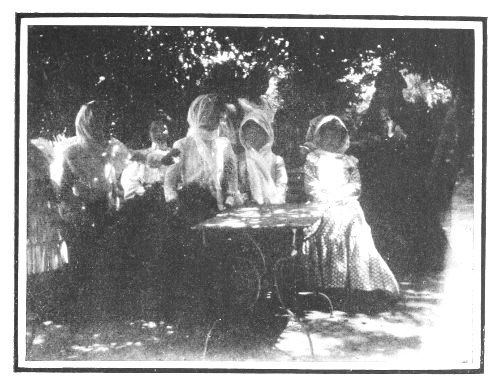
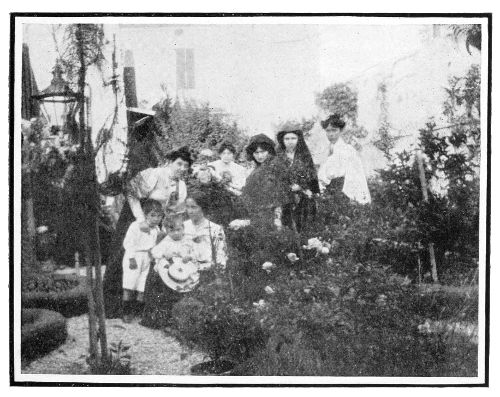
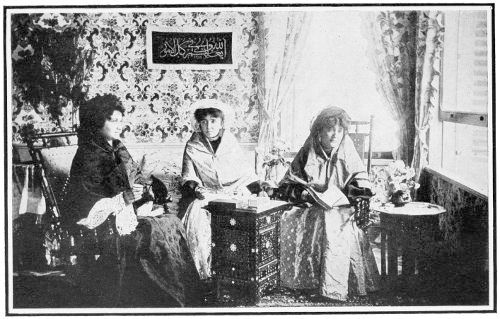
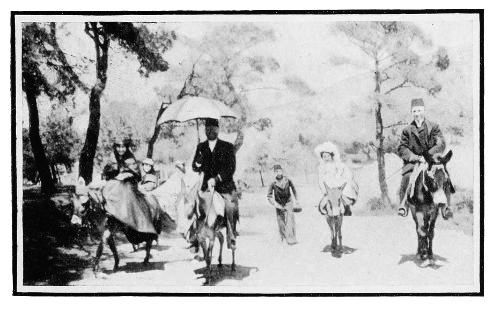
Turkish Women and Children in the Country
They are accompanied by the negress.
I was conducted through a long, handsome
corridor to a lobby where all sorts of men and
women were assembled, pushing one another,
gesticulating and speaking in loud, disagreeable
voices like those outside of the Paris Bourse.
Just then, however, a bell rang, and I was conducted
back past the policeman to my original
seat. What curious behaviour! What did it all
mean? I spoke to the friendly policeman, but
his explanation that they were “dividing” did
not convey much to my mind. As I stood there,
a stray member of Parliament came and looked
at me. He must have been a great admirer of
Mr. Joseph Chamberlain, for he wore a monocle
and an orchid in his buttonhole.
“Are these suffragettes?” he asked the
policeman, staring at me and the other women.
“No, sir,” answered the policeman, “ladies.”
It was too late for tea when my host returned
to fetch me, but the loss of a cup of tea is no
calamity to me, as I only drink it to appear
polite. I was next taken up to the Ladies’
Gallery, and was sworn in as one of the relations
of a member who had given up his ladies’ tickets
to my host. The funny part of it was, that I
could not understand the language my relation
spoke, so different was his English from the English
I had learnt in Turkey. But what a fuss
to get into that Ladies’ Gallery! I had no idea
of making a noise before it was suggested to
my mind by making me sign a book, and I certainly
wanted to afterwards. What unnecessary
trouble! What do you call it? Red tapeism!
One might almost be in Turkey under Hamid
and not in Free England.
But, my dear, why have you never told me
that the Ladies’ Gallery is a harem? A harem
with its latticed windows! The harem of the
Government! No wonder the women cried
through the windows of that harem that they
wanted to be free! I felt inclined to shout out
too. “Is it in Free England that you dare to
have a harem? How inconsistent are you
English! You send your women out unprotected
all over the world, and here in the workshop
where your laws are made, you cover them
with a symbol of protection.”
The performance which I saw through the
harem windows was boring enough. The
humbler members of the House had little respect
for their superiors, seeing they sat in their
presence with their hats on, and this I am told
was the habit of a very ill-bred man. Still
perhaps this attitude does not astonish me
since on all sides I hear complaints of the
Government. It is a bad sign for a country,
my dear. Are you following in Turkey’s footsteps?
Hatred of the Government and prison
an honour! Poor England!
I was very anxious to see the notorious Mr.
Lloyd George. Since I have been in London
his name is on everyone’s lips. I have heard
very little good of him except from the ruffians
at the street corner meeting, and yet like our
Hamid he seems to be all-powerful. For a long
time, I could not distinguish him in the crowd
below, although my companion spared no pains
in pointing him out. I was looking for some
one with a commanding presence, some one
with an eagle eye and a wicked face like our
Sultan, some one before whom a whole nation
was justified in trembling. But I still wonder
whether I am thinking of the right man when
I think of Mr. Lloyd George.
There is not much excitement in your House
of Commons, is there? I prefer the Chamber
of Deputies, even though some one fired at
M. Briand the day I went there. There at
least they are men of action. Here some
members were so weary of law-making, that
they crossed their legs, folded their arms, and
went to sleep whilst their colleagues opposite
were speaking. I thought it would have been
more polite to have gone out and taken tea, as
the other members seemed to be doing all the
time. It would have given them strength to
listen to the tiresome debate.
To me, perhaps, the speaking would have been
less unbearable if the harem windows had not
deadened the sound, which, please notice, is my
polite Turkish way of saying, they all spoke
so indistinctly.
The bell began to ring again. The members of
Parliament all walked towards the harem to this
curious direction, “Eyes to the right and nose to
the left.”23 And at last my friend took me away.
*****
We went to see a performance of Trilby at
His Majesty’s Theatre the other night. I liked
the acting of the terrible Svengali, but not the
piece. As a great treat to me, my friend and
her husband had us invited to supper in the
roof of the theatre with the famous Sir Herbert
Tree. I could not help saying, “I preferred
not to go, for Sir Herbert Tree frightened me.”
However, we went all the same, and had a
delightful supper-party. For some reason or
other the manager was our host, and I was
thankful not to eat with Sir Herbert Tree. As
we came away my friend asked if I was still
frightened now we had eaten with him.
“But we have not eaten with him,” I said.
“Indeed we have,” she said.
“Is the person with whom we had supper the
horrid Svengali?” I asked.
“Why, of course,” she answered, laughing.
As you know, this is not my first experience
of a theatre, so there is no excuse for me. But
I can assure you no one would ever dream that
Svengali was made up. What a pity it would
have been for me to have gone through life
thinking of your famous actor as Svengali.
I think that when actors have to play such disagreeable
parts, they should show themselves
to the public afterwards as they really are, or
not put their names on the programme.
*****
I saw another play at His Majesty’s in which
the principal rôles were played by children. You
cannot imagine how delightful I found it, and
what a change it was from the eternal pièce à
thèse which I had become accustomed to see in
Paris. The scenery indeed was a fairy panorama,
and the piece charmingly interpreted.
What astonished me was to see that both men
and women took as much delight in it as the
young folks. Only mothers in Paris would have
brought their children to see such a moral play.
Ah, but I must tell you I have at last seen an
Englishwoman who does not look weary of life.
She is Miss Ellen Terry. How good it was to
see her act. She was so natural and so full of
fun, and enjoyed all she had to say and do, that
her performance was a real joy to me. I wish
I could have thanked her.
*****
I just love your hansom cabs. If I had money
enough I would buy one for myself and drive
about seeing London. You get the best view
of everything in this way. When I first stepped
into one I could not imagine where the coachman
sat; he called out to me from somewhere, but I
could not find his voice, until he popped his
fingers through a little trap door and knocked
off my hat, for I cannot bear to pin on my hat.
“Here I am,” he answered to my query, and
he thought he had a mad-woman for a fare.
*****
One night when I returned to my club after
the theatre, there was one lonely woman seated
in the reading-room near the fire. She seemed
to me to be the youngest of all the ladies,
although you may say that was no guarantee
against middle age. I don’t know how it was
we began to speak, since no one had introduced
us, but she imagined I was a Frenchwoman,
hence probably the explanation of the liberty
she had taken in addressing me. Yet she looked
so sad.
“You French,” she said, “are used to sitting
up a good deal later than we do here.”
“I thought,” I said, “the protocol did not
bother about such trifles.”
“Ah, now you are in the country of protocols
and etiquette,” she answered.
She must have been asking me questions only
as an excuse to speak herself, because she took
really no interest in my answers, and she kept
on chattering and chattering because she did
not want me to go away. She spoke of America
and India and China and Japan, all of which
countries she seemed to know as well as her
own. Never have I met in my travels anyone
so fond of talking, and yet at the same time
with a spleen which made me almost tired.
I concluded that she was an independent
woman, whose weariness must have been the
result of constant struggling. She was all alone
in the world; one of those poor creatures who
might die in a top back-room without a soul
belonging to her. Her mind must have been
saturated with theories, she must have known
all the uncomfortable shocks which come from
a changed position, and yet she was British
enough to tremble before Public Opinion.
“But do you know why I travel so much?”
at last I had the opportunity of asking her.
“Like Diogenes who tried to find a Man, I have
been trying to find a Free woman, but have not
been successful.”
I do not think she understood in the least
what I meant.—Your affectionate friend,
Zeyneb.