Authorities quoted in the text are indicated as follows:
Admiral Jellicoe (J), Vice Admiral Beatty (B), Admiral Scheer (S).
The Battle of Jutland has been made a matter
of bitter controversy, and accounts of the action
have been so molded to fit partisan theories
that the actual events have become obscured. Yet
these events can now be determined through means
that were never before available in the case of a
great naval battle. Both commanders have published
their detailed accounts, and there is no longer
any reason for uncertainty as to the essentials of
the action. Many of the tales from Germany were
obviously untrue, but Admiral Scheer, the German
Commander-in-Chief, has given a straightforward
story of the battle which supplements the version
of Admiral Jellicoe, the British Commander-in-Chief.
When the wide field of operations is taken into
account, the two narratives of the rival commanders
agree to a surprising extent as to the events of
the early stages of the action. The engagement
between the two advanced forces, the advent of
the German High Seas Fleet, and the running fight
to meet the British Grand Fleet, are related in confirmation
of Lord Jellicoe’s report, and of the account
in his book. Concerning the events of these
first phases of the battle the various British narratives
also practically agree.
Most of the differences and controversies relate
to the ensuing stages. Concerning these events of
the latter part of the action Admiral Scheer supplies
much needed data, throwing new light upon
manœuvres which had not been understood by the
British—and no narrative has yet been published
which covers this ground.
To understand the battle, it is necessary to
remember that it had become the custom of the
British fleet to leave its safeguarded bases in the
north of the British Isles and make periodical
sweeps through the North Sea. The Admiralty
had ordered the Grand Fleet to begin such a sweep
on May 30.1 At the beginning of his Report of the
battle Admiral Jellicoe thus describes the situation:
“The Ships of the Grand Fleet, in pursuance of
the general policy of periodical sweeps through the
North Sea, had left its base on the previous day in
accordance with instructions issued by me. In the
early afternoon of Wednesday, May 31, the 1st and
2nd Battle Cruiser Squadrons, the 1st, 2nd, and
3rd Light Cruiser Squadrons, and destroyers from
the 1st, 9th, and 13th Flotillas, supported by the
Fifth Battle Squadron, were, in accordance with
my directions, scouting to the southward of the
Battle Fleet.” (J)
On May 31 the German High Seas Fleet was also
on the North Sea. There had been an insistent
demand from the German people for activity on
the part of the battle fleet. In response, the new
Commander-in-Chief, Admiral Scheer, had taken
his battleships to sea at times. This change of
tactics was a demonstration deliberately planned
for effect in Germany, but Admiral Scheer had
taken great pains to improve the efficiency of his
command, and on that day he had with him all the
strength he could muster, even including the available
predreadnoughts. He was thus prepared to
fight, if he could manœuvre to engage the British
fleet in part or under conditions advantageous for
the Germans. This sortie of May 31 brought on
the Battle of Jutland.
For some time after the action there were tales
of other objectives,—to cover the escape of raiders,
to get ships out of the Baltic, etc. Even Lord
Jellicoe indulged in theories as to the object of the
German sortie and the movements that led to the
engagement. This question has been ended by
Admiral Scheer’s account of his definite order of
May 18, 1916, for a raid on the east coast of England
at Sunderland, including the dispositions of
U-boats. Such a raid “would be certain to call
out a display of English fighting forces as promised
by Mr. Balfour.” (S) After a delay on account of
bad weather, this plan was modified in the operation
of May 31, off the Skagerrak—and it was
carried out with the hope, frankly expressed by
the German Admiral, that his enemy “would afford
us an opportunity to engage part or the
whole of his fleet in battle under conditions favorable
to ourselves.” (S) This situation tended to
bring on a naval action, especially as the Admiralty
telegram gave the intimation that German naval
forces would be out.
The opposing fleets in the Battle of Jutland were
as follows:
1. An advance British force under Vice Admiral
Beatty, consisting of six battle cruisers (four Lions
of 28 knots speed, each carrying eight 13.5-inch
guns, and two Indefatigables of 25 knots speed,
each carrying eight 12-inch guns), supported by
the Fifth Battle Squadron, under Rear Admiral
Evan-Thomas (four 25-knot battleships of the
Queen Elizabeth class, each carrying eight 15-inch
guns, Barham (F), Valiant, Malaya, Warspite).
The fleet speed of this advance force was 25
knots.
2. The main body of the British Grand Fleet,
under Admiral Jellicoe, flying his flag in the Iron
Duke, consisting of a fast wing under Rear Admiral
Hood (three 26-knot battle cruisers of Invincible
class, each carrying eight 12-inch guns), a division
of four armored cruisers under Rear Admiral
Arbuthnot, and twenty-four dreadnoughts in three
squadrons commanded by Vice Admirals Burney,
Jerram, and Sturdee.
The fleet speed of this main body was 20 knots,
and its formidable armament will be found in
Table I.
3. Twenty-five light cruisers, and seventy-eight
destroyers, “47 with the Battle Fleet, 31 with
Battle Cruisers.” (J)
The German strength comprised:
1. An advance force under Vice Admiral Hipper,
consisting of five battle cruisers (three Derfflingers
of 28 knots speed, each carrying eight 12-inch
guns, and two Moltkes of 27 knots speed, each
carrying ten 11-inch guns).
The fleet speed of this advance force was 27 knots.
THE BRITISH GRAND FLEET AT THE BATTLE OF JUTLAND
Make-up and Armament of the Battle Fleet
| 1 Div. |
2 Div. |
3 Div. |
↑ |
4 Div. |
5 Div. |
6 Div. |
3King George V (F)
10 13.5-inch |
4Orion (F)
10 13.5-inch |
2Iron Duke (FF)
10 13.5-inch |
6Benbow (F)
10 13.5-inch |
7Colossus (F)
12 12-inch |
8Marlborough (F)
10 13.5-inch |
Ajax
10 13.5-inch |
Monarch
10 13.5-inch |
Royal Oak
8 15-inch |
Bellerophon
10 12-inch |
Collingwood
10 12-inch |
Revenge
8 15-inch |
Centurion
10 13.5-inch |
Conqueror
10 13.5-inch |
5Superb (F)
10 12-inch |
Temeraire
10 12-inch |
Neptune
10 12-inch |
Hercules
10 12-inch |
Erin
10 13.5-inch |
Thunderer
10 13.5-inch |
Canada
10 14-inch |
Vanguard
10 12-inch |
St. Vincent
10 12-inch |
Agincourt
14 12-inch |
THE GERMAN HIGH SEAS FLEET AT THE BATTLE OF JUTLAND
Make-up and Armament of the Battle Fleet
| ← |
Squadron III |
Squadron I |
Squadron II |
12König (F)
10 12-inch |
10Ostfriesland (F)
12 12-inch |
11Deutschland (F)
4 11-inch |
Grosser Kurfürst
10 12-inch |
Thüringen
12 12-inch |
Pommern
4 11-inch |
Markgraf
10 12-inch |
Helgoland
12 12-inch |
Schlesien
4 11-inch |
Kronprinz
10 12-inch |
Oldenburg
12 12-inch |
Schleswig-Holstein
4 11-inch |
13Kaiser (F)
10 12-inch |
14Posen (F)
12 11-inch |
15Hannover (F)
4 11-inch |
Prinz Regent Luitpold
10 12-inch |
Rheinland
12 11-inch |
Hessen
4 11-inch |
Kaiserin
10 12-inch |
Nassau
12 11-inch |
| —— |
Westfalen
12 11-inch |
9Friedrich der Grosse (FF)
10 12-inch |
2. The main body of the German High Seas
Fleet, under Admiral Scheer, consisting of sixteen
dreadnoughts [“König Albert absent” (S)] and six
predreadnought battleships.
The fleet speed of this main body was 17 knots,
because the German dreadnoughts had been eked
out with predreadnought battleships of less speed.
Its less powerful armament will be found in Table II.
3. Eleven light cruisers and about seventy-eight
destroyers, divided between the advance force and
the main body. (Admiral Jellicoe gives the Germans
eighty-eight destroyers, but it is known that
all were not in action.)
The above-described make-up of the opposing
fleets must be kept in mind, when studying the
course of the action. The day of the battle was
cloudy, but the sun shone through the clouds most
of the time. At no time was there anything approaching
a sea. Visibility was reported as good
in the first stages of the action, but later in the
afternoon, there being little wind, mist and smoke
hung heavy over the surface of the sea. These
conditions must also be remembered, as the increasing
mist had a great influence on the course
of the action.
The following outline will bring the action to
the stage at which detailed comment should begin.
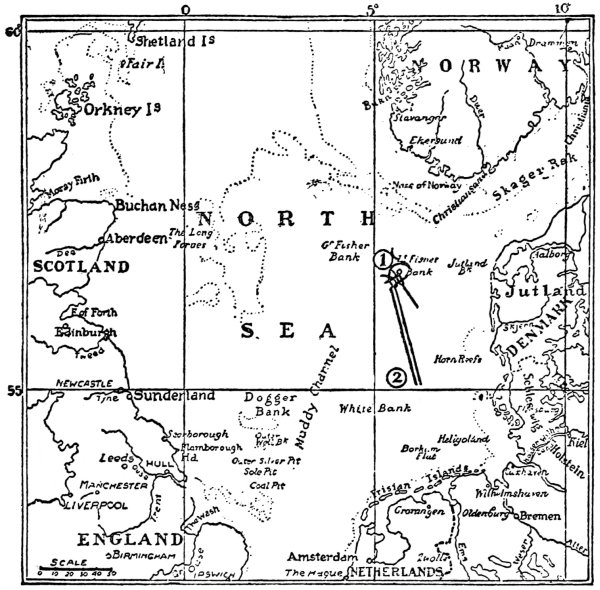
From A Guide to the Military History of The World War, 1914–1918.
Chart showing the Battle of Jutland, in relation to the surroundings
on the North Sea. (1) The Battle Field, May 31, 1916. (2) Position
of British Fleet “at about 2.47 A.M.,” (J) June 1, 1916. (This chart
is diagrammatic only.)
In the sweep through the North Sea, with the
main body of the British Grand Fleet some seventy
miles distant, Vice Admiral Beatty’s advance force
was cruising to southward of Admiral Jellicoe May
31, 1916, when, at 2.20 P.M., the presence of enemy
ships was reported by a light cruiser. Admiral
Beatty altered course “to the eastward and subsequently
to northeastward, the enemy being
sighted at 3.31 P.M. Their force consisted of five
battle cruisers.” (B) This was the German advance
under Vice Admiral Hipper.
It is stated in Vice Admiral Beatty’s report that
it was over an hour after the first news of the
vicinity of enemy ships before he increased speed
to 25 knots to engage, “at 3.30 P.M.” (B) Yet
Vice Admiral Beatty reports that Rear Admiral
Evan-Thomas’s Fifth Battle Squadron (the four
Queen Elizabeths) was still 10,000 yards away when
he made this move to engage the Germans with his
battle cruisers. Consequently Vice Admiral Beatty
failed to impose his whole strength upon his enemy’s
detached force.
It is hard to explain this situation except by
believing that Vice Admiral Beatty was confident
that his six battle cruisers alone would be able to
cope with the enemy. Allowing his force to remain
divided by such an interval was unfortunate,
and it cannot be said that the best use was made
of the British advance force in the first stage of the
engagement.
At 3.48 “the action commenced at a range of
18,500 yards, both sides opening fire practically
simultaneously.” (B) The British battle cruisers
fought on a course curving to the southeast, and
then on a south-southeast course, and the five
German battle cruisers fought them on a parallel
course, instead of edging away from the superior
British force. It is now easy to see that the trend
of the action was absolutely in the direction of the
approaching main body of the German High Seas
Fleet, but this, very naturally, was not apparent
at the time to Vice Admiral Beatty.
The first phase of the battle may properly be
studied as a fight between the British and German
battle cruisers, in consequence of the before-stated
gap separating the two parts of Admiral Beatty’s
command. This interval of 10,000 yards prevented
the Fifth Battle Squadron of Queen Elizabeth
dreadnoughts from being a factor at the time.
Vice Admiral Beatty reports that this squadron
“opened fire at a range of 20,000 yards,” and he
continues: “The Fifth Battle Squadron was engaging
the enemy’s rear ships, unfortunately at
very long range.” Only two of the German ships
were really under fire from the Fifth Battle Squadron,
and these two battle cruisers were but slightly
injured in the run to the south.
In this part of the action came the first of the
many upsets of prewar calculations. Comparing
the given strength of the two opposing squadrons
in action, it will be seen that the British battle
cruisers were greatly superior; in fact, the odds
would have been considered prohibitive before this
battle. Yet it was the British squadron that suffered,
losing one-third of its ships. “At about 4.06”
(J) the Indefatigable was sunk, and “at about 4.26”
(J) the Queen Mary met the same fate. In each case
there was a great explosion up through the turrets,
suggesting that a weak turret construction is really
a dangerous conductor of fire to the magazine in
case of a heavy hit, and pointing to the need of
better separation of the supply of ammunition from
the magazine.
At 4.15 there were attacks “simultaneously” (B)
by British and German destroyers which resulted
in a lively fight, but no damage to any of the capital
ships. Yet the possibilities of such torpedo attacks
were so evident, here and later in the battle, that
the destroyer at once attained a greater value as
an auxiliary of the battleship. A British airplane
had been sent up from a mother ship just before
the engagement, though Admiral Beatty reports
that it was forced to fly low on account of the
clouds, and had a hard task “to identify four
enemy light cruisers.” (B) There was apparently
no chance of a wide observation that would have
warned Admiral Beatty of the approaching German
High Seas Fleet. In this short hour were
concentrated many new problems of naval warfare.
The advancing German High Seas Fleet was reported
at 4.38 by a light cruiser, the Southampton,
and sighted at 4.42 by the British battle cruisers.
A few minutes later Vice Admiral Beatty’s ships
turned right about (180 degrees) in succession.
The German battle cruisers also turned to a northwesterly
course.
One great advantage was gained for the British
in this manœuvre. By the turn in succession the
four Queen Elizabeth battleships, the Fifth Battle
Squadron, were brought into position to fight a
rearguard action against the greatly strengthened
force of the enemy. The leading German battleships,
which were of the König class, fell into line,
closely following Admiral Hipper’s battle cruisers,
and the battle was continued at 14,000 yards on a
northwest course.
In the meantime, from the north, the British
Grand Fleet had been closing at utmost fleet speed
on south and southeast by south courses, disposed
in six divisions, numbered from port to starboard,
on parallel courses as shown in Table I. Admiral
Jellicoe had received no certain information from
Vice Admiral Beatty as to the positions of the engaged
ships, and he had been proceeding in the
general direction of the running fight, instead of
having in mind any definite point for joining forces
with Vice Admiral Beatty. It must also be realized
that conditions of increasing mist and intermittent
fog, which rendered observation very uncertain,
had become prevalent.
* * * * *
It is from this stage of the action that the tactics
of the battle have become involved in controversy—and
a new account of the ensuing events of the
battle is greatly needed.
In the first place, it should be stated that a broad
tactical situation existed that was almost beyond
the hopes of the British. This was irrespective of
any moves of the British Commander-in-Chief, or
of the Commander of the British advance force.
By its own act the weaker German fleet was out in
the North Sea, committed to an enterprise which
had taken it away from its bases. Not only that—but,
by bringing out the squadron of predreadnoughts,
Admiral Scheer’s fleet speed was reduced
to 17 knots. Casting aside all details of tactics,
this constituted the established condition that the
weaker fleet of inferior speed had offered the opportunity
to the British fleet—and evasion by
flight alone was impossible. Looked at in this
light, it was a better chance than could ever have
been expected. Yet a combination of circumstances,
including weather conditions, tactics, and
methods, prevented a decision, where such a result
seemed to be insured.
This is the underlying tragedy of Jutland—and
this is why all the accounts have to deal with explanations
and justifications.
One very unfavorable situation was being developed
at this stage, at the time when the British
advance force was seeking a junction with the
Grand Fleet. As has been said, Lord Jellicoe was
not receiving information that would enable him
to join forces effectively with Vice Admiral Beatty.
The original disposition of the British naval
strength, with the advance force flung ahead of
the Grand Fleet, was sound, if there were tactical
coördination between the separated parts. It is
impossible to say that this existed, and the imperfect
information given by Vice Admiral Beatty
to the Commander-in-Chief is a notable feature of
the battle.
With all due allowance for interference and damage
to the wireless, especially on the Lion, it is
hard to see why Lord Jellicoe should have been so
badly informed as to the positions of the ships
engaged, and why definite information should have
been so long delayed. In this important phase of
the tactics of the battle we are forced to the conclusion
that all means had not been taken to insure
the coördination of the British advance force and
the Grand Fleet through linking up ships and other
methods.
This disposition of the British forces had often
been used, and the logical aim of the sweep of the
North Sea was to find and engage the enemy. Yet,
when the enemy actually was found, it became
evident that methods had not been developed for
using the whole British force as parts of one great
manœuvre. With the uncertain information that
Admiral Jellicoe possessed as to what was going
on, any such joint manœuvre could only have
taken place through a miracle of luck. As a matter
of fact, there was an error of twelve miles to the
eastward in location.
* * * * *
After the turn to the north, in the running fight
in pursuit of Vice Admiral Beatty’s force, the German
fleet was approaching the British Grand Fleet,
which drew near in the increasing mist. To understand
the course of the action at this critical stage,
the reader should realize that the Germans possessed
a fleet manœuvre which had been carefully
rehearsed for such a contingency, in sudden contact
with a superior enemy force. This was a
simultaneous “swing-around” (S) of all the ships
of the fleet, to turn the line and bring it into an
opposite course. Admiral Scheer emphasizes the
pains that had been taken to develop the ability
to carry out this manœuvre, which had before been
considered impracticable for a fleet in action. “At
our peace manœuvres great importance was always
attached to their being carried out on a curved line
and every means employed to ensure the working
of the signals.” (S) He is certainly justified in
adding the statement that “the trouble spent was
now well repaid,” as the German Admiral was by
this means enabled to carry out an unexpected and
very effective manœuvre on two occasions when
his fleet would have been in cramped positions
without this recourse. Admiral Scheer was also
able to use this identical manœuvre in an attack.
The British did not have any idea that the German
Command would be able to carry out this
change of direction of the German line. Consequently,
in the smoke and mist, these thrice-executed
movements were not suspected by the British.
With such an important part of the German
tactics unnoticed, and not taken into account in
relation to the British movements, the reasons are
evident that make necessary a new story of these
phases of the action.
At this stage of the running fight, the British
battle cruisers, on a northwesterly course, had
drawn ahead. The four Queen Elizabeth battleships
of Evan-Thomas’s Fifth Battle Squadron
were following them and “thereby played the
part of cover for the badly damaged cruisers.” (S)
The fight had “developed into a stern chase,” (S)
with Hipper’s battle cruisers engaging the British
battle cruisers, and the German Main Fleet pressing
on in chase of the Fifth Battle Squadron.
The German fleet was disposed in this order:
Squadron III, Squadron I, Squadron II, (predreadnoughts).16
Squadrons III and I had opened fire at 4.45, but
although they showed “speed much in excess of
that for which they were designed,” (J) the German
battleships were gradually falling behind the
fast British ships. Admiral Beatty’s cruisers had
drawn clear and shortly after 5.00 were free from
the fire of Hipper’s battle cruisers. His increase
to full speed enabled Vice Admiral Beatty to draw
ahead. He again opened up a gap between his
battle cruisers and the Fifth Battle Squadron, taking
a course that curved to the north and northeast,
in search of Admiral Jellicoe’s battle fleet,
which was hastening to his assistance.
The ships of the Fifth Battle Squadron were also
drawing away from the German battleships and
were soon only under fire from the German battle
cruisers and the leading division of Squadron III.
As the British battleships continued to distance
their pursuers, and the fire even of this leading
German division grew ineffective, Admiral Scheer
at 5.20 signaled to Vice Admiral Hipper “to give
chase.” Hipper had already been outdistanced
by the British battle cruisers. He was “forced, in
order not to lose touch, to follow on the inner
circle and adopt the enemy’s course.” (S) As
Beatty swung by the north to a northeasterly direction,
Hipper conformed to his course. At this
stage the weather grew hazy. The wind changed
from northwest to southwest, and smoke hung
over the water.
The German advance was soon in a position
where it could not engage to any advantage in the
mist “with the sun so low on the horizon.” (S)
Hipper was also in danger from torpedo attacks,
and at 5.40 the German Vice Admiral was compelled
to turn his battle cruisers to starboard, “and
finally bring the unit round to S. W.” (S), to close
up with the German battleships. This manœuvre
was observed in the mist by the British, but not
until some time after it was being carried out, as
Lord Jellicoe placed it “between 6 and 6.16.” (J)
At the same time the leading German battleships
had also begun to veer around to starboard, to
conform with the course of the British advance,
which was swinging from northeast to an easterly
direction. Observing this, Admiral Scheer states
that at 5.45 the order “Leaders in Front” was
signaled, “and the speed temporarily reduced to
fifteen knots to make it possible for the divisions
ahead, which had pushed on at high pressure, to
get into position again.” (S) By this means, and
through the early closing up of Hipper’s battle
cruisers, as described, Admiral Scheer’s whole command
was more in hand than had been believed.
The intervals were closed and the German fleet in
better readiness for its rehearsed manœuvre, to
change direction of the line. These alterations of
speed and direction also probably increased the
difficulties of the British in locating the German
fleet at this time, of which Lord Jellicoe writes in
describing this stage of the action.
Still thinking that the German fleet would be
encountered more to the eastward, Lord Jellicoe
had altered the course of the Grand Fleet to south
and then to southeast. (6.02 and 6.08.) The Lion
had been sighted, and at 6.06 had signaled that
“the enemy’s battle cruisers bore southeast.” (J)
At 6.14 the Lion signaled, “Have sighted the enemy’s
battle fleet bearing south-southwest.” (J)
Lord Jellicoe writes: “This report gave me the
first information on which I could take effective
action for deployment.” At 6.16 Lord Jellicoe made
signal to the Grand Fleet to form line of battle on
the port wing column on a course southeast by east.
In the meantime the light German forces had
become involved in a fight between the lines and
were withdrawing under cover of smoke screens
and torpedo attacks. The cruiser Wiesbaden was
reported disabled at 6.02, and Scheer turned his
fleet two points to port “to render assistance to
the Wiesbaden” (S)—a strange reason for such
a move at such a time! This brought on what
Admiral Scheer called “heavy fighting round the
damaged Wiesbaden,” from 6.20. Yet this eccentric
thrust of the German fleet actually resulted in
heavy damage to the British.
At this time the Grand Fleet was deploying as
described, but not yet seriously engaged. Lord
Jellicoe reports the Marlborough as opening fire at
6.17, the Iron Duke firing a few salvos at 6.20.
But Vice Admiral Beatty’s four remaining battle
cruisers were in closer action, as Beatty was crossing
the German van on a course turning from east
to southeast. The speed of the deploying Grand
Fleet had been reduced to 14 knots to allow
Beatty’s cruisers to pass ahead, “as there was
danger of the fire of the Battle Fleet being blanketed
by them.” (J) The Fifth Battle Squadron
had been left behind Beatty’s battle cruisers by a
long interval, and was making a turn to port (at
6.19) to form astern of the Grand Fleet.
Rear Admiral Hood’s Third Squadron of three
battle cruisers which had been ordered to reinforce
Beatty’s advance, was far ahead of the Grand
Fleet, and had overrun to the southeast in the
error as to location. On realizing this mistake,
Hood had turned back in the direction of the
British advance. Hood’s squadron was signaled
by Vice Admiral Beatty “to form single line ahead
and take station” (J) ahead of Admiral Beatty’s
four remaining battle cruisers, which were turned
to a southeast and southerly course across the
van of the German fleet. In obedience to this
signal, Rear Admiral Hood turned to take station
ahead (6.21), closing to a range of 8,000 yards
(6.25). “At about 6.34” (J) his flagship, the Invincible,
was sunk by gunfire.
Almost at the same time three of Rear Admiral
Arbuthnot’s armored cruisers, Black Prince, Warrior,
and Defence, “not aware of the approach of
the enemy’s heavy ships,” (J) were put out of
action. (Defence was sunk; Warrior sank while
attempt was being made to tow her home; Black
Prince was sunk later.) In the turn of the Fifth
Battle Squadron to take position astern of the
Grand Fleet the Warspite had jammed her helm
and was out of control for a while. She was a
good deal damaged by gunfire, but was extricated
from her predicament and taken back to the British
base.
By this time the German Commander-in-Chief
had received information from his torpedo flotillas
of the presence of “more than twenty enemy battleships
following a southerly course.” (S) His van
was under heavy fire. “Following the movements
of the enemy they had made a bend which hindered
free action” (S) of his torpedo flotilla, and his
cruisers were also cramped between the fire of both
lines. In this awkward situation Admiral Scheer
resolved to make use of his prepared manœuvre,
to change the direction of his line. Accordingly
at 6.35 “the swing-around was carried out in excellent
style,” (S) the ships turning simultaneously
to starboard, putting the whole German fleet on
a westerly course.
This manœuvre was covered by the use of dense
smoke screens, and the pressure on the German
fleet was relieved at once. Admiral Scheer states
that “the enemy did not follow our veer around,”
and he strongly insists that the British should
have held firmly to his line by executing a similar
manœuvre. But he really gives the true state of
the case when he writes: “It may be that the
leader did not grasp the situation.” In fact none
of the British commanders realized what had taken
place under cover of that smoke screen.
After the sinking of the Invincible, although Vice
Admiral Beatty was reported as turning to starboard,
there was no further aggressive action on
his part—and, in the next fifteen minutes (6.50),
he signaled the two remaining battle cruisers of
the Third Squadron to take station astern of the
last ship of his line, the New Zealand.
At the same time (6.50) the Grand Fleet, which
had completed deployment at 6.38, altered course
to south by divisions to close.
These movements of the British forces naturally
did not succeed in bringing any pressure upon
the Germans, as Admiral Scheer’s whole fleet was
then safely on a westerly course, as a result of the
simultaneous swing-around of his line—and the
German fleet was concealed by dense smoke
screens, which left the British in ignorance of
Scheer’s manœuvre. Encouraged by this successful
result of his move, and finding his ships all able
to keep their places in the line, “fully prepared to
fight,” (S) the German Admiral decided upon an
unexpected course of action. His change of tactics
was so remarkable that his reasons should be quoted
at length:
“It was still too early for a nocturnal move. If
the enemy followed us, our action in retaining the
direction taken after turning the line would partake
of the nature of a retreat, and in the event
of any damage to our ships in the rear the Fleet
would be compelled to sacrifice them or else to
decide on a line of action enforced by enemy pressure,
and not adopted voluntarily, and would
therefore be detrimental to us from the very outset.
Still less was it feasible to strive at detaching oneself
from the enemy, leaving him to decide when
he could elect to meet us the next morning. There
was but one way of averting this—to force the
enemy into a second battle by another determined
advance, and forcibly compel his torpedo boats to
attack. The success of the turning of the line
while fighting encouraged me to make the attempt,
and decided me to make still further use of the
facility of movement. The manœuvre would be
bound to surprise the enemy, to upset his plans
for the rest of the day, and if the blow fell heavily
it would facilitate the breaking loose at night.” (S)
To carry out these ideas Admiral Scheer at 6.55
executed a second swing-around of his whole fleet
turning ships-right-about to starboard as before.
This put the German fleet again on an easterly
course and launched its van in an attack against
the deployed British line, “to deal a blow at the
centre of the enemy’s line.” (S) Ahead of the
fleet there was sent forward a determined attack
by the German torpedo flotillas, all of which “had
orders to attack.” (S) In the words of Admiral
Scheer, “This led to the intended result, a full
resumption of the firing at the van.”
The practical effect in action, so far as the German
Battle Fleet was concerned, was to subject
the van of the German fleet to heavy damage,
without doing any compensating harm to the British
ships. Admiral Scheer admits this damage to
the German fleet, especially the battle cruisers,
and it is established that the German fleet did not
score upon the Grand Fleet. On the other hand,
the accompanying sudden torpedo attacks, emerging
from the smoke directed against the British
battleships, did actually accomplish the result of
making the Grand Fleet turn away and open the
range. Admiral Scheer claims that putting the
van of his fleet again into action “diverted the
enemy fire and rendered it possible for the torpedo-boat
flotillas to take so effective a share in the proceedings,”
(S) but of course it is a question whether
the same result might not have been obtained by
the use of the torpedo flotillas alone.
In any case, it must be acknowledged that Admiral
Scheer’s extraordinary manœuvres had accomplished
a surprise effect upon his enemy as,
besides forcing the Grand Fleet to turn away, the
moral effect of this torpedo attack had a great
influence upon the British conduct of the rest of
the action. It is also evident that the British had
not comprehended the tactics of the Germans.
One phase of the situation at this time has not
been understood—but should be strongly emphasized.
The fact is that the German Admiral, by
his own act, had again placed his fleet in the same
position from which he had once withdrawn—and
this second creation of the same situation (6.55)
was after the Grand Fleet had deployed and was in
line of battle. Consequently, in view of the way
the battle was really fought, many of the long arguments
as to the so-called crucial situation at the
time of the British deployment are wasted words.
Now that it is known that Admiral Scheer came
back again to attack the fully deployed British
fleet, the much-discussed method of deployment
can no longer be considered all-important. Even
if the deployment had not come to the Germans,
the Germans had gone to the deployment—and
the same situation existed. In their ignorance of
the German Admiral’s smoke-screened manœuvres,
both sides of the heated British controversy have
missed the essential fact of this unusual duplication
of a battle situation, which actually occurred at
Jutland.
This lack of understanding of Scheer’s turn and
return is plainly shown by Admiral Jellicoe, who
writes, concerning the situation after 7.00: “Our
alteration of course to the south had, meanwhile,
brought the enemy’s line into view once more.”
The British Command did not realize that his
enemy had actually voluntarily come back into
the former position, and this was the real reason
the German ships had reappeared.
At 7.05 the whole British battle line had been
turned together three more points to starboard.
But at 7.10 the sudden attack of the German
torpedo flotillas was sighted, and shortly afterwards
the British fleet was turned away to port
two points, and then two points more, to avoid
the run of the torpedoes. Admiral Jellicoe states
that this move enabled his battleships to avoid
many torpedoes, and that the range was opened by
about 1,750 yards. The German Admiral claims
that “the action of the torpedo-boat flotillas had
achieved its purpose.” (S)
After accomplishing this result of making his
enemy turn away, Admiral Scheer at 7.17 for a
third time successfully executed the same manœuvre
of ships-right-about (in this third turn Scheer’s
flagship, Friedrich der Grosse, was cramped and
made the turn to port), and again his fleet was on
a westerly course screened by dense smoke. This
swing-around again had the same effect of freeing
the German fleet from the gunfire of the British
fleet. The British Command again did not grasp
the full import of the German move. He writes
of the difficulty of observation in the mist and
smoke. Some of his subordinates reported that
the Germans had turned away at this time, but
none realized that a ships-right-about had been
carried out. It was not until 7.41 that the British
battle fleet was altered by divisions three points
to starboard to close.
Shortly after (at 7.47), Vice Admiral Beatty
made signal to Lord Jellicoe: “Urgent. Submit
that the van of battleships follow the cruisers. We
can then cut off the whole of the enemy’s battle
fleet.” Much has been made of this signal by
ill-advised critics. In fact it will be self-evident
that, at the time Beatty’s signal was sent, the German
fleet was not in the assumed position, but had
long before been extricated from its dangerous contact
by the third “swing-around” (S) at 7.17, and
the Germans ships were again safely proceeding on
their altered course.
It is a strange comment on the battle to realize
that the thrice executed German manœuvre of
ships-right-about was not observed by anyone on
the British fleet. None of the British maps or
charts of the action shows any sign of these movements.
Chart No. 1 is a typical British diagram
of this stage of the action. It will be noted that
the times (6.15 to 7.41) in the indications of the
course of the German fleet include the times of
all three turns of ships-right-about. (6.35, 6.55,
7.17.) Yet there is no trace of these German
manœuvres on the plan. Chart No. 2 shows the
contrast between the supposed movements of
the Germans and their actual manœuvres in
the battle.
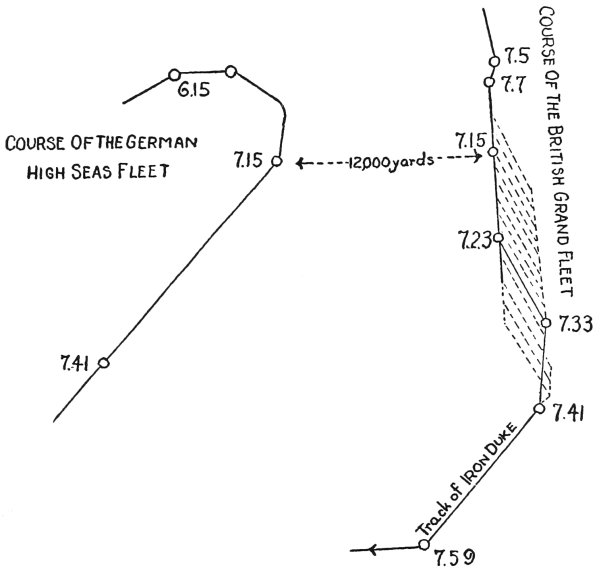
Typical British Chart, of the later manœuvres of the action which
are in dispute.
It will be noted that, in the time covered, between 6.15 and 7.41, the
course of the German Fleet gives no indication of the thrice executed
change of direction of the German line by ships-right-about. All of these
were carried out within this period (6.35, 6.55, 7.17).
Lord Jellicoe’s own maps show this lack of knowledge of the German
manœuvres of ships-right-about, as they do not indicate these important
moves of the Germans. In his report Admiral Jellicoe spoke of the “turn-away
under cover of torpedo-boat destroyer attacks” (J) as “difficult to
counter” (J)—but he did not understand the real reason that made the
difficulty.
One reason for the failure of the British to understand
these manœuvres of Admiral Scheer was the
fixed conviction of the British that such a simultaneous
turn of all the ships of a fleet was impracticable
in action—consequently they did not
expect it to be used by their enemies. This doctrine
has been stated by Lord Jellicoe in explaining
his own movements in the battle. “The objection
to altering by turning all the ships together was
the inevitable confusion that would have ensued
as the result of such a manœuvre carried out with
a very large fleet under action conditions in misty
weather.” This positive statement was made by
the British Commander-in-Chief in perfect unconsciousness
that his antagonist had in fact successfully
carried out such a turn three times under the
identical conditions described!
After the turn to a westerly course, the German
fleet was brought around to a southwesterly, southerly,
and finally to a southeasterly course “to meet
the enemy’s encircling movements and keep open
a way for our return.” (S) From this time Admiral
Scheer’s fleet was not in great danger, nor
even seriously engaged. As the twilight advanced
the German Command could prepare for the night.
He found all his battleships in condition to do 16
knots “the speed requisite for night work, and
thus keep their places in the line.” (S) Vice Admiral
Hipper’s flagship the Lützow had been so
badly damaged that he had changed his flag to
the Moltke (7.00).17 At 7.30 the Lützow could do 15
knots, and her condition grew worse steadily, but
she was the only ship that could not be relied upon
to maintain fleet speed.
Consequently Admiral Scheer was not hard
pressed at this stage, but only intermittently engaged.
The order of the German fleet, after the
last turn to westerly, had been Squadron II, Squadron
I, Squadron III. Squadron II (the slower predreadnoughts)
fell out to starboard, and was passed
by Squadrons I and III, giving support to Hipper’s
battle cruisers, which were engaged at 8.20. The
Germans were all the time making use of smoke for
concealment, in addition to the mist and the increasing
darkness.
As a result of these tactics, the British Admiral
was always groping for his enemy in mist and
smoke, with only occasional glimpses of the German
ships. Although he had not understood the
German manœuvre, Lord Jellicoe had become convinced
that the Germans had turned away, and at
7.59 he had altered course by divisions to west to
close his enemy. It was again natural that he did
not gain much actual contact. Lord Jellicoe writes
of the fighting, already mentioned, at 8.20, in
which the battle cruisers of both sides and the
German predreadnoughts were engaged, and explains
the puzzling conditions of the action at this
stage. “At 8.30 P.M. the light was failing and the
fleet was turned by divisions to a southwest course,
thus reforming single line again.” (J) All this
time his elusive enemy was screening his movements
by the use of smoke, and the German ships
would only occasionally be visible in the smoke
and mist.
As the darkness came on, it is evident that these
tactics on the part of the Germans, with increasing
threats of torpedo attacks, became more and more
baffling to the British Command, and then came
the crucial decision which ended the battle. Admiral
Jellicoe reports:
“At 9 P.M. the enemy was entirely out of sight,
and the threat of torpedoboat-destroyer attacks
during the rapidly approaching darkness made it
necessary for me to dispose of the fleet for the
night, with a view to its safety from such attacks,
while providing for a renewal of action at daylight.
I accordingly manœuvred to remain between the
enemy and his bases, placing our flotillas in a position
in which they would afford protection to the
fleet from destroyer attack and at the same time
be favorably situated for attacking the enemy’s
heavy ships.”
Concerning this stage of the action Admiral
Jellicoe in his report quotes Vice Admiral Beatty
as follows: “In view of the gathering darkness
and the fact that our strategical position was such
as to make it appear certain that we should locate
the enemy at daylight under most favorable circumstances,
I did not consider it desirable or proper
to close the enemy battle-fleet during the dark
hours.”
Here the British Admiral and his subordinate
were in accord, but of course the responsibility
for the movements of the British fleet rested with
Admiral Jellicoe, as Commander-in-Chief. By his
order the British fleet steamed through the dark
hours on southerly courses “some eighty-five
miles” (J) from the battlefield. Although the
British fleet was thus placed in the general direction
of Heligoland, this meant that Admiral Jellicoe
relinquished contact, in a military sense, with the
German fleet. At the time it was undoubtedly
Lord Jellicoe’s intention to renew the action the
next day, but it must be clearly understood that this
was to be in every way a new naval battle—not a
battle continued by keeping in touch with his enemy
and reëxerting his force on the following day.
Admiral Jellicoe himself is explicit upon this
point, and states that “at 9 P.M.” he ordered his
fleet “to alter course by divisions to south, informing
the Flag officers of the Battle Cruiser Fleet,
the cruiser and light cruiser squadrons, and the
officers commanding destroyer flotillas, of my
movements in order that they should conform.” (J)
Nothing could be more definitely established than
the fact that this broke off the action of fleets in
every real sense of the word. The British light
craft were to conform to the movements of the
Battle Fleet, and there was no hint of maintaining
a screen or contact that would develop the position
of the enemy fleet.
This situation should be kept clearly in mind.
There were many encounters throughout the night
between British and German war-craft of various
types, but these fought on their own initiative, and
there was no concerted touch maintained with the
German fleet—nothing that could be called a
part of a battle of fleets. The Germans simply
ploughed their way home through the stragglers
left in the wake of the British fleet, and Lord Jellicoe
frankly states that he was out of touch with
his cruisers and destroyers. Consequently Lord
Jellicoe’s decision, and move to the south, ended
the Battle of Jutland.
This should be recognized as the final decision
of the battle, and the British Commander-in-Chief
makes it plain that he so considered it, as he states
the situation at the time and the reasons which
influenced him.
At 9 o’clock the German fleet was to the westward.
The British fleet was between it and all its
bases. The British fleet was superior in speed,
and had such an overwhelming superiority in ships
and guns that it could afford to discard its damaged
ships without impairing this superiority. The
British Admiral had light cruisers and destroyers,
to throw out a screen and to maintain touch with
the German fleet. There was a proportion of
damaged ships in the German fleet; and this, with
its original inferior fleet speed, would have made
it a hard task for the German fleet to ease around
the British fleet and reach the German bases.
These conditions were in favor of keeping in touch
with the German fleet.
On the other hand, for Admiral Jellicoe to have
kept his fleet in touch with the German fleet
through the dark hours, even by the most efficient
use of his screen of destroyers and cruisers, would
have meant taking the risk of a night action,
which would have involved his capital ships, as
Admiral Scheer intended to fight his way through
that night. Above all things there was the ominous
threat of torpedo attacks in the night, with
possibilities of disaster to the Battle Fleet upon
which depended the established British control of
the seas.
Lord Jellicoe’s arguments show that he followed
a line of conduct well considered in advance,18 and
he writes with a sincere conviction that his act in
breaking off the battle was justified by the results.
In explaining the many advantages possessed by
the weaker German fleet Admiral Jellicoe also reveals
disappointing conditions in backwardness of
methods on the part of the British Navy. There
was not alone the lack of modern methods in range-finding
and director fire-control, but also in torpedo
attack and defense, and in preparation for action
“under night conditions.” (J)19 It is something of
a shock to read that the stronger British fleet went
into the Jutland battle with a handicap in these
essentials that became a factor to prevent a decisive
action.20 Lord Jellicoe makes a very strong
plea for his contention that, under the existing
conditions of smoke, mist and darkness, with the
German fleet skilfully taking advantage of these
conditions, and with the handicaps of the Grand
Fleet in construction, equipment, and methods to
contend with these tactics and conditions, there
was no opportunity to force a decision without
prohibitive risks of losing the existing supremacy
of the British Navy on the seas.21
Accordingly, at 9 o’clock Admiral Jellicoe disposed
the British battleships for the night in columns
of divisions abeam one mile apart, to insure
the columns not losing sight of one another through
the dark hours. The destroyer flotillas were directed
to take station five miles astern. In this
order the British fleet steamed through the night
at seventeen knots “some 85 miles” (J) on a
southerly course. The only British ship that is
mentioned as having been given another mission
was the small minelayer Abdiel which was sent
to strew mines in an area off the Vyl Lightship
“over which it was expected the High Seas Fleet
would pass if the ships attempted to regain their
ports during the night via the Horn Reef.” (J)
No other craft was assigned to observe or harass
the German fleet. The Sixth Division of the
Grand Fleet had fallen behind, as the Marlborough,
which had been damaged by a torpedo, could not
maintain fleet speed. (This ship had to be sent
back after 2 A.M., and Sir Cecil Burney transferred
his flag to the Revenge.) The British light craft
also became widely scattered in the dark hours.
Within a few minutes of the time of Lord Jellicoe’s
signal for the move to the south, Admiral
Scheer gave his order for the night (9.06),
“course S. S. E. ¼ E. speed 16 knots.” (S) The
German Admiral fully expected to be attacked by
the British fleet and to meet strong opposition, but
he decided that the German “main fleet in close
formation was to make for Horn Reef by the
shortest route.” (S) The fleet was disposed in the
same order, Squadrons I, III, II, with the battle
cruisers covering the rear—“out of consideration
for their damaged condition.” (S) The German
Admiral placed these weaker ships in the rear, as
he thought his van would encounter resistance and
might be heavily engaged in the expected night
action. His torpedo flotillas were disposed “in
an E. N. E. to S. S. W. direction, which was where
the enemy Main Fleet could be expected.” (S)
Thus disposed the German Battle Fleet moved
through the dark hours, on a straight course for
Horn Reef, without meeting the expected attacks,
which the strong Squadron I in the van was prepared
to ward off. There really was no chance of
engaging the British battleships, as the Grand
Fleet had moved to the south before the German
fleet crossed Lord Jellicoe’s course. The Nassau
got out of station, when she struck a stray British
destroyer in the darkness, and made for a morning
rendezvous. The rest of the dreadnoughts of the
High Seas Fleet met no delay nor mishap through
the dark hours. Of the predreadnoughts, the battleship
Pommern was sunk by a mine or torpedo, with
loss of all hands.
Many of the destroyers had fired all their torpedoes,
and these craft were used for emergencies.
They were very necessary, as the disabled cruisers
Rostock and Elbing were abandoned and blown
up, and these destroyers did good service in taking
off the crews. They also rescued the crew of the
disabled Lützow, which was towed through the
darkness until she was so down by the head that
her screws spun in the air. She was abandoned
and destroyed by a torpedo at 1.45 A.M. Admiral
Scheer cites the fact that these events could happen,
without disturbance by the enemy, as “proving
that the English Naval forces made no attempt
to occupy the waters between the scene of battle
and Horn Reef.” (S)
As a matter of fact this did not need any proof,
because the British fleet held steadily on its southerly
course, without regard to the direction taken
by the Germans. In the wake of the Grand Fleet
were left scattered cruisers and destroyers—and
there were many clashes between these and the
Germans, but all were isolated fights and adventures
of lame ducks. Some of these encounters
were reported to Lord Jellicoe and there was much
shooting, with explosions and fire lighting up the
darkness.
Admiral Scheer thought that all this must have
indicated his position, and, even after not encountering
the expected night attacks, the German
Admiral expected the British to renew the
battle promptly at dawn. But in consequence of
the British Admiral’s dispositions for the night, it
is evident that the position of the German fleet
was not developed, as Admiral Jellicoe himself says,
until “the information obtained from our wireless
directional stations during the early morning.” (J)
As dawn was breaking, “at about 2.47 A.M.” (J)
June 1, Admiral Jellicoe altered course of his fleet
to the north to retrace his path of the night before.
His Sixth Division of battleships had dropped
astern, out of sight. His cruisers and destroyers
were badly scattered, and the British Admiral
abandoned his intention of seeking a new battle on
the first of June.
The straggling of portions of his fleet during
the move through the darkness is explained by
Lord Jellicoe, and this caused him to delay his
search for the German fleet until he could pick
up the missing craft. His return to find these
was the reason for retracing the course of the night
manœuvre. The following is quoted from Lord
Jellicoe’s book: “The difficulty experienced in collecting
the fleet (particularly the destroyers), due
to the above causes, rendered it undesirable for
the Battle Fleet to close the Horn Reef at daylight,
as had been my intention when deciding to steer
to the southward during the night. It was obviously
necessary to concentrate the Battle Fleet
and the destroyers before renewing action. By
the time this concentration was effected it had
become apparent that the High Seas Fleet, steering
for the Horn Reef, had passed behind the
shelter of the German mine fields in the early
morning on their way to their ports.”
Admiral Scheer’s fleet had arrived off Horn Reef
at 3 A.M., where he waited for the disabled Lützow.
At 3.30 he learned that she had been abandoned.
Up to that time the German Admiral had expected
a new battle of fleets, but he soon divined
that he was to be free from pressure on the part
of his enemy. This was confirmed when Admiral
Scheer learned through a German aircraft scout of
the straggling of Lord Jellicoe’s ships. (L 11 was
the airship reported by the British “shortly after
3.30.”) Admiral Scheer’s comment is: “It is obvious
that this scattering of the forces—which
can only be explained by the fact that after the
day-battle Admiral Jellicoe had lost the general
command—induced the Admiral to avoid a fresh
battle.” Both commanders are consequently on
record in agreement as to the reason for no new
battle of fleets.
The Germans were thus enabled to proceed to
their bases undisturbed. Admiral Scheer’s account
of the return of the German fleet to its home
ports, and of the condition of his ships, is convincing—and
there is no longer any question as to
the German losses. On the way home the Ostfriesland
struck a mine, but was not seriously injured,
making port without difficulty. Outside of the
destruction of the Lützow, the German battle
cruiser squadron was badly battered. The Seydlitz
had great difficulty in making her berth, and
the Derfflinger was also seriously damaged. To
sum up the damage done to the battle cruisers of
both fleets makes a sorry showing for this type of
warship, which had so great a vogue before The
World War.
Admiral Scheer states that, with the exception
of his two battle cruisers, the German fleet was
repaired and ready to go to sea again by the middle
of August, and the Bayern (the first German warship
to mount 38 c.m.-guns) had been added to
the fleet. He also gives an account of another
sortie (August 18 to 20, 1916). Later in the year
the German fleet was reinforced by the Baden
(38 c.m.-guns) and the battle cruiser Hindenburg,
but at the end of 1916 the function of the High
Seas Fleet was to keep the gates for the U-boats
in the great German submarine campaign.
In this rôle of covering the operations of the
submarines the German Battle Fleet had a very
important influence upon the ensuing stages of
the War. It was altogether a delusion to think
that the career of the German fleet had been
ended at Jutland—and that it “never came out.”
On the contrary, Admiral Scheer’s fleet kept a
wide area cleared for the egress and entrance of the
German U-boats in their destructive campaign.
If the German fleet had been destroyed in the
Jutland action, it would have been possible for
the Allies to put in place and maintain mine
barrages close to the German bases. There is no
need to add anything to this statement to show
the great results that would have been gained, if
the British had been able to win a decision in the
Battle of Jutland.
* * * * *
The losses in the battle were as follows:
BRITISH
| |
Tons |
| Queen Mary |
(Battle Cruiser) |
26,350 |
| Indefatigable |
(Battle Cruiser) |
18,800 |
| Invincible |
(Battle Cruiser) |
17,250 |
| Defence |
(Armored Cruiser) |
14,600 |
| Warrior |
(Armored Cruiser) |
13,550 |
| Black Prince |
(Armored Cruiser) |
13,350 |
| Tipperary |
(Destroyer) |
1,430 |
| Nestor |
(Destroyer) |
890 |
| Nomad |
(Destroyer) |
890 |
| Turbulent |
(Destroyer) |
1,100 |
| Fortune |
(Destroyer) |
965 |
| Ardent |
(Destroyer) |
935 |
| Shark |
(Destroyer) |
935 |
| Sparrowhawk |
(Destroyer) |
935 |
| |
Total tonnage |
111,980 |
GERMAN
| |
Tons |
| Lützow |
(Battle Cruiser) |
26,180 |
| Pommern |
(Predreadnought) |
13,200 |
| Wiesbaden |
(Cruiser) |
5,400 |
| Elbing |
(Cruiser) |
4,500 |
| Rostock |
(Cruiser) |
4,900 |
| Frauenlob |
(Cruiser) |
2,700 |
| V-4 |
(Destroyer) |
570 |
| V-48 |
(Destroyer) |
750 |
| V-27 |
(Destroyer) |
640 |
| V-29 |
(Destroyer) |
640 |
| S-33 |
(Destroyer) |
700 |
| |
Total tonnage |
60,180 |
| Killed and wounded: |
| British (approximately) |
6,600 |
| German |
3,076 |
In the early British accounts of the battle there
were fanciful tales of pursuit of the German ships,
through the night, and even after Admiral Jellicoe’s
Report the British public did not at first
realize the situation at the end of the action. But
after a time, when this was better understood,
there arose one of the greatest naval controversies
that have ever agitated Great Britain, centered
around the alleged “defensive” naval policy for
maintaining the supremacy of Great Britain on
the seas,—the pros and cons as to closing the
Germans while there was light, and keeping in
touch through the dark hours.
This controversy as to the Battle of Jutland has
been carried on with bitterness in Great Britain,
and volumes of matter have been written that will
be utterly useless, so far as a true story of the
action is concerned. Partisans have made the mistake
of putting on record arguments that have
been founded on phases of the British operations—with
imaginary corresponding situations of the
enemy, which never existed in actual fact. The
preceding account may be relied upon as tracing
the main events of the battle—and the real course
of the action shows that many briefs must be
thrown out of court.
Putting aside these contentions, and seeking only
to visualize the truth, one is forced to the conclusion
that the chief cause of failure on the part of
the British fleet was the obvious handicap that
methods had not been devised in advance for decisive
operations under the existing conditions.
The problem for the British was to unite two
parts of a superior force, and to impose this united
superior force with destructive effect upon the
enemy. This problem was simplified by the fact
that the weaker enemy voluntarily came into contact
in a position where escape by flight was out
of the question. On the other hand, the solution
was made difficult by unusual conditions of mist
and smoke.
The decision was missed through the lack of
rehearsed methods, not only for effectively joining
the British forces, but for bringing into contact
the superior British strength, against an enemy
who actually possessed the great advantage of rehearsed
methods adapted to the existing conditions.
These conditions must be realized in order to arrive
at a fair verdict.
When considering the Battle of Jutland, we
must not think in the old terms of small dimensions,
but we must picture the long miles of battle
lines wreathed in mist and smoke, the great areas
of manœuvre—and the complicated difficulties
that must beset anyone who was called to command
in this first great battle of dreadnoughts.
These widely extended manœuvres of ships, only
intermittently visible, must not be thought of as
merely positions on a chart or game-board.
Reviewing the course of the action, the conclusion
cannot be avoided that, on the day of the
battle and under its conditions, the Germans were
better prepared in advance for a battle of fleets.
In his book Lord Jellicoe states many advantages
possessed by the German fleet in construction,
armament, and equipment—but, as has been
said, his revelation of the British lack of methods
is more significant.
All these deficiencies cannot be charged against
Admiral Jellicoe, and the persistent efforts to give
him all the blame are unjust. Is there any real
evidence that another man would have done better
under the circumstances? The tendency of certain
writers to laud Vice Admiral Beatty at the
expense of Admiral Jellicoe does not seem justified.
As has been noted, when contact was established
with the German advance force, Beatty
failed to bring his full strength into action against
this isolated weaker enemy force. In the ensuing
stages it cannot be denied that haphazard methods
were in evidence.
The idea must be put aside that the German
ships were a huddled, helpless prey “delivered”
to the British Commander-in-Chief. On the contrary,
as stated, the German battle cruisers had
already closed up with the German battleships
and the High Seas Fleet had been slowed down to
correct its formations. Consequently at this stage
the German fleet was in hand and ready to sheer
off, by use of their well rehearsed elusive manœuvre
of ships-right-about, with baffling concealment in
smoke screens. It has been shown that after the
Grand Fleet had completed deployment, the unsuspected
situation existed in which Admiral
Scheer’s fleet was again in close contact with the
British fleet. It has also been explained that Vice
Admiral Beatty made his much discussed signal,
to “cut off” the German fleet, long after Admiral
Scheer had put his fleet into safety by his third
swing-around of the German ships. With these
situations totally uncomprehended, it cannot be
said that Vice Admiral Beatty had a firmer grasp
upon the actual conditions than anyone else. The
simple truth is, the British Command was always
compelled to grope for the German ships, while his
enemies were executing carefully rehearsed elusive
manœuvres concealed in smoke—and the British
were not prepared in advance to counter these
tactics.
In the matter of signaling, the Germans were
far ahead—in that they had their manœuvres
carefully prepared in advance, to be executed with
the minimum number of signals. The result was
that, while the British Commander-in-Chief was
obliged to keep up a constant succession of instructions
by signals, the German Admiral was
able to perform his surprising manœuvres with
comparatively few master signals.22 Lord Jellicoe
also emphasizes the great advantage possessed by
the Germans in their recognition signals at night.
Sir Percy Scott, as already quoted, bluntly
states: “The British Fleet was not properly
equipped for fighting an action at night. The
German Fleet was.” To this should be added the
statement that the British fleet was not prepared
in methods in advance to cope with the conditions
of the afternoon of May 31. The German fleet
was. Herein lay the chief cause for failure to gain
a decision, when the one great opportunity of the
war was offered to the British fleet.
In the three decades before The World War great
strides had been made in naval development, with
only the unequal fighting in the American War
with Spain and in the East to give the tests of
warfare. In this period it is probable that at
different times first one navy would be in the lead
and then another. It was the misfortune of the
British in the Battle of Jutland that the Germans,
at that time, were better prepared in equipment
and rehearsed methods for an action under the
existing conditions. This should be recognized as
an important factor—and the failure to win a
decision should not be wholly charged against the
men who fought the battle.
The destroyer came to its own in the Battle of
Jutland as an auxiliary of the battle fleet, both for
offense and defense. The whole course of the
action proved that a screen of destroyers was absolutely
necessary. For offense, it might be argued
truthfully that, of the great number of torpedoes
used, very few hit anything. The Marlborough
was the only capital ship reported struck in the
real action,23 and she was able afterward to take
some part in the battle, and then get back to her
base. But above all things stands out the fact
that it was the threat of night torpedo attacks by
German destroyers, and the desire to safeguard
the British capital ships from these torpedo attacks,
which made the British fleet withdraw from
the battlefield, and break off touch with the German
fleet. Lord Jellicoe states that he “rejected
at once the idea of a night action” on account of
“first the presence of torpedo craft in such large
numbers.” (J)
There is no question of the fact that this withdrawal
of the British fleet had a great moral effect
on Germany. Morale was all-important in The
World War, and the announcement to the people
and to the Reichstag had a heartening effect on
the Germans at just the time they needed some
such stimulant, with an unfavorable military situation
for the Central Powers. It also smoothed
over the irritation of the German people against
the German Navy, at this time when Germany
had been obliged to modify her use of the U-boats
upon the demand of the United States. For
months after the battle the esteem of the German
people for the German Navy remained high, and
this helped to strengthen the German Government.
But the actual tactical result of the battle
was indecisive. It may be said that the Germans
had so manœuvred their fleet that a detached
part of the superior British force was cut up, but
the damage was not enough to impair the established
superiority of the British fleet.
As a matter of fact the Battle of Jutland did not
have any actual effect upon the situation on the
seas. The British fleet still controlled the North
Sea. The Entente Allies were still able to move
their troops and supplies over water-ways which
were barred to the Germans. Not a German ship
was released from port, and there was no effect
upon the blockade. After Jutland, as before, the
German fleet could not impose its power upon
the seas, and it could not make any effort to end
the blockade. The Jutland action had cheered the
German people but it had not given to Germany
even a fragment of sea power.
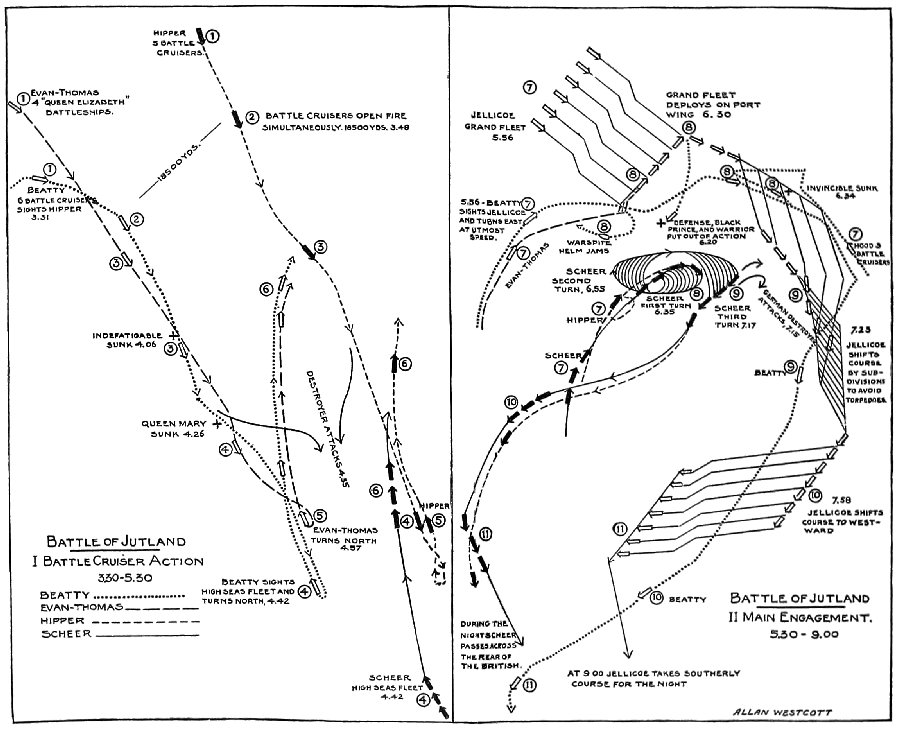
From A Guide to the Military History of The World War, 1914–1918.
CHART NO. 2
THE BATTLE OF JUTLAND
(This chart is diagrammatic only)
Most of the published narratives have used many charts to trace the events of the action.
It has been found possible to indicate all the essentials upon this one chart, which
has been so placed that it can be opened outside the pages for use as the text is being
read. It should be noted that superimposed indications have been avoided, where ships
passed over the same areas (especially in the three German ships-right-about manœuvres).
Consequently this chart is diagrammatic only.
I. BATTLE CRUISER ACTION
(1) 3.30 P.M. Beatty sights Hipper.
(2) 3.48 P.M. Battle cruisers engage at 18,500 yds., “both
forces opening fire practically simultaneously.”
(3) 4.06 P.M. Indefatigable sunk.
(4) 4.42 P.M. Beatty sights High Seas Fleet, and turns
north (column right about).
(5) 4.57 P.M. Evan-Thomas turns north, covering Beatty.
(6) 5.35 P.M. Beatty’s force, pursued by German battle
cruisers and High Seas Fleet, on northerly course at long range.
II. MAIN ENGAGEMENT
(7) 5.56 P.M. Beatty sights Jellicoe and shifts to easterly
course at utmost speed.
(8) 6.20–7.00 P.M. Jellicoe deploys on port wing column
(deployment “complete” at 6.38). Beatty takes position
ahead of Grand Fleet. Hood takes station ahead of Beatty.
Evan-Thomas falls in astern of Grand Fleet.
Scheer turns whole German Fleet to west (ships right about)
at 6.35, covered by smoke screens. Scheer repeats the turn of
the whole fleet (ships right about) to east at 6.55.
(9) 7.17 P.M. Scheer for the third time makes “swing-around”
of whole German Fleet (ships right about) to southwest,
under cover of smoke screens and destroyer attacks. Jellicoe
turns away to avoid torpedoes (7.23).
(10) 8.00 P.M.
(11) 8.30–9.00 P.M. Jellicoe disposes for the night.
McGrath-Sherrill Press
GRAPHIC ARTS BLDG.
BOSTON