Another week opened. In honor of Captain Barclay's restoration to
health, the Fraziers had issued invitations for a picnic to the White
Gate. Many of the officers and ladies had accepted. Most of them had
been bidden. Captain Mullane had been on sick report four
days,—contusions resulting from tumbling from a broken-legged chair,
was the explanation; but every Pat in the command had his tongue in his
cheek when he spoke of it, and of matters growing out of the
"contusions" mentioned. Frazier had heard rumors of the former fracas,
and had notified Messrs. Mullane, Bralligan, et al. that he would have
no duelling in his bailiwick; and deep was the mystery surrounding
certain consultations held by night in Mullane's quarters.
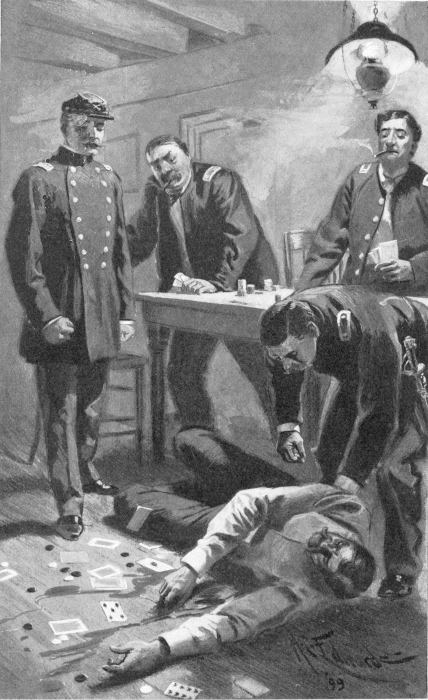
"The blood of that young braggart be on his own head," said Mullane to
his henchmen. "And you, Hodge, can console the disconsolate widow."
He had no more doubt of the issue of the contemplated combat, no more
compunction in the matter, than had Thackeray's valiant and inimitable
little Gascon, né Cabasse, in his duel with Lord Kew. He had long
been the leader of the Hibernian set, and, despite every effort on the
part of the witnesses to the affray at the sutler's to keep the matter a
secret, rumors got out, and the Faugh-a-Ballaghs knew their chief had
been braved by that hated coxcomb Winn. Every one of them knew further
that Mullane must have sent his demand for satisfaction, despite the
fact that his "pistol oi," the right, had been damaged by the collision
and was not yet in condition for effective service. Everybody who was in
the secret knew that Mr. Winn had instantly accepted, naming Brayton as
his second, pistols as the weapons, and suggesting his father's old
duelling set, that had seen long years and some service in the old army,
as proper to the occasion; the time and place, however, would
necessarily depend on the victim of the knock-down blow. All Winn asked
and urged was utter secrecy meantime.
To Mullane there was nothing in the episode over which to brood or
worry. As dragoon sergeant in the old days, he had "winged his man"
according to the methods described in "Charles O'Malley" and practised
occasionally by his superiors in rank. He had known many a bar-room
broil, and was at home with pistol, fists, or sabre,—no mean antagonist
when not unsteadied by liquor. He had now a chance of meeting on the
field one of the set he secretly hated, "the snobocracy of the arrumy,"
and he meant to shoot the life out of Harry Winn if straight shooting
would do it. That Winn had taken advantage of him and knocked him down
when he was drunk was excuse sufficient for the crime he planned; that
he had brought the blow upon himself by an insult ten times more brutal
was a matter that concerned him not at all. He had no wife or child to
worry about: Mrs. Mullane and the various progeny were old enough to
look out for themselves, as indeed most of them had long been accustomed
to do. Mullane thirsted for the coming meeting, and for the prominence
its outcome would give him among all good soldiers all over Texas.
And as for Winn,—he who had come riding home from his successful scout
barely a fortnight before, buoyant, hopeful, almost happy,—the change
that had come over him was something all men saw and none could fully
account for. Cashing the draft from the bank at San Antonio, he had now
enough to take Trott's receipt in full for the value of the stolen
stores, even to some recovered plunder, slightly damaged by rough
handling and by rain. He would then still have some four hundred
dollars, and he asked his wife for certain bills that had been
frequently coming to her accompanied by urgent demands. Laura said she
had not kept them. Which ought to be paid first? he asked. Which had
been longest outstanding? Laura's reply was that she did not know, but
if he had got that money from San Antonio at last she ought to have some
to send to Madame Chalmette. She positively had not a dinner-dress fit
to be seen. Winn did not even glance at the open doors of a big closet,
hung thick with costly gowns his wife had hardly worn at all, but that
now, she said, were out of style. There were other matters to be thought
of than dinner-gowns, he told her, gravely, and her face clouded at
once. She had almost forgotten the troubles of the week gone by.
He went down to his den and sat there thinking. What ought he to do?
what should he do with this money? Every cent of it would be swallowed
up if he squared those commissary accounts and turned the balance into
checks and sent it off to pay these bills, and then if Mullane's bullet
sped true to its mark, what would there be to take Laura and the baby
North? "Home" he dared not say. She had no home: Collabone's diagnosis
of that situation was correct. Then, too, if Mullane's pistol did not
fail him, there would be no way in which that mysterious friend and
beneficiary of his father's could ever be repaid. What right had he to
use one cent of this money for any purpose whatever, when another day
might be his last? Winn wished he still had the San Antonio check
instead of these bulky packages of greenbacks. They were now locked up
in Trott's safe, unbroken, pending action at Department Head-Quarters on
the new schedule sent thither, based on the recovery of some of the
damaged stores. He thought of it all as, long before gun-fire that
morning, the black care of his life came and roused him from his fitful
sleep and bade him face his daily, hourly torment. He had risen, and as
he softly moved about the room, thoughtful for her, she slept on
placidly as a happy child, soundly as slept the nurse and the little one
in the adjoining room.
Donning his stable dress, he carried his boots into the hall and down
the creaking stairs, and sat there, with solitary candle, at his desk,
wearily jotting down inexorable figures. The dawn came stealing in the
eastward window: from aloft a querulous little wail was uplifted on the
stillness of the summer morning. There was no answering hush of loving,
motherly voice. Laura could not stand wakeful nights. He tiptoed swiftly
up again to rouse the nurse in case she too slept on, but he heard her
hand beating drowsy time on the coverlet, and the soothing "Shoo, shoo,
shoo," with which she communicated her own heaviness to her little
charge. Laura had turned uneasily, he saw as he peeped in at the open
doorway, but again slept soundly, her lovely face now full turned
towards him, half pillowed on the white and rounded arm he used to kiss
with such rapture in the touch of his lips. Her white brow was shaded by
the curling wealth of her soft, shining hair. The white eyelids drooped
their long curving lashes over the rounded cheeks, faintly tinged with
the rosy hue of youth and health. The exquisite lips, warm, delicately
moulded, parted just enough to reveal the white, even, pearly teeth. The
snowy, rounded throat and neck and shoulders were enhanced in their
beauty by the filmy fabric of her gown, beneath which her full bosom
slowly rose and fell in healthful respiration. How beautiful she was,
how fair a picture of almost girlish innocence and freedom from all
worldly dross or care! Even now, in the light of all the gradual
revelation of her shallow, selfish vanity, the heart of the man yearned
over and softened to her. If he had only realized,—if he had only known
more of the world and life and duty other than mere soldier obligation,
how different all might have been! What right had he to ask her to be
his wife? She should have wedded a man many years her senior,—one
fitted to guide and direct her,—able to lavish luxury upon her. It
wasn't all her fault that she had been so thoughtless, poor girl! What
else had her mother been before her? What else could one expect of her?
Would she miss him? he wondered. Not long,—not long, thank God! Beauty
such as hers would soon win for her and baby home and comfort such as he
could never give. That was all over. Something almost like a sob rose
from his heart as he bent and softly touched with his lips the floating
curl above her temple, then turned back to resume his work and reface
his troubles. Thank God, Mullane's pistol would soon end them all and
save him from the sin that was in his soul the day he took his own
revolver with him. She was sleeping still when the morning gun shook the
shutter of her window and he went forth to meet the sorrows of another
day, as he had met those of the past,—alone.
The air was strangely still, yet the smoke from the kitchen chimneys
back of the barracks settled downward about the adobe capping or drifted
aimlessly along the roof-trees. Down in the stream-bed and over about
the low bluffs of the farther shore, swallows and sand-martins were
shooting and slanting about their nests in clamorous, complaining
gyration. The flag, run up to the topmast at the crack of the gun, hung
limp and lifeless, without so much as a flutter. Away to the northwest,
over the pine crests of the range, a belt of billowy cloud gleamed
snow-white at their summits, but frowned dark and ominous underneath.
Huge masses of cumulus, balloon-like, thrust distended cheeks to the
morning kiss of the sun; but these were well down to the west. The
orient and the zenith skies were fleckless. Over at the stables two
four-mule teams were hitching in, and army-wagons were being laden with
tentage, luncheon-baskets, ice, boxes of bottled beer, band instruments,
and the like, all going ahead to the White Gate, while Frazier's
bandsmen were to follow in another as soon as they had finished
breakfast. Their duty would be to set up the tents, the
dancing-pavilion, and the lunch-tables on the level green in a lovely
dell a mile within the gates, and have everything in readiness against
the coming of the joyous party from the post. It was planned to carry
the women-folk and such men as couldn't ride in the available ambulances
and spring wagons, while the cavaliers would canter along on horseback.
They would lunch at one, dance, fish, and flirt through the afternoon
hours, have a supplementary bite and beer towards five o'clock, and
drive homeward before dark. "Captain Barclay, as the guest of honor,"
said Mrs. Frazier, would go with her and 'Manda in her own vehicle, a
venerable surrey. The colonel would drive, and Miss Frazier, now
withdrawn by a maternal order from the supposed competition, in order
that 'Manda's charms might concentrate, was bidden to ride. Winn had no
thought of going. Mrs. Frazier had no thought that it would be possible
for him or Laura to go,—the latter being reported ill in bed,—and
therefore had found it easier to comply with the colonel's dictum that
they must be invited, and she did it by dropping in and bidding "Miss
Purdy" say to her mistress that she had called to inquire for her, and
was so sorry, so very sorry, that her illness would prevent her coming
to the picnic, whereupon Laura herself had appeared in becoming
négligée at the head of the stairs and smilingly assured the
nonplussed lady that she was so much better she thought it really might
do her good to go. But of this she said no word to Harry until,
returning from stables at seven o'clock, he was surprised to find her up and dressing.
On the homeward way he had met Mr. Bralligan, whom he passed without
recognition, but not without mental note of the unusual circumstance,
Bralligan being a late riser, as a general thing, and having no
business at Barclay's quarters anyhow. Brayton awaited him on the piazza
and drew his arm within his own.
"Mullane sends word that he'll be ready at sunrise to-morrow, Harry, and
I have said we were ready any time."
But the young fellow's voice trembled a bit as he anxiously scanned his
classmate's grave, solemn face. It couldn't be that Winn was weakening,
losing his nerve. It couldn't be that. But had his trouble so weighed
upon him that he really welcomed the possible coming of the end?
Brayton's was a hard lot just now. Assiduously he was hiding from his
own captain all indications of the forthcoming meeting. Somehow he felt
that Barclay would not hesitate to disclose the project to the post
commander, and then every cad in Texas would jeer and crow and say it
was Winn and he who crawfished. Barclay had noted that Winn seemed
avoiding him again, and spoke of it to Brayton, who answered that Winn
was avoiding everybody: he was blue and depressed about his affairs.
"Yet I understood that he had received more than enough to settle those
commissary accounts," said the captain.
"Oh, yes," answered Brayton, "but there are other matters." How could he
tell Barclay that he thought Winn's love and faith in his wife were
dead and gone? How could he tell him that Winn would touch no dollar of
the money until he had first met and satisfied another claim? Barclay's
suspicions would have been aroused at once.
But Winn was having another trouble now. Laura had set her heart on
going to the picnic, and for no other reason, she declared, than that
she must show the women there was nothing amiss. If he and she, either
or both, should fail to attend the Fraziers' entertainment, every one
would say he still believed her guilty of having a rendezvous with
Barclay at that unearthly hour, and that she was unforgiving.
As he had done many a time before, Winn yielded. What mattered it? There
might be only that day for him. He could accomplish nothing by absenting
himself. He could aid in brushing away any cloud upon her name by going
and being devoted to her. So go they did, and women who watched with
wary and suspicious eyes long remembered how fond and lover-like were
Winn's attentions to his beautiful wife; how often on the way he rode to
the side of that ambulance to say some little word to her; how anxiously
he seemed to scan that lowering westward sky, for by the time they
reached the Blanca gorge the cloud-banks were climbing to the zenith
and the westward heavens were black as the cinder-patches along the
heights about them, where fir and spruce and stunted pine had strewn the
slopes with dry, resinous carpet, too easily ignited by the sparks from
hunter's pipe or campfire. At two o'clock, Blythe, Brooks, and Frazier,
clambering a rocky ridge to the southeast of the lovely picnic cove,
looked gravely at the blackening sky, then gravely into one another's
faces. "I think we ought to start at once," said the colonel. "That's no
place to be caught in a storm." And he pointed downward as he spoke.
At their feet was the deep, grassy valley, hemmed by precipitous bluffs.
The greensward at the base of the barrier ridge was soft and velvety. A
richer soil nourished the roots of the bunch-grass, and all men knew
that more than once in bygone days the sudden swelling of the brawling
waters that came foaming and swirling down the ravine from the depths of
the crested heights within had turned that beautiful little sheltered
nook into a deep lake that slowly emptied itself through the narrow,
twisting, rocky gorge that ended at the White Gate. On the level turf
the dancers were merrily footing it even now to the music of an
inspiring quadrille, the pretty gowns of the women, the uniforms of the
men, adding brightness to the picture. Below the camp the mules and
horses were placidly grazing close by the inner opening of the gorge,
the white covers of the wagons and the snowy canvas of the two or three
tents adding to the picturesqueness of the scene. All at the feet of the
watching group was life, laughter, and careless joy; all beyond that
merry scene a black and ominous heaven, frowning down on gloomy pine and
rocky hill-side. The ceaseless clamor of the seething waters, as they
turned whirling into the tortuous gorge, rose steadily above the throb
and thrill of the dance-music, and aloft those relentless clouds sailed
sternly eastward over the sky.
Still the smoke from the camp-fires settled back and shrank about the
earth, as though dreading the encounter with the sleeping forces of the
air. Then, as the watchful eyes of the elders turned once more up the
mountain side, there came a cry from Brooks. "By God! it's coming! There
isn't a second to lose!"
Frazier, following the direction of that pointing finger, looked upward,
saw the crestward firs and pines and cedars bending, quivering before a
blast as yet unfelt below, saw sheets of ashen vapor come sailing over
the hill-tops and sweeping down the rocky sides, saw the whole mountain
face turn black as in a single minute, as though hiding from the storm
that came roaring down the slope, then lighting up the next instant in
dazzling, purplish glare, as a zigzag bolt of lightning ripped the
storm-cloud in twain, and in the instant, with crash and roar as of a
thousand cannon rolled into one, let loose the deluge sleeping in its
depths. As though Niagara were suddenly turned upon the hill-side, a
vast volume of water swept downward, hissing, foaming, rolling over the
rocks, and the leaping spray dashed high in air, as the black wealth of
waters came surging down into the ravine.
"A cloud-burst, by all that's holy!" screamed Brooks, as he sprang down
the grassy side of the bluff. "Up with you, up the hill-side, for your
lives!" The dancers, faltering through the sudden flutter of the band,
for the first time looked upward, and saw the peril. Then, men and
women, bandsmen and "strikers," the camp made a wild rush up the
eastward hill-side. Another blinding flash, another thunderous roar that
seemed to shake and loosen the rocks about them, and in that second of
brilliant, dazzling glare the watchers could see the white wall of the
Blanca come spray-tossing, seething, whirling huge logs and trees on its
outermost wave, tumbling them end over end, now deep-engulfed, now high
in air,—one immense, furious moving mountain of raging water, sweeping
towards them from the depths of the chasm. Then, rolling and frothing
over its puny banks in the valley below, a chocolate flood,
foam-crested, spread right and left through the deserted camp, licking
up the cookfires, sweeping camp-chairs and tables off their legs, bodily
lifting wagons and ambulances and sending them waltzing to the wild
music of the storm over the flats where twinkled dainty-slippered feet
the moment before, then bore them away towards the inner mouth of the
gorge just in time to mix them up with such frantically struggling mules
as through native obstinacy had resisted the impulse to scamper to
higher ground while yet there was time. Worst sight of all, right there
in the midst of the logs, chairs, wagon-beds, that came swirling beneath
them, was a despairing woman's struggling form, revealed by a woman's white dress.
"Merciful God!" shrieked Mrs. Faulkner; "it's Laura Winn. She went up
towards the falls not ten minutes ago."
Vain fool! What could have been her object? Barclay, never dancing, had
been looking smilingly on. Both the Frazier girls had been led, not too
willing, away by partners. Four sets had been formed, and Mrs. Winn,
pleading fatigue, had asked to be excused, had sauntered past Barclay's
seat, and, before his eyes, had turned up the narrow, winding, sheltered
pathway by the Blanca. Had she dreamed it possible that he would follow?
Follow her he did not. Was it—a far more charitable thought—in search
of Harry she had gone? Sombre and absent-minded, he had earlier slipped
away among the trees, avoiding even Brayton. But now Barclay was seen on
the near side of the torrent, limping up and along the steep slope, in
imminent danger of slipping in, swinging in his hand a long lariat that
he had drawn from the nearest wagon when the wild up-hill fight began.
They remembered later that he was the last man out of the hollow.
Already Brooks, Brayton, De Lancy, and half a dozen men were hurrying
along the hill-side to aid, but Brayton reached him first and seized his
arm just as another cry went up from the hill-top,—just as from the
opposite side of the seething torrent the tall figure of Harry Winn came
bounding through the stunted trees, and, hatless, wild-eyed, he seemed
searching the tossing mass of wreckage on the bosom of the waters.
Another instant still a white hand was waved aloft in their midst; then
a white arm encircling a log, a terror-stricken white face, all showed
dimly one moment before again borne underneath, hidden by the yellow
body of a whirling ambulance, and in that one instant, far leaping,
Winn plunged into the torrent and struck out savagely to reach his wife.
Vain, hopeless effort! Eddying in huge circle at the rocky shoulder just
above the entrance to the gorge, the wild waters near the eastward shore
bore their burden, jarring and crushing, close under the heights on
which were clustered the panic-stricken revellers from Fort Worth. But
on the farther side, as it narrowed towards the entrance, the hissing
torrent tore like a mill-horse on its way. Into this heaving flood
leaped Winn, and, before the eyes of screaming women and helpless,
horror-stricken men, was sucked into the rush and whirl of foaming waves
sweeping resistless through the rocky cañon, away towards the fair White
Gate, away out and beyond the lovely foot-hills, tossed and battered and
crushed by whirling logs, dragged under by the branches of uprooted
trees, borne away at last, rolling, gasping, still feebly, faintly
struggling, until on the broad lowlands the torrent spent the fury of
its concentrated spite, and, swiftly still, but no longer raging as when
curbed and held by the barrier gate, the Blanca foamed away to strew the
tokens of the fearful storm right and left for miles along its banks,
and to land all that was mortal of Harry Winn, bruised, battered, yet
so placid in death that strong men's voices broke when telling how they
found him, resting with weary head upon his arm on the sandy flat that
lay just beneath the little summer-house on the overhanging
bluffs,—just where Laura had looked down over the misty shallows from
that very height the morning her soldier husband had reached his home at
reveille and found her—wanting.
They bore her wailing home that night, widowed and crying, Woe is me!
yet with what wild thoughts throbbing through her brain! Who was it that
came leaping to her aid as she felt herself again dragged under in that
swirling eddy? Whose voice was it that rang upon her drowning ears?
Whose strong arms had clasped and sustained her and held her head above
water, while other strong hands, hauling at the lariat made fast about
his waist, drew them steadily to shore? Then angels came and ministered
to her,—the women,—while the men clustered about her dripping hero,
Galahad. Only for a moment, though, for there was mounting bareback in
hot haste and thundering away at mad gallop, despite the drenching rain,
for he who had saved the wife implored those who could ride to haste and
save the husband.
All Fort Worth again went into mourning with the setting of that woful
sun. It had borne its fill and more of battle and of sudden death.
And people resurrected Hodge's stories later on, though Hodge himself
was readily excused. They recalled how Channing's widow and little ones
were cared for after that officer's untimely death in the shadows of old
Laramie Peak. They recalled Porter's ailing wife and the sea-side
sojourn, and the old ordnance sergeant's family burned out at Sanders.
It wasn't many days before the lovely, drooping widow of poor Harry Winn
was quite well enough to be sent the long journey to the North; yet some
weeks elapsed before she would consent, she said, to be torn from her
beloved's grave. When, gently as possible, she was told in July that the
quarters she still occupied were needed for her husband's successor, she
proposed to spend a few weeks with Mr. and Mrs. Faulkner, but they were
forced to limit that visit to a few days. There was no reason why she
could not have started in June, for that devoted mother, Mrs. Waite, had
dropped temporarily the pursuit of Senators and Representatives in
Congress assembled, and wired that she would meet her daughter in New
Orleans, and the commanding general at San Antonio notified her that
abundant means for all her homeward journeying for self and nurse and
baby were in his hands. She thought she ought to stay until all poor
Harry's affairs were straightened out; and Frazier had to say that that,
too, was all attended to. Yet all the while she seemed to think that she
could not sufficiently thank the heroic Captain Barclay, and begged to
see him for that purpose, also to consult him, day after day, until—was
there collusion?—he suddenly received orders to proceed to San Antonio
on court-martial duty, and was on his way before she knew it,—before,
said the Fraziers, she could get ready to go with him. Nor was he there
when she passed through, under Fuller's escort, to the Gulf, nor did she
see him once again in Texas. Letters, fervently grateful letters, came
to him from Washington, whither she had flitted, and where, it is
reported, she was to have a clerkship. But when people spoke of her to
Barclay he smiled gravely and had nothing to say. All her late husband's
accounts were declared settled and closed within a very few months, and
all men knew by that time whose hand it was that had lifted the burden;
yet Laura Waite had lost the last vestige of her power where Galbraith
Barclay was concerned.
Long before the fall set in, Barclay returned to his post of duty,
eagerly welcomed by officers and men, except the Faugh-a-Ballaghs.
Somebody had sent from San Antonio a marble headstone for Winn's lonely
grave in the little cemetery. Somebody had secured for his widow that
clerkship in the Treasury Department, which within another year she left
to wed a veteran admirer of her mother, to the unappeasable wrath of
that well-preserved matron and the secret joy of 'Manda Frazier, who
thought that now perhaps the eyes of Galahad would open to her own many
charms of mind and person. Yet they did not. Somebody in a childish,
sprawling hand was writing letters every week to the doughboy trooper,
who by that time had the best drilled company at Worth, owing, said the
Faugh-a-Ballaghs, when forced to admit the fact, to Brayton's abilities
and to an Irish sergeant. Barclay's weekly mail was bigger than that of
anybody else except the commanding officer, whose missives, however,
were mainly official, and the number of letters penned in feminine or
childish hands seemed, like Galahad's godchildren, ever on the increase.
Mrs. Blythe came back from leave, bonnier than ever, and blissful beyond
compare in the possession of secrets she could not share with even her
oldest cronies, yet that leaked out in ways no man could hope to stop.
Ned Lawrence's children were well, happy, thriving,—little Jim at
Barclay's home with other godsons, two or three, where a widowed sister
cared for them as for her own, so said Mrs. Blythe when fairly cornered,
while Ada was at a famous old Connecticut school not far from the Barclay homestead.
"Good heavens!" said Blythe, one day in late October, "these women have
powers of divination that would be priceless at police head-quarters.
Why, they've got hold of facts I thought only Mrs. Blythe and I
knew,—facts that Barclay would have kept concealed from every one, but
that we simply can't deny."
And so, little by little, the details of some, at least, of Galahad's
benefactions became known, though no man knew how many more were held in
reserve. For three long years he lived his simple, studious, dutiful
life at Worth, a man the soldiers and their wives and children learned
to love and look up to as their model of all that was kind and humane
(they well-nigh worshipped him at Christmas times),—a man his brother
officers of the better class honored as friend and comrade, worth their
whole trust and esteem, and from the armor of whose reserve and
tolerance the shafts of the envious and malicious glanced harmless into empty air.
There were women, old and young, who thought him lacking in more ways
than one. The Fraziers said not much, but looked unutterable things
when they went North on leave and people asked for Galahad. It was a
family tradition that he had treated 'Manda very badly; that is, mamma
said as much, but the elder sister had views of her own not entirely in
harmony with those of her beloved parent. 'Manda herself found
consolation by marrying in the army not two years later, and her husband
thinks to this very day that Barclay, with all his wealth, secretly
envies him his treasure, though admitting, in those lucid intervals to
which so many lords are subject, that perhaps Barclay wasn't so
confoundedly unlucky after all. It was at their quarters some years
later still, at a far-distant post, that in the course of an evening's
call, in company with his host, Lieutenant-Colonel Brooks, the
chronicler of a portion, at least, of this episode of old-time army life
was favored with the most important facts of all.
"What do you think!" said the stout possessor of Mrs. 'Manda's matured
and rounded charms, as he came bustling in with the Army and Navy in
his hand, "Galahad Barclay's married at last. Here it is: To Ada, only
daughter of the late Brevet Lieutenant-Colonel Lawrence, —th U. S. Cavalry."
"Ada Lawrence! That child!" screamed madame, with eyes and drawl
expansive. "Well, of all——"
But others, who have seen her in her happy wifehood, declare that Ada
Lawrence grew up to be one of the loveliest of the lovely girls that
married in the army,—and they are legion.
THE END.
By A. Conan Doyle.
A Desert Drama.
Being the Tragedy of the Korosko. With thirty-two full-page
illustrations. 12mo. Cloth, ornamental, $1.50.
"The author has a splendid chance to use his descriptive powers and
splendid material to draw contrasts in nationalities and to compare
civilization with barbarity. This he has done very successfully, and the
'Desert Drama' forms an interesting narrative. Besides his splendid
description of the desert and his portraiture of the cruel Dervishes and
their fierce religious zeal, the author has given each of his characters
a distinctiveness which is marked out very cleverly."—Philadelphia
Evening Telegraph.
"Full of excitement and passing from one crisis to another with true
dramatic force. The author has been inexorable, too, for a novelist of
his usually amiable predilections. He started out to tell a tragic tale,
and he adheres to his purpose, two of his travellers losing their lives
in the bitter misfortune befalling the party that comes up the Nile
through Nubia so gayly and so fearlessly. The happiness of the people on
the Korosko is turned to woe of the most terrifying description, just
how we leave the reader to find out for himself, only noting that Dr.
Doyle has struck out on a line comparatively new for him in this book,
and that he has treated it with no diminution of his skill as a
narrator. The book is readable from beginning to end."—New York Tribune.
"With the opening paragraph, the reader's interest is awakened, to
remain and to gain in attentiveness with the progress and development of
the plot to the final chapter. A novel in which the imagination of its
author is observed to broaden out and to search for incident beyond
ordinary fields of discovery, and yet to adorn the narrative it weaves
with a staying interest that is both living and timely—such a novel
possesses not a little of the spirit of the busy, purposeful days in
which we live, and contains virility enough and striking motif,
sufficient to render it at once and lastingly popular. Those qualities
Dr. Doyle's latest novel has in a telling degree. It is thoroughly a
novel of to-day, full of interest, spirited, thrilling, and bright with
the most vivid of pictures for the surpassing pleasure both of the
traveler and the stay-at-home. The author has evidently visited the
places of which he so fluently and pleasurably writes, and has been a
participator in some stirring desert scenes, or he surely could not have
written so acceptably of them as he does in the present tale."—Boston Courier.
J. B. LIPPINCOTT COMPANY, PHILADELPHIA.
By Joseph Hatton.
The Vicar.
12mo. Cloth, $1.25.
When Greek Meets Greek.
A Tale of Love and War. With ten full-page illustrations by B. West
Clinedinst. Large 12mo. Cloth extra, $1.50. New Edition. Paper, 50 cents.
"The present story is one that is calculated to stir the deepest
feelings that enter into human experience. It is of the masterly order,
and therefore will confidently command readers even while inviting
them."—Boston Courier.
"Joseph Hatton has written many successful volumes of incident, but in
none of them has he given us a more stirring romance than in his latest
novel, 'When Greek Meets Greek.' The characters are drawn with a skilful
hand, and the scenes follow each other in rapid succession, each teeming
with interest and vigor."—Boston Advertiser.
The Banishment of Jessop Blythe.
In Lippincott's Series of Select Novels. 12mo. Cloth, $1.00; paper, 50 cents.
"It is one of the strongest stories of the year, remarkably graphic in
its descriptions of the wild and wonderful scenery amidst which its
action is located, and equally remarkable for the character drawing of
the real men and women who figure in it."—Boston Home Journal.
"The author has depicted clearly a true socialistic organization on a
small scale, which seems as though it might have been founded on fact.
It is a strong story, extremely well told, and will attract attention as
much for its socialistic ideas as for its romantic features."—San
Francisco Chronicle.
J. B. LIPPINCOTT COMPANY, PHILADELPHIA.
By Florence Belknap Gilmour.
TRANSLATED FROM THE FRENCH OF
LÉON DE TINSEAU.
12mo. Cloth, $1.00 per volume.
In Quest of the Ideal.
"It possesses distinct interest, and there are not a few passages which
command our deepest feelings."—Philadelphia Evening Bulletin.
"This story owes much of its charm to the skill of the translator,
Florence Belknap Gilmour, who has translated several other of this
author's books, and who has been able to catch his style in a way rarely
met with. The characters are carefully and naturally drawn, and there is
a great deal of dialogue which is bright."—Boston Times.
"The story has a strong, uplifting tone throughout, and the seriousness
and the crusading spirit of these modern seekers for the ideal, is
shared by every individual in the novel, as well as by the reader. The
translator reproduces the original with a master knowledge. Her choice
of words is smooth and easy, and they convey exactly the meaning the
author meant they should."—Boston Courier.
A Forgotten Debt.
"The story reads as if it were a true life tale, told simply and with
none of the unpleasant element found repulsive to American taste in many
of the latest French novels. It is healthful and hearty, and well suited
for summer's day perusal by old or young."—Boston Transcript.
"A very interesting novel which tells of life in the French provinces
and metropolis, and also in an American frontier military post, and
depicts the local atmosphere of all three—a difficult feat, which shows
the versatility and analytical and descriptive powers of the author. The
plot is interesting, and holds the attention of the reader from
beginning to end."—Detroit Tribune.
J. B. LIPPINCOTT COMPANY, PHILADELPHIA.
By Effie Adelaide Rowlands.
The Fault of One.
12mo. Paper, 50 cents; cloth, $1.00.
"The unhappiness resultant upon the mismating of a man and woman,
utterly divergent in everything that is essential to make their union a
happy one, is depicted in a forceful, clear, and well-sustained manner.
It carries a healthy moral. The author discloses considerable skill in
character-drawing."—Brooklyn Eagle.
"My Pretty Jane!"
12mo. Cloth, uncut, $1.00; paper, 50 cents.
"A sweeter love story than 'My Pretty Jane' has not been written in many
a day. It is just that, and nothing more. There is no studied fine
writing, no moral essaying, no analysis of character,—nothing whatever
to detract the reader's attention."—New York World.
The Spell of Ursula.
12mo. Paper, 50 cents; cloth, $1.00.
"'The Spell of Ursula' is certainly a readable novel. It deals with that
most difficult material, the common-place every-day life that everybody
knows. The writer invests the simple things of life with a charm which
admits her at once to the reader's friendship."—Minneapolis Tribune.
A Faithful Traitor.
12mo. Paper, 50 cents; cloth, $1.00.
"In 'A Faithful Traitor' the author has done something more than to
place before us the people and the events of an ordinary love-affair. It
is a story that is entirely original in its conception and construction,
and it is excellently worked out."—Boston Courier.
J. B. LIPPINCOTT COMPANY, PHILADELPHIA.
By Edgar Fawcett.
"Mr. Fawcett is admirably equipped to write of life in New York, the
city of his birth (over forty years ago), of his education, and of his
literary work. The characters that he presents are admirably drawn in
bold, clear lines. He observes society keenly, and some of his bits of
'showing up' are delightfully done."—Washington Public Opinion.
A Romance of Old New York.
Small 12mo. Yellow cloth, ornamental, with polished yellow edges, $1.00.
"Clever, bright, spirited, and even daring, this is an ingeniously
written romance. The leading figure in the story is that of Aaron Burr,
and we may say, without fear of contradiction, that no better picture of
that statesman was ever drawn by any pen."—Boston Courier.
Douglas Duane.
Square 12mo. Paper, 50 cents; cloth, $1.00.
A Demoralizing Marriage.
Square 12mo. Paper, 50 cents; cloth, $1.00.
By W. C. Morrow.
The Ape, the Idiot, and Other People.
12mo. Ornamentally bound, deckle edges, $1.25.
"This book is a collection of short tales, characterized by what may be
called a spirit of imaginative invention, the possession of which is a
rather uncommon gift at the present day. If Mr. Morrow be, as we
suppose, a new writer, his future is in his own hands."—New York Mail
and Express.
J. B. LIPPINCOTT COMPANY, PHILADELPHIA.
By Louis Becke.
"In this most attractive series of stories of a quarter of the planet's
surface are to be got such delights as go with life even before
literature. They fascinate even when they excite, and soothe and
narcotize in the communication of their subtle power. The author is
himself mentally steeped in the softened colorings of the life he so
deliciously depicts. It is like finding a coveted rest to yield the
forces of the imagination to the rythmical flow of his skilfully
arranged narratives."—Boston Courrier.
The Boat-Steerer, and Other Stories.
12mo. Cloth, gilt top, $1.50.
The Mutineer;
A Romance of Pitcairn Island.
By LOUIS BECKE AND WALTER JEFFERY.
12mo. Cloth, $1.50.
The Ebbing of the Tide.
South Sea Stories. Large 12mo. Cloth extra, $1.25.
By Reef and Palm.
16mo. Illustrated. Polished buckram, 75 cents.
"'By Reef and Palm' consists of a number of brief bits of romance and
strange experience among the islanders of the tropics. They are told in
tragical vein, and appear to be serious pictures of real life
throughout."—Boston Courier.
His Native Wife.
16mo. Illustrated. Polished buckram, 75 cents.
"'His Native Wife' is a masterly sketch, in which a native woman gains
her revenge upon a white woman for attempting to steal away the love of
her English husband."—Boston Courier.
J. B. LIPPINCOTT COMPANY, PHILADELPHIA.
By Rachel Penn.
[Mrs. E. S. Willard.]
A Son of Israel.
12mo. Cloth, $1.25.
"The picture of the Russian ghetto impresses us, like Zangwill's own
sketches, with its seemingly truthful realism. And delightful creations,
truly, are the little dark-eyed dancer, Salome, and her family, and the
ancient La Meldola. The interior of Michael's household gives us an
excellent view of Russian family life. In fact, exceptional praise is
due the author, who is said to be the wife of Edwin S. Willard, the
actor."—The Philadelphia Record.
"Rachel Penn need have no fears about allowing her work to stand upon
its merits. 'A Son of Israel' is a powerful and fascinating contribution
to current fiction having a deep religious coloring, of which 'Quo
Vadis' and 'Fabius the Roman' are notable examples. The scene of the
story is laid in Russia, and its predominating theme is the bitter
hostility of the Russian nobility toward the much despised Jew. David
Rheba, a skilled silversmith, is the central figure, and his strong yet
pure and simple Christian character is drawn with wonderful
clearness."—The Minneapolis Tribune.
"'A Son of Israel; an Original Story,' by Rachel Penn, has a dangerous
title, for original stories were never common, and are now scarcer than
ever, but the characterization is justified by the contents. It is as
odd a tale as will often be seen."—Springfield Republican.
"It is an open secret that Rachel Penn, whose first serious venture in
fiction, 'A Son of Israel,' is in reality the wife of Mr. E. S. Willard,
the well-known English actor. Mrs. Willard was formerly an actress, and,
like her husband, began her career under the auspices of the late E. A.
Sothern, of Lord Dundreary fame. After playing opposite rôles for
several seasons, the two were married, Mrs. Willard retiring soon
afterwards from the stage. As she has no children to occupy her
thoughts, and lacks the physique to endure the strain of accompanying
her husband on his lengthy tours in the United States and elsewhere,
Mrs. Willard has for several years devoted much time to literary
work."—New York Commercial Advertiser.
"Fine dramatic qualities mark 'A Son of Israel,' which is not to be
wondered at when we learn that the supposed author is Mrs. E. S.
Willard, wife of the actor, using the pseudonym Rachel Penn. The writer
has abandoned the commonplace in devising a plot, and shows literary
skill as well as spirit and vivacity in the narration."—Philadelphia Press.
"The story fairly bristles with melodrama, and contains incident enough
for any three ordinary books, while a complete list of the dramatis
personæ, which range all the way from an ex-ballet dancer to a buyer
for an English firm of dealers in curios, and from serfs to the
Czarowitz himself, would tax the limits of the longest handbill."—New
York Commercial Advertiser.
"'A Son of Israel' is a timely book. Of peculiar interest now, the book
will be read, appreciated, and condemned. It is a novel of feeling, a
novel built out of the suffering sympathy of a woman's heart for the
oppressed of her people and of her God."—Chattanooga Times.
J. B. LIPPINCOTT COMPANY, PHILADELPHIA.
By Mrs. Lindon W. Bates.
Bunch-Grass Stories.
12mo. Cloth, $1.25.
There is uncommon freshness, like a wind from the wide plains, in these
tales called Bunch-Grass Stories. They are the work of a writer who
observes and seizes the picturesque traits in every land where fortune
happens to call her, and her travels have evidently been many and far
away. She has, likewise, much reading, which she puts to good account in
stories that impart the ring of truth to classic episodes.
A Blind Lead.
The Story of a Mine.
12mo. Cloth, $1.25.
"'A Blind Lead' is certainly a powerful book. We took it up
indifferently enough, but we had read a few pages only before we found
it was no ordinary work by no ordinary writer. A good deal of skill is
shown in the drawing of character. There are no dull pages, and the
interest is continuous from the first chapter to the last."—Boston
Advertiser.
A Nameless Wrestler.
12mo. Paper, 50 cents; cloth, $1.00.
"Her story, 'A Blind Lead,' was very promising, and it is followed by an
extremely interesting tale, 'A Nameless Wrestler.' Here is something
outside the hackneyed course of fiction—fresh, strong, fascinating,
dramatic, and wholesome—scenes laid in an unfamiliar country, though
our own, and characters human enough to be all the more interesting
because touched with strange traits by virtue of environment."—Detroit
Tribune.
J. B. LIPPINCOTT COMPANY, PHILADELPHIA.
By Mrs. Molesworth.
Philippa.
Illustrated. 12mo. Cloth, $1.25.
"Mrs. Molesworth's books are always interesting, particularly to girls.
This story tells of the adventures of a young girl, Philippa, who, in
the capacity of a lady's maid, accompanies her married sister on a visit
to the latter's connections by marriage. Many complications ensue, which
are graphically told."—Norristown Herald.
Olivia.
Illustrated. 12mo. Cloth, $1.25.
"The girls everywhere will gratefully thank Mrs. Molesworth for giving
them this pure, unconstrained, sympathy-moving story of one of their own
age and experience, to whom their hearts will go out warmly as they
conclude their pleasant reading of her creation."—Boston Courier.
Meg Langholme.
Illustrated. 12mo. Cloth, $1.25.
"It is the story of a girl's life from babyhood to her marriage with a
sweetheart who comes home from India just in time to rescue her from a
great peril. It is thoroughly healthy in tone, and is a charming
mingling of romance and realism."—New Haven Journal-Courier.
Molesworth Library for Girls.
Olivia.
Meg Langholme. Philippa.
3 volumes. Illustrated. 12mo. Cloth, $3.75.
"This author wins her host of readers through her evident desire to
place them in immediate touch with the plans, the secrets, the hopes,
and the fears of her inimitable characterizations, and to make them, at
least, cognizant of every mystery, if there be any, that surrounds the
personale of her stories. Her art as a story-writer is not emphasized by
any subterfuge, but one perceives, with every step, her skill, and the
wholesome design invariably in view."—Boston Courier.
J. B. LIPPINCOTT COMPANY, PHILADELPHIA.
By S. Baring-Gould.
Richard Cable, the Lightshipman.
12mo. Cloth, $1.00.
The Queen of Love.
12mo. Paper, 50 cents; cloth, $1.00.
The Gaverocks.
12mo. Cloth, $1.00.
Court Royal: A Story of Cross-Currents.
12mo. Cloth, $1.00.
Guavas the Tinner.
12mo. Illustrated. Paper, 50 cents; cloth, $1.00.
"There is a kind of flavor about this book which alone elevates it far
above the ordinary novel, quite apart from any particular merit in the
story. The curious aloofness of these miners from the generality of
English people, and the convincing manner in which the author throws the
reader amongst them and makes them perfectly natural, perhaps account
for this flavor of plausible singularity; but it is a hard task to
define it. The story itself has a grandeur in harmony with the wild and
rugged scenery which is its setting. Isolt, with her cold and passionate
nature, is a most haunting figure, and her mysterious appearances are
very dramatic. The hero in a different way is equally
fine,—distinguished by a silence at once pathetic and
magnificent."—London Athenæum.
J. B. LIPPINCOTT COMPANY, PHILADELPHIA.