FOR three months—since my first visit to Kansas
in June last—the anticipation of another visit
had been uppermost in many minds.
The writer was authorized by Mr. Blanchard to select
a party of bankers and business men of New York and
Brooklyn to attend the annual convention of the
“American Bankers’ Association,” to be held in
Kansas City, September 24th and 25th. To add to the
growing interest, already manifested in the trip by the
elect, a telegram was received, as follows: “Hutchinson,
Kansas, July 23d. Each guest will have a section,
and is cordially invited to bring his wife.—Ben Blanchard.”
This telegram was the keystone to the arch.
Had the Pullman Company been able to furnish a
larger car, our number would have been doubled. As
the car was too long to go over the B. & O., via Washington,
Harper’s Ferry, and Cumberland Gap, on
account of the short curves, we went via Pennsylvania
through Harrisburg, Johnstown, and Altoona.
The ever-watchful reporter was on hand, and the
following description from the Brooklyn Standard-Union
was a very good report of our car and company
as we left Jersey City, September 23d.
“A large party of Brooklynites crossed Fulton
Ferry early this morning, most of the men carrying
gripsacks and the ladies satchels. It was evidently a
party of tourists; and the wide-awake wage-workers,
who were crossing the ferry at the same time, recognizing
some of the best-known people of the ‘City of
Churches’ in the party, wondered what was going on.
They dismissed the subject from their minds eventually,
arriving at the conclusion that they were a small party
off on a little pleasure trip. In one respect they were
right. The party was off on a pleasure trip, but it was
not a little one. In fact it was a very large one, and
the Standard-Union reporter learned all the particulars.
He ascertained that the American Bankers’ Association
hold their annual convention at Kansas City on
Wednesday and Thursday next, and the party who
started from Brooklyn were bound for there. Among
the party were Ben Blanchard, President of the Empire
Loan and Trust Company, of Hutchinson, Kan.; Hon.
Darwin R. James and Mrs. James; Hon. John Jay
Knox, President Bank of the Republic, late Comptroller
U. S. Currency, accompanied by his two
daughters, Miss Carrie and Miss Bessie Knox; Edward
Merritt, President Long Island Loan and Trust Company,
and Mrs. Merritt; Hon. D. O. Bradley, President
Tarrytown National Bank, and Mrs. Bradley; Capt.
Ambrose Snow, President New York Board of Trade;
Frank W. Shaw, M.D.; Crowell Hadden, President
Long Island Bank, and Mrs. Hadden; Miss Louise
I. Shannon, Miss Jeanie S. Corwin, Miss Jennie S.
Brush; Major B. R. Corwin, Eastern Manager Empire
Loan and Trust Co., and Mrs. Corwin, and others.
“They went in Mr. Blanchard’s special car, the Dalmatia,
which was attached to the fast express of the
Pennsylvania Railroad. The elegant car was most
magnificently decorated with silk flags and flowers, and
every possible provision was made for not only the
comfort but royal entertainment of the tourists. An
excellent library, beautiful portfolios, dainty note-books
bound in Russian leather, checkers, chess, dominos,
and other games, and in fact every thing that could
possibly be thought of to fan the leaden wings of time,
were placed at the disposal of the party. One of the
sets of dominos that were in the car was made of
genuine shell pearl, and is the costliest set in the country.
They are the property of Mr. Blanchard, and
have accompanied him on thousands of miles of journeys.
The flag decoration of the car was done by
Fred Aldridge, of this city, and the floral decorations
by Florist Weir, of Clinton Street. The party left
Jersey City at 9 o’clock this morning, expecting to
arrive at St. Louis Tuesday evening, and Kansas City
Wednesday morning.”
As our party entered the “Dalmatia” there were
expressions of delight from all. It was a perfect bower
of roses. We laid aside our wraps, had a moment to
say good-bye to friends and then our train rolled out of
the depot and rushed on westward bound.
We were very much disappointed that E. H. Pullen,
Esq., Cashier of the Bank of the Republic, and Mrs.
Pullen could not go with us,—we could not have both
the president and chief executive officer. We would
have included Asst. Cashier Stout if possible. James
P. Stearns, Esq., Cashier of the Shawmut National
Bank of Boston, and Mrs. Stearns, and John A. Nexsen,
Esq., Cashier of the Fulton Bank of Brooklyn,
and Mrs. Nexsen, General C. T. Christensen and Mrs.
Christensen, Wm. H. Hazzard, Esq., President of the
Fulton Bank of Brooklyn, and Mrs. Hazzard, and
Mark W. Stevens, Esq., President of the Schoharie
County Bank, and Mrs. Stevens, were among the invited
guests, and were detained by circumstances that
could not be controlled.
The day was beautiful. Our party were charmed
with their surroundings. The morning hours vanished
all too soon, and lunch was announced. It was
our first introduction to the cuisine of the “Dalmatia,”
and one that will not soon be forgotten.
Speeding along at sixty miles an hour, seated in a luxuriantly
appointed vestibuled Pullman palace car, surrounded
by a party of congenial friends, enjoying a
lunch second to none, is an experience peculiarly well
fitted to make one in good humor with himself and all
the world.
At Philadelphia the railroad officials met us at the
depot to see if any thing had been forgotten that would
add to our comfort.
The afternoon flew away from us fully as fast as we
were flying from New York. Dinner was called. Such
a dinner! We spent over two hours enjoying it, and
only stopped to take a view of the ruins of Johnstown.
It was dark, but the electric lights and the many torches
of the workmen gave us a weird view of the desolation
never to be forgotten. We crossed the Stone Bridge of
dreadful memories safely, and soon after retired to our
comfortable sleeping apartments, and slept soundly
while we continued our journey at undiminished speed.
At Indianapolis we were met by the General Passenger
Agent of the Bee Line, who extended to us
every courtesy. After holding the train nearly an hour
for us, that we might get a glimpse of Indiana’s capital,
he gave us a rapid run to Terre Haute at a mile a
minute gait. After a beautiful day we ran into a
heavy shower just as the lights of St. Louis came into
view across the Father of Waters. After crossing the
wonderful structure over the Mississippi, second only
to the Brooklyn bridge, we rolled into the St. Louis
Union Depot exactly on time. “What crowds of people!”
was the exclamation from each of our party. The
General Agent of the Missouri Pacific Railroad came
with us from Indianapolis and had our car attached at
once to the fast express on this favorite line to Kansas
City. After a second night’s refreshing sleep, morning
found us steaming into the city five minutes ahead
of time.
We were to attend the convention of the American
Bankers’ Association. At the depot we were met by
the committee, ex-Governor Crittenden, and leading
bankers. The convention was large, and its discussions
were interesting.
The most important topic for consideration before
the Association was the proposition to substitute Silver
Certificates for “Legal-Tender and National Bank
Notes.” The speech of ex-Comptroller John Jay
Knox, who was one of our party, was unanswerable,
and should be recorded as an incident of our
journey. We say, like the boy blowing the organ
to the professor at the key-board: “We did that
nicely, sir.”
“The proposition of Mr. St. John involves the withdrawal
of the legal-tender notes, the disbursement of
the $100,000,000 of gold, pledged as security for the
redemption of these notes, the increased issue of silver
coinage and of silver certificates from $2,000,000 worth
to $4,000,000 per month, and finally the giving of these
silver certificates the quality of legal tender.
“Mr. St. John, we all know, is sincere, is honest in
the advocacy of his opinions; but to me it is as clear
as the light of day, that every one of these propositions
is unwise and impracticable, if not grievously, flagrantly
wrong. Do the gentlemen of the convention know
that the proposition giving the legal-tender quality to
circulating notes was discussed by the people of this
country previous to the adoption of the Constitution;
and that it was, perhaps, the most difficult question that
was considered by the Fathers in the convention that
prepared and finally adopted the Constitution of the
United States.
“The question involves such serious, such far-reaching
consequences that its discussion has been avoided
by all the great financiers, by all the public men of this
country from the outset. From time to time it has
been brought before Congress and laid aside as impracticable
and unwise,[A] but finally placed upon the
statute-book, not as a measure of choice, not because
any considerable number of members of Congress believed
in it, but because they reluctantly came to the
conclusion that it was a measure necessary to provide
for carrying on a civil war unequalled in the history of
nations.
“Does this convention propose to decide in an hour
or a day, a new question of legal tender when it is
known that the original proposition has been under
consideration ever since the organization of this government,
and finally passed only as a means of salvation
in the midst of a great war? Does this convention
in a moment propose to consider and decide a new
question of legal tender, when it is known that the
original question was before the Supreme Court of
the United States for consideration for weeks and
months? The Supreme Court of the United States,
presumed to be composed of the greatest men in this
country and of the greatest jurists of these times, have
twice reversed their own judgment on this subject.
First, they decided that the legal-tender act was unconstitutional;
secondly, they decided that the constitutionality
of the legal-tender notes was based upon
the war powers of Congress; and their third decision—to
the surprise of the country—was that Congress has
power to issue legal-tender circulating notes to an
unlimited extent in time of peace as well as in time
of war.
“The legal-tender note which we have is a promise to
pay. It is a promise to pay one hundred cents in gold,
and every man in and out of Congress knows that it is
a promise to pay one hundred cents in gold, and also
that we have held almost from the date of the issue of
the legal-tender note to the present time $100,000,000
of gold in the Treasury with which to pay or redeem
these notes. This $100,000,000 of gold was first set
aside for that purpose by a Republican Administration,
but subsequently by a Democratic Administration,
so that both of the great parties of the country are
thoroughly committed to it. First, a Republican Administration
has set aside this $100,000,000 in the
Treasury sacred for the purpose of redeeming every
dollar of legal-tender paper money which may be
presented for payment. Secondly, the Secretary
of the Treasury, Daniel Manning, and Conrad
N. Jordan, the Treasurer of the United States,
devised a new system of debt statement. The Treasury
statement prepared by John Sherman was not
satisfactory to the Democratic Administration of President
Cleveland. For that reason his Secretary of the
Treasury and his Treasurer of the United States
devised a new statement, and took this $100,000,000
out of the general fund in which it was placed by their
predecessors, thus proclaiming to all the world that it
was not to be even thought of as available for general
expenditures thereafter, but was to be left there as a
sacred fund in gold to be paid to every man in this country
upon the presentation of these legal-tender notes.
“And what now does the gentleman propose to substitute
for these legal-tender notes which are secured[B]
not only by $100,000,000 of gold, but by your property
and my property, and by the property of every citizen,
by the resources of the whole country. What does he
propose to substitute for this promise to pay? This
promise made by this great nation, which it is bound to
keep or be disgraced, as you or I would be disgraced
if we should not meet our obligations? He proposes
to substitute warehouse receipts—these are his
words, not mine—warehouse receipts, which he himself
acknowledges to-day to have an intrinsic value
of but 71½ cents.
“He proposes a new doctrine, never before heard of
either in or out of Congress, to make, not a promise to
pay (of the nation) a legal tender, but what he calls a
silver warehouse receipt, a legal tender, which you
and I shall be forced to take in full payment no matter
what may be its value.
“This is a new doctrine, gentlemen; it is a doctrine
that we should go slow about; that should be well considered
by the best financial minds of this country. I
venture to say that if it goes before Congress it will not
be decided in one session; it will not get out of the
hands of committee in one session; it involves the financial
history of this country from the time of Thomas
Jefferson down to the present date. Gentlemen who
suppose that they can, upon hearing one paper read with
a few figures, come to an intelligent conclusion upon
the subject, deceive themselves. Such a subject should
be considered seriously in all its bearings, and if so considered,
mark my words, it will be declined.
“Furthermore, what else does this proposition seek
to do?
“The proposition is that we shall issue certificates
which the gentleman calls warehouse receipts, based
upon a silver dollar now worth 71½ cents, and then
keep on buying silver bullion until it advances 28
cents on the dollar, making the dollar worth intrinsically
99½ cents.
“Was any merchant in the history of the world ever
known to go into the market and buy wheat or corn or
oats, or any marketable property, and to continue to buy
it day in and day out, week in and week out, month in
and month out, year in and year out, upon a rising
market created by himself! We have all heard of
corners in stock in New York, and corners in wheat in
Chicago, where speculators not infrequently raise the
price of stocks or of wheat to a high and false value by
a trick, and then oblige other people to buy their accumulation
at fictitious value in order to fulfil their contracts!
But no man ever before heard of an individual
or a nation making a corner upon himself or itself and
obliging himself or the nation to buy other people’s commodities
at high and false values created by the purchaser!
Gentlemen, do you propose to do this foolish
thing? I hope not. This Convention of Bankers has
from the beginning shown itself to be a conservative
body on all these questions. I beg you to remain conservative.
Let the Congress of the United States consider
these subjects and take the responsibility. I know
of no question that has ever been introduced here and
sent to Congress for consideration of which I would be
ashamed. But it is not for us to say that we can comprehend
in an hour these great questions of legal tender
which the Supreme Court has taken years to consider.
And I hope their last decision will not long hence be
again reversed by a new court that may arise. I believe
with George Bancroft,[C] that some day or other it will be
reversed, and that it will be held that legal tender is a
thing to be issued in time of war only. Kings and
crowns have clipped the dollar; they have cut it down
one half and two thirds and three fourths. Nobody but
tyrants can force a poor man to take 70 cents for 100
cents in gold, or 30 cents, or any sum less than 100 cents
exactly. Gentlemen, I entreat you to go slow on this
subject. Nothing is lost by a little time. You might
not decide in a day a transaction involving but $10,000
in your own banks. You would not decide in an
hour unless you knew every thing about the subject.
Let us consider these four great propositions wisely and
diligently, and then be able to give an intelligent reason
for our decision.”
Mr. Knox was frequently applauded. Then Mr.
Sneed again came forward. “Gentlemen,” he remarked,
“I had not intended to say any thing more
on this subject; I am not going to make a speech.
But my friend Mr. Knox, known to all as a man of the
very highest character—and I say that there is no man
among those who compose this body for whom I have
a higher regard; I have served with him in these conventions
since their organization; I know him not only
to be fair and generous and just, but he is more, he is
a man—and I say it without disparagement to any
other man in this convention—who has given this
subject and other subjects of finance his most careful
consideration. But we are all inclined to run in a
groove; it is natural. And I believe that Mr. Knox is
just as honest in his view on this question as I am in
mine. But Mr. Knox is a monometallist. Mr. Knox
believes there ought to be but one coin, and that gold.
Now a great many, and very great many men in this
country believe that; but I tell you, gentlemen, the
time will come——”
Mr. Knox: “If the gentleman will allow me, I wish
to make the statement that I am not a monometallist in
the sense which he means. I wish to remain on the
gold standard, but nevertheless I am willing to agree
to as free a use of silver as possible, while still maintaining
that standard. I am willing to increase the coinage
of silver from $2,000,000 to $2,500,000 per month. But
I want the silver certificates which are based on the
silver dollars to always remain so close to the value of
the gold dollar that no man, rich or poor, can hereafter
lose any thing by their depreciation.
“I want this silver certificate to be always worth
100 cents in gold. I believe in a single gold
standard, supplemented by the use of all the silver
dollars that can be kept at par in gold. This is not
monometallism in the sense used by the gentleman,
who would give the impression that I am against the
use of any silver whatever.
“I have therefore introduced a resolution providing
that hereafter in the issue of silver certificates, such
certificates shall be secured by silver bullion worth in
the market 100 cents on the dollar. So long as we
remain upon the gold standard, so long as the present
legal-tender silver-dollar coin remains worth 100 cents,
these silver-bullion certificates will be redeemable with
the standard-silver dollar. But if we suspend gold payment
then the standard-silver dollar will decline in
value, and in that event the holder of these silver-bullion
certificates shall be entitled to receive the full
face value of these certificates in silver bullion at its
market value. Use both gold and silver for our currency,
but maintain the silver dollar at par with the
gold dollar. I want to keep the two metals as close
together as possible, so that a man who has debts to
pay can pay them in gold value; and you, gentlemen,
who have money loaned out can receive back in payment
an equivalent to a dollar in gold. This is my
proposition; these are my views.
“I wish all the bankers of the country to be able to
pay their depositors, like honest men, in the same coin
which they have received; or, at least, to return them
the value of the money which they received on deposit.
“The issue of silver certificates hereafter based on
their bullion value will prevent, without the possibility
of doubt, loss to either debtor or creditor.
“I thank the gentleman from Kentucky for giving
me the opportunity for expressing my views upon the
resolution which I presented to the convention. I intended
to have made this explanation at the outset, but
these remarks upon the resolution were inadvertently
omitted.”
It is proper to say that the proposition under consideration
was subsequently considered by the Executive
Council of the American Banking Association, to
whom it was referred, and resulted in a vote of 16 to 3
against the measure. The report of the Council can
be obtained upon application to the Association.
The Secretary of the Treasury in his very able and
interesting report just issued (December, 1889), proposes
to issue certificates based upon the market value of
silver. He declined to recommend that these certificates
should be a legal tender between individuals, and
believed that such an issue would be unconstitutional.
He said: “While our circulation now embraces gold
and silver coin and four kinds of paper money, there is
in reality, since 1873, but one standard. Section 3,511,
Revised Statutes, provides that ‘the gold coin of the
United States shall be a one dollar piece, which at the
standard weight of 25.8 grains shall be the unit of
value.’... Our legal-tender notes have behind
them, in the vaults of the Treasury, a reserve of
$100,000,000 in gold provided as a guarantee for their
redemption. Our bank currency is based upon United
States bonds, the principal and interest of which are
payable in gold. Our gold certificates are expressly
made redeemable in gold coin.”
Kansas City is the first point of interest west of St.
Louis, just on the border line between Missouri and Kansas,
situated on the Missouri side, but in acknowledgment
of the fact that the city is built by, for, and from
the products of the “Sunflower State,” it was named
Kansas City. The growth and prosperity of this city
is phenomenal. The immense stores, packing houses,
and railroads—steam, cable, elevated, and horse-car
lines,—all combined to amaze us beyond expression. It
is difficult to convince a New Yorker that there is any
thing solid west of the Hudson River. We found substantial
prosperity west of the Missouri. Kansas City
hotels are not surpassed in this country. Our host had
secured for the party elegant rooms and parlors at the
Coates House; but to give us evidence that “The
Coates” was not the only first-class hotel in the city, he
invited us to breakfast and dine at “The Midland.”
We were served in the private dining-room. Would
any of us decline a breakfast like that served on Wednesday
morning, Sept. 25, 1889, at the Midland Hotel?
After two full days of enjoyment and sight-seeing we
returned to our house on wheels, and retired to rest,
realizing that we should be transported during our
sleep to another city and another State—Kansas,—one
of the youngest of the sisterhood of States, and also
one of the seven surplus-producing agricultural States
of the Union.
For the purpose of giving us ample opportunity to
witness the growth of Kansas in material wealth and
moral power, Mr. Blanchard invited us to make a
careful inspection and tour of the State, and see for
ourselves if its prosperity and wonderful resources
had been fully stated, or even approximately understood,
by the bankers and business men of New York.
Friday morning the sun rose bright and clear. It
found our car on the side track commanding a magnificent
view of one of the finest boulevards of Topeka,
the capital of this great prohibition State. We had
hardly finished breakfast when eight elegant carriages
dashed up to the car. In a few moments we were
being rapidly driven up the boulevard to the Hotel
Throop, where we were welcomed by manager Doolittle,
a friend of Mr. Blanchard. After being shown
to our rooms, we again entered our carriages and were
treated to a most enjoyable drive through the principal
streets and avenues of this most beautiful city. After
calling at the principal banks we returned to our palatial
quarters at the Hotel Throop, where we were
honored with a call by a special committee from the
Board of Trade.
The Hotel Throop is sufficient evidence that prohibition
does not damage the business of a first-class
hotel. Mrs. James questioned the driver of her carriage,
a very bright and intelligent man, and his
testimony was positive in favor of prohibition as a
benefit to his business.
Hon. D. O. Bradley interviewed the superintendent
of police. The testimony from the police department
showed a decrease in the number of arrests by the
police of the city of Topeka. For the month of September,
1889, they were only one half the number for
September, 1882, with double the population in 1889.
Mr. Doolittle had prepared for us a special menu.
The banquet room and tables were most elegantly decorated
with beautiful flowers. We were so taken up
with the attractions of the table that the hours passed
by unheeded. The telephone recalled us to the stern
realities of life by announcing that our car was attached
to the Westbound “Thunderbolt” and that train of
thirteen coaches crowded with through passengers was
awaiting our presence in the “Dalmatia.” We hurried
to our carriages and were driven at full speed to our car,
and before we had hardly recovered our breath Topeka
had vanished and the broad prairie was in sight.
The whole afternoon was spent in watching the
panorama of cities and towns, farms and ranches,
creeks and rivers, as we rushed by them. For nearly
the whole distance between Topeka and Emporia we
passed through one of the great coal-fields of Kansas.
After leaving Emporia and the noted limestone quarries
of Strong City, our path lay through an almost
continuous field of corn, until we reached the thriving
city of Newton. After a moment’s stop we rushed on
through wheat, corn, and oats until the famous Arkansas
Valley was reached, and Hutchinson loomed
in view. Our car was soon on the house track, and
we found a large company awaiting to welcome us,
among whom were: S. W. Campbell, Esq., President
First National Bank; John Lowry, Esq., President
Iowa Town Company; George S. Bourne, Esq.,
Treasurer Empire Loan and Trust Company; J. R.
Pope, Esq., Cashier Valley State Bank; F. R. Chrisman,
Esq., Cashier People’s State Bank; Samuel
Matthews, Esq.; Miles Taylor, Editor Daily News;
E. L. Meyer, Esq., Cashier First National Bank; W.
T. Atkinson, Esq., Cashier National Bank of Commerce;
James McKinstry, Esq., Attorney at Law;
A. J. Lusk, Esq., President Hutchinson National
Bank; W. R. Bennett, Esq., Vice-President
Empire Loan and Trust Company, and many others.
They crowded our spacious hotel car, and introductions
followed. At the request of the party, presented by a
committee of ladies, Mr. Knox consented to deliver
to us the address which he had prepared for response
to the toast, “The East,” at the “Bankers’ Banquet,”
of the American Bankers’ Association, at Kansas City.
Did orator ever have a more unique auditorium or
attentive and appreciative audience?
He said: “No American, returning home, can sail
through the beautiful harbor and bay of New York
without experiencing a thrill of joy and pride at the
unequalled location of this great Eastern city and the
rapid strides with which it attracts and combines all
the elements which have heretofore formed the largest
cities of the world! The Germans drink their bumpers,
at home and abroad, to the river Rhine. The river
Hudson was the first link of communication between
the East and the West. Eighty years or more ago
our fathers celebrated the opening of the Erie Canal
with a joy unequalled by any of our modern celebrations.
They felt that the East and the West were
brought more closely together by adding this second
link to the methods of transportation.
“I remember when a boy to have visited the cabin of
one of the passenger packets of the Erie Canal at nightfall.
It reminded me of the buttery of my grandmother
in the country on the farm, which was a long
room with pans of milk placed on shelves on either
side, with a narrow passage between. In this cabin,
instead of glistening pans of milk, the passengers were
laid to sleep upon the shelves. Outside, three horses
on the towpath drew the boat, and upon the horses
were boys to guide them. Soon after nightfall the
boys were asleep, the horses were asleep, and if the
boat had been called “Somnambula,” every thing
would have been in harmony with the name! The
passengers were three weeks making the journey from
New York to Chicago by canal and the lakes. If there
was a storm upon the lakes there was danger that they
might never reach their destination! Yet our fathers
rejoiced over even this small improvement in their
means of transportation.
“Within a few months, chiefly by the employment of
Eastern as well as Western Capital, perfect lines of
railroad have been built and recent improvements
have been made, which have so shortened the distance
between Chicago and New York that a breakfast can
be taken in New York and upon the following day
repeated in the city of Chicago. Yet so blasé have we
become that this perfect system of transportation has
gone into effect almost without public acknowledgment.
“The East and the West then have reason to love
the beautiful Hudson, with its Palisades, its Catskill,
its West Point, and its
‘Villages strewn like jewels on a chain
All its bright length.’
The Mohawk Valley beyond, excels even the Hudson
in pastoral beauty.
‘Whole miles of level grain,
With leagues of meadow-land and pasture-field,
Cover its surface; gray roads wind about,
O’er which the farmer’s wagon clattering rolls,
And the red mail-coach. Bridges cross the streams,
Roofed, with great spider-webs of beams within.
Homesteads to homesteads flash their window-gleams,
Like friends that talk by language of the eye.
Upon its iron strips the engine shoots,
That half-tamed savage with its boiling heart
And flaming veins, its warwhoop and its plume.
Swift as the swallow skims that engine fleets
Through all the streaming landscape of green field
And lovely village. On their pillared lines,
Distances flash to distances their thoughts,
And all is one abode of all the joy
And happiness that civilization yields!’
“Out from the Mohawk, is Saratoga, and delicious
Lake George, and beyond, the Adirondacks with its
wealth of forest and beauty, its lofty pine trees and its
loftiest mountain peak which we call Mt. Marcy, but
which our Indian Fathers with more aptitude named
‘Ta haw us,’—‘He splits the sky!’ Beyond is the
glorious St. Lawrence with its thousand islands, and
Ontario and Erie which encircle the lands of the
Onondagas, the Cayugas, and the Senecas with their
little sparkling lakes; and between our own confines
and the border of Her Majesty’s Dominions is that
most sublime sentinel of the whole continent—grand
old Niagara!
“The Western man, more frequently than the Eastern,
travels throughout the Commonwealth of Pennsylvania,
and appreciates its soil and climate, its wonderful
resources of coal and iron, and its commercial city of
Philadelphia, with its thousands of pleasant homes and
its hundreds of beautiful industries. Its sister states of
New Jersey and Maryland are on either side and baby
Delaware between. Baltimore is the birthplace of the
song of the ‘Star-Spangled Banner.’ If there are
those who do not particularly enjoy the scenery of
mountain and forest, brook and river, and bay and
valley of these Commonwealths, there is no one, I am
sure, who does not love the fish and the crabs and the
oysters and the canvas-back duck of the Chesapeake,
which is the most beautiful and bountiful public larder
of the universe! And close to Baltimore is magnificent
Washington, the capital of our common country. In
another direction to the east is Bunker Hill and Boston
Harbor and the ‘Hub,’ and all the people ‘way
down East’ who have for eighty years been sending
their sons to the West to found great commonwealths
like Kentucky and Ohio, Indiana and Illinois, Minnesota
and Kansas, and other wonderful States like those
that surround us, and others still upon the more and
more distant frontier.
“The children of the East are proud of the East and
the children of the West are proud of the West. I lived
for a number of years in Minnesota when it was a territory,
and I am told by my friends that I made the Eastern
people—to use a slang expression—‘tired’ in singing
the praises of the land of the Dakotas. After I had
located myself in New York, upon a return from a visit
to Minnesota I met an old friend in Chicago with whom
I had an earnest conversation in reference to the rapid
progress of the West. We were both Western men in
our enthusiasm, but when he found that I had located in
New York he expressed his dissatisfaction by saying:
‘New York! Why, in a few years New York will be to
Chicago what Liverpool is to London; New York, like
Liverpool, will be the seaport town, but Chicago, like
London, will be the great interior city!’ His sudden
exclamation nearly took me from my feet, but when I
recovered I answered him as earnestly: ‘When Chicago
reaches its population of fifteen hundred thousand
New York will add to its boundaries a few of its suburbs
like Brooklyn and Jersey City and Newark and Hoboken,
when it will have a population of three millions,
and give Chicago another pull of half a century!’
“But I have been in the habit for years of visiting the
West frequently, in order to watch its progress and study
geography,—for seeing is believing. I have just spent
two days in Chicago, and now find myself for the first
time in Kansas City, which was called by more than one
person in Chicago whom I met, ‘Chicago No. 2!’ And
I have come to the conclusion that possibly what my
enthusiastic Chicago friend said, and what I heard Governor
Seward also say in the city of St. Paul in the year
1856, is true—‘that somewhere here, in the State of Illinois,
the State of Kansas, or the State of Minnesota—somewhere
here in this galaxy of States, which we call
the Northwest, there will be built a great interior city,
larger than any of our seaport towns.’
“The Eastern cities will however, for years contest
with you the right to excel them in population, in intelligence,
and in wealth. We acknowledge your rapid
progress. We know that forty years ago Chicago had
just begun to exist and that many of your other cities
were unknown.
“But while you have been growing the East has
grown rapidly. Take, for instance, the increase in bank
corporations and banking capital, as an example. The
capital and surplus of the banks of the East during the
last thirty years have greatly increased. The increase
in their deposits in the last twenty years has been without
parallel in any other country. There has been an
enormous increase in the deposits of savings-banks,
which are properly institutions conducted not for the
benefit of the shareholders, but solely for the benefit of
the depositors. The deposits of the New England States
in savings-banks were but 43 millions of dollars in 1852;
in 1860, but 148 millions; they are now more than
1,190 millions. The deposits of the savings-banks of the
State of New York in 1852 were less than 28 millions;
they are now 505 millions. The capital of the banks
of New York City during the last thirty years has increased
from 35 millions to 80 millions, and a surplus of
40 millions has been accumulated. The loans have increased
many times, and the individual deposits more
than seven times, while the bank balances have increased
in much greater ratio. Thirty years ago there
was no clearing-house. In the year 1854 the exchanges
were 5,000 millions; they are now 31,000
millions. The daily exchanges were 19 millions; they
are now 101 millions. In the month of October of last
year, according to the comptroller’s report, there was
an increase of 469 millions over the previous year in
the exchanges at the clearing-houses of the United
States, of which increase 215 millions was in New
York, 84 millions in Boston, 35 millions in Philadelphia,
and 56 millions in Chicago. From a slip cut
from the Chicago Tribune on my way to this city, I
find that the gross exchanges of the clearing-houses of
the United States on September 21, 1889, was 1,044
millions, of which 663 millions was in the city of New
York and 381 millions outside of New York. This slip
contains returns from the clearing-houses of fifty different
cities, including all the larger cities. The clearings
of the city of Boston were $82,000,000, of Philadelphia
$74,000,000, of Chicago $69,000,000, of St. Louis $20,000,000,
and of Kansas City $9,000,000.
“In the year 1861 I compiled a table showing at a
glance the total receipts of the national banks on two
different days, and the proportion of these receipts by
the banks in the various cities. These returns show
that while the total receipts upon a certain day were
$295,000,000, the receipts of forty-eight banks in the
city of New York were $165,000,000, or nearly 56 per
cent. of the whole. The receipts of the four great cities
of New York, Philadelphia, Boston, and Chicago, comprised
nearly four fifths of the total receipts on June 30,
1881, and nearly three fourths of the total on September
17, 1881; while the sixteen reserved cities on June 30th
were more than 85 per cent., and on September 17th
more than 82 per cent., of the whole amount.
“These facts show how closely connected is the
business of the banks elsewhere with the great commercial
cities of the East. Nearly every bank and
banker located in all the principal cities and villages
of the country have deposits subject to sight draft
in New York. Every mail not only brings remittances
from neighboring cities, but from the most
inaccessible points in the country. To-day a single
roadside tavern or outpost upon the great plains of the
frontier; to-morrow a railroad is constructed, and in
place of the tavern of the frontiersman or the military
outpost, there is the city of Cheyenne in the embryo
State of Wyoming, or the city of Bismarck in the new
State of Dakota, or the city of Winnipeg in the Provinces
of Manitoba. And almost on the day of the
birth of these young cities or villages, banks are
organized under the authority of the laws of the United
States or Canada, which are almost immediately thereafter
brought into close communication with some
correspondent in New York.
“The East sympathizes with you in your growth,
and receives substantial profit from that source. New
York, as well as Chicago, is your market, and the
effect of good crops in all sections of the West is felt
in New York as surely as in your Western cities. The
progress and prosperity of the West increases largely
the progress and prosperity of the East. For more than
a half century—for more than eighty years—the East
has been sending a portion of its surplus here for investment.
It had its early losses, but its gains have been
large, which is evident from the fact that it has never
for a single year ceased to send, not only its people here,
to find homes in the new States, but it has increased
its Western investments annually. A few years ago
tables were made showing the distribution of national-bank
stock throughout the country, from which it was
found that a large portion—say about one eighth—of
the stock of these new institutions in the West was
held in the East. If it were possible it would be most
interesting to obtain similar figures in reference to the
holdings of the East in your railroad and other transportation
companies, and in your industries of various
kinds. It is known that the East in many instances
holds a majority of the stock in your greatest companies,
and annually elects the officers of such corporations.
The interest upon the bonds, almost without exception,
of all your Western corporations, is payable in
New York, and to considerable extent to Eastern
owners. You have grown rich; but we of the East are
your co-partners in business, and notwithstanding your
riches, we give notice that we do not intend there
shall be any DISSOLUTION OF THE CO-PARTNERSHIP.
“So far from that being the case, we give notice
that in those branches of business which we find most
profitable, we intend from year to year to increase our
holdings. Those of us who have been in the habit
of visiting the growing West, know its resources, and
propose, as heretofore, to continue to assist in its development—largely
under your management.
“We do not care to prophesy where the centre of this
great country will be a century hence. The important
point is, that the country, as a whole, shall increase
its power, its population, its wealth; that its people
shall be intelligent and homogeneous in character;
and, above all, that the country shall have a government
that is good and strong. I lived in Minnesota
when St. Paul had a population of about 5,000. At
our social gatherings we frequently took a census, and
always found that every State in the East was represented
by persons present. The East is the father,
and grandfather, and great-grandfather of the West.
The telegraph, the railroad, the telephone, and the
cable have made us all neighbors!
“Webster, in one of his great speeches, said of South
Carolina and Massachusetts: ‘Shoulder to shoulder
they went through the Revolution; hand in hand they
stood around the Administration of Washington, and
felt his strong arm lean upon them for support.’ We
may paraphrase this expression, and say that with the
rapid development of each section of the country, it is
most important that the East and the West, the North
and the South, shall, if necessary, march shoulder to
shoulder in defence of the country, hand in hand stand
around every good Administration in time of trouble,
and rejoice if the strong arm of the Executive shall
lean upon all for support!”
After we had enjoyed this treat and all expressed
our appreciation of it, we looked out upon the beauties
of a Kansas moonlight night. The charm was too
much for us. In a moment we were upon the street.
Electric light was everywhere, making night almost
as bright as day. The long line of beautifully decorated
show windows of the large stores reminded us of home.
Mr. Blanchard had secured elegant rooms for our
party at the Brunswick, but most of us preferred our
cosy apartments on the “Dalmatia.”
We were all up bright and early, after a good night’s
sleep. This Kansas atmosphere is wonderful. It makes
one sleep at night in spite of himself, and such an appetite
as it does give.
As we came from the breakfast table we found elegant
carriages awaiting us.
Each bank sent out either its President or Cashier to
help entertain us.
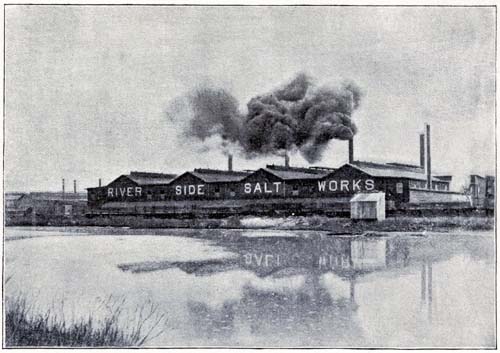
RIVERSIDE SALT WORKS, HUTCHINSON, KANSAS.
We visited the wonderful salt works at South Hutchinson.
The pure white salt was admired by all. Being
free from all impurities, the Hutchinson salt does not
cake. The supply is unlimited; at a depth of 350 to
400 feet lies a bed of solid, pure rock-salt, 330 feet
thick, covering an area of many miles in extent.
Hutchinson will supply all the salt trade west of the
Mississippi River. Additional interest was manifested
by all in this field, as it was learned that this source
of wealth was originally developed by Ben Blanchard,
unaided and alone.
The development of the great salt wealth of South
Hutchinson no doubt gave Hutchinson permanent impulse
at the opportune moment. Competition from
Wichita for the business centre that must of necessity
settle on some point in Kansas subsided when the salt
fields came to the surface with its unlimited supply
of pure white salt. Standing by the side of one
of the leading bank presidents of Hutchinson, at
one of the great salt wells, one of our party, not knowing
whose energy and enterprise discovered and developed
the great industry, made the remark: “I should
be willing to take off my hat to the man who first struck
salt here.” The bank President replied: “Well, you
may take off your hat to Mr. Blanchard, the President
of the Empire Loan and Trust Company.”
We left the salt works, with its thousands of tons
of snowy salt, for the green fields of the farms. There
was not a cloud in the sky. The cool, fresh, country
air put us all in the best of spirits. For miles and
miles we hurried on, scaring up quail, prairie chicken,
and rabbits from the finely-kept green hedge fences
which line the road on both sides. Choice farms are
on every hand. In fact the country presents the appearance
of a checker-board, nearly every quarter
section being a fine farm with its grove of forest trees,
orchard, and small fruit. The two story farm-houses
and large barns remind one of the best portions of
Pennsylvania.
We passed team after team on its way to Hutchinson
loaded with wheat, oats, or corn. We stopped at the
fine fruit farm of Mr. Switzer, and received a bountiful
supply of choice, rosy apples. The cherry and peach
trees still bore traces of the wonderful crops that had
been gathered and shipped. To our left was Mr.
Furney’s fine mansion, and a little farther on the
elegant stock farm with its hundreds of blooded cattle,
belonging to Mr. Stewart. Both of these gentlemen
were formerly of Philadelphia. Many other similar
places would have been in sight, but the great fields
of corn on every hand hid them from our view. The
new wheat, which has been sown in abundance, was
just coming through the ground, and gave a fresh,
green look to many a field.
We reached Hutchinson in time for dinner, and could
hardly realize that we had driven over twenty miles.
After a sumptuous dinner at the Brunswick, we
visited the chief points of interest in Hutchinson;
with the mayor and leading bankers of the city. We
were driven past its twelve salt works to the packing-houses
of Fowler & Underwood, and Tobey & Booth,
and the great lard refinery of Fairbanks & Co., the
ice factory, the banks, the home office of the Empire
Loan and Trust Company, and to the office of the
Hutchinson Daily News (Ralph L. Easley, Esq.,
President and managing editor), then to the Santa Fe
Hotel, where a banquet had been spread for us by the
members of the Hutchinson Clearing-House, who were
accompanied by their ladies.
This hospitality was an entire surprise to us. Hon.
Darwin R. James, Hon. John Jay Knox, and the Hon.
D. O. Bradley expressed our thanks to the citizens of
Hutchinson for the courtesies and hospitality extended
to us. We take the following from the Hutchinson
News:
“Before leaving the dining-room the News reporter
took occasion to inquire of several of the gentlemen
how they were impressed with Hutchinson.
“Edward Merritt, Esq., President of Long Island
Loan and Trust Company said: ‘We have been delighted
and surprised at the wonderful development of
the State of Kansas. The growth and progress of
Hutchinson are marvellous. The discovery by Mr.
Blanchard of the salt fields underlying this section of
the country must certainly add largely to the wealth of
the city and its inhabitants. The natural advantages
of its situation together with the inevitable growth of
its industries make the future of Hutchinson, in my
judgment, sure beyond doubt.’
“Hon. John J. Knox, who was Comptroller of Currency
at Washington for eleven years, said: ‘Yes,
Hutchinson is indeed a beautiful and also a wonderful
town. The geographical position of Hutchinson respecting
the great through lines east and west is such,
that she is sure to continue to be one of the leading
cities in Kansas.’
“Mr. D. Ogden Bradley, President of the Tarrytown
National Bank of Tarrytown, N. Y., a member of the
Legislature of the State of New York for several years,
and a banker of forty years’ experience, said: ‘I am
greatly pleased with Hutchinson, and see elements of
great strength and certain prosperity all around it. I
greatly admire Kansas. It is rapidly advancing to the
lead of the moral and intellectual forces of the nation.
It is doing a great work, and has a gigantic future.
Hutchinson will certainly become its metropolis.’
“Hon. Darwin R. James, who served in the Forty-eighth
and Forty-ninth Congresses, is an importer of
indigo and spices, president of a savings-bank, and
secretary of the New York Board of Trade and Transportation,
said: ‘Words fail to express the pleasure of
the excursion we are making. Kansas is a magnificent
State, and is developing with wonderful rapidity. I
thought I knew something about it before I came, but
I am amazed at the progress made since my former
visit. All that I had heard of Hutchinson, and it was
much, has been more than realized. She is a magnificent
young city, whose possibilities for the future are
unlimited. We might say of Hutchinson “She is the
salt of the earth.”’
“Dr. Frank W. Shaw, of Brooklyn, N. Y., being
asked for his impressions replied that, while not a banker
himself, he could appreciate the interest which men of
affairs always feel toward the prosperity of any growing
section of the West. The opinions of Kansas which he
had heard from the distinguished gentlemen with whom
he had the pleasure of travelling had shown him the
broader views of observation, but what he had personally
seen to-day of Hutchinson and its wonderful industries
and possibilities convinced him of the soundness
of Western enthusiasm. Those magnificent salt works
alone assure the future success of the city. He said he
should always feel indebted to Mr. Blanchard for his
first view of the substantial prosperity of Kansas and of
this beautiful city.
“Crowell Hadden, Esq., President of the Long
Island Bank of Brooklyn, the oldest bank in the city,
said: ‘I am highly gratified at the growth and enterprise
of the city. It bids fair to become one of the
greatest of Western cities. The recent discovery of
salt underlying the city by Mr. Ben Blanchard will add
largely to its wealth.’
“Capt. Ambrose Snow, President of the Board of
Trade of New York City, said: ‘Yes, sir, Hutchinson
has a great future before her. That wonderful
salt! Why, it is a revelation to me. With that, and
the railroads you have and those you are getting, no
power in the world could prevent Hutchinson from
forging right to the front and staying there!’
“The ladies of Mr. Blanchard’s party were of much
more than ordinary intelligence, and had travelled not
a little, and seen much of the world, and were familiar
with European scenery. They were charmed with our
beautiful streets and neat and handsome business
blocks, and elegant lawns and residences. They were
unanimous in the opinion that if they could not live in
New York they would certainly choose Hutchinson.”
Of one fact all were convinced—that Hutchinson
could furnish as good social life as we could desire.
“Hutchinson’s salt mines are valuable, but her women
are far above rubies,” said a gentleman of our party,
and we all said “Amen!”
Our party were delighted and surprised to find in
this beautiful city of seventeen thousand people such
a rush of business. The streets were thronged with
teams, the stores crowded with people. Hundreds of
new buildings were going up—great stone blocks and
elegant residences. We could easily understand this,
when we found that Hutchinson was located on three
trunk lines and two branch railroads, surrounded by
an agricultural country that cannot be excelled, and
underlaid with the thickest vein of pure salt in the
world. Mr. Bourne, Treasurer of the Empire Loan
and Trust Company, and for many years a banker,
told me that a great many of the business men of
Hutchinson were formerly from New York, and that
Eastern capital was rapidly coming in to develop the
latent interests here.
As an illustration of the rapidly growing commercial
importance of Hutchinson, the Santa Fe Railroad Co.
has recently issued circulars to shippers of live stock,
which places Hutchinson on an equal footing with
Kansas City.
William Willard Howard, in Harper’s Weekly, Nov.
3, 1888, says: “Wise and conservative methods of doing
business attract a great deal of New York, Philadelphia,
and Boston capital to Kansas properties that are now
lying idle. Many Eastern capitalists are sending money
to Kansas, but with few exceptions the bulk of the investments
are in mortgages on farm property. To men
who have made a study of Western securities these
mortgages are looked upon as safe and profitable investments;
but while they are no doubt beneficial to
the individual borrower and lender, they yet cannot
benefit Kansas a hundredth part as much as the same
money would if used in the proper development of the
State’s great resources. The day is rapidly approaching
when the vast sums of money now stored in financial
centres will be as readily invested in Kansas property
as funds are at present put into farm mortgages.
The city of Hutchinson has shown how it can be done.”
After the banquet we entered our car bound for
Colorado; after a short stop at Pueblo we arrived in
Denver, and went to the “Windsor,” where Mr.
Blanchard had secured rooms for all during our stay
in this far-off city. So easy and pleasant had been our
journey of over 2,000 miles, we could not realize the
distance we had travelled, except by the difference of
time—we were two hours behind New York time. On
Sunday attended service at Trinity M. E. Church, a
beautiful building, organ, etc., valued at $300,000.
Monday morning, in seven carriages, a representative
of the “Bankers’ Association of Denver” in each carriage,
visited the “Omaha and Grant Smelting Works,”
public buildings, etc., under the courteous direction
of ex-Gov. J. B. Grant. Leaving Denver Monday, 4:45
P.M., the next stop was at Colorado Springs, where
there are no springs. We were anxious to reach Manitou,
where the springs are numerous. The regular
train had left. The necessity for prompt action was
apparent. There would be no out train till morning.
Mr. Blanchard was equal to the emergency; a
special engine was secured, and with the superintendent
of the road as conductor we started on the up
grade, and arrived at Manitou (which is the Indian for
Great Spirit) safely at eight o’clock of a beautiful
evening. Carriages had been ordered, and were waiting
at the depot, and a ride through Manitou, up Ruxton
Glen to the springs by moonlight, completed the
delightful experience of the day.
The “Iron Spring” and “Soda Spring” are superior
for health to the “Washington” and “Congress”
springs of Saratoga.
Up Pike’s Peak, Tuesday, October 1st.
The day was perfect; not a cloud. Our car stood on
the side track of the Midland, at an elevation of seven
thousand feet, equal to the “Tip-Top House” on Mt.
Washington. All were eager to know if the weather
was propitious. Hasty toilets enabled us, one and all,
to assemble at an early hour and watch for the first
rays of the rising sun. We were looking east, when
one of the group, a lady, was the first to call out:
“There it is”; and, turning to the west, we saw
“The Peak,” snow-clad, blushing like a rose. Then
“Gog and Magog” caught the rays; then “Cameron’s
Cone.” The foot-hills followed, one after another, till
all had joined the “Peak” in proclaiming “The sun
has risen.” We were charmed by the wonderful and
novel scene. “Manitou” lay asleep at our feet. We
watched till at last we too were standing in the sunshine.
After an early breakfast our Pullman Hotel, the
“Dalmatia,” was taken over the Midland Railroad
to Cascade City, passing through eight tunnels in
going six miles to ascend about one thousand feet.
We left our Pullman at Cascade City, and took carriages
with four horses, for a seventeen-mile climb to
reach the summit. The carriage road is a marvel of
engineering skill. At the half-way house our horses
were changed for four sure-footed mules. After leaving
the timber line the prospect is wonderful, changing
with every turn of the road, and there are eighty turns.
The ascent of Pike’s Peak in time of flowers is a surprise
for those who expect to see only the rough boulder
and riven rock. “Flowers deck their inclined sides
in great blocks of color, and litter their terraces and
woodland edges in variegated confusion. There is no
difficult pass where they are not found; no dusky glen
that does not harbor them; scarcely any height on
which their beauty will not appear to gladden him who
toils to reach the summits.”
“’Tis legend told of primal days
When ‘Manitou,’ like clay,
The gray rock mountain shapes did raise
To celebrate his sway.
He was not pleased. The mountains bare
Were bleak and dull and gray.
He snatched a rainbow from the air,
To use its colors gay.
Crumbling its bars, with chanted spell,
Their radiant dust he threw,
And everywhere a handful fell
A million flow’rets grew.”
As the early snow on the mountains had killed the
flowers before our visit, a volume of pressed “Wild
Flowers from the Rockies” was presented to each one
of our party by our host. The flowers were gone but
the Autumn tints had painted the grand old mountain,
emerald, garnet, and gold.
Miss L. I. S. says:
“One curious fact I remember was, that the pine trees
all presented branches on but one side of the trunk,
and that the south, for the bleak north winds prove too
severe for growth on that side, and instead of growing
up, like well regulated trees, the branches all hang
down, bended by their weight of snow, presenting a
very singular appearance.
“How many times our blood would run cold as we
skirted a particularly sharp turn on the edge of a very
steep precipice.
“Snow was very plenty about us, and often we would
be driving through piles two and three feet deep in
some sheltered portion of the road.
“Imagine, ye who were not there, sinking in above
the hubs in snow, genuine snow in its pristine beauty,
and then you can realize why his lordship, the Peak,
looks so white at a distance. And now comes the
time for the furs and mittens and lap-robes, and were it
not for the bright sun I imagine some noses would have
been very blue.
“We had an unusually clear day for our visit, just
what our favored party might have expected, for what
was there that did not present its most attractive side
to us.
“Before we quite reach the summit we get a grand
view of the Continental Divide and Snowy Range, and
those two white icebergs to the south they tell us are
the Spanish Peaks, one hundred and eighty miles
away.
“And now we have almost finished our seventeen
miles of climbing, and the high mountains that we
have come over lie like level plains beneath us, and
nothing obstructs our view; we are head and shoulders
above the world. Up, up, until the Tip-Top House
comes in sight, and we draw up before it and alight
cautiously, so as to take the rarefied air by degrees into
our lungs.
“The Peak was reached at one o’clock. The sun was
shining with mid-day brightness. The moon was also
shining, undimmed by the sun’s brighter rays. To
the east, “Manitou” and “Colorado Springs” seemed
floating in space; to the north and west, Gray’s Peak,
and the Snowy Range, and the smoke of the smelters at
Leadville, seventy-five miles away; to the south, the
“Spanish Peaks,” snow-clad, one hundred and eighty
miles off, seemed only a few miles across the mountains.
We stood fourteen thousand three hundred and thirty-six
feet above New York and Brooklyn.
“At about 2.30 o’clock we stow ourselves in the stages
and begin our trip down the mountain, a much easier
but more thrilling ride. Mrs. Hadden, I think, voiced
the experience of some of the rest when she said she
only took two breaths all the way down—one when
she started, and another when she stopped. It was
exciting to be whirled around the sharp curves, at a
rapid gait, especially when an overturned cart told the
tale of some poor fellow coming to grief; but it really
amused us to picture the antics the little donkey must
have gone through in his involuntary tobogganing
down the side of the mountain. Several of the turns
were marvellous, the road almost returning on itself,
and in one spot we could see seven different portions
of the road in its serpentine windings.
“Shall this pleasure ever end? Must we come down
to every one’s level?
“The sun has just disappeared behind the snow-clad
peak. We can still see it shining on Cameron’s Cone
and on the peaks to our left.
‘The western waves of ebbing day
Rolled o’er the glen their level way;
Each purple peak, each flinty spire,
Was bathed in floods of living fire.
But not a setting beam could glow
Within the dark ravines below,
Where twined the path in shadow hid,
Round many a rocky pyramid,
Shooting abruptly from the dell
Its thunder-splintered pinnacle;
Round many an insulated mass,
The native bulwarks of the pass,
Huge as the towers which builders vain
Presumptuous piled on Shinar’s plain,
Their rocky summits, split and rent,
Formed turret, dome, or battlement,
Or seemed fantastically set
With cupola or minaret,
Wild crests as pagod ever decked,
Or mosque of Eastern architect.’
“At six o’clock we whirl into Cascade. We jump
from the stages, and fairly pinch ourselves to see if we
are the same people who left there in the morning.
Yes, we are the same in outward appearance, but something
has entered into our lives, our inner selves, that
broadens us out, and will prove a continual feast in
coming days.
“It would seem that a climax could hardly be
capped, but ours was in a most delightful way. The
stages had hardly driven away when up drive four or
five carriages, and we are invited to go back to Manitou,
by way of the Ute Pass trail, instead of by the railroad.
Nothing loath we get in, and settle ourselves
for one of the pleasantest of rides. It is a perfect
evening, and we have not gone far before the moon
comes out and throws a spell of enchantment over
the scene. The road is so smooth and hard that
our horses’ hoofs make a pleasant ring as we speed
along. A merry little stream, whose dashing and
dancing have given it the name of “The Fountain
that Boils,” accompanies us, and we run a race with it,
but own ourselves thoroughly beaten in all respects,
when our rival enhances its beauty, redoubles its speed,
and makes louder its laughter as it throws itself headlong
down the cliff of rocks; and we alight from our
carriage to go down the ravine and pay homage to
the beauties of Rainbow Falls.
“This brief glimpse in the twilight makes us long for
a view by day, and we promise ourselves a longer visit
the next time we come.”
As we bowl along we look up at the steep, rocky
walls of the cañon, shutting us in from all disturbing
thoughts and sights, and the moon floods all with its
peaceful light, and all fatigue and disquiet vanishes,
and we realize that we are having a fitting ending to a
glorious day.
The electric lights at Manitou recall us to ourselves,
and we finish a well-rounded day, begun with Pike’s
Peak by sunrise, and we leave him sleeping under the
watchful eye of the purest moon that ever shone.
Wednesday, October 2d.
Another brilliant day. An early breakfast. Carriages
were taken for the most wonderful drive of the
trip. First to “Iron Springs” and “Ruxton Glen,”
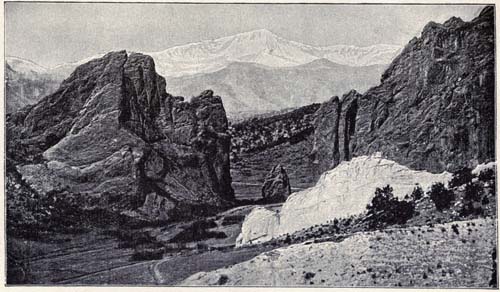
then to the “Garden of the Gods,” more wonderful
than can be told; then to “Glen Eyrie”; then the
“Messa Road”—who will forget the beauty of its
scenery?
We then turned our way to the scene of what was to
be the culmination of our journey. As we approached
Cheyenne Mountain, memories of (H. H.) Helen Hunt
Jackson, arose in every mind. Her solitary grave upon
Cheyenne Mountain, selected by herself, is unmarked,
except as friendship’s hand has raised a mound of small
stones and pieces of marble, an evidence of affection
more significant than formal monument could be. It
is an illustration of one of her own verses:
“But no decaying
Can reach it in this sepulchre, whose stone
Our hearts must make! To an exceeding glory grown,
This grief outweighing.”
GATEWAY, GARDEN OF THE GODS.
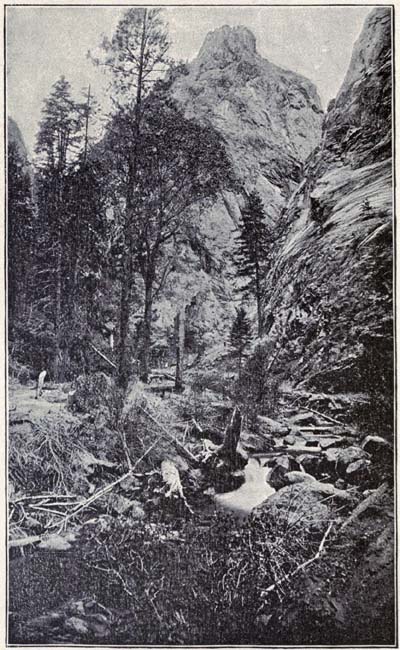
In Cheyenne Cañon where, almost imprisoned by the
perpendicular rocks, lunch was eaten with keen relish,
and the health of our host drank with cool, foaming
“Manitou Spring water,” Wall Street was forgotten.
Attention was directed to a prominent Wall Street bank
president sitting on a rock enjoying the bountiful collation,
with two young ladies acting as waitresses.
After lunch we rambled through the beautiful cañon
and visited the Falls, where for 500 feet cascade follows
cascade, till in “Seven Falls” they reach the bottom
of the cañon.
How reluctantly we entered our carriages, for it was
to be our last drive on this delightful journey. The
“Pillars of Hercules” from a height of 1,500 feet
looked down upon us with approval, and the “Seven
Falls” united with us in singing the “Doxology.”
We drove back to Colorado Springs and through its
principal streets to our inviting quarters in the “Dalmatia,”
ever ready to welcome us.
The next morning we were again riding through the
fertile fields of Kansas. A brief stop at Hutchinson to
say good-bye to Messrs. Burns and Bennett, thence to
Topeka, Kansas City, St. Louis, and home, via the Big
Four System to Indianapolis and Cleveland, thence by
Lake Shore and New York Central, reaching Grand
Central Depot on time Saturday evening, October
5th.
Probably no one enjoyed the trip more than Edward
Merritt, Esq., President of the Long Island Loan and
Trust Company. We had not finished the first day’s
travel when, on account of a striking resemblance, Mr.
Merritt was recognized by the crowd at the depot as
President Harrison. This gave him a prestige and
popularity with the party that continued. Should any
of us need counsel, we appealed to him. The young
ladies always did. Did they fall, Mr. Merritt was
expected to help them up. Captain Snow, when accused
of sleeping soundly, was delighted to secure his
counsel, and from his judgment there was no appeal.
One of the advantages of such a trip is safety. To
travel over 4,000 miles involves some risks apparent to
all. To have a skilful physician and surgeon at hand
in Dr. Frank W. Shaw was duly appreciated. We had
not gone 1,000 miles before a spark intruded the sacred
precincts of one of the brightest eyes that ever looked
upon the wonders of the “Garden of the Gods.” The
cry for Dr. Shaw was promptly answered by skilful
relief. How often that cry was made and responded to
the Doctor’s “Diary” will attest. The youngest and
oldest alike shared his skill and watchful care.
At Topeka J. R. Mulvane, Esq., President of the
Bank of Topeka, gave me the following statement:
The corn crop this year will be about two hundred
and fifty million bushels. (The Secretary of Kansas
State Board of Agriculture raises this estimate to
276,541,338 bushels.) The wheat crop forty million
bushels; oats fifty million bushels; rye and barley ten
million bushels; flax-seed five million bushels; pork,
in 1873, the State supplied 67,500 hogs; in 1889,
one million eight hundred and seventy thousand
(1,870,000).
Mr. Mulvane says, the products of Kansas farms
this year alone, if applied, would liquidate every dollar
of indebtedness. The following lines by Mrs. Sigourney
may be very appropriately applied to Kansas.
“The sturdy reapers sing, garnering the corn
That feedeth other realms besides their own.
Toil lifts his brawny arm, and takes the wealth
That makes his children princes;
Strange steeds of iron, with their ceaseless freight,
Tramp night and day; while the red lightning bears
Thy slightest whisper on its wondrous wing.”
While in Denver, Colorado, we visited the Smelting
Works, the great industry of that solid and thriving
city. Ore is brought direct from some of the larger
mines of the State and extensive shipments of ore and
copper “matte” are received from Montana, Utah,
New Mexico, and other western territories.
The value of the shipments from one of the many
smelters this year will be from $3,500,000 to $4,000,000.
This is a small fraction of the wealth developed in
hard cash by one of the youngest cities of the West.
This goes to New York banks to increase their capital
and swell their surplus. If all the bank presidents of
New York would follow Mr. Knox’s example and
visit and personally inspect the solid growth and
security the West offers for investments, they would
all say with him: “You have grown rich, but we of
the East are your co-partners in business, and notwithstanding
your riches, we give notice that we do not
intend there shall be any dissolution of the co-partnership.
So far from that being the case, we give notice
that in those branches of business which we find most
profitable, we intend from year to year to increase our
holdings. Those of us who have been in the habit
of visiting the growing West, know its resources and
propose, as heretofore, to continue to assist in the
development—largely under your management.”
After leaving Albany it was evident that our pleasure-trip
would soon terminate and we should be obliged to
say “good-bye.” As usual, and without formality, Mr.
James was asked to call to order and take the chair.
His address was expressive of the feelings of the whole
party when he said that one and all wished to express
to Mr. Ben Blanchard their sincere appreciation of his
cordial courtesy and unlimited hospitality during a two
weeks’ trip, upon which every anticipation had been
more than realized, and that he was well aware that
while we had all been so well cared for, without an
anxious thought, the trip had cost Mr. Blanchard severe
care and attention. Mr. Knox followed, and said that the
two weeks’ vacation had been the most delightful trip
he had ever taken. Mr. Merritt joined in acknowledging
the enjoyment that had been complete. Mr. Bradley,
Captain Snow, Dr. Shaw, and Mr. Hadden all
gave expression to the same feelings of appreciation
and gratification. The last and best speech came
impromptu from the youngest member of the company.
Mr. Blanchard was very evidently pleased with the
kind words of appreciation for his hospitality that had
been spoken. He said in response:
“My friends, you give me too much credit. I am
glad to admit that we have had a happy time; but I
could not have made the trip a success without the aid
of all of your good offices.
“The railroad officials have contributed their courtesies
without stint. The Pullman Company have shown
us every attention.
“We have been favored with perfect weather, and
saved from accident.
“You have each one joined in making every hour
full of brightness, good cheer, and happiness. You
have made me indebted to you for the pleasure you
have given me. You have honored me with your
presence, and I shall ever cherish your kind words,
looks, and actions.”
Mr. Blanchard’s reply was a surprise to all. We
had all given expression to the feeling that the two
weeks just closing were the most enjoyable we had
ever experienced in our journeyings; but no thought
had entered our minds that this was the most delightful
trip our host had ever enjoyed, for we knew he had
taken a dozen similar pleasure-parties to the Yellowstone,
California, Minnesota, and other points of interest.
To hear him say that our company had placed
him under obligations, was truly capping the climax.
The pleasure of all our company was increased by
the presence of Mrs. Blanchard, who returned to New
York with us. When mention is made of our host, we
always include Mrs. Blanchard.
After our return home, the party selected a beautiful
present of sterling silverware, inscribed as follows:
To Mrs. Ben Blanchard,
from the Dalmatia Party, Sept. 23, 1889.
The New York World of October 7th contained the
following:
“A party of New Yorkers, who have been travelling
in the West for ten days in a special car, the guests
of Ben Blanchard, Esq., arrived home late Saturday
evening. The party numbered about twenty. Mr.
Knox, who was for many years Comptroller of the
Currency at Washington, went on ahead of the party
to attend a meeting of the National Banking Association
in Kansas City, and joined them there. It was
thought that their trip might have some connection
with some new financial scheme to be developed in the
West, but Mr. Knox said yesterday that they had gone
simply for pleasure. All declared that they had a most
delightful time.
“‘The West is developing rapidly,’ said Mr. Knox.
‘It would pay every Eastern business to make a
journey through the West every two or three years.’”
Was ever pleasure and profit so delightfully combined?
After leaving the Bankers’ Convention at
Kansas City all care or thought of business was dismissed.
We were in the watch-care of Mr. Blanchard,
and, confident that he knew the way, we all surrendered
ourselves to his protection. My second visit
was just three months after my first. Then the crops
were waving in the fields, now they were harvested;
and as the Hon. Darwin R. James said in his address
at the banquet at Hutchinson, “All that Major Corwin
has told us about the crops and the salt and the
condition of things in Kansas has been more than
realized.”
The “Dalmatia Party” is now scattered. Two
are in Europe. Others are again controlling the
finances of Wall Street, and the busy marts of trade
and commerce of the East, while our host is engaged as
before in developing the undiscovered wealth of the
great agricultural State, which has untold riches of
salt and other interests besides,—Kansas. May he go
on from conquering to conquest, from success to success,
is the wish of all those who enjoyed his unselfish
hospitality.
Our house on wheels, in which we travelled safely
over 4,000 miles, was about seventy feet long, by ten
feet wide; one story; divided into drawing-room,
smoking-room, kitchen, and large family room. For
two weeks we enjoyed its close quarters,—small for the
residence of twenty-two people. But it was the people
that made the rooms delightful.
“Some love the glow of outward show,
Some love mere wealth and try to win it;
The house to me may lowly be,
If I but like the people in it.
What’s all the gold that glitters cold,
When linked to hard or haughty feeling?
Whate’er we’re told, the nobler gold
Is truth of heart and manly dealing!
Then let them seek, whose minds are weak,
Mere fashion’s smile, and try to win it;
The house to me may lowly be,
If I but like the people in it!”
THE END.