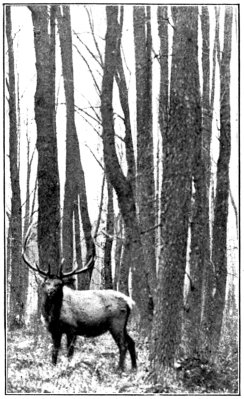
Towards the close of the year 1906 I received
an invitation from Count Joseph Potocki to
pay him a visit in the following August in
order to see his collection of deer at Pilawin,
in the Russian province of Volhynia. After
some preliminary correspondence, an invitation
was also sent by Countess Potocki to my
eldest daughter; and on receipt of this I
finally decided to undertake the trip.
We started by the 8.35 P.M. boat-train
from Victoria on Monday, August 19, and
reached Warsaw in time for breakfast on the
following Wednesday. Breakfast at the Hotel
Bristol (where, for the first time, we tasted
fresh Russian caviare) was a welcome preliminary
to an inspection of Warsaw, under
the guidance of the Count’s agent, who had
kindly come to meet us on arrival at the
station. The city can be seen easily and
quickly by means of the excellent service of
horse-trams, now in course of replacement
by electric cars on the overhead-wire system.
Our attention was first attracted by the
magnificent new Greek church, built of white
bricks, with its golden cupola and lofty,
detached campanile. The church faces the
“Bristol,” and behind it are the beautiful
public gardens, which claimed a full share of
our admiration. We also visited several of
the fine old Catholic churches, including the
famous cathedral. The striking and lofty
monument to the Polish King Sigismund, as
well as the fine statue of the astronomer
Copernicus, were likewise inspected and admired.
Perhaps, however, the portion of the
city which chiefly impressed us was the fine
old market-place, with its irregular, picturesque
buildings, its numerous stalls, and the people of
diverse nationalities by whom it was thronged,
all busy in either buying or selling.
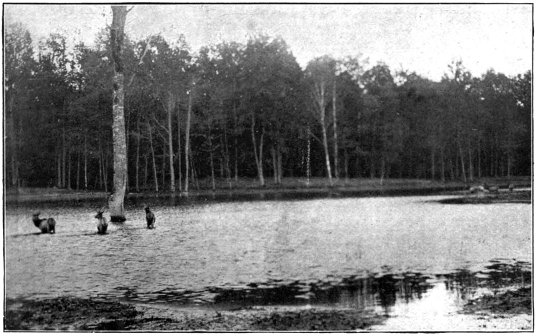
THE BIG LAKE IN PILAWIN.
By good luck, we also enjoyed the
opportunity of seeing one of the Czar’s
Tcherkess cavalry regiments marching through
the city; the sable uniforms and tall black
astrachan papakhas (busbies) of the troopers
forming a striking contrast to the white
jackets of the Cossacks, who are to be seen
everywhere in the streets.
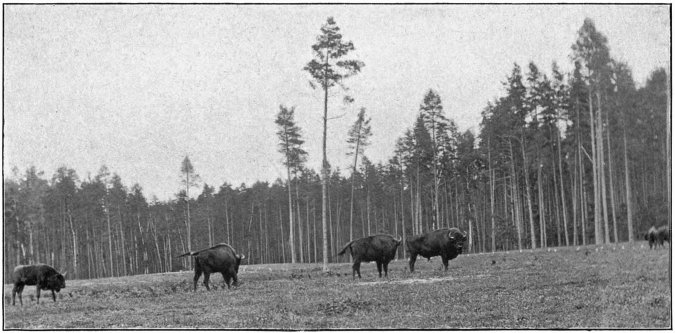
EUROPEAN BISON IN THE OPEN.
After returning to our hotel, by 3.30 P.M.
we were on our way to Terespol station, the
terminus of the Kieff line, which we had to
leave for Schepetowka, our destination, at five
o’clock. We were somewhat delayed on our
way by a great crush of vehicles at the bridge
over the Vistula; and owing to the crowd of
passengers at the station itself, taking tickets
and registering the baggage was no easy
matter; but it was eventually accomplished
(by the hotel porter), and we were soon comfortably
established in a sleeping compartment
of the train ready for the start.
Here a word may be said in commendation
of the railway service in this part of the
Russian Empire; that is to say, when you are
once in the train. The first-class sleeping
compartments are comfortable and convenient;
the cuisine is excellent; and the attendants
are civil, attentive, and expert at interpreting
the wants of those passengers to whom
Russian and Polish are unknown tongues.
Punctuality is, however, a virtue which on
some occasions might be more cultivated.
At 5.10 A.M. on Thursday (only ten
minutes behind our scheduled time) we
reached Schepetowka station, where we found
an open carriage, drawn by four horses
abreast, in waiting; and in five minutes we
were on our way to Antoniny, the country
seat of the Count and Countess Potocki.
Small strongly-built phaetons with varnished
wood-work are used for travelling. They are
built at Vienna, and can be driven either with
a four-in-hand or four abreast. A four-horse
team is always kept ready at each changing-station.
When travelling at night a smaller
vehicle goes in front with torches. For
baggage a second carriage is provided.
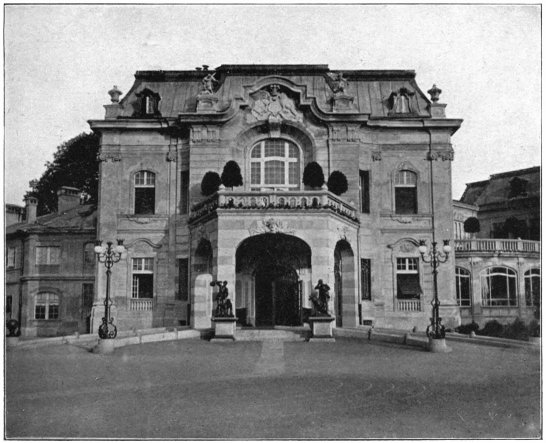
THE MAIN ENTRANCE OF THE ANTONINY PALACE.
As there had been a deluge of rain during
the night, the road, which for the greater part
of the way formed a mere track across the
yielding black alluvial soil, was very bad
going, being in places indeed little better
than lakes of mud, and almost everywhere
cut up into deep ruts. Despite this (and
the bad state of the track, as well as the
condition of several of the wooden bridges,
would have well-nigh broken the heart of an
English coachman), with only a single change
of horses, the journey of some fifty kilometres
was safely accomplished in a little over four
hours; and by half-past nine, that is to say,
about sixty-one hours from London, we were
heartily welcomed by our kind host and
hostess and their family. It should be added
that a metalled road is in course of construction,
which, when completed, will render the journey
from Schepetowka to Antoniny much easier.
To adequately describe Antoniny would far
exceed the limits at my disposal; while even
if considerations of space were non-existent, it
would be difficult to do justice to a domain
of such magnificence. It must suffice, then,
to state that the palace, which is admirably
situated on rising ground, and looks on to a
spacious courtyard, with the stables on the
farther side, has been added to by successive
owners till it has attained what may be truly
termed regal proportions, while it is kept up
in corresponding style and state; the owner
flying his own flag when in residence, while
when the Countess alone is at home her flag
is substituted.
As an indication of the owner’s sporting
tastes, reference may be made to a fine series
of trophies of African and Indian big game
displayed on portions of the walls of the hall
as well as on those of the galleries and
corridors above. These trophies are the results
of four separate hunting trips undertaken by
the Count: to India, Ceylon, Somaliland, and
the Blue Nile. The Somali and Ceylon trips
have been respectively described in a couple of
handsome and lavishly illustrated volumes, the
former of which has been translated into
English. Among the trophies on which the
owner sets especial store may be mentioned
the heads of a beisa oryx (Oryx beisa) and of
a dibatag or Clarke’s gazelle (Ammodorcas
clarkei), the horns of the latter approaching
“record” measurements. Personally, however,
I was more interested in the skins of a
Somali lion and lioness which show the
abundant brown-spotting of the limbs, underparts,
and flanks, characteristic of this race
(Felis leo somalica). The lion skin, which (as
is proved by the skull) belonged to an adult
animal, is further remarkable for the practical
absence of mane. Spotting seems peculiar
(except in the case of cubs) to East African
lions, and attains its maximum development
in the Masai lion (F. leo masaica) of German
East Africa.
In one of the corridors on the first floor
leading from the main staircase to some of
the bedrooms is displayed a fine group, consisting
of a female bear and three cubs killed
by Count Potocki last year in Northern Russia;
while skins of three half-grown cubs shot some
years ago in Lithuania ornament the floor.
Bears, it may be observed, are believed to have
disappeared some two centuries ago from the
neighbourhood of Antoniny, although they
lingered considerably longer in Pilawin. A wolf
was, however, killed near the palace only last
year, and a second soon after our visit, in
September, close to where we changed horses.
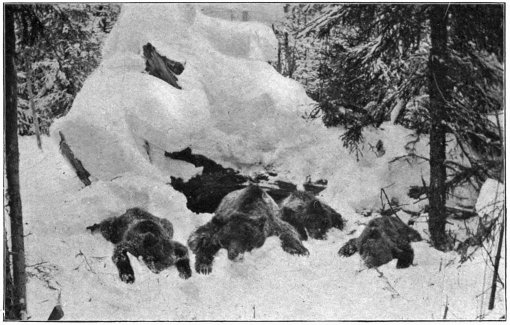
BEARS KILLED BY THE COUNT.
Among the wonders of the Antoniny palace
are its enormous wine-cellars, containing vast
stores of rare vintages, of which the earliest is a
superb Tokay of 1693; these were visited after
dinner, when we were attended by a number of
servants bearing lighted candles on long wooden
holders.
The gardens also—now rather more than a
century old—cannot be passed over without
some mention, as they are almost a dream of
beauty and picturesqueness. Exquisitely kept,
and situated on undulating ground intersected
with streams, and dotted with small lakes, these
gardens, which occupy many acres, are noted
not only for their gorgeous display of flowers,
but likewise for their splendid timber, consisting
chiefly of spruce, aspen, oak, and
sycamore, many of the trees being of unusual
height and symmetry, while all have been
planted with a view to the general effect. The
large white Roman snail (Helix pomatia) is
abundant in the gardens, where, however, it
may have been introduced, as I did not notice
its presence elsewhere.
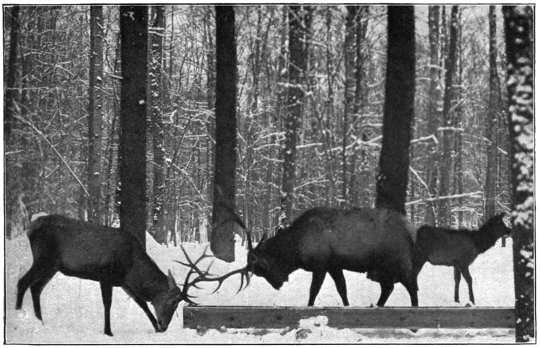
WAPITI STAGS TRYING FOR THE MASTERY.
Yet one more feature of the domain remains
to be noticed, namely its magnificent range of
stabling, which faces the main front of the
palace, and can have but few rivals, either in
size or in fittings. The stables and stud are
under the control of a “master of the horse.”
The mention of stabling naturally suggests a few
words concerning the famous Arab stud, which
is kept half a mile or so away from the palace,
and has no rival in Europe except in Mr.
Wilfrid Scawen Blunt’s well-known Arab stud
in England. The greater number of Count
Potocki’s Arabs have been bred on the estate;
and there is indeed at the present time only a
single mare imported direct from Arabia. With
the bare mention that there is an equally large
stud of Anglo-Arabs and thoroughbreds, as
well as a pack of stag-hounds and another of
harriers, the other splendours of Antoniny
must be left to the imagination of the reader.
Antoniny is, to a great extent, a self-supporting
colony, having a large range of
outbuildings and workshops, where almost
everything required on the establishment is
manufactured. All other supplies have to be
carted by road, either from Schepetowka or
from a station on the Lemberg line, on the
Austrian side.
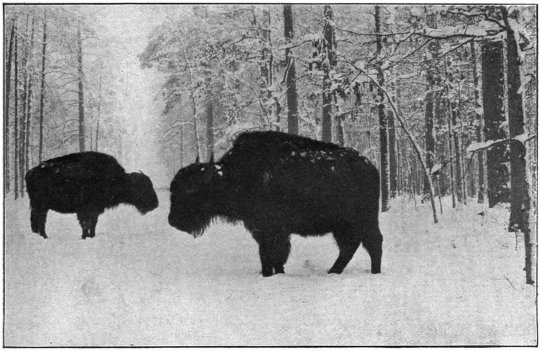
AMERICAN BISON IN THE SNOW.
To reach Antoniny from the railway at
Schepetowka our route lay nearly due south.
Pilawin, on the other hand, lies about eighty
kilometres north of the railway, and we had
therefore to return to Schepetowka; this journey
being accomplished on the Saturday in about
three and a half hours, the road being in much
better condition than on the previous Thursday.
Saturday night was spent in a small single-storeyed
house belonging to our host at
Schepetowka; and by nine o’clock on the
Sunday morning we were ready to start for
Pilawin.
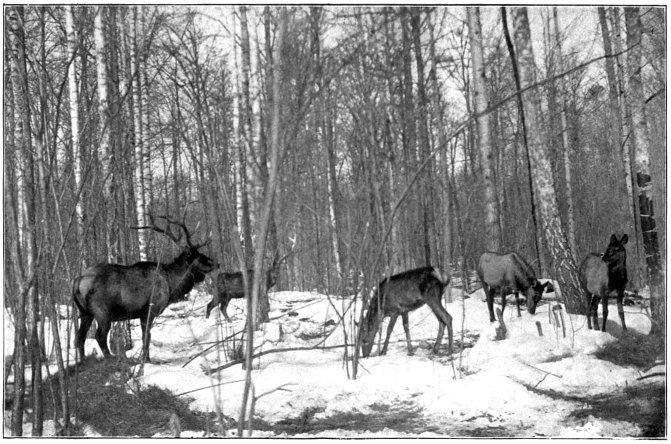
WAPITI IN THE SNOW.
Here a few lines may be devoted to the
nature of the country between Antoniny and
Schepetowka. Throughout the whole district
the soil consists of black alluvial mould,
apparently extending to a great depth. The
contour of the country takes the form of a
series of low undulating and more or less
nearly parallel ridges or hills, separated by
wide valleys, and running to a considerable
extent at right angles to the main direction
of the road. In each valley is a river or a
series of ponds, near to which a village is
almost invariably situated. The rich soil yields
luxuriant crops of wheat, oats, maize, millet,
buckwheat, hemp, and sugar-beet; the latter
being a crop yielding a large revenue to the
owner. Although the country as a whole is
open—reminding one, were it not for the undulations,
strongly of Argentina—oak-forests
are to be met with here and there. From the
ponds and rivers are obtained abundance of
carp and pike, which afford the fish-supply to
the inhabitants of the district on fast days as
well as on other occasions.
At Schepetowka occurs a deposit of thin-bedded
sandy limestone mixed with sand,
containing numbers of marine shells of Tertiary
age; this sand being employed at Antoniny
and elsewhere as gravel. I collected some of
these shells on the garden-paths at Antoniny,
and when I returned home took them to the
British Museum, where they were identified
as Trochus podolicus, a species characteristic of
the Sarmatian stage of the Miocene division
of the Tertiary period.1 As the species was
unrepresented in the collection, the specimens
were a welcome addition to the Museum.
Later on, when visiting one of the Count’s
sugar-factories at Koretz (a large town on the
Kieff road near Pilawin), I was shown specimens
of a white limestone containing marine
fossils. At the British Museum these were
identified as Trochus podolicus and Mactra
podolica; the latter species also belonging to
the Sarmatian stage, and likewise unrepresented
in the collection. The Mactra, it may be
added, is a bivalve, and the Trochus a spiral
univalve shell.
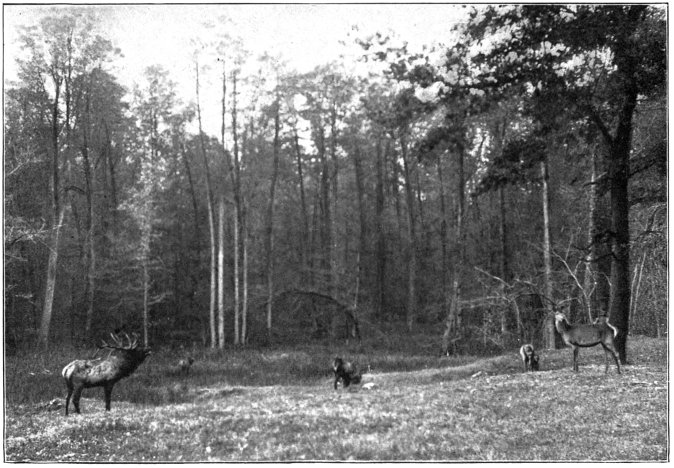
WAPITI CALLING.
Reverting to the Schepetowka district, it
remains to refer to the occurrence of large
erratic blocks of a grey syenitic gneiss
(commonly miscalled granite) which are used
for road-metal, and likewise as an ornamental
building stone at Antoniny. What I take to
be the same rock is found in situ at Koretz,
where it forms the foundation of an ancient
ruined castle belonging to the Count. I was
also interested in a rock containing fine blue
crystals of Labrador felspar, polished balls
of which are displayed at the entrance of
Antoniny.
To the northward of Schepetowka the
nature of the country undergoes a remarkable
change, the soil becoming sandy in place of
alluvial, and magnificent forests of Scotch fir
replacing the cultivated ground and oak-forests
on the south side of the line. In these forests,
a short distance from Schepetowka, wild boars
are still numerous, although the number of
head is believed to have been reduced by the
severity of last winter. The huge size attained
by the Schepetowka boars is demonstrated by
a magnificent specimen—the gift of Count
Potocki—exhibited in the Natural History
branch of the British Museum at South
Kensington.
After continuing for about a dozen or
fifteen miles, the pine-forests cease, and we are
once more on open cultivated land, which
continues all the way to Pilawin; the soil
being, however, more sandy and lighter in
colour than that of the Antoniny district.
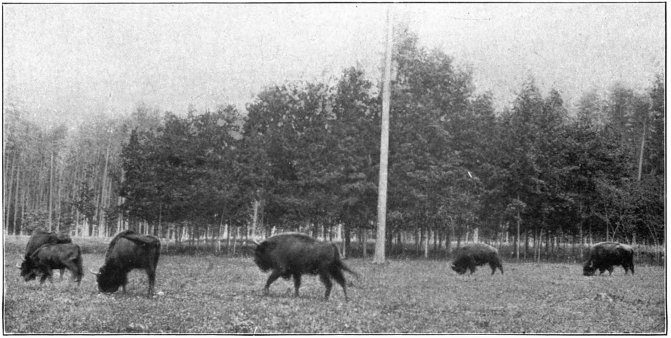
EUROPEAN AND AMERICAN BISON IN THE PILAWIN PARK.
Only one change of horses was made on
this journey, and that when only about one-third
the distance had been accomplished.
Despite the frightful condition of the roads
and torrents of rain, the second team covered
the sixty odd kilometres at a long swinging
trot, which was only broken for short intervals
twice during the journey. The last few miles
before reaching the Pilawin forests were,
however, on a macadamised road—the great
military road from Warsaw to Kieff. Turning
off from this road to the left some few miles
after leaving Koretz, the final stage to Pilawin—about
seven kilometres—was almost entirely
through magnificent primeval forest. At the
turning we were met by an escort of twelve
Don Cossacks (whose duty it is to patrol the
park), who rode alongside and behind the
carriage till our destination was reached at
3.30, the whole eighty kilometres from Schepetowka
having thus been covered, despite the
heavy rain, in six-and-a-half hours.
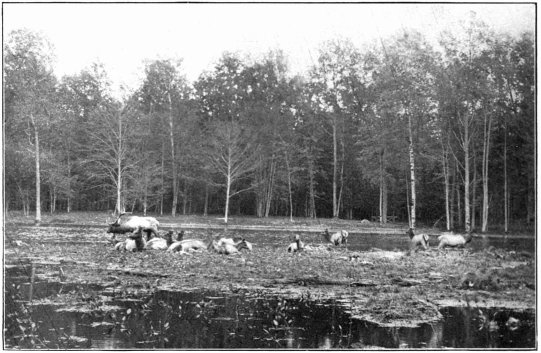
A TYPICAL PILAWIN SCENE.
The forest tract to which Count Potocki
has given the name of Pilawin (a title
connected with the ancient family crest)
comprises about seven thousand acres enclosed
by an eight-foot timber paling, replaced, however,
in front of the shooting-lodge by wire
fencing. The area of the whole forest from
which Pilawin is cut off is about thirty
thousand acres.
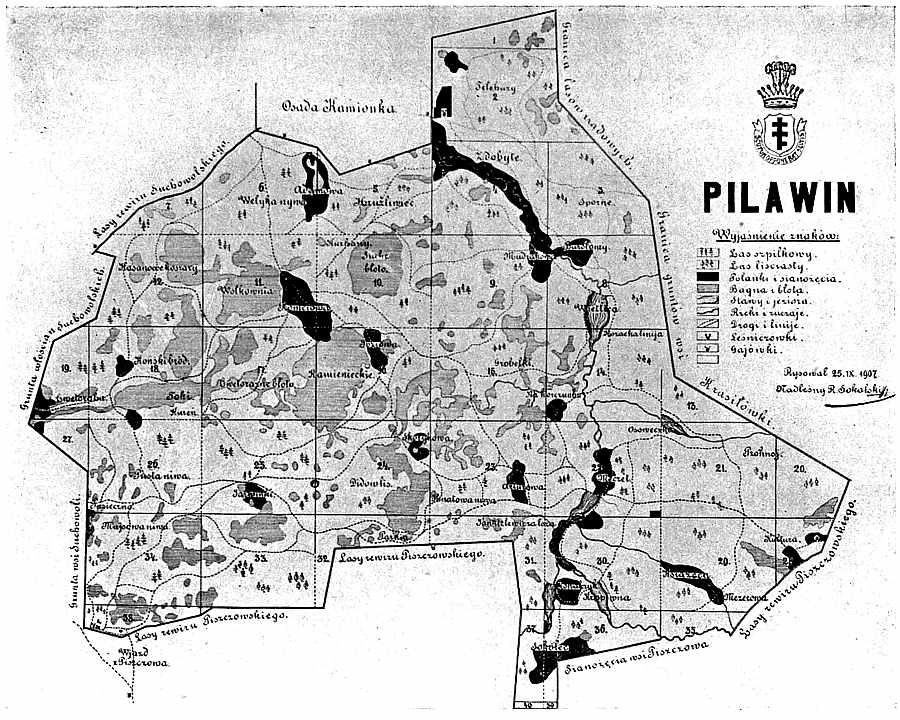
MAP OF PILAWIN.
Passing through the ponderous rustic
entrance gates, cleverly constructed of birch
and aspen poles, and surmounted by some fine
pairs of antlers and the Potocki crest, we first
came upon a spacious open enclosure containing
a couple of fine bears, now about two
years old, which were captured as cubs in
Lithuania by a friend of the Count. In the
enclosure are a couple of tall dead birch-trees,
up which the bears are in the habit of
climbing. They are also provided with a kind
of cavern, or den, in which they spend much
of their time when the weather is hot; and
they likewise have a bath.
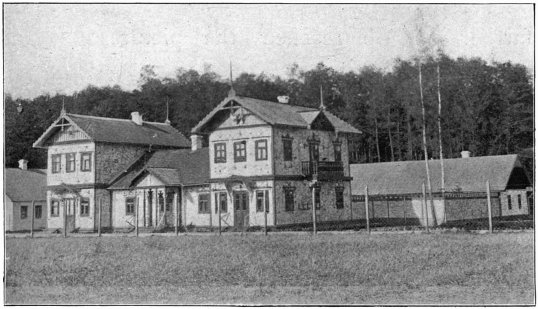
THE SHOOTING-LODGE AT PILAWIN.
Leaving these guardians, a few yards
farther on we reached the picturesque and
gabled shooting-lodge which was to form our
residence for the next ten days; the Count
and his family being quartered at another
residence, at Pisczow, some four miles distant
on the farther side of the Kieff road.
This shooting-lodge—which is in telephonic
communication with all the other residences of
the Count—is picturesquely situated on the
western side of the Pilawin preserve, and
overlooks in front a wide stretch of open
cornfields, bordered by dense forest of Scotch
pine, oak, and birch, with a few clumps
of larch; while at the back the forest comes
up to within a few yards of the building
itself.
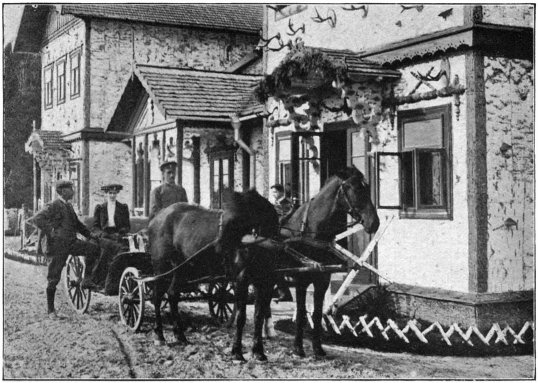
OURSELVES STARTING FROM THE SHOOTING-LODGE.
Constructed entirely of wood, and erected
by the local workmen under the superintendence
of Mr. Sokalski, an Austrian Pole, who
occupies the post of director of the preserve,
the Pilawin shooting-lodge is a spacious two-storeyed
building capable of affording excellent
accommodation for three or four guests, and
likewise containing the director’s offices and
the dwelling-rooms of the head forester. The
exterior is covered with large sheets of birch-bark,
thus giving to the building the appearance
at a distance of being constructed of
blocks of white stone.
The main apartment, on the first floor,
which serves both as dining-room and
smoking-room, is adorned with a number of
sporting and natural history trophies, including
numerous elk, wapiti, and other antlers,
together with stuffed specimens of the white-tailed
eagle (Haliaëtus albicilla), the spotted
eagle (Aquila heliaca), capercaillie (Tetrao
urogallus), and the rare black stork (Ciconia
nigra).
I was specially interested in an imperfect
antler dug up some years ago in the neighbourhood,
which the owner had been unable
to identify. It is, however, clearly a reindeer
antler, although different from any specimen
that has hitherto come under my notice.
I think it may indicate an extinct local race
of the species, although I may be able to
write more definitely on this point when
a cast (which the owner will endeavour to
have prepared) reaches the British Museum.
From a distributional point of view this
antler is of considerable interest, as it serves
to connect the present habitat of the reindeer
with Hungary, where fossil antlers also occur.
Till recently reindeer remains were unknown
to the southward of the Alps and Carpathians;
but at a depth of two mètres in a sand-bed
beneath brick-earth at Ober-Laibach, in Krain,
there has been found a portion of an antler
of this species, now preserved in the museum
at Laibach. This specimen is of the age of
the so-called diluvium. Since in Bavaria
and North Germany remains of the reindeer
are abundant in deposits of the polished stone
(Neolithic) age, while they are absent in the
refuse-heaps of the Swiss pile-villages, the
inference is that the species had become
extinct in the Alps by the time of the diluvial
epoch.
Another broken antler in the apartment
dates back to the time—at least four centuries
ago—when wild red deer still inhabited the
surrounding forests.
The finest pair of elk-antlers in the apartment
possesses a special and distinctly pathetic
interest of its own. These antlers, I was
informed by the Count, belonged to an elk
which two seasons ago attacked and killed an
unfortunate peasant on the estate. As the
triumphant elk was departing from the scene
of the murder, it was immediately attacked by
a pugnacious wapiti with such vigour and
determination, that after a short but severe
encounter the death of the peasant was
summarily avenged.
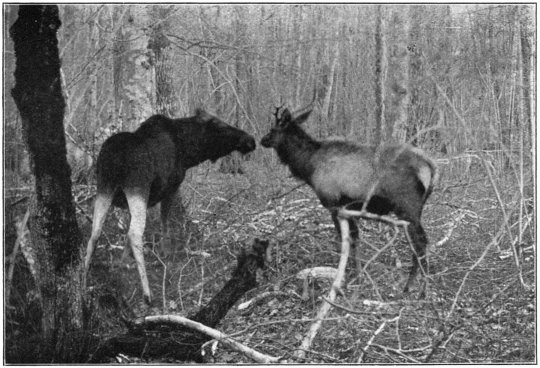
YOUNG ELK AND WAPITI.
A few words may be here conveniently
devoted to the vegetation of these magnificent
forests, which it is the object of their owner
to preserve as much as possible in their
original condition. In fact, the only changes
that have been made are the construction of
carriage roads (with a total length of about
one hundred kilometres), the clearing away of
fallen and half-fallen timber, the removal of
superfluous under-covert, the draining of some
of the swamps, and the construction of
artificial lakes and of open spaces in the
forest where abundant provender can be grown
for the deer and bison.
The forest consists mainly of Scotch fir,
oak (of two kinds), birch, and aspen.
Generally the pines and deciduous trees grow
upon different tracts, while even the oak,
birch, and aspen severally display a marked
tendency to occupy separate areas of their
own. In some cases, however, the forest
assumes a more or less completely mixed
character. It is this varied type of forest,
intercalated with open clearings and stretches
of marsh and lake, that renders the enclosed
area so admirably adapted for the home of
deer of various kinds collected from many
parts of Northern Europe and Asia, and
whose habits consequently display considerable
diversity.
Many of the firs in the forest are of gigantic
dimensions, one in particular measuring no less
than twelve feet in girth at a man’s height
from the ground.
One peculiarity of the Pilawin forest—shared
by no other in the district—is the
presence of numerous luxuriant patches of the
Crimean azalea (Azalea pontica), a species
whose nearest natural habitat is the Crimea.
According to local tradition, it was introduced
from there to Pilawin by Tatars about two
centuries ago; the seed having been conveyed
in the nose-bags of their horses. The yellow
blossoms of this fine azalea impart an unwonted
brilliance to large patches of the Pilawin forest
in spring. At the time of my visit there was
an abundance of edible berries of the cranberry
and bilberry type.
As Pilawin has only been enclosed for
about four years, it may be regarded as still
in the experimental stage; but so far as it
has at present gone, the experiment promises
to be a distinct success.
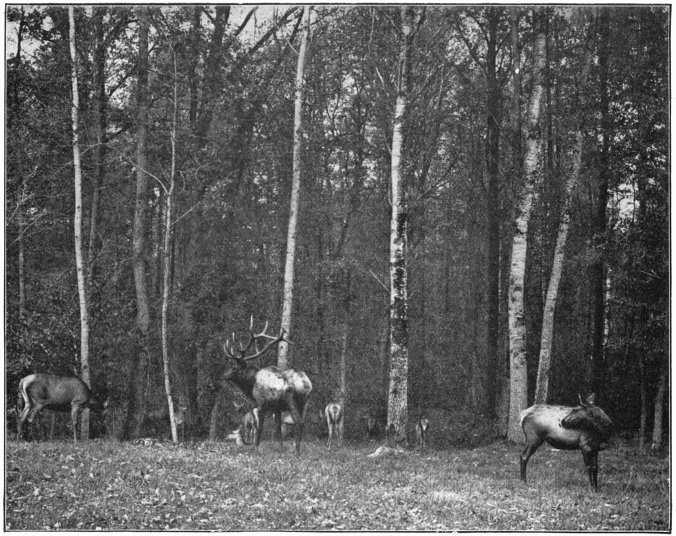
WAPITI IN AUTUMN.
As the climate in winter is extremely severe,
it is obvious that only hardy species can be
expected to thrive; and it is the main object
of the owner that the representatives of these
should appear as if they were living in a really
wild state. To what extent he has succeeded
in this, will be apparent in the sequel. When
the Pilawin park was first enclosed, the only
large game in the forest were roedeer, of which
a certain number were included within the
ring-fence. These have now increased and
multiplied to such an extent that roebuck-shooting
is permitted in Pilawin; and, indeed,
is almost necessary in order to keep the
number of these deer within proper limits.
In connection with these roebuck it may be
mentioned that during the unusually severe
winter of 1906–1907 a considerable number of
them succumbed to the effects of the cold,
whereas not a single death occurred among the
introduced species.
With the exception of the wild boars
referred to above as inhabiting the pine-forests
near Schepetowka, roebuck are the only big
game now to be met with in the district immediately
around Pilawin. Elk occur, however,
in the forests about forty miles to the northwards,
and an occasional straggler from these
may make its appearance near the preserve in
spring.
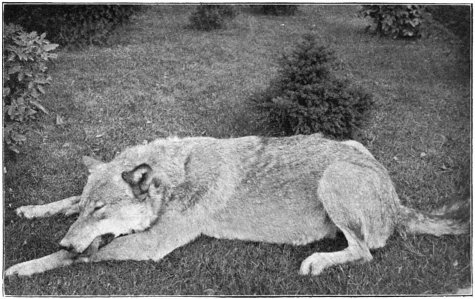
WOLF KILLED NEAR ANTONINY IN 1907.
Wolves, too, either singly or in small
parties, may be in evidence during winter; but
lynxes were exterminated many years ago;
while bears, as already mentioned, have been
unknown for at least a century and a half; and
red deer, to say nothing of bison, disappeared
at a much earlier date. The last beaver
known to inhabit the Pilawin district was
killed in 1904; but these rodents are still not
uncommon some fifty miles to the northward,
and subsequently to our visit (in December) the
species was reintroduced into the preserve, where
a portion of one of the lakes has been enclosed
for its reception. Two specimens—a young and
an old male—were trapped about fifty miles
north of the park; and on arrival the old one
was turned out in the enclosure, where it proceeded
to make itself at home, constructing a
lodge and gnawing timber. Some time later
the young one was introduced, but the old one
chased it away, and eventually bit and drowned
the unfortunate creature. Badgers are still
numerous in certain parts of Pilawin, where
they have some huge “earths,” while a few
otters remain, and martens and polecats
abound.
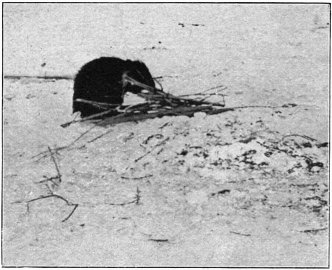
THE PILAWIN BEAVER.
A few hares are to be met with in the
open country; but rabbits are unknown in
the district, the ground being for the most
part too moist and low-lying to suit their
habits, although they occur some miles away.
As regards birds, a flock of some thirty
bustards (Otis tarda) was reported not far from
Antoniny about the time of our arrival; and
the species is still fairly common in this part
of Volhynia. Cranes and white storks are
common in summer, but both species were on
the eve of departure at the time of our visit.
In some of the villages situated near swamps,
almost every house has at least one stork’s
nest on its roof; the total number of nests in
a colony of this sort ranging from fifty to one
hundred. Although the species is protected in
Sclavonia, in this country there is nothing to
prevent any one from shooting a stork. The
bird is, however, considered to be semi-sacred
by the natives; the popular belief
being that if a stork is shot, its mate
will come and set fire to the house of the
destroyer.
Black storks are very scarce, and the
appearance of one during our visit was therefore
an unusual event. They depart later than
the white species.
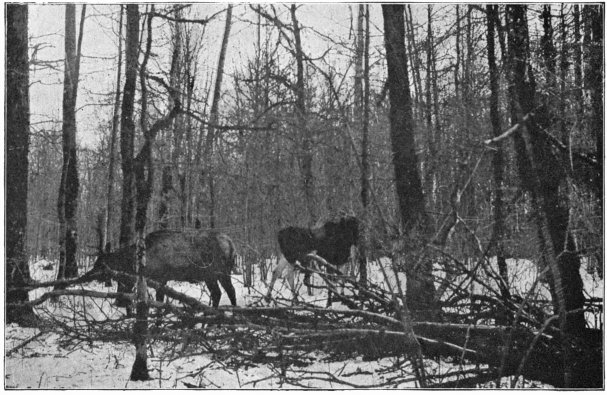
ELK IN WINTER.
Capercaillie occur in considerable numbers,
both in the preserve of Pilawin and the
neighbouring forests. They are shot in spring
during the calling season. At one of the
Count’s shooting-lodges in the neighbourhood,
where a metal plate is fixed to the walls to
commemorate the shooting of each capercaillie,
the number of such plates exceeds ninety; and
in the house at Pilawin is exhibited a photograph
of five cocks shot in a single day.
Black game (Tetrao tetrix), as well as hazel-grouse
(Tetrastes bonasia), are likewise more
or less abundant in the coverts. Partridges
and quail breed in the corn-fields, although in
no great numbers; the partridge being the
common grey species. Duck of three or four
kinds, as well as a few snipe, breed in the
marshes; but there appears to be no winter
influx of either ducks or geese. Hazel-grouse
are shot by beating the forest, when the birds
alight momentarily on the branches of the firs
or oaks, where they offer fair marks.
The sight of a sea-eagle sailing majestically
over the forest glades is comparatively
common; while spotted eagles may from time
to time be observed, and harrier-eagles (Circaëtus
gallicus) are abundant. Eagle-owls
(Bubo ignavus) haunt the pine-forests at all
times of the year; and in spring a certain
number of snowy owls (Nyctea scandiaca)
make their appearance from the north. A
semi-Indian character is communicated to the
bird-fauna by the number of blue rollers
(Coracias garrulus), locally known as Polish
parrots, which may be seen in the open
country; while lovely blue-throats (Cyanecula suecica)
likewise form objects of special interest
to the ornithologist from England. Of other
birds it will suffice to mention that wheatears,
red and grey shrikes, magpies, and wagtails
are most in evidence in the open, while jays,
green and pied woodpeckers (lesser and great),
and nuthatches abound in the forest.
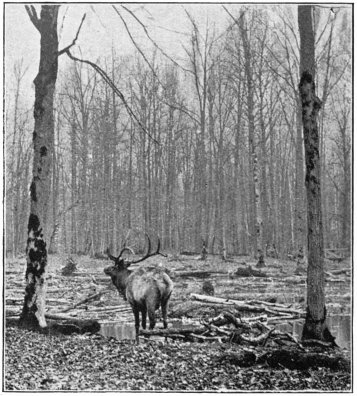
AN ASIATIC (? SAYANSK) WAPITI.
The most interesting feature in the reptilian
life of the country is the occurrence of a
number of European water-tortoises (Emys
orbicularis) in the forest lakes and ponds.
One of these we brought home, where it is
now flourishing in a green-house. Reference
may also be made to the hosts of green tree-frogs
(Hyla arborea), whose loud croakings
are frequently the only sounds to break the
impressive mid-day stillness of the forest.
When we first heard the croaking, we mistook
it for the note of a bird. The huge size
of the ant-hills, many of which are over a
yard in height, is another feature of the forests
which cannot fail to strike the observer fresh
from England. The one drawback to existence—and
it is a great one—in this forest-paradise
is the abundance of mosquitoes, which make
their presence known in the usual objectionable
manner.
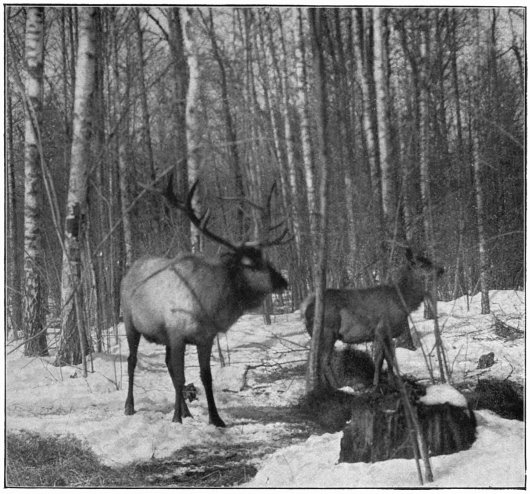
WAPITI STAG AND HIND.
After these general observations the attention
of the reader may be specially directed
to the foreign big-game animals which form
the great feature of the park. These include
European and American bison, elk, Persian and
Caucasian red deer, American wapiti (Cervus
canadensis), Altai or Sayansk wapiti (Cervus
canadensis asiaticus),2 a very dark-coloured
wapiti from the Yenisei valley, the Pekin or
Dybowski’s deer (Cervus hortulorum), and the
Siberian roebuck (Capreolus pygargus). The
great charm connected with the bison and deer
in the Pilawin preserve is that they are living
in what is practically a wild state, and in order
to be seen have in many cases to be regularly
“stalked,” although not unfrequently the tourist
may come upon them more or less unexpectedly.
The extent of the park is, indeed, so great
that there is probably nothing to suggest to
its denizens that they are living in an enclosed
area; and the diversity in the nature of the
forest, together with the presence of numerous
large clearings (either natural or artificial),
enables them to select and inhabit the kind
of country best suited to their needs. In
consequence of this freedom and choice of
“station,” each species or individual takes
possession of a kind of territory of its own;
the elk skulking singly amid the thick foliage
of the deciduous forests, while the bison prefer
the open clearings, with the adjacent covert for
retirement, and the wapiti favour the pine-forest.
Roebuck, on the other hand, are to be
met with, either singly or in pairs, in almost
all parts of the forest. As labourers are
constantly employed in the preserve during
the winter months in draining, timber-felling,
and road-making, while carriages traverse the
network of roads when visitors are staying at
the lodge (to say nothing of those constantly
used by the park director), the animals are,
however, well accustomed to the presence of
human beings, and can consequently be
approached to within comparatively short
distances. Nevertheless they are not too
tame; retaining, in fact, all the characteristic
traits and habits of really wild creatures. In
the late summer and early autumn, when the
wapiti stags are calling (as was the case at the
time of our visit), it is, of course, necessary
to exercise considerable care and caution in
approaching them, and it is well for visitors
to be at all times accompanied by one of
the foresters or keepers in the parts most
frequented by the animals.
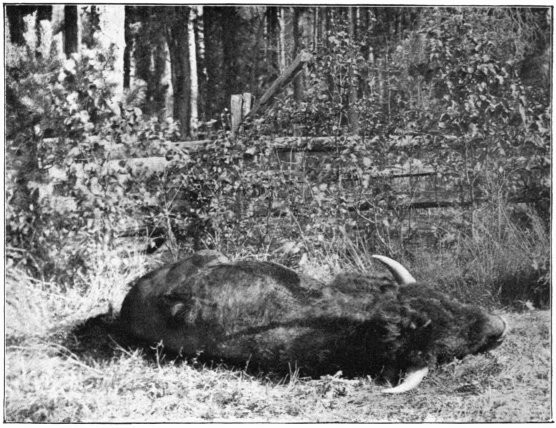
THE DEAD BISON.
Here it may be mentioned that, a short
time subsequent to our visit, the stags in the
preserve, as I am informed by Count Potocki,
became on a sudden unusually ferocious,
attacking everything and everybody within
reach. The head-keeper, Adam, was badly
gored by the big wapiti, but happily recovered.
Soon afterwards the same stag attacked and
killed the only bull American bison, this being,
of course, a great loss, as it will be difficult
to find another mate for the one cow by which
alone the species is for the moment represented
in the preserve.
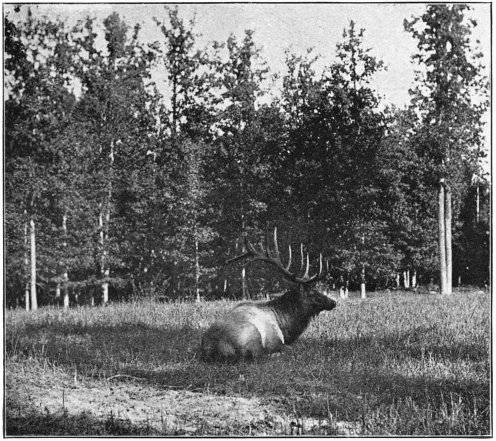
WAPITI STAG REPOSING.
Perhaps the best way of conveying to the
reader an idea of the manner in which the
animals are encountered will be by recording
the results of our first day’s walk and drive
through the park.
After walking a mile or so from the house,
the first animal encountered was a fine wapiti
stag quietly reposing in one of the large
clearings, which allowed us to approach within
a couple of hundred yards; soon after, we
came across another wapiti stag, accompanied
by two hinds of his own species and a
couple of Persian red deer hinds. Some little
distance farther and we encountered a considerable
herd of wapiti, a Persian red deer
hind, an Altai wapiti hind, and two hinds of
the dark-coloured Yenisei wapiti. A couple of
roebuck were next seen darting and leaping
through the under-covert, and it was noticed
that although one was in the red summer
coat, with no white rump-patch, the other
wore the olive winter dress, with a conspicuous
white blaze. It seems difficult to account for
this difference, unless it be that fawns of the
year assume the winter dress very early or develop
it at once. This is a point in regard to
which definite information from sportsmen would
be of great value and interest to naturalists.
The next animal seen was a three-year-old
bull elk lazily browsing the foliage of the
aspens among which it stood, and where
indeed it was almost invisible except to the
practised eyes of the forester. This elk was
recently brought from the estate of Prince S.
Radziwill (brother-in-law of the Count) in
Lithuania; and since it had experienced a
long journey and had been turned out only a
few months previous to our visit, it was comparatively
tame, so that we were actually able
to watch the curious movements of its flabby
muzzle as the creature browsed.
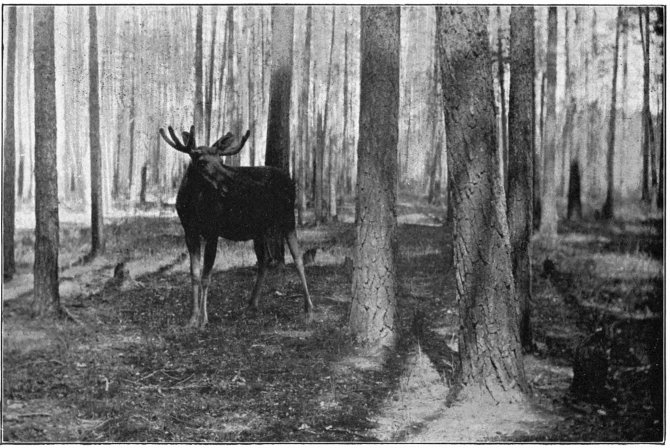
A BULL ELK.
To resume the chronicle of our day’s
excursion, the next animals seen were three
beautiful Dybowski bucks, feeding in swampy
pasture by the side of an aspen-forest. The
oldest and largest of this handsome trio was
purchased from a dealer, but the other two were
bred in the forest, and are certainly splendid
specimens of their kind. The old buck had
his antlers clean, and was already assuming
the uniform dark brown winter coat. In the
younger bucks, on the other hand, the antlers
were still in the bright red “velvet” so
characteristic of all the deer of the sika
group, and the rufous, white-spotted coat was
shown in its full summer beauty. The group
formed a lovely picture, the sight of which
was alone almost a sufficient reward for the
fatigue of the journey from England. We
were, moreover, particularly fortunate in coming
upon these deer on this occasion, as we never
saw them again during the whole course of
our sojourn in the park.
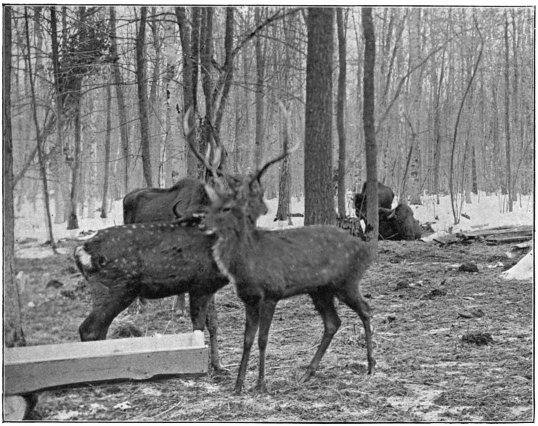
THE PEKIN OR DYBOWSKI BUCKS.
According to Count Potocki’s observations,
the stags of this species are peculiar in that
they utter no call—or, at all events, no loud
one—during the breeding season. It would
be interesting to ascertain if this accords with
the experience of observers elsewhere, and
whether this silence is characteristic of all
the deer of the sika group.
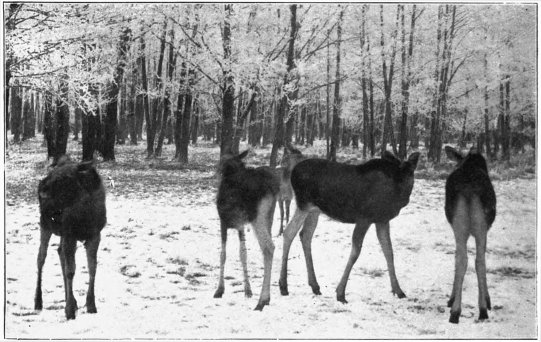
ELK CALVES IN THE SNOW.
The next sight was an elk hind with two
calves, browsing among thick aspen-forest;
the group being almost invisible at a comparatively
short distance. All three animals
were in splendid condition; and the mere fact
of the production of twins by this hind affords
convincing testimony as to the well-being of
the elks in the Pilawin preserve. That they
should thus flourish is, however, only what
might naturally be expected, seeing that they
are living under absolutely natural conditions
in the original haunts of the species.
The final scene in this memorable day’s
excursion was perhaps the finest and most
interesting of all. Amid a large open clearing,
surrounded by tall pine and birch forest,
stood a noble group of four European and
two American bison, all quietly feeding on the
luxuriant pasture. The whole six animals
looked in splendid condition; and the group
also served to emphasise the marked superiority
in point of shape and general appearance
of the European over the American species.
The much darker colour and the more
heavily haired fore-legs of the latter, as contrasted
with the former, formed very noticeable
features.
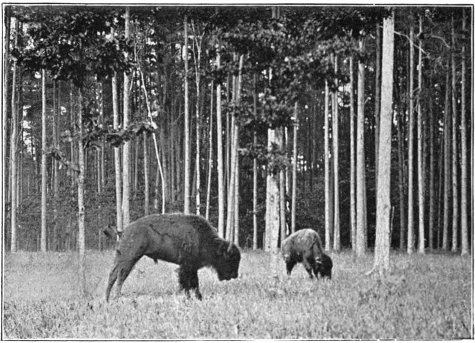
THE AMERICAN BISON.
The four European bison—the zubr (pronounced
zoobre) of the Poles and Russians—comprised
a bull and two cows presented by
H.I.M. the Czar to the owner of Pilawin,
and a yearling calf born in the preserve.
Another calf was born this year, but
unfortunately died soon after birth. The bull
and cow came from the imperial Bielowicz
preserve in the province of Lithuania, and there
is every hope that in course of time they may
give rise in Pilawin to a herd equalling that of
the Duke of Pless in Silesia.
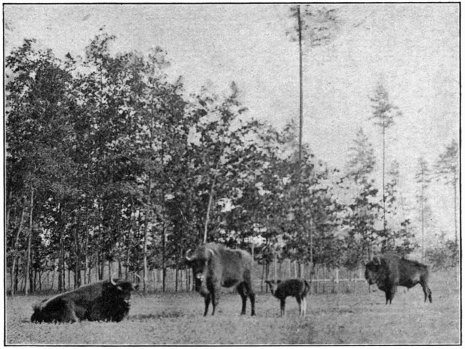
THE EUROPEAN BISON HERD.
It had originally been our intention to
pay a visit to Bielowicz in order to see
the famous bison herd, and permission to
do so had been graciously accorded by H.I.M.
the Czar, but the long distance and difficulties
connected with the language-question reluctantly
induced me to abandon the intention.
Here it may not be out of place to
mention that the name “aurochs,” so generally
applied to the European bison (Bos bonassus),
is a complete misnomer; that term really
denoting the extinct wild ox (Bos taurus
primigenius), which lingered longest in
Poland. On the extinction of the latter species
the name became transferred by the Teutonic
nations to the bison, which in its own
country is, however, universally known as
the zubr.
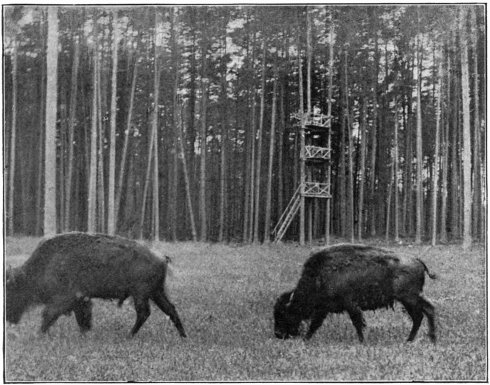
AMERICAN BISON BY THE STAGE IN THE FOREST.
By ascending a high wooden stage erected
between some tall firs, we were enabled to
obtain an excellent view of the bison on the
plain below. The bull displayed some signs
of uneasiness by staring fixedly at our party
and lashing his tail furiously from side to
side; and it was therefore deemed inadvisable
to approach him too closely on foot. On a
second occasion we enjoyed the opportunity of
seeing this magnificent beast enjoy a good roll
in the sand, when it was observed that, owing
to the height of his hump, he was unable to
turn completely over, and had to content himself
with half-rolls.
The animal most difficult to come across
in the park is the Siberian roebuck; but we
were luckily enabled to obtain one glimpse of a
fine old buck quietly feeding in thick covert,
although he was unfortunately frightened away
by a fox-terrier before we could get a full
view. The one glimpse was, however, sufficient
to show that the summer coat of this
species is lighter-coloured than that of the
European roebuck, being yellowish fawn in
place of rufous. Whether, however, the white
rump-patch is developed at this season I was
unable to see. Unfortunately, the majority
of the Siberian roedeer in the park are bucks.
Whether they will cross with the European
species remains to be seen.
Of the Yenisei wapiti (of which more
anon) it has already been mentioned that we
saw two hinds during our first day’s tour.
A day later I had the good fortune to come
across the stag feeding in the open; but as it
was getting dusk, it was difficult to observe
his characteristics accurately. Indeed, it is by
no means an easy matter to arrive at any
satisfactory conclusion as to the specific or
sub-specific characters of nearly allied deer
when only single specimens are seen by themselves
in the open.
Several years ago repeated attempts were
made by the Duke of Bedford to acclimatise
elk in the park at Woburn; but the experiment
proved a total failure; the animals dying
off one after another, till it was finally decided
to abandon the attempt to establish the species
as a denizen of the domain. Much the same
thing occurred in the case of the American
wapiti; the herd of which was, however, kept
in an extensive paddock instead of in the open
park. In this instance it was likewise decided
to be useless, at all events for the present, to
attempt to maintain the herd.
In Pilawin, on the other hand, both elk
and wapiti flourish remarkably well; and it is
confidently anticipated that in the course of
three or four years, when the number of stags
of each species will have become too great,
that elk-hunting and wapiti-shooting will be
recognised sports in the preserve.
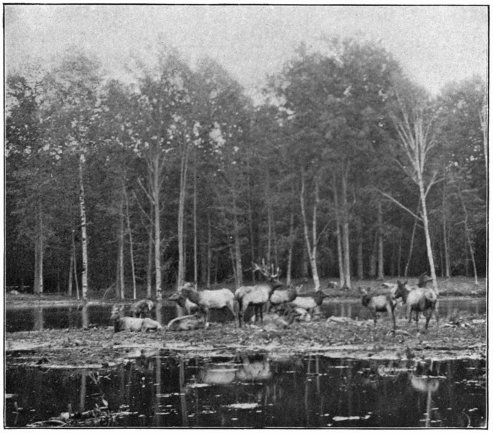
WAPITI BY THE LAKE.
During the present year the number of
elk calves born at Pilawin was no fewer than
fourteen, of which at least two were, as
already mentioned, twins. During the two or
three previous years the inclusive number was
ten, so that the progressive increase is very
marked. In all cases which came under my
own personal observation the condition of both
cows and calves was all that could be desired;
and the same holds good with regard to the
numerous yearlings and two-year-olds that
were seen during our visit.
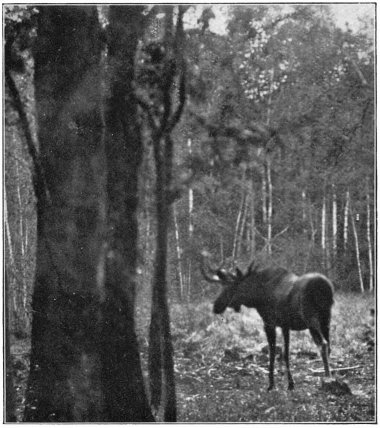
A BULL ELK.
This highly satisfactory state of affairs
may doubtless be attributed to the absolutely
natural conditions in which the elk are living,
and the practically unlimited area over which
they can wander. The existence here and
there of large natural and artificial lakes (the
latter formed by damming up small streams),
coupled with the numerous swampy tracts,
makes the forest an ideal one for these
animals, and it is evident that they thoroughly
appreciate their surroundings. One of the
prettiest scenes witnessed during our visit was
the sight of a cow elk leading her two calves
across the largest and deepest lake with the
apparent intention of accustoming them to
swim. One of the yearling bull elks (not born
on the estate) was in the habit of coming in
the evenings close up to the shooting-lodge in
order to be fed with bread; and if its wants
were not promptly attended to, would actually
put its head in at the open door or window.
Close examination of this elk served to convince
me more than ever that the glandular
tuft on the inner side of the hock corresponds
with the similarly placed callosity or “wart”
in the horse, and consequently that the latter
represents a decadent gland. I also noticed
on the forehead, a short distance above the
budding antlers, a pair of whorls in the hair,
which are not generally mentioned in descriptions
of the species, and may likewise be
glandular in function.
The length of limb distinctive of elk
generally is especially noticeable in immature
animals. Compared with other deer, elk at this
age may indeed be likened to storks among
birds; the length of limb being for the same
purpose in both.
That elk and other large species of wild
deer require a very extensive area in order not
to deteriorate seems to be undoubted. The
owner of Pilawin considers, indeed, that the
number of head of these animals should be
limited to one to every ten acres; while he is
also of opinion that the maximum number of
true deer in the preserve should not exceed
three hundred head, and that the elk herd
should be limited to one hundred.
In summer the main food-supply of the
Pilawin elk apparently consists of the leaves
of deciduous trees, especially aspen; but in
winter this is replaced by the young shoots
and twigs of birch, to obtain which the elk
are constantly breaking down young saplings.
The natural food-supply of the preserve is,
however, largely augmented by patches of
oats, buckwheat, lupin, potatoes, and Jerusalem
artichokes, which are sown or planted in the
clearings of the forest wherever the soil is
suitable. The buckwheat and oats form
summer fodder, while the lupin, potatoes,
artichokes, acorns, and horse-chestnuts serve
as a winter supply, the deer soon learning
to scrape out the tubers from the ground
with their hoofs.
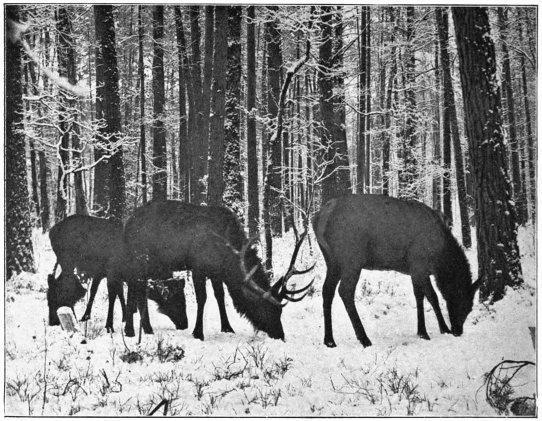
WAPITI IN WINTER.
Before leaving the subject of elk, reference may
be made to a point in connection with the conformation
of their antlers which struck me as the
result of an examination of a large series of immature
specimens in the Pilawin shooting-lodge.
It has long been recognised that the
antlers of elk belong to what is known as the
forked type, which occurs typically in such
species as the roebuck, Père David’s deer, and
the American white-tailed and mule deer. In
this type, it may be well to remind the reader,
there is no brow or bez tine, and the main
beam of the antler divides at a longer or
shorter distance above the burr into a single
fork, of which the back-prong nearly always
divides again, while in many cases both prongs
are more or less divided, the greatest complexity
occurring, however, very frequently in
the hind one.
Hitherto elk-antlers have been regarded as
altogether sui generis—mainly on account of
the fact that they rise at right angles to the
middle line of the skull. But a comparison of
immature specimens in which the front prong
of the main fork is double with adult antlers
of the mule-deer will show that the two are
practically identical in type. In both forms
the front prong of the main fork is two-tined,
while the hind prong carries three tines. The
distinction between the two is, in fact, chiefly
restricted to the difference in their orientation.
In the case of those adult elk in which the
antlers assume the characteristic shovel-like
form, the resemblance becomes, of course,
more or less completely lost.
If this view be correct, it will be advisable
to modify the classification of the Cervidae
adopted in Deer of All Lands, and to place
the elk in the neighbourhood of the roebuck
and the mule-deer, with which it agrees in the
structure of the foot-skeleton. Moreover, it
seems not improbable that the antlers of
reindeer are really of the forked (in contradistinction
to the brow-tined) type, and if this
be so, that genus must also be placed near the
roebuck—an arrangement which would accord
with the one proposed many years ago by the
late Sir Victor Brooke on the evidence afforded
by the structure of the skeleton of the forelimb.
The present opportunity may likewise be
taken of referring to two very fine pairs
of elk-antlers obtained by Mr. Sokalski in
Siberia. Despite the fact of their being
palmated, these antlers (which I hope to have
the opportunity of describing on a future
occasion) may serve to confirm the distinctness
of the East Siberian elk (Alces machlis
bedfordiae), as they appear to differ in certain
details of form from those of European elk.
Returning to the Pilawin deer, the next to
be noticed are the American wapiti, which are
flourishing fully as well as the elk; the
number of fawns born during the year being
nine.
Another feature indicating the satisfactory
condition of the herd is the large size of the
antlers grown by the big stags, of which there
are now three; all being imported animals.
Of the antlers shed by the two best stags of
their year in 1907, the length along the outer
curve is in one case forty-four and in the
other forty-one inches; while in both instances
the antlers are very symmetrically formed,
carrying the usual six points a side.
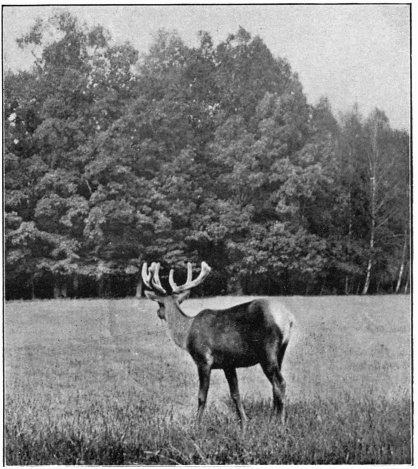
ONE OF THE BEST WAPITI, WITH THE ANTLERS IN VELVET.
In addition to the herd of American wapiti,
Count Potocki owns a certain number of the
Asiatic representatives of that group, generally
known on the estate as “maral,” an extremely
misleading designation, which ought to be
restricted to the Persian or Eastern race of
the red deer. Some of these Asiatic wapiti,
which were obtained by purchase, belong
apparently, as mentioned above, to the race
commonly known as the Altai wapiti (Cervus
canadensis asiaticus), but for which the name
Sayansk wapiti is better. As regards these,
beyond the fact that they are in the same
excellent condition as the Pilawin deer generally,
there is nothing calling for special
mention.
Considerable interest attaches, however, to
half-a-dozen wapiti (including two fine stags)
obtained by one of the Count’s keepers from
Krasnoyarsk, on the upper Yenisei, in about
long. 93° E. and lat. 56° N.
Compared with the American and the other
Asiatic wapiti in Pilawin, these Yenisei deer
are darker-coloured in summer; this darkness
being specially noticeable in immature hinds,
which look almost slate-coloured in summer.
The director of the park tells me that another
difference is to be found in the more upward
extension of the black borders of the light
rump-patch, which, in fact, unite anteriorly to
form a dorsal stripe. The fawns, too, retain
their spots to a comparatively late age, whereas
in the Thian Shan wapiti (C. c. songaricus),
and possibly also in the Sayansk race, the
spotting disappears early.
The antlers of the Yenisei wapiti, as
represented by a pair in the Pilawin shooting-lodge
and two other pairs in Mr. Sokalski’s
house at Pisczow (Pischef), four miles away,
are also distinctive. In all three pairs the
fourth tine is comparatively small, and bends
inward to a certain extent, so as not to lie
exactly in the same plane as the two above.
In one specimen, at least, the trez tine is
absent.
While at Pilawin I was in great doubt
to what race these Yenisei wapiti should be
referred. Recently, however, Dr. P. Matschie,
of the Berlin Museum, has published a paper
on the wapiti of Central Asia,3 in which
important information is given with regard
to the characteristics of the antlers of the
different races, and the localities where the
type specimens were obtained. The race here
termed C. c. asiaticus, which Dr. Matschie
calls Cervus sibiricus,4 is stated to be typically
from the Sayansk and Baikal
Mountains. With this race is provisionally
associated the wapiti from Krasnoyarsk,
although it is added that the latter may be
distinct. Now as the Sayansk C. c. asiaticus
was stated by its describer Severtzow to be
lighter in winter than the Thian Shan C. c.
songaricus, it is highly improbable that it
should be very much darker in summer. I
therefore think that Dr. Matschie’s suggestion
as to the distinctness of the Yenisei wapiti
may very probably be well founded; and if
this should prove to be the case when
specimens are available for comparison, the
race might well be named in honour of Count
Potocki.
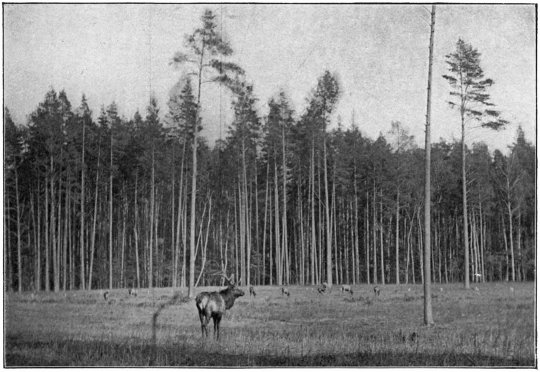
A VIEW IN PILAWIN WITH ASIATIC WAPITI IN THE FOREGROUND.
As already mentioned, the red deer group
is represented in the Pilawin preserve by the
true Persian maral (Cervus elaphus maral) and
by the maral of the Caucasus. From wapiti
the hinds of these deer are distinguishable at
a glance by their red coats and the larger
amount of white and black on the sides of the
rump-patch as well as by the longer tail.
Unfortunately, I had no opportunity of seeing
the Persian and Caucasian red deer side by
side, but I am informed by Mr. Sokalski
that they are practically indistinguishable, as,
indeed, might be expected from geographical
considerations.
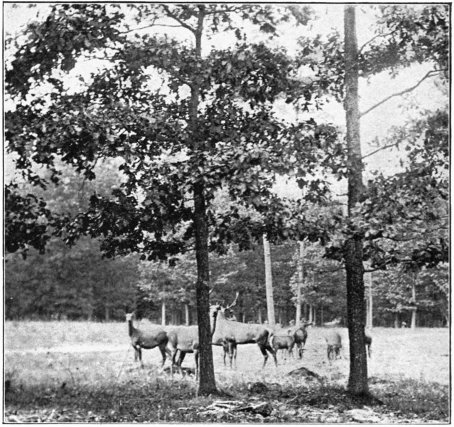
CAUCASIAN RED DEER.
In the large amount of black on the thighs
they differ, according to the same informant,
from Carpathian deer, which are more
uniformly coloured, with the general tint
decidedly darker.
Although this information is valuable so
far as it goes, it unfortunately does not afford
a definite clue as to which form of Carpathian
deer is referred to (see letters in the Field
for 1905, vol. cv., pp. 326 and 355). Mr.
Sokalski has, however, a fine pair of
Carpathian antlers characterised by their great
massiveness, the absence of a bez tine, and the
position of the trez tine midway between the
brow tine and the curiously compressed and
expanded crown. A pair of much younger
antlers from the same locality likewise lacks
the bez tine. An old antler of the same type
from Galicia is figured on page 220 of my
Great and Small Game Animals of Europe,
N. and W. Asia, and N. America, and two
antlers, one from Asia Minor and the other
from the Crimea, described and figured by
myself in the Zoological Society’s Proceedings
for 1890 (p. 363, pl. xxx.), likewise present
the same general characteristics, although the
reduction of the tines is still greater. Mr.
Sokalski also possesses a pair of antlers (one
entire and the other imperfect) dug up a few
years ago some fifty miles distant from
Pilawin which can scarcely be referred to any
other deer than the one under consideration,
showing the same absence of the bez tine and
a similar conformation of the crown.
Assuming all these antlers to belong to the
same type—and it is difficult to come to any
conclusion—we have evidence of a race of red
deer ranging from Volhynia through the
Carpathians to Asia Minor and the Crimea.
So far as I can determine, this deer seems
to agree with Mr. Hamilton Leigh’s “grey
Carpathian stag” (Field, 1905, vol. cv., p.
355), a race characterised by the relatively
small number of tines to the antlers. That
(contrary to Mr. Leigh’s opinion) it is distinct
from the maral of Persia and the Caucasus, I
have little doubt, and if there were a good
specimen in a public collection to take as a
type, I should be prepared to suggest for this
race the name Cervus elaphus carpathicus.
This, of course, leaves open the question
as to the occurrence of other stags in the
Carpathians.
Both the Persian and Caucasian red deer
(maral) do exceedingly well in the Pilawin
preserve, where they will doubtless before long
form a big herd. At Antoniny the Count
keeps, for hunting purposes, a small number of
the so-called Polish deer from the Imperial
preserves of Spala, in Poland, which, to my
great regret, I had no opportunity of seeing.
I trust, however, that he will send a head to
the British Museum at no very distant date.
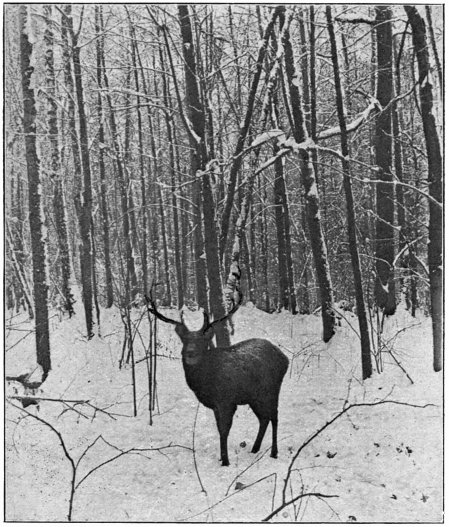
A PEKIN OR DYBOWSKI STAG.
In regard to the other deer at Pilawin, it
will suffice to state that two Dybowski fawns
were born during the present year.
Continuing the chronicle of our own doings,
it remains to mention that a couple of days
before our departure Mr. Sokalski, at the
Count’s suggestion, very kindly arranged a series
of “beats” in order that we might be afforded
the best possible opportunity of seeing the
denizens of the preserve; and these formed one
of the most interesting episodes of our visit.
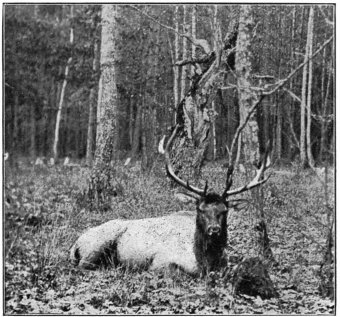
A BIG WAPITI.
Roedeer were, of course, put up in large
numbers; and among these one buck was
noticed with beautifully “pearled” antlers. We
were fortunate in getting a splendid view of
the best stag of the Yenisei wapiti, when the
features referred to above were duly noted.
Between two of the “drives” we came accidentally
upon the biggest herd of American
wapiti, with the finest stag in the park among
them. When first seen they were feeding in an
open glade, but as the morning was rapidly
becoming hot, they almost immediately betook
themselves to a shady part of the forest, where
it was a charming sight to watch them lie
down one after the other, with the master-stag
(who had been calling loudly) in the midst.
Soon afterwards three full-grown cow elk broke
covert; advancing with a long swinging trot
to the side where I was standing, and then
halting to look around, as if undecided which
course to take. There was something almost
ghost-like in their appearance as they first
loomed into view out of the thick covert, and
then vanished.
The great event was, however, reserved for
the afternoon, when, after the twin elk calves
had been driven out of one piece of forest and
some of the wapiti out of another, the six
bison, with the four Europeans leading and the
Americans in the rear, burst out into the open
in a heavy, lumbering gallop, which literally
shook the earth, close to where my daughter
was standing. It was indeed a magnificent
spectacle. The “hustling” which the animals
underwent during the drives made them somewhat
fierce, with the result that two of the
watchers had to spend the night on a shooting-stage.
In regard to the Pilawin preserve as a
whole, there seems little doubt that it will
ultimately prove a complete success, and form
a unique centre of interest to sportsmen and
naturalists alike.
In addition to the species and races already
represented, the Manchurian or Bedford’s wapiti
(Cervus canadensis xanthopygus), the Amurland
wapiti (C. c. luedorfi), which I have now good
reason to regard as distinct from the former,
the hangul or Kashmir stag (C. cashmirianus),
Thorold’s deer (C. albirostris), and the shou or
Sikhim deer (C. affinis) would probably do
well in the preserve, if specimens could be
procured. Sikas and wild fallow deer would
of course thrive, but the owner has no fancy
for either. If smaller deer are desired, the
Himalayan musk-deer (Moschus moschiferus)
and the Chinese water-deer (Hydrelaphus inermis),
as well as the Tibetan and North
Chinese tufted deer (Elaphodus cephalophus
and E. michianus), might be recommended as
interesting species likely to flourish; and, if
specimens could be procured, the milou, or
Père David’s deer (Elaphurus davidianus),
would almost certainly prove a success. Sheep,
goats, and saigas would assuredly not do; but,
despite the fact of their being mountain species,
thar, serow, and takin (at present not procurable)
might be worth a trial, as they are chiefly
inhabitants of forests.
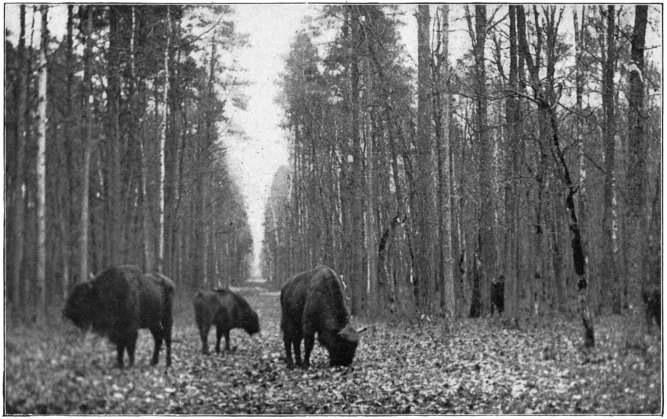
EUROPEAN BISON IN A FOREST RIDE.
The splendid condition in which the preserve
is kept, and the large amount of work already
accomplished in the matter of road-making and
drainage, afford abundant testimony to the
energy and capacity of Mr. Sokalski, the
director. A word of commendation may likewise
be bestowed on the relatively high degree
of education of the foresters, who display a
knowledge of zoology and botany conspicuous
by its absence among most English game-keepers.
Nearly all of these men are acquainted
with the scientific names of the
commoner animals and plants to be met with
in the forest; and they know all the berries
and funguses which are good for food, as well
as those to be shunned.
While on this point I may venture to put
in a novel plea in favour of the retention of
the old-fashioned type of scientific nomenclature.
My German (so far as conversation is concerned)
is but limited, while of Polish my
knowledge is nil. And yet, despite these
drawbacks, I was able to acquire from the
director and the foresters a good knowledge
of the denizens of the forest by means of their
scientific names. If, however, I had known
the white stork only by its modern designation
of Ciconia ciconia, instead of by its old-fashioned
title of Ciconia alba (and so in other
cases), a great deal of such conversation would
have been impossible.
Before bringing these notes to a close it
will not, perhaps, be out of place to devote
a few lines to the domesticated ponies and
cattle of the district, as it was one of the
objects of my trip to endeavour to ascertain
whether these respectively exhibited any special
resemblances to the wild Przewalski horses (or
rather ponies) of the Gobi Desert, and to the
extinct wild ox, or aurochs, which, as already
mentioned, lingered longer in Poland than
elsewhere.5
A very noticeable feature among the cattle
of the district is the prevalence of black, dark
brown, and black-and-white; equally noteworthy
being the frequency among the piebald
individuals of a broad white line down the
middle of the back. A similar white band
also characterizes many of the rufous or fawn-coloured
types, which, on the assumption of
descent from the aurochs, must be regarded as
retrograde derivatives from the black (or black-and-white)
phase. Herberstain described the
wild aurochs as being black with a broad light-coloured
band down the middle line of the
back; and it thus seems highly probable that
in the white dorsal line of the partially albinistic
Polish cattle we have a distinct survival of the
ancestral type of colouring. Among the black-and-white
cattle of Holland such a conspicuous
white band seems less common, and
the same is the case with English shorthorns.
Major Barrett-Hamilton tells me, however, that
it may be observed in some Kerry cattle.
The horns of the ordinary Volhynian cattle,
although small, are of the aurochs type.
The large white, or rather pale cream-coloured,
Podolian cattle do not seem to
extend much to the north of Schepetowka. At
the Berlin Zoological Gardens I learnt an
interesting point in connection with these
cattle, namely, that while the oxen, cows, and
calves are wholly white, the old bulls have
black muzzles and ears, as well as a certain
amount of black on the face and limbs. As
black in the Javan wild ox or bantin (Bos
sondaicus), to say nothing of many antelopes,
is developed only in the adult males, it seems
highly probable that the black points of the
Podolian bulls may be the last vestiges of the
aurochs-colouring in this albinistic breed. In
connection with this, it occurs to me that the
red specimens of the aurochs which have been
described may have been cows, as it is quite
probable that, in some cases at any rate, the
females may have been in the same stage of
colour-evolution as the cow bantin.
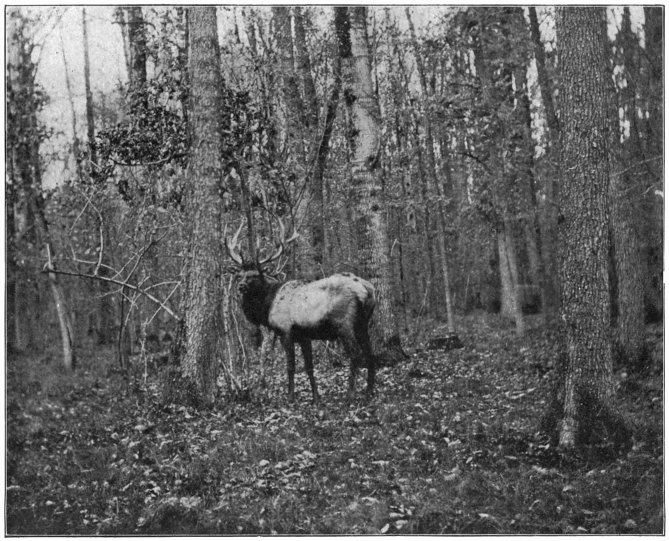
A GOOD WAPITI.
The country ponies are for the most
part uniformly bay, dull chestnut, or mouse-coloured,
with the tail well haired to the root.
Occasionally a pale brown dorsal stripe is
observable; but white “stockings” and a white
star on the forehead (which are both regarded
by Professor Ridgeway as indicative of Arab
blood) are very rare, and I saw no trace of
dark barrings on the legs. The callosities or
“chestnuts” on the hind-legs appear to be
always small. In general characters these
ponies seem to approximate to the now extinct
half-bred and mouse-coloured wild tarpan of
the Kirghiz steppes, rather than to the dun
Przewalski type of the Gobi Desert, which is
apparently the true tarpan. I hope to be able
to write more definitely with regard to this
point on a later occasion, as Count Potocki
has kindly promised to send to the Natural
History Branch of the British Museum a
couple of skulls of these small country ponies,
which will enable it to be determined whether
the cheek-teeth in this breed are of the large
relative size characteristic of the wild Gobi
race.
Greater diversity of colour occurs among
the larger ponies or horses, used for riding
and travelling—probably due to a larger
infusion of foreign blood. Among these I
saw one of the yellow dun Norwegian type, in
which the hind-chestnuts were not larger than
peas.
Indisputable evidence of near kinship with
the wild boar is displayed by the domesticated
pigs of the country, especially the numerous
black individuals, which have a thick coat of
bristly hairs, developed into a more or less
conspicuous mane or crest along the nape
and back. Whether, as I am informed is
the case with some domesticated Hungarian
swine, they have striped young, I did not
ascertain.
Of the smaller wild mammals I saw none
except a squirrel (kept in confinement at
Antoniny), which belonged to that race of the
species in which the tail in autumn is blackish
brown.
Our ten days’ residence, favoured for the
most part with ideal weather, amid the glorious
Pilawin forest came to a close on Wednesday,
September 4, on the afternoon of which day
we started for the railway, en route for
Warsaw and London.
In conclusion I may be permitted to take
the opportunity of tendering to Count and
Countess Potocki the best thanks of my
daughter and myself for a most delightful
visit, the interest of which is enhanced by the
fact that we are the first English people who
have enjoyed the privilege of making “a Trip
to Pilawin.”
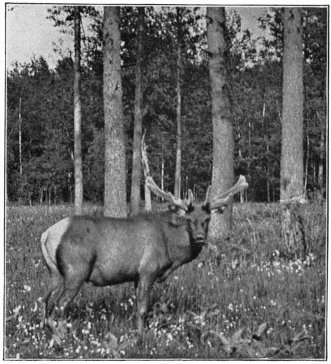
A WAPITI AT GAZE.
Printed by R. & R. Clark, Limited, Edinburgh