I Have hitherto strenuously endeavoured
to preserve the Health of the Europeans,
by discarding and exploding the Abuse
of Tobacco: But if any one should ask my
Sentiments of Tea, which some Years ago
began to be imported from Asia, and the
Eastern Countries, and which has Qualities
quite contrary to Tobacco, since it prevents
Sleep, and therefore is by some Authors
highly commended as an excellent Cephalic,
and very grateful to the Viscera, subservient
to Nutrition: I answer, that no satisfactory
Reply can be made, till we know the Genus
and Species of Tea, and to what Species of
European Herbs it may be referred or compared;
for Tobacco is by us called the Peruvian
Hyosciamius, but we give no Name of
any of our Plants to Tea: Nay, it is not
known, whether Tea is what the Greeks call
Ποα, an Herb, or Θαμνίσκιον, a Shrub, which
Words, according to Ruellius, Morantha, and
others, are so confounded by Dioscorides,
Theophrastus, and other Botanists, as to occasion
great Disputes among the Learned. But
the Authors, who have most faithfully collected
whatever has been wrote upon Tea, either
in the Spanish, French, Latin, English, or
Dutch Languages, are Nicolaus Tulpius, and
Nicolaus Trigautius, from the Works of
whom I shall enquire,
1st, Of what Kind and Species the Herb
Tea is?
2d, Whether Tea is only the Produce of
Asia, and whether it is ever found in Europe,
or not? And,
3d, Which of the European Herbs may
be most properly used in its Stead.
Tulpius, then, speaks in the following
Manner: "In the East Indies nothing is
more common than drinking the Decoction
of an Herb, which the Chinese call
Thee, and the Japonese, Tchia. As my
Accounts of this Plant were received from
the best and most impartial Authors, I shall
willingly hand them down to Posterity.
The Herb Tea, therefore, has long acuminated
Leaves crenated about the Edges.
Its Roots are fibrous, and divided into
very small Shreds. It grows not only in
China and Japan, but also in Chiam, only
the Leaves of the Chinese Tea are of a
blackish green Colour: Whereas the Japonese
Tea is of a fainter Colour, and more
grateful Taste. Hence it also happens,
that the Tchia of the Japonese, is far more
esteemed than the Thee of the Chinese;
since one Pound of the former is frequently
sold at an Hundred Libræ; for it is in
these Parts of the World believed, that
nothing is more salutary and beneficial
than this Herb, whether for protracting
Life to extreme old Age, or for preventing
the Attacks of Diseases. It not
only renders the Body vigorous and active,
and prevents the Stone, to which none of
the Inhabitants are for this Reason subject,
but also removes Head-achs, Stuffings
of the Head, Inflammations, and
Distillations of the Eyes, a Difficulty of
Breathing, Weakness of the Stomach,
Gripes of the Intestines, and Weariness.
It also so effectually prevents Sleep, that
those who drink it at Night, can sit up,
without feeling the least Inclination to sleep:
for it is moderately heating, and by constricting
the Mouth of the Stomach, hinders
the Ascent of those Vapours which
are necessary to procure Sleep; so that,
by its Means, nothing hinders or interrupts
those who intend to read or write all Night.
"This Plant, however, seems neither to
have been long known, nor long used,
among the Chinese, since they have no
hieroglyphical Characters, such as most of
their Letters are, which express its Nature
and Qualities. These two Nations also differ
widely, with respect to the Manner of using
Tea; since the Japonese mix the Tea,
powdered in a Marble Mortar, with warm
Water: Whereas, the Chinese, boil the
Plant itself with some Liquor, adding a
few Grains of Salt, or Sugar. This Decoction,
they drink with their Friends and
Visitors; and even their leading Men do
not think it beneath them, but rather a
Piece of Honour to prepare the Tea for
their Guests; for which Purpose they
have Closets in their Palaces, fitted up on
purpose, in which they keep their Pots,
Tripods, Tunnels, Cups, Spoons, and
other Tea Utensils, which they buy at an
exorbitant Price, preserve in Silk, and only
use when their best Friends visit them.
These, they esteem as much as we do
Adamants, Gems, and the most precious
Stones. See Joh. Maffæus, Rer. Indicar.
Lib. 6. & 12. Ludovic, Almeid. Select.
Epist. Lib. 4. Petr. Garric. Tom. 2. Lib.
2. Cap. 17. Matth. Ricius, de Christ.
Expedit. apud Sinas, Lib. 1. Cap. 7.
Alois Frois, in Relat. Japon. Jac. Bontius,
Dialog. 6. Med. Indorum, & Johan. Linseot,
Cap. 26."
Nicolaus Trigautius, in Tractat. de Regno
Chinæ, Cap. 3. where he treats of the Things
produced in China, gives us the following
Particulars, with respect to Tea: "I purposely,
says he, omit the Description of
many Things necessary, such as Marbles
of different Colours, Carbuncles, and other
Stones and Gems, not unfit for painting;
odoriferous Woods, Bitumens, and an incredible
Number of other Curiosities;
but I neither can, nor ought to pass over,
in Silence, two or three Things, unknown
to the Europeans; the first of which is,
that Shrub, of the Leaves of which is
prepared that celebrated Liquor, called
Cia, by the Chinese, Japonese, and neighbouring
Countries. It is not possible, that
the Herb from which this is prepared has
been very long used by the Chinese; since,
in order to represent it, they have no
hieroglyphical Characters, such as all their
Letters are. Hence it may, perhaps, be
suspected, that our European Woods produce
this Herb. They gather the Leaves
in the Spring, dry them in a Shade, and
keep them for preparing a Decoction,
which they almost continually use, not
only at their Meals, but also when their
Friends come to visit them; for this is generally
the Entertainment to which they invite
each other. It is always drank, or rather
sipped warm; nor is it ungrateful to the
Palate, in consequence of its temperate
Bitterness; but it is very salutary, and
frequently used for various Disorders. Tea
is not with them all of one Price; since,
sometimes, a Pound is sold for a Noble,
and, at other Times, for two or three, if
it is accounted good: The best of the
Japonese Tea is often sold for ten or twelve,
and the Method of preparing it with these,
is somewhat different from that of the
Chinese; for the Japonese, having reduced
their Tea to a Powder, mix two or three
Spoonfuls of it with a Cup of boiling
Water, which they drink when moderately
cool: Whereas, the Chinese throw some
of the Leaves into a Vessel of boiling
Water, which, after it has imbibed the
Force of the Tea, they drink, leaving the
Leaves." But, in the seventh Chapter of
the same Work, which treats of some of
the Customs of the Chinese, the Author speaks
in the following Manner: "When any one
receives a formal Invitation to a Feast;
the Day before, or several Days before, it
is to be kept, the Master sends him a Kind
of Ticket, desiring his Presence: When
he is come to the House, and the usual
Ceremonies past, he is set down in the first
Hall, where he drinks his Tea; after
which he is conducted to the Feasting-Room,
which is not adorned with Carpets,
which they never use, but with Pictures,
Flowers, Vessels, and other antient
Houshold Furniture." Though these
Accounts may satisfy the Vulgar, yet they
will not prove satisfactory to Physicians,
who want to know, whether Tea is an Herb,
a Shrub, or a Species of Copse; for the two
last quoted Authors differ from each other;
since Tulpius calls the Chinese Tea, "an
Herb, with darkish, green, oblong Leaves,
acuminated and crenated about the Edges,
with fibrous Roots, divided into many
small Shreds. Whereas, the Leaves of
the Japonese Tea are of a fainter green Colour,
and of a more grateful Taste." But
Trigautius affirms, "that it is a Shrub of
the Leaves, of which the celebrated Cia,
of the Chinese and Japonese, is prepared
by Decoction." The former asserts, that
the Herb Tea, grows not only in China and
Japan, but also in Chiam: The latter thinks
it is to be suspected, that it is also produced
in the European Woods: But, as I shall afterwards
accurately discuss these Points, I
shall only here observe, from Olearius, that
Maffœus, in Tr. de Rebus Indicis, affirms,
that the Japonese, from a certain Plant, express
an highly salutary Liquor, which they
call Chia; and Linschotanus, in Tr. de Insula
Japoniæ, tells us, that the Inhabitants
of Japan prepare a Drink called Chaa, from
a certain Herb: But these Authors neither
mention the Shrub, nor the Leaves, but
unanimously assert Tea to be an Herb. Jacobus
Bontius, Physician in Ordinary to the
Town of New Batavia, in the Island of
Java, in the East Indies, in Medic. Indor.
Lib. 2. de Conserv. Valetud. Dialog. 6. affirms,
"that the Leaves of the small Herb,
from which Tea is prepared, resemble those
of the Daisy or lesser Cousound, and have
small Incisions about their Edges." But
since, in the subsequent Chapter, he affirms,
that the Inhabitants of that Country, though
brutally ignorant in every other Respect, have
yet such an exact Knowledge of Roots and
Plants, that if Pavius, the greatest Botanist
of his Age, was to rise from the Dead, he
would wonder to find that he could be instructed
by these Men; I am surprized, he
should have despised their Information, and,
contrary to the Custom of their Historiographers,
given us (Europeans) such a lame and
imperfect Description of Tea, when commenting
on the Indian Plants. One would
be ready to take it for an Herb, when he is
told, that its Leaves resemble those of the
Daisy, and have small Incisions about the
Edges, which Tulpius also ascribes to them.
It is worth our Observation, that Tulpius,
Trigautius, Bontius, and other Authors, unanimously
agree in this, that the Decoction of
Tea is of a pretty, grateful, bitter Taste. In
order, therefore, to clear up these Difficulties,
I must have recourse to the Reverend Father,
Alexander de Rhodes, who, in his Sommaire
des divers Voyages & Missions Apostoliques,
speaks in the following Manner:
"Among the most memorable Things in
this Country, is Tay; the Use of which
is not only common to all the Eastern
Countries, but also begins to be known
in Europe: It is justly to be reckoned
among the most salutary Substances which
I observed in this Country; and I do not
know but it is one of the principal Causes,
why the Inhabitants not only enjoy
such a good State of Health, but also
arrive at so extreme an old Age. The
Leaves are as big as those of the Pomegranate
Tree, and the Shrub itself resembles
the Myrtle Bush. Nor does Tea grow in
any Part of the World, except in two
Provinces of China, which are Nanquin
and Chim, the Inhabitants of which have
their Harvests for Tea Leaves, as we have
for our Grain in Europe. These Leaves
they dry in Furnaces, and preserve for Use
in close stopped Vessels. It is frequently
used through all China, Japan, Tonquin,
and other Kingdoms; and there are such
great Quantities of it, that it is sold at a
Small Price. For this Reason they use it
frequently every Day, or rather each Hour,
prepared in the following Manner: They
throw the Leaves into boiling Water,
which they forthwith take off the Fire;
and when the Leaves have subsided, which
is generally in a Quarter of an Hour, they
drink the Water, from which they find
three very happy Effects; the first of
which is to repress Vapours, and alleviate
Pains of the Head: For when I laboured
under an Hemicrania, or any other Disorder
of the Head, by drinking this Water,
I had my Pain so quickly alleviated, as if
a Person had done it by the Application
of his Hand. When, for the Sake of
hearing Confessions, I was obliged to sit
up whole Nights, I used the same Remedy,
and, by its Means, was not only hindered
from sleeping, but also felt no more Uneasiness
next Day, than if I had not sat
up. I once made an Experiment of this
for six Nights successively, but must confess
I found myself wearied and exhausted.
The second Virtue of this Water, or Decoction,
is to corroborate the Stomach,
and the third to purge the Kidnies from
Stones and Gravel." Bernardus Varenius,
in Descript. Regni Japoniæ, Cap. 23.
speaks in the following Manner: "Not
only the Japonese, but also the Chinese,
are delighted with Draughts of almost
boiling Water, in which the Powder of
Tea is sprinkled. The Herb Tea is not
only Green itself, but also tinges any
Liquor with the same Colour. It grows
only in some, and not in all Countries,
and the finer Kind of its Leaves is
thought to be very valuable. These Leaves
are, by the richer Sort, kept in large Vessels,
close stopped, in order to prevent the
Access of the Air. The Leaves, before
they are used, are reduced to a Powder."
And a little after he subjoins, "This Liquor
is pleasant to the Taste, and highly salutary,
especially for carrying off the Uneasiness
produced by Surfeits, and for removing
all pituitous Disorders: So that
it is become a proverbial Saying, with respect
to the Rich, How is it possible they
should not enjoy good Health, since they
drink the best Tsia?" Olearius, in the
Work before quoted, speaks of Tea in the
following Manner: "We have already observed,
that at the Maidan in Ispahan,
there are, among others, particular Species
of Inns, called Tzai, Chattai, and Chane,
in which, as well as in other Places, the
Persians drink an hot, black Water, prepared
of an Herb, brought into their
Country by the Usbeck Tartars. This
Herb has oblong pointed Leaves, about
an Inch long, and half an Inch broad,
which, when dried, are of a blackish Colour,
and shrivel up into the Form of a
Worm; but they are the same with what
the Chinese call Tea, and the Japonese and
Indians, Chia, and Cha. In each of these
Nations, this Herb is highly esteemed;
the Persians boil it with Spring-Water,
Anise and Fennel: Some of them also add
a small Quantity of Cloves to it. The
Persians, Chinese, Japonese, and Indians,
ascribe uncommon Virtue and Efficacy to
this Water, affirming, that it produces the
most salutary Effects on the Stomach,
Lungs, Liver, Mass of Blood, and all
the Viscera, which it deterges and corroborates.
It also expels the Stone, removes
the Head-ach, and dissipates that superfluous
Humidity, which produces Lassitude
and Drowsiness. By drinking this
Water, a Person is rendered so lively, brisk,
and alert, as chearfully to bear the Want
of Sleep for several Nights, and without
any Pain, or Fatigue, apply long to Business
of the greatest Importance. This
Liquor, when drank in Moderation, not
only preserves Health, but also protracts
Life to an excessive old Age. This Herb
Tea is, at present, well known in Holland,
since the East-Indiamen bring large Quantities
of it to Amsterdam." Johannes Albertus
von Mandelslo, in Itinerar. Indiæ Orientalis,
Cap. 11. gives us the following memorable
Account of Tea: "In our Visits,
we make use of the black Water, in which
the Herb Tea is boiled. This Liquor,
which is very common in the Indies, is
greatly admired, not only by the Natives,
but also by the English and Dutch; since
it is said to carry off Phlegm, warm the
Stomach, and procure Digestion. We
drink it three Times a Day, namely, in
the Morning, Afternoon, and Evening.
The Persians also drink a black Water,
called Chavve, which, in Colour, resembles
the Tea, though its Virtues and Efficacy
are different; since the Chavve is
a great Cooler, and procures Sterility, on
which Account, the lascivious Persians
chuse to drink it: On the contrary, the
Tea moderately warms, and strengthens,
the Bowels and Stomach."
Gulielmus Leyl, a Native of Denmark,
after his Return from the East Indies, at my
Request, courteously wrote me the following
Particulars with respect to Tea: "I was
informed by the Chinese, in the Islands
of Java, Macascar, Celebes, and other
Places, that the Cha, or Thee, grew in
China and Cathaya; but that the best
came from Cathaya, a Country belonging
to the Tartars. The Herb is, in the
Chinese, Japonese, Tartarian, Persian,
Arabic, Turkish, and Indostan Languages,
called Cha; in the Pronunciation of which
Word, it is to be observed, that the Ch is
sounded as it is in Spain and England;
but is by the Persians, Arabians, and Turks,
expressed by one of their own Characters.
By such of the Chinese as border upon the
Sea it is called The. In these Countries,
vast Sums of Money are laid out upon this
Herb, which is said to be possessed of very
considerable Virtues; for it corroborates
the Stomach, and produces a good Digestion;
nourishes the Limbs, and dissipates
and carries off by Urine, or otherwise,
all peccant and redundant Humidity. It
also cures the Gout, and prevents, or expels
the Stone and Gravel. During my
Residence, for many Years there, I never
had the smallest Symptoms of the Gout,
with which I have been violently afflicted
since my Return into Europe. The Chinese
are also Strangers to the Stone, and
their Tea not only preserves the Body in
good Health, but also removes Intoxication.
It prevents Sleep, and renders
Persons alert and chearful in the Dispatch
of Business. The Water prepared of this
Herb, is to be drank in a Morning fasting,
with preserved Ginger, as also after
Dinner, between Meals, after Supper, or
at any Time, since the frequent Use of it
is not hurtful. They boil a Pint of Water
in a Pot, then put a Spoonful of
Tea into it, and cover it close up for a
Quarter of an Hour, during which Time
they shake it frequently. Those to whom
this Liquor is disagreeable, on account of
its bitter Taste, put Sugar-Candy into the
Cup; but, its Efficacy is greater, when
drank without it. The People of Fashion
in China and Japan, have their particular
Kettles, in which they boil the Water by
itself, and then pour it upon the Tea in
another Vessel, which they cover for a
Quarter of an Hour, shaking it frequently."
In order to determine that dubious and
perplexing Question, Whether the Tea of the
Chinese is an Herb, or a small Shrub? It is
necessary I should previously enquire, whether
it is only produced in Asia, or whether
any of it is also to be found in Europe; as
also which of the European Plants is the most
proper Succedaneum to it? In these Disquisitions,
I must, therefore, have recourse to
the Suffrages of the before-quoted Authors.
But I must here advise all Physicians to divest
their Minds of Prejudice, and carefully peruse
Hippocrates's Treatise de Aere, Aquis, &
Locis, by which they will be informed, how
much Airs, Waters, and Soils, agree, or disagree,
and what proportionable Variations,
or Alterations, these Agreements, or Differences
are capable of producing. The celebrated
Hoffman, in Lib. 2. de Medicament.
Officinalibus, Cap. 15. when speaking of the
Myrtle, tells us, "That we are carefully to
attend to the native Soil and Climate of a
Plant, by which it is rendered either better
or worse, in consequence of which, its
Faculties and Virtues will not be the same in
different Countries." This Doctrine I have
everywhere inculcated in my Quadripartitium,
but especially in the Histories of Betony, Carduus
Benedictus, Scurvy-Grass, Marsh Trefoil,
Dragons and Squills. My Design in advancing
this is, to shew the Probability of the Production
of Tea, not only in the Kingdoms
of the East Indies, such as China, Japan,
Chian, Nanquin, and Cham; but also, according
to the Conjecture of Trigautius, in
the European Woods and Forests: And I
am the more inclined to this Opinion, because
the celebrated Olearius informs us, that
the Tartars of Uzbeck, who, according to
De Laet. in Descript. Persiæ, Cap. 1. are
separated from the Persians, wage War
upon them, and export Tea from Cattajo
into Persia: Besides, Gulielmus Leyl, a Gentleman,
not only of Distinction, but also of
untainted Veracity, informs me, in his Letter,
that in Java the greater, Macassar, and
Celibes, he was told by the Inhabitants, that
Cha or The grows in China and Catajo; but
that the best is, by the Tartars, exported
from the latter of these Places, Now, it is
sufficiently known, that Tartary, on account
of the Elevation of the Pole, in many
Respects, agrees with the European Provinces,
situated under the same Degree of Elevation;
so that, it is by no means absurd to
assert that many Trees, Shrubs, and Herbs,
should thrive as well in these Northern Provinces,
as in Tartary, which, like them, is
diversified with Precipices, Forests, Mountains,
Pasture-Grounds, Vallies, and Rivers.
In a word, as Tulpius and Trigautius think
that neither Tea, nor its Use, were long
known to the Chinese, because they had neither
any antient Names for it, nor Hieroglyphics
to express its Nature; I am more and
more confirmed, that Cha, or The, grows
more plentifully in Catajo than in China
itself, especially since Olearius and Leyl inform
us, that Cha is a Tartarian Word; and,
according to the latter of these Authors, only
some of the Chinese, who live upon the Shore,
have begun to call Cha, Te. Since, therefore,
the Europeans frequent China, or its adjacent
Islands, much more than they do Tartary,
and since the Chinese call the Cha of the
Tartars The, it is probable, that this is the
Original of the Word Tea in Europe, But it
is to be observed, that Tulpius asserts, that,
the Tchia of the Japonese, is far more valuable
than the Thee of the Chinese; since a
Pound of the former is sometimes sold at
an Hundred Libræ of Silver, which, if I
am not mistaken, amount to forty Crowns.
But Trigautius affirms, that a Pound of the
Chinese is sold at one Noble, and at most for
two or three; whereas, a Pound of the best
Japonese is often sold at ten or twelve. Father
Rhodius tells us, that Tea is no where
produced, except in two Provinces of China,
Nanquin and Chim; and immediately subjoins,
That there was such Plenty of it, that
it sold at a very low Rate: Though these
Accounts are inconsistent with each other,
yet it is none of my Business to reconcile
them; since my Design is only to shew, that
the Cha, the Tchia, or Thee, whether a Species
of Copse, or an Herb, is indigenous to
Tartary. Now, as Tulpius and Trigautius
have shewn, that Tea has not been long
known to the Chinese; and, as Olearius and
Leyl assert, that it is exported from Tartary
into Persia, as well as China, I am of
Opinion, that it probably began to be known
in China when the Tartars in 1644 made an
Incursion into that Country, and that it was
first transported into Europe from the East-Indies.
And though the Authors mentioned
by Olearius affirm, that the Thee of the Chinese
was known before this Incursion; yet as
the Tartars had several Times before laid
China waste, it is not improbable, but the
Chinese were, by the Tartars, with whom I
believe it is cheap, first taught the Use of Tea,
as we were by the Chinese: For if, according
to Tulpius, Tea is sold at so great a Rate
in China, or, if a Pound of the best Tea is
often sold at twelve Nobles in Japan, I cannot
see how the Merchants of Amsterdam
and Hamburg, who may reasonably be allowed
a fourth of Profit, could afford a Pound
for eight Nobles. Since, therefore, Tartary
is a very extensive Kingdom; and since, in
some Provinces of it, the Tea of the Chinese
grows, I think it very probable, that the same
Tea may be found in the similar, heathy,
copsy, and uncultivated Places of Europe.
We now come to enquire, whether Tea is an
Herb, or a Kind of Copse: Besides the Authors,
therefore, already quoted from Olearius,
as affirming that it is an Herb, Bontius,
Varenius, Olearius, Johannes Albertus
von Mandelslo, and Leyl, also call it an Herb:
But Trigautius and Rhodius pronounce it a
Kind of Copse, or small Shrub. If, therefore,
we are swayed in our Judgment by the
Plurality of Voices, we must infallibly conclude
Tea to be an Herb. But as, in all Cases,
one Eye-Witness is better than ten who
take Things upon Report; and as the two
last-mentioned Authors travelled through the
East-Indies, it is more reasonable to trust to
their Descriptions, than to those of the others,
who, being no professed Botanists, were, in
some measure, misled by botanical Authors,
who too often confound Words, as we have
shewn in the Dissertation on Tobacco: However,
to reconcile these Differences, we say,
that Tea may be defined and described, either
as an Herb, or as a Kind of Copse, or small
Shrub; for as Geographers, in their Descriptions
of Nova Zembla, and the Terra
Australis incognita, make Conjectures about
some Things which they never saw, because
they were never there; so, why may not I,
though I never was in Asia, make an Attempt
to delineate an Asiatic Plant, which is
the Herb, or Shrub, Tea, in order to prevent
that excessive Import of it, which corrupts
our Regimen, and impairs our Health no
less than the Tobacco sent us from America?
Now, though Asia furnishes the Chinese with
Tea, as a salutary Medicine, yet she obtrudes
it upon us, at the same Time we are ignorant
what it is; for which Reason I shall describe
Tea, both as an Herb, and as a Kind of
Copse, or small Shrub. "Tea, therefore, as
an Herb, has oblong Leaves, acuminated,
crenated about the Edges, and about an
Inch long, and half an Inch broad. In
China these Leaves are of a dark green
Colour, and of a bitter Taste; whereas
those produced in Japan, are of a fainter
Green, and more grateful Taste, tinging
any Liquor with the same Colour.
These Leaves, when dried, become black,
and shrivelled up, like small Worms, and
the Herb has a fibrous Root, divided into
many small Shreds." If any should tell me,
that this seems to be a Description of Betony,
I answer, so it is; and I would rather
perswade the Europeans to use this Herb,
possessed of numberless known Virtues, than
to persist in the Use of the unknown Tea of
the Chinese, purchased at a great Expence,
and calculated for impoverishing Families.
It is indeed certain, that, as the moderate Use
of it, without producing a preter-natural Heat,
conforts and dries the Brain, and whole nervous
System, so the immoderate Use of it,
cannot fail to be equally noxious to the Europeans
as the Abuse of Wine. Tea, as a Kind
of Copse, or small Shrub, may be described
in the following Manner: "Tea is a small
Shrub, greatly resembling the Myrtle-Bush,
with dark green Leaves, as large as
those of the Pomegranate, but with small
Incisions about the Edges, like those observable
in the Leaves of the Daisy. These
Leaves are carefully collected in the Spring,
dried in a Shade, or in proper Furnaces,
and preserved in pretty large Vessels, close
stopped, in order to prevent the free Access
of the Air." If any one should find
fault with me for describing Tea, both as
an Herb, and as a Kind of Copse, or small
Shrub; I can vindicate myself, by desiring
him to compare each of these Descriptions
with the different Accounts given by all the
before-cited Authors, whose Veracity cannot
be called in Question. But, perhaps, it may
be objected, that Bontius asserts, that Tea is
an Herb, and describes it as such, and consequently,
that I corrupt what I intended
to correct, which happened to Epicurus, attempting
to rectify the Doctrines of Democritus:
I answer, that Bontius, through an
Affectation of laconic Brevity, darkened his
Description of Tea, by comparing its Leaves,
which are crenated, to those of the Daisy,
which have small Incisions: Whereas, he
might, with more Justice, have compared
them to the Leaves of any Shrub, or Copse:
But the Reader will, possibly, condemn me
for Pyrrhonism, or Scepticism, and upbraid
me with treating of Things, without coming
to any fixed and final Conclusion. But,
in answer to this Charge, I affirm, in the
Words of Vossius de Sect. Philosoph. Cap. 20.
"That Scepticism is not absolutely to be
condemned; since, though many Things
are certain, yet far more are uncertain;
and these latter combined and interwoven
with the former, impose on the Mind
by their Similitude to Truth; so that it
is necessary to use all Diligence in distinguishing
Truth from Error." Cicero, in
Lib. 1. de Natur. Deor. professes himself of
the same Opinion: "I am none of those,
says he, to whom nothing appears true;
but I affirm, that Truth and Falshood are
sometimes so intimately mixed, and bear
so near a Resemblance to each other, that
there is hardly any Criterion for distinguishing
them." But, leaving all dubious
Ratiocinations, we shall now declare our
Sentiments in an explicit Manner, and come
to a fixed and determinate Conclusion. For
this Purpose, let us compare the Descriptions
which Dodonæus gives us of the Herb Betony,
and of the Shrub Chamelæagnus, with
those two I have given of the Chinese Tea:
I am then intirely free from Partiality, when
I think that the Properties ascribed to these
two, especially to the Chamelæagnus, exactly
agree to the Chinese Tea; nor, considering
how far I am advanced in Years, do I care
how much I may be ridiculed for maintaining
such an Opinion, since I have long ago
formed my Mind upon those noble and exalted
Sentiments, which Epictetus, in Enchirid.
Cap. 29. expresses in the following
beautiful Manner: "If thou inclinest to
commence the Study of Wisdom and Virtue,
thou must forthwith prepare thyself
for future Reproach and Contempt, since
many will hiss thee, upbraid thee with becoming
a Philosopher all on a sudden, and
sneeringly ask the Reason of thy supercilious
Air: Do thou, in the mean time,
guard against a supercilious Behaviour, as
much as thou possibly canst; but, like a
faithful Centinel, placed in a particular
Post by thy Master, rigidly maintain and
adhere to those Things which, to thee,
appear best and most praise-worthy; and,
for thy Comfort, remember this, that if
thou resolutely keepest thy Post, thou wilt,
at last, become the Admiration of those
who before derided thee: Whereas, if
thou shamefully quittest thy Station, and
succumbest to the heedless and unthinking
Herd, thou wilt be doubly derided."
But, as moral Reflections may be thought
impertinent on such Occasions, we shall return
to our Subject. Dodonæus, therefore,
in Pemptad. 1. Lib. 2. Cap. 20. tells us,
"that Betony has oblong, broad, and green
Leaves, somewhat rough, serrated about
the Edges, and resembling those of the
Oak, though somewhat smaller." Now,
Tulpius informs us, that the Leaves of Tea
are oblong, acuminated and serrated about
the Edges: And Olearius affirms, that they
are about an Inch in Length, and half an
Inch in Breadth. Tulpius also asserts, that in
China, they are of a dark green Colour;
whereas, in Japan, they are of a fainter Colour;
so that these Descriptions quadrate very
exactly with Betony. The Chamelæagnus is,
by Dodonæus, in Stirp. Histor. Pemptad. 6.
Cap. 20. described in the following Manner:
"The Chamelæagnus is a small and
low Shrub, rarely rising to the Height of a
Cubit: It sends forth some Branches, which
bear small, broad, and oblong Leaves, not
unlike those of the Myrtle, but harder, and
frequently longer: All the Parts of the
Shrub, and especially its Seeds, are somewhat
odorous: It delights in wild and
uncultivated Soils, which are somewhat
marshy and aqueous." The Authors before
quoted, have made no Mention, either
of the Seeds, or Flowers; nor, though I have
had an Opportunity of turning over large
Quantities of Tea, have I ever found any
Part of a Flower, Stem, Apex, Calyx, Down,
Seed, Pods of Seed, Berries, or any Thing
analogous to any of these, except some few
Pieces, of a Kind of arundinacious Grass;
from which we may justly infer, that the
Chinese Tea delights in uncultivated, aqueous,
and marshy Soils, as well as the European
Chamelæagnus; which, as described by Dodonæus,
exactly resembles the Tea of the Chinese.
The Reasons why I have compared
Tea to Betony, are sufficiently obvious; since
my Accounts of the former, taken from Trigautius,
Rhodius, and Bontius, exactly agree
to the latter; for Trigautius affirms, that the
Leaves called Tea, when gathered from a
certain Shrub, and boiled in Water, afford
that celebrated Liquor, so much used by the
Chinese, Japonese, and their neighbouring
Nations: And Rhodius asserts, that the Leaves
of Tea are, in a great measure, like those of
the Myrtle, and, in Bulk, equal to those of
the Pomegranate. I have, in a particular
Manner, mentioned the Crenations of the
Leaves, because no such Circumstance is specified,
either by Dodonæus, in his Description
of the Chamelæagnus, or by Trigautius and
Rhodius, in their Accounts of the Leaves of
Tea, which, according to Olearius, are about
an Inch long, half an Inch broad, and, when
dried, assume a blackish Colour, all which
Circumstances hold true of the Chamelæagnus.
Tulpius informs us, that the Leaves of
Tea are of a dark green Colour, oblong,
acuminated, and crenated about the Edges;
and Bontius describes them with small Incisions
about the Edges, like those of the Daisy:
Besides, if the Reader compares what Dodonæus
advances, with respect to the native Soil
of the Chamelæagnus, with the Description
I have given of it, he will find it probable that
it is also produced in Tartary; so that we
have just Reason to conclude, that the Cha
of the Tartars, and Thee of the Chinese, are
nothing else but the European Chamelæagnus.
Another Analogy is also to be observed between
the Leaves of Tea, and those of the
Chamelæagnus, which is, that only the larger
Leaves of each of them are crenated. If
it should be objected, that Dodonæus inclined
to insinuate, that the Leaves of the Chamelæagnus
are like those of the Myrtle; and
that the Leaves of the true Myrtle are not
crenated: I answer, that I am sufficiently
apprised of this; but, at the same time,
would have the Objector remember, that
Caspar Bauhine finds some Things wanting
in the Figure of the Chamelæagnus, exhibited
in the Latin Edition of Dodonæus, and
for that Reason, prefers the Figure in the
Dutch Edition to it. His Description is also
very defective, since he neither mentions the
Crenation of the Leaves, nor the Sporting
of Nature, which are very material Points;
since the Leaves are not all crenated in the same
Manner, and sometimes not crenated at all,
especially at the Points, till they have arrived
at a certain Age and Bulk. Similar Sportings
of Nature are frequently to be observed;
since, in one and the same Mallow, it often
happens, that one Leaf is not like another.
There is also a surprizing Variety, both in
the Form and Number of the Leaves of the
Eupatorium Canadense Foliis Enulæ Jacobi
Cornuti of the Lysimachia Lutea Major and
Minor, and of the Pseudolysimachia. It is
also sufficiently known, that the Peruvian
Flower in Europe, varies every Day considerably
from the same Flower in Peru; but
we are not, for this Reason, to deny that
they both belong to the same Species. Thus,
though in Europe, there is a Kind of Sporting
of Nature in the Leaves of the Chamelæagnus;
yet all these Leaves, when most accurately
compared with the Tartarian or
Chinese Tea, are only found to differ inconsiderably
from them in Size, Colour, and
Crenations: So that we may conclude, that
the Shrub Chamelæagnus belongs to the same
Species with the Tea of the Tartars and
Chinese: But, lest my own Authority should
be questioned, I shall, from that of other
Botanists, prove this surprizing Variation in
our own Chamelæagnus. I am indeed sorry
that the Chamelæagnus is not sufficiently and
fully treated of, either in the last Edition
of Tabernemontanus, or in the Ebrodunense
Herbarium. But we must supply this Defect
from Bauhine, who, in Pinax. 40. Lib.
11. Sect. 4. tells us, "That the Rhus Myrtifolia
Belgica, or Chamelæagnus, has its
Leaves sometimes broad, and sometimes
narrow; and I have been told by Dr.
Backmaster, that its Leaves are sometimes
crenated like those of a Shrub; such as
the Rosemary of the Northern Nations, or
our own Myrtle." In 1622, when walking
in a Copsy Field, near Rostock, I broke
off a small Twig of this Chamelæagnus in
the Spring, before it was in the Flower.
This I carefully preserved till it was fully
dry, and found the Leaves exactly to resemble
those of the Chinese Tea, in Tenderness,
Size, Colour, and Crenations. But that this
Affinity and Resemblance might be still farther
evinced, I have, in Quadripartit. Botan.
given a Cut of one of the tender Leaves of
the Chamelæagnus, gathered in the Spring,
and another of a full grown Leaf, gathered
in the Summer; and to these I have added
two Cuts of Tea Leaves, produced in China:
But, some may object, that the Chinese Tea
differs from the Chamelæagnus, because, according
to Rhodius, the Leaves of the former
appear in the Beginning of the Spring at
Nanquin and Chim; and, when dried, are so
far from resembling Leaves, that they rather
seem to be small Buds or Gems of Shrubs, or
Trees: Whereas, the Branches of our Chamelæagnus
are not cut, till the Middle, or
latter End of the Summer, and are negligently
hung up in the Shops, with the Leaves, Seeds,
and Flowers. These Circumstances, I confess,
must produce a considerable Difference
in these Leaves, not only with respect to Colour
and Smell, but also, perhaps, with respect
to Qualities and Virtues. If I should
be asked, whether it is expedient to recommend
the Chamelæagnus as a Succedaneum,
to the Chinese Tea? I answer, it is highly
expedient. If it should be said, that it affects
the Head; I reply, so does Betony, which
procures a certain Hilarity, or Agility, to the
Brain and Members, by which Means, it
greatly invigorates the Animal Faculty: For
this specific Quality of Tea, it is so much used
by Statesmen, in order to render them brisk
and active, for the Discharge of their Offices:
For this Class of Men, as well as Physicians,
are allowed Angular and uncommon Indulgences
by Plato, in Lib. 3. de Republica.
"The Gods, says he, can obtain no good
End by lying to Mortals; but, a Lie may
be useful to sick Persons; for which Reason
Lying is pardonable in Physicians, immediately
employed in their Business, but
not at all in Persons of a private Character.
In Governors also, Lying is pardonable,
when it has a Tendency, either
to promote the Good of their Subjects, or
frustrate the Designs of their Enemies."
Some affirm, that Ale, prepared with the
Chamelæagnus, excites violent Head-achs,
from which they infer, that its Sulphur is
injurious to the Head: But I would have such
Persons remember, that the best Things may
be used to Excess. Thus a Pain is immediately
produced in the Head, by the Abuse
of the Wine of the Rubus Idæus, or that in
which the Pimpinella Sanguisorba has been
macerated. Hence, if you mix but a small
Quantity of the Chamelæagnus, full of its Seeds,
with Ale, such Ale will speedily intoxicate
those who drink it; but if you put only a
few of the Leaves to the Ale, it will revive
the Spirits as effectually as the Asiatic Tea.
At the Hague, Sinapi is called Senney, and in
the Netherlands, Mustard; but this Change
of Names does not hinder Sinapi from being
an Herb of the same Species in these different
Parts. In Europe we are to have a due Regard
to the most commodious Time of
gathering the Leaves of the Chamelæagnus,
which, in Asia, is the Spring, and after they
are gathered, we are carefully to keep them
in large, close-stopped Vessels. Besides, we
are to consider, that the Climates of Asia
and Europe differ very widely; though I
have shewn, that from the same Elevation of
the Pole, some Northern Countries have a
Climate, not much unlike to that of the
Tartars. But some may say, granting that
the Chamelæagnus, or Myrtus Nostras Sylvestris,
is really the Cha of the Tartars, and
the The of the Chinese and Persians; yet it
never arrives at such Perfection in any Part
of Europe, as in Tartary or China: This,
perhaps, I may grant, with respect to China,
but not with respect to Tartary, for the Reasons
before specified, and on account of the
Climate, which, it is to be suspected, produces
Tea of little or no Value; for it is not
so much as mentioned in the following Account
of the Tartars, and their Herbs, given
by Antonius Maginus, in Comment. Nov. Geograph.
"The Tartars live in a most sordid,
nasty Manner; since only a very few of
them use Table-Cloths and Napkins at
their Meals: They drink Water, Milk,
and Ale prepared of Millet. Very little
Wine is produced in their Country; and
with that which is imported they intoxicate
themselves, which is with them considered
as an honourable and glorious Thing.
They commend the Juice or Milk of Sorrel,
because it corroborates the Stomach,
and proves purgative at the same Time.
They chearfully eat various Herbs, especially
such as grow near the Tanais,
among which they greatly extol an Herb
called Baltracan, which greatly nourishes
them, and restores their Strength. At the
Season, therefore, when this Herb bears
Fruit, the Tartars freely wander through
these Desarts, in which no other Kind of
Food or Aliment is to be found; for, if
they can provide nothing else, this Herb,
which they frequently find, and carry
home on Carts and Horses, proves sufficient
for their Sustenance." But I shall
proceed to contemplate our Chamelæagnus,
with greater Accuracy. It is, therefore, certain,
that Iceland, a cold and harsh Climate,
produces the best Angelica in all Europe; and
Norway, which is somewhat milder, though
intolerably cold in the Winter, yet affords
those large Quantities of Gentian, and other
medicinal Herbs, which the Traders in Germany
and Holland have annual Occasion for.
It is therefore probable, that our Chamelæagnus
may also be possessed of very singular
medicinal Virtues; and, that it is so, we shall
afterwards fully demonstrate. If it should
be objected, that the Chinese and Tartarian
Teas have become famous, but not the European
Chamelæagnus; I answer, that the
Objection has no Foundation in Reason; because
the Qualities and Temperaments of
Medicines are not altered by the Time at
which they began to be in Repute: Thus
the Angelica of Iceland, and the Norvegian
Gentian are celebrated in Europe; and tho'
it is not to be doubted, but Tartary, and
other Countries, lying under the same Elevation
of the Pole, produce Angelica and
Gentian equally good, yet these Medicines
are not there celebrated, because the Inhabitants
have not ventured upon the Use of
them. Thus, the perfumed Gloves sent us
from Greece, are more esteemed than those
smelling of Amber, Musk, Stacte, and Cassia,
sent us from Italy, and Spain, only because
they were famed before these latter
Countries began to use such a Practice; such,
and so great, is the Tyranny of Opinion,
and the Force of Custom! It is, therefore,
merely an ill-grounded Opinion, to believe
that our Chamelæagnus is inferior in Virtues
to the Chinese or Tartarian Tea; or that it is
to be neglected, and not introduced into the
Shops. Nor is it reasonable to infer, that it
is not the Chinese Tea, because it has never
been prepared in their Manner; or that it
ought not to be substituted in its stead, because
it has hitherto been little known, and
only used by a few instead of Hops. Tho'
I am always willing to yield to superior and
more powerful Reasons, yet I cannot help
thinking, that our Chamelæagnus may be very
commodiously substituted to the Chinese Tea.
Thus the Scordium of Crete is generally
thought the best of all others, for no other
Reason, but that it grows there. The Germans
and Danes, however, ceased to import
it from Crete and Venice, after they discovered
the true Scordium, and found large
Quantities of it produced in Lapland, which
also yielded great Plenty, not inferior to that
of Asia; so that we despise the Asiatic, in
comparison of our own. Thus, also, when
we found from Experience, that the Qualities
of our common Wormwood, were not inferior
to those of the Wormwood brought
from Pontus and Rome, we ceased to bring it
from these Places, and wisely used our own.
Hoffman, in Lib. 2. de Med. Offic. §. 5. tells
us, "That these European Mountains which
are most exposed to a free Air, produce
the wild or common Wormwood;
whereas, those of the Pontic and Roman
Kinds, are only to be found in Gardens."
But how opposite is our Conduct with respect
to Tea, which, at great Expence and Trouble,
we bring from Asia, when large Quantities
of it are produced in Europe? It is certainly
unaccountable, and an unpardonable Folly, for
a Man, who is rich at Home, to go Abroad
and beg: Now, we are equally foolish, for
despising that Plenty we have at Home, and
purchasing, at a great Price, the Chinese Tea,
when its Virtues are almost destroyed, as I
shall afterwards demonstrate. Some Persons
may, perhaps, reject my Sentiments, unless
they found an exact Agreement between the
Decoctions of Chinese and Tartarian Tea, and
the Chamelæagnus, in Colour, Taste, Smell,
and other Qualities; and I doubt not in the
least, but they would find this Agreement,
provided our Chamelæagnus was gathered at
a proper Season, treated in the same Manner
with the Chinese Tea, and prepared in the
Method used by them. I would have tried
Experiments of this Kind, had not I wrote
this Treatise in the Winter Season; but I
thought a Delay of its Publication might be
attended with bad Consequences; since all
Europe has large Sums of Money annually
drained from it by the Asiatic Tea, I therefore
obtest, not only all Physicians, but also
others, fairly to examine, whether my Sentiments
and Reasonings on this Particular are
true, or only probable; for most Truths, according
to Cicero, have the Disadvantage to
be blended with Falshood and Error. But
some Persons may say I advance many
Things without establishing any. I own it
is so; for I am like the Images of Mercury
set up by the Highways of the Antients,
which pointed out the Road to others, without
ever entering it themselves. Perhaps
practical Physicians may blame me for making
the Chamelæagnus a Succedaneum for
the Chinese Tea; since it is sufficiently known
that the former greatly affects the Head. I
own, indeed, I am subject to Error and Mistake,
as well as other Mortals: But I would
have these Physicians consider, that Trigautius
and Rhodius affirm, that the Leaves of
Tea resemble those of the Myrtle. Now,
the Leaves of the Chamelæagnus, when arrived
at their full Growth in the Summer, are
so like those of the Myrtle, except that
these last are crenated at the Points, that the
one cannot be distinguished from the other.
They also produce an Effect similar to those
of the Myrtle; we must therefore compare
the Chinese Tea, the true Myrtle, and the Chamelæagnus,
with one another, in order, from
this Comparison, to ascertain and determine
the Virtues and Faculties of the Leaves of
each of them. The Virtues and Faculties,
then, of Tea, according to Tulpius, are these
following: "It renders the Body vigorous,
and removes nephritic Pains, to which
none of the Chinese are, for this very Reason,
obnoxious. It carries off Pains and
Stuffings of the Head, Inflammations of
the Eyes, Defluxions, Difficulty of Breathing,
Weakness of the Stomach, Gripings
of the Intestines, and Weariness: It also
prevents Sleep, heats moderately, and by
constricting the Mouth of the Stomach,
hinders the Vapours from ascending to the
Head. This Liquor, when drank warm,
Trigautius thinks highly salutary in a great
many Cases." Though I do not deny
these Things, yet, when the Chinese assert,
that nothing is more conducive to the protracting
of Life to an extreme old Age than
Tea, they run into an Hyperbole, no less glaring
and ostentatious than that of Cicero, when describing
his own Return, in L. Calphurn. Pis.
"Rome herself, says he, seemed to move
from her Foundation, in order to contemplate
her returning Guardian and Preserver,
whom she received with such unbounded
and universal Joy, that even the
Walls and Temples of the City seemed to
rejoice." This Happiness of the Chinese, is
intirely owing to other Causes; for their Air is
clement, and their Regimen so temperate, as,
almost, to come up to that of the Pythagoreans;
though the Tartars cannot boast
either of such a Climate, or such Moderation.
But, with the Europeans, a fuller and more
copious Diet is used, which is therefore productive
of more Diseases: Hence, the incomparable
Bartholine, in Consil. Med. de
Cometa. gives the Europeans a most salutary
Advice, by recommending a spare and slender
Diet, and condemning a full and copious
Regimen: "Moderate eating of Flesh, says
he, is to be injoined; since Excess, in this
Respect, is the Origin of violent Putrefaction,
and various Disorders. Thus
Diogenes apud Porphyr. in Lib. I. de Abstinen.
used to say, that those who eat
much were generally Thieves, and Soldiers;
and such as eat Flesh were Sycophants and
Tale-Bearers. Hence the Quadragesimal
Fast, in Concil. Laodicen. Canon. 50. is ordered
to be kept with Bread, Salt, and
Water, as Christoph. Justellus explains
the Word Ξηροφαγία from Epiphanius:"
Hence the eating little Flesh, but somewhat
more Broth, is conducive to the Preservation
of Health: So that the slender, spare Diet of
the Asiatics protracts their Lives to extreme
old Age; whereas, the full and luxurious
Regimen of the Europeans, cuts them off,
before the natural Period of their Life is expired:
So happy a Tendency have a clement
Air, and a proper Regimen, if not to protract
Life, yet, at least, to preserve Health,
and prevent Diseases. Not only Tea, which
we have from the East, but also Chocolate,
which is imported from the West Indies, begins
to be famous: With respect to this
latter Commodity, the Reader may consult
Antonius Colmerus de Ledesma, whose Work
is translated from Spanish into Latin, by
Marcus Aurelius Severinus. But I proceed in
the History of Tea, which is possessed of admirable
Qualities; since, according to Rhodius,
"It relieves the Head, prevents Vapours,
and is a Specific against the Hemicrania;
since, when he was afflicted with
this, or any other Disorder of the Head, he
was, by drinking Tea, immediately relieved.
It also prevents Sleep, corroborates
the Stomach, purges the Kidnies from
Stones and Gravel; and, according to Varenius,
is of singular Efficacy in removing
the Uneasiness arising from previous Surfeits,
and all pituitous Disorders." Olearius
also affirms, that it is possessed of constrictive
and astringent Quality, and is highly
salutary to the Stomach, Lungs, Liver,
Blood, and all the human Viscera, which it
deterges and corroborates; that it expels the
Stone, removes Head-achs, and dries up all
superfluous and redundant Homours, which
occasion Laziness and Drowsiness. Johannes
Albertus von Mandelslo informs us, that
the Water impregnated with Tea, is not only
much admired by the Indians, but also
highly esteemed by the Dutch, who frequently
use it for evacuating Phlegm, corroborating
the Stomach, heating and strengthening
all the Viscera; and that he was convinced,
that by drinking three Times a-day,
large Quantities of Tea, which is of an astringent
Quality, he was freed from a violent
Uneasiness and Diarrhœa at Surat. Gulielmus
Leyl asserts, that it corroborates the
Stomach, and assists its concoctive Powers,
heats the Members, and removes all excrementitious
Humours, which it expels by
Urine, or in some other Manner; that it
removes the Gravel and Gout, as he experienced
in himself, when Governor of the
Camp of Danisburg, in the Island of Cormandel,
in the East Indies; that he was
racked with the Gout upon his Return into
Europe; that Tea removes Intoxication, renders
Men active in transacting Business, and
prevents Sleep. Though I do not in the
least doubt of the Truth of these Assertions,
yet I shall prove, that the true Myrtle, is
possessed of the same, and other excellent
Qualities; since it not only seems to be, but
really is, a Species of Tea. If, therefore, the
Leaves of the Danish and German Myrtle,
called Chamelæagnus, vary much among
themselves, and greatly resemble Tea, may
we not conclude, that the Leaves of Tea,
the Myrtle, and the Chamelæagnus, also agree
in Virtues and Qualities. This is what I
now intend to evince. Hippocrates, therefore,
in order to shew the Efficacy of the
Myrtle in curing and removing Diseases, in
Lib. de Superfætat, Sect. 3. tells us, that
when the Mouth of the Uterus is præternaturally
constricted, it is opened by a Suffumigation,
for which Purpose, among other
Things, he orders green Myrtle Leaves contused.
He prescribes them green, and not
dry, because the former most abound with
Sulphur and volatile Parts; whereas the latter
contain little of these; but, on account
of their terrestrial, and somewhat hot Parts,
are violently drying; for which Crasis and
Diversity of Parts, as Myrtle is but gently,
or hardly, hot at all, Galen calls it cold.
This Effect, therefore, mentioned by Hippocrates,
evinces, that Myrtle consists of very
subtle Parts, and is of a highly drying Quality.
I am surprized, that the Writers of
the Chinese History, have not determined,
whether Tea was beneficial for both Sexes.
The same Hippocrates, in Lib. 1. de Morb.
Mulieb. Sect. 5. Ver. 6. among other Things
proper for expelling a corrupted Fœtus, prescribes
Myrtle-Berries, Sweet Flag, and Lentiles,
boiled in Wine, and, a little after, he recommends
Pessary of the Leaves of Myrtle for
the same Purpose: And in Lib. de Natur. Muliebr.
Sect. 5. he orders the Fruit of the Black
Myrtle macerated in Water, and mixed up
with fine Flower, to be exhibited as a Medicine
for rendering the Body soluble, and
opening the Uterus. Galen also, in Lib. 7.
Med. Simpl. informs us, "That Myrtle consists
of contrary and heterogeneous Substances,
that a cold and terrestrial Principle,
however, predominates in it, notwithstanding
which, it has a certain subtile
Heat, in consequence of which, it is
of an highly drying Nature: That the
Leaves, the Buds, the Fruit, and the
Juice, have different Degrees of Astringency;
that the dried Leaves are more
exsiccant than such as are green; and that
all Parts of the Plant are of an astringent
Quality, whether used internally or externally."
The same Author, in Lib. 2. de
Aliment. Facultat. Cap. 18. affirms, that, like
the Fruit of the Juniper, it nourishes little,
though it is possessed of a contrary Quality:
"For, says he, it is highly astringent; and,
for that Reason, stops Fluxes; but its
Coldness does not bear a Proportion to
the Degree of its Astringency." (Circumstances
which ought to be carefully adverted
to in investigating the Virtues of Tea, the
Myrtle, and the Chamelæagnus) "because
it is not only astringent, but also possessed
of a certain Acrimony. Besides, it is peculiar
to all Aliments, possessed of a strong
medicinal Quality, to lose that Quality,"
(which Words I would have the Reader
carefully observe) "by boiling, roasting, or
Maceration; after which they afford but
little Nourishment, and before none at
all: This holds true in Onions and
Leeks." Diascorides, in Lib. 1. Cap. 156,
tells us, "That the Myrtle and its Seeds are
of an astringent Quality; and, that the
Juice expressed from the green Berries,
produces the same Effects, is beneficial to
the Stomach, creates a Discharge of Urine,
and cures the Bites of venomous Spiders
and Scorpions, if drank in Wine." He
also informs us, that there are two Kinds of
Myrtles, in like Manner as there are two
Kinds of Tea, sent into Europe, by the Chinese.
Athenæus, in Deipnosophist. Lib. 15.
tells us, "That such of the Greeks as were
afflicted with Head-achs by drinking too
much Wine at their Feasts, stood in need
of a Remedy for their Disorder, which,
by a certain Instinct of Nature, they knew
to be most expeditiously removed by
Bundles of Flowers, and especially by
Garlands wore on the Head; for, according
to Andreas, when any one was seized
with an Head-ach, his Pain was forthwith
alleviated by tying it tight up:"
(This may be accounted for from Harvey's
late Discovery of the Circulation of the Blood)
"For this Reason they swathed the Heads
of those who had drank to Excess, with
a Crown wove of an hederaceous Plant,
which is plentifully produced without any
Culture, which is sufficiently beautiful, and
throws a grateful Shade over Forehead and
Eyes. For this Reason such Crowns seem
to have been dedicated to Bacchus, who
both invented Wine, and was supposed to
remove the Disorders produced by it: But,
in process of Time, Mankind became so
voluptuous, that they were not content to
have the Effects of Drunkenness removed
by this Disorder; but also sought to gratify
their Smell and Eyes. Then they
began to use a Crown of Myrtle, which is
astringent, and dispels the Exhalations of
Wine, or a Garland of Roses, which, in
some measure, alleviates the Pain of the
Head, and cools those who are overheated
by excessive Drinking: But over their
Cups, they never used the Laurel, which
is heating, and of a disagreeable Smell:
They also rejected Violets, which by their
Smell offend the Head, and every other
Thing, which could either create Uneasiness,
or produce Obstructions." And afterwards,
he declares himself of Philonis's
Opinion, in the following Words: "But I
am intirely of the Sentiments of Philonis,
who affirmed, that a Crown of Myrtle
dispelled the Vapours of Wine, and a
Garland of Roses refrigerated and alleviated
the Pain of the Head." Bodæus, a Stapelen.
in Comment. Lib. 4. Hist. Plant. Theophr.
informs us, from Clemens Alexandrinus,
"that the Myrtle was efficacious for exciting
Laughter, which is represented as the Concomitant
of Venus:" And he adds, that
Myrtle was supposed to be so grateful to this
Goddess, that all who celebrated her Festivals,
were adorned with Crowns of it. The
same Author, from Athenæus informs us, that
the Lesbians crowned themselves with Wreaths
of Myrtle Twigs, which they called Hypothymidæ;
because, as he tells us, they refreshed
and revived the Brain by their grateful
Fragrance. Those who desire to know
more concerning the Virtues of the Myrtle,
may consult the Histor. Plantar. Universal.
Ebrodunens. Herbarior. Lib. 5. Cap. 1.
where, what we have advanced, is farther
confirmed, or similar Qualities of the Myrtle
ascertained. But we proceed to enquire into
the Virtues and Qualities of the Myrtus
Brabantica, or Chamelæagnus. Though a
great deal is not said of this Plant, which
Bauhine calls the Rhus Myrtifolia Belgica,
either by the antient or modern Botanists;
yet that it is possessed of singular Virtues, is
evinced from this, that Pliny, in Lib. 24.
Cap. 11. informs us, that the Herb called
Rhus, which, according to Clusius and Dodonæus,
is our Chamelæagnus, expels Poison,
and cures scalled Heads; a signal Proof, that
whether green, or dry, it abounds with a singular
volatile Salt and Sulphur; which is also
farther confirmed, partly by its acrid, tho'
not ungrateful Smell, and partly by the Effects
it produces. This is sufficiently confirmed
by the Authority of Dodonæus, who
speaks of its Qualities and Virtues in the following
Manner: "Its Seeds, says he, are intensely
hot and dry, almost in the third
Degree: Its Leaves are also hot and dry,
though in a much smaller Degree: Its
Fruit, which is prejudicial to the Brain,
when used in preparing Ale, which is
customary with many, renders the Ale
highly offensive to the Head, and soon
productive of Intoxication or Drunkenness.
The whole Shrub, and its Fruit,
when dried, and laid among Clothes, preserve
them from Moths and Worms." It
also banishes Dormice, as I have observed in
my Quadripartit. Botan. Besides, a certain
Person of great Distinction in Holstein, and a
Man of the strictest Veracity, informs me,
that the Polanders use our Chamelæagnus for
killing the Lice of their Hogs; for, if this
Plant is strewed under them in their Styes,
the Lice which infest them will be destroyed
in a few Hours; nor will their Nits ever
become alive. Besides, Serpents are never
found to have their Holes in those Forests,
which produce the Chamelæagnus, nor are
they ever observed to come near it, much less
to creep through it, as I have been informed
by Forest-Keepers of great Veracity. It is
not, therefore, to be denied, but the Chamelæagnus
is an Herb of singular and excellent
Virtues, since it produces these, and a great
many other uncommon Effects. Dalechampius,
Author of the Herbarum Lugdunense,
in Cap. 1. gives us the following Account of
it: "The Rhus Sylvestris Dodonæi, and the
Rhus Plinii seems to be another Plant,
which is by some called the Myrtus, by
others the Pseudomyrsine, and the Myrtus
Brabantica. It is a low, woody, hard Plant,
with many Branches, which bear pretty
long Leaves, not unlike those of the Box-Tree.
Between the Branches rise many
Twigs, bearing, as it were, a great Number
of Ears, which are, at first, loaded
with many small Flowers, and afterwards
with a Congeries of many angular Seeds,
full of a certain pingueous Humour, of the
same bitter Taste with the Leaves, Flowers,
and Fruit, but of a pleasant grateful Smell.
The Inhabitants of Roan in Normandy,
whose dark and gloomy Forests produce
great Quantities of it, call it Piment Royale,
as it were Melyssophyllum Regium. The
Country People in Summer gather the
Branches loaded with the Leaves and
Seeds, tie them up in small Bundles, for
no other Purpose, but to give Clothes an
agreeable Scent, and hinder them from
being corroded by Worms and Moths.
Its highly bitter Taste evinces that it is
remarkably drying and discutient, and that
it is in a peculiar Manner adapted to kill
and expel Worms, whether exhibited internally,
or applied externally: It flowers
in the Months of May and June, and
bears Fruit in July and August." An
anonymous Author, who makes some Additions
to Dodonæus, speaks of it in the following
Manner: "The Gagel has, in English,
the Appellation of Gold from the
Gold-coloured Flowers, or the clammy
sulphureous Matter lodged between the
Seeds and their Husks. Gagel is, by some,
esteemed a good Remedy, in all Cases,
wherein the true Myrtus is used; but this
Opinion is false: The Flowers and the
clammy sulphureous Substance lodged between
the Seeds, and their Husks, are,
by some, accounted good in Consumptions
and all other Disorders of the Breast.
These are also used in making Gold;
others use the whole Plant as an Antidote
against Poison. Some put Gagel into
Beer instead of Hops; whilst others put
it into Must, affirming, that it gives the
Wine an agreeable Flavour, without injuring
the Brain." These last Words excellently
describe those Virtues of the Chamelæagnus,
in which it agrees with the Chinese
Tea, especially as the Author had before
informed us, that, in consequence of
its abounding with a viscid, yellowish Dew,
or roscid Sulphur, it was of a drying Quality,
and that it has hitherto been despised,
as an Herb possessed of no other Virtues,
than that of intoxicating, when Ale is prepared
with it; and certainly, this Effect is
to be ascribed to no other Cause, than the
large Quantity of Sulphur contained in the
Chamelæagnus: But I am sensible, that I
am entering upon chymical Principles,
which I have fully explained in another
Work, when treating of malignant Fevers,
and especially the Nature, Genius, and Effects
of volatile Salts and Sulphurs. Now, as
no one has hitherto contradicted any of my
Opinions, I hope this seeming Paradox, with
respect to Tea, will meet with the like favourable
Reception; for, from the Comparison
instituted between the Chinese Tea, and
the true Myrtle, it is evident, that they
agree, not only in Form, but also in Virtues
and Faculties: And as, not only Tea, but
also the Chamelæagnus, is like the true Myrtle,
and may be used as a Succedaneum to it, we
cannot doubt, but the Chamelæagnus is the
genuine Cha of the Tartars, or Thee of the
Chinese; and as I have sufficiently demonstrated
this, I hope the Europeans will not,
for the future, be so foolish, as to despise
the Tea produced in their own Climate, in
comparison of that which is brought from
China: Besides, that Tea is nothing else but
our Chamelæagnus, may be proved by the
following Syllogism.
Whatever Things agree in Form and Virtues,
are of the same Species:
The Cha of the Tartars, the Thee of
the Chinese, and our Chamelæagnus, agree
in Form and Virtues:
Therefore, they are all of the same Species
and Kind.
But Physicians may object, that I am still bewildered,
and at a Loss; since the Chinese Tea,
and our Chamelæagnus, produce different Effects:
For, as all the Effects which the Chinese
or Indians ascribe to their Tea, seem to arise
from the Diversity of its Parts, some of which
are moderately warm, others excessively dry,
some gross, and some subtle: Hence, both
Tea and the true Myrtle, prevent Intoxication;
nay, an Infusion of Tea surprizingly keeps
those who drink it in China, from sleeping
for some Nights. It may, therefore, be objected
to me, that the Chamelæagnus is so far
from preventing or removing Drunkenness,
that it forthwith intoxicates the Person who
drinks the Ale in which it has been boiled;
but these Effects are as diametrically opposite
to each other, as those others are of the
Chinese Tea removing an Hemicrania, and
Head-achs, and the European Chamelæagnus
exciting them: I answer, all this is true;
but, at the same time, it is to be remembered,
that Galen every where demonstrates,
of how great Efficacy, the Diversity
of Parts, in a compound Body, is; a memorable
Example of which he has given, in
Acorns arrived at perfect Maturity, in Tr. de
Composit. Medicament. Loc. 1. Lib. 6. I shall
not affirm, that this Diversity of Parts alone,
is sufficient to account for all the Effects
produced by Tea, and the Chamelæagnus:
But I am of Opinion, that both considered,
with respect to their whole Substance, and
the Mixture of Parts peculiar to each, act not
so much by their weak Heat, as by their
excellent drying Virtues; so that they produce
their respective Effects only by their
primary or secondary Qualities. But I can
easily prove, whence this Disagreement of
Qualities derives its Origin. We are, therefore,
to consider, that the Chamelæagnus
abounds with a Salt, and a glutinous Sulphur,
of which, according to Dodonæus, the Seeds
and Fruit cannot be destitute: But, I deny
that this Sulphur is, in the least, offensive to
the Brain and Nerves; and affirm, that like
the Wreaths of Myrtles, wore by the Lesbians,
it, by its Fragrance, comforts and
revives the Brain; for, if it was otherwise,
I do not see how Ministers and Ambassadors
to the Courts of China, should often, by
the Use of Tea, be enabled to attend Business
for whole Nights, without sleeping: This
Account, however, must either be confirmed,
or refuted, by Experience. Diogenes Laertius
informs us, that Democritus, when nothing
else could be of any Service to him,
protracted his Life three Days longer, only
by the refreshing Smell of Bread, newly
taken from an Oven. Thus, also, the moderate
Use of Wine revives, corroborates,
and, by its Sulphur, dries the Nerves; which
is sufficiently known by Dancers, who frequently
bath their Feet in Wine, in order to
strengthen them; and by Musicians, who
take the same Measures with their Hands:
And if other Persons would frequently bathe
their Feet and Hands with Wine, impregnated
either with Rosemary, Sage, or Betony,
it is incredible, how much it would contribute
to their Health. Besides, it may happen,
that, by this Means, malignant Disorders may
be prevented. This Redundance, therefore,
of a volatile Sulphur in the Chamelæagnus,
which palpably affects the Smell of those
who walk in Copsy Ground, disturbs the
Brain, intoxicates, and produces Head-achs.
Thus, in Wine-Vaults, a Person is intoxicated
by drinking, sooner than elsewhere,
because the Wine, though contained in close
Casks, sends forth sulphureous Exhalations,
which escape the Sight. It is certain, that
the Tartars import their Cha, or Chamelæagnus,
into China; but, it is not, to me,
probable, that they prepare it in the same
Manner with the Chinese: For, if we consider
the Customs and Regimen of the Tartars,
we find them intolerably addicted to
Drunkenness; notwithstanding which, they
are very robust and hardy: Hence, if they
eat Herbs crude, and also boiled, as they do
their Baltracan, it is probable, they toast
their Cha, or dry it, and use it, whether after
a Crapula, or not, and whether they are afflicted
with a Pain of the Head, or not; provided
they are intoxicated with it, as the
Country People of Europe are with the Chamelæagnus
In order to correct this intoxicating
Quality of the Chamelæagnus, the Chinese
gather the Leaves in the Spring, and
not in the Summer: Now, it is sufficiently
certain, from chemical Observations, that the
sulphureous Parts of Herbs are easily exhaled.
This was well enough known to Galen, since,
in Lib. de Aliment. Facultat. Cap. 18. he
tells us, that the drastic Qualities of Substances,
that is, their saline, sulphureous, and volatile
Parts, are corrected, or drawn out by
boiling, roasting, or Maceration. Hence,
the Chinese toast, or carefully dry their Tea,
in a Stove; after which, they macerate it
for a Quarter of an Hour in warm Water,
but do not boil it, lest, by that Means, it
should be deprived of all its Virtues: Thus,
it is sufficiently known, that Rhubarb is deprived
of its purgative Qualities by toasting
it, and Alexandrian Senna by being boiled,
and strongly expressed. If, therefore, as I before
hinted, the Europeans would imitate
the Chinese, they would only use those Leaves
of the Chamelæagnus, which are gathered in
the Spring; but not the Shrub itself, nor the
Flowers, nor Seeds, boiled in Ale instead of
Hops; for the Leaves ought only to be macerated:
Nor is it probable, that the Chamelæagnus
would intoxicate so soon, if it was intirely
deprived of its Seeds; for this Effect is
produced by the Sulphur which abounds in
other Herbs and Shrubs, as well as the Chamelæagnus,
and is sometimes more, and
sometimes less volatile, or fixed: Thus, the
Scent of the Heart of the Moschatella is intirely
lost, by being frequently smelled. The
Geranium Moschatum also, has this peculiar
to itself, that when it appears half withered,
it emits no Smell; but sends forth a strong
one when gently rubbed between the Hands;
for if it should be bruised, the Labour would
be lost. Rue also contains so volatile a Sulphur,
that, when it is dry, it has almost no
Colour, whilst its Seeds are oleous and sulphureous.
Wormwood holds a Kind of Medium,
consisting of one highly volatile Principle,
which greatly affects the Head; for which
Reason some would have it washed in warm
Water before it is used for the Preparation
of the Vinum Absinthites, and another of a
more fixed Nature; as also a volatile and
fixed Salt: Thus, also, Garlick, Mother of
Thyme, and especially the Laurel, abound
in Sulphur, as well as the Chamelæagnus, in
which, indeed, it is more slowly and difficultly
consumed, than in the others. When,
in order to investigate the Virtues and Faculties
of the Chamelæagnus, I kindled some
Part of it, together with the Seeds; it did
not burn suddenly, like the Juniper, but
slowly, like the Beech, with certain Noises,
or Kinds of Explosions, intermixed. The
Smoak, which filled the whole Laboratory,
was of an acrid Smell, highly resembling
that of the kindled Twigs of the Beech:
Hence, we infer, that the Chamelæagnus
contains a large Quantity of Sulphur and
volatile Salt. From these Reasonings and
Experiments, I think it is sufficiently obvious,
that it is, upon account of the grateful
and duly corrected Sulphur of the Chinese
Chamelæagnus, that the Brain is so much
refreshed, and that Persons who use it in
China, can, without any Loss, sit up whole
Nights in transacting Business; a memorable
Instance of this we have in Alexander Rhodius,
who always had Disorders of his Head removed
by drinking it: Whereas, the European
Chamelæagnus, especially that which
is full grown, and abounds with Seeds and
Flowers, when boiled in Ale, intoxicates
those who drink such Ale, procures Sleep, and
excites Head-achs. These Circumstances,
when impartially weighed, will vindicate
me from Partiality, when I despise the costly
Chinese Chamelæagnus, and, in its stead, substitute
our own, a Shrub of uncommon and
excellent Qualities against Poison, and the
Bites of Serpents: Since, according to Pliny,
these noxious Animals cannot endure the
Smell of it. These Virtues of the Chamelæagnus,
we can teach the Asiatics, but can
hardly believe that, by Virtue of their Tea,
Persons may sit up all Night, without sustaining
any Loss.
Every one is convinced that two Kinds
of Tea are sold in the Shops, one of a blackish
Colour, and the other of a faint Green;
the one pretty much, and the other far less
crenated: This Variation of the Chinese Tea,
I can sufficiently account for; since Tulpius
tells us, that the Leaves of the Chinese Tea
are of a dark green Colour; whereas those
produced in Japan are of a fainter Colour,
and more grateful Taste; for which Reason,
one Pound of the latter is, in the Indies, frequently
sold for an Hundred Libræ of Silver,
or, according to Trigautius, only for ten or
twelve Nobles. Notwithstanding this, the
Shopkeepers of Amsterdam and Hamburg sell
a Pound of this Commodity for eight Nobles,
as I have often before observed.
I cannot, on this Occasion, forbear recommending
the Conduct of Oluis Wormius,
who, in his Musæum, Lib. 2. Cap. 14. informs
us, that he macerated a certain Quantity
of both Kinds of Tea, in warm Water,
and found the Leaves of the one, when spread,
of a dark green Colour, crenated like Rose-Tree
Leaves, oblong, and about an Inch in
Length. Mr. Harford, the King's Apothecary,
made me a Present of two large Boxes full
of Tea, of different Colours: In the one
Box, which contained the green, I found
neither Stalks, nor Flowers, nor Seeds of the
Plant, but only the Leaves; but, in turning
over the Bohea Tea, contained in the
other Box, I found three Stalks, so nearly
resembling those of the Myrtle, that, not
only Mr. Harford and I, but also some others,
thought that they might be justly accounted
the Stalks of the Myrtle: This, in so dubious
a Case, is a pretty strong Argument,
that Bohea Tea is adulterated with Myrtle,
which may, very properly, be substituted, in
its stead, or rather exactly agrees with it.
This blacker Species of Tea, or Myrtle, is
far cheaper among the Indians than the
green Kind. The celebrated Olaus Wormius,
on account of the vast Diversity in the Leaves
of Tea, suspects that the Leaves of some
other Plant are often sold in their Stead.
This also, as I before observed, often happens
with respect to Tobacco. That I might
not, however, be charged with Rashness, or
falsly accusing the Asiatics of Fraud, I thought
it incumbent upon me, attentively to view
the Chinese Tea; for which Purpose, I ordered
Mr. Harford's two Apprentices, to
pick out some of the largest, and most perfect
Tea Leaves, to be macerated in warm Water,
and then spread and unfolded: Accordingly
they shewed me ten, which were neither
lacerated, nor torn; and two of the most
perfect of which were accurately engraved
by Albert Halwey, the King's Engraver. See
Histor. Cochlear. 4. Class. Quadripartit. Botantic.
These Leaves were of different Shapes
and Bulks, but so like those of the Chamelæagnus,
that the one could hardly be distinguished
from the other. The Leaves of
the green Kind seemed to be produced by an
Herb, or Shrub, of a quite different Species
from the Chamelæagnus, the Leaves of which,
when gathered small, and in the Spring,
make, in my Opinion, the most genuine
Tea.
But though I have before shewn, from the
Authority of Bauhine, that the Leaves of
one and the same Chamelæagnus, sport and
vary considerably from each other; yet, I
would not, because this may also probably
happen to the Chinese Tea, have any one
infer, that, in China, the Tea, which some
maintain to be the Cha of the Tartars, is
not adulterated. I am, indeed, of Opinion,
that it is adulterated, but never either affirmed,
or so much as intended to insinuate, that Nature
sported and varied so in the Chamelæagnus,
either of the Tartars, or Europeans,
as to produce Leaves of a different Species:
Nor is this Variation, and Sporting of Nature,
surprizing in the Chamelæagnus; since
it is equally, if not more, palpable, in Prunes
of different Colours, Peaches, Apricots,
sweet and bitter Almonds, and the Leaves
produced by these Trees. I have often carefully
viewed and turned over all the three
Thousand Plants, with which my Repository
is enriched, in order to see whether any of
them resembled the spurious Chinese Tea, or
that with which the genuine is adulterated;
and I found the Leaves of two Shrubs highly
similar to those of the spurious Tea: The
one is by Carolus Clusius in Lib. 5. Rarior.
Plantar. Histor. Cap. 20. called Pyrola quarta
Fruticans; and Bauhine, in his Pinax, calls
it the Pyrola Frutescens Arbuti Folio: The
other is a Shrub, called by Clusius, in Lib.
1. Histor. Plant. Cap. 53, the Spiræa Theophrasti,
and by Bauhine, Frutex Spicatus
Foliis Salignis Serratus dictus.
As it was expedient to compare my Description
of the Chinese Tea with those which
Dodonæus gives of the Herb Betony, and the
Chamelæagnus; so, in this Place, I think it
proper to insert the Descriptions which Clusius
has given of the Pyrola Fruticans, and
the Spiræa Theophrasti; the former of which
he describes in the following Manner: "One
Genus of this Plant is sometimes of a
shrubby Nature; for new, short, and small
Branches springing up every Year, remain
firm and green for some Years, and rise
above the Earth, till by their own Weight
they bend downwards, hide themselves in
the Ground, and sometimes send out fibrous
Roots. Two, three, or four small carnous
Leaves generally grow between the
Nods: The superior Parts of these Leaves
are of a deep green Colour, and shining,
whilst, in Form and Bulk, they almost
resemble those of the Chamædaphne, or
Laureola, only they are serrated about the
Edges, and of an highly drying and bitterish
Taste, like the Leaves of the other
Species of Pyrolæ." These last Words
ought carefully to be adverted to. The same
Clusius, in Lib. 1. in Rarior Plantar. Histor.
describes the Spiræa in the following
Manner: "It rises to about the Height of
two Cubits, with small Branches, or
Twigs, covered with a reddish Bark. Among
these Branches arise, without any
Order, numerous, long, and narrow
Leaves, resembling those of the Willow,
serrated about the Edges, with their superior
Surfaces of a faint green, and their
inferior as if they were besprinkled with
Verdegrease: They are of a drying and
kind of bitter Taste." The last Words
of this Description are also to be carefully
adverted to, since the Leaves of Tea are not
only serrated, but also of a drying and bitter
Taste. As, therefore, the Pyrola Fruticans
of Clusius, and the Spiræa of Theophrastus,
and especially the former, are of a drying and
bitterish Taste, it is highly probable, that
the Chinese Tea may be adulterated with one,
or both of these; especially, since they not
only greatly resemble each other in Form,
but also in Taste. A Cut of one Leaf of the
Pyrola, I have annexed to the Description
of Scurvy-Grass, in my Quadripartitium,
No. 9. and another of a Tea-Leaf, produced
in China. As for a Cut of the Spiræa, the
Curious may have recourse to Clusius, or
they may find one Leaf of it accurately engraved
in Plate 2, of this Work; where
two Leaves of Chinese Tea are engraved.
The larger of these is so like the Spiræa
of Theophrastus, both in Length, Breadth,
Bulk, the Course of the Veins, and the Disposition
of the Crenations, that there is hardly
the smallest Possibility of distinguishing
the one from the other: But both these
Leaves are vastly unlike to that Tea Leaf
which, in No. 7. of the last cited Plate, I
ordered to be engraved, with the Cochlearia
Danica: But the other small uncrenated
Leaf is like the Chinese Tea, as the latter is like
the Chamelæagnus, which, as I have already
observed, sports and varies very surprizingly
in its Leaves: This latter, I take to be genuine
Tea; whereas, I am of Opinion, that
the former, resembling the Spiræa, is spurious.
Since, therefore, both Tartary and
China, abound with the Pyrola, and the
Spiræa of Theophrastus, I think we have just
Reason to conclude, that all the Leaves
sold among us for Tea, have not been gathered
from one Species of Shrub, or Herb, but
are adulterated with those of the Pyrola, the
Spiræa, or some other Shrub; among which,
we may justly reckon the Rhus, or Sumach,
on account of the Similarity of its Leaves,
Flowers, Taste, and Bulk; though I am
sensible, that the celebrated Bauhine, in his
Pinax, has placed it among the Species of
Agnus Castus, and made it a Kind of intermediate
Plant, between the Vitex and Ligustrum,
calling it Frutex Spicatus Foliis Salignis
serratis. In consequence of this, it
seems dubious to what Kind of Shrubs it is
principally to be referred: Its Flowers grow
in a spicated Order, on the Tops of the
Twigs, like those of the Agnus Castus; so
that the Spiræa very much resembles the
Vitex: But, when the Flowers, and crenated
Leaves of the Spiræa, are accurately viewed,
we find, that it is more justly referred to the
Rhus, or Sumach, than to any other Species
of Shrub. As neither Theophrastus, Clusius,
nor Bodæus a Stapelen, have mentioned its
Virtues, I shall not assert that they agree exactly
with these of the Chinese Tea; only,
it is highly probable, that the Chinese Tea is
adulterated with the Spiræa, either by the
Asiatic or European Dealers. Avarice has
not only prompted People to this Piece of
Fraud, but also to lodge Tobacco in Office-Houses,
in order to render it more acrid.
In order to evince how like the Chinese, or
Japonese Tea is to the Spiræa, I refer the
Reader to Tab. 1. Fig. 6, & 7, the former
of which is a Leaf of Tea, and the latter
that of the Spiræa.
Happening one Day to visit Hieronymus
Molmanus, a learned Jesuit, to whom I communicated
my Paradox about Tea; that Gentleman,
upon my commending Trigautius
and Rhodius, ordered me to read Martini
Martinii novus Atlas Sinensis, as the best and
latest Account of the East Indies, or rather
of China. When I found this Work, I was
glad to meet with a Description of the Cha,
in the Account of the Town Hojechu in Nanquin,
in which the Author affirms, that it is
no where better and more valuable. Martinius
informs us, that the Chinese Tea belongs
to the Rhus, and is highly similar to it:
But this Rhus, as I have already shewn from
Pliny, Clusius, Dodonæus, and Dalechampius,
is the same with our Chamelæagnus. Hence,
it is not only obvious in itself, but confirmed
by the Authority of Martinius, that
the Chinese are guilty of Fraud and Imposture
in adulterating their Tea.
The Description which Martinius gives
of the Thee, is as follows: "The Leaves,
most commonly known by the Name of
Cha, are no where more valuable, than in
the Province of Nanquin; and, for the
Sake of the Curious, I shall describe them
as briefly as possible. The Leaf is exactly
similar to that produced by the Rhus Coriaria;
and I am apt to think the former
is a certain Species of the latter, though
the Thee is not wild, but cultivated, is not
a Tree, but a Kind of Shrub, sending forth
various small Branches: The Flowers of
the one do not much differ from those
of the other, except that those of the
latter are of a more yellowish White than
those of the former. The Tea flowers in
the Spring, and the Flower emits a gently
fragrant Smell. It is succeeded by a green
Berry, which soon assumes a blackish Colour:
The tender Leaves appearing in
the Spring, are thought best. These,
when gathered, they put into an Iron
Pan, over a slow Fire, and heat them a
little; then they put them in a thin fine
Cloth, and again expose them to the Fire,
till they are intirely dry, and shrunk up.
When thus prepared, they generally keep
them close stopped leaden Vessels, in order
to prevent Evaporation, and the free Access
of the Air. After they have been kept a long
Time, they resume their primitive Verdure,
and expand themselves when put into boiling
Water, in which they produce a greenish
Colour, and communicate to it a pretty
grateful Taste, especially to those who are
accustomed to drink it. The Chinese
greatly extol the Virtues of this warm Liquor,
which they frequently use by Day
and Night, making it the common Entertainment
for Strangers and Visitors.
The Price is very various, since a Pound
ascends from an Halfpenny, to two, or
more, Nobles: To this Liquor, it is
principally said to be owing, that the
Chinese are never afflicted with the Gout
and Stone. When drank after Meals, it
removes Crudity and Indigestion, for it
greatly assists Concoction: It affords Relief
after hard Drinking, and Surfeits of
every Kind; for it is of a drying Quality,
removes superfluous Humours, expels somniferous
Vapours, and prevents Drowsiness
and Oppression in those who incline
to study: It has various Names in China,
according to the Places where it is produced,
and the different Prices of it. The
best in Nanquin, is generally called Sunglocha.
For a farther Account, the Curious
may consult Rhodius de Regno Tunking."
Martinius also informs us, that
the City Luchen, in the Province of Kiangnan,
is celebrated both for the great Quantities,
and the Goodness of its Tea.
I could heartily wish, that all the practical
Physicians in Europe would concur to
giving a Sanction to this Doctrine by their
Practice; for, besides the Testimonies of
Trigautius and Rhodius, I am certain from
Experience, that the Cha is the Rhus Coriaria,
or a certain Species of it, whose Qualities
and Marks are known from what has
been already said. I do not, in the least,
doubt, but the Cha of the Tartars, or the
Thee of the Chinese, is our Chamelæagnus,
or Pliny's Herb Rhus; especially since Clusius,
in Auctar. Exoticor. Libror. expresly
asserts, that from the Cuts of some Chinese
Books, which Pavius and Joseph Scaliger
received in a Present from some East India
Merchants, though coarsely engraved, he
perceived that many Chinese Plants are exactly
similar to some of those produced in
Europe. This Circumstance renders it highly
probable, that China which borders upon
Tartary, produces our Chamelæagnus. I am
heartily sorry, however, that I have not had
an Opportunity of conversing with Martinius
on this Subject, since, according to
Galen, in Lib. de Compos. Med. Cap. 3. reading
an Author's Works, is not so satisfactory,
as a personal Conversation with him.
However, as I have only followed Reason,
and the Course of my own Thoughts, I
hope I shall have no Cause to repent my
Labour; since, according to Cornelius Tacitus,
in Annal. 15. many Things are obtained
by Experiments and Efforts, which, to the
lazy and sluggish Part of Mankind, seemed
highly difficult, if not impossible. Thus the
Romans, by Bravery and Activity, raised their
originally petty State, to a most extensive
and powerful Empire. Columbus discovered
America by Reading and making Efforts
for that Purpose. Copernicus, and Ticho
Brahe, by their extensive Acquaintance with
Mathematics, discovered and demonstrated
many important Things, unknown to our
Forefathers. The illustrious Hoffman, in
Paralcip. Officinal, when giving a noble
Scope to his Imagination, in the Investigation
of Mineral Waters, tells us, that the
advancing probable Things, is an Advantage
to the Cause of Truth, and was always
looked upon as such by Plato, Aristotle, Galen,
and all other Philosophers. Notwithstanding
the incomparable Learning and
Industry of Martinius, I cannot comprehend
some Things in his Description of
Tea; for I cannot conceive why he asserts,
that the Rhus Coriaria is not wild, but cultivated
among the Chinese; since Matthiolus,
Bauhine, and Hoffman, do not, with Galen,
make a Distinction between the Rhus Coriaria,
and Culinaria, which, by Trigautius
and Rhodius, is called the Cha, or Thee;
but if Martinius had mentioned the Myrtle,
I should have conjectured, that he followed
other Botanists, who exclude the Myrtus Sylvestris
Dioscoridis, in the Shops known by
the Name Ruscus, or Bruscus, from the
Species of true Myrtles. Thus Marcellus
Virgilius, in Comment. in Dioscorid. Lib. 1.
Cap. 132. makes a great Difference between
them in the following Passage: "The
Myrtus Sativa of Pliny, which I describe
in this Chapter, is not like other Plants,
sown in continued Tracts of Ground;
and though it thrives better in Gardens,
than in uncultivated Soils, this is not the
only Difference between it and the Myrtus
Agrestis, which is a Plant of an intirely
different Kind, which the Greeks
call Oxymyrsene, and the Latins, Ruscus;
for, upon Comparison, the Myrtle is
milder than the Ruscus, whose cuspidated
Leaves are pricking and sharp. It is,
however, certain, that the Ruscus was,
by some of the Antients, called Myrtus
Sylvestris." I do not remember, that any
Botanist has brought such a Charge against
our Chamelæagnus, since it is universally enumerated
among the Species of true Myrtle,
though of the wild Kind. The Reason
why Martinius calls the Chamelæagnus a
cultivated Plant, as I suppose, is, because
the Chinese, seeing us so fond of Tea, have
begun to cultivate it, in order to draw the
Profits arising from it, just as the Europeans
do the Vine, for the Sake of the Grapes,
the Persians the Mulberry-Tree, for the Silk;
the Inhabitants of Narbon and Provence, the
Ilex Coceigera, for the Sake of the Cochineal;
or the Americans the Tobacco, on account of
the large Quantities of it imported into Europe.
As Trigautius thinks it not impossible
for Tea to grow in some Parts of Europe,
and as Rhodius affirms, that the Chinese are
as busy in the Time of gathering their Tea,
as the Europeans are in their Harvest; so,
it is probable, that some Tracts of Land
may be sown with Tea in China; notwithstanding
which, it is more agreeable
to the usual Way of speaking, to call Tea
rather a wild, than cultivated Shrub. The
Chinese also, according to Rhodius, do not
gather all the Leaves produced by the Shrub,
but only such as appear first in the Spring,
and are soft and tender, which they also
gather, one after another. Hence I infer,
that the Leaves in the Summer, are very unlike
those in the Spring, which is also observed
in those of our Chamelæagnus, with
respect to Softness, Smoothness, and Colour;
so that it is not to be wondered at, if the
Chinese Chamelæagnus appears milder than
our own; since they collect, prepare, and
dry theirs in a quite different Manner from
us: "For, first, they put it in an Iron
Pan, and warm it gently over a slow Fire;
then, they wrap it up in a smooth, thin
Cloth, and again expose it to the Fire, till
it is corrugated, and shrivelled up." Hence
it is, that our Chamelæagnus, when macerated
in warm Water, is of a different Colour,
Taste, and Smell from the Chinese Tea,
though their Effects are the same, only those
of the former are stronger and more considerable
than those of the latter. If, therefore,
in our Country, the Chamelæagnus was
gathered with the same Circumstances, Pains,
and Precautions observed by the Chinese, I
doubt not but it would be equal to, their
Tea; for if the same Measures are not taken
in the Preparation of the same Herb,
how is it possible, that it should produce similar
and uniform Effects, especially if the one
is gathered in the Spring, and the other in
the End of the Summer: The one artificially
dried in the House, and the other dried in
the open Air by the Heat of the Sun; the
one collected when it begins to appear, and
other when the Plant is full of a roscid, sulphureous
Dew, and bears Flowers, and Seeds. For
this Reason, Scherbius justly observes, "That
when many Things concur to the Production
of the same Effect; all these
Things ought to be exactly the same."
Hoffman, in Comment. Lib. 7. represents this
Doctrine in the following accurate and beautiful
Manner: "Individual Objects often
appear to our Senses to have no Difference;
whereas, a very considerable one is observed
in their Effects. This Circumstance
constitutes that Individuality, which
cannot be described, and which, I remember,
Scherbius, my old Master, used to illustrate
by the following Simile: If a Bell-Founder
should make twenty small Bells,
of the same Metal, in the same Mould,
at the same Time, and in the same Place;
yet the Sound of no one of them will
be perfectly similar to that of another.
What can be the Cause of this Variation?
The Artist, the Mould, the Metal, and
the Fire, concur to produce the same
Effects, which, however, is not obtained.
Besides, if we were carefully to examine
these Bells by the Sight, the Touch, the
Weight and other Circumstances, we can
discover no Difference; which, however,
is sufficiently evinced by the Sound. Some
Things, said my Matter, can neither
be described, nor expressed, and of this
Kind are these Differences. Perhaps, in
this Case, there is not an equable Thickness
of the Metal, because the Fire has
not equably pervaded all its Particles. Perhaps
the Surface is not every where smooth
because the fused Metal might have been in
some Parts more refrigerated than in others:
and perhaps, there maybe other Variations;
for, unless all Circumstances exactly concur,
the same Sound cannot be produced
in all the Bells." I have quoted this
Passage from Hoffman, lest any Person, observing
some Differences between our Chamelæagnus,
and the Chinese, or Tartars Tea,
should forthwith doubt,—whether they are
Shrubs of the same Species, as I have already
proved them to be. The Chinese Tea, therefore,
and our Chamelæagnus, are Shrubs of
the same Species; though, for the former,
we go beyond the Cape of Good Hope, into
China, cross the Equator four Times in every
Voyage, and expose ourselves to uncommon
Hardships and Dangers, in order to bring
Home the Leaves of an unknown Shrub,
which has not the same Virtues and Qualities
for which the Chinese Tea is celebrated
in China, and to which our European Betony
is preferable. Since, therefore, the Chamelæagnus
is now sufficiently known, we
have no more Occasion for Tea from China,
than we have for Arum from Asia, Wormwood
from Pontus, or Scordium from Crete.
I now proceed to consider the peculiar
Virtues commonly supposed to reside in Tea,
but which I assert are equally to be found
in European Plants; for the Chinese are
guilty of a fulsome Exaggeration, when they
assert that it has a Tendency to prolong
Life. The Virtues, then, of the Tea, seem
to be most accurately described by Rhodius
and Martinius, who seem to have reduced
them to three Heads; the first of which,
according to Rhodius, is, that it alleviates
Pains of the Head, and represses Vapours:
The second, that it corroborates the Stomach:
And, the third, that it expels the
Stone and Gravel from the Kidneys. These
Virtues are, by Martinius, recited in the
following Order: To the drinking of this
warm Liquor, it is said to be owing, that
the Chinese are Strangers to the Gout and
Stone. When drank after Meals, it removes
Crudities and Indigestion. When exhibited
to drunken Persons, it affords them Relief,
and prevents the bad Consequences of Surfeits;
for it is of a drying Nature, carries off
superfluous Humours, expels somniferous
Vapours, and removes the languid State of
Students, who are oppressed by long Application.
These Virtues are, at present, to be
carefully examined. I shall not here speak
of those Qualities, which are the Result of
its Temperature; since I before evinced, that
the whole Substance of the Tea was grateful
to the Brain; but at the same time
shewed, from a singular Observation, that
Betony was possessed of the same Virtues and
Qualities.
First, then, it is asserted of Tea, that it
removes the bad Consequences of Surfeits,
because it is of a drying Nature, and carries
off superfluous Humours: The same Effects
are also produced by Betony: But as for the
Expulsion of somniferous Vapours, and removing
the languid State of hard Students;
these Properties are more frequently ascribed
to the true Myrtle, than to Betony; which,
however, as we shall afterwards shew, is
also recommended against Intoxication.
The second Virtue of Tea macerated in
warm Water, is, that it corroborates the
Stomach; which Effect is also remarkably
produced by Betony.
The third Virtue it is said to be possessed
of, is, that it frees the Kidneys from Stones
and Gravel; for which Reason, according
to Martinius, the Chinese are Strangers to
nephritic and arthritic Disorders. Betony
remarkably produces this Effect, and, at the
same time, is a powerful Preservative against
the Gout. The other Qualities of Tea, enumerated
by other Authors: I shall not here
mention, that I may, at more Length, compare
it with Betony. The Reader may,
however, consult my Quadripartitium, and
Antonius Musa, who, in Libell. de Betonica,
affirms, that Betony is possessed of so excellent
medicinal Virtues, that it cures no
less than forty-seven Disorders; which none
of the Chinese have ever dared to assert,
concerning their Tea: The Asiatic Tea is,
therefore, far inferior to the European Betony.
The same Author affirms, "That
Betony, previously taken, prevents Intoxication."
By which Words, Musa insinuates,
that it guards against a Surfeit, and,
consequently, frees us from Drowsiness; so
that the whole Substance of it is equally
grateful and refreshing to the Brain with
Tea. It were to be wished, that this Physician
had directed the Method of preparing
Betony, in order to prevent Intoxication;
by which Means the Europeans would, in
all Probability, have been encouraged to
greater Care and Diligence in cultivating,
drying, and separating the small from the
large Leaves of our Chamelæagnus, a Decoction
of whose Flowers would have been
as grateful to them as that of the Chinese Tea
is to them. But if any should foolishly
dread the Use of the Chamelæagnus, which,
however, is much used, and greatly extolled
in Denmark, and the Lower Saxony; such
Persons may, I think, substitute Betony in
its Room. But, if a Physician should order
an European Cobler, or Day-Labourer, frequently
to use a Decoction of Betony, they
would sneeringly bid him use his insipid
Water himself. But the Custom of drinking
Tea only prevails, because it is a new
Thing, unknown to the Forefathers of the
Chinese, and is imported from Asia into
Europe, whose Inhabitants of all Ranks are
so excessively fond of it, on account of its
grateful Bitter, and sub-astringent Taste:
The same may be said of the Indian Chocolate,
and the Water impregnated with
the Chavva of the Persians, since these three
Liquors have generally no more grateful a
Taste, than a Decoction of coarse European
Pears, or what the Germans call a Pear-souse.
But, as Antonius Colmeri de Lodesma has
given a distinct Account of Chocolate, and
the Method of preparing it, the Reader
may expect that I should say something of
the Use and Method of preparing the Water
of Chavva; and this I shall the more
willingly do, because no Physician, or Botanist,
so far as I know, has expresly, but
only accidentally, and imperfectly, given
the History of the Chavva. But I would
advise Physicians to order the Use, not only
of Chocolate, but also of the Chavva, very
sparingly; though both Liquors are highly
commended by the high and learned, as
well as the low and illiterate Part of Mankind:
For Hieronymus Benzo, who, according
to Dalechampius, Lib. 18. Histor. General.
Plant. calls it, "A Wash rather fit
for Hogs, than a Liquor proper for human
Creatures." Benzo, after residing
above an Year in the Province of Nicariquan,
in America, had, all the while, a mortal
Aversion to this Liquor; till, falling short
of Wine, he learned to imitate the Natives,
that he might not be under a Necessity of
drinking Water perpetually. This Liquor,
by its somewhat bitter Taste, refreshes and
refrigerates the Body, without intoxicating
those who use it. This is the principal and
dearest Commodity of those Countries; nor
do the Indians, who use it, esteem any thing
more highly, according to Clusius, Lib. 2.
Exot. Cap. 29. and Anonym. Auctar. in Dodon.
I must own I should, with Benzo,
have preferred pure Water to this unnatural
Mixture, which, as well as Coffee, and Tea,
the Europeans may very well want, without
any Loss of Health: And it were to be
wished, that the excessive Demands for all
these, did not excite People of sordid Tempers,
to adulterate them, with Substances of
heterogeneous Parts, and such as are unfriendly
to Nature. This, as I have before
mentioned, with respect to Tobacco, is the
Reason why, in our Age, we are seized with
Disorders, the Names of which are not so
much as mentioned in the Writings of the
Antients. Hence Bartholin thinks, "That
Aromatics and Spices, which are no less
the Causes of Wars in Europe, than of
Commotions in the Body, ought to be
prohibited; since the Purposes of Life and
Health will be far better answered, by
cleansing the Blood now and then with
the Leaves of the Coluthea, Water-Cresses,
or Fumitory. We are also to chuse
an Antidote for common Use; but not
the Theriaca, of which the Emperor Antoninus
took the Bulk of a Bean every
Morning, nor the Mithridate; for these
are injurious by their Heat, and consequently
improper for us. But we are to
use Conserve of Roses, Rob. of Elder,
Electuaries of Marygolds, the Morus Norvegica,
and other indigenous Plants, whose
Qualities are best suited to our Temperaments
and Constitutions." But the Use of
the Herb Tea, if it could be brought fresh
and recent from China into Europe, would
be more tolerable than that of Chocolate,
and Coffee, which is of all others the worst:
Since a Decoction of the Chavva surprizingly
effeminates both the Minds and Bodies of
the Persians; by imitating whom, we shall
never arrive at that Vigour and Hardiness,
which Julius Cæsar, and Cornelius Tacitus,
so much admired in our Forefathers.
We have before observed, that Amurath,
the fourth Emperor of the Turks, under Pain
of Death, totally prohibited the Use of Tobacco,
lest his Subjects should become barren.
But we Europeans heedlesly go on by the Abuse
of Coffee, to emasculate ourselves like the
Persians, who are fond of Sterility, and, according
to Olearius, much more salacious
than the Europeans; But of this Effect of
Coffee we shall afterwards treat.
As the Fruit of the Cacao, or Cacarate,
which resemble Almonds, are the Basis of
Chocolate, they are found engraved in Tabernemontan.
Lib. 3. Cap. 16. So that I shall
here give no Cuts of them, since I have done
that in Quadripartit. Botan. Class. 3. No. 11,
12. when, describing the Seed Bon, or Ban,
which is also called Buna, or Buncho, and
Bunea, or the Seed from which is prepared
the Coava, Caova, Cavve, Choava, and
Cahvve, which, by a Corruption, is, no
doubt, the Coffee of the Europeans.
If it should be asked, to what Class of
Simples, whether that of Herbs, or Trees,
we are to refer the Plant which bears the
Seed Bon, from which the Water of Chavve
is prepared, and which is also mentioned
by Olearius, in Itinerar. Persiæ, Cap. 17.
I answer, that some, ignorant of Botany,
may take it for an Herb, whose Seeds resemble
those of the Turkish Corn, or the
Indian Corn, by Bauhine called Mays, or
for our Wheat: Whereas, it is no Herb,
but a Tree, by Olearius, in the last quoted
Passage, described in the following Manner:
"The Persians, in smoaking Tobacco,
have always the black Water of Chavve
present. The Fruit with which they
prepare this Liquor is sent from Egypt;
and, in the inner Side, resembles the
Turkish, though on the outer Side, the
European Wheat. This Fruit is of the
Bigness of a Turkey Bean, and the Shrub
bears a white Flower. The Fruit, or
Berries, they burn, or roast, in a dry Pan;
after which they grind them, and boil them
in Water, which they drink, and which has
a Kind of hot, unpleasant Taste. It is
esteemed a great Cooler; for which Reason
it is drank by most; but if it is used
to Excess, it extinguishes the Inclination
to Venery, and induces Sterility." The
Seed Bon, or Ban, is collected from a Tree
bearing its own Name, if we may believe
Prosper Alpinus, Lib. de Plant. Egypt. Cap.
16. This Author, after residing some Years
in Egypt, saw the Bhon-Tree in the Green-House
of Hali Bei, the Turk. An intire
Description and Cut of this Tree is also to
be found in Tom. 1. Lib. 4. Histor. Plantar.
Univers. Cap. 5. Since, therefore, Alpinus
compares this Tree to our Euonymus, and says,
that the former resembles the latter: Hence
Caspar Bauhine, in his Pinax, places it among
the Species of Euonymus, and calls it the
Egyptian Bon, like the Euonymus, with a
Fruit like Bay-Berries, from whose Seeds
the Egyptians make their Liquor, called Coava.
Though this Fruit, with respect to Figure,
Bark, and Colour, is highly similar to
Bay-Berries, yet it is far less in Bulk. In
my Opinion, it most resembles the Seeds of
the admirable Peruvian Tree, Decoctions of
which, are used by the Eastern Nations, the
Egyptians, Turks, and Persians, for corroborating
a cold Stomach, assisting Concoction,
and removing Obstructions of the Viscera.
They also, with Success, use this Decoction
for many Days against old Obstructions, and
cold Tumors of the Liver and Spleen. This
Decoction, according to Alpinus, seems also
appropriated to the Uterus, which it warms,
and frees from Obstructions: Thus, the
Egyptian and Arabian Women, for the due
Evacuation of their Menses, use this Decoction
for several Days after they commence.
Hence, according to Olearius, the Persians
are not afraid, lest the Decoction of Cavve
render them cold; unless we should also
say, that Agnus Castus which induces Sterility,
is also of a cold Temperature: But
this Doubt will be cleared by-and-by. It
were to be wished, that the celebrated Johannes
Weslingius, who also travelled into
Egypt, had had an Opportunity of seeing
this Tree; since he would have given us a
more accurate Description of it, than we
have hitherto got; for, in Commentar. in
Prosper. Alpin. he tells us, that the Fruit of
this Tree is brought from Jamin, or Arabia
Felix into Egypt; and, that a Decoction of
it is sold in some Thousands of Taverns at
Memphis. Prosper. Alpinus also, in Lib. de
Medicina Egyptor. Lib. 4. Cap. 3. when
treating of the Decoctions used by the Egyptians,
whether sick, or in Health, tells us,
that, in a particular Manner, they make use
of the Decoction called Choava, prepared with
the Coats or Husk of the Seeds called Bon.
Then he describes the Preparation of Bon, by
telling us, that it smells like Corn, Rye, Barley,
or Pease, when thrown upon live Coals,
and burned a little. Alpinus, however, endeavors
to evince, that the Seeds of Bon
consist of two Substances, the one thick and
earthy, by which they brace up and corroborate,
and the other thin and subtile, by
which they heat, absterge, and remove Obstructions.
That they are highly drying is
certain, but I cannot for this Reason comprehend
why Prosper Alpinus asserts, that
Cold prevails moderately in them; for they
act by their whole Substance, both by their
Salt and both Kinds of Sulphur: So that it
is highly probable they produce these Effects,
on account of their ungrateful Taste and
Smell. But it is said these Seeds are corrected
with Sugar. Thus Weslingius informs us,
"that some correct the Bitterness of this
Decoction with Sugar, and preserve the
whole Kernel of the Fruit incrustated with
Sugar. Nor is this only customary in
Egypt, but also through all the Provinces
of Persia. This renders the Seeds Bon
not only dear, but scarce, in Europe."
Though Weslingius thinks that these Seeds
are useful to the Europeans, yet I am of
a different Opinion; for, in like Manner, the
Europeans have resolved to sweeten, not
only their Coffee, but also their Chocolate
and Tea, without having any View to prevent
Disorders, or recover Health; but only
to follow the Customs of the Asiatics, and
indulge themselves in a Liquor, whose Taste
is pleasant to them.
If it should be said, that Tulpius informs
us, that the Chinese dissolve a few Grains of
Salt, or Sugar, in their Infusions of Tea, I
answer, we here enquire not what is done, but
what ought to be done; not what is palatable,
but what is conducive to preserve
Health, and restore it when lost. Though
I do not altogether disapprove of Salt in Tea,
yet I absolutely condemn Sugar. How ill
the Europeans, especially those of the Northern
Countries, consult their Health, by mixing
their Mustard, and their Sauces of Vinegar,
and Horse-Radish, designed as a
Preservative against the Scurvy, with Sugar,
I have already shewn, in Class. 3. Quadripartit.
Botan. For the same Reason, Sugar,
mixed with an Infusion of Tea, infringes and
impairs its Virtues; so that, by this means,
we drink, not a medicated Water, but little
more only than simple European Water,
edulcorated with Sugar. This, no doubt,
is an excellent Remedy against Intoxication;
but certainly if we read both antient and
modern Authors, we shall find, that Drunkenness
may be removed by drinking cold
Water. Besides, an Intoxication, next to
Madness, may be greatly alleviated by wrapping
up the Scrotum in Cloths dipped in cold
Water. Hence we have but little Reason to
bring Tea from China, Tartary, and Japan, at an
extravagant Price, which might be far better
laid out, in relieving poor indigent Families at
Home. But the present Europeans are vastly
different from what they were before the
Asiatic Effeminacy was known among us.
The Europeans might, perhaps, be indulged
in the perpetual Use of Tea, provided their Regimen
was the same with that of the Asiatics.
Now, Regimen includes all the five Non-Naturals,
which are Air, Meat and Drink,
Excretion and Retention, Motion and Rest,
Sleep and Watching, and the Passions of
the Mind. Now, all these, in Europe, are
vastly different from what they are in the
Indies, as is obvious from the faithful and
impartial Accounts, given us by Martinius,
and Mandelslo. This Subject is excellently
handled by Hippocrates, in Tr. de Aere,
Aquis, & Locis, who joins these three together,
with great Judgment, and for very
sufficient Reasons; since each of the three
has Atoms, in a manner, peculiar to itself,
which it continually sends forth, and diffuses
even to a great Distance: So that some
Bodies, according to Bartholine, may, by
means of the Atoms they emit, propagate
the Sphere of their sympathetic Actions, to
the Distance of a Thousand Miles. About
the Equinoxes, and Solstices, the sudden
Changes of the State of the Atmosphere,
and the Variety of Vapours exhaled from
the Earth, produce surprizing Alterations in
Health. And these Exhalations rise sometimes
in such large Quantities, as to be condensed,
and by their own Weight to fall
down, in the Form of sulphureous Showers:
A memorable Instance of this we had in
Norway, where, on May 19, 1665, a violent
Tempest, accompanied with uncommon
Thunder, and thick Clouds, broke out:
During this Storm, there fell from the
Clouds, a Substance, highly similar to Sulphur,
which not only floated on the Water,
but also seemed to cover the Earth.
When Stobæus subjected this Matter to an Examination,
he found, after drying, and passing
it through a Sieve, that when it was become
moderately warm, on an heated Tile, it
emitted a fetid Smoak of the same Colour
with that of the Spirit of Nitre, in Distillation.
But this Matter could not be fused
by the strongest Fire; by which Means,
however, it became inodorous, and like
small Sand, though before it resembled a
fetid, coarse Sulphur, reduced to Powder.
The same Author, in his Letters also, informs
me, that, when about as much of the recent
Matter, as would lie on the Point of a Knife,
was laid upon a red hot Tile, it was spontaneously
kindled, made a Kind of Noise,
and emitted a reddish fetid Smoak. Next
Day Stobæus endeavoured to sublime this
crude and sulphureous Matter, by itself, without
any Addition, in order to discover,
whether Flowers of Sulphur could be obtained
from it; but his Labour was in vain; for
though the Matter became red hot by due
Degrees of Fire, yet no Flowers appeared;
only the first Steam, which, in the
Alembic, appeared reddish, in the Water,
assumed a dark ferruginous Colour: Then,
by augmenting the Fire, a whitish Spirit appeared,
which gave a similar Colour to the
Water. This Steam and Spirit appeared in
Distillation to be of an acrid Taste; so that
Stobæus justly concluded them to contain a volatile
Salt, of a particular Kind. The same Author
informs me, in his Letter, that the Rain
which fell, during the Thunder, smelled of
Sulphur: And from this Observation, he
thinks, the Chemists Doctrine, concerning
the Generation of Thunder, may be
confirmed. As every Substance does not
act upon every other Substance, nor sulphureous
Things on those of the same
Nature, he put this Matter into Spirit of
Turpentine, and digested it by a gentle
Fire; by which Means, it gave the Liquor a
a yellowish Colour, and a Smell, very like
that of Balsam of Sulphur: But of these I
shall not treat at greater Length, since I
am perswaded that Miracles have ceased, and
that Providence disposes of second Causes according
to wise and stated Laws. Hence it is,
that about the Vernal and Autumnal Equinoxes,
or Solstices, all Sorts of Diseases, and especially
those of the endemial or epidemical Kind,
rage; such as the Scurvy, Measles, and Small-Pox,
as also the Plague, though often these Disorders
are confined to one City. A memorable
Instance of this, we have in the Cities
of Hambourg and Amsterdam, which, in 1663,
and 1664, were afflicted with a Pestilence,
which, however, did not spread itself to
Denmark, Sweden, Britain, France, and
Germany. But, as the Plague is imported
from Africa, it is probable, that the Salubrity
of the Atmosphere, in those Countries which
escaped, checked the sulphureous, saline, and
pestilential Atoms, which first contaminated
the Air of Amsterdam, and then that of
Hambourg. But all Countries differ so widely,
with respect to Air, Water, and Situation,
that none of them, even the most
contiguous, are exactly alike, and conspire
in producing the same Effects. Thus,
among the German Wines, the Rhenish is
the best; though it also differs in Goodness,
according to the particular Parts in
which it is produced. The like holds in
the French Wine, the worst of which is
reckoned that of Orleans; for which Reason,
Quercean, in his Diæticum, Cap. 6.
tells us, "That in the Oeconomy of the
King of France's House, it is enacted,
by a domestic Law, that the Steward
shall give the King no Orleans Wines;"
which, however, has a very grateful Taste.
The same holds, not only in Ales, but also
in other Things: Thus, the Noremberg
Cakes, on account of the peculiar Qualities
of the Water with which the Meal and
Aromatics are made up, are far better, and
more pleasant to the Taste, than those prepared
in the same Manner, in any Part of
Europe. This is what the Philosophers have
been at so much Pains to account for. The
Air, Water, and Situation, also constitute
the Reason, why Tea in Europe does not
produce the same Effects it does among the
Asiatics, especially the Chinese. Many Persons
of Rank and Distinction have informed
me, that they could never be sensible of the
so-much-extolled Virtues of Tea, nor perceive
that it prevented Sleep, or rendered
them more brisk, and fit for Business. One
or two Persons, however, subject to Catarrhs,
have confessed to me, that they have become
far better by the long Use of Tea. Thus,
I have heard, that a certain Ambassador
to the Dutch, who before laboured under
a Difficulty of Hearing, had his Disorder
totally removed, by the large Quantities of
Tea he drank at the Hague. I, myself, have
found Tea to be diuretic. I own, two or
three Persons who have travelled, not only
through Europe, but also through the East
Indies, have affirmed to me, that in Japan,
the drinking of Tea infallibly removes Intoxication,
and prevents Sleep; but this Effect
is not at all produced by it in Europe.
Thus, I have been informed, that Strangers,
upon their Arrival in Muscovy, can drink
such large Quantities of Brandy, as would
put an End to their Lives in other Countries.
Thus, it may happen, that the Chinese,
or Japonese Tea, with the Assistance
and Concurrence of other Things, may produce
a particular Effect, which Tea will not
do in Europe. But all these Effects are produced
by Betony, an Herb universally known
in Europe: Thus, it is certain, that our Chamelæagnus
is the Tea of the Chinese, or Japonese.
But to illustrate my Subject the better,
I shall make a few Remarks on the peculiar
Genius, Regimen, and Method of living
used among the Indians and Chinese. The
Indians then are fond of moistening Aliments,
which guard against the Heat of the Sun;
such as Cherries, Fruits of all Kinds, Pot-Herbs,
Fishes, Oysters, Crabs: Besides, Michael
Boym, a learned Jesuit, in his Flora
Sinensis, mentions various Fruits which are
not produced in Europe; whereas Nature
has furnished the Chinese with others, either
like to, or exactly the same with, those of the
Europeans. The former of these, and the other
similar Delicacies of the East Indies, do, in
all Probability, give rise to new Diseases in
Europe. This Jesuit speaks of China in the
following Manner: "The Kingdom of
China is, as it were, a Compound of the
whole Globe, or rather, a Gem, in which
more Riches are to be found than in all
the rest of the World besides. In the
Southerly Parts of the Country, the Heats
are most intense, and produce large Quantities
of all the Indian Fruits, such as
Dates, Mangas, Ananas, and others:
Whereas the Northern Parts produce Figs,
Chesnuts, Nuts of all Kinds, Peaches,
Apricots, and Pears of various Kinds."
Thus provident Nature has furnished the
Southermost Parts of China with Fruits intirely
unknown to the Europeans; whereas,
the Northern Parts produce such as are
known in Europe, and suited to its Soil and
Climate: Since, in the former, the Heats
are very intense, but not so in the latter.
Thus Nature seems to have prohibited us the
Use of the former of these Fruits, by placing
us at such a Distance from them, and to have
indulged us in the Use of the latter, by placing
us so near them; for the Precept, of
sometimes using Things to which we are
not habituated, does not hold in this Case:
Since, being Europeans, we ought to use the
Regimen, Aliments, and Drinks, peculiar to
Europe; for it is no less generally than justly
observed, that the natural Produce of any
Country is best suited to the Constitution of
its Inhabitants. Thus Tea seems by Nature
adapted to the Inhabitants of China, Coffee
to those of Persia, Chocolate to those of
America, and Ale and Wine to those of the
different Parts of Europe. Thus the antient
Inhabitants of Saxony and Megapolis, before
they became fond of foreign Delicacies, used
to say proverbially, Drink Wine, and reap
Benefit from it; drink Ale, and become fat;
drink Water, and die. It is also certain, that
in former Times, the Inhabitants of Iceland
and Norway, when they used a simple Regimen,
and were Strangers to foreign Luxury,
enjoyed good Health to an incredible
Age; whereas, their Posterity are not only
weaker, but hardly live beyond the thirtieth,
fortieth, or fiftieth Year of their Age: So
that the Lyric Poet seems to have made a
just Prophecy of our own Generation, in the
following Lines:
Damnosa quid non imminuit dies?
Ætas Parentum pejor avis; tulit.
Nos nequiores, mox daturos
Progeniem Vitiosorem.
Europeans then must have their Constitutions
impaired, and their Strength exhausted,
by living like the Inhabitants of
Asia, Africa, and America; especially since
Macrobius, in Lib. 7, Saturnal. Cap. 4.
shews, that the most simple Aliments are
the most salutary, and easily digested. Besides,
Socrates ordered his Pupils to abstain
from such Meats and Drinks as created an
Appetite after Hunger and Thirst were satisfied.
But, according to the Chinese, Tea
produces an Appetite after Hunger and Thirst
are satisfied; therefore the drinking of it is
to be abstained from. The same holds true
with respect to Chocolate, and Coffee. But
I return to the Chinese, who are accustomed
to Water-drinking, and a frugal Life. Hence,
their Physicians, whom Martinius, in the
Preface of his Atlas Sinicus, seems to prefer
to those of Europe, no doubt, enjoin
them the Use of Tea, in order to prevent
the Generation of excrementitious Humours;
or, when generated, to carry them off by
Stool, or Urine; for, it is certain, from what
has hitherto been said, that Tea is moderately
heating, bitter, drying, and astringent.
If it should, for these Reasons, be said, that
Tea is justly to be commended for a Weakness
of the Stomach, I answer with Celsus,
in Lib. 1. Cap. 8. "Our Countrymen ought
not to be believed, who, when indisposed,
covet Wine, or Water, and instead
of charging their own Luxury, lay
the Fault on the Stomach, which has no
Share in it." This Passage is equally
applicable to Tea, Coffee, and Chocolate, and
seems to insinuate, that such Persons, in order
to satiate their Thirst, falsly accuse their
Stomachs. If this were more carefully adverted
to by the Patrons of the Chinese Delicacies,
and especially those who look upon
Tea as a Panacea, they would use it more
sparingly, especially in a bad State of Health;
because Celsus, in Chap. 3. of the same Book,
tells us, "That Changes ought to be gradually
and slowly made; since that to
which the Patient is not accustomed,
proves, hurtful, whether it be soft, or
hard".
But the Chinese Method of using Tea,
is not agreeable to the Custom of the Europeans,
and therefore hurtful to them.
Hence the Germans, Saxons, and Inhabitants
of other Nations, in the Baltick Sea,
being neither accustomed to much Wine, nor
to dilute it with Water, are generally seized
with malignant Fevers, when they go into
France, or Italy; because every fixed Substance
fixes such as is volatile; whereas,
such as is volatile, resolves that which is
fixed. Hence the thick and fœculent Blood
of the Germans, consisting of saline, sulphureous,
fixed, and volatile Parts, and being
changed by the Regimen of France, and
the Heat of the Sun, is subtilized by the
Tartar and Sulphur of the French Wine, especially
in such Germans as took great Care
of their Health, when in their own Country;
and in those who enjoyed good Health,
their Blood is not only subtilized, but also
ferments, undergoes an Ebullition, and is
despumated. Hence arise Spots of different
Colours, produced by the Blood variously
corrupted. But these I have considered more
fully in my Digressio de Febribus Malignis.
This Doctrine is warmly inculcated by
Hippocrates, who, in Lib. de Fract. Senectut.
§. 6. tells us, "That the Age and Constitution
of one Person, differ widely from those
of another." But this Assertion, how
true soever, is but little adverted to by most
of the Europeans. But I think it incumbent
upon me, for the Reasons now alledged,
to warn them against the Abuse of
Tea; especially since we find, that this Herb
does, by no means, answer the Encomiums
bestowed upon it by the Chinese and Japonese.
I own Tea is of a more drying Quality
than many European Herbs; but, for
this very Reason, the constant Use of it is
so far from procuring Longevity, especially
in Persons of a middling Age, that it rather
accelerates old Age; which, according to
Macrobius, in Lib. 7. Saturn. Cap. 11. is,
"an Exhaustion and Dissipation of the
vital Liquor, by Length of Time; for
old Age is dry, for Want of natural Moisture,
and sometimes moist through a
Redundance of peccant Humours, produced
by Coldness of Constitution."
Since then Tea, by Means of the Sulphur
it contains, is of a more heating and drying
Nature than Ginger, Cinnamon, Pepper, Cubebs,
Cardamomis, or Arabian Castus; hence,
it necessarily follows, that it is injurious to
old Persons, and such as are of a dry Constitution,
and loose Texture of the solid
Parts. On account of this dry Constitution,
and natural Marasmus of old People,
which no Art can prevent, they become
thirsty, and more addicted to tippling, than
in their younger Years: Hence arises the
German Proverb, If a young Man knew the
Pleasure of drinking in old Age, he would be
saving in his younger Years.
It is not, therefore, the native Heat, but
that fatal Dryness which renders the Members
cold, and the Skin corrugated, which
renders old Persons fond of drinking; and for
this Reason, I have, in my Commentaries,
universally commended a moistening Diet
for them. Hence, the Inhabitants of those
Nations, who, besides Tea, daily drink Wine,
ought carefully to guard against all sudden
Changes in Diet and Regimen. Thus,
when a certain celebrated French Physician,
endeavoured to perswade a Person of eminent
Rank, who was, generally, twice or thrice a
Year seized with a Catarrh, to change his
Regimen, and give over the Use of Wine, or,
at least, dilute it with Water; because, in
all Probability, the Physician told him, that
cold Water powerfully corrected acrid Humours.
Upon this, the Person of Distinction
asked the Physician, whether he was
in good Health? To whom the Physician
replied he was: Then, says he, continue
to drink Water, or Wine and Water, till
you can drink no more; but you shall never,
on account of slight Catarrhs, which
are rarely offensive to me, perswade me to
accept of a French, or Italian Regimen, instead
of a Danish, and German: Nor will
I drink Water instead of Wine, or Ale. I
am at present full of Flesh and Blood, and
enjoy a good Appetite: My Forefathers, for
many Years back, were of the like Constitution,
and used the same Regimen I do;
but if, in the sixtieth Year of my Age, I
should begin to drink Water, I am afraid
I should rather resemble you than them;
for you, who are a Water-drinker, though
you enjoy good Health, yet you are emaciated,
have a cadaverous Countenance, and
seem to be rather a Skeleton than a living
Person. I wish all Persons, especially such
as are old, would follow the Example of
this Gentleman, and obstinately reject Tea,
which so dries the Bodies of the Chinese,
that they can hardly spit. It is also an
egregious Mistake, not only among the Persians,
but also among most other Nations,
to think that the Seed Bon, or Ban, which
when toasted is called Coffee, and which I
have taken Care to have engraved in the
Plate after the History of Scurvy-Grass,
No. 11, 12. of my Quadripartitium, is of so
cooling a Quality, as to produce Impotence,
even in those who use it frequently; for it
only dries them. Thus Casmin, the Wife
of Sultan Mahmud, after her Husband had
so weakened himself by the Use of Coffee,
that he had been impotent for many Years,
is said, when she saw the Preparations making,
for gelding a generous Persian Steed,
to have told the Persons employed in that
Work, that there was no Occasion for so
much Trouble, since, by giving the Horse
Coffee, he would become like her Husband,
the King. This Story is, with the same Circumstances,
related by Olearius, in his Travels
through Muscovy and Persia. Coffee,
then produces Sterility in the Persians, not
because it is cold, but because it gradually
dries their Bodies, by means of a certain
Sulphur, as peculiar to itself, as those of
Opium, Tobacco, or Agnus Castus are to them.
As the Agnus Castus, or Vitex is, by Galen,
said to be dry in the third Degree, like Rue,
and to consist of very subtile Parts, it is
impossible it should produce Impotence by
rendering the Seed cold, which it diminishes
and dissipates, not so much by the Subtilty
of its Parts, as by its peculiar Sulphur.
The incomparable Hoffman, both in his
Variæ Lectiones, and in his Treatise de
Medicamentis Officinalibus, has treated accurately
of the Vitex. But, if that Author had
been still alive, he would have agreed with
me in this, that what Galen ascribes to the
Subtilty of the Parts, not only of all Simples,
but also of such Things as act by their
whole Substance, such as Opium, Tobacco,
Agnus Castus, Chinese Tea, European Tea, or
the Myrtus Brabantica, or the Chamelæagnus
Danica, is to be ascribed to their small
sulphureous, and excessively dry Parts. Thus
the Seeds of the Agnus Castus affect the Head,
and from what has been said, it is sufficiently
obvious, that the Seeds of the Chamelæagnus
contribute principally to intoxicate the Country
People, who prepare their Ale with it:
The Seeds of the Agnus Castus, according to
Hoffman, "do not convey Flatulences to
the Head, except when they affect it by
the Subtilty of their Parts (which I call
their sulphureous Quality) just as Wine,
whose Taste and Smell they have, according
to Pliny, affects the Head, and procures
Sleep." All these Properties of
Wine, as well as of our Chamelæagnus, proceed
from their Sulphur, which is grateful
to the Nerves: But these Effects could never
be produced, only by Galen's Subtilty of
the Parts. But to proceed, in the Words
of Hoffman: "Another Proof of the Subtilty
of the Parts of Agnus Castus, (which
I call its sulphureous Quality) is, that
its Seeds, whether crude, or toasted,
discuss Flatulencies of the Intestines, and
most powerfully when toasted; since these
do not so much affect the Head as the
former." Thus, it also happens, that an
Account of the artificial and careful Toasting
of the Chinese Tea, by which most of
its sulphureous Parts are dissipated, it prevents
Sleep in the Chinese: Whereas, the
European Tea, or Chamelæagnus, renders the
Country People, as it were, intoxicated, and
disposed to Sleep. But these different Effects
are not owing to any occult Qualities
of the Chinese and European Teas, but manifestly
to the sulphureous Parts, of which
the Chinese has a far smaller Quantity than
our Chamelæagnus. Thus, it is certain, that
prepared Vipers may be safely eaten, and
that Dioscorides roasted Vipers for Food;
so vast a Difference there is between artificial
Preparations, and natural Productions.
But to proceed: Hoffman, with respect to
toasting the Seeds of the Agnus Castus, tells
us, "That in toasting, the remarkably subtile
Parts are dissipated." These remarkably
subtile Parts, I call sulphureous, which
the Persians also dissipate, by an artificial
toasting, from the Seeds Bon, or Ban, conveyed
to them from Egypt. Thus, the celebrated
Hoffman, only differs from me in
Words, but not in Sentiments. The same
also holds true of Chocolate. I, therefore,
conclude, that all these Substances are of a
drying Quality, on account of their sulphureous
Parts. I would, therefore, advise all
Europeans to have a due Regard to these
Things, to preserve Youth by moistening
Substances, and prevent old Age, which is
brought on before its due Time, by Means
of these drying and sulphureous Commodities;
though, at the same time, I do not
prohibit the Use of moderately hot Substances.
Let no one condemn me for making
Repetitions; since it is a Maxim, not
only of Policy, but also of common
Humanity, That the Safety of the People,
is, of all other Laws, the most essential and
important. If, therefore, an immense Reward
was bestowed on the Man who preserved
a single Roman Citizen, I may, certainly,
hope for Indulgence, when, by repeated
Expostulations, I attempt to preserve
all Europe, by perswading its Inhabitants not to
exchange our own salutary Regimen, for that
of the Asiatics, and Chinese, by following their
Custom of Tea-Drinking. Martinus Martinius,
indeed, in his Preface to his Atlas
Siniticus, greatly extols the Chinese Regimen,
in the following Manner: "Their
Drinks, says he, whether prepared with
Water, Wine, or Rice, must always be
warm; they macerate their Tea in particular
in boiling Water, which they drink
as hot as they can bear. When I was
accustomed to this Regimen, I commended
the Chinese, and condemned the
Europeans, who are so fond of drinking
cold Liquors; for, in China, the Inhabitants,
by drinking their Liquors warm,
both extinguish Thirst, and so dissipate
the redundant Humours, that they hardly
ever spit; nor are they afflicted with Crudities
of the Stomach, as the Europeans
are: They have also fewer, and less violent
Diseases; neither are the Stone, the
Gout in the Hands and Feet, and other
similar Disorders, known among them."
But these Things happened to Martinius,
in China, and not in Europe. Nor shall
he ever perswade me, to change the European,
for the Indian Regimen. Since, according
to Martinius himself, some of the
Inhabitants of that Country, on account of
the Pythagorean Doctrine, of the Transmigration
of Souls, religiously abstain from
Flesh, and think,
----Scelus est in Viscere Viscera Condi,
Congestoq; Avidum pinguescere Corpore
Corpus,
Alterusq; Animantem Animantis vivero
Letho.
Martinius, therefore, makes an insufficient
Enumeration of Causes; since the
good Health of the Chinese, is not totally
owing to the Use of Tea, but to various
other Circumstances, which we shall not
here enumerate: Only I shall, from the
Amphiatridius of Johannes Boterius, published
in 1600, observe, "That in the
various Districts of China, the Clemency
and Salubrity of the Air is so great, that
a Pestilence has never been remembered
to rage universally in them." For the
Sake also of those who want the sixth Part
of the Theatrum Europæum Johannis Bleau,
or the Novus Atlas Martinii, I shall, from
the Preface of the last-mentioned Author,
take the following Passage: "In Practice,
the Chinese Physicians surpass those of
Europe, who are more addicted to Dispute
and Speculation, but less successful
and happy in the Cure of Diseases, than
the former." But, if a Chinese Physician
was to practice on the Baltick Shore, where
endemial Scurvys rage, it is hardly credible,
that he would cure them with greater Success,
than a skilful European Physician does;
since, according to Hippocrates, there are
many nominal, but few real Physicians.
The same Author, in his Prisca Medicina,
informs us, "That most Physicians resemble
bad Pilots, who, if they steer the
Vessel in a smooth and calm Sea, can
prevent the Detection of their Ignorance;
but, when they are attacked by blowing
Winds, and violent Tempests, it becomes
sufficiently obvious, that the Ship must
be lost through their Fault, and Want of
Skill." But to drop the Defence of the
European Physicians, I shall return to the
Asiatics. Martinius then, in the Passage
last quoted, tells us, "That the Chinese
Physicians generally prepare their Medicines
of Simples and Decoctions; that
they use Unctions, and Frictions, but not
Venesections, which they look upon as an
irreparable Error. They rather chuse to
reduce the Blood to a due Temperature,
by Fasting, and refrigerating Medicines;
for, say they, because Broth boils in a
Pot, the Broth is not, therefore, to be
poured out, but the Fire to be removed
from the Pot." But this Comparison is
certainly far from being just: And, a little
after, the Author subjoins, "In China are great
Numbers of Chymists, who confidently
boast of producing Gold, and preventing
Death by Means of their Medicines.
The Design of these Men is like that
of their Brethren in Europe, to extort
Money from the credulous and avaritious
Part of their Fellow Creatures."
I now return, to consider the Air, Water,
and Situation of the Chinese. Martinius
then, in the Place before quoted, tells
us, that China, or the most remote Parts of
Asia, abounds with all Kinds of metallic
Mines, such as those of Gold, Silver, Mercury,
Iron, Tin, Copper, Minium, Lapis
Lazuli, and Vitriol; in consequence of
which, it is probable, that the Chinese Waters,
flowing from the Mountains, as well as
those of Europe, partake of the Qualities of
the various Minerals through which they
glide. Thus, according to Georgius Agricola,
in Lib. 10. de Natur. Fossil. Cap. 18.
at Goslar, in Saxony, there is a Kind of
Bole, or Earth, impregnated with the Juice
of Vitriol, as also with Oker. The same
Agricola, in Lib. 1. De Natura eorum quæ
ex Terra effluunt. Cap. 4. informs us, that
the River Ochra, receives its Name from
Oker, with which it is tinged, of a yellow
Colour, at the Place where a Rivulet coming
from Mount Ramelus, disembogues itself
into it. Hence, it is easy to assign a
Reason, why the Goslar Ale is so diuretic:
The Garlabian Ale also, so much used at
Helmstadt, is of a medicinal Nature: Hence,
according to the celebrated Hoffman, in Paral.
Officin. Cap. ult. "It both cures and
produces Diseases in such as are not accustomed
to it; for it is prepared of some
hot, mineral Water, as is obvious from
its peculiar Taste. On the contrary, the
Turgensian Ale is highly agreeable; because
the Water of which it is prepared
has some mineral Quality, which is easily
lost by Carriage; which also happens to
other Waters. Hence, Augustus, Elector of
Leipsic, in preparing his Ale, instead of
Malt, ordered only a Drag to be boiled."
I would not, however, have any one confide
too much, either in hot or cold Mineral
Waters. But among Mineral Waters, I also
reckon that described by Martinius, in his
Account of the ninth Province of China,
called Kiangnar, and the fifth Town, called
Chang-chew, in the following Manner:
"Near Kiangin is a Mount, called Mount
Chin, celebrated on account of a fabulous
Chinese Story; for they assert, that a Woman
was there born of a Deer. The
Rivulet Leang, from a small Hill, called
Hoej, flows into a Lake, near Vusie:
Its Origin is a Fountain called
Hoej, whose Waters are, by the Natives,
accounted to be the second in Goodness;
and I myself am convinced from
Experience, that the Chinese are in the
right, with respect to these Waters; for
they are universally admired by the Grandees;
and hardly any Ship passes, without
purchasing, for a Trifle, large Quantities
of this Water, previously put up in
Casks; though Strangers, who stay for
any Time there, may, for nothing, drink
as much as they please. It is conveyed
to the most remote Provinces, even as far
as Peking; for it is excellently well suited
to the Preparation of Tea: So that these
two Commodities are generally sold together."
But surely this Chinese Water is
to be had in no Part of Europe. The same
Author, in his Description of the fifteenth
Province, called Junnam, and its Metropolis,
tells us, "That in Mount Xang, situated
to the North of the Town, there
is a Spring of intensely cold Water, which,
however, is highly beneficial to paralitic
Persons." He also tells us, that in the
same Province, there is a Spring called Hiangkui,
which, in their Language, signifies
odoriferous Water, "Because it diffuses a
fragrant Scent, especially in the Spring, at
which Time, the Inhabitants offer Sacrifices
to the Fountain, and drink Water,
mixed with Wine, or with a Liquor prepared
of Rice. They also assert, that this
Liquor cures many Diseases." That these
Waters are impregnated with Metallic Particles,
I have two Reasons to believe: First,
Because Martinius informs us, that the Rivulet
near the City Vusie, flows from a Fountain
on a little Hill, called Hoej: The second
is, that the Waters of this Lake are
conveyed to the remotest Provinces, even
to the Royal City, Peking, where they are
used by the Grandees in preparing their
Tea. But the best Waters, when taken
from the Spring, cannot be long preserved
from Corruption, unless they abound with
a peculiar Salt: Since the cold Mineral Waters
of the Spaw, lose much of their Virtue
by being conveyed only into the Provinces
adjacent to Germany. Thus, it is sufficiently
known to all the Europeans, that the May
Rains abound with Salt and Sulphur; in
consequence of which, they keep longer
free from Corruption than other Waters.
For this Reason, it is customary among the
Papists, to prepare their Holy Water of May
Rain: See my Digressio de Febribus Malignis.
But, lest these Reasons should be
esteemed conjectural, I shall farther prove,
and confirm my Opinion from Martinius,
who, in the Place before quoted, speaks in
the following Manner: "It is not without
Reason that the City Gnihing receives
that Name, which, in their Language,
signifies the Glory of the Earth;
and which was bestowed upon it, because
in it are made the earthen Vessels,
used in diluting, and drinking their Tea.
The Reason why these are preferred to
the Chinese, though more transparent,
and diaphanous, is, because the former
convey to the Tea, a certain Taste and
Smell, much admired by the Chinese;
so that the Inhabitants of that City are
much employed in making them; and
some of them are sold at a Price equal,
if not superior, to those of Portugal."
Since, therefore, these Vessels communicate
to the Tea, both a Smell and Taste, which
are grateful to the Chinese; since the Cause
of Taste is a volatile Salt, and that of
Smell a certain Sulphur; since this Salt
and Sulphur can hardly be separated by Chymistry;
and since it is peculiar to Salt to
penetrate into the Essence of Things; it
must necessarily happen, that the Water,
taken from the Lake, or River last mentioned,
and which is without any Smell,
(for, if it had been odorous, Martinius
would have mentioned that Circumstance,
as he did of the third Fountain) must gradually
extract the Taste and Smell from
those precious Vessels, resembling Lemnian
or Silesian Earth. But this Water of the
Rivulet Leang, or of the Fountain Hoej,
would either not at all, or with Difficulty,
extract the Taste and Smell from these
earthen Vessels, unless it abounded with an
highly penetrating Salt, or, perhaps, a Vitriol;
since Martinius tells us, that Vitriol Mines
are found in China, for no Substance can
communicate to another, a Quality which
it does possess itself. Tea has indeed a Taste,
though not of the grateful Kind, as is obvious
from what has been said. The Taste
and Smell, therefore, which the Chinese perceive
in drinking Tea, do not proceed from
the Tea itself, but from the Water, or earthen
Vessels they use, or from both; from the
Water, which by its Mineral Salt, extracts
from the Vessels their Salt and Sulphur;
and from the Vessels, which in return communicate
these to the Water. For this peculiar
Quality of the Earth, the City is called
Gnihing, which, according to Martinius,
signifies the Glory of the Earth. It is, by
no means, surprizing to find various fragrant
Mineral Earths: Thus, in the Dutchy of
Kalenberg, in Germany, there is dug up a
certain bituminous Mineral, which is a Kind
of intermediate Substance, between Earth,
Clay, and Stone; and which if it is either
licked with the Tongue, or has cold Water,
and especially Rain-Water, poured upon
it, diffuses a Smell as fragrant as that of
the Violet: The Truth of this, I know
from Experience. But these precious Vessels
are so rare in Europe, that the smallest
of them are not to be purchased under an
immense Sum. When, however, I understood,
that Frederic the third, King of Norway
and Denmark, had, among other Chinese
Curiosities, two of these elegant and
sumptuous Vessels; I obtained the Use of
them from him, and prevailed upon Julius
Reichelt, Professor of Mathematics at
Strasburg, and a skilful Designer, to delineate
them. This Gentleman has, with the
greatest Accuracy, not only exhibited in the
following Plates, these, and other Chinese
Utensils, but also informed himself of their
real Bulk, with all the Care and Pains he
possibly could: But we shall give an Account
of his Performance in his own Words:
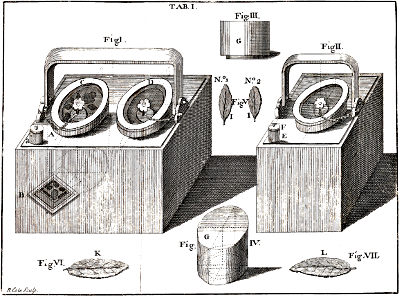
TAB. I.
Fig. I.
Fig. II.
Fig. III.
Fig. IV.
Fig. V.
Fig. VI.
Fig. VII.
B. Cole. Sculp.
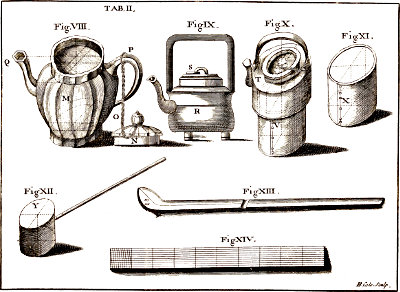
TAB. II.
Fig. VIII.
Fig. IX.
Fig. X.
Fig. XI.
Fig. XII.
Fig. XIII.
Fig. XIV.
B. Cole. Sculp.
"At the Request of the learned and judicious
Simon Pauli, I have delineated
some of the Chinese Utensils, and hope for
Indulgence, because these Vessels are neither
exhibited according to the Laws of
Painting, nor Perspective; but in a Manner,
used by Mechanics, since I thought
it expedient, both for the Sake of the
Subject, and the Satisfaction of the curious
Reader, to have a due Regard to
Capacity, and Measure. I have exhibited
the Orthography of the Vessel represented
by Fig. IX. the Scenography
of Fig. III. of which the Orthography is
represented by Fig. IV. In Fig. VIII. the
Scenography of the Vessel M, and the
Orthography of its Cover N, are represented;
but I have only described the
Scenographies of all the rest. I have
used the Rhinlandian Geometrical Foot,
to the Measure of which all the Parts of
these Vessels are adjusted, in that Proportion,
observable in Fig. XIV. which represents
a smaller Foot, divided into ten
Parts. Fig. XIII. exhibits a wooden Instrument,
exactly of the same Size with
the Figure. In all the Figures I have represented
the Length and Breadth by Diameters
and Diagonals; but the Height
or Depth, by pricked Perpendiculars. I
hope the Mathematical Reader will find
no Fault with the quadrangular Passage
B in Fig. I. for conveying the Air, in
order to ventilate the Coals; nor with
Fig. IX. the two Feet of which, shade
other two similar to themselves."
An Explanation of the Figures, representing
some Chinese Utensils.
Fig. I. Represents a Kind of Kettle, curiously
made of Chinese Copper, furnished
with a Handle, divided by a Copper Partition;
and which, though at first View, it
appears to be one Vessel, is yet, upon narrower
Inspection, found to be two, with
two Coverings; for A represents a small Furnace,
into which the Coals are put; and B,
the Mouth of the Furnace, covered with
Cross-Bars, for the better Ventilation of the
Coals. The other Vessel has its internal
Surface lined, or covered with Tin, serves
either for drying, or boiling the Tea, and
is furnished with a particular small Tube,
the Cover of which is exhibited by a; by
the Benefit of which, the large Coverings,
C D, being shut up, the Vapours of the
Tea may be retained, or allowed to exhale
at Pleasure.
Fig. II. E represents a Copper Vessel,
in which the Tea is either boiled, or preserved,
when dry. E represents its Tube,
and F the covering of the Tube.
Fig. III. and IV. G G exhibit different
Views of one and the same Vessel, the internal
Surface of which is lined with a thin
gilded Plate, of some proper Metal, and
the external Surface, covered with Lack,
after the Manner of the Chinese.
Fig. V. I I. No. 1. represents a genuine
Chinese Tea-Leaf macerated, and stretched
to its full Extent. No. 2. A Leaf of the
Chamelæagnus, or what the French call Piment
Royal, artificially dried.
Fig. VI. K represents another, and, in my
Opinion, a spurious Chinese Tea-Leaf, brought
from China.
Fig. VII. L exhibits a Leaf of what
Clusius calls the Spiræa Theophrasti, found
in the Green-Houses of Copenhagen, and so
like the spurious Chinese Tea, with which
the genuine is adulterated, that the one cannot
be distinguished from the other.
Fig. VIII. M represents a curious Polygonal
Tea-Pot, probably made of sealed
Lemnian, or Silesian Earth. N its Lid
joined by the golden Chain O, to its Handle
P. and Q. Its Stroup curiously tipped
with Gold.
Fig. IX. R represents another earthen
Tea-Pot, with a Stroup, but of a roundish,
or oblong Form, and in the Lid of which,
is fixed a Ring of Clay S for taking it off
and putting it on: Both these earthen Tea-Pots
are highly fragrant; the former is of a
light, and the latter of a pale red Colour.
Fig. X. T exhibits a Copper Vessel
lined with Tin, capable of containing four
Ounces; and whose inferior Part about the
Letter V is covered with a Kind of Case,
woven of such Wood as the Europeans use
in making Sieves; but so as that the Vessel
can be taken out of the Case. But I
am of Opinion, that the Chinese pour their
hot Tea, whether infused, or boiled, into
this, in order to prevent the scalding of their
Hands; and so cool the Liquor, as that it
may neither burn their Lips, nor Tongue.
Fig. XI. X represents this wooden Case,
or Handle, by itself.
Fig. XII. Y exhibits a small wooden
Ladle, with a semicircular wooden Handle.
Fig. XIII. Z represents a small, and
somewhat incurvated wooden Spatula.
Fig. XIV. represents a small geometrical
Foot, divided into ten equal Parts, for ascertaining
the just Proportion of the Utensils
described.
It is to be observed, that these Vessels
are of a grateful fragrant Smell, resembling
those of the Juniper, Cypress, or Aloes Tree,
which is certainly owing to the bituminous
Earth of which they are formed.
Thus we have before observed, that the
Kalenburgian bituminous Earth is as fragrant
as Violets; and that, according to Martinius,
it is on account of the Fragrance of
these Vessels, that the Chinese are so fond
of them, and purchase them at such immense
Prices. We have also taken Notice
from Tulpius, and Maffæus, that these
Pots, Vessels, and other Pieces of Tea Equipage,
are, by the Chinese, bought at the
Rate of some Thousand Nobles, wrapped up
in silken Coverings, shewn only to their
nearest Friends, and as much valued by
them as Adamants, Gems, and curious Medals
are by the Europeans. Let the Europeans,
therefore, before they drink Tea,
which itself is void of Smell, provide themselves
with the fragrant Vessels of Gnihing,
and the Waters of the Rivulet Vussie, which
they must bring uncorrupted from China;
and then, on Supposition the Air was the
same, which it is not, the same Effects
might be produced in Europe by Tea, as
those which it is boasted to produce in China.
It is therefore far more congruous to Truth
and Reason, to suppose, that the Chinese are
free from the Stone, Gout, and arthritic Pains,
rather by the Goodness of their Water, than
by their Tea alone, which may also contribute
something to their Happiness in these
Respects. Besides, the Force and Virtue of
Tea, must be considerably impaired and lost,
by the intense Heat of the Sun, during so
long a Voyage, in which the Equator must
be twice crossed, before the Ships arrive at
any European Ports. Hence we know from
Experience, that those Persons most consult
the Interest of the Europeans, who, according
to Mercator, in his Description of China,
advise, that Rhubarb, with the best Sort of
which, China abounds, should be brought
through Persia by Land, lest it should be
spoiled and corrupted by so long a Voyage.
What must therefore happen to Tea,
or the Chinese Chamelæagnus, which is in
China frequently toasted in an Iron Pan,
so as to corrugate and conglomerate its
Leaves, according to Rhodius and Martinius?
For, if the Virtues of Rhubarb, which
is a compact Substance, are, by such a Voyage,
exhaled, this Misfortune must much
more happen to the tender Leaves of Tea,
which are gathered in the Spring, and have
a bitterish Taste, but no Smell. Hence we
may infer, that these Leaves are, after their
Arrival at Europe, possessed of a volatile and
fixed Salt, but deprived of their Sulphur, especially
the most volatile Part of it; for, if
they were intirely destitute of Sulphur, they
would not take Flame, nor could they be
burned. The Author of a Book, intitled,
Artificia Hominum Miranda Naturæ in Sina
& Europa, in Chap. 35. tells us, "that in
Chekiang, in China, there are Woods of
Mulberry-Trees, so many Silk-Worms, and
such immense Quantities of Silk, that a
Person may there purchase ten silken Suits
of Cloaths at an easier Rate, than he can
have one of Cloth in any Part of Europe.
The Chinese prune their Mulberry-Trees
every Year, as the Europeans do their
Vines; nor do they suffer them to grow
up into tall Trees, because they have found
from long Experience, that the Leaves of
the smallest Trees produce the finest Substance
for Silk, and the best Thread: For
which Reason, they justly distinguish between
the first and second Weaving of
the Thread: The former is produced
when the Worms are nourished by the
Leaves which appear in the Spring, and
are soft and delicate: The latter is, when
they are fed upon the Summer Leaves,
which are coarse and hard; so great is
the Difference of Work produced by these
Animals only by a Change of Food."
If this Account of the Nourishment of Silk-Worms
is true, as we Europeans find it by
Experience, so it is equally certain, that there
is as great a Difference between those Leaves
of the Chinese Tea, or European Chamelæagnus,
which appear in the Spring, and those
which are produced in the Summer, as I
have all along insinuated in this Work. By
this remarkable Passage of the anonymous
Author, I am more and more convinced,
that the vernal Leaves of the Chamelæagnus,
or European Tea, are possessed of different
Virtues from those which appear in the Summer,
when the Sun has entered Leo: And
those who will not grant this Truth, are
confuted by the palpable Instance drawn
from the Nourishment of the Silk-Worms.
By way of Digression, I shall intreat every
Lover of Truth, to throw the Leaves, (not
the Shrub, Flowers, or Seeds) of the European
Chamelæagnus, which, when dry, have
no Scent upon live Coals, and do the same
with an equal Quantity of Chinese Tea, tho'
in different Rooms, and by the exact Resemblance
of the Smell diffused by each, he
will be convinced that the Chamelæagnus is
a Plant of the same Species with Tea.
I am not acquainted with all the Acts,
Statutes, and Laws, of the different Cities of
Europe, made for suppressing and preventing
the Avarice and Exorbitance of Apothecaries;
only in Upper and Lower Germany,
a certain Fine is, by public Authority,
laid upon the Apothecary who sells
old and mouldy Herbs, or uses any Methods
to make them appear good and fresh: Nay,
it is customary, in some Provinces of Germany,
publickly to burn such Herbs, Roots,
Shrubs, or Plants as are bad, or suspected
to be more than one Year old; lest the
poorer Inhabitants should, like the Widow
mentioned in Luke, Chap. viii. 43, spend
all their Money upon Physicians, without
being healed by any: But the Case is quite
otherwise with Tea; for supposing it to be
only one Year old, when it is put into the
Ships at China, it must be double that
Time, and often more, before it arrives to
us. How great then is the Stupidity of
us Europeans, who are never disgusted at
the Avarice and Baseness of the Asiatics,
though they should send us Tea as old as
the Trojan War, whilst they use it fresh and
good themselves? Besides, as the Tea-Leaves
have no Smell, it is highly probable, that
the Asiatics have infused and macerated them,
and then dried them a second Time for
the Use of the Europeans; since, when
chewed in the Mouth, they are resolved
into a Kind of gross Powder. I am also
of the Opinion of the celebrated Wormius,
who thought it highly probable, that Tea-Leaves
were either mixed with others, or
had others intirely substituted in their stead.
If we are at such Care and Pains to discharge
and prohibit the Sale of old European
Plants, ought we not, with the same
Rigour and Authority, to prohibit the Import
of Tea deprived of its Smell, and long
ago dried and prepared for the Use of the
Chinese? The Man would surely be ridiculous
who should import into Europe large
Quantities of Tobacco, already cut small for
the present Smoaking of the Indians, or
Americans; or who should commend it
on account of its unctuous Sulphur, or prefer
it to large Pricks, made up hard and compact
for the Sake of keeping; for cut Tobacco
after it has been kept some Months and become
dry, loses all its Virtue, and is despised
by a phlegmatic European. It is
also obvious from what has been said, that
after the Chinese have toasted their Tea, they
preserve it in close stopped Vessels, that it
may not be corrupted, or too much dried
by the Access of the Air: It is, therefore,
the Duty of every European to join in engaging
the Legislature to put a Stop to this
epidemical Evil, and prohibit the Abuse, not
only of Tea, but also of Tobacco, since both
of these, and Coffee, as I have before shewn,
so enervate the European Men, that they
become incapable of propagating their Species,
like Eunuchs, some of whom are highly
salacious; but it is sufficiently known, that
they are incapable of Procreation, tho' they
emit something analogous to Semen. For
this Reason, the Turks perform Castration in
a different Manner from the Italians, since
the former cut off Penis, Testicles, and all;
and the latter only the Testicles. The Curious
may consult Bartholinus Anatom. Reformat.
Lib. 1. at the End of which, they
will be informed why, and when it happens,
that Horses and Bulls procreate their respective
Species after Castration: The Turks, therefore,
lest their Eunuchs should provide
them with a spurious Progeny, treat them
in a far more inhuman Manner, than the
Italians do. Since we have mentioned the
Turks, it will not be improper to observe,
that the Persians, though salacious, are, nevertheless,
generally impotent: For since,
on account of Polygamy, which they have
in common with the Turks, they have a
numerous Progeny to be supported; when
they copulate with their Wives and Whores,
they are not so sollicitous to procure an
Offspring, as, like the infamous Onan, to
emit a vapid and unprolific Seed, which, on
account of the Coffee corrupted in their
Veins, may, by a Person acquainted with
Chymical Principles, be justly compared to
the Lees of Wine, in a great Measure deprived
of the volatile Salt and Sulphur of
the Wine: Or it may be compared to
that of the Eunuchs of other less brutal
Nations; or that of the Scythians, who are
by Hippocrates, in Lib. de Aere, Aquis,
& Locis, stiled emasculated and effeminate
Mortals. The same Author, in the Work
now quoted, assigns other Causes for the
Sterility of the Scythians; "for, says he, they
make so deep Incisions in the Veins behind
their Ears, that when they come
to be married, they are impotent." But
Olearius informs us, that without this Practice,
the salacious Persians emasculate themselves
only by the Use of Coffee: Nor is this
surprizing, since Salacity, instead of promoting
Procreation, procures Sterility. Hence
a common Strumpet rarely becomes pregnant,
notwithstanding her frequent venereal
Encounters with salacious Rakes and Debauchees.
Besides, there is a vast Difference
between stimulating, cold, and languid Constitutions
to Venery, which is obtained by
Rocket, and fecundating the Semen, which
is obtained by some Vegetables, as Sweet Almonds,
Pine Kernels, Pistachio Nuts, and
Chesnuts; as also by Animals, as Capons,
Larks, Thrushes, Kids-Flesh, Mutton, or
Veal. I do not deny, but Coffee, Chocolate,
and Tobacco, have a Power of stimulating
to Venery, but may yet induce Sterility,
because they consist of heterogeneous
Parts, or rather act by their whole Substances:
But all these Things are unfit for
fecundating the Semen; as also all other Substances
of a drying Quality, and not cold
Substances, as is commonly believed. The
Effeminacy and Impotence then produced
by drinking Coffee, and smoaking Tobacco,
are sufficiently obvious. And to these two,
if I am not mistaken, good Judges will join
Tea, because according to Martinius, the Chinese
by the last not only extinguish Thirst, but
also dissipate their Humours to such a Degree,
that they hardly ever spit. It is also
by a drying Quality, that the Agnus Castus,
Rue, Mint, and Camphire, render Men impotent.
Besides, Tea is to the Chinese themselves
only a new Thing, whose Virtues and
Faculties they have not, as yet, sufficiently
investigated; for which Reason I justly prefer
to it our own Betony, which has been
deservedly celebrated for so many Ages.
The Chinese Incapacity of Spitting is, therefore,
a manifest Proof that Tea contains
a drying, though not an intensely hot Sulphur.
I do not find it expresly affirmed
by Authors, that Chocolate, as well as Coffee,
produces Sterility and Impotence; since
they rather assert, that it proves a Stimulus
to Venery: A Circumstance confirmed
by the Accounts of some Men of Learning
and Penetration, upon their Return
from Africa and America. But as Benzon
informs us, "that Chocolate has a somewhat
bitterish Taste, and refrigerates, or dries the
Body, without producing the smallest Degree
of Intoxication:" Hence we may
reasonably infer, that as Chocolate agrees with
Coffee and Tea, in one Third of its Qualities,
so all these three exactly agree with each
other, in producing Effeminacy and Impotence:
But I shall not here attempt an Investigation
of their other Qualities. I therefore
hope, that for the future, the Europeans
will be wise, and reject Coffee, Chocolate,
and Tea; since they are all either
equally bad, or equally good: Nay, I hope
to see People of all Ranks and Conditions,
have as great an Aversion to them as the
Mahometans and Turks, or rather their Emperors
have to Tobacco, the Lovers of which,
as well as thole who are idle, prodigal,
barren, impotent, or effeminate, they will
not suffer to live within their Territories.
There is another Method of producing
Barrenness and Impotence, probably brought
from Asia into Europe, which is the indiscriminate
Use of Venesection, in both Sexes,
behind the Ears, for intolerable Tooth-achs.
But let me tell the Persons, who, despising
the Authority of Hippocrates, suffer, like
the Scythians, the Veins behind their Ears
to be opened, that they will afterwards
repent their Folly, when they find Sterility
and Impotence to be their Fate. Some
practical Physicians may furnish us with
Instances of Tooth-achs, accompanied with
Deliriums, and other violent Symptoms;
but none of them seem to have observed,
that a Tooth-ach, when removed by opening
the Veins behind the Ears, has proved
the Cause of Sterility, as Hippocrates, who,
according to Macrobius, was never deceived
himself, nor imposed upon others, affirms,
not of a single Instance or two, but of the
whole Nation of the Scythians. Let, therefore,
the Masters and Mistresses of Families
reject the Custom of cauterising or opening
the Veins behind the Ears, unless they
incline that their Children should be cursed
with Sterility, or Impotence, which are
attended with a dire and numerous Train
of Woes. So that we hope the Europeans
will guard against Sterility; produced in
the Indies by Coffee, Tea, and Chocolate;
and in Scythia by opening, or burning the
Veins behind the Ears.
Having already considered the Regimen
of the Chinese, I shall proceed to take Notice
of their Manners, Customs, and Dispositions:
In the Execution of which Design
I shall take my Accounts from Martinius,
who, when treating of Quack-Physicians,
affirms, that the Chinese, as well as the Cretans,
are greatly addicted to Lying. The
same Author, in his Atlas Chinicus, speaks
in the following Manner: "The Europeans
are superior to the Chinese in Fortitude,
but the Chinese excel the Europeans
in Brightness of Genius: They are also
sagacious, cunning, intrepid, industrious,
and dextrous, in managing sudden Emergencies:
Notwithstanding their great Abundance,
they collect and preserve the
most worthless Things, such as Dogs
Bones, Feathers, and Hogs Bristles, which
they sell. Their Penetration often discovers
itself by Fraud, Guile, and Imposition.
Their Merchants are industrious
and active, and the whole of the
Inhabitants spare no Pains, and think no
Labour too severe, when they have the
smallest Prospect of Gain, because they
always prefer Profit to Honesty. They
have sound and robust Constitutions, being
accustomed to Fatigue from their
Infancy: Some of them are of as fair
Complexions as the Europeans."
As I have before compared the Chinese
with the European Regimen, so I should
here institute the Comparison between their
Manners and Dispositions, if Barclay had
not already executed that Design with great
Judgment and Accuracy: Only I must observe,
that their Cunning surpasses our Prudence,
and that their Fraud sufficiently
evinces their Inclination to deceive us. In
a word, Cunning, Avarice, and Lying, are
the distinguishing Characteristicks of the
Asiatics, who yearly defraud the Europeans
of such immense Sums of Money for Teas.
As Hippocrates spared no Pains to remove and
root out the Athenian Plague, so I have used
the utmost of my Endeavours to destroy the
raging epidemical Madness of importing
Tea into Europe from China; since I have
demonstrated, that the Chinese Tea, and the
Chamelæagnus, or Myrtus Brabantica, are
Plants of the same Species. Let such, therefore,
as are unacquainted with Botany, cease
to use Chinese Tea, and in its Room substitute
our European Chamelæagnus. Tho'
I have not Authority sufficient to force my
Opinions upon others, yet let me perswade
my Countrymen to use Betony, which, as
Antonius Musa informs us, cures no less than
forty Disorders, instead of the Chinese Tea,
which is without Smell, corrupted by the
Length of the Voyage, and destitute of the
Qualities it is possessed of in Asia: Nor do
I in the least doubt, but the European Betony
would happily cure those Disorders, for
which the Chinese recommend their Tea.
The Physicians of China are indeed to be
commended for curing Diseases by Abstinence
from Meat and Drink, and the Use
of simple Decoctions, or other similar Things;
because Nature delights in Simplicity, is
contented with little, and overpowered by
a Farrago of compound Medicines.
If I should be laughed at for my Opinions,
I shall comfort myself with this Reflection,
that I have always had so sacred
and inviolable an Attachment to Truth,
that I have chearfully gone whithersoever
she led me; so that I may, with a few
Variations, put a Close to this Work, in
the Words of Cicero, in Academ. Quest.
Lib. 4.
"If I had been induced to this Work
by Ostentation, or the Love of Dispute,
I ought to be condemned, not only as
a Fool, but also as a vicious and immoral
Man; for, if Obstinacy in Trifles
is justly ridiculed, it ought to be much
more so in Affairs of Importance. During
the whole Course of my Life I have
been impartial in my Searches after Truth,
and never attempted to impose upon the
Judgment of others; for I can swear by
the immortal God, that I not only have
an ardent Love to Truth, but also that
I speak the genuine Sentiments of my
Mind; for why should not I desire to
discover Truth, when I rejoice to find
what bears a near Resemblance to it.
As it is the peculiar Glory of the human
Nature, to perceive Truth in its
genuine Colours; so, it is a Disgrace to
Reason to embrace Falshood for Truth.
I do not, however, lay claim to Infallibility,
since I confess that I may err, as well
as other Men."
FINIS.