Long years of practical experience has shown that timber,
however prone to dry or wet rot, may be preserved from
both by the use of certain metallic solutions, or other
suitable protective matters.
All the various processes may be said somewhat to
reduce the transverse strength of the timber when dry,
and the metallic salts are affected at the iron bolts or
fastenings. The natural juices of some woods do this;
and bolts which have united beams of elm and pitch pine
will often corrode entirely away at the junction.
The processes adopted for resisting the chemical changes
in the tissues of the wood are all founded on the principle
that it is essential to inject some material which shall
at once precipitate the coaguable portion of the albumen
retained in the tissues of the wood in a permanent insoluble
form, so that it will not hereafter be susceptible
of putrefactive decomposition. For this purpose, many
substances, many solutions, have been employed with
variable success, but materials have been sometimes introduced
for this purpose which produced an effect just
the opposite to what was anticipated.
Experience has shown that timber is permeable, at least
by aqueous solutions, only so long as the sap channels are
free from incrustation.
Such in general is the case with beech, elm, poplar, and
hornbeam, the capillary tubes of which are always open,
or, at least, close very slowly. At the same time it may
be said that there must remain ever in these species some
parts impervious to injection, whilst it is almost impossible
but that a certain portion of the fibres will be more or less
incrusted. The sap woods, on the other hand, of every
species appear quite pervious.
Very little is known of any preservative process adopted
in ancient times. Pliny observes that the ancients used
garlic boiled in vinegar with considerable success, especially
with reference to preserving timber from worms:
he also states that the oil of cedar will protect any timber
anointed with it from worm and rottenness. Oil of cedar
was used by the ancient Egyptians for preserving their
mummies. Tar and linseed oil were also recommended by
him. The image of the goddess Diana, at Ephesus, was
saturated with olive and cedar oils; also the image of
Jupiter, at Rome; and the statues of Minerva and Bacchus
were impregnated with oil of spikenard.
The idea of preserving wood by the action of oil is
therefore by no means new; but it is somewhat curious
that the earliest modern processes should also be by
means of oil. The oils most proper to be used are linseed,
rapeseed, or almost any of the vegetable fixed oils. Oak
wood, rendered entirely free from moisture, and then
immersed in linseed oil, is said to be thus prevented from
splitting: the time of immersion depending on the size, &c.
Palm oil is preferable to whale oil, because impregnation
with the latter, although in many instances eligible, causes
wood to become brittle. It is, however, probable that
whale oil, when combined with other substances, such as
litharge, coal pitch, or charcoal, may lose much of that
effect. As cocoa-nut oil, which is, under low temperature,
like the oil expressed from the nuts of the palm tree, is
known to be highly preservative of timber and metallic
fastenings, we may expect the same result from the latter,
and thereby avoid that extreme dryness and brittleness
of the timber which Mr. Strange complained of in the
Venetian ships that had been seasoned for many years in
frame under cover. Cocoa-nut oil beat up with shell lime
or chunam, so as to become putty, and afterwards diluted
with more oil, is used at Bombay and elsewhere as a
preservative coat or varnish to plank. It cannot become
a varnish without the addition of some essential oil; and
the oil of mustard is used; which, of course, will produce
the desired effect. In the first volume of the Abbé
Raynal, on the European settlements in the East and
West Indies, he mentions that an oil was exported from
Pegu for the preservation of ships; but as he does not
say what oil, no conclusion can be drawn further than as to
the probability of its being one of those already noticed.
Experience has proved that even animal oils are so far
injurious to timber as to render it brittle, whilst they
preserve it from rottenness; and that, on the other hand, a
mineral salt more or less combined with fatty substances
does not produce that effect. The staves of whale-oil
casks become quite brittle, whilst those of beef, pork, and
tallow barrels remain tough and sound. Ships constantly
in the Greenland trade have their timbers and planks
preserved so far as they have become impregnated with
whale oil.
Experiments with fish oil prove that of itself, unless
exposed to sun and air, it may be injurious; that it
loosens the cohesion of timber; but that animal fat, combined
with saline matter, is preservative.
Fish oil used alone is ineligible, because capable of
running into the putrefactive process, unless as a thin
outside varnish. In hard, sound timber, it will hardly
enter at all; and if poured into bore-holes in the heads of
timbers, it will insinuate itself into the smallest rents or
cracks, and waste through them. Used alone, or with
any admixture, it is absorbed and dried quickly on wood
in a decomposing state or commencing to be dry rotten.
Used with litharge, it dries after some days; but with
lamp-black it has scarcely so much tendency to dry as
when used alone. Paint of fish oil and charcoal dries
very quickly where there is absorption, and the charcoal
extends its oxidating or drying effect to the fish oil in
its vicinity.
We give the following to prove what we have written,
and also to serve as an example for those who wish to try
experiments:—
EXPERIMENTS ON FISH OIL.
June 9.—Upon a piece of old oak scantling, with its alburnam on one
side in a state of decay, fish oil was poured several times, viz. on this day,
on June 25, and July 3, which it rapidly absorbed in the decayed part.
July 26.—It was payed (or mopped) with fish oil and charcoal powder,
and the following day it was put under an inverted cask.
October 1.—The end of this piece was covered with a greenish mould.
This proves that fish oil must be injurious, except where exposed to sun and air
to dry it.
A compound of fixed oils and charcoal is liable to
inflame, but as a thin covering or pigment it may not
be so.
The petroleum oil-wells, near Prome, in Burmah, have
been in use from time immemorial. Wood, both for
ship-building and house-building, is invariably saturated
or coated with the product of those wells; and it is stated
that the result is entire immunity from decay and the
ravages of the white ant. At Marseilles, and some other
ports in the Mediterranean, it used to be the practice to
run the petroleum, which is obtained near the banks of
the Rhone, into the vacancies between the timbers of the
vessels, to give them durability. It was sometimes, for
the conjoint purpose of giving stability and duration to
vessels, mixed with coarse sand or other extraneous
matters, and run in whilst hot between the ceiling and
bottom plank, where it filled up the vacancies between
the timbers in the round of their bottoms, excepting
where necessary to be prevented. The great objection
to the use of petroleum is its inflammability. Creosote, its
great rival for wood preserving, is also inflammable, and
not so agreeable in colour; but it is considerably cheaper,
which is an important matter.
As we are now about to enter upon the subject of patent
processes, &c., it appears desirable to lay down certain
principles at the commencement, in order to assist the
reader as much as possible.
Almost every chemical principle or compound of any
plausibility has been suggested in the course of the last
hundred and fifty years; but the multiplicity and contradiction
of opinions form nearly an inextricable labyrinth.
To commence.
1st. It seems obvious that the sooner the sap is wholly
removed from the wood the better, provided the woody fibre
solidifies without injury.
2nd. That the wood should be impregnated with any
strongly antiseptic and non-deliquescent matter, which must
necessarily be in solution when it enters the wood. No deliquescent
remedy is eligible, because moisture is injurious
to metallic fastenings.
3rd. The wood should be first dried, and its pores then
closed with any substance impervious to air and moisture,
and at the same time highly repellant to putrescency. The
most essential requisites in a preservative of timber being
a disposition to dryness, and a tendency to resist combustion
as far as consistently obtainable.
4th. Any process to be successful ought not to be tedious,
very difficult, or too expensive. These are important
elements in the success of any patent.
Very little is known of any preservative process previous
to the year 1717, when directions were given by the Navy
authorities to boil treenails, and dry them before they
were used. But whether the custom had prevailed before
this time, or whether their strength and durability were
increased by it, there are no means of ascertaining. It
does not appear that any substance was put into the
water to decompose the juices; but as they are soluble in
warm water, perhaps the power of vegetation might have
been destroyed without it.
In 1737 Mr. Emerson patented a process of saturating
timber with boiled oil, mixed with poisonous substances;
but his process was very little used. This, we believe,
was the first patent on wood preserving.
About 1740, Mr. Reid proposed to arrest decay by means
of a certain vegetable acid (probably pyroligneous acid).
The method of using it was by simple immersion.
In 1756, Dr. Hales recommended that the planks at
the water-line of ships should be soaked in linseed oil, to
prevent the injury to which wood is subject when alternately
exposed to wet and dry; and indeed, many ships
were built in which a hollow place was cut in one end of
each beam or sternpost, which might constantly be kept
filled with train oil. Amongst other ships so constructed,
the ‘Fame,’ 74, may be mentioned. When, after some
years, this ship was repaired, it was found that as far as
the oil had penetrated, namely, from 12 to 18 inches from
the end, the wood was quite sound, whilst the other parts
were more or less decayed. The Americans used to hollow
out the tops of their masts in the form of cups or basins;
bore holes from the end a considerable way down the
masts; pour oil into these; cover them over with lead;
and leave the oil to find its way down the capillary vessels
to the interior of the timber.[7]
In 1769, Mr. Jackson, a London chemist, with a view
to the prevention of decay, obtained permission to prepare
some timber to be used in the national yards, by immersing
it in a solution of salt water, lime, muriate of soda,
potash, salts, &c., the result of which dose was, that several
frigates in the Navy subjected to the process were rendered
more perishable than if they had been constructed of unprepared
timber. The solution was filtered into the wood
partly by means of holes made in it. Chapman proposed
a similar method of preserving the frames of ships, viz. by
boring holes in the timbers, and pumping a solution of
copperas in water into them. He believed every part of
the vessel would thus be impregnated.
Mr. Jackson also prepared the frame of the ship ‘Intrepid’
with another solution. The ship lasted many
years. Bowden thought it was a solution of glue. Chapman
suggested slaked lime, thinned with a weak solution of
glue for mopping the timbers of a ship.
Shortly after Mr. Jackson’s process was started, Mr.
Lewis attempted to accomplish the preservation of timber
by placing it surrounded by pounded lime, in spaces below
the “surface of the earth.” The use of lime has also been
advocated by Mr. Knowles, Secretary of the Committee of
Surveyors of the Navy, who has written an able work on
the ‘Means to be taken to Preserve the British Navy
from Dry Rot’ (1821).
Between 1768 and 1773 a practice prevailed of saturating
ships with common salt; but this was found to cause a
rapid corrosion of the iron fastenings, and to fill the vessels
between decks with a constant damp vapour. In ‘Nicholson’s
Journal,’ No. 30, there is an article signed Nauticus
on this subject. Vessel owners had long ago observed that
those ships which have early sailed with cargoes of salt
are not attacked by dry rot. Indeed, several instances are
attested of vessels whose interiors were lined with fungi
having all traces of the plant destroyed by accidental or
intentional sinking in the sea. Acting on such hints, a
trader of Boston, U. S., salted his ships with 500 bushels
of the chloride, disposed as an interior lining, adding 100
bushels at the end of two years. Such an addition of dead
weight is sufficient objection to a procedure which has
other great disadvantages. Salt should never be applied
as an antidote against the dry rot, on account of its natural
powers of attracting moisture from the atmosphere, which
would render apartments almost uninhabitable, from their
continual dampness. Those who have lived for any length
of time in a house at the sea-side, the mortar of which has
been partly composed of sea sand, will have observed
the moist state of the paper, plastering, &c., in wet
weather. Bricks made with sea sand are objectionable.
Salt water seasoning has already been referred to in the
last chapter, but as it is so closely connected with salt
seasoning, the further and final consideration of salt water
seasoning may be fitly dealt with here. Salt water will not
extract the juices from the timber like fresh water. It is
only by destroying the vegetation that salt water can be
advantageous, but it would require a very long time to impregnate
large timber to the heart so as to destroy vegetation.
It is well known that wood is softened, and in time
decomposed, by extreme moisture. Fifty years since, the
master builder at Cronstadt complained that the oak from
Casan, which was frequently wet from different causes in its
passage of three years to Cronstadt, was so water-soaked as
never to dry; and also from the information of Mr. Strange,
it appears “that the practice at Venice of the fresh-cut
timber being thrown into salt water, prevents its ever
becoming dry in the ships, and that the salt water rusted
and corroded the iron bolts.” In fine, vessels built with
salt water seasoned wood are perfect hygrometers, being as
sensible to the changes of the moisture of the atmosphere
as lumps of rock salt, or the plaster of inside walls where
sea sand has been used.
In Ceylon, the timber of the female palm tree is much
harder and blacker than that of the male, inasmuch as it
brings nearly triple its price. The natives are so well
aware of the difference that they resort to the devise of
immersing the male tree in salt water to deepen its colour,
as well as add to its weight.
Vessels impregnated with bay salt, or the large grained
salt of Leamington or of Liverpool (pure muriate of soda),
will possess decided advantages; as also will vessels that
have been laden with saltpetre, if it has been dispersed
amongst their timbers.
Ships (the timbers of which had been previously immersed
in salt water) have been broken up after a few
years’ service, and the floor timbers taken out quite sound:
but when exposed to the sun and rain in the summer
months, their albumen has been in a decomposed or
friable state.
By the answers to queries given to Mr. Strange, the
British Minister at Venice, in or about 1792, it appears
that several of the Venetian ships of war had then lain
under sheds for fifty-nine years; some in bare frames, and
others planked and caulked: that these ships show no
outward marks of decay; but their timbers have shrunk
much, and become brittle; that some of the most intelligent
ship builders were of opinion that great prejudice had
arisen from the prevalent custom of throwing the timber
fresh cut into salt water, and letting it lie there until
wanted; that afterwards it dried, and withered on the
outside, under the sheds, while the inside, being soaked
with salt water, rotted before it became dry; and this was
one reason, amongst others, why Venetian ships, though
built of good timber, lasted so short a time; for the salt
moisture not only rots the inside of the beams and timbers,
but of course rusts and corrodes the iron bolts.
Salt water, sea-sand, and sea-weed are now used for
seasoning “jarrah” wood in Western Australia. This
wood is considered a first-class wood for ship-building, but
it is somewhat slow to season, and if exposed before being
seasoned it is apt to “fly” and cast. The method adopted is
as follows: The logs are thrown into the sea, and left there
for a few weeks; they are then drawn up through the sand,
and after being covered with sea-weed a few inches deep,
are left to lie on the beach, care being taken to prevent
the sun getting at their ends. The logs are then left for
many months to season. When taken up they are cut
into boards 7 inches wide, and stacked, so as to admit of a
free circulation of air round them, for five or six months
before using them. Sea-weed or sea-ware, cast upon the
shores, contains a small quantity of carbonate of soda, and
a large proportion of nitrogenous and saline matters, with
earthy salts, in a readily decomposable state. They also
contain much soluble mucilage. The practice of seasoning
timber by heating it in a sand bath was formerly adopted
by the Dutch, and by the Russians in building boats.
Mr. Thomas Nichols (in a letter to Lord Chatham, when
First Lord of the Admiralty) states “that the same end,
viz. preservation of timber from decay, might probably
be acquired by burying the timber in sand, which acts as
an artificial sap,” in the same manner as mentioned in
Townsend’s ‘Travels through Spain,’ to be used with the
masts of ships of war at Cadiz.
Peat moss has been recommended (because the sulphates
of iron, soda, and magnesia are found in it), but it failed
when tried.
With reference to Mr. Lewis’s proposal to preserve wood
by means of lime, it must be remembered that quicklime,
with damp, has been found to accelerate putrefaction, in
consequence of its extracting carbon; but when dry, and
in such large quantities as to absorb all moisture from the
wood, the wood is preserved, and the sap hardened. Vessels
long in the lime trade have afforded proof of this fact;
and we have also examples in plastering-laths, which are
generally found sound and good in places where they have
been dry. Whitewash or limewater has been strongly
recommended for use between the decks of ships, as being
unfavourable to vegetation: it should be renewed at intervals
of time, according to circumstances. It has been
applied with good effect to the joists and sleepers of
kitchen floors; but to be effectual it should be occasionally
renewed. Effete, or re-carbonated lime, is injurious
to timber, like other absorbent earths; so also are calcareous
incrustations formed by the solution of lime in water,
as appears from Von Buch’s ‘Travels in Norway,’ in which
he says, “that in the fishing country (near Lofodden,
beyond the Arctic circle) the calcareous incrustations
brought by water, filtering through a bed of shells, soon
cause the vessels and wood to be covered with and destroyed
by green fungi.” The ends of joists of timber inserted in
walls are frequently found rotten; and where not so, it
may probably be owing to the mortar having been made
with hot lime, and used immediately, or to the absence of
moisture. It does not appear practicable to use limewater
to any extent for preserving timber, because water holds
in solution only about ⅟500th part of lime, which quantity
would be too inconsiderable; it, however, renders timber
more durable, but at the same time very hard and difficult
to be worked (p. 73).
Vessels constantly in the coal trade have generally required
little repair, and have lasted until in the common
course of things they were lost by shipwreck. This must
be owing to the martial pyrites which abound in all coals;
and also from the sulphuric acid arising from the quantity
of coal dust which finds its way through the seams of the
ceiling, and adheres to the timber and planks.
In 1779, M. Pallas, in Russia, proposed to steep wood
in sulphate of iron (green vitriol) until it had penetrated
deeply, and then in lime to precipitate the vitriol. Neumann,
in his first volume of ‘Chemistry,’ on the article
green vitriol, says, “That in the Swedish transactions this
salt is recommended for preserving wood, particularly the
wheels of carriages, from decay.
“When all the pieces are fit for being joined together,
they are directed to be boiled in a solution of vitriol for
three or four hours, and then kept for some days in a
warm place to dry. It is said that the wood by this preparation
becomes so hard and compact that moisture cannot
penetrate it, and that iron nails are not so apt to be
destroyed in this vitriolated wood as might be expected,
but last as long as the wood itself.”
In 1780 the marcasite termed by the miners mundic,
found in great abundance in the tin mines in Devonshire
and Cornwall, was employed, in a state of fusion, to eradicate
present and to prevent the future growth of dry rot;
but whether its efficacy was proved by time is not known.
A garden walk where there are some pieces of mundic
never has any weeds growing; the rain that falls becomes
impregnated with its qualities, and in flowing through the
walk prevents vegetation.
In 1796 Hales proposed to creosote the treenails of ships:
this was forty-two years previous to Bethell’s patent for
creosoting wood.
About the year 1800, the Society of Arts’ building in the
Adelphi, London, being attacked by dry rot, Dr. Higgins
examined the timbers, caused some to be removed and
replaced by new, and the remainder to be scraped and
washed with a solution of caustic ammonia, so as by burning
the surface of the wood to prevent the growth of fungi.
At the commencement of the present century, a member
of the Royal Academy of Stockholm called attention
to the use of alum for preserving wood from fire. He
says, in the Memoirs of that Academy, “Having been
within these few years to visit the alum mines of Loswers,
in the province of Calmar, I took notice of some attempts
made to burn the old staves of tubs and pails that had
been used for the alum works. For this purpose they were
thrown into the furnace, but those pieces of wood which
had been penetrated by the alum did not burn, though
they remained for a long time in the fire, where they only
became red; however, at last they were consumed by the
intenseness of the heat, but they yielded no flame.” He
concludes, from this experiment, that wood or timber for
the purpose of building may be secured against the action
of fire by letting it remain for some time in water wherein
vitriol, alum, or any other salt has been dissolved which
contains no inflammable parts.
In Sir John Pringle’s Tables of the antiseptic powers of
different substances, he states alum to be thirty times
stronger than sea-salt; and by the experiments of the
author of the ‘Essai pour servir à l’Histoire de la Putréfaction,’
metallic salts are much more antiseptic than
those with earthy bases.
In 1815 it occurred to Mr. Wade that it would be a
good practice to fill the pores of timber with alumine,
or selenite; but two years after, Chapman observed,
“Impregnation of ships’ timbers with a solution of alum
occurred to me about twenty years since, because on immersion
in sea-water the alumine would be deposited in
the pores of the timber; but I was soon informed of its
worse than inutility, by learning that the experiment had
been tried, and, in place of preserving, had caused the wood
to rot speedily. Impregnation with selenite has been tried
in elm water-pipes. On precipitation from its solvent it
partially filled the pores, and hardened the wood, but occasioned
speedy rottenness.” If, by using a solution of alum
to render wood uninflammable, we at the same time cause
it to rot speedily, it becomes a question whether the remedy
is not worse than the disease. Captain E. M. Shaw, of the
London Fire Brigade, in his work, ‘Fire Surveys’ (1872),
recommends alum and water. Probably he only thought
of fire, and not of rotting the wood. The alum question
does not appear to be yet satisfactorily settled.
While upon the subject of uninflammable wood, we may
state that in 1848, upon Putney Heath (near London), by
the roadside, stood an obelisk, to record the success of a
discovery made in the last century of the means of building
a house which no ordinary application of ignited combustibles
could be made to consume: the obelisk was
erected in 1786. The inventor was Mr. David Hartley,
to whom the House of Commons voted 2500l., to defray
the expenses of the experimental building, which stood
about one hundred yards from the obelisk. The building
was three stories high, and two rooms on a floor. In
1774, King George the Third and Queen Charlotte took
their breakfast in one of the rooms, while in the apartment
beneath fires were lighted on the floor, and various inflammable
materials were ignited to attest that the rooms above
were fire-proof. Hartley’s secret lay in the floors being
double, and there being interposed between the two
boards sheets of laminated iron and copper, not thicker
than stout paper, which rendered the floor air-tight and
thereby intercepted the ascent of the heated air; so that,
although the inferior boards were actually charred, the
metal prevented the combustion taking place in the upper
flooring. Six experiments were made by Mr. Hartley in
this house in 1776, but we cannot ascertain any particulars
about them, or any advantages which accrued to the
public from the invention, although the Court of Common
Council awarded him the freedom of the City of London
for his successful experiments.
In 1805 Mr. Maconochie proposed to saturate with resinous
and oily matters inferior woods, and thus render them
more lasting. This proposal was practically carried out
in 1811 by Mr. Lukin, who constructed a peculiar stove
for the purpose of thus impregnating wood under the influence
of an increased temperature. The scheme, however,
had but very partial success, for either the heat was
too low and the wood was not thoroughly aired and seasoned,
or it was too high and the wood was more or less
scorched and burnt. Mr. Lukin buried wood in pulverized
charcoal in a heated oven, but the fibres were afterwards
discovered to have started from each other. He next
erected a large kiln in Woolwich dockyard, capable of
containing 250 loads of timber, but an explosion took
place on the first trial, before the process was complete,
which proved fatal to six of the workmen, and wounded
fourteen, two of whom shortly afterwards died. The
explosion was like the shock of an earthquake. It demolished
the wall of the dockyard, part of which was thrown
to the distance of 250 feet; an iron door weighing 280 lb.
was driven to the distance of 230 feet; and other parts of
the building were borne in the air upwards of 300 feet.
The experiment was not repeated.
Mr. Lukin was not so fortunate in 1811 as in 1808, for
in the latter year he received a considerable reward from
the Government for what was considered a successful
principle of ventilating hospital ships.
In 1815 Mr. Wade recommended the impregnation of
timber with resinous or oleaginous matter (preferring linseed
oil to whale oil) or with common resin dissolved in a
lixivium of caustic alkali, and that the timber should afterwards
be plunged into water acidulated with any cheap
acid, or with alum in solution. He considered that timber
impregnated with oil would not be disagreeable to rats,
worms, cockroaches, &c., and that the contrary was the
case with resin. He also recommended the impregnation
of timber with sulphate of copper, zinc, or iron, rejecting
deliquescent salts, as they corrode metals.
In 1815 Mr. Ambrose Boydon, of the Navy Office,
strongly recommended that the timber, planks, and treenails
of ships should be first boiled in limewater to correct
the acid, and that they afterwards should be boiled in a
thin solution of glue, by which means the pores of the wood
would be filled with a hard substance insoluble by water,
which would not only give the timbers durability, by preventing
vegetation, but increase their strength. Glue, he
thought, might be used without limewater, or glue and
limewater mixed together.
In 1817 Mr. William Chapman published the result of
various experiments he had made on wood with lime, soap,
and alkaline and mineral salts. He recommended a solution
of a pound of sulphate of copper or blue vitriol (at
that time 7d. per pound) dissolved in four ale gallons of
rain water, and mopped on hot over all the infected parts,
or thrown over them in a plentiful libation. He also recommended
one ounce of corrosive sublimate (then 6s. per
pound) to a gallon of rainwater applied in the same manner
to the infected parts. For weather-boarded buildings
he considered one or more coats of thin coal tar, combined
with a small portion of palm oil, for the purpose of
preventing their tendency to rend, to be a good preservative.
Messrs. Wade, Boydon, and Chapman published works
on dry rot about this time.
In 1822 Mr. Oxford took out a patent for an improved
method of preventing “decay of timber,” &c. The process
proposed was as follows: “The essential oil of tar was
first extracted by distillation, and at the same time saturated
with chlorine gas. Proportions of oxide of lead,
carbonate of lime, and carbon of purified coal tar well
ground, were mixed with the oil, and the composition
was then applied in thick coatings to the substances intended
to be preserved.”
On 31st March, 1832, Mr. Kyan patented his process of
corrosive sublimate (solution of the bi-chloride of mercury)
for preventing dry rot; which process consisted as follows:
A solution of the corrosive sublimate is first made, and the
timber is placed in the tank. The wood is held down in
such a way, that when immersed on the fluid being pumped
in, it cannot rise, but is kept under the surface, there being
beams to retain it in its place. There it is left for a week,
after which the liquor is pumped off, and the wood is removed.
This being done, the timber is dried, and said to
be prepared. Sir Robert Smirke was one of the first to use
timber prepared by Kyan, in some buildings in the Temple,
London; and he made some experiments on timber
which had undergone Kyan’s process. He says, “I took
a certain number of pieces of wood cut from the same log
of yellow pine, from poplar, and from the common Scotch
fir; these pieces I placed first in a cesspool, into which the
waters of the common sewers discharged themselves; they
remained there six months; they were then removed from
thence, and placed in a hotbed of compost under a garden-frame;
they remained there a second six months; they
were afterwards put into a flower border, placed half out
of the ground, and I gave my gardener directions to water
them whenever he watered the flowers; they remained
there a similar period of six months. I put them afterwards
into a cellar where there was some dampness, and
the air completely excluded; they remained there a fourth
period of six months, and were afterwards put into a very
wet cellar. Those pieces of wood which underwent
Kyan’s process are in the same state as when I first had
them, and all the others to which the process had not
been applied are more or less rotten, and the poplar is
wholly destroyed.
“I applied Kyan’s process to yellow Canadian pine
about three years ago, and exposed that wood to the
severest tests I could apply, and it remains uninjured,
when any other timber (oak or Baltic wood) would certainly
have decayed if exposed to the same trial, and not
prepared in that manner.
“As another example of the effect of the process, I
may mention that about two years ago, in a basement
story of some chambers in the Temple, London, the wood
flooring and the wood lining of the walls were entirely
decayed from the dampness of the ground and walls, and
to repair it under such circumstances was useless. As I
found it extremely difficult to prevent the dampness, I
recommended lining the walls and the floor with this prepared
wood, which was done; and about six weeks ago I
took down part of it to examine whether any of the wood
was injured, but it was found in as good a state as
when first put up. I did not find the nails more liable
to rust.’
“I have used Kyan’s process in a very considerable
quantity of paling nearly three years ago; that paling is
now in quite as good a state as it was, though it is partly
in the ground. It is yellow pine. Some that I put up
the year before, without using Kyan’s process (yellow pine),
not fixed in the ground, but close upon it, is decayed.”
This evidence, by such an experienced architect as the
late Sir Robert Smirke was, is certainly of great value in
favour of Kyan’s process.
The recorded evidence upon the efficiency of this mode
of treating timber for its preservation is somewhat contradictory.
On the Great Western Railway 40,000 loads
were prepared, at an expenditure of 1¾ lb. of sublimate
to each load, the timber, 7 inch, being immersed for a
period of eight days, and the uniformity of the strength of
the solution being constantly maintained by pumping.
Some samples of this timber, after six years’ use as
sleepers on the railway, were found “as sound as on the
day on which they were first put down.” This timber
was prepared by simple immersion only, without exhaustion
or pressure. Some of the sleepers on the London
and Birmingham Railway, on the other hand, which had
been Kyanized three years only, were found absolutely
rotten, and Kyan’s process was there consequently
abandoned.
This process is said to cost an additional expense to
the owner of from fifteen to twenty shillings per load of
timber. Mr. Kyan at first used 1 lb. of the salt in 4
gallons of water, but it was found that the wood absorbed
4 or 5 lb. of this salt per load; more water was added to
lessen the expense, until the solution became so weak as
in a great measure to lose its effect.
Simple immersion being found imperfect as a means of
injecting the sublimate, attempts were afterwards made
to improve the efficiency of the solution by forcing it into
the wood. Closed tanks were substituted for the open
ones, and forcing pumps, &c., were added to the apparatus.
The pressure applied equalled 100 lb. on the square inch.
With this arrangement a solution was made use of having
1 lb. of the sublimate to 2 gallons of water; and it was
found that three-fourths of this quantity sufficed for preparing
one load of timber. The timber was afterwards
tested, and it was ascertained that the solution had penetrated
to the heart of the logs. Mr. Thompson, the
Secretary to Kyan’s Company, stated, in March, 1842,
that experience had proved “that the strength of the
mixture should not be less than 1 lb. of sublimate to
15 gallons of water; and he had never found any well-authenticated
instance of timber decaying when it had
been properly prepared at that strength.” As much
as 1 in 9 was not unfrequently used. Kyan’s process is
now but very rarely used; Messrs. Bethell, of King
William Street, London, adopt it when requested by their
customers. We have given the statements which have
been made for and against this patent, but after a lapse
of forty years it is difficult to reconcile conflicting
statements.
PATENT PRESERVATIVE SYSTEM.
Horizontal Section of Mr. Kyan’s Original Tank and Cistern.
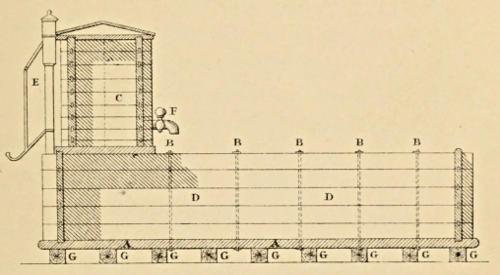
A. Bottom of Tank.
B. ¾″ Iron bolts to connect the planks which form the sides and end of the
Tank and Cistern.
C. The Cistern which contains the solution.
D. The Tank.
E. Pump for raising the solution from tank into Cistern.
F. Tap for conveying the solution from Cistern to Tank.
G. Wood sleepers to carry Tank and Cistern.
Although Mr. Kyan invented his process in 1832, Sir
Humphrey Davy had previously used and recommended
to the Admiralty, and Navy Board, a weak solution of
the same thing to be used as a wash where rot made its
appearance: on giving his opinion upon Mr. Lukin’s
process, that eminent chemist observed, “that he had
found corrosive sublimate highly antiseptic, and preservative
of animal and vegetable substances, and therefore
recommended rubbing the surface of timber with a solution
of it.” In 1821 Mr. Knowles, of the Navy Office,
referred to the use of corrosive sublimate for timber. In
fact, it was used in 1705, in Provence (France), for preserving
wood from beetles. Kyan, however, was the first
to apply it to any extent. In the years 1833 to 1836,
at the Arsenal, Woolwich, experiments were instituted,
having for their object the establishing, or otherwise, the
claims of Kyan’s system; the results of which were of a
satisfactory nature. Dr. Faraday has stated that the combination
of the materials used was not simply mechanical
but chemical; and Captain Alderson, C.E., having experimented
upon some specimens of ash and Christiana deal,
found that the rigidity of the timber was enhanced, but
its strength was in some measure impaired; its specific
gravity being also in some degree diminished.[8] Kyan’s
process is said by some to render the wood brittle.
Mr. Kyan considered that the commencement of rot
might be stopped or prevented by the application of
corrosive sublimate, in consequence of the chemical
combination which takes place between the corrosive sublimate
and those albuminous particles which Berzelius and
others of the highest authority consider to exist in and
form the essence of wood; which, being the first parts to
run to decay, cause others to decay with them. By
seasoning timber in the ordinary way, the destructive
principle is dried, and under common circumstances
rendered inert. But when the timber is afterwards
exposed to great moisture, &c. (the fermentative principle
being soluble when merely dried), it will sometimes be
again called into action. Kyan’s process is said not only
altogether to destroy this principle and render it inert,
but, by making it solid and perfectly insoluble, to remove
it from the action of moisture altogether. It thus loses
its hygrometric properties, and, therefore, prepared or
patent seasoned timber is not liable to those changes of
atmosphere which affect that which is seasoned in the
common way. All woods, including mahogany and the
finest and most expensive wood, may be seasoned by
Kyan’s process in a very short space of time, instead of
the months required by the ordinary methods.
The reader will find a great deal about Kyan’s system
in the ‘Quarterly Review,’ April, 1833; and about proposals
for using chloride of mercury for wood, ‘Memoirs of
the Academy of Dijon,’ 1767; ‘Bull. des Sciences teen.,’
v. ii., 1824, Paris; and ‘Bull. de Pharm.,’ v. 6, 1814, Paris.
It is well known that Canadian timber is much more
liable to decay than that grown in the northern parts of
Europe, and for this reason is never extensively used in
buildings of a superior description. The principle of decay
being destroyed by Kyan’s process as above described, this
objection no longer exists, and this kind of timber may
therefore now be employed with as great security as that
of a superior quality and higher price. The same observation
applies with great force to timber of British growth,
particularly to that of Scotland, much of which is considered
as of little or no value for durable purposes, on
account of its extreme liability to decay, whether in
exposed situations or otherwise. The process invented by
Kyan might therefore render of considerable value plantations
of larch, firs of all kinds, birch, elm, beech, ash,
poplar, &c.
Cost of process in 1832, 1l. per load of 50 cubic feet of
timber.
Mr. W. Inwood, the architect of St. Pancras Church,
London, reported favourably of Kyan’s process. On 22nd
February, 1833, Professor Faraday delivered a lecture at
the Royal Institution, London, on Kyanizing timber; and
on 17th April, 1837, he reported that Kyan’s process
had not caused any rusting or oxidation of the iron in
the ship ‘Samuel Enderby,’ after the ship had been
subjected to this process, and had been on a three years’
voyage to the South Sea fisheries; and in the same year,
viz. 1837, Dr. Dickson delivered a lecture at the Royal
Institute of British Architects on dry rot, recommending
Kyan’s process.
Five years after Mr. Kyan’s invention, viz. in 1837, a
Mr. Flocton invented a process for preventing decay, by
saturating timber with wood-tar and acetate of iron, but
little is known of this invention: we believe it was a
failure.
During the same year Mr. Flocton’s process was made
known, a Frenchman named Letellier recommended
saturating timber in a solution of corrosive sublimate, and
when dry, into one of glue, size, &c.[9]
During this year Mr. Margary took out his patent for
applying sulphate of copper to wood. We propose to describe
Margary’s process further on: we do not think he
received any medals for it.
We now arrive at the modern creosoting process, which
was brought to perfection by the late Mr. John Bethell.
Mr. Bethell’s process of creosoting, or the injection of the
heavy oil of tar, was first patented by him on July 11th,
1838.[10] It consists in impregnating the wood throughout
with oil of tar, and other bituminous matters containing
creosote, and also with pyrolignite of iron, which holds
more creosote in solution than any other watery menstruum.
Creosote, now so extensively used in preserving
wood, is obtained from coal tar, which, when submitted
to distillation, is found to consist of pitch, essential oil
(creosote), naphtha, ammonia, &c. In the application
of the oil of tar for this purpose, it is now considered
to be indispensable that the ammonia be got rid of;
otherwise the wood sometimes becomes brown and decays,
as may be constantly seen in wood coated with
the common oil tar. The kind of creosote preferred
by continental engineers and chemists, and also by the
late Mr. John Bethell himself, is thick, and rich in naphthaline.
Some English chemists now seem to prefer the
thinnest oil, which contains no naphthaline, but a little
more carbolic acid; the crude carbolic acid would vary
from 5 to 15 per cent.: no engineer has ever required
more than 5 per cent. of crude carbolic acid in creosote.
The thinner oil appears to be more likely to be drawn
out of the wood by the heat of the sun or absorption in
powdery soil, and is more readily dissolved out by moisture.
Mummies many thousands of years old have evidently
been preserved on the creosoting principle, and from
observing the mummies the process of creosoting suggested
itself to Mr. Bethell. The ancient Egyptians,
whether from the peculiarity of their religious opinions,
or from the desire to shun destruction and gain perpetuity
even for their dead bodies, prepared the corpses of
their deceased friends in a particular way, viz. by coagulating
the albumen of the various fluids of the body by
means of creosote, cedar oil, salt, and other substances,
and also by excluding the air. How perfectly this
method has preserved them the occasional opening of a
mummy permits us to see. A good account of the operation
is given in the chapter on mummies, in the second
volume of Egyptian Antiquities in the ‘Library of Entertaining
Knowledge.’
By the process of creosoting the timber is rendered
more durable, and less liable to the attack of worms; but
it becomes very inflammable; that is, when once alight
burns quickly; in addition to which, the disagreeable
odour from timber so treated renders it objectionable for
being used in the building of dwelling-houses.
The action of the solutions in water of metallic salts
is, if the mixture is sufficiently strong, to coagulate the
albumen in the sap; but the fibre is left unprotected.
Creosote has the same effect of coagulating the albumen,
whilst it fills the pores of the wood with a bituminous
asphaltic substance, which gives a waterproof
covering to the fibre, prevents the absorption of water,
and is obnoxious to animal life.
In cases where the complete preservation of timber is
of vital importance, and expense not a consideration, the
wood should be first subjected to Burnett’s process, and
then creosoted; by which means it would be nearly indestructible;
the reason for this combined process being,
that the albumen or sap absorbs the creosote more readily
than the heart of the timber, which can, however, be
penetrated by the solution of chloride of zinc. Mr. John
Bethell’s patent of 1853 recommends this in a rather
improved form. He says the timber should first be
injected with metallic salts, then dried in a drying-house,
then creosoted. By this method, very considerable quantities
both of metallic salt and creosote can be injected
into timber.
It has been stated that the elasticity of wood is increased
by creosoting; the heart-wood only decays by
oxidation.
The wood should be dried previous to undergoing the
process, as the sapwood, otherwise almost useless, can be
rendered serviceable, and for piles for marine work whole
round timber should be used, because the sapwood is
so much more readily saturated with the oil, and this
prevents the worms from making an inroad into the
heart.
Mr. Bethell uses about 10 lb. of creosote per cubic
foot of wood, and he does not allow a piece of timber to
be sent from his works without being tested to ascertain
if it has absorbed that amount, or an amount previously
agreed upon. We mention the latter statement, because
it is evident that all descriptions of wood cannot be made
to imbibe the same amount. This process is chiefly used
for pine timber: yellow pine should absorb about 11 lb.
to the cubic foot, and Riga pine about 9 lb. The quantity
of oil recommended by the patentee, engineers, and
others, is from 8 to 10 lb. for land purposes, and about
12 lb. to the cubic foot for marine. In this country, for
marine the quantity does not exceed 12 lb.; but on the
Continent, in France, Belgium, and Holland, the quantity
used is from 14 to 22 lb. (!) per cubic foot. The specifications
frequently issued by engineers for sleepers for
foreign railways describe them to be entirely of heart-wood,
and then to be creosoted to the extent of 10 lb. of
the oil per cubic foot: this it is impossible to do, the value
of the process being in the retention of the sapwood.
It being ascertained a few years since that the centres
of some sleepers were not impregnated with the fluid,
after the sleeper had been creosoted to the extent of
10 lb. of creosote per cubic foot, Sir Macdonald Stephenson
suggested, as a means of obviating that defect, the
boring of two holes, 1 inch in diameter, through each
sleeper longitudinally, and impregnating up to 12 lb. or
14 lb. per cubic foot. By that means the creosote would
be sent all through the sleeper. The boring by hand
would be an expensive process, but by machinery it might
be effected at a comparatively small increased cost.
During the last twenty-five years an enormous quantity
of creosoted railway sleepers have been sent to India and
other hot climates. The native woods are generally too
hard for penetration. On the great Indian Peninsula
Railway the native woods were so hard and close-grained
that they could not be impregnated with any preservative
substance, sál wood being principally used, into which
creosote would not penetrate more than one quarter of an
inch. As regards creosoting wood in India, it is moreover
a costly process, owing to the difficulty and expense of
conveying creosote from England; iron tanks are necessary
to hold the oil when on board ship, and, being
unsaleable in India, add to the expense.
English contractors often send piles to be creosoted
which have been taken from the timber docks. The large
quantity of water they contain resists the entrance of the
oil, and the result is that a great deal of timber is badly
prepared because the contractors cannot obtain it dry.
In the best creosoting works the tank or cylinder is about
6 feet diameter, and from 20 to 50 feet long. In some
instances cylinders are open at both ends, and closed with
iron doors, so that sleepers or timber entered at one end
on being treated can be delivered finished at the opposite
end; but for all practical purposes one open end is sufficient,
as the oil when heated being of such a searching
character it is a difficult matter to get the doors perfectly
air-tight, consequently they are apt to leak during the
time the pressure is being applied. Pipes are led from
the cylinder to the air and force pumps; the air is not
only extracted from the interior of the cylinder, but also
from the pores of the timber. When a vacuum is made,
the oil, which is contained in a tank below the cylinder,
is allowed to rush in, and, as soon as the cylinder is full, the
inlet pipe is shut and the pressure pumps started to force
the oil into the wood; the pressure maintained is from
150 to 200 lb. to the square inch, until the wood has
absorbed the required quantity of oil, which is learned by
an index gauge fixed to the working tank below. All
cylinders are fitted with safety valves, which allow the oil
not immediately absorbed to pass again into the tank.
The oil is heated by coils of pipe placed in the tank,
through which a current of steam is passed from end to
end, raising the temperature to 120°.
With regard to the cost of creosoting: half-round
sleepers, being 9 feet long, 10 inches wide, and 5 inches
thick, properly creosoted, are worth about 4s. each; adzing
for the chairs (done by machine) costs 6s. per 100. These
prices, unfortunately, vary very much, according to circumstances.
The fir sleepers on the London and Birmingham
Railway cost 7s. 6d. each, and the patent preservative
added 9d. more to the expense, but they did not cost so
much on other lines. A London builder wrote to us in
1870, as follows: “Our price for creosoting timber, &c.,
is 15s. per load of 50 cubic feet. Price of creosote, 2d.
per gallon.”
By returns from the Leith Harbour Works it was
shown that the average quantity of creosote absorbed by
the timber was 57⅞ gallons per load, or 577 lb. weight
forced into 50 cubic feet of wood. Assuming the cost to
be 15s. per load, and the creosote at 2d. per gallon, the
creosote would cost 9s. 8d., and the labour and profit
5s. 4d. per load of 50 cubic feet.
It is essential to observe that all methods of protecting
timber depend for their success upon the skilful and conscientious
manner in which they are applied; for, as they
involve chemical actions on a large scale, their efficiency
must depend upon the observance of the minute practical
precautions required to exclude any disturbing causes.
In the case of creosoting: to distil the creosote, to draw
the sap or other moisture from the wood, and subsequently
to inject the creosote in a proper manner, it is necessary
that the operations should be carried into effect under the
supervision of experienced persons of high character.
PATENT PRESERVATIVE SYSTEM.
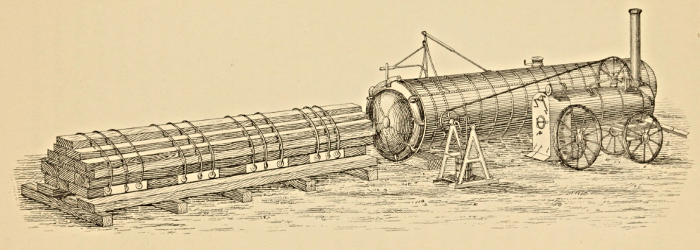
Messrs. John Bethell and Cos. Timber preserving apparatus.
Mr. Bethell’s process has been and still is being tested
on the Indian railways. According to Dr. Cleghorn, it
appears that many of the creosoted sleepers have, however,
“been found decayed in the centre, the interior
portion being scooped out, leaving nothing but a deceptive
shell, in some instances not more than ½ inch in
thickness,” but he does not state whether the sleepers
were prepared in England or in India; because, if prepared
in India, it is probable that some of the hard Indian
woods, into which it is not possible to get creosote or any
other preservative fluid, had been used. Mr. Burt, who
has large timber-preserving works in London for creosoting,
stated about eight years since, that after an experience
of twenty years, during which time he had sent over one
million and a half sleepers to India alone, besides having
prepared many thousand loads of timber for other purposes,
he could safely assert that the instances of failure
had been rare and isolated.
A section of a piece of timber impregnated with creosote
presents some curious and very distinctive characteristics,
according to the duration of the process of injection and
amount of tar injected. In every case the injected tar
follows the lines and sinuosities of the longitudinal fibres.
When injected in sufficient quantity it fills the pores
altogether; when, on the contrary, the process has been
incompletely performed, which, however, is generally sufficient,
the tar accumulates in the transverse sections, and
plugs the channels that give access to deleterious agents.
The experiments made by M. Melseuns on oaken blocks
exposed to the fumes of liquid ammonia show that the
conservating fluids follow the precise course that would be
taken by decay. In wood treated with creosote the tar
acts on the very parts first exposed to injury, and on the
course that would be taken by decay, which is thus rendered
impossible. The methods of injection suggested
by M. Melseuns in 1845 did not answer equally well
with every kind of wood. After trying wooden blocks
in every sort of condition, dressed and in the rough,
green and dry, sound and decayed, M. Melseuns found
that alder, birch, beech, hornbeam, and willow were easily
and completely impregnated; deal sometimes resisted the
process, the innermost layers remaining white; poplar
and oak offered a very great resistance—indeed, with
poplar it was found necessary to repeat the process.
The decay of sleepers, prepared and unprepared, will
often depend on their form. Three forms have been used:
1st, the half-round sleeper, 10 inches by 5 inches;
these are now almost universally used; 2nd, the triangular
sleeper, about 12 inches wide on each side, used by Mr.
Cubitt on the Dover line, but since abandoned; and 3rd,
the half square, 14 inches by 7 inches, used by Mr. Brunel
and still in use. Mr. G. O. Maun, in reporting on the
state of the sleepers of the Pernambuco Railway, states
that fair average samples taken out on the 1st December,
1863 (laid in 1857), show that the half-round intermediate
sleeper is in the most perfect state of preservation; in fact,
nearly as good as on the day it was put down; while the
square-sawn or joint sleeper has not withstood the effects
of the climate so well.
The kind of ballast in which it will be most advisable
to lay the sleeper is another important point to be
attended to. About 12 miles of the Pernambuco Railway
are entirely laid with creosoted sleepers, principally in
white sand. In this description of ballast the half-round
sleepers have suffered, since the opening of the first section
of the line in 1858 up to 1866, a depreciation of not more
than 1 per cent., whilst the square-sawn sleepers have
experienced a depreciation of not less than 50 per cent.
Had the latter been placed in wet cuttings with ballast retentive
of moisture, no doubt the whole of them would have
required to be renewed. Hence it is evident that fine open
sand ballast, which allows a free drainage during the rains,
is best adapted for the preservation of sleepers in the tropics:
it has also been found to be the best in most countries.
The number of testimonials given in favour of creosote
is very large, and are from the most eminent engineers
of all countries, in addition to which Mr. Bethell has
received several medals at international exhibitions.
The English engineers include Messrs. Brunel, Gregory,
Abernethy, Ure, Hemans, Hawkshaw, and Cudworth; the
French, MM. Molinos and Forestier; the Dutch, Messrs.
Waldorp, Freem, and Von Baumhauer; and the Belgian,
M. Crepin. The late Mr. Brunel expressly stated that,
in his opinion, well creosoted timbers would be found in a
sound and serviceable condition at the expiration of forty
years. M. Forestier, French engineer of La Vendée department,
reporting to the juries of the French Exhibition
of 1867, cites a number of experiments he has lately tried
upon many pieces of creosoted and uncreosoted oak, elm,
ash, Swedish, Norwegian, and Dantzic red fir, Norway
white fir, plane, and poplar, and shows that in each case,
except that of the poplar, the resistance of the wood both
to bending and crushing weight was much increased by
creosoting.
Drs. Brande, Ure, and Letheby, also bear testimony to
the efficacy of this mode of preserving timber.
Creosoting has been extensively employed upon all the
principal railways in Great Britain. In England, upon
the London and North Western, North Eastern, South
Eastern, Great Western, &c. In Scotland, on the Caledonian,
Great Northern, &c. In Ireland, on the Great
Southern and Western, Midland, &c. It has also been
and is being employed in Belgium, Holland, France,
Prussia, India, and America.
Between the years 1838 and 1840, Sir William Burnett’s
(formerly Director-General of the Medical Department of
the Navy) process was first made known to the public.
This process consists of an injection of chloride of zinc
into timber, in the proportion of about 1 lb. of the salt to
about 9 or 10 gallons of water, forced into the wood
under a pressure of 150 lb. per square inch.
The late Professor Graham thus wrote of its efficiency:
“After making several experiments on wood prepared by
the solution of chloride of zinc for the purpose of preservation,
and having given the subject my best consideration,
I have come to the following conclusions:
“The wood appears to be fully and deeply penetrated
by the metallic salt. I have found it in the centre of a
large prepared block.
“The salt, although very soluble, does not leave the
wood easily when exposed to the weather, or buried in
dry or damp earth. It does not come to the surface of the
wood like the crystallizable salts. I have no doubt, indeed,
that the greater part of the salts will remain in the
wood for years, when employed for railway sleepers or
such purposes. This may be of material consequence
when the wood is exposed to the attacks of insects, such
as the white ant in India, which, I believe, would be repelled
by the poisonous metallic salt. After being long
macerated in cold water, or even boiled in water, thin chips
of the prepared wood retain a sensible quantity of the
oxide of zinc; which I confirmed by Mr. Toplis’ test, and
observed that the wood can be permanently dyed from
being charged with a metallic mordant.
“I have no doubt, from repeated observations made
during several years, of the valuable preservative qualities
of the solution of chloride of zinc, as applied in Sir W.
Burnett’s process; and would refer its beneficial action
chiefly to the small quantity of the metallic salt, which
is permanently retained by the ligneous fibre in all circumstances
of exposure. The oxide of zinc appears to
alter and harden the fibre of the wood, and destroy the
solubility, and prevent the tendency to decomposition
of the azotised principles it contains by entering into
chemical combination with them.”
The Report of the Jury, which was drawn up by the
Count of Westphalia, at the Cologne International Agricultural
Exhibition, in 1865, upon prepared specimens of
timber, has the following remarks on the chloride of zinc
process:
1st. That chloride of zinc is the only substance which
thoroughly penetrates the timber, and is at the
same time the best adapted for its preservation.
2nd. That the process of impregnating the wood after
cutting is more useful and rational than doing so
while the tree is growing.
3rd. That red beech is the only wood which has
been impregnated in an uniform and thorough
manner.
It should, however, be stated that the Jury had very
slender evidence presented to it respecting the creosoting
process. The creosoted specimens had been impregnated
under the pressure of 60 lb. to 65 lb. per
square inch for three or four hours, and were consequently
inefficiently done; in England the pressure per square
inch would have been at least 140 lb.
Drs. Brande and Cooper, of England, and Dr. Cleghorn,
of India, also wrote favourably of Sir W. Burnett’s
process.
In 1847 a powerful cylinder, of Burnett’s construction,
hermetically closed, was laid down adjoining the sawmills
in Woolwich dockyard. It was found to admit the
largest description of timber for the purpose of having
the moisture extracted, and the pores filled with chloride
of zinc. Three specimens of wood—English oak, English
elm, and Dantzic fir—remained uninjured in the fungus
pit at Woolwich for five years; while similar, but unprepared,
specimens were all found more or less decayed.
The cost of preparing timber by this process is 12s. per
load, besides 2s. for landing and loading: 1 lb. of the
material costing 1s., which is sufficient for 9 or 10 gallons
of water.
Sir W. Burnett and Co.’s works for hydraulic apparatus
and tanks are at Nelson Wharf, Millwall, Poplar; their
office is at 90, Cannon Street, London. Their terms
are—
“For timber, round or square, including planks, deals, hop-poles, paving-blocks,
&c., against rot, 12s. per load of 50 cubic feet.
“For park palings, cabinet work, wine and other laths, as per agreement.
“For railway sleepers, 9 feet long, 10 inches by 5 inches, landing and
reshipping included, 7d. each.
“For timber to be rendered uninflammable, 25s. per load.”
Sir W. Burnett’s firm now sell their patent concentrated
solution at 5s. per gallon: each gallon must be diluted
with 40 gallons of water, according to the instructions in
the licence, for which no charge is made.
The reader will probably have observed that this process
is considered to render timber uninflammable; then let us
see what will be the cost of obtaining a fire-proof house.
The principal building material which causes the destruction
of our houses by fire is wood—combustible wood.
If, therefore, (as nearly all our houses are “brick and
timber” erections,) we render this wood uninflammable,
what will the cost be?
The following is an approximate estimate of the extra
expense, including sundries, &c.:—
Timber
and Deals.
Loads. |
Cost of
House.
£ |
Additional
expense.
£ |
| 25 |
1000 |
34 |
| 15 |
600 |
21 |
| 10 |
400 |
14 |
| 8 |
250 |
12 |
When will the Building Act compel us to use this table
in daily practice?
Although among the many attempts to preserve wood
those in England have proved the most successful, it
should be mentioned that France, Germany, and America
have given much attention to the subject.
At the end of the last century Du Hamel and Buffon
pointed out the possibility of preserving wood, as well as
the means of rendering it unalterable. As early as 1758
Du Hamel made experiments on the vital suction of
plants, and made some curious observations on the different
rings of vegetable matter which absorb most liquid
in different plants. He also tried the effect of vital suction
and pressure (of gravitation) acting at the same time.
His process was reviewed by Barral in 1842.
About 1784 M. Migneron invented a process about
which little is now known, but the wood was covered with
certain fatty substances. Wood nine years exposed to
deterioration was improved by this process. M. Migneron
had the approval of Buffon, Franklin, and the Academies.
His invention was again brought into notice in 1807, when
it was found that timber which had been prepared by it in
1784, and exposed more than twenty years, was quite sound.
In 1811 Cadet de Gassicourt made different kinds of
wood imbibe vegetable and mineral substances, and certain
unguents: he used metallic salts (iron, tin, &c.).
In 1813 M. Champy plunged wood into a bath of tallow
at 334°, and kept it there two or three hours. His experiments
were afterwards repeated by Mr. Payne.
About the year 1832 it was proposed in America to
apply pyroligneous acid to the surface of wood, or introduce
it by fumigation.
Biot (who has written an excellent life of Sir Isaac
Newton) remarked, in 1831, that wood could be soaked
by pressure; but his process of penetrating it with liquids
was imperfect, and his discovery remains unapplied.
A Frenchman, of the name of Bréant, made about this
time a discovery which preceded Boucherie’s method,
which is adopted to a great extent in France. Bréant’s
apparatus consisted of a very ingenious machine, which,
acting by pressure, caused liquids to penetrate to all points
of a mass of wood of great diameter and considerable
length. He may therefore be regarded as having solved
the problem of penetration in a scientific, though not in
a practically applied, point of view. Dr. Boucherie testified
before the Académie des Sciences, in 1840, to the
merit of Bréant’s invention, which, with modifications by
Payne, Brochard, and Gemini, has been worked in France
and England. This process was recommended by Payne
in 1840 and 1844, and imitated by him in France, and
later on by Yengat and Bauner, who used both an air
pump and a forcing pump. Bréant obtained three patents,
viz. 1st, in 1831, to act by pressure; 2nd, in 1837, by
vital suction: and 3rd, in 1838, vacuum by steam. A
mixture of linseed oil and resin succeeded best with him.
He attached more importance to the thorough penetration
of the wood than to the choice of the penetrating substances.
He borrowed his process from Du Hamel, but
to make the necessary suction in the pores he produces a
partial vacuum in the impregnating cylinder by filling it
with steam, and condensing the steam.
Previous to Boucherie’s method, a German, Frantz
Moll, in 1835, proposed to introduce into wood creosote
in a state of vapour, but the process was found to be too
expensive. This was a modification of Maconochie and
Lukin’s trials in 1805 and 1811.[11] A similar process has
since arisen in New York: we believe Mr. Renwick, of
that place, suggested it.
Such were the known labours, when Dr. Boucherie,
in December, 1837, devoted his time to a series of experiments
upon timber, with a view to discover some
preservative process which should answer the following
requirements: First, for protecting wood from dry rot or
wet rot; second, for increasing its hardness; third, for
preserving and developing its flexibility and elasticity;
fourth, for preventing its decay, and the fissures that
result from it, when, after having been used in construction,
it is left exposed to the variations of the atmosphere;
fifth, for giving it various and enduring colours and
odours; and sixth and last, for greatly reducing its inflammability.
It is a curious coincidence that at Bordeaux, in 1733,
the Academy received a memoir relative to the circulation
of the sap and coloured liquids in plants; and it was at
Bordeaux, a century afterwards, viz. 1837, that M. Boucherie
first mentioned his method.
M. Boucherie’s process was first discussed in Paris in
June, 1840. It consists in causing a solution of sulphate
of copper to penetrate to the interior of freshly cut woods,
to preserve them from decay; he occasionally used the
chloride of calcium, the pyrolignite of iron (pyrolignite
brut de fer), prussiate of iron, prussiate of copper, and
various other metallic salts. As a general rule sulphate
of copper is used; but when the hardness of the wood
is desired to be increased, pyrolignite of iron is taken
(1 gallon of iron to 6 gallons of water); and when the
object is to render the wood flexible, elastic, and at the
same time uninflammable, chloride of calcium is used.
The liquid is taken up by the tree either whilst growing
in the earth or immediately after it has been felled. Not
more than two or three months should be allowed to
elapse before the timber is operated upon, but the sooner
it undergoes the process after being felled the better.
Sulphate of copper is said to be superior to corrosive
sublimate. Dr. Boucherie’s process of the injection of
wood with the salts of copper is as simple as it is easy.
For those woods intended for poles it consists in plunging
the base of a branch, furnished with leaves, into a tub
containing the solution. The liquid ascends into the
branches by the action of the leaves, and the wood is
impregnated with the preservative salt. As for logs, the
operation consists in cutting down the tree to be operated
upon; fixing at its base a plank, which is fixed by means
of a screw placed in the centre, and which can be
tightened at will when placed in the centre of the tree.
This plank has, on the side to be applied to the bottom of
the tree, a rather thick shield of leather, cloth, pasteboard,
or some other substance, intended to establish a space
between it and the wood, sufficient for the preserving
fluid to keep in contact with the freshly cut surface of
the tree. The liquid is brought there from a tub or
other reservoir, by the help of a slanting pole made
on the upper surface of the tree, and in which is put a
tube, adapted at its other extremity to a spigot in the
upper reservoir which contains the solution. A pressure
of 5 mètres suffices; so that the instant the sap of the tree
is drawn away it escapes, and is replaced by the liquid
saturated with sulphate of copper. The proportion of
sulphate of copper in the solution should be 1 lb. of the
salt to 12½ gallons of water. As soon as the operation
terminates (and it lasts for some hours for the most
difficult logs), the wood is ready for use.
For various practical reasons, the first invention of
impregnating the wood of the tree whilst still in a
growing state, causing it to suck up various solutions by
means of the absorbing power of the leaves themselves,
was subsequently abandoned; and at the present time a
cheap, simple, and effective process is adopted for impregnating
the felled timbers with the preserving liquid,
designated in France “trait de scie, et la cuisse foulante.”
The trunk of a newly felled tree is cut into a length
suitable for two railway sleepers; a cross cut is made on
the prostrate timber to nearly nine-tenths of its diameter;
a wedge is then inserted, and a cord is wound round on
the cut surface, leaving a shallow chamber in the centre,
when it is then closed by withdrawing the wedge. A tube
is then inserted through an auger hole into this chamber,
and to this tube is attached an elastic connecting tube
from a reservoir placed some 20 or 30 feet above the level
on which the wood lies, and a stream of the saturating
fluid with this pressure passes into the chamber, presses
on the sap in the sap tubes, expels it at each end of the
tree, and itself supplies its place. The fluid used is a
solution of copper in water, in the proportion of 10 or
12 per cent., and a chemical test that ascertains the
pressure of the copper solution is applied at each end of
the tree from which the sap exudes, by which the operator
ascertains when the process is completed.
A full account of this process may be found in the
number for June, 1840, of ‘Les Annales de Chimie et de
Physique.’ Messrs. de Mirbel, Arago, Poucelet, Andouin,
Gambey, Boussingault, and Dumas, on the part of l’Académie
des Sciences, made a report upon Dr. Boucherie’s
process, confirming the value of the invention. In France,
Dr. Boucherie, some years since, relinquished his brévet,
and threw the process open to the public, in consideration
of a national reward; whilst in England he has obtained
two patents (1838 and 1841), which, however, are similar
to Bethell’s patent, obtained by him on July 11, 1838:
which is the same day and year of Boucherie’s patent.
A prize medal was awarded for Dr. Boucherie’s process at
the Great Exhibition in London, in 1851, and a grande
médaille d’honneur, at the Paris Exhibition of 1855.
Many thousands of railway sleepers have been prepared
by this process, and laid down on the Great Northern
Railway of France, and are at present perfectly sound,
whilst others not prepared, on the same line, have rotted.
Boucherie’s process was used on Belgium railways up to
1859; and it is to be regretted that the reasons which led
to its abandonment have not been given in the reports of
the railway administration, as such reasons would have afforded
reliable data for future experimentalists to go upon.
Messrs. Légé and Fleury-Pironnet’s patent for the
injection of sulphate of copper into beech and poplar is
as follows: After the wood is placed, and the opening
hermetically sealed, a jet of steam is introduced, intended
at first to enter the timber and open its pores for the
purpose of obtaining a sudden vacuum, so as to establish
at any time a communication between the interior of the
cylinder and the cold water condenser; at the same time
the air pump is put in action. The vacuum caused is
very powerful, and is equal to 25½ ins. of the barometer.
Under the double influence of the heat and the vacuum
the sap is quickly evaporated from the wood as steam,
and ejected from the cylinder by the air pump, so that in
a very short time the wood is fully prepared to admit the
preserving liquid through the entire bulk.
The use of sulphate of copper for preserving timber
has not been, however, confined to France, for about the
time Dr. Boucherie brought forward his process, a Mr.
Margary took out a patent in England for the use of the
same material. His method consists in steeping the substances
to be preserved in a solution of sulphate of copper,
of the strength of 1 lb. of the sulphate to 8 gallons of
water, and leaving them in it till thoroughly saturated.
The timber is allowed to remain in the tank two days for
every inch of its thickness. Another method is to place
the timber in a closed iron vessel of great strength, and it
is made to imbibe the solution by exhaustion and pressure,
the operation occupying but a short time.
Sulphate of copper is sold in quantities at 4d. per lb.;
so that 100l. would buy 6000 lb., and each pound weight
is sufficient for 7 or 8 gallons of water, according to Margary;
or 12 gallons of water, according to Boucherie.
To preserve railway sleepers, the French railway engineers
require ¼ lb. of sulphate of copper per cubic foot,
say at least 12 lbs. to the load of 50 feet, to be used in a
2 per cent. solution; so that a load of timber can be rendered
imperishable for the sum of four shillings, exclusive
of labour, if sulphate of copper be reckoned at 4d. per lb.
With respect to the use of pyrolignite of iron, Mr.
Bethell considers it an expensive process, the pyrolignite
costing 6d. to 9d. per gallon, whilst the oil of tar can be
delivered at from 2d. to 3d. per gallon: the cost of these
materials is constantly varying.
A great many sleepers were prepared on the Great
Western Railway by pyrolignite of iron, and all have
decayed. Their black colour makes them exactly resemble
creosoted sleepers, and many mistakes have arisen from
this resemblance.
Messrs. Dorsett and Blythé’s (of Bordeaux) patent process
of preparing wood by the injection of heated solutions
of sulphate of copper is said to have been adopted by
French, Spanish, and Italian, as well as other continental
railway companies, by the French Government for their
navy and other constructions, and by telegraph companies
for poles on continental lines. It is as cheap as creosote,
and is employed in places where creosote cannot be had.
Wood prepared by it is rendered incombustible. Wood
for outdoor purposes so prepared has a clean yellowish
surface, without odour; it requires no painting, remains
unchangeable for any length of time, and can be employed
for any purpose, the same as unprepared material, and
carried with other cargo without hindrance.[12] Messrs.
Dorsett and Blythé’s process is similar to that of Mr.
Knab, which consisted of a solution of sulphate of copper,
heated to nearly boiling point, and placed in a lead
cylinder, protected by wood.
In 1846, 80,000 sleepers, treated with sulphate of
copper, were laid down on French railways, and after
nine years’ exposure were found to be as perfect as when
first laid.
Mr. H. W. Lewis, University of Michigan, U.S., thus
writes in the ‘Journal’ of the Franklin Institute, in 1866,
with reference to the decay of American railway sleepers:
“Allowing 2112 sleepers per mile, at 50 cents each,
1056 dols. per mile of American railroad decay every
seven years. Thoroughly impregnate those sleepers with
sulphate of copper, at a cost of 5 cents each, and they
would last twice as long. Thus would be effected a saving
of 880 dols. per mile in the seven years on sleepers alone.
In the United States, there are 33,906·6 miles of railroad.
The whole saving on these lines would be 29,389,568 dols.,
or upwards of 4,262,795 dols. per annum.”
With reference to the decay of unprepared wooden
sleepers, it may be here stated that the renewal of wooden
sleepers on the Calcutta and Delhi Indian line alone costs
annually 130,000l.
The preservative action of sulphate of copper on wood
has long been known, but there are several things in its
action which require explanation. The ‘London Review’
says that Kœnig has lately investigated the chemical
reactions which occur when wood is impregnated with a
preservative solution of blue vitriol. He finds, as a general
rule, that a certain quantity of basic sulphate of copper
remains combined in the pores of the wood in such a
manner that it cannot be washed out with water. The
copper salt may be seen by its green colour in the spaces
between the yearly rings in the less compact portions of
the wood, that is to say, in those portions which contain
the sap. Those varieties of wood which contain the most
resin retain the largest amount of the copper salt—oak,
for example, retaining but little of it. The ligneous fibre
itself appears to have little or nothing to do with the
fluxation of the copper salt, and indeed none whatever is
retained in chemical combination, so that it cannot be
washed out with water, by pure cellulose. When wood,
from which all resin has been extracted by boiling alcohol,
is impregnated with sulphate of copper, it does not become
coloured like the original resinous wood, and the copper
salt contained in it may be readily washed out with water.
In like manner, from impregnated resinous wood all the
copper salt may be removed, with the resin, by means of
alcohol. The constituents of the blue vitriol are consequently
fixed in the wood by means of the resin which
this contains. Further, it is found that the impregnated
wood contains less nitrogen than that which is unimpregnated,
and that it is even possible to remove all the
nitrogenous components of the wood by long-continued
treatment with the solution of sulphate of copper; the
nitrogenous matters being soluble in an excess of this
solution, just as the precipitate which forms when aqueous
solutions of albumen and sulphate of copper are mixed is
soluble in excess of the latter. Since the nitrogenous
matters are well known to be promoters of putrefaction,
their removal readily accounts for the increased durability
of the impregnated wood. The utility of blue vitriol as a
preservative may also depend on a measure upon the
resinous copper salt which is formed, by which the pores
of the wood are more or less filled up, and the ligneous
fibre covered, so that contact with the air is prevented,
and the attack of insects hindered. It is suggested that
those cases in which the anticipated benefits have not
been realized in practice, by impregnating wood with a
solution of blue vitriol, may probably be referred to the
use of an insufficient amount of this agent; that is, where
the wood was not immersed in the solution for a sufficient
length of time. The action should be one of lixiviation,
not merely of absorption.
In 1841, a German, named Müenzing, a chemist of
Heibronn, proposed chloride of manganese (waste liquor
in the manufacture of bleaching powder) as a preservative
against dry rot in timber; but his process has not been
adopted in England, and very little noticed abroad.
In July, 1841, Mr. Payne patented his invention for
sulphate of iron in London; and in June and November,
1846, in France; and in 1846 in London, for carbonate of
soda.[13] The materials employed in Payne’s process are
sulphate of iron and sulphate of lime, both being held
in solution with water. The timber is placed in a cylinder
in which a vacuum is formed by the condensation of
steam, assisted by air pumps; a solution of sulphate of
iron is then admitted into the vessel, which instantly
insinuates itself into all the pores of the wood, previously
freed from air by the vacuum, and, after about a minute’s
exposure, impregnates its entire substance; the sulphate
of iron is then withdrawn, and another solution of sulphate
of lime thrown in, which enters the substance of the wood
in the same manner as the former solution, and the two
salts react upon each other, and form two new combinations
within the substance of the wood—muriate of iron,
and muriate of lime. One of the most valuable properties
of timber thus prepared is its perfect incombustibility:
when exposed to the action of flame or strong heat, it
simply smoulders, and emits no flame. We may also
reasonably infer that with such a compound in its pores,
decay must be greatly retarded, and the liability to
worms lessened, if not prevented. The greatest drawback
consists in the increased difficulty of working.
This invention has been approved by the Commissioners
of Woods and Forests, and has received much approbation
from the architectural profession. Mr. Hawkshaw, C.E.,
considers that this process renders wood brittle. It was
employed for rendering wood uninflammable in the
Houses of Parliament (we presume, in the carcase; for
steaming was used for the joiner’s work), British Museum,
and other public buildings; and also for the Royal Stables
at Claremont.
In 1842, Mr. Bethell stated before the Institute of
Civil Engineers, London, that silicate of potash, or soluble
glass, rendered wood uninflammable.
In 1842, Professor Brande proposed corrosive sublimate
in turpentine, or oil of tar, as a preservative solution.
In 1845, Mr. Ransome suggested the application of
silicate of soda, to be afterwards decomposed by an acid
in the fibre of the wood; and in 1846, Mr Payne proposed
soluble sulphides of the earth (barium sulphide, &c.),
to be also afterwards decomposed in the woods by
acids.
In 1855, a writer in the ‘Builder’ suggested an equal
mixture of alum and borax (biborate of soda) to be used
for making wood uninflammable. We have no objection
to the use of alum and borax to render wood uninflammable,
providing it does not hurt the wood.
Such are the principal patents, suggestions, and inventions,
up to the year 1856; but there are many more
which have been brought before the public, some of
which we will now describe.
Dr. Darwin, some years since, proposed absorption, first,
of lime water, then of a weak solution of sulphuric acid,
drying between the two, so as to form a gypsum (sulphate
of lime) in the pores of the wood, the latter to be previously
well seasoned, and when prepared to be used in a
dry situation.
Dr. Parry has recommended a preparation composed of
bees-wax, roll brimstone, and oil, in the proportion of 1,
2, and 3 ounces to ¾ gallon of water; to be boiled together
and laid on hot.
Mr. Pritchard, C.E., of Shoreham, succeeded in establishing
pyrolignite of iron and oil of tar as a preventive
of dry rot; the pyrolignite to be used very pure, the oil
applied afterwards, and to be perfectly free from any
particle of ammonia.
Mr. Toplis recommends the introduction into the pores
of the timber of a solution of sulphate or muriate of iron;
the solution may be in the proportion of about 2 lb. of
the salt to 4 or 5 gallons of water.
An invention has been lately patented by Mr. John
Cullen, of the North London Railway, Bow, for preserving
wood from decay. The inventor proposes to use a composition
of coal-tar, lime, and charcoal; the charcoal to
be reduced to a fine powder, and also the lime. These
materials to be well mixed, and subjected to heat, and the
wood immersed therein. The impregnation of the wood
with the composition may be materially aided by means
of exhaustion and pressure. Wood thus prepared is considered
to be proof against the attacks of the white ant.
The process of preserving wood from decay invented by
Mr. L. S. Robins, of New York, was proposed to be worked
extensively by the “British Patent Wood Preserving
Company.” It consists in first removing the surface
moisture, and then charging and saturating the wood with
hot oleaginous vapours and compounds. As the Robins’
process applies the preserving material in the form of
vapour, the wood is left clean, and after a few hours’
exposure to the air it is said to be fit to be handled for
any purposes in which elegant workmanship is required.
Neither science nor extraordinary skill is required in conducting
the process, and the treatment under the patent
is said to involve only a trifling expense.
Reference has already been made to the use of petroleum.
The almost unlimited supply of it within the last few years
has opened out a new and almost boundless source of
wealth. An invention has been patented in the name of
Mr. A. Prince, which purports to be an improvement in
the mode of preserving timber by the aid of petroleum.
The invention consists, firstly, in the immersion of the
timber in a suitable vessel or receptacle, and to exhaust
the air therefrom, by the ordinary means of preserving
wood by saturation. The crude petroleum is next conveyed
into the vessel, and thereby caused to penetrate
into every pore or interstice of the woody fibre, the effect
being, it is said, to thoroughly preserve the wood from
decay. He also proposes to mix any cheap mineral paint
or pigment with crude petroleum to be used as a coating
for the bottom of ships before the application of the sheathing,
and also to all timber for building or other purposes.
The composition is considered to render the timber indestructible,
and to repel the attacks of insects. Without
expressing any opinion upon this patent as applied to wood
for building purposes, we must again draw attention to
the high inflammability of petroleum.
The ‘Journal’ of the Board of Arts and Manufactures for
Upper Canada considers the following to be the cheapest
and the best mode of preserving timber in Canada: Let
the timbers be placed in a drying chamber for a few hours,
where they would be exposed to a temperature of about
200°, so as to drive out all moisture, and by heat, coagulate
the albuminous substance, which is so productive of
decay. Immediately upon being taken out of the drying
chamber, they should be thrown into a tank containing
crude petroleum. As the wood cools, the air in the pores
will contract, and the petroleum occupy the place it filled.
Such is the extraordinary attraction shown by this substance
for dry surfaces, that by the process called capillary
attraction, it would gradually find its way into the interior
of the largest pieces of timber, and effectually coat the
walls and cells, and interstitial spaces. During the lapse
of time, the petroleum would absorb oxygen, and become
inspissated, and finally converted into a bituminous substance,
which would effectually shield the wood from destruction
by the ordinary processes of decay. The process
commends itself on account of its cheapness. A drying
chamber might easily be constructed of sheet iron properly
strengthened, and petroleum is very abundant and accessible.
Immediately after the pieces of timber have been
taken out of the petroleum vat, they should be sprinkled
with wood ashes in order that a coating of this substance
may adhere to the surface, and carbonate of potash be
absorbed to a small depth. The object of this is to render
the surface incombustible; and dusting with wood ashes
until quite dry will destroy this property to a certain extent.
The woodwork of farm buildings in this country is sometimes
subjected to the following: Take two parts of gas-tar,
one part of pitch, one part half caustic lime and half common
resin; mix and boil these well together, and put them
on the wood quite hot. Apply two or three coats, and
while the last coat is still warm, dash on it a quantity of
well-washed sharp sand, previously prepared by being
sifted through a sieve. The surface of the wood will then
have a complete stone appearance, and may be durable.
It is, of course, necessary, that the wood be perfectly dry,
and one coat should be well hardened before the next is
put on. It is necessary, by the use of lime and long boiling,
to get quit of the ammonia of the tar, as it is considered
to injure the wood.
Mr. Abel, the eminent chemist to the War Department,
recommends the application of silicate of soda in solution,
for giving to wood, when applied to it like paint, a hard
coating, which is durable for several years, and is also a
considerable protection against fire. The silicate of soda,
which is prepared for use in the form of a thick syrup, is
diluted in water in the proportion of 1 part by measure
of the syrup to 4 parts of water, which is added slowly,
until a perfect mixture is obtained by constant stirring.
The wood is then washed over two or three times with this
liquid by means of an ordinary whitewash brush, so as to
absorb as much of it as possible. When this first coating
is nearly dry, the wood is painted over with another wash
made by slaking good fat lime, diluted to the consistency
of thick cream. Then, after the limewash has become
moderately dry, another solution of the silicate of soda, in
the proportion of 1 of soda to 2 of water, is applied in the
same manner as the first coating. The preparation of
the wood is then complete; but if the lime coating has
been applied too quickly, the surface of the wood may be
found, when quite dry, after the last coating of the
silicate, to give off a little lime when rubbed with the
hand; in which case it should be once more coated over
with a solution of the silicate of the same strength as in
the first operation. If Mr. Abel had been an architect
or builder, he would never have invented this process.
What would the cost be? and would not a special clerk
of the works be necessary to carry out this method in
practice?
The following coating for piles and posts, to prevent
them from rotting, has been recommended on account of
its being economical, impermeable to water, and nearly as
hard as stone: Take 50 parts of resin, 40 of finely powdered
chalk, 300 parts of fine white sharp sand, 4 parts of
linseed oil, 1 part of native red oxide of copper, and 1 part
of sulphuric acid. First, heat the resin, chalk, sand, and
oil, in an iron boiler; then add the oxide, and, with care,
the acid; stir the composition carefully, and apply the
coat while it is still hot. If it be not liquid enough, add a
little more oil. This coating, when it is cold and dry,
forms a varnish which is as hard as stone.
Another method for fencing, gate-posts, garden stakes,
and timber which is to be buried in the earth, may be mentioned.
Take 11 lb. of blue vitriol (sulphate of copper)
and 20 quarts of water; dissolve the vitriol with boiling
water, and then add the remainder of the water. The
end of the wood is then to be put into the solution, and
left to stand four or five days; for shingle, three days
will answer, and for posts, 6 inches square, ten days,
Care should be taken that the saturation takes place in
a well-pitched tank or keyed box, for the reason that
any barrel will be shrunk by the operation so as to leak.
Instead of expanding an old cask, as other liquids do, this
shrinks it. This solution has also been used in dry rot
cases, when the wood is only slightly affected.
It will sometimes be found that when oak fencing is
put up new, and tarred or painted, a fungus will vegetate
through the dressing, and the interior of the wood
be rapidly destroyed; but when undressed it seems
that the weather desiccates the gum or sap, and leaves
only the woody fibre, and the fence lasts for many
years.
About fifteen years ago, Professor Crace Calvert, F.R.S.,
made an investigation for the Admiralty, of the qualities
of different woods used in ship-building. He found the
goodness of teak to consist in the fact that it is highly
charged with caoutchouc; and he considered that if the
tannin be soaked out of a block of oak, it may then be
interpenetrated by a solution of caoutchouc, and thereby
rendered as lasting as teak.
We can only spare the space for a few words about this
method.
1st. We have seen lead which has formed part of the
gutter of a building previous to its being burnt down:
lead melts at 612° F.; caoutchouc at 248° F.; therefore
caoutchouc would not prevent wood from being destroyed
by fire. At 248° caoutchouc is highly inflammable, burns
with a white flame and much smoke.
2nd. We are informed by a surgical bandage-maker of
high repute, that caoutchouc, when used in elastic kneecaps,
&c., will perish, if the articles are left in a drawer
for two or three years. When hard, caoutchouc is brittle.
Would it be advisable to interpenetrate oak with a
solution of caoutchouc? In 1825, Mr. Hancock proposed
a solution of 1½ lb. of caoutchouc in 3 lb. of essential
oil, to which was to be added 9 lb. of tar. Mr. Parkes,
in 1843, and M. Passez, in 1845, proposed to dissolve
caoutchouc in sulphur: painting or immersing the wood.
Maconochie, in 1805, after his return from India, proposed
distilled teak chips to be injected into fir woods.
Although England has been active in endeavouring to
discover the best and cheapest remedy for dry rot, France
has also been active in the same direction.
M. le Comte de Chassloup Lambat, Member of the late
Imperial Senate of France, considers that, as sulphur is
most prejudicial to all species of fungi, there might,
perhaps, be some means of making it serviceable in the
preservation of timber. We know with what success it is
used in medicine. It is also known that coopers burn a
sulphur match in old casks before using them—a practice
which has evidently for its object the prevention of mustiness,
often microscopic, which would impart a bad flavour
to the wine.
M. de Lapparent, late Inspector-General of Timber for
the French Navy, proposed to prevent the growth of fungi
by the use of a paint having flour of sulphur as a basis,
and linseed oil as an amalgamater. In 1862 he proposed
charring wood; we have referred to this process in our
last chapter (p. 96).
The paint was to be composed of:
| Flour of sulphur |
200 |
grammes |
3,088 |
grains. |
| Common linseed oil |
135 |
” |
2,084 |
” |
| Prepared oil of manganese |
30 |
” |
463 |
” |
He considered that by smearing here and there either
the surfaces of the ribs of a ship, or below the ceiling,
with this paint, a slightly sulphurous atmosphere will
be developed in the hold, which will purify the air by
destroying, at least in part, the sporules of the fungi. He
has since stated that his anticipations have been fully
realized. M. de Lapparent also proposes to prevent the
decay of timber by subjecting it to a skilful carbonization
with common inflammable coal gas. An experiment was
made at Cherbourg, which was stated to be completely
successful. The cost is only about 10 cents per square
yard of framing and planking.[14] M. de Lapparent’s gas
method is useful for burning off old paint. We saw it in
practice (April, 1875) at Waterloo Railway Station, London,
and it appeared to be effective.
At the suggestion of MM. Le Châtelier (Engineer-in-chief
of mines) and Flachat, C.E.’s, M. Ranee, a few years
since, injected in a Légé and Fleury cylinder certain
pieces of white fir, red fir, and pitch pine with chloride
of sodium, which had been deprived of the manganesian
salts it contained, to destroy its deliquescent property.
Some pieces were injected four times, but the greatest
amount of solution injected into pitch pine heart-wood
was from 3 to 4 per cent., and very little more was
injected into the white and red fir heart-wood. It was
also noticed that sapwood, after being injected four times,
only gained 8 per cent. in weight in the last three operations.
The experiments made to test the relative incombustibility
of the injected wood showed that the process
was a complete failure; the prepared wood burning as
quickly as the unprepared wood.
M. Paschal le Gros, of Paris, has patented his system for
preserving all kinds of wood, by means of a double salt of
manganese and of zinc, used either alone or with an admixture
of creosote. The solution, obtained in either of the two
ways, is poured into a trough, and the immersion of the logs
or pieces of wood is effected by placing them vertically in
the trough in such a manner that they are steeped in the
liquid to about three-quarters of their length. The wood
is thus subjected to the action of the solution during a
length of time varying from twelve to forty-eight hours.
The solution rises in the fibres of the wood, and impregnates
them by the capillary force alone, without requiring
any mechanical action. The timber is said to become
incombustible, hard, and very lasting.
M. Fontenay, C.E., in 1832, proposed to act upon the
wood with what he designated metallic soap, which could
be obtained from the residue in greasing boxes of carriages;
also from the acid remains of oil, suet, iron, and
brass dust; all being melted together. In 1816 Chapman
tried experiments with yellow soap; but to render it sufficiently
fluid it required forty times its weight of water,
in which the quantity of resinous matter and tallow
would scarcely exceed ⅟80th; therefore no greater portion
of these substances could be left in the pores of the wood,
which could produce little effect.
M. Letellier, in 1837, proposed to use deuto-chloride of
mercury as a preservative for wood.
M. Dondeine’s process was formerly used in France and
Germany. It is a paint, consisting of many ingredients,
the principal being linseed oil, resin, white lead, vermilion,
lard, and oxide of iron. All these are to be well
mixed, and reduced by boiling to one-tenth, and then
applied with a brush. If applied cold, a little varnish or
turpentine to be added.
Little is known in England of the inventions which
have arisen in foreign countries not already mentioned.
M. Szerelmey, a Hungarian, proposed, in 1868, potassa,
lime, sulphuric acid, petroleum, &c., to preserve wood.
In Germany, the following method is sometimes used for
the preservation of wood: Mix 40 parts of chalk, 40 parts
of resin, 4 of linseed oil; melting them together in an iron
pot; then add 1 part of native oxide of copper, and afterwards,
carefully, 1 part of sulphuric acid. The mixture is
applied while hot to the wood by means of a brush, and it
soon becomes very hard.[15]
Mr. Cobley, of Meerholz, Hesse, has patented the following
preparation. A strong solution of potash, baryta,
lime, strontia, or any of their salts, are forced into the
pores of timber in a close iron vessel by a pump. After
this operation, the liquid is run off from the timber, and
hydro-fluo-silicic acid is forced in, which, uniting with the
salts in the timber, forms an insoluble compound capable
of rendering the wood uninflammable.
About the year 1800, Neils Nystrom, chemist, Norkopping,
recommended a solution of sea salt and copperas,
to be laid upon timber as hot as possible, to prevent
rottenness or combustion. He also proposed a solution of
sulphate of iron, potash, alum, &c., to extinguish fires.
M. Louis Vernet, Buenos Ayres, proposed to preserve
timber from fire by the use of the following mixture: Take
1 lb. of arsenic, 6 lb. of alum, and 10 lb. of potash, in 40
gallons of water, and mix with oil, or any suitable tarry
matters, and paint the timber with the solution. We
have already referred to the conflicting evidence respecting
alum and water for wood: we can now state that
Chapman’s experiments proved that arsenic afforded no
protection against dry rot. Experiments in Cornwall
have proved that where arsenical ores have lain on the
ground, vegetation will ensue in two or three years after
removal of the ore. If, therefore, alum or arsenic have
no good effect on timber with respect to the dry rot, we
think the use of both of them together would certainly be
objectionable.
The last we intend referring to is a composition frequently
used in China, for preserving wood. Many
buildings in the capital are painted with it. It is called
Schoicao, and is made with 3 parts of blood deprived of
its febrine, 4 parts of lime and a little alum, and 2 parts
of liquid silicate of soda. It is sometimes used in Japan.
It would be practically useless to quote any further
remedies, and the reader is recommended to carefully
study those quoted in this chapter, and of their utility
to judge for himself, bearing in mind those principles
which we have referred to before commencing to describe
the patent processes. A large number of patents have
been taken out in England for the preservation of wood
by preservative processes, but only two are now in use,—that
is, to any extent,—viz. Bethell’s and Burnett’s. Messrs.
Bethell and Co. now impregnate timber with copper, zinc,
corrosive sublimate, or creosote; the four best patents.
We insert here a short analysis of different methods
proposed for seasoning timber:—
Vacuum and Pressure Processes generally.
- Bréant’s.
- Bethell’s.
- Payne’s.
- Perin’s.
- Tissier’s.
Vacuum by Condensation of Steam.
- Tissier.
- Bréant.
- Payne.
- Renard Perin, 1848.
- Brochard and Watteau, 1847.
Separate Condenser.
Employ Sulphate of Copper in closed vessels.
- Bethell’s Patent, 11th July, 1838.
- Tissier, 22nd October, 1844.
- Molin’s Paper, 1853.
- Payen’s Pamphlet.
- Légé and Fleury’s Pamphlet.
Current of Steam.
- Moll’s Patent, 19th January, 1835.
- Tissier’s ” 22nd October, 1844.
- Payne’s ” 14th Nov., 1846.
- Meyer d’Uslaw, 2nd January, 1851.
- Payen’s Pamphlet.
Hot Solution.
- Tissier’s Patent, 22nd October, 1844.
- Knab’s Patent, 8th September, 1846.
Most solutions used are heated.
The following are the chief ingredients which have
been recommended, and some of them tried, to prevent
the decomposition of timber, and the growth of fungi:—
- Acid, Sulphuric.
- ” Vitriolic.
- ” of Tar.
- Carbonate of Potash.
- ” Soda.
- ” Barytes.
- Sulphate of Copper.
- ” Iron.
- ” Zinc.
- ” Lime.
- ” Magnesia.
- ” Barytes.
- ” Alumina.
- ” Soda.
- Salt, Neutral.
- Salt, Selenites.
- Oil, Vegetable.
- ” Animal.
- ” Mineral.
- Muriate of Soda.
- Marcosites, Mundic.
- ” Barytes.
- Nitrate of Potash.
- Animal Glue.
- ” Wax.
- Quick Lime.
- Resins of different kinds.
- Sublimate, Corrosive.
- Peat Moss.
For the non-professional reader we find we have three
facts:
1st. The most successful patentees have been Bethell
and Burnett, in England; and Boucherie, in France:
all B’s.
2nd. The most successful patents have been knighted.
Payne’s patent was, we believe, used by Sirs R. Smirke
and C. Barry; Kyan’s, by Sir R. Smirke; Burnett’s, by
Sirs M. Peto, P. Roney, and H. Dryden; while Bethell’s
patent can claim Sir I. Brunel, and many other knights.
We believe Dr. Boucherie received the Legion of Honour
in France.
3rd. There are only at the present time three timber-preserving
works in London, and they are owned by
Messrs. Bethell and Co., Sir F. Burnett and Co., and
Messrs. Burt, Boulton, and Co.: all names commencing
with the letter B.
For the professional reader we find we have three hard
facts:
The most successful patents may be placed in three
classes, and we give the key-note of their success.
1st. One material and one application.—Creosote,
Petroleum. Order—Ancient Egyptians, or Bethell’s,
Burmese.
2nd. Two materials and one application.—Chloride
of zinc and water; sulphate of copper and water; corrosive
sublimate and water. Order—Burnett, Boucherie,
Kyan.
3rd. Two materials and two applications.—Sulphate
of iron and water; afterwards sulphate of lime and
water. Payne.
We thus observe there are twice three successful patent
processes.
Any inventions which cannot be brought under these
three classes have had a short life; at least, we think so.
The same remarks will apply to external applications
for wood—for instance, coal-tar, one application, is more
used for fencing than any other material.
We are much in want of a valuable series of experiments
on the application of various chemicals on wood to
resist burning to pieces; without causing it to rot speedily.