INSTRUMENTS FOR ASCERTAINING THE ATMOSPHERIC PRESSURE.
Fig. 1.
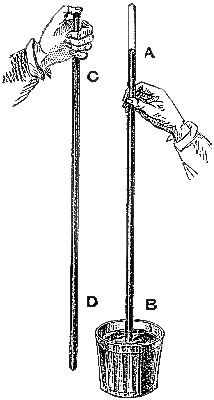
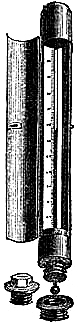
1. Principle of the Barometer.—The first instrument which gave the exact
measure of the pressure of the atmosphere was invented by Torricelli, in
1643. It is constructed as follows:—A glass tube, CD (fig. 1), about 34
inches long, and from two to four-tenths of an inch in diameter of bore,
having one end closed, is filled with mercury. In a cup, B, a quantity of
mercury is also poured. Then, placing a finger securely over the open end,
C, invert the tube vertically over the cup, and remove the finger when the
end of the tube dips into the mercury. The mercury in the tube then partly
falls out, but a column, AB, about 30 inches in height, remains supported.
This column is a weight of mercury, the pressure of which upon the surface
of that in the cup is precisely equivalent to the corresponding pressure
of the atmosphere which would be exerted in its place if the tube were
removed. As the atmospheric pressure varies, the length of this mercurial
column also changes. It is by no means constant in its height; in fact, it
is very seldom stationary, but is constantly rising or falling through a
certain extent of the tube, at the level of the sea, near which the above
experiment is supposed to be performed. It is, therefore, an instrument by
which the fluctuations taking place in the pressure of the atmosphere,
arising from changes in its weight and elasticity, can be shown and
measured. It has obtained the name Barometer, or measurer of
heaviness,—a word certainly not happily expressive of the utility of the
invention. If the bore of the barometer tube be uniform throughout its
length, and have its sectional area equal to a square inch, it is evident
that the length of the column, which is supported by the pressure of the
air, expresses the number of cubic inches of mercury which compose it. The
weight of this mercury, therefore, represents the statical pressure of the
atmosphere upon a square inch of surface. In England the annual mean
height of the barometric column, reduced to the sea-level and to the
temperature of 32° Fahrenheit, is about 29·95 inches. A cubic inch of
mercury at this temperature has been ascertained to weigh 0·48967 lbs.
avoirdupois. Hence, 29·95 × 0·48967= 14·67 lbs., is the mean value of the
pressure of the atmosphere on each square inch of surface, near the
sea-level, about the latitude of 50 degrees. Nearer the equator this mean
pressure is somewhat greater; nearer the poles, somewhat less. For common
practical calculations it is assumed to be 15 lbs. on the square inch.
When it became apparent that the movements of the barometric column
furnished indications of the probable coming changes in the weather, an
attempt was made to deduce from recorded observations the barometric
height corresponding to the most notable characteristics of weather. It
was found that for fine dry weather the mercury in the barometer at the
sea-level generally stood above 30 inches; changeable weather happened
when it ranged from 30 to 29 inches, and when rainy or stormy weather
occurred it was even lower. Hence, it became the practice to place upon
barometer scales words indicatory of the weather likely to accompany, or
follow, the movements of the mercury; whence the instruments bearing them
obtained the name “Weather Glasses.”
2. Construction of Barometers.—In order that the instrument may be
portable, it must be made a fixture and mounted on a support; and,
further, to render it scientifically or even practically useful, many
precautions are required in its construction. The following remarks apply
to the construction of all barometers:—Mercury is universally employed,
because it is the heaviest of fluids, and therefore measures the
atmospheric pressure by the shortest column. Water barometers have been
constructed, and they require to be at least 34 feet long. Oil, or other
fluids, might be used. Mercury, however, has other advantages: it has
feeble volatility, and does not adhere to glass, if pure. Oxidised, or
otherwise impure mercury, may adhere to glass; moreover, such mercury
would not have the density of the pure metal, and therefore the barometric
column would be either greater or less than it should be. The mercury of
commerce generally contains lead; sometimes traces of iron and sulphur. It
is necessary, therefore, for the manufacturer to purify the mercury; and
this is done by washing it with diluted acetic, or sulphuric acid, which
dissolves the impurities. No better test can be found for ascertaining if
the mercury be pure than that of filling a delicate thermometer tube; if,
on exhausting the air from this thermometer, the mercury will freely run
up and down the bore, which is probably one thousandth of an inch in
diameter, the mercury from which this thermometer was made will be found
fit for any purpose, and with it a tube may be filled and boiled, not only
of one inch, but even of two inches diameter. In all barometers it is
requisite that the space above the mercurial column should be completely
void of air and aqueous vapour, because these gases, by virtue of their
elasticity, would depress the column. To exclude these the mercury is
introduced, and boiled in the tube, over a charcoal fire, kept up for the
purpose. In this manner the air and vapour which adhere to the glass are
expanded, and escape away. One can tell whether a barometer has been
properly “boiled,” as it is termed, by simply holding the tube in a
slanting direction and allowing the mercury to strike the top. If the
boiling has been well performed, the mercury will give a clear, metallic
sound; if not, a dull, flat sound, showing some air to be present.
When the mercury in a barometer tube rises or falls, the level of the
mercury in the cup, or cistern, as it is generally termed, falls or
rises by a proportionate quantity, which depends upon the relative areas
of the interior of the tube and of the cistern. It is necessary that this
should be taken into consideration in ascertaining the exact height of the
column. If a fixed scale is applied to the tube, the correct height may be
obtained by applying a correction for capacity. A certain height of the
mercury is ascertained to be accurately measured by the scale, and should
be marked on the instrument as the neutral point. Above this point the
heights measured are all less, and below, all more, than they should be.
The ratio between the internal diameters of the tube and cistern (which
should also be stated on the instrument, as, for instance, capac. 1⁄50)
supplies the data for finding the correction to be applied. This
correction is obviated by constructing the cistern so as to allow of the
surface of the mercury in it being adjustable to the commencement of the
fixed scale, as by Fortin’s or Negretti’s plan. It is also unnecessary in
barometers constructed on what is now called the “Kew method.” These will
all be detailed in their proper place. The tube, being fixed to the
cistern, may have a moveable scale applied to it. But such an arrangement
requires the utmost care and skill in observing, and is seldom seen except
in first-class Observatories.
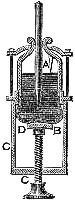
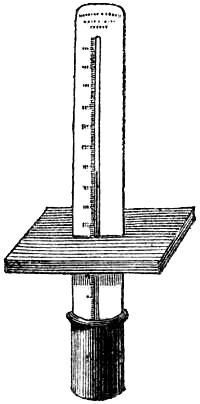
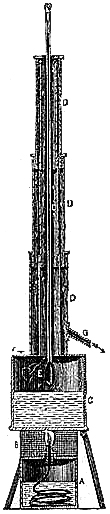
3. Fortin’s Barometer.—Fortin’s plan of constructing a barometer cistern
is shown in fig. 2. The cistern is formed of a glass cylinder, which
allows of the level of the mercury within being seen. The bottom of the
cylinder is made of sheep-skin or leather, like a bag, so as to allow of
being pushed up or lowered by means of a screw, D B, worked from beneath.
This screw moves through the bottom of a brass cylinder, C C, which is
fixed outside, and protects the glass cylinder containing the mercury. At
the top of the interior of the cistern is fixed a small piece of ivory, A,
the point of which exactly coincides with the zero of the scale. This
screw and moveable cistern-bottom serve also to render the barometer
portable, by confining the mercury in the tube, and preventing its coming
into the cistern, which is thus made too small to receive it.

Fig. 3.
4. STANDARD BAROMETER.
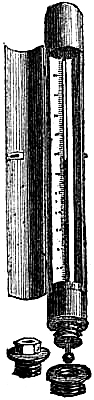
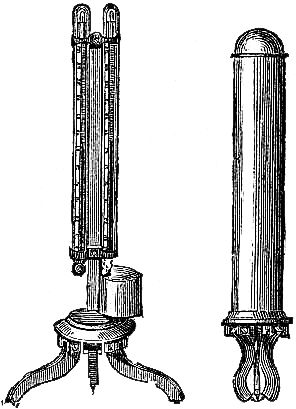
Fig. 3 represents a Standard Barometer on Fortin’s principle. The
barometer tube is enclosed and protected by a tube of brass extending
throughout its whole length; the upper portion of the brass tube has two
longitudinal openings opposite each other; on one side of the front
opening is the barometrical scale of English inches, divided to show, by
means of a vernier, 1⁄500th of an inch; on the opposite side is sometimes
divided a scale of French millimetres, reading also by a vernier to 1⁄10th
of a millimetre (see directions for reading the vernier, page 7). A
thermometer, C, is attached to the frame, and divided to degrees, which
can be read to tenths; it is necessary for ascertaining the temperature of
the instrument, in order to correct the observed height of the barometer.
As received by the observer, the barometer will consist of two parts,
packed separately for safety in carriage,—1st, the barometer tube and
cistern, filled with mercury, the brass tube, with its divided scale and
thermometer; and 2nd, a mahogany board, with bracket at top, and brass
ring with three adjusting screws at bottom.
Directions for fixing the Barometer.—In selecting a position for a
barometer, care should be taken to place it so that the sun cannot shine
upon it, and that it is not affected by direct heat from a fire. The
cistern should be from two to three feet above the ground, which will give
a height for observing convenient to most persons. A standard barometer
should be compared with an observatory standard of acknowledged accuracy,
to determine its index error; which, as such instruments are graduated by
micrometrical apparatus of great exactitude, will be constant for all
parts of the scale. It should be capable of turning on its axis by a
movement of the hand, so that little difficulty can ever be experienced in
obtaining a good light for observation. Having determined upon the
position in which to place the instrument, fix the mahogany board as
nearly vertical as possible, and ascertain if the barometer is perfect and
free from air, in the following manner:—lower the screw at the bottom of
the cistern several turns, so that the mercury in the tube, when held
upright, may fall two or three inches from the top; then slightly incline
the instrument from the vertical position, and if the mercury in striking
the top elicit a sharp tap, the instrument is perfect. Supposing the
barometer to be in perfect condition, as it is almost sure to be, it is
next suspended on the brass bracket, its cistern passing through the ring
at bottom, and allowed to find its vertical position, after which it is
firmly clamped by means of the three thumb-screws.
To Remove the Instrument when fixed to another Position.—If it should
be necessary to remove the barometer,—first, by means of the adjusting
screw, drive the mercury to the top of the tube, turning it gently when it
is approaching the top, and cease directly any resistance is experienced;
next, remove from the upper bracket or socket; lift the instrument and
invert it, carrying it with its lower end upwards.
Directions for taking an Observation.—Before making an observation, the
mercury in the cistern must be raised or lowered by means of the
thumb-screw, F, until the ivory point, E, and its reflected image in the
mercury, D, are just in contact; the vernier is then moved by means of the
milled head, until its lower termination just excludes the light from the
top of the mercurial column; the reading is then taken by means of the
scale on the limb and the vernier. The vernier should be made to read
upward in all barometers, unless for a special object, as this arrangement
admits of the most exact setting. In observing, the eye should be placed
in a right line with the fore and back edges of the lower termination of
the vernier; and this line should be made to form a tangent to the apex of
the mercurial column. A small reflector placed behind the vernier and
moving with it, so as to assist in throwing the light through the back
slit of the brass frame on to the glass tube, is advantageous; and the
observer’s vision may be further assisted by the aid of a reading lens.
The object is, in these Standard Barometers, to obtain an exact reading,
which can only be done by having the eye, the fore part of the zero edge
of the vernier, the top of the mercurial column, and the back of the
vernier, in the same horizontal plane.
Uniformity of Calibre.—The diameter of that part of the tube through
which the oscillations of the mercury will take place is very carefully
examined to insure uniformity of calibre, and only those tubes are used
which are as nearly as possible of the same diameter throughout. The size
of the bore should be marked on the frame of the barometer in tenths and
hundredths of an inch. A correction due to capillary action, and depending
on the size of the tube, must be applied to the readings.
5. Correction due to Capillarity.—When an open tube of small bore is
plunged into mercury, the fluid will not rise to the same level inside as
it has outside. Hence, the effect of capillary action is to depress the
mercurial column; and the more so the smaller the tube. The following
table gives the correction for tubes in ordinary use:—
Diameter of
tube. | |
Depression, in
boiled tubes. | |
Depression, in
unboiled tubes. |
| INCH. | |
INCH. | |
INCH. |
| 0·60 | |
0·002 | |
0·004 |
| 0·55 | |
0·003 | |
0·005 |
| 0·50 | |
0·003 | |
0·007 |
| 0·45 | |
0·005 | |
0·010 |
| 0·40 | |
0·007 | |
0·015 |
| 0·35 | |
0·010 | |
0·021 |
| 0·15 | |
0·044 | |
0·029 |
| 0·10 | |
0·070 | |
0·041 |
| 0·30 | |
0·014 | |
0·058 |
| 0·25 | |
0·020 | |
0·086 |
| 0·20 | |
0·029 | |
0·140 |
This correction is always additive to the observed reading of the
barometer.
6. Correction due to Temperature.—In all kinds of mercurial barometers
attention must be given to the temperature of the mercury. As this metal
expands and contracts very much for variations of temperature, its density
alters correspondingly, and in consequence the height of the barometric
column also varies. To ascertain the temperature of the mercury, a
thermometer is placed near the tube, and is sometimes made to dip into the
mercury in the cistern. The freezing point of water, 32°F., is the
temperature to which all readings of barometers must be reduced, in order
to make them fairly comparable. The reduction may be effected by
calculation, but the practical method is by tables for the purpose; and
for these tables we refer the reader to the works mentioned at the end of
this book.
7. Correction due to Height above the Half-tide Level.—Further, in order
that barometrical observations generally may be made under similar
circumstances, the readings, corrected for capacity, capillarity, and
temperature, should be reduced to what they would be at the sea-level, by
adding a correction corresponding to the height above the mean level of
the sea, or of half-tide. For practical purposes of comparison with
barometric pressure at other localities, add one-tenth of an inch to the
reading for each hundred feet of elevation above the sea. For scientific
accuracy this will not suffice, but a correction must be obtained by means
of Schuckburg’s formula, or tables computed therefrom.
Fig. 4.
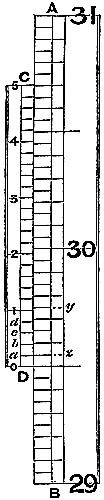
Fig. 5.
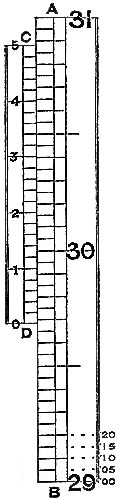
8. The Barometer Vernier.—The vernier, an invaluable contrivance for
measuring small spaces, was invented by Peter Vernier, about the year
1630. The barometer scale is divided into inches and tenths. The vernier
enables us to accurately subdivide the tenths into hundredths, and, in
first-class instruments, even to thousandths of an inch. It consists of a
short scale made to pass along the graduated fixed scale by a sliding
motion, or preferably by a rack-and-pinion motion, the vernier being fixed
on the rack, which is moved by turning the milled head of the pinion. The
principle of the vernier, to whatever instrumental scale applied, is that
the divisions of the moveable scale are to those in an equal length of the
fixed scale in the proportion of two numbers which differ from each other
by unity.
The scales of standard barometers are usually divided into half-tenths, or
·05, of an inch, as represented, in fig. 5, by AB. The vernier, CD, is
made equal in length to twenty-four of these divisions, and divided into
twenty-five equal parts; consequently one space on the scale is larger
than one on the vernier by the twenty-fifth part of ·05, which is ·002
inch, so that such a vernier shows differences of ·002 inch. The vernier
of the figure reading upwards, the lower edge, D, will denote the top of
the barometer column; and is the zero of the vernier scale. In fig. 4, the
zero being in line exactly with 29 inches and five-tenths of the fixed
scale, the barometer reading would be 29·500 inches. It will be seen that
the vernier line, a, falls short of a division of the scale by, as we
have explained, ·002 inch; b, by ·004; c, by ·006; d, by ·008; and
the next line by one hundredth. If, then, the vernier be moved so as to
make a coincide with z, on the scale, it will have moved through ·002
inch; and if 1 on the vernier be moved into line with y on the scale,
the space measured will be ·010. Hence, the figures 1, 2, 3, 4, 5 on the
vernier measure hundredths, and the intermediate lines even thousandths of
an inch. In fig. 5, the zero of the vernier is intermediate 29·65 and
29·70 on the scale. Passing the eye up the vernier and scale, the second
line above 3 is perceived to lie evenly with a line of the scale. This
gives ·03 and ·004 to add to 29·65, so that the actual reading is 29·684
inches. It may happen that no line on the vernier accurately lies in the
same straight line with one on the scale; in such a case a doubt will
arise as to the selection of one from two equally coincident, and the
intermediate thousandth of an inch should be taken.
For the ordinary purposes of the barometer as a “weather-glass,” such
minute measurement is not required. Hence, in household and marine
barometers the scale need only be divided to tenths, and the vernier
constructed to measure hundredths of an inch. This is done by making the
vernier either 9 or 11-10ths of an inch long, and dividing it into ten
equal parts. The lines above the zero line are then numbered from 1 to 10;
sometimes the alternate divisions only are numbered, the intermediate
numbers being very readily inferred. Hence, if the first line of the
vernier agrees with one on the scale, the next must be out one-tenth of a
tenth, or ·01 of an inch from agreement with the next scale line; the
following vernier line must be ·02 out, and so on. Consequently, when the
vernier is set to the mercurial column, the difference shown by the
vernier from the tenth on the scale is the hundredths to be added to the
inches and tenths of the scale.
A little practice will accustom a person to set and read any barometer
quickly; an important matter where accuracy is required, as the heat of
the body, or the hand, is very rapidly communicated to the instrument, and
may vitiate, to some extent, the observation.
Fig. 6.

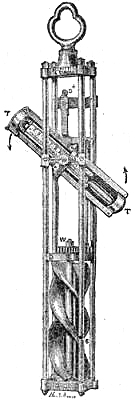
9. SELF-COMPENSATING STANDARD BAROMETER.
This barometer has been suggested to Messrs. Negretti and Zambra by
Wentworth Erk, Esq. It consists of a regular barometer; but attached to
the vernier is a double rack worked with one pinion, so that in setting or
adjusting the vernier in one position, the second rack moves in directly
the opposite direction, carrying along with it a plug or plunger the exact
size of the internal diameter of the tube dipping in the cistern, so that
whatever the displacement that has taken place in the cistern, owing to
the rise or fall of the mercury, it is exactly compensated by the plug
being more or less immersed in the mercury, so that no capacity correction
is required.
A barometer on this principle is, however, no novelty, for at the Royal
Society’s room a very old instrument may be seen reading somewhat after
the same manner.
Fig. 6 is an illustration of the appearance of this instrument. The
cistern is so constructed that the greatest amount of light is admitted to
the surface of the mercury.
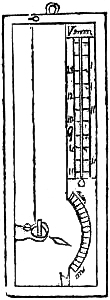
10. BAROMETER WITH ELECTRICAL ADJUSTMENT.
This barometer is useful to persons whose eyesight may be defective; and
is capable of being read off to greater accuracy than ordinary barometers,
as will be seen by the following description:—The barometer consists of
an upright tube dipping into a cistern, so contrived, that an up-and-down
movement, by means of a screw, can be imparted to it. In the top of the
tube a piece of platina wire is hermetically sealed. The cistern also has
a metallic connection, so that by means of covered copper wires (in the
back of the frame) a circuit is established; another connection also
exists by means of a metallic point dipping into the cistern. The circuit,
however, can be cut off from this by means of a switch placed about midway
up the frame; on one side of the tube is placed a scale of inches; a small
circular vernier, divided into 100 parts, is connected with the dipping
point, and works at right angles with this scale.
To set the instrument in action for taking an observation, a small battery
is connected by means of two small binding screws at the bottom of the
frame. The switch is turned upwards, thereby disconnecting the dipping
point; the cistern is then screwed up, so that the mercury in the tube is
brought into contact with the platina wire at the top; the instant this is
effected the magnetic needle seen on the barometer will be deflected. The
switch is now turned down; by so doing the connection with the upper wire
or platina is cut off, and established instead only between the dipping
point carrying the circular vernier and the bottom of the cistern; the
point is now screwed by means of the milled head until the needle is again
deflected. We may now be sure that the line on the circular vernier that
cuts the division on the scale is the exact height of the barometer.
Although the description here given may seem somewhat lengthy, the
operation itself is performed in less time than would be taken in reading
off an ordinary instrument.
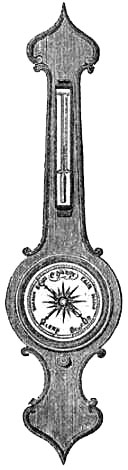
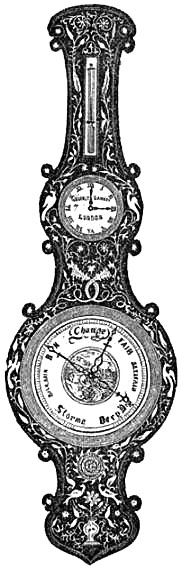
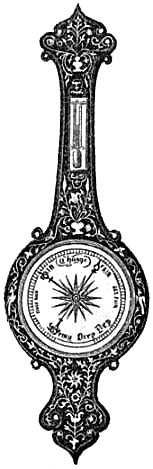
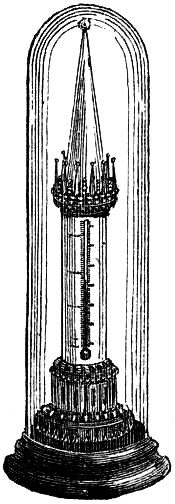
11. PEDIMENT BAROMETERS.
| Fig. 7. | |
Fig. 8. | |
Fig. 9. | |
Fig. 10. | |
Fig. 11. |
 | |
 | |
 | |
 | |
 |
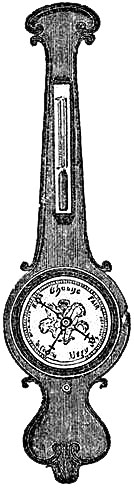
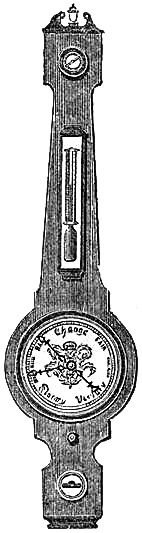
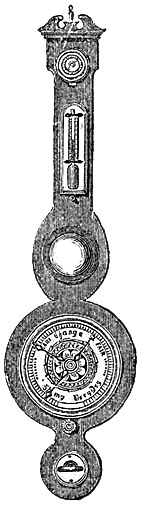
These Barometers, generally for household purposes, are illustrated by
figs. 7 to 11. They are intended chiefly for “weather glasses,” and are
manufactured to serve not only a useful, but an ornamental purpose as
well. They are usually framed in wood, such as mahogany, rosewood, ebony,
oak or walnut, and can be obtained either plain or handsomely and
elaborately carved and embellished, in a variety of designs, so as to be
suitable for private rooms, large halls, or public buildings. The scales
to the barometer and its attached thermometer may be ivory, porcelain, or
silvered metal. It is not desirable that the vernier should read nearer
than one-hundredth of an inch. Two verniers and scales may be fitted one
on either side of the mercurial column, so that one can denote the last
reading, and thus show at a glance the extent of rise or fall in the
interval. The scale and thermometer should be covered with plate glass. A
cheap instrument has an open face and plain frame, with sliding vernier
instead of rack-and-pinion motion. The barometer may or may not have a
moveable bottom to the cistern, with screw for the purpose of securing the
mercury for portability. The cistern should not, however, require
adjustment to a zero or fiducial point. It should be large enough to
contain the mercury, which falls from 31 to 27 inches, without any
appreciable error on the height read off on the scale.
12. The Words on the Scale.—The following words are usually engraved on
the scales of these barometers, although they are not now considered of so
much importance as formerly:—
| At | 31 | inches | | Very dry. |
| " | 30·5 | " | | Settled fair. |
| " | 30 | " | | Fair. |
| " | 29·5 | " | | Changeable. |
| " | 29 | " | | Rain. |
| " | 28·5 | " | | Much rain. |
| " | 28 | " | | Stormy. |
The French place upon their barometers a similar formula:—
| At | 785 | millimètres | | Très-sec. |
| " | 776 | " | | Beau-fixe. |
| " | 767 | " | | Beau temps. |
| " | 758 | " | | Variable. |
| " | 749 | " | | Pluie ou vent. |
| " | 740 | " | | Grande pluie. |
| " | 731 | " | | Tempête. |
Manufacturers of barometers have uniformly adopted these indications for
all countries, without regard to the elevation above the sea, or the
different geographical conditions; and as it can readily be shown that the
height and variations of the barometer are dependent on these, it follows
that barometers have furnished indications which, under many
circumstances, have been completely false. Even in this country, and near
the sea-level, storms are frequent with the barometer not below 29; rain
is not uncommon with the glass at 30; even fine weather sometimes occurs
with a low pressure; while it is evident that at an elevation of a few
thousand feet the mercury would never rise to 30 inches; hence, according
to the scale, there should never be fair weather there. If tempests
happened as seldom in our latitude as the barometer gets down to 28
inches, the maritime portion of the community at least would be happy
indeed. These words have long been ridiculed by persons acquainted with
the causes of the barometric fluctuations; nevertheless opticians continue
to place them on the scales, evidently only because they appear to add to
the importance of the instrument in the eyes of those who have not learned
their general inutility. In different regions of the world, the
indications of the barometer are modified by the conditions peculiar to
the geographical position and elevation above the sea, and it is necessary
to take account of these in any attempt to found rules of general utility
in connection with the barometer as a weather guide. All that can be said
in favour of these words is, that within a few hundred feet of the
sea-level, when the column rises or falls gradually during two or three
days towards “Fair” or “Rain,” the indications they afford of the coming
weather are generally extremely probable; but when the variations are
quick, upward or downward, they presage unsettled or stormy weather.
Admiral FitzRoy writes:—“The words on the scales of barometers should not
be so much regarded, for weather indications, as the rising or falling of
the mercury; for if it stands at Changeable, and then rises a little
towards Fair, it presages a change of wind or weather, though not so
great as if the mercury had risen higher; and, on the contrary, if the
mercury stands above Fair and falls, it presages a change, though not to
so great a degree as if it had stood lower; besides which, the direction
and force of wind are not in any way noticed. It is not from the point at
which the mercury stands that we are alone to form a judgment of the state
of the weather, but from its rising or falling; and from the movements
of immediately preceding days as well as hours, keeping in mind effects of
change of direction and dryness, or moisture, as well as alteration of
force or strength of wind.”[1]
13. Correction due to Capacity of Cistern.—These barometers, having no
adjustment for the zero of the scale, require a correction for the varying
level of the mercury in the cistern, when the observations are required
for strict comparison with other barometric observations, or when they are
registered for scientific purposes; but for the common purpose of
predicting the weather, this correction is unnecessary. The neutral point,
and the ratio of the bore of the tube to the diameter of the cistern, must
be known (see p. 3). Then the capacity correction, as it is termed, is
found as follows:—Take the fractional part, expressed by the capacity
ratio, of the difference between the observed reading and the height of
the neutral point; then, if the mercury stand below the neutral point,
subtract this result from the reading; if it stand above, add it to
the reading.
For example, suppose the neutral point to be 29·95 inches, and the
capacity ratio 1⁄50, required the correction when the barometer reads
30·78.
| Here |
|
30·78 - 29·95 |
= | 0·83 |
| Correction |
|
= |
0·83 |
= | +0·02 | nearly. |
| | 50 |
| Scale reading | | 30·78 |
| Correct reading | | 30·80 |
Of course the correction could as easily be found to three decimal places,
if desirable. It is evident that the correction is more important the
greater the distance of the top of the mercury from the neutral point.
14. PUBLIC BAROMETERS.
Since the increased attention paid to the signs of forthcoming weather of
late years, and the good which has resulted therefrom to farmers,
gardeners, civil engineers, miners, fishermen, and mariners generally, by
forewarning of impending wet or stormy weather, the desirability of having
good barometers exposed in public localities has become evident.
Barometers may now be seen attached to drinking fountains, properly
protected, and are frequently consulted by the passers-by. But it is among
those whose lives are endangered by sudden changes in the weather,
fishermen especially, that the warning monitor is most urgently required.
Many poor fishing villages and towns have therefore been provided by the
Board of Trade, at the public expense, and through the humane effort of
Admiral FitzRoy, with first-class barometers, each fixed in a conspicuous
position, so as to be easily accessible to all who desire to consult it.
Following this example, the Royal National Life Boat Institution has
supplied each of its stations with a similar storm warner; the Duke of
Northumberland and the British Meteorological Society have erected several
on the coast of Northumberland; and many other individuals have presented
barometers to maritime places with which they are connected.
These barometers have all been manufactured by Messrs. Negretti and
Zambra. The form given to the instrument seems well adapted for public
purposes.
Fig. 12.

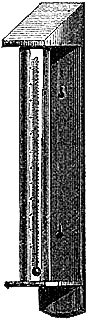
15. Fishery or Sea-coast Barometers.—Fig. 12 gives a representation of
these coast and fishery barometers. The frame is of solid oak, firmly
screwed together. The scales are very legibly engraved on porcelain by
Negretti and Zambra’s patent process. The thermometer is large, and easily
read; and as this instrument is exposed, it will indicate the actual
temperature sufficiently for practical purposes. The barometer tube is
three-tenths of an inch in diameter of bore, exhibiting a good column of
mercury; and the cistern is of such capacity, in relation to the tube,
that the change of height in the surface of the mercury in the cistern
corresponding to a change of height of three inches of mercury in the
tube, is less than one-hundredth of an inch, and therefore, as the
readings are only to be made to this degree of accuracy, this small error
is of no importance. The cistern is made of boxwood, which is sufficiently
porous to allow the atmosphere to influence the mercurial column; but the
top is plugged with porous cane, to admit of free and certain play.
16. Admiral FitzRoy’s Scale Words.—The directions given on the scales of
these barometers were drawn up by Admiral FitzRoy, F.R.S. They appear to
be founded on the following considerations:—
Supposing a compass diagram, with the principal points laid down, the N.E.
is the wind for which the barometer stands highest; for the S.W. wind it
is lowest. This is found to be so in the great majority of cases; but
there are exceptions to this, as to all rules. The N.E. and S.W. may
therefore be regarded as the poles of the winds, being opposite each
other. When the wind veers from the S.W. through W. and N. to N.E., the
barometer gradually rises; on the contrary, when the wind veers from N.E.
and E. to S.E., S. and S.W., the mercury falls. A similar curious law
exists in relation to the veering of the wind, and the action of the
thermometer. As the wind veers from the S.W. to W. and N., the thermometer
falls; as it veers from N.E. to E. and S., it rises, because the wind gets
from a colder to a warmer quarter. The polar winds are cold, dry, and
heavy. Those from the equatorial regions are warm, moist, and
comparatively light.
These laws have been clearly developed and expressed by Professor Dové in
his work on the “Law of Storms.” The warm winds of Europe are those which
bring the greatest quantity of rain, as they blow from the ocean, and come
heavily laden with moisture. The cold winds, besides containing less
moisture, blow more from the land. The weight of the vapour of the warm
winds tends to raise the barometric column; but, at the same time, the
increased dilatation of the air tends to lower it. This latter influence
being the stronger, the barometer always falls for these winds; and in
regions where they traverse a large extent of land, retain their heat, and
become necessarily very dry, the fall in the barometer will be greater.
Admiral FitzRoy’s words for the scales of barometers for use in northern
latitudes, then, are as follows:—
| RISE. | | FALL. |
| FOR | | FOR |
| N. Ely. | | S. Wly. |
| NW.—N.—E. | | SE.—S.—W. |
| DRY | | WET |
| OR | | OR |
| LESS | | MORE |
| WIND. | | WIND. |
| ——— | | ——— |
| EXCEPT | | EXCEPT |
| WET FROM | | WET FROM |
| N. Ed. | | N. Ed. |
| ——— | | ——— |
Long foretold, long last;
Short notice, soon past. | | First rise after low,
Foretells stronger blow. |
It will be perceived that the exception in each case applies to N.E.
winds. The barometer may fall with north-easterly winds, but they will be
violent and accompanied with rain, hail, or snow; again, it will rise with
these winds accompanied with rain, when they are light, and bring only
little rain. It rises, however, highest with the dry and light N.E. winds.
These directions are very practically useful; they provide for
geographical position—also for elevation above the sea—since they are
not appended to any particular height of the column. They are suited to
the northern hemisphere generally, as well as around the British Isles.
The same directions are adapted to the southern hemisphere, by simply
substituting for the letter N the letter S, reading south for north, and
vice versa. South of the equator the cold winds come from the south; the
warm, from the north. The S.E. wind in the southern hemisphere corresponds
to the N.E. in the northern. The laws there are, while the wind veers from
S.E. through E. to N. and N.W., the barometer falls and the thermometer
rises. As the wind veers from N.W. through W. and S. to S.E., the
barometer rises and the thermometer falls.
17. Instructions for the Sea-coast Barometer.—The directions for fixing
the barometer, and making it portable when it has to be removed, should be
attended to carefully. The barometer should be suspended against a frame
or piece of wood, so that light may be seen through the tube. Otherwise
a piece of paper, or a white place, should be behind the upper or scale
part of the tube.
When suspended on a hook, or stout nail, apply the milled-head key (which
will be found just below the scales) to the square brass pin at the lower
end of the instrument, and turn gently toward the left hand till the
screw stops; then take off the key and replace it for use, near the scale,
as it was before. The cistern bottom being thus let down, the mercury
will sink to its proper level quickly.
In removing this barometer it is necessary to slope it gradually, till
the mercury is at the top of the tube, and then, with the instrument
reversed, to screw up the cistern bottom, or bag, by the key, used
gently, till it stops. It will then be portable, and may be carried with
the cistern end upwards, or lying flat; but it must not be jarred, or
receive a concussion.
18. French Sea-coast Barometer.—The French have imitated this form of
barometer for coast service, and have translated Admiral FitzRoy’s
indications for the scale as follows:—
| LA | |
LA |
| HAUSSE | |
BAISSE |
| INDIQUE. | |
INDIQUE. |
| ——— | |
——— |
| des Vents de la | |
des Vents de la |
| PARTIE DU | |
PARTIE DU |
| N.E. | |
S.O. |
| ( | du N.O. á l’E | ) |
|
( | du S.E. á l’O. | ) |
| par le NORD. | | par le SUD. |
| DE LA | |
DE |
| SÉCHERESSE. | |
L’HUMIDITÉ. |
| ——— | |
——— |
| un VENT | |
un VENT |
| PLUS FAIBLE | |
PLUS FORT |
| EXCEPTÉ S’IL PLEUT | |
EXCEPTÉ S’IL PLEUT |
| AVEC DE FORTES BRISES | |
AVEC DE PETITES BRISES |
| du N.E. | |
du N.E. |
| ——— | |
——— |
Mouvements lents,
Temps durable.
———
Mouvements rapides,
Temps variable. | |
Le commencement
de la hausse,
après une grande
baisse présage
un Vent violent. |
Fig. 13.

Fig. 14.

MARINE BAROMETERS.
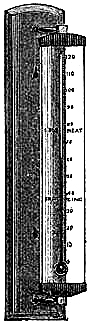
19. The Common Form.—The barometer is of great use to the mariner, who,
by using it as a “weather glass,” is enabled to foresee and prepare for
sudden changes in the weather. For marine purposes, the lower portion of
the glass tube of the barometer must be contracted to a fine bore, to
prevent oscillation in the mercurial column, which would otherwise be
occasioned by the movements of the ship. This tube is cemented to the
cistern, which is made of boxwood, and has a moveable leathern bottom, for
the purpose of rendering the instrument portable, by screwing up the
mercury compactly in the tube. The tube is enclosed in a mahogany frame,
which admits of a variety of style in shape, finish, and display, to meet
the different fancies and means of purchasers. The frame is generally
enlarged at the upper part to receive the scales and the attached
thermometer, which are covered by plate glass. The cistern is encased in
brass for protection, the bottom portion unscrewing to give access to the
portable screw beneath the cistern. Figs. 13 and 14 illustrate this form
of barometer. Marine barometers require to be suspended, so that they may
remain in a vertical position under the changeable positions of a vessel
at sea. To effect this they are suspended in gimbals by a brass arm. The
gimbals consist of a loose ring fastened by thumb-screws to the middle
part of the frame of the barometer, in front and back. The forked end of
the arm supports this ring at the sides, also by the aid of thumb-screws.
Hence the superior weight of the cistern end is always sufficient to cause
the instrument to move on its bearing screws, so as always to maintain a
perpendicular position; in fact, it is so delicately held that it yields
to the slightest disturbance in any direction. The other end of the arm is
attached to a stout plate, having holes for screws, or fitted to slip into
a staple or bracket, by which it may be fixed to any part of the cabin of
a ship; the arm is hinged to the plate, for the purpose of turning the arm
and barometer up whenever it is desirable.
Other forms of barometer (to be immediately described) have superseded
this in the British Marine, but the French still give the preference to
the wooden frames. They think the barometer can be more securely mounted
in wood, is more portable, and less liable to be broken by a sudden
concussion than if fitted in a metal frame. The English deem the ordinary
wooden barometers not sufficiently accurate, owing to the irregular
expansion of wood, arising from its hygrometric properties. Some of the
English opticians have shown that very portable, and really accurate
barometers can be made in brass frames, and therefore the preference is
now given to this latter material.
20. The Kew Marine Barometer.—The form of barometer so-called, is that
recommended by the Congress of Brussels, held in 1853, for the purpose of
devising a systematic plan of promoting meteorological observations at
sea.
The materials employed in its construction are mercury, glass, iron, and
brass. The upper part of the tube is carefully calibrated to ensure
uniformity of bore, as this is a point upon which the accuracy of the
instrument to some extent depends. At sea, the barometer has never been
known to stand above 31 inches, nor below 27. These extremes have been
attained with instruments of undoubted accuracy, but they are quite
exceptional. It is not necessary, therefore, to carry the scales of marine
barometers beyond these limits, but they should not be made shorter. If
the vernier is adjusted to read upward, the scale should extend to 32
inches, to allow room for the vernier to be set to 31 inches at least.
Cases have occurred in which this could not be done, and rare, but
valuable observations have been lost in consequence. If the scale part of
the tube be not uniform in bore, the index error will be irregular
throughout the scale. Whether the bore of the rest of the tube varies in
diameter, is of no moment. From two to three inches below the measured
part, the bore is contracted very much, to prevent the pulsations in the
mercurial column—called “pumping”—which, otherwise, would occur at sea
from the motion of the ship. In ordinary marine barometers, this
contraction extends to the end of the tube. Below the contracted part is
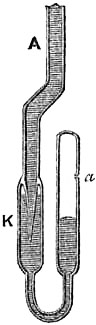
inserted a pipette—or Gay Lussac air-trap—which is a little elongated
funnel with the point downwards. Its object is to arrest any air that may
work in between the glass and the mercury. The bubble of air lodges at the
shoulder, and can go up no farther. It is one of those simple contrivances
which turn out remarkably useful. If any air gets into the tube, it does
not get to the top, and therefore does not vitiate the performance of the
barometer; for the mercury itself works up and down through the funnel.
Below this, the tube should not be unnecessarily contracted.
Fig. 15.
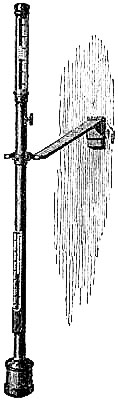
The open end of the tube is fixed into an iron cylinder, which forms the
cistern of the barometer. Iron has no action upon mercury, and is
therefore used instead of any other metal. One or two holes are made in
the top of the cistern, which are covered on the inside with strong
sheep-skin leather, so as to be impervious to mercury, but sufficiently
porous for the outer air to act upon the column. The cistern is of
capacity sufficient to receive the mercury which falls out of the tube
until the column stands lower than the scale reads; and when the tube is
completely full, there is enough mercury to cover the extremity so as to
prevent access of air. There is no screw required for screwing up the
mercury.
The glass tube thus secured to the cistern is protected by a brass tubular
frame, into which the iron cistern fits and screws compactly. Cork is used
to form bearings for the tube. A few inches above the cistern is placed
the attached thermometer. Its bulb is enclosed in the frame, so as to be
equally affected by heat with the barometric column. The upper end of the
frame is fitted with a cap which screws on, and embraces a glass shield
which rests in a gallery formed on the frame below the scale, and serves
to protect the silvered scale, as well as the inner tube, from dust and
damp. A ring, moveable in a collar fixed on the frame above the centre of
gravity of the instrument, is attached to gimbals, and the whole is
supported by a brass arm in the usual manner; so that the instrument can
be moved round its axis to bring any source of light upon it, and will
remain vertical in all positions of the ship. The vernier reads to
five-hundredths of an inch. No words are placed upon the scale, as the old
formulary was deemed misleading. The vernier can be set with great
exactness, as light is admitted to the top of the mercury by a front and
a back slit in the frame. The lower edge of the vernier should be brought
to the top of the mercury, so as just to shut out the light.
It is evident that this form of barometer must be more reliable in its
indications than those in wooden frames. The graduations can be accurately
made, and they will be affected only by well-known alterations due to
temperature. Some think the tube is too firmly held, and therefore liable
to be broken by concussion more readily than that of an inferior
instrument. This, however, appears a necessary consequence of greater
exactness. It is an exceedingly good portable instrument, and can be put
up and taken down very readily. These barometers are preferred to marine
barometers in wood, wherever they have been used. In merchant ships, and
under careful treatment, they have been found very durable. They may be
sent with safety by railway, packed carefully in a wooden box.
Directions for Packing.—In removing this barometer it is necessary to
slope it gradually till the mercury reaches the top of the tube. It is
then portable, if carried cistern end upwards or lying flat. If carried
otherwise, it will very probably be broken by the jerking motion of the
heavy mercury in the glass tube. Of course it must not be jarred, or
receive concussion.
Position for Marine Barometer.—Admiral FitzRoy, to whose valuable
papers we are much indebted, writes in his “Barometer Manual”:—“It is
desirable to place the barometer in such a position as not to be in danger
of a side blow, and also sufficiently far from the deck above to allow for
the spring of the metal arm in cases of sudden movements of the ship.
“If there is risk of the instrument striking anywhere when the vessel is
much heeled, it will be desirable to put some soft padding on that place,
or to check movement in that direction by a light elastic cord; in fixing
which, attention must be paid to have it acting only where risk of a blow
begins, not interfering otherwise with the free swing of the instrument: a
very light cord attached above, when possible, will be least likely to
interfere injuriously.”
21. Method of verifying Marine and other Barometers.—“In nearly all the
barometers which had been employed at sea till recently the index
correction varied through the range of scale readings, in proportion to
the difference of capacity between the cistern and the tube. To find the
index correction for a land barometer, comparison with a standard, at any
part of the scale at which the mercury may happen to be, is generally
considered sufficient. To test the marine barometer is a work of much more
time, since it is necessary to find the correction for scale readings at
about each half inch throughout the range of atmospheric pressure to which
it may be exposed; and it becomes necessary to have recourse to artificial
means of changing the pressure of the atmosphere on the surface of the
mercury in the cistern.
“The barometers to be thus tested are placed, together with a standard, in
an air-tight chamber, to which an air-pump is applied, so that, by
partially exhausting the air, the standard can be made to read much lower
than the lowest pressure to which marine barometers are likely to be
exposed; and by compressing the air it can be made to read higher than the
mercury ever stands at the level of the sea. The tube of the standard is
contracted similarly to that of the marine barometer, but a provision is
made for adjusting the mercury in its cistern to the zero point. Glass
windows are inserted in the upper part of the iron air-chamber, through
which the scales of the barometers may be seen; but as the verniers cannot
be moved in the usual way from outside the chamber, a provision is made
for reading the height of the mercury independent of the verniers attached
to the scales of the respective barometers. At a distance of some five or
six feet from the air-tight chamber a vertical scale is fixed. The
divisions on this scale correspond exactly with those on the tube of the
standard barometer. A vernier and telescope are made to slide on the scale
by means of a rack and pinion. The telescope has two horizontal wires, one
fixed and the other moveable by a micrometer screw, so that the difference
between the height of the column of mercury and the nearest division on
the scale of the standard, and also of all the other barometers placed by
the side of it for comparison, can be measured either with the vertical
scale and vernier or the micrometer wire. The means are thus possessed of
testing barometers for index error in any part of the scale, through the
whole range of atmospheric pressure to which they are likely to be
exposed; and the usual practice is to test them at every half inch from
27·5 to 31 inches.
“In this way barometers of various other descriptions have been tested,
and some errors found to be so large that a few barometers read half an
inch and upwards too high, while others read as much too low. In some
cases those which were correct in one part of the scale were found to be
from half an inch to an inch wrong in other parts. These barometers were
of an old and ordinary, not to say inferior, construction. In some the
mercury would not descend lower than about 29 inches, owing to a fault
very general in the construction of many common barometers till lately in
frequent use:—the cistern was not large enough to hold the mercury
which descended from the tube in a low atmospheric pressure.
“When used on shore, this contraction of the tube causes the marine
barometer to be sometimes a little behind an ordinary land barometer,
the tube of which is not contracted. The amount varies according to the
rate at which the mercury is rising or falling, and ranges from 0·00 to
0·02 of an inch. As the motion of the ship at sea causes the mercury to
pass more rapidly through the contracted tube, the readings are almost the
same there as they would be if the tube were not contracted, and in no
case do they differ enough to be of importance in maritime use.”
The cistern of this marine barometer is generally made an inch and a
quarter in diameter, and the scale part of the tube a quarter of an inch
in bore. The inches on the scale, instead of being true, are shortened by
·04 of an inch, in order to avoid the necessity of applying a correction
due to the difference of capacity of the tube and cistern. This is done
with much perfection, and the errors of the instruments, when compared
with a standard by the apparatus used at Kew and Liverpool Observatories,
are determined to the thousandth of an inch, and are invariably very
uniform and small. The error so determined includes the correction due to
capillarity, capacity, and error of graduation, and forms a constant
correction, so that only one variable correction, that due to temperature,
need be applied, when the barometer is suspended near the water line of
the ship, to make the observations comparable with others. With all the
advantages of this barometer, however, it has recently been superseded, to
some extent, because it was found to require more care than could
ordinarily be expected to be given to it by the commander of a ship.
Seamen do not exactly understand the value of such nice accuracy as the
thousandth part of an inch, but prefer an instrument that reads only to a
hundredth part.
22. THE FITZROY MARINE BAROMETER.
Admiral FitzRoy deemed it desirable to construct a form of barometer as
practically useful as possible for marine purposes. One that should be
less delicate in structure than the Kew barometer, and not so finely
graduated. One that could be set at a glance and read easily; that would
be more likely to bear the common shocks unavoidable in a ship of war.
Accordingly, the Admiral has devised a barometer, which he has thus
described:—
“This marine barometer, for Her Majesty’s service, is adapted to general
purposes.
“It differs from barometers hitherto made in points of detail, rather than
principle:—1. The glass tube is packed with vulcanised india-rubber,
which checks vibration from concussion; but does not hold it rigidly, or
prevent expansion. 2. It does not oscillate (or pump), though extremely
sensitive. 3. The scale is porcelain, very legible, and not liable to
change. 4. There is no iron anywhere (to rust). 5. Every part can be
unscrewed, examined, or cleaned, by any careful person. 6. There is a
spare tube, fixed in a cistern, filled with boiled mercury, and marked
for adjustment in this, or any similar instrument.
“These barometers are graduated to hundredths, and they will be found
accurate to that degree, namely the second decimal of an inch.
“They are packed with vulcanised caoutchouc, in order that (by this, and
by a peculiar strength of glass tube) guns may be fired near these
instruments without causing injury to them by ordinary concussion.
“It is hoped that all such instruments, for the public service at sea,
will be quite similar, so that any spare tube will fit any barometer.
Fig. 16.

“To Shift a Tube.—Incline the barometer slowly, and then take it down,
after allowing the mercury to fill the upper part. Lay the instrument on a
table, unscrew the outer cap at the joining just below the cistern swell,
then unscrew the tube and cistern, by turning the cistern gently,
against the sun, or to the left, and draw out the tube very carefully
without bending it in the least, turning it a little, if required, as
moved. Then insert the new tube very cautiously, screw in, and adjust to
the diamond-cut mark for 27 inches. Attach the cap, and suspend the
barometer for use.
“If the mercury does not immediately quit the top of the tube, tap the
cistern end rather sharply. In a well-boiled tube, with a good vacuum, the
mercury hangs, at times, so adhesively as to deceive, by causing a
supposition of some defect.
“In about ten minutes the mercurial column should be nearly right; but as
local temperature affects the brass, as well as the mercury, slowly and
unequally, it may be well to defer any exact comparisons with other
instruments for some few hours.”
Messrs. Negretti and Zambra are the makers of these barometers for the
Royal Navy. Fig. 16 is an illustration.
The tube is fixed to a boxwood cistern, which is plugged with very porous
cane at the top, to allow of the ready influence of a variation in
atmospheric pressure upon the mercury. Round the neck of the cistern is
formed a brass ring, with a screw thread on its circumference. This screws
into the frame, and a mark on the tube is to be adjusted to 27 inches on
the scale, the cistern covering screwed on, and the instrument is ready to
suspend. The frame and all the fittings are brass, without any iron
whatever; because the contact of the two metals produces a galvanic
action, which is objectionable. The spare tube is fitted with
india-rubber, and ready at any time to replace the one in the frame. The
ease with which a tube can be replaced when broken is an excellent feature
of the instrument. The spare tube is carefully stowed in a box, which can
also receive the complete instrument when not in use. All the parts are
made to a definite gauge; the frames are, therefore, all as nearly as
possible similar to each other, and the tubes—like rifle bullets—are
adjustible to any frame. If, then, the tube in use gets broken, the
captain can replace it by the other; but, as it is securely packed with
india-rubber, there is very little liability of its being broken by fair
usage. Every person who knows the importance of the barometer on board
ship, will acknowledge that the supplementary tube is a decided
improvement. Many instruments of this description are afloat in the Royal
Navy, and in a short time it may be expected that all the frames and tubes
of barometers in the public service at sea will be similar in size and
character; so that should a captain have the misfortune to get both his
tubes broken, he would be able to borrow another from any ship he fell in
with that had one to spare, which would be perfectly accurate, because it
would have been verified before it was sent out.
23. Admiral FitzRoy’s Words for the Scale.—The graduation of inches and
decimals are placed in this barometer on the right-hand side of the tube;
and on a similar piece of porcelain, on the left-hand, are engraved, as
legibly as they are expressed succinctly, the following words, of
universal application in the interpretation of the barometer movements:—
| RISE | |
FALL |
| FOR | |
FOR |
| COLD | |
WARM |
| DRY | |
WET |
| OR | |
OR |
| LESS | |
MORE |
| WIND. | |
WIND. |
| ——— | |
——— |
| EXCEPT | |
EXCEPT |
| WET FROM | |
WET FROM |
| COOLER SIDE. | |
COOLER SIDE. |
Reverting to the explanation of the words on the “Coast” barometers (at
page 14), and comparing and considering them as given for northern
latitudes, and as they must be altered for southern latitudes, it will be
perceived, that for all cold winds the barometer rises; and falls for
warm winds. The mercury also falls for increased strength of wind; and
rises as the wind lulls. Likewise before or with rain the column of
mercury falls; but it rises with fine dry weather. Putting these facts
together, and substituting for the points of the compass the terms “cold”
and “warm,” the appropriateness of the words on the scale of this
barometer is readily perceived. These concise and practical indications of
the movements in the barometer are applicable for instruments intended for
use in any region of the world, and are in perfect accordance with the
laws of winds and weather deduced by Dové and other meteorologists. There
is nothing objectionable in them, and being founded upon experience and
the deductions made from numerous recorded observations of the weather in
all parts of the world, as well as confirmed by the theories of science,
they may consequently be considered as generally reliable. They involve no
conjecture, but express succinctly scientific principles.
24. Trials of the FitzRoy Marine Barometer under Fire of Guns.—Some of
the first barometers made by Messrs. Negretti and Zambra on Admiral
FitzRoy’s principle were severely tried under the heaviest naval gun
firing, on board H.M.S. Excellent; and under all the circumstances, they
withstood the concussion. The purpose of the trials was “to ascertain
whether the vulcanized india-rubber packing round the glass tube of a
new marine barometer did check the vibration caused by firing, and
whether guns might be fired close to these instruments without causing
injury to them.” In the first and second series of experiments, a marine
barometer on Admiral FitzRoy’s plan was tried against a marine barometer
on the Kew principle, both instruments being new, and treated in all
respects similarly. They were “hung over the gun, under the gun, and by
the side of the gun, the latter both inside and outside a bulkhead,—in
fact, in all ways that they would be tried in action with the bulkheads
cleared away.” The result was that the Kew barometer was broken and
rendered useless, while the new pattern barometer was not injured in the
least. In a third series of experiments, Mr. Negretti being present, five
of the new pattern barometers were subjected to the concussion produced by
firing a 68-pounder gun with shot, and 16 lbs. charge of powder. They were
suspended from a beam immediately under the gun, then from a beam
immediately over the gun, and finally they were suspended by the arm to a
bulkhead, at a distance of only 3 ft. 6 in. from the axis of the gun; and
the result was, according to the official report, “that all these
barometers, however suspended, would stand, without the slightest injury,
the most severe concussion that they would ever be likely to experience in
any sea-going man-of-war.” These trials were conducted under the
superintendence of Captain Hewlett, C.B., and the guns were fired in the
course of his usual instructions. His reports to Admiral FitzRoy, giving
all the particulars of the trials, are published in the “Ninth Number of
Meteorological Papers,” issued by the Board of Trade.[2]
25. NEGRETTI AND ZAMBRA’S FARMER’S BAROMETER AND DOMESTIC WEATHER-GLASS.
It is a well-known fact that the barometer is as much, or even more
affected by a change of wind as it is by rain; and the objection raised
against a simple barometer reading, as leaving the observer in doubt
whether to expect wind or rain, is removed by the addition of the
Hygrometer, an instrument indicating the comparative degree of dryness or
dampness of the air;—a most important item in the determination of the
coming weather.
The farmer should not be content to let his crops lie at the mercy, so to
speak, of the weather, when he has within his command instruments which
may be the means of preventing damage to, and in cases total loss of, his
crops.
The farmer hitherto has had to depend for his prognostication of the
weather on his own unassisted “Weather Wisdom;” and it is perfectly
marvellous how expert he has become in its use. Science now steps in, not
to ignore this experience, but on the contrary, to give it most valuable
assistance by extending it, and enabling it to predict, with an accuracy
hitherto unknown, the various changes that take place in this most
variable of climates.
To the invalid, the importance of predicting with tolerable accuracy the
changes that are likely to occur in the weather, cannot be over-rated.
Many colds would be prevented, if we could know that the morning so balmy
and bright, would subside into a cold and cheerless afternoon. Even to the
robust, much inconvenience may be prevented by a due respect to the
indications of the hygrometer and the barometer, and the delicate in
health will do well to regard its warnings.
Fig. 17.

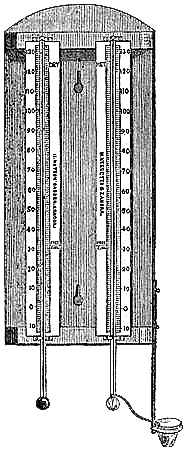
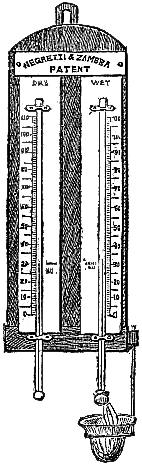
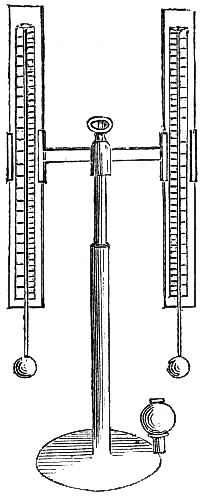
Description of the Instrument.—The farmer’s barometer, as figured in
the margin, consists of an upright tube of mercury inverted in a cistern
of the same fluid; this is secured against a strong frame of wood, at the
upper end of which is fixed the scale, divided into inches and tenths of
an inch. On either side of the barometer, or centre tube, are two
thermometers—that on the left hand has its bulb uncovered and freely
exposed, and indicates the temperature of the air at the place of
observation; that on the right hand has its bulb covered with a piece of
muslin, from which depend a few threads of soft lamp cotton; this cotton
is immersed in the small cup situated just under the thermometer, this
vessel being full of water; the water rises by capillary attraction to the
muslin-covered bulb, and keeps it in a constantly moist state.
These two thermometers, which we distinguish by the names “Wet Bulb” and
“Dry Bulb,” form the Hygrometer; and it is by the simultaneous reading of
these two thermometers, and noting the difference that exists between
their indications, that the humidity in the atmosphere is determined.
Admiral FitzRoy’s words (see p. 22) are placed upon the scale of the
barometer, as the value of a reading depends, not so much on the actual
height of the mercury in the tube, as it does on whether the column is
rising, steady, or falling.
The moveable screw at the bottom of the cistern is for the purpose of
forcing the mercury to the top of the tube when the instrument is being
carried from place to place, and it must always be unscrewed to its utmost
limit when the barometer is hung in its proper place. After this it should
never be touched.
The manner in which the Hygrometer acts is as follows: It is a pretty
well-known fact that water or wine is often cooled by a wet cloth being
tied round the bottle, and then being placed in a current of air. The
evaporation that takes place in the progressive drying of the cloth causes
the temperature to fall considerably below that of the surrounding
atmosphere, and the contents of the bottle are thus cooled. In the same
manner, then, the covered wet bulb thermometer will be found invariably
to read lower than the uncovered one; and the greater the dryness of the
air, the greater will be the difference between the indications of the
two thermometers; and the more moisture that exists in the air, the more
nearly they will read alike.
The cup must be kept filled with pure water, and occasionally cleaned out,
to remove any dirt. The muslin, or cotton-wick, should also be renewed
every few weeks. The hygrometer may be had separate from the barometer, if
the combined instruments cannot be sufficiently exposed to the external
air, this being essential for the successful use of the hygrometer.
This farmer’s weather-glass, then, consists of three distinct instruments:
the barometer, the thermometer, and the hygrometer. He has thus at command
the three instrumental data necessary for the prediction of the weather.
And now to describe—
How to Use the Instrument.—The observations should be taken twice a
day, say at 9 A.M. and 3 P.M.; and should be entered on a slip of paper,
or a slate hung up by the barometer. The observer will then be able to see
the different values of the readings from time to time, and to draw his
conclusions therefrom.
The thermometer on the left hand should first be read, and a note made of
its indication, which is the temperature of the air. The wet bulb
thermometer should now be read, and also noted; and the difference should
be taken of these two readings. Next read the barometer by moving the
small index at the side of the tube until it is on a level with the top of
the mercury. Having noted the number of inches at which the column stands,
compare with the last observation, and see immediately whether the
barometer is rising, steady, or falling.
Now, having taken the observations as above, we naturally ask the
question, What are we to predict from them?
And, probably, the best way of answering this query will be by giving an
example. We will suppose that our readings yesterday were as
follows:—Temperature, 70°; Wet Bulb, 69°; Difference, 1°; =very moist
air. Barometer, 29·5, and that rain has fallen.
To-day, we read:—Temperature, 60°; Wet Bulb, 55°; Difference, 5°; =dryer
air. Barometer, 30. We may safely predict that the rain will cease, and
probably we may have wind from the northward.
In spring or autumn, if the barometric height be steady any where between
29·5 and 30 inches, with the temperature about 60°, fresh to moderate
south-westerly winds, with cloudy sky, will probably characterize the
weather; the indications of the hygrometer being then specially
serviceable in enabling us to foretell rain; but if the mercury become
steady at about 30·5 inches, with temperature about 40°, north-easterly
winds, dry air, and clear sky, may be confidently expected.
Many cases will doubtless suggest themselves to the observer where these
figures do not occur, and where he might find a difficulty in interpreting
the indications of his instruments. We have, therefore, drawn up some
concise rules for his guidance; and although they will not prove
absolutely infallible guides to this acknowledged most difficult problem,
still, they will be found of much service in foretelling the weather, when
added to an intelligent observation of ordinary atmospheric phenomena, as
force and direction of wind, nature of any particular season, and the time
of year.
26. RULES FOR FORETELLING THE WEATHER.
A RISING BAROMETER.
A “Rapid” rise indicates unsettled weather.
A “Gradual” rise indicates settled weather.
A “Rise,” with dry air, and cold increasing in summer, indicates wind
from northward; and if rain has fallen, better weather is to be
expected.
A “Rise,” with moist air and a low temperature, indicates wind and
rain from northward.
A “Rise,” with southerly wind, indicates fine weather.
A STEADY BAROMETER,
With dry air and a seasonable temperature, indicates a continuance of
very fine weather.
A FALLING BAROMETER.
A “Rapid” fall indicates stormy weather.
A “Rapid” fall, with westerly wind, indicates stormy weather from
northward.
A “Fall,” with a northerly wind, indicates storm, with rain and hail
in summer, and snow in winter.
A “Fall,” with increased moisture in the air, and the heat increasing,
indicates wind and rain from southward.
A “Fall,” with dry air, and cold increasing (in winter), indicates
snow.
A “Fall,” after very calm and warm weather, indicates rain with
squally weather.
27. Causes which may bring about a Fall or a Rise in the Barometer.[3]—As
heat produces rarefaction, a sudden rise of temperature in a distant
quarter may affect the weight of the atmosphere over our heads, by
producing an aerial current outwards, to supply the place of the lighter
air which has moved from its former position; in which case the barometer
will fall. Now such a movement in the atmosphere is likely to bring about
an intermixture of currents of air of different temperatures, and from
this intermixture rain is likely to result.
On the other hand, as cold produces condensation, any sudden fall of
temperature causes the column of air over the locality to contract and
sink to a lower level, whilst other air rushes in from above to supply the
void; and, accordingly, the barometer rises. Should this air, as often
happens, proceed from the north, it will contain in general but little
moisture; and hence, on reaching a warmer latitude, will take up the
vapour of the air, so that dry weather will result.
It is generally observed, that wind causes a fall in the instrument; and,
indeed, in those greater movements of the atmosphere which we denominate
storms or hurricanes, the depression is so considerable as to forewarn
the navigator of his impending danger. It is evident, that a draught of
air in any direction must diminish the weight of the column overhead, and
consequently cause the mercury in the barometer to sink.
The connection, therefore, of a sinking of the barometric column with rain
is frequently owing to the wind causing an intermixture of the aerial
currents which, by their motion, diminish the weight of the atmosphere
over our heads; whilst a steady rise in the column indicates the absence
of any great atmospheric changes in the neighbourhood, and a general
exemption from those causes which are apt to bring about a precipitation
of vapour.
28. Use of the Barometer in the management of Mines.—The inflammable and
suffocating gases, known to coal-miners as fire-damp and choke-damp, are
specifically heavier than air; and as they issue from the fissures of the
mine, or are released from the coal, the atmospheric pressure tends to
drive them into the lowest and least ventilated galleries. Consequently a
greatly reduced atmospheric pressure will favour a sudden outflow or
advance of gas; whence may result cases of explosion or suffocation. It
has been found that these accidents occur for the most part about the time
of a low barometric column. A reliable barometer should, therefore, be
systematically consulted by those entrusted with the management or control
of coal-mines, so that greater vigilance and caution may be enjoined on
the miners whenever the mercury falls low, especially after it has been
unusually high for some days.
29. Use of the Barometer in estimating the Height of Tides.—The pressure
of the atmosphere affects the height of the tide, the water being in
general higher as the barometer is lower. The expressions of seamen, that
“frost nips the tide,” and “fog nips the tide,” are explained by the high
barometer which usually accompanies frost and fog. M. Daussy, Sir J. C.
Ross, and others, have established that a rise of one inch in the
barometer will have a corresponding fall in the tide of about one foot.
Therefore navigators and pilots will appreciate the following suggestion
of Admiral FitzRoy:—
“Vessels sometimes enter docks, or even harbours, where they have scarcely
a foot of water more than their draught; and as docking, as well as
launching large ships, requires a close calculation of height of water,
the state of the barometer becomes of additional importance on such
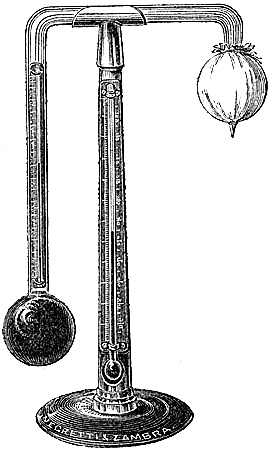
occasions.”