Malt liquors, and particularly porter, the favourite beverage of the
inhabitants of London, and of other large towns, is amongst those
articles, in the manufacture of which the greatest frauds are frequently
committed.
The statute prohibits the brewer from using any ingredients in his
brewings, except malt and hops; but it too often happens that those who
suppose they are drinking a nutritious beverage, made of these
ingredients only, are entirely deceived. The beverage may, in fact, be
neither more nor less than a compound of the most deleterious
substances; and it is also clear that all ranks of society are alike
exposed to the nefarious fraud. The proofs of this statement will be
shewn hereafter.[48]
The author[49] of a Practical Treatise on Brewing, which has run
through eleven editions, after having stated the various ingredients for
brewing porter, observes, "that however much they may surprise, however
pernicious or disagreeable they may appear, he has always found them
requisite in the brewing of porter, and he thinks they must invariably
be used by those who wish to continue the taste, flavour, and appearance
of the beer.[50] And though several Acts of Parliament have been passed
to prevent porter brewers from using many of them, yet the author can
affirm, from experience, he could never produce the present flavoured
porter without them.[51] The intoxicating qualities of porter are to be
ascribed to the various drugs intermixed with it. It is evident some
porter is more heady than other, and it arises from the greater or less
quantity of stupifying ingredients. Malt, to produce intoxication, must
be used in such large quantities as would very much diminish, if not
totally exclude, the brewer's profit."
The practice of adulterating beer appears to be of early date. By an
Act so long ago as Queen Anne, the brewers are prohibited from mixing
cocculus indicus, or any unwholesome ingredients, in their beer, under
severe penalties: but few instances of convictions under this act are to
be met with in the public records for nearly a century. To shew that
they have augmented in our own days, we shall exhibit an abstract from
documents laid lately before Parliament.[52]
These will not only amply prove, that unwholesome ingredients are used
by fraudulent brewers, and that very deleterious substances are also
vended both to brewers and publicans for adulterating beer, but that the
ingredients mixed up in the brewer's enchanting cauldron are placed
above all competition, even with the potent charms of Macbeth's witches:
"Root of hemlock, digg'd i' the dark,
+ + + + +
+ + + + +
For a charm of pow'rful trouble,
Like a hell-broth boil and bubble;
Double, double, toil and trouble,
Fire burn, and cauldron bubble."
The fraud of imparting to porter and ale an intoxicating quality by
narcotic substances, appears to have flourished during the period of the
late French war; for, if we examine the importation lists of drugs, it
will be noticed that the quantities of cocculus indicus imported in a
given time prior to that period, will bear no comparison with the
quantity imported in the same space of time during the war, although an
additional duty was laid upon this commodity. Such has been the amount
brought into this country in five years, that it far exceeds the
quantity imported during twelve years anterior to the above epoch. The
price of this drug has risen within these ten years from two shillings
to seven shillings the pound.
It was at the period to which we have alluded, that the preparation of
an extract of cocculus indicus first appeared, as a new saleable
commodity, in the price-currents of brewers'-druggists. It was at the
same time, also, that a Mr. Jackson, of notorious memory, fell upon the
idea of brewing beer from various drugs, without any malt and hops. This
chemist did not turn brewer himself; but he struck out the more
profitable trade of teaching his mystery to the brewers for a handsome
fee. From that time forwards, written directions, and recipe-books for
using the chemical preparations to be substituted for malt and hops,
were respectively sold; and many adepts soon afterwards appeared every
where, to instruct brewers in the nefarious practice, first pointed out
by Mr. Jackson. From that time, also, the fraternity of
brewers'-chemists took its rise. They made it their chief business to
send travellers all over the country with lists and samples exhibiting
the price and quality of the articles manufactured by them for the use
of brewers only. Their trade spread far and wide, but it was amongst the
country brewers chiefly that they found the most customers; and it is
amongst them, up to the present day, as I am assured by some of these
operators, on whose veracity I can rely, that the greatest quantities of
unlawful ingredients are sold.
The Act of Parliament[53] prohibits chemists, grocers, and druggists,
from supplying illegal ingredients to brewers under a heavy penalty, as
is obvious from the following abstract of the Act.
"No druggist, vender of, or dealer in drugs, or chemist, or other
person, shall sell or deliver to any licensed brewer, dealer in or
retailer of beer, knowing him to be such, or shall sell or deliver to
any person on account of or in trust for any such brewer, dealer or
retailer, any liquor called by the name of or sold as colouring, from
whatever material the same may be made, or any material or preparation
other than unground brown malt for darkening the colour of worts or
beer, or any liquor or preparation made use of for darkening the colour
of worts or beer, or any molasses, honey, vitriol, quassia, cocculus
Indian, grains of paradise, Guinea pepper or opium, or any extract or
preparation of molasses, or any article or preparation to be used in
worts or beer for or as a substitute for malt or hops; and if any
druggist shall offend in any of these particulars, such liquor
preparation, molasses, &c. shall be forfeited, and may be seized by any
officer of excise, and the person so offending shall for each offence
forfeit 500l."
The following is a list of druggists and grocers, prosecuted by the
Court of Excise, and convicted of supplying unlawful ingredients to
brewers.
List of Druggists and Grocers, prosecuted and convicted from 1812 to
1819, for supplying illegal Ingredients to Brewers for adulterating
Beer.[54]
John Dunn and another, druggists, for selling adulterating ingredients
to brewers, verdict 500l.
George Rugg and others, druggists, for selling adulterating ingredients
to brewers, verdict 500l.
John Hodgkinson and others, for selling adulterating ingredients to
brewers, 100l. and costs.
William Hiscocks and others, for selling adulterating ingredients to a
brewer, 200l. and costs.
G. Hornby; for selling adulterating ingredients to a brewer, 200l.
W. Wilson, for selling adulterating ingredients to a brewer, 200l.
George Andrews, grocer, for selling adulterating ingredients to a
brewer, 25l. and costs.
Guy Knowles, for selling substitute for hops, costs.
Kernot and Alsop, for selling cocculus india, &c. 25l.
Joseph Moss, for selling various drugs, 300l.
Ph. Whitcombe, John Dunn, and Arthur Waller, druggists, for having
liquor for darkening the colour of beer, hid and concealed.
Isaac Hebberd, for having liquor for darkening the colour of beer, hid
and concealed.
Ph. Whitcombe, John Dunn, and Arthur Waller, druggists, for making
liquor for darkening the colour of beer.
John Lord, grocer, for selling molasses to a brewer, 20l. and costs.
John Smith Carr, grocer, for selling molasses to a brewer, 20l. and
costs.
Edward Fox, grocer, for selling molasses to a brewer, 25l. and costs.
John Cooper, grocer, for selling molasses to a brewer, 40l. and costs.
Joseph Bickering, grocer, for selling molasses to a brewer, 40l. and
costs.
John Howard, grocer, for selling molasses to a brewer, 25l. and costs.
James Reynolds, grocer, for selling molasses to a brewer, costs.
Thomas Hammond, grocer, for selling molasses to a brewer, 20l. and
costs.
J. Mackway, grocer, for selling molasses to a brewer, 20l.
T. Renton, grocer, for selling molasses to a brewer, costs, and taking
out a license.
R. Adamson, grocer, for selling molasses to a brewer, costs, and taking
out a license.
W. Weaver, for selling Spanish liquorice to a brewer, 200l.
J. Moss, for selling Spanish liquorice to a brewer.
Alex. Braden, for selling liquorice, 20l.
J. Draper, for selling molasses to a brewer, 20l.
PORTER.
The method of brewing porter has not been the same at all times as it is
at present.
At first, the only essential difference in the methods of brewing this
liquor and that of other kinds of beer, was, that porter was brewed from
brown malt only; and this gave to it both the colour and flavour
required. Of late years it has been brewed from mixtures of pale and
brown malt.
These, at some establishments, are mashed separately, and the worts from
each are afterwards mixed together. The proportion of pale and brown
malt, used for brewing porter, varies in different breweries; some
employ nearly two parts of pale malt and one part of brown malt; but
each brewer appears to have his own proportion; which the intelligent
manufacturer varies, according to the nature and qualities of the malt.
Three pounds of hops are, upon an average, allowed to every barrel,
(thirty-six gallons) of porter.
When the price of malt, on account of the great increase in the price of
barley during the late war, was very high, the London brewers discovered
that a larger quantity of wort of a given strength could be obtained
from pale malt than from brown malt. They therefore increased the
quantity of the former and diminished that of the latter. This produced
beer of a paler colour, and of a less bitter flavour. To remedy these
disadvantages, they invented an artificial colouring substance, prepared
by boiling brown sugar till it acquired a very dark brown colour; a
solution of which was employed to darken the colour of the beer. Some
brewers made use of the infusion of malt instead of sugar colouring. To
impart to the beer a bitter taste, the fraudulent brewer employed
quassia wood and wormwood as a substitute for hops.
But as the colouring of beer by means of sugar became in many instances
a pretext for using illegal ingredients, the Legislature, apprehensive
from the mischief that might, and actually did, result from it, passed
an Act prohibiting the use of burnt sugar, in July 1817; and nothing but
malt and hops is now allowed to enter into the composition of beer: even
the use of isinglass for clarifying beer, is contrary to law.
No sooner had the beer-colouring Act been repealed, than other persons
obtained a patent for effecting the purpose of imparting an artificial
colour to porter, by means of brown malt, specifically prepared for that
purpose only. The beer, coloured by the new method, is more liable to
become spoiled, than when coloured by the process formerly practised.
The colouring malt does not contain any considerable portion of
saccharine matter. The grain is by mere torrefaction converted into a
gum-like substance, wholly soluble in water, which renders the beer
more liable to pass into the acetous fermentation than the common brown
malt is capable of doing; because the latter, if prepared from good
barley, contains a portion of saccharine matter, of which the patent
malt is destitute.
But as brown malt is generally prepared from the worst kind of barley,
and as the patent malt can only be made from good grain, it may become,
on that account, an useful article to the brewer (at least, it gives
colour and body to the beer;) but it cannot materially economise the
quantity of malt necessary to produce good porter. Some brewers of
eminence in this town have assured me, that the use of this mode of
colouring beer is wholly unnecessary; and that porter of the requisite
colour may be brewed better without it; hence this kind of malt is not
used in their establishments. The quantity of gum-like matter which it
contains, gives too much ferment to the beer, and renders it liable to
spoil. Repeated experiments, made on a large scale, have settled this
fact.
STRENGTH AND SPECIFIC DIFFERENCES OF DIFFERENT KINDS OF PORTER.
The strength of all kinds of beer, like that of wine, depends on the
quantity of spirit contained in a given bulk of the liquor.
The reader need scarcely be told, that of no article there are more
varieties than of porter. This, no doubt, arises from the different mode
of manufacturing the beer, although the ingredients are the same. This
difference is more striking in the porter manufactured among country
brewers, than it is in the beer brewed by the eminent London porter
brewers. The totality of the London porter exhibits but very slight
differences, both with respect to strength or quantity of spirit, and
solid extractive matter, contained in a given bulk of it. The spirit may
be stated, upon an average, to be 4,50 per cent. in porter retailed at
the publicans; the solid matter, is from twenty-one to twenty-three
pounds per barrel of thirty-six gallons. The country-brewed porter is
seldom well fermented, and seldom contains so large a quantity of
spirit; it usually abounds in mucilage; hence it becomes turbid when
mixed with alcohol. Such beer cannot keep, without becoming sour.
It has been matter of frequent complaint, that ALL the porter
now brewed, is not what porter was formerly. This idea may be true with
some exceptions. My professional occupations have, during these
twenty-eight years, repeatedly obliged me to examine the strength of
London porter, brewed by different brewers; and, from the minutes made
on that subject, I am authorised to state, that the porter now brewed by
the eminent London brewers, is unquestionably stronger than that which
was brewed at different periods during the late French war. Samples of
brown stout with which I have been obligingly favoured, whilst writing
this Treatise, by Messrs. Barclay, Perkins, and Co.—Messrs. Truman,
Hanbury, and Co.—Messrs. Henry Meux and Co.—and other eminent brewers
of this capital—afforded, upon an average, 7,25 per cent. of alcohol,
of 0,833 specific gravity; and porter, from the same houses, yielded
upon an average 5,25 per cent. of alcohol, of the same specific
gravity;[55] this beer received from the brewers was taken from the
same store from which the publicans are supplied.
It is nevertheless singular to observe, that from fifteen samples of
beer of the same denominations, procured from different retailers, the
proportions of spirit fell considerably short of the above quantities.
Samples of brown stout, procured from the retailers, afforded, upon an
average, 6,50 per cent. of alcohol; and the average strength of the
porter was 4,50 per cent. Whence can this difference between the beer
furnished by the brewer, and that retailed by the publican, arise? We
shall not be at a loss to answer this question, when we find that so
many retailers of porter have been prosecuted and convicted for mixing
table beer with their strong beer; this is prohibited by law, as becomes
obvious by the following words of the Act.[56]
"If any common or other brewer, innkeeper, victualler, or retailer of
beer or ale, shall mix or suffer to be mixed any strong beer, ale, or
worts, with table beer, worts, or water, in any tub or measure, he shall
forfeit 50l." The difference between strong and table beer, is thus
settled by Parliament.
"All beer or ale[57] above the price of eighteen shillings per barrel,
exclusive of ale duties now payable (viz. ten shillings per barrel,) or
that may be hereafter payable in respect thereof, shall be deemed strong
beer or ale; and all beer of the price of eighteen shillings the barrel
or under, exclusive of the duty payable (viz. two shillings per barrel)
in respect thereof, shall be deemed table beer within the meaning of
this and all other Acts now in force, or that may hereafter be passed in
relation to beer or ale or any duties thereon."
List of Publicans prosecuted and convicted from 1815 to 1818, for
adulterating Beer with illegal Ingredients, and for mixing Table Beer
with their Strong Beer.[58]
William Atterbury, for using salt of steel, salt, molasses, &c. and for
mixing table beer with strong beer, 40l.
Richard Dean, for using salt of steel, salt, molasses, &c. and for
mixing table beer with strong beer, 50l.
John Jay, for using salt of steel, salt, molasses, &c. and for mixing
table beer with strong beer, 50l.
James Atkinson, for using salt of steel, salt, molasses, &c. and for
mixing table beer with strong beer, 20l.
Samuel Langworth, for using salt of steel, salt, molasses, &c. and for
mixing table beer with strong beer, 50l.
Hannah Spencer, for using salt of steel, salt, molasses, &c. and for
mixing table beer with strong beer, 150l.
—— Hoeg, for using salt of steel, salt, molasses, &c. and for mixing
table beer with strong beer, 5l.
Richard Craddock, for using salt of steel, salt, molasses, &c. and for
mixing table beer with strong beer, 100l.
James Harris, for using salt of steel, salt, molasses, &c. and for
receiving stale beer, and mixing it with strong beer, 42l. and costs.
Thomas Scoons, for using salt of steel, salt, molasses, &c. and for
mixing stale beer with strong beer, verdict 200l.
Diones Geer and another, for using salt of steel, salt, molasses, &c.
and for mixing strong and table beer, verdict 400l.
Charles Coleman, for using salt of steel, salt, molasses, &c. and for
mixing strong and table beer, 35l. and costs.
William Orr, for using salt of steel, salt, molasses, &c. and for mixing
strong and table beer, 50l.
John Gardiner, for using salt of steel, salt, molasses, &c. and for
mixing strong and table beer, 100l.
John Morris, for using salt of steel, salt, molasses, &c. and for mixing
strong and table beer, 20l.
John Harbur, for using salt of steel, salt, molasses, &c. and for mixing
strong and table beer, 50l.
John Corrie, for mixing strong beer with table beer.
John Cape, for mixing strong beer with table beer.
Joseph Gudge, for mixing strong beer with small beer.
ILLEGAL SUBSTANCES USED FOR ADULTERATING BEER.
We have stated already (p. 113) that nothing is allowed by law to enter
into the composition of beer, but malt and hops.
The substances used by fraudulent brewers for adulterating beer, are
chiefly the following:
Quassia, which gives to beer a bitter taste, is substituted for hops;
but hops possesses a more agreeable aromatic flavour, and there is also
reason to believe that they render beer less liable to spoil by keeping;
a property which does not belong to quassia. It requires but little
discrimination to distinguish very clearly the peculiar bitterness of
quassia in adulterated porter. Vast quantities of the shavings of this
wood are sold in a half-torrefied and ground state to disguise its
obvious character, and to prevent its being recognised among the waste
materials of the brewers. Wormwood[59] has likewise been used by
fraudulent brewers.
The adulterating of hops is prohibited by the Legislature.[60]
"If any person shall put any drug or ingredient whatever into hops to
alter the colour or scent thereof, every person so offending, convicted
by the oath of one witness before one justice of peace for the county or
place where the offence was committed, shall forfeit 5l. for every
hundred weight."
Beer rendered bitter by quassia never keeps well, unless it be kept in a
place possessing a temperature considerably lower than the temperature
of the surrounding atmosphere; and this is not well practicable in large
establishments.
The use of boiling the wort of beer with hops, is partly to communicate
a peculiar aromatic flavour which the hop contains, partly to cover the
sweetness of undecomposed saccharine matter, and also to separate, by
virtue of the gallic acid and tannin it contains, a portion of a
peculiar vegetable mucilage somewhat resembling gluten, which is still
diffused through the beer. The compound thus produced, separates in
small flakes like those of curdled soap; and by these means the beer is
rendered less liable to spoil. For nothing contributes more to the
conversion of beer, or any other vinous fluid, into vinegar, than
mucilage. Hence, also, all full-bodied and clammy ales, abounding in
mucilage, and which are generally ill fermented, do not keep as perfect
ale ought to do. Quassia is, therefore, unfit as a substitute for hops;
and even English hops are preferable to those imported from the
Continent; for nitrate of silver and acetate of lead produce a more
abundant precipitate from an infusion of English hops, than can be
obtained from a like infusion by the same agents from foreign hops.
One of the qualities of good porter, is, that it should bear a fine
frothy head, as it is technically termed: because professed judges of
this beverage, would not pronounce the liquor excellent, although it
possessed all other good qualities of porter, without this requisite.
To impart to porter this property of frothing when poured from one
vessel into another, or to produce what is also termed a cauliflower
head, the mixture called beer-heading, composed of common green
vitriol (sulphate of iron,) alum, and salt, is added. This addition to
the beer is generally made by the publicans.[61] It is unnecessary to
genuine beer, which of itself possesses the property of bearing a strong
white froth, without these additions; and it is only in consequence of
table beer being mixed with strong beer, that the frothing property of
the porter is lost. From experiments I have tried on this subject, I
have reason to believe that the sulphate of iron, added for that
purpose, does not possess the power ascribed to it. But the publicans
frequently, when they fine a butt of beer, by means of isinglass,
adulterate the porter at the same time with table beer, together with a
quantity of molasses and a small portion of extract of gentian root, to
keep up the peculiar flavour of the porter; and it is to the molasses
chiefly, which gives a spissitude to the beer, that the frothing
property must be ascribed; for, without it, the sulphate of iron does
not produce the property of frothing in diluted beer.
Capsicum and grains of paradise, two highly acrid substances, are
employed to give a pungent taste to weak insipid beer. Of late, a
concentrated tincture of these articles, to be used for a similar
purpose, and possessing a powerful effect, has appeared in the
price-currents of brewers' druggists. Ginger root, coriander seed, and
orange peels, are employed as flavouring substances chiefly by the ale
brewers.
From these statements, and the seizures that have been made of illegal
ingredients at various breweries, it is obvious that the adulterations
of beer are not imaginary. It will be noticed, however, that some of the
sophistications are comparatively harmless, whilst others are effected
by substances deleterious to health.
The following list exhibits some of the unlawful substances seized at
different breweries and at chemical laboratories.
List of Illegal Ingredients, seized from 1812 to 1818, at various
Breweries and Brewers' Druggists.[62]
| 1812, July. Josiah Nibbs, at Tooting, Surrey. |
| Multum |
84 |
lbs. |
| Cocculus indicus |
12 |
| Colouring |
4 |
galls. |
| Honey |
about |
180 |
lbs. |
| Hartshorn Shavings |
14 |
| Spanish Juice |
46 |
| Orange Powder |
17 |
| Ginger |
56 |
| Penalty 300l. |
|
| 1813, June 13. Sarah Willis, at West Ham, Essex. |
| Cocculus indicus |
1 |
lb. |
| Spanish Juice |
12 |
| Hartshorn Shavings |
6 |
| Orange Powder |
1 |
| Penalty 200l. |
|
| August 3. Cratcherode Whiffing, Limehouse. |
| Grains of Paradise |
44 |
lbs. |
| Quassia |
10 |
| Liquorice |
64 |
| Ginger |
80 |
| Caraway Seeds |
40 |
| Orange Powder |
14 |
| Copperas |
4 |
| Penalty 200l. |
|
| Nov. 25. Elizabeth Hasler, at Stratford. |
| Cocculus indicus |
12 |
lbs. |
| Multum |
26 |
| Grains of Paradise |
12 |
| Spanish Juice |
30 |
| Orange Powder |
3 |
| Penalty 200l. |
|
| Dec. 14. John Abbott, at Canterbury, Kent. |
| Copperas, &c. |
14 |
lbs. |
| Orange powder |
2 |
| Penalty 500l., and Crown's costs. |
| Proof of using drugs at various times. |
|
1815, Feb. 15. Mantel and Cook, Castle-street,
Bloomsbury-square. |
Proof of mixing strong with table beer, and using colouring and other things. |
| Compromised for 300l. |
|
1817. From Peter Stevenson, an old Servant to Dunn
and Waller, St. John-street, brewers' druggists. |
| Cocculus Indicus Extract |
6 |
lbs. |
| Multum |
560 |
| Capsicum |
88 |
| Copperas |
310 |
| Quassia |
150 |
| Colouring and Drugs |
84 |
| Mixed Drugs |
240 |
| Spanish Liquorice |
420 |
| Hartshorn Shavings |
77 |
| Liquorice Powder |
175 |
| Orange powder |
126 |
| Caraway Seeds |
100 |
| Ginger |
110 |
| Ginger Root |
176 |
| Condemned, not being claimed. |
|
| July 30. Luke Lyons, Shadwell. |
| Capsicum |
1 |
lb |
| Liquorice Root Powder |
2 |
| Coriander Seed |
2 |
| Copperas |
1 |
| Orange Powder |
8 |
| Spanish Liquorice |
1/2 |
| Beer Colouring |
24 |
galls |
| Not tried. (7th May, 1818.) |
|
| Aug. 6. John Gray, at West Ham. |
| Multum |
4 |
lbs. |
| Spanish Liquorice |
21 |
| Liquorice Root Powder |
113 |
| Ginger |
116 |
| Honey |
11 |
Penalty, 300l., and costs; including mixing strong beer with table, and paying table-beer duty for strong beer, &c. |
Numerous other seizures of illegal substances, made at breweries, might
be advanced, were it necessary to enlarge this subject to a greater
extent.
Mr. James West, from the excise office, being asked in the Committee of
the House of Commons, appointed, 1819, to examine and report on the
petition of several inhabitants of London, complaining of the high price
and inferior quality of beer, produced the following seized
articles:—"One bladder of honey, one bladder of extract of cocculus
indicus, ground guinea pepper or capsicum, vitriol or copperas, orange
powder, quassia, ground beer-heading, hard multum, another kind of
multum or beer preparation, liquorice powder, and ground grains of
paradise."
Witness being asked "Where did you seize these things?" Answer, "Some of
them were seized from brewers, and some of them from brewers'
druggists, within these two years past." (May 8, 1818.)
Another fraud frequently committed, both by brewers and publicans, (as
is evident from the Excise Report,) is the practice of adulterating
strong beer with small beer—This fraud is prohibited by law, since both
the revenue and the public suffer by it.[63] "The duty upon strong beer
is ten shillings a barrel; and upon table beer it is two shillings. The
revenue suffers, because a larger quantity of beer is sold as strong
beer; that is, at a price exceeding the price of table beer, without the
strong beer duty being paid. In the next place, the brewer suffers,
because the retailer gets table or mild beer, and retails it as strong
beer." The following are the words of the Act, prohibiting the brewers
mixing table beer with strong beer.
"If any common brewer shall mix or suffer to be mixed any strong beer,
or strong worts with table beer or table worts, or with water in any
guile or fermenting tun after the declaration of the quantity of such
guile shall have been made; or if he shall at any time mix or suffer to
be mixed strong beer or strong worts with table beer worts or with
water, in any vat, cask, tub, measures or utensil, not being an entered
guile or fermenting tun, he shall forfeit 200 pounds."[64]
With respect to the persons who commit this offence, Mr. Carr,[65] the
Solicitor of the Excise, observes, that "they are generally brewers who
carry on the double trade of brewing both strong and table beer. It is
almost impossible to prevent them from mixing one with the other; and
frauds of very great extent have been detected, and the parties punished
for that offence. One brewer at Plymouth evaded duties to the amount of
32,000 pounds; and other brewers, who brew party guiles of beer,
carrying on the two trades of ale and table beer brewers, where the
trade is a victualling brewer, which is different from the common
brewer, he being a person who sells only wholesale; the victualling
brewer being a brewer and also a seller by retail."
"In the neighbourhood of London," Mr. Carr continues, "more
particularly, I speak from having had great experience, from the
informations and evidence which I have received, that the retailers
carry on a most extensive fraud upon the public, in purchasing stale
table beer, or the bottoms of casks. There are a class of men who go
about and sell such beer at table-beer price to public victuallers, who
mix it in their cellars. If they receive beer from their brewers which
is mild, they purchase stale beer; and if they receive stale beer, they
purchase common table beer for that purpose; and many of the
prosecutions are against retailers for that offence." The following may
serve in proof of this statement.
List of Brewers prosecuted and convicted from 1813 to 1819, for
adulterating Strong Beer with Table Beer.[66]
Thomas Manton and another, brewers, for mixing strong and table beer,
verdict 300l.
Mark Morrell and another, brewers, for mixing strong and table beer,
20l. and costs.
Robert Jones and another, brewers, for mixing strong and table beer,
verdict 125l.
Robert Stroad, brewer, for mixing strong and table beer, 200l. and
costs.
William Cobbett, brewer, mixing strong and table beer, 100l. and
costs.
Thomas Richard Withers, brewer, for mixing strong and table beer, 75l.
and costs.
John Cowel, brewer, for mixing table beer with strong, 50l. and costs.
John Mitchell, brewer, for mixing table beer with strong, absconded.
George Lloyd and another, brewers, for mixing table beer with strong,
25l. and costs.
James Edmunds and another, brewers, for mixing table beer with strong,
for a long period, verdict 600l.
John Hoffman, brewer, for mixing strong and table beer, and using
molasses, 130l. and costs.
Samuel Langworth, brewer, for mixing strong with stale table beer,
10l. and costs.
Hannah Spencer, brewer, for mixing strong with stale table beer, verdict
150l.
Joseph Smith and others, brewers, for mixing strong and table beer.
Philip George, brewer, for mixing strong and table beer, verdict 200l.
Joshua Row, brewer, for mixing strong and table beer, verdict 400l.
John Drew, jun. and another, for mixing strong beer with table, 50l.
and costs.
John Cape, brewer, for mixing strong and table beer, 250l. and costs.
John Williams and another, brewers, for mixing strong and table beer,
verdict 200l.
OLD, OR ENTIRE; AND NEW, OR MILD BEER.
It is necessary to state, that every publican has two sorts of beer sent
to him from the brewer; the one is called mild, which is beer sent out
fresh as it is brewed; the other is called old; that is, such as is
brewed on purpose for keeping, and which has been kept in store a
twelve-month or eighteen months. The origin of the beer called
entire, is thus related by the editor of the Picture of London:
"Before the year 1730, the malt liquors in general used in London were
ale, beer, and two-penny; and it was customary to call for a pint, or
tankard, of half-and-half, i.e. half of ale and half of beer, half of
ale and half of two-penny. In course of time it also became the practice
to call for a pint or tankard of three-threads, meaning a third of
ale, beer, and two-penny; and thus the publican had the trouble to go to
three casks, and turn three cocks, for a pint of liquor. To avoid this
inconvenience and waste, a brewer of the name of Harwood conceived the
idea of making a liquor, which should partake of the same united
flavours of ale, beer, and two-penny; he did so, and succeeded, calling
it entire, or entire butt, meaning that it was drawn entirely from one
cask or butt; and as it was a very hearty and nourishing liquor, and
supposed to be very suitable for porters and other working people, it
obtained the name of porter." The system is now altered, and porter is
very generally compounded of two kinds, or rather the same liquor in two
different states, the due admixture of which is palatable, though
neither is good alone. One is mild porter, and the other stale
porter; the former is that which has a slightly bitter flavour; the
latter has been kept longer. This mixture the publican adapts to the
palates of his several customers, and effects the mixture very readily,
by means of a machine, containing small pumps worked by handles. In
these are four pumps, but only three spouts, because two of the pumps
throw out at the same spout: one of these two pumps draws the mild, and
the other the stale porter, from the casks down in the cellar; and the
publican, by dexterously changing his hold works either pump, and draws
both kinds of beer at the same spout. An indifferent observer supposes,
that since it all comes from one spout, it is entire butt beer, as the
publican professes over his door, and which has been decided by vulgar
prejudice to be only good porter, though the difference is not easily
distinguished. I have been informed by several eminent brewers, that of
late, a far greater quantity is consumed of mild than of stale beer.
The entire beer of the modern brewer, according to the statement of C.
Barclay,[67] Esq. "consists of some beer brewed expressly for the
purpose of keeping: it likewise contains a portion of returns from
publicans; a portion of beer from the bottoms of vats; the beer that is
drawn off from the pipes, which convey the beer from one vat to another,
and from one part of the premises to another. This beer is collected and
put into vats. Mr. Barclay also states that it contains a certain
portion of brown stout, which is twenty shillings a barrel dearer than
common beer; and some bottling beer, which is ten shillings a barrel
dearer;[68] and that all these beers, united, are put into vats, and
that it depends upon various circumstances, how long they may remain in
those vats before they become perfectly bright. When bright, this beer
is sent out to the publicans, for their entire beer, and there is
sometimes a small quantity of mild beer mixed with it."
The present entire beer, therefore, is a very heterogeneous mixture,
composed of all the waste and spoiled beer of the publicans—the bottoms
of butts—the leavings of the pots—the drippings of the machines for
drawing the beer—the remnants of beer that lay in the leaden pipes of
the brewery, with a portion of brown stout, bottling beer, and mild
beer.
The old or entire beer we have examined, as obtained from Messrs.
Barclay's, and other eminent London brewers, is unquestionably a good
compound; but it does no longer appear to be necessary, among fraudulent
brewers, to brew beer on purpose for keeping, or to keep it twelve or
eighteen months. A more easy, expeditious, and economical method has
been discovered to convert any sort of beer into entire beer, merely by
the admixture of a portion of sulphuric acid. An imitation of the age of
eighteen months is thus produced in an instant. This process is
technically called to bring beer forward, or to make it hard.
The practice is a bad one. The genuine, old, or entire beer, of the
honest brewer, is quite a different compound; it has a rich, generous,
full-bodied taste, without being acid, and a vinous odour: but it may,
perhaps, not be generally known that this kind of beer always affords a
less proportion of alcohol than is produced from mild beer. The practice
of bringing beer forward, it is to be understood, is resorted to only
by fraudulent brewers.[69]
If, on the contrary, the brewer has too large a stock of old beer on his
hands, recourse is had to an opposite practice of converting stale,
half-spoiled, or sour beer, into mild beer, by the simple admixture of
an alkali, or an alkaline earth. Oyster-shell powder and subcarbonate of
potash, or soda, are usually employed for that purpose. These substances
neutralise the excess of acid, and render sour beer somewhat palatable.
By this process the beer becomes very liable to spoil.
It is the worst expedient that the brewer can practise: the beer thus
rendered mild, soon loses its vinous taste; it becomes vapid; and
speedily assumes a muddy grey colour, and an exceedingly disagreeable
taste.
These sophistications may be considered, at first, as minor crimes
practised by fraudulent brewers, when compared with the methods employed
by them for rendering beer noxious to health by substances absolutely
injurious.
To increase the intoxicating quality of beer, the deleterious vegetable
substance, called cocculus indicus, and the extract of this poisonous
berry, technically called black extract, or, by some, hard multum,
are employed. Opium, tobacco, nux vomica, and extract of poppies, have
also been used.
This fraud constitutes by far the most censurable offence committed by
unprincipled brewers; and it is a lamentable reflection to behold so
great a number of brewers prosecuted and convicted of this crime; nor is
it less deplorable to find the names of druggists, eminent in trade,
implicated in the fraud, by selling the unlawful ingredients to brewers
for fraudulent purposes.
List of Brewers prosecuted and convicted from 1813 to 1819, for
receiving and using illegal Ingredients in their Brewings.[70]
Richard Gardner, brewer, for using adulterating ingredients, 100l.,
judgment by default.
Stephen Webb and another, brewers, for using adulterating ingredients,
and mixing strong and table beer, verdict 500l.
Henry Wyatt, brewer, for using adulterating ingredients, verdict 400l.
John Harbart, retailer, for receiving adulterating ingredients, verdict
150l.
Philip Blake and others, brewers, for using adulterating ingredients,
and mixing strong and table beer, verdict 250l.
James Sneed, for receiving adulterating ingredients, 25l. and costs.
John Rewell and another, brewers, ditto, verdict 100l.
John Swain and another, ditto, for using adulterating ingredients,
verdict 200l.
John Ing, brewer, ditto, stayed on defendant's death.
John Hall, ditto, for receiving adulterating ingredients, 5l. and
costs.
John Webb, retailer, for using adulterating ingredients.
Ralph Fogg and another, brewers, for receiving and using adulterating
ingredients.
John Gray, brewer, for using adulterating ingredients, 300l. and
costs.
Richard Bowman, for using liquid in bladder, supposed to be extract of
cocculus, 100l.
Richard Bowman, brewer, for ditto, 100l. and costs.
Septimus Stephens, brewer, for ditto, verdict 50l.
James Rogers and another, brewer, for ditto, 220l. and costs.
George Moore, brewer, for using colouring, 300l. and costs.
John Morris, for using adulterating ingredients.
Webb and Ball, for using ginger, Guinea pepper, and brown powder, (name
unknown), 1st 100l. 2nd 500l.
Henry Clarke, for using molasses, 150l.
Kewell and Burrows, for using cocculus india, multum, &c. 100l.
Allatson and Abraham, for using cocculus india, multum, and porter
flavour, 630l.
Swain and Sewell, for using cocculus india, Guinea-opium, &c. 200l.
John Ing, for using cocculus india, hard colouring, and honey, dead.
William Dean, for using molasses, 50l.
John Cowell, for using Spanish-liquorice, and mixing table beer with
strong beer, 50l.
John Mitchell, for using cocculus india, vitriol, and Guinea pepper,
left the country.
Lloyd and Man, for using extract of cocculus, 25l.
John Gray, for using ginger, hartshorn shavings, and molasses, 300l.
Jon Hoffman, for using molasses, Spanish juice, and mixing table with
strong beer, 130l.
Rogers and Boon, for using extract of cocculus, multum, porter flavour,
&c. 220l.
—— Betteley, for using wormwood, coriander seed, and Spanish juice,
200l.
William Lane, brewer, for using wormwood instead of hops, 5l. and
costs.
That a minute portion of an unwholesome ingredient, daily taken in beer,
cannot fail to be productive of mischief, admits of no doubt; and there
is reasons to believe that a small quantity of a narcotic substance (and
cocculus indicus is a powerful narcotic[71]), daily taken into the
stomach, together with an intoxicating liquor, is highly more
efficacious than it would be without the liquor. The effect may be
gradual; and a strong constitution, especially if it be assisted with
constant and hard labour, may counteract the destructive consequences
perhaps for many years; but it never fails to shew its baneful effects
at last. Independent of this, it is a well-established fact, that porter
drinkers are very liable to apoplexy and palsy, without taking this
narcotic poison.
If we judge from the preceding lists of prosecutions and convictions
furnished by the Solicitor of the Excise[72], it will be evident that
many wholesale brewers, as well as retail dealers, stand very
conspicuous among those offenders. But the reader will likewise notice,
that there are no convictions, in any instance, against any of the
eleven great London porter brewers[73] for any illegal practice. The
great London brewers, it appears, believe that the publicans alone
adulterate the beer. That many of the latter have been convicted of this
fraud, the Report of the Board of Excise amply shews.—See p. 129.
The following statement relating to this subject, we transcribe from a
Parliamentary document:[74]
Mr. Perkins being asked, whether he believed that any of the inferior
brewers adulterated beer, answered, "I am satisfied there are some
instances of that."
Question.—"Do you believe publicans do?" Answer.—"I believe they
do." Q.—"To a great extent?" A.—"Yes." Q.—"Do you believe they
adulterate the beer you sell them?" A.—"I am satisfied there are
some instances of that."—Mr. J. Martineau[75] being asked the following
Question.[76]—"In your judgment is any of the beer of the metropolis,
as retailed to the publican, mixed with any deleterious ingredients?"
Answer.—"In retailing beer, in some instances, it has been."
Question.—"By whom, in your opinion, has that been done?"
Answer.—"In that case by the publicans who vend it."
On this point, it is but fair, to the minor brewers, to record also the
answers of some officers of the revenue, when they were asked whether
they considered it more difficult to detect nefarious practices in large
breweries than in small ones.
Mr. J. Rogers being thus questioned in the Committee of the House of
Commons,[77] "Supposing the large brewers to use deleterious or any
illegal ingredients to such an amount as could be of any importance to
their concern, do you think it would, or would not, be more easy to
detect it in those large breweries, than in small ones?" his answer was,
"more difficult to detect it in the large ones:" and witness being asked
to state the reason why, answered, "Their premises are so much larger,
and there is so much more strength, that a cart load or two is got rid
of in a minute or two." Witness "had known, in five minutes, twenty
barrels of molasses got rid of as soon as the door was shut."
Another witness, W. Wells, an excise officer,[78] in describing the
contrivances used to prevent detection, stated, that at a brewer's, at
Westham, the adulterating substances "were not kept on the premises, but
in the brewer's house; not the principal, but the working brewers; it
not being considered, when there, as liable to seizure: the brewer had a
very large jacket made expressly for that purpose, with very large
pockets; and, on brewing mornings, he would take his pockets full of the
different ingredients. Witness supposed that such a man's jacket,
similar to what he had described, would convey quite sufficient for any
brewery in England, as to cocculus indicus."
That it may be more difficult for the officers of the excise to detect
fraudulent practices in large breweries than in small ones, may be true
to a certain extent: but what eminent London porter brewer would stake
his reputation on the chance of so paltry a gain, in which he would
inevitably be at the mercy of his own man? The eleven great porter
brewers of this metropolis are persons of so high respectability, that
there is no ground for the slightest suspicion that they would attempt
any illegal practices, which they were aware could not possibly escape
detection in their extensive establishments. And let it be remembered,
that none of them have been detected for any unlawful practices,[79]
with regard to the processes of their manufacture, or the adulteration
of their beer.
METHOD OF DETECTING THE ADULTERATION OF BEER.
The detection of the adulteration of beer with deleterious vegetable
substances is beyond the reach of chemical analysis. The presence of
sulphate of iron (p. 134) may be detected by evaporating the beer to
perfect dryness, and burning away the vegetable matter obtained, by the
action of chlorate of pot-ash in a red-hot crucible. The sulphate of
iron will be left behind among the residue in the crucible, which when
dissolved in water, may be assayed, for the constituent parts of the
salt, namely, iron and sulphuric acid: for the former, by tincture of
galls, ammonia, and prussiate of potash; and for the latter, by muriate
of barytes.[80]
Beer, which has been rendered fraudulently hard (see p. 148) by the
admixture of sulphuric acid, affords a white precipitate (sulphate of
barytes), by dropping into it a solution of acetate or muriate of
barytes; and this precipitate, when collected by filtering the mass, and
after having been dried, and heated red-hot for a few minutes in a
platina crucible, does not disappear by the addition of nitric, or
muriatic acid. Genuine old beer may produce a precipitate; but the
precipitate which it affords, after having been made red-hot in a
platina crucible, instantly becomes re-dissolved with effervescence by
pouring on it some pure nitric or muriatic acid; in that case the
precipitate is malate (not sulphate) of barytes, and is owing to a
portion of malic acid having been formed in the beer.
But with regard to the vegetable materials deleterious to health, it is
extremely difficult, in any instance, to detect them by chemical
agencies; and in most cases it is quite impossible, as in that of
cocculus indicus in beer.
METHOD OF ASCERTAINING THE QUANTITY OF SPIRIT CONTAINED IN PORTER, ALE,
OR OTHER KINDS OF MALT LIQUORS.
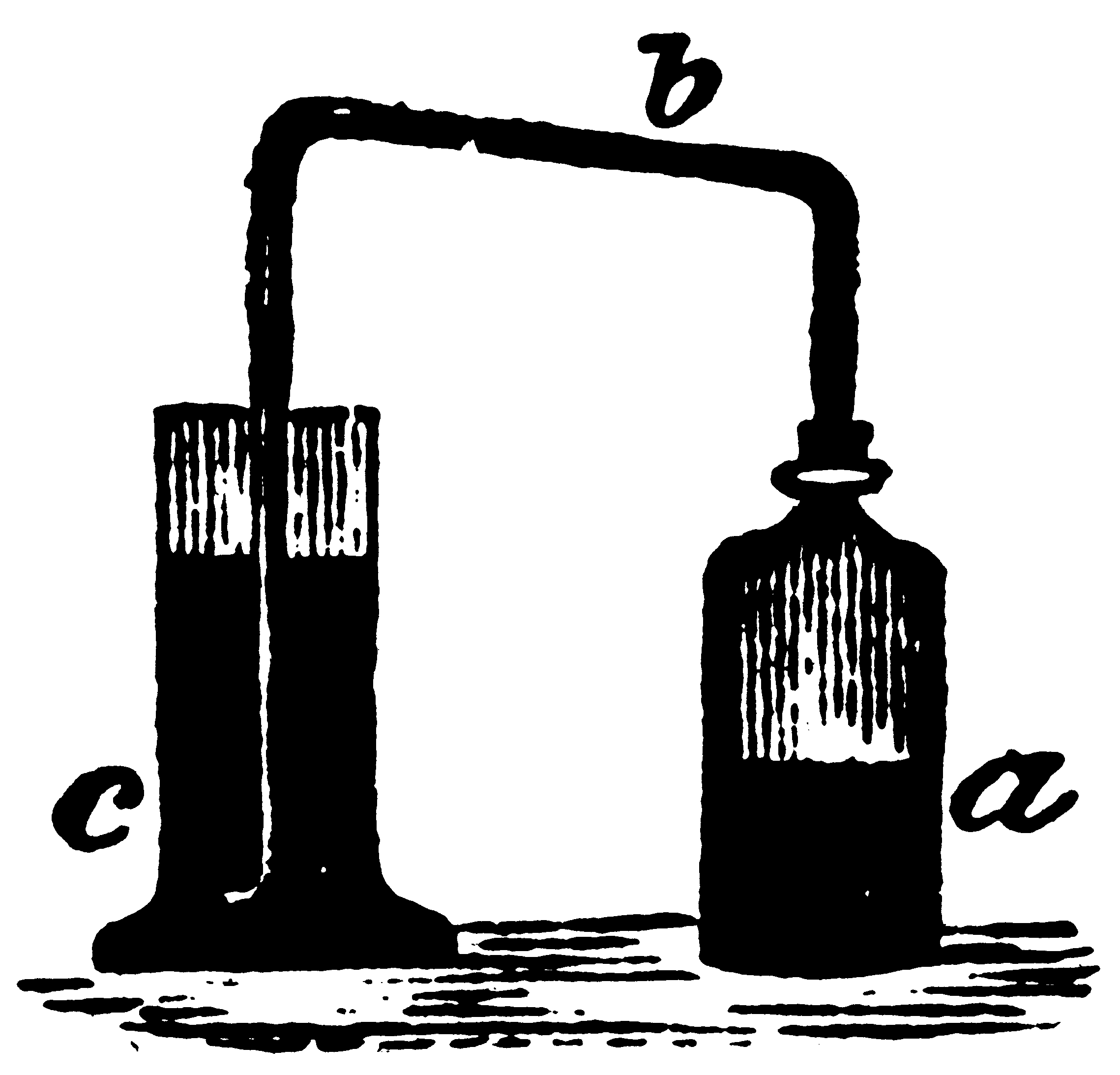
Take any quantity of the beer, put it into a glass retort, furnished
with a receiver, and distil, with a gentle heat, as long as any spirit
passes over into the receiver; which may be known by heating from time
to time a small quantity of the obtained fluid in a tea-spoon over a
candle, and bringing into contact with the vapour of it the flame of a
piece of paper. If the vapour of the distilled fluid catches fire, the
distillation must be continued until the vapour ceases to be set on
fire by the contact of a flaming body. To the distilled liquid thus
obtained, which is the spirit of the beer, combined with water, add, in
small quantities at a time, pure subcarbonate of potash (previously
freed from water by having been exposed to a red heat,) till the last
portion of this salt added, remains undissolved in the fluid. The spirit
will thus become separated from the water, because the subcarbonate of
potash abstracts from it the whole of the water which it contained; and
this combination sinks to the bottom, and the spirit alone floats on the
top. If this experiment be made in a glass tube, about half or
three-quarters of an inch in diameter, and graduated into 50 or 100
equal parts, the relative per centage of spirit in a given quantity of
beer may be seen by mere inspection.
Quantity of Alcohol contained in Porter, Ale, and other kinds of Malt
Liquors.[81]
One hundred parts,
by Measure, contained. |
Parts of Alcohol,
by Measure. |
| Ale, home-brewed |
8,30 |
| Ale, Burton, three Samples |
6,25 |
| Ale, Burton[82] |
8,88 |
| Ale, Edinburgh[82] |
6,20 |
| Ale, Dorchester[82] |
5,50 |
| Ale, common London-brewed, six samples |
5,82 |
| Ale, Scotch, three samples |
5,75 |
| Porter, London, eight samples |
4,00 |
| Ditto, Ditto[83] |
4,20 |
| Ditto, Ditto[83] |
4,45 |
| Ditto, Ditto, bottled. |
4,75 |
| Brown Stout, four samples |
5 |
| Ditto, Ditto[83] |
6,80 |
| Small Beer, six samples |
0,75 |
| Ditto, Ditto[84] |
1,28 |
| |