The method of performing the operation
of acupuncturation is simple and
easy, requiring neither practice to give
dexterity, nor adroitness that it may be
done with propriety. Anatomical knowledge
of the human body is, however,
necessary; as an imprudent application
of it, by an operator ignorant of the
structure of the part into which he
introduces his needle, might be productive
of bad consequences. To a
surgeon, however, properly qualified,
(and no other ought to perform this or
any operation) no danger can arise; as
the cautions are but few, and no risk is
incurred, if they are attended to. It is
only necessary that the operator, in introducing
the needle, should avoid the
course of large vessels, of nervous trunks,
and of the tendons of muscles. It is not,
however, proved, that the latter sustain
injury from the puncture of the needle;
but it is as well to avoid the possibility of
mischief, by such a cautious mode of introducing
the instrument, as shall be
divested of risk. I cannot better familiarize
my subject to the reader, than by
a sketch of it in its native state; and as
an excellent description of the operation,
as performed by the Japonese natives, is
given in the ninth volume of the “Modern
part of an Universal History, from
the Earliest Account of Time,” I shall
extract it, as containing all that is known
of its original practice.
“The place made choice of for the
puncture, is commonly at a middle distance
between the navel and the pit of
the stomach, but often as much nearer to,
or farther from either as the operator,
after a due scrutiny, thinks most proper;
and in this, and the judging rightly how
deep the needle must be thrust below the
skin, so as to reach the seat of the morbific
matter, and giving it a proper vent,
consists the main skill of the artist, and
the success of the operation is said to depend.
Each row hath its particular name,
which carries with it a kind of direction,
with regard to the depth of each puncture,
and the distance of the holes from each
other, which last, seldom exceeds half
an inch in grown persons, in the perpendicular
rows, though something more in
those which are made across the body,
thus,
. . .
. . .
. . .
The needles which perform the operation
are made, as was hinted at first,
either of the finest gold, or silver, and
without the least dross or alloy. They
must be exquisitely slender, finely polished,
and carry a curious point, and
with some degree of hardness, which is
given by the maker by tempering, and
not by any mixture, in order to facilitate
their entrance, and penetrating the skin.
But, though the country abounds with
expert artists, able to make them in the
highest perfection, yet none are allowed,
but such as are licensed by the emperor.
“These needles are of two sorts with
respect to their structure, as well as materials;
the one, either of gold or silver
indifferently, and about four inches long,
very slender, and ending in a sharp point,
and have at the other end a small twisted
handle, which serves to turn them round
with the extremity of the middle finger
and thumb, in order to sink them into
the flesh with greater ease and safety;
the other is chiefly of silver, and much
like the first in length and shape, but
exceedingly small towards the point, with
a short thick handle, channelled for the
same end of turning them about, and to
prevent their going in too deep; and for
the same reason, some of them are cased
in a kind of copper tube, of the bigness
of a goose quill, which serves as a sort of
guage, and lets the point in, just so far
as the operator hath determined it. The
best sort of needles are carefully kept in
a case made of bull’s horn, lined with
some soft downy stuff. This case is
shaped somewhat like a hammer, having
on the striking side a piece of lead, to
give it a sufficient weight, and on the
outside a compressed round piece of leather
to prevent a recoil, and with this
they strike the needle through the thickness
of the skin; after which they keep
turning the handle about with the hand,
till it is sunk to the depth they design it,
that is, till it is thought to have reached
the seat of the morbific virus, which in
grown persons is seldom less than half,
or more than a whole inch: this done,
he draws it out, and compresses the part,
in order to force the morbific vapour or
spirit out.
“The directions and nice rules for the
performing of this curious operation are
many, and require great skill and attention
in the operator; and when duly performed,
may be of excellent use, not only
against the excruciating distemper, called
Senki, but against many other topical
ones, which are most commonly cured
by the Indian Moxa, and other caustics.
On the other hand, these last are often
tried against the distemper above mentioned,
by applying the caustic to the
belly, on each side of the navel, and about
two inches from it, but mostly without
any success, it being very unlikely that
such an application should reach the seat
of the distemper; whereas, the benefit
which has accrued from the acupuncture,
in that one disease, hath encouraged
others to apply it indifferently to other
parts of the body, where the moxa is
used, and by a due care and precaution
not to prick any nerves, tendons, or other
considerable blood vessels, have cured
their patients by it, without putting them
to the excruciating torture which attends
that of the Moxa, or other caustics.”
From the little we have learned of the
practice of this operation amongst the
Asiatics, it would seem, that it was chiefly
diseases of the abdominal cavity and viscera,
which afforded opportunities for
its performance, such as Colic, Tympany,
&c. It is not in such diseases,
however, that I have any experience of
its use, but it is questionable, whether it
might not be beneficial, particularly in
the latter, and I would beg to recommend
it as a matter of interesting experiment,
to be tried in this malady;
such an opportunity, should it fall in my
own practice, I shall take advantage of.
The Indians, however, do not confine
their practice of Acupuncturation (or
Zin-king, as they call it) to diseases of
this kind. They puncture the head
in all cases of Cephalalgia, in Comatose
affections, Ophthalmia, &c. They puncture
the chest, back, and abdomen, not
only to relieve pain of those parts, but
as a cure for Dysentery, Anorexia, Hysteria,
Cholera Morbus, Iliac Passion, &c.
Local diseases of the muscular and
fibrous structures of the body, also
often afford them occasions for its performance;
and it is for diseases of this
class only, that I have hitherto practised
it, and for which I would expressly recommend
it.
Neither sufficient time has elapsed,
nor a proper selection of cases been made
since this operation has been known to
me, to have afforded me, either a large
number of experiments, or a great variety
of diseases on which to try the
effects of it: it is true I have employed it
on some few, and I have it in contemplation
to encrease the list, by giving my
experiments a wider range, but at present
I should not be doing justice to my
subject, to form conclusions on such imperfect
evidence; I shall therefore confine
myself, merely to the description of
the good effects, which I have witnessed
in diseases of a rheumatic character, and
in those injuries of the fibrous structures
of the body, which are often observed to
arise, (particularly in labouring persons)
from violent exertion. This circumstance
must be ever in view, and if it be
not fully impressed on the mind, I doubt
not but many who may be induced to try
the effect of the operation, may be disappointed
in it; viz. that acupuncturation
does no good, nor does it produce even a
temporary alleviation, when the disease
for which it is used, is of an inflammatory
character. This distinction seems to
have regulated the practice of those, who
have experimented on the subject, and
to have decided them in their selection
of cases for the operation. Mr. Berlioz,
of Paris, has practised it extensively, and
has recently published an account of the
success which it has had in his hands.1
He says,
“The eulogia given to acupuncturation
by Kœmpfer and Ten-Rhyne, are just
and merited. We have reason to feel
surprized, that although an age or more
has elapsed, since this curative measure
has been known in Europe, no physician
has made trial of its efficacy. The practice
of the operation is attended with but
little pain, and the success of it is so
prompt, that the disease is alleviated or
entirely ceases, as soon as the needle has
been introduced the depth of a few lines;
most frequently, however, the pain is not
removed by the first introduction of the
instrument, and it is not until after the
use of it for a second, third, or fourth
time, that the cure is completed. Simple
nervous affections, especially demonstrate
how much acupuncturation merits the
attention of physicians, for there are but
few remedies possessed of such prompt
activity, and which produce such wonderful
effects.
“But acupuncturation does not appertain
in any respect to sanguineous evacuations,2
it can only contribute sometimes
to establish the indications for them.
This operation is not indeed followed by
any success, when the disease depends
upon sanguineous turgescence and inflammation.
“In contrary circumstances, Acupuncturation,
by dissipating the symptoms,
demonstrates, that disorder of the nervous
system only had given rise to them.”
The only cases of Rheumatism in which
I have been successful with the operation,
have been of the Rheumatalgic form, or
that which is divested of external inflammation;
characterised by pain upon motion,
stiffness and coldness of the part;
the disease having a disposition to change
its place; is aggravated by atmospheric
changes, and relieved often by stimulant
Diaphoretics, Narcotics and external
warmth: but I have yet met with success
in some cases where the intensity of the
pain would have led me to believe, that
considerable inflammatory action must
have given rise to such exquisite nervous
sensibility.
Mr. Berlioz in speaking of the diseases
to which this remedy is applicable, says,
“vague and wandering Rheumatism sometimes
attacks the external muscles subservient
to respiration; the patient is obliged
to remain motionless; every motion of
the trunk compels him to cry out; a deep
inspiration is very difficult, and coughing
occasions such cruel pains, that expectoration
is impossible. Acupuncturation
dissipates instantly this state of distress,
and renders to the muscles their full
liberty of action. In the space of one or
two minutes, a patient whose sufferings
drew from him tears, exclaims he is quite
cured.”
These observations of Mr. Berlioz
are fully substantiated by the experience
of Dr. Haime of Tours, who has devoted
much time and attention to the operation
of Acupuncturation, and has lately published
a most interesting paper upon the
subject in the 13th volume of the “Journal
Universel des Sciences Medicales,”
at Paris.3
The doctor declares that his own practice
bears evidence of the fidelity of the
preceding remarks of Mr. Berlioz. He
accuses the Japonese and Chinese, (to
whom this operation he says is peculiar practising,)
practising it too extensively, which has
been partly the cause of its being disregarded
by Europeans, and acknowledges
that it was to Mr. Berlioz’s cases, which
he has related in his “estimable work,”
that he owed the fortunate application
which he has made of this measure.
The following cases are given by Dr.
Haime, which he says support the Theory
of Mr. Berlioz.
“Antoinette Boulard, 38 years of age,
had experienced in April 1818, a severe
attack of Rheumatism, which fixed on the
inferior part of the left side of the chest;
it gave way in 48 hours to the use of
some sedatives, the tepid bath, and the
application of a blister to the part in pain.
“Six weeks afterwards I was called to
see this woman, who had fallen again into
the same state. I found her with the trunk
in a state of inability of action, the motion
of the respiratory muscles extremely difficult,
and the plaintive tone of voice indicated
the violence of the pain, which
drew from her cries on the least motion.
The pulse was small and concentrated,
but without sensible acceleration; the
body was covered with cold sweats; and
the unhappy patient, altogether, was in a
state of inexpressible anguish. I thought
it right to have recourse to the same remedies
which had been successful on
former occasions; but my hopes were
deceived. Three days were passed in
this state, and Antoinette obtained no
relief: I determined therefore to practice
acupunctuation. I introduced a needle4
at the inferior margin of the cartilages of
the false ribs. The instrument had hardly
passed to the depth of a few lines, when
the patient said the pain had changed its
seat, and was descended into the abdomen,
at the same time that it had lost much of
its violence. I continued the introduction
to the depth of an inch; by this
means the pain was driven from the abdomen,
and permitted the patient to breathe
freely: however I maintained the needle
in its place for five minutes, and then made
a second puncture, and successively a
third, in the place where the disease had
taken refuge. This third puncture made
the pain totally disappear, and the patient
cried out that I had restored her to life.
Sleep of eight hours duration and a state
of perfect calmness succeeded this operation.
“However Antoinette sent for me on the
following day, saying her sufferings had
returned, but with less violence, and entreated
me with much earnestness that I
would repeat the operation “seeing” she
said, “that it was only the sound,” (for
so she named the needle) “which gave
her relief.” The operation was this time
still more successful. The treatment was
now continued for four days, and the last
puncture so entirely relieved the pain,
that it has not since returned.”
In addition to the above successful
case the doctor adds another not less so.
“A woman had suffered for several
days with wandering Rheumatic pains,
which continued daily to encrease in violence;
there were however at all times
fixed pains in the shoulder and in the
right arm, which acquired such a degree
of intensity by intervals, that the patient
could not refrain from crying out. She
was in this state when she came to consult
me: finding, however, neither alteration
in the pulse, nor encrease of heat,
nor redness of the skin, nor tension, nor
swelling in the part affected, I considered
the case to be simple Rheumatalgia, and
passed the needle to the middle of the
arm, between the fibres of the Triceps
Brachialis muscle; the place designated
by the patient as the seat of the pain.
The pain was driven into the fore arm,
and the second puncture caused it to
descend into the hand, and a third being
made in this part, caused it totally to
disappear, and the patient said with delight
and astonishment, she was cured;
and was so satisfied with this treatment,
that she spoke of it to every body. I
have not since seen her, although I requested
her (and she promised) to return
in the event of a relapse.” But the most
remarkable case which has occurred to
exemplify the triumphant effects of acupuncturation,
was that of a girl of 24
years of age. She was naturally healthy
and robust, and had enjoyed good health
till she was 15 years old, at which time
the signs of puberty were manifested.
At this period the system became much
disturbed, menstruation was established
with difficulty, and continued with irregularity;
she lost her cheerfulness, and
symptoms of the nervous temperament
became predominant.—Various nervous
symptoms now evinced themselves, and
amongst others an obstinate vomiting
occurred, which subsided only during
very short intervals. She continued in
this state for two years5. From this
time she gradually got worse, and in
addition to the habitual vomiting which
she had endured from the age of 16, she
suffered extremely from violent general
convulsions. Some medicines were now
given which relieved the sickness, and
the use of the cold bath suspended the
convulsions. After the treatment had
been continued two months, she was
visited by Dr. Haime, (to whose description
of this interesting case, I am indebted
for these particulars,) who found her
labouring under partial convulsions, with
a disposition to vomit occasionally. The
means which had been before employed
were still continued, but the symptoms
became more aggravated, but were a
little subdued by blood-letting from the
saphena vein. The convulsions were
almost wholly removed, at least had become
only partial; the spasmodic efforts
being concentrated on the diaphragm and
stomach; but a nervous hiccup supervened
which acquired such a degree of intensity,
that the unhappy patient experienced no
intervals of ease. All the known antispasmodic
remedies were now tried during
the space of six months without any benefit.
Blisters to the pit of the stomach
afforded no sort of relief, and the cold
bath gave but a short and temporary alleviation.
Scarifications followed by the
application of a cupping glass were made
on the side of the Dorsal Vertebræ, and
the situations corresponding to the pillars
of the Diaphragm, which suspended the
symptoms but for a few days: relief was
only partially obtained by the cautery, and
the hiccup returned with its original force
accompanied with such a convulsive affection
of the stomach, that this organ
appeared to act like a pair of bellows,
alternately receiving and expelling large
quantities of air. At length when the
hiccup ceased, it was replaced by partial
convulsions or some other symptoms, and
vice versa.
Seeing the want of success of all attempts
to cure this obstinate disease, and
reduced to the necessity of remaining a
mere spectator of its dreadful effects, Dr.
Haime consulted every book which he
conceived might give him some information
by which some other curative measure
might be suggested; but his researches
were totally unsatisfactory, until
he met with Dr. Berlioz’s observations
upon Acupuncturation, when, not less
struck with the curious facts which
Dr. Berlioz relates, than with the efficacy
which it was reported to possess in
nervous diseases, he resolved to try it as
a sort of forlorn hope, upon his present
patient: he accordingly proposed it to
her, and readily obtained her consent
to its performance. He communicated
his intention to Doctor Bretonneau, Physician
to the general hospital, who had
seen the case with him, and had often
spoken of it; and in his presence he performed
the operation for the first time.
A needle was introduced perpendicularly
at the centre of the Epigastrium, and the
two physicians soon became convinced
of the astonishing promptitude of the remedy;
for the instrument had hardly
passed to the depth of a few lines, when
the symptoms vanished as it were by enchantment.
The operation not appearing
to be painful to the patient, the introduction
of the needle was continued
to half its length, in depth from twelve
to fifteen lines, where it was suffered to
remain for five minutes. The result was
a perfect calmness, and a total suspension
of the hiccup for three days, when the
same symptoms returning, the needle
again was had recourse to, and with the
same efficacious effect as at first; and the
operation was performed again and again,
at longer or shorter intervals, according
as the symptoms re-appeared, and always
with the same advantages. Dr. Bretonneau
became convinced of its efficacy by
himself performing it several times. The
treatment of the case was thus continued,
selecting the part for the introduction of
the needle, according to the situation of
the symptoms which each operation was
intended to alleviate; and Dr. Haime asserts,
it never once failed of success; for
the convulsive motions of the head, the
instrument was passed into the muscles of
the neck; into the masseter muscle, to
relieve constant gaping; and into the
fore arm when these muscles were affected;
and thus, by pursuing the disease
as it were, the convulsive disposition was
entirely removed, and the patient restored
to health.
For the fidelity with which I have reported
this case, I refer the reader to
Dr. Haime’s own record in the 13th
volume of the “Journal Universal des
Sciences Medicales,” and should further
evidence of the efficacy of this remedy
be necessary from other authority, I have
but to mention the experience of Dr.
Demours of Paris, who has recently
confirmed6 the report of Messrs. Berlioz
and Haime. He dwells with particular
force upon its good effects in Ophthalmia,
for which he directs five or six needles to
be passed between the fibres of the supraspinatus
muscle. His method of performing
the operation I shall presently
notice when describing this part of my
subject. The following cases which have
occurred in my own practice, I shall now
lay before my readers, and I doubt not
but I shall make it appear that the beneficial
effects of the remedy employed, are
sufficiently flattering to deserve the esteem
I hold it in, and to justify me in
bringing the subject into general notice.
George Mc’Laughlan, about 30 years
of age, a Bricklayer by employment, came
to my house in November last, supporting
himself by a stick in one hand, and resting
the other against the wall, as he proceeded.
The body was bent at nearly right angles
with the thighs, and his countenance indicated
acute suffering. He had been
attacked, he said, three days before, with
darting excruciating pains in the loins
and hips; every motion of the body produced
an acute spasmodic pain, resembling
an electric shock; and the attempt to raise
the body to an upright position was attended
by such insupportable agony, as
obliged him to continue in this state of
flexion rather than encounter it by altering
his position. There was no more constitutional
disturbance than was to be
expected from three days and nights of
constant pain; the pulse was a little
quickened, and the tongue white, but I
attributed this derangement to the irritation
set up by the pain and loss of rest.
I directed him to place himself across a
chair for support during the operation,
and I immediately introduced a needle of
an inch and a half in length into the
lumbar mass on the right side of the
spine; in two minutes time I observed
that he seemed to rest the weight of his
body more on his limbs, and in the next
instant, without any enquiry being made,
he observed, that he felt his limbs stronger
from the “pain having left his hips.” He
next plainly indicated that the disease
was lessened, by raising his body; from
which he only desisted, by being desired
to remain at rest, through fear of the
needle being broken. The instrument
having remained in its place about six
minutes, the patient declared he felt no
pain, and could, if he were permitted, raise
himself upright; it was then withdrawn;
the man arose, adjusted his dress, expressed
his astonishment and delight at
the sudden removal of his disease, and
having made the most grateful acknowledgements,
left the house with a facility
as though he had never been afflicted.
The relief was no doubt permanent, as
he did not return, which he would most
probably have done, had he suffered a
relapse.
William Morgan, a young man in the
employment of a timber merchant, felt a
violent pain suddenly attack the loins
whilst in the act of lifting a very heavy
piece of mahogany. The weight fell
from his hands, and he found he was incapable
of raising himself. He was immediately
cupped and blistered on the
part; but two days had passed and he
was still labouring under considerable
pain, augmented violently by every motion
of the body. On the third day the
operation of Acupuncturation7 was performed
upon the part of the loins pointed
out as the seat of the injury, which, as in
the former case, dissipated the pains in
five or six minutes, and restored the motions
of the back. He returned, however,
the next day, with the same symptoms as
at first, but in a mitigated degree. A
needle was now passed to the depth of an
inch on each side of the spine, which, as
I expected, terminated the disease in a
few minutes, and it was with pleasure
that I understood the next morning, that
the man had gone to his usual employment.
This case illustrates the observations
of the French physicians before cited, as
to the efficacy of the remedy in injuries of
this description: it is true that in my own
practice it is a solitary example; but so
decisive was the benefit derived from it,
that the case proves a powerful corroboration
of both Mr. Berlioz’s theory and
practice.
Elizabeth Jacks, a married woman,
aged 44 years, was admitted into one of
the public hospitals of London, in the year
1817, for an enlarged Bursa situated
under the Rectus Femoris muscle. Soon
after her admission she was attacked with
violent pains in the limbs, which continued
to affect her with greater or less
violence, till the month of October, 1820,
when a severe rheumatic state of the back
of the head and of the loins supervened;
the one preventing flexion of the neck,
the other of the back. Her digestion
continued unimpaired, the pulse about
its natural standard, without hardness or
acceleration. Her nights were passed
without sleep, and every motion of the
body was performed with pain and reluctance.
In this state she applied to
me, and I gave her antimonials combined
with opium, keeping the bowels open with
gentle aperients. Under this treatment,
she was in some degree relieved, but as
she laboured under the impression that
nothing could be done to eradicate the
disease, she discontinued it after a short
time, but in a few days afterwards (Nov.
4th,) Mr. Carpue was requested to see
her; he prescribed ten grains of Dover’s
powder, to be taken every night at bed
time: this dose she took twice without
any benefit. The pains had now entirely
left the parts they at first occupied,
and had fixed on the intercostal muscles
above and below the seventh and eighth
ribs on each side of the chest; whence, to
avoid the insupportable anguish occasioned
by the action of these muscles in
the process of respiration, this function
was (or at least appeared to be) wholly
supported by the Diaphragm, the abdominal
muscles, and the large external
muscles of the neck, chest and back. No
other force but that of pressure upon the
situation corresponding with the interstices
of the ribs gave any uneasiness,
but on these parts, the slightest pressure
produced intolerable pain: this plainly
proved that the disease affected the intercostal
muscles alone. Peritonœal inflammation
ensued, and the suffering
which this occasioned, banished for the
time, all attention to the original disease;
but no sooner was this removed, (which
was effected by the most active means)
than the patient found that she was still
the victim of an unrelenting malady,
which had now pursued her upwards of
three years. Acupuncturation now recurred
to me as a probable mean of
relieving her from her sufferings. I accordingly
introduced a needle between
the sixth and seventh ribs, and another
between the seventh and eighth of the
right side; in two minutes the patient
became sensible of relief, and in two or
three minutes more, that side of the chest
was emancipated from the disease.
The same operation was now performed
on the other side, though the good
effect was not equally extensive on this
as on the right; yet the patient respired
now with so much comparative freedom
and ease, that she exclaimed, she should
“soon be quite well.”—The following
day but one, there was a little augmentation
of the pain on both sides of the
chest, but a single needle introduced into
each part, entirely removed it. No return
of pain after this time visited the
right side, but the left, still continued to
be attacked; until at length the third introduction
of the needle, dissipated it
permanently, and the patient has since
remained free from the disorder. The
needles in every instance were suffered
to remain in the part about five or six
minutes.
Hannah Howard (a female servant in
my house) aged 25 years, became in
September last the subject of Rheumatalgia.
The shoulders, arms, back and
hips, were the parts selected by the disease
for its wandering peregrinations.
Antimonials, Opium, Guaiacum, Hyosciamus,
&c. relieved her occasionally, but
at the end of three months, metastasis to
the heart suddenly took place. I was
called hastily to her at this time; she
had fainted, and when recovered from
the syncope, complained of violent pain
about the region of the heart, which she
informed me had troubled her more or
less for several hours. Her pulse was
hard, and beat somewhat about 106 in a
minute; but from its extreme irregularity,
it could not be measured with exactness;
nor if it might, would it have been
found, I believe, to have preserved an
uniformity within any two given periods;
as both its intermissions and its actions
of rapid velocity were produced at uncertain
and variable intervals. Copious
bleeding, blistering, cupping, with the
use of digitalis and colchicum, at length
removed the disease; and in three weeks
she was able to leave London, to try the
effect of country air in restoring her
health and strength. She returned to
town after a short time, perfectly recovered;
and continued so, until an exposure
to wet brought on another attack of
rheumatalgia; which, after variously shifting
its seat for several days, now fixed
itself on the left side. The remedies
which had formerly been of service, were
now taken without relief; and the colchicum8
(which in most cases of rheumatism
will be found, after bleeding, more
valuable than any other article of the
materia medica) was totally inert. The
pain had now acquired such a degree of
violence, that the slightest motion of the
body gave the most exquisite agony; and
so intense was this state of suffering, that
the patient could not be urged to speak
in a tone loud enough to be conveniently
heard, through the fear of exciting an
exacerbation of pain, which even such
slight motions occasioned. I now had
recourse to acupuncturation; having introduced
a needle through the integuments
covering the interstice of the 8th
and 9th ribs, at the part corresponding
to the junction, with their cartilaginous
epiphises, I continued to press it gently
forward, by rolling it freely between my
fingers. When it had penetrated to about
two thirds, its whole depth (an inch)
I enquired if she experienced either pain
from the puncture, or relief from the
disease; she replied, “she scarcely felt
the instrument, but that her rheumatism
had suddenly abated of its violence;”
and to my surprise, this reply was expressed
in her natural tone of voice. She
added, “that she could now speak and
breathe freely,” so that I now found her
former taciturnity, which I had attributed
to moroseness, was banished. I continued
the introduction of the needle,
and in a few minutes the disease was
dislodged, and fled to the back of the
chest, near the angle of the ribs. The
motions of the shoulder were now restored
to their utmost freedom, and I
withdrew the needle, and inserted it into
the part which had become the seat of
the pain, about two inches from the spinal
column. The disease soon began to
dissipate itself totally; the patient said
she was free from uneasiness, and could
make a deep inspiration without pain.
The instrument having been retained in its
place five or six minutes, was withdrawn;
the chest had regained its full liberty of
action, and the utmost variety of flexion
of the body could be used, not the slightest
inconvenience ensuing. The next
day, however, the pain again visited the
anterior part of the chest, and I again
had recourse to the needle. The operation
was completely successful; for excepting
a slight darting pain, which occasionally
troubled her for a few days afterwards,
no symptoms of the disorder remained,
and she continues at this time to
attend to the duties of her station in my
family.
Whilst occupied with the preceding
pages, I received the following communication
from my friend, Mr. Jukes;
which I subjoin as the strongest corroborative
evidence of the efficacy of the
practice under our consideration.
“Great Peter-Street, Westminster,
xxxxxFebruary 27, 1821.
My Dear Sir,
In compliance with your request, I send
you an account of the effect of Acupuncturation
on our friend Mr.Scott.9 I received
an urgent message on the morning of the
18th inst. from that gentleman, requesting
I would visit him instantly. I found him
in bed; and, with a countenance expressive
of much anguish, he informed me,
that for three days he had been suffering
severely from pain in the loins, which he
attributed to leaving a warm room during
one of the late foggy nights. Within the
last 12 hours it had acquired such a degree
of violence that even respiration was insupportable,
except the body were fixed in
such positions as permitted the least possible
motion. An attempt to resume the
erect posture, produced violent spasmodic
action of the muscles of the back,
which appeared to be communicated by
sympathy to those of the abdomen and
chest, impeding respiration with a convulsive
effort; nor could any motion of
the body be made without producing
this distressing effect. Neither fever nor
general derangement was present; the
secreting organs of the body properly
performing their function, proved the
external locality of the disease. In this
state of things, Acupuncturation presented
itself to us as likely to afford relief,
and it was therefore immediately resorted
to.
“I applied an exhausted cupping glass
upon the integuments, opposite to the
second lumbar Vertebra, and midway
between this bone and the edge of the
Latissimus Dorsi muscle of the right side, which was the
part referred to as the most concentrated
spot of the disease. As soon as a needle
had penetrated to the depth of an inch, a
sensation arose, apparently from the
point of the instrument, which the patient
described as resembling that which is
produced by the passage of the electric
aura, when elicited to a metallic point,
diffusing itself at first to some distance
around the part, and then extending itself
up the side to the Axilla. This sensation
continued to be felt for the space of
a minute, when a violent pain struck into
the right iliac region, immediately above,
and corresponding with the line of, the
Crista of the Ilium. No pain was now
felt in the back, except a dull aching of
about two inches in breadth on the right
side of the spine, extending from the
lower part of the neck to the Sacrum;
corresponding with the situation and
course of the Longissimus Dorsi Muscle.
The pain above the hip now began to
subside and in the space of three minutes
from its commencement, had ceased
altogether.
“The uneasiness along the course of
the spine still remaining, a needle was
introduced about an inch from one of the
upper Dorsal Vertebræ, and another in a
corresponding situation to one of the lower
Lumbar Vertebræ. The pain in the right
side was in a few minutes entirely dissipated,
and the patient arose, declaring,
that, excepting a slight degree of uneasiness
on the posterior part of the chest,
near the angles of the inferior ribs of the left side, he
was completely relieved from the disease.
He, however, requested I would pass a
needle in this last situation; on effecting
which the pain soon left its last refuge,
and the patient dressed himself, and
left his house in the most perfect health.
1 have this day seen him, and he assures
me that he has not experienced any return
of the affection.
“I should have stated that the sensation,
described as resembling somewhat an
electrical effect, was experienced from
two of the needles only; the first and
the last of those which were introduced.
“I send you the history of this
case without any comment upon the
mysterious nature of this extraordinary
operation; yet I am convinced there is
something more in it than has been
hitherto explained. I have, it is true,
some notions (not however fixed) as to
its nature; but I would not at present
venture to detail them, lest the embers
of animal magnetism might be rekindled
in the discussion, and the operation
from being associated with an exploded
theory, sink into undeserved and
premature oblivion, from preconceived
prejudice.
I am, dear Sir,
xxxxxxxxxxYour faithful friend,
xxxxxxxxxxxxxxxxxxEDWARD JUKES.”
Conceiving that the foregoing cases
will be as satisfactory as a larger number
would, I shall not trouble my readers
with a more minute detail.
I could certainly add many others to
the list; but to minds open to conviction
and truth, no stronger impression would
be made by multiplying examples; whilst
the sceptical, would “not be persuaded,
though one rose from the dead.”
The first step necessary to the performance
of this operation, is the selection
of a proper apparatus. It is not requisite,
however, that our needles be
either of gold or silver, as those of the
Japonese are; although it is true that the
flexibility of these metals prevents the
risque of their breaking; but I have not
heard of, or seen, any instance of such an
accident with the steel needle, which is
the material employed in European practice.
It may however be left to the discretion
of the surgeon, whether he uses
the former or not; it is only of consequence,
that the extremity should be
finely pointed, and preserved so.
Mr. Berlioz uses a steel needle, three
inches in length, which has a head given
to it of melted sealing wax. This needle
is introduced to such a depth as the operator
thinks proper, depending on the
part in which it is used, as well as the
nature of the disease which it is intended
to remedy. If it be intended to puncture
any of the viscera, such a needle will
indeed be wanted; but it will be seen by
the practice of the French physicians,
that though they have sometimes thought
it right to penetrate the visceral cavities
to the whole depth of this needle, yet it
is but seldom that more than one inch of
it has been sunk into the part. I have
not, in my own practice, ventured to
use needles of greater length than one
inch, and one inch and a half; and the
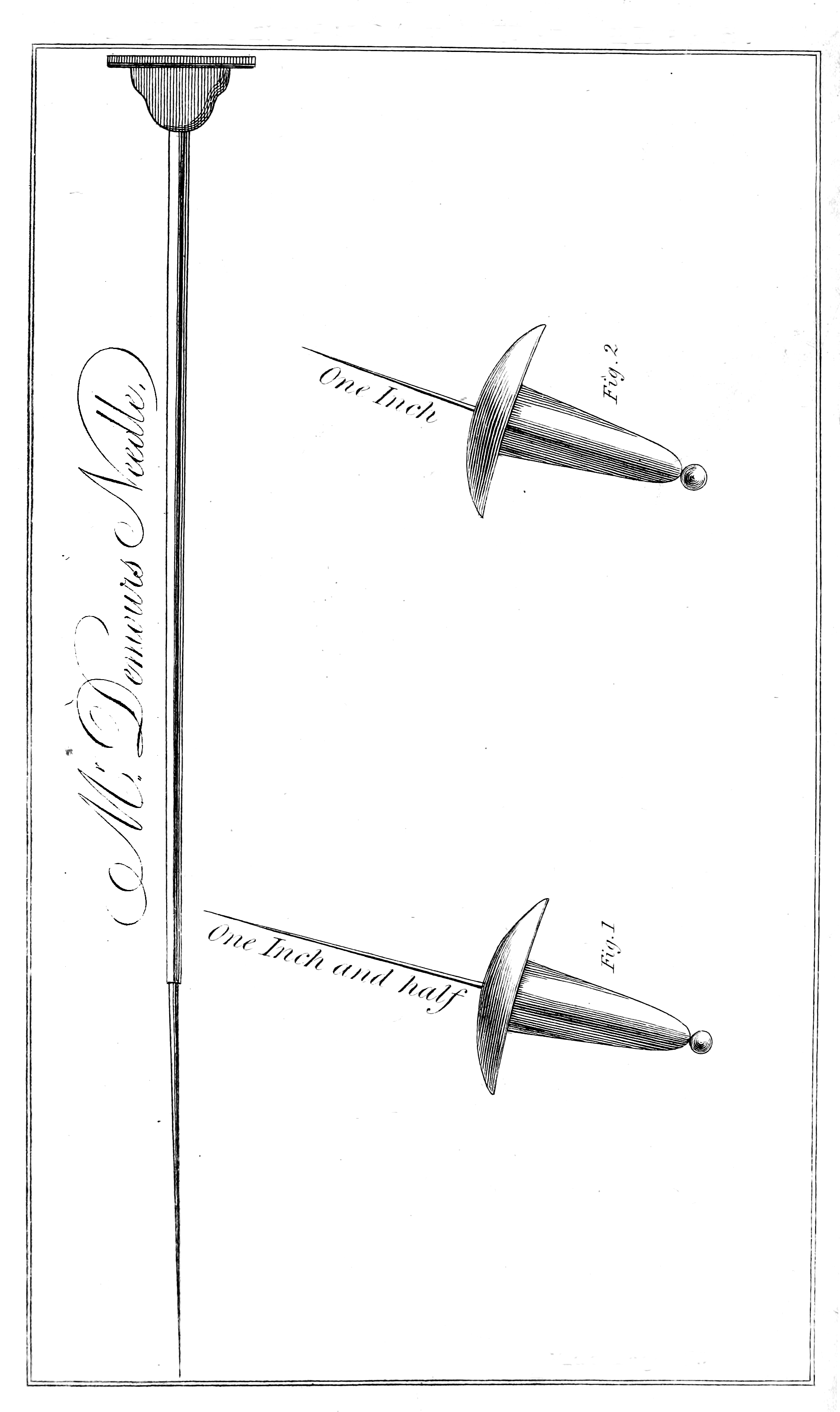
instrument which I use is an ingenious
adaptation of a common sewing needle
to an ivory handle, constructed by Mr.
Edward Jukes, Surgeon Accoucheur to
the Westminster Medical Institution
(see plate, fig. 1 and 2.)
Dr. Haime, and I believe the French
surgeons who practice acupuncturation,
use this long needle (three inches) and
Mr. Demours, who appears to be a man
of considerable mechanical genius, has
lately invented a new apparatus for this
purpose. An exhausting syringe is fitted
to the side of a cupping glass, which can
be unscrewed and removed after the exhaustion
has been effected by a few
strokes of the piston, leaving the glass
affixed to the part. From the top of the
glass proceeds a hollow staff, in which
slides (the tube being air tight) a handle,
armed with a three inch needle, which
is inserted to any depth the operator
chuses.
The theory which Mr. Demours gives in
defence of this instrument is, that the
sensibility of the part is so much lessened
by the conjestion occasioned by the suction
of the pump, that the instrument
passes without producing the least pain,
whilst at the same time it penetrates
deeper, and more readily, through the
tumefaction occasioned by the turgescence
of the sanguineous capillaries and
lymphatics. These advantages, he says,
being only obtained by the operators
ability of passing the needle whilst the
surface of the body remains in the state
of tumefaction, he contends they cannot
possibly be derived from the simple process
of affixing a common glass by the
flame of a taper, as the tumor subsides the
instant the glass is removed.
I do not think it, however, a matter of
any moment, whether a cupping glass be
applied or not; it may, certainly, lessen
the sensibility of the part, and consequently
diminish the pain occasioned by
the needle; but this is in general so
trifling, that no preparatory steps are required
to mitigate it; in fact, it deserves
so little the name of pain, that the patient
is often unconscious of the needle having
penetrated.
The Japonese and Chinese drive in
the needle by the stroke of a mallet.
This instrument, in use amongst the former,
is made of ivory, with holes, sunk
on its surface in the same manner as a
lady’s thimble, which prevent the hammer
from sliding off when the stroke is
given. Such a method is however objectionable,
as well from the danger there
would be of breaking a needle not possessing
flexibility, as from its being more
painful to the patient.
The method to be employed is the
following:
The handle of the needle being held
between the thumb and fore finger, and
its point brought into contact with the
skin, it is pressed gently, whilst a rotatory
motion is given it by the finger and
thumb, which gradually insinuates it into
the part, and by continuing this rolling,
the needle penetrates to any depth with
facility and ease. The operator should
now and then stop to ask if the patient
be relieved; and the needle should always
be allowed to remain five or six minutes
before it is withdrawn. This mode
of introducing the needle, neither produces
pain (or at least very little) to the
patient; nor is productive of Hœmorrhiage,
which Dr. Haime says arises from
the fibres being separated, rather than
divided by the passing of the needle;
the former of which (the absence of
pain) is a point in its favor, which few
surgical operations possess.
It is but rare that I introduce more
than one needle at the same time, as a
greater number does not appear to be
more efficacious than a single one. I,
however, depart from this rule (as will be
seen from some of the cases) when the
pain becomes fugitive from the effects of
the instrument; which is a most encouraging
symptom. In such circumstances,
following the disease by introducing the
needles where the pain has removed to,
has always proved ultimately successful.
Where also the disease is seated in
such several parts, which from their anatomical
situation, are known to receive
their nerves from distinct or opposite departments
of nervous origin; or if the
disease pervades more organs or muscles
than one, which are but little connected
as to their nervous relations; then I regulate
the number of needles, accordingly
as I suppose the several parts may be
more or less connected with each other.
The perforation made by a sharp
smooth instrument like a needle, is of
such a simple nature, that there is little
danger of doing any mischief with one
of this kind. Dr. Bretonneau, Physician to
the “Hospital Général” of Paris, has
made a number of experiments on puppies,
the result of which is, that the
Cerebrum, the Cerebellum, the Heart,
the Lungs, the Stomach, &c. may be penetrated
without occasioning the least
pain or inconvenience.
In one case, where the heart had been
punctured, he afterwards discovered an
extravasation of blood into the Pericardium;
and Dr. Haime asserts, that his
experiments prove the doctrine of Mons.
Beclard, respecting the elasticity of the
arterial tunics, which may be punctured
with impunity. One case of this nature
occurred to Dr. Bretonneau, where a jet
of blood followed the puncture of an
artery. The hœmorrhage was immediately
stopped, simply by pressure upon
the opening. Dr. Haime says, that he
has often, when performing this operation
upon the human subject, thrust the
needle to such a depth into the Epigastrium,
that the stomach must have been
pierced; but that it was productive of
no more inconvenience than the same
operation upon the more simple parts of
the body. I should, however, contrary
to such high testimony, hesitate much to
puncture an artery, as an aneurism has
been known to result from a small puncture
made by an awl, which required the
division of the vessel for the cure.
I shall here close my subject, not without
exciting, perhaps, in the minds of
some of my readers, surprise that I have
not attempted an hypothesis of the operation.
I have by no means made up my
mind as to the nature of its action, and
rather than venture into speculative reasoning,
which may be received as doubtful
by some, and visionary by others, I
prefer preserving a profound silence.
The authors whom I have before referred
to, have attempted such an explanation;
and should opinions of this kind be
considered as deserving attention, the
enquirers may find them in the paper
upon acupuncturation, in the 13th volume
of the “Journal Universel Des
Sciences Medicales,” published at Paris
in 1819.
The needles may be obtained at Mr. Blackwell’s
Bedford-Court, and Mr. Laundy’s, St. Thomas’s Street,
Borough.
FINIS.
Errata.
| Page 30, line | 8, after the word peculiar, add, of practising. |
| 44, | 2, for univerel read universal. |
| 62, | 2, from the bottom, a comma after the word Epipheses, instead of a period. |
| 68, | 3, after the word muscle, add, of the right side. |
| 70, | 5, after the word ribs, add, of the left side. |
Plummer and Brewis, Printers, Love Lane, Eastcheap.