The Project Gutenberg eBook, A Traveler at Forty, by Theodore Dreiser,
Illustrated by William Glackens
Note:
Images of the original pages are available through
Internet Archive. See
https://archive.org/details/traveleratforty00drei
Transcriber’s Note
Larger versions of most illustrations may be seen by right-clicking them
and selecting an option to view them separately, or by double-tapping and/or
stretching them.
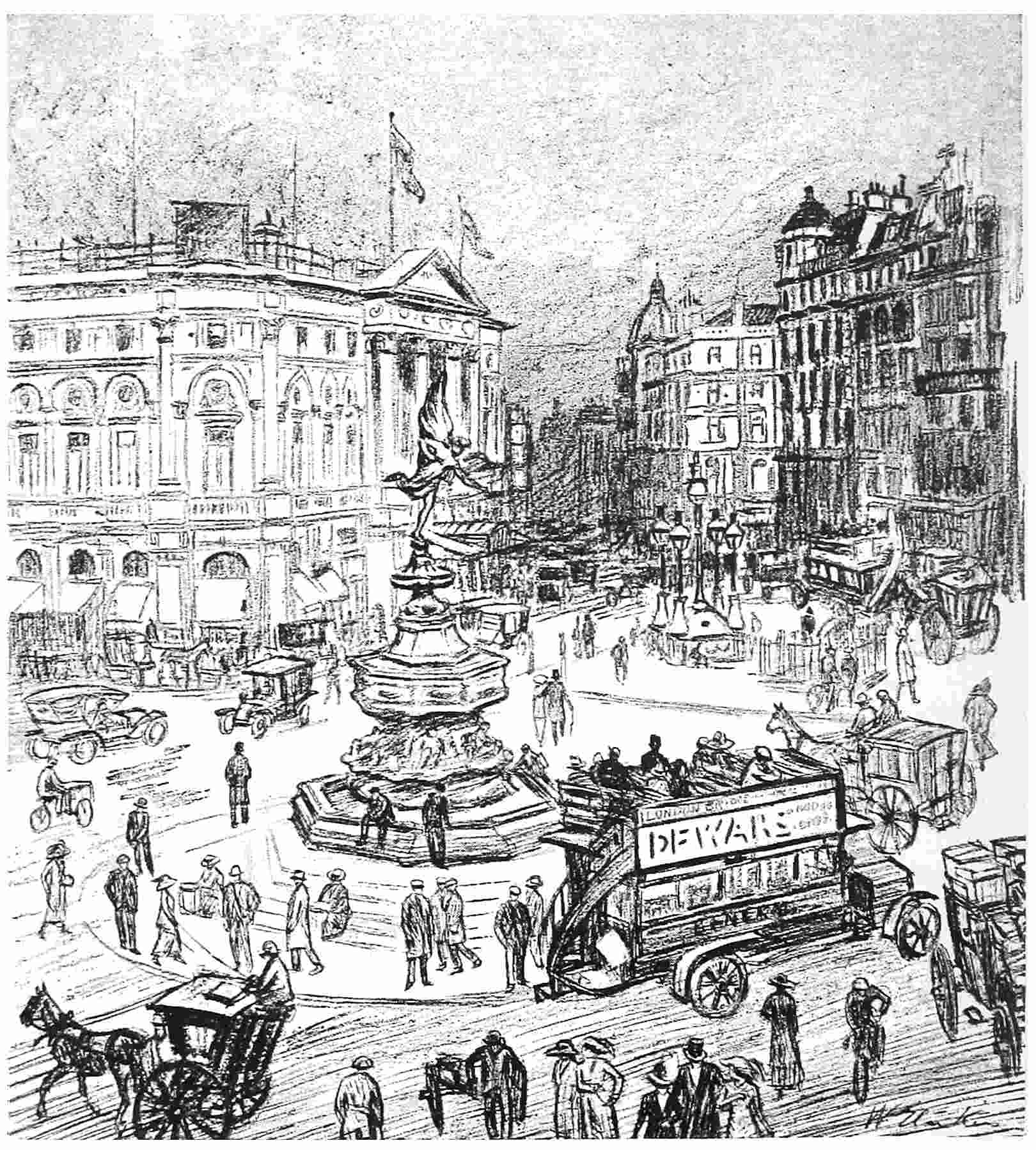
Piccadilly Circus
A TRAVELER
AT FORTY
BY
THEODORE DREISER
Author of “Sister Carrie,” “Jennie Gerhardt,”
“The Financier,” etc., etc.
I have just turned forty. I have seen a little something
of life. I have been a newspaper man,
editor, magazine contributor, author and, before
these things, several odd kinds of clerk before I found
out what I could do.
Eleven years ago I wrote my first novel, which was
issued by a New York publisher and suppressed by him,
Heaven knows why. For, the same year they suppressed
my book because of its alleged immoral tendencies, they
published Zola’s “Fecundity” and “An Englishwoman’s
Love Letters.” I fancy now, after eleven years of
wonder, that it was not so much the supposed immorality,
as the book’s straightforward, plain-spoken discussion
of American life in general. We were not used
then in America to calling a spade a spade, particularly
in books. We had great admiration for Tolstoi and
Flaubert and Balzac and de Maupassant at a distance—some
of us—and it was quite an honor to have handsome
sets of these men on our shelves, but mostly we had
been schooled in the literature of Dickens, Thackeray,
George Eliot, Charles Lamb and that refined company of
English sentimental realists who told us something about
life, but not everything. No doubt all of these great
men knew how shabby a thing this world is—how full
of lies, make-believe, seeming and false pretense it
all is, but they had agreed among themselves, or with
the public, or with sentiment generally, not to talk
about that too much. Books were always to be built
out of facts concerning “our better natures.” We
were always to be seen as we wish to be seen. There
were villains to be sure—liars, dogs, thieves, scoundrels—but
they were strange creatures, hiding away
in dark, unconventional places and scarcely seen save at
night and peradventure; whereas we, all clean, bright,
honest, well-meaning people, were living in nice homes,
going our way honestly and truthfully, going to church,
raising our children believing in a Father, a Son and a
Holy Ghost, and never doing anything wrong at any time
save as these miserable liars, dogs, thieves, et cetera,
might suddenly appear and make us. Our books largely
showed us as heroes. If anything happened to our
daughters it was not their fault but the fault of these
miserable villains. Most of us were without original
sin. The business of our books, our church, our laws,
our jails, was to keep us so.
I am quite sure that it never occurred to many of us
that there was something really improving in a plain,
straightforward understanding of life. For myself,
I accept now no creeds. I do not know what truth is,
what beauty is, what love is, what hope is. I do not
believe any one absolutely and I do not doubt any one absolutely.
I think people are both evil and well-intentioned.
While I was opening my mail one morning I encountered
a now memorable note which was addressed
to me at my apartment. It was from an old literary
friend of mine in England who expressed himself as
anxious to see me immediately. I have always liked
him. I like him because he strikes me as amusingly
English, decidedly literary and artistic in his point of
view, a man with a wide wisdom, discriminating taste,
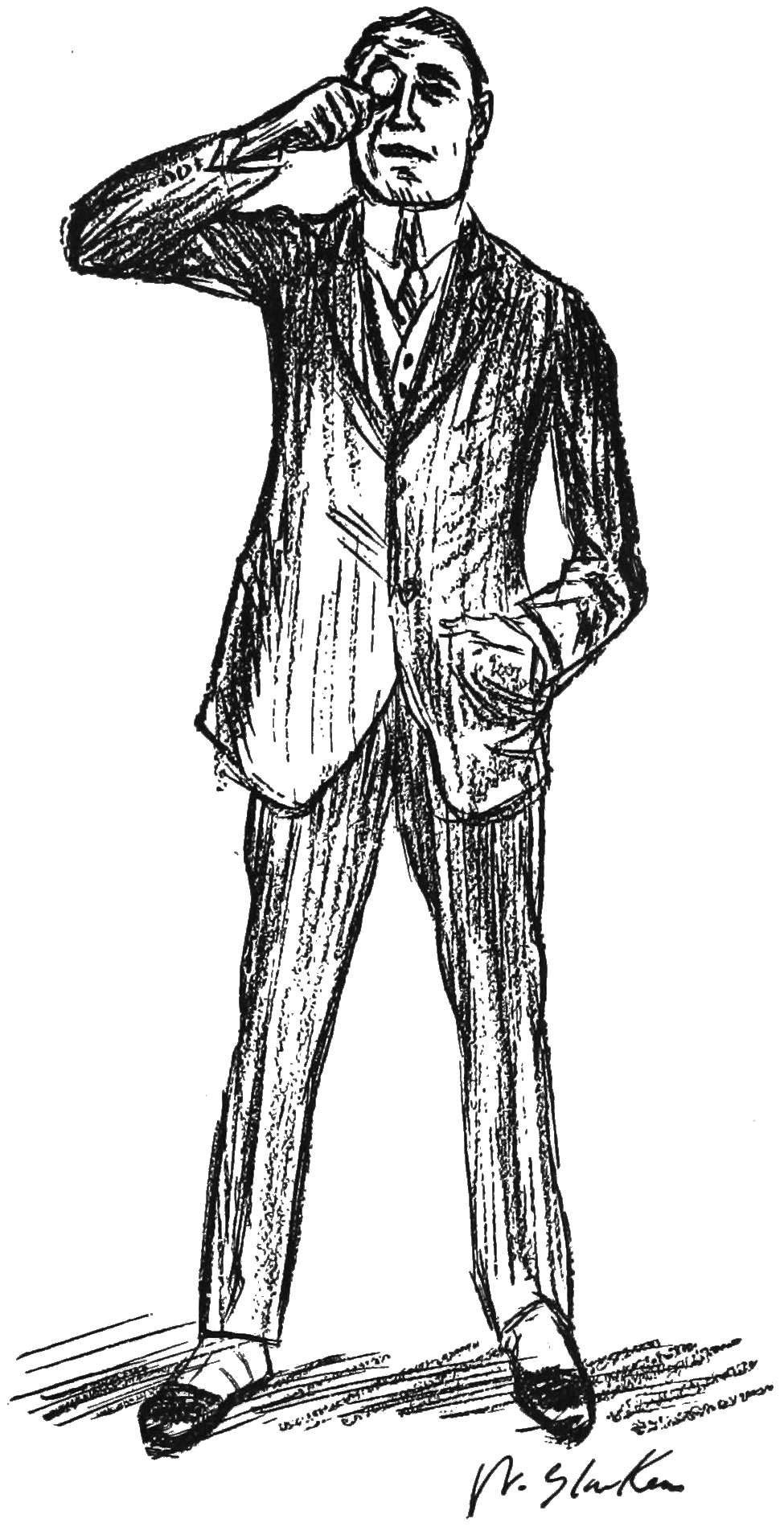
rare selection. He wears a monocle in his right eye, à la
Chamberlain, and I like him for that. I like people who
take themselves with a grand air, whether they like me
or not—particularly if the grand air is backed up by a
real personality. In this case it is.
Next morning Barfleur took breakfast with me; it was
a most interesting affair. He was late—very. He
stalked in, his spats shining, his monocle glowing with
a shrewd, inquisitive eye behind it, his whole manner
genial, self-sufficient, almost dictatorial and always final.
He takes charge so easily, rules so sufficiently, does so
essentially well in all circumstances where he is interested
so to do.
“I have decided,” he observed with that managerial
air which always delights me because my soul is not in
the least managerial, “that you will come back to England
with me. I have my passage arranged for the
twenty-second. You will come to my house in England;
you will stay there a few days; then I shall take you to
London and put you up at a very good hotel. You will
stay there until January first and then we shall go to the
south of France—Nice, the Riviera, Monte Carlo; from
there you will go to Rome, to Paris, where I shall join
you,—and then sometime in the spring or summer, when
you have all your notes, you will return to London or
New York and write your impressions and I will see that
they are published!”
“If it can be arranged,” I interpolated.
“It can be arranged,” he replied emphatically. “I
will attend to the financial part and arrange affairs with
both an American and an English publisher.”
Sometimes life is very generous. It walks in and
says, “Here! I want you to do a certain thing,” and it
proceeds to arrange all your affairs for you. I felt curiously
at this time as though I was on the edge of a
great change. When one turns forty and faces one’s
first transatlantic voyage, it is a more portentous event
than when it comes at twenty.
* * * * *
I shall not soon forget reading in a morning paper on
the early ride downtown the day we sailed, of the suicide
of a friend of mine, a brilliant man. He had fallen on
hard lines; his wife had decided to desert him; he was
badly in debt. I knew him well. I had known his erratic
history. Here on this morning when I was sailing
for Europe, quite in the flush of a momentary literary
victory, he was lying in death. It gave me pause. It
brought to my mind the Latin phrase, “memento mori.”
I saw again, right in the heart of this hour of brightness,
how grim life really is. Fate is kind, or it is not. It
puts you ahead, or it does not. If it does not, nothing
can save you. I acknowledge the Furies. I believe in
them. I have heard the disastrous beating of their wings.
When I reached the ship, it was already a perfect
morning in full glow. The sun was up; a host of gulls
were on the wing; an air of delicious adventure enveloped
the great liner’s dock at the foot of Thirteenth Street.
Did ever a boy thrill over a ship as I over this monster
of the seas?
In the first place, even at this early hour it was crowded
with people. From the moment I came on board I was
delighted by the eager, restless movement of the throng.
The main deck was like the lobby of one of the great
New York hotels at dinner-time. There was much calling
on the part of a company of dragooned ship-stewards
to “keep moving, please,” and the enthusiasm of farewells
and inquiries after this person and that, were delightful
to hear. I stopped awhile in the writing-room
and wrote some notes. I went to my stateroom and
found there several telegrams and letters of farewell.
Later still, some books which had been delivered at
the ship, were brought to me. I went back to the dock
and mailed my letters, encountered Barfleur finally and
exchanged greetings, and then perforce soon found
myself taken in tow by him, for he wanted, obviously,
to instruct me in all the details of this new world upon
which I was now entering.
At eight-thirty came the call to go ashore. At eight
fifty-five I had my first glimpse of a Miss E., as discreet
and charming a bit of English femininity as one would
care to set eyes upon. She was an English actress of
some eminence whom Barfleur was fortunate enough to
know. Shortly afterward a Miss X. was introduced to
him and to Miss E., by a third acquaintance of Miss E.’s,
Mr. G.—a very direct, self-satisfied and aggressive
type of Jew. I noticed him strolling about the deck
some time before I saw him conversing with Miss E.,
and later, for a moment, with Barfleur. I saw these
women only for a moment at first, but they impressed me
at once as rather attractive examples of the prosperous
stage world.
It was nine o’clock—the hour of the ship’s sailing. I
went forward to the prow, and watched the sailors on
B deck below me cleaning up the final details of loading,
bolting down the freight hatches covering the windlass
and the like. All the morning I had been particularly
impressed with the cloud of gulls fluttering about the
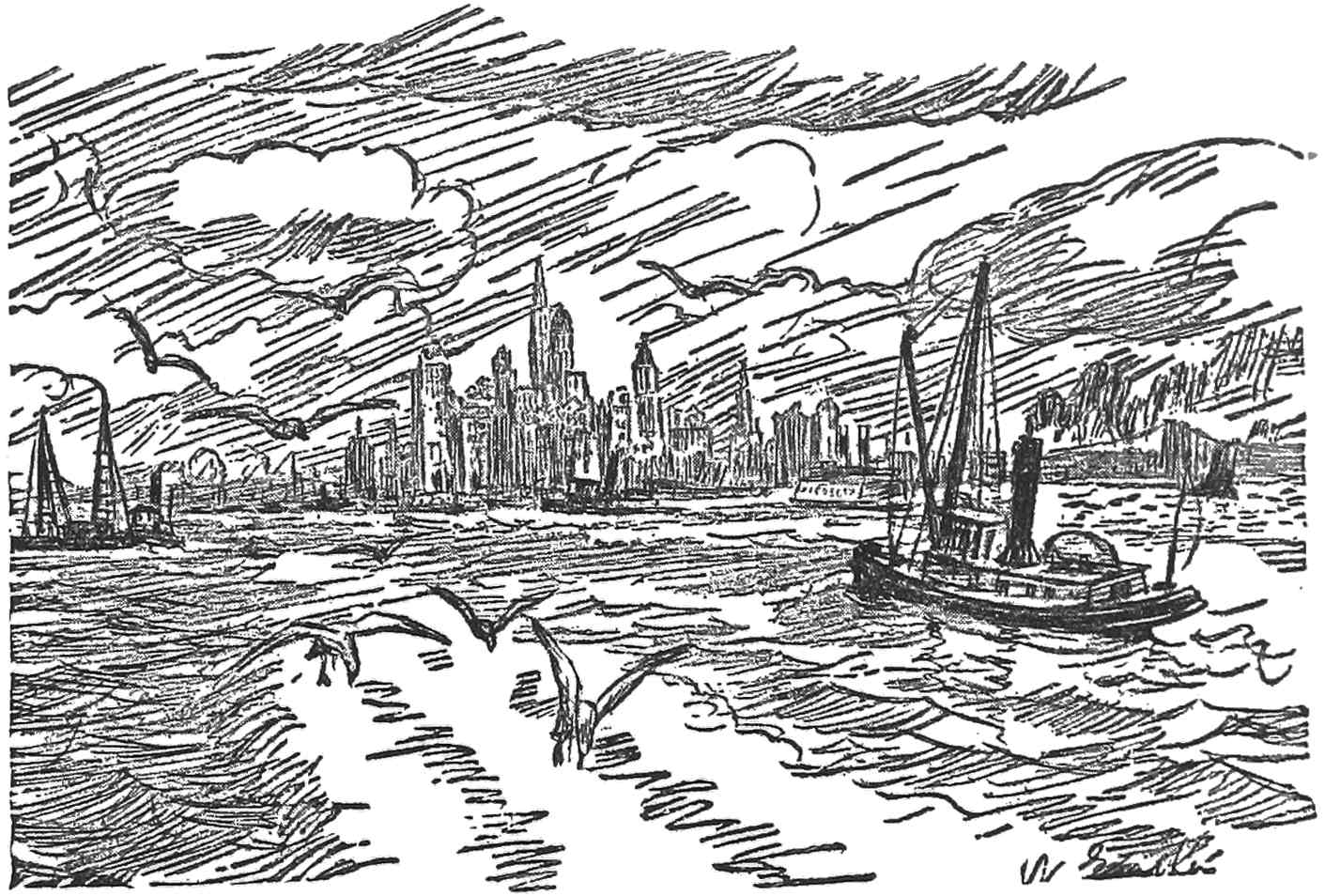
ship, but now the harbor, the magnificent wall of lower
New York, set like a jewel in a green ring of sea water,
took my eye. When should I see it again? How soon
should I be back? I had undertaken this voyage in pell-mell
haste. I had not figured at all on where I was
going or what I was going to do. London—yes, to
gather the data for the last third of a novel; Rome—assuredly,
because of all things I wished to see Rome;
the Riviera, say, and Monte Carlo, because the south of
France has always appealed to me; Paris, Berlin—possibly;
Holland—surely.
I stood there till the Mauretania fronted her prow
outward to the broad Atlantic. Then I went below and
began unpacking, but was not there long before I was
called out by Barfleur.
“Come up with me,” he said.
We went to the boat deck where the towering red
smoke-stacks were belching forth trailing clouds of
smoke. I am quite sure that Barfleur, when he originally
made his authoritative command that I come to England
with him, was in no way satisfied that I would. It was
a somewhat light venture on his part, but here I was.
And now, having “let himself in” for this, as he would
have phrased it, I could see that he was intensely interested
in what Europe would do to me—and possibly
in what I would do to Europe. We walked up and down
as the boat made her way majestically down the harbor.
We parted presently but shortly he returned to say,
“Come and meet Miss E. and Miss X. Miss E. is reading
your last novel. She likes it.”
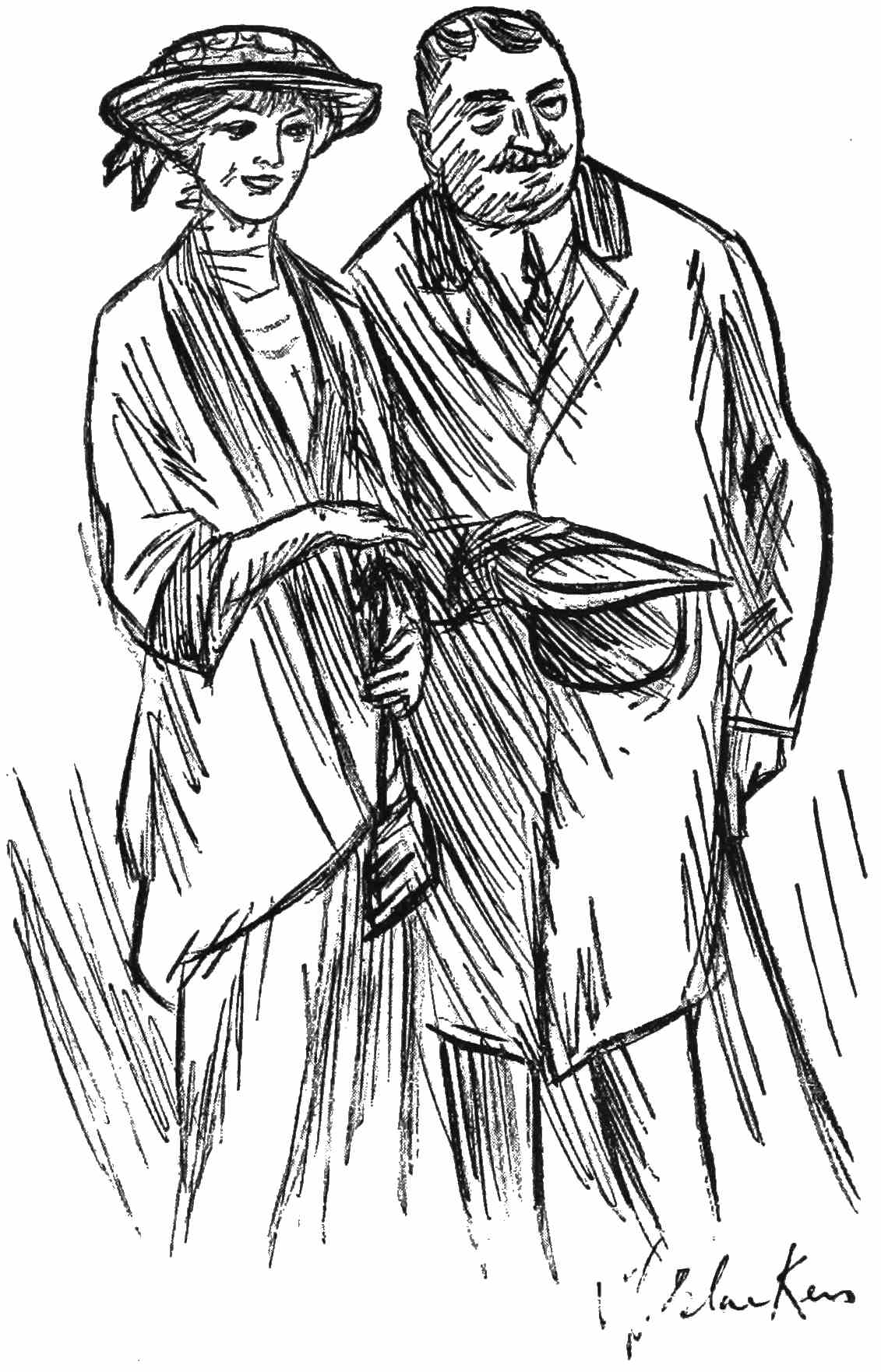
“I saw Mr. G. conversing with Miss E.”
I went down, interested to meet these two, for the
actress—the talented, good-looking representative of that
peculiarly feminine world of art—appeals to me very
much. I have always thought, since I have been able
to reason about it, that the stage is almost the only ideal
outlet for the artistic temperament of a talented and
beautiful women. Men?—well, I don’t care so much
for the men of the stage. I acknowledge the distinction
of such a temperament as that of David Garrick or Edwin
Booth. These were great actors and, by the same token,
they were great artists—wonderful artists. But in the
main the men of the stage are frail shadows of a much
more real thing—the active, constructive man in other
lines.
On the contrary, the women of the stage are somehow,
by right of mere womanhood, the art of looks, form,
temperament, mobility, peculiarly suited to this realm
of show, color and make-believe. The stage is fairyland
and they are of it. Women—the women of ambition,
aspiration, artistic longings—act, anyhow, all the time.
They lie like anything. They never show their true
colors—or very rarely. If you want to know the truth,
you must see through their pretty, petty artistry, back to
the actual conditions behind them, which are conditioning
and driving them. Very few, if any, have a real
grasp on what I call life. They have no understanding
of and no love for philosophy. They do not care for
the subtleties of chemistry and physics. Knowledge—book
knowledge, the sciences—well, let the men have
that. Your average woman cares most—almost entirely—for
the policies and the abstrusities of her own
little world. Is her life going right? Is she getting
along? Is her skin smooth? Is her face still pretty?
Are there any wrinkles? Are there any gray hairs in
sight? What can she do to win one man? How can
she make herself impressive to all men? Are her feet
small? Are her hands pretty? Which are the really
nice places in the world to visit? Do men like this trait
in women? or that? What is the latest thing in dress,
in jewelry, in hats, in shoes? How can she keep herself
spick and span? These are all leading questions with
her—strong, deep, vital, painful. Let the men have
knowledge, strength, fame, force—that is their business.
The real man, her man, should have some one of
these things if she is really going to love him very much.
I am talking about the semi-artistic woman with ambition.
As for her, she clings to these poetical details
and they make her life. Poor little frail things—fighting
with every weapon at their command to buy and
maintain the courtesy of the world. Truly, I pity
women. I pity the strongest, most ambitious woman I
ever saw. And, by the same token, I pity the poor helpless,
hopeless drab and drudge without an idea above a
potato, who never had and never will have a look in on
anything. I know—and there is not a beating feminine
heart anywhere that will contradict me—that they are
all struggling to buy this superior masculine strength
against which they can lean, to which they can fly in
the hour of terror. It is no answer to my statement, no
contradiction of it, to say that the strongest men crave
the sympathy of the tenderest women. These are complementary
facts and my statement is true. I am dealing
with women now, not men. When I come to men I
will tell you all about them!
Our modern stage world gives the ideal outlet for all
that is most worth while in the youth and art of the female
sex. It matters not that it is notably unmoral.
You cannot predicate that of any individual case until
afterward. At any rate, to me, and so far as women
are concerned, it is distinguished, brilliant, appropriate,
important. I am always interested in a well recommended
woman of the stage.
What did we talk about—Miss E. and I? The stage
a little, some newspapermen and dramatic critics that
we had casually known, her interest in books and the fact
that she had posed frequently for those interesting advertisements
which display a beautiful young woman
showing her teeth or holding aloft a cake of soap or a
facial cream. She had done some of this work in the
past—and had been well paid for it because she was
beautiful, and she showed me one of her pictures in a
current magazine advertising a set of furs.
I found that Barfleur, my very able patron, was doing
everything that should be done to make the trip comfortable
without show or fuss. Many have this
executive or managerial gift. Sometimes I think it is
a natural trait of the English—of their superior classes,
anyhow. They go about colonizing so efficiently, industriously.
They make fine governors and patrons. I
have always been told that English direction and English
directors are thorough. Is this true or is it not? At
this writing, I do not know.
Not only were all our chairs on deck here in a row, but
our chairs at table had already been arranged for—four
seats at the captain’s table. It seems that from previous
voyages on this ship Barfleur knew the captain. He also
knew the chairman of the company in England. No
doubt he knew the chief steward. Anyhow, he knew
the man who sold us our tickets. He knew the head
waiter at the Ritz—he had seen him or been served by
him somewhere in Europe. He knew some of the servitors
of the Knickerbocker of old. Wherever he went,
I found he was always finding somebody whom he knew.
I like to get in tow of such a man as Barfleur and see him
plow the seas. I like to see what he thinks is important.
In this case there happens to be a certain intellectual and
spiritual compatibility. He likes some of the things that
I like. He sympathizes with my point of view. Hence,
so far at least, we have got along admirably. I speak
for the present only. I would not answer for my moods
or basic change of emotions at any time.
Well, here were the two actresses side by side, both
charmingly arrayed, and with them, in a third chair,
the short, stout, red-haired Mr. G.
I covertly observed the personality of Miss X. Here
was some one who, on sight, at a glance, attracted me
far more significantly than ever Miss E. could. I cannot
tell you why, exactly. In a way, Miss E. appeared,
at moments and from certain points of view—delicacy,
refinement, sweetness of mood—the more attractive of
the two. But Miss X., with her chic face, her dainty
little chin, her narrow, lavender-lidded eyes, drew me
quite like a magnet. I liked a certain snap and vigor
which shot from her eyes and which I could feel represented
our raw American force. A foreigner will not,
I am afraid, understand exactly what I mean; but there
is something about the American climate, its soil, rain,
winds, race spirit, which produces a raw, direct incisiveness
of soul in its children. They are strong, erect,
elated, enthusiastic. They look you in the eye, cut you
with a glance, say what they mean in ten thousand ways
without really saying anything at all. They come upon
you fresh like cold water and they have the luster of a
hard, bright jewel and the fragrance of a rich, red, full-blown
rose. Americans are wonderful to me—American
men and American women. They are rarely polished
or refined. They know little of the subtleties of life—its
order and procedures. But, oh, the glory of their
spirit, the hope of them, the dreams of them, the desires
and enthusiasm of them. That is what wins me. They
give me the sense of being intensely, enthusiastically, humanly
alive.
Miss X. did not tell me anything about herself, save
that she was on the stage in some capacity and that she
knew a large number of newspaper men, critics, actors,
et cetera. A chorus girl, I thought; and then, by the
same token, a lady of extreme unconventionality.
I think the average man, however much he may lie
and pretend, takes considerable interest in such women.
At the same time there are large orders and schools
of mind, bound by certain variations of temperament, and
schools of thought, which either flee temptation of this
kind, find no temptation in it, or, when confronted, resist
it vigorously. The accepted theory of marriage and
monogamy holds many people absolutely. There are
these who would never sin—hold unsanctioned relations,
I mean—with any woman. There are others who will
always be true to one woman. There are those who are
fortunate if they ever win a single woman. We did not
talk of these things but it was early apparent that she was
as wise as the serpent in her knowledge of men and in
the practice of all the little allurements of her sex.
Barfleur never ceased instructing me in the intricacies
of ship life. I never saw so comforting and efficient a
man.
“Oh”—who can indicate exactly the sound of the
English “Oh”—“Oh, there you are.” (His are always
sounded like ah.) “Now let me tell you something.
You are to dress for dinner. Ship etiquette requires it.
You are to talk to the captain some—tell him how much
you think of his ship, and so forth; and you are not to
neglect the neighbor to your right at table. Ship etiquette,
I believe, demands that you talk to your neighbor,
at least at the captain’s table—that is the rule, I think.
You are to take in Miss X. I am to take in Miss E.”
Was it any wonder that my sea life was well-ordered and
that my lines fell in pleasant places?
After dinner we adjourned to the ship’s drawing-room
and there Miss X. fell to playing cards with Barfleur at
first, afterwards with Mr. G., who came up and found
us, thrusting his company upon us perforce. The man
amused me, so typically aggressive, money-centered was
he. However, not he so much as Miss X. and her mental
and social attitude, commanded my attention. Her card
playing and her boastful accounts of adventures at Ostend,
Trouville, Nice, Monte Carlo and Aix-les-Bains
indicated plainly the trend of her interests. She was all
for the showy life that was to be found in these places—burning
with a desire to glitter—not shine—in that half
world of which she was a smart atom. Her conversation
was at once showy, naïve, sophisticated and yet unschooled.
I could see by Barfleur’s attentions to her,
that aside from her crude Americanisms which ordinarily
would have alienated him, he was interested in her beauty,
her taste in dress, her love of a certain continental café
life which encompassed a portion of his own interests.
Both were looking forward to a fresh season of it—Barfleur
with me—Miss X. with some one who was
waiting for her in London.
I think I have indicated in one or two places in the
preceding pages that Barfleur, being an Englishman of the
artistic and intellectual classes, with considerable tradition
behind him and all the feeling of the worth-whileness
of social order that goes with class training, has a high
respect for the conventions—or rather let me say appearances,
for, though essentially democratic in spirit
and loving America—its raw force—he still clings
almost pathetically, I think, to that vast established order,
which is England. It may be producing a dying condition
of race, but still there is something exceedingly
fine about it. Now one of the tenets of English social
order is that, being a man you must be a gentleman,
very courteous to the ladies, very observant of outward
forms and appearances, very discreet in your approaches
to the wickedness of the world—but nevertheless you
may approach and much more, if you are cautious enough.
After dinner there was a concert. It was a dreary
affair. When it was over, I started to go to bed but,
it being warm and fresh, I stepped outside. The night
was beautiful. There were no fellow passengers on
the promenade. All had retired. The sky was magnificent
for stars—Orion, the Pleiades, the Milky Way,
the Big Dipper, the Little Dipper. I saw one star, off
to my right as I stood at the prow under the bridge,
which, owing to the soft, velvety darkness, cast a faint
silvery glow on the water—just a trace. Think of it!
One lone, silvery star over the great dark sea doing this.
I stood at the prow and watched the boat speed on. I
threw back my head and drank in the salt wind. I
looked and listened. England, France, Italy, Switzerland,
Germany—these were all coming to me mile by
mile. As I stood there a bell over me struck eight
times. Another farther off sounded the same number.
Then a voice at the prow called, “All’s well,” and another
aloft on that little eyrie called the crow’s nest,
echoed it. “All’s well.” The second voice was weak
and quavering. Something came up in my throat—a
quick unbidden lump of emotion. Was it an echo of old
journeys and old seas when life was not safe? When
Columbus sailed into the unknown? And now this vast
ship, eight hundred and eighty-two feet long, eighty-eight
feet beam, with huge pits of engines and furnaces and
polite, veneered first-cabin decks and passengers!
CHAPTER II MISS X.
It was ten o’clock the next morning when I arose and
looked at my watch. I thought it might be eight-thirty,
or seven. The day was slightly gray with
spray flying. There was a strong wind. The sea was
really a boisterous thing, thrashing and heaving in hills
and hollows. I was thinking of Kipling’s “White
Horses” for a while. There were several things about
this great ship which were unique. It was a beautiful
thing all told—its long cherry-wood, paneled halls in the
first-class section, its heavy porcelain baths, its dainty
staterooms fitted with lamps, bureaus, writing-desks,
washstands, closets and the like. I liked the idea of dressing
for dinner and seeing everything quite stately and
formal. The little be-buttoned call-boys in their tight-fitting
blue suits amused me. And the bugler who bugled
for dinner! That was a most musical sound he made,
trilling in the various quarters gaily, as much as to say,
“This is a very joyous event, ladies and gentlemen; we are
all happy; come, come; it is a delightful feast.” I saw
him one day in the lobby of C deck, his legs spread far
apart, the bugle to his lips, no evidence of the rolling
ship in his erectness, bugling heartily. It was like something
out of an old medieval court or a play. Very
nice and worth while.
Absolutely ignorant of this world of the sea, the social,
domestic, culinary and other economies of a great
ship like this interested me from the start. It impressed
me no little that all the servants were English, and that
they were, shall I say, polite?—well, if not that, non-aggressive.
American servants—I could write a whole
chapter on that, but we haven’t any servants in America.
We don’t know how to be servants. It isn’t in us; it
isn’t nice to be a servant; it isn’t democratic; and spiritually
I don’t blame us. In America, with our turn for
mechanics, we shall have to invent something which will
do away with the need of servants. What it is to be, I
haven’t the faintest idea at present.
Another thing that impressed and irritated me a little
was the stolidity of the English countenance as I encountered
it here on this ship. I didn’t know then whether
it was accidental in this case, or national. There is a
certain type of Englishman—the robust, rosy-cheeked,
blue-eyed Saxon—whom I cordially dislike, I think,
speaking temperamentally and artistically. They are too
solid, too rosy, too immobile as to their faces, and altogether
too assured and stary. I don’t like them. They
offend me. They thrust a silly race pride into my face,
which isn’t necessary at all and which I always resent
with a race pride of my own. It has even occurred to me
at times that these temperamental race differences could
be quickly adjusted only by an appeal to arms, which is
sillier yet. But so goes life. It’s foolish on both sides,
but I mention it for what it is worth.
After lunch, which was also breakfast with me, I went
with the chief engineer through the engine-room. This
was a pit eighty feet deep, forty feet wide and, perhaps,
one hundred feet long, filled with machinery. What a
strange world! I know absolutely nothing of machinery—not
a single principle connected with it—and yet I
am intensely interested. These boilers, pipes, funnels,
pistons, gages, registers and bright-faced register boards
speak of a vast technique which to me is tremendously
impressive. I know scarcely anything of the history of
mechanics, but I know what boilers and feed-pipes and
escape-pipes are, and how complicated machinery is automatically
oiled and reciprocated, and there my knowledge
ends. All that I know about the rest is what the race
knows. There are mechanical and electrical engineers.
They devised the reciprocating engine for vessels and then
the turbine. They have worked out the theory of electrical
control and have installed vast systems with a wonderful
economy as to power and space. This deep pit was
like some vast, sad dream of a fevered mind. It clanked
and rattled and hissed and squeaked with almost insane
contrariety! There were narrow, steep, oil-stained stairs,
very hot, or very cold and very slippery, that wound
here and there in strange ways, and if you were not
careful there were moving rods and wheels to strike
you. You passed from bridge to bridge under whirling
wheels, over clanking pistons; passed hot containers;
passed cold ones. Here men were standing, blue-jumpered
assistants in oil-stained caps and gloves—thin
caps and thick gloves—watching the manœuvers of this
vast network of steel, far from the passenger life of the
vessel. Occasionally they touched something. They
were down in the very heart or the bowels of this thing,
away from the sound of the water; away partially from
the heaviest motion of the ship; listening only to the
clank, clank and whir, whir and hiss, hiss all day long.
It is a metal world they live in, a hard, bright metal
world. Everything is hard, everything fixed, everything
regular. If they look up, behold a huge, complicated
scaffolding of steel; noise and heat and regularity.
I shouldn’t like that, I think. My soul would grow
weary. It would pall. I like the softness of scenery,
the haze, the uncertainty of the world outside. Life is
better than rigidity and fixed motion, I hope. I trust
the universe is not mechanical, but mystically blind.
Let’s hope it’s a vague, uncertain, but divine idea. We
know it is beautiful. It must be so.
The wind-up of this day occurred in the lounging- or
reception-room where, after dinner, we all retired to listen
to the music, and then began one of those really interesting
conversations between Barfleur and Miss X.
which sometimes illuminate life and make one see things
differently forever afterward.
It is going to be very hard for me to define just how this
could be, but I might say that I had at the moment considerable
intellectual contempt for the point of view which
the conversation represented. Consider first the American
attitude. With us (not the established rich, but the
hopeful, ambitious American who has nothing, comes
from nothing and hopes to be President of the United
States or John D. Rockefeller) the business of life is
not living, but achieving. Roughly speaking, we are
willing to go hungry, dirty, to wait in the cold and fight
gamely, if in the end we can achieve one or more of the
seven stars in the human crown of life—social, intellectual,
moral, financial, physical, spiritual or material
supremacy. Several of the forms of supremacy may
seem the same, but they are not. Examine them closely.
The average American is not born to place. He does
not know what the English sense of order is. We have
not that national esprit de corps which characterizes
the English and the French perhaps; certainly the Germans.
We are loose, uncouth, but, in our way, wonderful.
The spirit of God has once more breathed upon the
waters.
Well, the gentleman who was doing the talking in
this instance and the lady who was coinciding, inciting,
aiding, abetting, approving and at times leading and demonstrating,
represented two different and yet allied points
of view. Barfleur is distinctly a product of the English
conservative school of thought, a gentleman who
wishes sincerely he was not so conservative. His house
is in order. You can feel it. I have always felt it in
relation to him. His standards and ideals are fixed.
He knows what life ought to be—how it ought to be
lived. You would never catch him associating with the
rag-tag and bobtail of humanity with any keen sense of
human brotherhood or emotional tenderness of feeling.
They are human beings, of course. They are in the
scheme of things, to be sure. But, let it go at that. One
cannot be considering the state of the underdog at any
particular time. Government is established to do this
sort of thing. Statesmen are large, constructive servants
who are supposed to look after all of us. The
masses! Let them behave. Let them accept their state.
Let them raise no undue row. And let us, above all
things, have order and peace.
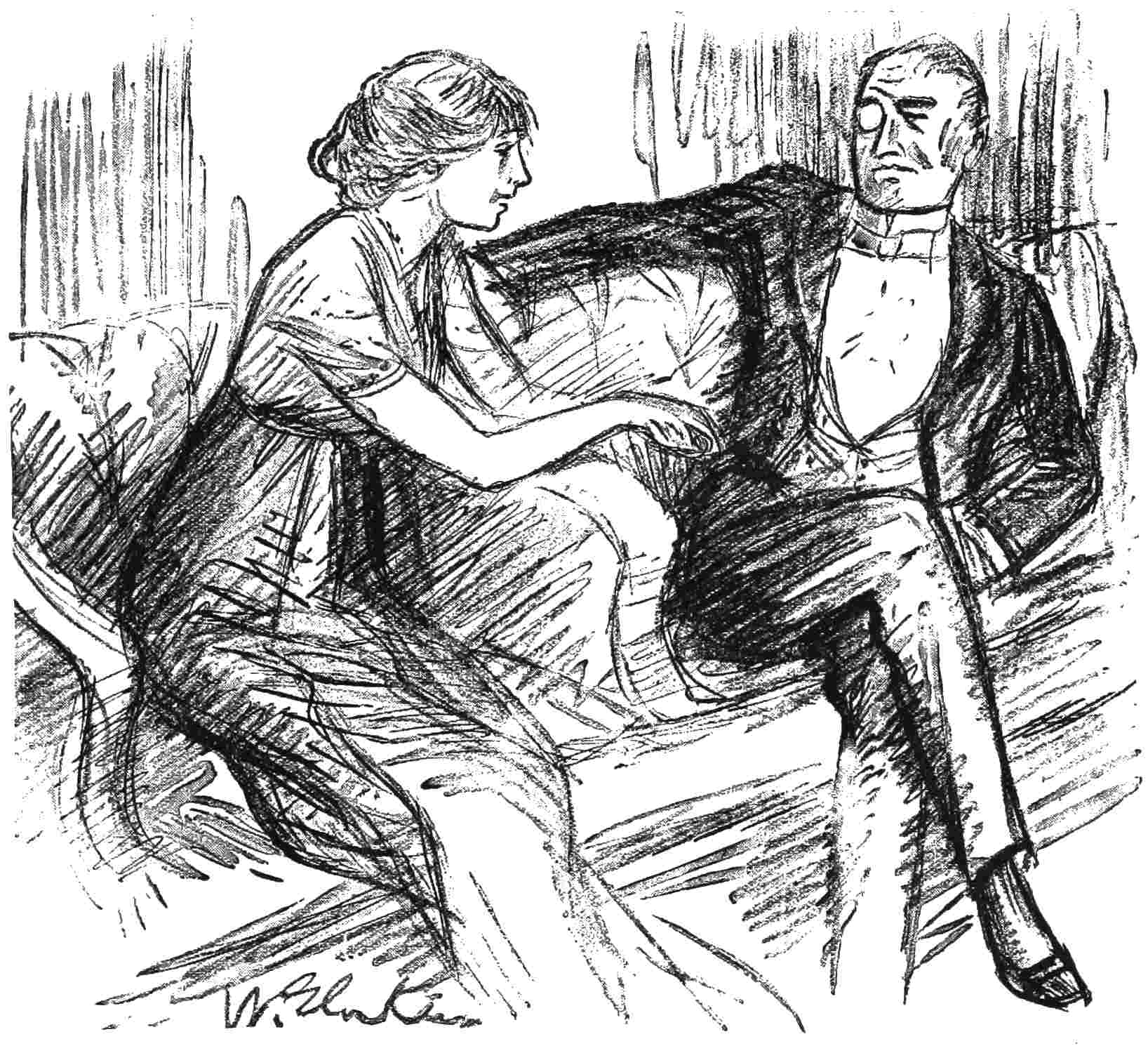
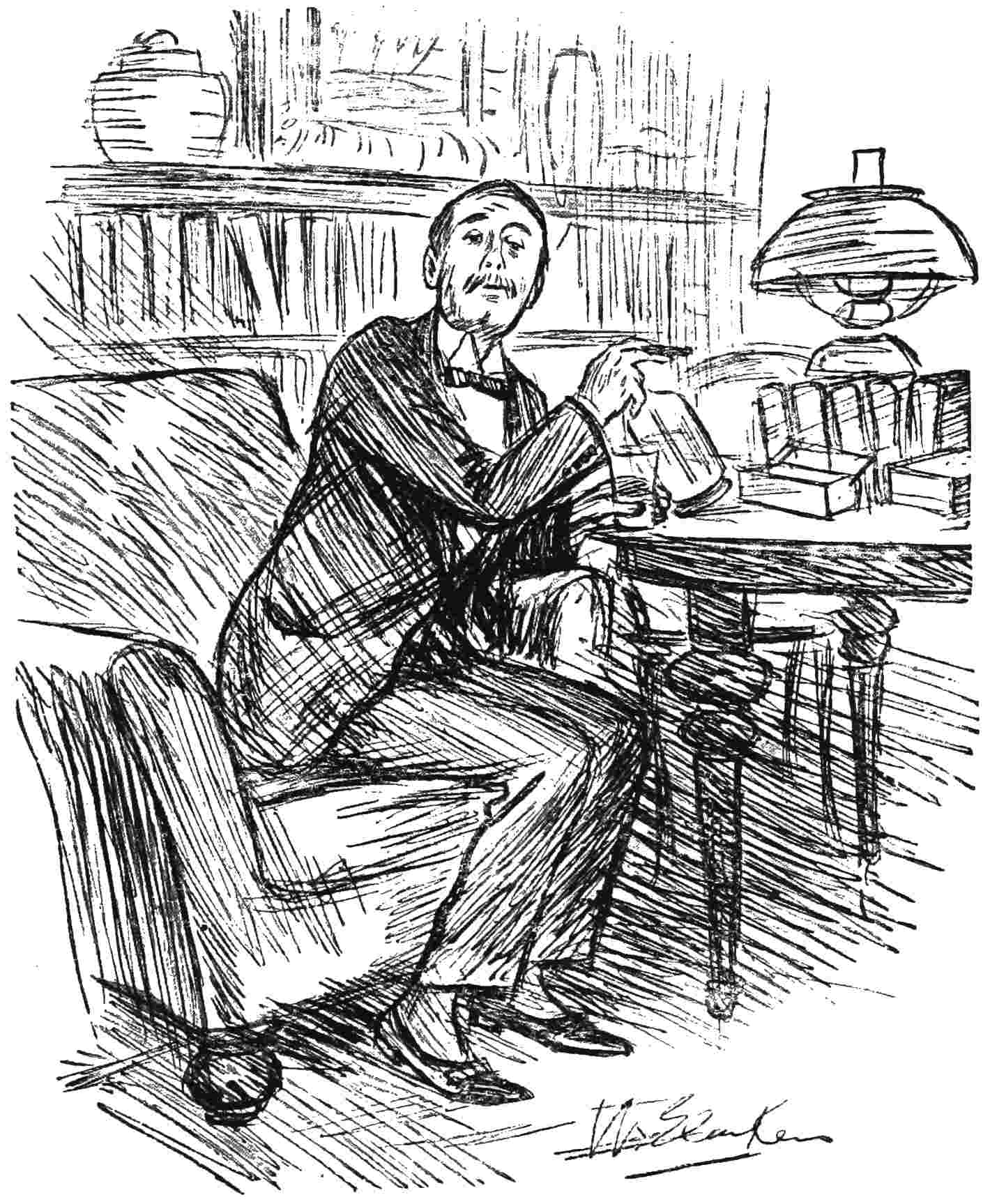
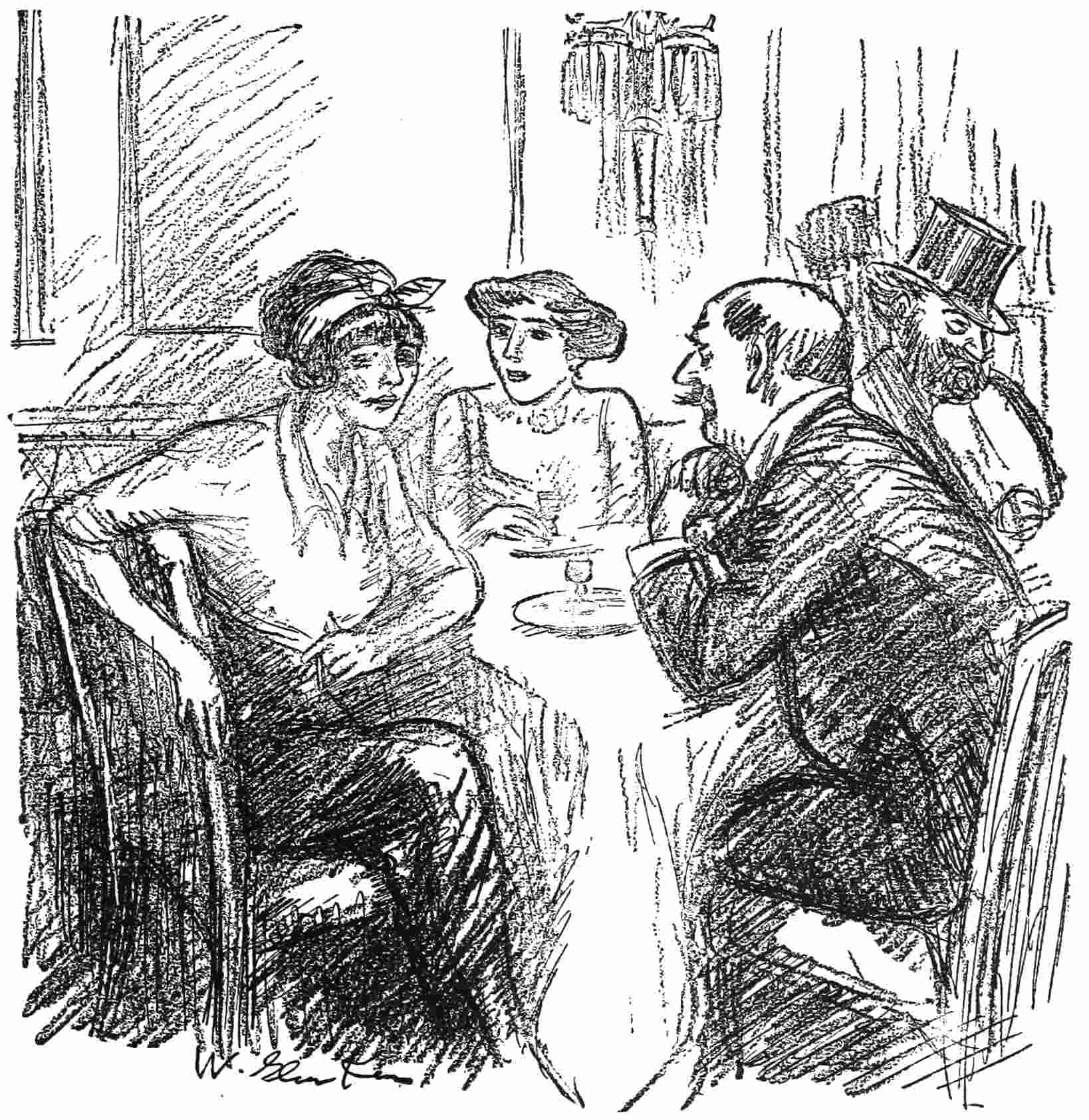
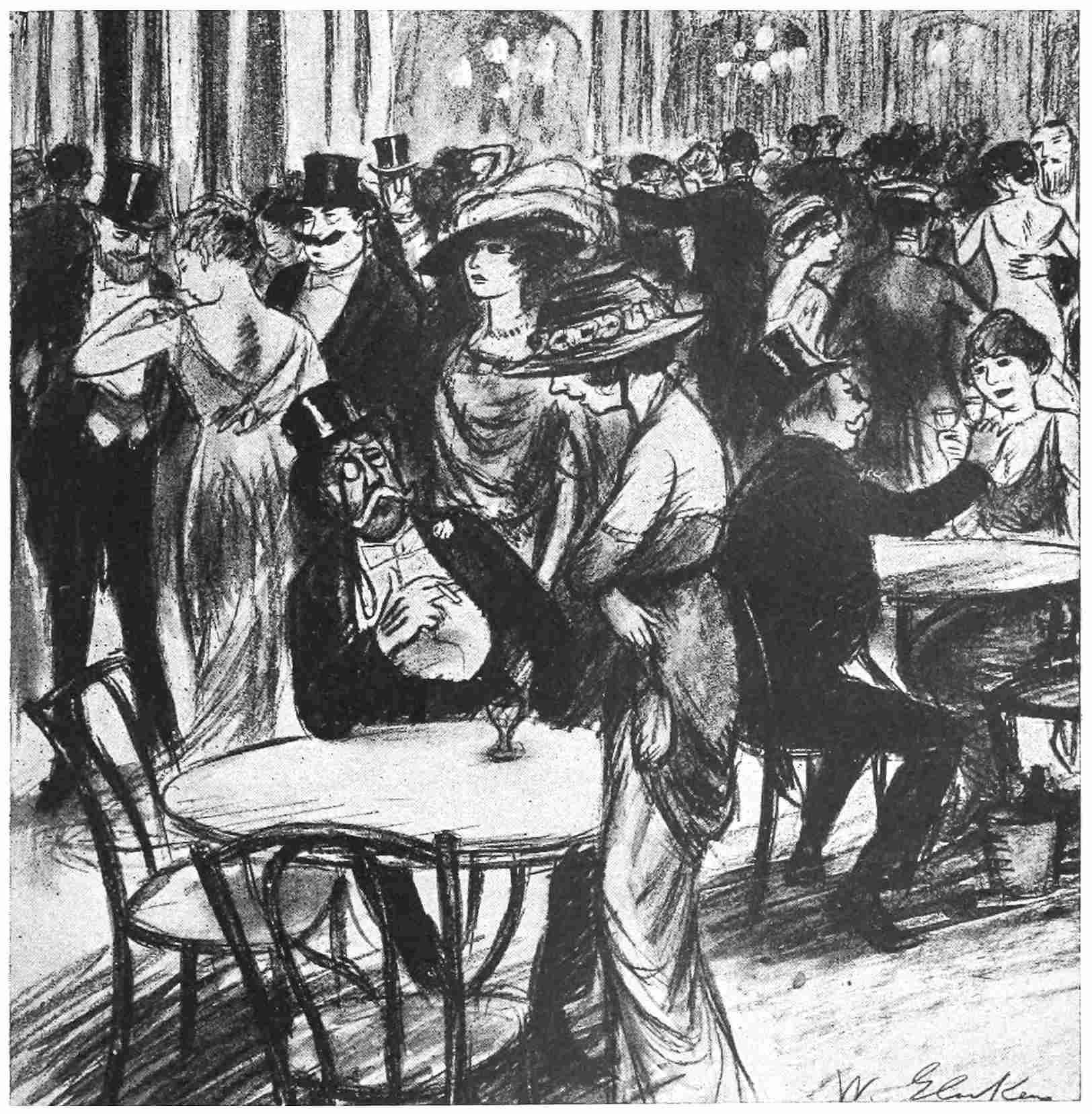
One of those really interesting conversations between
Barfleur and Miss X.
This is a section of Barfleur—not all, mind you, but
a section.
Miss X.—I think I have described her fully enough,
but I shall add one passing thought. A little experience
of Europe—considerable of its show places—had
taught her, or convinced her rather, that America did not
know how to live. You will hear much of that fact, I
am afraid, during the rest of these pages, but it is especially
important just here. My lady, prettily gowned,
perfectly manicured, going to meet her lover at London
or Fishguard or Liverpool, is absolutely satisfied that
America does not know how to live. She herself has almost
learned. She is most comfortably provided for at
present. Anyhow, she has champagne every night at
dinner. Her equipment in the matter of toilet articles
and leather traveling bags is all that it should be. The
latter are colored to suit her complexion and gowns.
She is scented, polished, looked after, and all men pay
her attention. She is vain, beautiful, and she thinks
that America is raw, uncouth; that its citizens of whom
she is one, do not know how to live. Quite so. Now
we come to the point.
It would be hard to describe this conversation. It began
with some “have you been’s,” I think, and concerned
eating-places and modes of entertainment in London,
Paris and Monte Carlo. I gathered by degrees, that in
London, Paris and elsewhere there were a hundred restaurants,
a hundred places to live, each finer than the
other. I heard of liberty of thought and freedom of
action and pride of motion which made me understand
that there is a free-masonry which concerns the art of
living, which is shared only by the initiated. There was
a world in which conventions, as to morals, have no
place; in which ethics and religion are tabooed. Art is
the point. The joys of this world are sex, beauty, food,
clothing, art. I should say money, of course, but money
is presupposed. You must have it.
“Oh, I went to that place one day and then I was
glad enough to get back to the Ritz at forty francs for
my room.” She was talking of her room by the day,
and the food, of course, was extra. The other hotel
had been a little bit quiet or dingy.
I opened my eyes slightly, for I thought Paris was
reasonable; but not so—no more so than New York,
I understood, if you did the same things.
“And, oh, the life!” said Miss X. at one point.
“Americans don’t know how to live. They are all engaged
in doing something. They are such beginners.
They are only interested in money. They don’t know.
I see them in Paris now and then.” She lifted her hand.
“Here in Europe people understand life better. They
know. They know before they begin how much it will
take to do the things that they want to do and they start
out to make that much—not a fortune—just enough
to do the things that they want to do. When they get
that they retire and live.”
“And what do they do when they live?” I asked.
“What do they call living?”
“Oh, having a nice country-house within a short traveling
distance of London or Paris, and being able to dine
at the best restaurants and visit the best theaters once or
twice a week; to go to Paris or Monte Carlo or Scheveningen
or Ostend two or three or four, or as many times
a year as they please; to wear good clothes and to be
thoroughly comfortable.”
“That is not a bad standard,” I said, and then I added,
“And what else do they do?”
“And what else should they do? Isn’t that enough?”
And there you have the European standard according
to Miss X. as contrasted with the American standard
which is, or has been up to this time, something decidedly
different, I am sure. We have not been so eager to live.
Our idea has been to work. No American that I have
ever known has had the idea of laying up just so much,
a moderate amount, and then retiring and living. He
has had quite another thought in his mind. The American—the
average American—I am sure loves power,
the ability to do something, far more earnestly than he
loves mere living. He wants to be an officer or a director
of something, a poet, anything you please for the
sake of being it—not for the sake of living. He loves
power, authority, to be able to say, “Go and he goeth,”
or, “Come and he cometh.” The rest he will waive.
Mere comfort? You can have that. But even that,
according to Miss X., was not enough for her. She had
told me before, and this conversation brought it out
again, that her thoughts were of summer and winter
resorts, exquisite creations in the way of clothing, diamonds,
open balconies of restaurants commanding charming
vistas, gambling tables at Monte Carlo, Aix-les-Bains,
Ostend and elsewhere, to say nothing of absolutely untrammeled
sex relations. English conventional women
were frumps and fools. They had never learned how to
live; they had never understood what the joy of freedom
in sex was. Morals—they are built up on a lack of
imagination and physical vigor; tenderness—well, you
have to take care of yourself; duty—there isn’t any such
thing. If there is, it’s one’s duty to get along and have
money and be happy.
CHAPTER III AT FISHGUARD
While I was lying in my berth the fifth morning,
I heard the room steward outside my
door tell some one that he thought we reached
Fishguard at one-thirty.
I packed my trunks, thinking of this big ship and the
fact that my trip was over and that never again could I
cross the Atlantic for the first time. A queer world this.
We can only do any one thing significantly once. I remember
when I first went to Chicago, I remember when
I first went to St. Louis, I remember when I first went
to New York. Other trips there were, but they are lost
in vagueness. But the first time of any important thing
sticks and lasts; it comes back at times and haunts you
with its beauty and its sadness. You know so well you
cannot do that any more; and, like a clock, it ticks and
tells you that life is moving on. I shall never come to
England any more for the first time. That is gone and
done for—worse luck.
So I packed—will you believe it?—a little sadly.
I think most of us are a little silly at times, only we are
cautious enough to conceal it. There is in me the spirit
of a lonely child somewhere and it clings pitifully to
the hand of its big mama, Life, and cries when it is
frightened; and then there is a coarse, vulgar exterior
which fronts the world defiantly and bids all and
sundry to go to the devil. It sneers and barks and jeers
bitterly at times, and guffaws and cackles and has a
joyous time laughing at the follies of others.
Then I went to hunt Barfleur to find out how I should
do. How much was I to give the deck-steward; how
much to the bath-steward; how much to the room-steward;
how much to the dining-room steward; how
much to “boots,” and so on.
“Look here!” observed that most efficient of all managerial
souls that I have ever known. “I’ll tell you
what you do. No—I’ll write it.” And he drew forth
an ever ready envelope. “Deck-steward—so much,”
it read, “Room steward—so much—” etc.
I went forthwith and paid them, relieving my soul of
a great weight. Then I came on deck and found that I
had forgotten to pack my ship blanket, and a steamer
rug, which I forthwith went and packed. Then I discovered
that I had no place for my derby hat save on
my head, so I went back and packed my cap. Then I
thought I had lost one of my brushes, which I hadn’t,
though I did lose one of my stylo pencils. Finally I
came on deck and sang coon songs with Miss X., sitting
in our steamer chairs. The low shore of Ireland had
come into view with two faint hills in the distance and
these fascinated me. I thought I should have some
slight emotion on seeing land again, but I didn’t. It was
gray and misty at first, but presently the sun came out
beautifully clear and the day was as warm as May in
New York. I felt a sudden elation of spirits with the
coming of the sun, and I began to think what a lovely
time I was going to have in Europe.
Miss X. was a little more friendly this morning than
heretofore. She was a tricky creature—coy, uncertain
and hard to please. She liked me intellectually and
thought I was able, but her physical and emotional predilections,
so far as men are concerned, did not include
me.
We rejoiced together singing, and then we fought.
There is a directness between experienced intellects which
waves aside all formalities. She had seen a lot of life;
so had I.
She said she thought she would like to walk a little, and
we strolled back along the heaving deck to the end
of the first cabin section and then to the stern. When
we reached there the sky was overcast again, for it was
one of those changeable mornings which is now gray,
now bright, now misty. Just now the heavens were
black and lowering with soft, rain-charged clouds, like
the wool of a smudgy sheep. The sea was a rich green
in consequence—not a clear green, but a dark, muddy,
oil-green. It rose and sank in its endless unrest and one
or two boats appeared—a lightship, anchored out all
alone against the lowering waste, and a small, black, passenger
steamer going somewhere.
“I wish my path in life were as white as that and as
straight,” observed Miss X., pointing to our white, propeller-churned
wake which extended back for half a mile
or more.
“Yes,” I observed, “you do and you don’t. You do,
if it wouldn’t cost you trouble in the future—impose
the straight and narrow, as it were.”
“Oh, you don’t know,” she exclaimed irritably, that
ugly fighting light coming into her eyes, which I had
seen there several times before. “You don’t know what
my life has been. I haven’t been so bad. We all of us
do the best we can. I have done the best I could, considering.”
“Yes, yes,” I observed, “you’re ambitious and alive
and you’re seeking—Heaven knows what! You would
be adorable with your pretty face and body if you were
not so—so sophisticated. The trouble with you is—”
“Oh, look at that cute little boat out there!” She was
talking of the lightship. “I always feel sorry for a
poor little thing like that, set aside from the main tide
of life and left lonely—with no one to care for it.”
“The trouble with you is,” I went on, seizing this
new remark as an additional pretext for analysis,
“you’re romantic, not sympathetic. You’re interested
in that poor little lonely boat because its state is romantic;
not pathetic. It may be pathetic, but that isn’t the point
with you.”
“Well,” she said, “if you had had all the hard knocks
I have had, you wouldn’t be sympathetic either. I’ve
suffered, I have. My illusions have been killed dead.”
“Yes. Love is over with you. You can’t love any
more. You can like to be loved, that’s all. If it were
the other way about—”
I paused to think how really lovely she would be with
her narrow lavender eyelids; her delicate, almost retroussé,
little nose; her red cupid’s-bow mouth.
“Oh,” she exclaimed, with a gesture of almost religious
adoration. “I cannot love any one person any
more, but I can love love, and I do—all the delicate
things it stands for.”
“Flowers,” I observed, “jewels, automobiles, hotel
bills, fine dresses.”
“Oh, you’re brutal. I hate you. You’ve said the
cruelest, meanest things that have ever been said to me.”
“But they’re so.”
“I don’t care. Why shouldn’t I be hard? Why
shouldn’t I love to live and be loved? Look at my life.
See what I’ve had.”
“You like me, in a way?” I suggested.
“I admire your intellect.”
“Quite so. And others receive the gifts of your personality.”
“I can’t help it. I can’t be mean to the man I’m with.
He’s good to me. I won’t. I’d be sinning against the
only conscience I have.”
“Then you have a conscience?”
“Oh, you go to the devil!”
But we didn’t separate by any means.
They were blowing a bugle for lunch when we came
back, and down we went. Barfleur was already at table.
The orchestra was playing Auld Lang Syne, Home Sweet
Home, Dixie and the Suwannee River. It even played
one of those delicious American rags which I love so
much—the Oceana Roll. I felt a little lump in my
throat at Auld Lang Syne and Dixie, and together Miss
X. and I hummed the Oceana Roll as it was played.
One of the girl passengers came about with a plate to
obtain money for the members of the orchestra, and
half-crowns were universally deposited. Then I started
to eat my dessert; but Barfleur, who had hurried off,
came back to interfere.
“Come, come!” (He was always most emphatic.)
“You’re missing it all. We’re landing.”
I thought we were leaving at once. The eye behind
the monocle was premonitory of some great loss to me.
I hurried on deck—to thank his artistic and managerial
instinct instantly I arrived there. Before me was Fishguard
and the Welsh coast, and to my dying day I shall
never forget it. Imagine, if you please, a land-locked
harbor, as green as grass in this semi-cloudy, semi-gold-bathed
afternoon, with a half-moon of granite scarp
rising sheer and clear from the green waters to the low
gray clouds overhead. On its top I could see fields laid
out in pretty squares or oblongs, and at the bottom of
what to me appeared to be the east end of the semi-circle,
was a bit of gray scruff, which was the village no doubt.
On the green water were several other boats—steamers,
much smaller, with red stacks, black sides, white rails and
funnels—bearing a family resemblance to the one we
were on. There was a long pier extending out into the
water from what I took to be the village and something
farther inland that looked like a low shed.
This black hotel of a ship, so vast, so graceful, now
rocking gently in the enameled bay, was surrounded this
hour by wheeling, squeaking gulls. I always like the
squeak of a gull; it reminds me of a rusty car wheel, and,
somehow, it accords with a lone, rocky coast. Here they
were, their little feet coral red, their beaks jade gray,
their bodies snowy white or sober gray, wheeling and
crying—“my heart remembers how.” I looked at them
and that old intense sensation of joy came back—the
wish to fly, the wish to be young, the wish to be happy,
the wish to be loved.
But, my scene, beautiful as it was, was slipping
away. One of the pretty steamers I had noted lying on
the water some distance away, was drawing alongside—to
get mails, first, they said. There were hurrying and
shuffling people on all the first cabin decks. Barfleur
was forward looking after his luggage. The captain
stood on the bridge in his great gold-braided blue overcoat.
There were mail chutes being lowered from our
giant vessel’s side, and bags and trunks and boxes and
bales were then sent scuttling down. I saw dozens of
uniformed men and scores of ununiformed laborers
briskly handling these in the sunshine. My fellow passengers
in their last hurrying hour interested me, for I
knew I should see them no more; except one or two,
perhaps.
While we were standing here I turned to watch an
Englishman, tall, assured, stalky, stary. He had been
soldiering about for some time, examining this, that and
the other in his critical, dogmatic British way. He had
leaned over the side and inspected the approaching
lighters, he had stared critically and unpoetically at the
gulls which were here now by hundreds, he had observed
the landing toilet of the ladies, the material equipment
of the various men, and was quite evidently satisfied that
he himself was perfect, complete. He was aloof, chilly,
decidedly forbidding and judicial.
Finally a cabin steward came hurrying out to him.
“Did you mean to leave the things you left in your
room unpacked?” he asked. The Englishman started,
stiffened, stared. I never saw a self-sufficient man so
completely shaken out of his poise.
“Things in my room unpacked?” he echoed. “What
room are you talking about? My word!”
“There are three drawers full of things in there, sir,
unpacked, and they’re waiting for your luggage now,
sir!”
“My word!” he repeated, grieved, angered, perplexed.
“My word! I’m sure I packed everything. Three
drawers full! My word!” He bustled off stiffly. The
attendant hastened cheerfully after. It almost gave me a
chill as I thought of his problem. And they hurry so at
Fishguard. He was well paid out, as the English say,
for being so stalky and superior.
Then the mail and trunks being off, and that boat
having veered away, another and somewhat smaller one
came alongside and we first, and then the second class
passengers, went aboard, and I watched the great ship
growing less and less as we pulled away from it.
It was immense from alongside, a vast skyscraper of
a ship. At a hundred feet, it seemed not so large,
but more graceful; at a thousand feet, all its exquisite
lines were perfect—its bulk not so great, but the
pathos of its departing beauty wonderful; at two thousand
feet, it was still beautiful against the granite ring
of the harbor; but, alas, it was moving. The captain
was an almost indistinguishable spot upon his
bridge. The stacks—in their way gorgeous—took
on beautiful proportions. I thought, as we veered in
near the pier and the ship turned within her length or
thereabouts and steamed out, I had never seen a more
beautiful sight. Her convoy of gulls was still about
her. Her smoke-stacks flung back their graceful streamers.
The propeller left a white trail of foam. I asked
some one: “When does she get to Liverpool?”
“At two in the morning.”
“And when do the balance of the passengers land?”
(We had virtually emptied the first cabin.)
“At seven, I fancy.”
Just then the lighter bumped against the dock. I
walked under a long, low train-shed covering four tracks,
and then I saw my first English passenger train—a semi-octagonal-looking
affair—(the ends of the cars certainly
looked as though they had started out to be
octagonal) and there were little doors on the sides labeled
“First,” “First,” “First.” On the side, at the top of
the car, was a longer sign: “Cunard Ocean Special—London—Fishguard.”
CHAPTER IV SERVANTS AND POLITENESS
Right here I propose to interpolate my second dissertation
on the servant question and I can safely
promise, I am sure, that it will not be the last.
One night, not long before, in dining with a certain
Baron N. and Barfleur at the Ritz in New York this
matter of the American servant came up in a conversational
way. Baron N. was a young exquisite of Berlin
and other European capitals. He was one of Barfleur’s
idle fancies. Because we were talking about
America in general I asked them both what, to them,
was the most offensive or objectionable thing about
America. One said, expectorating; the other said, the
impoliteness of servants. On the ship going over, at
Fishguard, in the train from Fishguard to London, at
London and later in Barfleur’s country house I saw what
the difference was. Of course I had heard these differences
discussed before ad lib. for years, but hearing is
not believing. Seeing and experiencing is.
On shipboard I noticed for the first time in my life that
there was an aloofness about the service rendered by the
servants which was entirely different from that which
we know in America. They did not look at one so
brutally and critically as does the American menial; their
eyes did not seem to say, “I am your equal or better,”
and their motions did not indicate that they were doing
anything unwillingly. In America—and I am a good
American—I have always had the feeling that the
American hotel or house servant or store clerk—particularly
store clerk—male or female—was doing me a
great favor if he did anything at all for me. As for
train-men and passenger-boat assistants, I have never
been able to look upon them as servants at all. Mostly
they have looked on me as an interloper, and as some one
who should be put off the train, instead of assisted in
going anywhere. American conductors are Czars;
American brakemen and train hands are Grand Dukes,
at least; a porter is little less than a highwayman; and a
hotel clerk—God forbid that we should mention him in
the same breath with any of the foregoing!
However, as I was going on to say, when I went
aboard the English ship in question I felt this burden of
serfdom to the American servant lifted. These people,
strange to relate, did not seem anxious to fight with me.
They were actually civil. They did not stare me out of
countenance; they did not order me gruffly about. And,
really, I am not a princely soul looking for obsequious
service. I am, I fancy, a very humble-minded person
when traveling or living, anxious to go briskly forward,
not to be disturbed too much and allowed to live in quiet
and seclusion.
The American servant is not built for that. One must
have great social or physical force to command him. At
times he needs literally to be cowed by threats of physical
violence. You are paying him? Of course you are.
You help do that when you pay your hotel bill or buy
your ticket, or make a purchase, but he does not know
that. The officials of the companies for whom he works
do not appear to know. If they did, I don’t know that
they would be able to do anything about it. You can not
make a whole people over by issuing a book of rules.
Americans are free men; they don’t want to be servants;
they have despised the idea for years. I think the early
Americans who lived in America after the Revolution—the
anti-Tory element—thought that after the war and
having won their nationality there was to be an end
of servants. I think they associated labor of this kind
with slavery, and they thought when England had been
defeated all these other things, such as menial service,
had been defeated also. Alas, superiority and inferiority
have not yet been done away with—wholly. There are
the strong and the weak; the passionate and passionless;
the hungry and the well-fed. There are those who still
think that life is something which can be put into a mold
and adjusted to a theory, but I am not one of them. I
cannot view life or human nature save as an expression
of contraries—in fact, I think that is what life is. I
know there can be no sense of heat without cold; no
fullness without emptiness; no force without resistance;
no anything, in short, without its contrary. Consequently,
I cannot see how there can be great men without
little ones; wealth without poverty; social movement
without willing social assistance. No high without
a low, is my idea, and I would have the low be
intelligent, efficient, useful, well paid, well looked after.
And I would have the high be sane, kindly, considerate,
useful, of good report and good-will to all men.
Years of abuse and discomfort have made me
rather antagonistic to servants, but I felt no reasonable
grounds for antagonism here. They were behaving
properly. They weren’t staring at me. I didn’t catch
them making audible remarks behind my back. They
were not descanting unfavorably upon any of my fellow
passengers. Things were actually going smoothly and
nicely and they seemed rather courteous about it all.
Yes, and it was so in the dining-saloon, in the bath, on
deck, everywhere, with “yes, sirs,” and “thank you,
sirs,” and two fingers raised to cap visors occasionally
for good measure. Were they acting? Was this a
fiercely suppressed class I was looking upon here? I
could scarcely believe it. They looked too comfortable.
I saw them associating with each other a great deal. I
heard scraps of their conversation. It was all peaceful
and genial and individual enough. They were, apparently,
leading unrestricted private lives. However, I reserved
judgment until I should get to England, but at
Fishguard it was quite the same and more also. These
railway guards and porters and conductors were not our
railway conductors, brakemen and porters, by a long shot.
They were different in their attitude, texture and
general outlook on life. Physically I should say that
American railway employees are superior to the European
brand. They are, on the whole, better fed, or at least
better set up. They seem bigger to me, as I recall them;
harder, stronger. The English railway employee seems
smaller and more refined physically—less vigorous.
But as to manners: Heaven save the mark! These
people are civil. They are nice. They are willing.
“Have you a porter, sir? Yes, sir! Thank you, sir!
This way, sir! No trouble about that, sir! In a moment,
sir! Certainly, sir! Very well, sir!” I heard
these things on all sides and they were like balm to a
fevered brain. Life didn’t seem so strenuous with these
people about. They were actually trying to help me
along. I was led; I was shown; I was explained to. I
got under way without the least distress and I began
actually to feel as though I was being coddled. Why, I
thought, these people are going to spoil me. I’m going
to like them. And I had rather decided that I wouldn’t
like the English. Why, I don’t know; for I never read
a great English novel that I didn’t more or less like all
of the characters in it. Hardy’s lovely country people
have warmed the cockles of my heart; George Moore’s
English characters have appealed to me. And here was
Barfleur. But the way the train employees bundled me
into my seat and got my bags in after or before me, and
said, “We shall be starting now in a few minutes, sir,”
and called quietly and pleadingly—not yelling, mind
you—“Take your seats, please,” delighted me.
I didn’t like the looks of the cars. I can prove in a
moment by any traveler that our trains are infinitely more
luxurious. I can see where there isn’t heat enough, and
where one lavatory for men and women on any train,
let alone a first-class one, is an abomination, and so on
and so forth; but still, and notwithstanding, I say the
English railway service is better. Why? Because it’s
more human; it’s more considerate. You aren’t driven
and urged to step lively and called at in loud, harsh
voices and made to feel that you are being tolerated
aboard something that was never made for you at all,
but for the employees of the company. In England the
trains are run for the people, not the people for the trains.
And now that I have that one distinct difference between
England and America properly emphasized I feel much
better.
CHAPTER V THE RIDE TO LONDON
At last the train was started and we were off.
The track was not so wide, if I am not mistaken,
as ours, and the little freight or goods cars were
positively ridiculous—mere wheelbarrows, by comparison
with the American type. As for the passenger cars,
when I came to examine them, they reminded me of
some of our fine street cars that run from, say Schenectady
to Gloversville, or from Muncie to Marion, Indiana.
They were the first-class cars, too—the English Pullmans!
The train started out briskly and you could feel
that it did not have the powerful weight to it which the
American train has. An American Pullman creaks
audibly, just as a great ship does when it begins to
move. An American engine begins to pull slowly because
it has something to pull—like a team with a
heavy load. I didn’t feel that I was in a train half so
much as I did that I was in a string of baby carriages.
Miss X. and her lover, Miss E. and her maid, Barfleur
and I comfortably filled one little compartment; and now
we were actually moving, and I began to look out at once
to see what English scenery was really like. It was not
at all strange to me, for in books and pictures I had seen
it all my life. But here were the actual hills and valleys,
the actual thatched cottages, and the actual castles or
moors or lovely country vistas, and I was seeing them!
As I think of it now I can never be quite sufficiently
grateful to Barfleur for a certain affectionate, thoughtful,
sympathetic regard for my every possible mood on this occasion.
This was my first trip to this England of which,
of course, he was intensely proud. He was so humanly
anxious that I should not miss any of its charms or, if
need be, defects. He wanted me to be able to judge it
fairly and humanly and to see the eventual result sieved
through my temperament. The soul of attention; the
soul of courtesy; patient, long-suffering, humane, gentle.
How I have tried the patience of that man at times!
An iron mood he has on occasion; a stoic one,
always. Gentle, even, smiling, living a rule and a
standard. Every thought of him produces a grateful
smile. Yet he has his defects—plenty of them. Here
he was at my elbow, all the way to London, momentarily
suggesting that I should not miss the point, whatever
the point might be, at the moment. He was helpful,
really interested, and above all and at all times, warmly
human.
We had been just two hours getting from the boat to
the train. It was three-thirty when the train began to
move, and from the lovely misty sunshine of the morning
the sky had become overcast with low, gray—almost
black—rain clouds. I looked at the hills and valleys.
They told me we were in Wales. And, curiously, as we
sped along first came Wordsworth into my mind, and
then Thomas Hardy. I thought of Wordsworth first
because these smooth, kempt hills, wet with the rain and
static with deep gray shadows, suggested him. England
owes so much to William Wordsworth, I think. So
far as I can see, he epitomized in his verses this sweet,
simple hominess that tugs at the heart-strings like some
old call that one has heard before. My father was a
German, my mother of Pennsylvania Dutch extraction,
and yet there is a pull here in this Shakespearian-Wordsworthian-Hardyesque
world which is precisely like the
call of a tender mother to a child. I can’t resist it. I
love it; and I am not English but radically American.
I understand that Hardy is not so well thought of in
England as he might be—that, somehow, some large
conservative class thinks that his books are immoral
or destructive. I should say the English would better
make much of Thomas Hardy while he is alive. He is
one of their great traditions. His works are beautiful.
The spirit of all the things he has done or attempted is
lovely. He is a master mind, simple, noble, dignified,
serene. He is as fine as any of the English cathedrals.
St. Paul’s or Canterbury has no more significance to
me than Thomas Hardy. I saw St. Paul’s. I wish I
could see the spirit of Thomas Hardy indicated in some
such definite way. And yet I do not. Monuments do not
indicate great men. But the fields and valleys of a
country suggest them.
At twenty or thirty miles from Fishguard we came
to some open water—an arm of the sea, I understood—the
Bay of Bristol, where boats were, and tall, rain-gutted
hills that looked like tumbled-down castles.
Then came more open country—moorland, I suppose—with
some sheep, once a flock of black ones; and then
the lovely alternating hues of this rain-washed world.
The water under these dark clouds took on a peculiar
luster. It looked at times like burnished steel—at times
like muddy lead. I felt my heart leap up as I thought
of our own George Inness and what he would have done
with these scenes and what the English Turner has done,
though he preferred, as a rule, another key.
At four-thirty one of the charming English trainmen
came and asked if we would have tea in the dining-car.
We would. We arose and in a few moments were entering
one of those dainty little basket cars. The tables
were covered with white linen and simple, pretty china
and a silver tea-service. It wasn’t as if you were traveling
at all. I felt as though I were stopping at the house
of a friend; or as though I were in the cozy corner of
some well-known and friendly inn. Tea was served.
We ate toast and talked cheerfully.
This whole trip—the landscape, the dining-car, this
cozy tea, Miss X. and her lover, Miss E. and Barfleur—finally
enveloped my emotional fancy like a dream.
I realized that I was experiencing a novel situation
which would not soon come again. The idea of this
pretty mistress coming to England to join her lover,
and so frankly admitting her history and her purpose,
rather took my mind as an intellectual treat.
You really don’t often get to see this sort of thing.
I don’t. It’s Gallic in its flavor, to me. Barfleur,
being a man of the world, took it as a matter of course—his
sole idea being, I fancy, that the refinement of
personality and thought involved in the situation were
sufficient to permit him to tolerate it. I always judge
his emotion by that one gleaming eye behind the monocle.
The other does not take my attention so much. I knew
from his attitude that ethics and morals and things like
that had nothing to do with his selection of what
he would consider interesting personal companionship.
Were they interesting? Could they tell him
something new? Would they amuse him? Were they
nice—socially, in their clothing, in their manners, in
the hundred little material refinements which make up
a fashionable lady or gentleman? If so, welcome. If
not, hence. And talent! Oh, yes, he had a keen eye
for talent. And he loves the exceptional and will obviously
do anything and everything within his power
to foster it.
Having started so late, it grew nearly dark after tea
and the distant landscapes were not so easy to descry.
We came presently, in the mist, to a place called Carmarthen,
I think, where were great black stacks and
flaming forges and lights burning wistfully in the dark;
and then to another similar place, Swansea, and finally
to a third, Cardiff—great centers of manufacture, I
should judge, for there were flaming lights from forges
(great, golden gleams from open furnaces) and dark
blue smoke, visible even at this hour, from tall stacks
overhead, and gleaming electric lights like bright, lucent
diamonds.
I never see this sort of place but I think of Pittsburgh
and Youngstown and the coke ovens of western Pennsylvania
along the line of the Pennsylvania Railroad. I
shall never forget the first time I saw Pittsburgh and
Youngstown and saw how coke was fired. It was on
my way to New York. I had never seen any mountains
before and suddenly, after the low, flat plains of Indiana
and Ohio, with their pretty little wooden villages so
suggestive of the new life of the New World, we rushed
into Youngstown and then the mountains of western
Pennsylvania (the Alleghanies). It was somewhat like
this night coming from Fishguard, only it was not so
rainy. The hills rose tall and green; the forge stacks
of Pittsburgh flamed with a red gleam, mile after
mile, until I thought it was the most wonderful sight
I had ever seen. And then came the coke ovens,
beyond Pittsburgh mile after mile of them, glowing
ruddily down in the low valleys between the tall
hills, where our train was following a stream-bed.
It seemed a great, sad, heroic thing then, to me,—plain
day labor. Those common, ignorant men,
working before flaming forges, stripped to the waist in
some instances, fascinated my imagination. I have always
marveled at the inequalities of nature—the way
it will give one man a low brow and a narrow mind, a
narrow round of thought, and make a slave or horse of
him, and another a light, nimble mind, a quick wit and
air and make a gentleman of him. No human being
can solve either the question of ability or utility. Is your
gentleman useful? Yes and no, perhaps. Is your laborer
useful? Yes and no, perhaps. I should say obviously
yes. But see the differences in the reward of
labor—physical labor. One eats his hard-earned crust
in the sweat of his face; the other picks at his surfeit
of courses and wonders why this or that doesn’t taste
better. I did not make my mind. I did not make my
art. I cannot choose my taste except by predestined
instinct, and yet here I am sitting in a comfortable
English home, as I write, commiserating the poor working
man. I indict nature here and now, as I always do
and always shall do, as being aimless, pointless, unfair,
unjust. I see in the whole thing no scheme but an accidental
one—no justice save accidental justice. Now
and then, in a way, some justice is done, but it is accidental;
no individual man seems to will it. He can’t.
He doesn’t know how. He can’t think how. And
there’s an end of it.
But these queer, weird, hard, sad, drab manufacturing
cities—what great writer has yet sung the song of them?
Truly I do not recall one at present clearly. Dickens
gives some suggestion of what he considered the
misery of the poor; and in “Les Miserables” there
is a touch of grim poverty and want here and there.
But this is something still different. This is creative
toil on a vast scale, and it is a lean, hungry, savage,
animal to contemplate. I know it is because I have studied
personally Fall River, Patterson and Pittsburgh, and
I know what I’m talking about. Life runs at a gaunt
level in those places. It’s a rough, hurtling world of
fact. I suppose it is not any different in England. I
looked at the manufacturing towns as we flashed by in
the night and got the same feeling of sad commiseration
and unrest. The homes looked poor and they had a
deadly sameness; the streets were narrow and poorly
lighted. I was eager to walk over one of these towns
foot by foot. I have the feeling that the poor and the
ignorant and the savage are somehow great artistically.
I have always had it. Millet saw it when he painted
“The Man with the Hoe.” These drab towns are
grimly wonderful to me. They sing a great diapason of
misery. I feel hunger and misery there; I feel lust and
murder and life, sick of itself, stewing in its own juice;
I feel women struck in the face by brutal men; and sodden
lives too low and weak to be roused by any storm of
woe. I fancy there are hungry babies and dying mothers
and indifferent bosses and noble directors somewhere,
not caring, not knowing, not being able to do anything
about it, perhaps, if they did. I could weep just
at the sight of a large, drab, hungry manufacturing
town. I feel sorry for ignorant humanity. I wish I
knew how to raise the low foreheads; to put the clear
light of intellect into sad, sodden eyes. I wish there
weren’t any blows, any hunger, any tears. I wish people
didn’t have to long bitterly for just the little thin,
bare necessities of this world. But I know, also, that
life wouldn’t be as vastly dramatic and marvelous without
them. Perhaps I’m wrong. I’ve seen some real
longing in my time, though. I’ve longed myself and
I’ve seen others die longing.
Between Carmarthen and Cardiff and some other
places where this drab, hungry world seemed to stick
its face into the window, I listened to much conversation
about the joyous side of living in Paris, Monte Carlo,
Ostend and elsewhere. I remember once I turned from
the contemplation of a dark, sad, shabby world scuttling
by in the night and rain to hear Miss E. telling of
some Parisian music-hall favorite—I’ll call her Carmen—rivaling
another Parisian music-hall favorite by the
name of Diane, let us say, at Monte Carlo. Of course
it is understood that they were women of loose virtue.
Of course it is understood that they had fine, white,
fascinating bodies and lovely faces and that they were
physically ideal. Of course it is understood that they
were marvelous mistresses and that money was flowing
freely from some source or other—perhaps from factory
worlds like these—to let them work their idle,
sweet wills. Anyhow they were gambling, racing, disporting
themselves at Monte Carlo and all at once they
decided to rival each other in dress. Or perhaps it was
that they didn’t decide to, but just began to, which is
much more natural and human.
As I caught it, with my nose pressed to the carriage
window and the sight of rain and mist in my eyes,
Carmen would come down one night in splendid white
silk, perhaps, her bare arms and perfect neck and hair
flashing priceless jewels; and then the fair Diane would
arrive a little later with her body equally beautifully
arrayed in some gorgeous material, her white arms
and neck and hair equally resplendent. Then the next
night the gowns would be of still more marvelous material
and artistry, and more jewels—every night lovelier
gowns and more costly jewels, until one of these
women took all her jewels, to the extent of millions of
francs, I presume, and, arraying her maid gorgeously,
put all the jewels on her and sent her into the casino or
the ballroom or the dining-room—wherever it was—and
she herself followed, in—let us hope—plain,
jewelless black silk, with her lovely flesh showing voluptuously
against it. And the other lady was there, oh,
much to her chagrin and despair now, of course, decked
with all her own splendid jewels to the extent of an
equally large number of millions of francs, and so the
rivalry was ended.
It was a very pretty story of pride and vanity and I
liked it. But just at this interesting moment, one of those
great blast furnaces, which I have been telling you
about and which seemed to stretch for miles beside the
track, flashed past in the night, its open red furnace
doors looking like rubies, and the frosted windows of
its lighted shops looking like opals, and the fluttering
street lamps and glittering arc lights looking like pearls
and diamonds; and I said: behold! these are the only
jewels of the poor and from these come the others. And
to a certain extent, in the last analysis and barring that
unearned gift of brain which some have without asking
and others have not at all, so they do.
It was seven or eight when we reached Paddington.
For one moment, when I stepped out of the car, the
thought came to me with a tingle of vanity—I have
come by land and sea, three thousand miles to London!
Then it was gone again. It was strange—this scene.
I recognized at once the various London types caricatured
in Punch, and Pick Me Up, and The Sketch, and
elsewhere. I saw a world of cabs and ‘busses, of porters,
gentlemen, policemen, and citizens generally. I
saw characters—strange ones—that brought back
Dickens and Du Maurier and W. W. Jacobs. The words
“Booking Office” and the typical London policeman took
my eye. I strolled about, watching the crowd till it was
time for us to board our train for the country;
and eagerly I nosed about, trying to sense London from
this vague, noisy touch of it. I can’t indicate how
the peculiar-looking trains made me feel. Humanity
is so very different in so many little unessential
things—so utterly the same in all the large ones. I
could see that it might be just as well or better to call
a ticket office a booking office; or to have three classes
of carriages instead of two, as with us; or to have carriages
instead of cars; or trams instead of street railways;
or lifts instead of elevators. What difference
does it make? Life is the same old thing. Nevertheless
there was a tremendous difference between the
London and the New York atmosphere—that I could
see and feel.
“A few days at my place in the country will be just
the thing for you,” Barfleur was saying. “I sent a
wireless to Dora to have a fire in the hall and in your
room. You might as well see a bit of rural England
first.”
He gleamed on me with his monocled eye in a very
encouraging manner.
We waited about quite awhile for a local or suburban
which would take us to Bridgely Level, and having ensconced
ourselves first class—as fitting my arrival—Barfleur
fell promptly to sleep and I mused with my
window open, enjoying the country and the cool night
air.
CHAPTER VI THE BARFLEUR FAMILY
I am writing these notes on Tuesday, November
twenty-eighth, very close to a grate fire in a pretty
little sitting-room in an English country house
about twenty-five miles from London, and I am very
chilly.
We reached this place by some winding road, inscrutable
in the night, and I wondered keenly what sort of an
atmosphere it would have. The English suburban or
country home of the better class has always been a concrete
thought to me—rather charming on the whole. A
carriage brought us, with all the bags and trunks carefully
looked after (in England you always keep your
luggage with you), and we were met in the hall by the
maid who took our coats and hats and brought us something
to drink. There was a small fire glowing in the
fireplace in the entrance hall, but it was so small—cheerful
though it was—that I wondered why Barfleur had
taken all the trouble to send a wireless from the sea to
have it there. It seems it is a custom, in so far as his
house is concerned, not to have it. But having heard
something of English fires and English ideas of warmth,
I was not greatly surprised.
“I am going to be cold,” I said to myself, at once. “I
know it. The atmosphere is going to be cold and raw
and I am going to suffer greatly. It will be the devil
and all to write.”
I fancy this is a very fair and pretty example of the
average country home near London, and it certainly
lacks none of the appointments which might be considered
worthy of a comfortable home; but it is as cold as a
sepulcher, and I can’t understand the evoluted system
of procedure which has brought about any such uncomfortable
state and maintains it as satisfactory. These
Britons are actually warm when the temperature in the
room is somewhere between forty-five and fifty and they
go about opening doors and windows with the idea that
the rooms need additional airing. They build you small,
weak coal fires in large, handsome fireplaces, and then
if the four or five coals huddled together are managing
to keep themselves warm by glowing, they tell you that
everything is all right (or stroll about, at least, looking
as though it were). Doors are left open; the casement
windows flung out, everything done to give the place air
and draughtiness.
“Now,” said my host, with his usual directness of
speech, as I stood with my back to the hall fireplace,
“I think it is best that you should go to bed at once and
get a good night’s rest. In the morning you shall have
your breakfast at whatever hour you say. Your bath
will be brought you a half or three-quarters of an hour
before you appear at table, so that you will have ample
time to shave and dress. I shall be here until eleven-fifteen
to see how you are getting along, after which I
shall go to the city. You shall have a table here, or
wherever you like, and the maid will serve your luncheon
punctually at two o’clock. At half past four your tea
will be brought to you, in case you are here. In the
evening we dine at seven-thirty. I shall be down on the
five fifty-two train.”
So he proceeded definitely to lay out my life for me
and I had to smile. “That vast established order which
is England,” I thought again. He accompanied me to
my chamber door, or rather to the foot of the stairs.
There he wished me pleasant dreams. “And remember,”
he cautioned me with the emphasis of one who has
forgotten something of great consequence, “this is most
important. Whatever you do, don’t forget to put out
your boots for the maid to take and have blacked.
Otherwise you will disrupt the whole social procedure
of England.”
It is curious—this feeling of being quite alone for the
first time in a strange land. I began to unpack my bags,
solemnly thinking of New York. Presently I went to
the window and looked out. One or two small lights
burned afar off. I undressed and got into bed, feeling
anything but sleepy. I lay and watched the fire flickering
on the hearth. So this was really England, and here
I was at last—a fact absolutely of no significance to
any one else in the world, but very important to me. An
old, old dream come true! And it had passed so oddly—the
trip—so almost unconsciously, as it were. We
make a great fuss, I thought, about the past and the
future, but the actual moment is so often without meaning.
Finally, after hearing a rooster crow and thinking
of Hamlet’s father—his ghost—and the chill that invests
the thought of cock-crow in that tragedy, I slept.
* * * * *
Morning came and with it a knocking on the door. I
called, “Come in.” In came the maid, neat, cleanly, rosy-cheeked,
bringing a large tin basin—very much wider
than an American tub but not so deep—a large water
can, full of hot water, towels and the like. She put the
tub and water can down, drew a towel rack from the
wall nearby, spread out the towels and left.
I did not hear her take the boots, but when I went to
the door they were gone. In the afternoon they were
back again, nice and bright. I speculated on all this as
an interesting demonstration of English life. Barfleur
is not so amazingly well-to-do, but he has all these things.
It struck me as pleasing, soothing, orderly—quite the
same thing I had been seeing on the train and the ship.
It was all a part of that interesting national system which
I had been hearing so much about.
At breakfast it was quite the same—a most orderly
meal. Barfleur was there to breakfast with me and see
that I was started right. His face was smiling. How
did I like it? Was I comfortable? Had I slept well?
Had I slept very well? It was bad weather, but I would
rather have to expect that at this season of the year.
I can see his smiling face—a little cynical and disillusioned—get
some faint revival of his own native interest
in England in my surprise, curiosity and interest.
The room was cold, but he did not seem to think so. No,
no, no, it was very comfortable. I was simply not acclimated
yet. I would get used to it.
This house was charming, I thought, and here at
breakfast I was introduced to the children. Berenice
Mary Barfleur, the only girl and the eldest child, looked
to me at first a little pale and thin—quite peaked,
in fact—but afterwards I found her not to be so—merely
a temperamental objection on my part to a type
which afterwards seemed to me very attractive. She
was a decidedly wise, high-spoken, intellectual and cynical
little maid. Although only eleven years of age she conversed
with the air, the manner and the words of a
woman of twenty.
“Oh, yes. Amáyreeka! Is that a nice place? Do
you like it?”
I cannot in the least way convey the touch of lofty,
well-bred feeling it had—quite the air and sound of a
woman of twenty-five or thirty schooled in all the niceties
of polite speech. “What a child,” I thought. “She
talks as though she were affected, but I can see that she
is not.” Quite different she seemed from what any
American child could be—less vigorous, more intellectual,
more spiritual; perhaps not so forceful but probably
infinitely more subtle. She looked delicate, remote,
Burne-Jonesy—far removed from the more commonplace
school of force we know—and I think I like our
type better. I smiled at her and she seemed friendly
enough, but there was none of that running forward and
greeting people which is an average middle-class American
habit. She was too well bred. I learned afterward,
from a remark dropped at table by her concerning
American children, that it was considered bad form.
“American children are the kind that run around hotel
foyers with big bows on their hair and speak to people,”
was the substance of it. I saw at once how bad American
children were.
Well, then came the eldest boy, Percy Franklin Barfleur,
who reminded me, at first glance, of that American
caricature type—dear to the newspaper cartoonist—of
Little Johnnie Bostonbeans. Here he was—“glawses,”
inquiring eyes, a bulging forehead, a learned air; and all
at ten years, and somewhat undersized for his age—a
clever child; sincere, apparently; rather earnest; eager to
know, full of the light of youthful understanding. Like
his sister, his manners were quite perfect but unstudied.
He smiled and replied, “Quite well, thank you,” to my
amused inquiries after him. I could see he was bright
and thoughtful, but the unconscious (though, to me, affected)
quality of the English voice amused me here
again. Then came Charles Gerard Barfleur, and James
Herbert Barfleur, who impressed me in quite the same
way as the others. They were nice, orderly children but
English, oh, so English!
It was while walking in the garden after breakfast that
I encountered James Herbert Barfleur, the youngest; but,
in the confusion of meeting people generally, I did not
recognize him. He was outside the coach house, where
are the rooms of the gardener, and where my room is.
“And which little Barfleur might this be?” I asked
genially, in that patronizing way we have with children.
“James Herbert Barfleur,” he replied, with a gravity
of pronunciation which quite took my breath away. We
are not used to this formal dignity of approach in children
of so very few years in America. This lad was
only five years of age and he was talking to me in the
educated voice of one of fifteen or sixteen. I stared, of
course.
“You don’t tell me,” I replied. “And what is your
sister’s name, again?”
“Berenice Mary Barfleur,” he replied.
“Dear, dear, dear,” I sighed. “Now what do you
know about that?”
Of course such a wild piece of American slang as that
had no significance to him whatsoever. It fell on his
ears without meaning.
“I don’t know,” he replied, interested in some fixture
he was fastening to a toy bath tub.
“Isn’t that a fine little bath tub you have,” I ventured,
eager to continue the conversation because of its novelty.
“It’s a nice little bawth,” he went on, “but I wouldn’t
call it a tub.”
I really did not know how to reply to this last, it took
me so by surprise;—a child of five, in little breeches
scarcely larger than my two hands, making this fine distinction.
“We surely live and learn,” I thought, and
went on my way smiling.
This house interested me from so many other points of
view, being particularly English and new, that I was
never weary of investigating it. I had a conversation
with the gardener one morning concerning his duties
and found that he had an exact schedule of procedure
which covered every day in the year. First, I believe, he
got hold of the boots, delivered to him by the maid, and
did those; and then he brought up his coal and wood and
built the fires; and then he had some steps and paths to
look after; and then some errands to do, I forget what.
There was the riding pony to curry and saddle, the stable
to clean—oh, quite a long list of things which he did
over and over, day after day. He talked with such an
air of responsibility, as so many English servants do,
that I was led to reflect upon the reliability of English
servants in general; and he dropped his h’s where
they occurred, of course, and added them where they
shouldn’t have been. He told me how much he received,
how much he had received, how he managed to live on it,
how shiftless and irresponsible some people were.
“They don’t know ’ow to get along, sir,” he informed
me with the same solemn air of responsibility. “They
just doesn’t know ’ow to manige, sir, I tyke it; some
people doesn’t, sir. They gets sixteen or highteen
shillin’s, the same as me, sir, but hawfter they goes and
buys five or six g’uns (I thought he said guns—he actually
said gallons) o’ beer in the week, there hain’t much
left fer other things, is there, sir? Now that’s no wy,
sir, is it, sir? I hawsk you.”
I had to smile at the rural accent. He was so simple
minded—so innocent, apparently. Every one called
him Wilkins—not Mr. Wilkins (as his colleagues
might in America) or John or Jack or some sobriquet,
but just Wilkins. He was Wilkins to every one—the
master, the maid, the children. The maid was Dora to
every one, and the nurse, Nana. It was all interesting to
me because it was so utterly new.
And then this landscape round about; the feel of the
country was refreshing. I knew absolutely nothing
about it, and yet I could see and feel that we were in a
region of comfortable suburban life. I could hear the
popping of guns all day long, here—and thereabouts—this
being the open season for shooting, not hunting, as
my host informed me; there was no such thing as hunting
hereabouts. I could see men strolling here and there
together, guns under their arms, plaid caps on their heads,
in knee breeches, and leather leggings. I could see, from
my writing desk in the drawing-room window, clever-riding
English girls bounding by on light-moving horses,
and in my limited walks I saw plenty of comfortable-looking
country places—suburban homes. I was told
by a friend of mine that this was rather a pleasant
country section, but that I might see considerable of the
same thing anywhere about London at this distance.
“Dora” the maid interested me very much. She was
so quiet, so silent and so pretty. The door would open,
any time during the day when I was writing, and in she
would come to look after the fire, to open or close the
windows, to draw the curtains, light the candles and serve
the tea, or to call me to luncheon or dinner. Usually I ate
my luncheon and drank my four-o’clock tea alone. I ate
my evening meal all alone once. It made no difference—my
eating alone. The service was quite the
same; the same candles were lighted—several brackets
on different parts of the table; the fire built in the dining-room.
There were four or five courses and wine. Dora
stood behind me watching me eat in silence, and I confess
I felt very queer. It was all so solemn, so stately. I
felt like some old gray baron or bachelor shut away from
the world and given to contemplating the follies of his
youth. When through with nuts and wine—the final
glass of port—it was the custom of the house to retire
to the drawing-room and drink the small cup of black
coffee which was served there. And on this night, although
I was quite alone, it was the same. The coffee
was served just as promptly and dignifiedly as though
there were eight or ten present. It interested me greatly,
all of it, and pleased me more than I can say.
Personally I shall always be glad that I saw some rural
aspects of England first, for they are the most characterful
and, to me, significant. London is an amazing city
and thoroughly English, but the rural districts are more
suggestive. In what respects do the people of one
country differ from those of another, since they eat,
sleep, rise, dress, go to work, return, love, hate, and
aspire alike? In little—dynamically, mechanically
speaking. But temperamentally, emotionally, spiritually
and even materially they differ in almost every way.
England is a mood, I take it, a combination of dull
colors and atmosphere. It expresses heaven only knows
what feeling for order, stability, uniformity, homeliness,
simplicity. It is highly individual—more so almost
than Italy, France or Germany. It is vital—and yet
vital in an intellectual way only. You would say off-hand,
sensing the feel of the air, that England is all mind
with convictions, prejudices, notions, poetic longings
terribly emphasized. The most egotistic nation in the
world because, perhaps, the most forcefully intellectual.
How different is the very atmosphere of it from
America. The great open common about this house
smacked of English individuality, leisure, order, stratification—anything
you will. The atmosphere was mistily
damp, the sun at best a golden haze. All the bare trees
were covered with a thin coating of almost spring-green
moss. The ground was springy, dewy. Rooks were in
the sky, the trees. Little red houses in the valleys, with
combination flues done in quaint individual chimney pots
send upward soft spirals of blue smoke. Laborers, their
earth-colored trousers strapped just below the knees by a
small leather strap, appeared ever and anon; housemaids,
spick and span, with black dresses, white aprons, white
laces in their hair, becoming streamers of linen made into
large trig bows at their backs, appeared at some door or
some window of almost every home. The sun glints into
such orderly, well-dressed windows; the fields suspire
such dewy fragrances. You can encounter hills of sheep,
creaking wains, open common land of gorse and wild
berries. My little master, smartly clad, dashes by on a
pony; my young mistress looks becomingly gay and
superior on a Shetland or a cob. A four-year-old has a
long-eared white donkey to ride. That is England.
How shall it be said—how described? It is so delicate,
so remote, so refined, so smooth, a pleasant land of
great verse and great thought.
CHAPTER VII A GLIMPSE OF LONDON
After a few days I went to London for the first
time—I do not count the night of my arrival,
for I saw nothing but the railway terminus—and,
I confess, I was not impressed as much as
I might have been. I could not help thinking on
this first morning, as we passed from Paddington,
via Hyde Park, Marble Arch, Park Lane, Brook
Street, Grosvenor Square, Berkeley Square, Piccadilly
and other streets to Regent Street and the neighborhood
of the Carlton Hotel, that it was beautiful, spacious,
cleanly, dignified and well ordered, but not astonishingly
imposing. Fortunately it was a bright and comfortable
morning and the air was soft. There was a faint bluish
haze over the city, which I took to be smoke; and certainly
it smelled as though it were smoky. I had a sense
of great life but not of crowded life, if I manage to make
myself clear by that. It seemed to me at first blush as
if the city might be so vast that no part was important.
At every turn Barfleur, who was my ever-present monitor,
was explaining, “Now this that we are coming to,”
or “This that we are passing,” or “This is so and so;”
and so we sped by interesting things, the city impressing
me in a vague way but meaning very little at the moment.
We must have passed through a long stretch of Piccadilly,
for Barfleur pointed out a line of clubs, naming them—the
St. James’s Club, the Savile Club, the Lyceum Club,
and then St. James’s Palace.
I was duly impressed. I was seeing things which,
after all, I thought, did not depend so much upon their
exterior beauty or vast presence as upon the import
of their lineage and connections. They were beautiful in
a low, dark way, and certainly they were tinged with an
atmosphere of age and respectability. After all, since
life is a figment of the brain, built-up notions of
things are really far more impressive in many cases than
the things themselves. London is a fanfare of great
names; it is a clatter of vast reputations; it is a swirl of
memories and celebrated beauties and orders and distinctions.
It is almost impossible any more to disassociate
the real from the fictitious or, better, spiritual. There
is something here which is not of brick and stone at all,
but which is purely a matter of thought. It is disembodied
poetry; noble ideas; delicious memories of great
things; and these, after all, are better than brick and
stone. The city is low—universally not more than five
stories high, often not more than two, but it is beautiful.
And it alternates great spaces with narrow crevices in
such a way as to give a splendid variety. You can have
at once a sense of being very crowded and of being very
free. I can understand now Browning’s desire to include
“poor old Camberwell” with Italy in the confines of
romance.
The thing that struck me most in so brief a survey—we
were surely not more than twenty minutes in
reaching our destination—was that the buildings were
largely a golden yellow in color, quite as if they had
been white and time had stained them. Many other
buildings looked as though they had been black originally
and had been daubed white in spots. The truth
is that it was quite the other way about. They had
been snow white and had been sooted by the smoke
until they were now nearly coal black. And only here
and there had the wind and rain whipped bare white
places which looked like scars or the drippings of lime.
At first I thought, “How wretched.” Later I thought,
“This effect is charming.”
We are so used to the new and shiny and tall in
America, particularly in our larger cities, that it is very
hard at first to estimate a city of equal or greater rank,
which is old and low and, to a certain extent, smoky.
In places there was more beauty, more surety, more dignity,
more space than most of our cities have to offer.
The police had an air of dignity and intelligence such as
I have never seen anywhere in America. The streets
were beautifully swept and clean; and I saw soldiers here
and there in fine uniforms, standing outside palaces and
walking in the public ways. That alone was sufficient
to differentiate London from any American city. We
rarely see our soldiers. They are too few. I think what
I felt most of all was that I could not feel anything very
definite about so great a city and that there was no use
trying.
We were soon at the bank where I was to have my
American order for money cashed; and then, after a
short walk in a narrow street, we were at the office of
Barfleur, where I caught my first glimpse of an English
business house. It was very different from an American
house of the same kind, for it was in an old and dark
building of not more than four stories—and set down
in a narrow angle off the Strand and lighted by
small lead-paned windows, which in America would
smack strongly of Revolutionary days. In fact we have
scarcely any such buildings left. Barfleur’s private offices
were on the second floor, up a small dingy staircase, and
the room itself was so small that it surprised me by its
coziness. I could not call it dingy. It was quaint
rather, Georgian in its atmosphere, with a small open
fire glowing in one corner, a great rolltop desk entirely
out of keeping with the place in another, a table, a book-case,
a number of photographs of celebrities framed, and
the rest books. I think he apologized for, or explained
the difference between, this and the average American
business house, but I do not think explanations are in
order. London is London. I should be sorry if it were
exactly like New York, as it may yet become. The
smallness and quaintness appealed to me as a fit atmosphere
for a healthy business.
I should say here that this preliminary trip to London
from Bridgely Level, so far as Barfleur was concerned,
was intended to accomplish three things: first, to give me
a preliminary glimpse of London; second, to see that I
was measured and examined for certain articles of clothing
in which I was, according to Barfleur, woefully lacking;
and third, to see that I attended the concert of a certain
Austrian singer whose singing he thought I might
enjoy. It was most important that I should go, because
he had to go; and since all that I did or could do was
merely grist for my mill, I was delighted to accompany
him.
Barfleur in many respects, I wish to repeat here, is one
of the most delightful persons in the world. He is a
sort of modern Beau Brummel with literary, artistic and
gormandizing leanings. He loves order and refinement,
of course,—things in their proper ways and places—as
he loves life. I suspect him at times of being somewhat
of a martinet in home and office matters; but I am
by no means sure that I am not doing him a grave injustice.
A more even, complaisant, well-mannered and stoical
soul, who manages to get his way in some fashion or
other, if it takes him years to do it, I never met. He
surely has the patience of fate and, I think, the true
charity of a great heart. Now before I could be properly
presented in London and elsewhere I needed a long
list of things. So this morning I had much shopping
to attend to.
Since the matter of English and American money had
been troubling me from the moment I reached that stage
on my voyage where I began to pay for things out of my
own pocket to the ship’s servants, I began complaining of
my difficulties now. I couldn’t figure out the tips to my
own satisfaction and this irritated me. I remember urging
Barfleur to make the whole matter clear to me, which
he did later. He gave me a typewritten statement as to
the relative value of the various pieces and what tips I
should pay and how and when at hotels and country
houses, and this I followed religiously. Here it is:
In leaving the hotel to-morrow, give the following tips:
Maid
3/-
Valet
3/-
Gold Braid
1/-
Porter (who looks after telephone)
1/-
Outside Man (Doorman)
1/-
If you reckon at a hotel to give 9d. a day to the maid and the
valet, with a minimum of 1/-, you will be doing handsomely.
On a visit, on the supposition that they have only maids, give
the two maids whom you are likely to come across 2/6 each,
when you come away on Monday. (I am speaking of weekends.)
Longer periods should be figured at 9d. a day. If, on
the other hand, it is a large establishment—butler and footman—you
would have to give the butler 10/- and the footman
5/- for a week-end; for longer periods more.
I cannot imagine anything more interesting than being
introduced as I was by Barfleur to the social character of
London. He was so intelligent and so very nice about
it all. “Now, first,” he said, “we will get your glasses
mended; and then you want a traveling bag; and then
some ties and socks, and so on. I have an appointment
with you at your tailor’s at eleven o’clock, where you are
to be measured for your waistcoats, and at eleven-thirty
at your furrier’s, where you are to be measured for your
fur coat,” and so on and so forth. “Well, come along.
We’ll be off.”
I have to smile when I think of it, for I, of all people,
am the least given to this matter of proper dressing
and self-presentation, and Barfleur, within reasonable
limits, represents the other extreme. To him, as I have
said, these things are exceedingly important. The delicate
manner in which he indicated and urged me into
getting the things which would be all right, without
openly insisting on them, was most pleasing. “In England,
you know,” he would hint, “it isn’t quite good
form to wear a heavy striped tie with a frock coat—never
a straight black; and we never tie them in that
fashion—always a simple knot.” My socks had to be
striped for morning wear and my collars winged, else
I was in very bad form indeed. I fell into the habit
of asking, “What now?”
London streets and shops as I first saw them interested
me greatly. I saw at once more uniforms than one
would ordinarily see in New York, and more high hats
and, presumably,—I could not tell for the overcoats—cutaway
coats. The uniforms were of mail-men, porters,
messenger-boys and soldiers; and all being different
from what I had been accustomed to, they
interested me—the mail-men particularly, with a service
helmet cut square off at the top; and the little messenger
boys, with their tambourine caps cocked joyously
over one ear, amused me; the policeman’s helmet strap
under his chin was new and diverting.
In the stores the clerks first attracted my attention,
but I may say the stores and shops themselves,
after New York, seemed small and old. New
York is so new; the space given to the more important
shops is so considerable. In London it struck me that
the space was not much and that the woodwork and walls
were dingy. One can tell by the feel of a place whether
it is exceptional and profitable, and all of these were that;
but they were dingy. The English clerk, too, had an air
of civility, I had almost said servility, which was different.
They looked to me like individuals born to a
condition and a point of view; and I think they are.
In America any clerk may subsequently be anything he
chooses (ability guaranteed), but I’m not so sure that
this is true in England. Anyhow, the American clerk
always looks his possibilities—his problematic future;
the English clerk looks as if he were to be one indefinitely.
We were through with this round by one o’clock, and
Barfleur explained that we would go to a certain very
well-known hotel grill.
The hotel, after its fashion—the grill—was a distinct
blow. I had fancied that I was going to see something
on the order of the luxurious new hotel in New York—certainly
as resplendent, let us say, as our hotels of the
lower first class. Not so. It could be compared, and I
think fairly so, only to our hotels of the second or third
class. There was the same air of age here that there was
about our old but very excellent hotels in New York.
The woodwork was plain, the decorations simple.
As for the crowd, well, Barfleur stated that it might be
smart and it might not. Certain publishers, rich Jewish
merchants, a few actors and some Americans would
probably be here. This grill was affected by the foreign
element. The maître d’hôtel was French, of course—a
short, fat, black-whiskered man who amused me
by his urbanity. The waiters were, I believe, German,
as they are largely in London and elsewhere in England.
One might almost imagine Germany intended invading
England via its waiters. The china and plate were simple
and inexpensive, almost poor. A great hotel can
afford to be simple. We had what we would have had
at any good French restaurant, and the crowd was rather
commonplace-looking to me. Several American girls
came in and they were good-looking, smart but silly. I
cannot say that I was impressed at all, and my subsequent
experiences confirm that feeling. I am inclined to think
that London hasn’t one hotel of the material splendor
of the great new hotels in New York. But let that go for
the present.
While we were sipping coffee Barfleur told me of a
Mrs. W., a friend of his whom I was to meet. She was,
he said, a lion-hunter. She tried to make her somewhat
interesting personality felt in so large a sea as London
by taking up with promising talent before it was already
a commonplace. I believe it was arranged over the
’phone then that I should lunch there—at Mrs. W.’s—the
following day at one and be introduced to a certain
Lady R., who was known as a patron of the arts, and a
certain Miss H., an interesting English type. I was
pleased with the idea of going. I had never seen an
English lady lion-hunter. I had never met English ladies
of the types of Lady R. and Miss H. There might be
others present. I was also informed that Mrs. W. was
really not English but Danish; but she and her husband,
who was also Danish and a wealthy broker, had resided
in London so long that they were to all intents and purposes
English, and in addition to being rich they were in
rather interesting standing socially.
After luncheon we went to hear a certain Miss T.,
an Austrian of about thirty years of age, sing at some
important hall in London—Bechstein Hall, I believe it
was,—and on the way I was told something of her. It
seemed that she was very promising—a great success
in Germany and elsewhere as a concert-singer—and
that she might be coming to America at some time or
other. Barfleur had known her in Paris. He seemed
to think I would like her. We went and I heard a very
lovely set of songs—oh, quite delightful, rendered in a
warm, sympathetic, enthusiastic manner, and representing
the most characteristic type of German love sentiment.
It is a peculiar sentiment—tender, wistful, smacking of
the sun at evening and lovely water on which the moon
is shining. German sentiment verges on the mushy—is
always close to tears—but anything more expressive
of a certain phase of life I do not know.
Miss T. sang forcefully, joyously, vigorously, and I
wished sincerely to meet her and tell her so; but that was
not to be, then.
As we made our way to Paddington Barfleur, brisk and
smiling, asked:
“Were you amused?”
“Quite.”
“Well, then this afternoon was not wasted. I shall
always be satisfied if you are amused.”
I smiled, and we rode sleepily back to Bridgely Level
to dine and thence to bed.
CHAPTER VIII A LONDON DRAWING-ROOM
I recall the next day, Sunday, with as much interest
as any date, for on that day at one-thirty I encountered
my first London drawing-room. I recall
now as a part of this fortunate adventure that we had
been talking of a new development in French art, which
Barfleur approved in part and disapproved in part—the
Post-Impressionists; and there was mention also of the
Cubists—a still more radical departure from conventional
forms, in which, if my impressions are correct, the
artist passes from any attempt at transcribing the visible
scene and becomes wholly geometric, metaphysical and
symbolic.
When I reached the house of Mrs. W., which was in
one of those lovely squares that constitute such a striking
feature of the West End, I was ushered upstairs to the
drawing-room, where I found my host, a rather practical,
shrewd-looking Dane, and his less obviously Danish
wife.
“Oh, Mr. Derrizer,” exclaimed my hostess on sight,
as she came forward to greet me, a decidedly engaging
woman of something over forty, with bronze hair and
ruddy complexion. Her gown of green silk, cut after
the latest mode, stamped her in my mind as of a romantic,
artistic, eager disposition.
“You must come and tell us at once what you think
of the picture we are discussing. It is downstairs.
Lady R. is there and Miss H. We are trying to see if
we can get a better light on it. Mr. Barfleur has told me
of you. You are from America. You must tell us how
you like London, after you see the Degas.”
I think I liked this lady thoroughly at a glance and
felt at home with her, for I know the type. It is the
mobile, artistic type, with not much practical judgment
in great matters, but bubbling with enthusiasm, temperament,
life.
“Certainly—delighted. I know too little of London
to talk of it. I shall be interested in your picture.”
We had reached the main floor by this time.
“Mr. Derrizer, the Lady R.”
A modern suggestion of the fair Jahane, tall, astonishingly
lissom, done—as to clothes—after the best manner
of the romanticists—such was the Lady R. A more
fascinating type—from the point of view of stagecraft—I
never saw. And the languor and lofty elevation
of her gestures and eyebrows defy description. She
could say, “Oh, I am so weary of all this,” with a slight
elevation of her eyebrows a hundred times more definitely
and forcefully than if it had been shouted in stentorian
tones through a megaphone.
She gave me the fingers of an archly poised hand.
“It is a pleasure!”
“And Miss H., Mr. Derrizer.”
“I am very pleased!”
A pink, slim lily of a woman, say twenty-eight or
thirty, very fragile-seeming, very Dresden-china-like
as to color, a dream of light and Tyrian blue with some
white interwoven, very keen as to eye, the perfection of
hauteur as to manner, so well-bred that her voice seemed
subtly suggestive of it all—that was Miss H.
To say that I was interested in this company is putting
it mildly. The three women were so distinct, so individual,
so characteristic, each in a different way. The
Lady R. was all peace and repose—statuesque, weary,
dark. Miss H. was like a ray of sunshine, pure morning
light, delicate, gay, mobile. Mrs. W. was of thicker
texture, redder blood, more human fire. She had a
vigor past the comprehension of either, if not their subtlety
of intellect—which latter is often so much better.
Mr. W. stood in the background, a short, stocky gentleman,
a little bored by the trivialities of the social
world.
“Ah, yes. Daygah! You like Daygah, no doubt,”
interpolated Mrs. W., recalling us. “A lovely pigture,
don’t you think? Such color! such depth! such sympathy
of treatment! Oh!”
Mrs. W.’s hands were up in a pretty artistic gesture
of delight.
“Oh, yes,” continued the Lady R., taking up the rapture.
“It is saw human—saw perfect in its harmony.
The hair—it is divine! And the poor man! he lives
alone now, in Paris, quite dreary, not seeing any one.
Aw, the tragedy of it! The tragedy of it!” A delicately
carved vanity-box she carried, of some odd workmanship—blue
and white enamel, with points of coral
in it—was lifted in one hand as expressing her great
distress. I confess I was not much moved and I looked
quickly at Miss H. Her eyes, it seemed to me, held a
subtle, apprehending twinkle.
“And you!” It was Mrs. W. addressing me.
“It is impressive, I think. I do not know as much
of his work as I might, I am sorry to say.”
“Ah, he is marvelous, wonderful! I am transported
by the beauty and the depth of it all!” It was Mrs. W.
talking and I could not help rejoicing in the quality of
her accent. Nothing is so pleasing to me in a woman of
culture and refinement as that additional tang of remoteness
which a foreign accent lends. If only all the lovely,
cultured women of the world could speak with a foreign
accent in their native tongue I would like it better. It
lends a touch of piquancy not otherwise obtainable.
Our luncheon party was complete now and we would
probably have gone immediately into the dining-room
except for another picture—by Piccasso. Let me repeat
here that before Barfleur called my attention to
Piccasso’s cubical uncertainty in the London Exhibition, I
had never heard of him. Here in a dark corner of the
room was the nude torso of a consumptive girl, her ribs
showing, her cheeks colorless and sunken, her nose a
wasted point, her eyes as hungry and sharp and lustrous
as those of a bird. Her hair was really no hair—strings.
And her thin bony arms and shoulders were
pathetic, decidedly morbid in their quality. To add to the
morgue-like aspect of the composition, the picture was
painted in a pale bluish-green key.
I wish to state here that now, after some little lapse
of time, this conception—the thought and execution of
it—is growing upon me. I am not sure that this work
which has rather haunted me is not much more than a
protest—the expression and realization of a great temperament.
But at the moment it struck me as dreary,
gruesome, decadent, and I said as much when asked for
my impression.
“Gloomy! Morbid!” Mrs. W. fired in her quite
lovely accent. “What has that to do with art?”
“Luncheon is served, Madam!”
The double doors of the dining-room were flung open.
I found myself sitting between Mrs. W. and Miss H.
“I was so glad to hear you say you didn’t like it,”
Miss H. applauded, her eyes sparkling, her lip moving
with a delicate little smile. “You know, I abhor those
things. They are decadent like the rest of France and
England. We are going backward instead of forward—I
am quite sure. We have not the force we once had.
It is all a race after pleasure and living and an interest
in subjects of that kind. I am quite sure it isn’t healthy,
normal art. I am sure life is better and brighter than
that.”
“I am inclined to think so, at times, myself,” I replied.
We talked further and I learned to my surprise that
she suspected England to be decadent as a whole, falling
behind in brain, brawn and spirit and that she thought
America was much better.
“Do you know,” she observed, “I really think it would
be a very good thing for us if we were conquered by
Germany.”
I had found here, I fancied, some one who was really
thinking for herself and a very charming young lady in
the bargain. She was quick, apprehensive, all for a
heartier point of view. I am not sure now that she was
not merely being nice to me, and that anyhow she is
not all wrong, and that the heartier point of view is the
courage which can front life unashamed; which sees the
divinity of fact and of beauty in the utmost seeming
tragedy. Piccasso’s grim presentation of decay and
degradation is beginning to teach me something—the
marvelous perfection of the spirit which is concerned
with neither perfection, nor decay, but life. It haunts
me.
The charming luncheon was quickly over and I think
I gathered a very clear impression of the status of my
host and hostess from their surroundings. Mr. W. was
evidently liberal in his understanding of what constitutes
a satisfactory home. It was not exceptional in that it
differed greatly from the prevailing standard of luxury.
But assuredly it was all in sharp contrast to Piccasso’s
grim representation of life and Degas’s revolutionary
opposition to conventional standards.
“I like it,” he pronounced. “The note is somber,
but it is excellent work”
Another man now made his appearance—an artist.
I shall not forget him soon, for you do not often meet
people who have the courage to appear at Sunday afternoons
in a shabby workaday business suit, unpolished
shoes, a green neckerchief in lieu of collar and tie, and
cuffless sleeves. I admired the quality, the workmanship
of the silver-set scarab which held his green linen
neckerchief together, but I was a little puzzled as to
whether he was very poor and his presence insisted upon,
or comfortably progressive and indifferent to conventional
dress. His face and body were quite thin; his
hands delicate. He had an apprehensive eye that rarely
met one’s direct gaze.
“Do you think art really needs that?” Miss H. asked
me. She was alluding to the green linen handkerchief.
“I admire the courage. It is at least individual.”
“It is after George Bernard Shaw. It has been done
before,” replied Miss H.
“Then it requires almost more courage,” I replied.
Here Mrs. W. moved the sad excerpt from the morgue
to the center of the room that he of the green neckerchief
might gaze at it.
“I like it,” he pronounced. “The note is somber, but
it is excellent work.”
Then he took his departure with interesting abruptness.
Soon the Lady R. was extending her hand in an
almost pathetic farewell. Her voice was lofty, sad, sustained.
I wish I could describe it. There was just a
suggestion of Lady Macbeth in the sleep-walking scene.
As she made her slow, graceful exit I wanted to applaud
loudly.
Mrs. W. turned to me as the nearest source of interest
and I realized with horror that she was going to fling
her Piccasso at my head again and with as much haste
as was decent I, too, took my leave.
CHAPTER IX CALLS
It was one evening shortly after I had lunched with
Mrs. W. that Barfleur and I dined with Miss E., the
young actress who had come over on the steamer
with us. It was interesting to find her in her own rather
smart London quarters surrounded by maid and cook,
and with male figures of the usual ornamental sort in the
immediate background. One of them was a ruddy, handsome,
slightly corpulent French count of manners the
pink of perfection. He looked for all the world like the
French counts introduced into American musical comedy,—just
the right type of collar about his neck, the perfect
shoe, the close-fitting, well-tailored suit, the mustachios
and hair barbered to the last touch. He was charming,
too, in his easy, gracious aloofness, saying only the few
things that would be of momentary interest and pressing
nothing.
Miss E. had prepared an appetizing luncheon. She had
managed to collect a group of interesting people—a Mr.
T., for instance, whose bête noire was clergymen and who
stood prepared by collected newspaper clippings and court
proceedings, gathered over a period of years, to prove
that all ecclesiastics were scoundrels. He had, as he
insisted, amazing data, showing that the most perverted
of all English criminals were usually sons of
bishops and that the higher you rose in the scale of hieratic
authority the worse were the men in charge. The
delightful part of it all was the man’s profound seriousness
of manner, a thin, magnetic, albeit candle-waxy type
of person of about sixty-five who had the force and enthusiasm
of a boy.
“Ah, yes,” you would hear him exclaim often during
lunch, “I know him well. A greater scoundrel never
lived. His father is bishop of Wimbledon”—or, for
variation—“his father was once rector of Christ
Church, Mayfair.”
There was a thin, hard, literary lady present, of the
obviously and militantly virgin type. She was at the
foot of the table, next to the count, but we fell into a
discussion of the English woman’s-suffrage activity
under his very nose, the while he talked lightly to Barfleur.
She was for more freedom for women, politically
and otherwise, in order that they might accomplish certain
social reforms. You know the type. How like a sympathetic
actress, I thought, to pick a lady of this character
to associate with! One always finds these opposing
types together.
The thing that interested me was to see this charming
little actress keeping up as smart a social form as her
means would permit and still hoping after years of
effort and considerable success to be taken up and made
much of. She could not have been made to believe
that society, in its last reaches, is composed of dullness
and heaviness of soul, which responds to no schools
of the unconventional or the immoral and knows
neither flights of fancy nor delicacy and tenderness of
emotion.
Individuals like Miss E. think, somehow, that if they
achieve a certain artistic success they will be admitted
everywhere. Dear aspiring little Miss E.! She could
hardly have been persuaded that there are walls that are
never scaled by art. And morality, any more than immorality
or religion, has nothing to do with some other
walls. Force is the thing. And the ultimate art force
she did not possess. If she had, she would have been admitted
to a certain interchange in certain fields. Society
is composed of slightly interchanging groups, some members
of which enter all, most members of which never
venture beyond their immediate individual circle. And
only the most catholic minded and energetic would attempt
or care to bother with the labor of keeping in touch
with more than one single agreeable circle.
Another evening I went with Barfleur to call on two
professional critics, one working in the field of literature,
the other in art exclusively. I mention these
two men and their labors because they were very
interesting to me, representing as they did two fields of
artistic livelihood in London and both making moderate
incomes, not large, but sufficient to live on in a simple
way. They were men of mettle, as I discovered, urgent,
thinking types of mind, quarreling to a certain extent
with life and fate, and doing their best to read this very
curious riddle of existence.
These two men lived in charming, though small quarters,
not far from fashionable London, on the fringe of
ultra-respectability, if not of it. Mr. F. was a conservative
man, thirty-two or thirty-three years of age, pale,
slender, remote, artistic. Mr. Tyne was in character not
unlike Mr. F., I should have said, though he was the
older man—artistic, remote, ostensibly cultivated, living
and doing all the refined things on principle more than
anything else.
It amuses me now when I think of it, for of course
neither of these gentlemen cared for me in the least,
beyond a mild curiosity as to what I was like, but they
were exceedingly pleasant. How did I like London?
What did I think of the English? How did London
contrast with New York? What were some of the
things I had seen?
Hoped for the day when the issue might
be tried out physically
I stated as succinctly as I could, that I was puzzled in
my mind as to what I did think, as I am generally by this
phantasmagoria called life, while Mr. Tyne served an
opening glass of port and I toasted my feet before a
delicious grate-fire. Already, as I have indicated in a
way, I had decided that England was deficient in the
vitality which America now possesses—certainly deficient
in the raw creative imagination which is producing
so many new things in America, but far superior in what,
for want of a better phrase, I must call social organization
as it relates to social and commercial interchange
generally. Something has developed in the English
social consciousness a sense of responsibility. I really
think that the English climate has had a great deal to do
with this. It is so uniformly damp and cold and raw that
it has produced a sober-minded race. When subsequently
I encountered the climates of Paris, Rome and
the Riviera I realized quite clearly how impossible it
would be to produce the English temperament there.
One can see the dark, moody, passionate temperament
of the Italian evolving to perfection under their brilliant
skies. The wine-like atmosphere of Paris speaks for
itself. London is what it is, and the Englishmen likewise,
because of the climate in which they have been
reared.
I said something to this effect without calling forth
much protest, but when I ventured that the English might
possibly be falling behind in the world’s race and that
other nations—such as the Germans and the Americans—might
rapidly be displacing them, I evoked a storm of
opposition. The sedate Mr. F. rose to this argument. It
began at the dinner-table and was continued in the general
living-room later. He scoffed at the suggestion that the
Germans could possibly conquer or displace England, and
hoped for the day when the issue might be tried out
physically. Mr. Tyne good-humoredly spoke of the long
way America had to go before it could achieve any social
importance even within itself. It was a thrashing whirlpool
of foreign elements. He had recently been to the
United States, and in one of the British quarterlies then
on the stands was a long estimate by him of America’s
weaknesses and potentialities. He poked fun at the
careless, insulting manners of the people, their love of
show, their love of praise. No Englishman, having
tasted the comforts of civilized life in England, could
ever live happily in America. There was no such thing
as a serving class. He objected to American business
methods as he had encountered them, and I could see
that he really disliked America. To a certain extent he
disliked me for being an American, and resented my
modest literary reputation for obtruding itself upon England.
I enjoyed these two men as exceedingly able combatants—men
against whose wits I could sharpen my
own.
I mention them because, in a measure, they suggested
the literary and artistic atmosphere of London.
CHAPTER X SOME MORE ABOUT LONDON
“London sings in my ears.” I remember writing
this somewhere about the fourth or fifth day of
my stay. It was delicious, the sense of novelty
and wonder it gave me. I am one of those who have
been raised on Dickens and Thackeray and Lamb, but
I must confess I found little to corroborate the world of
vague impressions I had formed. Novels are a mere
expression of temperament anyhow.
New York and America are all so new, so lustful of
change. Here, in these streets, when you walk out of a
morning or an evening, you feel a pleasing stability.
London is not going to change under your very eyes.
You are not going to turn your back to find, on looking
again, a whole sky line effaced. The city is restful,
naïve, in a way tender and sweet like an old song. London
is more fatalistic and therefore less hopeful than
New York.
One of the first things that impressed me, as I have said,
was the grayish tinge of smoke that was over everything—a
faint haze—and the next that as a city, street for
street and square for square, it was not so strident as New
York or Chicago—not nearly so harsh. The traffic was
less noisy, the people more thoughtful and considerate,
the so-called rush, which characterizes New York, less
foolish. There is something rowdyish and ill-mannered
about the street life of American cities. This was not
true here. It struck me as simple, sedate, thoughtful,
and I could only conclude that it sprang from a less stirring
atmosphere of opportunity. I fancy it is harder to
get along in London. People do not change from one
thing to another so much. The world there is more fixed
in a pathetic routine, and people are more conscious of
their so-called “betters.” In so far as I could judge on
so short a notice, London seemed to me to represent a
mood—a uniform, aware, conservative state of being,
neither brilliant nor gay anywhere, though interesting always.
About Piccadilly Circus, Trafalgar Square, Leicester
Square, Charing Cross, and the Strand I suppose
the average Londoner would insist that London is very
gay; but I could not see it. Certainly it was not gay as
similar sections in New York are gay. It is not in the
Londoner himself to be so. He is solid, hard, phlegmatic,
a little dreary, like a certain type of rain-bird or
Northern loon, content to make the best of a rather
dreary situation. I hope not, but I felt it to be true.
I do not believe that it is given any writer to wholly
suggest a city. The mind is like a voracious fish—it
would like to eat up all the experiences and characteristics
of a city or a nation, but this, fortunately, is not
possible. My own mind was busy pounding at the gates
of fact, but during all the while I was there I got but a
little way. I remember being struck with the nature of
St. James’s Park which was near my hotel, the great
column to the Duke of Marlborough, at the end of the
street, the whirl of life in Trafalgar Square and Piccadilly
Circus which were both very near. The offices I visited
in various nearby streets interested me, and the storm
of cabs which whirled by all the corners of the region of
my hotel. It was described to me as the center of London;
and I am quite sure it was—for clubs, theaters, hotels,
smart shops and the like were all here. The heavy trading
section was further east along the banks of the Thames,
and between that and Regent Street, where my little hotel
was located, lay the financial section, sprawling around St.
Paul’s Cathedral and the Bank of England. One could
go out of this great central world easily enough—but it
was only, apparently, to get into minor centers such as
that about Victoria Station, Kensington, Paddington,
Liverpool Street, and the Elephant and Castle.
I may be mistaken, but London did not seem either so
hard or foreign to me as New York. I have lived in New
York for years and years and yet I do not feel that it is
My city. One always feels in New York, for some reason,
as though he might be put out, or even thrown
out. There is such a perpetual and heavy invasion of the
stranger. Here in London I could not help feeling off-hand
as though things were rather stable and that I was
welcome in the world’s great empire city on almost any
basis on which I wished myself taken. That sense of
civility and courtesy to which I have already so often referred
was everywhere noticeable in mail-men, policemen,
clerks, servants. Alas, when I think of New York,
how its rudeness, in contrast, shocks me! At home I do
not mind. With all the others I endure it. Here in
London for the first time in almost any great city I really
felt at home.
But the distances! and the various plexi of streets!
and the endless directions in which one could go! Lord!
Lord! how they confounded me. It may seem odd to
make separate comment on something so thoroughly involved
with everything else in a trip of this kind as the
streets of London; but nevertheless they contrasted so
strangely with those of other cities I have seen that I am
forced to comment on them. For one thing, they are
seldom straight for any distance and they change their
names as frequently and as unexpectedly as a thief.
Bond Street speedily becomes Old Bond Street or New
Bond Street, according to the direction in which you are
going; and I never could see why the Strand should turn
into Fleet Street as it went along, and then into Ludgate
Hill, and then into Cannon Street. Neither could I understand
why Whitechapel Road should change to Mile
End Road, but that is neither here nor there. The thing
that interested me about London was that it was endless
and that there were no high buildings—nothing over
four or five stories as a rule—though now and then you
actually find eight- and nine-story buildings—and that
it was homey and simple and sad in some respects. I
remember thinking how gloomy were some of the figures
I saw trudging here and there in the smoke-grayed
streets and the open park spaces. I never saw such
sickly, shabby, run-down-at-the-heels, decayed figures in
all my life—figures from which all sap and juice and the
freshness of youth and even manhood had long since departed.
Men and women they were who seemed to
emerge out of gutters and cellars where could be neither
light nor freshness nor any sense of hope or care,
but only eloquent misery. “Merciful heaven!” I said
to myself more than once, “is this the figure of a man?”
That is what life does to some of us. It drains us as
dry as the sickled wheat stalks and leaves us to blow in
wintry winds. Or it poisons us and allows us to fester
and decay within our own skins.
But mostly I have separate, vivid pictures of London—individual
things that I saw, idle, pointless things
that I did, which cheer and amuse and please me even now
whenever I think of them. Thus I recall venturing one
noon into one of the Lyons restaurants just above Regent
Street in Piccadilly and being struck with the size and
importance of it even though it was intensely middle
class. It was a great chamber, decorated after the fashion
of a palace ball-room, with immense chandeliers of
prismed glass hanging from the ceiling, and a balcony
furnished in cream and gold where other tables were set,
and where a large stringed orchestra played continuously
during lunch and dinner. An enormous crowd of very
commonplace people were there—clerks, minor officials,
clergymen, small shop-keepers—and the bill of fare was
composed of many homely dishes such as beef-and-kidney
pie, suet pudding, and the like—combined with others
bearing high-sounding French names. I mention this
Lyons restaurant because there were several quite like it,
and because it catered to an element not reached in quite
the same way in America. In spite of the lifted eyebrows
with which Barfleur greeted my announcement that I
had been there, the food was excellent; and the service,
while a little slow for a place of popular patronage, was
good. I recall being amused by the tall, thin, solemn
English head-waiters in frock coats, leading the exceedingly
bourgeois customers to their tables. The English
curate with his shovel hat was here in evidence and the
minor clerk. I found great pleasure in studying this
world, listening to the music, and thinking of the vast
ramifications of London which it represented; for every
institution of this kind represents a perfect world of
people.
Another afternoon I went to the new Roman Catholic
Cathedral in Westminster to hear a fourteenth-century
chant which was given between two and three by a company
of monks who were attached to the church. In
the foggy London atmosphere a church of this size
takes on great gloom, and the sound of these voices
rolling about in it was very impressive. Religion
seems of so little avail these days, however, that I wondered
why money should be invested in any such structure
or liturgy. Or why able-bodied, evidently material-minded
men should concern themselves with any such
procedure. There were scarcely a half-dozen people
present, if so many; and yet this vast edifice echoes every
day at this hour with these voices—a company of twenty
or thirty fat monks who seemingly might be engaged in
something better. Of religion—the spirit as opposed
to the form—one might well guess that there was little.
From the cathedral I took a taxi, and bustling down
Victoria Street, past the Houses of Parliament and into
the Strand, came eventually to St. Paul’s. Although it
was only four o’clock, this huge structure was growing
dusky, and the tombs of Wellington and Marlborough
were already dim. The organist allowed me to sit in
the choir stalls with the choristers—a company of boys
who entered, after a time, headed by deacons and sub-deacons
and possibly a canon. A solitary circle of electric
bulbs flamed gloomily overhead. By the light of
this we were able to make out the liturgy covering this
service—the psalms and prayers which swept sonorously
through the building. As in the Roman Catholic
Cathedral, I was impressed with the darkness and space
and also, though not so much for some reason (temperamental
inclination perhaps), with the futility of the procedure.
There are some eight million people in London,
but there were only twenty-five or thirty here, and I was
told that this service was never much more popular. On
occasions the church is full enough—full to overflowing—but
not at this time of day. The best that I could say
for it was that it had a lovely, artistic import which
ought to be encouraged; and no doubt it is so viewed
by those in authority. As a spectacle seen from the
Thames or other sections of the city, the dome of St.
Paul’s is impressive, and as an example of English architecture
it is dignified—though in my judgment not to
be compared with either Canterbury or Salisbury. But
the interesting company of noble dead, the fact that the
public now looks upon it as a national mausoleum and
that it is a monument to the genius of Christopher Wren,
makes it worth while. Compared with other cathedrals
I saw, its chief charm was its individuality. In actual
beauty it is greatly surpassed by the pure Gothic or Byzantine
or Greek examples of other cities.
One evening I went with a friend of mine to visit the
House of Parliament, that noble pile of buildings on the
banks of the Thames. For days I had been skirting
about them, interested in other things. The clock-tower,
with its great round clock-face,—twenty-three feet in
diameter, some one told me,—had been staring me in the
face over a stretch of park space and intervening buildings
on such evenings as Parliament was in session, and
I frequently debated with myself whether I should trouble
to go or not, even if some one invited me. I grow
so weary of standard, completed things at times! However,
I did go. It came about through the Hon. T. P.
O’Connor, M.P., an old admirer of “Sister Carrie,”
who, hearing that I was in London, invited me. He had
just finished reading “Jennie Gerhardt” the night I met
him, and I shall never forget the kindly glow of his face
as, on meeting me in the dining-room of the House of
Commons, he exclaimed:
“Ah, the biographer of that poor girl! And how
charming she was, too! Ah me! Ah me!”
I can hear the soft brogue in his voice yet, and see the
gay romance of his Irish eye. Are not the Irish all in-born
cavaliers, anyhow?
I had been out in various poor sections of the city
all day, speculating on that shabby mass that have nothing,
know nothing, dream nothing; or do they? It was most
depressing, as dark fell, to return through long, humble
streets alive with a home-hurrying mass of people—clouds
of people not knowing whence they came or why.
And now I was to return and go to dine where the laws
are made for all England.
I was escorted by another friend, a Mr. M., since dead,
who was, when I reached the hotel, quite disturbed lest we
be late. I like the man who takes society and social
forms seriously, though I would not be that man for all
the world. M. was one such. He was, if you please, a
stickler for law and order. The Houses of Parliament
and the repute of the Hon. T. P. O’Connor meant much
to him. I can see O’Connor’s friendly, comprehensive
eye understanding it all—understanding in his deep,
literary way why it should be so.
As I hurried through Westminster Hall, the great general
entrance, once itself the ancient Parliament of England,
the scene of the deposition of Edward II, of the
condemnation of Charles I, of the trial of Warren Hastings,
and the poling of the exhumed head of Cromwell,
I was thinking, thinking, thinking. What is a place like
this, anyhow, but a fanfare of names? If you know history,
the long, strange tangle of steps or actions by which
life ambles crab-wise from nothing to nothing, you know
that it is little more than this. The present places are the
thing, the present forms, salaries, benefices, and that
dream of the mind which makes it all into something.
As I walked through into Central Hall, where we had to
wait until Mr. O’Connor was found, I studied the high,
groined arches, the Gothic walls, the graven figures of the
general anteroom. It was all rich, gilded, dark, lovely.
And about me was a room full of men all titillating with a
sense of their own importance—commoners, lords possibly,
call-boys, ushers, and here and there persons crying
of “Division! Division!” while a bell somewhere
clanged raucously.
“There’s a vote on,” observed Mr. M. “Perhaps
they won’t find him right away. Never mind; he’ll
come.”
He did come finally, with, after his first greetings, a
“Well, now we’ll ate, drink, and be merry,” and then we
went in.
At table, being an old member of Parliament, he explained
many things swiftly and interestingly, how the
buildings were arranged, the number of members, the
procedure, and the like. He was, he told me, a member
from Liverpool, which, by the way, returns some Irish
members, which struck me as rather strange for an English
city.
“Not at all, not at all. The English like the Irish—at
times,” he added softly.
“I have just been out in your East End,” I said, “trying
to find out how tragic London is, and I think my
mood has made me a little color-blind. It’s rather a
dreary world, I should say, and I often wonder whether
law-making ever helps these people.”
He smiled that genial, equivocal, sophisticated smile of
the Irish that always bespeaks the bland acceptance of
things as they are, and tries to make the best of a bad
mess.
“Yes, it’s bad,”—and nothing could possibly suggest
the aroma of a brogue that went with this,—“but it’s
no worse than some of your American cities—Lawrence,
Lowell, Fall River.” (Trust the Irish to hand you
an intellectual “You’re another!”) “Conditions in
Pittsburgh are as bad as anywhere, I think; but it’s true
the East End is pretty bad. You want to remember that
it’s typical London winter weather we’re having, and
London smoke makes those gray buildings look rather forlorn,
it’s true. But there’s some comfort there, as there
is everywhere. My old Irish father was one for thinking
that we all have our rewards here or hereafter. Perhaps
theirs is to be hereafter.” And he rolled his eyes
humorously and sanctimoniously heavenward.
An able man this, full, as I knew, from reading his
weekly and his books, of a deep, kindly understanding of
life, but one who, despite his knowledge of the tragedies
of existence, refused to be cast down.
He was going up the Nile shortly in a house-boat with
a party of wealthy friends, and he told me that Lloyd
George, the champion of the poor, was just making off
for a winter outing on the Riviera, but that I might, if I
would come some morning, have breakfast with him.
He was sure that the great commoner would be glad to
see me. He wanted me to call at his rooms, his London
official offices, as it were, at 5 Morpeth Mansions, and
have a pleasant talk with him, which latterly I did.
While he was in the midst of it, the call of “Division!”
sounded once more through the halls, and he ran
to take his place with his fellow-parliamentarians on
some question of presumably vital importance. I can
see him bustling away in his long frock coat, his napkin
in his hand, ready to be counted yea or nay, as the case
might be.
Afterwards when he had outlined for me a tour in
Ireland which I must sometime take, he took us up into
the members’ gallery of the Commons in order to see
how wonderful it was, and we sat as solemn as owls,
contemplating the rather interesting scene below. I cannot
say that I was seriously impressed. The Hall of
Commons, I thought, was small and stuffy, not so large
as the House of Representatives at Washington, by any
means.
In delicious Irish whispers he explained a little concerning
the arrangement of the place. The seat of the
speaker was at the north end of the chamber on a straight
line with the sacred wool sack of the House of Lords in
another part of the building, however important that may
be. If I would look under the rather shadowy canopy
at the north end of this extremely square chamber, I
would see him, “smothering under an immense white
wig,” he explained. In front of the canopy was a table,
the speaker’s table, with presumably the speaker’s official
mace lying upon it. To the right of the speaker
were the recognized seats of the government party, the
ministers occupying the front bench. And then he
pointed out to me Mr. Lloyd George, Mr. Bonar Law
(Unionist member and leader of the opposition), and
Mr. Winston Churchill, all men creating a great stir at
the time. They were whispering and smiling in genial
concert, while opposite them, on the left hand of the
speaker, where the opposition was gathered, some droning
M. P. from the North, I understood, a noble lord,
was delivering one of those typically intellectual commentaries
in which the British are fond of indulging. I
could not see him from where I sat, but I could see him
just the same. I knew that he was standing very straight,
in the most suitable clothes for the occasion, his linen immaculate,
one hand poised gracefully, ready to emphasize
some rather obscure point, while he stated in the best
English why this and this must be done. Every now
and then, at a suitable point in his argument, some
friendly and equally intelligent member would give voice
to a soothing “Hyah! hyah!” or “Rathah!” Of the
four hundred and seventy-six provided seats, I fancy
something like over four hundred were vacant, their occupants
being out in the dining-rooms, or off in those
adjoining chambers where parliamentarians confer during
hours that are not pressing, and where they are
sought at the call for a division. I do not presume, however,
that they were all in any so safe or sane places. I
mock-reproachfully asked Mr. O’Connor why he was not
in his seat, and he said in good Irish:
“Me boy, there are thricks in every thrade. I’ll be
there whin me vote is wanted.”
We came away finally through long, floreated passages
and towering rooms, where I paused to admire the intricate
woodwork, the splendid gilding, and the tier upon
tier of carven kings and queens in their respective niches.
There was for me a flavor of great romance over it all.
I could not help thinking that, pointless as it all might be,
such joys and glories as we have are thus compounded.
Out of the dull blatherings of half-articulate members,
the maunderings of dreamers and schemers, come such
laws and such policies as best express the moods of the
time—of the British or any other empire. I have no
great faith in laws. To me, they are ill-fitting garments
at best, traps and mental catch-polls for the unwary
only. But I thought as I came out into the swirling
city again, “It is a strange world. These clock-towers
and halls will sometime fall into decay. The dome of
our own capital will be rent and broken, and through its
ragged interstices will fall the pallor of the moon.” But
life does not depend upon parliaments or men.
CHAPTER XI THE THAMES
As pleasing hours as any that I spent in London
were connected with the Thames—a murky
little stream above London Bridge, compared
with such vast bodies as the Hudson and the Mississippi,
but utterly delightful. I saw it on several occasions,—once
in a driving rain off London Bridge, where twenty
thousand vehicles were passing in the hour, it was said;
once afterward at night when the boats below were faint,
wind-driven lights and the crowd on the bridge black
shadows. I followed it in the rain from Blackfriars
Bridge, to the giant plant of the General Electric Company
at Chelsea one afternoon, and thought of Sir
Thomas More, and Henry VIII, who married Anne
Boleyn at the Old Church near Battersea Bridge, and
wondered what they would think of this modern powerhouse.
What a change from Henry VIII and Sir
Thomas More to vast, whirling electric dynamos and a
London subway system!
Another afternoon, bleak and rainy, I reconnoitered
the section lying between Blackfriars Bridge and Tower
Bridge and found it very interesting from a human,
to say nothing of a river, point of view; I question
whether in some ways it is not the most interesting
region in London, though it gives only occasional
glimpses of the river. London is curious. It
is very modern in spots. It is too much like New
York and Chicago and Philadelphia and Boston; but
here between Blackfriars Bridge and the Tower, along
Upper and Lower Thames Street, I found something
that delighted me. It smacked of Dickens, of
Charles II, of Old England, and of a great many forgotten,
far-off things which I felt, but could not readily
call to mind. It was delicious, this narrow, winding
street, with high walls,—high because the street was
so narrow,—and alive with people bobbing along under
umbrellas or walking stodgily in the rain. Lights were
burning in all the stores and warehouses, dark recesses
running back to the restless tide of the Thames, and they
were full of an industrious commercial life.
It was interesting to me to think that I was in the
center of so much that was old, but for the exact details
I confess I cared little. Here the Thames was especially
delightful. It presented such odd vistas. I watched the
tumbling tide of water, whipped by gusty wind where
moderate-sized tugs and tows were going by in the mist
and rain. It was delicious, artistic, far more significant
than quiescence and sunlight could have made it. I took
note of the houses, the doorways, the quaint, winding
passages, but for the color and charm they did not
compare with the nebulous, indescribable mass of working
boys and girls and men and women which moved
before my gaze. The mouths of many of them were
weak, their noses snub, their eyes squint, their chins undershot,
their ears stub, their chests flat. Most of them
had a waxy, meaty look, but for interest they were incomparable.
American working crowds may be much
more chipper, but not more interesting. I could not
weary of looking at them.
Here the Thames was especially delightful
Lastly I followed the river once more all the way
from Cleopatra’s Needle to Chelsea one heavily downpouring
afternoon and found its mood varying splendidly
though never once was it anything more than black-gray,
changing at times from a pale or almost sunlit yellow
to a solid leaden-black hue. It looked at times as though
something remarkable were about to happen, so weirdly
greenish-yellow was the sky above the water; and the
tall chimneys of Lambeth over the way, appearing and
disappearing in the mist, were irresistible. There is a
certain kind of barge which plies up and down the
Thames with a collapsible mast and sail which looks for
all the world like something off the Nile. These boats
harmonize with the smoke and the gray, lowery skies.
I was never weary of looking at them in the changing
light and mist and rain. Gulls skimmed over the water
here very freely all the way from Blackfriars to Battersea,
and along the Embankment they sat in scores,
solemnly cogitating the state of the weather, perhaps.
I was delighted with the picture they made in places,
greedy, wide-winged, artistic things.
Finally I had a novel experience with these same gulls
one Sunday afternoon. I had been out all morning reconnoitering
strange sections of London, and arrived near
Blackfriars Bridge about one o’clock. I was attracted
by what seemed to me at first glance thousands of gulls,
lovely clouds of them, swirling about the heads of several
different men at various points along the wall. It was
too beautiful to miss. It reminded me of the gulls about
the steamer at Fishguard. I drew near. The first man
I saw was feeding them minnows out of a small box
he had purchased for a penny, throwing the tiny fish
aloft in the air and letting the gulls dive for them. They
ate from his hand, circled above and about his head,
walked on the wall before him, their jade bills and salmon-pink
feet showing delightfully.
I was delighted, and hurried to the second. It was the
same. I found the vender of small minnows near by, a
man who sold them for this purpose, and purchased a
few boxes. Instantly I became the center of another
swirling cloud, wheeling and squeaking in hungry anticipation.
It was a great sight. Finally I threw out
the last minnows, tossing them all high in the air, and
seeing not one escape, while I meditated on the speed of
these birds, which, while scarcely moving a wing, rise
and fall with incredible swiftness. It is a matter of
gliding up and down with them. I left, my head full
of birds, the Thames forever fixed in mind.
I went one morning in search of the Tower, and
coming into the neighborhood of Eastcheap witnessed
that peculiar scene which concerns fish. Fish
dealers, or at least their hirelings, always look as though
they had never known a bath and are covered with
slime and scales, and here, they wore a peculiar kind of
rubber hat on which tubs or pans of fish could be carried.
The hats were quite flat and round and reminded me of a
smashed “stovepipe” as the silk hat has been derisively
called. The peasant habit of carrying bundles on the
head was here demonstrated to be a common characteristic
of London.
On another morning I visited Pimlico and the neighborhood
of Vincent Square. I was delighted with
the jumble of life I found there, particularly in Strutton
Ground and Churton Street. Horse Ferry Road
touched me as a name and Lupus Street was strangely
suggestive of a hospital, not a wolf.
It was here that I encountered my first coster cart,
drawn by the tiniest little donkey you ever saw, his ears
standing up most nobly and his eyes suggesting the mellow
philosophy of indifference. The load he hauled,
spread out on a large table-like rack and arranged neatly
in baskets, consisted of vegetables—potatoes, tomatoes,
cabbage, lettuce and the like. A bawling merchant or
peddler followed in the wake of the cart, calling out his
wares. He was not arrayed in coster uniform, however,
as it has been pictured in America. I was delighted to
listen to the cockney accent in Strutton Ground where
“’Ere you are, Lydy,” could be constantly heard, and
“Foine potytoes these ’ere, Madam, hextra noice.”
In Earl Street I found an old cab-yard, now turned
into a garage, where the remnants of a church tower
were visible, tucked away among the jumble of other
things. I did my best to discover of what it had been a
part. No one knew. The ex-cabman, now dolefully
washing the wheels of an automobile, informed me that
he had “only been workin’ ’ere a little wile,” and the foreman
could not remember. But it suggested a very ancient
English world—as early as the Normans. Just
beyond this again I found the saddest little chapel—part
of an abandoned machine-shop, with a small hand-bell
over the door which was rung by means of a piece of
common binding-twine! Who could possibly hear it, I
reflected. Inside was a wee chapel, filled with benches
constructed of store boxes and provided with an altar
where some form of services was conducted. There
was no one to guard the shabby belongings of the place
and I sat down and meditated at length on the curiosity
of the religious ideal.
In another section of the city where I walked—Hammersmith—and
still another—Seven Kings—I found
conditions which I thought approximated those in the
Bronx, New York, in Brooklyn, in Chicago and elsewhere.
I could not see any difference between the lines
of store-front apartment houses in Seven Kings and
Hammersmith and Shepherd’s Bush for that matter,
and those in Flatbush, Brooklyn or the South End of
Philadelphia. You saw the difference when you looked
at the people and, if you entered a tavern, America was
gone on the instant. The barmaid settled that and the
peculiar type of idler found here. I recall in Seven
Kings being entertained by the appearance of the working-men
assembled, their trousers strapped about the
knees, their hats or caps pulled jauntily awry. Always
the English accent was strong and, at times, here in
London, it became unintelligible to me. They have a
lingo of their own. In the main I could make it out,
allowing for the appearance or disappearance of “h’s”
at the most unexpected moments.
The street cars in the outlying sections are quite the
same as in America and the variety of stores about as
large and bright. In the older portions, however, the
twisting streets, the presence of the omnibus in great
numbers, and of the taxi-stands at the more frequented
corners, the peculiar uniforms of policemen, mail-men,
street-sweepers (dressed like Tyrolese mountaineers),
messenger-boys, and the varied accoutrements of the soldiery
gave the great city an individuality which caused
me to realize clearly that I was far from home—a
stranger in a strange land. As charming as any of the
spectacles I witnessed were the Scotch soldiers in bare
legs, kilts, plaid and the like swinging along with a heavy
stride like Norman horses or—singly—making love to a
cockney English girl on a ’bus top perhaps. The English
craze for pantomime was another thing that engaged my
curious attention and why any reference to a mystic and
presumably humorous character known as “Dirty Dick”
should evoke such volumes of applause.
CHAPTER XII MARLOWE
After I had been at Bridgely Level four or five
days Barfleur suggested that I visit Marlowe,
which was quite near by on the Thames, a place
which he said fairly represented the typical small country
town of the old school.
“You will see there something which is not so generally
common now in England as it was—a type of life
which is changing greatly, I think; and perhaps you had
better see that now before you see much more.”
I promised to go and Barfleur gave positive instructions
as to how this was to be achieved. I was to say
to the maid when I would be ready. Promptly at that
hour one of the boys was to come and escort me to some
point in the road where I could see Marlowe. From
there I was to be allowed to proceed alone.
“You won’t want to be bothered with any company,
so just send him back. You’ll find it very interesting.”
The afternoon had faired up so beautifully that I decided
I must go out of doors. I was sick of writing.
I gave notice to Dora, the maid, at luncheon that I should
want one of the boys for a guide at three o’clock, and at
ten minutes of the hour Percy entered my room with
the air of a soldier.
“When shall you be ready for your walk to Marlowe?”
he asked, in his stately tone.
“In just ten minutes now.”
“And have you any objection to our walking to Marlowe
with you?”
“Are there two of you?”
“Yes. My brother Charles and myself.”
“None whatever. Your father doesn’t mind, does
he?”
“No, he doesn’t mind.”
So at three Percy and Charles appeared at the window.
Their faces were eager with anticipation and I went at
once to get my cap and coat. We struck out along a
road between green grass, and although it was December
you would have thought it April or May. The atmosphere
was warm and tinged with the faintest, most
delicate haze. A lovely green moss, very fine, like powdered
salt, was visible on the trunks of the trees. Crows
were in the air, and robins—an English robin is a solemn-looking
bird—on the lawns. I heaved a breath
of delight, for after days of rain and chill this burst of
golden light was most delicious.
On the way, as I was looking about, I was being called
upon to answer questions such as: “Are there any trees
like these in Amáyreeka? Do you have such fine weather
in Amáyreeka? Are the roads as good as this in
Amáyreeka?”
“Quite as good as this,” I replied, referring to the one
on which we were walking, for it was a little muddy.
The way lay through a patch of nearly leafless trees,
the ground strewn thick with leaves, and the sun breaking
in a golden shower through the branches. I laughed
for joy at being alive—the hour was so fine. Presently,
after going down a bank so steep that it was impossible
not to run if you attempted to walk fast, we came to an
open field, the west border of which was protected by a
line of willows skirting the banks of a flume which gave
into the Thames somewhere. Below the small bridge
over which we passed was fastened a small punt, that
quaint little boat so common on the Thames. Beyond
that was a very wide field, fully twenty acres square, with
a yellow path running diagonally across it and at the end
of this path was Marlowe.
In the meantime my young friends insisted on discussing
the possibility of war between America and
England and I was kept busy assuring them that England
would not be able to do anything at all with the United
States. The United States was so vast, I said. It was
full of such smart people. While England was attempting
to do something with its giant navy, we should be
buying or building wonderful ships and inventing marvelous
machines for destroying the enemy. It was useless to
plead with me as they did that England had a great army
and we none. “We can get one,” I insisted, “oh, a much
vaster army than you could.”
“And then Can-ee-dah,” insisted Percy wisely,
“while you would be building your navy or drilling your
army, we should be attacking you through Can-ee-dah.”
“But Canada doesn’t like you,” I replied. “And besides
it only has six million people.”
He insisted that Canada was a great source and hope
and I finally said: “Now, I’ll tell you what I’ll do.
You want England to whip the United States, don’t
you?”
“Yes,” echoed both Percy and Charles heartily.
“Very well, then for peace and quiet’s sake, I’ll agree
that it can. England can whip the United States both
on sea and land. Now is that satisfactory?”
“Yes,” they echoed, unanimously.
“Very well then,” I laughed. “It is agreed that the
United States is badly beaten everywhere and always by
England. Isn’t Marlowe lovely?” and fixed my interested
gaze on the approaching village.
In the first glimpse of Marlowe some of the most joyous
memories of my childhood came back. I don’t know
whether you as a boy or a girl loved to look in your first
reader at pictures of quaint little towns with birds flying
above belfries and gabled roofs standing free in some
clear, presumably golden air, but I did. And here, across
this green field lay a little town, the sweetness of which
was most appealing. The most prominent things were
an arched bridge and a church, with a square gray belfry,
set in a green, tree-grown church-yard. I could see
the smooth surface of the Thames running beside it, and
as I live, a flock of birds in the sky.
“Are those rooks?” I asked of Percy, hoping for
poetry’s sake that they were.
“Rooks or crows,” he replied, “I don’t know which.”
“Are there rooks in Amáyreeka?”
“No—there are no rooks.”
“Ah, that’s something.”
I walked briskly because I wanted to reach this pretty
scene while the sun was still high, and in five minutes
or so we were crossing the bridge. I was intensely interested
in the low gray stone houses, with here and
there a walk in front with a gate, and a very pretty
churchyard lying by the water, and the sylvan loveliness
of the Thames itself.
On the bridge I stopped and looked at the water. It
was as smooth as glass and tinged with the mellow light
which the sun casts when it is low in the west. There
were some small boats anchored at a gate which gave
into some steps leading up to an inn—The Compleat
Angler. On the other side, back of the church was another
inn—the Lion and Elk or something like that—and
below the bridge, more towards the west, an old
man in a punt, fishing. There was a very old man such
as I have often seen pictured in Punch and the Sketch,
sitting near the support of the bridge, a short black pipe
between his very wrinkled lips. He was clad in thick
greenish-brown clothes and heavy shoes and a low flat
hat some curate may have discarded. His eyes, which
he turned up at me as I passed, were small and shrewd,
set in a withered, wrinkled skin, and his hands were a
collection of dried lines, like wrinkled leather.
“There,” I thought, “is a type quite expressive of all
England in its rural form. Pictures of England have
been teaching me that all my life.”
I went into the church, which was located on the site
of one built in the thirteenth century—and on the wall
near the door was a list of the resident vicars and their
patrons, beginning with some long-since-forgotten soul.
The monks and the abbots of the pre-Reformation period
were indicated and the wars of the Reformation also.
I think that bridge which I had crossed had been destroyed
by Cromwell and rebuilt only sixty or seventy
years before, but my memory is not good and I will not
guarantee these facts.
From the church we went out into the street and found
an old stock inside an iron fence, dating from some older
day where they punished people after that fashion. We
came to a store which was signaled by a low, small-paned
window let into a solid gray wall, where were chocolates
and candies and foreign-manufactured goods with labels
I had never seen before. It is a strange sensation to go
away from home and leave all your own familiar patent
medicines and candies and newspapers and whiskies and
journey to some place where they never saw or heard
of them.
Here was Marlowe, and lovely as it was, I kept
saying to myself, “Yes, yes, it is delicious, but how
terrible it would be to live here! I couldn’t. It’s a
dead world. We have passed so far beyond this.” I
walked through the pretty streets as smooth and clean
as though they had been brushed and between rows of
low, gray, winding houses which curved in pretty lines,
but for the life of me I could not help swinging between
the joy of art for that which is alive and the sorrow for
something that is gone and will never be, any more.
Everything, everything spoke to me of an older day.
These houses—all of them were lower than they need
be, grayer than they need be, thicker, older, sadder. I
could not think of gas or electricity being used here, although
they were, or of bright broad windows, open
plumbing, modern street cars, a stock of modern, up-to-date
goods, which I am sure they contained. I was impressed
by a grave silence which is apathetic to me as
nothing else—a profound peace. “I must get out of
this,” I said to myself, and yet I was almost hugging myself
for joy at the same time.
I remember going into one courtyard where an inn
might once have been and finding in there a furniture
shop, a tin shop, a store room of some kind and a stable,
all invisible from the street. Do you recall Dickens’
description of busy inn scenes? You came into this one
under the chamber belonging to a house which was built
over the entry way. There was no one visible inside,
though a man did cross the court finally with a wheel
spoke in his hand. One of the houses or shops had a
little circular cupola on it, quite white and pretty and
surmounted by a faded weather cock. “How lovely,”
I said, “how lovely,” but I was as sad as I could be.
In the stores in the main street were always small,
many-paned windows. There were no lights as yet
and the rooms into which I peered and the private
doors gave glimpses of things which reminded me of the
poorest, most backward and desolate sections of our own
country.
I saw an automobile here and there, not many, and
some girls on bicycles,—not very good looking. Say
what you will, you could not find an atmosphere like this
in an American town, however small, unless it had already
been practically abandoned. It would not contain
a contented population of three or four hundred. Instead
of saloons I saw “wine and spirit merchants” and
also “Mrs. Jane Sawyer, licensed wine and spirit dealer.”
The butcher shops were the most American things I saw,
because their ruddy goods were all displayed in front
with good lights behind, and the next best things were
the candy stores. Dressmakers, milliners, grocers,
hardware stores, wine shops, anything and everything—were
apparently concealed by solid gray walls or at best
revealed by small-paned windows. In the fading afternoon
I walked about hunting for schools, some fine private
houses, some sense of modernness—but no—it was
not there. I noticed that in two directions the town
came abruptly to an end, as though it had been cut off by
a knife, and smooth, open, green fields began. In the
distance you could see other towns standing out like the
castellated walls of earlier centuries—but here was an
end, sharp, definite, final.
I saw at one place—the end of one of these streets
and where the country began—an old gray man in a
shabby black coat bending to adjust a yoke to his shoulders
to the ends of which were attached two buckets
filled with water. He had been into a low, gray, one-story
inn entitled, “Ye Bank of England,” before which
was set a bench and also a stone hitching post. For all
the world he looked like some old man in Hardy, wending
his fading, reflective way homeward. I said to myself
here—England is old; it is evening in England and
they are tired.
I went back toward the heart of things along another
street, but I found after a time it was merely taking me
to another outer corner of the town. It was gray now,
and I was saying to my young companions that they must
be hurrying on home—that I did not intend to go back
so soon. “Say I will not be home for dinner,” I told
them, and they left after a time, blessed with some modern
chocolate which they craved very much.
Before they left, however, we reconnoitered another
street and this led me past low, one-story houses, the like
of which, I insist, can rarely be duplicated in America.
Do you recall the log cabin? In England it is preserved
in stone, block after block of it. It originated there.
The people, as I went along, seemed so thick and stolid
and silent to me. They were healthy enough, I thought,
but they were raw, uncouth, mirthless. There was not
a suggestion of gaiety anywhere—not a single burst of
song. I heard no one whistling. A man came up behind
us, driving some cattle, and the oxen were quite
upon me before I heard them. But there were no loud
cries. He was so ultra serious. I met a man pushing
a dilapidated baby carriage. He was a grinder of knives
and mender of tinware and this was his method of perambulating
his equipment. I met another man pushing
a hand cart with some attenuated remnants of furniture
in it. “What is that?” I asked. “What is he?”
“Oh, he’s somebody who’s moving. He hasn’t a
van, you know.”
Moving! Here was food for pathetic reflection.
I looked into low, dark doors where humble little tin
and glass-bodied lamps were beginning to flicker.
“Thank God, my life is different from this,” I said,
and yet the pathos and the beauty of this town was gripping
me firmly. It was as sweet as a lay out of Horace—as
sad as Keats.
Before a butcher shop I saw a man trying to round up
a small drove of sheep. The grayish-yellow of their
round wooly backs blended with the twilight. They
seemed to sense their impending doom, for they ran here
and there, poking their queer thin noses along the ground
or in the air and refusing to enter the low, gray entry
way which gave into a cobbled yard at the back where
were located the deadly shambles they feared. The
farmer who was driving them wore a long black coat and
he made no sound, or scarcely any.
“Sooey!” he called softly—“Ssh,” as he ran here
and there—this way and that.
The butcher or his assistant came out and caught one
sheep, possibly the bell-wether, by the leg and hauled
him backward into the yard. Seeing this, the silly sheep,
not recognizing the enforced leadership, followed after.
Could there be a more convincing commentary on the
probable manner in which the customs and forms of life
have originated?
I walked out another long street, quite alone now in the
dusk, and met a man driving an ox, also evidently to
market.
There was a school in session at one place, a boys’
school—low, ancient in its exterior equipment and silent
as I passed. It was out, but there was no running—no
hallooing. The boys were going along chatting
rather quietly in groups. I do not understand this. The
American temper is more ebullient. I went into one
bar—Mrs. Davidge’s—and found a low, dark room,
with a very small grate fire burning and a dark little bar
where were some pewter mugs, some pink-colored glasses
and a small brass lamp with a reflector. Mrs. Davidge
must have served me herself, an old, slightly hunched lady
in a black dress and gray gingham apron. “Can this
place do enough business to support her?” I asked myself.
There was no one in the shop while I was there.
The charm of Marlowe to me was its extreme remoteness
from the life I had been witnessing in London and
elsewhere. It was so simple. I had seen a comfortable
inn somewhere near the market place and this I was idly
seeking, entertaining myself with reflections the while.
I passed at one place a gas manufacturing plant which
looked modern enough, in so far as its tank was concerned,
but not otherwise, and then up one dark street
under branches of large trees and between high brick
walls, in a low doorway, behind which a light was shining,
saw a shovel-hatted curate talking to an old woman
in a shawl. All the rest was dark. At another corner
I saw a thin old man, really quite reverential looking,
with a peaked intelligent face, fine in its lines (like Calvin
or Dante or John Knox) and long thin white hair,
who was pulling a vehicle—a sort of revised baby
carriage on which was, of all things, a phonograph with
a high flower-like tin horn. He stopped at one corner
where some children were playing in the dark and putting
on a record ground out a melody which I did not
consider very gay or tuneful. The children danced, but
not, however, with the lightness of our American children.
The people here seemed either like this old man, sad and
old and peaked, with a fine intellectuality apparent, or
thick and dull and red and stodgy.
When I reached the market I saw a scene which something—some
book or pictures had suggested to me before.
Solid women in shawls and flat, shapeless wrecks
of hats, and tall shambling men in queer long coats and
high boots—drovers they looked like—going to and
fro. Children were playing about and laborers were going
home, talking a dialect which I could not understand,
except in part.
Five men came into the square and stood there under
the central gas lamp, with its two arms each with a
light. One of them left the others and began to sing
in front of various doors. He sang and sang—“Annie
Laurie,” “Auld Lang Syne,” “Sally in our Alley,” in a
queer nasal voice, going in and coming out again, empty-handed
I fancy. Finally he came to me.
“Would you help us on our way?” he asked.
“Where are you going?” I inquired.
“We are way-faring workmen,” he replied simply,
and I gave him some coppers—those large English
“tuppences” that annoyed me so much. He went back
to the others and they stood huddled in the square together
like sheep, conferring, but finally they went off
together in the dark.
At the inn adjacent I expected to find an exceptional
English scene of some kind but I was more or less disappointed.
It was homey but not so different from old
New England life. The room was large with an open
fire and a general table set with white linen and plates
for a dozen guests or more. A shambling boy in clothes
much too big for him came and took my order, turning
up the one light and stirring the fire. I called for a
paper and read it and then I sat wondering whether the
food would be good or bad.
While I was waiting a second traveler arrived, a small,
dapper, sandy-haired person, with shrewd, fresh, inquisitive
eyes—a self-confident and yet clerkly man.
“Good evening,” he said, and I gave him the time of
day. He bustled to a little writing table nearby and
sat down to write, calling for a pen, paper, his slippers—I
was rather puzzled by that demand—and
various other things. On sight this gentleman (I
suppose the English would abuse me for that word)
looked anything but satisfactory. I suspected he was
Scotch and that he was cheap minded and narrow.
Later something about his manner and the healthy, brisk
way in which, when his slippers came, he took off his
shoes and put them on—quite cheerful and homelike—soothed
me.
“He isn’t so bad,” I thought. “He’s probably a
traveling salesman—the English type. I’d better be
genial, I may learn something.”
Soon the waiter returned (arrayed by this time, remarkable
to relate, in a dress suit the size of which
was a piece of pure comedy in itself), and brought the
stranger toast and chops and tea. The latter drew up
to the other end of the table from me with quite an air
of appetite and satisfaction.
“They don’t usually put us fellows in with you,” he
observed, stating something the meaning of which I did
not grasp for the moment. “Us traveling men usually
have a separate dining- and writing-room. Our place
seems to be shut up here to-night for some reason. I
wouldn’t have called for my slippers here if they had the
other room open.”
“Oh, that’s quite all right,” I replied, gathering some
odd class distinction. “I prefer company to silence.
You say you travel?”
“Yes, I’m connected with a house in London. I
travel in the south of England.”
“Tell me,” I said, “is this a typical English town
from the point of view of life and business, or is it the
only one of its kind? It’s rather curious to me.”
“It’s one of the poorest I know, certainly the poorest
I stop at. There is no life to speak of here at all. If
you want to see a typical English town where there’s
more life and business you want to see Canterbury or
Maidenhead. No, no, you mustn’t judge England by
this. I suppose you’re traveling to see things. You’re
not English, I see.”
“No, I’m from America. I come from New
York.”
“I had a strong notion before I came to London to
go to America after I left school”—and to have heard
him pronounce school alone would have settled his identity
for those who know the Scotch. “Some of my
friends went there, but I decided not. I thought I’d
try London instead and I’m glad I did.”
“You like it?”
“Oh, yes, from a money point I do. I make perhaps
fifty per cent. more than I did in Scotland but I may
say, too, it costs me almost fifty per cent. more to live.”
He said this with a sigh. I could see Scotch thrift sticking
out all over him. An interesting little man he
proved, very intelligent, very cautious, very saving.
You could see early religious training and keen desire
to get up in the world in his every gesture.
We fell into a most interesting conversation, to me,
for knowing so little of England I was anxious to know
more. Despite the littleness of my companion and his
clerkly manner I found him entertaining. He wanted
to know what I thought of England and I told him—as
much as I could judge by a few days’ stay. He told
me something of London life—its streets, sections and
so on and asked a great many questions about America.
He had the ability to listen intelligently which is a fine
sign. He wanted to know particularly what traveling
salesmen receive in America and how far their money
goes. He was interested to know the difference between
English and American railroads. By this time the meal
had ended and we were toasting our toes before the
fire. We were quite friendly.
“It’s some little distance back to my place and I
think I’ll be going,” I said. “I don’t know whether I
really know how to get there, but I’ll try. I understand
there is no direct railroad connection between here and
there. I may not be able to find my way at night as
it is.”
“Well, I’ll walk with you a little way if you don’t
mind,” he replied solicitously. “I have nothing else to
do.”
The idea of companionship soothed me. Walking
around alone and standing in the market place looking
at the tramping men had given me the blues. I felt
particularly lonely at moments, being away from America,
for the difference in standards of taste and action,
the difference in modes of thought and practice, and the
difference in money and the sound of human voices
was growing on me. When you have lived in one
country all your life and found yourself comfortable in
all its ways and notions and then suddenly find yourself
out of it and trying to adjust yourself to things that are
different in a hundred little ways, it is rather hard.
“That’s very nice of you. I’d like to have you,”
and out we went, paying our bills and looking into a
misty night. The moon was up but there was a fairly
heavy fog and Marlowe looked sheeted and gray. Because
I stated I had not been in any of the public houses
and was interested to go, he volunteered to accompany
me, though I could see that this was against his principles.
“I don’t drink myself,” he observed, “but I will go
in with you if you want to. Here’s one.”
We entered and found a rather dimly lighted room,—gas
with a mantle over it,—set with small tables
and chairs, and a short bar in one corner. Mrs. Davidge’s
bar had been short, too, only her room was dingier
and small. A middle-sized Englishman, rather
stout, came out of a rear door, opening from behind the
bar, and asked us what we would have. My friend
asked for root beer. I noticed the unescapable open
fire and the array of pink and green and blue wine
glasses. Also the machinery for extracting beer and ale
from kegs, a most brassy and glowing sight. Our host
sold cigars and there were boards about on the tables
for some simple games.
This and a half-dozen other places into which we ventured
gave me the true spirit of Marlowe’s common life.
I recalled at once the vast difference between this and the
average American small town saloon. In the latter
(Heaven preserve us from it) the trade might be greater
or it might not, but the room would be larger, the bar
larger, the flies, dirt, odor, abominable. I hope I am
not traducing a worthy class, but the American saloon
keeper of small town proclivities has always had a kind
of horror for me. The implements of his trade have
always been so scummy and ill-kept. The American place
would be apt to be gayer, rougher, noisier. I am thinking
of places in towns of the same size. Our host was no
more like an American barkeeper than a bee is like a hornet.
He was a peaceful-looking man, homely, family
marked, decidedly dull. Your American country barkeeper
is another sort, more intelligent, perhaps, but less
civil, less sensible and reliable looking. The two places
were miles apart in quality and feeling. Here in Marlowe
and elsewhere in England, wherever I had occasion
to inspect them, the public houses of the small-town
type were a great improvement over the American variety.
They were clean and homelike and cheerful. The
array of brass, the fire, the small tables for games, all
pleased me. I took it to be a place more used as a
country club or meeting-house than as in our case a
grimy, orgiastic resort. If there were drunken men or
women in any of the “pubs,” this night I did not see
them. My Scotch friend assured me that he believed
them, ordinarily, to be fairly respectable.
Not knowing my way through the woods adjacent and
having spent much time in this way I finally decided to
take a train or conveyance of some kind. But there was
no train to be had for some time to come. The trains
there were did not run my way and no “fly” would
convey me, as one bar mistress informed me, because
there was a hard hill to climb and the rain
which had fallen during the day had made the roads
bad. I began to meditate returning to the inn. Finally
the lady observed, “I can tell you how to get there,
if you want to walk. It’s not more than an hour
and it is a perfectly good road all the way.” She
drew with her finger an outline of the twists of the
road. “If you’re not afraid of a few screech owls,
there’s nothing to harm you. You go to the bridge up
here, cross it and take the first road to your left. When
you come to a culvert about a mile out you will find three
roads dividing there. One goes down the hollow to
somewhere, I forgot the name; one goes up the hill to
Bridgely Level, it’s a bridle path; and one goes to the
right. It’s a smooth, even road—that’s the one you
want.”
It was a lovely night. The moon overhead was clear
and bright and the fog gave the fields a white eerie look.
As we walked, my friend regaled me with what he said
was a peculiar custom among English traveling men.
At all English inns there is what is known as the traveling
men’s club. The man who has been present at
any inn on any stated occasion for the greatest number
of hours or days is ipso facto, president of this club.
The traveling man who has been there next longest if
only for ten minutes less than the first, or more than
the third, is vice president. Every inn serves what is
known as the traveling man’s dinner at twelve o’clock
or thereabouts and he who is president by virtue of the
qualifications above described, is entitled to sit at the
head of the table and carve and serve the roast. The
vice president, if there be one, sits at the foot of the
table and carves and serves the fowl. When there are
two or more traveling men present, enough to provide
a president and a vice president for this dinner, there is
a regular order of procedure to be observed. The president
arriving takes his seat first at the head of the table;
the vice president then takes his place at the foot of the
table. The president, when the roast beef is served, lifts
the cover of the dish and says, “Mr. Vice President, we
have here, I see, some roast beef.” The vice president
then lifts the cover of his dish and says, “Mr. President
we have here, I see, some roast goose.” “Gentlemen,”
then says the president, bowing to the others present,
“the dinner is for all,” and begins serving the roast. The
vice president later does his duty in turn. The next day
in all likelihood, the vice president or some other becomes
president, and so it goes. My little Scotchman
was most interested in telling me this, for it appealed to
his fancy as it did to mine and I could see he relished
the honor of being president in his turn.
It was while he was telling this that we saw before us
three paths, the middle one and the one to the right going
up through the dark woods, the one to the left merely
skirting the woods and keeping out in the light.
“Let’s see, it’s the left you want, isn’t it?” he asked.
“No, it’s the right,” I replied.
“I think she said the left,” he cautioned. “Well,
anyhow here’s a sign post. You lift me up and I’ll
read what it says.”
It wasn’t visible from the ground.
I caught him about the legs and hoisted him aloft and
he peered closely at all three signs. He was a dapper,
light little man.
“You’re right,” he said.
We shook hands and wished each other luck. He
struck off back along the road he had come in the fog
and I mounted musingly through the woods. It was
dark and delightfully odorous, the fog in the trees, struck
by the moonlight, looking like moving sheeted ghosts.
I went on gaily expecting to hear a screech owl but not
one sounded. After perhaps fifteen or twenty minutes
of walking I came out into the open road and then I
found that I really did not know where Bridgely Level
was after all. There was no sign.
I went from house to house in the moonlight—it was
after midnight—rousing drowsy Englishmen who
courteously gave me directions and facing yowling dogs
who stood in the open roadway and barked. I had to
push one barking guardian out of the way with my hands.
All was silent as a church yard. Finally I came to a
family of Americans who were newly locating for the
winter not far from Bridgely Level and they put me
right. I recall the comment of the woman who opened
the door: “You’re an American, aren’t you?” and
the interest she took in being sure that I would find my
way. When I finally reached my door I paused in the
garden to survey the fog-lined valley from which came
the distant bark of a dog.
CHAPTER XIII LILLY: A GIRL OF THE STREETS
I stood one evening in Piccadilly, at the dinner
hour, staring into the bright shop windows. London’s
display of haberdashery and gold and silver
ornaments interests me intensely. It was drizzling and
I had no umbrella; yet that situation soon ceases to annoy
one in England. I walked on into Regent Street and
stopped under an arc light to watch the home-surging
crowds—the clerks, men and women, the boys and
girls.
The thought was with me as I walked in the rain,
“Where shall I dine? How shall I do it?” I wandered
through New Bond Street; and looking idly at the dark
stores, as I came back along Piccadilly, I saw two girls,
arm in arm, pass by. One of them looked over her
shoulder at me and smiled. She was of medium size
and simply dressed. She was pretty in the fresh English
way, with large, too innocent eyes. The girls paused
before a shop window and as I stopped beside them and
looked at the girl who had smiled, she edged over toward
me and I spoke to her.
“Wouldn’t you like to take the two of us?” she asked
with that quaint odd accent of the Welsh. Her voice
was soft and her eyes were as blue and weak in their
force as any unsophisticated girl’s might well be.
“This girl isn’t hard and vulgar,” I said to myself.
I suppose we all pride ourselves on knowing something of
character in women. I thought I did.
“No,” I replied rather directly to her question.
“Not to-night. But let’s you and I go somewhere for
dinner.”
“Would you mind givin’ my friend a shillin’?” she
asked.
“Not at all,” I replied. “There you are.”
It was a wet night, chill and dreary, and on second
thought I made it half-a-crown. The second girl went
away—a girl with a thin white face—and I turned to
my companion.
“Now,” I said, “what shall we do?” It was nearly
eight o’clock and I was wondering where I could go
with such a girl to dine. Her clothes, I perceived, were a
mere patchwork. Her suit was of blue twill, worn shiny.
She wore the cheapest kind of a feather boa and her hat
was pathetic. But the color of her cheeks was that wonderful
apple color of the English and her eyes—really
her eyes were quite a triumph of nature—soft and deep
blue, and not very self-protective.
“Poor little storm-blown soul,” I thought as I looked
at her. “Your life isn’t much. A vague, conscienceless
thing (in the softer sense of that word). You have
a chilly future before you.”
She looked as though she might be nineteen.
“Let’s see! Have you had your dinner?” I asked.
“No, sir.”
“Where is there a good restaurant? Not too smart,
you know.”
“Well, there’s L.’s Corner House.”
“Oh, yes, where is that? Do you go there yourself,
occasionally?”
“Oh, yes, quite often. It’s very nice, I think.”
“We might go there,” I said. “Still, on second
thought, I don’t think we will just now. Where is the
place you go to—the place you take your—friends?”
“It’s at No. — Great Titchfield Street.”
“Is that an apartment or a hotel?”
“It’s a flat, sir, my flat. The lady lets me bring my
friends there. If you like, though, we could go to a
hotel. Perhaps it would be better.”
I could see that she was uncertain as to what I would
think of her apartment.
“And where is the hotel? Is that nice?”
“It’s pretty good, sir, not so bad.”
I smiled. She was holding a small umbrella over her
head.
“We had better take a taxi and get out of this rain.”
I put up my hand and hailed one. We got in, the
driver obviously realizing that this was a street liaison,
but giving no sign. London taxi-drivers, like London
policemen, are the pink of civility.
This girl was civil, obliging. I was contrasting her
with the Broadway and the American type generally—hard,
cynical little animals. The English, from prostitutes
to queens, must have an innate sense of fair play in
the social relationship of live and let live. I say this in
all sincerity and with the utmost feeling of respect for
the nation that has produced it. They ought to rule, by
right of courtesy. Alas, I fear me greatly that the force
and speed of the American, his disregard for civility and
the waste of time involved, will change all this.
In the taxi I did not touch her, though she moved over
near to me in that desire to play her rôle conscientiously
line by line, scene by scene.
“Have we far to go?” I asked perfunctorily.
“Not very, only a little way.”
“How much ought the cab charge to be?”
“Not more than eight or ten pence, sir.” Then, “Do
you like girls, sir?” she asked quaintly in a very human
effort to be pleasant under the circumstances.
“No,” I replied, lying cautiously.
She looked at me uncertainly—a little over-awed, I
think. I was surely a strange fish to swim into her net
anyhow.
“Very likely you don’t like me then?”
“I am not sure that I do. How should I know? I
never saw you before in my life. I must say you have
mighty nice eyes,” was my rather banal reply.
“Do you think so?” She gave me a sidelong, speculative
look.
“What nationality are you?” I asked.
“I’m Welsh,” she replied.
“I didn’t think you were English exactly. Your tone
is softer.”
The taxi stopped abruptly and we got out. It was a
shabby-looking building with a tea- or coffee-room on
the ground floor, divided into small rooms separated by
thin, cheap, wooden partitions. The woman who came
to change me a half sovereign in order that I might pay
the driver, was French, small and cleanly looking. She
was pleasant and brisk and her whole attitude reassured
me at once. She did not look like a person who would
conspire to rob, and I had good reason to think more
clearly of this as we came out later.
“This way,” said my street girl, “we go up here.”
And I followed her up two flights of thinly carpeted
stairs into a small dingy room. It was clean, after the
French fashion.
“It’s not so bad?” she asked with a touch of pride.
“No. Not at all.”
“Will you pay for the room, please?”
The landlady had followed and was standing by.
I asked how much and found I was to be charged five
shillings which seemed a modest sum.
The girl locked the door, as the landlady went out, and
began taking off her hat and jacket. She stood before
me with half-challenging, half-speculative eyes. She was
a slim, graceful, shabby figure and a note of pathos came
out unexpectedly in a little air of bravado as she rested
one hand on her hip and smiled at me. I was standing
in front of the mantelpiece, below which was the grate
ready to be fired. The girl stood beside me and watched
and plainly wondered. She was beginning to suspect
that I was not there on the usual errand. Her eyes, so
curiously soft and blue, began to irritate me. Her hair
I noticed was brown but coarse and dusty—not well
kept. These poor little creatures know absolutely nothing
of the art of living or fascination. They are the
shabbiest pawns in life, mere husks of beauty and living
on husks.
“Sit down, please,” I said. She obeyed like a child.
“So you’re Welsh. What part of Wales do you come
from?”
She told me some outlandish name.
“What were your parents? Poor, I suppose.”
“Indeed not,” she bridled with that quaint country accent.
“My father was a grocer. He had three stores.”
“I don’t believe it,” I said mockingly. “You women
lie so. I don’t believe you’re telling me the truth.”
It was brutal, but I wanted to get beneath the conventional
lies these girls tell, if I could.
“Why not?” Her clear eyes looked into mine.
“Oh, I don’t. You don’t look to me like the daughter
of a man who owned three grocery stores. That would
mean he was well-to-do. You don’t expect me to believe
that, with you leading this life in London?”
She bristled vaguely but without force.
“Believe it or not,” she said sullenly. “It’s so.”
“Tell me,” I said, “how much can you make out of
this business?”
“Oh, sometimes more, sometimes less. I don’t walk
every day. You know I only walk when I have to. If
I pick up a gentleman and if he gives me a good lot I
don’t walk very soon again—not until that’s gone. I—I
don’t like to very much.”
“What do you call a good lot?”
“Oh, all sorts of sums. I have been given as high as
six pounds.”
“That isn’t true,” I said. “You know it isn’t true.
You’re talking for effect.”
The girl’s face flushed.
“It is true. As I’m alive it’s true. It wasn’t in
this very room, but it was in this house. He was a rich
American. He was from New York. All Americans
have money. And he was drunk.”
“Yes, all Americans may have money,” I smiled sardonically,
“but they don’t go round spending it on such
as you in that way. You’re not worth it.”
She looked at me, but no angry rage sprang to her
eyes.
“It’s true just the same,” she said meekly. “You
don’t like women, do you?” she asked.
“No, not very much.”
“You’re a woman-hater. That’s what you are.
I’ve seen such.”
“Not a woman-hater, no. Simply not very much interested
in them.”
She was perplexed, uncertain. I began to repent of
my boorishness and recklessly lighted the fire (cost—one
shilling). We drew up chairs before it and I plied
her with questions. She told me of the police regulations
which permit a woman to go with a man, if he
speaks to her first, without being arrested—not otherwise—and
of the large number of women who are in
the business. Piccadilly is the great walking-ground, I
understood, after one o’clock in the morning; Leicester
Square and the regions adjacent, between seven and
eleven. There is another place in the East End—I don’t
recall where—where the poor Jews and others walk, but
they are a dreadful lot, she assured me. The girls are
lucky if they get three shillings and they are poor miserable
drabs. I thought at the time, if she would look down
on them, what must they be?
Then, somehow, because the conversation was getting
friendly, I fancy, this little Welsh girl decided perhaps
that I was not so severe as I seemed. Experience had
trained her to think constantly of how much money she
could extract from men—not the normal fee, there is
little more than a poor living in that, but extravagant
sums which produce fine clothes and jewels, according to
their estimate of these things. It is an old story. Other
women had told her of their successes. Those who know
anything of women—the street type—know how often
this is tried. She told the customary story of the man
who picked her up and, having escorted her to her room,
offered her a pound when three or four pounds or a much
larger sum even was expected. The result was, of
course, according to her, dreadful for the man. She
created a great scene, broke some pottery over his head,
and caused a general uproar in the house. It is an old
trick. Your timid man hearing this and being possibly
a new or infrequent adventurer in this world, becomes
fearful of a scene. Many men are timid about bargaining
with a woman beforehand. It smacks too much of
the brutal and evil and after all there is a certain element
of romance involved in these drabby liaisons for the
average man, even if there is none—as there is none—for
the woman. It is an old, sad, sickening, grim story to
most of them and men are fools, dogs, idiots, with rarely
anything fine or interesting in their eyes. When they
see the least chance to betray one of them, to browbeat
and rob or overcharge him in any way and by any trick,
they are ready to do it. This girl, Lilly E——, had
been schooled by perhaps a hundred experienced advisers
of the street as to how this was done. I know this is so,
for afterwards she told me of how other women did it.
But to continue: “He laid a sovereign on the table
and I went for him,” she said.
I smiled, not so much in derision as amusement. The
story did not fit her. Obviously it was not so.
“Oh, no, you didn’t,” I replied. “You are telling me
one of the oldest stories of the trade. Now the truth is
you are a silly little liar and you think you are going to
frighten me, by telling me this, into giving you two or
three pounds. You can save yourself the trouble. I
don’t intend to do it.”
I had every intention of giving her two or three if it
suited my mood later, but she was not to know this
now.
My little Welsh girl was all at sea at once. Her
powerless but really sweet eyes showed it. Something
hurt—the pathos of her courage and endurance in the
face of my contemptuous attitude. I had made fun of
her obvious little lies and railed at her transparent tricks.
“I’m a new experience in men,” I suggested.
“Men! I don’t want to know anything more about
them,” she returned with sudden fury. “I’m sick of
them—the whole lot of them! If I could get out of this
I would. I wish I need never see another man!”
I did not doubt the sincerity of this outburst. But I
affected not to believe her.
“It’s true!” she insisted sullenly.
“You say that, but that’s talk. If you wanted to get
out, you would. Why don’t you get a job at something?
You can work.”
“I don’t know any trade now and I’m too old to
learn.”
“What nonsense! You’re not more than nineteen
and you could do anything you pleased. You won’t,
though. You are like all the others. This is the easy
way. Come,” I said more gently, “put on your things
and let’s get out of this.”
Obediently and without a word she put on her coat
and her bedraggled hat and we turned to the door.
“Look here,” I said, “I haven’t meant to be unkind.
And Heaven knows I’ve no right to throw stones at you.
We are all in a bad mess in this world—you and I, and
the rest. You don’t know what I’m talking about and it
doesn’t matter. And now let’s find a good quiet restaurant
where we can dine slowly and comfortably like two
friends who have a lot to talk over.”
In a moment she was all animation. The suggestion
that I was going to act toward her as though she were a
lady was, according to her standards, wildly unconventional.
“Well, you’re funny,” she replied, laughing; “you
really are funny.” And I could see that for once, in a
long time, perhaps, the faintest touch of romance had entered
this sordid world for her.
As we came out, seeing that my attitude had changed
so radically, she asked, “Would you get me a box of
cigarettes? I haven’t any change.”
“Surely,” I said, and we stepped into a tobacconist’s
shop. From there we took a taxi to L.’s Corner
House, which she seemed to regard as sufficiently luxurious;
and from there—but I’ll tell this in detail.
“Tell me,” I said, after she had given the order,
picking something for herself and me; “you say you come
from Wales. Tell me the name of a typical mining-town
which is nearer London than some of the others—some
place which is really poor and hard-worked.”
“Well, where I come from was pretty bad,” she ventured,
giving me some unpronounceable name. “The
people haven’t got much to live on there.”
I wish you might have heard the peculiar purr of her
accent.
“And how far is that?”
She gave me the hours from London and the railroad
fare in shillings. I think it was about three hours
at most.
“And Cardiff’s pretty bad,” she added. “There’s
lots of mines there. Very deep ones, too. The people
are poor there.”
“Have you ever been in a mine?”
“Yes, sir.”
I smiled at her civility, for in entering and leaving the
room of the house of assignation, she had helped me on
and off with my overcoat, quite as a servant might.
I learned a little about Wales through her—its ill-paid
life—and then we came back to London. How
much did the average street girl really make? I wanted
to know. She couldn’t tell me and she was quite honest
about it.
“Some make more than others,” she said. “I’m not
very good at it,” she confessed. “I can’t make much.
I don’t know how to get money out of men.”
“I know you don’t,” I replied with real sympathy.
“You’re not brazen enough. Those eyes of yours are
too soft. You shouldn’t lie though, Lilly. You’re better
than that. You ought to be in some other work,
worse luck.”
She didn’t answer, choosing to ignore my petty
philosophic concern over something of which I knew so
little.
We talked of girls—the different kinds. Some were
really very pretty, some were not. Some had really nice
figures, she said, you could see it. Others were made
up terribly and depended on their courage or their audacity
to trick money out of men—dissatisfied men.
There were regular places they haunted, Piccadilly being
the best—the only profitable place for her kind—and
there were no houses of ill repute—the police did not
allow them.
“Yes, but that can’t be,” I said. “And the vice of
London isn’t concentrated in just this single spot.” The
restaurant we were in—a large but cheap affair—was
quite a center, she said. “There must be other places.
All the women who do this sort of thing don’t come here.
Where do they go?”
“There’s another place along Cheapside.”
It appeared that there were certain places where the
girls congregated in this district—saloons or quasi-restaurants,
where they could go and wait for men to speak
to them. They could wait twenty minutes at a time
and then if no one spoke to them they had to get up and
leave, but after twenty minutes or so they could come
back again and try their luck, which meant that they
would have to buy another drink. Meantime there were
other places and they were always full of girls.
“You shall take me to that Cheapside place,” I suggested.
“I will buy you more cigarettes and a box of
candy afterwards. I will pay you for your time.”
She thought about her traveling companion whom she
had agreed to meet at eleven, and finally promised. The
companion was to be left to her fate.
While we dined we talked of men and the types they
admired. Englishmen, she thought, were usually attracted
toward French girls and Americans liked English
girls, but the great trick was to get yourself up like
an American girl and speak her patois—imitate her
slang, because she was the most popular of all.
“Americans and English gentlemen”—she herself
made that odd distinction—“like the American girl.
I’m sometimes taken for one,” she informed me, “and
this hat is like the American hats.”
It was. I smiled at the compliment, sordid as it may
appear.
“Why do they like them?” I asked.
“Oh, the American girl is smarter. She walks
quicker. She carries herself better. That’s what the
men tell me.”
“And you are able to deceive them?”
“Yes.”
“That’s interesting. Let me hear you talk like an
American. How do you do it?”
She pursed her lips for action. “Well, I guess I’ll
have to go now,” she began. It was not a very good imitation.
“All Americans say ‘I guess,’” she informed
me.
“And what else?” I said.
“Oh, let me see.” She seemed lost for more. “You
teach me some,” she said. “I knew some other words,
but I forget.”
For half an hour I coached her in American slang.
She sat there intensely interested while I drilled her
simple memory and her lips in these odd American
phrases, and I confess I took a real delight in teaching
her. She seemed to think it would raise her market
value. And so in a way I was aiding and abetting vice.
Poor little Lilly E——! She will end soon enough.
At eleven we departed for the places where she said
these women congregated and then I saw what the London
underworld of this kind was like. I was told afterwards
that it was fairly representative.
This little girl took me to a place on a corner very
close to a restaurant we were leaving—I should say two
blocks. It was on the second floor and was reached by
a wide stairway, which gave into a room like a circle
surrounding the head of the stairs as a center. To the
left, as we came up, was a bar attended by four or five
pretty barmaids, and the room, quite small, was crowded
with men and women. The women, or girls rather, for
I should say all ranged somewhere between seventeen and
twenty-six, were good looking in an ordinary way, but
they lacked the “go” of their American sisters.
The tables at which they were seated were ranged
around the walls and they were drinking solely to pay
the house for allowing them to sit there. Men were
coming in and going out, as were the other girls. Sometimes
they came in or went out alone. At other times
they came in or went out in pairs. Waiters strolled to
and fro, and the etiquette of the situation seemed to demand
that the women should buy port wine—why, I
don’t know. It was vile stuff, tasting as though it were
prepared of chemicals and I refused to touch it. I was
shown local detectives, girls who worked in pairs, and
those lowest of all creatures, the men who traffic in
women. I learned now that London closes all its restaurants,
saloons, hotel bars and institutions of this kind
promptly at twelve-thirty, and then these women are
turned out on the streets.
“You should see Piccadilly around one o’clock in the
morning,” my guide had said to me a little while before,
and now I understood. They were all forced out into
Piccadilly from everywhere.
It was rather a dismal thing sitting here, I must confess.
The room was lively enough, but this type of life is so
vacant of soul. It is precisely as though one stirred in
straw and sawdust, expecting it to be vigorous with the
feel of growing life and freshness, such as one finds in a
stalk or tree. It is a world of dead ideals I should say—or,
better yet, a world in which ideals never had a
chance to grow. The women were the veriest birds of
prey, cold, weary, disillusioned, angry, dull, sad, perhaps;
the men were victims of carnal desire without the ability
to understand how weary and disgusted the women were
who sought to satisfy them. No clear understanding
of life on either side; no suggestion of delicacy or romance.
No subtlety of lure or parade. Rather, coarse,
hard bargaining in which robbery and abuse and bitter
recrimination play a sodden part. I know of nothing
so ghastly, so suggestive of a totally dead spirit, so bitter
a comment on life and love and youth and hope as a
street girl’s weary, speculative, commercial cry of—“Hello,
sweetheart!”
From this first place we went to others—not so good,
Lilly told me.
It is a poor world. I do not attempt to explain it.
The man or woman of bridled passion is much better
off. As for those others, how much are they themselves
to blame? Circumstances have so large a part in it. I
think, all in all, it is a deadly hell-hole; and yet I know
that talking is not going to reform it. Life, in my judgment,
does not reform. The world is old. Passion in
all classes is about the same. We think this shabby
world is worst because it is shabby. But is it? Isn’t
it merely that we are different—used to different
things? I think so.
After buying her a large box of candy I hailed a taxi
and took my little girl home to her shabby room and left
her. She was very gay. She had been made quite a little
of since we started from the region of rented rooms.
Her purse was now the richer by three pounds. Her
opinion had been asked, her advice taken, she had been
allowed to order. I had tried to make her feel that I
admired her a little and that I was sorry for her a little.
At her door, in the rain, I told her I might use some of
this experience in a book sometime. She said, “Send
me a copy of your book. Will I be in it?”
“Yes.”
“Send it to me, will you?”
“If you’re here.”
“Oh, I’ll be here. I don’t move often.”
Poor little Welsh waif! I thought, how long, how
long, will she be “here” before she goes down before the
grim shapes that lurk in her dreary path—disease,
despair, death?
CHAPTER XIV LONDON; THE EAST END
As interesting as any days that I spent in London
were two in the East End, though I am sorry
to add more drabby details to those just narrated.
All my life I had heard of this particular section
as grim, doleful, a center and sea of depraved and depressed
life.
“Nothing like the East End of London,” I have
heard people say, and before I left I expected to look
over it, of course. My desire to do so was whetted
by a conversation I had with the poet, John Masefield,
who, if I remember rightly, had once lived in the extreme
East End of London, Canningtown. He had
talked of the curious physical condition of the people
which he described as “bluggy” or stagnant. Little
intelligence in the first place, according to him, seemed to
be breeding less and less intelligence as time went on.
Poverty, lack of wits, lack of ambition were fostering inbreeding.
Such things are easy to say. No one can
really tell. Even more interesting to me was the
proffered information concerning East End amusements—calf-eating
contests, canary-singing contests, whiffet
races, pigeon-eating contests. I was told it would be
hard to indicate how simple-minded the people were
in many things and yet how low and dark in their
moods, physical and moral. I got a suggestion of
this some days later, when I discovered in connection with
the police courts that every little while the court-room
is cleared in order that terrible, unprintable, almost unbearable
testimony may be taken. What he said to me
somehow suggested the atmosphere of the Whitechapel
murders—those demoniac crimes that had thrilled the
world a few years before.
I must confess that my first impression was one of
disappointment. America is strident and its typical
“East Side” and slum conditions are strident also.
There is no voiceless degradation that I have ever seen
in America. The East Side of New York is unquestionably
one of the noisiest spots in the world, if not the
worst. It is so full of children—so full of hope too.
I was surprised to find how distinctly different are the
two realms of poverty in New York and London.
On my first visit I took the subway or tube to St.
Mary’s Station, Whitechapel, and getting out, investigated
all that region which lies between there and the
Great Eastern Railway Station and Bethnal Green and
Shoreditch. I also reconnoitered Bethnal Green.
It was a chill, gray, January day. The London haze
was gray and heavy, quite depressing. Almost at once
I noticed that this region which I was in, instead of being
strident and blatant as in America, was peculiarly quiet.
The houses, as in all parts of London, were exceedingly
low, two and three stories, with occasional four- and five-story
buildings for variation, but all built out of that
drab, yellowish-gray brick which when properly smoked
has such a sad and yet effective air. The streets were
not narrow, as in New York’s East Side,—quite the
contrary; but the difference in crowds, color, noise, life,
was astounding. In New York the East Side streets,
as I have said, are almost invariably crowded. Here
they were almost empty. The low doors and areaways
oozed occasional figures who were either thin, or shabby,
or dirty, or sickly, but a crowd was not visible anywhere.
They seemed to me to slink along in a half-hearted way
and I, for one, experienced no sense of desperado criminality
of any kind—only a low despair. The people
looked too meek—too law-governed. The policeman
must be an immense power in London. Vice?—yes.
Poverty?—yes. I saw young boys and girls with bodies
which seemed to me to be but half made up by nature—half
done. They were ambling, lackadaisical, weary-looking.
Low?—yes, in many cases. Filthy?—yes.
Savage or dangerous?—not at all. I noticed the large
number of cheap cloth caps worn by the men and boys
and the large number of dull gray shawls wrapped slatternwise
about the shoulders of the women. This world
looked sad enough in all conscience, inexpressibly so, but
because of the individual houses in many instances, the
clean streets and the dark tiny shops, not unendurable—even
homey in instances. I ventured to ask a stalwart
London policeman—they are all stalwart in London—“Where
are the very poor in the East End—the poorest
there are?”
“Well, most of these people hereabouts have little
enough to live on,” he observed, looking straight before
him with that charming soldierly air the London policemen
have—his black strap under his chin.
I walked long distances through such streets as Old
Montague, King Edward, Great Carden, Hope, Brick
Lane, Salesworthy, Flower, Dean, Hare, Fuller, Church
Row, Cheshire, Hereford,—a long, long list, too long to
give here, coming out finally at St. John’s Catholic
Church at Bethnal Green and taking a car line for streets
still farther out. I had studied shops, doorways, areas,
windows, with constant curiosity. The only variation
I saw to a dead level of sameness, unbroken by trees,
green places or handsome buildings of any kind, were
factory chimneys and endless charitable institutions covering,
apparently, every form of human weakness or
deficiency, but looking as if they were much drearier
than the thing they were attempting to cure. One of
them I remember was an institution for the orphans of
seamen, and another a hospital for sick Spanish Jews.
The lodging-houses for working-girls and working-boys
were so numerous as to be discouraging and so dreary
looking that I marveled that any boy or girl should endure
to live in them. One could sense all forms of abuse
and distress here. It would spring naturally out of so
low a grade of intelligence. Only a Dickens, guided by
the lamp of genius, could get at the inward spirit of these,
and then perhaps it would not avail. Life, in its farthest
reaches, sinks to a sad ugly mess and stays there.
One of the places that I came upon in my perambulations
was a public washhouse, laundry and bath, established
by the London County Council, if I remember
rightly, and this interested me greatly. It was near
Winchester Street and looked not unlike a low, one-story,
factory building. Since these things are always
fair indications of neighborhoods, I entered and asked
permission to inspect it. I was directed to the home or
apartment of a small martinet of a director or manager,
quite spare and dark and cockney, who frowned on me
quizzically when he opened his door,—a perfect devil of a
cheap superior who was for putting me down with a black
look. I could see that it was one of the natives he was
expecting to encounter.
“I would like to look over the laundry and baths,”
I said.
“Where do you come from?” he asked.
“America,” I replied.
“Oh! Have you a card?”
I gave him one. He examined it as though by some
chance it might reveal something concerning me. Then
he said if I would go round to the other side he would
admit me. I went and waited a considerable time before
he appeared. When he did, it was to lead me with a very
uncertain air first into the room filled with homely bath
closets, where you were charged a penny more or less—according
to whether you had soap and towel or not—and
where the tubs were dreary affairs with damp-looking
wooden tops or flanges, and thence into the washroom
and laundry-room, where at this time in the afternoon—about
four o’clock—perhaps a score of women of
the neighborhood were either washing or ironing.
Dreary! dreary! dreary! Ghastly! In Italy, later,
and southern France, I saw public washing under the
sky, beside a stream or near a fountain—a broken, picturesque,
deliciously archaic fountain in one instance.
Here under gray skies, in a gray neighborhood, and in
this prison-like washroom was one of the most doleful
pictures of life the mind of man could imagine. Always
when I think of the English, I want to go off into some
long analysis of their character. We have so much to
learn of life, it seems to me, and among the first things
is the chemistry of the human body. I always marvel
at the nature of the fluids which make up some people.
Different climates must produce different kinds, just as
they produce strange kinds of trees and animals. Here
in England this damp, gray climate produces a muggy
sort of soul which you find au naturel only when you
walk among the very poor in such a neighborhood as
this. Here in this wash-house I saw the low English
au naturel, but no passing commentary such as this
could do them justice. One would have to write a book
in order to present the fine differences. Weakness, lowness
of spirit, a vague comprehension of only the simplest
things, combined with a certain meaty solidarity,
gave me the creeps. Here they were, scrubbing or
ironing; strings tied around their protuberant stomachs
to keep their skirts up; clothes the color of lead or darker,
and about as cheerful; hair gray or brownish-black, thin,
unkempt; all of them flabby and weary-looking—about
the atmosphere one would find in an American poorhouse.
They washed here because there were no washing facilities
in their own homes—no stationary tubs, no hot or
cold water, no suitable stoves to boil water on. It was
equally true of ironing facilities, the director told me.
They came from blocks away. Some women washed here
for whole vicinities—the more industrious ones. And
yet few came here at that—the more self-respecting
stayed away. I learned this after a long conversation with
my guide whose principal commentary was that they were
a worthless lot and that you had to watch them all the
time. “If you don’t,” he said in cockney English,
“they won’t keep things clean. You can’t teach ’em
scarcely how to do things right. Now and then they
gets their hands caught.” He was referring to the washing-drums
and the mangles. It was a long story, but
all I got out of it was that this was a dreary world, that
he was sick of his position but compelled to keep it for
financial reasons, that he wanted as little as possible to do
with the kind of cattle which he considered these people
to be and that he would prefer to give it up. There
was a touch of socialism in all this—trying to do for
the masses—but I argued that perhaps under more general
socialistic conditions things would be better; certainly,
one would have to secure more considerate feelings
on the part of directors and some public approval
which would bring out the better elements. Perhaps
under truer socialism, however, public wash-houses
would not be necessary at all. Anyhow, the cry from
here to Bond Street and the Houses of Parliament and
the stately world of the Lords seemed infinitely far.
What can society do with the sad, shadowy base on which
it rests?
I came another day to another section of this world,
approaching the East End via Aldgate and Commercial
Road, and cutting through to Bethnal Green via Stepney.
I found the same conditions—clean streets, low gray
buildings, shabby people, a large museum whose chief
distinction was that the floor of its central rotunda had
been laid by women convicts!—and towering chimneys.
So little life existed in the streets, generally speaking,
that I confess I was depressed. London is so far flung.
There were a great many Jews of Russian, Roumanian
and Slavic extraction, nearly all bearing the marks of
poverty and ignorance, but looking shrewd enough at
that, and a great many physically deteriorated English.
The long-bearded Jew with trousers sagging about his
big feet, his small derby hat pulled low over his ears, his
hands folded tightly across his back, was as much in evidence
here as on the East Side in New York. I looked
in vain for restaurants or show places of any kind (saloons,
moving pictures, etc.). There were scarcely any
here. This whole vicinity seemed to me to be given up
to the poorest kind of living—sad, drab, gray. No wonder
the policeman said to me: “Most of these people
hereabouts have little enough to live on.” I’m sure of
it. Finally, after a third visit, I consulted with another
writer, a reputed authority on the East End, who gave
me a list of particular neighborhoods to look at. If
anything exceptional was to be detected from the appearance
of the people, beyond what I have noted, I could
not see it. I found no poor East End costers with
buttons all over their clothes, although they once existed
here. I found no evidence of the overcrowded home
life, because I could not get into the houses to see. Children,
it seemed to me, were not nearly so numerous as
in similar areas in American cities. Even a police-court
proceeding I saw in Avon Square was too dull to be interesting.
I was told I might expect the most startling
crimes. The two hours I spent in court developed only
drunkenness and adultery. But as my English literary
guide informed me, only time and familiarity with a
given neighborhood would develop anything. I believe
this. All I felt was that in such a dull, sordid, poor-bodied
world any depth of filth or crime might be reached,
but who cares to know?
CHAPTER XV ENTER SIR SCORP
During all my stay at Bridgely Level I had been
hearing more or less—an occasional remark—of
a certain Sir Scorp, an Irish knight and art
critic, a gentleman who had some of the finest Manets
in the world. He had given Dublin its only significant
collection of modern pictures—in fact, Ireland should
be substituted for Dublin, and for this he was knighted.
He was the art representative of some great museum in
South Africa—at Johannesburg, I think,—and he was
generally looked upon as an authority in the matter of
pictures.
Barfleur came one evening to my hotel with the announcement
that Sir Scorp was coming down to Bridgely
Level to spend Saturday and Sunday, that he would bring
his car and that together on Sunday we three would
motor to Oxford. Barfleur had an uncle who was a very
learned master of Greek at that University and who, if
we were quite nice and pleasant, might give us luncheon.
We were, I found, to take a little side trip on Saturday
afternoon to a place called Penn, some twenty or twenty-five
miles from Bridgely Level, in Buckinghamshire,
whence William Penn had come originally.
Saturday was rainy and gloomy and I doubted whether
we should do anything in such weather, but Barfleur was
not easily put out. I wrote all morning in my alcove,
while Barfleur examined papers, and some time after two
Sir Scorp arrived,—a pale, slender, dark-eyed man of
thirty-five or thereabouts, with a keen, bird-like glance, a
poised, nervous, sensitive manner, and that elusive, subtlety
of reference and speech which makes the notable
intellectual wherever you find him. For the ten thousandth
time in my life, where intellectuals are concerned,
I noticed that peculiarity of mind which will not brook
equality save under compulsion. Where are your credentials?—such
minds invariably seem to ask. How do
you come to be what you think you are? Is there a flaw
in your intellectual or artistic armor? Let us see. So
the duel of ideas and forms and methods of procedure
begins, and you are made or unmade, in the momentary
estimate of the individual, by your ability to withstand
criticism. I liked Sir Scorp as intellectuals go. I liked
his pale face, his trim black beard, his slim hands and his
poised, nervous, elusive manner.
“Oh, yes. So you’re new to England. I envy you
your early impression. I am reserving for the future
the extreme pleasure of reading you.” These little
opening civilities always amuse me. We are all on the
stage and we play our parts perforce whether we do so
consciously or not.
It appeared that the chauffeur had to be provided for,
Sir Scorp had to be given a hasty lunch. He seemed to
fall in with the idea of a short run to Penn before dark,
even if the day were gloomy, and so, after feeding him
quickly before the grate fire in the drawing-room, we were
off—Sir Scorp, Barfleur, Berenice and Percy—Barfleur’s
son—and myself. Sir Scorp sat with me in the
tonneau and Barfleur and Percy in the front seat.
Sir Scorp made no effort to strike up any quick relationship
with me—remained quite aloof and talked in
generalities. I could see that he took himself very seriously—as
well he might, seeing that, as I understood it,
he had begun life with nothing. There were remarks—familiar
ones concerning well-known painters, sculptors,
architects, and the social life of England.
This first afternoon trip was pleasant enough, acquainting
me as it did with the character of the country about
Bridgely Level for miles and miles. Up to this time I
had been commiserated on the fact that it was winter
and I was seeing England under the worst possible conditions,
but I am not so sure that it was such a great disadvantage.
To-day as we sped down some damp, slippery
hillside where the river Thames was to be seen far
below twisting like a letter S in the rain, I thought to myself
that light and color—summer light and color—would
help but little. The villages that we passed were
all rain-soaked and preternaturally solemn. There were
few if any people abroad. We did not pass a single
automobile on the way to Penn and but a single railroad
track. These little English villages for all the extended
English railway system, are practically without railway
communication. You have to drive or walk a number of
miles to obtain suitable railway connection.
I recall the sag-roofed, moss-patterned, vine-festooned
cottages of once red but now brownish-green brick, half
hidden behind high brick walls where curiously clipped
trees sometimes stood up in sentinel order, and vines
and bushes seemed in a conspiracy to smother the doors
and windows in an excess of knitted leafage. Until you
see them no words can adequately suggest the subtlety
of age and some old order of comfort, once prevailing,
but now obsolete, which these little towns and separate
houses convey. You know, at a glance, that they
are not of this modern work-a-day world. You know
at a glance that no power under the sun can save them.
They are of an older day and an older thought—the
thought perhaps that goes with Gray’s “Elegy” and
Goldsmith’s “Traveller” and “Deserted Village.”
That night at dinner, before and after, we fell into
a most stirring argument. As I recall, it started
with Sir Scorp’s insisting that St. Paul’s of London,
which is a product of the skill of Sir Christopher Wren, as
are so many of the smaller churches of London, was
infinitely superior externally to the comparatively new
and still unfinished Roman Catholic Cathedral of Westminster.
With that I could not agree. I have always
objected, anyhow, to the ground plan of the Gothic cathedral,
namely, the cross, as being the worst possible
arrangement which could be devised for an interior. It
is excellent as a scheme for three or four interiors—the
arms of the cross being always invisible from the
nave—but as one interior, how can it compare with
the straight-lying basilica which gives you one grand forward
sweep, or the solemn Greek temple with its pediment
and glorifying rows of columns. Of all forms of architecture,
other things being equal, I most admire the Greek,
though the Gothic exteriorly, even more than interiorly,
has a tremendous appeal. It is so airy and florate.
However, St. Paul’s is neither Greek, Gothic, nor
anything else very much—a staggering attempt on
the part of Sir Christopher Wren to achieve something
new which is to me not very successful. The dome is
pleasing and the interior space is fairly impressive, but
the general effect is botchy, and I think I said as much.
Naturally this was solid ground for an argument and the
battle raged to and fro,—through Greece, Rome, the
Byzantine East and the Gothic realms of Europe and
England. We finally came down to the skyscrapers of
New York and Chicago and the railway terminals of
various American cities, but I shall not go into that.
What was more important was that it raised a question
concerning the proletariate of England,—the common
people from whom, or because of whom, all things are
made to rise, and this was based on the final conclusion
that all architecture is, or should be, an expression of
national temperament, and this as a fact was partly questioned
and partly denied, I think. It began by my asking
whether the little low cottages we had been seeing that
afternoon—the quaint windows, varying gables, pointless
but delicious angles, and the battered, time-worn state of
houses generally—was an expression of the English temperament.
Mind you, I love what these things stand
for. I love the simpleness of soul which somehow is
conveyed by Burns and Wordsworth and Hardy, and I
would have none of change if life could be ordered so
sweetly—if it could really stay. Alas, I know it can
not. Compared to the speed and skill which is required
to manipulate the modern railway trains, the express
companies, the hotels, the newspapers, all this is helpless,
pathetic.
Sir Scorp’s answer was yes, that they were an expression,
but that, nevertheless, the English mass was a beast
of muddy brain. It did not—could not—quite understand
what was being done. Above it were superimposed
intellectual classes, each smaller and more enthusiastic
and aware as you reach the top. At least, it
has been so, he said, but now democracy and the newspapers
are beginning to break up this lovely solidarity
of simplicity and ignorance into something that is not
so nice.
“People want to get on now,” he declared. “They
want each to be greater than the other. They must
have baths and telephones and railways and they want
to undo this simplicity. The greatness of England
has been due to the fact that the intellectual superior
classes with higher artistic impulses and lovelier tendencies
generally could direct the masses and like sheep
they would follow. Hence all the lovely qualities of
England; its ordered households, its beautiful cathedrals,
its charming castles and estates, its good roads, its delicate
homes, and order and precedences. The magnificent
princes of the realm have been able to do so much
for art and science because their great impulses need not
be referred back to the mass—the ignorant, non-understanding
mass—for sanction.”
Sir Scorp sprang with ease to Lorenzo, the magnificent,
to the princes of Italy, to Rome and the Cæsars
for illustration. He cited France and Louis. Democracy,
he declared, is never going to do for all what the
established princes could do. Democracy is going to be
the death of art. Not so, I thought and said, for democracy
can never alter the unalterable difference between
high and low, rich and poor, little brain and big
brain, strength and weakness. It cannot abolish difference
and make a level plane. It simply permits the several
planes to rise higher together. What is happening
is that the human pot is boiling again. Nations are undergoing
a transition period. We are in a maelstrom,
which means change and reconstruction. America is going
to flower next and grandly, and perhaps after that
Africa, or Australia. Then, say, South America, and
we come back to Europe by way of India, China, Japan
and through Russia. All in turn and new great things
from each again. Let’s hope so. A pretty speculation,
anyhow.
At my suggestion of American supremacy, Sir Scorp,
although he protested, no doubt honestly, that he preferred
the American to any other foreign race, was on
me in a minute with vital criticism and I think
some measure of insular solidarity. The English do not
love the Americans—that is sure. They admire their
traits—some of them, but they resent their commercial
progress. The wretched Americans will not listen
to the wise British. They will not adhere to their noble
and magnificent traditions. They go and do things quite
out of order and the way in which they should be done,
and then they come over to England and flaunt the fact
in the noble Britisher’s face. This is above all things
sad. It is evil, crass, reprehensible, anything you will, and
the Englishman resents it. He even resents it when he is
an Irish Englishman. He dislikes the German much—fears
the outcome of a war from that quarter—but
really he dislikes the American more. I honestly think
he considers America far more dangerous than Germany.
What are you going to do with that vast realm
which is “the states”? It is upsetting the whole world
by its nasty progressiveness, and this it should not be
permitted to do. England should really lead. England
should have invented all the things which the Americans
have invented. England should be permitted to dictate
to-day and to set the order of forms and procedures, but
somehow it isn’t doing it. And, hang it all! the Americans
are. We progressed through various other things,—an
American operatic manager who was then in London
attempting to revise English opera, an American tobacco
company which had made a failure of selling tobacco
to the English, but finally weariness claimed us all,
and we retired for the night, determined to make Oxford
on the morrow if the weather faired in the least.
The next morning I arose, glad that we had had such a
forceful argument. It was worth while, for it brought
us all a little closer together. Barfleur, the children
and I ate breakfast together while we were waiting
for Scorp to come down and wondering whether we
should really go, it was so rainy. Barfleur gave me a
book on Oxford, saying that if I was truly interested I
should look up beforehand the things that I was to see.
Before a pleasant grate fire I studied this volume, but
my mind was disturbed by the steadily approaching fact
of the trip itself, and I made small progress. Somehow
during the morning the plan that Barfleur had of getting
us invited to luncheon by his uncle at Oxford disappeared
and it turned out that we were to go the whole distance
and back in some five or six hours, having only two or
three hours for sightseeing.
At eleven Sir Scorp came down and then it was agreed
that the rain should make no difference. We would go,
anyhow.
I think I actually thrilled as we stepped into the car,
for somehow the exquisite flavor and sentiment of Oxford
was reaching me here. I hoped we would go fast
so that I should have an opportunity to see much of it.
We did speed swiftly past open fields where hay cocks
were standing drearily in the drizzling rain, and down
dark aisles of bare but vine-hung trees, and through
lovely villages where vines and small oddly placed windows
and angles and green-grown, sunk roofs made me
gasp for joy. I imagined how they would look in April
and May with the sun shining, the birds flying, a soft
wind blowing. I think I could smell the odor of roses
here in the wind and rain. We tore through them, it
seemed to me, and I said once to the driver, “Is there
no law against speeding in England?”
“Yes,” he replied, “there is, but you can’t pay any
attention to that if you want to get anywhere.”
There were graceful flocks of crows flying here and
there. There were the same gray little moss-grown
churches with quaint belfries and odd vine-covered windows.
There were the same tree-protected borders of
fields, some of them most stately where the trees were tall
and dark and sad in the rain. I think an open landscape,
such as this, with green, wet grass or brown stubble and
low, sad, heavy, gray clouds for sky and background,
is as delicious as any landscape that ever was. And it
was surely not more than one hour and a half after we
left Bridgely before we began to rush through the narrow,
winding streets where houses, always brick and
stone and red walls with tall gates and vines above
them, lined either side of the way. It was old—you
could see that, even much that could be considered
new in England was old according to the American
standard. The plan of the city was odd to me because
unlike the American cities, praise be! there was no plan.
Not an east and west street, anywhere. Not a north and
south one. Not a four- or five-story building anywhere,
apparently, and no wood; just wet, gray stone and reddish-brown
brick and vines. When I saw High Street
and the façade of Queens College I leaped for joy. I
can think of nothing lovelier in either marble or bronze
than this building line. It is so gentle, so persuasive of
beautiful thought, such an invitation to reflection and
tender romance. It is so obvious that men have worked
lovingly over this. It is so plain there has been great
care and pains and that life has dealt tenderly with all.
It has not been destroyed or revised and revivified, but
just allowed to grow old softly and gracefully.
Owing to our revised plans for luncheon I had several
marmalade sandwiches in my hand, laid in an open white
paper which Barfleur had brought and passed around, the
idea being that we would not have time for lunch if we
wished to complete our visit and get back by dark. Sir
Scorp had several meat sandwiches in another piece of
paper equally flamboyant. I was eating vigorously, for
the ride had made me hungry, the while my eyes searched
out the jewel wonders of the delicious prospect before
me.
“This will never do,” observed Sir Scorp, folding up
his paper thoughtfully, “invading these sacred precincts
in this ribald manner. They’ll think we’re a lot of
American sightseers come to despoil the place.”
“Such being the case,” I replied, “we’ll disgrace Barfleur
for life. He has relations here. Nothing would
give me greater pleasure.”
“Come, Dreiser. Give me those sandwiches.”
It was Barfleur, of course.
I gave over my feast reluctantly. Then we went up
the street, shoulder to shoulder, as it were, Berenice
walking with first one and another. I had thought to
bring my little book on Oxford and to my delight I could
see that it was even much better than the book indicated.
How shall one do justice to so exquisite a thing as Oxford,—twenty-two
colleges and halls, churches, museums
and the like, with all their lovely spires, towers, buttresses,
ancient walls, ancient doors, pinnacles, gardens, courts,
angles and nooks which turn and wind and confront each
other and break into broad views and delicious narrow
vistas with a grace and an uncertainty which delights and
surprises the imagination at every turn. I can think of
nothing more exquisite than these wonderful walls, so
old that whatever color they were originally, they now
are a fine mottled black and gray, with uncertain patches
of smoky hue, and places where the stone has crumbled
to a dead white. Time has done so much; tradition has
done so much; pageantry and memory; the art of the
architect, the perfect labor of builder, the beauty of
the stone itself, and then nature—leaves and trees and
the sky! This day of rain and lowery clouds—though
Sir Scorp insisted it could stand no comparison with sunshine
and spring and the pathos of a delicious twilight
was yet wonderful to me. Grays and blacks and dreary
alterations of storm clouds have a remarkable value when
joined with so delicate and gracious a thing as perfectly
arranged stone. We wandered through alleys and courts
and across the quadrangles of University College, Baliol
College, Wadham College, Oriel College, up High Street,
through Park Street, into the Chapel of Queens College,
into the banquet of Baliol and again to the Bodleian Library,
and thence by strange turns and lovely gateways
to an inn for tea. It was raining all the while and I listened
to disquisitions by Sir Scorp on the effect of the
personalities, and the theories of both Inigo Jones and
Christopher Wren, not only on these buildings but on
the little residences in the street. Everywhere, Sir Scorp,
enthusiast that he is, found something—a line of windows
done in pure Tudor, a clock tower after the best
fashion of Jones, a façade which was Wren pure and
simple. He quarreled delightfully, as the artist always
will, with the atrocity of this restoration or that failure
to combine something after the best manner, but barring
the worst errors which showed quite plainly enough in
such things as the Oxford art gallery and a modern
church or two—it was all perfect. Time and tradition
have softened, petted, made lovely even the plainest surfaces.
I learned from Barfleur where Walter Pater and
Oscar Wilde lived, where Shelley’s essay on atheism was
burned, and where afterwards a monument was erected
to him, where some English bishops were burned for refusing
to recant their religious beliefs and where the
dukes and princes of the realm were quartered in their
college days. Sir Scorp descanted on the pity of the fact,
that some, who would have loved a world such as this
in their youth, could never afford to come here, while
others who were as ignorant as boors and as dull as
swine, were for reasons of wealth and family allowed
to wallow in a world of art which they could not possibly
appreciate. Here as elsewhere I learned that professors
were often cads and pedants—greedy, jealous, narrow,
academic. Here as elsewhere precedence was the great
fetish of brain and the silly riot of the average college student
was as common as in the meanest school. Life is the
same, be art great or little, and the fame of even Oxford
cannot gloss over the weakness of a humanity that will
alternately be low and high, shabby and gorgeous, narrow
and vast.
The last thing we saw were some very old portions of
Christ College, which had been inhabited by Dominican
monks, I believe, in their day, and this thrilled and delighted
me quite as much as anything. I forgot all about
the rain in trying to recall the type of man and the type
of thought that must have passed in and out of those
bolt-riven doors, but it was getting time to leave and my
companions would have none of my lagging delight.
It was blowing rain and as we were leaving Oxford
I lost my cap and had to walk back after it. Later I lost
my glove! As we rode my mind went back over the
ancient chambers, the paneled woodwork, stained glass
windows, and high vaulted ceilings I had just seen. The
heavy benches and somber portraits in oil sustained themselves
in my mind clearly. Oxford, I said to myself, was
a jewel architecturally. Another thousand years and it
would be as a dream of the imagination. I feel now
as if its day were done; as if so much gentle beauty can
not endure. I had seen myself the invasion of the electric
switch board and the street car in High Street, and
of course other things will come. Already the western
world is smiling at a solemnity and a beauty which are
noble and lovely to look upon, but which cannot keep pace
with a new order and a new need.
CHAPTER XVI A CHRISTMAS CALL
The Christmas holidays were drawing near and
Barfleur was making due preparations for the
celebration of that event. He was a stickler
for the proper observance of those things which have
national significance and national or international feeling
behind them. Whatever joy he might get out of such
things, much or little, I am convinced that he was much
more concerned lest some one should fail of an appropriate
share of happiness than he was about anything
else. I liked that in Barfleur. It touched me greatly,
and made me feel at times as though I should like to pat
him on the head.
During all my youth in Indiana and elsewhere I had
been fed on that delightful picture, “Christmas in England,”
concocted first, I believe (for American consumption,
anyhow), by Washington Irving, and from
him rehashed for magazines and newspaper purposes until
it had come to be romance ad nauseum. The boar’s
head carried in by the butler of Squire Bracebridge, the
ancient peacock pie with the gorgeous tail feathers arranged
at one end of the platter and the crested head at
the other, the yule log, the mistletoe berries, and the
Christmas choristers singing outside of windows and
doors of echoing halls, had vaguely stood their ground
and as such had rooted themselves in my mind as something
connected with ancestral England. I did not exactly
anticipate anything of this kind as being a part of
present-day England, or of Barfleur’s simple country residence,
but, nevertheless, I was in England, and he was
making Christmas preparations of one kind or another,
and my mind had a perfect right to ramble a little. I
think most of all I anticipated another kind of toy from
that to which we are accustomed in America.
So many things go to make up that very amiable feast
of Christmas when it is successful that I can hardly think
now of all that contributed to this one. There was Sir
Scorp, of whom by now I had grown very fond, and
who was coming here to spend the holidays. There was
Gerard Barfleur, a cousin of Barfleur’s, a jolly, roystering
theatrical manager, who was unquestionably—after
Barfleur—one of the most pleasing figures I met in
England, a whimsical, comic-ballad-singing, character-loving
soul, who was as great a favorite with women and
children as one would want to find. He knew all sorts
of ladies, apparently, of high and low degree, rich and
poor, beautiful and otherwise, and seemed kindly disposed
toward them all. I could write a splendid human-interest
sketch of Gerard Barfleur alone. There was
Mr. T. McT., a pale, thoughtful person, artistic and
poetic to his finger tips, curator of one of the famous
museums, a lover of Mr. Housman’s “A Shropshire
Lad,” a lover of ancient glass and silver, whose hair
hung in a sweet mop over his high, pale forehead, and
whose limpid dark eyes shone with a kindly, artistic light.
Then there was Barfleur’s aunt and her daughter, mother
and sister respectively of the highly joyous Gerard Barfleur,
and wife and daughter of a famous litterateur.
Then, to cap it all, were the total of Barfleur’s very interesting
household,—housekeeper, governess, maid, cook,
gardener, and—last, but not least, the four charming, I
might almost say adorable, children.
There, too, was Barfleur, a host in himself. For
weeks beforehand he kept saying on occasion as we wandered
about London together, “No, we can’t go there,”
or, “You mustn’t accept that, because we have reserved
that Saturday and Sunday for Christmas at my place,”
and so nothing was done which might interfere. Being
in his hands I finally consulted him completely as to
Christmas presents, and found that I was to be limited
to very small gifts, mere tokens of good-will, I being his
guest. I did manage to get him a supply of his favorite
cigarettes, however, unknown to himself,—the ones his
clever secretary told me he much preferred,—and had
them sent out to the house with some favorite books for
the remaining members of the household.
But the man was in such high spirits over the whole
program he had laid out for me—winter and spring,—the
thought of Paris and the Riviera,—that he was quite
beside himself. More than once he said to me, beaming
through his monocle, “We shall have a delightful time on
the continent soon. I’m looking forward to it, and to
your first impressions.” Every evening he wanted to
take my hastily scribbled notes and read them, and after
doing so was anxious to have me do them all just that
way, that is, day by day as I experienced them. I found
that quite impossible, however. Once he wanted to
know if I had any special preference in wines or cordials
and I knew very well why he asked. Another time he
overheard me make the statement that I had always
longed to eat rich, odorous Limburger cheese from Germany.
“Done!” he exclaimed. “We shall have it for Christmas.”
“But, Papa,” piped up Berenice maliciously, “we don’t
all have to have it at the same time, do we?”
“No, my dear,” replied Barfleur solemnly, with that
amazingly patronizing and parental air which always convulsed
me, a sort of gay deviltry always lurking behind it.
“Only Mr. Dreiser need have it. He is German and
likes it.”
I assumed as German a look as I might,—profound,
Limburgery.
“And I believe you like Mr. Jones’s sausage,” he observed
on another occasion, referring to an American
commodity, which he had heard me say in New York
that I liked. “We shall have some of those.”
“Are American sausage like English sausage?” inquired
young Charles Gerald interestedly.
“Now Heaven only knows,” I replied. “I have never
eaten English sausages. Ask your father.”
Barfleur merely smiled. “I think not,” he replied.
“Christmas is certainly looking up,” I said to him
badgeringly. “If I come out of here alive,—in condition
for Paris and the Riviera,—I shall be grateful.”
He beamed on me reprovingly.
Well, finally, to make a long story short, the day came,
or, at least, the day before. We were all assembled for
a joyous Christmas Eve—T. McT., Sir Scorp, Gerard
Barfleur, the dearest aunt and the charming cousin, extremely
intelligent and artistic women both, the four children,
Barfleur’s very clever and appealing secretary, and
myself. There was a delightful dinner spread at seven-thirty,
when we all assembled to discuss the prospects of
the morrow. It was on the program, as I discovered,
that I should arise, and accompany Barfleur, his aunt, his
cousin, and the children to a nearby abbey church, a lovely
affair, I was told, on the bank of the Thames hard by the
old English town called Bridgely, while Gerard Barfleur,
who positively refused to have anything to do with religion
of any kind, quality or description, was to go and reconnoiter
a certain neighboring household (of which more
anon), and to take young James Herbert (he of the
“bawth”) for a fine and long-anticipated ride on his motor
cycle. Lord Scorp and T. McT. were to remain behind
to discuss art, perhaps, or literature, being late risers.
If there was to be any Santa Claus, which the children
doubted, owing to Barfleur’s rather grave asseveration to
the contrary (there having been a number of reasons why
a severely righteous Santa might see fit to remain away),
he was not to make his appearance until rather late in
the afternoon. Meanwhile we had all adjourned to the
general living-room, where a heavy coal fire blazed on
the hearth (for once), and candles were lighted in profusion.
The children sang songs of the north, accompanied
by their governess. I can see their quaint faces
now, gathered about the piano. Lord Scorp, McT. and
myself indulged in various artistic discussions and badinage;
Mrs. Barfleur, the aunt, told me the brilliant story
of her husband’s life,—a great naturalistic philosopher
and novelist,—and finally after coffee, sherry, nuts and
much music and songs,—some comic ones by Gerard
Barfleur,—we retired for the night.
It is necessary, to prepare the reader properly for the
morrow, to go back a few days or weeks, possibly, and
tell of a sentimental encounter that befell me one day
as I was going for a walk in that green world which encompassed
Bridgely Level. It was a most delightful
spectacle. Along the yellowish road before me, with its
border of green grass and green though leafless trees, there
was approaching a most interesting figure of a woman, a
chic, dashing bit of femininity,—at once (the presumption,
owing to various accompanying details was mine)
wife, mother, chatelaine,—as charming a bit of womanhood
and English family sweetness as I had yet seen in
England. English women, by and large, let me state
here, are not smart, at least those that I encountered; but
here was one dressed after the French fashion in trig,
close-fitting blue, outlining her form perfectly, a little
ermine cap of snowy whiteness set jauntily over her ear,
her smooth black hair parted demurely over her forehead,
a white muff warming her hands, and white spats emphasizing
the trim leather of her foot gear. Her eyes
were dark brown, her cheeks rosy, her gait smart and
tense. I could scarcely believe she was English, the
mother of the three-year-old in white and red wool, a little
girl, who was sitting astride a white donkey, which,
in turn, was led by a trim maid or nurse or governess in
somber brown,—but it was quite plain that she was.
There was such a wise, sober look about all this smartness,
such a taut, buttressed conservatism, that I was enchanted.
It was such a delightful picture to encounter
of a clear December morning that, in the fashion of the
English, I exclaimed, “My word! This is something
like!”
I went back to the house that afternoon determined
to make inquiries. Perhaps she was a neighbor,—a
friend of the family!
Of all the individuals who have an appropriate and
superior taste for the smart efforts of the fair sex, commend
me to Barfleur. His interest and enthusiasm
neither flags nor fails. Being a widower of discretion
he knows exactly what is smart for a woman as well as
a man, and all you have to do to make him prick up his
ears attentively is to mention trig beauty as existing in
some form, somewhere,—not too distant for his adventuring.
“What’s this?” I can see his eye lighting. “Beauty?
A lovely woman? When? Where?”
This day, finding Wilkins in the garden trimming some
bushes, I had said, “Wilkins, do you know any family
hereabouts that keeps a white donkey?”
Wilkins paused and scratched his ear reflectively.
“No, sir! I cawn’t say has I do, sir. I might harsk, sir,
down in the village, hif you’re very hanxious to know.”
Be it known by all men that I feed Wilkins amply for
all services performed,—hence his interest.
“Never mind for the present, Wilkins,” I replied. “I
may want to know. If so, I’ll ask you.”
I knew he would inquire anyhow.
That night at dinner, the family being all present, Barfleur
in his chair at the head of the table, the wine at his
right, I said mildly—
“I saw the most beautiful woman to-day I have yet
seen in England.”
Barfleur was just in the act of elevating a glass of
champagne to his lips, but he paused to fix me with an
inquiring eye.
“Where?” he questioned solemnly. “Were you in
the city?”
“Not at all. I rarely, if ever, see them in the city.
It was very near here. A most beautiful woman,—very
French,—trim figure, small feet, a gay air. She had a
lovely three-year-old child with her riding a white
donkey.”
“A white donkey? Trim, very French, you say?
This is most interesting! I don’t recall any one about
here who keeps a white donkey. Berenice,” he turned
to his young daughter. “Do you recall any one hereabout
who keeps a white donkey?”
Berenice, a wizard of the future, merely smiled wisely.
“I do not, Papa.”
“This is very curious, very curious indeed,” continued
Barfleur, returning to me. “For the life of me, I cannot
think of any one who keeps a white donkey. Who
can she be? Walking very near here, you say? I shall
have a look into this. She may be the holiday guest of
some family. But the donkey and child and maid—Young,
you say? Percy, you don’t remember whether
any one hereabout owns a white donkey,—any one with
a maid and a three-year-old child?”
Percy smiled broadly. “No, I don’t,” he said. Barfleur
shook his head in mock perturbation. “It’s very
strange,” he said. “I don’t like the thought of there
being any really striking women hereabout of whom I
know nothing.” He drank his wine.
There was no more of this then, but I knew that in all
probability the subject would come up again. Barfleur
inquired, and Wilkins inquired, and as was natural, the
lady was located. She turned out to be the wife of a
tennis, golf, and aeroplane expert or champion, a man who
held records for fast automobiling and the like, and who
was independently settled in the matter of means. Mrs.
Barton Churchill was her name as I recall. It also turned
out most unfortunately that Barfleur did not know her,
and could not place any one who did.
“This is all very trying,” he said when he discovered
this much. “Here you are, a celebrated American
author, admiring a very attractive woman whom you
meet on the public highway; and here am I, a resident of
the neighborhood in which she is living, and I do not
even know her. If I did, it would all be very simple.
I could take you over, she would be immensely flattered
at the nice things you have said about her. She would
be grateful to me for bringing you. Presto,—we should
be fast friends.”
“Exactly,” I replied sourly. “You and she would
be fast friends. After I am gone in a few days all will
be lovely. I shall not be here to protect my interests.
It is always the way. I am the cat’s paw, the bait, the
trap. I won’t stand for it. I saw her first, and she is
mine.”
“My dear fellow,” he exclaimed banteringly, “how
you go on! I don’t understand you at all. This is England.
The lady is married. A little neighborly friendship.
Hmm.”
“Yes, yes,” I replied. “I know all about the
neighborly friendship. You get me an introduction to
the lady and I shall speak for myself.”
“As for that matter,” he added thoughtfully, “it
would not be inappropriate under the circumstances for
me to introduce myself in your behalf. She would be
pleased, I’m sure. You are a writer, you admire her.
Why shouldn’t she be pleased?”
“Curses!” I exclaimed. “Always in the way. Always
stepping in just when I fancy I have found something
for myself.”
But nothing was done until Gerard Barfleur arrived
a day or two before Christmas. That worthy had
traveled all over England with various theatrical companies.
Being the son of an eminent literary man
he had been received in all circles, and knew comfortable
and interesting people in every walk of life
apparently, everywhere. Barfleur, who, at times, I think,
resented his social sufficiency, was nevertheless prone to
call on him on occasion for advice. On this occasion,
since Gerard knew this neighborhood almost as well as
his cousin, he consulted him as to our lady of the donkey.
“Mrs. Churchill? Mrs. Barton Churchill?” I can
still see his interested look. “Why, it seems to me that
I do know some one of that name. If I am not mistaken
I know her husband’s brother, Harris Churchill, up in
Liverpool. He’s connected with a bank up there.
We’ve motored all over England together, pretty nearly.
I’ll stop in Christmas morning and see if it isn’t the
same family. The description you give suits the lady
I know almost exactly.”
Barfleur
I was all agog. The picture she had presented was
so smart. Barfleur was interested though perhaps disappointed,
too, that Gerard knew her when he didn’t.
“This is most fortunate,” he said to me solemnly.
“Now if it should turn out that he does know her, we
can call there Christmas day after dinner. Or perhaps
he will take you.”
This came a little regretfully, I think, for Gerard Barfleur
accounted himself an equal master with his cousin
in the matter of the ladies, and was not to be easily set
aside. So Christmas eve it was decided that Gerard
should, on the morrow, reconnoiter the Churchill country
house early, and report progress, while we went to
church. Fancy Barfleur and me marching to church
Christmas morning with the children!
Christmas in England! The day broke clear and
bright, and there we all were. It was not cold, and as
is usual, there was little if any wind. I remember looking
out of my window down into the valley toward
Bridgely, and admiring the green rime upon the trees,
the clustered chimneys of a group of farmers’ and working-men’s
cottages, the low sagging roofs of red tile or
thatch, and the small window panes that always somehow
suggest a homey simplicity that I can scarcely resist.
The English milkmaid of fiction, the simple cottages,
the ordered hierarchy of farmers are, willy nilly, fixtures
in my mind. I cannot get them out.
First then, came a breakfast in our best bibs and tuckers,
for were we not to depart immediately afterwards to
hear an English Christmas service? Imagine Barfleur—the
pride of Piccadilly,—marching solemnly off at the
head of his family to an old, gray abbey church. As
the French say, “I smile.” We all sat around and had
our heavy English breakfast,—tea, and, to my comfort
and delight, “Mr. Jones’s sausages.” Barfleur had secured
a string of them from somewhere.
“Think of it,” commented Berenice sardonically.
“‘Mr. Jones’s sausages’ for breakfast. Aren’t they
comic! Do you like them?”
“I most assuredly do.”
“And do you eat them every day in A-máy-reeka?”
queried Charles Gerard with a touch of latent jesting
in his voice.
“When I can afford them, yes.”
“They’re quite small, aren’t they?” commented five-year-old
James Herbert.
“Precisely,” I replied, unabashed by this fire of inquiry.
“That’s their charm.”
The church that we visited was one of those semi-ancient
abbey affairs, done in good English Gothic, with
a touch of Tudor here and there, and was located outside
the village of Bridgely Level two or three miles from
Barfleur’s home. I recall with simple pleasure the smug,
self-righteous, Sunday-go-to-meeting air with which we
all set forth, crossing homey fields via diagonal paths,
passing through stiles and along streams and country
roads, by demure little cottages that left one breathless
with delight. I wish truly that England could be put
under glass and retained as a perfect specimen of unconscious,
rural poetry—the south of England. The pots
and pans outside the kitchen doorways! The simple
stoop, ornamented with clambering vines! The reddish-green
sagging roofs with their clustered cylindrical chimneypots!
When we came to the top of a hill we could
see the church in the valley below, nestling beside one
bank of the Thames which wound here and there in
delightful S’s. A square tower, as I recall, rose quaintly
out of a surrounding square of trees, grass, grave-stones
and box-hedge.
There was much ado in this semi-ancient place as we
came up, for Christmas day, of all days, naturally drew
forth a history-loving English audience. Choir boys
were scurrying here and there, some ladies of solemn
demeanor, who looked as if they might be assisting at
the service in some way or another, were dawdling about,
and I even saw the rector in full canonicals hastening up
a gravel path toward a side door, as though matters
needed to be expedited considerably. The interior was
dark, heavy-beamed, and by no means richly ornamented
with stained glass, but redolent of by-gone generations
at that. The walls were studded with those customary
slabs and memorial carvings with which the English love
to ornament their church interiors. A fair-sized, and yet
for so large an edifice, meager audience was present, an
evidence it seemed to me, of the validity of the protest
against state support for the Established Church. There
was a great storm of protest in England at this time
against the further state support of an institution that
was not answering the religious needs of the people, and
there had been some discussion of the matter at Barfleur’s
house. As was natural, the artistically inclined were in
favor of anything which would sustain, unimpaired,
whether they had religious value or not, all the old
cathedrals, abbeys, and neighborhood churches, solely
because of their poetic appearance. On the other hand
an immense class, derisively spoken of as “chapel people,”
were heartily in favor of the ruder disposition of the
matter. Barfleur in his best Piccadilly clothing was for
their maintenance.
To be frank, as charming as was this semi-ancient atmosphere,
and possibly suited to the current English
neighborhood mood (I could not say as to that), it did
not appeal to me as strongly on this occasion as did
many a similar service in American churches of
the same size. The vestments were pleasing as high
church vestments go; the choir, made of boys and men
from the surrounding countryside no doubt, was not
absolutely villainous but it could have been much better.
To tell the truth, it seemed to me that I was witnessing
the last and rather threadbare evidences of an older and
much more prosperous order of things. Beautiful in
its way? Yes. Quaint? Yes. But smacking more
of poverty and an ordered system continued past its
day than anything else. I felt a little sorry for the
old church and the thin rector and the goodly citizens,
albeit a little provincial, who clung so fatuously to a
time-worn form. They have their place, no doubt, and
it makes that sweet, old lavender atmosphere which
seems to hover over so much that one encounters in
England. Nevertheless life does move on, and we must
say good-bye to many a once delightful thing. Why not
set these old churches aside as museums or art galleries,
or for any other public use, as they do with many of them
in Italy, and let the matter go at that? It is not necessary
that a service be kept up in them day by day and year
by year. Services on special or state occasions would
be sufficient. Let by-gones be by-gones, and let the people
tax themselves for things they really do want, skating-rinks,
perhaps, and moving pictures. They seemed
to flourish even in these elderly and more sedate neighborhoods.
Outside in the graveyard, after the services were over
and we were idling about a few moments, I found a
number of touches of that valiant simplicity in ability
which is such a splendid characteristic of the English.
Although there were many graves here of the nobility and
gentry, dating from as far back as the sixteenth century,
there was no least indication so far as I could see, of
ostentation, but everywhere simple headstones recording
names only, and not virtues,—sometimes, perhaps, a
stately verse or a stoic line. I noticed with a kind of
English-speaking pride the narrow new-made grave of
Sir Robert Hart, the late great English financial administrator
of China, who, recently deceased, had been brought
over sea to this simple churchyard, to lie here with other
members of his family in what I assumed to be the
neighborhood of his youth and nativity. It is rather
fine, I think, when a nation’s sons go forth over the world
to render honorable service, each after his capacity, and
then come back in death to an ancient and beloved soil.
The very obscurity of this little grave with its two-feet,
six-inch headstone and flowerless mound spoke more to
me of the dignity and ability that is in true greatness of
soul than a soaring shaft might otherwise do.
On the way home I remember we discussed Christian
Science and its metaphysical merit in a world where all
creeds and all doctrines blow, apparently, so aimlessly
about. Like all sojourners in this fitful fever of existence
Mrs. Barfleur and her daughter and her son, the
cheerful Gerard were not without their troubles; so
much so that, intelligent woman that she was, and quite
aware of the subtleties and uncertainties of religious
dogma, she was eager to find something upon which she
could lean,—spiritually speaking,—the strong arm, let
us say, of an All Mighty, no less, who would perchance
heal her of her griefs and ills. I take it, as I look at
life, that only the very able intellectually, or the very
rock-ribbed and dull materially can front the storms and
disasters that beset us, or the ultimate dark which only
the gifted, the imaginative, see, without quakes and
fears. So often have I noticed this to be true, that those
who stand up brave and strong in their youth turn a
nervous and anguished eye upon this troubled seeming
in later years. They have no longer any heart for a battle
that is only rhyme and no reason, and, whether they can
conceive why or not, they must have a god. I, for one,
would be the last person in the world to deny that everywhere
I find boundless evidence of an intelligence or intelligences
far superior to my own. I, for one, am inclined
to agree with the poet that “if my barque sink,
’tis to another sea.” In fact I have always innately presumed
the existence of a force or forces that, possibly
ordered in some noble way, maintain a mathematical,
chemical, and mechanical parity and order in visible
things. I have always felt, in spite of all my carpings,
that somehow in a large way there is a rude justice done
under the sun, and that a balance for, I will not say
right, but for happiness is maintained. The world has
long since gathered to itself a vast basket of names such
as Right, Justice, Mercy, and Truth. My thinking has
nothing to do with these. I do not believe that we can
conceive what the ultimate significance of anything is,
therefore why label it? I have seen good come to the
seemingly evil and evil come to the seemingly good.
But if a religion will do anybody any good, for Heaven’s
sake, let him have it! To me it is a case of individual,
sometimes of race weakness. A stronger mind could not
attempt to define what may not be defined, nor to lean
upon what, to infinite mind must be utterly insubstantial
and thin air. Obviously there is a vast sea of force. Is
it good? Is it evil? Give that to the philosophers to
fight over, and to the fearful and timid give a religion.
“A mighty fortress is our God,” sang Luther. He may
be, I do not know.
But to return to Mrs. Barfleur and her daughter and
Barfleur’s children and Barfleur ambling across the sunny
English landscape this Christmas morning. It was a
fine thing to see the green patina of the trees, and richer
green grass growing lush and thick all winter long, and
to see the roofs of little towns like Bridgely Level,—for
we were walking on high ground,—and the silvery windings
of the Thames in the valley below, whence we had
just come. I think I established the metaphysical basis
of life quite ably,—for myself,—and urged Mrs. Barfleur
to take up Christian Science. I assailed the wisdom
of maintaining by state funds the Established Church
largely, I think, to irritate Barfleur, and protested that
the chapel people had a great deal of wisdom on their
side. As we drew near Bridgely Level and Barfleur’s
country place it occurred to me that Gerard Barfleur had
gone to find out if he really knew the lady of the donkey,
and I was all anxiety to find out. Barfleur himself was
perking up considerably, and it was agreed that first we
would have an early afternoon feast, all the Christmas
dainties of the day, and then, if Gerard really knew the
lady, we were to visit her and then return to the house,
where, I now learned, there was to be a Santa Claus. He
was to arrive via the courtesy of Gerard Barfleur who
was to impersonate him, and on that account, Barfleur
announced, we might have to cut any impending visit
to our lady short in order not to disappoint the children,
but visit we would. Knowing Gerard Barfleur to be a
good actor and intensely fond of children,—Barfleur’s
especially,—I anticipated some pleasure here. But I
will be honest, the great event of the day was our lady of
the donkey, her white furs, and whether she was really
as striking as I had imagined. I was afraid Gerard
would return to report that either, (A)—he did not
know her, or (B)—that she was not so fascinating as
I thought. In either case my anticipated pleasure would
come to the ground with a crash. We entered, shall I
say, with beating hearts.
Gerard had returned. With Sir Scorp and T. McT.
he was now toasting his English legs in front of the
fire, and discoursing upon some vanity of the day. At
sight of the children he began his customary badinage
but I would have none of it. Barfleur fixed him with
a monitory eye. “Well,” he said, putting the burden of
the inquiry on me. “Our friend here has been quite
restless during the services this morning. What did you
find out?”
“Yes,” chimed in Mrs. Barfleur who had been informed
as to this romantic encounter, “for goodness’ sake tell us.
We are all dying to know.”
“Yes, tell them,” sarcastically interpolated Lord
Scorp. “There will be no peace, believe me, until you
do.”
“To be sure, to be sure,” cheerfully exclaimed Gerard,
straightening up from jouncing James Herbert. “I
know her well. Her sister and her husband are here
with her. That little baby is hers, of course. They
live just over the hill here. I admire your taste. She
is one of the smartest women I know. I told her that
you were stopping here and she wants you to come over
and see the Christmas tree lighted. We are all invited
after dinner.”
“Very good,” observed Barfleur, rubbing his hands.
“Now that is settled.”
“Isn’t she charming,” observed Mrs. G. A. Barfleur,
“to be so politely disposed?”
Thereafter the dinner could not come too soon, and by
two-thirty we were ready to depart, having consumed
Heaven knows how many kinds of wines and meats,
English plum-pudding, and—especially for me—real
German Limburger. It was a splendid dinner.
Shall I stop to describe it? I cannot say, outside of
the interesting English company, that it was any better
or any worse than many another Christmas feast in which
I have participated. Imagine the English dining-room,
the English maid, the housekeeper in watchful attendance
on the children, the maid, like a bit of Dresden
china, on guard over the service, Barfleur, monocle in
eye, sitting solemnly in state at the head of the board,
Lord Scorp, T. McT., Gerard Barfleur, his mother, her
daughter, myself, the children all chattering and gobbling.
The high-sounding English voices, the balanced English
phrases, the quaint English scene through the windows,—it
all comes back, a bit of sweet color. Was I happy?
Very. Did I enjoy myself? Quite. But as to this
other matter.
It was a splendid afternoon. On the way over, Barfleur
and myself, the others refusing contemptuously to
have anything to do with this sentimental affair, had the
full story of our lady of the donkey and her sister and the
two brothers that they married.
We turned eventually into one of those charming lawns
enclosed by a high, concealing English fence, and up a
graveled automobile path to a snow-white Georgian door.
We were admitted to a hall that at once bore out the
testimony as to the athletic prowess of the husbands
twain. There were guns, knives, golf-sticks, tennis
rackets, automobile togs and swords. I think there were
deer and fox heads in the bargain. By a ruddy, sportsmanlike
man of perhaps thirty-eight, and all of six feet
tall, who now appeared, we were invited to enter, make
ourselves at home, drink what we would, whiskey, sherry,
ale—a suitable list. We declined the drink, putting up
fur coats and sticks and were immediately asked into the
billiard room where the Christmas tree and other festivities
were holding,—or about to be. Here, at last there
were my lady of the donkey and the child and the maid
and my lady’s sister and alas, my lady’s husband, full six
feet tall and vigorous and, of all tragic things, fingering a
forty-caliber, sixteen-shot magazine pistol which his beloved
brother of sporting proclivities had given him as a
Christmas present! I eyed it as one might a special
dispensation of Providence.
But our lady of the donkey? A very charming woman
she proved, intelligent, smiling, very chic, quite aware of
all the nice things that had been said about her, very
clever in making light of it for propriety’s sake, unwilling
to have anything made of it for the present for her husband’s
sake. But that Anglicized French air! And that
romantic smile!
We talked—of what do people talk on such occasions?
Gerard was full of the gayest references to the fact that
Barfleur had such interesting neighbors as the Churchills
and did not know it, and that they had once motored to
Blackpool together. I shall not forget either how artfully
Barfleur conveyed to Mrs. Barton Churchill, our lady
of the donkey, that I had been intensely taken with her
looks while at the same time presenting himself in the
best possible light. Barfleur is always at his best on
such occasions, Chesterfieldian, and with an air that says,
“A mere protegee of mine. Do not forget the managerial
skill that is making this interesting encounter possible.”
But Mrs. Churchill, as I could see, was not
utterly unmindful of the fact that I was the one that had
been heralded to her as a writer, and that I had made the
great fuss and said all the nice things about her after a
single encounter on a country road which had brought
about this afternoon visit. She was gracious, and ordered
the Christmas tree lighted and had the young heir’s most
interesting toys spread out on the billiard table. I remember
picking up a linen story book, labeled Loughlin
Bros., New York.
“From America,” I said, quite unwisely I think.
“Oh, yes, you Americans,” she replied, eyeing me
archly. “Everything comes from America these days,
even our toys. But it’s rather ungracious to make us
admit it, don’t you think?”
I picked up a train of cars, and, to my astonishment,
found it stamped with the name of a Connecticut firm.
I hesitated to say more, for I knew that I was on dangerous
ground, but after that I looked at every book or box
of blocks and the like, to find that my suspicions were well
founded. England gets many of its Christmas toys from
America.
Nothing came of this episode except a pleasant introduction
for Barfleur, who had all the future before him.
I was leaving for Manchester after the new year, and for
Paris a week or two later. It was all in vain as I foresaw,
that I was invited to call again, or that she hoped
to see something of me among her friends in London.
I think I said as much to Barfleur with many unkind remarks
about the type of mind that manages to secure
all merely by a process of waiting. Meantime he walked
bravely forward, his overcoat snugly buttoned, his cane
executing an idle circle, his monocle on straight, his nose
in the air. I could have made away with him for much
less.
The last of this very gallant day came in the home of
Barfleur himself. As we neared the house we decided
to hurry forward and to say that Gerard had remained at
the Churchill’s for dinner, while he made a wide detour,
ending up, I think, in some chamber in the coach house.
I did not see him again until much later in the evening,
but meantime the children, the relatives, the friends and
the family servants were all gathered in the nursery on the
second floor. There was much palaver and badinage
concerning the fact that Santa Claus had really had such
bad reports that he had found it much against his will
to come here, early at least. There were some rather encouraging
things that had been reported to him later,
however, and he had, so some one had heard, changed his
mind. Whether there would be little or much for such
a collection of ne’er-do-wells was open to question.
However if we were all very quiet for a while we should
see. I can see Barfleur now in his gala attire, stalking
nobly about, and the four little Barfleurs surveying
rather incredulously but expectantly the maid, the
nurse, the governess, and their father. I wondered
what had become of my small mementos and whether my
special cigarettes for Barfleur were in safety in Santa
Claus’s pack. It was small stock, I fear me much, that
these well-behaved little English children took in this
make-believe, but presently there was a loud hammering
at the nursery door, and without a “By your leave,” the
same was opened and a vigorous, woolly-headed Santa
Claus put his rosy face into the chamber.
“Is there any one living here by the name of Percy
Franklin Barfleur, or Berenice Barfleur, or James Herbert
Barfleur?” I shall not repeat all the names he called in
a high falsetto voice, “I’ve been a long way to-day and
I’ve had a great deal to do, and I haven’t had the least
assistance from anybody. They’re so busy having a
good time themselves.”
I never saw a redder nose, or more shaggy eye-browed
eyes, or a gayer twinkle in them. And the pack that
he carried was simply enormous. It could barely be
squeezed through the door. As he made his way to the
center of the room he looked quizzically about, groaning
and squeaking in his funny voice, and wanting to know
if the man in the monocle were really Barfleur, and
whether the fat lady in the corner were really a nurse, or
merely an interloper, and if the four children that had
been reported to him as present were surely there. Having
satisfied himself on various counts, and evoked a
great deal of innocent laughter, to say nothing of awe
as to his next probable comment, he finally untied the
enormous bag and began to consult the labels.
“Here’s a package marked ‘Charles Gerard Barfleur.’
It’s rather large. It’s been very heavy to carry all this
distance. Can anybody tell me whether he’s been a
reasonably good child? It’s very hard to go to all this
trouble, if children aren’t really deserving.” Then, as
he came forward, he added, “He has a very impish look
in his eye, but I suppose I ought to let him have it.”
And so the gift was handed over.
One by one the presents came forth, commented on in
this fashion, only the comments varied with the age and
the personality of the recipient. There was no lack of
humor or intimacy of application, for this Santa Claus
apparently knew whereof he spoke.
“Is there a writer in the room by the name of Theodore
Dreiser?” he remarked at one time sardonically.
“I’ve heard of him faintly and he isn’t a very good
writer, but I suppose he’s entitled to a slight remembrance.
I hope you reform, Mr. Dreiser,” he remarked
very wisely, as he drew near me. “It’s very plain to
me that a little improvement could be effected.”
I acknowledged the wisdom of the comment.
When my cigarettes were handed to Barfleur, Santa
Claus tapped them sapiently. “More wretched cigarettes!”
he remarked in his high falsetto. “I know them
well! If it isn’t one vice that has to be pampered, it’s
another. I would have brought him pâté de foies gras or
wine, if I didn’t think this was less harmful. He’s very
fond of prawns too, but they’re very expensive at this
time of the year. A little economy wouldn’t hurt him.”
Dora, the maid, and Mrs. A., the nurse, and Miss C., the
governess, came in for really brilliant compliments. Lord
Scorp was told that an old English castle or a Rembrandt
would be most suitable, but that Santa was all out at
present, and if he would just be a little more cheerful in
the future he might manage to get him one. T. McT.
was given books, as very fitting, and in a trice the place
was literally littered with wonders. There were immense
baskets and boxes of candied fruit from Holland; toys,
books and fruit from Barfleur’s mother in Rome; more
toys and useful presents from ladies in London and the
north of England and France and the Isle of Wight,—a
goodly company of mementos. It’s something to be
an attractive widower! I never saw children more handsomely
or bountifully provided for—a new saddle, bridle
and whip for Berenice’s riding pony, curious puzzles, German
mechanical toys from Berlin, and certain ornamental
articles of dress seemed, by the astonishing bursts of excitement
they provoked, exceedingly welcome. Santa
now drew off his whiskers and cap to reveal himself as
Gerard Barfleur, and we all literally got down on the
floor to play with the children. You can imagine, with
each particular present to examine, how much there was
to do. Tea-time came and went unnoticed, a stated occasion
in England. Supper, a meal not offered except
on Christmas, was spread about eight o’clock. About
nine an automobile took Lord Scorp and T. McT. away,
and after that we all returned to the nursery until about
ten-thirty when even by the most liberal interpretation
of holiday license it was bedtime. We soberer elders
(I hope no one sets up a loud guffaw) adjourned to the
drawing-room for nuts and wine, and finally, as the beloved
Pepys was accustomed to remark, “So to bed.”
But what with the abbey church, the discourse on
Christian Science, our lady of the donkey, a very full
stomach and a phantasmagoria of toys spinning before
my eyes, I went to bed thinking of,—well now, what do
you suppose I went to bed thinking of?
CHAPTER XVII SMOKY ENGLAND
For years before going to England I had been interested
in the north of England—the land, as
I was accustomed to think, of the under dog.
England, if one could trust one’s impression from a distance,
was a land of great social contrasts—the ultimate
high and the ultimate low of poverty and wealth. In
the north, as I understand it, were all of the great
manufacturing centers—Sheffield, Leeds, Nottingham,
Birmingham, Liverpool, Manchester—a whole welter
of smoky cities whence issue tons upon tons of pottery,
linen, cotton, cutlery. While I was at Bridgely Level
I spoke of my interest in this region to Barfleur, who
merely lifted his eyebrows. He knew little or nothing
about that northern world. The south of England encompassed
his interest. However, Barfleur’s cousin, the
agreeable Gerard Barfleur, told me soulfully that the
north of England must be like America, because it was
so brisk, direct, practical, and that he loved it. (He
was a confirmed American “rooter” or “booster,” we
would say over here, and was constantly talking about
coming to this country to enter the theatrical business.)
I journeyed northward the last day of the old year to
Manchester and its environs, which I had chosen as
affording the best picture of manufacturing life. I
had been directed to a certain hotel, recommended as
the best equipped in the country. I think I never saw
so large a hotel. It sprawled over a very large block in
a heavy, impressive, smoky-stone way. It had, as I
quickly discovered, an excellent Turkish and Russian bath
in connection with it and five separate restaurants, German,
French, English, etc., and an American bar. The
most important travel life of Manchester centered here—that
was obvious. I was told that buyers and sellers
from all parts of the world congregated in this particular
caravanserai. It was New Year’s day and the streets
were comparatively empty, but the large, showy, heavily
furnished breakfast-room was fairly well sprinkled with
men whom I took to be cotton operatives. There was
a great mill strike on at this time and here were gathered
for conference representatives of all the principal interests
involved. I was glad to see this, for I had always
wondered what type of man it was that conducted the
great manufacturing interests in England—particularly
this one of cotton. The struggle was over the matter
of the recognition of the unions and a slight raise in the
wage-scale. These men were very much like a similar
collection of wealthy manufacturers in the United States.
Great industries seem to breed a certain type of mind and
body. You can draw a mental picture of a certain keen,
dressy, phlegmatic individual, not tall, not small, round,
solid, ruddy—and have them all. These men were so
comfortably solid, physically. They looked so content
with themselves and the world, so firm and sure. Nearly
all of them were between forty-five and sixty, cold, hard,
quick-minded, alert. They differed radically from the
typical Englishman of the South. It struck me at once
that if England were to be kept commercially dominant
it would be this type of man, not that of the South, who
would keep it so.
And now I could understand from looking at these
men why it was that the north of England was supposed
to hate the south of England, and vice versa. I had
sat at a dinner-table in Portland Place one evening and
heard the question of the sectional feeling discussed.
Why does it exist? was the question before the guests.
Well, the south of England is intellectual, academic, historic,
highly socialized. It is rich in military, governmental,
ambassadorial and titled life. The very scenery
is far more lovely. The culture of the people, because
of the more generally distributed wealth, is so much better.
In the north of England the poor are very poor
and contentious. The men of wealth are not historically
wealthy or titled. In many cases they are “hard greedy
upstarts like the irrepressible Americans,” one speaker
remarked. They have no real culture or refinement.
They manage to buy their way in from time to time,
it is true, but that does not really count. They are essentially
raw and brutal. Looking at these men breakfasting
quietly, I could understand it exactly. Their
hard, direct efficiency would but poorly adjust itself to the
soft speculative intellectuality of the south. Yet we
know that types go hand in hand in any country with a
claim to greatness.
After my breakfast I struck out to see what I could see
of the city. I also took a car to Salford, and another
train to Stockport in order to gather as quick a picture
of the Manchester neighborhood as I could. What I
saw was commonplace enough. All of the larger cities
of present-day Europe are virtually of modern construction.
Most of them have grown to their present great
population in the last fifty years. Hence they have been
virtually built—not rebuilt—in that time.
Salford, a part of Manchester, was nothing—great
cotton and machine works and warehouses. Stockport
was not anything either, save long lines of brick cottages
one and two stories high and mills, mills, mills, mills. It
always astounds me how life repeats itself—any idea in
life such as a design for a house—over and over and
over. These houses in Salford, Stockport and Manchester
proper were such as you might see anywhere in
Chicago, St. Louis, Cincinnati, Baltimore—in the cheap
streets. I had the sense of being pursued by a deadly
commonplace. It all looked as people do when they
think very little, know very little, see very little, do very
little. I expected to learn that the churches flourished
here very greatly and that there was an enormous Sunday
school somewhere about. There was—at Stockport—the
largest in the world I was told, five thousand
students attending. The thing that impressed me most
was the presence of the wooden clog or shoe.
In Stockport there was a drab silence hanging over
everything—the pathetic dullness of the laborer when
he has nothing to do save the one thing he cannot do—think.
As it was a Sunday the streets were largely
empty and silent—a dreary, narrow-minded, probably
religious, conventional world which accepts this blank
drabness as natural, ordered, probably even necessary.
To the west and the south and the east and the north
are great worlds of strangeness and wonder—new
lands, new people—but these folks can neither see nor
hear. Here they are harnessed to cotton-mills, believing
no doubt that God intended it to be so, working from
youth to age without ever an inkling of the fascinating
ramifications of life. It appalled me.
In some respects I think I never saw so dreary a world
as manufacturing England. In saying this I do not
wish to indicate that the working conditions are any
worse than those which prevail in various American cities,
such as Pittsburgh, and especially the minor cities
like Lawrence and Fall River. But here was a dark
workaday world, quite unfavored by climate, a country
in which damp and fogs prevail for fully three-fourths of
the year, and where a pall of smoke is always present. I
remember reading a sign on one of the railway platforms
which stated that owing to the prevalence of
fogs the company could not be held responsible for
the running of trains on time. I noticed too, that the
smoke and damp were so thick everywhere that occasionally
the trees on the roadside or the houses over the
way would disappear in a lovely, Corot-like mist. Lamps
were burning in all stores and office-buildings. Street
cars carried head-lamps and dawned upon you out of a
hazy gloom. Traffic disappeared in a thick blanket a
half block away.
Most of these outlying towns had populations ranging
from ninety to a hundred thousand, but in so far as interesting
or entertaining developments of civic life were
concerned—proportioned to their size—there were
none. They might as well have been villages of five
hundred or one thousand. Houses, houses, houses, all
of the same size, all the same color, all the same interior
arrangement, virtually.
Everywhere—in Middleton, Oldham, and Rochdale,
which I visited the first day, and in Boulton, Blackburn,
and Wigan, which I visited the next—I found this
curious multiplication of the same thing which you would
dismiss with a glance—whole streets, areas, neighborhoods
of which you could say, “all alike.”
In Middleton I was impressed with the constant repetition
of “front rooms” or “parlors.” You could look
in through scores of partly open doors (this climate is
damp but not cold) and see in each a chest of drawers
exactly like every other chest in the town and in
the same position relative to the door. Nearly all the
round tables which these front rooms contained were
covered with pink, patterned, cotton tablecloths. The
small single windows, one to each house, contained blue
or yellow jardinières set on small tables and containing
geraniums. The fireplace, always to the right of the
room as you looked in the window, glowed with a small
coal fire. There were no other ornaments that I saw.
The ceilings of the rooms were exceedingly low and the
total effect was one of clean, frugal living.
The great mills bore pleasing names, such as Rob Roy,
Tabitha, Marietta, and their towering stacks looked down
upon the humbler habitations at their base much as the
famous castles of the feudal barons must have looked
down upon the huts of their serfs. I was constrained
to think of the workaday existence that all this suggested,
the long lines of cotton-mill employees going in
at seven o’clock in the morning, in the dark, and coming
out at six o’clock at night, in the dark. Many of these
mills employ a day and a night shift. Their windows,
when agleam in the smoke or rain, are like patins of fine
gold. I saw them gleaming at the end of dull streets or
across the smooth, olive-colored surfaces of mill ponds or
through the mist and rain. The few that were running
(the majority of them were shut down because of the
strike) had a roar like that of Niagara tumbling over
its rocks—a rich, ominous thunder. In recent years
the mill-owners have abandoned the old low, two-story
type of building with its narrow windows and dingy
aspect of gray stone, and erected in its stead these
enormous structures—the only approach to the American
sky-scraper I saw in England. They are magnificent
mills, far superior to those you will see to-day in this
country, clean, bright and—every one I saw—new.
If I should rely upon my merely casual impression,
I should say that there were a thousand such within
twenty-five miles of Manchester. When seen across
a foreground of low cottages, such as I have described,
they have all the dignity of cathedrals—vast
temples of labor. I was told by the American Consul-General
at London that they are equipped with the very
latest cotton-spinning machinery and are now in a position
to hold their own on equal terms with American
competition, if not utterly to defy it. The intricacy and
efficiency of the machinery is greater than that employed
in our mills. I could not help thinking what a far
cry it was from these humble cottages, some few of
which in odd corners looked like the simple, thatched huts
sacred to Burns and “The Cotter’s Saturday Night,” to
these lordly mills and the lordly owners behind them—the
strong, able, ruthless men whom I saw eating in the
breakfast-room at the Midland the day before. Think
of the poor little girls and boys, principally girls, clattering
to and from work in their wooden shoes and, if you
will believe it (I saw it at Boulton on a cold, rainy,
January day), in thin black shawls and white straw hats,
much darkened by continuous wear. One crowd that
I observed was pouring out at high noon. I heard a
whistle yelling its information, and then a mouse-hole
of a door in one corner of the great structure opened,
and released the black stream of mill-workers. By comparison,
it looked like a small procession of ants or a
trickle of black water. Small as it was, however, it soon
filled the street. The air was wet, smoky, gray, the
windows even at this midday hour gleaming here and
there with lights. The factory hands were a dreary mass
in the rain, some of them carrying umbrellas, many without
them, all the women wearing straw hats and black
shawls!
I looked at their faces—pale, waxy, dull, inefficient.
I looked at their shapeless skirts hanging like bags
about their feet. I looked at their flat chests, their
graceless hands, and then I thought of the strong
men who know how to use—I hesitate to say exploit—inefficiency.
What would these women do if they could
not work in the mills? One thing I am sure of: the
mills, whatever charges may be brought against their
owners in regard to hours, insufficiency of payment, indifference
of treatment, are nevertheless better places in
which to spend one’s working hours than the cottages
with their commonplace round of duties. What can one
learn washing dishes and scrubbing floors in a cottage?
I can see some one jumping up to exclaim: “What can
one learn tying commonplace threads in a cotton mill,
taking care of eight or nine machines—one lone woman?
What has she time to learn?” This—if you ask me;
the single thought of organization, if nothing more.
The thought that there is such a thing as a great machine
which can do the work of fifty or a hundred men. It
will not do to say the average individual can learn this
method working in a home. It is not true. What the
race needs is ideas. It needs thoughts of life and injustice
and justice and opportunity or the lack of it
kicked into its senseless clay. It needs to be made to
think by some rough process or other (gentleness won’t
do it), and this is one way. I like labor-leaders. I like
big, raw, crude, hungry men who are eager for gain—for
self-glorification. I like to see them plotting to force
such men as I saw breakfasting at the Midland to give
them something—and the people beneath them. I am
glad to think that the clay whose womankind wears black
shawls and straw hats in January has sense enough at
last to appoint these raw, angry fellows, who scheme and
struggle and fight and show their teeth and call great
bitter strikes, such as I saw here, and such as had shut
tight so many of these huge solemn mills. It speaks much
for the race. It speaks much for thinking, which is becoming
more and more common. If this goes on, there
won’t be so many women with drabbly skirts and flat
chests. There will still be strong men and weak, but
the conditions may not be so severe. Anyhow let us
hope so, for it is an optimistic thought and it cheers one
in the face of all the drab streets and the drab people. I
have no hope of making millionaires of everybody, nor
of establishing that futile abstraction, justice; but I do
cherish the idea of seeing the world growing better and
more interesting for everybody. And the ills which
make for thinking are the only things which will bring
this about.
CHAPTER XVIII SMOKY ENGLAND ( continued )
At Middleton the mills are majestically large and
the cottages relatively minute. There is a
famous old inn here, very picturesque to look
upon, and Somebody of Something’s comfortable manor,
but they were not the point for me. In one of its old
streets, in the dark doorway of an old house, I encountered
an old woman, very heavy, very pale, very
weary, who stood leaning against the door post.
“What do you burn here, gas or oil?” I asked, interested
to obtain information on almost any topic and
seeking a pretext for talking to her.
“Hey?” she replied, looking at me wearily, but making
no other move.
“What do you burn?” I asked. “What do you use
for light, gas or oil?”
“Ile,” she replied heavily. “You’ll have to talk very
loud. I’m gettin’ old and I’m goin’ to die pretty soon.”
“Oh, no,” I said, “you’re not old enough for that.
You’re going to live a long time yet.”
“Hey?” she asked.
I repeated what I had said.
“No,” she mumbled, and now I saw she had no teeth.
“I’m gettin’ old. I’m eighty-two and I’m goin’ to die.
I been workin’ in the mills all my life.”
“Have you ever been out of Middleton?” I asked.
“Hey?” she replied.
I repeated.
“Yes, to Manchester, Saturdays. Not of late, though.
Not in years and years. I’m very sick, though, now.
I’m goin’ to die.”
I could see from her look that what she said was true.
Only her exceeding weariness employed her mind. I
learned that water came from a hydrant in the yard, that
the kitchen floor was of earth. Then I left, noticing as
I went that she wore wooden-soled shoes.
In the public square at Boulton, gathered about the
city-hall, where one would suppose for the sake of civic
dignity no unseemly spectacle would be permitted, was
gathered all the paraphernalia of a shabby, eighth-rate circus—red
wagons, wild animal and domestic horse tents,
the moderate-sized main tent, the side show, the fat woman’s
private wagon, a cage and the like. I never saw so
queer a scene. The whole square was crowded with tents,
great and small; but there was little going on, for a
drizzling rain was in progress. Can human dullness sink
lower? I asked myself, feeling that the civic heart of
things was being profaned. Could utmost drabbiness
out-drab this? I doubted it. Why should the aldermen
permit it? Yet I have no doubt this situation appealed
exactly to the imagination of the working population.
I can conceive that it would be about the only thing that
would. It was just raw and cheap and homely enough
to do it. I left with pleasure.
When I came into Oldham on a tram-car from Rochdale,
it was with my head swimming from the number
of mills I had seen. I have described the kind—all new.
But I did not lose them here.
It was the luncheon hour and I was beginning to grow
hungry. As I walked along dull streets I noticed several
small eating-places labeled “fish, chip, and pea restaurant”
and “tripe, trotters, and cow-heels restaurant,”
which astonished me greatly—really astonished me. I
had seen only one such before in my life and that was
this same morning in Middleton—a “fish, chip, and pea
restaurant”; but I did not get the point sufficiently clearly
to make a note of it. The one that I encountered this
afternoon had a sign in the window which stated that
unquestionably its chips were the best to be procured anywhere
and very nourishing. A plate of them standing
close by made it perfectly plain that potato chips were
meant. No recommendation was given to either the
fish or the peas. I pondered over this, thinking that
such restaurants must be due to the poverty of the people
and that meat being very dear, these three articles of
diet were substituted. Here in Oldham, however, I
saw that several of these restaurants stood in very central
places where the rents should be reasonably high and
the traffic brisk. It looked as though they were popular
for some other reason. I asked a policeman.
“What is a ‘fish, chip, and pea’ restaurant?” I asked.
“Well, to tell you the truth,” he said, “it’s a place
where a man who’s getting over a spree goes to eat.
Those things are good for the stomach.”
I pondered over this curiously. There were four such
restaurants in the immediate vicinity, to say nothing of
the one labeled “tripe, trotters, and cow-heels,” which
astonished me even more.
“And what’s that for?” I asked of the same
officer.
“The same thing. A man who’s been drinking eats
those things.”
I had to laugh, and yet this indicated another characteristic
of a wet, rainy climate, namely considerable
drinking. At the next corner a man, a woman, and a
child conferring slightly confirmed my suspicion.
“Come on,” said the man to the woman, all at once,
“let’s go to the pub. A beer’ll do you good.”
The three started off together, the child hanging by
the woman’s hand. I followed them with my eyes, for
I could not imagine quite such a scene in America—not
done just in this way. Women—a certain type—go
to the back rooms of saloons well enough; children are
sent with pails for beer; but just this particular combination
of husband, wife, and child is rare, I am sure.
And such public houses! To satisfy myself of their
character I went to three in three different neighborhoods.
Like those I saw in London and elsewhere around it,
they were pleasant enough in their arrangement, but
gloomy. The light from the outside was meager, darkened
as it was by smoke and rain. If you went on back
into the general lounging-room, lights were immediately
turned on, for otherwise it was not bright enough to see.
If you stayed in the front at the bar proper it was still
dark, and one light—a mantled gas-jet—was kept
burning. I asked the second barmaid with whom I conferred
about this:
“You don’t always have to keep a light burning here,
do you?”
“Always, except two or three months in summer,” she
replied. “Sometimes in July and August we don’t need
it. As a rule we do.”
“Surely, it isn’t always dark and smoky like this?”
“You should see it sometimes, if you call this bad,”
she replied contemptuously. “It’s black.”
“I should say it’s very near that now,” I commented.
“Oh, no, most of the mills are not running. You
should see it when it’s foggy and the mills are running.”
She seemed to take a sort of pride in the matter and
I sympathized with her. It is rather distinguished to
live in an extreme of any kind, even if it is only that
of a smoky wetness of climate. I went out, making my
way to the “Kafe” Monico, as the policeman who recommended
the place pronounced it. Here I enjoyed such
a meal as only a third-rate restaurant which is considered
first by the local inhabitants would supply.
I journeyed forth once more, interested by the fact that,
according to Baedeker, from one point somewhere, on a
clear day, whenever that might be, six hundred stacks
might be seen. In this fog I soon found that it was
useless to look for them. Instead I contented myself
with noting how, in so many cases, the end of a street,
or the sheer dismal length of an unbroken row of houses,
all alike, was honored, made picturesque, made grand
even, by the presence of the mills, these gloomy monuments
of labor.
There is an architecture of manufacture, dreary and
shabby as its setting almost invariably is, which in its
solemnity, strangeness of outline, pathos and dignity,
quite rivals, if it does not surpass, the more heralded
forms of the world—its cathedrals, parthenons, Moorish
temples and the like. I have seen it often in America
and elsewhere where a group of factory buildings, unplanned
as to arrangement and undignified as to substance,
would yet take on an exquisite harmony of line
and order after which a much more pretentious institution
might well have been modeled. At Stockport, near
Manchester, for instance, on the Mersey, which here is
little more than a rivulet, but picturesque and lovely, I
saw grouped a half-dozen immense mills with towering
chimneys which, for architectural composition from the
vantage point of the stream, could not have been surpassed.
They had the dignity of vast temples, housing a
world of under-paid life which was nevertheless rich in
color and enthusiasm. Sometimes I fancy the modern
world has produced nothing more significant architecturally
speaking, than the vast manufactory. Here in Oldham
they were gathered in notable clusters, towering over
the business heart and the various resident sections so that
the whole scene might well be said to have been dominated
by it. They bespeak a world of thought and feeling
which we of more intellectual fields are inclined at
times to look on as dull and low, but are they? I confess
that for myself they move me at times as nothing else
does. They have vast dignity—the throb and sob of
the immense. And what is more dignified than toiling
humanity, anyhow—its vague, formless, illusioned hopes
and fears? I wandered about the dull rain-sodden
thoroughfares, looking in at the store windows. In one
I found a pair of gold and a pair of silver slippers offered
for sale—for what feet in Oldham? They were not
high in price, but this sudden suggestion of romance in
a dark workaday world took my fancy.
At four o’clock, after several hours of such wandering,
I returned to the main thoroughfare—the market-place—in
order to see what it was the hundred and fifty
thousand inhabitants found to entertain them. I looked
for theaters and found two, one of them a large moving-picture
show. Of a sudden, walking in a certain direction
my ears were greeted by a most euphonious clatter—so
interwoven and blended were the particular sounds
which I recognized at once as coming from the feet of a
multitude, shod with wooden-soled clogs. Where were
they coming from? I saw no crowd. Suddenly, up a side
street, coming toward me down a slope I detected a vast
throng. The immense moving-picture theater had closed
for the afternoon and its entire audience, perhaps two
thousand in all, was descending toward the main street.
In connection with this crowd, as with the other at Boulton,
I noted the phenomenon of the black or white straw
hat, the black or brown shawl, the shapeless skirts and
wooden-soled clogs of the women; the dull, commonplace
suit and wooden clogs of the men. Where were
they going now? Home, of course. These must be a
portion of the strikers. They looked to me like typical
mill-workers out on a holiday and their faces had a waxy
pallor. I liked the sound of their shoes, though, as they
came along. It was like the rattle of many drums.
They might have been waltzing on a wooden floor. The
thing had a swing and a rhythm of its own. “What if
a marching army were shod with wooden shoes!” I
thought; and then, “What if a mob with guns and
swords came clattering so!”
A crowd like this is like a flood of water pouring downhill.
They came into the dark main street and it was
quite brisk for a time with their presence. Then they
melted away into the totality of the stream, as rivers do
into the sea, and things were as they had been before.
If there were any restaurants other than the “Kafe”
Monico, I did not find them. For entertainment I suppose
those who are not religiously minded do as they do
in Fall River and elsewhere—walk up and down past
the bright shop windows or sit and drink in the public
houses, which are unquestionably far more cheerful by
night than by day.
The vast majority who live here must fall back for
diversion on other things, their work, their church, their
family duties, or their vices. I am satisfied that under
such conditions sex plays a far more vital part in cities
of this description than almost anywhere else. For,
although the streets be dull and the duties of life
commonplace, sex and the mysteries of temperament
weave their spells quite as effectively here as elsewhere,
if not more so. In fact, denied the more
varied outlets of a more interesting world, humanity
falls back almost exclusively on sex. Women and
men, or rather boys and girls (for most of the
grown women and men had a drudgy, disillusioned,
wearied look), went by each other glancing and smiling.
They were alert to be entertained by each other, and while
I saw little that I would call beauty in the women, or
charm and smartness in the men, nevertheless I could
understand how the standards of New York and Paris
might not necessarily prevail here. Clothes may not fit,
fashion may find no suggestion of its dictates, but after
all, underneath, the lure of temperament and of beauty
is the same. And so these same murky streets may burn
with a rich passional life of their own. I left Oldham
finally in the dark and in a driving rain, but not without
a sense of the sturdy vigor of the place, keen if drab.
CHAPTER XIX CANTERBURY
It was not so long after this that I journeyed southward.
My plan was to leave London two days
ahead of Barfleur, visit Canterbury and Dover, and
meet with him there to travel to Paris together, and the
Riviera. From the Riviera I was to go on to Rome and
he was to return to England.
Among other pleasant social duties I paid a farewell
visit to Sir Scorp, who shall appear often hereafter in
these pages. During the Christmas holidays at Barfleur’s
I had become well acquainted with this Irish
knight and famed connoisseur of art, and while
in London I had seen much of him. Here in his
lovely mansion in Cheyne Walk I found him surrounded
by what one might really call the grandeur
of his pictures. His house contained distinguished
examples of Rembrandt, Frans Hals, Van Dyck, Paul
Potter, Velasquez, Mancini and others, and as I contemplated
him on this occasion he looked not unlike
one of the lymphatic cavaliers of Van Dyck’s canvases.
A pale gentleman, this—very remote in his spirit,
very far removed from the common run of life, concerned
only with the ultimately artistic, and wishing to
be free of everything save the leisure to attend to this.
He was not going to leave London, he thought, at this
time, except possibly for a short visit to Paris. He was
greatly concerned with the problem of finding a dilapidated
“cahstle” which he could restore, live in, fill with
his pictures and eventually sell, or dedicate to his beloved
England as a memorial of himself. It must be a
perfect example of Tudor architecture—that he invariably
repeated. I gained the impression that he might fill
it with interesting examples of some given school or
artist and leave it as a public monument.
He urged upon me that I ought to go about the work
of getting up a loan exhibit of representative American
art, and have it brought to London. He commended me
to the joys of certain cities and scenes—Pisa, San Miniato
outside of Florence, the Villa Doria at Rome. I had
to smile at the man’s profound artistic assurance, for he
spoke exactly as a grandee recounting the glories of his
kingdom. I admired the paleness of his forehead and
his hands and cast one longing look at his inestimable
Frans Hals. To think that any man in these days should
have purchased for little a picture that can in all likelihood
be sold for $500,000—it was like walking into
Aladdin’s cave.
The morning I left it was gray as usual. I had
brought in all my necessary belongings from Bridgely
Level and installed them in my room at the hotel, packed
and ready. The executive mind of Barfleur was on the
qui vive to see that nothing was forgotten. A certain
type of tie must be purchased for use on the Riviera—he
had overlooked that. He thought my outing hat was
not quite light enough in color, so we went back to change
it. I had lost my umbrella in the excitement, and that had
to be replaced. But finally, rushing to and fro in a taxi,
loaded like a van with belongings, Barfleur breathing
stertorously after each venture into a shop, we arrived
at the Victoria Station. Never having been on the Continent
before, I did not realize until we got there the
wisdom of Barfleur’s insistence that I pack as much of my
belongings as possible in bags, and as little as possible in
trunks. Traveling first class, as most of those who have
much luggage do, it is cheaper. As most travelers know,
one can take as many as five or six parcels or bags in
the compartment with one, and stow them on racks and
under the seats, which saves a heavy charge for excess
baggage. In some countries, such as Italy, nothing is
carried free save your hand-luggage which you take in
your compartment with you. In addition the rates are
high. I think I paid as much as thirty shillings for the
little baggage I had, over and above that which I took in
my compartment with me. To a person with a frugal
temperament such as mine, that is positively disconcerting.
It was my first taste of what I came subsequently
to look upon as greedy Europe.
As the train rushed southeastwards I did my best
to see the pleasant country through which we were
speeding—the region indicated on the map as North
Downs. I never saw any portion of English country
anywhere that I did not respond to the charming
simplicity of it, and understand and appreciate the
Englishman’s pride in it. It has all the quality of a
pastoral poem—the charm of Arcady—fields of sheep,
rows of quaint chimney pots and odd houses tucked
away among the trees, exquisite moldy and sagging roofs,
doorways and windows which look as though loving care
had been spent on them. Although this was January,
all the leafless trees were covered with a fine thin mold,
as green as spring leaves. At Rochester the ruins of an
ancient castle came into view and a cathedral which I
was not to see. At Faversham I had to change from the
Dover express to a local, and by noon I was at Canterbury
and was looking for the Fleur-de-lis which had
been recommended to me as the best hotel there. “At
least,” observed Barfleur, quite solemnly to me as we
parted, “I think you can drink the wine.” I smiled, for
my taste in that respect was not so cultivated as his.
Of all the places I visited in England, not excluding
Oxford, I believe that Canterbury pleased me most. The
day may have had something to do with it. It was warm
and gray—threatening rain at times—but at times also
the sun came out and gave the old English town a glow
which was not unrelated to spring and Paradise. You
will have to have a fondness for things English to like it—quaint,
two-story houses with unexpected twists to
their roofs, and oriel and bay windows which have been
fastened on in the most unexpected places and in the
strangest fashion. The colors, too, in some instances,
are high for England—reds and yellows and blues;
but in the main a smoky red-brick tone prevails. The
river Stour, which in America would be known as
Stour’s Creek, runs through the city in two branches;
and you find it in odd places, walled in closely by the
buildings, hung over by little balconies and doorsteps,
the like of which I did not see again until I reached
Venice. There were rooks in the sky, as I noticed, when
I came out of the railway station; I was charmed with
winding streets, and a general air of peace and quiet—but
I could not descry the cathedral anywhere. I made
my way up High Street—which is English for “Main”—and
finally found my recommended inn, small and
dark, but in the hands of Frenchmen and consequently
well furnished in the matter of food. I came out after
a time and followed this street to its end, passing the
famous gate where the pilgrims used to sink on their
knees and in that position pray their way to the cathedral.
As usual my Baedeker gave me a world of information,
but I could not stomach it, and preferred to look at the
old stones of which the gate was composed, wondering
that it had endured so long. The little that I knew of St.
Augustine and King Ethelbert and Chaucer and Thomas
à Becket and Laud came back to me. I could not have
called it sacred ground, but it was colored at least with
the romance of history, and I have great respect for
what people once believed, whether it was sensible or not.
Canterbury is a city of twenty-eight thousand, with
gas-works and railroads and an electric-power plant
and moving pictures and a skating-rink. But, though
it has all these and much more of the same kind,
it nevertheless retains that indefinable something which
is pure poetry and makes England exquisite. As I
look at it now, having seen much more of other
parts of Europe, the quality which produces this indefinable
beauty in England is not so much embodied
in the individual as in the race. If you look
at architectural developments in other countries you
have the feeling at times as if certain individuals
had greatly influenced the appearance of a city or a
country. This is true of Paris and Berlin, Florence and
Milan. Some one seems to have worked out a scheme
at some time or other. In England I could never detect
an individual or public scheme of any kind. It all seemed
to have grown up, like an unheralded bed of flowers.
Again I am satisfied that it is the English temperament
which, at its best, provides the indefinable lure which
exists in all these places. I noticed it in the towns about
Manchester where, in spite of rain and smoke, the same
poetic hominess prevailed. Here in Canterbury, where
the architecture dates in its variation through all of
eight centuries, you feel the dominance of the English
temperament which has produced it. To-day, in the newest
sections of London—Hammersmith and Seven
Kings, West Dulwich and North Finchley—you still
feel it at work, accidentally or instinctively constructing
this atmosphere which is common to Oxford and Canterbury.
It is compounded of a sense of responsibility and
cleanliness and religious feeling and strong national and
family ties. You really feel in England the distinction
of the fireside and the family heirloom; and the fact that
a person must always keep a nice face on things, however
bad they may be. The same spirit erects bird-boxes
on poles in the yard and lays charming white stone doorsteps
and plants vines to clamber over walls and windows.
It is a sweet and poetic spirit, however dull it may
seem by comparison with the brilliant iniquities of other
realms. Here along this little river Stour the lawns came
down to the water in some instances; the bridges over it
were built with the greatest care; and although houses
lined it on either side for several miles of its ramblings,
it was nevertheless a clean stream. I noticed in different
places, where the walls were quite free of any other
marks, a poster giving the picture and the history of a
murderer who was wanted by the police in Nottingham,
and it came to me, in looking at it, that he would have a
hard time anywhere in England concealing his identity.
The native horror of disorder and scandal would cause
him to be yielded up on the moment.
In my wanderings, which were purely casual and haphazard,
I finally came upon the cathedral which loomed
up suddenly through a curving street under a leaden sky.
It was like a lovely song, rendered with great pathos.
Over a Gothic gate of exquisite workmanship and endless
labor, it soared—two black stone towers rising
shapely and ornate into the gray air. I looked up to
some lattices which gave into what might have been the
belfry, and saw birds perched just as they should have
been. The walls, originally gray, had been turned by
time and weather into a soft spongy black which somehow
fitted in exquisitely with the haze of the landscape.
I had a curious sensation of darker and lighter shades of
gray—lurking pools of darkness here and there, and
brightness in spots that became almost silver. The cathedral
grounds were charmingly enclosed in vine-covered
walls that were nevertheless worked out in harmonious
detail of stone. An ancient walk of some kind, overhung
with broken arches that had fallen into decay, led
away into a green court which, by a devious process of
other courts and covered arches, gave into the cloister
proper. I saw an old deacon, or canon, of the church
walking here in stately meditation; and a typical English
yeoman, his trousers fastened about the knee by the useless
but immemorial strap, came by, wheeling a few
bricks in a barrow. There were endless courts, it seemed
to me, surrounded by two-story buildings, all quaint in
design, and housing Heaven-knows-what subsidiary factors
of the archiepiscopal life. They seemed very simple
habitations to me. Children played here on the walks
and grass, gardeners worked at vines and fences, and
occasional workmen appeared—men who, I supposed,
were connected with the architectural repairs which were
being made to the façade. As I stood in the courtyard
of the archbishop’s house, which was in front and to the
left of the cathedral as you faced it, a large blue-gray
touring-car suddenly appeared, and a striking-looking
ecclesiastic in a shovel hat stepped out. I had the wish
and the fancy that I was looking at the archbishop himself—a
sound, stern, intellectual-looking person—but
I did not ask. He gave me a sharp, inquiring look, and
I withdrew beyond these sacred precincts and into the
cathedral itself, where a tinny-voiced bell was beginning
to ring for afternoon service.
I am sure I shall never forget the interior of Canterbury.
It was the first really old, great cathedral that I
had seen—for I had not prized very highly either St.
Paul’s or St. Alban’s. I had never quite realized how
significant these structures must have been in an age
when they were far and away the most important buildings
of the time. No king’s palace could ever have had
the importance of Canterbury, and the cry from the
common peasant to the Archiepiscopal see must have been
immense. Here really ruled the primate of all England,
and here Becket was murdered.
Of all known architectural forms the Gothic corresponds
more nearly to the finest impulse in nature itself—that
is, to produce the floreated form. The aisles of the
trees are no more appealing artistically than those of
a great cathedral, and the overhanging branches through
which the light falls have not much more charm than
some of these perfect Gothic ceilings sustained by their
many branching arms of stone. Much had happened,
apparently, to the magnificent stained-glass windows
which must have filled the tall-pointed openings at different
periods, and many of them have been replaced by
plain frosted glass. Those that remain are of such richness
of color and such delightful variety of workmanship
that, seen at the end of long stretches of aisles and ambulatories,
they are like splotches of blood or deep indigo,
throwing a strange light on the surrounding stone.
I presently fell in tow of a guide. It is said to-day
that Americans are more like the Germans than like the
English; but from the types I encountered in England I
think the variety of American temperaments spring naturally
from the mother country. Four more typical New
England village specimens I never saw than these cathedral
ushers or guides. They were sitting on the steps
leading up to the choir, clad in cap and gown, engaged in
cheerful gossip.
“Your turn, Henry,” said one, and the tallest of the
three came around and unlocked the great iron gates
which give into the choir. Then began, for my special
benefit, a magnificent oration. We were joined, after
we had gone a little way, by a party of ladies from Pennsylvania
who were lurking in one of the transepts; and
nothing would do but my guide must go back to the iron
entrance-way to the choir and begin all over. Not a sentence
was twisted, not a pause misplaced. “Good heavens,”
I thought, “he does that every day in the year,
perhaps a dozen times a day.” He was like a phonograph
with but one record, which is repeated endlessly.
Nevertheless, the history of the archbishops, the Black
Prince, the Huguenot refugees, the carving of the woodwork
and the disappearance of the windows was all interesting.
After having made the rounds of the cathedral,
we came out into the cloister, the corridors of which
were all black and crumbling with age, and he indicated
the spot and described the manner in which Becket had
been stabbed and had fallen. I don’t know when a bit
of history has moved me so much.
It was the day—the gentle quality of it—its very
spring-like texture that made it all so wonderful. The
grass in this black court was as green as new lettuce; the
pendants and facets of the arches were crumbling into
black sand—and spoke seemingly of a thousand years.
High overhead the towers and the pinnacles, soaring as
gracefully as winged living things, looked down while I
faced the black-gowned figure of my guide and thought
of the ancient archbishop crossing this self-same turf
(how long can be the life of grass?).
When I came outside the gate into the little square or
triangle which faces it I found a beautiful statue of the
lyric muse—a semi-nude dancing girl erected to the
memory of Christopher Marlowe. It surprised me a
little to find it here, facing Canterbury, in what might
be called the sacred precincts of religious art; but it is
suitably placed and brought back to my mind the related
kingdom of poetry.
All the little houses about have heavy overhanging
eaves and diamond-shaped, lead-paned windows. The
walls are thick and whitewashed, ranging in color from
cream to brown. They seem unsuited to modern life;
and yet they frequently offered small shop-windows full
of all the things that make it: picture-postcards, American
shoes, much-advertised candy, and the latest books
and magazines. I sought a tea-room near by and had
tea, looking joyously out against the wall where some
clematis clambered, and then wandered back to the depot
to get my mackintosh and umbrella—for it was beginning
to rain. For two hours more I walked up and
down in the rain and dark, looking into occasional windows
where the blinds had not been drawn and stopping
in taprooms or public houses where rosy barmaids waited
on one with courteous smiles.
CHAPTER XX EN ROUTE TO PARIS
One of the things which dawned upon me in
moving about England, and particularly as I
was leaving it, was the reason for the inestimable
charm of Dickens. I do not know that
anywhere in London or England I encountered any
characters which spoke very forcefully of those he
described. It is probable that they were all somewhat
exaggerated. But of the charm of his setting
there can be no doubt. He appeared at a time when the
old order was giving way, and the new—the new as we
have known it in the last sixty years—was manifesting
itself very sharply. Railroads were just coming in and
coaches being dispensed with; the modern hotel was not
yet even thought of, but it was impending.
Dickens, born and raised in London, was among the
first to perceive the wonder of the change and to contrast
it graphically with what had been and still was. In such
places as St. Alban’s, Marlowe, Canterbury, Oxford, and
others, I could see what the old life must have been like
when the stage-coach ruled and made the principal highways
lively with traffic. Here in Canterbury and elsewhere
there were inns sacred to the characters of Dickens;
and you could see how charming that world must
have appeared to a man who felt that it was passing.
He saw it in its heyday, and he recorded it as it could not
have been recorded before and can never be again. He
saw also the charm of simple English life—the native
love of cleanly pots and pans and ordered dooryards;
and that, fortunately, has not changed. I cannot think
of any one doing England as Dickens did it until there
is something new to be done—the old spirit manifested
in a new way. From Shakespeare to Dickens the cry
is long; from Dickens to his successors it may be longer
still.
I was a bit perturbed on leaving Canterbury to realize
that on the morrow at this same time I should catch my
first glimpse of Paris. The clerk at the station who kept
my bags for me noted that I came from New York and
told me he had a brother in Wisconsin, and that he liked
it very much out there.
I said, “I suppose you will be coming to America
yourself, one of these days?”
“Oh, yes,” he said; “the big chances are out there.
I’ll either go to Canada or Wisconsin.”
“Well, there are plenty of states to choose from,” I
said.
“A lot of people have gone from this place,” he replied.
It rained hard on the way to Dover; but when I
reached there it had ceased, and I even went so far as to
leave my umbrella in the train. When I early discovered
my loss I reported it at once to the porter who was
carrying my belongings.
“Don’t let that worry you,” he replied, in the calmest
and most assuring of English tones. “They always look
through the trains. You’ll find it in the parcel-room.”
Sure enough, when I returned there it was behind the
clerk’s desk; and it was handed to me promptly. If I had
not had everything which I had lost, barring one stick,
promptly returned to me since I had been in England, I
should not have thought so much of this; but it confirmed
my impression that I was among a people who are temperamentally
honest.
My guide led me to the Lord Warden Hotel, where I
arranged myself comfortably in a good room for
the night. It pleased me, on throwing open my windows,
to see that this hotel fronted a bay or arm of
the sea and that I was in the realm of great ships and
sea traffic instead of the noisy heart of a city. Because
of a slight haze, not strong enough to shut out the lights
entirely, fog-horns and fog-bells were going; and I could
hear the smash of waves on the shore. I decided that
after dinner I would reconnoiter Dover. There was a
review of warships in the harbor at the time; and the
principal streets were crowded with marines in red jackets
and white belts and the comic little tambourine caps
cocked jauntily over one ear. Such a swarm of red-jackets
I never saw in my life. They were walking up
and down in pairs and trios, talking briskly and flirting
with the girls. I fancy that representatives of the underworld
of women who prey on this type of youth were
here in force.
Much to my astonishment, in this Snargate Street I
found a south-of-England replica of the “Fish, Chip,
and Pea” institution of the Manchester district. I concluded
from this that it must be an all-English institution,
and wherever there was much drunkenness there would
be these restaurants. In such a port as Dover, where
sailors freely congregate, it would be apt to be common;
and so it proved.
Farther up High Street, in its uttermost reaches in
fact, I saw a sign which read: “Thomas Davidge, Bone-setter
and Tooth-surgeon”—whatever that may be.
Its only rival was another I had seen in Boulton which
ran: “Temperance Bar and Herbal Stores.”
The next morning I was up early and sought the famous
castle on the hill, but could not gain admission and
could not see it for the fog. I returned to the beach
when the fog had lifted and I could see not only
the castle on the hill, but the wonderful harbor besides.
It was refreshing to see the towering cliff of chalk, the
pearl-blue water, the foaming surf along the interesting
sea walk, and the lines of summer—or perhaps they are
winter—residences facing the sea on this one best street.
Dover, outside of this one street, was not—to me—handsome,
but here all was placid, comfortable, socially
interesting. I wondered what type of Englishman it
was that came to summer or winter at Dover—so conveniently
located between London and Paris.
At ten-thirty this morning the last train from London
making the boat for Calais was to arrive and with it
Barfleur and all his paraphernalia bound for Paris.
It seems to me that I have sung the praises of Barfleur
as a directing manager quite sufficiently for one book; but
I shall have to begin anew. He arrived as usual very
brisk, a porter carrying four or five pieces of luggage,
his fur coat over his arm, his monocle gleaming as though
it had been freshly polished, a cane and an umbrella in
hand, and inquiring crisply whether I had secured the
particular position on deck which he had requested me
to secure and hold. If it were raining, according to a
slip of paper on which he had written instructions days
before I left London, I was to enter the cabin of the
vessel which crossed the channel; preëmpt a section of
seat along the side wall by putting all my luggage there;
and bribe a porter to place two chairs in a comfortable
windless position on deck to which we could repair in
case it should clear up on the way over. All of this I
faithfully did. The chairs had the best possible position
behind the deck-house and one of my pieces of luggage
was left there as a guarantee that they belonged to me.
It looked like rain when the train arrived, and we went
below for a sandwich and a cup of coffee; but before the
boat left it faired up somewhat and we sat on deck studying
the harbor and the interesting company which was
to cross with us. Some twenty English school-girls in
charge of several severe-looking chaperones were crossing
to Paris, either for a holiday, or, as Barfleur suggested,
to renew their studies in a Paris school. A duller
lot of maidens it would be hard to conceive, and yet some
of them were not at all bad-looking. Conservatism and
proper conduct were written all over them. Their clothing
was severely plain, and their manners were most circumspect.
None of that vivacity which characterizes the
average American girl would have been tolerated under
the circumstances. There was no undue giggling and
little, if any, jesting. They interested me, because I instantly
imagined twenty American girls of the same age
in their place. They would have manifested twenty
times the interest and enthusiasm, only in England that
would have been the height of bad manners. As it was
these English maidens sat in a quaint row all the way
over, and disappeared quite conservatively into the train
at Calais.
This English steamer crossing the channel to France
was a disappointment to me in one way. I had heard for
some time past that the old uncomfortable channel boats
had been dispensed with and new commodious steamers
put in their place. As a matter of fact, these boats were
not nearly so large as those that run from New York to
Coney Island, nor so commodious, though much cleaner
and brighter. If it had rained, as Barfleur anticipated,
the cabin below would have been intolerably overcrowded
and stuffy. As it was, all the passengers were on the
upper deck, sitting in camp chairs and preparing stoically
to be sick. It was impossible to conceive that a distance
so short, not more than twenty-three or four miles,
should be so disagreeable as Barfleur said it was at times.
The boat did not pitch to any extent on this trip over.
On my return, some three months later, I had a different
experience. But now the wind blew fiercely and it was
cold. The channel was as gray as a rabbit and offensively
bleak. I did not imagine the sea could be so
dull-looking, and France, when it appeared in the distance,
was equally bleak in appearance. As we drew
near Calais it was no better—a shore-line beset with gas
tanks and iron foundries. But when we actually
reached the dock and I saw a line of sparkling French
facteurs looking down on the boat from the platform
above—presto! England was gone. Gone all the
solemnity and the politeness of the porters who had
brought our luggage aboard, gone the quiet civility of
ship officers and train-men, gone the solid doughlike quiescence
of the whole English race. It seemed to me on the
instant as if the sky had changed and instead of the gray
misty pathos of English life—albeit sweet and romantic—had
come the lively slap-dash of another world.
These men who looked down on us with their snappy
birdlike eyes were no more like the English than a sparrow
is like a great auk. They were black-haired, black-eyed,
lean, brown, active. They had on blue aprons and
blue jumpers and a kind of military cap. There was a
touch of scarlet somewhere, either in their caps or their
jackets, I forget which; and somewhere near by I saw a
French soldier—his scarlet woolen trousers and lead-blue
coat contrasting poorly, so far as éclat goes, with the
splendid trimness of the British. Nevertheless he did
not look inefficient, but raw and forceful, as one imagines
the soldiers of Napoleon should be. The vividness of
the coloring made up for much, and I said at once that I
would not give France for fifty million Englands. I
felt, although I did not speak the language, as though
I had returned to America.
It is curious how one feels about France, or at least
how I feel about it. For all of six weeks I had been rejoicing
in the charms and the virtues of the English.
London is a great city—splendid—the intellectual capital
of the world. Manchester and the north represent
as forceful a manufacturing realm as the world holds,
there is no doubt of that. The quaintness and sweetness
of English country life is not to be surpassed for charm
and beauty. But France has fifty times the spirit and
enthusiasm of England. After London and the English
country it seems strangely young and vital. France is
often spoken of as decadent—but I said to myself,
“Good Lord, let us get some of this decadence, and take
it home with us. It is such a cheerful thing to have
around.” I would commend it to the English particularly.
On the way over Barfleur had been giving me additional
instructions. I was to stay on board when the boat
arrived and signal a facteur who would then come and get
my luggage. I was to say to him, “Sept colis,” whereupon
he would gather up the bundles and lead the way to
the dock. I was to be sure and get his number, for all
French facteurs were scoundrels, and likely to rob you.
I did exactly as I was told, while Barfleur went forward to
engage a section, first class, and to see that we secured
places in the dining-car for the first service. Then he returned
and found me on the dock, doing my best to keep
track of the various pieces of luggage, while the facteur
did his best to secure the attention of a customs inspector.
It was certainly interesting to see the difference between
the arrival of this boat at Calais and the similar
boat which took us off the Mauretania at Fishguard.
There, although the crowd which had arrived was equally
large, all was peaceful and rather still. The porters
went about their work in such a matter-of-fact manner.
All was in apple-pie order. There was no shouting to
speak of. Here all was hubbub and confusion, apparently,
although it was little more than French enthusiasm.
You would have fancied that the French guards and facteurs
were doing their best to liberate their pent-up feelings.
They bustled restlessly to and fro; they grimaced;
they reassured you frequently by look and sign that all
would be well, must be so. Inside of five minutes,—during
which time I examined the French news-stand and
saw how marvelously English conservatism had disappeared
in this distance of twenty miles,—the luggage had
been passed on and we were ready to enter the train.
Barfleur had purchased a number of papers, Figaro, Gil
Blas, and others in order to indicate the difference between
the national lives of the two countries which I was
now to contrast. I never saw a man so eager to see
what effect a new country would have on another. He
wanted me to see the difference between the English and
the French papers at once; and although I was thoroughly
familiar with it already, I carefully examined these latest
productions of the French presses. The same delicious
nudities that have been flourishing in the French papers
for years were there, the same subtle Gallic penchant for
the absurd and the ridiculous. I marveled anew at the
sprightliness of these figures, which never cross the Atlantic
into American papers. We do not know how to draw
them because we are not accustomed to them in our lives.
As a matter of fact the American papers and magazines
adhere rigorously to the English standard. We have
varied some in presentation, but have not broadened the
least in treatment. As a matter of fact I believe that the
American weekly and monthly are even more conservative
than the British paper of the same standard. We
think we are different, but we are not. We have not even
anything in common with the Germans, from whom we
are supposed to have drawn so much of our national personality.
However,—the train started after a few moments and
soon we were speeding through that low flat country
which lies between Calais and Paris. It was a five-hour
run direct, but we were going to stop off at Amiens to
see the great cathedral there. I was struck at once by
the difference between the English and the French landscape.
Here the trees were far fewer, and what there
were of them were not tinged with that rich green mold
which is characteristic of every tree in England. The
towns, too, as they flashed past—for this was an express—were
radically different in their appearance. I noted
the superabundance of conical red roofs swimming in a
silvery light, and hard white walls that you could see for
miles. No trees intervened to break the view, and now
and then a silvery thread of a river appeared.
It was on this trip that I gathered my first impressions
of a French railway as contrasted with those of England
and America. The French rails were laid to the standard
gage, I noticed, and the cars were after the American
not the English style: large, clean, commodious, with
this improvement over the American car that they were of
the corridor and compartment style as contrasted with
our one room, open-space style. After my taste of the
compartment car in England I was fairly satisfied to part
forever with the American plan of one long open room in
which every one can see every one else, interesting as that
spectacle may be to some. The idea of some privacy
appealed to me more. The American Pullman has always
seemed a criminal arrangement to me, anyhow, and at
Manchester I had met a charming society woman who in
passing had told me that the first time she was compelled
to undress in an American sleeping car she cried. Her
personal sense of privacy was so outrageously invaded.
Our large magnates having their own private cars or
being able to charter a whole train on occasion need not
worry about this small matter of delicacy in others (it
would probably never concern them personally anyhow)
and so the mass and the unsuspecting stranger is made to
endure what he bitterly resents and what they never feel.
I trust time and a growing sense of chivalry in the men at
the top as well as a sense of privilege and necessity in the
mass at the bottom will alter all this. America is a
changing country. In due time, after all the hogs are
fed or otherwise disposed of, a sense of government of
the people for the people will probably appear. It has
made only the barest beginning as yet. There are some
things that the rank and file are entitled to, however—even
the rank and file—and these they will eventually
get.
I was charmed with the very medieval air of Amiens,
when we reached there, a bare, gray, cobble-stony city
which, however, appeared to be solid and prosperous.
Here, as in the rest of France, I found that the conical-roofed
tower, the high-peaked roof, the solid gray or
white wall, and the thick red tile, fluted or flat, combined
to produce what may be looked upon as the national touch.
The houses here varied considerably from the English
standard in being in many cases very narrow and quite
high for their width—four and five stories. They are
crowded together, too, in a seemingly defensive way,
and seem to lack light and air. The solid white or gray
shutters, the thick fluted rain-pipe, and the severe, simple
thickness of the walls produced an atmosphere which
I came to look upon after a time as supremely Gallic,
lingering on from a time when France was a very different
country from what it is to-day.
Amiens was all of this. It would have seemed hard
and cold and bare and dry except for these little quirks
of roofs, and the lightness of the spirit of the people.
We wandered through high-walled, cobble-paved streets
until suddenly we came on the cathedral, soaring upward
out of a welter of the dreary and commonplace. I
had thought Canterbury was wonderful—but now I
knew that I had never seen anything in my life before so
imposing as Amiens. Pure Gothic, like Canterbury, it
was so much larger; a perfect maze of pinnacles, towers,
arches, buttresses and flying buttresses; it soared into
the sky—carven saint above carven saint, and gargoyles
leering from every cranny. I could scarcely believe that
the faith of man had ever reared so lovely a thing.
What a power religion must have been in those days! Or
what a grip this form of art must have taken on the
imagination of some! To what perfection the art of
architecture had attained! The loving care that has
been exercised in designing, shaping and placing these
stones is enough to stagger the brain. I did not wonder
when I saw it that Ruskin and Morris had attained to a
sort of frenzy over the Gothic. It is a thing for sighs
and tears. Both Barfleur and I walked around it in reverent
silence, and I knew that he was rejoicing to know
that I was feeling what I ought to feel.
We went inside after a time because it was threatening
dusk and we had to make our train for Paris. I
shall never forget the vast space within those wondrous
doors—the world of purple and gold and blue in the
windows, the blaze of a hundred and more candles upon
the great altar, the shrines with their votive offerings
of flaming tapers, the fat waddling mothers in bunchy
skirts, the heavy priests with shovel hats and pig-like
faces, the order of attendant sisters in blue collars and
flaring linen headgear, the worshipful figures scattered
here and there upon the hard stone floor on their knees.
The vast space was full of a delicious incense; faint
shadows were already pooling themselves in the arches
above to blend into a great darkness. Up rose the
columns, giant redwoods of stone, supporting the far-off
roof; the glory of pointed windows, the richness of foliated
decorations, the worshipfulness of graven saints set
in shrines whose details seemed the tendrils of spring.
Whatever the flower, the fruit, the leaf, the branch, could
contribute in the way of artistic suggestion had here been
seized upon. Only the highest order of inspiration could
have conceived or planned or executed this delicious
dream in stone.
A guide, for a franc or two, took us high up into the
organ-loft and out upon a narrow balustrade leading
about the roof. Below, all France was spread out; the
city of Amiens, its contour, was defined accurately. You
could see some little stream, the Somme, coming into the
city and leaving it. Wonderful figures of saints and
devils were on every hand. We were shown a high tower
in which a treaty between France and Spain had been
signed. I looked down into the great well of the nave
inside and saw the candles glowing like gold and the
people moving like small bugs across the floor. It was
a splendid confirmation of the majesty of man, the power
of his ideals, the richness and extent of his imagination,
the sheer ability of his hands. I would not give up my
fleeting impression of Amiens for anything that I know.
* * * * *
As we came away from the cathedral in the dusk we
walked along some branch or canal of the Somme, and I
saw for the first time the peculiar kind of boat or punt
used on French streams—a long affair, stub-pointed at
either end. It was black and had somewhat the effect of
a gondola. A Frenchman in baggy corduroy trousers
and soft wool cap pulled over one ear was poling it along.
It contained hay piled in a rude mass. It was warm here,
in spite of the fact that it was the middle of January, and
there was a feeling of spring in the air. Barfleur informed
me that the worst of winter in Paris appeared between
January fifteenth and the middle of March, that the
spring did not really show itself until the first of April or
a little later.
“You will be coming back by then,” he said, “and you
will see it in all its glory. We will go to Fontainebleau
and ride.” That sounded very promising to me.
I could not believe that these dull cobble-stone streets
through which we were passing were part of a city of
over ninety thousand, and that there was much manufacturing
here. There were so few people in sight. It
had a gray, shut-up appearance—none of the flow and
spirit of the towns of the American Middle West. It occurred
to me at once that, though I might like to travel
here, I should never like to live here. Then we reached
the railway station again.
CHAPTER XXI PARIS!
There is something about the French nation
which, in spite of its dreary-looking cities, exhibits
an air of metropolitan up-to-dateness.
I don’t know where outside of America you will find
the snap and intensity of emotion, ambition, and romance
which you find everywhere in French streets. The
station, when we returned to it, was alive with a
crowd of bustling, hurrying people, buying books
and papers at news-stands, looking after their luggage
in the baggage-room, and chattering to the
ticket-sellers through their windows. A train from
Paris was just in and they were hurrying to catch that;
and as I made my first French purchase—twenty centimes’
worth of post-cards of Amiens—our train rolled
in. It was from the North—such a long train as you
frequently see in America, with cars labeled Milan,
Trieste, Marseilles, Florence, and Rome. I could hardly
believe it, and asked Barfleur as he bustled about seeing
that the luggage was put in the proper carriage, where it
came from. He thought that some of these cars started
from St. Petersburg and others from Denmark and Holland.
They had a long run ahead of them yet—over
thirty hours to Rome, and Paris was just one point in
their journey. We crowded into one car—stuffy with
luggage, its windows damp with human breath, various
nationalities occupying the section—and disposed of our
grips, portmanteaus, rugs and so on, as best we could. I
slipped the bustling old facteur a franc—not so much because
he deserved it, but because he had such a gay and
rakish air. His apron swung around his legs like a
skirt, and his accordion-plaited cap was lolling gaily over
one ear. He waved me a smiling farewell and said something
in French which I wished I could understand.
Then I realized for the first time what a pity it is not to
understand the language of the country in which you
are traveling.
As the train sped on through the dark to Paris I fell
to speculating on the wonders I was to see. Barfleur was
explaining to me that in order to make my entrance into
Paris properly gay and interesting, we were to dine at
the Café de Paris and then visit the Folies-Bergère and
afterwards have supper at the Abbaye Thélème.
I should say here that of all people I know Barfleur is
as capable of creating an atmosphere as any—perhaps
more so. The man lives so heartily in his moods, he
sets the stage for his actions long beforehand, and then
walks on like a good actor and plays his part thoroughly.
All the way over—from the very first day we met in
New York, I think—he was either consciously or unconsciously
building up for me the glamour of smart and
artistic life in Europe. Now these things are absolutely
according to your capacity to understand and appreciate
them; they are, if you please, a figment of the brain, a
frame of mind. If you love art, if you love history,
if the romance of sex and beauty enthralls you, Europe in
places presents tremendous possibilities. To reach these
ethereal paradises of charm, you must skip and blink and
dispense with many things. All the long lines of commonplaces
through which you journey must be as nothing.
You buy and prepare and travel and polish and finally
you reach the center of this thing which is so wonderful;
and then, when you get there, it is a figment of your own
mind. Paris and the Riviera are great realities—there
are houses and crowds and people and great institutions
and the remembrance and flavor of great deeds; but the
thing that you get out of all this for yourself is
born of the attitude or mood which you take with you.
Toward gambling, show, romance, a delicious scene,
Barfleur carries a special mood. Life is only significant
because of these things. His great struggle is to avoid
the dingy and the dull, and to escape if possible the
penalties of encroaching age. I think he looks back on
the glitter of his youth with a pathetic eye, and I know
he looks forward into the dark with stoic solemnity.
Just one hour of beauty, is his private cry, one more day
of delight. Let the future take care of itself. He realizes,
too, with the keenness of a realist, that if youth is
not most vivid in yourself, it can sometimes be achieved
through the moods of others. I know he found in me a
zest and a curiosity and a wonder which he was keen to
satisfy. Now he would see this thing over as he had
seen it years before. He would observe me thrill and
marvel, and so he would be able to thrill and marvel
himself once more. He clung to me with delicious enthusiasm,
and every now and then would say, “Come
now, what are you thinking? I want to know. I am
enjoying this as much as you are.” He had a delicious
vivacity which acted on me like wine.
As we neared Paris he had built this city up so thoroughly
in my mood that I am satisfied that I could not
have seen it with a realistic eye if I had tried. It was
something—I cannot tell you what—Napoleon, the
Louvre, the art quarter, Montmartre, the gay restaurants,
the boulevards, Balzac, Hugo, the Seine and the soldiery,
a score and a hundred things too numerous to mention
and all greatly exaggerated. I hoped to see something
which was perfect in its artistic appearance—exteriorly
speaking. I expected, after reading George Moore and
others, a wine-like atmosphere; a throbbing world of
gay life; women of exceptional charm of face and dress;
the bizarre, the unique, the emotional, the spirited. At
Amiens I had seen enough women entering the trains to
realize that the dreary commonplace of the English
woman was gone. Instead the young married women
that we saw were positively daring compared to what
England could show—shapely, piquant, sensitive, their
eyes showing a birdlike awareness of what this world has
to offer. I fancied Paris would be like that, only more
so; and as I look back on it now I can honestly say that
I was not greatly disappointed. It was not all that I
thought it would be, but it was enough. It is a gay,
brilliant, beautiful city, with the spirit of New York
and more than the distinction of London. It is like a
brilliant, fragile child—not made for contests and brutal
battles, but gay beyond reproach.
When the train rolled into the Gare du Nord it must
have been about eight o’clock. Barfleur, as usual, was on
the qui vive for precedence and advantage. He had industriously
piled all the bags close to the door, and was
hanging out of a window doing his best to signal a
facteur. I was to stay in the car and hand all the packages
down rapidly while he ran to secure a taxi and an
inspector and in other ways to clear away the impediments
to our progress. With great executive enthusiasm
he told me that we must be at the Hotel Normandy by
eight-fifteen or twenty and that by nine o’clock we must
be ready to sit down in the Café de Paris to an excellent
dinner which he had ordered by telegraph.
I recall my wonder in entering Paris—the lack of
any long extended suburbs, the sudden flash of electric
lights and electric cars. Mostly we seemed to be entering
through a tunnel or gully, and then we were there.
The noisy facteurs in their caps and blue jumpers were all
around the cars. They ran and chattered and gesticulated—so
unlike the porters in Paddington and Waterloo
and Victoria and Euston. The one we finally
secured, a husky little enthusiast, did his best to gather
all our packages in one grand mass and shoulder them,
stringing them on a single strap. The result of it was
that the strap broke right over a small pool of water, and
among other things the canvas bag containing my blanket
and magnificent shoes fell into the water. “Oh, my
God,” exclaimed Barfleur, “my hat box!”
“The fool ass,” I added, “I knew he would do just
that—My blanket! My shoes!”
The excited facteur was fairly dancing in anguish,
doing his best to get the packages strung together. Between
us we relieved him of about half of them, and
from about his waist he unwrapped another large strap
and strung the remainder on that. Then we hurried on—for
nothing would do but that we must hurry. A
taxi was secured and all our luggage piled on it. It
looked half suffocated under bundles as it swung out
into the street, and we were off at a mad clip through
crowded, electric-lighted streets. I pressed my nose to
the window and took in as much as I could, while Barfleur
between calculations as to how much time this would
take, and that would take, and whether my trunk had
arrived safely, expatiated laconically on French characteristics.
“You smell this air—it is all over Paris.”
“The taxis always go like this.” (We were going
like mad.)
“There is an excellent type—look at her.”
“Now you see the chairs out in front—they are that
way all over Paris.”
I was looking at the interesting restaurant life which
never really seems to be interrupted anywhere in Paris.
You can always find a dozen chairs somewhere, if not
fifty or a hundred, out on the sidewalk under the open
sky, or a glass roof—little stone-topped tables beside
them, the crowd surging to and fro in front. Here you
can sit and have your coffee, your liqueur, your sandwich.
Everybody seems to do it—it is as common as
walking in the streets.
We whirled through street after street partaking of
this atmosphere, and finally swung up in front of a
rather plain hotel which, I learned this same night, was
close to the Avenue de l’Opéra, on the corner of the
Rue St. Honoré and the Rue de l’Echelle. Our luggage
was quickly distributed and I was shown into my room
by a maid who could not speak English. I unlocked my
belongings and was rapidly changing my clothes when
Barfleur, breathing mightily, fully arrayed, appeared to
say that I should await him at the door below where he
would arrive with two guests. I did so, and in fifteen
minutes he returned, the car spinning up out of a steady
stream that was flowing by. I think my head was dizzy
with the whirl of impressions which I was garnering, but
I did my best to keep a sane view of things, and to get my
impressions as sharp and clear as I could.
I am quite satisfied of one thing in this world, and
that is that the commonest intelligence is very frequently
confused or hypnotized or overpersuaded by certain situations,
and that the weaker ones are ever full of the
wildest forms of illusion. We talk about the sanity of
life—I question whether it exists. Mostly it is a succession
of confusing, disturbing impressions which are
only rarely valid. This night I know I was moving in a
sort of maze, and when I stepped into the car and was
introduced to the two girls who were with Barfleur, I
easily succumbed to what was obviously their great
beauty.
The artist Greuze has painted the type that I saw before
me over and over—soft, buxom, ruddy womanhood.
I think the two may have been twenty-four and
twenty-six. The elder was smaller than the younger—although
both were of good size—and not so ruddy;
but they were both perfectly plump, round-faced, dimpled,
and with a wealth of brownish-black hair, even
white teeth, smooth plump arms and necks and shoulders.
Their chins were adorably rounded, their lips red,
and their eyes laughing and gay. They began laughing
and chattering the moment I entered, extending their
soft white hands and saying things in French which I
could not understand. Barfleur was smiling—beaming
through his monocle in an amused, superior way. The
older girl was arrayed in pearl-colored silk with a black
mantilla spangled with silver, and the younger had a
dress of peach-blow hue with a white lace mantilla also
spangled, and they breathed a faint perfume. We were
obviously in beautiful, if not moral, company.
I shall never forget the grand air with which this noble
company entered the Café de Paris. Barfleur was
in fine feather and the ladies radiated a charm and a
flavor which immediately attracted attention. This brilliant
café was aglow with lights and alive with people.
It is not large in size—quite small in fact—and triangular
in shape. The charm of it comes not so much
from the luxury of the fittings, which are luxurious
enough, but from their exceeding good taste, and the
fame of the cuisine. One does not see a bill of fare
here that indicates prices. You order what you like
and are charged what is suitable. Champagne is not an
essential wine as it is in some restaurants—you may
drink what you like. There is a delicious sparkle and
spirit to the place which can only spring from a high
sense of individuality. Paris is supposed to provide
nothing better than the Café de Paris, in so far as food
is concerned. It is as good a place to go for dinner
as the city provides.
It amuses me now when I think of how the managerial
ability of Barfleur had been working through all this.
As the program had been arranged in his mind, I was to
take the elder of the two ladies as my partner and he
had reserved the younger for himself. As a matter of
fact they were really equally pretty and charming—and
I was interested in both until, after a few parleys
and when I had exchanged a few laughing signs with
the younger, he informed me that she was really closely
tied up with some one else and was not available. This I
really did not believe; but it did not make any particular
difference. I turned my attention to the elder who was
quite as vivacious, if not quite so forceful as her younger
sister. I never knew what it meant before to sit in a
company of this kind, welcome as a friend, looked to for
gaiety as a companion and admirer, and yet not able to
say a word in the language of the occasion. There were
certain words which could be quickly acquired on an
occasion of this kind, such as “beautiful,” “charming,”
“very delightful,” and so on, for which Barfleur gave me
the French equivalent, and then I could make complimentary
remarks which he would translate for all, and
the ladies would say things in reply which would come
to me by the same medium. It went gaily enough—for
the conversation would not have been of a high order
if I had been able to speak French. Barfleur objected to
being used constantly as an interpreter, and when he became
stubborn and chattered gaily without stopping to
explain, I was compelled to fall back on the resources of
looks and smiles and gestures. It interested me to see
how quick these women were to adapt themselves to the
difficulties of the situation. They were constantly
laughing and chaffing between themselves—looking at
me and saying obviously flattering things, and then
laughing at my discomfiture in not being able to understand.
The elder explained what certain objects were
by lifting them up and insisting on the French name.
Barfleur was constantly telling me of the compliments they
made and how sad they thought it was that I could not
speak French. We departed finally for the Folies-Bergère
where the newest sensation of Paris, Mistinguett,
was playing. She proved to be a brilliant hoyden
to look upon; a gay, slim, yellow-haired tomboy who
seemed to fascinate the large audience by her boyish
manners and her wayward air. There was a brilliant
chorus in spangled silks and satins, and finally a beautiful
maiden without any clothing at all who was cloaked by
the soldiery of the stage before she had half crossed it.
The vaudeville acts were about as good as they are anywhere.
I did not think that the performance was any
better than one might see in one or two places in New
York, but of course the humor was much broader. Now
and then one of their remarkable bons mots was translated
for me by Barfleur just to give me an inkling of the
character of the place. Back of the seats was a great
lobby or promenade where a fragment of the demi-monde
of Paris was congregated—beautiful creatures,
in many instances, and as unconventional as you please.
I was particularly struck with the smartness of their
costumes and the cheerful character of their faces. The
companion type in London and New York is somewhat
colder-looking. Their eyes snapped with Gallic intelligence,
and they walked as though the whole world held
their point of view and no other.
From here at midnight we left for the Abbaye
Thélème; and there I encountered the best that Paris
has to show in the way of that gaiety and color and
beauty and smartness for which it is famous. One
really ought to say a great deal about the Abbaye
Thélème, because it is the last word, the quintessence of
midnight excitement and international savoir faire. The
Russian and the Brazilian, the Frenchman, the American,
the Englishman, the German and the Italian all
meet here on common ground. I saw much of restaurant
life in Paris while I was there, but nothing better
than this. Like the Café de Paris it was small—very
small—when compared to restaurants of similar repute
in New York and London. I fancy it was not more
than sixty feet square—only it was not square but
pentagonal, almost circular. The tables, to begin with,
went round the walls, with seats which had the wall
for a back; and then, as the guests poured in, the interior
space was filled up with tables which were brought
in for the purpose; and, later in the morning, when the
guests began to leave, these tables were taken out again,
and the space devoted to dancing and entertainers.
As in the Café de Paris I noticed that it was not so
much the quality of the furnishings as the spirit of the
place which was important. This latter was compounded
of various elements—success, perfection of service, absolute
distinction of cooking, and lastly the subtlety and
magnetism of sex which is capitalized and used in Paris
as it is nowhere else in the world. I never actually realized
until I stepped into this restaurant what it is that
draws a certain moneyed element to Paris. The Tomb
of Napoleon and the Panthéon and the Louvre are not
the significant attractions of that important city. Those
things have their value—they constitute an historical
and artistic element that is appealing, romantic and forceful.
But over and above that there is something else—and
that is sex. I did not learn what I am going to say
now until later, but it might as well be said here, for it
illustrates the point exactly. A little experience and inquiry
in Paris quickly taught me that the owners and
managers of the more successful restaurants encourage
and help to sustain a certain type of woman whose presence
is desirable. She must be young, beautiful, or attractive,
and above all things possessed of temperament.
A woman can rise in the café and restaurant world of
Paris quite as she can on the stage; and she can easily
graduate from the Abbaye Thélème and Maxim’s to the
stage, though the path is villainous. On the other hand,
the stage contributes freely to the atmosphere of Maxim’s,
the Abbaye Thélème, and other restaurants of their kind.
A large number of the figures seen here and at the Folies-Bergère
and other places of the same type, are interchangeable.
They are in the restaurants when they are
not on the stage, and they are on the stage when they are
not in the restaurants. They rise or fall by a world of
strange devices, and you can hear brilliant or ghastly
stories illustrating either conclusion. Paris—this aspect
of it—is a perfect maelstrom of sex; and it is
sustained by the wealth and the curiosity of the stranger,
as well as the Frenchman.
The Abbaye Thélème on this occasion presented a
brilliant scene. The carpet, as I recall it, was a rich
green velvet; the walls a lavender-white. From the
ceiling six magnificently prismed electroliers were suspended—three
glowing with a clear peach-blow hue
and three with a brilliant white. Outside a small
railing near the door several negro singers, a mandolin
and a guitar-player, several stage dancers, and
others were congregated. A perfect storm of people
was pouring through the doors—all with their tables
previously arranged for. Out in the lobby, where a January
wind was blowing, you could hear a wild uproar
of slamming taxi doors, and the calls of doormen and
chauffeurs getting their vehicles in and out of the way.
The company generally, as on all such occasions, was
on the qui vive to see who else were present and what
the general spirit of the occasion was to be. Instantly
I detected a number of Americans; three amazingly
beautiful English women, such as I never saw in England,
and their escorts; a few Spaniards or South Americans;
and, after that, a variety of individuals whom
I took to be largely French, although it was impossible
to tell. The English women interested me because, during
all my stay in Europe, I never saw three other
women quite so beautiful, and because, during all my
stay in England, I scarcely saw a good-looking English
woman. Barfleur suggested that they were of that high
realm of fashion which rarely remains in London during
the winter season—when I was there; that if I
came again in May or June and went to the races I
would see plenty of them. Their lovely hair was straw-colored
and their cheeks and foreheads a faint pink and
cream. Their arms and shoulders were delightfully
bare, and they carried themselves with amazing hauteur.
By one o’clock, when the majority of the guests had
arrived, this room fairly shimmered with white silks and
satins, white arms and shoulders, roses in black hair and
blue and lavender ribbons fastened about coiffures of
lighter complexion. There were jewels in plenty—opals
and amethysts and turquoises and rubies—and
there was a perfect artillery of champagne corks. Every
table was attended by its silver bucket of ice; and the
mandolins and guitars in their crowded angle were strumming
mightily.
I speculated interestedly as we seated ourselves as to
what drew all these people from all parts of the world
to see this, to be here together. Barfleur was eager to
come here first and to have me see this, without delay.
I do not know where you could go, and for a hundred
francs see more of really amazing feminine beauty. I do
not know where for the same money you could buy the
same atmosphere of lightness and gaiety and enthusiasm.
This place was fairly vibrating with a wild desire to live.
I fancy the majority of those who were here for the
first time—particularly of the young—would tell you
that they would rather be here than in any other spot
you could name. The place had a peculiar glitter of
beauty which was compounded by the managers with
great skill. The waiters were all of them deft, swift,
suave, good-looking; the dancers who stepped out on the
floor after a few moments were of an orchid-like Spanish
type—ruddy, brown, full-bodied, black-haired, black-eyed.
They had on dresses that were as close fitting
as the scales of a fish and that glittered with the same
radiance. They waved and rattled and clashed castanets
and tambourines and danced wildly and sinuously to and
fro among the tables. Some of them sang, or voices
accompanied them from the raised platform devoted to
music.
After a while red, blue, pink and green balloons were
introduced, anchored to the champagne bottles, and allowed
to float gaily in the air. Paper parcels of small
paste balls of all colors, as light as feathers, were distributed
for the guests to throw at one another. In
ten minutes a wild artillery battle was raging. Young
girls were up on their feet, their hands full of these colored
weapons, pelting the male strangers of their selection.
You would see tall Englishmen and Americans
exchanging a perfect volley of colored spheres with girls
of various nationalities, laughing, chattering, calling,
screaming. The cocotte in all her dazzling radiance was
here—exquisitely dressed, her white arms shimmering,
perfectly willing to strike up an understanding with the
admirer who was pelting her.
After a time, when the audience had worn itself
through fever and frenzy to satisfaction or weariness,
or both, a few of the tables were cleared away and the
dancing began, occasional guests joining. There were
charming dances in costume from Russia, from Scotland,
from Hungary, and from Spain. I had the wonder
of seeing an American girl rise from her table and dance
with more skill and grace than the employed talent. A
wine-enthused Englishman took the floor, a handsome
youth of twenty-six or eight, and remained there gaily
prancing about from table to table, dancing alone or with
whomsoever would welcome him. What looked like a
dangerous argument started at one time because some
high-mettled Brazilian considered that he had been
insulted. A cordon of waiters and the managers soon
adjusted that. It was between three and four in the
morning when we finally left; and I was very tired.
It was decided that we should meet for dinner; and
since it was almost daylight I was glad when we had
seen our ladies to their apartment and returned to the
hotel.
CHAPTER XXII A MORNING IN PARIS
I shall never forget my first morning in Paris—the
morning that I woke up after about two hours’
sleep or less, prepared to put in a hard day at sight-seeing
because Barfleur had a program which must be
adhered to, and because he could only be with me until
Monday, when he had to return. It was a bright day,
fortunately, a little hazy and chill, but agreeable. I
looked out of the window of my very comfortable room
on the fifth floor which gave out on a balcony overhanging
the Rue St. Honoré, and watched the crowd of
French people below coming to shop or to work. It
would be hard to say what makes the difference between
a crowd of Englishmen and a crowd of Frenchmen, but
there is a difference. It struck me that these French men
and women walked faster and that their every movement
was more spirited than either that of the English or the
Americans. They looked more like Americans, though,
than like the English; and they were much more cheerful
than either, chatting and talking as they came. I was interested
to see whether I could make the maid understand
that I wanted coffee and rolls without talking French,
but the wants of American travelers are an old story to
French maids; and no sooner did I say café and make
the sign of drinking from a cup than she said, “Oh, oui,
oui, oui—oh, oui, oui, oui!” and disappeared. Presently
the coffee was brought me—and rolls and butter
and hot milk; and I ate my breakfast as I dressed.
About nine o’clock Barfleur arrived with his program.
I was to walk in the Tuileries—which is close at hand—while
he got a shave. We were to go for a walk
in the Rue de Rivoli as far as a certain bootmaker’s,
who was to make me a pair of shoes for the Riviera.
Then we were to visit a haberdasher’s or two; and after
that go straight about the work of sight-seeing—visiting
the old bookstalls on the Seine, the churches of St. Étienne-du-Mont,
Notre-Dame, Sainte-Chapelle, stopping
at Foyot’s for lunch; and thereafter regulating our conduct
by the wishes of several guests who were to appear—Miss
N. and Mr. McG., two neo-impressionist
artists, and a certain Mme. de B., who would not mind
showing me around Paris if I cared for her company.
We started off quite briskly, and my first adventure
in Paris led me straight to the gardens of the Tuileries,
lying west of the Louvre. If any one wanted a proper
introduction to Paris, I should recommend this above all
others. Such a noble piece of gardening as this is the
best testimony France has to offer of its taste, discrimination,
and sense of the magnificent. I should say,
on mature thought, that we shall never have anything
like it in America. We have not the same lightness
of fancy. And, besides, the Tuileries represents a classic
period. I recall walking in here and being struck at
once with the magnificent proportions of it all—the
breadth and stately lengths of its walks, the utter wonder
and charm of its statuary—snow-white marble nudes
standing out on the green grass and marking the circles,
squares and paths of its entire length. No such charm
and beauty could be attained in America because we
would not permit the public use of the nude in this fashion.
Only the fancy of a monarch could create a realm
such as this; and the Tuileries and the Place du Carrousel
and the Place de la Concorde and the whole stretch
of lovely tree-lined walks and drives that lead to the Arc
de Triomphe and give into the Bois de Boulogne speak
loudly of a noble fancy untrammeled by the dictates of
an inartistic public opinion. I was astonished to find
how much of the heart of Paris is devoted to public usage
in this manner. It corresponds, in theory at least, to
the space devoted to Central Park in New York—but
this is so much more beautiful, or at least it is so much
more in accord with the spirit of Paris. These splendid
walks, devoted solely to the idling pedestrian, and set
with a hundred sculptural fancies in marble, show the
gay, pleasure-loving character of the life which created
them. The grand monarchs of France knew what
beauty was, and they had the courage and the taste to
fulfil their desires. I got just an inkling of it all in the
fifteen minutes that I walked here in the morning sun,
waiting for Barfleur to get his shave.
From here we went to a Paris florist’s where Madame
pinned bright boutonnières on our coats, and thence to
the bootmaker’s where Madame again assisted her husband
in the conduct of his business. Everywhere I went
in Paris I was struck by this charming unity in the conduct
of business between husband and wife and son and
daughter. We talk much about the economic independence
of women in America. It seems to me that
the French have solved it in the only way that it can
be solved. Madame helps her husband in his business
and they make a success of it together. Monsieur Galoyer
took the measurements for my shoes, but Madame
entered them in a book; and to me the shop was fifty
times as charming for her presence. She was pleasingly
dressed, and the shop looked as though it had experienced
the tasteful touches of a woman’s hand. It was clean and
bright and smart, and smacked of good housekeeping; and
this was equally true of bookstalls, haberdashers’ shops,
art-stores, coffee-rooms, and places of public sale generally.
Wherever Madame was, and she looked nice,
there was a nice store; and Monsieur looked as fat and
contented as could reasonably be expected under the circumstances.
The French have made much of the Seine
From Galoyer’s we struck forth to Paris proper, its
most interesting features, and I recall now with delight
how fresh and trig and spick it all seemed. Paris has an
air, a presence, from the poorest quarter of the Charenton
district to the perfections of the Bois and the region
about the Arc de Triomphe. It chanced that the day
was bright and I saw the Seine, as bright as new buttons
glimmering over the stones of its shallow banks and racing
madly. If not a majestic stream it is at least a gay
and dashing one—quick-tempered, rapid-flowing, artistically
walled, crossed by a score of handsome bridges,
and ornamented in every possible way. How much the
French have made of so little in the way of a river! It is
not very wide—about one-half as wide as the Thames
at Blackfriars Bridge and not so wide as the Harlem
River which makes Manhattan an island. I followed it
from city wall to city wall one day, from Charenton to
Issy, and found every inch of it delightful. I was never
tired of looking at the wine barges near Charenton; the
little bathing pavilions and passenger boats in the vicinity
of the Louvre; the brick-barges, hay-barges, coal-barges
and Heaven knows what else plying between the city’s
heart and points downstream past Issy. It gave me the
impression of being one of the brightest, cleanest rivers
in the world—a river on a holiday. I saw it once at
Issy at what is known in Paris as the “green hour”—which
is five o’clock—when the sun was going down
and a deep palpable fragrance wafted from a vast manufactory
of perfume filled the air. Men were poling boats
of hay and laborers in their great wide-bottomed corduroy
trousers, blue shirts and inimitable French caps, were
trudging homewards, and I felt as though the world had
nothing to offer Paris which it did not already have—even
the joy of simple labor amid great beauty. I could
have settled in a small house in Issy and worked as a
laborer in a perfume factory, carrying my dinner pail
with me every morning, with a right good-will—or such
was the mood of the moment.
This morning, on our way to St.-Étienne-du-Mont
and the cathedral, we examined the bookstalls along
the Seine and tried to recall off-hand the interesting
comment that had been made on them by great
authors and travelers. My poor wit brought back only
the references of Balzac; but Barfleur was livelier with
thoughts from Rousseau to George Moore. They have
a magnificent literary history; but it is only because they
are on the banks of the Seine, in the center of this whirling
pageant of life, that they are so delighted. To enjoy
them one has to be in an idle mood and love out-of-doors;
for they consist of a dusty row of four-legged boxes with
lids coming quite to your chest in height, and reminding
one of those high-legged counting-tables at which clerks
sit on tall stools making entries in their ledgers. These
boxes are old and paintless and weather-beaten; and at
night the very dusty-looking keepers, who from early
morning until dark have had their shabby-backed wares
spread out where dust and sunlight and wind and rain
can attack them, pack them in the body of the box on
which they are lying and close the lid. You can always
see an idler or two here—perhaps many idlers—between
the Quai d’Orsay and the Quai Voltaire.
We made our way through the Rue Mazarin and Rue
de l’Ancienne Comédie into that region which surrounds
the École de Medecin and the Luxembourg. In his enthusiastic
way Barfleur tried to indicate to me that I was
in the most historic section of the left bank of the Seine,
where were St.-Étienne-du-Mont, the Panthéon, the Sorbonne,
the Luxembourg, the École des Beaux-Arts and
the Latin Quarter. We came for a little way into the
Boulevard St.-Michel, and there I saw my first artists
in velvet suits, long hair, and broad-brimmed hats; but
I was told that they were poseurs—the kind of artist
who is so by profession, not by accomplishment. They
were poetic-looking youths—the two that I saw swinging
along together—with pale faces and slim hands.
I was informed that the type had almost entirely disappeared
and that the art student of to-day prefers to
be distinctly inconspicuous. From what I saw of them
later I can confirm this; for the schools which I visited
revealed a type of boy and girl who, while being romantic
enough, in all conscience, were nevertheless inconspicuously
dressed and very simple and off-hand in their
manner. I visited this region later with artists who
had made a name for themselves in the radical world,
and with students who were hoping to make a name
for themselves—sitting in their cafés, examining
their studios, and sensing the atmosphere of their
streets and public amusements. There is an art atmosphere,
strong and clear, compounded of romance,
emotion, desire, love of beauty and determination of purpose,
which is thrilling to experience—even vicariously.
Paris is as young in its mood as any city in the world.
It is as wildly enthusiastic as a child. I noticed here,
this morning, the strange fact of old battered-looking
fellows singing to themselves, which I never noticed
anywhere else in this world. Age sits lightly on the Parisian,
I am sure; and youth is a mad fantasy, an exciting
realm of romantic dreams. The Parisian—from the
keeper of a market-stall to the prince of the money
world, or of art—wants to live gaily, briskly, laughingly,
and he will not let the necessity of earning his
living deny him. I felt it in the churches, the depots,
the department stores, the theaters, the restaurants, the
streets—a wild, keen desire for life with the blood and
the body to back it up. It must be in the soil and the
air, for Paris sings. It is like poison in the veins, and
I felt myself growing positively giddy with enthusiasm.
I believe that for the first six months Paris would be
a disease from which one would suffer greatly and recover
slowly. After that you would settle down to live
the life you found there in contentment and with delight;
but you would not be in so much danger of
wrecking your very mortal body and your uncertainly
immortal soul.
I was interested in this neighborhood, as we hurried
through and away from it to the Ile-de-la-Cité and Notre-Dame,
as being not only a center for art strugglers of
the Latin Quarter, but also for students of the Sorbonne.
I was told that there were thousands upon thousands of
them from various countries—eight thousand from Russia
alone. How they live my informant did not seem to
know, except that in the main they lived very badly.
Baths, clean linen, and three meals a day, according to
him, were not at all common; and in the majority of
instances they starve their way through, going back to
their native countries to take up the practice of law,
medicine, politics and other professions. After Oxford
and the American universities, this region and the Sorbonne
itself, I found anything but attractive.
The church of St.-Étienne-du-Mont is as fine as possible,
a type of the kind of architecture which is no type
and ought to have a new name—modern would be as
good as any. It has a creamish-gray effect, exceedingly
ornate, with all the artificery of a jewel box.
The Panthéon seemed strangely bare to me, large and
spacious but cold. The men who are not there as much
as the men who are, made it seem somewhat unrepresentative
to me as a national mausoleum. It is hard to make
a national burying-ground that will appeal to all.
Notre-Dame after Canterbury and Amiens seems a
little heavy but as contrasted with St. Paul’s in London
and anything existing in America, it seemed strangely
wonderful. I could not help thinking of Hugo’s novel
and of St. Louis and Napoleon and the French Revolution
in connection with it. It is so heavy and somber
and so sadly great. The Hôtel Dieu, the Palais de
Justice, Sainte-Chapelle and the Pont-Saint-Michel all
in the same neighborhood interested me much, particularly
Sainte-Chapelle—to me one of the most charming
exteriors and interiors I saw in Paris. It is exquisite—this
chapel which was once the scene of the private
prayers of a king. This whole neighborhood somehow—from
the bookstalls to Sainte-Chapelle suggested
Balzac and Hugo and the flavor of this world as they
presented it, was in my mind.
And now there was luncheon at Foyot’s, a little restaurant
near the Luxembourg and the Musée de Cluny, where
the wise in the matter of food love to dine and where, as
usual, Barfleur was at his best. The French, while discarding
show in many instances entirely, and allowing
their restaurant chambers to look as though they had been
put together with an effort, nevertheless attain a perfection
of atmosphere which is astonishing. For the life of
me I could not tell why this little restaurant seemed so
bright, for there was nothing smart about it when you
examined it in detail; and so I was compelled to attribute
this impression to the probably all-pervading temperament
of the owner. Always, in these cases, there is a
man (or a woman) quite remarkable for his point of
view. Otherwise you could not take such simple appointments
and make them into anything so pleasing and
so individual. A luncheon which had been ordered by
telephone was now served; and at the beginning of its
gastronomic wonders Mr. McG. and Miss N. arrived.
I shall not soon forget the interesting temperaments
of these two; for even more than great institutions,
persons who come reasonably close to you make up the
atmosphere of a city. Mr. McG. was a solid, sandy,
steady-eyed Scotchman who looked as though, had he
not been an artist, he might have been a kilted soldier,
swinging along with the enviable Scotch stride. Miss
N. was a delightfully Parisianized American, without
the slightest affectation, however, so far as I could make
out, of either speech or manner. She was pleasingly
good-looking, with black hair, a healthy, rounded face
and figure, and a cheerful, good-natured air. There was
no sense of either that aggressiveness or superiority
which so often characterizes the female artist. We
launched at once upon a discussion of Paris, London and
New York and upon the delights of Paris and the progress
of the neo-impressionist cult. I could see plainly
that these two did not care to force their connection
with that art development on my attention; but I was
interested to know of it. There was something so solid
and self-reliant about Mr. McG. that before the meal was
over I had taken a fancy to him. He had the least suggestion
of a Scotch burr in his voice which might have
said “awaw” instead of away and “doon” instead of
down; but it resulted in nothing so broad as that. They
immediately gave me lists of restaurants that I must see
in the Latin Quarter and asked me to come with them
to the Café d’Harcourt and to Bullier’s to dance and to
some of the brasseries to see what they were like. Between
two and three Mr. McG. left because of an errand,
and Barfleur and I accompanied Miss N. to her studio
close by the gardens of the Luxembourg. This public
garden which, not unlike the Tuileries on the other side of
the Seine, was set with charming statues, embellished by
a magnificent fountain, and alive with French nursemaids
and their charges, idling Parisians in cutaways and derbies,
and a smart world of pedestrians generally impressed
me greatly. It was lovely. The wonder of
Paris, as I was discovering, was that, walk where you
would, it was hard to escape the sense of breadth, space,
art, history, romance and a lovely sense of lightness and
enthusiasm for life.
Miss N.’s studio is in the Rue Deñfert-Rochereau. In
calling here I had my first taste of the Paris concierge,
the janitress who has an eye on all those who come and
go and to whom all not having keys must apply. In
many cases, as I learned, keys are not given to the outer
gate or door. One must ring and be admitted. This
gives this person a complete espionage over the affairs
of all the tenants, mail, groceries, guests, purchases,
messages—anything and everything. If you have a
charming concierge, it is well and good; if not, not.
The thought of anything so offensive as a spying concierge
irritated me greatly and I found myself running
forward in my mind picking fights with some possible
concierge who might at some remote date possibly
trouble me. Of such is the contentious disposition.
The studio of Mr. McG., in the Boulevard Raspail,
overlooks a lovely garden—a heavenly place set with
trees and flowers and reminiscent of an older day in the
bits of broken stone-work lying about, and suggesting
the architecture of a bygone period. His windows,
reaching from floor to ceiling and supplemented by exterior
balconies, were overhung by trees. In both
studios were scores of canvases done in the neo-impressionistic
style which interested me profoundly.
It is one thing to see neo-impressionism hung upon the
walls of a gallery in London, or disputed over in a West
End residence. It is quite another to come upon it fresh
from the easel in the studio of the artist, or still in process
of production, defended by every thought and principle
of which the artist is capable. In Miss N.’s studio
were a series of decorative canvases intended for the
walls of a great department store in America which were
done in the raw reds, yellows, blues and greens of the
neo-impressionist cult—flowers which stood out with
the coarse distinctness of hollyhocks and sunflowers;
architectural outlines which were as sharp as those of
rough buildings, and men and women whose details of
dress and feature were characterized by colors which by
the uncultivated eye would be pronounced unnatural.
For me they had an immense appeal if for nothing
more than that they represented a development and an
individual point of view. It is so hard to break tradition.
It was the same in the studio of Mr. McG. to which we
journeyed after some three-quarters of an hour. Of the
two painters, the man seemed to me the more forceful.
Miss N. worked in a softer mood, with more of what
might be called an emotional attitude towards life.
During all this, Barfleur was in the heyday of his
Parisian glory, and appropriately cheerful. We took
a taxi through singing streets lighted by a springtime
sun and came finally to the Restaurant Prunier where
it was necessary for him to secure a table and order
dinner in advance; and thence to the Théâtre des
Capucines in the Rue des Capucines, where tickets for a
farce had to be secured, and thence to a bar near the
Avenue de l’Opéra where we were to meet the previously
mentioned Mme. de B. who, out of the goodness of her
heart, was to help entertain me while I was in the city.
This remarkable woman who by her beauty, simplicity,
utter frankness, and moody immorality would shock the
average woman into a deadly fear of life and make
a horror of what seems a gaudy pleasure world to
some, quite instantly took my fancy. Yet I think it was
more a matter of Mme. de B.’s attitude, than it was
the things which she did, which made it so terrible.
But that is a long story.
One of the thousands upon thousands of cafés on the boulevards of Paris
We came to her out of the whirl of the “green hour,”
when the Paris boulevards in this vicinity were fairly
swarming with people—the gayest world I have ever
seen. We have enormous crowds in New York, but
they seem to be going somewhere very much more definitely
than in Paris. With us there is an eager, strident,
almost objectionable effort to get home or to the
theater or to the restaurant which one can easily resent—it
is so inconsiderate and indifferent. In London you
do not feel that there are any crowds that are going
to the theaters or the restaurants; and if they are, they
are not very cheerful about it; they are enduring life;
they have none of the lightness of the Parisian world.
I think it is all explained by the fact that Parisians feel
keenly that they are living now and that they wish to
enjoy themselves as they go. The American and the
Englishman—the Englishman much more than the
American—have decided that they are going to live in
the future. Only the American is a little angry about
his decision and the Englishman a little meek or patient.
They both feel that life is intensely grim. But
the Parisian, while he may feel or believe it, decides
wilfully to cast it off. He lives by the way, out of
books, restaurants, theaters, boulevards, and the spectacle
of life generally. The Parisians move briskly, and
they come out where they can see each other—out into
the great wide-sidewalked boulevards and the thousands
upon thousands of cafés; and make themselves comfortable
and talkative and gay on the streets. It is so
obvious that everybody is having a good time—not trying
to have it; that they are enjoying the wine-like air,
the cordials and apéritifs of the brasseries, the net-like
movements of the cabs, the dancing lights of the roadways,
and the flare of the shops. It may be chill or
drizzling in Paris, but you scarcely feel it. Rain can
scarcely drive the people off the streets. Literally it
does not. There are crowds whether it rains or not,
and they are not despondent. This particular hour that
brought us to G.’s Bar was essentially thrilling, and I
was interested to see what Mme. de B. was like.
CHAPTER XXIII THREE GUIDES
It was only by intuition, and by asking many questions,
that at times I could extract the significance
of certain places from Barfleur as quickly as I
wished. He was always reticent or a little cryptic in his
allusions. In this instance I gathered rapidly however
that this bar was a very extraordinary little restaurant
presided over by a woman of a most pleasant and practical
type. She could not have been much over forty—buxom,
good-looking, self-reliant, efficient. She moved
about the two rooms which constituted her restaurant, in
so far as the average diner was concerned, with an air
of considerable social importance. Her dresses, as I
noticed on my several subsequent visits, were always
sober, but in excellent taste. About this time of day
the two rooms were a little dark, the electric lights being
reserved for the more crowded hours. Yet there
were always a few people here. This evening when we
entered I noticed a half-dozen men and three or four
young women lounging here in a preliminary way, consuming
apéritifs and chatting sociably. I made out by
degrees that the mistress of this place had a following
of a kind, in the Parisian scheme of things—that certain
men and women came here for reasons of good-fellowship;
and that she would take a certain type of
struggling maiden, if she were good-looking and ambitious
and smart, under her wing. The girl would have
to know how to dress well, to be able to carry herself
with an air; and when money was being spent very
freely by an admirer it might as well be spent at this
bar on occasion as anywhere else. There was obviously
an entente cordiale between Madame G. and all the
young women who came in here. They seemed so much
at home that it was quite like a family party. Everybody
appeared to be genial, cheerful, and to know
everybody else. To enter here was to feel as though
you had lived in Paris for years.
While we are sitting at a table sipping a brandy and
soda, enter Mme. de B., the brisk, genial, sympathetic
French personage whose voice on the instant gave me a
delightful impression of her. It was the loveliest voice
I have ever heard, soft and musical, a colorful voice
touched with both gaiety and sadness. Her eyes were
light blue, her hair brown and her manner sinuous and
insinuating. She seemed to have the spirit of a delightfully
friendly collie dog or child and all the gaiety and
alertness that goes with either.
After I had been introduced, she laughed, and putting
aside her muff and stole, shook herself into a
comfortable position in a corner and accepted a brandy
and soda. She was so interested for the moment,
exchanging whys and wherefores with Barfleur, that
I had a chance to observe her keenly. In a moment
she turned to me and wanted to know whether
I knew either of two American authors whom she knew—men
of considerable repute. Knowing them both
very well, it surprised me to think that she knew them.
She seemed, from the way she spoke, to have been on
the friendliest terms with both of them; and any one
by looking at her could have understood why they should
have taken such an interest in her.
“Now, you know, that Mistaire N., he is very nice.
I was very fond of him. And Mistaire R., he is clever,
don’t you think?”
I admitted at once that they were both very able men
and that I was glad that she knew them. She informed
me that she had known Mr. R. and Mr. N. in London
and that she had there perfected her English, which
was very good indeed. Barfleur explained in full who
I was and how long I would be in Paris and that he had
written her from America because he wanted her to show
me some attention during my stay in Paris.
If Mme. de B. had been of a somewhat more calculating
type I fancy that, with her intense charm of face
and manner and her intellect and voice, she would have
been very successful. I gained the impression that she
had been on the stage in some small capacity; but
she had been too diffident—not really brazen enough—for
the grim world in which the French actress rises.
I soon found that Mme. de B. was a charming blend
of emotion, desire, and refinement which had strayed
into the wrong field. She would have done better in
literature or music or art; and she seemed fitted by her
moods and her understanding to be a light in any one
of them or all. Some temperaments are so—missing by
a fraction what they would give all the world to have.
It is the little things that do it—the fractions, the bits,
the capacity for taking pains in little things that make,
as so many have said, the difference between success and
failure and it is true.
I shall never forget how she looked at me, quite
in the spirit of a gay uncertain child, and how quickly
she made me feel that we would get along very well
together. “Why, yes,” she said quite easily in her
soft voice, “I will go about with you, although I would
not know what is best to see. But I shall be here, and
if you want to come for me we can see things together.”
Suddenly she reached over and took my hand and
squeezed it genially, as though to seal the bargain. We
had more drinks to celebrate this rather festive occasion;
and then Mme. de B., promising to join us at the
theater, went away. It was high time then to dress for
dinner; and so we returned to the hotel. We ate a companionable
meal, watching the Parisian and his lady
love (or his wife) arrive in droves and dine with that
gusto and enthusiasm which is so characteristic of the
French.
When we came out of this theater at half after eleven,
Mme. de B. was anxious to return to her apartment, and
Barfleur was anxious to give me an extra taste of the
varied café life of Paris in order that I might be able
to contrast and compare intelligently. “If you know
where they are and see whether you like them, you can
tell whether you want to see any more of them—which
I hope you won’t,” said he wisely, leading the way
through a swirling crowd that was for all the world like
a rushing tide of the sea.
There are no traffic laws in Paris, so far as I could
make out; vehicles certainly have the right-of-way and
they go like mad. I have read of the Parisian authorities
having imported a London policeman to teach Paris
police the art of traffic regulation, but if so, the instruction
has been wasted. This night was a bedlam
of vehicles and people. A Paris guide, one of the tribe
that conducts the morbid stranger through scenes that
are supposedly evil, and that I know from observation
to be utterly vain, approached us in the Boulevard des
Capucines with the suggestion that he be allowed to
conduct us through a realm of filthy sights, some of
which he catalogued. I could give a list of them if I
thought any human organization would ever print them,
or that any individual would ever care to read them—which
I don’t. I have indicated before that Barfleur is
essentially clean-minded. He is really interested in the
art of the demi-mondaine, and the spectacle which their
showy and, to a certain extent, artistic lives present;
but no one in this world ever saw more clearly through
the shallow make-believe of this realm than he does. He
contents himself with admiring the art and the tragedy
and the pathos of it. This world of women interests
him as a phase of the struggle for existence, and for
the artistic pretense which it sometimes compels. To
him the vast majority of these women in Paris were
artistic—whatever one might say for their morals, their
honesty, their brutality and the other qualities which
they possess or lack; and whatever they were, life made
them so—conditions over which their temperaments,
understandings and wills had little or no control. He is
an amazingly tolerant man—one of the most tolerant I
have ever known, and kindly in his manner and intention.
Nevertheless, he has an innate horror of the purely
physical when it descends to inartistic brutality. There
is much of that in Paris; and these guides advertise it;
but it is filth especially arranged for the stranger. I
fancy the average Parisian knows nothing about it; and
if he does, he has a profound contempt for it. So has
the well-intentioned stranger, but there is always an
audience for this sort of thing. So when this guide
approached us with the proposition to show us a selected
line of vice, Barfleur took him genially in hand. “Stop
a moment, now,” he said, with his high hat on the back
of his head, his fur coat expansively open, and his monocled
eye fixing the intruder with an inquiring gaze,
“tell me one thing—have you a mother?”
The small Jew who was the industrious salesman for
this particular type of ware looked his astonishment.
They are used to all sorts of set-backs—these particular
guides—for they encounter all sorts of people,
severely moral and the reverse; and I fancy on occasion
they would be soundly trounced if it were not for the
police who stand in with them and receive a modicum
for their protection. They certainly learn to understand
something of the type of man who will listen to their
proposition; for I have never seen them more than
ignored and I have frequently seen them talked to in
an off-hand way, though I was pleased to note that their
customers were few.
This particular little Jew had a quizzical, screwed-up
expression on his face, and did not care to answer the
question at first; but resumed his announcement of his
various delights and the price it would all cost.
“Wait, wait, wait,” insisted Barfleur, “answer my
question. Have you a mother?”
“What has that got to do with it?” asked the guide.
“Of course I have a mother.”
“Where is she?” demanded Barfleur authoritatively.
“She’s at home,” replied the guide, with an air of
mingled astonishment, irritation and a desire not to lose
a customer.
“Does she know that you are out here on the streets
of Paris doing what you are doing to-night?” he continued
with a very noble air.
The man swore under his breath.
“Answer me,” persisted Barfleur, still fixing him solemnly
through his monocle. “Does she?”
“Why, no, of course she doesn’t,” replied the Jew
sheepishly.
“Would you want her to know?” This in sepulchral
tones.
“Tell me truly, if she did not know, would you want
her to know?”
The poor vender looked as if he had got into some
silly, inexplicable mess from which he would be glad
to free himself; but he did not seem to have sense
enough to walk briskly away and leave us. Perhaps he
did not care to admit defeat so easily.
“No, I suppose not,” replied the interrogated vainly.
“There you have it,” exclaimed Barfleur triumphantly.
“You have a mother—you would not want her to
know. You have a sister—you would not want her
to know. And yet you solicit me here on the street to
see things which I do not want to see or know. Think
of your poor gray-headed mother,” he exclaimed grandiloquently,
and with a mock air of shame and sorrow.
“Once, no doubt, you prayed at her knee, an innocent
boy yourself.”
The man looked at him in dull suspicion.
“No doubt if she saw you here to-night, selling your
manhood for a small sum of money, pandering to the
lowest and most vicious elements in life, she would weep
bitter tears. And your sister—don’t you think now
you had better give up this evil life? Don’t you think
you had better accept any sort of position and earn an
honest living rather than do what you are doing?”
“Well, I don’t know,” said the man. “This living
is as good as any other living. I’ve worked hard to
get my knowledge.”
“Good God, do you call this knowledge?” inquired
Barfleur solemnly.
“Yes, I do,” replied the man. “I’ve worked hard
to get it.”
These places were crowded with a gay and festive throng
“My poor friend,” replied Barfleur, “I pity you.
From the bottom of my heart I pity you. You are degrading
your life and ruining your soul. Come now,
to-morrow is Sunday. The church bells will be ringing.
Go to church. Reform your life. Make a new start—do.
You will never regret it. Your old mother will be
so glad—and your sister.”
“Oh, say,” said the man, walking off, “you don’t
want a guide. You want a church.” And he did not
even look back.
“It is the only way I have of getting rid of them,”
commented Barfleur. “They always stop when I begin
to talk to them about their mother. They can’t stand
the thought of their mother.”
“Very true,” I said. “Cut it out now, and come
on. You have preached enough. Let us see the worst
that Paris has to show.” And off we went, arm in arm.
Thereafter we visited restaurant after restaurant,—high,
low, smart, dull,-and I can say truly that the
strange impression which this world made on me lingers
even now. Obviously, when we arrived at Fysher’s at
twelve o’clock, the fun was just getting under way.
Some of these places, like this Bar Fysher, were no
larger than a fair-sized room in an apartment, but
crowded with a gay and festive throng—Americans,
South Americans, English and others. One of the
tricks in Paris to make a restaurant successful is
to keep it small so that it has an air of overflow
and activity. Here at Fysher’s Bar, after allowing
room for the red-jacketed orchestra, the piano
and the waiters, there was scarcely space for the forty
or fifty guests who were present. Champagne was
twenty francs the bottle and champagne was all they
served. It was necessary here, as at all the restaurants,
to contribute to the support of the musicians; and if
a strange young woman should sit at your table for
a moment and share either the wine or the fruit which
would be quickly offered, you would have to pay for
that. Peaches were three francs each, and grapes five
francs the bunch. It was plain that all these things
were offered in order that the house might thrive and
prosper. It was so at each and all of them.
CHAPTER XXIV “THE POISON FLOWER”
It was after this night that Barfleur took his departure
for London for two weeks, where business affairs
were calling him during which time I was to make
myself as idle and gay as I might alone or with the
individuals to whom he had introduced me or to
whom I had introductions direct. There was so much
that I wished to see and that he did not care to see
over again with me, having seen it all before—the
Musée de Cluny, for instance, the Louvre, the Luxembourg
and so on.
The next afternoon after a more or less rambling day
I saw him off for London and then I plunged into this
treasure world alone.
One of the things that seriously impressed me was the
never-failing singing air of the city which was everywhere;
and another the peculiarly moody atmosphere of
the cemetery of Père-Lachaise—that wonderful world
of celebrated dead—who crowd each other like the
residents of a narrow city and who make a veritable
fanfare of names. What a world! One whole day I
idled here over the tombs of Balzac, Daudet, De Musset,
Chopin, Rachel, Abélard and Héloise—a long, long
list of celebrities. My brain fairly reeled with the
futility of life—and finally I came away immensely
sad. Another day I visited Versailles and all its
splendor with one of the most interesting and amusing
Americans I met abroad, a publisher by the name of
H——, who regaled me with his own naïve experiences.
I fairly choked at times over his quaint, slangy, amusing
comments on things as when at Versailles, in the chambers
of Marie Antoinette, he discovered a small secret
stair only to remark, “There’s where Louis XVI took a
sneak often enough no doubt,” or on one of the towers
of Notre Dame when to a third person who was present
he commented, “There’s your gargoyles, old sox!”
Think of the artistic irreverence of it! Concerning a
group of buildings which related to the Beaux-Arts I
believe he inquired, “What’s the bunch of stuff to the
right?” and so it went. But the beauty of Versailles—its
stately artificiality!—how it all comes back.
After two weeks in which I enjoyed myself as much
as I ever hope to, studying out the charm and color
of Paris for myself, Barfleur returned fresh, interested,
ready for the Riviera, ready for more of Paris, ready
indeed for anything, I said to myself once more, when
I saw him—and I was very glad to see him indeed.
The personality of Barfleur supplies a homey quality
of comfortable companionship. He is so full of a
youthful zest to live, and so keen after the shows
and customs of the world. I have never pondered
why he is so popular with women, or that his friends
in different walks of life constitute so great a company.
He seems to have known thousands of all
sorts, and to be at home under all conditions. That
persistent, unchanging atmosphere of “All is well with
me,” to maintain which is as much a duty as a
tradition with him, makes his presence a constant delight.
We were soon joined by a small party of friends
thereafter: Sir Scorp, who was bound for an extended
stay on the Riviera, a sociologist, who was abroad
on an important scientific investigation, and the representative
of an American publishing house, who was
coming to Paris to waylay Mr. Morgan Shuster, late of
Persia, and secure his book. This goodly company descended
upon the Hotel Normandy late one Friday
afternoon; and it was planned that a party of the whole
was to be organized the following night to dine at the
Café de Paris and then to make a round of the lesser
known and more picturesque of Parisian resorts.
Before this grand pilgrimage to the temples of vice and
excitement, however, Barfleur and I spent a remarkable
evening wandering from one restaurant to another in an
effort to locate a certain Mlle. Rillette, a girl who, he had
informed me when we first came to Paris, had been one
of the most interesting figures of the Folies stage.
Four or five years before she had held at the Folies-Bergère
much the same position now recently attained
by Mistinguett who was just then enthralling Paris—in
other words, she was the sensation of that stormy
world of art and romance of which these restaurants are
a part. She was more than that. She had a wonderful
mezzo-soprano voice of great color and richness and a
spirit for dancing that was Greek in its quality. Barfleur
was most anxious that I should get at least a glimpse of
this exceptional Parisian type—the real spirit of this
fast world, your true artistic poison flower, your lovely
hooded cobra—before she should be too old, or too
wretched, to be interesting.
We started out to visit G.’s Bar, the Bar Fysher, the
Rat Mort, Palmyr’s Bar, the Grelot, the Rabelais, in fact
the whole list of restaurants and show-places where on
occasion she might be expected to be seen. On the way
Barfleur recounted bits of her interesting history, her
marriages, divorces, vices, drug-habits, a strange category
of tendencies that sometimes affect the most vigorous
and eager of human temperaments.
At one café, on this expedition, quite by accident apparently,
we encountered Miss X., whom I had not seen
since we left Fishguard, and who was here in Paris doing
her best to outvie the women of the gay restaurants in
the matter of her dresses, her hats, and her beauty. I
must say she presented a ravishing spectacle—quite as
wonderful as any of the other women who were to be
seen here; but she lacked, as I was to note, the natural vivacity
of the French. We Americans, in spite of our
high spirits and our healthy enthusiasm for life, are
nevertheless a blend of the English, the German, and
some of the sedate nations of the north; and we are
inclined to a physical and mental passivity which is not
common to the Latins. This Miss X., vivid creature that
she was, did not have the spiritual vibration which accompanies
the French women. So far as spirit was
concerned, she seemed superior to most of the foreign
types present—but the French women are naturally
gayer, their eyes brighter, their motions lighter. She
gave us at once an account of her adventures since I
had seen her—where she had been living, what places
she had visited, and what a good time she was having.
I could not help marveling at the disposition which
set above everything else in the world the privilege
of moving in this peculiar realm which fascinated her
so much. From a conventional point of view, much of
what she did was, to say the least of it, unusual,
but she did not trouble about this. As she told me on
the Mauretania, all she hoped for was to become a
woman of Machiavellian finesse, and to have some
money. If she had money and attained to real social
wisdom, conventional society could go to the devil;
for the adventuress, according to her, was welcome everywhere—that
is, anywhere she would care to go. She
did not expect to retain her beauty entirely; but she did
expect to have some money, and meanwhile to live brilliantly
as she deemed that she was now doing. Her
love of amusement was quite as marked as ever, and
her comments on the various women of her class as
hard and accurate as they were brilliant. I remember
her saying of one woman, with an easy sweep of her
hand, “Like a willow, don’t you think?”—and of another,
“She glows like a ruby.” It was true—fine
character delineation.
At Maxim’s, an hour later, she decided to go home,
so we took her to her hotel and then resumed our pursuit
of Mlle. Rillette. After much wandering we finally
came upon her, about four in the morning, in one of
those showy pleasure resorts that I have so frequently
described.
“Ah, yes, there she is,” Barfleur exclaimed. I looked
to a distant table to see the figure he indicated—that of
a young girl seemingly not more than twenty-four or
twenty-five, a white silk neckerchief tied about her brown
hair, her body clothed in a rather nondescript costume
for a world so showy as this. Most of the women wore
evening clothes. Rillette had on a skirt of light brown
wool, a white shirtwaist open in the front and the collar
turned down showing her pretty neck. Her skirt
was short, and I noticed that she had pleasing ankles
and pretty feet and her sleeves were short, showing a
solid forearm. Before she noticed Barfleur we saw her
take a slender girl in black for a partner and dance,
with others, in the open space between the tables which
circled the walls. I studied her with interest because
of Barfleur’s description, because of the fact that she had
been married twice, and because the physical and spiritual
ruin of a dozen girls was, falsely or not, laid at
her door. Her face did not suggest the depravity which
her career would indicate, although it was by no means
ruddy; but she seemed to scorn rouge. Her eyes—eyes
are always significant in a forceful personage—were
large and vague and brown, set beneath a wide,
full forehead—very wonderful eyes. She appeared, in
her idle security and profound nonchalance, like a figure
out of the Revolution or the Commune. She would
have been magnificent in a riot—marching up a Parisian
street, her white band about her brown hair, carrying
a knife, a gun, or a flag. She would have had
the courage, too; for it was so plain that life had lost
much of its charm and she nearly all of her caring. She
came over when her dance was done, having seen Barfleur,
and extended an indifferent hand. He told me, after
their light conversation in French, that he had chided
her to the effect that her career was ruining her once
lovely voice. “I shall find it again at the next corner,”
she said, and walked smartly away.
“Some one should write a novel about a woman like
that,” he explained urgently. “She ought to be painted.
It is amazing the sufficiency of soul that goes with that
type. There aren’t many like her. She could be the
sensation again of Paris if she wanted to—would try.
But she won’t. See what she said of her voice just now.”
He shook his head. I smiled approvingly, for obviously
the appearance of the woman—her full, rich eyes—bore
him out.
She was a figure of distinction in this restaurant
world; for many knew her and kept track of her. I
watched her from time to time talking with the guests
of one table and another, and the chemical content which
made her exceptional was as obvious as though she were
a bottle and bore a label. To this day she stands out
in my mind in her simple dress and indifferent manner
as perhaps the one forceful, significant figure that I saw
in all the cafés of Paris or elsewhere.
I looked to a distant table to see the figure he indicated
I should like to add here, before I part forever
with this curious and feverish Parisian restaurant world,
that my conclusion had been, after much and careful
observation, that it was too utterly feverish, artificial
and exotic not to be dangerous and grimly destructive
if not merely touched upon at long intervals. This world
of champagne drinkers was apparently interested in
but two things—the flare and glow of the restaurants,
which were always brightly lighted and packed with
people—and women. In the last analysis women,
the young women of easy virtue, were the glittering
attraction; and truly one might say they were glittering.
Fine feathers make fine birds, and nowhere more
so than in Paris. But there were many birds who
would have been fine in much less showy feathers. In
many instances they craved and secured a demure simplicity
which was even more destructive than the flaring
costumes of the demi-monde. It was strange to see
American innocence—the products of Petoskey, Michigan,
and Hannibal, Missouri, cheek by jowl with the
most daring and the most vicious women which the
great metropolis could produce. I did not know until
some time later how hard some of these women were,
how schooled in vice, how weary of everything save
this atmosphere of festivity and the privilege of wearing
beautiful clothes.
Most people come here for a night or two, or a month
or two, or once in a year or so; and then return to the
comparatively dull world from which they emanated—which
is fortunate. If they were here a little while
this deceptive world of delight would lose all its glamour;
but a very few days and you see through the dreary
mechanism by which it is produced; the brow-beating of
shabby waiters by greedy managers, the extortionate
charges and tricks by which money is lured from the
pockets of the unwary, the wretched hallrooms and garrets
from which some of these butterflies emanate to
wing here in seeming delight and then disappear. It
was a scorching world, and it displayed vice as an upper
and a nether millstone between which youth and beauty
is ground or pressed quickly to a worthless mass. I
would defy anybody to live in this atmosphere so long as
five years and not exhibit strongly the tell-tale marks of
decay. When the natural glow of youth has gone comes
the powder and paint box for the face, belladonna for the
eyes, rouge for the lips, palms, and the nails, and perfumes
and ornament and the glister of good clothing; but
underneath it all one reads the weariness of the eye, the
sickening distaste for bargaining hour by hour and day
by day, the cold mechanism of what was once natural,
instinctive coquetry. You feel constantly that so many
of these demi-mondaines would sell their souls for one
last hour of delight and then gladly take poison, as so
many of them do, to end it all. Consumption, cocaine
and opium maintain their persistent toll. This is a furnace
of desire—this Montmartre district—and it burns
furiously with a hard, white-hot flame until there is
nothing left save black cinders and white ashes. Those
who can endure its consuming heat are welcome to its
wonders until emotion and feeling and beauty are no
more.
CHAPTER XXV MONTE CARLO
All my life before going abroad I had been filled
with a curiosity as to the character of the
Riviera and Monte Carlo. I had never quite
understood that Nice, Cannes, Mentone, San Remo in
Italy and Monte Carlo were all in the same vicinity—a
stone’s throw apart, as it were; and that this world is as
distinct from the spirit of the north of France as the
south of England is from the north of England.
As Barfleur explained it, we went due south from Paris
to Marseilles and then east along the coast of the Mediterranean
until we came to the first stopping-place he
had selected, Agay, where we would spend a few days
in peace and quiet, far from the hurry and flare of the
café life we had just left, and then journey on the hour
or two more which it takes to reach Monte Carlo. He
made this arrangement in order that we might have the
journey through France by day, and proceed from Agay
of a morning, which would give us, if we had luck—and
such luck usually prevails on the Riviera—a sunlight
view of the Mediterranean breaking in rich blue waves
against a coast that is yellow and brown and gold and
green by turns.
Coming south from Paris I had the same sensation
of wonder that I had traveling from Calais to
Paris—a wonder as to where the forty odd millions
of the population of France kept itself. It was
not visible from the windows of the flying train. All
the way we traveled through an almost treeless country
past little white lawns and vineyards; and I never realized
before, although I must have known, that these
same vineyards were composed of separate vines, set in
rows like corn stalks and standing up for all the world
like a gnarled T. Every now and then a simple, straight-running,
silvery stream would appear, making its way
through a perfectly level lane and set on either bank
with tall single lines of feathery poplars. The French
landscape painters have used these over and over;
and they illustrate exactly the still, lonely character of
the country. To me, outside of Paris, France has an
atmosphere of silence and loneliness; although, considering
the character of the French people I do not understand
how that can be.
On the way south there was much badinage between
Barfleur and Sir Scorp, who accompanied us, as to the
character of this adventure. A certain young friend of
Barfleur’s daughter was then resident at Lyons; and it
was Barfleur’s humorously expressed hope, that his daughter’s
friend would bring him a basket of cold chicken,
cake, fruit, and wine. It seems that he had urged Berenice
to write her friend that he was passing through; and
I was hourly amused at Scorp’s biting reference to Barfleur’s
“parental ruse,” which he vindictively hoped would
come to nothing. It was as he hoped; for at Lyons the
young lady and her parents appeared, but no basket.
There were some minutes of animated conversation on
the platform; and then we were off again at high speed
through the same flat land, until we reached a lovely
mountain range in the south of France—a region of
huts and heavy ox-wains. It reminded me somewhat
of the mountain regions of northern Kentucky. At
Marseilles there was a long wait in the dark. A large
number of passengers left the train here; and then we
rode on for an hour or two more, arriving by moonlight
at Agay, or at least the nearest railway station to it.
The character of the world in which Agay was located
was delicious. After the raw and cold of our last
few days in Paris this satin atmosphere of moonlight
and perfume was wonderful. We stepped out of
a train at the little beach station of this summer coast
to find the trees in full leaf and great palms extending
their wide fronds into the warm air. There was much
chatter in French while the cabby struggled to get all
our numerous bags into one vehicle; but when it was
all accomplished and the top lowered so that we could
see the night, we set forth along a long white road
between houses which had anything but a French aspect,
being a showy development of things Spanish and Moorish,
and past bright whitewashed walls of stone, over
which wide-leaved palms leaned. It was wonderful to
see the moonlight on the water, the bluish black waves
breaking in white ripples on sandy shores, and to feel the
wind of the South. I could not believe that a ten-hour
ride from Paris would make so great a change; but so
it was. We clattered up finally to the Grand Hôtel
d’Agay; and although it possessed so fine a name it
was nothing much more than a country inn—comparatively
new and solidly built, with a charming vine-covered
balcony overlooking the sea, and a garden of palms
in which one might walk. However, the food, Barfleur
assured us, would be passable. It was only three stories
high and quite primitive in its appointments. We were
lighted to our rooms with candles, but the rooms were
large and cool, and the windows, I discovered by throwing
mine open, commanded a magnificent view of the bay.
I stood by my window transfixed by the beauty of
the night. Not in France outside this coast—nor
in England—can you see anything like this in summer.
The air was like a caress. Under the white
moon you could see the main outlines of the coast and
the white strip of sand at the bottom. Below us, anchored
near the garden, were some boats, and to the
right white houses sheltered in trees and commanding
the wonders of the water. I went to bed breathing a
sigh of relief and feeling as if I should sleep soundly—which
I did.
The next morning revealed a world if anything more
wonderful. Now all the whiteness and the brownness
and the sharpness of the coast line were picked out by
a brilliant sun. The bay glittered in the light, a rich
indigo blue; and a fisherman putting forth to sea hoisted
a golden sail. I was astonished to find now that the
houses instead of being the drab and white of northern
France were as like to be blue or yellow or green—and
always there was a touch of color somewhere, blue
window-sills ornamenting a white house, brown chimneys
contrasting with a blue one, the charm of the
Moorish arch and the Moorish lattice suggesting itself
at different points—and always palms. I dressed and
went below and out upon the balcony and through the
garden to the water’s edge, sitting in the warm sun
and tossing pebbles into the water. Flowers were in
bloom here—blue and yellow blossoms—and when
Barfleur came down we took a delightful morning walk
up a green valley which led inland between hills. No
northern day in June could have rivaled in perfection
the wonder of this day; and we talked of the stagey
make-believe of Parisian night-life as contrasted with
this, and the wonder of spring generally.
“I should think the whole world would want to live
here in winter,” I said.
“The fact is,” replied Barfleur, “what are called the
best people do not come here so much nowadays.”
“Where do they go?” I asked.
“Oh, Switzerland is now the thing in winter—the
Alps and all that relates to them. The new rich have
overdone this, and it is becoming a little banal.”
“They cannot alter the wonder of the climate,” I
replied.
We had a table put on the balcony at eleven and ate
our morning fish and rolls and salad there. I can see
Sir Scorp cheerfully trifling with the cat we found
there, the morning sun and scenery having put him in
a gay mood, calling, “Chat, chat, chat!” and asking,
“How do you talk to a cat in French?” There was an
open carriage which came for us at one into which we
threw our fur coats and blankets; and then climbed by
degrees mile after mile up an exquisite slope by the side
of a valley that gradually became a cañon; and at the
bottom of which tinkled and gurgled a mountain stream.
This road led to more great trees at the top of a range
overlooking what I thought at first was a great valley
where a fog prevailed, but which a few steps further
was revealed as the wondrous sea—white sails, a distant
pavilion protruding like a fluted marble toy into the blue
water, and here and there a pedestrian far below. We
made our way to a delightful inn some half way down
and back, where under soaring black pine trees we had
tea at a little green table—strawberry jam, new bread,
and cakes. I shall never forget the bitter assault
I unthinkingly provoked by dipping my spoon into the
jelly jar. All the vials of social wrath were poured
upon my troubled head. “It serves him right,” insisted
Barfleur, treacherously. “I saw him do that once
before. These people from the Middle West, what can
you expect?”
That night a grand row developed at dinner between
Scorp and Barfleur as to how long we were to remain in
Agay and whether we were to stop in or out of Monte
Carlo. Barfleur’s plan was for remaining at least three
days here, and then going to a hotel not directly in Monte
Carlo but half way between Monte Carlo and Mentone—the
Hôtel Bella Riva. I knew that Barfleur had come
here at the present time largely to entertain me; and since
I would rather have had his presence than the atmosphere
of the best hotel in Monte Carlo, it really did not
matter so much to me where we went, so long as it
was comfortable. Scorp was greatly incensed, or pretended
to be, to think I should be brought here to witness
the wonders of this festive world, and then be pocketed in
some side spot where half the delicious life would escape
me. “Agay!” he kept commenting, “Agay! We come
all the way to the south of France to stop at Agay!
Candles to light us to bed and French peasants for servants.
And then we’ll go to Monte Carlo and stop at
some third-rate hotel! Well, you can go to the Bella Riva
if you choose; I am going to the Palace Hotel where I
can see something, and have a decent bed. I am not
going to be packed off any ten miles out of Monte Carlo,
and be compelled to use a street car that stops at twelve
o’clock and spend thirty francs getting home in a carriage!”
This kept up until bedtime with Barfleur offering solemn
explanations of why he had come here, why it would
be advisable for us to refresh ourselves at the fountain
of simple scenery after the fogs of London and the
theatric flare of Paris. He had a fine argument for the
Bella Riva as a dwelling-site: it was just half way between
Monte Carlo and Mentone, it commanded all the
bay on which Monte Carlo stood. Cap Martin, with the
hotel of that name, here threw its sharp rocky point far
out into the sea. A car-line passed the door. In a half-hour
either way we could be in either Mentone or Monte
Carlo.
“Who wants to be in Mentone?” demanded Sir Scorp.
“I would rather be an hour away from it instead of half
an hour. If I came to see Monte Carlo I would not
be bothering about Mentone. I, for one, will not go.”
It was not long before I learned that Scorp did much
protesting but equally much following. The patient
silence of Barfleur coupled with direct action at the decisive
moment usually won. Scorp’s arguments did
result in one thing. The next morning, instead of idling
in the sun and taking a carriage ride over the adjacent
range, we gathered all our belongings and deposited them
at the near-by station, while Barfleur and I climbed to the
top of an adjacent hill where was an old water-pool, to
have a last look at the lovely, high-colored, florescent bay
of Agay. Then the long train, with drawing-room cars
from all parts of Europe rolled in; and we were off
again.
Barfleur called my attention as we went along to the
first of the umbrella trees—of which I was to see so
many later in Italy—coming into view in the occasional
sheltered valleys which we were passing, and later those
marvels of southern France and all Italy, the hill cities,
towering like great cathedrals high in the air. I shall
never forget the impression the first sight of one of these
made on me. In America we have nothing save the
illusion of clouds over distant landscapes to compare
with it. I was astonished, transported—the reality was
so much more wonderful than the drawings of which
I had seen so many. Outside the car windows the
sweeping fronds of the palms seemed almost to brush
the train, hanging over white enclosures of stone. Green
shutters and green lattices; red roofs and bright blue
jardinières; the half-Italianized Frenchman with his
swarthy face and burning eyes. Presently the train
stopped at Cannes. I struck out to walk in the pretty
garden which I saw was connected with the depot, Barfleur
to send a telegram, Scorp to show how fussy and
cantankerous he could be. Here were long trains that
had come from St. Petersburg via Vilna and Vienna;
and others from Munich, Berlin and Copenhagen with
diners labeled “Speisewagen” and sleepers “Schlafwagen.”
Those from Paris, Calais, Brussels, Cherbourg
bore the imposing legend, “Compagnie Internationale
des Wagons-Lits et des Grands Express Européens.”
There was a long black train rumbling in from
the south with cars marked Tripoli, Roma, Firenze and
Milano. You had a sense, from merely looking at the
stations, that the idleness and the luxury of all the world
was pouring in here at will.
In ten minutes we were off again—Barfleur expatiating
solemnly on the fact that in England a homely girl
was left to her own devices with no one to make anything
of her, she being plain and that being the end of it;
while here in France something was done with the
poorest specimens.
“Now those two young ladies,” he said, waving his
hand dramatically in the direction of two departing
travelers,—“they are not much—but look at them.
See how smartly they are gotten up. Somebody will
marry them. They have been encouraged to buck up,—to
believe that there is always hope.” And he adjusted
his monocle cheerfully.
Our train was pulling into the station at Monte Carlo.
I had the usual vague idea of a much-talked-of but never-seen
place.
“I can hear the boys calling ‘Ascenseur,’” exclaimed
Barfleur to Scorp prophetically, when we were still a little
way out. He was as keen for the adventure as a child—much
more so than I was. I could see how he
set store by the pleasure-providing details of the
life here; and Scorp, for all his lofty superiority, was
equally keen. They indicated to me the great masses
of baggage which occupied the platforms—all bright
and new and mostly of good leather. I was interested
to see the crowds of people—for there was a train departing
in another direction—and to hear the cries of
“Ascenseur” as predicted—the elevators lifting to the
terrace in front of the Casino, where the tracks enter
along a shelf of a declivity considerably above the level
of the sea. It is a tight little place—all that I had expected
in point of showiness—gay rococo houses, white
and cream, with red roofs climbing up the sides of the
bare brown hill which rises to La Turbie above. We
did not stop, but went on to Mentone where we were
to lunch. It was charming to see striped awnings—pink
and white and blue and green—gay sunshades of
various colors and ladies in fresh linens and silks and
men in white flannels and an atmosphere of outing generally.
I think a sort of summer madness seizes on
people under such circumstances and dull care is thrown
to the winds, and you plan gay adventures and dream
dreams and take yourself to be a singularly important
person. And to think that this atmosphere should always
be here, and that it can always be reached out of
the snows of Russia and the bitter storms of New York
and the dreary gray fogs of London, and the biting
winds of Berlin and Paris!
We lunched at the Admiralty—one of those restaurants
celebrés where the haute cuisine of France was
to be found in its perfection, where balconies of flowers
commanded the côte d’azure.
CHAPTER XXVI THE LURE OF GOLD!
Before I go a step further in this narrative I
must really animadvert to the subject of restaurants
and the haute cuisine of France generally,
for in this matter Barfleur was as keen as the greatest
connoisseurs are in the matter of pictures. He loved
and remembered the quality of dishes and the method
of their preparation and the character of the men who
prepared them and the atmosphere in which they were
prepared and in fact everything which relates to the
culinary and gastronomic arts and the history of the
gourmet generally.
In Paris and London Barfleur was constantly talking of
the restaurants of importance and contrasting the borrowed
French atmosphere of the best English restaurants
with the glories of the parent kitchens in France.
He literally schooled me in the distinction which was
to be drawn between the Café Anglais, Voisin’s and
Paillard’s, and those smart after-supper restaurants of
the Montmartre district where the cuisine of France had
been degraded by the addition of negroes, tinsel, dancers,
and music. Nevertheless he was willing to admit that
their cuisine was not bad. As I remember it now, I was
advised to breakfast at Henry’s, to dine at the Ritz, and
to sup at Durand’s; but if I chose to substitute the Café
de Paris for the Ritz at dinner I was not going far
wrong. He knew that M. Braquesec, the younger, was
now in charge of Voisin’s and that Paul was the maître
d’hôtel and that during the Commune Voisin’s had once
served consommé d’éléphant, le chameau roti à l’Anglais,
and le chat planqué de rats. He thought it must have
been quite excellent because M. Braquesec, the elder, supervised
it all and because the wines served with it were
from twenty to forty years of age.
When it came to the Riviera he was well aware of
all that region had to promise from Cannes to Mentone;
and he could nicely differentiate the advantages
of the Café de Paris; the grand dining-room of the
Hôtel de Paris which was across the street; the Hermitage,
which he insisted had quite the most beautiful
dining-room in Monte Carlo; the Princess which one
of the great stars of the opera had very regularly patronized
some years before; the restaurant of the Grand
Hotel which he considered very exceptional indeed; and
the restaurant at the terminus of the La Turbie mountain
railway—which he emphatically approved and which
commanded a magnificent view of the coast and the
sea. I was drilled to understand that if I had mostelle
à l’Anglais at the Hôtel de Paris I was having a very
excellent fish of the country, served in the very best
manner, which is truly worth knowing. If we went to
the Princess, the maître d’hôtel, whom he knew from an
older day, would serve us midgeon in some marvelous
manner which would be something for me to remember.
At the Café de Paris we were to have soupe Monègasque
which had a reminiscence, so he insisted, of Bouillabaisse
and was very excellent. The soupions were octopi,
but delicate little ones—not the kind that would
be thrust upon one in Rome. I was lost among discourses
regarding the value of the Regents at Nice; the
art of M. Fleury, now the manager of the Hôtel de
Paris; and what a certain head-master could do for one
in the way of providing a little local color, as Barfleur
termed it, in the food. To all of this, not being a gourmet,
I paid as strict attention as I could; though I fear
me much, that a large proportion of the exquisite significance
of it all was lost on me. I can only say, however,
that in spite of Scorp’s jeering, which was constant, the
only time we had a really wonderful repast was when
Barfleur ordered it.
The first luncheon at the Admiralty was an excellent
case in point. Barfleur being on the Riviera and being
host to several, was in the most stupendous of artistic
moods. He made up a menu of the most delicious of hors
d’œuvre—which he insisted should never have been allowed
to take the place of soup, but which, alas, the custom
of the time sanctioned and the caviare of which in
this case was gray, a point which he wished me particularly
to note—sole walewski; roast lamb; salad
nicois; and Genoese asparagus in order to give our meal
the flavor of the land. We had coffee on the balcony
afterwards, and I heard much concerning the wonders of
this region and of the time when the Winter Palace was
the place to lunch. A grand duke was a part of the
day’s ensemble, and two famous English authors before
whom we paraded with dignity.
After lunch we made our way to the Hôtel Bella
Riva, which Barfleur in spite of Scorp’s complaints had
finally selected. It stood on a splendid rise between
Mentone and Monte Carlo; and here, after some slight
bargaining we were assigned to three rooms en suite
with bath. I was given the corner room with two balconies
and a flood of sunshine and such a view as I
have never seen from any window before or since.
Straight before me lay the length of Cap Martin, a
grove of thousands of olive trees reflecting from its
burnished leaves the rays of the sun and crowding it completely,
and beyond it the delicious sweep of the Mediterranean.
To the right lay the bay of Monte Carlo, the
heights of La Turbie, and all the glittering world which
is Monte Carlo proper. To the left lay Mentone and
the green and snow-capped mountains of Ventimiglia
and San Remo faintly visible in the distance. Never
an hour but the waters of the sea were a lighter or
a darker shade of blue and never an hour but a
lonely sail was crossing in the foreground. High
above the inn at La Turbie, faintly visible in the
distance, rose a ruined column of Augustus—a broken
memory of the time when imperial Rome was dominant
here, and when the Roman legions passed this way
to Spain. At different hours I could hear the bugle of
some frontier garrison sounding reveille, guard-mount,
and the sun-set call. Oh, those wonderful mornings
when I was waked by the clear note of a horn flying up
the valleys of the mountains and sounding over the sea!
Immediately after our arrival it was settled that once
we had made a swift toilet we would start for Monte
Carlo. We were ready to bring back tremendous winnings—and
eager to see this showy world, the like of
which, Scorp insisted, was not to be found elsewhere.
“Oh, yes,” he said, “I have been to Biarritz and to
Ostend and Aix-les-Bains—but they are not like this.
We really should live at the Palace where we could walk
on the terrace in the morning and watch the pigeon-shooting.”
He told a significant story of how once
having a toothache he came out of the card-rooms of
the Casino into the grand lobby and attempted to pour
a little laudanum out of a thin vial, with which to ease
the pain. “I stepped behind a column,” he explained,
“so that I might not be seen; but just as I uncorked the
vial four guards seized me and hurried me out of the
place. They thought I was taking poison. I had to
make plain my identity to the management before they
would let me back.”
We arrived at the edge of the corporation which is
Monte Carlo and walked in, surveying the character of
the place. It was as gaudy and rococoesque as one might
well expect this world to be. It reminded me in part
of that Parisian world which one finds about the Arc
de Triomphe, rich and comfortable, only there are no carriages
in Monte Carlo to speak of. The distances are
too slight and the grades too steep. When we reached
the square of the Casino, it did not strike me as having
any especial charm. It was small and sloping, and laid
off in square beds of reddish flowers with greensward
about and gravel paths going down either side. At the
foot lay the Casino, ornate and cream-white, with a glass
and iron canopy over the door and a swarm of people
moving to and fro—not an idling throng but rather
having an air of considerable industry about it, quite as
one might expect to find in a business world. People
were bustling along as we were to get to the Casino or
to go away from it on some errand and get back. We
hurried down the short length of the sward, checking
our coats, after waiting a lengthy time for our turn in
line, and then entering the chambers where credentials
are examined and cards of admission sold. There was
quite some formality about this, letters being examined,
our personal signature and home address taken and then
we were ready to enter.
While Barfleur presented our credentials, Sir Scorp
and I strolled about in the lobby observing the inpouring
and outpouring throng. He showed me the exact pillar
where he had attempted to ease his tooth. This was an
interesting world of forceful people. The German, the
Italian, the American, the Englishman and the Russian
were easily recognizable. Sir Scorp was convinced that
the faces of the winners and the losers could be distinguished,
but I am afraid I was not enough of a physiognomist
to do this. If there were any who had just lost
their last dollar I did not detect them. On the contrary
it seemed to me that the majority were abnormally
cheerful and were having the best time in
the world. A large bar at the end of the room
opposite the general entrance to the card-rooms had
a peculiarly American appearance. The one thing that
was evident was that all here were healthy and vigorous,
with a love of life in their veins, eager to be entertained,
and having the means in a large majority of cases to
accomplish this end. It struck me here as it has in so
many other places where great pleasure-loving throngs
congregate, that the difference between the person who
has something and the person who has nothing is one
of intense desire, and what, for a better phrase, I will
call a capacity to live.
The inner chambers of the Casino were divided into
two groups, the outer being somewhat less ornately
decorated and housing those who for reasons of economy
prefer to be less exclusive, and the inner more elaborate in
decoration and having of an evening, it was said, a more
gorgeously dressed throng. Just why one should choose
less expensive rooms when gambling, unless low in funds,
I could not guess. Those in both sets of rooms seemed
to have enough money to gamble. I could not see, after
some experience, that there was very much difference.
The players seemed to wander rather indiscriminately
through both sets of rooms. Certainly we did. An
extra charge of five louis was made for the season’s
privilege of entering the inner group or “Cirque privé”
as it was called.
I shall never forget my first sight of the famous
gaming-tables in the outer rooms—for we were not
venturing into the inner at present. Aside from the
glamour of the crowd—which was as impressive as an
opera first night—and the decorative quality of the room
which was unduly rich and brilliant, I was most vividly
impressed by the vast quantities of money scattered so
freely over the tables, small piles of gold louis, stacks of
eight, ten, fifteen and even twenty-five franc pieces, layers
of pale crisp bank-notes whose value was anywhere from
one hundred to one thousand francs. It was like looking
through the cashier’s window of an immense bank. The
mechanism and manipulation of the roulette wheel I did
not understand at first nor the exact duties of the many
croupiers seated at each table. Their cry of “Rien ne
va plus!” and the subsequent scraping together of the
shining coin with the little rakes or the throwing back of
silver, gold and notes to the lucky winner gripped my
attention like a vise. “Great God!” I thought, “supposing
I was to win a thousand pounds with my fifteen.
I should stay in Europe an entire year.”
Like all beginners I watched the process with large
eyes and then seeing Barfleur get back five gold louis for
one placed on a certain number I ventured one of my
own. Result: three louis. I tried again on another
number and won two more. I saw myself (in fancy)
the happy possessor of a thousand pounds. My next
adventure cost me two louis, whereupon I began to wonder
whether I was such a fortunate player after all.
“Come with me,” Barfleur said, coming around to
where I stood adventuring my small sums with indescribable
excitement and taking my arm genially. “I want to
send some money to my mother for luck. I’ve just
won fifteen pounds.”
“Talk about superstition,” I replied, coming away
from the table, “I didn’t believe it of you.”
“I’m discovered!” he smiled philosophically; “besides
I want to send some sweets to the children.”
We strolled out into the bright afternoon sun finding
the terrace comparatively empty, for the Casino draws
most of the crowd during the middle and late afternoon.
It was strange to leave these shaded, artificially
lighted rooms with their swarms of well-dressed men
and women sitting about or bending over tables all
riveted on the one thrilling thing—the drop of the
little white ball in a certain pocket—and come out into
the glittering white world with its blazing sun, its visible
blue sea, its cream-colored buildings and its waving
palms. We went to several shops—one for sweets and
one for flowers, haut parisiennes in their atmosphere—and
duly dispatched our purchases. Then we went to
the post-office, plastered with instructions in various
languages, and saw that the money was sent to Barfleur’s
mother. Then we returned to the Casino and
Barfleur went his way, while I wandered from board
to board studying the crowd, risking an occasional louis,
and finally managing to lose three pounds more than I
had won. In despair I went to see what Scorp was
doing. He had three or four stacks of gold coin in front
of him at a certain table, all of five hundred dollars.
He was risking these in small stacks of ten and fifteen
louis and made no sign when he won or lost. On several
occasions I thought he was certain to win a great
sum, so lavishly were gold louis thrown him by the
croupier, but on others I felt equally sure he was to be
disposed of, so freely were his gold pieces scraped away
from him.
“How are you making out?” I asked.
“I think I’ve lost eight hundred francs. If I should
win this though, I’ll risk a bee-a.”
“What’s a bee-a?”
“A thousand franc note.”
My poor little three louis seemed suddenly insignificant.
A lady sitting next to him, a woman of perhaps
fifty, with a cool, calculating face had perhaps as much
as two thousand dollars in gold and notes piled up before
her. All around the table were these piles of gold,
silver and notes. It was a fascinating scene.
“There, that ends me,” observed Scorp, all at once, his
stock of gold on certain numbers disappearing with the
rake of the croupier. “Now I’m done. We might
walk out in the lobby and watch the crowd.” All his
good gold so quietly raked in by the croupier was lingering
painfully in my memory. I was beginning to
see plainly that I would not make a good gambler. Such
a loss distressed me.
“How much did you lose?” I inquired.
“Oh, a thousand francs,” he replied.
We strolled up and down, Scorp commenting sarcastically
on one type and another and yet with a genial tolerance
which was amusing.
I remember a charming-looking cocotte, a radiant type
of brunette, with finely chiseled features, slim, delicate
fingers, a dainty little foot, who, clad in a fetching costume
of black and white silk which fitted her with all
the airy grace of a bon-bon ribbon about its box, stood
looking uncertainly about as if she expected to meet some
one.
“Look at her,” Scorp commented with that biting little
ha! ha! of his, which involved the greatest depths of
critical sarcasm imaginable. “There she is. She’s lost
her last louis and she’s looking for some one to pay for
her dinner!”
I had to smile to myself at the man’s croaking indifference
to the lady’s beauty. Her obvious charms had
not the slightest interest for him.
Of another lovely creature who went by with her
head held high and her lips parted in a fetching, coaxing
way he observed, “She practises that in front of her
mirror!” and finding nothing else to attack, finally
turned to me. “I say, it’s a wonder you don’t take a
cocktail. There’s your American bar.”
“It’s the wrong time, Scorp,” I replied. “You don’t
understand the art of cocktail drinking.”
“I should hope not!” he returned morosely.
Finally after much more criticism of the same sort
Barfleur arrived, having lost ten louis, and we adjourned
for tea. As usual an interesting argument arose now
not only as to where we were to dine, but how we were
to live our very lives in Monte Carlo.
“Now I should think,” said Barfleur, “it would be
nice if we were to dine at the Princess. You can get
sole and canard à la presse there and their wines are
excellent. Besides we can’t drive to the Bella Riva
every evening.”
“Just as I thought!” commented Scorp bitterly.
“Just as I thought. Now that we are staying at Bella
Riva, a half hour or so away, we will dine in Monte
Carlo. I knew it. We will do no such thing. We will
go back to the Bella Riva, change our clothes, dine simply
and inexpensively [this from the man who had just lost
a thousand francs] come back here, buy our tickets for
the Cirque privé and gamble inside. First we go to Agay
and spend a doleful time among a lot of peasants and
now we hang around the outer rooms of the Casino.
We can’t live at the Hôtel de Paris or enter the Cirque
privé but we can dine at the Princess. Ha! ha! Well,
we will do no such thing. Besides, a little fasting will
not do you any harm. You need not waste all your
money on your stomach.”
The man had a gay acidity which delighted me.
Barfleur merely contemplated the ceiling of the lobby
where we were gathered while Sir Scorp rattled on in
this fashion.
“I expected to get tickets for the Cirque privé—” he
soothed and added suggestively, “It will cost at least
twenty francs to drive over to the Bella Riva.”
“Exactly!” replied Scorp. “As I predicted. We
can’t live in Monte Carlo but we can pay twenty francs to
get over to Cap Martin. Thank Heaven there are still
street cars. I do not need to spend all my money on
shabby carriages, riding out in the cold!” (It was a
heavenly night.)
“I think we’d better dine at the Princess and go home
early,” pleaded Barfleur. “We’re all tired. To-morrow
I suggest that we go up to La Turbie for lunch.
That will prove a nice diversion and after that we’ll
come down and get our tickets for the Cirque privé.
Come now. Do be reasonable. Dreiser ought to see
something of the restaurant life of Monte Carlo.”
As usual Barfleur won. We did go to the Café Princess.
We did have sole Normande. We did have
canard à la presse. We did have some excellent wine
and Barfleur was in his glory.
CHAPTER XXVII WE GO TO EZE
The charms of Monte Carlo are many. Our first
morning there, to the sound of a horn blowing
reveille in the distance, I was up betimes enjoying
the wonderful spectacles from my balcony. The sun
was just peeping up over the surface of an indigo sea,
shooting sharp golden glances in every direction. Up
on the mountains, which rise sharp and clear like great
unornamented cathedrals back of the jeweled villages
of this coast, it was picking out shepherd’s hut and fallen
mementoes of the glory that was Rome. A sailboat or
two was already making its way out to sea, and below
me on that long point of land which is Cap Martin,
stretching like a thin green spear into the sea, was the
splendid olive orchard which I noted the day before,
its gleaming leaves showing a different shade of green
from what it had then. I did not know it until the
subject came up that olive trees live to be a thousand
years old and that they do as well here on this little
strip of coast, protected by the high mountains at their
back, as they do anywhere in Italy. In fact, as I think
of it, this lovely projection of land, no wider than to
permit of a few small villages and cities crowding between
the sea and the mountains, is a true projection
of Italy itself, its palms, olive trees, cypresses, umbrella
trees and its peasants and architecture. I understand
that a bastard French—half French, half Italian—is
spoken here and that only here are the hill cities truly
the same as they are in Italy.
While I was gazing at the morning sun and the blue
sea and marveling how quickly the comfortable Riviera
Express had whirled us out of the cold winds of Paris
into this sun-kissed land, Barfleur must have been up and
shaving, for presently he appeared, pink and clean in
his brown dressing-gown, to sit out on my lovely balcony
with me.
“You know,” he said, after he had commented on
the wonder of the morning and the delicious soothing
quality of the cool air, “Scorp is certainly an old fuss-button.
There he lies in there now, ready to pounce
on us. Of course he isn’t very strong physically and
that makes him irritable. He does so love to be contrary.”
“I think he is a good running-mate for you,” I observed.
“If he leans to asceticism in the matter of
food, you certainly run to the other extreme. Sybaritic
is a mild expression for your character.”
“You don’t mean it?”
“I certainly do.”
“In what way have I shown myself sybaritic?”
I charged him with various crimes. My amicable lecture
was interrupted by the arrival of rolls and coffee
and we decided to take breakfast in the company of
Scorp. We knocked at his door.
“Entrez!”
There he was, propped up in bed, his ascetic face
crowned by his brownish black hair and set with those
burning dark eyes—a figure of almost classic significance.
“Ah!” he exclaimed grimly, “here he comes. The
gourmet’s guide to Europe!”
“Now, do be cheerful this morning, Scorp, do be,”
cooed Barfleur. “Remember it is a lovely morning.
You are on the Riviera. We are going to have a charming
time.”
“You are, anyway!” commented Scorp.
“I am the most sacrificial of men, I assure you,” commented
Barfleur. “I would do anything to make you
happy. We will go up to La Turbie to-day, if you say,
and order a charming lunch. After that we will go
to Eze, if you say, and on to Nice for dinner, if you
think fit. We will go into the Casino there for a little
while and then return. Isn’t that a simple and satisfactory
program? Dreiser and I will walk up to La
Turbie. You can join us at one for lunch. You think
he ought to see Eze, don’t you?”
“Yes, if there isn’t some Café de Paris hidden away
up there somewhere where you can gormandize again.
If we can just manage to get you past the restaurants!”
So it was agreed: Barfleur and I would walk; Sir
Scorp was to follow by train. As the day was balmy
and perfect, all those special articles of adornment purchased
in London for this trip were extracted from our
luggage and duly put on—light weight suits, straw
hats and ties of delicate tints; and then we set forth.
The road lay in easy swinging S’s, up and up past terraced
vineyards and garden patches and old stone cottages
and ambling muleteers with their patient little
donkeys heavily burdened. Automobiles, I noticed, even
at this height came grumbling up or tearing down—and
always the cypress tree with its whispering black-green
needles and the graceful umbrella tree made artistic
architectural frames for the vistas of the sea.
Here and now I should like to pay my tribute to the
cypress tree. I saw it later in all its perfection at Pisa,
Rome, Florence, Spello, Assisi and elsewhere in Italy,
but here at Monte Carlo, or rather outside of it, I saw
it first. I never saw it connected with anything tawdry
or commonplace and wherever it grows there is dignity
and beauty. It is not to be seen anywhere in immediate
contact with this feverish Casino world of Monte
Carlo. It is as proud as beauty itself, as haughty as
achievement. By old ruins, in sacred burial grounds,
by worn gates and forgotten palaces it sways and sighs.
It is as mournful as death—as somber in its mien as
great age and experience—a tree of the elders. Where
Rome grew it grew, and to Greek and Roman temples
in their prime and pride it added its sacred company.
Plant a cypress tree near my grave when I am dead.
To think of its tall spearlike body towering like a stately
monument over me would be all that I could artistically
ask. If some of this illusory substance which seems
to be that which is I, physically, here on this earth,
should mingle with its fretted roots and be builded into
the noble shaft of its body I should be glad. It would
be a graceful and artistic way to disappear into the
unknown.
Our climb to La Turbie was in every respect delightful.
We stopped often to comment on the cathedral-like
character of the peaks, to speculate as to the age
of the stone huts.
About half way up we came to a little inn called the
Corniche, which really hangs on the cornice of this great
range, commanding the wide, blue sweep of the Mediterranean
below; and here, under the shade of umbrella
trees and cypresses and with the mimosa in full bloom
and with some blossom which Barfleur called “cherry-pie”
blowing everywhere, we took seats at a little green
table to have a pot of tea. It is an American inn—this
Corniche—with an American flag fluttering high
on a white pole, and an American atmosphere not unlike
that of a country farmhouse in Indiana. There
were some chickens scratching about the door; and at
least three canaries in separate bright brass cages hung
in the branches of the surrounding trees. They sang
with tremendous energy. With the passing of a muleteer,
whose spotted cotton shirt and earth-colored trousers
and dusty skin bespoke the lean, narrow life of the
peasant, we discussed wealth and poverty, lavish expenditure
and meager subsistence, the locust-like quality of
the women of fashion and of pleasure, who eat and eat
and gorge and glut themselves of the showy things of
life without aim or even thought; the peasant on this
mountainside, with perhaps no more than ten cents a day
to set his beggar board, while below the idle company in
the Casino, shining like a white temple from where we
sat, were wasting thousands upon thousands of dollars
hourly. Barfleur agreed most solemnly with it all. He
was quite sympathetic. The tables there, he said, even
while we looked, were glutted with gold, and the Prince
of Monaco was building, with his surplus earnings, useless
marine museums which no one visited.
I was constantly forgetting in our peregrinations
about the neighborhood how small the Principality of
Monaco is. I am sure it would fit nicely into ten city
blocks. A large portion of Monte Carlo encroaches on
French territory—only the Casino, the terrace, the
heights of Monaco belong to the Principality. One-half
of a well-known restaurant there, I believe, is in Monaco
and the other half in France. La Turbie, on the heights
here, the long road we had come, almost everything in
fact, was in France. We went into the French post-office
to mail cards and then on to the French restaurant
commanding the heights. This particular restaurant
commands a magnificent view. A circle about which
the automobiles turned in front of its door was supported
by a stone wall resting on the sharp slope of the mountain
below. All the windows of its principal dining-room
looked out over the sea, and of the wonderful view
I was never weary. The room had an oriental touch,
and the white tables and black-coated waiters accorded
ill with this. Still it offered that smartness of service
which only the French restaurants possess.
Barfleur was for waiting for Scorp who had not arrived.
I was for eating, as I was hungry. Finally we
sat down to luncheon and we were consuming the sweet
when in he came. His brownish-black eyes burned with
their usual critical fire. If Sir Scorp had been born with a
religious, reforming spirit instead of a penchant for art
he would have been a St. Francis of Assisi. As it was,
without anything to base it on, except Barfleur’s
gormandizing propensities, he had already established moral
censorship over our actions.
“Ah, here you are, eating as usual,” he observed with
that touch of lofty sarcasm which at once amused and
irritated me. “No excursion without a meal as its
object.”
“Sit down, El Greco,” I commented, “and note the
beautiful view. This should delight your esthetic soul.”
“It might delight mine, but I am not so sure about
yours. Barfleur would certainly see nothing in it if there
were not a restaurant here—ha!”
“I found a waiter here who used to serve me in the
Café Royal in London,” observed Barfleur cheerfully.
“Now we can die content,” sighed Scorp. “We have
been recognized by a French waiter on the Riviera.
Ha! Never happy,” he added, turning to me, “unless
he is being recognized by waiters somewhere—his one
claim to glory.”
We went out to see the ruined monument to Augustus
Cæsar, crumbling on this high mountain and commanding
the great blue sweep of the Mediterranean below.
There were a number of things in connection with this
monument which were exceedingly interesting. It illustrated
so well the Roman method of construction: a vast
core of rubble and brick, faced with marble. Barfleur informed
me that only recently the French government
had issued an order preventing the removal of any more
of the marble, much of which had already been stolen,
carted away or cut up here into other forms. Immense
marble drums of pure white stone were still lying about,
fallen from their places; and in the surrounding huts
of the peasant residents of La Turbie could be seen
parts of once noble pillars set into the fabric of their
shabby doorways or used as corner-stones to support
their pathetic little shelters. I recall seeing several
of these immense drums of stone set at queer angles
under the paper walls of the huts, the native peasants
having built on them as a base, quite as a spider might
attach its gossamer net to a substantial bush or stone. I
reflected at length on the fate of greatness and how little
the treasures of one age may be entrusted to another.
Time and chance, dullness and wasteful ignorance, lie
in wait for them all.
The village of La Turbie, although in France, gave
me my first real taste of the Italian village. High up
on this mountain above Monte Carlo, in touch really
with the quintessence of showy expenditure—clothes,
jewels, architecture, food—here it stood, quite as it
must have been standing for the last three or four hundred
years—its narrow streets clambering up and down
between houses of gray stone or brick, covered with gray
lichens. I thought of Benvenuto Cellini—how he always
turned the corners of the dark, narrow streets of
Rome in as wide a circle as possible in order to save himself
from any lurking assassin—that he might draw his own
knife quickly. Dirt and age and quaintness and romance:
it was in these terms that La Turbie spoke to us. Although
anxious to proceed to Eze, not so very far away,
which they both assured me was so much more picturesque
and characteristic, yet we lingered, looking lovingly
up and down narrow passages where stairs clambered
gracefully, where arches curved picturesquely over streets,
and where plants bloomed bravely in spotted, crumbling
windows. Age! age! And with it men, women and
children of the usual poverty-stricken Italian type—not
French, but Italians. Women with bunchy blue or purple
skirts, white or colored kerchiefs, black hair, wrinkled,
yellow or blackish-brown faces, glittering dark eyes and
claw-like hands.
Not far from the center of this moldy scene, flourishing
like a great lichen at the foot of Augustus, his magnificent
column, was a public fountain, of what date I
do not know. The housewives of the community were
hard at their washing, piling the wet clothes in soapy
masses on the stone rim of the basin. They were pattering
and chattering, their skirts looped up at their
hips, their heads wound about with cloths of various
colors. It brought back to my mind, by way of contrast,
the gloomy wash- and bath-house in Bethnal Green, which
I have previously commented on. Despite poverty and
ignorance, the scene here was so much more inviting—even
inspiring. Under a blue sky, in the rays of a bright
afternoon sun, beside a moldering but none the less lovely
fountain, they seemed a very different kind of mortal—far
more fortunate than those I had seen in Bethnal
Green and Stepney. What can governments do toward
supplying blue skies, broken fountains and humanly stirring
and delightful atmosphere? Would Socialism provide
these things?
With many backward glances, we departed, conveyed
hence in an inadequate little vehicle drawn by one of
the boniest horses it has ever been my lot to ride behind.
The cheerful driver was as fat as his horse was lean,
and as dusty as the road itself. We were wedged tightly
in the single green cloth seat, Scorp on one side, I on
the other, Barfleur in the middle, expatiating as usual on
the charm of life and enduring cheerfully all the cares
and difficulties of his exalted and self-constituted office
of guide, mentor and friend.
Deep green valleys, dizzy precipices along which the
narrow road skirted nervously, tall tops of hills that rose
about you craggily or pastorally—so runs the road to
Eze and we followed it jestingly, Sir Scorp so dizzy contemplating
the depths that we had to hold him in. Barfleur
was gay and ebullient. I never knew a man who
could become so easily intoxicated with life.
“There you have it,” said Sir Scorp, pointing far down
a green slope to where a shepherd was watching his
sheep, a cape coat over his arm, a crooked staff in his
hand; “there is your pastoral, lineally descended from
the ancient Greeks. Barfleur pretends to love nature, but
that would not bring him out here. There is no canard
à la presse attached to it—no sole walewski.”
“And see the goose-girl!” I exclaimed, as a maiden
in bare feet, her skirt falling half way below her knees,
crossed the road.
“All provided, my dear boy,” assured Barfleur, beaming
on me through his monocle. “Everything as it should
be for you. You see how I do. Goose-girls, shepherds,
public fountains, old monuments to Cæsar, anything
you like. I will show you Eze now. Nothing finer in
Europe.”
We were nearing Eze around the green edge of a
mountain—its top—and there I saw it, my first hill-city.
Not unlike La Turbie, it was old and gray, but
with that spectacular dignity which anything set on a
hill possesses. Barfleur carefully explained to me that in
the olden days—some few hundred years before—the
inhabitants of the seashore and plain were compelled
to take to the hills to protect themselves against marauding
pirates—that the hill-city dates from the earliest
times in Italy and was common to the Latins before the
dawn of history. Eze towered up, completely surrounded
by a wall, the only road leading to it being the
one on which we were traveling. By a bridge we crossed
a narrow gully, dividing one mountain height from another,
and then, discharging our fat cabman and his bony
horse, mounted to the open gate or arched door, now
quite unguarded. Some of the village children were
selling the common flowers of the field, and a native in
tight dusty trousers and soft hat was entering.
I think I devoured the strangeness and glamour of
Eze as one very hungry would eat a meal. I examined
all the peculiarities of this outer entrance and noted how
like a hole in a snail shell it was, giving not directly into
the old city, or village, but into a path that skirted the
outer wall. Above were holes through which defenders
could shower arrows and boiling oil upon those who
might have penetrated this outer defense. There was a
blind passage at one point, luring the invaders into a
devilish pocket where their fate was sealed. If one
gained this first gate and the second, which gave into a
narrow, winding, upward-climbing street, the fighting
would be hand to hand and always upward against men
on a higher level. The citadel, as we found at last, was
now a red and gray brick ruin, only some arches and
angles of which were left, crowning the summit, from
which the streets descended like the whorls of a snail-shell.
Gray cobble-stone, and long narrow bricks set
on their sides, form the streets or passages. The squat
houses of brick and gray stone followed closely the convolutions
of the street. It was a silent, sleepy little
city. Few people were about. The small shops were
guarded by old women or children. The men were
sheep-herders, muleteers, gardeners and farmers on the
slopes below. Anything that is sold in this high-placed
city is brought up to it on the backs of slow-climbing,
recalcitrant donkeys. One blessed thing, the sewage
problem of these older Italian-French cities, because of
their situation on the hillside, solves itself—otherwise,
God help the cities. Barfleur insisted that there was
leprosy hereabouts—a depressing thought.
Climbing up and around these various streets, peering
in at the meager little windows where tobacco, fruit,
cheese and modest staples were sold, we reached finally
the summit of Eze, where for the first time in Italy—I
count the Riviera Italian—the guide nuisance began.
An old woman, in patois French, insisted on chanting
about the ruins. Sir Scorp kept repeating, “No, no,
my good woman, go away,” and I said in English, “Run,
tell it to Barfleur. He is the bell-wether of this flock.”
Barfleur clambered to safety up a cracked wall of the
ruin and from his dizzy height eyed her calmly and bade
her “Run along, now.” But it was like King Canute
bidding the sea to retreat, till she had successfully taken
toll of us. Meanwhile we stared in delight at the Mediterranean,
at the olive groves, the distant shepherds, at
the lovely blue vistas and the pale threads of roads.
We were so anxious to get to Nice in time for dinner,
and so opposed to making our way by the long dusty
road which lay down the mountain, that we decided to
make a short cut of it and go down the rocky side of
the hill by a foot-wide path which was pointed out to
us by the village priest, a haggard specimen of a man
who, in thin cassock and beggarly shoes and hat, paraded
before his crumbling little church door. We were a
noble company, if somewhat out of the picture, as we
piled down this narrow mountaineer’s track—Barfleur
in a brilliant checked suit and white hat, and Sir Scorp
in very smart black. My best yellow shoes (ninety
francs in Paris) lent a pleasing note to my otherwise inconspicuous
attire, and gave me some concern, for the
going was most rough and uncertain.
We passed shepherds tending sheep on sharp slopes,
a donkey-driver making his way upward with three
donkeys all heavily laden, an umbrella-tree sheltering a
peasant so ancient that he must have endured from
Grecian days, and olive groves whose shadows were as
rich as that bronze which time has favored with its
patina. It seemed impossible that half way between
Monte Carlo and Nice—those twin worlds of spendthrift
fashion and pampered vice—should endure a
scene so idyllic. The Vale of Arcady is here; all that art
could suggest or fancy desire, a world of simple things.
Such scenes as this, remarked Sir Scorp, were favored
by his great artistic admiration—Daubigny.
We found a railway station somewhere, and then we
got to Nice for dinner. Once more a soul-stirring argument
between Barfleur and Sir Scorp. We would take
tea at Rumpelmeyer’s—we would not take tea at
Rumpelmeyer’s. We would dine at The Regence; we
would not dine at The Regence. We would pay I-forget-how-many
louis and enter the baccarat chambers of
the Casino; we would not do anything of the sort. It
was desired by Barfleur that I should see the wonders of
the sea-walk with the waves spraying the protecting wall.
It was desired by Scorp that I should look in all the
jewelry shop windows with him and hear him instruct
in the jeweler’s art. How these matters were finally
adjusted is lost in the haze of succeeding impressions.
We did have tea at Rumpelmeyer’s, however—a very
commonplace but bright affair—and then we loitered
in front of shop windows where Sir Scorp pointed out
really astounding jewels offered to the public for fabulous
sums. One great diamond he knew to have been in the
possession of the Sultan of Turkey, and you may well
trust his word and his understanding. A certain necklace
here displayed had once been in his possession and
was now offered at exactly ten times what he had originally
sold it for. A certain cut steel brooch—very
large and very handsome—was designed by himself,
and was first given as a remembrance to a friend. Result—endless
imitation by the best shops. He dallied over
rubies and emeralds, suggesting charming uses for them.
And then finally we came to the Casino—the Casino
Municipale—with its baccarat chambers, its great dining-rooms,
its public lounging-room with such a world
of green wicker chairs and tables as I have never seen.
The great piers at Atlantic City are not so large. Being
the height of the season, it was of course filled to overflowing
by a brilliant throng—cocottes and gamblers
drawn here from all parts of Europe; and tourists of all
nationalities.
Sir Scorp, as usual, in his gentle but decided way,
raised an argument concerning what we should have for
dinner. The mere suggestion that it should be canard
à la presse and champagne threw him into a dyspeptic
chill. “I will not pay for it. You can spend your
money showing off if you choose; but I will eat a simple
meal somewhere else.”
“Oh, no,” protested Barfleur. “We are here for a
pleasant evening. I think it important that Dreiser
should see this. It need not be canard à la presse. We
can have sole and a light Burgundy.”
So sole it was, and a light Burgundy, and a bottle of
water for Sir Scorp.
CHAPTER XXVIII NICE
Not having as yet been in the Cirque privé at
Monte Carlo, I was perhaps unduly impressed
by the splendor of the rooms devoted to gambling
in this amazingly large casino. There were eight
hundred or a thousand people all in evening clothes,
who had paid a heavy price for the mere privilege of
entering, and were now gathered about handsome green-covered
mahogany tables under glittering and ornate
electroliers, playing a variety of carefully devised gambling
games with a fervor that at times makes martyrs
in other causes. To a humble-minded American person
like myself, unused to the high world of fashion, this
spectacle was, to say the least, an interesting one. Here
were a dozen nationalities represented by men and
women whose hands were manicured to perfection, whose
toilets were all that a high social occasion might require,
their faces showing in every instance a keen understanding
of their world and how it works. Here in
Nice, if you walk away from these centers of social
perfection, where health and beauty and sophistication
and money abound, the vast run of citizens are as poverty-stricken
as any; but this collection of nobility and
gentry, of millionaires, adventurers, intellectual prostitutes
and savage beauties is recruited from all over the
world. I hold that is something to see.
The tables were fairly swarming with a fascinating
throng all very much alike in their attitude and their
love of the game, but still individual and interesting.
I venture to say that any one of the people I saw
in this room, if you saw him in a crowd on the street,
would take your attention. A native force and self-sufficiency
went with each one. I wondered constantly
where they all came from. It takes money
to come to the Riviera; it takes money to buy your
way into any gambling-room. It takes money to
gamble; and what is more it takes a certain amount
of self-assurance and individual selection to come here
at all. By your mere presence you are putting yourself
in contact and contrast with a notable standard
of social achievement. Your intellectuality, your ability
to take care of yourself, your breeding and your subtlety
are at once challenged—not consciously, but unconsciously.
Do you really belong here? the eyes of the
attendants ask you as you pass. And the glitter and
color and life and beauty of the room is a constant
challenge.
It did not surprise me in the least that all these men
and women in their health and attractiveness carried
themselves with cynical, almost sneering hauteur. They
might well do so—as the world judges these material
things—for they are certainly far removed from the
rank and file of the streets; and to see them extracting
from their purses and their pockets handfuls of gold, unfolding
layers of crisp notes that represented a thousand
francs each, and with an almost indifferent air laying them
on their favorite numbers or combinations was to my unaccustomed
eye a gripping experience. Yet I was not
interested in gambling—only in the people who played.
I know that to the denizens of this world who are
fascinated by chance and find their amusement in such
playing, this atmosphere is commonplace. It was not
so to me. I watched the women—particularly the
beautiful women—who strolled about the chambers with
their escorts solely to show off their fine clothes. You
see a certain type of youth here who seems to be experienced
in this gay world that drifts from one resort
to another, for you hear such phrases as “Oh, yes, I
saw her at Aix-les-Bains,” or, “She was at Karlsbad
last summer.” “Is that the same fellow she was with
last year? I thought she was living with —” (this of a
second individual). “My heaven, how well she keeps
up!” or, “This must be her first season here—I have
never seen her before.” Two or three of these young
bloods would follow a woman all around the rooms,
watching her, admiring her beauty quite as a horseman
might examine the fine points of a horse. And all the
while you could see that she was keenly aware of the
critical fire of these eyes.
“My heaven, how well she keeps up!”
At the tables was another type of woman whom I
had first casually noticed at Monte Carlo, a not too good
looking, rather practical, and perhaps disillusioned type
of woman—usually inclined to stoutness, as is so often
the case with women of indolent habits and no temperament—although,
now that I think of it, I have the feeling
that neither illusion nor disillusion have ever played
much part in the lives of such as these. They looked
to me like women who, from their youth up, had
taken life with a grain of salt and who had never
been carried away by anything much—neither love,
nor fashion, nor children, nor ambition. Perhaps their
keenest interest had always been money—the having
and holding of it. And here they sat—not good-looking,
not apparently magnetic—interested in chance,
and very likely winning and losing by turns, their
principal purpose being, I fancy, to avoid the dullness
and monotony of an existence which they are
not anxious to endure. I heard one or two derogatory
comments on women of this type while I was
abroad; but I cannot say that they did more than appeal
to my sympathies. Supposing, to look at it from
another point of view, you were a woman of forty-five
or fifty. You have no family—nothing to hold you,
perhaps, but a collection of dreary relatives, or the ennui
of a conventional neighborhood with prejudices that
are wearisome to your sense of liberty and freedom.
If by any chance you have money, here on the Riviera
is your resource. You can live in a wonderful climate
of sun and blue water; you can see nature clad in her
daintiest raiment the year round; you can see fashion
and cosmopolitan types and exchange the gossip of all
the world; you can go to really excellent restaurants—the
best that Europe provides; and for leisure, from
ten o’clock in the morning until four or five o’clock the
next morning, you can gamble if you choose, gamble
silently, indifferently, without hindrance as long as your
means endure.
If you are of a mathematical or calculating turn of
mind you can amuse yourself infinitely by attempting to
solve the strange puzzle of chance—how numbers fall
and why. It leads off at last, I know, into the abstrusities
of chemistry and physics. The esoteric realms of the
mystical are not more subtle than the strange abnormalities
of psychology that are here indulged in. Certain
people are supposed to have a chemical and physical attraction
for numbers or cards. Dreams are of great
importance. It is bad to sit by a losing person, good
to sit by a winning one. Every conceivable eccentricity
of thought in relation to personality is here indulged
in; and when all is said and done, in spite of the wonders
of their cobwebby calculations, it comes to about the
same old thing—they win and lose, win and lose, win
and lose.
Now and then some interesting personality—stranger,
youth, celebrity, or other—wins heavily or loses heavily;
in which case, if he plunges fiercely on, his table will be
surrounded by a curious throng, their heads craning over
each other’s shoulders, while he piles his gold on his
combinations. Such a man or woman for the time being
becomes an intensely dramatic figure. He is aware of
the audacity of the thing he is doing, and he moves
with conscious gestures—the manner of a grand
seigneur. I saw one such later—in the Cirque privé
at Monte Carlo—a red-bearded man of fifty—tall, intense,
graceful. It was rumored that he was a prince
out of Russia—almost any one can be a prince out of
Russia at Monte Carlo! He had stacks of gold and he
distributed it with a lavish hand. He piled it in little
golden towers over a score of numbers; and when his
numbers fell wrong his towers fell with them, and the
croupier raked great masses of metal into his basket.
There was not the slightest indication on his pale impassive
face that the loss or the gain was of the slightest
interest to him. He handed crisp bills to the clerk in
charge of the bank and received more gold to play his
numbers. When he wearied, after a dozen failures—a
breathing throng watching him with moist lips and damp,
eager eyes—he rose and strolled forth to another chamber,
rolling a cigarette as he went. He had lost thousands
and thousands.
The next morning it was lovely and sunshiny again.
Sitting out on my balcony high over the surrounding
land, commanding as it did all of Monte Carlo, the bay
of Mentone and Cap Martin, I made many solemn resolutions.
This gay life here was meretricious and artificial,
I decided. Gambling was a vice, in spite of Sir
Scorp’s lofty predilection for it; it drew to and around
it the allied viciousness of the world, gormandizing,
harlotry, wastefulness, vain-glory. I resolved here in
the cool morning that I would reform. I would see
something of the surrounding country and then leave
for Italy where I would forget all this.
I started out with Barfleur about ten to see the Oceanographical
Museum and to lunch at the Princess, but the
day did not work out exactly as we planned. We visited
the Oceanographical Museum; but I found it amazingly
dull—the sort of a thing a prince making his money
out of gambling would endow. It may have vast scientific
ramifications, but I doubt it. A meager collection
of insects and dried specimens quickly gave me a headache.
The only case that really interested me was the
one containing a half-dozen octopi of large size. I stood
transfixed before their bulbous centers and dull, muddy,
bronze-green arms, studded with suckers. I can imagine
nothing so horrible as to be seized upon by one of these
things, and I fairly shivered as I stood in front of the
case. Barfleur contemplated solemnly the possibility of
his being attacked by one of them, monocle and all. He
foresaw a swift end to his career.
We came out into the sunlight and viewed with relief,
by contrast with the dull museum, the very new and
commonplace cathedral—oh, exceedingly poorly executed—and
the castle or palace or residence of His
Highness, the Prince of Monaco. I cannot imagine
why Europe tolerates this man with his fine gambling
privileges unless it is that the different governments look
with opposition on the thought of any other government
having so fine a source of wealth. France should have
it by rights; and it would be suitable that the French
temperament should conduct such an institution. The
palace of the Prince of Monaco was as dull as his church
and his museum; and the Monacoan Army drawn up in
front of his residence for their morning exercise looked
like a company of third-rate French policemen.
However I secured as fine an impression of the beauty
of Monaco and the whole coast from this height, as I
received at any time during my stay; for it is like the
jewel of a ring projecting out of the sea. You climb up
to the Oceanographical Museum and the palace by a
series of stairways and walks that from time to time
bring you out to the sheer edge of the cliff overlooking
the blue waters below. There is expensive gardening
done here, everywhere; for you find vines and flowers
and benches underneath the shade of palms and umbrella
trees where you can sit and look out over the sea.
Lovely panoramas confront you in every direction; and
below, perhaps as far down as three and four hundred
feet, you can see and hear the waves breaking and the
foam eddying about the rocks. The visitor to Monte
Carlo, I fancy, is not greatly disturbed about scenery,
however. Such walks as these are empty and still while
the Casino is packed to the doors. The gaming-tables
are the great center; and to these we ourselves invariably
returned.
CHAPTER XXIX A FIRST GLIMPSE OF ITALY
My days in Monte Carlo after this were only
four, exactly. In spite of my solemn resolutions
of the morning the spirit of this gem-like
world got into my bones by three o’clock; and at
four, when we were having tea at the Riviera Palace
Hotel high above the Casino, I was satisfied that I
should like to stay here for months. Barfleur, as usual,
was full of plans for enjoyment; and he insisted that
I had not half exhausted the charms of the place. We
should go to some old monastery at Laghet where
miracles of healing were performed, and to Cannes and
Beaulieu in order to see the social life there.
A part of one of these days we spent viewing a performance
in Mentone. Another day Barfleur and I went
to Laghet and Nice, beginning with a luncheon at the
Riviera Palace and winding up at the Hôtel des Fleurs.
The last day we were in the Casino, gambling cheerfully
for a little while, and then on the terrace viewing
the pigeon shooting, which Barfleur persistently refused
to contemplate. This (to me) brutal sport was evidently
fascinating to many, for the popping of guns was
constant. It is so curious how radically our views differ
in this world as to what constitutes evil and good. To
Scorp this was a legitimate sport. The birds were ultimately
destined for pies anyhow; why not kill them here
in this manner? To me the crippling of the perfect
winged things was a crime. I would never be one to
hold a gun in such a sport.
It was this last day in the Café de Paris that Barfleur
and I encountered Marcelle and Mme. Y., our companions
of that first dinner in Paris. Barfleur was leaving
for London, Scorp was to stay on at Monte Carlo, and
for the first time I faced the prospect of traveling alone.
Acting on impulse I turned to Marcelle and said:
“Come with me as far as Ventimiglia,” never thinking
for a moment that she would. “Oui,” she replied, “oui,
oui,” and seemed very cheerful over the prospect.
Marcelle arrived some fifteen minutes before my train
was due, but she was not to speak to me until we were
on the train. It took some manœuvering to avoid the
suspicions of Scorp.
Barfleur left for the north at four-thirty, assuring me
that we would meet in Paris in April and ride at Fontainebleau,
and that we would take a walking tour in
England. After he was gone, Scorp and I walked to
and fro and then it was that Marcelle appeared. I had
to smile as I walked with Scorp, thinking how wrathful
he would have been if he had known that every so often
we were passing Marcelle, who gazed demurely the other
way. The platforms, as usual, were alive with passengers
with huge piles of baggage. My train was a half hour
late and it was getting dark. Some other train which
was not bound for Rome entered, and Marcelle signaled
to know whether she was to get into that. I shook my
head and hunted up the Cook’s tourist agent, always to
be found on these foreign platforms, and explained to
him that he was to go to the young lady in the blue
suit and white walking-shoes and tell her that the train
was a half hour late and ask her if she cared to wait.
With quite an American sang-froid he took in the situation
at once, and wanted to know how far she was going.
I told him Ventimiglia and he advised that she get off
at Garaban in order to catch the first train back. He
departed, and presently returned, cutting me out from
the company of Sir Scorp by a very wise look of the
eye, and informed me that the lady would wait and
would go. I promptly gave him a franc for his trouble.
My pocket was bulging with Italian silver lire and
paper five- and ten-lire pieces which I had secured the
day before. Finally my train rolled in and I took one
last look at the sea in the fading light and entered. Sir
Scorp gave me parting instructions as to simple restaurants
that I would find at different places in Italy—not
the showy and expensive cafés, beloved of Barfleur. He
wanted me to save money on food and have my portrait
painted by Mancini, which I could have done, he assured
me, with a letter from him. He looked wisely around
the platform to see that there was no suspicious lady
anywhere in the foreground and said he suspected one
might be going with me.
“Oh, Scorp,” I said, “how could you? Besides, I
am very poor now.”
“The ruling passion—strong in poverty,” he commented,
and waved me a farewell.
I walked forward through the train looking for my
belongings and encountered Marcelle. She was eager
to explain by signs that the Cook’s man had told her to
get off at Garaban.
“M’sieur Thomas Cook, il m’a dit—il faut que je
descends à Garaban—pas Ventimiglia—Garaban.”
She understood well enough that if she wanted to get
back to Monte Carlo early in the evening she would
have to make this train, as the next was not before
ten o’clock.
I led the way to a table in the dining-car still vacant,
and we talked as only people can talk who have no common
language. By the most astonishing efforts Marcelle
made it known that she would not stay at Monte Carlo
very long now, and that if I wanted her to come to
Florence when I got there she would. Also she kept
talking about Fontainebleau and horseback riding in
April. She imitated a smart rider holding the reins
with one hand and clucking to the horse with her lips.
She folded her hands expressively to show how heavenly
it would be. Then she put her right hand over her eyes
and waved her left hand to indicate that there were
lovely vistas which we could contemplate. Finally she
extracted all her bills from the Hôtel de Paris—and
they were astonishing—to show me how expensive her
life was at Monte Carlo; but I refused to be impressed.
It did not make the least difference, however, in her attitude
or her mood. She was just as cheerful as ever, and
repeated “Avril—Fontainebleau,” as the train stopped
and she stepped off. She reached up and gave me an
affectionate farewell kiss. The last I saw of her she was
standing, her arms akimbo, her head thrown smartly
back, looking after the train.
* * * * *
It was due to a railroad wreck about twenty miles
beyond Ventimiglia that I owe my acquaintance with
one of the most interesting men I have met in years, a
man who was very charming to me afterwards in Rome,
but before that I should like to relate how I first really
entered Italy. One afternoon, several days before, Barfleur
and I paid a flying visit to Ventimiglia, some
twenty miles over the border, a hill city and the agreed
customs entry city between France and Italy. No train
leaving France in this region, so I learned, stopped before
it reached Ventimiglia, and none leaving Ventimiglia
stopped before it entered France, and once there customs
inspectors seized upon one and examined one’s baggage.
If you have no baggage you are almost an object
of suspicion in Italy.
On the first visit we came to scale the walls of this
old city which was much like Eze and commanded the
sea from a great eminence. But after Eze it was not
Ventimiglia that interested me so much as the fact that
Italy was so different from France. In landing at Fishguard
I had felt the astonishing difference between England
and the United States. In landing at Calais the
atmosphere of England had fallen from me like a cloak
and France—its high color and enthusiasm—had succeeded
to it. Here this day, stepping off the train at
Ventimiglia only a few miles from Monte Carlo, I was
once more astonished at the sharp change that had come
over the spirit of man. Here were Italians, not French,
dark, vivid, interesting little men who, it seemed to me,
were so much more inclined to strut and stare than the
French that they appeared to be vain. They were keen,
temperamental, avid, like the French but strange to say
not so gay, so light-hearted, so devil-may-care.
Italy, it seemed to me at once, was much poorer than
France and Barfleur was very quick to point it out. “A
different people,” he commented, “not like the French,
much darker and more mysterious. See the cars—how
poor they are. You will note that everywhere.
And the buildings, the trains—the rolling stock is not so
good. Look at the houses. The life here is more poverty-stricken.
Italy is poor—very. I like it and I
don’t. Some things are splendid. My mother adores
Rome. I crave the French temperament. It is so much
more light-hearted.” So he rambled on.
It was all true—accurate and keenly observed. I could
not feel that I was anywhere save in a land that was
seeking to rehabilitate itself but that had a long way to
go. The men—the officials and soldiery of whom there
were a legion clad in remarkable and even astonishing
uniforms, appealed to my eye, but the souls of them to
begin with, did not take my fancy. I felt them to be
suspicious and greedy. Here for the first time I saw
the uniform of the Italian bersaglieri: smart-looking in
long capes, round hats of shiny leather with glossy green
rooster feathers, and carrying short swords.
This night as I crossed the border after leaving Garaban
I thought of all I had seen the day I came with
Barfleur. When we reached Ventimiglia it was pitch
dark and being alone and speaking no Italian whatsoever,
I was confused by the thought of approaching difficulties.
Presently a customs inspector descended on me—a
large, bearded individual who by signs made me understand
that I had to go to the baggage car and open my
trunk. I went. Torches supplied the only light: I felt
as though I were in a bandit’s cave. Yet I came through
well enough. Nothing contraband was found. I went
back and sat down, plunging into a Baedeker for Italian
wisdom and wishing gloomily that I had read more history
than I had.
Somewhere beyond Ventimiglia the train came to a
dead stop in the dark, and the next morning we were still
stalled in the same place. I had risen early, under the
impression that I was to get out quickly, but was waved
back by the porter who repeated over and over, “Beaucoup
de retard!” I understood that much but I did not
understand what caused it, or that I would not arrive
in Pisa until two in the afternoon. I went into the
dining-car and there encountered one of the most obstreperous
English women that I have ever met. She was
obviously of the highly intellectual class, but so haughty
in her manner and so loud-spoken in her opinions that
she was really offensive. She was having her morning
fruit and rolls and some chops and was explaining to a
lady, who was with her, much of the character of Italy
as she knew it. She was of the type that never accepts
an opinion from any one, but invariably gives her own
or corrects any that may be volunteered. At one time I
think she must have been attractive, for she was moderately
tall and graceful, but her face had become waxy
and sallow, and a little thin—I will not say hard,
although it was anything but ingratiating. My one
wish was that she would stop talking and leave the
dining-car, she talked so loud; but she stayed on until
her friend and her husband arrived. I took him to be
her husband by the way she contradicted him.
He was a very pleasing, intellectual person—the type
of man, I thought, who would complacently endure such
a woman. He was certainly not above the medium in
height, quite well filled out, and decidedly phlegmatic.
I should have said from my first glance that he never
took any exercise of any kind; and his face had that interesting
pallor which comes from much brooding over
the midnight oil. He had large, soft, lustrous gray
eyes and a mop of gray hair which hung low over a
very high white forehead. I must repeat here that I
am the poorest judge of people whom I am going to like
of any human being. Now and then I take to a person
instantly, and my feeling endures for years. On the
other hand I have taken the most groundless oppositions
based on nothing at all to people of whom subsequently
I have become very fond. Perhaps my groundless opposition
in this case was due to the fact that the gentleman
was plainly submissive and overborne by his loud-talking
wife. Anyhow I gave him a single glance and
dismissed him from my thoughts. I was far more interested
in a stern, official-looking Englishman with
white hair who ordered his bottle of Perrier in a low,
rusty voice and cut his orange up into small bits with a
knife.
Presently I heard a German explaining to his wife
about a wreck ahead. We were just starting now,
perhaps twenty-five or thirty miles from Ventimiglia,
and were dashing in and out of rocky tunnels and momentarily
bursting into wonderful views of walled caves
and sunlit sweeps of sea. The hill-town, the striped
basilica with its square, many-arched campanile was
coming into view. I was delighted to see open plains
bordered in the distance by snow-capped mountains, and
dotted sparsely with little huts of stone and brick—how
old, Heaven only knows. “Here once the Tuscan shepherds
strayed.” As Barfleur said, Italy was much
poorer than France. The cars and stations seemed
shabbier, the dress of the inhabitants much poorer. I
saw natives, staring idly at the cars as we flashed past,
or taking freight away from the platforms in rude carts
drawn by oxen. Many of the vehicles appeared to be
rattle-trap, dusty, unpainted; and some miles this side of
Genoa—our first stop—we ran into a region where it
had been snowing and the ground was covered with a wet
slushy snowfall. After Monte Carlo, with its lemon and
orange trees and its lovely palms, this was a sad comedown;
and I could scarcely realize that we were not so
much as a hundred miles away and going southward
toward Rome at that. I often saw, however, distant
hills crowned with a stronghold or a campanile in high
browns and yellows, which made up for the otherwise
poor foreground. Often we dashed through a cave,
protected by high surrounding walls of rock, where the
palm came into view again and where one could see how
plainly these high walls of stone made for a tropic
atmosphere. I heard the loud-voiced English woman
saying, “It is such a delight to see the high colors again.
England is so dreary. I never feel it so much as when
we come down through here.”
We were passing through a small Italian town, rich in
whites, pinks, browns and blues, a world of clothes-lines
showing between rows of buildings, and the crowds,
pure Italian in type, plodding to and fro along the
streets. It was nice to see windows open here and the
sunshine pouring down and making dark shadows. I
saw one Italian woman, in a pink-dotted dress partly
covered by a bright yellow apron, looking out of a
window; and then it was that I first got the tang of
Italy—the thing that I felt afterwards in Rome and
Florence and Assisi and Perugia—that wonderful love
of color that is not rampant but just deliciously selective,
giving the eye something to feed on when it least expects
it. That is Italy!
When nearly all the diners had left the car the English
lady left also and her husband remained to smoke. He
was not so very far removed from me, but he came a
little nearer, and said: “The Italians must have their
striped churches and their wash lines or they wouldn’t
be happy.”
It was some time before he volunteered another suggestion,
which was that the Italians along this part of
the coast had a poor region to farm. I got up and left
presently because I did not want to have anything to do
with his wife. I was afraid that I might have to talk
to her, which seemed to me a ghastly prospect.
I sat in my berth and read the history of art as it related
to Florence, Genoa, and Pisa, interrupting my paragraphs
with glances at every interesting scene. The
value of the prospect changed first from one side of the
train to the other, and I went out into the corridor to
open a window and look out. We passed through a
valley where it looked as though grapes were flourishing
splendidly, and my Englishman came out and told me
the name of the place, saying that it was good wine that
was made there. He was determined to talk to me
whether I would or no, and so I decided to make the
best of it. It just occurred to me that he might be the
least bit lonely, and, seeing that I was very curious about
the country through which we were passing, that he
might know something about Italy. The moment it
dawned upon me that he might be helpful to me in this
respect I began to ask him questions, and I found his
knowledge to be delightfully wide. He knew Italy
thoroughly. As we proceeded he described how the
country was divided into virtually three valleys, separated
by two mountain ranges, and what the lines of its
early, almost prehistoric, development, had been. He
knew where it was that Shelley had come to spend his
summers, and spots that had been preferred by Browning
and other famous Englishmen. He talked of the
cities that lie in a row down the center of Italy—Perugia,
Florence, Bologna, Modena, Piacenza and
Milan—of the fact that Italy had no educational system
whatsoever and that the priests were bitterly opposed to
it. He was sorry that I was not going to stop at Spezia,
because at Spezia the climate was very mild and the gulf
very beautiful. He was delighted to think that I was going
to stop at Pisa and see the cathedral and the Baptistery.
He commented on the charms of Genoa—commercialized
as it had been these later years—saying
that there was a very beautiful Campo Santo and that
some of the palaces of the quarreling Guelphs and Ghibellines
still remaining were well worth seeing. When we
passed the quarries of Carrara he told me of their age
and of how endless the quantity of marble still was. He
was going to Rome with his wife and he wanted to know
if I would not look him up, giving me the name of a hotel
where he lived by the season. I caught a note of remarkable
erudition; for we fell to discussing religion and
priestcraft and the significance of government generally,
and he astonished me by the breadth of his knowledge.
We passed to the subject of metaphysics from which all
religions spring; and then I saw how truly philosophic
and esoteric he was. His mind knew no country, his
knowledge no school. He led off by easy stages into
vague speculations as to the transcendental character of
race impulses; and I knew I had chanced upon a profound
scholar as well as a very genial person. I was very
sorry now that I had been so rude to him. By the time
we reached Pisa we were fast friends, and he told me that
he had a distinguished friend, now a resident of
Assisi, and that he would give me a letter to him which
would bring me charming intellectual companionship for
a day or two. I promised to seek him out at his hotel;
and as we passed the Leaning Tower and the Baptistery,
not so very distant from the railroad track as we entered
Pisa, he gave me his card. I recognized the name as
connected with some intellectual labors of a most distinguished
character and I said so. He accepted the
recognition gracefully and asked me to be sure and come.
He would show me around Rome.
I gathered my bags and stepped out upon the platform
at Pisa, eager to see what I could in the few hours that I
wished to remain.
CHAPTER XXX A STOP AT PISA
Baedeker says that Pisa has a population of
twenty-seven thousand two hundred people and
that it is a quiet town. It is. I caught the
spell of a score of places like this as I walked out into
the open square facing the depot. The most amazing
botch of a monument I ever saw in my life I saw here—a
puffing, swelling, strutting representation of Umberto I,
legs apart, whiskers rampant, an amazing cockade, all
the details of a gaudy uniform, a breast like a pouter-pigeon—outrageous!
It was about twelve or thirteen
times as large as an ordinary man and not more than
twelve or fifteen feet from the ground! He looked like
a gorgon, a monster to eat babies, ready to leap upon you
with loud cries. I thought, “In Heaven’s name! is this
what Italy is coming to! How can it brook such an
atrocity?”
With the spirit of adventure strong within me I decided
to find the campanile and the cathedral for myself.
I had seen it up the railroad track, and, ignoring
appealing guides with urgent, melancholy eyes, I struck
up walled streets of brown and gray and green with
solid, tight-closed, wooden shutters, cobble pavements and
noiseless, empty sidewalks. They were not exactly narrow,
which astonished me a little, for I had not learned
that only the older portions of growing Italian cities
have narrow streets. All the newer sections which surround
such modern things as depots are wide and supposedly
up to date. There was a handsome trolley-car
just leaving as I came out, a wide-windowed shiny thing
which illustrated just how fine trolley-cars can be, even
in Italy. I had learned from my Baedeker that Pisa was
on the Arno. I wanted to see the Arno because of Florence
and Dante. Coming from Ventimiglia I had read
the short history of Pisa given in Baedeker—its wars
with Genoa, the building of its cathedral. It was interesting
to learn that the Pisans had expelled the
Saracens from Sardinia in 1025, and destroyed their
fleet in 1063 near Palermo, that once they were the most
powerful adherents of the Ghibellines, and how terribly
they were defeated by the Genoese near Leghorn in 1284.
I pumped up a vast desire to read endless volumes concerning
the history of Italy, now that I was here on the
ground, and when it could not be done on the instant.
My book told me that the great cathedral was erected
after the naval victory of the Pisans at Palermo and
that the ancient bronze gates were very wonderful. I
knew of the Campo Santo with its sacred earth brought
from Palestine, and of the residence here of Niccolò
Pisano. His famous hexagonal pulpit in the Baptistery
is a commonplace—almost as much so as the Leaning
Tower. I did not know that Galileo had availed himself
of the oblique position of the tower to make his experiments
regarding the laws of gravitation until I read
it in my precious Baedeker, but it was a fact none the
less delightful for encountering it there.
Let me here and now, once and for all, sing my praises
of Baedeker and his books. When I first went abroad
it was with a lofty air that I considered Barfleur’s references
to the fact that Baedeker on occasion would be of
use to me. He wanted me to go through Europe getting
my impressions quite fresh and not disturbed by too much
erudition such as could be gathered from books. He
might have trusted me. My longing for erudition was
constantly great, but my willingness to burn the midnight
oil in order to get it was exceedingly small. It was
only at the last moment, when I was confronted with
some utterly magnificent object, that I thumbed feverishly
through my one source of supply—the ever-to-be-praised
and blessed Karl Baedeker—his books. I think
the German temperament is at its best when it is gathering
all the data about anything and putting it in
apple-pie order before you. I defy the most sneering
and supercilious scholars and savants to look at these
marvelous volumes and not declare them wonderful.
There is no color in Baedeker anywhere, no joke, no
emotion, no artistic enthusiasm. It is a plain statement
of delightful fact—fact so pointless without the
object before you, so invaluable when you are standing
open-mouthed wondering what it is all about! Trust
the industrious, the laborious, the stupendous, the painstaking
Baedeker to put his finger on the exact fact and
tell you not what you might, but what you must, know
to really enjoy it. Take this little gem from page 430 of
his volume on northern Italy. It concerns the famous
Baptistery which I was so eagerly seeking.
The interior (visitors knock at the principal entrance; adm.
free) rests on eight columns and four piers, above which there
is a single triforium. In the center is a marble octagonal Font
by Guido Bigarelli of Como (1246) and near it the famous
hexagonal PULPIT borne by seven columns, by Niccolò Pisano,
1260. The reliefs (comp. p.p. XXXIX, 432) on the pulpit are:
(1) Annunciation and Nativity; (2) Adoration of the Magi;
(3) Presentation in the Temple; (4) Crucifixion; (5) Last
Judgment; in the spandrels, Prophets and Evangelists; above
the columns, the Virtues.—Fine echo.
Dry as dried potatoes, say you. Exactly. But go
to Italy without a Baedeker in your hand or precious
knowledge stored up from other sources and see what
happens. Karl Baedeker is one of the greatest geniuses
Germany has ever produced. He knows how to give
you what you want, and has spread the fame of German
thoroughness broadcast. I count him a great human
benefactor; and his native city ought to erect a monument
to him. Its base ought to be a bronze library
stand full of bronze Baedekers; and to this good purpose
I will contribute freely and liberally according to
my means.
When I reached the Arno, as I did by following this
dull vacant street, I was delighted to stop and look at
its simple stone bridges, its muddy yellow water not
unlike that of the New River in West Virginia, the plain,
still, yellow houses lining its banks as far as I could see.
The one jarring note was the steel railroad bridge which
the moderns have built over it. It was a little consoling
to look at an old moss-covered fortress now occupied
as a division headquarters by the Italian army,
and at a charming old gate which was part of a fortified
palace left over from Pisa’s warring days. The potential
force of Italy was overcoming me by leaps and
bounds, and my mind was full of the old and powerful
Italian families of which the Middle Ages are so redolent.
I could not help thinking of the fact that the
Renaissance had, in a way, its beginning here in the personality
of Niccolò Pisano, and of how wonderful the future
of Italy may yet be. There was an air of fallow
sufficiency about it that caused me to feel that, although
it might be a dull, unworked field this year or this century,
another might see it radiant with power and magnificence.
It is a lordly and artistic land—and I felt it
here at Pisa.
Wandering along the banks of the Arno, I came to
a spot whence I could see the collection of sacred buildings,
far more sacred to art than to religion. They
were amazingly impressive, even from this distance, towering
above the low houses. A little nearer, standing on
a space of level grass, the boxing of yellow and brown
and blue Italian houses about them like a frame, they
set my mouth agape with wonder and delight. I walked
into Pisa thinking it was too bad that any place so dignified
should have fallen so low as to be a dull, poverty-stricken
city; but I remained to think that if the Italians
are wise (and they are wise and new-born also) they
will once more have their tremendous cities and their
great artistic inheritances in the bargain. I think now
that perhaps of all the lovely things I saw abroad the
cathedral and tower and baptistery and campo santo of
Pisa grouped as they are in one lovely, spacious, green-sodded
area, are the loveliest and most perfect of all. It
does not matter to me that the cathedral at Pisa is not a
true Gothic cathedral, as some have pointed out. It is
better than that—it is Italian Gothic; with those amazing
artistic conceptions, a bell-tower and a baptistery and
a campo santo thrown in. Trust the Italians to do anything
that they do grandly, with a princely lavishness.
As I stepped first into this open square with these exquisite
jewels of cream-colored stone pulsating under the
rays of an evening sun, it was a spectacle that evoked
a rare thrill of emotion, such as great art must always
evoke. There they stood—fretted, fluted, colonnaded,
crowded with lovely traceries, studded with lovely marbles,
and showing in every line and detail all that loving
enthusiasm which is the first and greatest characteristic
of artistic genius. I can see those noble old first citizens
who wanted Pisa to be great, calling to their aid
the genius of such men as Pisano and Bonannus of Pisa
and William of Innsbruck and Diotisalvi and all the
noble company of talent that followed to plan, to carve,
to color and to decorate. To me it is a far more impressive
and artistic thing than St. Peter’s in Rome. It
has a reserve and an artistic subtlety which exceeds
the finest Gothic cathedral in the world. Canterbury,
Amiens and Rouen are bursts of imagination and emotion;
but the collection of buildings at Pisa is the reserved,
subtle, princely calculation of a great architect
and a great artist. It does not matter if it represents
the handiwork, the judgment and the taste of a hundred
men of genius. It may be without the wildfire of a
cathedral like that at Cologne, but it approximates the
high classic reserve of a temple of Pallas Athene. It is
Greek in its dignity and beauty, not Christian and Gothic
in its fire and zeal. As I think of it, I would not give it
for anything I have seen; I would not have missed it
if I had been compelled to sacrifice almost everything
else; and the Italian Government has done well to take
it and all similar achievements under its protection and
to declare that however religion may wax or wane this
thing shall not be disturbed. It is a great, a noble, a
beautiful thing; and as such should be preserved forever.
The interior of the basilica was to me a soothing
dream of beauty. There are few interiors anywhere
in this world that truly satisfy, but this is one of them.
White marble turned yellow by age is gloriously satisfying.
This interior, one hundred feet in diameter and
one hundred and seventy-nine feet high, has all the
smooth perfection of a blown bubble. Its curve recedes
upward and inward so gracefully that the eye has no
quarrel with any point. My mind was fascinated by
the eight columns and four piers which seemingly support
it all and by the graceful open gallery or arcade in
the wall resting above the arches below. The octagonal
baptismal font, so wide and so beautiful, and the graceful
pulpit by Pisano, with its seven columns and three
friendly-looking lions, is utterly charming. While I
stood and stroked the heads of these amiable-looking
beasts, a guide who had seen me enter came in, and without
remark of any kind began slowly and clearly to
articulate the scale, in order that I might hear the “fine
echo” mentioned by Baedeker. Long practice had made
him perfect, for by giving each note sufficient space to
swell and redouble and quadruple itself he finally managed
to fill the great chamber with a charming harmony,
rich and full, not unlike that of a wind-harp.
If I fell instantly in love with the Baptistery, I was
equally moved by the Leaning Tower—a perfect thing.
If man is wise and thoughtful he can keep the wonders
of great beauty by renewing them as they wear; but
will he remain wise and thoughtful? So little is thought
of true beauty. Think of the guns thundering on the
Parthenon and of Napoleon carrying away the horses
of St. Mark’s! I mounted the steps of the tower (one
hundred and seventy-nine feet, the same height as the
Baptistery), walking out on and around each of its six
balustrades and surveying the surrounding landscape
rich in lovely mountains showing across a plain. The
tower tilts fourteen feet out of plumb, and as I walked
its circular arcades at different heights I had the feeling
that I might topple over and come floundering down
to the grass below. As I rose higher the view increased
in loveliness; and at the top I found an old bell-man
who called my attention by signs to the fact that the
heaviest of the seven bells was placed on the side opposite
the overhanging wall of the tower to balance it. He
also pointed in the different directions which presented
lovely views, indicating to the west and southwest the
mouth of the Arno, the Mediterranean, Leghorn and the
Tuscan Islands, to the north the Alps and Mount Pisani
where the Carrara quarries are, and to the south, Rome.
Some Italian soldiers from the neighboring barracks
came up as I went down and entered the cathedral, which
interiorly was as beautiful as any which I saw abroad.
The Italian Gothic is so much more perfectly spaced on
the interior than the Northern Gothic and the great flat
roof, coffered in gold, is so much richer and more soothing
in its aspect. The whole church is of pure marble
yellowed by age, relieved, however, by black and colored
bands.
I came away after a time and entered the Campo
Santo, the loveliest thing of its kind that I saw in Europe.
I never knew, strange to relate, that graveyards
were made, or could be made, into anything so impressively
artistic. This particular ground was nothing
more than an oblong piece of grass, set with several
cypress trees and surrounded with a marble arcade, below
the floor and against the walls of which are placed
the marbles, tombs and sarcophagi. The outer walls are
solid, windowless and decorated on the inside with those
naïve, light-colored frescoes of the pupils of Giotto.
The inner wall is full of arched, pierced windows with
many delicate columns through which you look to the
green grass and the cypress trees and the perfectly
smooth, ornamented dome at one end. I have paid my
tribute to the cypress trees, so I will only say that here,
as always, wherever I saw them—one or many—I
thrilled with delight. They are as fine artistically as
any of the monuments or bronze doors or carved pulpits
or perfect baptismal fonts. They belong where the
great artistic impulse of Italy has always put them—side
by side with perfect things. For me they added the
one final, necessary touch to this realm of romantic memory.
I see them now and I hear them sigh.
I walked back to my train through highly colored,
winding, sidewalkless, quaint-angled streets crowded
with houses, the façades of which we in America to-day
attempt to imitate on our Fifth Avenues and Michigan
Avenues and Rittenhouse Squares. The medieval Italians
knew so well what to do with the door and the
window and the cornice and the wall space. The size
of their window is what they choose to make it, and
the door is instinctively put where it will give the last
touch of elegance. How often have I mentally applauded
that selective artistic discrimination and reserve
which will use one panel of colored stone or one niche or
one lamp or one window, and no more. There is space—lots
of it—unbroken until you have had just enough;
and then it will be relieved just enough by a marble
plaque framed in the walls, a coat-of-arms, a window, a
niche. I would like to run on in my enthusiasm and describe
that gem of a palace that is now the Palazzo Communale
at Perugia, but I will refrain. Only these streets
in Pisa were rich with angles and arcades and wonderful
doorways and solid plain fronts which were at once
substantial and elegant. Trust the Italian of an older
day to do well whatever he did at all; and I for one do
not think that this instinct is lost. It will burst into
flame again in the future; or save greatly what it already
possesses.
CHAPTER XXXI FIRST IMPRESSIONS OF ROME
As we approached Rome in the darkness I was on
the qui vive for my first glimpse of it; and impatient
with wonder as to what the morning would
reveal. I was bound for the Hotel Continental—the
abode, for the winter at least, of Barfleur’s mother, the
widow of an Oxford don. I expected to encounter a
severe and conservative lady of great erudition who
would eye the foibles of Paris and Monte Carlo with
severity.
“My mother,” Barfleur said, “is a very conservative
person. She is greatly concerned about me. When you
see her, try to cheer her up, and give her a good report
of me. I don’t doubt you will find her very interesting;
and it is just possible that she will take a fancy to you.
She is subject to violent likes and dislikes.”
I fancied Mrs. Barfleur as a rather large woman with a
smooth placid countenance, a severe intellectual eye that
would see through all my shams and make-believes on
the instant.
It was midnight before the train arrived. It was raining;
and as I pressed my nose to the window-pane viewing
the beginning lamps, I saw streets and houses come
into view—apartment houses, if you please, and street
cars and electric arc-lights, and asphalt-paved streets,
and a general atmosphere of modernity. We might have
been entering Cleveland for any particular variation it
presented. But just when I was commenting to myself
on the strangeness of entering ancient Rome in a modern
compartment car and of seeing box cars and engines,
coal cars and flat cars loaded with heavy material, gathered
on a score of parallel tracks, a touch of the ancient
Rome came into view for an instant and was gone again
in the dark and rain. It was an immense, desolate tomb,
its arches flung heavenward in great curves, its rounded
dome rent and jagged by time. Nothing but ancient
Rome could have produced so imposing a ruin and it
came over me in an instant, fresh and clear like an electric
shock, like a dash of cold water, that this was truly
all that was left of the might and glory of an older day.
I recall now with delight the richness of that sensation.
Rome that could build the walls and the baths in far
Manchester and London, Rome that could occupy the Ile-St.-Louis
in Paris as an outpost, that could erect the immense
column to Augustus on the heights above Monte
Carlo, Rome that could reach to the uppermost waters
of the Nile and the banks of the Tigris and Euphrates
and rule, was around me. Here it was—the city to
which St. Paul had been brought, where St. Peter had
sat as the first father of the Church, where the first Latins
had set up their shrine to Romulus and Remus, and worshiped
the she-wolf that had nourished them. Yes, this
was Rome, truly enough, in spite of the apartment houses
and the street cars and the electric lights. I came into
the great station at five minutes after twelve amid a
clamor of Italian porters and a crowd of disembarking
passengers. I made my way to the baggage-room, looking
for a Cook’s guide to inquire my way to the Continental,
when I was seized upon by one.
“Are you Mr. Dreiser?” he said.
I replied that I was.
“Mrs. Barfleur told me to say that she was waiting for
you and that you should come right over and inquire for
her.”
I hurried away, followed by a laboring porter, and
found her waiting for me in the hotel lobby,—not the
large, severe person I had imagined, but a small, enthusiastic,
gracious little lady. She told me that my room was
all ready and that the bath that I had demanded was
connected with it, and that she had ordered some coffee
sent up, but that I could have anything else that I chose.
She began with a flood of questions—how was her poor
dear son, and her daughter in London? And had we
lost much money at Monte Carlo? And had we been
very nice and quiet in Paris? And had I had a pleasant
trip? And was it very cold in Paris? And would I
like to go with her here and there for a few days, particularly
until I was acclimated and able to find my own
way about? I answered her freely and rapidly, for I
took a real liking to her and decided at once that I was
going to have a very nice time—she was so motherly
and friendly. It struck me as delightful that she should
wait up for me, and see that I was welcomed and comfortably
housed; I can see her now with a loving memory
in her charming gray silk dress and black lace shawl.
The first morning I arose in Rome it was raining;
but to my joy, in an hour or two the sun came out and
I saw a very peculiar city. Rome has about the climate
of Monte Carlo, except that it is a little more changeable,
and in the mornings and evenings quite chill. Around
noon every day it was very warm—almost invariably
bright, deliciously bright; but dark and cool where the
buildings or the trees cast a shadow. I was awakened
by huzzaing which I learned afterwards was for some
officer who had lately returned from Morocco.
Like the English, the Italians are not yet intimately
acquainted with the bathroom, and this particular hotel
reminded me of the one in Manchester with its bath
chambers as large as ordinary living-rooms. My room
looked out into an inner court, which was superimposed
upon the lobby of the hotel, and was set with palms and
flowers which flourished mightily. I looked out through
an opening in this court to some brown buildings over
the way—brown as only the Italians know how to paint
them, and bustling with Italian life.
Mrs. Barfleur had kindly volunteered to show me about
this first day, and I was to meet her promptly at ten in
the lobby. She wanted me to take a street car to begin
with, because there was one that went direct to St. Peter’s
along the Via Nazionale, and because there were so many
things she could show me that way. We went out into
the public square which adjoined the hotel and there
it was that she pointed out the Museo delle Terme, located
in the ancient baths of Diocletian, and assured me
that the fragments of wall that I saw jutting out from
between buildings in one or two places dated from
the Roman Empire. The fragment of the wall of Servius
Tullius which we encountered in the Via Nazionale
dates from 578 B. C., and the baths of Diocletian, so
close to the hotel, from 303 A. D. The large ruin that
I had seen the night before on entering the city was
a temple to Minerva Medica, dating from about 250
A. D. I shall never forget my sensation on seeing modern
stores—drug stores, tobacco stores, book stores, all
with bright clean windows, adjoining these very ancient
ruins. It was something for the first time to see
a fresh, well-dressed modern throng going about its
morning’s business amid these rude suggestions of a very
ancient life.
Nearly all the traces of ancient Rome, however, were
apparently obliterated, and you saw only busy, up-to-date
thoroughfares, with street cars, shops, and a gay metropolitan
life generally. I have to smile when I think
that I mistook a section of the old wall of Servius Tullius
for the remnants of a warehouse which had recently
been removed. All the time in Rome I kept suffering
this impression—that I was looking at something which
had only recently been torn down, when as a matter of
fact I was looking at the earlier or later walls of the
ancient city or the remnants of famous temples and baths.
This particular street car line on which we were riding
was a revelation in its way, for it was full of black-frocked
priests in shovel hats, monks in brown cowls and
sandals, and Americans and English old maids in spectacles
who carried their Baedekers with severe primness
and who were, like ourselves, bound for the Vatican.
The conductors, it struck me, were a trifle more civil than
the American brand, but not much; and the native passengers
were a better type of Italian than we usually see
in America. I sighted the Italian policeman at different
points along the way—not unlike the Parisian gendarme
in his high cap and short cape. The most striking characteristic,
however, was the great number of priests and
soldiers who were much more numerous than policemen
and taxi drivers in New York. It seemed to me that on
this very first morning I saw bands of priests going to
and fro in all directions, but, for the rest of it, Rome was
not unlike Monte Carlo and Paris combined, only that
its streets were comparatively narrow and its colors high.
Mrs. Barfleur was most kindly and industrious in her
explanations. She told me that in riding down this Via
Nazionale we were passing between those ancient hills,
the Quirinale and the Viminale, by the Forum of Trajan,
the Gallery of Modern Art, the palaces of the Aldobrandini
and Rospigliosi, and a score of other things which
I have forgotten. When we reached the open square
which faces St. Peter’s, I expected to be vastly impressed
by my first glimpse of the first Roman Church of the
world; but in a way I was very much disappointed. To
me it was not in the least beautiful, as Canterbury was
beautiful, as Amiens was beautiful, and as Pisa was
beautiful. I was not at all enthusiastic over the semicircular
arcade in front with its immense columns. I
knew that I ought to think it was wonderful, but I could
not. I think in a way that the location and arrangement
of the building does not do it justice, and it has neither
the somber gray of Amiens nor the delicate creamy hue
of the buildings of Pisa. It is brownish and gray by
turns. As I drove nearer I realized that it was very
large—astonishingly large—and that by some hocus-pocus
of perspective and arrangement this was not easily
realizable. I was eager to see its interior, however, and
waived all exterior consideration until later.
As we were first going up the steps of St. Peter’s and
across the immense stone platform that leads to the
door, a small Italian wedding-party arrived, without any
design of being married there, however; merely to visit
the various shrines and altars. The gentleman was
somewhat self-conscious in a long black frock coat and
high hat—a little, brown, mustached, dapper man whose
patent leather shoes sparkled in the sun. The lady was
a rosy Italian girl, very much belaced and besilked, with
a pert, practical air; a little velvet-clad page carried her
train. There were a number of friends—the parents
on both sides, I took it—and some immediate relatives
who fell solemnly in behind, two by two; and together
this little ant-like band crossed the immense threshold.
Mrs. Barfleur and I followed eagerly after—or at least
I did, for I fancied they were to be married here and I
wanted to see how it was to be done at St. Peter’s. I was
disappointed, however; for they merely went from altar
to altar and shrine to shrine, genuflecting, and finally entered
the sacred crypt, below which the bones of St.
Peter are supposed to be buried. It was a fine religious
beginning to what I trust has proved a happy union.
St. Peter’s, if I may be permitted to continue a little
on that curious theme, is certainly the most amazing
church in the world. It is not beautiful—I am satisfied
that no true artist would grant that; but after you have
been all over Europe and have seen the various edifices of
importance, it still sticks in your mind as astounding,
perhaps the most astounding of all. While I was in
Rome I learned by consulting guide-books, attending lectures
and visiting the place myself, that it is nothing
more than a hodge-podge of the vagaries and enthusiasms
of a long line of able pontiffs. To me the Catholic
Church has such a long and messy history of intrigue
and chicanery that I for one cannot contemplate its central
religious pretensions with any peace of mind. I am
not going into the history of the papacy, nor the internecine
and fratricidal struggles of medieval Italy;
but what veriest tyro does not grasp the significance of
what I mean? Julius II, flanking a Greek-cross basilica
with a hexastyle portico to replace the Constantinian
basilica, which itself had replaced the oratory of St.
Anacletus on this spot, and that largely to make room
for his famous tomb which was to be the finest thing
in it; Urban VIII melting down the copper roof of the
Panthéon portico in order to erect the showy baldachino!
I do not now recall what ancient temples were
looted for marble nor what popes did the looting, but
that it was plentifully done I am satisfied and Van Ranke
will bear me out. It was Julius II and Leo X who resorted
to the sale of indulgences, which aided in bringing
about the Reformation, for the purpose of paying
the enormous expenses connected with the building of
this lavish structure. Think of how the plans of Bramante
and Michelangelo and Raphael and Carlo Maderna
were tossed about between the Latin cross and the Greek
cross and between a portico of one form and a portico
of another form! Wars, heartaches, struggles, contentions—these
are they of which St. Peter’s is a memorial.
As I looked at the amazing length—six hundred and
fifteen feet—and the height of the nave—one hundred
and fifty-two feet—and the height of the dome from
the pavement in the interior to the roof—four hundred
and five feet—and saw that the church actually
contained forty-six immense altars and read that it contained
seven hundred and forty-eight columns of marble,
stone or bronze, three hundred and eighty-six statues and
two hundred and ninety windows, I began to realize how
astounding the whole thing was. It was really so large,
and so tangled historically, and so complicated in the
history of its architectural development, that it was
useless for me to attempt to synchronize its significance
in my mind. I merely stared, staggered by the great
beauty and value of the immense windows, the showy
and astounding altars. I came back again and again; but
I got nothing save an unutterable impression of overwhelming
grandeur. It is far too rich in its composition
for mortal conception. No one, I am satisfied, truly
completely realizes how grand it is. It answers to
that word exactly. Browning’s poem, “The Bishop Orders
His Tomb at St. Praxed’s,” gives a faint suggestion
of what any least bit of it is like. Any single tomb of any
single pope—of which it seemed to me there were no end—might
have had this poem written about it. Each one
appears to have desired a finer tomb than the other;
and I can understand the eager enthusiasm of Sixtus V
(1588), who kept eight hundred men working night and
day on the dome in order to see how it was going to
look. And well he might. Murray tells the story of
how on one occasion, being in want of another receptacle
for water, the masons tossed the body of Urban VI out
of his sarcophagus, put aside his bones in a corner, and
gave the ring on his finger to the architect. The pope’s
remains were out of their receptacle for fifteen years
or more before they were finally restored.
The Vatican sculptural and art museums were equally
astonishing. I had always heard of its eleven hundred
rooms and its priceless collections; but it was thrilling
and delightful to see them face to face, all the long
line of Greek and Roman and medieval perfections, chiseled
or painted, transported from ruins or dug from the
earth—such wonders as the porphyry vase and Laocoon,
taken from the silent underground rooms of Nero’s
house, where they had stood for centuries, unheeded, in
all their perfection; and the river god, representative
of the Tiber. I was especially interested to see the vast
number of portrait busts of Roman personalities—known
and unknown—which gave me a face-to-face
understanding of that astounding people. They came
back now or arose vital before me—Claudius, Nerva,
Hadrian, Faustina the elder, wife of Antoninus Pius,
Pertinax, whose birthplace was near Monte Carlo, Julius
Cæsar, Cicero, Antoninus Pius, Tiberius, Mark Antony,
Aurelius Lepidus, and a score of others. It was amazing
to me to see how like the modern English and Americans
they were, and how practical and present-day-like
they appeared. It swept away the space of two thousand
years as having no significance whatever, and left you
face to face with the far older problem of humanity. I
could not help thinking that the duplicates of these men
are on our streets to-day in New York and Chicago and
London—urgent, calculating, thinking figures—and
that they are doing to-day much as these forerunners did
two thousand years before. I cannot see the slightest
difference between an emperor like Hadrian and a banker
like Morgan. And the head of a man like Lord Salisbury
is to be found duplicated in a score of sculptures
in various museums throughout the Holy City. I realized,
too, that any one of hundreds of these splendid
marbles, if separated from their populous surroundings
and given to a separate city, meager in artistic possessions,
would prove a great public attraction. To him
that hath shall be given, however; and to those that
have not shall be taken away even the little that they
have. And so it is that Rome fairly suffocates with its
endless variety of artistic perfection—one glory almost
dimming the other—while the rest of the world yearns
for a crust of artistic beauty and has nothing. It is
like the Milky Way for jewels as contrasted with those
vast starless spaces that give no evidence of sidereal
life.
I wandered in this region of wonders attended by my
motherly friend until it was late in the afternoon, and
then we went for lunch. Being new to Rome, I was
not satisfied with what I had seen, but struck forth again—coming
next into the region of Santa Maria Maggiore
and up an old stairway that had formed a part of a
Medici palace now dismantled—only to find myself
shortly thereafter and quite by accident in the vicinity
of the Colosseum. I really had not known that I was
coming to it, for I was not looking for it. I was following
idly the lines of an old wall that lay in the vicinity
of San Pietro in Vincoli when suddenly it appeared,
lying in a hollow at the foot of a hill—the Esquiline.
I was rejoicing in having discovered an old well that
I knew must be of very ancient date, and a group of
cypresses that showed over an ancient wall, when I
looked—and there it was. It was exactly as the pictures
have represented it—oval, many-arched, a thoroughly
ponderous ruin. I really did not gain a suggestion
of the astonishing size of it until I came down the
hill, past tin cans that were lying on the grass—a sign
of the modernity that possesses Rome—and entered
through one of the many arches. Then it came on me—the
amazing thickness of the walls, the imposing size
and weight of the fragments, the vast dignity of the
uprising flights of seats, and the great space now properly
cleared, devoted to the arena. All that I ever knew
or heard of it came back as I sat on the cool stones and
looked about me while other tourists walked leisurely
about, their Baedekers in their hands. It was a splendid
afternoon. The sun was shining down in here; and
it was as warm as though it were May in Indiana.
Small patches of grass and moss were detectable everywhere,
growing soft and green between the stones. The
five thousand wild beasts slaughtered in the arena at its
dedication, which remained as a thought from my high-school
days, were all with me. I read up as much as I
could, watching several workmen lowering themselves by
ropes from the top of the walls, the while they picked out
little tufts of grass and weeds beginning to flourish in the
earthy niches. Its amazing transformations from being
a quarry for greedy popes by whom most of its magnificent
marbles were removed, to its narrow escape from
becoming a woolen-mill operated by Sixtus V, were all
brooded over here. It was impossible not to be impressed
by the thought of the emperors sitting on their
especial balcony; the thousands upon thousands of Romans
intent upon some gladiatorial feat; the guards outside
the endless doors, the numbers of which can still
be seen, giving entrance to separate sections and tiers
of seats; and the vast array of civic life which must
have surged about. I wondered whether there were
venders who sold sweets or food and what their cries
were in Latin. One could think of the endless procession
that wound its way here on gala days. Time works melancholy
changes.
I left as the sun was going down, tremendously impressed
with the wonder of a life that is utterly gone. It
was like finding the glistening shell of an extinct beetle
or the suggestion in rocks of a prehistoric world. As I
returned to my hotel along the thoroughly modern streets
with their five- and six-story tenement and apartment
buildings, their street cars and customary vehicles, their
newspaper, flower and cigar stands, I tried to restore and
keep in my mind a suggestion of the magnificence that
Gibbon makes so significant. It was hard; for be one’s
imagination what it will, it is difficult to live outside of
one’s own day and hour. The lights already beginning
to flourish in the smart shops, distracted my mood.
CHAPTER XXXII MRS. Q. AND THE BORGIA FAMILY
“I am going to introduce you to such a nice woman,”
Mrs. Barfleur told me the second morning I was
in Rome, in her very enthusiastic way. “She is
charming. I am sure you will like her. She comes from
America somewhere—New York, I think. Her husband
is an author, I believe. I heard so.” She chattered
on in her genial, talk-making way. “I don’t understand
these American women; they go traveling about
Europe without their husbands in such a strange way.
Now, you know in England we would not think of doing
anything of that kind.”
Mrs. Barfleur was decidedly conservative in her views
and English in manner and speech, but she had the saving
proclivity of being intensely interested in life, and realized
that all is not gold that glitters. She preferred to be
among people who know and maintain good form, who
are interested in maintaining the social virtues as they
stand accepted and who, if they do not actually observe
all of the laws and tenets of society, at least maintain a
deceiving pretense. She had a little coterie of friends in
the hotel, as I found, and friends outside, such as
artists, newspaper correspondents and officials connected
with the Italian court and the papal court. I never knew
a more industrious social mentor in the shape of a woman,
though among men her son outstripped her. She was
apparently here, there and everywhere about the hotel,
in the breakfast-room, in the dining-room, in the card-room,
in the writing-room, greeting her friends, planning
games, planning engagements, planning sightseeing
trips. She was pleasant, too; delightful; for she knew
what to do and when to do it, and if she was not impelled
by a large constructive motive of any kind, nevertheless
she had a sincere and discriminating love of the beautiful
which caused her to excuse much for the sake of art. I
found her well-disposed, kindly, sympathetic and very
anxious to make the best of this sometimes dull existence,
not only for herself, but for every one else. I liked her
very much.
Mrs. Q. I found on introduction, to be a beautiful
woman of perhaps thirty-three or four, with two of the
healthiest, prettiest, best-behaved children I have ever
seen. I found her to be an intellectual and brilliant
woman with an overwhelming interest in the psychology
of history and current human action.
“I trust I see an unalienated American,” I observed
as Mrs. Barfleur brought her forward, encouraged by her
brisk, quizzical smile.
“You do, you do,” she replied smartly, “as yet.
Nothing has happened to my Americanism except Italy,
and that’s only a second love.”
She had a hoarse little laugh which was nevertheless
agreeable. I felt the impact of a strong, vital temperament,
self-willed, self-controlled, intensely eager and ambitious.
I soon discovered she was genuinely interested
in history, which is one of my great failings and delights.
She liked vital, unillusioned biography such as
that of Jean Jacques Rousseau’s Confessions, Cellini’s
Diary, and the personal reminiscences of various court
favorites in different lands. She was interested in some
plays, but cared little for fiction, which I take to be commendable.
Her great passion at the moment, she told
me, was the tracing out in all its ramifications of the
history and mental attitude of the Borgia family especially
Cæsar and Lucrezia—which I look upon as a remarkable
passion for a woman. It takes a strong,
healthy, clear-thinking temperament to enjoy the mental
vagaries of the Borgias—father, son and daughter.
She had conceived a sincere admiration for the courage,
audacity, passion and directness of action of Cæsar, to
say nothing of the lymphatic pliability and lure of Lucrezia,
and the strange philosophic anarchism and despotic
individualism of their father, Alexander VI.
I wonder how much the average reader knows of the
secret history of the Borgias. It is as modern as desire,
as strange as the strangest vagaries of which the mind
is capable. I am going to give here the outline of the
Borgia family history as Mrs. Q. crisply related it to
me, on almost the first evening we met, for I, like so many
Americans, while knowing something of these curious
details in times past had but the haziest recollection
then. To be told it in Rome itself by a breezy American
who used the vernacular and who simply could not suppress
her Yankee sense of humor, was as refreshing an
experience as occurred in my whole trip. Let me say
first that Mrs. Q. admired beyond words the Italian subtlety,
craft, artistic insight, political and social wisdom,
governing ability, and as much as anything their money-getting
and money-keeping capacities. The raw practicality
of this Italian family thrilled her.
You will remember that Rodrigo Lanzol, a Spaniard who
afterwards assumed the name of Rodrigo Borgia, because his
maternal uncle of that name was fortunate enough to succeed
to the papacy as Calixtus III, and could do him many good turns
afterwards, himself succeeded to the papacy by bribery and
other outrages under the title of Alexander VI. That was
August 10, 1442. Before that, however, as nephew to Calixtus
III, he had been made bishop, cardinal, and vice-chancellor of
the Church solely because he was a relative and favored by
his uncle; and all this before he was thirty-five. He had proceeded
to Rome, established himself with many mistresses at
his call in a magnificent palace, and at the age of thirty-seven,
his uncle Calixtus III having died, was reprimanded by Pius II,
the new pope, for his riotous and adulterous life. By 1470,
when he was forty-nine he took to himself, as his favorite,
Vanozza dei Cattani, the former wife of three different husbands.
By Vanozza, who was very charming, he had four children, all of
whom he prized highly—Giovanni, afterwards Duke of Gandia,
born 1474; Cæsar, 1476; Lucrezia, 1480; Geoffreddo or Giuffré,
born 1481 or 1482. There were other children—Girolamo, Isabella
and Pier Luigi, whose parentage on the mother’s side is uncertain;
and still another child, Laura, whom he acquired via
Giulia Farnese, the daughter of the famous family of that name,
who was his mistress after he tired, some years later, of
Vanozza. Meanwhile his children had grown up or were
fairly well-grown when he became pope, which opened the most
astonishing chapter of the history of this strange family.
Alexander was a curious compound of paternal affection, love
of gold, love of women, vanity, and other things. He certainly
was fond of his children or he would not have torn Italy with
dissension in order to advantage them in their fortunes. His
career is the most ruthless and weird of any that I know.
He was no sooner pope (about April, 1493) than he proposed
to carve out careers for his family—his favored children by his
favorite mistress. In 1492, the same year he was made pope,
he created Cæsar, his sixteen-year-old son, studying at Pisa, a
cardinal, showing the state of the papacy in those days. He
proposed to marry his daughter Lucrezia well, and having the
year before, when she was only eleven, betrothed her to one
Don Cherubin de Centelles, a Spaniard, he broke this arrangement
and had Lucrezia married by proxy to Don Gasparo de
Procida, son of the Count of Aversa, a man of much more importance,
who, he thought, could better advance her fortune.
Italy, however, was in a very divided and disorganized state.
There was a King of Naples, a Duke of Venice, a Duke of
Milan, a separate state life at Pisa, Genoa, Florence and elsewhere.
In order to build himself up and become very powerful,
and to give preferment to each of his sons, some of these
states had to be conquered and controlled; and so the old gentleman,
without conscience and without mercy except as suited
his whim, was for playing politics, making war, exercising
treachery, murdering, poisoning, persuading, bribing—anything
and everything to obtain his ends. He must have been
well thought of as a man of his word, for when he had made a
deal with Charles VIII of France to assist him in invading and
conquering Naples, the king demanded and obtained Cæsar,
Alexander’s son, aged twenty-one, as a hostage for faithful
performance of agreement. He had not taken him very far,
however, before the young devil escaped and returned to Rome,
where subsequently his father, finding it beneficial to turn
against the King of France, did so.
But to continue. While his father was politicking and
trafficking in this way for the benefit of himself and his dear
family, young Cæsar was beginning to develop a few thoughts
and tendencies of his own. Alexander VI was planning to
create fiefs or dukedoms out of the papal states and out of the
Kingdom of Naples and give them to his eldest son, Giovanni,
and his youngest, Giuffré. Cæsar would have none of this. He
saw himself as a young cardinal being left out in the cold.
Besides, there was a cause of friction between him and his
brother Giovanni over the affections of their youngest brother
Giuffré’s wife, Sancha. They were both sharing the latter’s
favors, and so one day, in order to clear matters up and teach
his father (whose favorite he was) where to bestow his benefits
and so that he might have Sancha all to himself—he murdered
his brother Giovanni. The latter’s body, after a sudden and
strange absence, was found in the Tiber, knife-marked, and all
was local uproar until the young cardinal was suspected, when
matters quieted down and nothing more was thought of it.
There was also thought to be some rivalry between Cæsar and
Giovanni over the affections of their sister Lucrezia.
After this magnificent evidence of ability, the way was clear
for Cæsar. He was at once (July, 1497) sent as papal legate
to Naples to crown Frederick of Aragon; and it was while there
that he met Carlotta, the daughter of the king, and wanted to
marry her. She would have none of him. “What, marry that
priest, that bastard of a priest!” she is alleged to have said; and
that settled the matter. This may have had something to do
with Cæsar’s desire to get out of Holy Orders and return to
civil life, for the next year (1498) he asked leave of the papal
consistory not to be a cardinal any longer and was granted this
privilege “for the good of his soul.” He then undertook the
pleasant task, as papal legate, of carrying to Louis XII of
France the pope’s bull annulling the marriage of Louis with
Jeanne of France in order that he might marry Anne of
Brittany. On this journey he met Charlotte d’Albret, sister of
the King of Navarre, whom he married. He was given the
duchy of Valentinois for his gracious service to Louis XII and,
loaded with honors, returned to Rome in order to further his
personal fortunes with his father’s aid.
In the meanwhile there were a number of small principalities
in Romagna, a territory near Milan, which his father Alexander
VI was viewing with a covetous eye. One of these was controlled
by Giovanni Sforza, Lord of Pesaro, whom Alexander,
at a time when he wanted to pit the strength of Milan against
the subtle machinations of the King of Naples—caused
Lucrezia his daughter, then only thirteen years of age, to marry,
her union with the Count of Aversa having by this time been
severed. Alexander having won the friendship of the King of
Naples, he decided to proceed against the princelings of
Romagna and confiscated their property. Cæsar was tolled off
as general to accomplish this for himself, being provided men
and means. Young Sforza, who had married Lucrezia, found
himself in a treacherous position,—his own brother-in-law, with
the assistance of his father-in-law, plotting against his life,—and
fled with his wife, the fair Lucrezia, aged fifteen, to Pesaro.
There he was fought by Cæsar who, however, not having
sufficient troops was checked for the time being and returned
to Rome. A year or so later, Pope Alexander being in a
gentler frame of mind—it was Christmas and he desired all
his children about him—invited them all home, including
Lucrezia and her husband. Then followed a series of magnificent
fêtes and exhibitions in honor of all this at Rome, and the
family, including the uncertain son-in-law, husband of Lucrezia,
seemed to be fairly well united in bonds of peace.
Unfortunately, however, a little later (1497) the pope’s mood
changed again. He was now, after some intermediate quarrels,
once more friendly with the King of Naples and decided that
Sforza was no longer a fit husband for Lucrezia. Then came
the annulment of this marriage and the remarriage of
Lucrezia to Alphonso of Aragon, Duke of Bisceglie, a relative
and favorite of the King of Naples, aged eighteen and handsome.
But, alas! no sooner is this fairly begun than new complications
arise. The pope thinks he sees an opportunity to
destroy the power of Naples as a rival with the aid of the King
of France, Louis XII. He lends assistance to the latter, who
comes to invade Naples, and young Bisceglie, now fearing for
his life at the hands of his treacherous father-in-law, deserts
Rome and Lucrezia and flees. Louis XII proceeds against
Naples. Spoleto falls and Lucrezia, Bisceglie’s wife, as representative
of the pope (aged eighteen) is sent to receive the
homage of Spoleto!
But the plot merely thickens. There comes a nice point in
here on which historians comment variously. Incest is the
basis. It was one time assumed that Alexander, the father,
during all these various shifts treated his daughter as his
mistress. Her brother Cæsar also bore the same relation to
her. Father and son were rivals, then, for the affections and
favors of the daughter-sister. To offset the affections of the
son the father has the daughter lure her husband, Bisceglie,
back to Rome. From all accounts he was very much in love
with his wife who was beautiful but dangerous because of her
charms and the manner in which she was coveted by others.
In 1499, when he was twenty and Cæsar twenty-three, he was
lured back and the next year, because of Cæsar’s jealousy of his
monopoly of his own wife (Cæsar being perhaps denied his
usual freedom) Bisceglie was stabbed while going up the steps
of the papal palace by Cæsar Borgia, his brother-in-law, and
that in the presence of his father-in-law, Alexander VI, the
pope of Rome. According to one account, on sight of Cæsar,
jumping out from behind a column, Alphonso sought refuge
behind Alexander, the pope, who spread out his purple robe to
protect him, through which Cæsar drove his knife into the bosom
of his brother-in-law. The dear old father and father-in-law
was severely shocked. He was quite depressed, in fact. He
shook his head dismally. The wound was not fatal, however.
Bisceglie was removed to the house of a cardinal near-by, where
he was attended by his wife, Lucrezia, and his sister-in-law,
Sancha, wife of Giuffré, both of whom he apparently feared a
little, for they were compelled first to partake of all food presented
in order to prove that it was not poisoned. In this
house—in this sick-chamber doorway—suddenly and unexpectedly
one day there appears the figure of Cæsar. The ensuing
scene (Lucrezia and Sancha present) is not given. Bisceglie
is stabbed in his bed and this time dies. Is the crime
avenged? Not at all. This is Papa Alexander’s own dominion.
This is a family affair, and father is very fond of Cæsar, so the
matter is hushed up.
Witness the interesting final chapters. Cæsar goes off,
October, 1500, to fight the princes in Romagna once more, among
whom are Giovanni, and Sforza, one of Lucrezia’s ex-husbands.
July, 1501, Alexander leaves the papal palace in Rome to fight
the Colonna, one of the two powerful families of Rome, with the
assistance of the other powerful family, the Orsini. In his
absence Lucrezia, his beloved, is acting-pope! January first
(or thereabouts), 1501, Lucrezia is betrothed to Alphonso, son
and heir to Ercole d’Este, whose famous villa near Rome is still
to be seen. Neither Alphonso nor his father was anxious for
this union, but Papa Alexander, Pope of Rome, has set his heart
on it. By bribes and threats he brings about a proxy marriage—Alphonso
not being present—celebrated with great pomp at
St. Peter’s. January, 1502, Lucrezia arrives in the presence of
her new husband who falls seriously in love with her. Her fate
is now to settle down, and no further tragedies befall on account
of her, except one. A certain Ercole Strozzi, an Italian noble,
appears on the scene and falls violently in love with her. She
is only twenty-three or four even now. Alphonso d’Este, her
new husband, becomes violently jealous and murders Ercole.
Result: further peace until her death in 1511 in her thirty-ninth
year, during which period she had four children by Alphonso—three
boys and one girl.
As for brother Cæsar he was, unfortunately, leading a more
checkered career. On December 21, 1502, when he was only
twenty-six, as a general fighting the allied minor princes in
Romagna, he caused to be strangled in his headquarters at
Senigallia, Vitellozzo Viletti and Oliveralto da Fermo, two
princelings who with others had conspired against him some
time before at Perugia. Awed by his growing power, they had
been so foolish as to endeavor to placate him by capturing
Senigallia for him from their allies and presenting it to him and
allowing themselves to be lured to his house by protestations
of friendship. Result: strangulation.
August 18, 1503, Father Borgia, Pope Alexander VI, charming
society figure, polished gentleman, lover of the chase, patron
of the arts, for whom Raphael, Michelangelo and Brabante had
worked, breathes his last. He and Cæsar had fallen desperately
sick at the same time of a fever. When Cæsar recovers sufficiently
to attend to his affairs, things are already in a bad way.
The cardinals are plotting to seat a pope unfriendly to the Borgias.
The Spanish cardinals on whom he has relied do not prove
friendly and he loses his control. The funds which Papa Borgia
was wont to supply for his campaigns are no longer forthcoming.
Pope Julius II succeeding to the throne, takes away from
Cæsar the territories assigned to him by his father “for the
honor of recovering what our predecessors have wrongfully
alienated.” In May, 1504, having gone to Naples on a safe
conduct for the Spanish governor of that city, he is arrested
and sent to Spain, where he is thrown into prison. At the end
of two years he manages to escape and flees to the court of his
brother-in-law, the King of Navarre, who permits him to aid in
besieging the castle of a refractory subject. Here, March 12,
1507, while Lucrezia elsewhere is peacefully residing with her
spouse, he is killed.
I have given but a feeble outline of this charming
Renaissance idyl. Mixed in with it are constant murders
or poisonings of wealthy cardinals and the confiscation of
their estates whenever cash for the prosecution of Cæsar’s
wars or the protection of papal properties are needed.
The uxorious and child-loving old pope was exceedingly
nonchalant about these little matters of human life.
When he died there was a fight over his coffin between
priests of different factions and mercenaries belonging to
Cæsar Borgia. The coffin being too short, his body was
jammed down in it, minus his miter, and finally upset.
Think of so much ambition coming to such a shameful
end! He achieved his desire, however. He wrote his
name large, if not in fame, at least in infamy. He lived
in astonishing grandeur and splendor. By his picturesque
iniquities he really helped to bring about the Reformation.
He had a curious affection for his children
and he died immensely rich—and, pope. The fair Lucrezia
stands out as a strange chemical magnet of disaster.
To love her was fear, disappointment, or death. And it
was she and her brother Cæsar, who particularly interested
Mrs. Q., although the aged Alexander amused her.
During her vigorous recital I forgot the corner drug
store and modern street cars of Rome, enthralled by the
glamour of the ancient city. It was a delight to find that
we had an intellectual affinity in the study of the vagaries
of this strange phantasmagoria called human life,
in which to be dull is to be a bond-slave, and to be
wise is to be a mad philosopher, knowing neither right
from wrong nor black from white.
Together Mrs. Q. and I visited the Borghese and
Barberini Palaces, the Villa Doria, the Villa Umberto,
the Villa d’Este and the Appian Way. We paid a return
visit to the Colosseum and idled together in the gardens
of the Pincian, the paths of the Gianicolo, the gardens
of the Vatican and along the Tiber. It was a pleasure
to step into some old court of a palace where the walls
were encrusted with fragments of monuments, inscriptions,
portions of sarcophagi and the like, found on the
place or in excavating, and set into the walls to preserve
them—and to listen to this clever, wholesome woman
comment on the way the spirit of life builds shells and
casts them off. She was not in the least morbid. The
horror and cruelties of lust and ambition held no terrors
for her. She liked life as a spectacle.
CHAPTER XXXIII THE ART OF SIGNOR TANNI
The first Sunday I was in Rome I began my local
career with a visit to the church of Santa Maria
Maggiore, that faces the Via Cavour not far
from the Continental Hotel where I was stopping, and
afterwards San Prassede close beside it. After Canterbury,
Amiens, Pisa and St. Peter’s, I confess churches
needed to be of great distinction to interest me much; but
this church, not so divinely harmonious, exteriorly speaking,
left me breathless with its incrustations of marbles,
bronzes, carvings, and gold and silver inlay. There is
a kind of beauty, or charm, or at least physical excitation,
in contemplating sheer gorgeousness which I cannot
withstand, even when my sense of proportion and
my reason are offended, and this church had that. Many
of the churches in Rome have just this and nothing
more. At least, what else they may have I am blind
to. It did not help me any to learn as I did from Mrs.
Barfleur, that it was very old, dating from 352 A. D.,
and that the blessed Virgin herself had indicated just
where this basilica in her honor was to be built by having
a small, private fall of snow which covered or outlined
the exact dimensions of which the church was to be. I
was interested to learn that they had here five boards of
the original manger at Bethlehem inclosed in an urn of
silver and crystal which is exposed in the sacristy on
Christmas Eve and placed over the high altar on Christmas
Day, and that here were the tombs and chapels of
Sixtus V and Paul V and Clement VIII of the Borghese
family and, too, a chapel of the Sforza family. Nevertheless
the hodge-podge of history, wealth, illusion and
contention, to say nothing of religious and social discovery,
which go to make up a church of this kind, is a
little wearisome, not to say brain-achey, when contemplated
en masse. These churches! Unless you are
especially interested in a pope or a saint or a miracle or a
picture or a monument or an artist—they are nothing
save intricate jewel-boxes; nothing more.
For the first five or six days thereafter I went about
with a certain Signor Tanni who was delivering peripatetic
lectures at the principal places of interest in Rome.
This is a curious development of the modern city, for so
numerous are the travelers and so great their interest in
the history of Rome that they gladly pay the three to
twelve lire each, which is charged by the various lecturers
for their discussions and near-by trips. There
was a Nashville, Tennessee, chicken-and-egg merchant
who, with his wife, was staying at our hotel and who
was making the matter of seeing Rome quite as much
of a business as that of chickens and eggs in Tennessee.
He was a man of medium height, dark, pale, neat,
and possessed of that innate courtesy, reserve, large-minded
fairness and lively appreciation—within set
convictions—which is so characteristic of the native,
reasonably successful American. We are such innocent,
pure-minded Greeks—most of us Americans. In the
face of such tawdry vulgarity and vileness as comprises
the underworld café life of Paris, or before such a spectacle
of accentuated craft, lust, brutality, and greed as
that presented by the Borgias, a man such as my chicken-merchant
friend, or any other American of his type, of
whom there are millions, would find himself utterly
nonplused. It would be so much beyond his ken, or
intention, that I question whether he would see or understand
it at all if it were taking place before his very
eyes. There is something so childlike and pure about
the attitude of many strong, able Americans that I marvel
sometimes that they do as well as they do. Perhaps
their very innocence is their salvation. I could not have
told this chicken-merchant and his wife, for instance,
anything of the subtleties of the underworld of Paris
and Monte Carlo as I encountered them; and if I had
he would not have believed me, he would have recoiled
from it all as a burned child would recoil from fire. He
was as simple and interesting and practical as a man
could be, and yet so thoroughly efficient that at the age
of forty-five he had laid by a competence and was off
on a three years’ tour of the world.
Mrs. Chicken Merchant was a large woman—very
stout, very fair, very cautious of her thoughts and her
conduct, thoroughly sympathetic and well-meaning. Before
leaving her native town, she told me, she had
inaugurated a small library, the funds for which she had
helped collect. Occasionally she was buying engravings
of famous historic buildings, such as the Colosseum and
the Temple of Vesta, which would eventually grace the
walls of the library. She and her husband felt that they
were educating themselves; and that they would return
better citizens, more useful to their country, for this exploration
of the ancient world. They had been going
each day, morning and afternoon, to some lecture or ancient
ruin; and after I came they would seek me out of an
evening and tell me what they had seen. I took great
satisfaction in this, because I really liked them for their
naïve point of view and their thoroughly kindly and
whole-hearted interest in life. It flattered me to think
that I was so acceptable to them and that we should get
along so well together. Frequently they invited me to
their table to dinner. On these occasions my friend
would open a bottle of wine, concerning which he had
learned something since he had come abroad.
It was Mr. and Mrs. Chicken Merchant who gave me
a full description of the different Roman lecturers, their
respective merits, their prices, and what they had to show.
They had already been to the Forum, the Palatine, the
Colosseum and the House of Nero, St. Peter’s, the Castle
of St. Angelo, the Appian Way, the Catacombs and
the Villa Frascati. They were just going to the Villa
d’Este and to Ostia, the old seaport at the mouth of the
Tiber. They were at great pains to get me to join the
companies of Signor Tanni who, they were convinced,
was the best of them all. “He tells you something. He
makes you see it just as it was. By George! when we
were in the Colosseum you could just fairly see the
lions marching out of those doors; and that House of
Nero, as he tells about it, is one of the most wonderful
things in the world.”
I decided to join Signor Tanni’s classes at once, and
persuaded Mrs. Barfleur and Mrs. Q. to accompany me at
different times. I must say that in spite of the commonplaceness
of the idea my mornings and afternoons
with Signor Tanni and his company of sightseers proved
as delightful as anything else that befell me in Rome.
He was a most interesting person, born and brought up,
as I learned, at Tivoli near the Villa d’Este, where his father
controlled a small inn and livery stable. He was
very stocky, very dark, very ruddy, and very active.
Whenever we came to the appointed rendezvous where
his lecture was to begin, he invariably arrived, swinging
his coat-tails, glancing smartly around with his big black
eyes, rubbing and striking his hands in a friendly manner,
and giving every evidence of taking a keen interest
in his work. He was always polite and courteous without
being officious, and never for a moment either dull
or ponderous. He knew his subject thoroughly of
course; but what was much better, he had an eye for the
dramatic and the spectacular. I shall never forget how
in the center of the Forum Romanum he lifted the cap
from the ancient manhole that opens into the Cloaca
Maxima and allowed us to look in upon the walls of
that great sewer that remains as it was built before the
dawn of Roman history. Then he exclaimed dramatically:
“The water that Cæsar and the emperors took
their baths in no doubt flowed through here just as the
water of Roman bath-tubs does to-day!”
On the Palatine, when we were looking at the site
of the Palace of Elagabalus, he told how that weird
worthy had a certain well, paved at the bottom with
beautiful mosaic, in order that he might leap down upon
it and thus commit suicide, but how he afterwards
changed his mind—which won a humorous smile from
some of those present and from others a blank look of
astonishment. In the House of Nero, in one of those
dark underhill chambers, which was once out in the clear
sunlight, but now, because of the lapse of time and the
crumbling of other structures reared above it, is deep
under ground, he told how once, according to an idle
legend, Nero had invited some of his friends to dine
and when they were well along in their feast, and somewhat
intoxicated, no doubt, it began to rain rose leaves
from the ceiling. Nothing but delighted cries of approval
was heard for this artistic thought until the rose
leaves became an inch thick on the floor and then two
and three, and four and five inches thick, when the guests
tried the doors. They were locked and sealed. Then
the shower continued until the rose leaves were a foot
deep, two feet deep, three feet deep, and the tables were
covered. Later the guests had to climb on tables and
chairs to save themselves from their rosy bath; but when
they had climbed this high they could climb no higher,
for the walls were smooth and the room was thirty feet
deep. By the time the leaves were ten feet deep the guests
were completely covered; but the shower continued until
the smothering weight of them ended all life.—An ingenious
but improbable story.
No one of Signor Tanni’s wide-mouthed company
seemed to question whether this was plausible or not;
and one American standing next to me exclaimed,
“Well, I’ll be switched!” My doubting mind set to
work to figure out how I could have overcome this difficulty
if I had been in the room; and in my mind I had
all the associated guests busy tramping down rose leaves
in order to make the quantity required as large as possible.
My idea was that I could tire Nero out on this
rose-leaf proposition. The picture of these noble Romans
feverishly trampling down the fall of rose leaves
cheered me greatly.
After my first excursion with Signor Tanni I decided
to take his whole course; and followed dutifully along
behind him, listening to his interesting and good-natured
disquisitions, during many delightful mornings
and afternoons in the Forum, on the Palatine, in the Catacombs,
on the Appian Way and in the Villas at Frascati
and Tivoli! I shall never forget how clearly and succinctly
the crude early beginnings and characteristics of
Christianity came home to me as I walked in the Catacombs
and saw the wretched little graves hidden away in
order that they might not be desecrated, and the underground
churches where converts might worship free from
molestation and persecution.
On the Palatine the fact that almost endless palaces
were built one on top of the other, the old palace leveled
by means of the sledge and the crowbar and the new one
erected upon the smoothed-over space, is easily demonstrated.
They find the remains of different ruins in
different layers as they dig down, coming eventually to
the early sanctuaries of the kings and the federated
tribes. It is far more interesting to walk through these
old ruins and underground chambers accompanied by
some one who loves them, and who is interested in them,
and who by fees to the state servitors has smoothed the
way, so that the ancient forgotten chambers are properly
lighted for you, than it is to go alone. And to have a
friendly human voice expatiating on the probable arrangement
of the ancient culinary department and how
it was all furnished, is worth while. I know that the
wonder and interest of the series of immense, dark rooms
which were once the palace of Nero, and formerly were
exposed to the light of day, before the dust and incrustation
of centuries had been heaped upon them, but which
now underlie a hill covered by trees and grass, came
upon me with great force because of these human explanations;
and the room in which, in loneliness and
darkness for centuries stood the magnificent group of
Laocoon and the porphyry vase now in the Vatican, until
some adventuring students happened to put a foot
through a hole, thrilled me as though I had come upon
them myself. Until one goes in this way day by day
to the site of the Circus Maximus, the Baths of Caracalla,
the ruins of Hadrian’s Villa, the Castle of St. Angelo,
the Forum, the Palatine and the Colosseum, one can
have no true conception of that ancient world. When
you realize, by standing on the ground and contemplating
these ancient ruins and their present fragments, that the
rumored immensity of them in their heyday and youth
is really true, you undergo an ecstasy of wonder; or if
you are of a morbid turn you indulge in sad speculations
as to the drift of life. I cannot tell you how the mosaics
from the palace of Germanicus on the Palatine affected
me, or how strange I felt when the intricacies of the
houses of Caligula and Tiberius were made clear. To
walk through the narrow halls which they trod, to know
truly that they ruled in terror and with the force of murder,
that Caligula waylaid and assaulted and killed, for his
personal entertainment, in these narrow alleys which
were then the only streets, and where torches borne by
hand furnished the only light, is something. A vision
of the hugeness and audacity of Hadrian’s villa which
now stretches apparently, one would say, for miles, the
vast majority of its rooms still unexcavated and containing
what treasures Heaven only knows, is one of the
strangest of human experiences. I marveled at this vast
series of rooms, envying the power, the subtlety and the
genius which could command it. Truly it is unbelievable—one
of those things which stagger the imagination.
One can hardly conceive how even an emperor of Rome
would build so beautifully and so vastly. Rome is so
vast in its suggestion that it is really useless to apostrophize.
That vast empire that stretched from India to the
Arctic was surely fittingly represented here; and while we
may rival the force and subtlety and genius and imagination
of these men in our day, we will not truly outstrip
them. Mind was theirs—vast, ardent imagination; and
if they achieved crudely it was because the world was
still young and the implements and materials of life
were less understood. They were the great ones—the
Romans. We must still learn from them.
CHAPTER XXXIV AN AUDIENCE AT THE VATICAN
The remainder of my days in Rome were only
three or four. I had seen much of it that has
been in no way indicated here. True to my
promise I had looked up at his hotel my traveling acquaintance,
the able and distinguished Mr. H., and had
walked about some of the older sections of the city hearing
him translate Greek and Latin inscriptions of ancient
date with the ease with which I put my ordinary thought
into English. Together we visited the Farnese Palace, the
Mamertine Prison, the Temple of Vesta, Santa Maria
in Cosmedin and other churches too numerous and too
pointless to mention. It was interesting to me to note
the facility of his learning and the depth of his
philosophy. In spite of the fact that life, in the light
of his truly immense knowledge of history and his examination
of human motives, seemed a hodge-podge of
contrarieties and of ethical contradictions, nevertheless
he believed that through all the false witness and pretense
and subtlety of the ages, through the dominating
and apparently guiding impulses of lust and appetite and
vanity, seemingly untrammeled by mercy, tenderness or
any human consideration, there still runs a constructive,
amplifying, art-enlarging, life-developing tendency
which is comforting, dignifying, and purifying, making
for larger and happier days for each and all. It did not
matter to him that the spectacle as we read it historically
is always one of the strong dominating the weak, of
the strong battling with the strong, of greed, hypocrisy
and lying. Even so, the world was moving on—to what
he could not say,—we were coming into an ethical understanding
of things. The mass was becoming more intelligent
and better treated. Opportunity, of all sorts,
was being more widely diffused, even if grudgingly so.
We would never again have a Nero or a Caligula he
thought—not on this planet. He called my attention
to that very interesting agreement between leading families
of the Achæan League in lower Greece in which it
was stipulated that the “ruling class should be honored
like gods” and that the subject class should be “held in
subservience like beasts.” He wanted to know if even a
suspicion of such an attitude to-day would not cause
turmoil. I tried out his philosophy by denying it, but he
was firm. Life was better to him, not merely different
as some might take it to be.
I gave a dinner at my hotel one evening in order to pay
my respects to those who had been so courteous to me and
put it in charge of Mrs. Barfleur, who was desirous of
nothing better. She was fond of managing. Mrs. Q.
sat at my left and Mrs. H. at my right and we made a
gay hour out of history, philosophy, Rome, current character
and travel. The literary executor of Oscar Wilde
was present, Mr. Oscar Browning, and my Greek traveler
and merchant, Mr. Bouris. An American publisher and
his wife, then in Rome, had come, and we were as gay
as philosophers and historians and antiquaries can be.
Mr. H. drew a laugh by announcing that he never read a
book under 1500 years of age any more, and the literary
executor of Oscar Wilde told a story of the latter to the
effect that the more he contemplated his own achievements,
the more he came to admire himself, and the less
use he had for other people’s writings. One of the
most delightful stories I have heard in years was told
by H. who stated that an Italian thief, being accused
of stealing three rings from the hands of a statue of the
Virgin that was constantly working miracles, had declared
that, as he was kneeling before her in solemn
prayer, the Virgin had suddenly removed the rings from
her finger and handed them to him. But the priests who
were accusing him (servitors of the Church) and the
judge who was trying him, all firm believers, would not
accept this latest development of the miraculous tendencies
of the image and he was sent to jail. Alas! that
true wit should be so poorly rewarded.
One of the last things I did in Rome was to see the
Pope. When I came there, Lent was approaching, and
I was told that at this time the matter was rather difficult.
None of my friends seemed to have the necessary influence,
and I had about decided to give it up, when one
day I met the English representative of several London
dailies who told me that sometimes, under favorable conditions,
he introduced his friends, but that recently he had
overworked his privilege and could not be sure. On the
Friday before leaving, however, I had a telephone message
from his wife, saying that she was taking her
cousin and would I come. I raced into my evening
clothes though it was early morning and was off to her
apartment in the Via Angelo Brunetti, from which we
were to start.
Presentation to the Pope is one of those dull formalities
made interesting by the enthusiasm of the faithful
and the curiosity of the influential who are frequently
non-catholic, but magnetized by the amazing history of
the Papacy and the scope and influence of the Church.
All the while that I was in Rome I could not help feeling
the power and scope of this organization—much as I
condemn its intellectual stagnation and pharisaism.
Personally I was raised in the Catholic Church, but outgrew
it at an early age. My father died a rapt believer
in it and I often smile when I think how impossible it
would have been to force upon him the true history of
the Papacy and the Catholic hierarchy. His subjugation
to priestly influence was truly a case of the blind leading
the blind. To him the Pope was truly infallible. There
could be no wrong in any Catholic priest, and so on and
so forth. The lives of Alexander VI and Boniface VIII
would have taught him nothing.
In a way, blind adherence to principles is justifiable,
for we have not as yet solved the riddle of the universe
and one may well agree with St. Augustine that the vileness
of the human agent does not invalidate the curative
or corrective power of a great principle. An evil doctor
cannot destroy the value of medicine; a corrupt lawyer
or judge cannot invalidate pure law. Pure religion and
undefiled continues, whether there are evil priests or no,
and the rise and fall of the Roman Catholic hierarchy
has nothing to do with what is true in the teachings of
Christ.
It was interesting to me as I walked about Rome to
see the indications or suggestions of the wide-spread
influence of the Catholic Church—priests from England,
Ireland, Spain, Egypt and monks from Palestine, the
Philippines, Arabia, and Africa. I was standing in the
fair in the Campo dei Fiori, where every morning
a vegetable-market is held and every Wednesday a fair
where antiquities and curiosities of various lands are
for sale, when an English priest, seeing my difficulties
in connection with a piece of jewelry, offered to translate
for me and a little later a French priest inquired in
French whether I spoke his language. In the Colosseum
I fell in with a German priest from Baldwinsville, Kentucky,
who invited me to come and see a certain group of
Catacombs on a morning when he intended to say mass
there, which interested me but I was prevented by another
engagement; and at the Continental there were
stopping two priests from Buenos Ayres; and so it went.
The car lines which led down the Via Nazionale to St.
Peter’s and the Vatican was always heavily patronized
by priests, monks, and nuns; and I never went anywhere
that I did not encounter groups of student-priests
coming to and from their studies.
This morning that we drove to the papal palace at
eleven was as usual bright and warm. My English correspondent
and his wife, both extremely intelligent, had
been telling of the steady changes in Rome, its rapid
modernization, the influence of the then Jewish mayor
in its civic improvement and the waning influence of
the Catholics in the matter of local affairs. “All Rome
is probably Catholic,” he said, “or nearly so; but it
isn’t the kind of Catholicism that cares for papal influence
in political affairs. Why, here not long ago, in
a public speech the mayor charged that the papacy was
the cause of Rome’s being delayed at least a hundred
years in its progress and there was lots of applause.
The national parliament which meets here is full of
Catholics but it is not interested in papal influence. It’s
all the other way about. They seem to be willing to
let the Pope have his say in spiritual matters but he can’t
leave the Vatican and priests can’t mix in political affairs
very much.”
I thought, what a change from the days of Gregory
VII and even the popes of the eighteenth century!
The rooms of the Vatican devoted to the Pope—at
least those to which the public is admitted at times
of audience seemed to me merely large and gaudy without
being impressive. One of the greatest follies of
architecture, it seems to me, is the persistent thought that
mere size without great beauty of form has any charm
whatever. The Houses of Parliament in England are
large but they are also shapely. As much might be said
for the Palais Royal in Paris though not for the Louvre
and almost not for Versailles. The Vatican is another
great splurge of nothing—mere size without a vestige of
charm as to detail.
All I remember of my visit was that arriving at the
palace entrance we were permitted by papal guards to
ascend immense flights of steps, that we went through
one large red room after another where great chandeliers
swung from the center and occasional decorations or
over-elaborate objects of art appeared on tables or pedestals.
There were crowds of people in each room, all in
evening dress, the ladies with black lace shawls over
their heads, the men in conventional evening clothes.
Over-elaborately uniformed guards stood about, and prelates
of various degrees of influence moved to and fro.
We took our station in a room adjoining the Pope’s
private chambers where we waited patiently while various
personages of influence and importance were privately
presented.
It was dreary business waiting. Loud talking was
not to be thought of, and the whispering on all sides as
the company increased was oppressive. There was a
group of ladies from Venice who were obviously friends
of the Holy Father’s family. There were two brown
monks, barefooted and with long gray beards, patriarchal
types, who stationed themselves by one wall near the
door. There were three nuns and a mother superior
from somewhere who looked as if they were lost in
prayer. This was a great occasion to them. Next to
me was a very official person in a uniform of some kind
who constantly adjusted his neck-band and smoothed his
gloved hands. Some American ladies, quite severe and
anti-papistical if I am not mistaken, looked as if they
were determined not to believe anything they saw, and
two Italian women of charming manners had in tow an
obstreperous small boy of say five or six years of age in
lovely black velvet, who was determined to be as bad
and noisy as he could. He beat his feet and asked questions
in a loud whisper and decided that he wished to
change his place of abode every three seconds; all of
which was accompanied by many “sh-sh-es” from his
elders and whisperings in his ear, severe frowns from
the American ladies and general indications of disapproval,
with here and there a sardonic smile of amusement.
Every now and then a thrill of expectation would
go over the company. The Pope was coming! Papal
guards and prelates would pass through the room with
speedy movements and it looked as though we would
shortly be in the presence of the vicar of Christ. I was
told that it was necessary to rest on one knee at least,
which I did, waiting patiently the while I surveyed the
curious company. The two brown monks were appropriately
solemn, their heads bent. The sisters were praying.
The Italian ladies were soothing their restive charge.
I told my correspondent-friend of the suicide of a certain
journalist, whom he and his wife knew, on the day
that I left New York—a very talented but adventurous
man; and he exclaimed: “My God! don’t tell that to
my wife. She’ll feel it terribly.” We waited still longer
and finally in sheer weariness began jesting foolishly;
I said that it must be that the Pope and Merry del Val,
the Pope’s secretary, were inside playing jackstones with
the papal jewels. This drew a convulsive laugh from my
newspaper friend—I will call him W.—who began to
choke behind his handkerchief. Mrs. W. whispered to
me that if we did not behave we would be put out and I
pictured myself and W. being unceremoniously hustled
out by the forceful guards, which produced more laughter.
The official beside me, who probably did not speak English,
frowned solemnly. This produced a lull, and we
waited a little while longer in silence. Finally the sixth
or seventh thrill of expectation produced the Holy Father,
the guards and several prelates making a sort of aisle
of honor before the door. All whispering ceased. There
was a rustle of garments as each one settled into a final
sanctimonious attitude. He came in, a very tired-looking
old man in white wool cassock and white skull cap, a
great necklace of white beads about his neck and red
shoes on his feet. He was stout, close knit, with small
shrewd eyes, a low forehead, a high crown, a small,
shapely chin. He had soft, slightly wrinkled hands, the
left one graced by the papal ring. As he came in he
uttered something in Italian and then starting on the far
side opposite the door he had entered came about to
each one, proffering the hand which some merely kissed
and some seized on and cried over, as if it were the solution
of a great woe or the realization of a too great
happiness. The mother superior did this and one of the
Italian ladies from Venice. The brown monks laid their
foreheads on it and the official next to me touched it as
though it were an object of great value.
I was interested to see how the Supreme Pontiff—the
Pontifex Maximus of all the monuments—viewed
all this. He looked benignly but rather wearily down
on each one, though occasionally he turned his head
away, or, slightly interested, said something. To the
woman whose tears fell on his hands he said nothing.
With one of the women from Venice he exchanged a
few words. Now and then he murmured something.
I could not tell whether he was interested but very tired,
or whether he was slightly bored. Beyond him lay room
after room crowded with pilgrims in which this performance
had to be repeated. Acquainted with my
newspaper correspondent he gave no sign. At me he
scarcely looked at all, realizing no doubt my critical unworthiness.
At the prim, severe American woman he
looked quizzically. Then he stood in the center of the
room and having uttered a long, soft prayer, which my
friend W. informed me was very beautiful, departed.
The crowd arose. We had to wait until all the other
chambers were visited by him and until he returned
guarded on all sides by his soldiers and disappeared.
There was much conversation, approval, and smiling satisfaction.
I saw him once more, passing quickly between
two long lines of inquisitive, reverential people, his head
up, his glance straight ahead and then he was gone.
We made our way out and somehow I was very glad
I had come. I had thought all along that it really did
not make any difference whether I saw him or not and
that I did not care, but after seeing the attitude of the
pilgrims and his own peculiar mood I thought it worth
while. Pontifex Maximus! The Vicar of Christ!
What a long way from the Catacomb-worshiping Christians
who had no Pope at all, who gathered together “to
sing responsively a hymn to Christ as to a God” and who
bound themselves by a sacramental oath to commit no
thefts, nor robberies, nor adulteries, nor break their
word, nor deny a deposit when called upon, and who for
nearly three hundred years had neither priest nor altar,
nor bishop nor Pope, but just the rumored gospels of
Christ.
CHAPTER XXXV THE CITY OF ST. FRANCIS
The Italian hill-cities are such a strange novelty to
the American of the Middle West—used only
to the flat reaches of the prairie, and the city or
town gathered primarily about the railway-station. One
sees a whole series of them ranged along the eastern
ridge of the Apennines as one travels northward from
Rome. All the way up this valley I had been noting examples
on either hand but when I got off the train at
Assisi I saw what appeared to be a great fortress on a distant
hill—the sheer walls of the church and monastery of
St. Francis. It all came back to me, the fact that St.
Francis had been born here of a well-to-do father,
that he had led a gay life in his youth, had had his “vision”—his
change of heart—which caused him to embrace
poverty, the care of the poor and needy and to follow
precisely that idealistic dictum which says: “Lay
not up for yourselves treasures upon earth,... but lay
up for yourselves treasures in heaven,... for where
your treasure is there will your heart be also.” I had
found in one of the little books I had with me,
“Umbrian Towns,” a copy of the prayer that he devised
for his Order which reads:
Poverty was in the crib and like a faithful squire she kept
herself armed in the great combat Thou didst wage for our redemption.
During Thy passion she alone did not forsake Thee.
Mary, Thy Mother, stopped at the foot of the cross, but poverty
mounted it with Thee and clasped Thee in her embrace unto
the end; and when Thou wast dying of thirst as a watchful
spouse she prepared for Thee the gall. Thou didst expire in
the ardor of her embraces, nor did she leave Thee when dead,
O Lord Jesus, for she allowed not Thy body to rest elsewhere
than in a borrowed grave. O poorest Jesus, the grace I beg
of Thee is to bestow on me the treasure of the highest poverty.
Grant that the distinctive mark of our Order may be never to
possess anything as its own under the sun for the glory of Thy
name and to have no other patrimony than begging.
I wonder if there is any one who can read this without
a thrill of response. This world sets such store by wealth
and comfort. We all batten on luxury so far as our
means will permit,—many of us wallow in it; and the
thought of a man who could write such a prayer as that,
and live it, made my hair tingle to the roots. I can understand
Pope Innocent III’s saying that the rule offered
by St. Francis and his disciples to ordinary mortals was
too severe, but I can also conceive the poetic enthusiasm
of a St. Francis. I found myself on the instant in the
deepest accord with him, understanding how it was that
he wanted his followers not to wear a habit, and to work
in the fields as day-laborers, begging only when they could
not earn their way. The fact that he and his disciples
had lived in reed huts on the site of Santa Maria degli
Angeli, the great church which stands in the valley near
the station, far down from the town, and had practised
the utmost austerity, came upon me as a bit of imaginative
poetry of the highest sort. Before the rumbling
bus arrived, which conveyed me and several others to the
little hotel, I was thrilling with enthusiasm for this religious
fact, and anything that concerned him interested
me.
In some ways Assisi was a disappointment because I
expected something more than bare picturesqueness; it is
very old and I fancy, as modern Italy goes, very poor.
The walls of the houses are for the most part built of dull
gray stone. The streets climbed up hill and down dale,
hard, winding, narrow, stony affairs, lined right to the
roadway by these bare, inhospitable-looking houses. No
yards, no gardens—at least none visible from the streets,
but, between walls, and down street stairways, and between
odd angles of buildings the loveliest vistas of the
valley below, where were spread great orchards of olive
trees, occasional small groups of houses, distant churches
and the mountains on the other side of the valley. Quite
suited to the self-abnegating spirit of St. Francis, I
thought,—and I wondered if the town had changed
greatly since his day—1182!
As I came up in the bus, looking after my very un-St.
Francis-like luggage, and my precious fur overcoat, I encountered
a pale, ascetic-looking French priest,—“L’Abbé
Guillmant, Vicar General, Arras (Pas-de-Calais),
France;” he wrote out his address for me,—who, looking
at me over his French Baedeker every now and then,
finally asked in his own tongue, “Do you Speak French?”
I shook my head deprecatingly and smiled regretfully.
“Italiano?” Again I had to shake my head. “C’est
triste!” he said, and went on reading. He was clad in a
black cassock that reached to his feet, the buttons ranging
nicely down his chest, and carried only a small portmanteau
and an umbrella. We reached the hotel and I
found that he was stopping there. Once on the way up
he waved his hand out of the window and said something.
I think he was indicating that we could see Perugia
further up the valley. In the dining-room where
I found him after being assigned to my room he offered
me his bill-of-fare and indicated that a certain Italian
dish was the best.
This hotel to which we had come was a bare little affair.
It was new enough—one of Cook’s offerings,—to
which all the tourists traveling under the direction of
that agency are sent. The walls were quite white and
clean. The ceilings of the rooms were high, over high
latticed windows and doors. My room, I found, gave
upon a balcony which commanded the wonderful sweep
of plain below.
The dining-room contained six or seven other travelers
bound either southward towards Rome or northward towards
Perugia and Florence. It was a rather hazy day,
not cold and not warm, but cheerless. I can still hear
the clink of the knives and forks as the few guests ate in
silence or conversed in low tones. Travelers in this world
seem almost innately fearsome of each other, particularly
when they are few in number and meet in some such out-of-the-way
place as this. My Catholic Abbé was longing
to be sociable with me, I could feel it; but this lack
of a common tongue prevented him, or seemed to. As I
was leaving I asked the proprietor to say to him that I
was sorry that I did not speak French, that if I did I
would be glad to accompany him; and he immediately
reported that the Abbé said, Would I not come along,
anyhow? “He haav ask,” said the proprietor, a small,
stout, dark man, “weel you not come halong hanyhow?”
“Certainly,” I replied. And so the Abbé Guillmant
and I, apparently not understanding a word of each
other’s language, started out sightseeing together—I
had almost said arm-in-arm.
I soon learned that while my French priest did not
speak English, he read it after a fashion, and if he took
plenty of time he could form an occasional sentence. It
took time, however. He began,—in no vivid or enthusiastic
fashion, to be sure,—to indicate what the different
things were as we went along.
Now the sights of Assisi are not many. If you are in
a hurry and do not fall in love with the quaint and picturesque
character of it and its wonderful views you can
do them all in a day,—an afternoon if you skimp. There
is the church of St. Francis with its associated monastery
(what an anachronism a monastery seems in connection
with St. Francis, who thought only of huts of
branches, or holes in the rocks!) with its sepulcher of the
saint in the lower church, and the frescoed scenes from
St. Francis’s life by Giotto in the upper; the church of
St. Clare (Santa Chiara) with its tomb and the body of
that enthusiastic imitator of St. Francis; the Duomo, or
cathedral, begun in 1134—a rather poor specimen of a
cathedral after some others—and the church of St.
Damiano, which was given—the chapel of it—to St.
Francis by the Benedictine monks of Monte Subasio soon
after he had begun his work of preaching the penitential
life. There is also the hermitage of the Carceri, where,
in small holes in the rocks the early Franciscans led a self-depriving
life, and the new church raised on the site of
the house belonging to Pietro Bernardone, the father of
St. Francis, who was in the cloth business.
I cannot say that I followed with any too much enthusiasm
the involved architectural, historical, artistic,
and religious details of these churches and chapels. St.
Francis, wonderful “jongleur of God” that he was, was
not interested in churches and chapels so much as he was
in the self-immolating life of Christ. He did not want
his followers to have monasteries in the first place.
“Carry neither gold nor silver nor money in your girdles,
nor bag, nor two coats, nor sandals, nor staff, for the
workman is worthy of his hire.” I liked the church of
St. Francis, however, for in spite of the fact that it is
gray and bare as befits a Franciscan edifice, it is a double
church—one below the other, and seemingly running
at right angles; and they are both large Gothic churches,
each complete with sacristy, choir nave, transepts and the
like. The cloister is lovely, in the best Italian manner,
and through the interstices of the walls wonderful views
of the valley below may be secured. The lower church,
gray and varied in its interior, is rich in frescoes by
Cimabue and others dealing with the sacred vows of the
Franciscans, the upper (the nave) decorated with frescoes
by Giotto, illustrating the life of St. Francis. The
latter interested me immensely because I knew by now
that these were almost the beginning of Italian and Umbrian
religious art and because Giotto, from the evidences
his work affords, must have been such a naïve and pleasant
old soul. I fairly laughed aloud as I stalked about
this great nave of the upper church—the Abbé was still
below—at some of the good old Italian’s attempts at
characterization and composition. It is no easy thing, if
you are the founder of a whole line of great artists,
called upon to teach them something entirely new in the
way of life-expression, to get all the wonderful things
you see and feel into a certain picture or series of pictures,
but Giotto tried it and he succeeded very well, too. The
decorations are not great, but they are quaint and lovely,
even if you have to admit at times that an apprentice of
to-day could draw and compose better. He couldn’t “intend”
better, however, nor convey more human tenderness and
feeling in gay, light coloring,—and therein lies
the whole secret!
There are some twenty-eight of these frescoes ranged
along the lower walls on either side—St. Francis stepping
on the cloak of the poor man who, recognizing him
as a saint, spread it down before him; St. Francis giving
his cloak to the poor nobleman; St. Francis seeing the
vision of the palace which was to be reared for him and
his followers; St. Francis in the car of fire; St. Francis
driving the devils away from Arezzo; St. Francis before
the Sultan; St. Francis preaching to the birds; and so on.
It was very charming. I could not help thinking what a
severe blow has been given to religious legend since those
days however; nowadays, except in the minds of the ignorant,
saints and devils and angels and stigmata and holy
visions have all but disappeared. The grand phantasmagoria
of religious notions as they relate to the life of
Christ have all but vanished, for the time being anyhow,
even in the brains of the masses, and we are having an
invasion of rationalism or something approximating it,
even at the bottom. The laissez-faire opportunism which
has characterized the men at the top in all ages is seeping
down to the bottom. Via the newspaper and the magazine,
even in Italy—in Assisi—something of astronomy,
botany, politics and mechanics, scientifically demonstrated,
is creeping in. The inflow seems very meager as yet, a
mere trickle, but it has begun. Even in Assisi I saw
newspapers and a weekly in a local barber-shop. The
natives—the aged ones—very thin, shabby and pale,
run into the churches at all hours of the day to prostrate
themselves before helpless saints; but nevertheless the
newspapers are in the barber-shops. Old Cosimo Medici’s
truism that governments are not managed by paternosters
is slowly seeping down. We have scores of men
in the world to-day as able as old Cosimo Medici and as
ruthless. We will have hundreds and thousands after
a while, only they will be much more circumspect in their
ruthlessness and they will work hard for the State. Perhaps
there won’t be so much useless praying before useless
images when that time comes. The thought of divinity
in the individual needs to be more fully developed.
While I was wandering thus and ruminating I was interested
at the same time in the faithful enthusiasm my
Abbé was manifesting in the details of the art of this
great church. He followed me about for a time in my
idle wanderings as I studied the architectural details of
this one of the earliest of Gothic churches and then he
went away by himself, returning every so often to find
in my guide-book certain passages which he wanted me to
read, pointing to certain frescoes and exclaiming, “Giotto!”
“Cimabue!” “Andrea da Bologna!” Finally he
said in plain English, but very slowly: “Did—you—ever—read—a—life—of
St. Francis?”
I must confess that my knowledge of the intricacies of
Italian art, aside from the lines of its general development,
is slim. Alas, dabbling in Italian art, and in art
in general, is like trifling with some soothing drug—the
more you know the more you want to know.
We continued our way and finally we found a Franciscan
monk who spoke both English and French—a peculiar-looking
man, tall, and athletic, who appeared to be
very widely experienced in the world, indeed. He explained
more of the frescoes, the history of the church,
the present state of the Franciscans here, and so on.
The other places Franciscan, as I have said, did not
interest me so much, though I accompanied my friend,
the Abbé, wherever he was impelled to go. He inquired
about New York, looking up and waving his hand upward
as indicating great height, great buildings, and I knew he
was thinking of our skyscrapers. “American bar!” he
said, twittering to himself like a bird, “American stim-eat
[steam heat]; American ’otel.”
I had to smile.
Side by side we proceeded through the church of St.
Clare, the Duomo, the new church raised on the site of
the house that belonged to Pietro Bernardone, the father
of the saint; and finally to the Church of San Damiano,
where after St. Francis had seen the vision of the new
life, he went to pray. After it was given him by the
Benedictines he set about the work of repairing it and
when once it was in charge of the poor Clares, after resigning
the command of his order, he returned thither to
rest and compose the “Canticle of the Law.” I never
knew until I came to Assisi what a business this thing of
religion is in Italy—how valuable the shrines and
churches of an earlier day are to its communities. Thousands
of travelers must pass this way each year. They
support the only good hotels. Travelers from all nations
come, English, French, German, American, Russian, and
Japanese. The attendants at the shrines reap a small livelihood
from the tips of visitors and they are always there,
lively and almost obstreperous in their attentions. The
oldest and most faded of all the guides and attendants
throng about the churches and shrines of Assisi, so old
and faded that they seemed almost epics of poverty. My
good priest was for praying before every shrine. He
would get down on his knees and cross himself, praying
four or five minutes while I stood irreligiously in the
background, looking at him and wondering how long he
would be. He prayed before the tomb of St. Francis
in the Franciscan church; before the body of St. Clare
(clothed in a black habit and shown behind a glass case),
in the church of St. Clare; before the altar in the chapel
of Saint Damiano, where St. Francis had first prayed; and
so on. Finally when we were all through, and it was getting
late evening, he wanted to go down into the valley,
near the railroad station, to the church of Santa Maria
degli Angeli, where the cell in which St. Francis died, is
located. He thought I might want to leave him now, but
I refused. We started out, inquiring our way of the
monks at Saint Damiano and found that we had to go
back through the town. One of the monks, a fat, bare-footed
man, signaled me to put on my hat, which I was
carrying because I wanted to enjoy the freshness of the
evening wind. It had cleared off now, the sun had come
out and we were enjoying one of those lovely Italian
spring evenings which bring a sense of childhood to the
heart. The good monk thought I was holding my hat
out of reverence to his calling. I put it on.
We went back through the town and then I realized
how lovely the life of a small Italian town is, in
spring. Assisi has about five thousand population. It
was cool and pleasant. Many doorways were now open,
showing evening fires within the shadows of the rooms.
Some children were in the roadways. Carts and wains
were already clattering up from the fields below and
church-bells—the sweetest echoes from churches here
and there in the valley and from those here in Assisi—exchanged
melodies. We walked fast because it was late
and when we reached the station it was already dusk.
The moon had risen, however, and lighted up this great
edifice, standing among a ruck of tiny homes. A number
of Italian men and women were grouped around a pump
outside—those same dark, ear-ringed Italians with whom
we are now so familiar in America. The church was
locked, but my Abbé went about to the cloister gate which
stood at one side of the main entrance, and rang a bell.
A brown-cowled monk appeared and they exchanged a
few words. Finally with many smiles we were admitted
into a moonlit garden, where cypress trees and box and
ilex showed their lovely forms, and through a long court
that had an odor of malt, as if beer were brewed here, and
so finally by a circuitous route into the main body of the
church and the chapel containing the cell of St. Francis.
It was so dark by now that only the heaviest objects appeared
distinctly, the moonlight falling faintly through
several of the windows. The voices of the monks
sounded strange and sonorous, even though they talked
in low tones. We walked about looking at the great altars,
the windows, and the high, flat ceiling. We went
into the chapel, lined on either side by wooden benches, occupied
by kneeling monks, and lighted by one low, swinging
lamp which hung before the cell in which St. Francis
died. There was much whispering of prayers here
and the good Abbé was on his knees in a moment praying
solemnly.
St. Francis certainly never contemplated that his beggarly
cell would ever be surrounded by the rich marbles
and bronze work against which his life was a protest. He
never imagined, I am sure, that in spite of his prayer for
poverty, his Order would become rich and influential and
that this, the site of his abstinence, would be occupied by
one of the most ornate churches in Italy. It is curious
how barnacle-wise the spirit of materiality invariably encrusts
the ideal! Christ died on the cross for the privilege
of worshiping God “in spirit and in truth” after he
had preached the sermon on the mount,—and then you
have the gold-incrusted, power-seeking, wealth-loving
Papacy, with women and villas and wars of aggrandizement
and bastardy among the principal concomitants.
And following Francis, imitating the self-immolation of
the Nazarene, you have another great Order whose
churches and convents in Italy are among the richest and
most beautiful. And everywhere you find that lust for
riches and show and gormandizing and a love of seeming
what they are not, so that they may satisfy a faint
scratching of the spirit which is so thickly coated over
that it is almost extinguished.
Or it may be that the ideal is always such an excellent
device wherewith to trap the unwary and the unsophisticated.
“Feed them with a fine-seeming and then put a
tax on their humble credulity” seems to be the logic of
materialism in regard to the mass. Anything to obtain
power and authority! Anything to rule! And so you
have an Alexander VI, Vicar of Christ, poisoning cardinals
and seizing on estates that did not belong to him:
leading a life of almost insane luxury; and a Medicean
pope interested in worldly fine art and the development of
a pagan ideal.
CHAPTER XXXVI PERUGIA
We returned at between seven and eight that
night. After a bath I sat out on the large
balcony, or veranda, commanding the valley,
and enjoyed the moonlight. The burnished surface of
the olive trees, and brown fields already being plowed with
white oxen and wooden shares, gave back a soft glow that
was somehow like the patina on bronze. There was a
faint odor of flowers in the wind and here and there lights
gleaming. From some street in the town I heard singing
and the sound of a mandolin. I slept soundly.
At breakfast,—coffee, honey, rolls and butter,—my
Abbé gave me his card. He was going to Florence. He
asked the hotel man to say to me that he had had a
charming time and would I not come to France and visit
him? “When I learn to speak French,” I replied,
smiling at him. He smiled and nodded. We shook
hands and parted.
After breakfast I called a little open carriage such as
they use in Paris and Monte Carlo and was off for Spello;
and he took an early omnibus and caught his train.
On this trip which Barfleur had recommended as offering
a splendid view of cypresses I was not disappointed:
about some villa there was an imposing architectural arrangement
of them and an old Roman amphitheater
nearby—the ruins of it—bespoke the prosperous Roman
life which had long since disappeared. Spello, like Assisi,
and beyond it Perugia, (all these towns in this central
valley in fact) was set on top of a high ridge, and on some
peak of it at that. As seen from the valley below it was
most impressive. Close at hand, in its narrow winding
streets it was simply strange, outre, almost bizarre, and
yet a lovely little place after its kind. Like Assisi it was
very poor—only more so. A little shrine to some old
Greek divinity was preserved here and at the very top
of all, on the extreme upper round of the hill was a
Franciscan monastery which I invaded without a by your
leave and walked in its idyllic garden. There and then
I decided that if ever fortune should permit I would surely
return to Spello and write a book, and that this garden
and monastery should be my home. It was so eerie
here—so sweet. The atmosphere was so wine-like. I
wandered about under green trees and beside well-kept
flower beds enjoying the spectacle until suddenly peering
over a wall I beheld a small garden on a slightly lower
terrace and a brown-cowled monk gathering vegetables.
He had a basket on his arm, his hood back over his
shoulders—a busy and silent anchorite. After a time
as I gazed he looked and smiled, apparently not startled
by my presence and then went on with his work. “When
I come again,” I said, “I shall surely live here and I’ll
get him to cook for me.” Lovely thought! I leaned
over other walls and saw in the narrow, winding streets
below natives bringing home bundles of fagots on the
backs of long-eared donkeys, and women carrying water.
Very soon, I suppose, a car line will be built and the
uniformed Italian conductors will call “Assisi!”
“Perugia!” and even “The Tomb of St. Francis!”
* * * * *
Of all the hill-cities I saw in Italy certainly Perugia
was the most remarkable, the most sparkling, the most
forward in all things commercial. It stands high, very
high, above the plain as you come in at the depot and a
wide-windowed trolley-car carries you up to the principal
square, the Piazza Vittorio Emanuele, stopping in front
of the modern hotels which command the wide sea-like
views which the valley presents below. Never was a city
so beautifully located. Wonderful ridges of mountains
fade into amazing lavenders, purples, scarlets, and blues,
as the evening falls or the dawn brightens. If I were trying
to explain where some of the painters of the Umbrian
school, particularly Perugino, secured their wonderful
sky touches, their dawn and evening effects, I should say
that they had once lived at Perugia. Perugino did. It
seemed to me as I wandered about it the two days that I
was there that it was the most human and industrious little
city I had ever walked into. Every living being
seemed to have so much to do. You could hear, as you
went up and down the streets—streets that ascend and
descend in long, winding stairways, step by step, for blocks—pianos
playing, anvils ringing, machinery humming,
saws droning, and, near the great abattoir where cattle
were evidently slaughtered all day long, the piercing
squeals of pigs in their death throes. There was a busy
market-place crowded from dawn until noon with the
good citizens of Perugia buying everything from cabbages
and dress-goods to picture post-cards and hardware.
Long rows of fat Perugian old ladies, sitting with baskets
of wares in front of them, all gossiped genially as
they awaited purchasers. In the public square facing the
great hotels, nightly between seven and ten, the whole
spirited city seemed to be walking, a whole world of gay,
enthusiastic life that would remind you of an American
manufacturing town on a Saturday night—only this
happens every night in Perugia.
When I arrived there I went directly to my hotel, which
faces the Piazza Vittorio Emanuele. It was excellent,
charmingly built, beautifully located, with a wide view of
the Umbrian plain which is so wonderful in its array of
distant mountains and so rich in orchards, monasteries,
convents and churches. I think I never saw a place with
so much variety of scenery, such curious twists of streets
and lanes, such heights and depths of levels and platforms
on which houses, the five- and six-story tenement of
the older order of life in Italy, are built. The streets are
all narrow, in some places not more than ten or fifteen
feet wide, arched completely over for considerable distances,
and twisting and turning, ascending or descending
as they go, but they give into such adorable squares and
open places, such magnificent views at every turn!
I do not know whether what I am going to say will
have the force and significance that I wish to convey, but
a city like Perugia, taken as a whole, all its gates, all its
towers, all its upward-sweeping details, is like a cathedral
in itself, a Gothic cathedral. You would have to think
of the ridge on which it stands as providing the nave and
the transepts and the apse and then the quaint little winding
streets of the town itself with their climbing houses
and towers would suggest the pinnacles, spandrels, flying
buttresses, airy statues and crosses of a cathedral like
Amiens. I know of no other simile that quite suggests
Perugia,—that is really so true to it.
No one save an historical zealot could extract much
pleasure from the complicated political and religious history
of this city. However once upon a time there was a
guild of money-changers and bankers which built a hall,
called the Hall of the Cambio, which is very charming;
and at another time (or nearly the same time) there was a
dominant Guelph party which, in conjunction with some
wealthy townsmen known as the “Raspanti,” built what
is now known as the Palazzo Publico or Palazzo Communale,
in what is now known as the Piazza del Municipio,
which I think is perfect. It is not a fortress like
the Bargello or the Palazzo Vecchio at Florence, but it is
a perfect architectural thing, the charm of which remains
with me fresh and keen. It is a beautiful structure—one
that serves charmingly the uses to which it is put—that
of a public center for officials and a picture-gallery.
It was in one of these rooms, devoted to a collection of
Umbrian art, that I found a pretentious collection of the
work of Perugino, the one really important painter who
ever lived or worked in Perugia—and the little city now
makes much of him.
If I felt like ignoring the long-winded art discussions
of comparatively trivial things, the charm and variety of
the town and its present-day life was in no wise lost upon
me.
The unheralded things, the things which the guide-books
do not talk about, are sometimes so charming. I
found it entrancing to descend of a morning by lovely,
cool, stone passages from the Piazza of Vittorio Emanuele
to the Piazza of the Army, and watch the soldiers,
principally cavalry, drill. Their ground was a space
about five acres in extent, as flat as a table, set high above
the plain, with deep ravines descending on either hand,
and the quaint houses and public institutions of Perugia
looking down from above. To the left, as you looked
out over the plain, across the intervening ravine, was another
spur of the town, built also on a flat ridge with the
graceful church of St. Peter and its beautiful Italian-Gothic
tower, and the whole road that swept along the
edge of the cliff, making a delightful way for carriages
and automobiles. I took delight in seeing how wonderfully
the deep green ravines separate one section of the
town from another, and in watching the soldiers, Italy
then being at war with Tripoli.
You could stand, your arms resting upon some old
brownish-green wall, and look out over intervening fields
to distant ranges of mountains, or tower-like Assisi and
Spoleto. The variety of the coloring of the plain below
was never wearying.
This Italian valley was so beautiful that I should like
to say one more word about the skies and the wonderful
landscape effects. North of here, in Florence, Venice and
Milan, they do not occur so persistently and with such
glorious warmth at this season of the year. At this
height the nights were not cold, but cool, and the mornings
burst with such a blaze of color as to defy the art of
all save the greatest painters. They were not so much
lurid as richly spiritualized, being shot through with a
strange electric radiance. This did not mean, as it would
so often in America, that a cloudy day was to follow.
Rather the radiance slowly gave place to a glittering field
of light that brought out every slope and olive orchard
and distant cypress and pine with amazing clearness. The
bells of the churches in Perugia and in the valley below
were like muezzins calling to each other from their
praying-towers. As the day closed the features of the
landscape seemed to be set in crystal, and the greens and
browns and grays to have at times a metallic quality.
Outside the walls in the distance were churches, shrines,
and monasteries, always with a cypress or two, sometimes
with many, which stood out with great distinctness, and
from distant hillsides you would hear laborers singing in
the bright sun. Well might they sing, for I know of no
place where life would present to them a fairer aspect.
CHAPTER XXXVII THE MAKERS OF FLORENCE
With all the treasures of my historic reading in
mind from the lives of the Medici and Savonarola
to that of Michelangelo and the Florentine
school of artists, I was keen to see what Florence
would be like. Mrs. Q. had described it as the most individual
of all the Italian cities that she had seen. She
had raved over its narrow, dark, cornice-shaded streets,
its fortress-like palaces, its highly individual churches and
cloisters, the way the drivers of the little open vehicles
plied everywhere cracking their whips, until, she said, it
sounded like a Fourth of July in Janesville. I was keen
to see how large the dome of the cathedral would look
and whether it would really tower conspicuously over the
remaining buildings of the city, and whether the Arno
would look as picturesque as it did in all the photographs.
The air was so soft and the sun so bright, although sinking
low in the west, as the train entered the city, that I
was pleased to accept, instead of the ancient atmosphere
which I had anticipated, the wide streets and rows of four-
and six-family apartment houses which characterize all
the newer sections. They have the rich browns and
creams of the earlier portion of Florence; but they are
very different in their suggestion of modernity. The
distant hills, as I could see from the car windows, were
dotted with houses and villas occupying delightful positions
above the town. Suddenly I saw the Duomo; and
although I knew it only from photographs I recognized
it in an instant. It spoke for itself in a large, dignified
way. Over the housetops it soared like a great bubble;
and some pigeons flying in the air gave it the last touch
of beauty. We wound around the city in a circle—I
could tell this by the shifting position of the sun—through
great yards of railway-tracks with scores of engines
and lines of small box-cars; and then I saw a small
stream and a bridge,—nothing like the Arno, of course,—a
canal; and the next thing we were rolling into a long
crowded railway-station, the guards calling Firenze. I
got up, gathered my overcoat and bags into my arms, signaled
a facino and gave them to him; and then I sought
a vehicle that would convey me to the hotel for which I
was bound—the Hotel de Ville on the Arno. I sat behind
a fat driver while he cracked his whip endlessly above
the back of a lazy horse, passing the while the showy
façade of Santa Maria Novella, striped with strange
bands of white and bluish gray or drab,—a pleasing effect
for a church. I could see at once that the Florence
of the Middle Ages was a much more condensed affair
than that which now sprawls out in various directions
from the Loggia dei Lanzi and the place of the cathedral.
The narrow streets were alive with people; and the
drivers of vehicles everywhere seemed to drive as if their
lives depended on it. Suddenly we turned into a piazza
very modern and very different from that of Santa Maria
Novella; and then we were at the hotel door. It was
a nice-looking square, as I thought, not very large,—clean
and gracious. To my delight I found that my
room opened directly upon a balcony which overlooked
the Arno, and that from it, sitting in a chair, I could
command all of that remarkable prospect of high-piled
medieval houses hanging over the water’s edge. It was
beautiful. The angelus bells were ringing; there was
a bright glow in the west where the sun was going
down; the water of the stream was turquoise blue, and
the walls of all the houses seemingly brown. I stood
and gazed, thinking of the peculiarly efficient German
manager I had encountered, the German servants who
were in charge of this hotel, and the fact that Florence
had long since radically changed from what it was.
A German porter came and brought my bags; a German
maid brought hot water; a German clerk took my
full name and address for the register, and possibly
for the police; and then I was at liberty to unpack and
dress for dinner. Instead I took a stroll out along the
stream-banks to study the world of jewelry shops which
I saw there, and the stands for flowers, and the idling
crowd.
I dare not imagine what the interest of Florence would
be to any one who did not know her strange and variegated
history, but I should think, outside of the surrounding
scenic beauty, it would be little or nothing. Unless
one had a fondness for mere quaintness and gloom and
solidity, it would in a way be repulsive, or at best dreary.
But lighted by the romance, the tragedy, the lust, the
zealotry, the brutality and the artistic idealism that surrounds
such figures as Dante, the Medici, Savonarola,
Donatello, Michelangelo, Brunelleschi, and the whole
world of art, politics, trade, war, it takes on a strange luster
to me, that of midnight waters lighted by the fitful
gleams of distant fires. I never think of it without seeing
in my mind’s eye the Piazza della Signoria as it must
have looked on that day in 1494 when that famous fiasco,
in regard to “the test by fire,” entered into between
Savonarola and the Franciscan monks, took place,—those
long, ridiculous processions of Dominicans and Franciscans,
Savonarola bearing the chalice aloft; or that other
day when Charles VIII of France at the instance of
Savonarola paraded the street in black helmet with mantle
of gold brocade, his lance leveled before him, his retainers
gathered about him, and then disappointed the
people by getting off his horse and showing himself to
be the insignificant little man that he was, almost deformed
and with an idiotic expression of countenance.
Neither can I forget the day that Savonarola was beheaded
and burnt for his religious zealotry in this same
Piazza della Signoria; nor all the rivals of the Medici
hung from the windows of the Palazzo Vecchio or beheaded
in the Bargello. Think of the tonsured friars and
grave citizens of this medieval city, under Savonarola’s
fiery incitement, their heads garlanded with flowers, mingling
with the overwrought children called to help in purifying
the city, dancing like David before the ark and
shouting “Long live Christ and the Virgin, our rulers”;
of the days when Alessandro Medici and his boon companion
and cousin, Lorenzo, rode about the city on a mule
together, defiling the virtue of innocent girls, roistering
in houses of ill repute, and drinking and stabbing to their
hearts’ content; of Fra Girolamo preaching to excited
crowds in the Duomo and of his vision of a black cross
over Rome, a red one over Jerusalem; of Machiavelli writing
his brochure “The Prince”; and of Michelangelo
defending the city walls as an engineer. Can any other
city match this spectacular, artistic, melodramatic progress
in so short a space of time, or present the galaxy of
artists, the rank company of material masters such as the
Medici, the Pazzi, the Strozzi, plotting and counter-plotting
to the accompaniment of lusts and murders? Other
cities have had their amazing hours, all of them, from
Rome to London. But Florence! It has always seemed
to me that the literary possibilities of Florence, in spite
of the vast body of literature concerning it, have scarcely
been touched.
The art section alone is so vast and so brilliant that
one of the art merchants told me while I was there that at
least forty thousand of the city’s one hundred and seventy
thousand population is foreign (principally English and
American), drawn to it by its art merits, and that the
tide of travel from April to October is amazing. I can
believe it. You will hear German and English freely
spoken in all the principal thoroughfares.
Because of a gray day and dull, following the warmth
and color and light of Perugia and Rome, Florence
seemed especially dark and somber to me at first; but I
recovered. Its charm and beauty grew on me by degrees
so that by the time I had done inspecting Santa Maria
Novella, Santa Croce, San Marco, the Cathedral group
and the Bargello, I was really desperately in love with the
art of it all, and after I had investigated the galleries, the
Pitti, Uffizi, Belle Arti, and the Cloisters, I was satisfied
that I could find it in my heart to live here and work, a
feeling I had in many other places in Europe.
Truly, however, there is no other city in Europe just
like Florence; it has all the distinction of great individuality.
My mood changed about, at times, as I thought
of the different periods of its history, the splendor of its
ambitions or the brutality of its methods; but when I was
in the presence of some of its perfect works of art, such
as Botticelli’s “Spring” in the Belle Arti, or Michelangelo’s
“Tombs of the Medici” in San Lorenzo, or Titian’s
“Magdalen,” or Raphael’s “Leo X” in the Pitti, or
Benozzo Gozzoli’s fresco (the journey of the three kings
to Bethlehem) in the old Medici Palace, then I was ready
to believe that nothing could be finer than Florence. I
realized now that of all the cities in Europe that I saw
Florence was possessed of the most intense art atmosphere,—something
that creeps over your soul in a
grim realistic way and causes you to repeat over and
over: “Amazing men worked here—amazing men!”
It was so strange to find driven home to me,—even
more here than in Rome, that illimitable gulf that divides
ideality of thought and illusion from reality. Men
painted the illusions of Christianity concerning the saints
and the miracles at this time better than ever before or
since, and they believed something else. A Cosimo
Medici who could patronize the Papacy with one hand
and make a cardinal into a pope, could murder a rival
with the other; and Andrea del Castagno, who was seeking
to shine as a painter of religious art—madonnas,
transfigurations, and the like—could murder a Domenico
Veneziano in order to have no rival in what he considered
to be a permanent secret of how to paint in oils. The
same munificence that could commission Michelangelo to
design and execute a magnificent façade for San Lorenzo
(it was never done, of course) could suborn the elective
franchise of the people and organize a school on the lines
of Plato’s Academy. In other words, in Florence as in
the Court of Alexander VI at Rome, we find life stripped
of all sham in action, in so far as an individual and his
conscience were concerned, and filled with the utmost
subtlety in so far as the individual and the public were
concerned. Cosimo and Lorenzo de’ Medici, Andrea del
Castagno, Machiavelli, the Pazzi, the Strozzi,—in fact,
the whole “kit and kaboodle” of the individuals comprising
the illustrious life that foregathered here, were cut
from the same piece of cloth. They were, one and all, as
we know, outside of a few artistic figures, shrewd, calculating,
relentless and ruthless seekers after power and
position; lust, murder, gormandizing, panoplizing, were
the order of the day. Religion,—it was to be laughed
at; weakness,—it was to be scorned. Poverty was to
be misused. Innocence was to be seized upon and converted.
Laughing at virtue and satisfying themselves always,
they went their way, building their grim, dark,
almost windowless palaces; preparing their dungeons and
erecting their gibbets for their enemies. No wonder
Savonarola saw “a black cross over Rome.” They
struck swiftly and surely and smiled blandly and apparently
mercifully; they had the Asiatic notion of morality,—charity,
virtue, and the like, combined with a ruthless
indifference to them. Power was the thing they
craved—power and magnificence; and these were the
things they had. But, oh, Florence! Florence! how you
taught the nothingness of life itself; its shams; its falsehoods;
its atrocities; its uselessness. It has never been
any wonder to me that the saddest, darkest, most pathetic
figure in all art, Michelangelo Buonarroti, should have
appeared and loved and dreamed and labored and died
at this time. His melancholy was a fit commentary on
his age, on life, and on all art. Oh, Buonarroti, loneliest
of figures: I think I understand how it was with you.
Bear with me while I lay a flower on this great grave.
I cannot think of another instance in art in which indomitable
will and almost superhuman energy have been
at once so frustrated and so successful.
I never think of the great tomb for which the Moses
in San Pietro in Vincoli—large, grave, thoughtful; the
man who could walk with God—and the slaves in the
Louvre were intended without being filled with a vast astonishment
and grief to think that life should not have
permitted this design to come to fulfilment. To think
that a pope so powerful as Julius should have planned a
tomb so magnificent, with Michelangelo to scheme it out
and actually to begin it, and then never permit it to reach
completion. All the way northward through Italy this
idea of a parallelogram with forty figures on it and covered
with reliefs and other ornaments haunted me. At
Florence, in the Belle Arti, I saw more of the figures
(casts), designed for this tomb—strange, unfolding
thoughts half-hewn out of the rock, which suggest the
source from which Rodin has drawn his inspiration,—and
my astonishment grew. Before I was out of Italy,
this man and his genius, the mere dreams of the things
he hoped to do, enthralled me so that to me he has become
the one great art figure of the world. Colossal
is the word for Michelangelo,—so vast that life was too
short for him to suggest even a tithe of what he felt.
But even the things that he did, how truly monumental
they are.
I am sure I am not mistaken when I say that there is
a profound sadness, too, running through all that he ever
did. His works are large, Gargantuan, and profoundly
melancholy; witness the Moses that I have been talking
of, to say nothing of the statues on the tombs of the
Medici in San Lorenzo at Florence. I saw them in
Berlin, reproduced there in plaster in the Kaiser-Friederich-Museum,
and once more I was filled with the same
sense of profound, meditative melancholy. It is present
in its most significant form here in Florence, in San
Lorenzo, the façade of which he once prepared to make
magnificent, but here he was again frustrated. I saw
the originals of these deep, sad figures that impressed
me as no other sculptural figures ever have done.
“Dawn and Dusk”; “Day and Night.” How they
dwell with me constantly. I was never able to look at
any of his later work—the Sistine Chapel frescoes, the
figures of slaves in the Louvre, the Moses in San Pietro
in Vincoli, or these figures here in Florence, without
thinking how true it was that this great will had rarely
had its way and how, throughout all his days, his energy
was so unfortunately compelled to war with circumstance.
Life plays this trick on the truly great if they
are not ruthless and of material and executive leanings.
Art is a pale flower that blooms only in sheltered places
and to drag it forth and force it to contend with the
rough usages of the world is to destroy its perfectness.
It was so in this man’s case who at times, because of unlucky
conjunctions, was compelled to fly for his life,
or to sue for the means which life should have been
honored to bestow upon him, or else to abandon great
purposes.
Out of such a mist of sorrow, and only so, however,
have come these figures that now dream here year after
year in their gray chapel, while travelers come and go,
draining their cup of wonder,—rising ever and anon to
the level of the beauty they contemplate. I can see
Browning speculating upon the spirit of these figures.
“Night” with her heavy lids, lost in great weariness; and
“Day” with his clear eyes. I can see Rodin gathering
substance for his “Thinker,” and Shelley marveling at
the suggestions which arise from these mighty figures.
There is none so great as this man who, in his medieval
gloom and mysticism, inherited the art of Greece.
CHAPTER XXXVIII A NIGHT RAMBLE IN FLORENCE
Whatever the medieval atmosphere of
Florence may have been, and when I was there
the exterior appearance of the central heart
was obviously somewhat akin to its fourteenth- and
fifteenth-century predecessor, to-day its prevailing spirit
is thoroughly modern. If you walk in the Piazza della
Signoria or the Piazza del Duomo or the Via dei Calzaioli,
the principal thoroughfare, you will encounter
most of the ancient landmarks—a goodly number of
them, but they will look out of place, as in the case of
the palaces with their windowless ground floors, built so
for purposes of defense, their corner lanterns, barricaded
windows, and single great entrances easily guarded.
To-day these regions have, if not the open spacing of
the modern city, at least the commercial sprightliness and
matter-of-fact business display and energy which is
characteristic of commerce everywhere.
I came to the Piazza della Signoria, the most famous
square of the city, quite by accident, the first night
following a dark, heavily corniced street from my hotel
and at once recognized the Palazzo Vecchio, with its
thin angular tower; the Loggia dei Lanzi, where in
older times public performances were given in the open;
and the equestrian statue of Cosimo I. I idled long here,
examining the bronze slab which marks the site of the
stake at which Savonarola and two other Dominicans
were burned in 1498, the fountain designed by Bartolommeo
Ammanati; the two lions at the step of the Loggia
and Benvenuto Cellini’s statue of “Perseus” with the
head of Medusa. A strange genius, that. This figure
is as brilliant and thrilling as it is ghastly.
It was a lovely night. The moon came up after a
time as it had at Perugia and Assisi and I wandered
about these old streets, feeling the rough brown walls,
looking in at the open shop windows, most of them dark
and lighted by street lamps, and studying always the
wide, overhanging cornices. All really interesting
cities are so delightfully different. London was so low,
gray, foggy, heavy, drab, and commonplace; Paris was
so smart, swift, wide-spaced, rococo, ultra-artistic, and
fashionable; Monte Carlo was so semi-Parisian and semi-Algerian
or Moorish, with sunlight and palms; Rome
was so higgledy-piggledy, of various periods, with a
strange mingling of modernity and antiquity, and over
all blazing sunlight and throughout all cypresses; and
now in Florence I found the compact, dark atmosphere,
suggestive of what Paris once was, centuries before,
with this distinctive feature, that the wide cornice is
here an essential characteristic. It is so wide! It protrudes
outward from the building line at least three or
four feet and it may be much more, six or seven. One
thing is certain, as I found to my utter delight on a
rainy afternoon, you can take shelter under its wide
reach and keep comparatively dry. Great art has been
developed in making it truly ornamental and it gives the
long narrow streets a most individual and, in my judgment,
distinguished appearance.
It was quite by accident, also, on this same evening
that I came upon the Piazza del Duomo where the street
cars are. I did not know where I was going until suddenly
turning a corner there I saw it—the Campanile
at last and a portion of the Cathedral standing out soft
and fair in the moonlight! I shall always be glad
that I saw it so, for the strange stripe and arabesque of
its stone work,—slabs of white or cream-colored stone
interwoven in lovely designs with slabs of slate-colored
granite, had an almost eerie effect. It might have been
something borrowed from Morocco or Arabia or the
Far East. The dome, too, as I drew nearer, and the
Baptistery soared upwards in a magnificent way and,
although afterwards I was sorry that the municipality
has never had sense enough to tear out the ruck of
buildings surrounding it and leave these three monuments—the
Cathedral, the Campanile, and the Baptistery—standing
free and clear, as at Pisa, on a great
stone platform or square,—nevertheless, cramped as I
think they are, they are surely beautiful.
I was not so much impressed by the interior of the
cathedral. Its beauty is largely on the outside.
I ascended the Campanile still another day and from its
height viewed all Florence, the windings of the Arno,
San Miniato, Fiesole, but, try as I might, I could not
think of it in modern terms. It was too reminiscent of
the Italy of the Medici, of the Borgias, Julius II, Michelangelo
and all the glittering company who were their
contemporaries. One thing that was strongly impressed
upon me there was that every city should have a great
cathedral. Not so much as a symbol or theory of religion
as an object of art, something which would indicate
the perfection of the religious ideal taken from an artistic
point of view. Here you can stand and admire the
exquisite double windows with twisted columns, the
infinite variety of the inlaid marble work, and the quaint
architecture of the niches supported by columns. It was
after midnight and the moon was high in the heavens
shining down with a rich springlike effect before I finally
returned from the Duomo Square, following the banks of
the Arno and admiring the shadows cast by the cornices
and so finally reached my hotel and my bed.
The Uffizi and Pitti collections of paintings are absolutely
the most amazing I saw abroad. There are other
wonderful collections, the Louvre being absolutely unbelievable
for size; but here the art is so uniformly
relative to Italy, so identified with the Renaissance, so
suggestive of the influence and the patronage which gave
it birth. The influence of religion, the wealth of the
Catholic Church, the power of individual families such
as the Medici and the Dukes of Venice are all clearly
indicated. Botticelli’s “Adoration of the Magi” in the
Uffizi, showing the proud Medici children, the head of
Cosimo Pater Patriae, and the company of men of letters
and statesmen of the time, all worked in as figures about
the Christ child, tell the whole story. Art was flattering
to the nobility of the day. It was dependent for its
place and position upon religion, upon the patronage of
the Church, and so you have endless “Annunciations,”
“Adorations,” “Flights into Egypt,” “Crucifixions,”
“Descents from the Cross,” “Entombments,” “Resurrections,”
and the like. The sensuous “Magdalena,”
painted for her form and the beauty of suggestion, you
will encounter over and over again. All the saints in the
calendar, the proud Popes and Cardinals of a dozen
families, the several members of the Medici family—they
are all there. Now and then you will encounter a
Rubens, a Van Dyck, a Rembrandt, or a Frans Hals
from the Netherlands, but they are rare. Florence,
Rome, Venice, Pisa, and Milan, are best represented
by their own sculptors, painters and architects and it is
the local men largely in whom you rejoice. The bits
from other lands are few and far between.
Rome for sculptures, frescoes, jewel-box churches,
ancient ruins, but Florence for paintings and the best
collections of medieval artistic craftsmanship.
In the Uffizi, the Pitti, and the Belle Arti I browsed
among the vast collections of paintings sharpening
my understanding of the growth of Italian art. I never
knew until I reached Florence how easy it is to trace the
rise of Christian art, to see how one painter influenced
another, how one school borrowed from another. It is
all very plain. If by the least effort you fix the representatives
of the different Italian schools in mind, you
can judge for yourself.
I returned three times to look at Botticelli’s “Spring”
in the Belle Arti, that marvelous picture which I think
in many respects is the loveliest picture in the world, so
delicate, so poetically composed, so utterly suggestive
of the art and refinement of the painter and of life at
its best. The “Three Graces,” so lightly clad in transparent
raiment, are so much the soul of joy and freshness,
the utter significance of spring. The ruder figures
to the left do so portray the cold and blue of March, the
warmer April, and the flower-clad May! I could never
tire of the artistry which could have March blowing on
April’s mouth from which flowers fall into the lap of
May. Nor could I weary of the spirit that could select
green, sprouting things for the hem of April’s garment;
or above Spring’s head place a wingèd and blindfolded
baby shooting a fiery arrow at the Three Graces. To
me Botticelli is the nearest return to the Greek spirit of
beauty, grace and lightness of soul, combined with later
delicacy and romance that the modern world has known.
It is so beautiful that for me it is sad—full of the sadness
that only perfect beauty can inspire.
I sated myself on the house fronts or backs below the Ponte Vecchio
I think now, of all the places I saw in Italy, perhaps
Florence really preserves in spite of its changes most of
the atmosphere of the past, but that is surely not for
long, either; for it is growing and the Germans are arriving.
They were in complete charge of my hotel here
and of other places, as I shortly saw, and I fancy that
the future of northern Italy is to be in the hands of the
Germans.
As I walked about this city, lingering in its doorways,
brooding over its pictures, reconstructing for myself the
life of the Middle Ages, I could not help thinking how
soon it must all go. No doubt the churches, palaces,
and museums will be retained in their present form for
hundreds of years, and they should be, but soon will
come wider streets and newer houses even in the older
section (the heart of the city) and then farewell to the
medieval atmosphere. In all likelihood the wide cornices,
now such a noticeable feature of the city, will be
abandoned and then there will be scarcely anything to
indicate the Florence of the past. Already the street
cars were clang-clanging their way through certain
sections.
The Arno here is so different from the Tiber at Rome;
and yet so much like it, for it has in the main the same
unprepossessing look, running as it does through the city
between solid walls of stone but lacking the spectacles
of the castle of St. Angelo, Saint Peter’s, the hills and
the gardens of the Aventine and the Janiculum. There
are no ancient ruins on the Arno,—only the suggestive
architecture of the Middle Ages, the wonderful Ponte
Vecchio and the houses adjacent to it.
Indeed the river here is nothing more than a dammed
stream—shallow before it reaches the city, shallow after
it leaves it, but held in check here by great stone dams
which give it a peculiarly still mass and depth. The spirit
of the people was not the same as that of those in Rome
or other cities; the spirit of the crowd was different. A
darker, richer, more phlegmatic populace, I thought. The
people were slow, leisurely, short and comfortable. I
sated myself on the house fronts or backs below the Ponte
Vecchio and on the little jewelry shops of which there
seemed to be an endless variety; and then feeling that I
had had a taste of the city, I returned to larger things.
The Duomo, the palaces of the Medici, the Pitti Palace,
and that world which concerned the Council of Florence,
and the dignified goings to and fro of old Cosimo
Pater and his descendants were the things that I wished
to see and realize for myself if I could.
I think we make a mistake when we assume that the
manners, customs, details, conversation, interests and
excitements of people anywhere were ever very much
different from what they are now. In three or four
hundred years from now people in quite similar situations
to our own will be wondering how we took our
daily lives; quite the same as our ancestors, I should say,
and no differently from our descendants. Life works
about the same in all times. Only exterior aspects
change. In the particular period in which Florence,
and all Italy for that matter, was so remarkable, Italy
was alive with ambitious men—strong, remarkable,
capable characters. They made the wonder of the life,
it was not the architecture that did it and not the routine
movements of the people. Florence has much the same
architecture to-day, better in fact; but not the men.
Great men make great times—and only struggling,
ambitious, vainglorious men make the existence of the
artist possible, however much he may despise them.
They are the only ones who in their vainglory and
power can readily call upon him to do great things
and supply the means. Witness Raphael and Michelangelo
in Italy, Rubens in Holland, and Velasquez in
Spain.
CHAPTER XXXIX FLORENCE OF TO-DAY
It was while I was in Florence that a light was thrown
on an industry of which I had previously known little
and which impressed me much.
Brooding over the almost endless treasures of the city,
I ambled into the Strozzi Palace one afternoon, that
perfect example of Florentine palatial architecture,
then occupied by an exposition of objects of art, reproductions
and originals purporting to be the work of an
association of Italian artists. After I had seen, cursorily,
most of the treasures in the Palazzo Strozzi, I encountered
a thing which I had long heard of but never
seen,—an organization for the reproduction, the reduplication,
of all the wonders of art, and cheaply, too.
The place was full of marbles of the loveliest character,
replicas of famous statues in the Vatican, the Louvre,
the Uffizi, and elsewhere; and in many instances, also,
copies of the great pictures. There was beautiful furniture
imitated, even as to age, from many of the Italian
palaces, the Riccardi, Albizzi, Pazzi, Pitti, Strozzi, and
others; and as for garden-fittings—fountains, fauns,
cupids, benches, metal gateways, pergolas, and the like,
they were all present. They were marvelous reproductions
from some of the villas, with the patina of age
upon them, and I thought at first that they were original.
I was soon undeceived, for I had not been there long,
strolling about, when an attendant brought and introduced
to me a certain Prof. Ernesto Jesuram, a small,
dark, wiry man with clear, black, crowlike eyes who
made clear the whole situation.
The markets of the world, according to Mr. Jesuram,
a Jew, were being flooded with cheap imitations of every
truly worthy object of art, from Italian stone benches
to landscapes by Corot or portraits by Frans Hals—masquerading
as originals; and it had been resolved
by this Association of Italian Artists that this was unfair,
not only to the buyer and the art-loving public
generally, but also to the honest craftsman who could
make an excellent living reproducing, frankly, copies
of ancient works of merit at a nominal price, if only
they were permitted to copy them. Most, in fact all
of them, could make interesting originals but in many
cases they would lack that trait of personality which
makes all the difference between success and failure;
whereas they could perfectly reproduce the masterpieces
of others and that, too, for prices with which no foreigner
could compete. So they had banded themselves
together, determined to do better work, and sell more
cheaply than the fly-by-night rascals who were confounding
and degrading all good art and to say frankly to
each and all: “Here is a perfect reproduction of a
very lovely thing. Do you want it at a very low cost?”
or, “We will make for you an exact copy of anything
that you see and admire and wish to have and we will
make it so cheaply that you cannot afford to dicker with
doubtful dealers who sell you imitations as originals
and charge you outrageous prices.”
I have knocked about sufficiently in my time in the
showy chambers of American dealers and elsewhere to
know that there is entirely too much in what was told
me.
The wonder of Florence grew a little under the Professor’s
quiet commercial analysis, for after exhausting
this matter of reproducing so cheaply, we proceeded to
a discussion of the present conditions of the city.
“It’s very different commercially from anything in
America or the north of Europe,” he said, “or even the
north of Italy, for as yet we have scarcely anything in
the way of commerce here. We still build in the fashion
they used five hundred years ago—narrow streets
and big cornices in order to keep up the atmosphere of
the city, for we are not strong enough commercially
yet to go it alone, and besides I don’t think the Italians
will ever be different. They are an easy-going race.
They don’t need the American “two dollars a day”
to live on. Fifty centimes will do. For one thousand
dollars (five thousand lire) you can rent a palace here
for a year and I can show you whole floors overlooking
gardens that you can rent for seventeen dollars a month.
We have a garden farther out that we use as a workshop
here in Florence, in the heart of the city, which we
rent for four hundred dollars a year.”
“What about the Italian’s idea of progress? Isn’t
he naturally constructive?” I asked Mr. Jesuram.
“Rarely the Italian. Not at this date. We have
many Jews and Germans here who are doing well, and
foreign capital is building street-railways. I think the
Italians will have to be fused with another nation to
experience a new birth. The Germans are mixing with
them. If they ever get as far south as Sicily, Italy will
be made over; the Germans themselves will be made
over. I notice that the Italians and Germans get along
well together.”
I thought of the age-long wars between the Teutons
and the Italians from the fifth to the twelfth century,
but those days are over. They can apparently mingle
in peace now, as I saw here and farther north.
It was also while I was in Florence that I first became
definitely and in an irritated way conscious of a certain
aspect of travel which no doubt thousands of other travelers
have noted for themselves but of which, nevertheless,
I feel called upon to speak.
I could never come in to the breakfast table either
there, or at Rome, or in Venice, or Milan, without encountering
a large company of that peculiarly American
brand of sightseers, not enormously rich, of no great
dignity, but comfortable and above all enormously
pleased with themselves. I could never look at any of
this tribe, comfortably clothed, very pursy and fussy,
without thinking what a far cry it is from the temperament
which makes for art or great originality to the temperament
which makes for normality—the great, so-called
sane, conservative mass. God spare me! I’ll
admit that for general purposes, the value of breeding,
trading, rearing of children in comfort, producing the
living atmosphere of life in which we “find” ourselves
and from which art, by the grace of great public occasions
may rise, people of this type are essential. But
seen individually, dissociated from great background
masses, they are—but let me not go wild. Viewed
from the artistic angle, the stress of great occasions,
great emotion, great necessities, they fall into such
pigmy weaknesses, almost ridiculous. Here abroad they
come so regularly, Pa and Ma. Pa infrequently, and
a little vague-looking from overwork and limited vision
of soul; Ma not infrequently, a little superior, vain,
stuffy, envious, dull and hard. I never see such a woman
as that but my gorge rises a little. The one idea of a
pair like this, particularly of the mother, is the getting
her children (if there be any) properly married, the
girls particularly, and in this phase of family politics Pa
has obviously little to say. Their appearance abroad,
accompanied by Henry and George, Junior, and Mary
and Anabel, is for—I scarcely know what. It is so
plain on the face of it that no single one of them has
the least inkling of what he is seeing. I sat in a
carriage with two of them in Rome, viewing the ruins
of the Via Appia, and when we reached the tomb of
Cæcilia Metella I heard:
“Oh, yes. There it is. What was she, anyhow?
He was a Roman general, I think, and she was his wife.
His house was next door and he built this tomb here
so she would be near him. Isn’t it wonderful? Such
a nice idea!”
So far as I could make out from watching this throng
the principal idea was to be able to say that they had
been abroad. Poor old Florence! Its beauty and its
social significance passed unrecognized. Art, so far as
I could judge from the really unmoved spectators
present, was for crazy people. The artist was some
weird, spindling, unfortunate fool, a little daft perhaps,
but tolerable for a strange furore he seemed to have created.
Great men made and used him. He was, after
his fashion, a servant. The objectionable feature of a
picture like Botticelli’s “Spring” would be the nudity
of the figures! From a Rubens or a nude Raphael we
lead brash, unctuous, self-conscious Mary away in
silence. If we encounter, perchance, quite unexpectedly
a “Leda” by Michelangelo or a too nude “Assumption”
by Bronzino, we turn away in disgust. Art must be
limited to conventional theories and when so limited is
not worth much anyhow.
It was amazing to see them strutting in and out, their
good clothes rustling, an automobile in waiting, noisily
puffing the while they gather aimless “impressions”
wherewith to browbeat their neighbors. George and
Henry and Mary and Anabel, protesting half the time or
in open rebellion, are duly led to see the things which
have been the most enthusiastically recommended, be
they palaces or restaurants.
I often wondered what it was—the best—which
these people got out of their trip abroad. The heavy
Germans I saw I always suspected of having solid Teutonic
understanding and appreciation of everything; the
English were uniformly polite, reserved, intelligent, apparently
discriminating. But these Americans! If you
told them the true story of Antinous, whose head I saw
them occasionally admiring; or forced upon them the
true details of the Borgias, the Sforzas, the Medici, or
even the historical development of Art, they would fly
in horror. They have no room in their little crania for
anything save their own notions,—the standards of the
Methodist Church at Keokuk. I think, sometimes, perhaps
it is because we are all growing to a different standard,
trying to make life something different from what
it has always been, or appeared to be, that all the
trouble comes about. Time will remedy that. Life,—its
heavy, interminable processes,—will break any theory.
I conceive of life as a blind goddess, pouring from
separate jars, one of which she holds in each hand,
simultaneously, the streams of good and evil, which
mingling, make this troubled existence, flowing ever
onward to the sea.
It was also while I was at Florence that I finally decided
to change my plan and visit Venice. “It is a city
without a disappointment,” a publisher-friend of mine had
one time assured me, with the greatest confidence. And
so, here at Florence, on this first morning, I altered
my plans; I changed my ticket at Thomas Cook’s and
crowded Venice in between Florence and Milan. I gave
myself a stay of four days, deciding to lengthen it if I
chose.
I really think that every traveler of to-day owes a
debt of gratitude to Thomas Cook & Sons. I never
knew, until I went abroad what an accommodation the
offices of this concern are. Your mail is always courteously
received and cared for; your routes and tickets are
changed and altered at your slightest whim; your local
bank is their cash-desk and the only advisers you have,
if you are alone and without the native tongue at your
convenience, are their clerks and agents at the train. It
does not make any difference to me that that is their
business and that they make a profit. In a foreign city
where you are quite alone you would grant them twice
the profit for this courtesy. And it was my experience,
in the slight use I made of their service, that their orders
and letters of advice were carefully respected and that
when you came conducted by Thomas Cook, whether you
took the best or the worst, you were politely and assiduously
looked after.
One of the most amusing letters that I received while
abroad was from this same publisher-friend who wanted
me to go to Venice. Not so long before I left Rome, he
had arrived with his wife, daughter, and a young girl
friend of his daughter whose first trip abroad they were
sponsoring. At a luncheon they had given me, the matter
of seeing the Pope had come up and I mentioned that
I had been so fortunate as to find some one who could
introduce me, and that it was just possible, if they
wished it, that my friend would extend his courtesy to
them. The young girls in particular were eager, but I
was not sure. I left Rome immediately afterward, writing
to my British correspondent, bespeaking his interest
in their behalf, and at the same time to my publisher-friend
that I was doing so. As an analysis of girlhood
vagaries, keen and clever, read his letter:
My Dear Dreiser:
The young woman who thinks she wants to see the Pope
goes under the name of Margaret,—but I wouldn’t try very
hard to bring it about, because if Margaret went, my daughter
would want to go, and if Margaret and my daughter went, my
wife would feel out in the cold. (The old man can stand it.)
Margaret’s motives are simply childish curiosity, possibly
combined with a slight desire to give pleasure to the Holy
Father.
But don’t try to get that Papal interview for Margaret unless
you can get it for all the ladies. You will introduce a serpent
into my paradise.
No serpent was introduced because I couldn’t get the
interview.
And the cells and cloister of San Marco,—shall I
ever forget them? I went there on a spring morning
(spring in Italy) when the gleaming light outside filled
the cloister with a cool brightness, and studied the frescoes
of Fra Angelico and loitered between the columns
of the arches in the cloister proper, meditating upon the
beauty of the things here gathered. Really, Italy is too
beautiful. One should be a poet in soul, insatiable as to
art, and he should linger here forever. Each poorest
cell here has a small fresco by Fra Angelico, and the refectory,
the chapter house, and the foresteria are filled
with large compositions, all rich in that symbolism which
is only wonderful because of the art-feeling of the
master. I lingered in the cells, the small chambers once
occupied by Savonarola, and meditated on the great
zealot’s imaginings. In a way his dream of the destruction
of the Papacy came true. Even as he preached, the
Reformation was at hand, only he did not know it.
Martin Luther was coming. The black cross was over
Rome! And also true was his thought that the end of
the old order in Italy had come. It surely had. Never
afterwards was it quite the same and never would it be
so again. And equally true was his vision of the red
cross over Jerusalem, for never was the simple humanism
of Jesus so firmly based in the minds of men as it is to-day,
though all creeds and religious theories totter wearily
to their ruin. Savonarola was destroyed, but not his
visions or his pleas. They are as fresh and powerful
to-day, as magnetic and gripping, as are any that have
been made in history.
It was the same with the Bargello, the tombs of the
Medici, San Miniato and the basilica and monastery
at Fiesole. That last, with the wind singing in the
cypresses, a faint mist blowing down the valley of the
Arno, all Florence lying below and the lights of evening
beginning to appear, stands fixed and clear in my mind.
I saw it for the last time the evening before I left. I sat
on a stone bench overlooking a wonderful prospect, rejoicing
in the artistic spirit of Italy which has kept fresh
and clean these wonders of art, when I was approached
by a brown Dominican, his feet and head bare, his body
stout and comfortable. He asked for alms! I gave
him a lira for the sake of Savonarola who belonged to
his order and—because of the spirit of Italy, that in
the midst of a changing, commercializing world still
ministers to these shrines of beauty and keeps them intact
and altogether lovely.
One last word and I am done. I strolled out from
Santa Croce one evening a little confused by the charm
of all I had seen and wondering how I could best bestow
my time for the remaining hours of light. I tried first
to find the house of Michelangelo which I fancied was
somewhere in the vicinity, but not finding it, came finally
to the Arno which I followed upstream. The evening
was very pleasant, quite a sense of spring in the air
and of new-made gardens, and I overcame my disappointment
at having failed to accomplish my original
plan. I passed new streets, wider than the old ones in
the heart of the city, with street lamps, arc-lights, modern
awnings and a trolley-car running in the distance.
Presently I came to a portion of the Arno lovelier than
any I had yet seen. Of course the walls through which
it flows in the city had disappeared and in their place
came grass-covered banks with those tall thin poplars
I had so much admired in France. The waters were a
“Nile green” at this hour and the houses, collected in
small groups, were brown, yellow, or white, with red or
brown roofs and brown or green shutters. The old idea
of arches with columns and large projecting roofs still
persisted in these newer, outlying houses and made me
wonder whether Florence might not, after all, always
keep this characteristic.
As I went farther out the houses grew less frequent
and lovely bluish-black hills appeared. There was a
smoke-stack in the distance, just to show that Florence
was not dead to the idea of manufacturing, and beyond
in a somewhat different direction the dome of the cathedral,—that
really impressive dome.
Some men were fishing in the stream from the
bank, apparently catching nothing. I noticed the lovely
cypresses of the South in the distance, the large villas on
the hills, and here and there clumps of those tall, slender
trees of France, not conspicuous elsewhere on my
journey.
In one place I noticed the largest display of washing
I have ever seen, quite the largest,—a whole field of
linen, no less, hung out to dry; and in another place
some slow-moving men cutting wood.
It was very warm, very pleasant, slightly suggestive
of rain, with the smoke going up straight, and after a
while when the evening church-bells were beginning to
ring, calling to each other from vale and hill, my
sense of springtime and pleasant rural and suburban
sweetness was complete.
Laughter carried I noticed, in some peculiar, echoing
way. The music of the bells was essentially quieting.
I had no sense of Florence, old or new, but just spring,
hope, new birth. And as I turned back after a time I
knew I had acquired a different and very precious memory
of Florence—something that would last me years
and years. I should always think of the Arno as it
looked this evening—how safe and gracious and still.
I should always hear the voices in laughter, and the
bells; I should always see the children playing on the
green banks, quite as I used to play on the Wabash and
the Tippecanoe; and their voices in Italian were no less
sweet than our childish voices. I had a feeling that
somehow the spirit of Italy was like that of America,
and that somehow there is close kinship between us and
Italy, and that it was not for nothing that an Italian
discovered America or that Americans, of all people,
have apparently loved Italy most and rivaled it most
closely in their periods of greatest achievement.
CHAPTER XL MARIA BASTIDA
In studying out my itinerary at Florence I came upon
the homely advice in Baedeker that in Venice “care
should be taken in embarking and disembarking, especially
when the tide is low, exposing the slimy lower
steps.” That, as much as anything I had ever read,
visualized this wonder city to me. These Italian cities,
not being large, end so quickly that before you can say
Jack Robinson you are out of them and away, far into
the country. It was early evening as we pulled out of
Florence; and for a while the country was much the
same as it had been in the south—hill-towns, medieval
bridges and strongholds, the prevailing solid browns,
pinks, grays and blues of the architecture, the white
oxen, pigs and shabby carts, but gradually, as we neared
Bologna, things seemed to take on a very modern air of
factories, wide streets, thoroughly modern suburbs and
the like. It grew dark shortly after that and the country
was only favored by the rich radiance of the moon which
made it more picturesque and romantic, but less definite
and distinguishable.
In the compartment with me were two women, one a
comfortable-looking matron traveling from Florence to
Bologna, the other a young girl of twenty or twenty-one,
of the large languorous type, and decidedly good
looking. She was very plainly dressed and evidently
belonged to the middle class.
The married Italian lady was small and good-looking
and bourgeoise. Considerably before dinner-time, and
as we were nearing Bologna, she opened a small basket
which she carried and took from it a sandwich, an apple,
and a bit of cheese, which she ate placidly. For some
reason she occasionally smiled at me good-naturedly, but
not speaking Italian, I was without the means of making
a single observation. At Bologna I assisted her with
her parcels and received a smiling backward glance and
then I settled myself in my seat wondering what the
remainder of the evening would bring forth. I was not
so very long in discovering.
Once the married lady of Bologna had disappeared,
my young companion took on new life. She rose,
smoothed down her dress and reclined comfortably in
her seat, her cheek laid close against the velvet-covered
arm, and looked at me occasionally out of half-closed
eyes. She finally tried to make herself more comfortable
by lying down and I offered her my fur overcoat
as a pillow. She accepted it with a half-smile.
About this time the dining-car steward came through
to take a memorandum of those who wished to reserve
places for dinner. He looked at the young lady but she
shook her head negatively. I made a sudden decision.
“Reserve two places,” I said. The servitor bowed politely
and went away. I scarcely knew why I had said
this, for I was under the impression my young lady companion
spoke only Italian, but I was trusting much to my
intuition at the moment.
A little later, when it was drawing near the meal time,
I said, “Do you speak English?”
“Non,” she replied, shaking her head.
“Sprechen Sie Deutsch?”
“Ein wenig,” she replied, with an easy, babyish, half-German,
half-Italian smile.
“Sie sind doch Italianisch,” I suggested.
“Oh, oui!” she replied, and put her head down comfortably
on my coat.
“Reisen Sie nach Venedig?” I inquired.
“Oui,” she nodded. She half smiled again.
I had a real thrill of satisfaction out of all this, for
although I speak abominable German, just sufficient to
make myself understood by a really clever person, yet
I knew, by the exercise of a little tact I should have a
companion to dinner.
“You will take dinner with me, won’t you?” I stammered
in my best German. “I do not understand German
very well, but perhaps we can make ourselves understood.
I have two places.”
She hesitated, and said—“Ich bin nicht hungerich.”
“But for company’s sake,” I replied.
“Mais, oui,” she replied indifferently.
I then asked her whether she was going to any particular
hotel in Venice—I was bound for the Royal
Danieli—and she replied that her home was in Venice.
Maria Bastida was a most interesting type. She was
a Diana for size, pallid, with a full rounded body.
Her hair was almost flaxen and her hands large but not
unshapely. She seemed to be strangely world-weary
and yet strangely passionate—the kind of mind and
body that does and does not, care; a kind of dull, smoldering
fire burning within her and yet she seemed
indifferent into the bargain. She asked me an occasional
question about New York as we dined, and though
wine was proffered she drank little and, true to her
statement that she was not hungry, ate little. She confided
to me in soft, difficult German that she was trying
not to get too stout, that her mother was German and
her father Italian and that she had been visiting an uncle
in Florence who was in the grocery business. I wondered
how she came to be traveling first class.
The time passed. Dinner was over and in several
hours more we would be in Venice. We returned to
our compartment and because the moon was shining
magnificently we stood in the corridor and watched its
radiance on clustered cypresses, villa-crowned hills, great
stretches of flat prairie or marsh land, all barren of trees,
and occasionally on little towns all white and brown,
glistening in the clear light.
“It will be a fine night to see Venice for the first
time,” I suggested.
“Oh, oui! Herrlich! Prachtvoll!” she replied in her
queer mixture of French and German.
I liked her command of sounding German words.
She told me the names of stations at which we
stopped, and finally she exclaimed quite gaily, “Now we
are here! The Lagoon!”
I looked out and we were speeding over a wide body
of water. It was beautifully silvery and in the distance
I could see the faint outlines of a city. Very shortly
we were in a car yard, as at Rome and Florence, and then
under a large train shed, and then, conveyed by an enthusiastic
Italian porter, we came out on the wide stone platform
that faces the Grand Canal. Before me were the
white walls of marble buildings and intervening in long,
waving lines a great street of water; the gondolas, black,
shapely, a great company of them, nudging each other
on its rippling bosom, green-stained stone steps, sharply
illuminated by electric lights leading down to them, a
great crowd of gesticulating porters and passengers. I
startled Maria by grabbing her by the arm, exclaiming
in German, “Wonderful! Wonderful!”
“Est ist herrlich” (It is splendid), she replied.
We stepped into a gondola, our bags being loaded in
afterwards. It was a singularly romantic situation,
when you come to think of it: entering Venice by moonlight
and gliding off in a gondola in company with an
unknown and charming Italian girl who smiled and
sighed by turns and fairly glowed with delight and pride
at my evident enslavement to the beauty of it all.
She was directing the gondolier where to leave her
when I exclaimed, “Don’t leave me—please! Let’s
do Venice together!”
She was not offended. She shook her head, a bit regretfully
I like to think, and smiled most charmingly.
“Venice has gone to your head. To-morrow you’ll forget
me!”
And there my adventure ended!
It is a year, as I write, since I last saw the flaxen-haired
Maria, and I find she remains quite as firmly
fixed in my memory as Venice itself, which is perhaps
as it should be.
* * * * *
But the five or six days I spent in Venice—how they
linger. How shall one ever paint water and light and
air in words. I had wild thoughts as I went about of a
splendid panegyric on Venice—a poem, no less—but
finally gave it up, contenting myself with humble notes
made on the spot which at some time I hoped to weave
into something better. Here they are—a portion of
them—the task unfinished.
What a city! To think that man driven by the hand of
circumstance—the dread of destruction—should have sought
out these mucky sea islands and eventually reared as splendid
a thing as this. “The Veneti driven by the Lombards,”
reads my Baedeker, “sought the marshy islands of the sea.”
Even so. Then came hard toil, fishing, trading, the wonders of
the wealth of the East. Then came the Doges, the cathedral,
these splendid semi-Byzantine palaces. Then came the
painters, religion, romance, history. To-day here it stands, a
splendid shell, reminiscent of its former glory. Oh, Venice!
Venice!
* * * * *
The Grand Canal under a glittering moon. The clocks striking
twelve. A horde of black gondolas. Lovely cries. The
rest is silence. Moon picking out the ripples in silver and black.
Think of these old stone steps, white marble stained green,
laved by the waters of the sea these hundreds of years. A long,
narrow street of water. A silent boat passing. And this is a
city of a hundred and sixty thousand!
* * * * *
Wonderful painted arch doorways and windows. Trefoil and
quadrifoil decorations. An old iron gate with some statues
behind it. A balcony with flowers. The Bridge of Sighs!
Nothing could be so perfect as a city of water.
* * * * *
The Lagoon at midnight under a full moon. Now I think I
know what Venice is at its best. Distant lights, distant voices.
Some one singing. There are pianos in this sea-isle city, playing
at midnight. Just now a man silhouetted blackly, under a
dark arch. Our gondola takes us into the very hallway of the
Royal-Danieli.
* * * * *
Water! Water! The music of all earthly elements. The
lap of water! The sigh of water! The flow of water! In
Venice you have it everywhere. It sings at the base of your
doorstep; it purrs softly under your window; it suggests the
eternal rhythm and the eternal flow at every angle. Time is
running away; life is running away, and here in Venice, at
every angle (under your window) is its symbol. I know of no
city which at once suggests the lapse of time hourly, momentarily,
and yet soothes the heart because of it. For all its movement
or because of it, it is gay, light-hearted, without being
enthusiastic. The peace that passes all understanding is here,
soft, rhythmic, artistic. Venice is as gay as a song, as lovely as
a jewel (an opal or an emerald), as rich as marble and as great
as verse. There can only be one Venice in all the world!
* * * * *
No horses, no wagons, no clanging of cars. Just the patter
of human feet. You listen here and the very language is musical.
The voices are soft. Why should they be loud? They
have nothing to contend with. I am wild about this place.
There is a sweetness in the hush of things which woos, and yet
it is not the hush of silence. All is life here, all movement—a
sweet, musical gaiety. I wonder if murder and robbery can
flourish in any of these sweet streets. The life here is like that
of children playing. I swear in all my life I have never had
such ravishing sensations of exquisite art-joy, of pure, delicious
enthusiasm for the physical, exterior aspect of a city. It is as
mild and sweet as moonlight itself.
* * * * *
This hotel, Royal Danieli, is a delicious old palace, laved on
one side by a canal. My room commands the whole of the
Lagoon. George Sand and Alfred de Musset occupied a room
here somewhere. Perhaps I have it.
* * * * *
Venice is so markedly different from Florence. There all is
heavy, somber, defensive, serious. Here all is light, airy, graceful,
delicate. There could be no greater variation. Italy is
such a wonderful country. It has Florence, Venice, Rome and
Naples, to say nothing of Milan and the Riviera, which should
really belong to it. No cornices here in Venice. They are all
left behind in Florence.
* * * * *
What shall I say of St. Mark’s and the Ducal Palace—mosaics
of history, utterly exquisite. The least fragment of St.
Mark’s I consider of the utmost value. The Ducal Palace
should be guarded as one of the great treasures of the world.
It is perfect.
* * * * *
There can only be one Venice
Fortunately I saw St. Mark’s in the morning, in clear, refreshing,
springlike sunlight. Neither Venice nor Florence have the
hard glitter of the South—only a rich brightness. The domes
are almost gold in effect. The nine frescoes of the façade, gold,
red and blue. The walls, cream and gray. Before it is the
oblique quadrangle which necessitates your getting far to one
side to see the church squarely—a perfect and magnificently
individual jewel. All the great churches are that, I notice.
Overhead a sky of blue. Before you a great, smooth pavement,
crowded with people, the Campanile (just recompleted) soaring
heavenward in perfect lines. What a square! What a treasure
for a city to have! Momentarily this space is swept over by
great clouds of pigeons. The new reproduction of the old
Campanile glows with a radiance all its own. Above all, the
gilded crosses of the church. To the right the lovely arcaded
façade of the library. To the right of the church, facing the
square, the fretted beauty of the Doge’s Palace—a portion of
it. As I was admiring it a warship in the harbor fired a great
gun—twelve o’clock. Up went all my pigeons, thousands it
seemed, sweeping in great restless circles while church bells
began to chime and whistles to blow. Where are the manufactories
of Venice?
* * * * *
At first you do not realize it, but suddenly it occurs to you—a
city of one hundred and sixty thousand without a wagon, or
horse, without a long, wide street, anywhere, without trucks,
funeral processions, street cars. All the shops doing a brisk
business, citizens at work everywhere, material pouring in and
out, but no wagons—only small barges and gondolas. No
noise save the welcome clatter of human feet; no sights save
those which have a strange, artistic pleasantness. You can hear
people talking sociably, their voices echoed by the strange cool
walls. You can hear birds singing high up in pretty windows
where flowers trail downward; you can hear the soft lap of
waters on old steps at times, the softest, sweetest music of all.
* * * * *
I find boxes, papers, straw, vegetable waste, all cast indifferently
into the water and all borne swiftly out to sea. People
open windows and cast out packages as if this were the only
way. I walked into the Banca di Napoli this afternoon, facing
the Grand Canal. It was only a few moments after the regular
closing hour. I came upon it from some narrow lane—some
“dry street.” It was quite open, the ground floor. There was
a fine, dark-columned hall opening out upon the water. Where
were the clerks, I wondered? There were none. Where that
ultimate hurry and sense of life that characterizes the average
bank at this hour? Nowhere. It was lovely, open, dark,—as
silent as a ruin. When did the bank do business, I asked myself.
No answer. I watched the waters from its steps and then went
away.
* * * * *
One of the little tricks of the architects here is to place a
dainty little Gothic balcony above a door, perhaps the only one
on the façade, and that hung with vines.
* * * * *
Venice is mad about campaniles. It has a dozen, I think,
some of them leaning, like the tower at Pisa.
* * * * *
I must not forget the old rose of the clouds in the west.
* * * * *
A gondolier selling vegetables and crying his wares is pure
music. At my feet white steps laved by whitish-blue water.
Tall, cool, damp walls, ten feet apart. Cool, wet, red brick
pavements. The sun shining above makes one realize how
lovely and cool it is here; and birds singing everywhere.
* * * * *
Gondolas doing everything, carrying casks, coal, lumber, lime,
stone, flour, bricks, and boxed supplies generally, and others
carrying vegetables, fruit, kindling and flowers. Only now I
saw a boat slipping by crowded with red geraniums.
* * * * *
Lovely pointed windows and doors; houses, with colonnades,
trefoils, quadrifoils, and exquisite fluted cornices to match, making
every house that strictly adheres to them a jewel. It is
Gothic, crossed with Moorish and Byzantine fancy. Some of
them take on the black and white of London smoke, though why
I have no idea. Others being colored richly at first are weathered
by time into lovely half-colors or tones.
* * * * *
These little canals are heavenly! They wind like scattered
ribbons, flung broadcast, and the wind touches them only in spots,
making the faintest ripples. Mostly they are as still as death.
They have exquisite bridges crossing in delightful arches and
wonderful doors and steps open into them, steps gray or yellow
or black with age, steps that have green and brown moss on
them and that are alternately revealed or hidden by a high or
low tide. Here comes a gondolier now, peddling oranges. The
music of his voice!
* * * * *
Latticework is everywhere, and it so obviously belongs here.
Latticework in the churches, the houses, the public buildings.
Venice loves it. It is oriental and truly beautiful.
* * * * *
I find myself at a branch station of the water street-car
service. There are gondolas here, too,—a score for hire. This
man hails me genially, his brown hands and face, and small, old,
soft roll hat a picture in the sun. I feel as if I were dreaming
or as if this were some exquisite holiday of my childhood. One
could talk for years of these passages in which, amidst the
shadow and sunlight of cool, gray walls a gleam of color has
shown itself. You look down narrow courts to lovely windows
or doors or bridges or niches with a virgin or a saint in them.
Now it is a black-shawled housewife or a fat, phlegmatic man
that turns a corner; now a girl in a white skirt and pale green
shawl, or a red skirt and a black shawl. Unexpected doorways,
dark and deep with pleasant industries going on inside, bakeries
with a wealth of new, warm bread; butcheries with red meat
and brass scales; small restaurants, where appetizing roasts and
meat-pies are displayed. Unexpected bridges, unexpected
squares, unexpected streams of people moving in the sun, unexpected
terraces, unexpected boats, unexpected voices, unexpected
songs. That is Venice.
* * * * *
To-day I took a boat on the Grand Canal to the Giardino
which is at the eastern extreme of the city. It was evening. I
found a lovely island just adjoining the gardens—a Piazza
d’Arena. Rich green grass and a line of small trees along three
sides. Silvery water. A second leaning tower and more islands
in the distance. Cool and pleasant, with that lovely sense of
evening in the air which comes only in spring. They said it
would be cold in Venice, but it isn’t. Birds twittering, the
waters of the bay waveless, the red, white and brown colors of
the city showing in rich patches. I think if there is a heaven
on earth, it is Venice in spring.
* * * * *
Just now the sun came out and I witnessed a Turner effect.
First this lovely bay was suffused with a silvery-gold light—its
very surface. Then the clouds in the west broke into ragged
masses. The sails, the islands, the low buildings in the distance
began to stand out brilliantly. Even the Campanile, San
Giorgio Maggiore and the Salute took on an added glory. I
was witnessing a great sky-and-water song, a poem, a picture—something
to identify Venice with my life. Three ducks went
by, high in the air, honking as they went. A long black flotilla
of thin-prowed coal barges passed in the foreground. The
engines of a passing steamer beat rhythmically and I breathed
deep and joyously to think I had witnessed all.
* * * * *
Bells over the water, the lap of waves, the smell of seaweed.
How soft and elevated and ethereal voices sound at this time.
An Italian sailor, sitting on the grass looking out over it all, has
his arms about his girl.
* * * * *
It would be easy to give an order for ten thousand lovely views
of Venice, and get them.
* * * * *
CHAPTER XLI VENICE
Aside from the cathedral of St. Mark’s, the
Doge’s Palace and the Academy or Venetian
gallery of old masters, I could find little of
artistic significance in Venice—little aside from the
wonderful spectacle of the city as a whole. As a
spectacle, viewed across the open space of water, known
as the Lagoon, the churches of San Giorgio Maggiore
and Santa Maria della Salute with their domes and
campaniles strangely transfigured by light and air, are
beautiful. Close at hand, for me, they lost much romance
which distance gave them, though the mere space
of their interiors was impressive. The art, according
to my judgment, was bad and in the main I noticed that
my guide books agreed with me—spiritless religious
representations which, after the Sistine Chapel in Rome
and such pictures as those of Michelangelo’s “Holy
Family” and Botticelli’s “Adoration of the Magi” in
the Uffizi at Florence, were without import. I preferred
to speculate on the fear of the plague which had
produced the Salute and the discovery of the body of
St. Stephen, the martyr, which had given rise to San
Giorgio, for it was interesting to think, with these facts
before me, how art and spectacle in life so often take
their rise from silly, almost pointless causes and a plain
lie is more often the foundation of a great institution
than a truth. Santa Maria didn’t save the citizens of
Venice from the plague in 1630, and in 1110 the Doge
Ordelafo Faliero did not bring back the true body of
St. Stephen from Palestine, although he may have
thought he did,—at least there are other “true bodies.”
But the old, silly progress of illusion, vanity, politics and
the like has produced these and other institutions
throughout the world and will continue to do so, no
doubt, until time shall be no more. It was interesting
to me to see the once large and really beautiful Dominican
monastery surrounding San Giorgio turned into
barracks and offices for government officials. I do not
see why these churches should not be turned into libraries
or galleries. Their religious import is quite gone.
In Venice it was, I think, that I got a little sick of
churches and second- and third-rate art. The city itself
is so beautiful, exteriorly speaking, that only the greatest
art could be tolerated here, yet aside from the Academy,
which is crowded with canvases by Bellini, Tintoretto,
Titian, Veronese and others of the Venetian school,
and the Ducal Palace, largely decorated by Tintoretto
and Veronese, there is nothing, save of course St.
Mark’s. Outside of that and the churches of the
Salute and San Giorgio,—both bad, artistically, I think,—there
are thirty-three or thirty-four other churches
all with bits of something which gets them into the catalogues,
a Titian, a Tintoretto, a Giorgione or a Paolo
Veronese, until the soul wearies and you say to yourself—“Well,
I’ve had about enough of this—what
is the use?”
There is no use. Unless you are tracing the rise of
religious art, or trying to visit the tombs of semi-celebrated
persons, or following out the work of some one
man or group of men to the last fragment you might as
well desist. There is nothing in it. I sought church
after church, entering dark, pleasant, but not often imposing,
interiors only to find a single religious representation
of one kind or another hardly worth the trouble.
In the Frari I found Titian’s famous Madonna of the
Pescaro family and a pretentious mausoleum commemorating
Canova, and in Santa Maria Formosa Palma
Vecchio’s St. Barbara and four other saints, which appealed
to me very much, but in the main I was disappointed
and made dreary. After St. Peter’s, the Vatican,
St. Paul’s Without the Walls in Rome, the cathedrals at
Pisa and elsewhere, and the great galleries of Florence,
Venice seemed to me artistically dull. I preferred always
to get out into the streets again to see the small shops, to
encounter the winding canals, to cross the little bridges
and to feel that here was something new and different,
far different and more artistic than anything which any
church or museum could show.
One of the strangest things about Venice to me was
the curious manner in which you could always track a
great public square or market place of some kind by
following some thin trickling of people you would find
making their way in a given direction. Suddenly in
some quite silent residence section, with all its lovely
waterways about you, you would encounter a small thin
stream of people going somewhere, perhaps five or six
in a row, over bridges, up narrow alleys, over more
bridges, through squares or triangles past churches or
small stores and constantly swelling in volume until you
found yourself in the midst of a small throng turning
now right, now left, when suddenly you came out on the
great open market place or piazza to which they were all
tending. They always struck me as a sheep-like company,
these Venetians, very mild, very soft, pattering here
and there with vague, almost sad eyes. Here in Venice
I saw no newspapers displayed at all, nor ever heard
any called, nor saw any read. There was none of that
morning vigor which characterizes an American city.
It was always more like a quiet village scene to me than
any aspect of a fair-sized city. Yet because I was
comfortable in Venice and because all the while I was
there it was so radiantly beautiful, I left it with real
sorrow. To me it was perfect.
* * * * *
The one remaining city of Italy that I was yet to see,
Milan, because already I had seen so much of Italy and
because I was eager to get into Switzerland and Germany,
was of small interest to me. It was a long, tedious
ride to Milan, and I spent my one day there rambling
about without enthusiasm. Outside of a half-dozen
early Christian basilicas, which I sedulously avoided (I
employed a guide), there was only the cathedral, the
now dismantled palace and fortress of the Sforzas masquerading
as a museum and the local art gallery, an imposing
affair crowded with that same religious art work
of the Renaissance which, one might almost say in the
language of the Milwaukee brewer, had made Italy famous.
I was, however, about fed up on art. As a
cathedral that of Milan seemed as imposing as any, great
and wonderful. I was properly impressed with its immense
stained-glass windows, said to be the largest in
the world, its fifty-two columns supporting its great
roof, its ninety-eight pinnacles and two thousand statues.
Of a splendid edifice such as this there is really nothing
to say—it is like Amiens, Rouen, and Canterbury—simply
astounding. It would be useless to attempt to
describe the emotions it provoked, as useless as to indicate
the feelings some of the pictures in the local gallery
aroused in me. It would be Amiens all over again,
or some of the pictures in the Uffizi. It seemed to me
the newest of all the Gothic cathedrals I saw, absolutely
preserved in all its details and as recently erected as yesterday,
yet it was begun in 1386.
The wonder of this and of every other cathedral like
it that I saw, to me, was never their religious but their
artistic significance. Some one with a splendid imagination
must always have been behind each one—and I
can never understand the character or the temper of an
age or a people that will let anything happen to them.
But if I found little of thrilling artistic significance
after Rome and the south I was strangely impressed
with the modernity of Milan. Europe, to me, is not
so old in its texture anywhere as one would suppose.
Most European cities of large size are of recent growth,
just as American cities are. So many of the great buildings
that we think of as time-worn, such as the Ducal
Palace at Venice, and elsewhere, are in an excellent state
of preservation—quite new looking. Venice has many
new buildings in the old style. Rome is largely composed
of modern tenements and apartment houses. There
are elevators in Perugia, and when you reach Milan you
find it newer than St. Louis or Cleveland. If there is
any medieval spirit anywhere remaining in Milan I could
not find it. The shops are bright and attractive. There
are large department stores, and the honk-honk of the
automobile is quite as common here as anywhere. It
has only five hundred thousand population, but, even so,
it evidences great commercial force. If you ride out in
the suburbs, as I did, you see new houses, new factories,
new streets, new everything. Unlike the inhabitants of
southern Italy, the people are large physically and I did
not understand this until I learned that they are freely
mingled with the Germans. The Germans are here in
force, in control of the silk mills, the leather manufactories,
the restaurants, the hotels, the book stores and
printing establishments. It is a wonder to me that they
are not in control of the Opera House and the musical
activities, and I have no doubt that they influence it
greatly. The director of La Scala ought to be a German,
if he is not. I got a first suggestion of Paris in the
tables set before the cafés in the Arcade of Vittorio
Emanuele and had my first taste of Germany in the
purely German beer-halls with their orchestras of men
or women, where for a few cents expended for beer you
can sit by the hour and listen to the music. In the hotel
where I stopped the German precision of regulation was
as marked as anywhere in Germany. It caused me to
wonder whether the Germans would eventually sweep
down and possess Italy and, if they did, what they would
make of it or what Italy would make of them.
CHAPTER XLII LUCERNE
I entered Switzerland at Chiasso, a little way
from Lake Como in Italy, and left it at Basle
near the German frontier, and all I saw was
mountains—mountains—mountains—some capped
with snow and some without, tall, sharp, craggy peaks,
and rough, sharp declivities, with here and there a
patch of grass, here and there a deep valley, here and
there a lonely, wide-roofed, slab-built house with those
immense projecting eaves first made familiar to me by the
shabby adaptations which constitute our “L” stations in
New York. The landscape hardens perceptibly a little
way out of Milan. High slopes and deep lakes appear.
At Chiasso, the first stop in Switzerland, I handed the
guard a half-dozen letters I had written in Milan and
stamped with Italian stamps. I did not know until I
did this that we were out of Italy, had already changed
guards and that a new crew—Swiss—was in charge
of the train. “Monsieur,” he said, tapping the stamp
significantly, “vous êtes en Suisse.” I do not understand
French, but I did comprehend that, and I perceived
also that I was talking to a Swiss. All the people
on the platform were “Schweitzers” as the Germans
call them, fair, chunky, stolid-looking souls without
a touch of that fire or darkness so generally present
a few miles south. Why should a distance of ten
miles, five miles, make such an astonishing change? It
is one of the strangest experiences of travel, to cross an
imaginary boundary-line and find everything different;
people, dress, architecture, landscape, often soil and
foliage. It proves that countries are not merely soil and
climatic conditions but that there is something more—a
race stock which is not absolutely a product of the soil
and which refuses to yield entirely to climate. Races
like animals have an origin above soil and do hold their
own in spite of changed or changing climatic conditions.
Cross any boundary you like from one country into another
and judge for yourself.
Now that I was started, really out of Italy, I was
ready for any change, the more marked the better; and
here was one. Switzerland is about as much like Italy
as a rock is like a bouquet of flowers—a sharp-edged
rock and a rich colorful, odorous bouquet. And yet, in
spite of all its chill, bare bleakness, its high ridges and
small shut-in valleys, it has beauty, cold but real. As
the train sped on toward Lucerne I kept my face glued
to the window-pane on one side or the other, standing
most of the time in the corridor, and was rewarded constantly
by a magnificent panorama. Such bleak, sharp
crags as stood always above us, such cold, white fields of
snow! Sometimes the latter stretched down toward us
in long deep cañons or ravines until they disappeared as
thin white streaks at the bottom. I saw no birds of any
kind flying; no gardens nor patches of flowers anywhere,
only brown or gray or white châlets with heavy overhanging
eaves and an occasional stocky, pale-skinned
citizen in a short jacket, knee trousers, small round hat
and flamboyant waistcoat. I wondered whether I was
really seeing the national costume. I was. I saw more
of it at Lucerne, that most hotelly of cities, and in the
mountains and valleys of the territory beyond it—toward
Basle. Somebody once said of God that he might
love all the creatures he had made but he certainly
couldn’t admire them. I will reverse that for Switzerland.
I might always admire its wonders but I could
never love them.
And yet after hours and hours of just this twisting
and turning up slope and down valley, when I reached
Lucerne I thought it was utterly beautiful. Long before
we reached there the lake appeared and we followed
its shores, whirling in and out of tunnels and along
splendid slopes. Arrived at Lucerne, I came out into
the piazza which spreads before the station to the very
edge of the lake. I was instantly glad that I had included
Lucerne in my itinerary. It was evening and
the lamps in the village (it is not a large city) were already
sparkling and the water of the lake not only reflected
the glow of the lamps along its shores but the
pale pinks and mauves over the tops of the peaks in the
west. There was snow on the upper stretches of the
mountains but down here in this narrow valley filled
with quaint houses, hotels, churches and modern apartments,
all was balmy and pleasant,—not at all cold.
My belongings were bundled into the attendant ’bus and
I was rattled off to one of the best hotels I saw abroad—the National—of
the Ritz-Carlton system; very quiet,
very ornate, and with all those conveniences and comforts
which the American has learned to expect, plus a
European standard of service and politeness of which
we can as yet know nothing in America.
I am afraid I have an insatiable appetite for natural
beauty. I am entertained by character, thrilled by art,
but of all the enlarging spiritual influences the natural
panorama is to me the most important. This night,
after my first day of rambling about Lucerne, I sat out
on my hotel balcony, overlooking the lake and studied
the dim moonlit outlines of the peaks crowding about it,
the star-shine reflected in the water, the still distances
and the moon sinking over the peaks to the west of the
quaint city. Art has no method of including, or suggesting
even, these vast sidereal spaces. The wonder of the
night and moonlight is scarcely for the painter’s brush.
It belongs in verse, the drama, great literary pageants
such as those of Balzac, Turgenieff and Flaubert, but
not in pictures. The human eye can see so much and
the human heart responds so swiftly that it is only by
suggestion that anything is achieved in art. Art cannot
give you the night in all its fullness save as, by suggestion,
it brings back the wonder of the reality which you
have already felt and seen.
I think perhaps of the two impressions that I retained
most distinctly of Lucerne, that of the evening and of
the morning, the morning was best. I came out on my
balcony at dawn, the first morning after I arrived, when
the lake was lying below me in glassy, olive-black stillness.
Up the bank to my left were trees, granite slopes,
a small châlet built out over the water, its spiles standing
in the still lake in a soothing, restful way. To my right,
at the foot of the lake, lay Lucerne, its quaint outlines
but vaguely apparent in the shadow. Across the lake
only a little space were small boats, a dock, a church,
and beyond them, in a circle, gray-black peaks. At their
extreme summits along a rough, horny skyline were the
suggestions of an electric dawn, a pale, steely gray
brightening from dark into light.
It was not cold at Lucerne, though it was as yet only
early March. The air was as soft and balmy as at
Venice. As I sat there the mountain skyline brightened
first to a faint pink, the snow on the ridges took on a
lavender and bluish hue as at evening, the green of the
lower slopes became softly visible and the water began
to reflect the light of the sky, the shadow of the banks,
the little boats, and even some wild ducks flying
over its surface,—ducks coming from what bleak,
drear spaces I could only guess. Presently I saw a man
come out from a hotel, enter a small canoe and paddle
away in the direction of the upper lake. No other living
thing appeared until the sky had changed from pink to
blue, the water to a rich silvery gray, the green to a
translucent green and the rays of the sun came finally
glistering over the peaks. Then the rough notches and
gaps of the mountains—gray where blown clear of
snow, or white where filled with it—took on a sharp,
brilliant roughness. You could see the cold peaks
outlined clearly in the water, and the little steeples
of the churches. My wild ducks were still paddling
briskly about. I noticed that a particular pair found
great difficulty in finding the exact spot to suit them.
With a restless quank, quank, quank, they would rise and
fly a space only to light with a soft splatter and quack
cheerfully. When they saw the lone rower returning
they followed him, coming up close to the hotel dock and
paddling smartly in his vicinity. I watched him fasten
his boat and contemplate the ducks. After he had gone
away I wondered if they were pets of his. Then the
day having clearly come, I went inside.
By ten o’clock all Lucerne seemed to have come
out to promenade along the smooth walks that border
the shore. Pretty church-bells in severe, conical towers
began to ring and students in small, dark, tambourine-like
hats, jackets, tight trousers, and carrying little canes
about the size of batons, began to walk smartly up and
down. There were a few travelers present, wintering
here, no doubt,—English and Americans presenting their
usual severe, intellectual, inquiring and self-protective
dispositions. They stood out in sharp contrast to the
native Swiss,—a fair, stolid, quiescent people. The
town itself by day I found to be as clean, spruce and orderly
as a private pine forest. I never saw a more spick
and span place, not even in ge-washed and ge-brushed
Germany.
This being Sunday and wonderfully fair, I decided to
take the trip up the lake on one of the two small steamers
that I saw anchored at apparently rival docks. They
may have served boats plying on different arms of the lake.
On this trip I fell in with a certain “Major Y. Myata,
M.D., Surgeon, Imperial Japanese Army” as his card
read, who, I soon learned, was doing Europe much as
I was, only entirely alone. I first saw him as he bought
his ticket on board the steamer at Lucerne,—a small,
quiet, wiry man, very keen and observant, who addressed
the purser in English first and later in German.
He came on the top deck into the first-class section, a
fair-sized camera slung over his shoulder, a notebook
sticking out of the pocket, and finding a seat, very carefully
dusted his small feet with the extreme corners of
his military overcoat, and rubbed his thin, horse-hairy
mustache with a small, claw-like hand. He looked about
in a quiet way and began after the boat started to take
pictures and make copious notes. He had small, piercing,
bird-like eyes and a strangely unconscious-seeming manner
which was in reality anything but unconscious. We
fell to talking of Switzerland, Germany and Italy, where
he had been, and by degrees I learned the route of his
trip, or what he chose to tell me of it, and his opinions
concerning Europe and the Far East—as much as he
chose to communicate.
It appeared that before coming to Europe this time
he had made but one other trip out of Japan, namely to
California, where he had spent a year. He had left
Japan in October, sailed direct for London and reached
it in November; had already been through Holland and
Belgium, France, Germany, Italy, and was bound for
Munich and Hungary and, not strange to relate, Russia.
He was coming to America—New York particularly,
and was eager to know of a good hotel. I mentioned
twenty. He spoke English, French, Italian and German,
although he had never before been anywhere except
to California. I knew he spoke German, for I talked to
him in that language and after finding that he could
speak it better than I could I took his word for the rest.
We lunched together. I mentioned the little I knew of
the Japanese in New York. He brightened considerably.
We compared travel notes—Italy, France, England.
“I do not like the Italians,” he observed in one
place. “I think they are tricky. They do not tell the
truth.”
“They probably held up your baggage at the station.”
“They did more than that to me. I could never depend
on them.”
“How do you like the Germans?” I asked him.
“A very wonderful people. Very civil I thought.
The Rhine is beautiful.”
I had to smile when I learned that he had done the
night cafés of Paris, had contrasted English and French
farce as represented by the Empire and the Folies-Bergère,
and knew all about the Post Impressionists and the
Futurists or Cubists. The latter he did not understand.
“It is possible,” he said in his strange, sing-songy way,
“that they represent some motives of constructive subconscious
mind with which we are not any of us familiar
yet. Electricity came to man in some such way as that.
I do not know. I do not pretend to understand it.”
At the extreme upper end of Lucerne where the boat
stopped, we decided to get out and take the train back.
He was curious to see the shrine or tomb of William
Tell which was listed as being near here, but when he
learned that it was two or three miles and that we
would miss a fast train, he was willing to give it up.
With a strange, old-world wisdom he commented on the
political organization of Switzerland, saying that it
struck him as strange that these Alpine fastnesses should
ever have achieved an identity of their own. “They
have always been separate communities until quite recently,”
he said, “and I think that perhaps only railroads,
tunnels, telegraph and telephone have made their
complete union satisfactory now.”
I marveled at the wisdom of this Oriental as I do at
so many of them. They are so intensely matter-of-fact
and practical. Their industry is uncanny. This man
talked to me of Alpine botany as contrasted with that of
some of the mountain regions of Japan and then we
talked of Lincoln, Grant, Washington, Li Hung Chang
and Richard Wagner. He suggested quite simply that it
was probable that Germany’s only artistic outlet was
music.
I was glad to have the company of Major Myata
for dinner that same evening, for nothing could have
been duller than the very charming Louis Quinze dining-room
filled with utterly conventional American and
English visitors. Small, soldierly, erect, he made quite an
impression as he entered with me. The Major had been
in two battles of the Russian-Japanese War and had
witnessed an attack somewhere one night after midnight
in a snowstorm. Here at table as he proceeded to explain
in his quiet way, by means of knives and forks, the
arrangement of the lines and means of caring for the
wounded, I saw the various diners studying him. He
was a very forceful-looking person. Very. He told me
of the manner in which the sanitary and surgical equipment
and control of the Japanese army had been completely
revolutionized since the date of the Japanese-Russian
War and that now all the present equipment was
new. “The great things in our army to-day,” he observed
very quietly at one point, “are artillery and sanitation.”
A fine combination! He left me at midnight,
after several hours in various cafés.
CHAPTER XLIII ENTERING GERMANY
If a preliminary glance at Switzerland suggested to
me a high individuality, primarily Teutonic but secondarily
national and distinctive, all I saw afterwards
in Germany and Holland with which I contrasted
it, confirmed my first impression. I believe that the Swiss,
for all that they speak the German language and have an
architecture that certainly has much in common with that
of medieval Germany, are yet of markedly diverging
character. They struck me in the main as colder, more
taciturn, more introspective and less flamboyant than the
Germans. The rank and file, in so far as I could see,
were extremely sparing, saving, reserved. They reminded
me more of such Austrians and Tyrolians as I
have known, than of Germans. They were thinner,
livelier in their actions, not so lusty nor yet so aggressive.
The new architecture which I saw between Lucerne and
the German frontier reminded me of much of that which
one sees in northern Ohio and Indiana and southern
Michigan. There are still traces of the over-elaborate
curlicue type of structure and decoration so interesting
as being representative of medieval Teutonic life,
but not much. The new manufacturing towns were
very clean and spruce with modern factory buildings of
the latest almost-all-glass type; and churches and public
buildings, obviously an improvement or an attempt at
improvement on older Swiss and Teutonic ideals, were
everywhere apparent. Lucerne itself is divided into an
old section, honored and preserved for its historic and
commercial value, as being attractive to travelers; a new
section, crowded with stores, tenements and apartments
of the latest German and American type; and a hotel
section, filled with large Anglicized and Parisianized
structures, esplanades, small lounging squares and the like.
I never bothered to look at Thorwaldsen’s famous lion.
One look at a photograph years ago alienated me forever.
I had an interesting final talk on the morning of
my departure from Lucerne with the resident manager
of the hotel who was only one of many employees of a
company that controlled, so he told me, hotels in Berlin,
Frankfort, Paris, Rome and London. He had formerly
been resident manager of a hotel in Frankfort, the one
to which I was going, and said that he might be transferred
any time to some other one. He was the man,
as I learned, whom I had seen rowing on the lake the
first morning I sat out on my balcony—the one whom
the wild ducks followed.
“I saw you,” I said as I paid my bill, “out rowing
on the lake the other morning. I should say that was
pleasant exercise.”
“I always do it,” he said very cheerfully. He was
a tall, pale, meditative man with a smooth, longish, waxen
countenance and very dark hair. He was the last word
as to toilet and courtesy. “I am glad to have the
chance. I love nature.”
“Are those wild ducks I see on the lake flying about?”
“Oh, yes. We have lots of them. They are not
allowed to be shot. That’s why they come here. We
have gulls, too. There is a whole flock of gulls that
comes here every winter. I feed them right out here
at the dock every day.”
“Why, where can they come from?” I asked. “This
is a long way from the sea.”
“I know it,” he replied. “It is strange. They come
over the Alps from the Mediterranean I suppose. You
will see them on the Rhine, too, if you go there. I don’t
know. They come though. Sometimes they leave for
four or five days or a week, but they always come back.
The captain of the steamer tells me he thinks they go
to some other lake. They know me though. When
they come back in the fall and I go out to feed them
they make a great fuss.”
“They are the same gulls, then?”
“The very same.”
I had to smile.
“Those two ducks are great friends of mine, too,”
he went on, referring to the two I had seen following
him. “They always come up to the dock when I come
out and when I come back from my row they come again.
Oh, they make a great clatter.”
He looked at me and smiled in a pleased way.
* * * * *
The train which I boarded at Lucerne was a through
express from Milan to Frankfort with special cars for
Paris and Berlin. It was crowded with Germans of a
ruddy, solid variety, radiating health, warmth, assurance,
defiance. I never saw a more marked contrast than existed
between these travelers on the train and the local
Swiss outside. The latter seemed much paler and less
forceful by contrast, though not less intellectual and certainly
more refined.
One stout, German lady, with something like eighteen
packages, had made a veritable express room of her
second-class compartment. The average traveler, entitled
to a seat beside her, would take one look at her defenses
and pass on. She was barricaded beyond any
hope of successful attack.
I watched interestedly to see how the character of
the people, soil and climate would change as we crossed
the frontier into Germany. Every other country I had
entered had presented a great contrast to the last. After
passing fifteen or twenty Swiss towns and small cities,
perhaps more, we finally reached Basle and there the
crew was changed. I did not know it, being busy thinking
of other things, until an immense, rotund, guttural-voiced
conductor appeared at the door and wanted to
know if I was bound for Frankfort. I looked out.
It was just as I expected: another world and another
atmosphere had been substituted for that of Switzerland.
Already the cars and depot platforms were different,
heavier I thought, more pretentious. Heavy German porters
(packträger) were in evidence. The cars,
the vast majority of them here, bore the label of Imperial
Germany—the wide-winged, black eagle with the
crown above it, painted against a pinkish-white background,
with the inscription “Kaiserlicher Deutsche
Post.” A station-master, erect as a soldier, very large,
with splendiferous parted whiskers, arrayed in a blue uniform
and cap, regulated the departure of trains. The
“Uscita” and “Entrata” of Italy here became “Eingang”
and “Ausgang,” and the “Bagaglia” of every
Italian station was here “Gepäck.” The endless German
“Verboten,” and “Es ist untersagt” also came into
evidence. We rolled out into a wide, open, flat, mountainless
plain with only the thin poplars of France in
evidence and no waterways of any kind, and then I knew
that Switzerland was truly no more.
If you want to see how the lesser Teutonic countries
vary from this greater one, the dominant German Empire,
pass this way from Switzerland into Germany, or from
Germany into Holland. At Basle, as I have said,
we left the mountains for once and for all. I
saw but few frozen peaks after Lucerne. As we approached
Basle they seemed to grow less and less
and beyond that we entered a flat plain, as flat as Kansas
and as arable as the Mississippi Valley, which stretched
unbroken from Basle to Frankfort and from Frankfort
to Berlin. Judging from what I saw the major part of
Germany is a vast prairie, as flat as a pancake and as
thickly strewn with orderly, new, bright forceful towns
as England is with quaint ones.
However, now that I was here, I observed that
it was just these qualities which make Germany powerful
and the others weak. Such thoroughness, such
force, such universal superintendence! Truly it is
amazing. Once you are across the border, if you are
at all sensitive to national or individual personalities
you can feel it, vital, glowing, entirely superior and
more ominous than that of Switzerland, or Italy, and
often less pleasant. It is very much like the heat and
glow of a furnace. Germany is a great forge or workshop.
It resounds with the industry of a busy nation;
it has all the daring and assurance of a successful man;
it struts, commands, defies, asserts itself at every turn.
You would not want to witness greater variety of character
than you could by passing from England through
France into Germany. After the stolidity and civility
of the English, and the lightness and spirit of France,
the blazing force and defiance of the Germans comes
upon you as almost the most amazing of all.
In spite of the fact that my father was German and
that I have known more or less of Germans all my life,
I cannot say that I admired the personnel of the German
Empire, the little that I saw of it, half so much as I
admired some of the things they had apparently achieved.
All the stations that I saw in Germany were in apple-pie
order, new, bright, well-ordered. Big blue-lettered
signs indicated just the things you wanted to know.
The station platforms were exceedingly well built of
red tile and white stone; the tracks looked as though
they were laid on solid hardwood ties; the train
ran as smoothly as if there were no flaws in it
anywhere and it ran swiftly. I had to smile as
occasionally on a platform—the train speeding swiftly—a
straight, upstanding German officer or official, his
uniform looking like new, his boots polished, his gold
epaulets and buckles shining as brightly as gold can
shine, his blond whiskers, red cap, glistening glasses or
bright monocle, and above all his sharp, clear eyes looking
directly at you, making an almost amazing combination
of energy, vitality and superiority, came into view
and disappeared again. It gave you a startling impression
of the whole of Germany. “Are they all like
that?” I asked myself. “Is the army really so dashing
and forceful?”
As I traveled first to Frankfort, then to Mayence,
Coblenz and Cologne and again from Cologne to Frankfort
and Berlin, and thence out of the country via Holland,
the wonder grew. I should say now that if Germany
has any number of defects of temperament, and it
truly has from almost any American point of view, it
has virtues and capacities so noteworthy, admirable and
advantageous that the whole world may well sit up and
take notice. The one thing that came home to me with
great force was that Germany is in no way loose jointed
or idle but, on the contrary, strong, red-blooded, avid,
imaginative. Germany is a terrific nation, hopeful,
courageous, enthusiastic, orderly, self-disciplining, at
present anyhow, and if it can keep its pace without engaging
in some vast, self-destroying conflict, it can become
internally so powerful that it will almost stand
irresistible. I should say that any nation that to-day
chose to pick a quarrel with Germany on her home ground
would be foolish in the extreme. It is the beau ideal of
the aggressive, militant, orderly spirit and, if it were
properly captained and the gods were kind, it would
be everywhere invincible.
* * * * *
When I entered Germany it was with just two definite
things in mind. One was to seek out my father’s birthplace,
a little hamlet, as I understood it, called Mayen,
located somewhere between the Moselle and the Rhine at
Coblenz,—the region where the Moselle wines come
from. The other was to visit Berlin and see what Germany’s
foremost city was really like and to get a look at
the Kaiser if possible. In both of these I was quickly
successful, though after I reached Frankfort some other
things transpired which were not on the program.
Frankfort was a disappointment to me at first. It was
a city of over four hundred thousand population, clean,
vigorous, effective; but I saw it in a rain, to begin with,
and I did not like it. It was too squat in appearance—too
unvarying in its lines; it seemed to have no focal
point such as one finds in all medieval cities. What
has come over the spirit of city governments, directing
architects, and individual enterprise? Is there no one
who wants really to do the very exceptional thing? No
German city I saw had a central heart worthy of the
name—no Piazza del Campidoglio such as Rome has;
no Piazza della Signoria such as Florence has; no Piazza
San Marco such as Venice has; not even a cathedral
center, lovely thing that it is, such as Milan has.
Paris with its Gardens of the Tuileries, its Champs-de-Mars,
its Esplanades des Invalides, and its Arc de
Triomphe and Place de l’Opéra, does so much better in
this matter than any German city has dreamed of doing.
Even London has its splendid focal point about the
Houses of Parliament, St. Paul’s and the Embankment,
which are worth something. But German cities!
Yet they are worthy cities, every one of them, and far
more vital than those of Italy.
I should like to relate first, however, the story of the
vanishing birthplace. Ever since I was three or four
years old and dandled on my father’s knee in our Indiana
homestead, I had heard more or less of Mayen,
Coblenz, and the region on the Rhine from which my
father came. As we all know, the Germans are a sentimental,
fatherland-loving race and my father, honest
German Catholic that he was, was no exception. He
used to tell me what a lovely place Mayen was, how the
hills rose about it, how grape-growing was its principal
industry, how there were castles there and grafs and
rich burghers, and how there was a wall about the city
which in his day constituted it an armed fortress, and how
often as a little child he had been taken out through
some one of its great gates seated on the saddle of some
kindly minded cavalryman and galloped about the drill-ground.
He seems to have become, by the early death
of his mother and second marriage of his father, a
rather unwelcome stepchild and, early, to escape being
draughted for the Prussian army which had seized this
town—which only a few years before had belonged to
France, though German enough in character—he had
secretly decamped to the border with three others and
so made his way to Paris. Later he came to America,
made his way by degrees to Indiana, established a
woolen-mill on the banks of the Wabash at Terre Haute
and there, after marrying in Ohio, raised his large
family. His first love was his home town, however,
and Prussia, which he admired; and to his dying day
he never ceased talking about it. On more than one
occasion he told me he would like to go back, just to
see how things were, but the Prussian regulations concerning
deserters or those who avoided service were so
drastic and the likelihood of his being recognized so great
that he was afraid of being seized and at least thrown
into prison if not shot, so he never ventured it. I fancy
this danger of arrest and his feeling that he could not
return cast an additional glamour over the place and the
region which he could never revisit. Anyhow I was
anxious to see Mayen and to discover if the family name
still persisted there.
When I consulted with the Cook’s agent at Rome he
had promptly announced, “There isn’t any such place as
Mayen. You’re thinking of Mayence, near Frankfort,
on the Rhine.”
“No,” I said, “I’m not. I’m thinking of Mayen—M-a-y-e-n.
Now you look and see.”
“There isn’t any such place, I tell you,” he replied
courteously. “It’s Mayence, not very far from Frankfort.”
“Let me see,” I argued, looking at his map. “It’s
near the junction of the Rhine and the Moselle.”
“Mayence is the place. See, here it is. Here’s the
Moselle and here’s Mayence.”
I looked, and sure enough they seemed reasonably
close together. “All right,” I said, “give me a ticket to
Berlin via Mayence.”
“I’ll book you to Frankfort. That’s only thirty
minutes away. There’s nothing of interest at Mayence—not
even a good hotel.”
Arrived at Frankfort, I decided not to send my trunks
to the hotel as yet but to take one light bag, leaving the remainder
“im Gepäck” and see what I could at Mayence.
I might want to stay all night, wandering about my
father’s old haunts, and I might want to go down the
Rhine a little way—I was not sure.
The Mayence to which I was going was not the Mayen
that I wanted, but I did not know that. You have heard
of people weeping over the wrong tombstones. This
was a case in point. Fortunately I was going in the
direction of the real Mayen, though I did not know that
either. I ran through a country which reminded me
very much of the region in which Terre Haute is located
and I said to myself quite wisely: “Now I can see
why my father and so many other Germans from this
region settled in southern Indiana. It is like their old
home. The wide, flat fields are the same.”
When we reached Mayence and I had deposited my
kit-bag, for the time being I strolled out into the principal
streets wondering whether I should get the least
impression of the city or town as it was when my father
was here as a boy. It is curious and amusing how we
can delude ourselves at times. Mayence I really knew,
if I had stopped to consider, could not be the Mayen,
where my father was born. The former was the city of
that Bishop-Elector Albert of Brandenburg who in need
of a large sum of money to pay Rome for the privilege
of assuming the archbishopric, when he already held
two other sees, made an arrangement with Pope Leo X—the
Medici pope who was then trying to raise money to
rebuild or enlarge St. Peter’s—to superintend the sale
of indulgences in Germany (taking half the proceeds in
reward for his services) and thus by arousing the ire of
Luther helped to bring about the Reformation in Germany.
This was the city also of that amiable Dominican
Prior, John Tetzel, who, once appealing for ready purchasers
for his sacerdotal wares declared:
“Do you not hear your dead parents crying out ‘Have
mercy on us? We are in sore pain and you can set us
free for a mere pittance. We have borne you, we have
trained and educated you, we have left you all our property,
and you are so hard-hearted and cruel that you
leave us to roast in the flames when you could so easily
release us.’”
I shall always remember Mayence by that ingenious
advertisement. My father had described to me a small,
walled town with frowning castles set down in a valley
among hills. He had said over and over that it was
located at the junction of the Rhine and the Moselle.
I recalled afterward that he told me that the city of
Coblenz was very near by, but in my brisk effort to
find this place quickly I had forgotten that. Here I
was in a region which contained not a glimpse of any hills
from within the city, the Moselle was all of a hundred
miles away, and no walls of any medieval stronghold
were visible anywhere and yet I was reasonably satisfied
that this was the place.
“Dear me,” I thought, “how Mayence has grown.
My father wouldn’t know it.” (Baedeker gave its population
at one hundred and ten thousand). “How Germany
has grown in the sixty-five years since he was here.
It used to be a town of three or four thousand. Now
it is a large city.” I read about it assiduously in Baedeker
and looked at the rather thriving streets of the
business heart, trying to visualize it as it should have
been in 1843. Until midnight I was wandering about
in the dark and bright streets of Mayence, satisfying
myself with the thought that I was really seeing the city
in which my father was born.
For a city of so much historic import Mayence was
very dull. It was built after the theories of the
fifteenth and sixteenth centuries with, however, many
modern improvements. The Cathedral was a botch,
ornamented with elaborate statues of stuffy bishops and
electors. The houses were done in many places in that
heavy scroll fashion common to medieval Germany.
The streets were narrow and winding. I saw an awful
imitation of our modern Coney Island in the shape of a
moving circus which was camped on one of the public
camping places. A dull heavy place, all told.
Coming into the breakfast-room of my hotel the next
morning, I encountered a man who looked to me like
a German traveling salesman. He had brought his grip
down to the desk and was consuming his morning coffee
and rolls with great gusto, the while he read his paper.
I said to him, “Do you know of any place in this part
of Germany that is called Mayen?—not Mayence.” I
wanted to make sure of my location.
“Mayen? Mayen?” he replied. “Why, yes. I
think there is such a place near Coblenz. It isn’t very
large.”
“Coblenz! That’s it,” I replied, recalling now
what my father had told me of Coblenz. “To be sure.
How far is that?”
“Oh, that is all of three hours from here. It is at
the juncture of the Moselle.”
“Do you know how the trains run?” I asked, getting
up, a feeling of disgusted disappointment spreading over
me.
“I think there is one around half-past nine or ten.”
“Damn!” I said, realizing what a dunce I had been.
I had just forty-five minutes in which to pay my bill and
make the train. Three hours more! I could have gone
on the night before.
I hurried out, secured my bag, paid my bill and was
off. On the way I had myself driven to the old “Juden-Gasse,”
said to be full of picturesque medieval houses,
for a look. I reached the depot in time to have a two-minute
argument with my driver as to whether he was
entitled to two marks or one—one being a fair reward—and
then hurried into my train. In a half hour we
were at Bingen-on-the-Rhine, and in three-quarters of an
hour those lovely hills and ravines which make the Rhine
so picturesque had begun, and they continued all the way
to Coblenz and below that to Cologne.
CHAPTER XLIV A MEDIEVAL TOWN
After Italy and Switzerland the scenery of the
Rhine seemed very mild and unpretentious to
me, yet it was very beautiful. The Hudson
from Albany to New York is far more imposing. A
score of American rivers such as the Penobscot, the
New in West Virginia, the James above Lynchburg, the
Rio Grande, and others would make the Rhine seem
simple by comparison; yet it has an individuality so
distinct that it is unforgetable. I always marvel over
this thing—personality. Nothing under the sun explains
it. So, often you can say “this is finer,” “that
is more imposing,” “by comparison this is nothing,”
but when you have said all this, the thing with personality
rises up and triumphs. So it is with the Rhine.
Like millions before me and millions yet to come, I
watched its slopes, its castles, its islands, its pretty
little German towns passing in review before the windows
of this excellent train and decided that in its
way nothing could be finer. It had personality. A
snatch of old wall, with peach trees in blossom; a long
thin side-wheel steamer, one smokestack fore and another
aft, labeled “William Egan Gesellschaft”; a dismantled
castle tower, with a flock of crows flying about it
and hills laid out in ordered squares of vines gave it
all the charm it needed.
When Coblenz was reached, I bustled out, ready
to inspect Mayen at once. Another disappointment.
Mayen was not at Coblenz but fifteen or eighteen miles
away on a small branch road, the trains of which ran
just four times a day, but I did not learn this until, as
usual, I had done considerable investigating. According
to my map Mayen appeared to be exactly at the junction
of the Rhine and the Moselle, which was here, but when
I asked a small boy dancing along a Coblenz street
where the Moselle was, he informed me, “If you walk
fast you will get there in half an hour!”
When I reached the actual juncture of the Rhine and
the Moselle, however, I found I was mistaken; I was
entertained at first by a fine view of the two rivers,
darkly walled by hills and a very massive and, in a way,
impressive equestrian statue of Emperor William I,
armed in the most flamboyant and aggressive military
manner and looking sternly down on the fast-traveling
and uniting waters of the two rivers. Idling about the
base of this monument, to catch sightseers, was a young
picture-post-card seller with a box of views of the Rhine,
Coblenz, Cologne and other cities, for sale. He was a
very humble-looking youth,—a bit doleful,—who kept
following me about until I bought some post-cards.
“Where is Mayen?” I asked, as I began to select a few
pictures of things I had and had not seen, for future
reference.
“Mayence?” he asked doubtfully. “Mayence? Oh,
that is a great way from here. Mayence is up the river
near Frankfort.”
“No, no,” I replied irritably. (This matter was getting
to be a sore point with me.) “I have just come
from Mayence. I am looking for Mayen. Isn’t it
over there somewhere?” I pointed to the fields over
the river.
He shook his head. “Mayen!” he said. “I don’t
think there is such a place.”
“Good heavens!” I exclaimed, “what are you talking
about? Here it is on the map. What is that? Do you
live here in Coblenz?”
“Gewiss!” he replied. “I live here.”
“Very good, then. Where is Mayen?”
“I have never heard of it,” he replied.
“My God!” I exclaimed to myself, “perhaps it was
destroyed in the Franco-Prussian War. Maybe there
isn’t any Mayen.”
“You have lived here all your life,” I said, turning
to my informant, “and you have never heard of Mayen?”
“Mayen, no. Mayence, yes. It is up the river near
Frankfort.”
“Don’t tell me that again!” I said peevishly, and
walked off. The elusiveness of my father’s birthplace
was getting on my nerves. Finally I found a car-line
which ended at the river and a landing wharf and hailed
the conductor and motorman who were idling together
for a moment.
“Where is Mayen?” I asked.
“Mayence?” they said, looking at me curiously.
“No, no. M-a-y-e-n, Mayen—not Mayence. It’s
a small town around here somewhere.”
“Mayen! Mayen!” they repeated. “Mayen!” And
then frowned.
“Oh, God!” I sighed. I got out my map. “Mayen—see?”
I said.
“Oh, yes,” one of them replied brightly, putting up
a finger. “That is so. There is a place called Mayen!
It is out that way. You must take the train.”
“How many miles?” I asked.
“About fifteen. It will take you about an hour and
a half.”
I went back to the station and found I must wait
another two hours before my train left. I had reached
the point where I didn’t care a picayune whether I ever
got to my father’s town or not. Only a dogged determination
not to be beaten kept me at it.
It was at Coblenz, while waiting for my train, that I
had my first real taste of the German army. Around
a corner a full regiment suddenly came into view. They
swung past me and crossed a bridge over the Rhine,
their brass helmets glittering. Their trousers were gray
and their jackets red, and they marched with a slap,
slap, slap of their feet that was positively ominous.
Every man’s body was as erect as a poker; every man’s
gun was carried with almost loving grace over his shoulder.
They were all big men, stolid and broad-chested.
As they filed over the bridge, four abreast, they looked,
at that distance, like a fine scarlet ribbon with a streak
of gold in it. They eventually disappeared between the
green hills on the other side.
In another part of the city I came upon a company of
perhaps fifty, marching in loose formation and talking
cheerfully to one another. Behind me, coming toward
the soldiers, was an officer, one of those band-box gentlemen
in the long gray, military coat of the Germans,
the high-crowned, low-visored cap, and lacquered boots.
I learned before I was out of Germany to listen for the
clank of their swords. The moment the sergeant in
charge of the men saw this officer in the distance, he
gave vent to a low command which brought the men
four by four instantly. In the next breath their guns,
previously swinging loosely in their hands, were over
their shoulders and as the officer drew alongside a sharp
“Vorwärts!” produced that wonderful jack-knife motion
“the goose-step”—each leg brought rigidly to a level
with the abdomen as they went slap—slap—slapping
by, until the officer was gone. Then, at a word, they
fell into their old easy formation again and were human
beings once more.
It was to me a most vivid glimpse of extreme military
efficiency. All the while I was in Germany I never
saw a lounging soldier. The officers, all men of fine
stature, were so showily tailored as to leave a sharp
impression. They walked briskly, smartly, defiantly,
with a tremendous air of assurance but not of vain-glory.
They were so superior to anything else in Germany
that for me they made it. But to continue.
At half-past two my train departed and I entered a
fourth-class compartment—the only class one could
book for on this branch road. They were hard, wooden-seated
little cars, as stiff and heavy as cars could possibly
be. My mind was full of my father’s ancestral heath
and the quaint type of life that must have been lived
here a hundred years before. This was a French border
country. My father, when he ran away, had escaped
into Alsace, near by. He told me once of being whipped
for stealing cherries, because his father’s house adjoined
the priest’s yard and a cherry-tree belonging to
that holy man had spread its branches, cherry-laden, over
the walls, and he had secretly feasted upon the fruit
at night. His stepmother, informed by the priest,
whipped him. I wondered if I could find that stone wall.
The train was now running through a very typical
section of old-time Germany. Solid, healthy men and
buxom women got leisurely on and off at the various
small but well-built stations. You could feel distinctly
a strong note of commercial development here. Some
small new factory buildings were visible at one place
and another. An occasional real-estate sign, after the
American fashion, was in evidence. The fields looked
well and fully tilled. Hills were always in the distance
somewhere.
As the train pulled into one small station, Metternich
by name, I saw a tall, raw-boned yokel, lounging on the
platform. He was a mere boy, nineteen or twenty, six
feet tall, broad-shouldered, horny-handed, and with as
vacuous a face as it is possible for an individual to possess.
A cheap, wide-brimmed, soft hat, offensively new,
and of a dusty mud color, sat low over one ear; and
around it, to my astonishment, was twined a slim garland
of flowers and leaves which, interwoven and
chained, hung ridiculously down his back. He was all
alone, gazing sheepishly about him and yet doing his
best to wear his astounding honors with an air of
bravado. I was looking at his collarless shirt, his big
feet and hands and his bow legs, when I heard a German
in the next seat remark to his neighbor, “He won’t look
like that long.”
“Three months—he’ll be fine.”
They went on reading their papers and I fell to wondering
what they could mean.
At the next station were five more yokels, all similarly
crowned, and around them a bevy of rosy, healthy village
girls. These five, constituting at once a crowd and
a center of attention, were somewhat more assured—more
swaggering—than the lone youth we had seen.
“What is that?” I asked the man over the seat.
“What are they doing?”
“They’ve been drawn for the army,” he replied.
“All over Germany the young men are being drawn like
this.”
“Do they begin to serve at once?”
“At once.”
I paused in amazement at this trick of statecraft which
could make of the drawing for so difficult and compulsory
a thing as service in the army a gala occasion. For
scarcely any compensation—a few cents a day—these
yokels and village men are seized upon and made to do
almost heroic duty for two years, whether they will or
no. I did not know then, quite, how intensely proud
Germany is of her army, how perfectly willing the vast
majority are to serve, how certain the great majority
of Germans are that Germany is called of God to rule—beherrschen
is their vigorous word—the world.
Before I was out of Frankfort and Berlin, I could well
realize how intensely proud the average boy is to be
drawn. He is really a man then; he is permitted to
wear a uniform and carry a gun; the citizens from then
on, at least so long as he is in service, respect him as
a soldier. By good fortune or ability he may become a
petty officer. So they crown him with flowers, and the
girls gather round him in admiring groups. What a
clever custom thus to sugar-coat the compulsory pill.
And, in a way, what a travesty.
The climax of my quest was reached when, after
traveling all this distance and finally reaching the
“Mayen” on the railroad, I didn’t really reach it after
all! It proved to be “West Mayen”—a new section
of the old town—or rather a new rival of it—and
from West Mayen I had to walk to Mayen proper, or
what might now be called East Mayen—a distance of
over a mile. I first shook my head in disgust, and then
laughed. For there, in the valley below me, after I had
walked a little way, I could actually see the town my
father had described, a small walled city of now perhaps
seven or eight thousand population, with an old Gothic
church in the center containing a twisted spire, a true
castle or Schloss of ancient date, on the high ground to
the right, a towered gate or two, of that medieval conical
aspect so beloved of the painters of romance, and a cluster
or clutter of quaint, many-gabled, sharp-roofed and
sharp-pointed houses which speak invariably of days and
nations and emotions and tastes now almost entirely superseded.
West Mayen was being built in modern style.
Some coal mines had been discovered there and manufactories
were coming in. At Mayen all was quite
as my father left it. I am sure, some seventy years before.
* * * * *
Those who think this world would be best if we could
have peace and quiet, should visit Mayen. Here is a
town that has existed in a more or less peaceful state for
all of six hundred years. The single Catholic church,
the largest structure outside of the adjacent castle, was
begun in the twelfth century. Frankish princes and
Teuton lords have by turns occupied its site. But Mayen
has remained quite peacefully a small, German, walled
city, doing—in part at least—many of the things its
ancestors did. Nowhere in Europe, not even in Italy,
did I feel more keenly the seeming out-of-placeness of
the modern implements of progress. When, after a
pause at the local graveyard, in search of ancestral
Dreisers, I wandered down into the town proper, crossed
over the ancient stone bridge that gives into an easily
defended, towered gate, and saw the presence of such
things as the Singer Sewing Machine Company, a thoroughly
up-to-date bookstore, an evening newspaper office
and a moving-picture show, I shook my head in real despair.
“Nothing is really old” I sighed, “nothing!”
Like all the places that were highly individual and
different, Mayen made a deep impression on me. It
was like entering the shell of some great mollusc that
had long since died, to enter this walled town and find it
occupied by another type of life from that which originally
existed there. Because it was raining now and
soon to grow dark, I sauntered into the first shelter I
saw—a four-story, rather presentable brick inn, located
outside the gate known as the Brückentor (bridge-gate)
and took a room here for the night. It was a dull
affair, run by as absurd a creature as I have ever encountered.
He was a little man, sandy-haired, wool-witted,
inquisitive, idle, in a silly way drunken, who was
so astonished by the onslaught of a total stranger in this
unexpected manner that he scarcely knew how to conduct
himself.
“I want a room for the night,” I suggested.
“A room?” he queried, in an astonished way, as if
this were the most unheard-of thing imaginable.
“Certainly,” I said. “A room. You rent rooms,
don’t you?”
“Oh, certainly, certainly. To be sure. A room.
Certainly. Wait. I will call my wife.”
He went into a back chamber, leaving me to face several
curious natives who went over me from head to toe
with their eyes.
“Mah-ree-ah!” I heard my landlord calling quite
loudly in the rear portion of the house. “There is one
here who wants a room. Have we a room ready?”
I heard no reply.
Presently he came back, however, and said in a high-flown,
deliberate way, “Be seated. Are you from
Frankfort?”
“Yes, and no. I come from America.”
“O-o-oh! America. What part of America?”
“New York.”
“O-o-oh—New York. That is a great place. I
have a brother in America. Since six years now he is
out there. I forget the place.” He put his hand to his
foolish, frizzled head and looked at the floor.
His wife now appeared, a stout, dull woman, one of
the hard-working potato specimens of the race. A whispered
conference between them followed, after which
they announced my room would soon be ready.
“Let me leave my bag here,” I said, anxious to escape,
“and then I will come back later. I want to look around
for awhile.”
He accepted this valid excuse and I departed, glad to
get out into the rain and the strange town, anxious to find
a better-looking place to eat and to see what I could see.
My search for dead or living Dreisers, which I have
purposely skipped in order to introduce the town, led me
first, as I have said, to the local graveyard—the old
“Kirchhof.” It was lowering to a rain as I entered, and
the clouds hung in rich black masses over the valley below.
It was half-after four by my watch. I made up my mind
that I would examine the inscription of every tombstone
as quickly as possible, in order to locate all the dead Dreisers,
and then get down into the town before the night
and the rain fell, and locate the live ones—if any.
With that idea in view I began at an upper row, near the
church, to work down. Time was when the mere wandering
in a graveyard after this fashion would have
produced the profoundest melancholy in me. It was so
in Paris; it made me morbidly weary and ineffably sad.
I saw too many great names—Chopin, Balzac, Daudet,
Rachel—solemnly chiseled in stone. And I hurried out,
finally, quite agonized and unspeakably lonely.
Here in Mayen it was a simpler feeling that was gradually
coming over me—an amused sentimental interest
in the simple lives that had had, too often, their beginning
and their end in this little village. It was a
lovely afternoon for such a search. Spring was already
here in South Germany, that faint, tentative
suggestion of budding life; all the wind-blown leaves
of the preceding fall were on the ground, but in
between them new grass was springing and, one might
readily suspect, windflowers and crocuses, the first
faint green points of lilies and the pulsing tendrils
of harebells. It was beginning to sprinkle, the faintest
suggestion of a light rain; and in the west, over
the roofs and towers of Mayen, a gleam of sunlight
broke through the mass of heavy clouds and touched
the valley with one last lingering ray.
“Hier ruht im Gott” (Here rests in God), or “Hier
sanft ruht” (Here softly rests), was too often the beginning.
I had made my way through the sixth or
seventh row from the top, pushing away grass at times
from in front of faded inscriptions, rubbing other lichen-covered
letters clean with a stick and standing interested
before recent tombstones. All smart with a very recently
developed local idea of setting a black piece of
glass into the gray of the marble and on that lettering
the names of the departed in gold! It was to me a very
thick-witted, truly Teutonic idea, dull and heavy in its
mistakes but certainly it was no worse than the
Italian idea of putting the photograph of the late beloved
in the head of the slab, behind glass in a stone-cut frame
and of further ornamenting the graves with ghastly iron-shafted
lamps with globes of yellow, pink and green
glass. That was the worst of all.
As I was meditating how, oysterlike, little villages reproduce
themselves from generation to generation, a few
coming and a few going but the majority leading a narrow
simple round of existence. I came suddenly, so it
seemed to me, upon one grave which gave me a real
shock. It was a comparatively recent slab of gray granite
with the modern plate of black glass set in it and a
Gothic cross surmounting it all at the top. On the glass
plate was lettered:
Here Rests
Theodor Dreiser,
Born 16—Feb—1820.
Died 28—Feb—1882.
R. I. P.
I think as clear a notion as I ever had of how my
grave will look after I am gone and how utterly
unimportant both life and death are, anyhow, came
to me then. Something about this old graveyard, the
suggestion of the new life of spring, a robin trilling
its customary evening song on a near-by twig,
the smoke curling upward from the chimneys in the
old houses below, the spire of the medieval church and
the walls of the medieval castle standing out in the softening
light—one or all of them served to give me a
sense of the long past that is back of every individual in
the race of life and the long future that the race has
before it, regardless of the individual. Religion offers
no consolation to me. Psychic research and metaphysics,
however meditated upon, are in vain. There is in my
judgment no death; the universe is composed of life;
but, nevertheless, I cannot see any continuous life for
any individual. And it would be so unimportant if true.
Imagine an eternity of life for a leaf, a fish-worm, an
oyster! The best that can be said is that ideas of
types survive somewhere in the creative consciousness.
That is all. The rest is silence.
Besides this, there were the graves of my father’s
brother John, and some other Dreisers; but none of them
dated earlier than 1800.
CHAPTER XLV MY FATHER’S BIRTHPLACE
It was quite dark when I finally came across a sort
of tap-room “restaurant” whose quaint atmosphere
charmed me. The usual pewter plates and tankards
adorned the dull red and brown walls. A line of
leather-covered seats followed the walls, in front of
which were ranged long tables.
My arrival here with a quiet request for food put a
sort of panic into the breast of my small but stout host,
who, when I came in, was playing checkers with another
middle-aged Mayener, but who, when I asked for food,
gave over his pleasure for the time being and bustled out
to find his wife. He looked not a little like a fat sparrow.
“Why, yes, yes,” he remarked briskly, “what will
you have?”
“What can I have?”
On the instant he put his little fat hand to his semi-bald
pate and rubbed it ruminatively. “A steak, perhaps.
Some veal? Some sausage?”
“I will have a steak, if you don’t mind and a cup of
black coffee.”
He bustled out and when he came back I threw a new
bomb into camp. “May I wash my hands?”
“Certainly, certainly,” he replied, “in a minute.”
And he bounded upstairs. “Katrina! Katrina!
Katrina!” I heard him call, “have Anna make the washroom
ready. He wishes to wash his hands. Where are
the towels? Where is the soap?”
There was much clattering of feet overhead. I heard
a door being opened and things being moved. Presently
I heard him call, “Katrina, in God’s name, where is the
soap!” More clattering of feet, and finally he came
down, red and puffing. “Now, mein Herr, you can go
up.”
I went, concealing a secret grin, and found that I had
dislocated a store-room, once a bath perhaps; that a baby-carriage
had been removed from a table and on it pitcher,
bowl, towel, and soap had been placed—a small piece
of soap and cold water. Finally, after seeing me served
properly, he sat down at his table again and sighed. The
neighbor returned. Several more citizens dropped in to
read and chat. The two youngest boys in the family
came downstairs with their books to study. It was quite
a typical German family scene.
It was here that I made my first effort to learn something
about the Dreiser family. “Do you know any one
by the name of Dreiser, hereabouts?” I asked cautiously,
afraid to talk too much for fear of incriminating myself.
“Dreiser, Dreiser?” he said. “Is he in the furniture
business?”
“I don’t know. That is what I should like to find out.
Do you know of any one by that name?”
“Is not that the man, Henry,”—he turned to one of
his guests—“who failed here last year for fifty thousand
marks?”
“The same,” said this other, solemnly (I fancied
rather feelingly).
“Goodness, gracious!” I thought. “This is the end.
If he failed for fifty thousand marks in Germany he is in
disgrace. To think a Dreiser should ever have had fifty
thousand marks! Would that I had known him in his
palmy days.”
“There was a John Dreiser here,” my host said to me,
“who failed for fifty thousand marks. He is gone
though, now I think. I don’t know where he is.”
It was not an auspicious beginning, and under the circumstances
I thought it as well not to identify myself
with this Dreiser too closely. I finished my meal and
went out, wondering how, if at all, I was to secure any
additional information. The rain had ceased and the
sky was already clearing. It promised to be fine on the
morrow. After more idle rambling through a world that
was quite as old as Canterbury I came back finally to my
hotel. My host was up and waiting for me. All but one
guest had gone.
“So you are from America,” he observed. “I would
like very much to talk with you some more.”
“Let me ask you something,” I replied. “Do you
know any one here in Mayen by the name of Dreiser?”
“Dreiser—Dreiser? It seems to me there was some
one here. He failed for a lot of money. You could
find out at the Mayener Zeitung. Mr. Schroeder ought
to know.”
I decided that I would appeal to Mr. Schroeder and
his paper in the morning; and pretending to be very tired,
in order to escape my host, who by now was a little tipsy.
I went to the room assigned me, carrying a candle.
That night I slept soundly, under an immense, stuffy
feather-bed.
The next morning at dawn I arose and was rewarded
with the only truly satisfying medieval prospect I have
ever seen in my life. It was strange, remote, Teutonic,
Burgundian. The “grafs” and “burghers” of an older
world might well have been enacting their life under my
very eyes. Below me in a valley was Mayen,—its quaint
towers and housetops spread out in the faint morning
light. It was beautiful. Under my window tumbled
the little stream that had served as a moat in earlier days—a
good and natural defense. Opposite me was the
massive Brückentor. Further on was a heavy circular
sweep of wall and a handsome watch-tower. Over the
wall, rising up a slope, could be seen the peak-roofed,
gabled houses, of solid brick and stone with slate and tile
roofs. Never before in my life had I looked on a truly
medieval city of the castellated, Teutonic order. Nothing
that I had seen in either France, England, or Italy
had the peculiar quality of this remote spot. I escaped
the opportunities of my talkative host by a ruse, putting
the two marks charged for the room in an envelope and
leaving it on the dresser. I went out and followed the
stream in the pleasant morning light. I mailed post-cards
at the local post-office to all and sundry of my relatives,
stating the local condition of the Dreisers, as so far
learned, and then sought out the office of the Mayener
Zeitung, where I encountered one Herr Schroeder, but he
could tell me nothing of any Dreisers save of that unfortunate
one who had failed in the furniture business.
He advised me to seek the curator of the local museum,
a man who had the history of Mayen at his finger-tips.
He was a cabinet-maker by trade. I could not find him
at home and finally, after looking in the small local directory
published by Mr. Schroeder and finding no Dreisers
listed, I decided to give up and go back to Frankfort;
but not without one last look at the private yard attached
to the priest’s house and the cherry-tree which
had been the cause of the trouncing, and lastly the local
museum.
It is curious how the most innocent and idle of sentiments
will lead a person on in this way. In the little
Brückentor Museum, before leaving, I studied with the
greatest interest—because it was my father’s town—the
ancient Celtic, Teutonic, Roman and Merovingian antiquities.
It was here that I saw for the first time the
much-talked-of wheat discovered in a Celtic funeral urn,
which, although thousands of years have elapsed since it
was harvested, is still—thanks to dryness, so the local
savant assured me—fertile, and if planted would grow!
Talk of suspended animation!
Below the town I lingered in the little valley of the
Moselle, now laid out as a park, and reëxamined the
gate through which my father had been wont to ride. I
think I sentimentalized a little over the long distance that
had separated my father from his old home and how he
must have longed to see it at times, and then finally, after
walking about the church and school where he had been
forced to go, I left Mayen with a sorrowful backward
glance. For in spite of the fact that there was now no
one there to whom I could count myself related, still it
was from here that my ancestors had come. I had found
at least the church that my father had attended, the
priest’s house and garden where possibly the identical
cherry-tree was still standing—there were several. I
had seen the gate through which my father had ridden
as a boy with the soldiers and from which he had walked
finally, never to return any more. That was enough.
I shall always be glad I went to Mayen.
CHAPTER XLVI THE ARTISTIC TEMPERAMENT
Before leaving Frankfort I hurried to Cook’s
office to look after my mail. I found awaiting
me a special delivery letter from a friend of Barfleur’s,
a certain famous pianist, Madame A., whom I
had met in London. She had told me then that she was
giving a recital at Munich and Leipzig and that she was
coming to Frankfort about this very time. She was
scheduled to play on Wednesday, and this was Monday.
She was anxious to see me. There was a long account
of the town outside Berlin where she resided, her house,
its management by a capable housekeeper, etc. Would
I go there? I could have her room. If I did, would I
wait until she could come back at the latter end of the
month? It was a most hospitable letter, and, coming
from such a busy woman, a most flattering one and evidently
instigated by Barfleur. I debated whether to accept
this charming invitation as I strolled about Frankfort.
At one corner of the shopping district I came upon a
music store in the window of which were displayed a
number of photographs of musical celebrities. A little
to my surprise I noticed that the central place was occupied
by a large photograph of Madame A. in her most
attractive pose. A near-by bill-board contained full announcement
of her coming. I meditated somewhat more
mellowly after this and finally returned to Cook’s to leave
a telegram. I would wait, I said, here at Frankfort
until Wednesday.
In due time Madame A. arrived and her recital, as
such things go, was a brilliant success. So far as I
could judge, she had an enthusiastic following in Frankfort,
quite as significant, for instance, as a woman like
Carreno would have in America. An institution known
as the Saalbau, containing a large auditorium, was
crowded, and there were flowers in plenty for Madame
A. who opened and closed the program. The latter arrangement
resulted in an ovation to her, men and women
crowding about her feet below the platform and suggesting
one composition and another that she might play—selections,
obviously, that they had heard her render before.
She looked forceful, really brilliant, and tender in a
lavender silk gown and wearing a spray of an enormous
bouquet of lilacs that I had sent her.
This business of dancing attendance upon a national
musical favorite was a bit strange for me, although once
before in my life it fell to my lot, and tempestuous business
it was, too. The artistic temperament! My hair
rises! Madame A. I knew, after I saw her, was expecting
me to do the unexpected—to give edge as it
were to her presence in Frankfort. And so strolling out
before dinner I sought a florist’s, and espying a whole
jardinière full of lilacs, I said to the woman florist,
“How much for all those lilacs?”
“You mean all?” she asked.
“All,” I said.
“Thirty marks,” she replied.
“Isn’t that rather high?” I said, assuming that it
was wise to bargain a little anywhere.
“But this is very early spring,” she said. “These are
the very first we’ve had.”
“Very good,” I said, “but if I should take them all
would you put a nice ribbon on them?”
“O-o-oh!” she hesitated, almost pouting, “ribbon is
very dear, my good sir. Still—if you wish—it will
make a wonderful bouquet.”
“Here is my card,” I said, “put that in it.” And
then I gave her the address and the hour. I wrote
some little nonsense on the card, about tender melodies
and spring-time, and then I went back to the hotel to attend
Madame.
A more bustling, aggressive little artist you would
not want to find. When I called at eight-thirty—the
recital was at nine—I found several musical satellites
dancing attendance upon her. There was one beautiful
little girl from Mayence I noticed, of the Jewish type,
who followed Madame A. with positively adoring
glances. There was another woman of thirty who was
also caught in the toils of this woman’s personality and
swept along by her quite as one planet dislocates the
orbit of another and makes it into a satellite. She had
come all the way from Berlin. “Oh, Madame A.,”
she confided to me upon introduction, “oh, wonderful!
wonderful! Such playing! It is the most wonderful
thing in the world to me.”
This woman had an attractive face, sallow and hollow,
with burning black eyes and rich black hair. Her
body was long and thin, supple and graceful. She followed
Madame A. too, with those strange, questioning
eyes. Life is surely pathetic. It was interesting,
though, to be in this atmosphere of intense artistic enthusiasm.
When the last touch had been added to Madame’s
coiffure, a sprig of blossom of some kind inserted in her
corsage, a flowing opera cloak thrown about the shoulders,
she was finally ready. So busy was she, suggesting
this and that to one and another of her attendants, that
she scarcely saw me. “Oh, there you are,” she beamed
finally. “Now, I am quite ready. Is the machine here,
Marie? Oh, very good. And Herr Steiger! O-o-oh!”
This last to a well-known violinist who had arrived.
It turned out that there were two machines—one
for the satellites and Herr Steiger who was also to play
this evening, and one for Madame A., her maid and myself.
We finally debouched from the hall and elevator
and fussy lobby, where German officers were strolling to
and fro, into the machines and were away. Madame A.
was lost in a haze of artistic contemplation with thoughts,
no doubt, as to her program and her success. “Now
maybe you will like my program better,” she suggested
after a while. “In London it was not so goot. I haf
to feel my audience iss—how do you say?—vith me.
In Berlin and here and Dresden and Leipzig they like
me. In England they do not know me.” She sighed
and looked out of the window. “Are you happy to be
with me?” she asked naïvely.
“Quite,” I replied.
When we reached the auditorium we were ushered
by winding passages into a very large green-room, a
salon, as it were, where the various artists awaited
their call to appear. It was already occupied by a half-dozen
persons, or more, the friends of Madame A.,
the local manager, his hair brushed aloft like a cockatoo,
several musicians, the violinist Herr Steiger, Godowsky
the pianist, and one or two others. They all greeted
Madame A. effusively.
There was some conversation in French here and
there, and now and then in English. The room was
fairly babbling with temperament. It is always amusing
to hear a group of artists talk. They are so fickle, make-believe,
innocently treacherous, jealous, vainglorious,
flattering. “Oh, yes—how splendid he was. That
aria in C Major—perfect! But you know I did not
care so much for his rendering of the Pastoral Symphony—very
weak in the allegro ma non troppo—very.
He should not attempt that. It is not in his vein—not
the thing he does best”—fingers lifted very suggestively
and warningly in the air.
Some artist and his wife did not agree (very surprising);
the gentleman was the weaker instrument in this
case.
“Oh!”—it was Madame A. talking, “now that is
too-oo ridiculous. She must go places and he must go
along as manager! Herr Spink wrote me from Hamburg
that he would not have him around. She has told
him that he affects her playing. Still he goes! It is
too-oo much. They will not live together long.”
“Where is Herr Schochman?” (This being incident
number three.) “Isn’t he leading to-night? But they
promised me! No, I will not play then! It is always
the way. I know him well! I know why he does it!
It is to annoy me. He doesn’t like me and he disappoints
me.”
Great business of soothing the principal performer of
the evening—the manager explaining volubly, friends
offering soothing comment. More talk about other artists,
their wives, flirtations, successes, failures.
In the midst of this, by some miscalculation (they were
to have been delivered over the footlights after the end
of Madame A.’s first number) in came my flowers.
They looked like a fair-sized bush being introduced.
“Oh!” exclaimed Madame A. when the card was
examined and they were offered to her, “how heavenly.
Good heavens! it is a whole tree. Oh—wonderful,
wonderful! And these be-yutiful words! O-o-oh!”
More coquettish glances and tender sighs. I could
have choked with amusement. It was all such delicious
by-play—quite the thing that artists expect and must
have. She threw away the sprig of jasmine she wore
and drawing out a few sprigs of the lilac wore those
instead. “Now I can play,” she exclaimed.
Deep breathings, sighs, ecstatic expressions.
Her turn came and, as I expected after hearing her
in London, I heard delicious music. She had her following.
They applauded her to the echo. Her two female
satellites sat with me, and little Miss Meyer of
Mayence—as I will call her—fairly groaned with happiness
at times. Truly Madame A. was good to look
upon, quite queenly, very assured. At the end of it all
a fifteen- or twenty-minute ovation. It was beautiful,
truly.
While we were in the green-room talking between
sections of the program and intermediate soloists, I said
to her, “You are coming with me to supper, of course.”
“Of course! What else did you expect?”
“Are there any other restaurants besides those of the
Frankforter Hof?”
“I think not.”
“How will you get rid of your friends after the performance?”
“Oh, I shall send them away. You take a table anywhere
you like and I will come. Make it twelve
o’clock.”
We were bundled back to the hotel, flowers, wraps,
maid, satellites, and I went to see about the supper. In
fifteen minutes it was ready; and in twenty minutes more
Madame A. came, quite rosy, all awake temperamentally,
inquisitive, defensive, coquettish, eager. We are
all greedy animals at best—the finer the greedier. The
whole world is looking to see what life will give it to
eat—from ideas, emotions, enthusiasms down to grass
and potatoes. We are organized appetites, magnificent,
dramatic, pathetic at times, but appetites just the same.
The greater the appetite the more magnificent the spectacle.
Satiety is deadly discouraging. The human
stomach is the grand central organ—life in all its
amazing, subtle, heavenly, pathetic ramifications has been
built up around that. The most pathetic thing in life
is a hungry man; the most stirringly disturbing thing,
a triumphant, greedy one. Madame A. sat down to our
cold chicken, salad, champagne, and coffee with beaming
birdlike eyes.
“Oh, it is so good to see you again!” she declared;
but her eyes were on the chicken. “I was so afraid
when I wrote you from Munich that you would not get
my letter. I can’t tell you how you appeal to me; we
have only met twice, yet you see we are quite old friends
already!”
Just as her none too subtle flattery was beginning to
work, she remarked casually, “Do you know Mr. Barfleur
well?”
“Oh, fairly well. Yes, I know a little something
about him.”
“You like him, don’t you?”
“I am very fond of him,” I answered, my vanity deflating
rapidly.
“He is so fond of you,” she assured me. “Oh, he
admires you so much. What you think must have considerable
weight with him, eh? Where did you first meet
him?” she asked.
“In New York.”
“Now, between us: he is one of the few men in the
world I deeply care for—but I don’t think he cares for
me.”
“Good Lord!” I said to myself wearily, “why is it
that all the charming ladies I meet either are or have
been in love with Barfleur. It’s getting monotonous!”
But I had to smile.
“You will visit me in Berlin?” she was saying. “I
will be back by the twenty-sixth. Can’t you wait that
long? Berlin is so interesting. When I come, we shall
have such nice talks!”
“Yes—about Barfleur!” I thought to myself. Aloud
I said vaguely, “It is charming of you; I will stop over
to see you, if I possibly can.” Then I said good night
and left.
CHAPTER XLVII BERLIN
Berlin, when I reached it, first manifested itself
in a driving rain. If I laugh at it forever and
ever as a blunder-headed, vainglorious, self-appreciative
city I shall always love it too. Paris has had its
day, and will no doubt have others; London is content
with an endless, conservative day; Berlin’s is still to come
and come brilliantly. The blood is there, and the hope,
and the moody, lustful, Wagnerian temperament.
But first, before I reached it, I suffered a strange mental
revolt at being in Germany at all. Why? I can scarcely
say. Perhaps I was beginning to be depressed with what
in my prejudice I called the dullness of Germany. A
little while later I recognized that while there is an extreme
conflict of temperament between the average German
and myself, I could yet admire them without wishing
to be anything like them. Of all the peoples I saw I
should place the Germans first for sobriety, industry,
thoroughness, a hearty intolerance of sham, a desire and
a willingness to make the best of a very difficult earthly
condition. In many respects they are not artistically
appetizing, being gross physically, heartily passionate,
vain, and cocksure; but those things after all are unimportant.
They have, in spite of all their defects, great
emotional, intellectual, and physical capacities, and these
things are important. I think it is unquestionable that
in the main they take life far too seriously. The belief
in a hell, for instance, took a tremendous grip on the
Teutonic mind and the Lutheran interpretation of Protestantism,
as it finally worked out, was as dreary as anything
could be—almost as dreary as Presbyterianism in
Scotland. That is the sad German temperament. A
great nationality, business success, public distinction is
probably tending to make over or at least modify the
Teutonic cast of thought which is gray; but in parts
of Germany, for instance at Mayence, you see the older
spirit almost in full force.
In the next place I was out of Italy and that land had
taken such a strange hold on me. What a far cry from
Italy to Germany! I thought. Gone; once and for all,
the wonderful clarity of atmosphere that pervades almost
the whole of Italy from the Alps to Rome and I presume
Sicily. Gone the obvious dolce far niente, the lovely
cities set on hills, the castles, the fortresses, the strange
stone bridges, the hot, white roads winding like snowy
ribbons in the distance. No olive trees, no cypresses, no
umbrella trees or ilexes, no white, yellow, blue, brown
and sea-green houses, no wooden plows, white oxen and
ambling, bare-footed friars. In its place (the Alps and
Switzerland between) this low rich land, its railroads
threading it like steel bands, its citizens standing up as
though at command, its houses in the smaller towns almost
uniformly red, its architecture a twentieth century
modification of an older order of many-gabled roofs—the
order of Albrecht Dürer—with its fanciful decorations,
conical roofs and pinnacles and quaint windows and
doors that suggest the bird-boxes of our childhood. Germany
appears in a way to have attempted to abandon the
medieval architectural ideal that still may be seen in Mayence,
Mayen, the heart of Frankfort, Nuremberg, Heidelberg
and other places and to adapt its mood to the modern
theory of how buildings ought to be constructed, but it
has not quite done so. The German scroll-loving mind
of the Middle Ages is still the German scroll-loving mind
of to-day. Look and you will see it quaintly cropping
out everywhere. Not in those wonderful details of intricacy,
Teutonic fussiness, naïve, jester-like grotesqueness
which makes the older sections of so many old German
cities so wonderful, but in a slight suggestion of
them here and there—a quirk of roof, an over-elaborateness
of decoration, a too protuberant frieze or grape-viney,
Bacchus-mooded, sex-ornamented panel, until you
say to yourself quite wisely, “Ah, Teutons will be Teutons
still.” They are making a very different Germany
from what the old Germany was—modern Germany
dating from 1871—but it is not an entirely different
Germany. Its citizens are still stocky, red-blooded,
physically excited and excitable, emotional, mercurial,
morbid, enthusiastic, women-loving and life-loving, and
no doubt will be so, praise God, until German soil loses its
inherent essentials, and German climate makes for some
other variations not yet indicated in the race.
A German dance hall, Berlin
But to return to Berlin. I saw it first jogging down
Unter den Linden from the Friedrichstrasse Bahnhof
(station) to Cook’s Berlin agency, seated comfortably in
a closed cab behind as fat a horse and driver as one would
wish to see. And from there, still farther along Unter
den Linden and through the Wilhelmstrasse to Leipzigstrasse
and the Potsdamer Bahnhof I saw more of it.
Oh, the rich guttural value of the German “platzes” and
“strasses” and “ufers” and “dams.” They make up
a considerable portion of your city atmosphere for you
in Berlin. You just have to get used to them—just as
you have to accept the “fabriks” and the “restaurations”
and the “wein handlungs,” and all the other
“ichs,” “lings,” “bergs,” “brückes,” until you sigh for
the French and Italian “-rics” and the English-American
“-rys.” However, among the first things that impressed
me were these: all Berlin streets, seemingly, were wide
with buildings rarely more than five stories high. Everything,
literally everything, was American new—and
newer—German new! And the cabbies were the largest,
fattest, most broad-backed, most thick-through and
Deutschiest looking creatures I have ever beheld. Oh, the
marvel of those glazed German cabby hats with the
little hard rubber decorations on the side. Nowhere
else in Europe is there anything like these cabbies. They
do not stand; they sit, heavily and spaciously—alone.
The faithful Baedeker has little to say for Berlin.
Art? It is almost all in the Kaiser-Friedrich-Museum,
in the vicinity of the Kupferdam. And as for public
institutions, spots of great historic interest—they are
a dreary and negligible list. But, nevertheless and notwithstanding,
Berlin appealed to me instantly as one of
the most interesting and forceful of all the cities, and
that solely because it is new, crude, human, growing
feverishly, unbelievably; and growing in a distinct and
individual way. They have achieved and are achieving
something totally distinct and worth while—a new
place to go; and after a while, I haven’t the slightest
doubt, thousands and even hundreds of thousands of
travelers will go there. But for many and many a day
the sensitive and artistically inclined will not admire it.
My visit to Cook’s brought me a mass of delayed mail
which cheered me greatly. It was now raining pitchforks
but my bovine driver, who looked somehow like
a segment of a wall, managed to bestow my trunk and
bags in such a fashion that they were kept dry, and off
we went for the hotel. I had a preconceived notion
that Unter den Linden was a magnificent avenue lined
shadily with trees and crowded with palaces. Nothing
could have been more erroneous. The trees are few
and insignificant, the palaces entirely wanting. It is a
very wide business street, lined with hotels, shops, restaurants,
newspaper offices and filled with a parading
throng in pleasant weather. At one end it gives into
an area known as the Lustgarten crowded with palaces,
art galleries, the Berlin Cathedral, the Imperial Opera
House and what not; at the other end (it is only about
a mile long) into the famous Berlin Thiergarten, formerly
a part of the Imperial (Hohenzollern) hunting-forest.
On the whole, the avenue was a disappointment.
For suggestions of character, individuality, innate
Teutonic charm or the reverse—as these things strike
one—growth, prosperity, promise, and the like, Berlin
cannot be equaled in Europe. Quite readily I can
see how it might irritate and repel the less aggressive
denizens of less hopeful and determined realms. The
German, when he is oppressed is terribly depressed; when
he is in the saddle, nothing can equal his bump of I-am-ity.
It becomes so balloon-like and astounding that the
world may only gaze in astonishment or retreat in anger,
dismay, or uproarious amusement. The present-day
Germans do take themselves so seriously and from
many points of view with good reason, too.
I don’t know where in Europe, outside of Paris, if
even there, you will see a better-kept city. It is so
clean and spruce and fresh that it is a joy to walk there—anywhere.
Mile after mile of straight, imposing
streets greet your gaze. Berlin needs a great Pantheon,
an avenue such as Unter den Linden lined with official
palaces (not shops), and unquestionably a magnificent
museum of art—I mean a better building. Its present
public and imperial structures are most uninspired. They
suggest the American-European architecture of 1860–1870.
The public monuments of Berlin, and particularly
their sculptural adornments are for the most part a crime
against humanity.
I remember standing and looking one evening at that
noble German effort known as the memorial statue of
William I, in the Lustgarten, unquestionably the fiercest
and most imposing of all the Berlin military sculptures.
This statue speaks loudly for all Berlin and for all
Germany and for just what the Teutonic disposition
would like to be—namely, terrible, colossal, astounding,
world-scarifying, and the like. It almost shouts
“Ho! see what I am,” but the sad part of it is that it
does it badly, not with that reserve that somehow invariably
indicates tremendous power so much better
than mere bluster does. What the Germans seem not
to have learned in their art at least is that “easy does
it.” Their art is anything but easy. It is almost invariably
showy, truculent, vainglorious. But to continue:
The whole neighborhood in which this statue
occurs, and the other neighborhood at the other end
of Unter den Linden, where stands the Reichstag and
the like, all in the center of Berlin, as it were, is conceived,
designed, and executed (in my judgment) in
the same mistaken spirit. Truly, when you look about
you at the cathedral (save the mark) or the Royal
Palace in the Lustgarten, or at the Winged Victory before
the Reichstag or at the Reichstag itself, and the
statue of Bismarck in the Königs-Platz (the two great
imperial centers), you sigh for the artistic spirit of
Italy. But no words can do justice to the folly of
spending three million dollars to erect such a thing as
this Berlin Dom or cathedral. It is so bad that it hurts.
And I am told that the Kaiser himself sanctioned some
of the architectural designs. And it was only completed
between 1894 and 1906. Shades of Brabante and
Pisano!
But if I seem disgusted with this section of Berlin—its
evidence of Empire, as it were—there was much
more that truly charmed me. Wherever I wandered I
could perceive through all the pulsing life of this busy
city the thoroughgoing German temperament—its
moody poverty, its phlegmatic middle-class prosperity,
its aggressive commercial, financial, and, above all, its
official and imperial life. Berlin is shot through with
the constant suggestion of officialism and imperialism.
The German policeman with his shining brass helmet and
brass belt; the Berlin sentry in his long military gray
overcoat, his musket over his shoulder, his high cap
shading his eyes, his black-and-white striped sentry-box
behind him, stationed apparently at every really important
corner and before every official palace; the German
military and imperial automobiles speeding their
independent ways, all traffic cleared away before them,
the small flag of officialdom or imperialism fluttering defiantly
from the foot-rails as they flash at express speed
past you;—these things suggest an individuality which
no other European city that I saw quite equaled. It
represented what I would call determination, self-sufficiency,
pride. Berlin is new, green, vigorous, astounding—a
city that for speed of growth puts Chicago entirely
into the shade; that for appearance, cleanliness,
order, for military precision and thoroughness has no
counterpart anywhere. It suggests to you all the time,
something very much greater to come which is the most
interesting thing that can be said about any city, anywhere.
One panegyric I should like to write on Berlin
concerns not so much its social organization as a city,
though that is interesting enough, but specifically its
traffic and travel arrangements. To be sure it is not
yet such a city as either New York, London or Paris,
but it has over three million people, a crowded business
heart and a heavy, daily, to-and-fro-swinging tide of
suburban traffic. There are a number of railway stations
in the great German capital, the Potsdamer Bahnhof,
the Friedrichstrasse Bahnhof, the Anhalter Bahnhof
and so on, and coming from each in the early hours
of the morning, or pouring toward them at evening are
the same eager streams of people that one meets in New
York at similar hours.
The Germans are amazingly like the Americans.
Sometimes I think that we get the better portion of
our progressive, constructive characteristics from them.
Only, the Germans, I am convinced, are so much more
thorough. They go us one better in economy, energy,
endurance, and thoroughness. The American already
is beginning to want to play too much. The Germans
have not reached that stage.
The railway stations I found were excellent, with great
switching-yards and enormous sheds arched with glass
and steel, where the trains waited. In Berlin I admired
the suburban train service as much as I did that of London,
if not more. That in Paris was atrocious. Here
the trains offered a choice of first, second, and third class,
with the vast majority using the second and third. I
saw little difference in the crowds occupying either
class. The second-class compartments were upholstered
in a greyish-brown corduroy. The third-class seats were
of plain wood, varnished and scrupulously clean. I tried
all three classes and finally fixed on the third as good
enough for me.
I wish all Americans who at present suffer the indignities
of the American street-railway and steam-railway
suburban service could go to Berlin and see what that
city has to teach them in this respect. Berlin is much
larger than Chicago. It is certain soon to be a city
of five or six millions of people—very soon. The
plans for handling this mass of people comfortably and
courteously are already in operation. The German public
service is obviously not left to supposedly kindly
minded business gentlemen—“Christian gentlemen,”—as
Mr. Baer of the Reading once chose to put it, “in
partnership with God.” The populace may be underlings
to an imperial Kaiser, subject to conscription and
eternal inspection, but at least the money-making
“Christian gentlemen” with their hearts and souls centered
on their private purses and working, as Mr. Croker
once said of himself, “for their own pockets all the
time,” are not allowed to “take it out of” the rank and
file.
No doubt the German street-railways and steam-railways
are making a reasonable sum of money and are
eager to make more. I haven’t the least doubt but that
heavy, self-opinionated, vainglorious German directors
of great wealth gather around mahogany tables in chambers
devoted to meetings of directors and listen to ways
and means of cutting down expenses and “improving”
the service. Beyond the shadow of a doubt there are
hard, hired managers, eager to win the confidence and
support of their superiors and ready to feather their own
nests at the expense of the masses, who would gladly
cut down the service, “pack ’em in,” introduce the “cutting
out” system of car service and see that the “car
ahead” idea was worked to the last maddening extreme;
but in Germany, for some strange, amazing reason, they
don’t get a chance. What is the matter with Germany,
anyhow? I should like to know. Really I would.
Why isn’t the “Christian gentleman” theory of business
introduced there? The population of Germany,
acre for acre and mile for mile, is much larger than
that of America. They have sixty-five million people
crowded into an area as big as Texas. Why don’t
they “pack ’em in”? Why don’t they introduce the
American “sardine” subway service? You don’t find
it anywhere in Germany, for some strange reason.
Why? They have a subway service in Berlin. It serves
vast masses of people, just as the subway does in New
York; its platforms are crowded with people. But you
can get a seat just the same. There is no vociferated
“step lively” there. Overcrowding isn’t a joke over
there as it is here—something to be endured with a
feeble smile until you are spiritually comparable to a
door mat. There must be “Christian gentlemen” of
wealth and refinement in Germany and Berlin. Why
don’t they “get on the job”? The thought arouses
strange uncertain feelings in me.
Take, for instance, the simple matter of starting and
stopping street-railway cars in the Berlin business heart.
In so far as I could see, that area, mornings and evenings,
was as crowded as any similar area in Paris, London, or
New York. Street-cars have to be run through it, started,
stopped; passengers let on and off—a vast tide carried
in and out of the city. Now the way this matter is
worked in New York is quite ingenious. We operate
what might be described as a daily guessing contest intended
to develop the wits, muscles, lungs, and tempers
of the people. The scheme, in so far as the street railway
companies are concerned, is (after running the roads
as economically as possible) to see how thoroughly the
people can be fooled in their efforts to discover when and
where a car will stop. In Berlin, however, they have,
for some reason, an entirely different idea. There the
idea is not to fool the people at all but to get them in
and out of the city as quickly as possible. So, as in
Paris, London, Rome, and elsewhere, a plan of fixed
stopping-places has been arranged. Signs actually indicate
where the cars stop and there—marvel of marvels—they
all stop even in the so-called rush hours.
No traffic policeman, apparently, can order them to go
ahead without stopping. They must stop. And so the
people do not run for the cars, the motorman has no
joy in outwitting anybody. Perhaps that is why the Germans
are neither so agile, quick-witted, or subtle as the
Americans.
And then, take in addition—if you will bear with
me another moment—this matter of the Berlin suburban
service as illustrated by the lines to Potsdam and
elsewhere. It is true the officers, and even the Emperor
of Germany, living at Potsdam and serving the Imperial
German Government there may occasionally use this line,
but thousands upon thousands of intermediate and plebeian
Germans use it also. You can always get a seat.
Please notice this word always. There are three classes
and you can always get a seat in any class—not the first
or second classes only, but the third class and particularly
the third class. There are “rush” hours in Berlin
just as there are in New York, dear reader. People
swarm into the Berlin railway stations and at Berlin
street-railway corners and crowd on cars just as
they do here. The lines fairly seethe with cars. On the
tracks ranged in the Potsdamer Bahnhof, for instance,
during the rush hours, you will see trains consisting of
eleven, twelve, and thirteen cars, mostly third-class accommodation,
waiting to receive you. And when one
is gone, another and an equally large train is there on
the adjoining track and it is going to leave in another
minute or two also. And when that is gone there will
be another, and so it goes.
There is not the slightest desire evident anywhere to
“pack” anybody in. There isn’t any evidence that anybody
wants to make anything (dividends, for instance)
out of straps. There are no straps. These poor, unliberated,
Kaiser-ruled people would really object to straps
and standing in the aisles, They would compel a decent
service and there would be no loud cries on the part of
“Christian gentlemen” operating large and profitable
systems as to the “rights of property,” the need of “conserving
the constitution,” the privilege of appealing to
Federal judges, and the right of having every legal technicality
invoked to the letter;—or, if there were, they
would get scant attention. Germany just doesn’t see
public service in that light. It hasn’t fought, bled, and
died, perhaps, for “liberty.” It hasn’t had George
Washington and Thomas Jefferson and Andrew Jackson
and Abraham Lincoln. All it has had is Frederick the
Great and Emperor William I and Bismarck and Von
Moltke. Strange, isn’t it? Queer, how Imperialism
apparently teaches people to be civil, while Democracy
does the reverse. We ought to get a little “Imperialism”
into our government, I should say. We ought to make
American law and American government supreme, but
over it there ought to be a “supremer” people who really
know what their rights are, who respect liberties, decencies,
and courtesies for themselves and others, and who
demand and see that their government and their law and
their servants, public and private, are responsive and responsible
to them, rather than to the “Christian gentlemen”
who want to “pack ’em in.” If you don’t believe
it, go to Berlin and then see if you come home again
cheerfully believing that this is still the land of the free
and the home of the brave. Rather I think you will begin
to feel that we are getting to be the land of the dub
and the home of the door-mat. Nothing more and nothing
less.
CHAPTER XLVIII THE NIGHT-LIFE OF BERLIN
During the first ten days I saw considerable of
German night-life, in company with Herr A.,
a stalwart Prussian who went out of his way to
be nice to me. I cannot say that, after Paris and Monte
Carlo, I was greatly impressed, although all that I saw in
Berlin had this advantage, that it bore sharply the imprint
of German nationality. The cafés were not especially
noteworthy. I do not know what I can say about
any of them which will indicate their individuality.
“Piccadilly” was a great evening drinking-place near
the Potsdamer Platz, which was all glass, gold, marble,
glittering with lights and packed with the Germans, en
famille, and young men and their girls.
“La Clou” was radically different. In a way it
was an amazing place, catering to the moderately
prosperous middle class. It seated, I should say, easily
fifteen hundred people, if not more, on the ground floor;
and every table, in the evening at least, was full. At
either end of the great center aisle bisecting it was stationed
a stringed orchestra and when one ceased the
other immediately began, so that there was music without
interruption. Father and mother and young Lena,
the little Heine, and the two oldest girls or boys were all
here. During the evening, up one aisle and down another,
there walked a constant procession of boys and
girls and young men and young women, making shy,
conservative eyes at one another.
In Berlin every one drinks beer or the lighter wines—the
children being present—and no harm seems to come
from it. I presume drunkenness is not on the increase
in Germany. And in Paris they sit at tables in front
of cafés—men and women—and sip their liqueurs.
It is a very pleasant way to enjoy your leisure. Outside
of trade or the desire to be president, vice-president, or
secretary of something, we in America have so often no
real diversions.
In no sense could either of these restaurants be said
to be smart. But Berlin, outside of one or two selected
spots, does not run to smartness. The “Cabaret Linden”
and the “Cabaret Arcadia” were, once more, of
a different character. There was one woman at the
Cabaret Linden who struck me as having real artistic
talent of a strongly Teutonic variety. Claire Waldoff
was her name, a hard, shock-headed tomboy of a
girl, who sang in a harsh, guttural voice of soldiers, merchants,
janitors, and policemen—a really brilliant presentation
of local German characteristics. It is curious
how these little touches of character drawn from everyday
life invariably win thunders of applause. How the
world loves the homely, the simple, the odd, the silly,
the essentially true! Unlike the others at this place,
there was not a suggestive thing about anything which
this woman said or did; yet this noisy, driveling audience
could not get enough of her. She was truly an
artist.
One night we went to the Palais de Danse, admittedly
Berlin’s greatest night-life achievement. For several
days Herr A. had been saying: “Now to-morrow
we must go to the Palais de Danse, then you will
see something,” but every evening when we started out,
something else had intervened. I was a little skeptical
of his enthusiastic praise of this institution as being better
than anything else of its kind in Europe. You
had to take Herr A.’s vigorous Teutonic estimate of Berlin
with a grain of salt, though I did think that a city
that had put itself together in this wonderful way in not
much more than a half-century had certainly considerable
reason to boast.
“But what about the Café de Paris at Monte Carlo?”
I suggested, remembering vividly the beauty and glitter
of the place.
“No, no, no!” he exclaimed, with great emphasis—he
had a habit of unconsciously making a fist when he
was emphatic—“not in Monte Carlo, not in Paris, not
anywhere.”
“Very good,” I replied, “this must be very fine.
Lead on.”
So we went.
I think Herr A. was pleased to note how much of my
skepticism melted after passing the sedate exterior of
this astounding place.
“I want to tell you something,” said Herr A. as we
climbed out of our taxi—a good, solid, reasonably
priced, Berlin taxi—“if you come with your wife, your
daughter, or your sister you buy a ticket for yourself—four
marks—and walk in. Nothing is charged for
your female companions and no notice is taken of them.
If you come here with a demi-mondaine, you pay four
marks for yourself and four for her, and you cannot get
in without. They know. They have men at the door
who are experts in this matter. They want you to bring
such women, but you have to pay. If such a woman
comes alone, she goes in free. How’s that?”
Once inside we surveyed a brilliant spectacle—far
more ornate than the Café l’Abbaye or the Café Maxim,
though by no means so enticing. Paris is Paris and
Berlin is Berlin and the Germans cannot do as do the
French. They haven’t the air—the temperament.
Everywhere in Germany you feel that—that strange
solidity of soul which cannot be gay as the French
are gay. Nevertheless the scene inside was brilliant.
Brilliant was the word. I would not have believed, until
I saw it, that the German temperament or the German
sense of thrift would have permitted it and yet after
seeing the marvelous German officer, why not?
The main chamber—very large—consisted of a
small, central, highly polished dancing floor, canopied
far above by a circular dome of colored glass, glittering
white or peach-pink by turns, and surrounded on all sides
by an elevated platform or floor, two or three feet above
it, crowded with tables ranged in circles on ascending
steps, so that all might see. Beyond the tables again was
a wide, level, semi-circular promenade, flanked by ornate
walls and divans and set with palms, marbles and intricate
gilt curio cases. The general effect was one of
intense light, pale, diaphanous silks of creams and lemon
hues, white-and-gold walls, white tables,—a perfect
glitter of glass mirrors, and picturesque paneling.
Beyond the dancing-floor was a giant, gold-tinted, rococo
organ, and within a recess in this, under the tinted pipes,
a stringed orchestra. The place was crowded with
women of the half-world, for the most part Germans—unusually
slender, in the majority of cases delicately
featured, as the best of these women are, and beautifully
dressed. I say beautifully. Qualify it any way you
want to. Put it dazzlingly, ravishingly, showily, outrageously—any
way you choose. No respectable
woman might come so garbed. Many of these women
were unbelievably attractive, carried themselves with a
grand air, pea-fowl wise, and lent an atmosphere
of color and life of a very showy kind. The place was
also crowded, I need not add, with young men in evening
clothes. Only champagne was served to drink—champagne
at twenty marks the bottle. Champagne at
twenty marks the bottle in Berlin is high. You can get
a fine suit of clothes for seventy or eighty marks.
The principal diversions here were dining, dancing,
drinking. As at Monte Carlo and in Paris, you saw
here that peculiarly suggestive dancing of the habitués
and the more skilled performances of those especially
hired for the occasion. The Spanish and Russian
dancers, as in Paris, the Turkish and Tyrolese specimens,
gathered from Heaven knows where, were here.
There were a number of handsome young officers present
who occasionally danced with the women they were escorting.
When the dancing began the lights in the
dome turned pink. When it ceased, the lights in the
dome were a glittering white. The place is, I fancy,
a rather quick development for Berlin. We drank champagne,
waved away charmers, and finally left, at two or
three o’clock, when the law apparently compelled the
closing of this great central chamber; though after that
hour all the patrons who desired might adjourn to an inner
sanctum, quite as large, not so showy, but full of
brilliant, strolling, dining, drinking life where, I was
informed, one could stay till eight in the morning if
one chose. There was some drunkenness here, but not
much, and an air of heavy gaiety. I left thinking to
myself, “Once is enough for a place like this.”
I went one day to Potsdam and saw the Imperial
Palace and grounds and the Royal Parade. The Emperor
had just left for Venice. As a seat of royalty it
did not interest me at all. It was a mere imitation of
the grounds and palace at Versailles, but as a river valley
it was excellent. Very dull, indeed, were the state
apartments. I tried to be interested in the glass ballrooms,
picture galleries, royal auditoriums and the like.
But alas! The servitors, by the way, were just as anxious
for tips as any American waiters. Potsdam did
not impress me. From there I went to Grunewald and
strolled in the wonderful forest for an enchanted three
hours. That was worth while.
* * * * *
The rivers of every city have their individuality and
to me the Spree and its canals seem eminently suited to
Berlin. The water effects—and they are always artistically
important and charming—are plentiful.
The most pleasing portions of Berlin to me were those
which related to the branches of the Spree—its canals
and the lakes about it. Always there were wild ducks
flying over the housetops, over offices and factories; ducks
passing from one bit of water to another, their long
necks protruding before them, their metallic colors
gleaming in the sun.
You see quaint things in Berlin, such as you will not
see elsewhere—the Spreewald nurses, for instance, in
the Thiergarten with their short, scarlet, balloon skirt
emphasized by a white apron, their triangular white linen
head-dress, very conspicuous. It was actually suggested
to me one day as something interesting to do, to go to
the Zoological Gardens and see the animals fed! I
chanced to come there when they were feeding the owls,
giving each one a mouse,—live or dead, I could not quite
make out. That was enough for me. I despise flesh-eating
birds anyhow. They are quite the most horrible
of all evoluted specimens. This particular collection—eagles,
hawks, condors, owls of every known type and
variety, and buzzards—all sat in their cages gorging
themselves on raw meat or mice. The owls, to my disgust,
fixed me with their relentless eyes, the while they
tore at the entrails of their victims. As a realist, of
course, I ought to accept all these delicate manifestations
of the iron constitution of the universe as interesting,
but I can’t. Now and then, very frequently, in fact, life
becomes too much for my hardy stomach. I withdraw,
chilled and stupefied by the way strength survives and
weakness goes under. And to think that as yet we have
no method of discovering why the horrible appears and
no reason for saying that it should not. Yet one can
actually become surfeited with beauty and art and take
refuge in the inartistic and the unlovely!
* * * * *
One of the Berliners’ most wearying characteristics is
their contentious attitude. To the few, barring the
women, to whom I was introduced, I could scarcely talk.
As a matter of fact, I was not expected to. They would
talk to me. Argument was, in its way, obviously an insult.
Anything that I might have to say or suggest was
of small importance; anything they had to say was of
the utmost importance commercially, socially, educationally,
spiritually,—any way you chose,—and they emphasized
so many of their remarks with a deep voice, a hard,
guttural force, a frown, or a rap on the table with their
fists that I was constantly overawed.
Take this series of incidents as typical of the Berlin
spirit: One day as I walked along Unter den Linden
I saw a minor officer standing in front of a sentry who
was not far from his black-and-white striped sentry-box,
his body as erect as a ramrod, his gun “presented” stiff
before him, not an eyelash moving, not a breath stirring.
This endured for possibly fifty seconds or longer. You
would not get the importance of this if you did not
realize how strict the German military regulations are.
At the sound of an officer’s horn or the observed approach
of a superior officer there is a noticeable stiffening
of the muscles of the various sentries in sight.
In this instance the minor officer imagined that he had not
been saluted properly, I presume, and suspected that the
soldier was heavy with too much beer. Hence the rigid
test that followed. After the officer was gone, the soldier
looked for all the world like a self-conscious house-dog
that has just escaped a good beating, sheepishly glancing
out of the corners of his eyes and wondering, no doubt,
if by any chance the officer was coming back. “If he
had moved so much as an eyelid,” said a citizen to me,
emphatically and approvingly, “he would have been sent
to the guard-house, and rightly. Swine-hound! He
should tend to his duties!”
Coming from Milan to Lucerne, and again from Lucerne
to Frankfort, and again from Frankfort to Berlin,
I sat in the various dining-cars next to Germans who
were obviously in trade and successful. Oh, the compact
sufficiency of them! “Now, when you are in
Italy,” said one to another, “you see signs—‘French
spoken,’ or ‘English spoken’; not ‘German spoken.’
Fools! They really do not know where their business
comes from.”
On the train from Lucerne to Frankfort I overheard
another sanguine and vigorous pair. Said one:
“Where I was in Spain, near Barcelona, things were
wretched. Poor houses, poor wagons, poor clothes, poor
stores. And they carry English and American goods—these
dunces! Proud and slow. You can scarcely
tell them anything.”
“We will change all that in ten years,” replied the
other. “We are going after that trade. They need
up-to-date German methods.”
In a café in Charlottenberg, near the Kaiser-Friedrich
Gedächtnis-Kirche, I sat with three others. One was
from Leipzig, in the fur business. The others were
merchants of Berlin. I was not of their party, merely
an accidental auditor.
“In Russia the conditions are terrible. They do not
know what life is. Such villages!”
“Do the English buy there much?”
“A great deal.”
“We shall have to settle this trade business with war
yet. It will come. We shall have to fight.”
“In eight days,” said one of the Berliners, “we could
put an army of one hundred and fifty thousand men in
England with all supplies sufficient for eight weeks.
Then what would they do?”
Do these things suggest the German sense of self-sufficiency
and ability? They are the commonest of the
commonplaces.
During the short time that I was in Berlin I was a
frequent witness of quite human but purely Teutonic
bursts of temper—that rapid, fiery mounting of choler
which verges apparently on a physical explosion,—the
bursting of a blood vessel. I was going home one night
late, with Herr A., from the Potsdamer Bahnhof, when
we were the witnesses of an absolutely magnificent and
spectacular fight between two Germans—so Teutonic and
temperamental as to be decidedly worth while. It occurred
between a German escorting a lady and carrying
a grip at the same time, and another German somewhat
more slender and somewhat taller, wearing a high hat
and carrying a walking-stick. This was on one of the
most exclusive suburban lines operating out of Berlin.
Teutonic bursts of temper
It appears that the gentleman with the high hat and
cane, in running to catch his train along with many
others, severely jostled the gentleman with the lady and
the portmanteau. On the instant, an absolutely terrific
explosion! To my astonishment—and, for the moment,
I can say my horror—I saw these two very
fiercely attack each other, the one striking wildly with
his large portmanteau, the other replying with lusty
blows of his stick, a club-like affair which fell with hard
whacks on his rival’s head. Hats were knocked off,
shirt-fronts marked and torn; blood began to flow where
heads and faces were cut severely, and almost pandemonium
broke loose in the surrounding crowd.
Fighting always produces an atmosphere of intensity
in any nationality, but this German company seemed
fairly to coruscate with anguish, wrath, rage, blood-thirsty
excitement. The crowd surged to and fro as the
combatants moved here and there. A large German officer,
his brass helmet a welcome shield in such an affair,
was brought from somewhere. Such noble German epithets
as “Swine-hound!” “Hundsknochen!” (dog’s
bone), “Schafskopf!” (sheep’s head), “Schafsgesicht!”
(sheep-face), and even more untranslatable words filled
the air. The station platform was fairly boiling with
excitement. Husbands drove their wives back, wives
pulled their husbands away, or tried to, and men immediately
took sides as men will. Finally the magnificent
representative of law and order, large and impregnable
as Gibraltar, interposed his great bulk between
the two. Comparative order was restored. Each contestant
was led away in an opposite direction. Some
names and addresses were taken by the policeman. In
so far as I could see no arrests were made; and finally
both combatants, cut and bleeding as they were, were
allowed to enter separate cars and go their way. That
was Berlin to the life. The air of the city, of Germany
almost, was ever rife with contentious elements and emotions.
I should like to relate one more incident, and concerning
quite another angle of Teutonism. This relates
to German sentiment, which is as close to the German surface
as German rage and vanity. It occurred in the outskirts
of Berlin—one of those interesting regions where
solid blocks of gold- and silver-balconied apartment
houses march up to the edge of streetless, sewerless, lightless
green fields and stop. Beyond lie endless areas of
truck gardens or open common yet to be developed. Cityward
lie miles on miles of electric-lighted, vacuum-cleaned,
dumb-waitered and elevator-served apartments,
and, of course, street cars.
I had been investigating a large section of land devoted
to free (or practically free) municipal gardens for
the poor, one of those socialistic experiments of Germany
which, as is always the way, benefit the capable
and leave the incapable just where they were before.
As I emerged from a large area of such land divided into
very small garden plots, I came across a little graveyard
adjoining a small, neat, white concrete church where a
German burial service was in progress. The burial
ground was not significant or pretentious—a poor man’s
graveyard, that was plain. The little church was too
small and too sectarian in its mood, standing out in the
wind and rain of an open common, to be of any social
significance. Lutheran, I fancied. As I came up a little
group of pall-bearers, very black and very solemn, were
carrying a white satin-covered coffin down a bare gravel
path leading from the church door, the minister following,
bareheaded, and after him the usual company of
mourners in solemn high hats or thick black veils, the
foremost—a mother and a remaining daughter I took
them to be—sobbing bitterly. Just then six choristers
in black frock coats and high hats, standing to one side
of the gravel path like six blackbirds ranged on a fence,
began to sing a German parting-song to the melody of
“Home Sweet Home.” The little white coffin, containing
presumably the body of a young girl, was put down
by the grave while the song was completed and the minister
made a few consolatory remarks.
I have never been able, quite, to straighten out for
myself the magic of what followed—its stirring effect.
Into the hole of very yellow earth, cut through dead
brown grass, the white coffin was lowered and then the
minister stood by and held out first to the father and
then to the mother and then to each of the others as they
passed a small, white, ribbon-threaded basket containing
broken bits of the yellow earth intermixed with masses
of pink and red rose-leaves. As each sobbing person
came forward he, or she, took a handful of earth and
rose leaves and let them sift through his fingers to the
coffin below. A lump rose in my throat and I hurried
away.
CHAPTER XLIX ON THE WAY TO HOLLAND
I came near finding myself in serious straights
financially on leaving Berlin; for, owing to an oversight,
and the fact that I was lost in pleasant entertainment
up to quite the parting hour, on examining
my cash in hand I found I had only fifteen marks all told.
This was Saturday night and my train was leaving in just
thirty minutes. My taxi fare would be two marks. I had
my ticket, but excess baggage!—I saw that looming up
largely. It could mean anything in Europe—ten,
twenty, thirty marks. “Good Heavens!” I thought.
“Who is there to cash a letter of credit for me on Saturday
night?” I thought of porters, taxis, train hands
at Amsterdam. “If I get there at all,” I sighed, “I get
there without a cent.” For a minute I thought seriously
of delaying my departure and seeking the aid of Herr
A. However, I hurried on to the depot where I first had
my trunk weighed and found that I should have to pay
ten marks excess baggage. That was not so bad. My
taxi chauffeur demanded two. My Packträger took one
more, my parcel-room clerk, one mark in fees, leaving
me exactly one mark and my letter of credit. “Good
Heavens!” I sighed. “I can see the expectant customs
officers at the border! Without money I shall have to
open every one of my bags. I can see the conductor expecting
four or five marks and getting nothing. I can
see—oh, Lord!”
Still I did not propose to turn back, I did not have
time. The clerk at the Amsterdam hotel would have
to loan me money on my letter of credit. So I bustled
ruminatively into the train. It was a long, dusty affair,
coming from St. Petersburg and bound for Holland,
Paris, and the boats for England. It was crowded with
passengers but, thank Heaven, all of them safely bestowed
in separate compartments or “drawing-rooms”
after the European fashion. I drew my blinds, undressed
swiftly and got into bed. Let all conductors rage,
I thought. Porters be damned. Frontier inspectors
could go to blazes. I am going to sleep, my one mark
in my coat pocket.
I was just dozing off when the conductor called to ask
if I did not want to surrender the keys to my baggage
in order to avoid being waked in the morning at the
frontier. This service merited a tip which, of course,
I was in no position to give. “Let me explain to you,”
I said. “This is the way it is. I got on this train with
just one mark.” I tried to make it clear how it all happened,
in my halting German.
He was a fine, tall, military, solid-chested fellow. He
looked at me with grave, inquisitive eyes. “I will come
in a little later,” he grunted. Instead, he shook me
rudely at five-thirty A. M., at some small place in Holland,
and told me that I would have to go out and open my
trunk. Short shrift for the man who cannot or will
not tip!
Still I was not so downcast. For one thing we were in
Holland, actually and truly,—quaint little Holland with
its five million population crowded into cities so close
together that you could get from one to another in a half-hour
or a little over. To me, it was first and foremost
the land of Frans Hals and Rembrandt van Ryn and
that whole noble company of Dutch painters. All my
life I had been more or less fascinated by those smooth
surfaces, the spirited atmosphere, those radiant simplicities
of the Dutch interiors, the village inns, windmills,
canal scenes, housewives, fishwives, old topers, cattle,
and nature scenes which are the basis and substance
of Dutch art. I will admit, for argument’s sake, that
the Dutch costume with its snowy neck and head-piece
and cuffs, the Dutch windmill, with its huge wind-bellied
sails, the Dutch landscape so flat and grassy and the
Dutch temperament, broad-faced and phlegmatic, have
had much to do with my art attraction, but over and beyond
those there has always been so much more than this—an
indefinable something which, for want of a better
phrase, I can only call the wonder of the Dutch soul, the
most perfect expression of commonplace beauty that the
world has yet seen. So easily life runs off into the mystical,
the metaphysical, the emotional, the immoral, the
passionate and the suggestive, that for those delicate
flaws of perfection in which life is revealed static, quiescent,
undisturbed, innocently gay, naïvely beautiful, how
can we be grateful enough! For those lovely, idyllic
minds that were content to paint the receipt of a letter,
an evening school, dancing peasants, a gust of wind,
skaters, wild ducks, milk-time, a market, playing at
draughts, the fruiterer, a woman darning stockings, a
woman scouring, the drunken roysterers, a cow stall, cat
and kittens, the grocer’s shop, the chemist’s shop, the
blacksmith’s shop, feeding-time, and the like, my heart
has only reverence. And it is not (again) this choice of
subject alone, nor the favorable atmosphere of Holland
in which these were found, so much as it is that delicate
refinement of soul, of perception, of feeling—the miracle
of temperament—through which these things were
seen. Life seen through a temperament! that is the
miracle of art.
Yet the worst illusion that can be entertained concerning
art is that it is apt to appear at any time in any country,
through a given personality or a group of individuals
without any deep relation to much deeper mystical and
metaphysical things. Some little suggestion of the artistry
of life may present itself now and then through a
personality, but art in the truest sense is the substance of
an age, the significance of a country—a nationality.
Even more than that, it is a time-spirit (the Zeitgeist of
the Germans) that appears of occasion to glorify a land,
to make great a nation. You would think that somewhere
in the sightless substance of things—the chemistry
back of the material evidence of life—there was a
lovely, roseate milling of superior principle at times.
Strange and lovely things come to the fore—the restoration
in England, the Renaissance in Italy, Florence’s
golden period, Holland’s classic art—all done in a century.
“And the spirit of God moved upon the face of
the waters,” and there was that which we know as art.
I think it was years before those two towering figures—Rembrandt
and Frans Hals (and of the two, Frans
Hals is to me the greater)—appeared in my consciousness
and emphasized the distinction of Holland for me,
showing me that the loveliness of Dutch art,—the
naïveté of Wouverman, the poetic realism of Nicolaes
Maes, the ultimate artistry of Vermeer, de Hoogh, Ruysdael
and all that sweet company of simple painters of
simple things,—had finally come to mean to me all that
I can really hope for in art—those last final reflections
of halcyon days which are the best that life has to show.
Sometimes when I think of the homely splendors of
Dutch art, which in its delicate commonplaceness has
nothing to do with the more universal significance of
both Hals and Rembrandt, I get a little wild artistically.
Those smooth persuasive surfaces—pure enamel—and
symphonies of blue light which are Vermeer; those genial
household intimacies and candle-light romances which
are Dou; those alleluiahs of light and water which are
Vandervelde, Backhysen, Van Goyen; those merry-makings,
perambulations, doorway chats, poultry intimacies,
small trade affections and exchanges which are
Terburg and Van Ostade! Truly, words fail me. I
do not know how to suggest the poetry, the realism, the
mood, the artistic craftsmanship that go with these
things. They suggest a time, a country, an age, a mood,
which is at once a philosophy, a system, a spirit of life.
What more can art be? What more can it suggest?
How, in that fortune of chance, which combines it with
color-sense, temperament, craft, can it be exceeded?
And all of this is what Dutch art—those seemingly
minor phases, after Hals and Rembrandt—means to
me.
But I was in Holland now, and not concerned so much
for the moment with Dutch art as with my trunks.
Still I felt here, at the frontier, that already I was in an
entirely different world. Gone was that fever of the
blood which is Germany. Gone the heavy, involute, enduring,
Teutonic architecture. The upstanding German,—kaiserlich,
self-opinionated, drastic, aggressive—was
no longer about me. The men who were unlocking
trunks and bags here exemplified a softer, milder, less
military type. This mystery of national temperaments—was
I never to get done with it? As I looked about
me against a pleasant rising Sunday sun I could see and
feel that not only the people but the landscape and the
architecture had changed. The architecture was obviously
so different, low, modest, one-story cottages
standing out on a smooth, green level land, so smooth
and so green and so level that anything projected against
the skyline—it mattered not how modest—thereby became
significant. And I saw my first Holland windmill
turning its scarecrow arms in the distance. It was like
coming out of a Russian steam bath into the cool marble
precincts of the plunge, to be thus projected from Germany
into Holland. If you will believe me I was glad
that I had no money in order that I might be driven out
to see all this.
* * * * *
I had no trouble with trunks and bags other than opening
them and being compelled to look as though I thought
it a crime to tip anybody. I strolled about the station in
the early light of a clear, soft day and speculated on this
matter of national temperaments. What a pity, I
thought, if Holland were ever annexed by Germany or
France or any country and made to modify its individuality.
Before I was done with it I was inclined to believe
that its individuality would never be modified, come
any authority that might.
The balance of the trip to Amsterdam was nothing, a
matter of two hours, but it visualized all I had fancied
concerning Holland. Such a mild little land it is. So
level, so smooth, so green. I began to puzzle out the signs
along the way; they seemed such a hodge-podge of German
and English badly mixed, that I had to laugh. The
train passed up the center of a street in one village where
cool brick pavements fronted cool brick houses and
stores, and on one shop window appeared the legend:
“Haar Sniden.” Would not that as a statement of hair-cutting
make any German-American laugh? “Telefoon,”
“stoom boot,” “treins noor Ostend,” “land te
koop” (for sale) and the like brought a mild grin of
amusement.
When we reached Amsterdam I had scarcely time to
get a sense of it before I was whisked away in an electric
omnibus to the hotel; and I was eager to get there,
too, in order to replenish my purse which was now without
a single penny. The last mark had gone to the
porter at the depot to carry my bags to this ’bus. I was
being deceived as to the character of the city by this ride
from the central station to the hotel, for curiously its
course gave not a glimpse of the canals that are the
most charming and pleasing features of Amsterdam—more
so than in any other city in Holland.
And now what struggles for a little ready money!
My bags and fur coat had been duly carried into the
hotel and I had signified to the porter in a lordly way
that he should pay the ’busman, but seeing that I had
letters which might result in local invitations this very
day a little ready cash was necessary.
“I tell you what I should like you to do,” I observed
to the clerk, after I had properly entered my name and
accepted a room. “Yesterday in Berlin, until it was
too late, I forgot to draw any money on my letter of
credit. Let me have forty gulden and I will settle with
you in the morning.”
“But, my dear sir,” he said, very doubtfully indeed
and in very polite English, “I do not see how we can
do that. We do not know you.”
“It is surely not so unusual,” I suggested ingratiatingly,
“you must have done it before. You see my
bags and trunk are here. Here is my letter of credit.
Let me speak to the manager.”
The dapper Dutchman looked at my fur coat and bags
quite critically, looked at my letter of credit as if he felt
sure it was a forgery and then retired into an inner office.
Presently a polished creature appeared, dark, immaculate,
and after eyeing me solemnly, shook his head. “It can’t
be done,” he said.
He turned to go.
“But here, here!” I called. “This won’t do. You
must be sensible. What sort of a hotel do you keep here,
anyhow? I must have forty gulden—thirty, anyhow.
My letter of credit is good. Examine it. Good heavens!
You have at least eight hundred gulden worth of luggage
there.”
He had turned and was surveying me again. “It
can’t be done,” he said.
“Impossible!” I cried. “I must have it. Why, I
haven’t a cent. You must trust me until to-morrow
morning.”
“Give him twenty gulden,” he said to the clerk, wearily,
and turned away.
“Good Heavens!” I said to the clerk, “give me the
twenty gulden before I die of rage.” And so he counted
them out to me and I went in to breakfast.
I was charmed to find that the room overlooked one
of the lovely canals with a distant view of others—all
of them alive with canal-boats poled along slowly by solid,
placid Hollanders, the spring sunlight giving them a
warm, alluring, mildly adventurous aspect. The sense
of light on water was so delightful from the breakfast-room,
a great airy place, that it gave an added flavor to
my Sunday morning breakfast of eggs and bacon. I was
so pleased with my general surroundings here that I even
hummed a tune while I ate.
CHAPTER L AMSTERDAM
Amsterdam I should certainly include among
my cities of light and charm, a place to live in.
Not that it has, in my judgment, any of that
capital significance of Paris or Rome or Venice. Though
greater by a hundred thousand in population than Frankfort,
it has not even the forceful commercial texture of
that place. The spirit of the city seemed so much more
unbusinesslike,—so much slower and easier-going. Before
I sent forth a single letter of introduction I spent an
entire day idling about its so often semicircular streets,
following the canals which thread their centers like made
pools, rejoicing in the cool brick walks which line the
sides, looking at the reflection of houses and buildings
in the ever-present water.
Holland is obviously a land of canals and windmills,
but much more than that it is a land of atmosphere. I
have often speculated as to just what it is that the sea
does to its children that marks them so definitely for its
own. And here in Amsterdam the thought came to me
again. It is this: Your waterside idler, whether he
traverses the wide stretches of the ocean or remains at
home near the sea, has a seeming vacuity or dreaminess
of soul that no rush of ordinary life can disturb. I
have noted it of every port of the sea, that the eager intensity
of men so often melts away at the water’s edge.
Boats are not loaded with the hard realism that marks
the lading of trains. A sense of the idle-devil-may-care
indifference of water seems to play about the affairs of
these people, of those who have to do with them—the
unhastening indifference of the sea. Perhaps the suggestion
of the soundless, timeless, heartless deep that is
in every channel, inlet, sluice, and dock-basin is the
element that is at the base of their lagging motions.
Your sailor and seafaring man will not hurry. His eyes
are wide with a strange suspicion of the deep. He knows
by contact what the subtlety and the fury of the waters
are. The word of the sea is to be indifferent. “Never
you mind, dearie. As it was in the beginning, so it ever
shall be.”
I think the peace and sweetness of Amsterdam bear
some relationship to this wonderful, soporific spirit of the
endless deep. As I walked along these “grachts” and
“kades” and through these “pleins”—seemingly
enameled worlds in which water and trees and red brick
houses swam in a soft light, exactly the light and atmosphere
you find in Dutch art—I felt as though I had come
out of a hard modern existence such as one finds in Germany
and back into something kindly, rural, intellectual,
philosophic. Spinoza was, I believe, Holland’s contribution
to philosophy,—and a worthy Dutch philosopher he
was—and Erasmus its great scholar. Both Rembrandt
and Frans Hals have indicated in their lives the spirit of
their country. I think, if you could look into the spirits
and homes of thousands of simple Hollanders, you would
find that same kindly, cleanly realism which you admire
in their paintings. It is so placid. It was so here in
Amsterdam. One gathered it from the very air. I had
a feeling of peaceful, meditative delight in life and the
simplicities of living all the time I was in Holland, which
I take to be significant. All the while I was there I was
wishing that I might remain throughout the spring and
summer, and dream. In Germany I was haunted by the
necessity of effort.
It was while I was in Amsterdam this first morning
that the realization that my travels were fast drawing to
a close dawned upon me. I had been having such a good
time! That fresh, interested feeling of something new
to look forward to with each morning was still enduring;
but now I saw that my splendid world of adventure was
all but ended. Thoreau has proved, as I recalled now with
some satisfaction, that life can be lived, with great intellectual
and spiritual distinction in a meager way and
in small compass, but oh, the wonder of the world’s
highways—the going to and fro amid the things of
eminence and memory, seeing how, thus far, this wordly
house of ours has been furnished by man and by nature.
All those wonderful lands and objects that I had looked
forward to with such keen interest a few months before
were now in their way things of the past. England,
France, Italy, Germany, London, Paris, Rome, Berlin,
Canterbury, Amiens, St. Peter’s, Pisa—I could not look
on those any more with fresh and wondering eyes. How
brief life is, I thought! How taciturn in its mood! It
gives us a brief sip, some of us, once and then takes the
cup away. It seemed to me, as I sat here looking out on
the fresh and sweet canals of Holland, that I could
idle thus forever jotting down foolish impressions,
exclaiming over fleeting phases of beauty, wiping my
eyes at the hails and farewells that are so precious and
so sad. Holland was before me, and Belgium, and one
more sip of Paris, and a few days in England, perhaps,
and then I should go back to New York to write. I could
see it—New York with its high buildings, its clanging
cars, its rough incivility. Oh, why might I not idle abroad
indefinitely?
* * * * *
The second morning of my arrival I received a telephone
message from a sister of Madame A., Madame
J., the wife of an eminent Dutch jurist who had something
to do with the International Peace Court. Would
I come to lunch this day? Her husband would be a little
late, but I would not mind. Her sister had written her.
She would be so glad to see me. I promptly accepted.
The house was near the Ryks Museum, with a charming
view of water from the windows. I can see it now—this
very pleasant Holland interior. The rooms into
which I was introduced were bluish-gray in tone, the contents
spare and in good taste. Flowers in abundance.
Much brass and old copper. Madame J. was herself
a study in steel blue and silver gray, a reserved yet temperamental
woman. A better linguist than Madame A.,
she spoke English perfectly. She had read my book, the
latest one, and had liked it, she told me. Then she folded
her hands in her lap, leaned forward and looked at me.
“I have been so curious to see what you looked like.”
“Well,” I replied smilingly, “take a long look. I am
not as wild as early rumors would indicate, I hope. You
mustn’t start with prejudices.”
She smiled engagingly. “It isn’t that. There are so
many things in your book which make me curious. It is
such a strange book—self-revealing, I imagine.”
“I wouldn’t be too sure.”
She merely continued to look at me and smile in a
placid way, but her inspection was so sympathetic and in
a way alluring that it was rather flattering than otherwise.
I, in turn, studied her. Here was a woman that, I had
been told, had made an ideal marriage. And she obviously
displayed the quiet content that few achieve.
* * * * *
Like Shakespeare, I would be the last one to admit
an impediment to the marriage of true minds. Unquestionably
in this world in spite of endless liaisons, sex diversions,
divorces, marital conflicts innumerable, the right
people do occasionally find each other. There are
true chemical-physical affinities, which remain so until
death and dissolution undo their mysterious spell. Yet,
on the other hand, I should say this is the rarest of events
and if I should try to formulate the mystery of the marital
trouble of this earth I should devote considerable percentages
to: a—ungovernable passion not willed or able
to be controlled by the individual; b—dull, thick-hided
irresponsiveness which sees nothing in the emotional mood
of another and knows no guiding impulse save self-interest
and gluttony; c—fickleness of that unreasoning, unthinking
character which is based on shallowness of soul
and emotions—the pains resulting from such a state are
negligible; d—diverging mental conceptions of life due
to the hastened or retarded mental growth of one or the
other of the high contracting parties; e—mistaken unions,
wrong from the beginning, based on mistaken affections—cases
where youth, inexperience, early ungovernable
desire lead to a union based on sex and end, of course,
in mental incompatibility; f—a hounding compulsion
to seek for a high spiritual and intellectual ideal which
almost no individual can realize for another and which
yet may be realized in a lightning flash, out of a clear
sky, as it were. In which case the last two will naturally
forsake all others and cleave only the one to the
other. Such is sex’s affection, mental and spiritual compatibility.
But in marriage, as in no other trade, profession, or
contract, once a bargain is struck—a mistake made—society
suggests that there is no solution save in death.
You cannot back out. It is almost the only place where
you cannot correct a mistake and start all over. Until
death do us part! Think of that being written and accepted
of a mistaken marriage! My answer is that
death would better hurry up. If the history of human
marriage indicates anything, it is that the conditions which
make for the union of two individuals, male and female,
are purely fortuitous, that marriages are not made in
heaven but in life’s conditioning social laboratory, and
that the marriage relation, as we understand it, is quite as
much subject to modification and revision as anything
else. Radical as it may seem, I predict a complete revision
of the home standards as we know them. I would
not be in the least surprised if the home, as we know it,
were to disappear entirely. New, modifying conditions
are daily manifesting themselves. Aside from easy divorce
which is a mere safety valve and cannot safely (and
probably will not) be dispensed with, there are other
things which are steadily undermining the old home
system as it has been practised. For instance, endless
agencies which tend to influence, inspire, and direct the
individual or child, entirely apart from the control and
suggestion of parents, are now at work. In the rearing
of the average child the influence of the average parent is
steadily growing less. Intellectual, social, spiritual freedom
are constantly being suggested to the individual, but
not by the home. People are beginning to see that they
have a right to seek and seek until they find that which is
best suited to their intellectual, physical, spiritual development,
home or no home. No mistake, however great,
or disturbing in its consequences, it is beginning to be
seen, should be irretrievable. The greater the mistake,
really, the easier it should be to right it. Society must
and is opening the prison doors of human misery, and
old sorrows are walking out into the sunlight where they
are being dispelled and forgotten. As sure as there are
such things as mental processes, spiritual affinities, significant
individualities and as sure as these things are increasing
in force, volume, numbers, so sure, also, is it that
the marriage state and the sex relation with which these
things are so curiously and indissolubly involved will be
modified, given greater scope, greater ease of adjustment,
greater simplicity of initiation, greater freedom as to
duration, greater kindliness as to termination. And the
state will guarantee the right, privileges and immunities
of the children to the entire satisfaction of the state, the
parents, and the children. It cannot be otherwise.
* * * * *
Mynheer J. joined us presently. He was rather
spare, very waxy, very intellectual, very unattached philosophically—apparently—and
yet very rigid in his feeling
for established principle. The type is quite common
among intellectuals. Much reading had not made him
mad but a little pedantic. He was speculatively interested
in international peace though he did not believe that it
could readily be established. Much more, apparently, he
was interested in the necessity of building up a code or
body of international laws which would be flexible and
binding on all nations. Imaginatively I could see him
at his heavy tomes. He had thin, delicate, rather handsome
hands; a thin, dapper, wiry body. He was older
than Madame J.,—say fifty-five or sixty. He had
nice, well-barbered, short gray whiskers, a short, effective
mustache, loose, well-trained, rather upstanding hair.
Some such intellectual Northman Ibsen intended to give
Hedda.
CHAPTER LI “SPOTLESS TOWN”
At three o’clock I left these pleasant people to visit
the Ryks Museum and the next morning ran
over to Haarlem, a half-hour away, to look at
the Frans Hals in the Stadhuis. Haarlem was the city,
I remember with pleasure, that once suffered the amazing
tulip craze that swept over Holland in the sixteenth century—the
city in which single rare tulips, like single
rare carnations to-day, commanded enormous sums of
money. Rare species, because of the value of the subsequent
bulb sale, sold for hundreds of thousands of
gulden. I had heard of the long line of colored tulip
beds that lay between here and Haarlem and The Hague
and I was prepared to judge for myself whether they
were beautiful—as beautiful as the picture post-cards
sold everywhere indicated. I found this so, but even
more than the tulip beds I found the country round about
from Amsterdam to Haarlem, The Hague and Rotterdam
delightful. I traveled by foot and by train, passing
by some thirty miles of vari-colored flower-beds in blocks
of red, white, blue, purple, pink, and yellow, that lie between
the several cities. I stood in the old Groote Kerk
of St. Bavo in Haarlem, the Groote Kerk of St. James in
The Hague—both as bare of ornament as an anchorite’s
cell—I wandered among the art treasures of the Ryks
Museum in Amsterdam and the Mauritshuis and the Mesdag
Museum in The Hague; I walked in the forests of
moss-tinted trees at Haarlem and again at The Hague;
my impression was that compact little Holland had all
the charm of a great private estate, beautifully kept and
intimately delightful.
But the canals of Holland—what an airy impression
of romance, of pure poetry, they left on my mind! There
are certain visions or memories to which the heart of every
individual instinctively responds. The canals of Holland
are one such to me. I can see them now, in the early
morning, when the sun was just touching them with the
faintest pearls, pinks, lavenders, blues, their level surfaces
as smooth as glass, their banks rising no whit above
the level of the water, but lying even with it like a black
or emerald frame, their long straight lines broken at one
point or another by a low brown or red or drab cottage or
windmill! I can see them again at evening, the twilight
hour, when in that poetically suffused mood of nature,
which obtains then, they lie, liquid masses of silver, a
shred of tinted cloud reflected in their surface, the level
green grass turning black about them, a homing bird, a
mass of trees in the distance, or humble cottage, its windows
faintly gold from within, lending those last touches
of artistry which make the perfection of nature. As in
London and Venice the sails of their boats were colored
a soft brown, and now and again one appeared in the fading
light, a healthy Hollander smoking his pipe at the
tiller, a cool wind fanning his brow. The world may
hold more charming pictures but I have not encountered
them.
And across the level spaces of lush grass that seemingly
stretch unbroken for miles—bordered on this side or that
with a little patch of filigree trees; ribboned and segmented
by straight silvery threads of water; ornamented
in the foreground by a cow or two, perhaps, or a boatman
steering his motor-power canal boat; remotely ended
by the seeming outlines of a distant city, as delicately
penciled as a line by Vierge—stand the windmills. I
have seen ten, twelve, fifteen, marching serenely across
the fields in a row, of an afternoon, like great, heavy, fat
Dutchmen, their sails going in slow, patient motions, their
great sides rounding out like solid Dutch ribs,—naïve,
delicious things. There were times when their outlines
took on classic significance. Combined with the utterly
level land, the canals and the artistically martialed trees,
they constitute the very atmosphere of Holland.
* * * * *
Haarlem, when I reached it, pleased me almost as much
as Amsterdam, though it had no canals to speak of—by
comparison. It was so clean and fresh and altogether
lovely. It reminded me of Spotless Town—the city of
advertising fame—and I was quite ready to encounter
the mayor, the butcher, the doctor and other worthies of
that ultra-respectable city. Coming over from Amsterdam,
I saw a little Dutch girl in wooden shoes come down
to a low gate which opened directly upon a canal and dip
up a pitcher of water. That was enough to key up my
mood to the most romantic pitch. I ventured forth right
gaily in a warm spring sun and spent the better portion
of an utterly delightful day idling about its streets and
museums.
Haarlem, to me, aside from the tulip craze, was where
Frans Hals lived and where in 1610, when he was thirty
years of age, he married and where six years later he was
brought before the Burgomaster for ill-treating his wife,
and ordered to abstain from “dronken schnappe.” Poor
Frans Hals! The day I was there a line of motor-cars
stood outside the Stadhuis waiting while their owners
contemplated the wonders of the ten Regents pictures inside
which are the pride of Haarlem. When I left London
Sir Scorp was holding his recently discovered portrait
by Hals at forty thousand pounds or more. I fancy
to-day any of the numerous portraits by Hals in his best
manner would bring two hundred thousand dollars and
very likely much more. Yet at seventy-two Hals’s goods
and chattels—three mattresses, one chair, one table,
three bolsters, and five pictures—were sold to satisfy
a baker’s bill, and from then on, until he died fourteen
years later, at eighty-six, his “rent and firing” were paid
for by the municipality. Fate probably saved a very
great artist from endless misery by letting his first wife
die. As it was he appears to have had his share of
wretchedness.
The business of being really great is one of the most
pathetic things in the world. When I was in London a
close friend of Herbert Spencer told me the story of his
last days, and how, save for herself, there was scarcely
any one to cheer him in his loneliness. It was not that
he lacked living means—he had that—but living as he
did, aloft in the eternal snows of speculation, there was
no one to share his thoughts,—no one. It was the fate
of that gigantic mind to be lonely. What a pity the
pleasures of the bottle or a drug might not eventually
have allured him. Old Omar knew the proper antidote
for these speculative miseries.
And Rembrandt van Ryn—there was another. It is
probably true that from 1606, when he was born, until
1634, when he married at twenty-eight, he was gay
enough. He had the delicious pleasure of discovering
that he was an artist. Then he married Saskia van
Uylenborch—the fair Saskia whom he painted sitting so
gaily on his knee—and for eight years he was probably
supremely happy. Saskia had forty thousand gulden to
contribute to this ménage. Rembrandt’s skill and fame
were just attaining their most significant proportions,
when she died. Then, being an artist, his affairs went
from bad to worse; and you have the spectacle of this
other seer, Holland’s metaphysician, color-genius, life-interpreter,
descending to an entanglement with a rather
dull housekeeper, losing his money, having all his possessions
sold to pay his debts and living out his last days
in absolute loneliness at the Keizerskroon Inn in Amsterdam—quite
neglected; for the local taste for art had
changed, and the public was a little sick of Hals and
Rembrandt.
As I sat in the Kroon restaurant, in Haarlem, opposite
the Groote Kerk, watching some pigeons fly about the
belfry, looking at Lieven de Key’s meat market, the
prototype of Dutch quaintness, and meditating on the
pictures of these great masters that I had just seen in the
Stadhuis, the insignificance of the individual as compared
with the business of life came to me with overwhelming
force. We are such minute, dusty insects at best, great
or small. The old age of most people is so trivial and
insignificant. We become mere shells—“granthers,”
“Goody Two-Shoes,” “lean and slippered pantaloons.”
The spirit of life works in masses—not individuals. It
prefers a school or species to a single specimen. A
great man or woman is an accident. A great work of
art of almost any kind is almost always fortuitous—like
this meat market over the way. Life, for instance, I
speculated sitting here, cared no more for Frans Hals
or Rembrandt or Lieven de Key than I cared for the
meanest butcher or baker of their day. If they chanced
to find a means of subsistence—well and good; if not,
well and good also. “Vanity, vanity, saith the preacher,
all is vanity.” Even so.
From Haarlem I went on to The Hague, about fifty
minutes away; from The Hague, late that evening, to Rotterdam;
from Rotterdam to Dordrecht, and so into Belgium,
where I was amused to see everything change
again—the people, language, signs,—all. Belgium appeared
to be French, with only the faintest suggestion of
Holland about it—but it was different enough from
France also to be interesting on its own account.
After a quick trip across Belgium with short but delightful
stops at Bruges, that exquisite shell of a once
great city, at Ghent and at Brussels, the little Paris, I
arrived once more at the French capital.
CHAPTER LII PARIS AGAIN
Once I was in Paris again. It was delightful,
for now it was spring, or nearly so, and the
weather was pleasant. People were pouring
into the city in droves from all over the world. It was
nearly midnight when I arrived. My trunk, which I
had sent on ahead, was somewhere in the limbo of advance
trunks and I had a hard time getting it. Parisian
porters and depot attendants know exactly when to lose
all understanding of English and all knowledge of the
sign language. It is when the search for anything becomes
the least bit irksome. The tip they expect to
get from you spurs them on a little way, but not very
far. Let them see that the task promises to be somewhat
wearisome and they disappear entirely. I lost two facteurs
in this way, when they discovered that the trunk
was not ready to their hand, and so I had to turn in and
search among endless trunks myself. When I found it, a
facteur was quickly secured to truck it out to a taxi. And,
not at all wonderful to relate, the first man I had employed
now showed up to obtain his pourboire. “Oh, here you
are!” I exclaimed, as I was getting into my taxi. “Well,
you can go to the devil!” He pulled a long face. That
much English he knew.
When I reached the hotel in Paris I found Barfleur
registered there but not yet returned to his room. But
several letters of complaint were awaiting me: Why
hadn’t I telegraphed the exact hour of my arrival; why
hadn’t I written fully? It wasn’t pleasant to wait in
uncertainty. If I had only been exact, several things
could have been arranged for this day or evening. While
I was meditating on my sins of omission and commission,
a chasseur bearing a note arrived. Would I dress and
come to G.’s Bar. He would meet me at twelve. This
was Saturday night, and it would be good to look over
Paris again. I knew what that meant. We would leave
the last restaurant in broad daylight, or at least the
Paris dawn.
Coming down on the train from Brussels I had fallen
into a blue funk—a kind of mental miasma—one of
the miseries Barfleur never indulged in. They almost destroy
me. Barfleur never, in so far as I could see, succumbed
to the blues. In the first place my letter of credit
was all but used up—my funds were growing terrifyingly
low; and it did not make me any more cheerful to
realize that my journey was now practically at an end. A
few more days and I would be sailing for home.
When, somewhat after twelve, I arrived at G.’s
Bar I was still a little doleful. Barfleur was there. He
had just come in. That indescribable Parisian tension—that
sense of life at the topmost level of nervous strength
and energy—was filling this little place. The same red-jacketed
musicians; the same efficient, inconspicuous, attentive
and courteous waiters; Madame G., placid,
philosophic, comfy, businesslike and yet motherlike, was
going to and fro, pleasingly arrayed, looking no doubt
after the interests, woes, and aspirations of her company
of very, very bad but beautiful “girls.” The walls were
lined with life-loving patrons of from twenty-five to fifty
years of age, with their female companions. Barfleur
was at his best. He was once more in Paris—his beloved
Paris. He beamed on me in a cheerful, patronizing way.
“So there you are! The Italian bandits didn’t waylay
you, even if they did rob you, I trust? The German
Empire didn’t sit too heavily on you? Holland and
Switzerland must have been charming as passing pictures.
Where did you stop in Amsterdam?”
“At the Amstel.”
“Quite right. An excellent hotel. I trust Madame
A. was nice to you?”
“She was as considerate as she could be.”
“Right and fitting. She should have been. I saw
that you stopped at the National, in Lucerne. That is
one of the best hotels in Europe. I was glad to see that
your taste in hotels was not falling off.”
We began with appetizers, some soup, and a light wine.
I gave a rough summary of some things I had seen, and
then we came to the matter of my sailing date and a proposed
walking trip in England.
“Now, I’ll tell you what I think we should do and then
you can use your own judgment,” suggested Barfleur.
“By the time we get to London, next Wednesday or
Tuesday, England will be in prime condition. The country
about Dorchester will be perfect. I suggest that we
take a week’s walk, anyway. You come to Bridgely
Level—it is beautiful there now—and stay a week or
ten days. I should like you to see how charming it is
about my place in the spring. Then we will go to Dorchester.
Then you can come back to Bridgely Level.
Why not stay in England and write this summer?”
I put up a hand in serious opposition. “You know I
can’t do that. Why, if I had so much time, we might as
well stay over here and settle down in—well, Fontainebleau.
Besides, money is a matter of prime consideration
with me. I’ve got to buckle down to work at once
at anything that will make me ready money. I think in
all seriousness I had best drop the writing end of the literary
profession for a while anyway and return to the
editorial desk.”
The geniality and romance that lightened Barfleur’s eye,
as he thought of the exquisite beauty of England in the
spring, faded, and his face became unduly severe.
“Really,” he said, with a grand air, “you discourage
me. At times, truly, I am inclined to quit. You are a
man, in so far as I can see, with absolutely no faith in
yourself—a man without a profession or an appropriate
feeling for his craft. You are inclined, on the slightest
provocation, to give up. You neither save anything over
from yesterday in the shape of satisfactory reflection nor
look into the future with any optimism. Do, I beg of
you, have a little faith in the future. Assume that a day
is a day, wherever it is, and that so long as it is not in the
past it has possibilities. Here you are a man of forty;
the formative portion of your life is behind you. Your
work is all indicated and before you. Public faith such
as my own should have some weight with you and yet
after a tour of Europe, such as you would not have reasonably
contemplated a year ago, you sink down supinely
and talk of quitting. Truly it is too much. You make me
feel very desperate. One cannot go on in this fashion.
You must cultivate some intellectual stability around
which your emotions can center and settle to anchor.”
“Fairest Barfleur,” I replied, “how you preach! You
have real oratorical ability at times. There is much in
what you say. I should have a profession, but we are
looking at life from slightly different points of view.
You have in your way a stable base, financially speaking.
At least I assume so. I have not. My outlook, outside
of the talent you are inclined to praise, is not very encouraging.
It is not at all sure that the public will manifest
the slightest interest in me from now on. If I had
a large bump of vanity and the dull optimism of the unimaginative,
I might assume anything and go gaily on
until I was attacked somewhere for a board bill. Unfortunately
I have not the necessary thickness of hide.
And I suffer periods of emotional disturbance such as do
not appear to afflict you. If you want to adjust my artistic
attitude so nicely, contemplate my financial state first
and see if that does not appeal to you as having some
elements capable of disturbing my not undue proportion
of equanimity.” We then went into actual figures from
which to his satisfaction he deducted that, with ordinary
faith in myself, I had no real grounds for distress, and I
from mine figured that my immediate future was quite
as dubious as I had fancied. It did not appear that I was
to have any money when I left England. Rather I was
to draw against my future and trust that my innate capabilities
would see me through.
It was definitely settled at this conference that I was
not to take the long-planned walking tour in the south
of England, lovely as it would be, but instead, after three
or four days in Paris and three or four days in London,
I was to take a boat sailing from Dover about the middle
of April or a little later which would put me in New
York before May. This agreed we returned to our pleasures
and spent three or four very delightful days together.
It is written of Hugo and Balzac that they always
looked upon Paris as the capital of the world. I
am afraid I shall have to confess to a similar feeling
concerning New York. I know it all so well—its
splendid water spaces, its magnificent avenues, its
varying sections, the rugged splendor of its clifflike structures,
the ripping force of its tides of energy and life.
Viewing Europe from the vantage point of the seven
countries I had seen, I was prepared to admit that in so
many ways we are, temperamentally and socially speaking,
the rawest of raw material. No one could be more
crude, more illusioned than the average American. Contrasted
with the savoir faire, the life understanding, the
philosophic acceptance of definite conditions in nature,
the Europeans are immeasurably superior. They are
harder, better trained, more settled in the routine of
things. The folderols of romance, the shibboleths of
politics and religion, the false standards of social and commercial
supremacy are not so readily accepted there as
here. Ill-founded aspiration is not so rife there as here:
every Jack does not consider himself, regardless of qualifications,
appointed by God to tell his neighbor how he
shall do and live. But granting all this, America, and
particularly New York, has to me the most comforting atmosphere
of any. The subway is like my library table—it
is so much of an intimate. Broadway is the one idling
show place. Neither the Strand nor the Boulevard des
Capucines can replace it. Fifth Avenue is all that it
should be—the one really perfect show street of the
world. All in all the Atlantic metropolis is the first city
in the world to me,—first in force, unrivaled in individuality,
richer and freer in its spirit than London or Paris,
though so often more gauche, more tawdry, more shamblingly
inexperienced.
As I sat in Madame G.’s Bar, the pull of the city overseas
was on me—and that in the spring! I wanted
to go home.
We talked of the women we had got to know in
Paris—of Marcelle and Madame de B.—and other figures
lurking in the background of this brilliant city.
But Marcelle would expect a trip to Fontainebleau and
Madame de B. was likely to be financially distressed.
This cheerful sort of companionship would be expensive.
Did I care to submit to the expense? I did not. I felt
that I could not. So for once we decided to be modest
and go out and see what we could see alone. Our individual
companionship was for the time-being sufficient.
Barfleur and I truly kept step with Paris these early
spring days. This first night together we revisited all
our favorite cafés and restaurants—Fysher’s Bar, the
Rat Mort, C——’s Bar, the Abbaye Thélème, Maxim’s,
the American, Paillard’s and the like,—and this, I soon
realized: without a keen sex interest—the companionship
of these high-voltage ladies of Paris—I can imagine
nothing duller. It becomes a brilliant but hollow
spectacle.
The next day was Sunday. It was warm and sunny
as a day could be. The air was charged with a kind of
gay expectation. Barfleur had discovered a neo-impressionist
portraitist of merit, one Hans Bols, and had
agreed to have his portrait done by him. This Sunday
morning was the first day for a series of three sittings; so
I left him and spent a delicious morning in the Bois.
Paris in spring! The several days—from Saturday to
Wednesday—were like a dream. A gay world—full of
the subtleties of social ambition, of desire, fashion, love-making,
and all the keenest, shrewdest aspects of life.
It was interesting, at the Café Madrid and The Elysée, to
sit out under trees and the open sky and see an uninterrupted
stream of automobiles and taxis pouring up, depositing
smart-looking people all glancing keenly about,
nodding to friends, now cordially, now tentatively, in a
careful, selective social way.
One evening after I returned from a late ramble alone,
I found on my table a note from Barfleur. “For God’s
sake, if you get this in time, come at once to the Abbaye
Thélème. I am waiting for you with a Mrs. L., who
wants to meet you.” So I had to change to evening
clothes at one-thirty in the morning. And it was the
same old thing when I reached there—waiters tumbling
over one another with their burdens of champagne, fruit,
ices, confitures; the air full of colored glucose balls, colored
balloons floating aloft, endless mirrors reflecting a
giddy panorama, white arms, white necks, animated faces,
snowy shirt bosoms—the old story. Spanish dancers
in glittering scales, American negroes in evening clothes
singing coon songs, excited life-lovers, male and female,
dancing erotically in each other’s arms. Can it be, I
asked myself, that this thing goes on night after night
and year after year? Yet it was obvious that it did.
The lady in question was rather remote—as an English-woman
can be. I’m sure she said to herself, “This
is a very dull author.” But I couldn’t help it. She
froze my social sense into icy crystals of “yes” and
“no.” We took her home presently and continued our
rounds till the wee sma’ hours.
CHAPTER LIII THE VOYAGE HOME
The following Wednesday Barfleur and I returned
to London via Calais and Dover. We
had been, between whiles, to the races at Longchamps,
luncheons at Au Père Boivin, the Pré Catalan,
and elsewhere. I had finally looked up Marcelle, but the
concierge explained that she was out of town.
In spite of the utter fascination of Paris I was not at
all sorry to leave, for I felt that to be happy here one
would want a more definite social life and a more fixed
habitation than this hotel and the small circle of people
that we had met could provide. I took a last—almost
a yearning—look at the Avenue de l’Opéra and the Gare
du Nord and then we were off.
England was softly radiant in her spring dress. The
leaves of the trees between Dover and London were just
budding, that diaphanous tracery which resembles green
lace. The endless red chimneys and sagging green roofs
and eaves of English cottages peeping out from this vesture
of spring were as romantic and poetic as an old
English ballad. No doubt at all that England—the
south of it, anyhow—is in a rut; sixty years behind the
times,—but what a rut! Must all be new and polished
and shiny? As the towers and spires of Canterbury sped
past to the right, gray and crumbling in a wine-like air,
something rose in my throat. I thought of that old
English song that begins—
“When shepherds pipe on oaten straws—”
And then London once more and all the mystery of
endless involute streets and simple, hidden, unexplored
regions! I went once more to look at the grim, sad, two-story
East End in spring. It was even more pathetic for
being touched by the caressing hand of Nature. I went
to look at Hyde Park and Chelsea and Seven Kings. I
thought to visit Sir Scorp—to cringe once more before
the inquiring severity of his ascetic eye; but I did not
have time, as things turned out. Barfleur was insistent
that I should spend a day or two at Bridgely Level. Owing
to a great coal strike the boat I had planned to take
was put out of commission and I was compelled to advance
my sailing date two days on the boat of another
line. And now I was to see Bridgely Level once more,
in the spring.
After Italy and Holland, perhaps side by side with
Holland or before it, England—the southern portion
of it—is the most charmingly individual country in
Europe. For the sake of the walk, the evening was so
fine, we decided to leave the train at Maidenhead and
walk the remaining distance, some five or six miles. It
was ideal. The sun was going down and breaking
through diaphanous clouds in the west, which it tinted
and gilded. The English hedges and copses were delicately
tinted with new life. English robins were on the
grass; sheep, cows; over one English hamlet and another
smoke was curling and English crows or rooks were gaily
cawing, cheered at the thought of an English spring.
As gay as children, Barfleur and I trudged the yellow
English road. Now and then we passed through a stile
and cut diagonally across a field where a path was laid for
the foot of man. Every so often we met an English
laborer, his trousers gripped just below the knee by the
customary English strap. Green and red; green and
red; (such were the houses and fields) with new spring
violets, apple trees in blossom, and peeping steeples over
sloping hillsides thrown in for good measure. I felt—what
shall I say I felt?—not the grandeur of Italy, but
something so delicate and tender, so reminiscent and aromatic—faintly
so—of other days and other fames, that
my heart was touched as by music. Near Bridgely Level
we encountered Wilkins going home from his work, a
bundle of twigs under his arm, a pruning hook at his belt,
his trousers strapped after the fashion of his class.
“Well, Wilkins!” I exclaimed.
“W’y, ’ow do you do, sir, Mr. Dreiser? Hi’m glad
to see you again, Hi am,” touching his cap. “Hi ’opes
as ’ow you’ve had a pleasant trip.”
“Very, Wilkins, very,” I replied grandiosely. Who
cannot be grandiose in the presence of the fixed conditions
of old England. I asked after his work and his health
and then Barfleur gave him some instructions for the morrow.
We went on in a fading light—an English twilight.
And when we reached the country house it was
already aglow in anticipation of this visit. Hearth fires
were laid. The dining-room, reception-hall, and living-room
were alight. Dora appeared at the door, quite as
charming and rosy in her white apron and cap as the day
I left, but she gave no more sign that I was strange or
had been absent than as if I had not been away.
“Now we must make up our minds what particular
wines we want for dinner. I have an excellent champagne
of course; but how about a light Burgundy or a
Rhine wine? I have an excellent Assmanshäuser.”
“I vote for the light Burgundy,” I said.
“Done. I will speak to Dora now.”
And while he went to instruct Dora, I went to look
after all my belongings in order to bring them finally together
for my permanent departure. After a delicious
dinner and one of those comfortable, reminiscent talks
that seem naturally to follow the end of the day, I went
early to bed.
When the day came to sail I was really glad to be going
home, although on the way I had quarreled so much
with my native land for the things which it lacks and
which Europe apparently has.
Our boasted democracy has resulted in little more than
the privilege every living, breathing American has of
being rude and brutal to every other, but it is not beyond
possibility that sometime as a nation we will sober
down into something approximating human civility.
Our early revolt against sham civility has, in so far as
I can see, resulted in nothing save the abolition of
all civility—which is sickening. Life, I am sure, will
shame us out of it eventually. We will find we do not
get anywhere by it. And I blame it all on the lawlessness
of the men at the top. They have set the example
which has been most freely copied.
Still, I was glad to be going home.
When the time came the run from London to Folkstone
and Dover was pleasant with its fleeting glimpses
of the old castle at Rochester and the spires of the cathedral
at Canterbury, the English orchards, the slopes
dotted with sheep, the nestled chimneys and the occasional
quaint, sagging roofs of moss-tinted tiles. The
conductor who had secured me a compartment to myself
appeared just after we left Folkstone to tell me not to
bother about my baggage, saying that I would surely
find it all on the dock when I arrived to take the boat.
It was exactly as he said, though having come this way I
found two transfers necessary. Trust the English to
be faithful. It is the one reliable country in which you
may travel. At Dover I meditated on how thoroughly
my European days were over and when, if ever, I should
come again. Life offers so much to see and the human
span is so short that it is a question whether it is advisable
ever to go twice to the same place—a serious question.
If I had my choice, I decided—as I stood and
looked at the blue bay of Dover—I would, if I could,
spend six months each year in the United States and
then choose Paris as my other center and from there fare
forth as I pleased.
After an hour’s wait at Dover, the big liner dropped
anchor in the roadstead and presently the London passengers
were put on board and we were under way.
The Harbor was lovely in a fading light—chalk-blue
waters, tall whitish cliffs, endless squealing, circling gulls,
and a bugle calling from the fort in the city.
* * * * *
Our ship’s captain was a Christian Scientist, believing
in the nothingness of matter, the immanence of Spirit or
a divine idea, yet he was, as events proved, greatly distressed
because of the perverse, undismissable presence
and hauntings of mortal thought. He had “beliefs” concerning
possible wrecks, fires, explosions—the usual
terrors of the deep, and one of the ship’s company (our
deck-steward) told me that whenever there was a fog
he was always on the bridge, refusing to leave it and that
he was nervous and “as cross as hell.” So you can
see how his religious belief squared with his chemical
intuitions concerning the facts of life. A nice, healthy,
brisk, argumentative, contentious individual he was, and
very anxious to have the pretty women sit by him at
dinner.
The third day we were out news came by wireless
that the Titanic had sunk after collision with an iceberg
in mid-ocean. The news had been given in confidence
to a passenger. And this passenger had “in confidence”
told others. It was a terrible piece of news, grim in its
suggestion, and when it finally leaked out it sent a chill
over all on board. I heard it first at nine o’clock at
night. A party of us were seated in the smoking-room,
a most comfortable retreat from the terrors of the night
and the sea. A damp wind had arisen, bringing with it
the dreaded fog. Sometimes I think the card room is
sought because it suggests the sea less than any place
else on the ship. The great fog-horn began mooing like
some vast Brobdingnagian sea-cow wandering on endless
watery pastures. The passengers were gathered here
now in groups where, played upon by scores of lights,
served with drinks and reacted upon, one by the moods
of the others, a temperamental combustion took place
which served to dispel their gloom. Yet it was not possible
entirely to keep one’s mind off the slowing down
of the ship, the grim moo of the horn, and the sound
of long, swishing breakers outside speaking of the immensity
of the sea, its darkness, depth, and terrors.
Every now and then, I noticed, some one would rise and
go outside to contemplate, no doubt, the gloominess of
it all. There is nothing more unpromising to this little
lamp, the body, than the dark, foggy waters of a midnight
sea.
One of the passengers, a German, came up to our table
with a troubled, mysterious air. “I got sumpin’ to tell
you, gentlemen,” he said in a stage whisper, bending
over us. “You better come outside where the ladies
can’t hear.” (There were several in the room.) “I just
been talkin’ to the wireless man upstairs.”
We arose and followed him out on deck.
The German faced us, pale and trembling. “Gentlemen,”
he said, “the captain’s given orders to keep it
a secret until we reach New York. But I got it straight
from the wireless man: The Titanic went down last
night with nearly all on board. Only eight hundred saved
and two thousand drowned. She struck an iceberg off
Newfoundland. You, gentlemen, must promise me not
to tell the ladies—otherwise I shuttn’t have told you.
I promised the man upstairs. It might get him in
trouble.”
We promised faithfully. And with one accord we
went to the rail and looked out into the blackness ahead.
The swish of the sea could be heard and the insistent
moo of the fog-horn.
“And this is only Tuesday,” suggested one. His face
showed a true concern. “We’ve got a week yet on the
sea, the way they will run now. And we have to go
through that region—maybe over the very spot—”
He took off his cap and scratched his hair in a foolish,
thoughtful way. I think we all began to talk at once,
but no one listened. The terror of the sea had come
swiftly and directly home to all. I am satisfied that
there was not a man of all the company who heard without
feeling a strange sensation. To think of a ship
as immense as the Titanic, new and bright, sinking
in endless fathoms of water. And the two thousand
passengers routed like rats from their berths only to
float helplessly in miles of water, praying and crying!
I went to my berth thinking of the pains and terrors
of those doomed two thousand, a great rage in my heart
against the fortuity of life—the dullness or greed of
man that prevents him from coping with it. For an hour
or more I listened to the vibration of the ship that trembled
at times like a spent animal as a great wave struck
at it with smashing force.
It was a trying night.
I found by careful observation of those with me that
I was not the only one subject to disquieting thoughts.
Mr. W., a Chicago beef man, pleased me most, for
he was so frank in admitting his inmost emotions. He
was a vigorous young buck, frank and straightforward.
He came down to breakfast the next morning looking a
little dull. The sun was out and it was a fine day.
“You know,” he confided genially, “I dreamed of them
poor devils all night. Say—out in the cold there! And
then those big waves kept hitting the ship and waking
me up. Did you hear that smash in the night? I
thought we had struck something. I got up once and
looked out but that didn’t cheer me any. I could only
see the top of a roller now and then going by.”
Another evening, sitting in the deepest recesses of the
card room he explained that he believed in good and
bad spirits and the good spirits could help you “if they
wanted to.”
Monsieur G., a Belgian, doing business in New York,
was nervous in a subdued, quiet way. He never ceased
commenting on the wretchedness of the catastrophe, nor
did he fail daily to consult the chart of miles made and
course traveled. He predicted that we would turn south
before we neared the Grand Banks because he did not
believe the captain would “take a chance.” I am sure he
told his wife and that she told every other woman, for
the next day one of them confided to me that she knew,
and that she had been “stiff with fear” all the night
before.
An Englishman, who was with us making for Calgary
gave no sign, one way or the other. The German who
first brought us the news was like a man with a mania; he
talked of it all the time. An American judge on board
talked solemnly with all who would listen—a hard crab
of a man, whose emotions found their vent in the business
of extracting information. The women talked to each
other but pretended not to know.
It took three days of more or less pleasant sailing to
relax the tension which pervaded the whole vessel. The
captain did not appear again at table for four days. On
Wednesday, following the Monday of the wreck, there
was a fire drill—that ominous clanging of the fire-bell
on the forward deck which brought many troubled spectators
out of their staterooms and developed the fact that
every piece of hose employed was rotten; for every piece
put under pressure burst—a cheering exhibition!
But as the days passed we began to take heart again.
The philosophers of the company were unanimously
agreed that as the Titanic had suffered this great disaster
through carelessness on the part of her officers, no
doubt our own chances of safely reaching shore were
thereby enhanced. We fell to gambling again, to flirting,
to playing shuffle-board. By Saturday, when we were
passing in the vicinity of where the Titanic went down,
only much farther to the south, our fears had been practically
dispelled.
It was not until we reached Sandy Hook the following
Tuesday—a hard, bright, clear, blowy day, that we
really got the full story. The customary pilot was taken
on there, out of a thrashing sea, his overcoat pockets
bulging with papers, all flaring with headlines describing
the disaster. We crowded into the smoking-room for
the last time and devoured the news. Some broke down
and cried. Others clenched their fists and swore over
the vivid and painful pen pictures by eye witnesses and
survivors. For a while we all forgot we were nearly
home. We came finally to quarantine. And I was
amused to see how in these last hours the rather vigorous
ardors of ship-friendship that had been engendered by
the days spent together began to cool—how all those
on board began to think of themselves no longer as members
of a coördinated ship company bound together for
weal or woe on the bosom of the great deep, but rather
as individuals of widely separated communities and interests
to which they were now returning and which of
necessity would sever their relationship perpetually. I
saw, for instance, the American judge who had unbent
sufficiently after we had been three days out to play cards
with so humble a person as the commission merchant, and
others, begin to congeal again into his native judicial
dignity. Several of the young women who had been
generally friendly now became quite remote—other
worlds were calling them.
And all of this goodly company were so concerned
now as to whether they could make a very conservative
estimate of the things they were bringing into America
and yet not be disturbed by the customs inspectors, that
they were a little amusing. What is honesty, anyhow?
Foreign purchases to the value of one hundred dollars
were allowed; yet I venture to say that of all this charming
company, most of whom prided themselves on some
form of virtue, few made a strictly honest declaration.
They were all as honest as they had to be—as dishonest
as they dared be—no more. Poor pretending
humanity! We all lie so. We all believe such untrue
things about ourselves and about others. Life is literally
compact of make-believe, illusion, temperamental bias,
false witness, affinity. The so-called standards of right,
truth, justice, law, are no more than the wire netting
of a sieve through which the water of life rushes almost
uninterrupted. It seems to be regulated, but is it? Look
close. See for yourself. Christ said, “Eyes and they
see not; ears and they hear not.” Is this not literally
true? Begin with number one. How about you and the
so-called universal standards?
It had been so cold and raw down the bay that I
could scarcely believe, as we neared Manhattan Island
that it was going to be so warm and springlike on land
as it proved. When we first sighted Long Island and
later Long Beach it was over a thrashing sea; the heads
of the waves were being cut off by the wind and sent
flying into white spindrift or parti-colored rainbows.
Even above Sandy Hook the wind made rainbows out
of wave-tops and the bay had a tumbled surface. It
was good to see again the stately towers of the lower city
as we drew near—that mountain of steel and stone cut
with its narrow canyons. They were just finishing the
upper framework of the Woolworth Building—that first
cathedral of the American religion of business—and
now it reared its stately head high above everything else.
There was a great company at the dockside to receive
us. Owing to the sinking of the Titanic relatives were
especially anxious and all incoming ships were greeted
with enlarged companies of grateful friends. There
were reporters on hand to ask questions as to the voyage—had
we encountered any bodies, had we struck any
ice?
When I finally stepped on the dock, gathered up my
baggage, called a few final farewells and took a taxi to
upper Broadway, I really felt that I was once more at
home. New York was so suggestively rich to me, this
spring evening. It was so refreshing to look out and
see the commonplace life of Eighth Avenue, up which
I sped, and the long cross streets and later upper Broadway
with its rush of cars, taxis, pedestrians. On Eighth
Avenue negroes were idling at curbs and corners, the
Eighth Avenue type of shopkeeper lolling in his doorway,
boys and girls, men and women of a none-too-comforting
type, making the best of a humdrum and
shabby existence. In one’s own land, born and raised
among the conditions you are observing, responsive to
the subtlest modifications of speech, gesture, expression,
life takes on a fresh and intimate aspect which only your
own land can give after a trip abroad. I never quite
realized until later this same evening, strolling out along
Broadway to pay a call, how much one really loses abroad
for want of blood affinity and years and years of residence.
All the finer details, such as through the magnifying
glass of familiarity one gains at home, one loses
abroad. Only the main outlines—the very roughest
details—stand revealed as in a distant view of mountains.
That is why generalizations, on so short an
acquaintance as a traveler must have, are so dangerous.
Here, each sight and sound was significant.
“And he says to me,” said one little girl, strolling
with her picturesque companion on upper Broadway, “if
you don’t do that, I’m through.”
“And what did you say?”
“Good night!!!”
I was sure, then, that I was really home!
Transcriber’s Note
Punctuation, hyphenation, and spelling were made
consistent when a predominant preference was found
in the original book; otherwise they were not changed.
Simple typographical errors were corrected; unpaired
quotation marks were remedied when the change was
obvious, and otherwise left unpaired.
Illustrations in this eBook have been positioned
between paragraphs and outside quotations. In versions
of this eBook that support hyperlinks, the page
references in the List of Illustrations lead to the
corresponding illustrations.
Cover created by Transcriber
and placed into the Public Domain.
Redundant book title removed on page before page 3.
Page 8: “of a talented and beautiful women” was
printed that way.
Page 176: “workaday” was misprinted as “wordaday”.