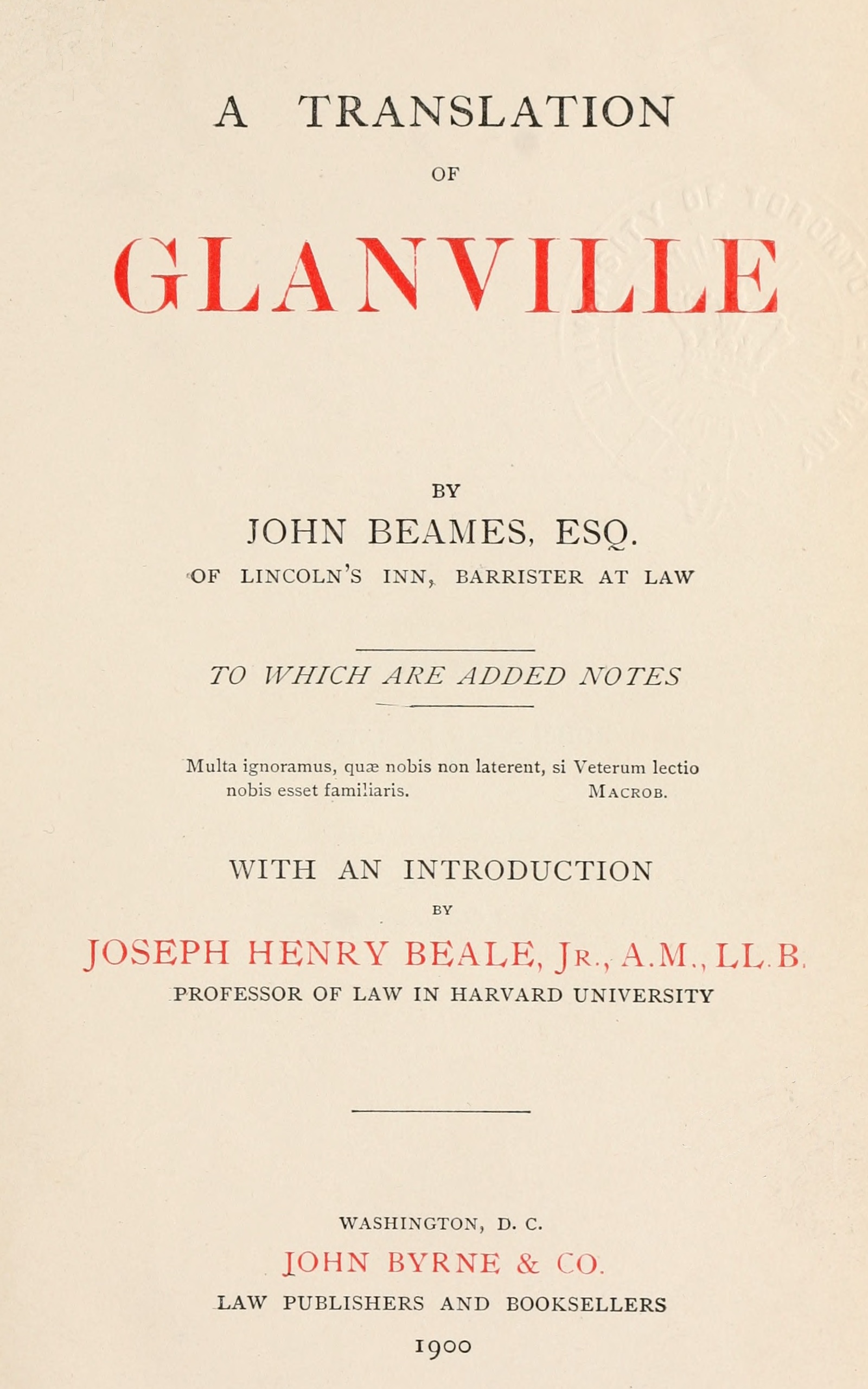
JOSEPH HENRY BEALE, Jr., A.M., LL.B. PROFESSOR OF LAW IN HARVARD UNIVERSITY
WASHINGTON, D.C.
JOHN BYRNE & CO. LAW PUBLISHERS AND BOOKSELLERS
1900
Copyrighted, 1900
BY
JOHN BYRNE & COMPANY.
TO SIR SAMUEL ROMILLY,
THE FOLLOWING WORK
IS INSCRIBED
AS A MARK OF THE HIGH RESPECT
WITH WHICH
HIS ABILITIES, AS A SENATOR,
AND HIS
TALENTS, AS AN ADVOCATE,
ARE VIEWED BY THE TRANSLATOR.
A TREATISE ON THE LAWS AND CUSTOMS OF THE KINGDOM OF ENGLAND
COMPOSED IN THE TIME OF KING HENRY THE SECOND
The illustrious Ranulph de Glanville, who of all in
that age was the most skilled in the Laws of the Realm,
and the ancient Customs thereof, then holding the helm of
Justice.
The present work contains those Laws and Customs only,
according to which Pleas are determined in the King’s
Court, the Exchequer, and before the Justices, wheresoever
they may be.
INTRODUCTION. — I. RANULPH DE GLANVILLE. — II. THE AUTHORSHIP OF THE TREATISE. — III. THE CHARACTER OF THE TREATISE. — IV. THE TREATISE AND THE LAW.
BY JOSEPH HENRY BEALE, JR., A.M., LL.B., PROFESSOR
OF LAW IN HARVARD UNIVERSITY.
Ranulph de Glanville was born in the Suffolk Stratford, about 1130
A.D. He is believed to have been the son of Sir Hervey de
Glanville, Chamberlain to King Stephen, and the grandson of that
Ranulph de Glanville who came over with the Conqueror. The family was
an important one, owning much land in the counties of Suffolk and
Norfolk. Glanville’s public life began in 1164, when he was appointed
sheriff of Yorkshire; an office which he continued to hold for six
years. In 1171 he was appointed Governor of Richmond Castle, and in
1174, sheriff of Lancashire. The Scots having invaded England in that
year, he led the forces of Lancashire and Richmond against them, and
(joining the sheriff of Yorkshire and his forces) surprised and routed
the Scots at Alnwick, and took King William the Lion prisoner. For
this victory Glanville deserved, as he certainly received, the credit;
and from that time no man stood higher than he in the favor of King
Henry II. He was sheriff of Westmoreland from 1175 to 1179; sheriff of
Yorkshire a second time, from 1177 to his death; judge of the King’s
Court in 1176, and Chief Justiciar in 1180. He was also employed in
many distinguished public services. In 1177 he was sent as ambassador
to Flanders. In 1182 he led an army against the Welsh. In 1184, with
Archbishop Baldwin, he was sent as ambassador to Rice ap Griffin,
Prince of South Wales. In his next Welsh expedition, a few years later
(again with Baldwin), he preached a crusade. In 1186 he was ambassador
to the King of France, and was active in negotiating the peace of
Gisors. In 1189, while Henry was struggling with his rebellious sons
and with Philip of France in Normandy, he was sent to Canterbury to
treat with the Chapter; was soon again in Normandy with Henry; and
finally returned to England to raise an army for his master’s service,
a work in which he was engaged at the time of Henry’s death.
These great offices were due to his personal merit and to the great
services he rendered to his country; but they appear to have been the
result, also, of the personal friendship and affection of the King. He
was one of the witnesses to Henry’s will, and a trustee of the King’s
bequest of 5,000 marks of silver to certain religious and charitable
institutions, and of 300 marks of gold for marrying poor free women
of England. He was named by Henry as custodian of Queen Eleanor, and
as treasurer of his private fortune. A pretty picture of the King’s
feeling toward him occurs in the account of the arrival of Glanville’s
messenger in London, after the battle of Alnwick. The messenger
arrived at midnight and insisted on seeing the King. Being admitted to
the royal chamber he boldly approached the King’s bed and roused him
from sleep. He, springing up, cried, “Who is it?” “I am the messenger
of Ranulph of Glanville, your faithful subject, and I come from him
to your highness as a bearer of good tidings.” “Is our Ranulph well?”
cried the King, moved less by the promised good tidings than by his
love for the sender of them. “My lord is well,” was the answer, “and he
holds your enemy, the King of the Scots, a prisoner at Richmond.”
Upon the death of Henry, Glanville’s position was a difficult one.
Henry, conservative, though a reformer, had established the government
of his kingdom on a foundation of law and justice, and had created an
effective and pure administrative machine. The new King appeared to
have no sympathy with his father’s principles of government. He was
rash, radical and careless of regular details of administration, and
Glanville, in the words of a contemporary, “In his old age saw the King
doing many things in a newfangled way, without wisdom or forethought.”
He was present at the coronation of Richard, and was sent by him to
quell a riot against the Jews which disgraced the ceremony. About his
next acts we have different accounts. He had taken the cross in 1186.
Whether he asked and received his dismissal from Richard in order to
join the army, then about to start for the Holy Land, or whether, as
another account has it, he was removed and imprisoned by Richard and
obliged to purchase his freedom by a fine of 15,000 pounds of silver,
we cannot certainly tell. At any rate, he set out for Palestine
together with Baldwin, Archbishop of Canterbury, and his nephew Hubert,
then bishop of Salisbury; the three were placed in command of the
English forces by Richard (who was obliged to delay his own departure),
and Glanville in 1190 died before Acre, by disease, the result of the
unhealthy climate. He left one son and three daughters, whom he had
already enriched from his great fortune. He founded the priory of
Butley, the Abbey of Leiston, and a hospital at Somerton.
Glanville impressed his contemporaries as a man strong both in body and
in mind. A man of integrity and prudence, “most faithful in fortune
or misfortune,” “Wise, grave and eloquent,” “The King’s eye;” “A name
above every name, who spoke among the princes and was adored by the
people.” He was a man wise, just and charitable, whose fellowship was
sought and opinions valued by wits and by scholars. One scandal only
attacked him. He is charged with falsely condemning to death for rape
Sir Gilbert de Plumpton, in order that his widow might be married
to Glanville’s friend and steward, Rainer; Sir Gilbert’s punishment
was commuted by the King to imprisonment for life. The tale is quite
inconsistent with all we know of Glanville’s character and with his
position in the King’s affection, and may safely be disbelieved.
His family shared in his success. No less than seven of his near
relatives held high judicial position under Henry or his sons. Few
other families have rendered greater service to England than that of
Ranulph de Glanville, ambassador, administrator, general, judge and
jurist.
[Incidents of Glanville’s life and character are reported
in all the chroniclers of the time. Especially valuable
are the accounts in Hoveden, Benedictus Abbas, Giraldus
Cambrensis, Newburgh, Richard of Devizes, and Diceto. The
fullest modern sketch of his life is by Professor Maitland,
in the Dictionary of National Biography. Other modern
biographies are those of Foss (Judges of England, i, 376);
Thomas Wright (Biographia Britannica, 275); Lord Campbell
(Lives of the Chief Justices, i, 19); and Professor Gross
(Sources and Literature of English History, 315).
Many interesting documents bearing on Glanville’s genealogy
and his property are printed in Glanville-Richards’
“Records of the Anglo-Norman House of Glanville.”]
The following “Treatise on the Laws and Customs of the Kingdom of
England,” was published between 1187 and 1189; it mentions a fine made
in the former year, and it is filled with references to Henry, as then
King. It had a high contemporary reputation. Copies of the book were
multiplied, and many manuscripts still exist. It forms part of several
collections of laws made by contemporaries of Glanville himself. It
was translated, or partly translated, into French immediately after
Glanville’s death, and it was revised and an attempt made to bring
it down to date two generations later. It was finally superseded by
Bracton’s completer and more elaborate treatise.
The work itself is anonymous, the manuscripts stating only that it was
composed in the time of Henry II., “Glanville then holding the helm
of justice.” Early tradition, however, asserts that it was written by
Glanville himself, and that fact was accepted as undoubted from the
thirteenth to the nineteenth century. Modern scholars have expressed
doubt of it. Littleton’s objection (in his “Life of Henry II.”) that
Glanville could not have written the book because he was not in orders,
may be dismissed at once. The greater officers of the administration,
whether in orders or not, must have had sufficient Latin to dictate a
Latin treatise to a clerk, and Glanville was particularly commended for
his eloquence by more than one contemporary. Hunter’s objection (in the
preface to his “Fines”) is that Glanville, at the time the treatise was
written, was too busy in public affairs to have composed such a work,
and he suggests that the author may have been William de Glanville, a
justice in the next reign; who was, in fact, Glanville’s son, and (from
1186) his secretary. But this is the merest guess. Professor Maitland
conjectures (for a rather fanciful reason, perhaps) that the author
may have been Hubert Walter. Liebermann, on the other hand, defends
Glanville’s authorship. Certainly there is little external proof that
Glanville was the author of the treatise, though it must have been
written by some one in high position and repute to have obtained so
immediate a success. The internal evidence does not lead us much
further. The style is that of a person speaking with authority, but not
necessarily the authority of the Chief Justiciar himself. The claim of
Hubert Walter to the authorship cannot be dismissed without further
examination.
Hubert was a nephew of Glanville’s wife; according to one account,
of Glanville himself, Glanville’s younger brother having married his
wife’s sister. Whether Hervey Walter, Hubert’s father, was really, as
this account has it, Hervey de Glanville or not, it is certain that
Hubert was brought up in intimacy with Glanville’s family, became his
secretary, and was regarded by him as a valued counsellor. He was made
Dean of York in 1186, being succeeded as secretary by Glanville’s son
William. He soon became Bishop of Salisbury, Archbishop of Canterbury,
and later Chief Justiciar and Chancellor of the Kingdom. He is
described as a man of foresight and wisdom; it is said of him that his
heart was in human affairs rather than divine, and that he knew all
the laws of the kingdom. He was, however, a man “of little eloquence;”
indeed, one chronicler ridicules his Latin style.
Did Glanville write the whole treatise? or did Hubert Walter write
it? Or did they collaborate on it? Perhaps we can reach a conjectural
conclusion by a more careful examination of the treatise itself.
The most striking feature of the treatise is, that it is based upon a
collection of writs. Omitting the Introduction and the last book, on
Pleas of the Crown, just one-third of the chapters into which it is
divided consists of writs. These are of all kinds, directed to Lords’
Courts, to County Courts, and to Ecclesiastical Courts, as well as
writs returnable in the King’s Courts. Later writers have made free
use of writs, but here they are the skeleton of the whole treatise.
They fulfil the function of judgment-rolls in Bracton’s book, and of
decisions in Coke and later writers. The collection of these eighty
writs must have been a work of several years, since some of the writs
were certainly of rare occurrence. The Chief Justice, or his clerk,
attested all the writs, and either of them had both opportunity and
reason for making such a collection; hardly another man in the kingdom
would have been likely to do it.
A large part of the treatise is written in a crabbed and inelegant,
though usually a clear style. In a few passages, however, near the
beginning of the book, we find an elevation of thought and elegance of
diction often admired and imitated. The Introduction, in particular,
and the seventh chapter of the second book, in praise of the assize
(which, according to tradition, Glanville had a hand in inventing,
or, at least, in establishing), are worthy of a man “sapiens simul
et eloquens”; in sharp contrast with other parts of the work, which
indicate an author who “omnia regni novit jura,” but was surely “non
eloquio pollens.”
The first ten books of the treatise are carefully written, the
commentary is full, the subject well developed. The last four books,
on the other hand, seem to have been hurriedly thrown together. The
proportion of writ to text is more than twice that in the preceding
books; indeed, in the book devoted to the County Courts (in which
Glanville had presided for years, and must have become as familiar with
the law and procedure as with those of the King’s Courts), there is
almost no comment. It seems possible that a proposed full commentary on
the County Court practice, for which an elaborate collection of writs
was at hand, was abandoned.
The exact date of the work is fixed by the only two dated documents—two
fines, of June 27 and about November 1, 1187. Fines were then novel,
and they were described carefully. It seems likely that the passage,
which occurs toward the end of the treatise, was written soon after the
dates of enrollment. Both fines were enrolled in Glanville’s presence.
We may now conjecture that the author, or authors, of the treatise had
for years been collecting writs, either for preservation as useful
precedents, or possibly with the object of composing a commentary upon
them. The collection finished, it would not be a matter of much time
or difficulty for one who knew the law, writs in hand, to dictate his
commentary to a secretary also learned in the law. If the collector was
Glanville, and the secretary Hubert, we may suppose that the actual
work of composition was begun in 1185, or 1186; not, apparently, a
time of strenuous labor for either. Passages of particular importance
or of especial interest to Glanville would be composed by him with
care; the actual form of the remainder might safely be left to his
competent secretary, subject only to revision by himself. In 1186
the Dean of York died, and the succession was given to Hubert; and
Glanville soon set out on his embassy to the King of France. In spite
of this, however, time still remained for the completion of the work in
the rather less polished form of the later books. In February, 1187,
Glanville and Hubert were sitting together in the Court at Westminster;
and from that month to the beginning of 1189 (with the exception of
Lent, 1188, when Glanville was preaching his crusade in Wales), both
appear to have remained in England, without serious interruption from
public business. The year 1188, in fact, seems to have been one of
the least busy of Glanville’s official life; and, until his time was
absorbed by the troubles of the closing year of the reign, there was
nothing to prevent a continuance of the work. The last hurried chapters
may well, therefore, have been completed in 1188.
There is, then, nothing against the early and persistent tradition that
Glanville wrote the treatise, and much in its favor; though most of the
actual composition may have been the work of Hubert Walter.
[The fullest discussion of the authorship of “Glanville”
may be found in Pollock and Maitland’s “History of the
English Law,” i, 163. Reeves’ discussion (“History of the
English Law,” Finlayson’s Edition, i, 254) and Foss’s
(“Judges of England,” i, 180) are also worth consulting
upon this point. Liebermann (“Einleitung,” p. 73)
supports the theory of Glanville’s authorship; and in the
“Zeitschrift für romanische Philologie,” xix, 81, he gives
interesting proof of the early popularity of the treatise.
See also Professor Maitland’s article, “Glanville Revised,”
in the Harvard Law Review, vi, 1.
The life and character of Hubert may be found in the “Actus
Pontificum Cantuariensium” of Gervase. Glanville’s and
Hubert’s itineraries may be found in Eyton’s “Itinerary of
Henry II.”]
“A Treatise on the Law and Customs of the Kingdom of England” is the
earliest systematic treatise on law written in modern times. A few
collections of law and decretals, like the Decretum of Gratian
and the “Assises of Jerusalem,” had, to be sure, been published
earlier; but they were not, like this book, regular expositions of an
existing system of law. Bracton’s work was modelled on Glanville, and,
through Bracton, Glanville thus fixed the type of the modern commentary
on law. An imitation, in many parts an exact copy, of this book was
later published in Scotland under the title “Regiam Majestatem,” and
the claim was vigorously made for a time that it was the original,
Glanville the imitation. This notion, improbable on its face, was
absolutely disproved by arguments set forth in Beames’ Introduction.
The first edition of the treatise was printed by R. Tottel in small
12mo, about the year 1554. Coke says that this was done by suggestion
of Sir William Stanford, the learned judge and author. The second
edition was printed by Thomas Wright in 1604. The text was corrected
by the collation of “various manuscripts.” This edition was exactly
reprinted, omitting the preface, in 1673. The treatise was again
printed in the first volume of Houard’s “Traités sur les Coutumes
Anglo-Normandes” in quarto, Rouen, 1776. The last Latin edition was
published by John Rayner, 8vo, 1780, collated with the Bodleian, the
Cottonian, the Harleian and Doctor Milles’s manuscripts by J.E. Wilmot.
The Latin text is also printed as an appendix to Phillips’s “Englische
Reichs und Rechtsgeschichte,” ii, 335: Berlin, 1828. A collation of
Glanville with the “Regiam Majestatem” may be found in the Acts of the
Parliament of Scotland, i, 133. An English translation by John Beames,
with notes, was published in octavo, London, 1812, and is reprinted in
the present edition.
This treatise is more than a mere law book. It is a monument to the
genius of one of the greatest legal reformers of all time. Henry II.
came to the throne, after a long period of anarchy, to find countless
systems of law administered by a confused and confusing mass of popular
courts and feudal courts. He at once set himself to bring order and
unity out of anarchy and chaos. He made the King’s Court the common
court of the land; he determined its jurisdiction as against the
church, the lords and the sheriffs; and he made it the guardian of a
King’s peace, which should protect high and low throughout the whole
land. The establishment of peace was in fact the chief object of his
stormy career. Glanville’s treatise shows us the method he took to
secure his object.
By a free use of writs running from the King or his Justiciar, he
limited the jurisdiction of all other courts, and subordinated them to
the King’s Court. By a regular system of removal from lord to county,
and from county to King, he secured the gradual unification of the
law. The lord’s courts had administered the customs of each manor;
each county court, too, had its customs, all based upon the Germanic
law, but differing materially in the several counties, and especially
in the several ancient divisions of the kingdom. The King’s Court now
began to develop a common law, partly Anglo-Saxon in its origin, partly
Norman, but molded largely by Henry’s formal or informal legislation,
and tempered, as Glanville several times asserts, by equity.
To increase the influence of the King’s courts and to bring them to
the people, Henry relied on an already existing institution, the
iter or eyre; but he so improved the system as to make it almost
a new invention. The Kingdom was divided into circuits, each made up
of a number of neighboring counties; and judges were appointed to
ride each circuit, holding a King’s court in each county, and thus
bringing every part of the Kingdom under the direct control of the
King. Glanville himself became one of the first judges of the Northern
Circuit.
One of the most important of Henry’s provisions for securing the King’s
peace was the invention of writs for the protection of peaceful seisin,
and the prevention of disseisin, even by the true owner. These writs
put an end to forcible self-help, and brought every legal dispute over
dispossession into the King’s Court. The writs of novel disseisin, of
mort d’auncestor, and of darrein presentment, established by Henry’s
legislation, became the basis of the land law.
Another reform, of even more far-reaching consequence, was his
invention of a more rational method of establishing the truth of facts.
In place of trial by ordeal, by compurgation, or by battle, he provided
the assise (soon followed by the jury) as a means of eliciting truth.
Trial by jury in the King’s Court, by favor or by right, became so
popular as eventually to deprive the other courts of their litigation;
and so satisfactory as to cultivate in the people of England a respect
for law and a willingness to abide by its decisions that have been
characteristic of the race for centuries.
The doctrine of res judicata seems to have been adopted at this time
as another rule tending to the preservation of peace. When Glanville
wrote, it had not been fully settled that the judgment even in a writ
of right was necessarily final; Glanville’s strong opinion that it was
so no doubt settled the law as we now have it.
In the work of reform Henry appears to have found in Glanville an
enthusiastic and an able helper. This treatise is full of praise of
the King and his legislation. The peaceful governing of its people is
a great object of regal power, it is asserted. The king, who loves
peace and is the author of it, conducts himself justly, discreetly,
and mercifully toward his subjects. His will is law, if promulgated as
such by the advice of his nobles; that and reasonable customs, long
used, form the Laws of England, which may usefully, in part at least,
be reduced to writing.
It is possible from Glanville’s treatise to get a rather complete
picture of the common law at the end of the reign of Henry II. In the
lord’s courts were regularly brought not only the suits of the villein
tenants, but all suits concerning land held of the lord. Suits of
the latter sort, however, must be begun by the King’s writ; if the
lord refused justice, resort might be had to the county court in all
suits involving freehold land; and the lord might on his own motion
adjourn a question of difficulty into the King’s court. The county
court had original jurisdiction of questions of villeinage and of
customary service, and of any question sent to it by the King’s writ;
and it had jurisdiction over writs of right removed from the lord’s
court. It apparently, also, had jurisdiction of disputes as to title
or possession of personal property. The ecclesiastical courts had
jurisdiction of questions of marriage and legitimacy, of wills, and
of disputes involving ecclesiastical questions only; the King’s court
would prohibit them by writ from interfering in other matters.
The procedure in the King’s court did not differ greatly from the
present procedure. A suit was begun by writ, served by the sheriff,
and enforced by the distraint of the defendant’s land. The most
important feature of the procedure was the elaborate system of rules
governing essoins or continuances. By a skilful use of essoins
the defendant or tenant could prolong proceedings on a writ of right
for years; the fact that in the new possessory assises few essoins were
allowed, and the proceedings were therefore much prompter, contributed
greatly to the favor with which they were received. Final judgment in
the King’s court was by this time enrolled; and the method of conveying
land by levying a fine was in full operation.
The law of real property in its essential features was fully formed.
The whole law of tenures and incidents had been finally settled; but
the rules of inheritance and of transfer by will were still uncertain.
The doctrines of warranty (now obsolete), according to which the
grantor of a party could be called into a suit, or in the technical
phrase vouched to warranty, and thus substituted for the original
party, were still of the highest importance in practice. The modern
mortgage, i.e. the grant on condition, was as yet unknown: Glanville’s
mortgage of land, like the pledge of personalty in his time, is a mere
grant of custody by way of security.
The law of personal property was little developed. Doctrines as to
pledge and bailment, derived from the old Germanic law, were applied
in the county courts; there, for instance, the absolute responsibility
of the bailee was still enforced. Through the writ of detinue and
the action on the case, the King’s courts were soon to take control
of these subjects, and to establish the modern law of bailments and
carriers.
Certain formal contracts were enforced by the King’s court. The writ
of debt would lie as a result of a loan, a sale, or an obligation
created by charter. Redress for breach of ordinary contracts could be
obtained only in the ecclesiastical courts, which might deal with the
sin of deceit. Not for three centuries did the King’s court work out a
doctrine by which a party might be held to perform his simple contract.
No action of damages for tort would lie. There is as yet no trace
of the process by which (working from appeals of felony to writ of
trespass against the King’s peace and actions on the case) the King’s
court would eventually work out the modern law of tort. So far as there
was any remedy for torts it was in the inferior courts.
The King’s court could at this time punish all felonies except theft,
jurisdiction over which it obtained by Magna Carta. It was a long time
before it obtained exclusive jurisdiction over felony, or took control,
as “custos morum,” of misdemeanors.
Such law, it may be admitted, was rude and unsatisfactory; but it was
a long advance over what had gone before, and it had within itself the
germ of the modern Common Law.
Joseph H. Beale, Jr.
Harvard University, October, 1900.
THE TRANSLATOR TO THE READER.
Of Ranulph de Glanville, the reputed Author of the following Treatise,
Lord Coke speaks in terms of the highest encomium. He informs us, that
Glanville was Chief Justice in the Reign of Henry the Second, that he
wrote profoundly on part of the Laws of England, and that his Works
were extant at that day. “And,” continues his Lordship, “in token of
my thankfulness to that worthy Judge, whom I cite many times in these
Reports, (as I have done in my former) for the fruit which I confess
myself to have reaped out of the fair field of his Labors, I will
for the honor of him and of his name and posterity, which remain to
this day (as I have good cause to know) impart and publish, both to
all future and succeeding Ages, what I found of great antiquity and of
undoubted verity, the original whereof remaineth with me at this day,
and followeth in these words: Ranulphus de Glanvilla, Justiciarius
Angliæ, Fundator fuit domus de Butteley, in Comitatu Suffolciæ, quæ
fundata erat anno Regis Henrici, filii Imperatricis, decimo septimo, et
anno Domini 1171. quo anno Thomas Becket, Cantuariensis Archiepiscopus,
erat occisus. Et dictus Ranulphus nascebatur in Villa de Stratford, in
comitatu Suffolciæ, et habuit Manerium de Benhall, cum toto Dominio,
e dono dicti Regis Henrici. Et duxit in uxorem quandam Bertam, filiam
Domini Theobaldi de Valeymz, Senioris domini de Parham: qui Theobaldus
per Chartam suam dedit dicto Ranulpho et Bertæ Uxori suæ totam
terram de Brochous, cum pertinentiis, in qua domus de Butteley sita
est, cum aliis terris et tenementis, in libero maritagio. Prædictus
vero Ranulphus procreavit tres filias de dicta Berta (viz.) Matildam,
Amabiliam, et Helewisam, quibus dedit terram suam ante progressum
suum versus Terram Sanctam.” The document then proceeds with a
minute accuracy to trace our Author’s Descendants, and finishes the
sketch by informing us—“quod præfatus Ranulphus de Glanvilla fuit
vir præclarissimus genere, utpote de nobili sanguine, vir insuper
strenuissimus corpore, qui provectiori ætate, ad Terram sanctam
properavit, et ibidem contra inimicos Crucis Christi strenuissime usque
ad necem dimicavit.”[1] The paucity of these facts may be, in some
measure, remedied, by consulting the Annals of our Second Henry,
where the name of Glanville not unfrequently occurs. We hear of him
in 1171, as Fermour of the Honor of Earl Conan:[2]—in 1172, as having
the custody of that Honor, and the Fair of Hoiland;[3]—and in 1174,
as still retaining the same Honor, and accounting for the Capture and
Ransoms of Prisoners, &c. taken in War.[4] In the latter year he is
said to have distinguished himself, as the General who took the King
of Scotland Prisoner.[5] In 1175, he still retained the Honor of Earl
Conan,[6] and filled the Office of Sheriff of Yorkshire.[7] In 1176, he
was made a Justice of the King’s Court, and a Justice Itinerant.[8] In
the same year, he accounted for Westmoreland by the hands of Reiner,
his Dapifer or Steward, a privilege conceded to the great alone.[9] In
1180, he was made Chief Justiciary of all England, as we are informed
by his cotemporary Roger Hoveden, whose words are too remarkable to
be omitted. Henricus Rex Angliæ pater constituit Ranulphum de
Glanvilla summum Justiciarium totius Angliæ, cujus sapientia conditæ
sunt leges subscriptæ, quas Anglicanas vocamus.[10] The Chief
Justiciary, presided in the Curia Regis next to the King, as
Chief Judge in all civil and criminal questions; and governed the Realm
like a Vice-Roy, when the King was beyond Sea, an event of frequent
recurrence in that age. In fine, this officer was invested with a
power that placed him far above every other subject. No sooner had
Glanville arrived at this elevated post, than he exerted himself to
restore and confirm many ancient Laws calculated for the good of the
Realm.[11] How much to the satisfaction of Henry the Second Glanville
filled this arduous situation, we may infer, from finding additional
honors heaped upon him by that able and politic Prince. In 1183, our
Author held the place of Dapifer to the King,[12] and, in the same
year, he was appointed Fermour of Yorkshire:[13] situations, it is to
be presumed, not incompatible with that of Chief Justiciary, which he
appears to have retained, until the death of Henry the Second,[14] and
that with undiminished honor, if we except the imputation cast upon
him for condemning Sir Gilbert de Plumptun to death, but which seems
to be refuted by the confidence continued to be reposed in him by the
discerning Henry.[15] Immediately after the death of that Prince, he
assumed the Order of the Cross, and perished fighting valiantly at the
Siege of Acon in the year 1190.[16]
But, whether the same identical person successively occupied these
various situations, and, at different periods of his life, filled the
rather opposite and inconsistent characters of an able General and a
profound Lawyer—a skilful Courtier and an enlightened Legislator, is
a doubt which has been entertained by some very respectable Writers.
Nor has it passed without a question, whether the present Treatise was
really composed by the person whose name it bears. Lord Littleton,
indeed, is inclined to infer, that it was not written by Glanville,
but by some Clergyman under his direction.[17] These doubts may serve
to evince the ingenuity of those who have suggested them, but they
prove nothing. When the various situations Glanville is stated to have
filled are represented as incompatible, and we start at beholding the
grave Lawyer divest himself of his robes to girt on the armour of the
soldier, we forget the manners of the age when Glanville florished.
When we suppose, that because the work is composed in Latin, it was not
written by a Layman, we beg the question: and, having assumed, that no
Layman, whatever his parts, whatever his application, could have been
sufficiently skilled to write such Latin as our Author has employed, we
pay but a sorry compliment to the age, and rather too hastily conclude
that we have proved, what, indeed, we have merely taken for granted.
When, in fine, we infer, that the knowledge of Law displayed in the
Work, and the labor consumed in composing it, are no less inconsistent
with the high and elevated station of Glanville, than incompatible with
his employments, we forget, that his rise was progressive, and that,
as there are but few things to which a truly great mind is inadequate,
the production of a small volume upon that Law which it was daily in
the habit of dispensing, ought not, whatever the merit of the work
may be, to be ranked amongst the number. It must not, however, be
concealed, that Mr. Selden mentions a circumstance which, at the first
glance, appears to go a great way in determining the question. “I know
the authority of that Treatise,” says he, in speaking of the present
work, “is suspected, and some of the best and ancientest copies having
the name of E. de N. which I have heard from diligent searchers
in this kind of Learning affirmed to have been sometimes E. de
Narbrough, and not R. de Glanvilla, it hath been thought to
be another’s work, and of later time. But as, on the other side, I dare
not be confident that it is Glanville’s, so I make little question,
that it is as ancient as his time, if not his work. The teste
of the precedents of writs under his name, the language, especially
the name of Justitia always for that which we now from ancient
time called Justiciarius, (and Justitia was so used in
writers under Henry the Second) and the Law delivered in it tasteth
not of any later age.”[18] Though the latter part of this Extract may
be reasonably thought to furnish a sufficient answer to the doubt
expressed in the former part, the Translator cannot but observe upon
the singularity, that none “of the best and ancientest copies” are
forthcoming in support of the fact they are said to prove.
With respect to the Work itself now submitted to the Public in an
English dress, it is said to be the first performance that has
any thing like the appearance of a Treatise on the subject of
Jurisprudence, since the dissolution of the Roman Empire.[19] But
this is not correct, if the Assises of Jerusalem, compiled, as we are
informed in the preamble, in 1099—the System of Feudal Law, composed by
the two Milanese Lawyers in 1150, and the Decretum of Gratian,
published about the same time, be considered as Treatises on Law. It
seems, however, to be unquestionable, that the present Treatise is the
earliest and most ancient work on the subject of English Jurisprudence,
from which any clear and coherent account of it is to be obtained.
Dr. Robertson, indeed, informs us, “that in no country of Europe was
there at that time, any collection of Customs, nor had any attempt
been made to render Law fixed. The first undertaking of that kind was
by Glanville, Lord Chief Justice of England, in his Tractatus de
Legibus et consuetudinibus,[20] composed about the Year 1181.”[21]
It has been thought, that Glanville drew up this compendium of the Laws
of England for the public use, by the express command of Henry the
Second, a conjecture which, Mr. Madox observes, is not only favored
by a certain MS. remaining in the Library of Corpus Christi
College, Cambridge, written in a hand of the age of Edward the Second,
in which there is a Treatise entituled Leges Henrici Secundi,
agreeing in many passages with the printed copy of Glanville, but also
by the manner of our Author’s writing, especially in the Prologue.[22]
There is also in the Cottonian collection a MS. of Glanville, which
bears the Title of Laws of Henry the Second. But Mr. Reeves
informs us, this manner of entituling Treatises was not then
uncommon.[23]
The present work appears to have remained in MS. until the Year 1554,
when, as Sir Edward Coke apprises us, it was, by the persuasion and
procurement of Sir William Stanford, a grave and learned Judge of the
common Pleas, first printed.[24] With many peculiar circumstances,
however, to create an Interest in its favor, the fate of the work
has been most singular. Indebted to its intrinsic merit alone for
the high compliment it has long enjoyed, in being looked up to as an
authority from which there was no appeal, curiosity has given way to
an opinion, that whilst it was venerable for its antiquity, it was
also useless, for it was obsolete. That many parts of it are obsolete,
it would be idle to deny; but that the work itself is by no means
so entirely obsolete as generally assumed, will be fully evident to
every impartial and candid Reader. But were it entirely obsolete, it
would not necessarily follow, that it would be useless, the terms not
being, at least in the science of Jurisprudence, either convertible
or synonymous, however fashionable, or, more properly speaking,
convenient it may be to esteem them such. Multa ignoramus quæ nobis
non laterent, si Veterum lectio nobis esset familiaris. The Law
of Modern Times is intimately connected with that of our Forefathers,
and the decisions of the present day are not unfrequently built upon
principles that are enveloped in the almost impervious mist of far
distant ages. But to these principles must the Student ascend, if he
would merit the name of a Lawyer; and, if the labor be severe, he must
reconcile it to himself by reflecting, that it was submitted to by a
Coke, a Hale, a Blackstone. Led by the soundness of their judgments,
to investigate the earlier ages of our Jurisprudence, those great men
considered nothing useless, though it possibly might happen to be
obsolete, which tended to enlighten their minds, and shew them the
fundamental principles of those Laws, which they afterwards no less
admirably illustrated, than ably administered. But the brightness of
the example instead of exciting emulation seems to have depressed it:
and Glanville, Bracton, and Fleta have been suffered to crumble on the
shelf, whilst Edition has rapidly followed Edition of those more modern
Authors, who have advocated their cause, by drawing so deeply from the
rich and inexhaustible mines, which their pages present to the English
Lawyer.
It remains to speak of the Translation now submitted to the Public.
Fidelity has been the principal object of the Translator. If more be
demanded, he would shelter himself under the high name of Sir William
Jones. “Elegance, on a subject so delicate as Law, must be sacrificed,
without mercy, to exactness.” Next to fidelity, simplicity has been
aimed at, as most in unison with the original, and, perhaps, the best
adapted for transfusing its spirit into the English Language. Not
that with these two objects immediately before him, the Translator
would be understood as conceding, that he has sacrificed any beauty,
any elegance of expression generally abounding in, or spread over,
the original work. He could not sacrifice that which never existed.
The style of Glanville, destitute of every grace, and dry and harsh
in the extreme, professedly aims at the peculiar qualities which
characterise it. Stilo vulgari et verbis curialibus utens ex
industria, ad notitiam comparandum eis, qui hujusmodi vulgaritate minus
sunt exercitati, are the very terms in which he describes his own
manner of writing. So successfully has he accomplished his object,
that he imposes upon his Translator a Task not altogether unlike that
of acquiring a new language. Yet to these difficulties the Translator
reluctantly alludes, for though they may, in some measure, atone for
those errors into which he is apprehensive he has often fallen, he
is conscious, the merit of his attempt is not to be estimated by its
arduousness, but its utility.
With respect to the Annotations, it was the Translator’s original
intention to have confined himself to a mere explanation of the
obsolete Terms. But, anxious to render the work more extensively
useful, he has not unfrequently departed from his first design. Among
the works occasionally referred to, the Reader will recognise the
Regiam Majestatem—so termed from the words with which it commences.
This work has been sometimes received, as containing the genuine
ancient Law of Scotland—sometimes rejected, as a mere spurious
fabrication. Among the names in collision on this point are those of
Skene, Erskine, Lord Kaims, Houard, Dalrymple, Craig, Lord Stair and
Dr. Robertson. Nor has there been less dispute whether Glanville, or
the Regiam Majestatem be the original work. But this question is said
to be satisfactorily disposed of by Mr. Davidson, who has published a
pamphlet expressly on the subject, and has proved, if it were necessary
to prove, what is rendered indubitable by the internal Evidence of the
two Works, that Glanville is the original; observing, at the same time,
“that Glanville is regular, methodical, and consistent throughout;
whereas the Regiam Majestatem goes out of Glanville’s method for no
other assignable reason, than to disguise the matter, and is thereby
rendered confused, unsystematical, and in many places contradictory.”
The Translator has not been able to meet with Mr. Davidson’s work, but
is indebted to the preface attached to the last Edition of Glanville
for this Summary of it. “To this observation upon the method of the
Regiam Majestatem,” says Mr. Reeves, “it may be added, that, on a
comparison of the account given of things in that and in Glanville,
it plainly appears, that the Scotch Author is more clear, explicit,
and defined; and that he writes very often with a view to explain the
other, in the same manner in which the writer of our Fleta, explains
his predecessor Bracton. This is remarkable in numberless instances
all through the Book, and is, perhaps, as decisive a mark of a copy as
can be. The other Scotch Laws, which follow the Regiam Majestatem in
Skene’s collection, contribute greatly to confirm the suspicion. These,
as they are of a later date than several English Statutes which they
resemble, must be admitted to be copied from them; and so closely are
the originals followed, that the very words of them are retained. This
is particularly remarkable of the Reign of Robert the Second, in which
is the Statute of quia Emptores, and others plainly copied from
our Laws, without any attempt to conceal the imitation. These Laws,
at least, can impose upon no one; and when viewed with the Regiam
Majestatem at their head, and compared with Glanville and the English
Statute Book, they seem to declare very intelligibly to the world, that
this piece of Scotch Jurisprudence is borrowed from ours.”[25] Nor is
the enlightened and liberal Historian Dr. Robertson more favorably
disposed towards that claim, which some of his countrymen have put in,
for the originality of the Regiam Majestatem. “The Regiam Majestatem
ascribed to David the first seems,” he observes, “to be an imitation
and a servile one, of Glanville. Several Scottish Antiquaries, under
the influence of that pious credulity, which disposes men to assent
without hesitation to whatever they deem for the honor of their native
country, contend zealously, that the Regiam Majestatem is a production
prior to the Treatise of Glanville; and have brought themselves to
believe, that a nation, in a superior state of improvement, borrowed
its Laws from one considerably less advanced in its political progress.
The internal Evidence (were it my province to examine it) by which
this theory might be refuted is in my opinion decisive. The external
circumstances, which have seduced Scottish Authors into this mistake,
have been explained with so much precision and candor by Sir David
Dalrymple, in his Examination of some of the arguments for the high
antiquity of the Regiam Majestatem, Eding, 1767. 4to, that it is to be
hoped, the controversy will not be again revived.”[26]
In dismissing this subject, it may be remarked in the words of Mr.
Reeves, that it seems unnecessary to contend for the originality
of the Regiam Majestatem, whilst a doubt of much more importance
remains unsettled—whether that Treatise, as well as the others in the
publication of Skene, are now, or ever were, any part of the Law of
Scotland, on which, as we have already observed, so many eminent men
differ. On the other hand, the authenticity of Glanville, as the code
of Law existing in this country during the Reign of Henry the Second,
has been admitted, either expressly or impliedly by all the English
Lawyers, who have florished in the long interval which has elapsed from
that period to the present, and never has been questioned, if we except
a solitary dictum, which, as it equally affected the credit
of Bracton, and was totally unauthorised, is refuted by a thousand
circumstances, if it were an object to mention them.[27] But to return
from this digression.
Though the Translator had not the good fortune to meet with Mr.
Davidson’s Pamphlet, he was more successful in discovering Skene’s
translation of the Regiam Majestatem, deposited in Lincoln’s Inn
Library. The Translator intended to have noticed such parts of the
Regiam Majestatem, as coincided with Glanville. But, after having,
with some attention, perused the former Book, he found the similarity
between the two works so very general, and the correspondence so
exact, that the Regiam Majestatem might frequently be taken verbal
Translation of Glanville, or, at least, as another Edition of the
same Treatise, in which the writer had made some slight additions
and alterations, and had capriciously amused himself in contriving an
arrangement totally different, though far less happy and systematical.
The Translator has, therefore, generally contented himself with
noticing those deviations between the two works, which were more
immediately relevant to his subjects. Nor has he always stopped
here, but has availed himself of the Regiam Majestatem, whenever it
was less ambiguous, or more decided than Glanville, which from the
very circumstance of its being a posterior publication, it
sometimes naturally will happen to be. In addition to the Regiam
Majestatem, reference has been occasionally made to the Grand Custumary
of Normandy, Bracton, Fleta, Britton, Coke, Hale, &c. &c. Some of
these references serve to corroborate—some to illustrate the Text:
some tend to shew that a Law was not peculiar to this Country, and
some that a similar Rule has been adopted even in Modern Times by a
neighboring State. In consulting the Laws of that state, and noticing
those instances of strong or faint resemblance between them and the
Code of Henry the Second, the Translator acted in deference to the
suggestions of a Gentleman, who, though possessed of the most profound
legal knowledge, is yet more entitled to our admiration for his
singular liberality of sentiment, and urbanity of manners. If the more
enlightened mind derive no benefit from the plan which has been adopted
in the notes, and anticipate the Result; yet, it is hoped, the Student
may receive some advantage from it. But, if the Translator has been
too diffuse in some instances, he has, on other occasions, contented
himself with a bare reference. He has been averse to swell the Notes,
where a bare citation would serve to direct the Student, if disposed to
extend his inquiries. In addition to the Translator’s own Notes, the
Reader is furnished with a few annotations extracted from a copy of
Glanville, formerly belonging to Mr. Justice Aland, and now deposited
in the collection of the Royal Institution. Yet, should it be observed,
it is not perfectly clear whether these annotations were made by that
learned Judge, or by the Reverend Mr. Elstob, a gentleman deeply versed
in Anglo-Saxon Literature. By way of distinction, these Annotations are
particularised by (Al. MS.)
In order to render the work as complete as the limited ability of the
Translator would allow, he has subjoined the more important, and only
the more important various Readings, as furnished by the Bodleian, the
Cottonian, the Harleian and Dr. Milles’s MSS. The MS. of Glanville
deposited in Lincoln’s Inn Library has not been consulted.
The Translator concludes these cursory observations with a brief
summary of the contents of Glanville, availing himself, in some
measure, of that contained in Mr. Reeves’s History.
Our Author in general confines himself to such matters only as
were the objects of jurisdiction in the Curia Regis, and divides
his work into fourteen Books. The two first of which treat of the Writ
of Right, when originally commenced in the Curia Regis, and
of all its stages, the Summons—Essoins—Appearance—Pleadings—Duel or
Grand Assise—Judgment and Execution. The third speaks of vouching to
Warranty, which with the two former Books, comprises a lucid account of
the proceedings in a Writ of Right for the recovery of Land. The fourth
Book is employed upon rights of Advowson, the fifth upon Villenage,
and the sixth upon Dower. The seventh treats upon Alienation,
Descents, Succession, Wardship, and Testaments. The eighth is upon
final Concords, and Records in general. The ninth is upon Homage,
Relief, Fealty, Services, and Purprestures. The tenth treats of Debts
and matters of Contract; and the eleventh upon Attornies. Having thus
disposed of Actions commenced originally in the Curia Regis, our
author, in his twelfth Book, speaks of Writs of Right, when brought in
the Lord’s Court, and the manner of removing them from thence to the
County Court and Curia Regis, which leads him to mention some
other Writs determinable before the Sheriff. In his thirteenth Book, he
treats of Assises, and Disseisins. The last Book is wholly taken up in
discussing the doctrine of Pleas of the Crown.
JOHN BEAMES.
It was intended to have added the names of all those Gentlemen, who
subscribed for the work. But the list having been consumed in the fire
which destroyed Mr. Reed’s Premises, and many of the names having been
thereby lost, it is become impossible.
PREFACE.
The Regal Power should not merely be decorated with Arms to restrain
Rebels and Nations making head against it and its realm, but ought
likewise to be adorned with Laws for the peaceful governing of
its Subjects and its People.[28] With such felicity may our Most
Illustrious King conduct himself, in the periods both of Peace and of
War, by the force of his right hand, crushing the insolence of the
violent and intractable, and, with the sceptre of Equity, moderating
his Justice towards the humble and obedient, that as he may be always
victorious in subduing his Enemies, so may he on all occasions shew
himself impartially just in the government of his Subjects. But how
gracefully—how vigorously—how skilfully, in counteracting the malice
of his Foes, our Most Excellent King has, in the season of hostility,
conducted his Arms, is manifest to all: since his fame has now spread
over the whole World, and his splendid actions reached even the
confines of the Globe. How justly—how discreetly—and how mercifully—he,
who loves Peace and is the Author of it, has conducted himself towards
his subjects in the time of Peace, is evident, since the Court of his
Highness is regulated with so strict a regard to Equity, that none of
the Judges have so hardened a front, or so rash a presumption, as to
dare to deviate, however slightly, from the path of Justice, or to
utter a sentence, in any measure contrary to the truth. For there,
indeed, the power of his adversary oppresses not the poor Man, nor
does either the favor or credit of another’s Friends, drive any person
from the seat of Judgment. Since each decision is governed by the Laws
of the Realm, and by those Customs which, founded on reason in their
introduction, have for a long time prevailed; and, what is still more
laudable, our King disdains not to avail himself of the advice of such
men (although his subjects) whom, in gravity of manners, in skill in
the Law and Customs of the Realm, in the superiority of their wisdom
and Eloquence, he knows to surpass others, and whom he has found by
experience most prompt, as far as consistent with reason, in the
administration of Justice, by determining Causes and ending suits,
acting now with more severity, and now with more lenity, as they see
most expedient.[29] For the English Laws, although not written, may as
it should seem, and that without any absurdity, be termed Laws, (since
this itself is a Law—that which pleases the Prince has the force of
Law[30]) I mean, those Laws which it is evident were promulgated by the
advice of the Nobles and the authority of the Prince, concerning doubts
to be settled in their Assembly. For, if from the mere want of writing
only, they should not be considered as Laws, then, unquestionably,
writing would seem to confer more authority upon Laws themselves,
than either the Equity of the persons constituting, or the reason
of those framing, them. But, to reduce in every instance the Laws
and Constitutions of the Realm into writing, would be, in our times,
absolutely impossible, as well on account of the ignorance of writers,
as of the confused multiplicity of the Laws. But, there are some,
which, as they more generally occur in Court, and are more frequently
used, it appears to me not presumptuous to put into writing, but rather
very useful to most persons, and highly necessary to assist the memory.
A certain portion of those I therefore intend to reduce into writing,
purposely making use of a vulgar style, and of words occurring in
Court, in order to instruct those who are less accustomed to this kind
of vulgarity. In proof of which, I have distinguished the present work
by Books and Chapters.
Book I. — CHAP. I. — CHAP. II. — CHAP. III. — CHAP. IV. — CHAP. V. — CHAP. VI. — CHAP. VII. — CHAP. VIII. — CHAP. IX. — CHAP. X. — CHAP. XI. — CHAP. XII. — CHAP. XIII. — CHAP. XIV. — CHAP. XV. — CHAP. XVI. — CHAP. XVII. — CHAP. XVIII. — CHAP. XIX. — CHAP. XX. — CHAP. XXI. — CHAP. XXII. — CHAP. XXIII. — CHAP. XXIV. — CHAP. XXV. — CHAP. XXVI. — CHAP. XXVII. — CHAP. XXVIII. — CHAP. XXIX. — CHAP. XXX. — CHAP. XXXI. — CHAP. XXXII. — CHAP. XXXIII.
OF PLEAS WHICH BELONG TO THE KING’S COURT, OR TO THE
SHERIFF; AND OF ESSOINS; AND OTHER PREPARATORY STEPS
USUALLY RESORTED TO IN SUITS, UNTIL BOTH PARTIES APPEAR
TOGETHER IN COURT.
Pleas are either Criminal or Civil.[31] The former are divided into
such as appertain to the King’s Crown, and such as belong to the
Sheriffs of Counties. These Pleas belong to the King’s Crown.[32]
The crime which, in legal phrase, is termed that of Læse
Majesty, as the death of the King, or a sedition moved
in the Realm, or Army[33]—the fraudulent concealment of
Treasure-trove—The Plea concerning the breaking of the King’s
peace—Homicide—Burning—Robbery—Rape—the crime of Falsifying,[34]
and such other Pleas as are of a similar nature.[35] These crimes
are either punished capitally, or with loss of Member.[36] We must,
however, except the crime of Theft, which belongs to the Sheriffs of
Counties, and is discussed and determined in the County Courts.[37]
It also appertains to Sheriffs, in case of neglect on the part of
Lords of Franchise, to take cognizance of Scuffles,[38] blows, and
wounds, unless the Accuser subjoin to his charge, that the offence was
committed against the King’s Peace.[39]
Civil Pleas are divided into such as are discussed and determined
in the King’s Court only, and such as fall within the Jurisdiction
of the Sheriffs of Counties. In the former Court, are discussed
and determined, all such Pleas as concern Baronies, Advowsons of
Churches, questions of condition, Dower, when the Woman has been
entirely debarred from receiving it; for breach of Fine made in the
King’s Court; concerning the performing of Homage, and the receiving
of Reliefs, and concerning Purprestures,[40] and Debts owing by lay
persons. These Pleas, indeed, relate to the propriety of the thing
only: concerning those which refer to the possession, and which are
discussed and decided by Recognitions,[41] we shall speak in their
proper place.
To the Sheriffs of Counties these Pleas appertain: the Plea concerning
the Right of Freehold, when the Courts of the Lords are proved to have
failed in doing justice, the nature of which we shall speak of in
another place; and the Plea concerning Villeins-born: such Pleas being,
in each instance,[42] sanctioned by the King’s Writ.[43]
When any one complains[44] to the King, or his Justices, concerning
his Fee, or his Freehold, if the complaint be such as be proper for
the determination of the King’s Court, or the King is pleased that it
should be decided there, then the party complaining shall have the
following Writ of summons.
“The King to the Sheriff, Health.[45] Command A. that, without
delay, he render to B. one Hyde of Land, in such a Vill, of
which the said B. complains, that the aforesaid A. hath
deforced him; and, unless he does so, summon him by good summoners,
that he be there, before me, or my Justices, in crastino post
octabas clausi Paschæ at such a place, to show wherefore he has
failed; and have there the Summoners and this Writ. Witness Ranulph de
Glanville, at Clarendon.”
The party who is thus summoned either appears at the day appointed,
or makes default, or sends a Messenger, or Essoin,[46] or neither. If
he neither appear, nor send an Essoin, his adversary, the Demandant,
should, on the day appointed, appear before the Justices, and offer
to proceed against him in the suit; and he shall thus await in Court
during three days. If the Tenant appear not on the fourth day, the
summoners being present, and alledging that they had duly cited him,
and offering to prove it, according to the course of the Court, another
Writ shall Issue to summon the Tenant to appear at the distance of
fifteen days[47] at least, in which Writ he shall be required as well
to answer to the original Suit, as for his default in disobeying the
first summons.[48] In this manner, three Summonses shall issue; and, if
the Tenant neither appear at the third summons, nor send, the Tenement
shall be taken into the King’s hands, and shall so remain, during
fifteen days.
And, if, within that period, he appear not, the Seisin[49] shall be
adjudged to his adversary, so that from thenceforth the Tenant shall
not be heard, unless in a suit concerning the propriety, and that
authorised by the King’s Writ of Right.[50] If, however, he appear
within the fifteen days, and be desirous of replevying the Tenement,
he shall be commanded to appear on the fourth day, and he shall have
that which he is legally entitled unto; and thus, if he appear, he may
recover the Seisin. Should he, however, appear at the third Summons,
and confess the former Summonses, he shall instantly lose the Seisin,
unless he can excuse his default by the King’s Warrant, and by the
Writ, which he should instantly produce.
“The King to the Justices, Health. I warrant B. who was at such
a place, by my precept, on such a day, in my service, and, therefore,
could not be present before you on that day at your Assizes; and I
command you, that you put him not in default for his absence that day,
nor that he in any respect suffer loss.
If he should deny all the summonses, he shall, as to each of them
individually, corroborate his denial with the oaths of twelve.[52]
Should it happen on the day appointed that either of the
Compurgators[53] fail, or should the person of either of them be
justly excepted to, and the vacancy occasioned by either of these
circumstances not be filled up, the Tenant shall, on account of his
default, immediately lose his Seisin.[54] But, if the Tenant thus
completely disprove the summonses, he shall on the same day answer to
the Action.[55]
If the Tenant, being summoned, appear not on the first day, but Essoin
himself, such Essoin shall, if reasonable, be received; and he may, in
this manner, essoin himself three times successively; and, since the
causes, on account of which a person may justly essoin himself, are
various, let us consider the different kinds of Essoins.
Of Essoins, some arise on account of ill health, others from other
sources. Of those Essoins which arise from ill health—one kind is
that ex infirmitate veniendi—another ex infirmitate de
reseantisâ.[56]
If the Tenant, being summoned, should, on the first day, cast the
Essoin de infirmitate veniendi,[57] it is in the election of
his Adversary, being present, either to require from the Essoiner
a lawful proof of the truth of the Essoin in question, on that very
day,[58] or that he should find pledges, or bind himself solemnly, that
at the day appointed he will have his Warrantor of the Essoin; and he
may thus Essoin himself three times successively. If, on the third
day,[59] he neither appear nor essoin himself, then let it be ordered,
that he be forthcoming in proper person on another day; or that he
send a fit Attorney in his place, to gain or lose for him. Thus,
whoever on the appointed day may appear in the place of the Tenant,
offering to undertake his defence, whether authorised by his Letters,
or without them, is immaterial, if it be known, that he be allied to
the absent Tenant, he shall be received for him in Court, either to
gain or lose.[60] It may be asked, what will be the consequence if the
Tenant appear at the fourth day, after having cast three Essoins, and
warrant all the Essoins? In that case, he shall prove the truth of each
Essoin[61] by his own oath and that of another; and, on the same day,
he shall answer to the suit. If, on the fourth day, he neither appear
nor send an Attorney, let the Tenement be taken into the King’s hands,
a Writ being issued by the Court for that purpose, directed to the
Sheriff of the County, in which such Tenement is situated, which Writ
is in the following words:
“The King to the Sheriff, Health. I command you that, without delay,
you take into my hands the half of the lands in such a will, which
M. claims, as her Dower, against R. concerning which
there is a suit between them in my Court, and that you make known the
day of the caption to my justices. And summon, by good Summoners,
the aforesaid R., that he be before me[62] or my Justices at
Westminster a crastino octabus clausi Paschæ in quindecim dies,
to hear his judgment, and have there the Summoners and this Writ.
Witness Ranulph de Glanville at Westminster, &c.” In addition, let
the Sheriff of the County be commanded to take the Essoiners, as
Defaulters, and to detain them, and for this purpose the following writ
shall Issue:
“The King to the Sheriff, Health. I command you that, without delay,
you diligently seek, through your County, A. who has falsely
Essoined B. against C. in my Court, and that you safely
keep him, until you have my other precept. Witness, &c.” The Defendant
himself shall also, in the mean time, be summoned to appear before the
King, or his Justices, to show why he has not warranted his Essoiner,
and to answer to the principal suit. Besides, the Pledges of the
Essoiners shall be summoned, by the following Writ.
“The King to the Sheriff, Health. Summon by good Summoners T.
that he be before me, or my Justices, at Westminster, in fifteen days
from the Pentecost, to show why he has not had I. before me at
Westminster, on such a day, to warrant the Essoin that I. made
for him in my Court against M. as he pledged himself to have
him. And have there the Summoners, and this Writ. Witness, &c.”
But, if the Tenant appear within the fifteen days, and be willing
to replevy the Tenement, let him be commanded to attend, on a day
appointed, that he may then have justice done him; and, if he appear on
that day, and find pledges, he shall recover his seisin, and may retain
it. If he deny all the Summonses, and all the Essoins, and disprove
them individually with the oaths of twelve, or if he acknowledge the
first Summons, and warrant the three Essoins, and save the fourth day
by the King’s Writ of warranty, which he should forthwith produce, he
may also retain his Seisin. But, if the Tenant appear not within the
fifteen days, the seisin shall, on the following day, be adjudged to
his adversary, so that the Tenant shall never again be heard concerning
it, unless by the King’s Writ concerning the Right.[63] But the
Demandant shall be put into the possession of the Tenement, by the
following Writ, directed to the Sheriff.
“The King to the Sheriff, Health. I command you that, without delay,
you deliver possession to M. of so much land in such a Vill, of
which there was a suit in my Court, between him and R.; because
the Seisin of such Land is adjudged to the said M. in my Court,
for the default of R. Witness, &c.”
If any one desire to cast the Essoin de infirmitate de
Reseantisâ, he may thrice do it.[64] Yet should the Essoiner, on
the third day preceding that appointed, at a proper place, and before a
proper person, present his Essoin. If, on the third summons, the Tenant
appear not, the Court should direct, that it may be seen whether his
indisposition amount to a languor,[65] or not. For this purpose, let
the following Writ issue directed to the Sheriff.
“The King to the Sheriff, Health. I command you that, without delay,
you send four lawful men[66] of your County to see of the infirmity of
which B. hath essoined himself in my Court, against R.
be a languor or not. And, if they perceive that it is a languor, then,
that they should put to him a day of one year and one day, from the day
of the view, to appear before me, or my justices, or that he send a
sufficient Attorney to answer for him. And if they see that it be not
a languor, then, that they put him a certain day, on which he shall
appear, or send a sufficient Attorney to answer for him. And Summon,
by good Summoners, the aforesaid four Knights, that they be then there
to testify their view, and the day they put him; and have there the
summoners and this Writ. Witness, &c.” It should be observed, that two
Essoiners, at least, are necessary to cast this Essoin.
It should also be remarked, that the two first essoins may be cast
de infirmitate veniendi, and the third de reseantisâ.
Should that course be adopted, the Court should send to ascertain,
whether the indisposition amount to a languor, or not. If, however, the
two first essoins should be de reseantisâ, and the third de
infirmitate veniendi, it shall be ordered as if they were all de
infirmitate veniendi, because the judgment must always follow the
nature of the last essoin.
Should it upon any of these occasions happen, that the party himself
should answer in Court, and whilst he was present, a future day should
have been appointed him; if, at that day, he neither come nor send
an Attorney, let his land be taken into the King’s hands, and let him
be debarred the power of replevying it. And he shall be summoned to
appear and hear the judgment at an appointed day—and thus, whether he
appear or not, he shall lose the Seisin, on account of his default;
because he cannot afterwards deny the summons, unless by the King’s
Writ, which he should forthwith produce, and by which he may save his
default. But although on any of the days appointed for his appearance,
the Tenant should answer in Court, if he lawfully depart, he may recur
to his three Essoins, unless he has precluded himself by an agreement
to waive them. If, on the first day, the party should essoin himself,
but, on the second, should neither appear nor essoin himself, let the
Sheriff be commanded to attach the Essoiner, as a defaulter, and for
this purpose let the foregoing Writ be directed to him.
But it should be observed, that when a party to a suit has Essoined
himself, the Essoiner may also avail himself of a reasonable Essoin.
For if any one desirous of casting a reasonable Essoin, should
commission a person for this purpose, and the Essoiner meets with
some reasonable impediment in the way, by which he is prevented being
present at the appointed day, he shall be awaited until the fourth day,
as his Principal would have been; and if within that period he appear,
his Essoin shall be received, on whatever day he should come; and he
may thus save the days which are past for the same causes for which his
principal[67] could.
The principal Essoiner is also at liberty, if so disposed, to essoin
himself by another Essoiner. In this case the second Essoiner must
state to the Court, that the Tenant, having a just cause of Essoin,
had been detained, so that he could not appear at the day appointed,
neither to lose nor gain, and that, therefore, he had appointed a
certain other person to essoin him; and that the Essoiner himself had
met with such an impediment, which had prevented his appearance on that
day:—and this he is prepared to prove according to the practice of
the Court. By these means, such Essoiner shall be received, and a day
shall be granted to the Tenant, through the medium of such Essoiner,
upon his undertaking to produce his Warrantor on such a given day, when
the Tenant ought to guarantee his principal Essoiner, and to prove his
Essoin in the usual manner. In the same manner, the first Essoiner is
to guarantee the second, unless on the first day he himself has proved
his Essoins, upon the requisition of the adverse party.
But if the Tenant, desirous of proceeding in the cause, should, after
his Essoin cast in Court and within the fourth day, appear, then, if
the day was in the first instance fixed through the intervention of the
Essoiner, and the adverse party has under these circumstances left the
Court, the Demandant[68] cannot recover, as he might on the day past.
There is another species of Essoin; which is permitted from the
necessity of the case; and this happens when any one casts the Essoin
de ultra mare.[69] In that case, if the Essoin be received, the
period of forty days, at least, shall be given to the party essoined.
But if, by means of this or any other reasonable Essoin, a man would
essoin himself for a longer period, the usual course of the Court shall
be followed in giving time.
There are other Essoins which eventually may be resorted to, in order
to save the four days, or one of them, by means of which Essoins the
adverse party should be awaited in Court: as, for Example, a sudden
inundation, or any other unexpected event which could not be foreseen.
The service of the King is also another reasonable cause of Essoin,[70]
and when this Essoin is proved in Court and allowed, the Suit shall
stand over sine die, until it appear that the party has returned
from the King’s service. Hence those who are continually in the King’s
service, as his Servants,[71] shall not avail themselves of this
Essoin; but, with respect to their persons, the ordinary course of the
Court, and the order of the Law, shall be observed. We must, however,
make a distinction, with respect to the foregoing Essoin. The party
desirous of availing himself of the Essoin per servitium Regis,
will either have been summoned by his adversary previously to entering
into such service, or he will have entered into such service in the
first instance, and have afterwards been summoned.
If he were in the first instance in the King’s service, and in the
mean time be summoned to answer the suit, the Rule we have above laid
down must unquestionably prevail. On the other hand, if a party be
impleaded in the first instance, and he afterwards cast the Essoin
per servitium Regis, it is material to ascertain, whether he act
by a mandate of the King, or a general or special precept, and be from
necessity in such service, or otherwise. If he were called by a precept
of the King into his service, then, indeed, the same Law prevails, as
in the former instance. But if, on the other hand, voluntarily and
without any such precept, he has recently entered into the King’s
service, it must be distinguished, whether he has gone beyond sea in
that service, or remains within the Realm. If he has gone beyond Sea,
a respite[72] of forty days, at least, shall be allowed him, but, if
he should not return within that period, the accustomed course of the
Court, and the order of Law shall be observed. At whatever period he
appears in Court, and whether personally, or by his Attorney, he must
immediately produce the King’s Writ, to warrant his preceding Essoins.
But if, on the other hand, the Defendant be within the Realm, and in
the service of the King, in that Case it must be regulated by the
will and pleasure of the King’s Justices, whether a less or a greater
period[73] be allowed him to appear and answer, according as it may
best suit the King, and may be consistent with the course of Justice.
It may also happen, that a party is essoined in Court, on account of
some indisposition by which he is confined in the same Town where the
Court is sitting, having arrived there to prosecute his plea. In this
case, let the Court direct, that he appear on the morrow; and thus
let him be awaited during three successive days—and for this cause,
he shall have a delay of three successive days. If, on the third day,
he then so essoin himself, then four Knights should be directed by
the Court to attend him for the purpose of ascertaining, whether he
is in such a state as to be able to make his appearance in Court, or
not; and, should they be of opinion that he is able, then, they should
command him, to attend in Court, and do that which he ought. But, if
they should think him unable, and should testify this to the Court,
then shall a reasonable time, a delay of fifteen days at the least, be
allowed him.
There is also another Essoin, which is sometimes presented in
Court—I allude to that, de esse in peregrinatione. But here
a distinction must be made, whether the party who would thus essoin
himself was impleaded before he undertook his Voyage, or not. Because,
in the former case, the course of the Court and the order of Justice
shall be observed. But, if he was not summoned previously to his
beginning his Travels, then again it must be distinguished whether he
went to Jerusalem, or to another place. If to the former place, then a
year and a day, at least, is generally allowed him; but with respect
to other Travels, the time allowed must be regulated by the Will and
pleasure of the King, or his Justices, who, keeping in view the length
or shortness of the Journey, are to temper the Rule as they may think
proper.[74]
In the Writ directed to the Sheriff, for the purpose of summoning the
party, there is the following clause inserted, “and have there the
summoners and this Writ.”
When, therefore, the Demandant offers himself in Court on the appointed
day, the first inquiry is, whether the Sheriff has the Summoners, and
the Writ there present or not; if he have, and the Summons be proved,
the Suit must be proceeded in, in the manner we have mentioned. But, if
the Sheriff should neither be present on that day, nor appear within
the fourth day, to which time the Tenant must be awaited, then let the
Sheriff be again commanded by the King’s Writ, to summon the Tenant,
concerning the principal cause, by a Writ of second Summons, and that
he himself appear to shew why he neglected to make the Summons, as
enjoined him by the first Writ. The Writ of second Summons contains
that which first issued, with the addition of the following clause:
“and be you yourself then there present to shew wherefore you did
not summon him, as it was commanded you by my other Writ, and have
there this Writ, and that other Writ.” At the day appointed, the
Sheriff appearing, either says that he executed the King’s precept, or
confesses that he has not done it.
Should he acknowledge the latter, then he shall be amerced to the King.
But, in this case, the Demandant shall lose his first day, and the
Tenant must be again summoned. But should the Sheriff allege that he
had injoined lawful Summoners to execute the first Summons—and they,
being present, acknowledge the fact, then not only the Sheriff, but the
Summoners shall be amerced,[75] if they have not executed such Summons
as it was their duty to do; and thus again the first day will become
useless to the Demandant.
But if those whom the Sheriff nominated as Summoners, being present,
should assert that the Sheriff did not injoin them to summon the
Tenant, we must then distinguish, whether the Sheriff delivered his
order to them in the County Court, as he always ought to do, (in order
that, if the complaint be presented some time before a County Court,
the party may be attached until the County Court, and then there may
be a full Summons,) or in any other manner. If the Sheriff gave his
orders to them in the County Court, and this be properly proved, the
Summoners shall be amerced, because they cannot contradict a fact,
which has been transacted in a County Court.[76] But if the Sheriff,
being out of the County Court, and less publicly than he ought, injoin
them to summon the Tenant, and they deny that he did so injoin them,
the Sheriff shall be amerced for not having executed the King’s Writ
in the manner that he ought. For public Acts of this nature, such as,
the injoining Summoners—the taking of Pledges for the prosecuting of
Actions—and for Appearances,[77] ought to be publicly transacted,
lest concerning these steps, which are merely preparatory to a final
determination, a difficulty should arise, in itself the occasion of
procrastinating the decision. But if, on the first day, the Summoners
should not appear and assert that they had in a legal way executed
the first Summons, but should send their Essoiners on the first day,
who essoin them, and add, that they had properly executed the first
Summons, then the Demandant shall not lose his first day, and they
shall be amerced, because they have not appeared at the first day to
prove that they had executed the Summons as was injoined them, unless
they can excuse their default on that day, by the King’s Warrant. We
must, however, not forget, that either the one or the other of the
Summoners is permitted legally to excuse himself on the first day, and
in that case the Demandant shall not lose the day in question.
We have spoken concerning the absence of the Tenant, when he is merely
summoned, and no Pledges are given. But, if the suit be of a nature
to make it requisite, that the Tenant should find Pledges for his
appearance, and the Justices or the County Court have recorded them,
(which happens in the civil matter of a breach of a Final Concord made
in the King’s Court before the King or his Justices, and in Novel
Desseisins) then, if the Tenant neither appear at the first day, nor
essoin himself, the Pledges are adjudged to be amerced to the King; and
the Pledges shall be increased as to the principal Cause; and thus,
should the Tenant absent himself on all the three days, the Suit must
be proceeded in; and if at the third Summons he should not appear,[78]
let his Tenement be taken into the King’s Hands, and retained in
the manner before expressed; the Pledges being amerced, who are to
be summoned to be present in Court on a certain day, to hear their
Judgment. Should, however, the Plea be of a criminal nature, as, for
example, concerning a breach of the King’s Peace, then, the proceedings
must be according to the course of the Law, as in the above case, with
this only difference, that as the party is accused,[79] if he fail to
appear at the third Summons, his body shall be taken, and his Pledges
shall be amerced.[80]
Having discussed those points which more frequently arise, in
consequence of the absence of the Tenant, it remains to speak,
concerning the Demandant’s not appearing. If the Demandant indeed
appear not on the first day, he may avail himself of the same
reasonable Essoins as the Tenant, and that by the same means.
If, however, he neither appear nor essoin himself, then, the Court
should award, that the Tenant, if present, either personally, or by
another, as he ought to be, should be unconditionally dismissed. Yet
this is not to preclude the Demandant from recovering, under certain
restrictions, the same property, if he feel inclined to institute
another suit concerning it.
And, if the Demandant be again inclined to implead the same Tenant, it
may be questioned, what the Law is in that case, and how his default
should be punished? As to this, opinions differ. For some say, he shall
lose nothing but his Cost[81] and his Expenses, and his first Writ,
but not his cause of Action; but merely be obliged again to begin his
suit. Others say, that he shall forfeit his Action against the Tenant
totally, and irrevocably, and, on account of the contempt he has been
guilty of towards the Court, that he shall likewise be amerced to the
King. Others again are of opinion, that he must be amerced to the King,
and that it afterwards depends upon the King’s pleasure, whether he
will be admitted again to institute that Action, or reinstated either
unconditionally, or subject to certain restrictions. Thus far it will
suffice to have treated, where the Action is prosecuted without any
Pledges being given. But, if the Demandant find Pledges for prosecuting
his Suit and fail to appear, either personally or by another, on the
day appointed, then the Tenant shall be unconditionally dismissed. And
the Demandant shall lose his Writ, according to the opinion of some,
and the whole of his Cost; and his Pledges shall be amerced, as before
stated.
But others think, that he shall forfeit his Action, and his Pledges,
&c. But this is the consequence when the suit belongs to the Demandant
only, as it generally does in civil cases. When, however, the Suit does
not belong to him only, but the King has an interest in it, as in a
criminal Plea, concerning a breach of the King’s peace, then, as the
Demandant cannot lose the suit, unless as to himself, but is bound to
prosecute it, his Body shall afterwards be imprisoned and kept safely,
until he chuses to prosecute his Appeal,[82] and, in addition, his
Pledges shall be amerced.
When it happens that the Demandant and Tenant are both absent, then the
King or his Justices may at their pleasure, if so disposed, punish both
parties, the one for his contempt of Court, and the other for his false
claim.
Book II. — CHAP. I. — CHAP. II. — CHAP. III. — CHAP. IV. — CHAP. V. — CHAP. VI. — CHAP. VII. — CHAP. VIII. — CHAP. IX. — CHAP. X. — CHAP. XI. — CHAP. XII. — CHAP. XIII. — CHAP. XIV. — CHAP. XV. — CHAP. XVI. — CHAP. XVII. — CHAP. XVIII. — CHAP. XIX. [117] — CHAP. XX. — CHAP. XXI.
OF THE PROCEEDINGS USUALLY RESORTED TO ABOUT, OR
IMMEDIATELY AFTER THE COMMENCEMENT OF THE SUIT; AND OF THE
DERAIGNING OF THE TENEMENT BY THE DUEL, OR GRAND ASSISE;
AND OF THE CHAMPIONS; AND OF THOSE THINGS WHICH APPERTAIN
TO THE DUEL OR GRAND ASSISE.
When, at last, both the litigating Parties are present in Court, and
the Demandant has proceeded to claim the Tenement in question, the
Tenant may pray a View of the Land.
But, with respect to the time which should be allowed him for this
purpose, a distinction is to be made, whether the Tenant has more land
in the Vill, where the Land in question is situated, or not. In the
latter case, no delay shall be conceded him: but, if he has more Land
in the Vill, further time shall be allowed him, and another day given
him to appear in Court.[83] If he then depart from Court, he may again
avail himself of three reasonable Essoins, and the Sheriff of the
County, where the Lands in question are situated, shall be directed to
send free men of his County to view the Land, by the following Writ:
“The King, to the Sheriff, Health. I command you that, without delay,
you send free and lawful men of the neighbourhood[84] of such a Vill,
to view one Hyde of Land in such a Vill, which M. claims against
R. and of which there is a suit between them in my Court; and
have four of them before me, or my Justices, such a day, to testify of
their view, and what day they put to him. Witness, &c.”
After the three reasonable Essoins which accompany the view of the
Land,[85] both parties being again present in Court, the Demandant
should set forth his demand[86] and claim in this manner: “I demand
against this H. half a Knight’s Fee or two ploughlands, in such
a Vill, as my Right and Inheritance, of which my Father, or my Grand
Father, was seised in his Demesne as of Fee in the time of King Henry
the First, or after the first Coronation of our Lord the King, and from
whence he took the profits to the Value of five shillings at least, as
in Corn,[87] Hay, and other produce; and this I am ready to prove by my
Freeman I. and, if any accident happen to him, by such a one,
or by a third” (and the Demandant may thus name, as many as he chuses,
but one of them only shall wage the Duel,[88]) “who saw this or heard
it:”[89] or the Demandant may use other words thus—“and this I am
ready to prove by my Freeman I. to whom his Father, when on his
death-bed, injoined by the Faith which a Son owes to his Father, that
if he ever heard a claim concerning that Land, he should prove this as
that which his Father saw and heard.”[90]
The demand and claim of the Demandant being thus made, it shall be
at the election of the Tenant, either to defend himself against the
Demandant by the Duel,[91] or to put himself upon the King’s Grand
Assise, and require a Recognition to ascertain, which of the two have
the greater Right to the Land in dispute.
If he elect the former mode of proceeding, he must deny the right of
the Demandant, word for word as the Demandant has set it forth, and
this, either in person, or by some other fit man. But here we should
observe, that after the Tenant has once waged the Duel he must abide
by his choice, and cannot afterwards put himself upon the Assise.[92]
In this stage of the suit, the Tenant may again avail himself of three
reasonable Essoins in succession, with respect to his own person and of
the same number with regard to the person of his Champion.[93] All the
Essoins which can with propriety be resorted to having expired, it is
requisite, before the Duel can take place, that the Demandant should
appear in Court, accompanied by his Champion armed for the contest. Nor
will it suffice, if he then produce any other Champion than one of
those, upon whom he put the proof of his claim: neither, indeed, can
any other contend for him, after the Duel has been once waged.
But if he who has waged the Duel should, in the interval pending the
Suit, happen to die, a distinction is to be made. If he died a natural
death, and this is declared by the Vicinage, (as it ought always to be,
if there exist any doubt concerning the fact,) the Demandant may in
the first place recur to one of those upon whom he placed his proof,
or to another proper person, even if he have not named any other,
provided that such other be an unobjectionable Witness—and thus the
Plea may begin again. If, however, his death was occasioned by his own
fault, his Principal shall lose the cause. It may be asked, whether
the Champion of the Demandant can substitute another in Court, to make
that proof which he took upon himself? According, indeed, to the Law,
and ancient custom of the Realm,[94] he cannot appoint any other,
unless it be his legitimate Son;[95] and here it may be observed, that
the Champion of the Demandant should be such a person as is a proper
Witness of the fact. Nor is it lawful for the Demandant to prosecute
his appeal in his own person, because it is not permitted unless by the
intervention of a proper Witness, who has both heard and seen the fact.
But the Tenant may defend himself, either in his own proper person,
if he chuse so to do, or by any other unobjectionable Witness, if
he prefer that course. But, if he has produced a Champion, and such
Champion should die in the interval, it may be asked, what the Law is,
whether the Tenant may defend himself by another Champion, or whether
he ought to lose his suit, or his seisin only? We must here have
recourse to our former distinction. It should also be remarked, that
the Champion of the Tenant cannot substitute another in Court for the
purpose of undertaking the defence, unless it be his own lawful[96] Son.
But, it frequently happens, that a hired Champion is produced in
court, who, on account of a reward, has undertaken the proof. If the
adverse party should except to the person of such a Champion, alleging
him to be an improper witness, because he had accepted a reward to
undertake the proof, and should add, that he was prepared to prove
this accusation against the Champion, (if the latter chose to deny it)
either by himself or by another, who was present when the Champion had
taken the reward, the party shall be heard upon this charge, and the
principal Duel shall be deferred. If, upon this charge, the Champion
of the Demandant should be convicted and conquered in the Duel, then,
his Principal shall lose the suit, and the Champion himself, as
conquered, shall lose his law, namely, he shall from thenceforth never
be admitted in Court, as a Witness, for the purpose of making proof by
Duel, for any other person;[97] but, with respect to himself, he may
be admitted, either in defending his own body, or in prosecuting any
atrocious personal injury, as being a violation of the King’s Peace. He
may also defend by Duel his right to his own Fee and Inheritance.
The Duel being finished, a fine of sixty shillings[98] shall be imposed
upon the party conquered, in the name of Recreantise,[99] and besides
which he shall lose his Law; and, if the Champion of the Tenant should
be conquered, his Principal shall lose the Land in question, with all
the fruits and produce found upon it at the time of Seisin of the Fee,
and never again shall be heard in Court concerning the same Land.[100]
For those matters, which have been once determined in the King’s Court
by Duel, remain for ever after unalterable. Upon the determination of
the suit, let the Sheriff be commanded by the following Writ, to give
possession of the Land to the successful party.
“The King to the Sheriff, Health. I command you that, without delay,
you give possession to M. of one Hyde of Land, in such a Vill,
concerning which there was a suit between him and R. in my
Court; because such Hyde of Land is adjudged to him in my Court, by the
Duel. Witness, &c.”
This is the course of proceeding, when the Demandant has been
successful in the Duel. But if he has been conquered, in the person of
his Champion, then the Tenant shall be freed from his claim, without
any possibility of being again disturbed by him. Thus far concerning
the Duel,[101] where the Tenant should chuse or elect that mode of
defending himself, against his Adversary.
But, if the Tenant should prefer putting himself upon the King’s Grand
Assise, the Demandant must either adopt the same course, or decline it.
If the Demandant has once conceded in Court that he would put himself
upon the Assise, and has so expressed himself before the Justices of
the Common Pleas,[102] he cannot afterwards retract, but ought either
to stand or fall by the Assise.
If he object to put himself upon the Grand Assise, he ought in such
case to shew some cause, why the Assise should not proceed between
them—such as, that they were of the same blood, and sprung from the
same kindred stock from whence the Inheritance itself descended; and
if the Demandant take this objection, the Tenant will either admit
its validity, or deny it. If he admit it in Court, the Assise itself
shall thereby cease, so that the matter shall be verbally pleaded and
determined in Court; because it is then a question in Law, which of
the parties is the nearer to the original stock, and as such, the Heir
most justly entitled to the inheritance; and, in this manner, the
nearer Heir shall prove his title, unless his adversary can allege
in Court any reason, why such Heir has lost his right, either for a
time or perpetually, or that any Ancestor of his had so done; as, for
Example, that he has given or sold or exchanged the Land in question,
or, by any other mode which the Law permits, has alienated it; or if
the Heir, or any of his Ancestors, have committed Felony,[103] and
forfeited their rights entirely, concerning which we shall treat more
fully hereafter. Should the suit on any of these grounds be delayed,
the matter may incidentally, through the Effect of Pleading having
such a tendency, be regularly brought to the Duel. But if he, who has
put himself upon the Assise, deny all Relationship between him and
the Demandant, or, at least, insist, that they were not sprung from
the same stock, from which the Inheritance descended, then, recourse
must be had to the[104] common Kindred of both parties, who for this
purpose are to be called into Court, in order that the Relationship
of the parties to the suit may be investigated on their testimony. If
the Relations unanimously affirm, that the litigating parties have
descended from the same stock, from whence the Inheritance moved, their
assertion is conclusive, unless one of the parties strongly persist in
asserting the contrary; and, in such case, recourse shall be had to the
Vicinage, whose testimony upon this subject, if it coincide with that
of the Relations, must be unreservedly acquiesced in. The same course
must be pursued, if the Relations differ in their Testimony; for then
the parties must abide by the Verdict of the Vicinage. The Inquisition
having been made, if the Parties be unquestionably found and proved to
have sprung from the same stock, from which the Inheritance descended,
the Assise shall cease, and the suit must verbally proceed, as I have
before mentioned. But, if the contrary should appear to the Court and
the King’s Justices, then, the Demandant who took the objection, that
both parties were sprung from the same stock, in order maliciously to
prevent the Assise, shall lose his suit. If nothing intervene to impede
the progress of the Assise, then the question shall be as finally
terminated by that mode of decision as by the Duel.
The Grand[105] Assise is a certain royal benefit bestowed upon the
people, and emanating from the clemency of the prince, with the advice
of his nobles. So effectually does this proceeding preserve the lives
and civil condition of Men,[106] that every one may now possess his
right in safety, at the same time that he avoids the doubtful event
of the Duel. Nor is this all: the severe punishment of an unexpected
and premature Death is evaded, or, at least the opprobrium of a
lasting infamy, of that dreadful and ignominious word[107] that so
disgracefully resounds from the mouth of the conquered Champion.
This legal Institution flows from the most profound Equity. For
that Justice, which, after many and long delays, is scarcely, if
ever, elicited by the Duel, is more advantageously and expeditiously
attained, through the benefit of this Institution. This Assise, indeed,
allows not so many Essoins as the Duel, as will be seen in the sequel.
And by this course of proceeding, both the labor of Men, and the
expences of the poor are saved. Besides, by so much as the testimony
of many credible witnesses, in judicial proceedings, preponderates
over that of one only, by so much greater Equity is this Institution
regulated than that of the Duel. For since the Duel proceeds upon
the testimony of one Juror, this constitution requires the oaths of
twelve lawful men, at least. These are the proceedings which lead to
the Assise. The party who puts himself upon the Assise should, from
the first, and in order to prevent his Adversary from subsequently
impleading him, sue out a Writ for keeping the peace, the suit being
already pending between the parties concerning the Tenement, and the
Tenant having put himself upon the Assise.
“The King to the Sheriff, Health. Prohibit N. that he hold not
in his Court the Plea which is between M. and R. of one
Hyde of Land, in such a Vill, which the said R. claims against
the aforesaid M. by my Writ, unless the Duel be waged; because
M. the Tenant hath put himself upon my Assise, and prays a
Recognition to be made, which of them have the greater right to that
Land. Witness &c.” If the suit be concerning a service, on account of
which the Tenant has put himself on the Assise, as he is at liberty to
do if he chuse, then, the Writ will be as follows.
“The King to the Sheriff, Health. Prohibit N. that he holds
not in his Court the Plea which is between M. and R. of
the service of eight shillings, and of one Quart[108] of Honey, and
two stikes[109] of Eels which the aforesaid M. exacts of the
aforesaid R. for the Yearly service of his free Tenement that
he holds of him, in such a Vill, for which Tenement the said R.
acknowledges that he owes him eight shillings a year for every service,
unless the Duel be waged between them, because R. from whom
the service is required, puts himself on my Assise, and prays a
Recognition, whether he owes eight Shillings a year for every service,
and besides one Quart of Honey, and two stikes of Eels. Witness &c.”
By means of such Writs, the Tenant may protect himself, and may put
himself upon the Assise, until his Adversary, appearing in Court, pray
another Writ, in order that four lawful Knights of the County, and of
the Vicinage, might elect twelve lawful Knights from the same Vicinage,
who should say, upon their oaths, which of the litigating parties, have
the greater right to the Land in question. The Writ for the summoning
of the four Knights is as follows——
“The King to the Sheriff, Health.[110] Summon, by good summoners, four
lawful Knights of the Vicinage of Stoke, that they be at the Pentecost
before me, or my Justices, at Westminster, to elect on their oaths,
twelve lawful Knights of that Vicinage, who better know the truth,
to return, on their oaths, whether M. or R. have the
greater right in one Hyde of Land in Stoke, which M. claims
against R. by my Writ, and of which R. the Tenant, hath
put himself upon my Assise and prays a Recognition to be made, which
of them have the greater right in that Land; and, cause their names to
be imbreviated. And summon, by good Summoners, R. who holds the
Land, that he be then there to hear the election, and have there the
Summoners, &c.”
At such day the Tenant may essoin himself, and again have recourse to
three reasonable Essoins.
And this, indeed, appears but right; since, as we have explained in a
former part of this Treatise, as often as any one appears in Court, and
there performs that which the Law requires of him, he may again recur
to his Essoins.
But, then, it would happen, or, at least it might so, that as many,
if not a greater number, of Essoins, may intervene in the remedy of
the Grand Assise, as of the Duel, which is by no means compatible
with what we have already laid down. Let us, then, suppose, that the
Tenant has cast three successive Essoins against the election of the
twelve, by the four Knights. After these three Essoins, and upon the
Tenant appearing in Court, one or more of the four Knights may on the
same day cast an Essoin; and, if this be conceded, the Tenant might
again, after the Essoins of the four Knights were expired, essoin
himself afresh, and thus the Assise could scarcely, if ever, be brought
to a conclusion. We should, therefore, observe, that a certain just
Constitution[111] has been passed, under which the Court is authorised
to expedite the suit, upon the four Knights appearing in Court on the
day appointed them, and being prepared to proceed to the election of
the twelve Knights. Upon this occasion, whether the Tenant appear or
absent himself, the four Knights shall proceed upon their oaths to
elect the twelve. But, if the Tenant himself be present in Court, he
may possibly have a just cause of Exception against one or more of the
Twelve, and concerning this he should be heard in Court. It is usual,
indeed, for the purpose of satisfying the absent party, not to confine
the number to be elected to twelve, but to comprise as many more as may
incontrovertibly satisfy such absent party, when he return to Court.
For Jurors may be excepted against by the same means by which Witnesses
in the Court Christian are justly rejected.[112] It should also be
observed, that if the party, who has put himself upon the grand Assise,
appear, although some of the four Knights are absent, the twelve may
be elected by one of the four taking to himself two or three other
Knights from the same County, if such happen to be in Court, though
not summoned for the purpose, provided such course of proceeding meet
with the approbation of the Court, and be mutually consented to by the
litigating parties. But, for greater caution, and to avoid all possible
cavil, it is usual to summon six or more Knights to Court, for the
purpose of making the election.
Indeed, if the object be to expedite the proceedings, it will more
avail to follow the direction of the Court, than to observe the
accustomed course of the Law. It is, therefore, committed to the
discretion, and Judgment of the King or his Justices, so to temper the
proceeding, as to render it more beneficial and equitable.
But any person may put himself upon the Assise concerning a Service,
or Land, and besides, concerning demands of service, and concerning
the Right of Advowson to any Church. Nor is the party confined to this
remedy, as against a stranger merely, but he may avail himself of it
against his Lord for the purpose of ascertaining, whether the Lord has
greater Right to retain the object in question in his Demesne, or the
Tenant to hold it of him. It is easy to form a Writ, adapted to the
variety of circumstances.
The Election of the twelve Knights having been made, they should be
summoned to appear in Court, prepared upon their oaths to declare,
which of them, namely, whether the Tenant, or the Demandant, possess
the greater right to the property in question. Let the Summons be made
by the following Writ——
“The King to the Sheriff, Health. Summon, by good Summoners, those
twelve Knights R. and N. (naming each) that they be, on
such a day, before me or my Justices at such a place, prepared on their
oaths to return, whether R. or N. have greater right,
in one Hyde of Land, or in the subject matter of dispute, which the
aforesaid R. claims against the aforesaid N. and of which
the aforesaid N. the Tenant, has put himself upon our Assise,
and has prayed a Recognition, which of them have the greater right to
the thing in question; and, in the mean time, let them view the Land or
Tenement itself, of which the service is demanded; and Summon, by good
Summoners, N. the Tenant, that he be then there to hear that
Recognition, &c.”
On the day fixed for the attendance of the twelve Knights to take
the Recognition, whether the Tenant appear, or absent himself, the
Recognition shall proceed without delay; nor shall any Essoin avail
the Tenant, because as his presence is not requisite, the Recognition
may proceed without him;[113] since, if he were present, he would, by
having, when in Court, put himself upon the Grand Assise, be precluded
from alleging any reason, why it should be deferred. It is different
with respect to the absence of the Demandant. If he should essoin
himself, the Assise shall, for that day, be deferred, and another
day shall be given in Court; because though a Party may lose by his
default, no one when absent shall gain anything.
When the Assise proceeds to make the Recognition, the right will be
well known either to all the Jurors, or some may know it, and some
not, or all may be alike ignorant concerning it. If none of them are
acquainted with the truth of the matter, and this be testified upon
their oaths in Court, recourse must be had to others, until such can
be found who do know the truth of it. Should it, however, happen that
some of them know the truth of the matter, and some not, the latter are
to be rejected, and others summoned to Court, until twelve, at least,
can be found who are unanimous.[114] But, if some of the Jurors should
decide for one party, and some of them for the other, then, others must
be added, until twelve, at least, can be obtained who agree in favor
of one side. Each of the Knights summoned for this purpose ought to
swear, that he will neither utter that which is false, nor knowingly
conceal the truth. With respect to the knowledge requisite on the part
of those sworn, they should be acquainted with the merits of the cause,
either from what they have personally seen and heard, or from the
declarations of their Fathers, and from other sources equally entitled
to credit, as if falling within their own immediate knowledge.[115]
When the twelve Knights, who have appeared for the purpose of making
Recognition, entertain no doubt about the truth of the thing, then, the
Assise must proceed to ascertain, whether the Demandant, or Tenant,
have the greater right to the subject in dispute.
But if they decide in favor of the Tenant, or make any other
declaration, by which it should sufficiently appear to the King, or his
Justices, that the Tenant has greater right to the subject in dispute,
then, by the Judgment of the Court, he shall be dismissed, for ever
released from the claim of the Demandant, who shall never again be
heard in Court with effect concerning the matter. For those questions
which have been once lawfully determined by the King’s Grand Assise,
shall upon no subsequent occasion be with propriety revived. But, if by
this Assise it be decided in Court in favor of the Demandant, then, his
Adversary shall lose the Land in question, which shall be restored to
the Demandant, together with all the fruits and produce found upon the
Land at the time of Seisin.[116]
A punishment is ordained for those who rashly swear in this Assise,
and is with much propriety inserted in that Royal Institution.[118]
For if the Jurors shall, by due course of Law, be convicted, or, by
legal Confession, be proved to have perjured themselves in Court, they
shall be despoiled of all their Chattels and Moveables, which shall be
forfeited to the King, although by the great clemency of the Prince,
their freehold Tenements are spared. They shall also be thrown into
prison, and be there detained for one year at least. In fine, deprived
for ever after of their Law, they shall justly incur the mark of
perpetual infamy. This penalty is properly ordained, in order that a
similarity[119] of punishment may deter Men in such a Case, from the
unlawful use of an Oath.
It should be observed, that the Duel never shall be waged in a case
where the Assise cannot be resorted to. The converse of the proposition
equally holds.
If the Land in question be adjudged to the Demandant, he shall be
remitted to the Sheriff of the County, where the Land is situated, in
order to recover his possession.
And, for this purpose, he shall have the following Writ——
“The King to the Sheriff, Health. I command you that, without delay,
you deliver possession to N. of one Hyde of Land, in such a
Vill, which he claims against R. of which the said R. put
himself upon my Assise, because the said R.[120] has recovered
that Land, in my Court by a Recognition. Witness, &c.”
But, if there are not any Knights to be found in the Vicinage, nor in
the County itself, who are acquainted with the truth of the matter in
dispute, it is a question, what steps shall be resorted to?
Whether, from that circumstance alone, the Tenant shall prevail against
his Adversary?
If this be answered in the affirmative, shall the Demandant lose his
Right, supposing he has any? A doubt, indeed, may be entertained upon
this subject. Let us suppose that two or three lawful men, or even
more, provided the number did not exceed twelve, who, as Witnesses of
the fact, should offer themselves in Court, to prove it. Let us, even,
suppose that they were of such an age as to be qualified to make proof
by the Duel, and should make use of all such words in Court, on account
of which the Duel is generally awarded. After all this, it may be
doubted, whether any of them shall be heard upon the subject.
Book III. — CHAP. I. — CHAP. II. — CHAP. III. — CHAP. IV. — CHAP. V. — CHAP. VI. — CHAP. VII. — CHAP. VIII.
OF WARRANTORS; AND OF TWO LORDS, UNDER ONE OF WHOM, THE
DEMANDANT AVOWS, AND UNDER THE OTHER, THE TENANT.
When the presence of the Tenant only happens to be requisite, and in
itself precludes the necessity of any other person appearing to answer,
the order of Pleading which is observed in Court is such as we have
described.
But the presence of another party becomes no less necessary than that
of the Tenant, if the latter declare in Court, that the subject in
dispute is not his own, but that he merely holds it, as a Loan,[121]
or a Hireing, or a Pledge, or as committed to his Custody, or in some
other mode entrusted to him by another; or if he should allege, that
the property were his own, but that he had a Warrantor[122] from whom
he had received it, either as a Gift, or Sale, or in Exchange, or,
generally, found his Title to the thing upon any other cause of this
nature.
If the Tenant should declare in Court, that the property is not his
own, but belongs to another, then, such other person must be summoned
by another Writ, but yet of a similar nature—and thus the plea shall be
commenced anew against him. And when such other person at last appears
in Court, he in the same manner will declare, either that the property
belongs to him, or not. If the latter, then, the party who had first
asserted in Court, that the property did belong to him, shall thereby
lose the Land irretrievably, and he shall be summoned to appear in
Court, and hear his Judgment; and thus, whether he appear or absent
himself, his Adversary shall recover possession. When the Tenant call
a person into Court to warrant the Land, then, a reasonable day shall
be given him in Court to produce such person there; and thus he may
anew recur to three Essoins, with respect to his own person, and to the
same number, with regard to the person of his Warrantor. The person
cited to warrant having at last appeared in Court, he will either enter
into the warranty of the subject in dispute, or decline it. If he adopt
the former course, he then becomes a Principal Party in the suit, so
that the remainder of the cause shall be entirely carried on in his
name; but if, previous to this step, he essoin himself, the Tenant
cannot excuse himself by an Essoin, but, if absent, shall be adjudged
in default. If, however, the person called to warrant, being present
in Court, should fail in entering into the warranty, then, the plea
must altogether be continued between him and the party who has called
him—and thus, by means of pleading conducive to such an end, the matter
may come to the decision of the Duel, and that, whether the Tenant can
produce his Charter of Warranty, or not, if he be prepared with an
unobjectionable Witness to make proof, and he is willing to undertake
it. It should be observed, that when it is once ascertained, that the
person cited to warrant ought to take that obligation upon him, the
Tenant shall not afterwards lose the property in dispute, because if
such property should be recovered in Court, the Warrantor shall be
bound to make the Tenant a competent equivalent[123] if he possess
sufficient means so to do.
But it sometimes happens, that the person called to Court to warrant is
unwilling to appear there, either for that purpose, or to shew that he
ought not to warrant to the Tenant the property in question. In that
case, upon the petition of the Tenant, and by the order and indulgence
of the Court, the reluctant party shall be compelled to do so, and he
shall be summoned by the following Writ.
“The King to the Sheriff, Health. Summon, by good Summoners, N.
that he be before me, or my Justices, there on a certain day to warrant
to R. one Hyde of Land, in such a Vill, which he claims as his
Gift, or the Gift of M. his Father, if he will warrant it to
him, or to shew wherefore he ought not to warrant it to him; and have
the Summoners and this Writ. Witness Ranuph, &c.”
On the day appointed, the Warrantor can either essoin himself, or not.
If not, then, that indulgence which is allowed to another would be
denied him, not being culpable; which would be no less inconvenient
than unjust.[124] If he may essoin himself, let us suppose that he has
properly essoined himself three times successively, it should on the
third day, according to the Law and practice of the Court, be ordered,
that he appear on the fourth day, or send an Attorney. If, on that
day, he neither appear nor send an Attorney, it seems a question what
steps are to be pursued. Because were the Tenement to be taken into
the King’s hands, such a step would seem an injustice committed on the
right of the Tenant, since he has not been adjudged in default.
But if this course be not pursued, then the right of the Demandant,
supposing he possesses any, would be unjustly deferred. And, indeed,
the course mentioned shall be adopted, as most consonant to the Law
and Custom of the Realm. Because, if any one should lose his Land, or
merely the possession of it, through the default of his Warrantor, the
latter shall be compelled to make him an equivalent recompense, and
may, therefore, by means of the foregoing Writ, be distrained to appear
in Court, and warrant the Tenement itself, or shew some reason on
account of which, he should be exempt from the obligation of warranty.
It sometimes happens, that the Tenant, although he has a Warrantor,
does not call him into Court, but takes upon himself entirely to
dispute the Demandant’s claim.
If the Tenant should pursue this course, and should lose the Land in
question by the Duel, he cannot afterwards recover any thing against
the Warrantor.[125]
But, according to this, a question may be proposed, whether, as any one
can defend himself by the Duel, without the assent and presence of his
Warrantor, he can put himself upon the King’s Grand Assise, without the
assent and presence[126] of the Warrantor? And, indeed, he may defend
himself by the Assise upon a parity of reason as by the Duel.
But it sometimes happens, that the matter is deferred on account of
the absence of the Lords, when, for example, the Demandant claims the
Tenement in question, as belonging to the fee of one Lord, and the
Tenant, as belonging to that of another. In such a case, both the
Lords must be summoned to Court, in order that, in their presence, the
Plea may be heard, and, in the accustomed manner, decided, least any
injustice should seem to be done to them when absent.
But upon the day on which they are summoned to appear in Court, both
or either of them may lawfully cast an Essoin, and this three times in
the usual manner. Should the Lord of the Tenant have recurred to three
Essoins, it should be ordered, that he appear personally in Court, or
send his Attorney.
If after this, he neither appear, nor send his Attorney, let the
Tenant be directed to Answer and take the defence upon himself; and,
if he should prevail, he shall retain the Land to himself, and from
thenceforth shall do service to the King, because his Lord shall lose
his service through his default, until he appear and perform there that
which he ought to do.
In the same manner, may the Lord of the Demandant essoin himself; but,
when he at last appear in Court, it may be asked, whether the Lord of
the Tenant can again essoin himself? He may, indeed, until he has once
appeared in Court; because it is, then, incumbent upon him to allege
some reason, why he ought not to wait any longer; and this Rule equally
prevails with respect to the person of either Lord. But if, after
having availed himself of three Essoins, the Lord of the Demandant
should be absent, it may be a question, what the Law is? If, indeed,
he should have first essoined himself, the Essoiners themselves shall
be taken into custody, and the body of the Demandant himself shall be
attached,[127] on account of his contempt of Court; and thus he shall
be distrained to appear in Court, that it may be heard what he has to
allege.
When both the Lords appear in Court, the Lord of the Tenant will
warrant the Land in question, as in his Fee, or he will deny that
it is so. If he adopt the former course, it remains for him, either
to take the defence upon himself, or entrust it to the Tenant, as he
may feel disposed; and whichever course he pursues, the right of each
of them will be saved, as well that of the Lord as of the Tenant, if
their party should prevail in the contest. But, if the contrary should
be the result, the Lord shall lose his services, and the Tenant his
Land irretrievably. If the Lord of the Tenant, being present in Court,
fail in the Warranty, the matter may be interpleaded between them,
provided that the Tenant declare, that his Lord had unjustly failed in
the Warranty, and, therefore unjustly, because he or his Ancestors had
performed such and such specific services to the Lord or his Ancestors,
as Lords of that fee, adding that of this fact he has those who have
heard and seen it, and, in particular, a proper witness to prove it, or
some other adequate and sufficient testimony ready to be adduced, as
the Court shall direct.
A similar distinction must be made, in respect of the person of the
Lord of the Demandant. When he appears in Court, he will either claim
the Land in question, as in his fee, or not. And thus if he warrant the
Title of the Demandant, and claim the Land as within his Fee, it is at
his option, either to hold himself to the proof made by the Demandant,
if he be so inclined, or to take upon himself to prove his Right
against the other, saving the Right of both of them, namely, as well
his own as that of the Demandant, if their party prevail in the suit.
If, however, it happen to be unsuccessful, both the Demandant and his
Lord shall lose their right. On the other hand, if the Lord decline to
warrant the claim of the Demandant, then, the latter shall be amerced
to the King on account of his false claim.
Book IV. — CHAP. I. — CHAP. II. — CHAP. III. — CHAP. IV. — CHAP. V. — CHAP. VI. — CHAP. VII. — CHAP. VIII. — CHAP. IX. — CHAP. X. — CHAP. XI. — CHAP. XII. — CHAP. XIII. — CHAP. XIV.
OF ECCLESIASTICAL ADVOWSONS.
Pleas concerning Ecclesiastical Advowsons[128] are accustomed to be
agitated, as well when the church is vacant, as when it is not vacant.
If, upon a vacancy of a church, he who is seised of the Advowson
should present a Parson[129] to it, and any one should question the
Presentation and claim it, then, it must be distinguished, whether the
dispute be concerning the Advowson itself, in other words, the right
itself of presenting a Parson, or whether it merely relates to the
last Presentation, that is, the Seisin of the right of presenting a
Parson. If the dispute merely concern the last Presentation, and the
Claimant allege, that he or one of his Ancestors had the last Donation
and Presentation, then, the Plea shall be discussed by the Assise
appointed concerning Ecclesiastical Advowsons; and an Assise shall be
summoned to make Recognition, what Patron in time of peace presented
the Parson who last died to that Church; and concerning this Assise
we shall speak more fully hereafter,[130] when we come to treat of
other Recognitions. The party who by this Assise proves in Court the
last Presentation, shall thereby recover Seisin of the Presentation of
the vacant Church, concerning which the dispute is; so that he shall
lawfully present a Parson to the Church, saving the right and claim of
the Demandant with respect to the Right of Advowson.
But, if the right of Advowson be the sole subject of dispute, then
the Demandant should subjoin to his claim, that he, or one of his
Ancestors, had the last Presentation of that Church; or, he should
concede, that his Adversary, or one of his Ancestors, had the last
Presentation; or, he should allege, that some third person had the last
Presentation; or, in fine, that he knows not who had it.
Whichever of these courses he pursues, if his Adversary claim the
last Presentation, as made in his own person, or in that of one of
his Ancestors, the Recognition shall in every instance proceed upon
the Right of Presentation, unless in one only of the foregoing cases,
namely, when the Demandant concedes to his Adversary, that he or one
of his Ancestors, enjoyed the last Presentation, for then, without
having recourse to a Recognition, he shall present one Person at least.
The last Presentation being decided by the Assise or by some other
legal mode, and a Parson being instituted into the Church upon the
Presentation of the successful party, then shall the person, who is
inclined to contend for the Right of Advowson, have the following Writ.
“The King to the Sheriff, Health. Command N. that, justly and
without delay, he relinquishes to R. the Advowson of the Church,
in such a Vill, which he claims to belong to him, and of which he
complains that he unjustly deforced him; and, unless he do so, summon
him by good Summoners, that he be on such a day before us, or our
Justices, to shew why he has failed; and have there the Summoners and
this Writ &c.”
The Party[131] being summoned may avail himself of the same number of
Essoins, and that by the same means, as we have already detailed,
in treating concerning Pleas affecting Land. Supposing, then, that
after having cast three Essoins, he should neither appear nor send an
Attorney on the fourth day, it may be asked what the Law is?
In such a case, the seisin of the Presentation of the Church shall be
taken into the King’s hands, and that by the following Writ.
“The King to the Sheriff, Health. I command you that, without delay,
you take into my hands the Presentation of the Church, in such a Vill,
which N. claims against R. and concerning which, there is
a Plea in my Court between them, and make known the day of the Caption
to my Justices, &c.”
The Sheriff is bound to execute this Writ, in the following manner:
he should go to the Church in question, and there in a public manner,
and in the presence of respectable men, declare, that he had seised
the Presentation[132] of such Church into the King’s hands, in which
the Seisin shall continue for fifteen days. The Tenant, if he feel so
disposed, may[133] replevy,[134] and thus recover it, in the same
manner as stated in the first Book.
All the Essoins to which the Defendant can have recourse being
terminated, at the day appointed for the parties in Court, either both,
or neither, or one only, of the parties will appear. If one only, or
both of them, be absent, the matter must be ordered in a manner similar
to that we have formerly explained, in treating of Pleas concerning
Land. But if both parties appear in Court, the Demandant should then
propound his right as against his Adversary, in the following words: “I
demand the Advowson of this Church, as my right, and appertaining to my
Inheritance, and of which Advowson I was seised, or one of my Ancestors
was seised, in the time of King Henry the 1st, the Grandfather of our
Lord King Henry, or after the Coronation of our Lord the King; and
being so seised, I presented a Parson to the same Church when vacant,
at one of the before-mentioned periods; and I so presented him, that
upon my presentation he was instituted Parson into that Church; and
if any one would deny this, I have some credible Men who both saw and
heard the fact, and are ready to prove it as the Court shall award, and
particularly such, and such persons.” The claim of the Demandant being
heard, the Tenant may defend himself by the Duel; and the proceedings
will accordingly, from that period, be conducted in the manner we have
formerly explained. Should, however, the Tenant chuse to put himself
upon the Grand Assise, he is perfectly at liberty so to do; and the
Assise must then proceed in the form we have previously detailed.
But, although a Church be not vacant, a dispute may arise concerning
the Advowson of it, if the Parson of the Church, or he who is invested
with that Character, derive his Title from one Patron, at the same time
as another Person, conceiving himself to be the more rightful Patron
of such Church, lay claim to the Advowson. In such case, the following
Writ shall be issued upon his application.
“The King to the Sheriff, Health. Summon, by good Summoners, the
Clerk N., Parson of such a Church, that he be before me, or
my Justices, at Westminster, on such a day, to shew of what Patron
he holds himself in that Church, the Advowson of which the Knight
M. claims to belong to him. Summon also, by good Summoners,
N. who deforced him of the Advowson, that he be there to shew
why he deforced him of that Advowson, and have there the Summoners and
this Writ. Witness, &c.”
If, after the Clerk has been summoned, he neither appear on the
appointed day, nor send any one to excuse his absence, neither on the
first, second, nor third summons, it may be doubted, by what mode he
should be distrained to appear in Court, especially if he possess no
lay Fee, to which recourse can be had for such purpose.[135] A similar
doubt may be proposed upon the course to be pursued, should he, after
having thrice essoined himself in Court, neither appear on the fourth
day, nor send an Attorney to answer for him.
Should either of these cases occur, let the Bishop of the place, or
his Official, if there happen to be no Bishop, be enjoined to distrain
the Clerk to appear in Court, or to punish his default, by taking the
Church into his hands, or to distrain the Clerk by some other lawful
means.
When, at last, the Clerk appear in Court, he will either acknowledge
the Demandant as Patron, and admit that he was instituted upon his
Presentation, or upon that of one of his Ancestors, or he will allege
some other person to be the Patron.
In the former case, the Plea shall cease in the King’s Court. If the
Patron deny the assertion of the Clerk, alleging himself to have been
instituted upon his Presentation, or that of one of his Ancestors, and
be disposed to contest this point against the Clerk, the Plea shall
be discussed before his Ecclesiastical Judge. But, if the Clerk name
another Patron, such Patron should be summoned to appear in Court,
which Summons he will either obey, or not. In the latter case, if he
neither appear at the first, second, nor third Summons; or if, having
essoined himself in Court the first, second, and third times, he should
neither appear nor send an Attorney on the fourth day, it may be asked,
by what means he shall be distrained, and how his default shall be
punished? The Advowson of the Church in question shall indeed be taken
into the King’s hands, and thus remain for fifteen days; and if, within
that period, the Clerk should not appear, then, the Demandant shall
have the Seisin delivered to him. But what shall be done to the Clerk
himself? Whether shall he from that circumstance, lose his Church?[136]
But, if the Party summoned appear in Court, he will either acknowledge
himself Patron of the Church in question, or disclaim all right to the
Advowson.
Should he pursue the latter course, the Suit shall cease in the King’s
Court, and the cause must be discussed between the Patron and the
Clerk, in the Ecclesiastical Court. But if, whilst the Suit be pending,
the Church itself happen to become vacant, it may be asked, to whom
the intervening Presentation belongs? If, indeed, there be no doubt
moved concerning the last Presentation, but the person against whom
the Right of Advowson be sought, or one of his Ancestors had the last
Presentation, then, he shall present the Parson in the mean time, and
until he lose his Seisin. It is a consequence of the same principle,
that if the Advowson of any Church should be seised into the King’s
hands on account of the default of the Patron, and, during the fifteen
days, it should happen to become vacant, the Patron shall not within
that period lose his Presentation. But, if the party summoned, should
claim the Right of Advowson, and elect to defend it as his own, then,
indeed, the Suit must proceed in the order we have already explained.
If he should prevail, he and his Clerk shall be freed from the Claim of
their Adversary; but, if he fail in the Suit, then, he and his Heirs
shall for ever lose the Advowson.
But what course shall be pursued with the Clerk, the Parson of the
Church, who has declared in Court, that he held the living upon
his[137] Presentation? In the King’s Court, indeed, nothing farther is
to be done in the matter, unless as it concerns the Advowson between
the two Patrons.
But the Patron, who has recently recovered the Right of Advowson,
shall proceed against the Clerk in the Ecclesiastical Court before the
Bishop or his Official, under these restrictions—if, at the time of
Presentation, the Person presenting such Clerk was considered to be
the Patron, then, the Church shall continue to be held by the Clerk,
during the remainder of his life. For, upon this subject, a Statute has
been passed in the Reign of the present King, concerning those Clerks
who have obtained Livings upon the Presentation of such Patrons as
have, in time of war, violently intruded themselves into Ecclesiastical
Advowsons; and by such Statute it is provided, that Clerks thus
presented shall not lose their Churches during their lives. Thus is the
question above proposed, resolved. But, after the decease of Clerks
so presented, the Presentations of the Churches shall return to the
rightful Patrons.
As connected with the preceding subject, a question arises. Let us
suppose that a Patron has, in the King’s Court, recovered the Advowson
as against another; and that afterwards, in process of time, the Clerk
of the Church should die. In such a case, can the party against whom
the Advowson had been recovered again demand an Assise, concerning
the last Presentation; and, if he should obtain a Writ to summon the
Assise, what step must his Adversary resort to? Let us suppose, that
he himself had never presented an Incumbent to the church in question,
but that his Father, or at least one of his Ancestors, had so done,
and it be objected to him by his Adversary, that he ought not to have
a Recognition, because he had already lost the Advowson by the former
Judgment of the Court, whether, it may be asked, shall the Assise
cease on that account, or not? It appears that it ought[138] to cease,
because, not having the last Presentation, he never had the Seisin of
the Advowson; but, it seems, that he might well found his claim upon
the Seisin of his Father, notwithstanding any thing that may have been
done, concerning the Right itself of Presentation. But if the point of
the last Presentation can be again agitated, then, it should seem, that
the Judgments of the King’s Court are not of perpetual obligation. For
if the Advowson of a Church were once adjudged to any person, it does
not appear consistent with Justice that the Adverse party should by
any means, which can be subsequently resorted to, recover any Seisin
in that Court, especially against him in whose favor the Advowson has
been already decided, unless any new circumstance should intervene,
on account of which he ought again to be heard. If therefore, an
Assise should be summoned for that purpose, it should cease from this
circumstance, that although it were conceded that the Claimant, or one
of his Ancestors, had the last Presentation, yet it might be alleged,
that, if he or his Ancestors had any Right, they lost it by the
Judgment of the King’s Court; and, this being proved by the Record of
the Court, the Complainant shall lose his cause, and shall in addition
be amerced to the King.
It should be observed, that it sometimes happens, that one Clerk sues
another in the Ecclesiastical Court, concerning a Church. Should they
derive their Titles through different Patrons, the Ecclesiastical Court
may, upon the petition of either of the Patrons, be prohibited from
proceeding in the Suit, until it be ascertained, in the King’s Court,
to which Patron the Advowson of the Church belongs. For this purpose
the following Writ shall Issue.
“The King to such Ecclesiastical Judges, Health. R. hath made
known to us, that when I. his Clerk held the Church, in such
a Vill, on his Presentation, the Advowson being his, as he says,
N. a Clerk, demanding the same, as of the Advowson of M.
a Knight, draws the said I. into a suit before you in the Court
Christian. But if the aforesaid N. should recover the Church
under the Advowson of the aforesaid M. it is clear that the
said R. would incur the loss of his Advowson. And since suits
concerning the Advowsons of Churches belong to my Crown and Dignity, I
prohibit you from proceeding in that cause, until it be proved in my
Court, to which of them the Advowson of such Church belongs. Witness,
&c.”
But if, after this Prohibition, they proceed in the cause, then, they
shall be summoned to appear in the King’s Court, and answer for their
conduct, by the following Writ.
“The King to the Sheriff, Health.[139] Prohibit such Judges, least they
hold plea in the Court Christian, concerning the Advowson of such a
Church, of which R. the Patron of that Church complains, that
N. draws him into a Suit in the Court Christian; because Pleas
concerning the Advowson of Churches appertain to my Crown, and Dignity.
And summon, by good Summoners, such Judges, that they appear before
me, or my Justices, on such a day, to shew wherefore, they held that
Plea, contrary to my Dignity, in the Court Christian. Summon also, by
good Summoners, the aforesaid N., that he be then there to shew
wherefore, he drew the aforesaid R. into a Suit, in the Court
Christian. And have, &c. Witness, &c.”
Book V. — CHAP. I. — CHAP. II. — CHAP. III. — CHAP. IV. — CHAP. V. — CHAP. VI.
OF THE QUESTION OF CONDITION, AND OF VILLEINS-BORN.
Our subject leads us in the next place to treat of Pleas concerning
the Conditions of persons. Questions upon this subject arise, when
any one would draw another, from a state of freedom, into that of
Villenage;[140] or when any one, being in the latter state, seeks to
emancipate himself. When any one claims another who is in Villenage
as his Villein-born,[141] he shall have the Writ de nativis,
directed to the Sheriff; and by that Writ he shall, before the
Sheriff of the County, claim the Villein against him, who holds him
in Villenage. And, if his Villenage be not denied before the Sheriff
in the County Court, then the Plea concerning such Villein-born shall
proceed before the Sheriff, as we shall presently explain, between the
person claiming, and the person in possession, of the Villein. But,
if the Villein allege himself to be a freeman, and give security to
the Sheriff to prove the fact, then, the suit shall cease, as far as
applies to the County Court; because the Sheriff ought not any farther
to interfere in it.[142] But, if the Sheriff persist in hearing the
suit, then, he whose condition is questioned shall complain to the
Justices, and shall obtain the King’s Writ, in order that, if he should
give security to the Sheriff to prove his freedom, the suit may be
removed before the Justices of the King’s Court, and in the mean time,
the party be unmolested. The Writ is as follows.—
“The King to the Sheriff, Health.[143]R. complains to me that
N. draws him to Villenage, although he is a freeman, as he says.
And, therefore, I command you that, if the said R. make you
secure of prosecuting his claim, then, that you put the suit before me,
or my Justices, on such a day; and, in the mean time, you cause that he
be in peace; and summon, by good Summoners, the aforesaid N.
that he be then there to shew why, he unjustly draws him to Villenage.
And have there, &c.”
By the same Writ, the party who lays claim to the other, as being
his Villein, shall be summoned; and a day shall be appointed him on
which he may prosecute his claim. But, if on the day appointed, the
person who is claimed as a Villein should neither appear, nor send
a Messenger, nor Essoin, let the same course be pursued, as that
before described in treating of Pleas, where the Pledges are to be
attached. But, if he chuse to essoin himself, he may avail himself
of the same number of Essoins, and on the same occasions as we have
already mentioned. But if the party who claims the other as his
Villein, neither appear on that day, nor send, let the other party,
if present, be dismissed unconditionally, under such form, namely,
that the claimant shall recover so much as by Law he ought to recover,
concerning which principle we have spoken more fully, in the preceding
part of this Treatise. In the mean time, the party who is claimed as a
Villein shall be in Seisin of his freedom.
Both parties being present in Court, the freedom shall be there proved
in this manner: the party who claims his liberty, shall produce a
number of his nearest relations and kindred, springing from the same
stock from which he descended. If their freedom be recognized and
proved in Court, the party who demands[144] his freedom shall be
liberated from the yoke of servitude. But, if the free condition of
those produced be denied,[145] or a doubt be entertained respecting it,
recourse shall be had to the Vicinage, whose Verdict shall ascertain
the fact, whether those produced are free, or not: and, according to
its decision, the matter shall be adjudged. But, if the party who
claims the other as his Villein, should bring forward other persons to
prove the contrary, namely, that such persons as the claimant has now
brought forward are his Villeins-born, and that they sprung from the
same common stock with him, whom he claims as a Villein-born, then,
in like manner, should those produced by both sides be recognized as
of common kindred, let it be inquired by the Vicinage,[146] which of
them are the nearest to him; and, according as the inquiry turns out,
let the Judgment be given. In a similar manner, if those produced by
one party should[147] deny in any respect his relationship, or, if
a question arise concerning it, every doubt of this nature shall be
determined by the Vicinage. The freedom having been sufficiently proved
in Court, then, the party whose liberty has been questioned shall be
absolved from the claim of him who would draw him to Villenage, and
for ever freed from it. If, however, he should fail in his proof, or,
if he should be recovered by his Adversary as his Villein-born, he
shall be irrecoverably adjudged to belong to his Lord, together with
all the Chattels he possesses. The same form and order are observed
in pleading, when a freeman is claimed as a Villein, or when any one,
in a state of Villenage, aspires of his own accord to freedom. For
this purpose, the party whose freedom is impeached shall come to the
King’s Court, and pray, that the suit might be removed into the same,
which being conceded, the suit will then proceed in the form before
stated. It must be remarked concerning this Plea, that the Duel cannot
be resorted to, in order to prove the freedom of any one from his
Birth.[148]
There are many modes by which a Man, in a state of Villenage, may
acquire his freedom.[149] Thus if his Lord, being desirous of
emancipating him, releases him, as well from all his own claims, as
those of the Lord’s Heirs: or, if the Lord give or sell him to another,
for the purpose of liberating him. It must, however, be observed,
that no one in a state of Villenage can purchase his freedom with his
own Money; for, in such case, he may, according to the Law and Custom
of the Realm, be again recalled by his Lord to a state of Villenage,
all the Chattels of a Villein-born being understood as so absolutely
in the power of his Lord, as to preclude the former, at least with
his own Money, and as against his Lord, from redeeming himself from
Villenage. But, if a stranger with his own Money purchase the Villein’s
freedom, the Villein may for ever after maintain his freedom against
his Lord, who has sold him. When any one has released a Villein, from
all right which he, or his Heirs, could claim in him, or has sold him
to a stranger, the Villein who has been thus enfranchised may for ever
after defend his freedom, as well against the Lord himself, as his
Heirs; whilst he can prove the fact in Court, either by a Charter, or
by any other lawful means. And the question may even be decided by the
Duel, if any one deny, that the party has been liberated from his state
of Villenage, and, there be a proper Witness, who, having both seen and
heard the very fact of Enfranchisement, is ready to prove his freedom
in Court.
It should here be remarked, that a man may enfranchise his
Villein-born, so far as the consequences affect the persons of himself,
or his Heirs, but not as they apply to others. Because, if a man born
a Villein, but thus rendered free, should be produced in Court, to
make proof against a stranger, or to wage his Law, he may be justly
precluded, if it be objected against him, and proved in Court, that
he was born in a state of Villenage, although his condition was such
that he had been Knighted subsequently to his being enfranchised.[150]
If a Villein-born peaceably remain during a year and a day[151] in
any privileged Town[152] so that he be received in their community or
Guild[153] as a Citizen, he shall from such circumstance be freed from
Villenage.
Villeins-born are such from their Birth. Thus, if both the parents
are Villeins-born, the Offspring is a Villein-born.[154] The same may
be said where the Father is free but the Mother a Villein-born. If,
however, the Mother be free, and the Father a Villein-born, the same
rule prevails, as far as the purity of Condition be in question.
If a freeman take to wife a woman born in Villenage, whilst he so
continues bound to the state of Villenage, he shall as a consequence
lose his Law, as if he himself were a Villein-born.[155] If there
be any children resulting from the connection of a Woman born in
Villenage belonging to one person, and a Man born in that state
belonging to another, the children shall be proportionably divided
between the two Lords.[156]
Book VI. — CHAP. I. — CHAP. II. — CHAP. III. — CHAP. IV. — CHAP. V. — CHAP. VI. — CHAP. VII. — CHAP. VIII. — CHAP. IX. — CHAP. X. — CHAP. XI. — CHAP. XII. — CHAP. XIII. — CHAP. XIV. — CHAP. XV. — CHAP. XVI. — CHAP. XVII. — CHAP. XVIII.
The term Dower is used in two senses. Dower,[158] in the sense in which
it is commonly used, means that which any free man at the time of
his being affianced,[159] gives to his Bride at the Church Door.[160]
For every Man is bound as well by the Ecclesiastical Law, as by the
secular, to endow his Bride, at the time of his being affianced to
her. When a man endows his Bride, he either names the Dower, or not.
In the latter case, the third part of all the Husband’s freehold Land
is understood to be the Wife’s Dower; and the third part of all such
freehold Lands as her Husband held, at the time of affiancing,[161] and
of which he was seised in his Demesne, is termed a Woman’s reasonable
Dower. If, however, the Man name the Dower, and mention more than a
third part, such designation shall not avail, as far as it applies
to the quantity. It shall be reduced by admeasurement to the third
part;[162] because a Man may endow a Woman of less, but cannot of more,
than a third part of his Land.[163]
Should it happen, as it sometimes does, that a man endows a Woman,
having but a small freehold at the time of his being affianced, he may
afterwards enlarge her Dower to the third part or less of the Lands, he
may have[164] purchased.
But if upon the Assignment of Dower, no mention was made concerning
purchases, even admitting that at the time of affiance he possessed
but a small Estate, and that he afterwards much increased it, the
Wife cannot claim as Dower more than a third part of such Land as her
Husband held, at the time of being affianced, and when he endowed her.
The same Rule prevails if a Man, not being possessed of any Land,
should endow his Wife with his Chattels,[165] and other things, or
even with Money. Should he afterwards make considerable purchases in
Land and Tenements, the Wife cannot claim any part of such property so
acquired by purchase; it being, with respect to the quantity or quality
of the Dower assigned to any Woman, a general principle, that if she is
satisfied to the extent of her endowment at the door of the Church, she
can never afterwards claim as Dower anything beyond it.[166]
It should be understood, that a Woman[167] cannot, during the life of
her Husband, make any disposition of her Dower.[168] For since the Wife
herself is in a legal sense under the absolute power of her Husband,
it is not singular, if the Dower, as well as the Woman herself and all
other things belonging to her, should be considered to be fully at the
disposal of the Husband. But any one, having a Wife, may either give or
sell her Dower, or, by any other mode he pleases, may alienate it in
his lifetime; so that the Wife shall be bound to conform to his will
in this as in all other respects which are not contrary to the Law of
God. And so far is the Woman bound to obey her Husband, that if her
Husband chuses to sell her Dower, and she refuses her consent, and the
Dower be afterwards sold and bought under these circumstances, the Wife
cannot[169] after the death of her Husband claim her Dower as against
the Purchaser, if she confess in Court or is convicted upon the fact
that, although she opposed her Husband, the Dower was sold by him.
Upon the death of the Husband of a Woman, her Dower, if it has been
named, will either be vacant or not.
In the former case, the woman may, with the consent of the Heir, enter
upon her Dower,[170] and retain the possession of it. If, however,
the Dower be not vacant, either the whole will be so circumstanced, or
some part will be vacant, and some not. If a certain part be vacant,
and a certain part not, she may pursue the course we have described,
and enter into the part which is vacant; and for the residue, she shall
have a Writ of Right, directed to her Warrantor[171] in order to compel
him to do complete Justice concerning the Land, which she claims as
appertaining to her reasonable Dower, which Writ shall be as follows:——
“The King to M. Health.[172] I command you that, without delay,
you hold full right to A. who was the Wife of E. of
one Hyde of Land, in such a Vill, which she claims to belong to her
reasonable Dower, which she holds of you in the same Vill by the
free service of ten shillings, by the year, for every service, of
which N. has deforced her: and unless you do so, the Sheriff
shall,[173] least she should anymore complain, for want of Justice.
Witness &c.”
The Plea shall be discussed in the Court of the Warrantor by virtue
of this Writ, until it be proved that such Court has failed in doing
Justice, concerning the nature of which, we shall speak in another
place.[174] Upon proof of this, the Suit shall be removed into the
County Court, through the medium of which, the Suit may, at the
pleasure of the King or his Chief Justiciary, be lawfully transferred
to the King’s Court by the following Writ:[175]——
“The King to the Sheriff, Health. Put before me or my Justices, on such
a day, the suit which is in your County Court, between A. and
N. concerning one Hyde of Land in such a Vill, which the said
A. claims against the aforesaid N. as her reasonable
Dower. And Summon, by good Summoners, the aforesaid N. who holds
that Land, that he be then there with his Plea. And have there,” &c.
Pleas of this description, as, indeed, some others, may be transferred
from the County Court to the supreme Court of the King for a variety
of Causes: as, on account of any doubt which may arise in the County
Court concerning the plea itself, and which that court is unable to
decide; (and when any suit is thus transferred to the Court, then both
parties, as well the Tenant as the Demandant, shall be summoned.) But,
when it has been removed upon the Petition of one of the parties, it
will then suffice, if that party be summoned who did not require the
removal: but, if the suit should be transferred to Court by the consent
and prayer of both parties, being present in Court together, then,
neither party ought to be summoned, because the day appointed in Court
is known to both of them. Upon the day appointed in Court, either both
parties will be absent, or only one will be so, or both will appear. We
have already sufficiently treated concerning the absence of both, or of
one only of the parties. If both be present in Court, the Woman shall
set forth her claim against her Adversary in the following words. “I
demand such Land, as appertaining to such Land, which was named to me
in Dower, and of which my Husband endowed me at the door of the Church,
the day he espoused me, as that of which he was invested and seised at
the time when he endowed me.”[176]
Various are the Answers which the Adverse party usually gives to a
claim of this kind; in substance, however, he will either deny that she
was so endowed, or concede it.
But, whatever he may allege, the Suit ought not to proceed, without the
Heir of the Woman’s Husband. He shall, therefore, be summoned to appear
in Court to hear the Suit, by the following Writ:——
“The King to the Sheriff, Health. Summon, by good Summoners, N.
the Son and Heir of E. that he be before me, or my Justices,
on such a day, to warrant to A. who was the Wife of the said
E. his Father, one Hyde of Land in such a Vill, which she claims
to belong to her reasonable Dower of the Gift of the said E. her
Husband, against N. and of which there is a Suit between them in
my Court, if he will warrant that Land; or to shew to her why he ought
not to do so. And have there &c. Witness &c.”
Should the Heir, after having been summoned, neither appear, nor essoin
himself, on the first, second, nor third day; or if, after having cast
the usual Essoins, he should on the fourth day, neither appear nor
send his Attorney, it may be a question, by what means he ought or can
be distrained, consistently with the Law and Custom of the Realm. In
the opinion of some, his appearance in Court, shall be compelled, by
distraining his Fee.[177]
And that, therefore, by the direction of the Court so much of his
Fee[178] shall be taken into the King’s hands as may be necessary to
distrain him to appear in Court to shew, whether he ought to warrant
the Land in question or not. Whilst others[179] think, that his
appearance in Court for such purpose may be effected, by attaching him
by Pledges.
When, at last, the Heir of the Husband of the Woman, the complainant,
appear in Court, either he will affirm the fact, and concede that the
Land in question appertains to the Dower of the Woman, and that she was
endowed of it, and that his Ancestor at the time he endowed her was
seised of it as an appurtenant to the Land which he named in chief, as
her Dower, or, he will deny it. If the Heir admit this in Court, he
shall then be bound to recover the Land against the Tenant, if he be
disposed to dispute the matter, and then deliver it to the woman; and
thus the contest will be changed into one between the Tenant and the
Heir.
If, however, the Heir be unwilling to contest the point, he shall
be bound to give to the Woman a competent equivalent; because, the
Woman herself shall not afterwards sustain any loss. But, if the Heir
himself neither admit nor concede to the Woman that which she alleges
against the Tenant, then, the suit may proceed between the Woman and
the Heir. For a Woman cannot with Effect bring an Action against any
one, without the Warrantor of her Dower.[180] If, therefore, the Heir
should absolutely deny the Right of the Woman, alleging in Court, that
she never was endowed by his Ancestor, the matter may be decided by the
Duel, provided the Woman produce in Court those who heard and saw the
Endowment, or any proper Witness who may have heard and seen the fact
of her being endowed by the Ancestor of the Heir at the Church door,
at the time of the Espousals, and be ready to prove such fact against
him.
Should the Woman prevail against the Heir in the Duel, then the Heir
shall be bound to deliver the Land in question to the Woman,[181] or to
give her an adequate recompense.
It should be observed, that when any one endow his Wife in these
words, “I give to thee this Land, or Vill, by name, with all its
appurtenances”—if, at that period, he held not any thing appurtenant
to it in his Demesne, nor of which he was seised at the time of his
Espousals, and he in his lifetime recover it, or by any other lawful
means acquire it, the Wife, after the death of her Husband, may, by the
Law of Dower, justly demand such appurtenant, together with the other
property of which she was endowed.
It must also be understood, that if the Husband of any Woman, after
having endowed her as his Wife, should sell her Dower to any one,
his Heir shall be obliged to deliver the Dower to the Woman, if he
possibly can; at the same time he shall be bound to render a reasonable
equivalent to the Purchaser, on account of the Sale, or Gift of his
Ancestor.[182] If, however, the Heir be unable so to do, he shall be
bound to make to the woman a reasonable compensation.
When the Dower of a Woman happen to be so circumstanced, that she is
prevented from obtaining any part of it, then, the suit shall from
the beginning be carried on in the King’s Court, and the person in
possession of the Dower shall be summoned, by the following Writ:——
“The King to the Sheriff, Health.[183] Command N. that, justly
and without delay, he cause A. who was the Wife of E.,
to have her reasonable Dower in such a Vill, which she claims to have
of the Gift of the said E., her Husband, and of which she has
no part, as she says; and of which she complains that he has unjustly
deforced her; and, unless he does so, summon him, by good Summoners,
that he be, on such a day, before us, or our Justices, to shew
wherefore he has not done it; and have there, &c. Witness, &c.”
Whoever happens to be in possession of the Dower, whether the Heir
or another person, the Heir ought always to be present to answer the
Woman claiming her Dower. If, therefore, a stranger, and not the Heir,
deforce the Woman of her Dower, he shall be summoned by this Writ; but
the Heir shall be summoned by the former Writ.
The suit between the Heir and the Widow, may be infinitely varied. For
the Woman will either claim her Dower, as named, or her reasonable
Dower as not named. The Heir also may admit that her Dower was named,
but that it differs from that she demands; or he may allege, that no
Dower was specified.
If the contest between them be concerning Dower which was named, or
concerning different nominations of it, then, the Plea may proceed
in the manner we have above described. But if a reasonable Dower be
demanded, no specific nomination having been made, the Law is perfectly
clear, that the Heir is bound to assign to the Woman as her Dower, a
third part of all the freehold Tenements that his Ancestor held in his
Demesne, on the day of the Espousals, and this unreservedly, in every
thing, as in Lands, and Tenements, and Ecclesiastical Advowsons,[184]
so that if there should be but one Church in the whole Inheritance,
and such happen to fall vacant in the life of the woman, and after the
death of her Husband, the Heir shall not, without the Assent of the
woman, present a Parson to such Church. From the generality of this
Rule we must except the Capital Messuage, which cannot be given in
Dower, nor can it be divided, but shall remain entire.[185] Nor shall
a division be made of those things which other women, who have been
previously endowed, still hold in Dower.[186] Besides, if there should
be two or more Manors to be divided, the Chief Manor shall not be
divided, but, together with the capital Messuage, shall remain entire
to the Heir, so that the Widow shall be fully satisfied from the other
Manor or Manors. It should also be remarked, that the Assignment of the
Dower shall not be postponed, on account of the Infancy of the Heir.
In addition, should any Land have been given by name to a Woman, in
Dower, and should a Church have been founded in that Fee, the Woman,
after the death of her Husband, shall have the free Presentation; so
as to have it in her power, in case such Church should become vacant,
to bestow it upon any proper Clerk.[187] But she cannot confer it upon
a College,[188] because, by so doing, she would for ever destroy the
Right of the Heir.
But if the Husband of the woman happen in his lifetime to bestow the
Church upon the Clerk, the latter shall, during the whole of his
life, retain such Church; although he were presented subsequently
to the period when the woman was endowed of that Land. If, however,
the Husband should, in the interval, bestow the Church upon any
religious House, the Church ought, after the death of the Husband, to
be delivered to his Widow, so that in the course of her life she may
have a free Presentation.[189] But, after the death of the woman, and
of the Clerk instituted Parson upon her Presentation, the Church shall
revert to the religious House, and shall for ever after so remain. It
may also be observed, that if the wife should, in the lifetime of her
Husband, be separated from him on account of incontinence, the Woman
shall not be heard upon a claim of Dower.[190] The same rule prevails,
if she be separated from him on account of Relationship[191]—she
shall be debarred from claiming her Dower. And yet her children may
inherit, and, by the Law of the Realm, shall succeed to their Father
by hereditary Right.[192] Observe also, that when the Son and Heir of
any one marries, with the consent of his Father, and, by the Assignment
of his Father, endow his Wife with a certain part of the Land of his
Father,[193] it may be questioned whether the Wife can demand any more
as dower?[194] If her Husband die previously to his Father, it may be
doubted, whether she can retain the Land in question, as her Dower,
and whether the Father of her Husband be bound to warrant such Land to
her?[195] If a woman have more Land in Dower than she ought, that is,
more than belongs to her, let the Sheriff be commanded to admeasure it,
and for this purpose the following Writ shall issue——
“The King to the Sheriff, Health.[196]N. complains to us, that
A. his Mother, has more in Dower of his Inheritance, than she
ought to have, and than belongs to her to have, to wit, her reasonable
Dower. Therefore, I command you, that justly and without delay, you
cause it to be admeasured; and that, justly and without delay, you
cause the said N. to have what he ought of right to have of his
inheritance; and, justly and without delay, cause the said A.
to have what she ought to have, and what belongs to her to have, to
wit, her reasonable Dower, least he should again complain for want of
Justice. Witness, &c.”
Book VII. — CHAP. I. — CHAP. II. — CHAP. III. — CHAP. IV. — CHAP. V. — CHAP. VI. — CHAP. VII. — CHAP. VIII. — CHAP. IX. [245] — CHAP. X. — CHAP. XI. — CHAP. XII. — CHAP. XIII. — CHAP. XIV. — CHAP. XV. — CHAP. XVI. — CHAP. XVII. — CHAP. XVIII.
OF LAWFUL HEIRS, AND BASTARDS, MALE OR FEMALE, OF FULL AGE
OR MINORS; AND OF THE CUSTODY AND PRIVILEGE OF MINORS; AND
CONCERNING ULTIMATE HEIRS, WHO ARE THE LORDS WHEN THE FEE
FALLS INTO THEIR HANDS; AND OF THE HEIRS OF INTESTATES; AND
OF USURERS, AND THEIR HEIRS; AND OF MARRIAGE-HOOD AND OTHER
THE DONATIONS OF ANCESTORS; AND OF THEIR TESTAMENTS AND
DEBTS, ALL WHICH THEIR HEIRS ARE BOUND TO WARRANT.
The term Dower is received in a different acceptation in the Roman
Code, according to which, that portion which is given to a Man with a
Woman is, properly speaking, termed Dower; but this corresponds with
what is usually called, Marriage-hood.[197] Every freeman possessed
of Land may give a certain part of it with his Daughter, or with any
other Woman, in Marriage-hood, whether he has any Heir, or not; or
whether his Heir, supposing he has one, consent to such a disposition,
or not—nay, though the Heir expressly dissent from, and forbid it.
Every one may also give a certain part of his freehold Estate[198]
to any person he chuses, in remuneration of his services, or to a
religious Establishment in Free-Alms;[199] that, if seisin follow up
the Donation, the Land shall perpetually remain to the person to whom
it is given and his Heirs, if the terms of the Gift go to that extent.
But, if such a Donation should not be followed up by seisin, nothing
can, after the death of the Donor, be claimed with effect in virtue of
it, contrary to the will of the Heir; because such a disposition is
usually interpreted by the Law of the Realm, rather as a naked promise,
than a real promise or donation. Though it is thus, generally speaking,
lawful for a man, in his lifetime, freely to dispose of the reasonable
part[200] of his Land, in such manner as he may feel inclined, yet the
same permission is not allowed to any one on his death-bed; because
the distribution of the Inheritance would, probably, be then highly
imprudent,[201] were such an indulgence conceded to men, who, in the
glow of a sudden impulse, not unfrequently lose both their memory and
reason.
Hence, it is to be presumed, that if a Man laboring under a mortal
disease, should then for the first time set about making a disposition
of his Land, a thing never thought of by him in the hour of health,
that the act is rather the result of the Mind’s Insanity than of its
deliberation. But yet a Gift of this description, if made to any one
by the last Will, shall be valid, if done with the consent of the Heir,
and confirmed by his acquiescence in it. When a Man gives part of his
Land in Marriage-hood, or in any other manner, his Land consists either
of that which is inheritable only, or of that which he has purchased
only, or of both descriptions. If he possess inheritable Land only,
he may, as we have already observed, give a certain portion of it to
any stranger at his pleasure.[202] But if he has many sons born in
Wedlock,[203] he cannot, correctly speaking, without the consent of his
Heir, give any part of his Inheritance to a younger son; because, if
this were permitted, it would then frequently happen that the Eldest
son would be disinherited, owing to the greater affection which Parents
often feel towards their younger children.
But, it may be asked, whether a man, having a Son and Heir, can give
any part of his Inheritance to his illegitimate son? If he can, it
follows, that the condition of the illegitimate son would, in this
respect, be preferable to that of the younger son born in Wedlock;
and yet the Law is so.[204] But, if the person, desirous of making a
donation of part of his Lands, possess only such as he has purchased,
he may then make such Gift; provided it does not extend to the whole
of his purchased Lands, because he cannot disinherit his Son and
Heir.[205] Yet, if he has not any Heir, male or female, of his own
Body, he may, indeed, consult his own inclination in making an absolute
gift, either of part or of the whole of his purchased Lands.[206] And,
if the person to whom the gift be made obtain Seisin of it, during
the life of the Donor, it is not in the power of any more remote[207]
Heir to invalidate such Gift. Thus may a man give, in his lifetime,
the whole of his purchased Land; but he cannot make any one his Heir
to it, neither a College, nor any particular individual, it being an
Established Rule of Law, that God alone, and not Man, can make an
Heir.[208] If, however, a Man possess both inheritable and purchased
Lands, it is then unquestionably true, that he may absolutely give any
part or the whole of the latter to such person as he pleases;[209] and
of his inheritance he may notwithstanding dispose, according to what
we have already observed, provided such disposition be a reasonable
one. It should be observed, that, if a Man, having Lands in free
socage,[210] has many sons, who are all in equal proportions to be
admitted to the Inheritance, then, it is unquestionably true, that
their Father cannot give a greater part of his inheritable Land or of
his purchased, if he possess no inheritable, to any one of the sons,
than the reasonable part which would fall to such son of the whole
paternal Inheritance.[211] But the Father can in his lifetime give to
either of his Sons such a part only of his inheritable free socage
Land, as such son would be intitled to upon the death of his father by
the Rule of succession. Yet, by reason of the liberality which Parents
are in the habit of exercising towards their sons, or even towards
other persons, questions of Law frequently arise concerning donations
of this description. Let us suppose, that a Knight or a freeman, having
four, or a greater number of sons, all born in Wedlock of one Mother,
should, with the consent of the Heir previously obtained, (in order to
prevent disputes) give to one of his sons—let us say, to the second
and his Heirs, a certain reasonable part of his Inheritance—Let us
suppose, that the son, to whom the Gift has been made, received Seisin,
and, during his Life, took the profits and proceeds, and that he died
in such Seisin, leaving not only his Father, but all his Brothers yet
living.
Very obscure, indeed, is the Law, and considerable the debate and
contention among the most skilful of that Profession, when this point
occurs or may occur in the King’s Court, in order to ascertain, who
ought by law to succeed to the Inheritance. The Father contends, that
he ought to retain to himself the Seisin of his departed son, and thus
desires, that the Land which had emanated from his Bounty should again
return to him. Upon this question being agitated in Court, the Eldest
son will answer to the Father, in the act of claiming the Land, that
the latter ought not to be heard upon the subject, as it is a general
principle of the Law of the Realm, that no one can be at once Lord and
Heir of the same Tenement.[212] But, by force of the same principle,
the third son attempts to repel the Eldest son, from the inheritance in
question.
For, since the Eldest son is the Heir to the whole Inheritance, he
cannot be at once Lord of it and Heir; especially, if the father of
the Eldest son happen to be dead, such son would be Lord of the whole
Inheritance. But, then, by the Law of the Realm, the Land cannot
remain to him, for the reason we have mentioned. If, therefore, he
cannot retain it absolutely, how can he claim it by the rule of
succession? By a parity of reasoning it seems, that the third son shall
exclude all the others.
A similar doubt arises, when any one has conceded and given a certain
portion of his Land to his younger Brother, and his Heirs. Let us
suppose, that the latter dies, without leaving any Heir of his own
body, and the former seizes into his own hands the Land of his deceased
Brother, as being vacant and within his Fee, against whom his own two
sons pray an Assise, concerning the death of their Uncle. Upon the
suit proceeding, the Eldest son may plead against his Father, and the
youngest son against his Elder Brother, in the manner before mentioned.
But it is evident, that the Father cannot by any means, consistently
with the Law of the Realm, retain the Land in question, as he cannot at
once be Lord and Heir. Nor, indeed, does the Law admit of Land so given
again reverting to the Donor, when Homage has followed the Gift,[213]
if the person to whom the Gift is made has any Heir, of his own body,
or even more remote. Besides, Land which is thus given, like certain
other Inheritances, naturally descends to the Heirs by the rule of
succession, but never naturally ascends.[214] Thus the Plea, between
the Father and the Eldest son, shall cease—but it shall proceed,
between the Eldest son and the youngest, in the manner we have already
described.
But, when this last case has occurred in the King’s Court, it has
sometimes been ordered by the Court, acting upon equitable principles,
that the Land so given should remain to the Eldest son, especially if
he has not any other Fee in possession, until the paternal Inheritance
fall to him. Because, in the mean time, as he is not the Lord of the
paternal Inheritance, the Rule, that no one can at once be Heir and
Lord, does not stand in his way. But since by the Rule of succession,
he must become Lord of that part of the Inheritance, it may be asked,
whether he is not to be considered as Heir of the part in question,
when he is Heir of the whole Inheritance? To this we answer, that it
is as yet uncertain and in contingency, whether the Eldest son will be
the Heir or not. If, indeed, his Father should die before him, then it
is no longer doubtful, because he is his Heir. Should it so happen, he
ceases to be the Owner of the Land he formerly acquired by succeeding
to his Uncle; and, then, such Land shall descend to the younger son,
as the right Heir. If, however, the Eldest son should die before his
Father, it is, then, equally clear, that he will not be the future
Heir of his Father; and, therefore, those two accidents of Law, the
Hereditary Right and Dominion[215] never concur in his person. It
should be remarked, that Bishops and Abbots cannot, without the consent
and confirmation of the King, make an absolute disposition of any part
of their Demesnes, their Baronies being held in Frankalmoigne of the
Gift of the King and his Ancestors.[216]
But Heirs are bound, so far at least as the Donations of their
Ancestors are reasonable, to warrant them, and the things comprised in
them, to the persons to whom they are made, and to their Heirs.[217]
Of Heirs, some are nearest,[218] others more remote. A Man’s nearest
Heirs are those of his Body, as a Son, or a Daughter.[219] Upon the
failure of these, the more remote Heirs are called, namely, the
Grandson, or Granddaughter descending in a right line from the Son
or Daughter, in infinitum. Then the Brother and Sister, and
those descending from them in a transverse line. After these, the
Uncle,[220] as well on the part of the Father, as of the Mother, and in
like manner the Aunt, and their Descendants.[221]
When, therefore, a Man possessed of an Inheritance dies, leaving one
Son only his Heir, it is unquestionably true, that such son shall
succeed entirely to his Father. If, however, he leaves more sons, then,
a distinction must be made, whether the deceased was a Knight, or one
holding by Military Tenure, or whether he was a Free Sockman.[222]
Because, if he were a Knight, or holding by Military Tenure, then,
according to the Law of the English Realm, his Eldest son shall
succeed to the whole Inheritance, so that none of his Brothers can
by right claim any part of it.[223] But, if the Parent were a free
Sockman,[224] then, indeed, the Inheritance shall be equally divided
amongst all the sons, however numerous, provided such Socage Land has
been anciently divisible,[225] reserving, however, to the Eldest son
as a mark of respect to his seniority,[226] the Capital Messuage, upon
his making a Compensation to the others equal to the value.[227] If,
however, the Estate was not anciently divisible, then, the Eldest son
shall, according to some customs, take the whole Inheritance, whilst,
according to other Customs, the younger son shall succeed as Heir.[228]
In like manner, should any person leave one Daughter only, his Heir,
then what we have laid down with respect to a son shall unquestionably
prevail. If, however, he leave more Daughters, then, the Inheritance
shall, without distinction, be divided between them, whether their
Father was a Knight or a Sockman, reserving to the Eldest Daughter, the
Capital Messuage, under the conditions before mentioned. But it should
be observed, if either of the Brothers or Sisters, amongst whom the
Inheritance is divided, should die, without leaving any Heir of his
or her Body, then the portion of the person so dying shall be divided
amongst the survivors. But the Husband of the Eldest Daughter shall
do Homage[229] to the Chief Lord for the whole Fee. But the Younger
Daughters, or their Husbands, are bound to perform to the Chief Lord
the services due for their Land, by the hand of the Eldest Daughter, or
her Husband. Yet the Husbands of the Younger Daughters are not bound
to perform any Homage, or even Fealty, to the Husband of the Eldest
Daughter, in her lifetime.
Nor are their Heirs in the first and second degrees; but those in
the third descent from the Younger Daughters are bound by the Law of
the Realm, to do Homage for their Tenement to the Heir of the Eldest
Daughter, and to pay a reasonable Relief.[230] In addition it should
be known, that Husbands cannot give any part of the Inheritance of
their Wives, without the consent of their Heirs, nor can they remit
any part of the right of the Heirs, unless in her lifetime.[231] If,
however, a Man leaves a son and Heir, and has besides one Daughter
or more, the son succeeds entirely to the Inheritance—from whence it
follows, that if a Man should have married many Wives,[232] and by each
of them have had one or more Daughters, and at length an only son by
the last of them, the son alone shall obtain the Inheritance of the
Father; because, it is a general Rule, that a Female can never share
an Inheritance with a Male, unless perhaps a special Exception to
this exist in some particular City, grounded upon a Custom which has
long prevailed there. But, if a man should marry different Women, and
by each of them should have one Daughter, or more, all the Daughters
are equally entitled to the Inheritance of the Father, in the same
manner as if they were all sprung from the same Mother.[233] But when
a Man dies without leaving any Son, or Daughter, his Heir, if he has
any Grand Children, then, undoubtedly, they shall succeed to him, in
the same manner as we have above mentioned, his Son or Daughter would
have succeeded, and under similar distinctions. For the Descendants
in the right line, are always to be preferred to those who are in the
tranverse line. But when any one dies, leaving a younger son, and a
Grandson, the Child of his Eldest son, great doubt exists, as to which
of the two the Law prefers in the succession to the other, whether the
Son or the Grandson. Some think, the Younger Son has more right to the
Inheritance than such Grandson, for this reason—that the Eldest Son did
not survive his Father, and was not in existence when the Inheritance
fell, but the Younger Son did out-live both his Brother and his Father,
and it is, therefore, right, as they contend, that he should succeed
to his Father. But others incline to think, that the Grandson ought of
right to be preferred to his Uncle.
For since the Grandson descended from the Eldest Son and is the Heir
of his Body, he would have succeeded to all his Father’s rights had
he still lived, and he ought therefore to succeed. In which opinion I
concur, if his Father was not portioned off[234] by the Grandfather.
For a Son may, in the lifetime of his Father, be portioned off by
him, if the father assigns a certain part of his Land to the Son,
and deliver him Seisin in his lifetime, at the request and with the
unrestrained consent of the Son, in such manner, that the latter be
fully satisfied with such part. In such case, the Heirs of the Son’s
Body, cannot claim, as against their Uncle, or any other person, any
greater portion of the residue of the Grandfather’s Inheritance, than
the part of their Father, although the Father himself might, if he had
survived the Grandfather. Besides, if the Eldest Son, after having in
his Father’s lifetime done Homage to the Chief Lord for his paternal
Inheritance, should die before his Father, there is no question but
that his Son shall be preferred to the Uncle. Upon this subject,
however, a contest may arise, between the Grandson and the Chief Lord,
if the latter refuse the Homage of the Grandson; or between the Chief
Lord and the Uncle, if the Chief Lord has warranted the Homage of the
Grandson. In both these cases, there is no reasonable objection to
prevent the matter coming to the Duel, unless the Homage can be proved;
for then, indeed, (as the Law now obtains between the Uncle and the
Grandson) Melior est conditio possidentis.[235]
Upon a failure of Descendants in the right line,[236] then the Brother
or Brothers succeed; or, if no Brothers can be found, the Sisters are
to be called; and, these being dead, their children are to be called.
After these, the Uncles are to be called, and their children; and,
lastly, recourse must be had to the Aunts, or their children; the
distinction above-mentioned being always observed and kept in view,
between the sons of a Knight, and of a Sockman, and in like manner,
between their Grandchildren. The distinction between Males and Females
is likewise to be observed.
Heirs are also bound to observe the Testaments of their Fathers, and of
their other Ancestors. Of such, I mean, to whom they are Heirs; and to
discharge their Debts. For every Freeman, not involved in Debt beyond
his circumstances, may on his death-bed make a reasonable division[237]
of his Effects, under this form, as prescribed by the custom of certain
places. In the first place, he should remember his Lord, by the Gift
of the best and chief thing he possesses: then the[238] Church, and
afterwards other persons at his pleasure. But, whatever the Custom of
different places inculcate with reference to this point, yet, according
to the Law of the Realm, no man is bound to leave any thing by Will to
any person in particular, unless it be his inclination; for every Man’s
last Will is said to be free, according to the spirit of these Laws, as
well as others.
A woman, indeed, when at her own disposal, may make a Testament; but,
if married, she cannot, without the Authority of her Husband, make
any Will of the Effects of her Husband.[239] Yet it would be a mark
of affection and highly creditable to the Husband, if he concede a
reasonable portion of his Effects to his Wife; in other words, a third
part, which, indeed, she would be entitled to, should she out-live him,
as will be more fully seen hereafter. Husbands indeed, much to their
honor, frequently grant to their Wives this indulgence.
When, therefore, any one being indisposed wishes to make his Will, if
he be not involved in Debt, all his moveables should be divided into
three equal parts; of which one belongs to his Heir,[240] another to
his Wife, and the third is reserved to himself.[241] Of this third, he
has the free power of disposing. But, if he dies without leaving any
Wife, the half is reserved to him.[242] But of his Inheritance, he
cannot by his last Will make any disposition, as before observed.
The Testament ought to be made in the presence of two or more lawful
Men, either clergy or lay, and such as can be proper witnesses of it.
The Executors of a Testament should be such persons, as the Testator
has chosen for that purpose, and to whom he has committed the charge.
But, if he should not nominate any person for this purpose, the
nearest of Kin and Relatives of the deceased may take upon them the
charge; and this, so effectually, that should they find the Heir or any
other person detaining the Effects of the deceased, they shall have the
King’s Writ directed to the Sheriff in these words——
“The King to the Sheriff, Health.[243] I command you that, justly and
without delay, you cause to stand the reasonable division of N.
as it can be reasonably shewn that he made it, and that it ought to
stand. Witness, &c.”
When a party, summoned by authority of this Writ, alleges any thing
against the Testament itself; either that it was not reasonably made,
or that the thing claimed was not as asserted left by it, then,
the Plea ought to be heard and determined in the Court Christian;
because Pleas concerning Testaments ought to be agitated before the
Ecclesiastical Judge, and decided according to the course of Law, on
the Testimony of those who were present at the time of the making of
the Will. But if the person, who intends to make a will, should be
overburthened with Debts, he cannot (beyond the payment of his Debts)
make any disposition of his Effects, without the consent of his Heir.
Should it, however, happen, after payment of the Debts, that any thing
remains, then it is divided into three parts in the manner before
stated; and he may, as observed, make a Testament of a third part of
it. If, however, the Effects of the deceased are insufficient to pay
his Debts, then his Heir is bound to make up the deficiency out of his
own; I mean, if he is of Age.[244]
This leads us to observe, that some Heirs are evidently of Age, some as
clearly not of full age, but others of whom it may be doubtful, whether
they have attained their age or not. The first description of Heirs
may, immediately upon the deaths of their Ancestors, hold themselves in
possession of their Inheritance,[246] although their Lords may take the
Fee, together with the Heir, into their hands. This, however, ought
to be done with such moderation, as not to cause any Disseisin to the
Heirs, who may, indeed, should it be necessary, resist the violence of
their Lords, provided they are prepared to pay their Reliefs, and to
render to them such other services as are justly due. But, if it be
evident that the Heir is under age, and he hold by Military service, he
is considered to be in the Custody[247] of his Lord, until he attains
his full age.
The full age of an Heir, if the son of a Knight, or of one holding by
Military service, is when he has completed his twenty-first Year.[248]
But, if the Heir be the Son of a Sockman, he is esteemed to be of full
age when he has completed his fifteenth Year.[249] If he is the son of
a Burgess, he is understood to have attained his full age,[250] when he
has discretion to count Money and measure Cloth, and in like manner to
manage his Father’s other concerns.
In so extensive a sense have Lords the Custody of the Sons and Heirs
of their Homagers and of their Fee, that they, for example, exercise
an absolute controul with respect to presenting to Churches in their
Custody, in marrying Females, (if they fall into wardship), and in
regulating other matters, in the same manner as if they were their
own. The Law, however, does not permit the Lords to make any absolute
disposition of the Inheritance. In the mean time, the Lord should
maintain the Heir in a manner suitable to his Dignity and the extent of
his Inheritance, and should discharge the Debts of the deceased, so far
as the Estate and the length of the Custody will admit.[251] Hence they
are bound by the Law to answer the Debts of the Ancestors.
The Lords may also manage the concerns of the Heir, and commence
and prosecute all Suits for the recovery of his rights, provided no
exception be taken on account of the Minor’s Age.[252] But the Lord is
not bound to answer for the Heir, neither in a question of Right nor
of Disseisin, except in one instance—when one Minor has the Custody of
another, after the decease of his Father. Should the latter Minor, upon
his attaining his full age, be refused his Inheritance, he may have
an Assise and Recognition of the Death of his Ancestor; nor shall the
Recognition, in such case, cease, on Account of the Minority of the
Lord. But if a Minor be appealed of any Felony,[253] then he shall be
attached by safe and secure pledges. Yet, whilst he continues within
age, he shall not be compelled to answer, nor until he has attained his
full age. Those persons who have the Custody are bound to restore the
Inheritance to the Heirs in good condition,[254] and discharged from
Debts, in proportion to the duration of the Custody, and the extent of
the Inheritance. But if it be doubtful, whether the Heir be of full age
or a Minor, then, undoubtedly, the Lord shall have the Custody as well
of the Heir as of his Inheritance, until the full age of the Heir be
reasonably proved by the oaths of lawful men of the Vicinage.
If those Heirs, liable to be in Custody, have more Lords than one, the
chief Lord, that is, the one to whom the Heir owes allegiance for his
first Fee, shall have the Custody. But this is not to deprive the Lords
of the other Fees of their Beliefs and rightful services; but the
Custody shall remain to them entire, under the form before mentioned.
Yet should it be observed, that when any one hold of the King in
Capite, the Custody of him belongs exclusively to the King, whether
the Heir has any other Lords or not; because the King[255] can have
no equal, much less a superior.[256] But yet, by reason of Burgage
Tenure,[257] the King is not preferred in the Custody to others. If the
King should commit the Custody to another,[258] then, a distinction
is to be made, whether it is unconditionally, and in such manner as
not to render the person to whom it was committed accountable to the
Exchequer, or whether it is under restrictions. If it is committed
to him in such unconditional manner, then he can present to vacant
Churches, and, generally, as far as consistent with Justice, manage the
concerns of the Heir, as if they were his own.
The Heirs of Sock-men upon the death of their Ancestors, shall be in
the Custody[259] of their nearest Kindred, with this distinction, that
if the Inheritance itself descended from the paternal side, the Custody
shall be conferred upon the kindred, the descendants on the maternal
side; but, if the Inheritance descend on the part of the Mother, then
the Custody belongs to the Kindred on the Father’s side. For the
custody of a person shall never by Law be committed to another, of whom
a suspicion can be entertained, that he either could or might wish to
claim any right in the Inheritance itself.[260]
But if the Heirs are females, they shall remain in the Custody of their
Lords. If they are Minors, they shall continue in Custody until they
are of full age,[261] at which period the Lord is bound to find them
a Marriage, delivering to each of them her reasonable portion. But
if they were of full age, then also they shall remain in the Custody
of their Lord, until with his Advice and disposal they are married;
because without the disposal or assent of her Lord no female, the Heir
to Land,[262] can by the Law and Custom of the Realm be married.
Hence it is, that if a Man, having only a Daughter or Daughters, his
Heirs, should in his lifetime marry off one or more of them without
the assent of the Lord, he is justly, according to the Law and Custom
of the Realm, for ever deprived of his Inheritance; and that in such
manner, that he can never afterwards recover any part of it, unless
by the indulgence of the Lord. The reason is simply this—that as
the Husband of an Heiress is bound to do Homage to the Lord for her
Estate, the approbation and consent of the Lord is requisite for such
purpose; least he should be compelled to receive from his Enemy, or
from some other improper person, the Homage due in respect of his
Fee.[263] But if any one demands of his Lord a License to marry his
Daughter and Heir to another, the Lord is bound either to consent,
or to shew some just cause, why he refuses;[264] otherwise the woman
may, with the advice and approbation of her Father, be married, even
contrary to the Lord’s inclination. Upon this occasion it may be asked,
if a Woman, having Lands in Dower, may, without the consent of her
Warrantor,[265] follow her own inclination in marrying another; and,
if she do so, whether she shall on that account lose her whole Dower?
It does not appear that she ought for that reason to lose her Dower,
since her Husband, by the Law and Custom of the Realm, owes no Homage
to her Warrantor, but merely Fealty with an Oath, least if the Woman
herself should die before her Husband, the Homage should be entirely
lost, no Tenure being retained. Yet the Woman is bound to obtain the
consent of her Warrantor to her marriage, or she shall lose her
Dower,[266] unless, indeed, she holds other Land in Marriage-hood or
by Inheritance; for then it suffices, if she has obtained the consent
of the Chief Lord. This Rule obtains not on account of the Homage
but of the other Fealty, which the Husband is bound to perform to
the Lord as we have observed. But, if the Inheritance be within the
Fees of many different Lords, it is then sufficient, if the consent
of the Chief Lord be obtained to the Marriage of the female Heir. If
female Heirs, during such time as they are in Custody, are guilty
of incontinence,[267] and this be proved, then, those who have thus
erred shall be excluded from the Inheritance; and their portion shall
accrue to the others, who are free from the same stain. But if, in
this manner, all of them should err, then, the whole Inheritance shall
devolve upon the Lord, as an Escheat. Yet, if such female Heirs are
once lawfully married, and afterwards become widows, they shall not
again be under the Custody of their Lords; although they are, for
the reason formerly explained, bound to ask his consent to their
marriage.[268] Nor, in such case, shall they forfeit their Inheritance,
if guilty of incontinence.[269]
But the assertion which is generally made, that incontinence[270] is no
forfeiture of the Inheritance, is to be understood of the crime of the
Mother; because, that Son is the lawful Heir, whom marriage proves to
be such.[271]
Neither a Bastard,[272] nor any other person not born in lawful
wedlock, can be, in the legal sense of the term, an Heir.[273] But if
any one claims an Inheritance in the character of Heir, and the other
party object to him, that he cannot be Heir, because he was not born
in lawful wedlock, then, indeed, the Plea shall cease in the King’s
Court, and the Arch-Bishop or Bishop of the place shall be commanded,
to inquire concerning such marriage, and to make known his decision,
either to the King or his Justices.
For this purpose, the following Writ shall Issue:——
“The King to the Arch-Bishop, Health. W. appearing before me
in my Court has demanded against R. his Brother, the fourth
part of one Knight’s Fee, in such a Vill, as his right, and in which
the said R. has no right, as W. says, because he is a
Bastard born before the Marriage of their Mother. And, since it does
not belong to my Court to inquire concerning Bastardy, I send them unto
you commanding, that you do in the Court Christian that which belongs
to you. And when the Suit is brought to its proper end before you,
inform me by your Letter what has been done before you concerning it.
Witness, &c.”
Upon this subject it has been made a question whether if any one was
begotten or born before his Father married the Mother, such Son is the
lawful Heir, if the Father afterwards married his Mother? Although,
indeed, the Canons and the Roman Laws consider such Son as the lawful
Heir,[274] yet, according to the Law and Custom of this Realm, he shall
in no measure be supported as Heir in his claim upon the Inheritance;
nor can he demand the Inheritance, by the Law of the Realm.[275] But
yet if a question should arise, whether such a Son was begotten or
born before marriage, or after, it should, as we have observed, be
discussed before the Ecclesiastical Judge; and of his decision he shall
inform the King, or his Justices. And thus, according to the Judgment
of the Court Christian concerning the marriage, namely, whether the
Demandant was born or begotten before marriage contracted, or after,
the King’s Court shall supply that which is necessary, in adjudging or
refusing the Inheritance respecting which the dispute is; so that by
its decision the Demandant shall either obtain such inheritance, or
lose his claim.
As a Bastard can have no Heir, unless it be one of his own Body, a
question arises respecting a Bastard. If any one has given Land to
him, reserving a service or any other thing, and has received his
Homage for it, so that the Bastard has died in the Seisin of such Land,
without leaving any Heir of his own Body, who is entitled by law to
succeed to him, as his Lord cannot for the reasons before stated?[276]
But when any one dies intestate, all his chattels are understood to
belong to his Lord; and, if he has more Lords than one, each of them
shall recover such Chattels, as may be found within his Fee. But all
the Effects of a Usurer (whether he make a Will or not) belong to the
King.[277] But it is not the Custom for any one, whilst living, to be
appealed or convicted of the crime of Usury—but, among other Regal
Inquisitions, it is usually inquired[278] and proved, who have died in
this Offence,[279] and that by the oaths of twelve lawful Men of the
Vicinage. Which being proved in Court, all the Moveables and Chattels
which belonged to the deceased Usurer shall be seised to the King’s
use, without any regard to the person in whose hands they may be found.
His Heir is for the same reason deprived of the Inheritance according
to the Law of the Realm, the Inheritance itself reverting to the
Lord. It should, however, be observed, that if any one has, during a
certain period of his life, been guilty of this Crime, and be publicly
accused[280] of it in the Community where he lived, if he desisted
from his error before his death, and was penitent, neither he, nor his
property, shall after his death be liable to the penalties of Usury.
It ought, therefore, to be evident, that a Man has died a Usurer,
in order that he may be so adjudged after his death, and his Effects
disposed of as those of a Usurer.
The Ultimate Heir of any person is his Lord.[281] When, therefore, a
Man dies without leaving any certain Heir, such, for example, as a
Son, or Daughter, or without any such Heir of whom there can exist
no doubt,[282] but that he is the nearer and right Heir, the Lords
of the Fee may, and indeed, usually do, take the Vacant Inheritances
into their hands, and retain them as Escheats,[283] whoever such
Lord may be, whether the King, or any other person. But, if any one
appear and assert himself to be the right Heir, if by the indulgence
of his Lord, or by the King’s precept, he can effect it, he shall
prosecute his claim; and thus he may establish his right, if he has
any such; but, in the mean time, the Land in question shall remain in
the hands of the Lord of the Fee: because, whenever a Lord entertains
a doubt concerning the Heir of his Tenant, whether he be the right
Heir or not, he may retain the Land until the fact be lawfully
proved to him.[284] The same rule is laid down, in a former part of
this Treatise, where a doubt arises with respect to the full age or
Minority of the Heir. There is, however, this difference, that in the
one case, the Inheritance itself is in the mean time to be considered
as the Lord’s Escheat: but in the other case, it is not considered to
be the Lord’s—nothing, indeed, but the Custody. But if no one should
appear to claim the Inheritance in question as Heir, then it shall
absolutely revert to the Lord as an Escheat; so that he may dispose of
it at his pleasure as his own property. Besides, if a Female Heir, in
the Custody of her Lord, be guilty of Incontinence, her Inheritance
shall escheat to her Lord, on account of her crime. And if any person
be convicted of Felony, or confess his Guilt in Court, deprived by
the Law of the Realm of his Inheritance, his Land shall remain to
the Lord, as an Escheat.[285] It is to be observed, that if any one
hold of the King in Capite, then, as well his Land, as all his
Moveables and Chattels, in whose-ever possession they may be found,
shall be seised to the King’s use, and the Heir shall be for ever
debarred from recovering them. But if an outlaw,[286] or one convicted
of Felony, hold of any other person than the King, then also all his
Moveables shall belong to the King; his Lands also shall remain in
the King’s hands during one year, which period being expired, such
Land shall revert to the right Lord, in other words, to him to whose
Fee it belongs, the Houses, however, being thrown down, and the Trees
extirpated.[287] And, generally speaking, whenever a person has done
or said any thing in Court for which he has been, by a Judgment of the
Court, disinherited, his Inheritance is accustomed to return as an
Escheat to the Lord of the Fee of whom it is held. But a forfeiture,
committed by the Son and Heir of any one, shall not disinherit the
Father, nor the Brother, nor, indeed, any other person but himself.
It should also be added, that when a Man has been condemned of Theft,
all his Moveables and Chattels generally devolve on the Sheriff of
the County; but his Land, if he has any, shall immediately revert to
the Lord of the Fee, without awaiting the year.[288] When any one
has been outlawed by the Law of the Land, and has afterwards, by the
indulgence of the Prince, been restored to the Peace, he cannot on
that account recover his Inheritance, supposing that he or his Heirs
possess such, as against his Lord (unless by the mercy and indulgence
of the Lord himself.) The King, indeed, is accustomed to remit the
pains of Forfeiture and Outlawry, yet cannot he, under colour of this
prerogative, infringe upon the rights of others.
Of Marriage-hood—the one kind is free, the other, liable to the
performance of services.[289] Marriage-hood is called free, when any
freeman gives a certain part of his Land with a Woman in Marriage to
another, so that such Land be exempt from every kind of service, and
acquitted on the part of him and his Heirs, as against the Chief Lord.
The Land in question shall enjoy this immunity, even to the third
Heir;[290] nor, during the interval, are the Heirs bound to do any
Homage for it; but, after the third Heir,[291] the Land again becomes
subject to its original services, and Homage shall be received for it,
and, if it be part of a Military Fee, the Tenant shall perform the
service of the Fee, with reference to the quantity of the Land. But
sometimes Land is given in Marriage-hood, saving and reserving the
services due to the Chief[292] Lord; and then indeed, the Husband of
the Woman and his Heirs must perform the services, with the Exception
of Homage, even to the third Heir.[293]
But the third Heir shall do Homage for the first time, and all his
Heirs afterwards. But another Fealty,[294] with the interposition of a
solemn promise or oath, shall, in the intervening period, be performed
by the Women and their Heirs, almost in the same form and in the same
words in which Homage is commonly performed.
When, therefore, any one has received Lands with his Wife in
Marriage-hood, and has by her an Heir, Male or Female, heard to cry
within the four Walls, then, if the man survive his wife, whether the
Heir live or not, the Marriage-hood shall notwithstanding remain to the
Husband, during his life; but, after his death, it shall revert to the
original Donor, or his Heirs.[295] But if he never had an Heir from his
Wife, then, immediately after her death, the Marriage-hood shall revert
to the Donor or his Heirs.[296]
And this is some reason why Homage is not usually received for Lands in
Marriage-hood.
For if Land were so given in Marriage-hood, or in any other way, that
Homage was received for it, then, it would never afterwards revert to
the Donor, or his Heirs, as we have explained. If, however, such Woman
take a second Husband, the same Rule prevails, as to the second, as we
have stated concerning the first, whether the first should have left
an Heir or not. But when any one sues for Land as the Marriage-hood of
his Wife, or when the Woman or her Heir does so, then, a distinction
must be made, whether the Land is demanded as against the Donor, or his
Heir, or against a stranger. If the Suit be against the Donor, or his
Heir, then, it is at the Election of the Demandant, whether he would
proceed in the Court Christian, or in the Secular Court.
For if the Demandant chuses to resort to such Tribunal, it belongs to
the Ecclesiastical Judge to hold pleas of Marriage-hood; a Jurisdiction
he acquires from the mutual Troth usually plighted, when any one
promises to marry a Woman, and she in her turn promises marriage to
him. Nor, indeed, is the Ecclesiastical Judge prohibited by the King’s
Court from holding such plea, although it concern a Lay-fee, if it be
clear that the demand relate to Marriage. But if the Suit be brought
against a Stranger, then, indeed, it shall be determined in the Lay
Court, and that, in the same manner and order in which Pleas concerning
other Lay Fees are generally conducted.
Yet, should it be observed, that the Suit ought not to be proceeded
in, without the Warrantor, as we formerly mentioned when treating of
Dower. The Suit, indeed, must be proceeded in, as far as respects the
Warrantor, in the same manner as a Plea in Dower. What we, therefore,
said on the former occasion with respect to this point, is applicable
to the present. It remains to add, that the third Heir, after he has
once done Homage, can[297] proceed in the suit without the authority of
the Warrantor.
Book VIII. — CHAP. I. — CHAP. II. — CHAP. III. — CHAP. IV. — CHAP. V. — CHAP. VI. — CHAP. VII. — CHAP. VIII. — CHAP. IX. — CHAP. X. — CHAP. XI.
OF A CONCORD MADE IN COURT; AND OF THE CHIROGRAPHS
CONTAINING THE CONCORD; AND OF THE RECORDS OF THE COURT OR
COURTS, IF EITHER OF THE PARTIES SHOULD BREAK THE CONCORD,
AND FINE, MADE IN COURT.
But it often happens, that Pleas moved in the King’s Court are
determined by an amicable composition and final Concord, but with the
consent and License of the King or his Justices, whatever the Plea may
concern, whether Land, or any other thing. Such a Concord is, with
the general consent of the persons interested, usually reduced into
a writing, common to all the parties,[298] which is recited before
the King’s Justices of the Common Pleas,[299] in whose presence each
person’s part of the writing, agreeing in all things with the other’s,
is delivered to the party. The Concord is in the following form——
“This is the final Concord, made in the Court of our Lord the King, at
Westminster, on the Vigil of the blessed Peter, the Apostle, in the
Thirty-third[300] Year of the Reign of King Henry the Second; before
Ranulph de Glanville, Justiciary of our Lord the King, and before
H.R.W. and T. and other faithful subjects of our Lord
the King, then there present, between the Prior and Brethren of the
Hospital of Jerusalem, and W.T., the Son of Norman, and Alan his
Son, whom he appointed Attorney in the Court of our Lord the King to
gain or lose, concerning all such Land and its Appurtenances (except
one Oxland[301] and three Tofts[302]) which the said W. held:
concerning all which Land (except the aforesaid Oxland and three
Tofts) there was a Plea between them in the Court of our Lord the King;
to wit, that the aforesaid W. and Alan concede and attest the
Gift which Norman the Father of the said W. made to them; and
they quit-claim all that Land from them and their Heirs to the Hospital
and the aforesaid Prior and Brethren for ever: except the one Oxland
aforesaid, and the three Tofts, which remain to the said W. and
Alan and their Heirs, to be held of the Hospital and the aforesaid
Prior and Brethren for ever, by the free service of four pence a
year, for all service. And for this concession, and attestation, and
quit-claim, the aforesaid Prior and Brethren of the Hospital have given
to the said W. and Alan one hundred Shillings sterling.” Or in
these Terms——
“This is the final Concord, made in the Court of Galfred, the Son of
Peter, and afterwards recorded and inrolled[303] in the Court of our
Lord the King, at Westminster, in the Thirty-third Year of the Reign
of King Henry the Second, on Tuesday after the feast of the Apostles
Simon and Jude, before[304]E. Bishop of Ely, and I.
Bishop of Norwich, and R. de Glanville, Justice of our Lord
the King, and other faithful and trusty servants of our Lord the King,
then there present, between the aforesaid G. the Son of Peter
and R. the son of Reginald, of the Advowson of the Church of
All Saints of Shuldham, and common of pasture of Heddon, concerning
which there was a dispute between them; to wit, that the aforesaid
R. has acknowledged to the aforesaid G., as his Right,
the Advowson of the aforesaid Church, and has quitted-claim to the
aforesaid G. and his Heirs, from him and his Heirs for ever,
if he had any right in the Advowson of the aforesaid Church: also the
aforesaid R. quit-claims to the aforesaid G. the Common
of Pasture of Heddon—And all the purprestures[305] which G.
has made in Shuldham, in the Woodland[306] and Mills and Crofts[307]
and Turbaries[308] of Shuldham, of which the said R. reserves
nothing, unless that which is necessary to burn in his House for
him and his Heirs, without making any sale; and all[309] external
folds,[310] (except his own) and the bidden days[311] of external
ploughs, and the Customs[312] of Hens and Eggs. And for this Concord
and quit-claim, the aforesaid G. has given to the said R.
twenty marks of silver.” And observe, that such a Concord is termed
final, because it puts an end to the matter,[313] so that neither of
the litigating parties can ever after recede from it. For if either
of them fail to adhere to it, or to perform his part of it, and the
other party complain, the Sheriff shall be directed to put him by safe
pledges, that he appear before the King’s Justices to answer, wherefore
he has not kept such fine. I mean, if the party complaining, has
previously given the Sheriff security, to prosecute his claim. For this
purpose, the following writ shall issue——
“The King to the Sheriff, Health. Command N., that justly and
without delay, he hold the Fine made in my Court, between him and
R. of one Hyde of Land, in that Vill, concerning which a Suit
was between them in my Court; and, unless he do so, and the aforesaid
A. make you secure of prosecuting his claim, then, put him by
Gage and safe Pledges that he be before me or my Justices on such a
day, to shew why he has not done it. And have there this Writ. Witness,
&c.”
Should the party, thus summoned, neither appear, nor essoin himself, on
the day appointed, or if, after having cast three Essoins, he neither
appear, nor send an Attorney, the course in such case to be pursued
has been already pointed out, in that part of this Treatise which
applies to Pleas, where the Pledges are to be attached, and in the
first Book. Both parties being present in Court, if each of them should
acknowledge the writing (containing the Concord made between them)
or if the Concord is stated to be such by the King’s Justices before
whom it was made, and this be properly testified by their Record, then
the Party who has broken the Concord shall be amerced to the King,
and shall be safely attached, until he find good security that he
will from thenceforth keep the Concord, by adhering to its terms, if
possible, or will otherwise make his Adversary a reasonable recompense.
For, it is a consequence which naturally results from acknowledging a
fact in the King’s Court in the presence of the King or his Justices,
or undertaking to do any particular Act, that the Party should be
compelled to abide by or perform it. If, however, such a Concord be
made in a suit concerning Land, then, the party convicted in Court, or
confessing that he had not properly observed the Fine, if a Tenant,
shall thereby lose his Land, but, if a Demandant, his Suit. But if
the parties, either the one or the other of them, deny the Common
Chirograph, then, the same Justices shall be summoned to appear on a
day appointed to them in Court, and there record, how the suit came to
an end which was before them in the King’s Court, between such and such
parties, of so much Land, in that Vill, which the one claimed against
the other; and, if the parties, by the license of the Justices and in
their presence, came to an agreement, under what form the Concord was
made. But here a distinction must be taken, whether such Concord was
made in the King’s chief Court, or before the Justices Itinerant.
In the latter case, such Justices must be summoned to appear in Court,
with certain discreet Knights, of the County where the Concord in
question was made, who were present when it was entered into, and know
the truth of the fact; in order that such Justices may make a Record
of the Suit, with the assistance of the Knights, who are to be called
to Court for that purpose, from the whole body of the County, by the
following Writ——
“The King to the Sheriff, Health. Summon, by good Summoners, N.
and R. that they appear before me, or my Justices, such a day,
to record, with discreet Knights of that County, how the Plea of one
Hyde of Land, which N. claimed against R., in that Vill,
and of which there was a Suit before them, on their Eyre, ceased in
my Court.” The Sheriff of the County, in which the Suit was decided
before the Justices, shall also be commanded to transmit at the same
time a Record of the Suit in question to the King, or his Justices, by
the hands of discreet Knights of his County. This shall be done by the
following Writ, for presenting such Record in Court——
“The King to the Sheriff, Health. I command you, that you cause to be
recorded in your County Court, the plea which is between such and such
person, concerning so much Land, in that Vill,” &c. as in the following
Chapter but two.
The Justices being present in Court, and perfectly concurring as to the
Record, it necessarily follows, that their Record must be abided by,
neither party being allowed to deny it, as we have already observed.
But if the Justices entertain any doubt upon the subject, and it cannot
be ascertained, then, the Plea must be again commenced and proceeded on
in Court.
It should be understood, that no Court, generally speaking, has a
Record, except the King’s Court.[314] For in other Courts, if a Man
should say a thing, which he would afterwards retract, he may deny[315]
it against the whole Court, by the oath of three witnesses, affirming
that he had not said the thing imputed to him, or, indeed, by a greater
or less number of witnesses, according to the custom of different
Courts. Yet, in some cases, the County and other inferior Courts are
by a particular Law of the Realm allowed to have Records; thus, if
the Duel has been waged in any inferior Court, and the Suit should be
afterwards transferred into the King’s Court; then, as to the claim of
the Demandant, the defence of the Tenant, and the words in which such
Duel was adjudged and waged, the former Court shall have its Record
even in the King’s Court; but, in other respects, such inferior Court
has no Record, unless concerning the change of a Champion. For if,
after the suit has been transferred into the King’s Court, a different
Champion should be produced, than the one who has waged the Duel in
the inferior Court, and a dispute arise upon this point, the Record of
the inferior Court shall by a Law of the Realm be conclusive upon the
subject. It should also be understood, with respect to the Record of
an inferior Court, that any one may add, that he had said more than
is contained in such Record—and that he did in Court say it, he may
prove against the whole Court, by the oaths of two or more lawful Men,
according as the custom of different Courts vary; because no Court is
bound, either to prove or defend its Record by the Duel. But it is
not allowed to any one to take exceptions against one part, and admit
the other; and this rule is grounded on a Law of the Realm: since he
may from the first deny the whole Record, an oath being taken in the
manner before mentioned. But, although a Court is not obliged to defend
its Record by the Duel, yet is it bound to defend its Judgment by the
Duel.[316] If, therefore, any one should declare against the Court for
passing a false Judgment, and, therefore false, because when one party
had said thus, and the other answered thus, the Court in question had
judged falsely of their allegations by deciding in such words; and that
the Court had given such false Judgment by the mouth of N.; and,
if he were disposed to deny the present charge, the other was prepared
to prove it against him, chiefly by such proper witness, who was ready
to enter upon the proof. Thus may the matter, and that very properly,
be decided by the Duel.[317] But, whether such Court is obliged to
defend itself by one of its own members, or may have recourse to a
stranger, may be questioned?
It ought, indeed, to defend itself chiefly by the person who has passed
the Judgment[318] and, if the Court should be convicted of the charge,
the Lord of the Court shall be amerced to the King, and shall for ever
be deprived of his Court. Besides which, the whole Court shall be
amerced to the King. But, if the person bringing the charge forward
should fail in his proof, he shall thereby lose his principal suit. A
Court may also have a Record, by the indulgence of the Prince. Thus, if
the King, influenced by some reasonable motive, should cause any Court
to be summoned to make a Record in his Court; so that the King chuses,
that such Record shall not be contradicted. Courts are frequently
summoned to have a Record of some particular suit before the King, or
his Justices, although they have not from this circumstance any Record
but what may be contradicted; because, by the consent of the parties,
the suit may be proceeded in upon that Record.
If they agree as to the Record, the Summons may be made, by a writ of
the following description——
“The King to the Sheriff, Health. I command you, that you cause to be
recorded in your County Court, the suit which is between such and such
persons, of so much Land, in such a Vill; and have the Record of that
suit before me, or my Justices, at such a day,[319] by four Lawful
Knights, who were present at the making of such Record—And Summon, by
good Summoners, the party claiming the Land, that he be then there with
his Plea; and the party who holds the Land, that he be then there to
hear it.[320] And have, &c.”
Inferior Courts have also Records concerning things transacted in them,
which are received as such in the King’s Court. This happens when
a Lord[321] has a Plea in his Court, concerning which a reasonable
difficulty arises, and the Court is incompetent to determine it. On
such an occasion, the Lord himself may adjourn his Court[322] into the
King’s Court, in order to have the advice and assent of the latter,
in determining what is proper to be done. The King, indeed, owes this
assistance to his Barons, who may on such an occasion, as a matter of
right, adjourn their Courts into the King’s Court, in order to obtain
from the skilful men who preside there, that advice they stand in need
of. But, when they have been certified in the King’s Court, concerning
the doubtful point, they may return with the Suit, resume the
consideration of it, and finally determine it in their own Court.[323]
The County Court has a Record, as to the giving and receiving pledges
there, and of similar matters.
Book IX. — CHAP. I. — CHAP. II. — CHAP. III. — CHAP. IV. — CHAP. V. — CHAP. VI. — CHAP. VII. — CHAP. VIII. — CHAP. IX. — CHAP. X. — CHAP. XI. — CHAP. XII. — CHAP. XIII. — CHAP. XIV.
OF HOMAGES, AND RELIEFS, AND SERVICES, AND AIDS, AND OF
PURPRESTURES, AND BOUNDARIES DISTURBED.
It remains to resume the subject of performing Homages,[324] and
receiving Reliefs.[325] Upon the death of the Father, or any other
Ancestor, the Lord of the Fee is bound, from the first, to receive
the Homage of the Right Heir, whether the Heir has attained his full
age, or not, if he be a Male. For, Females cannot by Law perform any
Homage,[326] although, generally speaking, they are to do Fealty to
their Lords.
But, if they are married, their Husbands ought to do Homage to their
Lords for their Fees; I mean, if Homage be due in respect of such Fees.
If, however, the Heir be a Male and a Minor, the Lord of the Fee is not
entitled by Law to the Custody, either of the Heir, or his Inheritance,
until he has received the Homage of the Heir; because, it is a general
principle, that no one can exact from an Heir, whether he is of age,
or not, any service, consisting in a Relief or otherwise, until he has
received the Homage of the Heir, in respect of that Tenement, for which
the service is claimed. But a person may perform Homage to several
Lords on account of different Fees; but, of these Homages, one should
be the chief, and accompanied with allegiance,[327] and this must be
made to the Lord, from whom the person performing Homage, holds his
Chief Estate. Homage ought to be done in this form, namely, the party
performing it shall so become the Man of his Lord, that he shall bear
faith to him for the Tenement in respect of which he does Homage,[328]
and shall preserve the Lord’s terrene Honor in all things, saving the
faith due to the King,[329] and his Heirs.
From this it is evident, that a Vassal cannot injure his Lord,
consistently with the Faith implied in Homage; unless, possibly, in his
own defence, or unless, in compliance with the King’s precept, he join
his Army when it proceeds against his Lord; and, generally speaking, no
one can by Law, consistently with the Faith implied in Homage, do any
thing which tends to deprive his Lord of his Inheritance, or to affix
a personal stain upon him.[330] If, then, a Tenant has in respect of
several Fees done Homage to different Lords, who afterwards make war on
each other; and the Chief Lord should command the Tenant to accompany
him in person against another of his Lords, he ought to yield
obedience to this Mandate, saving however the service due to the other
Lord for the Fee held of him.
From what has gone before it is evident, that if a Tenant should do
any thing to the disinherison of his Lord, and should be convicted of
it, he and his Heirs shall according to the Law for ever lose the Fee
held of such Lord.[331] The same consequence will follow, if the Tenant
lay violent hands on his Lord to hurt him, or to commit any atrocious
injury upon him, and this be lawfully proved in Court against the
Tenant. But, it may be asked, whether any one can be compelled in the
Lord’s Court, to defend himself against the Lord from such charges; and
whether his Lord can, by the Judgment of his own Court, distrain the
Tenant so to do, without the Precept of the King, or his Justices, or
without the King’s Writ, or that of his Chief Justice?
The Law, indeed, permits a Lord by the Judgment of his Court to call
upon and distrain his Homager to appear in Court, and, unless he can
purge himself against the charge of his Lord by three persons, or as
many as the Court should award, he shall be amerced to the Lord, to the
extent of the whole Fee that he holds of him.
It may also be enquired, whether a Lord can distrain his Homager
to appear in Court, and answer for a service, of which the former
complains the Tenant has deforced him, or of which some part is unpaid?
The Lord, indeed, by Law may well do so, even without the precept
of the King, or his Justices. And thus the Lord and his Homager may
proceed to the Duel, or the Grand Assise, by means of one of the
Peers,[332] who chuses to make himself a Witness[333] of the fact, as
having seen the Tenant himself, or his Ancestors, perform such service
for the Fee in dispute to the Lord or his Ancestors, and is prepared
to prove the fact. But, if the Tenant be convicted of this charge, he
shall by Law be disinherited of the whole Fee, which he holds of his
Lord. If, however, any one is unable to constrain his Tenants, it then
becomes necessary to have recourse to the Court.[334] Every free Male
person may perform Homage, whether of full age, or otherwise, whether
a Clergyman or Layman. But consecrated Bishops are not in the habit of
doing Homage to the King, even for their Baronies; but merely Fealty,
accompanied with an oath. But Bishops elect are accustomed to do
Homage, previous to their Consecration.[335]
But Homage is due only for Lands, free Tenements, Services, Rents
in certain, whether in Money, or in other things. But, in respect
of Dominion[336] alone, Homage ought not to be rendered to any one,
except to the King. Yet Homage is not always performed for every
species of Land. Thus, it is not due for Land in Dower, nor for free
Marriage-hood, nor from the Fee of Younger Sisters holding of the
Eldest, within the third descent on both sides[337]; nor is it due
from a Fee given in Free-Alms, nor for any Tenement given in any way
in Marriage-hood, as far as concerns the person of the Husband of the
Woman to whom the property belongs as her Marriage-hood.
But Homage may be done to any free person, whether Male or Female,
whether of full age or otherwise, whether Clergy or Lay. Yet should it
be understood, that if a person has done Homage for a Tenement to a
Woman who afterwards marries any man, he shall be compelled to repeat
it to her Husband for the same Tenement. But, if any one has by Concord
made in Court recovered a Tenement against another who had previously
paid a Relief for it to the Chief Lord, it may be questioned, whether
the person so recovering the Tenement ought to pay any Relief for
it.[338]
Reciprocal, indeed, ought to be the Relation of Fidelity between
Dominion and Homage.[339] Nor does the Tenant owe more to his Lord,
in respect of Homage, than the Lord owes to the Tenant on account
of Dominion, Reverence alone excepted. Hence, if one person give to
another any Land in return for Service and Homage, which is afterwards
recovered against the Tenant by a third person, the Lord shall be bound
to warrant such Land to him, or to return him an adequate equivalent.
It is different, however, with respect to him who holds a Fee of
another, as his Inheritance, and, in this character, has done Homage;
because although he lose the Land, the Lord shall not be bound to give
him an equivalent.[340] In the case we have formerly mentioned, of the
death of the Father or Ancestor, leaving an Heir, a Minor, the Lord of
the Fee has no right to the Custody of the Heir, or his Inheritance,
unless he has first received the Homage of the Heir. But the Homage
having been received, the Heir, with his Inheritance, shall continue
in the manner before mentioned, in the Custody of his Lord, until he
has attained his full age. Having at last arrived at such age, and
received restitution of his Inheritance, he shall, by reason of his
having been in Custody, be exempt from the payment of any Relief.[341]
But a Female Heir, whether she has attained her full age, or not,
shall remain in the Custody of her Lord, until, with his advice,
she is married.[342] If, however, she was within age, when the Lord
received her into Custody, then, upon her marriage, the Inheritance
shall be discharged from the Relief, so far as respects herself and her
Husband.[343] But, if she was of full age at that time, although she
continue some time in her Lord’s Custody before she is married, her
Husband shall pay a Relief. When, however, the Relief has been once
paid by the Husband of a Woman, it shall exempt both the Husband and
the Wife during their several lives from payment of another Relief,
on account of such Inheritance; because, neither the Woman herself,
nor her second Husband, if she should espouse a second upon the death
of the former, nor her first Husband, should he survive her, shall
again pay a Relief for the same Land. But when a Male Heir is left
of full age, and known to be the Heir, he shall hold himself in his
Inheritance, as we have formerly observed, even though his Lord be
unwilling, provided he make a Tender to his Lord, as he ought to do, of
his Homage, and reasonable Relief,[344] in the presence of creditable
persons. A person’s Relief is said to be reasonable, with reference to
the Custom of the Realm, according to which the Relief of a Knight’s
Fee is one hundred Shillings,[345] whilst that of Land in Socage is
one Year’s Value.[346] But as to Baronies[347] nothing certain is
enacted,[348] because Barons holding of the King in Capite are
accustomed to pay their Reliefs to the King, according to his pleasure,
and indulgence.[349] The same Rule prevails as to Serjeanties.[350]
If, however, the Lord will neither receive the Homage nor reasonable
Relief of the Heir, then, the latter should safely keep the Relief, and
frequently tender it to his Lord, by the hands of respectable persons.
If the Lord will by no means receive it, then, the Heir should make
complaint of him to the King, or his Justices; and shall have the
following Writ.
“The King to the Sheriff, Health.[351] Command N. that, justly
and without delay, he receive the Homage, and reasonable Relief of
R. concerning the free Tenement which he holds, in such a Vill,
and that he claims to hold of him; and, unless he does so, summon him
by good Summoners, that he be before me or my Justices on such a day,
to shew why he has not done it. And have there the Summoners, and this
Writ. Witness &c.”
As to the proceedings which are to be resorted to, in case the Lord
should not obey this Summons, and the means by which he shall be
distrained to appear in Court, they may be collected from the former
part of this Treatise. When, at last, he appears in Court, he will
either acknowledge that the Tenant is the right Heir, or deny that he
is the Heir, or he will doubt, whether he is the right Heir or not. If
he should acknowledge him to be the Heir, he will, then, either deny
that the Tenant has tendered him the Homage and reasonable Relief,
or he will admit it. If he confess both the one and the other, he
shall either immediately receive the Tenant’s Homage and reasonable
Relief in Court, or he shall appoint him a fit day for doing it. The
same observation may be made, although he deny that the Tenant has
proffered to him his Homage or Relief, provided he admit the Tenant
to be the Heir. But if in decided terms he denies the Tenant to be
the Heir, then, indeed, may the latter, if out of possession, require
against his Lord an Assise de morte Antecessoris sui. Should
the Tenant, however, happen to be in possession, he may hold himself
in it, and patiently await, until it pleases his Lord to accept his
Homage; because, no one is previously bound to answer his Lord as to
the Relief, until the latter has received his Homage for the Fee, on
account of which Homage is due to him. But if the Lord doubts, whether
the person tendering the Homage be the right Heir or not,[352] being
for example unknown to the Lord himself, or even to the Vicinage in
the character of Heir, then the Lord of the Fee may take the Land into
his own hands, and retain it, until the point be fully cleared up, a
course of proceeding, which the King generally adopts with respect to
all his Barons holding of him in Capite.
For, upon the death of a Baron holding of him in chief, the King
immediately retains[353] the Barony in his own hands, until the Heir
has given security for the Relief, although the Heir should be of
full age. But Lords, for a reasonable cause, may sometimes postpone
receiving Homage and Relief for their Fees. Suppose, for Example,
another person, than the one who asserts himself to be the Heir, should
claim a right in the Inheritance. During the pendency of this Suit,
Homage ought not to be received, nor a Relief given. Or, if the Lord
think that he himself has a right to hold the Inheritance in his own
Demesne. And if in such case he should, by force of the King’s Writ or
that of his Justices, implead the person in possession, the Tenant may
put himself upon the King’s Grand Assise, the form of which proceeding
is explained in the second Book, unless in some respects there should
be a variation, an Example of which we have in the following Writ for
such purpose——
“The King to the Sheriff, Health. Summon, by good Summoners, four
lawful Knights, from the Neighbourhood of such a Vill, that they be
before me, or my Justices, on a certain day there to elect, upon their
oaths, twelve &c. who better know the truth of the thing, and will say,
for the purpose of making a Recognition, whether N. has greater
right of holding one Hyde of Land in that Vill of I. or whether
R. of holding it in his Demesne, which the said R. claims
by my Writ against the aforesaid N. and of which N.
who holds the Land, hath put himself upon my Assise, and prays a
Recognition to be made, whether he has greater right of holding that
Land in his Demesne or the aforesaid N. of holding it of him:
And summon, by good Summoners, the aforesaid N. who holds the
Land, that he be then there to hear that Election. And have there, &c.
Witness, &c.”
But after it has been settled between the Lord and the Heir of the
Tenant concerning the giving and receiving of the reasonable Relief,
the latter may exact reasonable Aids from his Homagers.[354] This,
however, must be done[355] with moderation, keeping in view the extent
of their Fees, and the circumstances of the Tenants, least they
should be too much oppressed, or lose their Contenement.[356] But
nothing certain is fixed, concerning the giving or exacting Aids of
this description, unless that the form we have mentioned should be
inviolably observed. There are also other cases, in which a Lord can
exact from his Homagers similar Aids, observing, however, the principle
we have laid down: as if his Son and Heir should be made a Knight, or
if he should marry off his Eldest Daughter.[357] But, whether Lords can
exact these Aids to maintain their own Wars, is doubtful. The opinion
that prevails is, that they cannot by right distrain their Tenants
for such purpose, unless so far as the Tenants may feel disposed.
But, with respect to the rendering of reasonable Aids, Lords may of
right, without the King’s precept, or that of his Justices, but by
the Judgment of their own Court, distrain their Tenants by such of
their chattels as may be found within their Fees, or by their Fees,
if necessary; provided the Tenants are dealt with according to the
Judgment of the Court, and consistently with the reasonable Custom of
it. If, therefore, a Lord may thus distrain his Tenants[358] to render
such reasonable Aids, much stronger is the argument in favor of its
being lawful for him to distrain in the same manner for a Relief, as
also for any other service necessarily due to him, in respect of the
Fee. But if a Lord is unable to compel[359] his Tenant to render his
services or Customs, then recourse must be had to the Assistance of the
King, or his Chief Justice, and he shall obtain the following Writ——
“The King to the Sheriff, Health.[360] I command you that you adjudge
N. that, justly and without delay, he render to R. the
Customs and right Services which he ought to render him, for the
Tenement that he holds of him, in such a Vill, as can be reasonably
shewn to be due to him, least he again complains for want of right.
Witness, &c.”
When the Plea proceeds by virtue of this Writ, the complainant shall,
in the County Court, and before the Sheriff, recover his services,
whether they consist in Reliefs or other things, according to the
Custom of the County Court. And, if he should prove his right, the
Adverse party shall render the reasonable Relief to his Lord, and
shall, in addition, be amerced to the Sheriff; it being a general
principle, that the Amercement which results from every suit, which
has been carried on and determined in the County Court, belongs to the
Sheriff. The amount of it, indeed, has been ascertained by no general
Assise,[361] but is regulated by the Customs of different Counties; in
one County more, in another less.
It follows that we speak concerning Purprestures. A Purpresture, or
more properly speaking, a Porpresture,[362] is when any thing is
unjustly encroached upon;[363] against the King; as in the Royal
Demesnes, or in obstructing public ways, or in turning public waters
from their right course; or when any one has built an Edifice in
a City upon the King’s Street. And, generally speaking, whenever a
Nuisance is committed affecting the King’s Lands, or the King’s High
Way, or a City, the suit concerning it belongs to the King’s Crown.
But Purprestures of this description are enquired after, either in the
King’s Chief Court, or before his Justices sent into the different
parts of the Kingdom[364] for the purpose of making such Inquisitions,
by a Jury of the Place,[365] or Vicinage. And if, by such Jury, a man
be convicted of having made any Purpresture of this kind, he shall
be amerced to the King to the extent of the whole Fee that he holds
of him, and shall restore that which he has encroached upon; and, if
convicted of having encroached by building in a City upon the King’s
Street, the Edifices shall belong to the King; those, at least,
which are found to be constructed within the Royal District; and,
notwithstanding, he shall be amerced to the King.
An Amercement[366] to the King is, when any one has been so far
amerced, by the oaths of lawful Men of the Vicinage, as not to lose
any part of his Honorable Contenement.[367] When a person has made a
purpresture against any other than the King, he will either have made
it against his own Lord, or against another. In the former Case, if
the offence come not within the Assise,[368] then, the offender shall
be distrained to appear in the Lord’s Court, to answer concerning it—I
mean, if he holds any other Tenement of the Lord. For this purpose the
following Writ shall issue——
“The King to the Sheriff, Health. I command you, that you compel
N., that without delay, he appear in the Court of I. his
Lord, and there abide by the right concerning his free Tenement, that
he hath encroached against him, as he says, least, &c. Witness, &c.”
If the party be convicted of this offence in the Lord’s Court, he shall
irrecoverably lose the Tenement he holds of such Lord.
But, if he hold no other Tenement of the same Lord, then, the
latter shall implead him in the Court of the Chief Lord by a Writ
of Right. In like manner, if any one commit an encroachment in this
way upon a person, not being his Lord, and the case fall not within
the Assise,[369] the matter shall be decided by Writ of Right.
But, if the fact happen within the Assise, then, recourse must be
had to a Recognition of Novel Disseisin to recover possession, of
which proceeding we shall presently speak. In Purprestures of this
description, the Boundaries of Land are sometimes destroyed and
encroached upon. In such case, upon a complaint being made in Court by
any of the Neighbours, let the Sheriff be commanded, that a View of the
Boundaries in question be taken in his presence by Lawful Men of the
Vicinage, and, upon their oaths, that he cause the boundaries to be as
they ought to be, and were accustomed to be in the time of King Henry
the First: for this purpose, the following Writ shall issue——
“The King to the Sheriff, Health.[370] I command you, that justly and
without delay, you make reasonable divisions[371] between the Land of
R. in such a Vill, and the Land of Adam of Byre, as they ought
to be, and were accustomed to be, and as they were in the time of King
Henry, my Grandfather, of which R. complains that Adam, unjustly
and without judgment, has encroached more than belongs to his free
Tenement of Byre, least I again hear complaint for want of Justice.
Witness, &c.”
Book X. — CHAP. I. — CHAP. II. — CHAP. III. — CHAP. IV. — CHAP. V. — CHAP. VI. — CHAP. VII. — CHAP. VIII. [381] — CHAP. IX. — CHAP. X. — CHAP. XI. — CHAP. XII. — CHAP. XIII. — CHAP. XIV. [392] — CHAP. XV. — CHAP. XVI. — CHAP. XVII. — CHAP. XVIII.
OF THE DEBTS OF THE LAITY ARISING FROM DIFFERENT KINDS OF
CONTRACTS, VIZ. FROM SALE, PURCHASE, GIFT, LOAN, BORROWING,
LETTING OUT, AND HIRING; AND OF PLEDGES AND GAGES, WHETHER
MOVEABLE OR IMMOVEABLE; AND OF CHARTERS CONTAINING DEBTS.
Pleas concerning the Debts of the Laity also belong to the King’s
Crown and Dignity. When, therefore, any one complains to the Court,
concerning a Debt that is due to him, and be desirous of drawing the
suit to the King’s Court, he shall have the following Writ, for making
the first Summons——
“The King to the Sheriff, Health. Command N., that justly and
without delay, he render to R., one hundred Marks which he
owes him, as he says, and of which he complains that he has unjustly
deforced him. And, unless he does so, summon him, by good Summoners,
that he be before me or my Justices at Westminster in fifteen days
from the Pentecost, to shew wherefore he has not done it. And have
there the Summoners and this Writ. Witness, &c.”
We have sufficiently explained the course of proceeding to be adopted,
in case of the absence of either of the parties, or of default, before
the suit is entered upon. We should, however, remark that, it is
not usual for the King’s Court to compel any one by distraining his
Chattels to appear in Court, on account of any suit. In such a Suit,
therefore, any one may by the Judgment of the Court be distrained by
his Fee, or by attaching his Pledges, as is usually done in other
suits. Both parties being present in Court, the Plaintiff may found
his demand on a variety of causes. His Debt may arise either upon
a Lending,[372] or a Sale, or a Borrowing, or a Letting out, or a
Deposit, or from some other just cause inducing a Debt.
A Debt of the first description arises, when one person entrusts
another with any such thing as consists in Number, or Weight, or
Measure.[373] When one person so entrusts another, if he should receive
back more than he lent, he commits Usury; and, if he die in such
Crime, he shall, by the Law of the Land, be punished as a Usurer, of
which, indeed, we have spoken more fully in the preceding pages.[374]
But when any thing is entrusted to another, it is, generally, confided
upon the giving of Pledges:[375] sometimes, indeed, upon the putting
things in Pledge: sometimes, under a solemn promise; sometimes upon the
Exposition of a Charter: and at other times upon the conjoined strength
of many of these Securities. When, therefore, any Debt is secured upon
the giving of Pledges alone, if the principal Debtor should be so much
reduced as to be incapable of discharging it, then, recourse must be
had to the Pledges; and they shall be summoned by the following Writ——
“The King to the Sheriff, Health. Command N., that justly and
without delay, he acquit R. of the Hundred Marks against
N., for which he became his surety, as he says, and of which he
complains he has not acquitted him. And, unless he does so, summon him,
by good Summoners, &c.”
When the Pledges appear in Court, they will either confess their
Suretyship, or they will deny it. Should they adopt the former course,
they are then bound[376] to satisfy the Creditor, at a convenient time
appointed in Court for such purpose; or they are bound in a legal
manner to prove, that they are discharged from such suretyship by
payment, or by some other lawful means. But, if there are many Pledges,
each of them is answerable for the whole Debt, unless it was otherwise
stipulated when they became Sureties; and they are all to be distrained
to satisfy the Debt.
Hence, if there were many Sureties, and one or more of them prove
incapable of answering the engagement, the burthen of the Debt shall
fall upon the others, either entirely, or to the extent of the
Deficiency. But if, in becoming sureties for a person indebted, the
Pledges assumed the responsibility of certain parts only, whatever may
happen as to some of the Pledges, the others shall not be compelled
to answer, except for their own proportion. From this it is evident
that a dispute may sometimes arise between the Creditor and the
Pledges—sometimes between the Pledges themselves, if any one of them
should allege that he had become the surety of the principal Debtor
for a less sum, whilst, on the other hand, it is asserted that he
became so for a greater. For when the Pledges are individually bound
for certain parts, it follows of necessity, that the Creditor himself
must sue the one, who confesses to owe less upon his undertaking than
he ought. But, should some of them become Pledges for the whole, some
for certain parts, then, indeed, it will be requisite, that those who
have become sureties for the whole should sue those who will only
confess themselves indebted in a less sum than they really owe. How
these different points are to be proved, will be seen in the sequel.
The Sureties, having discharged the Debt, may have recourse to the
principal Debtor, should he afterwards acquire sufficient to repay
them; and this by an original Action of Debt, of which we shall
presently speak. It should, however, be observed, that if a Man has
become a Pledge for another’s appearance, and he should, in consequence
of the default of his Principal, happen to be amerced, and in respect
of it pay any sum, he cannot afterwards on this account recover any
thing against him for whom he became Surety.[377] Whoever, indeed, has
become a Pledge for another’s appearance in any suit that belongs to
the King’s Crown, as, concerning the breaking of the King’s peace,
or otherwise, if he do not produce his Principal, he shall, as a
consequence of his suretyship, be amerced to the King, of the nature of
which we spoke on a former occasion. But the effect of this will be to
liberate him from his suretyship.
Should, however, the Pledges deny in Court their Suretyship, then, if
there were many Pledges, either all of them will deny such suretyship,
or some will admit, and some deny it. But, if some admit, and some deny
it, then, there may be a Suit, as well between the Creditor himself and
the Pledges, as between those Pledges who confess, and those who deny
their engagement, according to what we have previously observed.
But, what shall be the proof required of those, between whom the suit
is to be conducted, is a question? Whether, for example, it should be
made by the Duel, or by any other mode; or whether the Pledges can, by
the oaths of such a number of men as the Court may require, deny their
undertaking? With respect to this point, some persons assert, that the
Creditor himself, by his own oath and that of lawful Witnesses, can
by Law prove it against the Pledges, unless the Pledges will prevent
him from the oath; and this may now be done when the Demandant appears
prepared to take the oath, though formerly it ought to have been done
before the Law was waged.
Thus in such case the Duel may be resorted to.
A Loan[378] is sometimes made, upon the Credit of a putting in Pledge.
When a Loan of this description takes place, sometimes moveables,
as Chattels, are put in pledge: sometimes immoveables, as Lands and
Tenements, and Rents, whether consisting in Money, or in other things.
When a Compact is made between a Creditor and Debtor, concerning the
putting any thing in pledge, then, whatever be the mode of pledging,
the Debtor upon his receiving the thing lent to him, either immediately
delivers possession of the Pledge to the Creditor, or not. Sometimes
also a thing is pledged for a certain period, sometimes indefinitely.
Again, sometimes, a thing is pledged as a Mortgage, sometimes not. A
pledge is designated by the Term Mortgage,[379] when the fruits and
Rents, which are received in the interval, in no measure tend to
reduce the demand for which the pledge has been given.
When, therefore, moveables are put in pledge, so that possession be
delivered to the Creditor for a certain period, he is bound to keep
the pledge safely, and neither to use it, nor in any other manner
employ it, so as to render it of less Value. But should it, whilst in
Custody and within the Term, suffer deterioration, by the fault of the
creditor, a Computation shall be made to the extent of the detriment,
and deducted from the Debt. But, if the thing be of such a description
that it necessarily requires some expence and cost, for Example, that
it might be fed or repaired, then the stipulation of the parties on
that subject shall be abided by. In addition—when a thing is pledged
for a definite period, it is either agreed between the Creditor and
Debtor, that if, at the time appointed, the Debtor should not redeem
his pledge, it should then belong to the Creditor so that he might
dispose of it as his own; or no such agreement is entered into between
them. In the former case, the Agreement must be adhered to; in the
latter, the Term being unexpired[380] without the Debtor’s discharging
the Debt, the Creditor may complain of him, and the Debtor shall be
compelled to appear in Court, and answer by the following Writ.
“The King to the Sheriff, Health. Command N., that justly
and without delay, he redeem such a thing which he has pledged to
R., for a hundred Marks, for a Term which is past, as he says,
and of which he complains that he has not redeemed it; and, unless he
does so, &c.”
In what manner the Debtor shall be distrained to appear in Court,
whether by the Pledge itself, or by another mode, is doubtful. But
that may be left to the discretion of the Court, as the matter can be
sufficiently expedited whichever mode is resorted to. It is, however,
sometimes requisite that he should be present in Court, before the
thing in question be adjudged absolutely to the Creditor; since, were
he present, he might alledge some reason, why the thing should not
irrevocably belong to the Creditor. But when the Debtor appear in
Court, he will either confess, that he pledged the thing in question
for the Debt, or he will deny it. If he confess it, as he has in
so doing confessed the Debt, he shall be commanded at a reasonable
period to redeem his pledge; and, unless he should comply, liberty
shall be given to the Creditor, from that time, to treat the pledge
as his own property, and do whatever he chuses with it. Should the
Debtor, however, deny it, he will then either acknowledge that the
thing is his property, but that for some cause it happened to be out
of his possession, and to have got into the hands of the other, as
a Loan, or as being intrusted to him for Custody or from some other
cause of this nature; or he will confess in Court, that the thing is
not his property, which if he should do, liberty shall immediately be
conceded to the Creditor, to dispose of the thing in question, as his
own. But, if he alledge that the thing is his property, but denies
as well the pledge as the Debt; then, the Creditor shall be obliged
to prove against him, that he intrusted the other to the extent of
the present demand, and that the Debtor in return pledged to him the
specific object in dispute. The nature of this proof may be collected
from what we formerly laid down, in treating of Pledges who deny their
suretyship. But, previous to the period fixed for the payment, the
Debt cannot be demanded; although, if a thing be pledged indefinitely,
and without any period being fixed, the Creditor may, at any time
he chuses, demand the Debt. The Debt being discharged by the person
owing it, the Creditor is bound to restore to him the thing pledged,
without its having suffered any deterioration; nor, if the thing
should by any accident be lost or injured whilst in his Custody, is
the Creditor from that circumstance liberated from the Debtor’s claim;
because he is decidedly bound, either to restore the thing pledged or
to make satisfaction for it, or to lose his Debt. When a Compact is
entered into between a Debtor and Creditor, concerning the pledging
of a particular thing, if the Debtor, after having received the Loan,
should not deliver the pledge,[382] it may be asked, what step should
the Creditor have recourse to in such a case, especially as the same
thing may be pledged to many other Creditors, both previously and
subsequently? Upon this subject, it should be remarked, that the King’s
Court is not in the habit of giving protection to or warranting private
Agreements of this description, concerning the giving or accepting
things in pledge, or others of this kind, made out of Court, or
even in any other Court than that of the King. If, therefore, such
Compacts are not observed, the King’s Court does not interfere: and
hence it is not bound to answer concerning the right of different
Creditors, as prior or subsequent, or respecting their privileges.
But, when an immoveable thing is put into pledge, and Seisin of it
has been delivered to the Creditor for a definite term, it has either
been agreed between the Creditor and Debtor, that the proceeds and
rents shall in the mean time reduce the Debt, or that they shall in no
measure be so applied. The former Agreement is just and binding: the
other, unjust and dishonest, and is that called a Mortgage, but this is
not prohibited by the King’s Court, although it considers such a pledge
as a species of Usury.[383] Hence, if any one die having such pledge,
and this be proved after his death, his property shall be disposed of
no otherwise than as the Effects of a Usurer.
In other respects, the same Rules should be observed, as in pledges of
moveables, concerning which we have already spoken. But, it must be
remarked, that if, after any one has paid his Debt, or has in a proper
manner tendered it, the Creditor should maliciously detain the pledge,
the Debtor upon complaining to the Court shall have the following Writ——
“The King to the Sheriff, Health. Command N. that justly and
without delay, he render to R. the whole Lands, or such Lands,
in such a Vill, which he has pledged to him for a Hundred Marks for a
term which is past, as he says, and has received his Money, or which he
has redeemed, as he says; and, unless he does so Summon him by good &c.”
Upon the Creditor’s appearing in Court, being summoned for this
purpose, he will either acknowledge the Land in question, as his
pledge, or he will say, he holds such Land, as his Fee. In the former
case, he ought either to return the pledge, or shew to the Court
some reasonable cause, why he should not be compelled to do so. In
the latter case, it shall, upon the prayer either of the Creditor or
Debtor, be put upon a Recognition of the County, whether the Creditor
holds the Land in question, as his Fee, or his Pledge; or whether his
Father, or any other of his Ancestors, was seised of it, as in Fee or
in Pledge, on the day of his death; and, so it may be objected to him
who seeks the Land upon the seisin of his Father.
Thus the Recognition upon this subject may be infinitely varied, to
correspond with the Claim and the Defence. But, if the Recognition be
not prayed by either party, the Plea may proceed in Court upon the
Right.
If the Creditor lose his Seisin, either by means of the Debtor, or any
other person, he cannot recover it through the assistance of the Court;
not even by a Recognition of Novel Disseisin.
For if he was unjustly and without a judgment disseised of his pledge,
by any other person than the Debtor himself, the Debtor may have an
Assise of Novel Disseisin. If, however, the Creditor was disseised by
the Debtor himself, the Court will not assist him against the Debtor,
in recovering his pledge, or in giving him a Re-entry, unless through
the Debtor himself; for the Creditor should resort to an original
Plea of Debt, in order that the Debtor may be compelled to render him
satisfaction for his Debt. In such case, the Debtor shall be summoned
by the foregoing Writ of first summons.
Upon the Debtor’s appearing on the day appointed in Court, if the
Creditor has neither Pledge, nor Sureties, nor any other proof, unless
the mere faith of the other, this will not be received as any proof in
the King’s Court.[384] Yet, he may proceed for the breach or violation
of faith in the Court Christian. But, though the Ecclesiastical Judge
can hold cognizance of such crime, and either impose penance on the
convicted party, or enjoin him to make satisfaction, yet, with respect
to Pleas concerning the Debts of the Laity, or affecting Tenements, the
Court Christian cannot by a Law of the Realm hold or decide them, under
the pretence of the party having pledged his promise.[385] The Creditor
ought, therefore, to adduce other proof, if the Debtor deny the Debt in
question.
For if he admit it, then, he is bound to discharge it, in manner
similar to that we have already explained, in speaking of Pledges,
confessing their suretyship.[386] Should he, however, deny it, the
Creditor may prove his demand, either by a proper Witness, or by
the Duel, or by a Charter. When, therefore, any one offer in Court,
as proof of the Debt, the Charter of his Adversary, or his Ancestor,
the Defendant will either admit such Charter, or deny it. In the
latter case, he may deny or controvert it in two ways: thus, he may
acknowledge in Court the seal to be his own, but deny that the Charter
was made either by him, or with his consent, or that of his Ancestor;
or he may absolutely deny, both the Seal and the Charter. In the first
case, when he has publicly in court acknowledged the Seal to be his
own, he is bound to warrant the terms of the Charter, and, in all
respects, to observe the compact expressed in the Charter as contained
in it, without question, and to impute it to his own indiscretion,
if he incur any loss by negligently preserving his own Seal. But in
the latter case, the Charter may be proved in Court by the Duel by
any proper Witness, especially if his name be inserted in the Charter
itself. There is another mode by which the Credit of a Charter is
accustomed to be established in Court, namely, by some certain and
unquestionable signs. As, for Example, by other Charters, impressed
with the same Seal, and concerning which it is clear, that they are
the Charters of the party, who denies the present Charter, because he
has openly warranted them in Court. If in such case the impressions
coincide in every respect with one another, so that there is no
suspicion of any difference between the Seals, it is usual to consider
the fact as proved; and, whether by this, or by any other legal mode,
the party should be overcome, he shall lose his suit on the occasion,
whether it be a Plea of Debt, or concerning Land, or any other thing
whatever; and he shall, in addition, be amerced to the King. For, it
is a general Rule, that whenever a person has said any thing in Court
or in a Plea which he afterwards denies, or of which he has neither
suit, nor Warrantor, nor sufficient proof,[387] or has been distrained
to assert the contrary, or to deny it by sufficient proof, he shall
be amerced to the King. But, if the person, against whom the Charter
is produced to prove a certain Debt, acknowledge it from the first,
then he shall be compelled to satisfy the Creditor, according to the
tenor of the Charter. When any thing is lent on the joint strength of
many of the proceeding securities, then, from the moment the Debtor
makes default, he is liable to be distrained by all the securities
being put in force against him at the same time. It is on this account,
therefore, that many securities are taken, that in case of the
inability of the Debtor, the Creditor may more readily be satisfied,
than if there exist but one security only.
A debt sometimes arises when a thing is borrowed;[388] as if I lend
a thing to you gratuitously, to be made use of in your service. The
service being finished, you are bound to restore my property to me,
without deterioration,[389] if it be in existence.
But, if the thing itself be destroyed, or has by any means been
lost, whilst in your Custody, you are absolutely bound to return me
a reasonable price. But by what, or whose proof,[390] it is to be
shewn—or if any one has lent his property to be used in a certain
place, or for a certain Term, and he who thus received it has used it,
either in another place, or at another time, the extent to which he
ought to make a recompense, or upon what proof, or whose property it is
to be adjudged, are points that may be questioned. The party, indeed,
shall be absolutely excused from the imputation of Theft, by reason
that his possession of the thing detained originated through the owner
of the property.
It may also be doubted, whether the Owner can recall his property so
lent to another, within the time or place allotted, especially if he
himself should have occasion to use it in the interval.[391]
A debt also arises by reason of a Purchase and Sale. When any person
sells a thing to another, the price is due to the Vendor, and the thing
contracted for to the Purchaser.[393]
But a purchase and sale are effectually perfected from the moment the
price is settled between the contracting parties; provided possession
of the thing purchased and sold be delivered,[394] or that the price,
either wholly, or in part, be paid, or, at least, that Earnest[395] be
given and received.[396]
But, in the two former cases, neither of the Contracting parties can
by any means at his own option recede from the Agreement, unless for
some just and reasonable cause; as, if the terms of the contract were,
that either of the parties may with impunity retract within a certain
period; then, indeed, either party may within the period prescribed
avail himself of the terms of the Contract and recede, without being
liable to any penalty: since it is, generally speaking, unquestionable
that, Conventio legem vincit.[397] Besides, if the Vendor sold
the thing to the Purchaser as being sound and without fault,[398]
and the Purchaser can afterwards satisfactorily shew, that the thing
at the time of the contract was not sound, but faulty, then, indeed,
the Vendor shall be compelled to take back his property. But it is
sufficient, if the thing was in a proper state, at the time of the
Contract, whatever may afterwards happen to it. But I doubt, as to the
period within which this should be proved, or complaint made concerning
it, especially where there is no special Agreement. Where, however,
Earnest only has been given, if the Purchaser would recede from the
Contract, he may do so, with the loss of the Earnest. But if, in such
case, the Vendor would retract, it is a question whether he can do
so without incurring a penalty.[399] It does not seem that he can;
because he would then be in a better situation than the Purchaser.
But, if it cannot be done with impunity, what punishment shall such
conduct incur?[400] The risk of the thing sold and purchased generally
belongs to the person who has possession of it,[401] unless it has been
differently arranged.
The Vendor and his Heirs are bound to warrant the thing sold to the
purchaser and his Heirs, if the thing be an immoveable; and hence, the
Purchaser[402] and his Heirs may be sued in the manner we have formerly
explained, in treating of Warranties.
If any person sue the Purchaser with respect to a moveable, on the
ground that the thing in question was first sold or given to him, or
from any other just cause was acquired, unconnected with the imputation
of Felony, the same rule may be laid down as that we have mentioned
concerning immoveables. But if, under an imputation of Theft,[403]
the Purchaser is sued for the thing, he is bound in the clearest
manner to remove from himself every such an imputation, or to call a
Warrantor.[404] If, therefore, he adopt the latter course, he will name
either a certain Warrantor, or an uncertain one. If he call a certain
Warrantor to Court, alleging that he desires to have him to Warrant at
a reasonable period, then a day is to be given him in Court for that
purpose.
And, if the person called to Warrant appear on that day, and warrant
in Court, both the sale and the thing sold to the Purchaser, then, the
latter shall be entirely discharged, and that so effectually, that
he shall not afterwards sustain any loss. But, if he should fail in
entering into the Warranty, then, the Plea shall proceed between the
Purchaser and his Warrantor; and thus may it come to the Duel. But, it
may be asked, can the Warrantor call another Warrantor into Court? If
that be permitted, at what Warrantor must it stop?[405] It should be
added, that when any one has so named a Warrantor of a thing which is
sued for as stolen, the Warrantor is usually attached by virtue of the
following Writ, directed to the Sheriff:—
“The King to the Sheriff, Health. I command you, that justly and
without delay, you cause N. to be attached, by safe and secure
Pledges, that he be before me, or my Justices, on a certain day, to
warrant R. such a thing which H. claims against R.
as stolen, and of which the aforesaid R. has drawn him to
warrant in my Court; or to shew wherefore, he ought not to warrant to
him. And have there the Summoners and this Writ, &c.”
But, if the Purchaser should call an uncertain Warrantor, in such case,
if he have sufficient proof of its being a lawful purchase, that shall
discharge him from the Felony.[406] Yet it shall not protect him from
the loss, I mean, of the thing in question. But, if upon this point he
has not a sufficient suit, he is in danger.
Debts arising either from a purchase or a borrowing are usually
substantiated by the general mode of proof in Court; in other words,
either by a Writing, or by Duel.
A debt sometimes arises from a Letting out and a Hiring:[407] as
when any one lets out a thing to another for a certain period, in
consideration of receiving a certain reward. In such case, the former
is bound to concede the use of the thing, and the latter to pay the
price. But, it should be observed, upon the expiration of the term
stipulated, the former may lawfully and of his own authority resume
possession of his property.[408] But, if the person engaging to hire
the thing should not pay the price at the appointed time, it may
be asked, whether the other party can in such case forcibly resume
possession by his own authority?
But we briefly pass over the foregoing Contracts, arising as they do
from the consent of private individuals; because, as it has already
been observed, the King’s Court does not usually take cognizance of
them; nor, indeed, with such Contracts, as may be considered in the
light of private Agreements, does the King’s Court intermeddle.
Book XI. — CHAP. I. — CHAP. II. — CHAP. III. — CHAP. IV. — CHAP. V.
OF ATTORNIES, WHO ARE PUT IN THE PLACE OF THEIR PRINCIPALS
IN COURT, TO GAIN OR LOSE FOR THEM.
The Suits discussed in the former part of this Treatise concern the
Right and Propriety of the thing, which a person may prosecute,
as indeed, some other Civil Pleas, as well by himself, as by an
Attorney[409] put in his place to gain or lose. But the person, who
thus puts another in his place, ought to be present[410] in Court.
It is usually done in the presence of the King’s Justices of the
Common Pleas. But on no account, otherwise than as having been
appointed by his Principal, when present in Court, ought any one to be
received as an Attorney.[411] It is not requisite, that the adverse
party should on that account be present in Court;[412] nor, indeed,
the person who is so put in the place of the other, if he be known to
the Court. One person alone may be put in the place of another; or two
or more, either collectively or separately; so that, if one of them is
unable to attend, the other or others may follow up the Plea. Through
the medium of such an Attorney, a Plea may be commenced in Court, and
determined, whether by Judgment, or final Concord; and that, as fully
and effectually, as by the Principal himself.
But, it should be understood that, it will not suffice for any one to
constitute another his Bailiff[413] or Steward[414] for the managing
his Lands and affairs, even if it be made to appear to the Court, in
order that he should be received in Court in any Suit in the place of
his Principal.[415] But, it is necessary that, a special authority
should be delegated for this purpose; and that the Attorney should, in
the manner before described, be put in his place, expressly in that
particular Action, to lose or gain for him.
It should also be observed, that any one may in the King’s Court put
another in his place, to gain or lose for him, even in a suit that
he has in another Court; and it shall be commanded, that the Attorney
shall be received in such Court in the place of his Principal, by the
following Writ——
“The King to the Sheriff, or to any other presiding in his Court,
Health. Know that N. hath before me, or my Justices, put
R. in his place to gain or lose for him, in the Plea which is
between him and R.[416] concerning one ploughland or concerning
any other thing, (naming it) and, therefore, I command you, that you
receive the aforesaid R. in the place of the said N., in
such Plea, to gain or lose. Witness, &c.”
When any one, therefore, according to the form, before mentioned, is
put in the place of another in any suit, it may be asked, whether
Essoins shall hold with reference to the person of the Attorney only,
or the person of his Principal only, or with regard to both of them?
And, indeed, the Essoins of the Attorney himself only shall in such
case be allowed, until his appointment is revoked.[417] When any one,
so put in the place of another in Court, answer to the suit, and does
that which appertains to him, it may be asked, whether his Principal
can at his pleasure remove him, and substitute another Attorney,
especially if any great degree of Enmity should subsequently arise
between them?
That the Principal himself, indeed, may follow up the Suit, the
Attorney being removed, is unquestionable; because every Man is
understood to put another in his place, under the tacit condition,
that he himself cannot be present. The prevailing practice permits a
Principal to remove such Attorney, in any part of the Suit, and also
to replace him by substituting another in Court, in the manner before
mentioned. A Father may thus substitute his Son, and vice versa: one
stranger may also substitute another; and a Wife her husband. When
a Husband, put in the place of his Wife in a suit concerning her
marriage-hood or Dower, should lose any part of the property of his
Wife, or should, by a Judgment or a Concord, remit any right of the
Wife, whether, it may be asked, can the Wife herself again agitate the
question, or whether is she absolutely bound, after the death of her
Husband, to abide by his Act? It does not seem that the woman in such a
case ought, by the Act of her Husband, to lose any part of her right;
because, whilst in the power of her Husband, she can in no measure
oppose or controvert his Will, and, therefore, she could not, contrary
to his pleasure, look into her rights.[418] But, on the other hand, it
may be contended, that those Acts which are transacted in the King’s
Court, ought to be held settled and unalterable.
The Principal is to be distrained to abide by what has been done by his
Attorney, whether it be so done by Judgment or by Concord. But what
must be done, if the Principal is incompetent to pay, and has nothing
whereby he can be distrained, although the Attorney has? The Attorney,
indeed, must not be distrained.
The principle that we have just laid down, that no one, unless present
in Court, can effectually put another in his place, seems contrary to
what is contained in the first Book, upon the doctrine of Essoins.[419]
For, it is there stated, that if any one should, after his third
Essoin, send an Attorney, whoever he happen to be, with Letters, he
should be received in Court. But this happens by force of the Judgment.
A different Rule prevails where, urged by an order of the Court, or
by a Distress, a person prays to put another in his place in a Suit,
to gain or lose for him. It should also be observed, that Abbots
and Priors of Canons Regular are received in Court, upon their own
authority, without even the Letters of their Convents.
Other Priors, whether of Canons or Monks, if Cellarii[420] even though
Aliens, are by no means to be admitted in Court, without the Letters
of their Abbot or Grand Prior.[421] The Master of the Knight-Templars
and the Chief Prior of the Hospital of Jerusalem[422] are also received
upon their own authority; but none of their Orders of a Rank inferior
to them are in the habit of being received. When one or more have been
substituted in Court to conduct a Suit for another, in the manner
before mentioned, whether the one can delegate his authority to
another, or whether one of the two can nominate the other, or a third,
in his place, or in that of his Principal, to gain or lose for him in
that Suit, are points at least questionable.[423]
Book XII. — CHAP. I. — CHAP. II. — CHAP. III. — CHAP. IV. — CHAP. V. — CHAP. VI. — CHAP. VII. — CHAP. VIII. — CHAP. IX. — CHAP. X. — CHAP. XI. — CHAP. XII. — CHAP. XIII. — CHAP. XIV. — CHAP. XV. — CHAP. XVI. — CHAP. XVII. — CHAP. XVIII. — CHAP. XIX. — CHAP. XX. — CHAP. XXI. — CHAP. XXII. — CHAP. XXIII. — CHAP. XXIV. — CHAP. XXV.
OF THE PLEA OF RIGHT; AND OF DIFFERENT WRITS OF RIGHT,
DIRECTED TO THE SHERIFFS OR LORDS OF THE FEE, UPON VARIOUS
OCCASIONS.
The preceding Pleas of Right are, directly and in the first instance,
commenced in the King’s Court, where, as we have observed, they are
discussed and terminated. But some Pleas of Right, although not in the
first place commenced in the King’s Court, are sometimes removed there,
when the Courts of different Lords are proved to have failed in doing
Justice; for then such Pleas may, through the medium of the County
Court, be transferred from thence to the Chief Court of the King, for
the various causes shewn in a former part of this Treatise.[424]
When, therefore, a person claims any Freehold Tenement, or a Service,
as held of another by free service, he cannot draw the person holding
it into a Suit, without the King’s Writ, or that of his Justices. He
shall, therefore, have a Writ of Right, directed to the Lord of whom
he claims to hold. If the Plea concern Land, such Writ will be as
follows——
“The King to the Earl of W., Health.[425] I command you, that
without delay, you hold full Right to N. of ten ploughlands
in Middleton, which he claims to hold of you by the free service
of one Knight’s fee for every service; or by the free service of
one Hundred Shillings by the Year for every service; or by the free
service of which twelve ploughlands make a Knight’s Fee for every
service; or which he claims to belong to his free Tenement that he
holds of you in the same Vill, or in Mortune by the free service, &c.
or by the service, &c.; or which he claims to hold of you as the free
Marriage-hood of M. his Mother; or in free Burgage; or in free
Alms; or by the free service of going with you in the King’s Army with
two horses at his own cost for every service; or by the free service of
finding you one Cross-Bowman[426] in the King’s Army for forty days for
every service; of which R., the Son of W., had deforced
him; and, unless you do so, the Sheriff of Northampton shall, least
I should hear any more complaint for want of Justice. Witness, &c.”
But Writs of Right of this kind are usually infinitely diversified for
different causes, as, indeed, will appear from the various forms we
shall presently give. But, if the Plea concern a service, the Writ will
be as follows——
“The King to N. Health. I command you, that without delay, you
hold full Right to N. of a hundred shillings of Rent in such
a Vill, which he claims to hold of you by free service, &c. or the
service, &c.; and, unless you do so, the Sheriff of Oxford shall do it,
least I should any more hear a complaint for want of Justice. Witness,
&c.”
“The King to R., Health. I command you, that justly and without
delay, you cause N. and A. his Wife to have their
reasonable part which belongs to them of one Messuage, in such a Vill,
which they claim to belong to their free Tenement, that they hold of
our Lord the King, in such a Vill, by the free service of two shillings
by the year; or of one Mark Rent, in such a Vill, which they claim of
the free Marriage-hood of the said A., of which they complain
that B., the sister of A., has deforced them, or that
G. has deforced them. And, unless you do so, the Sheriff shall
do it, least any further complaint should be made for want of Justice.
Witness, &c.”
These Suits are in the habit of being conducted in the Courts of Lords,
or of those who fill their places, according to the reasonable Customs
prevailing in their Courts; which are so numerous and various, that it
is scarcely possible to reduce them into writing.[427]
These Courts are proved to have failed in doing Justice in this manner.
Upon the Demandant’s complaining to the Sheriff in the County Courts,
and producing the King’s Writ, the Sheriff shall send one of his
Officers to the Lord’s Court on the day appointed the parties by the
Lord of such Court, in order that the Officer, in the presence of four
or a greater number of the lawful Knights of the County, who by the
Sheriff’s command shall attend there, might hear and see the proof of
the Demandant, namely, that such Court had failed to do him Justice in
his Suit. That the fact is so, the Demandant shall prove, by his own
oath and that of two others, who have heard and known the fact, and
shall swear with him.
Under such solemnity, then, Pleas are generally removed from these
Courts into the County Court, and are there again discussed and finally
terminated, without any contradiction or recovery on the part of such
Courts, or the Lords of them, or their Heirs, so far as concerns the
Plea in question. But if, previously to such Court being proved in the
manner we have stated to have failed in doing right, any Plea should
be drawn from it to the superior Court, the Lord of the inferior Court
may take advantage of such circumstance and on the day appointed for
the Trial of the cause reclaim his Jurisdiction; because his Court has
not been proved to have failed in doing Justice; and thus he shall
be adjudged to recover it, unless it be there proved, that his Court
failed in doing Justice, as before remarked. It should, however, be
observed, that if a Plea has been so drawn to the King’s Chief Court,
it will be in vain for the Lord to reclaim it on the day of trial,
unless, on the third day preceding, he had claimed it, in the presence
of lawful Men.
But if no day be given to the Demandant on which to make his Complaint,
and he has experienced a delay, it will suffice for him to falsify the
Court, under the form before mentioned, in whatever part of the Fee he
may chuse, if the Lord has no residence[428] within the Fee, it being
lawful for him, as Lord, to hold his Court there, and put a day to the
Demandant, in whatever part of his Fee he chuses. But he cannot legally
do so out of his Fee.[429]
But the Writ to be obtained ought to be directed to him only, of whom
the Demandant claims to hold, and not to another, nor even to the Chief
Lord. But, it may here be asked, what will be the consequence, if the
Demandant claim to hold of one Lord, and the Tenant of another? In
such a case, since the Lord to whom the Writ is directed cannot take
cognizance of the suit, and unjustly and without a Judgment disseise
another Lord of the right of holding a Court, of which he is understood
to be seised, recourse must necessarily be had to the County Court,
where the Suit shall proceed; or, in the Chief Court, so that both the
Lords ought to be present there by Summons, in order that the thing
should be discussed before them, in the manner we formerly mentioned
when treating of Warranties.
To the Sheriffs, indeed, not only belong the foregoing Pleas of Right,
when the Courts of the Lords are proved to have failed in doing
Justice, but some other Pleas. When, for Example, any one complains
to the Court, that his Lord exacts Customs and Services that are not
due, or greater services, in respect to the freehold the Tenant holds
of him, than he ought:[430] when the Plea concern a Villein-born, as
before observed: or when, generally speaking, any other matter occur of
which the Sheriff has the King’s Writ, or that of his Chief Justice,
for the purpose of holding Jurisdiction over any one, or that he
himself should do right, unless another does so, as before mentioned;
whenever any such Pleas occur, it belongs to the Sheriff to hear and
decide upon them. Some of which appear from the following Writs.
“The King to N. Health.[431] I prohibit you, least you unjustly
disturb H. or permit him to be disturbed, concerning his Free
Tenement, that he holds of you in such a Vill. Nor exact from him, nor
suffer to be exacted, Customs or Services which he ought not to render
you, or which his Ancestors did not, nor ought to have done, in the
time of King Henry my Grandfather; and, unless you do so, the Sheriff
shall, least he should any more complain.——Witness &c.”
“The King to the Sheriff, Health. I command you, that justly and
without delay, you cause M. to have R. his Villein-born
and fugitive, with all his Chattels, and with his whole issue,[432]
wheresoever he is found in your Bailiwick, unless the fugitive be in
my Demesne, after my first Coronation. And I prohibit, least any one
unjustly detain him under forfeiture, &c. Witness &c.”
“The King to the Sheriff, Health.[433] I command you, that justly and
without delay, you cause G. to have his Beasts by Gage and
pledges, of which he complains that R. has taken them, and
unjustly detains them, for the Customs which he exacts from him, and
which he does not acknowledge to owe him; and, in the mean time, cause
him justly &c. least &c.”
“The King to the Sheriff, Health. I command you, that justly and
without delay, you cause to be admeasured the pasture in such a Vill,
which I. who was the wife of P. and R. her
sister, complain that H. had unjustly surcharged; nor permit
that the aforesaid H. should have in that Pasture more beasts
than he ought to have, and than belongs to him to have, according to
the extent of the Fee which he has in that Vill, least &c. Witness &c.”
“The King to the Sheriff, Health. I command you, that without delay,
you command R. that, justly and without delay, he permit
H. to have his Easements[434] in the Wood[435] and in the
Pasture of such a Vill, which he ought to have, as he says; as he ought
to have them, and usually has had them; and that you permit not the
aforesaid R. or any other to molest or injure him, least &c.
Witness &c.”
“The King to the Sheriff, Health. I prohibit you, least you permit,
that R. unjustly exact from S. for the free Tenement
which he holds of N. of the Fee of the said R. in such a
Vill, more service than belongs to that free Tenement that he holds;
and that you cause to be replevied to him his Beasts, which were taken
for that demand, which he does not acknowledge, as belonging to the
Free Tenement he holds; until the Plea be heard before us, and it be
known, whether such service is due or not. Witness &c.”
“The King to the Sheriff, Health.[436] I command you, that justly
and without delay, you make reasonable divisions between the Land
of R. in such a Vill and its appurtenances, and the Land of
D. in such Vill, as they ought to be, and are accustomed to be,
and as they were in the time of King Henry my Grandfather, of which
R. complains, that A. has, unjustly and without Judgment,
encroached more than belongs to his free Tenement in that Vill, least
&c. Witness &c.”
“The King to the Sheriff, Health. I command you that justly and without
delay, you cause to abide, the reasonable Division which R. made
to the Brethren of the Hospital of Jerusalem of his Chattels, as it can
be reasonably shewn that he made it, and that it ought to be abided by.
Witness &c.”
“The King to the Sheriff, Health. I command you, that you compel
R. that justly and without delay, he returns to N.
his Chattels, which he claims that he took, unjustly and without a
judgment, in his Freehold, in such a Vill, since the Disseisin which he
did him, since my Assise, of which he recovered his Seisin before my
Justices by a Recognition of Novel Disseisin, as it can be reasonably
shewn that he ought to have them, least &c.”[437]
“The King to the Sheriff, Health. I command you, that you cause a delay
until a certain fit time, when you can be present, of the Recognition
which is summoned between R. and M. concerning the
divisions[438] of such Vills, which by my Justices of those parts is
injoined to you and H. to take before you; for the taking of
which, as it is said, you have deputed others in your place, because it
is not the Custom that when any matter appertaining to my Judges[439]
is injoined to others to be executed, that they should transfer over
to others again any thing which appertains to my Judge. Witness &c.”
“The King to the Sheriff, Health. I command you, that justly and
without delay, you cause A. who was the Wife of R.
to have her reasonable Dower of the whole Fee that was the said
R.’s, exactly and in every thing, save to his Heir the capital
Messuage, and that you cause the said Wife to have another messuage,
unless any Land in which there is no Messuage may have been named to
her in Dower; and it shall not cease, because the Fee of the aforesaid
R. is held of my Barony, because, I will not, nor does the Law
require, that the Wives of Knights should on account of this lose their
Dower. But, of the Chattels that were of the aforesaid R. I
command you, that you cause them all to be in peace, so that no part
be removed, neither to make division, nor for any other purpose, until
his debts are entirely discharged; and of the residue there shall be
afterwards a reasonable division made, according to the Custom of my
Land. And, if any part of the Chattels of the aforesaid R. shall
have been removed since his death, it shall be returned to his other
Chattels to pay his Debts. Witness &c.”
“The King to the Ecclesiastical Judges, Health.[440] I prohibit you,
least you hold the Plea in Court Christian, which is between N.
and R. of the lay Fee of the aforesaid R. of which he
complains that N. draws him into Plea in Court Christian, before
you, because such Plea belongs to my Crown and Dignity. Witness &c.”
“The King to the Sheriff, Health. Prohibit R. least he should
follow the Plea in the Court Christian which is between N. and
him of the lay Fee of the aforesaid R. in such a Vill, of which
he complains that the aforesaid N. draws him into Plea in Court
Christian before those Judges. And, if the aforesaid R. shall
make you secure of prosecuting his claim, then, put by Gage and safe
Pledges, the aforesaid N. that he be before me, or my Justices,
such a day, to shew wherefore, he has drawn him into Plea in Court
Christian, concerning his lay Fee, in such a Vill, as such Plea belongs
to my Crown and Dignity. Witness &c.”[441]
With respect to the manner or the right of commencing or terminating
these Pleas, or others in different County Courts, I forbear to speak,
as well on account of the different Customs which prevail in different
Counties, each observing its own peculiar Customs, as of the brevity of
my proposed object, no Pleas coming within the scope of it, but those
which are usually discussed in the King’s Chief Court.
It should also be observed, that in a Writ of Right sometimes less is
comprised than is inserted in the Count in Court, as well respecting
the Appurtenances as other things; but sometimes more is included.
Sometimes there is an Error in the Writ, as to the name inserted in
it, sometimes concerning the quantity of Services. When, indeed, less
is contained in the Writ than in the Count, the party cannot demand
more by force of the Writ, than is comprised in it. But when more is
contained in the Writ, than in the Count, the Excess which is comprised
in it may be remitted, and the residue may be claimed by virtue of
the Writ. But, if there be an Error in the name, then, by strictness
of Law, another Writ must be sued out. But when the Error concern the
quantity of service, the Writ, in strictness of Law, is also lost.
Yet, as it sometimes happens, that a Tenement is demanded by less
service than is due in respect of it, or than has been accustomed to be
rendered to the Lord, it may be asked, whether the Lord is bound by the
Writ to do right to the detriment of his own service? He is, indeed,
bound; but should the Demandant happen to prevail, the Lord after
Eviction may recover against the party evicting him.[442]
It should also be added, that, according to the Customs of the Realm,
no one is bound to answer in his Lord’s Court, concerning his Freehold
Tenement, without the King’s precept, or that of his Chief Justice; I
mean, if the Fee in question be a lay one.
But, if the Plea should be between two Clerks, concerning a Tenement
held in Frankalmoigne of an Ecclesiastical Fee, or if the Tenant, a
Clerk, hold an Ecclesiastical Fee in Frankalmoigne, whoever may happen
to be the Demandant, the Plea concerning the Right ought to be in
the Ecclesiastical Court, unless a Recognition should be demanded,
whether the Fee in question be Ecclesiastical or lay, of which we shall
presently speak. For then such Recognition, as, indeed, certain others,
must be held in the King’s Court.
Book XIII. — CHAP. I. — CHAP. II. — CHAP. III. — CHAP. IV. — CHAP. V. — CHAP. VI. — CHAP. VII. — CHAP. VIII. — CHAP. IX. — CHAP. X. — CHAP. XI. — CHAP. XII. — CHAP. XIII. — CHAP. XIV. — CHAP. XV. — CHAP. XVI. — CHAP. XVII. — CHAP. XVIII. — CHAP. XIX. — CHAP. XX. — CHAP. XXI. — CHAP. XXII. — CHAP. XXIII. — CHAP. XXIV. — CHAP. XXV. — CHAP. XXVI. — CHAP. XXVII. — CHAP. XXVIII. — CHAP. XXIX. — CHAP. XXX. — CHAP. XXXI. — CHAP. XXXII. — CHAP. XXXIII. — CHAP. XXXIV. — CHAP. XXXV. — CHAP. XXXVI. — CHAP. XXXVII. — CHAP. XXXVIII. — CHAP. XXXIX.
CONCERNING PLEAS BY ASSISES AND RECOGNITIONS. AND OF
DIFFERENT KINDS OF DISSEISINS.
The general course of Proceedings, as they more usually occur in Court
upon the foregoing Writs of Right, having been so far treated of,
it now remains to speak concerning the steps commonly resorted to,
where Seisin alone is in question. As these questions are, under the
beneficial provisions of a Law of the Realm, which is termed an Assise,
usually and for the most part decided by a Recognition, our subject
leads us to treat of the different kinds of Recognitions.
There is one species of Recognition which is called Mort
d’Auncestor[443]—another de ultimis presentationibus
of Parsons to their churches—another, whether a Tenement be an
Ecclesiastical Fee or Lay Fee—another, whether any one was seised of a
Freehold on the day of his death, as of fee or as of pledge—another,
whether any one be under age or of full age—another whether any one
died seised of a certain Freehold as of fee, or as of ward—another,
whether any one presented the last Parson to a Church, by virtue of the
Fee that he held in his Demesne, or by virtue of a Wardship.—And others
of a similar description, which, as they frequently arise in Court when
the parties are present, are, with their consent and the advice of the
Court, directed, in order to determine the point in controversy. But
there is another Recognition which is called Novel Disseisin.
When, therefore, any one dies seised of a Freehold in his Demesne as of
Fee, the Heir may justly claim the seisin of his Ancestor; and, if he
be of full age, he shall have the following Writ——
“The King to the Sheriff, Health.[444] If G., the son of
T. shall make you secure of prosecuting his claim, then, summon
by good Summoners, twelve free and lawful Men of the Neighbourhood
of such a Vill, that they be before me, or my Justices, on such a
day, prepared on their oath to return, if T. the father of
the aforesaid G. was seised in his Demesne as of Fee, of one
Yardland, in that Vill, on the day of his death—if he died after my
first Coronation,[445] and if the said G. be his nearer Heir.
And, in the mean time, let them view the Land and cause their names to
be imbreviated; and summon, by good Summoners, R. who holds that
Land, that he be then there to hear such Recognition; and have there
the Summoners &c. Witness &c.” But, if the Ancestor was seised in the
manner before mentioned, and had begun a Voyage, then, the Writ will be
as follows——
“The King to the Sheriff, Health.[446] If G. the Son of
T. shall make you secure of prosecuting his claim, then summon
by good Summoners, twelve free and lawful Men of the Neighbourhood
of such a Vill, that they be before me, or my Justices,[447] such a
day, prepared upon their oaths to return, if T. the father of
the aforesaid G. was seised in his Demesne as of Fee of one
Yardland, in such a Vill, the day on which he began his Journey to
Jerusalem, or to St. Jago, in which Journey he died.——And, if he began
his Journey since my first Coronation, and if the aforesaid G.
be his nearer Heir. And, in the mean time &c.” as before. But, if the
Heir be within age, then the Writ will be as follows——
“The King to the Sheriff, Health. Summon by good Summoners, &c.” in
all respects as in the foregoing, except that in the present Writ this
clause in the beginning shall be omitted, “if G. the Son of
T. shall make you secure of prosecuting his claim.”[448]
Also this clause in the body of the Writ is omitted, “if T. the
Father of the aforesaid G. died after my first Coronation.” But,
if he assumed the habit of Religion, then the Writ, in conformity to
this circumstance, will be varied in the following manner——
“The King to the Sheriff, Health. If G. the Son of T.
make you secure &c.” in all respects as before, excepting that in the
present Writ there must be inserted in the Body of it, “prepared upon
their oath to return if T. the father of the aforesaid G.
was seised in his Demesne as of Fee, of so much Land in such a Vill,
the day on which he assumed the habit of Religion; and, if he assumed
such habit after my first Coronation; and, if the aforesaid G.
be his nearer Heir; and, in the mean time, that they view the Land &c.”
as before.
The Writ of Mort d’Auncestor[449] having been received by the
Sheriff, and security given by the Demandant in the County Court to
prosecute his claim, the Proceeding in this manner comes to an Assise.
In the first place, twelve free and lawful Men of the Neighbourhood
are to be elected, according to the form expressed in the Writ, both
parties being present, as well the Demandant, as the Tenant, or the
latter being absent, provided he has been summoned once, at least,
to be present at the Election. He is, indeed, to be once summoned in
order that he may be present, and hear who are elected to make such
Recognition. Some of them he may for a reasonable cause object to, if
he is so inclined, and they shall be excluded from the Recognition. If
he should not appear at the first Summons, regularly proved in Court,
he shall not be awaited any longer; but, though he be absent, the
twelve Jurors shall be elected, and then sent by the Sheriff to take a
View of the Land or other Tenement in question. Yet the Tenant shall
have one Summons on this account. The Sheriff shall cause the names of
the twelve persons elected to be imbreviated. Having done this, the
Sheriff shall cause the Tenant to be summoned to appear on the day
appointed by the King’s Writ, or that of his Justices, before the King,
or his Justices, to hear the Recognition.
But, if the Demandant be of full age, the Tenant may essoin himself on
the first and second day,[450] but on the third day he cannot do so,
since the Recognition shall be then taken, whether the Tenant appear or
not; because in no Recognition, where Seisin alone be in question, are
more than two Essoins allowed.
But, in a Recognition of Novel Disseisin, no Essoin is permitted. On
the third day, therefore, whether the Tenant appear or not, the Assise
must be taken, as we have observed; and, if the Jurors should decide
for the Demandant, Seisin shall be adjudged him, and the Sheriff shall
be directed to put him into Seisin, by the following Writ——
“The King to the Sheriff, Health. Know, that N. has, in
my Court, recovered Seisin of so much Land, in such a Vill, by
a Recognition of Mort d’Auncestor against R. and,
therefore, I command you, that you cause him to have the Seisin without
delay—Witness &c.”
But, together with the Seisin, the successful party shall recover the
possession of all the chattels and other things found in the Fee, at
the time of delivering Seisin. But, after the Seisin has been fully
recovered, the party who has lost it may sue concerning the Right, by
means of a Writ of Right. Yet it may be questioned, to what time this
is to be restricted, after restitution has been fully made.
But, if the decision be in favor of the absent Tenant, the Seisin shall
then remain to him, without his Adversary being able to recover it.
But such Seisin shall be no bar to a Suit concerning the Right. Nor
shall a Plea of Right concerning any Tenement, prevent a Recognition
for recovering the Seisin of a person’s Ancestor in the same Tenement,
previously to the waging of the Duel. But, how then shall his contempt
of Court be punished?
Both Parties being present in Court, it is usual to inquire of the
Tenant whether he can shew any reason, why the Assise should not
proceed? And, here it should be observed, that a person of full
age sometimes demands a Recognition of this kind[451] against a
Minor—sometimes a Minor demands it against one of full age—sometimes a
Minor against a Minor—sometimes one of full age against another of that
description.[452] Generally speaking, the Assise shall not proceed, if
the Tenant admits in Court, that the Ancestor, on the strength of whose
Seisin the Demandant founds his claim, was seised on the day of his
death in his Demesne as of Fee, with the other circumstances expressed
in the Writ.
But, if the Seisin only be conceded, the other circumstances not being
admitted, then, the Assise shall proceed upon the circumstance or
circumstances not conceded. An Assise of this kind is accustomed to
cease for many causes—if, for example, it should be alleged by the
Tenant, that the Demandant was seised after the death of his Father,
or any one of his Ancestors, whether the Ancestor was seised or not,
on the day of his death; and, whilst the Demandant was in such Seisin,
that he had done, with respect to himself, some such act as debarred
him of subsequently resorting to the Assise—as if he had sold, given,
or quitted claim, or, by any other lawful means, had disposed of the
Land in question to the Tenant.[453]
Should such a defence be set up, recourse may be had to the Duel, or
to any other usual mode of proof, consistent with the practice of
the Court, where the Right to any property is in question. The same
observation applies, should it be alleged by his Adversary, that the
Demandant had, on a former occasion, impleaded him, when a Fine was
made between them in the King’s Court; or that the Land belonged to
the Tenant by the decision of the Duel, in whatever Court it may
have been waged; or by a Judgment, or by quit-claim.[454] Villenage,
also, if it be in Court objected and proved against the Demandant,
takes away the Assise.[455] An exception of Bastardy has the same
effect.[456] The King’s Charter, also, in which the Land, the Seisin
of which is demanded by the Assise, is specifically named or confirmed
to the Tenant, as, indeed, the conjunction of more Heirs than one, of
Females, for example, in a Military Fee, or of Males or Females in free
socage Tenure.[457]
Again—if it be conceded, that the Ancestor upon whose Seisin the
Demandant founds his claim, had a certain degree of Seisin, namely—one
derived through the Tenant himself or his Ancestor, as from a Pledge,
a Loan or any other cause of this nature, the Assise shall not go
forward, but recourse must be had to another mode of proceeding.
Consanguinity, also, takes away the Assise; namely, if the Demandant
and Tenant should have sprung from the same stock from which the
Inheritance, the Seisin of which is in question, has descended, and
such fact has been objected and proved in Court.[458] Another cause
has been mentioned in treating of Marriage-hood, when the Eldest Son
has given a certain part of his Lands to his Younger Brother, who
dies without leaving any Heir of his Body.[459] In this case, as in
others of a similar description, the Assise we are now treating of
shall cease, since the same person cannot be both Heir and Lord of an
Estate.[460] If, also, the Demandant be convicted, or, indeed, confess,
that he was formerly in Arms against the King, the Assise which he so
demands in Court shall from such circumstance cease.[461] By reason,
also, of Burgage Tenure, the Assise does not usually proceed. This is
in compliance with a particular Law of the Realm,[462] having for
its object greater utility. But, if no exception be taken in Court,
on account of which the Assise ought to cease, the Recognition shall
proceed; and, in the presence of both parties, the Seisin shall, on the
oaths of the twelve Jurors, and according to their verdict, be adjudged
to the one or the other, in the manner described in a former part of
this Book.
But, when a Minor prays an Assise of the kind we are treating of
against one of full age, then, indeed, the latter shall not be
allowed any Essoin against the former, because, on the first day,
the Recognition shall proceed, whether the Tenant appear, or absent
himself. And this upon a general principle.
For, whenever it happens, that the Tenant, if present in Court, cannot
allege any cause why such Assise ought not to proceed, the Recognition
ought by right to proceed, without awaiting the appearance of the
adverse party. But, if the Tenant were present, he could not, as we
observed, allege that the Minor had done any thing on account of
which the Assise should cease; and, therefore, the Recognition shall
unquestionably proceed, whether the Tenant, being of full age, appear
or not, according to the form before mentioned; and thus, restitution
having been made to the Minor through the Recognition, the full age of
the Minor shall be awaited, if it be intended to sue him concerning the
Right. But when one Minor sues another, the Recognition shall proceed
in the same manner, and without any variation, as it usually does
between a Minor and one of full age.
But, when a person of full age proceeds against a Minor, the latter,
indeed, may avail himself of an Essoin against his Adversary, in the
usual manner. When he appears, he may pray a delay, on account of
his Age, and that the Recognition may not be taken, until he is of
full age; and, thus, on account of Age, the Recognition of Mort
d’Auncestor usually stands over. But here we should observe, upon
the necessity which exists, in order that such Assise should stand
over on account of his age, that the Minor should allege himself to
be in Seisin of the Tenement in question, and, therefore, that the
Recognition ought not to proceed, before he has attained his full age:
nor should he omit, that his Father or some other Ancestor was seised
on the day of his death; since, neither a Recognition against a Minor,
nor even a suit concerning the propriety, shall cease, by reason of the
Seisin of a Tenement which any Minor has himself acquired and retains
only by his own right. But, if it be replied to a Minor, that his
Ancestor died seised of the Tenement, the Seisin of which is sought by
the Recognition, not as of Fee, but as of Ward, then, indeed, although
the principal Recognition ought to cease, on account of the Minor’s
age, yet another Recognition shall proceed upon the point, whether the
Minor’s Ancestor was seised as of Fee or of Ward, on the day of his
death; and the Assise shall be summoned, by the following Writ.
“The King to the Sheriff, Health. Summon by good Summoners, twelve
free and lawful Men of the Neighbourhood of such a Vill, that they be
before me, or my Justices, at such a day, prepared upon their oaths,
to return, if R. the Father of N. who is within age,
was seised in his Demesne of one ploughland in that Vill, of which
M. the Son and Heir of I. prays a Recognition of the
death of the said I. his Father, against the said N. as
of his Fee on the day he died, or as of Ward. And, in the mean time,
let them view that Land; and cause their names to be imbreviated. And
summon, by good Summoners, the aforesaid N. who holds such
Land, that he be then there to hear the Recognition. And have &c.”
But, it should be observed, that if a day has been given for this
purpose to both parties, when present in Court, then, the Tenant ought
not to be summoned. But thereupon, a Recognition shall proceed to be
taken on the oaths of twelve Jurors, and, according to their Verdict,
shall it be declared, what Seisin the Minor’s Ancestor had, on the day
of his death, in the Tenement in question; and, if it should be proved,
that the Ancestor of the Minor had no Seisin on the day of his death,
unless as of Ward, then, the Demandant shall recover Seisin against the
Minor. But, it may be questioned, whether this alone be sufficient to
enable him to recover Seisin.
It does not appear to be so; because this by no means proves, that the
Demandant’s Ancestor was seised in his Demesne as of Fee, on the day
of his death; nor even that the Demandant be his nearer Heir. But,
on the contrary, it may be said, that this being proved, the Minor
has consequently no right afterwards to retain the Seisin. But if
this assertion be correct, to whom is the possession to be restored?
whether, in such a case, must recourse be had to the principal
Recognition? If, however, it be proved by the oaths of the twelve
Jurors, that the Minor’s Ancestor was seised on the day of his death,
as of Fee, then, the Seisin shall continue to the Minor without
disturbance, until he arrives at his full age.
But, in such a case, can his Adversary or his Heirs on any future
occasion be again heard? He may at least with respect to the Propriety
of that Tenement, as against the Minor, when he has attained his full
age, or against his Heirs. In addition, the Assise should proceed
against a Minor in that one case only, which we observed, in treating
concerning Heirs within age.[463] Upon the Assise proceeding against a
Minor, if the Seisin should be awarded to continue with him, he shall
not answer concerning the Right, until he has attained his full age.
For, it is a general principle, that a Minor is not obliged to answer
to any suit by which he may possibly be deprived of his Inheritance,
or by which he can lose life or member, until he attain his full age.
Yet, in certain other cases, he is bound, as, for example, respecting
his paternal Debts, or his own, and in case of a Novel Disseisin.
Should, however, the Seisin be adjudged against the Minor, in favor
of the Demandant, restitution shall be made to him in the form before
mentioned, nor shall he answer to the Minor upon the question of Right,
until such Minor has attained his full age, as the latter would not be
bound to answer the Demandant. The reason is of general force: because,
such transactions, as take place with Minors, in Pleas of this
description, ought not to be held firm and unalterable.
But if, on a Minor alleging himself intitled to the privilege of his
age, it should in Court be objected, that he is of full age, this is
usually ascertained by a Recognition of eight free and lawful Men, who
are to be summoned for such purpose, by the following Writ——
“The King to the Sheriff, Health. Summon, by good Summoners, eight[464]
free and lawful Men of the Neighbourhood of such a Vill, where the
Tenement in question is, that they be before me or my Justices, on such
a day, prepared on their oaths to return, whether N., who claims
one Hyde of Land in that Vill by my Writ against R., be of such
age, that he can and ought to sue; and, in the mean time, let them view
that Land, and cause their Names to be imbreviated; and Summon, by good
Summoners, him who holds the Land, that he be then there to hear that
Recognition. And have, &c.”
If, therefore, the full age of the person whose age is in dispute shall
be proved by such Recognition, from thenceforward he must be treated
as one of full age, so far as respects the principal Recognition. But,
it may be doubted, whether, generally speaking, and with reference
to the suits[465] of others, he should, by force of the present
Recognition, be considered as of full age, in such manner as not to
be able to protect himself under the privilege of age. But, if such
Recognition should find him a Minor, he shall avail himself of the
privilege of infancy, so far as respects the principal Recognition;
but, it may be questioned, how far he can avail himself of it on other
occasions and in other suits.
It follows, that we speak of the Recognition de ultimâ
presentatione.[466] If, upon the vacancy of a Church, there be
a controversy concerning the Presentation, it may be decided by
a Recognition de ultimâ presentatione, upon either of the
litigating parties requiring it in Court. On such an occasion, he shall
obtain the following Writ——
“The King to the Sheriff, Health.[467] Summon, by good Summoners,
twelve free and lawful Men of the Neighbourhood of such a Vill, that
they be before me, or my Justices, such a day, prepared on their
oaths to return, what Patron presented the last Parson who died, to
the Church of such a Vill, which is, as it is said, vacant, and of
which N. claims the Advowson; and cause their names to be
imbreviated; and summon, by good Summoners, R., who deforced
that Presentation, that he be then there to hear the Recognition—and
have there, &c.”
As to the Essoins allowed in this species of Recognition, they
may be collected from what has gone before. Upon the Recognition
proceeding, whether both of the parties be present, or one of them be
absent, the person, to whom, on his own, or his Ancestor’s Seisin,
the last Presentation shall be adjudged, is understood thereby to
have recovered Seisin of the Advowson itself; so that, upon his
Presentation, the Bishop of the place shall institute the first Parson,
if a proper person,[468] into the vacant Church, which he shall retain
during his whole life upon his Patron’s Presentation, whatever may
afterwards happen, with respect to the Right of Advowson. For the
person, against whom the last Presentation has been awarded by the
Recognition, may proceed against the other, or his Heirs, upon the
Right of Advowson, the nature of which has been explained, in a former
part of this Treatise. It may be asked, whether, from the first, any
thing can be alleged to prevent the Assise from going forward. In order
to effect such object, the Tenant may admit, that the Ancestor of the
Demandant made the last Presentation, as the real Lord and the Eldest
Heir, but that he afterwards transferred the Fee, to which the Advowson
is appendant, to the Tenant or his Ancestors, by a good Title; and thus
upon this allegation the Assise shall cease, and a Plea may then be had
recourse to between the litigating parties, upon this exception. Upon
this exception, either of the parties may desire a Recognition, and is
intitled to have it. But either of the litigating parties may admit,
that the other, or one of his Ancestors, made the last Presentation,
but not as of Fee, but of Ward, and may demand, and shall obtain, a
Recognition upon this point. Such Recognition shall be summoned by the
following Writ——
“The King to the Sheriff, Health. Summon, by good Summoners, twelve
free and lawful Men of the Neighbourhood of such a Vill, that they be
before me, or my Justices, at such a day, prepared on their oaths to
return, if R., who presented the last Parson, who is dead, to
such a Church, by reason of the Tenement that he held in such a Vill,
made such Presentation, as of Fee, or as of Ward,[469] and cause their
names to be imbreviated; and summon, by good Summoners, him who has
deforced the Presentation, that he be then there, &c.”
The fact being ascertained by the Recognition, if the last Presentation
was made as of Ward, the Advowson of the Presentation is at an end, and
the Presentation itself shall belong to the other party. But if, as of
Fee, the Presentation shall continue to him.
It follows to treat of the Recognition to ascertain, whether a Tenement
be a Lay, or an Ecclesiastical Fee. Upon either of the parties desiring
to have such Recognition, it shall be summoned by the following Writ——
“The King to the Sheriff, Health. Summon, by good Summoners, twelve
free and lawful Men of the Neighbourhood of such a Vill, that they be
before me, or my Justices, such a day, prepared upon their oaths to
return, whether one Hyde of Land, which N., the Parson of the
Church of that Vill, claims, as held in Frankalmoigne by his Church,
against R. in that Vill, be the Lay Fee[470] of the said
R., or an Ecclesiastical Fee; and, in the mean time, let them
view the Land, and cause their names to be imbreviated. And summon, by
good Summoners, the aforesaid R., who holds that Land, that he
be then there to hear the Recognition, and have there, &c. Witness, &c.”
Neither in this Recognition, nor in any other, except the Recognition
of the Grand Assise, are more than two Essoins permitted. Because a
third Essoin is never allowed, unless where it can be judicially
ascertained, whether an illness amount to a languor or not. As this is
not usually done in Recognitions, they necessarily preclude a party
from casting a third Essoin. The Recognition we are now treating
of proceeds in the manner we have described, when discussing other
Recognitions. Yet, should it be observed, that if, by the Recognition,
a Tenement be proved to be an Ecclesiastical Fee, it cannot afterwards
be treated as a Lay Fee, although it may be claimed by the Adverse
party to be held of the Church, by a stipulated service.
Our subject leads us, in the next place, to consider that species
of Recognition which is usually resorted to, in order to ascertain,
whether a person died seised of a certain Freehold, as of Fee or as of
Pledge. When any one claims a certain Tenement to be restored to him,
as pledged, either by himself, or one of his Ancestors, if the Tenant
does not acknowledge the Tenement in question to be a pledge, but
asserts in Court that he is seised of it as of Fee, recourse is usually
had to a Recognition, which shall be summoned by the following Writ——
“The King to the Sheriff, Health. Summon, by good Summoners, twelve
free and lawful Men of such a Vill, that they be before me, or my
Justices, such a day, prepared upon their oaths to return, whether
N. holds one ploughland in such a Vill, which R. claims
against him by my Writ, in Fee or in Pledge, as pledged to him by the
said R. or by H., his Ancestor.” Or thus—“whether that
ploughland, which R. claims against N., in such a Vill,
by my Writ, be the Fee or Inheritance of the said N., or Pledged
to him by the said R., or by the said H., his Ancestor;
and, in the mean time, let them view that Land; and cause their names
to be imbreviated; and summon, by good Summoners, the aforesaid
N., who holds that Land, that he be then there to hear the
Recognition—And have there, &c.”
But, it sometimes happens, that a person holds a Tenement as a pledge,
and so dies seised of it. His Heir, also, by reason of such a Seisin,
prays a Writ of Mort d’Auncestor against the true Heir, who has
obtained the Seisin of the Tenement in question. If, indeed, it should
then be acknowledged by the Tenant, that the Ancestor of the Demandant
had died seised, but as of Pledge, and not as of Fee, the consequence
is, that recourse must be had to the before mentioned Recognition,
which shall be summoned by the following Writ——
“The King to the Sheriff, Health. Summon, by good Summoners, twelve,
&c., that they be, &c. prepared upon their oaths to return, whether
N., the father of R., was seised in his Demesne, as of
Fee, or as of Pledge, of one ploughland, in such a Vill, the day on
which he died. And, in the mean time, &c.”
It being proved by the Recognition, that the Tenement in question is
a pledge, then, the Tenant who has asserted it to be his Fee shall
lose the Tenement in question, so that he shall not, by reason of its
having been a pledge, recur to it for the recovery of his Debt.[471]
But, if it be decided to be the Fee of the Tenant, then, the Demandant
shall from henceforth be barred from any recovery unless by a Writ
of Right. It may be asked, whether in this Recognition, or in any
other, a person’s Warrantor should be awaited, whatever description
of Warrantor, or for whatever cause he may be such, especially if the
Warrantor should be called into Court upon this subject after two
Essoins?
The Recognitions which remain may be partly collected from the
preceding Recognitions—and partly from the Judgment of the Court,
founded on the allegations of both parties. With respect, for example,
to the Recognition to ascertain, whether a person be within age
or not—some mention and notice are taken of it in the fifteenth,
sixteenth, and seventeenth Chapters of the present Book.
In like manner, concerning the Recognition, whether a person was, on
the day of his death, seised of a certain Freehold, as of Fee or of
Ward, in the thirteenth, fourteenth, and fifteenth Chapters of this
Book. In the same manner, concerning the Recognition, whether a person
presented the last Parson, in right of his Fee, or his Wardship, in
the twentieth, twenty-first, and twenty-second Chapters of the present
Book. These Recognitions follow those we have previously treated of
with respect to Essoins, and proceed or cease for the same reasons.
In the last place, it remains for us to speak, concerning that species
of Recognition, which is called Novel Disseisin.[472] When any
one, therefore, unjustly and without a Judgment, has disseised another
of his Freehold; and the case fall within the King’s Assise, or in
other words, within the time for such purpose appointed by the King
with the advice of his[473] Nobles (which is sometimes a greater,[474]
sometimes, a less period) this Law comes to the aid of the person
disseised, who shall have the following Writ——
“The King to the Sheriff, Health.[475]N. complains to me, that
R. has, unjustly and without a Judgment, disseised him of his
free Tenement, in such a Vill, since my last Voyage into Normandy;[476]
and, therefore, I command you, that if the aforesaid N. should
make you secure of prosecuting his claim, then, you cause the Tenement
to be reseised, with the Chattels taken on it, and that you cause him
with his Chattels to be in peace,[477] until the Pentecost; and, in the
mean time, you cause twelve free and lawful Men of the Neighbourhood
to view the Land, and their names to be imbreviated; and summon them,
by good Summoners, that they be then before me, or my Justices,
prepared to make the Recognition; and put, by gage and safe pledges,
the aforesaid R., or his Bailiff,[478] if he be not to be found,
that he be then there to hear such Recognition, and have there, &c.
Witness, &c.”
But Writs of Novel Disseisin are varied in different modes, according
to the diversity of the Tenements in which Disseisins are committed.
But if any Dyke[479] should be raised or thrown down, or the Pond[480]
of any Mill be destroyed, to the injury of any person’s Freehold, and
such offence has been committed, within the time limited by the King’s
Assise, then, according to the subject matter, the Writs are varied in
the following manner——
“The King to the Sheriff, Health.[481]N. complains to me, that
R., unjustly, and without a Judgment, has raised a certain Dyke
in such a Vill, or thrown it down, to the nuisance of his Freehold,
in the same Vill, since my last Voyage into Normandy—And, therefore,
I command you, if the aforesaid N. should make you secure of
prosecuting his claim, then, that you cause twelve free, &c. to view
such Dyke and Tenement, and cause their names to be imbreviated. And
summon, by good Summoners, &c.” as before.
“The King to the Sheriff, Health.[482]N. has complained to me
that R., unjustly and without a Judgment, has raised the Pond of
his Mill, in such a Vill, to the nuisance[483] of his Freehold, in such
Vill, or in another Vill, since my last Voyage into Normandy. And,
therefore, I command you, that if the aforesaid N. should make
you secure of prosecuting his claim, then, you cause twelve free, &c.
to view that Pond and Tenement, &c.” as before.
If, however, the Disseisin concern Common of Pasture, then, the Writ
shall be as follows——
“The King to the Sheriff, Health.[484]N. complains to me, that
R., unjustly and without a Judgment, has disseised him of his
Common of Pasture, in such a Vill, which belongs to his Freehold, in
such Vill, or in that other Vill, since my last Voyage into Normandy.
And, therefore, I command you, that if the aforesaid N., has
made you secure of prosecuting his claim, then, you cause twelve free,
&c. to view that Pasture and Tenement, and their names, &c.”
In this species of Recognition no Essoin is permitted.[485]
For, on the first day, and that whether the party committing the
Disseisin should appear or not, the Recognition shall proceed,[486]
because it spares no person, neither one of full age, nor a Minor,
nor will await even a Warrantor. But, if a party should acknowledge
such Disseisin in Court, naming, at the same time, a Warrantor, the
Recognition shall thereby cease, and the person who has so acknowledged
shall be amerced to the King.
The Warrantor shall be afterwards summoned,[487] and the Plea proceed
between him and the person who has, on this occasion, nominated him as
Warrantor.
Yet, should it be observed, that the unsuccessful party, whether the
Appellor or the appealed,[488] shall in every instance be amerced to
the King, on account of the violent Disseisin. In addition, if the
Appellor should not keep his day, then, also, his Pledges are to be
amerced to the King. The same Rule prevails, with respect to the person
of the other party, should he absent himself at the appointed day. The
Penalty inflicted by this Constitution is merely an Amercement to the
King.
But, in this Recognition, the party who has proved the Novel Disseisin,
may obtain, that the Sheriff should be directed to deliver him the
Chattels and the Fruits, which have, by the authority of the King’s
Writ, or that of his Justices, been in the mean time seised.[489] In
no other Recognition does the Judgment of the Court usually make any
mention concerning the Chattels or Fruits; and, unless the Sheriff has
taken steps to satisfy him out of the Chattels or Fruits, then, the
party who complains of it, shall obtain the following Writ——
“The King to the Sheriff, Health.[490] I command you, that you compel
N., justly and without delay, to render to R. his
Chattels, since he complains that he took them, unjustly and without a
Judgment, from his Free Tenement, in such a Vill, since the Disseisin
he did to him, since my Assise, of which he will recover the Seisin
before my Justices, by a Recognition of Novel Disseisin, as he can
reasonably shew that he ought to have them, least more, &c. Witness,
&c.”[491]
Book XIV. — CHAP. I. — CHAP. II. — CHAP. III. — CHAP. IV. — CHAP. V. — CHAP. VI. [520] — CHAP. VII. — CHAP. VIII.
CONCERNING CRIMINAL PLEAS WHICH BELONG TO THE CROWN.
Having thus far treated of those Civil Pleas which are discussed in
Court, it remains for us to speak concerning Criminal Pleas. When,
therefore, any one is charged with the King’s death, or with having
promoted a sedition in the Realm or Army,[492] either a certain Accuser
appears, or not. If no certain Accuser should appear, but the public
voice alone accuses him,[493] then, from the first, the accused shall
be safely attached, either by proper Pledges, or imprisonment.[494]
The truth of the fact shall, then, be inquired into, by means of many
and various inquisitions and interrogations, made in the presence of
the Justices, and that, by taking into consideration the probable
circumstances of the facts, and weighing each conjecture that tends
in favor of the accused, or makes against him; because he must purge
himself by the Ordeal,[495] or entirely absolve himself from the
Crime imputed to him. But if on the trial by the Ordeal, a person is
convicted of a Capital Crime, then the Judgment is of life and members
which are at the King’s mercy,[496] as in other Pleas concerning Felony.
Should, however, a certain accuser appear in the first instance, he
shall be attached by Pledges, if he can produce any such, to prosecute
his Suit. But, if he is unable to adduce any Pledges, it is usual to
trust to his solemn promise,[497] as in all Pleas concerning Felony.
Yet is it customary in these cases to confide in a promise, least by
exacting too hard a security, others might be deterred from making a
similar accusation.[498] Security having been taken from the Accuser to
prosecute his Plea, then, the party accused, is, as we have observed,
usually attached by safe and secure Pledges; or, if he cannot produce
any pledges, he shall be cast into Prison. But, in all Pleas of
Felony, the Accused is generally dismissed on pledges,[499] except
in a Plea of Homicide, where, for the sake of striking terror, it is
otherwise enacted. The next step usually resorted to, is to appoint a
day to the parties, pending which, the usual Essoins are allowed to be
cast.
At length, the Accuser should propose his charge: that he had seen, or
by some other proof in Court, that he perfectly well knew, that the
Accused had conspired or done something against the King’s life; or to
move a sedition in the Realm or Army; or to have consented, or given
Counsel, or delegated an authority, towards effecting such object; and
the Accuser should allege, that he was prepared to prove his charge,
according to the direction of the Court.[500]
Should the accused, on the other hand, deny, in due manner[501] in
Court, every thing the other had asserted, it is usual to decide the
Plea by the Duel. And here it should be observed, that from the moment
the Duel is waged, in Pleas of the kind we are now treating of, neither
of the parties can add nor diminish any thing from the words employed
in waging the Duel, or, in any other measure decline or recede from his
undertaking, without being held as conquered, and liable to the penal
consequences.
Nor can the parties be afterwards reconciled to each other, by any
other mode, than the King’s License, or that of his Justices. But if
the Appellor be conquered, he shall be amerced to the King, the nature
of which has been sufficiently explained in a former part of this work.
What penalties also and infamy he shall incur, if conquered, have been
sufficiently detailed. If the Accused be conquered, the Judgment that
awaits him has been mentioned just before, to which may be added, the
confiscation of all his Chattels, and the perpetual Disinherison of his
Heirs.[502]
Every free Man of full age is admissible as an Accuser, in a
prosecution of this kind. Should, however, a Minor bring an Appeal, he
shall be attached, in the manner we have before stated. A Rustic[503]
is also admissible; but a Woman shall not be received to make an
accusation in any plea of Felony, unless in some particular instances,
concerning which we shall presently speak. But the Accuser may, in
Pleas of the kind we are discussing, decline the Duel, either on
account of his age, or by reason of his being adjudged to have received
a Mayhem.[504]
But the age of the party, in such a case, ought to be sixty years or
upwards. Mayhem signifies the breaking of any bone, or injuring the
head, either by wounding or abrasion. In such case, the Accused is
obliged to purge himself by the Ordeal, that is, by the hot Iron, if he
be a free Man—by water, if he be a Rustic.[505]
A plea, concerning the fraudulent concealment of Treasure Trove, is
usually managed, in the manner and order above stated, where a certain
Accuser appears.[506] But, if a Man is accused of this crime by the
public voice only, it is not usual, according to the Law of the Land,
for him to purge himself by the Ordeal,[507] although by the Assise
a different course may be resorted to, unless he has been first
convicted, or has confessed in Court, that he has found and taken some
kind of Metal in the place in question.[508] But, if upon this fact
the party be convicted, the presumption being against him, he shall be
obliged to purge himself by the Ordeal, that he had not found or taken
any more from the place in question. In other respects, the proceedings
are as before stated.
When any one is accused of Homicide,[509] the Judgment is regulated by,
and proceeds on, the distinction before laid down. It should, however,
be observed, that it is not usual to dismiss upon pledges a person
accused of this Crime, unless in compliance with the King’s pleasure.
But there are two species of Homicide. The first is called Murder
which is secretly perpetrated—no one seeing—no one knowing of it,[510]
save the person committing it, and his Accomplices, so that Hue and
Cry[511] cannot be presently made after the Offenders, as ordained by
the Statute[512] upon this subject.
To prosecute an accusation of this kind no one is admissible, unless he
be of the blood of the deceased, and under such restrictions is this
rule adhered to, that the nearer Heir shall exclude the more remote
from the Appeal.[513]
There is also another species of Homicide, as appears from the general
Term, which is called simple Homicide.
In this suit also no one is admissible to prove the Accusation, unless
he be allied in blood to the deceased,[514] or be connected with him
by the tie of Homage, or Dominion, so that he can speak of the death
upon the testimony of his own sight. It should also be added, that a
Woman[515] is heard in this suit, accusing any one of her Husband’s
death,[516] if she speak as being an Eye-witness[517] to the fact,
because Husband and Wife are one flesh. And a Woman is generally
admitted to be heard, accusing any one of having committed an injury
upon her person, as will be presently shewn. It is at the election of
the accused either to abide by the Woman’s proof, or to purge himself
by the Ordeal, from the crime imputed to him. A person accused of
Homicide is sometimes compelled to undergo the legal Purgation, if he
was taken in flight by a Crowd pursuing him, and this be regularly
proved in Court by a Jury of the County.
The Crime of Burning[518] is proceeded upon, discussed and terminated,
under the form and order we have described.
The Crime of Robbery[519] may also be passed over, as the suit has
nothing to distinguish it from the others.
The Crime of Rape[521] is that with which a Woman charges a Man when
she alleges, that he committed a violence on her person, whilst in
the King’s peace.[522] A Woman, having suffered any such violence, is
bound immediately, whilst the crime is recent, to go to the nearest
village, and there state the injury to respectable Men, and shew the
external marks of violence.[523] She should, in the next place, do the
same thing to the Chief Officer of the Hundred; and, lastly, she should
publicly complain of her injury in the next County Court. An accusation
of this kind being made, the Judgment is as before laid down. A Woman,
accusing any one of such a Crime, is heard in the same manner, as is
usual concerning any other personal injury which has been offered her.
But it should be understood, that it is at the Election of the Accused
in such a Case, either to submit to the burthen of making Purgation,
or to sustain the woman’s proof against him. It should likewise be
remarked, that if any one be convicted in a suit of this kind, the
Judgment will be similar to that in the foregoing suits. Nor will it
suffice, after Judgment, if the Malefactor wish to take the Woman he
has injured to Wife. For thus it would frequently happen, that Men of
servile condition would, by reason of one pollution, bring perpetual
disgrace upon Women of noble birth, or that Men of high rank would be
disgraced by inferior Women, and thus dishonor their fair lineage.
But, previously to Judgment, it is customary for the Woman and the
accused to be reconciled, by means of a marriage between them; but
this step is authorised by the License of the Prince, or that of his
Justices, and the consent of the Parents.
The crime of Falsifying,[524] in a general sense, comprises under
it many particular species. As, for example, false Charters—false
Measures—false Money—and others of a similar description, which
contain such a falsifying, on which a person ought to be accused, and,
if convicted, condemned. The manner and order of prosecuting these
different species of the crime may be sufficiently collected, from
what has gone before. One thing, however, should be observed, that if
a person be convicted of falsifying a charter, it becomes necessary to
distinguish, whether it be a royal[525] or a private charter; because
in the former case, the party, when convicted of this offence, shall be
condemned, as in the crime of læse majesty. But, if the charter be a
private one, then, the person convicted is to be dealt with in a milder
manner, as in other inferior crimes of Falsifying, which are punished
by the loss of members only, according to the will and beneficence of
the princely disposition, as we formerly observed.
As to Thefts and other Pleas which fall within the Jurisdiction of
the Sheriff,[526] as they are conducted and decided according to the
various customs of different Counties, they fall not within the scope
of my present plan, which is solely confined to the subject of the
Chief Court.
The Book of the Laws of England is finished.
INDEX. — A. — B. — C. — D. — E. — F. — G. — H. — I. — J. — K. — L. — M. — N. — O. — P. — Q. — R. — S. — T. — U. — V. — W.
[28] The introductory part of this Preface is in imitation of
that of Justinian’s Institutes, and seems strangely to have taken the
fancy of the law writers of the age, since Glanville is more or less
followed by the Regiam Majestatem, Bracton and Fleta.
[29] “On these last words,” says Lord Littleton, “I would
observe, that, as in those days there was no distinct Court of Equity,
the Judges of the King’s Court had probably a power of mitigating in
some cases the rigour of the Law.” (Hist. of Life Hen. 2. Vol. 3. p.
315. Oct. Ed.) A strong instance in point the Reader will find in L. 7.
c. 1. or the present Translation p. 149.
[30] This principle, the very basis of despotism occurs
in the Roman code. (Justin. Instit. L. 1. t. 2. s. 6.) It may very
justly be questioned, whether it is not here cited ironically. At all
events, the passage of our text can scarcely warrant the conclusion
the celebrated M. Houard has drawn from it. But the Reader shall have
his own words—Le Texte de notre Auteur prouve qu’après la conquête,
les Anglois reçurent, de Guillaume le Bâtard, les mêmes Maximes que
nous avions jusques-là suivies, a l’égard du Droit exclusif, que nos
Rois avoient toujours exercé, de faire les Loix. (Traités sur les
coutumes Anglo-Normandes par M. Houard. 1. 378.)
[31] “Now, as out of the old Fields must come the new corn,
so our old Books do excellently expound and express this matter,
as the Law is holden at this day; and, therefore, Glanville saith,
Placitorum aliud est criminale, aliud Civile, where Placitum
criminale is Placitum coronæ, and Placitum civile,
Placitum commune, named in this Statute.” (Magna Carta.) (Vide 2
Inst. 21.)
[33] “The Committers of these Crimes,” says the Regiam
Majestatem, “may be punished not only for any fact or deed, but also
for the intent and purpose.” (Reg. Maj. L. 1. c. 1.)
[34]Crimen falsi, an expression borrowed from the
Civil Law. (Vide Justin. Inst. 4. 18. 7. &c.) Our author explains its
import, L. 14. c. 7.
[35] Cap. 2. Hengham Magna, c. 2. p. 7. LL. Canuti R. secul.
c. 61. et Somneri Gloss. in voce emenda. (Al. MS.)
The Law of Canute alluded to, is in these words: Irruptio in domum
et incendium et furtum manifestum et cædes publica et domini proditio
juxta leges humanas sunt inexpiabilia. (Vide LL. Anglo-Saxon. Ed.
Wilkins, p. 143.)
[36] Among the Laws of Canute, are some inflicting the
punishment of loss of members. (LL. Canuti, c. 15. 33. &c.)
From hence it has been inferred, that Canute first introduced this
species of punishment into England.
However that may be, the Conqueror’s Law forms too remarkable a feature
in his Legislation to be passed over in silence. It forbids the
punishments of death and hanging for any crime, but orders, that the
eyes of the offenders should be plucked out, or their feet or hands &c.
amputated, ita quod truncus vivus remaneat in signum proditionis et
nequitiæ suæ!! (LL. Gul. Conq. p. 218. Ed. Wilkins.)
[37] “Theft and manslaughter,” says the Regiam Majestatem,
“belong to the Sheriff when any certain accuser appears: not so when
those crimes are taken up by dittay.” (c. 1. L. 1.) “The Sheriff
in the Tourn (for that is to be intended) held plea of Theft,” says
Lord Coke. But this part of his jurisdiction was taken away by 17. c.
Mag. Cart. (Vide 2 Inst. 30-1.)
[38]Medletis, or, as in Harl. Cotton. and Bodl.
MSS. melletis. From Bracton it is to be collected, that some
instances of this offence fell under the Jurisdiction of Lords of
Franchise, and on their default, reverted to the Sheriff; whilst other
instances fell under cognizance of the crown, a distinction confirmed
by the Reg. Majestatem (vide Bracton 154. B. Reg. Maj. L. 1. c. 2.) The
term is said to be derived from the French mesler. (Vide 3 Inst.
66. Spelm. Gloss. and Cowell’s Interpreter.)
[39] The Reg. Maj. makes this allegation a ground of the
Sheriff’s Jurisdiction (L. 1. c. 3.) “In this distinction, between
the Sheriff’s Jurisdiction and that of the King, we see the reason of
the allegation in modern Indictments and Writs, “vi et armis,”
“of the king’s crown and dignity,” “the king’s peace,”
and “the peace,” this last expression being sufficient, after
the peace of the Sheriff had ceased to be distinguished as a separate
Jurisdiction.” (Vide Reeves’s Hist. Eng. Law. 1. 113.)
[41]Recognitiones. Upon the words facere
recognitionem, Sir Edward Coke thus comments.—“Cognitio is
knowledge or knowledgement, or opinion, and Recognition is a serious
acknowledgement, or opinion upon such matters of fact as they shall
have in charge, and thereupon the Jurors are called Recognitores
Assisæ,” (Vide Co. Litt. 158. b.) Our author treats largely on
Recognitions in the 12th Book, to which we refer the reader.
[42] We learn from Bracton, that the Sheriff was in the habit
of exercising Jurisdiction over many Pleas which did not belong
to him ex officio; but, in such cases, he acted by the King’s
precept, not as Sheriff, but as Justiciarius Regis, (Bracton
154. b.) The distinction is important, and seems not unknown to the
Grand Custumary of Normandy. (Vide c. 2.)
[43]Breve, a Writ. When causes became so frequent that
the king was unable to attend to them, says Craig, he remitted them to
the Judge, by means of Instruments containing a brief summary of the
chief points. Hence the name Breve. (Craig Jus Feud. L. 2. Dieg.
17, s. 24.) So early as Henry the first we find, that contemptus
Brevium was an offence, subjecting the person guilty of it to be
amerced to the king. (LL. Hen. 1. c. 14.)
[44]Clamat.Vide Spelm. Gloss. ad voc. Craig Jus Feud.
L. 2. Dieg. 17. s. 25. and L. 3. Dieg. 5. s. 2.
[45]Vide Fitz. Nat. Brev. p. 5. Ed. 1687. As this is the
first writ we meet with, it may not be improper to observe, that, in
rendering the writs, the Translator has for obvious reasons endeavoured
to adhere to the technical phraseology generally used in that species
of process.
[46]Essonium, an Excuse. Sir Edward Coke derives
the term from the French verb essonier or exonier. He
tells us, it is all one with what the civilians call excusatio.
Sir Henry Spelman mentions the same derivation, and adds, ex,
privativum, soing, cura. The Greek word ἐξὸμνυσθαι has
been proposed as another derivation, implying an excuse by means of
an oath. The term occurs so early as the Assizes of Jerusalem, (c.
58.) So limited is the doctrine of Essoins in the present day, that
it will here suffice to observe, there were five principal
kinds in the reign of Henry the second; I say principal, because there
were necessarily many others of less importance. These, as enumerated
by Sir Edward Coke, were; 1. de servitio Regis. 2. In
terram sanctam. 3. Ultra mare. 4. De malo lecti. 5.
De malo veniendi; the two last being the same as those ex
infirmitate de reseantisâ and ex infirmitate veniendi, so
frequently mentioned by our author, in the present book. Essoins are
said to have been derived to us from the Normans. (Vide Assises of
Jerusalem, c. 58. le Grand Custum. de Norm. sparsim. Bracton 336. b. et
seq. Fleta L. 6. c. 7. Mirror, 117. et seq. 2 Inst. 125. Spelm. Cowell.
Les termes de la ley, &c. &c.)
[47] In affirmance of this period of time, see Articuli
super chartas, c. 15. and Lord Coke’s comment. (2 Inst. 567.) The
Norman code required the same period to render a summons lawful, Grand
Custum. de Norm. c. 49. See also Bracton 334. a. and Fleta L. 6. c. 6.
s. 11. 12.
[48] It seems from the Regiam Majestatem, that if
the summons were made by one summoner, in the presence of lawful and
sufficient witnesses, it was good. These witnesses were to verify the
summons, before the defendant could be compelled to answer. (Reg. Maj.
L. 1. c. 6.)
[49]Seisina “is borrowed of the French seisine,
‘possessio,’ and so it signifieth in our common Law.” (Cowell
ad voc.) Craig concludes, that as we had the term, so we had
the doctrine from the French. (Craig Jus Feud. L. 2. Dieg. 7. s. 1.)
Sir Edward Coke and Sir Henry Spelman coincided with Cowell and Craig
in the derivation. (Co. Litt. 17. a. Spelm. Gloss. ad voc.) The term,
it seems, was used, both by the canonists and civilians. (Cowell ubi
supra: vide also Index ad Anglo-Sax. LL. verb. saisiare and
references there.)
[52]Duodecimâ manu. The author of the commentaries
renders this expression eleven, besides the principal, an
interpretation which is more or less confirmed by the following
authorities: Co. Litt. 295. a. 2. Inst. 44, and the Diversity of
Courts, p. 324. On the other hand, Les Termes de la Ley, in describing
the ceremony as applied to the very object of the text, expressly says,
that the principal should be accompanied by twelve. (Ibid. ad voc.
ley.)
Bracton, when treating of the subject, employs the same expression,
and observes, that the land was not to be replevied, before the tenant
had waged his law, nor, if he failed in waging it; and he lays it
down, that the Tenant could not wage his Law by means of an Attorney
constituted for that purpose, but must do it personally. (Bracton
366. a. 410. a.) As to the origin of waging Law, the reader
may consult Cowell ad voc. Law and les Termes de la leyubi
supra and Bl. comm. 3. 341. &c.
Before we quit this chapter, it may not be amiss to observe, that Sir
Edward Coke refers to it to show, that previous to Magna Carta, he
that would make his Law in any Court of Record, must bring with him
fideles Testes. (Co. Litt. 168. b.)
[53] Bracton tells us, that it was not necessary that the
compurgators should be of the same rank as their Principal: it was
sufficient if they were trust-worthy, and of good characters. (Bracton
410. a.)
[54] Mr. Reeves observes, that the waging of Law is not
mentioned by Glanville, as a mode of proof for the defendant in civil
suits. That judicious writer must be understood, as speaking of that
proof, which constituted the defence to the Action.
[55]Vide Mirror, c. 4. s. 7. Bracton 366. a. b. 368. a. b.
[56]Reseantisâ, from the French reseant,
or resiant, or when anglicised, resiance, a term which Dr.
Johnson explains in his dictionary, as meaning a residence, though,
as he remarks, it is now only used in Law. In this, its simple sense,
our author has used it, in a subsequent part of his work. (L. 12. c.
7.) Yet it assumes a different meaning, as used by the old English
and Scotch Lawyers to denote an Essoin, when it indicated, as Skene
expresses it, “a long and old sickness, or a resident, heavy infirmity
and sore sickness.” (Regiam Majestatem, L. 1. c. 8.) An observation in
the margin of our author informs us, that this Essoin was synonymous
with that de malo lecti; in other words, this Essoin was
resorted to on account of such a severe indisposition as necessarily
confined a man to his house or bed.
[57] Or de via Curiæ, as it is termed in the Norman
code. This Essoin was cast, when the party on his way to Court had
fallen suddenly sick, and was thereby prevented attending. (Le grand
Custum. de Norm. c. 39.)
[58] “Or on another,” according to the Cotton. Bodl.
and Dr. Milles’s MSS.
[59] “Fourth,” according to Dr. Milles’s MS. and so it
undoubtedly ought to be, as the context evinces.
[61] It should seem, from Bracton and Fleta, that such persons
only as were inferior in dignity to Barons, were required to prove the
truth of their Essoins by their own oaths. (Bracton 351. b. Fleta L. 6.
c. 10. s. 15.) By the 19th c. of Marlbridge, even these persons were
relieved from the obligation. (2 Inst. 136.)
[63] The severity of this Law was mitigated by 9 Ed. 3. c. 2.
whereby none were to lose their land, by reason of non-plevin.
A note to this effect is inserted in the margin of our Author; but the
reference to the chapter is erroneous.
[64] “And by two Essoiners,” according to Cotton. and
Dr. Milles’s MSS.
[65] Skene explains a languor by “a vehement sickness of body,
or of mind.” (Reg. Maj. L. 1. c. 8.)
[66] The text is Homines. The Translator submits that
it should be milites, a reading warranted by the latter part of
this very writ; and authorised by the concurring testimony of Bracton,
Fleta, Grand Custum. of Norm. &c. See also chapter 28. of the present
Book—where, a similar object being in view, four Knights are
directed to be sent.
[68] According to the Bodleian MS. it would stand, he (the
Tenant) cannot recover, &c.
[69] “There is,” says the Regiam Majestatem, “another kind of
Excuse or Essoin which is necessary, that is, when any one is essoined
because he is beyond the water of Forth or of Spey; and, if this Essoin
is found lawful, forty days shall be granted to him who is excused.”
(Vide Reg. Maj. L. 1. c. 8.) The inconveniences resulting from the
abuse of the Essoin in our text were remedied by West. 1. cap. 44. Vide
Sir Edward Coke’s Comment. 2 Inst. 251.
[70] And, as this was founded upon a political
obligation, it did not extend to excuse the Defendant, if in the
service of any other person. (Bracton 336. b.)
[71]Servientes. This term was received in many
different senses. Sometimes it meant, persons holding military
rank—Sometimes, Vassals or Tenants only—Sometimes, Esquires. It is, in
this latter sense, that Lord Littleton and Dr. Brady seem inclined to
think it was more generally used (Litt. Hist. Hen. 2. Vol. 3. p. 87.)
Mr. Selden, however, has, in his Treatise on Titles of Honor, proved,
that there were some very material distinctions between the terms,
and that they were far from being synonymous. Dr. Sullivan, when he
meets with the word in a Law of the conqueror, explains it as meaning
“the lower soldiers, not knighted, who had not yet got lands, but were
quartered on the Abbies.” (Lectures on Laws of England, p. 266.) Sir
John Skene interprets, what I presume is the same Term, as meaning
domestic servants. (Reg. Maj. L. 1. c. 8.) This is, I apprehend, the
true meaning of the text, notwithstanding that Servientes,
when connected with the terms domini Regis, sometimes meant
a particular description of officers, residing in every County, and
possessed of an authority, perhaps, not altogether unlike that of
Sheriffs or Coroners, after whom, they are enumerated by Bracton. (L.
3. Tr. 2. c. 32.)
[72]Respectus, pro mora, dilatione vel continuatione
temporis. In this sense, the term frequently occurs in our old law
books. (Vide Reg. Maj. L. 4. c. 20. and Spelm. Gloss. ad voc.) There
is in the Register a writ respectu computi vicecomitis habendo,
for the respiting a Sheriff’s accounts. There was also respectus
Homagii, delaying of Homage. (See Cowell ad voc.)
[73]Terminum. “In the Civil Law,” says Spelman, “it
signifieth a day set to the Defendant, and in that sense doth Bracton,
Glanville, and some others sometimes use it.” (Reliquiæ Spelmannianæ p.
71.)
[74] The Regiam Majestatem lays down the doctrine of Essoins,
nearly word for word with Glanville: but adds one species of Essoin not
taken notice of by our author—the being absent at a public fair. (L. 1.
c. 8.)
[75] It should rather seem that in Bracton’s time the
Summoners only would be amerced. (Bracton 336. a.)
[76] Because, says Bracton, the County Court has for this
purpose a Record (Bracton 336. a.) The force of Bracton’s remark will
be seen in the sequel.
[77]Tam in civili negotio, quam criminali. (Bracton
336. a.)
[78] There is in the original a marginal reference to the
44th, for the 45th, chap. of West. the 1st.
[79] “Rectatus,” ad rectum vocatus. (Spelm. Glossar. ad
voc.) Rectum not unfrequently meant an accusation.
[80]Misericordia, a fine arbitrarily imposed upon
offenders, and so called, says Spelman, quod lenissima imponitur
misericordia, heavy fines being contradistinguished by the
significant term, redemptiones. (Gloss. ad voc. see also Co.
Litt. 126. b. and Madox’s Excheq. c. 14.) In our progress through
Glanville, we meet with the misericordia—misericordia
domini—misericordia vicecomitis, and misericordia domini
regis—Vide Infra. L. 9. c. 11. et not.
[81]Custum. Sir Edward Coke, in his Commentary on
the Statute of Gloucester, observes, that “before that Statute at
the common Law, no man recovered any costs of suit, either in Plea
real, personal, or mixt:” and again, “this Statute was the first that
gave costs,” (2 Inst. 288.) In support of this position, he cites the
present chapter of our author. It is extremely difficult to discover,
how this chapter corroborates Lord Coke’s position. Our author merely
recites the opposite and floating opinions of others, and drops the
subject, without giving any thing like an opinion of his own. Lord
Coke’s doctrine may be correct; but, assuredly, Glanville cannot be
cited as one of the authorities, on which that doctrine is built.
[82] Upon the word Appeal, as designating a criminal
proceeding, it will suffice to refer those readers not connected with
the profession to 4 Black. Comm. p. 312. et seq.
[83] “After the verification of his Essoins,” says the Regiam
Majestatem, “he shall have fifteen days for vising and seeing of the
Ground or Land,” (Reg. Maj. L. 1. c. 9.)
[84]Visineto—“It should be vicineto.
Vicinetum is derived of this word vicinus, and signifieth
neighbourhood, or a place near at hand, or a neighbour place. And the
reason, wherefore, the Jury must be of the neighbourhood is for that
vicinus facta vicini presumitur scire,” (Co. Litt. 158. b.)
[85] “After three lawful Essoins,” says the Reg. Majestatem,
“when the parties are passed from the Court to the sight of the Land,
the Pursuer shall beware that he give distinctly the sight of the same,
conformably to the metes contained in the King’s writ. For if he gives
the sight thereof otherwise than is contained in the King’s writ of
Right, the writ may be cancelled as null, and of no avail in the Law.”
(Reg. Maj. L. 1. c. 9.)
[86] It will not suffice, says Bracton, simply to say, “I
demand such Land, as my right,” unless the Demandant make out his
right, and shew how, and by what means, it has descended to him.
Neither will it suffice to allege, that the Ancestor was seised in his
Demesne as of his free Tenement only, or in his Demesne as of Fee only,
including, as it does, the freehold and whole possessory right, unless
it be added, that he was so seised by right, which comprises the right
of Propriety. Nor, again, will these two rights of possession and of
propriety, or the droit droit, suffice, unless the Ancestor held
the Land in question in his Demesne; for if he held it in service, it
will not answer the purpose. Neither will it suffice, that the Ancestor
was seised as of Fee, and in right, and in his Demesne, unless it be
subjoined that he took the Esplees; because a momentary seisin is not
sufficient, without a taking of the Esplees, to found a Suit touching
the right of Propriety. Though all these requisites concur, it was
still necessary to add the time of the king. (Bracton 372. b. 373. a.)
[87]Bladis signifieth, says Lord Coke, corn or grain
whilst it groweth. (2 Inst. 81.)
[88] The judicial combat appears to have been the most ancient
mode of terminating controversies known to the northern nations in
their original settlements. For Velleius Paterculus, (L. 2. c.
118) apprises us, that all those questions, which were decided among
the Romans by legal trial, were terminated among the Germans by arms.
It was introduced into most, if not all, of those European nations,
whom the Gothic tribes subdued. In unison with their passion for
arms, it was consecrated by their superstition. Countenanced by their
Princes, and sanctioned not unfrequently by the Clergy, it long kept
its ground. (Montesq. Spirit of Laws.) One of the earliest restrictions
of the practice, which is said to occur in history, was that imposed by
our Henry the First, but this merely prohibited the Trial by combat, in
questions concerning property of small value. (Brussel usage des Fiefs,
vol. ii. p. 962.) Louis the Seventh, of France, followed this example,
and promulgated a similar law. This was imitated by St. Louis; but his
regulations extended only to his own demesnes, (Hist. du France par le
Père Daniel tom. 5. 259.) It was reserved for the steady and masterly
hand of our Henry the Second, to give the death blow to the Trial by
combat, by the introduction of the Grand Assise—a remedy which, if my
memory does not grossly deceive me, is said by Roger Hoveden, to have
been invented by Glanville.
[89] The champion was relieved from the necessity of taking an
oath, that he had seen or heard the fact, and that his ancestor desired
him to deraign it, by the 41. c. West. 1. Until this alteration of
the Law took place “it seldom happened,” says the act, “but that the
champion of the Defendant (it should be Demandant, a translation the
original French requires) is forsworn.” (2 Inst. 246.)
[90] It is thus, according to Skene’s translation of the
Regiam Majestatem—“I sick ane man sayes and proponis against N.
that my Father, my guidshir, or my Brother, or Sister, or some other
of my Parentage or kindred, was in the possession of sic ane Land by
the space of certain zieres and dayes; quhilk lyes in sic ane Towne,
be certain meths and marches, betwixt the Lands perteining to sic
ane man: quhilk Land I clame to perteine to me heritablie, halden of
our Soveraine Lord the King, or of sic ane other Lord. Payand to him
zierlie therefore sameikill and to others sameikill. Quhilk lands, with
the pertinents, perteins to me heritablie, be discent, or succession,
be the death of sic ane other of my blude and consanguinitie, as my
awin proper right. The quhilks Lands, with the pertinents, the said
N. be force and unjuslie halds fra me, against the Law of the
Land; to my great shame and skeath of ten pounds money, mair or lesse.
The quhilk gif the said N. denyes. I aske an assise of the
indwellers of sic ane Towne or place; and referres my claim to God, and
ane gude assise of neighbours. Provyding that, na suspect persons passe
upon the said assise. And, mairover, that it sall be lesome to me to
say, mair gif need beis.” (L. 1. c. 10.)
[91] “The Trial by Champion in a Writ of Right hath been
anciently allowed by the common Law, and the Tenant in a Writ of Right
hath election, either to put himself upon the Grand Assise, or upon the
Trial by combat, by his Champion with the Champion of the Demandant;
which was instituted upon this reason, that in respect the Tenant had
lost his Evidences, or that the same were burnt or imbezeled, or that
his witnesses were dead, the Law permitted him to try it by combat
between his Champion and the Champion of the Demandant, hoping that
God would give victory to him that right had; and, of whose party the
victory fell out, for him was judgment finally given, for seldom death
ensued hereupon (for their weapons were but batounes) victory only
sufficed.”
Sir Edward Coke then gives the form of the champions oath; and adds,
“the champions are not bound to fight but until the stars appear; and
if the Tenant can defend himself until the stars appear, the Tenant
shall prevail.” (2 Inst. 246.)
[92]Assisa is derived, by Cowell, from the French
asseoir, to sit. The term has a variety of significations. We
shall briefly mention some of the chief.—1. It signifieth a Writ,
thus assisa of novel disseisin of Juris Utrum, &c. 2. It
signified a Jury. 3. It meant a statute or law, thus assisa panis
et cervisiæ—assisa de Clarendon, &c. 4. It is used for the
court, place, or time, where writs of assise were taken. 5. It meant a
certain number. 6. It imported a tax, or tribute. 7. It was used for a
fine. (Vide Spelm. Gloss. Anglo-Sax. LL. Ed. Wilkins, p. 328.)
[93]Campionis. “Campio dicitur a campo,
because the combat was strucken on the field, and, therefore is called
camp-fight, and he must be liber homo.” (2 Inst. 246.) In
this derivation Spelman concurs. The reader may consult the latter
if desirous of seeing what he terms formula campi seu duelli.
(Gloss.)—Also the Mirror, c. 3. s. 24. 25. Bracton, the Assises of
Jerusalem, Grand Custumary of Normandy, &c.
[94]Vide Gul. 1. Instituta Saxonice in textu Roffensi, item
Somneri Gloss. ad LL. Hen. in voce Bellum. (Al. MS.)
[96] The Cottonian, Bodleian, and Dr. Milles’s MSS. concur in
omitting lawful, yet, that the true reading is as it stands in
the Harleian MS. and in the Text, is more than probable, since the son
of the Demandant’s champion was to be legitimate, and there can be no
reason suggested, why the same rule should not prevail, with respect to
the Tenant’s champion. The Rule itself most probably resulted from the
warlike spirit of the age, and the desire to keep up the dignity of a
species of trial, in which noble-men frequently personally engaged.
[97] From the Norman Code we learn, that the conquered
Champion was incompetent as a witness, as a champion, as a juror, &c.
(Le Grand Custum. de Norm. sparsim) which indeed coincides with the
text of Glanville, in point of substance.
[98]Qui bellum vadiaverit et per judicium defecerit, 60
Sol. emendet (LL. Hen. 1, c. 59 Ed. Wilkins.) The Mirror says 40s.
and the Cottonian MS. of Glanville 9s. whilst the sum fixed by the
Norman code was 40s. and one penny. (Vide Mirror, c. 3. s. 23. Grand
Custumary of Normandy c. 127.)
[99]Recreantisæ. “Now the ancient law was, that the
victory should be proclaimed, that he that was vanquished should
acknowledge his fault in the audience of the people, or pronounce the
horrible word of cravent, in the name of recreantise
&c. and presently judgment was to be given, and the recreant should
amittere legem &c.” (2 Inst. 247) “And the vanquished is to
acknowledge his offence, in the hearing of the people, or speak the
horrible word of cravent, in the name of cowardice, or
his left foot to be disarmed and uncovered, in sign of Cowardice.”
(Mirror, 162 Ed. 1768.) “If he become recreant, that is a
crying coward, or craven, he shall for his perjury lose liberam
legem. Craven is derived from the Greek word κραυην,
a vociferatione: others nearer home of crying and craving
forgiveness. And recreantisa is devised of the French
recreance, or giving back or cowardice; and sometimes it is
called creantia, per antiphrasen, because he that useth it is
not faithful but breaketh his oath.” (3 Inst. 221.)
[100]Dominus autem pro quo Duellum subierat amittet
penitus quicquid per illud intendebat obtinere. Nec aliquid ulterius
ipse vel Heredes sui in querelâ contentionis de cetero poterunt
reclamare. (Le Grand Custum. de Normand. c. 127.)
[101] In taking leave of the trial by Duel, the Reader will
recall to mind Judge Blackstone’s observation—that, though this species
of Trial is much disused, it is still in force, if the parties chuse to
abide by it. (3 Comm. 337.)
[102]Coram Justiciis in Banco sedentibus is the
much controverted passage of the Text. Mr. Reeves conceives it to
mean, before the Justices in open court, observing, that this
phrase has been quoted by some persons to shew, that in the time of
Glanville, there were Justices de banco, in the modern sense of
those words, a construction, he proceeds to remark, which this passage
will certainly not warrant. (Hist. Eng. Law, 1. 125. in note.) On the
same side with Mr. Reeves we find Mr. Madox, who is, undoubtedly, a
very respectable authority, did he not indicate rather too strong an
inclination to interpret the passage, in favor of his own hypothesis.
(Madox’s Excheq. c. 19.) Lord Hale follows on the same side. “Neither,”
says he, “do I find any distinct mention of the court of common
Pleas in the time of this king,”—speaking of Henry the second. (Hist.
Com. Law, p. 142.) This, it must be confessed, is but negative
authority; for though it may possibly be contended, that his Lordship
viewed the doctrine of the Text in the same light as Mr. Madox and Mr.
Reeves view it, yet, it is more probable, that he had forgotten it, or
he otherwise would have noticed, if merely to refute, it. As a strong
supporter of a contrary doctrine, we find Lord Coke. (2. Inst. 22. See
also pref. to 8 Rep. and Co. Litt. 71. b. and Mr. Hargrave’s note.) The
reasons adduced by Mr. Reeves and those who concur with him, appear by
no means conclusive; and I think it would be far from difficult to give
a complete answer to them, from considering the style and manner of
expression peculiar to our author. But as this is purely a speculative
point, at least in the present day, I am not anxious to balance it
in pulvere scholastico, as Mr. Madox professes to do it, but
follow the high authority of Lord Coke, without pretending to assert,
that even his opinion may not here be liable to question, so very
doubtful is any conclusion which we may come to upon the subject!!
[103]Vide Bracton 130. s. 19, 20.—Fleta 43. s. 4. and Britton
c. 5. s. 7. and Infra, L. 7. c. 17. &c.
[104] But the Cottonian and Dr. Milles’s MSS. concur in
stating it to be, to the Vicinage. That the printed text of
Glanville is correct, seems unquestionable, as he mentions a reference
to the Vicinage, after that to the kindred had failed. All this is
clear: but according to the MS. alluded to, a reference must be made to
the Vicinage, after the Vicinage, which is assuredly absurd. To this
may be added, that the printed text corresponds with another part of
Glanville, where an object, not altogether dissimilar, is in view. Vide
L. 5. c. 4.
[105] Mr. Reeves thinks the term magna in the present
passage an interpolation, because the Cottonian, Bodleian, and Harleian
MSS. omit the word. It is with reluctance I differ from a writer, to
whom the profession is under such very considerable obligations—but I
submit, 1st, That the word magna had occurred in the preceding
chapter, and all these MSS. had concurred in admitting it. 2ndly,
That the connection of the subject shews the Assise spoken of in
the two places, to be one and the same proceeding. 3rdly, That in
numberless other passages our author characterises this Assise by the
term magna, and most, if not all, of the MSS. admit it in such
passages. 4thly, That the Regiam Majestatem, the Mirror, the Diversity
of Courts, Bracton, Fleta, Lord Coke, Judge Blackstone, Cowell,
Spelman, Madox, and many others, always speak of this proceeding
under the term Grand Assise; and lastly, that as the word
assisa had a variety of meanings, it seems no less consistent
with clearness of expression, than compatible with the dignity of a
proceeding, intended in its object to effect so remarkable a revolution
in our judicial polity, as the abolishing of the Duel, to attach some
honorable term of distinction to it.
[106]Status integritati tam salubriter. Our Author
alludes to the consequences that befel the conquered champion: he lost
his life, or his law &c. But, in losing his law, his condition
or state in society, as a civil character, was affected, being no
longer capable of waging the Duel for another &c. The Assise, says
he, is so regardful of the lives of men—of their condition, as civil
Beings, that it exposes neither the one nor the other to any danger.
The whole chapter is sufficiently crabbed and quaint: indeed, the most
difficult parts of the whole work are those in which the author has
aimed at being elegant.
This observation applies with particular force to our Author’s Preface.
[111] A Constitution, an Institution, an Assise, were
promiscuously employed to designate a Statute or Law.
[112] “All the persons suspect to either of the party,” says
the Regiam Majestatem, “shall be repelled.” (Vide Reg. Majestatem, L.
1. c. 10.) See also Bracton 185. a.
[113] “The absence of either of the Parties shall not stay the
Assise to proceed, seeing they did consent that the matter should pass
to the knowledge of an Assise.” (Regiam Majestatem, L. 1. c. 12.)
[114] Concerning this mode of supplying the Jurors, termed
in our old Law Books afforciament, the Reader may consult the
Mirror, c. 4. s. 24.—Bracton L. 4. c. 19.—Britton p. 136.—Fleta 4. c.
9. s. 9. and Mr. Kelham’s Translation of Britton’s Pleas of the Crown.
Note 22. p. 35.
[115] The Reader will remark the singular coincidence, in many
respects, between the two proceedings, the Duel and the Grand Assise.
This was no doubt intentional, and indicated a wise and political
tenderness towards the prejudices of the age, still strongly inclining
towards the trial by Battle.
[116] “Because,” says the Regiam Majestatem, “the fruits
extant and dependant upon the ground are part of the Land and ground.”
(L. 1. c. 12.)
[117] It may be here noticed, that the present chapter is
one of the authorities to which Lord Coke appeals, in support of his
position, that an attaint lay at common Law, both in Pleas real and
personal. (2 Inst. 129, 236.)
[118] In commenting upon the Statute de finibus
levatis, 27. Ed. 1. Mr. Barrington observes, “the Statute consists
of four chapters, and the first states, the great perjury which
prevailed among Jurors at this time, which offence in a witness
was not now punishable by any Act of Parliament; it may be perhaps
thought a reflection on the common Law to assert, that this crime was
totally disregarded, but yet we do not hear of any such prosecution,
except the attaint of a Jury be considered as such.” (Observ. on Anc.
Stat. 176.) It will not, I trust, be considered as a want of respect
for the high authority in question, to observe, that the general
position intended to be supported, seems to be refuted by the latter
part of the passage, if, as I conceive, the Juror was, in those
times, of necessity a witness: it was part of his qualification
that he was a witness, the two characters being then blended. This
is, I submit, evident from the 17th chapter of the present book. A
separation of character seems to have been the gradual effect of
posterior times. Nor is this all. The punishment of a Juror, when
guilty of perjury, appears from the present chapter of Glanville to
have been imposed by an Act of Parliament. If this Act, like most, if
not all, of those mentioned in the following pages, be not now extant,
it is assuredly no small part of the merit of Glanville, that he has
preserved the substance of those public Records, of which no other
trace can be found.
[119] Our author seems to allude to the punishment inflicted
on the conquered Champion—such Champion’s cowardice being esteemed a
species of perjury, as Lord Coke informs us, with which the perjury of
the Jurors in the assise was commensurate. The same principle pervades
the Norman Code—Omnes autem illi, qui perjurio vel læsione fidei
sunt infames, ab hoc etiam sunt repellendi; et omnes illi qui in bello
succubuerunt. (Le Grand Custum. de Normand. c. 62.)
[121]Commodatam, locatam, &c. The Reader
will recognise these Terms as borrowed from the Roman Law.
In the tenth Book, our author resumes the discussion of them.
[122]Warrantum. Sir Henry Spelman is inclined
to derive this Term from the Saxon Primitive War, arma,
telum, defensio, &c. Dr. Sullivan tells us, it was
derived from War, because, in real Actions, the Trial was of old
by Combat. Dr. Cowell, however, prefers deriving warrantia from
the French garantie or garant. The Doctor notices the
stipulatio of the Civilians, but, as he observes, “this reacheth
not so far as our warranty.” The term, it seems, is of great antiquity,
and is said not to have been unknown to the Longobardi in their
original settlements. (Spelm. Gloss. ad voc. and Cowell’s Interpreter,
ad voc. and Sullivan’s Lectures, 119.) It does not fall within the
scope of these notes, to bring the Law down to the present day.—The
translator would otherwise have availed himself largely of Bracton’s
5th book. Fleta L. 5. c. 4. Britton 197, &c. Co. Litt. 364. b. et seq.
and Mr. Butler’s admirable annotations.
[123]Escambium, a term used in Domesday. Sir Edward
Coke, in speaking of a warranty, observes, that it is a covenant real,
annexed to Lands, whereby a man and his heirs are bound to warrant the
same “and to yield other Lands and Tenements (which in old books is
called in Excambio) to the value of those that shall be evicted
by a former title.” (See Co. Litt. 365. a. and 51 b.) It should seem
from Bracton, that if the warrantor had not sufficient property to make
a full restitution, he was to do so as far as his property extended,
and the Tenant was to wait, until better times, for the deficiency.
If the Warrantor had no property, he was not, from that circumstance,
to be entirely absolved from making restitution, whilst there was any
probability of his inheriting property from that person, on account of
whom he was called to warrant.
On the other hand, he was not bound to warrant the deed of his
ancestor, at the expense of any purchase made by himself.—Nor was the
recompense to be estimated, beyond the value of the property at the
time it was originally warranted.—Nor was one of many warrantors,
required to bear the burthen solely, the others being obliged to
contribute, (Bracton 394. b. 395. a. See also le Grand Custum. de Norm.
c. 50.)
[124] “At the day assigned to the warrantor for appearance, he
may essoin himself, or not essoin himself.
“If he neither appears, nor sends an Essoin, the power and benefit of
the Law shall be denied to him which is granted to others: for it is an
unseemly thing and an iniquity (that he being summoned, appears not by
himself nor by another.)” (Reg. Maj. L. 1, c. 21.)
[125] Having laid down the same doctrine, the Regiam
Majestatem adds, “it is so to be understood of all other things
debateable, whereof the Warrantor is not called in lawful time.” (L. 1.
c. 32.)
[126]Knowledge, according to the Harl. and Bodl. MSS.
[127]Attachiabitur.Attachiare is said
to be derived from the French attacher. It differed from
arrestere in many respects. An Arrest, say the old Books,
proceeds out of the inferior courts by precept; an attachment, out
of the superior courts by precept, or writ. (Lamb. Eiren. L. 1. c.
16.) An Arrest lies only against the body of a Man; an Attachment,
sometimes against the goods only. Thus Kitch. (fol. 279. b.) says, a
man may attach a cow; and, in another case, that a man may be attached
by a hundred sheep; and it is sometimes awarded against the body and
goods together. An Attachment is said to differ from a capias,
because the former is more general and extends to the taking of the
goods, a capias extending to the body only. An Attachment is laid
down as differing from a Distress, inasmuch as it is a Process
enumerated to issue, previous to a distress. Thus far our old law
Books, (vide Termes de la ley ad voc. attach. Cowell’s Interpreter and
Spelman’s Glossary.)
[128]Advocationibus. “Advocatio,” says
Sir Wm. Blackstone, “signifies in Clientelam recipere,
the taking into protection, and therefore is synonymous with
Patronage, Patronatus.” (2 Comm. 21.) With this concurs
Lord Coke—“Advocatio signifying an advowing, or taking
into protection, is as much as jus patronatûs.” Again “In
Britton Cap. 92. The Patron is called avow, and the Patrons
advocati, for that they be either founders or maintainers, or
Benefactors of the church, either by building, donation, or increasing
of it, in which respect they were also called patroni, and the
advowson jus patronatûs.” His Lordship cites Bracton L. 4. fol.
240. Fleta L. 5. c. 14. (see Co. Litt. 17. b. and 119. b. Cowell ad
voc. and Spelm. Gloss. ad voc.)
[129]Personam, a Parson. (Vide Co. Litt. 300.
a. b. Bl. Comm. 1. 383.) Cowell derives the word from the French
personne.
[133]During the 15 days, Cotton, and Dr. Milles’s MSS.
[134] “Replegiare is compounded of re and
plegiare, as much as to say, to redeliver upon pledges or
Sureties.” (Co. Litt. 145. b.).
[135] Mr. Madox informs us, when speaking of the King’s
Debtor, “If he was a Clergyman, and had no lay Fee, whereby he
might be distrained, writs were wont to issue to the Bishop of the
Diocese, commanding him to distrain such Debtor, by his Ecclesiastical
Benefices. Many of these writs had in them a clause importing, that if
the Bishop failed to make due Execution, the King would cause the Debt
to be levied on the Bishop’s Barony.” (Madox’s Excheq. c. 23.)
[136] He should not lose his church, according to the Regiam
Majestatem, (L. 3. c. 33.)
[140]Villenagium. “Villein is from the French
word Villaine, and that, à villâ, quia villæ adscriptus
est.”—“Villenagium, (as in like cases hath been said where
the termination is in age) is the service of a Bondman. And yet,
a freeman may do the service of him that is bond.” (Co. Litt. 116. a.
See also Cowell ad voc. and Mirror, c. 2. s. 28.)
[141]Nativum. In the 6th chapter of the present Book
our Author explains the sense in which he uses the term—nativi à
primâ nativitate suâ. “In Glanville,” says Lord Littleton, “the
nativi are comprehended under the Term Villenagium, which
is used by that Author synonymously with Servitude, and in opposition
to freedom, as a state, not a tenure.” (3 Hist. Hen. 2. 189.) Upon the
Term nativus, Sir Edward Coke observes, “in the common Law he is
called nativus, quia pro majore parte natus est servus.” (Co.
Litt. sed vide Craig L. 1. Dieg. 4. s. 6.)
[144]Proclamat, according to the Bodl. MS., which I
follow, proclamo, appello, provoco, &c. (Spelm.
Gloss. ad voc.)
[145] “Yet,” says the Mirror, “if the Defendant can shew
a free stock of his Ancestors, either in the conception, or in the
birth, the Defendant hath always been accounted for a freeman, although
his Father, Mother, Brother, and Cousins, and all his Parentage,
acknowledge themselves to be the Plaintiff’s Villeins, and do testify
the Defendant to be a Villein.” (Mirror, c. 3. s. 23.)
We must suppose that this was an improvement posterior to the
time of Glanville, since though some part of the Mirror was
probably written before the conquest, the other part was written
subsequently to the Reign of Henry the 2nd. Few ancient law books would
perhaps stand higher than the Mirror, could we clearly ascertain what
was original, what was superadded. At present, one part of the work is
often a direct refutation of another part.
[146] “It shall be tried by an Assise,” says the Reg.
Majestatem, (L. 2. c. 11.)
[147] “Acknowledge him to be related to them, whilst those
produced by the other party should”—Added by Cotton., Bodl. and Dr.
Milles’s MSS.
[148] “Or to disprove it.” Bodl. and Dr. Milles’s
MSS. The Regiam Majestatem is yet more unrestrained—“But, it is to be
noted, that single combat shall not have place in any plea, to prove or
disprove the liberty or Estate of any man.” (L. 2. c. 11.)
[149] The Mirror enumerates many other modes by which a
Villein was enfranchised, besides those stated by Glanville, which
appear rather to be put for examples, than as comprising all the
instances of emancipation; and the Mirror confirms most, if not all, of
the Examples in the text. (c. 2. s. 28.) The Regiam Majestatem informs
us, that Holy Orders enfranchised, if taken with the consent of the
Lord. The Villein was also enfranchised, if the Lord seduced his wife,
for the Law permitted the Villein to receive no other amends. The
Villein was likewise emancipated, if the Lord drew blood of him, or,
if the Lord refused to bail him, either in a civil or criminal action
in which he was afterwards cleared by Trial. (Regiam Majestatem, L. 2.
c. 12.) The act of enfranchisement, when not arising by implication
of Law, of which description many of the instances appear to be, was,
in ancient times and before writing was common, accompanied by much
publicity and ceremony. Qui servum suum liberum facit in Ecclesiâ,
vel Mercato, vel Comitatu, vel Hundredo, coram testibus et palam
faciat, et liberas ei vias et portas conscribit apertas, et lanceam et
gladium vel quæ liberorum arma in manibus ei ponat. (Anglo-Sax.
LL. Ed. Wilkins.) When writing became common, the method was, by the
Lord’s Deed expressly enfranchising the Villein. Upon the subject of
Villenage, Fortescue’s words are no less remarkable for the truth
and beauty of the sentiment they express, than singular, when it is
considered that they were addressed to a Prince. Ab homine et pro
vitio introducta est servitus: sed Libertas à Deo hominis est insita
naturæ. Quare ipsi ab homine sublata semper redire gliscit, ut facit
omne quod libertate naturali privatur. (de laudibus legum Angliæ,
c. 42.)
[150] “Except he received his liberty and was made free with
the Licence, good-will, and special command of the King.” (Reg. Maj. L.
2. c. 12.) Lord Littleton ascribes the rule in the text, to a jealousy
of judicial proceedings. (3 Hist. Hen. 2. p. 192.) It more probably
originated from the chivalric pride of the times. As the great Lords
often personally engaged in the combat, their own importance was
increased by keeping up the dignity of this mode of Trial.
[151] Bracton L. 1. fol. 6. b. 7. a. But even this period
would not operate as a bar to the Lord, if within the year clameum
suum qualitercunque apposuerit.—“If he remained quietly” are the
words of the Regiam Majestatem, during a year and a day in a privileged
Town he became free—but out of a privileged town seven years was the
period—but this latter prescription held not good against the King. (L.
2. c. 12.)
[152]Villa privilegiata.Item, says a Law
of the Conqueror, si servi permanserint sine calumniâ per annum
et diem in civitatibus nostris vel in burgis in muro vallatis, vel
in castris nostris, à die illâ liberi efficiuntur, et liberi à jugo
servitutis suæ sint in perpetuum. (LL. Gul. Conq. 66. Ed. Wilkins,
p. 229.) “By privileged Town is meant a Town that had Franchises
by prescription or charter—and this communication of liberty from
thence to a Villein residing among them so short a time, shews the
high regard to the Law of such corporations, and likewise a desire to
favor enfranchisement, as much as the settled rules of property would
admit.” (3 Hist. Hen. 2. p. 191. Litt.) This part of our Author’s text
is considerably elucidated by Fleta, L. 4. c. 11. s. 11. and Co. Litt.
137. b.
[153]Gyldam, from the Saxon geldan and
gildan. Gildare occurs in Domesday frequently pro
solvere, reddere. (Vide Spelman Gloss.)
[154] “Those are Villeins who are begot of Villeins and Niefs
in servitude, whether born in matrimony or out of matrimony; those also
are Villeins who are begotten of Villeins and born of free-women in
matrimony, and those are Villeins who are begotten of a freeman and a
Nief and born out of matrimony.” (Mirror, c. 2. s. 28. See also Bracton
fols. 4. 5. and Fleta L. 1. c. 3.)
[155] From the extreme brevity and quaintness of the original,
it is a matter of some doubt, what the true meaning of the passage is.
Lord Littleton gives the passage thus. “We are told by Glanville, that
in his time, if a freeman married a woman born in Villenage and who
actually lived in that state, he lost thereby the benefit of the
Law (that is all the legal rights of a freeman,) and was considered
as a Villein by birth, during the lifetime of his wife, on account
of her Villenage.” This, however, is at best but a loose paraphrase
of Glanville. His Lordship was aware of it, and to confirm his
representation of what is said, as he terms it, so indistinctly
by Glanville, he refers to Bracton, fol. 5. Mr. Reeves makes
this severe penalty upon the Husband to arise, not from the wife
living in a state of Villenage, but her holding property in
Villenage. The fact is, the text expresses neither Lord Littleton’s
Explanation, nor that given by Mr. Reeves. I do not flatter myself to
have succeeded better. In Britton’s time, the wife was enfranchised
during the coverture. (78. b.) Vide Co. Litt. 123. a. and 137. b. and
Mr. Hargrave’s notes thereon.
[156] “This,” exclaims Lord Littleton, “was absolutely putting
children upon the same foot as cattle, or other stock on a farm,
without the regard that is due to the inherent freedom and dignity of
human nature.” (3 Hist. Hen. 2. p. 191.)
[157] On the subject of the present Book in general, see
Bracton fol. 92 et seq. and Fleta L. 5. c. 23. et seq.
[158]Dos, dower. “Dos is derived,” says Sir
Edward Coke, “ex donatione, et est quasi donarium.” (Co. Litt.
30. b.) Cowell and Spelman, however, both deduce it from the French
douaire. (Cowell and Spelman’s Gloss. ad voc.) The real objects
of Dower are sustenance for the wife, and nurture and education for
the children. (Fleta L. 5. Cap. 23.) The Romans were not in the
habit of endowing their wives. When, therefore, Tacitus met
with this peculiarity among the Germans, he was struck with it.
Dotem non Uxor marito sed uxori maritus affert. (Tacit. de mor.
German. 18.) Though Dower was unknown to the Romans, it seems to have
been in use amongst the ancient Hebrews, (Gen. 34. 12. Exodus
22. 16. et al.) Nor was it unknown to the Grecians, if we may
judge from that part of the Odyssey where Vulcan reclaims the Dower
he had given to his frail wife. It seems to have been known to the
ancient Gauls, (Cæsar, de bello Gallico L. 6. c. 18.) And to the
Cantabri, (Strabo L. 3.) Craig, however, doubts whether
there was any such thing as dower amongst the ancient Northern Nations.
(Jus Feud. L. 2. Dieg. 14.) The Goths did not allow Dower to
exceed a tenth. (Wisegoth. L. 3. t. 1. l. 4.)
The Assises of Jerusalem gave a half, (c. 187.)—the same
portion as the Laws of the Ancient Duchy of Burgundy—(Chass.
consuet. ducat. Burg. rub. 4. s. 6. col. 580.) The Saxons (LL.
tit. 8.) præter dotem quam in nuptiis adepta est, allowed the
half of what the Husband and Wife subsequently acquired. A
Law of Edmund gave the half. (LL. Edm.) The Longobardi
allowed Dower to extend to the fourth part. (L. 2. tit. 4.) The
English, the Scotch, and the Normans, following
in this respect the Sicilians and Neapolitans, have
allowed Dower to extend to a third. (Vide LL. Hen. 1. 70. Ed.
Wilkins.—Le Grand Custum. de Norm. c. 102.—the Regiam Majm. L. 2. c.
16.)
[159]Tempore desponsationis.Affiance and
Marriage seem to be perfectly distinct things in the Civil and
Canon Laws. (Vide Lyndw. Provinc. 271.) but our law books, it is said,
use the terms promiscuously, as being synonymous. (See Co. Litt. 34. a.
and Mr. Hargrave’s note.)
[160]Or at the Door of the Monastery, say the Mirror
and Lord Coke. (Mirror. c. 1. s. 3. Co. Litt. 34. a.) The reason for
requiring the endowment to be made at the door of these places was to
give publicity to the transaction. (Bracton 92. a. Fleta L. 5. c. 23.)
[161]Tempore matrimonii is the expression of the
Grand Norman Custumary, (c. 102.) and of the Regiam Majestatem (L. 2.
c. 16.) and die quo eam desponsavit is the language of Bracton
(92. a.) and Fleta (L. 5. c. 24.) notwithstanding that the 7th chapter
of Magna Carta enlarged the widow’s claim to a third part of all such
lands as the Husband is seised of in vita sua or, as it has been
translated, during the coverture; and thus it has stood ever
since, though not without having been materially encroached upon, by
the comparatively modern doctrine of Trusts.
[163] “Lest, by such liberal endowments, the Lord should be
defrauded of his wardships and other feudal profits.” (2 Bl. Com. 133.
See also Grand Cust. de Norm. c. 18.) It is a remarkable peculiarity of
Legislation, that the same Law is frequently the result of principles
the most different—thus, the modern French code tells us, that it will
not allow the Dowry to be augmented during the marriage. (Code Napoleon
s. 1543.)
[164]Questus, more properly, says Spelman,
quæstus from quæro, purchased Lands, contradistinguished
to Lands acquired by inheritance. (Vide Spelm. Gloss. ad voc. and Co.
Litt. 18. a.) Purchased Lands were designated under the feudal Law by
the feudum novum. (Craig Jus feud. L. 1. Dieg. 10. s. 13.)
[165] It is curious to observe the fluctuations of Law.
Though Glanville in the text expressly lays it down, that a Woman may
be endowed of chattels, or money, which, indeed, could have been the
only mode of endowing in the still more distant ages of Antiquity, yet
this was denied to be law in the Reign of Henry the fourth, (7. H. 4.
13. b.) The Doctrine of the Courts of Equity in the present day, in
admitting equitable bars, seems, in point of substance, to revive the
law as laid down by Glanville. The doctrine of the text is confirmed
by the Regiam Majestatem, and Fleta: but the latter informs us, that
Dowers, of the kind now under discussion, were only so far to be
recovered, as the chattels of the deceased extended. (L. 5. c. 23.)
Hence probably they fell into disuse.
[166] “Si enim mulier, quando ducta fuerit in uxorem,
concessit et consensit se dotari del mobili vel de terra specificata,
illud ei debet post decessum mariti sui sufficere, quod in contractu
matrimonii concessit se pro dote recipere et consensit.” (Le Grand
Custum. de Normand. c. 102.) “Because she was first content therewith,”
is the reason the Reg. Maj. gives why she should afterwards be confined
strictly to the original designation. (L. 2. c. 16.)
[167]Mulier is the expression which our Author
generally uses, to designate the Wife: but, as Lord Coke informs us,
this Term was anciently taken for a wife. (2. Inst. 434.)
[168] For which Rule Bracton gives two reasons: 1st.
Because the woman has no freehold in her Dower, previously to its being
assigned. 2ly. Because she cannot gainsay her Husband. (Bracton
95. b.)
[169] I have followed all the MSS. and the Edition of
Glanville published in 1604, in admitting not into the text.
I submit, that this Reading is sanctioned not merely by the previous
part of this present chapter, but also by the 13th chapter of the
present Book. Yet the Regiam Majestatem makes the validity of such a
sale to depend upon the wife’s consent—but, if she made no opposition
to it, it seems to have been tantamount to a positive consent. (L. 2.
c. 15. 16.) From considering the 13th Chapter of the present Book,
one thing seems clear—that in case the Husband disposed of his Wife’s
dower, the Heir was bound to render an equivalent to the Purchaser,
if the Land was recovered from him, or to the Wife, if it was not so.
As to the Heir, therefore, it was immaterial; and so it perhaps might
be considered with respect to the Wife and the Purchaser, in case the
Heir, as Heir, were solvent; but if otherwise, it was highly material
to ascertain, whose right, that of the Wife or that of the Purchaser,
was paramount. Bracton is more explicit than our Author; and from him
we collect, that a distinction should be made, whether the Dower was
originally named, or not. In the former case, the woman
could pursue the identical Dower, and wrest it from the hands even of a
Purchaser. In the latter she was obliged to resort to the Heir
for an Equivalent. In the first case, from the moment the dower was
named, the woman acquired a certain jus et dominium as Bracton
expresses it, in the property, which accompanied it into whatever hands
it afterwards went, and gave her the right of following and reclaiming
it. But, if the endowment were general, and no particular land
specified, the Wife did not acquire any immediate right, on account of
the uncertainty; it being questionable, what identical allotment would
fall to her share, until the assignment took place. (Bracton 300. b.)
[170] It seems, that the Widow took possession of the property
in the same state in which it existed at the death of her Husband,
whether in cultivation, or otherwise, with the fruits, returns, and all
other things appertaining to it. (Bracton 98. a. Fleta L. 5. c. 24. s.
2.)
[171] Namely, the Heir of her Husband. (Vide Reg. Maj. L. 2.
c. 16.)
[173] Among the Constitutions of the Ancient kings, the Mirror
informs us, “it was ordained, that after a Plaint of wrong be sued,
that no other have Jurisdiction in the same place, before the first
Plaint be determined: and from thence came this clause in a Writ of
Right, Et nisi feceris vicecomes faciat.” (Mirror c. 1. s. 3.)
[175] “The Feme, who is Demandant, may remove the same by a
Tolt into the County; and also may remove the same out of the
County into the Common Pleas by a Pone, &c. without
shewing any cause in the Writ, as the Demandant shall do in a Writ of
Right Patent.” (F.N.B. 15.)
[176] It is thus as literally set down in the Translation of
the Regiam Majestatem.—“I claim sic Land, as are part and pertinents
of that Land named by my umquhill Husband for my Dourie, quherewith he
indowed me at the kirk dore, the samine day when he married me, wherein
he was vest and saised at the time he indowed me therewith.” (L. 2. c.
16.)
[177] He may, according to the Regiam Majestatem, be
distrained, or attached by Pledges. (L. 2. c. 16.)
[178]Feodum. This word, which has frequently occurred
in our progress through Glanville, has given the name to a system. The
reader has no doubt perused Mr. Justice Blackstone’s account of it, (2
Comm. 44.) and the luminous Annotation which Mr. Butler has subjoined
to Co. Litt. (Note to 199. a.) It may not be amiss briefly to mention
the leading divisions of Feuds, as the Reader in the course of these
pages will find some of these divisions mentioned, and others alluded
to. 1. In proprium et Improprium. 2. In francum et non
francum. 3. In masculinum et femininum. 4. In reale et
personale. 5. In laicum et ecclesiasticum. 6. In antiquum
et novum. 7. In nobile et ignobile. 8. In ligium et non
ligium. 9. In simplex et conditionatum. 10. In divisibile
et Indivisibile. (Craig de Jur. Feud. sparsim.)
[179] Namely, says Dr. Milles’s MS. Hugh Bardolph.
[180] For, as the Regiam Majestatem adds, “the king’s writ
is of no force, unless the warrantor be summoned.” (L. 2. c. 16.) The
Bodleian, Harleian, and Cottonian MSS. add, that the woman is not
bound to answer, without her warrantor.
[181] The Dower being assigned, says Bracton, it shall, in
every sense of the word, be enjoyed freely; and the wife shall not be
compelled to contribute any portion of it, towards discharging the
Debts of her Husband, which entirely devolve upon the Heir. The Heir
shall warrant and defend the Dower, and perform the judicial services
that may be due in respect of it, to the County, the Hundred, or the
Lord’s Court; whilst the widow, exempt from every other care, devotes
her attention solely to the management of her domestic affairs, and to
the education of her children.—She shall, however, have her own court.
(fo. 98. a.) So effectually were the convenience, the interest, the
dignity, of the widow attended to when Bracton wrote!!
[182] An Assignment of Dower carries with it an obligation of
warranty under the modern French code. (Code Napoleon, 1547. 1564.)
[184]Vide Bracton 97. a. where the doctrines of the text are
corroborated, and the additional improvements laid down.
[185] Yet, from the form of the writ, book 12. c. 20. as given
by our author, we may collect, that the Land assigned to the Widow, as
her Dower, was to have a messuage upon it, unless, as the Writ says,
land had been, in the first place, specifically nominated, on which
there was no messuage. This inference is corroborated by Bracton. (97.
b.) It was certainly a qualification of the severity of the Rule,
which would turn the Widow out of that House she might possibly long
have occupied with her Husband as its mistress. The Widow had further
advantages under the 7th chap. of Mag. Car. These different regulations
in favor of the Widow, tended to restore the common Law as it stood in
the Reign of Canute. Ubi Maritus habitavit absque lite et absque
controversia, habitent uxor et infans ubique absque lite. (LL.
Canuti, 70. Ed. Wilkins.)
[186] “The great Third,” says Skene, “shall not be computed,
in the division of a second third.” (Reg. Maj. L. 2. c. 16.)
[187] “Qualified Clerk, in life and literature.” (Reg. Maj. L.
2. c. 16.)
[188] “Seeing,” adds Skene, “a College never dies.” (Reg. Maj.
L. 2. c. 16.)
[189] “If the Husband gave the Church to any Religious House,
after his decease his Heir shall deliver the church to the Wife,
so that during all the days of her life she may have the right of
Presentation thereof.” (Reg. Majest. L. 2. c. 16.)
[190] From a Law of Edmund, which is in every sense of the
word a most singular specimen of legislation, the translator makes the
following extract:—Si eam (the wife) ex terra illa ducere
velit in alterius Thani regionem, tunc sponsio ipsius sit quam Amici
paciscantur, ut Maritus ejus nullam illi injuriam inferat, et si illa
delictum commiserit, ut possint esse propinquiores emendationi, si
illa non habeat unde compenset. (LL. Edm. Ed. Wilkins.) This was
certainly a more polite mode of proceeding than Canute allowed. Under
his Law, the wife, if guilty of the offence in the lifetime of her
Husband, became infamous, forfeited every thing she possessed to her
Husband, and lost both her nose and ears. (LL. Canuti—Ibid.)
[191]Parentelam, (vide Spelm. Gloss. ad voc.
parentes.) “Parentage and sibness of blude (within degrees
defended and forbidden,”) (Reg. Majest. L. 2. c. 16.)
Divorce, generally, is a bar to Dower under the Norman code. (Le Grand
Custum. de Norm. c. 102.)
[192] Upon this Rule of Law, Lord Littleton observes, “as
the Canonical prohibitions extended so far, that divorces frequently
happened, after a cohabitation of many years in a state of wedlock
supposed lawful, there was much humanity and equity in this Law,”
especially as his Lordship had just observed “such a separation
supposed a nullity in the marriage, and the children must in strictness
have been bastardised by it,” had it not thus have been tempered and
relaxed. (3 Litt. Hist. Hen. 2. p. 126.)
A similar Law forms part of the Modern French code, though clearly the
result of different principles—“Dissolution of marriage by Divorce,
allowed at Law, shall not deprive the children born of the marriage of
any of the advantages which were assured to them by the Laws, or by
the marriage contracts of their Father and Mother.” (Code Napoleon, s.
304.)
[193] According to the Norman Code, if the Husband, at the
time of the marriage, had no Fee, but his father or Grandfather had
been present and consented to the marriage, the wife might be endowed
out of the Land of the Father or Grandfather, provided there were
no other Heirs: if, however, such Father or Grandfather had other
Heirs, then, she was to be endowed out of the portion descending to
her Husband. But, if the Father or Grandfather did not consent to the
marriage, she was entitled to no Dower out of their Lands. (Le Grand
Cust. de Normand. c. 102.)
[194] This is put as a question in the printed text, although
the Cottonian and Dr. Milles’s MSS. assert it absolutely, that the
wife cannot claim any more in Dower than that of which she has been
so endowed. That the printed text is correct seems probable: for we
can scarcely suppose the doctrine in question was settled when that
contained in the next following passage was unsettled.
[195] The Regiam Majestatem lays it down, that the Father of
the Husband shall be compelled to warrant the same to her. (L. 2. c.
16.) Vide Co. Litt. 35. a.
[197]Maritagium. This Term is explained by our
Author more fully in the 18th chapter of the present Book. Lord Coke
translates the word, marriage: but, to avoid a confusion
of ideas, I have rendered it, marriage-hood. The term
maritagium appears to have been employed by our ancient
writers in three senses. 1. To designate marriage, in the modern
sense of the Term. 2. To import Land given with a Woman in marriage;
such maritagium being either liberum, or servitio
obnoxium, as we shall presently see. 3. To mean the right which a
Lord had of disposing of his ward in marriage. (Bracton 21. a. Spelm.
Gloss. ad voc. 2 Bl. Comm. 69. Co. Litt. 21. b. 76. a. and Mag. Car. c.
7.)
[198] The Assises of Jerusalem permitted a Fief to be
dismembered, if it consisted of more Knight’s Fees than one, but not
otherwise. (c. 265.)
[199]Poterit etiam Donatio in liberam eleemosinam,
sicut, ecclesiis, cathedralibus, conventualibus, parochialibus, viris
religiosis. (Vide Bracton 27. b.) “Originally when Lands were given
to the church, they were burdened with military service; this service
the Bishop or Abbot performed in some ages by himself, and in others
by a delegate: but, when the necessity for it became less, people, in
giving Lands to the church, exacted no other return than Prayers and
such religious Exercises.” (Dalrymple’s Essay on Feuds, p. 30.)
[200] It does not appear from Glanville what was considered
as this reasonable part. In speaking of the Constitutions of
the ancient kings, the Mirror tells us, that “none might alien but the
fourth part of his Inheritance, without the consent of his Heirs.”
(c. 1. s. 3.) Whether this removes the difficulty, is for the Reader
to decide. The 32nd chapter of Mag. Car. intended to provide a remedy
for the abuse of the indulgence stated in the text—which was again
affected by the Statute of quia Emptores. The modern French code
restrains a gift to the moiety of a man’s property, if he leaves one
child—to a third of it, if he leaves two—and to a fourth if he leaves
three children. Nor does it seem that a man is free from restraint,
though he have no child, provided he has Relatives, either Ascendants
or Descendants. But, in default of all these, the restraint ceases, and
a man may dispose of the whole of his property. (Code Napoleon, s. 913.
914. 915.)
[201] “And some have questioned,” says Justice Blackstone,
“whether this restraint, which we may trace even from the ancient
Germans, was not founded upon truer principles of policy, than the
power of wantonly disinheriting the Heir by will, and transferring the
Estate, through the dotage or caprice of the Ancestor, from those of
his blood to utter strangers. For this, it is alleged, maintained the
balance of property, and prevented one man growing too big or powerful
for his neighbours.” (2 Bl. Comm. 373.)
[202] A liberty that he was not indulged in by the Laws of
Alfred, unless under particular circumstances: (LL. Alfred, c. 37.)
nor by the Laws of Henry the 1st was this indulgence conceded a Man.
Si Bockland habeat, quam ei parentes dederint, non mittat eam extra
cognationem suam. (LL. Hen. 1. cap. 70.)
[203]Filios mulieratos. “When a Man has a Bastard Son,
and afterwards marries the Mother, and by her has a legitimate Son,
such latter Son, in the language of the Law, is called a mulier,
or, as Glanville expresses it in his Latin, filius mulieratus.”
(2 Bl. Comm. 247.) With this interpretation Skene agrees. (Reg.
Maj. L. 2. c. 19.)
[204] The Regiam Majestatem lays it down, that a man
cannot give any part of his Inheritance to his illegitimate
Son. (L. 2. c. 19.) The Grand Norman Custumary also expressly denies
the validity of a gift, sale, delivery, or pledge, by a Father, to his
illegitimate Son of any part of the former’s hereditary Estate, adding
that it might be impeached within a year and a day after the Father’s
decease. (Le Grand Custum. de Norm. c. 36.) We must recollect that both
these celebrated works were posterior to Glanville—the Law,
therefore, had, in the point now before us, undergone some alteration
in the intervening period.
[205]Vide Sullivan’s Lectures on the Laws of England, p. 149.
[206] It is observed by a justly celebrated writer that,
in the old restraints upon alienation, which we find in the Laws of
England and Scotland, no distinction is made, whether the fief was held
by a military or socage tenure; and that, in the same old Laws, the
restraint upon alienation is almost absolute, where the Tenant is in by
descent, but very loose when he is in by purchase; and the writer in
question concludes that, the Interest of the Heir created the
difference. (Vide Dalrymple on Feuds p. 80.) The writer just mentioned
furnishes an excellent comment upon this part of our Author. (c. 3. s.
1.)
[207]Hæres remotior.Hæres remotior has a
peculiar signification in our Author. Except a Son and Daughter, who
were Hæredes proximi, every Heir was hæres remotior. See
cap. 3. of this Book. No Heir, says the Reg. Maj. being of farther
degree than the son or daughter, may impugn that gift any manner of
ways. (L. 2. c. 20.)
[208]Vide Craig de Jure Feud. p. 349. 354. 368. and also
Somner on Gavelkynd.
[209]Primo patris feudum primogenitus filius habeat:
Emptiones vero vel deinceps acquisitiones suas det cui magis valit.
(LL. Hen. 1. cap. 70.)
[210]Socagium. Dici poterit socagium a Socco.
(Bracton L. 2. c. 35.) Hinc est quod Sokemanni hodie dicuntur esse
a succo etiam derivantur. (Fleta L. 1. c. 8.) Socagium idem
est quod servitium socæ, et soca idem est quod caruca s. a soke
or a plough. (Littleton’s Tenures Sect. 119.) This derivation
Lord Coke approves of (Co. Litt. 86. a.) See also Cowell ad voc. Mr.
Somner, however, disapproves of it, as too confined. He would derive
it from the Saxon Soc, which signifies liberty or privilege,
and agium to denote the agenda or Services (Somn.
Gavelk. 133. See also Bl. Com. and Mr. Christian’s note 2. 81.) “It
seems,” says Mr. Hargrave, “that both derivations have their share
of probability, which is as much as can be expected on a subject so
very uncertain.” Mr. Somner tells us, that the term socage has first
occurred to him in Glanville, but never as yet in any Elder record.
(Gavelk. p. 143.)
[211] The Norman Code lays down the same rule generally,
and observes, that after the Father’s Death, any such Gift should be
brought into the general stock and divided amongst all the Heirs; in
other words, should be put into Hotch-pot. (Le Grand Cust. de Norm.
chap. 36.)
[212] An able writer accounts for this principle by informing
us, that the whole feudal system was built on the distinct rights of
superior and vassal, and the blending these two characters, without a
necessity arising from the feudal relations themselves, in one person,
appeared to be blending of contrary qualities together. (Dalrymple’s
Essay on feuds, p. 177.) Mr. Reeves observes, “that in the times of
Glanville and Bracton the reservation of services might be made either
to the Feoffor, or to the Lord of whom the Feoffor held; they seem more
commonly to have been made in the former manner: thus, every such new
feoffment in fee, made a new tenure, and of course created a new manor:
and so the Law continued till the statute quia Emptores 18.
Ed. 1. required feoffments in fee to be made, with reservation of the
Services to the chief Lord.” (1 Hist. Eng. Law. 106.) See also Hale’s
Hist. Com. Law. 158.
[213]Vide Reg. Majest. L. 2. c. 22. “But at this day,”
observes Lord Hale, “the law is altered, and so it has been, for aught
I can find, ever since 13 Ed. 1.” (Hale’s Hist. Com. Law, 229.)
[214]Descendit itaque Jus quasi ponderosum quid cadens
deorsum. (Bracton 62. b.) “This Rule,” observes Sir Wm. Blackstone,
“so far as it is affirmative, and relates to lineal descents, is
almost universally adopted by all nations;” “but the negative
branch, or total exclusion of Parents and all lineal Ancestors from
succeeding to the Inheritance of their offspring, is peculiar to our
own Laws, and such as have been derived from the same original.” (2
Com. 209.)
The Reader will recal to mind the material qualification of this Rule,
which, though it precludes the Father from taking as Heir to his Son,
by an immediate descent, permits him to take as Heir to his own
Brother, who was Heir to the Son, by collateral descent. (Hale’s
Hist. Com. Law. 216. 336. 2 P. Wms. 613. Mr. Christian’s note to 2
Bl. Com. 212.) This appears to coincide with the Rule as qualified by
Bracton; for, having laid it down, that an Inheritance never ascends
the same way it descends, he proceeds, a latere tamen ascendit
alicui propter defectum heredum inferius provenientium. (Bracton
62. b. See also Grand Norm. Custum. c. 25.) A different Rule, from that
in the text, is laid down in the Laws of Henry the first. Si quis
sine liberis decesserit, pater aut mater ejus in hereditatem succedant,
&c. (LL. Hen. 1. c. 70.)
[215]Dominium. The Civilians, from whom this term
seems to have been borrowed, divided dominium into the
directum and the utile; the first being, where a person
had the propriety, without the profit,—the latter being, where a person
had the profit, without the propriety. (Wood’s Inst. Civil Law. L. 2.
c. 1.) This division, however, was opposed by Cujacius and some
others. (Craig Jus Feud. L. 1. Dieg. 9.)
[216] The Rule laid down in the text received a partial
confirmation from the Stat. of Westm. the 2. c. 41. I say partial, on
the authority of Lord Coke, who lays it down, that Bishops are not
comprehended in that Act. (2 Inst. 457.) “William the Conqueror thought
proper to change the spiritual tenure of frankalmoigne or free-alms,
under which the Bishops held their Lands during the Saxon Government,
into the feudal or Norman Tenure by Barony, which subjected their
Estates to all civil charges and assessments, from which they were
before exempt.” (2 Bl. Com. 156.)
[217] “For where dedi,” says Lord Coke, “is accompanied
with a perdurable tenure of the feoffor and his Heirs, there
dedi importeth a perdurable warranty for the Feoffor and his
Heirs to the feoffee and his Heirs; and herewith agreeth Glanville:”
(referring to the text) (2 Inst. 275.)
[218]Plura, says Fleta, heredem reddunt hereditati
propinquiorem; utpote sexus, linea, hereditas partibilis, pluralitas
fœminarum, modus donationis et sanguinis. (L. 6. c. 1. s. 12.)
[219] Yet, Bracton reckons a daughter a more remote Heir
when a Son was living. (Bracton 64. b.) It is clear, that author uses
the term comparatively, and so the Grand Norm. Cust. uses it,
(sparsim.)
[220]Avunculus. Our Author is guilty of an inaccuracy
in using this term, which means, an Uncle on the Mother’s side,
patruus being the Uncle on the Father’s side.
[221]V. Somneri Tractat. de Gavelkynd. pag. 42, et
Bracton L. 2. c. 34. fol. 76. a. Fletam Lib. 5. c. 9. s. 15. (Al.
MS.) On the Rules of descent as they existed amongst the Jews,
the Grecians, the Romans, the Lombardi, the
Normans, the ancient British, the Saxons,
&c. I refer the Reader to Lord Hale’s admirable though
unfinished Tract, the History of the Comm. Law, chapter 11th. On
the Rules of descent, as existing in this Country when
Bracton wrote, which Lord Hale informs us, stood settled in all
points as they are at this day, except in some few matters soon after
settled, the Reader may turn to the 2nd Book c. 30. 31. of Bracton.
[222] The Norman Code divides Inheritances into impartible and
partible—the former appearing to answer to our military tenure, the
latter to our socage tenure. (Grand Custum. c. 24.)
[223] “The Normans, introducing their Feuds, settled the whole
Inheritance of them upon the Eldest son, which the ancient feudal Law
did not (as we before have noted) till feuds were grown perpetual.
The reason, as I take it, that begat this alteration was, for that
while the feud did descend in Gavelkynd to the sons and nephews of the
feudatory, the services were suspended, till the Lord had chosen which
of the sons he would have for his Tenant, and then it was uncertain,
whether the party chosen would accept of the feud or not, for sometimes
there might be reasons to refuse it.” (Spelm. Reliq. p. 43. See also 3
Litt. Hist. Hen. p. 122. and Robinson on Gavelkynd. 22.)
[224]Vide Spelm. Reliq. in libello inscript. Feuds and
Tenures by Knight’s Service c. 27. p. 43. and 44. (Al. MS.)
[225] Socage Lands are asserted to have remained partible
long after the Conquest, and, as we have no account of the precise
period when the alteration was made in the descent of these Lands from
all the Sons equally to the Eldest Son only, it is probable, as Mr.
Robinson suggests, that the alteration was not effected at once nor by
any written Law, but crept in insensibly and by degrees, in imitation
of the Descents of Knight’s Service, and from the pride of the Socage
Tenant, emulous that his Eldest Son should equal in state and splendor
the military Tenant. “But this alteration began to appear more plainly
in the time of Henry the 2nd. for, according to Glanville, who
wrote in that Reign, in order to entitle the Sons to take equally, it
was not only necessary that the Land should be holden in free socage,
but further quod antiquitus divisum”—and, having cited the
present and following passages of our author, Mr. Robinson proceeds
“So that according to this account, it is difficult to say, what was
then the common Law with regard to descents of socage Lands, or whether
every person entitling himself to them by Inheritance, was not obliged
to set out the special custom of the place. The same author, indeed, in
other parts of his Book, speaks of the partibility of these Lands more
generally, and in such manner as may induce a belief, that it remained
the common Law at that time: Plurium item hæredum conjunctio
mulierum scil. in feodo militari vel masculorum vel fœminarum in libero
socagio. (L. 13. c. 11.) And, in another very remarkable passage,
wherein he shews, that the Law so greatly respected this equal division
among the Sons, as not to permit the Father even in his lifetime to
prefer a favorite child to any of the rest, by advancing him beyond
his proportionable part”—referring to the first chapter of the present
Book. (Robinson on Gavelkynd 24. 25.) The two latter positions referred
to by Mr. Robinson, as laid down by Glanville, may be accounted for by
supposing, that our author speaks with reference to Land “antiquitus
divisa.” “Although,” says Lord Hale, commenting upon a passage in
our author’s text, “Custom directed the Descent variously, either to
the Eldest or Youngest, or to all the Sons, yet, it seems, that at
this time, Commune Jus, or Common right spoke for the Eldest
Son to be Heir, no custom intervening to the contrary.” (Hist. Com.
Law 226.) To conclude, the right of primogeniture every day making a
greater progress had, as Mr. Robinson observes, in the Reign of King
John fairly got the upper hand of the partible descent, the presumption
then being that even Socage Lands (unless in Kent) were descendible
to the Eldest Son only, unless the contrary were proved. (26.) Upon
the doctrine of the text and the subject of this note, see the authors
referred to; also Bracton 76. a. Fleta L. 5. c. 9. s. 15. Mirror c. 1.
s. 3. and Co. Litt. 14. a.
[226]Æsneciæ—Gall. aisnè, quasi ains ne.
The transition is easy from the person of the Elder to his privilege
or the right of Seniority. (Spelm. Gloss. ad voc.) The term occurs in
the Statute of Marlbridge, Fleta, Bracton, Norman Custumary &c. Among
the customs of Beauvoisis, we find a Law similar to that in our text.
(c. 14.) But Thaumas observes, that this privilege attached
to seniority did not regularly prevail unless Sur les Heritages
nobiles (397.) It was clearly not so restrained with us.
[227]Primum Patris feodum primogenitus filius habet.
(LL. Hen. 1. c. 70.) From this Lord Hale collects, that though the
whole land did not descend to the Eldest Son, yet it began to look
that way. (Hist. Com. Law, 224.) Mr. Somner, however, interprets the
primum feodum to be only the Capital Messuage, according to
Glanville, in the passage now before us, or what is called in
the Grand Norman Custum. le chief de Heritage (Anglo-Sax. LL.
Ed. Wilkins p. 266.)
[228] See Lord Hale’s Comment on this passage, supra note 2.
p. 126.
[229] Our author professedly resumes the subject of
Homage in the 9th Book. We shall, therefore, in this place merely
notice that Craig makes the military feud to consist in three
things—Homagium, fidelitas, and scutagium.
The chief distinctions between the two former as stated by that
author, are, 1st, The manner of performing Homage was much more
humble and impressive, than that of performing Fealty. 2nd, Homage was
due for a military Fee alone; a Rule that if it ever prevailed was
relaxed by the English Law. 3rd, Homage could only be received by the
Lord personally, fealty might be received by a Bailiff. 4th, Those who
held by Homage were bound to sell or pledge every thing for their Lord;
but the tenant by simple fealty had no such heavy obligation imposed
upon him. (Craig Jus Feud. L. 1. D. 11. 10).
[230] Among the customs of Beauvoisis, there is a Law very
similar from which Thaumas asserts we borrowed our rule. (c. 47.) The
doctrine of the text is confirmed by Henry the 2nd’s Charter to the
Irish, which the Reader will find among Thaumas’s notes to the customs
of Beauvoisis p. 396.
[231] Nor yet remit nor diminish the right of the Heir, but
only “during their (the wives) lifetime.” (Reg. Maj. L. 2. c. 29.)
[232]Vide D. Craig. Librum de Successions Anglicè versa p.
375. (Al. MS.)
[233] “This is to be understood,” says the Regiam Majestatem,
“of the Father’s Heritage, descending from him to them. For, if the
Heritage descend and come of the Mother’s side, each daughter shall
succeed to the Heritage of her own Mother.” (L. 2. c. 31.)
[234]Forisfamiliatus is aliquem foris familiam
ponere, says Spelman, (Gloss. ad voc.)—a similar explanation to
that of the Regiam Majestatem. (L. 2. c. 33.)—Vide also 2 Bl. Com. 219.
[235] “If it cannot be proved, that the Homage was made
between the Nephew and the Father’s Brother, he shall be preferred who
is in possession. For the condition of the possessor is best.” (Reg.
Maj. L. 2. c. 33.)
[236]Si quis, says a Law of Henry the first, sine
liberis decesserit, Pater aut Mater ejus in hereditatem succedant, vel
frater, vel soror, si pater et mater desint. (LL. Hen. 1. c. 70.
Ed. Wilkins.)
Patri, says the Norman Code, succedit filius primogenitus:
et matri similiter. Et si prior patre decesserit ejus filius, et ejus
heres propinquior in eadem directa linea successionis hanc successionem
obtinebit. Si vero nullus de linea primogeniti remanserit, filius
post primum primogenitus, ut ejusdem lineæ propinquior decesserit,
successionem hereditariam retinebit. Et similiter intelligendum est
in aliis lineis postnatorum. Si vero omnes lineæ eorum decesserint,
ad fratrem primogenitum redit successio feodalis, vel ad ejus lineæ
propinquiorem. Si autem fratres defuerint, ex eorum linea redit ad
patrem ex quo lineæ processerint. (Le Grand Cust. de Norm. c. 25.)
I conclude this note with the modern French Canon—“The Law regulates
the order of succession among lawful Heirs: for want of them, the
property passes to the natural children, after that to the surviving
Husband or Wife; and, for want of these, then, to the state.” (Code
Napoleon, s. 720.)
[237]Divisam, derived, according to Spelman, from the
French term diviser, to partition or divide. (Spelm. Gloss.)
It is sometimes used for a boundary of Land—metæ et rationabiles
divisæ quæ ponuntur in terminis et finibus agrorum ad distinguendam
prædia, says Fleta, L. 4. c. 2. s. 17. In this latter sense our
author uses it. Infra, L. 9. c. 13. 14. &c.
[238]His, according to the Harl., Bodl. and Cotton.
MSS., designating, probably, his parish church, and not leaving him at
liberty to chuse, what church he pleased.
[239] The modern French Code permits the wife to make a
will, even without the authority of her Husband. (Code Napoleon, s.
226.)
At the same time she is restrained from making a gift, without
his consent, or the sanction of the Law. (Ibid. s. 905.)
[240] “To his children” generally, according to the Reg. Maj.
c. 36. With respect, however, to the text of Glanville, Mr. Selden
collects, from the Laws of Henry the first and the Assise of Clarendon,
that the Heirs inherited Chattels as well as Lands, as late
as the time of Henry the second, and that the Law was changed about
the time of King John, by some Act of Parliament not now to be found.
(Selden’s Tit. of Honor, part 2. c. 5. s. 21.)
[241] The text receives considerable confirmation from the
customs of Gavelkynd, highly probable as it is, that those customs
are the valuable relics of the old common Law. “Let the goods of
gavelkynd Persons,” says the Custumal of Kent, “be parted
into three parts, after the funerals and the debts paid, if there be
lawful Issue in life. So that the dead have one part, and his lawful
sons and daughters another part, and the wife the third part: and,
if there be no lawful issue in life, let the dead have the one half,
and the wife alive the other half.” (vide Robins. on Gavelkynd, 287.)
Lord Hale recognises the doctrine in the text, which, he tells us, was
conformable to the ancient Law of England and the custom of the North
to this day. (Hist. Com. Law. 192. 225.) It is likewise confirmed by
the Regiam Majestatem, (L. 2. c. 37) and in substance by Bracton, and
Fleta.—Yet, notwithstanding all this, Lord Coke, in his Commentary
on Magna Carta, roundly asserts, that the doctrine laid down in the
text, never was the Common Law; (2 Inst. 32) and, in support of this
position, he cites a passage from Bracton.
To that passage, I have turned. Bracton there confirms the text of
Glanville, and tells us, that the Law is so, unless in some cities and
boroughs.—This leads him to mention the custom of London, and some
floating opinions about its extent. He is of opinion, that the will
of a citizen of London ought to be free, and unrestrained by any such
limitation, as was imposed upon wills by the common Law. But Lord Coke
has hastily assumed, that what Bracton spoke of the custom of London
only, related to the kingdom at large. As this assumption fails,
the deduction that flowed from it fails also. Sir William Blackstone, I
find, has mentioned and refuted Lord Coke’s mistake. (2 Comm. 492) as
has Mr. Somner in his Treatise on Gavelkynd, p. 96. To these authors,
the reader may refer, as also to Reeves’s Hist. Eng. Law. 2. 334.
335. and F.N.B. 270. In concluding this note, I shall mention, the
course of distribution of an Intestate’s Effects under the Laws of
Canute, and the conqueror. Under the former, the Lord took the
Heriot, and the remainder was distributed between the wife, children,
and relatives, cuilibet pro dignitate quæ ad cum pertinet.
(LL. Canuti, 68.) Under the latter, the children divided the
Inheritance equally between them. (LL. Gul. Conq. 36.)
[242] Bracton and Fleta perfectly concur with our author,
except that they use the word children instead of Heir, adding,
that if the deceased had no children, then, the one half was at his own
disposal, the other belongs to the wife; and, if he had neither wife
nor child, the whole was at his own disposal. (Bracton 60. b. Fleta L.
2. c. 57. s. 10.) Before we quit the present chapter, it may not be
amiss to observe, that Glanville has been thought grossly to contradict
himself in the course of it. But this has been inconsiderately imputed
to him by those, who have not attended to the context. He states, that
according to certain customs, which prevailed in particular places,
a man was bound to remember his Lord, and the Church, previously to
his making his will. But, says he, whatever those customs inculcate,
yet, according to the Law of the realm, no man is bound to leave any
thing to any particular person, unless it be his inclination,
for every man’s will is free, over that part of his property which
the Law permits him to dispose of, namely, a third, or, eventually,
a half—When our author laid it down, that a man’s will was to be
free, he did not mean to assert, that he was at liberty to dispose of
all his property. Should it in the present day be laid down,
that a Testator’s will was free, and that he was not bound to give
any thing to any particular individual, would it be a fair inference,
that a man could devise his entailed Lands? It we apply this
to Glanville, he is consistent, and will be understood to speak, with
reference to persons, what he has been considered to speak, with
respect to things. That the division of the property, mentioned in the
text, did not long survive the time of Glanville, is most probable.
(See Somner on Gavelk. p. 98.) Swinburne seems strangely to have
blundered in thinking, that our author took part of his text from Magna
Carta, (Swinburne on Wills, part 3. section 16.) The passing of which
was an event clearly posterior in time to Glanville.
[244] “If the goods of the defunct are not sufficient for
payment of his Debts, by the Law, his Heir should pay the same of his
own proper goods.” (Reg. Maj. L. 2. c. 39.) This Rule was soon altered.
Quatenus, says Bracton, ad ipsum pervenerit, scilicet, de
hereditate defuncti et non ultra, nisi velit de gratia, et si nihil
multo fortius. (See Bracton 61. a. Fleta L. 2. c. 57. s. 10.)
Notandum est, quod nullus de antecessoris debito tenetur respondere
ultra valorem quod de ejus hereditate dignoscitur possidere. (Le
Grand Cust. de Norm. c. 88.)
[246]Vide Statute of Marlebridge, chap. 16. and Lord Coke’s
Comment thereon. (2 Inst. 133.)
[247] Of the Custody and Marriage of the Minor, we may form
a general notion, when we understand, that they were considered
as chattels and moveables, which the Lord might dispose of in
extremis. See Fleta and Bracton, Sparsim.
[248]Vide Craig Jus feud. L. 2. D. 17. s. 17. and L. 2. D.
20. s. 17.—Bracton 86. b.
[249]Vide Craig Jus feud. L. 2. D. 17. s. 37.—LL. Hen. 1. c.
70.—Bracton 86. b. This, it seems, is still the age by the custom of
Gavelkynd. (Robins. on Gavelk. 185.)
[250] At fourteen, or when he can attend to his Parent’s
concerns, according to Reg. Maj. L. 2. c. 41. See Bracton 86. b.
[251] The doctrine of the text is corroborated by the Reg.
Maj. L. 2. c. 42. “Every Guardian,” says the Mirror, “is answerable for
three things. 1. That he maintain the Infant sufficiently. 2. That he
maintain his rights and Inheritance, without waste. 3. That he answer
and give satisfaction of the Trespasses done by the Infant.” (Mirror c.
5. s. 1. See also Bracton 87. a. and le Grand Cust. de Norm. c. 33.)
[252] The Translator renders the passage as restored by the
Harl., Cotton. and Dr. Milles’s MSS.
[253]Appeletur de Felonia. “Appellum,” says
Sir Edward Coke, “signifies an accusation, and, therefore, to appeal a
man is as much as to accuse him.” The word appellum is derived
of appeller to call: because, appellans vocat reum in
judicium, he calleth the Defendant to judgment. (Co. Litt. 287. b.
See also 391. a. and Cowell ad voc.) Appeals were known to the Normans.
(Grand Custum. c. 68.)
[254] This, though a part of the common Law, had been so
frequently violated, that it was felt necessary to make it part of the
Great Charter. (2 Inst. 14.)
[257] Or socage, says Bracton, fo. 87. a. See Co. Litt. 77. a.
[258]Vide 2. Inst. 12. 13. With respect to the Practice,
alluded to in the text, Lord Littleton observes, that undoubtedly
inferior Lords did the same. It likewise, adds his Lordship, appears
by the Great Rolls, that the wardships of the crown were sold by King
Henry the second, and mention is made of that practice, without any
blame, in the charters of King John and Henry the third. (Hist. Hen. 2.
Vol. 3. 109.) The above citation from Lord Coke confirms the doctrine
of the noble Historian.
[259] If, says a Law of Ina, the Husband and Wife have any
children, and the Husband dies, the mother shall retain and nourish her
Child. Six shillings shall be given her to enable her to do it; a Cow,
in summer, and an Ox, in winter. (LL. Inæ c. 38.)
[260]Nullus Heredipeta sui propinqui, vel extranei
periculosæ sane custodiæ committatur. (LL. Hen. 1. c. 70.) Lord
Chancellor Macclesfield condemned this Rule, as not grounded upon
reason, but as prevailing in barbarous times, before the Nation was
civilized.—(2 P. Wms. 262.) On the other hand, Fortescue, (c. 44.) Lord
Coke, (Co. Litt. 88. b.) Judge Blackstone, (1 Comm. 461.) Mr. Hargrave,
(note to above), and Mr. Christian (ubi supra) approve of this Rule
of our Law, so opposite to that prevailing in the Roman Code. Nor has
the Great Feudist Craig withheld the testimony of his approbation
to it.—(Craig Jus feud. L. 2. D. 20. s. 6.) Dr. Sullivan, however,
approves both of our Rule and the civil law Rule, conceiving each
adapted to the peculiar state of the people—the one, a barbarous—the
other, a civilized people,—(Lect. on Laws of England p. 127.) but this
of course is applicable to the origin rather than the continuance of
the Rules.
It was in conformity to the rule laid down in the text, that the Eldest
Sister was excluded from having the custody of her Younger Sisters.
(Bracton fo. 78. a. Fleta L. 3. c. 16. s. 71.)
[261] We are informed by the Regiam Maj. that they were of
full age at fourteen complete. (L. 2. c. 48.) At which time, they
might, it was supposed, have Husbands, capable of performing the
services due for their Fiefs. See Bracton 86. b.
[262] “By Land in this passage, he means, Land that was
held by military service.” (3 Litt. Hist. Hen. 2. 103.) If we may judge
from a law of Canute, (LL. Canuti 72.) the marriage of Wards was
unknown in his time.—Vide Spelm. Reliq. p. 29.
[263] “This,” observes Lord Littleton, “appears to extend
equally to all kinds of fiefs for which Homage was done, as to those
that were held by Knight’s Service.” (3. Hist. Hen. 2. 104. Vide also
Craig Jus feud. L. 2. Dieg. 21. s. 8. Bracton 88. a.)
[264] Henry the 1st expressly promises, in his Charter, that
he will take nothing for his consent, nor will he withhold it, unless
it be proposed to unite the female to his enemy. (Anglo-Sax. LL. Ed.
Wilkins p. 233.) He promises, also, on the death of his Barons, to
marry their Daughters with the advice of the other Barons, and that he
will not compel widows to marry again; and he enjoins his Barons, to
act in a similar manner towards their Tenants. These regulations were
but ill observed. From the text, it is perfectly clear, that the right
of marriage extended to females only; but Lords subsequently enlarged
their claim, and exercised it also over Male Heirs. This is supposed
to have grown up in Henry the 3d’s time from a forced construction of
those words of Mag. Car. Heredes maritentur sine disparagatione.
(Sullivan’s Lectures, p. 130.)
[265] The Heir of her Husband, who must, therefore, have
frequently been not only her own Son, but an Infant. This may be
considered as one of the absurdities of the Feudal system.
[266] Under the Assises of Jerusalem, the Widow, generally
speaking, was not to be compelled to marry again; but if she did, she
was to ask the consent of her Lord. (c. 187.) See also the Mirror c. 1.
s. 3. and Bracton 88. a.
[267]De corporibus suis forisfecerunt.Forisfacio is, according to Spelman, derived from the French
forfaire. (Gloss. ad voc.)
In a proper signification, therefore, and as indicating
forfeiture, it rather describes the punishment than the offence.
The transition is by no means difficult; and, in its application to
the crime, it assumes a new meaning, by a gradation in language not
unfrequent. The term frequently occurs in the translations of the
Saxon and Norman Laws. (Vide LL. Ed. Conf. c. 32. 10. 36. 12. and Gul.
1. c. 1. Hen. 1. c. 23. Vide also Craig L. 3. D. 3. s. 2. Co. Litt.
58. a. and 2 Inst. 227.) Lord Littleton observes, “this was a severe
punishment for the frailty of a single woman, and without example in
other Laws: but it undoubtedly arose, not so much from a rigorous sense
of the heinousness of the fault, as from the notion of an advantage due
to the Lord from the marriage of his ward, which he probably might be
deprived of by her being dishonored.” (3 Hist. Hen. 2. p. 119.)
[268]Vide Mag. Car. Cap. 7, and Lord Coke’s comment thereon.
(2 Inst. 16.) See also Robinson on Gavelk. 160 and Bracton 313. a.
[269] Lord Littleton thinks, the reason for exempting Widows
from the penalty was, that they, not being under the custody of their
Lords, their incontinence was no breach of the Duty and reverence due
from a Vassal. (3. Hist. Hen. 2. p. 119.) The Mirror coincides with
the text. (c. 1. s. 3.) The custom of Gavelkynd is less liberal to the
frailty of the widow. (Robins. on Gavelkynd 195.)
[270]Putagium; quasi, says Spelman, puttam
agere a Gall. putte, Ital. putta, meretrix. Petrarch.
PUTTA SFACCIATA. (Spelm. Gloss. ad voc.)
[271] For the Common Law, says the Mirror, only taketh him to
be a Son, whom the marriage proveth to be so. (Mirror p. 70. See also
Bracton 63. a. b.)
[272] The Norman Code enumerates four Impediments to
Succession.—Bastardy, profession of Religion, forfeiture, and incurable
Leprosy. (Le Grand Custum. de Norm. 27.) Bastardy seems to have been a
legal objection to a witness under the Assises of Jerusalem. (56.)
[273] A different Law prevailed amongst the ancient Welch
people, as Lord Hale deduces, from considering the Statutum
Walliæ 12. Ed. 1. and, he thinks, that the Ancient British admitted
Bastards to inherit. (1. Hist. Com. Law 219.)
[274] “In the time of Pope Alexander the 3rd, (A.D. 1160—Anno
6. Hen. 2.) this Constitution was made, that children born before
solemnization of Matrimony where Matrimony followed, should be as
legitimate to inherit unto their ancestors, as those that were born
after Matrimony.” (2 Inst. 96.) To this Constitution our Author
alludes. The doctrine of the Norman Code is in conformity with the
Canon of Alexander. (Grand Custum. c. 27.) The modern French Code
allows, under certain restrictions, of the subsequent legitimation of
children—even of deceased children, who have left issue. (Code Napoleon
s. 331. 332.)
[275] “This decision of Glanville,” observes Lord Littleton,
“is very remarkable: as it shews the entire independence of the Law
of England on the Canon and Civil Laws in his time.” (3 Litt. Hist.
Hen. 2. p. 125.) When this doctrine was, in a subsequent period of our
History, attempted to be overturned, it gave rise to the celebrated
answer of the Barons recorded in our Statute Book.—Et omnes Comites
et Barones unâ voce responderunt, quod nolunt leges Angliæ mutare, quæ
hucusque usitatæ sunt et approbatæ. (Stat. of Merton. c. 9. See
also 2 Inst. 96.) The Rule, thus memorably defended, has descended
untouched to the present day.
[276] “It is answered,” says the Regiam Majestatem, “that no
Man may succeed to him, but only the King by the reason aforesaid.”
(L. 2. c. 52.) But Bracton resolves the question by informing us, that
in such a case, the Land would escheat to the Lord; nor, would the
circumstance of Homage having been received, alter the case, quia
homagium evanescit heredibus deficientibus ubique; (Bracton 20.
b.) a doctrine which has been strangely misinterpreted, and that by
a highly respectable writer, who considers the position laid down by
Glanville, that the Lord was precluded by receiving Homage of his
claim to the Escheat, as not to be relied upon; because, in the
very next Reign, the Lord was ultimus heres to a Bastard.
In support of this conjecture, the Author in question appeals to
Bracton. (Ubi supra.) See Dalrymple on Feuds p. 64. Bracton wrote the
Law of the times as it stood when he composed his treatise, which was
not in the very next Reign, but towards the latter end of the
Reign of Henry the third, the better part of a century later than when
Glanville wrote. Had the fact, however, been as assumed, the conclusion
drawn from it would by no means be warranted: since, to argue from
what is Law at one period in order to refute what was so at another
anterior period is the purest sophistry.
[277] The Ancient Romans punished Usury with more
severity, than they did Theft. (Cato de re Rusticâ Proem.) The
Norman code imposes a forfeiture of all the offender’s property,
provided he had been guilty of Usury, within a year and a day before
his death. (Grand Custum. de Norm. c. 20.)
By a Law of Edward the Confessor, Usurers were banished the kingdom,
and a person convicted of the crime forfeited all his substance,
and was to be treated as an outlaw. If the Reader feel any desire
to penetrate into the motives that dictated this Law, these are the
concluding words of it. Hoc autem asserebat ipse Rex se audiisse in
Curia Regis Francorum, dum ibidem moraretur, quod Usura radix omnium
vitiorum esset. (LL. Ed. Conf. c. 37.) The doctrine, as laid down
by the Mirror, is, that the goods and Chattels of Usurers should
remain, as Escheats to the Lords of the Fee. (Mirror c. 1. s. 3.) The
Reader will find some curious disquisitions on the subject of Usury in
the Ancient Dialog. de Scaccario. (L. 2. s. 10.)
[278] Our Author alludes to the Inquisitions made under the
Justices Itinerant, an institution generally ascribed to Henry
the 2nd, and, as generally, imagined to have been first ordained in
the Great Council at Northampton in the 22nd year of the Reign of that
Monarch. Lord Coke, however, ascribes to them a much earlier origin;
and from the Records in the Exchequer, it should seem, that there
had been Justices Itinerant to hear and determine Civil and Criminal
causes, so early as the 18th of Henry the first. Lord Littleton thinks,
the first appointment of Justices Itinerant was made by Henry the
first, in imitation of a similar Institution in France established
by Louis le Gros. Justices Itinerant ad communia placita were
continued until the 10th of Edw. the 3rd, when they seem to have given
way to Justices of Assise, Nisi prius, Oyer and terminer, and Gaol
delivery. (Vide Madox’s Excheq. 96. Litt. Hist. Hen. 2. Vol. 4. 271.
Hale’s Hist. Com. Law 140. 168—2 Inst. 497.)
[279] The Mirror confines the punishment to those attainted of
Usury after their decease, “but not, if they be attainted thereof in
their lifetime, for then they lose but only their moveables; because,
by penance and repentance, they may amend and have Heirs.” (Mirror c.
4. s. 12. See also Fleta L. 1. c. 20. s. 28. and Dial. de Scacc. L. 2.
s. 10.)
[281] Sir Wm. Blackstone, when speaking of the Law of Escheat,
informs us, that it is adopted in almost every country, to prevent
the robust title of occupancy from again taking place. (2 Bl. Comm.
10.) See Fleta L. 6. c. 1. s. 11. “By common custom and use only,”
says Skene, commenting on the Regiam Majestatem, “the King is the last
Heir.” (L. 2. c. 55.)
[282] The Translator follows the Reading sanctioned by all the
MSS.
[285] How similar the Norman Code was in this respect, the
Reader will perceive, on turning to Le Grand Cust. de Norm. c.
24.
[286]Utlagatus, the outlaw, or, in the expressive
term of a far distant day, the frendlesman, or, as we should
now write it, the friendless man. (Bracton 128. b. See Dial. de
scacc. L. 2. s. 10.)
[287] “The reason of this,” says Lord Littleton, “was a
supposition, that the Lord, of whom the felon held, was in some degree
culpable, for want of a proper care in the choice of his Tenant.”
(2 Hist. Hen. 2. p. 118.) It is difficult to feel the force of this
reasoning, from the moment fiefs ceased to be given for the life of
the feudatory—for what choice, it may be asked, was left to
the Lord, when fiefs were hereditary, as they clearly appear to have
been when Glanville wrote, and for some time previously. Lord Coke
ascribes the rule to another source, laying it down, that originally
the King was to have no benefit from the attainder, but was to commit
destruction to the property of the offender in detestation of the
crime, ut pœna ad paucos, metus ad omnes perveniat. (2 Inst.
36.) But this is as far from being satisfactory, as the reason given
by Lord Littleton. Because, as the property had ceased to belong to
the offender, any waste committed on it redounded in the first place
to the injury of the Lord, and through him to the public, who were
both, laying all technical fictions aside, innocent. The punishment to
the Tenant was the forfeiture, and not the waste subsequently
committed. This cruel policy, or rather impolicy, was abrogated by
the 22nd Chapter of Magna Carta. The Reader will consult Lord Coke’s
comment on that Chapter, and then judge for himself, whether the year
and a day came in lieu of the waste. That they were co-existent seems
strongly corroborated by the Custumal of Kent—“The King shall have the
year and the waste.” (Robinson on Gavelk. 284. See also Ibid c.
4.) The Mirror is here, as in many other instances, at variance with
itself. But Britton appears to consider them as co-existent. (c. 18. s.
6.) and so does the Regiam Majestatem. (L. 2. c. 55.)
Lord Coke has with his usual industry, collected the authorities in
favor of his position. Dr. Sullivan may be added to them. (Lectures p.
348.)
[288] The Reader will recollect, that when Glanville wrote,
Theft was not an offence against the King’s crown. Chap. 2. L. 1.
[290] In enumerating these degrees, say Bracton and Fleta,
Donatarius primum faciat gradum, heres ejus secundum gradum &c.
(Bracton fo. 22. b. Fleta L. 3. c. 11. s. 1.)
[291]Nor, during the interval, are the Heirs bound to do
any Homage for it, but, after the third Heir,—omitted by the Harl.
and Bodl. MSS.
[292] All the MSS. concur in omitting the word chief.
[293] “And the third Heir shall make Homage, therefore, Ward
and Relief, and all his Heirs after him.” (Regiam Majest. L. 2. c. 57.)
[294] “And another fealty, by making of an oath and faith,
shall be given and made by the Woman and her Heirs, in the same form
and words as Homage should be made.” (Reg. Maj. L. 2. c. 57.)
[295] What our Author treats of, as a consequence of a
Man’s receiving lands in marriage-hood, has received considerable
extension in succeeding times, and has become known by the Title of the
Curtesy of England. But, as Lord Coke observes, it was known to
the Scotch and Irish, and, he might have added, to the
Normans. Craig cites a passage to shew that it was not unknown
to the Roman Code, and Sir Wm. Blackstone quotes an authority
to prove that it was in use amongst the ancient Almains or
Germans. Like Dower, it is not a provision arising from the
compact of the parties, but emanating from the liberality of the Law.
As to the evidence of the existence of the offspring, the Regiam
Majestatem expressly coincides with our Author, (L. 2. c. 58.) and in
this, is followed by Bracton, Fleta, and Britton. Lord Coke, however,
asserts, that if born alive, it is sufficient, though not heard to
cry, which, indeed, is consistent with reason—for the crying of the
child is merely evidence of life—which may as well be furnished
by a thousand other circumstances. It is not improbable, that as an
adherence to the strict Letter of the ancient Law, as laid down by
Glanville, had been found extremely inconvenient, it had, therefore,
been silently abrogated, previous to the time of Lord Coke. (See Craig
L. 2. D. 22. s. 40. Le Grand Custum. de Norm. c. 120. 2 Bl. Comm. 125.
and Co. Litt. 29. b.)
[296] He forfeited it under the Norman Code by a subsequent
marriage, with another woman. (Le Grand Custum. de Norm. c. 121.)
[297] All the MSS. concur in introducing not into the
text.
[298]In communem scripturam, a chirograph. (Madox’s
Exch. c. 19.)
[299]Justiciis domini regis in Banco residentibus—Vide
ante page 41. Note 2.
[300] This and a similar passage, in the following chapter,
afford strong data, from whence to ascertain the year, when the
present work was written. Admitted as it is, on all hands, that it
was composed in the Reign of Henry the Second, and it being a strong
presumption from the passages in question, that it could not have been
written antecedent to the 33d year of such Reign, it merely remains for
us to chuse between the 33d, 34th, and 35th years; for on the latter
year the Reign terminated. If we follow Sir Henry Spelman’s plan, and
divide the intermediate period, we should infer that the present work
was written in the 34th year of Henry the Second, in other words, in
1187. Dr. Robertson, though without alleging any reason, says, it was
composed about the year 1181. (Hist. Charles. V. vol. 1. p. 296.)
Blair’s chronology uses precisely the same assertion.
[301] It seems by no means to be agreed of what quantity an
Oxland consisted. (Co. Litt. 69. a. and Mr. Hargrave’s note.)
[302] Toftis. A Toft is said to be the scite where a House
formerly stood; and is a word much used in Fines. (Vide Spelm. Gloss.
and Cowell’s Interp. ad voc.)
[303]And inrolled omitted by the Bodln. and Dr.
Milles’s MSS.
[304]G. Bishop of Ely, I. Bishop of Norwich, and Ranulph
de Glanville, &c. Justices in Eyre, in the year 1179, 25 Hen. 2.
&c. according to Bodl. MS.
[305]Vide Infra, L. 9. c. 11. where our author explains the
import of the Term.
[306]Frusseto, or, as Lord Coke writes it,
frasseto, signifies a wood or ground that is woody. (Co. Litt.
4. b.)
[307]Croftis. A croft is said to be synonymous with
what farmers call a close. The term is used by Ingulphus, and
derived from the Saxon croft or cruft.
[308]Turbariis. This word is of Saxon origin, and
seems to have been used in two senses; first, for the right of taking
turf; secondly, for the ground from which the turf itself was taken or
dug. (Spelm. Gloss.) The reader will no doubt admire ecclesiastical
ingenuity, when he understands, that turbary was comprised under the
term lignum, and Tithe consequently claimed in respect of it.
(Lyndw. Provinc. p. 100. Annot. ad turvarum.)
[309]Forinseca—So termed, Bracton tells us,
quia fit et capitur foris, sive extra servitium quod fit domino
capitali. (Bracton fo. 36. a.) This part of the text is rather
obscure; and, though I have taken some pains to get at the sense of
all the terms Glanville makes use of in this Concord, I cannot flatter
myself I have perfectly succeeded.
[310]Faldas. Falda is frequently used, as Spelman
informs us, pro libertate faldagii—faldagium being
a privilege, which Lords anciently, not unfrequently, reserved to
themselves, of setting up folds for sheep in any fields within their
manors, the better to feed their flocks, and this, not merely with
their own but their Tenants’ sheep, although, in the latter case, the
privilege was more usually called secta faldæ.
It should rather seem, that the Tenants sometimes enjoyed such a
privilege as against their Lords. Falda i.e. homines
villæ debent ponere oves suas in faldam Domini, are the words
of an ancient MS. relating to the Monastery of St. Edmund. When the
term forinsecas is attached to faldas, a difficulty
occurs, which perhaps may be got over by recurring to the doctrine
of subinfeudation, so common when Glanville wrote. The privilege in
question might have been within the boundaries of the ancient or
original manor, whilst it might have been external or without
the circuit of a less manor, forming merely a part of the original
manor and created in a course of posterior subinfeudation.—This is
submitted merely as a conjecture.
[311]Precarias. “Vide Somn. Tract. de Gavelkynd in
voc. Benerth, p. 18.” (Al. MS.) “Benerth,” says Lord
Coke, “signifieth the service of the plough and cart.” Co. Litt. 86.
a. Precariæ are said to be day-works, which the Tenants of some
manors are bound, by reason of their tenures, to do for their Lords
in Harvest-time; and they are in some places called bind-days
for bidden-days, since, as it has been remarked, biddenest precari. This custom is said to be plainly set forth in the
Great Book of the Customs of the Monastery of Battel tit. Appelderham
fo. 60. an extract from which the reader will find in Spelm. Gloss. ad
voc. precariæ. Somner, indeed, considers it a species of Tillage
service, performed precario. (Ubi Supra.)
[312]Consuetudines, meaning, perhaps, customary
renders, or payments, as Rents. It is well known, that a period of our
History has existed, when most of the Rents of the kingdom were paid in
this manner.
[313] A similar description occurs in the Reg. Maj. (L. 1. c.
27.) and in Bracton. (L. 2. tr. 5. c. 28.) Lord Coke quotes the latter,
as well as the passage in the text, as correct. “This,” observes Mr.
Hargrave, “though a just description of fines, according to their
original and still apparent import, yet gives a very inadequate idea of
them in their modern application. In Glanville’s time, they were really
amicable compositions of actual Suits. But for several centuries
past fines have been only so in name.” (Co. Litt. 121.
a. and note 1.) “For the antiquity of Fines,” says Lord Coke, “it is
certain, they were frequent before the Conquest.” (2 Inst. 511.)
[314] V. LL. Gul. 1. Norman. cap. 28. (Al. MS.) The Law
alluded to is in these words. Qui placitat in Curia cujuscunque
Curia sit, excepto ubi persona Regis est et quis eum sistat super eo
quod dixerit, rem quam nolit confiteri, si non potest disrationari per
intelligentes homines qui interfuerunt placito et videntes quod non
dixerit, recuperit juxta verbum suum. (LL. Anglo-Sax. Ed. Wilkins,
p. 224.)
[315]Recordationem Curiæ Regis nulli negare licet alias
licebit per intelligibiles homines Placiti. (LL. Hen. 1. c. 31. See
also LL. Hen. 1. c. 49 and Co. Litt. 117. b.)
[316] “By the Duel,” omitted by Harl., Bodl. and Dr.
Milles’s MSS. although from the context, it must be understood.
[317] The liberty of falsifying a Judgment was allowed by
the Assises of Jerusalem. But the person, availing himself of this
dangerous privilege, seems to have been obliged to fight all the
persons composing the Court, not merely the Judges, but the Suitors,
one after the other. Under these circumstances, the privilege would,
probably, not often be claimed. (Assis. de Jerusalem, c. 111.)
[318] See Mirror, c. 3. s. 23. A Judge, who had given a false
Judgment, is heavily fined to the King by the Laws of Edgar, unless
he dared confirm upon his oath, that he knew not how to pass a better
sentence. (LL. Edg. c. 3.) By the Laws of the Conqueror, such Judge
lost his were, unless he could excuse himself by the same means.
(LL. Gul. Conq. c. 15.) By the Laws of Alfred, he was, after having
made satisfaction to those he had injured, to forfeit the remainder of
his goods to the King, &c. &c. (Mirror, c. 4. s. 18.)
[321]Baro—hoc est robur beli, says Bracton. The term
was formerly used in a variety of senses.—I shall mention some of
them—a Man, a hired Soldier, an Officer, a Tenant, a lesser Tenant in
chief, a greater Tenant in chief, a Noble, an Ecclesiastical Dignitary,
a greater Vassal of an Earl or Prelate, a Knight, a Husband, an Eldest
Son, a Burgess, a Citizen, a Robber, &c. (Vide Spelm. Gloss. ad voc.
Cowell’s Interp. Craig Jus feud. L. 1. Dieg. 12. s. 15. 16. 2 Inst.
5.—Madox’s Excheq. c. 5. s. 1. Index to Anglo-Sax. LL. Ed. Wilkins,
voc. Baro—and authorities referred to by such authors.)
[322]Suit, instead of Court, according to Harl.
and Bodl. MSS.
[323] Lords, at first, had but a domestic Jurisdiction,
in order to compel their Tenants’ Services, and to maintain peace
and order amongst them. Afterwards, in imitation of the Sovereign’s
Court, Lords caused Records to be made before their own officers
of the transactions which had taken place in their Courts. But, as
these Records derived their chief or rather only strength, from the
parties voluntarily submitting to them, the authority of the Lords
was gradually weakened; and, as murmurs began to increase against the
decisions of their Courts, a reference to the King’s Court became the
only resort of the Lords. (Traités sur les Coutumes Anglo-Normandes par
M. Houard, p. 507. Tom. 1.)
[324]Homage, the result of the Feudal System, was
unknown to the Romans; and Spelman thinks, it was unknown to the
Anglo-Saxons. (Reliq. p. 34.) However that may be, William the
Conqueror is stated to have received it from the Nobles, immediately
after the Battle of Hastings. (M. Paris.) It is generally derived
from the word homo, which, as well as our synonymous term
man, Spelman asserts, to have been used for many ages by the
German and Western Nations, for a servant or vassal. (Spelm. ubi
supra—sed vide Co. Litt. 64. b.) Homage is divided into liege
and feudal: the former was due to the King, the latter to the
Lord, of whom the Tenant held his Fee. “The reason of Homage,” says
Spelman, “was to preserve the memory of the tenure, and of the duty of
the Tenant, by making every new Tenant at his entry to recognise the
Interest of his Lord, lest that the feud, being now hereditary, and new
Heirs continually succeeding to it, they might by little and little
forget their duty and subtracting their services deny at last the
tenure itself.” (Spelm. Reliq. 34.) On Homage in general see Bracton
78. b. et seq. Fleta l. 3. c. 16. Littleton’s Tenures and Lord Coke’s
Comment. Craig, Spelman, Sullivan, Assises de Jerusalem c. 205. &c. &c.
&c.
[325]Relief—quia hereditas, quæ jacens fuit per
antecessoris decessum, relevatur in manus heredum et propter factam
relevationem facienda erit ab herede quædam præstatio, quæ dicitur
relevium. (Vide Bracton 84. et Fleta l. 3. c. 17. s. 1.) Among the
Laws of Edward the Confessor, there is a singular one, respecting the
Relief of a Tenant who fell in battle. (LL. Edw. Conf. c. 35.) It must,
however, be observed that Spelman questions that Law, and strongly
contends, that Reliefs were not in use among the Saxons. (Reliq. p.
31.) The Reader will find that point controverted in the preface to
Wilkins’s Anglo-Sax. LL. p. 9. The Reader, if desirous of extending
his enquiries on Reliefs in general, may consult Bracton 84. et seq.
Fleta L. 3. c. 17. Co. Litt. 76. a. 83. a. Black. Com. Sullivan, Craig,
Spelman &c. &c. &c.
[326] “Glanville,” observes Lord Coke, “saith, that Women
shall not do Homage: but Littleton saith, that a Woman shall do Homage,
but she shall not say, Jeo devigne votre feme, but Jeo face
à vous homage; and so is Glanville to be understood, that she
shall not do complete Homage.” (Co. Litt. 65. b.) Having cited this
passage, a noble Historian observes “But I should rather think, that
in Glanville’s time single women did none, and that the alteration
in the form, which is mentioned by Littleton, was an expedient found
afterwards to obviate the objection of an indecency in their Homage:
as it was also in the case of Ecclesiastics.” (3 Litt. Hist. Hen. 2.
p. 339.) Skene gives a reason for the rule as laid down by
Glanville: because Homage especially concerns service in
war, (de verb. sign. ad voc. homagium.) He also remarks, that
consecrated Bishops did no homage. The reason, says Cowell, may be all
one. (Interpreter) But Craig (Jus Feud. 1. 11. 10.) and the Regiam
Majestatem (L. 2. c. 60.) expressly coincide with our Author. Indeed,
if any doubt could possibly exist, concerning the unconditional
meaning of the passage in the text, it would be silenced by the
latter part of the present chapter. Having made use of the expression
liber homo, our author pointedly adds, masculus, as if
solicitous to prevent any possible misconception, especially that very
misconception Lord Coke seems to have fallen into, which is likewise
refuted by a custom mentioned by Lord Littleton. “From the obligation
laid on the Husband to do Homage for the wife, it naturally followed,
that the Barony of a wife, as well as every other Fief requiring
Homage, was in effect made over to the Husband; and, therefore, in
those days many Barons came to Parliament in right of their wives, and
by virtue of their marriage, were accounted Peers of the Realm. It
has been observed, in this History, that the same notion extended to
Dukedoms and Principalities in many parts of the Continent.” (Litt.
Hen. 2. p. 339.)
[327] We have observed, that homage was divided into,
liege and feudal: it was also divided into, liege
and not liege, which division corresponds with the other.
Liege is borrowed from the French, as Thaumas informs us. (Cout.
de Beauvoisis p. 255.) and seems to have meant a service that was
personal and inevitable. (Traités Sur Les Cout. Anglo-Norm. par Houard.
p. 511. Tom. 1.)
[328] In performing Homage, the Tenant was to name and specify
the particular Tenement, on account of which he did Homage, in order
that the Lord might not be imposed upon. (Britton 174. Mirror c. 3. s.
36.)
[329] “In the year 1152, the Emperor Frederic Barbarossa
made a Statute, that in every oath of fealty taken to any of his
subjects, there should be a reserve of the faith due to him and his
successors; which immediately was adopted by several other nations,
where the feudal Law was in use, with regard to their sovereigns, and,
the omission of that reserve was punished in England by a judicial
determination under Edward the first.” (3 Litt. Hen. 3. p. 111.) This
reserve was also required by the Book of Feuds L. 2. t. 55. Regiam Maj.
L. 2. and Grand Cust. Norm.
[330]Vide Mirror c. 4. s. 10. and 11, and Le Grand Cust. de
Norm. c. 14.
[331] As the Tenant could not injure his Lord, neither could
the Lord injure his Tenant. If the violation of this obligation was
punished on the Tenant’s part, by the loss of his Tenement, the Lord,
when the Aggressor, lost his Dominion. (Fleta L. 3. c. 16.)
[332]Parium.Vide 2 Inst. 42. Spelm. Gloss. ad
voc.—Pares enim sunt cum unus aliis non subditur Hommagio,
Dominatione, vel Antenatione. Hommagio ut Homo subditur Domino suo cui
fecit Hommagium Dominatione, ut Homo subditur uxoris domino et ejus
primogenito filio: et omnes postnati ratione antenationis. (Grand
Custum. de Norm. c. 126.)
[333] This differed from the Norman code, which, in a tone of
haughty despotism, released the Lord from the necessity of adducing any
testimony. Vox enim sola Domini Curiæ in iis quæ ad ipsum pertinent
sufficit ad accusationem subditorum. (Grand Cust. c. 126.) Perhaps
a worse principle never disgraced an Eastern code.
[335] “Pope Paschal the 2nd,” observes Lord Littleton,
“allowed the Bishops elect to do Homage, and take the oath of
Fealty, before they were consecrated. This was confirmed by the
Constitutions of Clarendon, of which a particular account will be given
hereafter; and, from the words of Glanville, it appears, that about the
end of Henry the 2nd’s reign Homage was accordingly done by Bishops
elect, but he tells us, that after they were consecrated
they took the oath of fealty. This was a material difference from
what had been settled by the constitutions of Clarendon: and it is
surprising, that we have no account of it in the History of the Times.”
(Litt. Hen. 2. Vol. 3. 113.)
[336]Pro Domino is the expression of the text, which
I have disregarded—but have preferred, what, I submit, must be the
true reading, pro Dominio, for so Bracton has it in a passage
corroborative of the doctrine of the text. (79. b.) And with this
concurs the Regiam Majestatem: “Homage is not made to any man for his
band of maintenance, but only to the King.” (L. 2. c. 65.)
[337] See Co. Litt. 67. a. The tenure of parage among
the Normans, which seems to have possessed some features in common with
that alluded to in the text, required fealty to be done by the Younger
to the Elder branch at the sixth, and Homage at the seventh, descent.
(Grand Custum. de Norm. c. 30.)
[338] He shall not pay any other Relief, says the Regiam
Majestatem. (Vide L. 2. c. 67.)
[339] The mutuality of obligation created by Homage is
inculcated, not merely by our own, but other writers. (VideAssises
de Jerusalem c. 99. Coutumes de Beauvoisis c. 58. Mirror
c. 4. s. 11. Bracton 78. Fleta L. 3. c. 16. Britton fo. 170. a.) This
has induced Lord Littleton (3 Hist. Hen. 2. 121.) and Mr. Watkins
(Copyholds Vol. 1. p. 2.) to conclude, that the Feudal System was
abhorrent from Tyranny, originated in freedom, and ceased to be free
only when it was corrupted.
[340] The Text seems to allude to Homage auncestrel,
and pointedly to inculcate an opposite doctrine. Yet, Lord Coke refers
to this identical chapter of Glanville, in support of the doctrine of
Homage Auncestrel!! (Co. Litt. 101. a.) The Reg. Maj. is rather more
consistent with itself, but assists us not materially. “But it is
otherwise to be understood of him who has Lands as free Heritage, for
the which he is not obliged to make Homage: for, although he
lose that Land, the over-Lord giver thereof is not obliged to warrant
the same.” (L. 2. c. 67.)
[341] Similar is the doctrine of the Grand Norman Custumary c.
33.
[342]Si autem fœminæ in Custodia fuerint, cum ad annos
nubiles pervenerint, per consilium et licentiam domini sui et consilium
et consensum amicorum suorum et consanguineorum propinquorum prout
generis nobilitas et feudorum valor requisierint debent maritari, et
in contractu matrimonii debet iis feodum custodia liberari. (Grand
Norm. Cust. c. 33.)
[343] Fleta enumerates the instances in which Reliefs were not
to be paid. 1. None was payable for a Fief, acquired by any species of
purchase. 2. Nor on a change of the Lord. 3. Nor was a Tenant for life
only, to pay a Relief. 4. Nor any man who married a woman who had been
in custody—but this differs from the Text. 5. Nor any one from whom his
Lord had received a remuneration, on account of custody. 6. Nor any one
who had once paid a relief for his Estate. (Fleta L. 3. c. 17. s. 5. et
seq.)
[344] Reliefs were in many parts of Normandy certain and
fixed: thus a Knight’s fee, or, as it is there termed, feudum
loricæ was five pounds, a barony one hundred pounds, land twelve
pence an acre, and woody ground 6d. (Grand Cust. c. 34.)
[345] Now, as a Knight’s fee was valued at £20, the sum
mentioned in the text was a fourth of it.
[346] It appears to have been thus settled by a Law of
the Conqueror. (LL. Gul. Conq. c. 40. Ed. Wilkins.) This, as Mr.
Watkins observes, seems to have been no more than accounting to the
Lord for the profits of that year, for which he might under certain
circumstances, have retained the Lands. (Treat. on Copyh. 1. 231.)
[347] Dr. Sullivan accounts for the advantage which the
Knights had obtained, when compared to the great Barons, in having
their Reliefs reduced to a certainty, from the number of the Knights
who made the strength of the Kingdom and were not to be disobliged; and
also from the precarious situation many of the great Lords were in, who
had been attached to the cause of Stephen. (Lectures p. 109.)
[348] Statutum. “From the word statutum,” says Dr.
Sullivan, commenting upon the Text, “I take it for granted, this change
of Reliefs into money was by Act of Parliament.” (Lectures p. 290.)
[349] This was remedied by Magna Carta cap. 2. The Reader may
consult Lord Coke’s comment on the words antiquum relevium,
where he endeavours to prove, the ancient Relief was certain. (2 Inst.
7. and 8.) Lord Coke, in support of his position, cites a MS. in the
Library of Archbishop Parker, which seems almost word for word to
coincide with the Laws of the Conqueror. (LL. Gul. Conq. c. 22. 23.
24.) This is the more remarkable, as his Lordship cites from a MS.
merely, without describing the nature of it.
[352] Fleta tells us, that an examination ought to precede the
Homage, in order to ascertain, whether the person offering himself,
was the natural Son of the man to whom he made himself Heir, both with
respect to the right of possession, and of propriety &c. &c. that the
Lord might not inadvertently be deceived. (L. 3. c. 16. s. 23. 24.)
[353] The Reader will observe the expression, the King
retains, whilst an inferior Lord seises or takes, the fee
into his hands. In manum regis delapsa est is the expression of
Dial. de Scacc. speaking of a fee held in chief, upon the death of its
owner. (L. 2. c. 10.) But a passage in Mr. Madox’s Hist. of the Excheq.
serves to throw still more light on the text. “Every Honor originally
passed from the King, and, upon every change, by death, or otherwise,
returned to the King again, and remained in his hand, until he
commanded seisin of it to be delivered to his Homager, according to the
custom of noble fiefs.” As the Law, by the magic of a fiction, cast the
Inheritance on the King the moment his Tenant in Capite died, it
was merely necessary for him to retain it—whilst the Law, not
interfering on behalf of an inferior Lord, obliged him to seise the
Land.
[354] “Aids were, at first, benevolencies of the Vassals, and
were given during the great festivity, or the great necessity of the
Lord upon three occasions—to wit—when his Son was knighted, when his
Daughter was to be married, and when his person was to be ransomed:
but what originally flowed from regard, Superiors soon changed into a
matter of duty, and on a gratuity erected a right.” (Dalrymp. on feuds,
p. 52.)—Speaking of aids, Mr. Madox informs us, that King William
the First took 6s. of each Hyde through England—King Henry the First
took 3s. for each Hyde, as aid pur fille marier. But he adds,
that, for want of requisite notices, he could not speak distinctly of
them. (Hist. Exch. c. 15. s. 1.) The Reader may also be referred to
Traités sur les Coutumes Anglo-Norm. par M. Houard. 1. 265. 518.
[355] By the Norman Code it was fixed at half the Relief paid
by the mesne to the Chief Lord. (Grand Cust. c. 35.)
[356]Contenementum, a word of frequent recurrence
in the old Books and Statutes. “Mr. Selden in his table talk
says, that the word contenementum signifies the same with
countenance, as used by the country people, when intending to
receive a person with hospitality, they say—I will see you with the
best countenance. So that the meaning of Magna Carta (where this
word occurs) is, a man shall not be so fined, but that he may be able
to give his neighbour good entertainment.” (Barr. Anc. Stat. p. 12. See
also 4 Bl. Comm. 378.)
[357]Aid and relief do not always appear to
be used by the old Books, in different senses. Speaking of the aids,
mentioned in the present passage of the text, the Norman Code says,
Hujusmodi relevia in quibusdam feodis dimidio relevio equalia: et in
quibusdam feodis decem solidos. Hence, the ancient custom was to be
followed. (Le Grand Cust. de Norm. c. 35.) When Bracton wrote, these
aids were considered as matter of grace, rather than of right, being,
as he terms them, customs, not services, and personal to the Tenant,
not prædial. (36. b.) Judge Blackstone notices the great resemblance,
which, in the particular of aids, the Lord and Vassal of the Feudal
Law bore to the patron and client of the Roman Law: the patron being
entitled to three aids from his client, viz. to marry his Daughter, to
pay his Debts, and to redeem his person from captivity. (2 Com. 63.)
Generally, see Co. Litt. 76. a. and Mr. Hargrave’s note 1. 2 Inst. 231.
232, and Mirror, c. 1. s. 3.
[359]Justiciare.Justiciatio, says the Norman
Code, est coarctatio super aliquem facta, ut juri pareat.
Having given this definition, it goes on to observe, that it ought
not to precede, but follow the offence—that there were three things
that authorised it—transgressio termini prefixi—contemptus
justiciæ, and irrogatio Injuriæ. We learn from the same
source, that this Justiciatio was by distraining the goods, or
the Fee, or by taking the body. (Le Grand Custum. de Norm. c. 6.)
[361] “By the general Assise or Assembly,” meaning the
Parliament, according to Judge Blackstone. 1. 148.
[362]Purprestura vel Porprestura—“And because, it
is properly, when there is a House builded or an Enclosure made of
any part of the King’s Demesnes, or of an Highway, or of a common
street, or public water, or such like public thing, it is derived of
the French pourpris, which signifieth an enclosure.” (Co. Litt.
277. b.) The term purpresture seems to have been understood by
our old Lawyers in three senses. 1st. as committed against the King,
by a subject. 2d. as committed by a Tenant, against the Lord of whom
he held his fee. 3d. as committed by one neighbour, against another.
(Vide Craig Jus feud. L. 1. D. 16. c. 10. and L. 3. D. 5. s. 6. 7.
Spelm. Gloss. ad voc. Cowell’s Interp. Manwood’s Forest Laws. p. 169.
176. Grand Norm. Cust. c. 10. &c. &c. and Traités sur les Coutumes
Anglo-Norm. par Houard. 1. 387.)
[363]Occupatur. “Occupationes,” says Lord Coke,
“are taken for usurpations upon the king, and, it is properly, when one
usurpeth upon the king, by using of liberties and franchises which he
ought not to have; and, as an unjust Entry upon the king into Lands or
Tenements, is called an intrusion, so an unlawful using of franchises
or liberties is said an Usurpation: but occupationes in a large
sense are taken for purprestures, intrusions, and usurpations.” (2
Inst. 272.) The Reader may also consult Dialog. de Scacc. L. 2. s. 10.
[364] Bracton tells us, that it was, in his time, an Article
of the Eyre to inquire, de purpresturis factis super dominum Regem,
sive in ferru, sive in mari, sive in aqua dulci, sive infra libertatem,
sive extra. (116.) See also 2 Inst. 272. 4 Chap. Stat. de Bigamis.
Co. Litt. 293. b. 294. a.
[365]Patriæ.Vide Spelm. Gloss. ad voc. also 3 Bl.
Com. 349. and 375. and Mr. Christian’s Note.
[366] Having already spoken of Amercements, we shall here
merely remark that in the reigns of William the Conqueror and his Son
Rufus, they were no less immoderate, than oppressive. Henry the First
was compelled, by the peculiar difficulties of his situation, to make
many concessions.—One of which was, that amercements should no longer
be assessed, as they had been in his Father’s and Brother’s reigns,
to the extent of the whole property of the offender, but should be
proportionate to the crime—sicut retro a tempore patris mei et
fratris mei in tempore aliorum antecessorum meorum. (LL. Hen. 1.
c. 1.) If these words mean any thing, they imply, that Henry merely
restored the Common Law, which his Father and Brother had violated. How
ill this concession was observed, we may conjecture, from its having
been felt necessary to make it part of the great charter. (See 2 Inst.
27.)
[367]V. Gul. Somn. Notas ad LL. 1. Cap. 1. p. 176.
(Al. MS.)
[368]Infra Assisam—That is, says Skene, within the
time within which his Action should be pursued, or else to be holden as
prescribed. (Reg. Maj. L. 2. c. 74.)
[369]Infra Assisam—lawful time, says Skene, so that
the Action of Novel Disseisin is not prescribed. (Reg. Maj. L. 2. c.
74.)
[372] The Terms mutui, venditionis,
commodato, locato, deposito, are evidently
borrowed from the Civil Law. But we are not from hence to conclude,
as Bishop Nicholson hastily did, that Glanville apes, as he
expresses it, the Roman Code. (Scotch Historical Library, 255.) This,
of all faults, is the least imputable to the venerable Glanville.—On
the term mutuum see Note 1. p. 204. Infra.
[375] The Norman Code divides Pledges into, simplices,
and debiti retinentes. An example of the former kind is the
following—Ego plegio A. quod reddat B. decem solidos. The
effect of such a pledge was, that it ceased with the life of the
person entering into it, and descended not upon his Heirs. Neither was
there any difference, in this respect, if the pledge was given for the
appearance of another in any suit. With respect to the latter kind of
pledge, the Term was employed, when the person entering into it made
himself answerable for the Debt, and thus stood in the twofold capacity
of Debtor and pledge. The effect of this seems to have been, to release
the original Debtor, and to render the Representatives of the person
entering into it liable to answer it. (Le Grand Custum. de Norm. c. 60.
89. 90.)
[376] The same Rule is laid down in the Norman Code: but the
subject is there treated far more diffusely. It seems, by that Code,
to have been an obligation imposed upon the Homager, by his tenure, to
become pledge for his Lord’s Debts to the extent of a year’s Rent—to
become pledge for his person, if in prison—for his prosecuting a suit,
or appearing to it, &c. &c. (Grand Custum. c. 60.)
[377] The Regiam Majestatem, on the contrary, lays it down,
that he can recover, (L. 3. c. 1.)—a rule that is certainly more
consistent with Justice. On the other hand, the Mirror coincides with
the text. (c. 2. s. 24.)
[378]Mutuum—quia, ita a me tibi datur, ut ex meo tuum
fiat. (Justin. Instit. L. 3. t. 15.) Vinnius terms this
bella allusio, non vera vocis originatio. Dr. Wood observes,
as to the Term itself, it hath no one particular name in the English
language.
[379] With this explanation the Regiam Majestatem (L. 3.
c. 2.) and the Grand Norman Custumary (c. 113.) literally
coincide—though it differs from that given by Littleton, and followed
by Coke, Craig, and Blackstone. (Co. Litt. 205. a. 2 Comm. Bl. 157.
Craig Jus Feud. L. 2. D. 6. s. 27.) What is the more remarkable, Lord
Coke expressly contrasts the mortuum vadium to the vivum
vadium. Vivum autem dicitur vadium quia nonquam moritur ex
aliquâ parte quod ex suis proventibus acquiratur. But assuredly,
if the term mortgage is to be collected from its forcible contrast to
these words, Glanville’s explanation is infinitely preferable to that
given by Lord Coke.
[380]Existente termino. This is a palpably false
reading—it should be, elapso termino, the term being expired,
an expression familiar to Glanville. This suggestion is sanctioned
by the Reg. Maj. “the day being bygone,” (L. 3. c. 3.)—by the
expression of the text ad terminum in the sentence immediately
preceding—by the words of the Writ in the next chapter, “a term
which is past”—and, lastly, by a passage in the Eighth Chapter of
this Book, where our Author expressly lays it down, that, before the
time fixed for payment, the Creditor cannot claim the Debt. Yet is the
reading existente termino preserved in Mr. Houard’s Edition of
Glanville, an Edition frequently, but not always, more correct than any
of those printed in this Country.
[381] Sir Edward Coke, having been led by his subject to treat
of conditions, refers to the present Chapter of our Author.
From such plain and simple materials did the complicated doctrine of
conditions draw its primary principles!! (Co. Litt. 201. b.)
[382] “In Glanville’s time,” says Sir Wm. Blackstone, “when
the universal method of conveyance was by livery of seisin, or
corporeal tradition of the Lands, no gage or pledge of Lands was good,
unless possession was also delivered to the Creditor”—and, having
referred to this part of our Author, he observes, “And the frauds
which have arisen, since the exchange of these public and notorious
conveyances for more private and secret bargains, have well evinced the
wisdom of our ancient Law.” (2 Bl. Com. 159.)
[383] This may be accounted for by recollecting that
Usury itself, though viewed in a criminal light, was not expressly
prohibited. (Ante L. 7. c. 16.) Nor was it punished, if the party
amended: but, if he died in the crime, the act had then reached the
point of criminality—the offence was complete, and the punishment
followed. But, until that moment arrived, Usury, in strictness, was an
act rather approaching to a crime, than actually amounting to it. The
reasoning was founded upon principles no less artificial than false—the
death of the party being purely accidental, and the crime itself being
complete, without any reference to such accident, the very instant the
party received the usurious remuneration. The doctrine of the Regiam
Majestatem, in unison with this reasoning, and contrary to the text of
Glanville, expressly forbids a Mortgage, because it was a species of
Usury. (c. 5. L. 3.)
The Reader will meet with some curious disquisitions in the Dial. de
Scacc. (L. 2. s. 10.) where he will find the doctrine of the text
illustrated in the true spirit of the times.
[384]Vide LL. Gul. Norman. c. 28. (Al. MS.) The Law here
alluded to, the Reader has already been put in possession of. See p.
170. note 1.
[385]Vide Constitutions of Clarendon. (Anglo-Sax. LL. Ed.
Wilkins. 324.)
[386] The Text is not free from difficulty which evidently
arises from an omission. I have ventured to introduce the words,
“should he, however, deny it, the Creditor.” The Context
countenances this conjecture.
[387] A similar Law is to be found amongst those ascribed to
the Conqueror. (LL. Gul. Conq. c. 28.)
[388]Commodatum. (Justin. Inst. 3. 15. 2.) A
Commodatum differed from a mutuum, because the same
person continued to be the owner, and because the same thing was to
be returned, and not another of the same quantity or quality, as in a
mutuum. (Dig. 13. 6. 8. and 9.) “They have different names in
Latin, though not in English,” says Dr. Wood. (Civil Law. Inst.) To
avoid the inconvenience and confusion of employing the same term for
each, the Translator has called the one a loan, the other a borrowing.
The distinction between a gratuitous loan for use, and a simple loan,
occurs in the Code Napoleon, which is drawn, as, indeed, may be
observed of no small portion of that work, from the Civil Law.
[390] “By him who gave the Loan, and by his Witness,” says the
Regiam Majestatem. (L. 3. c. 9.)
[391] “It is answered, he may not repeat it or seek it again,
because any loan may not be repeated or called back again, until the
use be perfected and fulfilled to the which it was lent.” (Reg. Maj.
L. 3. c. 9.) But the modern French Code permits it to be recalled. (S.
1889.)
[392]Vide Bracton fo. 61. b. and Fleta L. 2. c. 58.
[393]Vide Justin. Inst. 3. 24. §. Custum. de Norm. c. 22. and
Bracton 61. b. The two chief obligations of the Vendor, as laid down in
the present and following chapters, are comprised in a section of the
modern French Code—that of delivering, and that of warranting the thing
which he sells. (Code Napoleon 1603.)
[394]Quia sine traditione non transferuntur rerum
dominia. (Bracton 61. b.)
[395] Arrhæ. In the Civil Law the Arrha or Earnest
was given, either simply as a symbol, or mark of the Contract, or,
it was given, as Vinnius informs us, as a part of the price. In the
former case the purchaser was not permitted to avoid the contract with
the loss of his Earnest—in the latter, he was allowed to do so. The
Vendor might recede with the loss of twice the value of it. (Dig. 18.
1. 35.—19. 1. 11. 6. Inst. 3. 24. pr.) With respect to the effect of
Earnest, as our Law now stands, vide 2. Bl. Comm, 447.
[396] When there is neither writing, Earnest, nor delivery,
the parties, says Bracton, may retract. (61. b.)
[397]Pactum enim legem vincit. (LL. Hen. 1. c. 49.)
“Contracts legally made have the force of Law between those who have
made them.” (Code Napoleon s. 1134.)
[398] If, says a Law of Ina, a person has purchased any thing,
and, within thirty days, discover it to be defective, he may restore
the thing to the hands of the Vendor, unless the latter will swear,
that he knew of no defect in it at the time he sold it. (LL. Inæ. c.
56.)
[399] In Bracton’s time the Vendor forfeited double the
Earnest—a rule according with that of the Roman code. (Bracton 62. a.)
[400] “Double the Earnest” was to be forfeited by him
according to the Reg. Maj. (L. 3. c. 10.)
[401]Quia re vera qui rem emptori nondum tradidit adhuc
ipse dominus erit. Hence—Si post emptionem ante traditionem
fundo vendito aliquid per alluvionem vel alio modo accrevit quod
commodum ad venditorem pertinebit. (Bracton 62. a.)
[402]Emptor, a palpably false reading, as the context
proves: it should be venditor, the vendor. See Bracton 62. a.
[404]Vide Mirror c. 3. s. 13. Bracton 151. b. Fleta 55. s. 8.
We find that Warrantors were sometimes collusively vouched.
Thus, Champions of acknowledged prowess were named, who, being hired
for the purpose, readily entered into the Warranty. When such an
instance of collusion took place, the Champion was, according to
Bracton and Fleta, to lose a foot and a hand—but, in
Britton’s time, the Champion and the person citing him were both
liable to death.
[405] The Bodleian and Harleian MSS. say the fourth,
omitting the mark of interrogation at the end, and leaving the sentence
an absolute assertion; which most probably is the true reading, as it
corresponds with the Regiam Majestatem. (L. 3. c. 13.)
[406] No Man, says a Law of the Confessor, shall purchase
any thing without the City gate, but shall have the testimony of the
Prefect of the City, or of some other respectable person, who can be
confided in. (LL. Ed. Conf. 1.) A Law of his predecessor Æthelstan is
nearly in the same words, except that it tacitly permits purchases
without the City Gate, if they did not exceed twenty denarios.
(LL. Æthelst. 12.) Some of the Laws of Edgar are admirably adapted to
effect the same object, (LL. Sup. Eadg.) which appears to be constantly
kept in view by the different Legislators, who preceded Henry the
Second.
[407]Ex locato and ex conducto. “Locatio
conductio,” says Dr. Wood, “is one word.” Locator is he that
lets out to hire, conductor he that hires. (Justin. Inst. 3. 25.
pr.)
[408]Si etiam vacuam invenerit et non obligatam.
(Bracton 62. b.)
[409]Responsalis. From some expressions made use of
by Bracton and Fleta, it has been conjectured, that an Attorney, an
Essoiner, and a Responsalis, differed in some respects. (Bracton
212. b. and Fleta L. 6. c. 11. s. 6. 7.) Of this opinion Lord Coke
seems to be. (Co. Litt. 128. a.) Yet, we must be cautious, in applying
these distinctions to Glanville; for they may, after all, be the result
of a much more recent period. Nor is the reading of Bracton, in the
passage alluded to, perfectly free from suspicion.
[410] Sir Edward Coke ascribes this rule to “the policy of the
Common Law, that suits might not increase and multiply.” (2 Inst. 249.)
Whilst the Mirror lays it down generally, that it is an abuse to answer
or appear by Attorney. (Mirror, c. 5. s. 1.)
[411] Mr. Madox, in treating of the Exchequer, informs
us, that “in general, accomptants were obliged to come in person to
render their accounts. If they made an Attorney to account for them, it
was usual to have the King’s leave for it. Sometimes, the accomptant
nominated his Attorney before the King: and thereupon the King by
his Writ commanded the Treasurer and Barons to admit such person, as
Attorney, accordingly. But sometimes, especially towards the latter
part of the second period, the Accomptant’s Attorney was admitted by
warrant or leave of the Treasurer, Chancellor of the Exchequer, or
Barons, or one of them.” (Madox’s Excheq. c. 23. s. 5.) Supposing there
was a certain uniformity of proceeding observed in the superior Courts,
this extract may furnish us with an idea of the gradual deviations from
the strict rule of our text.
[412] The Norman Code lays down a contrary doctrine, asserting
that it was not lawful to constitute any Attorney in the absence of
the party, unless in the presence of the Prince, whose testimony alone
sufficed to make a Record. (Grand. Cust. c. 65.)
[413]Ballivum. It is the opinion of Sir Henry Spelman,
that we received the term from the Normans. There is, indeed, frequent
mention of such an officer in the Grand Custumary. (c. 4. &c.) But
Lord Coke thinks, we received it from the Saxons. It occurs in a law
of Edward the Confessor, if it be not an interpolation of a later
age. (Ed. Conf. LL. c. 35.) It has been received in a variety of
significations—As meaning a Judge, an Officer of the Crown, a Bailiff
of a hundred, of a Liberty, and of a Borough, of a Manor and of an
Estate. (Spelm. Gloss. ad voc.) Cowell, who deduces the word from the
French, thinks our Sheriffs were formerly called Bailiffs, as their
Counties are termed Bailiwicks. (Cowell ad voc.) See Fleta L. 2.
[414]Seneschallum—“Is,” says Cowell, “a French word,
but borrowed from Germany, being, as Tilius saith, compounded
of Schal, i.e. servus aut officialis, and gesnid,
i.e. familia. We English it Steward.” (Cowell’s Interp. ad voc.
Seneshall. See also Madox’s Excheq. c. 3. s. 6.) “It is derived,”
says Lord Coke, “of Sein a house or place and schalc
an officer or governor, &c.” (Vide Co. Litt. 61. a. for other
derivations.) See Fleta L. 2.
[415] Yet, from the form of the writ which our Author gives
us, L. 13. c. 13. it seems perfectly clear, that a Bailiff was allowed
to hear a Recognition for his principal. The reason of the distinction,
perhaps, might be found in the different nature of the functions—to
perform the duty of an Attorney being an active, that of merely hearing
a Recognition, of a passive nature—the one, requiring skill—the other,
not.
[416] Here is another instance of confusion, arising from the
inaccurate manner in which these letters are inserted!
[417] “The Essoin of the Procurator only shall have place,
until the procuratory be revoked.” (Reg. Maj. L. 3. c. 16.) Mr. Reeves
appears to have viewed the passage of the Text in a different light.
(Vide Hist. Eng. Law. 1. 170.)
[418]Vide Mirror, c. 5. s. 5.—Ante 97. Not. 3. and M.
Houard’s Traités sur les Coutumes Anglo-Norm. Tom. 1. 451. where he
adopts the same reading, as I contend for, and observes that under the
ancient Norman Custumary the wife could not reclaim her Dower.
[420] I have retained the original word, not merely because
I know of no word answering to the complex idea of Skene,
but that it is very questionable, whether Skene be correct. He thus
interprets the word—“If they dwell in cells, separate from abbies
or monasteries.” (Reg. Maj. L. 3. c. 18.) From other authorities, I
should rather have inferred, that the cellarii were a species
of monks, invested with the power of providing for their Brethren, and
regulating the internal part of their monasteries. But this again is
with difficulty to be reconciled to the terms, in which one of them is
spoken of—secundus pater in monasterio, unless we concur with
Spelman, who says, when speaking of the word, crevisse videtur in
amplitudinem. (Vide Spelman. Gloss, ad voc.)
[421] The Regiam Majestatem, on the contrary, asserts, that
they shall be received, without the Letter of their Abbot or Grand
Prior. (L. 3. c. 18.)
[422] Of these Orders the Reader will find some mention in 2
Inst. 431.
[423] “It is answered,” says the Reg. Maj. “he may not do
so, because all things are forbidden to a procurator, which are not
expressly granted and committed to him.” (L. 3. c. 19.)
[426]Arbelastarium from the French arbalestier.
In the distribution of Estates by William the Conqueror, the
Arbelastarii were reckoned among those noble and military
chiefs, the Peers of the Realm. This appears from some passages in
Domesday. (Spelman Gloss. ad voc.)
[427] The Regiam Majestatem and Bracton avail themselves of
the same excuse, for declining to enlarge on the subject, though the
latter observes, that in demanding a view—in vouching to warranty—in
proposing exceptions and in waging the Duel, &c. such Courts followed
the King’s Court—(329. b.)
[432]Cum totâ sequelâ suâ. Mr. Barrington having
observed, that if Villeins were born within a certain District, they
and their issue were the Bondmen of the Lord, proceeds thus,—“This
explains what frequently occurs in ancient grants of Villeins, cum
totâ sequelâ suâ, which, according to Sir James Ware, in his
account of the Betaghii, (who were the Irish Villeins,) included not
only Children but Nephews, p. 149. See also Madox’s Form. Angl. p.
416.” (Barr. Obs. on Anc. Stat. p. 306.)
[438]Vide ante p. 133. Note 1.—As to the latter part of
the present Writ, our author surpasses even himself in quaintness of
expression.
[439]Ad Justicias.Justicia, a Justice,
or Judge, or, as it has in subsequent times been written,
Justiciarius. (Vide Selden op. Omn. 1669. Madox’s Exch. 24. &c.)
Mr. Selden considers the use of this term by Glanville as a proof, that
the work itself is of the age of Henry the 2nd, as we have already
observed, in our introductory address to the Reader.
[445] This, Lord Coke informs us, was the 20th of October
1154. (2 Inst. 94.) A limitation of between 30 and 40 years.
[446]Vide F.N.B. 434. In this Writ, says Fitzherbert, it
sufficeth, if he were seised the day he went out of the Land and took
the Sea, although it was not the day of his death. (Ubi supra.)
[447] “Before this Statute,” says Lord Coke, commenting on
Mag. Carta, “the Writs of Assise, of Novel Disseisin and Mortdanc’ were
returnable either coram rege, or into the Court of Common Pleas:
and this appeareth by Glanville—coram me vel coram Justiciariis
meis. But, since this Statute, these Writs are returnable, coram
Justiciariis nostris ad Assisas cum in partes illas venerint.” (2
Inst. 24.)
[449] Though the Writs inserted in the three foregoing
Chapters appear to be framed with a view to the death of the
Demandant’s Father, yet we are not from thence to infer, that the
remedy, now under consideration, was confined in its application to
the death of a Parent only, since the Ancestor in a Writ of mort
d’auncestor was intended of the Father, Mother, Brother, Sister,
Uncle, Aunt, Nephew, or Niece of the Demandant. But here it ended. (See
Bracton 254. 261. and 2 Inst. 399.)
[450] “The reason why Assises were more expeditious than
other remedies, arose from no Essoin being allowed in them”—says Mr.
Barrington, (Observations on Ancient Statutes, p. 105.) which, from
the text of Glanville, appears evidently to be an inaccuracy, as a
general position.
[451] No one of full age was allowed by the Norman Code to
prosecute a mort d’auncestor, unless he had purchased his writ
within a year and a day after his Ancestor’s death had been publicly
proclaimed. (Grand Cust. c. 99.)
[462] We may conjecture, that this Law was corroborative of
the particular Customs of certain Cities and Boroughs, under which the
Citizens and Burgesses could make a Will of Lands.
Where such Customs prevailed, it was an idle thing to inquire whether
the Ancestor died seised. It seems, London and Oxford enjoyed these
Customs. (Bracton fo. 272.) Mr. Somner conceives, that the utility
aimed at by the Law in question and the foundation of it was, the good
of the Commonwealth, by the maintenance of traffic, which was much
encouraged by the liberty of a free devise, though this is somewhat
darkly pointed at, as he says, by Glanville in the present passage.
(Somner on Gavelkynd, p. 97.)
[464]Vide F.N.B. 569. where twelve Jurors are mentioned.
[465]Impetitionem pro impetitiones. The term
appears to be generally employed to designate a criminal proceeding;
and, if we meet with it connected with the term waste—sine
impetitione vasti, we must recollect, that waste under the feudal
law was considered as a criminal offence. A much greater latitude
was afterwards allowed in the application of the term. (Vide Spelm.
Gloss. ad voc. impetitus and impetitio and Cowell ad voc.
impeachment. &c.)
[466]Vide Bracton 237. b. et seq. It is not, perhaps,
irrelative to observe, that Lord Coke refers to this and the two
following chapters among other authorities to prove, that, at Common
Law, if a stranger had presented his clerk and he had been admitted and
instituted to a church, whereof any subject had been lawful Patron, the
Patron had no other remedy to recover his advowson, but a writ of right
of advowson, wherein the Incumbent was not to be removed. (Co. Litt.
344. a.)
[468] “A worthy man, qualified in literature, life, and
manners”—are the words of the Reg. Maj. L. 1. c. 2. Vide 1 Bl. Comm.
389.
[469] “And, in the mean time, let them view the
Tenement”—added in Cotton. and Bodln. MSS.
[470]Sit laicum feodum. “A Juris Utrum did
lie at the Common Law for a Parson against a Layman, and for a Layman
against a Parson: but no Juris Utrum did lie for one Parson
against another, before this Act, (Westmr. 2d.) because it was the
Right of the Church and no Lay Fee. And the words of the writ at the
Common Law were, an sit laicum feodum, &c.” (Vide 2 Inst. 407.
and the authorities cited by Lord Coke.)
[471] The text is obscure, and contradictory: most probably,
falsely transmitted to us.
This is answered in the affirmative by the Regiam Majestatem. L. 2. c.
35.
[472] As to the term novel, when the Action was
brought before the Eyre, or Circuit, the Action or Disseisin was
ancient, whilst, if the Disseisin were done since the last
Eyre, then it was a novel Disseisin. Bracton treats largely upon the
subject of novel Disseisin 160, et seq. See also 2 Inst. 24. The remedy
of novel Disseisin is also treated of in the Assises of Jerusalem,
with some peculiar provisions adapted to the singular circumstances
in which the Holy Land was situated, (c. 63. et seq.) The respectable
Translator of the Code Napoleon observes, that he has not met with the
term novel disseisin before Magna Carta.—Amidst the attention
of preparing his work for the press, he must have forgotten not only
Glanville, but the Mirror.—Whatever doubt maybe entertained respecting
the authority of the Mirror, yet Glanville indubitably proves, that the
term was well known to our lawyers antecedent to the Great Charter.
(See Mirror, c. 2. s. 25.)
[473] Meaning the Parliament, according to Judge Blackstone.
(1. 147. 148.)
[474] The words inserted in this parenthesis have been thought
to be an interpolation of a later date. (1. Reeves’ Hist. Eng. Law.
189.) Yet this suggestion may very reasonably be questioned—as the
passage seems merely assertive of what must necessarily be the fact. It
was a consequence of fixing the time of limitation to the coronation
of the king, his Journey into Normandy, or any other event,
that the time itself must be altering daily. (Vide 2 Inst. 94.)
[476] Sc. 1184. If the present Treatise was written in 1187,
the remedy of novel disseisin stood limited to three years, which, of
course, was every day lengthening until a new Æra was fixed.
[477] Affirmed by Statute of Merton, c. 37. (2 Inst. 235.)
[479]Fossatum. This word occurs in Pliny. It seems to
have been chiefly used by the old Lawyers in two senses—1. as denoting
a camp, or intrenchment—2. as meaning a ditch, dyke, or moat. But it
was not always confined to these significations—as the reader will
perceive on turning to the Ancient Glossaries, particularly to that
very valuable one given to the world by Spelman.
[480]Stagnum, Sir Edward Coke informs us,
“doth consist of Water and Land, and, therefore, by the name of
Stagnum, or a pool, the water and land shall pass also.” (Co.
Litt. 5. a.)
[485] But one Essoin, and one default allowed by the Norman
Code! (Grand Custum. c. 94.)
[486] The Norman Code describes the whole proceeding at
length. The names of the Jurors having been called over in open Court,
the Parties are at liberty to take any Legal Exceptions to them. The
Jurors are then individually sworn to speak the truth. After this, no
person shall be allowed to hold any private communication with them,
unless it be the Judge. The Judge shall in the next place solemnly
charge them to return a true verdict, briefly stating to them the
object for their consideration. The Jurors shall then consult upon
their verdict, and, in the mean time, shall be strictly guarded, least
they be corrupted. Having considered of their verdict, if they all
agree, one of them shall deliver it into the Judge in open Court. (Le
Grand Custum. de Norm. c. 96.)
[487] The Norman Code, acting, in this instance, upon a more
pure and refined principle of legislation, allowed no Warrantor to be
vouched to justify a novel Disseisin—Violentum enim est et nullo
modo sustinendum, &c. (Grand Cust. de Norm. c. 94.)
[488]Appellans sive appellatus. These terms are
generally used in a criminal sense. Their application in the present
instance may be accounted for by reflecting, that a Disseisin, being in
the eye of the law accompanied by force and a violation and disturbance
of the peace, was to a certain degree a criminal offence.—See Mirror,
c. 2. s. 23.
[489] “And, moreover, the Pursuer, who has proved the
Ejectment may effectually desire, that command shall be given to the
Sheriff to deliver to him so much of the moveable Goods pertaining
to the Defender, or of the fruits of the Land which was arrested by
the King’s precept, as extends to the sum of ten Marks.” (Regiam
Majestatem, L. 3. c. 36.) The Reader must not start at the modern
term Ejectment. It is only the language of Skene, the
Translator.
[491] In quitting this Book, which treats so largely of
Assises, I shall make no apology to the Reader for extracting the
following observations from Mr. Reeves’s highly valuable work. “It must
be observed of these Assises (for so they are sometimes called
by Glanville, but more commonly Recognitions) that they are not
all of the same kind; that de morte antecessoris being evidently
an original proceeding, independent of any other; the rest (not
excepting that de ultimâ presentatione, and that utrum laicum
feodum vel ecclesiasticum) being merely for the decision of facts
which arose in some original action or proceeding. Thus the writs for
summoning Recognitions of the latter kind were simple writs of Summons:
they mentioned that a Plea was depending in Court by the king’s writ;
and they were granted at the prayer of either party: so that they
seemed to be resorted to, by the assent of parties for settling an
incidental question, on which they put the dispute between them. On
the other hand, the writ de morte antecessoris has all the
appearance of an original commencement of a suit. It issued only upon
condition the Demandant gave security to prosecute it, Si G. filius
T. fecerit te securum de clamore suo prosequendo, tunc summone,
and made no mention of a plea depending. Of the same kind was the writ
de novâ desseisinâ.” (Reeves’s Hist. Eng. Law, 188.)
[492] When any one, says Bracton, speaking of the crime of
læse majesty, knows another to be guilty, he is instantly to apprise
the king, or one of his ministers. He should not abide in one place for
two nights nor two days; but disregarding every other affair, however
urgent, he should hasten to the king, scarcely daring to wait to look
behind him. (Bracton 118. b. See also Fleta L. 1. c. 21. 22. and Mirror
c. 8. s. 1.) In the latter Author, we find the following despotically
comprehensive definition.—“Treason is every mischief which a man
knowingly does or procures to be done to one he is in duty bound to be
a friend to.”
[493] This is a most singular part of the Code of the age when
Glanville lived. The obligation upon a man to defend himself, when
another starts forward to accuse him, seems the necessary result of
men living together in a state of society, and, as coeval with society
itself, is strongly enforced by the municipal Laws of every Nation.
This seems to have been the object of the punishment peine forte et
dure. That singular institution shewed a strong, but rough, hand
in the Legislature, more capable of directing its laws to a good and
wise end, than nice or happy in selecting the means. The
proceeding was naturally abolished as the Law became more refined—more
humanized. As to the passage of our Author’s text now before us, it
receives some light from Bracton—a suggestion, for which I am indebted
to Mr. Reeves’s valuable work. Bracton speaks of an Indictment per
famam patriæ, which, in all probability, was the same proceeding
our Author alludes to. The foundation of that proceeding was a
presumption entertained by good and grave men who deserved credit,
and not the flying report of common conversation. (143. a.) But the
subject receives additional elucidation from the Norman Code. In
criminalibus tamen manifestis seu notoriis maliciis quos famâ publicâ
seu fide dignorum testimonium nunciant culpabiles, non expectato Juris
ordine debent arrestari et carceribus mancipari. (Grand Cust. c. 4.
and 68.) In Mr. Kelham’s translation of Britton’s Pleas of the Crown,
(page 18. Note 15.) the Reader will find the valuable record of an
Indictment on suspicion. The Reader may also be referred to Bracton
143.—LL. Hen. 1. c. 45.—Mirror c. 2. s. 22. and Fleta L. 1. c. 21.
[494] “At the Common Law a man accused or indicted of High
Treason, or of any felony whatsoever, was bailable, upon good security:
for at the Common Law the Gaol was his pledge or security that could
find none.” (2 Inst. 189.) This serves to elucidate the text, which
is obscure from its brevity. A similar explanation is given in the
progress of the present chapter, but is qualified, with the exception
of the plea of Homicide.
[495]Per legem apparentem. Alluding to the passage
now before us, Sir Henry Spelman observes, “I do not think it should
be understood of the Duel, but the Ordeal.” This conjecture is
countenanced by the 87th Chapter of the Grand Norman Custumary, however
true it may be, that the lex apparens was, in the general
sense of the expression, applied to the Duel. (Spelm. Gloss. ad voc.
lex and his Reliq. p. 80.)
[496]Ex regiæ dispensationis beneficio, tam vitæ, quam
membrorum suorum ejus pendet judicium is the original passage. I
have availed myself of the Translation of the Regiam Majestatem. “And,
if any man is condemned of that crime, his judgment and punishment of
his life and limbs depend only upon the king’s benefit and good will,
as in all other pleas of felony and sedition against the realm.” (L. 4.
c. 1.)
[497]Fidei suæ religionis—“his faithful promise is
sufficient,” says the Regiam Majestatem. (L. 4. c. 1.) In the opinion
of the canonists the fidei interpositio was equally binding with
an oath. (Lyndwood’s Provinc. 271.)
[500] See Bracton 119. a. Fleta L. 1. c. 21. s. 2.
[501]Seriatim de verbo ad verbum. (Fleta L. 1. c. 21.
s. 2.) Sufficit si communiter se defenderit dum tamen de causa:
(Ibid.) a greater strictness in pleading being required on the part of
the accuser than the accused.
[502] So great, indeed, is the crime, says Bracton, that
scarcely is it permitted to the Heirs that they should live. (118.)
In speaking of Treason, Bracton warms with his subject; and the grave
Lawyer starts into the animated Orator.
[503]A Husbandman, says Skene. (Reg. Maj.) I translate
the word literally, and refer the Reader to the last passage of the
present chapter. Vide Mirror c. 2. s. 28.
[504]Mahemium is said to be derived from the old
French word, mehaigne. (Co. Litt. 126. a. 288. a. Cowell and
Spelm. Gloss.)
[505] The trial by Ordeal, the favorite offspring of
Superstition, has been by Fleury, Le Brun, and others, supposed to
be derived from the Ancients, because Pliny (L. 8. c. 2.) mentions a
family in Tuscany, upon whom the sacred fire, made in honor of Apollo,
had no effect. But M. Houard, with much more appearance of reason,
imagines, that it originated from the Miracles attributed by the
Christians to their Saints. (Traités sur les coutumes Anglo-Normand.
Tom. 1. p. 577.) However that may be, this mode of Trial existed
here so early as the Reign of Ina; and William the first found it in
use in this country, when he mounted the throne. His Normans, attached
by early habit to the Trial by Duel, rejected a mode of decision,
which appeared to them as a superstitious formality, though it was
still suffered to be resorted to by old and maimed men, and by women.
According to the Laws of Ina, the accused had the choice of the
Trial by fire, or that by water. If he preferred the former, an Iron
was prepared that weighed three pounds at the most. No person, except
the Priest, whose duty it was to preside on the occasion, entered the
Temple, after the fire destined to heat the Iron was kindled. The Iron
being placed upon the fire, two men posted themselves on each side of
the Iron, to determine upon the degree of heat it ought to possess. As
soon as they were agreed upon this point, the same number of men were
introduced ab utroque latere, and they also placed themselves at
the two extremities of the Iron. All these witnesses passed the night
fasting, &c.
At day-break, the Priest, after sprinkling them with the holy-water,
and making them drink, presented them with the Book of the Evangelists
to kiss, and then crossed them. The Mass then began. From that moment,
the fire was no more increased: but the Iron was left on the embers,
until the last Collect. That finished, the Iron was raised, and the
most profound silence was observed, in praying the Deity to manifest
the truth. At this instant, the accused took the Iron into his hand,
and carried it to the distance of nine feet, juxta mensuram pedum
ejus. The Trial being ended, the hand of the accused was bound
up, and the bandage sealed; and, three days after, the hand was
examined, to ascertain whether it was or not impure, which M.
Houard, thus explains: ce qui doit, je crois, faire entendre que
l’on n’étoit pas coupable, quand la main conservoit des marques de
brûlure mais seulement lorsque la brûlure tomboit en supuration.
(ubi supra.) But, if the accused elected the Trial by Water,
then, the Water was placed in a Vessel, and heated to the highest
degree. For inferior Crimes, the accused plunged his arm up to the
wrist: for crimes of deeper dye, he plunged it up to the Elbow. In
every other part of the ceremony, the two species of Trial by water and
fire agreed. (LL. Inæ c. 77.) The Mirror coincides with the text of
Glanville, (c. 3. s. 23.) and Lord Hale informs us, “that in all the
time of King John the purgation per ignem et aquam, or the Trial
by Ordeal, continued, as appears by frequent Entries upon the
Rolls; but, it seems to have ended with this king, for I do not find it
in use in any time after.” (Hist. Com. Law. 152.)
[506]Vide Bracton 119. b. Britton c. 17. s. 1. Dial. de
Scacc. L. 2. s. 10. The modern French Code gives the treasure to the
person who finds it, if the owner of the Estate: if not, half to him,
and the other half to the owner of the Estate. (Code Napoleon.)
[508] At the time of Bracton, a probable presumption of a
man’s having possessed himself of treasure-trove, arising from his
sudden dressing or living in a higher style than he had been accustomed
to, was held a sufficient ground to commit the party to Gaol. (120. a.)
[509]Vide Fleta L. 1. c. 23. Bracton 120. b. 134. a.
[510] “The name of murder (as a crime) was anciently applied
to the secret killing of another which the word moerda signifies
in the Teutonic Language.” (4 Bl. Comm. 194.) In support of this
position, the learned Judge cites the present passage of our author’s
text. Other authorities may be added. Murtre, est quant home est tue
de nuit ou de repos dehors ou dedans vill. (Assises de Jerusalem,
c. 85.) Porro murdrum propriè dicatur, mors alicujus occulta cujus
interfector ignoratur. (Dialog. de Scacc. L. 1. s. 10. See also
Bracton 121. Fleta 34. s. 6. Britton c. 6. s. 1. and c. 23.—Regiam
Majestatem L. 4. c. 5.)
[511]Clamor popularis is the expression, which, on the
authority of Lord Coke, I have rendered Hue and Cry. Lord Coke informs
us, it was known before the conquest. (2 Inst. 171. 172.) It does not
appear to have been peculiar to this country, as a similar institution
seems anciently to have existed in some parts of France. (Beaumanoir c.
67.)
[512] “This Statute is not now extant,” says Lord Coke. (2
Inst. 171.)
[513]De multro (murder) vel Homicidio propinquior in
genere sequelam faciendi retinet potestatem: Si autem propinquior in
non ætate fuerit vel ætatem transegerit, alius propinquior interesse
poterit in sequela, vel alius de genere in quem consenserit omnis
parentela. (Le Grand Custum. de Norm. c. 69. See also Britton c. 1.
s. 11.)
[515] “And yet not of all the wives, but of her only who lieth
between his arms, which is as much as to say, in whose seisin he was
murdered; for if he had many wives, and all were alive at the time of
his murder, nevertheless she only is admitted to bring the appeal of
all the rest, whom he last took to wife; and the reason thereof is,
because it belongeth not to the Temporal Court to try who was his wife
of right, and which, in fact, and the appeals of all others are to be
suspended, pendant the same appeal brought” (Mirror c. 2. s. 7. See
also Bracton 125. a. Fleta L. 1. c. 35. and 2 Inst. 316.)
[516] Lord Coke, in two instances, cites the present
chapter of Glanville as one of the authorities on which he founds
his assertion, that previously to the Great Charter a woman, as well
as a man, might have had an appeal of the death of any of her
Ancestors. (Co. Litt. 25. b. and 2 Inst. 68.) It is impossible to
conceive how Glanville corroborates this bold position. He is a very
strong authority for the contrary doctrine, and excludes expressly
in this chapter and by relation in the first chapter of the present
Book, a woman’s right of appeal in every instance, except that of the
death of her Husband, and that of a personal injury. Bracton
also in the most decided language confines a woman’s right of appeal
to these two instances. (fo. 125, and 148.) Great as Lord Coke is, his
deductions and citations from the more ancient writers are not by any
means implicitly to be relied upon. His name has thrown a lustre over
many an error. Nothing would be more easy than to adduce innumerable
instances in support of the truth of this assertion.
[517] For it was a good ground of defence, that the Plaintiff
was not present at the time when the mortal blow was given. (Vide 2
Inst. 316.)
[518] “Burners are those,” says the Mirror, “who burn a City,
Town, House, Men, Beasts, or other Chattels, feloniously in time of
peace for hatred or revenge.” (Mirror c. 1. s. 8. See also Britton
chap. 19.)
[519]Roberia, so called, says Lord Coke, because the
goods are taken as it were de la robe, from the Robe, that is
from the person. (Co. Litt. 288. a. and 3. Inst. 67.) Cowell deduces
the term from the French robbe, vestis, and Spelman
from raubas, meaning the same thing. The Saxons used their
term reaferar in a similar sense, reaf signifying,
vestis. For Travellers had in former times rarely any thing
but their dress of which they could be robbed. (See Cowell and Spelm.
Gloss.) Under the Laws of Ina the punishment of Robbery was to restore
the thing purloined, and to pay a fine of 60 shillings. (LL. Inæ. c.
10.)
[520] For obvious reasons I have translated the present
Chapter in a general manner.
[522]Vide LL. Gul. Conq. c. 19. and 2. Inst. 180. 181.
[523]Visio autem virginis defloratæ per septem mulieres
viduas vel maritatas fide dignas debet fieri, per quas, si necesse
fuerit, de defloratione veritas recordetur. (Grand Custum. de Norm.
c. 67. See also Britton c. 1. s. 30. &c.)
[524] See Britton c. 4. Bracton 119. b. and Fleta L. 1. c. 22.
[525] Of the king’s Charters, says Bracton, neither the
Justices nor private Individuals can dispute, nor interpret them, if
a doubt arise; but recourse must be had to the king himself; and if
the Charters be defective, through rasure, or from a false seal being
attached to them, it is better and safer to decide the matter in the
king’s presence. (Bracton fo. 34. a.)
[526] Having already observed, that this part of the
Sheriff’s Jurisdiction was taken away by Magna Carta, I shall conclude
these Notes with extracting a passage from the Norman Code, from
which we may collect most of the various branches of the Sheriff’s
Jurisdiction and his duty, in the opinion of the Lawyers of Normandy.
Officium autem Vicecomitis est placita tenere: vias antiquas et
semitas et limites aperire: aquas vero transmotas ad cursum debitum
reducere, et de malefactoribus et seditiosis mulieribus et arsionibus
et deflorationibus virginum violentis et ceteris actibus criminosis
diligenter et secretè inquirere. (Le Grand Custum. de Norm. c. 4.)
Transcriber's Note: Obvious printer errors, as well as inconsistencies
in the format of legal citations, have been corrected without note.
Archaic English spellings have been retained as they appear in the
original.
In the front matter of the original, the pagination jumps from xix at the end
of the Introduction to vii at the beginning of
"The Translator to the Reader." The front matter page numbers have been made
consecutive in this e-book.