"A REG'LAR HEATHEN."
THE carriage stood waiting at the door, the boxes carefully packed by
a mother's loving hand were all ready to be shouldered by the stalwart
"cabby," and in the shabby little sitting-room of a poor London home,
the last few words of parting were being spoken.
Gerald Weston's heart was very heavy, for on that day, he and his
mother were to be separated for the first time in his young life. And
the boy's spirit failed him as he thought of the long months which must
elapse ere he saw her face again.
"My laddie," said his mother, fondly, "I want you to promise to do
three things whilst I am away from you: Never to forget your prayers,
to speak the truth 'always,' and to remember that whatever may happen,
God loves you and is watching over you."
"Yes, mother, I promise, but why must you leave me?" sobbed the boy,
clinging to her as though he never meant to let go.
"Because, darling, it is for your good. You know, since your father's
death we have been very, very poor, and your uncle has promised to
provide for you if I give you up to him for two years. In the meantime,
I must work hard, and perhaps you and I can have a cosy little home in
the country in the days to come. The time will soon pass, and we shall
be together again." But the mother's tear-filled eyes belied her brave
words.
"Why can't you teach me 'stead of other little boys and girls?" said
Gerald, half rebelliously.
"Come, my boy, you must be brave for my sake."
A tap at the door signified that the boxes were disposed of, and that
the bitter moment of parting had arrived. A long, lingering clasp, a
loving embrace, and the good-byes were over, and an entirely new life
had commenced for Gerald Weston. He was but eight years old, and little
wonder that the future looked dark and drear, with no mother at hand to
comfort him.
Nothing but absolute poverty would have driven her to part with the
child, and the conditions made by Sir Herbert Weston, his uncle, were
hard to bear. Only in case of illness on either side, were mother and
son to meet within the next two years, during which time Gerald would
be entirely provided for, at Sir Herbert's expense. Had Mrs. Weston
known more of the character of the man to whom she was entrusting her
child, nothing would have persuaded her to part with him, but the
inducements held out so dazzled her, that she agreed to Sir Herbert's
proposals, believing him to be possessed of a kindly, albeit somewhat
severe, disposition.
Sir Herbert Weston, and his friend Mr. Wilfrid Sharpe—the family
lawyer—were engaged in an after-dinner chat, when a loud ring resounded
through the house.
"H'm!" ejaculated the baronet, with a grim smile on his features. "That
is my hopeful young nephew, I suppose."
Mr. Sharpe looked up inquiringly.
"I have not told you yet of my latest little—fad, I suppose you will
call it. You remember poor Oliver? Well, his widow, a poverty-stricken
descendant of some old Scotch Covenanter, is reduced to great straits,
and I have undertaken to provide for the boy, on condition that his
mother gives him up to me entirely for the space of two years. If I
find out during that time he is a lad to my liking, I shall make him my
heir; if not, well—" Here Sir Herbert snapped his thumb and finger as
though he were quite indifferent to the matter in hand.
Mr. Sharpe, despite his keen professional manner, had a nature beneath
which belied his name, and in his heart, he pitied the child who was
thus given up to his uncle's tender mercies.
"Poor little chap!" he muttered.
"Why?" said the baronet, sharply.
"Well, I don't wish to hurt your feelings, Sir Herbert, but you don't
seem exactly the kind of man to train a mother-sick laddie."
Sir Herbert was in no way offended, being accustomed to the lawyer's
plain speech.
"We bachelors can't be expected to understand children's ways," added
Mr. Sharpe, as though his first remark required toning down a little.
"I have no wish to understand children's ways," said the baronet, with
a frown; "my nephew is going to understand mine, and I shall expect
him to follow in them unquestioningly. You shall see the child for
yourself, and give me your opinion of him afterwards." So saying, Sir
Herbert rung the bell sharply.
"Send Master Weston in to me," he said to the maid who promptly
answered the summons.
In a very short space of time the door opened, and a childish figure
stood on the threshold.
Mr. Sharpe, who prided himself on being a keen judge of character,
looked at the little fellow critically, and seeing in the
straightforward blue eyes traces of recent tears, felt a rush of pity
and tenderness, and made up his mind there and then to befriend, so far
as it lay in his power, Sir Herbert's young nephew.
"How do you do, Uncle Herbert?" said the boy, coming forward half
shyly, yet with a certain childish self-possession which amused the
baronet.
"How do you do, Gerald?" answered Sir Herbert, after which he
introduced his nephew to Mr. Sharpe.
Little notice was taken of Gerald for some time, until the lawyer with
kindly interest in his tone said: "And how did you leave your mother,
little man?"
With the memory of that bitter parting fresh in his mind, little wonder
that the boy's eyes filled with tears, and that for a moment he was
unable to answer.
One of his mother's counsels rung in his ears: "Be a brave laddie,
Gerald." And with a mighty effort he pulled himself together, and tried
to smile as he replied to the gentleman's polite inquiry.
Such a weak, watery smile it was, that it brought a sudden moisture to
the glasses of the lawyer. Removing them from his eyes, he wiped them
very deliberately before making any further remark.
Sir Herbert, who had also noticed the boy's brave effort at
self-control, was secretly pleased, and with a desire to avoid any
further upset, he bade Gerald say "Good night," and prepare for bed.
Once upstairs in the bedroom prepared for his use in Sir Herbert's town
residence, the boy buried his face in the white counterpane and sobbed
bitterly.
A brisk movement at the door, and the housekeeper, a comely woman, with
cheeks like rosy apples, entered the room.
She stared aghast at the crying child, and then her womanliness getting
the better of her, she dropped her quick business-like manner, and
clasping her arms around the boy, drew him towards her, and let him sob
to his heart's content.
"My mother! My mother! I want her so badly," he cried.
"Yes, yes, I know you do," said the good woman, "but you must cheer up;
you'll feel ever so much better to-morrow."
Mrs. Webster, for the past twenty years, had been Sir Herbert's
housekeeper, both in his town residence, and also at The Towers, his
lovely home in one of the Eastern counties. She was well accustomed
to his ways, and her presence in his household was a necessity to his
comfort. Knowing her master as she did, she rather trembled for the
effect he would have upon this sensitive and warm-hearted child.
"Hilda will be your maid in future, my dear, but to-night 'I' am going
to put you to bed." And so saying, she undressed him, as she would a
baby. As the child knelt in his little white night-shirt to say his
prayers, her eyes overflowed.
"Not many prayers rise from this house I'm thinking," she murmured to
herself; "maybe the child is sent to lift us out of the world a bit,
and nearer to a better one."
All unknown to his little forlorn self, Gerald Weston had made two new
friends, who in his unknown future would stand by him right well.
There was silence for a while in the library below, where the two
gentlemen were sitting, whilst upstairs the boy slept the dreamless
slumber of tired-out childhood.
"So you are going away to-morrow, Sir Herbert," said the lawyer after a
long pause.
"Yes, but my business on the Continent will only last a few days, and
then I shall return, and think what is best to be done concerning the
boy."
"In the meantime, I wish you would grant me a favour."
"With pleasure, if I can do so."
"Let me have the boy whilst you are away. My sister's little girl
is staying at my house, and needs a companion sorely. They would be
capital playmates, I fancy."
At the word "playmates," Sir Herbert frowned, for he did not approve of
recreation; life to him was all earnest. Nevertheless, he agreed to Mr.
Sharpe's proposition, as the lawyer had been too good a friend to him
in the past, for him to refuse to grant such a small favour.
Thus it was, that on the following day, Gerald found himself a guest at
the pleasant suburban home of Mr. Sharpe, and his maiden sister, Rachel.
He was not at all sorry to leave the gloomy house of his uncle behind
him, for already it seemed to him like a prison.
Miss Sharpe's welcome consisted of a peck on the cheek, intended for
a kiss, and a limp handshake, but what was lacking on her part, her
little niece supplied. Doris Maxwell, a child of about six years of
age—and not at all troubled with shyness—came forward, and put her
arms around his neck, as she would have done to one of her own little
brothers.
Gerald was a little taken aback first of all, but he came to the
conclusion that she was a very nice little girl.
The two children soon became great friends, and the merry games they
played helped Gerald to forget his grief awhile.
"You 'are' a kind boy," said the little maid to him, after a friendship
of twenty-four hours. "You don't tease me, nor poke my dollie's eyes
in, nor nothing."
Gerald grew rosy with pleasure.
"Do your brothers tease you then?" he asked.
"Oh! Drefful. I can't 'tell' you all the naughty things they do," said
Doris, opening wide her brown eyes with righteous indignation.
To further gain the little lady's approval, Gerald bethought himself of
what he could give her for a present.
Feeling in his pocket, he drew forth one of his chief possessions, a
little knife. It was a great sacrifice on Gerald's part, and he looked
at it lingeringly before parting with it.
"I am going to give you a present, 'cause we're friends, you and me."
"What is it? Oh, a knife! How lovely, Gerald, but I 'spect I must hide
it away from Aunt Rachel. She is a very 'culiar lady, and might take it
from me; she isn't half so kind as Uncle Wilfrid. Is your uncle nice,
Gerald?" inquired the child, with some curiosity in her tone.
Gerald scarcely knew at first how to answer this very communicative
little girl. "I don't know, I hope he is," he said, with a deep sigh.
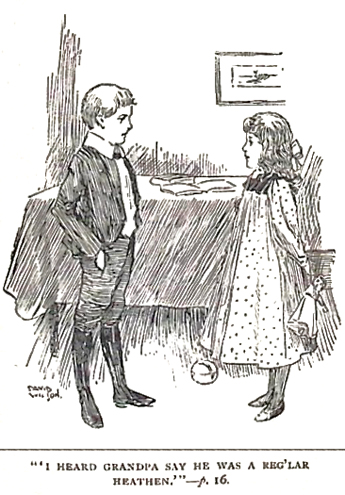
"Don't 'spect he is, for I heard my grandpa say he was a reg'lar
heathen."
"Heathen?" repeated Gerald in surprise.
"Yes, p'raps you don't know what they are. Well, I'll tell you!
Heathens is black, and they have little idols, which they says their
prayers to. Mother told me, so I know it's true. Is your uncle black?"
"No," said Gerald, bursting into a merry laugh, which would have
cheered his mother's heart could she have heard it.
Doris looked disappointed.
"Oh well, perhaps he'll turn black by-and-by; anyhow I know he's a
heathen, 'cause grandpa says so, and he knows everything. He's so
'very' old, nearly a thousand years, I should think."
"What a funny old man he must be!" said Gerald, bubbling over with
amusement.
"I shall come and see you one day, 'cause I love you very much," said
Doris after a slight pause, for a brilliant idea had just occurred to
her mind.
"Perhaps my uncle won't let you come," answered Gerald a little sadly.
"Oh, yes he will, I shall come with Uncle Wilfrid, see if I don't,
and—" here the child lowered her voice mysteriously—"we will try and
find the idol what he prays to."
Gerald began to think that Doris was the dearest and funniest little
girl he had ever met, and he was quite comforted to think there might
be a chance of meeting her again at his uncle's house.
The days spent at Mr. Sharpe's pretty suburban home, passed all too
quickly away, and it was with regret he bade "good bye" to new friends.
Doris came to the gate to see the last of him, and called out in her
childish treble, "I'll be sure to come and see you, Gerald, and the
heathen as well. I wish he was black, though!"
"Gracious!" said Miss Rachel. "What 'does' the child mean?" But hearing
at that moment from cook that the kitchen chimney was on fire, she
puzzled her brains no more about the subject.