A Thousand Miles on an Elephant in the Shan States
Whole book · 41 sections
A THOUSAND MILES ON AN ELEPHANT IN THE SHAN STATES
Transcriber’s Note:
New original cover art included with this eBook is granted to the public domain.
A
THOUSAND MILES ON AN ELEPHANT
IN THE SHAN STATES
MAUNG HAUT TO KIANG HSEN
BY
HOLT S. HALLETT, M. Inst. C.E.
F.R.G.S., M.R.A.S.
HONORARY MEMBER MANCHESTER AND TYNESIDE GEOGRAPHICAL SOCIETIES
WILLIAM BLACKWOOD AND SONS
EDINBURGH AND LONDON
MDCCCXC
All Rights reserved
TO
THE AMERICAN MISSIONARIES IN BURMAH, SIAM, AND THE SHAN STATES,
I DEDICATE THIS BOOK,
AS A MARK OF THE
HIGH ESTEEM IN WHICH I HOLD THE NOBLE WORK
THE AMERICAN BAPTIST MISSION AND
THE AMERICAN PRESBYTERIAN MISSION
ARE ACCOMPLISHING
IN CIVILISING AND CHRISTIANISING
THE PEOPLE OF INDO-CHINA.
PREFACE.
vii
The importance of the Eastern markets to European commerce
has long been recognised, and since the famous
Portuguese navigator Vasco da Gama rounded the Cape of
Good Hope at the close of the fifteenth century, and the
Portuguese occupied Malacca and established factories or
trade depots in Burmah at Martaban and Syriam, the trade
of Western China and Indo-China has been a prize which
has attracted the commercial aspirations of every maritime
mercantile community in Europe.
In 1613, the Portuguese were ousted from Burmah, and
six years later, the English and Dutch established factories
in that country. Some years afterwards the Dutch were
expelled, and in the middle of the next century the French
became our rivals for a short time. In 1756 the chief of
their factory was executed, and their factory was destroyed,
never to be resuscitated.
The first Englishman whose name is recorded in history
as travelling in Siam and the Shan States is Thomas Samuel,
who happened to be at Zimmé when that place was recaptured
by the Burmese in 1615. In Purchas’s ‘Pilgrims’
it is related that he had proceeded from Siam to Zimmé “to
viiidiscover the trade of that country.” From that time to
1687, when the English were turned out of Siam for killing
some of the natives in a scuffle, many English merchants
resided there.
Whilst the coast of Burmah was under native dominion,
our traders had to content themselves with travelling
along the great rivers; and it was not until 1829, three
years after we had annexed the Burmese provinces of
Tenasserim and Arakan, that steps were taken by us to
establish overland trade with Northern Siam, the Shan
States, and China. In that year Lord William Bentinck,
the Governor-General of India, ordered a mission to proceed,
under Dr Richardson, from Maulmain to the Siamese Shan
States, to ensure friendly relations and trade in that direction;
and in 1837, Lord Auckland, then Governor-General,
despatched Captain (late General) MacLeod, viâ Zimmé and
Kiang Hung to China, with the view of opening up trade
with that country. Notwithstanding the favourable reports
of these and subsequent missions, and the frequent petitions
of our mercantile community asking for the connection of
Burmah with China by railway, no action has been taken by
the Indian Government in the sixty years that have elapsed
since Dr Richardson’s mission, for improving the overland
routes leading from Burmah to the great undeveloped markets
which immediately border our possessions on the east. Burmah
might as well have remained for these sixty years in
native hands, for all the good that its acquisition has been to
the furtherance of our trade with the neighbouring regions.
When I retired from Government service at the end of
1879, the French were again in the field. They had annexed
the south-eastern corner of Indo-China, had seized
Cambodia from the Siamese, were determined to wrest Tonquin
from China, which they have since succeeded in doing,
and had openly avowed their intention to eject British
trade from Eastern Indo-China, and to do all they possibly
ixcould to attract the trade of South-western, Southern, and
Central China to French ports in Tonquin, where prohibitive
duties could be, and have since been, placed upon
British goods. It was under these circumstances that
Mr Colquhoun and I took up the question, placed the
necessity of connecting India with Burmah, Siam, and China
before the public, and with the aid of the mercantile community
determined to carry out a series of exploration-surveys
to prove whether or not Burmah could be connected
with these countries by railway at a reasonable expense,
and to select the best route, financially and commercially,
for the undertaking. The present volume deals with my
exploration-surveys in Siam and the Shan States.
The country through which I passed, besides being of
interest from a commercial point of view, was at the time
of my visit shrouded with that glamour which invests all
little-known regions; and an accurate knowledge of its
physical features and political relations promised to be of
great importance in view of the action of France in Tonquin,
and our threatened embroilment with that nation in
Upper Burmah.
Before commencing the narrative of my journey, in which
the manners, customs, and habits of the people will be
portrayed, I will, from information recently acquired by
myself and other travellers, and from other sources, give a
slight sketch of the ethnology and history of the interesting
races met with by me on my journey.
The first mention in history of Lower Indo-China is in
the ‘Annamese Chronicles,’ where it is stated that Founan—the
early Chinese name for Cambodia—in B.C. 1109
was under the rule of a native queen. The next we hear
of it is in A.D. 69, at the time when a Brahman from India,
named Prea Thong, who is said to have been the fugitive
son of the sovereign of Delhi, married the then ruling
queen. This Brahman is believed to have introduced Brahmanism,
xarchitecture, sculpture, and astronomy into Cambodia.
At that time Cambodia consisted of an agglomeration
of seven States, which were constantly at war with
each other. On the death of the Brahman’s son, the
commander-in-chief of the army made an end of the
principalities, and was elected to the joint throne.
From B.C. 125 there are many accounts of embassies
passing between China and Cambodia, and the country
seems rapidly to have reached a height of prosperity and
Eastern splendour. In the third century Chinese ambassadors
mention palaces, towers, and theatres having been
erected for the reception and amusement of the guests, and
meeting merchants in the ports from countries as far west
as the Roman Empire. The people were described by the
Chinese as an active and robust small black race, with long
hair knotted on the top of the head; the rich wearing only
a silk loin-cloth, and the poor one of cotton. The women
had head-coverings, and decked themselves with beautifully
wrought silver jewellery set with precious stones. The
men excelled in making jewellery, gold and silver vases,
furniture, and domestic utensils—and were honest, and
hated theft above all things. They worshipped Hindoo
gods, and offered up human sacrifices.
This small black race, the Cham or Siam, was of the
Malay stock, doubtless darkened by interbreeding with the
Negrito aborigines, and perhaps with Dravidian colonists
from the Madras coast. Remnants of the Negrito aborigines,
evidently akin to the Australioids, are still found in
the hilly districts of the Malay Peninsula, as well as in
some of the adjacent islands: and the Kha, or Ka, in the
neighbourhood of Luang Prabang; the Trao, to the east of
Bienhoa in Cochin China; the Hotha Shans, in the Chinese
Shan States; and one of the native races in Formosa,—are,
according to Professor Terrien de Lacouperie, representatives
of the same stock, and akin to the Tiao, a race of pigmies,
xiwith whom the Chinese (Peh Sing tribes) became acquainted
when they entered North-eastern China more than 4000
years ago.
To the north of the Chams, the country from an early
period was occupied by the Lawa, a race with Mon affinities
and probably of the Mon stock, who, according to their
own traditions, and the beliefs and traditions of their neighbours,
are the aborigines of the region stretching southwards
from Yunnan, and eastwards from the Salween to the Meh
Kong, and perhaps even to the China Sea. Many of the
names of principalities and deserted cities are said to have
been derived from the Lawa; and fierce battles were fought
between them and the Shans before the former were conquered
or driven into the hills. In a few years the language
of this interesting race will be extinct, as the race
have gradually been absorbed into the Shan and Peguan
population, and Shan as well as Lawa is now being spoken
in their few remaining distinct villages.
To the west of the Lawa were the Mon or Mun, a Mongoloid
race of Malaysian affinities, whose scattered tribes
spread from Indo-China into Western Bengal and Central
India, where they are now known as Kolarian. Their first
kingdom in Lower Burmah was founded at Thatone, an
ancient seaport on the east of the Gulf of Martaban, by an
Indian dynasty from the Madras coast, in the sixth century
B.C. About the end of the first century of our era, Mon
tribes drove the Burmese from Prome, which had been their
capital from B.C. 483. These tribes were probably descendants
of the Ngu race, including the Pang, Kuei, and Miao
tribes, who, with the Shan, Yang or Karen, and King or
Chin tribes, formed the chief part of the population of
Central and Southern China during the struggle for empire—604–220
B.C.—between the Dukes of Tsi, Dsin, Ts’in,
and Tsoo, which ended in the ruler of Ts’in becoming the
first Supreme Emperor of China. Some of the wars waged
xiiby Ts’in during this period seem to have been wars of
extermination; and many tribes must have sought safety
by moving southward and south-westward out of the area
of turbulence. In one campaign 240,000 heads are said
to have been cut off; in another, 140,000; and in others,
60,000, 80,000, and 82,000 heads.
In A.D. 573, the Mon founded a separate kingdom at
Pegu, which, with the Thatone kingdom, was destroyed by
the Burmese King of Pugan in the middle of the eleventh
century; from that time to 1287, when Pegu was conquered
by the Shan King of Martaban, Lower Burmah remained
under the Burmese. In 1540 it was reconquered by the
latter, and formed part of their empire for 200 years. In
1740 the Mon, aided by the Karen and Gwe Shan, rebelled
against Burmah, and, electing a Gwe Shan as their king,
commenced the great fight for supremacy, which lasted till
1757, and left the Burmese supreme in the country until
we annexed it.
The language of the Mon is now nearly extinct in Lower
Burmah. The Mon or Peguans, who sided with us during the
first Burmese war, were mercilessly ill-treated by the Burmese
when we evacuated Martaban and Pegu: those who did not
escape into Tenasserim, Zimmé, and Siam, were either murdered
or forced to learn and speak the language of their
oppressors.
To the north of the Mon race, in the district of the Middle
Irawadi, the country was occupied from an early date by Burmese
tribes of Tibetan origin, who were gradually welded together
by warlike Kshatriya princes, who invaded the country
from Northern India. According to the Tagaung Raza Weng,
their first capital in Burmah was founded at Tagaung by
Abhi Raja, one of the Sakya Rajas. This prince came from
Kapilavastu with an army, and, B.C. 923, built the city.
One of his sons founded a dynasty in Arakan, and a grandson
established another at Kalê in the Kubo valley. The
xiiidestruction of the first monarchy at Tagaung was due to the
irruption of tribes, probably Shans, from the East. This is
said to have happened in the sixth century B.C.
About this time a second band of Kshatriyas arrived from
Gangetic India, whose chief, Daza Raja, married the widow of
the queen of the last dynasty, and some years later, B.C.
523, built old Pugan, near the site of the ancient capital.
His successor was expelled and driven south by the Shans,
and founded a new capital, B.C. 483, at Prome, in the north
of Lower Burmah. Upper Burmah was thus left in the
possession of the Shans, many of whose cities in the Shan
States lying to the west of the Salween were founded about
this time. Moné is said to have been built as early as
B.C. 519.
Thirteen years after the Burmese were turned out of
Prome by the Mon, they created a new capital, A.D. 108, at
Pugan, where the Burmese monarchy continued until 1291,
when it was expelled by the Shans, who governed Burmah
from that time until 1554. From thence until we annexed
the country, Upper Burmah was under Burmese rulers.
The Karen tribes who are found scattered amongst the
hills in Burmah and Siam from the latitude of Mandalay
southwards, are called by the Burmese Karen or Kayen;
by their other neighbours they are known as Yang, pronounced
sometimes nasally as Nyang. These people are
believed to have been a branch of the Chau or Djow, which
entered the north-west of China about B.C. 1276. The Djow
displaced the Shang dynasty in China B.C. 1122, and remained
supreme over the agglomeration of principalities
forming the Chinese Empire until B.C. 336, when some of
the States acknowledged Ts’in as their lord. Djow was
ultimately overthrown, in B.C. 255, by the Prince of Ts’in,
who took possession of Djow’s sacrificial vessels and the nine
tripods, the symbols of empire. During their rule the Djow
preserved their ancient faith in divination, and the augurs
xivin the courts of the principalities occupied a distinguished
position. No expedition or any business of importance was
entered into without first consulting the fates.
The Yang or Karen—who gave their name to the Yangtsze
Kiang, and settled on its banks—at the time of the
destruction of Tsoo, the great principality which covered
Southern China, by the Shensi State of Ts’in, B.C. 221, occupied
the country to the south of the river in the provinces
of Kiangsu, Anhwei, and Kiangsi. They were driven away
by the Shan and Mon population of the eastern provinces,
210–206 B.C., and were finally expelled from China by the
Shan King of Nanchao, viâ Yungchang, a city on the Bhamo
route, A.D. 778. They have since spread southwards into
Lower Burmah and Siam. At the time they left China,
they are said to have numbered 200,000 families.
The traditions which are repeated from father to son in
metrical verse by the Yang, have evoked great interest among
the American missionaries, who have done such good work in
converting them to Christianity. From the creation until
after the flood these traditions are intrinsically the same as
the Mosaic accounts. Some people firmly believe the Karen
to be the ten lost tribes of Israel; but as their ancestors are
known to have been in China some 550 years before the
ten tribes were lost, it is much more reasonable to believe
that they received their traditions from the Mohammedans
of Yunnan, or that before their entrance into China they
followed the tracks of the Peh Sing tribes, and had their
earlier home in the neighbourhood of the Semite tribes, and
there acquired their knowledge. The two other races which
have extended southwards from China into Indo-China are
the Jung and the Shan. The former was already on the
borders of China, and some of its tribes had settled about
the southern bend of the Hoang Ho at the time when the
Peh Sing Chinese tribes arrived from their long journey
from the neighbourhood of Chaldea. The Jung, according
xvto Professor Terrien de Lacouperie, were originally of the
same white stock as ourselves, and have become hybrid by
intermixture with the neighbouring races. They were so
warlike in their disposition that their name became amongst
the Chinese equivalent to that of warriors. In the seventh
century B.C. they were spread across the north of China from
the extreme west of Kansu to the neighbourhood of Pekin.
Many of their tribes were absorbed by the Ts’in—the Seres
of the Greeks and Romans—of the province of Shensi,
whose State name Ts’in has been by Europeans corrupted
into China.
The people of Ts’in claimed kinship with the Niao-suk
(Nila-Cakas or black Sakœ), and with the Fei or Bod,
the people of Tibet. About B.C. 770, Ts’in was incorporated
in the agglomeration of dukedoms or States forming
the Djow dominion, and rapidly increased in strength by
conquest, and partly by the absorption of the neighbouring
Jung tribes. It then grew in power at the expense of
the eastern States, and brought them into subjection. It
further carried its sway across the Yangtsze B.C. 279, and
conquered Tsoo. Its duke became Supreme Emperor of
Ts’in B.C. 220.
The Jung tribes which were not absorbed by Ts’in,
gradually pressed southwards amongst the Shan tribes in
Szechuen, and are now found, under the tribal names of
Mo-so, Lissu, Lolo, La-hu, La-wa (Lahs and Wahs to the
north of Kiang Tung), &c., in the west of that province,
and in Yunnan, Kweichau, and the Shan States as far south
as the latitude of Zimmé, and as far west as the Salween
river. These tribes speak a Tibeto-Burmese language.
The Shan race, known by the self-names of Tai, Pai, Lao,
&c., occupies an area of country six times as large as the
United Kingdom; yet, owing to the trading propensities of
the race, the dialects spoken by the Shans differ so slightly
that travellers from the Tonquin hills, Kwangsi, Yunnan,
xviand Bhamo can converse with people at Zimmé and at
Bangkok.
In the earliest times we hear of the Shans under their
tribal names stretching across China from east to west, and
occupying the country between the Yangtsze and the Hoang
Ho. From 1766 to 1122 B.C. they are supposed to have
been the dominant power in China, since the Shang, or
traders, the ruling dynasty during that period, were presumably
of their race. Later on they spread over Southern
China, forming a large ingredient in the kingdoms of Tsoo,
Tsen or Tien, and Nan-Yueh, and extended into the valleys
of the Irawadi, Salween, Meh Nam, and Meh Kong.
The last of their tribes to leave Central China for Indo-China
appear to have been the Chau Tai or Siamese, who
were expelled from their seat in Kiangsi and Anhwei in the
tenth century of our era. They were driven to the south-west
into Kwangsi and Kweichau, where some of their tribes
are still found, and a large body ultimately migrated into
the Shan States to the south of Kiang Hsen.
In the latter half of the thirteenth century the country
occupied by the Shans was in a state of turmoil and
unrest. The ancient principalities in Yunnan had been
conquered by Kublai Khan 1253–54; the Shan States to
the south and west of Yunnan had been attacked, and a
consequent great displacement of the population occurred.
At that time the agglomeration of States formed by the
Ngai Lao or Lao Shans stretched southwards from the
latitude of Kiang Hsen to the northern confines of Cambodia
or La-Wek, which then included a number of principalities
in the valley of the Meh Nam, as well as in that
of the Meh Kong. About 1281, according to the Shan
records at Zimmé, the Prince of Kiang Hsen advanced southwards
and conquered Lapoon, and in 1294 founded the
present city of Zimmé. The Lapoon Shans fled into Martaban,
and, headed by one of themselves, attacked the Burmese
xviigovernor, slew him, and made their leader Wa-re-ru King
of Martaban, A.D. 1281. Six years later, this Shan king
conquered Pegu, and Shan kings reigned over the joint
kingdom from that time until they were conquered by the
Burmese in 1540. Upper Burmah was likewise under Shan
kings from A.D. 1290 to 1554.
It was about the time of the conquest of Lapoon, according
to Siamese history, that the Siamese were expelled from
Kiang Hai by the Prince of Sittang. The Siamese fled
southwards, and founded a new capital at Muang Pehp or
Pet, opposite the present city of Kamphang Pet on the Meh
Ping. In 1320 they deserted that city and founded another
in the neighbourhood, and thirty-one years later migrated
to the south, built their new capital at Ayuthia, on the site
of a deserted Cambodian city called Viang Lek, founded
dukedoms or Muangs at Soo-pan-Boo-ree and Lop-Boo-ree,
and joined the confederation formed by the Ngai Lao States,
over which the King of Sukkhothai was then suzerain.
This king had attacked Cambodia in 1296, pillaged its
cities in the valley of the Meh Nam, driven the Cambodians
to the eastward, and thus rendered the country available for
the Siamese settlements.
As time went on the Siamese became the predominant
State in the kingdom, and entered on frequent wars of
aggression with Cambodia, Annam, Vieng Chang, and Zimmé.
In 1546, six years after the Burmese King of Toungoo had
conquered Pegu, the Siamese commenced the series of wars
with Burmah which ended in nearly exterminating the
population of both countries.
Every able-bodied man who did not take refuge in flight
was forced into the ranks, either to defend his country, or
to attack that of his neighbours, or the neighbours of the
power to which his own State was tributary. Armies, from
forty thousand to two hundred thousand men strong, ravaged
the land, and swept away, as in a great net, those of the inhabitants
xviiiwho were not killed in battle. In vast tracts not
a man, woman, or child remained; and elephants, rhinoceroses,
tigers, deer, wild cattle, and other wild animals took
possession of the devastated country. At length the Mon
armies of Burmah, who hated forced service, mutinied, and,
taking their wives and children with them, fled into Siam;
and Zimmé, which had been under Burmah, except in times
of rebellion, from 1558 to 1774, threw off the yoke and
asked for the protection of Siam. To such an extent was
the population thinned out by the incessant warfare, that
when we annexed the Burmese province of Tenasserim,
which borders Siam and Zimmé, we found in it barely
seventy thousand souls.
Burmah is blessed with a fruitful soil and a bounteous
rainfall. It only requires increased population to make it
the garden of the East; and every chief commissioner, from
Sir Arthur Phayre downwards, has advocated its connection
with China by railway, as the means for supplying that
want from the most industrious and enterprising people in
Asia, the Chinese.
I take this opportunity to record my deep sense of gratitude
to the Rev. J. N. Cushing, D.D., and the Rev. D.
M‘Gilvary, D.D., who accompanied me as comrades and interpreters
during part of my explorations, for their friendly
endeavour to secure the success of my undertaking; and I
have much pleasure in expressing my heartfelt appreciation
of the frank cordiality and unwearying kindness accorded
me by all the American Missionaries and Missionary Ladies
during my stay in the country.
CONTENTS.
xix
CHAPTER I.
PAGE
Dr Cushing’s arrival—A-heng—Leave Shoaygoon—Gold and silver carried—Flood of 1877—A bad driver—Dog offered to demons—Soused in the Hlineboay—Hlineboay—Traders—Mr Bryce’s party—Asked to join parties—Dr Cushing in charge of commissariat—Labelling and sorting baskets—The luggage—Medicines—Karen interpreter—Loading the elephants—Portow and Loogalay—Madras boys good fighters,
Surveying—Thankful for a halt—Leave Hlineboay—Karen houses infested with bugs—Halt near well—Rigging up shelter for the night—Tent left behind—Teak-forest—Yunnanese—A scare—Exploding bamboos—Trees 130 feet high—A mid-day halt—The British guard-house—A night camp—Glutinous rice, mode of cooking and carriage—Elephants feeding—Heavy dew—Journey down the Yembine valley—Motion of elephants—Difficult surveying—A practical joke—Railway to Rangoon and Mandalay—Heathen Karens—No longer a missionary—Difficulty in converting Buddhists—Venison for dinner—Stung by bees—Pass between the Thoungyeen and the Salween—Trees 25 feet in circumference—Limestone cliffs—Offering to the dead—Descent to the Thoungyeen—The ford,
xxRev. D. Webster’s party detained—Siamese officials expect bribes—Photographic plates all spoilt—Visit from Karens—Joined by the B.B. party—Siamese police post—Gorges in the Thoungyeen and Meh Nium—Rapids stop navigation—Forests and elephants—Dwarf races—Kamook and Kamait slaves hired by our foresters—Migration of Laos from Tonquin—The Khas of Luang Prabang—Sacrifices to demons—Drinking the health of strangers—King of Siam allows slave-hunting—Missionaries required in the Meh Kong valley—Leave the guard-house—Crossing the water-parting—Wild tea—Karen villages built distant from road—Country formerly lacustrine—Shelter for the night—Heavy rain—A shower-bath in bed—Elephants crossing steep hills—Wild animals—Reach the Meh Nium—Karen pigs—Remains of a lake-bottom—The Maing Loongyee plain—Epidemic of smallpox—Villages tabooed—Arrive at Maing Loongyee—Moung Hmoon Taw’s house—A timber prince and the money-lenders,
Maing Loongyee traversed by war-paths—Dr Richardson’s visit—Price of slaves—Dr Cushing’s visit—Raided by Karennis—The city and suburbs—Visit the governor—The Shan States—Government—Succession to the throne—Titles—Modes of execution—Zimmé formerly extended from the Salween to the Meh Kong—The governor and his brother—The bazaar—Distributing seeds—Information from foresters—Collecting vocabularies—Moung Loogalay—Portow—A magician—Dr Cushing at work and exasperated—Visit to ancient city and to the earth-hills—Crossing the river—A dangerous walk—Pine-trees—Number of Lawa, Karen, and Shan villages—Population—A Karen dance—Enticing a Lawa—Description—Similarity between Kamook and Lawa languages—Visit to the governor—Effect of a telegram—Elephants hired for forest work from Karens—Mode of attack of male and female elephants,
xxiLeave Maing Loongyee—A hundred-foot waterfall—A beautiful hill-torrent—A lugubrious tale—Gibbons—Gigantic tree-ferns—Shans cruel elephant-drivers—Method of driving—Droves of pigs and laden cattle—Loi Pwe—An accident—Wild raspberries—Shans bartering goods—The Meh Laik valley—A fall of 2049 feet—Paths for the railway—Lawa villages—Aborigines—Burial custom—Human sacrifices in the Shan States and China—Legend concerning the conquest of the Lawas by the Shans—The virgin of the lotus-flower—Gaudama sacrificed to as the goddess of mercy—Sacrifices to ancestors and demons—Similarity of superstitions in ancient Chaldea and the Shan States—Photographing Lawas—Clothing worn for decency’s sake—Costume of Lawas—Cold nights—View of the hills—Bau-gyee—Iron-mines guarded by demons—A young blacksmith,
Path for a railway—Lawa Sivas—Legends of Poo-Sa and Ya-Sa, and of Me-lang-ta the Lawa king—Story of a Yak—Descent from the Bau plateau—A courageous lady—Weird country—Ruby-mines—Reach Muang Haut—Cabbages—Tobacco-cutting—A bobbery—Fable of the peacock and the crow—Sketching the country—Conversing by signs—Interviewing the head-man—Boat-hire on the Meh Nam—Cost of carriage—Rainfall—Produce of fields—A Shan temple—Method of making images—Bargain for boats—Temperature in sun and shade,
Leave Muang Haut—Legend of the rapids—Footprints of Buddha—Power of accumulated merit—Indra’s heaven—River scenery—Fishing-dams—Loi Pah Khow—Large fish—Naked boatmen—A pleasant retreat—Wars between the Burmese and Shans—A sugar-press—Silver-mines—Path for the railway—Water-wheels—The tiger-head mountain—Pleasant mornings—A river scene—Chanting prayers—The valley of the Meh Li—Country-house of the chief of Lapoon—Viang Htau—Visit to a monastery,
xxiiDescription of Shan houses—Cabalistic charms—Superstition—Ancestral and demon worship—Shan dynasties in Burmah—Zimmé under the Burmese—Rules for house-building—Possessing a ghoul—The shadow spirit—Kissing with the nose—Furniture—Meals—Chinese chop-sticks—Spinsters—Weaving and embroidery—Dyes—Chinese hongs—Fishing—Revolt against Burmah—Zimmé and Lapoon deserted—A rest-house—Shan dialects—Entrance of the Meh Hkuang—Musical water-wheels—Brick and tile works—Houses for the demons—Houses imbedded in gardens—Light-coloured buffaloes—My first hunt in Burmah—A fine pagoda—Approach to the city—Arrive at Zimmé—American Presbyterian missions in Siam and Zimmé,
Our reception—The Mission-house—A beautiful view—A repast—Rev. J. Wilson—Ancient boundaries of Zimmé—City of Zimmé—Population—The bridge—An hermaphrodite—Youthful Dianas—Female dress—The market—Shops—The palace—Visit the king—Discussion about the railway—Prisoners in chains—Visit a princess—Shan embroidery—A great trader—Amount of caravan traffic—Number of elephants—Boat traffic,
Chow Oo-boon, a spirit-medium—Consulting ancestral spirits—An exorcist—Spirit of witchcraft—Ill-treating a patient—Treatment of witches—False charges—Missionary destroys an image—Execution of Christians—Proclamation in favour of Christians—Missionaries protect witches—Undermine superstition—Ghosts perching on trees—A missionary ghost—Headless demons—A demoniac,
Visit the Siamese commissioner—Description and dress of Siamese—Deceitful officials—Prince Prisdang’s letter—Pie-crust promises—A mountebank—Call on the Princess—Treaty of 1874—Siam’s relation to Shan States—Former obstacles to trade removed—Visit from Chow Oo-boon—Assassinating a lover—Shan queen in English dress—Fast and easy-going elephants prized—Kian Yuen, an old capital—A Chinese pagoda—City of the flower-garden—Muang La Maing, the site of the first Zimmé Shan city—Ascent of Loi Soo Tayp—The pagoda of the emerald rice-bowl—Pagoda slaves—Dr M‘Gilvary joins my party—Visiting Burmese foresters—Religious buildings erected by the Burmese,
xxiiiDinner at the Princess’s—Arrangements for start completed—A passport—Our pavilion—The Zimmé plain—Leave Zimmé—Canal irrigation—Halt at Muang Doo—The Chows astray—Camp-dinners and cookery—Excellent Madras servants—Alteration in Jewan—Courtship, marriage, and divorce—Kumlung, or family patriarch and priest—Price of slaves—Slave-bondage—Foreign marriages—Serfdom in Zimmé—Formation of clans—Government masters in Siam—Crown commoners,
Paying for supplies—Land and teak-forests belong to chiefs—Land rent—Light taxation—Leave Muang Doo—Upper Meh Hkuang—Ascend a plateau—A surprise—Luong Hkort—The Meh Hkort—Pass between the drainage of the Meh Ping and Meh Kong—Precaution against demons—Shans will not travel alone—A scare for tigers—Head-dressing and tattooing of Zimmé Shans—Charms let in the flesh—A quiet race—Villagers responsible for loss and crime in neighbourhood—Must not leave village without permission—Surveying under difficulties—The little elephant’s fun—The Meh Wung and Meh Ping—A vast plain depopulated—Timidity of elephants—Residence for demons—Reach Viang Pa Pow,
A Chinese fortification—Chinese army destroyed by famine—Viang Pa Pow—Kiang Tung Lawas—Witch villages—An intelligent prince—Best direction for railway—Purchase an ox for food—An ancient lake—Leave Pa Pow—Upper gorge of the Meh Low—Kiang Tung Lawas a Jung tribe, and distinct from Bau Lawas—Burmese Shans—Cattle with nose-bags and masks—Effect of soil on foliage—Surprises in the jungle—Temple at Bau Meh Pik—Offerings to deceased ancestors—The valley of the Meh Sooay a game-preserve—Indications of gold—Road to Viang Pow—Lower gorge of the Meh Low—Portow, the little elephant’s playmate—Loi Kook—Loi Chang Shans returning from frontier duty—Unwarrantable action of Chinese general—Kiang Hung Shans Burmese subjects in 1886—Removal of capital—Kiang Hung annexed by British in 1888—Shans dread entering deserted temples—Deceased monks classed as demons—Worshipping deceased monks—Suicide of a princess and two of her maids—Soused by an elephant—Courtesy of the Chow Hona of Kiang Hai—An immense plain,
xxivPrinces in their best clothes—A procession—Reach Kiang Hai—Dilapidated houses—The Meh Khoke—Ngios from Moné—Kiang Hai—Former Siamese capital—Early history of Siam—Visit he chief—Population—Ruined cities—Arrangement between British Shans and Siamese Shans—Recent encroachment of Siamese—Name entered as benefactor in royal annals—Visit from La-hu—Oval faces—known by their petticoats—Monosyllabic languages difficult to translate—La-hu a Lolo tribe—Comparison of vocabularies,
A state visit from chief—Insignia of office—Plentiful rainfall—Rain-clouds from the north—Only silver coins—Indian money—Frontier dues—Ferry toll—Fishing as a livelihood—Salt and cowries as small change—Tricks with the currency in Siam—Robbing the poor—A footprint of Buddh—A monk spoilt by the ladies—Ruined temples strewn with bronze images—Carl Bock’s loot—The emerald Buddh—A tattooed Laos Shan—Madras boys taken for ogres—Marching in single file—Scene at the ford—Cheap provisions—Chinese caravans—Cost of carriage—Opinion of Dr Cheek as to the prospects for a Burmah-China railway—Population of Siamese Shan States—Protection of caravan—Birds and monkeys dying of grief—Second visit from the La-hu—Marriage customs—Divorce—Gold in the Kiang Tung Lawa country—Fishing by torchlight,
Leave Kiang Hai—A hot spring—Elephants without tusks—Elephant-driving—Danger when driver is careless—A large rice-plain—Bargaining with the abbot at Muang Doo—Bloodthirsty flies—Elephants as tool-users—Inhospitable ancestral spirits—Game plentiful—Utterances of tigers—A magnificent forest—A stink-wood—Water-parting between the Kiang Hai and Kiang Hsen plains—Brave butterflies—A field for an entomologist—Psyche in Burmah—A Central Asian belief—Three sacred hills—Buddha and Confucius—Legend of Loi Htong—Valley of the Meh Chan—Pass to Muang Fang—Kiang Hsen plain—Siamese aggression—Deserted cities of Manola—Tigers—Attack on Kiang Hsen in 1794—Wild animals—Legend of Muang Nŏng—Thunderstorm—Flooded country—Leaning pagoda—Reach Kiang Hsen,
The Meh Kong at Kiang Hsen—Ringworm—Extensive ruins—Description of city—Importance of situation for trade—Chinese settlers from Ssuchuan, Kweichau, and Yunnan—Projected railway—Surveys being made by King of Siam—Excursions from Kiang Hsen—Teak-forests—Robbing an image—Legend of Kiang Mee-ang—Ancient cities—Comparison between ancient Britons and Shans—Ancient principality of Tsen—Kiang Hung—Destruction of Kiang Hsen—Carried away captives—Treachery in war—Population of Zimmé chiefly slaves—Kiang Hsen reoccupied in 1881—Resettling it—Action of King of Siam—Friendly footing of missionaries—View across the Kiang Hsen plain—Flooded country—Leave for Kiang Hai—A white elephant—Branches as sunshades—Elephant-flies—Emigrants from Lapoon—Beautiful scenery—Mr Archer’s description of traffic along the route,
xxviAt Kiang Hai—Ferocious dog—Chinese pack-saddles and mules—Routes from China—Articles of merchandise—Richness of Kiang Hsen plain—Visit the Chow Hona—Man killed by wild elephant—Chiefs wish for railway—Would help by granting wood for bridges and sleepers—Kamooks for labourers—Chinese Shans and Chinese would flock in for hire—Easiest route for loop-line to Zimmé—Trees laden with women and children—Dr M‘Gilvary purchases an elephant—Receives present from Chow Hona—Sunday service—Unselfishness of Dr M‘Gilvary—Lapoon immigrants—Death-rate of immigrants—Boxing—A woman in chains—Leave Kiang Hai—Young elephants a nuisance—A yellow-turbaned monk—Fireworks—Whistling rockets—Gigantic rockets at funerals—A lovely Lolo-Lawa woman—Spring blossoms—Cross the water-parting between the Meh Low and the Meh Ing—Hot springs—Houses erected for us—Fisheries—Arrive at Muang Hpan—Formation of a settlement—Emigrants to Kiang Hsen in 1887—Prosperity of country—Mr Archer’s opinion—The father of the state—Like a Highlander—Deserted cities—An ancient Christian—Viang Poo Ken—Rapid decay of buildings in a moist climate—Ants at work—Damming streams for fisheries—Injury to drainage—The Meh Ing a sluggish stream—A hare—Oppressive atmosphere—Searching for water—Boiling mud to make tea—A distressing march—City of Chawm Taung—A celebrated temple—Buddhist legend—A golden image sixty feet high—Legend of Penyow—A Buddh forty-five feet high—Gaudama existing formerly as Indra—A Shan Rachel—Reach Penyow,
Settled by Lakon—Population—Smallpox—Tutelary spirits—Ancient cities—Trade-routes and cost of transport—The centre of Ping States—A Lakon prince—Views about railway—Smallpox raging—Callousness of natives—Dr Cushing infected—Deserted cities—Famous for pottery—Gambling currency—Gambling games in Siam—Fighting crickets, fish, and cocks—Cock-crowing in Indo-China—Variation in times of new year—Gambling monopoly in Siam—Proclamation of the king—Gambling chief cause of slavery—Parents selling children into slavery—Slavery not abolished—Proclamation issued to delude foreigners—Position of people daily growing worse—A money-lender buying injustice from princes and nobles—Encouraging gambling—Gambling-house jails—State of Siamese Government monopolies—Effect of corvée labour—Burdensome taxation—No justice—General demoralisation—Shan States better governed,
xxviiLeave Penyow—Wild roses—An inundated country—Royal funeral buildings—Posts two hundred feet long—Collection and uses of wood-oil—Description of daily meals—Water-parting between the Meh Kong and Meh Nam—Path for railway—A dead forest—Reach Muang Ngow—Settled by Lakon—Karen villages—Teak-forests—Four thousand Burmese destroyed—A distributing centre for Muang Nan and Muang Peh—Deficient rainfall—Burmese pedlars—Immigrants from Kiang Hung—A terrible din—The eclipse—Buddhist legend—Elephants should rest after noon during hot season—Leave Muang Ngow—Railway from Bangkok to Kiang Hung crosses no hill-range—Battle-field—The stone gate—Water-parting between the Meh Ngow and Meh Wung—A jolting elephant—Ban Sa-det—Offerings for the monks—Presents for the children—The Buddhist Lent—Lights for evil spirits—The demon’s lent—Offerings to the naiads—Illuminating the river—King of Siam lighting fireworks—Scaring the spirits—Offerings to naiads and demons in case of sickness—Trial by water—Superstition against saving drowning folk—Descent of the rain-god Indra—Libations—The water-feast—Bathing the images—Scene in the temple—Waking the gods with water—Propitiating the Lawa genii—The warming of Buddh—A dousing—A compliment—Calling the spirits to witness—Leave Ban Sa-det—Ruby-mines—Reach Lakon,
Lakon and Lapoon date from the sixth century—Description of Lakon—A Christian judge—Law and justice—Punishments commuted to fines—Legend of the dipped prince—Legend of Lakon—A modern joke—Legend of the ring lake—The god of medicine—The Aswins mending an old man—Origin of quack-doctors—A Siamese doctor—Theory of disease—Medicines—174 ingredients in a dose—Draughts for the poor, pills for the rich—Medicines by pailful—Empirics—Belief in demons and witches—Mode of payment by the job—No cure, no pay—Fee to the god of medicine—Priests to the demons—Sacrifices—Contamination from lepers—Smallpox and vaccination—Filthy dwellings and furniture—No pillow-cases or sheets—Killing bugs—Villages on the Meh Wung—Dr Neis’s survey—Karen Christians—Rev. D. Webster—Dr Cushing ill—Eagerness for work—Malarious fevers—Numerous Karens in British Shan States—Trade of Lakon—Visit the chief—Cheap labour for the railway—Great heat—Burst of the monsoon,
Prince Bigit’s expected visit—Leave Lakon—Cicadas and their music—A battle-field—Duplicate kings of Siam—Truant elephants—Dr Cushing has smallpox—A beautiful dale—A dangerous pass—Water-parting between the Meh Wung and Meh Ping—Number of villages in the Zimmé plain—The Mai Cha-lau tree—Pagoda on Loi Tee—A cart-road—Reach Lapoon—The great temple and celebrated pagoda—Lapoon built like Aladdin’s palace—Description of city—Deserted for forty years—Visit the chief—Leave Lapoon—Scene on the road—Reach Zimmé—Report of the R.G.S. on my survey,
House for Dr Cushing built in two days—Fumigation and disinfection—Bribery and extortion at frontier guard-house—Travellers delayed—Mr Webster’s journey—Trade between Zimmé, Bangkok, and Maulmain; enhancement of prices—Comparison between Russia and Siam—Oppression and tyranny causes cunning and deceit—Siamese the greatest liars in the East—An amusing interview with a prince—Religious buildings in Zimmé—Description of monasteries—Bargaining with an abbot—Palm-leaf books—Evil practices of monks—Sentencing the descendants of criminals to slavery—Begging for meals—Giving, a privilege—Rules for the acolytes—Shaving the head and eyebrows—Teaching in a monastery—Learning manners,
Leave Zimmé without interpreters—Borrow a tent—Reach Ban Pang Kai—The cry of gibbons—Legend—A primitive pagoda—Three kinds of pagodas—Description—Low plateau dividing Meh Low from Meh Wung—Branch railway from Lakon—The head sources of Meh Wung—A storm—Teak—Reach Muang Wung—Cockle’s pills—A temple at night—Tower muskets—A plague of flies—Moosurs—Dr Cushing leaves for Bangkok—His excellent arrangement—Translator of the Bible into Shan—Loss of Shan interpreters—Mr Martin joins party—Bau Lawas in Southern Siam—Arrival of Mr Gould—Elephant titles—Dinner at the Martins’—A present of cigars,
xxixLeave for Muang Fang—The temple of the white elephants—Training elephants—Evening service in a temple—Legend of Wat Pra Non—Snake and Siva worship—Caravans—Stick-lac trees not cut down—The 400 footprints of Buddha—Wild tea—Visit to Shan ladies—Low dresses—Rules of hospitality—Worshipping the manes—A zylophone—Implements of expectant Buddha—Straining water—Legends of Loi Chaum Haut and Loi Kiang Dow—The palace of the angels—Demons cannot harm Christians—Christianity a great boon—Accident to aneroid—A vicious elephant—Foot-and-mouth disease—Snares for demons—A panorama of hills—Sources of the Meh Ping and Meh Teng—A river passing under a mountain—Muan Hang an ancient lake-basin—Rival claims of Ping Shans and British Shans or Ngio—The upper defile of the Meh Ping—A moonlight scene—Entangling demons at the frontier—A Chinese fort—Loi Pa-Yat Pa-Yai—Mapping the country—Dr M‘Gilvary’s sermon—Reach Kiang Dow—Petroleum at Kiang Dow and Muang Fang,
Kiang Dow—Invasions of Burmese Shans—Precipitous hills—Muang Hang under the Burmese—Viang Chai—Catch a Kamait—Entering monastic life—Inquisitive people—Reach Muang Ngai—View up the river—A Shan play—Visit the governor—Leave Muang Ngai—Hot springs—Loi Pa-Yat Pa-Yai—A storm in the hills—Drainage flowing in three directions—Underground streams—Difficult pass—Sinkage of ground—A sacred cave—Legend of Tum Tap Tow—Visit the cave—An unpleasant night—Large game—Threatened with beheading—Legend of the hare-lip—Building a house—Chinese forts—Trichinosis—Reach Muang Fang,
Muang Fang—Deserted for 200 years—Proclamation resettling the province—Population—Settlements of Ngio ousted by Siamese—Land yielding 250-fold—Ruined cities—320 ruined temples—Purloining images—Mr Archer’s report—Method of forming new settlements—Separation of races in the cities—Colonies of refugees and captives—Chinese Shans as labourers—City sacked by the Burmese—Governor and wife drown themselves—Cost of carriage—Dr Tiger the hunter—Bargain for a dagger—Sworn brothers—Cambodian and Karen ceremonies—The augury of fowl-bones—Passing merit by cotton-threads—First hair-cutting in Siam—Lao marriage—Visit the ruined cities—Fallen idols—Putting fugitives in chains—A deer-hunt—Sketching the hills—Visit to Ban Meh Hang—Out of provisions—Fever and dysentery—Mahout attacked by vicious elephant—Spreading cattle-disease,
xxxLeave Muang Fang—My comrades hunting—Those boys again: panic-stricken fisherwomen—Water-parting between the Meh Ping and Meh Kong—Railway from Zimmé to Muang Fang and Kiang Hsen—A freak of nature—Tree eight feet broad—A deer-lick—Bed without dinner—Illness of missionaries—Sitting on a snake—Head or tail, query—Emigrants carrying spinning-wheels—Cross the Meh Ngat—A beautiful plain—Viang Pow—Visit from the governor—Ngio raids—Lolo and Karen villages—Effect of monopolies—People deserting Muang Fang—Officials collecting taxes for monopolists—No gambling and opium dens—Cost of carriage—Export of rice—One son-in-law in one house—Trade-routes—Leave Viang Pow—The defile of the Meh Ngat—Accident to aneroid—A fine view—An aristocratic governor—Population—Wild tea—Light taxation—Free from vices—Put up with a Shan convert—Women well treated amongst the Shans—Cutch-trees—Reach Zimmé,
Offering to the good influences—The spirit in sleep—The ceremony of Tum Kwun—Spirit-worship of Ping Shans—Arrangements for leaving—Visit Siamese prince—A Gatling gun as an ornament—Railway routes—Number of fighting-men—Dismiss Loogalay—Pretty pagodas—Boxing and wrestling—The bridge breaks—Presents from Chow Oo-boon—A lover’s lute—Lace prized—Dr Cushing’s views on the Ping Shans—Connection with Siam—Taxation—Corvée labour—Serfs—Slaves purchased from Red Karens—Debt slaves in chains—Religion—Field for missionaries,
Apathy of Siamese officials—Proposal to survey passes between Siam and Burmah—Mr Webster’s offer—Preparations for boat-journey to Bangkok—Boats and crew—Kindness of missionaries—Leave Zimmé—Number of villages—Shan embroideries—Buying petticoats—An evening bath—Shameless women—Preparing for the rapids—More bargains—Scrambling for beads—Enter the defile—Magnificent scenery—Geological changes—Underground rivers—Subsidence and periods of unrest—An earthquake-belt—Limestone cliffs—A Chinese smuggler—Roped down the rapids—Picturesque cliffs—Precipices a mile high—A waterfall—Three pagodas—Offerings to demons—Spirits of the jungle—Forming spirit-clans—Alluring travellers to death—Lascivious spirits—M‘Leod’s route—Shooting dangerous rapids—Kamook lumber-men—The pillar-rock—Pass to Ban Meh Pik—Sketching the governor—Path to Maulmain—Searching for rubies—A sambhur deer—Leave the defiles—Entrance of the Meh Wung—Paths for the railway—Silver-mines—Reach Raheng,
The former governor in league with dacoits—Trouble on the frontier—Dacoiting boats—Advice to a missionary—The governor of Petchaburi—A petition to the king—Robbing the people—Misgovernment of a Siamese province—Missionary’s opinion of the king—Extraordinary floods in Siam—The seasons—Flood of 1878: villages washed away—Flood of 1831—Entering the palace in boats—Boat-journeys from and to Bangkok,
Growth of foreign competition for trade—Need for new markets—India and China as markets—Necessity for cheap communications—Action taken by Mr Colquhoun and myself—probable effects of the Indo-Siam-China railway—Indo-Burmese connection in course of construction—Reasons for choosing Maulmain as terminus for connection with China—Siamese section now under survey—Effects of connecting Maulmain with Siamese railway—Cost of connection—Prospective advantages—Caravan-routes from Maulmain to Raheng—Estimate for branch to our frontier—Approximate estimate for continuing the branch to Raheng—Comparison between proposed British and Russian railways—British interests in Siam—Mr Satow’s letter—Sir Arthur Phayre’s opinion on our duty to protect Siam—Connection of Burmah and Siam by railway the best form of support—Cannot allow Siam to be absorbed by France—Effect of such absorption upon Burmah—Opinions of Sir Charles Bernard—Cannot afford to hand over our markets to France—Opinion of Sir Henry Yule—Paying prospects of the branch to the frontier—Sir Richard Temple’s opinion—The most promising of all future railway lines—Effect of proposed lines—Sir Charles Bernard’s project—Comparison between Maulmain and Bhamo routes—Takaw route—Kun Lôn ferry routes—The Maulmain route or nothing—Importance of the question,
xxxiiLeave Raheng—Islands—Zimmé Shans in Raheng—Siamese women—Misleading strangers—“Sow” and “rat” polite terms—Reach Kamphang Pet—Saluted with stones—Found dead—Burmese—Visit the governor—The flood—Population—A female interpreter—Leave Kamphang Pet—Cultivation—Reach Pak Nam Po—Toungthoo pedlars—Navigation on the Meh Nam—Loop-line to Ootaradit—Gambling-house—A Frenchified monk—Sketching a bearded Siamese—Size of the delta—Journey to Bangkok—A long street of villages—Reach Bangkok,
Mr Scott—Visit to the legation—Adepts at intrigue—Mr Alabaster on Siam—Everything taxed—The revenue—Corvée labour—Impoverishing the people—The old school dying out—The iron-road a magician’s wand—King Stork—Putting a stop to cattle-theft—A piquant story—Cattle-lifting by officials—A lingering lawsuit—Extorting confessions—Torture at the police courts—The last day’s agony—Unlawful imprisonment—Inside a prison—Immorality of princes—Fit companions—Brothels in Bangkok—Selling relations—Chanting prayers—Flogging women—The biggest liars and thieves—Slavery in Bangkok,
Mr Colquhoun’s arrival—Prince Devan—Character of the king—Visit to Prince Devan—Memorandum on the railways—Grant required for further exploration—Interview with the king—Terms required by syndicates—Siam’s credit—The connection with Burmah—Excursion into Eastern Siam—Nai Sin—An official of 2500 marks—Poo Bah—Golden opportunities—Trumpery fortifications—After the storm—The Bang Pa Kong river—Legend of the Kow Din—An infatuated monk—Chinese in Siam—Estimate of population—Chinese immigrants and their descendants—Marking the people—Unscrupulous Government masters—Their little games—A vast plain—Little cultivation—Lovely scenery—Tramway to the goldmines—Return to Bangkok—Dr M‘Gilvary’s opinion upon the projected railways—One of the grand works of the century,
A THOUSAND MILES ON AN ELEPHANT IN THE SHAN STATES.
1
DR CUSHING’S ARRIVAL—A-HENG—LEAVE SHOAYGOON—GOLD AND SILVER
CARRIED—FLOOD OF 1877—A BAD DRIVER—DOG OFFERED TO
DEMONS—SOUSED IN THE HLINEBOAY—HLINEBOAY—TRADERS—MR
BRYCE’S PARTY—ASKED TO JOIN PARTIES—DR CUSHING IN CHARGE
OF COMMISSARIAT—LABELLING AND SORTING BASKETS—THE LUGGAGE—MEDICINES—KAREN
INTERPRETER—LOADING THE ELEPHANTS—PORTOW
AND LOOGALAY—MADRAS BOYS GOOD FIGHTERS.
“Dr Cushing here, sahib! boat coming:” so gasped Veyloo
and Jewan, my Madras servants, as they came racing up the
staircase of the teak-built court-house at Shoaygoon, where
I was enjoying a smoke whilst reclining in my table-armed
folding-chair. This chair, which was a miracle of comfort
and convenience, together with my camp-bedstead, had been
designed and constructed for me by A-heng, a very clever
and honest Chinese contractor, who for many years had
been employed by me in constructing bridges, court-houses,
jails, bazaars, and various other public buildings whilst I
was in charge of the Tenasserim division of Burmah. This
division, measuring 630 miles in a north and south direction,
forms the eastern portion of Lower Burmah, and is
bordered on the east by Siam and the Siamese Shan States,
2through which I was about to journey in search of the best
route for a railway to connect Burmah with South-western
China.
Following the boys, who had rushed off as soon as they
had given me the news, I scrambled down the steep bank of
the Salween river, which forms the western boundary of the
garden of the court-house, and reached the water’s edge some
minutes before the boat stranded at my feet.
“Here we are, together at last!” I exclaimed, as I helped
my future companion from the boat; “I do hope you are
better. I was so glad you succeeded in persuading the
doctor to allow you to come,—I should have been helpless
without you.”
“Thanks; I feel better already, and hope to be all right
in a day or two,” said Dr Cushing. “Jungle-life was what
I wanted: my illness, although partly the after-effects of
fever, was mainly due to being cooped up for months at
indoor work. Have you got the elephants?”
“Yes,” I replied, “they are at Hlineboay, and I have
arranged for seven carts to take our things there to-morrow.
We can have them packed after lunch, and see if we shall
require more. Come along; the boys have lunch ready.”
Meanwhile the boys had been welcoming Ramasawmy, Dr
Cushing’s Madras servant; and Shoay Wai and Portow, the
Shan interpreters, who had been hired for the expedition,
were aiding the boatmen to unload the boat and carry the
things to the court-house.
The next morning, the 21st of January, we were away
early, Dr Cushing and I leading the way in the cart
which carried our bedding and the treasure; the latter
consisting of fifteen bags, each containing a hundred rupees,
packed away in the tin boxes and waterproof bags amongst
my clothing, and a heavy burden of gold-leaf, which for safety
I carried on my person. How glad I was to place the gold
in the custody of the missionaries at Zimmé when I arrived
there! Very few men would care to be rich if they had
to carry their wealth in bullion about them.
After continuing northwards along the river-bank for two
miles we turned eastward, crossing the low land that lies
3between the Salween and the high laterite ground which
separates it from the basin of the Hlineboay river. The
highest point passed by the cart-road between Shoaygoon
and Hlineboay is less than a hundred feet above the former
place. The great flood of 1877 rose two feet six inches
above the bank of the Salween at Shoaygoon, or to a level
twenty feet above the ground in the interior; but owing to
the breadth of the valley and the slope of the country, the
flood-water passed off in a stream a mile in breadth and
about ten feet deep.
Leaving the valley, we proceeded over laterite ground,
amongst small trees and scrub-jungle. Before reaching the
Hlineboay river we had been pretty nearly jolted to death
by our abominable driver, the worst and most apathetic of his
kind I have ever suffered from. The carts, as is usual in
Burmah, were springless, and ordinary jolts might be expected;
but this creature drove us against trees and over
tree-roots a tyro might have avoided. I was particularly
annoyed, as Dr Cushing was only just recovering from an
attack of liver complaint. It was no use expostulating
(though expostulate we did), for there only came bang, bang,
bang over another tree-root. We had to laugh, the man
seemed so utterly irreclaimable. Loogalay, my half-breed
Burmese Mohammedan, who was walking by the cart,
assured us that it was no use talking to the man,—“He
was yainday (a country lout); born a bullock, and would
die a buffalo”—that is, he was born a bumpkin and would
die a blockhead.
On passing near the village of Quanta, which is situated
about eleven miles from Shoaygoon, Dr Cushing called to
me to hold my nose,—the Karens, to propitiate the nats
(demons, gnomes, and fairies) of the vicinity, had sacrificed
a dog to them, and the air for a hundred yards was reeking
with the stench from the crucified remains.
A mile and a half farther on we entered the low ground
bordering the Hlineboay river, and shortly afterwards came
to the stream. The banks, even where cut away for the
cart-road, were steep, and the ford was narrow. Here was
a chance for our Jehu. When racing down the bank, instead
4of attending to the oxen he gazed back at the other
carts. The cattle, turning sharply at the ford, dragged the
cart into the deep water up-stream. We were soused up to
our waists, our bedding was drenched, and I incurred three
hours’ unexpected labour in cleaning and readjusting my
surveying instruments, which would otherwise have been
ruined by their bath. Our Handy Andy was not in the
least discomposed by his achievement; it was an everyday
feat to him: his countenance was a picture of impassive
stolidity; he showed no signs of being horrified or even
delighted at the effects of his carelessness. What could
we do but laugh? He was indeed born a bullock, and
fast merging into the buffalo. A mile and a half down-stream
from the ford, skirting the river, brought us to
Hlineboay, where we put up in the court-house, which the
myook, or native judge and magistrate, had courteously
placed at our disposal.
Hlineboay, a village of seven or eight hundred inhabitants,
chiefly Karens, being the headquarters of a township,
contains a court-house and police station. It lies at the
junction of the thoroughfares from Thatone and Maulmain
to the Shan States and China, and is at the navigation
head of the Hlineboay river, and 111 miles distant by
water from Maulmain. In the dry season, which lasts for
half the year, it has a large local market and carries on a
considerable trade. People congregate there from all directions.
Scattered before the court-house you may see
natives of India from Maulmain with cotton goods and
twist; Burmans and Talaigus from the same place, with oil,
salt, dried and salt fish, tinned provisions, and other commodities;
Karen villagers with fowls, ducks, and pigs from the
neighbouring districts; Shan and Toungthoo cattle-dealers
from Thatone on their way to the Shan States; Chinese
with mule-caravans from Yunnan; parties of Shans from
Zimmé, with packs of beautifully worked silk garments, and
others returning with woollen and cotton piece-goods and
sundry articles of peddlery: the whole scene teeming with
life and colour. In the rains trade becomes slack, and the
Myook moves his quarters to Shoaygoon, opposite which
5the great teak-rafts drift down the Salween from Siam, the
Shan States, and Karenni to the timber-yards at Maulmain.
Moung Tsan Yan, the Myook, an old acquaintance of
mine, came to see us on our arrival, and told me that he
had secured fourteen elephants, six for our party and eight
for that of Mr Bryce, the head manager of the Bombay
Trading Company, who had asked me to join parties with
him, so that we might travel together as far as Zimmé.
Dacoits might be lurking on the frontier: the more
Europeans there were together, the less liable should
we be to attack. I accordingly halted until the 23d,
when, hearing that he was delayed, I determined to start,
making short journeys in order to enable his party to overtake
us.
Dr Cushing kindly took over the commissariat from me,
and we set to work to sort and rearrange the baggage.
Previous to leaving Maulmain I had purchased forty pahs,
or baskets made of pliable wicker-work, each being about
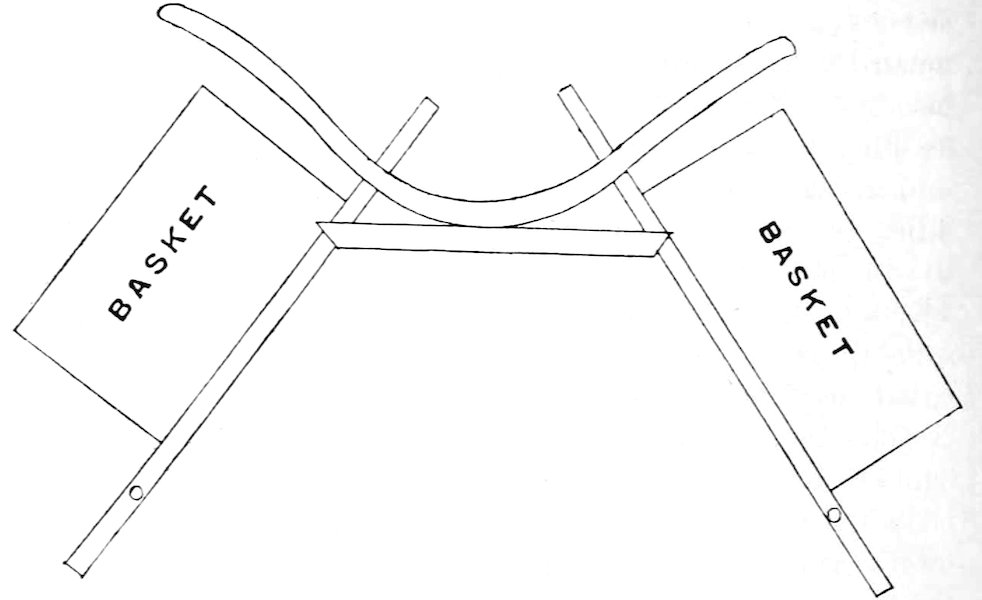
twenty inches long, fifteen inches broad, and ten inches
deep, which would fit easily into the howdah of an elephant.
These, after sorting, we labelled and numbered, entering the
contents of each in my note-book.
Method in packing saves a great deal of trouble and time
when on a journey. I never met a more methodical man
than Dr Cushing. His arrangements were admirable. Everything
was kept in its place. Each elephant load was stacked
separately throughout the journey. Each driver had charge
of his own load, and was held responsible for it.
Stores for several weeks’ supply were packed separately,
two pahs together containing what was likely to be required
each separate week; and no other pahs, except those in
charge of the cook, were allowed to be opened without our
consent. The cooking utensils, crockery, a dozen of brandy
for medicinal purposes, two dozen of whisky, and some of the
medicines, were packed in straw in small wooden cases.
These, together with the pahs, two waterproof bags, and a
tin box for clothes and money, my office-box, rugs, bedding,
chairs, and camp-bedstead, and our two selves, formed the
load of the six elephants which were to convey us and our
6belongings to Maing Loongyee, where fresh steeds had to
be procured.
The medicines, purchased by me chiefly in England,
were the usual ones carried in Indo-China. They consisted
of quinine, Warburg’s tincture and arsenic for fever, ipecacuanha,
Dover’s powder and laudanum for dysentery, Eno’s
fruit-salt, Cockle’s pills and chlorodyne for lesser ailments;
pain-killer for dispelling the agony of bites from noxious
insects such as the huge dairy-keeping red ants that milk
syrup from plant-lice, centipedes and scorpions; Goa powder
for ringworm, the most general and contagious plague in the
far East; and vaseline and Holloway’s ointment for abrasions
of the skin and ordinary casualties so frequent on a journey.
Dr Cushing was a doctor of souls: he knew, and would
know, nothing of physic; he abhorred it. His wife had been
the general practitioner on his former journeys. There was
no help for it; I must be the physician as well as the leader
of the party.
Portow.
At daybreak on the 23d of January, having finished
our packing and procured a Karen guide who could speak
Burmese and Talaing to serve as my interpreter as far
as Maing Loongyee, we had the elephants brought in and
loaded. Here Dr Cushing’s
power as an organiser became
apparent. The baggage had
been stacked into six loads, two
smaller than the others for the
elephants which were to be
ridden by us. The howdahs,
however, proved of unequal size,
and some of them would not
hold the tin boxes and cases
which were intended for them.
The air was filled with complaints
and remonstrances. Each of the
Karen mahouts, naturally, wished his beast to carry less than
its portion. Each objected to have another burden foisted on
him. Loogalay and Portow were worse than useless: both
made confusion worse by fussing about, tugging at the Madras
7boys, and putting them out of temper by imperious commands
mixed with abuse. Ignorance, according to the copy-books,
is boastful, conceited, and sure. I never saw the
proverb better exemplified than by these two men throughout
the journey. It was impossible, in Portow’s opinion,
that Portow could be mistaken; he knew everything; he
was always ready and eager to advise, and equally ready to
jeer at and snub any one else who ventured to do so: but
although he had been the head-man of his village, and was
an egregious blockhead and an egotistical bumpkin, he was
eminently good-natured, and bore no malice when plagued,
as he frequently was, by our Madras boys.
Loogalay, or Moung Loogalay, as he liked to be called,
was a hectoring, swaggering blade, as gaily dressed as a
game-cock, and as vain as an actor. A well-built lad of
about two-and-twenty, who had been brought up in an
English school, tall and good-looking, thoughtless, gay, and
careless, in his gaily coloured Burmese costume he looked
the beau-ideal of a dashing youth. His hair tied in a chignon
on the top of his head, and festooned with a loosely arranged
silk kerchief; his putso, or plaid, serving as a petticoat, with
the end jauntily thrown over his shoulder; his clean white
cotton jacket with gold buttons, and the flower stuck in his
ear,—how could one help enjoying the sight of him, however
much one might be put out by his indolence!
Madras boys, particularly those who have been attached
to the officers of a native regiment, and have seen more or
less of the world, generally have a pretty good opinion of
themselves. Some are good wrestlers, and most of them can
use their fists. Loogalay was employed as my henchman,
or peon—not to do domestic service, but to attend to my
wants on the journey; to pick up geological and botanical
specimens, measure the depth and breadth of streams, help
me when photographing, and carry instructions to the rest
of the party. His salary was greater than that of the boys,
and he looked upon himself as head boss over them. Anyhow,
to him they were kulahs, his natural inferiors, mere
savages or outer barbarians; he was a loo—a man and a
Burman. Instead of giving orders as emanating from me, he
8constantly put their backs up by assuming mastery over
them, and issuing orders as from himself.
“Heh! Kulah! put those here, not there. What are
you about?—yainday!” he vociferated, as the boys were
handing up the things to the elephant-drivers. The boys
treated his orders with sullen disdain, and went on quietly
attending to their business. Loogalay was stamping about
and slapping his thighs, becoming more flushed every minute,
and looking more and more like an enraged turkey-cock. I
was enjoying the fun, sitting quietly smoking in my chair up
in the court-house, and would have liked to have watched its
further development. There is nothing like a thunderstorm
to clear the air, or a good determined school-fight to put the
young folk at their ease and knock sense into them. Dr
Cushing, however, being in charge of the marching arrangements,
put an end to the cabal by appearing on the scene
and bundling Loogalay and Portow off to attend on the other
elephants.
With his presence order came out of chaos, and by half-past
seven we were ready to start. A quarter of an hour
later Dr Cushing stepped off the verandah of the court-house
on to the head of his elephant, sprawled over the
greasy Karen mahout to the seat that had been prepared for
him, said good-bye to the Myook, and headed the train of
elephants as they commenced their journey.
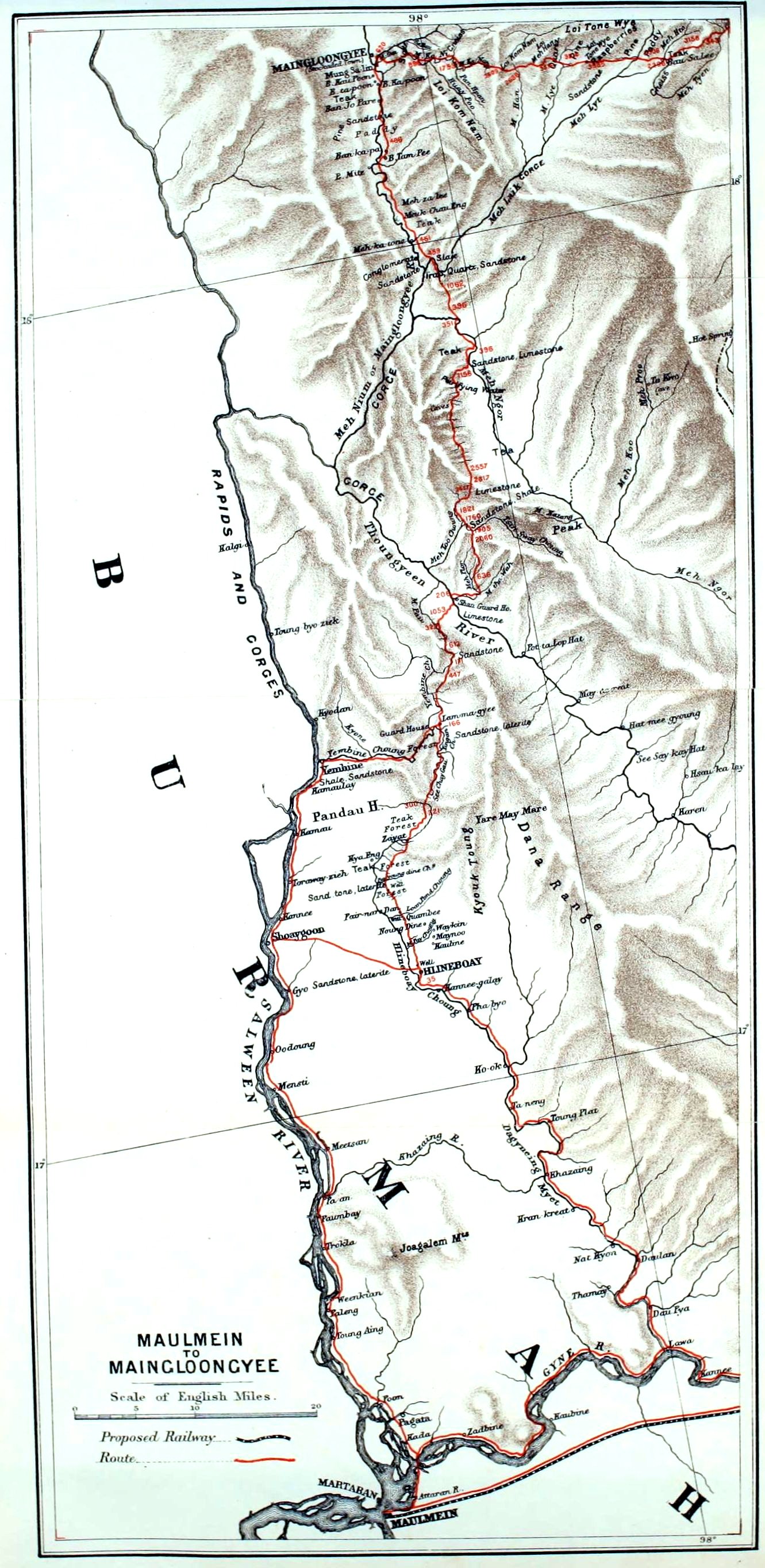
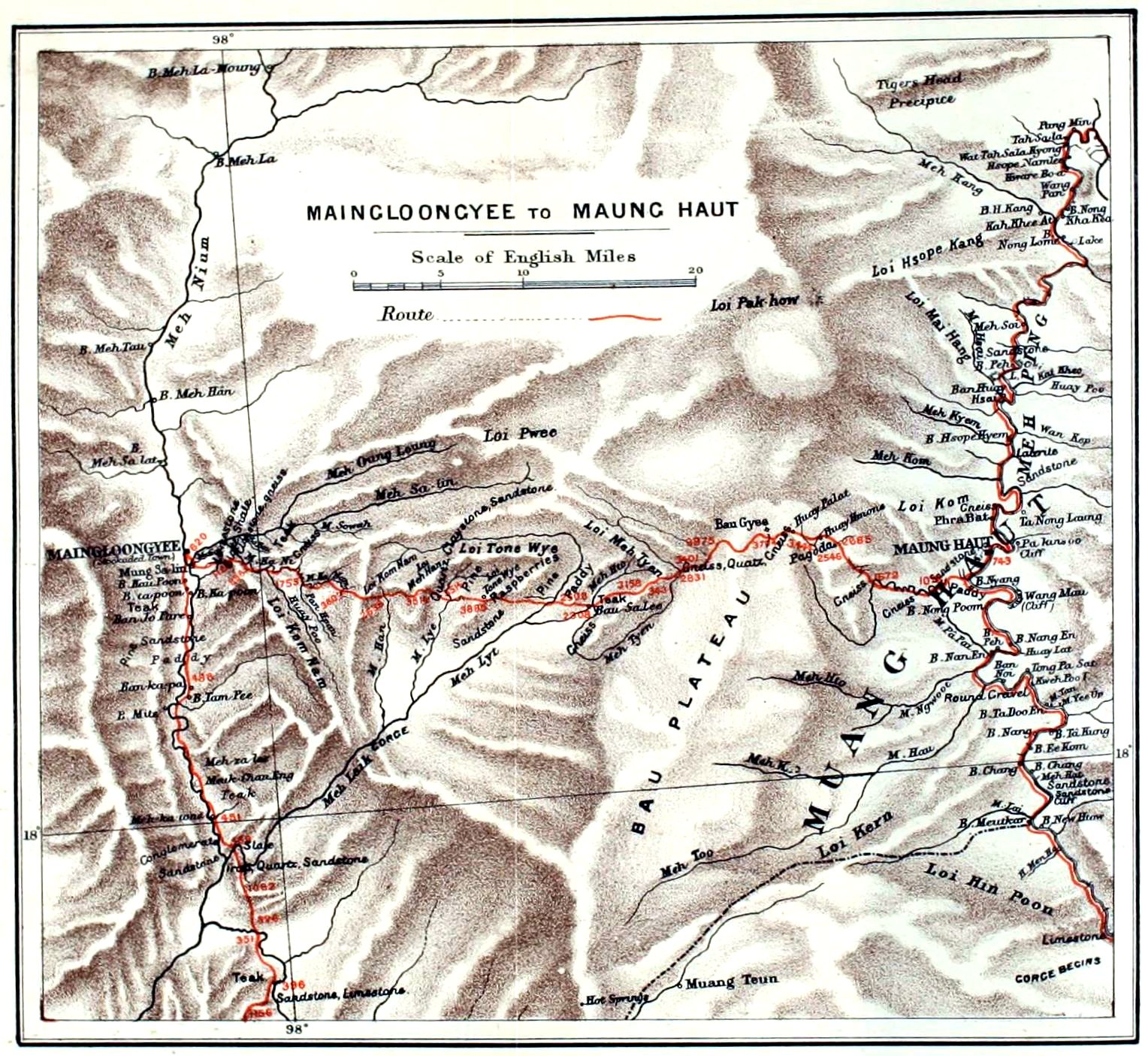
MAULMEIN TO MAINGLOONGYEE
CHAPTER II.
9
SURVEYING—THANKFUL FOR A HALT—LEAVE HLINEBOAY—KAREN
HOUSES INFESTED WITH BUGS—HALT NEAR WELL—RIGGING UP
SHELTER FOR THE NIGHT—TENT LEFT BEHIND—TEAK-FOREST—YUNNANESE—A
SCARE—EXPLODING BAMBOOS—TREES 130 FEET
HIGH—A MID-DAY HALT—THE BRITISH GUARD-HOUSE—A NIGHT CAMP—GLUTINOUS
RICE, MODE OF COOKING AND CARRIAGE—ELEPHANTS
FEEDING—HEAVY DEW—JOURNEY DOWN THE YEMBINE VALLEY—MOTION
OF ELEPHANTS—DIFFICULT SURVEYING—A PRACTICAL JOKE—RAILWAY
TO RANGOON AND MANDALAY—HEATHEN KARENS—NO
LONGER A MISSIONARY—DIFFICULTY IN CONVERTING BUDDHISTS—VENISON
FOR DINNER—STUNG BY BEES—PASS BETWEEN THE
THOUNGYEEN AND THE SALWEEN—TREES 25 FEET IN CIRCUMFERENCE—LIMESTONE
CLIFFS—OFFERING TO THE DEAD—DESCENT TO THE
THOUNGYEEN—THE FORD.
Surveying by time-distances and a prismatic compass, when
on the march, requires a steady hand, a quick judgment for
selecting an object for your angle, and a good memory. If
the hand is unsteady, the ring of the compass, which is
balanced on a needle, will not come to rest. In a jungle-clad
country you must watch the foremost elephant as it
winds through the trees, and rapidly select the point for
your next angle as the animal is just passing from view. A
good memory is required, otherwise in noticing the trees,
rocks, by-paths, width and depth of streams, breadth of
fields, size of villages, and taking sketches of, and angles to,
neighbouring hills, you will forget the object, twig, branch
or trunk of tree, that you have aimed at.
Having taken your angle, you must catch up the last
elephant—for you are taking your distances by the time it
takes in passing over the ground—and observe the time and
10your next angle on arriving at the object you had formerly
chosen. This constant observation, continuing from dawn
to dark with one interval for refreshment, is a great strain
upon one’s attention, and when joined with the necessity of
taking heights from the aneroid barometer, and temperatures
from the thermometer at every change of level, makes one
thankful for a halt at the foot or summit of a mountain
pass, where one has to check the height by the boiling-point
thermometer.
For the first hour after leaving Hlineboay we passed over
slightly undulating ground, covered with stunted trees and
scrub-jungle, and then entered paddy-fields through which
we proceeded to Quambee, a Talaing, or Pwo, Karen village
in a rice-plain over half a mile in breadth. To the east of
the plain amongst the forest appeared many isolated hills
and knolls, backed up by a boldly defined peaked range of
hills, the Dana Toung, distant about fifteen miles, which
forms the water-parting between the Thoungyeen and
Salween rivers.
There being no zayat, or rest-house, in the village, and
Karen houses being generally infested with bugs, we decided
to camp in a grove of large trees in the vicinity of a well,
from which we could draw water for bathing and cooking.
After the elephants were unloaded and we had finished our
supper, a shelter for the night was quickly formed with a
few bamboos, roofed with two large waterproof sheets which
I luckily had with me. My tent had been left behind in
Maulmain through an oversight of the boys; and although
the Bombay Burmah party kindly brought it with them to
Hlineboay, it may be still at the latter place, as they had
not carriage sufficient to bring it farther. A tent is a
cumbersome and costly thing to carry about, and we
managed very well for several months without one.
The next day we resumed our short stages, hoping that
Mr Bryce’s party would catch us up. The country continued
of much the same character as between Hlineboay
and Quambee—only, cultivated fields became rarer,
isolated hills more numerous, and teak-trees were frequently
interspersed in the forest. The first night from
11Quambee we spent in a zayat on the bank of the Hlineboay
river.
Towards dark a party of Chinese from Yunnan, who had
sold their goods at Zimmé, came scampering by, armed with
Shan dahs or swords, spears, and very antiquated horse-pistols.
They were conducting a caravan of between forty
and fifty mules and ponies to Maulmain, intending to bring
them back laden with piece-goods and general articles of
merchandise. They ultimately camped about half a mile
from us, as several times in the evening we heard from that
direction what we considered to be the discharge of firearms.
Chinamen were not likely to waste powder in
frightening off dacoits or wild beasts when they had any
simpler, equally efficient, and cheaper means at command;
and next morning we learnt our mistake in a very
unexpected and alarming manner. We were suddenly
awakened by a fusillade of reports around our camp. I
jumped up, seized my Winchester, and rushed out, thinking
that our party was being attacked. I found the boys
squatting quietly round the fire, grinning like monkeys, and
heaping on joints of green bamboos. The liquid in the
cavities turning to steam under the influence of heat, caused
them to explode, thus giving rise to the reports which had
startled us. The rascals had learnt the trick from Portow,
and were amusing themselves at our expense, being evidently
bent on giving us a good fright.
Leaving the zayat a little before seven, we crossed the
river and clambered over a low hillock, and continued
through the forest, with teak-trees still appearing at intervals.
Small hills and spurs from the Kyouk Toung range
were occasionally seen to the east, backed up by the Yare-they-mare
hill, a great spur of the Dana range, some four miles
distant. About half-past eight we crossed the Hlineboay
river for the last time, and shortly afterwards ascended 80
feet to the crest of the high ground, 300 feet above sea-level,
and seventeen miles from Hlineboay, which forms the
water-parting between the Hlineboay and Yambine rivers.
Thence we passed through the forest, still occasionally
with teak-trees, following the course of the
12Yingan stream, with hills at times bordering on either side,
and halted at half-past eleven for breakfast by the side of
the stream, under a magnificent clump of thyt-si trees, which
produce the celebrated black varnish. These monarchs of
the forest, 130 feet in height, owing to great buttresses
springing from the stem some feet from the ground, were of
enormous girth, and looked truly magnificent. Here was a
perfect place for a mid-day halt: hill, forest, and water
scenery all combined; a cool stream as a bath for the
elephants and ourselves; shelter from the heat of the sun;
a pleasant glade for a ramble whilst breakfast was being
prepared. Nothing was wanting but the songs of birds and
the rippling chatter and laughter of girls to make our picnic
all that could possibly be desired. Day after day, month
after month, we enjoyed such picnics on our travels.
We struck camp at a quarter past two, and after a little
more than an hour’s journey, still following the stream,
reached Teh-dau-Sakan, the halting-place close to the Lanma-Gyee
Garté, the last British police post on our road to
the Shan States—having thoroughly enjoyed our day.
The police station, which is situated twenty-four miles
from Hlineboay, consists of two thatched buildings built of
bamboo, and surrounded with a dilapidated stockade, which
would have been useless as a defence against dacoits. It
was occupied by ten or twelve Madras constables, who complained
much of the feverishness of the locality, and begged
for quinine, saying they were out of it. I never met less
intelligent men in my life; they seemed to know nothing of
the locality, and the idea of a map was utterly incomprehensible
to them—they had not been educated up to it. There
was no getting any information from them; the whole current
of their thoughts ran towards carna and pice (food and
money), and their bodily ailments.
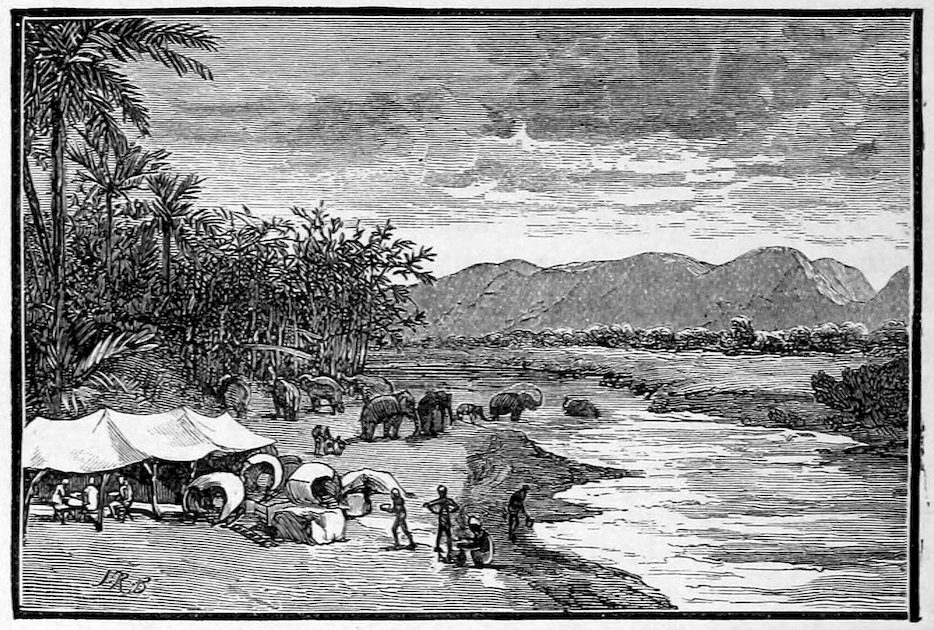
We erected our shelter for the night about a hundred
yards from the station, in a grove of thyt-si trees, each
measuring from 30 to 40 feet in circumference five feet from
the ground. A large party of Shans from Lapoon encamped
near us, and came over in the evening for a chat with our
men. Camp-fires were dotted around us in all directions.
13Each elephant had, besides the mahout, an attendant to look
after its wants, lop branches off banian and other trees for
its food, shackle its fore-feet when we halted, and aid in its
morning, noonday, and evening bath.
Each couple of men built a fire for themselves, and kept
it alight during the night, partly for warmth and partly to
scare wild beasts that might be wandering around. Kouknyin,
the glutinous rice eaten by the Karens, is steamed, and not
boiled. An earthen pot, or chatty, is placed upon three
stones or clods of earth, which serve as a tripod; on the top
of the pot is placed the basket containing the rice, and the
junction is made air-tight with a wet cotton rag. A fire is
then lighted under the pot, and the steam from the water in
the pot rises into the rice and cooks it. Whilst hot the rice
is stuffed into joints of green bamboos about a foot in length,
and eaten when required. Joints of green bamboos likewise
serve them for kettles: placed slanting over a fire, the water
soon boils. The elephants feeding in the neighbourhood
could be heard crashing through the bushes, rending off
branches that suited their fancy. These animals were our
sentinels, and would trumpet if a tiger came roving in their
neighbourhood.
It would have been pleasant to sit in the open air and
watch the stars as they twinkled through the trees, if it had
not been for the heavy dew which commenced to fall soon
after sundown. Loogalay’s mosquito-curtains, made of stout
cotton cloth, were dripping wet the next morning, and he
came with a long face and wrung them out before us.
Portow merely jeered at him, and asked why he had not
erected a leaf-shelter, as the other men had done. It is
worse than useless complaining of the effects of one’s folly
in a company of wits.
Next morning, the 26th of January, we ordered two of
the elephants to be got ready to take us on an excursion
down the Yembine valley, the farther end of which I had
visited on a tour up the Salween. This would give me a chance
of learning to survey from the top of an elephant. At first
thoughts one would deem such a feat to be impossible; the
pitching and rolling of the huge beast, which goes along like
14a Dutch lugger in a chopping sea, would prevent the compass
being brought to rest, and most likely jam it into one’s eye.
Yet, by giving way to the swaying movements of the brute,
I managed to get as perfect results as when surveying on
foot. From thenceforth, during my land journeys, I surveyed
from the back of an elephant.
The boys, in packing our breakfast for us, perhaps out of
fun, omitted not only to put in my cigars, but also our
knives, forks, and spoons, forcing us to improvise some out
of slips of bamboo to avoid having to feed native-fashion,
with our fingers.
Following the stream of the Yingan till it joined the
Yembine, we continued down the valley of the latter, accompanied
by the mournful wailing of the gibbons in the forest,
the plain gradually opening out to more than a mile in
width, but contracting at times to a quarter of a mile, as
spurs jutted in from either side. After travelling for three
hours and a half, we halted for breakfast at the Karen
village of Nga-peur-dau, which is beautifully situated on the
hillside to the south of the valley.
The hills opposite the village were bold, and in some
places precipitous, appearing as though they had been
punched up from below, and were most likely mural limestone.
Clay-slate, limestone, and sandstone are the chief
rocks in this part of the country. Silver, copper, lead, and
iron pyrites are found in Bo Toung, a hill some miles to the
north of Nga-peur-dau, and felspar and porphyry are met
with along the Salween some distance above Yembine.
We were now within eight miles of the village of Yembine,
which is situated at the junction of the Yembine with
the Salween. After walking about a mile and a half farther
along the hillside, it became evident that a railway could
be carried from Yembine to Teh-dau-Sakan with the greatest
ease, meeting no difficulties in its path. I had previously
ascertained, by visiting Yembine, that the Salween could be
crossed in the defile to the south of it by a bridge of four or
five hundred feet span; and, from my former experience in
the country, I was aware that a line could be carried from
the Rangoon and Mandalay Railway to this crossing through
15one continuous plain. It remained to be seen whether such
a line could be continued along the course we were taking
to South-western China, or whether the better course lay
eastwards from Maulmain to Raheng, and thence northwards
to the same goal.
We learnt from the Karen villagers that the Karens in
the hamlets scattered through this region, and those to the
north and the east, are still heathens, and I was glad to find
that the missionaries are now on their scent. Most of the
Karens elsewhere in Lower Burmah have become Christians,
and the American Presbyterian and Baptist missionaries,
who have so well worked the field, are turning their attention
to Upper Burmah, Karenni, the Shan States, and Siam.
I was amused by reading in a missionary report some
months ago the complaint of a missionary that all the
Karens in his district had embraced Christianity, and he
had not another one to convert. He was a pastor, but no
longer a missionary.
The Karens, Shans, Kakhyens, and other hill tribes, who
are spirit-worshippers and not Buddhists, are the stocks
from which converts are produced in Burmah and Siam.
If you wish to have Burmese Christians, it is necessary to
train them in mission schools from childhood. A Burmese
adult behaves like a goat in the sheep-fold. He skips in
and out as it suits him. Too often he merely enters to see
what he can get from the shepherd. It is said to cost more
to convert a Burman than it does to convert a Jew. A
Roman Catholic missionary told me some years ago that he
very much doubted whether his mission had ever made a
real convert out of an adult Burman. As the sapling is
bent, so the tree grows.
Having finished the inspection, we returned to camp,
where I regaled myself with my long-wished-for smoke.
The boys, when scolded for their delinquencies, pretended to
look chapfallen; but I am afraid I had a twinkle in my
eyes when rebuking them, as I saw the three convulsed
with laughter before they were many paces away. During
our absence the other elephant-drivers had shot a deer, and
on our return presented us with a leg. This was a delightful
16surprise, as we had been subsisting on fowls and tinned
provisions for several days.
The next day was Sunday, so we had a delightful day’s
halt. I sent some of the Karens off to the neighbouring
villages to obtain sufficient fowls and rice for our journey
to Maing Loongyee, where we could obtain a fresh supply.
Veyloo and Jewan went off on a lark, but soon returned in
a dismal plight to seek my aid. In attempting to get honey,
one had been stung on the eyelid, the other on the neck.
An application of Perry Davis’s pain-killer acted like magic,
taking away the pain; and a little ointment sent them off
again light-hearted—putting down their punishment, I hope,
to their yesterday’s conduct.
On Monday we started a little before seven, and followed
the Yembine and its branches to the crest of the pass over
the range which divides the drainage of the Salween from
that of the Thoungyeen. The pass—32 miles from Hlineboay—has
its crest 612 feet above sea-level, or 446 feet
above our camp at Teh-dau-Sakan. On our way we met
a party of Shans proceeding to Maulmain. A descent of
about 50 feet from the crest brought us to the plateau,
interspersed with detached hills, which is separated from
the narrow plain through which the Thoungyeen runs, by
a row of cliff-faced masses of limestone 1000 and 2000
feet in height, between which the drainage of the country
flows to the river.
Close to the northern foot of the pass we came to the
Tee-tee-ko stream, flowing through a pretty and pleasantly
wooded valley, along which we proceeded. Turning up a
northern affluent, when the Tee-tee-ko turned to the east
on its way to the river, we halted for the night under some
noble Kanyin trees. These trees, from which a brown resin
and superior wood-oil is procured, have stems, often 25
feet in circumference, rising straight as a dart 120 feet
from the ground to the first branch. The dense foliage
completely shuts out the rays of the sun, thus affording
a splendid shade for a mid-day halt. You do not
realise their enormous size until from a distance you notice
how dwarfed people camping under them appear. An
17elephant by their side looks like a pig under an ordinary
tree.
The next morning, at a distance of two miles from the
pass, we crossed the Meh Pau, a stream 60 feet wide and
7 feet deep, which, flowing from our right, enters the
Thoungyeen some distance below the Siamese guard-house
and below our point of crossing. We then clambered up
a circular knoll rising 700 feet above the plateau, and had
a fine view of the Pau-kee-lay Toung—one of the precipitous
limestone masses lying three-quarters of a mile to the
east. Descending from the knoll, which is ascended by the
track to save half a mile of extra distance, we breakfasted
on the bank of the Koo Saik Choung, just above its rapid
descent between two great limestone precipices to the river.
At the junction of one of the many roads which diverged
to Karen villages and the Thoungyeen from our track after
leaving the pass, we noticed the death-offering of some Sgau
Karens belonging to a neighbouring village. The offering was
a propitiatory one to the spirit of the deceased, and proffered
in order to induce it not to return and haunt the village. A
silver coin had been placed in the ground beneath a rudely
carved figure, on the top of which narrow strips of red and
white cloth were hung; around the figure was a tiny fence,
roofed in with a small bamboo platform. Miniature jackets
and trousers were suspended from small poles at the sides
of the fence. Food, which had been placed on the platform,
was no longer there—the thieving birds having most likely
deprived the poor ghost of it.
After breakfast we entered the defile, and descended from
the plateau in the bed of the Koo Saik Choung, which falls
135 feet in the distance of a mile in a series of gentle cascades,
separated by ice-cold running pools as clear as crystal;
the towering precipices on either side looming through the
trees, with their crests hidden by the dense foliage, and the
natural colonnade formed by the evergreen forest through
which we were passing rendering the air delightfully cool.
How charming it would have been to have breakfasted in
this pleasant retreat among the lichen-covered limestone
boulders, mosses, and ferns! Leaving the defile, we followed
18the Thoungyeen down-stream past the Siamese guard-station,
which lies on the other bank—the river forming the frontier—to
the ford.
The river at the ford is 250 feet wide from bank to
bank, with the channel reduced to 70 feet by a great shoal
of boulders, now uncovered, stretching from the western
bank. The current being swift and the water chest-deep,
some of the men were nearly swept away whilst crossing.
The boys went in up to their hips, and stood trembling,
afraid to proceed farther. I therefore told them to return
to the strand, and I would send elephants from the camp to
bring them across.
The bank of the river is about 206 feet above mean sea-level
at Maulmain. After passing the ford, we crossed the
Meh Tha Wah, passed the guard-house, and camped about
half a mile off, near the stream and some rice-fields. As
soon as the elephants were unloaded, I sent two back for the
boys; but meanwhile they had found their way to the ferry,
and crossed the river in a boat. The guard-house is 38
miles from Hlineboay.
CHAPTER III.
19
REV. D. WEBSTER’S PARTY DETAINED—SIAMESE OFFICIALS EXPECT
BRIBES—PHOTOGRAPHIC PLATES ALL SPOILT—VISIT FROM KARENS—JOINED
BY THE B.B. PARTY—SIAMESE POLICE POST—GORGES IN THE
THOUNGYEEN AND MEH NIUM—RAPIDS STOP NAVIGATION—FORESTS
AND ELEPHANTS—DWARF RACES—KAMOOK AND KAMAIT SLAVES
HIRED BY OUR FORESTERS—MIGRATION OF LAOS FROM TONQUIN—THE
KHAS OF LUANG PRABANG—SACRIFICES TO DEMONS—DRINKING
THE HEALTH OF STRANGERS—KING OF SIAM ALLOWS SLAVE-HUNTING—MISSIONARIES
REQUIRED IN THE MEH KONG VALLEY—LEAVE THE
GUARD-HOUSE—CROSSING THE WATER-PARTING—WILD TEA—KAREN
VILLAGES BUILT DISTANT FROM ROAD—COUNTRY FORMERLY LACUSTRINE—SHELTER
FOR THE NIGHT—HEAVY RAIN—A SHOWER-BATH
IN BED—ELEPHANTS CROSSING STEEP HILLS—WILD ANIMALS—REACH
THE MEH NIUM—KAREN PIGS—REMAINS OF A LAKE-BOTTOM—THE
MAING LOONGYEE PLAIN—EPIDEMIC OF SMALLPOX—VILLAGES
TABOOED—ARRIVE AT MAING LOONGYEE—MOUNG HMOON TAW’S
HOUSE—A TIMBER PRINCE AND THE MONEY-LENDERS.
The sala, or traveller’s rest-house, we found occupied by the
Rev. David Webster, who with his wife and pretty little
golden-haired daughter was on his way to Zimmé by a route
to the south of that we intended taking. Mr Webster is a
missionary of the American Baptist Mission, which together
with the American Presbyterian Mission has been highly
successful in civilising and converting the Karens in Burmah.
He was now on his way to the Siamese Shan States,
as he had heard from some of his converts that there were
many Karens in Central Indo-China.
In Burmah he had only been able to hire elephants to
carry them as far as the frontier, and was therefore at the
mercy of the Siamese official in charge of the guard. He
had omitted on principle to grease this petty potentate’s
20palms, with the result that he had been detained waiting
for thirteen days. Having lost patience, he had endeavoured
to hire the elephants direct from the Karens instead of waiting
for the Jack-in-office to take action, but found the Karens
were afraid to let them on hire to him for fear of rousing
their tyrant’s anger, or having to part with a portion of the
hire.
I stopped over the next day to allow the Bombay Burmah
party to join us, which they did in the afternoon. In the
morning I unpacked my photographic apparatus, and took
views of the country, guard-station, and Mr Webster’s party,
which included several Karen girls who were attached to
their schools. When unpacking the dry plates, I was dismayed
to find many adhering to the tissue-paper covers, and
all of them spotted by damp. As I opened packet after
packet on my journey, I found them all in the same plight,
and before I reached Zimmé ceased photographing, and
sent the views—some fifty in number—that I had taken, to
Mr Klier, the photographer in Rangoon, who had kindly
promised to develop them for me.
In the afternoon a Karen man with his little boy and
girl came to visit our camp. The children were greatly
pleased with the bead necklaces which I gave them. Messrs
Bryce and Boss, who had with them ten elephants and
eleven ponies and mules—the latter purchased from the
Chinese caravan which had passed us when halting on
the Hlineboay river—arrived towards dusk, and camped
near us.
The Siamese frontier post consists of five buildings, enclosed
by a bamboo stockade. The officer in charge of the
Laos or Shan police did not inquire for our passports, and
allowed Mr Bryce’s large treasure-guard to march by unquestioned.
He had no hope of squeezing anything out of
the party, and therefore paid no attention to it.
Our intention had been to proceed from the guard-station
down the Thoungyeen to its junction with the Meh
Nium, and up the latter river to Maing Loongyee; but on
inquiry we learnt that such a route was utterly impracticable.
The numerous rapids in both rivers rendered them
21impassable for boats, and even for canoes. Neither elephants
nor men could follow the banks, as the rivers passed
through great gorges—the cliffs from both sides rising from
their beds. We had therefore to turn eastwards, and following
branch valleys and spurs, cross the Karroway Toung,
or Parrot’s Hill, into the valley of the Meh Ngor, which enters
the Meh Nium above the defiles, through which it escapes
from the hills.
A large amount of teak timber has for many years been
taken from the forests in the Thoungyeen valley. The
Siamese had lately raised the tax from five to six rupees
a log: their revenue in 1884 from this source amounted to
upwards of two lakhs of rupees. Two hundred and sixty
elephants were at work in the forests, which, like other
forests in Siam, Karenni, and the Shan States, are worked
by our Maulmain Burmese foresters. There is a large sale
amongst the foresters of tinned milk, salmon, sardines, butter,
and biscuits—all coming from Maulmain.
The Kamooks and Kamaits, who attend to the elephants
and fell the timber, belong to the dwarf races of Indo-China,
and are brought by their masters from their homes in the
neighbourhood of Luang Prabang, and hired to our foresters
at from sixty to a hundred rupees a year; each master
keeping twenty-five rupees or more out of each year’s salary,
and the foresters find the men with food.
The Khas, who include the Kamooks and Kamaits, are
doubtless the aborigines of the country lying between the
Meh Kong or Cambodia river, and the Annam and Tonquin
seaboard. They are supposed to have been ousted from the
plains and driven into the hills by hordes of Laos, an eastern
branch of the Shans, migrating from Tonquin when it was
conquered by the Chinese about B.C. 110.
According to the American missionaries who have visited
Luang Prabang, the Khas are harmless and honest but ignorant,
and despised by their Laos masters. Their villages are
erected within stockades, on the summits of the mountains.
The majority, however, live in isolated houses, which with
their clearings stand out in bold relief against the sky. They
cultivate rice, cotton, tobacco, vegetables, fruit, and betel-nut
22trees; collect stick-lac from the pouk and zi trees, and gold
from the torrent-beds; and prepare cutch for chewing with
the leaf of the seri vine, betel-nut, and lime. They are likewise
great cattle-breeders, and many of the fine buffaloes
met with in Burmah have been brought from Luang Prabang.
The Kha villages form the wealth of the Laos, who reside
in the valley of the Meh Kong, to the east of the river. The
Khas are known to the Siamese as Kha Chays, or slaves, and
are treated as such. According to the Laos chief of Luang
Prabang, the seven tribes of Khas in his territory are four
times as numerous as his Laos subjects. Dr Neis, who has
traversed a great part of his State, believes this opinion to
be within the mark. Each Kha has to pay a tribute to his
Laos or Siamese master. Without the Khas, their lazy,
pleasure-loving, opium-smoking masters would have to work,
or die of hunger. The extortion practised upon these kindly-dispositioned
people has frequently driven them into revolt.
In 1879 they joined the Chinese marauders in their attack
upon the Laos; and also in 1887, when they sacked and
destroyed Luang Prabang, the chief town and capital of the
Shan State of that name.
The Khas, like all the hill tribes in Indo-China, offer
sacrifices to evil spirits, who, according to them, are the cause
of all the ills that man is heir to. In a single case of sickness
as many as ten or twelve buffaloes, or other animals, are
at times offered up.
They do honour to their guests and distinguished visitors by
calling together the young men of the neighbourhood to drink
their health in rice-spirit. Those whom I met were happy,
cheery, hard-working men with pleasant faces, which, although
flat, were not Mongolian, but, I think, Dravidian in type.
Their expression betokened freedom from care, frankness, and
good-nature. Those measured by me averaged four feet and
nine inches in height, and, like the Negritos of the Andaman
Isles, few exceed five feet. Their limbs were symmetrically
formed, and altogether the Khas looked vigorous, pliant, and
active little men. The Kamooks whom I saw, dressed in
jackets and trousers dyed blue similar to those worn by the
Burmese Shans, and wore their long hair drawn back from
23their forehead and fastened in a knot at the back of the
head.
As long as the King of Siam allows the harmless hill
tribes to the east of the Meh Kong to be hunted down, and
held and sold as slaves by his subjects, so long should he be
abhorred and placed in the same category as the ferocious
monsters who have been and are the ruling curses of Africa.
The sooner missionaries, American and English, are sent to
Luang Prabang, and other places in the valley of the Meh
Kong, the sooner will the King of Siam be shamed into
putting a stop to the proceedings of the slave-dealers, who,
according to French travellers up the Meh Kong, are fast
depopulating the hills. There can be little doubt that the
Khas, being spirit-worshippers like the Karens, and not
Buddhists, would flock into the Christian fold in the same
manner that the Karens have done.
During our stay near the guard-house, the temperature in
the shade varied between 46° and 81°, the extreme cold
being at daybreak, and the greatest heat at two o’clock in
the afternoon.
On the morning of the 31st of January we left early,
and following the Meh Tha Wah, and its northern branch
the Meh Plor, and crossing two spurs for the sake of
shortness, reached the summit of the pass over the great
spur that separates the drainage of the Meh Tha Wah from
that of the Meh Too, which enters the Thoungyeen two or
three miles below the guard-house—the crest of the pass
being 46 miles distant from Hlineboay, and 2060 feet above
sea-level. The spur can easily be avoided by following the
valley of the Meh Too.
Leaving the pass, we descended along the Tsin-sway, or
Elephant-tusk, stream to the Meh Too, dropping 300 feet in
the mile and a half. Proceeding up the Meh Too, we camped
for the night at the forty-ninth mile.
The next morning we left early. A mile on, the stream
forked, and we followed the intervening spur, which gradually
flattened out and spread until we reached the foot of the
pass over the Karroway Toung. A short climb of 400 feet
past an outcrop of limestone, led us to the crest, 2817 feet
24above the sea, and 52 miles from Hlineboay, from whence we
had a magnificent view of the country to the west. Here
Mr Bryce’s party passed us, and we did not see it again until
we reached Maing Loongyee.
Having taken some photographs, we followed a rivulet
and descended 260 feet in a mile to the Oo-caw, a small
stream which flows eastwards into the Meh Ngor, where we
halted for breakfast. During the descent from the pass the
Shans brought me branches of the tea-plant, which was
growing wild in the hills. Its long narrow leaves reminded
me of the willow. The men told me that it was likewise
found on the route from Maulmain to Raheng, as well as in
the ranges to the north of the pass right up to China. Some
of the plants were fully 15 feet in height.
From the Oo-caw we should have descended to the Meh
Ngor, and followed the stream to the Meh Nium, as Dr
Richardson had done on his journey to Zimmé in 1829; but
the elephant-drivers said that the route was overgrown, the
Karens preferring to keep open the hill-path, along which,
owing to the shallowness of the streams, they could proceed
throughout the year. Since leaving the Thoungyeen we had
met a few parties of Karens, but had not seen any of their
villages, as they build them away from the main tracks.
From the Oo-caw the road passes over a series of great
spurs, separated by narrow steep-sided valleys, often merely
a dip to the stream-bed. From the crests of the main spurs,
which were occasionally higher than the summit of the pass,
we had magnificent views of the country, which has the
appearance of the desiccated remains of a great rolling plateau,
the crest of the spurs following the wave-line across the
main valley of the Meh Ngor.
There can be no doubt that the hill-bounded plateaux and
valleys in the Shan States were at one time lakes, which were
subsequently drained—some by subterranean channels, the
stream reappearing on the other side of the hills, and others
by great rifts made across the hills by earthquake action.
The numerous mineral and hot springs we passed, and the
earthquakes which still occur at times in the country, bespeak
the continuance of unrest near the surface.
25After scrambling over six great spurs, we halted for the
night near a small mountain-stream. The strata seen since
leaving the Thoungyeen had been limestone, sandstone, and
shales, each appearing at various times. Many fine tree-ferns
were noticed during the day.
The next day rain commenced at half-past three in the
morning, and the showers continued until noon. Our howdahs
were without covers during this stage of the journey,
so we could not creep into them to escape from the storms
which occasionally happen in the hills. Our shelter for the
night consisted of a few lopped branches of trees, stuck in
the ground, serving as rafters and wall-plates for our covering
of waterproof sheets, while plaids hanging from the wall-plates
formed the walls. This was amply sufficient to keep
off the heavy dewfall, but enough care had not been spent
on it to secure us from rain. I had turned in much fatigued,
having stayed up late inking over the pencil notes in my
field-book and writing up my journals, and had slept through
the first shower, when I was awakened at half-past five by
Dr Cushing, who told me I had better turn out as it was
raining in torrents. I merely replied “All right,” and went
to sleep again. Soon the water gathering on the waterproofs,
which we had rigged up as a shelter, weighed them down
and came pouring on to my mosquito-curtains, and, soaking
through them, effectually brought me out of dreamland; but
I got no compassion from my companion, who absolutely
roared with laughter at my being ducked. A change of
clothes and a peg of whisky were at hand, and having lit a
cigar, I was ready to crouch out the storm cheerfully.
Rain again commenced to pour down at seven o’clock,
but we could not afford to delay, so struck our camp and
departed. After crossing four spurs, we halted for breakfast
at eleven near two deserted houses. The path, owing
to the rain, was rendered so slippery, and was so steep, that
the elephants at times had to slide down on their bellies,
with their legs stretching out behind and before them. To
see these great clumsy-looking brutes constantly kneeling
down, crouching on their haunches, and then rising again, as
they ascended and descended the hillsides, in order to keep
26their equilibrium and reduce the leverage; never making a
false step; putting one foot surely and firmly down before
lifting another, and moving them in no fixed rotation, but
as if their hind and fore quarters belonged to two independent
bipeds; every movement calculated with the greatest
nicety and judgment,—forced one to admire the sagacity and
strength of the animals, and the wonderful manner in which
their joints are adapted to their work.
As soon as breakfast was over we resumed our march,
and crossing two more spurs, descended from the last one
to the Meh Ngor, a stream 100 feet broad with banks
18 feet high. After following this stream for a mile,
we camped for the night. Limestone and sandstone, with
occasional shales, were the only rocks previously noticed:
here trap cropped up for the first time, and teak-trees
again appeared in the forest. We were now 66 miles from
Hlineboay, and 396 feet above the sea.
Elephants, rhinoceroses, tigers, wild cattle larger than
buffaloes, elk-deer, pigs, and other wild animals, are said
to abound in these hills. We had heard tigers and deer
round our camp nearly every night since we left Teh-dau-Sakan.
The boys were at first frightened, and used to
borrow my gun to scare the tigers away, but now had
become accustomed to the peril, and ceased bothering me.
Pea-fowl were plentiful, as we frequently heard them
screeching in the morning.
Next morning, starting a little after seven, and skirting
the stream for four miles, we crossed the Meh Ngor not
far from its junction with the Meh Nium, and soon after
entered the teak-clad Huay Ma Kok hills, which separate
the Meh Ngor from the Meh Laik. Up and down again
we went over hill and valley, instead of following the level
path along the Meh Nium; past the Huay Ma Kok, which
is a circular subsidence or depression 150 feet wide and 20
feet deep, on the top of a spur, until we came to and crossed
the Meh Laik, by which we camped near a cliff of blue slate
rock. The rocks exposed in the latter part of the journey
were indurated clays and sandstones, both veined with quartz
and shales and conglomerates.
27The following morning a two miles’ march over a hill in
a dense mist brought us to Meh Ka Tone, a good-sized
house on the banks of the Meh Nium. The river is here
about 150 feet broad, with banks 12 feet high, and water
3 feet deep. Meh Ka Tone lies 76 miles from Hlineboay,
and 451 feet above sea-level.
The house belonged to a forester who was absent, having
left a Kamook slave in charge. Two Karen pigs, small,
hairy, slate-coloured creatures, with dark bristling manes,
were tied up by perpendicular strings under the house, so
that they could neither lie down nor walk until the strings
were slackened. As we had been feeding on tinned meat
for the last two days, some of our fowls having been quietly
appropriated by the Karens, we tried hard to persuade the
man to sell us one of the pigs and a few of the fowls that
were scuttling about, but all in vain,—they were his master’s
property, and he dared not part with them at any price
without his consent.
Resuming the march and proceeding up the valley, now
and then crossing hill-spurs and river-bends for the sake of
shortness, at the eighty-third mile we again entered cultivated
land, near the deserted village of Meh Kok, the site
of which is now only marked by cocoa-nut and mango trees.
The crests of the main spurs of the ranges of hills on either
side appeared to be three miles distant; but on the west, a
curious parallel range or formation, rising some 500 or 600
feet above the plain, lies between the main range and the
river. On visiting these hills from Maing Loongyee we
found them a perfect maze of equal elevation, looking like
a gigantic Chinese puzzle, composed solely of friable earth,
and rapidly frittering away,—there could be no doubt that
we were looking at the remains of an old lake-bottom.
The plain, which is adorned with a great variety of
flowering trees and shrubs, like the rest of the country we
had passed through, containing much valuable timber besides
teak, gradually increased in breadth as we proceeded, and
is a mile and a half wide at Maing Loongyee. Several Karen
and Lawa, and a few Shan, villages are dotted about it, but
the cultivation is insufficient for the wants of the people,
28most of whom are engaged in forest operations. Rice has
therefore to be imported from Zimmé.
Many of the villages in the plain were placed under
taboo, owing to an outbreak of smallpox, a disease much
dreaded by the hill tribes. The paths leading to such
villages are stopped by a branch of a tree being thrown
across them, and magical formulæ are stuck up in order to
keep the evil spirits who propagate the disease from the
village. No stranger dare enter a village so guarded.
Should he do so, and death or illness subsequently happen,
he would be held responsible. Life, or the price of life, for
life, is exacted in such cases.
We halted for the night on the bank of the river, and
starting early, reached Maing Loongyee the next morning.
Finding that the zayat, or rest-house, was occupied by the
Bombay Burmah Company, we despatched a messenger to
Moung Kin, a relation of the celebrated Moulmain forester
Moung Hmoon Taw, who works the Maing Loongyee teak-forests,
and he at once hospitably placed the best part of
his premises at our disposal. This arrangement proved very
fortunate, as I was thus enabled to procure the most reliable
information about the country.
The dwelling-house consisted of three separate buildings,
built of teak and shingle-roofed, erected on a large square
platform raised eight feet from the ground on posts. The
house was situated in a compound enclosed by a stockade,
separated from the river by a broad cattle-path, and surrounded
on two sides by an orchard fringed with a fine
hedge of roses eight feet in height. Two of the buildings
on opposite sides of the platform, separated from each other
by a broad passage, served as residences for the family.
One of these, consisting of three rooms, was handed over for
our use. The third building was situated near the north
end of the platform, and served as a cook-house and servants’
quarters. We felt quite in clover after our spell of
camp life.
Moung Hmoon Taw, to whom the house belonged, was
one of the kings of the teak trade. During the last three
years, owing to scarcity of rain, he had been unable to float
29his timber out of the forests, and was therefore unable to
repay the loans he had received from the Chetties, or Native
of India Bankers. By no means alarmed at his position, he
had lately astonished the bankers by sending them a letter
through his solicitor demanding a further loan, and stating
that unless he received it at once, he would be unable to pay
them the sums they had advanced him. There was small
doubt that the bankers would be compliant, as they could
not afford to lose the 25 lakhs of rupees (£200,000) that
was then due from him. The crash was, however, only put
off for a time, as last year he became bankrupt. Poor Moung
Hmoon Taw! poor bankers! I know who suffered most—not
Moung Hmoon Taw. The bankruptcy proceedings were
subsequently withdrawn.
CHAPTER IV.
30
MAING LOONGYEE TRAVERSED BY WAR-PATHS—DR RICHARDSON’S VISIT—PRICE
OF SLAVES—DR CUSHING’S VISIT—RAIDED BY KARENNIS—THE
CITY AND SUBURBS—VISIT THE GOVERNOR—THE SHAN STATES—GOVERNMENT—SUCCESSION
TO THE THRONE—TITLES—MODES OF
EXECUTION—ZIMMÉ FORMERLY EXTENDED FROM THE SALWEEN TO
THE MEH KONG—THE GOVERNOR AND HIS BROTHER—THE BAZAAR—DISTRIBUTING
SEEDS—INFORMATION FROM FORESTERS—COLLECTING
VOCABULARIES—MOUNG LOOGALAY—PORTOW—A MAGICIAN—DR
CUSHING AT WORK AND EXASPERATED—VISIT TO ANCIENT CITY AND
TO THE EARTH-HILLS—CROSSING THE RIVER—A DANGEROUS WALK—PINE-TREES—NUMBER
OF LAWA, KAREN, AND SHAN VILLAGES—POPULATION—A
KAREN DANCE—ENTICING A LAWA—DESCRIPTION—SIMILARITY
BETWEEN KAMOOK AND LAWA LANGUAGES—VISIT TO THE
GOVERNOR—EFFECT OF A TELEGRAM—ELEPHANTS HIRED FOR FOREST
WORK FROM KARENS—MODE OF ATTACK OF MALE AND FEMALE
ELEPHANTS.
The muang, or principality, called Maing Loongyee by the
Burmese, and Muang Nium by the Shans, is traversed by
war-paths leading from Burmah to Zimmé and Siam, along
which great armies of invaders have passed; it was, moreover,
subject to frequent inroads of man-stealers from
Karenni, an independent State, which borders the muang
on the north-west.
Dr Richardson, who visited Maing Loongyee in 1829,
three years after we had annexed Maulmain, found it nearly
deserted, containing, besides the hill denizens, only 200
houses, distributed among eight villages: the one occupying
the site of the city had only ten or twelve dwellings in it.
The teak-forests were then unworked, and its principal
export was black cattle—from 2000 to 8000 of these being
yearly taken to Karenni and exchanged for slaves, ponies,
31tin, and stick-lac. Seven bullocks were bartered for a young
man, and from eight to ten for a young woman; the very
best bullock being valued at five shillings.
When Dr Cushing passed through the muang in 1870,
the Burmese Shans, now British Shans, and Karennis had
recommenced their raids into the country; and the Siamese
Shans and our foresters had been shut up in the city for six
months, not daring to venture into the district except in
large bodies capable of defending themselves. These hostilities,
lasting nine or ten years, had ceased four years previous
to my visit, and the muang was recovering from their effects.
The city, which is built in the form of a parallelogram
placed nearly true to the cardinal points, and stockaded
on all four sides, measures 1740 feet from north to south,
and 1050 feet from east to west. It lies 96 miles by
road from Hlineboay, and is situated on a knoll, rising 15
feet above the plain and 635 feet above sea-level, in the
northern angle formed by the junction of the Meh Sa Lin
with the Meh Nium. It is occupied chiefly by Zimmé
Shans, and contains 66 houses and two monasteries.
Like all Zimmé Shan towns, it has a peculiar air of regularity
and neatness; the ends of the Shan houses invariably
facing north and south, and the edges of the roofs, when of
leaf or thatch, being accurately trimmed. The roads are
well laid-out, ditched on either side, and attended to. A
strict system of conservancy is in force, and no refuse is
allowed to be heaped outside the houses and palisaded
gardens. Aqueducts convey water from the upper course of
the Meh Sa Lin, and distribute it through the town. The
greater part of the cultivation in the Shan States is carried
on by means of such irrigating channels, and in this way
two crops of rice are raised in the vicinity of the town.
The suburbs, which are built at the north and west of the
city, and outside the stockade, include 104 houses, mostly
well built and of teak, chiefly occupied by our foresters and
British Shan traders. Three monasteries in the Burmese
style, and a pagoda, have been built by the Burmese thitgoungs,
or head foresters, in the northern suburb, and another
monastery was in course of erection. The people of Maing
32Loongyee are said to feed on teak, the teak timber trade
forming their chief means of support.
Having dismissed the elephants, we went into the city to
call on the Siamese official, who was acting as deputy-governor
during the absence of the chief at Bangkok. Chow
Rat Sampan, the chief, a first cousin of the late Queen of
Zimmé, is looked upon as the ablest man in the kingdom.
Backed by the influence of the queen, he had gone to
Bangkok to get himself appointed second King of Zimmé by
the Siamese monarch.
The Shan States are small kingdoms, each containing a
number of principalities or muangs. Each State is ruled in
a patriarchal fashion by a court, comprising the first and
second kings and three other princes of the blood-royal.
The succession to the throne primarily depends upon the
person chosen by the court and people being of princely
descent—all such are called chow or prince; secondly, upon
his influence and wealth, the number of his serfs and slaves,
business capacity, integrity, and his popularity with the
serfs; lastly, and now chiefly, upon his interest at the
Siamese court.
The first and second king usually select the other three
chiefs, but their choice has to be confirmed by the King of
Siam. The governors of Muang Nium, Muang Pai, Kiang
Hai, and other principalities, are appointed by the King of
Zimmé, who, like the King of Nan, has been granted the
title of Chow Che Wit, or lord of life, by the King of Siam.
The chiefs of Lakon, Lapoon, Peh, Tern, and Luang Prabang
have only the title of Chow Hluang (Chow Luong or great
prince). The title of Chow Che Wit was only allowed to
the King of Zimmé in 1883. A Chow Che Wit can order
a criminal to be decapitated. Chow Hluangs can only order
execution by piercing the heart with a spear.
The Siamese Shan State of Zimmé at the beginning of the
eighteenth century extended from the Salween to the Meh
Kong. It had jurisdiction over the whole of the States
lying in the basins of the upper portions of the Meh Nam,
the Meh Ping, and the Meh Wung, comprising Zimmé, Nan,
Peh, Lapoon, Lakon, and Tern; their governors being appointed
33by the King of Zimmé. The disruption of the
kingdom resulted from the anarchy reigning in the middle
of the eighteenth century, when Zimmé, then tributary to
the Burmese, threw off its allegiance and became feudatory
to Siam. Zimmé has now hardly a nominal supremacy
over Lapoon, Lakon, and Tern, although the rulers are appointed
from the same family; and Nan and Peh are
perfectly independent of it, owing allegiance only to Siam.
An execution.
We found the Siamese potentate squatting cross-legged,
like a great apathetic indolent toad, upon a raised section of
his covered verandah, in company with his brother, the head-man
of the Siamese frontier post at Daguinseik. Daguinseik
is the ford where the main track from Pahpoon to
Zimmé crosses the Salween. No greeting was accorded us,
no approach to the semblance of courtesy was shown us by
these two unmannerly boors, who, like all low-minded Jacks-in-office,
considered arrogance and incivility necessary in up-holding
their dignity.
Dr Cushing, who accompanied me as interpreter on the
expedition, was naturally annoyed at the rudeness and
grumpiness of our reception, and was intentionally brusque
in expressing our requirements. These comprised six fresh
elephants to carry us to Muang Haut, or, if possible, to
Zimmé. The governor, who had been up night after night
at the poay, or play, which was being given in honour of a
34youth who was about to join the priesthood, merely yawned
in our faces, and left the answering to his brother.
We were assured that there would be great difficulty in
getting our elephants, as Mr Bryce’s party required ten, and
would have to be served first as they had arrived the day
before us; that the elephants were a long distance off working
in the forests, and could not arrive for three days at the
earliest. I replied that every day was of importance to us,
that there were many elephants dawdling about the place,
and that I saw no necessity for us to be kept waiting. He
said that the elephants I had noticed belonged to the foresters,
not to the Karens, and could not be hired to us. We
then departed without either of the human toads rising from
his haunches.
Meanwhile the boys had been rambling about the town
making their purchases and bargaining from stall to stall;
everything was double, or more than double, the Maulmain
price, and hardly anything in the shape of edibles was to be
got. Pork had been sold off in the early morning; no
cattle had been killed, therefore beef was not to be had;
fowls and ducks were not sold at the stalls, but hawked
round to the different houses by the Karens who brought
them in. Onions, beans, mustard-leaves, and pumpkins were
all the vegetables they could procure: these, with eggs, dried
fish, and wafer-bread, they had brought back with them. It
would have been only tinned meat again for dinner had not
Moung Kin come to the rescue and presented us with some
fowls. At the same time, he told us that he would have a
cow milked, and we should have fresh milk with our tea
next day.
Disappointment came with the morning. The cow kicked
the milk-pail over, so we got no milk. Seeing how scarce
vegetables were in the bazaar, and considering it likely that
we should be kept for several days waiting for the elephants,
I sowed a crop of mustard and cress, which we
reaped and enjoyed before we left. The curator of the
Rangoon Public Gardens had kindly given me a large
parcel of English vegetable seeds, and another of Liberian
coffee, which I distributed at the various places we stopped
35at, on the promise that the villagers would plant and attend
to them; and I trust that future travellers through the
country will find cause to thank me. During our stay at
Maing Loongyee, which lasted from the 5th to the 13th
of February, I gathered information from the foresters about
the country; collected vocabularies of the Kamook, Lawa,
and other languages; and made a few short excursions.
Loogalay thoroughly enjoyed himself, starring about amongst
the Burmese in his best plumage, boasting of the great position
he held in the expedition, and joining in the festivities
that were going on day and night during our stay. Portow
was in his element. He set up as an oracle, and was accordingly
consulted. He knew, or thought he knew, what
I was about, and the why and the wherefore of everything
I was doing. I have no doubt that he led the people to
look upon me as a powerful magician.
Dr Cushing, who is the greatest living Shan scholar, was
accompanying me as interpreter in order to study the different
Shan dialects, and was hard at work, when not at meals
or out for a stroll, from morning to night.
Although the delay was rasping to me, as I was eager to
be off, and Dr Cushing was exasperated at Mr Bryce’s party
getting elephants two days before us, we all enjoyed our
stay at Maing Loongyee.
One day we visited the remains of the two ancient cities
of Yain Sa Lin, situated about a mile to the south-east of
the town, and surrounded and divided from each other by
moats and ditches. Their area, which is now overgrown by
a forest of great trees, is much larger than that of Maing
Loongyee, but contains no visible ruins of ancient date.
The small pagodas and ruined temples are modern, having
been built in recent times by villagers occupying and cultivating
part of the enclosure. The cities were situated on a
knoll, and the western ramparts have been swept away by
the encroachments of the river. The old city, together with
400 Talaings, or Peguans, according to the ‘Lapoon Chronicle,’
were handed over to the Shan chief of Lapoon as a
dowry when he married the daughter of Thoo-tha Thoma,
the King of Pegu, in A.D. 1289.
36Another day we crossed the river, which lies to the west
of the town, to visit the earth-hills and take photographs of
the country from the platform of a pagoda, which stands out
well against the sky. The water was about three feet deep,
and the bottom covered with large pebbles, giving a rather
insecure foothold. I was carried across perched on the
shoulders of two men. Dr Cushing waded the stream, and
resumed his nether garments on the other bank. I could
not help glancing slily at him as he tottered along, his predicament
being so ridiculous for such a grave and learned
man, and his action so like that of the pilgrim who had
not boiled his peas.
The path over the hills was covered with small rounded
gravel washed out of the earth, which rendered it very slippery
for shod feet. The hills were crested with large pine-trees,
the first we had seen, and their sides were crumbling
away in great landslips caused by the small streams, which
carried off the rainfall, undermining the friable earth. Some
of the spurs we passed along were barely two feet wide at
the top, with slopes often nearly sheer descents. Walking
along these, and peering at times into the abysses, I suddenly
became dizzy, and had to take a man’s hand to help
me along until I reached a broader track. On and on we
went, trying to reach the pagoda. The hills proved to be
maze-like in character; so at last we gave up the attempt,
and I took the photographs from another position. I was
not sorry when we got back to the house without a mishap.
From the foresters, purposely summoned by Moung Kin
to give me the information, I procured the names of thirty-three
Lawa villages, forty-six fixed Karen villages, and eleven
Shan villages, including the city, in the basin of the Meh
Nium, and its branches. The Lawa villages contained on
an average forty-two houses; the Karen, twenty houses;
and the Shan, thirty-six houses. None of these foresters
were working in the valley of the Meh Ngor, so its fixed
villages are omitted.
The villages which are occupied by the Karen Yain—the
wild or timid Karens—were said to contain as many people
as the rest of the villages put together; but as these villages
37are temporary erections, only occupied for a year or two at
a time, no accurate account could be given of them.
I was assured that the average number of people living in
a house was seven; but even allowing only five, there would
be upwards of 13,000 people in the fixed villages on my
list, and as many more among the wild Karens. Taking
into account the fixed villages not on my list, the gross
population in the basin of the Meh Nium cannot fall far
short of 30,000 souls.
The Siamese deputy, on being questioned on the subject,
said that he had no list of the villages or census of the
people; but there must be at least 3000 Zimmé Shans,
4000 Lawas, and 5000 fixed Karens, chiefly of the Sgau
and Pwo and Sho tribes, in the muang. He could make no
guess at the number of the Karen Yain; but they were very
numerous. His estimate of the Shans and fixed Karens
tallied well with the account given by the foresters; but
the Lawas are twice as numerous as he thought they were.
The villages of the Sgau and Sho tribes of Karens are
found scattered through the hills far down into the Malay
Peninsula. One of their dances resembles the sword-dance
of the Highlanders of Scotland, and is thus described by a
gentleman who was present at it in a Karen village in the
hills behind Petchaburee: Two smooth straight bamboo
poles were placed parallel to each other on the ground,
about eight feet apart. Across these, and at right angles
to them, smaller bamboo sticks are laid—two in a place—so
as to form spaces about ten inches wide between each
pair of sticks. The musicians take their seats on the ground,
by the sides of the parallel poles, and each takes an end of
the short cross-sticks in each of his hands. These sticks he
first taps together, then shifts them right and left so as to
strike those of his neighbours on each side, to make a tapping
musical noise, all keeping perfect time together.
The dancers, who are dressed in their most fantastic style,
with painted faces, feathers in their turbans, &c., then take
their places, and one after another dance into these spaces
and along between the parallel poles. As they leap up, the
sticks pass under their feet, and they must use their feet so
38dexterously as not to touch the cross-sticks which are constantly
passing to and fro under them. As many as four
or five dancers would be leaping up and down, across from
end to end, at once, and all keeping perfectly together.
Day after day we tried to inveigle a Lawa into the house,
but in vain. At length Moung Kin succeeded in enticing
one there who had come with some friends on business to
the city. We were elated; we had at last got a real live
Lawa—one of the aborigines of the country: what should
we get out of him?
He proved to be a tall, good-looking, well-built stripling,
aged eighteen, with hair cut in the Siamese fashion and
thrown back from his square perpendicular forehead, and
eyes with no Mongolian incline about them, but slightly
more opened at the inner corners than those of Europeans.
He looked painfully shy, and very much ill at ease when he
saw the trap he had got into.
I offered him a cigar, which he accepted and nervously
twiddled about in his fingers, looking every now and then
over his shoulder to see whether any of his companions had
followed him, or to calculate the chance for escape. After
striking a light for him, I said we were very interested in
his people, and wished to learn what we could about their
manners and customs, and a few words of their language;
and that, if he gave me the information, I would pay him
for his trouble, and give him some beads to take to his
people.
He grew gradually more composed, but still appeared
very uneasy. He said their customs were precisely similar
to those of the Shans. Like them, they were now Buddhists,
and had monasteries in the larger villages. They called
themselves L’wa; water they called ra-own; fire, ngau;
man, pree-ra-mee; woman, pa-ra-peum; day, meu-sun-nyit;
and night, thom.
He then implored me to let him go, as his friends were
waiting for him; and he promised to come again in the
evening with a friend, and give us further information. A
bird in the hand, particularly such a shy bird as this Lawa,
is worth two in the bush; but as he was growing more restless
39and uneasy every moment, I gave him a rupee and a
couple of bead necklaces, and promised him more if he kept
his appointment. We then said good-bye, and he hurried
off with his presents to join his companions. True to his
word, he brought a comrade in the evening, and, being quite
at his ease, gave us all the information we required. All
our questions were answered in a frank, intelligent manner.
There was nothing very peculiar about their aspect.
With complexions slightly darker than the natives of
Burmah, their front faces were rather square, remarkable
for their high and broad cheek-bones; their side faces
seemed flat, owing to the prominence of their perpendicular
foreheads; their noses were longer than those of the
Burmese; and a line drawn from the top of their foreheads
would leave the tips of nose, lips, and chin outside. The
under jaws, far from being heavy, were slightly more
angular than those of the neighbouring races. The bottom
of the ear was about level with that of the nose; and the
noses of the race vary greatly from well-formed straight ones,
with the nostrils slightly expanding, to perpendicular for
half the length, then ordinary pug for the remainder. I
was altogether pleasantly disappointed with the race, having
from previous accounts expected to see an ill-favoured, ill-shapen,
cumbersome-looking people. The Lawa villages are
permanent residences, having been occupied by them as far
as tradition reaches. Their language has a strong affinity
to that of the Kamook, many of the words, such as fish,
foot, dog, cry, hand, mother, rice, pony, deer, river, names
for other races, &c., being identical. They are, however, in
appearance distinct races, and it is not unlikely that the
Kamook acquired their present language from the Bau Lawa
when the latter were the ruling race in Central and Southern
Indo-China, and before the majority of the Lawas lost their
own language and acquired that of the Shans.
The day Mr Bryce’s party left we went to the Governor’s
house to have it out with him. He being absent, we went
up-stairs and sat in the verandah awaiting his return, nursing
our wrath to keep it warm. Presently his brother of
Daguinseik came in without a jacket, wearing the dirtiest
40dishclout of a petticoat I have ever seen. His body was
otherwise bare, and he looked a slovenly, unkempt savage.
He said they had been doing their utmost to procure
elephants for us, but without success. This I knew to be
false, as Mr Bryce had told me that their attention had been
solely applied to the festivities that were going on, and that
for three days after his arrival they had merely yawned over
his requirements, and made no ghost of an attempt to aid
him in procuring the animals.
Just as we were in the middle of our expostulations, a
police constable arrived with letters and a telegram for me,
forwarded in all haste by the Deputy-Commissioner at Pahpoon.
I may here state that during the journeys letters
were frequently sent after and from me by relays of special
messengers, and in no case was a letter lost. The arrival of
the constable worked like a charm, and had an immediate
effect upon the manners of the Siamese official. Asking to
be excused for a few minutes, he hurried away, and soon
returned with his now not yawning brother, who came along
buttoning up his blue-cloth police jacket, which he had not
deigned to wear before, seemingly wide awake and anxious
to help us.
He said that he had been doing his best, and hoped to
get the elephants for us by the following day, or by the next
morning at the latest; and when we talked of leaving our
things to follow us and proceeding at once to Muang Haut
on foot, begged us to wait till the next day, when he would
let us know the upshot of his endeavours.
As soon as we had returned home, a messenger came to
Moung Kin, asking him to proceed at once to the Governor’s
house. On his return, he informed me that an arrangement
had been made whereby the Governor would hire to us three
elephants, at thirty rupees each, to take us to Muang Haut,
and he, Moung Kin, would let us have three more for forty
rupees each. These would be ready at dawn the day after
to-morrow. Thirty rupees is the usual hire for the journey;
we were therefore fleeced out of thirty rupees in this little
bargain, but as time was precious, I grinned and bore it.
Most of the elephants working in the teak-forests are
41owned by Karens, who hire them out to the foresters at
from fifty to seventy rupees a month. The price includes
the driver, but not the attendant, or any expenses incurred
for the elephant.
In talking of the wages given in the forest, Moung Kin
told me that larger wages had to be given to the drivers and
attendants of vicious female elephants than even to those of
rogue male elephants. It appears that male elephants close
their eyes when they charge, and, lowering their heads in
order to use their tusks, afford an opportunity for the driver
to scramble up to his seat on the neck, and thus regain his
mastery of the beast. Not so with the females. They
approach open-eyed, use their trunks as weapons, and lash
about with them—or with a sudden grip seize a man,
crunch him à la boa-constrictor, and throw him lifeless, or
nearly so, on the ground, to be trampled on.
CHAPTER V. — LEGEND OF NAN CHAM-A-TA-WE.
42
LEAVE MAING LOONGYEE—A HUNDRED-FOOT WATERFALL—A BEAUTIFUL
HILL-TORRENT—A LUGUBRIOUS TALE—GIBBONS—GIGANTIC TREE-FERNS—SHANS
CRUEL ELEPHANT-DRIVERS—METHOD OF DRIVING—DROVES
OF PIGS AND LADEN CATTLE—LOI PWE—AN ACCIDENT—WILD
RASPBERRIES—SHANS BARTERING GOODS—THE MEH LAIK
VALLEY—A FALL OF 2049 FEET—PATHS FOR THE RAILWAY—LAWA
VILLAGES—ABORIGINES—BURIAL CUSTOM—HUMAN SACRIFICES IN
THE SHAN STATES AND CHINA—LEGEND CONCERNING THE CONQUEST
OF THE LAWAS BY THE SHANS—THE VIRGIN OF THE LOTUS-FLOWER—GAUDAMA
SACRIFICED TO AS THE GODDESS OF MERCY—SACRIFICES TO
ANCESTORS AND DEMONS—SIMILARITY OF SUPERSTITIONS IN ANCIENT
CHALDEA AND THE SHAN STATES—PHOTOGRAPHING LAWAS—CLOTHING
WORN FOR DECENCY’S SAKE—COSTUME OF LAWAS—COLD NIGHTS—VIEW
OF THE HILLS—BAU-GYEE—IRON-MINES GUARDED BY
DEMONS—A YOUNG BLACKSMITH.
On the 13th of February the elephants were brought
leisurely in one by one from the forest, where they had been
tethered for the night, the last arriving about ten o’clock.
A few minutes later everything was packed, and, facing
eastwards, we were again off over the hills and far away.
After fording the Meh Sa Lin near the town, and passing
through Yain Sa Lin, we crossed the Meh Gat, and proceeded
along a good road over a spur, where limestone, slate, and
claystone, veined with quartz, cropped up, to the Meh Ka
Ni. This stream, turning to the north at the point we first
crossed it, tumbles over a couple of falls, one 70 feet, the
other 100 feet high, and flows through a ravine into the
Meh Sa Lin.
MAINGLOONGYEE TO MAUNG HAUT
43The valley of the Meh Ka Ni, up which we ascended, is
narrow, the crests of the hills on either side being barely two
miles apart. The hill-slopes are well wooded with large and
valuable timber. Many of the trees give a splendid shade,
and are evergreen. Down the valley, in a bed of granite 30
feet broad, strewn with great granite boulders, leaps and
dashes a foaming torrent in the rainy season. At the time
of our visit it was but a rivulet falling in little cascades,
dancing round the rocks, sparkling in the sunlight, and
flowing gently through pleasant pools, delightful to bathe
in. For five miles we journeyed through the deep shade of
the forest, frequently crossing the stream, and then halted
for the night at Pang Hpan. On our way we passed several
parties of Kamooks and Karen villagers, and met large
caravans of laden oxen conveying paddy and betel-nut to
Maing Loongyee.
The camping-ground, situated in an open plain near the
meeting-place of several side valleys, lies 105 miles from
Hlineboay, and 1753 feet above the sea. The highest shade-temperature
during the day had been 73°, and our ride
up the pretty glen had been extremely pleasant.
After dinner, in the course of conversation, Dr Cushing,
thinking, perhaps, that I was a Mark Tapley, and that a
lugubrious tale might cheer me up, told me that he was a
most unlucky companion to travel with. All his former
comrades had died on the journey, or soon afterwards. He
then backed up his statement with three instances. Kelly,
a missionary, was drowned one day’s journey from Moné;
Lyon, another missionary, had died of consumption at
Bhamo; and Cooper had been killed by one of his guard at
Bhamo. I instanced his wife, who was then in America, as
an exception. It was of no use—she was his better half—I
was a doomed man.
Next morning the thermometer stood at 48°, the same
as it had been at Maing Loongyee. The trees, however,
were shedding their leaves far less in the upper valley than
in the lower country. Starting about eight o’clock, accompanied
by the mournful wailing of gibbons, who were practising
the trapeze from tree to tree far above our heads, and
making astounding leaps, we continued up the glen, passing
large droves of Karen pigs, and caravans of laden cattle,
44until the stream forked, and we ascended the intermediate
spur to the crest of Loi Kom Ngam—the Beautiful Golden
Mountain—the hill-range dividing the drainage of the Meh
Sa Lin from that of the Meh Laik.
View looking west down Pass at 10.53 A.M. 14th February.
Gigantic tree-ferns, and the first chestnuts we had seen,
were passed as we clambered
the spur; and we
noticed trees in bloom bearing
a red flower, and a large
periwinkle-blue creeper
which, spreading over the
largest trees, spangled them
with blossoms. Before
reaching the summit we
had a magnificent view
down the nine miles of
valley we had been ascending,
extending across the
Meh Mum valley to the
hills beyond the Salween
river. The pass, which is
109 miles from Hlineboay,
is 3609 feet above sea-level.
A short descent of 70
feet brought us to a little
valley, which we crossed;
then following a spur, we
descended to the Meh Hau,
a small stream draining
into the Meh Laik here at
a level of 2638 feet above
the sea. We had fallen
nearly 1000 feet in less
than three miles. Crossing
the spur which separates
the Meh Hau from the Meh Lye, we halted for the night
near some springs at the 115th mile.
45Left the next morning at seven o’clock and descended for
a mile to the Meh Lye, passing on our way 109 laden cattle.
The Meh Lai—River of Variegated Water—is 20 feet wide
and five feet deep; sandstone and quartz outcrop in its bed.
Looking down-stream to the
south, we had a pretty view,
bounded by pine-clad spurs, into
the Meh Laik valley.
Our Karen mahouts had been
replaced by Shans at Maing
Loongyee. The Shans proved
much more cruel drivers than
the Karens. The latter seldom
used the cruel-looking hammer-hook,
or ankus, they all carry,
but coax and talk to the
elephants; whilst the Shans
correct the slightest misdemeanour
by a blow that draws blood,
and seek for obedience solely
by bullying the beasts. The
drivers, both Shan and Karen,
urge their elephants on by a
continuous irritation of the
creature’s ears with their toes,
which are worked in an incessant
pendulous movement at the back
of them. They likewise assume
all sorts of attitudes on the
animal’s head. Squatting on
one leg with the other dangling
down, lolling over the bump on
its forehead, straddle-legged, and
side-saddle fashion, but for ever
with one set of toes or the other,
or both, titillating the brute’s ears.
Loi Pwe seen over a spur at 9.57 A.M. 15th February.
Note.—<6° and <16° imply angles to the east of north, north being 0° and 360°—90° is east, 180° is south, and 270° west from the point whence they are taken.
From the Meh Lai we ascended a small glen for a little
more than a mile, and shortly afterwards entered a narrow
defile, where we halted for a few minutes to allow 135 laden
cattle and a drove of 40 pigs to pass. Leaving the defile, a
46magnificent panorama spread out before us. Looking west,
the eye ranged over the spurs we had crossed since leaving
the pass. To the north about eight miles distant, over the
hills bordering the Meh Sa Lin valley, stood out clear against
the sky the bald-headed and partly precipitous summit of
Loi Pwe. Here was a chance, not to be lost, for taking
sketches and photographs and fixing the lie of the country.
Loi Pwe is the nucleus from which many of the spurs
and minor ranges stretching into the valleys of the Meh
Nium and Meh Laik have their origin. It is joined on to the
Bau plateau by spurs some 15 miles in length, radiating in
straight lines. Most of the hills in this region are approximately
of similar elevation, their crests seeming to be the
remains of a great rolling table-land eaten into valleys by
centuries of erosion in the stream-beds.
On remounting the elephant, the howdah, owing to the
slackness of the girth, commenced to lose its equilibrium, and
I should have been precipitated to the ground, a distance of
11 feet, if I had not stepped on to the head of the beast
and saved myself from falling by clinging to the greasy perspiring
mahout. I had presence of mind sufficient to pocket
my watch and instruments, or they would have inevitably
been ruined.
Ten minutes after restarting we reached the summit of
Loi Tone Wye, or Loi Tong Wai, situated 118 miles from
Hlineboay and 3885 feet above the sea. Great fern-trees,
50 feet in height, the highest I have ever seen or heard of,
adorned the crest of the hill. Portow brought me a handful
of wild white raspberries he had just picked for me to
eat. Before reaching the summit we noticed a Lawa village
nestling on a hill-slope to the north of us.
On the narrow plateau forming the summit of the hill,
we found a large encampment of Shans with many laden
cattle. Some of the men had opened their packs and were
bartering their merchandise with a number of Karens who
had come from the neighbouring villages. Startled by our
sudden appearance, most likely never having seen a white-face
before, the latter took to their heels, fleeing as if the
devil was after them, and did not venture from their hidingplaces
47until after our breakfast, when we were preparing to
resume our march. Then they came, as shy and inquisitive
as cattle, and had a good
look at us from a respectful
distance.
Meh Laik valley and gorge at 1.3 P.M. 15th February.
From Loi Tong Wai we
had a magnificent view of
the hills in all directions.
The great plateau of Bau,
15 miles to the east, and
about the same level as
the ground we were standing
on, was clearly outlined
against the sky; and
the great trough of the
wave between it and us
was filled with a multitude
of great spurs, crested
with fine timber and
divided from each other
by steep-sided narrow
valleys.
To the south-west, 10
miles distant, was the
gorge where the Meh Laik
passes through Loi Kom
Ngam on its way to the
Meh Nium; beyond was
a sea of hills stretching
as far as the eye could
reach to the high peak
lying to the south-east of
our pass over the Karroway
Toung. The cliff-faced
gap through which
the river rushes, tumbling
hundreds of feet at a time, is impassable even to the sure-footed
Karens. In the 24 miles’ course of the stream
between our two crossings its bed falls 2049 feet. The
greater part of this drop is said to occur in this short gorge,
which must be one of the wildest and grandest scenes in the
world.
48If the railway from Maulmain is carried up the valley of
the Meh Laik, gradually rising along the hill-spurs, a gallery
cut in the face of the gorge would enable the line to proceed
towards Zimmé without passing, viâ Maing Loongyee,
over the hills we have been crossing since we left the city.
A better path, however, most likely exists up one of the valleys
to the north of Loi Pwe, which would cross the Zimmé
hills, descending by the valley of the Meh Sai, which lies
between Loi Kom and the Bau plateau.
A gradual descent for four and a half miles brought us to
the Meh Laik. Sandstone and quartz, and claystone veined
with quartz, cropped up on the sides of the plateau and its
spurs, but the bed of the river, 15 feet broad and 4 feet
deep, is composed of black-speckled white granite. Our
crossing lies 123 miles from Hlineboay and 2508 feet above
the sea.
Leaving the stream, we ascended a few feet, and, continuing
for half a mile through pine-forest, descended to a rice-plain,
where the road traversed in 1879 by Colonel Street
and Mr Colquhoun, when on their mission to Zimmé, joins
our route. Crossing the Meh Tha Ket, a small stream
which flows through the plain, and two dry streams which
exposed a great depth of soil, we passed to the north of the
Lawa village of Bau Sa Lee, and, fording the Meh Hto,
camped for the night on its bank, 125 miles from Hlineboay.
A thousand feet down-stream from our camp the Meh Hto
is joined by the Meh Tyen. Both streams flow in a bed of
granite boulders, and the village is situated at their junction.
In the evening I enticed two of the head-men to the
camp, and gained some information about them and the
features of the country. They told me the Lawas still
occupied the village sites held by them before the Shans and
Karens settled in the country. They had no written language,
and were now Buddhists like the Shans, and had the
same manners and customs. Their villages are scattered
through the hills and plateaux as far south as the latitude
49of Bangkok, and they believed themselves to be the aborigines
of the country.
The only difference between their customs and those of
the Ping Shans lay in their always burying their dead,
whereas the Ping Shans, except in cases of death from infectious
diseases or in childbirth, burn them. Burial, however,
is still observed by the British Shans. When a Lawa
dies, a coffin is made by scooping out the log of a tree, and
the corpse is placed in it and covered with a stout lid.
After three days the priest is called and the body buried.
As amongst the Karens, the personal property of the
deceased is interred with the corpse.
The practice of burning their dead amongst the Shans
must be of recent date, for in the middle of the sixteenth century,
when they first became feudatory to Burmah, burial
was the rule—elephants, ponies, and slaves being interred
with the chiefs. The Burmese emperor Bureng Naung
strictly prohibited the continuance of the custom. Similar
observances were usual in olden times amongst the Turkish
or Hiung Nu and Scythian tribes in Asia, and with the Tsin
dynasty in China as well as amongst the ancient Greeks, as
evidenced by Homer’s ‘Iliad.’ The latest record of such
human sacrifices in China concerns the obsequies of the Emperor
Chi Hwang, B.C. 209, when all the members of the
harem having no sons had to follow him in death.
The following legend concerning the conquest of the
Lawas by the Shans was told me by Chow Oo Boon, the
sister of the Queen of Zimmé, who was the spirit-medium
and historian of the Royal Family.
Nan Cham-a-ta-we, a virgin of the lotus-flower, had two
sons, who were born at Lapoon. At that time the whole of
the country was occupied by the Lawas. The Lawa king
met and fell desperately in love with the virgin, and for many
years urged his suit. She, being unwilling to accept him as
her husband, pleaded the youth of her children making it
necessary for her to be constantly in attendance on them, as
an excuse.
50When the lads became young men, the king still tormenting
her with his wooing, she promised to become his bride if
he proved able to cast three spears from the top of Loi Soo
Tayp, a hill to the north-west of Zimmé rising 6000 feet
above the plain, into the centre of the city of Lapoon, a distance
of 18 miles. His first cast being successful, she determined
to foil him in his further attempts, and accordingly
wove a hat out of her cast-off garments and coaxed him to
wear it, saying it would greatly add to his strength. His
next throw fell short of the city, and, his strength decreasing
through the magical powers of the hat, his third spear fell
at the foot of Loi Soo Tayp.
The king becoming weaker and weaker, the two sons of
the virgin, named A-nan-ta-yote and Ma-nan-ta-yote, being
enraged at the Lawa monarch for his pursuit of their mother,
determined to drive him from the country. This they were
enabled to do through the great merit accruing to them from
their birth, which gave them magical powers.
As soon as the elder was born, a large white elephant
came and voluntarily served as his domestic animal. Leaves
thrown from him turned into fully equipped soldiers, and
handfuls of kine-grass became armies as he breathed on them.
Having created a great host, he mounted his white elephant,
and forced the Lawa king to flee, and pursued him.
On reaching Kiang Hai, the elephant being heated and
excited with the chase, the people of the place fled like
sheep chased by a dog, shouting out “Chang Hai,” wild
elephant. Continuing the chase through Kiang Hsen, the
elephant roared so loudly that the people scattered in all
directions screaming “Chang Hsen,” roaring elephant.
Having banished the Lawa king from the country, the
kine-grass soldiers founded the city of Muang Poo Kah, the
kine-grass city, the remains of which are still visible some
distance to the north of Kiang Hsen. The virgin of the
lotus-flower became ruler of Lapoon, and her eldest son went
to Pegu, where he is still worshipped at festivals with
dancing, mirth, and music.
Lapoon is named from La, or Lawa, and poon, a spear;
51Kiang Hai from the elephant being vicious; and Kiang Hsen
from its trumpeting.
The virgin of the lotus-flower is depicted by the Shans and
Siamese as a mermaid holding a lotus-flower in her left hand,
presumably in connection with the belief amongst the Chinese
that Kwan-yin, the goddess of mercy, the offspring of the
lotus-flower, terminates the torments of souls in purgatory
by casting a lotus-flower on them.
A virgin of the lotus-flower.
In China, miniature offerings are laid before images of this
goddess as a hint for her to convey the articles implied by
their likenesses to the spirits of friends or relations. The
offerings, frequently accompanied by a scroll stating who the
articles are for, consist of miniatures cut out of paper, of
money, houses, furniture, carts, ponies, sedan-chairs, pipes,
male and female slaves, and all that one on this earth might
wish for in the way of comfort. In Siam and the Shan
States there being no temple to this goddess, Buddha, who is
generally depicted as sitting on a lotus-flower, is besought to
do her work, and similar articles are heaped on his altar—but
52cut out of wood, or formed of rags or any kinds of rubbish,
as paper is not so easily obtainable.
The same miniature images are offered by the Shans and
hill tribes to the spirits of their ancestors and the ghosts
and demons which haunt their neighbourhood, and food and
flowers are left in the little dolls’ houses which are erected
for them. If neglected and uncared for, the spirits become
spiteful, and bring disease, misfortune, or death to those living
in or passing through their neighbourhood.
To any one travelling with his eyes open in China and
Indo-China, it becomes evident that Buddhism is merely a
veneer, spread over the people’s belief in ancient Turanian
and Dravidian superstitions. The belief in divination, charms,
omens, exorcism, sorcery, mediums, witchcraft and ghosts,
and in demons ever on the alert to plague and torment them
individually, is universal, except perhaps amongst the highly
educated classes, throughout the country. Comparing these
beliefs with those appearing in the Accadian literature of
Chaldea, B.C. 2230, as given by George Smith in his History
of Babylonia, one is astonished at the perfect sameness of
the superstitions.
The next morning, as one of the elephants had strayed
away during the night and had to be tracked and brought
back, I visited the village of Bau Sa Lee to take photographs
of the people. The men had not the slightest objection to
being taken; but the women, particularly the younger ones,
skurried off as soon as they heard what I was about, and hid
themselves in their houses. At length, by the gift of a necklace
and a few small silver coins, I persuaded an old woman
to fetch two little girls and stand for her portrait with them.
The Lawa women are the only natives in Indo-China whom
I have seen wearing their hair parted in the middle, in the
mode general amongst women in England a few years ago.
Their hair is gathered up and tied in a knot at the back of
the head, like that of the ladies amongst the Burmese and
Shans. Unlike the Siamese and Zimmé Shans, the Lawa
women wear upper clothing for decency’s sake, and not solely
for the sake of warmth. Their dress consists of a short
skirt reaching to their knees, and a black tunic having a darkred
53stripe on the outer edge. Some of the elder women wear
a piece of cloth on their heads folded into a sort of turban.
The nights were rapidly getting colder; at five in the
afternoon the thermometer showed
70°, at six in the morning it
had fallen to 38°. We had to
sleep dressed in our clothes under
our plaids to keep warm; and the
men sat huddled up, chatting
and toasting themselves by the
fires, for many hours towards the
morning.
View across the Meh Hto and Meh Laik valleys at 10.54 A.M. 15th February.
Leaving the Meh Hto, we
ascended 1150 feet by an easy
spur, through a nearly leafless
forest of hill-eng and teak, to
the top of Loi Kaung Hin—the
Hill of the Stone-heap—so called
from a cairn on its summit.
Cresting the hill, we were
again amongst the fragrant pine-forest.
The air was deliciously
cool, and the view was superb;
I therefore decided to halt and
sketch the country from an
orchid-covered crag above a
precipice several hundred feet in
depth. Across the valleys of the
Meh Hto, Meh Lyt, and Meh Sa
Lin, nearly due north-east and
distant 13 miles, we could see
Loi Pwe, giving rise to numerous
valleys. Between it and due
north, on the slope of a great
flat-topped spur in the valley of
the Meh Tyen, lay the Lawa
village of Bau Kong Loi, and
beyond the Zimmé hills stretched away till lost in the haze.
The whole country looked like a chopping sea of hills, in
which it would be impossible, without actual survey, to settle
the direction of the drainage. The main range was so cut
up by cross-valleys that any one of the valleys I had not
visited might drain either into the Meh Ping or the Meh
Nium.
54After continuing for two miles along the crest of the hill,
we descended to the Meh Tyen, and halted for the night on
its banks in some rice-fields near the junction of one of its
branches. Our camp was situated 131 miles from Hlineboay,
and 2831 feet above the sea.
The bed of the Meh Tyen is 20 feet wide and 6 feet
deep, and is composed of boulders of quartz and granite.
The following morning at six o’clock the thermometer
stood at 36½°. The breeze as we ascended a spur, through
the hill-eng and scanty pine-forest, to Bau Koke, chilled us
to the bone. Bau Koke is a small catch-pool on the crest
of the Bau plateau, 3400 feet above the sea, draining into
the Meh Tyen.
The air every moment became hotter as the sun rose and
darted its rays through the clear sky, the soil of the plateau
was of a deep red colour, and the glare where the forest
had been cleared soon became distressing. Continuing along
a ridge bordering the northern edge of the plateau, we reached
Bau-gyee at eleven, and halted to inspect the village and for
breakfast.
Bau-gyee, as the Burmese call it, or Bau Hluang as it is
termed by the Shans—“Hluang” and “gyee” both meaning
“great”—is situated 137½ miles from Hlineboay and
3704 feet above sea-level. It is in three divisions—two of
30 houses each, and one of 21 houses. The villagers are
Lawas, and gain their livelihood as blacksmiths and miners,
procuring and smelting the ore at a hill lying to the north of
Loi Pwe, two days’ elephant journey from the village.
The mines are said to average 50 feet in depth, and to be
guarded by demons who have to be propitiated by offerings
of pigs or fowls. If the ore dug up is poor, the sacrifices
are repeated so as to persuade the pee, or demon, to allow it
to yield more iron. The ore is smelted at the Lawa village
of Oon Pai, situated near the mines. No stranger is allowed
55to watch the process lest the pee should be offended; and the
ingots are carried on elephants to the Lawa villages, where
it is manufactured into various articles which find a sale
throughout the country. The ore mined is the common red
oxide of iron.
Whilst breakfast was being prepared we went into the
village to have a chat with the people and watch them at
their work. The houses are of the ordinary pattern occupied
by the Zimmé Shans, built on posts, with the floor raised
several feet from the ground, the sides of the building slightly
inclining outwards as they rise towards the roof, which is
steep and high. Many of the houses are small and dirty,
and have pig-pens beneath them.
We found several of the men at work making chains, but
they stopped as we appeared. After we had talked with
them for a little while, a lad, of about twelve years of age,
heated some iron, and seizing a hammer, forged several links
of a chain as skilfully and quickly as any man of mature age
could have done. An old man showed us several specimens
of the ore, but would not allow us to take them away for
fear the demons of the mine should be offended.
Their bellows and other implements are curious; the anvil
is three inches square and two inches high, formed of a large
spike driven into a log of wood. Another implement shaped
like a triangular hoe at the top, five inches long and one and
a half inch at the base, was likewise spiked into a log of
wood, exposing six inches of the spike; this was used for
forging hooks and elephant chains.
The bellows, two on each side of the charcoal fire, consisted
each of a slightly sloping bamboo four inches in
diameter, rising two feet from the ground, with a rag-covered
piston working inside it and forcing the air out of a small
hole. Each pair was placed three feet apart, and worked by
a lad.
There is a dip in the plateau near the village where paddy
is grown on a slip of land about two miles long and 150 feet
broad. It is irrigated by small springs, the water being led
to the fields through bamboo pipes.
CHAPTER VI. — LEGEND OF POO-SA AND YA-SA. — LEGEND OF ME-LANG-TA. — STORY OF A YAK. — STORY OF THE PEACOCK AND CROW.
56
PATH FOR A RAILWAY—LAWA SIVAS—LEGENDS OF POO-SA AND YA-SA,
AND OF ME-LANG-TA THE LAWA KING—STORY OF A YAK—DESCENT
FROM THE BAU PLATEAU—A COURAGEOUS LADY—WEIRD COUNTRY—RUBY-MINES—REACH
MUANG HAUT—CABBAGES—TOBACCO-CUTTING—A
BOBBERY—FABLE OF THE PEACOCK AND THE CROW—SKETCHING
THE COUNTRY—CONVERSING BY SIGNS—INTERVIEWING THE HEAD-MAN—BOAT-HIRE
ON THE MEH NAM—COST OF CARRIAGE—RAINFALL—PRODUCE
OF FIELDS—A SHAN TEMPLE—METHOD OF MAKING
IMAGES—BARGAIN FOR BOATS—TEMPERATURE IN SUN AND SHADE.
Leaving Bau, we continued along the undulating plateau
for two and a half miles through the pine-forests, shallow
valleys at times commencing on either side. After passing
some springs and large white-ant hills, and catching a
glimpse of Loi Pah Khow, a great dome-shaped hill ten
miles distant to the north, we came to the edge of the
plateau, where a great trough or undulation separates it from
Loi Kom, the Golden Mountain. Through this pass, which
is about 1000 feet lower than the Bau plateau, I consider
a railway might be carried from Maing Loongyee to
Zimmé.
Loi Kom stands considerably higher than the Bau plateau,
or appeared to do so. Looking sideways across the valley,
the hill resembles a very long roof sloped at the ends as
well as at the sides.
This mountain forms a link in the Zimmé chain of hills,
and is the seat of the celebrated Lawa Yak or “genius”
Poo-Sa, whose wife Ya-Sa inhabits Loi Soo Tayp, the great
hill behind the city of Zimmé.
57
A Yak.
These genii are said to be the spirits of an ancient Lawa
king and queen, who at their deaths became the guardian
spirits of the hills. Previous to the advent of Gaudama
Buddha to the Lawa country, Poo-Sa and Ya-Sa were
devourers of mankind, insisting upon receiving human sacrifices.
On his arrival, Gaudama exhorted them to give
up this evil practice; since then they are said to be content
with buffaloes.
The people, however,
have doubts on this
point, and at times fear
that these powerful
spirits, who can prevent
the water from
coursing down the hill-streams
to irrigate their
fields, have still a hankering
after their old
diet. The missionaries
at Zimmé told me that
the previous year the
people had petitioned
the King of Zimmé to
hasten the execution of
some malefactors in order
to induce Poo-Sa to
allow a larger supply of water to flow from the hills, as their
fields were suffering from drought.
There is an annual sacrifice of animals to these genii,
every house in the region being obliged to pay two annas,
or twopence, towards the expenses. The money is kept in
the court-house until June, when the sacrifices are made.[1]
58
Another legend of the local genii runs as follows: On
the Shans’ first entering the Zimmé country, they found the
city of La-Maing, which had recently been founded by Me-lang-ta,
the king of the Lawas, deserted. At that time the
whole of the country to the south of the Burmese Shan
States belonged to the Lawas, who resided in the hills in
the dry season and cultivated the plains in the rainy season.
Overrunning the plains at a time when cultivation was not
going on, the Shans occupied La-Maing, the ruins of which
adjoin the present city of Zimmé, as well as Lapoon and
other similarly deserted Lawa towns.
The Lawa king gathered a great army in the hills to
drive the Shans out of his country, but finding them strongly
intrenched and in great force, he offered to form an alliance
with them if they would cement it by giving him in marriage
Nang Sam-ma-tay-we, the beautiful and accomplished
daughter of the Shan Prince of Lapoon.
The Shan chief haughtily rejected the offer of the Lawa
king, and marched with a great host into the hills, attacked
Me-lang-ta, scattered his army, and slew him. The place
where he was killed is known as La-wat, “the Lawa
destroyed”; and the king became the Pee Hluang, or tutelary
deity of the region, and resides in a cave at Loi Kat
Pyee, a hill to the north-east of Zimmé. Unlike Poo-Sa
and Ya-Sa, he is not a reputed cannibal, but is satisfied
with sacrifices of pigs every third year and fowls in the
intervening period.
The Yaks of Indo-China are close kin to the giants in our
nursery tales, and the Buddhist stories relating to them and
other mythical beings would compare well with our own
nursery tales. To show what fearful beings they are, I
take the following story from ‘Nontuk Pakaranam,’ the
59translation of which appeared in the ‘Siam Repository’ for
1873:—
A Siamese king.
“Aupata Racha Tirat, a son of royalty, went forth to conquer
a kingdom. He had four servants to accompany him.
A Yak, taking the form of a beautiful woman, beset his path.
She enticed the servants
one by one to leave their
master, and ate them. She
purposed to entrap the royal
heir, but failed. She then
went on before to the royal
city, found favour in the
sight of the king, and killed
and ate all the people in the
palace—ladies, nobility, and
the king himself. The people
saw the bones, and came
together to see whence came
all this desolation. The
king’s son came forward
and told the story how the
Yak ate his servants and
wished to eat him, but was
not allowed. The king had
been taken with her beauty, and so lost his life and the lives
of all who had died with him. They took Aupata Racha
Tirat and made him king.”
The ridge bordering the Bau plateau on the north-east
continues at the same level for three miles, gradually turning
into a great spur. The path which we descended follows
a broad plateau sloping gradually down alongside the
north slope of the spur, and bordered by the valley of the
Huay Sai, which lies between it and Loi Kom. Descending
rapidly for the first fifty feet, with granite outcropping
on both sides, we crossed the Huay Pa-lat, a small stream
five feet broad and one foot deep, flowing in a granite bed.
60The slope then became easy, but granite masses were still
exposed. Continuing through the pine-forest, we crossed
two small brooks, the first flowing over a bed of white
granite, and the latter dry. The pine and other trees here
commenced to be moss-laden, and zi, cotton, and evergreen
trees began to appear in the forest. Reaching Pang Eemoon,
a swampy shallow valley, we halted for the night.
Our camp, 142 miles from Hlineboay, lay 2685 feet above
sea-level. The temperature at 5 P.M. was 78°, and at 6 A.M.
45½°, or considerably higher than on the other side of the
table-land. Near the camp are the ruins of an old pagoda,
and a small stream flowing over a tough rock, which is used
by the people for making hones to sharpen their knives and
weapons. Still following the sloping plateau, I noticed that
pine ceased to be seen in the forest at the point, a mile from
the camp, where the plateau commences to throw off spurs
on either side, and a steep descent amongst outcrops of
granite and boulders begins. The top of the descent lies
2545 feet above the sea.
Small valleys gradually formed and deepened on either
side of us as we descended slowly, halting at times for caravans
of laden cattle to pass us. After crossing a torrent
40 feet broad and 3 feet deep, flowing from the great spur
on the north, we camped for breakfast on the bank of the
Meh Pa-pai, at the corner of the elbow-bend where it turns
east. At our crossing, 145½ miles from Hlineboay and
1672 feet above the sea, this stream flows in a solid bed
of granite, 82 feet broad, with banks 6 feet high.
When halting at this spot with Dr Cushing, his wife had
a narrow escape. During the heat of the day she was
startled from sleep by feeling something crawling over her.
She at once suspected that it was a snake, and had the
courage and presence of mind to remain perfectly still while
it crawled up her arm, and over her face, and away from her
temple. Then, unable to restrain herself longer, she jumped
up and screamed as she watched the large spotted viper disappearing
in the grass.
After breakfast we followed along the flat slopes on the
61side of the stream—the crests of the undulations of the rolling
plain we had descended to being at times 50 and 60
feet above us, and small hills occasionally jutted in from
both sides. In places where, in order to cut the bends of
the stream, we crossed the undulating plateau, which was
evidently part of an old lake-bottom, the elephants had
worn the path down as deep as themselves, exposing the
earth formation, which is mixed with small rounded gravel.
The country was weird in the extreme, the grass parched
up; the trees, the bamboos, and even the great creepers
strangling the trees, leafless; and the stream looking like
burnished steel in its lavender-coloured granite bed. There
was a dead stillness about the scene; the orange-red flowers
of the pouk trees seemed to flame out of the forest.
After following the stream for five miles, we left it
flowing to our right, and proceeding over the undulating
ground, crossed a low hillock lying between it and the
Huay Sai, a stream 30 feet broad and 5 feet deep. Crossing
this stream, we entered the ruby-mine district. The ground
as far as the Huay Bau Kyow is covered with sharp fragments
of quartz, sandstone, and granite, which have been
broken by people in search of the gems. Many of great
value are said to have been found here. The workings
have been merely on the surface and in the banks of the
stream; if scientifically worked, the mines might prove very
valuable.
Beyond the Huay Bau Kyow—“the stream of the ruby-mines”—we
entered the rice-fields of Muang Haut, and
crossing the Meh Haut, 60 feet wide and 5 feet deep, were
cheered by the sight of trees once more in leaf. The bright
red flowers of Pin-leh-Ka-thyt, the tree under which the
Devas dance in Indra’s heaven until intoxicated with
pleasure, now flamed in rivalry of the pouk, and the banks
of the Meh Ping were fringed with orchards and noble
clumps of graceful, plume-like bamboos. Passing through
the fields, which are bounded on the west by five little
knolls, each crested by a pagoda, we skirted the monastery,
temple, and pagoda at the entrance of the town, and passing
62through it, halted for the night at a fine sala, or rest-house,
built near the bank of the river.
Muang Haut lies 154 miles from Hlineboay, and 743
feet above the sea. The river opposite the sala was 600
feet broad, the water 3 feet deep, and the banks 12 feet
high.
After we had been thoroughly inspected by all the
loafers about the place, who had luckily had the edge of
their appetite taken off by the Bombay Burmah party, which
had only left on the previous day, we were able to stroll
about whilst dinner was being got ready. Seeing some fine
cabbages in a Chinaman’s garden near our sala, we stopped
to bargain for some. Imagine our surprise when he would
not part with them under a rupee each. Expostulation was
in vain—one of the gentlemen who had left the day before
had paid him that price for one; that was the value, and
no less would be taken for one. Cabbage-growing in the
Shan States must be a lucrative business. In the gardens
about the town I noticed cocoa-nut and Palmyra palms,
custard-apple, guava, orange, citron, pummelo, plantains, and
mango trees and sugar-cane, tobacco, turmeric, chillies,
onions, pumpkins, and other ordinary plants seen in gardens.
A woman was cutting up green tobacco-leaves for use by
forcing them through a hole in a plank at the end of a small
table, and slicing the leaves at the other side of the orifice.
On returning to the sala, Ramasawmy, Dr Cushing’s
servant, came to interview him, and raised a bobbery. He
was indignant. In the course of conversation with my
boys, he had found out that each of them was receiving five
rupees a month more wages than he had bargained for.
Here was fat in the fire. It was shameful; he would not
be treated so; he would leave that moment and return to
Maulmain. It was useless Dr Cushing’s remarking that my
boys were not in the same position as his boy, being only
hired for the journey, whilst he had been with him for years,
and had accompanied him on former journeys at the same
wages. It was unjust. He would not stand it. He had
told Portow and Loogalay, and they had laughed at him.
63He would not stop. He would go at once. Blubbering
with passion, he proceeded to pack up his pah, sleeping-mat,
and blanket, and would have left the sala with them if Dr
Cushing, who remained as cool as a cucumber, had not told
Portow and Shway Wai to prevent him from moving the
things, and despatched a note to the head-man asking that
the boy might not be allowed to leave the village with the
elephant-men whom I had just paid off. The boy was
bound to give him a month’s notice before leaving, and he
must do what he was bound to do. The storm was merely
a passing gust of temper, and Ramasawmy was at work
again the next day as cheery as a lark and as brisk as a
sparrow.
We were pleased to see our old acquaintances the sparrows
and crows again. These birds are only seen in the neighbourhood
of large villages and towns, where people most do
congregate. I cannot better depict the strong sense of
humour existing amongst the Shans than by relating their
fable of the peacock and the crow, which runs as follows:—
In days of yore when time was young, and birds conversed
as well as sung, the peacock and the crow were both grey
birds. One day, at the suggestion of the peacock, they
mutually agreed each to do its utmost to improve the
personal appearance of the other. The crow, taking a paintbrush,
some fine feathers, and beautiful colours, in an artistic
manner performed his part of the bargain. Then handing
the brush to the peacock, who was admiring himself in a
placid pool, asked that bird to decorate him. The peacock,
excited with admiration and conceit at his splendid appearance,
for a long time turned a deaf ear to the remonstrances
and pleadings of the crow. At length, taking the brush, he
laid on the crow a layer of black as a ground-work for the
other colours. Then strutting off to the pool he had another
look at himself. Returning, he shrieked with laughter at
the contrast, and dancing round the crow, displaying his
64lovely plumage,
assured the justly
incensed bird
that he was such
fun, he could not
think of spoiling
his appearance
by further use
of the brush.
View to the south from a hillock behind Muang Haut.
Before dinner
I clambered
up the southern
hillock at the
back of the town,
and sketched the
country from the
base of a pagoda.
To the south,
fourteen miles
distant, appeared
Loi Kern, the
northern flank
of the great bulwark
of hills
and table-land
through which
the Meh Ping
tears its way
in stupendous
gorges to the
plains of Siam.
One of its eastern
peaks is
crested by a
pagoda of much
sanctity, to which
pilgrims from all
parts gather. Between
us and Loi Kern lay a great forest-clad plain, with
short spurs jutting into it from the Bau plateau. The narrow
rice-plain of Muang Haut could be seen winding like a
large river through the forest. Turning to the west, Loi
Kom loomed above the spurs, and between it and Loi Kern
stretched Loi Pang Ma, the eastern flank of the Bau plateau.
The pagoda on the hillock to the north and west of the one
that I was sketching from is called Tat Oo-kyow, or the
pagoda of the gemmed offering-box. Another pagoda cresting
a neighbouring peak at the end of a spur is named Tat
Loi Som.
65In the evening I was amused by watching Veyloo and
Jewan having a long conversation with a Zimmé Shan about
the prices of things in that place. Every day they had
learned a few words and sentences of Shan from Portow,
and now, with the aid of expressive signs and gestures, were
prepared to do battle with the stall-keepers in the bazaars.
The next morning we sent for the head-man of the town
to arrange for a fresh supply of elephants to take us to
Zimmé, and to obtain what information we could from him.
He came followed by several of the villagers, and ascending
the stairs, crouched shekoing on the threshold. On our
asking him to approach to our temporary table, he came
half crawling and half hopping in on his hands and feet like
a huge toad. This is the ordinary mode of courtesy shown
by an inferior to a superior in the Shan States and Siam.
Not only the common people and village head-men use this
form of ceremony, but a prince visiting another of higher
social rank either prostrates himself on the ground, or squats
down, places the palms of his hands together, and raises
them up to his face.
He said elephants were not procurable in the neighbourhood
of Muang Haut, and to procure boats to convey us and
our things to Zimmé might take him two or three days.
The ordinary hire for an elephant from Zimmé to Muang
Haut was 30 rupees. The hire of a boat, including a
steersman and three polers, from Muang Haut to Zimmé
was 60 rupees, and two boats would be required for our
party.
66The wages of each boatman to Bangkok varied between
70 and 80 rupees; to Raheng, from 24 to 25 rupees; to
Paknam Po, 30 rupees; and to Zimmé, 15 rupees. The
time taken by a boat in going to Bangkok averaged fifteen
days in the rains, and thirty days in the dry season. From
Bangkok to Muang Haut took forty-five days in the rains,
and two months in the dry season. From Zimmé to Muang
Haut took two days in the rains, and from four to five in
the dry season. From Muang Haut to Zimmé, six days in
the dry season; in the rains the journey was always done
by elephant.
A caravan-man conducting eight to ten laden bullocks
from Zimmé to Muang Haut and back received 10 rupees
with food, or 15 rupees without food, the journey there
taking him eight days. From Zimmé to Maulmain and
back he got 20 rupees with food, or 30 rupees without food,
the journey there taking thirty days. A good bullock carries
40 viss; a small one, 30 viss: no load is ever placed
on a cow.
A porter carrying 20 viss—66⅔ lb.—receives 2 rupees
a viss going to Maulmain, and the same returning to Zimmé,
or at the rate of Rs. 1344 a ton carried either way. The
journey for a quick travelling porter from Zimmé to Maulmain
takes fifteen days, and the same back.
The rainfall at Muang Haut and Zimmé was less than at
Maing Loongyee. Sometimes for a whole month in the
rains it only drizzled now and then. The previous year the
crops on the higher ground had suffered through deficient
rainfall. The rice-fields yielded a hundred-fold on the best
land, and from fifty-fold upwards on the poorest. The town
contained fifty houses; its inhabitants were traders and
cultivators, chiefly the former.
Having pumped the head-man dry, we wandered through
the town and inspected the religious buildings. The temple
was a fine building 54 feet long, varying in breadth from
17 feet at the porch, 21 feet at the two ends, to 24 feet in
the central portion. The roofs were in two tiers, leaving a
space of 2 or 3 feet between the tiers. The roof of the
centre portion rose higher than that of each end, and the
67roof of the porch was lower. Leading up to the porch was
a plastered brick staircase. The floor and walls were likewise
of plastered brickwork, and stopped some distance from
the roof, which was supported by teak posts, those on the
outside being built into the wall. In the centre portion,
and the end next the porch, wooden gratings were let into
the walls to aid in lighting the buildings. The interior posts
which supported the upper tiers of the central portion were
painted black, with an ornamental band of gilding 4½ feet
from the ground. The two posts in the chancel were painted
red, with a similar gilded band at the same height from the
ground. Inside the chancel was a sitting image of Gaudama
10 feet high, and six others 4 feet high, besides a dozen
smaller ones.
When at Maing Longyee some large images were being
made, and in my walks I watched the process from day to
day. A core of clay is first accurately carved into the
required shape. It is then plastered over with a layer of
cloth. Over this is spread a thick coating of thyt-si varnish
mixed with sawdust. Other coatings are then added until
the required stiffness is acquired. The casting is then
removed from the core by slitting it up along the sides. It
is then carried to the temple and erected on the pedestal
that has been prepared for it. The halves being placed
together, other coatings are applied which cause the halves
to adhere. The whole is then perfected with a layer of
gold-leaf. Some of the larger idols are made of bricks
plastered over, others of stone, and some of bronze.
Under a shed in the temple grounds were several musical
instruments—amongst them two large tapering drums, one
2 feet 9 inches long, 11 inches in diameter at the larger
head, and 9 inches in diameter at the smaller head. The
other drum was of the same size, but had only a single
head; its tapered end was fixed in a hollowed-out pedestal
of padouk wood, which was so resonant as to be nearly a
drum in itself.
After visiting the abbot, who had a few novices with him
in the monastery, and trying to bargain with him for some
of his palm-leaf documents, we returned to the sala. On
68our way back we noticed two boats discharging their cargoes
of rice, and at once hired them for our journey to Zimmé.
They were flat-bottomed, and each about 40 feet long.
When all the luggage and men were on board, we had only
space enough to sit in a cramped position on a mat, the mat
roof nearly touching our heads.
At 6 A.M. the temperature was 54° in the shade; at 2
P.M., 89° in the shade, and 118° in the sun; at 3 P.M., 92°
in the shade; and at 8 P.M., 77° in the shade.
MAUNC HAUT TO KIANC HSEN
CHAPTER VII. — LEGEND OF THE RAPIDS.
69
LEAVE MUANG HAUT—LEGEND OF THE RAPIDS—FOOTPRINTS OF BUDDHA—POWER
OF ACCUMULATED MERIT—INDRA’S HEAVEN—RIVER
SCENERY—FISHING-DAMS—LOI PAH KHOW—LARGE FISH—NAKED
BOATMEN—A PLEASANT RETREAT—WARS BETWEEN THE BURMESE
AND SHANS—A SUGAR-PRESS—SILVER-MINES—PATH FOR THE RAILWAY—WATER-WHEELS—THE
TIGER-HEAD MOUNTAIN—PLEASANT
MORNINGS—A RIVER SCENE—CHANTING PRAYERS—THE VALLEY OF
THE MEH LI—COUNTRY-HOUSE OF THE CHIEF OF LAPOON—VIANG
HTAU—VISIT TO A MONASTERY.
Having loaded the boats, we started from Muang Haut a
little after 8 A.M. on the 20th of February for Zimmé.
After passing through the fishing-dam at the north of the
island which stretches for half a mile above the town, we
turned a bend, and at the end of the next loop reached
Pa-kin-soo, a celebrated sand-cliff which stands up like an
old sandstone castle with towers and buttresses weatherworn
and crumbling into ruins.
The legend attached to this cliff has given rise to the
names of the rapids in the gorges below Muang Haut, and
runs as follows: In ancient days a Shan princess of Viang
Soo or Kiang Soo, being crossed in love by her parents
refusing their consent to her marriage with a nobleman of a
hostile State, determined to levant with her lover. Accordingly,
one moonlight night she mounted behind him on a
pony and went galloping away towards his home. When
nearing the river they heard her father with his followers
clattering and clammering behind them. Reaching the
70bank, they found themselves on the crest of the cliff, with
the river a sheer drop of 120 feet below. Her father being
nearly at their heels, they had no time to dodge to the right
hand or to the left; they must take the leap or be caught.
The lover, eager for the safety of the princess, hesitated for
a moment, when his ladylove, nothing daunted, sprang in
front of him, struck the pony and forced it to the leap.
From that time they lived only in story, and the places
where their bodies, pony, whip, saddle, harness, and other
equipment were stranded, were named accordingly.
Proceeding two and a half miles farther, we halted for
breakfast near a pagoda and visited the Phra Bat, a footprint
of Gaudama, which is situated a quarter of a mile
from the west bank of the river. The footprint is 5 feet
4½ inches long, and 2 feet broad, and is impressed on a
huge granite boulder, and decorated in the usual manner.
Although a place of pilgrimage, no monastery is attached
to it, and the temple in which the Phra Bat lies is becoming
a ruin. To account for the supernatural size
of the footprints, which are found of various dimensions
throughout the country, we must remember that virtuous
men, the possessors of accumulated merit, have intellectual
properties which, besides virtue (dharma), knowledge, calm
self-control, include supernatural power (aiswarya), which
enables its possessor to make his way into a solid rock, to
sail to the sun on a sunbeam, touch the moon with the tip
of his finger, expand so as to occupy all space, and swim,
dive, or float upon the earth as readily as in water. Through
merit, in fact, the intellect (Buddha) attains the “absolute
subjugation of Nature,” so that “whatever the will proposes,
that it obtains.” But merit, however vast the stock, is consumed
like fuel: thus even those in Indra’s heaven who
“drink their fill of joys divine,” fall again to earth after
their accumulated stock of merit is spent, and have to continue
their series of births and deaths until they are purified
from desire, when they obtain Neiban, become as the winds
are, or as if they had never been born.
Opposite our halting-place we noticed tobacco-gardens
71belonging to a village invisible amongst the dense foliage.
Our morning’s journey had been delightful; the long bends
of the river, and the slow movement of the boat as it was
poled up-stream, rendered surveying a pastime after the continuous
turns and twists, with the accompanying frequent
observations, incurred on our land march—the more so after
the pitching, rolling, and jolting I had undergone on the
elephants.
It was most refreshing, after the leafless forest about
Muang Haut, to see the magnificent foliage skirting the
river. Large bamboos in bunch-like clumps, not the impenetrable
thickets we had previously met; the lights and
shades on the golden greens of their delicately coloured
plumes; and the deep recesses between the clumps, in whose
stately presence the scrub-jungle disappears; the cooing of
doves; the gaily decked kingfisher watching for its opportunity
to plunge on its prey; the lep-pan (silk-cotton trees)
120 feet high, with pegs driven into the trunks to serve as
ladders for the cotton-pickers, their white trunks and bare
horizontal branches looking like shipping with yards up as
we rounded the bends; the flower of the pouk flaming out
at intervals; low islands covered with scrub willows, whose
leaves glistened in the sun; the mist driving along the face
of the water, ascending in little twirls and vanishing; the
bell-music of passing caravans; the plaintive cry of the
gibbons; the oo-kee-or calling its own name; and little
grey and buff-coloured squirrels springing about the trees,—all
added a charm to the scene. Even without an Eve, one
felt inclined to express one’s pleasure in Adam’s words:—
“Sweet is the breath of morn, her rising sweet,
With charm of earliest birds; pleasant the sun,
When first on this delightful land he spreads
His orient beams on herb, tree, fruit, and flower,
Glist’ring with dew; fragrant the fertile earth
After soft showers.”
The silk-cotton of the lep-pan tree is too short and brittle
to be made into yarn or cloth; the soft downy cotton is therefore
solely used for stuffing cushions, pillows, and beds.
Resuming our journey, we passed Ta Nong Hluang—the
72Ferry of the great Fishery or Lake—where several fishing-stake
dams stretched across the river and had to be opened
to allow our boats to pass. Some distant hills were now
visible to the east, and occasional hillocks were seen in the
same direction. A little beyond the 164th mile the Meh
Kom, or Golden
River, entered.
The Meh Kom
drains the gully
in the hills to
the north of Loi
Kom. As we
proceeded, the
banks to the
east were occasionally
perpendicular
bluffs of
soil, sand, and
gravel, remains
of the old lake-bottom
not yet
washed away by
the movements
of the river. We
halted for the
night at Ban
Hsope Kyem, a
small village at
the mouth of
the Meh Kyem,
which enters
from the west
after draining
the hills in the vicinity of Loi Pah Khow—the Mountain
of the White Cloud—so called from its head generally being
enshrouded in mist. Our camp for the night was 167 miles
from Hlineboay, and was bounded on the west by beautiful
and grand hill scenery.
View from near Ban Hsope Kyem
73Loi Pah Khow, the great dome-shaped hill which we had
seen a little to the east of north soon after leaving Bau
Hluang, now lay west-north-west 15 miles distant; and the
intervening country to the south-west, to within five miles
from the river, had the character of a plateau riven by great
chasms or defiles through which the drainage passes. To
the north-west the country was more broken up, some of the
hills presenting evidence of past subsidence in the precipices
which were visible on their slopes and faces. Loi
Pah Khow dominates the Zimmé range of hills, and appears
to rise to 8000 or perhaps 10,000 feet above sea-level.
The next morning we left at seven. The stream has worn
its way not only through the old lake-bottom, but into the
sandstone and laterite sub-surface, as these rocks are frequently
exposed in the banks. After passing two small
villages and through a reach bordered by Loi Kai Khee-a on
the west and a sandstone cliff 50 feet high on the east, we
halted for breakfast at the village of Ban Peh, where many
men were fishing with nets in the river. Our boys purchased
an excellent fish, 10 lb. in weight, and several
smaller ones, for tenpence, which were a pleasant addition
to our meal.
Our boatmen, in deference to us, wore white cotton
jackets with short sleeves, and a handkerchief tied round
their loins extending only half-way to their knees. Many
of the men in boats on the river had not even this pretence
at decency, but were as naked as Adam before the Fall.
The river being shallow in places, the men were in and out
of the water frequently to lug the boats over the shoals; and
I presume this partly accounted for their primitive habits.
After breakfast we started again, and passing the Ta Pa,
or “rock-ferry,” named from the conglomerate and sandstone
formation that outcrop in the banks, we reached Ban Meh
Soi, in which was situated the first monastery we had seen
since leaving Muang Haut. Over the water was a neat
thatched-roofed building 12 feet long and 9 feet broad, with
wooden posts, the sides planked for 3 feet in height, and a
bamboo floor raised 3 or 4 feet above the top of the bank,
with which it was connected by a foot-bridge. This little
summer-house had been built for the use of the Phra, or
74abbot, when repeating at the time of full and new moon the
ritual appointed for cleansing himself from his sins.
From the village we saw the high plateau or great table-topped
hill from which Loi Hsope Kang springs; the crest,
which extended for some miles, was peakless and as flat as
a board. Two miles farther we passed two islands situated
in a deep reach of the river called Wung Hoo-a Kwai,
“the pool of the buffalo’s head.” Thence for five miles to
the place where we halted for the night there was not a
vestige of a habitation or a garden seen from the river. If
there were any in the vicinity, they were effectually screened
by the fringes of bamboos which lined the banks.
Leaving early the next morning, we noticed a low range
of hills four miles to the south-east, and soon afterwards
passed the end of a low, straight, and level spur from this
range looking like a great embankment, and known as Loi
Ta Khan Lai, “the hill of the passage of the hundred steps.”
Two miles farther, we reached Ban Nong Long, “the village
of the lake of monk’s coffin.” This village formed the refuge
of Phya Cha Ban, the chief of Zimmé, when he fled from
the Burmese in 1777.
From Ban Nong Long northwards the country becomes
more populous. After passing the mouth of the Meh Kang,
where a large caravan of laden Shans was crossing the river,
we halted at a suburb of Wung Pan for breakfast. Here
we noticed a simple press for extracting sugar from the
sugar-cane. It was driven by a buffalo yoked to a long
bamboo lever, which worked a central wooden shaft, which
had part of its length cogged, and its lower portion smooth
but notched with grooves. The cogs worked into two
similar cogged shafts. The three shafts fitted into an
upright frame, thus completing the press. The syrup is
boiled in pans 2 feet 9 inches broad and 6 inches deep,
set in holes on inclined ground, fuel being fed under them
through short tunnels, and the flues consist of shorter ones
with their exit up-hill. The buffalo being scared by the
sight of two invaders of his country, had to be replaced
by two men, a woman, and a boy whilst I sketched the
machine.
75Leaving Wung Pan, we proceeded through several straggling
villages and reached the southern mouth of the Meh Li,
which enters from the east.
The Meh Li flows from the south through a very picturesque
and well-wooded country. Near its source, not
far from the silver-mines, is a gorge or gap in the hills
leading into the valley of the Meh Phit. Through this
gorge a branch railway might be constructed to connect
Raheng with Lapoon and Zimmé. The branch might be
continued from Zimmé past Muang Ken and Kiang Dow
viâ the Meh Pam into the valley of the Meh Fang, whence
it could be carried across the Meh Khoke through Muang
Ngam into the Meh Chun valley, where it would again join
the main line in the plain of Kiang Hsen. The best caravan-route
between Raheng and Zimmé passes through the
gap.
Nearly opposite the mouth of the Meh Li is a fine monastery
called Wat Ta Sala, after the sala, “traveller’s rest-house,”
that has been erected a little higher up the river,
and a little beyond, at the village of Fang Min, we passed
three large spider undershot water-wheels.
The axle or boss of each wheel was of hard wood, about
3 feet long and 5 inches in diameter. From this radiated
two rows, about 2 feet apart, of spokes from 10 to 12
feet long. The two rows were joined together at the
top by paddles made of bamboo matting, 2 feet broad by
1 foot deep. The spokes, each formed of one-third of a
split bamboo, were connected together at the periphery of
the wheel by a light lattice-work formed of strips of bamboo,
on the under side of which were fastened joints of
bamboo about 1 foot long to serve as buckets to bring up
the water. The lower part of the wheel was immersed for
3 feet in the current, and the water was emptied into a
trough near the top, from whence it was conveyed to the
gardens and fields. The boss of the wheel worked upon
two light trestles made of wood. The wheel was so light
that it required little current to set it in motion. I passed
220 of these spider-web wheels between Ta Sala and Zimmé.
Similar water-wheels are found in the Chinese provinces of
76Kweichau and Ssuchuan, as well as in Upper Burmah and
the Shan States. They are used for pounding and grinding
rice as well as for irrigation, and lifting water for household
purposes. It is a singular spectacle to watch several of
these wheels, placed within a few feet of each other, in ceaseless
motion, their shafts humming loudly, and the water
splashing and sparkling all over them.
Just above Fang Min, between it and the monastery of
Ban Dong, which lies on the east of the river, favoured by a
long stretch of the river which enabled me to see over the
tops of the trees lining the banks, I caught sight of the Loi
Hoo-a Soo-a, “the mountain of the tiger’s head,” so called
from the aspect of a precipice on its western extremity.
Beyond it, twenty miles distant to the north-west, lay Loi
Pah Kung, an undulating hill or plateau of great height, a
monarch among the mountains, forming part of the main
range of the Zimmé hills.
After passing three villages and another fine monastery,
we reached the northern mouth of the Meh Li and halted
for the night. The banks in the neighbourhood are very
low, frequently not more than five and a half feet in height,
and must at times be subject to inundation.
The early morning is the most enjoyable part of the day
in the Shan States, and is delightful during a boat-journey.
As the sun pours its rays through the trees, a flood of light
is shed upon the thickets on the opposite bank of the river,
displaying, amongst glistening dewdrops, a wonderful variety
of beautiful hues and colours. The birds are singing their
morning orisons; the doves are cooing from the tall cotton trees,
which are shedding showers of scarlet lily-shaped
blossoms; the jungle-fowl crowing from their bamboo fastnesses;
blue jays flop along from tree to tree, croaking as
they fly; gaudy woodpeckers tap at the old tree-trunks in
search of their morning’s meal; divers, springing from the
water, speed for a few yards and dart in again; snipe, plover,
and snippets are strutting on the sandbanks, and kingfishers
flash in the sunlight like living gems. The whole
scene teems with music, life, and light. The breeze rustling
in the tree-tops, the deliciously cold morning air bathing
77one’s face, and the universal enjoyment around us, wafts care
away, renews our youth for the time, and we enjoy the
pleasures of paradise.
Loi Hoo-a Soo-a with Loi Pah Kung in the background.
Starting soon after six, we passed through Loi Law, a
village which nestles in gardens of graceful palms and
fruit-trees, and
lines both sides
of the river. The
air was scented
with the fragrance
of orange
and pummelo
blossoms; bells
tolled by the
breeze tinkled
from the pagoda,
and the sound of
children’s voices,
joined with the
deeper tones of
men chanting
their morning’s
devotions, were
wafted to us
from the monastery.
Girls tripped gaily
along the banks
with their water-jars
balanced
on their heads;
children who
could barely
walk dragged great buffaloes along by their nose-rings;
pariah dogs barked at us; and the impudent crows scolded
us from the banks for breaking into the harmony of the
scene.
78Ten minutes after leaving the village, I halted to sketch
Loi Hoo-a Soo-a and Loi Pah Kung; and a mile farther on
ascended Loi Noi, a small granite knoll on the west bank
that is crested by a pagoda, in order to settle the position
and make a drawing of the hills in the
valley of the Meh Li. Between us and
Loi Ta Mau and Loi Chang Moo, “the
mountain of the crouching elephant,” so
called from its appearance, the whole plain
for a distance of thirty miles appeared to
be one great forest with a few small
isolated hills cropping up here and there,
the area under cultivation being entirely
hidden by dense fringes of trees. The
Zimmé plain is at its broadest at Loi Noi,
and feathers off thence to both ends. Its
total length from the gorge beyond the Meh
Teng to Loi Chang Moo is seventy miles.
View from the top of Loi Noi at 8 A.M. 23d February.
Leaving Loi Noi, we passed, on the east
bank, the country-house of the Chow
Hluang, or chief, of Lapoon, near which
a landing-stage of bamboos and a flight of
steps had been erected for the use of the
chief. Two miles farther we passed Ban
Ta Pee, the village to which lepers are
banished. The bamboo clumps fringing
the river now became more scarce, and
were replaced by fruit-trees and tobacco
and other gardens.
Hsong Kweh, or Htone Htau, the village
where we breakfasted, is on the site
of the ancient city of Viang Htau. On
visiting the religious buildings, which
consisted of a pagoda, two temples, and a
monastery, I picked up a fragment of an
ancient tile, on which were raised three
figures—the first a man clothed in a
flowing raiment, then an unclad man with
a ring or fetter on each ankle, followed by a naked woman
with a bracelet or fetter upon each wrist. The portion of
the tile containing the heads of the figures had been broken
off and lost. The smaller temple had a handsome staircase,
the sides of which were formed of twisted snakes and dragons
adorned with scales of gold and green tinsel. The plaster
scroll-work which embellished the doorway was admirably
designed and of excellent cement. Both Burmese and Shans
have developed a great talent for architecture and ornamental
tracery.
79The old monk and his acolytes were evidently pleased at
our visit, and had no objection to being photographed. I
therefore took two excellent groups, which unfortunately
came to nothing, as the plates were blotched, like all the
others I had wasted my time in using. Before reaching the
monastery, a party of young men and women forded the river
in front of our boat, laughing at each other’s endeavour to
join decency with the attempt to keep their garments from
the water, which was nearly waist-deep—a nearly impossible
feat.
CHAPTER VIII.
80
DESCRIPTION OF SHAN HOUSES—CABALISTIC CHARMS—SUPERSTITION—ANCESTRAL
AND DEMON WORSHIP—SHAN DYNASTIES IN BURMAH—ZIMMÉ
UNDER THE BURMESE—RULES FOR HOUSE-BUILDING—POSSESSING
A GHOUL—THE SHADOW SPIRIT—KISSING WITH THE NOSE—FURNITURE—MEALS—CHINESE
CHOP-STICKS—SPINSTERS—WEAVING
AND EMBROIDERY—DYES—CHINESE HONGS—FISHING—REVOLT
AGAINST BURMAH—ZIMMÉ AND LAPOON DESERTED—A REST-HOUSE—SHAN
DIALECTS—ENTRANCE OF THE MEH HKUANG—MUSICAL WATER-WHEELS—BRICK
AND TILE WORKS—HOUSES FOR THE DEMONS—HOUSES
IMBEDDED IN GARDENS—LIGHT-COLOURED BUFFALOES—MY
FIRST HUNT IN BURMAH—A FINE PAGODA—APPROACH TO THE CITY—ARRIVE
AT ZIMMÉ—AMERICAN PRESBYTERIAN MISSIONS IN SIAM
AND ZIMMÉ.
The houses in the Shan villages along the river-banks
are situated in orchards of fine fruit-trees, separated from
each other by palisades. The people, like the Burmese, are
very fond of flowers, and rear them in their gardens, and
in wooden boxes and earthenware pots placed on the balustrade
of their verandahs. Young children encircle the top-knot
on the head with orchids and sweet-smelling flowers.
Girls wear roses, magnolias, bauhinias, jessamine, and orchids
in their hair; and net flowers, seeds, and buds into fragrant
and beautiful hanging ornaments of various designs. Young
men are seen with flowers in the holes in their ear-lobes,
which likewise serve as holders for their half-smoked cheroots.
Even coolies at work in the fields have flowers in
their ears to regale themselves at intervals.
The houses of the peasantry are generally built solely of
bamboo, with roofs thatched with grass or the leaves of teak
and eng trees. The walls are roughly constructed of bamboo
81matting; and bamboos slit open and spread out by gashing
them on the inner side form floor planks a foot and more in
width. Not a nail is used in the structure; slips of bamboo
twisted into string form the only fastenings when cane is not
procurable. In a country where fires are frequent, and bamboos
spring up like grass, these houses are eminently adapted
to the requirements of the people, as they are cheaply constructed
and can easily be replaced.
Passing through the gateway in the bamboo palisading, you
enter the garden where the house stands with its floor raised
six or eight feet from the ground. Under the house is a
space where elephant howdahs, gardening implements, and
materials are kept, and where cattle can be tethered for
the night. Ascending the steps, you reach a platform or
verandah, which is usually partly or wholly roofed. The
houses are invariably built with the gable-ends facing north
and south; the verandah being generally at the southern
extremity.
The east side of the verandah has a wall continuous with
that of the house. Along this wall is a shelf on which are
placed offerings of flowers for Buddha and for the beneficent
spirits. On the western side of the verandah stands a covered
settle for the earthen water-pots, which hold water for drinking
and cooking purposes. The outer posts of this verandah,
when only partially covered in, rise high enough to support
the balustrade, on which pot-herbs, onions, chillies, garlic,
flowers, and orchids are grown for family use.
The floor of the uncovered portion of the verandah serves
in the daytime as a drying-place for betel-nuts and fruit, and
at night, after the heat of the day, furnishes a resort for
a quiet lounge under the fast cooling sky. If the family is
religiously disposed, it is to the verandah that the monks are
invited to conduct a merit-making service for the prosperity
and health of the household; and it is to the verandah that
witch-finders, medicine-men, and sorcerers, as well as monks,
are received to render their services for a small consideration
in cases of sickness.
Look on the tops of the house-posts, under the rafters, and
you will find cabalistic charms inscribed on fragments of
82cloth, which have been placed there to prevent the intrusion
of malignant spirits who bring calamity, disease, and
death.
The belief in the spirits of the earth, found in all the dark
corners of the world, and at one time nearly universal, fetters
its victims with the bonds of superstition. Superstition saps
all manliness from them, makes them live in constant dread
of their surroundings, and consider themselves akin in soul
to spirits inhabiting the lower grades of creation and the
vegetable and mineral kingdom.
The spirits in the unseen world, although considered to
have previously inhabited human forms, according to the
people are as malicious as monkeys, and can only be kept
in good humour by constant coaxing. The very best—the
spirits of their ancestors, and the spirits of deceased monks,
the teachers of their youth—will certainly take vengeance
if provoked by neglect.
Knowing that Shan dynasties reigned in Upper Burmah
from A.D. 1298 to 1554, and in Lower Burmah from A.D.
1287 to 1540, and again from 1740 to 1746; that the
people of Zimmé were tributary to, and at times directly
ruled by Burmah, between A.D. 1558 and 1774; and that
Talaings, the people of Lower Burmah, flocked to Zimmé and
Siam, and settled there in the latter half of last century and
in the first half of this century,—it is not surprising to find
that many superstitions held by the Talaings and Burmese
are common to the people of Zimmé. Thus the instructions
given in the Burmese Dehttohn upon house-building, and
choosing the site and materials, and also as to the lucky day
for the commencement of the house, are generally applicable
to Zimmé as well as to Burmah. Superstition takes under
its guidance almost every detail; and when the house is
completed, it still directs as to the day and the manner of
moving in to take possession, and even as to the direction
the people are to repose in at night. No door or windows
are allowed in the eastern wall, and the family sleep with
their heads to the east.
The flooring of the house is supported by posts forked at
the top to carry the floor beams on which rest the bamboo
83joints for supporting the planking. The walls and roof of
the house are supported by other posts let two feet into the
ground, and reaching to the wall-plates or to the ridge of the
house, according to their position. A peculiar feature in most
of the Zimmé houses is the general practice of inclining
the walls slightly outwards from the floor to the roof.
The posts of the walls are arranged in sets of threes, fives,
sevens, &c., as odd numbers bring luck. The spaces between
each set of posts have specific names. The door of the house
and the verandah or platform in front of it are almost
always at the south end. The post that is occupied by the
spirits, “Pee,” is on the east side next to the corner post
nearest the door. The guardian spirits of the house are
supposed to occupy the portion of this post above the floor,
and malignant or evil spirits the portion below it.
The Pee Hpōng, or ghoul spirit, who resides in the lower
region of the earth, possesses people in the following manner:
A person in communion with this spirit rises quietly
from sleep at night, and stealing down-stairs, tips his (or
her) nose thrice against the spirit post. This action makes
the face lustrous, and by its light, as by a lamp, the possessed
person seeks the vile food that he craves. When
satisfied, he re-tips his nose, the ghoul vanishes, and he
returns to bed. The ghoul, I presume, is inhaled when first
tipping the nose, and exhaled when re-tipping it. Kissing
amongst the Shans and Burmese is performed by inhaling
through the nose, and not as with us through the lips.
Another spirit rising from the centre of the earth is Phya
Ma-choo Lat, the shadow spirit, that renders people prematurely
careworn and old.
The house has its floor raised a few inches above that of
the verandah, and the interior is divided into one, two, or
more apartments, according to its size and the wants of its
owner. The furniture of the houses is very simple. Mats
and cushions are piled in a corner ready for use; the handsomest
cushions being triangular in section and embroidered
at each end. Simple mats made of fine strips of bamboos
or of a species of rush, often worked into patterns, serve as
mattresses in summer, and are replaced by home-made cotton
84mattresses in the colder months. The mattress is rolled up
during the day, and placed on the floor at night, and over it
is suspended a thick cotton mosquito-curtain, through which
one would think it scarcely possible to breathe. Curtains
made of book muslin would be much more conducive to
health, and would be equally serviceable, as they would keep
out the sand-flies as well as the mosquitoes, which an ordinary
mosquito-net does not do, as I found out before I had
been many days in Burmah.
The fireplace consists of a wooden frame about four feet
square and six inches deep, filled with earth or sand. On
this is placed a light iron tripod, or what equally serves the
purpose, three pieces of brick or stone to rest the pot on when
the fire is kindled. In the dry season cooking is carried on
in the garden, but in the rains in a compartment of the
house, the smoke finding its way out through the door, windows,
interstices in the mat walls, and through the roof. The
utensils consist, besides the water-jars, of a few pots, pans,
baskets made waterproof by coatings of thyt-si or wood-oil to
serve as buckets, dippers to scoop the water from the jars
made of half a cocoa-nut shell fitted with a carved wooden
handle, spoons, and a few china bowls.
At meal-times, which occur about seven in the morning
and towards sunset, the table, about a foot and a half in
diameter and six inches high, is taken down from a shelf and
placed on the floor, and by its side is put the tall slender
basket of steamed glutinous rice. A lacquer or brass tray
holding little bowls of fish, pork, beef, bamboo-shoots, vegetables,
and curry, all cut up fine before being put in the pot,
and fruit, or perhaps only a bowl of curry, a dish of pickled
or dried fish, vegetables and some fruit, are then laid on the
table. After the family circle has gathered round, the
steamed rice is served separately to each person in a small
basket. The members squatting like tailors round the tray
in a circle, take up the rice in lumps with their fingers, and
dip it into the common bowl of curry, and pick out tit-bits
from the other bowls as it suits their fancy. When soup
or gravy is served, a common spoon is used; each takes a
spoonful and then passes the spoon to his neighbour. After
85meals it is customary to wash your own bowl, as well as
your mouth and fingers.
1, 2, Lacquered, bamboo dish with plaited cover. 3, Wooden comb. 4, 5, 6, Baskets for carrying cooked rice. 7, Ladle for water. 8, Bamboo lantern.
Whatever one may think of the habit of eating with one’s
fingers, it is much more seemly than the Chinese custom of
feeding with chop-sticks. It is simply disgusting to watch
a Chinaman shovelling in his food, and attempting to convey
it neatly to his mouth, with these curious and most unsuitable
implements.
86
1, Divider for cotton. 2, Basket and bow for carding cotton. 3, Wheel to spin cotton. 4, 5, Spinner for silk. 6, Divider for silk.
87As in olden time in England, so now in the Shan States,
every unmarried woman is a spinster, and makes homespun
garments for the household. Each house has its native
loom and spinning implements, and the women, rich and
poor, spend much of their time in providing clothes for the
monasteries and for their home-folk. Many are skilled in
embroidery, working beautiful patterns in gold and silver
thread, and in worsted, cotton, and silk. Both cotton and
silk fabrics are woven at the looms, and many of the embroidered
goods are taken to Burmah, where they fetch a high
price.
The cotton is grown in the gardens surrounding the house,
or purchased in the neighbourhood. Some of the silk is
produced from the cocoons of the local silk-worms, and the
rest is brought by the Chinese from China. The dyes used
by the people to within the last few years were solely vegetable;
but these, and pity ’tis so, are being displaced by
German aniline dyes. The favourite colours are indigo,
orange, maroon, and a reddish brown. Many of the Muhseurs
and Upper Shans use a black dye made from the
berries of the ebony tree. Turmeric and safflower give a
yellow dye; soap-acacia, green; tamarind-fruit a deep red
colour, approaching purple; and sapan and thyt-si wood, red.
After breakfast we left Htong Htau, the monk and his
acolytes coming to the bank to see us off. Half a mile
farther the Meh Khan, a river 150 feet broad, enters from
the west. In the village at its mouth is a large teak-built
house in an extensive stockade belonging to a Chinese hong
or merchant company. We soon afterwards reached Wang
Hluang Pow—the Wang Pow where Phya Cha Ban removed
his court after deserting Zimmé in 1775.
The houses about here are thatched under the gable-ends
as well as on the roofs. The village extends for over two
miles, chiefly along the east bank of the river. Rows of
women, approaching each other in lines extending from bank
to bank, were fishing with drop-nets, formed of a wire frame
2 feet 6 inches square, to which the net is attached. The
frame of the net is suspended from four pieces of bamboo
string, one at each corner, tied together to form a handle.
88On the west bank of the river is a fine temple and monastery;
and a little above Wang Pow a large rest-house stands
boldly out from the trees, and is called Nong Doo Sakan by
the Zimmé Shans, and Nong Loo Sakan by the Shans in the
British Shan States. In the same way Loi, “a mountain,”
in British Shan turns to Doi in Zimmé, and in Kampti Shan
is Noi. The dialectic differences amongst the various tribes
of Shans chiefly lie in a change of the first letter of words
and in the occasional dropping of the second letter of a
double consonant at the commencement of a word. Ruen,
a house, and pla, a fish, in Siamese, become huen and pa in
Zimmé and Kampti Shan; ban, a village in Siamese and
Zimmé dialects, becomes man in Kampti; chang, an elephant
in Siamese and Zimmé, becomes tsang in British Shan and
Kampti; and ny changes into y, kl to kr, kh to k, k to ch,
and ch into s and ts in various dialects. Most of the Zimmé
Shans call Zimmé “Kiang Mai”; the Siamese term it “Chieng
Mai.” The Zimmé and British Shans talk of “Kiang Hai”;
the Siamese call that place “Chieng Rai.”
Nong Doo Sakan was erected at the expense of the
villagers, as a work of merit, for the accommodation of
travellers journeying along the main road to Muang Haut.
It is built entirely of bamboo and thatched with thek-keh
grass. Over a stream on the opposite side of the river was
a wooden bridge—the first I had seen since leaving Burmah.
Continuing our journey through the village of Kweh
Chow, we reached the southern mouth of the Meh Hkuang,
which enters from the east. Between it and the northern
mouth lies Pak Bong, a revenue station of the Shan State of
Lapoon.
The Meh Hkuang rises in the hills to the north-east of
Zimmé, close to the sources of the Meh Low, and by means
of canals and irrigating channels irrigates the Zimmé and
Lapoon plain nearly to the bank of the Meh Ping. A short
distance from its mouth it is joined by the Meh Ta, on
which lies the large village of Pa Sang, where Chow Ka Wi
La, the successor of Phya Cha Ban, established his court for
the fifteen years previous to the reoccupation of Zimmé in
1796. Owing to the rebellion of the Zimmé Shans against
89the Burmese in 1774, when they threw off the Burman
yoke and accepted the protection of Siam, a period of warfare
ensued. The Burmese besieged Zimmé in 1775. When
relieved by the approach of a Siamese force, the Zimmé
Shans scattered to the north and south, and the chief, Phya
Cha Ban, removed his court to Ta Wang Pow, and, on the
approach of a Burmese force, fled to Raheng. The Burmese
entered Siam, but were repulsed after they had taken several
Siamese cities. The Zimmé chief then returned with his
people to Wang Pow. In 1777, owing to a fresh advance
of the Burmese, he removed his court to Nong Long, but the
following year, owing to the retirement of the Burmese,
fixed it at Lapoon, where he was attacked by the chiefs of
Kiang Hai and Kiang Hsen. He then fled southwards and
set up his court at Wang Sa Kang. Zimmé was deserted for
twenty years, 1776–1796, and Lapoon for forty-one years,
1779–1820.
Two miles beyond Pa Sang we halted for the night at a
village on the eastern bank, where ten great spider-web
wheels in continuous motion watered the gardens and neighbouring
fields. The music made by the axles of these wheels
working on the trestles which supported them, resembled
the tones of an organ, and at night lulled us to sleep.
Next morning we passed a brick-field where seven small
clamps, each ten feet square and five feet high, were being
burned. Close by, on the opposite bank, a miniature Shan
house, about the size of a large pigeon-house, had been built
for the accommodation of a local demon. Many such houses,
even in the grounds of temples, were subsequently seen
along the route. The boatmen passing us in the various
craft were now all clad, as the villages were numerous, and
roads skirted the river. Several of them were wearing billycock
felt hats, common amongst lower-class Chinamen.
We halted for a few minutes at the village of Nong Sang,
or Nong Chang, “the elephant’s lake,” to inspect the tile works.
The men were puddling the clay on a buffalo’s
hide by pounding it with their feet. The roofing-tiles are
a quarter of an inch thick, nine inches long, and four and
a half inches broad, and are turned up at one end for three-quarters
90of an inch to enable them to hang on to the battens
of the roof. They are moulded separately on a bench, across
which the man sits astride. After sanding the mould, he
plunges the clay into it, and cuts off the superfluous material
with a string fastened to a fiddle-bow. The upper face of
the tile is then smoothed with a three-sided stick, which has
been previously cleansed by rubbing it against two cylindrical
brushes made of cocoa-nut fibre, which lie in a little trough,
raised on posts, and full of water. The front of the mould
is movable. The tiles are taken out and dried under a
thatched shed, and afterwards are placed on their side-edge
in a kiln and burned. The tiles are used for roofing the
temples and better class of Shan and Chinese houses.
Two miles farther we passed another village of tile-makers,
and at the 220th mile came to Ban Hsope Long, above which
is a series of long, cultivated islands. Both banks of the
river as well as the islands are embanked to save the cultivation
from being swamped in flood-time.
Above Hsope Long, which extends for about two miles,
we passed through the village of Ta Kwai, “the buffalo’s
ford,” and halted for breakfast. From here the banks of the
river to some miles above the city of Zimmé are nearly continuously
fringed with villages. The houses, temples, and
monasteries are imbedded in, and often hidden by, beautiful
orchards, containing palms, cocoa-nut, mango, tamarind,
citron, orange, pummelo, and many other fruit and flowering
trees, and the whole scene on land and water is one of
bustling life.
In an hour we were off again, and after passing the
temple and monastery of Koon Kong, came to a large hong
belonging to some Chinese merchants of Raheng. A mile
farther the Meh Kha entered from the west, and just above
its mouth is the village of Pak Muang.
Opposite Pak Muang many buffaloes of a light colour
were lying in the river, enjoying still contentment, with their
nostrils only just above the water. If they had not been too
indolent to scent us, they would have advanced with heads
stretched out, horns laid back, and nostrils sniffing to satisfy
their natural curiosity, and then have plunged back helter-skelter
91to the bank, and stood gazing at us from a respectful
distance; or else, finding we were strangers of the hated
white race, have lowered their heads, made lances of their
horns, and charged full tilt at us. My first experience of
hunting in Burmah was being hunted when on pony-back by
a herd of buffaloes in full chase after me, and being saved by
the herd boy, a lad of eleven or twelve years of age, who,
happening to be between me and them, rushed forward and
drove them in another direction. I would gladly have tipped
that boy if I could have got at him without renewing my
acquaintance with the buffaloes. At Ta Hong Pai, and later
at Song Kare, a village at the mouth of the Meh Ka, which
enters from the east, I got a good view of Loi Soo Tayp,
the great hill behind Zimmé, and made sketches, at the same
time taking angles to the well-defined peaks. We halted
for the night at the monastery of Chedi Lee-am, which is
situated at the 233d mile to the east of the river.
View of Loi Soo Tayp from Ban Meh Ka.
Chedi Lee-am, the pagoda to which the monastery is
attached, was the largest seen by me in the Shan States. A
hole five feet in diameter had been broken into one side of
it near the top, in order to rob the shrine; otherwise it was
in good repair. This pagoda is peculiar in shape, and resembles
a rectangular church-steeple rising in five great
steps or tiers, cut off from the tower and placed on the
ground. Its summit has not been provided with a htee, or
umbrella.
Each side of each tier had three niches, and each niche
92contained a statue of Gaudama larger than life, making sixty
images in all. At each corner of each tier was a pedestal
finished off with a flame-like ornament at the top. The
pagoda was 60 feet square at the base, and 120 feet
high. It is made of brick, and plastered over with excellent
cement.
The next day, the 25th of February, we left early, being
eager to arrive at Zimmé, which was distant less than two
hours’ journey. The night’s rain had washed the face of
Nature, burnished the trees, and brightened the whole landscape.
The cool fresh morning air, that bathed one’s hands
and face, was scented with the fragrance of flowering shrubs
and trees, and the panorama we were passing through was
delightful.
Temples decorated with dark red and gold, and picturesque
monasteries, were set like gems in the beautiful fringes of
foliage that skirted the banks. Women and girls, gaily
attired in a striped petticoat, or one of a small tartan, and
a silk scarf thrown over the left shoulder, tripped along barefooted
on their way to the city, with baskets of garden-produce
and flowers. Here was a group of men and women
squatting on the sands, and having a chat before crossing the
ford; there men, women, and children, with their garments
tucked up above their knees, laughing and joking as they
waded the stream; children playing in the water, dashing
it about and splashing each other; cattle lowing on the
banks on their way to the fields; the sun lighting up the
bald pates and yellow garments of the monks and acolytes
who were passing in processions and carrying their begging-bowls
through the suburbs, which now lined the banks;
women and children heaping their little cups of rice and
saucers of fish and condiments into the monks’ bowls—whilst
the monks,—at least the young ones, who have the reputation
of being a jovial crew,—peeped over their fans, which were
intended to veil fair women from their sight.
Half an hour before reaching the wooden bridge that spans
the river, we came in sight of the walled city, which lies
430 yards inland from the west bank; then rowing between
93vegetable gardens, which had been planted on the numerous
sandbanks, halted at the bridge to learn the position of the
quarters of the American Presbyterian Mission, which had
been established since 1867 in the suburbs of Zimmé, and
since 1840 in Bangkok. The bridge lies 82¼ miles from
Muang Haut and 236½ miles from Hlineboay, or about 300
miles from Maulmain. The height of the banks near the
bridge is 1008 feet above sea-level.
CHAPTER IX.
94
OUR RECEPTION—THE MISSION-HOUSE—A BEAUTIFUL VIEW—A REPAST—REV.
J. WILSON—ANCIENT BOUNDARIES OF ZIMMÉ—CITY OF ZIMMÉ—POPULATION—THE
BRIDGE—AN HERMAPHRODITE—YOUTHFUL DIANAS—FEMALE
DRESS—THE MARKET—SHOPS—THE PALACE—VISIT THE
KING—DISCUSSION ABOUT THE RAILWAY—PRISONERS IN CHAINS—VISIT
A PRINCESS—SHAN EMBROIDERY—A GREAT TRADER—AMOUNT
OF CARAVAN TRAFFIC—NUMBER OF ELEPHANTS—BOAT TRAFFIC.
In the meantime Dr M‘Gilvary, hearing that our boats
had passed, had hurried off a servant to follow them and
conduct us to his house. The house is built in a large
palisaded garden, which is separated from the east bank of
the river by a cart-road.
Entering the garden, where English roses were growing
amongst the glorious flowers and flowering shrubs of the
tropics, and the air was scented with the sweet blossoms
of orange and pummelo trees, we were met by Dr and Mrs
M‘Gilvary and their little son, who gave us a hearty welcome,
and insisted upon our enjoying their hospitality
during our stay in Zimmé. Nothing could be more
agreeable to us. Pleasant friendly faces, lovely flowers,
beautiful fruit-trees, a fine, large, commodious house, a
splendid view of Loi Soo Tayp, and the best possible position
for collecting information—what more could be desired?
The house was constructed for the accommodation of two
families of missionaries. One-half was unoccupied, as the
Rev. Mr Martin and his wife were on their way from Bangkok,
so no one would be cramped by our taking up our
quarters there; besides which, Drs M‘Gilvary and Cushing
were old friends. We therefore gladly accepted the offer.
95The Mission-house is built of teak with a shingle roof,
in the ordinary style of bungalows in Burmah. A staircase
leads up to a broad verandah, from which the front bedrooms
and sitting-rooms are entered. At the back are the
bath-rooms and another verandah, with a flight of steps leading
to the garden and kitchen. The orchard contains fine
shady clumps of bamboos, cocoa-nut, mango, tamarind, pomegranate,
custard-apple, pummelo, guava, orange, citron, papaw,
and coffee trees. The passion-flower grows in great luxuriance,
and affords a luscious fruit, which can either be eaten
as a vegetable, or like a papaw or a melon.
After the constant strain upon my attention during the
journey, I greatly enjoyed reclining in a long-armed chair
in the front verandah of the house, and watching, whilst
I lazily puffed at my cigar, the ever-changing expression
of the great mountain at the back of the city. The lights
and shades swiftly flitting across its forest-clad slopes, as the
clouds coursed betwixt it and the sun; the beautiful bijou
views in the early morning, as the mist opened out and
closed in when dissolving under the influence of the sun;
the foreground formed by suburbs on the other side of the
river, embosomed in orchards, amongst which the areca-nut,
palmyra, and cocoa-nut palms reared their graceful stems
and beautiful plumes; the stream of ever-varying and ever-picturesque
life moving along the road and river; the music
formed of the murmur of distant voices; the clearer notes
of those that were near, and the clash and clatter that proceeds
from the busy haunts of men,—the whole was like a
pleasant dream, such a one as Ole Luk Oi, in Andersen’s
‘Fairy Tales,’ showed the good little boy when he had
thrown dust in his eyes and led him into Dreamland.
Having been shown our rooms, we had the luggage
carried up and the necessary things unpacked, adding some
of our stores to Mrs M‘Gilvary’s cuisine for the forthcoming
banquet.
What a banquet that was! Never in my life, since or
before, have I so enjoyed a repast. A nice white tablecloth
and napkin once more under one’s nose, and European
food, with American dainties, and dessert, where fresh
96strawberries, gathered in the Mission garden, made their
appearance, and violets were placed in glasses by our side.
I felt more inclined to feast my eyes and my sense of smell
than to eat—everything was so tempting and so tasteful.
Then the fragrance of a well-cooked dinner; and fresh
vegetables, and plenty of them; and that pumpkin-pie, the
first I had ever tasted,—it was a feast for the gods! A
gourmet who wishes to revel in the highest pitch of epicurean
enjoyment, could not do better than take a trip into
the jungle, and after recouping his jaded appetite, suffering
from six weeks’ privation and frugal fare, taste the relish of
such a feast.
After dinner was over, we received a visit from the Rev.
Jonathan Wilson, who had been with the Mission at Zimmé
since 1868, the year after it had been established there by
the Rev. Daniel M‘Gilvary. After giving me a hearty
shake of the hand, he asked what he could do for me, and
was delighted at the prospect of a railway being carried
from Burmah through Siam and the Shan States. Railways
were the grandest civilisers in the world, and would do
wonders in ameliorating the wretched condition of the
people and in spreading Christianity through the land.
“Don’t be afraid of troubling me,” he said; “I shall be
only too delighted to aid in your good work.” He then
asked me to come and talk matters over with him at his
diggings. He lived next door, all by himself. His wife
was recruiting her health in America, and the two young
ladies, who resided in one-half of the house and taught in
the Mission schools, were away in the district. We accordingly
strolled through the gardens to his house, where, after
talking over matters, he promised to have my gold-leaf
changed into silver; to collect all the information he could
about trade and prices from the people; to inquire about
the manners, customs, spirit-lore, and superstitions of the
people; and give me a written memorandum about them.
I was certainly most fortunate in securing the aid of missionaries
who had been so long in the country as Mr
Wilson and Dr M‘Gilvary, particularly when they manifested
such interest in gathering information for me.
97The ancient kingdom of Zimmé, or Kiang Mai, according
to M‘Leod, “comprised fifty-seven cities, mentioned in the
Burmese books as fifty-seven Kraings (corruption of Kiang,
a fortified or walled city), many of which at present exist,
or their ruins can be traced. Muang Nan and Muang Phé
(Peh) were included in the number, and the capital was
both Kiang Mai and Kiang Hai, a place to the northward
on the Mé Khók (Meh Khoke). It extended from the Mé
Khong (Cambodia river) to the Mé Khóng (the Salween
river) east and west. To the northward it was bounded
by the territories of Kiang Tsen (Hsen) and Kiang Tung,
which extended to the Mé Khók; to the southward to the
territories of Kampeng, belonging to Siam.” The kingdom,
according to the Siamese history, was known as Sawakamala,
and its capital as Krung (Kiang) see Satanahkanahut,
probably Pali names, and not used colloquially, but merely
in religious and State documents.
The city of Zimmé, which lies 430 yards to the west of
the river, is divided into two parts, the one embracing the
other, like a letter L, on the south and east sides. The
inner city faces the cardinal points, and is walled and
moated all round. The walls are of brick, 22 feet high,
and crenelated at the top, where they are 3½ feet broad.
The moat surrounding the walls is 30 feet wide and 7 feet
deep. The outer city is more than half a mile broad, and
is partly walled and partly palisaded on its exterior sides.
Both cities are entered by gates leading in and out of a
fortified courtyard.
The inner city contains the palace of the head king, the
residences of many of the nobility and wealthy men, and
numerous religious buildings. In the outer city, which is
peopled chiefly by the descendants of captives, the houses
are packed closer together than in the inner one, the
gardens are smaller, the religious buildings are fewer, and
the population is more dense. The roads in both cities are
laid out at right angles to each other; no rubbish is allowed
to be placed outside the gardens of the houses, which are
palisaded; water is led into the town from a stream flowing
from Loi Soo Tayp; the floors of the houses are all raised
986 or 8 feet from the ground; and the whole place has an
air of trim neatness about it.
The suburbs of the city extend for a great distance,
straggling along both banks of the river, and it is therefore
difficult to fix the line where they may be said to
cease. Dr Cheek, a son-in-law of Dr M‘Gilvary, had an
extensive practice among the princes and people of Zimmé,
and endeavoured to arrive at an approximate estimate of its
population. Taking a length of 9 miles and a breadth
of 2 miles, or 18 square miles, as the area covered by the
city and its suburbs, he arrived at the conclusion that its
population could not be less than 100,000 souls. I do
not think the double city by itself can contain more than
30,000 or less than 20,000 inhabitants.
Another estimate formed by Dr Cheek concerned the
population of the State of Zimmé. This was based upon an
incomplete list of the houses upon which a levy was to be
made for feeding the Yaks, or local deities, at the yearly
sacrifice. The list included 97,000 houses at the time Dr
Cheek saw it; and as seven people on an average live in each
house, the population of these houses could not be less than
600,000 souls. Allowing for the other houses not then
noted, and for the houses of Lawa, Karen, Muhseu, and other
hill-people who are not enumerated in the subscription lists,
the gross population of the Zimmé State—including Zimmé,
Kiang Hai, Kiang Hsen, Muang Pow, Muang Houngson,
Muang Fang, Muang Ken, and its other sub-provinces—must
be about 700,000 people.
The following day, accompanied by Drs Cushing and
M‘Gilvary, I made a round of visits to the king and members
of the Court at Zimmé. Leaving the house, we followed
the bank of the river to the timber bridge, and crossed it to
the western suburbs. The centre span is removable, so as
to allow the royal boats of the chiefs to pass through, and is
raised about a foot above the rest of the flooring, thus being
a great hindrance to the passage of carts and carriages.
When driving over the bridge, our carriage had to be lifted
on and off this raised portion. No nails or bolts were
used in the structure; consequently the planks moved
99up and down like the keys of a piano as we passed
over it.
Following the road through the western suburb, I entered
one of the shops to purchase some Chinese umbrellas, as
mine were the worse for wear, and was served by a person
dressed in ordinary female costume, who seemed to be very
masculine in appearance, and considerably above 4 feet 10
inches in height—a height few Zimmé Shan women attain
to. On telling Dr M‘Gilvary, he informed me that the individual
was an hermaphrodite; that this peculiar form of
Nature’s freaks was by no means uncommon in the country;
and that all such people were obliged to dress in female
costume.
It is a pretty sight in the early morning to watch the
women and girls from the neighbouring villages streaming
over the bridge on their way to the market, passing along
in single file, with their baskets dangling from each end of
a shoulder-bamboo, or accurately poised on their heads. The
younger women move like youthful Dianas, with a quick,
firm, and elastic tread, and in symmetry of form resemble
the ideal models of Grecian art.
The ordinary costume of these graceful maidens consists of
flowers in their hair, which shines like a raven’s wing, and
is combed back and arranged in a neat and beautiful knot;
a petticoat or skirt, frequently embroidered near the bottom
with silk, worsted, cotton, or gold and silver thread; and at
times a pretty silk or gauze scarf cast carelessly over their
bosom and one shoulder. Of late years, moreover, the missionaries
have persuaded their female converts and the girls
in their schools to wear a neat white jacket, and the custom
is gradually spreading through the city and into the neighbouring
villages.
The elder women wear a dark-blue cotton scarf, which
is sometimes replaced by a white cotton spencer, similar to
that worn by married ladies in Burmah, and have an extra
width added to the top of the skirt, which can be raised and
tucked in at the level of the armpit.
On gala occasions it is the fashion to twine gold chains
round the knot of their hair, and likewise adorn it with a
100handsome gold pin. The Shans are famous for their gold
and silver chased work; and beautifully designed gold and
silver ornaments, bracelets, necklaces, and jewel-headed
cylinders in their ear-laps, are occasionally worn by the
wealthier classes.
After passing through the gates of the outer city we
entered the market, which extends for more than half a mile
to the gates of the inner city, and beyond them for some
distance towards the palace. On either side of the main
road little covered booths or stalls are set up; but most of
the women spread a mat on the ground to sit upon, and
placing their baskets by their side, expose their provisions
upon wicker-work trays or freshly cut plantain-leaves.
The variety of vegetables exposed for sale is not very
great, and consists chiefly of sweet-potatoes, yams, onions,
mushrooms, cucumbers, pumpkins, gourds, sword-beans,
onions, garlic, Indian corn, young bamboo-shoots, chillies, and
seri-leaf for chewing with tobacco, areca-nut, and lime.
Some of the market-women bring ducks and fowls, others
tobacco, areca-nuts, native confectionery, jaggery, rice, wax,
and flowers; besides oranges, citrons, pummeloes, mangoes,
tamarinds, plantains, cocoa-nuts, and melons, and any other
fruit that may be in season.
In the meat-market—which is served only by men—pork,
fish, and frogs, and sometimes venison, are sold, and occasionally
beef can be had. Cattle may not be killed without
an order from the Court, and whoever kills a beast must
expose its head and feet to ensure that it has not been
stolen. Before this rule was made, cattle-theft is said to
have been frequent. The market generally lasts about three
hours, but some of the unsuccessful linger a little longer in
the hope of selling their wares.
In the shops adjoining the market, some of which are
kept by Chinamen and Burmese, the occupiers are general
dealers. In them are kept for sale umbrellas and fans,
lacquered brass, and crockery-ware, native embroideries,
English cotton piece-goods, broadcloths, velvets, velveteens,
satins, silks, muslins, Chinese silks and crapes, silk jackets
and trousers, silk jackets lined with fur, German aniline
101dyes and needles, Swedish and English matches, tinned salmon,
sardines, milk, butter, jam, swords, knives, nails, gongs,
hoes, large shallow iron pans, iron tripods for setting over
the fire, brimstone, bluestone, arsenic, native and patent
medicines, pestles and mortars for elderly toothless people
to crush their betel-nut in, vegetable-wax tapers for burning
in the temples, Chinese perfumery, and pictorial paper scrolls;
kerosene oil and lamps, glass basins, decanters and mantelpiece
vases, and a selection of earthenware jars, pots and
pans; in fact, all that a native purchaser has learned to
desire.
Passing from the outer into the inner town, we continued
along the main road until we came to the enclosure wall of
the palace grounds. The gate of the palace lies 1140 yards
from the entrance of the inner town, and leads into an extensive
court containing several buildings. The palace faces
the gate, and is a substantial one-storeyed building, slightly
Chinese in aspect, with brick walls, plastered over with an
excellent cement, and a tiled roof.
Ascending a flight of steps, paved with black tiles, we
entered the audience-hall, which occupied the whole front
of the building. The floor of the hall is inlaid with various
woods, several chandeliers hung from the ceiling, and the
walls were papered like an English drawing-room, and
adorned with long, narrow, gilt-framed mirrors. The remainder
of the furniture consisted of a lounge, an easy-chair,
a dozen drawing-room chairs, upholstered in green rep,
and a small tea-table. Through the doors leading into the
private apartments some elegantly designed carved lattice-work
partitions were seen, which served as screens to the
interior of the palace.
A few minutes after we were seated, the king, dressed in
a green silk loongyee or skirt, and a white cotton jacket with
gold buttons, entered the hall, and after shaking hands,
welcomed us in a quiet and dignified manner. Tea was
then brought in, and we seated ourselves round the table.
After a few preliminary remarks, Dr M‘Gilvary told him
the object of my visit, and the great boon to his country
that the construction of a railway to connect it with Burmah
102and China would be. He was rather thick-skulled, and had
never been remarkable for intelligence. He could not
understand how trains could move faster than ponies, or
how they could move at all without being drawn by some
animal. Anyhow, they could not ascend the hills, for they
would slide down unless they were pulled up.
I explained to him that I had made three railways in
England, and therefore he might rely upon what I said.
Railways were made in various parts of the world over
much more difficult hills than those lying between Zimmé
and Maulmain; that even along the route I had taken it
would not be very expensive to carry a railway, and that it
would be still easier to carry one from Maulmain to Raheng.
As to the possibility of trains being moved without being
drawn by animals, he could ask any of his people who had
been to Rangoon; all of them would tell him that locomotives,
although on wheels, dragged the train along.
He seemed quite stupefied by the revelation. It might
be so—it must be so, as I had seen it—but he could not
understand how it could be. He was very old; he could
not live much longer; he hoped we would be quick in
setting about and constructing the line, as otherwise he
would not have the pleasure of seeing it.
I then asked him to aid me in collecting information, and
in choosing the best route through his territories by having
me provided with the best guides, and by issuing instructions
to the governors of the provinces to assist me by every
means in their power. This he promised to do; and after a
little general conversation, we shook hands with him, thanked
him for his kindness, and departed.
We next visited Chow Oo-boon-la-wa-na, the only sister
of the queen, and the daughter of the late king of Zimmé.
On entering her grounds we noticed several prisoners in
chains sawing timber. An iron collar was riveted round
their necks, and from this a string supported their leg-irons
and enabled them to work more easily.
There being no Government allowance for their food, the
prisoners are dependent upon the charity of the market-women
and their own relations for their victuals. The term
103of their imprisonment depends greatly upon the ability of
their relations or friends to pay the fines which are imposed
for all crimes but murder. The prisoners, when not at work,
are allowed to roam about the city in their chains, and their
relations are held responsible if they should escape.
Ascending the steps of the house we entered a broad
verandah, where several of the princess’s women were engaged
on fancy needlework, and in weaving. Some were
embroidering triangular-shaped velvet ends for Shan pillows;
others were embroidering silken skirts, and showing
great skill and taste in the designs and workmanship. The
audience-hall was raised about 15 inches above the verandah,
and at its back was a large stand of arms containing
old Tower muskets marked with G. R., swords, cross-bows,
and lances, many of the last being imitations made out of
wood and painted red. The muskets are sold in Bangkok
for 7 or 8 rupees each, and fetch from 10 to 12 rupees in
Zimmé. It must be about equally dangerous to fire with
such a weapon as to be fired at.
After being introduced to the princess and her little
daughter by Dr M‘Gilvary, and admiring the embroidery
which was worked in coloured silks and gold and silver
threads, I broached the subject of my visit by telling her
about the proposed railway, and saying that the missionaries
had told me that she was the best person to apply to about
the trade of the country, and that I should be deeply obliged
if she would give me what information she could upon the
subject.
In reply she said that she was delighted to hear about
the railway. She was one of the largest traders in the
country, and would do what she could to further the project.
A railway, she knew, would bring wealth to the country, and
carry the produce cheaply away. Every one, nobles and
people, would be glad if a railway was made to connect their
country with Burmah and China.
She went on to say that she had long taken an interest
in the currents of trade that passed through Zimmé; and,
in her own interests, had endeavoured to arrive at the
number of men and animals employed in the caravan trade.
104No accurate statistics had been made, but she would gladly
give me the outcome of her inquiries.
Then, after a little consideration, she told me that from
700 to 1000 laden mules and ponies came yearly from
Yunnan, and from 7000 to 8000 from Kiang Tung, Kiang
Hung, and other places in the British Shan States; 1000
elephants are employed in carrying goods to and from Kiang
Hsen, chiefly for transhipment to Luang Prabang and elsewhere;
5000 porters travel into Lower Burmah, and 4000
to the neighbouring States, and to the British Shan States
lying to the north; 3000 laden oxen ply between Zimmé
and Lakon, and from 500 to 600 to Lower Burmah. The
movement of unladen animals for sale, she said, was as
follows: Between 5000 and 6000 buffaloes were brought
yearly to Zimmé from Luang Prabang, and numerous oxen
from Lapoon and Lakon; and from 200 to 300 elephants
were yearly taken into Burmah. The porters travelled
throughout the year, and the Chinese caravans proceeded as
far south as Ootaradit, a Siamese town at the head of the
navigation of the Meh Nam.
According to her, elephants were very numerous in the
country; there were fully 8000 both in Zimmé and Lakon,
even more in Nan, and about half that number in Peh. A
considerable boat traffic existed on the river, particularly in
the rainy season. One thousand boats plied between Zimmé
and Raheng, many of them proceeding to Bangkok.
When taking leave, the princess promised to aid me in
getting elephants for continuing my journey, and said she
hoped we would give her the pleasure of our company at
dinner before we left. We then returned to our house, as
it was about breakfast-time, and Mrs M‘Gilvary would be
expecting us.
CHAPTER X.
105
CHOW OO-BOON, A SPIRIT-MEDIUM—CONSULTING ANCESTRAL SPIRITS—AN
EXORCIST—SPIRIT OF WITCHCRAFT—ILL-TREATING A PATIENT—TREATMENT
OF WITCHES—FALSE CHARGES—MISSIONARY DESTROYS
AN IMAGE—EXECUTION OF CHRISTIANS—PROCLAMATION IN FAVOUR
OF CHRISTIANS—MISSIONARIES PROTECT WITCHES—UNDERMINE
SUPERSTITION—GHOSTS PERCHING ON TREES—A MISSIONARY GHOST—HEADLESS
DEMONS—A DEMONIAC.
After breakfast I went next door to have another chat with
Mr Wilson. He told me that Chow Oo-boon had great power
with the members of the Government, who were all connected
with the royal family; because, besides being the
queen’s sister, she was the spirit-medium of the family. As
an instance of her power, he stated that when called in to
consult the spirits after the late Chow Hona, or second king,
was struck down with sickness, she boldly told him that the
spirits were displeased at his oppression of the people, and
advised him at once to abolish certain vexatious taxes,
particularly the monopoly of arrack, or rice-spirit.
The method practised when consulting the beneficent
spirits—who, like mortals, are fond of retaliating when provoked—is
as follows: When the physician’s skill has been
found incapable of mastering a disease, a spirit-medium—a
woman who claims to be in communion with the spirits—is
called in. After arraying herself fantastically, the medium
sits on a mat that has been spread for her in the front verandah,
and is attended to with respect, and plied with arrack
by the people of the house, and generally accompanied in her
performance by a band of village musicians with modulated
music.
106Between her tipplings she chants an improvised doggerel,
which includes frequent incantations, till at length, in the
excitement of her potations, and worked on by her song, her
body begins to sway about, and she becomes frantic, and
seemingly inspired. The spirits are then believed to have
taken possession of her body, and all her utterances from
that time are regarded as those of the spirits.
On showing signs of being willing to answer questions,
the relations or friends of the sick person beseech the spirits
to tell them what medicines and food should be given to the
invalid to restore him or her to health; what they have been
offended at; and how their just wrath may be appeased. Her
knowledge of the family affairs and misdemeanours generally
enables her to give shrewd and brief answers to the latter
questions. She states that the Pee—in this case the ancestral,
or, perhaps, village spirits—are offended by such an
action or actions, and that to propitiate them such-and-such
offerings should be made. In case the spirits have not been
offended, her answers are merely a prescription; after which,
if only a neighbour, she is dismissed with a fee of two or
three rupees, and, being more or less intoxicated, is helped
home.
In case the spirit-medium’s prescription proves ineffective
and the person gets worse, witchcraft is sometimes suspected,
and an exorcist is called in. The charge of witchcraft means
ruin to the person accused, and to his or her family. It
arises as follows: The ghost or spirit of witchcraft is called
Pee-Kah. No one professes to have seen it, but it is said
to have the form of a horse, from the sound of its passage
through the forest resembling the clatter of a horse’s hoofs
when at full gallop. These spirits are said to be reinforced
by the deaths of very poor people, whose spirits were so disgusted
with those who refused them food or shelter that they
determined to return and place themselves at the disposal
of their descendants to haunt their stingy and hard-hearted
neighbours. Should any one rave in delirium, a Pee-Kah is
supposed to have passed by.
Every class of spirits—even the ancestral spirits, and those
that guard the streets and villages—are afraid of the PeeKah.
107At its approach the household spirits take instant
flight; nor will they return until it has worked its will and
retired, or been exorcised. Yet the Pee-Kah, as I have
shown, is itself an ancestral spirit, and follows as their
shadow the son and daughter, as it followed their parents
through their lives. It is not ubiquitous, but at one time
may attend the parent and at another the child, when both
are living. Its food is the entrails of its living victim, and
its feast continues until its appetite is satisfied, or the feast
is cut short by the incantations of the spirit-doctor or exorcist.
Very often the result is the death of its victim.
When the exorcist, spirit-doctor, or witch-finder is called
in and asked whether he considers the patient is suffering
from a Pee-Kah, he puts on a knowing look, and after a
cursory examination of the person, generally declares it to be
so. His task is then to find out whose Pee-Kah is devouring
the sick person. After calling the officer of the village
and a few head-men as witnesses, he commences questioning
the invalid. He first asks, “Whose spirit has bewitched
you?” The person may be in a stupor, half unconscious,
half delirious from the severity of the disease, and therefore
does not reply. A pinch or a stroke of a cane may restore
consciousness. If so, the question is repeated; if not,
another pinch or stroke is administered. A cry of pain
may be the result. That is one step towards the disclosure;
for it is a curious fact that, after the case has been pronounced
one of witchcraft, each reply to the question, pinch,
or stroke is considered as being uttered by the Pee-Kah
through the mouth of the bewitched person.
A person pinched or caned into consciousness cannot long
endure the torture, especially if reduced by a long illness.
Those who have not the wish nor the heart to injure any one
often refuse to name the wizard or witch until they have
been unmercifully beaten.
On the sick person naming an individual as the owner of
the spirit, other questions are asked—such as, “How many
buffaloes has he?” “How many pigs?” “How many
chickens?” “How much money?” &c. The answers to
the questions are taken down by a scribe. A time is then
108appointed to meet at the house of the accused, and the same
questions as to his possessions are put to him. If his answers
agree with those of the sick person, he is condemned and
held responsible for the acts of his ghost.
The case is then laid before the judge of the court, the
verdict is confirmed, and a sentence of banishment is passed
on the person and his or her family. The condemned
person is barely given time to sell or remove his property.
His house is wrecked or burnt, and the trees in the garden
cut down, unless it happens to be sufficiently valuable for
a purchaser to employ an exorcist, who for a small fee will
render the house safe for the buyer; but it never fetches
half its cost, and must be removed from the haunted ground.
If the condemned person lingers beyond the time that has
been granted to him, his house is set on fire, and, if he still
delays, he is whipped out of the place with a cane. If he
still refuses to go, or returns, he is put to death.
The late King of Zimmé, on hearing from the villagers
of the Karen village of Ban Hta, that their head-man was
bewitching them and would not leave the village, allowed
the people to club him to death. About three years before
my visit another case came to the knowledge of the missionaries,
where two Karens were brought to the city by
some of their neighbours, charged with causing the death
of a young man by witchcraft. The case was a clear one
against the accused. The young man had been possessed
of a musical instrument, and had refused to sell it to the
accused, who wished to purchase it. Shortly afterwards
he became ill, and died in fourteen days. At his cremation,
a portion of his body would not burn, and was of a shape
similar to the musical instrument. It was clear that the
wizards had put the form of the coveted musical instrument
into his body to kill him. The Karens were beheaded,
notwithstanding that they protested their innocence, and
threatened that their spirits should return and wreak
vengeance for their unjust punishment. Witches and
wizards in the Shan States are free agents and have made
no compact with the devil. The old Burman custom for
the trial of witches was similar to that practised in former
109times in England: the thumbs and toes being tied together,
the suspected person was thrown into the water, and sinking
was a proof of innocence, floating of guilt.
In Mr Wilson’s opinion, the charge of witchcraft often
arises from envy, or from spite; and sickness for the
purposes of revenge is sometimes simulated. A neighbour
wants a house or garden, and the owner either requires
more than he wishes to pay, or refuses to sell it at all.
Covetousness consumes his heart, and the witch-ghost is
brought into action. Then the covetous person, or his
child, or a neighbour, falls ill, or feigns illness; the ailment
baffles the skill of the physician, and the witch-finder is
called in. Then all is smooth sailing and little is left to
chance.
In the early days of the Mission at Zimmé, Christians
were very unfavourably looked on by the officials. This
may partly have arisen from what I consider to have been,
under the circumstances, an injudicious act of a missionary.
An old temple-ground was handed over to the missionaries
as a compound for their houses and schools. The temple
was in ruins, but a sandstone image of Buddha, five feet in
height, was intact, and was much reverenced by the people,
who placed offerings of fruit and flowers before it. The
missionaries used the ruins of the temple for levelling the
ground, and buried the image under the débris. One day
during some alterations it was dug up, and the people
swarmed into the compound to pay their respects to it,
although it had lost its head. The missionary then took an
axe and knocked it to pieces before the people, who were
naturally horrified and offended at the, to them, sacrilegious
deed. The people were still more disgusted by seeing the
pedestal upon which the image had been seated turned into
a garden seat, and the fragments of the image made into a
rockery.
Another cause of friction arose in 1869 from two new
converts neglecting to aid in repairing the palisading round
the outer city when instructed to do so by the officials.
The missionaries believed that the affair arose merely from a
misunderstanding. Anyhow, the two converts were seized,
110and fastened with ropes passed through the holes in their
ear-laps to the upper beams of a house, and next day
clubbed to death. The missionaries complained to the King
of Siam, and a Siamese official was sent up to inquire
into the case. The King of Zimmé, being bound to Siam
only so far as tribute and his foreign relations were concerned,
answered the commissioner by stating that it was
his affair and not Siam’s, and that he intended to kill as
many of his own people as he chose. It was not till nine
years afterwards, in the present king’s reign, five years after
the appointment of the Siamese commissioner at Zimmé,
that a proclamation, issued by the Siamese Government,
declaring that any of the Siamese Shans might change their
religion with impunity, was allowed to be placarded up
in the Court of Zimmé. At the time of my visit, the
missionaries had made nearly two hundred converts and
were much respected by the princes and the people.
Besides converting the people and opening schools for
their education, the missionaries have been doing their
utmost to conquer the belief of the people in witchcraft; and
I was glad to hear that it had become a custom with several
of the princes of Zimmé and the neighbouring States, as well
as other intelligent people, to call in the aid of the physician
attached to the Mission in cases of serious illness in their
families. Another blow has been given to superstition by
the missionaries sheltering those who lie under the accusation
of witchcraft. At the time of my visit sixteen accused
families were residing in the Mission grounds, some of
whom had been converted to Christianity; and most of the
children were attending the schools.
The people account for no harm having happened to the
missionaries through their harbouring witches by saying
that the Pee-Kah are afraid of Europeans, and clamber
up the tamarind-trees near the gate of the Mission when
the witches go in, and wait until they leave the yard to
enter them again.
One of the trees outside the compound was much dreaded
by people who had to pass near it. The cries of the spirits
were often heard from its branches at night. At times the
111spirits descended to the ground and confronted passers-by.
One of them resembled a child about a year old; then, in a
second, its form would expand and grow until it was taller
than the tree, when it would vanish after forcing a scream
of horror from the affrighted beholder. This ghost for some
reason assumed the appearance of a missionary.
A Shan ghost.
One day Mr Wilson saw a fire built close to the tree,
and two men squatting near it. On approaching them he
noticed that one was holding two small chickens over the
flames, whose feathers were already half consumed. The
other had a bundle of bamboo
splints, which he was sticking into
the ground to support a platform,
upon which the fowls, when roasted,
were to be offered to the spirits.
This was too much for the embodied
missionary, who, much to their dismay,
insisted upon their taking their
offerings out of his compound.
When visiting Dr Peoples, the
physician attached to the Mission,
he told me of a strange case of
hysteria which arose from the belief
of the Shans in evil spirits. There
was a man living in the northern
quarter of the city who possessed
a garden of areca palms and plantains.
In the garden was a well, the
abode of a Pee-Hong, or headless
spirit: all deceased murderers, adulterers, and other people
who have been executed become Pee-Hong. In its way
to and from this well the Pee-Hong passed through a
grove of trees, which the owner, against the wishes of his
neighbours, who feared the wrath of the demon, determined
to cut down. A short time after the trees had been destroyed
he became very uneasy and unwell; and whenever thinking
or talking on the subject, figures appeared on his limbs and
body, in the form of regular welts, shaped like leaves and
trunks and whole trees—sometimes resembling plantain-trees,
112at others areca palms. Having tried every form of exorcism,
he applied to Dr Peoples for help through his medical
assistant, but refused to display the spirit manifestations
before him, saying that they would not appear before
Christians. The doctor prescribed for the man, and went
to visit him the next day at his house, but he had left
his family and started for a famous shrine. Many months
had passed since then, but nothing further had been heard
of the demoniac.
The belief in the transmigration of the soul into the
bodies of animals is apt to give rise to a peculiar form of
hallucination. In one of the Siamese books a tale is told
of a wife plotting the death of her affectionate husband
with her paramour, and, on the success of the plot, marrying
the latter. Soon afterwards the woman noticed a snake in
the house, which she thought must be her late husband,
as she imagined it looked lovingly upon her. After killing
the snake she had a cow which she killed for the same
reason. Then she had a dog which followed her everywhere
with affectionate watchfulness, and she, thinking her husband’s
soul must be in it, killed it. After the dog’s death a child
was born, who, because it looked at her with loving eyes,
she thought must be her husband. Not daring to cut short
its life, and unable to bear the sight of it, she gave it out
to be nursed. When the child grew up, it is said to have
remembered the various migrations of its soul from the
time that it was the husband of its own mother, and to have
told the story to its grandmother.
CHAPTER XI.
113
VISIT THE SIAMESE COMMISSIONER—DESCRIPTION AND DRESS OF SIAMESE—DECEITFUL
OFFICIALS—PRINCE PRISDANG’S LETTER—PIE-CRUST
PROMISES—A MOUNTEBANK—CALL ON THE PRINCESS—TREATY OF
1874—SIAM‘S RELATION TO SHAN STATES—FORMER OBSTACLES TO
TRADE REMOVED—VISIT FROM CHOW OO-BOON—ASSASSINATING A
LOVER—SHAN QUEEN IN ENGLISH DRESS—FAST AND EASY-GOING
ELEPHANTS PRIZED—KIAN YUEN, AN OLD CAPITAL—A CHINESE
PAGODA—CITY OF THE FLOWER-GARDEN—MUANG LA MAING, THE
SITE OF THE FIRST ZIMMÉ SHAN CITY—ASCENT OF LOI SOO TAYP—THE
PAGODA OF THE EMERALD RICE-BOWL—PAGODA SLAVES—DR
M‘GILVARY JOINS MY PARTY—VISITING BURMESE FORESTERS—RELIGIOUS
BUILDINGS ERECTED BY THE BURMESE.
In the afternoon Dr M‘Gilvary went with me to call on the
Siamese commissioner, who resides in a large, two-storeyed,
whitewashed brick house, near the west bank of the river.
We were shown into an airy upper room, which serves as an
audience-chamber, and is furnished with a large round table
surrounded by a number of chairs. On our entry we were
welcomed by Chow Don, the junior Siamese assistant-commissioner,
a bright, gentlemanly-looking young man about
twenty-four years of age. A few minutes later the Siamese
commissioner, an iron-grey-haired, well-built man above
the average height of Siamese, and very plausible and courteous
in behaviour, came in, and after shaking hands, offered
us cigars and tea.
Amongst the Siamese the dress of the two sexes is exactly
alike, but the women are shorter and more brazen-faced than
the men, and wear a love-lock above each ear. Both have
their hair cut short at the back and sides of the head,
and wear it either swept back from the forehead or
114parted in the middle. It is very thick, coarse, and intensely
black.
Their dress consists of a panung or waist-cloth, and a
jacket. The panung is a plaid-shaped cloth about 7 feet
long and 2½ feet broad, and made of cotton or of silk. It
is passed round the body, held together tight in front,
where a twist in the top is made, and tucked in. The two
trailing ends are then picked up, passed under the legs, and
tucked in at the small of the back. The upper classes wear
stockings, often of gay colours, and elastic-sided boots or
shoes, and girdle themselves with a cricketing belt, or with
one fastened by a buckle set with precious stones.
The average height of the Siamese men is 5 feet 3
inches, or 3 or 4 inches less than that of the Zimmé Shans.
The women seldom exceed 4 feet 9 inches in height. They
seemed to me to be a cross between the Khas and the
Shans, made more repulsive by a dash of the Malay and
Chinese. They have broad, flat, lozenge-shaped faces; high
cheek-bones; small bridgeless noses; low foreheads; small,
black, pig-eyes; wide mouths; thick, non-protruding lips; a
yellowish-brown complexion; and, generally, a sullen expression.
I had been warned before leaving Burmah that Siamese
officials are deceitful above all things, and that I must not
rely upon a single atom of information I got from them.
From personal intercourse, I found that the gentleman who
warned me was strictly correct in his judgment. In answer
to your questions, they tell you the most plausible lie that
trips to their tongue, and if you chance to test their accuracy
by reverting to the subject in the same or a future
conversation, contradict themselves most flatly. If you
trouble yourself to point out the inconsistency of their
statements, they are ashamed—but only of not having
played their game better.
After a little preliminary conversation, I told the commissioner
that Prince Prisdang, the Siamese ambassador in
London, had promised about seven months before to write
to the King of Siam about my mission, and had written to
Mr Colquhoun as follows: “I have no hesitation in informing
115you that any well-digested scheme which has for its
object the improvement of the commercial position of Siam,
and the consolidation of the kingdom, will receive the attentive
consideration of his Majesty and my Government; and
that his Majesty will allow all facilities to be given for any
purposes of exploration, or of gaining accurate knowledge,
by properly qualified persons, of the nature of the country
proposed to be traversed by the railway.”
He told me that he had received no instructions whatever
on the subject from the king, but no doubt he would receive
them in a few days; in the meantime he would gladly do all
he could to aid me in my project.
I then asked him to aid me in gathering information
about the trade and population of the country, and to give
me a letter to the various princes in the district, asking
them to aid me to the utmost in their power. This he promised
to do, and the conversation became general. When I
received the letter, it proved to be so milk-and-watery that
it was worse than worthless, and Dr M‘Gilvary advised me
to keep it as a curiosity, and not to show it. All his other
promises were merely pie-crust—made to be broken.
Just as we were preparing to go, Phra Udon, the senior
assistant-commissioner, came bounding in like a clown at a
circus, greeting us all boisterously with “How do you all
do? So glad you’ve come. All well, I hope?” Then he
hurried round from one to the other, and shook hands in an
affectionately jovial manner. I had heard about this individual
before I came, and was therefore more amused than
surprised at his manner. There was no ceremony about
him. We were jolly companions every one, and he would
be delighted to be the tomfool of the party. It is surprising
how such a mountebank could have got even into
the Siamese service. From subsequent inquiry, I learnt
that he was a native of Ceylon, who, with other monks, had
come over to Siam many years ago at the invitation of the
king, and who, managing to curry favour at Court, threw
off the yellow robe and entered the Government service.
Conversation now passed into a shower of questions from
Phra Udon, amid which our answers could barely be
116squeezed edgewise; this moment Siamese, the next English,
and every now and then the two combined. After a time,
I grew weary of the assumed joviality, and was glad to say
good-bye and retreat from the scene.
Our next call was upon Chow Boo-re Rak, the Chow
Hoo-a Muang Kyow, or head of the Gem City—a man of
fine stature, with a keen eye and intelligent mind. We did
not detain him long, because he was hearing cases in his
house, but went to see the king’s eldest son by a former
marriage, who holds the post of Chow Racha Boot; and
afterwards Chow Oo-ta-ra-kan, who, if primogeniture ruled
the accession to the throne in the Shan States, would have
been King of Zimmé. To prevent disturbances the King of
Siam kept Noi Maha Prome, his father and the eldest son of
a former king, at Bangkok, until the day of his death.
Having finished our calls we strolled homewards, chatting
about the various people we had seen.
The Siamese judge, or commissioner, was appointed under
the Anglo-Siamese treaty of 1874, whereby we recognised
the control of Siam over the Shan States of Chiengmai,
Lakon, and Lampoonchi (Zimmé, Lakon, and Lapoon). This
treaty arranged for the policing of the frontier, the extradition
of dacoits, and the appointment of Siamese judges at
Zimmé. The judges were to decide between British subjects
having passports and Siamese subjects; but a proviso was
made that in case the British subject did not consent to the
jurisdiction of the court, his or her case should be tried by
the British consul at Bangkok, or the British officer in the
Yoonzaleen district of Lower Burmah.
Previous to this treaty the Siamese authority in the Shan
States was confined to the regulation of their foreign affairs
and sanctioning the appointments of their elected chiefs,
Siam protecting the Shan States of Chiengmai, or Zimmé;
Lamphang Lakhon, or Lakon; Lampoonchi, or Lapoon;
Muang Nan, or Nan; Muang Phrë, or Peh, or Prai, or
Phray (these four States were comprised in the ancient
kingdom of Zimmé, and Lakon and Lapoon still look up to
Zimmé as their parent State, and in a vague manner are
controlled by it); and Luang Prabang, or Hluang Prabang.
117In return for Siam’s protection against foreign invaders, these
six States agreed to send triennial tribute to Siam in the
form of gold and silver boxes, vases, and jewelled necklaces,
together with curious gold and silver trees valued at from
£15 to £35 each.
Trade between British Burmah and Siam and its Shan
States may be said to date from the Anglo-Siamese treaty
of 1855–56. Up to that time Europeans, descendants of
Europeans, Burmese, and Peguans from British Burmah, were
not allowed to enter the Siamese dominions for purposes of
trade, although our native of India subjects were permitted
to do so. Siam’s policy was simply that of perfect seclusion
from her neighbours.
Next day Chow Oo-boon, accompanied by her eldest
son Chow Sook Ka Same and her niece, the only child of
the queen, returned our call, and were followed by a long
train of attendants bearing silver-handled umbrellas, and gold
betel-boxes, water-jars, and cigarette-platters. The son
looked thirteen years of age, and the niece about two years
younger. The missionaries said the children when grown
up would make an excellent match, but they were doubtful
whether the queen would consent to the union, as the father
of the boy was not of royal blood. They were both very
well behaved, and were evidently fond of Dr and Mrs
M‘Gilvary. Chow Oo-boon had been the steady friend of
the missionaries at Zimmé ever since the Mission had been
founded.
This princess was no ordinary person, and her life was
a romance. Highly intelligent, and a capital woman of
business, a great trader, and the owner of large tracts of
land, extensive teak-forests, and numerous elephants, serfs,
and slaves, love was yet to her “the summer’s sun, nature
gay adorning.” She was very amorously inclined, and
during many years had given the queen great anxiety and
trouble in controlling her headstrong fancies. Her first
husband was the eldest son of the eldest son of a former
King of Zimmé, and would have been on the throne had the
rule of succession been the same as in Europe. Their only
child, a daughter, is married to Chow Sing Kam, the eldest
118son of Chow Racha Boot, and therefore the grandson of the
present king.
Since her first widowhood the princess had made several
mésalliances with people not of the royal family, much to the
annoyance of the queen, who not only refused to acknowledge
the marriages, but removed the objects of her affection
beyond her reach. At length Chow Oo-boon sought to foil
her sister by selecting a wealthy Burmese timber-trader,
over whom she thought the queen dare not exercise authority,
as he was a British subject. Here she was mistaken.
The queen had him apprehended and escorted to the frontier,
where he was told that it would be well for him to keep
away from Zimmé for the future. Not to be balked, as
soon as this Burmese was over the border, she selected
another, and began philandering with him.
The queen was now quite out of patience, so one dark
night, when the Burman was on his way to the princess’s
residence, he was waylaid and clubbed to death. Greatly
enraged at this assassination, Chow Oo-boon is said to have
done her utmost to have the matter brought to trial by the
British authorities, who, however, considered it politic to pass
it over. Years had passed since then, the sisters were reconciled,
and Chow Oo-boon gave no more cause for anxiety,
but expended her love and care upon the education of her
children.
After chatting for a little while, the princess invited us
to dinner on the following Saturday, March 1st, and said
that, as we should be detained waiting for elephants for two,
or perhaps three days, she had arranged for two of hers to
be at our house the next morning to take us to the pagoda
on Loi Soo Tayp; it would be a pleasant excursion for us,
and I could get a fine view of the country from the enclosure.
Whilst we were talking, two of her ladies-in-waiting were
crouched at her feet ready to hand her cigarettes or her betel-box,
whilst others were seated on the staircase near the edge
of the verandah, and a few were following the children, who
with young M‘Gilvary were racing about the house and
enjoying themselves. Before the princess left, I brought
119out some Maltese jewellery, and said I should be much pleased
if she would accept it as a present. She admired the filigree-work,
and was evidently much gratified, and asked me if I
had a sister or a wife, as she would like to have embroidered
shirts made for them if I thought they would be pleased
with them. I said that my sister would be delighted to accept
one, as she was very fond of beautiful things; and Shan
embroideries, particularly the specimens seen at her house,
were certainly exquisite in their design and workmanship.
When our visitors had gone, Mrs M‘Gilvary told me that
the queen as well as the princess frequently visited her, and
that her daughter, Mrs Cheek, at their request had made
them full suits of European dress, and that they looked very
well in them. I should think, however, that their handsome
native costumes suit them much better, and it would be a
pity to hide their feet in shoes or boots, for, like their hands,
they are delicately formed—small and narrow, and decidedly
pretty.
Next morning two male elephants with silver trappings,
and roofed howdahs with beautifully carved frames, were led
up to the verandah for us to mount. Mine was a very large
one, measuring fully ten feet from the top of the shoulder to
the ground, but rather awkward in its gait, which made it
unpleasant to ride; Dr Cushing’s was slightly smaller, and
more agreeable for riding. Ease in gait is one of the great
considerations when hiring or purchasing an elephant to ride,
for there is as much difference in their gait as there is in
that of horses. One with pleasant paces and a swift walk
always fetches a high price, and should walk fully four miles
an hour, or double the pace of an ordinary elephant. Females
are very often easier for riding than the males, but it is considered
derogatory for a noble to be seen on one.
Having comfortably settled ourselves in our howdahs, with
a tin of gingerbread nuts, a Chinese cosey-covered teapot,
and an enamelled iron cup and saucer on each of our seats,
and our lunch packed away under them, we started, and
after crossing the river above the bridge, followed the road
which skirts the northern moat of the city. In half an hour
we passed the White Elephant Gate, the chief entrance to
120the city; and after traversing rice-fields for about an hour,
we reached the foot of the hill, and commenced to ascend
the spur by a path which runs between the aqueduct that
supplies Zimmé with water, and Huay Kao, the parent
stream. The foot of the hill lies four miles from the east
end of the bridge.
To the north of the city, immediately bordering the road
we had traversed, lay the remains of the ancient city of
Kiang Yuen, which has perhaps given rise to the Zimmé
Shans being known as Yuen Shans by the Burmese. I had
no time to inspect the ruins, but noticed several large temples
and pagodas. One of the latter, known as the Chinese
pagoda, is peculiar in shape, being formed of five flattened
balls of brick masonry, each diminishing at the top, and
placed one above the other. It has no umbrella, or htee, at
the top, and is said to have been erected by a Chinese general
named Utau, when besieging the city some centuries ago.
Some distance beyond the city the road crosses the
ramparts and moats of a large fort, which had been erected
by the Burmese when they last besieged the city in 1776.
This fort is now known as Muang Soon Dok, the town of
the flower-garden. To the south of the fort, and between
the city and Loi Soo Tayp, are the ruins of Muang La Maing,
the ancient capital of the Lawas, of which nothing but the
ramparts and ditches remain. It is upon the site of this
city that Kun Ngu, the third son of Kun Lung, the chief of
Muang Mau, is said to have built his capital. Kun Lung,
according to the story of Muang Mau, which was translated
by Mr Ney Elias, descended from heaven by a golden ladder
into the Shweli valley, near Bhamo, in A.D. 568.
The ascent of the hill as far as the waterfall, which lies
about a mile and a half from the foot of the hill, was easy,
and from thence onwards the slope became rather steep.
The aqueduct takes its water from the Huay Kao just above
where the stream plunges over a ledge forming the crest of
the fall, and a shelter for many small images that have been
placed under it by pious pilgrims. A small temple containing
a solitary image of Gaudama has been erected near the
head of the fall.
121Continuing the ascent along the bank of the torrent, which
rushed, glistening and foaming, down its channel of bare
granite rock, at eleven o’clock we reached the rest-houses at
the foot of the knoll on whose crest the Mya Sapeet chedi,
or pagoda of the Emerald Rice-bowl, is erected. The journey
from the east end of the bridge had taken us four and a half
hours, the distance being a little over eight miles.
Weary with the incessant rolling and jolting we had
suffered from our long-legged, cumbersome beasts, we felt
relieved from suffering as we stepped off the elephant’s head
on to the verandah railing of one of the rest-houses, and
threw ourselves down on the floor for a stretch whilst our
breakfast was being prepared.
After our meal we ascended a long flight of steps, bordered
by fine large pine-trees, to the enclosure containing the
religious buildings. The avenue of pines was most likely
planted by the Burmese when they built, repaired, or added to
the pagoda in 1760. We found an inscription giving this date
for the erection of the pagoda on a board in a corner of one
of the buildings. The Shan history of Zimmé gives the date
of the pagoda as 1790, but this evidently refers only to
further additions or repairs.
The enclosure on the summit of the knoll is square, and
surrounded by a roofed shed which faces inwards, and has
an entrance-gate in the centre of each side. The pagoda is
Burmese in design, about 50 feet high, covered with copper
plates heavily gilded, and surrounded by a copper-sheathed
iron railing. The pedestals at the four corners of the basement
of the pagoda are coated with a glass mosaic of various
colours, and facing each side of the pagoda is a temple containing
an image of Gaudama. The walls and posts of the
temples are richly decorated with designs in gold and
vermilion. The platform of the enclosure is 1993 feet
above the plain, and 3001 feet above mean sea-level. The
summit of Loi Soo Tayp appeared to be about 3000 feet
higher than the crest of the knoll.
From the entrances facing the plain, on a clear day the
view must be magnificent; but at the time of our visit the
hills on the other side of the plain were shrouded in haze,
122and we could only see the country for two or three miles
beyond the town. The city and villages were hidden by the
foliage, and the whole plain as far as we could see looked
one great orchard of palm and fruit-trees, with here and
there a narrow slip of rice-plain. Nothing can be more
deceptive than travelling through such a country, the great
hedges of fruit-trees and clumps of handsome bamboos that
fringe the fields continually hiding the extent of the cultivation.
In the fringes surrounding the fields, and in the
beautiful groves that are scattered about, lie the houses of
the villagers, making it simply impossible without a census to
arrive, or even make a near guess, at the population.
Seeing one of the Ka-wat, or pagoda slaves, sweeping up
some fallen leaves, Dr Cushing asked him to relate the legend
of the pagoda, and the origin of its name. In reply, he told
us that, long, long ago, a company of Pee, or spirits, brought
five of the bowls which are used for begging by the monks,
and offered them at the shrine. These were each of different
colours—red, yellow, white, blue, and green—cut out of
precious gems, and fitted one within the other; the green,
or emerald bowl, containing the rest. The pagoda is therefore
named “The Pagoda of the Emerald Rice-bowl.” He
further assured us that the right name for Loi Soo Tayp was
Loi Soo Tee, its name having originated from a white elephant
that ascended the mountain, bearing sacred relics, exclaiming
as he reached the top, “Soo Tee,” or “the place ends.”
The pagoda slaves are looked upon as outcasts by the
remainder of the people, and are either the descendants of
pagoda slaves, or have been dedicated to the service of the
pagoda by their master on account of the merit accruing to
the deed, or have been so dedicated as a punishment for
crimes they have committed. Not even a king dare free a
pagoda slave; for if he did so, he would after this life infallibly
have to descend to the bottom of the most fearful
hell. They are not only pagoda slaves and outcasts, but
their posterity must remain so during the dispensation of
Gaudama Buddha, embracing a period of 5000 years after
his death, which is said to have occurred B.C. 543. Pagoda
slaves may not be employed in any other work than keeping
123the shrine in order, and are obliged to present tithes of all
they produce for the use and maintenance of the pagoda
and its monks. On our return the journey took only three
hours and a half, as the elephants went quickly down the
hill, and were in a hurry to get home for their evening’s
feed.
In the evening I besieged Dr M‘Gilvary, endeavouring to
persuade him to accompany us to Kiang Hsen. I assured
him that the journey should be no expense to his Mission,
either for food or for elephants; that he would be of very
great use in collecting information from the people; and
that it would be delightful both for Dr Cushing and myself
to have his company. He said that he was really unable
to go with us on that journey, as his year’s supply of boots
were on their way from Bangkok, and the ones he had
would fall to pieces before he returned. I replied that I
had two pairs of Walkingphast’s boots, which were quite new,
and I should be so pleased if he would try them on; that
they were spare ones; and that I should certainly not need
more than one pair besides those I had in use; that his
doing so would be an actual relief to me, as I felt that I
was carrying about useless baggage. He was very shy of
the offer at first; but I succeeded in talking his wife over,
and she managed to persuade him not to disappoint us,
and that the trip was exactly what his health required. I
shall ever remember this good lady and her husband with
pleasure, admiration, and gratitude. They were utterly unselfish
in all their thoughts and actions, and quite untiring in
heaping kindness upon us.
The following days I strolled about the place, and visited
several of the Burmese foresters with Loogalay, who had
been having a high time amongst them, but found they
knew very little about any part of the country except in
the regions where they worked their forests. They all lived
in large substantial teak-built houses, and appeared to be
well off, if one might judge by the liquors and other refreshments
they placed on their table.
I learnt from them the Shan and Burmese names of many
of the trees, which afterwards enabled me to record them in
124Burmese when only the Shan names were given me. Nothing
strikes a traveller in Indo-China more than the extensive
knowledge of the flora of the country possessed by the
people. Not only can an ordinary villager tell you the
names of the various plants and trees that you meet, but
also their uses, whether as dyes, drugs, oils, or resins.
On expressing my surprise at there being so many
temples and monasteries in the city and neighbourhood,
they said that, although many had of late years been repaired
by the Shans, nearly all of them had been built by
the Burmese when governing the country from A.D. 1564
to 1774.
CHAPTER XII.
125
DINNER AT THE PRINCESS’S—ARRANGEMENTS FOR START COMPLETED—A
PASSPORT—OUR PAVILION—THE ZIMMÉ PLAIN—LEAVE ZIMMÉ—CANAL
IRRIGATION—HALT AT MUANG DOO—THE CHOWS ASTRAY—CAMP-DINNERS
AND COOKERY—EXCELLENT MADRAS SERVANTS—ALTERATION
IN JEWAN—COURTSHIP, MARRIAGE, AND DIVORCE—KUMLUNG,
OR FAMILY PATRIARCH AND PRIEST—PRICE OF SLAVES—SLAVE-BONDAGE—FOREIGN
MARRIAGES—SERFDOM IN ZIMMÉ—FORMATION
OF CLANS—GOVERNMENT MASTERS IN SIAM—CROWN
COMMONERS.
Chow Oo-boon made great preparations for her dinner,
which she had served in European style, on a table beautifully
decorated with flowers. Mrs M‘Gilvary furnished the
crockery, cutlery, and table-linen, and our Madras servants
superintended the cookery. Among the guests were the
daughters of the queen and princess, three princes, and Phra
Udon and Chow Don, the two Siamese assistant-commissioners.
Fingers, for the nonce, gave way to knives and
forks, and even Phra Udon, the Singhalese buffoon, showed
that he could behave himself before ladies.
There was no apparent anxiety on the part of the hostess
as to whether or not the dinner would turn out a success.
All were affable, courteous, and pleasant, and appeared bent
upon adding to the general enjoyment.
The princess informed me that arrangements had been
made for our starting early on Monday, as, to prevent further
delay, she and some of the princes had agreed to supply us
with elephants, and a letter had been signed by the Court
calling upon the governors of the various provinces to afford
us their aid.
A similar passport issued for one of my later journeys
126was translated for me by Dr M‘Gilvary, and ran as follows:
“The Proclamation of Chao Phya San Luang and Chao
Phya Saw Lan, and all the officers, old and young, at the
Court, to Tow Rat of Chiang Dow (Kiang Dow), and Phya
Khenan Phek of Chiang Ngai, and Phya Kuan of Muang
Pow, and Phya Soo Ree Ya Yot of Muang Fang, greeting.
You are informed that now there has been a Royal Order
that Nai Hallett and the teachers M‘Gilvary and Martin,
the three Nais and their servants and personal attendants,
nineteen persons, twenty-two persons in all, with six
elephants and one horse and eight guns, may go to Chiang
Hsen, Muang Ngai, Muang Pow, and Muang Fang. When
the foreign Nais have arrived and wish to go in any direction
at any time, you are ordered to levy good and reliable
men that are conversant with the roads, the brooks, and the
mountains to escort them, according to the custom of the
country, from one city and province to another, to whatever
place or village the foreign Nais shall wish to go. Again,
if the foreign Nais are in need of provisions of any kind,
you are ordered to provide supplies and look after them.
Let them not be destitute of anything whatever. This is
given by the Royal Order on the thirteenth day of the waxing
moon of the eighth month of the year twelve hundred and
twenty-six” (7th May 1884).
This passport, as is usual, was scratched with a stile upon
a narrow strip of palm-leaf which coils up into a ring and
has a stamp embossed on it at each end. This stamp
determines the real authority of the document, and is
examined before reading the document. These strips of
leaves are tough and unaffected by water, and are therefore,
for the purpose, superior to paper. When the writing grows
dim it is easily made legible by wetting the finger and
rubbing it over the leaf, thus cleansing the smooth surface
and filling the scratches with the dirt so removed.
On Monday, the 3d March, we had everything packed
early in the morning, but were delayed until nearly one
o’clock before the last elephant came in. We were to be
conducted to Kiang Hai by Chow Nan Kyow Wong, the
eldest son of Chow Hoo-a Muang Kyow, the fourth of the
127joint rulers of the Zimmé State. Chow Nan Kyow Wong
had left the city the night before, accompanied by his six
followers and his young son, in order to prepare the first
encampment for us. He took with him four large elephants,
one of which was loaded with our baggage, and a small one,
and eight elephant-drivers and attendants.
The party with me, besides the Chow and his company,
comprised forty-one persons—viz., Dr Cushing, Dr M‘Gilvary,
two Shan interpreters, three Shan servants, three Madras servants,
Moung Loogalay, eight Shan elephant-men, and twenty
Shan porters with four large elephants. As a shelter from
the night-dews we carried a tent, so capacious and so convenient
for carriage that it reminded me of the one in the
‘Arabian Nights’ which would shelter an army and yet could
be put in one’s pocket. Ours was formed of a roll of longcloth,
30 feet long and 15 feet wide, that packed into a roll
21 inches long and 7 inches in diameter.
The great Zimmé rice-plain is divided into more or less
extensive fields by orchards containing beautiful clumps of
bamboos and mango, tamarind, palmyra, cocoa-nut, areca-nut,
and other trees; and in these orchards, and in pretty groves
scattered about the plain, nestle numerous villages and detached
houses. Until the hills are reached the country is
one ceaseless succession of orchards and rice-fields, all of
which, nearly up to the east bank of the Meh Ping, are
irrigated by canals and channels drawing their water from
the Meh Hkuang, the river on which the capital city of the
Shan State of Lapoon lies.
Starting from the bridge a little before one o’clock, we
proceeded in a north-easterly direction, and halted for the
night in the fields of Muang Doo, having passed within view
of nineteen villages in the seven and a half miles’ march. We
were disappointed at finding that the Chow and his son had
not passed through the village, and that nothing was known
there of his movements. As soon as the elephants were unloaded
some of the Shans commenced cutting bamboos for
the erection of our pavilion, and before we had finished
bathing, it was completed and our dinner was ready.
Our dinner-table consisted of a cane-covered howdahseat
128placed on the top of two wooden spirit-cases set on end
and some distance apart. A couple more cases, set one on
the other, served as my seat, and my companions were enthroned
on their folding camp-chairs. The long arms of
my chair, although adding greatly to my comfort, and being
handy for writing, prevented it from being drawn up to our
improvised table.
The rapidity with which a hot dinner was served by our
Madras servants would astonish stay-at-home people. Soup
being in tins, takes very little time to cook, as it has only
to be heated; bacon takes but a minute or two; and vegetables,
curry, chickens, tapioca, and rice-puddings having
been prepared and more than half cooked at our last halting-place,
are quickly served. But even so, the boys deserved
great credit for their readiness and good management.
Whilst the cooking things and things to be cooked were
being unloaded, men were despatched in search of water and
firewood, and the boys were preparing their fireplace; and
however tired they might be after a long tramp, they always
prided themselves upon their cookery, and the celerity with
which our meals were served. All this they did merrily
and with light hearts; and hardly once during the journey,
even when they were suffering from frequent attacks of
fever, have I seen them out of temper. They knew that
we all had our work to do, and they took a pride in doing
theirs to the best of their ability.
It was pleasant to watch the continuous improvement in
Jewan’s physique. When hired for me by Go Paul, a Madras
boy who had been with me for many years, he looked a mere
stripling, with legs little better than broomsticks in appearance,
and a chest that spoke very little for his capacity for
travel. Every day his calves were getting bigger, his chest
was expanding, and he seemed to become more vigorous.
Travel was certainly rapidly making a man of him.
In the evening Dr M‘Gilvary called up some of the most
intelligent of the Shans to give me information about their
customs, commencing with courtship and marriage. They
told us that a youth was allowed to visit a girl either in
private or in the family circle, and that courting-time is
129known as Bŏw ow-ha sow (Bow, a bachelor; ow-ha, to visit;
sow, a virgin or maid). A lad, when courting without witnesses,
places himself entirely in the power of the girl, as it
is the custom to take a woman’s word as conclusive proof
of any alleged breach of delicacy, and for such breaches the
spirit-fine required by the ancestral spirits of the family can
be levied.
The amount of the spirit-fine varies, according to the
custom of the family, from a bunch of flowers to nine rupees.
Such fines are due, not merely as a solatium for indelicate
acts towards the females of the family, but for accidentally
coming into contact with them. Even in general company,
if a woman is touched to call her attention, and she reports
the fact to the kumlung, the patriarch and priest of her
family, the fine can be levied. If the girl neglects to report
the occurrence at once, and sickness, caused by the anger of
the unappeased ancestral spirits, happens subsequently in
her family, her word is still taken, and the fine is levied.
The practice of the patriarch or head of the family being
the priest, is a survival from ancient times, and was customary
amongst Aryan tribes, as is evidenced by the Vedas.
Mr Kingsmill, in his ‘Ethnological Sketches from the Dawn
of History,’ says that the Djow, or Chau, who founded the
first historical empire in China, B.C. 1122, were an Aryan
race, and their ruler, “the Djow Wang,” was not so much
supreme ruler as supreme priest. He alone could perform
sacrifices to the memory of the mystical ancestors of the
house. In each State a similar position of affairs was to be
noticed. The Emperor of China is the high priest of the
State religion as well as the ruler of the empire.
At times a youth serenades a girl alone, accompanying
himself upon a peculiarly shaped two-stringed banjo; at
other times he is accompanied by the village band. If the
lad considers that he has won the lady’s affection, he asks
his parents, or the kumlung of his family, to obtain the consent
of her relations, and to arrange for the marriage.
If an illegitimate child is born, twenty-four rupees as well
as the spirit-fine has to be paid to the kumlung of the girl’s
family, and the man must likewise provide a sacrifice of an
130ox, or pig, or fowl, according to the requirement of the spirit
of the woman’s family. No other claim can be made on the
man, and the woman has to support the child.
According to Dr M‘Gilvary, the custom of levying the
spirit-fine is strictly adhered to amongst the nobility as well
as amongst the people. As an instance, he told me that
on sickness occurring in the palace at Zimmé inquiry is
at once made, and if any breach of delicacy has occurred,
the male culprit is fined, and the spirits of the royal family
are appeased. In case of the act having been a breach of
the seventh commandment and the act has been between a
serf and a slave of the palace, the man must either pay the
spirit-fine and seventy-two rupees, the legal redemption price
of the woman, or marry her and become a slave. The
culprit, if a noble, is merely mulcted in the spirit-fine required
by the spirits of the family, and is free from other
charge. In cases of adultery, forty rupees has to be paid to
the injured husband, as well as the spirit-fine. If the husband
refuses to receive his wife back after her misconduct, he must
hand the forty rupees received by him to her family, who
must receive her. The Zimmé Shans, as a rule, are a
chaste people, and the few soiled doves in Zimmé have flown
there from Siam.
The marriage ceremony consists of paying the spirit-fee
in the presence of the kumlung of both families, and drawing
out an agreement for the payment of the ngeun kŭn soo, the
sum a man has to forfeit if he divorces his wife. Both
women and men amongst the Shans can divorce each other
at will; but divorces without ample cause are looked upon
with disapproval by the people, and the ease with which the
marriage-tie can be broken has not led to experimental marriages
as it did amongst the ancient Romans. If a woman
divorces her husband, she has first to purchase the soo-han,
or right of divorce, which seldom costs more than fourteen
rupees; and in case of a divorce, the children pertain to the
woman, except in the case where the husband is a slave,
when the master has a right to one male child, or, in the
absence of male children, to one of the other sex.
In the case of a woman marrying a slave, the master has
131a right to one male child, or, if there is no male, a daughter.
If the slave of one man marries the slave of another, it is
the custom for the master of the wife to purchase the husband.
If the husband’s master refuses to part with him he
can claim his freedom.
The judicial price of a man slave is fifty-four rupees, and
of a female slave seventy-two rupees. Amongst the warlike
races of the hills the opposite rules, the value of the male
being greater than that of the female; but in the Shan
States, where the woman does most of the work, the woman
is decidedly as a worker worth more than the man.
In cases of debt, a man can either pay the debt, the
interest of the debt, or serve his creditor in lieu of the
interest. It is optional for a man to serve or pay the
interest, unless a special agreement has been made. If a
man owes more than he, his family, and possessions are
worth, or having sufficient, will not pay, the creditor informs
the court, which enforces the claim by putting the debtor in
chains until the debt and court fees are paid. Men often
linger out their existence in slave-bondage.
Any person may settle in and cultivate land in the Shan
States that is not already under cultivation, and does not
become a serf to the chiefs unless he marries a woman of
the State; and even then he can remain free, with his wife,
and any family that may be born to them, if he pays seventy-two
rupees for her redemption. Unless this redemption
money is paid, no woman is allowed to remove from the
country.
All the Zimmé Shans, except the nobles, are serfs, but
have the right to change their allegiance from one lord to
another. This right is a great check against oppression, as
the more serfs a prince has, the more powerful he is, and the
more chance he has of becoming the future king of the State.
On his marriage a male serf changes his allegiance to the
lord of his wife’s parents, and resides near the wife’s family.
Thus in the old days clans were formed, patriarchs became
chiefs, and relations serfs. Captives likewise strengthened
the community, for although they themselves were treated as
slaves, their descendants would in time merge into the body
132of serfs. Slaves taken as wives must tend to influence
the breed of the people, otherwise it is difficult to account
for the difference in type between the Burmese Shans and
the Siamese.
In Siam the right of changing their lord has been taken
away from the people, the majority of whom are classed as
prai-luangs, or Crown commoners, and all of whom, outside
the Chinese and subjects of foreign Powers, are serfs of
the Government, and are placed in classified gangs under
grinding Government masters. A prai-luang must either
serve for a month thrice in a year, or pay an exemption tax
of ten dollars and eighty cents each year. The hardship
and oppression that accrue to the people under this rule is
thus referred to by the Rev. S. J. Smith in the preface to
his translation of the Siamese ‘Laws on Slavery’:—
“The present system of requiring annually the personal
services of the common people, without reward or provision
for food and home during service or exposure, making
them the helpless victims of the too often merciless, heartless,
and exorbitant exactions of unscrupulous and tyrannical
Government masters, is a crying evil that demands beneficent
legislation.”
CHAPTER XIII.
133
PAYING FOR SUPPLIES—LAND AND TEAK-FORESTS BELONG TO CHIEFS—LAND
RENT—LIGHT TAXATION—LEAVE MUANG DOO—UPPER MEH
HKUANG—ASCEND A PLATEAU—A SURPRISE—LUONG HKORT—THE
MEH HKORT—PASS BETWEEN THE DRAINAGE OF THE MEH PING AND
MEH KONG—PRECAUTION AGAINST DEMONS—SHANS WILL NOT TRAVEL
ALONE—A SCARE FOR TIGERS—HEAD-DRESSING AND TATTOOING OF
ZIMMÉ SHANS—CHARMS LET IN THE FLESH—A QUIET RACE—VILLAGERS
RESPONSIBLE FOR LOSS AND CRIME IN NEIGHBOURHOOD—MUST
NOT LEAVE VILLAGE WITHOUT PERMISSION—SURVEYING UNDER
DIFFICULTIES—THE LITTLE ELEPHANT’S FUN—THE MEH WUNG AND
MEH PING—A VAST PLAIN DEPOPULATED—TIMIDITY OF ELEPHANTS—RESIDENCE
FOR DEMONS—REACH VIANG PA POW.
The next day we waited in vain for the Chows, and for
another elephant with the things that we had left behind.
I whiled away the time by sketching one of the houses and
the hills to the east of the plain, and in taking observations
for the daily curve of the aneroid readings, and for
temperature. The house was thatched with leaves of the
eng tree, and the thatching was continued under the south
gable-end and over part of the verandah platform. In the
garden was a pond with a good many ducks on it, and one
of the usual granaries, which are roofed, and formed of large
barrel-shaped bamboo baskets, well raised from the ground,
and plastered over to keep out rats, mice, and insects.
During the afternoon I was much amused by watching
Dr Cushing, who appeared to be both puzzled and annoyed.
We had made it a rule to pay for everything that we received
from the people, and the Chow Phya, or judge, who
accompanied us, had ordered the head-man of the village to
bring in the usual provisions of rice, chickens, and ducks
134that are presented to officers when travelling through a district.
There they were all at the Doctor’s feet; but how
could he pay for them? The rice had been collected in cupfuls,
a cup from each house. No coin was small enough to
pay for a cupful, and it would be absurd, if not impossible,
to attempt to pay for it. Then the fowls and ducks were
unaccompanied by their owners, and if he gave the money
to the head-man, that functionary would have simply pocketed
it, and the villagers would have been still unpaid. Here
was a fix. We required the poultry, and must have the
rice. At last he settled it with his conscience by accepting
the rice as a present, and sending the head-man back to fetch
the owners of the birds. Whether the right men were paid
or not, even then, was a source of perplexity to him. This
little scene was reacted at nearly every village we halted
at throughout the journey, and the qualms of our consciences
were eased at the cost of much worry, and at the
expense of our being considered fools by the Shan officials,
who could not understand our objection to preying on the
people, and our departing from the customs of the land.
A Shan house.
The whole country belongs nominally to the five supreme
chiefs, who form the Government. These grant certain districts
135to other princes and nobles, who receive a bucket of
rice for every bucket that is planted by the people, as land-tax
or rent for the land occupied by them. The teak-forests
give a large revenue to the chiefs. Taxation is light, and,
outside the monopolies on pigs, spirits, and opium, is made
up chiefly of not very burdensome import and export
duties. From all I could learn, the people were much
better off and infinitely better treated than the people in
Siam.
Early the next day, the elephant with the remainder of
our baggage arrived from Zimmé, and I received a letter
telling me that Dr Paul Neis, of the French navy, who had
been surveying the country to the north and east of Luang
Prabang, had arrived at Zimmé viâ Kiang Hai. We soon
afterwards heard that the two Chows were camped about
five miles ahead, waiting for us, and we therefore determined
to start.
Leaving Muang Doo at half-past ten, we followed the
Meh Kok, a canal 30 feet broad and 4 feet deep, to the village
of Tone Kow Tau, and soon afterwards left the rice-plain
and entered a pass, with the crests of the hills half a
mile distant on either side of us. Through this short gap
the Meh Hkuang flows on its way to join the Meh Ping.
After leaving the pass, we crossed a bend of the river, which
is here 80 feet wide and 7 feet deep, and halted on its banks,
close to the camp of the Chows. The prince appeared very
glad to see us, and said that the mistake through which we
had not met earlier had arisen from our having started from
Zimmé in the afternoon instead of in the morning.
After a good night’s rest, we were awakened by the shrill
cry of peacocks, which seemed to be challenging each other
from all directions, and by half-past seven had everything
packed and had left the camp. We were in high glee at
again being under way, and felt like schoolboys off for a
holiday. The morning was simply delightful, the air was
delicious, and although most of the trees were leafless, the
temperature at starting was only 55°. Turning northwards,
we followed the Meh Kang, a stream 30 feet wide and 6
feet deep, to the village of Ban Hai, and shortly afterwards
136crossed it, and commenced to ascend, amidst outcrops of traprock,
the steep slope of Loi Pa Chāu.
The ascent, although only 500 feet, was tedious, and took
us an hour and a half, as the elephants had to crawl up,
resting after every footfall, before they raised their huge
bodies up for another step. The slope was clad with teak-trees,
and the village at the crest of the ascent is known as
Ban Pa Sak, the village of the teak-forest. This village and
its surroundings was a great surprise for us—like what the
Giant’s country must have been to Jack after mounting his
bean-stalk. What we had taken for an ordinary unoccupied
range of hills when we were crossing the Zimmé plain, was
an extensive undulating plateau; and here on its very edge
was a village, beautifully situated amid gardens of palms
and fruit-trees, with a pleasant little brook of icy-cold
water meandering through it from some springs near at
hand. The village is 251½ miles from Hlineboay, and 1820
feet above the sea.
After crossing the plateau, we descended along the Meh
Ka Lah to the Meh Hkort, and halted for the night at the
village of Luong Hkort, which is situated in a broad part of
the valley. A small monastery, temple, and pagoda adorn
the crest of a low flat-topped spur, about a mile to the north-east
of the village.
Leaving a little before seven the next morning, and turning
east, we ascended the narrow valley of the Meh Hkort,
and the following morning reached the crest of the pass.
The incline of the valley had been easy throughout, and the
deep shade of the forest had made the journey from Luong
Hkort very pleasant.
The water-parting which separates the streams draining
into the Meh Ping from those flowing to the Meh Kong,
was 276 miles from Hlineboay and 4235 feet above the
sea. The rise in the fifteen miles from the village had been
2656 feet. This was the highest point reached by me upon
any of my journeys. The thermometer at 10.15 A.M. read
71°, or 9° less than it had been at the same time at Muang
Doo.
Following the Meh Chay Dee down-stream, we reached a
137halting-space, and found the place so pretty and the flowers
of the bauhinea-trees in its neighbourhood so fragrant, that
we settled to spend the next day, Sunday, there. We had
descended 1003 feet in six miles from the crest of the pass,
and I was astonished to find teak-trees interspersed through
the forest at a height of 3089 feet above the sea.
A ta-lay-ow.
I noticed that the elephant-drivers placed ta-lay-ows, or
small pieces of lattice-work, on tall sticks stuck in the
ground, on the paths leading to and from the camp; and on
inquiry, I learned that they were intended to entangle any
evil spirits that might wish to injure our
party. The Shans consider such precautions
fully sufficient to ward off their malignant
foes. The spirits, in their opinion, have as
little intelligence as the birds of the air, and
any scarecrow device will keep them at a
distance. You cannot send a man alone even
with a letter, because a Zimmé Shan will not
travel without a companion; and on our asking the reason,
we were told that ill would certainly come to the man who
drew the water if he likewise made the fire. It gave one
quite an eerie feeling to be with a people who believed the
land to be full
“Of calling shapes, and beck’ning shadows dire,
And airy tongues, that syllable men’s names
On sands, and shores, and desert wildernesses.”[2]
Another device that one notices at the cattle-camps is an
array of pegs rising about eighteen inches from the ground,
joined together by a creeper, or a cane if it be handy, and
enclosing the space within which the cattle are tethered.
The people believe that tigers, trying to steal into the camp,
come with their breasts against the cane, and finding it yield,
retreat for fear that it may be a trap. Travellers shun
camps that have been used for cattle, as they are generally
infested with gadflies and other disagreeable insects.
The Zimmé Shans, unlike the British Shans, do not wear
a chignon, nor twine a silk handkerchief round their head,
138but have their hair dressed either in the ancient or modern
Siamese styles. The modern style much resembles the
European fashion; the ancient style consists in shaving the
sides and back of the head, and merely leaving a tuft like a
clothes-brush at the crown. Their bodies are tattooed from
the waist downwards, sometimes as far as the ankle. This
custom does not now extend either to the Siamese or to the
Lao Shans, who occupy Luang Prabang and the portion of
the Meh Kong valley that lies to the south of it, although
tattooing is known to have been general among their ancestors
in the country to the north and south of the Yangtsze
Kiang long before our era commenced. It is not unlikely
that the Burmese acquired the habit from the Shans. The
tattooing generally consists of figures of birds and beasts and
mythical monsters, including dragons and ogres. Men who
prize the reputation of being dare-devils have charms in the
form of cabalistic signs, arrangements of numbers and words,
contained in squares tattooed in red on their chest, back, and
arms.
The tattooing instrument is a single split needle set in a
heavy brass socket. Having filled the needle with a preparation
of indigo, the operator pricks the pattern by a series
of small punctures into the skin. Vermilion is used when
tattooing the upper part of the body.
Some dacoits let in talismans under the flesh, and precious
stones are carried about in the same manner. The talismans
are mystical incantations inscribed on gold, silver, lead, pebbles,
pieces of tortoise-shell, or even horn. It is not at all
uncommon to meet a Shan with several knobs on his chest,
concealing the talismans that he has inserted as charms to
render him proof against bullet and sword. There is perhaps
not a man in the country who does not carry about
with him one or more charms; some string them like beads
and wear them as necklaces.
As a rule, the Zimmé Shans are a very quiet and tractable
people, and have a strong sense of what is just and right.
Very few crimes occur among them: this may be partly
due to the people not being allowed to leave their neighbourhood
without the permission of their local head-men,
139and to villagers being held responsible for any loss or crime
that may occur in their district, unless they can prove
that the loss was accidental, or can trace the crime to the
culprit.
Having enjoyed our Sunday’s rest, we left early the next
morning, and continued skirting, and frequently crossing, the
stream. The deep forest through which we passed was
scented by the fragrance of bauhinea-blossoms, and decked
with the flowers of the pinleh kathyt and poukbin. The
covering of my howdah was soon nearly destroyed by the
bamboo-bushes, which in places had partly overgrown the
path. The mahouts were lopping off the overhanging
branches and sprays that were likely to interfere with the
howdahs; the elephants were tugging down saplings and
crushing them under foot; and I had to be constantly on
the alert to guard against the spear-points of the lopped
bamboos that pierced through the roof and threatened to
poke out my eyes. Surveying the constant twists of the
path under such circumstances is both difficult and dangerous.
The valley became wider as we proceeded, and little plains
from 400 to 800 feet across were of frequent occurrence.
The procession of elephants frequently closed up, owing to
our having to cut our way, and I was able to see the pranks
the little elephant accompanying the prince played with
the men: he was making little rushes and hustling them
over, and at times giving a sudden lurch as he trotted by
them, which, unless they were ready and nimble, had the
same effect. Every one was laughing at each other’s discomfiture,
and Ramasawmy, Dr Cushing’s boy, was crowning
Portow’s great straw hat, unbeknown to him, with a garland
of leaves.
The granite boulders ceased near the 288th mile, where
pine-trees still crowned the low spurs on either side of us.
Shortly afterwards we passed a caravan of thirty-one laden
cattle. Soon great glades appeared in the forest, which gradually
assumed a park-like appearance, and it became apparent
that we were on a great rolling and formerly cultivated
plain which extended as far as the eye could reach. Through
140the vast plateau now spread before us, the Meh Low, flowing
north, passes on its way to the Meh Kong, and to the east
of it the Meh Wung, flowing south, proceeds
to join the Meh Ping. The dip to the Meh
Low was not perceptible, and the rise in the
plateau dividing that river from the Meh
Wung seemed one with that which we were
descending. Loi Mun Moo, the range to the
east of the Meh Wung, was 18 miles distant,
and not perceptible, being hidden by the haze.
The water-parting between the two rivers, I
found on a subsequent journey, was only
2148 feet above the sea, or 181 feet lower
than the camp we had breakfasted at.
View of Loi Mok and the head of the Meh Wung at 4.42 P.M. 10th March.
The plain had evidently been at one time
under cultivation, as very few trees had been
left standing: the population had doubtless
been swept away in the wars of last century,
and was still too sparse to cultivate one-twentieth
of the splendid plain. The scrub-jungle
and grass on the slope of the high
plateau to the north-west was in a blaze as
we turned to the north and approached it;
the elephants began trumpeting with fear, and
we were forced to make a slight detour in
order to prevent them from becoming panic-stricken.
Elephants, although immense in
size, are very timid, and easily startled. We
had to take them off the path and turn their
heads away into the jungles whenever we
heard the tinkling bells of an approaching
caravan; and they will turn tail and run at
the sight of any audacious little dog that
thinks fit to bark at them. I have been told
that their eyes slightly magnify objects, and
they imagine the little dogs are much larger
than they really are. This may be so, but one requires to
be very cautious in accepting such statements from gentlemen
who, on meeting a stranger, are glad to take him in.
141Near the 295th mile I entered the rice-fields of Ban Fuee
Hai, and after crossing the Meh Low, 30 feet broad, 8
feet deep, with 1½ foot of water, halted near Viang Pa Pow
to sketch the hills in which the Meh Wung takes its rise.
We camped for the night at three rest-houses lying to the
north-west of the palisade and moat of the city. Another
rest-house in palisaded grounds at the south-west of the
city has been set apart for the residence of the local
demons, and their offerings are frequently made to appease
them and keep them in good temper. Our camp was 300¼
miles from Hlineboay, and 1721 feet above the sea.
CHAPTER XIV.
142
A CHINESE FORTIFICATION—CHINESE ARMY DESTROYED BY FAMINE—VIANG
PA POW—KIANG TUNG LAWAS—WITCH VILLAGES—AN INTELLIGENT
PRINCE—BEST DIRECTION FOR RAILWAY—PURCHASE AN OX
FOR FOOD—AN ANCIENT LAKE—LEAVE PA POW—UPPER GORGE OF
THE MEH LOW—KIANG TUNG LAWAS A JUNG TRIBE, AND DISTINCT
FROM BAU LAWAS—BURMESE SHANS—CATTLE WITH NOSE-BAGS AND
MASKS—EFFECT OF SOIL ON FOLIAGE—SURPRISES IN THE JUNGLE—TEMPLE
AT BAU MEH PIK—OFFERINGS TO DECEASED ANCESTORS—THE
VALLEY OF THE MEH SOOAY A GAME-PRESERVE—INDICATIONS
OF GOLD—ROAD TO VIANG POW—LOWER GORGE OF THE MEH LOW—PORTOW,
THE LITTLE ELEPHANT’S PLAYMATE—LOI KOOK—LOI CHANG
SHANS RETURNING FROM FRONTIER DUTY—UNWARRANTABLE ACTION
OF CHINESE GENERAL—KIANG HUNG SHANS BURMESE SUBJECTS IN
1886—REMOVAL OF CAPITAL—KIANG HUNG ANNEXED BY BRITISH IN
1888—SHANS DREAD ENTERING DESERTED TEMPLES—DECEASED
MONKS CLASSED AS DEMONS—WORSHIPPING DECEASED MONKS—SUICIDE
OF A PRINCESS AND TWO OF HER MAIDS—SOUSED BY AN
ELEPHANT—COURTESY OF THE CHOW HONA OF KIANG HAI—AN
IMMENSE PLAIN.
Viang Pa Pow—the City of the Croton Forest—is a Viang
Hau or Yunnan-Chinese city, which was fortified and stockaded
by the Chinese when they sent four armies to attack
Burmah (A.D. 1765–69), and was unoccupied when M‘Leod
passed it in 1837. The Chinese forces are said to have
been much harassed by the Lawas and other hill tribes,
and being entirely cut off from their supplies, had to kill
their ponies for food, and ultimately to retreat. Famine
proved their chief enemy, and very few lived to reach
Yunnan.
The city is surrounded by a double moat and an inner
rampart, the latter palisaded on the top with teak-logs
143standing 12 feet high from the ground. It is 1700 feet
long, 1073 feet broad, and contains seventy houses. The
muang, or district, has 322 houses scattered amongst the
Shan villages, and about 2250 Shan inhabitants. The valley
of the Meh Low is, however, chiefly occupied by the Kiang
Tung Lawas, whose houses are far more numerous than those
of the Shans. These Lawa gain their livelihood by cultivating
rice, cotton, sugar-cane, and indigo, and by mining
iron, and making muskets, dahs, spears, ploughs, chains, and
other articles. We passed by many of their villages between
the city and Ban Meh Pik, and later on between Kiang Hai
and Muang Hpan.
The Shan villages in the Muang have been set apart for
the habitation of reputed wizards and witches. These people
have the choice of settling here or in Muang Ngai, Muang
Pai, and in Kiang Hsen—all of which regions are deficient
in population. Dr M‘Gilvary told me that many of the
people accused of witchcraft are so foolish as actually to
believe in the truth of the accusation, and that there is
more superstition and consequent fear, hatred, and malice
in the witch villages than elsewhere in the country.
Soon after camping I had a visit from Chow Chaum
Muang, a first cousin of the Queen of Zimmé, the most intelligent
native met by me during my journeys. With the
aid of a box of matches, he took great pains in explaining
to me the general features and lie of the country. He said
there was no range of hills between Viang Pa Pow and the
valley of the Meh Wung, and that the best direction for
the railway from Raheng would be from Kiang Hsen viâ
Kiang Hai, Muang Hpan, Penyow, Ngow, and Lakon. As
he arranged the matches according to the lie of the hills and
streams, I sketched the plan on paper. I found his information
extremely correct. The Shan nobles are certainly
much more truthful and reliable than the governors and
officials in Siam, who pride themselves upon their duplicity,
and do as little as they can to aid a visitor to their country,
and all they can to deceive him.
Early the next morning our Chow ordered in a fresh supply
of rice, ducks, and fowls, and asked us if we would like
144to purchase an ox for food. Of course we gladly consented,
and handed him the money. The owner seemed loath to
part with the animal, and we more than fancied that the
prince had taken heavy toll of the money before it passed
from his hands. Anyhow, all of our party had a pleasant
addition to our diet for some days. Most of the meat was
subsequently smoked and jerked, and therefore kept well.
North-east of the city, about five miles distant, Loi Mok—a
range of hills twenty miles long—commences. In this
range the Meh Wung takes its rise, and we are about to
skirt these hills until we leave the Meh Low for Kiang Hai.
The range forms the eastern flank of an ancient lake-basin,
which is now drained by the Meh Low. The basin in which
Muang Pa Pow lies was formerly severed from the lake by
Loi Pa Tyoo, and apparently forms part of the previous
drainage-area of a former lake on the Meh Wung.
We had to wait till 1 P.M. for ten fresh coolies and two
elephants to replace the twenty coolies we had brought from
Zimmé. When these arrived, we left the camp and proceeded
due north down the valley of the Meh Low. After
passing through the rice-fields of three Shan villages, great
spurs from the ranges on either side began to close in; and
at the 303d mile we entered the forest, and soon afterwards
crossed a flat-topped spur about 70 feet high which proceeded
from Loi Mok.
A mile farther we crossed a bend of the Meh Low where
the stream was 80 feet wide, 6 feet deep, and had 1 foot
of water, and entered the gorge where the river had broken
through the hills. Here we met a large company of Kiang
Tung Lawas returning from fishing, and carrying fishing-nets
which were weighted at the bottom with chains. The
women, young and old, were bare to the waist, and the men
were dressed, like our Zimmé Shan followers, in garments
of cotton dyed with indigo.
There could be no mistaking this race for the Bau Lawa:
like the La-hu, whom I met in Kiang Hai, they are akin in
language to the Lolo tribes of the Jung race in Yunnan.
This is evidenced by comparing the Lolo vocabularies given
by Mr Bourne in the report of his journey in South-western
145China (Blue-book, China, No. 1 of 1888) with the vocabularies
given by me in the account of my exploration.
For the next three miles we were amongst the hills.
Great spurs covered with teak and other valuable trees
sloped up from the river, in whose bed shales and flagstones
cropped up. The grass and scrub-jungle on some of the
spurs was on fire, and my elephant, from fear, was playing
a scale sounding like one played on a child’s tin trumpet,
and by no means resembling the ordinary roar of the beast.
After crossing two bends of the river, we reached the Kiang
Tung Lawa village of Ban Ta Kau, which is situated beyond
the gorge, and halted for the night.
After dinner we called up the head-men of the village, and
took their vocabulary. To show the utter difference between
their language and that of the Bau Lawas, I may mention
that fire, water, fish, and pig in Bau Lawa are—ngau, raowm,
ka, and layt; whilst in Kiang Tung Lawa they are—bee,
hlang, laung-teh, and wa. The Lawas said that nearly
every year some of their kinsmen from the neighbourhood
of Kiang Tung paid them a visit, and that their forefathers
were immigrants from the north, and not natives of the
Zimmé State. These people have not such pronounced oval
faces as the Lolos in Ssuchuan (although probably of the
same race) or the La-hu near Kiang Hai, and at first sight
I took them for Burmese Shans. They have, however, better
developed noses than the Shans, and some of their women
might be taken for handsome gipsies.
Next day we started before the morning mist had been
dissipated, and passed through the fields of Ban Pa Bong.
The spurs on either side of us were rapidly retreating, and
we were now well into the old lake-basin. At the village
the plain was three miles broad, and it quickly expanded to
six and seven miles, the hills on either side being frequently
lost in the haze. The small trees and bushes were spangled
with the large pale-blue flowers of a creeper; and white
convolvulus, jessamine, and the yellow blossoms of a vine-leaved
creeper were frequently seen.
Near Pa Bong we met fifty-three laden cattle, accompanied
by a party of Burmese Shans wearing blue trousers and
146jackets, and great straw hats atop of the silk handkerchiefs
which were twined round their top-knots. All the oxen
wore nose-bags made of rattan-cane, to prevent them from
browsing by the way; and the leaders wore a mask in front
of their faces, fancifully worked with cowrie-shells, and
topped by a beautiful peacock’s tail. This, of course, was
to make the animals hideous, in order to frighten the demons
away. Besides the ordinary brass sleigh-bells that are hung
round the necks of the oxen, a large bell was suspended
from a frame above the leader’s head. The bells are useful
for letting the elephant-drivers and other caravans know of
their approach, and to enable the caravan-men to track the
animals when they are grazing at a halting-place.
The morning was pleasant, and the country very beautiful,
and made even more so by the mist rising and falling
as it lifted from the plain and was swept from the valleys
by the morning breeze. The great variety of trees in the
portions of the plain that were not under cultivation, and
the constant recurrence of trees out of and in leaf, was a
source of continual surprise. The same class of trees were
in full leaf in one place where the soil was rich, and had
dropped their leaves at a place close by where the soil
indicated a laterite formation.
The elephants amused themselves as they went along
by showering down bamboo seeds upon the men as they
passed among the clumps, and seemed not to care at all for
the mahout’s whip with the lump of lead attached to the
end of its thong. The climate in the basin of the Meh
Low being moister than in the Zimmé plain, the verdure is
more luxuriant. I noticed a bamboo 60 feet high growing
without soil, rooted in the arm of a tree four feet above the
ground.
At times, on stretching my neck out of the howdah in
order to get a further glimpse of something we had passed,
I would see a group of white-turbaned Shans squatting in a
bamboo bower, looking, in their great peaked hats and their
blankets wrapped round them, like gnomes in the Black
Forest. Here would be a party of villagers who had
scuttled out of sight as they heard us approach. There a
147group of porters, with their burdens by their side, chatting
and resting in the shade. In a jungle-clad country, nothing
could be easier than to surprise an enemy.
After passing several Lawa villages we reached the large
Shan village of Meh Pik, or the Pepper river, and halted
for ten minutes to visit a temple, which was handsomely
decorated with gold-leaf and vermilion, and occupied by a
very ugly image of Gaudama, about which stood many
smaller and less hideous images. The offerings, which consisted
of flowers, food, dolls’ houses, and toy elephants and
ponies, were indications of what the votaries wished forwarded
to the spirits of their deceased relations and friends.
Written instructions frequently accompany such emblems,
stating for whom they are intended, and at the tag end the
writer curses any one that steals them, and hopes that that
individual may be punished in the four hells.
Leaving the village we entered a large grazing-plain, in
which many buffaloes with their usual attendants, white
paddy-birds and mynahs, were feeding in the plain, crossed
the Meh Low and the large rice-plain of Ban Pong, and
halted for the night on the bank of the Meh Soo-ay, near
the large village of the same name, which is situated 323½
miles from Hlineboay and 1566 feet above the sea. Ban
Meh Soo-ay is the headquarters of the governor of this
district, who called on us as soon as he heard of our arrival.
He told me that the valley of the Meh Soo-ay is the private
game-preserve of the King of Zimmé, and that no one is
allowed to hunt there, or even enter the valley without the
royal permission. It is therefore uninhabited, except by deer,
tiger, rhinoceros, elephant, wild cattle, and other large game.
From slate and quartz being the only pebbles in the stream-bed,
it is not at all unlikely that gold may exist in the hills
stretching into this valley, as it does in the same geological
formation in other parts of the Shan States.
From the village of Meh Pik, which we had passed, he
said a path led westward across the hills to Viang Pow,
which was reached by caravans in three days. The descent
on the Viang Pow side of the hills was very gradual, but
part of the ascent from the Meh Low side was difficult.
148His village contained sixty houses, but he could not tell,
without referring to his books, the number in the other villages
under his jurisdiction. In the village I noticed peach-trees,
the first I had seen.
The little elephant’s fun.
The next day we left early, and a mile and a half from
our camp entered the gorge through which the Meh Low
escapes between the spurs from Loi Kook Loi Chang on the
west and Loi Mok on the east. These two ranges form the
north and east flanks of the old lake-basin, which is now
drained by the Meh Low. For five miles, spurs from either
side occasionally approached near the stream, which we
had frequently to cross in order to shorten our route, as
the river is very serpentine in its course. Whilst passing
through this gorge, Ramasawmy was playing “God bless
the Prince of Wales” on a reed flute; and the little elephant
was taking every chance he could to hustle the
men over as they crossed the river, and souse them with
water from his trunk. If there is truth in transmigration
of souls, that little rogue must have been a monkey in a
149former existence, and had not lost his zest for malicious
pranks.
Portow, who had an overweening opinion of his own
dignity, and was bent on setting up as an oracle, was unfortunately
not only the butt of the boys, but likewise the
sport of the baby-elephant. Many a time have I seen him
hustled over by the youngster, who seemed to have picked
him out as his playmate. Slily and softly stealing up behind,
he would suddenly increase his pace, and with a quick
shuffle or a sudden lurch shoulder him sprawling to the
ground. Portow during this part of the journey behaved
like a hunted or haunted man, ever looking behind to see
whether the dreadful infant was near.
The large spurs on our left were called Loi Pa Kuang,
the hill of the deer-forest; Loi Wung Ngoo, the hill of the
snake pool: between which rose Huay Pak Chang, the brook
of the elephant’s mouth; and Loi Kee-Wo Hay, the hill
where the cattle scatter their dung, so called because the
cattle caravans that cross it on their way by a short cut to
Kiang Hai, are much distressed whilst ascending its steep
sides. There were several plains in the gorge, the spurs
being at times half a mile and a mile apart.
At the 330th mile, the river, then 1500 feet above sea-level,
takes a sudden bend to the east, and passing betwixt
an isolated hill and the last spur from Loi Mok, enters the
Kiang Hai plain. At the end of the spur is the small
village of Ban Tsen Tau, and in front of the isolated hill
were three deserted houses in old patches of cultivation,
which had been occupied by witches on their way to settle
at Kiang Hsen. After leaving the river, we commenced
crossing the small spurs which stretch into the Kiang Hai
plain from Loi Kook Loi Chang, and halted for the night
at a pretty mountain-stream, the Huay Wai, the brook of
bamboos. Shortly after our arrival we met 200 Shans on
their way back to Zimmé from Kiang Hsen, carrying their
things on light bamboo shoulder-trestles, somewhat similar
in shape to the frames of the pack-saddles used for caravan
cattle and mules. The men rest the trestle first on one
shoulder, and when tired on the other. The Shans were
150returning from doing frontier duty; some disturbance having
arisen in the Burmese Shan States to the north.
Front view of trestle.
Side view.
These disturbances are alluded to by Mr Bourne of our
Chinese Consular Service in his
report (Blue-book, China, No. 1,
1888), where he notes that when
at Ssumao in January 1886, he
heard that “in 1884 the Chinese
asserted their authority through
Ma Chung, the General at Puerh,
in a rather questionable manner,
by the removal of the Hsuan-wei
Ssu, and also of the officer (Patsung)
of the Liu-kun district.”
The Hsuan-wei Ssu is the chief
of Kiang Hung, and the district
named is the one nearest to
Ssumao belonging to Kiang Hung.
On Mr Bourne sending his
writer “to visit a Burmese temple
(Mien Ssu) situated four miles south of Ssumao, and
forming part of a castle belonging to the Liu-kun Tu-ssu, ...
151they (the priests) described themselves as Burmese
subjects, but said they bore a heavy yoke, having to pay
taxes both to Ssumao (the Chinese frontier-post)
and to Che-Li (the Chinese
name for Kiang Hung). My writer, who
has been in Burmah, described the castle
as quite Burmese in construction.”
View of Loi Poo-ay at 1.3 P.M. 14th March.
The fact that the Shans within four
miles of Ssumao considered themselves
to be subject to Burmah in January
1886, a year after we had annexed that
country, is most important. It thus becomes
evident that the “Upper Burmah
Notification, No. 75, of 1888,” by which
“all of the territories east of the Salween
river which on the 27th November 1885
owed allegiance directly or indirectly to
the King of Burmah” are included in our
dominions, includes the portion of the
Burmese Shan States that lies to the east
as well as to the west of the Meh Kong
river, and therefore the whole of the
country through which the Burmah-Siam-China
Railway will run from Kiang Hsen
right up to the Chinese frontier-post at
Ssumao. If we had not annexed the Shan
States of Kiang Tung and Kiang Hung,
they would inevitably have fallen sooner
or later to the French, and our only practicable
road for a British railway to China
would have been foolishly relinquished,
together with the trade of the people of
Western China.
152When talking about the temple we had
visited at Ban Meh Pik, Dr M‘Gilvary
told me that the Shans are afraid to visit
a deserted temple, for the reason that the images of Gaudama
are inhabited by Pee Soo-a Wat, the spirits of deceased
Buddhist monks, who are the protecting spirits of the temple.
If neglected, having nothing to live on, they become savage,
and sit like Giant Despair, gnawing their nails; being thenceforth
classed amongst demons, or malignant
spirits. If a temple is not totally
abandoned, and offerings are made to only
one image by a worshipper, the envious
spirit of another is apt to avenge himself
by startling the votary; and should the
person afterwards become ill, or should
accident or other misfortune happen to
him, the image is thenceforth regarded by
the people as the embodiment of a malign
spirit. Ancestral spirits and those of a
family clan, if not worshipped and fed
every three years, likewise become malignant
in their inclinations.
View of Loi Kook Loi Chang at 1.3 P.M. 14th March.
When an abbot, celebrated for his
learning and virtue, dies, it is the custom
for those who have spent their monastic
life under his instruction, to prepare a
shrine for him in some part of their
house, or, if still in the monastery, in
their dormitory, where flowers and food
are placed for the acceptance of the spirit
of their deceased teacher. If he is treated
with neglect or disrespect, he may become
a spirit of evil towards his former pupils.
Apparitions may be caused by good or
evil spirits.
With reference to his having told me
that the Shans were a romantic people,
Dr M‘Gilvary said that suicide amongst
them was by no means unusual. If a
man considered that he had been slighted
or ill-used in any way, he was apt to
brood over the fact, and work himself into
a state—when he would take his own life. Only a year or
two ago one of the princesses being crossed in love, hung
herself from a branch of a tree; and two of her maids,
finding her suspended, in sorrowful despair at having lost
their sweet mistress, sought to accompany her in death by
dangling from the same branch.
153Starting early the next morning, we crossed a few low
spurs and then descended to the great plain of Kiang Hai.
As we passed near the first village, my elephant, which had
taken a trunkful of water at the last brook, made a bad
shot, and sent it flying over me and my survey-book. This
feat made Portow, who was walking by the elephant to
translate for me, nearly die of laughter; his sense of fun
for once becoming greater than his sense of his own dignity.
We halted for the night at the large village of Don Chi. The
villages in the neighbourhood belonged to three Kwangs,
or sub-districts, and contained 600 houses. In one of the
villages I noticed several papaw-trees in the orchards. The
juice of the fruit of this tree renders any tough meat tender,
and has been successfully employed in the removal of the
false membrane in diphtheria.
We put up for the night in the hunting residence of the
Chow Hona, or second chief, of Kiang Hai, who arrived in
the evening, but courteously insisting that we should remain,
put up elsewhere. From the large plain near the village we
could see Loi Poo-ay eleven miles to the east, stretching
away to the south, and giving rise to the small hillocks that
separate the sources of the Meh Low from those of the Meh
Ing; and to the west were Loi Kook Loi Chang, and some
smaller hills on the south of the Meh Khoke.
CHAPTER XV.
154
PRINCES IN THEIR BEST CLOTHES—A PROCESSION—REACH KIANG HAI—DILAPIDATED
HOUSES—THE MEH KHOKE—NGIOS FROM MONÉ—KIANG
HAI—FORMER SIAMESE CAPITAL—EARLY HISTORY OF SIAM—VISIT
THE CHIEF—POPULATION—RUINED CITIES—ARRANGEMENT BETWEEN
BRITISH SHANS AND SIAMESE SHANS—RECENT ENCROACHMENT OF
SIAMESE—NAME ENTERED AS BENEFACTOR IN ROYAL ANNALS—VISIT
FROM LA-HU—OVAL FACES—KNOWN BY THEIR PETTICOATS—MONOSYLLABIC
LANGUAGES DIFFICULT TO TRANSLATE—LA-HU A LOLO TRIBE—COMPARISON
OF VOCABULARIES.
The following morning I noticed that Chow Nan and his
son had cast their travelling attire, and were gorgeously
arrayed, looking like gay butterflies. The prince was resplendent
in a new red silk panung, a blue jacket with gold
buttons, and, for the first time since we left Zimmé, in shoes
and white stockings. His son, similarly shod, was adorned
with a green satin jacket and a yellow silk panung.
Dr Cushing with the help of the Chow, who had set his
heart upon entering Kiang Hai in state, marshalled the
procession. Ten armed men led the way, and were followed
by the prince’s elephant, some attendants, Dr Cushing’s
elephant, some attendants, Dr M‘Gilvary’s elephant, some
attendants, my elephant, five loaded elephants and the baby-elephant,
and a long train of servants, porters, and elephant
grooms. I could not help laughing as we went along, as
we appeared so like a travelling circus advertising itself in
a provincial town.
Leaving the Chow Hona’s house at half-past six, we
marched through the plain, passing several laterite hillocks,
and crossing one to avoid a swamp—and skirting five villages,
155until at the village of Sun Kong we came in sight of
the crenelated walls of Kiang Hai. Thence we traversed
the graveyard of the governors of the city, and shortly afterwards
that of the abbots of the monasteries, entered and
crossed the city, and halted at the rest-house lying between
it and the Meh Khoke. The rest-house is situated 352¼
miles from Hlineboay, and 1320 feet above the sea.
One of the tomb pillars in the cemetery of the governors
was six feet in height, and had a pyramidal cap ending in
a flame-like ornament. For one foot from the ground the
pillar was six feet square. Five steps, or offsets, occurred
in the next foot in height, reducing the sides of the square
for the following foot to four feet; then three offsets, together
measuring three and a half inches in height, supported a
cap five feet square, upon which the pyramid rose in offsets
of two inches. In front of the pillar was an altar, on
which flowers and vegetable-wax tapers had been freshly
laid.
The rest-house in which we put up was in a very leaky
condition, owing to the thatch not having been renewed, and
to the devastation wrought in the leaves and rafters by the
bamboo-beetles. The Chow’s rest-house, which was next to
ours, was in a still worse condition, as many of the floor planks
and girders were rotten, and the floor was thus a
succession of man-traps. This was soon remedied, for as
soon as the Chow Hluang heard of our arrival he despatched
men with new bamboos and thatch to render our habitations
more secure and comfortable.
Kiang Hai, whose Pali name is Pantoowadi, is picturesquely
situated on the south bank of the Meh Khoke.
From the crest of the small hillocks near the city, when the
air is free from haze, the eye can range 20 miles westward
up the river valley; 18 miles eastward to Loi Tone Yang;
the same distance to the south, or farther if there was anything
high enough to see; and to the north as far as the
low hillocks, 15 miles distant, which divide the Kiang Hsen
plain from the valley of the Meh Khoke.
A series of low laterite hillocks spring up from the plain
to the west of the city. This plain, and that to the north
156of the river, is inundated in places for a depth of two feet
in the rains for eight and nine days at a time. Two of the
hillocks serve as portions of the ramparts on the north and
west sides of the city.
The river rises in a plateau two days’ journey to the south-west
of Kiang Tung, and its sources are separated from the
Kiang Tung plain, which is 2500 feet above the sea, by Loi
Kum, the Loi Peh Muang which divides the Kiang Tung
State from that of Moné, a State lying to the west of the
Salween.
The Meh Sim, which enters the Salween, rises near the
sources of the Meh Khoke; and the head of the pass,
crossed by Dr Cushing in 1870, between Kiang Tung and
the head-waters of the Meh Sim, is 6500 feet above the sea,
or 4000 feet above the Kiang Tung plain.
At the sources of the Meh Khoke, according to some
Ngio Shans whom I interrogated, is the district of Muang
Khon, which comprises several villages. Two days farther
from Kiang Tung, down the Meh Khoke, is Muang Khoke,
from which the river takes its name. Six days from Kiang
Tung, still down the river, lies Muang Sat, or Muang Hsat,
and a day farther Muang Khine and Wang Hung. Still
lower down is Muang Tat Pow, then Muang Nyon and Ta
Taung. The latter is distant four days by water from Kiang
Hai, and five or six miles above the entrance of the Meh
Fang into the Meh Khoke. The above Muangs, or provincial
States, are situated in extensive plains, and Muang
Sat has frequently formed the base of Burmese operations
against Siam. As Muang Sat has been incorporated by us
in the dominions of the chief of Muang Pan, one of our
Shan States lying to the west of the Salween, it will be
seen that we have already carried our protection over the
hills which divide the waters of the Salween from those of
the Meh Kong into the valley of the Meh Khoke.
Above Ta Taung the valley of the Meh Khoke lies in the
British Shan States. From thence eastwards, half-way to
Kiang Hai, the Meh Khoke forms the Anglo-Siamese boundary;
the frontier then turns in a north-eastern direction to
the Meh Kong, which it reaches a few miles above Kiang
157Hsen. To the east of Loi Peh Muang[3] the people are
known to the Zimmé Shans as Tai Ngio, and pertain to the
Shan States west of the Salween.
The chief of Moné had rebelled
against the Burmese in 1882, and
taken refuge with the chief of Kiang
Tung: this may account for so many
Ngios having recently occupied the
deserted country lying to the north
of Kiang Hsen. The chief of Moné
has since been reappointed to his
State by the British.
View up the Meh Khoke from the Sala at Kiang Hai.
The Meh Khoke at the ford above
the rest-houses is 600 feet broad, but
narrows to 350 feet just below the
town. At the time of our visit it
was 13 feet deep from the top of the
banks, and had 3 feet of water in the
channel. Loi Pong Pra Bat, the hill
of Buddha’s footprint, the southern extremity
of Loi Peh Muang, ends about
nine miles to the north of the city.
Kiang Hai, which is called Chieng
Rai by the Siamese, like all Shan
cities is neatly laid out, and the roads
are straight, ditched, and neatly kept.
The gardens of the houses are palisaded
with bamboos, pointed at the
top, and have strong teak entrance-gates,
which are closed at night.
Water is led into the town from a
neighbouring stream by an aqueduct
entering near the western gate. There
are twelve entrances into the city,
eight of which are larger than the
others. The Siamese, or Chau Tai,
claim Kiang Hai (Chieng Rai) as their early capital.
158After breakfast we went into the city to call on the
Chow Hluang, who was an old acquaintance of Drs M‘Gilvary
and Cushing. He resided in a large temporary house built
of bamboo and thatched, whilst a large teak-house was being
erected for him on the site of the house of a witch that had
been burnt after the ejectment of the family in 1870.
The chief—whose head was shaved in the ancient Shan
style in South-eastern China, still practised amongst the Lau
Yuen or Lao in the Meh Kong valley and by a few Ping
Shans, which leaves only a cock’s-comb of hair—received us
without his jacket, bare to the waist. He was about sixty-five
years of age, and most courteous in his manner; and,
like the other chiefs we called upon, did all he could to
assist us and give me the best information in his power.
In answer to my questions, he said that there were
300 houses in the town and 1700 in the district, making
2000 in all. On an average the houses contained seven
inhabitants. This seems to be the usual number throughout
the Zimmé States. He gave us a great deal of information
about the country, said that the river was full of weeds near
its exit to the Meh Kong, and that the land for some distance
above its mouth was inundated during the rains.
The country abounded in ruined cities, and must have
been very populous at one time, but the wars at the end of
last century and at the beginning of this had left it very
destitute of inhabitants; and those who had not been killed
had partly fled to Mokmai and Moné, Shan States, to the
west of the Salween; while the rest had been taken captive
to Zimmé, Lakon, Lapoon, and Nan.
The Burmese Shans had endeavoured to occupy Kiang
Hsen in 1873, but Zimmé remonstrated with them, and
sent 500 men to prevent them from settling there.
An arrangement had since been made, in 1881, under
which the Ngio, or Moné Shans, built their large villages about
the Meh Khum, and the Zimmé Shans were allowed to occupy
Kiang Hsen, and the plain to the south of the Upper (British)
Shan villages. As the Zimmé Shans have since encroached,
and built a fort to the north of the Ngio villages, disturbances
are certain to occur unless we insist upon the Siamese
159retiring within their proper boundary. The fort is simply
a provocation to the Ngio Shans.
The wife of the chief, a very homely lady, made kind
inquiries after Dr Cushing’s wife, who was with him on his
former journey, and said that she had often thought of them
since they had left. On my presenting the chief with a
watch, he was so gratified that he called for the royal
annals and recorded my name in them, together with the
fact of my being the donor of it. The chief was full of the
late visit of Dr Paul Neis, and expressed his amusement and
surprise that a European should wander about the country
in native garb and accustom himself to native habits.
When we got back to our house, we found a group of La-hu
(called by the Shans Mu-hseu or Moo-sur) squatting
near the steps, and evidently much interested in our surroundings
and the cooking of our Madras boys. The men,
besides the ordinary Burmese Shan trousers, and jackets
with loose sleeves, dyed with indigo, wore black turbans
twisted about their hair, which was done up in a knot on
the top of the back of their head. Their faces were a distinct
oval, like that of their kinsfolk the Lolos of Ssuchuan
and Yunnan. Their eyes were well opened, but had
a slight tendency to the Mongoloid droop of the inner corner
of the eyelid, but less than amongst the average Chinese.
The La-hu women were dressed in a petticoat, and a blue
spencer folded across the chest, with tight sleeves reaching
to the wrist. Like the men, they wore a black turban, one
end of which hung down behind over their chignon. Their
hair was drawn back from the face, in the Burmese fashion,
but the chignon was placed higher up on the back of the
head. Their forehead was higher than it was broad, their
cheek-bones high, their nose and mouth well formed, the
nose slightly expanding at the nostrils, and their face was
a decided oval. Thin silver hoops, about three inches in
diameter, hung from the lobe of each ear, and round their
necks they wore finely plaited cane necklaces.
The clan to which the hill tribes belong is generally
denoted by the pattern of the petticoat of the women. It
may therefore be as well, for the information of future
160travellers, to describe that of the La-hu. The upper portion
of the petticoat is worked with horizontal red stripes, having
interwoven lines of gold-thread; then comes an inch of
plain red, followed by an inch and a half of blue, one inch
of red, four inches of black, two and a half inches of blue,
and a turning of a quarter of an inch of red at the bottom.
Both men and women carried tobacco-pipes made of the
root and part of the stem of a bamboo. One of the men
had some Shan writing and numbers tattooed in vermilion
on his arm as a charm. None of the others were tattooed.
A La-hu youth.
The La-hu had very active figures, well set up, and, like
all mountaineers, great freedom in their gait. There was
not the slightest sign of timidity or shyness about them;
the women were even more at ease than the men, did most
of the talking, and were evidently the cocks of the walk.
All came up into the sala as soon as they were invited, and
at once squatted round us, like children round a Christmas-tree,
bent on seeing and handling everything, and joyously
receiving anything that might be presented. It was amusing
to watch the signs of curiosity and eagerness in their
eyes, as I showed them the bead necklaces and other
trifles that they would receive after giving me their vocabulary
and the information I required.
They all understood Shan as well as their own language;
but even so, these monosyllabic languages have so many
161tones and inflections, that great caution and care have to
be taken when translating, to prevent all chance of error.
Professor Forchhamer gives an instance of this in the Shan
word kan, which, although written with only two letters, k
and n, “is capable of conveying sixteen totally distinct
meanings, according as the vowel is pronounced with the
high, low, middle, or rising tone; with teeth and lips either
widely or but slightly opened; with full or restrained
expiration of breath.” Luckily, I had with me two exceedingly
capable and careful Shan scholars, Drs Cushing and
M‘Gilvary; and even then we had at times the greatest
trouble to agree upon the true sound that was uttered in a
strange language; many of the consonants might be taken
for one or another, as the sound was strangely between the
two—W running into V, H into R, L into D, aspirates
into non-aspirates, and single consonants into double ones.
How the men and women did laugh as they tried to put us
right by pronouncing a word dozens of times over. To see
Dr Cushing leaning over, with his hand up to imply the
request for perfect silence, and then eagerly become as if all
ear for the sound of the word, was better than a play. I
was of little use, except in taking the letters down whilst
they were being haggled over by my two companions, and
stating the words and sentences I wished to be translated.
To show that the La-hu are a Lolo tribe, I will compare
a few of the words in the La-hu vocabulary with words
taken by Mr Bourne from the Lolo tribes in Yunnan. In
Lolo, father, fire, foot, gold, hand, head, iron, and moon, are
ha-pa, um-to and mi, t’u chieh, shi, la, ê-ku, shu, la-pa; in
La-hu they are, nga-pa, am-mee, keu-sheh, shee, la-sheh, o-ku,
shō, ha-pa. The resemblances would be still greater if the
same person had taken down the two vocabularies—as mee
and mi, chieh and sheh, am and um, and perhaps other
syllables, would have been similar.
Having given us their vocabulary, the La-hu said good-bye,
as they wanted to return home; took up their presents,
smilingly accepted the rupee offered to each of them, and
promised to return the next day. More could be got out of
us, and perhaps out of them, in two visits than in one.
CHAPTER XVI.
162
A STATE VISIT FROM CHIEF—INSIGNIA OF OFFICE—PLENTIFUL RAINFALL—RAIN-CLOUDS
FROM THE NORTH—ONLY SILVER COINS—INDIAN
MONEY—FRONTIER DUES—FERRY TOLL—FISHING AS A LIVELIHOOD—SALT
AND COWRIES AS SMALL CHANGE—TRICKS WITH THE CURRENCY
IN SIAM—ROBBING THE POOR—A FOOTPRINT OF BUDDH—A
MONK SPOILT BY THE LADIES—RUINED TEMPLES STREWN WITH
BRONZE IMAGES—CARL BOCK’S LOOT—THE EMERALD BUDDH—A
TATTOOED LAOS SHAN—MADRAS BOYS TAKEN FOR OGRES—MARCHING
IN SINGLE FILE—SCENE AT THE FORD—CHEAP PROVISIONS—CHINESE
CARAVANS—COST OF CARRIAGE—OPINION OF DR CHEEK AS TO
THE PROSPECTS FOR A BURMAH-CHINA RAILWAY—POPULATION OF
SIAMESE SHAN STATES—PROTECTION OF CARAVAN—BIRDS AND
MONKEYS DYING OF GRIEF—SECOND VISIT FROM THE LA-HU—MARRIAGE
CUSTOMS—DIVORCE—GOLD IN THE KIANG TUNG LAWA
COUNTRY—FISHING BY TORCHLIGHT.
In the afternoon the Chow Hluang came in state to return
our visit. He was dressed in a pith helmet, a plum-coloured
silk panung, a white cotton jacket with gold buttons, a white
sash round his waist, and sandals which he kicked off at the
door. He was accompanied by a train of followers holding
a large umbrella over him and bearing some of the insignia
of his office. The full list of these is given in the chronicle
of the governors as follows: Two gold cup-stands, two gold
boxes with conical covers, a gold stand for a water-goblet, a
gold utensil for siri-leaf, which is chewed with betel-nut, a
gold box for lip-salve, a gold-handled sword and scabbard,
a silver coronet set with rubies, two helmets and sets of
weapons, as well as two elephants.
He told me that the people of Kiang Hai never suffered
from drought; the rainfall was plentiful, greatly exceeding
163that of Zimmé and Lakon, and the rain-clouds came from
the north, not from the south-west as in Burmah. On expressing
my surprise, Dr M‘Gilvary informed me that the
statement was correct, for he had often noticed the fact in
Zimmé. This of course would account for Kiang Hai and
Kiang Hsen being much more favoured with rain than
Lakon, Zimmé, and Lapoon, which lie to the south of the
great hills forming the water-parting of the Meh Ping and
the Meh Kong. Tea grows wild on the hills to the north
of the Meh Khoke, and is cultivated by the hill tribes.
He said that no copper coins were in use in the city, and
that the coinage consisted of Indian rupees, and two and
four anna bits. The smaller coins are scarce, and are used
for buttons and other ornaments. Small purchases are
made by barter.
The frontier-duty station is at Muang Doo, a village to
the north of the Meh Khoke, where 3 rupees are levied on
every ten laden porters, 4 annas on a laden ox, 3 annas on
an unladen ox, and 8 annas on a laden pony or mule. Two
ponies in every ten are allowed to pass free. Similar frontier
import duties are levied in the Siamese Shan States of
Lakon, Lapoon, Peh, and Nan. No frontier duties exist in
the Burmese Shan States.
At the ferry over the Meh Khoke, near Kiang Hai, a toll
is taken which covers the ferry hire, but is charged whether
the animals are ferried across or wade the river. The toll
amounts to 4 annas for a laden mule, pony, or ox, and 2
annas for a laden porter. No other duties or tolls are levied
in the Zimmé State from people entering it from the north.
The only other taxes raised in Kiang Hai are upon the
sale of animals. Both the buyer and seller of an elephant
have to pay 5 rupees; the purchaser of a buffalo, 8 annas;
of cattle, 4 annas; and of a pony, 8 annas. The land-tax
goes to the feudal lord, and may be considered as land rent.
Comparing it with the tax of one-fourth of the produce,
which by the Code of Menu should go to the king, this tax
is very light, being only one basket of paddy for each basket
that is sown. The out-turn in the Zimmé States varies
from 40-fold to 250-fold the amount sown.
164The people of Kiang Hai gain their livelihood chiefly by
catching and drying fish, which are very plentiful in the
streams and lakes. They export the fish to Zimmé, Ngow,
Lakon, and Lapoon, in exchange for areca-nuts, cloth, salt,
and other necessaries. English salt from Bangkok sells at
Kiang Hai for 16 rupees a sen (266⅔ lb.), or about a penny
a pound. Salt from Muang Nan fetches only 14 rupees
for the same weight. The salt-mines in Muang Nan are
situated in the hills above the capital, at Muang Mang, Bau
Soo-ek, Bau Hsow, and Bau Wa.
Dr M‘Gilvary said that up to 1874 salt was used as
currency for purchases in the Zimmé market; and that up
to 1865, bee-a, or cowries, were in use in Siam: the value
of these were so small that from 800 to 1500 went to a
fuang (7½ cents). The cowries were imported from Bombay.
The late King of Siam determined to stop the use of
cowries as currency, and floated a token money of lead. As
he could place what value he liked upon the lead coins, he
resolved that 64 large stamped pieces, or 128 small stamped
pieces, should go to a tical of silver, although the lead in them
would cost less than half that amount. At the same time
he issued a new flat silver tical (60 cents), a trifle less
heavy than the bullet-shaped ticals that had been issued in
the previous reign.
The monetary transaction in lead would bring 100 per
cent profit to his treasury, and likewise—which he does not
seem to have counted on—to the treasury of any one who
thought fit to forge the coins. For some time the Government
made a splendid profit, but soon domestic and foreign
forgers filled the market with their bogus issue. A great
panic ensued among the people: the lead pieces were generally
refused, and the Government had to stop coining
them.
Before the collapse of the lead coinage, the king determined
further to replenish his treasury by another device.
He issued copper coins, two of which were to be valued at
a fuang (7½ cents), and to weigh together a trifle over half
an ounce. To ensure their being taken by the people, he
declared cowries to be no longer current. As he did not
165call the cowries in, and exchange them for the lead or copper
coins, they became worthless to their possessors.
This was a sad stroke of fortune for the poor people, but
worse was to come. When the present King of Siam came
to the throne, finding that forgery of the debased coinage was
naturally prevalent, he reduced the currency value of the old
lead coins by declaring 40 of them equal to a fuang, or 320
to a tical,—considerably less than the actual value of the
lead contained in them. The copper pieces he reduced in
value to 8 for a fuang, or to a fourth of the value that
they had been issued at. The people thus lost the gross
value of their cowries, and were robbed of half the value
of their lead coins, and three-fourths the value of their
copper ones.
The only parallel that I can find for such vexatious proceedings
on the part of a Government, is that of Turkey,
which repudiated its paper currency in 1877–79, and in
the latter year demonetised its debased coinage. But Turkey
had the excuse that it had become bankrupt in 1875. It
is well for the Siamese Shan States that their currency is
that of British India and not that of Siam, or the people
would have suffered with the Siamese. The only Siamese
currency seen by me to the north of Kampheng Phet were
copper coins used for small change.
After the chief had gone, we strolled about the ruins in
the city. The chief of these are at Wat Pa Sing, and Wat
Ngam Muang, “the beautiful temple of the city.” In the
former was a Pra Bat, or footprint of Gaudama, 6½ feet
long, 3 feet broad, and 4 inches deep, impressed on a stone
slab, and heavily gilded; a Chinese image of Buddha; one
of Maha Ka Sat; besides the ordinary images.
Maha Ka Sat, if one may judge from his likenesses, must
have been a very Falstaff in the flesh. Portow accounted
for his plumpness, by telling us that this individual, although
very religiously disposed, was so handsome, that when he
put on the yellow robe and became a monk, all the women
doted on him; and as the monks and nanes with their
pupils went round in the morning collecting food for the
day, they piled up all the tit-bits into his bowl. From
166over-indulgence he grew enormously fat, and lost all chance
of becoming a Buddh in his next existence.
A crowned Buddha.
The ruins both within and without the city were strewn
with valuable bronze images. The people objected to these
being taken away, as they contained the spirits of deceased
monks, who would certainly wreak vengeance on them if
their domiciles were removed from the sacred precincts.
All of the trouble experienced by Carl Bock in the Zimmé
States arose from his robbing the ruined temples of their
images, and snapping his fingers in the faces of the chiefs and
people when they remonstrated
with him.
How he escaped from
the country with his
plunder, and why he
was not murdered, is
an enigma to me.
On the north end
of a hillock which
protrudes from the
north-west corner of
the city, where the
old palace was situated,
and near the
river, are the walled
grounds of a temple
and pagoda, trimly
kept, and in good
repair. From these
grounds the view of the country to the north and west
is superb: the great spurs of Loi Pong Pra Bat in the
distance look like isolated mountains, the spurs rising considerably
higher than the crest of the range linking them
together. This peculiar arrangement is noticeable in all the
great hill-ranges that I saw in the Shan States, the spurs
seeming to have been carved out of a great uneven plateau.
Between the great spurs and the river several low hillocks,
seemingly the remains of a low-lying plateau, are seen, and
amongst these the river winds its way amidst limestone bluffs.
167In A.D. 1436 one of the pagodas in the city was rent by
lightning, and the celebrated “Emerald Buddh,” cut out of
green jasper, was exposed in the shrine in its breast. This
image is now enthroned under a seven-tiered white umbrella
in Wat Pra Kao, at Bangkok. When discovered it was
removed to Zimmé, then being rebuilt after its destruction
by the Siamese in 1430. Afterwards it was removed to
Vieng Chang, probably early in the sixteenth century, when
the successor of the Laos king who ruled at Zimmé moved the
capital to Vieng Chang; and ultimately to Bangkok in
1779, two years after the Siamese had made Vieng Chang a
province of their empire.
The Lao, with heads shaven with the exception of a blacking-brush
tuft at the top, have an absurd resemblance to the
wooden monkeys on a draw-stick, formerly sold in the
Lowther Arcade. One seen at Kiang Hai was decorated
with a peculiar form of tattooing consisting of a mass of
blue dots free from any design, with the exception of ornamental
edging along the waist and below the knees. This
style of tattooing may be a specimen of an ancient type once
current amongst the eastern branch of the Shans. At a little
distance it resembles a pair of knee-breeches. I have never
seen it elsewhere, except in the case of one of the princes of
Muang Nan.
The next morning I watched the people streaming over
the ford on their way to market, and was amused to see the
terror expressed in the faces of the women as they passed
our sala, and were horrified at the sight of our Madras boys.
Group after group screamed with fright, and scurried by as
fast as they could go. Those who looked back were further
scared by the hideous grimaces the three scamps made at
them. The women must have taken the boys for yaks, or
ogres: they had evidently never seen black men before.
168
Fishing implements used in Siam.
It is the habit of every one in the Shan States to proceed
in single file, and the same rule is followed by the elephants
and caravan animals. For some time in the early morning
the procession of people and animals on their way to the
city was continuous. Gaily dressed Burmese Shans, carrying
their shoulder-bamboos, passed by, and were
often accompanied by their women, who were dressed in
beautiful embroidered skirts, loose blue spencers, and steeple-crowned
broad-brimmed hats of plaited straw, or else of
palm-leaf, similar to those worn by the men, and separated
169from the crown of their head by a pad, and fastened under
the chin by a string. Then would come a string of fisher
men and women from the great staked fishing-dam that
has been erected across the river a little above the ford.
These would be followed by market-women, long caravans
of laden oxen, mules, and ponies; and lastly, by some elephants.
The market-women, having just crossed the ford,
were short-kilted, and, as is usual with the Zimmé Shans,
the unmarried women were guiltless of clothing above the
waist.
Fishing implements used in Siam.
170The prices in the market would make the mouths of our
stay-at-home people water: large fowls, twopence each;
large ducks, fourpence; rice, three pounds a penny; fresh
fish, a halfpenny a pound; and sugar, a penny a pound.
A company of Yunnan Chinese with a caravan of twenty-six
ponies camped close to our rest-house. The head-man
told me that they had brought with them silk thread, straw
hats, and copper pans, and had come from Nah Hseh (Yunnan
Fu). Altogether, they would be six months absent,
but two months of that time would be spent in selling
their goods, in purchasing salt, betel-nut, &c., for sale and
barter amongst the Karens, and in bartering for and purchasing
the cotton they intended to carry back with them.
The journey from Kiang Hai to Yunnan Fu takes them six
weeks.
The cotton costs them 5 rupees a muen (25 lb.), and
fetches 20 rupees at Yunnan Fu. The cost of carriage,
including collection for each muen, is therefore 15 rupees,
or (with exchange at sixteen pence for a rupee) £89, 12s.
a ton. Assuming Lakon as the centre of their collecting
ground, the average distance a ton would have to be conveyed
to Yunnan Fu if carried by railway, would be 665
miles; and the cost for the journey, at a penny a mile,
would be £2, 15s. 5d., or—if we allow £9, 12s. a ton for
the cost of collection, and £80 as the present cost of carriage—nearly
twenty-nine times as cheap as the cost by
caravan.
Dr Cheek, a son-in-law of Dr M‘Gilvary, who was for
some years stationed at Zimmé as medical officer attached
to the American Presbyterian Mission, interested himself
in collecting information concerning the country, and caravan
traffic. In a book termed ‘Siam and Laos,’ recently
published by the American Presbyterian Mission Board, he
171states, in an article written before I explored the country,
that—
“Sir Arthur Phayre represents the Laos (Shan) ‘traders
as industrious, energetic, possessing a marvellous capacity
for travelling as petty merchants, and longing for free trade.’
My own knowledge, after a residence of several years in
Cheung Mai (Zimmé), confirms this official statement.
“The agricultural richness of the plain is known. The
forests of valuable timber clothing the hills and mountains
are another source of wealth. A large proportion of the
teak timber shipped from Maulmain comes from the Zimmé
forests. The mineral resources of this Laos country are
varied and extensive: deposits of many of the useful and
precious metals are known to exist; iron, copper, zinc, lead,
silver, antimony, nickel, and gold are found in greater or less
abundance. Coal has been found along the river (Meh Ping)
after heavy rains, and petroleum has also been discovered.
“The importance of Zimmé is not, however, sufficiently
indicated by a statement of the productions and population
of the province. Its resources can never be fully developed
if it is in the future to remain so cut off from the rest of
the world as it always has been. The problem of a direct
trade-route connecting China with the British possessions
in India, is at the present time attracting much interest.
The route across northern Yunnan, viâ Bhamo, into Burmah,
has been sufficiently investigated to ascertain that for overland
commerce to any considerable amount it is impracticable.
It remains to discover the best route possible
through the Laos (Zimmé Shan) country.
“To one who is aware of the extent of the trade that
exists and has been carried on for many generations between
Zimmé and Yunnan, and of the ready access to Zimmé from
Maulmain, the discussion of the possibility of discovering a
trade-route connecting South-western China and British
Burmah seems superfluous. The caravan of Yunnan traders
coming yearly to Zimmé clearly demonstrates the existence
of a trade-route, and this native track is probably available
for a much more extensive overland transportation of
merchandise than at present exists.
172“The Yunnan caravans bring silk and opium, iron and
copper utensils, and other articles, which they exchange
principally for cotton. This caravan trade has materially
increased within the past few years, though I have been
informed that years ago it was much more extensive than
it is now. The gradual recuperation of Yunnan, consequent
upon the restoration of order there, probably explains this
recent increase of trade.
“The fact that a party of ten or twelve men with a
caravan of sixty or seventy mules makes this journey from
Tali in Yunnan, viâ Kiang Hung and Kiang Tung, to
Zimmé, is a sufficient indication of the safety of the route.
A caravan of sixty mules will ordinarily carry merchandise
to the value of 12,000 to 15,000 dollars, occasionally a
larger amount. Most of the Yunnan traders who come to
Zimmé come from the neighbourhood of Tali.”
Such is the opinion of an exceptionally intelligent and
scientific observer, who has traversed the Zimmé States in
various directions, has studied the capabilities of the country,
and has lived amongst the people for many years. In
another place he gives the population as follows: “The
entire population of the five Laos (Siamese Shan) provinces
tributary to Siam is estimated at about 2,000,000;” and
he states that “a recent census of the houses throughout
the province of Cheung Mai (Zimmé) gave the number of
97,000, and the census was not at that time (the time
Dr Cheek saw it) complete; the population of the entire
province is not under 600,000.”[4]
Another Chinese caravan, consisting of eleven men with
thirty-seven laden mules, passed by without stopping, on
their way to Maulmain. The head-man told me that a
bundle of the straw hats contained 120; that he had purchased
them for 250 rupees in China; and had sold some
for 450 rupees a bundle in Kiang Tung. The best kinds
cost from 280 to 290 rupees, and fetch 500 rupees. The
hats are two feet in diameter, with a six-inch peaked dome
for the top-knot of the hair. The price includes the oilskin
covers. Only the head-man was armed. He carried two
173horse-pistols and a trident. Their only other protection was
a savage Tartar dog.
A crane, four feet three inches high, known to the
Burmese as a Jo-Jah, slate-coloured, with a red band round
the top of its long neck reaching to its eyes, was a fund of
amusement to the boys, as it was quite tame, and boldly
foraged amongst them for any scraps that they chose to fling
it. These birds are seldom seen except in couples. The
Burmese say that it is cruel to kill one, unless you likewise
slay the other, for the remaining bird would become brokenhearted
and pine away. I should not be surprised if this
were so, for when living in Maulmain I had an instance
under my own observation of an animal starving itself to
death after losing its companion. I generally had some
birds and other animals—parrots, paroquets, lemurs, tigercats,
monkeys, &c.—about the house, which had been brought
in from the jungle; amongst these was a gibbon, and a small
long-tailed monkey that used to sleep at night cuddled up in
the gibbon’s arms. The little monkey fell ill and died;
the gibbon was inconsolable, refused food and water, and
followed its companion in two or three days.
After breakfast the La-hu who had visited us the previous
day came according to their promise, and brought with them
two of their children, who were as fearless as their parents,
and gladly accepted and ate the biscuits and jam that we
gave them, although they had never been accustomed to
such luxuries. The jam was especially appreciated; the
men and women tasting some from their finger, smacking
their lips after it, and then letting the children finish it up.
They were evidently delighted with the upshot of their
former interview, and sat beaming round us in a half-circle,
waiting to be questioned.
Their villages near Kiang Hai were Ban Meh Sang Noi,
Ban Meh Sang Hluang, Ban Meh Kong, Ban Huay Sang,
and Ban Poo Hong, containing in all fifty-six houses. In
the Kiang Tung hills their villages were numerous, and
contained on an average ninety houses. Many La-hu
villages existed in the hills between Kiang Hai and Kiang
Tung. Their weapons are bows and poisoned arrows. Their
174cultivation consists of glutinous rice, tobacco, cotton, and
chillies; and as they cultivate more than they need, they
barter the balance with the Shans for any articles they
require.
I then inquired about their marriage customs, and learnt
that a young man, after gaining the permission of his ladylove,
seeks her parents’ consent. If they are agreeable to
his suit, they request the patriarchs of the village to marry
the couple. On the appointed day the youth brings a
present of tea and torches, and, sitting by the side of the
girl, offers the present to the patriarchs, whilst he and his
intended make obeisance with their hands uplifted and
pressed together.
The youth is then asked whether he intends to perform
all the duties of a husband towards the maiden, and on his
answering in the affirmative, the elders give them their
blessing. Afterwards the people assemble, and sit down at
a banquet provided at the expense of the youth, where rice-spirit
is poured out like water, and which includes various
kinds of meat, amongst which are rats and mice, but not
dogs, cats, or snakes; and, ‘mid women and wine, mirth and
laughter, all goes right merrily.
After the marriage feast is concluded, the couple reside in
the house of the wife’s parents for two years, and then for
the same period in that of the husband’s parents. If they
are childless, they continue at the latter abode. A La-hu
may only have one wife at a time.
Divorce on either side is at will, but must be accompanied
by a payment of 40 rupees to the divorced party.
The sons become the property of the man, and the daughters
belong to the woman. The goods are divided equally, but
two-thirds of the money and one-third of the clothing go
to the man; and the remainder of the money and clothing,
as well as the house, to the woman. Even if the wife is an
adulteress, the husband must leave as soon as the division
and settlements are made.
According to the La-hu, the chief seat of their race is on
the east of the Salween river, about 30 days’ journey north-west
175of Kiang Tung, where their chief town, Koo-lie Muang
Kha, is situated at the head of the Meh Kha, a river which
empties into the Salween.
In connection with the existence of gold to the east of
the Salween, they told me that at Nong Sen, a place in the
Lawa country to the north of Koo-lie Muang Kha, there
was a very great quantity, but the people who live near the
Nong (lake) dare not touch it for fear lest the Pee, or
guardian spirit, of the locality should destroy them. Thirty
Shans once persuaded a Lawa to guide them to the lake,
under the promise that they would not remove any of the
gold. On reaching it the Shans, under pretence of bathing,
took off their clothes, and, whilst bathing, grubbed up the
gold and swallowed as much as they could hold, and thus
carried it away. One of them swallowed fully 30 rupees’
weight, and others even more.
In the history of the Shan empire of Mung Mau, which
has been translated by Mr Ney Elias, is shown the tribute
payable to Mung Mau (a Shan State on the Shweli river
that enters the Irrawaddi below Bhamo) by its tributary
States about the close of the thirteenth century of our era,
which likewise betokens wealth of gold in the country to the
north of Kiang Hai. Monyin had to send a yearly tribute of
a million horses (a large number is probably meant); La-mung
(La-Maing, the ancient city of Zimmé), 300 elephants;
Yung-Lung or Muang Yong (the Burmese Shan State to the
east of the Salween to the north of Kiang Hsen, which most
likely included Kiang Hsen and the rest of the Burmese
Shan States lying to the east of the river), a quantity of
gold; Muang Kula, or Kalei, water from the Chindwin; and
Ava (which then included the ruby-mine district), 2 viss
(6⅔ lb.) of rubies. The history of Loi Htong likewise refers
to gold nuggets being found in the country.
The La-hu bury their dead in a coffin, and place the
clothes of the deceased, together with food, on the top of
the grave, so that the ghost may not trouble them for
neglecting it.
176
Drop-net.
In the evening, and in fact every night during our stay,
men and women were fishing together in lines by torchlight.
The light of the torches attracts the fish, and brings them
blindly dashing into the nets. Many
were using drop-nets; others, cane baskets.
Dr M‘Gilvary told me that the men were
very cautious not to chance coming into
contact with the women whilst fishing,
for should one chance even to tread
on a woman’s foot in the water, and sickness
subsequently occur in her family,
the ailment would be traced by a spirit-doctor to that act,
and a fine would at once he levied upon the man by the
Kumlung, or elder, of the woman’s family.
CHAPTER XVII.
177
LEAVE KIANG HAI—A HOT SPRING—ELEPHANTS WITHOUT TUSKS—ELEPHANT-DRIVING—DANGER
WHEN DRIVER IS CARELESS—A LARGE
RICE-PLAIN—BARGAINING WITH THE ABBOT AT MUANG DOO—BLOODTHIRSTY
FLIES—ELEPHANTS AS TOOL-USERS—INHOSPITABLE ANCESTRAL
SPIRITS—GAME PLENTIFUL—UTTERANCES OF TIGERS—A MAGNIFICENT
FOREST—A STINK-WOOD—WATER-PARTING BETWEEN THE
KIANG HAI AND KIANG HSEN PLAINS—BRAVE BUTTERFLIES—A FIELD
FOR AN ENTOMOLOGIST—PSYCHE IN BURMAH—A CENTRAL ASIAN
BELIEF—THREE SACRED HILLS—BUDDHA AND CONFUCIUS—LEGEND
OF LOI HTONG—VALLEY OF THE MEH CHAN—PASS TO MUANG FANG—KIANG
HSEN PLAIN—SIAMESE AGGRESSION—DESERTED CITIES OF
MANOLA—TIGERS—ATTACK ON KIANG HSEN IN 1794—WILD ANIMALS—LEGEND
OF MUANG NŎNG—THUNDERSTORM—FLOODED COUNTRY—LEANING
PAGODA—REACH KIANG HSEN.
On the morning of the 18th of March we said good-bye to
Chow Nan and his son, and accompanied by the large crane
as far as the ford, set off again on our journey. After
crossing the river we struck north, and continued through
low ground to the fields of Pan Pa Teun, the village of the
eng forest, inhabited by witches who have been banished from
other places. Near the village is a ruined pagoda; and
from thence onward teak-trees are scattered through the
forest. At 356 miles we crossed the Nong Ko Kheh, or
lake of the Chinese bridge, and halted for breakfast. The
lake is merely a straggling swamp, about 50 feet broad and
3 feet deep, which serves as a breeding-ground for fish.
While the boys were getting breakfast I sketched Loi Pong
Pra Bat, the hill of the hot spring from Buddha’s footprint.
The large male elephant I was riding had no tusks, and
was called by the driver Ko-dau, which I learnt was the
ordinary term for tuskless males. Those with one tusk are
178known as Nga-aik. For the last half-mile we had been
passing amongst bamboos and tall grass, and my mahout was
guiding the elephants by knocks on
the head. A knock on the left temple
signified turn to the right; one on
the right temple, go to the left; one
on the forehead, go slowly; and the
animal was warned to look about by
the sharp utterance of his name.
Unless a driver keeps his eyes to the
front there is always a chance of the
roof of the howdah being stripped of
its covering, and of the occupant
having his eyes thrust out, or being
otherwise injured. Several times I
have had the insecurely fastened
howdah unbalanced by an awkwardly
swaying animal bringing it into
contact with trees. Then it is a case
of saving self and things how one
can, unless the mahout can support
the howdah until further assistance
arrives.
View of Loi Pong Pra Bat at 11:11A.M.18th March.
Note.—A and B in a line <300 at 1.55 P.M.A and F in a line <294 at 2.58 P.M.
On leaving the camp we entered
a rice-plain five miles long, at times
more than a mile and a half broad,
and fringed with beautiful orchards
which contained splendid clumps of
bamboos, and nestled several large
villages. The foliage, although chiefly
evergreen, had an autumnal aspect,
owing to the bamboos shedding their
leaves, and the buff-coloured young
leaves of the mangoes, which had recently
sprouted, aiding the delusion.
179A mile from the camp we passed
through Ban Doo, the village where import duties are levied.
Here, on my return, I purchased from the abbot of the monastery
several books concerning astrology, alchemy, sorcery,
cabalistical science, and medicine. Seeing two silver images
of Gaudama, with resin cores, I haggled with him for a long
time over their price. At first he pretended that it was
impossible for him to part with these images, as offerings
had been made to them; but at the sight of many two-anna
and four-anna bits his compunctions gave way, and I carried
them off in triumph. They cost me dear, however, for on
my sending them home, with other things, to my sister, our
canny custom-house officials charged the resin as solid silver.
Large herds of cattle and buffaloes were feeding in the
plain, and waging ceaseless war with their tails against
myriads of bloodthirsty gad and elephant-flies. The elephants
were likewise greatly annoyed by these flying leeches,
and carried leafy branches in their trunks to switch them
off their bodies. No one who has seen elephants fanning
themselves with great palmyra-leaves, switching at the flies,
or scratching themselves with twigs, could consider man the
sole tool-using animal.
On leaving the rice-fields at Done Ban Kwang, we crossed
the Meh Khow Tome, near a village of the same name, and
halted for the night. The Meh Khow Tome is 12 feet
broad, 5 feet deep, and had 9 inches of water in its bed.
Its name implies the “river of cooked rice,” and is said to
be derived from Gaudama having cooked rice on its banks
when proceeding to impress his footprint on Loi Pong
Pra Bat.
On reaching the camp I noticed rain-clouds gathering
overhead, and asked the Chow Phya to arrange for our occupation
of a large vacant house that had just been completed.
On the arrival of the village head-man, he told us that
owing to the spirits not having been propitiated, if any one
slept under the roof misfortunes would certainly happen;
and he begged us to refrain from doing so. He said game
was exceedingly plentiful in the neighbourhood, and that
wild elephant, rhinoceros, wild cattle, and pigs were often
seen by the hunters; and deer, hare, pea-fowl, jungle-fowl,
and quail were abundant.
Tigers, and, I believe, leopards, were prowling round the
camp after nightfall; the clear “peet, peet” of the tiger
180and the “myow” came from different directions. The
Shans, however, declared that they were both the cries of
tigers—one when they were angry or in search of food, and
the other when they were satisfied.
Early the next morning we recrossed the stream, and
followed it up for four miles, the plain gradually rising as
we proceeded. Teak-trees were sprinkled through the
forest which neighboured the plain, and numerous yellow-flowered
orchids hung in clusters from the branches of the
trees. The forest gradually closed in, leaving a grass plain
three-quarters of a mile wide, which we edged on the west,
occasionally startling an elk-deer. A low hillock fringed
the east of the plain, backed by a higher one three-quarters
of a mile beyond it.
The forest was one of the most magnificent and varied I
have ever seen. Padouk, thyngan, thytkado, wild mango,
kanyin, banian, and many other fine trees whose names I do
not know, grew to an enormous size. One looked for giants
to match the trees, everything was so huge. The forest was
a fit home for elephants and rhinoceroses. A kanyin-tree
that I measured was 20 feet in girth 5 feet from the ground,
and over 200 feet in height.
One of the men brought Dr M‘Gilvary a piece of bark off
a large tree, and after smelling it, he sent it to Dr Cushing,
who, after doing likewise, forwarded it to me. It nearly
knocked me down. Of all the horrible odours I ever met
with, that was the worst. Bracken and other ferns, as well
as screw-pines, flourished in the deep shade of the forest.
At 367 miles we crossed the Huay Pa Au, the last stream
that enters the Meh Khow Tome, and fifteen minutes later,
without any perceptible rise, reached the Huay Leuk, which
is said to enter the Meh Chun. We had crossed the water-parting
between the Kiang Hai and Kiang Hsen plains
without being aware of it.
Half a mile farther we crossed the toe of a spur, and then
passed amidst low hillocks until we reached a dry brook 6
feet wide and 5 feet deep, where we halted for breakfast.
The hills had ceased, and we were in the Kiang Hsen plain.
The height of the water-parting between it and the plain of
181Kiang Hai was 1471 feet above the sea, and only 151 feet
above Kiang Hai. Our camp was 369½ miles from Hlineboay,
and 1447 feet above the sea.
Whilst inking the notes in my field-book, butterflies settled
on my hand, and were as brave and persistent as house-flies.
No sooner had I shaken them off than they were back again,
being rocked on my hand as I wrote. The jungle, particularly
in the neighbourhood of water, simply swarms with insect-life.
An entomologist could fill a case in a morning’s
walk. He would have but to shake his net under the leaves
of a few bushes for walking-leaves, stick-insects, ant-cows,
lady-birds, and a variety of remarkable beetles, to drop into it.
Tiger-beetles, ground-beetles, bombardier-beetles, whirling
water-beetles, mimic-beetles, stag-beetles, chaffer-beetles,
click-beetles, scavenger-beetles, rove-beetles, sexton-beetles,
chameleon-green beetles, glowworms, fireflies, floral-beetles,
blister-flies, long-snouted beetles, capricorn-beetles, tortoise-beetles,
ladybird-beetles—all are found in the jungle. Dr
Mason, in his work ‘Burmah,’ states that Captain Smith
collected specimens of nearly 300 species in Toungoo, a town
in Burmah, on the Sittang river.
In connection with butterflies, Dr Mason remarks that
“when a person dies, the Burmese say the soul, or sentient
principle, leaves the body in the form of a butterfly. This
too was the faith of the Greeks more than 2000 years ago.
Among the ancients, when a man expired, a butterfly appeared
fluttering above, as if rising from the mouth of the
deceased. The coincidence is the more remarkable the
closer it is examined. The psyche or soul of the Greeks, represented
by the butterfly, was the life, the perceptive principle,
and not the pneuma or spiritual nature. So the
Burmans regard the butterfly in man as that principle of
his nature which perceives, but not that of which moral
actions are predicated. If a person is startled or frightened
so as to be astounded for the moment, they say ‘his butterfly
has departed.’ When a person is unconscious of all that
is passing around him in sleep, the butterfly is supposed to
be absent, but on its return the person awakes, and what the
butterfly has seen constitutes dreams.
182“The Greeks and Burmese undoubtedly derived these
ideas from a common origin. In the Buddhist legends of
the creation of man, which originated
in Central Asia, it is stated that when
man was formed, a caterpillar, or worm,
was introduced into the body, which,
after remaining ten lunar months,
brought forth the living man; and
hence the reason why a butterfly is
supposed to leave the body at death.”
View of Loi Htong, Loi Ya Tow, and Loi Ta, at 2.34P.M.19th March.
Leaving the brook, I skirted some
granite boulders, and halted for an
hour in a grassy plain, a mile from
the camp, to sketch Loi Htong, Loi
Ta, and Loi Ya Tow. Where these
hills come together, the end of each is
precipitous, the precipices confronting
each other. The villagers say that
Loi Htong and Loi Ta were about to
fight when Loi Ya Tow (Ya Tow, an
honorific term given the grandmother
on the father’s side) stepped in between
and stopped them. These hills, or
rather the shrines on them, are held in
high esteem by the people, and pilgrimages
are made to them by pilgrims
from great distances, as it is believed
that many sacred relics of Gaudama,
and of the three previous Buddhs, are
enshrined there.
According to “The History of the
Shrine of Loi Htong,” which I borrowed
from the pagoda slave who had
charge of it, the shrine, which is situated
in a cave on the summit of the
hill, contains 566 relics of Gaudama,
the last Buddh. These relics consist of his collar-bones, the
hair of his head and body, his teeth, and the little stones, as
large as mustard-seed, found in the ashes after the body was
burned: 500 of them were deposited there shortly after the
Buddh’s death by Phya A-soot-a, the king of Kiang Hsen;
50 by the king of Muang Yong, the State to the north of
Kiang Hsen, a hundred years after the death of the Buddh;
and 16 by a russi, or hermit, 1980 years later, or in A.D.
1437.
183Further to attract pilgrims to the shrine, the history relates
that all the four Buddhs of the present lawka[5] visited
the shrine, and that the third Buddh called twelve celestial
fountains into existence in its neighbourhood. Worshippers
bathing in one would be healed of all their diseases, and
have every desire fulfilled. Another conferred wisdom.
Another enabled a person to see the spirits, who are shrouded
from mortal vision by a white veil. Another dispelled
all angry passions. Another renewed youth and youthful
desires. Another was for the Yaks, or ogres, to bathe in.
One of the fountains on the east of the shrine is guarded by
a serpent that lives in the heart of the mountain. The
shrine is said to be guarded by two monkeys who were
placed there by Gaudama Buddh at the time of his visit,
when he ordained that offerings of fruit, flowers, and rice
should be made to the monkeys and their descendants by
the people, and that all making the offerings should prosper
greatly.
Another part of the history relates that three hundred
years after the last Buddh’s death a Tay-wa-boot,[6] or male
angel, brought a young banian-tree from Himapan, and
planted it to the north of the shrine. Whoever wished to
obtain sons or daughters had only to place a prop under the
eastern branch. One placed under the northern branch
would ensure the attainment of all earthly blessings. One
placed under the western branch would cure all bodily ailments.
184A person placing a prop under the southern branch
would attain Neiban, the state of peaceful restfulness, the
highest bliss desired by a Buddhist.
The history likewise contains a few particulars about the
early relations of the Shans with the Lawas, and the foundation
and dynasties of Kiang Hsen.
During my halt a jungle-fire sprang up in the long grass,
and the elephants became restless. My companions, therefore,
went on to the place where we were to camp for the
night, and my mahout took his elephant out of sight of the
fire. I was so bent on sketching and taking angles, that
I woke up from my work surprised to find myself alone.
Loogalay, with the heedlessness of a Burman, had loafed off
with the other servants, when he ought to have been in
attendance upon me. Following the track for about half a
mile, I found my elephant waiting for me, and continued
through the grassy plain, where the trees were still in leaf,
and soon afterwards crossed the Meh Chan, or Meh Tsan as
it is called by the Burmese Shans. The Meh Chan is a
stream 30 feet broad, 7 feet deep, with 2 feet of water in
the channel. It flows from the west, but turns north-east
at our crossing, and enters the Meh Khum near Kiang
Hsen.
After passing some distance through the straggling village
of Ban Meh Chan, a suburb of Ban Meh Kee, I halted to
sketch the hills, which stretch for 25 miles to the west, and
enclose the valleys of the Meh Chan and Meh Khum. Mr
Archer, of our Siam consular service, who crossed from
Muang Fang into the valley of the Meh Chan in 1887, reported
that the pass between the source of the Meh Chan
and the Meh Khoke (Meh Khok) was some 2650 feet
above the sea. As the Meh Khoke, where crossed by him,
must have been at least 1500 feet above the sea, the rise
in the 18 miles from the Meh Khoke to the top of the pass
would have been only about 1150 feet, and the fall in the
32 miles from the pass to Ban Meh Kee (Më Khi) only
1200 feet. There would therefore be very little difficulty
in connecting Muang Fang with Kiang Hsen by a railway.
The Kiang Hsen plain extends for 12 miles to the west
185of Ban Meh Chan, the hills forming an irregular amphitheatre,
with a diameter of 17 miles. To the south the
plain is fringed by low isolated hills and
hillocks; to the north-east it stretches for
18 miles to the Meh Kong; and it continues
northwards for 43 miles up the valley of the
Nam Hu-uk (Më Huok), or for 20 miles
beyond the fort that has recently been built
by the Siamese at Viang Hpan (Wieng Phan),
on the Meh Sai. If we include the Kiang
Hsen, Kiang Hai, and Penyow plains, which
are conterminous, the total length of this vast
plain is over 115 miles. Assuming its average
breadth as 10 miles, there is ample room
in it for a million people to earn their living
by agriculture. Viang Hpan lies 23 miles
north of Ban Meh Chan.
View of the Valley of the Meh Chun at 3.57 P.M. 19th March.
At the time of my visit, the Siamo-Burmese
frontier passed between Ban Meh Kee,
the northernmost Siamese Shan village, and
Ban Meh Puen, the southernmost Burmese
Shan village, the two villages being distant
some 1950 feet. At the time of Mr Archer’s
visit the Siamese had encroached 22 miles
within our frontier, by building their fort on
the Meh Sai. Unless this is rectified, disturbances
will certainly occur between the
Ngio Shans, our subjects, and the Siamese.
Even as it is, our subjects consider that the
Meh Khoke to its mouth forms their proper
boundary, and that the Siamese had no right
to encroach beyond that river.
After an hour’s halt, I again started,
and passing through the village, crossed the
stream, and traversed a teak-forest for the
next ten minutes. Most of the small hillocks
that are scattered about the plain are covered with teak-trees.
Leaving the forest, I again entered the plain, which was
covered with thatching-grass, and crossed to where my party
was encamped on the banks of the Meh Chan. The camp
was situated 376 miles from Hlineboay.
186Leaving early the next morning, we continued through
the plain, which was much cut up by irrigation-channels,
and had evidently at one
time been under cultivation, and halted for
breakfast on the outer fortifications of the
centre one of the three ancient cities of
Manola, which lay on our left.
View of Loi Chang Ngo at 4.49 P.M. 20th March.
The three cities of Manola, “the silver
mountains,” are said to have been built by
the Tay-wa-boot, or male angels. They
are each about half a mile in diameter, and
are erected on separate knolls. The ditch
of the one visited by me was 100 feet wide,
and 40 feet deep from the top of the inner
rampart. Great trees, some over 100 feet
high, growing on the fortifications, indicated
that the city must have been deserted for
two or three hundred years. Close to the
city, at the eastern suburb of Ban Kyoo
Pow, a tiger had seized a cow the previous
night, on the banks of the Meh Chun, and
both had rolled into the river; the tiger
was so surprised that it allowed the cow to
escape. The owner, hearing the noise, fired
off his gun to scare the tiger.
The people of the neighbouring village
complained of the ravages committed by
wild pigs; thirty of these animals had
rooted up part of their crops the previous
year. According to the villagers, the enormous
plain we were passing through was
entirely under cultivation previous to A.D.
1794–97, when Viang Chang and Luang
Prabang besieged Kiang Hsen; but now
the greater part of it is covered with
elephant-grass, and forms the haunt of vast herds of deer,
black cattle larger than buffaloes, rhinoceroses, and other
wild animals. Wild elephants are at times seen in the
unsettled parts of the plain, but none had been captured
recently.
187
Phya In or Indra.
There were no ruins in the city; but after leaving it I
noticed in a teak-forest, near the village of Ban Pa Sak, the
remains of a pagoda and temple. A mile and a half to the
right of the village is a hillock called Loi Koo, or the hill of
the royal sepulchre. Continuing through the plain, we came
to the village of Meh Tsun Tsoor, where a tiger had endeavoured
to carry off cattle the previous night, but had
been frightened away by the
villagers. We halted for the
night at Pang Mau Pong, or
the camp of Dr Pong, a celebrated
hunter.
Loi Chang Ngo (the hill
where the elephant became
drowsy) commences about four
miles north of the camp, from
which there is a fine view of it,
as well as of Loi Saun ka-tee
(the hillock to the north of
Kiang Hsen), and some distant
precipitous hills lying to the
east of the Meh Kong. Loi
Chang Ngo derives its name
from the following legend: Before
the destruction of Muang
Nŏng by Phya Then, or Indra,
the sacred white elephant left the city, and went trumpeting
to Chang Hsen; hence its name (Chang, an elephant; Hsen,
trumpeting). From Kiang Hsen it proceeded to Loi Chang
Ngo, and disappeared. It is supposed to be slumbering
there still.
The legend of Muang Nŏng relates that Phya Then was
incensed at the inhabitants of the city eating white eels—most
white animals, except white men and white cats, are
considered sacred by the Shans—and submerged the city,
turning the site into a lake. Only a hunter’s house, which
188was built on the outskirts, remained. He had asked the
people for some of the fish, but had been refused. The
name Phya In, used by the Zimmé Shans for Indra, seems
to be a compromise between the Phya Then of the Burmese
Shans (which is doubtless derived from the Tien of the
Chinese) and the Indra of the
natives of India.
The Koo Tow.
During the evening (20th
March) we had a heavy downpour
of rain, accompanied by
thunder and lightning.
The next morning, after
leaving the village fields, and
crossing the Meh Chan for the
last time, we passed between
a newly raised footpath and
a ditch for
about half a
mile. The
footpath had
been raised,
because, when
the Meh Kong
is in high flood,
the ground
about here
and between
this and Kiang
Hsen is occasionally
inundated by the Meh Khum. At 389 miles we
skirted a hillock, called Loi Ngome, on our right, and soon
afterwards came to the village and fields of Hsan Hsoom
Hpee. Many low hillocks were now seen at distances varying
from 800 feet to four miles to our right. A short distance
from Kiang Hsen I halted near an irrigation-canal, 100 feet
wide and 6 feet deep, to visit the Koo Tow, a celebrated
leaning pagoda, which, unlike any other pagoda that I have
seen in Indo-China, has been built in the Chinese style.
The figures of the Tay-wa-boot or male angels, which are
189executed in bas-relief in excellent plaster, are Burmese in
design. The pagoda is circular, and about 75 feet high; the
upper 60 feet rising in three storeys, like a drawn-out telescope.
Each storey is divided into two by an ornamental
band, above which are Tay-wa-boot with hands upraised and
palms pressed together in adoration, and below which are
similar Tay-wa-boot with hands pressed together in front of
their chest. Before the pagoda a Burmese image of Gaudama
has been erected, which was still in good condition with the
exception of the loss of a hand and an arm.
On remounting the elephant, a deer sprang up from the
long grass close by and crossed the track. Six minutes
later I crossed the Meh Khum, or golden river, 80 feet
broad and 9 feet deep, with 3½ feet of water; and three-quarters
of a mile from the pagoda, entered the fortifications
which enclose the west central gate of Kiang Hsen.
The gate opens on to one of the main streets of the city,
along which we passed amidst numerous ruins of religious
buildings, and a few clusters of recently built houses, to
the sala or rest-house, which we occupied during our stay.
The sala is situated 1274 feet to the west of the Meh
Kong, or Cambodia river, 393 miles from Hlineboay, 1097
feet above the sea, and only 89 feet higher than Zimmé.
CHAPTER XVIII.
190
THE MEH KONG AT KIANG HSEN—RINGWORM—EXTENSIVE RUINS—DESCRIPTION
OF CITY—IMPORTANCE OF SITUATION FOR TRADE—CHINESE
SETTLERS FROM SSUCHUAN, KWEICHAU, AND YUNNAN—PROJECTED
RAILWAY—SURVEYS BEING MADE BY KING OF SIAM—EXCURSIONS
FROM KIANG HSEN—TEAK-FORESTS—ROBBING AN IMAGE—LEGEND OF
KIANG MEE-ANG—ANCIENT CITIES—COMPARISON BETWEEN ANCIENT
BRITONS AND SHANS—ANCIENT PRINCIPALITY OF TSEN—KIANG HUNG—DESTRUCTION
OF KIANG HSEN—CARRIED AWAY CAPTIVES—TREACHERY
IN WAR—POPULATION OF ZIMMÉ CHIEFLY SLAVES—KIANG HSEN
REOCCUPIED IN 1881—RESETTLING IT—ACTION OF KING OF SIAM—FRIENDLY
FOOTING OF MISSIONARIES—VIEW ACROSS THE KIANG HSEN
PLAIN—FLOODED COUNTRY—LEAVE FOR KIANG HAI—A WHITE ELEPHANT—BRANCHES
AS SUNSHADES—ELEPHANT-FLIES—EMIGRANTS
FROM LAPOON—BEAUTIFUL SCENERY—MR ARCHER’S DESCRIPTION OF
TRAFFIC ALONG THE ROUTE.
Whilst the elephants were being unloaded and the servants
were preparing breakfast, the Chow Phya, or district officer
of Kiang Hai, who had been deputed to accompany us to
Kiang Hsen, went to the Chow Hluang’s to inform him of
our arrival, and we strolled to the bank of the Meh Kong,
the Cambodia river of the French, to see the view.
We found ourselves a few miles above the entrance of
the Meh Khoke, which is here separated from the Meh
Khum by a long hillock, called Loi Chan (the steep hill).
Just below the mouth of the Meh Khoke, the Meh Kong
commences its great eastern bend, which stretches through
two degrees of latitude to Luang Prabang.
The distance between Kiang Hsen and Luang Prabang
by boat is about 200 miles, and the journey was performed
by Dr M‘Gilvary in six days. The first day’s journey took
191him to Kiang Khong, a city of two or three thousand inhabitants,
and the capital of a district under Muang Nan.
In describing the river between Kiang
Khong and Luang Prabang he says: “The
river is a mile wide in places, and where
the channel is narrowed it rushes along
with frightful rapidity. Mountains rise
from either bank to the height of three
or four thousand feet. The river fills
the bottom of a long winding valley, and
as we glided swiftly down it there seemed
to move by us the panorama of two half-erect,
ever-changing landscapes of woodland
verdure and blossom. Only as we
neared the city did we see rough and
craggy mountain-peaks and barren towering
precipices.”
View of Loi Chan from Kiang Hsen.
The scenery from the bank of the
river at Kiang Hsen was magnificent.
The great river flowing in its deep channel,
partially restricted by sandbanks,
was a mile wide, 21 feet below its
banks, and unfordable. To the east,
about 40 miles distant, a mass of mountains
about 30 miles in length, and perhaps
forming part of the long winding
valley spoken of by Dr M‘Gilvary,
showed boldly against the sky; to the
north-east, nearer the river, rose the precipitous
hills we had previously seen
from Pang Mau Pong; and between the
mountains and the river, the country
appeared to be a vast forest-covered
plain, in which low hills were visible at
4 and 20 miles’ distance.
To the south, beyond Lāun Ten (the
island of the embankment), a tree-clad island, containing the
ruins of many religious buildings, which is said to have been
the site of an extensive city, and to have been joined on to
the mainland, is the mouth of the Meh Khoke; and beyond
it, on the same bank of the river, Loi Meh Yap closes in the
view, and separates the valley of the Meh Khoke from that
of the Meh Yap.
192On our return to the sala, the Chow Phya of Kiang Hai
informed us that the Chow Hluang was away on a fishing
excursion, and that the Chow Hona, the second chief, was
absent at Zimmé. The son of the Chow Hluang and the
chief Chow Phya of Kiang Hsen had returned with him to
pay us a visit, and see how they might add to our comfort.
They said that doubtless the chief would return by the day
after the morrow, as although some distance away, he would
certainly hasten back as soon as the messengers they had
already despatched reached him.
View of hills east of the Meh Kong river.
The son of the chief was sorry his father was not there
to welcome us, and still more so that, owing to smallpox
raging in his own family, he was himself unable to offer us
hospitality. He thought we would be more comfortable in
the court-house, which was a new and capacious building; but
on visiting it with him, we found it in an unfinished condition,
and only partially floored, so determined to remain in
our smaller but more cosy quarters.
Seeing the Chow Phya covered with ringworm, I gave
him some Goa powder, and told him how to apply it. I
afterwards learnt that it worked a perfect cure, for the
Chow Phya showed his gratitude by writing to Dr M‘Gilvary,
and forwarding me a copy of the history of Kiang
Hsen, which I had expressed a wish to obtain. The work,
193however, proved to be valueless, except as a curiosity. Mrs
M‘Gilvary, who kindly offered to translate it for me, finding
it utterly unreliable—indeed, merely an olio of Buddhist
legends and improbable events—soon threw the manuscript
aside, considering it useless to waste further time upon it.
After breakfast we rambled through the city, about half
of which was covered with the remains of fifty-three
temples, and of monasteries and pagodas in their grounds.
The seeds of the pipal tree, Ficus religiosa, had been dropped
by birds into the interstices of the brick masonry of the
pagodas, and grown into large trees. The roots of the trees,
after shattering the masonry, had prevented it from falling,
by clasping it in their strangling embrace. Splendid bronze
images of Gaudama, generally in a good state of preservation,
were scattered about in every direction, and often half
buried in the débris of the fallen buildings.
The great bend of the Meh Kong from Kiang Hsen.
The images varied from 6 inches to 7 feet in height, and
one known as Taung-lan-ten is an object of pilgrimage to
194hundreds of worshippers from the British and Siamese
Shan States. This image, which is about 5 feet in height,
has a legend attached to it, which relates that, when the
great bronze image, now at Ava, known as the Aracan
Buddha, was cast, a fabulous bird, called a galoon, alighted
at the site, and fanned the furnace with its wings; and a
naga, or dragon, came and blew the fire up with its breath.
As their reward for these meritorious acts, Gaudama resolved
that in their next birth they should be born men, and the
galoon should cast a similar image at Kiang Hsen, and the
naga one at Zimmé. A bamboo and thatched shed had
recently been erected over the image as a temporary shelter,
in place of the handsome building, with pillars and tiled
roof, whose remains lay shattered around it.
Ruins at Kiang Hsen.
What struck me most in the ruins of the temples was
the vast number of the images, the excellence of the plaster
which still adhered to the remains of the massive brick walls
and pillars, and the beauty of the ornamental decorations.
The people of the city in olden times must have been
numerous, wealthy, and highly skilled in the arts, to account
for the number of the monasteries, and the workmanship
displayed in the images and buildings.
Kiang Hsen is built in the form of an irregular parallelogram,
195with its sides facing the cardinal points. The city,
which is about 11,057 feet long, and 3900 feet wide, is
protected on three sides by double ramparts and a ditch.
The eastern side is unprotected; the fortifications, together
with about a quarter of a mile in width of the city, having
been swept away by the encroachment of the river. The
outer rampart, having a base of 70 feet, is 12 feet wide at
the top, and 14 feet high; its outer slope is much flatter
than the inner one. The inner rampart has a base of 75
feet, and is 18 feet in height. In its centre is a wall 2½
feet wide, from which the earthen slopes extend for 30 feet
within the city, and for 43 feet outside. The crenelated
top of the wall having been destroyed, a strong teak palisade
6 feet high has been erected against its inner side as a protection.
The ramparts are 97 feet apart from the centre of
their crests, and the bottom of the ditch is 30 feet wide, and
has silted up to the level of the ground inside and outside
the city. The entrances to the city are fortified by double
courtyards, defended by brick walls and palisading, and by an
outside ditch, as shown on the sketch. There is a large gap
in the southern ramparts, which is said to have been made
when the Lao Shans attacked the city in 1797.
Plaster decoration on pillars.
Kiang Hsen is admirably situated for purposes of trade,
at the intersection of routes leading from China, Burmah,
Karenni, the Shan States, Siam, Tonquin, and Annam. It
196forms, in fact, a centre of intercourse between all the Indo-Chinese
races, and the point of dispersion for caravans along
the diverging trade-routes. When the country is opened up
by railways, and peace is assured to the Shan States to the
north by our taking them fully under our protection, the
great trade that will spring up between Burmah, Siam, the
Shan States, and China, will make the city of great importance.
Its position as a commercial centre in the midst of
the vast plains which extend on both sides of the river; its
bountiful climate and productive soil; the wealth in teak
and other timber, as well as in minerals of the surrounding
regions; and the fact, brought out by Mr Bourne in his
report, that Chinese from Ssuchuan (Szechuen), Kweichau,
and Yunnan, are settling in the Shan States to the north of
it, will soon tempt immigrants to take up the now vacant
land, and ensure the city and district a large and prosperous
population.
The King of Siam is fully aware of the great value of the
region, and has been doing his utmost for several years to
increase its population, by resettling the country with the
descendants of its inhabitants that were taken captive, or
else had fled from the Burmese into the Siamese Shan States.
The king is likewise having surveys made by English
engineers for the portions of the Burmah-Siam-China Railway
lying within his territories, and has likewise instituted
surveys for branches to connect Zimmé, Luang Prabang, and
Korat with the railway. These surveys, together with estimates
for the construction of the lines, are to be completed
in three years from March 1888.
During our stay at Kiang Hsen, I spent my time in sketching,
taking observations, and in collecting information about
the country. I was thus unable to accompany my companions
upon some of their rambles. One of their excursions
led them to Muang Hit, the site of a city on the east
of the river, about three miles to the north of Kiang Hsen.
No remains were found, with the exception of the old moat,
an inscription on the bronze cap of a pagoda, giving A.D.
1732 as the date of its erection, and a house and clearing
that had recently been deserted. Iron-mines exist near the
197ruins, but the neighbouring country was uninhabited except
by deer, tigers, leopards, wild cattle, and other wild animals.
Three Burmese Shan villages, containing 130 houses between
them, had recently been built a mile or two above
Muang Hit. The boundary between the Burmese and
British Shan States would therefore cross the river about
this city.
View of western hills.
198Teak is the principal tree in the forests on both sides of
the river, and even the ruins in Kiang Hsen were partially
hidden by teak-trees that had sprung up since its desertion.
From Kiang Hsen to Kiang Hai, teak is found on most of
the hillocks.
Another day they visited the site of the ancient city of
Kiang Mee-ang, which is situated on the west bank of the
river, five or six miles above Kiang Hsen, at the point where
the Meh Kee-ang joins the Meh Kong. It had lately been
colonised by the Ping Shans, and about forty houses had
been built there at the time of Dr Cushing’s and Dr M‘Gilvary’s
visit. The path to the ruins led along the bank of
the river, and was thickly wooded with excellent teak-trees.
No remains were found, with the exception of the moat, and
the ruins of a shrine which had been erected on the summit
of a hill.
The principal image in the temple had been executed in
plastered brickwork, covered with the ordinary coatings of
damma and gold-leaf, and some sacrilegious plunderer had
knocked its head off in order to obtain any treasure that
might be contained inside. According to Dr Cushing, it is
the custom of the Shans, when constructing a brick image,
to make a square cavity running down from the neck to the
vicinity of the heart, to be used as a receptacle for pieces of
silver, which are generally put in to represent that organ.
On asking the chief, on his return to Kiang Hsen, about
Kiang Mee-ang, he said there was a remarkable legend
attached to it, which ran as follows: The chief of Kiang
Mee-ang (who died three years before the destruction of
Kiang Hsen), owing to his abundant merit, had the power
of calling up armed allies from any direction to which he
turned his face. During his lifetime his State was at peace.
When the Ping Shans conquered the country, they sent his
body, which was covered with a complete mask of gold-leaf
(also an ancient Egyptian custom), to the Siamese king at
Bangkok. The King of Siam, knowing the merit of the
deceased ruler, and fearing that his power might adhere to
199his corpse, had it buried face downwards, as no army could
invade Siam from that direction.
The chief told us that many other cities were scattered
about the country, but owing to their having been depopulated
during the wars of last and the beginning of this century,
most of their names had been forgotten. There are,
according to him, many ruins at Peuk Sa (a consultation),
which is otherwise known as Kiang Hsen Noi, and lies
between the city and the Meh Khoke. Muang Poo Kah
(the city of the kine-grass troops) lay to the north; Muang
Ko, about two days’ journey above the city; Kiang Hpan,
near Loi Ta; Muang Kong (the submerged city), to the
south near the Meh Khoke; Viang Wai (the bamboo city),
to the west of Ban Meh Kee; Muang Loi (the city of the
hills), a mile to the north of Kiang Hsen, and Kiang Mak
Nau.
Some of the cities whose names are lost are known as
Chinese cities, and are said to be the remains of fortified
camps erected by the Chinese in bygone ages, during their
various invasions of the country. Others are said to have
been built by the Lawas when they held sway in the
country. Some were erected by angels, nyaks (serpents or
dragons), and genii; and those of later construction, by the
Shans.
Many of the cities bore a strong resemblance to the
ancient Celtic fortresses found by Cæsar in Britain, which
are described as fastnesses in the woods, surrounded by a
mound and trench, calculated to afford the people a retreat
and protection during hostile invasion of their territory.
The Venerable Bede, who was born in the seventh century
of our era, described the mode of erecting fortified Celtic
camps as follows: “A vallum, or rampart, by which camps
are fortified for repelling the attack of enemies, is made of
turf cut regularly out of the earth and built high above the
ground like a wall, having a ditch before it, out of which
the turf has been dug, above which stakes made of very
strong timbers are fixed.” This exactly describes many of
the fortified cities and camps in the Shan States.
There is likewise a resemblance between the appearance,
200customs, and habits of the Shan tribes, and those of the
earliest known inhabitants of Britain, who are said to have
belonged to the tawny, black-haired section of mankind.
Both were divided into numerous petty tribes and sections
of tribes, often at war with one another, and generally
devoid of everything like unity or cohesion, even under
pressure of foreign invasion; both were given to offering up
human sacrifices in order to appease the wrath of local
deities; and both races tattooed their bodies. The Shan
house-architecture likewise resembles that of the ancient
Britons, whose houses and cattle-sheds were formed with
reeds and logs, surrounded by stockades constructed of
felled trees. Houses built of bamboo matting and logs,
with palisaded enclosures, are the ordinary type of architecture
in the Shan States.
At one time the principality of Hsen or Tsen (some Shans
aspirate the initial, and some do not) was far more extensive
than it is at present. From B.C. 330 to B.C. 221, when the
kingdom of Tsoo was conquered by the Emperor of Ts’in,
Tsen was tributary to Tsoo; and at the time the Chinese
conquered South-western Yunnan (B.C. 108), Tsen, then a
state of Ma Mo (a Shan kingdom in the upper part of the
Irrawaddi valley) confederation, extended southwards from
the Yunnan lake, and eastwards to Nanning. It probably
comprised the Shan States of Tsen-i-fa or Kiang Hung,
Tsen-i or Theinni, and Kiang Tsen amongst its muangs,
which became feudatory to Burmah between A.D. 1522–1615.
The upper part of the old principality of Tsen, when
formed into a separate State, was known to the Chinese as
Chan Li (Chang Li), and later as Che-li. This principality
was broken up by the Chinese in A.D. 1730, when they
forced the chief to pay tribute for the six pannas (or districts)
lying to the south of Ssumao and to the east of the
Meh Kong, and annexed the portion of his territory lying to
the east of the Meh Kong, that extended as far north as
half-way between Puerh and Chen Yuan Fu, and as far
south as and comprising Ssumao. Thus the chief of Che-li
(the Kiang Hung of the Shans, and the Kaing Yung-gyi of
201the Burmese) became tributary to China, as well as feudatory
to Burmah.
In conversation with the Chow Hluang of Kiang Hsen,
he told us that he was descended from the ancient line of
Kiang Hsen, as well as from the ruling line of Zimmé. The
present capital, according to him, was built in 1699, and
destroyed by the Ping Shans in 1804. In giving the
history of its destruction, he said that in 1778, four years
after the Ping Shans had thrown off their allegiance to
Burmah and become feudatory to Siam, the Lao Shans of
Vieng Chang and Luang Prabang became tributary to Siam,
and, urged on by Siam, besieged Kiang Hsen from 1794
to 1797.
During the siege the Lao forces were commanded by
Phya Anoo, the chief of Vieng Chang, who, enraged at the
long resistance, issued a proclamation declaring that every
male found in the city should be put to death on its capture.
This made the resistance of the besieged desperate. The
Lao finally succeeded in undermining and breaching the
middle of the southern wall, when a storming-party under
Phya Tap Lik made an entrance; but so fiercely were they
met by the defenders, that they were not only driven back,
but their leader was captured, and subsequently drowned in
the Meh Kong. A month later the Lao forces gave up the
siege, being unaware of the fact that famine was raging in
the city, and would, if the siege had continued, soon have
forced its inhabitants to surrender.
Between 1779 and 1803, according to the history of
Zimmé, Kiang Hsen was attacked six times by the Ping
Shans, and only taken by them in 1804. During the siege
by the Lao in 1797, a body of 300 Ping Shans established
themselves as an army of observation near the city, but did
not take part in the operations. An agreement is said to
have been made with their commander, that if he would
return with 3000 troops, the inhabitants would kill the
Burmese troops and open the gates.
Previous to its fall in 1804, the commander of the Ping
troops, which included the joint forces of Zimmé, Lakon,
Nan, and Pheh, secretly informed the chief of Kiang Hsen
202that they had only come to accede to his former proposal,
and merely wished Kiang Hsen to throw off the Burmese
yoke and become feudatory to Siam, as the Ping Shans had
already done; and he promised that, if the inhabitants of
Kiang Hsen would massacre the Burmese governor and his
troops and open the gates, the Ping Shans would form a
defensive and offensive alliance with them. The inhabitants
of Kiang Hsen accordingly slew the Burmese governor and
the 300 Burmese soldiers who were within the walls, and
opened the gates to the Ping Shans. They soon found to
their cost that they had been treacherously dealt with. The
city was destroyed; some of the people escaped across the
Salween and settled in Mokmai and Monay, and the rest
were taken captive to the Ping States, and distributed
amongst them. With the Shans treachery is an ordinary
occurrence in warfare: the persons deluded are ashamed at
having been taken in; the successful party chuckles and
crows over his cleverness.
From the time when Kiang Hsen was captured till 1810,
Ping Shan armies frequently raided into the Burmese Shan
States—proceeding as far west as the Salween, and as far
north as the border of China—sacked the towns, and carried
away the inhabitants into captivity. The late General
M‘Leod, when at Zimmé in 1837, states in his journal that
“the greater part of the inhabitants of Zimmé are people
from Kiang Tung, Muang Niong (Yong), Kiang Then (Tsen
or Hsen), and many other places to the northward. They
were originally subjects of Ava (Burmah).” In another
passage he says: “They, with the Talaings (Peguan Burmese),
comprise more than two-thirds of the population of
the country.”
The Chow Hluang told me that before he left Lapoon
to take up the government of Kiang Hsen, when it was
reoccupied in 1881, his retainers numbered fully 30,000
souls, amongst whom were 2500 fighting-men. Every man
from eighteen to seventy years of age, who is not a slave, is
reckoned as a fighting man; and allowing one grown man to
every five souls, there must have been fully 6000 grown
men amongst his dependants. This proportion between full-grown
203slaves and fighting-men shows that there were about
17,500 slaves amongst his 30,000 retainers. The descendants
of Burmese refugees and captives in war are classed
as slaves by the Siamese and the Ping Shans, and are
parcelled out amongst the ruling classes. His statement
must be taken with a grain or two of salt, as the chiefs are
apt to give Falstaffian accounts of the numbers of their
retainers.
A Shan house in Kiang Hsen.
In order to repopulate Kiang Hsen, which had been
deserted for seventy-seven years, the King of Siam ordered
a list to be made of the descendants of captives that had
been taken from that State, so that they might be sent
there. This list, when forwarded to Bangkok, included 500
full-grown men in Lapoon, 1000 men in Lakon, and only
370 men in Zimmé. The chief of Nan, although there
were over 1000 full-grown men in his State descended
from Kiang Hsen captives, refused to comply with the
order, on the plea that Nan had lately repopulated the
country to the north of the great bend of the Meh Kong.
He further stated that he would on no account form a joint
settlement with people from the Shan States of Zimmé,
Lakon, and Lapoon; but if they failed in being able to
settle Kiang Hsen, Nan by itself would settle it. The chief
of Lakon likewise remonstrated against the order, urging, as
an excuse for not obeying it, that, as his State had established
204and repopulated Penyow and Ngow, it was but just that
the other States should have the glory of establishing Kiang
Hsen.
The King of Siam, having but a small hold upon Nan,
thought fit to admit its excuse, but ordered that Lakon must
send 1000 full-grown men; Zimmé, 1000; Pheh, 300;
and Lapoon the whole of the dependants of the prince who
had been appointed ruler of Kiang Hsen. Lakon absolutely
refused to comply with this order, and it was only after he
was charged with rebellion by the king that he consented
to send between 500 and 600 men with their families to
Kiang Hsen. Up to the time of my visit the people had
been merely arriving in dribblets, and only 607 houses had
been erected in the State, of which 139 were in the city.
The Chow Hluang said many immigrants from Lakon,
Zimmé, and Lapoon were then on their way to Kiang
Hsen, as the King of Siam was determined that the full
tally ordered by him should be completed. Many of these
immigrants were met by me when returning to Kiang Hai.
On the Burmese side of the frontier the Moné Shans, the
Ngio, had erected 641 houses.
The Chow Hluang appeared to be very angry with the
chief of Lapoon, his former suzerain, for preventing some of
the 2500 serfs, who had offered to follow him as their liege
lord, from leaving Lapoon. It is the custom among the
Ping Shans for a serf to have the right of changing his
allegiance from one lord to another if he wishes to do so,
and this right has always acted as a great check to the
growth of oppression. On the Chow Hluang being appointed
to Kiang Hsen, 2500 serfs placed their names on his list,
and offered to accompany him with their families and slaves.
The rainfall is not nearly as plentiful in Lapoon as it is
in Kiang Hsen, and the plains of Kiang Hsen are renowned
for their fruitfulness: thus the people would greatly improve
their prospects by the change; besides which, there are
always fewer Government monopolies in the frontier districts.
Kiang Hsen, being made into a separate State,
would not be dependent upon Lapoon. The Chow Hluang
of the latter State was therefore naturally averse to losing
205a large body of his people, and had consequently obstructed
the emigration by all the means in his power. The chief of
Kiang Hsen, tired of remonstrating with the chief of Lapoon,
had appealed to Zimmé and Bangkok to have him compelled
to send his adherents to Kiang Hsen.
The chief of Kiang Hsen was an old acquaintance and
friend of Dr M‘Gilvary, and seemed well pleased to see him.
Nothing struck me more during my journeys than the high
estimation in which the American missionaries were held by
the chiefs. Not only were they on a kindly and friendly
footing with them, but by their bold strictures upon acts of
injustice, and by exposing and expostulating against the
wickedness and senselessness of certain of the reigning
superstitions, they had become a beneficent power in the
country.
During our stay the chief did all he could to make us
comfortable; sent us the best fruit, fowls, and vegetables at
his disposal, and allowed an ox to be killed for us, although
there were at that time not more than sixty oxen amongst
the settlers in the whole region. After the animal was
slaughtered, cut up, and removed, its late companions,
attracted by the scent, gathered round the spot in the most
pathetic manner, sniffing at the ground, and time after time,
when driven away, returning, and wandering uneasily about,
as if aware that some ill fate had befallen their comrade.
The day before we left Kiang Hsen, I took a walk to the
pagoda on Loi Saun-ka-tee, the hill to the north of the city,
in order to sketch the hills to the west of the plain, and, as
far as possible, fix their position. The air was clear, and I
got a splendid view. Loi Htong, Loi Ya Tow, and Loi Ta,
which I had previously sketched on entering the Kiang Hsen
plain, now lay a little to the north of west, at a distance of
about seventeen miles. Farther to the north, Loi Pa Hem
loomed up in the distance, and seemed not to belong to the
same system of hills: this hill was passed by M‘Leod when
on his way to Kiang Tung in 1837. The great plain we were
looking at, in which a few hillocks outcropped, extended
to the foot of the mountains, but its northern and southern
extensions were hidden by the low hills on which we were
206standing, and the hillocks which we had skirted on our way
to the city.
View of hills west of Kiang Hsen Plain from pagoda on hill.
On calling to say good-bye, before leaving on March 24th,
I asked the chief about the floods that
occasionally happened in the plain to
the south of the Meh Khum. These,
he said, were chiefly caused by the
flood-waters of the Meh Kong backing
up the water of the Meh Khum. When
the Meh Kong was at its highest, the
inundation sometimes rose two and a
half feet over the bank, but the flood
never extended north of the Meh Khum,
nor farther inland than Loi Champa and
Hong Seu-a Teng (the fishery where the
tiger leapt); and even in this strip of
plain there was a space between the
Meh Chun and the Meh Khum, extending
to Ban Kan Hta, which was never
overflowed. The land near the mouth
of the Meh Khoke, and for some distance
up-stream, was also subject to
inundation, the flow of the water in
that river being impeded by waterweeds.
Having finished my calls, and
made presents to the chief and officials,
and thanked them for their hospitality,
we had the elephants loaded, and a
little after one o’clock in the afternoon
left the city.
207The first night we halted at Pang
Mau Pong, where we had stayed on our
way to Kiang Hsen. I chose a different
elephant for the return journey, much
against the wish of the Chow Phya,
who was accompanying us; it being
considered infra dig. for a gentleman
to ride any but a male beast. But I preferred ease to
dignity; my former long-legged elephant having jolted me
with its jerking pace, and the one I chose, although a female,
moving with an exceptionally easy gait. The elephant-driver,
on my noticing that its head was salmon-coloured speckled
with darker spots, assured me that if it had been a male, it
would have been honoured as a white elephant, and presented
to the King of Siam. My eyes had become so inflamed
with the constant glare from the white paths, and
from peering at the small figures on the silver rim of the
prismatic compass, that I was obliged to give up night-work
as far as possible, and on my return to England I had to
commence wearing spectacles.
City enclosure. Sketch of an entrance to Kiang Hsen.
The next morning we started at 6 A.M., all feeling much
better for our long halt at Kiang Hsen. The boys were
quite rejuvenated, and walked along briskly under their
umbrellas in the fresh morning air, singing scraps of songs
as they went, joking with each other, and with all whom they
met. When tired by a long journey they become jaded, and
walk as if they have tar on their feet. After passing two
caravans of laden cattle conveying the goods of some
immigrants from Zimmé, we halted at a village to purchase
fresh vegetables, but could only procure a few onions. Some
of the trees had sprouted after the rain on the 21st, and
everything was looking fresher than before.
Starting again, we passed some men carrying eel-spears,
and stopped for breakfast at Kyoo Pow on the banks of the
Meh Chun, where we bought some bringals and mustard-leaves.
Many doves were cooing in the trees, and did not
208go into a pie, as I refused to let the boys have the gun to
shoot them. We likewise saw a few green paroquets.
After breakfast we were off again, the elephant-men carrying
leafy branches to shelter their eyes, as we were proceeding
due west. We passed another caravan of laden cattle, and
halted for the night at Ban Meh Kee. I had thoroughly
enjoyed the journey—being mounted on an easier beast, and
having a complete holiday, as I had previously surveyed the
route.
Next day we woke up with the thermometer marking 57°,
and were off before 6 A.M. An hour later we met a caravan
of sixty-three laden oxen conducted by Burmese Shans on
their way to Kiang Tung. The leading oxen had masks, embroidered
with beads, on their faces, surmounted by peacocks’
tails. We then entered the evergreen forest—where the
gibbons were wailing, and doing wondrous feats of agility,
outleaping Leotard at every spring—and halted for breakfast
amongst some gigantic kanyin and thyngan trees.
In the afternoon we made a short march to our former
halting-place at Meh Khow Tone. The gadflies in the forest
were nearly an insupportable nuisance. These vampires were
so intent upon drawing blood, that they never moved as my
hand slowly approached to crunch them. They are noiseless
on the wing, and painless in their surgery. One is
unaware of their presence until a ruddy streak appears on
one’s clothing. The elephants constantly scraped up the
dust with their trunks to blow at the flies, where they
could not reach them with the leafy branches that they
carried. Our boys hurried along, armed like the elephants,
slashing at the flies on their shoulders and backs. We were
all glad to reach the camp.
Shortly before halting we passed several hundred emigrants
from Lapoon, squatting down and enjoying their mid-day
rest, with their packs by their side, and their oxen grazing
close by. A great part of their baggage was borne by the
men on shoulder-bamboos.
We were off before six the next morning, and after
passing fifteen Kiang Tung Shans on their way back from
Maulmain with their purchases, a Chinaman carrying three
209huge iron pots for distilling, and caravans of forty cattle
carrying the goods of some of the Lapoon emigrants, we
entered the Yung Leh rice-fields. Rain had evidently
fallen since we passed through them on our way to Kiang
Hsen; the scene was changed as by an enchanter’s wand,
and had now the aspect of spring. Young leaves were
sprouting on the trees, even the evergreens were decked
with them, while the leaf-dropping bamboos looked quite
fresh, the rain having freed them from their coatings of dust.
Paddy-birds had arrived, and were perched in flocks upon
some of the trees, making them in the morning mist look a
mass of white blossoms. Five great jo-jas (slate-coloured
cranes) strutted through the plain, companies of caravan
Shans were dotted about, under temporary mat shelters,
with their packs stacked by their sides, and large herds
of cattle were grazing in the distance. The mist rising and
falling as it cleared off the valley, gave us beautiful peeps at
houses nestled in the orchards, which framed either side of
the plain. The whole scene formed an ideal landscape, the
realisation of an artist’s dream—a scene to which one would
fain recur.
After halting for a quarter of an hour at the monastery
in Ban Doo, to bargain with the abbot for some magical and
medicinal books, we hurried along to the ford of the Meh
Khoke, crossed the river, and were welcomed by our old
friend the jo-ja, who still acted as sentinel to the rest-house
outside Kiang Hai.
In the account of his journey from Kiang Hsen to Kiang
Hai in February 1887, Mr Archer, our consul at Zimmé,
brings out the importance of the trade converging at Kiang
Hai, and passing over the portion of the route we had
traversed to the Burmese Shan States and China, along
which we propose the railway to China should be carried.
He states that “the road from Ban Me Khi (Meh Kee)
to Chienghai (Kiang Hai) is probably the greatest and most
important thoroughfare in the whole of the north of Siam,
and the traffic here is comparatively very considerable: in
the course of a day I passed many caravans of pack-animals,
some consisting of a long file of over a hundred bullocks.
210The greater proportion of the traders were Ngios (Burmese
Shans) from Chiengtung (Kiang Tung), who came to purchase
goods in Chiengmai and Lakhon (Zimmé and Lakon),
chiefly cotton goods, iron, and salt. Very few of the Laos
(Ping Shans) seem to venture into Chiengtung territory for
trading purposes; in fact, it is apparent that the Laos
cannot compete with the Ngio and Toungthoo traders and
pedlars. This, again, is the route taken by the Ho, or
Yunnanese traders, on their yearly trading expeditions to
Moulmein (Maulmain).”
In another report Mr Archer gives the route now taken
by Chinese caravans from Yunnan to Ootaradit (Utaradit),
the city at the head of navigation for large boats on the
Meh Nam. He says: “The route followed by this caravan
was from Yunnan (Fu) to Puerh, Ssumao, Kiang Hung,
Muang Long, Muang Lim, Kiang Hsen, Kiang Hai, Peh, and
Utaradit or Tha-It. These caravans come down to Tha-It
every year, but the greater part go eastward towards Chieng
Mai (Zimmé), and some as far as British Burmah. These
traders are pure Yunnanese, and are called Hō by the
Siamese.” It is interesting to know that this direct route
from Yunnan Fu to Penyow, which lies between Kiang Hai
and Peh, passes through the same places as our proposed
railway from Maulmain, and will therefore greatly facilitate
its survey.
CHAPTER XIX. — LEGEND OF CHAUM TAUNG.
211
AT KIANG HAI—FEROCIOUS DOG—CHINESE PACK-SADDLES AND MULES—ROUTES
FROM CHINA—ARTICLES OF MERCHANDISE—RICHNESS OF
KIANG HSEN PLAIN—VISIT THE CHOW HONA—MAN KILLED BY WILD
ELEPHANT—CHIEFS WISH FOR RAILWAY—WOULD HELP BY GRANTING
WOOD FOR BRIDGES AND SLEEPERS—KAMOOKS FOR LABOURERS—CHINESE
SHANS AND CHINESE WOULD FLOCK IN FOR HIRE—EASIEST
ROUTE FOR LOOPLINE TO ZIMMÉ —TREES LADEN WITH WOMEN AND
CHILDREN—DR M‘GILVARY PURCHASES AN ELEPHANT—RECEIVES
PRESENT FROM CHOW HONA—SUNDAY SERVICE—UNSELFISHNESS OF
DR M‘GILVARY—LAPOON IMMIGRANTS—DEATH-RATE OF IMMIGRANTS—BOXING—A
WOMAN IN CHAINS—LEAVE KIANG HAI—YOUNG ELEPHANTS
A NUISANCE—A YELLOW-TURBANED MONK—FIREWORKS—WHISTLING
ROCKETS—GIGANTIC ROCKETS AT FUNERALS—A LOVELY
LOLO-LAWA WOMAN—SPRING BLOSSOMS—CROSS THE WATER-PARTING
BETWEEN THE MEH LOW AND THE MEH ING—HOT SPRINGS—HOUSES
ERECTED FOR US—FISHERIES—ARRIVE AT MUANG HPAN—FORMATION
OF A SETTLEMENT—EMIGRANTS TO KIANG HSEN IN 1887—PROSPERITY
OF COUNTRY—MR ARCHER’S OPINION—THE FATHER OF THE STATE—LIKE
A HIGHLANDER—DESERTED CITIES—AN ANCIENT CHRISTIAN—VIANG
POO KEN—RAPID DECAY OF BUILDINGS IN A MOIST CLIMATE—ANTS
AT WORK—DAMMING STREAMS FOR FISHERIES—INJURY TO
DRAINAGE—THE MEH ING A SLUGGISH STREAM—A HARE—OPPRESSIVE
ATMOSPHERE—SEARCHING FOR WATER—BOILING MUD TO MAKE TEA—A
DISTRESSING MARCH—CITY OF CHAWM TAUNG—A CELEBRATED
TEMPLE—BUDDHIST LEGEND—A GOLDEN IMAGE SIXTY FEET HIGH—LEGEND
OF PENYOW—A BUDDH FORTY-FIVE FEET HIGH—GAUDAMA
EXISTING FORMERLY AS INDRA—A SHAN RACHEL—REACH PENYOW.
Whilst the elephants were being unpacked, I approached the
mule-loads of a large Chinese caravan encamped near our sala,
to take the dimensions of a pack-saddle. The Yunnanese
muleteers were some distance away, squatting on the banks
of the river, enjoying their pipes and a chat, having left their
212goods in charge of a fierce Tartar dog, somewhat like a Pomeranian,
or rather a cross between a Pomeranian and a wolf.
On seeing me touch one of the saddles the dog rushed forward,
snapping from all directions. I did not like to strike
the dog for doing its duty; I was therefore greatly relieved
when the head-man,
seeing my dilemma,
ran up and called
him off. After greeting
me, he unloosed
the packs from one
of the saddles so that
I might examine it.
It was ingeniously
suited to its purpose,
and consisted of a
light wooden frame
formed to the curve of a mule’s back, and had a raised arch
in the centre to prevent it from resting on the animal’s spine
and thus giving it a sore back. Saddles and packs are
securely fastened to
each other, and are
loaded and unloaded
together.
Chinese Pack-saddle—Front view.
Chinese Pack-saddle—Side view.
The animals are sagacious
and well trained,
and come when
called. At the time
of loading, a saddlecloth
is placed on the
mule’s back, the saddle
with the packs attached
is lifted by two
men, the animal passes
underneath, and the saddle is placed on its back and kept
in place by a crupper, and harness embracing the chest and
rump. No belly-band is used, and the whole is quickly adjusted.
Many small brass bells are placed on the trappings,
and the leaders sometimes have a bell shaped out of resonant
213wood, fitted with a clapper, and hung over their heads. The
tinkling of the small bells and the clatter of the large ones
enable the men to trace their beasts if they stray during a
halt, and give warning of their approach to elephant-drivers,
so that they may back the elephants from the path, and thus
save them from being scared. The only arms carried by this
company of Chinese consisted of a couple of ancient horse-pistols
and a large iron trident.
The traders from Yunnan generally proceed viâ Ssumao,
Kiang Hung, Muang Long, and Muang Lim—places neighbouring
the Meh Kong—to Kiang Hai, whence they find
their way viâ Zimmé to Maulmain; viâ Penyow and Peh to
Ootaradit, or Tha-It, in Siam; and spread by various routes
over the Ping Shan States, to purchase raw cotton to carry
back on their return journey. Some of the caravans returning
from Maulmain sell their European goods at Kiang Tung,
proceeding to it along the route traversed in 1837 by
M‘Leod. A few of the caravans coming south likewise use
this route, in order to dispose of some of the broad-brimmed
straw hats they purchase in Yunnan. These hats are supplied
with oilskin covers, and sell at Lakon, according to
quality, at three rupees and six rupees each. They likewise
bring from Yunnan opium, bee’s-wax, walnuts, brass pots, ox
bells, silk piece-goods, silk jackets—some of which are lined
with fur—silk trousers, figured cloth, and tea. From Kiang
Tung they carry lead, dahs or swords, steel in ingots, lacquer-boxes,
tea, and opium.
Noticing that the head-man wore a skull-cap of horsehair
worked into a handsome lace, which he had bought for
a rupee and a half, I purchased it from him for two rupees.
On my showing him some black and white kinds of tailor’s
thread, he tried their strength, and said that he had never
seen any like them before, and when their virtues were
known in Yunnan they would have a good sale, as they were
much stronger than ordinary cotton-thread.
After breakfast one of the Christians from Ban Meh Kee,
who happened to be in Kiang Hai, hearing of our arrival,
came to see Dr M‘Gilvary. He said the land in the Kiang
Hsen plain was exceedingly fruitful, and that last season he
214received a return of fully 250 baskets of paddy for each
basket sown.
Learning that the Chow Hona, or second chief, had returned,
we went to call on him. On approaching his house
we noticed four ladies winding silk in the verandah, one of
whom at once went to call him. After welcoming us warmly,
he said a wild elephant had just killed a man close to the
city. The man’s companions, on seeing the elephant approach,
had clambered up trees, and shouted to him to do
likewise. He refused, saying the elephant would not hurt
him. After the elephant had passed, they again called to the
man, and receiving no answer, searched the jungle, and found
his remains quite mashed up. The prince said this elephant
was so fearless that it was in the habit of crossing the rice-fields
close to the city in broad daylight. The Chow Hluang
had issued an order against its destruction, as it was of
enormous size, and served as a stallion for his female elephants.
His feet, as measured from his footprints, were two
feet broad; and therefore, as the height of an elephant equals
double the circumference of his feet, his height would be 12
feet and 3 inches, or greater than that of any of the King of
Siam’s elephants. There is a general belief amongst the Burmese
and Shans that the spirits of human beings who have
been slain by an elephant ride on the animal’s head, warning
him of his approach to pitfalls and hunters, and guiding him
to where he may kill people, so as to add to their own
company. It is therefore considered hopeless to even fire at
one which has destroyed many men. Tracking a wild elephant
on foot is always dangerous, as it is liable to return
on its path and attack its pursuers.
We had a long chat with the prince about the proposed
railway. He appeared to be a very intelligent man, and
although gaunt and ungainly in build, with an awkward
gait, possessed great strength, and was evidently very active.
His temperament was high-strung, and his black bead-like
eyes wandered in every direction with a vigilance that
nothing could escape. He seemed much interested in the
extension of trade with Burmah, Siam, and China, and said
the chiefs and people would be delighted if the railway was
215put in hand. Every help they could give would be gladly
rendered; that teak was plentiful in the country, and free
permission would certainly be granted to cut it for the
sleepers and bridges. As for labour, as many Kamooks as
would be required could be hired from Luang Prabang.
Their wages for working in the teak-forests were fifty
rupees a year and food, and the latter did not cost more
than three rupees a month. Gangs of Chinese Shans from
the Shan States to the east of Bhamo come every year to
work in the Ping Shan States, and could be employed on
the railway. Other Shans would doubtless stream in from
Yunnan when once it was known that more labour was
required, and that good wages would be paid. A great
part of the labour in Kiang Tung is carried out by Chinese
from Yunnan.
The following day the Chow Hona breakfasted with us.
In answer to our inquiries, he said the easiest route from
Zimmé to Kiang Hsen was viâ Viang Pow and Muang Fang,
crossing the Meh Khoke at Ta Taung, and thence over Loi
Kee-o Sa Tai (2650 feet above the sea) to the Meh Chun,
and along that river to Ban Meh Kee, where the route
joins that which we had taken. A better route we afterwards
found would be from Zimmé viâ Muang Ngai;
thence up the Meh Pam, and over the Pe Pau Nam (water-parting)
into the valley of the Meh Fang. The pass over
the water-parting is only 2158 feet above the sea. From
Muang Fang this route would follow that indicated by the
prince, which was traversed by Mr Archer in 1887. The
loop-line could be completed by joining Zimmé with the
main line again at Lakon, or, viâ Muang Li, near the mouth
of the Meh Wung.
On our returning his call, we found some of the fruit-trees
in his garden absolutely laden with women and children
picking the fruit, and teeming with laughter and merriment.
Dr M‘Gilvary, being very much pleased with the paces of
the female elephant I had been riding from Kiang Hsen,
had arranged on the journey to purchase it from the
mahout, who was its owner, for 500 rupees, and had just
learnt that the Chow Hluang, whose serf the owner was,
216had decided to purchase it for 400 rupees, and that the
man dare not say him nay. On his telling the Chow
Hona of his disappointment, he said he would at once go
and expostulate with the chief about it. It was only right
that Dr M‘Gilvary should have the animal, as he had made
the first and highest offer, and it was not fair that the
man should be robbed of 100 rupees. He asked us to
stop, and said he would be back in a few minutes. On
his return he told us he had been successful; and that
the Chow Hluang, who had not previously heard of Dr
M‘Gilvary’s offer, had at once given up his claim. As a
mark of his friendship for the Doctor, the Chow Hona insisted
upon presenting him with a handsome covered howdah
for the elephant, and would not hear of payment being
made for it. I noticed many similar instances of friendship
on the part of the nobles I met on my journeys towards
Dr M‘Gilvary, who seems by his utter unselfishness and
frank cordiality, and great tact and kindness, to have won
the esteem of the people of the country.
On the 30th March, being Sunday, he held a service in
the town, and had a large audience of Shans. His delivery
is very simple and unaffected. The man is a thorough
gentleman at heart, as well as an earnest enthusiast in his
mission. The more I saw of him, the more I liked him.
I never, during our long journeys together, saw him do a
selfish action. When tired, and nearly worn out with
insomnia and fever, he sat up late, night after night, to
translate for me, because otherwise I could not procure
the information I required, as everything had to be packed
and the elephants off by daybreak.
Many hundreds of Lapoon immigrants on their way to
Kiang Hsen were encamped near our sala, and one morning
fully 1000 others crossed the river on their way to
Kiang Hsen. It is pitiful to learn from Mr Archer that
he was told by the Chow Hluang of Kiang Hsen in 1887,
that about a third of the immigrants had died since the
foundation of the colony in 1881. In Mr Archer’s words,
“The privations the early settlers had to suffer probably
increased the mortality; but fever was doubtless engendered
217by clearing the rank vegetation, and will lose much
of its virulence when the country is better occupied.”
One morning the mist lifted from the valley of the Meh
Khoke, and I was able to sketch the hills stretching thirty
miles to the
west, or as far
as the eye could
reach. It was
evident that the
great rib spurs
jutting towards
the river from
the northern
range were very
much higher
than the backbone
from
which they
sprang: this
seems frequently
to be the
case in the hills
between the
Meh Kong and
the Salween.
View up the Meh Khoke from Kiang Hai.
Whilst watching
a couple of
the elephant-drivers
boxing
with regular
boxing-gloves,
our old acquaintances
the Moosurs came
to pay us a visit, and again brought their children with them.
It was merely a case of “How-do-you-do?” and “Good-bye,”
as we had to go to the Chow-Hluang’s to complain
about two of the promised elephants not having arrived.
On reaching his house he told us that the wife of the owner
218of the elephants had sent word that the elephants had been
scared by a jungle-fire, and had stampeded; that her husband
was away after them, and had not yet returned. On
our telling the Chow Hona the cause of the delay, he
ordered the woman to be brought to the Court-house and
put in chains. The elephants were at once brought in, and
we were able to start on the morrow.
Next morning, the 31st March, the Chow Hona and Chow
Nan Kyow Wong, our companion from Zimmé, came to see
us off, and were accompanied by the Chow Phya, or head
judge of Kiang Hai, who had been told off to conduct us to
Penyow. Six large elephants, two of which had babies with
them, had been hired for us, and Dr M‘Gilvary rode the
elephant he had purchased. I once more chose an easy-going
female elephant for myself, and had the amusement
of watching the pranks of its big baby during the march.
These young elephants were the source of immense fun, but
were an intolerable nuisance to the men on foot, whom they
delighted to playfully tumble over like ninepins when the
opportunity, for which they were always on the alert,
occurred. By half-past six we had said good-bye and left
Kiang Hai, which is 183 miles distant from Zimmé by the
road we were to take. The mileage on this journey implies
the distance from that place, and therefore gets less as we
proceed.
Leaving the city by the south gate, we journeyed for ten
miles through the plain to the village of Yang Tone, situated
on the Meh Low, where we halted for breakfast. Our march
led us through or near eleven villages, all of which were
embosomed in orchards fringed with beautiful feathery
bamboos. On our way we met a caravan of thirty laden
cattle, a company of eight Burmese Shans, and a Buddhist
monk wearing a huge yellow turban, similar to those worn
by the monks in the Chinese Shan States.
KIANG HAI TO LAKON
219Ban Yang Tone is a large village stretching along the
banks of the Meh Low, and contains a fine temple and
monastery. On entering the latter, we found the monks
and their acolytes making fireworks, amongst which were
rockets to be used at an approaching festival. These rockets
were formed of a tube of bamboo, 14 inches long and 2
inches in diameter, tied to a light bamboo 15 feet long, the
head of which had been turned into a whistle. Ten other
whistles, of various lengths and notes, were fastened round
the head of the rocket.
When fired, the rocket ascends
to a great height, and
is accompanied by music
made by the air rushing
through the whistles. Other
rockets of great size are
made for setting fire to the
funeral pyre on which the
bodies of monks are burned.
According to Mr Scott
(Shwé Yoe), in his admirable work ‘The Burman,’
some of these rockets “are of huge size, constructed
of the stems of trees hollowed out, and crammed
full of combustibles, in which sulphur largely predominates.
Many are 8 or 9 feet long and 4 or 5
in circumference, and secured by iron hoops and
rattan lashings. Up in Mandalay some are very
much larger. These are let off at the funeral pile
from a distance of 40 or 50 yards, the largest being
mounted on go-carts, and many others guided by a
rope fastened to the pyathat, the rocket sliding along
by means of twisted cane loops.”
Rocket-stick of bamboo, formed into a whistle at the top.
On strolling to the Meh Low, I met two Lolo-Lawa
women. One of these would have been taken
for a handsome gipsy in England. An artist would
have been gladdened by the chance of securing such
perfection for his model.
The grace of her pose, the
faultless symmetry of her
person, her fearless aspect, and perfect self-possession, her
pleasant voice, and the courteous unconstrained manner in
which she answered my questions, bespoke her one of
nature’s fairest works. Unluckily I had only the bumptious
village elder Portow with me to catechise the woman;
220and a crowd of village boobies soon gathered round, who
looked upon the whole matter as a joke, and jeered at
the woman and her friend. She soon became justly and
proudly irate, and refusing to impart further information,
walked disdainfully away. The few words of her vocabulary
that I procured, placed it beyond doubt that she was
of the same race of Lawas whose villages I had passed in
the upper portion of the valley of the Meh Low after
leaving Muang Pa Pow. She said that she resided in one
of the five Lawa villages that are situated in the basin of
the lower portion of the Meh Low, which together contained
about a hundred houses.
Leaving the village, we traversed a great rice-plain, and
entered a forest of bamboo, in which many teak-trees were
scattered. We soon afterwards crossed the Huay Wai, upon
which is situated, three hours’ journey up-stream, the ancient
city of Viang Wai (the rattan-cane city). Some of our men
who made a detour through the city, reported that one of
its gateways was still erect, and there were ruins of a temple
inside the walls. The forest we now entered was brightened
by yellow, orange, and red blossoms, and some of the trees were
decked with tender spring foliage. After passing many teak-trees
and another village, we crossed the Meh Low, here 300
feet wide and 12 feet deep, with 2 feet of water, and halted for
the night at the pretty village of Ban Long Ha. We had
travelled 15 miles during the day, and had risen 120 feet
since we left Kiang Hai.
The next morning we were off by half-past five, and after
skirting an old cut-off bend of the Meh Low (the ow in Low
is pronounced as in “cow” in English), crossed the saddles of
three small hillocks which mark the water-parting between
the Meh Low and Meh Ing. The aneroid marked a fall
from our camp to the crest of the saddles; but as there must
have been a rise, I have assumed it to be 10 feet. The
valleys between the hillocks are inundated to the depth of
3 feet in the rainy season.
Continuing through the vast plain, which, as near as I
could judge, averages between 25 and 30 miles in breadth,
we halted for the night not far from Ban Poo-ken, the
221headquarters of the governor of the district, which is known
as Muang Hpan or Muang Phan.
Referring to this small province in 1887, Mr Archer
writes: “Muang Phan, a cluster of villages half-way between
Chienghai[7] (Kiang Hai) and Phayao (Penyow), forms
an agreeable contrast to the new settlements farther north.
The plain, laid out in rice-fields interspersed with fruit-gardens
and villages, is bounded on the west by gently
sloping mountains (an isolated hill); the scenery is picturesque,
and the general appearance of cultivation and prosperity
is most refreshing.
“The former capital of Muang Phan is said to be situated
at the foot of the low range of hills which bound the plain
on the east, and a new town is now being founded on its
site.
“The history of this small province is interesting, as
showing in what manner colonies are effected, and how confusing
are the boundaries of the different States. The
country was evidently deserted during the early part of this
century; later, a part of it was occupied by people from
Lakhon (Lakon), who, however, afterwards withdrew farther
south. About fifty years ago a settlement was made by
people from Lamphun (Lapoon), who have since gradually
brought the country to its present prosperous condition.
Muang Phan is therefore governed by the State of Lamphun,
though not adjacent to it; but both Lakhon on the south
and Chienghai on the north lay claim to at least a portion
of the little province.
“Whilst at Muang Phan, I witnessed another phase in
the formation of settlements in this country. The chief
of Chiengsen (Kiang Hsen) having received permission to
establish in his province a number of the inhabitants of
Muang Phan, proceeded, in the language of the country, to
drive the people into the new colony. However sound may
be this policy of migration, it was impossible not to commiserate
the unfortunate people who were thus driven from
a comfortable home into a bare, uncultivated country, where
222it would cost them many years of struggle to recover only
a portion of their former prosperity. Unable to dispose
at so short a notice of their houses, their gardens, and
fertile rice-fields, they were compelled to abandon everything
that could not be easily transported. I met many of
these families, some carrying their children, or perhaps the
domestic fowl, in their arms; and some, such few household
goods as they were able to remove.
“Muang Phan, as well as the district under Phayao
(Penyow) directly to the south, is populous, and appears,
indeed, to enjoy greater prosperity than most of the surrounding
country. It is well irrigated, and the crops are
generally good, while many of the other common necessaries
of life are here abundant and cheap. Fish is indeed very
plentiful in the extensive lake, or rather marsh, that occupies
the centre of the plain, and it forms an important
article of export, giving rise to a considerable trade with all
the neighbouring States.”
Our proposed railway passes through both Muang Phan
(Muang Hpan) and Phayao (Penyow) on its way to Kiang
Hsen.
Having erected our tent with the aid of a few bamboos
borrowed from the villagers, we sent a messenger to inform
the Pau Muang (father of the State), or governor, of our
arrival. Soon afterwards he came in and welcomed us,
and sat down with us to dinner. He was a powerfully
built, grey-haired, massive-headed old gentleman, about
5 feet 10 inches high; and had it not been for his costume
and language, might have been taken for a fine old
Scotch Highlander.
On receiving notice of our intention to pass through his
province, he had set to work collecting transport for us;
but only three elephants had as yet been brought in from
the district, which, with sixty porters, he hoped would be
sufficient to carry us and our baggage. After thanking him
for making these arrangements, we said perhaps it would
be better that the elephants with us should continue as far
as Penyow, in which case we should not require additional
means of conveyance. To this our elephant-men were
223agreeable, and thus a burden was taken off the governor’s
mind.
He told us many deserted cities existed in his neighbourhood.
Viang Poo Ken lay about half a mile west of
our camp; Viang How, on the Meh Hsan; another Viang
How, on the Meh Ing; Viang Teung (the city of teak-trees),
on the Meng Loi; Viang Hsen Kong; and Viang Lau
(Viang Law), on the Meh Ing, three days’ journey above
Kiang Khong. He then drew a map on the ground with
pieces of bamboo and matches, and explained to us the
features and lie of the country.
The next day a Christian, eighty years of age, came to
visit Dr M‘Gilvary; and Dr Cushing rambled with me
through the villages, and strolled under the shade of noble
trees, through splendid park-like scenery, to Viang Poo Ken.
This deserted city is about half a mile square, and is divided
into three compartments. Its outer rampart was 10
feet high, and its ditches 50 feet wide and 10 feet deep.
Another fortress, circular, and 400 feet in diameter, crested
the top of the hill. No ruins were found in the city and
fortress. Buildings built of wood or bamboos, if vacated
in a moist climate like that of the Shan States, rot away
in a few years, and leave no trace behind them. Even
brick and stone buildings, when deserted, are rapidly destroyed
by pipal-trees, and crumbling down, are covered
with turf in the course of centuries. Those navvies the
ants are ever throwing earth over the masonry records of
past generations. These workers are nowhere more numerous,
and their work is nowhere more speedily accomplished,
than in Indo-China.
We left Muang Hpan in the afternoon, and made a short
journey of 4½ miles to the Huay Kok Moo (the stream of
the hog pens), where we halted for the night—having
crossed several small streams and canals all flowing eastward
into the Meh Hang, or into the fisheries through
which that stream passes on its way to the Meh Poong.
Huay Kok Moo itself, however, flows into a large lake-like
marsh which serves as a fishery, and forms one of the principal
sources of the Meh Ing. A cutting from the latter
224fishery into the Meh Poong, which enters the Meh Ing,
would shorten the course of the Meh Ing by 30 miles, and
save the Penyow plain from inundation, thus enabling a
vast tract of country to be cultivated.
The population being sparse in the State, and not even a
tenth of the available land having been taken up for agriculture,
the people have thrown dams across some of
the streams to turn them and the low-lying country into
fisheries, into which shoals of plasoi, or young fish, ascend
from the Meh Kong. This river commences to rise in
April with the melting of the snow, and is in high flood in
July or August. When at its highest, it inundates large
tracts of country which serve as breeding-grounds for the
fish. As the waters subside, the young fish enter the
streams, and appear in dense lines fringing the banks on
their way up-stream. The dams are partially removed at
the close of the fishing season, to allow fresh fish to enter
when they come up-stream to breed. Incalculable harm is
being done to the drainage of the country by the fisheries,
as the upper courses of the dammed streams will in time
silt up, when great expense will be required to relieve the
water-logged country. Streams should not be bunded until
the end of the rains, and all dams should be removed before
they commence.
The haze of the atmosphere, aided by the fires occurring
amongst the long grass of the plains, had obscured our view
since leaving Kiang Hai; and the plain, except where
broken by occasional hillocks, seemed interminable on all
sides. The soil was rich, and it was evident that only
more inhabitants were required to turn the plain into a vast
rice-field.
Leaving camp soon after dawn, we continued for three miles
through the grassy plain, crossing the beds of several dry
streams and canals, and then entered the extensive rice-fields
of Ban Meh Chai, the northern border village of Penyow,
which contains 100 houses and a well-kept temple and
monastery. According to the head-man of the village,
owing to the land having been under cultivation for years,
paddy only yields eighty-fold the amount sown in his fields,
225or less than one-third its yield in the newly taken-up land
in the Kiang Hsen plain. Eighty-fold, however, is fully
double the average yield in Burmah.
After crossing the Meh Chai, in the centre of the village,
we skirted the fields for another mile, and crossed the Nong
Hang near the site of a witch’s house, which had lately been
pulled down, after the occupants had been driven from the
village. Two miles farther, we came to and crossed the
Meh Ing flowing to the right, close to the village of Ban
Mai. This river was here 25 feet wide and 9 feet deep,
and had only 1½ foot of water in its bed. It had a barely
perceptible current, and flows south as far as Penyow, then
doubles round Loi Loo-en and turns north-east on its way
to join the Meh Kong. Turning to the east, we followed
the plain for two miles to the foot of Loi Loo-en, along which
the track continues to Penyow. Loi Loo-en is a pleasantly
wooded hill about nine miles long, running nearly north and
south, and has formed the site of several cities, some of which
I subsequently visited during my stay at Penyow.
A fire was raging in the plain, and a terrified hare, the
first I had seen during the journey, raced across the path in
front of my elephant. The atmosphere had grown oppressive,
and although scarcely eleven o’clock, the thermometer
marked 91° in the shade. All were parched with thirst;
the boys lagged one foot behind the other, and the men
scratched holes in the dry stream-beds, seeking in vain for
water. About one o’clock we reached a dry brook having
a few muddy puddles in the bed, and determined to halt for
breakfast. Half a mile farther would have taken us to the
village of Pang Ngao, where we might have got better water,
but we were all-unconscious of its existence.
Getting off our elephants, we flung ourselves down under
the shade of a great tree, where the temperature was 96°,
and waited whilst the men dug holes in the ground in search
of pure water. None was to be found, so at length the
boys set to work to boil some liquid mud to make our tea.
Such tea, when made, we had not the stomach to drink, and
could therefore only rinse our mouths.
The march had been very distressing both to the elephants
226and men, and it was well that Penyow, where we were to
rest, was only three miles distant. We started again, continuing
to skirt the hill, and about three-quarters of a mile from
Penyow passed the site of the ancient city of Chaum Taung,
which is divided into three compartments by the usual
ramparts and ditches. A little farther we came to one of
the most sacred places of pilgrimage in the Shan States,
Wat Phra Chow Toon Hluang (the temple of the great
sitting Buddha), and scrambled down from our elephants to
inspect it.
The walls were of plastered brickwork, and the beautiful
roof rose in five graceful tiers to a great height. On entering
the temple, we saw a colossal image of Gaudama 60 feet
high, measuring 26¼ feet across the hips, with hands 6½ feet
long. Great pieces of yellow cloth, interwoven with tinsel,
covered the chest, and many tawdry banners were suspended
over and around the image, which is said to be of pure gold,
but doubtless has been formed of brick, and overlaid with
the usual plaster and gold-leaf.
The legend of the temple runs as follows: At the time
when Gaudama Buddha was proceeding from Kiang Hai to
Penyow, he arrived at Loi Loo-en, where he met a yak or
ogre, who attacked and wished to devour him. Avoiding
the attack, the Buddh stamped on the ground, impressing a
Phra Bat or Buddha’s footprint, and revealed himself to the
yak. At the foot of the mountain he saw an old couple,
husband and wife, clearing the trees to form a garden.
These people, having nothing better to offer, reverently presented
the Buddh with the stone mortar in which they
crushed their betel-nut. Buddh therefore foretold that the
country in future should be noted for its stone utensils.
On his reaching the site of Viang Chaum Taung, a
goldsmith, seeing the Buddh, came forward with an offering
of rice, and poured it into the Buddh’s begging-bowl.
Wishing to quench his thirst whilst eating the rice, Gaudama
227sent An-nōn (Ananda, his favourite disciple) to the
pond, which included the site of the temple. Phya Nyak,
the king of the dragons, would not allow the water to be
taken. On learning this, Buddh exclaimed, “The three last
Buddhs, Ka-Koo Senta (Kaukasan), Ko-Na Kamana (Gaunagone),
and Kakapa (Kathabah), have visited this place and
eaten rice.” He then became gigantic, swelling to the size
of Ko-Na Kamana, and
stepping on the head of
Phya Nyak, pressed him
down into the water, and
thus made him aware that
he was a Buddh. The
king of the dragons at
once procured a stone for
Buddh to sit on whilst
bathing and drinking.
Incensed at water having
been refused to him,
Buddh prophesied that
the country should be
without river-water in the
hot season. He then ordered
Phya In (Indra)
and Phya Nyak, that after
his entering Neiban
(the state of eternal rest),
and half of his dispensation of 5000 years had elapsed,
they should take gold, and offer it to the old people who
had made offerings to him, and who would be reborn on
the same spot, and instruct them to make an image of
him with the gold in the middle of the pond: the image
to be of the size of Ko-Na Kamana. Having finished
prophesying, he left Penyow.
Phya Nyak, the king of serpents and dragons.
The old people, it is believed, after passing through three
existences, were reborn at Penyow, and made the image in
Wat Phra Chow Toon Hluang. The ditches round the
three cities of Viang Chaum Taung are said to have been
228dug by yaks, or ogres, whilst Buddh was resting in it
eating the rice and waiting for Ananda to bring him
water.
On reaching Penyow (Panyow or Phayao), Buddh summoned
the people to listen to his preaching. The men, who
were clearing the fields with long knives, at once hurried to
him with their implements in their hands. Buddh, looking at
them with astonishment, exclaimed, “Pahn Yow!” (what
long knives!); thence the place is known as Pahn Yow or
Penyow.
Another city, called Viang Moo Boon, situated two days’
journey to the south-east of Penyow, is said to have had its
trenches and ramparts marked out by a sacred dog, and
executed by nyaks or dragons. According to some Buddhist
books which give histories of twenty-four Buddhs who preceded
Gaudama (Sakya Muni), who is the only Buddh
known to history, the twenty-third Buddh lived as a layman
for 3000 years, and was 45 feet high; the twenty-fourth
Buddh lived 20,000 years, and was 30 feet high; and
Gaudama, the twenty-fifth Buddh, had existed for 100,000
ages when he was retranslated to the earth. For 36,500
years he existed as Indra, the great king of the Dewas, after
which time, being desirous to save mankind, he passed through
a course of existences on this world, the history of which is
given in the 510 Zahts or Jatakas.
A quarter of an hour after leaving the temple, we were
gladdened by the sight of a Shan Rachel drawing water
from a well close to the city walls. How often she drew
water for the men, and willingly and laughingly offered it
to the thirsty souls, who seemed as if they would never be
satisfied, I cannot tell. She did so as long as it was required,
and then, after letting them draw some for the
elephants, walked jauntily off with her bamboo buckets
swinging in either hand.
We then entered the city, and halted at the court-house,
under a magnificent tarapeuk tree, covered with great
dangling blossoms, which from a distance looked like cattail
229orchids. Although half-past five when we halted, the
temperature was still 91°. This was by far the hottest
march we had made; and the glare and dust, joined with
thirst, and constant peering at my instrument, made my
eyes and head ache so that I could hardly keep to my work.
It was getting dark when we arrived.
Muang Penyow is situated in the great elbow-curve
made by the Meh Ing, and lies 130 miles from Zimmé, at a
height of 1266 feet above the sea.
CHAPTER XX.
230
SETTLED BY LAKON—POPULATION—SMALLPOX—TUTELARY SPIRITS—ANCIENT
CITIES—TRADE-ROUTES AND COST OF TRANSPORT—THE
CENTRE OF PING STATES—A LAKON PRINCE—VIEWS ABOUT RAILWAY—SMALLPOX
RAGING—CALLOUSNESS OF NATIVES—DR CUSHING
INFECTED—DESERTED CITIES—FAMOUS FOR POTTERY—GAMBLING
CURRENCY—GAMBLING GAMES IN SIAM—FIGHTING CRICKETS, FISH,
AND COCKS—COCK-CROWING IN INDO-CHINA—VARIATION IN TIMES
OF NEW YEAR—GAMBLING MONOPOLY IN SIAM—PROCLAMATION OF
THE KING—GAMBLING CHIEF CAUSE OF SLAVERY—PARENTS SELLING
CHILDREN INTO SLAVERY—SLAVERY NOT ABOLISHED—PROCLAMATION
ISSUED TO DELUDE FOREIGNERS—POSITION OF PEOPLE DAILY GROWING
WORSE—A MONEY-LENDER BUYING INJUSTICE FROM PRINCES
AND NOBLES—ENCOURAGING GAMBLING—GAMBLING-HOUSE JAILS—STATE
OF SIAMESE GOVERNMENT MONOPOLIES—EFFECT OF CORVÉE
LABOUR—BURDENSOME TAXATION—NO JUSTICE—GENERAL DEMORALISATION—SHAN
STATES BETTER GOVERNED.
On our reaching Penyow, the Chow Phya, who was conducting
us, went to the governor to announce our arrival, and
we were assigned the court-house for our habitation; but
as it was far from waterproof, we put up at a sala near the
south wall. It would have been better to have camped
near the temple outside the city, for during our stay our
water had to be fetched from the well we had passed near
the entrance-gate. The water drawn from the only well
inside the city was nauseous and undrinkable, and the Meh
Ing, which winds round three sides of the town, looked like
a foul sewer, black with mud and filth held in solution.
The current in the stream was barely perceptible.
In the morning we called on the governor, who has the
title of Chow Hluang, or Great Prince—a pleasant old
gentleman, who received us most courteously, and kept us
231in conversation for about an hour. He told us his Muang
was resettled by Lakon, and is a sub-State of that principality.
It contained 4820 houses, 300 of which were in
the city. Each house on an average contained eight inhabitants:
this average would give the Muang a population of
38,560 souls. Paddy, he said, yielded in his district a
hundred-fold on well-irrigated land, and eighty-fold on land
subject to drought or inundation.
After the chief had recounted the Buddhist legends, previously
given, Dr Cushing was so disgusted at seeing him
fondling his young son, who was covered with smallpox
scabs, that he bade adieu. On passing me, he whispered
that there were four cases of smallpox in the family. Dr
M‘Gilvary kindly stopped on to the end of the interview, as
I wished to learn about the trade-routes and geography of
the country.
The Pee, or tutelary god, of the Muang,[8] is Chow Kam
Doeng, the spirit of an ancient Lawa king who formerly
ruled in Penyow: his predecessor is said to have been Phya
Choo-ang.
The ancient cities whose names are known, situated in
the chief’s jurisdiction, include Viang Tum, Viang Tom,
Viang Muang, Viang Heang, Viang Chaum Taung, Viang
Poo Lam, and Viang Meh Ta Lat. Besides these, the following
lie outside the district: Muang Teung to the west of Loi
Mun Moo, between it and the Meh Wung; and Viang Moo
Boon and Viang Kyow, two days’ journey to the south-east.
The journey over Loi Mun Moo to the Meh Wung, and
thence along the valley of the Meh Wung to Lakon, takes
eight and a half days; the journey to Zimmé by the Loi
Sa-ket pass, takes five days; and the journey to Kiang
Khong, on the Meh Ing near its junction with the Meh
Kong, is done by elephants in six days.
With reference to the export of rice from Penyow to
Lakon, which was suffering from drought, the chief told me
232that the cost of carriage for an elephant load of 266 lb.
over the distance of 71 miles, was 13 rupees and 8 annas,
which, at an exchange of 1s. 5d. to the rupee, is equivalent
to a charge of 2s. 3d. a ton per mile. As rice is carried by
train in Burmah for a halfpenny a ton per mile, the cost of
elephant carriage is fifty-four times as expensive. Dried
fish taken to Zimmé fetch double the Penyow price.
In Mr Archer’s report, he notes the importance of Penyow
as the seat of a large fishing industry, and as a station “on
the important route from Chienghai (Kiang Hai) to the
southern Lao provinces. This town may well be called the
centre of the Lao (Ping Shan) country, for it is situated at
an equal distance of six days’ march from nearly all the
important places in the five States: Chiengmai (Zimmé),
Chiengsen (Kiang Hsen), Nan, Phrë (Peh), and Lakhon
(Lakon).”
On returning to our sala, we found Chow Rat, one of the
princes of Lakon, who with his attendants was encamped
outside the city, had come to pay us a visit. He, like all
the princes of the Ping States whom I met, was free from
awkwardness and affectation, courteous and well-mannered,
and seemed anxious to oblige us by all the means in his power.
He was evidently a highly intelligent man, and became much
interested in the proposed railroad. After going fully into
the matter, he said that the Ping princes would certainly do
all in their power to facilitate its construction. Trade was
as life-blood to the chiefs and people, and such a line would
greatly increase the trade and wealth of the country. I had
many talks with Chow Rat before we left for Zimmé, and he
gave me a good deal of information about the country.
At the time of our arrival, smallpox had been raging in
the city for twelve days, and had caused the death of seventy
people. We visited house after house, and the disease seemed
to be everywhere. Five and six deaths occurred each day
during our stay: the pitiful screaming of the children suffering
from the fell disease was heartrending. The deep boom
of the chief’s gong, the finest-toned one that I ever heard,
sounded nightly at about eleven o’clock, when the bodies
were taken from the city for interment.
233Our servants and followers were utterly callous of the
possibility of contagion—they had most likely all had the
disease; and notwithstanding our injunctions to the contrary,
ate and slept in infected houses. Had I been aware
of the state of the city, I would have camped near the well
at the entrance-gate. I have little doubt that Dr Cushing
was infected with the disease whilst being shampooed by one
of the interpreters, who had been sleeping and taking his
meals at a house in which there were two or three cases of
the disease.
Terra-cotta pedestal.
One day we strolled through the remains of two deserted
cities, situated in a park-like
forest neighbouring
Penyow. Viang Meh Ta
Lat lies adjacent to the
town, and was built in two
or three compartments.
It contains ruins of temples
and pagodas, and is
upwards of a mile long.
Viang Poo Lam, which
lies to the north-east of
Viang Meh Ta Lat, is surrounded
by double ramparts,
with a ditch separating
them. The ditch
is 60 feet in width at
the top, 15 feet at the
bottom, and 20 feet deep
from the crest of the inner
rampart, which is 5
feet high, and 15 feet from the outer rampart, which is
10 feet high.
Amongst the ruins we came across several fine images of
Buddha cut out of stone; and near one of the pagodas, saw
some octagonal tiles, which measured 2 feet across, and were
2 inches thick—the largest I have seen in Indo-China. The
neighbourhood must have been famous at one time for its
pottery, for besides the tiles, I found the remains of a large
234and handsomely executed terra-cotta image and pedestal in
the grounds of one of the monasteries in the city. The
mutilated supporters to the pedestal are elephants and
eagles, the latter representing “Garuda,” the sacred bird of
Vishnu, in the Hindoo Pantheon, which was the mortal foe
of the nagas or dragons, and all the snake race. Whilst
rambling about these cities I became nearly clothed with
caterpillars—whether of the
silk-worm or not I do not
know—which were dangling
in myriads by long threads
from the branches of the trees.
On our return, Jewan came
to me with a long face, complaining
that the people in
the town had given him some
pieces of pottery instead of
change, and asked what he
should do. On looking at
them I found they were octagonal
in shape, and stamped
on one side with Chinese letters.
After showing them to
Dr M‘Gilvary, he said they
were the ordinary gambling
currency of the place, and represented
two-anna and four-anna
pieces. It appears that the gambling monopolist has
the right to float them, and they are in general use amongst
the people as small change. They remain current as long
as the Chinese monopolist is solvent or has the monopoly.
If he loses it, he calls the tokens in by sending a crier
round, beating a gong and informing the people that he is
ready to change the tokens for money. Dr M‘Gilvary said
that such tokens formed the sole small change at Zimmé
before the Bangkok copper currency supplanted them.
Phya Khrut or Garuda, the king of eagles.
In every village throughout Siam may be found common
gambling-houses. These houses are usually built of bamboo;
the entire front being of unsplit bamboo placed perpendicularly,
235every other one extending not more than four feet
from the ground. This plan enables those passing to see
what is going on inside, and is evidently intended as a
bait. Everything is done to attract people to the den.
Musicians and play-actors are hired and separated from the
gamblers by a paper screen, with lamplight on the side of
the performers, behind which a man is employed making
shadow puppet-shows for the amusement of the spectators.
A great gong is beaten, men utter unearthly sounds through
horns, and the discord is made more complete by the grating
notes of various stringed instruments and unmusical human
voices. Play usually begins late in the afternoon, and lasts
far into the night. At one end of a Chinese gambling-saloon
is often an altar, and on it a figure of the god of luck.
When weary with gambling or temporarily dispirited, the
Siamese retire to watch the musicians and play-actors. The
gambling in Siam consists, besides lotteries, of the mat game,
the brass-cup game, the fish, shrimp, and crab game, and
games at cards, which are conducted as follows:—
The Mat Game.—The gambling is conducted on one
general plan, which is subject to certain modifications,
probably for the sake of variety, lest the gamblers should
weary of the monotony of a single method. A large mat,
twelve or fifteen feet square, is placed on the floor. On this
mat are two lines forming a rectangular cross. The four
angles made by the two lines are marked respectively 1, 2, 3,
4. The proprietor sits on the mat in the angle marked 4, and
has near him a pile of cowries (small shells formerly used
as money in Siam). From this pile he takes a double
handful. The gamblers place their money on any one of
the numbers they choose. We will suppose there are but
four playing, and that each places a tical on a different
number.
After the players have put down their stakes, the proprietor
counts out his double handful of shells into fours,
and notes the remainder. If there is a remainder of two,
the man who placed his money on No. 2 doubles his money.
No. 4 loses his, while Nos. 1 and 3 neither lose nor win.
If there is a remainder of 1, No. 1 doubles his money, No. 3
236loses, Nos. 2 and 4 neither lose nor win. But there may
be twenty or thirty playing. The principle is the same.
All whose money is on the number representing the remainder,
after counting out the fours, double their money;
while all on the opposite numbers lose, and the other two
numbers neither lose nor win. If the shells amount to even
fours, No. 4 wins.
There is one modification of this game. The gamblers
may place their money on the diagonal line between 2 and
3: then if there is a remainder of 2 or 3, that money is
doubled; while if there is a remainder of 1 or 4, it is lost.
In this case the chances both of gaining and losing are
doubled.
In many of the gambling-houses smaller mats are used, and
there are then several modifications of the game, according
to the position of the money laid down. But the principle
of the game is the same as that already described. The
proprietors of these gambling-houses issue the porcelain
money that we see in the market, which, when they are
unable to redeem it, becomes absolutely worthless.
The Brass-cup Game.—In this game the proprietor has a
square brass cup, in which he places a cube of wood. One-half
of one face of the cube is white and the other half red.
The cube is put into the cup, which is then inverted on
the mat or table, and gamblers place their money opposite
any one of the four sides they choose. The cup is then
removed, the cube remaining with the painted face uppermost.
The money opposite the white wins, three for one,
and the other three sides lose.
The Fish, Shrimp, and Crab Game.—While passing along
the street one often sees an old man with a crowd of boys
about him. He has a board before him, in size about 18
by 20 inches, and divided by lines into six equal oblong
squares. In one of these squares is the picture of a fish, in
another of a shrimp, in another of a crab, &c. The man
has a cocoa-nut shell, in which are three large wooden dice,
on the faces of which are pictures corresponding to those on
the board. The boys place their pieces of money on any
picture they choose. The proprietor rattles his dice in the
237shell, and then inverts it on the board. All who have
money on the pictures corresponding to the upper faces of
the dice, win; all the rest lose.
Card Games.—The cards used in gambling are about one
inch by three. These are marked to represent kings, governors,
officers, soldiers, &c. A full pack contains 116 cards,
and the principle of the game seems to be similar to that
of games of cards in more enlightened countries.
The alphabet of gambling is learned by Siamese children
nearly as soon as they can run alone. They are seen
pitching their coppers in the street, according to rules they
seem to understand, and their parents are often among the
most interested spectators. The appetite for gambling is
likewise fostered by the universal custom of fighting crickets,
fish, and cocks, and the Government allows all classes to
gamble without a licence during the three days the festivities
of the New Year last.
Siamese children have few pets, and those they have are
used for fighting. Just at sunset the boys may be seen
searching for crickets. These little creatures are put into
small clay cages, closed at the top by bars of little sticks,
which let in the light and air. When they have collected a
good number, the boys gather together in the evening and
put all their crickets into a large box. Then commences a
general scrimmage. Cricket meets cricket, as Greek met
Greek, and the excited boys bet every copper in their possession
on the one they think likely to win.
Small fish, called needle-fish, are also used for this sport.
Two fish are put into separate bottles. The moment the
bottles are brought together, the fish begin snapping, but of
course cannot reach each other. Sometimes a looking glass
is held before one, and it is amusing to see how angry it
will become. This passion for mimic fights grows in the
boys; and when they become young men, they spend most
of their time at cock-pits, where nearly all their betting is
done. The cocks in Indo-China resemble small game-cocks,
and crow four times in the twenty-four hours—at midnight,
dawn, noon, and sundown,—and thus serve to note the
time.
238In Siam, not including the Ping and Lao Shan States
upwards of £100,000 is paid by the Chinese gambling
monopolists for their licences. Five-ninths of this amount
comes from the lottery-holders, and four-ninths from the
gambling-houses. Nine-tenths of the monopolists sublet
their farms, making from 15 to 20 per cent profit: 2 per
cent of the money paid by the monopolists is said to be a
private perquisite of the King of Siam.
In his proclamation, “concerning the limitation of the
ages of the children of slaves and of free people,” issued in
1874, the King of Siam declared: “With reference to
gambling and all games of chance, where money is lost and
won, it is a prolific source of slavery. These subjects have
his Majesty’s best thoughts as to their eventual termination.
They now yield a revenue of 11,000 catties (528,000
dollars), which is regularly expended in defraying the expenses
of the Government. If gambling were completely
abolished, there would not be enough at the command for
Government and military purposes to meet the deficit that
would be occasioned by such abolition. This subject, however,
his Majesty has presented for the deliberation of the
council, and when definite conclusions have been arrived at
they will be made known to the public.” Fourteen years
have elapsed since this proclamation was issued, during
which time no further action has been taken in the matter.
The king still draws revenue from the monopolists. The
monopolists can still force the Prai-luangs, who form the
majority of the inhabitants of Siam, to sell themselves, together
with their wives and families; can still force freemen
to sell their children, without the children’s consent up
to the age of fifteen, and with the children’s consent up to
the time that they reach their twenty-first year.
To explain this clearly, and to show the present state of
slavery in Siam, I will here quote Articles 6, 7, 8, and 11
of the law passed by the king in 1874, which has not been
rescinded:—
“Art. 6. If any of the people who are now free, having had no
trouble necessitating their becoming slaves, should subsequently become
involved, and the father, mother, the paternal grandfather,
239grandmother, the maternal grandfather, grandmother, uncles, aunts,
elder brothers or sisters, be inclined to sell their children or relatives
that were born in the year of the Major Dragon, tenth of the
decade (A.D. 1868), (as the starting-point)—if less than fifteen years
old, they may do so only temporarily (until they reach their twenty-first
year)—and allow their services to the purchaser in lieu of
interest, inserting their names in the bill of sale of the purchaser,
with or without the knowledge of the person sold, the sale is valid
according to the laws of the land, because the father, mother, and
elder relatives are paramount, &c.
“Art. 7. If a child or a relative that has been born since the
year of the Major Dragon, tenth of the decade (A.D. 1868), has
attained any age between the fifteenth and twentieth year—that is,
knows the difference between right and wrong—and the parents or
elder relatives wish to sell and give their services to the purchaser
in lieu of interest, and the seller places that person’s name in a
bill of sale, the party so doing must inform the person to be sold,
that he may know and see the transaction, and attach his name to
the instrument in confirmation thereof, to give it validity, and
make it available to the purchaser: his valuation, however, shall be
according to the rates of the present laws. If the person sold
neither knows of nor saw the transaction, and has not appended,
nor hired, nor asked others to write his name to the instrument,
he cannot be regarded as a slave.
“Art. 8. If the child of a slave or of a free person born in the
year of the Major Dragon, as the starting-point, has reached the
twenty-first year of his or her age, should the parents or the relatives
or the persons themselves become embarrassed and involved,
and apply to sell such persons, offering their personal services in
lieu of interest on the purchase-money, all moneyed people and
property holders are hereby absolutely forbidden to purchase them
as slaves, &c.
“Art. 11. All persons under obligation to the Government
known as Prai-luangs,[9] soldiers, artisans, labourers, miners, provincials,
attamahts; those whose freedom has been forfeited to the
State for crimes against the laws,[10] royal domestics, labourers at the
240Government rice-mills, Government weavers, silk manufacturers,
female guards of the inner apartments of the palace, and the distributors
and objects of royal charities; all people under obligation
to the Government, and known as Kon-hluangs, who clandestinely
and fraudulently allow their names to be entered into bills of sale,
pledging their personal services in lieu of interest to the purchaser,
if they have children born to them in the house of the money-master
from and since the year of the Major Dragon, tenth of the
decade, and those children have attained the twenty-first year of
their age,—in all these cases let the money-master make known the
circumstances to the Krom Pra Surasadee, that the real Government
master may have him tattooed and designated to his proper
group, the group to which his father and mother belonged, so that
when off required (Government) duty he may serve his money-master,
and when on required duty he may serve his Government
master, according to the original laws.”
As the majority of the non-Chinese inhabitants of Siam
are included among the above-mentioned classes, and there
is no penalty for their selling themselves and their children
clandestinely and fraudulently as slaves; and as the money-masters
are told that they can keep them as slaves, and the
original laws will apply to them and their children so long
as they are permitted by their money-masters to serve the
Government for three months in the year as Government
slaves,—the law affords no protection to these people, and
was evidently not meant to be a protection to them. The
law was, in fact, merely enacted and published by the king
in order to throw dust into the eyes of foreign nations, so
that they might imagine him to be an enlightened and
civilised monarch. I was only lately assured by gentlemen
residing in Bangkok that slavery was never more prevalent
in Siam than it is at the present time.
Instead of improving the position of the majority of the
people, the law of 1874 makes it considerably worse; for
the former law of A.D. 1787 states—“It is well known that
registered slaves are exempt from monthly service to the
Government. Government can demand their services only
241when there is war.” For the future, the Government will
be able to demand their services for three months in the
year, during which time they will have to provide their own
lodging and food, and during the remaining nine months
they will have to serve their money-masters, and their
children will have to bear the same burdens and servitude.
The usual method employed by money-masters in Siam
wishing to retain bond-slaves who wish to pay off their
debts and regain their freedom, is fully explained by a proclamation
that was issued by the late king in 1867, which
runs as follows:—
“Proclamation of his Majesty Somdetch Pra Shaum Klow,
the 4th of the present Dynasty. About the Merchant
Bahng Mew.
“His Majesty issued a royal mandate to be proclaimed and
published to all the princes and Government officials without
and within, and to the people of the capital and of the provinces,
north and south, for general information, about the merchant
Bahng Mew, whose official title is Kun Penit Wohahn.
“He is truly a rich man, but he is tortuous. He is tricky
in words and in litigation. His Majesty has really detected his
artifice, his tortuousness, and lack of honesty. He has no compassion
on the common people, who are his debtors and slaves,
who are desirous of paying their indebtedness and the moneys
advanced in purchasing them.
“When money is offered to him, he will not receive it, and
contends about the necessities of the seasons. ‘Waters are worked
for fish, and fields for grain.’ If it happens to be the 4th or 5th
lunation, he is invisible, cannot be seen. If it happens to be the
10th or 11th lunation, he offers sundry excuses, and for three
years he has evaded receiving proffered payments.
“The slaves have poured out their complaints and deposited
their payments at the courts. He makes interest with the legal
officers, and has evaded receiving his money for more than three
and four years. A number of other persons also have poured forth
their complaints of wrongs received from his Satee (Chetty, a
banker and money-lender) Bahng Mew, and because he is wealthy
he has confused the legal officers.
“He has access also to princes and nobles, who support him
in his wrongs. This royal mandate is issued to be made known
to the princes, nobles, and Government officials within and without,
forbidding all to give him any further support in his practices.
242If they persist in backing him up, they will no longer be objects of
royal favour. Given, Saturday, 1st of the waxing, 6th lunation,
year of the Rabbit, 8th of the decade, Siamese civil era, 1229
(May 4, 1867).”
Returning to the subject of gambling. The latest law
dealing with it was issued in 1794. In the previous reign
an Act had been passed whereby the gambling-house keepers
were not allowed to advance money for gambling purposes
to the people. This caused a great falling off in the amounts
paid to Government for the monopolies. The law of 1794
states that—
“When his Majesty ascended the throne, having quelled all
commotions, he was graciously pleased to revise the laws. What
it was befitting should be retained, were left as before. What was
not fitting, was abrogated; but this (former) proclamation on
gambling was not repealed, because his Majesty was graciously
disposed towards the common people, who were biassed by avaricious
desires, because the managers of the gambling establishments
trusted them and allowed them to get into debt, even though they
had not at their homes the means of meeting their liabilities—still
the managers trusted them; but they did not think of their
children and wives, but borrowed from the managers, played, and
were trusted. When their losses increased, and the managers
arrested them and enforced payment, they were obliged to borrow,
run in debt, sell their wives and children, and submit to many
hardships.
“With these facts in view that proclamation was allowed to
stand, that the players might play only to the extent of their
means. At the present time, however, the players have greatly
diminished, have been impoverished more than in former times,
and the royal revenue has diminished withal. The holders of the
royal patents and the managers of the gambling establishments
perceive that there are no players, and they fear they will not
be able to meet their Government liabilities.”
Further on the Act goes on to state—
“The former law cannot longer be retained, and is therefore
abolished. Henceforth if players enter a gambling establishment
to play, and are in want of wherewith to play, and wish to borrow
the money, or the current pieces of crockery belonging to the
gambling establishment, to stake as wagers, let the gambling
farmer or his agents in charge of the establishment form an
approximate estimate of the ability of the player, and lend him
243accordingly, and only allow him to play within his approximate
ability, and the power of the gambling establishment to collect, as
in the last reign.”
After indicating the amounts that may be safely lent,
which includes six dollars to a female who comes without
ornaments or attendants, it continues—
“Again, players come to play at a gambling establishment who
have no money of their own: they do not at first borrow from the
manager, but take part in a play and lose, and having the money
obstruct the interest of the game in the height of their excitement,
and cause a delay of the fees: in such cases let the manager and
his collectors remove the difficulty and make the necessary advances,
remove the loser who does not pay, bind and fetter and
enforce payment, according to the power granted to the gambling
establishment. If the money is not obtainable from the party,
make him or her over to the general farmer, and let him enforce
payment to the particular manager.”
The farmer has his own jails, where he can keep debtors
in fetters, until they clandestinely and fraudulently pay their
debt, by selling themselves and their children to him as
slaves.
If it were not for slavery, serfdom, vexatious taxation,
and for the vices of the people, the Siamese might be a
happy race. Living as they do chiefly upon vegetables and
fish; in a country where every article of food is cheap;
where a labourer’s wages are such as to enable him to
subsist upon a fourth of his earnings; where a few mats
and bamboos will supply him with materials for a house
sufficient to keep out the rays of the tropical sun and the
showers in the rainy season; where little clothing is needed,
and that of a cheap and simple kind; where nine-tenths
of the land in the country is vacant, without owners or
inhabitants,—surely such a people might be contented and
happy. The land is so fertile and the climate is so humid,
that every cereal and fruit of the tropics grows there to
perfection. Yet among the common people it is seldom a
man or woman can be found who is not the slave of the
wealthy or the noble.
The Government battens on the vices of the people
244by granting monopolies for gambling, opium, and spirits.
Government places the people under unscrupulous and
tyrannical Government masters—merciless, heartless, and
exorbitant leeches—who, unless heavily bribed, force the
peasantry to do their three months’ corvée labour at times
and seasons that necessarily break up all habits of industry,
and ruin all plans to engage in successful business.[11]
Government imposes taxes upon everything grown for
human requirements in the country; fishing-nets, stakes,
boats, spears, and lines are all taxed. The Government net
is so small that even charcoal and bamboos are taxed to the
extent of one in ten, and firewood one in five, in kind.
Fancy the feelings of an old woman, after trudging for miles
to market with a hundred sticks of firewood, when twenty of
the sticks are seized by the tax-gatherer as his perquisite!
There is a land-tax for each crop of annuals sown, and paddy
and rice are both subject to tax; so that three taxes can
thus be reaped from one cereal. The burdensome taxation
is levied in the most vexatious manner that can be
conceived; for the taxes are let out to unscrupulous Chinamen,
who are thus able to squeeze, cheat, and rob the people
mercilessly. It is no use appealing from the tax-gatherer
to the officials. Money wins its way, and justice is unknown
in Siam. Every one who has not a friend at Court
is preyed upon by the governors and their rapacious
underlings.
Such being the present state of Siam, one is not surprised
to learn that the majority of its inhabitants, besides being
slaves and selling their children, are libertines, gamblers,
opium smokers or eaters, and given to intoxicating beverages.
No amount of earnings will bear these heavy strains upon
their industry and their purse. The effect of over-taxation
245has been showing itself of late years in the import of betel-nuts,
bee’s-wax, cocoa-nuts, molasses, and other articles, which
were formerly exported. The effect of sapping the morals
of the people by encouraging gambling, opium smoking and
eating, and spirit-drinking, is displayed by their present state
of degradation.
Nowhere in the Shan States is misgovernment and oppression
of the people so rampant as in Siam. Taxation in the
Shan States is exceedingly light; and the people are not
placed under grinding Government masters, but have the
power to change their lords at their will; they are not
compelled to serve for three months in the year without
receiving either wages or food; amongst them gamblers,
opium smokers, and drunkards are looked down upon and
despised; and libertinism is nearly unknown. The only
loose women seen by me in the Shan States were a few
Siamese, who had taken up their quarters at Zimmé, the
headquarters of the Siamese judge. Siam, in comparison
with the Ping Shan States, is as pest-ridden Penyow, situated
on its sluggish and fetid streams, to the healthy city of
Muang Ngow, on its beautiful clear-flowing river, that we
were about to visit.
CHAPTER XXI.
246
LEAVE PENYOW—WILD ROSES—AN INUNDATED COUNTRY—ROYAL
FUNERAL BUILDINGS—POSTS TWO HUNDRED FEET LONG—COLLECTION
AND USES OF WOOD-OIL—DESCRIPTION OF DAILY MEALS—WATER-PARTING
BETWEEN THE MEH KONG AND MEH NAM—PATH
FOR RAILWAY—A DEAD FOREST—REACH MUANG NGOW—SETTLED
BY LAKON—KAREN VILLAGES—TEAK-FORESTS—FOUR THOUSAND
BURMESE DESTROYED—A DISTRIBUTING CENTRE FOR MUANG NAN
AND MUANG PEH—DEFICIENT RAINFALL—BURMESE PEDLARS—IMMIGRANTS
FROM KIANG HUNG-A TERRIBLE DIN—THE ECLIPSE—BUDDHIST
LEGEND—ELEPHANTS SHOULD REST AFTER NOON DURING
HOT SEASON—LEAVE MUANG NGOW—RAILWAY FROM BANGKOK
TO KIANG HUNG CROSSES NO HILL-RANGE—BATTLE-FIELD—THE
STONE GATE—WATER-PARTING BETWEEN THE MEH NGOW AND
MEH WUNG—A JOLTING ELEPHANT—BAN SA-DET—OFFERINGS FOR
THE MONKS—PRESENTS FOR THE CHILDREN—THE BUDDHIST LENT—LIGHTS
FOR EVIL SPIRITS—THE DEMON’S LENT—OFFERINGS TO THE
NAIADS—ILLUMINATING THE RIVER—KING OF SIAM LIGHTING FIREWORKS—SCARING
THE SPIRITS—OFFERINGS TO NAIADS AND DEMONS IN
CASE OF SICKNESS—TRIAL BY WATER—SUPERSTITION AGAINST SAVING
DROWNING FOLK—DESCENT OF THE RAIN-GOD INDRA—LIBATIONS—THE
WATER-FEAST—BATHING THE IMAGES—SCENE IN THE TEMPLE—WAKING
THE GODS WITH WATER—PROPITIATING THE LAWA GENII—THE
WARMING OF BUDDH—A DOUSING—A COMPLIMENT—CALLING
THE SPIRITS TO WITNESS—LEAVE BAN SA-DET—RUBY-MINES—REACH
LAKON.
We were detained at Penyow from the 3d to the 8th
of April, waiting the arrival of a fresh relay of elephants.
The elephants had been turned out for the hot season to
graze in the forests, and had to be tracked for long distances
before they could be captured. At length, when four
elephants had been brought in, Chow Rat, the Lakon prince,
kindly lent us two of his own animals; and we thus, with
247Dr M‘Gilvary’s elephant, and twenty porters, had as much
transport as we required.
During our stay the Chow Hluang furnished us with rice
and fowls, and the day before we left, to our great joy sent
us the fore quarters of a pig. Never was roast-pork more
enjoyed by mortal beings.
Leaving Penyow the next morning about seven o’clock, we
crossed the Meh Ing, which runs near the south gate of the
city. The bed of the river at our ford was saucer-shaped,
80 feet wide, and 5 feet deep in the centre, and contained
1 foot of water, which was covered with a thick yellow
slime, that emitted an unpleasant odour. After passing a
great clump of rose-bushes, bearing ordinary tea-roses, we
entered a plain covered with elephant grass and bamboo
jungle, which is inundated to a depth of 5 or 6 feet in the
rains.
Three-quarters of a mile from the city we left the low
ground, and crossing the Meh Hong Sai, the brook of clear
water, entered the rice-plain of Ban Meh Sai. This village
is inhabited by people who have been turned out of other
places in the district, under the accusation of witchcraft.
Near the village we noticed many padouk and pyngado
logs, which had been dragged there for the purpose of
building a temple and monastery.
Beyond the fields we entered a bamboo jungle, through
which our elephants had to force their way by breaking
down the bamboos and small trees, and snapping off such
branches and twigs as would interfere with the howdah. It
is surprising how docile these great animals are, and how
sagaciously they obey the orders given them by their
drivers. We halted for breakfast at a house that had
been built for us in the pretty village of Meh Hong Khum,
which is situated on a stream of the same name.
After breakfast, we visited the temple and monastery,
where we found the priests busy making rockets for the
approaching eclipse, and then continued through the forest
to the village of Ban So. Thence proceeding through a
slightly rolling country, where several small streams take
their rise, we camped for the night under the shade of a
248great kanyin tree, near the Meh Na Poi, which enters the
Meh Ing. We had risen 350 feet in 12 miles since leaving
Penyow.
The kanyin (or oil-tree), under which we erected our tent,
had it been on an affluent of the Meh Nam, might have
been chosen for one of the main posts of a Pramene, or
Royal Siamese cremation temple. When a king of Siam
dies, his successor immediately begins making preparations
for the construction of a Pramene, a splendid temporary
building, under which the body, after sitting in state for
several days on a throne glittering with silver, gold, and
precious stones, is committed to the flames.
The late Dr Bradley thus described the erection of the
posts in one of these buildings:—
“The building is intended to be in size and grandeur
according to the estimation in which the deceased was held.
Royal orders are forthwith sent to the governors of four
different provinces far away to the north, in which large
timber abounds, requiring each of these to furnish one of
the four large logs for the centre pillars of the Pramene.
These must be of the finest timber, usually the oil-tree
(kanyin), very straight, 200 feet long, and proportionally
large in circumference, which is not less than 12 feet.
There are always twelve other pillars, a little smaller in
size, demanded at the same time from the governors of other
provinces, as also much other timber needed in the erection
of the Pramene and the numerous buildings connected
with it.
“The great difficulty of procuring these pillars is one
main cause of the usual long delay of the funeral burning of
a king. When brought to the city, they are dragged up to
the place of the Pramene, chiefly by the muscular power of
men working by means of a rude windlass and rollers under
the logs. They are then hewed and planed a little—just
enough to remove all cracks and other deformities—and
finished off in a cylindrical form. Then they are planted in
the ground 30 feet deep, one at each corner of a square not
less than 160 feet in circumference. When in their proper
place they stand leaning a little toward each other, so that
249they describe the form of a four-sided, truncated pyramid
from 150 to 180 feet high. On the top of these is framed
a pagoda-formed spire, adding from 50 to 60 feet more to
the height of the structure. This upper part is octagonal,
and so covered with yellow tin sheets and tinselled paper as
to make a grand appearance at such a height.”
The Ton Yang (or Ton Nyang), the Shan name for the
kanyin tree, sometimes attains a height of 230 feet to the
first branch. Its oil is procured in a similar way to the
varnish of the Mai Hăk, or Thytsi tree. A large notch is cut
in the tree two or three feet from the ground, and a basin is
formed at the bottom of the notch, capable of containing
three quarts of oil as it drops from the upper part of the
notch. A fire is then built in the notches, and kept burning
until all parts are well charred. A tree 12 feet in circumference
often has three or more of these wounds, each giving
from one to two quarts in twenty-four hours.
At first the oil appears milky and thin, but it gradually
becomes brown and thicker by exposure to the air. A good
deal of sediment collects in the jars into which the oil is
put, which is mixed with rotten wood or other material, and
formed into torches, from 15 to 18 inches long. These
torches serve as candles and lanterns, and also for kindling
fires. The oil is used for oiling boats, and, mixed with a
finely pulverised resin, as a putty for filling the seams of the
boats, and, with less resin, as a coating to protect their
bottoms. In a few days it becomes quite hard and impervious
to water.
Camping in the evergreen forest, under the great tree,
with the air rapidly cooling after the heat of the day, was
very enjoyable, and was rendered more so by recollections of
our late stuffy quarters in the pest-ridden city. Then we
had pork, roast-pork, for dinner! No one can realise what
a luxury that is who has not existed mainly upon fowls for
several weeks.
For the sake of future travellers in these parts, I may
here note the particulars of our daily meals. Before dawn,
whilst the elephant-men were bathing their charges in the
neighbouring stream and we were having our morning dip,
250our boys were cooking our chota haziri, or early meal, which
consisted of a tin of Kopp’s soup mixed with a table-spoonful
of Liebig’s essence of beef, and some biscuits, with coffee,
cocoa, or tea, and half cooking the fowls which would be
required for our breakfast. By daybreak our meal was
completed, and everything packed on the elephants, so that
we might be away as soon as it was light. On each of our
howdahs we carried a cosie-covered Chinese teapot, into
which hot tea had been poured after having been brewed in
another pot, and an enamelled teacup to drink out of when
thirsty on the journey.
At breakfast, which was served during our mid-day halt,
we had soup, chickens, sometimes a duck, curry, and rice,
and vegetables when we could get them. The tender shoots
of young bamboos, and certain fern-fronds when stripped of
their stalks, form excellent substitutes for garden vegetables,
and were frequently eaten by us when procurable. Our
dinners were similar to our breakfasts, with the addition
of fried plantains, tapioca, sago, or boiled rice and jam.
Beef was a luxury seldom to be had, and to procure a beefsteak
one had to purchase an ox.
The following morning we were off early, and two miles
beyond our camp came to the water-parting that divides
the streams flowing into the Meh Kong from those emptying
into the Meh Nam. It was only 1643 feet above the level
of the sea, or 377 feet above Penyow, which was here 14
miles distant.
Nothing could have been more surprising to us. Loi
Kong Lome, the great range to our right that separates the
Meh Ngow from the Meh Ing, was four or five miles distant,
and dying down into the plain, while Loi Nam Lin, the main
range on our left, was ten miles away, with its nearest spur
two miles from us.
We were in a great gap between two ranges of mountains,
and were merely crossing the undulating ground intervening
between them. Here was a freak of nature to be
taken advantage of for railway purposes. I had now proved
that the water-parting of the Meh Kong and the Meh Nam
could be crossed through a gap in the mountains, and that
251Kiang Hung, at the foot of the Yunnan plateau, could be
joined to Bangkok, the capital of Siam, by a railway
passing through a series of valleys separated from each
other by only undulating ground, which offered no physical
obstruction to the carrying out of the work. It now remained
to be seen whether an alternative line viâ the valley
of the Meh Wung, which would bring Zimmé and Maulmain
into nearer connection with the railway, was equally feasible.
Descending along the Meh Yu-ek, amongst hillocks and
broken ground, we seemed to be passing through the valley
of the shadow of death. The forest had a ghastly appearance.
Dead bamboos lay like spellicans cast about in every
direction, and many had been crushed down by others to
the ground, which was carpeted with yellow silvery leaves.
The light colour of the bark of the few trees scattered
amongst the clumps was strangely in tone with the dead
bamboos; and their yellow-green, fresh-sprouted foliage,
added to the weird aspect of the scene. One could nearly
believe that the pale-blue and yellow butterflies flitting over
the path were the souls of human beings in the land of
dreams, or on their pilgrimage to a new life.
After descending 363 feet in 4 miles, we reached Ban
Hai, a hamlet in a forest of noble teak-trees. Near here,
willows were growing in the stream-bed, and a caravan of
thirty-five laden cattle passed on their way from Muang
Peh to Kiang Hai.
We continued along the stream for another two miles,
and then left it flowing to our right, and crossing a couple of
low spurs, descended to and crossed the Meh Ngow. This
river at our ford was 1073 feet above the sea, 60 feet
broad, and 6 feet deep, with 6 inches of water in its bed.
The fall from the crest of the pass to our crossing of the
Meh Ngow was only 570 feet in a distance of 8 miles.
Three-quarters of a mile farther we halted for breakfast at a
house that had been erected for our use in the rice-plain of
Ban Koi.
We were once again in a cultivated region, and from here
to Muang Ngow our path led chiefly through rice-fields and
tobacco-gardens.
252Early the next morning we reached the beautifully wooded
city of Muang Ngow, which is situated 93¾ miles from
Zimmé, and 798 feet above the sea.
Muang Ngow is one of the smallest Muangs in the Ping
States. It was resettled a few years ago by Lakon, and
comprised at the time of my visit only 800 houses, which
were scattered through the city and six villages. There were
also a few Karen villages in the neighbouring hills, some of
whose inhabitants had lately been converted by Dr Cushing’s
Mission, the American Baptist, that has done such good work
amongst the Karens and other hill tribes in Burmah.
In reporting of this Muang in 1887, three years after
my visit, Mr Archer states: “Muang Ngao (Muang Ngow)
is an important sub-province of Lakhon (Lakon), and, besides
its rich rice-fields, boasts of extensive teak-forests, which
have recently been leased to a British company. The valley
is broad and well cultivated, and the numerous and populous
villages and the traffic on the roads showed greater prosperity
and animation than I had yet seen, with a few exceptions,
since leaving Chiengmai (Zimmé). Muang Ngao lies on the
trade-route from Lakhon to the north, and the number of
traders I met here proves it to be a trade station of some
importance.”
This Muang, which would be intersected by our proposed
railroad, is 83 miles distant from Muang Nan, the capital of
the Shan State of the same name, and three days and five
hours’ elephant journey, or about 60 miles, distant from
Muang Peh, the capital of the State of that name. At the
time when the Ping States threw off their allegiance to
Burmah, Noi Atha, the governor of Muang Nan, which was
then a principality of Zimmé, led a force of 4000 Burmese
soldiers into the gorge of the Meh Si-phan, where they were
crushed to death by rocks hurled down by the Shans from
the overhanging heights. The Meh Si-phan, which enters the
Meh Yom from the east, is skirted by the route from Muang
Ngow to Muang Nan, and its name implies the “river of
the 4000.” Lakon and Muang Ngow would be equally
well situated on the railway for tapping the trade of Muang
Nan and Muang Peh.
253On visiting the governor, who has the title of Pau Muang,
or Father of the State, he received us with the usual frank
courtesy of the Shan chiefs, and gave us what information
he could about trade, trade-routes, and geography. Half of
the people gain their livelihood by cultivating cotton, and
the remainder by rice, tobacco, and other crops. The outcome
of rice varies with the rainfall; and in good seasons
the return is eighty to ninety fold, or about double the
average in Burmah. The rainfall was insufficient in 1869
and 1883; though in other years their crops were good.
The river does not inundate the land, but the hills being
near, canals can easily be made to irrigate the fields.
Although there are many areca palms about the place,
they do not fruit well; therefore betel-nuts, as well as seri-leaf,
are brought from Zimmé. Dried fish come from
Penyow and Kiang Hsen, and European goods from Bangkok
viâ Lakon. Mr Archer met a number of Toungthoo
and Burmese pedlars at the city; and the inhabitants exchange
their cotton with the Chinese from Yunnan for salt,
which the latter have purchased at Lakon for bartering in
the district.
Immigrants from Kiang Hung, belonging to a branch of
the Shans known as Lus, have formed settlements in the
country between Muang Peh and Kiang Khong, as well as
in the valley of the Meh Oo, a river that enters the Meh
Kong from the north near the city of Luang Prabang.
The city of Muang Ngow is fringed with, and partially
hidden by, fine fruit-trees; the gardens being rendered
beautiful by handsome clumps of cocoa-nut and areca palms.
The sala being in a filthy condition, and surrounded by a
large caravan of laden cattle, we camped in the gardens.
In the evening we were startled by a terrible din which
suddenly sprang up on all sides of us. Swarms of men,
women, and children, seemingly maddened by excitement,
were rushing about firing guns, horse-pistols, rockets, and
crackers, in all directions; clashing together gongs, bells,
brass basins, pots, bowls, bamboos, and anything within
reach; and yelling, screeching, and hooting, made night
horrible; while the discord was further increased by the
254barking and howling of frightened dogs. An eclipse was
occurring—the Naga (or dragon) was swallowing the moon;
and the people, naturally enraged, were determined that he
should disgorge it. After the eclipse was over, clouds
gathered over the sky and we had a sharp shower of
rain.
The Buddhist legend that gives the origin of the name of
this State is by no means complimentary to the people. It
states that, when Gaudama Buddha arrived at Ngow and
sent to the people announcing his arrival, they were engaged
in fishing. Instead of returning home at once and putting
on decent clothes, they stopped to finish their haul, and then
presented themselves to him in their dripping clothes. On
their approaching him, he exclaimed, “The people of this
place are ngow (fools). The Buddha came to visit you, you
did not hasten to him, and when at length you come, it is
in this plight.” This legend, I need hardly say, was not
told me in Ngow, but by a Chow Phya of Lakon.
The temperature during the day varied between 69° at
5.30 A.M., 87° at 10 A.M., 92° at noon, 96° at 2.30 P.M., and
95° at 4.10 P.M. During the hot season it is desirable that
the day’s march with elephants should commence at daybreak
and end by noon; afternoons are very oppressive, and
the animals get jaded, particularly when travelling in an
open plain or in a leafless forest.
We left Muang Ngow just as it was getting light, on
April 11th, and crossed the plain to Ban Hoo-art, a village
situated on the Meh Hoo-art, an affluent of the Meh Ngow.
We then skirted the stream for five miles, and halted for
breakfast on its bank, under a shady grove of trees. Many
teak-logs had been dragged from the forest into the bed of
the stream for floating to Bangkok during the rainy season.
One of the teak-trees in the forest measured 16 feet in
girth 6 feet from the ground. During our morning’s march
we passed two large villages, a party of Burmese Shans
returning to Kiang Tung from Maulmain with their purchases,
and a caravan of fifty laden cattle.
In the afternoon we journeyed through a teak-forest, and
after crossing two low spurs, halted for the night on the bank
255of the Meh Lah. Our camp was 81½ miles from Zimmé, and
we had risen 614 feet since leaving Muang Ngow.
A mile to the east of our crossing, the Meh Lah, which
enters the Meh Ngow near the site of the ancient city of
Muang Teep, is joined by the Meh Lah Noi, a tributary
from the south, which drains a valley six and a half miles
long, formed by a long low spur, which is connected at the
head of the valley with the plateau on the west. This
valley has the appearance of having been cut lengthways out
of the former flat slope of the plateau, the spur seeming to
be the lower continuation of the original slope. On ascending
the plateau on the morrow, I noticed that in the space
between the spur and the north end of the range of hills
lying to the east, which commences some ten miles to the
south-east, the only hill visible was a short precipitous mass
of mural limestone, standing up several hundred feet in
height, with its top looking like a great coronet.
It thus became apparent that a similar freak of nature to
that already described in the water-parting between the Meh
Ing and the Meh Ngow was present in that between the
Meh Ngow and the Meh Wung. The ranges between the
basins of the rivers are not continuous, and a railway can
be constructed from Bangkok viâ Lakon, to Kiang Hung,
which lies at the foot of the Yunnan plateau, through a
series of great plains, which are only separated from each
other by slightly undulating country.
Leaving the Meh Lah early the next morning, we ascended
the slope of the plateau for two and a half miles by a good
broad road, passing through a teak-forest to the Pah Took
(Stone Tent), a pillar of limestone with a small cave in its
western face. For the greater part of the way the ascent
lay along a natural terrace 300 and 400 feet wide, bordered
on the east by the slope of the plateau, and on the west by
cliffs of mural limestone. In this neighbourhood a pitched
battle is said to have been fought between a Zimmé army
and one of Burmese Shans, but I could get no further particulars
of the event.
At the Pah Took we turned west and ascended 90 feet
to the Pah Too Pah (Stone Gate)—a gap 200 feet broad,
256in the line of limestone cliffs that fringe the eastern edge
of the summit of the plateau. The cliffs on either side of
the gap rose like the wall of a fortress to a height of 300
feet, and the ground at the gap was 1941 feet above the
level of the sea.
Continuing along the eastern edge of the plateau, which
sloped from north to south, we reached the base of Loi Pah
Heeng. Leaving Loi Pah Heeng trending away to the south-west,
we descended the eastern slope of the plateau—the
same that we had previously mounted from the Meh Lah—and
after marching a mile, reached the head of the Meh Lah
Noi valley.
The crest of the spur at this point is 1564 feet above the
sea, and I have assumed that elevation as the height that
the railway would have to cross between the valleys of the
Meh Wung and the Meh Ngow; but it is evident that a
considerably lower pass might be found between the spur
and the coronet-topped hill which still loomed above it in
the distance.
Continuing our descent, we shortly afterwards came to
the source of the Meh Mau, and skirting its channel until
we found water in its bed, halted for breakfast and for the
night—being hungry, thirsty, and weary with our long
march. My long-legged male elephant had kept me in
perpetual torment by plunging at every step, and nearly
breaking my back. The voices of deer were heard in the
vicinity of the camp after dark. These inquisitive animals
were most likely attracted by the light of our fires.
Next morning we crossed the Meh Mau, and soon afterwards
left it at the point where it turns south to enter the
Meh Chang, which empties into the Meh Wung—seven and
a half hours’ journey to the south of Lakon. During the
first three miles from the camp, we gradually ascended 171
feet to the source of the Huay Kyoo Lie, and then followed
that brook down-stream for two miles to where its beautiful
glen merges into the great plain of the Meh Wung.
After marching across the plain for three hours, we entered
the rice-fields and suburbs of Ban Sa-det, and passing through
the village, put up at the sala, or rest-house, which is situated
257on the banks of the Meh Wung. During the morning
we met a party of Burmese Shans, accompanying 102 oxen
laden with salt, which they were bartering for cotton to take
back with them to Kiang Tung. Ban Sa-det is 60½ miles
from Zimmé and 823 feet above the level of the sea.
The village was crowded with people from the neighbouring
villages, who had come to join in the New Year festivities
and to make their offerings at the temples and monasteries.
Long strings of men, women, and children streamed
past us in single file, all dressed in their best, on their
way to the monasteries—some carrying baskets or brass
trays on their heads, and others baskets dangling from both
ends of a long flat shoulder-bamboo. Every conceivable
want of the monks would certainly be satisfied. Pillows
for their heads, handsomely worked three-cornered pillows
to rest their elbows on, rugs to sit on, and mats for reclining;
new yellow garments, lamps, palm-leaf manuscripts
beautifully inscribed and covered with handsomely embroidered
covers, fans and face-screens, luscious fruits and
delicate viands,—what more could pious monks require,
particularly when they were sheltered by such a beautiful
and spacious building, situated in such a shady and well-kept
garden, as had been erected for them by the people?
Women and children came crowding round the elephants
whilst they were being unloaded; and as soon as our things
were carried up the steps, followed closely in their wake to
gaze at us and our doings and further satisfy their curiosity.
Their natural politeness, however, forbade them to mount on
to the verandah itself until they were invited to do so. Of
course the invitation came as soon as we saw their heads
above the level of the floor, and I ordered the boys to get
out my packets of beads and bead necklaces so as to cheer
the hearts of the little children with such inexpensive
presents. How their eyes gloated on them! how their
little hands clutched them when they were given! how
the presents were passed round and separately admired!
how this child wanted a necklace similar to what another
child had got! how women who had no children with them
urged that they had children at home, and pitifully besought
258me to give them beads for the absent ones! how there was
no satisfying anybody! and those who could get no more
were quickly replaced by others who had heard the glad
tidings for the children. The whole formed a scene not
easily forgotten, and I was sorry when I had to close my
hoard in order to keep some of my wealth for distribution
elsewhere.
The three days during which the festivities of the New
Year last form the chief festival in Buddhist countries—except,
perhaps, that ensuing at the end of the Buddhist Lent,
which lasts from the day after the full moon of July to the
full moon of October—when the merry season is ushered in by
a great feasting of the monks, and fun waxes fast and furious.
During Lent, marriages, feasts, and public amusements are
forbidden to the pious. Some of the monks retire into the
forest, or into caves in the hills far from the haunts of men,
to devote themselves to religious meditation; and the people
observe more strictly than usual the four duty-days which
are prescribed in each lunar month, and in which all good
Buddhists are expected to worship at the pagodas. Only
the most pious of the monks turn into recluses during Lent.
The remainder return each night to their monasteries, and
are not free to roam through the country until that season
is over. In the Ping States, throughout Lent, lanterns are
hung aloft to guide the spirits through the air, and thus
leave no excuse for them to descend into the streets. The
observance of this custom is general, and probably arises
from the fact that the close of the rains is an unhealthy
season, and that certain spirits are believed to bring
disease.
The malevolent and beneficent spirits—the belief in whom
forms the earlier, and indeed the reigning, religion of the
people—likewise have in the Shan States a Lent or season
set apart for the stricter execution of religious duties towards
them. This lasts from February to May, during which time
the people very religiously observe the various rites and
ceremonies of spirit-worship. One of these ceremonies consists
in making offerings once in the eleventh month and
once in the twelfth month to the spirits of the river, for
259having defiled the water by bathing and throwing refuse
into it.
Evil spirits.
As soon as it is dark, the river becomes alive with joyous
pleasure-seeking people hastening to the scene. Offerings,
consisting of fairy skiffs and rafts of banana-stalks carrying
flowers, betel-nut, seri-leaf, incense, and lighted tapers, are
floated in myriads upon the river, and are replaced by others
as they disappear in the distance. A similar ceremony occurs
in Burmah and Siam at the close of Lent. Upon the toy rafts
and boats floated in the river opposite Bangkok, and upon
all the canals, are placed miniature temples, pagodas, and
transparencies of birds
and beasts, all brightly
illuminated with wax
candles. They are
sent off one at a time,
and float down with
the tide, beautifully
illuminating the river.
When the miniature
fleet has disappeared,
the king applies a
match to fireworks
that have been arranged
in boats; and
then are seen trees
of fire, green shrubbery,
and a variety
of flowers of ever-changing colours, with rockets and squibs
in great profusion. Large and small guns are fired from
the surrounding walls of Bangkok to scare away the evil
spirits; and during the three days of the New Year festival,
companies of priests are employed by the king on the top
of the walls, going through certain ceremonies in concert,
so as to drive the evil spirits from the city.
Offerings to the spirits of the land or rivers are frequently
made in cases of sickness by the people. These consist of
clay images, rice, vegetables, flesh, fruit, flowers, and wax
tapers, set on toy boats or rafts and placed on the stream or
260in the street, whichever is the public highway. The spirits
are supposed to find the food, &c., and become appeased.
A dryad.
Other superstitions are connected with these naiads. One
seems to have given rise to the trial by water, which can
still be claimed in the Ping States—both accuser and defendant
having to enter the river and see which can keep
his head longest under water without coming up for breath;
and another, which accounts for the seeming heartlessness
of the people towards drowning folk. The common belief
is that the water-sprite will certainly resent the interference
of one person in rescuing another, by at some future time
claiming the rescuer
as a substitute.
New Year’s Day
amongst the Shans
and Burmese occurs
at the time of the
expected break of the
south-west monsoons,
and is held in honour
of the great Indian
rain-god Indra,
who is invoked by
the people to strike
the great demon-shaped
clouds (personified
in India as
the Demon Vritra)
which bring the periodical
rains, upon which the fertility of the ground depends.
In the month of May, in India, the heat becomes
intense: vegetation is dried up, the crops cannot be sown,
the cattle droop, and milk and butter become scarce.
Famine or plenty depends upon the expected rains, and
the daily gathering of the clouds is watched with anxiety;
but although the array of clouds is constantly enlarging,
there is no rain until a rattling thunderstorm charges the
ranks and the broken clouds let loose the impetuous showers.
“This,” according to the Sama Veda, “is Indra, who comes
261‘loud shouting’ in his car, and hurls his thunderbolt at the
demon Vritra.”
Indra is represented in the Vedas as a young and handsome
man, with a beautiful nose and chin, ever joyous, and
delighting in the exhilarating draughts of Soma juice. When
offering to Indra, the priest exclaims—“Thy inebriety is
most intense; nevertheless, thy acts are most beneficent.”
The evening of the next day, when we were at Lakon,
the monsoon burst upon us. A great low-lying phalanx of
black bellying clouds came up in battle array from the
horizon, and, like a vast black curtain, quickly hid every
star from our view. Then commenced the stupendous fight.
Indra’s bolts, dashing in every direction, rent the clouds, and
the rain came pouring down in torrents upon the thirsty
earth.
Amongst the Ping Shans, New Year’s Day is the same as
in Burmah, and is fixed by the position of the sun and not
by that of the moon. It is the time of the great Water
Festival, when for three days Phya In, or Indra—the rain-god
and king of the Dewahs—is supposed to descend at midnight
to the earth to stay for three or four days. On the
signal of his arrival being given, a formal prayer is made,
and jars full of water, which have been placed at the door
of each house, their mouths stoppered with green leaves,
have their contents poured on the ground as a libation to
the god, in order to ensure the prosperity of the household;
and every one who has a gun hastens to fire it off as a salute
to the rain-god.
The first thing in the morning the people take fresh pots
of water to the monasteries, and present them to the abbot
and his monks; and in the afternoon the women proceed to
the temples to wash the images, and later on freely douse
their grandparents and other aged relatives. The scene of
the image-washing is highly picturesque. Before leaving
home for the temples, the women compound various perfumery
from spices and flowers, which, when duly prepared,
is cast into a metal basin—sometimes of silver—filled with
fresh well-water. Newly cut flowers lie on the surface of
the water, and likewise deck the hair of the women and
262girls, and even the top-knots of the little boys who accompany
them.
Each woman, and even tiny little girl, bears a basin of
perfumed water in her hands, and all trip along gaily, dressed
in all the finery at their disposal, chatting and jesting merrily
together, to the temple. As they enter its grounds, which
are enclosed by low white-plastered brick walls, along two
sides of which are erected sheds for the accommodation of
pilgrims, the abbot and his monks, in their bright yellow
garments, and with their bald pates glistening in the sun,
may be seen strolling amongst the pleasant shady fruit-trees.
Everything has been kept neat and trim by the pious villagers,
not even a stray leaf is to be seen, and fresh sand has been
scattered about the grounds as a finishing touch. The great
white-walled temple, with its handsome many-tiered roof, and
its floor raised some feet from the ground, stands with its
door facing the entrance-gate, and a broad flight of steps, with
handsome side walls surmounted by great plastered dragons
embellished with coloured glass scales of various tints, and
the bottoms of beer-bottles for eyes, leads up to the double
entrance-door.
There are no windows in the building; and therefore the
only light shed upon the great image, besides that glimmering
from above, comes from the entrance-door, which faces the
shrine, and from the rows of wax tapers which are placed on
a stand before the image. On its pedestal are many smaller
images covered with gold-leaf or silver, and all intended as
resemblances of Gaudama Buddh; some depicting him in
a sitting, others in a recumbent, and a few in a standing
posture. As you enter the temple, leaving the sunshine for
the dim religious light of the great hall, you notice about
the altar wreaths and garlands of lovely flowers, fruit of
various kinds, piles of newly made yellow robes which have
been woven by the women, new mats, and various other
offerings, that have been made to the temple and the monks.
The offerings not required, are supposed to be sold by the
layman attached to the monastery, and the money given to
the sick and needy. The monasteries, I may here remark,
serve as refuges for poor travellers, who are welcome at all
263times to shelter and food as long as they conduct themselves
properly.
Punishments in the Buddhist hells.
The floor of the temple is generally of brick covered with
a hard white
cement, and the
walls of the
temples are frequently
adorned
with fresco
paintings representing
incidents
in the
lives of Gaudama
Buddh, as
related in the
Zahts,—the favourite
one being
the Jataka
of Naymee,
where he is represented
as a
white ghostly
figure in a chariot,
passing
through the
eight hells and
the six heavens
of the Dewahs.
The punishments
depicted
as happening
to various evildoers
in the
hells make one’s
flesh creep.
Other pictures
portraying the
occupations of daily life, the different nationalities seen in
the country, and even sepoys and British soldiers, besides
264civilians with great tall hats or enormous sola-topees, adorn
the walls of some of the temples.
Groups of women and children are squatting about on
the floor. Neighbours who have not met for a time are
chatting together in an ordinary tone of voice. Youths and
maidens are joking together, or having a quiet flirtation.
Here an aged woman, telling her beads and mumbling her
prayers, presses her hands together, and lifting them above
her head, inclines her body in a low bow to the great image
of Buddha, till her head and hands are pressing the floor.
There a mother with her little child on her knee, closes its
tiny palms on the stalk of a flower, and teaches the infant
how to worship the great lawgiver Buddha.
Presently the abbot, or one of the elderly monks, commences
in a monotonous tone to read one of the sacred
books, which, being written in Pali, none of the women or
children can understand. The service being over, the ceremony
of bathing the images commences. All rise to their
feet, and the men carry the smaller images into a miniature
temple of bamboo, that has been erected in the grounds.
When they are all arranged, the women gather around, and
each one, taking her basin, dashes the water over the images,
which are too sacred for a woman’s hand to touch.
The missionaries told me that the images are likewise
drenched with water in times of drought, when the rice crop
is being injured for want of rain. Only the year before,
the chief of Zimmé, accompanied by his retinue of princes
and attendants, ascended to the temple of Loi Soo Tayp, and
had the images removed from the building into the grounds
of the pagoda. Then the pagoda and images were thoroughly
doused with water, to awake the attention of the spirits of
deceased monks that were domiciled in them, to the wants
of the people. Another day a procession of a hundred
monks visited the temple for the same purpose. Finding
these spirits obdurate, or too somnolent to be of use, the
execution of some convicts was hastened in order to propitiate
Poo-Sa and Ya-Sa, the guardian, rain-producing genii of the
hills, so that they might allow more water to flow down the
streams for irrigating the fields. It is evident that the
265people believed that these tutelary spirits were hankering
after their former diet, and had perhaps forgotten their
promise to Gaudama when he visited their haunts.
Another peculiar ceremony occurs, according to Dr M‘Gilvary,
at the full moon of the fourth Ping Shan month, which
usually falls in January. It is called by a name signifying
“The warming of Buddh.” About daylight, bonfires are
kindled in the temple grounds, at which are assembled a
larger number than usual of worshippers. It is the cool
season of the year, when the mornings are uncomfortably
cold; but no one dares to warm himself by the bonfires on
that morning. They are sacred to the spirits of deceased
monks inhabiting the images of Buddh, and are kindled for
their especial benefit. When the fires are lighted, incense-tapers
are taken by the priests, who go inside of the temple,
prostrate themselves before the images, and invite them to
come out and be warmed by the sacred fires. It is a sham
invitation, however, so far as the images are concerned, as
they are not carried out; but the spirits of the poor cold
deceased monks are presumed to gladly accept it.
The greatest fun of the Water Festival at the New Year
happens amongst the young people. Young men and maidens
dash water over each other at every chance they have; little
boys, with squirts and syringes, are in their glory; and
every one is soon drenched to the skin. No one thinks of
changing his clothes, and the fun continues day after day
during the festival, amidst stifled screams and shouts of
merriment. It is the hottest time of the year, and nobody
catches cold; and no one would care to get through the three
days with dry clothes! for the wetting is looked upon as a
compliment.
Notwithstanding the great heat, the thermometer for three
hours in the day marking 101° in the shade, we rambled
about amongst the crowd, visited the monastery, pagoda, and
temples, watched the fun and the fireworks, and thoroughly
enjoyed ourselves. In the grounds of the pagoda were two
fine bells, hanging in beautifully carved belfries. The bells
had the usual pieces of stag-horn lying close to them. After
completing their orisons, it is customary for the devotees to
266strike the bell thrice with the deer-horn, in order to awaken
the attention of the guardian spirits, and every one else, to
the fact of their having done so.
The next morning we were off early, and continued for
nearly eight miles down the valley of the Meh Wung,
through an extensive rice-plain, to the eastern entrance of
the city of Lakon. On our way we passed near ten villages,
and crossed a stream, which is known as Huay Bau Kyow
(the Stream of the Ruby-Mines). I therefore presume that
rubies have been found near the source of this stream.
Before reaching the city, we noticed a chain of high hills
commencing to the east, each link either separated from the
others or divided by merely undulating ground. They are
certainly isolated from any other range, because the Meh
Mau, which we had followed down from our last pass, after
draining their eastern sides, enters the Meh Wung some miles
below the city.
The eastern entrance of the city is distant 53 miles
from Zimmé, and is protected by brick walls 15 feet high,
which enclose a courtyard 40 feet long and 30 feet wide,
entered by strong outer and inner gates. A brick wall of
the same height extends round three sides of the city; while
the western side is simply protected by a palisade—the former
wall having been destroyed by the encroachment of the
river, which skirts the north and west sides of the city.
After proceeding for three-quarters of a mile through the
town, we left it by the western gate, and halted near the
bank of the river at the house of Chow Don, the Siamese
Assistant Judge, who had kindly placed it at our disposal.
CHAPTER XXII.
267
LAKON AND LAPOON DATE FROM THE SIXTH CENTURY—DESCRIPTION OF
LAKON—A CHRISTIAN JUDGE—LAW AND JUSTICE—PUNISHMENTS
COMMUTED TO FINES—LEGEND OF THE DIPPED PRINCE—LEGEND OF
LAKON—A MODERN JOKE—LEGEND OF THE RING LAKE—THE GOD OF
MEDICINE—THE ASWINS MENDING AN OLD MAN—ORIGIN OF QUACK-DOCTORS—A
SIAMESE DOCTOR—THEORY OF DISEASE—MEDICINES—174
INGREDIENTS IN A DOSE—DRAUGHTS FOR THE POOR, PILLS FOR
THE RICH—MEDICINES BY PAILFUL—EMPIRICS—BELIEF IN DEMONS
AND WITCHES—MODE OF PAYMENT BY THE JOB—NO CURE, NO PAY—FEE
TO THE GOD OF MEDICINE—PRIESTS TO THE DEMONS—SACRIFICES—CONTAMINATION
FROM LEPERS—SMALLPOX AND VACCINATION—FILTHY
DWELLINGS AND FURNITURE—NO PILLOW-CASES OR SHEETS—KILLING
BUGS—VILLAGES ON THE MEH WUNG—DR NEIS’S SURVEY—KAREN
CHRISTIANS—REV. D. WEBSTER—DR CUSHING ILL—EAGERNESS
FOR WORK—MALARIOUS FEVERS—NUMEROUS KARENS IN BRITISH
SHAN STATES—TRADE OF LAKON—VISIT THE CHIEF—CHEAP LABOUR
FOR THE RAILWAY—GREAT HEAT—BURST OF THE MONSOON.
Lakon (Lakhon, Lakaung, Lagong, or Nakhon Lampang),
the capital of a Shan State of the same name, is said to
have been built on the site of an old Lawa city by Aindawa
Raja, the younger son of Queen Zamma Dewah, who was
raised to the throne at Lapoon A.D. 576. The queen is said
to have been the daughter of the king of Vieng Chang, formerly
a powerful kingdom in the basin of the Meh Kong,
and the widow of a prince of Cambodia. It is a double
city, part being built on either side of the river, and is the
most important Ping Shan town to the south of Zimmé.
The palace is in the section lying along the east bank; and
the city with its suburbs is said to contain a population of
about 20,000 souls, a hundred of whom are Chinese.
Like Lapoon (Labong or Lamphun), the State of Lakon
268owes allegiance to Zimmé as well as to Bangkok, and formed
part of the ancient kingdom of Zimmé. It contains 15
Muangs, or provinces. The chief’s residence is of the usual
type of double teak-framed houses, separated by a passage
on the raised flooring, inhabited by Shan gentry, wealthy
Burmese foresters, and Chinese merchants in the Ping
States. Its compound, which contained two other buildings,
is surrounded by a brick wall 10 feet high, much out of
the perpendicular, on the south-west side, the foundations
not having been carried low enough. On the opposite side
of the road are several fine temples, resplendent with beautiful
wood-carving and fresh gilding; and nearer the gate is
the palace of the Chow Hona, or second chief.
The houses lining the streets are enclosed in large
palisaded gardens, in which the dwellings for the demons,
each two feet square, stuck upon posts, and looking like
pigeon-houses, formed prominent features. Near the palace
of the Chow Hluang are the court-house and jail. The
latter is surrounded by a high plank fence. Looking through
the chinks between the planks, we saw a few prisoners
heavily loaded with chains squatting in the enclosure.
In the afternoon the head Chow Phya, Chow See Ha Nat,
came to call on Dr M‘Gilvary, and gave me much information.
This nobleman had been for a long time the chief
judge of the court, and some years before had been converted
by Dr M‘Gilvary. Since then he had been exemplary
in his conduct as a Christian. I took the opportunity
to question him as to the methods of conducting law and
justice in the country. According to him, before the commencement
of an action each party has to pay five rupees
into court, the defendant having to borrow the money if he
is not the owner of it. The charge is then written down
by a court official, together with the evidence of the witnesses;
frequently a douceur from either party weighs down
the scales of justice, and gains the case for the richer or
most unscrupulous party. Since he had become a Christian
he had seldom been allowed to try a case.
Money in the Ping States, like charity, covers a multitude
of sins; and for most crimes, in fact for all, at the will of
269the supreme chief the punishment of imprisonment, or even
death, can be commuted to fines. As the salaries of the
court officials, as well as some of the emoluments of the
chiefs, depend upon bribery, fees, and fines, this is naturally
the favourite mode of punishment. The higher the fine, the
greater the fee, for 20 per cent is added to the fine as a fee
for the officials of the court, and 10 per cent for the head
judge. Fines for drunkenness are the perquisite of the
supreme chief, whether Chow Che-wit (the Lord of Life, the
title of the supreme chief of Zimmé and Muang Nan) or
Chow Hluang (the title of the chiefs of Lakon, Lapoon,
Peh, Luang Prabang, &c.) In cases of theft, double the
value of the beast or thing stolen has to be paid to the late
owner, as well as the fine to the court. If an elephant is
stolen, a fine of 200 rupees has to be paid to the chief by
the culprit. If a man cannot pay the fees, award, and fine,
he is put into chains, and forced to saw wood, or do other
work, receiving no pay or food from the officials whilst
a prisoner. He has to beg in chains for his food, and
prisoners in chains are frequently seen begging in the
market-place, or from house to house. The prisoners are
thus fed at the expense of their friends and relations, or,
if they have none in the vicinity, by the charitably disposed.
The imprisonment lasts until the man is released by the payment
of the award and fees, whether by himself or by his
friends, and seldom continues more than two or three years,
for he is generally released, if impecunious, at the intercession
of the lord whose serf he is.
In relation to the hills lying to the east of the city,
which I sketched before leaving, the Chow Phya told me
the following legend:—
In the time of Gaudama Buddh, Kom-ma Rattsee (the
Siamese Komara-pat—the god Rudra, in the Rig Veda, who
was worshipped by the ancient Aryans), a famous magician,
demigod, and doctor, visited Lakon, and informed the
princes and people that by his medicines and charms he
could add beauty and restore youth and life to any one,
however he might have been dismembered and mangled.
A decrepit old prince, who was verging on dotage, and
270longed for a renewal of his youth, begged the magician to
experiment upon him. The doctor, after mincing him up,
prepared a magic broth, and, throwing the fragments into
it, placed it over the
fire. After performing
the necessary incantations,
the prince, rejuvenated
and a perfect
beau, was handed out
of the pot. He was so
pleased with his new
appearance, and the
new spirit of youth and
joy pervading him, that
he entreated the magician
to reperform the
operation, as he thought
the first chopping up
having been so successful,
still greater benefits
would accrue from its
repetition. On the magician
refusing, he clamorously
persisted in his
request. The demigod,
annoyed at his persistence
and his covetousness,
accordingly minced
him up and put him
into the pot, where he
remains to this day.
The hill where the
Phya, or prince, was
dipped, is called Loi
Phya Cheh (the hill of
the dipped Phya); and
a hill near it is known as Loi Rattsee (Russi), after the
magician. Another of the hills is known as Loi Mon
Kow Ngam (the hill of the horns of the beautiful wild
cow). Poo Chow, the celebrated Lawa monarch, is said
to have been killed by the cow whilst pursuing it. He
is the tutelary spirit of the district, and is worshipped by
the people. The hill on which he was slain is known as
Loi Kyoo Poo Chow (the hill of the pass of the revered
Chow). Poo, or pu, is a term of high esteem, and means
a paternal grandfather.
View of hills east of Lakon.
271After relating the legend of Muang Ngow, which I have
already referred to, he told us that of Lakon, which runs
as follows: There was once a Lawa living on the verge of
the Lakon State, when the whole of the country was covered
by a dense forest. Hearing that Gaudama Buddh was
visiting the site of Wat Lam Pang, the Lawa hastened to
procure some wild honey, and placing it in the joint of a
bamboo, slung it to the end of a shoulder-pole, formed from
the branch of a Mai Ka Chow tree, and proceeded on his
way to the Buddh. The country through which he passed
is known as La-Kaun, the Lawa’s walk (from la or lawa,
and kaun or kon, walk). After eating the honey, the Buddh
planted the bamboo joint in the ground, and from it sprang
a great clump of yellow-stemmed bamboos, which still
flourishes near the Wat, or temple. The branch of the
tree being driven by the Buddh into the ground, with its
thin end downwards, sprouted and became a tree, still
thriving on the spot, bearing leaves reversed from their
natural position. The tree, bamboo, and temple are objects
of pilgrimage, and are worshipped twice a year, in the
second and sixth months.
He then related a modern joke about Phra Chedi Sow,
the sacred twenty pagodas, situated five miles to the north-west
of Lakon. These pagodas are likewise the site of pious
picnics. An observant pilgrim happening to count them,
could find but nineteen. Over and over again he counted,
thinking that he must be mistaken, but his tally was always
the same. At last he applied to the abbot for an explanation,
and was assured that the twentieth pagoda was at
Ban Wang Sow, the village of twenty pools, distant some
miles to the south of Lakon, where there is a pagoda. This
the old Chow Phya considered to be an immense joke.
272After nearly splitting his sides with laughter over this
humorous tale, he said that there was a legend about a small
lake in the neighbourhood called Nong Wen (the lake of the
ring), which we might perhaps like to hear. On our assenting,
he said the name arose from the following circumstance:
A youth wandering through the woods with his sweetheart
became unseemly in his attentions, and thereby deeply
offended the local spirit, who, to punish them, caused the
ground to sink gradually under their feet. The couple fled
in great fear. The young man in his terror grasped the girl’s
hand, and she, in her hurry to get away, wrenched it from
him with such force that her ring fell off and came to the
ground. The ring sinking, became a round pool—the Ring
Lake.
Komara-pat, the god of medicine, mentioned in the first
legend, is sacrificed to by all doctors in Siam at the expense
of their patients, and in the stories told of him, seems to
have many of the qualities of the Aswins, two grotesque
personages in the Rig Veda, who were the general practitioners
of medicine amongst the Aryans. In the Rig Veda
they are described as brothers of the sun, and travel in three-cornered,
three-wheeled cars drawn by asses. They are depicted
as half-comic, half-serious personages, with very long
arms, and are concerned in every odd legend in the Veda.
To a holy man who was beheaded for revealing to them
forbidden science, they presented a horse’s head, and stuck
it on his neck in place of his own head. They enabled the
lame to walk and the blind to see, and restored an “aged
man to youth, as a wheelwright repairs a worn-out car.”
These professors in healing seem to be the progenitors of the
jugglers, magicians, and quacks found in all ages, not only
in the East, but in Europe.
A Siamese doctor, according to an account given by a
medical missionary, is distinguished from other folk by his
medicine-box, wrapped up in a piece of figured muslin or
some silken or woollen fabric, holding half a bushel, more or
less, of pills and powders, carried under his arm or in his
little skiff, or in the arms of a single servant. As the
customs of the country require physicians to remain day and
273night with their patients while suffering under grave diseases,
it is impossible for them to attend upon many persons
at a time. Doctors are therefore far from being in the possession
of a lucrative practice, and few are lucky enough to
be able to save sufficient to enable them to acquire a teak-built
house surrounded by an orchard, and support two or
three wives, together with a growing family.
Polygamy among them is accounted a mark of opulent
distinction, and is looked upon as a favour which has descended
to them by virtue of good deeds performed in previous
states of existence.
The Siamese, according to the same authority, put diseases
down to disturbances in the four elements, ahpo (water),
lom (wind), dacho (fire), and the earth. Water produces
dropsy; wind produces rheumatism, epilepsy, apoplexy, headache,
flatulency, colic, inflammation, &c.; fire produces all
kinds of fevers, measles, boils, smallpox, &c.; and the earth,
by its invisible and impalpable mists and vapours, induces
cholera and other terrible plagues. The spirits, both good
and evil, have great power over these four elements internally
and externally, and can produce a multitude of bodily
ailments. The people, knowing that they have accumulated
much demerit in their present state of existence as well as
for their sins in their innumerable previous existences, feel
themselves at the mercy of these spirits, and do all they
possibly can to propitiate them.
The doctors use four general classes of medicines to
combat the disturbances that are caused by the four elements.
These are chiefly derived from the vegetable kingdom,
and from such kinds as are indigenous to their country.
A small proportion of their medicines are imported from
China, and purchased from Chinese apothecaries. Barks,
roots, leaves, chips, orchard-fruit, and herbs, constitute the
great bulk of their materia medica. Next to these they
employ articles of medicine belonging to the animal kingdom,
such as bones, teeth, sea-shells, fish-skins, snake-skins,
urine, eyes of birds, cattle, cats, and the bile of snakes and
of numerous other animals. Lastly, but less frequently, they
employ articles from the mineral kingdom, such as stones,
274saltpetre, borax, lead, antimony, sulphate of copper, table-salt,
sulphate of magnesia, and, very rarely, mercury. Besides
the above, aloes and gamboge, and a few other gums and
resins, are occasionally used.
The dependence of Siamese physicians, in waging war
with disease, is more upon a large combination of ingredients
in a prescription than upon the power of any one or two of
the same. Hence they often have scores of components in
a single dose. One hundred and seventy-four ingredients
were counted by a missionary in one prescription, which
was ordered to be taken in three doses.
They employ their vegetable combinations chiefly in the
state of decoction or infusion. A common way of speaking
of the quantity of medicine which a person has taken is to
say that he has swallowed three, five, or more pots of it—each
pot containing from two to four quarts. And a common
way of paying the doctor is by the potful, from 30 to 60
cents each. The form of pills is esteemed a more select
mode of administering their vegetable medicines; but as these
are more expensive and troublesome to prepare, patients are
charged more highly for them.
Medical practitioners in Siam are all, with rare exceptions,
self-taught, or mere empirics. If a man wishes to try
his fortune as a doctor he reads a native medical manuscript
or two upon some kind of disease, and quickly ventures to
practise, following the directions of the book. If he happens
to be successful in a case, or nature has cured the
person in spite of his treatment, he trumpets his triumph
abroad, and asserts that he has rescued his patient from
death; and the Siamese, who, with all their native cunning,
are easily gulled in medical matters, credit his reports, and
his fame is assured. The ignorance of the physicians is safeguarded
by the fact that all the cures that take place in connection
with the use of their physic are attributed to it, and
all failures to cure are supposed to result from the malicious
interference of evil spirits, wizards, witches, or something
else beyond the power of human skill to contend against.
Physicians are paid by results; and a bargain is struck
to pay so much if the patient is cured, before the case is
275undertaken. If the doctor appears to have done his best,
and has been very attentive, the people, even in case of the
death of the patient, evince their gratitude by a valuable
donation, as well as by small gifts whilst the patient is being
treated. It is very seldom that “a job of healing” is undertaken
for less than 8 ticals (a tical is worth two shillings),
or for more than 20 ticals. The price may run up to ten
or even twenty times the amount of these sums, in an inverse
proportion to the reduction of the hope of effecting a cure,
as the disease progresses. The pledges given are always
verbal; but as there is never any want of living witnesses
to attest them, the successful doctor can claim their payment
by law, and in case of default of money, goods, or chattels,
he may seize any of the family of the patient or relations
dependent upon him or her under the age of twenty, and
employ the youth or maiden as his bond-slave in lieu of
interest of the debt until it is paid.
Over and above the amount of the pledge, the law allows
the practitioner to demand in all cases of successful treatment
the customary fee, which uniformly amounts to 3½
ticals, equivalent to seven shillings in English money. This
fee is called Kwan-Kow Kaya, and is divided, like its name,
into two parts. The Kwan-Kow consists of a proffer of
1½ tical (three shillings) in silver, made by the patient or
his friends. This forms part of the offering for propitiating
the primitive teacher of medicine, the demigod Komara-pat,
who is believed to exert influence in the spirit-world over
diseases. A wax candle is stuck upright in a brass basin or
earthen bowl, and the money is planted in the candle. Then
a small quantity of rice, salt, chillies, onions, plantains, &c.,
is placed in the same vessel, and an incantatory form is
recited over it by the physician. No Siamese doctor will
enter on the treatment of a patient, however trifling the
disease, without paying his respects in this manner to the
father of medicine.
The second part of the fee, termed Kaya (literally, the
price of medicine), is 2 ticals, equivalent to four shillings,
which is the supposed legal cost of the medicines that may
be given in the treatment of the case, be it little or much.
276The law having joined these two parts of the custom together,
they must be exacted together. These two amounts
remain in charge of the friends of the patient until the physician
has worked the cure; and if he fails, he cannot claim
the money.
Another legal method by which Siamese practitioners
increase their incomes is by acting as priests to the demons
who are supposed to cause disease. They take advantage of
the universal superstition that the deceased spirits of mankind
have power to cause, as well as cure, disease; and that
they can be propitiated by offerings. The people credit the
doctors with the power to tell whether these oblations are
required or not; and for each time that he is at the trouble
of making such offerings, he may legally claim, in case of
cure, three shillings from his patient. This oblation is
called Kraban, and is performed as follows: The doctor
moulds little clay images, sometimes of men, women, or
children; sometimes of elephants, horses, oxen, or swine;
and sometimes of silver or gold coin; and places them on a
little float, or stand made of plantain stalk, or leaf. Interspersed
among them, he puts a little rice, salt, pepper,
onion, plantain, chillies, seri-leaf, and betel-nut, and lights
up the whole by placing a small candle on the stand. Thus
arranged, he carries it into the street, and lays it down by
the wayside; or, if the house faces the river or canal, he sets
it afloat, and leaves it to take care of itself. The fee for
making this sacrifice is called Soo-a Kraban.
The listlessness of the Siamese and other Shans with
regard to contagious diseases is astonishing. They seldom
take any care to avoid contact with leprous persons, who are
quite common in their families; and until 1840, when vaccination
was introduced by the American missionaries, they
had no thought of shielding themselves or their children
from their most terrible scourge, smallpox. Even now,
when the utility of vaccination is explained to them, many
shrug their shoulders and carelessly reply, “Tam boon tam
kam,”—follow good, follow evil—which implies that they
must submit to whatever happiness or sorrow their deserts
bring them.
277One of the great causes of disease amongst them is,
doubtless, the uncleanliness of their dwellings and furniture.
It might be inferred that a people so fond of bathing,
and so particular in washing their persons and clothes, would
be equally clean in their houses. But such is not the fact.
They scarcely ever scrub the ceilings, walls, or floors of their
dwellings. You may see dirt upon the walls and posts of
their houses, layer upon layer, the accumulation of years.
The floors, if made of plank, are always of a dingy dirty
colour, yet polished with a varnish made by the dirt of their
bare feet continually rubbed in with other filth. Here and
there in the floor you will see holes conducting to the lower
storey, which they use as spittoons, and for other purposes.
The houses of the nobles and wealthier classes have one
room, or more, carpeted with grass matting, which hides
the holes above mentioned, and such rooms are pretty well
furnished with spittoons, generally dirty beyond description.
When the floors are of split bamboo, the ordinary flooring of
the poorer classes, one has a clear view of the filth beneath
the floor, as the interstices between the slats are many and
often large.
A peculiar concentration of filthiness is to be found in
Siamese bedrooms, especially so if they are occupied by
invalids. The sick have little strength or spirit to give
attention to the cleanliness of their persons, much less to
their bedding, and their relatives are little disposed to care
for these things. It is fortunate that their rooms are well
ventilated through chinks in the walls, floors, and roofs; and
that the continually accumulating filth is quickly dried, and
is thus probably deprived of much of its inherent power to
engender disease.
The missionary stated that, having visited the sick at their
homes for twenty-nine years, he might truthfully say he had
not seen a clean mattress, pillow, or mosquito-bar oftener
than once in twenty visits, and then only among his Christian
flock. The bedrooms amongst the masses of the people
were generally horribly untidy. Their mattresses and pillows,
having never had a sheet or pillow-case put over them,
and having been used for months, and sometimes years,
278without any kind of washing, were generally brown and
greasy as smoked bacon. Their mosquito-curtains, which
when new were white, looked as if they had been long
smoked in a chimney. The unmistakable marks of bed-bugs
were thick and black enough to throw a European lady, or
even gentleman, into hysterical fits at the sight. The
Siamese think it wrong to kill their bugs, so merely take
them up tenderly, and drop them into a little cocoa-nut oil,
which soon gives them their quietus; or place the infested
mats in the sun, so that the unacclimatised pests may die
of sunstroke.
After such a description of the loathsome habits of the
Siamese, it is refreshing to return to the Christian Chow
Phya, whom we left squatting on the floor, telling us tales
about the country. Before he left, I asked him to draw me
a map showing the position of the different streams entering
the Meh Wung, from the source of the river to its junction
with the Meh Ping. On its completion, he gave me the
names of 112 villages lying in the basin of the river, and
said there were many more whose names he could not recollect.
Fifty-four of these villages lay to the north of the city,
and the remainder to the south in the portion of the valley
that will be traversed by our proposed railway. Villages
containing less than thirty houses were not included in
his list.
Elephants, he said, took 13 days in travelling from
Lakon to Raheng; 4 days to Muang Peh; and 5 days
from Muang Peh to Muang Nan. In following the White
Elephant route from Lakon to Raheng, the road is easy, and
no hills are crossed between the two places. This portion
of the country which will be traversed by the railway was
surveyed by Dr Paul Neis in 1884, and a copy of his
survey has been submitted to the Government and Chambers
of Commerce with the other maps, included in our “Report
on Railway connection of Burmah and China.”
The Rev. David Webster, of the American Baptist Mission,
whom I had met at the Siamese frontier-post on the Thoungyeen
river, and subsequently shared quarters with at Zimmé,
has been very successful amongst the Karens in the hills
279neighbouring Lakon. This field was only opened out in
1881; and in 1885 he had 161 Karen converts in these
villages amongst his congregation. I have never met a
missionary more in earnest than Mr Webster. He and his
wife and their golden-haired little daughter seem utterly
regardless of creature-comforts, and make long journeys
among the hill-people, bearing all sorts of inconveniences
in order to carry out their good work. I cannot speak too
highly of all the American missionaries I had the pleasure
to meet in the country. Although Dr Cushing was ailing
with incipient smallpox, which had not yet declared itself,
we could with difficulty persuade him to refrain from visiting
the Karen villages occupied by the Christians, although
they lay at a considerable distance from our route.
Mr Webster has frequently suffered from malarious fever,
and in his report, dated Lakon, February 10, 1885, gives
some interesting particulars as to his views on the subject.
He says: “It is noticeable that different localities have
each its own peculiar type of fever. This that I have just
experienced is entirely new to me; yet it has not had a
very bad effect, except that I am weak, and not as usual
inclined to much exertion. As far as fever is concerned, I
do not see that we have much to choose between places.
In some places some men are healthy and others are sick.
Much more depends on the person than on the place, I
think; and, again, as much depends upon the exposure to
heat, fatigue, cold or wet, and to the lack of really good food,
as upon anything else in the locality.” Although all my
companions got fever at one time or another, I am thankful to
say that I remained free from it; the only effect the malaria
seemed to have upon me was to loosen for a time every
tooth in my head, which is hard lines enough when one has
to munch hard biscuits or even gingerbread nuts.
Many of the tribes between Zimmé and the Chinese
frontier are Karen, and in a pamphlet published in 1881
by Dr Cushing, he states that “the Karens in this direction,
towards Zimmé and beyond towards China, are very numerous,
probably more numerous than all the Karens in British
Burmah.” It is therefore likely that a very large field for
280missionary work will be opened up by our assuming control
of the Shan States lying between the Salween and Meh
Kong rivers.
When saying good-bye to the Chow Phya, we asked him
to send the Chinese monopolist to us, so that we might
learn something of the taxation and trade of the State. On
his arrival he told us that he paid the Government of Lakon
12,000 rupees for the right of levying taxes, amounting to
10 per cent of the value, upon all exports from the State,
other than timber; and one of his employees informed us
that the bargain left this monopolist a clear gain of 10,000
rupees. His district includes Muang Ngow, Muang Penyow,
and the other provinces of Lakon. The value of the
exports, outside teak and other timber, must be about
300,000 rupees.
The principal exports from Lakon to Bangkok consist of
teak, sapan-wood, hides, horns, cutch, ivory, and stick-lac; to
China, raw cotton, rhinoceros-horns, soft deer-horns, which
are used for medicine, gold-leaf, saltpetre, ivory, and brass
tinsel-plates. Lakon imports from Muang Nan rock-salt;
from Kiang Tung, lead, steel swords, steel ingots, walnuts,
lacquered utensils, and opium; from Zimmé, cloth, crockery,
betel-nuts, and pickled tea; from Muang Peh, raw cotton,
tobacco, cotton cloth, betel-nut, and cutch; from Luang
Prabang, gum-benjamin, stick-lac, raw silk, and fish spawn;
from the Chinese province of Yunnan, opium, bee’s-wax,
walnuts, brass pots, ox bells, Chinese silk piece-goods, silk
jackets and trousers, silk jackets lined with fur, figured
cloth, straw hats with waterproof covers; and from Muang
Penyow, paddy and rice. Nine or ten Chinese boats leave
Bangkok for Lakon monthly, each bringing goods to the
value of between 9000 and 10,000 rupees every trip.
This implies an import trade from Bangkok, chiefly in English
goods, of 90,000 rupees a month. The monopolies for
opium and gambling were farmed by another Chinaman,
who pays the Government 3000 rupees, and is said to
make a clear profit of 10,000 rupees. The only tax levied
direct from the people is one basket of paddy for each
basket that is sown.
281Mr Carl Bock, who visited Lakon in 1881, states in his
book that “the country about Lakon is apparently rich, not
only in timber, but in minerals. Near the town are some
very rich iron-mines; and I also saw a quantity of galena
ore, of which I was assured the mountains in the neighbourhood
were full. Copper is also found in the district.
The natives are skilled metal-workers, and make their
own guns.”
In the evening we went to the palace to call upon the
Chow Hluang. We found him seated on a raised dais,
giving audience to several of the princes and head phyas.
On our approach he got up and shook hands with us as we
were introduced to him by Dr M‘Gilvary. He appeared
much interested in the subject of the railway, and after
entering into particulars as to its construction, said that it
would certainly do much to increase trade and enrich the
people. Five or six thousand Kamooks could easily be
hired for the earthwork, timber-cutting, and jungle-clearing.
Those employed in the teak-forests were hired for 50 rupees
a year and their food, which cost about 3 rupees a month.
Lime was burned at Ban Kwang on the Meh Wang, and
bricks cost only 30 rupees for 10,000. Carpenters received
from 4 annas (fourpence) to 1 rupee a day, and sawyers
charged only 5½ rupees for every 169 feet sawn. From
five to six Chinese caravans came yearly to Lakon from
Yunnan, each accompanied by from 30 to 80 mules; and
about 10,000 laden cattle and 20,000 porters frequented
the city, coming from different directions, and passed
through elsewhere. A large trade was done with the surrounding
regions, and with Bangkok, Burmah, and China,
but he was unable, or too indolent, to give me particulars
of it.
Having got all we could out of the chief, we returned to
Chow Don’s house just in time to escape a tremendous
thunderstorm, which soon cleared the air, and greatly reduced
the temperature, which for some hours during the day
had stood at 102° in the shade. Many elephants are bred
in the Lakon State, and a great number are employed in the
extensive teak-forests that are now being worked.
282The next day the temperature was much lower, as the
rain continued to fall until 9 A.M., and thoroughly wetted
the ground. The greatest heat during the day was only 86°,
or 16° less than on the previous day. Although in a hurry
to get to Zimmé, I halted till the following morning, in the
hope that Dr Cushing might be benefited by the rest, and
spent the time in wandering about the place and collecting
information.
LAKON TO ZIMMÉ
CHAPTER XXIII.
283
PRINCE BIGIT’S EXPECTED VISIT—LEAVE LAKON—CICADAS AND THEIR
MUSIC—A BATTLE-FIELD—DUPLICATE KINGS OF SIAM—TRUANT ELEPHANTS—DR
CUSHING HAS SMALLPOX—A BEAUTIFUL DALE—A
DANGEROUS PASS—WATER-PARTING BETWEEN THE MEH WUNG AND
MEH PING—NUMBER OF VILLAGES IN THE ZIMMÉ PLAIN—THE MAI
CHA-LAU TREE—PAGODA ON LOI TEE—A CART-ROAD—REACH
LAPOON—THE GREAT TEMPLE AND CELEBRATED PAGODA—LAPOON
BUILT LIKE ALADDIN’S PALACE—DESCRIPTION OF CITY—DESERTED
FOR FORTY YEARS—VISIT THE CHIEF—LEAVE LAPOON—SCENE
ON THE ROAD—REACH ZIMMÉ—REPORT OF THE R.G.S. ON MY
SURVEY.
During our stay at Lakon, great preparations were being
made for the reception and comfort of one of the King of
Siam’s brothers, Prince Bigit, who was on his way to Zimmé,
viâ Lakon. The prince had been sent by the king to meet
Mr Gould, who had been appointed British Vice-Consul to
the Zimmé Shan (Ping) States, and to uphold the claim of
Siam to some valuable teak-forests lying to the north-west
of Raheng, in the valley of the Meh Tien, which were claimed
by the chief of Zimmé as lying within his territories.
Thousands of baskets of rice had been purchased by the
officials in the neighbouring principalities, besides fowls,
ducks, &c., from miles around, to feed the prince and his
numerous retainers. Everything eatable was therefore very
high-priced at Lakon, and it was nearly impossible to procure
fowls, or even vegetables. One or two such visits would
cause a famine in the land.
At daylight the next morning, April 16, we left the city,
and after crossing the Meh Wung (350 feet wide, 10 feet
deep, with 1¼ foot of water in the bed), continued for thirty
284minutes through the suburbs of the town, where several
temporary buildings were being erected for the Siamese
prince and his retinue. The suburbs, which line the river,
and extend some distance inland, are extensive, and I think
must contain fully double the population within the city
walls. The river was alive with people—men, women, and
children—fishing in lines with drop and fling nets.
We then proceeded in a direction a little to the north of
east, and for five miles passed through, or near, extensive
rice-plains, noticing many large villages fringing their borders.
For the next three miles we marched through a plain in
which many great thyt-si (black-varnish trees) were growing,
all of which had great nicks cut out of their trunk, having
their rounded bottoms charred for the sap-varnish to drip
into. The loud rattle of the numerous cicadas in this part
of the journey was nearly deafening.
These famous singers, celebrated by Homer and Virgil, are
numerous in Burmah and the Shan States both in individuals
and species, and are considered a delicacy by the Karens.
Their notes are full, shrill, and continuous, swelling up like
an Æolian harp so as to fill the air. According to Dr
Mason, a celebrated missionary, botanist, and zoologist, who
resided for the greater part of his life in Burmah, “The
instrument on which this gay minstrel performs is a unique
piece of mechanism—a perfect melodeon possessed only by
the male, and which he carries about between his abdomen
and hind legs. It consists of two pairs of plates comprising
a shield for the box concealed beneath. Under these plates
is a delicate iridescent covering, tensely stretched over the
cavity, like the head of a drum; and attached to its inner
surface are several musical strings, secured at their opposite
extremities to another membrane at the posterior end of the
box. The music is produced by the alternate contraction
and expansion of these strings, which draw the tense concave
covering downwards, with a rapid receding, the sounds
issuing from two key-holes of the instrument, strikingly
analogous to the action of the melodeon.”
After leaving the varnish-trees, we crossed the Meh How
near a village of the same name, and proceeded for a mile
285through a rice-plain, two miles in width, to the Hong Htan,
the stream of the palm-trees (200 feet wide, 7 feet deep,
with 9 inches of water in its bed), and halted for the night
at a sala, or rest-house, in the village of Hang Sat, which is
situated on the farther bank of the stream. Quartz gravel
formed the bed of the stream, which rises in a great spur,
some twenty miles to the north-west. Hang Sat lies forty-three
miles from Zimmé, and 889 feet above the level of
the sea.
Two great battles are said to have occurred in this
neighbourhood in 1774, when the Zimmé Shans threw off
the Burmese yoke. The first was between the Burmese and
the Shans; the second between a Burmese army and a joint
force of Shans and Siamese, who were led by two Siamese
generals. These subsequently became first and second
Kings of Siam.[12]
From the camp we had a splendid view of the main range
of hills which divides the waters of the Meh Wung from
those of the Meh Ping, its crest cutting the sky twelve miles
distant to the west, and could see the entrance of the pass
we were about to traverse lying nearly due west of us, and
ten miles farther north the low dip in the hills forming its
summit. To the north-west a great spur called Loi Koon
Htan, that gives rise to the Hong Htan, ended about five
miles off.
Our sala was only walled on three sides; and the rain
falling heavily in the evening, and driving in upon us, nearly
wetted us to the skin before we could rig up some plaids as
a screen for our protection.
Next morning we were unable to start as early as we
wished, because two of the elephants had broken their ankle-shackles
in the night, and had strayed some distance before
they were tracked and brought back. Rangoon creeper, the
Chinese honeysuckle, abounded in the neighbourhood of the
camp, and was in full flower. We continued for half a mile
286through the rice-plain, and then entered the forest. Two
miles farther, after crossing the Meh Pan, we traversed
some slightly rising ground, and descended to the Meh Sun
close to its debouchment into the plain.
The Meh Sun, which we were about to follow for ten
miles to its source, runs in a narrow valley bordered on
either side by a teak-clad, table-topped mountain-spur
trending in the direction of the stream, which runs from
north-west to south-east.
Our first crossing of this mountain torrent was 38 miles
from Zimmé, and 14 miles from Lakon, and lies at an elevation
of 1049 feet above the sea.
After skirting the stream for some miles, we ascended to
a sala, which had been erected for travellers on the crest of
a small plateau-topped spur, and halted for breakfast. The
rest-house was 34 miles from Zimmé.
Whilst we were breakfasting, Dr M‘Gilvary noticed that
small spots had broken out on Dr Cushing’s hands. On his
examining them, he said that there could be no doubt that
they were smallpox. Dr Cushing said that they had been
coming out for two days, and he was afraid that it might be
the case. On calling the Shan interpreters, they at once
agreed with Dr M‘Gilvary, and we accordingly made arrangements
as far as possible to cut off the chance of contagion
from the remainder of the party. The two interpreters and
Dr Cushing’s servant, as well as the elephant-men, had
suffered from the disease: we therefore put aside cutlery,
crockery, cooking utensils, &c., for the invalid; arranged that
the interpreters and his boy should wait solely upon him;
gave up the rest-house to them; had a temporary shelter
made for ourselves; and halted for the night, instead of
making an afternoon journey.
The next morning we were off at daybreak, hurrying on
towards Zimmé, where there was a doctor attached to the
Presbyterian Mission. The beautiful dale which we were
ascending reminded me of the lovely Derbyshire dells. The
plateau-topped hills on either side were of no great height,
and were wooded to their summit. The cool morning air
bathed one’s face, and everything around gave one a sense of
287exquisite pleasure. The fresh spring foliage spangled with
dewdrops, partially hiding the silver-grey trunks of the
trees; the dark-coloured water meandering over the white
sand of the stream-bed, twisting and twirling round great
granite boulders, and falling in little cascades; and the
whole glistening in the early morning’s sun, made a perfect
picture. Even the leafless and ungainly teak-trees added
beauty by contrast to the scene.
Leaving the stream where it forked near some euphorbia
trees more than 40 feet high, which resembled gigantic
cacti, we ascended the intermediate spur, and passed through
a gap in the crest, 20 feet deep, which had been worn down
by elephants and cattle in the course of centuries.
Our ascent along the spur was fraught with peril, as the
hill was composed of friable earth, and great slips had
occurred on either slope, frequently leaving a very narrow
track, with precipices 80 and 100 feet deep close to its edge.
Often there was only room for the elephants’ feet placed
one before the other, and deep holes had been worn by their
following each other in the same foot-tracks for generations.
Whilst on this narrow path we had to give way for cattle
caravans to pass us, and at one time we were nearly precipitated
down a great slip by a caravan of forty laden
cattle meeting at a bend in the track. There was room for
neither to turn back; but, fortunately, we were on a ledge
in the slope of the hill, and our great beasts managed to
scramble up the side, although it seemed nearly impossible
for them to mount it.
On our way we met two Chinamen on ponies, accompanied
by four porters; and shortly afterwards 151 laden
cattle on their way to Lakon. The summit of the pass lies
28 miles from Zimmé, and 2136 feet above the level of
the sea.
Our descent to the plain of the Meh Ta lay down the
narrow valley of the Meh Sow, a stream that rises near the
summit, and is bounded on either side by hill-spurs, having
their crests about two miles apart, and sloping nearly to
the stream-bed. For the first two miles the track led, for
the sake of shortness, over several cross-spurs, and then
288descended to the Meh Sow, where the torrent was 40 feet
wide and 2 feet deep, and flowing down its granite bed in
a series of beautiful cascades.
The air was scented with the fragrant yellow blossoms of
the padouk trees, and teak crested the spurs where the Meh
Sow debouches on the plain. Leaving the stream near its exit
from the hills, we continued through a forest of eng and
thyt-ya (the Indian Sal tree), until we reached the Meh Ta.
This river is 200 feet broad, 9 feet deep, with 6 inches of
water, and enters the Meh Hkuang a few miles above its
junction with the Meh Ping.
Having crossed the Meh Ta, we halted for the night at a
couple of salas close to the bank, and to Ban Meh Ta.
Leaving the next day, we marched through a gap between
the sandstone hillocks; near which the direct road to Zimmé
leaves our route. Here we met twenty-four laden oxen.
Two miles farther we commenced the ascent of the spur that
divides the affluents of the Meh Ta from those of the Meh
Hkuang. The ascent and descent were steep for some little
distance from the crest. A tunnel through the spur would
only need to be a few hundred yards long.
Two miles and a half from the crest rice-fields commenced,
and from thence to 15 miles beyond Zimmé nearly the
whole plain is under cultivation, and villages[13] are numerous.
Continuing through the plain, I halted to ascend a knoll
named Loi Tee, that juts up from the plain some distance
beyond where a low spur from the hill we had last crossed
ends. Loi Tee is about 100 feet high, and is crested by
a celebrated pagoda and temple, from whose grounds a
magnificent view is obtained of the country. Dr M‘Gilvary
and the remainder of the party, with the exception of Moung
Loogalay and my guide, went on with Dr Cushing, whilst I
got off my elephant to visit the shrine.
The broad brick staircase, 700 feet long, which led up to
the platform of the pagoda, was roofed in a similar manner
289to the one leading up to the Shway Dagon pagoda at
Rangoon; and several men were employed repairing it in
expectation of a visit from the Siamese prince. The temple
was beautifully decorated with gold-leaf, tinsel, and glass of
various colours. A wooden horse of full life-size was standing
saddled on the platform near the pagoda, reminding
one of the enchanted flying horse in the ‘Arabian Nights.’
A raised cart-road 10 feet wide leading from Loi Tee to
the ford over the Meh Hkuang, opposite the south entrance-gate
of Lapoon, had recently been repaired, and, with its
continuation towards Zimmé, was the only good made-road
outside a town that I met during my journeys. After
following this road for two and a half miles, we crossed the
river (which is 250 feet broad, 10 feet deep, and had 9
inches of water in its bed), and entered the city. Five
minutes later we halted at the house of Chow Don, the
Siamese Assistant Judge, which is situated close to the Wat
Hluang or Great Temple of Lapoon, where we put up
for the night. The north gate of the city lies 12 miles
from Zimmé, and the bank of the river is 1028 feet above
the sea.
After breakfast, I wandered about the city visiting the
pagodas and temples. The Great Temple, the finest seen
by me in the Shan States, is 150 feet long and 65 feet
broad. The posts of the centre aisle are 2¼ feet in diameter,
and 60 feet high from the floor to the wall-plate. They
are coloured with vermilion, and decorated with gold-leaf.
The woodwork of the temple is beautifully carved and gilded,
and richly inlaid with glass and tinsel of various colours;
and the floor is flagged with rectangular slabs of marble.
No expense seems to have been spared in building, adorning,
and preserving the temples at this city. Many fine bronze
images have been dedicated to the temples, besides the
ordinary heavily gilded brick and plaster images: one of the
latter, a reclining image of Gaudama, was 36 feet long.
At the entrance of the enclosure containing the Wat
Hluang and the Pra Tat, or pagoda containing sacred relics,
are two Rachasis, the fabulous king of beasts, one on either
side, sheltered by ornamented roofs; and at each of the
290four corners of the pagoda are guardian spirits, sheltered in
the same manner, and honoured by having an immense gilt
umbrella erected in front of them. A large copper gong in
the grounds measured 7½ feet in circumference, and had a
magnificent tone.
The pagoda, which is said to be of stone and very ancient,
is mentioned in one of the Buddhist books, and is held in
great reverence by the people and by pilgrims from the
neighbouring States. It rises in gradually diminishing rings
to a height of 80 feet, and is covered by gilded copper
plates, each 18 inches long and 12 inches wide. On the
top of its spire is a handsome htee, or series of umbrellas
which rise in a cone of five tiers. To each tier are suspended
numerous small sweet-toned bells, whose clappers have large
light tongues of thin metal attached to them, which are
swayed by every motion in the air, the slightest breeze
causing the bells to tinkle.
The pagoda is surrounded by a double paling formed of
square copper rods, hollow inside; and at every 10 feet
is a pillar of the same metal, surmounted at the top with
a ball. Close to the railings are eight cast-iron lanterns
intended to resemble temples, one of which is in the form
of a junk; and cast-iron tables have likewise been erected
near the base to receive the offerings of the devout. The
pagoda is said to have been marked out by the two holy
men, Wathoo-dewah and Tuka-danda, A.D. 574, at the time
when, by their prayers and superabundant merit, they raised
from out of the earth the walls, gates, and ramparts, and
sunk the fosse of Lapoon. Two years later, having collected
the people from the surrounding forests and hamlets, they
raised Zammaday-we, daughter of the King of Vieng Chang,
the capital of Soroaratatyne, and widow of a prince of
Cambodia, to the throne.
It was about this time, according to the chronicle of
Muang Mau, a Shan kingdom in the Upper Irrawaddi
valley, that Kun Ngu, the third son of Kun Lung, the chief
of Muang Mau, founded La-maing-tai, a city neighbouring
Zimmé; and it may be that this prince married the queen,
and gave rise to the first known Shan chieftainship of
291Zimmé. After thirty-five kings of this line had reigned,
the chief, perhaps of a new line, Adutza-woon-tha, built the
pagoda only 7 cubits high; while each of his successors,
during six reigns, added 7 cubits to its stature; and a
princess completed the work by topping the pagoda with a
gold cap and a handsome gold umbrella.
When visiting Lapoon in 1837, M‘Leod heard that a
copper-mine existed at Muang Kut, which had been filled
up on the hill being struck by lightning.
A Shan queen.
Lapoon is of irregular shape, and between 2½ and 3 miles
in circumference. It is surrounded on the
three sides not facing the river by a wet
ditch from 40 to 65 feet broad, and is
enclosed by a brick wall, varying outside
from 15 to 23 feet in height, and on the
inside from 13 to 18 feet. The parapet
of the surrounding wall is 4½ feet high and
2½ feet thick, and is loopholed for musketry.
The city, which is neatly laid out
and beautifully wooded, lies 3½ miles inland
to the east of the Meh Ping. From
A.D. 1558, when the Zimmé States became
tributary to Burmah, till 1774, when they
accepted the protection of Siam, Lapoon
remained, except during short periods of
rebellion, under the Burmese. From 1779
to 1820 the city was deserted, owing to
frequent raids of the Burmese and Burmese
Shans. It was re-established in the latter year by Chow
Boon Neh, the youngest of the seven brothers who ruled
in Zimmé, Lakon, and Lapoon, and whose descendants still
govern these States.
In the evening I called on the chief, who holds the title
of Chow Hluang. His palace consists of four buildings—one
separate, and the others forming three sides of a hollow
square. The buildings were of the ordinary type of the
residences of the nobility, and had tiled roofs, and appeared
to be substantial structures. On ascending to the verandah,
I found the chief squatting on a carpet spread on a dais, or
292raised portion of the floor, giving audience to several of his
chiefs and retainers, and surrounded by his wives. Around
him were his emblems of rank, consisting of gold spittoons,
betel utensils, trays, water-goblets, &c. He was lounging
with his elbow on a three-cornered cushion, enjoying a large
cigarette, and being cooled by two pretty women, who were
seated 12 feet behind, wafting the air towards him with
long-handled fans.
He was an elderly, iron-grey-haired man, courteous in his
manner, and far more intelligent-looking than the supreme
chief of Zimmé; but he had enjoyed a good dinner, and
evidently did not desire to enter into a long discussion upon
trade. After ordering mats and pillows to be brought for
us, he said that doubtless the projected railway would be
an excellent thing for the country, and would bring many
pilgrims to the pagoda. He was a great advocate for improved
communications, and asked me what I thought of
the new bridged cart-road which I had followed from Loi
Tee. Of course he would do what he could to help forward
the railway, but he hoped that it would soon be commenced;
for if not, he was so old that it would not enrich him.
Seeing that it was hopeless to get information from him, as
he was trying not to yawn between each sentence, we shook
hands and returned home.
As soon as it was light on the morning of April 20th,
I left Lapoon; Drs M‘Gilvary and Cushing having started
some time before, so as to reach Zimmé in the cool of the
day. The road to Zimmé leads for the whole twelve miles
through villages with barely a break in the houses between
them; and the fine fruit-trees, and beautiful bamboo clumps
in the gardens bordering the road, form a magnificent and
shady avenue.
It is pleasant journeying amongst human beings and their
habitations after a tour in the forest. Here a temple resplendent
with gold like a herald’s coat, shone out from the
trees; and long, thin, red and white prayer-streamers, suspended
from the tops of bamboo poles, waving in the air,
called the attention of the passers-by to the place of prayer.
There a gang of peasants were at work furbishing up the
293road, and making everything neat for the approaching visit
of the prince. A little farther on, close to an ancient
temple and pagoda, was a great avenue of thyt-si trees,
with the lowest branches 50 feet from the ground, and great
notches in their trunks for collecting the varnish. Even
the bamboos were in fresh leaf. Parrots, doves, woodpeckers,
black mocking-birds with their long tail feathers, mynahs,
and myriads of butterflies, as well as crows and sparrows,
enlivened the scene and gave a zest to the journey. Here
a light-coloured buffalo stretched out its neck, and sniffing
the air, would approach and cast a surly glance at me, as
much as to say, “You’re an intruder, and have no business
here.” There a group of wayfarers had spread their morning’s
meal in the centre of the road, and had to be avoided,
as they made no pretence of getting out of our way, but
merely continued squatting and gazing at us. Just beyond,
an offering to the spirits is spread on a small tray, consisting
of a clay elephant, rice, and seri-leaves. The whole way
was alive with objects of interest, and several fine monasteries
and temples were noticed at some distance from the road.
It was nearly 4 P.M. when I reached Dr M‘Gilvary’s
house, as I had halted for nearly three hours on the way for
breakfast, and for the pleasure of watching village life, and
enjoying myself under a beautiful grove of shady trees.
My circular journey to Kiang Hai and back, not counting
the detour to Kiang Hsen, was 299½ miles in length. The
cartographer of the Royal Geographical Society who plotted
the survey found that its commencement and conclusion were
only 1⅕ mile apart, and reported as follows: “I must confess
that during my long experience I have never met with
any survey executed with only a prismatic compass and watch
which has given such highly satisfactory results.”
CHAPTER XXIV.
294
HOUSE FOR DR CUSHING BUILT IN TWO DAYS—FUMIGATION AND DISINFECTION—BRIBERY
AND EXTORTION AT FRONTIER GUARD-HOUSE—TRAVELLERS
DELAYED—MR WEBSTER’S JOURNEY—TRADE BETWEEN
ZIMMÉ, BANGKOK, AND MAULMAIN; ENHANCEMENT OF PRICES—COMPARISON
BETWEEN RUSSIA AND SIAM—OPPRESSION AND TYRANNY
CAUSES CUNNING AND DECEIT—SIAMESE THE GREATEST LIARS IN THE
EAST—AN AMUSING INTERVIEW WITH A PRINCE—RELIGIOUS BUILDINGS
IN ZIMMÉ—DESCRIPTION OF MONASTERIES—BARGAINING WITH
AN ABBOT—PALM-LEAF BOOKS—EVIL PRACTICES OF MONKS—SENTENCING
THE DESCENDANTS OF CRIMINALS TO SLAVERY—BEGGING FOR
MEALS—GIVING, A PRIVILEGE—RULES FOR THE ACOLYTES—SHAVING
THE HEAD AND EYEBROWS—TEACHING IN A MONASTERY—LEARNING
MANNERS.
A few days before my return to Zimmé the Rev. Mr Martin
arrived with his wife from Bangkok, and occupied the half
of Dr M‘Gilvary’s house which had formerly been placed at
my disposal. It was therefore arranged that Dr Cushing
should be placed in a house in Dr Peoples’ grounds, where
he could receive proper nursing and medical attendance.
This building had been erected as soon as it was known
that Dr Cushing was suffering from smallpox. With plenty
of labour and materials at hand, such a house, built of
bamboos, with mat walls and flooring and thatched roof,
can be easily completed in two days.
A wealthy Chinaman who had for some years worked the
Government spirit and opium farms, and owned a large
vacant teak-built, shingle-roofed house near the Presbyterian
Mission, had courteously placed it rent free at the disposal
of Mr Webster on his reaching Zimmé with his wife and
little girl from where we left them at the Shan frontier-post.
295The house being very roomy, and the Websters without
fear of contagion, half of this building was handed over
for my use.
On seeing my elephant halt outside his garden, Dr M‘Gilvary
came out to bid me welcome and let me know what
arrangements had been made. He advised me to have a
grand fumigation of myself, servants, and things, and to be
revaccinated as soon as possible. He had already been
purified, and was going at once to Dr Peoples to be
vaccinated.
On reaching the monopolist’s house, I was welcomed by
Mr and Mrs Webster, and by little Sunshine their daughter,
but would not shake hands with them until I had been
fumigated and freshly rigged out. I at once sent out for
sulphur, and with my boys was soon in a closed room, surrounded
with its fumes. All of our things were disinfected
by being washed with a strong solution of carbolic acid.
After my short quarantine I had tea and a long talk with
the Websters, who had been detained for a week after we
left the guard-house, owing to their conscientious objections
to bribing the official in command of the guard.
This Jack-in-office, therefore, instead of aiding them as was
his duty, had purposely prevented the neighbouring Karen
elephant-owners from hiring their elephants to Mr Webster,
all the time telling him that he could not force the men to
let him have the animals. The Christian Karens accompanying
Mr Webster warned him that he would have to get
the elephants through the grasping official, as part of the hire
was looked upon by him as his perquisite, and the Karens
dare not hire them without his leave. Such behaviour on
the part of the frontier officials is a serious hindrance to
trade and communication, and should be strongly represented
to the Siamese and Shan Governments. Even when tired
out by Mr Webster’s persistency, and threatened with being
reported to the Zimmé chief and the King of Siam, the
official only allowed the Karens to let him have elephants to
carry his things for two short marches, at the end of which
he had to halt for four days to procure a fresh relay. In
the short journey from the guard-house to Muang Haut, he
296was thus obliged to change his elephants no less than five
times. From a copy of Mr Webster’s journal, I found this
route struck eastwards from the guard-house, and was the
same as that followed by M‘Leod in December 1836.
After tea Mr Webster accompanied me to the Mission
dispensary to call on Dr Peoples and be vaccinated. Although
twice vaccinated during my stay at Zimmé, both
operations proved ineffective. This could not have been due
to the lymph, as it took well on Dr M‘Gilvary, notwithstanding
that he had been successfully vaccinated the previous
year. I was glad to hear that Dr Cushing’s attack was a
slight one, and that the crisis was over. On visiting him,
he seemed quite cheered up by being in cosy quarters and
under medical supervision, and assured me everything had
been done for his comfort, and that he hoped to be about
in a few days, and able to leave for Bangkok.
Early the next morning I called on Mr Wilson, who had
taken great trouble in finding out the prices of various
articles at Maulmain, Bangkok, and Zimmé, and the cost
of conveyance. From the written statement made by him
it appeared, by the difference in prices, that articles sent
from Zimmé to Maulmain were enhanced on arrival according
to the following percentages: Elephants, 25 per cent; bullocks,
100 per cent; ponies, 70 per cent; embroidered silks
(one grade), 122⅔ per cent; embroidered silks (another
grade), 100 per cent; embroidered cotton cloth, 150 per
cent. Imports to Zimmé from Maulmain were enhanced on
arrival as follows: Gold-leaf, 75 per cent; gold cloth, 15
per cent; broad cloth, 100 per cent; flannel, 32½ to 50
per cent; copper chatties (or pots), 100 to 133⅓ per cent.
Exports from Zimmé to Bangkok were enhanced on arrival
as follows: Ivory tusks, 30 to 45 per cent, according to
size; stick-lac, 42⁷⁄₂₃ per cent; gum-benjamin, 13⅓ per
cent; opium, 41³⁄₁₇ per cent; cutch, 22⅔ per cent; hides,
46⅔ per cent; horns, 46⅔ per cent; bee’s-wax, 15½ per cent;
honey, 100 per cent; nitre, 33⅓ per cent.
Imports from Bangkok to Zimmé include figured muslins,
red muslins, bleached and unbleached muslins, guns, powder,
shot, caps, lead, bar-iron, nails, sulphur, kerosene oil, candles,
297Chinese crockery, matches, cotton yarn, green flannel, which
were enhanced at Zimmé by between 12½ and 67 per
cent above their price in Bangkok—the percentage varying
according to their value, bulk, and weight. Salt,
which is a bulky, small-priced article, is enhanced 510
per cent.
After thanking Mr Wilson, I called on the missionary
ladies who shared the house with him, and exchanged my
light literature for some of theirs that they had read.
Amongst the books I thus acquired was ‘Russia,’ by Sir
Mackenzie Wallace, which I had not had the pleasure of previously
reading. I found it a most interesting work, and was
much struck with the strong resemblance that the superstitions
and customs of the Finnish tribes bear to those of the
Shan and other people in Indo-China.
Take, for instance, Sir M. Wallace’s description of the old
religion of the Finnish tribes, and compare it with the superstitions
still reigning in Eastern Asia—particularly in China
and Indo-China. Then look at the similarity between the
power possessed by the Khozain, or Head of the Household
in Russia, and that of the Kumlung, or Head of the Household
in the Shan States, as described in chapter xii. The
laws of inheritance, the procedure for selecting a bride, and
the peculiarities of serfdom and slavery, are likewise strikingly
similar in the two regions.
Even the tyranny and oppression of the upper classes
over the serfs in each country has been similar, and has
had a like effect in fostering the habit of perjury and
lying. In chapter xxi. Sir M. Wallace accounts for the
proneness of the Russian peasant to lying and perjury by
stating: “In the ordinary intercourse of peasants amongst
themselves, or with people in whom they have confidence,
I do not believe that the habit of lying is abnormally developed.
It is only when the peasant comes in contact
with authorities that he shows himself an expert fabricator
of falsehoods. In this there is nothing that need surprise
us. For ages the peasantry were exposed to the arbitrary
power and ruthless exactions of those who were placed over
them; and as the law gave them no means of legally protecting
298themselves, their only means of self-defence lay in
cunning and deceit.”
He goes on to say: “When legitimate interests cannot be
protected by truthfulness and honesty, prudent people always
learn to employ means which experience has proved to be
more effectual. In a country where the law does not afford
protection, the strong man defends himself by his strength,
the weak by cunning and duplicity. This fully explains the
fact—if fact it be—that in Turkey the Christians are less
truthful than the Mahometans.”
The Siamese, who for centuries have suffered from the
bad old rule—
“That they should take who have the power,
And they should keep who can”—
are reputed to be the greatest liars in the East, and pride
themselves above all things upon their cunning and
duplicity.
After looking through the young ladies’ albums and
library, and talking over their recent journeys into the
district, which were made without other protection than
their own Shan servants, I said good-bye, and returned
home just in time to receive Chow Hoo-a Muang Kyow[14]—the
fourth in rank of the chiefs of Zimmé—the father of
Chow Nan, who conducted us to Kiang Hai.
The Chow came in state, accompanied by fifteen attendants
bearing his gold betel-boxes, water-goblets, and other
paraphernalia of rank. On his ascending the stairs, I rose
to meet him and exchange the usual greetings—“Chow,
sabira?” (“Prince, are you well?”) “Sabi, sabi!” (“Well,
well!”). Having no interpreters—Mr and Mrs Webster
being out, and my Shans in attendance upon Dr Cushing—the
remainder of our conversation was chiefly in dumb show,
owing to my knowing only a few sentences of Shan, and
my visitor being acquainted with neither Burmese nor
English. The interview was therefore more amusing and
less instructive than it otherwise might have been.
We, however, got on very well together, sipped our tea,
299nibbled at biscuits, smoked cigars, drew the usual map with
matches on the table, and haggled over the lie of the
country. I thus managed to extend my knowledge of the
geography of the State—the more so as he frequently explained
himself in Shan, and I was beginning to understand
much of the language used on such occasions, although still
very weak in the power of expressing myself. Then I
endeavoured to explain the use of my surveying instruments,
and showed him the sketches I had made during
the journey, and he seemed to be much interested. Whether
interested or not, the visit under the circumstances was
evidently rare fun to him; and he was pleased as a schoolboy
would be when I presented him with a watch and a
few other articles.
Zimmé may be said to be a city of temples and monasteries,
and has no less than eighty temples within its walls
and suburbs, which were mostly built during the Burmese
régime. The monasteries are built in the Burmese style,
and consist of a hall divided into two portions: one part
level with the verandah, where the scholars are taught; and
the other part, where the monks receive their visitors, two
feet above the level of the rest of the building.
When the monastery is a large one, cloisters serving as
dormitories, and separated by a central passage, surround
two or three sides of the hall. In smaller buildings the
monks sleep in the hall, and their beds may be seen rolled
up, with those of the acolytes and schoolboys, round their
pillows against the wall.
In the porch of one of the buildings, I noticed fresco-paintings
illustrating the Jataka of Naymee picturing the
punishments in the Buddhist hells for various sins. People
were being thrown by black torturers into the fire, and
thrust down with pitchforks; one man was being bled by
a huge leech; another, fastened upright between two posts,
was being sawn in two, whilst a dog was at the same time
gnawing at him; three people, with their elbows fastened
behind and their legs in chains, were being led by a black
demon or jailer to punishment; and there were many other
fearful sights.
300When the monasteries are built of teak, the posts are
sometimes of large girth, and the floor is raised 8 or 10
feet above the ground. If the staircase leading up to the
broad verandah is of plastered brickwork, the parapets are
sometimes coped with great nagas or dragons, or otherwise
ornamented and finished off at the foot with images of ogres,
rachasis, or other fabulous animals. If the staircase is of
wood, the sides, like many other parts of the building, are
generally beautifully and fantastically carved with mythological
beings intertwined in the scroll-work.
On your entering a monastery the abbot does not rise,
but, if accustomed to Europeans, he shakes hands, and calls
for a mat for you to sit on, and three-cornered pillows to
rest your back and elbows. After the usual compliments,
and having partially satisfied his curiosity as to your purpose
in visiting the country, where you have been, where
you are going, and as to your age, he will very likely tell you
his eyesight is much impaired, and more than hint that a
present of a pair of spectacles would be acceptable.
If in search of curiosities, you may then express your
admiration of the row of images of Buddha standing on a
raised stand against the wall in the background, and ask
permission to examine them. Before the images you will
see offerings of taper candles, flowers, and prayer-flags; and
you will notice perhaps that the largest image is made of
alabaster, in which case it has been carried all the way from
the famous quarries at Moway, which are situated in the
range of hills above Sagain in Upper Burmah. Standing
about this image, or on a lower shelf, will be other images,
some of wood or clay covered with gold-leaf, some of silver
having a core of a hard resin, others of soapstone, and some
of terra-cotta, the latter resembling Roman Catholic saints
in their sculptured niches.
If you wish to bargain for any one of these, the abbot
will express himself shocked, and will say that he cannot
part with it, as it has been offered to by the people. If
you pull out some silver coins, and say that you much wish
to have the one you have chosen, he will most likely begin
to boggle his eyes, and will perhaps send his scholars off to
301play, under the pretence that they are a nuisance to you,
and, as soon as their backs are turned, commence to haggle
over the price like an old Jew. Even when you have come
to terms with him, he will, to salve his conscience, exact a
promise from you to treat the image with respect, for, if not,
ill will happen to you as well as to himself.
Then you may notice several bundles of palm-leaf manuscripts
at his side, and two or three manuscript chests near
at hand, and express your curiosity as to their contents,
which are generally birth-stories of Gaudama, or sermons
preached by him, both in Pali or else Shan translations, and
explanations by various learned writers. The leaves of
these manuscripts are formed of strips, 2 inches wide and
20 inches long, cut out of the leaves of the corypha, or
book-palm, rendered smooth and pliable by water and friction.
Each collection of leaves is enclosed between two
boards, sometimes beautifully carved and gilded, with two
wooden pegs, one near each end, to keep the leaves in
correct sequence, and to allow them to be raised one after
the other as required. When not in use they are either
bound round with a crocheted ribbon about an inch and a
half broad, with the name, titles, and distinctions of the
owner worked on it—or enclosed in a square piece of silk,
often with narrow slips of bamboo worked in to give it
stiffness.
Some of the larger monasteries have a handsome building
erected in their grounds, and set apart for a library,
in which are to be found, besides religious books, medical
treatises, astrological and cabalistic books, and some treating
of alchemy. Such books are not allowed in the monasteries
in Burmah. In Siam the study of alchemy has led some
of the monks to coin false money. In the Shan States the
monks are generally more lax in their observances and rules
than in Burmah, and, if rumour is to be credited, are frequently
more immoral than laymen; but violations of the
laws of chastity are less frequent in Siam than in the Shan
States, as the monks in Siam, on their sin being exposed,
are severely punished.
In Bangkok, when adultery or fornication is proved
302against a monk, the culprit is publicly caned, and then
paraded round the city for three days, a crier going before
him proclaiming his crime. He, and his posterity after him
to the utmost remote generation, are then condemned to cut
grass for the king’s elephants for life. The woman is condemned
to turn the king’s rice-mill for life, and the same
punishment is imposed upon her posterity from generation
to generation for ever.
When a man becomes a monk he dissolves all secular
relations, and cannot be called away to do corvée labour.
A husband ceases to be the husband of his wives, and, by
the act, his wives are absolved from all obligations towards
their husband. Even a king on becoming a monk, if only
for a few days, must abdicate the crown and throne during
the time that he is in the monastery, and be recrowned and
remarried on returning to secular life.
In Siam, the only way a prai-luang can escape the three
months’ corvée labour exacted from him by his Government
master is by persuading that master to allow him to become
a monk. When a monk, his life is one of ease and often
of indolence. Early in the morning, about daybreak, he
is aroused from slumber by the beating of the great gong,
drum, or bell attached to the monastery, and, after washing
his face, puts on his yellow robes, suspends his iron begging-bowl
over his shoulders, hanging under his left arm, and his
fruit-bag on his right elbow, and leaves the monastery, by
boat or by land, a little before sunrise.
As he passes along the river or streets, the charitably
disposed stand opposite their houses with a basin of smoking
rice, curry, pork, venison, eggs, fish, fruit, betel-nuts,
seri-leaves, tobacco, and cheroots. When the monks approach,
sometimes as many as 10 or 15 in a line, the
donors salute them reverently. As the first monk approaches,
he removes his upper yellow robe from the
hidden begging-bowl, and, still keeping his eyes on the
ground, takes off its conical cover, and holds it out to
receive one or two half cocoa-nut shells full of rice. Then,
after closing his bowl and flinging his robe round it, he
extends his fruit-bag for the remaining donations. The
303donor then murmurs an inaudible blessing, and the monk
moves on, giving place to his successor. Thus they proceed
from house to house, never making a request, or giving
thanks, or even uttering a word. It is considered a favour
by the people to be allowed to accumulate merit by making
these offerings to the monks. When the monks have collected
sufficient for their day’s requirements, they return to
the monastery, where they can regale themselves upon the
food until noon, after which they must fast until sunrise the
next morning. The abbot and other monks of more than
ordinary rank do not beg, but have their daily wants
supplied by the pious in their neighbourhood.
In case a monk requires anything else besides his daily
food, he goes at a later period of the day, and silently stands
for a few minutes near the house of the person he hopes to
obtain it from. On seeing the monk, the person salutes him
respectfully, and asks him what he needs. The monk replies,
“My body has met with the necessity” of such a
thing, which he names. If the person is unable or unwilling
to present it to the monk, he bows low before him,
at the same time clasping his hands in front of his face, and
says, “Let it please thee, thou lord of favours, to proceed
onward, and bestow thy compassion upon somebody else.”
The compassion, of course, is the privilege of supplying the
particular want of the monk. No monk may, by the rules
of his order, ask for anything until he has been requested to
name his requirement.
The inmates of the monasteries are divided into three
classes—the monks, the nanes (or acolytes), and the pupils.
The rules or commandments designed for the monks are
227 in number, and are given by Colquhoun in his interesting
work ‘Amongst the Shans.’[15] The rules for the nanes
are as follows: Take no animal life; do not steal; have no
venereal intercourse; do not lie; drink no intoxicating
liquor; eat no food after mid-day until daybreak the next
morning; adorn not the body, even with flowers, nor make
it pleasant by perfumery; be not a spectator at theatrical or
musical performances; sleep not on a bed raised higher
304than one cubit (19½ inches); touch not silver or gold, or
anything which passes for money.
Youths may be admitted as nanes at any time above
seven years of age, but cannot become monks before being
fully twenty years old. To become a monk a man must
pass immediately from being a nane. If he has been a nane
at some previous time, he must still become one again, and
be reinstituted, before he can enter the ranks of the monks.
Persons can be admitted as nanes or monks at any time
in the year, except from the first evening of the eighth
(Siamese) waning moon until the middle of the eleventh.
The period which includes the rainy months of the year is
termed Wasa, and is the great annual harvest-time for
making merit. It is during this season that the monks
may not absent themselves for a single night from their
monastery. More people become monks in the first half of
the eighth month than in any other month of the year.
Previous to being admitted as a monk, or even a nane, the
candidate has the hair shaved from his head and eyebrows;
and, if he has a beard, has it plucked out by the roots.
This ceremony is repeated twice a month by the monks and
nanes, on the day preceding the full and new moon of every
month. The shaving day is called “Wan Kone.”
The pupils are taught by the monks either in the hall of
the monastery, or in a building erected for the purpose in
the temple grounds. The parents select the monk by whom
they wish their son to be taught, and the monk takes his
pupils under his special care; and they are fed and lodged
in the monastery. When they have learned to read and
write their native characters, they have to study the Cambodian
character in Siam (the character in which the
Siamese sacred books are written), and the Pali character in
the Shan States.
Some of the lads, while in the monastery, learn the first
rules of arithmetic, others medicine, some the sacred books,
and all the rules of manners. In this latter respect our
English board schools might well take a lesson from the
rules of the Buddhist monasteries. The rules of etiquette
305are called Sekiya-wat, and include the adjustment of their
robes; walking and sitting in a graceful and becoming manner;
how to sit and rise up decently; the attitude of body
and mind in which they are to partake their food; behaviour
to their superiors and inferiors, and to the pagodas
and images; how to behave themselves when begging,
and when in the presence of the laity, especially in that
of the fair sex.
CHAPTER XXV.
306
LEAVE ZIMMÉ WITHOUT INTERPRETERS—BORROW A TENT—REACH BAN
PANG KAI—THE CRY OF GIBBONS—LEGEND—A PRIMITIVE PAGODA—THREE
KINDS OF PAGODAS—DESCRIPTION—LOW PLATEAU DIVIDING
MEH LOW FROM MEH WUNG—BRANCH RAILWAY FROM LAKON—THE
HEAD SOURCES OF MEH WUNG—A STORM—TEAK—REACH MUANG
WUNG—COCKLE’S PILLS—A TEMPLE AT NIGHT—TOWER MUSKETS—A
PLAGUE OF FLIES—MOOSURS—DR CUSHING LEAVES FOR BANGKOK—HIS
EXCELLENT ARRANGEMENT—TRANSLATOR OF THE BIBLE INTO
SHAN—LOSS OF SHAN INTERPRETERS—MR MARTIN JOINS PARTY—BAU
LAWAS IN SOUTHERN SIAM—ARRIVAL OF MR GOULD—ELEPHANT
TITLES—DINNER AT THE MARTINS’—A PRESENT OF CIGARS.
After being detained five days at Zimmé in the hopes of
one of the missionaries being able to accompany me to the
sources of the Meh Wung, the Princess Chow Oo Boon
kindly hired me some of her elephants, and I started on the
morning of April 26th, without interpreters, accompanied
merely by the elephant-men and my own servants. Natives
of India have an astonishing power of quickly learning
sufficient words and sentences of a strange language to allow
them to express themselves more or less fluently to the
people of the country. As Jewan, Veyloo, and Loogalay
were not exceptions to the rule, and I had acquired some
little knowledge of the language, I thought we should be
able to manage very well.
As the rains had set in, and we might expect showers
every night, I borrowed a good-sized bell-tent from one of
the missionaries, which, on a pinch, would contain myself
and two of the servants; while the other one could curl
himself up in an elephant-howdah, and shelter himself
beneath its cover.
307I followed the route which was taken by M‘Leod in
1837, when on his way from Zimmé to Kiang Tung, as far
as Ban Pang Kai, a village 9 miles to the south of Viang
Pa Pow, which we had visited when proceeding
to Kiang Hai. The height of the
pass over the divide between the Meh
Hkuang and the Meh Low crossed by
the route is 3413 feet above the sea.
During the morning, before reaching
Ban Pang Kai, we were accompanied by
the howling of the gibbons which infested
the evergreen forests; and I halted for a
few minutes to take down their cry, which
ran thus: Hoop-hoi, oop-oi, oo-ep, oo-ep;
hoo-oo-oo, oi-e-e-e, hoi-e, oop-oop, oi-oi-oi-oi,
oop-oi, oi-oi-oi-oo, oop-oi, hoi-hoi-hoi,
hau-au-au. For miles on the journey
these were the only sounds heard in the
forest, and even the notes of some of the
birds vociferated in the early morning
seemed to be imitated from this cry. One
calls koo-a-woo, at-a-woo; another, koo-a-koo,
koo-a-hoo; another, koo-wa-ra, hoo-wa-ra;
another, hoop-pa-pook; and another,
hip-poo-hill, hip-poo-hill.
View of the hills to the north-east of Zimmé from Pen Yuk.
The Shans call the gibbon hpoo-ah
(husband), from the similarity of its cry
to that word, and account for its wailing
as follows: In a former existence a woman,
who afterwards was born as a gibbon, lost
her husband, and becoming distracted, wandered
through the forest rending the air
with her cries—hpoo-ah! hpoo-ah! (husband!
husband!). When she was born as
a gibbon, she continued the cry, which has
been kept up by her descendants ever since.
Ban Pang Kai lies 49 miles from Zimmé, and 2058
feet above the sea. Although only a small village, it possesses
a temple, the roof of which was anything but watertight,
308as the thatch required renewing. A large white
ant-hill served as a pagoda, and had offerings of flowers
placed before it. It was the most primitive, and most correct
to the original design, that I had ever seen, as, according
to the monks, Gaudama left no instructions with reference
to pagodas, but merely said that a small mound should
be raised over his bones in the form of a heap of rice.
Ox drawing timber in forest.
The Siamese word “Chedi,” for a pagoda, is derived from
the Pali word “Chaitya,” and means the offering-place, or
place of prayer; and the Shan word “Htat,” or “Tat,” and
the Siamese “Săt-oop,” for a pagoda placed over portions of
Gaudama’s body, such as his flesh, teeth, and hair, is derived
from the Sanscrit “Dhatu garba,” a relic shrine. In Siam
there are three classes of pagoda: the Pra Săt-oop, which
is placed over remains of Gaudama; the Pra Prang, placed
over his utensils; and the Pra Chedi, placed over his personal
apparel and that of his disciples. The pagodas are
made of either brick or stone masonry, plastered over with
a cement formed of lime, sand, and molasses, the latter rendering
the plaster very hard and durable. Sometimes it is
built over a core of earth, which is apt to cause the brickwork
to crack as the earth settles. The bases of these pagodas
are either square, circular, hexagonal, or octagonal.
The structure rises in a taper form by regular square or
rounded gradations to a small spire, from 20 feet in height
to 150, and the apex is surmounted by a handsome htee, or
gilded series of tapering umbrellas.
Leaving Ban Pang Kai, we struck eastwards, and after
crossing the rice-fields of the village, ascended 90 feet to the
crest of the plateau which divides the valley of the Meh
Low from that of the Meh Wung. The crest lies only
309three-quarters of a mile from the village, and 2148 feet
above the sea. A branch line could be run without difficulty
from Lakon, up the valley of the Meh Wung, and
over this plateau into the upper valley
of the Meh Low, which will be able to
support a large population when the
fine plains and plateau are again brought
under cultivation, and irrigated from the
neighbouring streams.
At 51 miles I sketched the head of
the basin of the Meh Wung. Loi Mok,
and its spur, Loi Pa Kung, lay about
15 miles due north, and the pass over
the Kyoo Hoo Low, which leads into
the valley of the Meh Ing, about the
same distance to the north-east.
View of the head of the basin of the Meh Wung.
After crossing a valley in the plateau
drained by the Meh Kee-ow,—a stream
with slate and shale in its bed,—we
passed some large blocks of limestone
piled up like Druidical remains, close
to the head of the valley. Here a
thunderstorm commenced, and the rain
began to pour down in torrents, soon
making my followers look like drowned
rats. From 53 miles the path passed
for a mile amongst a series of limestone
peaks, which stand up like skittles from
the plateau, and are called Loi Pa Chau.
These ended at the edge of the plateau,
which was wooded chiefly by pine and
teak-trees, some of the latter being 16
feet in girth. The trees must be of
great age, as a circumference of 6 feet
denotes a life of one hundred years.
At the point where the path commences
to descend from the plateau, a road leading to Penyow, viâ
Loi Mun Moo, leaves to the right. Descending the slope
for a mile and a half through a forest of great teak-trees,
310many of which had been lately girdled, we reached the fields
of Ban Huay Hee-o. A mile and a half farther across the
plain brought us to Ban Mai, the headquarters of the governor
of Muang Wung, which is a province of Lakon.
View of the Kyoo Hoo Low and hills east of Meh Wung.
View of Loi Mun Moo pass and hills east of Meh Wung.
We put up for the night in a large and beautifully decorated
311temple, near the bank of the Meh Wung, which is here
80 feet broad and 9 feet deep, with 1 foot of water flowing
in its bed. Ban Mai is 57 miles from Zimmé, and 1462
feet above the sea, or less than 700 feet lower than the
water-parting separating it from the Meh Low. Just before
reaching the village, I sketched the hills lying to the
east of the Meh Wung, which divide it from the valley of
the Meh Ing.
My head was aching with a bad bilious attack when I
arrived, so I determined to go without dinner, and took a
couple of Cockle’s pills. These pills are simply invaluable
in such cases, and I never travel without them. As soon as
my things were unpacked, I sent for the governor, and procured
the names of the villages in the Muang, and got him
to make a map on the ground with matches to show me the
position of the villages and streams.
The scene was one not easily to be forgotten. The magnificent
posts covered with red lacquer and ornamented with
gold, increasing in height with the tiers of the roof; the
centre and side aisles lengthening out in the gloom; the
chancel in the distance, with its great gilded image of
Gaudama,—were shrouded in darkness, save for the dim
religious light cast by my two wax candles.
Next morning the governor sent me a present of fowls
and vegetables, accompanied by a guard of honour, armed
with Tower muskets marked with G. R., a crown, and London,
to attend me as far as Ban Pang Kai. Whilst sketching
the hills at the head of the valley, my hands were
absolutely gloved with flies, and you could hardly have put
a pin between the flies on the backs of my attendants; but
luckily they were innocuous, and did not lust after our
blood. I halted for the night at the temple of Ban Pang
Kai. Another heavy thunderstorm, accompanied by rain,
happened in the evening. The roof of the temple was so
leaky, that I had to protect my bed from the drippings with
waterproof sheets.
Whilst halting for breakfast on the following day, near
the hot springs on the Meh Low, I had my chair placed
some distance from the camp under a great Mai Hai tree,
312which was dropping its damson-like fruit. A Moosur, with
black turban, trousers, and jacket, passed by, and was
shortly afterwards followed by another, who, startled at
seeing me, looked about suspiciously, and clutching his gun,
brought it to the front as he sidled past me. A little later,
on returning to the camp, I found both of the men sitting
round the fire, having an amicable smoke, and an attempt
at a chat with my boys.
I was glad to hear on my return to Zimmé that Dr
Cushing had so far recovered as to have been able to leave
for Bangkok on April 30th. The thoughtful kindness of this
missionary in taking over from me the management of the
commissariat and camp arrangements during our journeys,
together with his skill in keeping the loads of each elephant
separate, and having only such things unpacked as were
immediately required, enabled me to start by daybreak every
morning (except when we were delayed by the carelessness of
the elephant-drivers, who occasionally allowed their animals
to stray), and I was thus able to make longer journeys and
do more work than I could otherwise have done.
I trust that the knowledge he was able to collect of the
various dialects of the Shan language, and the information
he gained about the customs and habits of the Ping Shans,
will be a full recompense to him for the constant and enthusiastic
manner in which he took up those matters. It is
only by acquiring a thorough knowledge of the languages,
habits, customs, and superstitions of the people, that missionaries
can hope to influence and convert them. The
noble work that Dr Cushing has done in translating the
Bible into Shan will greatly aid his fellow-missionaries in
Christianising and civilising not only the Shans but the
neighbouring tribes who understand their language. The
greatest field for missionaries in Indo-China lies, undoubtedly,
amongst the non-Buddhist hill-tribes, where so much
good work has already been done by the American Baptist,
the American Presbyterian, and China Inland Missions.
Dr M‘Gilvary, and Dr and Mrs Peoples, were away in
the district when I arrived, and Mr and Mrs Webster were
out. Dr Cushing had taken the two Shan interpreters, one
313of whom was his writer, to Bangkok with him, and my
servants soon went off to the bazaar, leaving me alone in the
house. The third chief of Zimmé, hearing of my return,
called to pay me a visit, which proved as amusing as my
interview with the father of Chow Nan.
On calling on Mr and Mrs Martin, they invited me to
dinner the next evening; and Mr Martin expressed himself
willing to accompany me on my next journey, and believed
that Dr M‘Gilvary had made up his mind likewise to do so.
This was indeed good tidings, and I at once accepted the
proposal. I am indebted to this gentleman for a very interesting
diary that he kept for me during the journey.
I then visited Mr Wilson, and in the course of conversation
he told me that when journeying three days by boat
above Kanburi, on a western branch of the Meh Klong, a
river that empties into the east of the Gulf of Siam, he came
across a Bau Lawa village containing thirty houses, and the
people said there were three or four of their villages in the
neighbourhood. The villages could be reached in one and a
half day by elephant from Kanburi. This was interesting,
as it shows how far south the villages of this tribe extend.
The next day Dr M‘Gilvary returned, and Mr Gould, the
British consul, arrived in the afternoon. I found that an
order had been issued by the Chow Che Wit, the head chief,
precluding elephants from leaving the district, so I went to
the palace with Dr M‘Gilvary to obtain permission to hire
some for my intended journey to Moung Fang. The chief
was out, but luckily we met him in the city, driving slowly
in his carriage, and accompanied by many attendants. On
his giving us the necessary permission, we called on the
Princess Chow Oo Boon, who kindly consented to lend us
six of her finest elephants. These were honoured with
names: Poo Hot, Poo Kao, Poo Hao, Ma Ap, &c. The largest
ones were over nine feet in height.
The dinner at the Martins’ proved a great success: beautiful
orchids and flowering creepers, daintily and tastefully
arranged, ornamented the table, and the courses were so
admirably designed and cooked, that one would have thought
a cordon bleu had had control of the kitchen. There could
314be no doubt that the lady of the house was an excellent
housewife, and on this occasion had not only superintended
and assisted in the cooking, but had herself arranged the
table. If I had been a believer in magic, I might have
imagined that Mrs Martin was the owner of Aladdin’s ring,
and had used it for our benefit.
Next day I called on Mr Gould, and had a long chat with
him. Had I been possessed of the annals of my family, like
the chief of Kiang Hai, I would have certainly called for
them, and inscribed his name there in capital letters as a
benefactor, as he gave me, joy of joys to a smoker, fifty
excellent cigars, which were a great treat to me, for mine
had been finished for some weeks, and I had been forced to
regale myself with country-made cigars and cigarettes, which
are certainly not remarkable for an enjoyable aroma or a
pleasant flavour.
ZIMMÉ TO B. MEH HANG
Scale of English Miles.
CHAPTER XXVI.
315
LEAVE FOR MUANG FANG—THE TEMPLE OF THE WHITE ELEPHANTS—TRAINING
ELEPHANTS—EVENING SERVICE IN A TEMPLE—LEGEND
OF WAT PRA NON—SNAKE AND SIVA WORSHIP—CARAVANS—STICKLAC
TREES NOT CUT DOWN—THE 400 FOOTPRINTS OF BUDDHA—WILD
TEA—VISIT TO SHAN LADIES—LOW DRESSES—RULES OF HOSPITALITY—WORSHIPPING
THE MANES—A ZYLOPHONE—IMPLEMENTS OF EXPECTANT
BUDDHA—STRAINING WATER—LEGENDS OF LOI CHAUM
HAUT AND LOI KIANG DOW—THE PALACE OF THE ANGELS—DEMONS
CANNOT HARM CHRISTIANS—CHRISTIANITY A GREAT BOON—ACCIDENT
TO ANEROID—A VICIOUS ELEPHANT—FOOT-AND-MOUTH DISEASE—SNARES
FOR DEMONS—A PANORAMA OF HILLS—SOURCES OF THE
MEH PING AND MEH TENG—A RIVER PASSING UNDER A MOUNTAIN—MUAN
HANG AN ANCIENT LAKE-BASIN—RIVAL CLAIMS OF PING
SHANS AND BRITISH SHANS OR NGIO—THE UPPER DEFILE OF THE
MEH PING—A MOONLIGHT SCENE—ENTANGLING DEMONS AT THE
FRONTIER—A CHINESE FORT—LOI PA-YAT PA-YAI—MAPPING THE
COUNTRY—DR M‘GILVARY’S SERMON—REACH KIANG DOW—PETROLEUM
AT KIANG DOW AND MUANG FANG.
On the afternoon of May 7th everything was packed, and
after collecting together at Dr M‘Gilvary’s we started, crossed
the river above the bridge, and halted for a few minutes at
the dispensary to load a large tent that Dr Peoples had
kindly placed at our disposal. We then proceeded along
the broad road that skirts the city on the north as far as the
White Elephant Gate, and then turned northwards along
the White Elephant road, which is 35 feet wide, and kept
in excellent order.
A quarter of a mile from the city we passed Wat Chang
Peuk, the temple of the White Elephants, which contains
two whitewashed life-sized images of the front, head, shoulders,
and fore-legs of these animals. Each stands under a
316masonry arch closed up at the back; one faces the north,
and the other the west. Fresh grass and flowers had been
placed by devout passers-by in the curve of the elephant-trunks.
These effigies, as well as those of two ogres, and a
Russi in the grounds of the Wat Hluang at Zimmé, were
erected as a protection to the city in 1799.
Half a mile farther we passed a beautiful temple
decorated with red lacquer, and profusely gilded, which
had been lately built by Princess Chow Oo Boon. The
mai cha-lau trees, which are numerous, were in full blossom,
and many beautiful orchids were suspended from the smaller
trees. At 3½ miles from the bridge over the river, which I
now mile from, we halted for the night at Wat Pra Non,
the temple of the reclining Gaudama. Our march after
leaving the city skirted the rice-fields of the Zimmé plain
on the west.
As we passed the elephant stables of the Zimmé chief,
I noticed the mode in which they train a refractory animal.
He is confined in a pen barely large enough to admit his
body, constructed of two strong post-and-rail fences, like
the parallel vaulting-bars at a gymnasium. Between these,
which are slightly inclined towards the front, the elephant
is squeezed, and then enclosed and forced to be obedient.
The abbot of the monastery, who had held his post for
thirty years, courteously allowed us to occupy an outbuilding
of the temple. On going to the evening service
we found the great, richly gilded image of Gaudama reclining
on its right side, supporting its head with its hand, and
covered by a star-spangled canopy. The image was forty-seven
feet in length. The walls, ceilings, and pillars of the
temple were tastefully decorated with gilt on a red lacquer
ground, resembling the rich Japanese wall-papers now in
vogue. The monotonous chant of the monks, and the great
taper candles alight before the image, reminded me of a
service in a Catholic cathedral.
After the service I asked the abbot whether there was
any history attached to the monastery; and in reply, he
related the following legend: “During the existence on
earth of the third Buddh, he came and lodged under the
317great mango-tree, near whose former site this temple stands,
when a Yak, with the usual ogre propensities, not knowing
that he was a Buddh, came to attack and devour him.
On learning his mistake, the Yak made obeisance, and the
Buddh gave him his blessing. One of the Yak’s teeth—Yak’s
teeth are as large as wild-boar tusks—fell out, and
the Buddh presented him with a handful of his hair, and
told him to place it in the hollow of the tooth, and bury
it in the Hoo Nak, or dragon’s hole.
The Yak then requested Buddh to preach a sermon for
his benefit, but he refused, saying: “Another Buddh will
come at some future time and do so.” Having said this, he
departed on his merciful mission to the universe.
When Gaudama the fourth Buddh came, he rested on
the mango-tree, which had fallen down from age. On the
Yak approaching to devour him, Gaudama remonstrated
with him as the former Buddh had done, and told him
that he was a Buddha. The Yak refusing to believe this,
as the former Buddh was of enormous size, and Gaudama
was small, Gaudama by his aiswarya (supernatural power
derived from accumulated merit) expanded to the size of the
former Buddh. After the Yak had worshipped, and received
Gaudama’s blessing, another of his tusks fell out, and after
having some of the Buddh’s hair placed in it, was buried,
like the first one, in the dragon’s hole. On the Yak asking
Gaudama to preach him a sermon, he consented to do so if
the Yak would build him a place of shelter, and fetch him
some cool water. The Yak, calling two other friendly ogres
to help him, at once made the sheltering-place; and proceeding
a little distance to the south-east of the site of the
monastery, dug the deep pool which is known as Nong
Luang Kwang, and brought water for the Buddh to bathe
and drink.
Gaudama then preached a sermon, and foretold that the
Yak in a future existence should be born chief of Zimmé,
and the two friendly Yaks should be born kings of Siam,
and their descendants should reign for many generations.
When the prophecy was fulfilled, the Yak, who became in
his after-existence King of Zimmé, built the great reclining
318image in Wat Pra Non. After preaching and prophesying,
Gaudama left, and proceeded to Ko-sin-na-li, where he
entered Neiban.
Another peculiar belief of the people is in the power of
snakes. Naga, or snake, worship, which was the State religion
in Upper Burmah from A.D. 924 to A.D. 1010, still exists in
the Shan States to the east of it, and even in Northern
Siam. On one of his journeys in the Shan States, Dr
Cushing found himself in an unpleasant predicament through
killing a viper that he saw sunning itself on the bank of a
lake. The Shans declared that it was the guardian spirit of
the lake; it never bit any one, and had always been allowed
to go and come when and where it liked.
Another case of snake-worship I heard of whilst staying
in Bangkok. It appears that a certain temple in Kampheng
Phet contained a large bronze image of Phya Nakh, the king
of the Nagas, which was said to be very ancient, and was
held in high veneration by people for miles round. A German
merchant chancing to visit the temple, thought how
extremely well the image would look in a German museum,
and accordingly determined to annex it. Waiting till night
had fallen, he proceeded quietly to the temple with his boatmen,
and tried to carry it off. Finding that it was too
heavy to remove entire, he broke off the head and the lower
portions of the arms, together with the hands, the fingers of
which were covered with rings, and carried them away.
There was a great outcry the next morning, and the matter
was reported to the King of Siam, who was highly indignant
at the ruthless destruction of an object of veneration, and,
after some correspondence, had the parts that had been
carried away returned. From a photograph of the head and
hands I thought that the image must be one of Siva, as it
had the mark resembling the third eye on the forehead, and
a serpent above the crown, which I fancied might be intended
for a flame of fire; but I was assured by a gentleman who
had seen the body and the pedestal, that the twining snakes
about them left no doubt that the image was intended for
the king of the Nagas. An entire image of such a Siva, or
else snake-god, was seen by Mr Bourne near Ssumao. The
319horrid image was “seated on a white ox, with a sash composed
of human heads round its breast, and armed with a
trident and bell. It had six arms covered with snakes, and
three faces, with the usual scar in the middle of the forehead
replaced by an eye. An intelligent native told us it was
the local god. And to the remark that he was of dreadful
aspect, he replied ‘Yes; he is just like that.’”
That Siva—whose text-books are “those singular compounds
of cabalistic mystery, licentiousness, and blood, the
Agamas or Tantras”—was worshipped in the Zimmé Shan
kingdom as late as the middle of last century, is evidenced
by the ‘History of Lakon,’ which states, that “at this time
the chief priest of the temple, called Wat Na Yang, was a
sorcerer, conjuring spirits by the means of the skulls of
persons who had died a violent death. He came to be considered
a man of extraordinary merit, and was consulted by
every one.” Comparing this statement with Dr W. H. Mills’s
translation of the Prabodha-chandra-udaya, Act 3, that
appeared in J.R.A.S. No. 61 of 1837, I think there can be
little doubt on the matter. The translation runs thus—
“With flesh of men, with brain and fat well smeared,
We make our grim burnt-offering,—break our fast
From cups of holy Brahman’s skull,—and ever
With gurgling drops of blood that plenteous stream
From hard throats quickly cut by us is worshipped
With human offerings meet, our god, dread Bhairava [Siva].”
We were lulled to sleep by the chanting of the pupils in
the monastery, and were awakened, soon after four o’clock
the next morning, by the tolling of the temple bells, two in
number, each of bronze, with inscriptions on them. One
bell was three feet in diameter at the mouth, and the other
two feet. As the sun rose, and our elephants were being
loaded, a procession of men, women, and children was seen
approaching across the plain, bringing the day’s food for the
monks and their pupils, and small bags of sand to trim up
the paths in the temple grounds. A magnificent padouk
tree was in full flower near the temple, round which clustered
numerous bees, making the air musical with their humming.
Leaving the temple, we continued skirting the rice-fields
320until we crossed the Meh Sa (60 feet broad and 9 feet deep,
with 1 foot of water) close to its entrance into the Meh
Ping, at 6½ miles. On the way we met ten loaded elephants
accompanied by two of their big babies, and numerous caravans
of laden cattle, some conveying tiles to Zimmé. Most
of the cattle had bells of metal or bamboo hung round their
necks to enable them to be easily traced when straying in
the forest; and the leaders had a bow, or arch, of bent wood
fastened above their shoulders, from which was suspended a
metal bell 10 inches high and 4 inches long, and 2 inches
broad at the mouth. The orange-shaped fruit on the nuxvomica
trees had been largely consumed by hornbills.
For the next mile and a half, until we reached the Meh
Lim, we skirted the river. The temples in the villages were
beautifully ornamented with carvings, and decorated with red
and gold; and the gardens were fragrant with the scent of
pomelo and orange-trees, now in blossom. In the fields we
noticed many pouk (stick-lac) trees,[16] and I was told by Dr
M‘Gilvary that, as there was a heavy penalty enacted for
cutting these trees down, they are left standing wherever
the jungle is cleared.
The Meh Lim, which enters the Meh Ping from the west,
with its affluents the Meh Peum and Meh How, drains a
great area of country, including some extensive plains. Two
days’ journey above its mouth this river passes through a
gorge, which is celebrated for its 400 footprints of Gaudama,
called Pra Bat shee-roi or Prabat see-hoi. M‘Leod mentions
these in his journal as Pa-bat Sip hoi, and accounts for the
name by saying that “the four Buddhs have each trod on
the identical stone, the prints of each succeeding one being
smaller than the preceding one.” I procured the names of
nine villages and an ancient city called Muang Ka on the
Meh Lim, and of seven villages on the Meh How and Meh
Peun. Tea is said to grow wild on the hills neighbouring
these rivers.
Leaving the Meh Ping, we journeyed nearly due north,
thus avoiding a long bend of the river. A mile from our
crossing of the Meh Lim, a low hill called Loi Chong Teng,
321about two and a half miles long, and surmounted near its
southern end by a pretty pagoda, cropped up from the plain
a mile to the west. Here we caught a glimpse of the
summer palace of the Zimmé chief, which lay about 3½
miles to the north-east, near the village of Wung Muang.
The foot of the hill was fringed by a line of villages
embedded in beautiful groves of fruit-trees. After passing
the north end of the hill, which drew in towards our path,
we halted for breakfast at the village of Nam Lin, situated
11½ miles from Zimmé. The spurs from the main spur
which separates the Meh Peun from the Meh Ping jutted
into the plain four miles to the west of the village, and the
plateau-topped low range to the east lay four miles distant,
reducing the width of the Zimmé plain to about seven or
eight miles at this spot, from whence it gradually decreases
to the defile.
On our way to the village we halted for a few minutes to
gain information about the valley of the Meh Lim, and,
accompanied by Dr M‘Gilvary, I ascended the steps of a
substantial-looking house, and crossing the verandah, entered
the reception-hall. Here we were welcomed by an old lady,
her daughter, and four granddaughters, the last of various
ages from fourteen to twenty-four. All were evidently in
gala array, their hair neatly dressed and decked with
flowers, jewels on their fingers and in the cylinders in the
lobes of their ears, bracelets on their wrists, and handsome
gold chains round some of their necks, but without jackets,
or any other covering from the waist upwards, excepting a
handkerchief round the old lady’s top-knot.
In the Lao provinces of Siam, which lie in the basin of
the Meh Kong to the south of Luang Prabang, it is the rule
amongst the Shans that a woman whose husband is absent
must not offer hospitality. In all cases before hospitality is
offered, the master of the house must first worship the manes
by lighting taper candles, and incense, and offering prayers,
the stranger waiting until the ceremony is finished. The
Ping Shans are not so strict, and no remonstrances were
made at our unexpected entrance. The young ladies, at a
hint from their grandmother, at once brought clean mats
322and three-cornered pillows to make us comfortable, and
their mamma offered us her silver betel-box, which contained
all the necessaries for a quid, which, I need not say,
we thankfully declined.
All seemed anxious that we should have correct information,
even the youngest daughter breaking in to mention the
name of a village which the others had forgotten. There
was no timidity, no shyness, no awkwardness, and apparently
no self-consciousness, amongst the neat and comely
little damsels. Their demeanour was courtesy itself, and
their manners and deportment were as graceful and perfect
as could be found in any drawing-room in Europe.
In the temple where our breakfast was spread I noticed
a native zylophone, made of eighteen sonorous strips of hard
wood fastened side by side by strings and suspended over a
boat-shaped sounding-board, which had been hollowed out
of a small log. There was a rough gradation in the tones
of the successive pieces, but no adherence to our musical
intervals.
Implements for the use of expectant Buddhas.
When calling on the abbot, I asked him the uses of six
wooden implements, painted red, standing about five feet
high and placed in a rack. They were evidently part of his
paraphernalia, but not intended for use. The abbot replied
that they were for the use of Buddhas or expectant Buddhas.
Nos. 1, 2, and 3 were to shield his face when worshipping,
No. 4 for washing his clothes, and No. 6 for his umbrella.
The use of No. 5 has escaped me, but it somewhat resembles
a bishop’s crosier.
323The abbot was a fat, sleepy-looking old gentleman, who
considered it trouble enough to answer our questions without
asking any in return. On noticing the sieve used by
the monks to strain insects from their drinking-water,
to save them from the sin of destroying animal life, Dr
M‘Gilvary told him that, notwithstanding the sieve, thousands
of animalculæ remained in the water, and were thus
consumed daily by him, and this was evident by looking at
a drop of water through the microscope. The abbot merely
shrugged his fat shoulders, and, with a glimmer in his eye,
replied that as long as he could not see them it made no
matter, so he need not grieve over it. The balustrades in
the verandah of the monastery had evidently been turned
with a lathe.
View of Loi Chaum Haut.
Half a mile beyond the village I caught sight of Loi
Chaum Haut (the mountain with the top drawn in), an
isolated mountain seemingly rising some 5000 or 6000 feet
above the plain. It lies to the east of the Meh Ping, and is
about 1000 feet lower than Loi Kiang Dow, the precipitous
mountain that stands, a monarch amongst the hills, to the
west of the river. A legend relates that formerly Loi
Chaum Haut was higher than Loi Kiang Dow, and that
this annoyed Phya In, who straightway pressed its head
down until it was considerably lower than the more sacred
Loi Kiang Dow, in which is the entrance to the Dewahs’
country, where the great genius Chow Kam Doang resides,
who is the guardian spirit of the Zimmé States. At the
close of Gaudama’s dispensation (a tha-tha-nah or 5000
324years), Chow Kam Doang will be born as Phya Tam, and
re-establish the Buddhist religion for the next tha-tha-nah.
According to another legend, Gaudama Buddha, in a
former state of existence, was born on Loi Chaum Haut,
and an aqueduct was constructed by the Yaks to bring
water to him from Ang Sa Lome, a lake that is said to
exist on the summit of Loi Kiang Dow. The aqueduct,
unless it was a siphon, must have been 6000 or 7000 feet
high, a creditable, but hardly credible, piece of engineering
work.
The entrance to the Dewahs’ country is said to be by a
cave that has its exit in Loi Kat Pee, a spur of Loi Kiang
Dow. Not far from the cave a stream, 13 feet wide and
2½ feet deep, issues from the foot of the hill, and is doubtless
connected with the stream in the cave. According to
the legend: “After entering the cave and proceeding several
hundred yards, you come to a stream, about chest-deep, on
the other side of which is an image of pure gold, as large
as life. Unless a man has superabundant merit he will
instantly expire if he attempts to pass the stream. A
month’s journey through the cave brings you to the Dewahs’
country and the city of the Yaks, which is ruled over by
Chow Kam Doang. There you have but to wish to obtain
all you can desire.”
This Vimana, or palace of the angels, is thus described in
the ‘Book of Indra,’ one of the most ancient of the Siamese
law books: “There is a celestial abode in the Dewah heavens,
an aerial dwelling covered with gold and gems, with roofs
resplendent with gold and jewellery and finials of crystal
and pearl. The whole gleams with wrought and unwrought
gold more brilliant than all the gems. Around its eaves
plays the soft sound of tinkling golden bells. There dwelt
a thousand lovely houris, virgins in gorgeous attire, decked
with the richest ornaments, singing melodious songs in concert,
whose resounding strains are ceaseless. This celestial
abode is adorned with lotus lakes, and meandering rivers
full of the five kinds of lotus, whose golden petals as they
fade fill all the air with fragrant odours. Round the lakes
are magnificent lofty trees growing in regular array, their
325leaves, their boughs, and their branches covered with sweet-scented
blossoms, whose balmy fragrance fills the surrounding
air with heart-delighting odours.”
The people of this fair palace, according to my informant,
feed on angel’s food, which he materialised to a close resemblance
of that described by Thomson in “The Castle of
Indolence”—
“Whatever sprightly juice or tasteful food
On the green bosom of this earth are found,
And all old Ocean genders in his round:
Some hand unseen these silently displayed,
E’en undemanded by a sign or sound;
You need but wish; and instantly obeyed,
Fair ranged the dishes rose, and thick the glasses played.”
Dr M‘Gilvary once entered the cave with Nan Inta, one
of his converts, and the latter crossed the stream, but could
not find the golden image. The atmosphere was very damp,
and fetid with bat odour, and they were glad to get out of
the cave without proceeding farther. The Shans say that
Nan Inta was wanting in merit, and therefore could not see
the image; and they account for his not dying instantly by
the fact that he was a Christian, over whom the spirits of
the country have no power. As the religion of the people
is merely belief in the power of evil spirits to work them
harm, the best thing, even for their worldly happiness, would
be for them to become Christians, and thus free men—free
from the worst tyranny that exists on this earth, the tyranny
of superstition, which keeps its victims slaves, darkens
their lives, and induces them to perpetrate all kinds of inhuman
actions. I never understood what a great boon
Christianity was to the world until I recognised what
heathendom was, and how it acted on its victims in the
interior of Indo-China.
Chow Kam Doang—or, to give him his full title, Chow
Pee Luang Kam Doang—is the guardian spirit of the district:
buffaloes and pigs are yearly sacrificed to him. It is strange
to find these genii, who, like the Semitic gods, have wives
and children, worshipped by the same people who sacrifice
to the Turanian spirits, who have neither wives nor children,
326are neither male nor female, know not law and kindness,
and attend not to prayer and supplication, but have to be
humoured like fretful children to keep them in a good
temper. Indo-China and China appear to have been the
meeting-place of religions, and the people have shown not
the slightest objection to try one after the other in case of
ill health and distress. Nearly every superstition that has
ever existed, and traces of nearly every religion, are to be
found in the country.
We continued through the rice-plain to Wat Lum Peun
at 16¼ miles, where we intended to halt for the night, but,
finding it out of repair, we left the route, and turning eastward
for a mile and a half, camped for the night, pitching
our tent on the bank of the Meh Ping, in which we enjoyed
a good bath.
In unloading my elephant, the driver carelessly threw my
large aneroid barometer, with which I took intermediate
heights betwixt my boiling-point stations, to Moung Loogalay,
instead of carefully handing it down, as had always
previously been done. Loogalay failed to catch it, and it
came to grief, throwing me back upon a smaller aneroid
which I had frequently tested and found less reliable, and
making me doubtful of the succeeding aneroid observations.
Next morning Dr M‘Gilvary’s elephant showed temper
when it was being mounted, starting off suddenly, and
nearly throwing him when he was half-way up the rope-ladder.
He therefore selected another animal. At the
place where we subsequently halted for breakfast it again
got in a passion whilst being bathed by the mahout, and,
shrieking loudly, rushed, with him luckily still on its back,
into the forest, and it was some time before it was brought
under control. When at length we got off, I walked back
to the Wat to recommence the survey, whilst my companions
made a short cut, striking the route farther north. I left
the rice-plain at the Wat, and entered the small-tree forest.
This stunted forest was evidently the outcome of a few
years, as the land bore signs of being formerly under rice,
little ridges dividing it into fields, and small irrigating-canals
intersected the path.
327Near the village
of Long
Ka-mee-lek I
noticed a ta-lay-ow
fixed
upon a tree,
and under it a
written order
stating that as
the elephants
of the Zimmé
chief were grazing
in that direction,
no
other elephants
or oxen were to
pass that way.
On asking the
elephant-drivers
the reason
of the order,
they said that
foot-and-mouth
disease was raging
amongst the
cattle in the
country, and
the order was
to prevent the
elephants of the
chief from incurring
infection.
Hills to the north of the Zimmé plain from the Meh Teng.
These ta-lay-ows
are frequently
placed,
suspended from
sticks, about
the paths leading
328to a camp, house, or village, so as to entangle any evil
spirit and prevent it from proceeding to perpetrate harm.
They are generally made of slips of bamboo plaited into an
open lattice-work; but where bamboos are not to be had,
cane, or even twigs, take their place.
After passing two more villages, and a road leading
westwards to Muang Keut, distant
about a day’s journey on the Meh
Teng, I crossed that river near the
village of the same name, and halted
to sketch the hills and fix their position.
The Meh Teng was 70 feet
broad, 10 feet deep, and had 2½ feet
of water at our crossing, which was
distant 21 miles from Zimmé.
View of Loi Kiang Dow from the Meh Teng.
The panorama of hills stretching
from north to west was magnificent.
Towering thousands of feet above the
plain, they seemed to be the remains
of the great arm of a plateau separating
the sources of the Meh Teng from
the upper waters of the Meh Ping.
The plateau had been gashed across
by the hand of time, and now formed
an intricate maze of partially precipitous
and apparently isolated hills.
Six miles distant, due north, was the
great spur which once connected the
plateau with Loi Chaum Haut, and
through which the Meh Ping has
broken its way to the Zimmé plain.
Over the head of the spur, near its
junction with the body of the hill
from whence it springs, appeared the
precipitous head of Loi Kiang Dow,
here 16 miles distant. A little to the south of west a great
valley extended as far as the eye could reach, in which lie
many ruined cities, Ken Noi, Muang Hâng, Muang Kong,
Muang Keut, and others whose names are now forgotten.
329The Meh Teng rises in Loi Ken Noi, a range of hills that,
springing from Loi Too-ey, stretches southwards, separating
the affluents of the Salween from those of the Meh Ping.
The Meh Ping rises in the armpit formed
by the junction of these two hills, and
its head is separated from that of the
Meh Teng by the broken chain of hills
called Loi Lin Koo, of which Loi Kiang
Dow is the monarch, rising head and
shoulders above the rest.
View of hills north-west of the Zimmé plain from the Meh Teng.
Loi Too-ey is said to be the highest
mountain in the country, and forms part
of the spinal range which divides the
waters of the Meh Kong, or Cambodia
river, from those of the Salween. Just
to the north of this mountain a freak of
nature has occurred, such as is frequent
in Western China and Indo-China,—the
upper sources of the Meh Hang, which
naturally belong to the drainage of the
Meh Ping, have percolated through a
fault in the great range of hills, and
now find their way by an underground
passage into the Salween. Before this
passage was made, the head-plains of
the Meh Hang formed the bottom of a
great lake which was, and is still partially,
drained by the Hua Sai, a branch
of the Meh Soom into the Meh Ping.
Two ancient cities, Muang Hâng and
Muang Teung, and several villages, are
situated in the old lake-basin which
forms part of the British Shan States;
it is solely occupied by Burmese Shans,
and was included in the Burmese Shan
States under the name of Muang Hâng.
The upper parts of the Meh Ping and Meh Teng valleys
are likewise occupied and owned by Burmese Shans,
although claimed by the Zimmé Shans as part of their
330State; and I was told that the possession of the basins
of the Meh Pai and Meh Fang is also a moot question
and a subject of quarrel between our subjects and those
of the Siamese. These questions will have to be fixed by
the Boundary Commission appointed for demarcating our
frontier with Siam.
Leaving the Meh Teng, we crossed a low plateau partially
crowned with teak-trees to the Meh Ping at a point where
the river is contracted to 70 feet in breadth. Continuing
through the teak-forest, we skirted the Meh Ping, the hills
on either side gradually drawing in, until at 28½ miles the
defile commenced, the slopes of the spurs fringing both sides
of the river. Shortly afterwards we halted for the night,
near a stream of petrifying water, which had turned the
gravel in the river-bed opposite its mouth into a bank of
conglomerate, and forced the river to take a rectangular
bend, cutting into the hill on the opposite bank.
Our camp was situated in a wild spot which appeared to
be closed in by hills on all sides. Many of the trees were
giants of the forests, with great buttresses springing out
from the trunk several feet from the ground; others were
being slowly strangled by creepers of large girth, which,
twining round their trunks and branches like gigantic
snakes, sprang in great festoons and wreaths from tree to
tree, making the forest in places appear one vast tangle.
The Rangoon creeper crested some of the trees with its pretty
flowers; and beautiful flowering shrubs, creepers, and trees
were in full blossom. From beneath the branches of a great
tree called mai ngoon, great semicircular beehives were suspended,
and the pegs that had been driven into its trunk to
serve as a ladder for the honey and wax collectors, looked
like knots on the tree, being overgrown and hidden by the
sap. As the moon rose over the hills, and shed its delusive
beams amongst the trees and on the water, the beauty of
the scene raised one’s poetic fancies, and made one nearly
believe it the effect of enchantment.
The next morning we continued up the gorge, at times
crossing and recrossing the river. On passing the boundary
between the provinces of Kiang Dow and Muang Ken, which
331crossed the path
at 32 miles, I
noticed a small
wooden altar on
which had been
placed offerings
of grass and
flowers. The
boundary was
marked by a
rude gateway
made of two
posts connected
at the top by a
narrow network
of strings, under
which the elephants
passed.
On inquiry I
learned that the
network was intended
to entangle
evil
spirits proceeding
along the
path, and thus
protect the territory
from demons
coming to
work harm from
the neighbouring
province.
Loi Chaum Haut from Ban Meh Meh.
Just beyond
33 miles the
hills retire, and
the gorge ends
near the village
of Ban Meh
Kap. A mile
332farther we crossed an ancient Chinese fortification called
Viang Hau, consisting of two ditches one encircling the
other—about 40 feet broad, and from 10 to 15 feet deep—and
an intermediate rampart.
A suburb of Ban Meh Meh is
situated within the enclosure.
Shortly after passing through the
fort we halted at the temple of
the main village for breakfast.
Here I had a capital view of the
hills to the east which divide this
portion of the Meh Ping from its
eastern branch, the Meh Ngat.
View of Loi Pa-Yat Pa-Yai.
To the north of the gap through
which the road leads to Viang Pow
(Pau) is a great plateau, the crest
of which is edged by a narrow
range of mural limestone cliffs
called Loi Pa-Yat Pa-Yai, through
which the Meh Pam passes in a
gap after draining the plateau lying
between the Meh Fang and the
Meh Ping. To the south lies Loi
Chaum Haut and its spurs, and to
the east of them the beautiful province
of Viang Pow, which I passed
through on my return journey.
Whilst I was sketching the hills
and fixing their positions, the villagers
came crowding round me,
and peeped from all directions at
the picture I was making. When
I had finished, I made the most
of the opportunity by getting the
head-men into the temple to make
a map of the country with matches and bamboo strips on
the floor. All were very good-natured, and I learned from
them the position of the sources of the Meh Ping, Meh
Teng, Meh Hang, Meh Pai, Meh Nium, Meh Pam, and
333other streams. All were intent upon my having correct
information, and various villagers were sent for who had
travelled in different parts of the country. After I had
finished the map, Dr M‘Gilvary asked the people to listen
quietly to him, and preached to them the glad tidings that
the world was ruled by a God of love, and that belief in
Him would relieve them from their gross fears and senseless
superstitions.
In the afternoon we continued through the rice-plain for
a couple of miles, and then passing through the southern
gate of the palisaded city of Kiang Dow, entered the city,
and shortly afterwards, turning to the right, left the enclosure
by the east gate, and camped for the night on the
bank of the Meh Ping.
A short distance before reaching the city, Dr M‘Gilvary
noticed traces of what he believed to be petroleum on the
bank of a small stream. In connection with this I may
mention that Chow Rat, a first cousin of the Queen of
Zimmé, who was intrusted with the settlement of Muang
Fang, brought specimens of a black encrustation found in
the district of Muang Fang, which Dr M‘Gilvary forwarded
to a professor of Davidson College, North Carolina, who had
it examined. It was pronounced to be indicative of rich
petroleum wells. If petroleum exists at Kiang Dow as well
as in Muang Fang, places 40 miles apart, the field is likely
to be a large one; and other fields may be found to exist
on the line of our proposed railway.
CHAPTER XXVII.
334
KIANG DOW—INVASIONS OF BURMESE SHANS—PRECIPITOUS HILLS—MUANG
HĂNG UNDER THE BURMESE—VIANG CHAI—CATCH A KAMAIT—ENTERING
MONASTIC LIFE—INQUISITIVE PEOPLE—REACH MUANG NGAI—VIEW
UP THE RIVER—A SHAN PLAY—VISIT THE GOVERNOR—LEAVE
MUANG NGAI—HOT SPRINGS—LOI PA-YAT PA-YAI—A STORM IN THE
HILLS—DRAINAGE FLOWING IN THREE DIRECTIONS—UNDERGROUND
STREAMS—DIFFICULT PASS—SINKAGE OF GROUND—A SACRED CAVE—LEGEND
OF TUM TAP TOW—VISIT THE CAVE—AN UNPLEASANT NIGHT—LARGE
GAME—THREATENED WITH BEHEADING—LEGEND OF THE
HARE-LIP—BUILDING A HOUSE—CHINESE FORTS—TRICHINOSIS—REACH
MUANG FANG.
The city of Kiang Dow, which is barely a quarter of a mile
square, is situated 37 miles from Zimmé, and is 1254
feet above the sea. The whole province contains only 250
houses, 75 of which are in the enclosure. The city is said
to have been resettled in 1809 by seven householders from
Ban Meh Lim, which we passed eight miles from Zimmé,
and was destroyed by Chow Phya Kolon, a Burmese Shan
chief, in 1869 or 1870. On his retiring, it is said to have
been at once reoccupied. According to the governor of
Viang Pow, whom I subsequently met at that place, two invasions
of the country occurred in recent years: one in 1868–69,
when Chow Phya Kolon, the chief of Mokmai, a Burmese
Shan State to the west of the Salween, burned six
villages in his State; and another in 1872, when the same
chief again invaded the district, and burned two villages.
Chow Phya Kolon was said to be living in 1884 as an
acolyte in a monastery in Moné.
About this time, 1868–72, there appears to have been a
general downward pressure of the Ngios (Burmese Shans),
335for, besides the above-mentioned movements, Chow Phya
Roy Sam—whose brother A-Chai is at present the chief of
Muang Hăng, a State in the upper valley of the Meh Teng—burned
Muang Ngai, and drove
the Zimmé Shans out of the province
in 1869; and as I have previously
stated, the upper valleys of
the Meh Ping, Meh Teng, and Meh
Pai, have been resettled by Burmese
Shans, and are under the rule of
their chiefs.
Sketch of Loi Kiang Dow and Loi Nan.
Whilst the elephants were being
unloaded, I crossed the river so as
to sketch Loi Kiang Dow, which lies
nearly due east and west, and is
seen on end from the city. It rises,
like the rock of Gibraltar, straight
up from the plain, to five times the
height of that rock, and can be seen
on a clear day from the neighbourhood
of Zimmé, 36 miles distant,
looming up over the hills, through
which the river has cut its way.
Its crest towered up apparently to
more than a mile above the plain,
and we guessed its altitude to be
8000 feet above the sea, or considerably
higher than that of the
great hill behind Zimmé.
The sun was setting over the
great precipitous hill as I sketched
it, and I had hardly completed its
outline and that of Loi Nan (the
Lady’s Hill), which lies parallel to
it, and due west of Ban Meh Kaun,
before the sun went down, forcing
me to take the angles the following morning. On the north
side, as seen from beyond Muang Ngai, Loi Nan looks like
a gigantic fortress frowning over the plain.
336In the evening the governor of Kiang Dow, who has the
title of Pau Muang (Father of the State), came with his
brother to pay us a visit, and gave us some information about
trade-routes and the upper course of the river. He told us
that the Burmese Shans held the upper valleys of the Meh
Ping and Meh Teng, and that the villages in Muang Hăng
belonged to them. The nearest Ngio villages on the Meh
Ping were two days’ journey up the valley, and were called
Ban Sang, and Tone Pa Khom. The road to Muang Hăng,
he said, passed in a defile through the hills, and crossed no
range. Mr Gould, who subsequently visited this Muang,
found this information was correct.
The next day being Sunday, I halted, according to agreement
with my missionary companions, who made it a rule
never to travel on Sunday, unless it was necessary to do so.
Before breakfast we strolled to the ruins of a city called
Viang Chai, some distance from Kiang Dow, where we found
a pagoda 25 feet square, built of laterite that appeared to be
of ancient date. This Viang was surrounded by a rampart
and two ditches, one 40 feet wide and 15 feet deep, and the
other 20 feet wide and 10 feet deep. There are said to be
three Viang Hau (Chinese cities or forts) in the neighbourhood.
When returning, I noticed a man resembling a
Kamook, but with wavy hair, sitting with a group of people
who were gazing at us; and on inquiry I was glad to learn
that he was a Kamait, and seized the opportunity to arrange
for taking his vocabulary early the next morning. In the
afternoon Dr M‘Gilvary and Mr Martin held a service,
after which we wandered about and had a talk with the
villagers.
The following morning the Kamait came accompanied by
two companions. I was surprised to find that the Kamait
language has a closer affinity to Bau Lawah than to Kamook,
although the Kamooks and Kamaits have long been close
neighbours. The three languages are evidently derived from
a Mon stock. I was so taken up with the translation of the
Kamait’s vocabulary, that on its conclusion I gave orders for
the loading of the elephants, altogether forgetting that we
had not had our early morning’s meal, and was humorously
337remonstrated with by my companions. This was soon served,
and we left the city by the north gate.
After passing through some rice-fields and a teak-forest,
we crossed a low flat-topped spur for about a mile, when we
came to the Huay Sai, a small stream which forms the
boundary between Kiang Dow and Muang Ngai. Fresh
flowers had been placed on an altar erected on the stream-bank.
Just before crossing the stream a road leaves the
path for Muang Fang. The boundary cuts the path at
40 miles from Zimmé. A mile farther we came to Ban
Meh Kaun, and breakfasted in its temple.
A play had been held the previous night at the village in
honour of two young men who had become acolytes at the
monastery. The temple grounds were crowded with visitors
from the neighbouring villages, and a great many offerings
had been made to the monks. These were heaped up in the
temple, and consisted of new yellow garments, three-cornered
and oblong pillows, mats, rugs, water-jars, and tastily
arranged bouquets of flowers. Some of the nosegays were
built up round the stem of the fruit of a plantain into the
form of a large cone.
On visiting the temple to bargain with the abbot for two
handsomely worked three-cornered pillows that my companions
had set their hearts on, he told us that the receipts
accruing to him from the play were over a hundred rupees.
In conversation with the monks, Dr M‘Gilvary was told that
it would most likely be countless ages before they would
attain the much-wished-for state of Nirvana, and that one
transgression at any time might relegate them to the lowest
hell to begin again their melancholy pilgrimage. After
hearing this I could not help thinking of the young men
newly entered into the monastic order—who were sitting
devoutly on the raised dais, telling their beads and muttering
religious formulæ,—how hopeless their task seemed to
be! a very labour of Sisyphus. Yet there they were, attired
in new yellow robes, with a scarf of new red print calico
crossing their breast and left shoulder, sitting each on a new
mat, with a new betel-box and water-jar before him, trying
to look solemn whilst enjoying what must have been the
338sweetest moments of their life, surrounded by numerous
admirers, who seemed to envy them their vocation.
Returning to breakfast at the temple, we were followed by
an inquisitive but good-natured crowd of men, women, and
children, who, after watching the boys dish up our meal,
gazed at our mode of eating, and watched every morsel that
we put into our mouths, wondering why we did not eat, like
them, with our fingers, and had clean plates, and knives and
forks, for every course.
After breakfast I gave the children a treat of biscuits and
jam, and distributed a few hanks of beads amongst them,
whilst Dr M‘Gilvary preached to the people outside the
temple. We then had the elephants loaded, and left for
Muang Ngai, which was only a mile distant. Passing through
the city, we camped for the night at two salas outside the
north gate.
The city of Muang Ngai is surrounded, like Kiang Dow,
with a strong stockade, and contains 100 houses. It is
situated a mile to the west of the Meh Ping, near where the
river alters its direction from south-east to due south. The
view up the valley of the river is shut in by a low plateau
covered with high-tree forest on the right; in front, as far
as the eye can reach, three sharp peaks are seen on the
horizon, in the direction of the source of the river, which is
said to lie nearly due north-west, about 50 miles distant in
an air-line; to the left, the country appeared a jumble of
hills, all dwarfed by Loi Nan, which stood up thousands of
feet above the plain, with its bold precipitous head facing the
city at a distance of about six miles.
After sketching the hills, I visited the remains of the
ancient city of Kiang Ngai, which lies three-quarters of a
mile to the north-west, and is said to have been built by the
Lawas, under a chief named A-Koop-Norp, who is still
worshipped as the guardian spirit of the district, and has
pigs sacrificed to him. On returning to Muang Ngai we had
dinner, and were invited by a Shan gentleman to a play that
he was giving that evening in the open air.
The play turned out to be far inferior to any that I had
seen in Burmah. The only performers were three young
339men, dressed in
their ordinary
costume, who
were squatted
on a mat waving
lighted tapers,
whilst they
chanted some
legend or romance.
The
actors were accompanied
by
musicians playing
on the Laos
organ or pipes.
When tired of
the dreary performance,
we accepted
the invitation
of one of
the head-men,
an old acquaintance
of Dr
M‘Gilvary’s, to
visit his house,
which overlooked
the play,
where we soon
had a larger
audience than
was present at
the performance,
and were
served with rice
wafers and molasses
cakes,
handed to us on
red lacquered
wooden salvers.
View up the valley of the Meh Ping from Muang Ngai.
340A great stack of pillows, mats, water-bottles, betel-boxes,
fans, and other articles, lay in the corner of the verandah
ready to be offered at the monastery the next day. Before
we left, the son of the governor came to tell us that his
father would be pleased if we paid him a visit that evening,
as he had heard we were leaving early the next day.
We accompanied the young man, and were courteously
received by the governor, Chow Phya Pet (Pet is Shan for a
diamond), a fine-looking old gentleman, seventy-eight years
of age, who said he had resided in the city ever since he was
twenty-five years old, when there were only two houses in it.
The city had been burnt by the Ngios (Burmese Shans)
fifteen years before, in 1869. The Ngios were under the
leadership of Roy Sam, the governor of Muang Hăng, the
State in the upper valley of the Meh Teng. Muang Hăng
was subsequently deserted, but had lately been resettled by
A-Chai, a brother of Roy Sam, and now had twenty houses
in it. Another play was being acted at the governor’s, and
we recognised one of our mahouts amongst the performers.
The governor told us that his Muang contained 2000
inhabitants, chiefly witches who had been turned out of
Zimmé; other people were therefore reluctant to settle there,
being afraid that the witches might work them harm.
Amongst his people were 200 fighting (or full-grown free)
men. Some of the teak-forests belonged to the Chow Che
Wit, and one to Chow Ootarakan of Zimmé. The forests
are worked by our Burmese subjects.
Leaving Muang Ngai the next day, we turned east, and
crossed a low table-topped hill formed of soft sandstone, until
we reached the Meh Ping. When crossing the river (which
was 100 feet broad and 10 feet deep, with 1¾ foot depth of
water, and a sandstone bed), I was amused by seeing the
leading man on foot pull his foot quickly up as he stepped
in a hot spring, but not saying a word for fear the others
should miss doing likewise. The crossing lay 43½ miles
from Zimmé, and 1444 feet above the sea. Small canoes
can reach this place, but cannot proceed farther up the river.
From the river we crossed a low spur, and ascended
through a teak-forest along the south bank of a stream called
341the Meh Na Oi, until we reached the crest of the plateau, and
passed through a gap in Loi Pa-Yat Pa-Yai,—the limestone
cliffs that fringe the edge of the plateau, which lies 300 feet
above the bank of the Meh Ping. Pa means rocks; and
Yat and Yai, in a straight line. The line of cliffs is precipitous
on both sides, and lies nearly due north and south.
Pine-trees were occasionally seen in the forest.
For the next six miles we skirted the eastern face of the
cliffs, the streams on our right draining into the Meh Pam,
which enters the Meh Ping a mile to the south of Muang
Ngai. As we left the cliffs to descend to the Meh Poi, a
heavy shower of rain came down on us like a deluge, from
a low-lying cloud which capped some of the neighbouring
peaks. The broken rainbows on the mist, and the battle
between sunshine and cloud amongst the crags and peaks,
made such a scene of beauty and grandeur that even the
stolid elephant-drivers stopped their animals and shouted
with delight.
We halted for the night at Pang Pau, on the banks of the
Meh Poi, which lies 2357 feet above the sea. This stream
rises a few miles off to the north-west, not far from the gap
through which the Huay Sai passes from Muang Hang.
The Huay Sai, flowing to the Meh Ping, which empties into
the Gulf of Siam, and the Meh Hang, which enters the Salween,
flowing into the Indian Ocean, both rise in the same
plain, which is only separated from the Meh Fang, which
drains into the Cambodia river, flowing into the China Siam
by the range we were about to cross.
Next morning, after crossing the Meh Poi, we ascended a
spur to the Pa Too Din (or Earthen Gate), the pass over
Loi Kyoo Pa Săng. During the ascent it was raining
heavily. The crest of the pass is 58¾ miles from Zimmé,
and 2645 feet above the sea; and the hill is composed of a
soft sandstone.
Descending the slope for a quarter of a mile, we reached
the bottom of the valley, which is said to be merely a long
pocket in the hills, its drainage passing in underground
passages beneath them. From the bottom we immediately
commenced to ascend to the Pa Too Pa (or Stone Gate),
342which we reached after a toilsome climb of just one hour,
the horizontal distance being barely half a mile. The slope
was formed of hard blocks of traprock, with an outcrop of
non-crystalline metamorphic rock. The path up the ravine
was so steep and slippery in places that it seemed impossible
for any animal less agile than a man to ascend it. Our elephants
proceeded slowly but surely, keeping, like links in a
chain, so close together, that one felt if one should slip he
would carry the others with him. The path is not more
than 18 inches broad, and is strewn with great rocks. It
is said to be the most difficult pass in the country. Its
crest lies 59½ miles from Zimmé, and 2916 feet above the
sea. Mr Archer gives the altitude as 2750 feet above the
sea; and Mr Gould, as 1600 feet above Zimmé. There
may be a slight error in my height on account of atmospheric
disturbance and a dense mist.
Not far from the head of the pass, on the northern side,
are two natural wells called Hoo Low, of great depth—one
6 feet and the other 10 feet in diameter. A pebble took
four seconds in reaching the bottom. Two miles of easy
descent among limestone hills brought us to the plain of
Nong Vee-a, bounded on the north-west by a fine precipitous
hill of mural limestone, called Loi Tum Tap Tow, rising
about 1200 feet above the plain.
Four miles from the summit of the pass, two great depressions
in the ground, called Boo-arks, occur,—one 250 feet
in diameter and 25 feet deep; and the other, 300 feet long,
250 feet broad, and 8 feet deep. These have evidently
been caused by the subsidence of the ground into underlying
caverns in the limestone formation. Near these we
left the path and crossed the plain for about half a mile to
visit the sacred cave of Tum Tap Tow, which is situated not
far from the north end of the hill. It was in this cave,
according to M‘Leod, “where the last Buddh (Gaudama) is
said to have rested after a surfeit of pork which caused his
death.” Further particulars of this legend accounting for
the name of the cave were related to us, whereby it appears
that, on hearing of Gaudama’s death, a number of his disciples
shut themselves in this cave, and contemplated his perfections
343so intently as to become unconscious of the pangs and
cravings of hunger, and thus also attained Neiban (Nirvana)—the
state of forgetfulness and perfect rest.
On dismounting at the foot of the hill, we camped for
breakfast, and then started on foot to the cave amidst a
heavy shower of rain. Before we had proceeded 50 feet,
we found that we should have to wade nearly up to our
waists in the icy-cold water flowing out of the face of the
hill, and therefore returned to rearrange our toilets. I
put on a Burmese Shan costume, topped by a waterproof
coat; Mr Martin wore a flannel shirt under a coat, and a
Siamese panoung or petticoat; whilst Dr M‘Gilvary draped
himself in a gossamer waterproof, and carried a pair of
sleeping-drawers to put on when he reached the cave.
None of us wore shoes or stockings, and the sharp fragments
of limestone in the path made us walk very gingerly.
After leaving the brook, we scrambled up a slope of shattered
limestone and great blocks that had tumbled down
from the cliff until the path lay up the face of the precipice,
when it became so difficult as to make me rather dread the
return journey. On reaching the entrance, we found it
ornamented with stuccoed figures of spirits, having bird
bodies, and elephant tusks and trunk in lieu of a beak.
Inside was a lofty cavern lighted by a natural skylight.
On a raised platform in the cave was a great reclining image
of Buddha, some 30 feet long, and around it a number of
figures representing his disciples. Numerous small wooden
and stone images of Buddha had been placed by pious pilgrims
about the platform. Pillows, mattresses, robes, yellow
drapery, flags, water-bottles, rice-bowls, fans, dolls, images of
temples, dolls’ houses for the spirits, and all sorts of trumpery,
were lying together, with fresh and faded flowers that had
been offered to the images, and were strewn in front of them.
A steep ladder led up to niches near the roof of the cave, in
which other images were enshrined.
My companions, who were full of ardour, determined to
explore the inner recesses of the cave, and accordingly
lighted their torches and proceeded farther into the bowels
of the earth, whilst I enjoyed a quiet smoke amongst the
344gods. Down they went, creeping through narrow low passages,
over rocks, and along ledges, with chasms and pits
lining their path as the cave expanded, bottomless as far as
they could judge by the faint light of their torches, but
really not more than 20 or 30 feet deep, until they could
get no farther, and had to return, having proceeded about
an eighth of a mile.
Two deer sprang up from the long grass close to us when
we were returning to the camp, where we were glad to
change our clothing and have a good rub down after our
wade through the icy water. Before we had finished, the
rain again came down in torrents, and we had to climb into
our howdahs to complete our toilets.
The Boo-arks mark the western edge of the great plain
through which the Meh Fang runs on its way to join the
Meh Khoke, which passes Kiang Hai, and enters the Meh
Kong, or Cambodia river, below Kiang Hsen. Two miles
to the north-east of the Boo-arks we reached the Meh Fang,
and camped for the night. The river at our camp was 30
feet wide and 6 feet deep, with 1½ foot of water. Our
crossing was 65½ miles from Zimmé, and 1747 feet above
the sea. Much of the plain, as well as the low plateaux
fringing it, are covered with teak-forest, and many of the
trees are of great girth. A small deer sprang up from the
long grass nearly at my elephant’s feet as I approached the
camp.
Here we passed the most unpleasant night we had yet
spent, as we were troubled with rain, heat, and mosquitoes.
The elephant-drivers, being piqued with my Madras boys
ordering them about, chucked their clothes and bedding into
a puddle. The boys dawdled as usual, instead of at once
erecting their leafy shelter for the night, and they and their
bedding got thoroughly drenched, and we had to make
arrangements for their comfort in our tent. To increase our
misfortunes, our Shan followers had appropriated our fowls
on the sly, and we had to be satisfied with tinned soups and
meats. The first leeches we had seen on the journey were
found on our ankles when we took off our boots.
Next morning we continued our march down the plain,
345passing some brick ruins and a Viang Hau, or Chinese fort.
A mile beyond the fort we reached Ban Meh Kih, where the
road to Zimmé viâ Viang Pow and Muang Ken joins the
route. The village, the first that we had seen since leaving
Muang Ngai, contained only sixteen houses. At another
village we were told that game was very plentiful. Wild
cattle, larger than buffaloes, come in droves from the hills
to graze in the plain, and rhinoceros and elephant roam
about the hills. Pigs were, however, the greatest pest of
the country, as they rooted up the crops.
We halted for the night at Ban Meh Soon, a village situated
near two Viang Hau, and in a good-sized rice-plain.
The Viang Hau to the south of the village was the smallest
that I had seen, being only 300 feet square. It is surrounded
by a ditch 30 feet broad and 15 feet deep. A
hundred cattle, laden with tobacco and pepper for Zimmé,
were encamped near the house we put up in. We had been
travelling all day through a fine plain many miles broad.
Our camp was 76½ miles from Zimmé.
After we had settled ourselves in the empty house, a
villager came to inform us that the house belonged to the
chief of Muang Fang, and that anybody who slept in it
would have his head cut off. As rain was threatening, we
determined to risk the penalty; and we were soon glad we
had done so, as the rain poured down in torrents.
On the head-man of the village coming to pay his respects,
he told us that the Meh Fang flooded its banks on
both sides between Ban Meh Soon and Ban Meh Mou, but
that the inundation only lasts a day and a half. A similar
flood happens between the city of Muang Fang and the Meh
Khoke. Every basket of rice sown in his fields yielded at
least a hundred-fold. He said the country was full of ancient
cities whose names had been generally lost. Viang
Ma-nee-ka was situated about 12 miles to the north-east
of Muang Fang.
The legend attached to Viang Ma-nee-ka relates that a
governor of Muang Fang had a daughter who would have
been lovely if she had not been so unfortunate as to be born
with a hare-lip. When she grew up, the thought of her
346deformity so preyed upon her mind that she left the city
and made her home on the banks of the Meh Ai (the river
of Shame), and founded the city of Ma-nee-ka (Hare-lip).
There is a superstition that joints of bamboo cut for drinking
the water of the Meh Ai should be cut straight across;
if cut diagonally, the drinker will incur a hare-lip.
In connection with the new house we were in, I asked
the head-man how long it would take in building. In
answer, he said it took one man five days to make the
thatch for a house 25 feet square; and three men five days
to make the mat and bamboo floor and walling, cut the
bamboos and posts, and build the house, including a verandah
10 feet square. More men could complete the house
in less time. In walking about not far from the village,
Mr Martin came across the lair of a tiger in the high grass,
and Dr M‘Gilvary found the tracks of wild hog.
We were awakened the next morning to the sound of
gibbons wailing in the neighbouring forest, and were detained
for about an hour and a half owing to one of our
elephants having strayed in search of pastures new. Soon
after starting we passed through a Viang Hau, where huge
teak-trees were growing, and met a caravan of fifty oxen laden
with tobacco for Zimmé, having brought rice thence for the
new settlers in Muang Fang. One of the leading oxen wore
a mask, formed like a cage, of thin strips of wood painted
red, and surmounted by a bunch of pheasant-tail feathers;
another had a mask made of tiger-skin, and surmounted by
peacock’s plumes.
We halted for a few minutes at the village of Ngio-Kow,
containing ten houses, and found many of the people suffering
from trichinosis, owing to their having feasted on a wild
hog, which they had pickled and eaten raw. We subsequently
learned that all the people of Viang Pow had suffered
from the same cause two years before, and that it had caused
the death of two of them.
Continuing through the forest and some large savannahs,
we reached Muang Fang and passed through the fortified
courtyard into the city, where we halted at a rest-house
which was placed at our disposal.
CHAPTER XXVIII.
347
MUANG FANG—DESERTED FOR 200 YEARS—PROCLAMATION RESETTLING
THE PROVINCE—POPULATION—SETTLEMENTS OF NGIO OUSTED BY
SIAMESE—LAND YIELDING 250–FOLD—RUINED CITIES—320 RUINED
TEMPLES—PURLOINING IMAGES—MR ARCHER’S REPORT—METHOD OF
FORMING NEW SETTLEMENTS—SEPARATION OF RACES IN THE CITIES—COLONIES
OF REFUGEES AND CAPTIVES—CHINESE SHANS AS
LABOURERS—CITY SACKED BY THE BURMESE—GOVERNOR AND WIFE
DROWN THEMSELVES—COST OF CARRIAGE—DR TIGER THE HUNTER—BARGAIN
FOR A DAGGER—SWORN BROTHERS—CAMBODIAN AND
KAREN CEREMONIES—THE AUGURY OF FOWL-BONES—PASSING MERIT
BY COTTON-THREADS—FIRST HAIR-CUTTING IN SIAM—LAO MARRIAGE—VISIT
THE RUINED CITIES—FALLEN IDOLS—PUTTING FUGITIVES
IN CHAINS—A DEER-HUNT—SKETCHING THE HILLS—VISIT TO BAN
MEH HANG—OUT OF PROVISIONS—FEVER AND DYSENTERY—MAHOUT
ATTACKED BY VICIOUS ELEPHANT—SPREADING CATTLE-DISEASE.
The city of Muang Fang, the capital of the province of the
same name, forms part of the ancient city of Viang Fang,
and measures 5950 feet from north to south, and 2700
feet from east to west. It lies 83 miles from Zimmé, and
1621 feet above the sea, and contained, at the time of my
visit, 250 houses.
The roof of the sala where we put up being out of repair, we
sent word to the governor asking him to have it put to rights,
and learned that he was absent in the district, but that his
brother would at once have the roof seen to. Shortly afterwards,
the brother arrived and gave the necessary instructions.
In the course of conversation, he told us that Muang
Fang, after being deserted for over 200 years (according to
Mr Archer’s informant it was destroyed by the Burmese
about 1717), was resettled in 1880 under Chow Rat Sam
348Pan, a first cousin of the Queen of Zimmé, who was allowed
by the Chow Che Wit to issue the following proclamation:—
“The Proclamation of Chow Rat Sam Pan Ta Wong, who has
received authority from the Chow Luang (of Zimmé), Chow Oo-Pa
Ra-Cha (second chief), and Wang Na (the whole body of the
court or council of chiefs), proclaims to all people to inform them,
that it may be known everywhere, that on Tuesday of the first
month, the seventh of the waning moon of the civil era 1242, Pee-Ma-Kong,
they have given orders that as Kiang Hsen[17] has already
been established, while Muang Fang is still unpeopled, and the
territory is vast for the people to seek a living, and if they were to
think it advisable that the country should be settled in the same
way as Kiang Hsen, it would not be fair, and because it is undoubtedly
proper that it should be settled as our country; wherefore the
Royal authority is granted to me to proclaim that whosoever wishes,
or prefers, to go up and settle at Muang Fang, there shall be no
obstacle thrown in his way. In the case of a serf of any prince
or officer, they, their masters, shall not forbid this; their lords and
officers shall give their consent. The serfs are not to be hindered
from removing, as they will be still engaged in their country’s
service.
“This proclamation does not apply to slaves, temple serfs, the
right and left body-guard of the king, nor to the city watchmen,
jailers and jail-guard, nor to the Ngio-Kolon (the Ngio, or Burmese
Shans who invaded the country with Chow Phya Kolon, and
settled there after being taken prisoners); all which classes are
forbidden to leave their present abodes. But the Ngio who came
from Muang Peut, Muang Sat (Burmese Shan States on the Meh
Khoke), in the reign of Chow Luang Poot-Ta Wong, are not forbidden.
Again, when the country is established, there shall be no
restriction thrown in the way of the people making a living, with
the exception of the honey-trees and forest (teak, &c.), which are
to be owned as heretofore. If, however, fresh honey-trees and
forests are met with, they are to be divided among the rulers.
“If anybody wishes to settle in Muang Fang, let him be enrolled
in my list of names; and let no one forbid them, until they
number 1000 fighting-men (freemen between twenty years and
sixty years of age). If more than 1000 apply, the Government
has power to restrain them. This proclamation is made on
Sunday, the fifth day of the waning of the fourth moon in Pee-Ma-Kong
1242, and is submitted to Tow Tun Nun Chai to carry
out.”
349This Tow at
the time of my
visit had become
Chow
Phya Chai, the
head judge and
district officer
of Muang Fang.
On asking the
Chow the population
of the
province, he
said he could
not tell exactly,
because they
did not count
the women and
children, but
there were 630
fighting-men
upon the list.
There were 250
houses in the
city, and 411
in the Muang,
and each house
contained on an
average from
7 to 8 people.
This would give
a gross population
of over
3000 souls.
View looking south-west from Muang Fang.
He said that
the Ngio (Burmese
Shans)
had held possession
of, and
settled in, the
350upper valley of the Meh Teng ever since 1870; and that
up to the year before, there were some of their villages in
the lower part of the valley of the Meh Fang, but the
Zimmé Shans had forced them to retire from Muang Fang,
and meant ultimately to drive them out of Muang Nyon
and Muang Ngam. As these two provinces form part of
the Burmese Shan State of Muang Sat, and have never
been included in the Zimmé possessions, the talk of this
Chow must have been either sheer brag, or the Zimmé
Shans intended at that time to provoke and commence
hostilities with their Burmese Shan neighbours.
The land in the province, according to our informant, was
very fertile, yielding fully 250-fold what was sown. The
inundation that occurs near the banks of the river will
probably cease when the land nearer the hills is brought
under cultivation, and the water is spread over the fields
by means of irrigation-channels. When giving us the
names of the three ancient cities, Viang Fang, Viang Soop
Tho, and Viang Prah, built touching each other at Muang
Fang, he said that the country contained many ruined cities,
and at one time must have been very populous.
Mr Archer, who journeyed through the province in 1887
when on his way to Kiang Hsen, was of the same opinion
as the Chow. In his report he states:—
“That the valley of the Meh Fang formerly contained a
large population is proved by the most reliable evidence—the
number of temples in ruins strewn close to both banks
down to the junction of the Mé Khok (Meh Khoke); and
that the country was well cultivated is shown by the present
stunted vegetation. But the land close to the river is said
to be at present so subject to high floods that no cultivation
is possible: this curious fact may be due to some impediment
of recent formation in the lower course of the river
(perhaps fishing-dams). There is, however, still a large
extent of country well suitable to cultivation, and labour
alone is required to bring the province to its former state
of prosperity. I was informed that 320 ruined temples
have been counted within the province, and this number
probably includes all; innumerable figures of Buddha strewn
351about these ruins are left undisturbed. I may, by the way,
mention as an instance of the wrong impression made on
an important people by unscrupulous travellers, that I was
told by some of the earlier settlers and by officials of the
province, that a ‘former British consul’ had purloined a
number of Buddhas from the temples. This remark referred
to a European traveller (Mr Carl Bock), who several
years ago attempted to take away some of these images.
In reference to the reoccupation of States that have been
deserted for a long period of years, Mr Archer makes some
interesting remarks. In his report he says:—
“It is interesting to notice how these settlements are
effected by the Laos (the Siamese call the Shans in their
dominions outside Siam proper, Lao or Lau, which is given
in the plural only by Europeans as Laos), as it may illustrate
the manner in which the present capitals of these States
were founded within recent times. The site generally
chosen for the future capital is close to or on the banks of
the principal river, and it is of primary importance that the
surrounding country should be a fertile plain well suitable
for rice cultivation. The capitals of these provinces are,
therefore, almost always situated in the midst of a flat low
country, but on ground sufficiently elevated to secure them
from high floods. In the case of Muang Fang, however, the
city lies at the foot of the hills on the Meh Chan, and at a
little distance from the Meh Fang: this position was probably
chosen in order to avoid the too heavy inundations of
this river.
“Where the new settlement is on the site of a former
city, the old embankment or wall, if any such remain, is
kept as the boundary of the new town, and in time a wooden
palisade, perhaps about 12 feet high, is put up; later, if
the new city has greater pretensions, this is replaced by a
high brick wall, either entirely, as in the case of Nan, or
partly, as in Chiengmai (Zimmé) and Lakhon. The site
having been fixed upon, the laborious task of clearing the
jungle is begun; all, or nearly all, the trees are felled, the
roads are marked out, and alongside the settlers are allowed
to choose a piece of the ground. A rough shanty is generally
352put up at first, and round it are planted bananas and
other quick-growing plants; the grounds of the old temples
are not encroached upon, and the principal wats (monasteries)
are often reoccupied by priests.
“Many of the new-comers first reside in the capital, but
as by degrees they have opportunities of becoming better
acquainted with the surrounding country, they begin by
cultivating the most promising land in the neighbourhood;
others join them, and thus villages are founded; and when
a longer residence and increased population have given a
feeling of greater confidence and security, settlements are
gradually formed farther from the capital. A large body
of immigrants, or a number of families from the same locality,
generally form a separate settlement—especially if they
are of different race from the original settlers; and if they
settle in the capital, they usually have a separate quarter
allotted to them.
“This is characteristic of all the settlements in Siam, both
in the larger cities and in the provinces. In Bangkok the
inhabitants of the different quarters have gradually become
amalgamated; but not far from the capital the colonies of
former captives of war still retain their language and customs,
and keep up little intercourse with their conquerors.
In the northern country the separation is as complete, and
the town of Chiengmai (Zimmé), for instance, is divided into
numerous quarters, inhabited almost exclusively by people
of a different race; and many of the villages in the province
are also colonies of refugees or captives.
“A settlement of this description entails considerable
labour, and it is curious to note from what a distant source
Muang Fang draws its labour-supply. At the time of my
visit (early in 1887) to the province, most of the hard work
of clearing the jungle was done by a band of several hundred
hired labourers. These men belong to a people called
by the Laos, Thai Yai, or Thai Lueng (Chinese Shans from
the Chinese Shan States lying to the east of Bhamo), the
inhabitants of the country tributary to China lying north
of the (Burmese) Shan States, close to Yunnan and Burmah.
They had followed the course of the Salween as far as
353Mehongson (Muang Houngson on the Meh Pai), the western
frontier province of Chiengmai, and thence had come across
country to Muang Fang. Some of them return to their country
with only a year’s earnings, but they are soon replaced
by fresh arrivals. They are said to be better and hardier
labourers than either the Ngios or Laos, and they will probably
be employed with advantage in the construction of public
works in Burmah.”
Returning to my conversation with the Chow, he said that
the city was sacked by the Burmese general Soo Too after a
siege of three years and three months—the people escaping
to Zimmé. At that time Phya Pim-ma-san was the Chow
Luang (governing chief), and his wife was named Nang Lo
Cha. The night the city was taken, the governor climbed
up a tree, hoping to escape detection; but being espied, was
made prisoner, and fastened up with his wife and two favourite
officers. When morning came they were all missing,
and were found drowned in a well which is still pointed
out. This seems to be an adaptation of the story of the
Mongol Prince of Yunnan, who, when the army sent by
Hungwu, the first Emperor of the Ming Dynasty, in A.D.
1381 captured Yunnan-Fu, with his family and minister
drowned themselves in the neighbouring lake.
He told me, with reference to the cost of carriage, that
the charge for bringing each bucket (25 lb.) of rice from
Viang Pow to Muang Fang—a distance of 40 miles—varied
between 8 annas in the dry season and 10 annas
in the rainy season, which gives an average of 1¼ rupee
a ton per mile, or forty times as much as is charged for
conveyance by rail in Burmah.
As my companions wished to have a hunt after big game,
the Chow sent for a celebrated hunter called Mau Sau, or
Dr Tiger. Whilst awaiting his arrival, Mr Martin noticed
that the man who had been sent as a guide with us from
Bau Meh Soon, carried a knife with a handsomely carved
ivory handle. On asking what he would sell it for, the
man said that he had made it himself, and that Mr Martin
might have it for 5 salungs (1 rupee and 12 annas). On
Mr Martin drawing out several from his pocket, the man
354reflected for a while, and then remarked that the Nai was
rich, and yet had only given him 5 salungs; but when
Mr Martin remarked he had given him all he had bargained
for, he had nothing to say, and took his departure.
The hunter gave me a good deal of information about the
country, and indicated the position of the sources of the
various rivers. He said he would gladly take my companions
the following day to a place in the hills where
game was plentiful, if Dr M‘Gilvary would arrange with
the governor—who would be back later in the afternoon—for
beaters.
On my noticing that several of the men wore pieces of
cotton-thread tied round their wrists, Dr M‘Gilvary told me
that it was a bond of friendship showing that the wearer was
a sworn companion to another man. It is the custom in
many parts of Indo-China for men to enter into these solemn
friendships. It exists in Cambodia, and likewise amongst
the Karens and other people. Amongst the Koui, in Cambodia,
the ceremony is performed before the village elders.
Five taper candles and five sticks of incense are lighted to
call the spirits to witness the act; cotton-threads are wound
about the wrists of the young men to produce a mystical tie
between them. Holy water is then imbibed by each of the
oath-takers, and the ceremony is concluded. In Forbes’s
‘British Burma’ he gives an account of this ceremony
amongst the Karens, which runs as follows: “There exists
a singular institution of brotherhood among them, and to
a certain extent among the Burmans, although I believe the
latter have borrowed it from their wilder neighbours. When
two Karens wish to become brothers, one kills a fowl, cutting
off its beak, and rubs the blood on the front of the other’s
legs, sticking on them some of the feathers. The augury of
the fowl’s bones is then consulted, and, if favourable, the
same ceremony is repeated by the other party; if the omens
are still auspicious they say, ‘We will be brothers—we will
grow old together—we will visit each other.’”
The practice of passing merit and mystical influence by
the means of thread from one person to another seems to
be of Brahmin origin, and enters into many ceremonies in
355Siam. In describing the ceremony of the first hair-cutting,
Dr House says: “The ceremonies begin with the priests
(monks) chanting in chorus their prayers, seated cross-legged
on mats on an elevated platform, a thread of white cotton
yarn passing from their hands around the clasped hands of
the kneeling child and back to them again, serving as a
sort of electric conductor to the child of the benefits their
prayers evoke.” Amongst the Lao branch of the Shans, the
passing of cotton round the wrists forms the sole marriage
ceremony.
In the afternoon we strolled about the old cities, which
covered a great extent of ground. Numerous ruins of
religious buildings testified to the wealth of the inhabitants
in former days. Thousands of costly images, generally of
bronze, representing Buddha sitting, standing, and recumbent,
from life-size to a few inches in height, lay about in
all directions. Some were minus their heads, some had
fallen on their faces, some were half buried in the debris,
all were without worshippers and utterly neglected. The
broken fragments showed that the bronze was a mere shell,
for the images were filled with a core of black sand. The
walls and gateways of the ancient cities are fast being
destroyed by the ravages of the pipal tree, and large trees
are now growing in the moats.
On returning from our ramble, we found Dr Tiger waiting
to conduct my companions to the Chow Phya, who had
now returned. On their return they said arrangements
were being made for a great deer-drive the next day, when
they hoped to get a big bag of game. The Chow Phya had
told them that any settlers at Muang Fang who deserted the
place and returned to their old quarters would certainly be put
in chains, as they were now part and parcel of Muang Fang.
Next morning the beaters came, numbering twenty men,
and carrying thirteen guns. My companions were eager for
the sport, and became nearly tempestuous because they were
detained for two or three hours after daybreak before the
whole party was together. At last they were off; Dr
M‘Gilvary and Mr Martin on elephants, and the remainder
on foot. For two hours they journeyed to the north-east,
356and then left
the path. A
few minutes
later they came
upon an unsavoury
odour,
and Dr Tiger
cocked his gun
and looked
sharply about;
and then, rummaging
in the
grass, drew out
the carcass of a
deer on which
a tiger had been
breakfasting.
This was encouraging.
A
few steps farther,
one of the
men spied a
deer standing
close by in the
grass. He took
careful aim,
but his wretched
flint-lock
missed fire, and
the deer was
off. At the
same moment
another sprang
from under the
feet of Mr Martin’s
elephant,
and got away
unshot at.
Junction of the Meh Fang and Meh Khoke valleys.
The missionaries
357then dismounted, and sent the elephants a short distance
away, and took up the stations assigned to them by
the hunter. The drivers then approached in a big semicircle,
but nothing appeared, and my friends again mounted
their elephants, to cross some damp low ground to another
part of the plain. Suddenly a deer sprang up close to
Mr Martin, and he fired and missed. Meanwhile the men
started another, which likewise escaped. The projecting hood
of the howdah, together with the presence of the mahout on
the elephant’s head, doubtless helped to spoil the aim of the
mounted sportsmen, particularly as the elephants got excited
with the sport. In the next drive one of the men got a
shot, but when he went to pick up his deer it started up and
disappeared in the long grass. After lunch they made tracks
homeward. On the way the hunter got one shot, Dr
M‘Gilvary four, and Mr Martin two more, and at least half-a-dozen
deer got away without being fired at. They arrived
tired and hungry, with a good many empty cartridges, but
with no game.
In the meantime I had stayed behind to sketch the hills,
fix their positions, and take the diurnal curve from the
aneroid barometer and boiling-point thermometer, and had
not the heart to chaff my companions when they returned
with empty bags. The plain of Muang Fang averages 7 or
8 miles in width, and is over 30 miles long.
The next day being Sunday, Dr M‘Gilvary and Mr
Martin made it a day of rest, and stayed behind visiting and
preaching to the people, whilst I journeyed five miles to the
north-east to sketch the country from Ban Meh Hang, where
I obtained capital views of the junction of the valleys of
the Meh Khoke and the Meh Fang, the rivers meeting about
15 miles to the east-north-east. At the same time I got
a view of the Loi Tum Tap Tow, now 22 miles distant, and
two other limestone bluffs that jutted up in the plain.
On my return I proposed to my companions to visit
Muang Hang, which was said to be about three days’ journey
due east from Muang Fang, and the sources of the Meh
Ping and Meh Hang, and see where the latter passed under
the hills; but circumstances were against us—our oatmeal,
358biscuits, sugar, tea, cocoa, chocolate, kitchen-salt, treacle, and
milk, had all been consumed or appropriated by the nimble-fingered
elephant-men, who seemed to consider that they
had a right to feed themselves surreptitiously at our expense
on the route. Vayloo and Jewan had fever, and Loogalay
had dysentery. To put a finishing touch to our disasters,
the driver of the vicious elephant had somehow provoked its
anger, and the animal had knocked him down and tried to
kill him with his tusks. Luckily he had escaped with a few
bruises, a damaged hand, and a grazed side. So we had to
give up the extra journey, and settled to return by Viang
Pow and Muang Ken.
View up the Meh Fang valley from Ban Meh Hang.
359A large caravan of cattle was encamped close to us during
our stay at Muang Fang, and had been spreading foot-and-mouth
disease through the country by contaminating every
camping-place it halted at. Several of the animals died of
the disease during our stay at the city. There is no Contagious
Diseases Act in force outside our possessions in the
East, so the fell plague would be further spread as the
caravan proceeded.
CHAPTER XXIX.
360
LEAVE MUANG FANG—MY COMRADES HUNTING—THOSE BOYS AGAIN:
PANIC-STRICKEN FISHERWOMEN—WATER-PARTING BETWEEN THE
MEH PING AND MEH KONG—RAILWAY FROM ZIMMÉ TO MUANG FANG
AND KIANG HSEN—A FREAK OF NATURE—TREE EIGHT FEET BROAD—A
DEER-LICK—BED WITHOUT DINNER—ILLNESS OF MISSIONARIES—SITTING
ON A SNAKE—HEAD OR TAIL, QUERY—EMIGRANTS
CARRYING SPINNING-WHEELS—CROSS THE MEH NGAT—A BEAUTIFUL
PLAIN—VIANG POW—VISIT FROM THE GOVERNOR—NGIO RAIDS—LOLO
AND KAREN VILLAGES—EFFECT OF MONOPOLIES—PEOPLE
DESERTING MUANG FANG—OFFICIALS COLLECTING TAXES FOR
MONOPOLISTS—NO GAMBLING AND OPIUM DENS—COST OF CARRIAGE—EXPORT
OF RICE—ONE SON-IN-LAW IN ONE HOUSE—TRADE-ROUTES—LEAVE
VIANG POW—THE DEFILE OF THE MEH NGAT—ACCIDENT
TO ANEROID—A FINE VIEW—AN ARISTOCRATIC GOVERNOR—POPULATION—WILD
TEA—LIGHT TAXATION—FREE FROM VICES—PUT
UP WITH A SHAN CONVERT—WOMEN WELL TREATED AMONGST
THE SHANS—CUTCH-TREES—REACH ZIMMÉ.
We left Muang Fang on May 19, returning to Zimmé by a
route five-eighths of a mile longer than that by which we
had come. The first night we halted at Ban Meh Kih,
where the two routes diverge. A mile beyond the village
we commenced skirting the low plateau which intervenes
between the Meh Fang and its eastern fork, the Meh Ta
Loke. After crossing some low spurs of the plateau, which
rises as it proceeds south, we again reached the Meh Fang,
and halted on its bank in a valley about a quarter of a mile
broad, and near a stream which bore traces of oil upon its
waters. The hills about here are of sandstone.
During the morning’s march we passed five laden elephants
on their way to Zimmé, and met a caravan of fifty laden
cattle. The forest on portions of the plateau was composed
361of pine-trees. My companions amused themselves on the
way by making small detours through the long grass, and
started many deer, which, however, they failed to bag. The
forest along the route was generally so dense, and the path
was so crooked, that angles had to be taken by me every
two or three minutes, which is fatiguing work.
The Meh Fang, which we crossed after breakfast, was 60
feet wide and 6 feet deep, with 1 foot of water. Its bed is
composed of pebbles coming from sandstone, slate, granite,
and quartz formations. The crossing was 61½ miles from
Zimmé, and 1954 feet above sea-level. A little farther on
we crossed a bend in the river in which a number of men
and women were fishing, who, scared at our appearance,
scuttled away as fast as they could—the women screaming
with terror at the sight of my Madras servants. These boys
were always amused at the horror and panic their black
faces inspired in the women.
After crossing the bend we left the river, and for the
next mile gradually ascended to the summit of the water-parting
that separates the affluents of the Meh Fang, which
flows into the Meh Kong, from those of the Meh Pam, which
joins the Meh Ping below Muang Ngai. The summit of
this pass is 59¼ miles from Zimmé, and only 2158 feet
above the sea. A railway from Zimmé to Muang Fang,
and thence to Kiang Hsen, would certainly be aligned up
the valley of the Meh Pam, and over this pass into the
basin of the Meh Fang. The rise from the latter river to
the crest of the pass is only 204 feet.
In ascending the pass I noticed many palms, resembling
small cocoa-nut trees, and seeing that they were in blossom,
asked a man to get me some of the flowers, when he refused
flatly, saying, “Whoever touched them would certainly suffer
from the itch.” The wood of this palm is used in the construction
of weaving-looms. The jungle was very dense, with
aroids, ferns, and wild plantains scattered through the undergrowth.
There are many plants in the jungle that one has
to be chary in handling. Some blister the hand, while others
are covered with prongs like fish-hooks. When riding, the
eyes have to be kept constantly on the look-out, or your
362head-covering will be carried away and your coat torn into
ribbons by these snares for the unwary.
The Shan States afford constant surprises, and one was
before us as we looked to the west in descending the pass.
Although we had crossed the water-parting, the high range
of mountains which we had passed over on our former
journey at the Pa Too Pa was still to our right, and we
were now at the head of a valley worn out of the plateau
formation at the foot of its slope. The range is here called
Loi Pa Chan, and is limestone overlying sandstone, the latter
rock appearing in the stream that drains the valley. The
left side of the valley, from its easy slope, seemed especially
made for railway purposes.
At 56 miles, Loi Pa Chan, which for the last 3¼ miles
had been frowning down upon us, suddenly ended, and a
mile farther we crossed the stream that drains the valley we
had been traversing, having fallen only 288 feet in our easy
descent from the crest of the pass. We shortly afterwards
reached a low spur from the eastern hills, and crossed it to
the Huay Pong Pow. We then followed that stream to
Pang Pong Pow, and halted for the night. The trunk of a
banian-tree not far from the camp was 8 feet in diameter,
or more than 25 feet in girth.
The ground near the camp is boggy, with a strong smell
of sulphur, the earth greasy and slimy, the strata a black
shaly rock. The place is a deer-lick, and the caravans of
cattle which passed through the camp early the next morning,
taking rice to Muang Fang, so enjoyed licking the
puddles that they could hardly be driven from the place.
These pools are said formerly to have been a great rendezvous
for wild cattle and other animals. Many trees in the
neighbourhood of the camp were covered with the beautiful
blossoms of the Rangoon creeper, and I noticed the single
camellia of Burmah growing wild among the grass.
On halting for the night, we were so tired and weary that
we at once fell upon sardines and cold rice, without waiting
for dinner to be cooked, having had a very poor breakfast.
When dinner was at length served, I was in bed, and my
companions on their way there. The edge was off our
363appetites; sleep was dulling our senses,—so the boys enjoyed
the dinner, while we enjoyed repose.
In the morning Mr Martin had a touch of the fever from
which he had previously suffered. Dr M‘Gilvary had long
been endeavouring to ward off recurring visits of the same
enemy by taking quinine in teaspoonfuls. The Shan servants
accompanying the missionaries, as well as my men, likewise
had it at times, and I alone remained impregnable. I was
very thankful for my immunity from it, as otherwise I could
not have stood the constant strain upon my attention.
Leaving the camp, we crossed a spur to the Huay Pun,
and proceeded for a mile up its course, rising 339 feet, to
the crest of the pass over the range which links on the Pa-Yat
Pa-Yai plateau to the eastern hills. This range of hills
separates the waters flowing into the Meh Pam from those
flowing into the Meh Ngat. The crest of the pass lies 51
miles from Zimmé, and 2277 feet above the sea.
Whilst sitting on a stone taking the height with the boiling-point
thermometer, a snake, called Shin Byee in Burmah,
wriggled from under it. The men said the bite of the snake
was deadly, and that it possessed two heads, one where its
tail should be. On using my magnifying-glass I proved to
them that this was a delusion, though the shape and marks
on the flat end to the tail gave some reason for the general
belief. A number of emigrants passed us here on their way
to Muang Fang; the women, like good housewives, were
carrying their spinning-wheels on their backs.
We descended the pass to the Meh Ngat, and after breakfast
continued up the valley of that stream for a mile and
a half, when we crossed it near where some men and half-a-dozen
women were fishing in the stream. These hurried
away as fast as they could put foot to ground, and hid themselves
in the forest. Our crossing was 48 miles from Zimmé,
and 1676 feet above sea-level; and the river 30 feet broad
and 4 feet deep, with 6 inches of water in its bed.
Leaving the stream, we marched over the low plateau
round which the stream turns to enter the great plain of
Muang Pow (Pau). On reaching the plain we had a magnificent
view of Loi Chaum Haut and its eastern spurs, and
364could see the head of Loi Kiang Dow peeping over the hills
I had sketched at Ban Meh Meh. To the east of the plain,
which averages 12 miles in length and 8 miles in width,
spur after spur was seen stretching in a south-easterly direction
to the range in the background that divides the
waters of the Meh Ping from those of the Meh Low. To
the south the Meh Ngat breaks through the hills in a long
defile, and to the north appeared the hills we had passed on
our journey. Nothing could be more peaceful than the
aspect of this beautifully situated plain. It seemed to be
cut off from the turmoil and din of the world by the surrounding
mountains,—a place one might long to retire to—
“Where rumour of oppression and deceit,
Of unsuccessful or successful war,
Might never reach me more.”
But history tells a different tale: this pleasant little
valley, encircled by beautiful parks of trees skirting the foot
of the surrounding hills, has been the theatre of many a
hostile raid, and its inhabitants are migrating from it, being
discontented with the imposition of monopolies which they
consider to be oppressive.
Owing to the sparseness of the present population, only
a small portion of the rich plain was under cultivation;
but it had evidently at one time been nearly entirely under
rice, as only a few stunted trees, chiefly pouk (the stick-lac
tree) and mai cha-lau, were scattered about it. After
marching through the plain for 3 miles, we entered the
north gate of Viang Pow, which is situated 44 miles from
Zimmé, and 1426 feet above the sea. The city was surrounded
by a newly constructed palisade raised above a low
rampart, and by a ditch 10 feet broad and 1 foot deep.
Continuing along the main road of the city, we halted at
a sala, nearly opposite the court-house. On hearing of our
arrival, the brother of the governor, who was setting out the
site of a new house, sent to borrow a compass so as to test
whether he had guessed the true north and south. On proceeding
to the spot, I found the posts had been placed only
5° out of the true magnetic meridian, giving the same error
365that appeared in the alignment of the main street. The
city is well laid out, the roads are broad, and the whole
place has an aspect of neatness and order.
In the evening the governor paid us a visit, and told us
that Viang Pow was established as a Muang, or separate
governorship, by the chief of Zimmé, in 1870: previous to
that time the villages had been under the direct control of
Zimmé. In 1868–69, Phya Kolon, a chief of the Ngio
(Burmese Shans), raided the district, and burned six villages;
and again in 1872, when they burned two more
villages.
The Muang, according to him, contained 900 houses occupied
by Shans: 200 of the houses were within the palisades
of the city. It likewise included two Kiang Tung Lawa
(Lolo) villages, and three Karen villages. Although over a
hundred householders had lately removed to Muang Fang,
he had remaining under him over 1000 fighting-men. In
the city and district there were four temples, containing in
all eight monks. Asked why the householders had left his
Muang for Muang Fang, he became quite excited, and said
it was because of the monopolies lately granted by the chief
of Zimmé on spirits, pork, and tobacco, and the imposition
of a tax upon stick-lac. The people had given up collecting
lac since the tax was imposed; and even cotton-planting
was being neglected, as the people thought a tax would also
be levied on it.
On my inquiring how the monopolists levied their taxes,
he replied that the officials of the district agree to sell the
spirit for the Zimmé monopolist, adding a thirtieth to the
price for their trouble. The people are not allowed to distil
liquor for sale, or even for private use. The monopoly on
pigs brings into the monopolist one rupee for each pig killed
for spirit-worship, and one and a half rupee when killed for
ordinary consumption. One-tenth of this amount goes to
the officials for collecting the tax. The tobacco monopolist
mulcts the people to the extent of one-fourth of the amount
that is sold. This last tax, if not an exaggeration, is certainly
most oppressive; but, outside this, I do not see that
the people have anything to growl about. The taxation in
366the Shan States is far lighter than in Siam, and the people
are in every way much better off than there.
One thing the governor said he was very proud of, and
that was, there was not a single gambling-hell or opium-den
in the Muang. Monopolists had tried to establish these
vices amongst the people, but by common consent they had
all set their faces against them, so the disconcerted monopolists
had to shut up shop and leave in disgust. As to trade,
he said there was little doing except the export of rice to
Muang Fang; the cost of carriage to that place was 8 annas
a bucket in the dry season, and 10 annas in the rains. A
bucket weighed 25 lb., and an ox carried exactly 3 buckets,
or 75 lb.
Previous to the establishing of Muang Fang, purchasers
from Zimmé bought the surplus rice at a rupee for 8½
buckets; but in times of scarcity, like 1884, the people
received a rupee for 5 buckets. No import duties are
levied in the district. When telling us of the average number
of people in each house, which, according to him, was
six, he said that amongst the Zimmé Shans only one son-in-law
is allowed at the same time to live with the wife’s
parents. When the second daughter marries, the first
removes to a house of her own.
The journey from Viang Pow to Kiang Dow takes only
one day. To Ban Nong Kwang, on the Meh Low, the
journey is done in three days. The range of hills crossed
on the latter route, according to him, is as easy, and about
the same height, as those crossed between Muang Fang
and Viang Pow. An ancient city called Viang Wai (the
city of rattan-canes) is situated 8 miles to the west of
Viang Pow.
The next day we left Viang Pow, and continued through
the plain some distance to the east of the Meh Ngat until
the plateaux on either side commenced to draw in at 39
miles, when we crossed the river, which had enlarged to 55
feet in breadth and 8 feet in depth, with 1½ foot of water
in the bed, and is 1300 feet above the sea. Up to this
point the plain had continued from 9 to 7 miles broad.
Several villages and large tracts of rice-fields were passed.
367Near the hills
the plain had
the appearance
of a beautifully
timbered park.
View across Muang Ken and the valley of the Meh Ping.
On a low plateau
that rises
some twelve
feet above the
fields, padouk
trees were in
flower, and numerous
cattail
orchids adorned
the branches of
the smaller
trees. The Mai
ma-kate, a shrub
bearing both
white and yellow
jessamine-shaped
flowers,
and the Rangoon
creeper,
were frequently
seen, as well
as the tree bearing
the gooseberry
fruit, and
a small tree
with fruit resembling
lemons
in scent,
colour, and
shape. This
latter fruit is
held in high
esteem by the
Shans for its
368supposed healing qualities. I noticed the men plucking it
as they went along, and scrubbing their skin with it. At
one place, when passing some clumps of stunted trees, we
came suddenly upon a group of
Karen villagers, who, with their
cloth blankets hooded over their
heads and clutched round their
bodies, reminded me strongly of
pictures of gnomes in the Black
Forest.
Hills west of the Meh Ping at 11.55 A.M. 23d May.
A little beyond Ban Huay Ngoo,
we began to cross the plateau-topped
spurs from Loi Chaum
Haut, which, with the spurs from
the eastern range, draw in and
enclose the Meh Ngat in a defile.
In crossing a stream near the village,
my elephant gave a sudden
plunge, and my last aneroid barometer
came to grief, slipping off
the mackintosh sheet upon which
I was sitting, and tumbling to the
ground; so I had to leave off taking
intermediate heights between
my boiling-point observations. This
did not so much matter, as the
Meh Ngat is an affluent of the
Meh Ping, and I had no more
water-partings to cross on the
journey.
From the crest of the final spur,
we had a magnificent view across
the plain of Muang Ken to the
plateau-topped hill, Loi Tat Muang
Ken, which partly separates it from
the Zimmé plain. Over the end of
the hill and beyond it the splendid panorama extended
along the broken hills lying to the west of the Meh Ping,
and stretched as far as the eye could reach up the valley
369of the Meh Teng. Whilst I was sketching the view and
taking angles to the hills, my companions were hurrying on
to Ban Perng, so as to get breakfast ready by the time I
reached that place. Ban Perng lies 21 miles from Zimmé,
and is the principal village of Muang Ken, and the headquarters
of the governor. My companions, whilst breakfasting
under some fruit-trees, had been discomforted by a
storm of rain which came pelting down upon them before
they could remove into a house. My sketches had delayed
me till long past noon, so the boys had to dish up a fresh
meal for me. Whilst I was eating it, Dr M‘Gilvary and
Mr Martin paid a visit to the governor, and brought him
back with them for me to interrogate.
The governor was a distinguished-looking, white-haired
old gentleman, very courteous in his manner, interested in
his province, and perfectly willing to impart any information
in his power. He said his Muang contained 400
houses, and over 400 fighting-men. The people gained
their livelihood by cultivating rice, pepper, tobacco, and
fruit-trees (chiefly oranges), and by fishing. Timber is only
felled for local use, not for export.
On my asking if tea was cultivated in his district, he
replied that it was not cultivated, but that it grew wild on
some of the hills, notably on Loi Oo-um, one of the spurs of
Loi Chaum Haut, and on the hills near Viang Dong, an
ancient city on the Huay Chang Tai, situated six hours’
journey to the west of the Meh Ping. A great deal of tea
was cultivated, according to him, on the hills to the east and
the west of the Meh Khoke above the entrance of the Meh
Fang. A ruined city called Viang Koo-an lay between the
Meh Ping and Viang Dong; he knew of no other ruined
cities in his neighbourhood.
The taxes are very light in this Muang, consisting of a
basket of paddy for each basket sown; and the monopolies
consist of only pork and tobacco. The monopolist takes a
rupee and a half on each pig slaughtered for ordinary use,
and one rupee if it is killed for spirit-worship; on tobacco
he takes a quarter of a rupee on each hundred tobacco-plants.
There are no spirit, opium, or gambling farms in the district;
370the people being addicted to none of these vices. A tax of
ten rupees is levied on the sale of an elephant, half of which
is paid by the seller and half by the purchaser.
Having thanked the governor for the information, we had
the elephants loaded, and resumed our march. We shortly
afterwards crossed the Meh Hau Prat (a stream 30 feet
wide and 10 feet deep, with 1 foot of water), which drains
the valley of Muang Ken. We then proceeded across
several spurs from Loi Tat Muang Ken, and reached the
Zimmé plain at 16 miles, near the village of Ban Hom Luang,
in whose fields I halted to sketch the hills lying to the west
of the Meh Ping, and to the south of the valley of the Meh
Teng.
From the village to Zimmé is one great rice-plain, containing
numerous villages, and beautified by orchards and by
flowering shrubs, notably the Mai cha-lau, which in parts
gave the fields the aspect of gardens of standard rhododendrons.
It soon became so dark that I had to close the
survey for the night, and hurry on to Ban Meh Set, where I
found my companions accommodated in the house of Noy
Sing Kat, one of Dr M‘Gilvary’s converts, and was hospitably
entertained by Cheen Tah, his wife, he being absent
from the village. The house was full of small red ants,
which got through our mosquito-curtains and made us pass
a miserably restless night, not improved by the sound of a
ceaseless downpour of rain.
In conversation with Dr M‘Gilvary after dinner, he told
me that women were very well treated amongst the Shans,
quite as well as amongst the Burmese, and this is particularly
noticeable in cases preferred by women against men in the
courts; the woman’s word being taken as indisputable
evidence. Child marriage is unknown in the country;
divorces are very rare; marriage is a matter of choice, and
not of trade; and the aged are respected by their relations
and cared for.
On noticing a quantity of chips heaped up in the yard, I
learnt that they were for boiling down to make cutch, and
that a small thorny tree which I had frequently seen in the
plains and forest, was the sha of Burmah, the tree from
371whence the cutch of commerce (the catechu of medicine) is
extracted. The natives use this extract as an astringent to
chew with their areca-nut and seri-leaf, which, with a little
tobacco and slaked lime, form their betel-quid. Men,
women, and children are addicted to betel-chewing, and
where spittoons are not in use, expectorate about through
chinks in the floor. This habit causes their gums to contract,
loosens their teeth, gives their teeth and saliva a gory
aspect, and renders even the fairest of the fair uncomely to
European eyes.
View of hills west of the Zimmé plain at 4.24 P.M. 23d May.
372Next morning I went back to the place where I had left
off my survey, and continued it through the plain, passing
several villages, until we reached the Meh Ping, and crossed
it to Ban Meh Sa, which I had passed through on my way
to Kiang Dow. Here I was only too glad to leave off work
and enjoy myself during the remaining seven miles which
separated us from Zimmé, by watching village life, and
looking at the picturesque houses and temples framed in
beautiful orchards, which formed an avenue to the bridge
over the river.
On reaching Zimmé I put up in the Chinaman’s house,
which was still vacant.
CHAPTER XXX.
373
OFFERING TO THE GOOD INFLUENCES—THE SPIRIT IN SLEEP—THE
CEREMONY OF TUM KWUN—SPIRIT-WORSHIP OF PING SHANS—ARRANGEMENTS
FOR LEAVING—VISIT SIAMESE PRINCE—A GATLING
GUN AS AN ORNAMENT—RAILWAY ROUTES—NUMBER OF FIGHTING-MEN—DISMISS
LOOGALAY—PRETTY PAGODAS—BOXING AND WRESTLING—THE
BRIDGE BREAKS—PRESENTS FROM CHOW OO-BOON—A LOVER’S
LUTE—LACE PRIZED—DR CUSHING’S VIEWS ON THE PING SHANS—CONNECTION
WITH SIAM—TAXATION—CORVÉE LABOUR—SERFS—SLAVES
PURCHASED FROM RED KARENS—DEBT SLAVES IN CHAINS—RELIGION—FIELD
FOR MISSIONARIES.
On visiting Mr Wilson, he told me Prince Bigit, the half-brother
of the King of Siam, had arrived, and that great
preparations had been made for Tumming his Kwun or
Kwan. On my inquiring what Tum kwun meant, he said
Tum meant “the act of offering,” and kwun the good influences
which are supposed to pervade every part of the
body, keeping them in good health. Any ailment in any
part of the body is put down by the Shans to the departure
of the kwun, or good influence, appertaining to that part.
If a person whilst on a journey, or in the fields, or elsewhere,
becomes ill and has to return home, the spirit-doctor,
when called in, immediately directs the person’s relations or
friends to carry offerings to the place where the kwun departed,
and, after sacrificing to the kwun, beseech it to
return to the sick man’s body, and again perform its good
offices.[18]
374The Tum kwun that had occurred was an offering to the
kwun of the prince to induce them not to afflict him by
taking their departure. At the same time, special offerings
were made to the demons to keep them in a good temper, so
that no harm might come to him.
A description of the ceremony of Tum kwun as performed
on Siamese princes when visiting Zimmé in 1859,
and seen by him, was given by Sir Robert Schomburgh,
formerly her Majesty’s consul at Bangkok, in the Siamese
Repository of 1869, which runs as follows:[19]—
“Chao Operat (the second chief of Zimmé) had expressed
a wish to present some gifts, according to Lao custom, to the
young Princes Ong Teng and Ong Sawat who were with me.
The ceremony took place in the large sala adjacent to our
residence. The Deputy Viceroy (Chow Ooparat) did not
come himself, but sent one of his high nobles accompanied
by some other officers of rank.
“Two pyramids of flowers, consisting of three rows, one
above the other, but each smaller than the preceding, and
the whole about 5 feet high, were carried before the procession.
Then came two smaller ones of more intrinsic
value, each of the branchlets of the pyramids ending in a
kind of network with a rupee in it. There were fifty of
these on one tree, and forty-one on the other, the missing
one having probably found its way to the fob of one of the
attendants, or rather to the corner of his girdle.
“The pyramids having been placed in the middle of the
sala, a number of dishes with legs of pork, fish, eggs, fruit,
vegetables, &c., were placed around them. Ong Teng and
Ong Sawat squatted on the ground near the pyramids. One
of the noblemen then stepped forward, and having seated
himself near the young princes, he made his salaam and
took a book out of his girdle, and read a homily or prayer
of ten tedious pages addressed to Buddha, invoking him to
375protect the young princes during their journey, and to vouchsafe
their safe return to their parents and friends.
“The prayer finished, he tore down one of the long cotton
threads which were hanging from the branches of the larger
pyramids, and taking the end part, about four inches in
length, in his hands, he passed the rest from the wrist of
Ong Teng to the end of the boy’s forefinger, murmuring all
the time some sentence or incantation. He then tore off
the short end which he had kept in his hand, and threw it
away, for in it, according to their superstition, all the evil
was embodied, winding, as already mentioned, the long part
of the thread around the wrist as a talisman.
“The same operation was gone through with the left
hand. Some of the noblemen who were present followed
his example, and the second prince, Ong Sawat, having been
performed upon in a similar manner, the ceremony was over.
Not the slightest decorum was observed during it, the people
present talking, smoking, and making jokes while the exhortation
was being read.”
From Mr Wilson I learnt that the Zimmé Shans believe
that all evil and good spirits had their origin in human
beings, and that the heavens, hells, and earth are peopled
with spirits and ruled over by lords or kings. This belief
is similar to that in ancient Chaldea, where, 2000 years
before our era, Anu was worshipped as the lord of the
heavens, Bel as the lord of the visible world, and Hea as
the lord of the sea and the infernal regions.
The spirits in the heavens, or abodes of bliss, are governed
by two kings, a court, and deputy-governors and officials, as
in the Shan States at present. The kings are known as
Phya In (in India called Indra, and in Burmah Thugra or
Thagya) and Phya Prom (Brahma). The heavens are
peopled by the Tay-wa-boot (male Dewahs), or male angels;
the Tay-wa-da (female Dewahs), or female angels; and the
departed spirits of all whose merit on earth gave them the
right, so long as their stock of merit lasts, to enjoy the
heavenly realms.
The good spirits, besides those who are in the heavens,
include: Firstly, the Tor-ra-nee, or female angels of the
376earth, the ministering angels to all those whose object on
earth is the acquisition of virtue and merit. When Phya
Mahn (Dewadat), or the devil, with his evil spirits attacked
Gaudama, the Tor-ra-nee came to his rescue, and wringing
out their hair, caused such a flood as swept away the attacking
force. Images of these angels wringing out their long
hair are frequently seen in the temples, and their hair is supposed
to receive all the scented water and frankincense that
is offered to Buddha. It is to gain their assistance that a
cup of water is always poured out whenever an offering is
made. Secondly, the deceased spirits of meritorious kings
and rulers down to the Kenban, or second officers of a district.
Thirdly, the spirits of deceased Buddhist monks. Fourthly,
the ancestors to the second generation, male and female, of
monks. Fifthly, and lastly, the virtuous and meritorious departed
spirits of the rest of society. The deceased rulers are
called Pee Soo-a-ban, or guardians of the different districts
and villages. The deceased monks are known as Pee Soo-a-wat,
or spirits that protect the temples.
Hanuman, king of monkeys.
Prom or Brahma.
The King of the Earth, Phya Wet Sawan (Vishnu), who
377lives in heaven, has control over the good and evil spirits
that reside in the world and its atmosphere, and a system of
government similar to that in the heavens. His four Tow
Chet-to-loke, or ministers who record acts in his three
courts and make reports to him, have under them, as agents
of justice, the Pee Hai, the spirits of malaria and cholera;
the Pee Sook, who are blind and are the spirits of smallpox;
and the Pee Pong, who produce rheumatism.
Phya Lak.
Phya Wet Sawan (Vishnu).
The other evil spirits of the earth are: Firstly, the Pee
Mer Mor, which possess sorcerers and soothsayers. These
are the spirits of deceased physicians, and people possessed
by them are called in in cases of theft or loss. Secondly,
the Pee Kah, the wizard-spirits of horse form. Thirdly,
the Pee Hong, who are in two classes: the headless, who
are the ghosts of decapitated people; and the ones with
heads, who are the spirits of those who have been killed by
animals. Fourthly, the Pee Pai, who are the spirits of
those who die from abortion, miscarriage, or childbirth.
If the child dies with the mother, its spirit joins hers in its
rambles, endeavouring to harm the living. The first objects
378of their search are their husband and father, whose death
they do all they can to accomplish. Sometimes the man
endeavours to escape by becoming a monk in a monastery
away from his home. This belief, like most of the superstitions
in Indo-China, is also current in China. Only last
year I read of a case in Peking where the seven orifices in
the head of a woman who had died in childbirth were burnt
with a large stick of ignited incense to prevent her spirit
from plaguing her husband.[20] Fifthly, the Pee Koom ngeun,
the spirits who watch over hidden treasures. These are the
spirits of misers who had during their life hid money and
precious stones in the earth. On their death, their spirits
are not allowed to join the ancestral clan, but have to haunt
their buried treasure and watch over it.
Then there are the Pee Pa, or spirits of the jungle, who
are the spirits of those who have died when absent from
their home. Their numbers are recruited as follows: If a
king, prince, or other ruler, dies whilst passing through the
forest, his spirit must of necessity wander about the place
where he died. No merit-making can accrue from any
religious service over his corpse. The disembodied spirit,
not allowed to join the ancestral spirits, wanders about in its
desperation, and endeavours to cause the death of all who
pass its way. If it succeeds, his victim’s spirit has to become
its companion and subject—thus a clan with its chief is
formed; and passage through the jungle becomes more and
more dangerous as time runs on. No one dying in the
forest has the privilege of returning home and joining the
ancestral spirits; he, or she, is for ever destined to be a Pee
Pa, or evil spirit of the jungle.
The late King of Zimmé, the persecutor of the Christians,
died on his way back from Bangkok; and therefore, according
to the people, has become a Pee Pa. Mr Wilson gave
me the following description of his funeral: The day after
379his death, the king’s body was put in a coffin. The face
and limbs were covered with gold-leaf,[21] which fitted so
closely as to leave the features perfectly recognisable. The
ordinary custom whereby the corpse should have been placed
in a sitting posture was not adhered to in his case. Over
the body was placed a loose robe of the purest and richest
white damask. The inside of the coffin was lined with
white, and the outside was covered with a gold cloth of the
finest texture.
The corpse not being allowed to enter the city—no corpse
is—was conveyed to the king’s river palace by a large procession
of soldiers, priests, and people on foot, and of princes
on ponies and elephants. Near the front of the procession
was an elephant of the second king, wearing its brightly
polished silver trappings. Farther back came the coffin borne
on a gilded bier, and surrounded by a large number of yellow-robed
monks. Behind it was carried the vacant throne,
bearing on its seat the royal crown. Next came a groom
leading the pony the king used to ride, and after it, without
a mahout, the favourite royal elephant—its huge body
ornamented with rich trappings of gold. Following these
were the members of the royal family and the near relatives.
As the corpse came in sight, a number of princesses who
were waiting in the public sala began in modulated tones
the wailing for the dead. Every evening a company of
priests assembled to chant the prayers for the dead, each
receiving some gift at the close of the service.
The king of the infernal regions is known as Phya
Yomerat, and his ministers, officers, and malefactors as Pee
Narok. Pictures of the damned suffering in the Buddhist
hells embellished the walls of many of the temples: the ideas
are derived from one of the ten Great Zahts, or mystery-plays,
in which a pious prince is shown the horrors of the
various places of punishment.
Mr Scott (Shwé Yoe), in his book ‘The Burman,’ gives
380a description of some of the tortures, which he rightly says
is sufficient to make one’s flesh creep. Men devoured by
five-headed dogs, by famished vultures, by loathsome crows,
the flesh being renewed as fast as the foul creatures tore it
away; others crushed beneath the weight of vast white-hot
mountains; stretched on fiery bars, and cut up with burning
knives and flaming saws, flame entering at the mouth and
licking up the vitals; fiends all about, hacking, hewing,
stabbing, lacerating the body; fiends with fiery hammers
crushing the bones at every stroke: all are depicted in the
temples—and much more.
The Buddhist hells and the Buddhist heavens have, however,
little to do with the real religion of the people. Buddhism
has next to no hold upon them; it is merely a veneer
covering their old Dravidian and Turanian superstitions,
which, as we have seen, are brought into play in their everyday
life, and in the times of sickness and death. With the
spirit-worshippers in China and Indo-China, as amongst the
ancient Finnish (Turanian) tribes in Russia, described by
Sir Mackenzie Wallace, the religious ceremonies have no
hidden mystical signification, and are for the most part
rather magical rites for averting the influence of malicious
spirits, or freeing themselves from the unwelcome visits of
their departed relatives. Amongst the Finns in Russia,
many even of those who are officially Christians proceed
like the Shans at stated seasons to the graveyards, and
place an abundant supply of cooked food on the graves of
their relations who have recently died, requesting the departed
to accept this meal, and not to return to their old
homes, where their presence is no longer desired. Another
strong resemblance between the practices of the Finns and
the people of south-eastern Asia lies in the fact that “they
do not distinguish religion from magic rites; and they have
never been taught that other religions are less true than
their own. For them the best religion is the one which
contains the most potent spells, but they see no reason why
less powerful religions should not be blended therewith.”
Thus the Chinese and Indo-Chinese have acquired a thorough
folio of religions and religious superstitions.
381Phya Mahn, in the Shan pantheon, is very much altered
from the Mahn Min of the Burmese, and the Dewadat of
the Pali scriptures; he still can roam about in heaven, and
earth, and hell. Formerly, before his attack upon Gaudama,
he had power over the spirits of all these regions, but could
not bring his heavenly attendants with him to earth, nor
take his earthly attendants with him to heaven. Since
his ill behaviour he has no attendants in heaven, and must
gain the consent of Phya Wet Sawan before any of the
latter’s evil spirits can join him in his progress upon the
earth.
On my telling Mr Wilson that I wished to leave for
Bangkok as soon as possible, as I had agreed to meet Mr
Colquhoun there at the beginning of June, and that he
might already be there, or on his way up the river to meet
me, he said that he thought the best plan would be for him
to make arrangements for the crews, and to charge me a
lump sum for them and for the use of the comfortable house-boats
belonging to his Mission. He considered that 500
rupees was a fair bargain, as it would include the return
journey and the food of the men. To this I gladly assented,
on the understanding that 200 rupees were to be paid down,
and the remainder on my reaching Bangkok. He promised
to have the boats ready for me to start on May 31st.
Next day I paid visits to the missionaries, and called on
Mr Gould to ask him to accompany me to Prince Bigit’s on
the following day, and to arrange for the interview, which
he promised to do. On reaching the house occupied by the
prince, I found the drawing-room furnished with tables and
chairs, and ornamented by a Gatling gun that he had brought
with him either for defence or to astonish the natives.
After being introduced, and shaking hands with him, and
asking him about his journey, and the direction he had taken,
he said he was much interested in the subject of railways,
and that he intended to visit Burmah at the end of that
year or the beginning of the next, to see how they acted in
that country. The telegraph was to be carried to Zimmé
during the next dry season, and he hoped that would be the
forerunner of railways.
382He asked me what direction I thought a railway should
take through the Shan States into Siam. I told him I had
not seen the lower defile of the Meh Ping, but, from what I
had heard, I was led to believe that it would be very expensive
to carry a line through it to Zimmé, but that one could
be carried from Raheng up the Meh Phit and through the
defile crossed in 1837 by General M‘Leod, to Muang Li, and
thence to Zimmé. From Zimmé a line could easily be constructed
viâ the Meh Pam across the low pass into Muang
Fang, and perhaps from thence to Kiang Hsen.
A far easier line, and one that would be more convenient
for tapping the trade of all the States, could be made from
Raheng up the valley of the Meh Wung to Lakon, and
thence viâ Muang Ngow, Penyow, Hpan, and Kiang Hai to
Kiang Hsen. A branch line could be made from this line,
either from Lakon or from near the mouth of the Meh
Wung, to connect Zimmé with this main line. From Raheng
the main line would proceed down the valley of the
Meh Nam to Bangkok; and a branch line could be carried
westwards from Raheng to the frontier to meet a British
railway proceeding from Maulmain.
He then asked whether it would not be very difficult
and expensive to construct a railway across the hills from
Maulmain. I said of course it would be more difficult and
expensive than the portion through the plains, but from the
character of the country I had traversed when coming from
Maulmain, I considered the difficulties could be overcome
without great expense, and that the traffic which would
pass over the line would certainly more than justify a very
much heavier outlay than would be required. The traffic
that might be expected to pass between Siam and Burmah
would be so considerable as of itself to make the construction
of the railway highly remunerative, besides being a
great boon to both countries.
I then asked the prince whether he could give me an
idea of the population of Siam and its Shan States. In
reply he said he doubted whether I could even get the
population of Siam from the Government in Bangkok, for
nothing was accurately known about it. The estimate
383made by Sir John Bowring was very much too low. As to
the population of the Shan States, all he knew was that
Zimmé returned 80,000 fighting-men on the list forwarded
to Bangkok; Lakon, 80,000; and Nan, 100,000. The
Siamese Government doubles these figures, as the Shan
chiefs return far too few on their lists, so as to have to
provide fewer men in the case of war. I may here mention
that the number given by Prince Bigit for Zimmé was
50,000 higher than the number given me previously by
Princess Chow Oo-Boon. Slaves are not included amongst
the fighting-men.
Whilst we were talking, tea and cigars were handed
round. The Siamese commissioner said that he had received
instructions from Bangkok a day or two after I left Zimmé
for Muang Fang, to do all in his power to help me; that he
had made inquiries about the trade and population of the
Shan States according to his promise, but could get no
reliable information. He was very sorry to disappoint me
in the matter, but he had really done his best. I wonder
if he thought I believed him—probably not!
After quitting the prince’s abode I returned home, and
found my Madras boys in a great state of excitement.
They said Loogalay was a thief; that he was stealing
my things, and selling them in the bazaar. They had
watched him appropriating bottles of medicine from the
stock which had been placed in his charge. As the
boys had never liked Loogalay from the first, as he constantly
tried to ride the high horse over them, I naturally
doubted the truth of the accusation, and asked for
full particulars.
Jewan said that Loogalay had put the bottles in his
private pah (basket), and intended to sell them, as he had
already sold others. I told them to fetch the pah, and
had it uncorded before me, when I found several unopened
ounce-bottles of quinine, bottles of chlorodyne, and pain-killer,
and even boxes of Cockle’s pills, besides the medicines
which were in use by our party. I then said, “Very well;
cord the pah up again, and put it in its place, and keep
quite quiet about the matter.”
384Fowls, ducks, and other articles of food had been constantly
stolen during our journeys by the elephant-men and
porters, who glided about at night as noiselessly and cunningly
as snakes, and were as expert and as little troubled
by conscience as clowns in a pantomime. The boys, under
whose charge the culinary live-stock and other provisions
lay, were much nettled at finding their vigilance not only
evaded but laughed at, and the game made more pleasantly
exciting to the light-fingered Shans. They had therefore
been brooding over this last iniquity, particularly as it had
been perpetrated by Moung Loogalay, one of their fellow-servants,
and half sullenly told me that, if the case was
proved against him, either he or they would have to leave
the party, because it would injure their characters if it were
known that they kept company with a thief.
Loogalay was away all that day, and did not return till
I had gone to bed. In the morning I called him, and asked
where the quinine was. He said in his pah. I told him
to bring it, and see what other medicines he had out of
stock, as I wished to take count. He then brought me the
opened bottles and boxes; and on my asking whether he
had any more in his pah, he answered no!
I then told him to bring it. He saw his game was up,
and became dumfoundered for a time, and even when he
found his voice, could not find excuses. I told him I was
very sorry to find him dishonest, particularly as I had expected
better things from him; that of course I could hand
him over to Mr Gould for trial, but that I would not do
so, as I trusted his present uncomfortable plight would be
such a warning to him as to ensure his honesty for the
future; that of course I could not expect Veyloo and Jewan
to consort with a thief; and that he must therefore make
arrangements for returning to Maulmain with one of the
caravans, and the sooner the better, and should at once see
some of the Burmese foresters residing in Zimmé, and settle
the matter with them.
Quinine was fetching about 10 rupees an ounce in the
bazaar. Loogalay had seen me making presents of it to the
chiefs, and parcelling it out amongst fever-stricken villagers.
385He therefore may have looked upon his misdeed rather in
the light of “picking” than of “stealing,” and as appropriating
what would have gone to others less deserving, in
his own opinion, than himself.
Two days later he returned, saying that he had made the
arrangements, and asking for the pay that was owing him
for four and a half months’ service. Having previously
advanced him 85 rupees, I handed him the 50 rupees then
owing, and wished him a safe journey and an honest career
for the future.
A little beyond the bridge which crosses the river, a large
pagoda near the eastern bank had recently been repaired,
and was far more graceful in shape, and more exquisitely
finished, than any other in the State. On each corner of
its square basement was erected a smaller pagoda, covered
with a handsome tartan of yellow-and-green-looking glass
tinsel, which glittered in the sunlight; and in each corner,
close to the smaller pagodas, was an image of the guardian
spirit.
In the grounds I noticed a large stone slab with an
inscription on it which might be worth while translating.
Many such slabs, giving the date of the foundation of
religious buildings, are scattered through the country, and
contain the only reliable evidence about events that have
happened in the country, recording not only the date, but
generally the name and race of the ruler of the State. Some
of these inscriptions are said to be inscribed in a writing
now obsolete, which cannot be deciphered by the most
learned living monk. If rubbings were taken of them, they
could be compared with ancient Cambodian and other characters,
and the clue found for reading their contents.
Whilst sketching the pagoda, a couple of Shans who had
been watching me began sparring with boxing-gloves, joining
tripping and wrestling in the sport. A crowd soon gathered
round, and I became judge of the contest, tipping the winner
of each round. Instead of hitting from the shoulder as
English boys do, the blows were more roundabout, and
oftener with the open hand than with the closed fist; both
the knee and the foot were occasionally used. The wrestling,
386however, was very fair, and more in the Devonshire than in
the Cornish and Cumberland styles.
Siamese wrestlers.
The bridge over the river was in rather a shaky condition,
the planks being loose, and only held in position by a wheel-guard
on either side. One day during my former stay at
the city, some laden cattle being driven across the bridge
crowded together in the centre, and a girder and several of
the rotten planks above it broke, and eight or ten of the
bullocks were precipitated into the river 30 feet below, and
some of them
were seriously injured,
as the river
was shallow, being
barely 3 feet
deep at the spot.
The centre span
of the bridge was
raised a step
higher than the
rest to allow the
great boats belonging
to the
chief to pass under,
and every
time we drove
over the bridge our
pony-carriage had
to be lifted on and
off this step; and
carts were prevented from crossing. A small expenditure
in strengthening and slightly arching the bridge would
make it fit for cart traffic, and thus enable carts to cross
the river throughout the year.
A day or two before I left Zimmé, Dr and Mrs M‘Gilvary
asked me to dinner, together with Princess Chow Oo-Boon
and her well-behaved children. The princess brought with
her some beautifully embroidered Shan dresses as a present
for my youngest sister; and her son presented me with his
own lover’s lute. This musical instrument is peculiar. It
387is formed of a black ebony-like stick resting on a bowl
made of half a well-polished cocoa-nut shell. Near each
end of the stick is a metal rest for the two brass strings of
the lute. The top of the bowl is pressed against the chest,
and serves as a sounding-board when the instrument is
played. After admiring the presents and expressing my
delight, I told the princess that it would give me much
pleasure if she would allow me to send some little remembrance
from England, and would let me know what she
would like. In answer she said that if I could match some
lace which she had got from Maulmain, or get some of the
same quality, she would be very pleased, and that she would
send me the patterns next day.
On showing the patterns to my sister in England, she
said they were cheap rubbish, costing a penny for two or
three yards; and she therefore purchased a quantity of far
better quality, which I forwarded to Bangkok for it to be
sent to Zimmé. By the next post I heard that the princess
was dead; and a few months later she was joined by the
Queen of Zimmé.
Before leaving Zimmé for Bangkok, it will be well to give
Dr Cushing’s views concerning the present state of the
people. In his account of the journeys made with me, he
says that “the Laos principalities are tributary to Siam;
but all internal affairs are managed, for the most part, by
the native princes. At first their connection with Bangkok
was such that the native princes were absolute in everything
that pertained to home affairs. Only in matters involving
the relation of Siam to foreign powers, the triennial tribute,
and the confirmation of princes in their rank and power,
was the authority of Siam dominant.
“Of late years the power of Siam has increased gradually,
so that now the Siamese commissioners residing at Zimmé
exercise a great deal of influence and quiet authority in
local matters throughout the principalities. Siam, however,
does not treat these tributary States in the way that
the Court of Ava treated its dependent Shan States, where
extortion, oppression, and the fomenting of intestine feuds
have been the policy of the occupants of the Burman
388throne. Hence the people lead a quieter and more peaceful
life.
“The taxation is not heavy. One basket of rice for every
fifty or hundred, as the custom of the principality may be,
with a small assessment on each house for the tribute paid
to the King of Siam, are the principal demands of the
Government in the way of taxation, although a small sum
may be levied for a special subject on some rare occasion.
“The most oppressive right of the Government grows out
of the relation of the people to their rulers, by which they
must perform Government work whenever called to do so.
The whole of the people are in a condition of serfdom.
They are apportioned among the princes and rulers in such
a way that each one has his lord, to whom he must render
a certain amount of service every year if called upon to do
so. Although there are rules determining the frequency of
call to service, these rules are easily overridden.
“No person can change his residence permanently, much
less go out of the country, without the permission of his
feudal lord. While, therefore, the people are a nation of
serfs, there are many who are in the worse condition of
abject slaves. These persons are the personal property of
their master, to whom belongs the full result of their labour.
Some of these are captives taken in war, or kidnapped by
the Red Karens and sold to the Laos (Zimmé Shans).
“Others are slaves on account of debt. A man borrows
twenty or fifty rupees, expecting to repay it. If he cannot
do so when the money is demanded, he is summoned to
court, where he is adjudged the property of the person who
lent him the money. He is then loaded with chains about
the neck and ankles, which he must wear in company with
the worst fellows. His only alleviation is the privilege of
choosing his master, in so far that he may persuade another
man to buy him by paying the sum of his debt to his owner.
The missionaries have liberated many from time to time by
paying their debts, and allowing them to render an equivalent
by work at fixed wages for a certain time.
“In religion the Laos are nominally Buddhist, but it is a
question whether Buddhism has as much hold on their practical
389life as nat-worship.[22] They build fine temples, and the
youth enter the priesthood; but they have none of the pronounced
religious feelings and immovable bigotry of the
Shans west of the Salween. They say that the precepts of
Gaudama are the right thing to accept, but who can observe
them?
“While in the priesthood there is none of that strictness
which exists in the more northern Shans. The priests visit
the houses of their friends, often remaining over-night at
them. They work for wages even, and in each monastery
there is a money-box belonging to the priest and one to the
monastery.
“In the Kengtung (Kiang Tung) principality, where the
people call themselves Kheun, and are the link between the
Shans and the Laos, the priests go so far as to ride ponies.
As the handling of money and the touching of a pony are
two of the seven great sins forbidden to priests by Gaudama,
it is needless to say that the Shans (to the west of the
Salween) look upon the Laos as very heterodox.
“All this looseness in religious practice makes the Laos
more open to missionary work than are the Shans. They
do not have that strong belief, that in listening to the tenets
of another religion they may bring about a schism in the
body of Buddha, and thereby commit a deadly sin. Certainly
the outlook of the Laos Mission is very hopeful, not only in
the number of converts gained, but in the readiness with
which the people listen to the preaching of the truth.
“Missions to the Karens and Moohseus (La-hu or Mu
Hseu) in Laos territory, and to the Kamooks in the region
east of the Cambodia, would be remunerative, as these people
are quiet, docile, and not bound by any strong ancestral
religion like Buddhism.”
CHAPTER XXXI.
390
APATHY OF SIAMESE OFFICIALS—PROPOSAL TO SURVEY PASSES BETWEEN
SIAM AND BURMAH—MR WEBSTER’S OFFER—PREPARATIONS
FOR BOAT-JOURNEY TO BANGKOK—BOATS AND CREW—KINDNESS OF
MISSIONARIES—LEAVE ZIMMÉ—NUMBER OF VILLAGES—SHAN EMBROIDERIES—BUYING
PETTICOATS—AN EVENING BATH—SHAMELESS
WOMEN—PREPARING FOR THE RAPIDS—MORE BARGAINS—SCRAMBLING
FOR BEADS—ENTER THE DEFILE—MAGNIFICENT SCENERY—GEOLOGICAL
CHANGES—UNDERGROUND RIVERS—SUBSIDENCE AND
PERIODS OF UNREST—AN EARTHQUAKE-BELT—LIMESTONE CLIFFS—A
CHINESE SMUGGLER—ROPED DOWN THE RAPIDS—PICTURESQUE
CLIFFS—PRECIPICES A MILE HIGH—A WATERFALL—THREE PAGODAS—OFFERINGS
TO DEMONS—SPIRITS OF THE JUNGLE—FORMING
SPIRIT-CLANS—ALLURING TRAVELLERS TO DEATH—LASCIVIOUS
SPIRITS—M‘LEOD’S ROUTE—SHOOTING DANGEROUS RAPIDS—KAMOOK
LUMBER-MEN—THE PILLAR-ROCK—PASS TO BAN MEH PIK—SKETCHING
THE GOVERNOR—PATH TO MAULMAIN—SEARCHING FOR RUBIES—A
SAMBHUR DEER—LEAVE THE DEFILES—ENTRANCE OF THE MEH
WUNG—PATHS FOR THE RAILWAY—SILVER-MINES—REACH RAHENG.
Before leaving Zimmé I made a round of calls to thank the
Shan princes and the missionaries for rendering my visit so
pleasant, and for their kindness in collecting and giving me
information about the trade and the country. Every one,
with the exception of the Siamese authorities, had shown
themselves eager in making my explorations a success; and
even the Siamese commissioner, although apparently too
indolent to interest himself in my doings, had certainly
thrown no hindrance in my path, and was as communicative
and truthful as I had been led to expect before
leaving Burmah.
By noon on May 31st everything was in the boats, and the
missionaries came to see me off and hand me their mail for
Bangkok. Mr Webster assured me that if I determined to
391zigzag across the various passes over the hills which divide
Raheng and Zimmé from the British frontier, during the next
dry season, he would gladly be of the party, and would be
useful in communicating with the Karen villagers who inhabited
that region. To this I gladly consented, on the
understanding that the exploration would not be carried out
unless I could collect sufficient funds for the purpose—which
I am sorry to say I was unable to do.
The boats were mat-roofed and flat-bottomed, and about
40 feet long by 6 feet broad. The one occupied by me had
a good-sized room at the stern, in which I could stand up
and look over the lower roof which sheltered the rowers.
Under the floor, which was constructed of movable planks,
was placed part of the baggage and some cargo that the
boatmen were carrying down as a private speculation. In
the other boat were the boys and the remainder of the baggage.
Part of the stern of this boat was used as a kitchen;
I was therefore not afflicted with the smell of the cooking,
and my boat was not inconveniently crowded.
Each crew consisted of a steersman and four rowers, and
a Chinaman accompanied us in a similar-sized boat: the
three crews were thus able to help in dragging each boat in
sequence over the rocks, and in slackening its progress by
hauling on to ropes when passing down the worst of the
rapids. Before leaving, I procured a list of sentences in
Shan and English that would be useful to me on the journey,
and Dr M‘Gilvary and Mr Martin secured for me a most
intelligent paynim or steersman, who had frequently made
the journeys with missionaries, and was therefore well aware
of the ways and requirements of Europeans.
Mrs M‘Gilvary, Mrs Martin, and Mrs Peoples vied with
each other as to who should provide me with the choicest
delicacies for consumption on the journey, and the young
ladies supplied me with light literature for my idle moments.
It is not surprising that, after experiencing such constant
kindness from the Americans in Zimmé, I determined, if I
could get Mr Colquhoun to accompany me, to return home
through America, and spend three or four months in travelling
about in that country.
392In the afternoon of June 3d we reached Muang Haut,
which lies 82 miles from Zimmé, and is the village where I
exchanged elephants for boats on my journey to Zimmé.
On the way between Zimmé and Muang Haut, I passed and
took the names of fifty-nine villages. Twenty-five of these
lie between Zimmé and the mouth of the Meh Hkuang, the
villages bordering that part of the river being nearly conterminous;
other villages were hidden from view by the long,
low-lying, orchard-clad islands, which are numerous for some
miles below the city.
We passed Muang Haut, and halted for the night at Ban
Nyang, a Karen village situated on the west bank, 84½
miles from Zimmé. For 24 miles below Ban Nyang the
river continues very tortuous in its course—cliffs of sand and
rounded gravel, remains of the old lake-bottom, occasionally
skirting the river on either hand. Leaving early the next
morning, we continued down the river, which is beautifully
wooded on either bank with great clumps of plumed bamboos,
which seem to grow to perfection in the neighbourhood,
owing perhaps to the heavy mists which rise from the river,
and passing Nong Poom, a suburb of Ban Nang En, we
stopped for breakfast at the main village.
Ban Nang En, the village where the body of the levanting
princess was washed ashore after her bold leap with her
lover from the cliff at Pa-kin-soo, with its suburbs contained
seventy-four houses. In wandering through the village,
noticing the beautifully embroidered skirts worn by the
women, I told my steersman to call the women together
and let them know that I wished to purchase some of their
handiwork. Soon the shore was thronged by people, some
with new garments, and others carrying one just stripped
from their person and replaced by one of a plainer nature.
The designs would have done credit to the best of our art
schools at home, and the colours were blended and chosen
with exquisite taste. On showing specimens of the skirts
to Mr Helm of Manchester, he was much struck with their
beauty, and after looking at the texture of the skirts, which
were made in three pieces, through a magnifying-glass, said
that the top piece was of English manufacture and the two
lower portions by native looms. The prices asked were so
low, and the embroidery so extensive and so carefully done,
that the women could have earned barely a shilling for a
fortnight’s work. I therefore presume that the embroidery
is carried on in spare moments as a labour of love, like the
fancy-work that employs the fingers of our young ladies at
home, and is not expected in any other way to repay the
labour expended upon it. Some were worked with silk,
some with cotton, some with wools, and others with gold
and silver threads, the latter being naturally the most
expensive.
MAUNG HAUT TO RAHENG.
393After passing four more villages, two of which were
suburbs of Ban Nang En, we came to Ban Ta Doo-er, a
village on the east bank, 100 miles from Zimmé, where the
road from Muang Li crosses the river at a ford. Here two
streams, the Meh Tan and the Meh Yee-ep, enter the river
from the east, near a great cliff of sand and sandstone which
skirts the river on the same bank for about a mile down-stream.
After passing three more villages, a great tree-clad
spur from the Bau plateau, called Loi Kern, was seen extending
close to the west bank near Ban Chang, a village
built on both sides of the river, where we camped for the
night.
Whilst sitting in my arm-chair enjoying a smoke after my
bath, and waiting for dinner to be served, the young women
of the village came trooping down to the river to fetch water
for household purposes; and afterwards returned chattering
and laughing, and, to my consternation, in a twinkling
disrobed themselves within a few yards of my chair, and
skurried into the water like so many young ducks. I thus
gained absolute proof that some at least of the Zimmé
Shans wear clothing solely for the sake of warmth, and are
as devoid of shame as Adam and Eve were in Paradise.
Beyond the village the Meh Hat enters from the east, and
2½ miles below the village the Meh Lai joins the river from
the west. The latter stream has its source close to that of
the Meh Teun, and drains the great bay of country lying
between Loi Kern and Loi Hin Poon, the latter hill forming
part of the great broken limestone plateau through which
394the river passes, tumbling down numerous rapids in a deep
cliff-bound gorge to the great plain of Siam.
Ban Meut Kha, the frontier village of Zimmé on the west
bank of the river, which lies immediately to the south of
the Meh Lai and 109 miles from Zimmé, contained fifty
houses. Whilst I was at this village sketching the north
entrance of the gorge, and waiting for the pilots who were
to steer our boats through the gorge, and to fix great bamboo
fenders on either side of the boats, in order to increase their
buoyancy and save them from injury during the passage, my
steersman, thinking I might require some more embroideries,
and perhaps with the hope of taking toll from the women,
wandered through the village advising the people to hurry
to me with any garments that they had for sale. In a few
minutes my boat was stormed by the female population,
and even when starting, fresh relays were so anxious to
secure a purchaser that my men had actually to hustle them
out of the boat. I, however, partly compensated those who
were disappointed by distributing the remainder of my beads
and bead necklaces amongst them. It was as good as a play
to see the scramble as I threw them on the bank.
A mile down-stream on the east bank of the river is the
village of New Htow, below which the Huay Kay-Yow
enters from the east, after draining the north-eastern portion
of the great plateau through which we were about to thread
our way. As we proceeded, spurs from the hills on either
side began to approach, occasionally ending with bluffs at
the edge of the stream, the rock exposed in some of their
faces appearing more like trap than limestone, the strata
being much contorted and veined with quartz.
Just before the first rapid, which occurs at 113½ miles, a
great rock pierced by two flat-arched caverns juts up from
the bed of the stream; and a little farther a spur, Loi Hin
Poon, ends in a bluff 60 feet high, which has its face riddled
with caves and adorned with stalactites.
After passing the second rapid the scenery becomes bold,
and great precipices of mural limestone, with their red and
black mottled faces beautified by lichens, mosses, and stalactites,
occasionally are seen on either side. A mile farther
395the defile may be said to commence, the hills coming to the
bank on either side, and on the west rising sheer from the
river’s edge in precipices 1000 feet high; similar cliffs soon
afterwards skirt the river on the east.
Beyond Loi Panya Lawa, the hill of the Lawa chief, is a
bold bluff with a face strongly resembling a gigantic sphinx.
This cliff lies on the west of the river, and its face for some
distance has been scooped out at the foot for 15 and 20 feet
in width by the action of the strong current. The precipice
on the opposite bank resembles a gigantic Norman castle
with rounded towers jutting out from its face. The strata
in these cliffs are pitched up vertically, as though they had
been bodily turned over on their side.
Beyond the castle-cliff the precipice on the west bank
changes its aspect, and looks as though it had been punched
up or telescoped from below, one precipice rising above
another, and another above it, with a slope at the foot of
each, appearing as if before the subsidence of the tiers the
slopes had been continuous.
There can be no doubt that the great ravine has been
caused by sinkage into caverns and underground passages
worn out by water, the hills subsiding into them during a
period of violent earth-action. An earthquake-belt extends
right up the Malay Peninsula through Burmah and Siam
into Yunnan and Szechuen. The whole region is still in
a period of unrest, as is evidenced by the numerous hot
springs passed by travellers, and the earthquakes which
frequently occur in this region.
We halted for the night at the hamlet of Ban Kau, which
is situated 123 miles from Zimmé, in a small valley which
is drained by the Huay Kau. The precipice facing the
village was grotto-worked by the action of the lime-water,
the grottoes overhanging in great masses giving the cliffs a
honeycombed appearance.
At Ban Kau the river makes a westerly bend for 4
miles, and then continues nearly due south for 19 miles,
until it is joined by the Meh Teun.
The next morning we passed six rapids before we reached
Ban Sa-lee-am, the last Ping Shan village on the river.
396Below it the river-banks are under the direct control of
Siam.
Soon after leaving the village we halted for breakfast at
a barrier of rocks 6 feet high, through which a passage had
been made for boat traffic. Here I noticed slate and shale
outcropping from the bank and forming the base of the
mural limestone, which was much veined with quartz. The
cliff on the east of the river below the barrier rises about
600 feet, and is known as Loi Pa May-yow, the Cliff of the
Cat. Its name is derived from the great mottled patches of
lichen on its face representing figures of cats, tigers, and other
animals to people with a fertile imagination.
Between the barrier and Loi Chang Hong, three rapids are
passed. Down the last, boat after boat was let down by a
rope, the crews of my boats and of that belonging to the
enterprising Chinese smuggler who had attached himself to
our party in the hope of escaping the custom-houses on the
river, tugging at the rope to check the speed of the boat.
Loi Chang Hong is remarkable for its castellated appearance,
three grand semicircular buttresses and one of smaller
diameter rising 1200 to 1500 feet from the edge of the
river. Near the top of the precipice is a great cave about
100 feet high, and on the opposite bank the cliff protrudes
for some distance over the stream.
The scenery in the neighbourhood is the boldest and most
beautiful in its grandeur that I have ever seen. The cliffs
are tinted with red, orange, and dark-grey. Great stalactites
stand out and droop in clusters from their face, whilst
their summit is crowned by large trees, which, dwarfed by
the distance, appear smaller and smaller as the depth of the
defile increases. Pale puffball-shaped yellow blossoms of a
stunted tree like a willow, shed their fragrance from the banks,
where small bays are formed by streams conveying the drainage
of the country. Beautiful grottoes have been fretted
out by the current near the foot of the cliffs, and are
covered with moss and ferns which drip drops of the
clearest water from every spray.
The cliffs on the west bank are here 3000 feet high, and
rise in great telescoped precipices. At 141 miles the hill
397on the west retires, leaving a narrow plain for about a mile.
On the opposite side of the river, the cliff towers up
seemingly to more than a mile in height, the trees on its
summit looking like small bushes from the boat. This great
precipice is named Loi Keng Soi, and from a chink in its
face a waterfall comes leaping and dashing down. Its last
great leap is a sheer descent of 500 feet. A short distance
beyond the waterfall, far up the cliff, the figure of a gigantic
horse is seen standing in a natural niche. When it was
sculptured and by whom, tradition fails to tell.
On the west bank of the river, near the end of the cliff
where the hill retires and forms a small valley, is a pagoda,
and two others are seen cresting the low part of the next
hill, which gradually rises into a great cliff near the thirteenth
and fourteenth rapids, down which we had to be roped. This
cliff is surmounted by three ear-like pinnacles: 2000 feet of
rock had lately fallen into the river from the face of the
precipice on the opposite bank.
Before leaving the pagodas the boatmen went off in a
body to make their offerings and worship. The demons
in the defile are evidently much dreaded by the Shans,
for at our various halting-places offerings, accompanied by
lighted tapers and libations, were habitually made to the
local demons before the men ate their meals.
It is no wonder that the deep ravines of this great defile
are full of terrifying potentialities to people ridden by such
nightmare superstitions as are believed in by the Shans.
Such places, according to them, are infested by Pee Pa or
jungle demons, the spirits of human beings who have died
when absent from their homes. These endeavour to cause
the death of others by the same means as caused their own.
Their victims have to join the company or clan of demons to
which the successful demon belongs. Thus the clan increases
in numbers, and is ever becoming more potent for mischief.
The way in which the Pee Pa allure travellers to their
death varies according to their tribe. The Pee Pok-ka-long
cause deep sleep to fall upon weary travellers, and then lead
tigers to kill them. At other times they allure them to a
tiger’s den by imitating a human voice. Or they enter the
398body of a wild pig, stag, or even a reptile, and entice the
traveller to follow them to meet his death. The Pee Ta-Moi
have power over the atmosphere, and cause sudden darkness
in order to force a traveller to camp in a dangerous locality
infested by wild
beasts. The Pee
Ee-Koi produce
fever with their
breath.
Pee Pok-ka-long (jungle demons).
The Pee Song
Nang,[23] who are
more feared than
the other Pee Pa,
are the spirits of
two dissolute princesses, who, after leaving their father’s
palace on the sly, were lost in the forest, and perished.
These spirits, like those in the spell-bound forest in Milton’s
“Comus,” have
“Many baits and guileful spells
T’ inveigle and invite the unwary sense
Of them that pass unweeting by the way.”
Should travellers succumb to their wiles, they die on the
instant, and become for ever their companions. These spirits
assume such beautiful faces and figures, such winning ways,
and such melodious voices, that it is said no man within
their influence can withstand them. Great precautions are
therefore taken to keep them at a distance. In every path
leading to our camping-places, figures made of twisted twigs
or bamboos were set up so as to delude these lascivious
spirits and keep them at a distance. Other offerings are
made to the rest of the jungle demons, varying according to
the supposed inclinations of the spirits.
399The next morning we reached the mouth of the Meh
Teun, which drains an area of country 55 miles long and 15
miles broad, lying between the Meh Ping and the crest of
the range which separates the affluents of the Salween from
those of the Meh Nam, and forms the spinal range of the
Malay Peninsula. This stream was followed by M‘Leod for
some distance when on his return from Zimmé to Maulmain
in 1837. From the junction of the Meh Teun the Meh
Ping trends in a north-easterly direction for 5 miles, and
then runs nearly due east to 159½ miles, when it again
turns to the south.
Close to the mouth of the stream is the fifteenth rapid.
Some distance beyond it the river is contracted by two great
rocks protruding from the west bank, and another from the
east bank, which must at one time have extended across the
stream, and formed a formidable barrier to boat traffic. This
barrier is known as Vin-a-tum.
A short distance farther another rapid occurs at the
entrance of the most dangerous part of the defile, which is
here formed by Loi Teun on the south and Loi Ap Nang on
the north. The bold red-coloured precipitous face of the
latter hill has been cut into for a depth of about 30 feet
by the fierce current of the next rapid.
The boatmen were here seen at their best. The pilot and
the steersman both laid hold of the long broad oar that
formed the rudder, and the other men held long bamboos to
prevent the boat from dashing against the side as we rushed
under and alongside the overhanging cliff. The seven minutes
taken in descending this rapid must have carried us more
than a mile, and the sensation was exhilarating and delightful.
The slightest mistake on the part of the steersmen
would have brought us to grief.
At the next rapid the cliffs on either side rose 3000 feet
above the river, and the section of their summits so perfectly
resembled each other that they looked as if they had only
lately been rent apart.
After dashing down four more rapids, and being roped
down the next one, we halted for breakfast where the river
widens, near an island, to 1000 feet. Here the hills on
400both sides retreat for a time, and I noticed granite outcropping
in the stream-bed, and forming the base of the limestone.
Just below the island, which is called Song Kweh, is a very
long rapid, down which we were roped; a passage had been
made by heaping the boulders on the sides.
The next rapid lies a short distance above Ban Soop Tau,
a long house inhabited by some Kamook foresters. Trusting
solely to the current and our steersmen and the men with
bamboos, we rushed along at railroad speed for three-quarters
of a mile, doing the distance in four minutes. After passing
the house, which is situated 154 miles from Zimmé, we saw
many teak-logs floating down the stream, and some Kamooks
on elephants who were engaged in keeping the logs from
stranding on the boulders, and edging them off when they
did so.
Loi Pa Khun Bait.
A little farther we came to another rapid below which
the hills again closed in—the one on the left afterwards
retiring at a hamlet near the twenty-seventh rapid, the last
that needed the use of the rope. The boat was allowed to
rush along the edge of the cliff at the next one, at such a
401pace as to make me clench my teeth and bite through the
cigar I was smoking.
Three miles farther the hill on the left again closed in,
and we entered a defile and descended through rough water
over a rapid that looked like a chopping sea. A mile farther
we halted for the night in a bay of the hills close to the
foot of Loi Pa Khun Bait—a pillar-rock about 250 feet
high that rises from the foot of a hill near the east bank of
the river. The hills had latterly become less precipitous,
and the defile ended near the traveller’s rest-house called
Sala Bau Lome. The river had latterly varied from 300
feet to 120 feet in breadth.
A mile from the gorge some palmyra-trees on the west
bank mark the site of a former village, and soon afterwards
the pilots left us to conduct some boats up-stream. The
valley between the last gorge and the next one is about
13 miles long and of considerable breadth. It is bounded
on the east by the Loi Pa Kha range, and on the west by
a bold plateau-topped range of hills known as Loi Luong,
which separates the southern branch of the Meh Tuen from
the Meh Ping.
Extremity of spur from the west range.
After shooting two small rapids, and passing a couple of
small villages situated on the west bank, we halted for
breakfast near a great spur from the western range. This
402spur appears to be more than half a mile high, and
precipitous near the end, where a great cave is seen high
up in the cliff. I sketched the end of the spur from the
foot of the eastern hills, which had now come to the river.
Two miles beyond the spur we reached the village of
Soom Cha, whence there is a pass across the eastern hills to
Ban Meh Pik, a village near the Meh Wung, through which
roads lead to Zimmé and Lakon. Soom Cha is situated on
the east bank of the river, and contained fifteen houses,
besides a temple and pagoda, of the ordinary Shan type.
Three miles farther we halted for a couple of hours at Ban
Nah, which, with its suburb Ban Ta Doo-a, contained 135
houses.
On calling at the house of the Keh Ban, or head-man of
the village, to get information, I was told that he had gone
to the temple to worship. Following him there, I found
him squatting on his heels before a wretched collection of
images, holding up with both hands a brass tray with lighted
tapers round its rim containing his offering. There he sat,
without looking round or even moving, and had most likely
hurried to the temple and turned himself into a worshipper
on seeing my boats approach the landing, so as to avoid
giving me any information. Suspecting this, I waited until
I was tired of waiting, and then, seeing him still rooted to
the spot, took out my pencil and made a sketch of him and
the images; after doing which, I returned to the boat.
Ban Nah is situated on both sides of the river, the main
body of the village and its suburb being on the west bank.
From the village the path leaves for Maulmain, which was
traversed by M‘Leod on his return journey in 1837.
Two miles below Ban Nah we entered the last defile which
severs the Loi Pa Kha range from Loi Wung Ka Chow, and
is 4 miles long, ending at a ford called Ta Pwee, where there
is a pagoda near the exit of the gorge on the western hill.
Half-way through the defile the boatmen asked for leave to
land, as they wished to search for rubies in a hill called
Kow Sau Kyow on the west bank of the river, where, they
told me, valuable gems were sometimes found. After scraping
at the gritty ground for half an hour, they brought me
403a few small—very small—pebbles to look at, which looked
more like garnets than rubies. Soon afterwards we camped
for the night. Whilst I was enjoying my bath, a large
sambhur deer swam leisurely
across the river about 1000 feet
from the boat, whilst my boys
and the Chinaman were taking
long and fruitless shots at it.
Sketch at 188½ miles from Ban Pah Yang Neur.
The next morning, 2 miles beyond
the mouth of the gorge,
I noticed a low plateau-topped,
red-coloured bluff near the west
bank, with three niches or caverns
in its face, with a scaffolding
along the entrances, and a ladder
leading up to it. These caves
formed the temples of a village
of twelve houses which was situated
to the south of the hill.
After passing three more hamlets
containing together between
thirty and forty houses, from one
of which—Ban Pah Yang Neur—I
sketched the exit of the
gorge, we reached the mouth of
the Meh Wung, which is situated
about 193½ miles from Zimmé.
This is the river along which
the railway would proceed to
Lakon. Another line could be
made from near its mouth, proceeding
through a short gorge
near the source of the Meh Phit
and the silver-mines to Muang
Li, and thence to Zimmé, and
from thence through Muang Ngai and Muang Fang, to
join the main line at Ban Meh Chun in the Kiang Hsen
plain.
Three miles beyond the village, at the mouth of the Meh
404Wung, I halted at Ban Meh Nyah on the western bank to
sketch the hills lying to the east of the Meh Wung. From
Ban Meh Nyah onwards, the villages are continuous on the
west bank as far as a small hillock
called Loi Dee-at Ha, which juts
up from the plain at 206 miles,
and is faced on the east bank by
Loi Meh Pah Neh—a hillock
shaped like a great letter ∟, one
limb of which skirts the river for
a mile and a half.
Sketch at 196½ miles from Ban Meh Nyah.
For six miles above Loi Meh Pa
Neh the east bank is likewise lined
with houses, imbedded, as is usual
in Siam and its Shan States, in
beautiful gardens containing palms,
mangoes, tamarinds, and other trees.
We halted for the night near a
building erected on piles over the
water at Ban Tat, for the monks
of the neighbouring temple to repeat,
at the time of the full and
new moons, the ritual appointed
to cleanse them from their sins,
which, if report is to be believed,
are by no means few.
From Ban Tat I sketched Loi
Luong Sam Huay—the great hill-spur
which juts out from the
western hills, ending nearly due
west of Raheng, and separates the
Meh Tak from the Meh Tau. It
is by this spur that the railway
from Maulmain to Raheng would
gradually descend from the crest
of the pass over the spinal range
which separates the drainage of the Salween river from that
of the Meh Ping. The direction of the spur for some miles
is due east and west, and it seems—particularly on its
405southern side—eminently fitted for the easy development
of a railway to the pass. The pass is only 2400 feet above
the level of the sea, or about 2000 feet above Raheng,
and only 1770 feet above the bank of the Thoungyeen
river at our frontier, which lies only 37 miles to the west
of Raheng.
When the country through which this portion of the line
will run is fully explored and accurately surveyed and
levelled, it will probably be found that both the distance
and estimated cost given by Mr Colquhoun and myself in
our Report to the Government and the Chambers of Commerce,
is considerably in excess of what will actually be
required; because, in estimating this portion of the railway,
we have assumed a length of 80 miles, or more than
double the direct distance, and for 53 miles of the length
have allowed about double the amount per mile that railways
have cost in Burmah.
From Ban Tat we proceeded leisurely, stopping at several
of the villages, to Raheng. The city and its straggling
suburbs—some 10 miles in length—are beautifully wooded,
lining the banks from 212 to 222 miles. The villages on
the west bank are smaller and farther apart than those on
the east bank, on which the city is built.
We halted at 215 miles, about half a mile above the
house of the governor, opposite the house of Mr Stevens—an
English pleader who had been for some years in the
country, and is concerned in the timber trade.
CHAPTER XXXII.
406
THE FORMER GOVERNOR IN LEAGUE WITH DACOITS—TROUBLE ON THE
FRONTIER—DACOITING BOATS—ADVICE TO A MISSIONARY—THE
GOVERNOR OF PETCHABURI—A PETITION TO THE KING—ROBBING THE
PEOPLE—MISGOVERNMENT OF A SIAMESE PROVINCE—MISSIONARY’S
OPINION OF THE KING—EXTRAORDINARY FLOODS IN SIAM—THE
SEASONS—FLOOD OF 1878: VILLAGES WASHED AWAY—FLOOD OF 1831—ENTERING
THE PALACE IN BOATS—BOAT-JOURNEYS FROM AND TO
BANGKOK.
As soon as the boats were made fast to the bank, I called
on Mr Stevens, and fortunately found him at home. He
proved a highly intelligent man, well acquainted with the
people and their manners and customs. He said the
governor of Raheng was the pick of the flock of Siamese
officials, and one of the few that was allowed an adequate
salary, which had been granted him by the king so that he
might not be induced to take to the evil practices of his predecessor,
which had given rise to frequent complaints on the
part of the British Government.
The late governor was a bandit in disguise. He was
notoriously in league with the dacoits who infested his province,
which neighbours our frontier, and his proceedings had
been laid bare in a police case which was reported in the
English newspaper at Bangkok. In the issue for March
1873 it was related that two men, Tah and Nai Ruan,
whilst at a theatre near the governor of Raheng’s residence,
seeing the servants of one of the new governor’s deputies
loading a boat with goods, learned that the deputy was going
to Bangkok. They then proceeded to a rest-house in a neighbouring
village, and informed five others of their crew, one
407of whom was named Chi. Whilst conversing on the matter,
Chi remarked to Tah: “When Pra Intakeeree [the former
governor] was still in Taht [Raheng] we were in the habit
of committing robberies, selling the plunder, and dividing
the money thus acquired with Pra Intakeeree. If at any
time complaints were made against us, Pra Intakeeree
assisted us, and exonerated us from criminality. This ally
of ours is now under accusation at Bangkok; we have no
protector; we cannot enter the town, and must wander
hither and thither in concealment: we must commit and
multiply daring robberies, and thus make it manifestly true
that Pra Intakeeree was not the patron of thieves. This
will be the cause of his return to Taht, to be again our
patron and protector.” They accordingly waylaid the boat,
fired into it, wounded the deputy and one of his children
and killed a slave, and afterwards plundered the boat.
I heard many similar stories of the governors of the
Siamese provinces. For instance, one of the missionaries
whom I met in Bangkok was loud in his complaints about
the evil doings of the governor of Petchaburi, a missionary
station to the west of the Gulf of Siam, who was a brother of
the Foreign Minister. He told me that when talking with
the abbot of the monastery at that place about the power
of Christianity in inducing men to lead virtuous lives, the
abbot turned smilingly to him and begged him to concentrate
all his labours upon the governor, because that personage
was the perpetrator, by himself or by his crew, of most of
the ill deeds in the province.
Four petitions had been thrown into the Mission-house by
the people, one of which had been forwarded by my friend
to the king, who despatched three commissioners to inquire
into the case, the head one being reputed to be the honestest
and most fearless man in Siam.
The commissioners stayed about six months, investigating
various charges, and convicted 70 criminals, 27 of whom
were the jailers, constables, and slaves of the governor.
One of the men, named “Chat,” had been convicted of
murder by the governor, and should have been sent to
Bangkok for execution, but having bribed the governor
408with seven catties (£56 sterling), he was allowed to roam
about in chains, the anklets of which he could remove at
will, as they were made of lead instead of iron. The complaints
against the governor and Chat are summed up in
the following petition, which was translated for me by the
missionary:—
“April 6, 1883.
“We, Siamese, Laos, and Peguans, have consulted together as to
our troubles. We believe the missionaries are wise, and are able
to bring happiness to us. The Chinese tax-collectors receive but
small salaries, therefore squeeze sums from the poor people. We
complained to the governor of this province, but the tax-collectors
had already bribed his Excellency, who therefore replied to his
subjects: ‘You must pay according to the demands of the tax-collectors
[monopolists].’ Thus they have great gain to send to
China, and no benefit occurs to our country. The missionaries
have never been known to impose upon any one, but desire all
may be happy; teaching all to be wise, and freely caring for the
sick and needy. Because of this we have had some happiness.
We therefore beg you to help us now.
“At this time there is great trouble among the citizens of
Petchaburi. Thieves and robbers are shooting many men and
women. Liberated prisoners in chains, and some whose chains
have been loosed, are plundering houses. Some of them are slaves
of the governor. One named Chat, a notorious robber, freed from
prison and now a slave of the governor, is prowling about, daily
committing highway robberies all the way from the large bridge to
Ta Ching, both from boats and on shore, never ceasing.
“Morning and evening the slaves of the governor, having been
liberated, go to the temple Bandi It, the temple Chap Prie, the
temple Poue, the temple Chan, and the temple Yai, and plunder
various things, gold and jewels from the women, and as the
women are bringing their sugar to market they seize it. The
owners of the sugar recognise the thieves as slaves of the governor,
and complained to the governor’s head-wife, who brought out the
parties not concerned. The sugar-women said these are not the
parties. Then the governor’s mother charged the sugar-women
with making false accusations, and threw them into prison, compelling
them to pay seven and a half dollars before liberating them.
“Thieves have stolen our cattle. The governor’s mother received
the said cattle. They were found in her possession, and
proved to be ours. Notwithstanding this, we had to pay large
sums to secure them. She is also accustomed to take bribes from
litigants. The case then enters the court, and if not decided
409according to the bribe, she exercises her authority and sees that it
is so decided.
“Litigants in his Excellency’s courts, where cases are as yet
pending, are required to render his Excellency service; if they
refuse, wages equal to the service are exacted from them. His
Excellency sends prisoners to cut bamboos belonging to citizens
in the province, and sells or uses the same. They also go to
bridges, halls, and temples to steal boards and timber to be used
as fuel at his Excellency’s place. If you doubt this, we beg you
to go and inquire at Temple Chang. The slaves of the governor’s
head-wife have stolen from this temple, and even defiantly cursed
the monks, and thrown stones against the monasteries. Her slaves
have also stolen cattle, and placed them at her fields, Na Kok
Sanook. The owners have traced their cattle to the said fields,
but dare not take them, and sought to redeem them and failed.
At these fields cattle are constantly butchered.
“Again, when the season arrives for flooding the rice-fields, the
head-wife shuts off the canals so as to secure the water to her
fields. Thus the farmers cannot secure water for their fields until
hers are all worked. She is also accustomed to send out officers
and draft farmers to till and harvest her fields. She has no
mercy on the farmers. Her cattle are permitted to go over the
rice-fields adjoining hers and graze upon the growing rice. On
the owners complaining, she told them to drive the cattle away,
and on their doing so, had them thrown into prison until they
paid money to gain their liberty. Many persons have been thus
arrested, oppressed, and hindered from work.
“We can no longer send our children to herd our cattle.
Cattle have been forced from our children in as many as three or
four different places in a day. They even come and steal our
cattle from under our houses at night. These cattle-thieves are
the governor’s slaves and prisoners. Even a prisoner guilty of
murder, plunder, and highway robbery has, for a consideration,
been released by the governor, and is now plundering boats and
houses along the markets. His name is Chat; he is now a slave
of the head-wife.
“The cattle-thieves have been caught by the owners and handed
over to the governor, their only punishment being four or five
days’ imprisonment. The chains were then taken off, the thieves
were posted to deny the theft to the last, and the suit was decided
according to his Excellency’s interest. The informers have at
such times been held at the governor’s place, and been compelled
to work night and day as though they were prisoners.
“At times we have been compelled to watch the prisoners, the
prisoners having been previously advised to flee; this being done,
410the complainants have been thrown into prison instead of the
prisoners. This being the case, who can dare to seize the
governor’s slaves on charge of theft? Whilst the owners were
thus wrongfully in prison, the stolen cattle were sold. The owners
have then gone to the buyers and proved their cattle, and begged
to be allowed to redeem them, but the buyers refused. The owners
have wept over their loss, not knowing what to do. Cattle-boats
have taken away our cattle, one and two boat-loads a day. How can
we be happy? We beg to take you as our refuge. Give us peace,
we pray; our hearts are filled with sorrow. It is of no use to cry
to his Excellency!
“There is no one to catch the robbers and bring them to justice.
Tow Poo Chow (the governor’s son) sends out police at night.
But these police are simply litigants, who work all day for his
Excellency. The litigants bring the cases before Tow Poo Chow,
but he is indifferent, and uses the litigants for his own purposes.
The day police are instructed to arrest all persons carrying knives,
and fine each offender two and a half dollars. If we carry our
tool knives (for cutting bamboos, &c.) we are arrested. But the
governor’s people are allowed to carry knives, swords, and guns,
and none dare arrest them.
“They go about oppressing the people. If we have meetings
for merit-making, weddings, and hair-cuttings, they attend to curse
us, and act like rowdies. These days are not like those of his
Excellency the Kromatah [the Minister of Foreign Affairs, the
former governor of the province]. It is beyond all endurance.
We are but common people; we cannot write well, and beg you
to put this in good form. We of the three languages [Siamese,
Laos, and Peguans] have been greatly oppressed. We beg to take
you as our refuge. We beg you to hear our words that we may
have peace.”
In sending me the translation of the petition, the missionary
stated that “the petition was much longer than this,
but with similar charges. It contains the request that it
may be placed before his Majesty.” And he says: “I sent
the enclosed document to his Majesty. The king replied
through his private secretary, expressing approval of my
action, and determination to send a commission to root out
the matter. The commissioners came, and were successful,
finding things worse even than the petition stated. They
also captured about seventy of the most notorious murderers
and robbers. These are at present enjoying prison fare in
Bangkok; but, strange to say, the governor is free, or at
411least virtually free. He is on trial, but at the same time
in his place as governor. I fully believe his Majesty
desires the peace and prosperity of his subjects; but much
is concealed from H.M.’s eyes, and underlings are greedy for
filthy lucre, and at the same time inefficient.”
While conversing about the country, Mr Stevens told me
that in making railways in the plains of Siam, the occasional
extraordinary rise of the rivers, and the consequent
inundation of the country, would necessitate high embankments.
At Raheng, in November 1878, he had the opportunity
of observing the highest flood that had happened
during the lifetime of the inhabitants. In the plains of
Siam, from November to May, scarcely a cloud obscures the
sky, and no rain falls except in January, when the Siamese
look for a shower, which is necessary for certain kinds of
fruit which are then forming. From November to February
the weather is delightful, being the cool season; but
the thermometer is seldom lower than 64°. Even in
March and April, the hottest months, the thermometer in
Bangkok seldom rises above 98°. From November to
May the north-east monsoon blows constantly; and from
May to November is the wet season, when the south-west
monsoon occurs, and showers fall almost every day. The
rainfall in Bangkok during ten years’ observations was found
to vary between 39 and 73¼ inches, giving an average of
less than 56 inches against 182 inches on the parallel coast
of Burmah.
Rain being an unusual occurrence in Siam in November,
Mr Stevens noted in his diary that on the 6th inst. it rained
heavily throughout the day, many logs of timber were drifting
down the river, and that the water, topping the banks,
inundated the city. During the night the river rose three
feet, and rain continuing throughout the next day, the inundation
increased, and the elephants were removed to the
high ground. On Friday the 7th, the heavy rain continued,
and there was a great rush of water from the hills
at the back of his house, carrying everything before it; fruit-trees
and the slab palisade, besides 40 of his teak-logs, being
washed away, and the floating grass drifted off the lake at
412the back of his house; and the house, although built on
posts well rooted in the ground, was in great danger. In
the evening he removed what he could into boats, and left
for the night. Several of the villages in the neighbourhood
were swept away, the houses floating down the river with
the people in them. There had never been such a rise
since Raheng was founded.
Some of the governor’s buildings were destroyed; rafts
of timber were drifting past from Lakon; and the inhabitants
of Raheng and the neighbouring villages all took
refuge in their boats. The river rose two feet above the
floor of his house, or 8½ feet above the river-bank. Several
rafts broke up below the city, and 140 houses were washed
away.
The next morning was fine, and the people returned to
their houses, as the water was falling rapidly. The flood
rose seven feet in twenty hours, and on its fall left a creek
three feet deep on each side of his house. There was a
great loss of property. Rice was not to be had, and many
of the people found themselves starving on the Monday.
The flood continued right down to Bangkok, and rose 10½
feet on the fields a gunshot distance to the west of the river
at Kamphang Pet, 4½ feet on the fields to the east, and the
same height under the governor’s house at that place.
In the ‘Siam Repository’ for July 1873, there is a
description of the great inundation which occurred in 1831,
which, like the flood described by Mr Stevens, was due to
heavy rainfall in the north. The flood lay from three-quarters
of a fathom to one and a half fathom on the rice-fields
of the northern provinces, varying with the height of
the land. Plowing southwards, it swamped the low lands
in the neighbourhood of Ayuthia, the former capital of Siam,
to the varying depths of one and three fathoms, and the
rice-fields and orchards of Bangkok to from three-quarters
to one and a quarter fathom.
Within Bangkok the surface of the ground was covered
to the depths of half and three-quarters of a fathom; and
noblemen, great and small, whose duties required them to
visit the king, paddled their boats to the doors of the inner
413palace buildings. Between Bangkok and Ayuthia, as the
flood rose above the floors, which are raised several feet
from the ground, the people elevated a temporary floor, and
made egress and ingress through the windows. Some were
obliged to erect the floor upon the roof-beams of their
houses, and to enter and leave by the gable-ends. The
great plains looked like a sea; and one night during a
storm the drifting masses of floating plants, gathering
against some houses, swept them away, many of the sleeping
occupants perishing.
Boats from Raheng to Bangkok take from 6 to 8 days
in the rains, and from 12 to 15 days in the dry season.
Returning from Bangkok, boats take 20 days in the rains,
and from 30 to 35 days in the dry season. They are longer
proceeding up-stream in the dry season than in the rains,
owing to the shallowness of the stream, and the numerous
sandbanks in its bed.
CHAPTER XXXIII.
414
GROWTH OF FOREIGN COMPETITION FOR TRADE—NEED FOR NEW MARKETS—INDIA
AND CHINA AS MARKETS—NECESSITY FOR CHEAP COMMUNICATIONS—ACTION
TAKEN BY MR COLQUHOUN AND MYSELF—PROBABLE
EFFECTS OF THE INDO-SIAM-CHINA RAILWAY—INDO-BURMESE CONNECTION
IN COURSE OF CONSTRUCTION—REASONS FOR CHOOSING
MAULMAIN AS TERMINUS FOR CONNECTION WITH CHINA—SIAMESE
SECTION NOW UNDER SURVEY—EFFECTS OF CONNECTING MAULMAIN
WITH SIAMESE RAILWAY—COST OF CONNECTION—PROSPECTIVE ADVANTAGES—CARAVAN-ROUTES
FROM MAULMAIN TO RAHENG—ESTIMATE
FOR BRANCH TO OUR FRONTIER—APPROXIMATE ESTIMATE FOR
CONTINUING THE BRANCH TO RAHENG—COMPARISON BETWEEN PROPOSED
BRITISH AND RUSSIAN RAILWAYS—BRITISH INTERESTS IN SIAM—MR
SATOW’S LETTER—SIR ARTHUR PHAYRE’S OPINION ON OUR DUTY
TO PROTECT SIAM—CONNECTION OF BURMAH AND SIAM BY RAILWAY
THE BEST FORM OF SUPPORT—CANNOT ALLOW SIAM TO BE ABSORBED
BY FRANCE—EFFECT OF SUCH ABSORPTION UPON BURMAH—OPINIONS
OF SIR CHARLES BERNARD—CANNOT AFFORD TO HAND OVER OUR
MARKETS TO FRANCE—OPINION OF SIR HENRY YULE—PAYING PROSPECTS
OF THE BRANCH TO THE FRONTIER—SIR RICHARD TEMPLE’S
OPINION—THE MOST PROMISING OF ALL FUTURE RAILWAY LINES—EFFECT
OF PROPOSED LINES—SIR CHARLES BERNARD’S PROJECT—COMPARISON
BETWEEN MAULMAIN AND BHAMO ROUTES—TAKAW ROUTE—KUN
LÔN FERRY ROUTES—THE MAULMAIN ROUTE OR NOTHING—IMPORTANCE
OF THE QUESTION.
In these days of commercial rivalry, when foreign nations
are competing with us in every neutral market in the
world, when Europe and North America are being closed
against our goods by prohibitive tariffs, and the Royal
Commission appointed on the late depression of trade has
placed on record its opinion that over-production has been
one of the prominent features in the course of trade of
recent years, and has urged us to display greater activity
415in searching for and developing new markets, we cannot
afford to neglect any advantage we possess for the extension
of our trade.
The seaboard and navigable rivers of the world give
access to only limited areas for commerce. To open up
new markets, we must penetrate the great and populous
but landlocked interiors of the unopened continents of Asia
and Africa, and our vast colonial possessions, with railways
thus providing cheap means of communication in the extensive
areas that are now shut off from our commerce by
the prohibitive cost of carriage.
India and China, the largest and most densely populated
markets yet undeveloped, contain together 700,000,000
inhabitants—one-half the population of the earth. These
consist of civilised people, with their commerce uncramped
at their ports by prohibitive tariffs, who would gladly become
our customers if by cheapening the cost of carriage
we could place our machine-made goods at their doors at a
less price than they can acquire local hand-made manufactures.
Since 1881 my friend Mr Colquhoun and I have been
striving our utmost to interest the public in the great and
yet undeveloped markets of the East. We have tried to
impress upon Government and the mercantile and manufacturing
community, that Great Britain is in possession of
certain advantages which render her the envy of competing
nations. She is in possession of India and Burmah, and is
thus the next-door neighbour to the landlocked half of the
great and populous empire of China.
We have endeavoured to awaken, and have awakened,
an intelligent interest in the subject of the importance of
connecting India with China by a railway; and by exploration
have proved to the satisfaction of every one who has
studied the question, that a practical route between these
two great empires exists, and that along that route a railway
can be constructed at a reasonable cost, which would tend
greatly to enhance the commerce of Great Britain and India
with its Eastern neighbours—Siam and its Shan States, and
the western half of China.
416When this railway is constructed, its inland terminus at
Ssumao will assuredly form the nucleus of a system of
Chinese railways which will spread through the western,
central, and southern provinces of China. One of these
lines would be made to join our terminus at Ssumao with
Pakhoi, the southern treaty-port in the China Sea, and thus
complete a through line from the Persian Gulf to the China
Sea by a railway extending solely through British, Siamese,
and Chinese territories. This line would pass through and
develop the richest part of Asia, foil the designs of the
French, who are hoping and endeavouring to oust our trade
from Southern China and Central Indo-China, and give us
vast markets for the future expansion of British and British-Indian
commerce.
Our project divides itself into two portions—the Indo-Burmese
and Burmo-Chinese railways. The first involves
the connection of the Indian and Burmese systems of railways
by a line joining the railways in Northern Assam,
viâ Mogoung, with the Rangoon and Mandalay line, together
with an extension of that railway from Rangoon to Maulmain.
The connection of Rangoon with Maulmain by railway
has since been advocated by Sir Charles Crosthwaite,
the present chief commissioner of Burmah, so far as proposing
that its first section should be surveyed and put
in hand by the Government of India.
The connection of the Indian and Burmese railways viâ
the Patkoi pass met with unreasonable opposition; but
actual exploration, carried out by the Government, has
lately proved that, as we have averred all along, the route
is the easiest, cheapest, and most feasible that exists for the
connection of these two systems of railways. The section
of the line from Sagain—a town opposite Mandalay—to
Mogoung, is already sanctioned, and about to be commenced;
and the other portion of the railway will doubtless be taken
in hand as soon as the first section is completed.
The second portion of our project is the connection of
Burmah with Siam and China by railway. Our study of
previous explorations, followed by exploration-surveys conducted
by myself in Siam and its Shan States, and by my
417colleague Mr Colquhoun through Southern China and by the
Bhamo route into Northern Burmah, afforded positive proof
that the path for a railway from Burmah to China should
have its western terminus at Maulmain. By starting from
that seaport, the following advantages would be gained:—
1. The difficult country lying between the Irawadi and
Salween rivers in Upper Burmah would be entirely avoided,
because Maulmain is situated near the mouth of the Salween,
and on its eastern bank.
2. By proceeding eastwards from Maulmain, you cross
the hill-ranges by the best route, as can be seen by comparing
the Bhamo route, which trends eastwards over an alpine
country from Bhamo at the navigation head of the Irawadi
river, with the Takaw route, lying 230 miles to the south of
the Bhamo route, and with the Maulmain route, which lies
350 miles farther to the south. It is evident that the
farther you go to the north, the more difficult do the routes
leading from Burmah to China become.
3. The line from Maulmain, owing to the easy country
through which it passes, could be constructed at a fraction
of the cost of any line projected from Upper Burmah, and
would have the advantage of easier gradients throughout,
and would be the shortest possible route for connecting
Burmah with the capital of the Chinese province of Yunnan.
4. The line from Maulmain, from its shortness, would
possess great advantages in competing with the lines projected
by the French from their Tonquin seaboard, and
would thus enable us to carry our goods from Maulmain to
Ssumao, the frontier-post of South-western China, for £3 a
ton, or about one-twentieth of the average tariff now charged
upon our goods by the French customs in Tonquin.
5. The line from Maulmain would likewise connect with
the projected system of Siamese railways, and thus tend
greatly to the advantage of Burmah, and to the development
of British trade throughout Central Indo-China.
6. The Siamese system of railways projected by us, and
now being surveyed and estimated for the King of Siam by
English engineers, if joined on with Maulmain by our projected
branch to the frontier, would connect our seaport of
418Maulmain with Bangkok, the capital and chief seaport of
Siam, thus affording us more rapid mail communication with
China and Australasia, and would complete more than two-thirds
of our projected railway to China. The remaining
230 miles could be cheaply constructed, and would open up
the British States lying to the east of the Salween throughout
their length, and thus give us an easy control of the
country.
The branch line which we propose for the connection of
our seaport of Maulmain with the Siamese system of railways
at Raheng, as I shall proceed to explain, would probably
cost less than one and a half million sterling,[24] the cost
of fifteen average miles of English railway. Half of this line
lies in Siamese territory, and the other half in the Indian
province of Burmah; and approximately half of the cost
would have to be defrayed by the King of Siam, leaving only
three-quarters of a million sterling as the charge to the
Indian Government.
This branch alone would open out to our seaport of Maulmain
the nine million inhabitants of Siam and its Shan
States, and would, together with the Siamese line to Kiang
Hsen, greatly decrease the cost of carriage to our British
Shan States lying to the east of the Salween, which are
believed to contain about one and a half million inhabitants.
It would likewise greatly decrease the cost of carriage to the
Chinese province of Yunnan, and thus, by lowering the
prices, tend greatly to increase the number of our customers.
The journey from Maulmain to our frontier at Myawadi, on
the Thoungyeen river, is performed by porters in four days,
and by cattle caravans in about eight days.
In referring to the route from Myawadi to Raheng, the
‘British Burmah Gazetteer’ states that “the route between
them, being much frequented, is clear and open, and the
journey can thus be performed in two days.”
The hills between the Thoungyeen and Raheng were surveyed
419for the King of Siam some years before my visit; and
the copy of the survey, which was lent me by the governor
of Raheng, showed no less than eleven distinct caravan-routes
crossing the hills: the passes crossed are said to be low,
the greatest height attained by Mr Ross on his journey from
Maulmain viâ Myawadi to Raheng did not exceed 2400 feet
above sea-level; and I was informed by some of our leading
foresters who worked the forests in these hills, that the
routes traversing them were quite as easy as those crossing
the range which separates Maulmain from our frontier
at Myawadi.
Myawadi lies 60 miles east of Maulmain, 40 miles west
of Raheng, and 630 feet above the level of the sea. It is
separated from Maulmain by a range of hills over which the
caravans clamber by a pass having its summit 1600 feet
above sea-level, or 800 feet lower than the pass between
Myawadi and Raheng. The ascent, however, from Myawadi
to the crest of the Raheng pass is reduced by 630 feet—the
height that Myawadi lies above the sea; and the
descent to Raheng by 400 feet—its height above the sea-level.
Sir Charles Bernard, when chief commissioner of Burmah,
estimated the cost of connecting Maulmain with our frontier
station of Myawadi by railway at 105 lakhs of rupees,
which, at the present rate of exchange, 1s. 4¼d., is equivalent
to £710,938, or less than three-quarters of a million
sterling; and he informed me that he had received a letter
from Mr Satow, our consul-general in Siam, giving his
opinion that “Siam would be ready to carry out its part
of the Burmah-Siam railway if the Government of India
expressed its willingness to connect the two countries by
railway at the frontier.”
As Myawadi is one-third less distant from Raheng than
from Maulmain, and the country to be crossed is barely
more difficult than to Maulmain, it is not likely that the
cost of the section from Myawadi to Raheng would exceed
that of the portion from Maulmain to Myawadi: therefore
the expense of joining the terminus of our section at Myawadi
with the Siamese main line at Raheng would not
420exceed three-quarters of a million sterling; and the whole
of the branch, from the main line to Maulmain, would not
cost more than one and a half million sterling.
Unlike the projected and partially completed Russian line
across Asia, which passes through the great deserts and
wastes neighbouring the north of the Chinese dominions,
our line would traverse the richest part of Asia. It would,
as already stated, foil the designs of the French, who are
striving to oust our trade from Southern China and Central
Indo-China, and would give us vast markets for the future
expansion of British and British-Indian commerce.[25]
The British stake in Siam already exceeds that of any
other nation. According to Mr Satow, our fellow-subjects
trading and working in that country comprise about ten
thousand souls; and in his letter to Earl Granville, dated
Bangkok, May 7, 1885, he stated that “nine-elevenths of
the total export trade [of Siam], valued at nearly £1,650,000,
is with Hong Kong and Singapore, and must contribute
greatly to the prosperity of those two colonies. Of the
imports, about £340,000 represents English manufactures;
£200,000 products of British India; while Hong Kong
sends goods, partly of British, partly of Chinese origin, to
about the same value. From the Straits Settlements produce
is imported to the value of £22,000, making in all
£762,000, or over three-quarters of a million sterling.
“The imports from the continent of Europe are valued at
£164,000, and from the United States £50,000. If we
suppose the imports from Hong Kong to be equally divided
between goods of British and Chinese origin, the result will
be, articles produced in Great Britain and British possessions
to the value of £640,000, against £314,000 from the continent
of Europe, the United States, and China combined.
“The commercial interests of Great Britain in Siam, as
compared with the rest of the world, are consequently—In
421fixed capital, as 2 to 1; in steamers, as 8 to 1; in exports,
as 9 to 2; in imports, as 2 to 1.
“It is further to be noted that the import duties are
only 3 per cent ad valorem. If Siam proper were to pass
into the hands of any European Power with protectionist
tendencies, it cannot be doubted that the tariff would be
greatly increased; and it is by no means improbable, if we
are to judge by what has been proposed with regard to the
trade of Tonquin, that differential duties would be imposed
to the disadvantage of British trade.”
After reading this report, it is not surprising to find the
late Sir Arthur Phayre, who had been for many years chief
commissioner of Burmah, writing to the ‘Times,’ in his letter
dated October 12, 1885, that “I beg to add that British
interests appear also to require that the King of Siam, so
long the friend and ally of the United Kingdom, should be
assured of support in the conservation of his independence
and of the integrity of his dominions.” No better assurance
of support could have been given by us to the King of Siam
than the promise of co-operation in the junction of the two
countries, Burmah and Siam, by railway. Our trade with
Siam would in that case vastly and rapidly expand, our fixed
capital in the country would increase, and our railway route
to China, which would pass through Northern Siam and its
Shan States, would never be allowed to pass into French
hands, and the French, knowing this, would cease all thought
of further encroaching on the king’s territories.
The strengthening of the French hands in Indo-China by
the absorption of Siam would render France a more formidable
antagonist, for it would keep a larger army in Indo-China
and have a larger recruiting-field for its native
auxiliaries. The absorption of Siam by France would place
the French frontier within sixty miles of Maulmain; would
render the country to the south of Burmah, between it and
our Straits Settlements, French territory; would destroy our
trade in Siam and its Shan States; stop the recruitment of
cattle[26] and elephants from those countries, which are the
422breeding-grounds for Burmah; would ruin our pedlars,
foresters, timber-traders, and other fellow-subjects in Siam;
and would block for ever our connection with China by
railway.
There seemed to be every reason for making arrangements
with Siam for connecting it with Burmah, and continuing
the proposed railway to China; and if Sir Arthur Phayre
had been still chief commissioner of Burmah, doubtless the
advisability of pushing on the railway would have been
strongly urged upon the Government. Unfortunately for
the extension of our trade in the East, the reins of the
province were in the grasp of an official of a different
school. In a letter which I have leave to quote, Sir Charles
Bernard gave me his reasons, in a very straightforward
manner, for opposing the connection of Burmah with Siam
by railway. He said: “I demur to the correctness of any
statement that I ‘had set my face against our being linked
on to Siam.’ I have distinctly and repeatedly said that I
would gladly see a railway from Maulmain viâ Raheng to
Bangkok and the Yunnan border. And I have repeatedly
said that such a railway would do great good to that part of
British Burmah, and especially to the port of Maulmain.
But I have at the same time said that in my judgment that
railway would be too dearly purchased if it involved a guarantee
from India to Siam against French aggression. And
I have also said that in my belief the railway from Maulmain
to Raheng would not pay for many years; also, that
there are other railways in Burmah and in India on which
money from the Indian Treasury would be more usefully
spent than on the Maulmain-Raheng line. If you or any
one else can get British Burmah linked by railway to Siam,
I shall regard you as benefactors to British Burmah. But,
as you are aware, benefits can be bought at too high a
price.”
We have seen in Mr Satow’s letter to Earl Granville that
423the interests of Great Britain in Siam are greater than those
of any other nation—and, indeed, than those of the rest of
the world combined. We have been warned by him that
if Siam is allowed to pass into the hands of any European
Power with protectionist tendencies, it would be the death-blow
to our commerce in the country. We have seen that
the late Sir Arthur Phayre considered British interests in
Siam already sufficient to require us to assure the King of
Siam of support in his independence, and of the integrity of
his dominions.
The connection of Siam with Burmah by railway would
certainly increase our stake in Siam by developing British
and Indo-Siamese trade; but I fail to see how it would
increase the responsibilities of the Government of India.
Our trade is not in such a position as to allow us to hand
over markets to the French. The Siamese dominions are at
present nearly exclusively British markets, and it cannot be
expected that the British nation will calmly stand by and
see its goods turned out of those markets by our French
rivals.
I was glad to find during the discussion of the paper in
which I gave an account of my explorations before the Royal
Geographical Society, that the India Council, as represented
by Colonel (now Sir Henry) Yule, the most eminent authority
on Indo-China, did not consider the French bugbear a sufficient
reason for blocking the Burmah-Siam-China Railway,
and with it, the extension of our commerce in South-eastern
Asia. He said: “As to the projects themselves, described
in the paper, I cannot now say much, for what I have to say
will probably have to be said elsewhere [in the India Council].
I feel the difficulties that beset them—not engineering difficulties,
but of quite another kind. Still, I cannot but hope
that events which are even now [November 1885] upon
the wing [the annexation of Upper Burmah and its Shan
States] may help to clear the way for the execution of the
projects which Mr Colquhoun had at heart, and on which
he and Mr Hallett have expended an amount of thought
and energy which I cannot believe will be in vain.”
As to the statement by Sir Charles Bernard, that in his
424“belief the railway from Maulmain to Raheng would not
pay for many years,” that is merely a matter of opinion, and
estimates based upon opinions as to the prospective trade
that would accrue to projected railways in Burmah have
always proved below the mark. The paying prospect of
railways in Burmah was officially allowed by the Government
of India, in its despatch to the Secretary of State in
January 1881, where it stated that—“The great financial
success of the Rangoon-Prome Railway (a success almost
unprecedented in railway construction in India) has demonstrated
that railways in Burmah will, on account of the
enterprising character of the people, and the great undeveloped
wealth of the country, not only give large indirect
returns in land, customs, and forest revenue, but will pay,
within a very short period after being opened to traffic, a
fair percentage of net income on their capital cost.”
The line to our frontier, besides opening out and developing
the country through which it passed, would have the
advantage of conveying the traffic to and from the Siamese
lines with which it would be connected; and when the line
is extended to China, a vast increase of traffic would be
ensured. There is not the slightest reason to doubt that
when the Siamese railways are constructed, this branch line
to our seaport would be the most profitable line in our Indian
dominions. It would not be undertaken until the connection
between Raheng and Bangkok is completed; and if opened
up at the same time as the Siamese section of the branch,
it is certain that it would in the first year far more than
recoup the Government for the interest upon the outlay for
its construction.
Sir Richard Temple, who has administered some of the
largest provinces in India, in writing of our proposed line to
China, gave his opinion that—“By all the accounts of exploration,
also on a consideration of the commercial and
political geography, this is the most promising of all the future
railway lines that can be devised.” And in comparing our
north-western frontier of India with our north-eastern or
Burmese frontier, Sir Richard says: “The ways across the
north-western frontier, from the British side, lead to nothing
425profitable for British interests. On the other hand, the ways
across the north-eastern frontier lead to regions full of prospective
advantage for British commerce and for British expansion
in every way.... On our north-western frontier
the railways are mainly for strategic or political objects,
and only in part for commercial objects. But on this our
north-eastern or Indo-Chinese frontier, the railways will be
mainly for commerce, for the opening of new markets, for
the spread of cultivation and habitation, for material development
in every way.” Our system of railways would act like
arteries, developing the resources, mineral and agricultural,
of all the regions they traversed, and would enable us to
throw British goods right into the interior, and bring back
in return the produce of Siam and China for shipment at
Maulmain.
Let us compare this project with that which is favoured
by Sir Charles Bernard. In his address to the Scottish
Geographical Society in November 1887, some months before
Sir Andrew Clarke had arranged with the King of Siam for
the surveying of the Siamese system of railways, he said:
“A railway is now being made, and will be open within
eighteen months, to Mandalay. That line will doubtless be
continued to Bhamo, 700 miles from the sea, and 35 miles
from the border of China. The ancient route of traffic
between Burmah and China was by Bhamo and the Irawadi
valley. We ought to make the most of that route, and exhaust
its possibilities, before we committed ourselves to
creating another and a wholly new route. No doubt the
lofty passes on the old path between Bhamo and Yunnan-fu
are most serious obstacles to a railway on that route.
But it might be possible to find much easier gradients if the
Shweli valley and other valleys leading towards Sunning-fu,
instead of to Tali-fu, were examined. A thorough examination
of the country would take one or two seasons.”
We have seen that the branch line for connecting Maulmain
and Raheng will probably cost about 1½ million
sterling. Mr Archer, our vice-consul at Zimmé, reported in
1887 upon the portion of our proposed railway from Raheng
to China that lies in Siam and its Shan States, as follows:—
426“Best Route for Railway through Northern Siam.—If the
railroad were made to pass through Zimmé, the great mass
of mountains between the city and Kiang Hai would probably
prove a serious difficulty. But if it were to follow the
valleys of the Meh Nam and Meh Wang as far as Lakon
(our route), there would appear to be no great natural difficulties
to overcome, and thence north-eastward to Muang
Ngow the road would lie over easy undulating country.
From Muang Ngow to Penyow the watershed of the Meh
Nam and Meh Kong must be crossed; but it is of no great
elevation (merely undulating ground), and I believe would
not present any serious difficulties. Once this range is
passed, the whole way to Kiang Hsen, and some distance
farther northward, is on almost quite level ground, apparently
highly suitable for a railway. This route I think
preferable, not only because it offers greater natural facilities,
but because a large portion of the country traversed is
capable of great development, and it is evident that the
advantages of a railway to these States are based, not on
the actual wealth, but on the consequent development, of
the country.”
To learn the character of the country along our route
between Kiang Hsen and Kiang Hung, we can turn to
Garnier’s account of the part of his journey skirting the
river from Kiang Hsen to Sop Yong, a place half-way
between Kiang Hsen and Kiang Hung. There were no
serious physical difficulties noted by him on this part of his
journey, and his party turned inland at Sop Yong simply
because it was the rainy season, and the plains neighbouring
the river were swampy. The only other European observer
who has traversed any portion of our route between Kiang
Hsen and Kiang Hung is Mr Archer, who, in his journey
back from Kiang Tung in 1887, struck it at Muang Len
(Lim, a place 35 miles to the north of Kiang Hsen). In
the account of his journey he reports that “Muang Len has
a more prosperous appearance than any Chiengtung (Kiang
Tung) district I had yet seen. The valley is broad, and
there are numerous villages with extensive rice-fields. These
settlements are comparatively new, for, after the destruction
427of Chiengsen (Kiang Hsen) in 1803, Chiengmai (Zimmé)
advanced up the valley of the Meh Kong and took off
captives all the inhabitants they could find. The junction
of the Meh Len with the Meh Kong is about a day’s journey
from the village where we encamped. From Muang Len
to Huapong, also a prosperous-looking district, is a day’s
journey on a good road, mostly through bamboo forest; and
the next day, May 31st, we passed through Hong Luk,
crossed the Meh Sai, and reached Ban Tham in Chiengsen,
about 10 miles below the Siamese fort. Hong Luk is a
populous and well-cultivated district. In passing through
Wieng Phan, just south of the Meh Sai, and close to the
Siamese fort, I saw a settlement just being made in the
jungle by Chiengtung people, who were busy putting up
their houses.”
From all information gained by explorers, it is evident
that from Raheng northwards to Kiang Hung, a distance of
470 miles, the line for our proposed railway is exceptionally
free from physical difficulties. Kiang Hung lies 2000 feet
above sea-level. Near this important town the Meh Kong
or Cambodia river will have to be crossed; and after crossing
the river, an ascent of 2520 feet will have to be made
by the railway along the slope of the Yunnan plateau to
Ssumao, the frontier-post of China. The total length of
this line from Maulmain to Ssumao is estimated at 700
miles.
Mr Colborne Baber’s survey and levels along the Bhamo
route, which proceeds from Bhamo—a town 700 miles from
a seaport, situated at the head of the steamer navigation
on the Irawadi—through Tali-fu to Yunnan-fu, the capital
of the Chinese province of Yunnan, showed that the country
traversed by the route was of an alpine character, and exceedingly
difficult. The passes over the series of mountains
between Bhamo and Tali-fu have their summit at a greater
altitude than that of any of the passes over the Alps, with
the exception of the Stelvio, which lies 800 feet above the
level of perpetual snow. The Bernina, the next highest to
the Stelvio, only rises 7658 feet above sea-level, whereas
the pass between Bhamo and the Salween river lies at an
428altitude of 8730 feet; that between the Salween and the
Meh Kong at 8166 feet; that between the Meh Kong and
Chutung at 8510 feet; that between Chutung and the
Shan-Pi river at 8410 feet; and that between the Shan-Pi
and Tali-fu at 8090 feet.
To connect Bhamo with Yunnan-fu, the chief town of
the Chinese province of Yunnan, would require a railway at
least 967 miles in length. The stupendous cost of such a
line can be judged from the report of Mr Colborne Baber,
who surveyed and levelled the portion of the route lying
between Momein and Yunnan-fu. He says—“The trade-route
from Yunnan-fu to Teng-yuch (or Momein, the frontier-post
of China with the Chinese Shan States) is the worst
possible route with the least conceivable trade.” Again he
says—“I do not mean that it is absolutely impossible to
construct a railway. By piercing half-a-dozen Mont Cenis
tunnels and erecting a few Menai bridges, the road from
Burmah to Yunnan-fu could doubtless be much improved.”
The advocates of the Bhamo route assume that because
the crow-line distance from Bhamo to Yunnan-fu is only
375 miles in length, these two places can be easily and
cheaply connected by railway.[27] They seem not to have
studied, or if they have studied, are unable to comprehend
Mr Baber’s report, maps, and sections, which were made by
him when accompanying the Grosvenor Mission from Yunnan.
These have been issued both by the Royal Geographical
Society and as a Parliamentary Blue-book (China, No. 3,
1878), and are therefore easily accessible.
In the Blue-book the maps are drawn to a large scale,
3 miles to the inch, and the levels of the route above sea-level
are written upon it, and given separately in a table on
pp. 30 and 31 of the report. The country passed over by
the caravan-route is clearly delineated on these maps. The
track is seen traversing high passes, between great hills,
towering up thousands of feet above the crest of the passes,
429and crossing deep ravines and steep valleys, not in a level
crow-line (that would necessitate viaducts many thousand
feet high, at an expense in comparison with which the cost
of the Panama Canal would be as nothing), but zigzagging
up and down the valleys and ravines, and following the
general contortions of the passes. Thus the crow-line of
375 miles is developed into 489½ miles for caravan traffic,
so as to enable mules and human beings to clamber over the
mountain-passes between the two places. To any competent
engineer who studied the maps, it would be evident that the
length of a railway with a ruling gradient of 100 feet to a
mile, carried from Bhamo to Yunnan-fu, would be at least
967 miles.
Some of the ravines are so steep, that if the crow-line
were adhered to, mules, or even goats, could not crawl up
them. Let us take, for instance, the descent from the crest
of the pass lying to the west of the Salween to the bridge
over that river. The dead drop in a crow-line of one mile
is 6300 feet, and a zigzag seven miles in length has had to
be made up the face of the ravine to enable mules to ascend
and descend it. Railway trains are neither flies, nor crows,
nor mules, and therefore can neither crawl up precipices,
follow a crow-line through the air, nor proceed up a mule-track.
To ascend this ravine, this crow-line distance of one
mile, the railway track, if straight, would have to be at least
63 miles long, in order to allow a locomotive to haul up a
load equal to six times its own weight in addition to itself.
The 100–feet-to-the-mile gradient up on the straight portions
would have to be flattened at every curve of the zigzags:
this means additional length, which, together with the
necessary level-lengths which are required to give runaway
trains a chance of being again brought under control, would
add three or four miles on to the 63 miles mentioned above.
It will be rather within than without the mark to allow 66
miles for the alignment of a railway over this single crow-mile
of country.
The difficulties, so well described by Mr Baber, lie in
Chinese territory, and it is not reasonable to expect that the
Chinese would ever consent to undertake such a costly railway
430through such a poor and sparsely populated hilly region
as is traversed by the Bhamo route.
The only other route from Upper Burmah to Yunnan
that has been followed by Europeans is that from Hlinedet
(Hlaingdet), a station about 80 miles to the south of Mandalay,
viâ Kiang Tung and Kiang Hung, to Ssumao. In
1872 Dr Cushing ascended the Hlinedet pass to Poayhla,
4160 feet above the sea, and proceeded to Moné or Mong
Nai, crossing four hill-ranges. From Moné he passed over
three ranges of hills, and descended to the Takaw ferry,
where he crossed the Salween. Between the Salween and
Kiang Tung three or four ranges of hills, as well as four or
five spurs, making eight ascents and descents, occur on the
route, one of the passes rising to 6400 feet above the level
of the sea, and another to 5500 feet. The country between
Kiang Tung and Kiang Hung is equally difficult, the route
crossing five mountains before reaching the Meh Kong river
at Kiang Hung.
The Salween river might be reached from Poayhla by
another route, swaying slightly to the north, if it is found
possible to carry a railway across the Nattit pass, 4800 feet
above sea-level. This pass, however, is so difficult, that it is
feared it will prove an insurmountable obstacle. Anyhow,
a railway from Hlinedet to the Salween will prove a most
expensive undertaking; and the country to the east of the
ferry, between it and the Meh Kong, although much easier
than on the Bhamo route, is so difficult that it is in the
uttermost degree unlikely that it will ever be traversed from
west to east by a railway.
Two other routes—the ones that are at present apparently
favoured by the Government for the connection of
Burmah and China—converge on the Salween at the Kun
Lôn ferry. One starts from Mandalay and proceeds eastward
through Theebaw and Thoungze to the ferry; and the other,
after ascending the Shan plateau by the pass leading from
Hlinedet to Poayhla, takes a north-easterly direction to the
ferry. Some of the difficulties on the first route are evidenced
by the report of the Government surveyors on the
431portion of the route lying between Mandalay and Thoungze.
From this it appears that the cart-road to Maymyo (Pyinulwin),
a place 24 miles to the east of Mandalay, has had to
be contoured to 44 miles, and ascends in this distance 3300
feet. The descent to Thoungze from Maymyo is given by
our surveyors at 1600 feet, and the greater part of the
ascent from the plain of the Irawadi is said to be very
steep. Thoungze lies on the route to Theinni, and is only
40 miles in an air-line from Mandalay, or about one-fourth
of the air-line distance from Mandalay to the Kun Lôn ferry,
where the route would cross the Salween. The difficulties
of the route, according to people who have traversed it, are
said to be still greater beyond Thoungze. The great gash in
the country, between 1100 and 1200 feet deep, called the
Goteik defile, has to be descended by steps cut in the face
of the rock for 800 feet to a natural bridge across the
ravine, and, having crossed it, the precipice on the other
bank has to be ascended in the same manner. The banks
of the ravine are 3600 feet above the level of the sea.
Between Thoungze and Theebaw, besides this ravine one
descent of 800 feet and another of 1600 feet have to be
made, as well as ascents of 1500 feet, 800 feet, and
900 feet. Even on reaching Theebaw you are only half-way
to the Salween, and have not crossed the high range
which divides the drainage of the Irawadi from that of
the Salween.
I have no information as to the level of the country beyond
Theebaw, but I find in the accounts of a journey from
Theinni to the Kun Lôn ferry, that 20 miles out of the 52
miles is very difficult. Looking at these particulars, it will
be seen that the ascent from Mandalay to the summit of the
plateau at Maymyo is nearly double as great as the ascent
from our frontier to the crest of the pass on the Maulmain-Raheng
route, and the descent to Thoungze is nearly equal
to that to Raheng. It is therefore evident that the difficulties
to be encountered within 40 miles of Mandalay by a
railway from Mandalay to the Salween must be considerably
greater than those which would be met by the Burmah-SiamChina
432Railway between our frontier and Raheng, and probably
greater than those on the whole of the line from our
frontier to Kiang Hung.
The second route starts from Hlinedet, and clambers the
steep western flank of the Shan plateau to Poayhla, from
which place the Kun Lôn ferry across the Salween can be
reached by caravans by various routes, all of which are
difficult. The northerly route over the Nattit hill is believed
to be impracticable for a railway. Another, proceeding
eastwards, crosses four ranges of hills before it
reaches Mong Nai. It thence proceeds northwards to the
ferry, crossing a very difficult range of hills before reaching
the Salween. The portion of this route between Hlinedet
and Poayhla, and between Poayhla and Mong Nai, presents
serious obstructions to the construction of a railway. To
avoid one of the hills between Poayhla and Mong Nai, and
to cross the others by easier passes, Mr Scott, the assistant
superintendent of the Shan States, proposes that the railway,
after leaving Poayhla, shall take a great sweep southwards
to Mong Hpai, and from Mong Hpai proceed in a
north-easterly direction to Mong Nai. This will involve a
railway distance between Rangoon and Mong Nai of about
525 miles, and, according to him, Mong Nai is distant 200
miles from the Kun Lôn ferry across the Salween. The
distance from Rangoon to the Kun Lôn ferry would therefore
be at least 725 miles, or a greater distance than Maulmain
is from the Chinese frontier at Ssumao. The most
serious obstacle between Mong Hpai and Mong Nai, according
to Mr Scott, is “the deep gash in the hills made by the
rapid waters of the Nam Pwon,” and it is not yet known
whether that “deep gash” can be avoided. Anyhow, the
avoidance of the gash might add considerably to the length
of the railway.
I have previously shown how difficult the country east
of the Salween, along the Bhamo and Takaw routes, is—one
line lying to the north of the Kun Lôn ferry route, and the
other south. There is every reason to believe that the
difficulties to be encountered on the Kun Lôn ferry route,
433although perhaps less than on the Bhamo route, will be
greater than on the Takaw route.
The Bhamo and Kun Lôn ferry routes, which seemingly
are the only ones finding any favour with Government, deal
only with the country west of the Salween, are purely local
routes, and can never be anything else, as their termini
would still be on the western or Burmah side of the enormous
physical barriers crossed by the caravan-routes from
Upper Burmah to Yunnan. To talk of either Bhamo or
the Kun Lôn ferry as on the Chinese frontier for the purposes
of trade, is altogether misleading, as both these places
are separated from the fertile and populous regions of
Southern China by alpine country, over which the Chinese
would never consent to carry a railway.
The more the subject is examined, the more evident does
it become that the only possible railway connection between
Burmah and China must be by the Maulmain route projected
by us. It is a case of that or nothing.
The enterprise which we propose is big with promise, not
only for the present but for future generations. Our policy,
political as well as commercial, should be to develop by every
means in our power our intercourse and intercommunication
between India and China—between British manufacturers
and millions of Chinese, Siamese, and Shan customers. A
prudent and yet resolute readiness to undertake reasonable
responsibilities, inseparable from the duties of a great commercial
nation, should be the key-note of our national policy,
and should be the badge of no particular party. It is for
the commercial community and working classes to see that
such a policy is undertaken and adhered to.
We are a nation of shopkeepers, and it is by trade that
we live. Every nerve should be strained by the manufacturer
and working man to gain for British commerce the
great market existing in Western China. The French are
already in the field to snatch it from us; surveyors and
engineers are at work surveying and estimating for the
railways from the Tonquin seaboard. The race in this case
is to the swift, and it still remains to be seen whether
434French or British enterprise will win the much-coveted
prize.
It will be strange indeed if, with the advantage we now
possess by the annexation of Upper Burmah and its Shan
States, the press, the mercantile community, the manufacturers,
and working classes of this kingdom, cannot induce
the Government to make or guarantee the sections of our
railway to China which lie in British territory, and thus
throw open for British commerce the most magnificent, unopened,
and available market in the world.
CHAPTER XXXIV.
435
LEAVE RAHENG—ISLANDS—ZIMMÉ SHANS IN RAHENG—SIAMESE WOMEN—MISLEADING
STRANGERS—“SOW” AND “RAT” POLITE TERMS—REACH
KAMPHANG PET—SALUTED WITH STONES—FOUND DEAD—BURMESE—VISIT
THE GOVERNOR—THE FLOOD—POPULATION—A FEMALE INTERPRETER—LEAVE
KAMPHANG PET—CULTIVATION—REACH PAK NAM
PO—TOUNGTHOO PEDLARS—NAVIGATION ON THE MEH NAM—LOOPLINE
TO OOTARADIT—GAMBLING-HOUSE—A FRENCHIFIED MONK—SKETCHING
A BEARDED SIAMESE—SIZE OF THE DELTA—JOURNEY
TO BANGKOK—A LONG STREET OF VILLAGES—REACH BANGKOK.
Hand-dredge.
We left Raheng early in the morning of June 13th, and after
forcing our way through the double file of boats which lined
the banks, passed the fine plastered brick building, somewhat
resembling Salween House at Maulmain, where the governor
resides, and halted to sketch the south-eastern hills near
Ban Ta Kare. A mile and a half farther I got a capital
view of the hillocks lying to the east of the city. Seven
miles from Raheng the villages forming its suburbs came
to an end, and in the next sixteen
miles we saw only two small villages
or hamlets.
The quicksand in the bed of the
river during this stage of the journey,
and as far south as the junction of
the Meh Ping with the Meh Nam, was
a constant cause of delay, as boat
after boat had to dredge its way across drifting sandbanks,
which closed up as they passed. The hand-dredge
used consisted of a blade formed of a teak plank three and
a half feet long and one foot deep, with a handle rising two
436and a half feet above it. One man pressed down the handle,
and three or four others drew the blade along by two pieces
of cord fastened through holes near its end. The remainder
of the men of the three boats aided the action of the dredge
by loosening the sand with large teak-wood roofing shingles.
View of hills looking east at 218 miles from Ban Kow Nome Wan.
Sketch at 216½ miles from Ban Ta Kare.
Owing to the swift current and drifting sandbanks, the
437passage up-stream is very tedious, and boats from Bangkok
to Raheng take between thirty and thirty-five days in the
dry season. The river varies between 700 and 1000 feet
in breadth; but at one place opposite a small hillock below
the revenue station of Dan Wung Chow, which is situated
at the border of Raheng with Kamphang, it is contracted
for some distance to 400 feet. Near here we halted for
the night, having made 17 miles in the day.
The province of Raheng is mainly occupied by descendants
of Zimmé Shans, owing to its having formerly been part of
the kingdom of Zimmé. Even in the city, more than half
the people are Zimmé Shans and Peguans. As we proceeded
southwards from Raheng, the daintily dressed Zimmé
women, with their neat coiffure and pleasant faces, rapidly
gave place to slovenly brazen-faced Siamese females, often
made more repulsive by their recently shaven heads being
covered with short bristles. All of these women whom we
addressed on our way to Bangkok, asking the names of villages
or for other information, answered us cheekily, and
never by any chance digressed into the paths of truth. The
men were but little better; and we had frequently to inquire
the name of a village from half-a-dozen separate people
before I considered it safe to enter it in my field-book. My
steersman seemed to enjoy the game, and constantly hailed
the women and small girls passing by in their little dugout
canoes, the women as sow-ey and the girls as rat-ey—sow
being the polite Siamese term for a woman, and rat
for a girl.
The following morning we continued for five miles through
islands. Below the last island the villages became more
numerous, fringing both banks for three miles out of the
six to Kamphang Pet. Carts were seen in these villages,
the first we had encountered since we left Burmah: they
were remarkable for the size of their spoked wheels, which
were fully six feet in diameter. Just before reaching
Kamphang Pet we halted for a few minutes at Muang Ko,
an extensive village on the opposite bank of the river, built
on the site of an ancient city. The village possesses a fine
temple and large pagoda. To the north of the village a
438stream called Krong Suen Ma enters the river, down which
much teak is floated from the western hills.
Shortly after anchoring for the night at Kamphang Pet,
whilst the boys were preparing dinner in the gloaming, a
shower of stones was flung at the boat by some lads from
the bank. All my men were quickly after them, but failed
to catch the urchins, who retreated but to return and salute
the boat in the same manner several times during the
evening. As Veyloo happened to be hurt by one of the
missiles, and a fresh supply of ducks and fowls was required,
I determined to look up the governor before starting
the next morning. Ten of my fowls had died since we
left Zimmé, being found by the boys dead in the morning,
and being considered unfit for my consumption, had been
eaten by the boatmen. Fowls are apt to die a natural
death, but rarely in such swift succession. I had been
rendered suspicious by seeing the eagerness with which the
boatmen besought Veyloo to give them a duck which had
been found dead that morning, instead of chucking it overboard,
as he threatened to do. I therefore told him to carefully
skin it and see whether its neck had been dislocated,
and this was found to be the case. I had that duck for
breakfast, and need scarcely say no more fowls and ducks
were found dead during the journey.
Near the governor’s house I met Moung Byay, one of
our Burmese subjects, and his wife, and had a chat with
them. After some talk, he said he would be glad if I would
come and put up with him for a day or two at his house at
Wung Pa Tat, when he could give me a good deal of information
about the country. I thanked him, and replied that
I was sorry I could not afford the time, and said I would be
much obliged if he would come and interpret for me at the
governor’s. He told me that the great flood of 1878 had
risen ten and a half feet on his fields, which lay about a gunshot
to the west of the river. The country to the east was
higher, and the flood there was less than five feet in depth.
On reaching the governor’s, I found him in the company
of half-a-dozen of his head-men. He received me courteously,
and appeared anxious to do what he could for me.
439I told him of the reception my servants had met with, and
made Veyloo show him the scar on his shoulder. I said it
was the first incivility I had met in the country, and that
such rowdyism did not speak well for the government of his
province. He was evidently annoyed at the incident, and at
once sent two of his officers to inquire into the circumstances,
and see whether the lads could be traced. I then
asked him about the flood, and he showed me the mark he
had made on his own house in order to register the height.
It was four and a half feet above the ground, and eighteen
and a half feet above the water in the river, which was at
the time of my visit fourteen feet below the bank.
I said I should be much obliged if he would order some
fowls and ducks to be supplied to me at the market rate, as
my supply was running short, and I wished to continue my
journey in the afternoon. He at once put down four rupees
on the mat before him, and each of the head-men put down
one, and a couple of officers were despatched to purchase the
birds and carry them to my boats. He assured me there
were at least 3000 houses in the city—including the neighbouring
suburbs Noung Palin, Muang Kow, and Nong Ping—and
fully 30,000 in his province. Elephants take three
days proceeding to Sukkhothai, and five days to Sawankalok
on the Meh Yom: there are no mountains on the way, and
carts can be taken to either place. During the conversation
the wife of Moung Byay interpreted for me, and did so in a
most intelligent manner.
After thanking the governor and his officials, and refunding
the money they had given, I returned to the boats
accompanied by the Burmese, who said they would be glad
to receive me as their guest if I happened to be in the neighbourhood
again. Having thanked them for their kindness,
I sketched the hills; and the men having brought the fowls
and ducks, I continued my journey, and halted for the night
at Ban Wung Pone, close to a house that had been erected
for the local demons, and had four yellow flags planted before
it. The village lies 5 miles from the city and 261 miles
from Zimmé.
The next two days, proceeding leisurely, I halted at several
440temples, at one of which I was presented with a stone head
worthy of Grecian art; and at another I saw many fine
bronze images of Buddha, which had been maliciously
broken—perhaps when the Burmese invaded the country.
Some of the abbots I subsequently met gladly sold me
several small images of Buddha for a few two-anna and four-anna
bits—equivalent to 2d. and 4d. One of the pagodas—that
at Ban Wung Ken—was remarkable on account of its
being ornamented with crockery
plates four inches in diameter. This
mode of decoration must be Chinese
in origin. One of the large pagodas
in Bangkok is similarly adorned.
On the branches of a Mai Ma-kok
tree near the crockery pagoda, some
enormous beehives were suspended
about 70 feet from the ground.
View looking west from Kamphang Pet.
Loi Kow Chung.
On the morning of the 18th I
halted at Ban Bung Kay-ow to
sketch a hill of mural limestone about 2000 feet high,
called Loi Kow Chung, which was seen on end three miles to
the south-east of the village; and shortly afterwards passed
some floating houses, resting upon rafts of bamboos, and
441occupied by a band of strolling players. The women had
their faces daubed over with a ghastly white paste; and
their fingers, as is the habit with well-to-do Siamese females,
covered with rings; and gold, or most likely pinchbeck, chains
thrown over their neck and shoulders.
Loi Kow Chung.
The amount of jewellery and gold and silver ornaments
worn by wealthy people in Siam—especially
by women and children—is surprising.
Children of the rich wear
heavy anklets and bracelets of gold,
those of poorer people of silver, and
those of the poorest classes of brass.
More often than not, lads and lassies so
bedecked have not a rag of clothing on
them. Clothes are not thought necessary
for children in Siam until they
reach seven or eight years of age.
At Ban Ta Nyoo I sketched the
front face of the limestone hill, and, 10
miles farther down-stream, Loi Kow
Luong—the last great spur that approaches
the river from the western
hills. Sugar-cane, rice, cotton, and tobacco
seemed to be the chief crops
grown. The slopes of the river-banks,
where flat, were planted with tobacco,
pumpkins, and melons.
At Pak Nam Po, the town at the
junction of the Meh Ping with the Meh
Nam, I met some Toungthoo pedlars
from Thatone in Burmah, and halted
for an hour to enable the boys to replenish
their larder. The water in the
Meh Ping, from Zimmé downwards, had
seldom exceeded 2 feet in depth.
The Meh Nam below the junction has much more water
in it, and large boats are able to sail up the stream nearly
to Phichai (Peechai), and poling-boats can reach Ootaradit
from Bangkok in twenty days. A steamer drawing 4 or 5
442feet, according to Mr Satow, might do the same journey in
four or five days. Above Ootaradit, owing to rapids in the
bed, the Meh Nam is only navigable for dugout canoes.
Ootaradit is one of the termini for the Chinese caravans
from Yunnan, and might be connected with the Siamese main
line of railway by a loop-line from near Pak Nam Po, rejoining
the main line near Muang Ngow. It could likewise be
connected with a branch from Raheng, which would pass
through Sawankalok and Sukkhothai—the ancient capitals
of Northern Siam.
Loi Kow Luong.
In the 84 miles between Kamphang Pet and Pak Nam
Po, we passed fifty-four villages—many of them of considerable
size; and during the whole of the journey from Kamphang
Pet to Bangkok, we frequently heard at night reports
of firearms from boats anchored near us, and on inquiry I
learnt they were fired off to scare the pirates—bands of
whom are said to infest the river. There are no river-police
above Bangkok; the boatmen, therefore, have to carry arms
to defend their cargoes. The policy of the Government
seems to be to squeeze as much as they can out of the
people, and to leave them a prey to the officials and to
443pirates; the officials, indeed, are said generally to be in
league with the pirates, and to share the plunder with
them.
View from the junction of the Meh Nam.
When walking through Pak Nam Po, I had my attention
drawn to the gambling-house by
the band playing within its precincts
and by the crowd in its
neighbourhood. Whilst watching
the gamblers, in order to comprehend
the method of the game, a
man at my side addressed me in
Siamese. On turning, I found he
was a young man dressed in the
yellow robe of the monks, but wearing
an imperial beard and small
twisted-up moustaches after the
French fashion. I addressed him
in French, thinking he was a
French half-breed from Cochin China
spying out the land in disguise,
who had not had the heart
to sacrifice his personal appearance
beyond shaving his crown, but
merely got a blank expression and
some more words of Siamese. Not
even a tell-tale shrug could I get
out of him. If he was a Siamese
monk, he was the only one that
I ever saw so adorned.
Some of the Shan and Siamese
laity neglect to pluck out their
beards and moustaches; and I had
an amusing interview with one of
these hairy-faced men at Nakhon
Sawan—a city about two miles below
the junction of the Meh Nam.
Whilst rambling about the place, I noticed a man with his
hair parted in the middle, and with well-grown whiskers,
beard, and moustaches, amongst the crowd of gazers who
444were accompanying me. I at once stopped to take his likeness,
and, for fear he should bolt, kept him within 18
inches of me whilst I completed the sketch. The crowd
formed a ring round us, nearly splitting their sides with
laughter at one bearded man staring intently at and sketching
another, and incessantly chaffing my victim.
Below Pak Nam Po the villages become more numerous,
frequently lining one or the other or both sides of the river.
For 55 miles below Muang In, and for 25 miles above
Bangkok, the string of towns and villages on each side of
the river may be said to be conterminous—one long street
of houses. Nearly the whole population of the delta, which
is about 130 miles long by an average of 50 miles broad,
reside on the banks of the main river and its affluents.
Pak Nam Po is 338½ miles from Zimmé, and 204½ miles
from the king’s palace in Bangkok—the distance between
Zimmé and the palace being 543 miles. The river for
173 miles from Pak Nam Po varied in width from 600
feet to 900 feet, and from thence to Bangkok was seldom
more than 1000 feet in breadth. I reached Bangkok on
June 28th, and put up in the hotel, where the manager did
the utmost for my comfort and that of my servants. In
fact, Veyloo was so pleased with hotel life that he subsequently
took service with the manager.
CHAPTER XXXV.
445
MR SCOTT—VISIT TO THE LEGATION—ADEPTS AT INTRIGUE—MR ALABASTER
ON SIAM—EVERYTHING TAXED—THE REVENUE—CORVÉE
LABOUR—IMPOVERISHING THE PEOPLE—THE OLD SCHOOL DYING OUT—THE
IRON-ROAD A MAGICIAN’S WAND—KING STORK—PUTTING A
STOP TO CATTLE-THEFT—A PIQUANT STORY—CATTLE-LIFTING BY
OFFICIALS—A LINGERING LAWSUIT—EXTORTING CONFESSIONS—TORTURE
AT THE POLICE COURTS—THE LAST DAY’S AGONY—UNLAWFUL
IMPRISONMENT—INSIDE A PRISON—IMMORALITY OF PRINCES—FIT
COMPANIONS—BROTHELS IN BANGKOK—SELLING RELATIONS—CHANTING
PRAYERS—FLOGGING WOMEN—THE BIGGEST LIARS AND THIEVES—SLAVERY
IN BANGKOK
On reaching the hotel I was glad to learn Mr Scott
had arrived the previous day, and Mr Colquhoun was expected
in about a week. During part of the Franco-Chinese
war the former gentleman acted as Mr Colquhoun’s secretary,
and afterwards as correspondent for some of the home papers.
For many years he had been in Burmah, and had earned a
high reputation as a writer under the nom de plume of Shwé
Yoe. His charming work ‘The Burman’ is elegantly written,
and gives the best extant description of the habits, manners,
and customs of the Burmese. I was pleased to find him
willing to be my companion on future journeys of exploration,
in case Mr Colquhoun and I could arrange for the
necessary funds for carrying them out.
As soon as the boats were unloaded, I hired a house-boat
from the hotel and proceeded up the river to call upon Mr
Satow, our consul-general, and to receive the letters awaiting
me. Mr Satow, previous to his appointment at Bangkok,
had for many years been attached to our ministry in Japan,
446and is considered the best European authority upon that
country. His library of Japanese works—comprising books
from the earliest times to recent date, many of them beautifully
illustrated—filled several large rooms, and necessitated
his employing a Japanese librarian to attend to them.
He gave me a hearty welcome, and subsequently, on Mr
Colquhoun’s departure for China, became my host for some
weeks during my stay in Bangkok, and did all he could to
make my visit pleasant. He proved to be a most agreeable
acquaintance, a student both of books and men, and an
admirable musician. He possessed great tact, and the rare
capacity of rapid insight into the characters, mode of thought,
and action of people with whom he came in contact. Without
the latter faculty, our minister in Siam would be worse
than useless, because the Siamese are adepts at intrigue,
besides being malicious, cunning, treacherous, tricky, and
untruthful beyond conception. I was informed by some of
their European underlings that Siamese strategy had caused
the removal of former British consul-generals, and that a
similar victory could easily be attained again if the whim
moved them. Unless backed up by our Foreign Office, our
minister in Siam would be in a very unpleasant position.
Before returning to the hotel I visited the other members
of our legation, Mr French, Mr Cording, and Mr Archer,
and had a long and pleasant conversation with them. They
gave me a good idea of the place and the people, and showed
me many interesting articles of virtu which they had collected.
I am especially indebted to Mr French for a beautiful
collection of Siamese china which he enabled me to
purchase, and to Mr Cording and Mr Archer for much of
the pleasantness of my visit to Bangkok.
During the next few days I made a series of visits to
various foreign consuls, missionaries, merchants, and gentlemen
in Siamese employment, and gained much information
upon the hindrances and prospects of trade, and the condition
of the people of the country. Every one was of opinion
that the state of the people could not be much worse than it
is, and that it would be difficult to imagine any further hindrances
to inland trade than already existed. Mr Alabaster,
447the confidential adviser of the king, who has since died, told
me that nine-tenths of the non-Chinese inhabitants of
Bangkok were slaves; that squeezing was so universal
amongst the nobility, officials, and monopolists, that no man
could become rich in the country unless he purchased an
appointment, and thus became one of the rulers; and that
justice in the courts was a farce—the heaviest purse, or the
most powerful person, invariably winning the case: besides
which, if a man was believed to be in possession of money,
false charges were brought against him, directly or indirectly,
by the officials, in order to wring the money out of him.
The taxes of the country were farmed to Chinese monopolists,
who, being in league with the officials, collected far more
than their dues. Everything in the country was taxed—even
bamboos, mats for thatching, and firewood. An old
woman could not collect a few sticks into bundles for sale
without giving up one-fifth of the bundles to the creatures of
the monopolists. A man could not fish even in the sea without
paying taxes on his boat, stakes, nets, lines, and hooks.
The mesh of the Government net was so fine that it missed
nothing; everything that was marketable was taxed in Siam.
The revenue coming into official hands was known to exceed
three millions sterling a year, but only twelve hundred
thousand of that ever found its way into the Treasury; and
he believed that he was within bounds when he stated that
between five and six millions were collected lawfully and
unlawfully, by tax-gatherers and monopolists, from the
people.
Outside foreigners and Chinese, all the people resident in
the country who were not slaves were serfs, and unable to
leave their districts without the permission of their Government
masters. The majority of them were forced to work
thrice a year for a month at a time without recompense by
their Government masters, or pay heavily for a substitute to
be procured. This simply impoverished the people, not only
from loss of time, but by preventing them from entering
into trade and interfering with their agricultural pursuits.
It was true that the king and Prince Devawongse—his most
trustworthy and trusted minister—really desired the welfare
448of the country, and that their power was gradually increasing;
but the vested interests of the deceased regent’s family[28] were
so great, and the nobility and officials were so generally
vicious and corrupt, that considerable time and tact would
be required to clean out the Augean stables of Siam. A
railway might be the best way of strengthening the king’s
hands—it would certainly mean the death of serfdom and
slavery, and act like a magician’s wand in improving the
position of the people; but it could never be made to pay
if the present evil condition of the country continued.
The latest scandal that had occurred at the date of my
visit was caused by the Lord Mayor of Bangkok, one of the
half-brothers of the king, who governed the city as King
Stork governed the frogs, by gobbling up all within reach of
his beak. He was described to me as selfish, sensual, and
depraved; a cold-hearted libertine, without the poor gloss
and with none of the social attractions of a Lovelace, who
gave way unrestrainedly to the indulgence of his appetites,
and had as cruel inclinations as any devil yet depicted by
monkish mind. On the plea of putting a stop to cattle-theft,
he had issued an order that every owner of cattle must be
able to show a written receipt indicating from whom they
were purchased. He then, according to my informants, sent
his satellites round to lift and convey to his own pastures
the confiscated cattle, which of course included those bred
by the peasantry on their own lands. Many of the cultivators
had been thus, in one fell swoop, deprived of their only
means of tilling their fields. To get rid of such a tyrant
and his myrmidons would be like getting rid of the devil
and all his angels. It was quite refreshing to me to hear
some months ago that this scoundrel had been removed from
449his office, and that there was some talk of making Prince
Devawongse Minister of Justice.
A story, worthy of enshrinement for its humour, was
related to me by Mr Van Dyke, one of the missionaries
at Petchaburi. According to him, the governor of that
province having procured a prize bull, invited the people of
his neighbourhood to bring their cows to be served by his
noble animal; and after the cows had dropped, claimed
the calves as his property, on the ground that his bull was
their father. Another anecdote was told me by the same
missionary: A man came from Ratburri to Petchaburi in
search of four cattle that had been stolen. Mr Van Dyke
advised him to look for them in the governor’s fields. He
did so, and found them grazing there, and returned and told
the missionary it was no use taking any action for their
recovery, as the thief was too powerful and would judge the
case. He then set his face homewards. I could fill a good-sized
book with similar stories of various governors and
other officials which were related to me whilst in Bangkok.
The Rev. S. J. Smith, who edited a newspaper in Bangkok,
gave me an instance of the extortion practised in the courts
in the case of Sang, his head-printer. Six years before,
Sang quarrelled and came to blows with a man, and each
laid a complaint against the other in the court. Since then
the two men had been called up periodically, forced to pay
court fees, and then sent back without their case being
heard. It was likely to remain on the lists as long as
money could be squeezed out of the men. The law as
administered in Siam, evidently plays with its victims as a
cat does with a mouse. Other missionaries gave me similar
instances which had come under their notice.
From a European inspector of police in Siamese service,
I learnt the method by which confessions were extorted in
the police courts. If a man is arrested on suspicion of
theft or other crimes, he is at once put in irons, and when
brought before the magistrate, is questioned very roughly
by the magistrate and his understrappers, and often asked
most insolent questions having nothing to do with the case.
If the truth of his answers is doubted, his face is slapped
450with the sole of a shoe until sometimes the blood flows from
his mouth. If he does not then allow that he is guilty, his
head is fastened in the centre of a bamboo yoke formed like
a short ladder, his hands are tied in front of him to the
yoke, one end of which rests on the ground, and he is made
to sit down with his body inclined forwards and his legs
outstretched. A rope is then fastened to his ankles and to
a peg in front, so as to prevent him from bending his knees.
Another rope is tied round his waist and to a peg some
distance to the rear, and tightened so as to stretch the skin
of his back as tight as a drum-head. He is then thrashed
above the waist with a long cane, getting fifteen or twenty
strokes. If he still avers that he is innocent, the strokes
are increased to thirty: this is considered to be sufficient
torture for the first day. The cane is drawn along the back
like a whip, blood is drawn with the first stroke, and his or
her back is completely lacerated at the end of the punishment.
All the while the thrashing is going on, the magistrate,
jailers, clerks, and other officials sit round about jeering at
the man, and telling him he had better confess. The performance
is varied by striking the presumed criminal on the
tender parts of the hips and arms with a piece of raw hide
the thickness of an inch, twisted like a rope, which, though
as hard as iron, is slightly pliable. This often occurs between
the lashes—ten lashes, then a hammering.
After his first dose he is left to cogitate for a whole day
whether he will allow himself guilty or not. Then he is had
up again into the yard of the court where the case is being
tried, and trussed up as formerly and again flogged, getting
ten or fifteen lashes. Should he still say that he is innocent,
the number of blows is completed to thirty altogether,
and he receives the usual intermittent hammerings. His
fingers are clasped and beaten to a jelly with the hide, and if
he does not then confess himself guilty, he is allowed another
day’s rest, after which he receives another ten strokes, and
is again interrogated. If he is still obstinate, the tally of
thirty strokes is completed, he being interrogated and hammered
between each five stripes. This makes ninety stripes,
the full number that a magistrate is allowed to give.
451The above punishment happens when a man or woman is
had up on suspicion. If the tortured person does not confess
before the close of ninety strokes, he or she is considered
to be innocent. According to my informant, such
a case seldom happens, for nearly invariably innocent folk
confess to having committed the crime merely to save themselves
from the balance of the punishment. If on the third
day the number of the strokes is verging on the ninety, and
the victim is still obdurate, a piece of flat wood, one and a
half inch broad, and a quarter of an inch thick, is placed
on each side of the head above the ear across the temples,
and the two ends of each are brought together and fastened
like a loop-spring. The top of the bow is then struck. The
vibration is nearly equal to striking the temple, and then
passes through the whole system, causing great agony.
This form of torture is said to occur at least once a week
in Bangkok.
After each day’s punishment, the bamboo yoke is taken
off, and the victim lies face downwards, whilst a friend or
another prisoner tramples on the wounds to keep the swellings
down: a wet cloth or wet rag, if handy, is then thrown
over his back. If the ninety strokes are received by a
prisoner without his confessing, he is still, though against
law, kept in jail on suspicion to the day of his death, which,
as the jails are the foulest holes that can be imagined,
generally occurs within a few months. This unlawful imprisonment
happens because the authorities do not wish it
to be known that they have tortured an innocent person.
The best-kept and most commodious prison in Bangkok is
said to be that of the Mixed Court, which I visited in the company
of a member of one of the consulates. On our entry we
found amongst the manacled and chained inhabitants—men
and women sleep in the same den with a chain run through
their leg-irons at night—a little girl, nine years of age, who
had been in prison more than a year for losing a small boat
she had been left in charge of,—a boat that had been swept
away by the swift current of the river whilst the child
had been thoughtlessly playing in the neighbourhood. On
inquiry I learnt that the child would not be released until
452the boat was paid for, or until the hard-hearted prosecutor,
who had perhaps forgotten her existence, chose to forgive
the debt. If we had not visited the prison, in which the
stench was so bad that we had frequently to go outside to
get a breath of fresh air, the child would have rotted in that
deadly atmosphere, amongst her perhaps equally innocent
companions, until kindly released by death.
The state of morality amongst the officials in Bangkok
may be judged from the fact that many of the princes and
nobles treat the brothel-keepers, some of whom wear his
Majesty’s uniform, as bosom friends, and are seen riding
in the same carriage with them. The description of the
brothels in Bangkok, as given to me by one of the police
inspectors, was most revolting. The prostitutes are all
slaves, having been sold by their nearest relations in order
to pay their gambling debts, or to aid their parents who are
in the clutches of the law, the parents promising to buy
them back as soon as they can. As a rule, they are said to
be far more modest and particular than the same class of
women in Europe.
Previous to being sold into a brothel, the girl has to be
taken to the Lord Mayor’s office, where she is asked if she
consents to become a prostitute. Often, although hardly
able to speak for tears, they dare not refuse, and a mere
gesture is taken for consent. Their relations are allowed to
flog them within an inch of their life, and if they do not
die within fifteen days of their flogging, their death is not
considered to have been caused by it. There is therefore no
chance for a girl to escape her doom in the brothel. On
being sold she has to declare that she was born before 1868
(the year when the king came to the throne), for otherwise
she could not be sold for more than two guineas (22 ticals).
The law is easily evaded, like every other law in Siam. If
a girl says she is thirty-three or thirty-four when she is only
fifteen, the officials would not take the trouble to question
her assertion, and if they did, their conscience would soon
be satisfied with a small bribe.
Every night when the house is closed, the inmates sit in a
circle on the floor and sing or chant a prayer for their health
453and prosperity and for that of their owner. This in most
houses is compulsory, but it becomes habitual to the girls.
Each night one or two of the girls must, turn and turn
about, provide oil for the lamps, and flowers for decorating
the rooms, out of any presents they have received. If one
of them has received no presents, she is considered by her
owner to have been lax in her blandishments, and receives a
good flogging. The howls of these poor creatures, together
with the whish of the cane, is heard through the city in the
early hours of the morning.
The magistrates in Bangkok have the reputation of being
the biggest liars in the country, and the police are said to be
the greatest thieves. So unsafe are the people from false
charges and lawsuits, that they willingly become the slaves
of the powerful in order to gain their protection. Thus,
according to the inspector, not five per cent of the Siamese
in Bangkok are in possession of their freedom.
CHAPTER XXXVI.
454
MR COLQUHOUN’S ARRIVAL—PRINCE DEVAN—CHARACTER OF THE KING—VISIT
TO PRINCE DEVAN—MEMORANDUM ON THE RAILWAYS—GRANT
REQUIRED FOR FURTHER EXPLORATION—INTERVIEW WITH
THE KING—TERMS REQUIRED BY SYNDICATES—SIAM‘S CREDIT—THE
CONNECTION WITH BURMAH—EXCURSION INTO EASTERN SIAM—NAI
SIN—AN OFFICIAL OF 2500 MARKS—POO BAH—GOLDEN OPPORTUNITIES—TRUMPERY
FORTIFICATIONS—AFTER THE STORM—THE
BANG PA KONG RIVER—LEGEND OF THE KOW DIN—AN INFATUATED
MONK—CHINESE IN SIAM—ESTIMATE OF POPULATION—CHINESE
IMMIGRANTS AND THEIR DESCENDANTS—MARKING THE PEOPLE—UNSCRUPULOUS
GOVERNMENT MASTERS—THEIR LITTLE GAMES—A
VAST PLAIN—LITTLE CULTIVATION—LOVELY SCENERY—TRAMWAY
TO THE GOLD-MINES—RETURN TO BANGKOK—DR M‘GILVARY’S
OPINION UPON THE PROJECTED RAILWAYS—ONE OF THE GRAND
WORKS OF THE CENTURY.
When Mr Colquhoun arrived, Mr Satow arranged an interview
for us with Prince Devawongse. This prince, who is
colloquially termed Prince Devan, like most Siamese is small
in stature. His appearance was boyish, and although perhaps
thirty years of age, he did not look more than twenty.
He was then acting as private secretary to the king, filled
the post of Chancellor of the Exchequer, and had the
character of being a person of great tact, discretion, and
ability. His post as confidential adviser to the king must
have been a difficult one, because his Majesty, although well-meaning
and even well-doing by spurts, is said to be infirm
of purpose and irresolute, indulging in half-measures, and
becoming wearied and languid before he has fully carried
out a reform. There is therefore no continuity in his actions,
and he becomes exasperated at constantly recurring abuses
being thrust upon his attention. One cannot expect much
455continuous energy or backbone in a potentate who is credited
with a harem containing about eight hundred wives and
concubines.
Prince Devan, who is believed to be in earnest in wishing
to reform the administration of the country and to ameliorate
the condition of the people, received us courteously, and
after shaking hands, offered us cigars and ordered tea to be
served. We entered into the purpose of our visit, explained
the advisability of opening up Siam by railways, and of connecting
it with our seaport of Maulmain, and pointed out on
a map the direction of the projected lines. He listened with
great attention, discussed the matter intelligently, and remarked
that his Majesty the king was fully awake to the
importance of developing the resources of the country by
means of railways. The king, he said, had always been
well-disposed towards England, and would look favourably
upon the project for connecting his dominions with Burmah.
He would arrange an interview for us with the king, and
would be obliged if we would send him a memorandum
on the subject of the projected railways to lay before his
Majesty before we were presented.
In the memorandum drawn out by us and forwarded to
the prince we proposed[29]—
(1) A main line from Bangkok to Kiang Hsen.
(2) A branch line to Luang Prabang.
(3) A branch line to Korat.
(4) A branch line to connect the main line with Maulmain.
We pointed out the commercial, strategic, and administrative
advantages of our projected system, and entered into
the methods of construction, explaining that the railways
might be executed by one of the following three methods:—
(a) By the State out of Government funds.
(b) By granting concessions (land, &c.) and a small guarantee.
(c) By granting a considerable guarantee, pure and simple.
456We stated that should the king sanction the introduction
of railways, it would be for his Majesty to decide on which
system they should be constructed. If by either the second
or third, we believed a private company could be formed in
London to undertake the enterprise on moderate terms.
We then entered into the advisability of further explorations
and surveys being carried out, and said if his Majesty
thought fit to grant £3500 towards the Exploration Fund
for their execution, Mr Colquhoun or I would be willing
to carry them out without drawing pay from the fund, as
our services had been volunteered and given gratuitously to
the work. Copies of this memorandum were submitted
through Mr Satow to the Foreign Office and the Government
of India.
We found the king an intelligent-looking young man,
about thirty years of age, erect and well built, with a handsome
face for a Siamese, a slight moustache, and his hair
cut and arranged, with its parting in the middle, in
European fashion. Although understanding English, the
king spoke in Siamese, Prince Devan acting as interpreter.
Annoyed, perhaps, at Mr Colquhoun’s plain-speaking letters
to the ‘Times,’ his Majesty addressed his remarks chiefly
to me. After entering very fully into our projects, and
following the lines pointed out on the map, he said that
the matter required careful consideration, and he must
consult with his Ministers before determining upon his
action.
Shortly after the interview Prince Devan assured us
that the king had expressed himself strongly in favour of
the railways, and would probably give his decision in a
few days, on his return from his country residence, which
he was about to visit. He likewise said his Majesty
wished us to inquire in London and Calcutta what terms
would be likely to be required by English syndicates who
might be willing to undertake the projected railways, so as
to enable him to judge whether or not it would be expedient
to grant the required concessions. Mr Colquhoun
replied that he was obliged to return at once to China, but
I would remain in Bangkok to await the decision, and if
457his Majesty desired it, would be willing to negotiate the
matter with secrecy and without delay.
Next day Mr Colquhoun left with Mr Scott, after giving
me the names of people from whom I might gain the
required information, and I removed from the hotel to
Mr Satow’s house. Having procured the intelligence by
wire, I had another interview with the prince, and told him
that the lowest terms mentioned had been a seven per cent
guarantee, with free land for construction purposes, but that
perhaps a smaller guarantee would be required if the king
granted leave for the timber necessary for the undertaking
to be extracted free of duty from the forests. He considered,
or pretended to consider, the terms very high, and
said that the Siamese Government could borrow money at
an interest considerably less than the guarantee, and construct
the railway itself, which he considered would be preferable,
as the railways would then be theirs. I said I was
not aware that Siamese credit stood higher than that of
China, and that China had to pay about seven per cent
for her recent loans.[30] He could, however, easily settle
the question by telegraphing to their consul-general in
London.
He then asked me whether I knew for certain that the
Indian Government would be willing to carry out its part
of the Burmo-Siamese connection, as it would be useless
for the Siamese to construct their branch to the frontier if
the Indian Government did not intend to meet and join
the Siamese line. I replied that there could be no reasonable
doubt on the subject. The Chambers of Commerce,
who represent our manufacturing and mercantile communities,
had for the last quarter of a century been constantly
urging our Government to connect Burmah with
China, and our projected connection viâ Northern Siam
was the only feasible one that could be made. The cost
of the branch to the Indian Government would be but
small, the benefits to be derived from it would be immense;
it was therefore most improbable that a great commercial
nation like England would let slip such an opportunity for
458increasing its trade. He might entirely remove that doubt
from his mind; for if the Indian Government were to
hesitate in the matter, our commercial classes, who formed
the voting power of our nation, would insist upon its being
carried out.
After remaining for some time in Bangkok visiting the
sights of the place, which have been fully described by Carl
Bock in his ‘Temples and Elephants,’ and by other travellers,
I made an excursion with Mr Satow into Eastern Siam
in a steamer belonging to Nai Sin. Nai Sin, in his stockings—all
Siamese nobles wear stockings, and are as proud
of them and as fastidious in their choice as our fashionable
ladies are of their bonnets—stood a miniature swarthy
Bacchus, some 5 feet 3 inches in height, and considerably
more in circumference. Like Poo Bah in the “Mikado,”
he held many dignified posts, was Deputy Lord Mayor, Town
Magistrate, Commissioner of Rice Exports, and general go-between
to the palace and to all distinguished foreigners
visiting the capital. He bore the official title of Phya Thep
Phaloo. His rank was denoted by 2500 marks, and he was
proud of being a Siamo-Chinese and a near relation of George
Washington, the late Chow Hona, or second King of Siam.
When granted an audience with the king or with Prince
Devan, Phya Thep Phaloo fetched you in his carriage,
ushered you through the burlesquely clad guards, and acted
as master of the ceremonies as far as the steps of the presence-chamber,
and conducted you safely home again.
Surely one would imagine, until acquainted with the
manners and customs of the place, that such a distinguished,
trusted, and useful factotum would receive a salary for such
multifarious duties a little above that of his theatrical representative,
or at the very least above that of a parish beadle
at home; but such was not the case. The Deputy Lord
Mayor, Magistrate of the capital of Siam, High Chamberlain,
Gold-Stick-in-Waiting, rejoiced in a pittance of 200 Siamese
ticals a year, the equivalent of £20 in English money. Such
pay for such appointments, of course, implied nearly unlimited
patronage, pickings, and such “insults” as Poo Bah
and Siamese officials cheerily pocket. I do not assert that
459Nai Sin profited by his many golden opportunities, but if he
did not, and general rumour is to be believed, he forms nearly
the single official exception in the realm of Siam.
Anyhow, Nai Sin looked the picture of a thriving and
prosperous man, owned rice-mills and fields, houses and a
steamer, wives, concubines, cattle and slaves, beamed with
good-nature—or a very good semblance to it—was a capital
companion, and gave me one of the pleasantest holidays I
ever enjoyed in my life. By 5 A.M. we were on board the
steamer, with our bedding, servants, and baggage, and in a
few minutes were steaming slowly down the river in a thick
mist which hid the beautiful orchards that skirt the river
and delude the stranger as to the real size of the suburbs.
Two hours later we were passing Paknam and the pretty
pagoda-decked islands in the river, and smiling at the trumpery
fortifications that had been erected, under the supposition
that they would tend to frighten a hostile fleet from
endeavouring to enter the river. It is needless to say that
one or two of our modern gunboats could not only silence
these batteries in a few moments, but demolish the ludicrously
armed and manned tin-pot vessels that his Majesty
pleases to term his fleet.
Leaving the river, we quickly crossed the bar, and soon
felt the unpleasant effects of a heavy swell, arising from a
strong gale that had been blowing a few hours before.
Passing junks partially dismasted, endeavouring to make
headway with the remnant of their mat-sails which had
been blown to tatters, and winding through fishing and
mussel stakes driven into the bed of the sea, we were glad
to enter the mouth of the Bang Pa Kong river and steam
once more in quiet waters.
Journeying up the river, we passed several small villages,
in which the space between the ground and the floor of the
houses, some six or eight feet, was nearly filled with the
shells of mussels, in which small pearls are frequently found,
and reached the Kow Din, or “cut off” of the river, formed
by a wood-cutter making a ditch for drawing his boat over
the neck of a bend. The ditch rapidly widened, thus shortening
the course of the river by several miles.
460Nai Sin told me a story concerning this Kow Din. It
appears that a few years ago, when the cut off was yet only
70 feet in breadth, a famous Buddhist monk arrived at the
place. Finding his progress stopped by the ditch being too
deep to wade across, and believing in the power of his merit,
he faced his disconcerted disciples and addressed them thus:
“Stay where you are, and I, by the power of my merit, will
become a bridge for you to pass over. After crossing this
stream, you can restore me to my natural shape by pouring
consecrated water upon my head.” He then plunged into
the river, and taking the form of a monstrous crocodile,
stretched across from bank to bank. A mouse was never
yet found to bell the cat. How could the infatuated monk
expect such perfect faith in his disciples as to make them
tread across such a horribly hideous bridge? Human
nature had its way: no sooner was the miracle performed
than the disciples, glancing at the huge reptile, as if by
general consent fled homewards.
The Bang Pa Kong river is very serpentine in its course;
so we did not reach Toon Chang, the village where Nai Sin
had his mill, until three o’clock in the afternoon. The village
was occupied by Chinese from Swatow—married to Siamese
and Lao wives—and by pigs. The population of the various
villages we passed on the river consisted chiefly of Cambodians,
Cochin-Chinese, Lao, a few Siamese, and Chinamen.
Chinamen in Siam seem to be ubiquitous. Half the population
of the Meh Nam delta is Chinese, and very few of the
people are without some trace of Chinese blood in them.
The Chinese are neither serfs nor slaves, and can go as they
will throughout the country. Mr Eaton, the able and painstaking
American Baptist missionary in Bangkok, who attends
to the Chinese section of the Mission, terms them the
Americans of the East. They are the tax-gatherers, and,
jointly with the king’s favourites, the monopolists of the
taxes of the country. Nearly all the trade is in their hands.
They are the shopkeepers, shoemakers, bricklayers, carpenters,
tailors, gardeners, and fishermen of Siam; the owners and
agents of some of the steamers; the coolies employed in the
mills; they man the cargo-boats and unload the ships; and
461are considered by Europeans the best servants in the country.
They are frugal in their habits, quick to learn, and utilise
everything. According to M. Gaston Rautier, in an article
in a recent number of the ‘Revue Française,’ the most
recent estimate of the population of Siam puts it down at
about 10,000,000, roughly composed of over 3,000,000
Siamese, 3,000,000 Chinese, 1,000,000 Malays, 1,000,000
Cambodians, 1,300,000 Lao, and about 400,000 Peguans,
Karens, and other tribes. The Chinese, therefore, form
about a third of the population of Siam, and are nearly as
numerous as the Siamese.
Chinese immigrants not European subjects are considered
by the Siamese to be under their jurisdiction, and are subjected
to the laws of the realm. After three years’ residence,
and at the close of every three years from that date, they
have to pay a tax of 4¼ ticals, equivalent to 8s. 6d. They
are exempted from corvée labour, and all other Government
requisitions, except the ordinary taxes. Their children have
the option of submitting to the triennial tax, or of selecting
a Government master and becoming Siamese. The grandchildren
of Chinese immigrants are classed and registered as
Siamese, and are liable to corvée labour as soon as they
measure 2½ sok, or 50 inches, to the shoulder, and are
marked to one or other Government master. The mark is
tattooed on the back of the right or left wrist, and all
persons thus marked are liable to be called out in their
master’s department.
The people and the Government are both imposed upon
by the unscrupulous officials. Marked men die. The master
avers that the man had not served for a number of years,
and claims arrears of money, equivalent to the value of the
labour he has omitted to do, from his wife and family. As
certificates for times served are not given, no available proof
can be brought to show the dishonesty of the master’s claim.
Either the sum must be paid or a paper of indebtedness
must be made out giving the master the power of selling the
family, or as many of them as will cover the amount of the
declared deficit.
Another mode of making money out of the people is as
462follows: On receiving an order for the services of a certain
number of men, the master calls many more than are required,
and says he has to choose so many from them. They all
naturally want to beg off: those who offer the smallest
bribe have to serve. If instead of men being requisitioned,
the order is for posts, or other materials, oppression comes
similarly into play. Some years ago the king requisitioned
ten posts from the minister of certain provinces, the minister
ordered twenty from the governor, who ordered forty from
the Samien, who ordered eighty from the masters of the
prai-luangs, who made the prai-luangs cut a hundred and
sixty, on the plea that some of them would be hollow or
otherwise imperfect.
Nai Sin’s mill is marked on the charts as the English mill,
having been built and owned for many years by an English
firm who employed him as their manager, until in time he
became a partner, and ultimately owner of the mill. The
Blue Mountains, to the south of the entrance of the river,
had now faded into space, and the country had the appearance
of a dead level. To the west the plain extends for more
than 100 miles to the foot of the spurs of the Tenasserim
range. To the east it reaches some 250 miles, with
hardly a perceptible water-parting, then turning to the south-east
embraces the Tali Sap, or great Lake of Cambodia. To
the north and north-east it stretches 50 miles or more to the
foot of the Dong Phya Phai, or forest of the Fire King, the
fever-infested hills to the south of the Korat plateau. On
the south it is bounded by the sea and by the Blue Mountains,
which contain the celebrated sapphire-mines.
As we passed up the river we found the land on both
banks cultivated as gardens, sugar-cane plantations, and rice-fields;
and from the many straggling villages along the course
of the rivers and canals, one would conclude that the country
was thickly populated—but this is not the case. Agriculture
ceases a short distance from the banks, and not more than
one-twentieth of this vast and rich plain is under cultivation.
The scenery in Indo-China is indeed exquisitely beautiful:
the streams wind continuously through ever-changing foliage;
with here and there a house, pagoda, or temple peeping out
463from the trees; children playing on the banks; people going
to and coming from market in their little dug-outs, the boats
of the poor. Here and there a yellow-robed monk, paddled
along by the pupils of his school, on his morning mission to
collect from the religiously disposed the daily food for his
monastery. Men, women, and children, seemingly fearless
of the numerous crocodiles which infest the river, swimming
about, laughing, screaming, joking, and splashing each other.
A hop-o’-my-thumb astride of a huge buffalo, until the brute
gets rid of him by rolling in the water. Here a gang of
men and women fishing with baskets or with fling-nets. The
whole scene teems with life, and the people seem gay notwithstanding
the life they are born to. We continued up
the river as far as the tramway leading to the deserted goldmines,
near where the telegraph line crosses the stream, and
then returned to Bangkok.
On our arrival I found Dr M‘Gilvary had written to the
local newspaper strongly advocating the construction of the
Siamese main line and its connection with Burmah. He
gave his opinion in these words: “Considering its prospective
influence on the civilisation and development of the whole of
South-eastern Asia, and its probable, if not certain, extension
to China, I verily believe it may be classed with the Suez
Canal and the great American Pacific Railway as one of the
grand works of the century.”
I trust that the Governments concerned in the construction
of the Burmah-Siam-China Railway may come to the same
conclusion, and that this great work, so important for the
extension of British trade and for the civilisation of South-eastern
Asia, may soon be carried into execution.
APPENDIX. — BURMAH-SIAM-CHINA RAILWAY. RESOLUTIONS OF CHAMBERS OF COMMERCE.
464
London.—On November 29, 1885, the following resolution
was carried with acclamation: “That this meeting of the members
of the London Chamber of Commerce and others interested in
British trade with the East, having heard Mr Archibald R. Colquhoun’s
address, hereby accords its thanks to Mr Colquhoun and
to Mr Holt S. Hallett for the valuable services rendered to commerce
by them, with exceptional zeal and ability, in studying and
reporting upon the new markets of Indo-China and China, and
the best means of opening them; and further, that the attention of
her Majesty’s Government be directed to the great importance of
these Eastern markets, and of the services of Mr Colquhoun and
Mr Hallett.”
Manchester.—At the quarterly meeting of the Chamber, the
President stated that the question of the projected railway from
Burmah to Western China was one of the most important that had
come before the Chamber for some years past. He thought that
it might very well come before the Royal Commission on Trade
Depression, who should insist, as far as they could, that our trade
with Burmah and Western China should receive at all events the
attention of the Indian Government. Before leaving this subject
he thought he might make allusion to the services rendered gratuitously
to British commerce by Mr Colquhoun and Mr Holt Hallett,
and to the fact that no recognition of their work had been made
by the Government. It seemed to him that it would not be improper
for the Chamber to call the attention of the Government to
465the services which both gentlemen had rendered in the direction of
promoting the interests of English commerce.
Leith.—On the 9th of December 1885, after careful consideration
of the whole of the published facts about the Burmah-Siam-China
Railway, the following resolution was passed: “The Leith
Chamber of Commerce, after carefully considering the communications
received from Mr A. R. Colquhoun, desires to record its
sense of the value of the services rendered by him and by Mr Holt
S. Hallett to commerce in the far East, and resolves to press upon
the attention of the Government the importance of opening railway
communication between Burmah, Siam, and Southern China in the
interests of British commerce.”
Tynemouth.—On the 11th of December 1885, the following
resolution was unanimously adopted: “That this Chamber accord
their thanks to Mr A. R. Colquhoun and Mr Holt Hallett for
their valuable services rendered to British commerce by their zeal
and ability in studying and reporting on the new markets of Indo-China
and China, and the best means of opening them by railway
communication; and that her Majesty’s Government be requested
to give substantial recognition for their services.”
South of Scotland.—On the 5th January 1886, the Chamber
wrote to the Secretary of State for India representing that, “Having
had under their consideration certain communications relative
to the establishment of railway communication between Burmah
and Siam and in Western China, they are of opinion that such
undertakings are of vast importance to the development of British
commerce in those countries, and deserve the careful attention of
her Majesty’s Government. They trust that the numerous communications
made to your lordship upon this subject will receive
early and due consideration, and in this connection I am also desired
to express the sense the Chamber entertain of the value of the
gratuitous services rendered in the cause of British commerce by
Mr Colquhoun and Mr Holt Hallett, and their hope that such services
will not fail to be recognised by her Majesty’s Government.”
London.—At a meeting of the London Chamber of Commerce,
held on the 14th January 1886, a resolution was passed requesting
the Government to recognise the services to the trade of the kingdom
by the explorations of Mr A. R. Colquhoun and Mr Holt S.
Hallett in connection with the railway from Burmah to the south-west
frontier of China.
Oldham.—At the annual meeting held on the 25th January
1886, it was resolved: “That in the opinion of this Chamber the
opening out of new markets for British manufactures is of pressing
importance at the present time, and that her Majesty’s Government,
in view of recent events in Upper Burmah, be memorialised in
466favour of the construction of a Burmah-Siam-China Railway as
proposed by Messrs A. R. Colquhoun and Holt S. Hallett, or by
any route which may be deemed more eligible.”... “That
this Chamber calls the attention of the Government to the services
which Messrs Colquhoun and Hallett have rendered in the direction
of promoting the interests of English commerce.”
Manchester.—At the annual meeting, held on the 1st February
1886, Mr J. L. Hutton, M.P., the chairman, called attention to the
development of new markets with Western China through Burmah,
and asked the Chamber to support the action of the Board in urging
the Government to recognise officially the services which had been
rendered in this respect by Mr Hallett and Mr Colquhoun.
Manchester.—Extract from Annual Report for 1885: “If ever
railway enterprise in those regions be developed—as suggested by
Mr Colquhoun and Mr Hallett, and as this Chamber earnestly
hopes—the traders of Lancashire at least will owe a deep debt of
gratitude to those pioneers of commerce who have devoted their
services voluntarily for the benefit of the country, for which,
however, they have not yet received any official or honorary
recognition.”
London.—Extract from Annual Report for 1885: “Both the
commercial community and British reputation for progress are indebted
to Messrs Colquhoun and Hallett for their unremunerated
services to their country in pursuing these investigations. It is
to be hoped that her Majesty’s Government will duly recognise
and reward their services, as an encouragement to both present and
future commercial pioneers.”
Association of Chambers of Commerce.—At the annual meeting,
held on the 23d and 25th February 1886, it was resolved:
“That this Association strongly emphasises the importance of opening
railway communication from the ports of British Burmah, viâ
the Shan States and Siam, to the south-western frontier of China,
and requests the Executive Council to urge, by deputation or
otherwise, her Majesty’s Government and the Government of India
to give every possible facility and assistance in promoting such
communication.”
Cardiff.—On the 18th November 1885, the following resolution
was unanimously passed: “That this Chamber desires to
support any well-considered scheme for the promotion of railways
for the connection of Burmah with Siam and China, and that the
secretary is hereby instructed to place this resolution before the
Council of the Association of Chambers of Commerce.”
Hong Kong, 1886.—To the Secretary of State for the Colonies.
Resolved: “That this Chamber bring to the notice of the Secretary
of State for the Colonies, the importance attaching to the explorations
467of Messieurs Holt S. Hallett and A. R. Colquhoun, in
Burmah and the Indo-China States, and express a hope that the
Government will support the construction of a railway as recommended
by these gentlemen, with a view to opening up communication
with Western China, which would prove of great commercial
value to both countries.”
Manchester.—The following resolution was unanimously passed
on September 30, 1885: “That, in thanking Mr Colquhoun for
the important communications addressed by him to this Chamber,
the president be authorised to express the regret of the directors
that Mr Colquhoun was prevented fulfilling his engagement
to address the Chamber on September 16. The directors also desire
to express their recognition of the valuable services rendered
to British commerce by the earnest zeal with which the importance
of opening up communication with Western China and Eastern
markets has been advocated by Mr Colquhoun and Mr Holt
Hallett.”
Glasgow.—The president, at the request of the directors, informed
her Majesty’s Secretary of State for India that—“After
careful consideration of a project submitted to the Chamber by
Messrs A. R. Colquhoun and Holt Hallett, after explorations personally
conducted by them in Burmah, Siam, and the Shan States,
and for which thanks are eminently due, the directors of the
Chamber have unanimously resolved to represent to her Majesty’s
Government the Chamber’s sense of the general importance of
establishing railway communications in British Burmah and Siam,
as a means of opening up new markets for British commerce in
those countries, and by probable ultimate extension in China likewise;
and consequently also respectfully to urge on her Majesty’s
Government to encourage and assist the promotion of such a system
of railways in British Burmah as may be best fitted to tend
to the development of British commerce in the countries above
referred to.”
Worcester.—The Worcester Chamber of Commerce has written
to the Secretary of State for India urging upon her Majesty’s Government
the importance of considering the present opportunity for
opening up to our commerce the markets of China and Indo-China,
and the construction, either by guarantee or directly, of a branch
line of railway to the Siamese frontier.
Liverpool.—In reply to the questions put by the Royal Commission
on the Depression of Trade, the East India and China
Trade Committee of the Liverpool Chamber of Commerce has recommended
“that the surplus revenue of British Burmah should
be employed in public works and for the benefit of the country,
and not be remitted, as at present, to Calcutta.”
468Leeds.—The following resolution has been unanimously passed
and been forwarded to the Secretary of State for India: “That in
the opinion of this Chamber it is highly desirable that a system of
railways should be carried out as soon as possible connecting India
and China, as indicated by Mr Colquhoun.”
The Bleachers’ Association.—The following was amongst the
recommendations to the Royal Commission on Depression of Trade:
“We can only suggest that your Chamber calls the attention of
the Commission to the opening out of new markets, particularly
that of Southern China, as advocated by Mr Archibald Colquhoun,
where we have every reason to think that a large market exists for
piece-goods of all descriptions.”
North Staffordshire.—Among the answers compiled by the
North Staffordshire Chamber of Commerce to the questions issued
by the Royal Commission on Depression of Trade is the following:
Asked their opinion as to what measures could be adapted
to improve the existing condition of trade, the committee reply:
“By freeing the canals from the control and from the monopoly of
railway companies; by developing the resources of India; by a close
commercial alliance with our colonies; by opening out new markets,
particularly that of South-western China, as advocated by Mr
Archibald Colquhoun in his paper lately read before the London
Chamber of Commerce; and by a check, if possible, to the further
depreciation of silver.”
Huddersfield.—In December 1885, the Huddersfield Chamber
of Commerce had framed a series of answers to the questions sent
out by the Depression of Trade Commission, and in reply to the
question as to the remedy for the depression, the Chamber says it
seems most desirable to encourage the opening of new markets and
to afford every legitimate facility for trade in the markets already
opened, and adds that the report recently made by Mr Archibald
Colquhoun in reference to the possibilities of China and similar
nations, deserves most careful attention.
Calcutta.—Bengal Chamber of Commerce, on 24th January
1886, again had under consideration the subject of the trade with
Western China. The Chamber, while not pledging itself to Mr
Colquhoun’s or any other particular route, has urged that something
should be done immediately to open up that trade, and has also
expressed its sense of the great services rendered by Mr Colquhoun
and Mr Hallett.
Bristol.—January 1886: “That this Chamber is of opinion,
and considers it important, that a system of railway should as soon
as possible be carried out connecting India and China, as advocated
by Mr A. R. Colquhoun.”
Hull.—On 24th February 1886, resolution introduced at the
469Associated Chambers’ Annual Meeting: “That, having regard to
the great importance to British commerce of establishing communication
with China through Burmese territory, this Association
urge by memorial or deputation to her Majesty’s Government the
necessity of doing all in their power to secure this advantage.”
Dundee.—Abstract of Report by Directors of Dundee Chamber,
31st March 1886. Resolved: “The directors, considering the
importance of connecting Burmah with India and China by means
of railways, and seeing that Upper Burmah has now been annexed,
are of opinion that her Majesty’s Government should encourage the
construction of such a system of railways as may best develop the
resources of those countries, and thus give additional outlets and
new markets to British commerce.”
Rangoon.—On 11th June 1886, at a general meeting of the
Rangoon Chamber, attention was drawn to the valuable services
rendered by Messrs Colquhoun and Hallett in directing public attention
in Europe to the capabilities of Burmah and the adjacent
countries as markets for English goods, and in pointing out the
best means for extending British trade in Indo-China.
“The Rangoon Chamber has not as yet sent any formal acknowledgement
of its sense of the importance of the services thus rendered,
but now conveys the thanks of the Chamber for the work
done, and expresses the hope that the Indian Government will see
its way to granting to Messrs Colquhoun and Hallett some fitting
recompense for an important public service thus voluntarily rendered.”
Ipswich.—In February 1887, resolved: “That the suggestions
for the extension of railway communication in India, and especially
Burmah, are worthy of the strongest support from Chambers of
Commerce, as offering a probability of an extension of trade from
and to this country.”
Liverpool.—East India and China trade section. On 23d
March 1887, resolved: “That this committee is of opinion that
the extension of railways in India and Burmah is very desirable in
the interests of commerce, and the committee hopes that the Government
of India will continue to give its best attention to the
subject.” Adopted by the Chamber.
Birmingham.—On the 26th May 1887, resolved: “That this
meeting of the Birmingham Chamber and the mercantile community
of the town considers that the connection by railway of India
and China is of the greatest possible importance to the extension
of British trade, and that Upper Burmah and the Burmese Shan
States having been acquired by England, as the railway proposed
by Messrs Colquhoun and Hallett would run entirely through British
and Siamese territory, the Government should take the matter
470into their serious consideration with a view to the construction of
the same without further delay. That this Chamber tenders its
best thanks to Messrs Colquhoun and Hallett for the services they
have rendered to this country in bringing this matter so forcibly
before the attention of the commercial community, and urges the
Government to adopt their suggestions and to make suitable recognition
of their services.”
London.—On the 7th of November 1887, it was resolved that:
“This meeting of members of the London Chamber of Commerce
and others specially interested in Eastern trade, having heard Mr
Colquhoun’s final report on the prospects of railway communication
between Burmah and South-west China, and considering that the
economic value of Burmah would be greatly enhanced if approved
lines of railway could be established, resolves, that her Majesty’s
Government be approached with a view to their urging upon the
Government of India the great desirability of conceding a guarantee
to any responsible private enterprise which may be prepared to
undertake the construction of the approved lines; and further, that
this meeting desires to express its sense of the high value of the
reports of Mr A. R. Colquhoun and Mr Holt Hallett, which have
placed the project in such a practical shape before the commercial
community.”
Manchester.—The Manchester Geographical Society, on
November 8, 1887, adopted the following resolution: “That the
members of the Manchester Geographical Society tender their best
thanks to Mr Colquhoun for his able address, and for the services
rendered by him, and by his friend and colleague Mr Holt Hallett, in
so constantly and forcibly attracting the attention of the mercantile
community to the great importance of connecting British Burmah
with Western China by railway. In the interests of British commerce
this Society would urge her Majesty’s Government to take
this matter into serious consideration, with a view to the construction,
without further delay, of the best and shortest route of
railway.”
Leeds.—On November 9, 1887, the Leeds Incorporated
Chamber of Commerce passed the following resolution: “That
this meeting of the members of the Leeds Incorporated Chamber
of Commerce, and others interested in the Eastern trade, having
heard Mr Colquhoun’s report on the projected railway connection
between Burmah and South-western China, is of opinion that it
is highly desirable, in the interests both of the Burmese and of
British commerce, that the connection should be made, and would
respectfully urge upon her Majesty’s Government the advisability
of conceding a guarantee to responsible private enterprises for
securing a railway connection between those countries.”
471Glasgow.—On November 11, 1887, the Glasgow Chamber of
Commerce passed the following resolution: “That the cordial
thanks of the meeting be given to Mr Colquhoun for the important
and instructive address he has just delivered, accompanied with an
expression of the hope that a direct railway route may soon be
opened up from Burmah to the frontiers of South-western China,
and of the opinion that her Majesty’s Government should be approached
with a view to urging upon the Government of India the
great desirability of conceding a guarantee to any responsible
private enterprise which may be prepared to undertake the construction
of approved lines.”
Oldham.—On the 14th November 1887, the Oldham Incorporated
Chamber of Commerce passed the following resolution:
“That this Chamber again expresses its belief in the urgent necessity
for opening up railway communication between British Burmah
and South-west China.”
Dewsbury.—On the 20th December 1887, it was resolved, that
“The members of the Dewsbury Chamber of Commerce tender
their best thanks to Mr Holt Hallett for his able address, and for
the services rendered by him and by Mr Colquhoun in so constantly
and forcibly attracting the attention of the mercantile community
to the vast importance of connecting the British Burmese
port of Moulmein with Siam, the Shan States, and China by
railway; and that in the interests of British commerce this Chamber
urges her Majesty’s Government to take this matter into serious
consideration, with a view to their carrying out this railway without
further delay.”
Halifax.—At the annual meeting of the Halifax Chamber of
Commerce, held on January 18, 1888, the following resolution was
passed: “That this meeting desires to place on record the appreciation
of the members of the Chamber at the zeal and energy
displayed by Mr A. R. Colquhoun and Mr Holt Hallett in not
only considering but in reporting upon and surveying trade-routes
between Burmah, Siam, and Western China. It would further
urge upon Government the necessity of taking steps to bring into
direct railway communication the vast and important interests
existing in the South-western provinces of China and our Burmah
possessions; and would further draw the attention of the Government
to the services which Messrs Colquhoun and Hallett have
rendered to the interests of British commerce in the East.”
Newcastle and Gateshead.—The annual meeting of the Newcastle
and Gateshead Chamber of Commerce was held yesterday,
27th January 1888, in the Guildhall, Sir C. M. Palmer, Bart.,
M.P., President, in the chair. There was a large attendance. Mr
W. S. Daglish moved the following resolution: “That the best
472thanks of the members of this Chamber are due, and are hereby
given, to Mr A. R. Colquhoun and Mr Holt S. Hallett for their
able and exhaustive efforts to bring before the commercial community
of this country the value of Burmah, Siam, and South-west
India as new markets, and the best means of opening out
the same; and this Chamber of Commerce would urge on the
Government the advisability of making every effort to promote
railway communications with and through these countries.” Mr T.
Omerod seconded the resolution, which was carried unanimously.
Blackburn and District.—At a meeting of the Blackburn and
District Chamber of Commerce on February 8, 1888, the following
resolution was unanimously passed: “That this meeting of the
Blackburn and District Chamber of Commerce begs to express its
high appreciation of the pioneer work of Mr Holt Hallett and Mr
Colquhoun with regard to the railway communication between
British Burmah and South-western China, and takes this opportunity
to impress upon her Majesty’s Government the importance
of at once taking measures for the construction of a good
practicable railway to connect those important markets with our
Indian possessions.”
Association of Chambers of Commerce.—Resolution passed at
annual meeting, 21st February 1888: “That this Association
requests the executive council to communicate with the Prime
Minister and the Secretary of State for India, urging upon them—Firstly,
To advise the Government of India to order an immediate
survey of the railway routes to South-west China from Burmah,
in order that railway communication may be opened without unnecessary
delay.”
Manchester.—At the ordinary monthly meeting of the Manchester
Chamber of Commerce on April 24, 1889: “With reference
to the address recently delivered by Mr Holt Hallett to a
joint meeting of this Chamber, the United Cotton Spinners’
Association, and the Manchester Geographical Society, it was
arranged that a resolution in favour of more vigorous prosecution
of railway enterprise in India should be submitted to the quarterly
meeting of the Chamber to be held on Monday next.”
Lord Salisbury on the Connection of Burmah with China
by Railway.—The following letter from Lord Salisbury has been
received by the secretaries of the Lancashire and Cheshire Conservative
Working Men’s Federation (Mr S. C. Nicholson and Mr
F. W. Deacon), in reply to a resolution passed by the Executive
Committee of the Federation after hearing Mr Holt S. Hallett’s
recent address, which resolution supported Mr Hallett’s views, and
urged the Government to encourage by every means in their power
473the extension of the railway system in India and Burmah with a
view to opening out South-western China to British trade:—
“Hatfield House, Hatfield, April 20, 1889.
“Sirs,—I am desired by the Marquis of Salisbury to acknowledge
your letter of the 13th instant. I am to say in reply that
the Government would be very glad to see Burmah and South-western
China united by railway, and fully believe that if such
a measure could be carried into effect it would have the beneficial
consequences which you indicate, especially to the industries of
Lancashire and Cheshire. It is probable that when the existing
Burmese railway is taken up to Bhamo it will receive a further
extension up to the frontier, but no decision to this effect has yet
been taken, as the possibility of such an undertaking must depend
upon the conditions of the regions through which such a railway
would pass. They have in past times been very disturbed, and
the efforts to obtain a partial survey of the country, which have
been made more than once by the Indian Government, have been
frustrated by the uncivilised and turbulent character of the people.
1. In his ‘New Studies of Religious History,’ Ernest Renan points out that
the ruins of Ancor, in Southern Indo-China, “are now ascribed with certainty
to the ninth, tenth, and eleventh centuries of our era. In them Sivaism and
Buddhism are blended; and Sivaism appears here before Buddhism.” There
can be no doubt that Sivaism, or the worship of the hero-gods of the hills, in
China and Indo-China, is connected with the ancient religion of the non-Aryan
Himalayan hill tribes. Siva was not incorporated by the Brahmans into their
pantheon until about the commencement of our era.
5. During the present lawka, or existence of the world, four Buddhas are
said to have appeared. The dispensation of each lasts 5000 years. Gaudama
Buddha was the last of the four, and his death, according to the Ceylon
histories, occurred B.C. 543, but according to Professor Muller, B.C. 477, or a
year after that of Confucius. A lawka is a whole revolution of nature. The
world, according to Buddhists, is continuously destroyed and reproduced, but
each lawka lasts an incalculable length of years.
7. Mr Archer gives the Siamese pronunciation of the names; I give that of
my Burmese Shan interpreters.
8. Most Chinese and Indo-Chinese cities are under tutelary deities, as the
cities in Egypt and Babylonia were in ancient times. The same custom prevails
in India, where many cities are presided over by incarnations of one or
other of the gods.
9. The great masses of the common people are marked and designated as
Prai-luang. These are scattered all over the country. The provincial or the
city authorities can demand of those thus marked three months’ personal services
each year, and there may be extra demands if there is a seeming need.
The usual mode is to require service one month, and then allow them three
months to carry on their own pursuits. The only derangement to this plan
is the extra service. No pay is allowed for this service. For failure to perform
the service he must pay $3.60 each month.—Extract from ‘The Siam
Repository.’
10. Committed by themselves or by their relations. The law frequently adjudges,
besides punishment to the man, that his family and descendants shall
for the future be slaves of the Government. The descendants of captives in
war are classed and treated as Government slaves.
11. “The abolition of the system of corvée, which weighs very heavily on the
people, would be a boon of infinite benefit to the country. It is not only that
the service lawfully due is heavy, but the opportunity for imposing vexatious
and severe labour, with a view to receiving a bribe for dispensing with it, is
eagerly taken advantage of by unscrupulous officials. A poll-tax of reasonable
amount would probably bring in a greater sum to the Royal revenues,
and would bear but lightly on the people.”—Consular Report, Siam, No. 1,
(1886).
12. Up to August 1885, when George Washington, the second King of Siam,
died, a duplicate king reigned in Siam in conjunction with the supreme
monarch, and had much the same power as a Chow Hona has in the Shan
States.
13. During my various journeys I passed through or near 222 villages in the
portion of the Zimmé plain lying between the entrance of the Meh Teng, into
the Meh Ping on the north and the junction of the Meh Hkuang with the
Meh Ping on the south—including those on the various branches of the river.
17. The province of Kiang Hsen, not the city; the latter was only reoccupied
in 1881.
18. The kwun among the Shans has a resemblance to the ka-la or guardian
angel believed in by the Karens. The Karens believe that everything living,
vegetable or animal, possesses a ka-la, which still remains with the soul of the
plant or animal after its body is destroyed, and accompanies a man to his
future abode of bliss or punishment. Its place is on the head or neck of every
human being. As long as it remains seated in its place the Karen is safe
from all attacks of evil spirits; but if it is enticed away by others, or jumps
down and wanders away during the body’s sleep, then follow sickness and
death. If a man is sick or pining away, his spirit is supposed to be wandering,
and has to be enticed back with an offering of good.
20. The Karens sometimes bury an infant alive with its mother; and amongst
the Kakhyens, a wild tribe in the north of Burmah, if a woman dies within
seven days of childbirth, the corpse, living child, house, and every article in
the house, are burnt. The child may be adopted by a stranger, but it must
not remain in the village, and no Kakhyen will have anything to do with it.
21. It is strange to find a custom in vogue many centuries ago in Egypt still
practised amongst the Shans in Indo-China. In Egypt frequently the whole
skin of the embalmed body was covered with gold-leaf; in other cases the face,
the eyelids, and sometimes only the nails.
23. The Pee Song Nang, if belonging to the primitive Turanian spirits, so
generally believed in by the Shans, are neither male nor female spirits. All
such spirits, unlike the ancient Chaldean deities, have neither husbands, wives,
nor children, and are utterly devoid of any of the good points appertaining to
human beings. They know neither law nor kindness, do not listen to prayer
and supplication, and are merely objects of dread to the people. They are
sacrificed to only to keep them in a good humour, and to prevent them wreaking
their vengeance and spite upon the people.
24. The length of the branch line is estimated at 160 miles, the cost at one and
a half million sterling, which is equivalent to Rs. 136,363 a mile, taking
exchange at 1s. 4¼d. The 108 miles opened in Upper Burmah up to December
31, 1888, cost, according to the last “Administration Report on the Railways
in India,” only Rs. 50,349 per mile.
25. Two hundred and seventy-five British steamers and 16 British sailing-vessels
visited Bangkok in 1888, and only 17 French steamers and no French
sailing-vessels. The gross sea-borne trade of Bangkok in the same year was
valued at over four millions sterling, the imports at £1,657,708, and the
exports at £2,598,901. The import of cotton manufactures was valued at
£302,746, and cotton yarns at £40,936.
26. In 1888, 27,118 bullocks were exported from Bangkok, and according to
the last Consular Report, “the export of cattle overland to Burmah is said to
be about double that from Bangkok.” One hundred thousand head of cattle—buffaloes
and bullocks—have died in a single year of cattle-disease in Burmah,
and a large portion of the area of our province would have been thrown
out of cultivation if it had not been for the supplies we were able to draw
from Siam.
27. A superstitious belief that the ancient trade-routes must necessarily be the
best has always influenced Indian officialism. It overlooks the important fact
that routes which were well adapted for caravan traffic may be quite unsuitable
for railway communication; and also that the character and localities of
commerce have changed since the ancient routes were opened up.
28. The son of the late regent was then Kalahom, or Prime Minister of Siam,
and the Kalahom’s daughter is the king’s first wedded wife, but without the
rank of queen. The present queens, right and left, are half-sisters of the
king, and full sisters of Prince Devawongse. The Kalahom, the Kromatah or
Foreign Minister—who was a half-brother of the ex-regent—and the uncle of
the king, who were the heads of the nobles that opposed progress, have been
removed by death or resigned since my visit, and the king has no longer a
pretence for delaying to propagate measures for the improvement of his
administration and the welfare of his people.
29. These railways, with the exception of the branch from Maulmain, are
now being surveyed by English engineers, under Sir Andrew Clarke’s syndicate,
for the King of Siam.
30. China has since been able to borrow at five per cent.
CATALOGUE
OF
MESSRS BLACKWOOD & SONS’
PUBLICATIONS.
PHILOSOPHICAL CLASSICS FOR ENGLISH READERS.
Edited by WILLIAM KNIGHT, LL.D.,
Professor of Moral Philosophy in the University of St Andrews.
In crown 8vo Volumes, with Portraits, price 3s. 6d.
Now ready—
1.
Descartes.
By Professor Mahaffy, Dublin.
2.
Butler.
By Rev. W. Lucas Collins, M.A.
3.
Berkeley.
By Professor Campbell Fraser, Edinburgh.
4.
Fichte.
By Professor Adamson, Owens College, Manchester.
5.
Kant.
By Professor Wallace, Oxford.
6.
Hamilton.
By Professor Veitch, Glasgow.
7.
Hegel.
By Professor Edward Caird, Glasgow.
8.
Leibniz.
By J. Theodore Merz.
9.
Vico.
By Professor Flint, Edinburgh.
10.
Hobbes.
By Professor Croom Robertson, London.
11.
Hume.
By the Editor.
12.
Spinoza.
By the Very Rev. Principal Caird, Glasgow.
13.
Bacon.
Part I.—The Life. By Professor Nichol, Glasgow.
14.
Bacon.
Part II.—Philosophy. By the Same Author.
In preparation.
Locke.
By Professor Campbell Fraser, Edinburgh.
Mill.
By the Right Hon. A. J. Balfour.
FOREIGN CLASSICS FOR ENGLISH READERS.
Edited by Mrs OLIPHANT.
In crown 8vo, 2s. 6d.
Contents.
Dante. By the Editor.
Voltaire. By Lieut.-General Sir E. B. Hamley, K.C.B.
Pascal. By Principal Tulloch.
Petrarch. By Henry Reeve, C.B.
Goethe. By A. Hayward, Q.C.
Molière. By the Editor and F. Tarver, M.A.
Montaigne. By Rev. W. L. Collins, M.A.
Rabelais. By Walter Besant, M.A.
Calderon. By E. J. Hasell.
Saint Simon. By Clifton W. Collins, M.A.
Cervantes. By the Editor.
Corneille and Racine. By Henry M. Trollope.
Madame de Sévigné. By Miss Thackeray.
La Fontaine, and other French Fabulists. By Rev. W. Lucas Collins, M.A.
Schiller. By James Sime, M.A., Author of ‘Lessing: his Life and Writings.’
Tasso. By E. J. Hasell.
Rousseau. By Henry Grey Graham.
Now Complete.
ANCIENT CLASSICS FOR ENGLISH READERS.
Edited by the Rev. W. LUCAS COLLINS, M.A.
Complete in 28 Vols. crown 8vo, cloth, price 2s. 6d. each. And may also be had in 14 Volumes, strongly and neatly bound, with calf or vellum back, £3, 10s.
Saturday Review.—“It is difficult to estimate too highly the value of such a series
as this in giving ‘English readers’ an insight, exact as far as it goes, into those
olden times which are so remote and yet to many of us so close.”
CATALOGUE
OF
MESSRS BLACKWOOD & SONS’
PUBLICATIONS.
ALISON. History of Europe. By Sir Archibald Alison, Bart.,
D.C.L.
1. From the Commencement of the French Revolution to the
Battle of Waterloo.
Library Edition, 14 vols., with Portraits. Demy 8vo, £10, 10s.
Another Edition, in 20 vols. crown 8vo, £6.
People’s Edition, 13 vols. crown 8vo, £2, 11s.
2. Continuation to the Accession of Louis Napoleon.
Library Edition, 8 vols. 8vo, £6, 7s. 6d.
People’s Edition, 8 vols. crown 8vo, 34s.
3. Epitome of Alison’s History of Europe. Twenty-ninth
Thousand, 7s. 6d.
4. Atlas to Alison’s History of Europe. By A. Keith Johnston.
Library Edition, demy 4to, £3, 3s.
People’s Edition, 31s. 6d.
—— Life of John Duke of Marlborough. With some Account
of his Contemporaries, and of the War of the Succession. Third Edition,
2 vols. 8vo. Portraits and Maps, 30s.
ACTA SANCTORUM HIBERNIÆ; Ex Codice Salmanticensi.
Nunc primum integre edita opera Caroli de Smedt et Josephi de Backer,
e Soc. Jesu, Hagiographorum Bollandianorum; Auctore et Sumptus LargienteJoanne Patricio Marchione Bothae. In One handsome 4to Volume, bound
in half roxburghe, £2, 2s.; in paper wrapper, 31s. 6d.
AIRD. Poetical Works of Thomas Aird. Fifth Edition, with
Memoir of the Author by the Rev. Jardine Wallace, and Portrait,
Crown 8vo, 7s. 6d.
ALLARDYCE. The City of Sunshine. By Alexander Allardyce.
Three vols. post 8vo, £1, 5s. 6d.
—— Memoir of the Honourable George Keith Elphinstone,
K.B., Viscount Keith of Stonehaven, Marischal, Admiral of the Red. 8vo,
with Portrait, Illustrations, and Maps, 21s.
ALMOND. Sermons by a Lay Head-master. By Hely Hutchinson
Almond, M.A. Oxon., Head-master of Loretto School. Crown 8vo, 5s.
ANCIENT CLASSICS FOR ENGLISH READERS. Edited by
Rev. W. Lucas Collins, M.A. Complete in 28 vols., cloth, 2s. 6d. each; or in
14 vols., tastefully bound, with calf or vellum back, £3, 10s.
Contents of the Series.
Homer: The Iliad, by the Editor.—Homer: The Odyssey, by the Editor.—Herodotus,
by George C. Swayne, M.A.—Xenophon, by Sir Alexander Grant, Bart., LL.D.—Euripides,
by W. B. Donne.—Aristophanes, by the Editor.—Plato, by Clifton W.
Collins, M.A.—Lucian, by the Editor.—Æschylus, by the Right Rev. the Bishop of
Colombo.—Sophocles, by Clifton W. Collins, M.A.—Hesiod and Theognis, by the
Rev. J. Davies, M.A.—Greek Anthology, by Lord Neaves.—Virgil, by the Editor.—Horace,
by Sir Theodore Martin, K.C.B.—Juvenal, by Edward Walford, M.A.—Plautus
and Terence, by the Editor.—The Commentaries of Cæsar, by Anthony
Trollope.—Tacitus, by W. B. Donne.—Cicero, by the Editor.—Pliny’s Letters, by
the Rev. Alfred Church, M.A., and the Rev. W. J. Brodribb, M.A.—Livy, by the
Editor.—Ovid, by the Rev. A. Church, M.A.—Catullus, Tibullus, and Propertius,
by the Rev. Jas. Davies, M.A.—Demosthenes, by the Rev. W. J. Brodribb, M.A.—Aristotle,
by Sir Alexander Grant, Bart., LL.D.—Thucydides, by the Editor.—Lucretius,
by W. H. Mallock, M.A.—Pindar, by the Rev. F. D. Morice, M.A.
AYTOUN. Lays of the Scottish Cavaliers, and other Poems. By
W. Edmondstoune Aytoun, D.C.L., Professor of Rhetoric and Belles-Lettres
in the University of Edinburgh. New Edition, printed from a new type,
and tastefully bound. Fcap. 8vo, 3s. 6d.
Another Edition, being the Thirtieth. Fcap. 8vo, cloth extra, 7s. 6d.
—— An Illustrated Edition of the Lays of the Scottish Cavaliers.
From designs by Sir Noel Paton. Small 4to, in gilt cloth, 21s.
—— Bothwell: a Poem. Third Edition. Fcap., 7s. 6d.
—— Poems and Ballads of Goethe. Translated by Professor
Aytoun and Sir Theodore Martin, K.C.B. Third Edition. Fcap. 6s.
—— Bon Gaultier’s Book of Ballads. By the Same. Fifteenth
and Cheaper Edition. With Illustrations by Doyle, Leech, and Crowquill.
Fcap. 8vo, 5s.
—— The Ballads of Scotland. Edited by Professor Aytoun.
Fourth Edition. 2 vols. fcap. 8vo, 12s.
—— Memoir of William E. Aytoun, D.C.L. By Sir Theodore
Martin, K.C.B. With Portrait. Post 8vo. 12s.
BACH. On Musical Education and Vocal Culture. By Albert
B. Bach. Fourth Edition. 8vo, 7s. 6d.
—— The Principles of Singing. A Practical Guide for Vocalists
and Teachers. With Course of Vocal Exercises. Crown 8vo, 6s.
—— The Art of Singing. With Musical Exercises for Young
People. Crown 8vo, 3s.
BALLADS AND POEMS. By Members of the Glasgow
Ballad Club. Crown 8vo, 7s. 6d.
BANNATYNE. Handbook of Republican Institutions in the
United States of America. Based upon Federal and State Laws, and other
reliable sources of information. By Dugald J. Bannatyne, Scotch Solicitor,
New York; Member of the Faculty of Procurators, Glasgow. Cr. 8vo, 7s. 6d.
BELLAIRS. The Transvaal War, 1880–81. Edited by Lady Bellairs.
With a Frontispiece and Map. 8vo, 15s.
—— Gossips with Girls and Maidens, Betrothed and Free.
New Edition. Crown 8vo, 5s.
BESANT. The Revolt of Man. By Walter Besant, M.A.
Eighth Edition. Crown 8vo, 3s. 6d.
—— Readings in Rabelais. Crown 8vo, 7s. 6d.
BEVERIDGE. Culross and Tulliallan; or Perthshire on Forth. Its
History and Antiquities. With Elucidations of Scottish Life and Character
from the Burgh and Kirk-Session Records of that District. By David
Beveridge. 2 vols. 8vo, with Illustrations. 42s.
—— Between the Ochils and the Forth; or, From Stirling
Bridge to Aberdour. Crown 8vo, 6s.
BLACK. Heligoland and the Islands of the North Sea. By
William George Black. Crown 8vo, 4s.
BLACKIE. Lays and Legends of Ancient Greece. By John
Stuart Blackie, Emeritus Professor of Greek in the University of Edinburgh.
Second Edition. Fcap. 8vo. 5s.
—— The Wisdom of Goethe. Fcap. 8vo. Cloth, extra gilt, 6s.
—— Scottish Song: Its Wealth, Wisdom, and Social Significance.
Crown 8vo. With Music. 7s. 6d.
—— A Song of Heroes. Crown 8vo.
[In the press.
BLACKWOOD’S MAGAZINE, from Commencement in 1817 to
October 1889. Nos. 1 to 888, forming 144 Volumes.
—— Index to Blackwood’s Magazine. Vols. 1 to 50. 8vo, 15s.
—— Tales from Blackwood. Forming Twelve Volumes of
Interesting and Amusing Railway Reading. Price One Shilling each, in Paper
Cover. Sold separately at all Railway Bookstalls.
They may also be had bound in cloth, 18s., and in half calf, richly gilt, 30s.
Or 12 volumes in 6, roxburghe, 21s., and half red morocco, 28s.
—— Tales from Blackwood. New Series. Complete in Twenty-four
Shilling Parts. Handsomely bound in 12 vols., cloth, 30s. In leather
back, roxburghe style, 37s. 6d. In half calf, gilt, 52s. 6d. In half morocco, 55s.
In course of Publication.
—— Tales from Blackwood. Third Series. In Parts. Each
price 1s.
[Nos. I. to V. now ready.
In course of Publication.
—— Travel, Adventure, and Sport. From ‘Blackwood’s Magazine.’
In Parts. Uniform with ‘Tales from Blackwood.’ Each price 1s.
[Nos. I. to IV. now ready.
—— Standard Novels. Uniform in size and legibly Printed.
Each Novel complete in one volume.
FLORIN SERIES, Illustrated Boards. Or in New Cloth Binding, 2s. 6d.
Tom Cringle’s Log. By Michael Scott.
The Cruise of the Midge. By the Same.
Cyril Thornton. By Captain Hamilton.
Annals of the Parish. By John Galt.
The Provost, &c. By John Galt.
Sir Andrew Wylie. By John Galt.
The Entail. By John Galt.
Miss Molly. By Beatrice May Butt.
Reginald Dalton. By J. G. Lockhart.
Pen Owen. By Dean Hook.
Adam Blair. By J. G. Lockhart.
Lady Lee’s Widowhood. By General Sir E. B. Hamley.
Salem Chapel. By Mrs Oliphant.
The Perpetual Curate. By Mrs Oliphant.
Miss Marjoribanks. By Mrs Oliphant.
John: A Love Story. By Mrs Oliphant.
SHILLING SERIES, Illustrated Cover. Or in New Cloth Binding, 1s. 6d.
The Rector, and The Doctor’s Family. By Mrs Oliphant.
The Life of Mansie Wauch. By D. M. Moir.
Peninsular Scenes and Sketches. By F. Hardman.
Sir Frizzle Pumpkin, Nights at Mess, &c.
The Subaltern.
Life in the Far West. By G. F. Ruxton.
Valerius: A Roman Story. By J. G. Lockhart.
BLACKMORE. The Maid of Sker. By R. D. Blackmore, Author
of ‘Lorna Doone,’ &c. New Edition. Crown 8vo, 6s.
BLAIR. History of the Catholic Church of Scotland. From the
Introduction of Christianity to the Present Day. By Alphons Bellesheim,
D.D., Canon of Aix-la-Chapelle. Translated, with Notes and Additions, by
D. Oswald Hunter Blair, O.S.B., Monk of Fort Augustus. To be completed
in 4 vols. 8vo. Vols. I. and II. 25s. Vol. III. 12s. 6d.
BOSCOBEL TRACTS. Relating to the Escape of Charles the
Second after the Battle of Worcester, and his subsequent Adventures. Edited
by J. Hughes, Esq., A.M. A New Edition, with additional Notes and Illustrations,
including Communications from the Rev. R. H. Barham, Author of
the ‘Ingoldsby Legends.’ 8vo, with Engravings, 16s.
BROOKE, Life of Sir James, Rajah of Sarāwak. From his Personal
Papers and Correspondence. By Spenser St John, H.M.’s Minister-Resident
and Consul-General Peruvian Republic; formerly Secretary to the Rajah.
With Portrait and a Map. Post 8vo, 12s. 6d.
BROUGHAM. Memoirs of the Life and Times of Henry Lord
Brougham. Written by Himself. 3 vols. 8vo, £2, 8s. The Volumes are sold
separately, price 16s. each.
BROWN. The Forester: A Practical Treatise on the Planting,
Rearing, and General Management of Forest-trees. By James Brown, LL.D.,
Inspector of and Reporter on Woods and Forests. Fifth Edition, revised and
enlarged. Royal 8vo, with Engravings, 36s.
BROWN. The Ethics of George Eliot’s Works. By John Crombie
Brown. Fourth Edition. Crown 8vo, 2s. 6d.
BRYDALL. Art in Scotland; its Origin and Progress. By Robert
Brydall, Master of St George’s Art School of Glasgow. 8vo, 12s. 6d.
BROWN. A Manual of Botany, Anatomical and Physiological.
For the Use of Students. By Robert Brown, M.A., Ph.D. Crown 8vo, with
numerous Illustrations, 12s. 6d.
BUCHAN. Introductory Text-Book of Meteorology. By Alexander
Buchan, M.A., F.R.S.E., Secretary of the Scottish Meteorological
Society, &c. Crown 8vo, with 8 Coloured Charts and Engravings, 4s. 6d.
BUCHANAN. The Shirè Highlands (East Central Africa). By
John Buchanan, Planter at Zomba. Crown 8vo, 5s.
BURBIDGE. Domestic Floriculture, Window Gardening, and
Floral Decorations. Being practical directions for the Propagation, Culture,
and Arrangement of Plants and Flowers as Domestic Ornaments. By F. W.
Burbidge. Second Edition. Crown 8vo. with numerous Illustrations, 7s. 6d.
—— Cultivated Plants: Their Propagation and Improvement.
Including Natural and Artificial Hybridisation, Raising from Seed, Cuttings,
and Layers, Grafting and Budding, as applied to the Families and Genera in
Cultivation. Crown 8vo, with numerous Illustrations, 12s. 6d.
BURTON. The History of Scotland: From Agricola’s Invasion to
the Extinction of the last Jacobite Insurrection. By John Hill Burton,
D.C.L., Historiographer-Royal for Scotland. New and Enlarged Edition,
8 vols., and Index. Crown 8vo, £3, 3s.
—— History of the British Empire during the Reign of Queen
Anne. In 3 vols. 8vo. 36s.
—— The Scot Abroad. Third Edition. Crown 8vo, 10s. 6d.
—— The Book-Hunter. New Edition. With Portrait. Crown
8vo, 7s. 6d.
BUTE. The Roman Breviary: Reformed by Order of the Holy
Œcumenical Council of Trent; Published by Order of Pope St Pius V.; and
Revised by Clement VIII. and Urban VIII.; together with the Offices since
granted. Translated out of Latin into English by John, Marquess of Bute,
K.T. In 2 vols, crown 8vo. cloth boards, edges uncut. £2, 2s.
—— The Altus of St Columba. With a Prose Paraphrase and
Notes. In paper cover, 2s. 6d.
BUTLER. Pompeii: Descriptive and Picturesque. By W.
Butler. Post 8vo, 5s.
BUTT. Miss Molly. By Beatrice May Butt. Cheap Edition, 2s.
—— Eugenie. Crown 8vo, 6s. 6d.
—— Elizabeth, and Other Sketches. Crown 8vo, 6s.
CAIRD. Sermons. By John Caird, D.D., Principal of the University
of Glasgow. Sixteenth Thousand. Fcap. 8vo, 5s.
—— Religion in Common Life. A Sermon preached in Crathie
Church, October 14, 1855, before Her Majesty the Queen and Prince Albert.
Published by Her Majesty’s Command. Cheap Edition, 3d.
CAMPBELL. Sermons Preached before the Queen at Balmoral.
By the Rev. A. A. Campbell, Minister of Crathie. Published by Command
of Her Majesty. Crown 8vo, 4s. 6d.
CAMPBELL. Records of Argyll. Legends, Traditions, and Recollections
of Argyllshire Highlanders, collected chiefly from the Gaelic.
With Notes on the Antiquity of the Dress, Clan Colours or Tartans of the
Highlanders. By Lord Archibald Campbell. Illustrated with Nineteen
full-page Etchings. 4to, printed on hand-made paper, £3, 3s.
CANTON. A Lost Epic, and other Poems. By William Canton.
Crown 8vo, 5s.
CARR. Margaret Maliphant. A Novel. By Mrs Comyns Carr,
Author of ‘La Fortunina,’ ‘North Italian Folk,’ &c. 3 vols. post 8vo, 25s. 6d.
CARRICK. Koumiss; or, Fermented Mare’s Milk: and its Uses
in the Treatment and Cure of Pulmonary Consumption, and other Wasting
Diseases. With an Appendix on the best Methods of Fermenting Cow’s Milk.
By George L. Carrick, M.D., L.R.C.S.E. and L.R.C.P.E., Physician to the
British Embassy, St Petersburg, &c. Crown 8vo, 10s. 6d.
CAUVIN. A Treasury of the English and German Languages.
Compiled from the best Authors and Lexicographers in both Languages.
By Joseph Cauvin, LL.D. and Ph.D., of the University of Göttingen, &c.
Crown 8vo, 7s. 6d.
CAVE-BROWN. Lambeth Palace and its Associations. By J.
Cave-Brown, M. A., Vicar of Detling, Kent, and for many years Curate of Lambeth
Parish Church. With an Introduction by the Archbishop of Canterbury.
Second Edition, containing an additional Chapter on Medieval Life in the
Old Palaces. 8vo, with Illustrations, 21s.
CHARTERIS. Canonicity; or, Early Testimonies to the Existence
and Use of the Books of the New Testament. Based on Kirchhoffer’s ‘Quellensammlung.’
Edited by A. H. Charteris, D.D., Professor of Biblical
Criticism in the University of Edinburgh. 8vo, 18s.
CHRISTISON. Life of Sir Robert Christison, Bart., M.D., D.C.L.
Oxon., Professor of Medical Jurisprudence in the University of Edinburgh.
Edited by his Sons. In two vols. 8vo. Vol. I.—Autobiography. 16s. Vol. II.—Memoirs.
16s.
CHURCH SERVICE SOCIETY. A Book of Common Order:
Being Forms of Worship issued by the Church Service Society. Fifth Edition.
6s.
CLELAND. Barbara Allan, the Provost’s Daughter. By Robert
Cleland, Author of ‘Inchbracken,’ ‘True to a Type,’ &c. 2 vols., 17s.
CLOUSTON. Popular Tales and Fictions: their Migrations and
Transformations. By W. A. Clouston, Editor of ‘Arabian Poetry for English
Readers,’ ‘The Book of Sindibad,’ &c. 2 vols. post 8vo, roxburghe binding,
25s.
COCHRAN. A Handy Text-Book of Military Law. Compiled
chiefly to assist Officers preparing for Examination; also for all Officers of
the Regular and Auxiliary Forces. Comprising also a Synopsis of part of
the Army Act. By Major F. Cochran, Hampshire Regiment, Garrison Instructor.
North British District. Crown 8vo, 7s. 6d.
COLQUHOUN. The Moor and the Loch. Containing Minute
Instructions in all Highland Sports, with Wanderings over Crag and Corrie,
Flood and Fell. By John Colquhoun. Seventh Edition. With Illustrations.
8vo, 21s.
COTTERILL. Suggested Reforms in Public Schools. By C. C.
Cotterill, M.A., Assistant Master at Fettes College, Edin. Crown 8vo, 3s. 6d.
CRANSTOUN. The Elegies of Albius Tibullus. Translated into
English Verse, with Life of the Poet, and Illustrative Notes. By James Cranstoun,
LL.D., Author of a Translation of ‘Catullus.’ Crown 8vo, 6s. 6d.
—— The Elegies of Sextus Propertius. Translated into English
Verse, with Life of the Poet, and Illustrative Notes. Crown 8vo, 7s. 6d.
CRAWFORD. Saracinesca. By F. Marion Crawford, Author of
‘Mr Isaacs,’ ‘Dr Claudius,’ ‘Zoroaster.’ &c. &c. Fourth Ed. Crown 8vo, 6s.
CRAWFORD. The Doctrine of Holy Scripture respecting the
Atonement. By the late Thomas J. Crawford, D.D., Professor of Divinity in
the University of Edinburgh. Fifth Edition. 8vo, 12s.
CRAWFORD. The Fatherhood of God, Considered in its General
and Special Aspects, and particularly in relation to the Atonement, with a
Review of Recent Speculations on the Subject. By the late Thomas J.
Crawford, D.D., Professor of Divinity in the University of Edinburgh.
Third Edition, Revised and Enlarged. 8vo, 9s.
—— The Preaching of the Cross, and other Sermons. 8vo, 7s. 6d.
—— The Mysteries of Christianity. Crown 8vo, 7s. 6d.
DAVIES. Norfolk Broads and Rivers; or, The Waterways, Lagoons,
and Decoys of East Anglia. By G. Christopher Davies, Author of ‘The
Swan and her Crew.’ Illustrated with Seven full-page Plates. New and
Cheaper Edition. Crown 8vo, 6s.
DAYNE. In the Name of the Tzar. A Novel. By J. Belford
Dayne. Crown 8vo, 6s.
—— Tribute to Satan. A Novel. Crown 8vo, 2s. 6d.
DE LA WARR. An Eastern Cruise in the ‘Edeline.’ By the
Countess De la Warr. In Illustrated Cover. 2s.
DESCARTES. The Method, Meditations, and Principles of Philosophy
of Descartes. Translated from the Original French and Latin. With a
New Introductory Essay, Historical and Critical, on the Cartesian Philosophy.
By John Veitch, LL.D., Professor of Logic and Rhetoric in the University of
Glasgow. A New Edition, being the Ninth. Price 6s. 6d.
DICKSON. Gleanings from Japan. By W. G. Dickson, Author
of ‘Japan: Being a Sketch of its History, Government, and Officers of the
Empire.’ With Illustrations. 8vo, 16s.
DOGS, OUR DOMESTICATED: Their Treatment in reference
to Food, Diseases, Habits, Punishment, Accomplishments. By ‘Magenta.’
Crown 8vo, 2s. 6d.
DU CANE. The Odyssey of Homer, Books I.–XII. Translated into
English Verse. By Sir Charles Du Cane, K.C.M.G. 8vo, 10s. 6d.
DUDGEON. History of the Edinburgh or Queen’s Regiment
Light Infantry Militia, now 3rd Battalion The Royal Scots; with an
Account of the Origin and Progress of the Militia, and a Brief Sketch of the
old Royal Scots. By Major R. C. Dudgeon, Adjutant 3rd Battalion The Royal
Scots. Post 8vo, with Illustrations, 10s. 6d.
DUNCAN. Manual of the General Acts of Parliament relating to
the Salmon Fisheries of Scotland from 1828 to 1882. By J. Barker Duncan.
Crown 8vo, 5s.
DUNSMORE. Manual of the Law of Scotland as to the Relations
between Agricultural Tenants and their Landlords, Servants, Merchants, and
Bowers. By W. Dunsmore. 8vo, 7s. 6d.
DUPRÈ. Thoughts on Art, and Autobiographical Memoirs of
Giovanni Duprè. Translated from the Italian by E. M. Peruzzi, with the
permission of the Author. New Edition. With an Introduction by W. W.
Story. Crown 8vo, 10s. 6d.
ELIOT. George Eliot’s Life, Related in her Letters and Journals.
Arranged and Edited by her husband, J. W. Cross. With Portrait and other
Illustrations. Third Edition. 3 vols. post 8vo, 42s.
—— Works of George Eliot (Cabinet Edition). Handsomely
printed in a new type, 21 volumes, crown 8vo, price £5, 5s. The Volumes
are also sold separately, price 5s. each, viz.:—
Romola. 2 vols.—Silas Marner, The Lifted Veil, Brother Jacob. 1 vol.—Adam
Bede. 2 vols.—Scenes of Clerical Life. 2 vols.—The Mill on
the Floss. 2 vols.—Felix Holt. 2 vols.—Middlemarch. 3 vols.—Daniel
Deronda. 3 vols.—The Spanish Gypsy. 1 vol.—Jubal, and
other Poems, Old and New. 1 vol.—Theophrastus Such. 1 vol.—Essays.
1 vol.
—— George Eliot’s Life. (Cabinet Edition.) With Portrait
and other Illustrations. 3 vols. crown 8vo, 15s.
—— George Eliot’s Life. With Portrait and other Illustrations.
New Edition, in one volume. Crown 8vo, 7s. 6d.
ELIOT. Novels by George Eliot. Cheap Edition. Adam Bede. Illustrated.
3s. 6d., cloth.—The Mill on the Floss. Illustrated.
3s. 6d., cloth.—Scenes of Clerical Life. Illustrated.
3s., cloth.—Silas Marner: The Weaver of Raveloe. Illustrated.
2s. 6d., cloth.—Felix Holt, the Radical. Illustrated.
3s. 6d., cloth.—Romola. With Vignette. 3s. 6d., cloth.
—— Middlemarch. Crown 8vo, 7s. 6d.
—— Daniel Deronda. Crown 8vo, 7s. 6d.
—— Essays. New Edition. Crown 8vo, 5s.
—— Impressions of Theophrastus Such. New Edition. Crown
8vo, 5s.
—— The Spanish Gypsy. New Edition. Crown 8vo, 5s.
—— The Legend of Jubal, and other Poems, Old and New.
New Edition. Crown 8vo, 5s., cloth.
—— Wise, Witty, and Tender Sayings, in Prose and Verse.
Selected from the Works of George Eliot. Eighth Edition. Fcap. 8vo, 6s.
—— The George Eliot Birthday Book. Printed on fine paper,
with red border, and handsomely bound in cloth, gilt. Fcap. 8vo, cloth, 3s. 6d.
And in French morocco or Russia, 5s.
ESSAYS ON SOCIAL SUBJECTS. Originally published in
the ‘Saturday Review.’ A New Edition. First and Second Series. 2 vols.
crown 8vo, 6s. each.
EWALD. The Crown and its Advisers; or, Queen, Ministers,
Lords, and Commons. By Alexander Charles Ewald, F.S.A. Crown 8vo, 5s.
FAITHS OF THE WORLD, The. A Concise History of the
Great Religious Systems of the World. By various Authors. Being the St
Giles’ Lectures—Second Series. Crown 8vo, 5s.
FARRER. A Tour in Greece in 1880. By Richard Ridley
Farrer. With Twenty-seven full-page Illustrations by Lord Windsor.
Royal 8vo, with a Map, 21s.
FERRIER. Philosophical Works of the late James F. Ferrier,
B.A. Oxon., Professor of Moral Philosophy and Political Economy, St Andrews.
New Edition. Edited by Sir Alex. Grant, Bart., D.C.L., and Professor
Lushington. 3 vols. crown 8vo, 34s. 6d.
—— Institutes of Metaphysic. Third Edition. 10s. 6d.
—— Lectures on the Early Greek Philosophy. Third Edition,
10s. 6d.
—— Philosophical Remains, including the Lectures on Early
Greek Philosophy. 2 vols., 24s.
FLETCHER. Lectures on the Opening Clauses of the Litany
delivered in St Paul’s Church, Edinburgh. By John B. Fletcher, M.A.
Crown 8vo, 4s.
FLINT. The Philosophy of History in Europe. By Robert
Flint, D.D., LL.D., Professor of Divinity, University of Edinburgh. Vol. I.
8vo.
[New Edition in preparation.
—— Theism. Being the Baird Lecture for 1876. By Robert
Flint, D.D., LL.D., Professor of Divinity, University of Edinburgh. Seventh
Edition. Crown 8vo, 7s. 6d.
—— Anti-Theistic Theories. Being the Baird Lecture for 1877.
Fourth Edition. Crown 8vo, 10s. 6d.
—— Agnosticism. Being the Croall Lectures for 1887–88.
[In the press.
FORBES. Insulinde: Experiences of a Naturalist’s Wife in the
Eastern Archipelago. By Mrs H. O. Forbes. Post 8vo, with a Map. 8s. 6d.
FOREIGN CLASSICS FOR ENGLISH READERS. Edited
by Mrs Oliphant. Price 2s. 6d. For List of Volumes published, see page 2.
FOTHERGILL. Diana Wentworth. By Caroline Fothergill,
Author of ‘An Enthusiast,’ &c. 3 vols. post 8vo, 25s. 6d.
FULLARTON. Merlin: A Dramatic Poem. By Ralph Macleod
Fullarton. Fcap. 8vo. [Immediately.
GALT. Annals of the Parish. By John Galt. Fcap. 8vo, 2s.
—— The Provost. Fcap. 8vo, 2s.
—— Sir Andrew Wylie. Fcap. 8vo, 2s.
—— The Entail; or, The Laird of Grippy. Fcap. 8vo, 2s.
GENERAL ASSEMBLY OF THE CHURCH OF SCOTLAND.
—— Family Prayers. Authorised by the General Assembly of
the Church of Scotland. A New Edition, crown 8vo, in large type, 4s. 6d.
Another Edition, crown 8vo, 2s.
—— Prayers for Social and Family Worship. For the Use of
Soldiers, Sailors, Colonists, and Sojourners in India, and other Persons, at
home and abroad, who are deprived of the ordinary services of a Christian
Ministry. Cheap Edition, 1s. 6d.
—— The Scottish Hymnal Appendix. 1. Longprimer type, 1s.
2. Nonpareil type, cloth limp, 4d.; paper cover, 2d.
—— Scottish Hymnal with Appendix Incorporated. Published
for Use in Churches by Authority of the General Assembly. 1. Large
type, cloth, red edges, 2s. 6d.; French morocco, 4s. 2. Bourgeois type, limp
cloth, 1s.; French morocco, 2s. 3. Nonpareil type, cloth, red edges, 6d.;
French morocco, 1s. 4d. 4. Paper covers, 3d. 5. Sunday-School Edition,
paper covers, 1d. 6. Children’s Hymnal, paper covers, 1d. No. 1, bound
with the Psalms and Paraphrases, French morocco, 8s. No. 2, bound
with the Psalms and Paraphrases, cloth, 2s.; French morocco, 3s.
GERARD. Reata: What’s in a Name. By E. D. Gerard.
New Edition. Crown 8vo, 6s.
—— Beggar my Neighbour. New Edition. Crown 8vo, 6s.
—— The Waters of Hercules. New Edition. Crown 8vo, 6s.
—— The Land beyond the Forest. Facts, Figures, and
Fancies from Transylvania. By E. Gerard. In Two Volumes. With Maps
and Illustrations. 25s.
GERARD. Stonyhurst Latin Grammar. By Rev. John Gerard.
Fcap. 8vo, 3s.
GILL. Free Trade: an Inquiry into the Nature of its Operation.
By Richard Gill. Crown 8vo, 7s. 6d.
—— Free Trade under Protection. Crown 8vo, 7s. 6d.
GOETHE’S FAUST. Translated into English Verse by Sir Theodore
Martin, K.C.B. Part I. Second Edition, post 8vo, 6s. Ninth Edition,
fcap., 3s. 6d. Part II. Second Edition, revised. Fcap. 8vo, 6s.
GOETHE. Poems and Ballads of Goethe. Translated by Professor
Aytoun and Sir Theodore Martin, K.C.B. Third Edition, fcap. 8vo, 6s.
GOODALL. Juxta Crucem. Studies of the Love that is over us.
By the late Rev. Charles Goodall, B.D., Minister of Barr. With a Memoir
by Rev. Dr Strong, Glasgow, and Portrait. Crown 8vo, 6s.
GORDON CUMMING. At Home in Fiji. By C. F. Gordon
Cumming, Author of ‘From the Hebrides to the Himalayas.’ Fourth Edition,
post 8vo. With Illustrations and Map. 7s. 6d.
—— A Lady’s Cruise in a French Man-of-War. New and
Cheaper Edition. 8vo. With Illustrations and Map. 12s. 6d.
—— Fire-Fountains. The Kingdom of Hawaii: Its Volcanoes,
and the History of its Missions. With Map and numerous Illustrations.
2 vols. 8vo, 25s.
—— Wanderings in China. New and Cheaper Edition. 8vo,
with Illustrations, 10s.
—— Granite Crags: The Yō-semité Region of California. Illustrated
with 8 Engravings. New and Cheaper Edition. 8vo, 8s. 6d.
GRAHAM. The Life and Work of Syed Ahmed Khan, C.S.I.
By Lieut.-Colonel G. F. I. Graham, B.S.C. 8vo, 14s.
GRANT. Bush-Life in Queensland. By A. C. Grant. New
Edition. Crown 8vo, 6s.
GRIFFITHS. Locked Up. By Major Arthur Griffiths.
Author of ‘The Wrong Road,’ ‘Chronicles of Newgate,’ &c. With Illustrations
by C. J. Staniland, R.I. Crown 8vo, 2s. 6d.
HAGGARD. Dodo and I. A Novel. By Captain Andrew Haggard.
Crown 8vo, 6s.
HALDANE. Subtropical Cultivations and Climates. A Handy
Book for Planters, Colonists, and Settlers. By R. C. Haldane. Post 8vo, 9s.
HALLETT. A Thousand Miles on an Elephant in the Shan States.
By Holt S. Hallett, M. Inst. C.E., F.R.G.S., M.R.A.S., Hon. Member Manchester
and Tyneside Geographical Societies. In 1 vol. 8vo, with Maps and
numerous Illustrations.
[Immediately.
HAMERTON. Wenderholme: A Story of Lancashire and Yorkshire
Life. By Philip Gilbert Hamerton, Author of ‘A Painter’s Camp.’ A
New Edition. Crown 8vo, 6s.
HAMILTON. Lectures on Metaphysics. By Sir William Hamilton,
Bart., Professor of Logic and Metaphysics in the University of Edinburgh.
Edited by the Rev. H. L. Mansel, B.D., LL.D., Dean of St Paul’s; and John
Veitch, M.A., Professor of Logic and Rhetoric, Glasgow. Seventh Edition.
2 vols. 8vo, 24s.
—— Lectures on Logic. Edited by the Same. Third Edition.
2 vols. 24s.
—— Discussions on Philosophy and Literature, Education and
University Reform. Third Edition, 8vo, 21s.
—— Memoir of Sir William Hamilton, Bart., Professor of Logic
and Metaphysics in the University of Edinburgh. By Professor Veitch, of the
University of Glasgow. 8vo, with Portrait, 18s.
—— Sir William Hamilton: The Man and his Philosophy.
Two Lectures Delivered before the Edinburgh Philosophical Institution,
January and February 1883. By the Same. Crown 8vo, 2s.
HAMLEY. The Operations of War Explained and Illustrated. By
Lieut.-General Sir Edward Bruce Hamley, K.C.B., K.C.M.G., M.P. Fifth
Edition, revised throughout. 4to, with numerous Illustrations, 30s.
—— National Defence; Articles and Speeches. Post 8vo, 6s.
—— Shakespeare’s Funeral, and other Papers. Post 8vo, 7s. 6d.
—— Thomas Carlyle: An Essay. Second Edition. Crown
8vo. 2s. 6d.
—— The Story of the Campaign of Sebastopol. Written in the
Camp. With Illustrations drawn in Camp by the Author. 8vo, 21s.
—— On Outposts. Second Edition. 8vo, 2s.
—— Wellington’s Career; A Military and Political Summary.
Crown 8vo, 2s.
—— Lady Lee’s Widowhood. Crown 8vo, 2s. 6d.
—— Our Poor Relations. A Philozoic Essay. With Illustrations,
chiefly by Ernest Griset. Crown 8vo, cloth gilt, 3s. 6d.
HAMLEY. Guilty, or Not Guilty? A Tale. By Major-General
W. G. Hamley, late of the Royal Engineers. New Edition. Crown 8vo, 3s. 6d.
—— Traseaden Hall. “When George the Third was King.”
New and Cheaper Edition. Crown 8vo, 6s.
HARRISON. The Scot in Ulster. The Story of the Scottish
Settlement in Ulster. By John Harrison, Author of ‘Oure Tounis Colledge.’
Crown 8vo, 2s. 6d.
HASELL. Bible Partings. By E. J. Hasell. Crown 8vo, 6s.
—— Short Family Prayers. Cloth, 1s.
HAY. The “Works of the Right Rev. Dr George Hay, Bishop of
Edinburgh. Edited under the Supervision of the Right Rev. Bishop Strain.
With Memoir and Portrait of the Author. 5 vols. crown 8vo, bound in extra
cloth, £1, 1s. Or, sold separately—viz.:
The Sincere Christian Instructed in the Faith of Christ from the Written Word.
2 vols., 8s.—The Devout Christian Instructed in the Law of Christ from the Written
Word. 2 vols., 8s.—The Pious Christian Instructed in the Nature and Practice of the
Principal Exercises of Piety, 1 vol., 4s.
HEATLEY. The Horse-Owner’s Safeguard. A Handy Medical
Guide for every Man who owns a Horse. By G. S. Heatley, M.R.C.V.S.
Crown 8vo, 5s.
—— The Stock-Owner’s Guide. A Handy Medical Treatise for
every Man who owns an Ox or a Cow. Crown 8vo, 4s. 6d.
HEDDERWICK. Lays of Middle Age; and other Poems. By
James Hedderwick, LL.D. Price 3s. 6d.
HEMANS. The Poetical Works of Mrs Hemans. Copyright Editions.—One
Volume, royal 8vo, 5s.—The Same, with Illustrations engraved on
Steel, bound in cloth, gilt edges, 7s. 6d.—Six Volumes in Three, fcap., 12s. 6d.
Select Poems of Mrs Hemans. Fcap., cloth, gilt edges, 3s.
HOME PRAYERS. By Ministers of the Church of Scotland and
Members of the Church Service Society. Second Edition. Fcap. 8vo, 3s.
HOMER. The Odyssey. Translated into English Verse in the
Spenserian Stanza. By Philip Stanhope Worsley. Third Edition, 2 vols.
fcap., 12s.
—— The Iliad. Translated by P. S. Worsley and Professor
Conington. 2 vols. crown 8vo, 21s.
HOSACK. Mary Queen of Scots and Her Accusers. Containing a
Variety of Documents never before published. By John Hosack, Barrister-at-Law.
A New and Enlarged Edition, with a Photograph from the Bust on
the Tomb in Westminster Abbey. 2 vols. 8vo, £1, 11s. 6d.
—— Mary Stewart. A Brief Statement of the Principal Charges
which have been made against her, together with Answers to the same.
Crown 8vo, 2s. 6d.
HUTCHINSON. Hints on the Game of Golf. By Horace G.
Hutchinson. Fourth Edition. Fcap. 8vo, cloth, 1s. 6d.
IDDESLEIGH. Lectures and Essays. By the late Earl of
Iddesleigh, G.C.B., D.C.L., &c. 8vo, 16s.
INDEX GEOGRAPHICUS: Being a List, alphabetically arranged,
of the Principal Places on the Globe, with the Countries and Subdivisions of
the Countries in which they are situated, and their Latitudes and Longitudes.
Applicable to all Modern Atlases and Maps. Imperial 8vo, pp. 676, 21s.
JAMIESON. Discussions on the Atonement: Is it Vicarious?
By the Rev. George Jamieson, A.M., B.D., D.D., Author of ‘Profound Problems
in Philosophy and Theology.’ 8vo, 16s.
JEAN JAMBON. Our Trip to Blunderland; or, Grand Excursion
to Blundertown and Back. By Jean Jambon. With Sixty Illustrations
designed by Charles Doyle, engraved by Dalziel. Fourth Thousand.
Handsomely bound in cloth, gilt edges, 6s. 6d. Cheap Edition, cloth, 3s. 6d.
In boards, 2s. 6d.
JENNINGS. Mr Gladstone: A Study. By Louis J. Jennings,
M.P., Author of ‘Republican Government in the United States,’ ‘The Croker
Memoirs,’ &c. Popular Edition. Crown 8vo, 1s.
JERNINGHAM. Reminiscences of an Attaché. By Hubert
E. H. Jerningham. Second Edition. Crown 8vo, 5s.
—— Diane de Breteuille. A Love Story. Crown 8vo, 2s. 6d.
JOHNSTON. The Chemistry of Common Life. By Professor
J. F. W. Johnston. New Edition, Revised, and brought down to date. By
Arthur Herbert Church, M.A. Oxon.; Author of ‘Food: its Sources,
Constituents, and Uses,’ &c., &c. Illustrated with Maps and 102 Engravings
on Wood. Complete in one volume, crown 8vo, 7s. 6d.
—— Elements of Agricultural Chemistry and Geology. Revised,
and brought down to date. By Sir Charles A. Cameron, M.D.,
F.R.C.S.I., &c. Fifteenth Edition. Fcap. 8vo, 6s. 6d.
—— Catechism of Agricultural Chemistry and Geology. An
entirely New Edition, revised and enlarged, by Sir Charles A. Cameron,
M.D. F.R.C.S.I., &c. Eighty-sixth Thousand, with numerous Illustrations, 1s.
JOHNSTON. Patrick Hamilton: a Tragedy of the Reformation
in Scotland, 1528. By T. P. Johnston. Crown 8vo, with Two Etchings. 5s.
KENNEDY. Sport, Travel, and Adventures in Newfoundland
and the West Indies. By Captain W. R. Kennedy, R.N. With Illustrations
by the Author. Post 8vo. 14s.
KER. Short Studies on St Paul’s Letter to the Philippians. By
Rev. William Lee Ker, Minister of Kilwinning. Crown 8vo, 5s.
KING. The Metamorphoses of Ovid. Translated in English Blank
Verse. By Henry King, M.A., Fellow of Wadham College, Oxford, and of
the Inner Temple, Barrister-at-Law. Crown 8vo, 10s. 6d.
KINGLAKE. History of the Invasion of the Crimea. By A. W.
Kinglake. Cabinet Edition, revised. Illustrated with Maps and Plans. Complete
in 9 Vols., crown 8vo, at 6s. each. The Volumes respectively contain:—
I. The Origin of the War between the Czar and the Sultan. II. Russia
Met and Invaded. III. The Battle of the Alma. IV. Sebastopol at
Bay. V. The Battle of Balaclava. VI. The Battle of Inkerman.
VII. Winter Troubles. VIII. and IX. From the Morrow of Inkerman
to the Death of Lord Raglan. With an Index to the Complete Work.
—— History of the Invasion of the Crimea. Demy 8vo. Vol.
VI. Winter Troubles. With a Map, 16s. Vols. VII. and VIII. From the
Morrow of Inkerman to the Death of Lord Raglan. With an Index to the
Whole Work. With Maps and Plans. 28s.
—— Eothen. A New Edition, uniform with the Cabinet Edition
of the ‘History of the Invasion of the Crimea,’ price 6s.
KNOLLYS. The Elements of Field-Artillery. Designed for the
Use of Infantry and Cavalry Officers. By Henry Knollys, Captain Royal
Artillery; Author of ‘From Sedan to Saarbrück,’ Editor of ‘Incidents in the
Sepoy War,’ &c. With Engravings. Crown 8vo. 7s. 6d.
LAVERGNE. The Rural Economy of England, Scotland, and Ireland.
By Leonce de Lavergne. Translated from the French. With Notes
by a Scottish Farmer. 8vo. 12s.
LAWLESS. Hurrish: a Study. By the Hon. Emily Lawless,
Author of ‘A Chelsea Householder,’ ‘A Millionaire’s Cousin.’ Fourth
and cheaper Edition, crown 8vo. 6s.
LEE. A Phantom Lover: a Fantastic Story. By Vernon Lee.
Crown 8vo, 1s.
LEE. Glimpses in the Twilight. Being various Notes, Records,
and Examples of the Supernatural. By the Rev. George F. Lee, D.C.L.
Crown 8vo. 8s. 6d.
LEES. A Handbook of Sheriff Court Styles. By J. M. Lees,
M.A., LL.B., Advocate, Sheriff-Substitute of Lanarkshire. New Ed., 8vo, 21s.
—— A Handbook of the Sheriff and Justice of Peace Small
Debt Courts. 8vo. 7s. 6d.
LETTERS FROM THE HIGHLANDS. Reprinted from ‘The
Times.’ Fcap. 8vo. 4s. 6d.
LIGHTFOOT. Studies in Philosophy. By the Rev. J. Lightfoot,
M.A., D.Sc., Vicar of Cross Stone, Todmorden. Crown 8vo, 4s. 6d.
LITTLE HAND AND MUCKLE GOLD. A Study of To-day.
In 3 vols. post 8vo, 25s. 6d.
LOCKHART. Doubles and Quits. By Laurence W. M. Lockhart.
With Twelve Illustrations. Fourth Edition. Crown 8vo, 6s.
—— Fair to See: a Novel. Eighth Edition. Crown 8vo, 6s.
—— Mine is Thine: a Novel. Eighth Edition. Crown 8vo, 6s.
LORIMER. The Institutes of Law: A Treatise of the Principles
of Jurisprudence as determined by Nature. By James Lorimer, Regius
Professor of Public Law and of the Law of Nature and Nations in the University
of Edinburgh. New Edition, revised throughout, and much enlarged.
8vo, 18s.
—— The Institutes of the Law of Nations. A Treatise of the
Jural Relation of Separate Political Communities. In 2 vols. 8vo. Volume I.,
price 16s. Volume II., price 20s.
LYSTER. Another Such Victory! By Annette Lyster, Author
of ‘A Leal Light Heart,’ ‘Two Old Maids,’ ‘Dr L’Estrange,’ &c., &c. 3 vols.
crown 8vo, 25s. 6d.
M‘COMBIE. Cattle and Cattle-Breeders. By William M‘Combie,
Tillyfour. New Edition, enlarged, with Memoir of the Author. By James
Macdonald, of the ‘Farming World.’ Crown 8vo, 3s. 6d.
MACRAE. A Handbook of Deer-Stalking. By Alexander
Macrae, late Forester to Lord Henry Bentinck. With Introduction by
Horatio Ross, Esq. Fcap. 8vo, with two Photographs from Life. 3s. 6d.
M‘CRIE. Works of the Rev. Thomas M‘Crie, D.D. Uniform Edition.
Four vols. crown 8vo, 24s.
—— Life of John Knox. Containing Illustrations of the History
of the Reformation in Scotland. Crown 8vo, 6s. Another Edition, 3s. 6d.
—— Life of Andrew Melville. Containing Illustrations of the
Ecclesiastical and Literary History of Scotland in the Sixteenth and Seventeenth
Centuries. Crown 8vo, 6s.
—— History of the Progress and Suppression of the Reformation
in Italy in the Sixteenth Century. Crown 8vo, 4s.
—— History of the Progress and Suppression of the Reformation
in Spain in the Sixteenth Century. Crown 8vo, 3s. 6d.
—— Lectures on the Book of Esther. Fcap. 8vo, 5s.
MACDONALD. A Manual of the Criminal Law (Scotland) Procedure
Act, 1887. By Norman Doran Macdonald. Revised by the Lord
Justice-Clerk. 8vo, cloth. 10s. 6d.
MACGREGOR. Life and Opinions of Major-General Sir Charles
MacGregor, K.C.B., C.S.I., C.I.E, Quartermaster-General of India. From
his Letters and Diaries. Edited by Lady MacGregor. With Portraits and
Maps to illustrate Campaigns in which he was engaged. 2 vols. 8vo, 35s.
M‘INTOSH. The Book of the Garden. By Charles M‘Intosh,
formerly Curator of the Royal Gardens of his Majesty the King of the Belgians,
and lately of those of his Grace the Duke of Buccleuch, K.G., at Dalkeith Palace.
Two large vols. royal 8vo, embellished with 1350 Engravings. £4, 7s. 6d.
Vol. I. On the Formation of Gardens and Construction of Garden Edifices. 776
pages, and 1073 Engravings, £2, 10s.
Vol. II. Practical Gardening. 868 pages, and 279 Engravings, £1, 17s. 6d.
MACINTYRE. Hindu Koh: Wanderings and Wild Sports on and
beyond the Himalayas. By Major-General Donald Macintyre, V.C., late
Prince of Wales’ Own Goorkhas, F.R.G.S. Dedicated to H.R.H. The Prince of
Wales. 8vo, with numerous Illustrations, 21s.
MACKAY. A Manual of Modern Geography; Mathematical, Physical,
and Political. By the Rev. Alexander Mackay, LL.D., F.R.G.S. 11th
Thousand, revised to the present time. Crown 8vo, pp. 688. 7s. 6d.
—— Elements of Modern Geography. 53d Thousand, revised
to the present time. Crown 8vo, pp. 300, 3s.
—— The Intermediate Geography. By the Rev. Alexander
Mackay, LL.D., F.R.G.S. Intended as an Intermediate Book between the
Author’s ‘Outlines of Geography’ and ‘Elements of Geography.’ Fifteenth
Edition, revised. Crown 8vo, pp. 238, 2s.
MACKAY. Outlines of Modern Geography. 181st Thousand, revised
to the present time. 18mo, pp. 118, 1s.
—— First Steps in Geography. 105th Thousand. 18mo, pp.
56. Sewed, 4d.; cloth, 6d.
—— Elements of Physiography and Physical Geography.
With Express Reference to the Instructions recently issued by the Science and
Art Department. 30th Thousand, revised. Crown 8vo, 1s. 6d.
—— Facts and Dates; or, the Leading Events in Sacred and
Profane History, and the Principal Facts in the various Physical Sciences.
The Memory being aided throughout by a Simple and Natural Method. For
Schools and Private Reference. New Edition. Crown 8vo, 3s. 6d.
MACKAY. An Old Scots Brigade. Being the History of Mackay’s
Regiment, now incorporated with the Royal Scots. With an Appendix containing
many Original Documents connected with the History of the Regiment.
By John Mackay (late) of Herriesdale. Crown 8vo, 5s.
MACKAY. The Founders of the American Republic. A History
of Washington, Adams, Jefferson, Franklin, and Madison. With a Supplementary
Chapter on the Inherent Causes of the Ultimate Failure of American
Democracy. By Charles Mackay, LL.D. Post 8vo, 10s. 6d.
MACKENZIE. Studies in Roman Law. With Comparative Views
of the Laws of France, England, and Scotland. By Lord Mackenzie, one of
the Judges of the Court of Session in Scotland. Sixth Edition, Edited by
John Kirkpatrick, Esq., M.A. Cantab.; Dr Jur. Heidelb.; LL.B. Edin.
Advocate. 8vo, 12s.
MAIN. Three Hundred English Sonnets. Chosen and Edited by
David M. Main. Fcap. 8vo, 6s.
MAIR. A Digest of Laws and Decisions, Ecclesiastical and Civil,
relating to the Constitution, Practice, and Affairs of the Church of Scotland.
With Notes and Forms of Procedure. By the Rev. William Mair, D.D.,
Minister of the Parish of Earlston. Crown 8vo. With Supplements, 8s.
MARMORNE. The Story is told by Adolphus Segrave, the
youngest of three Brothers. Third Edition. Crown 8vo, 6s.
MARSHALL. French Home Life. By Frederic Marshall.
Second Edition. 5s.
MARSHMAN. History of India. From the Earliest Period to the
Close of the India Company’s Government; with an Epitome of Subsequent
Events. By John Clark Marshman, C.S.I. Abridged from the Author’s
larger work. Second Edition, revised. Crown 8vo, with Map, 6s. 6d.
MARTIN. Goethe’s Faust. Part I. Translated by Sir Theodore
Martin, K.C.B. Second Ed., crown 8vo, 6s. Ninth Ed., fcap. 8vo, 3s. 6d.
—— Goethe’s Faust. Part II. Translated into English Verse.
Second Edition, revised. Fcap. 8vo, 6s.
—— The Works of Horace. Translated into English Verse,
with Life and Notes. 2 vols. New Edition, crown 8vo, 21s.
—— Poems and Ballads of Heinrich Heine. Done into English
Verse. Second Edition. Printed on papier vergé, crown 8vo, 8s.
—— The Song of the Bell, and other Translations from Schiller,
Goethe, Uhland, and Others. Crown 8vo, 7s. 6d.
—— Catullus. With Life and Notes. Second Ed., post 8vo, 7s. 6d.
—— Aladdin: A Dramatic Poem. By Adam Oehlenschlaeger.
Fcap. 8vo, 5s.
—— Correggio: A Tragedy. By Oehlenschlaeger. With
Notes. Fcap. 8vo, 3s.
—— King Rene’s Daughter: A Danish Lyrical Drama. By
Henrik Hertz. Second Edition, fcap., 2s. 6d.
MARTIN. On some of Shakespeare’s Female Characters. In a
Series of Letters. By Helena Faucit, Lady Martin. Dedicated by permission
to Her Most Gracious Majesty the Queen. Third Edition. 8vo, with
Portrait, 7s., 6d.
MATHESON. Can the Old Faith Live with the New? or the
Problem of Evolution and Revelation. By the Rev. George Matheson, D.D.
Third Edition. Crown 8vo, 7s. 6d.
—— The Psalmist and the Scientist; or, Modern Value of the
Religious Sentiment. Crown 8vo, 7s. 6d.
MAURICE. The Balance of Military Power in Europe. An
Examination of the War Resources of Great Britain and the Continental States.
By Colonel Maurice, R.A., Professor of Military Art and History at the Royal
Staff College. Crown 8vo, with a Map. 6s.
MICHEL. A Critical Inquiry into the Scottish Language. With
the view of Illustrating the Rise and Progress of Civilisation in Scotland. By
Francisque-Michel, F.S.A. Lond. and Scot., Correspondant de l’Institut de
France, &c. In One handsome Quarto Volume, printed on hand-made paper,
and appropriately bound in Roxburghe style. Price 66s.
MICHIE. The Larch: Being a Practical Treatise on its Culture
and General Management. By Christopher Y. Michie, Forester, Cullen House.
Crown 8vo, with Illustrations. New and Cheaper Edition, enlarged, 5s.
—— Practical Forestry. Crown 8vo, with Illustrations. 6s.
MIDDLETON. The Story of Alastair Bhan Comyn; or, The
Tragedy of Dunphail. A Tale of Tradition and Romance. By the Lady
Middleton. Square 8vo, 10s.
MILNE. The Problem of the Churchless and Poor in our Large
Towns. With special reference to the Home Mission Work of the Church of
Scotland. By the Rev. Robt. Milne, M.A., D.D., Ardler. Crown 8vo, 3s. 6d.
MINTO. A Manual of English Prose Literature, Biographical
and Critical: designed mainly to show Characteristics of Style. By W. Minto,
M.A., Professor of Logic in the University of Aberdeen. Third Edition,
revised. Crown 8vo, 7s. 6d.
—— Characteristics of English Poets, from Chaucer to Shirley.
New Edition, revised. Crown 8vo, 7s. 6d.
MITCHELL. Biographies of Eminent Soldiers of the last Four
Centuries. By Major-General John Mitchell, Author of ‘Life of Wallenstein.’
With a Memoir of the Author. 8vo, 9s.
MOIR. Life of Mansie Wauch, Tailor in Dalkeith. With 8
Illustrations on Steel, by the late George Cruikshank. Crown 8vo, 3s. 6d.
Another Edition, fcap. 8vo, 1s. 6d.
MOMERIE. Defects of Modern Christianity, and other Sermons.
By the Rev. A. W. Momerie, M.A., D.Sc., LL.D., Professor of Logic and
Metaphysics in King’s College, London. Third Edition. Crown 8vo. 5s.
—— The Basis of Religion. Being an Examination of Natural
Religion. Second Edition. Crown 8vo, 2s. 6d.
—— The Origin of Evil, and other Sermons. Sixth Edition,
enlarged. Crown 8vo, 5s.
—— Personality. The Beginning and End of Metaphysics, and
a Necessary Assumption in all Positive Philosophy. Fourth Ed. Cr. 8vo, 3s.
—— Agnosticism. Second Edition, Revised. Crown 8vo, 5s.
—— Preaching and Hearing; and other Sermons. Second
Edition. Crown 8vo, 4s. 6d.
—— Belief in God. Second Edition. Crown 8vo, 3s.
—— Inspiration; and other Sermons. Crown 8vo, 5s.
MONTAGUE. Campaigning in South Africa. Reminiscences of
an Officer in 1879. By Captain W. E. Montague, 94th Regiment, Author of
‘Claude Meadowleigh,’ &c. 8vo, 10s. 6d.
MONTALEMBERT. Memoir of Count de Montalembert. A
Chapter of Recent French History. By Mrs Oliphant, Author of the ‘Life
of Edward Irving,’ &c. 2 vols. crown 8vo, £1, 4s.
MORISON. Sordello. An Outline Analysis of Mr Browning’s
Poem. By Jeanie Morison, Author of ‘The Purposes of the Ages,’ ‘Ane
Booke of Ballades,’ &c. Crown 8vo, 3s.
MURDOCH. Manual of the Law of Insolvency and Bankruptcy:
Comprehending a Summary of the Law of Insolvency, Notour Bankruptcy,
Composition-contracts, Trust-deeds, Cessios, and Sequestrations; and the
Winding-up of Joint-Stock Companies in Scotland; with Annotations on the
various Insolvency and Bankruptcy Statutes; and with Forms of Procedure
applicable to these Subjects. By James Murdoch, Member of the Faculty of
Procurators in Glasgow. Fifth Edition, Revised and Enlarged, 8vo, £1, 10s.
MY TRIVIAL LIFE AND MISFORTUNE: A Gossip with
no Plot in Particular. By A Plain Woman. New Edition, crown 8vo, 6s.
By the Same Author.
POOR NELLIE. New and Cheaper Edition. Crown 8vo, 6s.
NAPIER. The Construction of the Wonderful Canon of Logarithms
(Mirifici Logarithmorum Canonis Constructio). By John Napier of
Merchiston. Translated for the first time, with Notes, and a Catalogue of
Napier’s Works, by William Rae Macdonald. Small 4to, 15s. A few large
paper copies may be had, printed on Whatman paper, price 30s.
NEAVES. Songs and Verses, Social and Scientific. By an Old
Contributor to ‘Maga.’ By the Hon. Lord Neaves. Fifth Ed., fcap. 8vo, 4s.
—— The Greek Anthology. Being Vol. XX. of ‘Ancient Classics
for English Readers.’ Crown 8vo, 2s. 6d.
NICHOLSON. A Manual of Zoology, for the Use of Students.
With a General Introduction on the Principles of Zoology. By Henry Alleyne
Nicholson, M.D., D.Sc., F.L.S., F.G.S., Regius Professor of Natural
History in the University of Aberdeen. Seventh Edition, rewritten and
enlarged. Post 8vo, pp. 956, with 555 Engravings on Wood, 18s.
—— Text-Book of Zoology, for the Use of Schools. Fourth Edition,
enlarged. Crown 8vo, with 188 Engravings on Wood, 7s. 6d.
—— Introductory Text-Book of Zoology, for the Use of Junior
Classes. Sixth Edition, revised and enlarged, with 166 Engravings, 3s.
—— Outlines of Natural History, for Beginners; being Descriptions
of a Progressive Series of Zoological Types. Third Edition, with
Engravings, 1s. 6d.
—— A Manual of Palæontology, for the Use of Students.
With a General Introduction on the Principles of Palæontology. Second Edition.
Revised and greatly enlarged. 2 vols. 8vo, with 722 Engravings, £2, 2s.
—— The Ancient Life-History of the Earth. An Outline of
the Principles and Leading Facts of Palæontological Science. Crown 8vo,
with 276 Engravings, 10s. 6d.
—— On the “Tabulate Corals” of the Palæozoic Period, with
Critical Descriptions of Illustrative Species. Illustrated with 15 Lithograph
Plates and numerous Engravings. Super-royal 8vo, 21s.
—— Synopsis of the Classification of the Animal Kingdom.
8vo, with 106 Illustrations, 6s.
—— On the Structure and Affinities of the Genus Monticulipora
and its Sub-Genera, with Critical Descriptions of Illustrative Species.
Illustrated with numerous Engravings on wood and lithographed Plates.
Super-royal 8vo, 18s.
NICHOLSON. Communion with Heaven, and other Sermons.
By the late Maxwell Nicholson, D.D., Minister of St Stephen’s, Edinburgh.
Crown 8vo, 5s. 6d.
—— Rest in Jesus. Sixth Edition. Fcap. 8vo, 4s. 6d.
NICHOLSON. A Treatise on Money, and Essays on Present
Monetary Problems. By Joseph Shield Nicholson, M.A., D.Sc., Professor
of Commercial and Political Economy and Mercantile Law in the University
of Edinburgh. 8vo, 10s. 6d.
NICOLSON AND MURE. A Handbook to the Local Government
(Scotland) Act, 1889. With Introduction, Explanatory Notes, and
Index. By J. Badenach Nicolson, Advocate, Counsel to the Scotch Education
Department, and W. J. Mure, Advocate, Legal Secretary to the Lord
Advocate for Scotland. 8vo, 5s.
OLIPHANT. Masollam: a Problem of the Period. A Novel.
By Laurence Oliphant. 3 vols. post 8vo, 25s. 6d.
—— Scientific Religion; or, Higher Possibilities of Life and
Practice through the Operation of Natural Forces. Second Edition. 8vo, 16s.
—— Altiora Peto. New and Cheaper Edition. Crown 8vo,
boards, 2s. 6d. Illustrated Edition. Crown 8vo, cloth, 6s.
—— Piccadilly: A Fragment of Contemporary Biography. With
Eight Illustrations by Richard Doyle. Eighth Edition, 4s. 6d. Cheap Edition,
in paper cover, 2s. 6d.
—— Traits and Travesties; Social and Political. Post 8vo, 10s. 6d.
—— The Land of Gilead. With Excursions in the Lebanon.
With Illustrations and Maps. Demy 8vo, 21s.
—— The Land of Khemi. Post 8vo, with Illustrations, 10s. 6d.
—— Haifa: Life in Modern Palestine. 2d Edition. 8vo, 7s. 6d.
—— Episodes in a Life of Adventure; or, Moss from a Rolling
Stone. Fourth Edition. Post 8vo, 6s.
—— Fashionable Philosophy, and other Sketches. In paper
cover, 1s.
—— Sympneumata: or, Evolutionary Functions now Active in
Man. Edited by Laurence Oliphant. Post 8vo, 10s. 6d.
OLIPHANT. Katie Stewart. By Mrs Oliphant. 2s. 6d.
OSBORN. Narratives of Voyage and Adventure. By Admiral
Sherard Osborn, C.B. 3 vols. crown 8vo, 12s.
OSSIAN. The Poems of Ossian in the Original Gaelic. With a
Literal Translation into English, and a Dissertation on the Authenticity of the
Poems. By the Rev. Archibald Clerk. 2 vols. imperial 8vo, £1, 11s. 6d.
OSWALD. By Fell and Fjord; or, Scenes and Studies in Iceland.
By E. J. Oswald. Post 8vo, with Illustrations. 7s. 6d.
OUTRAM. Lyrics: Legal and Miscellaneous. By the late George
Outram, Esq., Advocate. New Edition, with Explanatory Notes. Edited
by J. H. Stoddart, LL.D. and Illustrated by William Ralston and A. S.
Boyd. Fcap. 8vo, 5s.
PAGE. Introductory Text-Book of Geology. By David Page,
LL.D., Professor of Geology in the Durham University of Physical Science,
Newcastle, and Professor Lapworth of Mason Science College, Birmingham.
With Engravings and Glossarial Index. Twelfth Edition. Revised and Enlarged.
3s. 6d.
—— Advanced Text-Book of Geology, Descriptive and Industrial.
With Engravings, and Glossary of Scientific Terms. Sixth Edition, revised
and enlarged, 7s. 6d.
—— Introductory Text-Book of Physical Geography. With
Sketch-Maps and Illustrations. Edited by Charles Lapworth, LL.D., F.G.S.,
&c., Professor of Geology and Mineralogy in the Mason Science College, Birmingham.
12th Edition. 2s. 6d.
—— Advanced Text-Book of Physical Geography. Third
Edition, Revised and Enlarged by Prof. Lapworth. With Engravings. 5s.
PATON. Spindrift. By Sir J. Noel Paton. Fcap., cloth, 5s.
—— Poems by a Painter. Fcap., cloth, 5s.
PATON. Body and Soul. A Romance in Transcendental Pathology.
By Frederick Noel Paton. Third Edition. Crown 8vo, 1s.
PATTERSON. Essays in History and Art. By R. Hogarth
Patterson. 8vo, 12s.
—— The New Golden Age, and Influence of the Precious
Metals upon the World. 2 vols. 8vo, 31s. 6d.
PAUL. History of the Royal Company of Archers, the Queen’s
Body-Guard for Scotland. By James Balfour Paul, Advocate of the Scottish
Bar. Crown 4to, with Portraits and other Illustrations. £2, 2s.
PEILE. Lawn Tennis as a Game of Skill. With latest revised
Laws as played by the Best Clubs. By Captain S. C. F. Peile, B.S.C. Fourth
Edition, fcap. cloth, 1s. 6d
PETTIGREW. The Handy Book of Bees, and their Profitable
Management. By A. Pettigrew. Fifth Edition, Enlarged, with Engravings.
Crown 8vo, 3s. 6d.
PHILOSOPHICAL CLASSICS FOR ENGLISH READERS.
Companion Series to Ancient and Foreign Classics for English Readers
Edited by William Knight, LL.D., Professor of Moral Philosophy, University
of St Andrews. In crown 8vo volumes, with portraits, price 3s. 6d.
[For list of Volumes published, see page 2.
POLLOK. The Course of Time: A Poem. By Robert Pollok,
A.M. Small fcap. 8vo, cloth gilt, 2s. 6d. The Cottage Edition, 32mo, sewed,
8d. The Same, cloth, gilt edges, 1s. 6d. Another Edition, with Illustrations
by Birket Foster and others, fcap., gilt cloth, 3s. 6d or with edges gilt, 4s.
PORT ROYAL LOGIC. Translated from the French; with Introduction,
Notes, and Appendix. By Thomas Spencer Baynes, LL.D., Professor
in the University of St Andrews. Tenth Edition, 12mo, 4s.
POTTS and DARNELL. Aditus Faciliores: An easy Latin Construing
Book, with Complete Vocabulary. By A. W. Potts, M.A., LL.D.,
Head-Master of the Fettes College, Edinburgh; and the Rev. C. Darnell,
M.A., Head-Master of Cargilfield Preparatory School, Edinburgh. Tenth Edition,
fcap. 8vo, 3s. 6d.
—— Aditus Faciliores Graeci. An easy Greek Construing Book,
with Complete Vocabulary. Fourth Edition, fcap. 8vo, 3s.
PRINGLE. The Live-Stock of the Farm. By Robert O. Pringle.
Third Edition. Revised and Edited by James Macdonald, of the ‘Farming
World,’&c. Crown 8vo, 7s. 6d.
PUBLIC GENERAL STATUTES AFFECTING SCOTLAND
from 1707 to 1847, with Chronological Table and Index. 3 vols. large 8vo, £3, 3s.
PUBLIC GENERAL STATUTES AFFECTING SCOTLAND,
COLLECTION OF. Published Annually with General Index.
RAMSAY. Rough Recollections of Military Service and Society.
By Lieut.-Col. Balcarres D. Wardlaw Ramsay. Two vols. post 8vo, 21s.
RAMSAY. Scotland and Scotsmen in the Eighteenth Century.
Edited from the MSS. of John Ramsay, Esq. of Ochtertyre, by Alexander
Allardyce, Author of ‘Memoir of Admiral Lord Keith, K.B.,’ &c. 2 vols.
8vo, 31s. 6d.
RANKIN. A Handbook of the Church of Scotland. By James
Rankin, D.D., Minister of Muthill; Author of ‘Character Studies in the
Old Testament,’ &c. An entirely New and much Enlarged Edition. Crown
8vo, with 2 Maps, 7s. 6d.
RANKINE. A Treatise on the Rights and Burdens incident to
the Ownership of Lands and other Heritages in Scotland. By John Rankine,
M.A., Advocate, Professor of Scots Law in the University of Edinburgh.
Second Edition, Revised and Enlarged. 8vo, 45s.
RECORDS OF THE TERCENTENARY FESTIVAL OF THE
UNIVERSITY OF EDINBURGH. Celebrated in April 1884. Published
under the Sanction of the Senatus Academicus. Large 4to, £2, 12s. 6d.
RICE. Reminiscences of Abraham Lincoln. By Distinguished
Men of his Time. Collected and Edited by Allen Thorndike Rice, Editor
of the ‘North American Review.’ Large 8vo, with Portraits, 21s.
ROBERTSON. Orellana, and other Poems. By J. Logie Robertson,
M.A. Fcap. 8vo. Printed on hand-made paper. 6s.
—— The White Angel of the Polly Ann, and other Stories.
A Book of Fables and Fancies. Fcap. 8vo, 3s. 6d.
ROBERTSON. Our Holiday Among the Hills. By James and
Janet Logie Robertson. Fcap. 8vo, 3s. 6d.
ROSCOE. Rambles with a Fishing-rod. By E. S. Roscoe. Crown
8vo, 4s. 6d.
ROSS. Old Scottish Regimental Colours. By Andrew Ross,
S.S.C., Hon. Secretary Old Scottish Regimental Colours Committee. Dedicated
by Special Permission to Her Majesty the Queen. Folio. £2, 12s. 6d.
RUSSELL. The Haigs of Bemersyde. A Family History. By
John Russell. Large 8vo, with Illustrations. 21s.
RUSSELL. Fragments from Many Tables. Being the Recollections of
some Wise and Witty Men and Women. By Geo. Russell. Cr. 8vo, 4s. 6d.
RUSSELL. Essays on Sacred Subjects for General Readers. By
the Rev. William Russell, M.A. 8vo, 10s. 6d.
RUSTOW. The War for the Rhine Frontier, 1870. By Col. W.
Rustow. Translated from the German, by John Layland Needham, Lieutenant
R.M. Artillery. 3 vols. 8vo, with Maps and Plans, £1, 11s. 6d.
RUTLAND. Notes of an Irish Tour in 1846. By the Duke of
Rutland, G.C.B. (Lord John Manners). New Edition. Crown 8vo, 2s. 6d.
RUTLAND. Gems of German Poetry. Translated by the Duchess
of Rutland (Lady John Manners). Small quarto, 3s. 6d.
—— Impressions of Bad-Homburg. Comprising a Short Account
of the Women’s Associations of Germany under the Red Cross. Crown
8vo, 1s. 6d.
—— Some Personal Recollections of the Later Years of the Earl
of Beaconsfield, K.G. Sixth Edition, 6d.
—— Employment of Women in the Public Service. 6d.
—— Some of the Advantages of Easily Accessible Reading and
Recreation Rooms, and Free Libraries. With Remarks on Starting and
Maintaining Them. Second Edition, crown 8vo, 1s.
—— A Sequel to Rich Men’s Dwellings, and other Occasional
Papers. Crown 8vo, 2s. 6d.
—— Encouraging Experiences of Reading and Recreation Rooms,
Aims of Guilds, Nottingham Social Guild, Existing Institutions, &c., &c.
Crown 8vo, 1s.
SCHILLER. Wallenstein. A Dramatic Poem. By Frederick
von Schiller. Translated by C. G. A. Lockhart. Fcap. 8vo, 7s. 6d.
SCOTCH LOCH FISHING. By “Black Palmer.” Crown 8vo,
interleaved with blank pages, 4s.
SCOUGAL. Scenes from a Silent World; or, Prisons and their
Inmates. By Francis Scougal. Crown 8vo, 6s.
SELLAR. Manual of the Education Acts for Scotland. By
Alexander Craig Sellar, M.P. Eighth Edition. Revised and in great
part rewritten by J. Edward Graham, B.A. Oxon., Advocate. Containing
the Technical Schools Act, 1887, and all Acts bearing on Education in Scotland.
With Rules for the conduct of Elections, with Notes and Cases. 8vo, 10s. 6d.
SELLER AND STEPHENS. Physiology at the Farm; in Aid of
Rearing and Feeding the Live Stock. By William Seller, M.D., F.R.S.E.,
and Henry Stephens, F.R.S.E., Author of ‘The Book of the Farm,’ &c. Post
8vo, with Engravings, 16s.
SETH. Scottish Philosophy. A Comparison of the Scottish and
German Answers to Hume. Balfour Philosophical Lectures, University of
Edinburgh. By Andrew Seth, M.A., Professor of Logic, Rhetoric, and
Metaphysics in the University of St Andrews. Crown 8vo, 5s.
—— Hegelianism and Personality. Balfour Philosophical Lectures.
Second Series. Crown 8vo, 5s.
SETON. A Budget of Anecdotes. Chiefly relating to the Current
Century. Compiled and Arranged by George Seton, Advocate, M.A. Oxon.
New and Cheaper Edition, fcap. 8vo. Boards, 1s. 6d.
SHADWELL. The Life of Colin Campbell, Lord Clyde. Illustrated
by Extracts from his Diary and Correspondence. By Lieutenant-General
Shadwell, C.B. 2 vols. 8vo. With Portrait, Maps, and Plans. 36s.
SHAND. Half a Century; or, Changes in Men and Manners. By
Alex. Innes Shand, Author of ‘Against Time,’ &c. Second Ed., 8vo, 12s. 6d.
—— Letters from the West of Ireland. Reprinted from the
‘Times.’ Crown 8vo, 5s.
SHARPE. Letters from and to Charles Kirkpatrick Sharpe.
Edited by Alexander Allardyce, Author of ‘Memoir of Admiral Lord
Keith, K.B.,’ &c. With a Memoir by the Rev. W. K. R. Bedford. In two
vols. 8vo. Illustrated with Etchings and other Engravings. £2, 12s. 6d.
SIM. Margaret Sim’s Cookery. With an Introduction by L. B.
Walford, Author of ‘Mr Smith: A Part of His Life,’ &c. Crown 8vo, 5s.
SKELTON. Maitland of Lethington; and the Scotland of Mary
Stuart. A History. By John Skelton, C.B., LL.D. Author of ‘The Essays
of Shirley.’ Demy 8vo. 2 vols., 28s.
SMITH. Thorndale; or, The Conflict of Opinions. By William
Smith, Author of ‘A Discourse on Ethics,’ &c. New Edition. Cr. 8vo, 10s. 6d.
—— Gravenhurst; or, Thoughts on Good and Evil. Second
Edition, with Memoir of the Author. Crown 8vo, 8s.
—— The Story of William and Lucy Smith. Edited by
George Merriam. Large post 8vo, 12s. 6d.
SMITH. Greek Testament Lessons for Colleges, Schools, and
Private Students, consisting chiefly of the Sermon on the Mount and the
Parables of our Lord. With Notes and Essays. By the Rev. J. Hunter
Smith, M.A., King Edward’s School, Birmingham. Crown 8vo, 6s.
SMITH. Writings by the Way. By John Campbell Smith,
M.A., Sheriff-Substitute. Crown 8vo, 9s.
SMITH. The Secretary for Scotland. Being a Statement of the
Powers and Duties of the new Scottish Office. With a Short Historical
Introduction and numerous references to important Administrative Documents.
By W. C. Smith, LL.B., Advocate. 8vo, 6s.
SOLTERA. A Lady’s Ride Across Spanish Honduras. By Maria
Soltera. With Illustrations. Post 8vo, 12s. 6d.
SORLEY. The Ethics of Naturalism. Being the Shaw Fellowship
Lectures, 1884. By W. R. Sorley, M.A., Fellow of Trinity College, Cambridge,
and Examiner in Philosophy in the University of Edinburgh. Crown 8vo, 6s.
SPEEDY. Sport in the Highlands and Lowlands of Scotland with
Rod and Gun. By Tom Speedy. Second Edition, Revised and Enlarged. With
Illustrations by Lieut.-Gen. Hope Crealocke, C.B., C.M.G., and others. 8vo, 15s.
SPROTT. The Worship and Offices of the Church of Scotland.
By George W. Sprott, D.D., Minister of North Berwick. Crown 8vo, 6s.
STAFFORD. How I Spent my Twentieth Year. Being a Record
of a Tour Round the World, 1886–87. By the Marchioness of Stafford.
With Illustrations. Third Edition, crown 8vo, 8s. 6d.
STARFORTH. Villa Residences and Farm Architecture: A Series
of Designs. By John Starforth, Architect. 102 Engravings. Second Edition,
medium 4to, £2, 17s. 6d.
STATISTICAL ACCOUNT OF SCOTLAND. Complete, with
Index, 15 vols. 8vo, £16, 16s.
Each County sold separately, with Title, Index, and Map, neatly bound in cloth,
forming a very valuable Manual to the Landowner, the Tenant, the Manufacturer,
the Naturalist, the Tourist, &c.
STODDART. Angling Songs. By Thomas Tod Stoddart. New
Edition, with a Memoir by Anna M. Stoddart. Crown 8vo, 7s. 6d.
STRICKLAND. Life of Agnes Strickland. By her Sister.
Post 8vo, with Portrait engraved on Steel, 12s. 6d.
STURGIS. John-a-Dreams. A Tale. By Julian Sturgis.
New Edition, crown 8vo, 3s. 6d.
—— Little Comedies, Old and New. Crown 8vo, 7s. 6d.
In course of Publication.
STEPHENS’ BOOK OF THE FARM; detailing the Labours of
the Farmer, Farm-Steward, Ploughman, Shepherd, Hedger, Farm-Labourer,
Field-Worker, and Cattleman. Illustrated with numerous Portraits of Animals
and Engravings of Implements. Fourth Edition. Revised, and in great
part rewritten by James Macdonald, of the ‘Farming World,’ &c., &c. Assisted
by many of the leading agricultural authorities of the day. To be completed
in Six Divisional Volumes.
[Divisions I., II., and III., price 10s. 6d. each, now ready.
—— The Book of Farm Buildings; their Arrangement and
Construction. By Henry Stephens, F.R.S.E., Author of ‘The Book of the
Farm;’ and Robert Scott Burn. Illustrated with 1045 Plates and Engravings.
Large 8vo, uniform with ‘The Book of the Farm,’ &c. £1, 11s. 6d.
—— The Book of Farm Implements and Machines. By J.
Slight and R. Scott Burn, Engineers. Edited by Henry Stephens. Large
8vo, uniform with ‘The Book of the Farm,’ £2, 2s.
STEVENSON. British Fungi. (Hymenomycetes.) By Rev. John
Stevenson, Author of ‘Mycologia Scotia,’ Hon. Sec. Cryptogamic Society of
Scotland. 2 vols. post 8vo, with Illustrations, price 12s. 6d. each.
Vol. I. Agaricus—Bolbitius. Vol. II. Cortinarius—Dacrymyces.
STEWART. Advice to Purchasers of Horses. By John Stewart,
V.S., Author of ‘Stable Economy.’ New Edition. 2s. 6d.
—— Stable Economy. A Treatise on the Management of
Horses in relation to Stabling, Grooming, Feeding, Watering, and Working.
By John Stewart, V.S. Seventh Edition, fcap. 8vo, 6s. 6d.
STORMONTH. Etymological and Pronouncing Dictionary of the
English Language. Including a very Copious Selection of Scientific Terms.
For Use in Schools and Colleges, and as a Book of General Reference. By the
Rev. James Stormonth. The Pronunciation carefully Revised by the Rev.
P. H. Phelp, M.A. Cantab. Tenth Edition, Revised throughout. Crown
8vo, pp. 800. 7s. 6d.
—— Dictionary of the English Language, Pronouncing,
Etymological, and Explanatory. Revised by the Rev. P. H. Phelp. Library
Edition. Imperial 8vo, handsomely bound in half morocco, 31s. 6d.
—— The School Etymological Dictionary and Word-Book.
Fourth Edition. Fcap. 8vo, pp. 254. 2s.
STORY. Nero; A Historical Play. By W. W. Story, Author of
‘Roba di Roma.’ Fcap. 8vo, 6s.
—— Vallombrosa. Post 8vo, 5s.
—— He and She; or, A Poet’s Portfolio. Fcap. 3s. 6d.
—— Poems. 2 vols. fcap., 7s. 6d.
—— Fiammetta. A Summer Idyl. Crown 8vo, 7s. 6d.
SUTHERLAND. Handbook of Hardy Herbaceous and Alpine
Flowers, for general Garden Decoration. Containing Descriptions of upwards
of 1000 Species of Ornamental Hardy Perennial and Alpine Plants;
along with Concise and Plain Instructions for their Propagation and Culture.
By William Sutherland, Landscape Gardener; formerly Manager of the
Herbaceous Department at Kew. Crown 8vo, 7s. 6d.
TAYLOR. The Story of My Life. By the late Colonel Meadows
Taylor, Author of ‘The Confessions of a Thug,’ &c. &c. Edited by his
Daughter. New and cheaper Edition, being the Fourth. Crown 8vo, 6s.
THOLUCK. Hours of Christian Devotion. Translated from the
German of A. Tholuck, D.D., Professor of Theology in the University of Halle.
By the Rev. Robert Menzies, D.D. With a Preface written for this Translation
by the Author. Second Edition, crown 8vo, 7s. 6d.
THOMSON. Handy Book of the Flower-Garden: being Practical
Directions for the Propagation, Culture, and Arrangement of Plants in Flower-Gardens
all the year round. With Engraved Plans, illustrative of the various
systems of Grouping in Beds and Borders. By David Thomson, Gardener
to his Grace the Duke of Buccleuch, K.T., at Drumlanrig. Fourth and
Cheaper Edition, crown 8vo, 5s.
THOMSON. The Handy Book of Fruit-Culture under Glass: being
a series of Elaborate Practical Treatises on the Cultivation and Forcing of
Pines, Vines, Peaches, Figs, Melons, Strawberries, and Cucumbers. With Engravings
of Hothouses, &c., most suitable for the Cultivation and Forcing of
these Fruits. By David Thomson, Gardener to his Grace the Duke of Buccleuch,
K.T., at Drumlanrig. Second Ed. Cr. 8vo, with Engravings, 7s. 6d.
THOMSON. A Practical Treatise on the Cultivation of the Grape Vine.
By William Thomson, Tweed Vineyards. Ninth Edition, 8vo, 5s.
THOMSON. Cookery for the Sick and Convalescent. With
Directions for the Preparation of Poultices, Fomentations, &c. By Barbara
Thomson. Fcap. 8vo, 1s. 6d.
THOTH. A Romance. Third Edition. Crown 8vo, 4s. 6d.
By the Same Author.
A DREAMER OF DREAMS. A Modern Romance. Second
Edition. Crown 8vo, 6s.
TOM CRINGLE’S LOG. A New Edition, with Illustrations.
Crown 8vo, cloth gilt, 5s. Cheap Edition, 2s.
TRANSACTIONS OF THE HIGHLAND AND AGRICULTURAL
SOCIETY OF SCOTLAND. Published annually, price 5s.
TULLOCH. Rational Theology and Christian Philosophy in England
in the Seventeenth Century. By John Tulloch, D.D., Principal of St
Mary’s College in the University of St Andrews; and one of her Majesty’s
Chaplains in Ordinary in Scotland. Second Edition. 2 vols. 8vo, 16s.
—— Modern Theories in Philosophy and Religion. 8vo, 15s.
—— Luther, and other Leaders of the Reformation. Third
Edition, enlarged. Crown 8vo, 3s. 6d.
—— Memoir of Principal Tulloch, D.D., LL.D. By Mrs
Oliphant, Author of ‘Life of Edward Irving.’ Third and Cheaper Edition.
8vo, with Portrait. 7s. 6d.
TWO STORIES OF THE SEEN AND THE UNSEEN. ‘The
Open Door,’ ‘Old Lady Mary.’ Crown 8vo, cloth, 2s. 6d.
VEITCH. Institutes of Logic. By John Veitch, LL.D., Professor
of Logic and Rhetoric in the University of Glasgow. Post 8vo, 12s. 6d.
—— The Feeling for Nature in Scottish Poetry. From the Earliest
Times to the Present Day. 2 vols. fcap. 8vo, in roxburghe binding. 15s.
—— Merlin and Other Poems. Fcap. 8vo. 4s. 6d.
—— Knowing and Being. Essays in Philosophy. First Series.
Crown 8vo, 5s.
VIRGIL. The Æneid of Virgil. Translated in English Blank
Verse by G. K. Rickards, M.A., and Lord Ravensworth. 2 vols. fcap. 8vo, 10s.
WALFORD. A Stiff-Necked Generation. By L. B. Walford,
Author of ‘Mr Smith: A Part of his Life,’ &c. New and Cheaper Edition.
In 1 vol. crown 8vo, 6s.
—— Four Biographies from ‘Blackwood’: Jane Taylor, Hannah
More, Elizabeth Fry, Mary Somerville. Crown 8vo, 5s.
WARREN’S (SAMUEL) WORKS:—
Diary of a Late Physician. Cloth, 2s. 6d.; boards, 2s.
Ten Thousand A-Year. Cloth, 3s. 6d.; boards, 2s. 6d.
Now and Then. The Lily and the Bee. Intellectual and Moral
Development of the Present Age. 4s. 6d.
Essays: Critical, Imaginative, and Juridical. 5s.
WARREN. The Five Books of the Psalms. With Marginal
Notes. By Rev. Samuel L. Warren, Rector of Esher, Surrey; late Fellow,
Dean, and Divinity Lecturer, Wadham College, Oxford. Crown 8vo, 5s.
WEBSTER. The Angler and the Loop-Rod. By David Webster.
Crown 8vo, with Illustrations, 7s. 6d.
WELLINGTON. Wellington Prize Essays on “the System of Field
Manœuvres best adapted for enabling our Troops to meet a Continental Army.”
Edited by Lieut.-General Sir Edward Bruce Hamley, K.C.B. 8vo, 12s. 6d.
WENLEY. Socrates and Christ: A Study in the Philosophy of
Religion. By R. M. Wenley, M.A., Lecturer on Mental and Moral Philosophy
in Queen Margaret College, Glasgow; Examiner in Philosophy in the
University of Glasgow. Crown 8vo, 6s.
WERNER. A Visit to Stanley’s Rear-Guard at Major Barttelot’s
Camp on the Aruhwimi. With an Account of River-Life on the Congo.
By J. R. Werner F.R.G.S., Engineer, late in the Service of the Etat Independant
du Congo. With Maps, Portraits and other Illustrations. 8vo. 16s.
WESTMINSTER ASSEMBLY. Minutes of the Westminster Assembly,
while engaged in preparing their Directory for Church Government,
Confession of Faith, and Catechisms (November 1644 to March 1649). Edited
by the Rev. Professor Alex. T. Mitchell, of St Andrews, and the Rev. John
Struthers, LL.D. With a Historical and Critical Introduction by Professor
Mitchell. 8vo, 15s.
WHITE. The Eighteen Christian Centuries. By the Rev. James
White. Seventh Edition, post 8vo, with Index, 6s.
—— History of France, from the Earliest Times. Sixth Thousand,
post 8vo, with Index, 6s.
WHITE. Archæological Sketches in Scotland—Kintyre and Knapdale.
By Colonel T. P. White, R.E., of the Ordnance Survey. With numerous
Illustrations. 2 vols. folio, £4, 4s. Vol. I., Kintyre, sold separately, £2, 2s.
—— The Ordnance Survey of the United Kingdom. A Popular
Account. Crown 8vo, 5s.
WILLIAMSON. Poems of Nature and Life. By David R.
Williamson, Minister of Kirkmaiden. Fcap. 8vo, 3s.
WILLS AND GREENE. Drawing-room Dramas for Children. By
W. G. Wills and the Hon. Mrs Greene. Crown 8vo, 6s.
WILSON. Works of Professor Wilson. Edited by his Son-in-Law
Professor Ferrier. 12 vols. crown 8vo, £2, 8s.
—— Christopher in his Sporting-Jacket. 2 vols., 8s.
—— Isle of Palms, City of the Plague, and other Poems. 4s.
—— Lights and Shadows of Scottish Life, and other Tales. 4s.
—— Essays, Critical and Imaginative. 4 vols., 16s.
—— The Noctes Ambrosianæ. 4 vols., 16s.
—— Homer and his Translators, and the Greek Drama. Crown
8vo, 4s.
WINGATE. Annie Weir, and other Poems. By David Wingate.
Fcap. 8vo, 5s.
—— Lily Neil. A Poem. Crown 8vo, 4s. 6d.
WORDSWORTH. The Historical Plays of Shakspeare. With
Introductions and Notes. By Charles Wordsworth, D.C.L., Bishop of S.
Andrews. 3 vols. post 8vo, each price 7s. 6d.
WORSLEY. Poems and Translations. By Philip Stanhope
Worsley, M.A. Edited by Edward Worsley. Second Edition, enlarged.
Fcap. 8vo, 6s.
YATE. England and Russia Face to Face in Asia. A Record of
Travel with the Afghan Boundary Commission. By Captain A. C. Yate,
Bombay Staff Corps. 8vo, with Maps and Illustrations, 21s.
YATE. Northern Afghanistan; or, Letters from the Afghan
Boundary Commission. By Major C. E. Yate, C.S.I., C.M.G. Bombay Staff
Corps, F.R.G.S. 8vo, with Maps. 18s.
YOUNG. A Story of Active Service in Foreign Lands. Compiled
from letters sent home from South Africa, India, and China, 1856–1882. By
Surgeon-General A. Graham Young, Author of ‘Crimean Cracks.’ Crown 8vo,
Illustrated, 7s. 6d.
YULE. Fortification: for the Use of Officers in the Army, and
Readers of Military History. By Col. Yule, Bengal Engineers. 8vo, with
numerous Illustrations, 10s. 6d.